IChO 2024 · Theory problem 6
Penicillin
Penicillins are a group of antibiotics that have played a crucial role in medicine since their discovery.
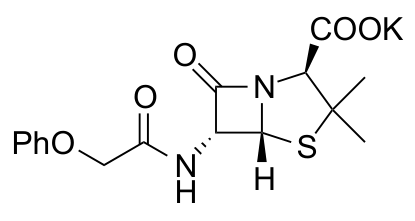
Penicillin VK
6.1. Mark the stereogenic carbon centers on the structure of Penicillin VK on the answer sheet. Write the corresponding \(R/S\) stereodescriptors next to the centers on the answer sheet. 6 pt
6.2. Give the total number of possible stereoisomers of Penicillin VK. 2 pt
One of the many synthetic methods to obtain Penicillin VK starts from the amino acid valine, as shown in the scheme on the next page of this problem.
Hints:
- Among other signals, the \({}^{1}\mathrm{H}\)NMR spectrum of compound A contains two signals that each integrate to 3H. Both of these signals are doublets.
- Compounds A and D are open-chain compounds, while B and E each have a five membered ring (in addition to any rings in the PhthN-group).
- Brucine is used for chiral resolution.
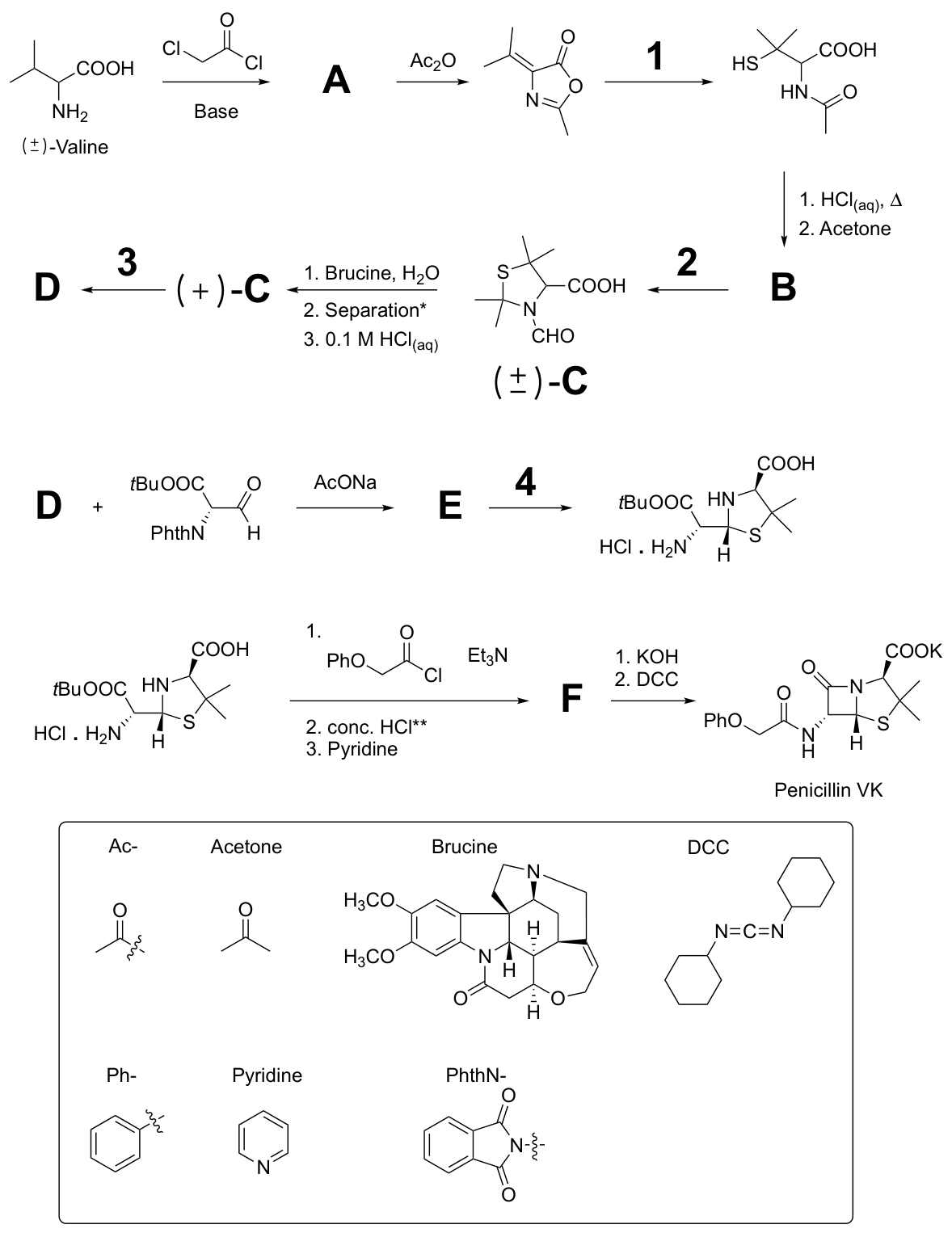
*Please note that in the formation of (+)-C, the word "Separation" means separation.
**Conc. HCl means concentrated HCl.
6.3. Choose the suitable reagent for the numbered steps \((1–4)\) on the answer sheet. 8 pt
a) \(2\,\mathrm{M}\) \(\ce{HCl_{(aq)}}\)
b) \(\ce{SO3, H2SO4}\)
c) \(\ce{NaOH_{(aq)}}\)
d) \(\ce{HCO2H, Ac2O}\)
e) i) \(\ce{N2H4}\) ii) \(\ce{HCl_{(aq)}, AcOH}\)
f) i) \(\ce{H2S, Na, CH3OH}\) ii) \(\ce{H2O}\)
6.4. Draw the structures of A, B, (+)-C, D, E and F on the answer sheet. Show the stereostructure using wedge–dash notation (

) when relevant. 18 pt
6.5. Select the role of acetone in the step leading to B on the answer sheet. 2 pt
a) solvent
b) catalyst
c) electrophile
d) nucleophile
6.6. Select the role of DCC in the step leading from F to Penicillin VK on the answer sheet. 2 pt
a) oxidizing reagent
b) catalyst
c) coupling reagent
d) radical initiator
Official English text of the problem.
Answers
- 6.1. There are three stereogenic carbon centers, with configuration \((2S,5R,6R)\) in standard penam numbering:
- Carboxylate-bearing carbon: \(S\).
- Fused-ring carbon bearing the explicitly drawn hydrogen: \(R\).
-
β-Lactam carbon bearing the phenoxyacetamido substituent: \(R\).
-
6.2. \(8\) stereoisomers.
-
6.3. 1 → f; 2 → d; 3 → a; 4 → e.
-
6.4. The structures are given below. A and B are racemates; their SMILES specify connectivity without selecting one enantiomer.
| Compound | Name | SMILES |
|---|---|---|
| A | \((\pm)\)-\(N\)-(2-Chloroacetyl)valine | CC(C)C(NC(=O)CCl)C(=O)O |
| B | \((\pm)\)-2,2,5,5-Tetramethyl-1,3-thiazolidine-4-carboxylic acid | CC1(C)NC(C(=O)O)C(C)(C)S1 |
| (+)-C | \((4S)\)-3-Formyl-2,2,5,5-tetramethyl-1,3-thiazolidine-4-carboxylic acid | CC1(C)N(C=O)[C@@H](C(=O)O)C(C)(C)S1 |
| D | \((2S)\)-2-Amino-3-methyl-3-sulfanylbutanoic acid, D-penicillamine | CC(C)(S)[C@@H](N)C(=O)O |
| E | \((2R,4S)\)-2-[(\(1R\))-2-tert-butoxy-1-(1,3-dioxoisoindolin-2-yl)-2-oxoethyl]-5,5-dimethyl-1,3-thiazolidine-4-carboxylic acid | CC(C)(C)OC(=O)[C@@H](N1C(=O)c2ccccc2C1=O)[C@H]1SC(C)(C)[C@H](C(=O)O)N1 |
| F | Penicilloic acid V: \((2R,4S)\)-2-[(\(R\))-carboxy(2-phenoxyacetamido)methyl]-5,5-dimethyl-1,3-thiazolidine-4-carboxylic acid | O=C(O)[C@@H](NC(=O)COc1ccccc1)[C@H]1SC(C)(C)[C@H](C(=O)O)N1 |
D is shown above as its neutral parent. In the acidic mixture from step 3, it is D-penicillamine hydrochloride, CC(C)(S)[C@@H]([NH3+])C(=O)O.[Cl-].
-
6.5. c) electrophile.
-
6.6. c) coupling reagent.
Solution
6.1. Stereogenic centers and absolute configurations
Penicillin VK is potassium \((2S,5R,6R)\)-6-(2-phenoxyacetamido)-3,3-dimethyl-7-oxo-4-thia-1-azabicyclo[3.2.0]heptane-2-carboxylate:
CC1(C)S[C@@H]2[C@H](NC(=O)COc3ccccc3)C(=O)N2[C@H]1C(=O)[O-].[K+]
The three stereogenic carbons and their CIP priorities are:
| Center | Position in the supplied drawing | Priorities, highest to lowest | Configuration |
|---|---|---|---|
| \(C_2\) | Upper-right carbon bearing the carboxylate | Ring nitrogen; gem-dimethyl carbon; carboxylate carbon; hydrogen | \(S\) |
| \(C_5\) | Fused-ring carbon bearing the solid-wedge hydrogen | Sulfur; ring nitrogen; \(C_6\); hydrogen | \(R\) |
| \(C_6\) | β-Lactam carbon bearing the dashed-bond amide substituent | Side-chain nitrogen; \(C_5\); β-lactam carbonyl carbon; hydrogen | \(R\) |
Two carbon-versus-carbon comparisons deserve attention:
- At \(C_2\), the gem-dimethyl carbon has the next-layer atoms \((\ce{S},\ce{C},\ce{C})\), whereas the carboxylate carbon has oxygen atoms. Sulfur gives the former higher priority.
- At \(C_6\), the \(C_5\) branch presents \((\ce{S},\ce{N},\ce{H})\), whereas the carbonyl branch presents \((\ce{O},\ce{O},\ce{N})\). Again, the sulfur-containing branch has higher priority.
Applying these priorities to the shown wedges and dashes gives \((2S,5R,6R)\). The carbon bearing two methyl groups is not stereogenic because those two substituents are identical.
6.2. Number of stereoisomers
There are three stereogenic carbon centers and no internal symmetry that produces a meso form. Therefore,
\[ N_{\text{stereoisomers}}=2^3=\boxed{8}. \]
These comprise four enantiomeric pairs.
6.3. Identification of reagents
| Step | Choice and reagents, with SMILES | Reason |
|---|---|---|
| 1 | f: hydrogen sulfide S, sodium [Na], methanol CO; then water O |
Introduces the thiol group at the carbon bearing two methyl groups; subsequent hydrolysis opens the oxazolone. |
| 2 | d: formic acid O=CO, acetic anhydride CC(=O)OC(C)=O |
Formylates the thiazolidine nitrogen, producing the shown \(N\)-formyl compound C. |
| 3 | a: \(2\,\mathrm{M}\) aqueous hydrochloric acid; hydrogen chloride Cl |
Hydrolyzes the \(N\)-formyl group and the acetone-derived cyclic \(N,S\)-acetal, releasing open-chain penicillamine. |
| 4 | e: hydrazine NN; then hydrochloric acid Cl and acetic acid CC(=O)O |
Removes the phthaloyl protecting group by hydrazinolysis and gives the amino ester hydrochloride. |
The molecular SMILES Cl denotes hydrogen chloride. Its aqueous ionized representation is hydronium chloride, [OH3+].[Cl-].
6.4. Structures and reaction sequence
The equations below are balanced net equations. Neutral parent structures are used unless a hydrochloride is explicitly indicated.
Formation of A and the oxazolone. Racemic valine, 2-amino-3-methylbutanoic acid, CC(C)C(N)C(=O)O, undergoes nitrogen acylation with chloroacetyl chloride, O=C(Cl)CCl:
\[ \ce{(CH3)2CHCH(NH2)COOH + ClCH2COCl -> A + HCl}. \]
The supplied base traps the hydrogen chloride. Thus A is \(N\)-(2-chloroacetyl)valine.
The isopropyl group remains intact. Each methyl group couples to the adjacent methine proton, giving a doublet integrating to three hydrogens. The two methyl groups can have different chemical shifts because the molecule contains the neighboring stereogenic α-carbon. This agrees with the NMR hint.
Let U denote the drawn oxazolone, 2-methyl-4-(propan-2-ylidene)-1,3-oxazol-5(4H)-one:
CC1=NC(=C(C)C)C(=O)O1
Its formation involves cyclodehydration and loss of hydrogen chloride. Including acetic anhydride as the dehydrating reagent gives the net balance
\[ \ce{A + (CH3CO)2O -> U + 2CH3COOH + HCl}. \]
Sulfur introduction and formation of B. In step 1, hydrosulfide, [SH-], adds to the exocyclic double bond at the carbon bearing the two methyl groups. Hydrolysis then opens the oxazolone, giving X, \(N\)-acetyl-DL-penicillamine:
CC(=O)NC(C(=O)O)C(C)(C)S
The net reaction is
\[ \ce{U + H2S + H2O -> X}. \]
Hot aqueous hydrochloric acid hydrolyzes the acetyl protecting group. Calling the resulting racemic penicillamine P, CC(C)(S)C(N)C(=O)O, the neutral-parent balance is
\[ \ce{X + H2O -> P + CH3COOH}. \]
The amino and thiol groups of P then condense with acetone, propan-2-one, CC(=O)C:
\[ \ce{P + (CH3)2CO -> B + H2O}. \]
The resulting five-membered ring has the sequence
\[ \text{S}- \text{acetone-derived carbon}- \text{N}- \text{carboxyl-bearing carbon}- \text{gem-dimethyl carbon}. \]
Consequently, B is racemic 2,2,5,5-tetramethyl-1,3-thiazolidine-4-carboxylic acid. The acetone-derived carbon is not stereogenic because it bears two identical methyl groups.
Formation and resolution of C. Formic acid activated by acetic anhydride formylates the secondary ring nitrogen:
\[ \ce{B + HCOOH + (CH3CO)2O -> C + 2CH3COOH}. \]
At this stage C is racemic. Brucine forms diastereomeric salts with its two enantiomers, allowing physical separation. The subsequent dilute-acid treatment releases (+)-C.
The sign of optical rotation does not determine an \(R/S\) descriptor. The required configuration follows from the synthesis: this carboxyl-bearing stereocenter becomes the \(S\) carboxyl-bearing center of Penicillin VK. Accordingly, (+)-C has configuration \(4S\).
Formation of D. Step 3 hydrolyzes both the formamide and the acetone-derived \(N,S\)-acetal:
\[ \ce{C + 2H2O + HCl -> D*HCl + (CH3)2CO + HCOOH}. \]
Thus D is \((S)\)-penicillamine, obtained under these conditions as its hydrochloride. Its stereogenic carbon retains its configuration.
Formation of E. Let G denote the aldehyde supplied in the scheme: tert-butyl \((2S)\)-2-(1,3-dioxoisoindolin-2-yl)-3-oxopropanoate:
CC(C)(C)OC(=O)[C@@H](N1C(=O)c2ccccc2C1=O)C=O
The amine of D condenses with the aldehyde, and intramolecular thiol addition closes a five-membered thiazolidine ring. Sodium acetate, CC(=O)[O-].[Na+], enables condensation of the hydrochloride salt. A balanced net equation is
\[ \ce{D*HCl + G + CH3COONa -> E + H2O + CH3COOH + NaCl}. \]
Here sodium chloride is [Na+].[Cl-].
In E:
- The penicillamine stereocenter becomes thiazolidine \(C_4\), with configuration \(S\).
- The former aldehyde carbon becomes the new thiazolidine \(C_2\), with configuration \(R\) for the product carried through the shown synthesis.
- The external phthalimido-bearing carbon has configuration \(R\).
The last assignment involves a change of descriptor without inversion. In G, the ester carbon outranks the aldehyde carbon because their next-layer atoms are respectively \((\ce{O},\ce{O},\ce{O})\) and \((\ce{O},\ce{O},\ce{H})\). After cyclization, the former aldehyde carbon is bonded to sulfur, nitrogen and hydrogen. That branch now outranks the ester branch, changing the retained stereocenter’s descriptor from \(S\) to \(R\).
Removal of the phthaloyl group. Let \(\ce{Q*HCl}\) denote the amino ester hydrochloride drawn after step 4: the hydrochloride of \((2R,4S)\)-2-[(\(1R\))-1-amino-2-tert-butoxy-2-oxoethyl]-5,5-dimethyl-1,3-thiazolidine-4-carboxylic acid:
CC(C)(C)OC(=O)[C@@H]([NH3+])[C@H]1SC(C)(C)[C@H](C(=O)O)N1.[Cl-]
Hydrazine removes the phthaloyl group, producing phthalhydrazide, O=C1NNC(=O)c2ccccc21, with formula \(\ce{C8H6N2O2}\). Including hydrochloride formation,
\[ \ce{E + N2H4 + HCl -> Q*HCl + C8H6N2O2}. \]
The tert-butyl ester remains present.
Formation of F. Phenoxyacetyl chloride, O=C(Cl)COc1ccccc1, acylates the newly exposed amino group. Triethylamine, CCN(CC)CC, accepts the acid.
Let R be the resulting side-chain tert-butyl ester of penicilloic acid V:
CC(C)(C)OC(=O)[C@@H](NC(=O)COc1ccccc1)[C@H]1SC(C)(C)[C@H](C(=O)O)N1
Accounting for the initial hydrochloride and the acid generated during acylation,
\[ \ce{Q*HCl + PhOCH2COCl + 2Et3N -> R + 2Et3NHCl}. \]
Triethylammonium chloride is CC[NH+](CC)CC.[Cl-].
Concentrated hydrochloric acid removes the tert-butyl ester; pyridine, n1ccccc1, provides the subsequent basic work-up. Written as net ester hydrolysis,
\[ \ce{R + H2O -> F + (CH3)3COH}. \]
The alcohol in this balance is tert-butanol, CC(C)(C)O. F therefore contains two free carboxylic acid groups, a free thiazolidine nitrogen, and the installed phenoxyacetamido side chain.
Precise wedge–dash descriptions for the answer sheet:
- A and B: show racemic structures, using unspecified stereobonds or depicting both enantiomers.
- (+)-C: retain the orientation of the drawn racemic C. Make the bond from its stereogenic ring carbon to the right-hand carboxyl group a hashed wedge, with the corresponding hydrogen toward the viewer. This gives \(4S\).
- D: draw the backbone with the gem-dimethyl thiol-bearing carbon to the left and the carboxyl carbon to the right. Draw the amino group below the stereocenter on a hashed wedge, with hydrogen toward the viewer. This gives \(2S\).
- E and F: use the orientation of the amino ester shown after step 4. Keep the ring \(C_4\)–carboxyl bond as a solid wedge, the ring \(C_2\)–hydrogen bond as a solid wedge, and the external stereocenter’s bond to its nitrogen substituent as a hashed wedge. In E, that nitrogen belongs to the phthalimide group; in F, it belongs to the phenoxyacetamido group. E has the tert-butyl ester, whereas F has the corresponding free carboxylic acid.
6.5. Role of acetone
Acetone, CC(=O)C, acts as an electrophile.
Its carbonyl carbon accepts nucleophilic attack from the amino group. Condensation and intramolecular sulfur attack then produce the cyclic \(N,S\)-acetal. The carbonyl carbon of acetone becomes the ring carbon between nitrogen and sulfur, retaining both methyl groups.
Thus the correct choice is c).
6.6. Role of DCC
DCC is \(N,N'\)-dicyclohexylcarbodiimide:
C1CCC(CC1)N=C=NC2CCCCC2
It acts as a coupling reagent, activating the side-chain carboxyl group of F for intramolecular attack by the thiazolidine nitrogen. Formation of this amide bond closes the four-membered β-lactam ring.
DCC is consumed, forming \(N,N'\)-dicyclohexylurea, DCU:
O=C(NC1CCCCC1)NC2CCCCC2
Including potassium hydroxide, [K+].[OH-], the overall atom-balanced reaction is
\[ \ce{ C16H20N2O6S + KOH + C13H22N2 -> C16H17KN2O5S + C13H24N2O + H2O }. \]
The organic reactants are F and DCC; the organic products are Penicillin VK and DCU. The carboxyl group not incorporated into the β-lactam remains as the potassium carboxylate.
Thus the correct choice is c).
The solution was checked against the official solution.
IChO 2024 · Theorieaufgabe 6
Penicillin
Penicilline sind eine Gruppe von Antibiotika, die seit ihrer Entdeckung eine entscheidende Rolle in der Medizin spielen.
Penicillin VK
6.1. Markieren Sie die stereogenen Kohlenstoffzentren in der Struktur von Penicillin VK auf dem Antwortbogen. Schreiben Sie die entsprechenden \(R/S\)-Stereodeskriptoren neben die Zentren auf dem Antwortbogen. 6 Pkt.
6.2. Geben Sie die Gesamtzahl der möglichen Stereoisomere von Penicillin VK an. 2 Pkt.
Eine der vielen Synthesemethoden zur Herstellung von Penicillin VK geht von der Aminosäure Valin aus, wie im Schema auf der nächsten Seite dieser Aufgabe dargestellt.
Hinweise:
- Das \({}^{1}\mathrm{H}\)NMR-Spektrum der Verbindung A enthält neben anderen Signalen zwei Signale, deren Integrale jeweils 3H entsprechen. Beide Signale sind Dubletts.
- Die Verbindungen A und D sind offenkettige Verbindungen, während B und E jeweils einen fünfgliedrigen Ring besitzen (zusätzlich zu etwaigen Ringen in der PhthN-Gruppe).
- Brucin wird zur Racematspaltung verwendet.
*Bitte beachten Sie, dass bei der Bildung von (+)-C das Wort „Separation“ Trennung bedeutet.
**Conc. HCl bedeutet konzentrierte HCl.
6.3. Wählen Sie auf dem Antwortbogen das geeignete Reagenz für die nummerierten Schritte \((1–4)\) aus. 8 Pkt.
a) \(2\,\mathrm{M}\) \(\ce{HCl_{(aq)}}\)
b) \(\ce{SO3, H2SO4}\)
c) \(\ce{NaOH_{(aq)}}\)
d) \(\ce{HCO2H, Ac2O}\)
e) i) \(\ce{N2H4}\) ii) \(\ce{HCl_{(aq)}, AcOH}\)
f) i) \(\ce{H2S, Na, CH3OH}\) ii) \(\ce{H2O}\)
6.4. Zeichnen Sie die Strukturen von A, B, (+)-C, D, E und F auf den Antwortbogen. Stellen Sie die räumliche Struktur gegebenenfalls mithilfe der Keilstrichschreibweise (
) dar. 18 Pkt.
6.5. Wählen Sie auf dem Antwortbogen die Rolle von Aceton bei dem zu B führenden Schritt aus. 2 Pkt.
a) Lösungsmittel
b) Katalysator
c) Elektrophil
d) Nukleophil
6.6. Wählen Sie auf dem Antwortbogen die Rolle von DCC bei dem von F zu Penicillin VK führenden Schritt aus. 2 Pkt.
a) Oxidationsmittel
b) Katalysator
c) Kupplungsreagenz
d) Radikalinitiator
Aufgabentext aus dem offiziellen englischen Text übersetzt.
Antworten
- 6.1. Es gibt drei stereogene Kohlenstoffzentren mit der Konfiguration \((2S,5R,6R)\) gemäß der üblichen Penam-Nummerierung:
- Kohlenstoffatom mit der Carboxylatgruppe: \(S\).
- Kohlenstoffatom an der Ringverknüpfung mit dem explizit eingezeichneten Wasserstoffatom: \(R\).
-
β-Lactam-Kohlenstoffatom mit dem Phenoxyacetamido-Substituenten: \(R\).
-
6.2. \(8\) Stereoisomere.
-
6.3. 1 → f; 2 → d; 3 → a; 4 → e.
-
6.4. Die Strukturen sind nachfolgend angegeben. A und B sind Racemate; ihre SMILES geben die Konnektivität an, ohne eines der Enantiomere festzulegen.
| Verbindung | Name | SMILES |
|---|---|---|
| A | \((\pm)\)-\(N\)-(2-Chloracetyl)valin | CC(C)C(NC(=O)CCl)C(=O)O |
| B | \((\pm)\)-2,2,5,5-Tetramethyl-1,3-thiazolidin-4-carbonsäure | CC1(C)NC(C(=O)O)C(C)(C)S1 |
| (+)-C | \((4S)\)-3-Formyl-2,2,5,5-tetramethyl-1,3-thiazolidin-4-carbonsäure | CC1(C)N(C=O)[C@@H](C(=O)O)C(C)(C)S1 |
| D | \((2S)\)-2-Amino-3-methyl-3-sulfanylbutansäure, D-Penicillamin | CC(C)(S)[C@@H](N)C(=O)O |
| E | \((2R,4S)\)-2-[(\(1R\))-2-tert-Butoxy-1-(1,3-dioxoisoindolin-2-yl)-2-oxoethyl]-5,5-dimethyl-1,3-thiazolidin-4-carbonsäure | CC(C)(C)OC(=O)[C@@H](N1C(=O)c2ccccc2C1=O)[C@H]1SC(C)(C)[C@H](C(=O)O)N1 |
| F | Penicilloinsäure V: \((2R,4S)\)-2-[(\(R\))-Carboxy(2-phenoxyacetamido)methyl]-5,5-dimethyl-1,3-thiazolidin-4-carbonsäure | O=C(O)[C@@H](NC(=O)COc1ccccc1)[C@H]1SC(C)(C)[C@H](C(=O)O)N1 |
D ist oben in seiner neutralen Form dargestellt. Im sauren Gemisch aus Schritt 3 liegt es als D-Penicillaminhydrochlorid, CC(C)(S)[C@@H]([NH3+])C(=O)O.[Cl-], vor.
-
6.5. c) Elektrophil.
-
6.6. c) Kupplungsreagenz.
Lösung
6.1. Stereogene Zentren und absolute Konfigurationen
Penicillin VK ist Kalium-\((2S,5R,6R)\)-6-(2-phenoxyacetamido)-3,3-dimethyl-7-oxo-4-thia-1-azabicyclo[3.2.0]heptan-2-carboxylat:
CC1(C)S[C@@H]2[C@H](NC(=O)COc3ccccc3)C(=O)N2[C@H]1C(=O)[O-].[K+]
Die drei stereogenen Kohlenstoffatome und ihre CIP-Prioritäten sind:
| Zentrum | Position in der vorgegebenen Zeichnung | Prioritäten, von der höchsten zur niedrigsten | Konfiguration |
|---|---|---|---|
| \(C_2\) | Kohlenstoffatom oben rechts mit der Carboxylatgruppe | Ringstickstoff; gem-Dimethyl-Kohlenstoffatom; Carboxylat-Kohlenstoffatom; Wasserstoff | \(S\) |
| \(C_5\) | Kohlenstoffatom an der Ringverknüpfung mit dem über einen ausgefüllten Keil gebundenen Wasserstoffatom | Schwefel; Ringstickstoff; \(C_6\); Wasserstoff | \(R\) |
| \(C_6\) | β-Lactam-Kohlenstoffatom mit dem über eine gestrichelte Bindung gebundenen Amidsubstituenten | Stickstoff der Seitenkette; \(C_5\); β-Lactam-Carbonylkohlenstoffatom; Wasserstoff | \(R\) |
Zwei Vergleiche zwischen Kohlenstoffatomen verdienen besondere Beachtung:
- An \(C_2\) weist das gem-Dimethyl-Kohlenstoffatom in der nächsten Ebene die Atome \((\ce{S},\ce{C},\ce{C})\) auf, während das Carboxylat-Kohlenstoffatom Sauerstoffatome aufweist. Der Schwefel verleiht Ersterem die höhere Priorität.
- An \(C_6\) weist der \(C_5\)-Zweig \((\ce{S},\ce{N},\ce{H})\) auf, während der Carbonylzweig \((\ce{O},\ce{O},\ce{N})\) aufweist. Auch hier hat der schwefelhaltige Zweig die höhere Priorität.
Die Anwendung dieser Prioritäten auf die dargestellten Keile und gestrichelten Bindungen ergibt \((2S,5R,6R)\). Das Kohlenstoffatom mit den beiden Methylgruppen ist nicht stereogen, da diese beiden Substituenten identisch sind.
6.2. Anzahl der Stereoisomere
Es gibt drei stereogene Kohlenstoffzentren und keine innere Symmetrie, die zu einer meso-Form führt. Daher gilt:
\[ N_{\text{Stereoisomere}}=2^3=\boxed{8}. \]
Diese bilden vier Enantiomerenpaare.
6.3. Identifizierung der Reagenzien
| Schritt | Auswahl und Reagenzien mit SMILES | Begründung |
|---|---|---|
| 1 | f: Schwefelwasserstoff S, Natrium [Na], Methanol CO; anschließend Wasser O |
Führt die Thiolgruppe am Kohlenstoffatom mit den beiden Methylgruppen ein; die anschließende Hydrolyse öffnet das Oxazolon. |
| 2 | d: Ameisensäure O=CO, Essigsäureanhydrid CC(=O)OC(C)=O |
Formyliert den Thiazolidinstickstoff, wobei die dargestellte \(N\)-Formylverbindung C entsteht. |
| 3 | a: \(2\,\mathrm{M}\) wässrige Salzsäure; Chlorwasserstoff Cl |
Hydrolysiert die \(N\)-Formylgruppe und das aus Aceton gebildete cyclische \(N,S\)-Acetal, wobei offenkettiges Penicillamin freigesetzt wird. |
| 4 | e: Hydrazin NN; anschließend Salzsäure Cl und Essigsäure CC(=O)O |
Entfernt die Phthaloyl-Schutzgruppe durch Hydrazinolyse und liefert das Aminoesterhydrochlorid. |
Die molekulare SMILES Cl bezeichnet Chlorwasserstoff. Seine ionisierte Darstellung in wässriger Lösung ist Oxoniumchlorid, [OH3+].[Cl-].
6.4. Strukturen und Reaktionsfolge
Die nachfolgenden Gleichungen sind ausgeglichene Nettogleichungen. Es werden die neutralen Formen verwendet, sofern nicht ausdrücklich ein Hydrochlorid angegeben ist.
Bildung von A und des Oxazolons. Racemisches Valin, 2-Amino-3-methylbutansäure, CC(C)C(N)C(=O)O, wird mit Chloracetylchlorid, O=C(Cl)CCl, am Stickstoff acyliert:
\[ \ce{(CH3)2CHCH(NH2)COOH + ClCH2COCl -> A + HCl}. \]
Die zugesetzte Base fängt den Chlorwasserstoff ab. Somit ist A \(N\)-(2-Chloracetyl)valin.
Die Isopropylgruppe bleibt intakt. Jede Methylgruppe koppelt mit dem benachbarten Methinproton und ergibt dadurch ein Dublett mit einem Integral entsprechend drei Wasserstoffatomen. Die beiden Methylgruppen können unterschiedliche chemische Verschiebungen aufweisen, da das Molekül das benachbarte stereogene α-Kohlenstoffatom enthält. Dies stimmt mit dem NMR-Hinweis überein.
Mit U sei das dargestellte Oxazolon bezeichnet, 2-Methyl-4-(propan-2-yliden)-1,3-oxazol-5(4H)-on:
CC1=NC(=C(C)C)C(=O)O1
Seine Bildung umfasst eine Cyclodehydratisierung und die Abspaltung von Chlorwasserstoff. Unter Einbeziehung von Essigsäureanhydrid als Dehydratisierungsreagenz ergibt sich die Nettobilanz
\[ \ce{A + (CH3CO)2O -> U + 2CH3COOH + HCl}. \]
Einführung von Schwefel und Bildung von B. In Schritt 1 addiert Hydrogensulfid, [SH-], an die exocyclische Doppelbindung am Kohlenstoffatom mit den beiden Methylgruppen. Durch anschließende Hydrolyse wird das Oxazolon geöffnet, wobei X, \(N\)-Acetyl-DL-penicillamin, entsteht:
CC(=O)NC(C(=O)O)C(C)(C)S
Die Nettoreaktion lautet
\[ \ce{U + H2S + H2O -> X}. \]
Heiße wässrige Salzsäure hydrolysiert die Acetyl-Schutzgruppe. Bezeichnet man das entstehende racemische Penicillamin mit P, CC(C)(S)C(N)C(=O)O, so lautet die Bilanz für die neutralen Formen
\[ \ce{X + H2O -> P + CH3COOH}. \]
Die Amino- und Thiolgruppen von P kondensieren anschließend mit Aceton, Propan-2-on, CC(=O)C:
\[ \ce{P + (CH3)2CO -> B + H2O}. \]
Der entstehende fünfgliedrige Ring weist folgende Abfolge auf:
\[ \text{S}- \text{aus Aceton stammendes Kohlenstoffatom}- \text{N}- \text{carboxylgruppentragendes Kohlenstoffatom}- \text{gem-Dimethyl-Kohlenstoffatom}. \]
Folglich ist B racemische 2,2,5,5-Tetramethyl-1,3-thiazolidin-4-carbonsäure. Das aus Aceton stammende Kohlenstoffatom ist nicht stereogen, da es zwei identische Methylgruppen trägt.
Bildung und Racematspaltung von C. Durch Essigsäureanhydrid aktivierte Ameisensäure formyliert den sekundären Ringstickstoff:
\[ \ce{B + HCOOH + (CH3CO)2O -> C + 2CH3COOH}. \]
In diesem Stadium liegt C racemisch vor. Brucin bildet mit seinen beiden Enantiomeren diastereomere Salze, wodurch eine physikalische Trennung möglich wird. Die anschließende Behandlung mit verdünnter Säure setzt (+)-C frei.
Das Vorzeichen der optischen Drehung bestimmt nicht den \(R/S\)-Deskriptor. Die erforderliche Konfiguration ergibt sich aus der Synthese: Dieses carboxylgruppentragende Stereozentrum wird zum carboxylgruppentragenden \(S\)-Zentrum von Penicillin VK. Dementsprechend besitzt (+)-C die Konfiguration \(4S\).
Bildung von D. Schritt 3 hydrolysiert sowohl das Formamid als auch das aus Aceton gebildete \(N,S\)-Acetal:
\[ \ce{C + 2H2O + HCl -> D*HCl + (CH3)2CO + HCOOH}. \]
Somit ist D \((S)\)-Penicillamin, das unter diesen Bedingungen als Hydrochlorid erhalten wird. Sein stereogenes Kohlenstoffatom behält seine Konfiguration bei.
Bildung von E. Mit G sei der im Schema vorgegebene Aldehyd bezeichnet: tert-Butyl-\((2S)\)-2-(1,3-dioxoisoindolin-2-yl)-3-oxopropanoat:
CC(C)(C)OC(=O)[C@@H](N1C(=O)c2ccccc2C1=O)C=O
Die Aminogruppe von D kondensiert mit dem Aldehyd, und eine intramolekulare Thioladdition schließt einen fünfgliedrigen Thiazolidinring. Natriumacetat, CC(=O)[O-].[Na+], ermöglicht die Kondensation des Hydrochloridsalzes. Eine ausgeglichene Nettogleichung lautet
\[ \ce{D*HCl + G + CH3COONa -> E + H2O + CH3COOH + NaCl}. \]
Hier ist Natriumchlorid [Na+].[Cl-].
In E gilt:
- Das Penicillamin-Stereozentrum wird zu \(C_4\) des Thiazolidins mit der Konfiguration \(S\).
- Das ehemalige Aldehydkohlenstoffatom wird zum neuen \(C_2\) des Thiazolidins mit der Konfiguration \(R\) für das Produkt, das in der dargestellten Synthese weiter umgesetzt wird.
- Das außerhalb des Rings liegende Kohlenstoffatom mit der Phthalimidogruppe besitzt die Konfiguration \(R\).
Die letzte Zuordnung beinhaltet einen Wechsel des Deskriptors ohne Inversion. In G hat das Esterkohlenstoffatom eine höhere Priorität als das Aldehydkohlenstoffatom, da ihre Atome in der nächsten Ebene \((\ce{O},\ce{O},\ce{O})\) beziehungsweise \((\ce{O},\ce{O},\ce{H})\) sind. Nach der Cyclisierung ist das ehemalige Aldehydkohlenstoffatom an Schwefel, Stickstoff und Wasserstoff gebunden. Dieser Zweig hat nun eine höhere Priorität als der Esterzweig, wodurch sich der Deskriptor des räumlich unveränderten Stereozentrums von \(S\) zu \(R\) ändert.
Entfernung der Phthaloylgruppe. Mit \(\ce{Q*HCl}\) sei das nach Schritt 4 dargestellte Aminoesterhydrochlorid bezeichnet: das Hydrochlorid der \((2R,4S)\)-2-[(\(1R\))-1-Amino-2-tert-butoxy-2-oxoethyl]-5,5-dimethyl-1,3-thiazolidin-4-carbonsäure:
CC(C)(C)OC(=O)[C@@H]([NH3+])[C@H]1SC(C)(C)[C@H](C(=O)O)N1.[Cl-]
Hydrazin entfernt die Phthaloylgruppe, wobei Phthalhydrazid, O=C1NNC(=O)c2ccccc21, mit der Formel \(\ce{C8H6N2O2}\) entsteht. Unter Einbeziehung der Hydrochloridbildung gilt:
\[ \ce{E + N2H4 + HCl -> Q*HCl + C8H6N2O2}. \]
Der tert-Butylester bleibt erhalten.
Bildung von F. Phenoxyacetylchlorid, O=C(Cl)COc1ccccc1, acyliert die neu freigesetzte Aminogruppe. Triethylamin, CCN(CC)CC, nimmt die Säure auf.
Mit R sei der entstehende tert-Butylester der Seitenkette von Penicilloinsäure V bezeichnet:
CC(C)(C)OC(=O)[C@@H](NC(=O)COc1ccccc1)[C@H]1SC(C)(C)[C@H](C(=O)O)N1
Unter Berücksichtigung des anfänglich vorliegenden Hydrochlorids und der bei der Acylierung entstehenden Säure gilt:
\[ \ce{Q*HCl + PhOCH2COCl + 2Et3N -> R + 2Et3NHCl}. \]
Triethylammoniumchlorid ist CC[NH+](CC)CC.[Cl-].
Konzentrierte Salzsäure spaltet den tert-Butylester; Pyridin, n1ccccc1, dient der anschließenden basischen Aufarbeitung. Als Nettoesterhydrolyse geschrieben gilt:
\[ \ce{R + H2O -> F + (CH3)3COH}. \]
Der Alkohol in dieser Bilanz ist tert-Butanol, CC(C)(C)O. F enthält daher zwei freie Carbonsäuregruppen, einen freien Thiazolidinstickstoff und die eingeführte Phenoxyacetamido-Seitenkette.
Präzise Angaben zur Keilstrichschreibweise für den Antwortbogen:
- A und B: Stellen Sie racemische Strukturen dar, indem Sie stereochemisch nicht festgelegte Bindungen verwenden oder beide Enantiomere zeichnen.
- (+)-C: Behalten Sie die Orientierung des gezeichneten racemischen C bei. Zeichnen Sie die Bindung von seinem stereogenen Ringkohlenstoffatom zur rechts liegenden Carboxylgruppe als gestrichelten Keil, wobei das zugehörige Wasserstoffatom zum Betrachter zeigt. Dies ergibt \(4S\).
- D: Zeichnen Sie das Grundgerüst mit dem thiolgruppentragenden gem-Dimethyl-Kohlenstoffatom links und dem Carboxylkohlenstoffatom rechts. Zeichnen Sie die Aminogruppe unterhalb des Stereozentrums an einem gestrichelten Keil, wobei das Wasserstoffatom zum Betrachter zeigt. Dies ergibt \(2S\).
- E und F: Verwenden Sie die Orientierung des nach Schritt 4 dargestellten Aminoesters. Behalten Sie die Bindung zwischen Ring-\(C_4\) und Carboxylgruppe als ausgefüllten Keil, die Bindung zwischen Ring-\(C_2\) und Wasserstoffatom als ausgefüllten Keil und die Bindung des außerhalb des Rings liegenden Stereozentrums zu seinem Stickstoffsubstituenten als gestrichelten Keil bei. In E gehört dieser Stickstoff zur Phthalimidgruppe; in F gehört er zur Phenoxyacetamidogruppe. E besitzt den tert-Butylester, während F die entsprechende freie Carbonsäure besitzt.
6.5. Rolle von Aceton
Aceton, CC(=O)C, wirkt als Elektrophil.
Sein Carbonylkohlenstoffatom wird von der Aminogruppe nukleophil angegriffen. Kondensation und intramolekularer Angriff des Schwefels führen anschließend zum cyclischen \(N,S\)-Acetal. Das Carbonylkohlenstoffatom des Acetons wird zum Ringkohlenstoffatom zwischen Stickstoff und Schwefel und behält dabei beide Methylgruppen.
Die richtige Auswahl ist somit c).
6.6. Rolle von DCC
DCC ist \(N,N'\)-Dicyclohexylcarbodiimid:
C1CCC(CC1)N=C=NC2CCCCC2
Es wirkt als Kupplungsreagenz, indem es die Carboxylgruppe der Seitenkette von F für den intramolekularen Angriff des Thiazolidinstickstoffs aktiviert. Die Bildung dieser Amidbindung schließt den viergliedrigen β-Lactamring.
DCC wird verbraucht, wobei \(N,N'\)-Dicyclohexylharnstoff, DCU, entsteht:
O=C(NC1CCCCC1)NC2CCCCC2
Unter Einbeziehung von Kaliumhydroxid, [K+].[OH-], lautet die insgesamt nach Atomen ausgeglichene Reaktion
\[ \ce{ C16H20N2O6S + KOH + C13H22N2 -> C16H17KN2O5S + C13H24N2O + H2O }. \]
Die organischen Edukte sind F und DCC; die organischen Produkte sind Penicillin VK und DCU. Die nicht in das β-Lactam eingebaute Carboxylgruppe bleibt als Kaliumcarboxylat erhalten.
Die richtige Auswahl ist somit c).
Die Lösung wurde mit der offiziellen Lösung abgeglichen.
IChO 2024 · Teori sorusu 6
Penisilin
Penisilinler, keşfedilmelerinden bu yana tıpta çok önemli bir rol oynayan bir antibiyotik grubudur.
Penisilin VK
6.1. Cevap kâğıdındaki Penisilin VK yapısı üzerinde stereojenik karbon merkezlerini işaretleyiniz. Cevap kâğıdında merkezlerin yanına karşılık gelen \(R/S\) stereotanımlayıcılarını yazınız. 6 puan
6.2. Penisilin VK'nin olası stereoizomerlerinin toplam sayısını veriniz. 2 puan
Penisilin VK elde etmek için kullanılan çok sayıda sentez yönteminden biri, bu sorunun sonraki sayfasındaki şemada gösterildiği gibi valin amino asidiyle başlar.
İpuçları:
- A bileşiğinin \({}^{1}\mathrm{H}\)NMR spektrumu, diğer sinyallerin yanı sıra, her birinin integrali 3H'ye karşılık gelen iki sinyal içerir. Bu sinyallerin her ikisi de dublettir.
- A ve D bileşikleri açık zincirli bileşiklerdir; B ve E bileşiklerinin her biri ise (PhthN grubundaki halkalara ek olarak) beş üyeli bir halka içerir.
- Brusin, kiral rezolüsyon için kullanılır.
*(+)-C oluşumunda, "Separation" sözcüğünün ayırma anlamına geldiğine dikkat ediniz.
**Conc. HCl, derişik HCl anlamına gelir.
6.3. Cevap kâğıdında, numaralandırılmış \((1–4)\) basamaklar için uygun reaktifi seçiniz. 8 puan
a) \(2\,\mathrm{M}\) \(\ce{HCl_{(aq)}}\)
b) \(\ce{SO3, H2SO4}\)
c) \(\ce{NaOH_{(aq)}}\)
d) \(\ce{HCO2H, Ac2O}\)
e) i) \(\ce{N2H4}\) ii) \(\ce{HCl_{(aq)}, AcOH}\)
f) i) \(\ce{H2S, Na, CH3OH}\) ii) \(\ce{H2O}\)
6.4. Cevap kâğıdına A, B, (+)-C, D, E ve F yapılarının çizimlerini yapınız. Uygun olduğunda kama–kesik çizgi gösterimini (
) kullanarak stereoyapıyı gösteriniz. 18 puan
6.5. Cevap kâğıdında, B'ye giden basamakta asetonun rolünü seçiniz. 2 puan
a) çözücü
b) katalizör
c) elektrofil
d) nükleofil
6.6. Cevap kâğıdında, F'den Penisilin VK'ye giden basamakta DCC'nin rolünü seçiniz. 2 puan
a) yükseltgen reaktif
b) katalizör
c) kenetleme reaktifi
d) radikal başlatıcı
Soru metni resmi İngilizce metinden çevrilmiştir.
Cevaplar
- 6.1. Standart penam numaralandırmasına göre konfigürasyonları \((2S,5R,6R)\) olan üç stereojenik karbon merkezi vardır:
- Karboksilat taşıyan karbon: \(S\).
- Açıkça çizilmiş hidrojeni taşıyan, kaynaşmış halkaların ortak karbonu: \(R\).
-
Fenoksiasetamido sübstitüentini taşıyan β-laktam karbonu: \(R\).
-
6.2. \(8\) stereoizomer.
-
6.3. 1 → f; 2 → d; 3 → a; 4 → e.
-
6.4. Yapılar aşağıda verilmiştir. A ve B rasematlardır; SMILES gösterimleri, bir enantiyomer seçmeden atomların bağlanma düzenini belirtir.
| Bileşik | Adı | SMILES |
|---|---|---|
| A | \((\pm)\)-\(N\)-(2-Kloroasetil)valin | CC(C)C(NC(=O)CCl)C(=O)O |
| B | \((\pm)\)-2,2,5,5-Tetrametil-1,3-tiyazolidin-4-karboksilik asit | CC1(C)NC(C(=O)O)C(C)(C)S1 |
| (+)-C | \((4S)\)-3-Formil-2,2,5,5-tetrametil-1,3-tiyazolidin-4-karboksilik asit | CC1(C)N(C=O)[C@@H](C(=O)O)C(C)(C)S1 |
| D | \((2S)\)-2-Amino-3-metil-3-sülfanilbütanoik asit, D-penisilamin | CC(C)(S)[C@@H](N)C(=O)O |
| E | \((2R,4S)\)-2-[(\(1R\))-2-tert-bütoksi-1-(1,3-dioksoizoindolin-2-il)-2-oksoetil]-5,5-dimetil-1,3-tiyazolidin-4-karboksilik asit | CC(C)(C)OC(=O)[C@@H](N1C(=O)c2ccccc2C1=O)[C@H]1SC(C)(C)[C@H](C(=O)O)N1 |
| F | Penisilloik asit V: \((2R,4S)\)-2-[(\(R\))-karboksi(2-fenoksiasetamido)metil]-5,5-dimetil-1,3-tiyazolidin-4-karboksilik asit | O=C(O)[C@@H](NC(=O)COc1ccccc1)[C@H]1SC(C)(C)[C@H](C(=O)O)N1 |
D, yukarıda nötr ana bileşik biçiminde gösterilmiştir. 3. basamaktan elde edilen asidik karışımda D-penisilamin hidroklorür, CC(C)(S)[C@@H]([NH3+])C(=O)O.[Cl-], biçimindedir.
-
6.5. c) elektrofil.
-
6.6. c) kenetleme reaktifi.
Çözüm
6.1. Stereojenik merkezler ve mutlak konfigürasyonlar
Penisilin VK, potasyum \((2S,5R,6R)\)-6-(2-fenoksiasetamido)-3,3-dimetil-7-okso-4-tiya-1-azabisiklo[3.2.0]heptan-2-karboksilattır:
CC1(C)S[C@@H]2[C@H](NC(=O)COc3ccccc3)C(=O)N2[C@H]1C(=O)[O-].[K+]
Üç stereojenik karbon ve bunların CIP öncelikleri şöyledir:
| Merkez | Verilen çizimdeki konumu | En yüksekten en düşüğe öncelikler | Konfigürasyon |
|---|---|---|---|
| \(C_2\) | Sağ üstteki, karboksilat taşıyan karbon | Halka azotu; gem-dimetil karbonu; karboksilat karbonu; hidrojen | \(S\) |
| \(C_5\) | Dolu kama ile gösterilmiş hidrojeni taşıyan, kaynaşmış halkaların ortak karbonu | Kükürt; halka azotu; \(C_6\); hidrojen | \(R\) |
| \(C_6\) | Kesik çizgili bağla gösterilmiş amit sübstitüentini taşıyan β-laktam karbonu | Yan zincir azotu; \(C_5\); β-laktam karbonil karbonu; hidrojen | \(R\) |
Karbon ile karbon arasında yapılan iki karşılaştırmaya dikkat etmek gerekir:
- \(C_2\) merkezinde, gem-dimetil karbonunun bir sonraki katmanındaki atomlar \((\ce{S},\ce{C},\ce{C})\) iken karboksilat karbonunun bir sonraki katmanında oksijen atomları bulunur. Kükürt, ilkine daha yüksek öncelik kazandırır.
- \(C_6\) merkezinde, \(C_5\) dalının bir sonraki katmanında \((\ce{S},\ce{N},\ce{H})\), karbonil dalınınkinde ise \((\ce{O},\ce{O},\ce{N})\) bulunur. Yine kükürt içeren dal daha yüksek önceliğe sahiptir.
Bu öncelikler, gösterilen kamalara ve kesik çizgilere uygulandığında \((2S,5R,6R)\) elde edilir. İki metil grubu taşıyan karbon stereojenik değildir; çünkü bu iki sübstitüent özdeştir.
6.2. Stereoizomer sayısı
Üç stereojenik karbon merkezi vardır ve mezo biçim oluşturan bir iç simetri yoktur. Dolayısıyla,
\[ N_{\text{stereoizomerler}}=2^3=\boxed{8}. \]
Bunlar dört enantiyomer çifti oluşturur.
6.3. Reaktiflerin belirlenmesi
| Basamak | Seçenek ve reaktifler, SMILES gösterimleriyle | Gerekçe |
|---|---|---|
| 1 | f: hidrojen sülfür S, sodyum [Na], metanol CO; ardından su O |
İki metil grubu taşıyan karbona tiyol grubunu bağlar; sonraki hidroliz oksazolon halkasını açar. |
| 2 | d: formik asit O=CO, asetik anhidrit CC(=O)OC(C)=O |
Tiyazolidin azotunu formilleyerek gösterilen \(N\)-formil bileşiği C'yi oluşturur. |
| 3 | a: \(2\,\mathrm{M}\) sulu hidroklorik asit; hidrojen klorür Cl |
\(N\)-formil grubunu ve asetondan türeyen halkalı \(N,S\)-asetali hidroliz ederek açık zincirli penisilamini açığa çıkarır. |
| 4 | e: hidrazin NN; ardından hidroklorik asit Cl ve asetik asit CC(=O)O |
Ftaloil koruyucu grubunu hidrazinoliz yoluyla uzaklaştırır ve amino ester hidroklorürü verir. |
Moleküler SMILES gösterimi Cl, hidrojen klorürü belirtir. Sudaki iyonlaşmış gösterimi hidronyum klorürdür: [OH3+].[Cl-].
6.4. Yapılar ve tepkime dizisi
Aşağıdaki denklemler denkleştirilmiş net denklemlerdir. Bir hidroklorür açıkça belirtilmedikçe nötr ana bileşik yapıları kullanılmıştır.
A'nın ve oksazolonun oluşumu. Rasemik valin, yani 2-amino-3-metilbütanoik asit, CC(C)C(N)C(=O)O, kloroasetil klorür, O=C(Cl)CCl, ile azot üzerinden açillenir:
\[ \ce{(CH3)2CHCH(NH2)COOH + ClCH2COCl -> A + HCl}. \]
Eklenen baz, hidrojen klorürü tutar. Dolayısıyla A, \(N\)-(2-kloroasetil)valindir.
İzopropil grubu değişmeden kalır. Her metil grubu, komşu metin protonuyla eşleşerek integrali üç hidrojene karşılık gelen bir dublet verir. Molekül komşu bir stereojenik α-karbon içerdiği için iki metil grubunun kimyasal kaymaları farklı olabilir. Bu, NMR ipucuyla uyumludur.
Çizilen oksazolonu, yani 2-metil-4-(propan-2-iliden)-1,3-oksazol-5(4H)-onu U ile gösterelim:
CC1=NC(=C(C)C)C(=O)O1
Oluşumu, halkalaşmalı su kaybını ve hidrojen klorür kaybını içerir. Su uzaklaştırıcı reaktif olarak asetik anhidrit de hesaba katıldığında net denklem şöyledir:
\[ \ce{A + (CH3CO)2O -> U + 2CH3COOH + HCl}. \]
Kükürdün yapıya katılması ve B'nin oluşumu. 1. basamakta hidrosülfür, [SH-], halka dışı çift bağın iki metil grubu taşıyan karbonuna katılır. Ardından hidroliz, oksazolon halkasını açarak X'i, yani \(N\)-asetil-DL-penisilamini verir:
CC(=O)NC(C(=O)O)C(C)(C)S
Net tepkime şöyledir:
\[ \ce{U + H2S + H2O -> X}. \]
Sıcak sulu hidroklorik asit, asetil koruyucu grubunu hidroliz eder. Oluşan rasemik penisilamini, CC(C)(S)C(N)C(=O)O, P ile gösterirsek nötr ana bileşikler için denklem şöyledir:
\[ \ce{X + H2O -> P + CH3COOH}. \]
Ardından P'nin amino ve tiyol grupları, aseton, yani propan-2-on, CC(=O)C, ile kondenzasyona girer:
\[ \ce{P + (CH3)2CO -> B + H2O}. \]
Oluşan beş üyeli halkadaki sıralama şöyledir:
\[ \text{S}- \text{asetondan türeyen karbon}- \text{N}- \text{karboksil taşıyan karbon}- \text{gem-dimetil karbonu}. \]
Dolayısıyla B, rasemik 2,2,5,5-tetrametil-1,3-tiyazolidin-4-karboksilik asittir. Asetondan türeyen karbon, iki özdeş metil grubu taşıdığı için stereojenik değildir.
C'nin oluşumu ve rezolüsyonu. Asetik anhidritle etkinleştirilmiş formik asit, sekonder halka azotunu formiller:
\[ \ce{B + HCOOH + (CH3CO)2O -> C + 2CH3COOH}. \]
Bu aşamada C rasemiktir. Brusin, iki enantiyomeriyle diastereomerik tuzlar oluşturarak fiziksel ayırmayı mümkün kılar. Sonraki seyreltik asit işlemi (+)-C'yi açığa çıkarır.
Optik dönmenin işareti, bir \(R/S\) tanımlayıcısını belirlemez. Gereken konfigürasyon sentezden çıkarılır: karboksil taşıyan bu stereomerkez, Penisilin VK'nin karboksil taşıyan \(S\) merkezine dönüşür. Buna göre (+)-C, \(4S\) konfigürasyonuna sahiptir.
D'nin oluşumu. 3. basamak, hem formamidi hem de asetondan türeyen \(N,S\)-asetali hidroliz eder:
\[ \ce{C + 2H2O + HCl -> D*HCl + (CH3)2CO + HCOOH}. \]
Dolayısıyla D, bu koşullarda hidroklorürü olarak elde edilen \((S)\)-penisilamindir. Stereojenik karbonunun konfigürasyonu korunur.
E'nin oluşumu. Şemada verilen aldehidi, yani tert-bütil \((2S)\)-2-(1,3-dioksoizoindolin-2-il)-3-oksopropanoatı G ile gösterelim:
CC(C)(C)OC(=O)[C@@H](N1C(=O)c2ccccc2C1=O)C=O
D'nin amin grubu aldehitle kondenzasyona girer ve molekül içi tiyol katılması beş üyeli bir tiyazolidin halkasını kapatır. Sodyum asetat, CC(=O)[O-].[Na+], hidroklorür tuzunun kondenzasyona girmesini sağlar. Denkleştirilmiş bir net denklem şöyledir:
\[ \ce{D*HCl + G + CH3COONa -> E + H2O + CH3COOH + NaCl}. \]
Burada sodyum klorürün gösterimi [Na+].[Cl-] şeklindedir.
E'de:
- Penisilamin stereomerkezi, \(S\) konfigürasyonuna sahip tiyazolidin \(C_4\) merkezi hâline gelir.
- Önceden aldehit karbonu olan atom, gösterilen sentez boyunca ilerletilen üründe \(R\) konfigürasyonuna sahip yeni tiyazolidin \(C_2\) merkezi hâline gelir.
- Halka dışındaki ftalimido taşıyan karbonun konfigürasyonu \(R\)'dir.
Son atama, inversiyon olmadan tanımlayıcının değişmesini içerir. G'de ester karbonu, aldehit karbonundan daha yüksek önceliğe sahiptir; çünkü bir sonraki katmanlarındaki atomlar sırasıyla \((\ce{O},\ce{O},\ce{O})\) ve \((\ce{O},\ce{O},\ce{H})\)'dir. Halkalaşmadan sonra, önceden aldehit karbonu olan atom kükürt, azot ve hidrojene bağlıdır. Artık bu dal ester dalından daha yüksek önceliğe sahiptir; böylece uzaysal düzeni korunan stereomerkezin tanımlayıcısı \(S\)'den \(R\)'ye değişir.
Ftaloil grubunun uzaklaştırılması. 4. basamaktan sonra çizilen amino ester hidroklorürü, yani \((2R,4S)\)-2-[(\(1R\))-1-amino-2-tert-bütoksi-2-oksoetil]-5,5-dimetil-1,3-tiyazolidin-4-karboksilik asidin hidroklorürünü \(\ce{Q*HCl}\) ile gösterelim:
CC(C)(C)OC(=O)[C@@H]([NH3+])[C@H]1SC(C)(C)[C@H](C(=O)O)N1.[Cl-]
Hidrazin, ftaloil grubunu uzaklaştırarak formülü \(\ce{C8H6N2O2}\) olan ftalhidrazidi, O=C1NNC(=O)c2ccccc21, oluşturur. Hidroklorür oluşumu da hesaba katıldığında,
\[ \ce{E + N2H4 + HCl -> Q*HCl + C8H6N2O2}. \]
tert-Bütil ester yapıda kalır.
F'nin oluşumu. Fenoksiasetil klorür, O=C(Cl)COc1ccccc1, yeni açığa çıkan amino grubunu açiller. Trietilamin, CCN(CC)CC, asidi bağlar.
Oluşan, penisilloik asit V'nin yan zincirindeki tert-bütil esterini R ile gösterelim:
CC(C)(C)OC(=O)[C@@H](NC(=O)COc1ccccc1)[C@H]1SC(C)(C)[C@H](C(=O)O)N1
Başlangıçtaki hidroklorür ve açilleme sırasında oluşan asit hesaba katıldığında,
\[ \ce{Q*HCl + PhOCH2COCl + 2Et3N -> R + 2Et3NHCl}. \]
Trietilamonyum klorürün gösterimi CC[NH+](CC)CC.[Cl-] şeklindedir.
Derişik hidroklorik asit, tert-bütil esterini uzaklaştırır; piridin, n1ccccc1, sonraki bazik son işlem için kullanılır. Net ester hidrolizi olarak yazıldığında,
\[ \ce{R + H2O -> F + (CH3)3COH}. \]
Bu denklemdeki alkol tert-bütanoldür: CC(C)(C)O. Dolayısıyla F, iki serbest karboksilik asit grubu, serbest bir tiyazolidin azotu ve bağlanmış fenoksiasetamido yan zincirini içerir.
Cevap kâğıdı için ayrıntılı kama–kesik çizgi tarifleri:
- A ve B: stereokimyası belirtilmemiş bağlar kullanarak veya her iki enantiyomeri çizerek rasemik yapıları gösteriniz.
- (+)-C: çizilen rasemik C'nin yönelimini koruyunuz. Stereojenik halka karbonundan sağdaki karboksil grubuna uzanan bağı kesik çizgili kama olarak çiziniz; buna karşılık gelen hidrojen gözlemciye doğru yönelsin. Bu, \(4S\) konfigürasyonunu verir.
- D: iskeleti, gem-dimetil ve tiyol taşıyan karbon solda, karboksil karbonu sağda olacak şekilde çiziniz. Amino grubunu stereomerkezin altında kesik çizgili kama üzerinde çiziniz; hidrojen gözlemciye doğru yönelsin. Bu, \(2S\) konfigürasyonunu verir.
- E ve F: 4. basamaktan sonra gösterilen amino esterin yönelimini kullanınız. Halkadaki \(C_4\)–karboksil bağını dolu kama, halkadaki \(C_2\)–hidrojen bağını dolu kama ve dış stereomerkezin azot sübstitüentine olan bağını kesik çizgili kama olarak koruyunuz. E'de bu azot ftalimid grubuna, F'de ise fenoksiasetamido grubuna aittir. E, tert-bütil esterini içerirken F, buna karşılık gelen serbest karboksilik asidi içerir.
6.5. Asetonun rolü
Aseton, CC(=O)C, elektrofil olarak davranır.
Karbonil karbonu, amino grubunun nükleofilik saldırısına uğrar. Ardından kondenzasyon ve molekül içi kükürt saldırısı, halkalı \(N,S\)-asetali oluşturur. Asetonun karbonil karbonu, her iki metil grubunu da koruyarak azot ile kükürt arasındaki halka karbonu hâline gelir.
Dolayısıyla doğru seçenek c)'dir.
6.6. DCC'nin rolü
DCC, \(N,N'\)-disikloheksilkarbodiimittir:
C1CCC(CC1)N=C=NC2CCCCC2
Bir kenetleme reaktifi olarak davranır ve F'nin yan zincirindeki karboksil grubunu, tiyazolidin azotunun molekül içi saldırısı için etkinleştirir. Bu amit bağının oluşumu, dört üyeli β-laktam halkasını kapatır.
DCC tüketilerek \(N,N'\)-disikloheksilüreyi, DCU'yu, oluşturur:
O=C(NC1CCCCC1)NC2CCCCC2
Potasyum hidroksit, [K+].[OH-], de hesaba katıldığında atom sayıları bakımından denkleştirilmiş toplam tepkime şöyledir:
\[ \ce{ C16H20N2O6S + KOH + C13H22N2 -> C16H17KN2O5S + C13H24N2O + H2O }. \]
Organik reaktanlar F ve DCC, organik ürünler ise Penisilin VK ve DCU'dur. β-Laktama katılmayan karboksil grubu, potasyum karboksilat olarak kalır.
Dolayısıyla doğru seçenek c)'dir.
Çözüm, resmi çözümle karşılaştırılarak kontrol edildi.
IChO 2024 · Problema teórico 6
Penicilina
Las penicilinas son un grupo de antibióticos que han desempeñado un papel crucial en la medicina desde su descubrimiento.
Penicilina VK
6.1. Marque los centros de carbono estereogénicos en la estructura de la penicilina VK en la hoja de respuestas. Escriba los estereodescriptores \(R/S\) correspondientes junto a los centros en la hoja de respuestas. 6 pt
6.2. Indique el número total de estereoisómeros posibles de la penicilina VK. 2 pt
Uno de los numerosos métodos de síntesis para obtener penicilina VK parte del aminoácido valina, como se muestra en el esquema de la página siguiente de este problema.
Pistas:
- Entre otras señales, el espectro de RMN de \({}^{1}\mathrm{H}\) del compuesto A contiene dos señales que integran para 3H cada una. Ambas señales son dobletes.
- Los compuestos A y D son compuestos de cadena abierta, mientras que B y E tienen cada uno un anillo de cinco miembros (además de los anillos del grupo PhthN).
- La brucina se utiliza para la resolución quiral.
*Tenga en cuenta que, en la formación de (+)-C, la palabra «Separation» significa separación.
**Conc. HCl significa HCl concentrado.
6.3. Elija el reactivo adecuado para las etapas numeradas \((1–4)\) en la hoja de respuestas. 8 pt
a) \(2\,\mathrm{M}\) \(\ce{HCl_{(aq)}}\)
b) \(\ce{SO3, H2SO4}\)
c) \(\ce{NaOH_{(aq)}}\)
d) \(\ce{HCO2H, Ac2O}\)
e) i) \(\ce{N2H4}\) ii) \(\ce{HCl_{(aq)}, AcOH}\)
f) i) \(\ce{H2S, Na, CH3OH}\) ii) \(\ce{H2O}\)
6.4. Dibuje las estructuras de A, B, (+)-C, D, E y F en la hoja de respuestas. Muestre la estructura estereoquímica mediante la notación de cuñas sólidas y discontinuas (
) cuando corresponda. 18 pt
6.5. Seleccione la función de la acetona en la etapa que conduce a B en la hoja de respuestas. 2 pt
a) disolvente
b) catalizador
c) electrófilo
d) nucleófilo
6.6. Seleccione la función de la DCC en la etapa que conduce de F a la penicilina VK en la hoja de respuestas. 2 pt
a) reactivo oxidante
b) catalizador
c) reactivo de acoplamiento
d) iniciador radicalario
Enunciado traducido del texto oficial en inglés.
Respuestas
- 6.1. Hay tres centros de carbono estereogénicos, con configuración \((2S,5R,6R)\) según la numeración estándar del penam:
- Carbono que porta el carboxilato: \(S\).
- Carbono de fusión de los anillos que porta el hidrógeno dibujado explícitamente: \(R\).
-
Carbono del anillo β-lactámico que porta el sustituyente fenoxiacetamido: \(R\).
-
6.2. \(8\) estereoisómeros.
-
6.3. 1 → f; 2 → d; 3 → a; 4 → e.
-
6.4. Las estructuras se presentan a continuación. A y B son racematos; sus SMILES especifican la conectividad sin seleccionar un enantiómero.
| Compuesto | Nombre | SMILES |
|---|---|---|
| A | \((\pm)\)-\(N\)-(2-cloroacetil)valina | CC(C)C(NC(=O)CCl)C(=O)O |
| B | Ácido \((\pm)\)-2,2,5,5-tetrametil-1,3-tiazolidina-4-carboxílico | CC1(C)NC(C(=O)O)C(C)(C)S1 |
| (+)-C | Ácido \((4S)\)-3-formil-2,2,5,5-tetrametil-1,3-tiazolidina-4-carboxílico | CC1(C)N(C=O)[C@@H](C(=O)O)C(C)(C)S1 |
| D | Ácido \((2S)\)-2-amino-3-metil-3-sulfanilbutanoico, D-penicilamina | CC(C)(S)[C@@H](N)C(=O)O |
| E | Ácido \((2R,4S)\)-2-[(\(1R\))-2-terc-butoxi-1-(1,3-dioxoisoindolin-2-il)-2-oxoetil]-5,5-dimetil-1,3-tiazolidina-4-carboxílico | CC(C)(C)OC(=O)[C@@H](N1C(=O)c2ccccc2C1=O)[C@H]1SC(C)(C)[C@H](C(=O)O)N1 |
| F | Ácido peniciloico V: ácido \((2R,4S)\)-2-[(\(R\))-carboxi(2-fenoxiacetamido)metil]-5,5-dimetil-1,3-tiazolidina-4-carboxílico | O=C(O)[C@@H](NC(=O)COc1ccccc1)[C@H]1SC(C)(C)[C@H](C(=O)O)N1 |
D se muestra arriba en su forma neutra. En la mezcla ácida de la etapa 3, se encuentra como clorhidrato de D-penicilamina, CC(C)(S)[C@@H]([NH3+])C(=O)O.[Cl-].
-
6.5. c) electrófilo.
-
6.6. c) reactivo de acoplamiento.
Solución
6.1. Centros estereogénicos y configuraciones absolutas
La penicilina VK es el \((2S,5R,6R)\)-6-(2-fenoxiacetamido)-3,3-dimetil-7-oxo-4-tia-1-azabiciclo[3.2.0]heptano-2-carboxilato de potasio:
CC1(C)S[C@@H]2[C@H](NC(=O)COc3ccccc3)C(=O)N2[C@H]1C(=O)[O-].[K+]
Los tres carbonos estereogénicos y sus prioridades CIP son:
| Centro | Posición en el dibujo proporcionado | Prioridades, de mayor a menor | Configuración |
|---|---|---|---|
| \(C_2\) | Carbono de la parte superior derecha que porta el carboxilato | Nitrógeno del anillo; carbono gem-dimetilado; carbono del carboxilato; hidrógeno | \(S\) |
| \(C_5\) | Carbono de fusión de los anillos que porta el hidrógeno en cuña sólida | Azufre; nitrógeno del anillo; \(C_6\); hidrógeno | \(R\) |
| \(C_6\) | Carbono del anillo β-lactámico que porta el sustituyente amida mediante un enlace discontinuo | Nitrógeno de la cadena lateral; \(C_5\); carbono carbonílico del anillo β-lactámico; hidrógeno | \(R\) |
Dos comparaciones entre carbonos merecen atención:
- En \(C_2\), el carbono gem-dimetilado tiene como átomos de la siguiente capa \((\ce{S},\ce{C},\ce{C})\), mientras que el carbono del carboxilato tiene átomos de oxígeno. El azufre otorga mayor prioridad al primero.
- En \(C_6\), la rama de \(C_5\) presenta \((\ce{S},\ce{N},\ce{H})\), mientras que la rama del carbonilo presenta \((\ce{O},\ce{O},\ce{N})\). De nuevo, la rama que contiene azufre tiene mayor prioridad.
Al aplicar estas prioridades a las cuñas y los enlaces discontinuos mostrados, se obtiene \((2S,5R,6R)\). El carbono que porta dos grupos metilo no es estereogénico porque esos dos sustituyentes son idénticos.
6.2. Número de estereoisómeros
Hay tres centros de carbono estereogénicos y ninguna simetría interna que produzca una forma meso. Por tanto,
\[ N_{\text{estereoisómeros}}=2^3=\boxed{8}. \]
Estos constituyen cuatro pares de enantiómeros.
6.3. Identificación de los reactivos
| Etapa | Opción y reactivos, con SMILES | Justificación |
|---|---|---|
| 1 | f: sulfuro de hidrógeno S, sodio [Na], metanol CO; después, agua O |
Introduce el grupo tiol en el carbono que porta dos grupos metilo; la hidrólisis posterior abre la oxazolona. |
| 2 | d: ácido fórmico O=CO, anhídrido acético CC(=O)OC(C)=O |
Formila el nitrógeno de la tiazolidina, produciendo el compuesto \(N\)-formilado C que se muestra. |
| 3 | a: ácido clorhídrico acuoso \(2\,\mathrm{M}\); cloruro de hidrógeno Cl |
Hidroliza el grupo \(N\)-formilo y el \(N,S\)-acetal cíclico derivado de la acetona, liberando penicilamina de cadena abierta. |
| 4 | e: hidrazina NN; después, ácido clorhídrico Cl y ácido acético CC(=O)O |
Elimina el grupo protector ftaloílo por hidrazinólisis y da el clorhidrato del aminoéster. |
El SMILES molecular Cl representa el cloruro de hidrógeno. Su representación ionizada en medio acuoso es el cloruro de hidronio, [OH3+].[Cl-].
6.4. Estructuras y secuencia de reacciones
Las ecuaciones siguientes son ecuaciones netas ajustadas. Se utilizan las estructuras de los compuestos en su forma neutra, salvo que se indique explícitamente un clorhidrato.
Formación de A y de la oxazolona. La valina racémica, ácido 2-amino-3-metilbutanoico, CC(C)C(N)C(=O)O, experimenta una acilación en el nitrógeno con cloruro de cloroacetilo, O=C(Cl)CCl:
\[ \ce{(CH3)2CHCH(NH2)COOH + ClCH2COCl -> A + HCl}. \]
La base añadida capta el cloruro de hidrógeno. Así, A es la \(N\)-(2-cloroacetil)valina.
El grupo isopropilo permanece intacto. Cada grupo metilo se acopla con el protón metínico adyacente, dando un doblete que integra para tres hidrógenos. Los dos grupos metilo pueden tener desplazamientos químicos diferentes porque la molécula contiene un carbono α estereogénico vecino. Esto concuerda con la pista de RMN.
Sea U la oxazolona dibujada, 2-metil-4-(propan-2-iliden)-1,3-oxazol-5(4H)-ona:
CC1=NC(=C(C)C)C(=O)O1
Su formación implica una ciclodeshidratación y la pérdida de cloruro de hidrógeno. Al incluir el anhídrido acético como reactivo deshidratante, se obtiene el balance neto
\[ \ce{A + (CH3CO)2O -> U + 2CH3COOH + HCl}. \]
Introducción del azufre y formación de B. En la etapa 1, el ion hidrogenosulfuro, [SH-], se adiciona al doble enlace exocíclico en el carbono que porta los dos grupos metilo. A continuación, la hidrólisis abre la oxazolona y da X, \(N\)-acetil-DL-penicilamina:
CC(=O)NC(C(=O)O)C(C)(C)S
La reacción neta es
\[ \ce{U + H2S + H2O -> X}. \]
El ácido clorhídrico acuoso caliente hidroliza el grupo protector acetilo. Si se denomina P a la penicilamina racémica resultante, CC(C)(S)C(N)C(=O)O, el balance para la forma neutra es
\[ \ce{X + H2O -> P + CH3COOH}. \]
Los grupos amino y tiol de P se condensan entonces con acetona, propan-2-ona, CC(=O)C:
\[ \ce{P + (CH3)2CO -> B + H2O}. \]
El anillo de cinco miembros resultante tiene la secuencia
\[ \text{S}- \text{carbono derivado de la acetona}- \text{N}- \text{carbono que porta el carboxilo}- \text{carbono gem-dimetilado}. \]
En consecuencia, B es el ácido 2,2,5,5-tetrametil-1,3-tiazolidina-4-carboxílico racémico. El carbono derivado de la acetona no es estereogénico porque porta dos grupos metilo idénticos.
Formación y resolución de C. El ácido fórmico activado por el anhídrido acético formila el nitrógeno secundario del anillo:
\[ \ce{B + HCOOH + (CH3CO)2O -> C + 2CH3COOH}. \]
En esta etapa, C es racémico. La brucina forma sales diastereoméricas con sus dos enantiómeros, lo que permite su separación física. El tratamiento posterior con ácido diluido libera (+)-C.
El signo de la rotación óptica no determina un descriptor \(R/S\). La configuración requerida se deduce de la síntesis: este estereocentro que porta el carboxilo se convierte en el centro \(S\) que porta el carboxilo en la penicilina VK. Por consiguiente, (+)-C tiene configuración \(4S\).
Formación de D. La etapa 3 hidroliza tanto la formamida como el \(N,S\)-acetal derivado de la acetona:
\[ \ce{C + 2H2O + HCl -> D*HCl + (CH3)2CO + HCOOH}. \]
Así, D es la \((S)\)-penicilamina, obtenida en estas condiciones como su clorhidrato. Su carbono estereogénico conserva su configuración.
Formación de E. Sea G el aldehído proporcionado en el esquema: \((2S)\)-2-(1,3-dioxoisoindolin-2-il)-3-oxopropanoato de terc-butilo:
CC(C)(C)OC(=O)[C@@H](N1C(=O)c2ccccc2C1=O)C=O
La amina de D se condensa con el aldehído, y la adición intramolecular del tiol cierra un anillo de tiazolidina de cinco miembros. El acetato de sodio, CC(=O)[O-].[Na+], permite la condensación de la sal de clorhidrato. Una ecuación neta ajustada es
\[ \ce{D*HCl + G + CH3COONa -> E + H2O + CH3COOH + NaCl}. \]
Aquí, el cloruro de sodio es [Na+].[Cl-].
En E:
- El estereocentro de la penicilamina se convierte en el \(C_4\) de la tiazolidina, con configuración \(S\).
- El antiguo carbono del aldehído se convierte en el nuevo \(C_2\) de la tiazolidina, con configuración \(R\) para el producto que prosigue a lo largo de la síntesis mostrada.
- El carbono externo que porta el grupo ftalimido tiene configuración \(R\).
La última asignación implica un cambio de descriptor sin inversión. En G, el carbono del éster tiene mayor prioridad que el carbono del aldehído porque sus átomos de la siguiente capa son, respectivamente, \((\ce{O},\ce{O},\ce{O})\) y \((\ce{O},\ce{O},\ce{H})\). Tras la ciclación, el antiguo carbono del aldehído está enlazado a azufre, nitrógeno e hidrógeno. Esta rama tiene ahora mayor prioridad que la rama del éster, lo que cambia el descriptor del estereocentro que ha conservado su disposición espacial de \(S\) a \(R\).
Eliminación del grupo ftaloílo. Sea \(\ce{Q*HCl}\) el clorhidrato del aminoéster dibujado después de la etapa 4: el clorhidrato del ácido \((2R,4S)\)-2-[(\(1R\))-1-amino-2-terc-butoxi-2-oxoetil]-5,5-dimetil-1,3-tiazolidina-4-carboxílico:
CC(C)(C)OC(=O)[C@@H]([NH3+])[C@H]1SC(C)(C)[C@H](C(=O)O)N1.[Cl-]
La hidrazina elimina el grupo ftaloílo y produce ftalhidrazida, O=C1NNC(=O)c2ccccc21, de fórmula \(\ce{C8H6N2O2}\). Incluyendo la formación del clorhidrato,
\[ \ce{E + N2H4 + HCl -> Q*HCl + C8H6N2O2}. \]
El éster de terc-butilo permanece presente.
Formación de F. El cloruro de fenoxiacetilo, O=C(Cl)COc1ccccc1, acila el grupo amino recién liberado. La trietilamina, CCN(CC)CC, capta el ácido.
Sea R el éster de terc-butilo resultante en la cadena lateral del ácido peniciloico V:
CC(C)(C)OC(=O)[C@@H](NC(=O)COc1ccccc1)[C@H]1SC(C)(C)[C@H](C(=O)O)N1
Teniendo en cuenta el clorhidrato inicial y el ácido generado durante la acilación,
\[ \ce{Q*HCl + PhOCH2COCl + 2Et3N -> R + 2Et3NHCl}. \]
El cloruro de trietilamonio es CC[NH+](CC)CC.[Cl-].
El ácido clorhídrico concentrado elimina el éster de terc-butilo; la piridina, n1ccccc1, permite el posterior tratamiento básico. Escrito como hidrólisis neta del éster,
\[ \ce{R + H2O -> F + (CH3)3COH}. \]
El alcohol de este balance es el terc-butanol, CC(C)(C)O. Por tanto, F contiene dos grupos de ácido carboxílico libres, un nitrógeno de tiazolidina libre y la cadena lateral fenoxiacetamido incorporada.
Descripciones precisas de las cuñas sólidas y discontinuas para la hoja de respuestas:
- A y B: represente estructuras racémicas, utilizando enlaces de estereoquímica no especificada o representando ambos enantiómeros.
- (+)-C: conserve la orientación del C racémico dibujado. Dibuje el enlace desde su carbono estereogénico del anillo hasta el grupo carboxilo de la derecha como una cuña discontinua, con el hidrógeno correspondiente hacia el observador. Esto da \(4S\).
- D: dibuje el esqueleto con el carbono gem-dimetilado que porta el tiol a la izquierda y el carbono del carboxilo a la derecha. Dibuje el grupo amino debajo del estereocentro mediante una cuña discontinua, con el hidrógeno hacia el observador. Esto da \(2S\).
- E y F: utilice la orientación del aminoéster mostrado después de la etapa 4. Mantenga el enlace entre \(C_4\) del anillo y el carboxilo como una cuña sólida, el enlace entre \(C_2\) del anillo y el hidrógeno como una cuña sólida, y el enlace del estereocentro externo con su sustituyente nitrogenado como una cuña discontinua. En E, ese nitrógeno pertenece al grupo ftalimida; en F, pertenece al grupo fenoxiacetamido. E tiene el éster de terc-butilo, mientras que F tiene el ácido carboxílico libre correspondiente.
6.5. Función de la acetona
La acetona, CC(=O)C, actúa como electrófilo.
Su carbono carbonílico recibe el ataque nucleófilo del grupo amino. La condensación y el ataque intramolecular del azufre producen después el \(N,S\)-acetal cíclico. El carbono carbonílico de la acetona se convierte en el carbono del anillo situado entre el nitrógeno y el azufre, conservando ambos grupos metilo.
Por tanto, la opción correcta es c).
6.6. Función de la DCC
La DCC es la \(N,N'\)-diciclohexilcarbodiimida:
C1CCC(CC1)N=C=NC2CCCCC2
Actúa como reactivo de acoplamiento, activando el grupo carboxilo de la cadena lateral de F para el ataque intramolecular del nitrógeno de la tiazolidina. La formación de este enlace amida cierra el anillo β-lactámico de cuatro miembros.
La DCC se consume y forma \(N,N'\)-diciclohexilurea, DCU:
O=C(NC1CCCCC1)NC2CCCCC2
Incluyendo el hidróxido de potasio, [K+].[OH-], la reacción global ajustada en cuanto a átomos es
\[ \ce{ C16H20N2O6S + KOH + C13H22N2 -> C16H17KN2O5S + C13H24N2O + H2O }. \]
Los reactivos orgánicos son F y la DCC; los productos orgánicos son la penicilina VK y la DCU. El grupo carboxilo que no se incorpora al anillo β-lactámico permanece como carboxilato de potasio.
Por tanto, la opción correcta es c).
La solución se comprobó con la solución oficial.
IChO 2024 · 理论题 6
青霉素
青霉素是一类抗生素,自发现以来一直在医学中发挥着至关重要的作用。
青霉素 VK
6.1. 在答题纸上的青霉素 VK 结构中标出成手性碳中心。在答题纸上各中心旁写出相应的 \(R/S\) 立体描述符。6 分
6.2. 给出青霉素 VK 可能具有的立体异构体总数。2 分
合成青霉素 VK 的方法有很多,其中一种以氨基酸缬氨酸为起始原料,如本题下一页的反应路线所示。
提示:
- 化合物 A 的 \({}^{1}\mathrm{H}\)NMR 谱中,除其他信号外,还有两个积分均为 3H 的信号。这两个信号均为二重峰。
- 化合物 A 和 D 为开链化合物,而 B 和 E 各含有一个五元环(不计 PhthN 基团中的环)。
- 马钱子碱用于手性拆分。
*请注意,在形成 (+)-C 的过程中,“Separation”一词表示分离。
**Conc. HCl 表示浓 HCl。
6.3. 在答题纸上为编号步骤 \((1–4)\) 选择合适的试剂。8 分
a) \(2\,\mathrm{M}\) \(\ce{HCl_{(aq)}}\)
b) \(\ce{SO3, H2SO4}\)
c) \(\ce{NaOH_{(aq)}}\)
d) \(\ce{HCO2H, Ac2O}\)
e) i) \(\ce{N2H4}\) ii) \(\ce{HCl_{(aq)}, AcOH}\)
f) i) \(\ce{H2S, Na, CH3OH}\) ii) \(\ce{H2O}\)
6.4. 在答题纸上画出 A、B、(+)-C、D、E 和 F 的结构。在适用时,用楔线式(
)表示立体结构。18 分
6.5. 在答题纸上选择丙酮在生成 B 的步骤中的作用。2 分
a) 溶剂
b) 催化剂
c) 亲电试剂
d) 亲核试剂
6.6. 在答题纸上选择 DCC 在由 F 生成青霉素 VK 的步骤中的作用。2 分
a) 氧化剂
b) 催化剂
c) 偶联试剂
d) 自由基引发剂
题目译自官方英文原文。
答案
- 6.1. 有三个成手性碳中心,按青霉烷的标准编号,其构型为 \((2S,5R,6R)\):
- 连接羧酸根的碳:\(S\)。
- 连接显式画出的氢的稠环共用碳:\(R\)。
-
连接苯氧乙酰氨基取代基的 β-内酰胺碳:\(R\)。
-
6.2. \(8\) 种立体异构体。
-
6.3. 1 → f; 2 → d; 3 → a; 4 → e.
-
6.4. 结构如下。A 和 B 为外消旋体;其 SMILES 仅指定连接关系,并未指定其中某一对映体。
| 化合物 | 名称 | SMILES |
|---|---|---|
| A | \((\pm)\)-\(N\)-(2-氯乙酰基)缬氨酸 | CC(C)C(NC(=O)CCl)C(=O)O |
| B | \((\pm)\)-2,2,5,5-四甲基-1,3-噻唑烷-4-甲酸 | CC1(C)NC(C(=O)O)C(C)(C)S1 |
| (+)-C | \((4S)\)-3-甲酰基-2,2,5,5-四甲基-1,3-噻唑烷-4-甲酸 | CC1(C)N(C=O)[C@@H](C(=O)O)C(C)(C)S1 |
| D | \((2S)\)-2-氨基-3-甲基-3-巯基丁酸,D-青霉胺 | CC(C)(S)[C@@H](N)C(=O)O |
| E | \((2R,4S)\)-2-[(\(1R\))-2-叔丁氧基-1-(1,3-二氧代异吲哚啉-2-基)-2-氧代乙基]-5,5-二甲基-1,3-噻唑烷-4-甲酸 | CC(C)(C)OC(=O)[C@@H](N1C(=O)c2ccccc2C1=O)[C@H]1SC(C)(C)[C@H](C(=O)O)N1 |
| F | 青霉噻唑酸 V:\((2R,4S)\)-2-[(\(R\))-羧基(2-苯氧乙酰氨基)甲基]-5,5-二甲基-1,3-噻唑烷-4-甲酸 | O=C(O)[C@@H](NC(=O)COc1ccccc1)[C@H]1SC(C)(C)[C@H](C(=O)O)N1 |
上表中的 D 以其中性母体形式表示。在步骤 3 的酸性混合物中,它以 D-青霉胺盐酸盐的形式存在,CC(C)(S)[C@@H]([NH3+])C(=O)O.[Cl-]。
-
6.5. c) 亲电试剂。
-
6.6. c) 偶联试剂。
解答
6.1. 成手性中心与绝对构型
青霉素 VK 是 \((2S,5R,6R)\)-6-(2-苯氧乙酰氨基)-3,3-二甲基-7-氧代-4-硫杂-1-氮杂双环[3.2.0]庚烷-2-甲酸钾:
CC1(C)S[C@@H]2[C@H](NC(=O)COc3ccccc3)C(=O)N2[C@H]1C(=O)[O-].[K+]
三个成手性碳及其 CIP 优先次序如下:
| 中心 | 在所给结构图中的位置 | 优先次序,由高到低 | 构型 |
|---|---|---|---|
| \(C_2\) | 右上方连接羧酸根的碳 | 环上氮;偕二甲基碳;羧酸根碳;氢 | \(S\) |
| \(C_5\) | 连接实楔线所示氢的稠环共用碳 | 硫;环上氮;\(C_6\);氢 | \(R\) |
| \(C_6\) | 连接虚线键所示酰胺取代基的 β-内酰胺碳 | 侧链氮;\(C_5\);β-内酰胺羰基碳;氢 | \(R\) |
其中有两处碳与碳之间的优先次序比较值得注意:
- 在 \(C_2\) 处,偕二甲基碳的下一层原子为 \((\ce{S},\ce{C},\ce{C})\),而羧酸根碳的下一层为氧原子。硫使前者具有更高的优先次序。
- 在 \(C_6\) 处,\(C_5\) 支链的下一层原子为 \((\ce{S},\ce{N},\ce{H})\),而羰基支链的下一层原子为 \((\ce{O},\ce{O},\ce{N})\)。同样,含硫支链的优先次序更高。
将这些优先次序应用于图中所示的实楔线和虚楔线,可得 \((2S,5R,6R)\)。连接两个甲基的碳不是成手性中心,因为这两个取代基相同。
6.2. 立体异构体数目
分子中有三个成手性碳中心,且不存在能产生内消旋体的内部对称性。因此,
\[ N_{\text{立体异构体}}=2^3=\boxed{8}. \]
这些立体异构体构成四对对映体。
6.3. 试剂的确定
| 步骤 | 选项及试剂,附 SMILES | 原因 |
|---|---|---|
| 1 | f:硫化氢 S、钠 [Na]、甲醇 CO;随后用水 O |
在连接两个甲基的碳上引入巯基;随后水解使噁唑酮开环。 |
| 2 | d:甲酸 O=CO、乙酸酐 CC(=O)OC(C)=O |
使噻唑烷的氮发生甲酰化,生成图示的 \(N\)-甲酰基化合物 C。 |
| 3 | a:\(2\,\mathrm{M}\) 盐酸水溶液;氯化氢 Cl |
水解 \(N\)-甲酰基和由丙酮形成的环状 \(N,S\)-缩醛,释放开链的青霉胺。 |
| 4 | e:肼 NN;随后用盐酸 Cl 和乙酸 CC(=O)O |
通过肼解脱除邻苯二甲酰基保护基,得到氨基酯盐酸盐。 |
分子形式的 SMILES Cl 表示氯化氢。它在水中电离后的表示形式为水合氢离子与氯离子,[OH3+].[Cl-]。
6.4. 结构与反应序列
以下方程式均为配平的净反应方程式。除明确注明为盐酸盐外,均采用中性母体结构。
A 和噁唑酮的形成。 外消旋缬氨酸,即 2-氨基-3-甲基丁酸,CC(C)C(N)C(=O)O,与氯乙酰氯 O=C(Cl)CCl 发生氮上的酰化反应:
\[ \ce{(CH3)2CHCH(NH2)COOH + ClCH2COCl -> A + HCl}. \]
所加入的碱捕获氯化氢。因此,A 为 \(N\)-(2-氯乙酰基)缬氨酸。
异丙基保持完整。每个甲基均与相邻次甲基上的质子耦合,产生积分为三个氢的二重峰。由于分子中含有相邻的成手性 α-碳,这两个甲基可以具有不同的化学位移。这与 NMR 提示一致。
以 U 表示图示的噁唑酮,即 2-甲基-4-(丙-2-亚基)-1,3-噁唑-5(4H)-酮:
CC1=NC(=C(C)C)C(=O)O1
其形成过程涉及环化脱水和脱去氯化氢。将作为脱水剂的乙酸酐计入,可得配平的净反应方程式
\[ \ce{A + (CH3CO)2O -> U + 2CH3COOH + HCl}. \]
硫的引入与 B 的形成。 在步骤 1 中,硫氢根离子 [SH-] 加成到环外双键上连接两个甲基的碳。随后水解使噁唑酮开环,得到 X,即 \(N\)-乙酰基-DL-青霉胺:
CC(=O)NC(C(=O)O)C(C)(C)S
净反应为
\[ \ce{U + H2S + H2O -> X}. \]
热盐酸水溶液使乙酰基保护基水解。将所得外消旋青霉胺记为 P,CC(C)(S)C(N)C(=O)O,以中性母体表示的配平方程式为
\[ \ce{X + H2O -> P + CH3COOH}. \]
随后,P 的氨基和巯基与丙酮(丙-2-酮)CC(=O)C 缩合:
\[ \ce{P + (CH3)2CO -> B + H2O}. \]
所得五元环中各原子的排列顺序为
\[ \text{S}- \text{来自丙酮的碳}- \text{N}- \text{连接羧基的碳}- \text{偕二甲基碳}. \]
因此,B 为外消旋的 2,2,5,5-四甲基-1,3-噻唑烷-4-甲酸。来自丙酮的碳不是成手性中心,因为它连接两个相同的甲基。
C 的形成与拆分。 经乙酸酐活化的甲酸使环上的仲胺氮发生甲酰化:
\[ \ce{B + HCOOH + (CH3CO)2O -> C + 2CH3COOH}. \]
此时 C 为外消旋体。马钱子碱与其两个对映体形成非对映异构的盐,从而可通过物理方法分离。随后用稀酸处理,释放出 (+)-C。
旋光方向的正负不能决定 \(R/S\) 描述符。所需构型可由合成过程确定:这个连接羧基的立体中心最终成为青霉素 VK 中连接羧酸根的 \(S\) 构型中心。因此,(+)-C 的构型为 \(4S\)。
D 的形成。 步骤 3 使甲酰胺基团和由丙酮形成的 \(N,S\)-缩醛均发生水解:
\[ \ce{C + 2H2O + HCl -> D*HCl + (CH3)2CO + HCOOH}. \]
因此,D 为 \((S)\)-青霉胺,在这些条件下以盐酸盐形式获得。其成手性碳的构型保持不变。
E 的形成。 以 G 表示反应路线中给出的醛:\((2S)\)-2-(1,3-二氧代异吲哚啉-2-基)-3-氧代丙酸叔丁酯:
CC(C)(C)OC(=O)[C@@H](N1C(=O)c2ccccc2C1=O)C=O
D 的氨基与醛缩合,随后分子内巯基加成,闭合形成五元噻唑烷环。乙酸钠 CC(=O)[O-].[Na+] 使盐酸盐能够进行缩合。配平的净反应方程式为
\[ \ce{D*HCl + G + CH3COONa -> E + H2O + CH3COOH + NaCl}. \]
此处氯化钠的 SMILES 为 [Na+].[Cl-]。
在 E 中:
- 青霉胺的立体中心成为噻唑烷的 \(C_4\),构型为 \(S\)。
- 原来的醛基碳成为新形成的噻唑烷 \(C_2\);对于图示合成中继续参与后续反应的产物,其构型为 \(R\)。
- 环外连接邻苯二甲酰亚胺基的碳具有 \(R\) 构型。
最后一项构型指认涉及描述符改变,但构型未发生翻转。在 G 中,酯基碳的优先次序高于醛基碳,因为它们的下一层原子分别为 \((\ce{O},\ce{O},\ce{O})\) 和 \((\ce{O},\ce{O},\ce{H})\)。环化后,原来的醛基碳与硫、氮和氢相连。此时该支链的优先次序高于酯基支链,使构型保持不变的立体中心的描述符由 \(S\) 变为 \(R\)。
邻苯二甲酰基的脱除。 以 \(\ce{Q*HCl}\) 表示步骤 4 后画出的氨基酯盐酸盐:即 \((2R,4S)\)-2-[(\(1R\))-1-氨基-2-叔丁氧基-2-氧代乙基]-5,5-二甲基-1,3-噻唑烷-4-甲酸的盐酸盐:
CC(C)(C)OC(=O)[C@@H]([NH3+])[C@H]1SC(C)(C)[C@H](C(=O)O)N1.[Cl-]
肼脱除邻苯二甲酰基,生成邻苯二甲酰肼 O=C1NNC(=O)c2ccccc21,其分子式为 \(\ce{C8H6N2O2}\)。计入盐酸盐的形成,
\[ \ce{E + N2H4 + HCl -> Q*HCl + C8H6N2O2}. \]
叔丁酯仍然保留。
F 的形成。 苯氧乙酰氯 O=C(Cl)COc1ccccc1 使新释放的氨基发生酰化。三乙胺 CCN(CC)CC 吸收所产生的酸。
以 R 表示所得青霉噻唑酸 V 的侧链叔丁酯:
CC(C)(C)OC(=O)[C@@H](NC(=O)COc1ccccc1)[C@H]1SC(C)(C)[C@H](C(=O)O)N1
将起始盐酸盐及酰化过程中生成的酸计入,
\[ \ce{Q*HCl + PhOCH2COCl + 2Et3N -> R + 2Et3NHCl}. \]
三乙胺盐酸盐的 SMILES 为 CC[NH+](CC)CC.[Cl-]。
浓盐酸脱除叔丁酯;随后用吡啶 n1ccccc1 进行碱性后处理。写成酯水解的净反应方程式为
\[ \ce{R + H2O -> F + (CH3)3COH}. \]
此配平方程式中的醇为叔丁醇 CC(C)(C)O。因此,F 含有两个游离羧基、一个未被保护的噻唑烷氮以及已引入的苯氧乙酰氨基侧链。
答题纸上楔线式的精确画法:
- A 和 B:画出外消旋结构,使用未指定立体构型的键,或同时画出两个对映体。
- (+)-C:保持图中外消旋 C 的取向。将其环上成手性碳与右侧羧基之间的键画为虚楔线,相应的氢朝向观察者。这样得到 \(4S\) 构型。
- D:画出主链,使带有巯基的偕二甲基碳位于左侧,羧基碳位于右侧。在立体中心下方用虚楔线画出氨基,氢朝向观察者。这样得到 \(2S\) 构型。
- E 和 F:采用步骤 4 后所示氨基酯的取向。保持环上 \(C_4\)–羧基键为实楔线、环上 \(C_2\)–氢键为实楔线,环外立体中心与其含氮取代基之间的键为虚楔线。在 E 中,该氮属于邻苯二甲酰亚胺基;在 F 中,它属于苯氧乙酰氨基。E 含有叔丁酯,而 F 含有相应的游离羧基。
6.5. 丙酮的作用
丙酮 CC(=O)C 起亲电试剂的作用。
其羰基碳接受氨基的亲核进攻。随后通过缩合和分子内硫原子的进攻,形成环状 \(N,S\)-缩醛。丙酮的羰基碳成为氮与硫之间的环上碳,并保留两个甲基。
因此,正确选项为 c)。
6.6. DCC 的作用
DCC 是 \(N,N'\)-二环己基碳二亚胺:
C1CCC(CC1)N=C=NC2CCCCC2
它起偶联试剂的作用,活化 F 的侧链羧基,使噻唑烷氮能够对其进行分子内进攻。该酰胺键的形成使四元 β-内酰胺环闭合。
DCC 在反应中被消耗,生成 \(N,N'\)-二环己基脲,即 DCU:
O=C(NC1CCCCC1)NC2CCCCC2
计入氢氧化钾 [K+].[OH-] 后,原子数守恒的总反应方程式为
\[ \ce{ C16H20N2O6S + KOH + C13H22N2 -> C16H17KN2O5S + C13H24N2O + H2O }. \]
有机反应物为 F 和 DCC;有机产物为青霉素 VK 和 DCU。未参与形成 β-内酰胺的羧基以羧酸钾盐形式保留。
因此,正确选项为 c)。
解答已与官方解答核对。
IChO 2024 · Теоретическая задача 6
Пенициллин
Пенициллины — группа антибиотиков, которые со времени своего открытия играют важнейшую роль в медицине.
Пенициллин VK
6.1. Отметьте стереогенные атомы углерода в структуре пенициллина VK на листе ответов. Напишите соответствующие стереодескрипторы \(R/S\) рядом с этими центрами на листе ответов. 6 баллов
6.2. Укажите общее число возможных стереоизомеров пенициллина VK. 2 балла
Один из многочисленных методов синтеза пенициллина VK начинается с аминокислоты валина, как показано на схеме на следующей странице этой задачи.
Подсказки:
- Среди прочих сигналов спектр ЯМР \({}^{1}\mathrm{H}\) соединения A содержит два сигнала, каждый из которых имеет интегральную интенсивность 3H. Оба этих сигнала являются дублетами.
- Соединения A и D имеют открытую цепь, тогда как B и E содержат по одному пятичленному циклу (помимо циклов в группе PhthN).
- Бруцин используют для разделения рацемата на энантиомеры.
*Обратите внимание: при получении (+)-C слово «Separation» означает разделение.
**Conc. HCl означает концентрированную HCl.
6.3. Выберите подходящий реагент для пронумерованных стадий \((1–4)\) на листе ответов. 8 баллов
a) \(2\,\mathrm{M}\) \(\ce{HCl_{(aq)}}\)
b) \(\ce{SO3, H2SO4}\)
c) \(\ce{NaOH_{(aq)}}\)
d) \(\ce{HCO2H, Ac2O}\)
e) i) \(\ce{N2H4}\) ii) \(\ce{HCl_{(aq)}, AcOH}\)
f) i) \(\ce{H2S, Na, CH3OH}\) ii) \(\ce{H2O}\)
6.4. Изобразите структуры A, B, (+)-C, D, E и F на листе ответов. Покажите пространственное строение с помощью клиновидных и штриховых связей (
), где это необходимо. 18 баллов
6.5. Выберите роль ацетона на стадии получения B на листе ответов. 2 балла
a) растворитель
b) катализатор
c) электрофил
d) нуклеофил
6.6. Выберите роль DCC на стадии превращения F в пенициллин VK на листе ответов. 2 балла
a) окислитель
b) катализатор
c) конденсирующий реагент
d) инициатор радикальных реакций
Условие переведено с официального английского текста.
Ответы
- 6.1. Имеются три стереогенных атома углерода, имеющих конфигурацию \((2S,5R,6R)\) при стандартной нумерации пенама:
- Атом углерода, несущий карбоксилатную группу: \(S\).
- Атом углерода в месте сочленения циклов, несущий явно изображённый атом водорода: \(R\).
-
Атом углерода β-лактамного цикла, несущий феноксиацетамидный заместитель: \(R\).
-
6.2. \(8\) стереоизомеров.
-
6.3. 1 → f; 2 → d; 3 → a; 4 → e.
-
6.4. Структуры приведены ниже. A и B являются рацематами; их SMILES задают порядок соединения атомов без выбора одного из энантиомеров.
| Соединение | Название | SMILES |
|---|---|---|
| A | \((\pm)\)-\(N\)-(2-Хлорацетил)валин | CC(C)C(NC(=O)CCl)C(=O)O |
| B | \((\pm)\)-2,2,5,5-Тетраметил-1,3-тиазолидин-4-карбоновая кислота | CC1(C)NC(C(=O)O)C(C)(C)S1 |
| (+)-C | \((4S)\)-3-Формил-2,2,5,5-тетраметил-1,3-тиазолидин-4-карбоновая кислота | CC1(C)N(C=O)[C@@H](C(=O)O)C(C)(C)S1 |
| D | \((2S)\)-2-Амино-3-метил-3-сульфанилбутановая кислота, D-пеницилламин | CC(C)(S)[C@@H](N)C(=O)O |
| E | \((2R,4S)\)-2-[(\(1R\))-2-трет-бутокси-1-(1,3-диоксоизоиндолин-2-ил)-2-оксоэтил]-5,5-диметил-1,3-тиазолидин-4-карбоновая кислота | CC(C)(C)OC(=O)[C@@H](N1C(=O)c2ccccc2C1=O)[C@H]1SC(C)(C)[C@H](C(=O)O)N1 |
| F | Пенициллоевая кислота V: \((2R,4S)\)-2-[(\(R\))-карбокси(2-феноксиацетамидо)метил]-5,5-диметил-1,3-тиазолидин-4-карбоновая кислота | O=C(O)[C@@H](NC(=O)COc1ccccc1)[C@H]1SC(C)(C)[C@H](C(=O)O)N1 |
Выше D изображён в нейтральной форме. В кислой смеси после стадии 3 он находится в виде гидрохлорида D-пеницилламина, CC(C)(S)[C@@H]([NH3+])C(=O)O.[Cl-].
-
6.5. c) электрофил.
-
6.6. c) конденсирующий реагент.
Решение
6.1. Стереогенные центры и абсолютные конфигурации
Пенициллин VK представляет собой \((2S,5R,6R)\)-6-(2-феноксиацетамидо)-3,3-диметил-7-оксо-4-тиа-1-азабицикло[3.2.0]гептан-2-карбоксилат калия:
CC1(C)S[C@@H]2[C@H](NC(=O)COc3ccccc3)C(=O)N2[C@H]1C(=O)[O-].[K+]
Три стереогенных атома углерода и старшинство их заместителей по правилам CIP:
| Центр | Положение на приведённом рисунке | Заместители в порядке убывания старшинства | Конфигурация |
|---|---|---|---|
| \(C_2\) | Верхний правый атом углерода, несущий карбоксилатную группу | Атом азота цикла; атом углерода с двумя геминальными метильными группами; атом углерода карбоксилатной группы; водород | \(S\) |
| \(C_5\) | Атом углерода в месте сочленения циклов, несущий атом водорода на сплошной клиновидной связи | Сера; атом азота цикла; \(C_6\); водород | \(R\) |
| \(C_6\) | Атом углерода β-лактамного цикла, несущий амидный заместитель на штриховой связи | Атом азота боковой цепи; \(C_5\); карбонильный атом углерода β-лактама; водород | \(R\) |
Два случая сравнения углеродных заместителей заслуживают внимания:
- При \(C_2\) у атома углерода с двумя геминальными метильными группами следующий слой атомов представлен \((\ce{S},\ce{C},\ce{C})\), тогда как у атома углерода карбоксилатной группы он представлен атомами кислорода. Благодаря сере первый заместитель имеет более высокое старшинство.
- При \(C_6\) ветвь через \(C_5\) содержит \((\ce{S},\ce{N},\ce{H})\), тогда как карбонильная ветвь содержит \((\ce{O},\ce{O},\ce{N})\). И здесь серосодержащая ветвь имеет более высокое старшинство.
Применение этих правил старшинства к изображённым клиновидным и штриховым связям даёт \((2S,5R,6R)\). Атом углерода, несущий две метильные группы, не является стереогенным, поскольку эти два заместителя одинаковы.
6.2. Число стереоизомеров
Имеются три стереогенных атома углерода и отсутствует внутренняя симметрия, которая приводила бы к мезоформе. Следовательно,
\[ N_{\text{стереоизомеров}}=2^3=\boxed{8}. \]
Они составляют четыре пары энантиомеров.
6.3. Определение реагентов
| Стадия | Выбранный вариант и реагенты с SMILES | Обоснование |
|---|---|---|
| 1 | f: сероводород S, натрий [Na], метанол CO; затем вода O |
Вводит тиольную группу при атоме углерода, несущем две метильные группы; последующий гидролиз раскрывает оксазолоновый цикл. |
| 2 | d: муравьиная кислота O=CO, уксусный ангидрид CC(=O)OC(C)=O |
Формилирует атом азота тиазолидинового цикла с образованием показанного \(N\)-формильного соединения C. |
| 3 | a: \(2\,\mathrm{M}\) водный раствор соляной кислоты; хлороводород Cl |
Гидролизует \(N\)-формильную группу и циклический \(N,S\)-ацеталь, образованный из ацетона, высвобождая пеницилламин с открытой цепью. |
| 4 | e: гидразин NN; затем соляная кислота Cl и уксусная кислота CC(=O)O |
Удаляет фталоильную защитную группу путём гидразинолиза и даёт гидрохлорид аминоэфира. |
Молекулярная запись SMILES Cl обозначает хлороводород. Его ионизированная форма в водном растворе — хлорид гидроксония, [OH3+].[Cl-].
6.4. Структуры и последовательность реакций
Ниже приведены сбалансированные суммарные уравнения. Используются нейтральные формы соединений, если гидрохлорид не указан явно.
Образование A и оксазолона. Рацемический валин, 2-амино-3-метилбутановая кислота, CC(C)C(N)C(=O)O, подвергается ацилированию по атому азота хлорацетилхлоридом, O=C(Cl)CCl:
\[ \ce{(CH3)2CHCH(NH2)COOH + ClCH2COCl -> A + HCl}. \]
Добавленное основание связывает хлороводород. Таким образом, A — это \(N\)-(2-хлорацетил)валин.
Изопропильная группа остаётся неизменной. Каждая метильная группа испытывает спин-спиновое взаимодействие с соседним метиновым протоном, давая дублет с интегральной интенсивностью, соответствующей трём атомам водорода. Две метильные группы могут иметь разные химические сдвиги, поскольку молекула содержит соседний стереогенный α-атом углерода. Это согласуется с подсказкой о спектре ЯМР.
Обозначим через U изображённый оксазолон, 2-метил-4-(пропан-2-илиден)-1,3-оксазол-5(4H)-он:
CC1=NC(=C(C)C)C(=O)O1
Его образование включает циклодегидратацию и отщепление хлороводорода. С учётом уксусного ангидрида как дегидратирующего реагента суммарное уравнение имеет вид
\[ \ce{A + (CH3CO)2O -> U + 2CH3COOH + HCl}. \]
Введение серы и образование B. На стадии 1 гидросульфид-ион, [SH-], присоединяется по экзоциклической двойной связи к атому углерода, несущему две метильные группы. Затем гидролиз раскрывает оксазолоновый цикл с образованием X, \(N\)-ацетил-DL-пеницилламина:
CC(=O)NC(C(=O)O)C(C)(C)S
Суммарная реакция имеет вид
\[ \ce{U + H2S + H2O -> X}. \]
Горячий водный раствор соляной кислоты гидролизует ацетильную защитную группу. Обозначив полученный рацемический пеницилламин через P, CC(C)(S)C(N)C(=O)O, получим уравнение для нейтральных форм соединений:
\[ \ce{X + H2O -> P + CH3COOH}. \]
Затем амино- и тиольная группы P конденсируются с ацетоном, пропан-2-оном, CC(=O)C:
\[ \ce{P + (CH3)2CO -> B + H2O}. \]
Образующийся пятичленный цикл имеет следующую последовательность атомов:
\[ \text{S}- \text{атом углерода из ацетона}- \text{N}- \text{атом углерода с карбоксильной группой}- \text{атом углерода с двумя геминальными метильными группами}. \]
Следовательно, B — рацемическая 2,2,5,5-тетраметил-1,3-тиазолидин-4-карбоновая кислота. Атом углерода, происходящий из ацетона, не является стереогенным, поскольку несёт две одинаковые метильные группы.
Образование и разделение рацемата C. Муравьиная кислота, активированная уксусным ангидридом, формилирует вторичный атом азота цикла:
\[ \ce{B + HCOOH + (CH3CO)2O -> C + 2CH3COOH}. \]
На этой стадии C является рацематом. Бруцин образует диастереомерные соли с двумя его энантиомерами, что позволяет разделить их физическими методами. Последующая обработка разбавленной кислотой высвобождает (+)-C.
Знак оптического вращения не определяет дескриптор \(R/S\). Необходимая конфигурация следует из синтеза: этот стереоцентр, несущий карбоксильную группу, превращается в центр с карбоксилатной группой и конфигурацией \(S\) в пенициллине VK. Соответственно, (+)-C имеет конфигурацию \(4S\).
Образование D. На стадии 3 гидролизуются и формамидная группа, и \(N,S\)-ацеталь, образованный из ацетона:
\[ \ce{C + 2H2O + HCl -> D*HCl + (CH3)2CO + HCOOH}. \]
Таким образом, D — это \((S)\)-пеницилламин, получаемый в данных условиях в виде гидрохлорида. Его стереогенный атом углерода сохраняет свою конфигурацию.
Образование E. Обозначим через G альдегид, приведённый на схеме: трет-бутиловый эфир \((2S)\)-2-(1,3-диоксоизоиндолин-2-ил)-3-оксопропановой кислоты:
CC(C)(C)OC(=O)[C@@H](N1C(=O)c2ccccc2C1=O)C=O
Аминогруппа D конденсируется с альдегидом, а внутримолекулярное присоединение тиольной группы замыкает пятичленный тиазолидиновый цикл. Ацетат натрия, CC(=O)[O-].[Na+], обеспечивает возможность конденсации гидрохлорида. Сбалансированное суммарное уравнение имеет вид
\[ \ce{D*HCl + G + CH3COONa -> E + H2O + CH3COOH + NaCl}. \]
Здесь хлорид натрия имеет запись [Na+].[Cl-].
В E:
- Стереоцентр пеницилламина становится атомом \(C_4\) тиазолидинового цикла с конфигурацией \(S\).
- Бывший альдегидный атом углерода становится новым атомом \(C_2\) тиазолидинового цикла с конфигурацией \(R\) для продукта, используемого далее в показанном синтезе.
- Внешний атом углерода, несущий фталимидную группу, имеет конфигурацию \(R\).
Последнее отнесение связано со сменой дескриптора без обращения конфигурации. В G сложноэфирный атом углерода имеет более высокое старшинство, чем альдегидный атом углерода, поскольку их следующие слои атомов представлены соответственно \((\ce{O},\ce{O},\ce{O})\) и \((\ce{O},\ce{O},\ce{H})\). После циклизации бывший альдегидный атом углерода связан с серой, азотом и водородом. Эта ветвь теперь имеет более высокое старшинство, чем сложноэфирная ветвь, что меняет дескриптор стереоцентра с сохранившейся конфигурацией с \(S\) на \(R\).
Удаление фталоильной группы. Обозначим через \(\ce{Q*HCl}\) гидрохлорид аминоэфира, изображённый после стадии 4: гидрохлорид \((2R,4S)\)-2-[(\(1R\))-1-амино-2-трет-бутокси-2-оксоэтил]-5,5-диметил-1,3-тиазолидин-4-карбоновой кислоты:
CC(C)(C)OC(=O)[C@@H]([NH3+])[C@H]1SC(C)(C)[C@H](C(=O)O)N1.[Cl-]
Гидразин удаляет фталоильную группу с образованием фталгидразида, O=C1NNC(=O)c2ccccc21, с формулой \(\ce{C8H6N2O2}\). С учётом образования гидрохлорида
\[ \ce{E + N2H4 + HCl -> Q*HCl + C8H6N2O2}. \]
Трет-бутильная сложноэфирная группа сохраняется.
Образование F. Феноксиацетилхлорид, O=C(Cl)COc1ccccc1, ацилирует вновь высвобождённую аминогруппу. Триэтиламин, CCN(CC)CC, связывает кислоту.
Обозначим через R полученный трет-бутиловый эфир пенициллоевой кислоты V по карбоксильной группе боковой цепи:
CC(C)(C)OC(=O)[C@@H](NC(=O)COc1ccccc1)[C@H]1SC(C)(C)[C@H](C(=O)O)N1
С учётом исходного гидрохлорида и кислоты, образующейся при ацилировании,
\[ \ce{Q*HCl + PhOCH2COCl + 2Et3N -> R + 2Et3NHCl}. \]
Хлорид триэтиламмония имеет запись CC[NH+](CC)CC.[Cl-].
Концентрированная соляная кислота расщепляет трет-бутильную сложноэфирную группу; пиридин, n1ccccc1, обеспечивает последующую обработку основанием. Суммарное уравнение гидролиза сложного эфира записывается как
\[ \ce{R + H2O -> F + (CH3)3COH}. \]
Спирт в этом уравнении — трет-бутанол, CC(C)(C)O. Таким образом, F содержит две свободные карбоксильные группы, свободный атом азота тиазолидинового цикла и введённую феноксиацетамидную боковую цепь.
Точные указания по изображению клиновидных и штриховых связей на листе ответов:
- A и B: изобразите рацемические структуры, используя связи с неуказанной стереохимией или изображая оба энантиомера.
- (+)-C: сохраните ориентацию изображённого рацемического C. Изобразите связь от его стереогенного атома углерода цикла к расположенной справа карбоксильной группе штриховым клином, направив соответствующий атом водорода к наблюдателю. Это даёт \(4S\).
- D: изобразите основной скелет так, чтобы атом углерода, несущий тиольную группу и две геминальные метильные группы, находился слева, а карбоксильный атом углерода — справа. Изобразите аминогруппу ниже стереоцентра на штриховой клиновидной связи, направив атом водорода к наблюдателю. Это даёт \(2S\).
- E и F: используйте ориентацию аминоэфира, показанного после стадии 4. Сохраните связь между атомом \(C_4\) цикла и карбоксильной группой в виде сплошного клина, связь между атомом \(C_2\) цикла и водородом — в виде сплошного клина, а связь внешнего стереоцентра с его азотсодержащим заместителем — в виде штрихового клина. В E этот атом азота принадлежит фталимидной группе; в F он принадлежит феноксиацетамидной группе. E содержит трет-бутильную сложноэфирную группу, тогда как F содержит соответствующую свободную карбоксильную группу.
6.5. Роль ацетона
Ацетон, CC(=O)C, выступает в роли электрофила.
Его карбонильный атом углерода подвергается нуклеофильной атаке аминогруппы. Затем конденсация и внутримолекулярная атака атома серы приводят к образованию циклического \(N,S\)-ацеталя. Карбонильный атом углерода ацетона становится атомом углерода цикла между азотом и серой, сохраняя обе метильные группы.
Таким образом, правильный вариант — c).
6.6. Роль DCC
DCC — это \(N,N'\)-дициклогексилкарбодиимид:
C1CCC(CC1)N=C=NC2CCCCC2
Он действует как конденсирующий реагент, активируя карбоксильную группу боковой цепи F для внутримолекулярной атаки атомом азота тиазолидинового цикла. Образование этой амидной связи замыкает четырёхчленный β-лактамный цикл.
DCC расходуется с образованием \(N,N'\)-дициклогексилмочевины, DCU:
O=C(NC1CCCCC1)NC2CCCCC2
С учётом гидроксида калия, [K+].[OH-], общее уравнение реакции, сбалансированное по атомам, имеет вид
\[ \ce{ C16H20N2O6S + KOH + C13H22N2 -> C16H17KN2O5S + C13H24N2O + H2O }. \]
Органические реагенты — F и DCC; органические продукты — пенициллин VK и DCU. Карбоксильная группа, не вошедшая в состав β-лактама, остаётся в виде калиевой соли карбоновой кислоты.
Таким образом, правильный вариант — c).
Решение проверено по официальному решению.
IChO 2024 · مسألة نظرية 6
البنسلين
البنسلينات مجموعة من المضادات الحيوية أدّت دورًا بالغ الأهمية في الطب منذ اكتشافها.
البنسلين VK
6.1. حدّد المراكز الكربونية المولِّدة للتصاوغ الفراغي على بنية البنسلين VK في ورقة الإجابة. اكتب الواصفات الفراغية \(R/S\) الموافقة بجوار المراكز في ورقة الإجابة. 6 درجات
6.2. اذكر العدد الكلي للمتصاوغات الفراغية الممكنة للبنسلين VK. درجتان
تبدأ إحدى طرائق الاصطناع العديدة للحصول على البنسلين VK من الحمض الأميني فالين، كما هو موضّح في المخطط في الصفحة التالية من هذه المسألة.
تلميحات:
- يتضمن طيف الرنين المغناطيسي النووي \({}^{1}\mathrm{H}\)NMR للمركب A، من بين إشارات أخرى، إشارتين يكافئ تكامل كلٍّ منهما 3H. وكلتا الإشارتين مزدوجتان.
- المركبان A وD مركبان مفتوحا السلسلة، في حين يحتوي كل من B وE على حلقة خماسية الأعضاء (إضافة إلى أي حلقات في مجموعة PhthN).
- يُستخدم البروسين لفصل المتصاوغات المرآتية.
*يُرجى ملاحظة أنه عند تكوين (+)-C، تعني كلمة «Separation» الفصل.
**تعني Conc. HCl حمض HCl المركّز.
6.3. اختر الكاشف المناسب للخطوات المرقّمة \((1–4)\) في ورقة الإجابة. 8 درجات
a) \(2\,\mathrm{M}\) \(\ce{HCl_{(aq)}}\)
b) \(\ce{SO3, H2SO4}\)
c) \(\ce{NaOH_{(aq)}}\)
d) \(\ce{HCO2H, Ac2O}\)
e) i) \(\ce{N2H4}\) ii) \(\ce{HCl_{(aq)}, AcOH}\)
f) i) \(\ce{H2S, Na, CH3OH}\) ii) \(\ce{H2O}\)
6.4. ارسم بُنى A, B, (+)-C, D, E وF في ورقة الإجابة. وضّح البنية الفراغية باستخدام ترميز الروابط الإسفينية والمتقطّعة (
) حيثما كان ذلك مناسبًا. 18 درجة
6.5. اختر دور الأسيتون في الخطوة المؤدية إلى B في ورقة الإجابة. درجتان
a) مذيب
b) حفّاز
c) محبّ للإلكترونات
d) محبّ للنواة
6.6. اختر دور DCC في الخطوة المؤدية من F إلى البنسلين VK في ورقة الإجابة. درجتان
a) كاشف مؤكسِد
b) حفّاز
c) كاشف اقتران
d) بادئ جذري
نص المسألة مترجم عن النص الإنجليزي الرسمي.
الإجابات
- 6.1. توجد ثلاثة مراكز كربونية مولِّدة للتصاوغ الفراغي، ذات التشكيل \((2S,5R,6R)\) وفق الترقيم القياسي للبنام:
- ذرة الكربون الحاملة لمجموعة الكربوكسيلات: \(S\).
- ذرة الكربون المشتركة بين الحلقتين المندمجتين والحاملة لذرة الهيدروجين المرسومة صراحةً: \(R\).
-
ذرة كربون حلقة β-لاكتام الحاملة لمستبدَل الفينوكسي أسيتاميدو: \(R\).
-
6.2. \(8\) متصاوغات فراغية.
-
6.3. 1 → f; 2 → d; 3 → a; 4 → e.
-
6.4. ترد البُنى أدناه. A وB مزيجان راسيميان؛ وتحدّد صيغ SMILES الخاصة بهما ترابط الذرات دون تعيين أحد المتصاوغين المرآتيين.
| المركب | الاسم | SMILES |
|---|---|---|
| A | \((\pm)\)-\(N\)-(2-كلوروأسيتيل)فالين | CC(C)C(NC(=O)CCl)C(=O)O |
| B | حمض \((\pm)\)-2,2,5,5-رباعي ميثيل-1,3-ثيازوليدين-4-كربوكسيليك | CC1(C)NC(C(=O)O)C(C)(C)S1 |
| (+)-C | حمض \((4S)\)-3-فورميل-2,2,5,5-رباعي ميثيل-1,3-ثيازوليدين-4-كربوكسيليك | CC1(C)N(C=O)[C@@H](C(=O)O)C(C)(C)S1 |
| D | حمض \((2S)\)-2-أمينو-3-ميثيل-3-سلفانيل بوتانويك، D-بنسيلامين | CC(C)(S)[C@@H](N)C(=O)O |
| E | حمض \((2R,4S)\)-2-[(\(1R\))-2-ثالثي-بوتوكسي-1-(1,3-ديوكسو إيزوإندولين-2-يل)-2-أوكسوإيثيل]-5,5-ثنائي ميثيل-1,3-ثيازوليدين-4-كربوكسيليك | CC(C)(C)OC(=O)[C@@H](N1C(=O)c2ccccc2C1=O)[C@H]1SC(C)(C)[C@H](C(=O)O)N1 |
| F | حمض البنسيلويك V: حمض \((2R,4S)\)-2-[(\(R\))-كربوكسي(2-فينوكسي أسيتاميدو)ميثيل]-5,5-ثنائي ميثيل-1,3-ثيازوليدين-4-كربوكسيليك | O=C(O)[C@@H](NC(=O)COc1ccccc1)[C@H]1SC(C)(C)[C@H](C(=O)O)N1 |
يظهر D أعلاه بصورته الأم المتعادلة. أمّا في المزيج الحمضي الناتج من الخطوة 3، فهو هيدروكلوريد D-بنسيلامين، CC(C)(S)[C@@H]([NH3+])C(=O)O.[Cl-].
-
6.5. c) محبّ للإلكترونات.
-
6.6. c) كاشف اقتران.
الحل
6.1. المراكز المولِّدة للتصاوغ الفراغي والتشكيلات المطلقة
البنسلين VK هو \((2S,5R,6R)\)-6-(2-فينوكسي أسيتاميدو)-3,3-ثنائي ميثيل-7-أوكسو-4-ثيا-1-آزاثنائي سيكلو[3.2.0]هبتان-2-كربوكسيلات البوتاسيوم:
CC1(C)S[C@@H]2[C@H](NC(=O)COc3ccccc3)C(=O)N2[C@H]1C(=O)[O-].[K+]
ذرات الكربون الثلاث المولِّدة للتصاوغ الفراغي وأولوياتها وفق قواعد CIP هي:
| المركز | الموضع في الرسم المعطى | الأولويات، من الأعلى إلى الأدنى | التشكيل |
|---|---|---|---|
| \(C_2\) | ذرة الكربون في أعلى اليمين الحاملة لمجموعة الكربوكسيلات | نيتروجين الحلقة؛ ذرة الكربون الحاملة لمجموعتي ميثيل توأميتين؛ كربون الكربوكسيلات؛ الهيدروجين | \(S\) |
| \(C_5\) | ذرة الكربون المشتركة بين الحلقتين المندمجتين والحاملة للهيدروجين ذي الرابطة الإسفينية الممتلئة | الكبريت؛ نيتروجين الحلقة؛ \(C_6\)؛ الهيدروجين | \(R\) |
| \(C_6\) | ذرة كربون حلقة β-لاكتام الحاملة لمستبدَل الأميد ذي الرابطة المتقطّعة | نيتروجين السلسلة الجانبية؛ \(C_5\)؛ كربون كربونيل حلقة β-لاكتام؛ الهيدروجين | \(R\) |
تستحق مقارنتان بين ذرات الكربون الانتباه:
- عند \(C_2\)، تكون ذرات المستوى التالي لذرة الكربون الحاملة لمجموعتي ميثيل توأميتين هي \((\ce{S},\ce{C},\ce{C})\)، بينما تكون الذرات المرتبطة بكربون الكربوكسيلات ذرات أكسجين. ويمنح الكبريت الأولوية الأعلى للأولى.
- عند \(C_6\)، يقدّم فرع \(C_5\) الذرات \((\ce{S},\ce{N},\ce{H})\)، بينما يقدّم فرع الكربونيل الذرات \((\ce{O},\ce{O},\ce{N})\). ومرة أخرى، تكون الأولوية الأعلى للفرع المحتوي على الكبريت.
يؤدي تطبيق هذه الأولويات على الروابط الإسفينية والمتقطّعة المبيّنة إلى \((2S,5R,6R)\). وذرة الكربون الحاملة لمجموعتي ميثيل ليست مولِّدة للتصاوغ الفراغي لأن هذين المستبدَلين متماثلان.
6.2. عدد المتصاوغات الفراغية
توجد ثلاثة مراكز كربونية مولِّدة للتصاوغ الفراغي، ولا يوجد تناظر داخلي يُنتج شكلًا ميزو. لذلك،
\[ N_{\text{المتصاوغات الفراغية}}=2^3=\boxed{8}. \]
وهي تشكّل أربعة أزواج من المتصاوغات المرآتية.
6.3. تعيين الكواشف
| الخطوة | الاختيار والكواشف، مع صيغ SMILES | السبب |
|---|---|---|
| 1 | f: كبريتيد الهيدروجين S، الصوديوم [Na]، الميثانول CO؛ ثم الماء O |
يُدخل مجموعة الثيول إلى ذرة الكربون الحاملة لمجموعتي ميثيل؛ ثم يفتح التحلّل المائي اللاحق حلقة الأوكسازولون. |
| 2 | d: حمض الفورميك O=CO، أنهيدريد الأسيتيك CC(=O)OC(C)=O |
يُجري فرملة نيتروجين الثيازوليدين، منتجًا مركب \(N\)-فورميل C المبيّن. |
| 3 | a: حمض الهيدروكلوريك المائي بتركيز \(2\,\mathrm{M}\)؛ كلوريد الهيدروجين Cl |
يحلّل مائيًا مجموعة \(N\)-فورميل وأسيتال \(N,S\) الحلقي المشتق من الأسيتون، محرّرًا البنسيلامين مفتوح السلسلة. |
| 4 | e: الهيدرازين NN؛ ثم حمض الهيدروكلوريك Cl وحمض الأسيتيك CC(=O)O |
يزيل مجموعة الفثالويل الواقية بالتحلّل بالهيدرازين، ويعطي هيدروكلوريد الإستر الأميني. |
ترمز صيغة SMILES الجزيئية Cl إلى كلوريد الهيدروجين. وتمثيله المتأيّن في الماء هو كلوريد الهيدرونيوم، [OH3+].[Cl-].
6.4. البُنى وتسلسل التفاعلات
المعادلات أدناه معادلات إجمالية موزونة. تُستخدم البُنى الأم المتعادلة ما لم يُذكر الهيدروكلوريد صراحةً.
تكوين A والأوكسازولون. يخضع الفالين الراسيمي، وهو حمض 2-أمينو-3-ميثيل بوتانويك، CC(C)C(N)C(=O)O، لأسيلة ذرة النيتروجين بكلوريد الكلوروأسيتيل، O=C(Cl)CCl:
\[ \ce{(CH3)2CHCH(NH2)COOH + ClCH2COCl -> A + HCl}. \]
تلتقط القاعدة المضافة كلوريد الهيدروجين. ومن ثم فإن A هو \(N\)-(2-كلوروأسيتيل)فالين.
تبقى مجموعة الإيزوبروبيل دون تغيير. وتقترن كل مجموعة ميثيل ببروتون الميثين المجاور، فتُعطي إشارة مزدوجة يكافئ تكاملها ثلاث ذرات هيدروجين. وقد تختلف الإزاحتان الكيميائيتان لمجموعتي الميثيل لأن الجزيء يحتوي على ذرة كربون α مجاورة مولِّدة للتصاوغ الفراغي. وهذا يتفق مع التلميح المتعلق بطيف NMR.
لنرمز بـ U إلى الأوكسازولون المرسوم، 2-ميثيل-4-(بروبان-2-يليدين)-1,3-أوكسازول-5(4H)-ون:
CC1=NC(=C(C)C)C(=O)O1
يتضمن تكوّنه تحلّقًا مع نزع الماء وفقدان كلوريد الهيدروجين. وبإدراج أنهيدريد الأسيتيك بوصفه كاشف نزع الماء، نحصل على المعادلة الإجمالية الموزونة
\[ \ce{A + (CH3CO)2O -> U + 2CH3COOH + HCl}. \]
إدخال الكبريت وتكوين B. في الخطوة 1، يضاف أيون الهيدروكبريتيد، [SH-]، إلى الرابطة المزدوجة خارج الحلقة عند ذرة الكربون الحاملة لمجموعتي الميثيل. ثم يفتح التحلّل المائي حلقة الأوكسازولون، معطيًا X، وهو \(N\)-أسيتيل-DL-بنسيلامين:
CC(=O)NC(C(=O)O)C(C)(C)S
التفاعل الإجمالي هو
\[ \ce{U + H2S + H2O -> X}. \]
يحلّل حمض الهيدروكلوريك المائي الساخن مجموعة الأسيتيل الواقية مائيًا. وإذا رمزنا إلى البنسيلامين الراسيمي الناتج بـ P، CC(C)(S)C(N)C(=O)O، فإن المعادلة الموزونة للصورة الأم المتعادلة هي
\[ \ce{X + H2O -> P + CH3COOH}. \]
ثم تتكاثف مجموعتا الأمينو والثيول في P مع الأسيتون، بروبان-2-ون، CC(=O)C:
\[ \ce{P + (CH3)2CO -> B + H2O}. \]
يكون تسلسل الذرات في الحلقة الخماسية الأعضاء الناتجة كما يلي
\[ \text{S}- \text{ذرة الكربون المشتقة من الأسيتون}- \text{N}- \text{ذرة الكربون الحاملة للكربوكسيل}- \text{ذرة الكربون الحاملة لمجموعتي ميثيل توأميتين}. \]
وبناءً على ذلك، فإن B هو حمض 2,2,5,5-رباعي ميثيل-1,3-ثيازوليدين-4-كربوكسيليك الراسيمي. ولا تكون ذرة الكربون المشتقة من الأسيتون مولِّدة للتصاوغ الفراغي لأنها تحمل مجموعتي ميثيل متماثلتين.
تكوين C وفصل متصاوغيه المرآتيين. يُجري حمض الفورميك، المنشَّط بواسطة أنهيدريد الأسيتيك، فرملة ذرة النيتروجين الثانوية في الحلقة:
\[ \ce{B + HCOOH + (CH3CO)2O -> C + 2CH3COOH}. \]
في هذه المرحلة يكون C راسيميًا. ويكوّن البروسين أملاحًا متصاوغة فراغيًا غير مرآتية مع متصاوغيه المرآتيين، مما يتيح الفصل الفيزيائي. وتحرّر المعالجة اللاحقة بحمض مخفّف (+)-C.
إشارة الدوران الضوئي لا تحدّد واصف \(R/S\). ويُستدل على التشكيل المطلوب من الاصطناع: فهذا المركز المولِّد للتصاوغ الفراغي والحامل للكربوكسيل يصبح المركز الحامل للكربوكسيل ذي التشكيل \(S\) في البنسلين VK. وعليه، فإن تشكيل (+)-C هو \(4S\).
تكوين D. تحلّل الخطوة 3 مائيًا كلًا من الفورماميد وأسيتال \(N,S\) المشتق من الأسيتون:
\[ \ce{C + 2H2O + HCl -> D*HCl + (CH3)2CO + HCOOH}. \]
إذن D هو \((S)\)-بنسيلامين، الذي يُحصل عليه في هذه الظروف في صورة هيدروكلوريده. وتحتفظ ذرته الكربونية المولِّدة للتصاوغ الفراغي بتشكيلها.
تكوين E. لنرمز بـ G إلى الألدهيد المعطى في المخطط: \((2S)\)-2-(1,3-ديوكسو إيزوإندولين-2-يل)-3-أوكسوبروبانوات ثالثي-البوتيل:
CC(C)(C)OC(=O)[C@@H](N1C(=O)c2ccccc2C1=O)C=O
تتكاثف مجموعة الأمين في D مع الألدهيد، وتؤدي إضافة الثيول داخل الجزيء إلى إغلاق حلقة ثيازوليدين خماسية الأعضاء. وتتيح أسيتات الصوديوم، CC(=O)[O-].[Na+]، تكاثف ملح الهيدروكلوريد. وتكون المعادلة الإجمالية الموزونة
\[ \ce{D*HCl + G + CH3COONa -> E + H2O + CH3COOH + NaCl}. \]
كلوريد الصوديوم هنا هو [Na+].[Cl-].
في E:
- يصبح مركز البنسيلامين المولِّد للتصاوغ الفراغي ذرة \(C_4\) في الثيازوليدين، بتشكيل \(S\).
- تصبح ذرة كربون الألدهيد السابقة ذرة \(C_2\) الجديدة في الثيازوليدين، بتشكيل \(R\) للناتج الذي تُستكمل به خطوات الاصطناع المبيّن.
- يكون تشكيل ذرة الكربون الخارجية الحاملة لمجموعة الفثاليميدو هو \(R\).
يتضمن التعيين الأخير تغيّرًا في الواصف دون انقلاب. ففي G، تتقدّم ذرة كربون الإستر في الأولوية على ذرة كربون الألدهيد لأن ذرات المستوى التالي لهما هي على الترتيب \((\ce{O},\ce{O},\ce{O})\) و\((\ce{O},\ce{O},\ce{H})\). وبعد التحلّق، تصبح ذرة كربون الألدهيد السابقة مرتبطة بالكبريت والنيتروجين والهيدروجين. ويتقدّم هذا الفرع الآن في الأولوية على فرع الإستر، مما يغيّر واصف المركز الفراغي الذي احتفظ بتشكيله من \(S\) إلى \(R\).
إزالة مجموعة الفثالويل. لنرمز بـ \(\ce{Q*HCl}\) إلى هيدروكلوريد الإستر الأميني المرسوم بعد الخطوة 4: هيدروكلوريد حمض \((2R,4S)\)-2-[(\(1R\))-1-أمينو-2-ثالثي-بوتوكسي-2-أوكسوإيثيل]-5,5-ثنائي ميثيل-1,3-ثيازوليدين-4-كربوكسيليك:
CC(C)(C)OC(=O)[C@@H]([NH3+])[C@H]1SC(C)(C)[C@H](C(=O)O)N1.[Cl-]
يزيل الهيدرازين مجموعة الفثالويل، منتجًا الفثالهيدرازيد، O=C1NNC(=O)c2ccccc21، ذا الصيغة \(\ce{C8H6N2O2}\). وبإدراج تكوّن الهيدروكلوريد،
\[ \ce{E + N2H4 + HCl -> Q*HCl + C8H6N2O2}. \]
يبقى إستر ثالثي-البوتيل موجودًا.
تكوين F. يُجري كلوريد الفينوكسي أسيتيل، O=C(Cl)COc1ccccc1، أسيلة مجموعة الأمينو التي كُشف عنها حديثًا. ويتقبّل ثلاثي إيثيل أمين، CCN(CC)CC، الحمض.
ليكن R إستر ثالثي-البوتيل الناتج عند السلسلة الجانبية لحمض البنسيلويك V:
CC(C)(C)OC(=O)[C@@H](NC(=O)COc1ccccc1)[C@H]1SC(C)(C)[C@H](C(=O)O)N1
بأخذ الهيدروكلوريد الابتدائي والحمض المتولّد أثناء الأسيلة في الحسبان،
\[ \ce{Q*HCl + PhOCH2COCl + 2Et3N -> R + 2Et3NHCl}. \]
كلوريد ثلاثي إيثيل الأمونيوم هو CC[NH+](CC)CC.[Cl-].
يزيل حمض الهيدروكلوريك المركّز إستر ثالثي-البوتيل؛ ويوفّر البيريدين، n1ccccc1، المعالجة القاعدية اللاحقة. وعند كتابتها بوصفها تحلّلًا مائيًا إجماليًا للإستر،
\[ \ce{R + H2O -> F + (CH3)3COH}. \]
الكحول في هذه المعادلة الموزونة هو ثالثي-البوتانول، CC(C)(C)O. ولذلك يحتوي F على مجموعتي حمض كربوكسيلي حرّتين، وذرة نيتروجين ثيازوليدين حرّة، وسلسلة الفينوكسي أسيتاميدو الجانبية التي أُدخلت.
أوصاف دقيقة للروابط الإسفينية والمتقطّعة في ورقة الإجابة:
- A وB: أظهر البُنى الراسيمية باستخدام روابط غير محدّدة الاتجاه الفراغي أو برسم كلا المتصاوغين المرآتيين.
- (+)-C: احتفظ باتجاه C الراسيمي المرسوم. اجعل الرابطة من ذرة كربون الحلقة المولِّدة للتصاوغ الفراغي إلى مجموعة الكربوكسيل الواقعة إلى اليمين إسفينًا مخطّطًا، بحيث يكون الهيدروجين الموافق متجهًا نحو الناظر. وهذا يعطي \(4S\).
- D: ارسم الهيكل بحيث تكون ذرة الكربون الحاملة لمجموعتي ميثيل توأميتين ولمجموعة الثيول إلى اليسار، وذرة كربون الكربوكسيل إلى اليمين. ارسم مجموعة الأمينو أسفل المركز المولِّد للتصاوغ الفراغي على إسفين مخطّط، بحيث يكون الهيدروجين متجهًا نحو الناظر. وهذا يعطي \(2S\).
- E وF: استخدم اتجاه الإستر الأميني المبيّن بعد الخطوة 4. أبقِ رابطة \(C_4\) في الحلقة مع الكربوكسيل على هيئة إسفين ممتلئ، ورابطة \(C_2\) في الحلقة مع الهيدروجين على هيئة إسفين ممتلئ، ورابطة المركز الفراغي الخارجي مع مستبدَله النيتروجيني على هيئة إسفين مخطّط. في E، تنتمي ذرة النيتروجين تلك إلى مجموعة الفثاليميد؛ وفي F، تنتمي إلى مجموعة الفينوكسي أسيتاميدو. يحتوي E على إستر ثالثي-البوتيل، بينما يحتوي F على الحمض الكربوكسيلي الحر الموافق.
6.5. دور الأسيتون
يعمل الأسيتون، CC(=O)C، بوصفه محبًّا للإلكترونات.
تتقبّل ذرة كربون الكربونيل فيه هجومًا محبًّا للنواة من مجموعة الأمينو. ثم ينتج أسيتال \(N,S\) الحلقي من التكاثف وهجوم الكبريت داخل الجزيء. وتصبح ذرة كربون الكربونيل في الأسيتون ذرة الكربون الحلقية الواقعة بين النيتروجين والكبريت، مع احتفاظها بكلتا مجموعتي الميثيل.
إذن الاختيار الصحيح هو c).
6.6. دور DCC
DCC هو \(N,N'\)-ثنائي سيكلوهكسيل كربودي إيميد:
C1CCC(CC1)N=C=NC2CCCCC2
يعمل بوصفه كاشف اقتران، فينشّط مجموعة الكربوكسيل في السلسلة الجانبية للمركب F كي تتعرّض لهجوم داخل الجزيء من نيتروجين الثيازوليدين. ويؤدي تكوّن هذه الرابطة الأميدية إلى إغلاق حلقة β-لاكتام رباعية الأعضاء.
يُستهلك DCC، ويتكوّن \(N,N'\)-ثنائي سيكلوهكسيل يوريا، DCU:
O=C(NC1CCCCC1)NC2CCCCC2
بإدراج هيدروكسيد البوتاسيوم، [K+].[OH-]، يكون التفاعل الكلي الموزون من حيث الذرات
\[ \ce{ C16H20N2O6S + KOH + C13H22N2 -> C16H17KN2O5S + C13H24N2O + H2O }. \]
المتفاعلان العضويان هما F وDCC؛ والناتجان العضويان هما البنسلين VK وDCU. وتبقى مجموعة الكربوكسيل التي لم تدخل في حلقة β-لاكتام في صورة كربوكسيلات البوتاسيوم.
إذن الاختيار الصحيح هو c).
تمت مراجعة الحل بمقارنته بالحل الرسمي.