IChO 2024 · Theory problem 5
Unknown
Metal containing salt A can be prepared in a simple exchange reaction when the cold, saturated aqueous solutions of the two distinctly colored compounds, B and C are mixed in stoichiometric ratio. 10.00 g B in solution mixed with the solution of 12.86 g C, and immediately cooled to \(2\,^\circ\mathrm{C}\) will give 4.90 g solid A. The yield of A is 32.6 %.
To determine the composition of A, first iodometry is performed. A known mass of A is added to a titration flask, acidified with sulfuric acid, then \(\ce{KI}\) is added in excess and there is a precipitate formation. After a few minutes, sodium citrate solution is added until the solution is free of precipitate. The citrate ions form a strong complex with a metal ion present in the mixture, reversing completely the reaction leading to the precipitate. The resulting mixture is titrated with sodium thiosulfate solution (Titration I via reaction 1). To the blue titrated solution another portion of sulfuric acid (significantly more than the initial amount) is added to protonate the citrate. The previous solid precipitate is formed once again [reaction 2]. The mixture is titrated with the same thiosulfate solution (titration II via reaction 1).
The average volumes for 100.0 mg A with \(5.000\cdot10^{-2}\ \mathrm{mol\,dm^{-3}}\) thiosulfate are \(54.12\ \mathrm{cm^3}\) in Titration I and \(5.41\ \mathrm{cm^3}\) in Titration II.
When the aqueous solution of A is heated, the blue precipitate D can be observed [reaction 3]. Compound E can be crystallized from the liquid above D. The low temperature during the synthesis of A is important to avoid contamination by E.
5.1 Write balanced equations for reactions [1] and [2]. 4.0 pt
The thermal decomposition of A was studied in detail. When pure A is slowly heated, already at around \(75\,^\circ\mathrm{C}\) it explodes. When the compound is dispersed in aluminium oxide and the mixture is heated, then the matrix absorbs the excess heat, and the explosion can be avoided. Two decomposition steps can be observed. In the first step (at \(65\,^\circ\mathrm{C}\)) in addition to the 14.1 % mass decrease, a two-component solid residue forms [reaction 4]. The components of this residue can be easily separated, as F is well soluble in water, while G does not dissolve at all. The F:G mass ratio is 1.00 : 2.97. On further heating, F decomposes without a solid residue [reaction 5]. That means pure G is the final solid decomposition product of A. G contains two other elements in addition to 27.0 wt% oxygen. One of the two components of the gas mixture forming in the first decomposition step can be easily quantitated if it is absorbed in acid solution.
Some hints
- Compound A decomposes without releasing oxygen.
- Compound A contains two different metals.
- Compounds A and B both contain a complex ion.
- C is a well-known compound for any chemistry student.
- Compound F does not contain any metal.
5.2 Give chemical formulae of A—G. You don’t have to show your calculations, but if your compounds are incorrect you may gain partial marks from correct calculations. 28.0 pt
5.3 Write balanced equations for reactions [3]—[5]. 12.0 pt
Periodic table
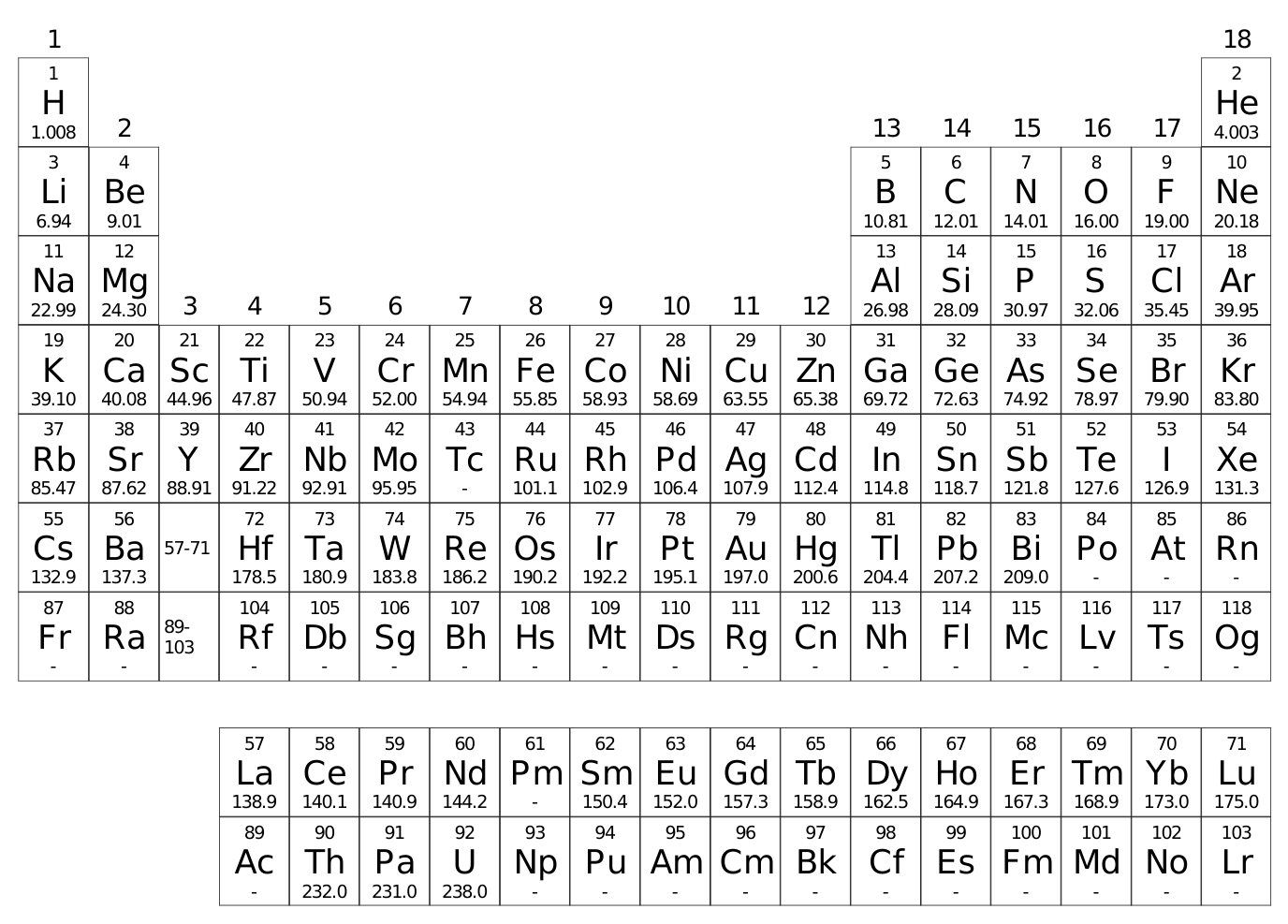
Official English text of the problem.
Answers
- 5.1 — Reactions [1] and [2]
\[ \boxed{\ce{I2 + 2S2O3^2- -> 2I- + S4O6^2-}} \tag{1} \]
\[ \boxed{\ce{2Cu^2+ + 4I- -> 2CuI(s) + I2}} \tag{2} \]
- 5.2 — Formulae of A–G
| Compound | Formula | Name | SMILES or formal formula-unit representation |
|---|---|---|---|
| A | \(\ce{[Cu(NH3)4](MnO4)2}\) | Tetraamminecopper(II) permanganate | [Cu+2](<-[NH3])(<-[NH3])(<-[NH3])<-[NH3].[O-][Mn](=O)(=O)=O.[O-][Mn](=O)(=O)=O |
| B | \(\ce{[Cu(NH3)4]SO4 * H2O}\) | Tetraamminecopper(II) sulfate monohydrate | [Cu+2](<-[NH3])(<-[NH3])(<-[NH3])<-[NH3].[O-]S(=O)(=O)[O-].O |
| C | \(\ce{KMnO4}\) | Potassium permanganate | [K+].[O-][Mn](=O)(=O)=O |
| D | \(\ce{Cu(OH)2}\) | Copper(II) hydroxide | [Cu+2].[OH-].[OH-] |
| E | \(\ce{NH4MnO4}\) | Ammonium permanganate | [NH4+].[O-][Mn](=O)(=O)=O |
| F | \(\ce{NH4NO3}\) | Ammonium nitrate | [NH4+].[O-][N+](=O)[O-] |
| G | \(\ce{CuMn2O4}\) | Copper manganese oxide, or copper manganite | Formal ionic inventory: [Cu+2].[Mn+3].[Mn+3].[O-2].[O-2].[O-2].[O-2] |
Dative-bond SMILES use <- for donation from ammonia to copper. The four nitrogen donors form an approximately square-planar \(\ce{CuN4}\) unit; the strings do not specify axial crystal contacts. Dot-separated representations give ionic composition. D and G are extended solids, so their entries specify formula-unit inventories rather than discrete molecular structures.
- 5.3 — Reactions [3]–[5]
\[ \boxed{\ce{ [Cu(NH3)4](MnO4)2 + 2H2O ->[\Delta] Cu(OH)2(s) + 2NH4MnO4 + 2NH3 }} \tag{3} \]
\[ \boxed{\ce{ [Cu(NH3)4](MnO4)2 ->[\Delta] CuMn2O4(s) + NH4NO3(s) + 2NH3(g) + H2O(g) }} \tag{4} \]
\[ \boxed{\ce{NH4NO3 ->[\Delta] N2O(g) + 2H2O(g)}} \tag{5} \]
Solution
5.1 — Identifying the iodometric reactions
The blue solution and the formation of an insoluble iodide identify copper(II). Iodide reduces copper(II) to copper(I), which precipitates as copper(I) iodide:
\[ \ce{2Cu^2+ + 4I- -> 2CuI(s) + I2}. \]
The iodine is titrated with thiosulfate, producing tetrathionate:
\[ \ce{I2 + 2S2O3^2- -> 2I- + S4O6^2-}. \]
The molecular and ionic species in these equations are:
| Species | Name | SMILES |
|---|---|---|
| \(\ce{Cu^2+}\) | Copper(II) ion | [Cu+2] |
| \(\ce{CuI}\) | Copper(I) iodide | [Cu+].[I-] |
| \(\ce{I-}\) | Iodide ion | [I-] |
| \(\ce{I2}\) | Iodine | II |
| \(\ce{S2O3^2-}\) | Thiosulfate ion | [O-]S(=O)(=O)[S-] |
| \(\ce{S4O6^2-}\) | Tetrathionate ion | [O-]S(=O)(=O)SSS(=O)(=O)[O-] |
Citrate, \(\ce{C6H5O7^3-}\), SMILES [O-]C(=O)CC(O)(CC(=O)[O-])C(=O)[O-], strongly complexes copper(II). Removing free copper(II) shifts reaction [2] backwards: copper(I) iodide dissolves, and the iodine originally generated by copper(II) is consumed.
Consequently, Titration I measures the other oxidizing component of A. Subsequent acidification protonates citrate, releases copper(II), and permits reaction [2] to occur again. Titration II therefore measures copper alone.
Combining reactions [1] and [2] shows that one mole of copper(II) corresponds to one mole of thiosulfate in Titration II.
5.2 — Identifying A–G
The calculations below use the supplied atomic masses; intermediate results retain guard digits.
Copper content and the composition of G.
For the \(100.0\ \mathrm{mg}\) sample,
\[ \begin{aligned} n_{\mathrm{I}}(\ce{S2O3^2-}) &=(5.000\times10^{-2})(54.12\times10^{-3})\\ &=2.706\times10^{-3}\ \mathrm{mol},\\[2mm] n_{\mathrm{II}}(\ce{S2O3^2-}) &=(5.000\times10^{-2})(5.41\times10^{-3})\\ &=2.705\times10^{-4}\ \mathrm{mol}. \end{aligned} \]
Thus,
\[ n(\ce{Cu})=2.705\times10^{-4}\ \mathrm{mol}, \qquad m(\ce{Cu})=17.19\ \mathrm{mg}. \]
The first decomposition step leaves \(85.9\%\) of the original mass. Using the stated F:G mass ratio, the amount of G obtained from \(100.0\ \mathrm{mg}\) of A is
\[ m(\mathrm G) =(100.0\ \mathrm{mg})(0.859)\frac{2.97}{1.00+2.97} =64.26\ \mathrm{mg}. \]
Its oxygen content is
\[ m(\ce{O})=(0.270)(64.26)=17.35\ \mathrm{mg}. \]
Therefore,
\[ \frac{n(\ce{O})}{n(\ce{Cu})} = \frac{0.01735/16.00}{2.705\times10^{-4}} =4.009\approx4. \]
The remaining mass belongs to the second metal:
\[ m(\text{second metal}) =64.26-17.35-17.19 =29.72\ \mathrm{mg}. \]
Per mole of copper, this is
\[ \frac{0.02972}{2.705\times10^{-4}} =109.88\ \mathrm{g\,mol^{-1}} =2(54.94)\ \mathrm{g\,mol^{-1}}. \]
This identifies two manganese atoms per copper atom, giving
\[ \boxed{\mathrm G=\ce{CuMn2O4}}. \]
The calculated oxygen percentage confirms the assignment:
\[ M(\mathrm G)=63.55+2(54.94)+4(16.00) =237.43\ \mathrm{g\,mol^{-1}}, \]
\[ w_{\ce{O}}(\mathrm G) =\frac{64.00}{237.43}\times100\% =26.955\%\approx27.0\%. \]
The oxidizing anion and the complex in A.
The titration-volume ratio is
\[ \frac{n_{\mathrm I}}{n_{\mathrm{II}}} =\frac{54.12}{5.41} =10.00. \]
Thus, the non-copper oxidant accepts ten electrons per copper atom. Since there are two manganese atoms per copper atom, each manganese accepts five electrons. This identifies the acidic reduction of permanganate to manganese(II):
\[ \ce{2MnO4- + 16H+ + 10I- -> 2Mn^2+ + 5I2 + 8H2O}. \]
Here the permanganate ion is \(\ce{MnO4-}\), SMILES [O-][Mn](=O)(=O)=O; manganese(II) is [Mn+2], and a proton is [H+]. Permanganate has tetrahedral coordination around manganese; its SMILES gives one localized resonance representation.
One permanganate ion generates iodine requiring five thiosulfate ions. Independently,
\[ n(\ce{MnO4-}) =\frac{2.706\times10^{-3}}{5} =5.412\times10^{-4}\ \mathrm{mol}, \]
\[ \frac{n(\ce{MnO4-})}{n(\ce{Cu})} =\frac{5.412\times10^{-4}}{2.705\times10^{-4}} =2.001\approx2. \]
The mass of A per mole of copper is
\[ \frac{0.1000\ \mathrm g}{2.705\times10^{-4}\ \mathrm{mol}} =369.7\ \mathrm{g\,mol^{-1}}. \]
Subtracting one copper and two permanganates leaves approximately
\[ 369.7-63.55-2(54.94+64.00) =68.3\ \mathrm{g\,mol^{-1}}. \]
The acid-absorbable gas suggests ammonia, \(\ce{NH3}\), SMILES N. Four ammonia ligands contribute
\[ 4M(\ce{NH3}) =4[14.01+3(1.008)] =68.136\ \mathrm{g\,mol^{-1}}. \]
Hence the complex ion is tetraamminecopper(II),
\[ \ce{[Cu(NH3)4]^2+}, \]
SMILES [Cu+2](<-[NH3])(<-[NH3])(<-[NH3])<-[NH3], and
\[ \boxed{\mathrm A=\ce{[Cu(NH3)4](MnO4)2}}. \]
Its calculated molar mass is
\[ M(\mathrm A)=369.566\ \mathrm{g\,mol^{-1}}. \]
This formula predicts
\[ V_{\mathrm I} =\frac{10(0.1000/369.566)}{0.05000} =0.0541175\ \mathrm{dm^3} =54.12\ \mathrm{cm^3}, \]
\[ V_{\mathrm{II}} =\frac{0.1000/369.566}{0.05000} =0.00541175\ \mathrm{dm^3} =5.41\ \mathrm{cm^3}, \]
matching both titrations.
Identifying B and C from the preparation.
The theoretical mass of A is
\[ m_{\mathrm{theor}}(\mathrm A) =\frac{4.90}{0.326} =15.0307\ \mathrm g, \]
corresponding to
\[ n_{\mathrm{theor}}(\mathrm A) =\frac{15.0307}{369.566} =0.0406712\ \mathrm{mol}. \]
In the exchange reaction, B supplies one tetraamminecopper(II) ion per formula unit of A, while two formula units of the monovalent permanganate salt C are required. The inferred molar masses are therefore
\[ M(\mathrm B)\approx\frac{10.00}{0.0406712} =245.9\ \mathrm{g\,mol^{-1}}, \]
\[ M(\mathrm C)\approx\frac{12.86}{2(0.0406712)} =158.1\ \mathrm{g\,mol^{-1}}. \]
The familiar purple compound C is potassium permanganate:
\[ M(\ce{KMnO4})=39.10+54.94+64.00 =158.04\ \mathrm{g\,mol^{-1}}. \]
The deep-blue copper ammine salt matching B is tetraamminecopper(II) sulfate monohydrate:
\[ \begin{aligned} M(\ce{[Cu(NH3)4]SO4 * H2O}) &=63.55+4(17.034)+96.06+18.016\\ &=245.762\ \mathrm{g\,mol^{-1}}. \end{aligned} \]
Thus,
\[ \boxed{\mathrm B=\ce{[Cu(NH3)4]SO4 * H2O}}, \qquad \boxed{\mathrm C=\ce{KMnO4}}. \]
The preparation is
\[ \ce{ [Cu(NH3)4]SO4 * H2O + 2KMnO4 -> [Cu(NH3)4](MnO4)2(s) + K2SO4 + H2O }. \]
The other salt is potassium sulfate, \(\ce{K2SO4}\), SMILES [K+].[K+].[O-]S(=O)(=O)[O-]. Water has SMILES O.
Checking the given quantities:
\[ m(\mathrm C) =\frac{10.00}{245.762}(2)(158.04) =12.861\ \mathrm g, \]
\[ m_{\mathrm{isolated}}(\mathrm A) =\frac{10.00}{245.762}(369.566)(0.326) =4.902\ \mathrm g, \]
which round to \(12.86\ \mathrm g\) and \(4.90\ \mathrm g\).
Identifying D and E.
Heating the aqueous ammine complex promotes ammonia loss. The blue copper-containing precipitate is copper(II) hydroxide:
\[ \boxed{\mathrm D=\ce{Cu(OH)2}}. \]
Formation of one formula unit of hydroxide uses two water molecules. Two ammonia ligands become ammonium ions, and the other two are released as ammonia. The two permanganate ions consequently remain with ammonium:
\[ \boxed{\mathrm E=\ce{NH4MnO4}}. \]
The ammonium ion, \(\ce{NH4+}\), has SMILES [NH4+]. This explains why warming the synthesis mixture can introduce E as a contaminant.
Identifying F.
One formula unit of A gives one formula unit of G. From the residue mass ratio, the mass of F accompanying one mole of G is
\[ \frac{237.43}{2.97} =79.94\ \mathrm g. \]
This matches one mole of ammonium nitrate:
\[ M(\ce{NH4NO3}) =2(14.01)+4(1.008)+3(16.00) =80.052\ \mathrm{g\,mol^{-1}}. \]
Ammonium nitrate is water-soluble, contains no metal, and decomposes into gaseous products. Therefore,
\[ \boxed{\mathrm F=\ce{NH4NO3}}. \]
Its nitrate ion, \(\ce{NO3-}\), has SMILES [O-][N+](=O)[O-]; the ion is trigonal planar with delocalized bonding.
5.3 — Aqueous and thermal decomposition equations
For aqueous decomposition, the assignments of D and E give
\[ \boxed{\ce{ [Cu(NH3)4](MnO4)2 + 2H2O ->[\Delta] Cu(OH)2(s) + 2NH4MnO4 + 2NH3 }}. \tag{3} \]
For the first thermal decomposition, subtracting \(\ce{CuMn2O4}\) and \(\ce{NH4NO3}\) from the composition of A leaves exactly two ammonia molecules and one water molecule:
\[ \boxed{\ce{ [Cu(NH3)4](MnO4)2 ->[\Delta] CuMn2O4(s) + NH4NO3(s) + 2NH3(g) + H2O(g) }}. \tag{4} \]
The predicted mass decrease is
\[ \frac{2M(\ce{NH3})+M(\ce{H2O})}{M(\mathrm A)} \times100\% = \frac{2(17.034)+18.016}{369.566}\times100\% =14.093\%\approx14.1\%. \]
The predicted solid mass ratio is
\[ m(\mathrm F):m(\mathrm G) =80.052:237.43 =1.00:2.966 \approx1.00:2.97. \]
The gas readily quantified by absorption in acid is ammonia:
\[ \ce{NH3 + H+ -> NH4+}. \]
Reaction [4] is also consistent with internal electron transfer: two manganese atoms are reduced from \(+7\) to the formal \(+3\) state, accepting eight electrons in total, while one ammine nitrogen is oxidized from \(-3\) to \(+5\) in nitrate, releasing eight electrons.
Finally, ammonium nitrate decomposes without a solid residue or oxygen evolution:
\[ \boxed{\ce{NH4NO3 ->[\Delta] N2O(g) + 2H2O(g)}}. \tag{5} \]
The nitrogen-containing gas is nitrous oxide, \(\ce{N2O}\), SMILES N#[N+][O-]. It has a linear N–N–O arrangement; the SMILES represents one resonance form.
The solution was checked against the official solution.
IChO 2024 · Theorieaufgabe 5
Unbekannt
Das metallhaltige Salz A lässt sich durch eine einfache Austauschreaktion herstellen, indem die kalten, gesättigten wässrigen Lösungen der beiden deutlich gefärbten Verbindungen B und C im stöchiometrischen Verhältnis gemischt werden. Werden 10.00 g B in Lösung mit der Lösung von 12.86 g C gemischt und sofort auf \(2\,^\circ\mathrm{C}\) abgekühlt, erhält man 4.90 g festes A. Die Ausbeute an A beträgt 32.6 %.
Zur Bestimmung der Zusammensetzung von A wird zunächst eine iodometrische Analyse durchgeführt. Eine bekannte Masse von A wird in einen Titrierkolben gegeben und mit Schwefelsäure angesäuert. Anschließend wird \(\ce{KI}\) im Überschuss zugesetzt, wobei sich ein Niederschlag bildet. Nach einigen Minuten wird Natriumcitratlösung zugegeben, bis die Lösung frei von Niederschlag ist. Die Citrationen bilden mit einem in der Mischung vorhandenen Metallion einen stabilen Komplex, wodurch die zur Niederschlagsbildung führende Reaktion vollständig umgekehrt wird. Die entstandene Mischung wird mit Natriumthiosulfatlösung titriert (Titration I über Reaktion 1). Zur blauen, titrierten Lösung wird eine weitere Portion Schwefelsäure (deutlich mehr als die anfängliche Menge) gegeben, um das Citrat zu protonieren. Der zuvor gebildete feste Niederschlag entsteht erneut [Reaktion 2]. Die Mischung wird mit derselben Thiosulfatlösung titriert (Titration II über Reaktion 1).
Die durchschnittlichen Verbrauchsvolumina für 100.0 mg A mit \(5.000\cdot10^{-2}\ \mathrm{mol\,dm^{-3}}\) Thiosulfat betragen \(54.12\ \mathrm{cm^3}\) bei Titration I und \(5.41\ \mathrm{cm^3}\) bei Titration II.
Beim Erhitzen der wässrigen Lösung von A lässt sich der blaue Niederschlag D beobachten [Reaktion 3]. Aus der Flüssigkeit über D kann die Verbindung E auskristallisiert werden. Die niedrige Temperatur während der Synthese von A ist wichtig, um eine Verunreinigung durch E zu vermeiden.
5.1 Geben Sie ausgeglichene Gleichungen für die Reaktionen [1] und [2] an. 4.0 Pkt.
Die thermische Zersetzung von A wurde eingehend untersucht. Wird reines A langsam erhitzt, explodiert es bereits bei etwa \(75\,^\circ\mathrm{C}\). Wird die Verbindung in Aluminiumoxid dispergiert und die Mischung erhitzt, nimmt die Matrix die überschüssige Wärme auf, sodass die Explosion vermieden werden kann. Zwei Zersetzungsschritte lassen sich beobachten. Im ersten Schritt (bei \(65\,^\circ\mathrm{C}\)) bildet sich unter einer Massenabnahme von 14.1 % ein aus zwei Komponenten bestehender fester Rückstand [Reaktion 4]. Die Komponenten dieses Rückstands lassen sich leicht trennen, da F gut wasserlöslich ist, während sich G überhaupt nicht löst. Das Massenverhältnis F:G beträgt 1.00 : 2.97. Bei weiterem Erhitzen zersetzt sich F ohne festen Rückstand [Reaktion 5]. Somit ist reines G das endgültige feste Zersetzungsprodukt von A. G enthält neben 27.0 Massen-% Sauerstoff zwei weitere Elemente. Eine der beiden Komponenten des im ersten Zersetzungsschritt entstehenden Gasgemischs lässt sich leicht quantitativ bestimmen, indem sie in einer sauren Lösung absorbiert wird.
Einige Hinweise
- Die Verbindung A zersetzt sich ohne Freisetzung von Sauerstoff.
- Die Verbindung A enthält zwei verschiedene Metalle.
- Die Verbindungen A und B enthalten beide ein Komplexion.
- C ist eine allen Chemiestudierenden wohlbekannte Verbindung.
- Die Verbindung F enthält kein Metall.
5.2 Geben Sie die chemischen Formeln von A—G an. Sie müssen Ihre Berechnungen nicht angeben. Falls Ihre Verbindungen jedoch falsch sind, können Sie für richtige Berechnungen Teilpunkte erhalten. 28.0 Pkt.
5.3 Geben Sie ausgeglichene Gleichungen für die Reaktionen [3]—[5] an. 12.0 Pkt.
Periodensystem
Aufgabentext aus dem offiziellen englischen Text übersetzt.
Antworten
- 5.1 — Reaktionen [1] und [2]
\[ \boxed{\ce{I2 + 2S2O3^2- -> 2I- + S4O6^2-}} \tag{1} \]
\[ \boxed{\ce{2Cu^2+ + 4I- -> 2CuI(s) + I2}} \tag{2} \]
- 5.2 — Formeln von A–G
| Verbindung | Formel | Name | SMILES oder formale Darstellung der Formeleinheit |
|---|---|---|---|
| A | \(\ce{[Cu(NH3)4](MnO4)2}\) | Tetraamminkupfer(II)-permanganat | [Cu+2](<-[NH3])(<-[NH3])(<-[NH3])<-[NH3].[O-][Mn](=O)(=O)=O.[O-][Mn](=O)(=O)=O |
| B | \(\ce{[Cu(NH3)4]SO4 * H2O}\) | Tetraamminkupfer(II)-sulfat-Monohydrat | [Cu+2](<-[NH3])(<-[NH3])(<-[NH3])<-[NH3].[O-]S(=O)(=O)[O-].O |
| C | \(\ce{KMnO4}\) | Kaliumpermanganat | [K+].[O-][Mn](=O)(=O)=O |
| D | \(\ce{Cu(OH)2}\) | Kupfer(II)-hydroxid | [Cu+2].[OH-].[OH-] |
| E | \(\ce{NH4MnO4}\) | Ammoniumpermanganat | [NH4+].[O-][Mn](=O)(=O)=O |
| F | \(\ce{NH4NO3}\) | Ammoniumnitrat | [NH4+].[O-][N+](=O)[O-] |
| G | \(\ce{CuMn2O4}\) | Kupfer-Mangan-Oxid oder Kupfermanganit | Formaler Ionenbestand: [Cu+2].[Mn+3].[Mn+3].[O-2].[O-2].[O-2].[O-2] |
SMILES mit koordinativen Bindungen verwenden <- für die Elektronenpaardonation von Ammoniak an Kupfer. Die vier Stickstoffdonoren bilden eine annähernd quadratisch-planare \(\ce{CuN4}\)-Einheit; die Zeichenfolgen legen keine axialen Kontakte im Kristall fest. Durch Punkte getrennte Darstellungen geben die ionische Zusammensetzung an. D und G sind Feststoffe mit ausgedehnten Strukturen, sodass ihre Einträge den Bestand einer Formeleinheit statt diskreter Molekülstrukturen angeben.
- 5.3 — Reaktionen [3]–[5]
\[ \boxed{\ce{ [Cu(NH3)4](MnO4)2 + 2H2O ->[\Delta] Cu(OH)2(s) + 2NH4MnO4 + 2NH3 }} \tag{3} \]
\[ \boxed{\ce{ [Cu(NH3)4](MnO4)2 ->[\Delta] CuMn2O4(s) + NH4NO3(s) + 2NH3(g) + H2O(g) }} \tag{4} \]
\[ \boxed{\ce{NH4NO3 ->[\Delta] N2O(g) + 2H2O(g)}} \tag{5} \]
Lösung
5.1 — Identifizierung der iodometrischen Reaktionen
Die blaue Lösung und die Bildung eines unlöslichen Iodids weisen auf Kupfer(II) hin. Iodid reduziert Kupfer(II) zu Kupfer(I), das als Kupfer(I)-iodid ausfällt:
\[ \ce{2Cu^2+ + 4I- -> 2CuI(s) + I2}. \]
Das Iod wird mit Thiosulfat titriert, wobei Tetrathionat entsteht:
\[ \ce{I2 + 2S2O3^2- -> 2I- + S4O6^2-}. \]
Die molekularen und ionischen Spezies in diesen Gleichungen sind:
| Spezies | Name | SMILES |
|---|---|---|
| \(\ce{Cu^2+}\) | Kupfer(II)-Ion | [Cu+2] |
| \(\ce{CuI}\) | Kupfer(I)-iodid | [Cu+].[I-] |
| \(\ce{I-}\) | Iodidion | [I-] |
| \(\ce{I2}\) | Iod | II |
| \(\ce{S2O3^2-}\) | Thiosulfation | [O-]S(=O)(=O)[S-] |
| \(\ce{S4O6^2-}\) | Tetrathionation | [O-]S(=O)(=O)SSS(=O)(=O)[O-] |
Citrat, \(\ce{C6H5O7^3-}\), SMILES [O-]C(=O)CC(O)(CC(=O)[O-])C(=O)[O-], komplexiert Kupfer(II) stark. Der Entzug von freiem Kupfer(II) verschiebt Reaktion [2] in die Rückrichtung: Kupfer(I)-iodid löst sich, und das ursprünglich durch Kupfer(II) erzeugte Iod wird verbraucht.
Folglich erfasst Titration I die andere oxidierende Komponente von A. Das anschließende Ansäuern protoniert Citrat, setzt Kupfer(II) frei und ermöglicht, dass Reaktion [2] erneut abläuft. Titration II erfasst daher ausschließlich Kupfer.
Die Kombination der Reaktionen [1] und [2] zeigt, dass ein Mol Kupfer(II) bei Titration II einem Mol Thiosulfat entspricht.
5.2 — Identifizierung von A–G
Die folgenden Berechnungen verwenden die angegebenen Atommassen; in den Zwischenergebnissen werden zusätzliche Stellen beibehalten, um Rundungsfehler zu vermeiden.
Kupfergehalt und Zusammensetzung von G.
Für die \(100.0\ \mathrm{mg}\)-Probe gilt:
\[ \begin{aligned} n_{\mathrm{I}}(\ce{S2O3^2-}) &=(5.000\times10^{-2})(54.12\times10^{-3})\\ &=2.706\times10^{-3}\ \mathrm{mol},\\[2mm] n_{\mathrm{II}}(\ce{S2O3^2-}) &=(5.000\times10^{-2})(5.41\times10^{-3})\\ &=2.705\times10^{-4}\ \mathrm{mol}. \end{aligned} \]
Somit gilt:
\[ n(\ce{Cu})=2.705\times10^{-4}\ \mathrm{mol}, \qquad m(\ce{Cu})=17.19\ \mathrm{mg}. \]
Nach dem ersten Zersetzungsschritt verbleiben \(85.9\%\) der ursprünglichen Masse. Mit dem angegebenen Massenverhältnis F:G ergibt sich für die aus \(100.0\ \mathrm{mg}\) A erhaltene Masse an G:
\[ m(\mathrm G) =(100.0\ \mathrm{mg})(0.859)\frac{2.97}{1.00+2.97} =64.26\ \mathrm{mg}. \]
Die darin enthaltene Sauerstoffmasse beträgt
\[ m(\ce{O})=(0.270)(64.26)=17.35\ \mathrm{mg}. \]
Daher gilt:
\[ \frac{n(\ce{O})}{n(\ce{Cu})} = \frac{0.01735/16.00}{2.705\times10^{-4}} =4.009\approx4. \]
Die verbleibende Masse entfällt auf das zweite Metall:
\[ m(\text{zweites Metall}) =64.26-17.35-17.19 =29.72\ \mathrm{mg}. \]
Pro Mol Kupfer sind dies
\[ \frac{0.02972}{2.705\times10^{-4}} =109.88\ \mathrm{g\,mol^{-1}} =2(54.94)\ \mathrm{g\,mol^{-1}}. \]
Daraus ergeben sich zwei Manganatome pro Kupferatom und damit
\[ \boxed{\mathrm G=\ce{CuMn2O4}}. \]
Der berechnete Sauerstoffanteil bestätigt die Zuordnung:
\[ M(\mathrm G)=63.55+2(54.94)+4(16.00) =237.43\ \mathrm{g\,mol^{-1}}, \]
\[ w_{\ce{O}}(\mathrm G) =\frac{64.00}{237.43}\times100\% =26.955\%\approx27.0\%. \]
Das oxidierende Anion und der Komplex in A.
Das Verhältnis der Titrationsvolumina beträgt
\[ \frac{n_{\mathrm I}}{n_{\mathrm{II}}} =\frac{54.12}{5.41} =10.00. \]
Das vom Kupfer verschiedene Oxidationsmittel nimmt somit zehn Elektronen pro Kupferatom auf. Da auf jedes Kupferatom zwei Manganatome kommen, nimmt jedes Manganatom fünf Elektronen auf. Dies entspricht der Reduktion von Permanganat zu Mangan(II) im Sauren:
\[ \ce{2MnO4- + 16H+ + 10I- -> 2Mn^2+ + 5I2 + 8H2O}. \]
Hier ist das Permanganation \(\ce{MnO4-}\), SMILES [O-][Mn](=O)(=O)=O; Mangan(II) wird durch [Mn+2] und ein Proton durch [H+] dargestellt. Im Permanganat ist Mangan tetraedrisch koordiniert; seine SMILES gibt eine lokalisierte mesomere Grenzstruktur wieder.
Ein Permanganation erzeugt eine Iodmenge, zu deren Titration fünf Thiosulfationen benötigt werden. Unabhängig davon gilt:
\[ n(\ce{MnO4-}) =\frac{2.706\times10^{-3}}{5} =5.412\times10^{-4}\ \mathrm{mol}, \]
\[ \frac{n(\ce{MnO4-})}{n(\ce{Cu})} =\frac{5.412\times10^{-4}}{2.705\times10^{-4}} =2.001\approx2. \]
Die Masse von A pro Mol Kupfer beträgt
\[ \frac{0.1000\ \mathrm g}{2.705\times10^{-4}\ \mathrm{mol}} =369.7\ \mathrm{g\,mol^{-1}}. \]
Nach Abzug eines Kupferatoms und zweier Permanganationen verbleiben ungefähr
\[ 369.7-63.55-2(54.94+64.00) =68.3\ \mathrm{g\,mol^{-1}}. \]
Das in Säure absorbierbare Gas deutet auf Ammoniak, \(\ce{NH3}\), SMILES N, hin. Der Beitrag von vier Ammoniakliganden beträgt
\[ 4M(\ce{NH3}) =4[14.01+3(1.008)] =68.136\ \mathrm{g\,mol^{-1}}. \]
Somit ist das Komplexion Tetraamminkupfer(II),
\[ \ce{[Cu(NH3)4]^2+}, \]
SMILES [Cu+2](<-[NH3])(<-[NH3])(<-[NH3])<-[NH3], und
\[ \boxed{\mathrm A=\ce{[Cu(NH3)4](MnO4)2}}. \]
Die berechnete molare Masse beträgt
\[ M(\mathrm A)=369.566\ \mathrm{g\,mol^{-1}}. \]
Diese Formel ergibt
\[ V_{\mathrm I} =\frac{10(0.1000/369.566)}{0.05000} =0.0541175\ \mathrm{dm^3} =54.12\ \mathrm{cm^3}, \]
\[ V_{\mathrm{II}} =\frac{0.1000/369.566}{0.05000} =0.00541175\ \mathrm{dm^3} =5.41\ \mathrm{cm^3}, \]
in Übereinstimmung mit beiden Titrationen.
Identifizierung von B und C anhand der Herstellung.
Die theoretische Masse von A beträgt
\[ m_{\mathrm{theor}}(\mathrm A) =\frac{4.90}{0.326} =15.0307\ \mathrm g, \]
entsprechend
\[ n_{\mathrm{theor}}(\mathrm A) =\frac{15.0307}{369.566} =0.0406712\ \mathrm{mol}. \]
Bei der Austauschreaktion liefert B ein Tetraamminkupfer(II)-Ion pro Formeleinheit von A, während zwei Formeleinheiten des Permanganatsalzes C mit einwertigem Kation benötigt werden. Die daraus abgeleiteten molaren Massen sind daher
\[ M(\mathrm B)\approx\frac{10.00}{0.0406712} =245.9\ \mathrm{g\,mol^{-1}}, \]
\[ M(\mathrm C)\approx\frac{12.86}{2(0.0406712)} =158.1\ \mathrm{g\,mol^{-1}}. \]
Die bekannte violette Verbindung C ist Kaliumpermanganat:
\[ M(\ce{KMnO4})=39.10+54.94+64.00 =158.04\ \mathrm{g\,mol^{-1}}. \]
Das tiefblaue Kupferamminsalz, das zu B passt, ist Tetraamminkupfer(II)-sulfat-Monohydrat:
\[ \begin{aligned} M(\ce{[Cu(NH3)4]SO4 * H2O}) &=63.55+4(17.034)+96.06+18.016\\ &=245.762\ \mathrm{g\,mol^{-1}}. \end{aligned} \]
Somit gilt:
\[ \boxed{\mathrm B=\ce{[Cu(NH3)4]SO4 * H2O}}, \qquad \boxed{\mathrm C=\ce{KMnO4}}. \]
Die Herstellung erfolgt gemäß
\[ \ce{ [Cu(NH3)4]SO4 * H2O + 2KMnO4 -> [Cu(NH3)4](MnO4)2(s) + K2SO4 + H2O }. \]
Das andere Salz ist Kaliumsulfat, \(\ce{K2SO4}\), SMILES [K+].[K+].[O-]S(=O)(=O)[O-]. Wasser hat die SMILES O.
Überprüfung der angegebenen Mengen:
\[ m(\mathrm C) =\frac{10.00}{245.762}(2)(158.04) =12.861\ \mathrm g, \]
\[ m_{\mathrm{isolated}}(\mathrm A) =\frac{10.00}{245.762}(369.566)(0.326) =4.902\ \mathrm g, \]
was gerundet \(12.86\ \mathrm g\) beziehungsweise \(4.90\ \mathrm g\) ergibt.
Identifizierung von D und E.
Das Erhitzen des Amminkomplexes in wässriger Lösung begünstigt die Abgabe von Ammoniak. Der blaue kupferhaltige Niederschlag ist Kupfer(II)-hydroxid:
\[ \boxed{\mathrm D=\ce{Cu(OH)2}}. \]
Die Bildung einer Formeleinheit des Hydroxids verbraucht zwei Wassermoleküle. Zwei Ammoniakliganden werden zu Ammoniumionen, und die beiden anderen werden als Ammoniak freigesetzt. Die beiden Permanganationen verbleiben daher mit Ammonium:
\[ \boxed{\mathrm E=\ce{NH4MnO4}}. \]
Das Ammoniumion, \(\ce{NH4+}\), hat die SMILES [NH4+]. Dies erklärt, warum beim Erwärmen des Synthesegemischs E als Verunreinigung auftreten kann.
Identifizierung von F.
Eine Formeleinheit von A ergibt eine Formeleinheit von G. Aus dem Massenverhältnis im Rückstand ergibt sich für die Masse von F, die zusammen mit einem Mol G vorliegt:
\[ \frac{237.43}{2.97} =79.94\ \mathrm g. \]
Dies entspricht einem Mol Ammoniumnitrat:
\[ M(\ce{NH4NO3}) =2(14.01)+4(1.008)+3(16.00) =80.052\ \mathrm{g\,mol^{-1}}. \]
Ammoniumnitrat ist wasserlöslich, enthält kein Metall und zersetzt sich zu gasförmigen Produkten. Daher gilt:
\[ \boxed{\mathrm F=\ce{NH4NO3}}. \]
Sein Nitration, \(\ce{NO3-}\), hat die SMILES [O-][N+](=O)[O-]; das Ion ist trigonal-planar mit delokalisierten Bindungen.
5.3 — Gleichungen der Zersetzung in wässriger Lösung und der thermischen Zersetzung
Für die Zersetzung in wässriger Lösung ergeben die Zuordnungen von D und E:
\[ \boxed{\ce{ [Cu(NH3)4](MnO4)2 + 2H2O ->[\Delta] Cu(OH)2(s) + 2NH4MnO4 + 2NH3 }}. \tag{3} \]
Für den ersten thermischen Zersetzungsschritt verbleiben nach Abzug von \(\ce{CuMn2O4}\) und \(\ce{NH4NO3}\) von der Zusammensetzung von A genau zwei Ammoniakmoleküle und ein Wassermolekül:
\[ \boxed{\ce{ [Cu(NH3)4](MnO4)2 ->[\Delta] CuMn2O4(s) + NH4NO3(s) + 2NH3(g) + H2O(g) }}. \tag{4} \]
Die vorhergesagte Massenabnahme beträgt
\[ \frac{2M(\ce{NH3})+M(\ce{H2O})}{M(\mathrm A)} \times100\% = \frac{2(17.034)+18.016}{369.566}\times100\% =14.093\%\approx14.1\%. \]
Das vorhergesagte Massenverhältnis der Feststoffe beträgt
\[ m(\mathrm F):m(\mathrm G) =80.052:237.43 =1.00:2.966 \approx1.00:2.97. \]
Das durch Absorption in Säure leicht quantitativ bestimmbare Gas ist Ammoniak:
\[ \ce{NH3 + H+ -> NH4+}. \]
Reaktion [4] steht auch mit einer internen Elektronenübertragung im Einklang: Zwei Manganatome werden von \(+7\) auf die formale Oxidationsstufe \(+3\) reduziert und nehmen insgesamt acht Elektronen auf, während ein Amminstickstoffatom von \(-3\) auf \(+5\) im Nitrat oxidiert wird und dabei acht Elektronen abgibt.
Schließlich zersetzt sich Ammoniumnitrat ohne festen Rückstand und ohne Sauerstoffentwicklung:
\[ \boxed{\ce{NH4NO3 ->[\Delta] N2O(g) + 2H2O(g)}}. \tag{5} \]
Das stickstoffhaltige Gas ist Distickstoffmonoxid, \(\ce{N2O}\), SMILES N#[N+][O-]. Es besitzt eine lineare N–N–O-Anordnung; die SMILES stellt eine mesomere Grenzstruktur dar.
Die Lösung wurde mit der offiziellen Lösung abgeglichen.
IChO 2024 · Teori sorusu 5
Bilinmeyen
Metal içeren A tuzu, birbirinden belirgin biçimde farklı renklerdeki B ve C bileşiklerinin soğuk, doygun sulu çözeltileri stokiyometrik oranda karıştırıldığında basit bir yer değiştirme tepkimesiyle hazırlanabilir. Çözeltideki 10.00 g B, 12.86 g C içeren çözeltiyle karıştırılıp hemen \(2\,^\circ\mathrm{C}\)'ye soğutulduğunda 4.90 g katı A elde edilir. A'nın verimi %32.6'dır.
A'nın bileşimini belirlemek için önce iyodometri uygulanır. Bilinen bir kütlede A, titrasyon erlenine konur, sülfürik asitle asitlendirilir, ardından fazla miktarda \(\ce{KI}\) eklenir ve çökelek oluşur. Birkaç dakika sonra, çözeltide çökelek kalmayıncaya kadar sodyum sitrat çözeltisi eklenir. Sitrat iyonları, karışımda bulunan bir metal iyonuyla güçlü bir kompleks oluşturarak çökelek oluşumuna yol açan tepkimeyi tamamen tersine çevirir. Elde edilen karışım, sodyum tiyosülfat çözeltisiyle titre edilir (tepkime 1 yoluyla Titrasyon I). Titre edilmiş mavi çözeltiye, sitratı protonlamak için bir miktar daha sülfürik asit (başlangıçtaki miktardan belirgin ölçüde fazla) eklenir. Önceki katı çökelek yeniden oluşur [tepkime 2]. Karışım aynı tiyosülfat çözeltisiyle titre edilir (tepkime 1 yoluyla Titrasyon II).
100.0 mg A için \(5.000\cdot10^{-2}\ \mathrm{mol\,dm^{-3}}\) tiyosülfat ile elde edilen ortalama hacimler, Titrasyon I'de \(54.12\ \mathrm{cm^3}\) ve Titrasyon II'de \(5.41\ \mathrm{cm^3}\)'tür.
A'nın sulu çözeltisi ısıtıldığında mavi D çökeleği gözlenebilir [tepkime 3]. D'nin üzerindeki sıvıdan E bileşiği kristallendirilebilir. A'nın sentezi sırasında sıcaklığın düşük tutulması, ürünün E ile kirlenmesini önlemek açısından önemlidir.
5.1 [1] ve [2] tepkimelerinin denkleştirilmiş denklemlerini yazınız. 4.0 puan
A'nın ısıl bozunması ayrıntılı olarak incelenmiştir. Saf A yavaşça ısıtıldığında, daha \(75\,^\circ\mathrm{C}\) civarında patlar. Bileşik alüminyum oksit içinde dağıtılıp karışım ısıtıldığında ise matris fazla ısıyı soğurur ve patlama önlenebilir. İki bozunma basamağı gözlenebilir. İlk basamakta (\(65\,^\circ\mathrm{C}\)'de), %14.1'lik kütle azalmasına ek olarak iki bileşenli bir katı kalıntı oluşur [tepkime 4]. F suda iyi çözünürken G hiç çözünmediği için bu kalıntının bileşenleri kolayca ayrılabilir. F:G kütle oranı 1.00 : 2.97'dir. Isıtmaya devam edildiğinde F, katı kalıntı bırakmadan bozunur [tepkime 5]. Bu, A'nın son katı bozunma ürününün saf G olduğu anlamına gelir. G, kütlece %27.0 oksijenin yanı sıra iki başka element içerir. İlk bozunma basamağında oluşan gaz karışımının iki bileşeninden birinin miktarı, asit çözeltisinde soğurulması durumunda kolayca belirlenebilir.
Bazı ipuçları
- A bileşiği oksijen açığa çıkarmadan bozunur.
- A bileşiği iki farklı metal içerir.
- A ve B bileşiklerinin her ikisi de bir kompleks iyon içerir.
- C, her kimya öğrencisinin iyi bildiği bir bileşiktir.
- F bileşiği hiç metal içermez.
5.2 A—G'nin kimyasal formüllerini veriniz. Hesaplamalarınızı göstermek zorunda değilsiniz; ancak bileşikleriniz yanlışsa doğru hesaplamalardan kısmi puan alabilirsiniz. 28.0 puan
5.3 [3]—[5] tepkimelerinin denkleştirilmiş denklemlerini yazınız. 12.0 puan
Periyodik tablo
Soru metni resmi İngilizce metinden çevrilmiştir.
Cevaplar
- 5.1 — [1] ve [2] tepkimeleri
\[ \boxed{\ce{I2 + 2S2O3^2- -> 2I- + S4O6^2-}} \tag{1} \]
\[ \boxed{\ce{2Cu^2+ + 4I- -> 2CuI(s) + I2}} \tag{2} \]
- 5.2 — A–G'nin formülleri
| Bileşik | Formül | Adı | SMILES veya biçimsel formül birimi gösterimi |
|---|---|---|---|
| A | \(\ce{[Cu(NH3)4](MnO4)2}\) | Tetraaminbakır(II) permanganat | [Cu+2](<-[NH3])(<-[NH3])(<-[NH3])<-[NH3].[O-][Mn](=O)(=O)=O.[O-][Mn](=O)(=O)=O |
| B | \(\ce{[Cu(NH3)4]SO4 * H2O}\) | Tetraaminbakır(II) sülfat monohidrat | [Cu+2](<-[NH3])(<-[NH3])(<-[NH3])<-[NH3].[O-]S(=O)(=O)[O-].O |
| C | \(\ce{KMnO4}\) | Potasyum permanganat | [K+].[O-][Mn](=O)(=O)=O |
| D | \(\ce{Cu(OH)2}\) | Bakır(II) hidroksit | [Cu+2].[OH-].[OH-] |
| E | \(\ce{NH4MnO4}\) | Amonyum permanganat | [NH4+].[O-][Mn](=O)(=O)=O |
| F | \(\ce{NH4NO3}\) | Amonyum nitrat | [NH4+].[O-][N+](=O)[O-] |
| G | \(\ce{CuMn2O4}\) | Bakır mangan oksit veya bakır manganit | Biçimsel iyon dökümü: [Cu+2].[Mn+3].[Mn+3].[O-2].[O-2].[O-2].[O-2] |
Koordinatif bağ içeren SMILES gösterimlerinde, amonyaktan bakıra elektron çifti verilmesi için <- kullanılır. Dört azot donörü yaklaşık kare düzlemsel bir \(\ce{CuN4}\) birimi oluşturur; dizgeler kristaldeki eksenel temasları belirtmez. Noktayla ayrılmış gösterimler iyonik bileşimi verir. D ve G, sürekli örgü yapısına sahip katılardır; dolayısıyla bunlara ait gösterimler, ayrı moleküler yapılar yerine formül birimlerindeki bileşenleri belirtir.
- 5.3 — [3]–[5] tepkimeleri
\[ \boxed{\ce{ [Cu(NH3)4](MnO4)2 + 2H2O ->[\Delta] Cu(OH)2(s) + 2NH4MnO4 + 2NH3 }} \tag{3} \]
\[ \boxed{\ce{ [Cu(NH3)4](MnO4)2 ->[\Delta] CuMn2O4(s) + NH4NO3(s) + 2NH3(g) + H2O(g) }} \tag{4} \]
\[ \boxed{\ce{NH4NO3 ->[\Delta] N2O(g) + 2H2O(g)}} \tag{5} \]
Çözüm
5.1 — İyodometrik tepkimelerin belirlenmesi
Çözeltinin mavi olması ve çözünmeyen bir iyodür oluşması, bakır(II)'nin varlığını gösterir. İyodür, bakır(II)'yi bakır(I)'e indirger; bakır(I) ise bakır(I) iyodür olarak çöker:
\[ \ce{2Cu^2+ + 4I- -> 2CuI(s) + I2}. \]
İyot, tiyosülfat ile titre edilerek tetratiyonat oluşturur:
\[ \ce{I2 + 2S2O3^2- -> 2I- + S4O6^2-}. \]
Bu denklemlerdeki moleküler ve iyonik türler şunlardır:
| Tür | Adı | SMILES |
|---|---|---|
| \(\ce{Cu^2+}\) | Bakır(II) iyonu | [Cu+2] |
| \(\ce{CuI}\) | Bakır(I) iyodür | [Cu+].[I-] |
| \(\ce{I-}\) | İyodür iyonu | [I-] |
| \(\ce{I2}\) | İyot | II |
| \(\ce{S2O3^2-}\) | Tiyosülfat iyonu | [O-]S(=O)(=O)[S-] |
| \(\ce{S4O6^2-}\) | Tetratiyonat iyonu | [O-]S(=O)(=O)SSS(=O)(=O)[O-] |
Sitrat, \(\ce{C6H5O7^3-}\), SMILES [O-]C(=O)CC(O)(CC(=O)[O-])C(=O)[O-], bakır(II) ile güçlü kompleks oluşturur. Serbest bakır(II)'nin ortamdan uzaklaştırılması [2] tepkimesini ters yönde kaydırır: bakır(I) iyodür çözünür ve başlangıçta bakır(II) tarafından oluşturulan iyot tüketilir.
Dolayısıyla Titrasyon I, A'nın diğer yükseltgen bileşenini ölçer. Ardından yapılan asitlendirme sitratı protonlar, bakır(II)'yi serbest bırakır ve [2] tepkimesinin yeniden gerçekleşmesini sağlar. Bu nedenle Titrasyon II yalnızca bakırı ölçer.
[1] ve [2] tepkimelerinin birleştirilmesi, Titrasyon II'de bir mol bakır(II)'nin bir mol tiyosülfata karşılık geldiğini gösterir.
5.2 — A–G'nin belirlenmesi
Aşağıdaki hesaplamalarda verilen atom kütleleri kullanılmıştır; ara sonuçlarda yuvarlama hatasını önlemek için ek basamaklar korunmuştur.
Bakır içeriği ve G'nin bileşimi.
\(100.0\ \mathrm{mg}\)'lık numune için,
\[ \begin{aligned} n_{\mathrm{I}}(\ce{S2O3^2-}) &=(5.000\times10^{-2})(54.12\times10^{-3})\\ &=2.706\times10^{-3}\ \mathrm{mol},\\[2mm] n_{\mathrm{II}}(\ce{S2O3^2-}) &=(5.000\times10^{-2})(5.41\times10^{-3})\\ &=2.705\times10^{-4}\ \mathrm{mol}. \end{aligned} \]
Böylece,
\[ n(\ce{Cu})=2.705\times10^{-4}\ \mathrm{mol}, \qquad m(\ce{Cu})=17.19\ \mathrm{mg}. \]
İlk bozunma basamağında başlangıç kütlesinin \(85.9\%\)'u kalır. Verilen F:G kütle oranı kullanıldığında, \(100.0\ \mathrm{mg}\) A'dan elde edilen G miktarı
\[ m(\mathrm G) =(100.0\ \mathrm{mg})(0.859)\frac{2.97}{1.00+2.97} =64.26\ \mathrm{mg}. \]
Oksijen içeriği ise
\[ m(\ce{O})=(0.270)(64.26)=17.35\ \mathrm{mg}. \]
Dolayısıyla,
\[ \frac{n(\ce{O})}{n(\ce{Cu})} = \frac{0.01735/16.00}{2.705\times10^{-4}} =4.009\approx4. \]
Kalan kütle ikinci metale aittir:
\[ m(\text{ikinci metal}) =64.26-17.35-17.19 =29.72\ \mathrm{mg}. \]
Bir mol bakır başına bu değer
\[ \frac{0.02972}{2.705\times10^{-4}} =109.88\ \mathrm{g\,mol^{-1}} =2(54.94)\ \mathrm{g\,mol^{-1}}. \]
Bu, bakır atomu başına iki mangan atomu bulunduğunu gösterir ve şu formülü verir:
\[ \boxed{\mathrm G=\ce{CuMn2O4}}. \]
Hesaplanan oksijen yüzdesi bu belirlemeyi doğrular:
\[ M(\mathrm G)=63.55+2(54.94)+4(16.00) =237.43\ \mathrm{g\,mol^{-1}}, \]
\[ w_{\ce{O}}(\mathrm G) =\frac{64.00}{237.43}\times100\% =26.955\%\approx27.0\%. \]
A'daki yükseltgen anyon ve kompleks.
Titrasyon hacimlerinin oranı
\[ \frac{n_{\mathrm I}}{n_{\mathrm{II}}} =\frac{54.12}{5.41} =10.00. \]
Dolayısıyla bakır dışındaki yükseltgen, bakır atomu başına on elektron alır. Bakır atomu başına iki mangan atomu bulunduğundan her mangan beş elektron alır. Bu, permanganatın asidik ortamda mangan(II)'ye indirgenmesini gösterir:
\[ \ce{2MnO4- + 16H+ + 10I- -> 2Mn^2+ + 5I2 + 8H2O}. \]
Burada permanganat iyonu \(\ce{MnO4-}\), SMILES [O-][Mn](=O)(=O)=O; mangan(II) [Mn+2] ve proton [H+] ile gösterilir. Permanganatta mangan çevresindeki koordinasyon tetrahedraldir; SMILES gösterimi, bağların yerelleştirilmiş olduğu bir rezonans yapısını verir.
Bir permanganat iyonu, titrasyonu için beş tiyosülfat iyonu gereken miktarda iyot oluşturur. Bağımsız olarak,
\[ n(\ce{MnO4-}) =\frac{2.706\times10^{-3}}{5} =5.412\times10^{-4}\ \mathrm{mol}, \]
\[ \frac{n(\ce{MnO4-})}{n(\ce{Cu})} =\frac{5.412\times10^{-4}}{2.705\times10^{-4}} =2.001\approx2. \]
Bir mol bakır başına A'nın kütlesi
\[ \frac{0.1000\ \mathrm g}{2.705\times10^{-4}\ \mathrm{mol}} =369.7\ \mathrm{g\,mol^{-1}}. \]
Bir bakır ve iki permanganat çıkarıldığında geriye yaklaşık olarak
\[ 369.7-63.55-2(54.94+64.00) =68.3\ \mathrm{g\,mol^{-1}}. \]
Asitte soğurulabilen gaz, amonyağı, \(\ce{NH3}\), SMILES N, düşündürür. Dört amonyak ligandının katkısı
\[ 4M(\ce{NH3}) =4[14.01+3(1.008)] =68.136\ \mathrm{g\,mol^{-1}}. \]
Bu nedenle kompleks iyon tetraaminbakır(II)'dir,
\[ \ce{[Cu(NH3)4]^2+}, \]
SMILES [Cu+2](<-[NH3])(<-[NH3])(<-[NH3])<-[NH3], ve
\[ \boxed{\mathrm A=\ce{[Cu(NH3)4](MnO4)2}}. \]
Hesaplanan molar kütlesi
\[ M(\mathrm A)=369.566\ \mathrm{g\,mol^{-1}}. \]
Bu formül şu değerleri öngörür:
\[ V_{\mathrm I} =\frac{10(0.1000/369.566)}{0.05000} =0.0541175\ \mathrm{dm^3} =54.12\ \mathrm{cm^3}, \]
\[ V_{\mathrm{II}} =\frac{0.1000/369.566}{0.05000} =0.00541175\ \mathrm{dm^3} =5.41\ \mathrm{cm^3}, \]
bu değerler her iki titrasyonla da uyumludur.
Hazırlama işleminden B ve C'nin belirlenmesi.
A'nın teorik kütlesi
\[ m_{\mathrm{theor}}(\mathrm A) =\frac{4.90}{0.326} =15.0307\ \mathrm g, \]
olup şu madde miktarına karşılık gelir:
\[ n_{\mathrm{theor}}(\mathrm A) =\frac{15.0307}{369.566} =0.0406712\ \mathrm{mol}. \]
Yer değiştirme tepkimesinde B, A'nın her formül birimi için bir tetraaminbakır(II) iyonu sağlar; buna karşılık tek değerlikli katyon içeren permanganat tuzu C'nin iki formül birimi gereklidir. Dolayısıyla çıkarılan molar kütleler
\[ M(\mathrm B)\approx\frac{10.00}{0.0406712} =245.9\ \mathrm{g\,mol^{-1}}, \]
\[ M(\mathrm C)\approx\frac{12.86}{2(0.0406712)} =158.1\ \mathrm{g\,mol^{-1}}. \]
İyi bilinen mor renkli C bileşiği potasyum permanganattır:
\[ M(\ce{KMnO4})=39.10+54.94+64.00 =158.04\ \mathrm{g\,mol^{-1}}. \]
B ile uyumlu koyu mavi bakır amin kompleksi tuzu, tetraaminbakır(II) sülfat monohidrattır:
\[ \begin{aligned} M(\ce{[Cu(NH3)4]SO4 * H2O}) &=63.55+4(17.034)+96.06+18.016\\ &=245.762\ \mathrm{g\,mol^{-1}}. \end{aligned} \]
Böylece,
\[ \boxed{\mathrm B=\ce{[Cu(NH3)4]SO4 * H2O}}, \qquad \boxed{\mathrm C=\ce{KMnO4}}. \]
Hazırlama tepkimesi şöyledir:
\[ \ce{ [Cu(NH3)4]SO4 * H2O + 2KMnO4 -> [Cu(NH3)4](MnO4)2(s) + K2SO4 + H2O }. \]
Diğer tuz, potasyum sülfattır, \(\ce{K2SO4}\), SMILES [K+].[K+].[O-]S(=O)(=O)[O-]. Suyun SMILES gösterimi O'dur.
Verilen miktarlar kontrol edildiğinde:
\[ m(\mathrm C) =\frac{10.00}{245.762}(2)(158.04) =12.861\ \mathrm g, \]
\[ m_{\mathrm{isolated}}(\mathrm A) =\frac{10.00}{245.762}(369.566)(0.326) =4.902\ \mathrm g, \]
bu değerler yuvarlandığında \(12.86\ \mathrm g\) ve \(4.90\ \mathrm g\) elde edilir.
D ve E'nin belirlenmesi.
Amin kompleksinin sulu çözeltisinin ısıtılması, amonyak kaybını kolaylaştırır. Bakır içeren mavi çökelek, bakır(II) hidroksittir:
\[ \boxed{\mathrm D=\ce{Cu(OH)2}}. \]
Hidroksitin bir formül biriminin oluşması için iki su molekülü kullanılır. İki amonyak ligandı amonyum iyonlarına dönüşür, diğer ikisi ise amonyak olarak açığa çıkar. Dolayısıyla iki permanganat iyonu amonyumla birlikte kalır:
\[ \boxed{\mathrm E=\ce{NH4MnO4}}. \]
Amonyum iyonunun, \(\ce{NH4+}\), SMILES gösterimi [NH4+]'dır. Bu, sentez karışımının ısıtılmasının neden E'nin safsızlık olarak bulunmasına yol açabileceğini açıklar.
F'nin belirlenmesi.
A'nın bir formül birimi, G'nin bir formül birimini verir. Kalıntının kütle oranından, bir mol G'ye eşlik eden F'nin kütlesi
\[ \frac{237.43}{2.97} =79.94\ \mathrm g. \]
Bu, bir mol amonyum nitrata karşılık gelir:
\[ M(\ce{NH4NO3}) =2(14.01)+4(1.008)+3(16.00) =80.052\ \mathrm{g\,mol^{-1}}. \]
Amonyum nitrat suda çözünür, metal içermez ve gaz ürünler vererek bozunur. Dolayısıyla,
\[ \boxed{\mathrm F=\ce{NH4NO3}}. \]
İçerdiği nitrat iyonunun, \(\ce{NO3-}\), SMILES gösterimi [O-][N+](=O)[O-]'dır; iyon üçgen düzlemsel yapıdadır ve bağları delokalizedir.
5.3 — Sulu ortamda bozunma ve ısıl bozunma denklemleri
Sulu ortamda bozunma için D ve E'nin belirlenen kimlikleri şu denklemi verir:
\[ \boxed{\ce{ [Cu(NH3)4](MnO4)2 + 2H2O ->[\Delta] Cu(OH)2(s) + 2NH4MnO4 + 2NH3 }}. \tag{3} \]
İlk ısıl bozunma için, A'nın bileşiminden \(\ce{CuMn2O4}\) ve \(\ce{NH4NO3}\) çıkarıldığında geriye tam olarak iki amonyak molekülü ve bir su molekülü kalır:
\[ \boxed{\ce{ [Cu(NH3)4](MnO4)2 ->[\Delta] CuMn2O4(s) + NH4NO3(s) + 2NH3(g) + H2O(g) }}. \tag{4} \]
Öngörülen kütle azalması
\[ \frac{2M(\ce{NH3})+M(\ce{H2O})}{M(\mathrm A)} \times100\% = \frac{2(17.034)+18.016}{369.566}\times100\% =14.093\%\approx14.1\%. \]
Öngörülen katı kütle oranı
\[ m(\mathrm F):m(\mathrm G) =80.052:237.43 =1.00:2.966 \approx1.00:2.97. \]
Asitte soğurularak miktarı kolayca belirlenebilen gaz amonyaktır:
\[ \ce{NH3 + H+ -> NH4+}. \]
[4] tepkimesi bileşik içi elektron aktarımıyla da uyumludur: iki mangan atomu \(+7\)'den biçimsel \(+3\) yükseltgenme basamağına indirgenerek toplam sekiz elektron alırken, bir amin azotu \(-3\)'ten nitrattaki \(+5\)'e yükseltgenerek sekiz elektron verir.
Son olarak amonyum nitrat, katı kalıntı bırakmadan veya oksijen açığa çıkarmadan bozunur:
\[ \boxed{\ce{NH4NO3 ->[\Delta] N2O(g) + 2H2O(g)}}. \tag{5} \]
Azot içeren gaz diazot monoksittir, \(\ce{N2O}\), SMILES N#[N+][O-]. Doğrusal bir N–N–O dizilişine sahiptir; SMILES gösterimi bir rezonans yapısını temsil eder.
Çözüm, resmi çözümle karşılaştırılarak kontrol edildi.
IChO 2024 · Problema teórico 5
Desconocido
La sal A, que contiene metales, puede prepararse mediante una sencilla reacción de intercambio al mezclar en proporción estequiométrica las disoluciones acuosas saturadas y frías de dos compuestos de colores claramente distintos, B y C. Al mezclar una disolución de 10.00 g de B con una disolución de 12.86 g de C y enfriar inmediatamente a \(2\,^\circ\mathrm{C}\), se obtienen 4.90 g de A sólido. El rendimiento de A es del 32.6 %.
Para determinar la composición de A, primero se realiza una yodometría. Se añade una masa conocida de A a un matraz de valoración, se acidifica con ácido sulfúrico y, a continuación, se añade \(\ce{KI}\) en exceso, con lo que se forma un precipitado. Tras unos minutos, se añade una disolución de citrato de sodio hasta que la disolución queda libre de precipitado. Los iones citrato forman un complejo estable con un ion metálico presente en la mezcla, invirtiendo por completo la reacción que da lugar al precipitado. La mezcla resultante se valora con una disolución de tiosulfato de sodio (valoración I mediante la reacción 1). A la disolución azul ya valorada se le añade otra porción de ácido sulfúrico (considerablemente mayor que la cantidad inicial) para protonar el citrato. El precipitado sólido anterior se forma de nuevo [reacción 2]. La mezcla se valora con la misma disolución de tiosulfato (valoración II mediante la reacción 1).
Los volúmenes medios para 100.0 mg de A con tiosulfato \(5.000\cdot10^{-2}\ \mathrm{mol\,dm^{-3}}\) son \(54.12\ \mathrm{cm^3}\) en la valoración I y \(5.41\ \mathrm{cm^3}\) en la valoración II.
Cuando se calienta la disolución acuosa de A, se observa el precipitado azul D [reacción 3]. El compuesto E puede cristalizarse a partir del líquido sobrenadante de D. La baja temperatura durante la síntesis de A es importante para evitar la contaminación con E.
5.1 Escriba las ecuaciones ajustadas de las reacciones [1] y [2]. 4.0 pt
La descomposición térmica de A se estudió en detalle. Cuando se calienta lentamente A puro, explota ya alrededor de \(75\,^\circ\mathrm{C}\). Si el compuesto se dispersa en óxido de aluminio y se calienta la mezcla, la matriz absorbe el exceso de calor y puede evitarse la explosión. Se observan dos etapas de descomposición. En la primera etapa (a \(65\,^\circ\mathrm{C}\)), además de una pérdida de masa del 14.1 %, se forma un residuo sólido de dos componentes [reacción 4]. Los componentes de este residuo pueden separarse fácilmente, ya que F es muy soluble en agua, mientras que G no se disuelve en absoluto. La relación de masas F:G es 1.00 : 2.97. Al seguir calentando, F se descompone sin dejar residuo sólido [reacción 5]. Esto significa que G puro es el producto sólido final de la descomposición de A. G contiene otros dos elementos, además de un 27.0 % en masa de oxígeno. Uno de los dos componentes de la mezcla gaseosa formada en la primera etapa de descomposición puede cuantificarse fácilmente si se absorbe en una disolución ácida.
Algunas pistas
- El compuesto A se descompone sin liberar oxígeno.
- El compuesto A contiene dos metales diferentes.
- Tanto el compuesto A como el B contienen un ion complejo.
- C es un compuesto bien conocido por cualquier estudiante de química.
- El compuesto F no contiene ningún metal.
5.2 Indique las fórmulas químicas de A—G. No es necesario mostrar los cálculos, pero, si los compuestos que propone son incorrectos, puede obtener puntuación parcial por los cálculos correctos. 28.0 pt
5.3 Escriba las ecuaciones ajustadas de las reacciones [3]—[5]. 12.0 pt
Tabla periódica
Enunciado traducido del texto oficial en inglés.
Respuestas
- 5.1 — Reacciones [1] y [2]
\[ \boxed{\ce{I2 + 2S2O3^2- -> 2I- + S4O6^2-}} \tag{1} \]
\[ \boxed{\ce{2Cu^2+ + 4I- -> 2CuI(s) + I2}} \tag{2} \]
- 5.2 — Fórmulas de A–G
| Compuesto | Fórmula | Nombre | SMILES o representación formal de la unidad fórmula |
|---|---|---|---|
| A | \(\ce{[Cu(NH3)4](MnO4)2}\) | Permanganato de tetraaminocobre(II) | [Cu+2](<-[NH3])(<-[NH3])(<-[NH3])<-[NH3].[O-][Mn](=O)(=O)=O.[O-][Mn](=O)(=O)=O |
| B | \(\ce{[Cu(NH3)4]SO4 * H2O}\) | Sulfato de tetraaminocobre(II) monohidrato | [Cu+2](<-[NH3])(<-[NH3])(<-[NH3])<-[NH3].[O-]S(=O)(=O)[O-].O |
| C | \(\ce{KMnO4}\) | Permanganato de potasio | [K+].[O-][Mn](=O)(=O)=O |
| D | \(\ce{Cu(OH)2}\) | Hidróxido de cobre(II) | [Cu+2].[OH-].[OH-] |
| E | \(\ce{NH4MnO4}\) | Permanganato de amonio | [NH4+].[O-][Mn](=O)(=O)=O |
| F | \(\ce{NH4NO3}\) | Nitrato de amonio | [NH4+].[O-][N+](=O)[O-] |
| G | \(\ce{CuMn2O4}\) | Óxido de cobre y manganeso, o manganito de cobre | Inventario iónico formal: [Cu+2].[Mn+3].[Mn+3].[O-2].[O-2].[O-2].[O-2] |
Los SMILES con enlaces dativos utilizan <- para indicar la donación del amoníaco al cobre. Los cuatro átomos de nitrógeno donadores forman una unidad \(\ce{CuN4}\) aproximadamente cuadrada plana; las cadenas no especifican los contactos axiales en el cristal. Las representaciones separadas por puntos indican la composición iónica. D y G son sólidos de estructura extendida, por lo que sus entradas especifican los inventarios de la unidad fórmula en lugar de estructuras moleculares discretas.
- 5.3 — Reacciones [3]–[5]
\[ \boxed{\ce{ [Cu(NH3)4](MnO4)2 + 2H2O ->[\Delta] Cu(OH)2(s) + 2NH4MnO4 + 2NH3 }} \tag{3} \]
\[ \boxed{\ce{ [Cu(NH3)4](MnO4)2 ->[\Delta] CuMn2O4(s) + NH4NO3(s) + 2NH3(g) + H2O(g) }} \tag{4} \]
\[ \boxed{\ce{NH4NO3 ->[\Delta] N2O(g) + 2H2O(g)}} \tag{5} \]
Solución
5.1 — Identificación de las reacciones yodométricas
La disolución azul y la formación de un yoduro insoluble permiten identificar el cobre(II). El yoduro reduce el cobre(II) a cobre(I), que precipita como yoduro de cobre(I):
\[ \ce{2Cu^2+ + 4I- -> 2CuI(s) + I2}. \]
El yodo se valora con tiosulfato, produciendo tetrationato:
\[ \ce{I2 + 2S2O3^2- -> 2I- + S4O6^2-}. \]
Las especies moleculares e iónicas de estas ecuaciones son:
| Especie | Nombre | SMILES |
|---|---|---|
| \(\ce{Cu^2+}\) | Ion cobre(II) | [Cu+2] |
| \(\ce{CuI}\) | Yoduro de cobre(I) | [Cu+].[I-] |
| \(\ce{I-}\) | Ion yoduro | [I-] |
| \(\ce{I2}\) | Yodo | II |
| \(\ce{S2O3^2-}\) | Ion tiosulfato | [O-]S(=O)(=O)[S-] |
| \(\ce{S4O6^2-}\) | Ion tetrationato | [O-]S(=O)(=O)SSS(=O)(=O)[O-] |
El citrato, \(\ce{C6H5O7^3-}\), SMILES [O-]C(=O)CC(O)(CC(=O)[O-])C(=O)[O-], forma un complejo muy estable con el cobre(II). La eliminación del cobre(II) libre desplaza la reacción [2] en sentido inverso: el yoduro de cobre(I) se disuelve y se consume el yodo generado originalmente por el cobre(II).
En consecuencia, la valoración I mide el otro componente oxidante de A. La acidificación posterior protona el citrato, libera el cobre(II) y permite que la reacción [2] vuelva a producirse. Por tanto, la valoración II mide únicamente el cobre.
Al combinar las reacciones [1] y [2], se observa que un mol de cobre(II) corresponde a un mol de tiosulfato en la valoración II.
5.2 — Identificación de A–G
Los cálculos siguientes utilizan las masas atómicas proporcionadas; en los resultados intermedios se conservan cifras de guarda.
Contenido de cobre y composición de G.
Para la muestra de \(100.0\ \mathrm{mg}\),
\[ \begin{aligned} n_{\mathrm{I}}(\ce{S2O3^2-}) &=(5.000\times10^{-2})(54.12\times10^{-3})\\ &=2.706\times10^{-3}\ \mathrm{mol},\\[2mm] n_{\mathrm{II}}(\ce{S2O3^2-}) &=(5.000\times10^{-2})(5.41\times10^{-3})\\ &=2.705\times10^{-4}\ \mathrm{mol}. \end{aligned} \]
Por tanto,
\[ n(\ce{Cu})=2.705\times10^{-4}\ \mathrm{mol}, \qquad m(\ce{Cu})=17.19\ \mathrm{mg}. \]
La primera etapa de descomposición deja el \(85.9\%\) de la masa original. Utilizando la relación de masas F:G indicada, la cantidad de G obtenida a partir de \(100.0\ \mathrm{mg}\) de A es
\[ m(\mathrm G) =(100.0\ \mathrm{mg})(0.859)\frac{2.97}{1.00+2.97} =64.26\ \mathrm{mg}. \]
Su contenido de oxígeno es
\[ m(\ce{O})=(0.270)(64.26)=17.35\ \mathrm{mg}. \]
Por consiguiente,
\[ \frac{n(\ce{O})}{n(\ce{Cu})} = \frac{0.01735/16.00}{2.705\times10^{-4}} =4.009\approx4. \]
La masa restante corresponde al segundo metal:
\[ m(\text{segundo metal}) =64.26-17.35-17.19 =29.72\ \mathrm{mg}. \]
Por mol de cobre, esto equivale a
\[ \frac{0.02972}{2.705\times10^{-4}} =109.88\ \mathrm{g\,mol^{-1}} =2(54.94)\ \mathrm{g\,mol^{-1}}. \]
Esto permite identificar dos átomos de manganeso por átomo de cobre, lo que da
\[ \boxed{\mathrm G=\ce{CuMn2O4}}. \]
El porcentaje de oxígeno calculado confirma la asignación:
\[ M(\mathrm G)=63.55+2(54.94)+4(16.00) =237.43\ \mathrm{g\,mol^{-1}}, \]
\[ w_{\ce{O}}(\mathrm G) =\frac{64.00}{237.43}\times100\% =26.955\%\approx27.0\%. \]
El anión oxidante y el complejo de A.
La relación entre los volúmenes de valoración es
\[ \frac{n_{\mathrm I}}{n_{\mathrm{II}}} =\frac{54.12}{5.41} =10.00. \]
Por tanto, el oxidante distinto del cobre acepta diez electrones por átomo de cobre. Puesto que hay dos átomos de manganeso por átomo de cobre, cada manganeso acepta cinco electrones. Esto permite identificar la reducción del permanganato a manganeso(II) en medio ácido:
\[ \ce{2MnO4- + 16H+ + 10I- -> 2Mn^2+ + 5I2 + 8H2O}. \]
Aquí, el ion permanganato es \(\ce{MnO4-}\), SMILES [O-][Mn](=O)(=O)=O; el manganeso(II) es [Mn+2] y un protón es [H+]. El permanganato presenta coordinación tetraédrica alrededor del manganeso; su SMILES proporciona una representación de resonancia localizada.
Un ion permanganato genera una cantidad de yodo que requiere cinco iones tiosulfato. De forma independiente,
\[ n(\ce{MnO4-}) =\frac{2.706\times10^{-3}}{5} =5.412\times10^{-4}\ \mathrm{mol}, \]
\[ \frac{n(\ce{MnO4-})}{n(\ce{Cu})} =\frac{5.412\times10^{-4}}{2.705\times10^{-4}} =2.001\approx2. \]
La masa de A por mol de cobre es
\[ \frac{0.1000\ \mathrm g}{2.705\times10^{-4}\ \mathrm{mol}} =369.7\ \mathrm{g\,mol^{-1}}. \]
Al restar un cobre y dos permanganatos, quedan aproximadamente
\[ 369.7-63.55-2(54.94+64.00) =68.3\ \mathrm{g\,mol^{-1}}. \]
El gas que puede absorberse en ácido sugiere que se trata de amoníaco, \(\ce{NH3}\), SMILES N. Cuatro ligandos de amoníaco aportan
\[ 4M(\ce{NH3}) =4[14.01+3(1.008)] =68.136\ \mathrm{g\,mol^{-1}}. \]
Por lo tanto, el ion complejo es el tetraaminocobre(II),
\[ \ce{[Cu(NH3)4]^2+}, \]
SMILES [Cu+2](<-[NH3])(<-[NH3])(<-[NH3])<-[NH3], y
\[ \boxed{\mathrm A=\ce{[Cu(NH3)4](MnO4)2}}. \]
Su masa molar calculada es
\[ M(\mathrm A)=369.566\ \mathrm{g\,mol^{-1}}. \]
Esta fórmula predice
\[ V_{\mathrm I} =\frac{10(0.1000/369.566)}{0.05000} =0.0541175\ \mathrm{dm^3} =54.12\ \mathrm{cm^3}, \]
\[ V_{\mathrm{II}} =\frac{0.1000/369.566}{0.05000} =0.00541175\ \mathrm{dm^3} =5.41\ \mathrm{cm^3}, \]
en concordancia con ambas valoraciones.
Identificación de B y C a partir de la preparación.
La masa teórica de A es
\[ m_{\mathrm{theor}}(\mathrm A) =\frac{4.90}{0.326} =15.0307\ \mathrm g, \]
lo que corresponde a
\[ n_{\mathrm{theor}}(\mathrm A) =\frac{15.0307}{369.566} =0.0406712\ \mathrm{mol}. \]
En la reacción de intercambio, B aporta un ion tetraaminocobre(II) por unidad fórmula de A, mientras que se necesitan dos unidades fórmula de la sal de permanganato monovalente C. Por tanto, las masas molares deducidas son
\[ M(\mathrm B)\approx\frac{10.00}{0.0406712} =245.9\ \mathrm{g\,mol^{-1}}, \]
\[ M(\mathrm C)\approx\frac{12.86}{2(0.0406712)} =158.1\ \mathrm{g\,mol^{-1}}. \]
El conocido compuesto violeta C es el permanganato de potasio:
\[ M(\ce{KMnO4})=39.10+54.94+64.00 =158.04\ \mathrm{g\,mol^{-1}}. \]
La sal de un complejo amoniacal de cobre de color azul intenso que corresponde a B es el sulfato de tetraaminocobre(II) monohidrato:
\[ \begin{aligned} M(\ce{[Cu(NH3)4]SO4 * H2O}) &=63.55+4(17.034)+96.06+18.016\\ &=245.762\ \mathrm{g\,mol^{-1}}. \end{aligned} \]
Por tanto,
\[ \boxed{\mathrm B=\ce{[Cu(NH3)4]SO4 * H2O}}, \qquad \boxed{\mathrm C=\ce{KMnO4}}. \]
La preparación es
\[ \ce{ [Cu(NH3)4]SO4 * H2O + 2KMnO4 -> [Cu(NH3)4](MnO4)2(s) + K2SO4 + H2O }. \]
La otra sal es el sulfato de potasio, \(\ce{K2SO4}\), SMILES [K+].[K+].[O-]S(=O)(=O)[O-]. El agua tiene el SMILES O.
Comprobación de las cantidades dadas:
\[ m(\mathrm C) =\frac{10.00}{245.762}(2)(158.04) =12.861\ \mathrm g, \]
\[ m_{\mathrm{isolated}}(\mathrm A) =\frac{10.00}{245.762}(369.566)(0.326) =4.902\ \mathrm g, \]
que se redondean a \(12.86\ \mathrm g\) y \(4.90\ \mathrm g\).
Identificación de D y E.
El calentamiento del complejo amoniacal en disolución acuosa favorece la pérdida de amoníaco. El precipitado azul que contiene cobre es el hidróxido de cobre(II):
\[ \boxed{\mathrm D=\ce{Cu(OH)2}}. \]
La formación de una unidad fórmula de hidróxido consume dos moléculas de agua. Dos ligandos de amoníaco se convierten en iones amonio y los otros dos se liberan como amoníaco. En consecuencia, los dos iones permanganato permanecen junto con el amonio:
\[ \boxed{\mathrm E=\ce{NH4MnO4}}. \]
El ion amonio, \(\ce{NH4+}\), tiene el SMILES [NH4+]. Esto explica por qué el calentamiento de la mezcla de síntesis puede introducir E como contaminante.
Identificación de F.
Una unidad fórmula de A da una unidad fórmula de G. A partir de la relación de masas del residuo, la masa de F que acompaña a un mol de G es
\[ \frac{237.43}{2.97} =79.94\ \mathrm g. \]
Esto coincide con un mol de nitrato de amonio:
\[ M(\ce{NH4NO3}) =2(14.01)+4(1.008)+3(16.00) =80.052\ \mathrm{g\,mol^{-1}}. \]
El nitrato de amonio es soluble en agua, no contiene ningún metal y se descompone en productos gaseosos. Por tanto,
\[ \boxed{\mathrm F=\ce{NH4NO3}}. \]
Su ion nitrato, \(\ce{NO3-}\), tiene el SMILES [O-][N+](=O)[O-]; el ion presenta geometría trigonal plana con enlaces deslocalizados.
5.3 — Ecuaciones de descomposición en medio acuoso y térmica
Para la descomposición en medio acuoso, las asignaciones de D y E dan
\[ \boxed{\ce{ [Cu(NH3)4](MnO4)2 + 2H2O ->[\Delta] Cu(OH)2(s) + 2NH4MnO4 + 2NH3 }}. \tag{3} \]
Para la primera descomposición térmica, al restar \(\ce{CuMn2O4}\) y \(\ce{NH4NO3}\) de la composición de A, quedan exactamente dos moléculas de amoníaco y una molécula de agua:
\[ \boxed{\ce{ [Cu(NH3)4](MnO4)2 ->[\Delta] CuMn2O4(s) + NH4NO3(s) + 2NH3(g) + H2O(g) }}. \tag{4} \]
La pérdida de masa prevista es
\[ \frac{2M(\ce{NH3})+M(\ce{H2O})}{M(\mathrm A)} \times100\% = \frac{2(17.034)+18.016}{369.566}\times100\% =14.093\%\approx14.1\%. \]
La relación de masas de los sólidos prevista es
\[ m(\mathrm F):m(\mathrm G) =80.052:237.43 =1.00:2.966 \approx1.00:2.97. \]
El gas que se cuantifica fácilmente mediante absorción en ácido es el amoníaco:
\[ \ce{NH3 + H+ -> NH4+}. \]
La reacción [4] también es coherente con una transferencia interna de electrones: dos átomos de manganeso se reducen de \(+7\) al estado formal \(+3\), aceptando ocho electrones en total, mientras que un nitrógeno de un ligando amoníaco se oxida de \(-3\) a \(+5\) en el nitrato, liberando ocho electrones.
Finalmente, el nitrato de amonio se descompone sin dejar residuo sólido ni desprender oxígeno:
\[ \boxed{\ce{NH4NO3 ->[\Delta] N2O(g) + 2H2O(g)}}. \tag{5} \]
El gas que contiene nitrógeno es el óxido nitroso, \(\ce{N2O}\), SMILES N#[N+][O-]. Presenta una disposición lineal N–N–O; el SMILES representa una forma de resonancia.
La solución se comprobó con la solución oficial.
IChO 2024 · 理论题 5
未知物
将两种颜色明显不同的化合物 B 和 C 的冷饱和水溶液按化学计量比混合,即可通过简单的复分解反应制得含金属的盐 A。将含有 10.00 g B 的溶液与含有 12.86 g C 的溶液混合,并立即冷却至 \(2\,^\circ\mathrm{C}\),可得到 4.90 g 固体 A。A 的产率为 32.6 %。
为确定 A 的组成,首先进行碘量法分析。将已知质量的 A 加入滴定瓶中,用硫酸酸化,再加入过量的 \(\ce{KI}\),此时有沉淀生成。几分钟后,加入柠檬酸钠溶液,直至溶液中的沉淀完全消失。柠檬酸根离子与混合物中存在的一种金属离子形成稳定的配合物,使生成沉淀的反应完全逆向进行。用硫代硫酸钠溶液滴定所得混合物(滴定 I,通过反应 1)。向滴定后的蓝色溶液中再加入一份硫酸(用量显著多于最初的用量),使柠檬酸根质子化。先前的固体沉淀再次生成[反应 2]。用同一硫代硫酸钠溶液滴定该混合物(滴定 II,通过反应 1)。
对于 100.0 mg A,使用 \(5.000\cdot10^{-2}\ \mathrm{mol\,dm^{-3}}\) 的硫代硫酸盐溶液滴定时,滴定 I 和滴定 II 的平均消耗体积分别为 \(54.12\ \mathrm{cm^3}\) 和 \(5.41\ \mathrm{cm^3}\)。
加热 A 的水溶液时,可观察到蓝色沉淀 D[反应 3]。化合物 E 可从 D 上方的液体中结晶析出。合成 A 时保持低温十分重要,可避免 E 混入。
5.1 写出反应 [1] 和 [2] 的配平方程式。 4.0 分
研究人员详细研究了 A 的热分解。缓慢加热纯 A 时,温度仅达到约 \(75\,^\circ\mathrm{C}\) 就会发生爆炸。若将该化合物分散在氧化铝中,再加热混合物,基质便会吸收多余的热量,从而避免爆炸。可观察到两个分解阶段。第一阶段(在 \(65\,^\circ\mathrm{C}\) 时)除质量减少 14.1 % 外,还会形成含两种组分的固体残留物[反应 4]。该残留物的组分很容易分离,因为 F 易溶于水,而 G 完全不溶于水。F:G 的质量比为 1.00 : 2.97。继续加热时,F 分解,不留下固体残留物[反应 5]。这意味着纯 G 是 A 最终的固体分解产物。G 中氧的质量分数为 27.0 wt%,此外还含有另外两种元素。第一分解阶段形成的气体混合物含有两种组分,其中一种可通过用酸性溶液吸收而方便地进行定量测定。
一些提示
- 化合物 A 分解时不释放氧气。
- 化合物 A 含有两种不同的金属。
- 化合物 A 和 B 均含有配离子。
- C 是任何化学学生都熟悉的化合物。
- 化合物 F 不含任何金属。
5.2 给出 A—G 的化学式。 无须展示计算过程,但若所给化合物不正确,正确的计算过程仍可能获得部分分数。28.0 分
5.3 写出反应 [3]—[5] 的配平方程式。 12.0 分
元素周期表
题目译自官方英文原文。
答案
- 5.1 — 反应 [1] 和 [2]
\[ \boxed{\ce{I2 + 2S2O3^2- -> 2I- + S4O6^2-}} \tag{1} \]
\[ \boxed{\ce{2Cu^2+ + 4I- -> 2CuI(s) + I2}} \tag{2} \]
- 5.2 — A–G 的化学式
| 化合物 | 化学式 | 名称 | SMILES 或形式化的化学式单元表示 |
|---|---|---|---|
| A | \(\ce{[Cu(NH3)4](MnO4)2}\) | 高锰酸四氨合铜(II) | [Cu+2](<-[NH3])(<-[NH3])(<-[NH3])<-[NH3].[O-][Mn](=O)(=O)=O.[O-][Mn](=O)(=O)=O |
| B | \(\ce{[Cu(NH3)4]SO4 * H2O}\) | 一水合硫酸四氨合铜(II) | [Cu+2](<-[NH3])(<-[NH3])(<-[NH3])<-[NH3].[O-]S(=O)(=O)[O-].O |
| C | \(\ce{KMnO4}\) | 高锰酸钾 | [K+].[O-][Mn](=O)(=O)=O |
| D | \(\ce{Cu(OH)2}\) | 氢氧化铜(II) | [Cu+2].[OH-].[OH-] |
| E | \(\ce{NH4MnO4}\) | 高锰酸铵 | [NH4+].[O-][Mn](=O)(=O)=O |
| F | \(\ce{NH4NO3}\) | 硝酸铵 | [NH4+].[O-][N+](=O)[O-] |
| G | \(\ce{CuMn2O4}\) | 铜锰氧化物,或亚锰酸铜 | 形式离子组成:[Cu+2].[Mn+3].[Mn+3].[O-2].[O-2].[O-2].[O-2] |
配位键 SMILES 用 <- 表示氨向铜提供电子对。四个氮配位原子形成近似平面正方形的 \(\ce{CuN4}\) 单元;这些字符串未指定晶体中的轴向接触。以点分隔的表示法给出离子组成。D 和 G 均为具有延展结构的固体,因此其条目给出的是化学式单元的组成,而非离散分子结构。
- 5.3 — 反应 [3]–[5]
\[ \boxed{\ce{ [Cu(NH3)4](MnO4)2 + 2H2O ->[\Delta] Cu(OH)2(s) + 2NH4MnO4 + 2NH3 }} \tag{3} \]
\[ \boxed{\ce{ [Cu(NH3)4](MnO4)2 ->[\Delta] CuMn2O4(s) + NH4NO3(s) + 2NH3(g) + H2O(g) }} \tag{4} \]
\[ \boxed{\ce{NH4NO3 ->[\Delta] N2O(g) + 2H2O(g)}} \tag{5} \]
解答
5.1 — 确定碘量法反应
蓝色溶液以及难溶碘化物的形成表明存在铜(II)。碘离子将铜(II)还原为铜(I),后者以碘化亚铜的形式沉淀:
\[ \ce{2Cu^2+ + 4I- -> 2CuI(s) + I2}. \]
用硫代硫酸盐滴定碘,生成连四硫酸根:
\[ \ce{I2 + 2S2O3^2- -> 2I- + S4O6^2-}. \]
这些方程式中的分子和离子物种如下:
| 物种 | 名称 | SMILES |
|---|---|---|
| \(\ce{Cu^2+}\) | 铜(II)离子 | [Cu+2] |
| \(\ce{CuI}\) | 碘化亚铜 | [Cu+].[I-] |
| \(\ce{I-}\) | 碘离子 | [I-] |
| \(\ce{I2}\) | 碘 | II |
| \(\ce{S2O3^2-}\) | 硫代硫酸根离子 | [O-]S(=O)(=O)[S-] |
| \(\ce{S4O6^2-}\) | 连四硫酸根离子 | [O-]S(=O)(=O)SSS(=O)(=O)[O-] |
柠檬酸根 \(\ce{C6H5O7^3-}\) 的 SMILES 为 [O-]C(=O)CC(O)(CC(=O)[O-])C(=O)[O-],它能与铜(II)形成稳定的配合物。除去游离铜(II)使反应 [2] 向逆向移动:碘化亚铜溶解,最初由铜(II)反应生成的碘被消耗。
因此,滴定 I 测定的是 A 中的另一种氧化性组分。随后酸化使柠檬酸根质子化,释放铜(II),并使反应 [2] 再次发生。因此,滴定 II 仅测定铜。
将反应 [1] 和 [2] 合并可知,在滴定 II 中,一摩尔铜(II)对应一摩尔硫代硫酸根。
5.2 — 确定 A–G
以下计算使用题目所给的原子质量;中间结果保留额外位数,以减小舍入误差。
铜含量与 G 的组成。
对于 \(100.0\ \mathrm{mg}\) 的样品,
\[ \begin{aligned} n_{\mathrm{I}}(\ce{S2O3^2-}) &=(5.000\times10^{-2})(54.12\times10^{-3})\\ &=2.706\times10^{-3}\ \mathrm{mol},\\[2mm] n_{\mathrm{II}}(\ce{S2O3^2-}) &=(5.000\times10^{-2})(5.41\times10^{-3})\\ &=2.705\times10^{-4}\ \mathrm{mol}. \end{aligned} \]
因此,
\[ n(\ce{Cu})=2.705\times10^{-4}\ \mathrm{mol}, \qquad m(\ce{Cu})=17.19\ \mathrm{mg}. \]
第一分解阶段留下原质量的 \(85.9\%\)。利用所给的 F:G 质量比,由 \(100.0\ \mathrm{mg}\) A 得到的 G 的质量为
\[ m(\mathrm G) =(100.0\ \mathrm{mg})(0.859)\frac{2.97}{1.00+2.97} =64.26\ \mathrm{mg}. \]
其中氧的质量为
\[ m(\ce{O})=(0.270)(64.26)=17.35\ \mathrm{mg}. \]
因此,
\[ \frac{n(\ce{O})}{n(\ce{Cu})} = \frac{0.01735/16.00}{2.705\times10^{-4}} =4.009\approx4. \]
剩余质量属于第二种金属:
\[ m(\text{第二种金属}) =64.26-17.35-17.19 =29.72\ \mathrm{mg}. \]
每摩尔铜所对应的该金属质量为
\[ \frac{0.02972}{2.705\times10^{-4}} =109.88\ \mathrm{g\,mol^{-1}} =2(54.94)\ \mathrm{g\,mol^{-1}}. \]
由此确定,每个铜原子对应两个锰原子,得到
\[ \boxed{\mathrm G=\ce{CuMn2O4}}. \]
计算得到的氧质量百分数证实了这一判断:
\[ M(\mathrm G)=63.55+2(54.94)+4(16.00) =237.43\ \mathrm{g\,mol^{-1}}, \]
\[ w_{\ce{O}}(\mathrm G) =\frac{64.00}{237.43}\times100\% =26.955\%\approx27.0\%. \]
A 中的氧化性阴离子和配合物。
滴定体积比为
\[ \frac{n_{\mathrm I}}{n_{\mathrm{II}}} =\frac{54.12}{5.41} =10.00. \]
因此,除铜以外的氧化剂每对应一个铜原子接受十个电子。由于每个铜原子对应两个锰原子,每个锰原子接受五个电子。这表明发生的是高锰酸根在酸性条件下还原为锰(II)的反应:
\[ \ce{2MnO4- + 16H+ + 10I- -> 2Mn^2+ + 5I2 + 8H2O}. \]
其中,高锰酸根离子为 \(\ce{MnO4-}\),SMILES 为 [O-][Mn](=O)(=O)=O;锰(II)为 [Mn+2],质子为 [H+]。高锰酸根中锰周围的配位构型为四面体;其 SMILES 给出一种定域化的共振式表示。
一个高锰酸根离子生成的碘需要五个硫代硫酸根离子来滴定。另行计算可得,
\[ n(\ce{MnO4-}) =\frac{2.706\times10^{-3}}{5} =5.412\times10^{-4}\ \mathrm{mol}, \]
\[ \frac{n(\ce{MnO4-})}{n(\ce{Cu})} =\frac{5.412\times10^{-4}}{2.705\times10^{-4}} =2.001\approx2. \]
每摩尔铜所对应的 A 的质量为
\[ \frac{0.1000\ \mathrm g}{2.705\times10^{-4}\ \mathrm{mol}} =369.7\ \mathrm{g\,mol^{-1}}. \]
扣除一个铜和两个高锰酸根后,剩余部分约为
\[ 369.7-63.55-2(54.94+64.00) =68.3\ \mathrm{g\,mol^{-1}}. \]
可被酸吸收的气体提示存在氨,其化学式为 \(\ce{NH3}\),SMILES 为 N。四个氨配体贡献的摩尔质量为
\[ 4M(\ce{NH3}) =4[14.01+3(1.008)] =68.136\ \mathrm{g\,mol^{-1}}. \]
因此,该配离子为四氨合铜(II),
\[ \ce{[Cu(NH3)4]^2+}, \]
SMILES 为 [Cu+2](<-[NH3])(<-[NH3])(<-[NH3])<-[NH3],且
\[ \boxed{\mathrm A=\ce{[Cu(NH3)4](MnO4)2}}. \]
其计算摩尔质量为
\[ M(\mathrm A)=369.566\ \mathrm{g\,mol^{-1}}. \]
由该化学式预测,
\[ V_{\mathrm I} =\frac{10(0.1000/369.566)}{0.05000} =0.0541175\ \mathrm{dm^3} =54.12\ \mathrm{cm^3}, \]
\[ V_{\mathrm{II}} =\frac{0.1000/369.566}{0.05000} =0.00541175\ \mathrm{dm^3} =5.41\ \mathrm{cm^3}, \]
与两次滴定的结果均吻合。
根据制备过程确定 B 和 C。
A 的理论质量为
\[ m_{\mathrm{theor}}(\mathrm A) =\frac{4.90}{0.326} =15.0307\ \mathrm g, \]
对应的物质的量为
\[ n_{\mathrm{theor}}(\mathrm A) =\frac{15.0307}{369.566} =0.0406712\ \mathrm{mol}. \]
在复分解反应中,每生成一个 A 的化学式单元,B 提供一个四氨合铜(II)离子,同时需要两个一价阳离子的高锰酸盐 C 的化学式单元。因此,推算出的摩尔质量为
\[ M(\mathrm B)\approx\frac{10.00}{0.0406712} =245.9\ \mathrm{g\,mol^{-1}}, \]
\[ M(\mathrm C)\approx\frac{12.86}{2(0.0406712)} =158.1\ \mathrm{g\,mol^{-1}}. \]
常见的紫色化合物 C 是高锰酸钾:
\[ M(\ce{KMnO4})=39.10+54.94+64.00 =158.04\ \mathrm{g\,mol^{-1}}. \]
与 B 相符的深蓝色铜氨配盐是一水合硫酸四氨合铜(II):
\[ \begin{aligned} M(\ce{[Cu(NH3)4]SO4 * H2O}) &=63.55+4(17.034)+96.06+18.016\\ &=245.762\ \mathrm{g\,mol^{-1}}. \end{aligned} \]
因此,
\[ \boxed{\mathrm B=\ce{[Cu(NH3)4]SO4 * H2O}}, \qquad \boxed{\mathrm C=\ce{KMnO4}}. \]
制备反应为
\[ \ce{ [Cu(NH3)4]SO4 * H2O + 2KMnO4 -> [Cu(NH3)4](MnO4)2(s) + K2SO4 + H2O }. \]
另一种盐是硫酸钾,化学式为 \(\ce{K2SO4}\),SMILES 为 [K+].[K+].[O-]S(=O)(=O)[O-]。水的 SMILES 为 O。
核对题给用量:
\[ m(\mathrm C) =\frac{10.00}{245.762}(2)(158.04) =12.861\ \mathrm g, \]
\[ m_{\mathrm{isolated}}(\mathrm A) =\frac{10.00}{245.762}(369.566)(0.326) =4.902\ \mathrm g, \]
舍入后分别为 \(12.86\ \mathrm g\) 和 \(4.90\ \mathrm g\)。
确定 D 和 E。
加热氨配合物的水溶液会促进氨的脱除。蓝色含铜沉淀是氢氧化铜(II):
\[ \boxed{\mathrm D=\ce{Cu(OH)2}}. \]
生成一个化学式单元的氢氧化物需要两个水分子。两个氨配体转变为铵离子,另外两个则以氨的形式释放。因此,两个高锰酸根离子与铵离子一起留在溶液中:
\[ \boxed{\mathrm E=\ce{NH4MnO4}}. \]
铵离子 \(\ce{NH4+}\) 的 SMILES 为 [NH4+]。这解释了为什么合成混合物升温会使 E 作为杂质混入。
确定 F。
一个 A 的化学式单元生成一个 G 的化学式单元。根据残留物的质量比,与一摩尔 G 同时生成的 F 的质量为
\[ \frac{237.43}{2.97} =79.94\ \mathrm g. \]
这与一摩尔硝酸铵的质量相符:
\[ M(\ce{NH4NO3}) =2(14.01)+4(1.008)+3(16.00) =80.052\ \mathrm{g\,mol^{-1}}. \]
硝酸铵可溶于水,不含金属,并且分解生成气态产物。因此,
\[ \boxed{\mathrm F=\ce{NH4NO3}}. \]
其中硝酸根离子 \(\ce{NO3-}\) 的 SMILES 为 [O-][N+](=O)[O-];该离子呈平面三角形,具有离域化学键。
5.3 — 水溶液中的分解及热分解方程式
对于水溶液中的分解,由已确定的 D 和 E 可得
\[ \boxed{\ce{ [Cu(NH3)4](MnO4)2 + 2H2O ->[\Delta] Cu(OH)2(s) + 2NH4MnO4 + 2NH3 }}. \tag{3} \]
对于第一阶段的热分解,从 A 的组成中扣除 \(\ce{CuMn2O4}\) 和 \(\ce{NH4NO3}\),恰好剩下两个氨分子和一个水分子:
\[ \boxed{\ce{ [Cu(NH3)4](MnO4)2 ->[\Delta] CuMn2O4(s) + NH4NO3(s) + 2NH3(g) + H2O(g) }}. \tag{4} \]
预测的质量减少百分数为
\[ \frac{2M(\ce{NH3})+M(\ce{H2O})}{M(\mathrm A)} \times100\% = \frac{2(17.034)+18.016}{369.566}\times100\% =14.093\%\approx14.1\%. \]
预测的固体质量比为
\[ m(\mathrm F):m(\mathrm G) =80.052:237.43 =1.00:2.966 \approx1.00:2.97. \]
易于通过酸吸收进行定量测定的气体是氨:
\[ \ce{NH3 + H+ -> NH4+}. \]
反应 [4] 也与内部电子转移相符:两个锰原子从 \(+7\) 被还原至形式上的 \(+3\) 氧化态,总共接受八个电子;同时,一个氨配体中的氮从 \(-3\) 被氧化至硝酸根中的 \(+5\),释放八个电子。
最后,硝酸铵分解,不留下固体残留物,也不放出氧气:
\[ \boxed{\ce{NH4NO3 ->[\Delta] N2O(g) + 2H2O(g)}}. \tag{5} \]
含氮气体是一氧化二氮,化学式为 \(\ce{N2O}\),SMILES 为 N#[N+][O-]。它具有直线形的 N–N–O 排列;该 SMILES 表示其中一种共振式。
解答已与官方解答核对。
IChO 2024 · Теоретическая задача 5
Неизвестное
Соль A, содержащую металл, можно получить простой реакцией обмена при смешивании холодных насыщенных водных растворов двух соединений с отчётливо различающейся окраской, B и C, в стехиометрическом соотношении. Если смешать раствор, содержащий 10.00 г B, с раствором, содержащим 12.86 г C, и немедленно охладить до \(2\,^\circ\mathrm{C}\), получится 4.90 г твёрдого вещества A. Выход A составляет 32.6 %.
Для определения состава A сначала проводят йодометрическое титрование. Известную массу A помещают в колбу для титрования, подкисляют серной кислотой, затем добавляют избыток \(\ce{KI}\), при этом образуется осадок. Через несколько минут добавляют раствор цитрата натрия до полного растворения осадка. Цитрат-ионы образуют прочный комплекс с присутствующим в смеси ионом металла, полностью обращая реакцию, приводящую к образованию осадка. Полученную смесь титруют раствором тиосульфата натрия (титрование I по реакции 1). К синему раствору после титрования добавляют ещё одну порцию серной кислоты (значительно больше первоначального количества), чтобы протонировать цитрат. Снова образуется прежний твёрдый осадок [реакция 2]. Смесь титруют тем же раствором тиосульфата (титрование II по реакции 1).
Средние объёмы раствора тиосульфата с концентрацией \(5.000\cdot10^{-2}\ \mathrm{mol\,dm^{-3}}\), затраченные на 100.0 мг A, составляют \(54.12\ \mathrm{cm^3}\) при титровании I и \(5.41\ \mathrm{cm^3}\) при титровании II.
При нагревании водного раствора A наблюдается образование голубого осадка D [реакция 3]. Из жидкости над осадком D можно выкристаллизовать соединение E. Низкая температура при синтезе A важна для предотвращения загрязнения соединением E.
5.1 Напишите уравнения реакций [1] и [2], расставив коэффициенты. 4.0 балла
Термическое разложение A было подробно изучено. При медленном нагревании чистое вещество A взрывается уже примерно при \(75\,^\circ\mathrm{C}\). Если соединение диспергировать в оксиде алюминия и нагревать смесь, матрица поглощает избыточное тепло, и взрыва можно избежать. Наблюдаются две стадии разложения. На первой стадии (при \(65\,^\circ\mathrm{C}\)) наряду с уменьшением массы на 14.1 % образуется двухкомпонентный твёрдый остаток [реакция 4]. Компоненты этого остатка легко разделить, поскольку F хорошо растворяется в воде, а G совершенно не растворяется. Массовое соотношение F:G составляет 1.00 : 2.97. При дальнейшем нагревании F разлагается без твёрдого остатка [реакция 5]. Это означает, что чистое вещество G является конечным твёрдым продуктом разложения A. Помимо 27.0 масс.% кислорода, G содержит ещё два элемента. Один из двух компонентов газовой смеси, образующейся на первой стадии разложения, можно легко определить количественно, поглотив его раствором кислоты.
Несколько подсказок
- Соединение A разлагается без выделения кислорода.
- Соединение A содержит два разных металла.
- Соединения A и B оба содержат комплексный ион.
- C — соединение, хорошо известное любому изучающему химию.
- Соединение F не содержит металлов.
5.2 Приведите химические формулы A—G. Показывать расчёты не обязательно, однако, если соединения определены неверно, за правильные расчёты можно получить часть баллов. 28.0 балла
5.3 Напишите уравнения реакций [3]—[5], расставив коэффициенты. 12.0 балла
Периодическая таблица
Условие переведено с официального английского текста.
Ответы
- 5.1 — Реакции [1] и [2]
\[ \boxed{\ce{I2 + 2S2O3^2- -> 2I- + S4O6^2-}} \tag{1} \]
\[ \boxed{\ce{2Cu^2+ + 4I- -> 2CuI(s) + I2}} \tag{2} \]
- 5.2 — Формулы A–G
| Соединение | Формула | Название | SMILES или формальное представление формульной единицы |
|---|---|---|---|
| A | \(\ce{[Cu(NH3)4](MnO4)2}\) | Перманганат тетраамминмеди(II) | [Cu+2](<-[NH3])(<-[NH3])(<-[NH3])<-[NH3].[O-][Mn](=O)(=O)=O.[O-][Mn](=O)(=O)=O |
| B | \(\ce{[Cu(NH3)4]SO4 * H2O}\) | Моногидрат сульфата тетраамминмеди(II) | [Cu+2](<-[NH3])(<-[NH3])(<-[NH3])<-[NH3].[O-]S(=O)(=O)[O-].O |
| C | \(\ce{KMnO4}\) | Перманганат калия | [K+].[O-][Mn](=O)(=O)=O |
| D | \(\ce{Cu(OH)2}\) | Гидроксид меди(II) | [Cu+2].[OH-].[OH-] |
| E | \(\ce{NH4MnO4}\) | Перманганат аммония | [NH4+].[O-][Mn](=O)(=O)=O |
| F | \(\ce{NH4NO3}\) | Нитрат аммония | [NH4+].[O-][N+](=O)[O-] |
| G | \(\ce{CuMn2O4}\) | Оксид меди-марганца, или манганит меди | Формальный ионный состав: [Cu+2].[Mn+3].[Mn+3].[O-2].[O-2].[O-2].[O-2] |
В SMILES с донорно-акцепторными связями обозначение <- указывает на передачу электронной пары от аммиака к меди. Четыре донорных атома азота образуют приблизительно плоский квадратный фрагмент \(\ce{CuN4}\); строки не задают аксиальные контакты в кристалле. Представления с разделением точками передают ионный состав. D и G — твёрдые вещества с протяжёнными структурами, поэтому соответствующие записи задают состав формульных единиц, а не структуры отдельных молекул.
- 5.3 — Реакции [3]–[5]
\[ \boxed{\ce{ [Cu(NH3)4](MnO4)2 + 2H2O ->[\Delta] Cu(OH)2(s) + 2NH4MnO4 + 2NH3 }} \tag{3} \]
\[ \boxed{\ce{ [Cu(NH3)4](MnO4)2 ->[\Delta] CuMn2O4(s) + NH4NO3(s) + 2NH3(g) + H2O(g) }} \tag{4} \]
\[ \boxed{\ce{NH4NO3 ->[\Delta] N2O(g) + 2H2O(g)}} \tag{5} \]
Решение
5.1 — Определение йодометрических реакций
Синяя окраска раствора и образование нерастворимого йодида указывают на медь(II). Йодид восстанавливает медь(II) до меди(I), которая выпадает в осадок в виде йодида меди(I):
\[ \ce{2Cu^2+ + 4I- -> 2CuI(s) + I2}. \]
Йод титруют тиосульфатом с образованием тетратионата:
\[ \ce{I2 + 2S2O3^2- -> 2I- + S4O6^2-}. \]
Молекулы и ионы, участвующие в этих уравнениях:
| Частица | Название | SMILES |
|---|---|---|
| \(\ce{Cu^2+}\) | Ион меди(II) | [Cu+2] |
| \(\ce{CuI}\) | Йодид меди(I) | [Cu+].[I-] |
| \(\ce{I-}\) | Йодид-ион | [I-] |
| \(\ce{I2}\) | Йод | II |
| \(\ce{S2O3^2-}\) | Тиосульфат-ион | [O-]S(=O)(=O)[S-] |
| \(\ce{S4O6^2-}\) | Тетратионат-ион | [O-]S(=O)(=O)SSS(=O)(=O)[O-] |
Цитрат, \(\ce{C6H5O7^3-}\), SMILES [O-]C(=O)CC(O)(CC(=O)[O-])C(=O)[O-], образует прочный комплекс с медью(II). Связывание свободных ионов меди(II) смещает реакцию [2] в обратном направлении: йодид меди(I) растворяется, а йод, первоначально образовавшийся за счёт меди(II), расходуется.
Следовательно, титрование I определяет другой окисляющий компонент A. Последующее подкисление протонирует цитрат, высвобождает медь(II) и позволяет реакции [2] протекать снова. Таким образом, титрование II определяет только медь.
Суммирование реакций [1] и [2] показывает, что при титровании II одному молю меди(II) соответствует один моль тиосульфата.
5.2 — Определение A–G
В приведённых ниже расчётах использованы заданные атомные массы; в промежуточных результатах сохранены дополнительные значащие цифры.
Содержание меди и состав G.
Для образца массой \(100.0\ \mathrm{mg}\)
\[ \begin{aligned} n_{\mathrm{I}}(\ce{S2O3^2-}) &=(5.000\times10^{-2})(54.12\times10^{-3})\\ &=2.706\times10^{-3}\ \mathrm{mol},\\[2mm] n_{\mathrm{II}}(\ce{S2O3^2-}) &=(5.000\times10^{-2})(5.41\times10^{-3})\\ &=2.705\times10^{-4}\ \mathrm{mol}. \end{aligned} \]
Таким образом,
\[ n(\ce{Cu})=2.705\times10^{-4}\ \mathrm{mol}, \qquad m(\ce{Cu})=17.19\ \mathrm{mg}. \]
После первой стадии разложения остаётся \(85.9\%\) исходной массы. Используя указанное массовое соотношение F:G, получаем массу G, образующегося из \(100.0\ \mathrm{mg}\) вещества A:
\[ m(\mathrm G) =(100.0\ \mathrm{mg})(0.859)\frac{2.97}{1.00+2.97} =64.26\ \mathrm{mg}. \]
Масса кислорода в нём составляет
\[ m(\ce{O})=(0.270)(64.26)=17.35\ \mathrm{mg}. \]
Следовательно,
\[ \frac{n(\ce{O})}{n(\ce{Cu})} = \frac{0.01735/16.00}{2.705\times10^{-4}} =4.009\approx4. \]
Оставшаяся масса приходится на второй металл:
\[ m(\text{второго металла}) =64.26-17.35-17.19 =29.72\ \mathrm{mg}. \]
В расчёте на один моль меди это составляет
\[ \frac{0.02972}{2.705\times10^{-4}} =109.88\ \mathrm{g\,mol^{-1}} =2(54.94)\ \mathrm{g\,mol^{-1}}. \]
Это указывает на два атома марганца на один атом меди, откуда
\[ \boxed{\mathrm G=\ce{CuMn2O4}}. \]
Рассчитанное процентное содержание кислорода подтверждает определённый состав:
\[ M(\mathrm G)=63.55+2(54.94)+4(16.00) =237.43\ \mathrm{g\,mol^{-1}}, \]
\[ w_{\ce{O}}(\mathrm G) =\frac{64.00}{237.43}\times100\% =26.955\%\approx27.0\%. \]
Окисляющий анион и комплекс в A.
Отношение объёмов, затраченных на титрование, равно
\[ \frac{n_{\mathrm I}}{n_{\mathrm{II}}} =\frac{54.12}{5.41} =10.00. \]
Следовательно, окислитель, отличный от меди, принимает десять электронов на один атом меди. Поскольку на один атом меди приходятся два атома марганца, каждый атом марганца принимает пять электронов. Это указывает на восстановление перманганата до марганца(II) в кислой среде:
\[ \ce{2MnO4- + 16H+ + 10I- -> 2Mn^2+ + 5I2 + 8H2O}. \]
Здесь перманганат-ион — \(\ce{MnO4-}\), SMILES [O-][Mn](=O)(=O)=O; марганец(II) — [Mn+2], а протон — [H+]. В перманганате окружение атома марганца тетраэдрическое; его SMILES задаёт одну из локализованных резонансных структур.
Один перманганат-ион образует количество йода, для титрования которого требуется пять тиосульфат-ионов. Независимый расчёт даёт
\[ n(\ce{MnO4-}) =\frac{2.706\times10^{-3}}{5} =5.412\times10^{-4}\ \mathrm{mol}, \]
\[ \frac{n(\ce{MnO4-})}{n(\ce{Cu})} =\frac{5.412\times10^{-4}}{2.705\times10^{-4}} =2.001\approx2. \]
Масса A в расчёте на один моль меди составляет
\[ \frac{0.1000\ \mathrm g}{2.705\times10^{-4}\ \mathrm{mol}} =369.7\ \mathrm{g\,mol^{-1}}. \]
После вычитания вклада одного атома меди и двух перманганат-ионов остаётся приблизительно
\[ 369.7-63.55-2(54.94+64.00) =68.3\ \mathrm{g\,mol^{-1}}. \]
Способность газа поглощаться кислотой указывает на аммиак, \(\ce{NH3}\), SMILES N. Вклад четырёх аммиачных лигандов составляет
\[ 4M(\ce{NH3}) =4[14.01+3(1.008)] =68.136\ \mathrm{g\,mol^{-1}}. \]
Следовательно, комплексный ион — тетраамминмедь(II),
\[ \ce{[Cu(NH3)4]^2+}, \]
SMILES [Cu+2](<-[NH3])(<-[NH3])(<-[NH3])<-[NH3], и
\[ \boxed{\mathrm A=\ce{[Cu(NH3)4](MnO4)2}}. \]
Его рассчитанная молярная масса равна
\[ M(\mathrm A)=369.566\ \mathrm{g\,mol^{-1}}. \]
Эта формула даёт следующие расчётные объёмы:
\[ V_{\mathrm I} =\frac{10(0.1000/369.566)}{0.05000} =0.0541175\ \mathrm{dm^3} =54.12\ \mathrm{cm^3}, \]
\[ V_{\mathrm{II}} =\frac{0.1000/369.566}{0.05000} =0.00541175\ \mathrm{dm^3} =5.41\ \mathrm{cm^3}, \]
что согласуется с результатами обоих титрований.
Определение B и C по данным о получении.
Теоретическая масса A составляет
\[ m_{\mathrm{theor}}(\mathrm A) =\frac{4.90}{0.326} =15.0307\ \mathrm g, \]
что соответствует
\[ n_{\mathrm{theor}}(\mathrm A) =\frac{15.0307}{369.566} =0.0406712\ \mathrm{mol}. \]
В реакции обмена B даёт один ион тетраамминмеди(II) на формульную единицу A, а перманганата одновалентного катиона C требуется две формульные единицы. Следовательно, найденные молярные массы равны
\[ M(\mathrm B)\approx\frac{10.00}{0.0406712} =245.9\ \mathrm{g\,mol^{-1}}, \]
\[ M(\mathrm C)\approx\frac{12.86}{2(0.0406712)} =158.1\ \mathrm{g\,mol^{-1}}. \]
Хорошо известное фиолетовое соединение C — перманганат калия:
\[ M(\ce{KMnO4})=39.10+54.94+64.00 =158.04\ \mathrm{g\,mol^{-1}}. \]
Тёмно-синяя соль аммиачного комплекса меди, соответствующая B, — моногидрат сульфата тетраамминмеди(II):
\[ \begin{aligned} M(\ce{[Cu(NH3)4]SO4 * H2O}) &=63.55+4(17.034)+96.06+18.016\\ &=245.762\ \mathrm{g\,mol^{-1}}. \end{aligned} \]
Таким образом,
\[ \boxed{\mathrm B=\ce{[Cu(NH3)4]SO4 * H2O}}, \qquad \boxed{\mathrm C=\ce{KMnO4}}. \]
Реакция получения:
\[ \ce{ [Cu(NH3)4]SO4 * H2O + 2KMnO4 -> [Cu(NH3)4](MnO4)2(s) + K2SO4 + H2O }. \]
Другая соль — сульфат калия, \(\ce{K2SO4}\), SMILES [K+].[K+].[O-]S(=O)(=O)[O-]. SMILES воды — O.
Проверим заданные количества:
\[ m(\mathrm C) =\frac{10.00}{245.762}(2)(158.04) =12.861\ \mathrm g, \]
\[ m_{\mathrm{isolated}}(\mathrm A) =\frac{10.00}{245.762}(369.566)(0.326) =4.902\ \mathrm g, \]
что при округлении даёт \(12.86\ \mathrm g\) и \(4.90\ \mathrm g\).
Определение D и E.
Нагревание водного раствора аммиачного комплекса способствует потере аммиака. Голубой осадок, содержащий медь, — гидроксид меди(II):
\[ \boxed{\mathrm D=\ce{Cu(OH)2}}. \]
На образование одной формульной единицы гидроксида расходуются две молекулы воды. Два аммиачных лиганда превращаются в ионы аммония, а два других выделяются в виде аммиака. Поэтому два перманганат-иона остаются с ионами аммония:
\[ \boxed{\mathrm E=\ce{NH4MnO4}}. \]
Ион аммония, \(\ce{NH4+}\), имеет SMILES [NH4+]. Это объясняет, почему нагревание реакционной смеси при синтезе может приводить к появлению примеси E.
Определение F.
Одна формульная единица A даёт одну формульную единицу G. Из массового соотношения компонентов остатка следует, что масса F, приходящаяся на один моль G, равна
\[ \frac{237.43}{2.97} =79.94\ \mathrm g. \]
Это соответствует одному молю нитрата аммония:
\[ M(\ce{NH4NO3}) =2(14.01)+4(1.008)+3(16.00) =80.052\ \mathrm{g\,mol^{-1}}. \]
Нитрат аммония растворим в воде, не содержит металлов и разлагается с образованием газообразных продуктов. Следовательно,
\[ \boxed{\mathrm F=\ce{NH4NO3}}. \]
Его нитрат-ион, \(\ce{NO3-}\), имеет SMILES [O-][N+](=O)[O-]; ион имеет плоскую треугольную структуру с делокализованными связями.
5.3 — Уравнения разложения в водном растворе и термического разложения
Для разложения в водном растворе найденные формулы D и E дают
\[ \boxed{\ce{ [Cu(NH3)4](MnO4)2 + 2H2O ->[\Delta] Cu(OH)2(s) + 2NH4MnO4 + 2NH3 }}. \tag{3} \]
Для первой стадии термического разложения после вычитания \(\ce{CuMn2O4}\) и \(\ce{NH4NO3}\) из состава A остаются ровно две молекулы аммиака и одна молекула воды:
\[ \boxed{\ce{ [Cu(NH3)4](MnO4)2 ->[\Delta] CuMn2O4(s) + NH4NO3(s) + 2NH3(g) + H2O(g) }}. \tag{4} \]
Расчётная потеря массы составляет
\[ \frac{2M(\ce{NH3})+M(\ce{H2O})}{M(\mathrm A)} \times100\% = \frac{2(17.034)+18.016}{369.566}\times100\% =14.093\%\approx14.1\%. \]
Расчётное массовое соотношение твёрдых веществ составляет
\[ m(\mathrm F):m(\mathrm G) =80.052:237.43 =1.00:2.966 \approx1.00:2.97. \]
Газ, который легко определить количественно поглощением кислотой, — аммиак:
\[ \ce{NH3 + H+ -> NH4+}. \]
Реакция [4] также согласуется с внутренним переносом электронов: два атома марганца восстанавливаются из степени окисления \(+7\) до формальной степени окисления \(+3\), принимая в сумме восемь электронов, тогда как один атом азота аммиачного лиганда окисляется из степени окисления \(-3\) до \(+5\) в нитрате, отдавая восемь электронов.
Наконец, нитрат аммония разлагается без твёрдого остатка и без выделения кислорода:
\[ \boxed{\ce{NH4NO3 ->[\Delta] N2O(g) + 2H2O(g)}}. \tag{5} \]
Азотсодержащий газ — оксид азота(I), \(\ce{N2O}\), SMILES N#[N+][O-]. Он имеет линейную структуру N–N–O; SMILES представляет одну из резонансных форм.
Решение проверено по официальному решению.
IChO 2024 · مسألة نظرية 5
المجهول
يمكن تحضير الملح المحتوي على فلز A بتفاعل تبادل بسيط عند مزج المحلولين المائيين المشبعين الباردين للمركبين ذوي اللونين المتميزين B وC بنسبة ستوكيومترية. إن مزج محلول يحتوي على 10.00 g من B بمحلول يحتوي على 12.86 g من C، ثم تبريده فورًا إلى \(2\,^\circ\mathrm{C}\)، يعطي 4.90 g من المادة الصلبة A. ويبلغ مردود A مقدار 32.6 %.
لتحديد تركيب A، تُجرى أولًا معايرة يودومترية. تُضاف كتلة معلومة من A إلى دورق معايرة، ويُحمَّض المزيج بحمض الكبريتيك، ثم تُضاف كمية فائضة من \(\ce{KI}\) فيتكوّن راسب. وبعد بضع دقائق، يُضاف محلول سترات الصوديوم حتى يخلو المحلول من الراسب. تكوّن أيونات السترات معقّدًا قويًا مع أحد أيونات الفلزات الموجودة في المزيج، مما يعكس تمامًا التفاعل المؤدي إلى تكوّن الراسب. يُعايَر المزيج الناتج بمحلول ثيوكبريتات الصوديوم (المعايرة I وفق التفاعل 1). وتُضاف إلى المحلول الأزرق الذي تمت معايرته كمية أخرى من حمض الكبريتيك (أكبر بكثير من الكمية الأولية) لبروتنة السترات. ويتكوّن الراسب الصلب السابق مرة أخرى [التفاعل 2]. يُعايَر المزيج بمحلول الثيوكبريتات نفسه (المعايرة II وفق التفاعل 1).
متوسطا الحجم اللازمين لمعايرة 100.0 mg من A بمحلول ثيوكبريتات تركيزه \(5.000\cdot10^{-2}\ \mathrm{mol\,dm^{-3}}\) هما \(54.12\ \mathrm{cm^3}\) في المعايرة I و\(5.41\ \mathrm{cm^3}\) في المعايرة II.
عند تسخين المحلول المائي للمركب A، يمكن ملاحظة الراسب الأزرق D [التفاعل 3]. ويمكن بلورة المركب E من السائل الموجود فوق D. وتكمن أهمية درجة الحرارة المنخفضة أثناء تحضير A في تجنّب تلوثه بالمركب E.
5.1 اكتب معادلتين موزونتين للتفاعلين [1] و[2]. 4.0 نقطة
دُرس التحلل الحراري للمركب A بالتفصيل. فعند تسخين A النقي ببطء، ينفجر عند درجة حرارة لا تتجاوز نحو \(75\,^\circ\mathrm{C}\). وعند تشتيت المركب في أكسيد الألومنيوم وتسخين المزيج، تمتص المادة الحاضنة الحرارة الزائدة، ويمكن تجنّب الانفجار. ويمكن ملاحظة مرحلتين للتحلل. في المرحلة الأولى (عند \(65\,^\circ\mathrm{C}\))، تتكوّن بقية صلبة ذات مكوّنين، إلى جانب انخفاض الكتلة بنسبة 14.1 % [التفاعل 4]. ويمكن فصل مكوّني هذه البقية بسهولة، إذ إن F جيد الذوبان في الماء، بينما لا يذوب G إطلاقًا. وتبلغ النسبة الكتلية F:G مقدار 1.00 : 2.97. وعند مواصلة التسخين، يتحلل F دون أن يترك بقية صلبة [التفاعل 5]. وهذا يعني أن G النقي هو الناتج الصلب النهائي لتحلل A. يحتوي G على عنصرين آخرين بالإضافة إلى الأكسجين الذي تبلغ نسبته الكتلية 27.0 %. ويمكن تعيين كمية أحد مكوّني المزيج الغازي المتكوّن في مرحلة التحلل الأولى بسهولة إذا امتُصّ في محلول حمضي.
بعض التلميحات
- يتحلل المركب A دون إطلاق الأكسجين.
- يحتوي المركب A على فلزين مختلفين.
- يحتوي كلٌّ من المركبين A وB على أيون معقّد.
- يُعدّ C مركبًا معروفًا لأي طالب كيمياء.
- لا يحتوي المركب F على أي فلز.
5.2 أعطِ الصيغ الكيميائية للمركبات A—G. ليس عليك إظهار حساباتك، ولكن إذا كانت المركبات التي حددتها غير صحيحة، فقد تحصل على درجات جزئية مقابل الحسابات الصحيحة. 28.0 نقطة
5.3 اكتب معادلات موزونة للتفاعلات [3]—[5]. 12.0 نقطة
الجدول الدوري
نص المسألة مترجم عن النص الإنجليزي الرسمي.
الإجابات
- 5.1 — التفاعلان [1] و[2]
\[ \boxed{\ce{I2 + 2S2O3^2- -> 2I- + S4O6^2-}} \tag{1} \]
\[ \boxed{\ce{2Cu^2+ + 4I- -> 2CuI(s) + I2}} \tag{2} \]
- 5.2 — صيغ المركبات A–G
| المركب | الصيغة | الاسم | SMILES أو تمثيل صوري لوحدة الصيغة |
|---|---|---|---|
| A | \(\ce{[Cu(NH3)4](MnO4)2}\) | برمنغنات رباعي أمين النحاس(II) | [Cu+2](<-[NH3])(<-[NH3])(<-[NH3])<-[NH3].[O-][Mn](=O)(=O)=O.[O-][Mn](=O)(=O)=O |
| B | \(\ce{[Cu(NH3)4]SO4 * H2O}\) | كبريتات رباعي أمين النحاس(II) أحادية الماء | [Cu+2](<-[NH3])(<-[NH3])(<-[NH3])<-[NH3].[O-]S(=O)(=O)[O-].O |
| C | \(\ce{KMnO4}\) | برمنغنات البوتاسيوم | [K+].[O-][Mn](=O)(=O)=O |
| D | \(\ce{Cu(OH)2}\) | هيدروكسيد النحاس(II) | [Cu+2].[OH-].[OH-] |
| E | \(\ce{NH4MnO4}\) | برمنغنات الأمونيوم | [NH4+].[O-][Mn](=O)(=O)=O |
| F | \(\ce{NH4NO3}\) | نترات الأمونيوم | [NH4+].[O-][N+](=O)[O-] |
| G | \(\ce{CuMn2O4}\) | أكسيد النحاس والمنغنيز، أو منغنيت النحاس | بيان صوري للمكوّنات الأيونية: [Cu+2].[Mn+3].[Mn+3].[O-2].[O-2].[O-2].[O-2] |
تستخدم صيغ SMILES للروابط التناسقية الرمز <- للدلالة على منح زوج إلكتروني من الأمونيا إلى النحاس. وتشكل ذرات النيتروجين المانحة الأربع وحدة \(\ce{CuN4}\) ذات هندسة مربعة مستوية تقريبًا؛ ولا تحدد هذه السلاسل التلامسات البلورية المحورية. وتبيّن التمثيلات المفصولة بنقاط التركيب الأيوني. ويُعدّ D وG مادتين صلبتين ذواتي بنيتين ممتدتين، لذا تحدد خانتاهما مكوّنات وحدة الصيغة بدلًا من بُنى جزيئية منفصلة.
- 5.3 — التفاعلات [3]–[5]
\[ \boxed{\ce{ [Cu(NH3)4](MnO4)2 + 2H2O ->[\Delta] Cu(OH)2(s) + 2NH4MnO4 + 2NH3 }} \tag{3} \]
\[ \boxed{\ce{ [Cu(NH3)4](MnO4)2 ->[\Delta] CuMn2O4(s) + NH4NO3(s) + 2NH3(g) + H2O(g) }} \tag{4} \]
\[ \boxed{\ce{NH4NO3 ->[\Delta] N2O(g) + 2H2O(g)}} \tag{5} \]
الحل
5.1 — تحديد تفاعلات المعايرة اليودومترية
يدلّ المحلول الأزرق وتكوّن يوديد غير ذائب على وجود النحاس(II). يختزل اليوديد النحاس(II) إلى النحاس(I)، الذي يترسب على هيئة يوديد النحاس(I):
\[ \ce{2Cu^2+ + 4I- -> 2CuI(s) + I2}. \]
يُعايَر اليود بالثيوكبريتات، وينتج عن ذلك رباعي الثيونات:
\[ \ce{I2 + 2S2O3^2- -> 2I- + S4O6^2-}. \]
الأنواع الجزيئية والأيونية في هذه المعادلات هي:
| النوع الكيميائي | الاسم | SMILES |
|---|---|---|
| \(\ce{Cu^2+}\) | أيون النحاس(II) | [Cu+2] |
| \(\ce{CuI}\) | يوديد النحاس(I) | [Cu+].[I-] |
| \(\ce{I-}\) | أيون اليوديد | [I-] |
| \(\ce{I2}\) | اليود | II |
| \(\ce{S2O3^2-}\) | أيون الثيوكبريتات | [O-]S(=O)(=O)[S-] |
| \(\ce{S4O6^2-}\) | أيون رباعي الثيونات | [O-]S(=O)(=O)SSS(=O)(=O)[O-] |
تكوّن السترات، \(\ce{C6H5O7^3-}\)، ذات صيغة SMILES [O-]C(=O)CC(O)(CC(=O)[O-])C(=O)[O-]، معقّدًا قويًا مع النحاس(II). وتؤدي إزالة النحاس(II) الحر إلى إزاحة التفاعل [2] في الاتجاه العكسي: فيذوب يوديد النحاس(I)، ويُستهلك اليود الذي ولّده النحاس(II) في البداية.
وبناءً على ذلك، تقيس المعايرة I المكوّن المؤكسد الآخر في A. وتؤدي عملية التحميض اللاحقة إلى بروتنة السترات وتحرير النحاس(II)، مما يسمح بحدوث التفاعل [2] مرة أخرى. لذلك تقيس المعايرة II النحاس وحده.
يبيّن جمع التفاعلين [1] و[2] أن مولًا واحدًا من النحاس(II) يقابل مولًا واحدًا من الثيوكبريتات في المعايرة II.
5.2 — تحديد المركبات A–G
تستخدم الحسابات أدناه الكتل الذرية المعطاة؛ وتُحتفظ بأرقام إضافية في النتائج الوسيطة لتفادي أخطاء التقريب.
محتوى النحاس وتركيب G.
بالنسبة إلى العينة ذات الكتلة \(100.0\ \mathrm{mg}\)،
\[ \begin{aligned} n_{\mathrm{I}}(\ce{S2O3^2-}) &=(5.000\times10^{-2})(54.12\times10^{-3})\\ &=2.706\times10^{-3}\ \mathrm{mol},\\[2mm] n_{\mathrm{II}}(\ce{S2O3^2-}) &=(5.000\times10^{-2})(5.41\times10^{-3})\\ &=2.705\times10^{-4}\ \mathrm{mol}. \end{aligned} \]
إذن،
\[ n(\ce{Cu})=2.705\times10^{-4}\ \mathrm{mol}, \qquad m(\ce{Cu})=17.19\ \mathrm{mg}. \]
تُبقي مرحلة التحلل الأولى \(85.9\%\) من الكتلة الأصلية. وباستخدام النسبة الكتلية المعطاة F:G، تكون كمية G الناتجة من \(100.0\ \mathrm{mg}\) من A هي
\[ m(\mathrm G) =(100.0\ \mathrm{mg})(0.859)\frac{2.97}{1.00+2.97} =64.26\ \mathrm{mg}. \]
ويكون محتواه من الأكسجين
\[ m(\ce{O})=(0.270)(64.26)=17.35\ \mathrm{mg}. \]
وعليه،
\[ \frac{n(\ce{O})}{n(\ce{Cu})} = \frac{0.01735/16.00}{2.705\times10^{-4}} =4.009\approx4. \]
تعود الكتلة المتبقية إلى الفلز الثاني:
\[ m(\text{الفلز الثاني}) =64.26-17.35-17.19 =29.72\ \mathrm{mg}. \]
وتعادل هذه الكتلة، لكل مول من النحاس،
\[ \frac{0.02972}{2.705\times10^{-4}} =109.88\ \mathrm{g\,mol^{-1}} =2(54.94)\ \mathrm{g\,mol^{-1}}. \]
وهذا يحدد وجود ذرتي منغنيز لكل ذرة نحاس، مما يعطي
\[ \boxed{\mathrm G=\ce{CuMn2O4}}. \]
وتؤكد النسبة المئوية المحسوبة للأكسجين هذا التحديد:
\[ M(\mathrm G)=63.55+2(54.94)+4(16.00) =237.43\ \mathrm{g\,mol^{-1}}, \]
\[ w_{\ce{O}}(\mathrm G) =\frac{64.00}{237.43}\times100\% =26.955\%\approx27.0\%. \]
الأنيون المؤكسد والمعقّد في A.
نسبة حجمي المعايرة هي
\[ \frac{n_{\mathrm I}}{n_{\mathrm{II}}} =\frac{54.12}{5.41} =10.00. \]
إذن، يستقبل المؤكسد غير النحاسي عشرة إلكترونات لكل ذرة نحاس. وبما أن هناك ذرتي منغنيز لكل ذرة نحاس، فإن كل ذرة منغنيز تستقبل خمسة إلكترونات. وهذا يحدد تفاعل اختزال البرمنغنات إلى المنغنيز(II) في الوسط الحمضي:
\[ \ce{2MnO4- + 16H+ + 10I- -> 2Mn^2+ + 5I2 + 8H2O}. \]
أيون البرمنغنات هنا هو \(\ce{MnO4-}\)، وصيغة SMILES له هي [O-][Mn](=O)(=O)=O؛ ويُمثَّل المنغنيز(II) بالصيغة [Mn+2]، والبروتون بالصيغة [H+]. تتميز البرمنغنات بتناسق رباعي السطوح حول المنغنيز؛ وتعطي صيغة SMILES لها تمثيلًا واحدًا للرنين ذي روابط متموضعة.
يولّد أيون برمنغنات واحد كمية من اليود تتطلب خمسة أيونات ثيوكبريتات. وبحساب مستقل،
\[ n(\ce{MnO4-}) =\frac{2.706\times10^{-3}}{5} =5.412\times10^{-4}\ \mathrm{mol}, \]
\[ \frac{n(\ce{MnO4-})}{n(\ce{Cu})} =\frac{5.412\times10^{-4}}{2.705\times10^{-4}} =2.001\approx2. \]
كتلة A لكل مول من النحاس هي
\[ \frac{0.1000\ \mathrm g}{2.705\times10^{-4}\ \mathrm{mol}} =369.7\ \mathrm{g\,mol^{-1}}. \]
وبطرح مساهمة ذرة نحاس واحدة وأيوني برمنغنات، يتبقى تقريبًا
\[ 369.7-63.55-2(54.94+64.00) =68.3\ \mathrm{g\,mol^{-1}}. \]
يشير الغاز القابل للامتصاص في الحمض إلى الأمونيا، \(\ce{NH3}\)، ذات صيغة SMILES N. وتسهم أربع ربيطات أمونيا بكتلة
\[ 4M(\ce{NH3}) =4[14.01+3(1.008)] =68.136\ \mathrm{g\,mol^{-1}}. \]
ومن ثم فإن الأيون المعقّد هو رباعي أمين النحاس(II)،
\[ \ce{[Cu(NH3)4]^2+}, \]
وصيغة SMILES له هي [Cu+2](<-[NH3])(<-[NH3])(<-[NH3])<-[NH3]، وبالتالي
\[ \boxed{\mathrm A=\ce{[Cu(NH3)4](MnO4)2}}. \]
كتلته المولية المحسوبة هي
\[ M(\mathrm A)=369.566\ \mathrm{g\,mol^{-1}}. \]
تتنبأ هذه الصيغة بالقيمتين
\[ V_{\mathrm I} =\frac{10(0.1000/369.566)}{0.05000} =0.0541175\ \mathrm{dm^3} =54.12\ \mathrm{cm^3}, \]
\[ V_{\mathrm{II}} =\frac{0.1000/369.566}{0.05000} =0.00541175\ \mathrm{dm^3} =5.41\ \mathrm{cm^3}, \]
وهما تتوافقان مع كلتا المعايرتين.
تحديد B وC من عملية التحضير.
الكتلة النظرية للمركب A هي
\[ m_{\mathrm{theor}}(\mathrm A) =\frac{4.90}{0.326} =15.0307\ \mathrm g, \]
وهي تقابل
\[ n_{\mathrm{theor}}(\mathrm A) =\frac{15.0307}{369.566} =0.0406712\ \mathrm{mol}. \]
في تفاعل التبادل، يزوّد B التفاعل بأيون واحد من رباعي أمين النحاس(II) لكل وحدة صيغة من A، في حين تلزم وحدتا صيغة من ملح البرمنغنات ذي الكاتيون أحادي التكافؤ C. ولذلك تكون الكتلتان الموليتان المستنتجتان
\[ M(\mathrm B)\approx\frac{10.00}{0.0406712} =245.9\ \mathrm{g\,mol^{-1}}, \]
\[ M(\mathrm C)\approx\frac{12.86}{2(0.0406712)} =158.1\ \mathrm{g\,mol^{-1}}. \]
المركب البنفسجي المألوف C هو برمنغنات البوتاسيوم:
\[ M(\ce{KMnO4})=39.10+54.94+64.00 =158.04\ \mathrm{g\,mol^{-1}}. \]
ملح معقّد النحاس الأميني ذو اللون الأزرق الداكن المطابق للمركب B هو كبريتات رباعي أمين النحاس(II) أحادية الماء:
\[ \begin{aligned} M(\ce{[Cu(NH3)4]SO4 * H2O}) &=63.55+4(17.034)+96.06+18.016\\ &=245.762\ \mathrm{g\,mol^{-1}}. \end{aligned} \]
إذن،
\[ \boxed{\mathrm B=\ce{[Cu(NH3)4]SO4 * H2O}}, \qquad \boxed{\mathrm C=\ce{KMnO4}}. \]
وتفاعل التحضير هو
\[ \ce{ [Cu(NH3)4]SO4 * H2O + 2KMnO4 -> [Cu(NH3)4](MnO4)2(s) + K2SO4 + H2O }. \]
الملح الآخر هو كبريتات البوتاسيوم، \(\ce{K2SO4}\)، وصيغة SMILES له هي [K+].[K+].[O-]S(=O)(=O)[O-]. وصيغة SMILES للماء هي O.
للتحقق من الكميات المعطاة:
\[ m(\mathrm C) =\frac{10.00}{245.762}(2)(158.04) =12.861\ \mathrm g, \]
\[ m_{\mathrm{isolated}}(\mathrm A) =\frac{10.00}{245.762}(369.566)(0.326) =4.902\ \mathrm g, \]
وتُقرَّبان إلى \(12.86\ \mathrm g\) و\(4.90\ \mathrm g\).
تحديد D وE.
يعزز تسخين المعقّد الأميني المائي فقدان الأمونيا. والراسب الأزرق المحتوي على النحاس هو هيدروكسيد النحاس(II):
\[ \boxed{\mathrm D=\ce{Cu(OH)2}}. \]
يستهلك تكوّن وحدة صيغة واحدة من الهيدروكسيد جزيئَي ماء. وتتحول ربيطتا أمونيا إلى أيوني أمونيوم، بينما تتحرر الربيطتان الأخريان على هيئة أمونيا. وبذلك يبقى أيونا البرمنغنات مع الأمونيوم:
\[ \boxed{\mathrm E=\ce{NH4MnO4}}. \]
أيون الأمونيوم، \(\ce{NH4+}\)، له صيغة SMILES [NH4+]. وهذا يفسر كيف يمكن أن يؤدي تدفئة مزيج التحضير إلى ظهور E بوصفه شائبة.
تحديد F.
تعطي وحدة صيغة واحدة من A وحدة صيغة واحدة من G. ومن النسبة الكتلية لمكوّني البقية، تكون كتلة F المصاحبة لمول واحد من G هي
\[ \frac{237.43}{2.97} =79.94\ \mathrm g. \]
وهذا يطابق مولًا واحدًا من نترات الأمونيوم:
\[ M(\ce{NH4NO3}) =2(14.01)+4(1.008)+3(16.00) =80.052\ \mathrm{g\,mol^{-1}}. \]
نترات الأمونيوم قابلة للذوبان في الماء، ولا تحتوي على أي فلز، وتتحلل إلى نواتج غازية. لذلك،
\[ \boxed{\mathrm F=\ce{NH4NO3}}. \]
أيون النترات فيها، \(\ce{NO3-}\)، له صيغة SMILES [O-][N+](=O)[O-]؛ ولهذا الأيون هندسة مثلثية مستوية وروابط غير متموضعة.
5.3 — معادلات التحلل المائي والحراري
بالنسبة إلى التحلل في الوسط المائي، يعطي تحديد D وE المعادلة
\[ \boxed{\ce{ [Cu(NH3)4](MnO4)2 + 2H2O ->[\Delta] Cu(OH)2(s) + 2NH4MnO4 + 2NH3 }}. \tag{3} \]
بالنسبة إلى التحلل الحراري الأول، يترك طرح \(\ce{CuMn2O4}\) و\(\ce{NH4NO3}\) من تركيب A جزيئَي أمونيا وجزيئًا واحدًا من الماء بالضبط:
\[ \boxed{\ce{ [Cu(NH3)4](MnO4)2 ->[\Delta] CuMn2O4(s) + NH4NO3(s) + 2NH3(g) + H2O(g) }}. \tag{4} \]
الانخفاض المتوقع في الكتلة هو
\[ \frac{2M(\ce{NH3})+M(\ce{H2O})}{M(\mathrm A)} \times100\% = \frac{2(17.034)+18.016}{369.566}\times100\% =14.093\%\approx14.1\%. \]
النسبة الكتلية المتوقعة للمادتين الصلبتين هي
\[ m(\mathrm F):m(\mathrm G) =80.052:237.43 =1.00:2.966 \approx1.00:2.97. \]
الغاز الذي يسهل تعيين كميته بالامتصاص في الحمض هو الأمونيا:
\[ \ce{NH3 + H+ -> NH4+}. \]
يتوافق التفاعل [4] أيضًا مع انتقال داخلي للإلكترونات: إذ تُختزل ذرتا منغنيز من \(+7\) إلى حالة الأكسدة الصورية \(+3\)، فتستقبلان ثمانية إلكترونات إجمالًا، بينما تتأكسد ذرة نيتروجين واحدة في ربيطة أمونيا من \(-3\) إلى \(+5\) في النترات، مطلقةً ثمانية إلكترونات.
وأخيرًا، تتحلل نترات الأمونيوم دون بقية صلبة أو انطلاق للأكسجين:
\[ \boxed{\ce{NH4NO3 ->[\Delta] N2O(g) + 2H2O(g)}}. \tag{5} \]
الغاز المحتوي على النيتروجين هو أكسيد النيتروز، \(\ce{N2O}\)، وصيغة SMILES له هي N#[N+][O-]. وله ترتيب خطي N–N–O؛ وتمثل صيغة SMILES إحدى صيغ الرنين.
تمت مراجعة الحل بمقارنته بالحل الرسمي.