IChO 2024 · Theory problem 4
Potassium
Elementary potassium was the first metal synthesized by electrolysis (1807). Humphry Davy used voltaic cells and electrodes immersed into molten \(\ce{KOH}\).
4.1 Give balanced equations for the processes taking place on the cathode (1) and the anode (2). 2 pt
It is little known that only a year after Davy, French chemists have produced potassium in a chemical reduction. One of the methods involved a mixture of potassium carbonate and finely powdered carbon. This mixture was heated to very high temperatures in a gun barrel. Carbon monoxide and potassium vapors were leaving the end of the barrel, where the metal could be condensed to a solid.
4.2 Write down the balanced equation for the reaction giving only these two products. 1 pt
The chemical production of potassium had a low yield. Depending on the circumstances, a considerable amount of reddish paste was left behind in the gun barrel. Gmelin isolated an interesting compound (X) from this residue in 1825 by recrystallization in water. The exact structure of the byproduct X was determined more than one and a half century later.
X is a hydrated salt (2 mol water : 1 mol of salt) forming golden yellow crystals. Its anion has an exceptionally symmetric (shown by vibrational spectra) and stable planar cyclic structure.
The diprotic acid (Y) that can be formed from the salt X has surprisingly (at least to the superficial observer) low \(\mathrm{p}K_a\) values: 0.8 and 2.2.
4.3 Give the pH where 95% of all dissolved acid Y is in the neutral acid form. 3 pt
4.4 Calculate the pH of a \(0.01\ \mathrm{mol\,dm^{-3}}\) solution of the salt X in pure water. 4 pt
The key step in the structure identification of X was the treatment of the anhydrous salt with methyl iodide. The salt reacted with two equivalents of methyl iodide. The somewhat volatile compound that was obtained had a molar mass of \(170.12\ \mathrm{g/mol}\) (measured in a mass spectrometer).
A number of analogous salts were also identified in the mixture in smaller quantities. The appropriate potassium salts when treated with two equivalent of \(\ce{MeI}\) gave derivatives with molar masses of: \(142.11\ \mathrm{g/mol}\), \(114.10\ \mathrm{g/mol}\), \(198.13\ \mathrm{g/mol}\).
4.5 Give the empirical formula of Gmelin’s compound X. 4 pt
4.6 Draw the structure of the free acid Y. 3 pt
The extraordinary stability of the series of anions in the salts analogous to X can be attributed to electron delocalization.
4.7 Draw one resonance structure with a significant contribution for the anion in each of the four salts. 4 pt
| Avogadro constant: | \(N_A=6.022\cdot10^{23}\ \mathrm{mol^{-1}}\) | Gas constant: | \(R=8.314\ \mathrm{J\,mol^{-1}\,K^{-1}}\) |
| Ionic product of water at 298.15 K: | \(K_w=10^{-14}\) | Zero of the Celsius scale: | \(0^\circ\mathrm{C}=273.15\ \mathrm{K}\) |
| Faraday constant: | \(F=96485\ \mathrm{C\,mol^{-1}}\) | Planck constant: | \(h=6.626\cdot10^{-34}\ \mathrm{J\,s}\) |
| Speed of light: | \(c=2.998\cdot10^8\ \mathrm{m\,s^{-1}}\) | Standard pressure: | \(p^\circ=1\cdot10^5\ \mathrm{Pa}=1\ \mathrm{bar}\) |
| Ideal gas law: | \(pV=nRT\) | Beer-Lambert law: | \(A=\log\left(\frac{I_0}{I}\right)=\varepsilon\cdot l\cdot c\) |
| Enthalpy: | \(H=U+pV\) | Gibbs energy: | \(G=H-TS\) |
| \(\Delta_rG^\circ=-RT\ln K=-nFE^\circ_{\mathrm{cell}}\) | Henderson-Hasselbalch equation: | \(\mathrm{pH}=\mathrm{p}K_a+\log\left(\frac{[\ce{A-}]}{[\ce{HA}]}\right)\) | |
| Arrhenius equation: | \(k=A\exp\left(-\frac{E_A}{RT}\right)\) | Zeroth order integrated rate law: | \([\ce{A}]=[\ce{A}]_0-kt\) |
| Surface of a sphere: | \(A=4\pi R^2\) | First order integrated rate law: | \(\ln[\ce{A}]=\ln[\ce{A}]_0-kt\) |
| Volume of a sphere: | \(V=\frac{4\pi}{3}R^3\) | \(\displaystyle\sum_{k=0}^{\infty}ar^k=\frac{a}{1-r}\quad\text{for }\lvert r\rvert<1\) |
Periodic table
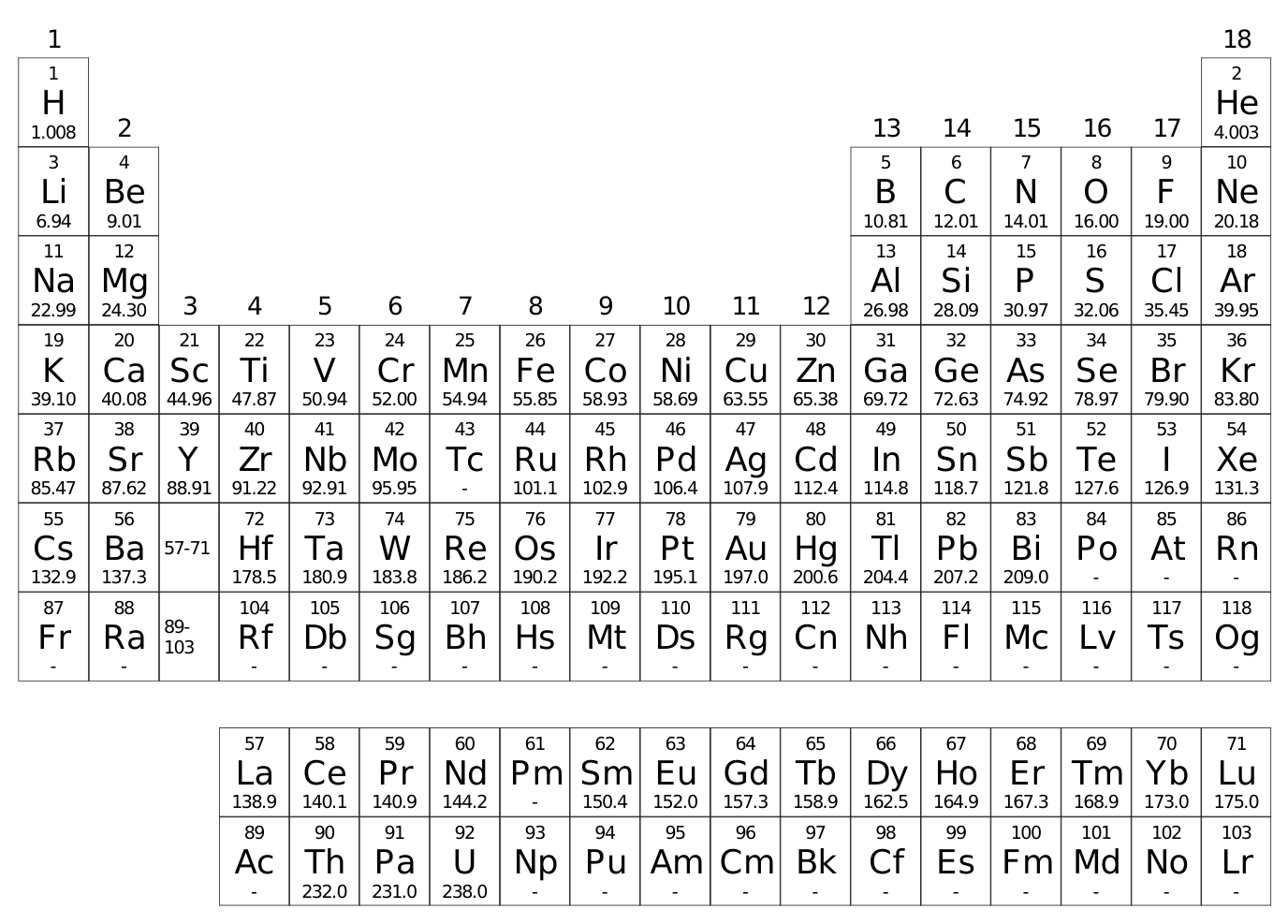
Official English text of the problem.
Answers
- 4.1 Cathode (1): \(\boxed{\ce{K+ + e- -> K}}\). Anode (2): \(\boxed{\ce{4OH- -> O2 + 2H2O + 4e-}}\).
- 4.2 \(\boxed{\ce{K2CO3 + 2C -> 2K(g) + 3CO(g)}}\).
- 4.3 \(\boxed{\mathrm{pH}=-0.48}\).
- 4.4 \(\boxed{\mathrm{pH}=7.21}\), including water autoionization at \(298.15\ \mathrm{K}\).
- 4.5 X is potassium croconate dihydrate, \(\boxed{\ce{K2C5O5.2H2O}}\), or \(\ce{C5H4K2O7}\) as an elemental empirical formula. SMILES:
[K+].[K+].[O-]C1=C([O-])C(=O)C(=O)C1=O.O.O. - 4.6 Y is croconic acid, \(\boxed{\ce{C5H2O5}}\), also named 4,5-dihydroxycyclopent-4-ene-1,2,3-trione. SMILES:
OC1=C(O)C(=O)C(=O)C1=O. - 4.7 One significant resonance contributor for each anion is specified below. Each has two adjacent, singly bonded negatively charged oxygen atoms, a double bond between their ring carbons, and carbonyl groups on all remaining ring carbons.
| Anion | Formula | SMILES of one resonance contributor |
|---|---|---|
| Croconate | \(\ce{C5O5^2-}\) | [O-]C1=C([O-])C(=O)C(=O)C1=O |
| Squarate | \(\ce{C4O4^2-}\) | [O-]C1=C([O-])C(=O)C1=O |
| Deltate | \(\ce{C3O3^2-}\) | [O-]C1=C([O-])C1=O |
| Rhodizonate | \(\ce{C6O6^2-}\) | [O-]C1=C([O-])C(=O)C(=O)C(=O)C1=O |
Solution
4.1
In molten potassium hydroxide, potassium cations gain electrons at the cathode:
\[ \boxed{\ce{K+ + e- -> K}} \]
Hydroxide ions lose electrons at the anode, forming oxygen and water:
\[ \boxed{\ce{4OH- -> O2 + 2H2O + 4e-}} \]
Both atoms and charge are balanced. Multiplying the cathode equation by four and adding gives the overall reaction:
\[ \ce{4KOH -> 4K + O2 + 2H2O} \]
The species are potassium hydroxide, [K+].[OH-]; potassium cation, [K+]; potassium, [K]; hydroxide ion, [OH-]; dioxygen, O=O; and water, O. The potassium atom SMILES does not describe bulk metallic bonding.
4.2
One formula unit of potassium carbonate supplies two potassium atoms and three oxygen atoms. Since carbon monoxide is the only oxygen-containing product, three molecules of carbon monoxide must form. They require two carbon atoms in addition to the carbonate carbon:
\[ \boxed{\ce{K2CO3 + 2C -> 2K(g) + 3CO(g)}} \]
Potassium carbonate has SMILES [K+].[K+].[O-]C(=O)[O-]; carbon monoxide has SMILES [C-]#[O+]. Elemental carbon is an extended solid and has no single molecular SMILES.
4.3
Write the diprotic acid as \(\ce{H2A}\), with equilibria
\[ \ce{H2A <=> H+ + HA-}, \qquad \ce{HA- <=> H+ + A^2-}. \]
Here \(\ce{H+}\), proton SMILES [H+], is the conventional aqueous acid–base shorthand. The specific acid and anions are identified below.
Using the usual ideal-solution concentration treatment,
\[ K_{a1}=10^{-0.8}=0.158489, \qquad K_{a2}=10^{-2.2}=0.00630957. \]
Let \(h=[\ce{H+}]\), with concentrations expressed in \(\mathrm{mol\,dm^{-3}}\). The equilibrium ratios are
\[ \frac{[\ce{HA-}]}{[\ce{H2A}]}=\frac{K_{a1}}{h}, \qquad \frac{[\ce{A^2-}]}{[\ce{H2A}]}=\frac{K_{a1}K_{a2}}{h^2}. \]
Consequently, the fraction present as neutral acid is
\[ \alpha_0 = \frac{[\ce{H2A}]} {[\ce{H2A}]+[\ce{HA-}]+[\ce{A^2-}]} = \frac{h^2}{h^2+K_{a1}h+K_{a1}K_{a2}}. \]
Setting \(\alpha_0=0.95\) gives
\[ h^2-19K_{a1}h-19K_{a1}K_{a2}=0. \]
The positive root is
\[ h= \frac{19K_{a1}+ \sqrt{(19K_{a1})^2+76K_{a1}K_{a2}}}{2} = 3.01759\ \mathrm{mol\,dm^{-3}}. \]
Thus
\[ \boxed{\mathrm{pH}=-\log_{10}(3.01759)=-0.47966\approx-0.48}. \]
The corresponding fractions are \(0.950000\), \(0.049896\), and \(0.000104\) for neutral acid, monoanion, and dianion. A negative pH is permissible.
4.4
The dipotassium salt supplies the dianion at analytical concentration
\[ C=0.010\ \mathrm{mol\,dm^{-3}}, \qquad [\ce{K+}]=2C. \]
Its main hydrolysis equilibrium is
\[ \ce{A^2- + H2O <=> HA- + OH-}, \]
with
\[ K_b=\frac{K_w}{K_{a2}} =\frac{10^{-14}}{10^{-2.2}} =1.58489\times10^{-12}. \]
The estimate \(\sqrt{K_bC}=1.26\times10^{-7}\ \mathrm{mol\,dm^{-3}}\) is comparable to the hydroxide concentration in pure water. Water autoionization must therefore be retained.
The material and charge balances are
\[ C=[\ce{H2A}]+[\ce{HA-}]+[\ce{A^2-}] \]
and
\[ 2C+h=[\ce{HA-}]+2[\ce{A^2-}]+[\ce{OH-}]. \]
Eliminating \(C\),
\[ [\ce{OH-}]=h+[\ce{HA-}]+2[\ce{H2A}]. \]
At approximately neutral pH, both acid dissociation constants are much greater than \(h\). Thus nearly all the acid-derived material remains as dianion:
\[ [\ce{A^2-}]\simeq C, \qquad [\ce{HA-}]\simeq\frac{Ch}{K_{a2}}, \qquad [\ce{H2A}]\ll[\ce{HA-}]. \]
Using \([\ce{OH-}]=K_w/h\),
\[ \frac{K_w}{h} \simeq h+\frac{Ch}{K_{a2}}, \]
so
\[ h\simeq \sqrt{\frac{K_w}{1+C/K_{a2}}} = \sqrt{\frac{10^{-14}}{1+0.010/0.00630957}} = 6.22\times10^{-8}\ \mathrm{mol\,dm^{-3}}. \]
Therefore,
\[ \boxed{\mathrm{pH}=7.2062\approx7.21}. \]
As a check,
\[ [\ce{OH-}]\approx1.61\times10^{-7}\ \mathrm{mol\,dm^{-3}}, \qquad [\ce{HA-}]\approx9.86\times10^{-8}\ \mathrm{mol\,dm^{-3}}. \]
Only about \(9.86\times10^{-6}\) of the analytical acid concentration is monoanion, validating the approximation \([\ce{A^2-}]\simeq C\). Solving the full equilibria and charge balance gives the same pH to the precision reported.
4.5
Reaction with two equivalents of methyl iodide introduces two methyl groups into the dianion. Using the supplied atomic masses,
\[ M(\ce{CH3})=12.01+3(1.008)=15.034\ \mathrm{g\,mol^{-1}}. \]
The mass of the anionic framework in X is therefore
\[ 170.12-2(15.034)=140.052\ \mathrm{g\,mol^{-1}}. \]
The derivative masses differ by multiples of
\[ 28.01\ \mathrm{g\,mol^{-1}} = 12.01+16.00, \]
the mass of one carbon–oxygen unit. Removing the two methyl groups from each derivative gives:
| Derivative molar mass / \(\mathrm{g\,mol^{-1}}\) | Framework molar mass / \(\mathrm{g\,mol^{-1}}\) | Number of carbon–oxygen units | Anion |
|---|---|---|---|
| 170.12 | 140.05 | 5 | Croconate, \(\ce{C5O5^2-}\) |
| 142.11 | 112.04 | 4 | Squarate, \(\ce{C4O4^2-}\) |
| 114.10 | 84.03 | 3 | Deltate, \(\ce{C3O3^2-}\) |
| 198.13 | 168.06 | 6 | Rhodizonate, \(\ce{C6O6^2-}\) |
Together with the stated planar cyclic symmetry, these masses identify the cyclic oxocarbon dianions: rings of carbon atoms bearing one exocyclic oxygen per carbon.
For X, the framework is \(\ce{C5O5^2-}\). Two potassium cations balance its charge, and the stated hydration adds two water molecules:
\[ \boxed{\ce{X = K2C5O5.2H2O}}. \]
Its elemental empirical formula is equivalently
\[ \boxed{\ce{C5H4K2O7}}. \]
The compound is potassium croconate dihydrate, SMILES [K+].[K+].[O-]C1=C([O-])C(=O)C(=O)C1=O.O.O. This notation specifies the components and one anion resonance contributor; it does not specify the crystal lattice or water coordination.
The methylation is
\[ \ce{K2C5O5 + 2CH3I -> C5O3(OCH3)2 + 2KI}. \]
The organic product is dimethyl croconate, SMILES COC1=C(OC)C(=O)C(=O)C1=O. Methyl iodide is CI, and potassium iodide is [K+].[I-]. The calculated product mass is
\[ M(\ce{C7H6O5}) =7(12.01)+6(1.008)+5(16.00) =170.118\ \mathrm{g\,mol^{-1}}, \]
which rounds to the given \(170.12\ \mathrm{g\,mol^{-1}}\).
4.6
Protonating the two negatively charged oxygen atoms of a croconate resonance contributor gives croconic acid, \(\ce{C5H2O5}\):
\[ \ce{C5O5^2- + 2H+ -> C5H2O5}. \]
Its name is 4,5-dihydroxycyclopent-4-ene-1,2,3-trione, and its SMILES is:
OC1=C(O)C(=O)C(=O)C1=O
To draw it precisely:
- Draw a five-carbon ring numbered consecutively 1–5.
- Put an exocyclic carbonyl oxygen on each of carbons 1, 2, and 3.
- Put a double bond between carbons 4 and 5.
- Attach one hydroxyl group to carbon 4 and one to carbon 5.
- All remaining ring bonds are single; no hydrogen is bonded directly to a ring carbon.
The acid–base species used in 4.3–4.4 are therefore croconic acid, hydrogen croconate, and croconate. Hydrogen croconate, \(\ce{C5HO5-}\), has the representative SMILES [O-]C1=C(O)C(=O)C(=O)C1=O.
The low \(\mathrm{p}K_a\) values are consistent with stabilization of the conjugate bases by electron delocalization through the conjugated carbon–oxygen framework.
4.7
For every anion, a significant contributor can be drawn by the same construction:
- Draw a ring of \(n\) carbon atoms.
- Choose two adjacent ring carbons and join them by a double bond.
- Attach a singly bonded \(\ce{O-}\) to each of those two carbons.
- Attach an exocyclic carbonyl oxygen to every remaining ring carbon.
- Make every other ring bond single.
This gives the following precise drawings:
| Anion | Carbon ring | Groups on the two double-bonded ring carbons | Groups on the remaining ring carbons |
|---|---|---|---|
| Croconate | Five-membered | Two singly bonded \(\ce{O-}\) atoms | Three carbonyls |
| Squarate | Four-membered | Two singly bonded \(\ce{O-}\) atoms | Two carbonyls |
| Deltate | Three-membered | Two singly bonded \(\ce{O-}\) atoms | One carbonyl |
| Rhodizonate | Six-membered | Two singly bonded \(\ce{O-}\) atoms | Four carbonyls |
The corresponding names, formulas, and explicit SMILES are given in Answers, 4.7. In each contributor, every carbon and oxygen has an octet, the net charge is \(-2\), and both formal negative charges lie on oxygen.
Electron-pair shifts generate other resonance contributors without moving atoms. For example, an anionic oxygen lone pair can form a carbonyl bond while the neighboring ring double bond shifts and another carbonyl \(\pi\)-electron pair moves onto oxygen. This relocates the formal negative charges around the conjugated framework.
The actual ions are resonance hybrids. The localized SMILES do not show their planar geometry, delocalized charge, or bond equalization; in particular, a single localized contributor does not display the full symmetry of croconate.
The solution was checked against the official solution.
IChO 2024 · Theorieaufgabe 4
Kalium
Elementares Kalium war das erste Metall, das durch Elektrolyse hergestellt wurde (1807). Humphry Davy verwendete voltaische Zellen und Elektroden, die in geschmolzenes \(\ce{KOH}\) eingetaucht waren.
4.1 Geben Sie ausgeglichene Gleichungen für die Vorgänge an der Kathode (1) und der Anode (2) an. 2 Pkt.
Es ist wenig bekannt, dass französische Chemiker bereits ein Jahr nach Davy Kalium durch chemische Reduktion herstellten. Bei einer der Methoden wurde ein Gemisch aus Kaliumcarbonat und fein pulverisiertem Kohlenstoff verwendet. Dieses Gemisch wurde in einem Gewehrlauf auf sehr hohe Temperaturen erhitzt. Kohlenstoffmonoxid und Kaliumdampf traten am Ende des Laufs aus, wo das Metall zu einem Feststoff kondensiert werden konnte.
4.2 Schreiben Sie die ausgeglichene Gleichung für die Reaktion auf, bei der ausschließlich diese beiden Produkte entstehen. 1 Pkt.
Die chemische Herstellung von Kalium hatte eine geringe Ausbeute. Je nach den Bedingungen blieb eine beträchtliche Menge einer rötlichen Paste im Gewehrlauf zurück. Gmelin isolierte 1825 aus diesem Rückstand durch Umkristallisieren aus Wasser eine interessante Verbindung (X). Die genaue Struktur des Nebenprodukts X wurde erst mehr als anderthalb Jahrhunderte später bestimmt.
X ist ein hydratisiertes Salz (2 mol Wasser : 1 mol Salz), das goldgelbe Kristalle bildet. Sein Anion besitzt eine außergewöhnlich symmetrische (wie Schwingungsspektren zeigen) und stabile, planare cyclische Struktur.
Die zweiprotonige Säure (Y), die aus dem Salz X gebildet werden kann, hat überraschend niedrige \(\mathrm{p}K_a\)-Werte (zumindest für den oberflächlichen Betrachter): 0.8 und 2.2.
4.3 Geben Sie den pH-Wert an, bei dem 95% der gesamten gelösten Säure Y in der neutralen Säureform vorliegen. 3 Pkt.
4.4 Berechnen Sie den pH-Wert einer \(0.01\ \mathrm{mol\,dm^{-3}}\) Lösung des Salzes X in reinem Wasser. 4 Pkt.
Der entscheidende Schritt bei der Strukturaufklärung von X war die Behandlung des wasserfreien Salzes mit Iodmethan. Das Salz reagierte mit zwei Äquivalenten Iodmethan. Die dabei erhaltene, etwas flüchtige Verbindung hatte eine molare Masse von \(170.12\ \mathrm{g/mol}\) (gemessen mit einem Massenspektrometer).
In dem Gemisch wurden außerdem mehrere analoge Salze in kleineren Mengen identifiziert. Die entsprechenden Kaliumsalze ergaben bei der Behandlung mit zwei Äquivalenten \(\ce{MeI}\) Derivate mit folgenden molaren Massen: \(142.11\ \mathrm{g/mol}\), \(114.10\ \mathrm{g/mol}\), \(198.13\ \mathrm{g/mol}\).
4.5 Geben Sie die Verhältnisformel von Gmelins Verbindung X an. 4 Pkt.
4.6 Zeichnen Sie die Struktur der freien Säure Y. 3 Pkt.
Die außergewöhnliche Stabilität der Reihe von Anionen in den zu X analogen Salzen lässt sich auf Elektronendelokalisierung zurückführen.
4.7 Zeichnen Sie für das Anion in jedem der vier Salze eine mesomere Grenzstruktur mit einem wesentlichen Beitrag. 4 Pkt.
| Avogadro-Konstante: | \(N_A=6.022\cdot10^{23}\ \mathrm{mol^{-1}}\) | Gaskonstante: | \(R=8.314\ \mathrm{J\,mol^{-1}\,K^{-1}}\) |
| Ionenprodukt des Wassers bei 298.15 K: | \(K_w=10^{-14}\) | Nullpunkt der Celsius-Skala: | \(0^\circ\mathrm{C}=273.15\ \mathrm{K}\) |
| Faraday-Konstante: | \(F=96485\ \mathrm{C\,mol^{-1}}\) | Planck-Konstante: | \(h=6.626\cdot10^{-34}\ \mathrm{J\,s}\) |
| Lichtgeschwindigkeit: | \(c=2.998\cdot10^8\ \mathrm{m\,s^{-1}}\) | Standarddruck: | \(p^\circ=1\cdot10^5\ \mathrm{Pa}=1\ \mathrm{bar}\) |
| Ideale Gasgleichung: | \(pV=nRT\) | Lambert-Beer-Gesetz: | \(A=\log\left(\frac{I_0}{I}\right)=\varepsilon\cdot l\cdot c\) |
| Enthalpie: | \(H=U+pV\) | Gibbs-Energie: | \(G=H-TS\) |
| \(\Delta_rG^\circ=-RT\ln K=-nFE^\circ_{\mathrm{cell}}\) | Henderson-Hasselbalch-Gleichung: | \(\mathrm{pH}=\mathrm{p}K_a+\log\left(\frac{[\ce{A-}]}{[\ce{HA}]}\right)\) | |
| Arrhenius-Gleichung: | \(k=A\exp\left(-\frac{E_A}{RT}\right)\) | Integriertes Geschwindigkeitsgesetz nullter Ordnung: | \([\ce{A}]=[\ce{A}]_0-kt\) |
| Oberfläche einer Kugel: | \(A=4\pi R^2\) | Integriertes Geschwindigkeitsgesetz erster Ordnung: | \(\ln[\ce{A}]=\ln[\ce{A}]_0-kt\) |
| Volumen einer Kugel: | \(V=\frac{4\pi}{3}R^3\) | \(\displaystyle\sum_{k=0}^{\infty}ar^k=\frac{a}{1-r}\quad\text{für }\lvert r\rvert<1\) |
Periodensystem
Aufgabentext aus dem offiziellen englischen Text übersetzt.
Antworten
- 4.1 Kathode (1): \(\boxed{\ce{K+ + e- -> K}}\). Anode (2): \(\boxed{\ce{4OH- -> O2 + 2H2O + 4e-}}\).
- 4.2 \(\boxed{\ce{K2CO3 + 2C -> 2K(g) + 3CO(g)}}\).
- 4.3 \(\boxed{\mathrm{pH}=-0.48}\).
- 4.4 \(\boxed{\mathrm{pH}=7.21}\), unter Berücksichtigung der Autoprotolyse des Wassers bei \(298.15\ \mathrm{K}\).
- 4.5 X ist Kaliumcroconat-Dihydrat, \(\boxed{\ce{K2C5O5.2H2O}}\), beziehungsweise \(\ce{C5H4K2O7}\) als elementare Verhältnisformel. SMILES:
[K+].[K+].[O-]C1=C([O-])C(=O)C(=O)C1=O.O.O. - 4.6 Y ist Croconsäure, \(\boxed{\ce{C5H2O5}}\), auch 4,5-Dihydroxycyclopent-4-en-1,2,3-trion genannt. SMILES:
OC1=C(O)C(=O)C(=O)C1=O. - 4.7 Nachstehend ist für jedes Anion eine wesentliche mesomere Grenzstruktur angegeben. Jede besitzt zwei benachbarte, einfach gebundene, negativ geladene Sauerstoffatome, eine Doppelbindung zwischen den zugehörigen Ringkohlenstoffatomen und Carbonylgruppen an allen übrigen Ringkohlenstoffatomen.
| Anion | Formel | SMILES einer mesomeren Grenzstruktur |
|---|---|---|
| Croconat | \(\ce{C5O5^2-}\) | [O-]C1=C([O-])C(=O)C(=O)C1=O |
| Squarat | \(\ce{C4O4^2-}\) | [O-]C1=C([O-])C(=O)C1=O |
| Deltat | \(\ce{C3O3^2-}\) | [O-]C1=C([O-])C1=O |
| Rhodizonat | \(\ce{C6O6^2-}\) | [O-]C1=C([O-])C(=O)C(=O)C(=O)C1=O |
Lösung
4.1
In geschmolzenem Kaliumhydroxid nehmen Kaliumkationen an der Kathode Elektronen auf:
\[ \boxed{\ce{K+ + e- -> K}} \]
Hydroxidionen geben an der Anode Elektronen ab, wobei Sauerstoff und Wasser entstehen:
\[ \boxed{\ce{4OH- -> O2 + 2H2O + 4e-}} \]
Sowohl die Atombilanz als auch die Ladungsbilanz sind ausgeglichen. Durch Multiplikation der Kathodengleichung mit vier und Addition erhält man die Gesamtreaktion:
\[ \ce{4KOH -> 4K + O2 + 2H2O} \]
Die Spezies sind Kaliumhydroxid, [K+].[OH-]; Kaliumkation, [K+]; Kalium, [K]; Hydroxidion, [OH-]; Disauerstoff, O=O; und Wasser, O. Der SMILES des Kaliumatoms beschreibt nicht die metallische Bindung im makroskopischen Metall.
4.2
Eine Formeleinheit Kaliumcarbonat liefert zwei Kaliumatome und drei Sauerstoffatome. Da Kohlenstoffmonoxid das einzige sauerstoffhaltige Produkt ist, müssen drei Moleküle Kohlenstoffmonoxid entstehen. Dafür werden zusätzlich zum Kohlenstoffatom des Carbonats zwei Kohlenstoffatome benötigt:
\[ \boxed{\ce{K2CO3 + 2C -> 2K(g) + 3CO(g)}} \]
Kaliumcarbonat hat den SMILES [K+].[K+].[O-]C(=O)[O-]; Kohlenstoffmonoxid hat den SMILES [C-]#[O+]. Elementarer Kohlenstoff ist ein ausgedehnter Festkörper und besitzt keinen einzelnen molekularen SMILES.
4.3
Die zweiprotonige Säure wird als \(\ce{H2A}\) geschrieben, mit den Gleichgewichten
\[ \ce{H2A <=> H+ + HA-}, \qquad \ce{HA- <=> H+ + A^2-}. \]
Dabei ist \(\ce{H+}\), mit dem Protonen-SMILES [H+], die übliche Kurzschreibweise in der Säure-Base-Chemie wässriger Lösungen. Die konkrete Säure und die Anionen werden weiter unten identifiziert.
Bei der üblichen Betrachtung einer idealen Lösung anhand von Konzentrationen gilt
\[ K_{a1}=10^{-0.8}=0.158489, \qquad K_{a2}=10^{-2.2}=0.00630957. \]
Es sei \(h=[\ce{H+}]\), wobei die Konzentrationen in \(\mathrm{mol\,dm^{-3}}\) angegeben werden. Die Gleichgewichtsverhältnisse sind
\[ \frac{[\ce{HA-}]}{[\ce{H2A}]}=\frac{K_{a1}}{h}, \qquad \frac{[\ce{A^2-}]}{[\ce{H2A}]}=\frac{K_{a1}K_{a2}}{h^2}. \]
Folglich beträgt der als neutrale Säure vorliegende Anteil
\[ \alpha_0 = \frac{[\ce{H2A}]} {[\ce{H2A}]+[\ce{HA-}]+[\ce{A^2-}]} = \frac{h^2}{h^2+K_{a1}h+K_{a1}K_{a2}}. \]
Setzt man \(\alpha_0=0.95\), erhält man
\[ h^2-19K_{a1}h-19K_{a1}K_{a2}=0. \]
Die positive Wurzel ist
\[ h= \frac{19K_{a1}+ \sqrt{(19K_{a1})^2+76K_{a1}K_{a2}}}{2} = 3.01759\ \mathrm{mol\,dm^{-3}}. \]
Somit gilt
\[ \boxed{\mathrm{pH}=-\log_{10}(3.01759)=-0.47966\approx-0.48}. \]
Die entsprechenden Anteile betragen \(0.950000\), \(0.049896\) und \(0.000104\) für die neutrale Säure, das Monoanion beziehungsweise das Dianion. Ein negativer pH-Wert ist zulässig.
4.4
Das Dikaliumsalz liefert das Dianion mit der analytischen Konzentration
\[ C=0.010\ \mathrm{mol\,dm^{-3}}, \qquad [\ce{K+}]=2C. \]
Sein hauptsächliches Hydrolysegleichgewicht lautet
\[ \ce{A^2- + H2O <=> HA- + OH-}, \]
mit
\[ K_b=\frac{K_w}{K_{a2}} =\frac{10^{-14}}{10^{-2.2}} =1.58489\times10^{-12}. \]
Der Schätzwert \(\sqrt{K_bC}=1.26\times10^{-7}\ \mathrm{mol\,dm^{-3}}\) ist mit der Hydroxidkonzentration in reinem Wasser vergleichbar. Die Autoprotolyse des Wassers muss daher berücksichtigt werden.
Die Stoffbilanz und die Ladungsbilanz lauten
\[ C=[\ce{H2A}]+[\ce{HA-}]+[\ce{A^2-}] \]
und
\[ 2C+h=[\ce{HA-}]+2[\ce{A^2-}]+[\ce{OH-}]. \]
Durch Eliminieren von \(C\) erhält man
\[ [\ce{OH-}]=h+[\ce{HA-}]+2[\ce{H2A}]. \]
Bei annähernd neutralem pH-Wert sind beide Säuredissoziationskonstanten wesentlich größer als \(h\). Somit liegt nahezu die gesamte von der Säure abgeleitete Stoffmenge weiterhin als Dianion vor:
\[ [\ce{A^2-}]\simeq C, \qquad [\ce{HA-}]\simeq\frac{Ch}{K_{a2}}, \qquad [\ce{H2A}]\ll[\ce{HA-}]. \]
Mit \([\ce{OH-}]=K_w/h\) folgt
\[ \frac{K_w}{h} \simeq h+\frac{Ch}{K_{a2}}, \]
also
\[ h\simeq \sqrt{\frac{K_w}{1+C/K_{a2}}} = \sqrt{\frac{10^{-14}}{1+0.010/0.00630957}} = 6.22\times10^{-8}\ \mathrm{mol\,dm^{-3}}. \]
Daher gilt
\[ \boxed{\mathrm{pH}=7.2062\approx7.21}. \]
Zur Kontrolle:
\[ [\ce{OH-}]\approx1.61\times10^{-7}\ \mathrm{mol\,dm^{-3}}, \qquad [\ce{HA-}]\approx9.86\times10^{-8}\ \mathrm{mol\,dm^{-3}}. \]
Nur etwa \(9.86\times10^{-6}\) der analytischen Säurekonzentration liegen als Monoanion vor, was die Näherung \([\ce{A^2-}]\simeq C\) bestätigt. Die Lösung der vollständigen Gleichgewichte zusammen mit der Ladungsbilanz ergibt bei der angegebenen Genauigkeit denselben pH-Wert.
4.5
Die Reaktion mit zwei Äquivalenten Iodmethan führt zwei Methylgruppen in das Dianion ein. Mit den angegebenen Atommassen ergibt sich
\[ M(\ce{CH3})=12.01+3(1.008)=15.034\ \mathrm{g\,mol^{-1}}. \]
Die Masse des anionischen Grundgerüsts in X beträgt daher
\[ 170.12-2(15.034)=140.052\ \mathrm{g\,mol^{-1}}. \]
Die Massen der Derivate unterscheiden sich um Vielfache von
\[ 28.01\ \mathrm{g\,mol^{-1}} = 12.01+16.00, \]
der Masse einer Kohlenstoff-Sauerstoff-Einheit. Zieht man die beiden Methylgruppen von jedem Derivat ab, erhält man:
| Molare Masse des Derivats / \(\mathrm{g\,mol^{-1}}\) | Molare Masse des Grundgerüsts / \(\mathrm{g\,mol^{-1}}\) | Anzahl der Kohlenstoff-Sauerstoff-Einheiten | Anion |
|---|---|---|---|
| 170.12 | 140.05 | 5 | Croconat, \(\ce{C5O5^2-}\) |
| 142.11 | 112.04 | 4 | Squarat, \(\ce{C4O4^2-}\) |
| 114.10 | 84.03 | 3 | Deltat, \(\ce{C3O3^2-}\) |
| 198.13 | 168.06 | 6 | Rhodizonat, \(\ce{C6O6^2-}\) |
Zusammen mit der angegebenen planaren cyclischen Symmetrie identifizieren diese Massen die cyclischen Oxokohlenstoff-Dianionen: Ringe aus Kohlenstoffatomen, die je ein exocyclisches Sauerstoffatom pro Kohlenstoffatom tragen.
Bei X ist das Grundgerüst \(\ce{C5O5^2-}\). Zwei Kaliumkationen gleichen seine Ladung aus, und durch die angegebene Hydratation kommen zwei Wassermoleküle hinzu:
\[ \boxed{\ce{X = K2C5O5.2H2O}}. \]
Seine elementare Verhältnisformel lautet gleichwertig
\[ \boxed{\ce{C5H4K2O7}}. \]
Die Verbindung ist Kaliumcroconat-Dihydrat, SMILES [K+].[K+].[O-]C1=C([O-])C(=O)C(=O)C1=O.O.O. Diese Schreibweise gibt die Komponenten und eine mesomere Grenzstruktur des Anions an; sie legt weder das Kristallgitter noch die Koordination des Wassers fest.
Die Methylierung lautet
\[ \ce{K2C5O5 + 2CH3I -> C5O3(OCH3)2 + 2KI}. \]
Das organische Produkt ist Dimethylcroconat, SMILES COC1=C(OC)C(=O)C(=O)C1=O. Iodmethan ist CI, und Kaliumiodid ist [K+].[I-]. Die berechnete Produktmasse beträgt
\[ M(\ce{C7H6O5}) =7(12.01)+6(1.008)+5(16.00) =170.118\ \mathrm{g\,mol^{-1}}, \]
was gerundet den angegebenen \(170.12\ \mathrm{g\,mol^{-1}}\) entspricht.
4.6
Durch Protonierung der beiden negativ geladenen Sauerstoffatome einer mesomeren Grenzstruktur des Croconats entsteht Croconsäure, \(\ce{C5H2O5}\):
\[ \ce{C5O5^2- + 2H+ -> C5H2O5}. \]
Ihr Name lautet 4,5-Dihydroxycyclopent-4-en-1,2,3-trion, und ihr SMILES ist:
OC1=C(O)C(=O)C(=O)C1=O
Zum genauen Zeichnen der Struktur:
- Zeichnen Sie einen Ring aus fünf Kohlenstoffatomen, die fortlaufend von 1–5 nummeriert sind.
- Zeichnen Sie an jedem der Kohlenstoffatome 1, 2 und 3 ein exocyclisches Carbonylsauerstoffatom ein.
- Zeichnen Sie zwischen den Kohlenstoffatomen 4 und 5 eine Doppelbindung ein.
- Fügen Sie an Kohlenstoffatom 4 und an Kohlenstoffatom 5 jeweils eine Hydroxygruppe an.
- Alle übrigen Ringbindungen sind Einfachbindungen; kein Wasserstoffatom ist direkt an ein Ringkohlenstoffatom gebunden.
Die in 4.3–4.4 verwendeten Säure-Base-Spezies sind daher Croconsäure, Hydrogencroconat und Croconat. Hydrogencroconat, \(\ce{C5HO5-}\), hat den repräsentativen SMILES [O-]C1=C(O)C(=O)C(=O)C1=O.
Die niedrigen \(\mathrm{p}K_a\)-Werte stehen im Einklang mit der Stabilisierung der konjugierten Basen durch Elektronendelokalisierung über das konjugierte Kohlenstoff-Sauerstoff-Gerüst.
4.7
Für jedes Anion lässt sich nach demselben Schema eine wesentliche mesomere Grenzstruktur zeichnen:
- Zeichnen Sie einen Ring aus \(n\) Kohlenstoffatomen.
- Wählen Sie zwei benachbarte Ringkohlenstoffatome aus und verbinden Sie diese durch eine Doppelbindung.
- Fügen Sie an jedes dieser beiden Kohlenstoffatome ein einfach gebundenes \(\ce{O-}\) an.
- Fügen Sie an jedes übrige Ringkohlenstoffatom ein exocyclisches Carbonylsauerstoffatom an.
- Zeichnen Sie alle anderen Ringbindungen als Einfachbindungen.
Daraus ergeben sich die folgenden genauen Strukturzeichnungen:
| Anion | Kohlenstoffring | Gruppen an den beiden durch eine Doppelbindung verbundenen Ringkohlenstoffatomen | Gruppen an den übrigen Ringkohlenstoffatomen |
|---|---|---|---|
| Croconat | Fünfgliedrig | Zwei einfach gebundene \(\ce{O-}\)-Atome | Drei Carbonylgruppen |
| Squarat | Viergliedrig | Zwei einfach gebundene \(\ce{O-}\)-Atome | Zwei Carbonylgruppen |
| Deltat | Dreigliedrig | Zwei einfach gebundene \(\ce{O-}\)-Atome | Eine Carbonylgruppe |
| Rhodizonat | Sechsgliedrig | Zwei einfach gebundene \(\ce{O-}\)-Atome | Vier Carbonylgruppen |
Die zugehörigen Namen, Formeln und expliziten SMILES sind unter Antworten, 4.7 angegeben. In jeder Grenzstruktur besitzt jedes Kohlenstoff- und Sauerstoffatom ein Oktett, die Nettoladung beträgt \(-2\), und beide negativen Formalladungen liegen auf Sauerstoffatomen.
Durch Verschiebung von Elektronenpaaren entstehen weitere mesomere Grenzstrukturen, ohne dass Atome verschoben werden. Beispielsweise kann ein freies Elektronenpaar eines anionischen Sauerstoffatoms eine Carbonylbindung bilden, während sich die benachbarte Ringdoppelbindung verschiebt und ein weiteres Carbonyl-\(\pi\)-Elektronenpaar auf ein Sauerstoffatom übergeht. Dadurch verlagern sich die negativen Formalladungen innerhalb des konjugierten Gerüsts.
Die tatsächlichen Ionen sind Mesomeriehybride. Die lokalisierten SMILES zeigen weder ihre planare Geometrie noch die delokalisierte Ladung oder den Bindungsausgleich; insbesondere stellt eine einzelne lokalisierte Grenzstruktur nicht die vollständige Symmetrie des Croconats dar.
Die Lösung wurde mit der offiziellen Lösung abgeglichen.
IChO 2024 · Teori sorusu 4
Potasyum
Elementel potasyum, elektroliz yoluyla sentezlenen ilk metaldir (1807). Humphry Davy, volta pilleri ve erimiş \(\ce{KOH}\) içine daldırılmış elektrotlar kullanmıştır.
4.1 Katotta (1) ve anotta (2) gerçekleşen süreçlerin denkleştirilmiş tepkime denklemlerini veriniz. 2 puan
Davy'den yalnızca bir yıl sonra Fransız kimyacıların kimyasal indirgeme yoluyla potasyum ürettikleri pek bilinmez. Yöntemlerden birinde potasyum karbonat ile ince toz hâline getirilmiş karbon karışımı kullanılmıştır. Bu karışım, bir tüfek namlusunda çok yüksek sıcaklıklara ısıtılmıştır. Karbon monoksit ve potasyum buharları namlunun ucundan çıkmış ve metal burada katı hâlde yoğunlaştırılabilmiştir.
4.2 Yalnızca bu iki ürünü veren tepkimenin denkleştirilmiş denklemini yazınız. 1 puan
Potasyumun kimyasal yolla üretiminin verimi düşüktü. Koşullara bağlı olarak, tüfek namlusunda önemli miktarda kırmızımsı bir macun kalıyordu. Gmelin, 1825 yılında suda yeniden kristallendirme yoluyla bu kalıntıdan ilginç bir bileşik (X) izole etmiştir. Yan ürün X'in kesin yapısı, bir buçuk yüzyıldan daha uzun bir süre sonra belirlenmiştir.
X, altın sarısı kristaller oluşturan hidratlı bir tuzdur (2 mol su : 1 mol tuz). Anyonu, olağanüstü derecede simetrik (titreşim spektrumlarıyla gösterilmiştir) ve kararlı, düzlemsel halkalı bir yapıya sahiptir.
X tuzundan elde edilebilen diprotik asidin (Y) \(\mathrm{p}K_a\) değerleri şaşırtıcı derecede (en azından yüzeysel bir gözlemci için) düşüktür: 0.8 ve 2.2.
4.3 Çözünmüş Y asidinin tamamının %95'inin nötr asit biçiminde bulunduğu pH değerini veriniz. 3 puan
4.4 X tuzunun saf sudaki \(0.01\ \mathrm{mol\,dm^{-3}}\) derişimli çözeltisinin pH değerini hesaplayınız. 4 puan
X'in yapısının belirlenmesindeki temel adım, susuz tuzun metil iyodür ile muamele edilmesiydi. Tuz, iki eşdeğer metil iyodür ile tepkimeye girmiştir. Elde edilen, bir ölçüde uçucu olan bileşiğin molar kütlesi \(170.12\ \mathrm{g/mol}\) olarak bulunmuştur (kütle spektrometresiyle ölçülmüştür).
Karışımda daha az miktarlarda bulunan bir dizi benzer tuz da belirlenmiştir. İlgili potasyum tuzları iki eşdeğer \(\ce{MeI}\) ile muamele edildiğinde molar kütleleri \(142.11\ \mathrm{g/mol}\), \(114.10\ \mathrm{g/mol}\), \(198.13\ \mathrm{g/mol}\) olan türevler vermiştir.
4.5 Gmelin'in X bileşiğinin basit formülünü veriniz. 4 puan
4.6 Serbest Y asidinin yapısını çiziniz. 3 puan
X'e benzer tuzlardaki anyon dizisinin olağanüstü kararlılığı, elektron delokalizasyonuna bağlanabilir.
4.7 Dört tuzun her birindeki anyon için önemli katkı sağlayan bir rezonans yapısı çiziniz. 4 puan
| Avogadro sabiti: | \(N_A=6.022\cdot10^{23}\ \mathrm{mol^{-1}}\) | Gaz sabiti: | \(R=8.314\ \mathrm{J\,mol^{-1}\,K^{-1}}\) |
| Suyun 298.15 K'deki iyonlar çarpımı: | \(K_w=10^{-14}\) | Celsius ölçeğinin sıfır noktası: | \(0^\circ\mathrm{C}=273.15\ \mathrm{K}\) |
| Faraday sabiti: | \(F=96485\ \mathrm{C\,mol^{-1}}\) | Planck sabiti: | \(h=6.626\cdot10^{-34}\ \mathrm{J\,s}\) |
| Işık hızı: | \(c=2.998\cdot10^8\ \mathrm{m\,s^{-1}}\) | Standart basınç: | \(p^\circ=1\cdot10^5\ \mathrm{Pa}=1\ \mathrm{bar}\) |
| İdeal gaz yasası: | \(pV=nRT\) | Beer-Lambert yasası: | \(A=\log\left(\frac{I_0}{I}\right)=\varepsilon\cdot l\cdot c\) |
| Entalpi: | \(H=U+pV\) | Gibbs enerjisi: | \(G=H-TS\) |
| \(\Delta_rG^\circ=-RT\ln K=-nFE^\circ_{\mathrm{cell}}\) | Henderson-Hasselbalch denklemi: | \(\mathrm{pH}=\mathrm{p}K_a+\log\left(\frac{[\ce{A-}]}{[\ce{HA}]}\right)\) | |
| Arrhenius denklemi: | \(k=A\exp\left(-\frac{E_A}{RT}\right)\) | Sıfırıncı dereceden tepkime için integre hız yasası: | \([\ce{A}]=[\ce{A}]_0-kt\) |
| Kürenin yüzey alanı: | \(A=4\pi R^2\) | Birinci dereceden tepkime için integre hız yasası: | \(\ln[\ce{A}]=\ln[\ce{A}]_0-kt\) |
| Kürenin hacmi: | \(V=\frac{4\pi}{3}R^3\) | \(\displaystyle\sum_{k=0}^{\infty}ar^k=\frac{a}{1-r}\quad\text{şu koşulla: }\lvert r\rvert<1\) |
Periyodik tablo
Soru metni resmi İngilizce metinden çevrilmiştir.
Cevaplar
- 4.1 Katot (1): \(\boxed{\ce{K+ + e- -> K}}\). Anot (2): \(\boxed{\ce{4OH- -> O2 + 2H2O + 4e-}}\).
- 4.2 \(\boxed{\ce{K2CO3 + 2C -> 2K(g) + 3CO(g)}}\).
- 4.3 \(\boxed{\mathrm{pH}=-0.48}\).
- 4.4 \(\boxed{\mathrm{pH}=7.21}\), \(298.15\ \mathrm{K}\)'de suyun otoiyonlaşması hesaba katıldığında.
- 4.5 X, potasyum krokonat dihidrattır, \(\boxed{\ce{K2C5O5.2H2O}}\); elementel basit formülü ise \(\ce{C5H4K2O7}\) şeklindedir. SMILES:
[K+].[K+].[O-]C1=C([O-])C(=O)C(=O)C1=O.O.O. - 4.6 Y, krokonik asittir, \(\boxed{\ce{C5H2O5}}\); 4,5-dihidroksisiklopent-4-en-1,2,3-trion olarak da adlandırılır. SMILES:
OC1=C(O)C(=O)C(=O)C1=O. - 4.7 Her anyon için önemli katkı sağlayan bir rezonans yapısı aşağıda belirtilmiştir. Her yapıda, komşu iki halka karbonuna tek bağla bağlı, negatif yüklü iki oksijen atomu, bu halka karbonları arasında bir çift bağ ve kalan tüm halka karbonlarında karbonil grupları bulunur.
| Anyon | Formül | Katkı sağlayan bir rezonans yapısının SMILES gösterimi |
|---|---|---|
| Krokonat | \(\ce{C5O5^2-}\) | [O-]C1=C([O-])C(=O)C(=O)C1=O |
| Skuarat | \(\ce{C4O4^2-}\) | [O-]C1=C([O-])C(=O)C1=O |
| Deltat | \(\ce{C3O3^2-}\) | [O-]C1=C([O-])C1=O |
| Rodizonat | \(\ce{C6O6^2-}\) | [O-]C1=C([O-])C(=O)C(=O)C(=O)C1=O |
Çözüm
4.1
Erimiş potasyum hidroksitte, potasyum katyonları katotta elektron alır:
\[ \boxed{\ce{K+ + e- -> K}} \]
Hidroksit iyonları anotta elektron vererek oksijen ve su oluşturur:
\[ \boxed{\ce{4OH- -> O2 + 2H2O + 4e-}} \]
Hem atomlar hem de yük denktir. Katot denklemi dört ile çarpılıp anot denklemiyle toplandığında toplam tepkime elde edilir:
\[ \ce{4KOH -> 4K + O2 + 2H2O} \]
Türler; potasyum hidroksit, [K+].[OH-]; potasyum katyonu, [K+]; potasyum, [K]; hidroksit iyonu, [OH-]; dioksijen, O=O; ve su, O şeklindedir. Potasyum atomunun SMILES gösterimi, makroskopik metaldeki metalik bağlanmayı betimlemez.
4.2
Potasyum karbonatın bir formül birimi, iki potasyum atomu ve üç oksijen atomu sağlar. Oksijen içeren tek ürün karbon monoksit olduğundan, üç karbon monoksit molekülü oluşmalıdır. Bunlar için karbonattaki karbona ek olarak iki karbon atomu gerekir:
\[ \boxed{\ce{K2CO3 + 2C -> 2K(g) + 3CO(g)}} \]
Potasyum karbonatın SMILES gösterimi [K+].[K+].[O-]C(=O)[O-]; karbon monoksitinki ise [C-]#[O+] şeklindedir. Elementel karbon, sürekli bir katı yapı oluşturur ve tek bir moleküler SMILES gösterimi yoktur.
4.3
Diprotik asidi \(\ce{H2A}\) ile gösterelim; dengeleri şöyledir:
\[ \ce{H2A <=> H+ + HA-}, \qquad \ce{HA- <=> H+ + A^2-}. \]
Burada, proton SMILES gösterimi [H+] olan \(\ce{H+}\), sulu çözeltilerdeki asit–baz tepkimelerinde kullanılan geleneksel kısaltmadır. Söz konusu asit ve anyonlar aşağıda belirlenmiştir.
İdeal çözeltiler için kullanılan olağan derişim yaklaşımıyla,
\[ K_{a1}=10^{-0.8}=0.158489, \qquad K_{a2}=10^{-2.2}=0.00630957. \]
Derişimler \(\mathrm{mol\,dm^{-3}}\) cinsinden ifade edilmek üzere \(h=[\ce{H+}]\) olsun. Dengedeki oranlar şöyledir:
\[ \frac{[\ce{HA-}]}{[\ce{H2A}]}=\frac{K_{a1}}{h}, \qquad \frac{[\ce{A^2-}]}{[\ce{H2A}]}=\frac{K_{a1}K_{a2}}{h^2}. \]
Dolayısıyla, nötr asit olarak bulunan kesir
\[ \alpha_0 = \frac{[\ce{H2A}]} {[\ce{H2A}]+[\ce{HA-}]+[\ce{A^2-}]} = \frac{h^2}{h^2+K_{a1}h+K_{a1}K_{a2}}. \]
\(\alpha_0=0.95\) alındığında
\[ h^2-19K_{a1}h-19K_{a1}K_{a2}=0. \]
Pozitif kök şöyledir:
\[ h= \frac{19K_{a1}+ \sqrt{(19K_{a1})^2+76K_{a1}K_{a2}}}{2} = 3.01759\ \mathrm{mol\,dm^{-3}}. \]
Böylece
\[ \boxed{\mathrm{pH}=-\log_{10}(3.01759)=-0.47966\approx-0.48}. \]
Nötr asit, monoanyon ve dianyon için karşılık gelen kesirler sırasıyla \(0.950000\), \(0.049896\) ve \(0.000104\) olur. Negatif bir pH değeri mümkündür.
4.4
Dipotasyum tuzu, dianyonu şu analitik derişimde sağlar:
\[ C=0.010\ \mathrm{mol\,dm^{-3}}, \qquad [\ce{K+}]=2C. \]
Başlıca hidroliz dengesi
\[ \ce{A^2- + H2O <=> HA- + OH-}, \]
olup denge sabiti şöyledir:
\[ K_b=\frac{K_w}{K_{a2}} =\frac{10^{-14}}{10^{-2.2}} =1.58489\times10^{-12}. \]
\(\sqrt{K_bC}=1.26\times10^{-7}\ \mathrm{mol\,dm^{-3}}\) tahmini, saf sudaki hidroksit derişimiyle karşılaştırılabilir büyüklüktedir. Bu nedenle suyun otoiyonlaşması hesaba katılmalıdır.
Madde ve yük denklikleri
\[ C=[\ce{H2A}]+[\ce{HA-}]+[\ce{A^2-}] \]
ve
\[ 2C+h=[\ce{HA-}]+2[\ce{A^2-}]+[\ce{OH-}]. \]
\(C\) yok edildiğinde,
\[ [\ce{OH-}]=h+[\ce{HA-}]+2[\ce{H2A}]. \]
Yaklaşık nötr pH'de, her iki asit ayrışma sabiti de \(h\)'den çok büyüktür. Dolayısıyla asitten türeyen türlerin neredeyse tamamı dianyon olarak kalır:
\[ [\ce{A^2-}]\simeq C, \qquad [\ce{HA-}]\simeq\frac{Ch}{K_{a2}}, \qquad [\ce{H2A}]\ll[\ce{HA-}]. \]
\([\ce{OH-}]=K_w/h\) kullanıldığında,
\[ \frac{K_w}{h} \simeq h+\frac{Ch}{K_{a2}}, \]
buradan
\[ h\simeq \sqrt{\frac{K_w}{1+C/K_{a2}}} = \sqrt{\frac{10^{-14}}{1+0.010/0.00630957}} = 6.22\times10^{-8}\ \mathrm{mol\,dm^{-3}}. \]
Dolayısıyla,
\[ \boxed{\mathrm{pH}=7.2062\approx7.21}. \]
Kontrol amacıyla,
\[ [\ce{OH-}]\approx1.61\times10^{-7}\ \mathrm{mol\,dm^{-3}}, \qquad [\ce{HA-}]\approx9.86\times10^{-8}\ \mathrm{mol\,dm^{-3}}. \]
Analitik asit derişiminin yalnızca yaklaşık \(9.86\times10^{-6}\)'lık kısmı monoanyon biçimindedir; bu da \([\ce{A^2-}]\simeq C\) yaklaşımını doğrular. Tüm denge denklemleri ve yük denkliği birlikte çözüldüğünde, belirtilen hassasiyette aynı pH değeri elde edilir.
4.5
İki eşdeğer metil iyodür ile tepkime, dianyona iki metil grubu ekler. Verilen atom kütleleri kullanıldığında,
\[ M(\ce{CH3})=12.01+3(1.008)=15.034\ \mathrm{g\,mol^{-1}}. \]
Dolayısıyla X'teki anyonik iskeletin kütlesi
\[ 170.12-2(15.034)=140.052\ \mathrm{g\,mol^{-1}}. \]
Türevlerin kütleleri arasındaki farklar,
\[ 28.01\ \mathrm{g\,mol^{-1}} = 12.01+16.00, \]
yani bir karbon–oksijen biriminin kütlesinin katlarıdır. Her türevden iki metil grubunun çıkarılmasıyla şu değerler elde edilir:
| Türevin molar kütlesi / \(\mathrm{g\,mol^{-1}}\) | İskeletin molar kütlesi / \(\mathrm{g\,mol^{-1}}\) | Karbon–oksijen birimi sayısı | Anyon |
|---|---|---|---|
| 170.12 | 140.05 | 5 | Krokonat, \(\ce{C5O5^2-}\) |
| 142.11 | 112.04 | 4 | Skuarat, \(\ce{C4O4^2-}\) |
| 114.10 | 84.03 | 3 | Deltat, \(\ce{C3O3^2-}\) |
| 198.13 | 168.06 | 6 | Rodizonat, \(\ce{C6O6^2-}\) |
Belirtilen düzlemsel halka simetrisiyle birlikte bu kütleler, halkalı oksokarbon dianyonlarını tanımlar: her karbon başına halka dışında bir oksijen taşıyan karbon atomu halkaları.
X için iskelet \(\ce{C5O5^2-}\) şeklindedir. İki potasyum katyonu yükü dengeler ve belirtilen hidratlaşma iki su molekülü ekler:
\[ \boxed{\ce{X = K2C5O5.2H2O}}. \]
Elementel basit formülü eşdeğer olarak şöyledir:
\[ \boxed{\ce{C5H4K2O7}}. \]
Bileşik, SMILES gösterimi [K+].[K+].[O-]C1=C([O-])C(=O)C(=O)C1=O.O.O olan potasyum krokonat dihidrattır. Bu gösterim, bileşenleri ve anyona katkı sağlayan bir rezonans yapısını belirtir; kristal örgüyü veya suyun koordinasyonunu belirtmez.
Metillenme tepkimesi şöyledir:
\[ \ce{K2C5O5 + 2CH3I -> C5O3(OCH3)2 + 2KI}. \]
Organik ürün, SMILES gösterimi COC1=C(OC)C(=O)C(=O)C1=O olan dimetil krokonattır. Metil iyodürün gösterimi CI, potasyum iyodürünki ise [K+].[I-] şeklindedir. Ürünün hesaplanan kütlesi
\[ M(\ce{C7H6O5}) =7(12.01)+6(1.008)+5(16.00) =170.118\ \mathrm{g\,mol^{-1}}, \]
olup yuvarlandığında verilen \(170.12\ \mathrm{g\,mol^{-1}}\) değeri elde edilir.
4.6
Krokonata katkı sağlayan bir rezonans yapısındaki negatif yüklü iki oksijen atomunun protonlanmasıyla krokonik asit, \(\ce{C5H2O5}\), elde edilir:
\[ \ce{C5O5^2- + 2H+ -> C5H2O5}. \]
Adı 4,5-dihidroksisiklopent-4-en-1,2,3-trion olup SMILES gösterimi şöyledir:
OC1=C(O)C(=O)C(=O)C1=O
Yapıyı tam olarak çizmek için:
- Karbonları sırayla 1–5 olarak numaralandırılmış, beş karbonlu bir halka çiziniz.
- 1, 2 ve 3 numaralı karbonların her birine halka dışında bir karbonil oksijeni yerleştiriniz.
- 4 ve 5 numaralı karbonlar arasına bir çift bağ yerleştiriniz.
- 4 numaralı karbona bir, 5 numaralı karbona da bir hidroksil grubu bağlayınız.
- Kalan tüm halka bağları tektir; hiçbir hidrojen doğrudan bir halka karbonuna bağlı değildir.
Dolayısıyla 4.3–4.4'te kullanılan asit–baz türleri krokonik asit, hidrojen krokonat ve krokonattır. Hidrojen krokonat, \(\ce{C5HO5-}\), [O-]C1=C(O)C(=O)C(=O)C1=O temsili SMILES gösterimine sahiptir.
Düşük \(\mathrm{p}K_a\) değerleri, konjuge bazların konjuge karbon–oksijen iskeleti boyunca elektron delokalizasyonuyla kararlı hâle gelmesiyle uyumludur.
4.7
Her anyon için önemli katkı sağlayan bir rezonans yapısı aynı yöntemle çizilebilir:
- \(n\) karbon atomundan oluşan bir halka çiziniz.
- Komşu iki halka karbonunu seçip aralarına bir çift bağ koyunuz.
- Bu iki karbonun her birine tek bağla bir \(\ce{O-}\) bağlayınız.
- Kalan her halka karbonuna halka dışında bir karbonil oksijeni bağlayınız.
- Diğer tüm halka bağlarını tek bağ yapınız.
Böylece aşağıda ayrıntıları verilen çizimler elde edilir:
| Anyon | Karbon halkası | Çift bağla bağlı iki halka karbonundaki gruplar | Kalan halka karbonlarındaki gruplar |
|---|---|---|---|
| Krokonat | Beş üyeli | Tek bağla bağlı iki \(\ce{O-}\) atomu | Üç karbonil |
| Skuarat | Dört üyeli | Tek bağla bağlı iki \(\ce{O-}\) atomu | İki karbonil |
| Deltat | Üç üyeli | Tek bağla bağlı iki \(\ce{O-}\) atomu | Bir karbonil |
| Rodizonat | Altı üyeli | Tek bağla bağlı iki \(\ce{O-}\) atomu | Dört karbonil |
İlgili adlar, formüller ve açık SMILES gösterimleri Cevaplar, 4.7'de verilmiştir. Katkı sağlayan her yapıda, tüm karbon ve oksijen atomları oktetini tamamlar, net yük \(-2\)'dir ve her iki biçimsel negatif yük de oksijen üzerinde bulunur.
Elektron çiftlerinin yer değiştirmesi, atomlar hareket etmeden başka rezonans yapıları oluşturur. Örneğin, anyonik bir oksijenin ortaklanmamış elektron çifti bir karbonil bağı oluşturabilir; aynı sırada komşu halka çift bağı kayar ve başka bir karbonilin \(\pi\)-elektron çifti oksijen üzerine geçer. Böylece biçimsel negatif yükler konjuge iskelet boyunca yer değiştirir.
Gerçek iyonlar rezonans melezleridir. Yerelleştirilmiş SMILES gösterimleri, iyonların düzlemsel geometrisini, delokalize yükünü veya bağlarının eşitlenmesini göstermez; özellikle, katkı sağlayan tek bir yerelleştirilmiş yapı, krokonatın tam simetrisini ortaya koymaz.
Çözüm, resmi çözümle karşılaştırılarak kontrol edildi.
IChO 2024 · Problema teórico 4
Potasio
El potasio elemental fue el primer metal sintetizado mediante electrólisis (1807). Humphry Davy utilizó pilas voltaicas y electrodos sumergidos en \(\ce{KOH}\) fundido.
4.1 Indique las ecuaciones ajustadas de los procesos que tienen lugar en el cátodo (1) y en el ánodo (2). 2 pt
Es poco conocido que, tan solo un año después de Davy, unos químicos franceses produjeron potasio mediante una reducción química. Uno de los métodos empleaba una mezcla de carbonato de potasio y carbono finamente pulverizado. Esta mezcla se calentaba a temperaturas muy elevadas en el cañón de un arma de fuego. Por el extremo del cañón salían monóxido de carbono y vapores de potasio, y allí el metal podía condensarse en forma sólida.
4.2 Escriba la ecuación ajustada de la reacción que da únicamente estos dos productos. 1 pt
La producción química de potasio tenía un rendimiento bajo. Según las circunstancias, quedaba una cantidad considerable de pasta rojiza en el cañón del arma. En 1825, Gmelin aisló de este residuo un compuesto interesante (X) mediante recristalización en agua. La estructura exacta del subproducto X se determinó más de un siglo y medio después.
X es una sal hidratada (2 mol de agua : 1 mol de sal) que forma cristales de color amarillo dorado. Su anión tiene una estructura cíclica plana excepcionalmente simétrica (como muestran los espectros vibracionales) y estable.
El ácido diprótico (Y) que puede formarse a partir de la sal X tiene valores de \(\mathrm{p}K_a\) sorprendentemente bajos (al menos para un observador superficial): 0.8 y 2.2.
4.3 Indique el pH al que el 95% de todo el ácido Y disuelto se encuentra en la forma de ácido neutro. 3 pt
4.4 Calcule el pH de una disolución de la sal X de \(0.01\ \mathrm{mol\,dm^{-3}}\) en agua pura. 4 pt
La etapa clave en la identificación de la estructura de X fue el tratamiento de la sal anhidra con yoduro de metilo. La sal reaccionó con dos equivalentes de yoduro de metilo. El compuesto algo volátil que se obtuvo tenía una masa molar de \(170.12\ \mathrm{g/mol}\) (medida en un espectrómetro de masas).
También se identificaron varias sales análogas en la mezcla, en cantidades menores. Las correspondientes sales de potasio, al tratarse con dos equivalentes de \(\ce{MeI}\), dieron derivados con masas molares de: \(142.11\ \mathrm{g/mol}\), \(114.10\ \mathrm{g/mol}\), \(198.13\ \mathrm{g/mol}\).
4.5 Indique la fórmula empírica del compuesto X de Gmelin. 4 pt
4.6 Dibuje la estructura del ácido libre Y. 3 pt
La extraordinaria estabilidad de la serie de aniones de las sales análogas a X puede atribuirse a la deslocalización electrónica.
4.7 Dibuje una estructura de resonancia con una contribución significativa para el anión de cada una de las cuatro sales. 4 pt
| Constante de Avogadro: | \(N_A=6.022\cdot10^{23}\ \mathrm{mol^{-1}}\) | Constante de los gases: | \(R=8.314\ \mathrm{J\,mol^{-1}\,K^{-1}}\) |
| Producto iónico del agua a 298.15 K: | \(K_w=10^{-14}\) | Cero de la escala Celsius: | \(0^\circ\mathrm{C}=273.15\ \mathrm{K}\) |
| Constante de Faraday: | \(F=96485\ \mathrm{C\,mol^{-1}}\) | Constante de Planck: | \(h=6.626\cdot10^{-34}\ \mathrm{J\,s}\) |
| Velocidad de la luz: | \(c=2.998\cdot10^8\ \mathrm{m\,s^{-1}}\) | Presión estándar: | \(p^\circ=1\cdot10^5\ \mathrm{Pa}=1\ \mathrm{bar}\) |
| Ley de los gases ideales: | \(pV=nRT\) | Ley de Beer-Lambert: | \(A=\log\left(\frac{I_0}{I}\right)=\varepsilon\cdot l\cdot c\) |
| Entalpía: | \(H=U+pV\) | Energía de Gibbs: | \(G=H-TS\) |
| \(\Delta_rG^\circ=-RT\ln K=-nFE^\circ_{\mathrm{cell}}\) | Ecuación de Henderson-Hasselbalch: | \(\mathrm{pH}=\mathrm{p}K_a+\log\left(\frac{[\ce{A-}]}{[\ce{HA}]}\right)\) | |
| Ecuación de Arrhenius: | \(k=A\exp\left(-\frac{E_A}{RT}\right)\) | Ley integrada de velocidad de orden cero: | \([\ce{A}]=[\ce{A}]_0-kt\) |
| Superficie de una esfera: | \(A=4\pi R^2\) | Ley integrada de velocidad de primer orden: | \(\ln[\ce{A}]=\ln[\ce{A}]_0-kt\) |
| Volumen de una esfera: | \(V=\frac{4\pi}{3}R^3\) | \(\displaystyle\sum_{k=0}^{\infty}ar^k=\frac{a}{1-r}\quad\text{para }\lvert r\rvert<1\) |
Tabla periódica
Enunciado traducido del texto oficial en inglés.
Respuestas
- 4.1 Cátodo (1): \(\boxed{\ce{K+ + e- -> K}}\). Ánodo (2): \(\boxed{\ce{4OH- -> O2 + 2H2O + 4e-}}\).
- 4.2 \(\boxed{\ce{K2CO3 + 2C -> 2K(g) + 3CO(g)}}\).
- 4.3 \(\boxed{\mathrm{pH}=-0.48}\).
- 4.4 \(\boxed{\mathrm{pH}=7.21}\), incluyendo la autoionización del agua a \(298.15\ \mathrm{K}\).
- 4.5 X es croconato de potasio dihidrato, \(\boxed{\ce{K2C5O5.2H2O}}\), o \(\ce{C5H4K2O7}\) como fórmula empírica elemental. SMILES:
[K+].[K+].[O-]C1=C([O-])C(=O)C(=O)C1=O.O.O. - 4.6 Y es ácido crocónico, \(\boxed{\ce{C5H2O5}}\), también denominado 4,5-dihidroxiciclopent-4-eno-1,2,3-triona. SMILES:
OC1=C(O)C(=O)C(=O)C1=O. - 4.7 A continuación se especifica una estructura resonante con una contribución significativa para cada anión. Cada una tiene dos átomos de oxígeno adyacentes con carga negativa unidos mediante enlaces simples, un doble enlace entre los carbonos del anillo a los que están unidos y grupos carbonilo en todos los demás carbonos del anillo.
| Anión | Fórmula | SMILES de una estructura resonante |
|---|---|---|
| Croconato | \(\ce{C5O5^2-}\) | [O-]C1=C([O-])C(=O)C(=O)C1=O |
| Escuarato | \(\ce{C4O4^2-}\) | [O-]C1=C([O-])C(=O)C1=O |
| Deltato | \(\ce{C3O3^2-}\) | [O-]C1=C([O-])C1=O |
| Rodizonato | \(\ce{C6O6^2-}\) | [O-]C1=C([O-])C(=O)C(=O)C(=O)C1=O |
Solución
4.1
En el hidróxido de potasio fundido, los cationes potasio ganan electrones en el cátodo:
\[ \boxed{\ce{K+ + e- -> K}} \]
Los iones hidróxido pierden electrones en el ánodo, formando oxígeno y agua:
\[ \boxed{\ce{4OH- -> O2 + 2H2O + 4e-}} \]
Tanto los átomos como la carga están equilibrados. Al multiplicar la ecuación del cátodo por cuatro y sumar ambas ecuaciones, se obtiene la reacción global:
\[ \ce{4KOH -> 4K + O2 + 2H2O} \]
Las especies son hidróxido de potasio, [K+].[OH-]; catión potasio, [K+]; potasio, [K]; ion hidróxido, [OH-]; dioxígeno, O=O; y agua, O. El SMILES del átomo de potasio no describe el enlace metálico en el material macroscópico.
4.2
Una unidad fórmula de carbonato de potasio aporta dos átomos de potasio y tres átomos de oxígeno. Como el monóxido de carbono es el único producto que contiene oxígeno, deben formarse tres moléculas de monóxido de carbono. Estas requieren dos átomos de carbono además del carbono del carbonato:
\[ \boxed{\ce{K2CO3 + 2C -> 2K(g) + 3CO(g)}} \]
El carbonato de potasio tiene el SMILES [K+].[K+].[O-]C(=O)[O-]; el monóxido de carbono tiene el SMILES [C-]#[O+]. El carbono elemental es un sólido de estructura extendida y no tiene un SMILES molecular único.
4.3
Representemos el ácido diprótico como \(\ce{H2A}\), con los equilibrios
\[ \ce{H2A <=> H+ + HA-}, \qquad \ce{HA- <=> H+ + A^2-}. \]
Aquí, \(\ce{H+}\), cuyo SMILES de protón es [H+], es la abreviatura convencional en los equilibrios ácido–base acuosos. El ácido y los aniones concretos se identifican más adelante.
Utilizando el tratamiento habitual basado en concentraciones para una disolución ideal,
\[ K_{a1}=10^{-0.8}=0.158489, \qquad K_{a2}=10^{-2.2}=0.00630957. \]
Sea \(h=[\ce{H+}]\), con las concentraciones expresadas en \(\mathrm{mol\,dm^{-3}}\). Las relaciones en el equilibrio son
\[ \frac{[\ce{HA-}]}{[\ce{H2A}]}=\frac{K_{a1}}{h}, \qquad \frac{[\ce{A^2-}]}{[\ce{H2A}]}=\frac{K_{a1}K_{a2}}{h^2}. \]
Por consiguiente, la fracción presente como ácido neutro es
\[ \alpha_0 = \frac{[\ce{H2A}]} {[\ce{H2A}]+[\ce{HA-}]+[\ce{A^2-}]} = \frac{h^2}{h^2+K_{a1}h+K_{a1}K_{a2}}. \]
Al imponer \(\alpha_0=0.95\), se obtiene
\[ h^2-19K_{a1}h-19K_{a1}K_{a2}=0. \]
La raíz positiva es
\[ h= \frac{19K_{a1}+ \sqrt{(19K_{a1})^2+76K_{a1}K_{a2}}}{2} = 3.01759\ \mathrm{mol\,dm^{-3}}. \]
Por tanto,
\[ \boxed{\mathrm{pH}=-\log_{10}(3.01759)=-0.47966\approx-0.48}. \]
Las fracciones correspondientes son \(0.950000\), \(0.049896\) y \(0.000104\) para el ácido neutro, el monoanión y el dianión. Un pH negativo es posible.
4.4
La sal dipotásica aporta el dianión a una concentración analítica de
\[ C=0.010\ \mathrm{mol\,dm^{-3}}, \qquad [\ce{K+}]=2C. \]
Su principal equilibrio de hidrólisis es
\[ \ce{A^2- + H2O <=> HA- + OH-}, \]
con
\[ K_b=\frac{K_w}{K_{a2}} =\frac{10^{-14}}{10^{-2.2}} =1.58489\times10^{-12}. \]
La estimación \(\sqrt{K_bC}=1.26\times10^{-7}\ \mathrm{mol\,dm^{-3}}\) es comparable a la concentración de hidróxido en agua pura. Por tanto, debe tenerse en cuenta la autoionización del agua.
Los balances de materia y de carga son
\[ C=[\ce{H2A}]+[\ce{HA-}]+[\ce{A^2-}] \]
y
\[ 2C+h=[\ce{HA-}]+2[\ce{A^2-}]+[\ce{OH-}]. \]
Al eliminar \(C\),
\[ [\ce{OH-}]=h+[\ce{HA-}]+2[\ce{H2A}]. \]
A un pH aproximadamente neutro, ambas constantes de disociación ácida son mucho mayores que \(h\). Así, casi toda la materia derivada del ácido permanece como dianión:
\[ [\ce{A^2-}]\simeq C, \qquad [\ce{HA-}]\simeq\frac{Ch}{K_{a2}}, \qquad [\ce{H2A}]\ll[\ce{HA-}]. \]
Utilizando \([\ce{OH-}]=K_w/h\),
\[ \frac{K_w}{h} \simeq h+\frac{Ch}{K_{a2}}, \]
por lo que
\[ h\simeq \sqrt{\frac{K_w}{1+C/K_{a2}}} = \sqrt{\frac{10^{-14}}{1+0.010/0.00630957}} = 6.22\times10^{-8}\ \mathrm{mol\,dm^{-3}}. \]
Por tanto,
\[ \boxed{\mathrm{pH}=7.2062\approx7.21}. \]
Como comprobación,
\[ [\ce{OH-}]\approx1.61\times10^{-7}\ \mathrm{mol\,dm^{-3}}, \qquad [\ce{HA-}]\approx9.86\times10^{-8}\ \mathrm{mol\,dm^{-3}}. \]
Solo una fracción de aproximadamente \(9.86\times10^{-6}\) de la concentración analítica del ácido se encuentra como monoanión, lo que valida la aproximación \([\ce{A^2-}]\simeq C\). La resolución del conjunto completo de equilibrios y del balance de carga da el mismo pH con la precisión indicada.
4.5
La reacción con dos equivalentes de yoduro de metilo introduce dos grupos metilo en el dianión. Utilizando las masas atómicas proporcionadas,
\[ M(\ce{CH3})=12.01+3(1.008)=15.034\ \mathrm{g\,mol^{-1}}. \]
La masa del esqueleto aniónico de X es, por tanto,
\[ 170.12-2(15.034)=140.052\ \mathrm{g\,mol^{-1}}. \]
Las masas de los derivados difieren en múltiplos de
\[ 28.01\ \mathrm{g\,mol^{-1}} = 12.01+16.00, \]
la masa de una unidad carbono–oxígeno. Al restar los dos grupos metilo de cada derivado, se obtiene:
| Masa molar del derivado / \(\mathrm{g\,mol^{-1}}\) | Masa molar del esqueleto / \(\mathrm{g\,mol^{-1}}\) | Número de unidades carbono–oxígeno | Anión |
|---|---|---|---|
| 170.12 | 140.05 | 5 | Croconato, \(\ce{C5O5^2-}\) |
| 142.11 | 112.04 | 4 | Escuarato, \(\ce{C4O4^2-}\) |
| 114.10 | 84.03 | 3 | Deltato, \(\ce{C3O3^2-}\) |
| 198.13 | 168.06 | 6 | Rodizonato, \(\ce{C6O6^2-}\) |
Junto con la simetría cíclica plana indicada, estas masas permiten identificar los dianiones oxocarbónicos cíclicos: anillos de átomos de carbono con un oxígeno exocíclico por cada carbono.
Para X, el esqueleto es \(\ce{C5O5^2-}\). Dos cationes potasio compensan su carga, y la hidratación indicada añade dos moléculas de agua:
\[ \boxed{\ce{X = K2C5O5.2H2O}}. \]
Su fórmula empírica elemental es, de forma equivalente,
\[ \boxed{\ce{C5H4K2O7}}. \]
El compuesto es croconato de potasio dihidrato, SMILES [K+].[K+].[O-]C1=C([O-])C(=O)C(=O)C1=O.O.O. Esta notación especifica los componentes y una estructura resonante del anión; no especifica la red cristalina ni la coordinación del agua.
La metilación es
\[ \ce{K2C5O5 + 2CH3I -> C5O3(OCH3)2 + 2KI}. \]
El producto orgánico es croconato de dimetilo, SMILES COC1=C(OC)C(=O)C(=O)C1=O. El yoduro de metilo es CI, y el yoduro de potasio es [K+].[I-]. La masa calculada del producto es
\[ M(\ce{C7H6O5}) =7(12.01)+6(1.008)+5(16.00) =170.118\ \mathrm{g\,mol^{-1}}, \]
que, al redondear, da el valor proporcionado de \(170.12\ \mathrm{g\,mol^{-1}}\).
4.6
La protonación de los dos átomos de oxígeno con carga negativa de una estructura resonante del croconato da ácido crocónico, \(\ce{C5H2O5}\):
\[ \ce{C5O5^2- + 2H+ -> C5H2O5}. \]
Su nombre es 4,5-dihidroxiciclopent-4-eno-1,2,3-triona, y su SMILES es:
OC1=C(O)C(=O)C(=O)C1=O
Para dibujarlo con precisión:
- Dibuje un anillo de cinco carbonos numerados consecutivamente del 1 al 5.
- Coloque un oxígeno carbonílico exocíclico en cada uno de los carbonos 1, 2 y 3.
- Coloque un doble enlace entre los carbonos 4 y 5.
- Una un grupo hidroxilo al carbono 4 y otro al carbono 5.
- Todos los demás enlaces del anillo son simples; ningún hidrógeno está unido directamente a un carbono del anillo.
Las especies ácido–base utilizadas en 4.3–4.4 son, por tanto, ácido crocónico, hidrogenocroconato y croconato. El hidrogenocroconato, \(\ce{C5HO5-}\), tiene el SMILES representativo [O-]C1=C(O)C(=O)C(=O)C1=O.
Los valores bajos de \(\mathrm{p}K_a\) son coherentes con la estabilización de las bases conjugadas por deslocalización electrónica a través del esqueleto conjugado de carbono–oxígeno.
4.7
Para cada anión, puede dibujarse una estructura resonante con una contribución significativa mediante la misma construcción:
- Dibuje un anillo de \(n\) átomos de carbono.
- Elija dos carbonos adyacentes del anillo y únalos mediante un doble enlace.
- Una un \(\ce{O-}\) mediante un enlace simple a cada uno de esos dos carbonos.
- Una un oxígeno carbonílico exocíclico a cada uno de los demás carbonos del anillo.
- Haga que todos los demás enlaces del anillo sean simples.
Así se obtienen los siguientes dibujos precisos:
| Anión | Anillo de carbono | Grupos en los dos carbonos del anillo unidos por un doble enlace | Grupos en los demás carbonos del anillo |
|---|---|---|---|
| Croconato | De cinco miembros | Dos átomos de \(\ce{O-}\) unidos mediante enlaces simples | Tres carbonilos |
| Escuarato | De cuatro miembros | Dos átomos de \(\ce{O-}\) unidos mediante enlaces simples | Dos carbonilos |
| Deltato | De tres miembros | Dos átomos de \(\ce{O-}\) unidos mediante enlaces simples | Un carbonilo |
| Rodizonato | De seis miembros | Dos átomos de \(\ce{O-}\) unidos mediante enlaces simples | Cuatro carbonilos |
Los nombres, las fórmulas y los SMILES explícitos correspondientes se dan en Respuestas, 4.7. En cada estructura resonante, todos los carbonos y oxígenos tienen un octeto, la carga neta es \(-2\) y ambas cargas formales negativas se encuentran en los oxígenos.
Los desplazamientos de pares de electrones generan otras estructuras resonantes sin mover los átomos. Por ejemplo, un par solitario de un oxígeno aniónico puede formar un enlace carbonilo mientras se desplaza el doble enlace vecino del anillo y un par de electrones \(\pi\) de otro carbonilo pasa al oxígeno. Esto redistribuye las cargas formales negativas por el esqueleto conjugado.
Los iones reales son híbridos de resonancia. Los SMILES localizados no muestran su geometría plana, su carga deslocalizada ni la igualación de sus enlaces; en particular, una sola estructura resonante localizada no muestra la simetría completa del croconato.
La solución se comprobó con la solución oficial.
IChO 2024 · 理论题 4
钾
单质钾是第一个通过电解制得的金属(1807 年)。Humphry Davy 使用伏打电池,并将电极浸入熔融的 \(\ce{KOH}\) 中。
4.1 写出阴极 (1) 和阳极 (2) 上所发生过程的配平反应方程式。2 分
鲜为人知的是,仅在 Davy 制得钾一年后,法国化学家就通过化学还原制得了钾。其中一种方法是将碳酸钾与细粉状碳混合,在枪管中将混合物加热至极高温度。一氧化碳和钾蒸气从枪管末端逸出,金属钾可在此处凝结成固体。
4.2 写出仅生成上述两种产物的配平反应方程式。1 分
化学法制钾的产率很低。视具体条件而定,枪管内会残留相当多的微红色糊状物。1825 年,Gmelin 通过在水中重结晶,从这种残留物中分离出一种有趣的化合物(X)。直到一个半世纪之后,这种副产物 X 的确切结构才得以确定。
X 是一种水合盐(2 mol 水 : 1 mol 盐),形成金黄色晶体。其阴离子具有高度对称(由振动光谱证实)且稳定的平面环状结构。
由盐 X 可生成的二元酸(Y)具有出人意料地低的 \(\mathrm{p}K_a\) 值:0.8 和 2.2(至少在仅作表面观察的人看来如此)。
4.3 给出溶解的酸 Y 中有 95% 以中性酸形式存在时的 pH。3 分
4.4 计算盐 X 在纯水中形成的 \(0.01\ \mathrm{mol\,dm^{-3}}\) 溶液的 pH。4 分
确定 X 结构的关键步骤是用碘甲烷处理无水盐。该盐与两当量的碘甲烷反应,所得化合物具有一定挥发性,其摩尔质量为 \(170.12\ \mathrm{g/mol}\)(用质谱仪测得)。
在混合物中还鉴定出少量的多种类似盐。相应的钾盐经两当量的 \(\ce{MeI}\) 处理后,生成的衍生物的摩尔质量分别为:\(142.11\ \mathrm{g/mol}\)、\(114.10\ \mathrm{g/mol}\)、\(198.13\ \mathrm{g/mol}\)。
4.5 给出 Gmelin 所得化合物 X 的实验式。4 分
4.6 画出游离酸 Y 的结构。3 分
与 X 类似的盐中,这一系列阴离子的非凡稳定性可归因于电子离域。
4.7 为这四种盐中的每一种阴离子各画出一个贡献显著的共振式。4 分
| 阿伏伽德罗常数: | \(N_A=6.022\cdot10^{23}\ \mathrm{mol^{-1}}\) | 气体常数: | \(R=8.314\ \mathrm{J\,mol^{-1}\,K^{-1}}\) |
| 298.15 K 时水的离子积: | \(K_w=10^{-14}\) | 摄氏温标的零点: | \(0^\circ\mathrm{C}=273.15\ \mathrm{K}\) |
| 法拉第常数: | \(F=96485\ \mathrm{C\,mol^{-1}}\) | 普朗克常数: | \(h=6.626\cdot10^{-34}\ \mathrm{J\,s}\) |
| 光速: | \(c=2.998\cdot10^8\ \mathrm{m\,s^{-1}}\) | 标准压力: | \(p^\circ=1\cdot10^5\ \mathrm{Pa}=1\ \mathrm{bar}\) |
| 理想气体状态方程: | \(pV=nRT\) | 朗伯–比尔定律: | \(A=\log\left(\frac{I_0}{I}\right)=\varepsilon\cdot l\cdot c\) |
| 焓: | \(H=U+pV\) | 吉布斯能: | \(G=H-TS\) |
| \(\Delta_rG^\circ=-RT\ln K=-nFE^\circ_{\mathrm{cell}}\) | 亨德森–哈塞尔巴尔赫方程: | \(\mathrm{pH}=\mathrm{p}K_a+\log\left(\frac{[\ce{A-}]}{[\ce{HA}]}\right)\) | |
| 阿伦尼乌斯方程: | \(k=A\exp\left(-\frac{E_A}{RT}\right)\) | 零级反应积分速率方程: | \([\ce{A}]=[\ce{A}]_0-kt\) |
| 球的表面积: | \(A=4\pi R^2\) | 一级反应积分速率方程: | \(\ln[\ce{A}]=\ln[\ce{A}]_0-kt\) |
| 球的体积: | \(V=\frac{4\pi}{3}R^3\) | \(\displaystyle\sum_{k=0}^{\infty}ar^k=\frac{a}{1-r}\quad\text{当 }\lvert r\rvert<1\) |
元素周期表
题目译自官方英文原文。
答案
- 4.1 阴极 (1):\(\boxed{\ce{K+ + e- -> K}}\)。阳极 (2):\(\boxed{\ce{4OH- -> O2 + 2H2O + 4e-}}\)。
- 4.2 \(\boxed{\ce{K2CO3 + 2C -> 2K(g) + 3CO(g)}}\)。
- 4.3 \(\boxed{\mathrm{pH}=-0.48}\)。
- 4.4 \(\boxed{\mathrm{pH}=7.21}\),已计入 \(298.15\ \mathrm{K}\) 时水的自电离。
- 4.5 X 是二水合克酮酸钾,\(\boxed{\ce{K2C5O5.2H2O}}\),按元素组成表示的实验式为 \(\ce{C5H4K2O7}\)。SMILES:
[K+].[K+].[O-]C1=C([O-])C(=O)C(=O)C1=O.O.O。 - 4.6 Y 是克酮酸,\(\boxed{\ce{C5H2O5}}\),也称为 4,5-二羟基环戊-4-烯-1,2,3-三酮。SMILES:
OC1=C(O)C(=O)C(=O)C1=O。 - 4.7 下表列出了每种阴离子的一个贡献显著的共振式。每个共振式中均有两个位于相邻位置、以单键连接且带负电荷的氧原子,与它们相连的两个环碳原子之间为双键,其余所有环碳原子上均有羰基。
| 阴离子 | 化学式 | 一个共振式的 SMILES |
|---|---|---|
| 克酮酸根 | \(\ce{C5O5^2-}\) | [O-]C1=C([O-])C(=O)C(=O)C1=O |
| 方酸根 | \(\ce{C4O4^2-}\) | [O-]C1=C([O-])C(=O)C1=O |
| 三角酸根 | \(\ce{C3O3^2-}\) | [O-]C1=C([O-])C1=O |
| 玫棕酸根 | \(\ce{C6O6^2-}\) | [O-]C1=C([O-])C(=O)C(=O)C(=O)C1=O |
解答
4.1
在熔融氢氧化钾中,钾阳离子在阴极获得电子:
\[ \boxed{\ce{K+ + e- -> K}} \]
氢氧根离子在阳极失去电子,生成氧气和水:
\[ \boxed{\ce{4OH- -> O2 + 2H2O + 4e-}} \]
原子数和电荷均守恒。将阴极反应方程式乘以四,再与阳极反应方程式相加,得到总反应:
\[ \ce{4KOH -> 4K + O2 + 2H2O} \]
涉及的物种分别为氢氧化钾,[K+].[OH-];钾阳离子,[K+];钾,[K];氢氧根离子,[OH-];氧气,O=O;以及水,O。钾原子的 SMILES 并不描述块体金属中的金属键。
4.2
一个碳酸钾化学式单位提供两个钾原子和三个氧原子。由于一氧化碳是唯一的含氧产物,因此必定生成三个一氧化碳分子。除碳酸根中的碳原子外,还需要两个碳原子:
\[ \boxed{\ce{K2CO3 + 2C -> 2K(g) + 3CO(g)}} \]
碳酸钾的 SMILES 为 [K+].[K+].[O-]C(=O)[O-];一氧化碳的 SMILES 为 [C-]#[O+]。单质碳具有延展的固体结构,不能用单个分子的 SMILES 表示。
4.3
将该二元酸记为 \(\ce{H2A}\),其平衡为
\[ \ce{H2A <=> H+ + HA-}, \qquad \ce{HA- <=> H+ + A^2-}. \]
这里的 \(\ce{H+}\)(质子的 SMILES 为 [H+])是水溶液酸碱反应中惯用的简写。下文将确定该酸及其阴离子的具体种类。
采用通常的理想溶液浓度处理方法,
\[ K_{a1}=10^{-0.8}=0.158489, \qquad K_{a2}=10^{-2.2}=0.00630957. \]
令 \(h=[\ce{H+}]\),浓度以 \(\mathrm{mol\,dm^{-3}}\) 表示。平衡时的浓度比为
\[ \frac{[\ce{HA-}]}{[\ce{H2A}]}=\frac{K_{a1}}{h}, \qquad \frac{[\ce{A^2-}]}{[\ce{H2A}]}=\frac{K_{a1}K_{a2}}{h^2}. \]
因此,以中性酸形式存在的分数为
\[ \alpha_0 = \frac{[\ce{H2A}]} {[\ce{H2A}]+[\ce{HA-}]+[\ce{A^2-}]} = \frac{h^2}{h^2+K_{a1}h+K_{a1}K_{a2}}. \]
令 \(\alpha_0=0.95\),得到
\[ h^2-19K_{a1}h-19K_{a1}K_{a2}=0. \]
其正根为
\[ h= \frac{19K_{a1}+ \sqrt{(19K_{a1})^2+76K_{a1}K_{a2}}}{2} = 3.01759\ \mathrm{mol\,dm^{-3}}. \]
因此
\[ \boxed{\mathrm{pH}=-\log_{10}(3.01759)=-0.47966\approx-0.48}. \]
中性酸、一价阴离子和二价阴离子的相应分数分别为 \(0.950000\)、\(0.049896\) 和 \(0.000104\)。pH 可以为负值。
4.4
该二钾盐提供的二价阴离子的分析浓度为
\[ C=0.010\ \mathrm{mol\,dm^{-3}}, \qquad [\ce{K+}]=2C. \]
其主要水解平衡为
\[ \ce{A^2- + H2O <=> HA- + OH-}, \]
其中
\[ K_b=\frac{K_w}{K_{a2}} =\frac{10^{-14}}{10^{-2.2}} =1.58489\times10^{-12}. \]
估算值 \(\sqrt{K_bC}=1.26\times10^{-7}\ \mathrm{mol\,dm^{-3}}\) 与纯水中的氢氧根离子浓度相当。因此,必须计入水的自电离。
物料守恒和电荷守恒关系为
\[ C=[\ce{H2A}]+[\ce{HA-}]+[\ce{A^2-}] \]
和
\[ 2C+h=[\ce{HA-}]+2[\ce{A^2-}]+[\ce{OH-}]. \]
消去 \(C\),得到
\[ [\ce{OH-}]=h+[\ce{HA-}]+2[\ce{H2A}]. \]
在接近中性的 pH 下,两个酸解离常数均远大于 \(h\)。因此,来自该酸的物质几乎全部仍以二价阴离子的形式存在:
\[ [\ce{A^2-}]\simeq C, \qquad [\ce{HA-}]\simeq\frac{Ch}{K_{a2}}, \qquad [\ce{H2A}]\ll[\ce{HA-}]. \]
利用 \([\ce{OH-}]=K_w/h\),得到
\[ \frac{K_w}{h} \simeq h+\frac{Ch}{K_{a2}}, \]
所以
\[ h\simeq \sqrt{\frac{K_w}{1+C/K_{a2}}} = \sqrt{\frac{10^{-14}}{1+0.010/0.00630957}} = 6.22\times10^{-8}\ \mathrm{mol\,dm^{-3}}. \]
因此,
\[ \boxed{\mathrm{pH}=7.2062\approx7.21}. \]
作为检验,
\[ [\ce{OH-}]\approx1.61\times10^{-7}\ \mathrm{mol\,dm^{-3}}, \qquad [\ce{HA-}]\approx9.86\times10^{-8}\ \mathrm{mol\,dm^{-3}}. \]
一价阴离子的浓度仅约占酸的分析浓度的 \(9.86\times10^{-6}\),这验证了近似 \([\ce{A^2-}]\simeq C\) 的合理性。联立求解完整的平衡关系和电荷守恒关系,在所报告的精度下得到相同的 pH。
4.5
与两当量碘甲烷反应会向二价阴离子中引入两个甲基。利用所给的原子质量,
\[ M(\ce{CH3})=12.01+3(1.008)=15.034\ \mathrm{g\,mol^{-1}}. \]
因此,X 中阴离子骨架的摩尔质量为
\[ 170.12-2(15.034)=140.052\ \mathrm{g\,mol^{-1}}. \]
各衍生物的摩尔质量之差为
\[ 28.01\ \mathrm{g\,mol^{-1}} = 12.01+16.00, \]
的整数倍,该值对应一个碳–氧单元的摩尔质量。从每种衍生物中扣除两个甲基,得到:
| 衍生物摩尔质量 / \(\mathrm{g\,mol^{-1}}\) | 骨架摩尔质量 / \(\mathrm{g\,mol^{-1}}\) | 碳–氧单元数 | 阴离子 |
|---|---|---|---|
| 170.12 | 140.05 | 5 | 克酮酸根,\(\ce{C5O5^2-}\) |
| 142.11 | 112.04 | 4 | 方酸根,\(\ce{C4O4^2-}\) |
| 114.10 | 84.03 | 3 | 三角酸根,\(\ce{C3O3^2-}\) |
| 198.13 | 168.06 | 6 | 玫棕酸根,\(\ce{C6O6^2-}\) |
结合题目所述的平面环状对称结构,这些摩尔质量可将它们确定为环状氧碳二价阴离子:碳原子构成环,每个碳原子均连接一个环外氧原子。
对于 X,骨架为 \(\ce{C5O5^2-}\)。两个钾阳离子使其电荷平衡,而题目所述的水合形式还包含两个水分子:
\[ \boxed{\ce{X = K2C5O5.2H2O}}. \]
按元素组成表示,其实验式也可等价地写为
\[ \boxed{\ce{C5H4K2O7}}. \]
该化合物为二水合克酮酸钾,SMILES 为 [K+].[K+].[O-]C1=C([O-])C(=O)C(=O)C1=O.O.O。这一表示法给出了各组分及阴离子的一个共振式;它不描述晶格或水的配位情况。
甲基化反应为
\[ \ce{K2C5O5 + 2CH3I -> C5O3(OCH3)2 + 2KI}. \]
有机产物为克酮酸二甲酯,SMILES 为 COC1=C(OC)C(=O)C(=O)C1=O。碘甲烷为 CI,碘化钾为 [K+].[I-]。计算得到的产物摩尔质量为
\[ M(\ce{C7H6O5}) =7(12.01)+6(1.008)+5(16.00) =170.118\ \mathrm{g\,mol^{-1}}, \]
四舍五入后即为给定的 \(170.12\ \mathrm{g\,mol^{-1}}\)。
4.6
将克酮酸根某一共振式中两个带负电荷的氧原子质子化,即得到克酮酸,\(\ce{C5H2O5}\):
\[ \ce{C5O5^2- + 2H+ -> C5H2O5}. \]
其名称为 4,5-二羟基环戊-4-烯-1,2,3-三酮,SMILES 为:
OC1=C(O)C(=O)C(=O)C1=O
准确画出该结构的方法如下:
- 画一个由五个碳原子构成的环,依次编号为 1–5。
- 在 1、2、3 号碳原子上各连接一个环外羰基氧原子。
- 在 4 号和 5 号碳原子之间画一个双键。
- 在 4 号和 5 号碳原子上各连接一个羟基。
- 其余所有环内键均为单键;没有氢原子直接与环碳原子相连。
因此,4.3–4.4 中使用的酸碱物种分别为克酮酸、克酮酸氢根和克酮酸根。克酮酸氢根,\(\ce{C5HO5-}\),可用代表性的 SMILES [O-]C1=C(O)C(=O)C(=O)C1=O 表示。
较低的 \(\mathrm{p}K_a\) 值与共轭碱通过共轭碳–氧骨架上的电子离域而得到稳定相一致。
4.7
对于每一种阴离子,均可用相同的方法画出一个贡献显著的共振式:
- 画一个由 \(n\) 个碳原子组成的环。
- 选择两个相邻的环碳原子,用双键连接它们。
- 在这两个碳原子上各以单键连接一个 \(\ce{O-}\)。
- 在其余每个环碳原子上连接一个环外羰基氧原子。
- 其余所有环内键均画为单键。
由此得到以下明确的结构:
| 阴离子 | 碳环 | 两个以双键相连的环碳原子上的基团 | 其余环碳原子上的基团 |
|---|---|---|---|
| 克酮酸根 | 五元环 | 两个以单键连接的 \(\ce{O-}\) 原子 | 三个羰基 |
| 方酸根 | 四元环 | 两个以单键连接的 \(\ce{O-}\) 原子 | 两个羰基 |
| 三角酸根 | 三元环 | 两个以单键连接的 \(\ce{O-}\) 原子 | 一个羰基 |
| 玫棕酸根 | 六元环 | 两个以单键连接的 \(\ce{O-}\) 原子 | 四个羰基 |
相应的名称、化学式和明确的 SMILES 已列于答案,4.7 中。在每个共振式中,每个碳原子和氧原子均满足八隅体规则,净电荷为 \(-2\),且两个形式负电荷均位于氧原子上。
电子对的移动可以在不移动原子的情况下产生其他共振式。例如,一个带负电荷的氧原子上的孤电子对可以形成羰基键,同时相邻的环内双键发生移动,另一个羰基的 \(\pi\)-电子对移至氧原子上。这样,形式负电荷就会在共轭骨架上转移。
实际离子是共振杂化体。定域的 SMILES 不显示其平面几何结构、电荷离域或键的均一化;尤其是,单个定域共振式不能呈现克酮酸根的完整对称性。
解答已与官方解答核对。
IChO 2024 · Теоретическая задача 4
Калий
Калий стал первым металлом, полученным электролизом (1807). Гемфри Дэви использовал гальванические элементы и электроды, погружённые в расплав \(\ce{KOH}\).
4.1 Приведите уравнения процессов, протекающих на катоде (1) и аноде (2), с расставленными коэффициентами. 2 балла
Малоизвестно, что всего через год после Дэви французские химики получили калий химическим восстановлением. В одном из методов использовали смесь карбоната калия и тонкоизмельчённого углерода. Эту смесь нагревали до очень высоких температур в ружейном стволе. Из конца ствола выходили монооксид углерода и пары калия; там металл можно было сконденсировать в твёрдом виде.
4.2 Запишите уравнение реакции, в которой образуются только эти два продукта, с расставленными коэффициентами. 1 балл
Химический способ получения калия давал низкий выход. В зависимости от условий в ружейном стволе оставалось значительное количество красноватой пасты. В 1825 году Гмелин выделил из этого остатка интересное соединение (X) путём перекристаллизации из воды. Точная структура побочного продукта X была установлена более чем полтора века спустя.
X — кристаллогидрат соли (2 моль воды : 1 моль соли), образующий золотисто-жёлтые кристаллы. Его анион имеет исключительно симметричную (что подтверждается колебательными спектрами) и устойчивую плоскую циклическую структуру.
Двухосновная кислота (Y), которую можно получить из соли X, имеет удивительно низкие (по крайней мере, на первый взгляд) значения \(\mathrm{p}K_a\): 0.8 и 2.2.
4.3 Укажите pH, при котором 95% всей растворённой кислоты Y находится в нейтральной кислотной форме. 3 балла
4.4 Рассчитайте pH раствора соли X с концентрацией \(0.01\ \mathrm{mol\,dm^{-3}}\) в чистой воде. 4 балла
Ключевым этапом установления структуры X стала обработка безводной соли иодметаном. Соль реагировала с двумя эквивалентами иодметана. Полученное соединение, обладавшее некоторой летучестью, имело молярную массу \(170.12\ \mathrm{g/mol}\) (измеренную с помощью масс-спектрометра).
В смеси также был обнаружен ряд аналогичных солей в меньших количествах. Соответствующие калиевые соли при обработке двумя эквивалентами \(\ce{MeI}\) давали производные с молярными массами: \(142.11\ \mathrm{g/mol}\), \(114.10\ \mathrm{g/mol}\), \(198.13\ \mathrm{g/mol}\).
4.5 Приведите простейшую формулу соединения Гмелина X. 4 балла
4.6 Изобразите структуру свободной кислоты Y. 3 балла
Необычайную устойчивость ряда анионов в солях, аналогичных X, можно объяснить делокализацией электронов.
4.7 Изобразите по одной резонансной структуре, вносящей существенный вклад, для аниона каждой из четырёх солей. 4 балла
| Постоянная Авогадро: | \(N_A=6.022\cdot10^{23}\ \mathrm{mol^{-1}}\) | Газовая постоянная: | \(R=8.314\ \mathrm{J\,mol^{-1}\,K^{-1}}\) |
| Ионное произведение воды при 298.15 K: | \(K_w=10^{-14}\) | Нуль шкалы Цельсия: | \(0^\circ\mathrm{C}=273.15\ \mathrm{K}\) |
| Постоянная Фарадея: | \(F=96485\ \mathrm{C\,mol^{-1}}\) | Постоянная Планка: | \(h=6.626\cdot10^{-34}\ \mathrm{J\,s}\) |
| Скорость света: | \(c=2.998\cdot10^8\ \mathrm{m\,s^{-1}}\) | Стандартное давление: | \(p^\circ=1\cdot10^5\ \mathrm{Pa}=1\ \mathrm{bar}\) |
| Уравнение состояния идеального газа: | \(pV=nRT\) | Закон Бугера — Ламберта — Бера: | \(A=\log\left(\frac{I_0}{I}\right)=\varepsilon\cdot l\cdot c\) |
| Энтальпия: | \(H=U+pV\) | Энергия Гиббса: | \(G=H-TS\) |
| \(\Delta_rG^\circ=-RT\ln K=-nFE^\circ_{\mathrm{cell}}\) | Уравнение Гендерсона — Хассельбаха: | \(\mathrm{pH}=\mathrm{p}K_a+\log\left(\frac{[\ce{A-}]}{[\ce{HA}]}\right)\) | |
| Уравнение Аррениуса: | \(k=A\exp\left(-\frac{E_A}{RT}\right)\) | Интегральное кинетическое уравнение реакции нулевого порядка: | \([\ce{A}]=[\ce{A}]_0-kt\) |
| Площадь поверхности сферы: | \(A=4\pi R^2\) | Интегральное кинетическое уравнение реакции первого порядка: | \(\ln[\ce{A}]=\ln[\ce{A}]_0-kt\) |
| Объём шара: | \(V=\frac{4\pi}{3}R^3\) | \(\displaystyle\sum_{k=0}^{\infty}ar^k=\frac{a}{1-r}\quad\text{при }\lvert r\rvert<1\) |
Периодическая таблица
Условие переведено с официального английского текста.
Ответы
- 4.1 Катод (1): \(\boxed{\ce{K+ + e- -> K}}\). Анод (2): \(\boxed{\ce{4OH- -> O2 + 2H2O + 4e-}}\).
- 4.2 \(\boxed{\ce{K2CO3 + 2C -> 2K(g) + 3CO(g)}}\).
- 4.3 \(\boxed{\mathrm{pH}=-0.48}\).
- 4.4 \(\boxed{\mathrm{pH}=7.21}\), с учётом автоионизации воды при \(298.15\ \mathrm{K}\).
- 4.5 X — дигидрат кроконата калия, \(\boxed{\ce{K2C5O5.2H2O}}\), или \(\ce{C5H4K2O7}\) в виде простейшей формулы элементного состава. SMILES:
[K+].[K+].[O-]C1=C([O-])C(=O)C(=O)C1=O.O.O. - 4.6 Y — кроконовая кислота, \(\boxed{\ce{C5H2O5}}\), также называемая 4,5-дигидроксициклопент-4-ен-1,2,3-трионом. SMILES:
OC1=C(O)C(=O)C(=O)C1=O. - 4.7 Ниже приведено по одной резонансной структуре, вносящей существенный вклад, для каждого аниона. В каждой из них имеются два отрицательно заряженных атома кислорода, связанных одинарными связями с соседними атомами углерода цикла, двойная связь между этими атомами углерода и карбонильные группы на всех остальных атомах углерода цикла.
| Анион | Формула | SMILES одной резонансной структуры |
|---|---|---|
| Кроконат | \(\ce{C5O5^2-}\) | [O-]C1=C([O-])C(=O)C(=O)C1=O |
| Скварат | \(\ce{C4O4^2-}\) | [O-]C1=C([O-])C(=O)C1=O |
| Дельтат | \(\ce{C3O3^2-}\) | [O-]C1=C([O-])C1=O |
| Родизонат | \(\ce{C6O6^2-}\) | [O-]C1=C([O-])C(=O)C(=O)C(=O)C1=O |
Решение
4.1
В расплаве гидроксида калия катионы калия принимают электроны на катоде:
\[ \boxed{\ce{K+ + e- -> K}} \]
Гидроксид-ионы отдают электроны на аноде, образуя кислород и воду:
\[ \boxed{\ce{4OH- -> O2 + 2H2O + 4e-}} \]
Баланс соблюдён как по атомам, так и по заряду. Умножение катодного уравнения на четыре и сложение уравнений даёт суммарную реакцию:
\[ \ce{4KOH -> 4K + O2 + 2H2O} \]
Соответствующие вещества и частицы: гидроксид калия, [K+].[OH-]; катион калия, [K+]; калий, [K]; гидроксид-ион, [OH-]; молекулярный кислород, O=O; и вода, O. SMILES атома калия не описывает металлическую связь в объёмном металле.
4.2
Одна формульная единица карбоната калия содержит два атома калия и три атома кислорода. Поскольку монооксид углерода — единственный кислородсодержащий продукт, должны образоваться три молекулы монооксида углерода. Для этого требуются два атома углерода в дополнение к атому углерода карбоната:
\[ \boxed{\ce{K2CO3 + 2C -> 2K(g) + 3CO(g)}} \]
SMILES карбоната калия — [K+].[K+].[O-]C(=O)[O-]; SMILES монооксида углерода — [C-]#[O+]. Простое вещество углерод представляет собой твёрдое тело с протяжённой структурой и не имеет единой молекулярной записи SMILES.
4.3
Обозначим двухосновную кислоту как \(\ce{H2A}\); для неё устанавливаются равновесия
\[ \ce{H2A <=> H+ + HA-}, \qquad \ce{HA- <=> H+ + A^2-}. \]
Здесь \(\ce{H+}\), SMILES протона [H+], — общепринятое сокращённое обозначение в кислотно-основных реакциях в водном растворе. Конкретные кислота и анионы будут установлены ниже.
Используя обычное приближение идеального раствора с выражением констант через концентрации, получаем
\[ K_{a1}=10^{-0.8}=0.158489, \qquad K_{a2}=10^{-2.2}=0.00630957. \]
Пусть \(h=[\ce{H+}]\), причём концентрации выражены в \(\mathrm{mol\,dm^{-3}}\). Равновесные отношения равны
\[ \frac{[\ce{HA-}]}{[\ce{H2A}]}=\frac{K_{a1}}{h}, \qquad \frac{[\ce{A^2-}]}{[\ce{H2A}]}=\frac{K_{a1}K_{a2}}{h^2}. \]
Следовательно, доля нейтральной формы кислоты составляет
\[ \alpha_0 = \frac{[\ce{H2A}]} {[\ce{H2A}]+[\ce{HA-}]+[\ce{A^2-}]} = \frac{h^2}{h^2+K_{a1}h+K_{a1}K_{a2}}. \]
Полагая \(\alpha_0=0.95\), получаем
\[ h^2-19K_{a1}h-19K_{a1}K_{a2}=0. \]
Положительный корень равен
\[ h= \frac{19K_{a1}+ \sqrt{(19K_{a1})^2+76K_{a1}K_{a2}}}{2} = 3.01759\ \mathrm{mol\,dm^{-3}}. \]
Таким образом,
\[ \boxed{\mathrm{pH}=-\log_{10}(3.01759)=-0.47966\approx-0.48}. \]
Соответствующие доли нейтральной кислоты, моноаниона и дианиона равны \(0.950000\), \(0.049896\) и \(0.000104\). Отрицательное значение pH допустимо.
4.4
Дикалиевая соль даёт дианион с аналитической концентрацией
\[ C=0.010\ \mathrm{mol\,dm^{-3}}, \qquad [\ce{K+}]=2C. \]
Основное равновесие её гидролиза имеет вид
\[ \ce{A^2- + H2O <=> HA- + OH-}, \]
причём
\[ K_b=\frac{K_w}{K_{a2}} =\frac{10^{-14}}{10^{-2.2}} =1.58489\times10^{-12}. \]
Оценка \(\sqrt{K_bC}=1.26\times10^{-7}\ \mathrm{mol\,dm^{-3}}\) сопоставима с концентрацией гидроксид-ионов в чистой воде. Поэтому необходимо учитывать автоионизацию воды.
Уравнения материального баланса и баланса зарядов имеют вид
\[ C=[\ce{H2A}]+[\ce{HA-}]+[\ce{A^2-}] \]
и
\[ 2C+h=[\ce{HA-}]+2[\ce{A^2-}]+[\ce{OH-}]. \]
Исключая \(C\), получаем
\[ [\ce{OH-}]=h+[\ce{HA-}]+2[\ce{H2A}]. \]
При pH, близком к нейтральному, обе константы диссоциации кислоты намного больше \(h\). Поэтому практически всё вещество, соответствующее кислоте, остаётся в форме дианиона:
\[ [\ce{A^2-}]\simeq C, \qquad [\ce{HA-}]\simeq\frac{Ch}{K_{a2}}, \qquad [\ce{H2A}]\ll[\ce{HA-}]. \]
Используя \([\ce{OH-}]=K_w/h\), получаем
\[ \frac{K_w}{h} \simeq h+\frac{Ch}{K_{a2}}, \]
откуда
\[ h\simeq \sqrt{\frac{K_w}{1+C/K_{a2}}} = \sqrt{\frac{10^{-14}}{1+0.010/0.00630957}} = 6.22\times10^{-8}\ \mathrm{mol\,dm^{-3}}. \]
Следовательно,
\[ \boxed{\mathrm{pH}=7.2062\approx7.21}. \]
Для проверки:
\[ [\ce{OH-}]\approx1.61\times10^{-7}\ \mathrm{mol\,dm^{-3}}, \qquad [\ce{HA-}]\approx9.86\times10^{-8}\ \mathrm{mol\,dm^{-3}}. \]
На моноанион приходится лишь около \(9.86\times10^{-6}\) аналитической концентрации кислоты, что подтверждает обоснованность приближения \([\ce{A^2-}]\simeq C\). Решение полной системы уравнений равновесий и баланса зарядов даёт то же значение pH с указанной точностью.
4.5
В результате реакции с двумя эквивалентами иодметана в дианион вводятся две метильные группы. Используя приведённые атомные массы, получаем
\[ M(\ce{CH3})=12.01+3(1.008)=15.034\ \mathrm{g\,mol^{-1}}. \]
Таким образом, молярная масса анионного каркаса в X равна
\[ 170.12-2(15.034)=140.052\ \mathrm{g\,mol^{-1}}. \]
Молярные массы производных различаются на величины, кратные
\[ 28.01\ \mathrm{g\,mol^{-1}} = 12.01+16.00, \]
то есть молярной массе одного углерод-кислородного звена. Вычитание двух метильных групп из каждого производного даёт:
| Молярная масса производного / \(\mathrm{g\,mol^{-1}}\) | Молярная масса каркаса / \(\mathrm{g\,mol^{-1}}\) | Число углерод-кислородных звеньев | Анион |
|---|---|---|---|
| 170.12 | 140.05 | 5 | Кроконат, \(\ce{C5O5^2-}\) |
| 142.11 | 112.04 | 4 | Скварат, \(\ce{C4O4^2-}\) |
| 114.10 | 84.03 | 3 | Дельтат, \(\ce{C3O3^2-}\) |
| 198.13 | 168.06 | 6 | Родизонат, \(\ce{C6O6^2-}\) |
В сочетании с указанной симметрией плоской циклической структуры эти массы позволяют установить циклические оксоуглеродные дианионы: кольца из атомов углерода, каждый из которых несёт один экзоциклический атом кислорода.
Для X каркас имеет формулу \(\ce{C5O5^2-}\). Два катиона калия компенсируют его заряд, а указанная степень гидратации добавляет две молекулы воды:
\[ \boxed{\ce{X = K2C5O5.2H2O}}. \]
Эквивалентная простейшая формула его элементного состава:
\[ \boxed{\ce{C5H4K2O7}}. \]
Это соединение — дигидрат кроконата калия, SMILES [K+].[K+].[O-]C1=C([O-])C(=O)C(=O)C1=O.O.O. Эта запись задаёт компоненты и одну резонансную структуру аниона; она не задаёт кристаллическую решётку или координацию молекул воды.
Метилирование протекает по уравнению
\[ \ce{K2C5O5 + 2CH3I -> C5O3(OCH3)2 + 2KI}. \]
Органический продукт — диметилкроконат, SMILES COC1=C(OC)C(=O)C(=O)C1=O. Иодметан обозначается как CI, а иодид калия — как [K+].[I-]. Рассчитанная молярная масса продукта равна
\[ M(\ce{C7H6O5}) =7(12.01)+6(1.008)+5(16.00) =170.118\ \mathrm{g\,mol^{-1}}, \]
что при округлении даёт указанное значение \(170.12\ \mathrm{g\,mol^{-1}}\).
4.6
Протонирование двух отрицательно заряженных атомов кислорода в одной из резонансных структур кроконата даёт кроконовую кислоту, \(\ce{C5H2O5}\):
\[ \ce{C5O5^2- + 2H+ -> C5H2O5}. \]
Её название — 4,5-дигидроксициклопент-4-ен-1,2,3-трион, а её SMILES:
OC1=C(O)C(=O)C(=O)C1=O
Чтобы точно изобразить её структуру:
- Нарисуйте цикл из пяти атомов углерода, последовательно пронумерованных от 1 до 5.
- У каждого из атомов углерода 1, 2 и 3 изобразите экзоциклический карбонильный атом кислорода.
- Изобразите двойную связь между атомами углерода 4 и 5.
- Присоедините одну гидроксильную группу к атому углерода 4 и одну — к атому углерода 5.
- Все остальные связи в цикле одинарные; ни один атом водорода не связан непосредственно с атомом углерода цикла.
Таким образом, кислотно-основные формы, использованные в 4.3–4.4, — это кроконовая кислота, гидрокроконат и кроконат. Гидрокроконат, \(\ce{C5HO5-}\), можно представить записью SMILES [O-]C1=C(O)C(=O)C(=O)C1=O.
Низкие значения \(\mathrm{p}K_a\) согласуются со стабилизацией сопряжённых оснований за счёт делокализации электронов по сопряжённому углерод-кислородному каркасу.
4.7
Для каждого аниона резонансную структуру, вносящую существенный вклад, можно изобразить одним и тем же способом:
- Нарисуйте цикл из \(n\) атомов углерода.
- Выберите два соседних атома углерода цикла и соедините их двойной связью.
- Присоедините к каждому из этих двух атомов углерода по одному \(\ce{O-}\) одинарной связью.
- Присоедините экзоциклический карбонильный атом кислорода к каждому из остальных атомов углерода цикла.
- Все остальные связи в цикле сделайте одинарными.
Это даёт следующие точные описания структур:
| Анион | Углеродный цикл | Группы при двух атомах углерода цикла, соединённых двойной связью | Группы при остальных атомах углерода цикла |
|---|---|---|---|
| Кроконат | Пятичленный | Два атома \(\ce{O-}\), связанных одинарными связями | Три карбонильные группы |
| Скварат | Четырёхчленный | Два атома \(\ce{O-}\), связанных одинарными связями | Две карбонильные группы |
| Дельтат | Трёхчленный | Два атома \(\ce{O-}\), связанных одинарными связями | Одна карбонильная группа |
| Родизонат | Шестичленный | Два атома \(\ce{O-}\), связанных одинарными связями | Четыре карбонильные группы |
Соответствующие названия, формулы и явные записи SMILES приведены в разделе Ответы, 4.7. В каждой резонансной структуре каждый атом углерода и кислорода имеет октет электронов, суммарный заряд равен \(-2\), а оба формальных отрицательных заряда находятся на атомах кислорода.
Сдвиги электронных пар порождают другие резонансные структуры без перемещения атомов. Например, неподелённая пара анионного атома кислорода может образовать карбонильную связь, при этом соседняя двойная связь в цикле смещается, а \(\pi\)-электронная пара другой карбонильной группы переходит на кислород. Это приводит к перемещению формальных отрицательных зарядов по сопряжённому каркасу.
Реальные ионы представляют собой резонансные гибриды. Локализованные записи SMILES не показывают их плоскую геометрию, делокализованный заряд или выравнивание связей; в частности, одна локализованная резонансная структура не отражает полной симметрии кроконата.
Решение проверено по официальному решению.
IChO 2024 · مسألة نظرية 4
البوتاسيوم
كان البوتاسيوم العنصري أول فلز يُحضَّر بالتحليل الكهربائي (1807). استخدم همفري ديفي خلايا فولتية وأقطابًا مغمورة في مصهور \(\ce{KOH}\).
4.1 أعطِ المعادلتين الموزونتين للعمليتين اللتين تحدثان عند المهبط (1) والمصعد (2). درجتان
قلّما يُعرف أن كيميائيين فرنسيين أنتجوا البوتاسيوم بالاختزال الكيميائي بعد ديفي بعام واحد فقط. تضمنت إحدى الطرق استخدام مزيج من كربونات البوتاسيوم والكربون المسحوق ناعمًا. سُخّن هذا المزيج إلى درجات حرارة مرتفعة جدًا في سبطانة بندقية. وكان أحادي أكسيد الكربون وأبخرة البوتاسيوم يخرجان من طرف السبطانة، حيث أمكن تكثيف الفلز إلى مادة صلبة.
4.2 اكتب المعادلة الموزونة للتفاعل الذي يعطي هذين الناتجين فقط. درجة واحدة
كان مردود الإنتاج الكيميائي للبوتاسيوم منخفضًا. وتبعًا للظروف، كانت تبقى كمية كبيرة من عجينة مائلة إلى الحمرة في سبطانة البندقية. عزل غميلين مركبًا مثيرًا للاهتمام (X) من هذه البقايا عام 1825 بإعادة التبلور في الماء. ولم تُحدَّد البنية الدقيقة للناتج الثانوي X إلا بعد أكثر من قرن ونصف.
X ملح مميَّه (2 مول ماء : 1 مول من الملح) يُكوِّن بلورات صفراء ذهبية. ولأنيونه بنية حلقية مستوية مستقرة ذات تناظر استثنائي (تُظهره الأطياف الاهتزازية).
للحمض ثنائي البروتون (Y) الذي يمكن تكوينه من الملح X قيمتان منخفضتان على نحو مفاجئ (على الأقل لمن ينظر إلى الأمر نظرة سطحية) لـ \(\mathrm{p}K_a\)، هما: 0.8 و2.2.
4.3 أعطِ قيمة pH التي يكون عندها 95% من مجمل الحمض Y المذاب في صورة الحمض المتعادل. 3 درجات
4.4 احسب قيمة pH لمحلول من الملح X تركيزه \(0.01\ \mathrm{mol\,dm^{-3}}\) في الماء النقي. 4 درجات
كانت الخطوة الأساسية في تعيين بنية X هي معالجة الملح اللامائي بيوديد الميثيل. تفاعل الملح مع مكافئين من يوديد الميثيل. وكانت الكتلة المولية للمركب المتطاير إلى حد ما الذي حُصل عليه \(170.12\ \mathrm{g/mol}\) (قِيست بمطياف الكتلة).
عُثر أيضًا في المزيج على عدد من الأملاح المماثلة بكميات أقل. وأعطت أملاح البوتاسيوم المعنية، عند معالجتها بمكافئين من \(\ce{MeI}\)، مشتقات كتلها المولية: \(142.11\ \mathrm{g/mol}\)، \(114.10\ \mathrm{g/mol}\)، \(198.13\ \mathrm{g/mol}\).
4.5 أعطِ الصيغة الأولية لمركب غميلين X. 4 درجات
4.6 ارسم بنية الحمض الحر Y. 3 درجات
يمكن أن يُعزى الثبات الاستثنائي لسلسلة الأنيونات في الأملاح المماثلة لـ X إلى عدم تمركز الإلكترونات.
4.7 ارسم بنية رنين واحدة ذات إسهام كبير للأنيون في كل من الأملاح الأربعة. 4 درجات
| ثابت أفوغادرو: | \(N_A=6.022\cdot10^{23}\ \mathrm{mol^{-1}}\) | ثابت الغازات: | \(R=8.314\ \mathrm{J\,mol^{-1}\,K^{-1}}\) |
| الحاصل الأيوني للماء عند 298.15 K: | \(K_w=10^{-14}\) | صفر مقياس سلسيوس: | \(0^\circ\mathrm{C}=273.15\ \mathrm{K}\) |
| ثابت فاراداي: | \(F=96485\ \mathrm{C\,mol^{-1}}\) | ثابت بلانك: | \(h=6.626\cdot10^{-34}\ \mathrm{J\,s}\) |
| سرعة الضوء: | \(c=2.998\cdot10^8\ \mathrm{m\,s^{-1}}\) | الضغط القياسي: | \(p^\circ=1\cdot10^5\ \mathrm{Pa}=1\ \mathrm{bar}\) |
| قانون الغاز المثالي: | \(pV=nRT\) | قانون بير–لامبرت: | \(A=\log\left(\frac{I_0}{I}\right)=\varepsilon\cdot l\cdot c\) |
| الإنثالبي: | \(H=U+pV\) | طاقة غيبس: | \(G=H-TS\) |
| \(\Delta_rG^\circ=-RT\ln K=-nFE^\circ_{\mathrm{cell}}\) | معادلة هندرسون–هاسلبالخ: | \(\mathrm{pH}=\mathrm{p}K_a+\log\left(\frac{[\ce{A-}]}{[\ce{HA}]}\right)\) | |
| معادلة أرهينيوس: | \(k=A\exp\left(-\frac{E_A}{RT}\right)\) | قانون السرعة المتكامل للرتبة الصفرية: | \([\ce{A}]=[\ce{A}]_0-kt\) |
| مساحة سطح الكرة: | \(A=4\pi R^2\) | قانون السرعة المتكامل للرتبة الأولى: | \(\ln[\ce{A}]=\ln[\ce{A}]_0-kt\) |
| حجم الكرة: | \(V=\frac{4\pi}{3}R^3\) | \(\displaystyle\sum_{k=0}^{\infty}ar^k=\frac{a}{1-r}\quad\text{عندما }\lvert r\rvert<1\) |
الجدول الدوري
نص المسألة مترجم عن النص الإنجليزي الرسمي.
الإجابات
- 4.1 المهبط (1): \(\boxed{\ce{K+ + e- -> K}}\). المصعد (2): \(\boxed{\ce{4OH- -> O2 + 2H2O + 4e-}}\).
- 4.2 \(\boxed{\ce{K2CO3 + 2C -> 2K(g) + 3CO(g)}}\).
- 4.3 \(\boxed{\mathrm{pH}=-0.48}\).
- 4.4 \(\boxed{\mathrm{pH}=7.21}\)، مع أخذ التأين الذاتي للماء عند \(298.15\ \mathrm{K}\) في الحسبان.
- 4.5 X هو كروكونات البوتاسيوم ثنائي الهيدرات، \(\boxed{\ce{K2C5O5.2H2O}}\)، أو \(\ce{C5H4K2O7}\) بوصفها صيغة أولية عنصرية. ترميز SMILES:
[K+].[K+].[O-]C1=C([O-])C(=O)C(=O)C1=O.O.O. - 4.6 Y هو حمض الكروكونيك، \(\boxed{\ce{C5H2O5}}\)، ويُسمَّى أيضًا 4,5-ثنائي هيدروكسي سيكلوبنت-4-ين-1,2,3-تريون. ترميز SMILES:
OC1=C(O)C(=O)C(=O)C1=O. - 4.7 ترد أدناه بنية رنين مساهمة ذات أهمية لكل أنيون. وتحتوي كل منها على ذرتي أكسجين متجاورتين سالبتَي الشحنة مرتبطتين بروابط أحادية، ورابطة مزدوجة بين ذرتي كربون الحلقة المرتبطتين بهما، ومجموعات كربونيل على جميع ذرات كربون الحلقة المتبقية.
| الأنيون | الصيغة | ترميز SMILES لإحدى بنى الرنين المساهمة |
|---|---|---|
| الكروكونات | \(\ce{C5O5^2-}\) | [O-]C1=C([O-])C(=O)C(=O)C1=O |
| السكويرات | \(\ce{C4O4^2-}\) | [O-]C1=C([O-])C(=O)C1=O |
| الدلتات | \(\ce{C3O3^2-}\) | [O-]C1=C([O-])C1=O |
| الروديزونات | \(\ce{C6O6^2-}\) | [O-]C1=C([O-])C(=O)C(=O)C(=O)C1=O |
الحل
4.1
في مصهور هيدروكسيد البوتاسيوم، تكتسب كاتيونات البوتاسيوم إلكترونات عند المهبط:
\[ \boxed{\ce{K+ + e- -> K}} \]
تفقد أيونات الهيدروكسيد إلكترونات عند المصعد، مُكوِّنةً الأكسجين والماء:
\[ \boxed{\ce{4OH- -> O2 + 2H2O + 4e-}} \]
كل من الذرات والشحنة موزون. وبضرب معادلة المهبط في أربعة ثم الجمع، نحصل على التفاعل الكلي:
\[ \ce{4KOH -> 4K + O2 + 2H2O} \]
الأنواع الكيميائية هي هيدروكسيد البوتاسيوم، [K+].[OH-]؛ وكاتيون البوتاسيوم، [K+]؛ والبوتاسيوم، [K]؛ وأيون الهيدروكسيد، [OH-]؛ وثنائي الأكسجين، O=O؛ والماء، O. ولا يصف ترميز SMILES لذرة البوتاسيوم الترابط الفلزي في المادة الكتلية.
4.2
توفِّر وحدة صيغة واحدة من كربونات البوتاسيوم ذرتَي بوتاسيوم وثلاث ذرات أكسجين. ولأن أحادي أكسيد الكربون هو الناتج الوحيد المحتوي على الأكسجين، فلا بد أن تتكوَّن ثلاثة جزيئات من أحادي أكسيد الكربون. وتتطلب هذه الجزيئات ذرتَي كربون بالإضافة إلى ذرة كربون الكربونات:
\[ \boxed{\ce{K2CO3 + 2C -> 2K(g) + 3CO(g)}} \]
ترميز SMILES لكربونات البوتاسيوم هو [K+].[K+].[O-]C(=O)[O-]؛ وترميز SMILES لأحادي أكسيد الكربون هو [C-]#[O+]. والكربون العنصري مادة صلبة ذات بنية ممتدة، وليس له ترميز SMILES جزيئي منفرد.
4.3
لنكتب الحمض ثنائي البروتون على الصورة \(\ce{H2A}\)، مع اتزاني التفكك
\[ \ce{H2A <=> H+ + HA-}, \qquad \ce{HA- <=> H+ + A^2-}. \]
يمثِّل \(\ce{H+}\) هنا، الذي يُكتب البروتون بترميز SMILES له [H+]، الرمز المختصر الاصطلاحي في كيمياء الأحماض والقواعد المائية. ويُحدَّد الحمض والأنيونات المعنية أدناه.
باستخدام المعالجة المعتادة القائمة على التراكيز للمحاليل المثالية،
\[ K_{a1}=10^{-0.8}=0.158489, \qquad K_{a2}=10^{-2.2}=0.00630957. \]
ليكن \(h=[\ce{H+}]\)، مع التعبير عن التراكيز بوحدة \(\mathrm{mol\,dm^{-3}}\). تكون نسب الاتزان
\[ \frac{[\ce{HA-}]}{[\ce{H2A}]}=\frac{K_{a1}}{h}, \qquad \frac{[\ce{A^2-}]}{[\ce{H2A}]}=\frac{K_{a1}K_{a2}}{h^2}. \]
وعليه، فإن الكسر الموجود في صورة الحمض المتعادل هو
\[ \alpha_0 = \frac{[\ce{H2A}]} {[\ce{H2A}]+[\ce{HA-}]+[\ce{A^2-}]} = \frac{h^2}{h^2+K_{a1}h+K_{a1}K_{a2}}. \]
بوضع \(\alpha_0=0.95\) نحصل على
\[ h^2-19K_{a1}h-19K_{a1}K_{a2}=0. \]
الجذر الموجب هو
\[ h= \frac{19K_{a1}+ \sqrt{(19K_{a1})^2+76K_{a1}K_{a2}}}{2} = 3.01759\ \mathrm{mol\,dm^{-3}}. \]
إذن
\[ \boxed{\mathrm{pH}=-\log_{10}(3.01759)=-0.47966\approx-0.48}. \]
الكسور المقابلة هي \(0.950000\)، و\(0.049896\)، و\(0.000104\) للحمض المتعادل، والأنيون أحادي الشحنة، والأنيون ثنائي الشحنة، على الترتيب. ويمكن أن تكون قيمة pH سالبة.
4.4
يوفِّر ملح ثنائي البوتاسيوم الأنيون ثنائي الشحنة بتركيز تحليلي
\[ C=0.010\ \mathrm{mol\,dm^{-3}}, \qquad [\ce{K+}]=2C. \]
اتزان التحلل المائي الرئيسي له هو
\[ \ce{A^2- + H2O <=> HA- + OH-}, \]
حيث
\[ K_b=\frac{K_w}{K_{a2}} =\frac{10^{-14}}{10^{-2.2}} =1.58489\times10^{-12}. \]
القيمة التقديرية \(\sqrt{K_bC}=1.26\times10^{-7}\ \mathrm{mol\,dm^{-3}}\) مقاربة لتركيز الهيدروكسيد في الماء النقي. لذلك لا بد من إبقاء التأين الذاتي للماء في الحسبان.
ميزان المادة وميزان الشحنة هما
\[ C=[\ce{H2A}]+[\ce{HA-}]+[\ce{A^2-}] \]
و
\[ 2C+h=[\ce{HA-}]+2[\ce{A^2-}]+[\ce{OH-}]. \]
بحذف \(C\)،
\[ [\ce{OH-}]=h+[\ce{HA-}]+2[\ce{H2A}]. \]
عند قيمة pH قريبة من التعادل، يكون كلا ثابتَي تفكك الحمض أكبر بكثير من \(h\). ولذلك تبقى المادة المشتقة من الحمض كلها تقريبًا في صورة الأنيون ثنائي الشحنة:
\[ [\ce{A^2-}]\simeq C, \qquad [\ce{HA-}]\simeq\frac{Ch}{K_{a2}}, \qquad [\ce{H2A}]\ll[\ce{HA-}]. \]
باستخدام \([\ce{OH-}]=K_w/h\)،
\[ \frac{K_w}{h} \simeq h+\frac{Ch}{K_{a2}}, \]
ومن ثم
\[ h\simeq \sqrt{\frac{K_w}{1+C/K_{a2}}} = \sqrt{\frac{10^{-14}}{1+0.010/0.00630957}} = 6.22\times10^{-8}\ \mathrm{mol\,dm^{-3}}. \]
وعليه،
\[ \boxed{\mathrm{pH}=7.2062\approx7.21}. \]
للتحقق،
\[ [\ce{OH-}]\approx1.61\times10^{-7}\ \mathrm{mol\,dm^{-3}}, \qquad [\ce{HA-}]\approx9.86\times10^{-8}\ \mathrm{mol\,dm^{-3}}. \]
لا يمثِّل الأنيون أحادي الشحنة سوى نحو \(9.86\times10^{-6}\) من التركيز التحليلي للحمض، مما يؤكد صحة التقريب \([\ce{A^2-}]\simeq C\). ويعطي حل معادلات الاتزان الكاملة وميزان الشحنة قيمة pH نفسها ضمن الدقة المذكورة.
4.5
يؤدي التفاعل مع مكافئين من يوديد الميثيل إلى إدخال مجموعتي ميثيل في الأنيون ثنائي الشحنة. وباستخدام الكتل الذرية المعطاة،
\[ M(\ce{CH3})=12.01+3(1.008)=15.034\ \mathrm{g\,mol^{-1}}. \]
وعليه، فإن كتلة الهيكل الأنيوني في X هي
\[ 170.12-2(15.034)=140.052\ \mathrm{g\,mol^{-1}}. \]
تختلف كتل المشتقات بمضاعفات
\[ 28.01\ \mathrm{g\,mol^{-1}} = 12.01+16.00, \]
وهي كتلة وحدة كربون–أكسجين واحدة. ويعطي حذف مجموعتي الميثيل من كل مشتق:
| الكتلة المولية للمشتق / \(\mathrm{g\,mol^{-1}}\) | الكتلة المولية للهيكل / \(\mathrm{g\,mol^{-1}}\) | عدد وحدات الكربون–الأكسجين | الأنيون |
|---|---|---|---|
| 170.12 | 140.05 | 5 | الكروكونات، \(\ce{C5O5^2-}\) |
| 142.11 | 112.04 | 4 | السكويرات، \(\ce{C4O4^2-}\) |
| 114.10 | 84.03 | 3 | الدلتات، \(\ce{C3O3^2-}\) |
| 198.13 | 168.06 | 6 | الروديزونات، \(\ce{C6O6^2-}\) |
تُعيِّن هذه الكتل، مع التناظر الحلقي المستوي المذكور، أنيونات الأوكسوكربون الحلقية ثنائية الشحنة: وهي حلقات من ذرات الكربون تحمل كل ذرة كربون فيها ذرة أكسجين واحدة خارج الحلقة.
في X، يكون الهيكل هو \(\ce{C5O5^2-}\). ويعادل كاتيونان من البوتاسيوم شحنته، وتضيف الإماهة المذكورة جزيئَي ماء:
\[ \boxed{\ce{X = K2C5O5.2H2O}}. \]
وتُكتب صيغته الأولية العنصرية بصورة مكافئة
\[ \boxed{\ce{C5H4K2O7}}. \]
المركب هو كروكونات البوتاسيوم ثنائي الهيدرات، وترميز SMILES له [K+].[K+].[O-]C1=C([O-])C(=O)C(=O)C1=O.O.O. ويحدِّد هذا الترميز المكونات وإحدى بنى الرنين المساهمة للأنيون؛ ولا يحدِّد الشبكة البلورية أو تناسق الماء.
تفاعل المثيلة هو
\[ \ce{K2C5O5 + 2CH3I -> C5O3(OCH3)2 + 2KI}. \]
الناتج العضوي هو كروكونات ثنائي الميثيل، وترميز SMILES له COC1=C(OC)C(=O)C(=O)C1=O. ويُرمَز إلى يوديد الميثيل بـ CI، وإلى يوديد البوتاسيوم بـ [K+].[I-]. والكتلة المحسوبة للناتج هي
\[ M(\ce{C7H6O5}) =7(12.01)+6(1.008)+5(16.00) =170.118\ \mathrm{g\,mol^{-1}}, \]
وهي تُقرَّب إلى القيمة المعطاة \(170.12\ \mathrm{g\,mol^{-1}}\).
4.6
تؤدي بروتنة ذرتي الأكسجين سالبتَي الشحنة في إحدى بنى الرنين المساهمة للكروكونات إلى إعطاء حمض الكروكونيك، \(\ce{C5H2O5}\):
\[ \ce{C5O5^2- + 2H+ -> C5H2O5}. \]
اسمه 4,5-ثنائي هيدروكسي سيكلوبنت-4-ين-1,2,3-تريون، وترميز SMILES له هو:
OC1=C(O)C(=O)C(=O)C1=O
لرسمه بدقة:
- ارسم حلقة من خمس ذرات كربون مرقَّمة بالتتابع 1–5.
- ضع ذرة أكسجين كربونيلية خارج الحلقة على كل من ذرات الكربون 1 و2 و3.
- ضع رابطة مزدوجة بين ذرتي الكربون 4 و5.
- اربط مجموعة هيدروكسيل واحدة بذرة الكربون 4 وأخرى بذرة الكربون 5.
- جميع روابط الحلقة المتبقية أحادية؛ ولا ترتبط أي ذرة هيدروجين مباشرةً بذرة كربون في الحلقة.
إذن، الأنواع الحمضية والقاعدية المستخدمة في 4.3–4.4 هي حمض الكروكونيك، وهيدروجين كروكونات، والكروكونات. ولـ هيدروجين كروكونات، \(\ce{C5HO5-}\)، ترميز SMILES تمثيلي هو [O-]C1=C(O)C(=O)C(=O)C1=O.
تتفق قيم \(\mathrm{p}K_a\) المنخفضة مع استقرار القواعد المرافقة بفعل عدم تمركز الإلكترونات عبر هيكل الكربون–الأكسجين المترافق.
4.7
يمكن رسم بنية مساهمة ذات أهمية لكل أنيون باتباع طريقة البناء نفسها:
- ارسم حلقة من \(n\) ذرة كربون.
- اختر ذرتي كربون متجاورتين في الحلقة وصِلهما برابطة مزدوجة.
- اربط \(\ce{O-}\) برابطة أحادية بكل من هاتين الذرتين.
- اربط ذرة أكسجين كربونيلية خارج الحلقة بكل ذرة كربون متبقية في الحلقة.
- اجعل جميع روابط الحلقة الأخرى أحادية.
ينتج عن ذلك الرسوم الدقيقة التالية:
| الأنيون | حلقة الكربون | المجموعات على ذرتي كربون الحلقة المرتبطتين برابطة مزدوجة | المجموعات على ذرات كربون الحلقة المتبقية |
|---|---|---|---|
| الكروكونات | خماسية الأعضاء | ذرتا \(\ce{O-}\) مرتبطتان بروابط أحادية | ثلاث مجموعات كربونيل |
| السكويرات | رباعية الأعضاء | ذرتا \(\ce{O-}\) مرتبطتان بروابط أحادية | مجموعتا كربونيل |
| الدلتات | ثلاثية الأعضاء | ذرتا \(\ce{O-}\) مرتبطتان بروابط أحادية | مجموعة كربونيل واحدة |
| الروديزونات | سداسية الأعضاء | ذرتا \(\ce{O-}\) مرتبطتان بروابط أحادية | أربع مجموعات كربونيل |
ترد الأسماء والصيغ وترميزات SMILES الصريحة المقابلة في الإجابات، 4.7. وفي كل بنية مساهمة، تحيط بكل ذرة كربون وأكسجين ثمانية إلكترونات، وتكون الشحنة الصافية \(-2\)، وتقع كلتا الشحنتين السالبتين الصوريتين على الأكسجين.
تولِّد انتقالات أزواج الإلكترونات بنى رنين مساهمة أخرى دون تحريك الذرات. فمثلًا، يمكن لزوج إلكتروني حر على ذرة أكسجين أنيونية أن يُكوِّن رابطة كربونيل، بينما تنتقل الرابطة المزدوجة المجاورة في الحلقة وينتقل زوج من إلكترونات \(\pi\) في مجموعة كربونيل أخرى إلى الأكسجين. ويؤدي ذلك إلى تغيير مواضع الشحنات السالبة الصورية حول الهيكل المترافق.
الأيونات الفعلية هجائن رنينية. ولا تُظهر ترميزات SMILES ذات الروابط المتمركزة هندستها المستوية، أو شحنتها غير المتمركزة، أو تكافؤ الروابط فيها؛ وعلى وجه الخصوص، لا تُظهر بنية مساهمة متمركزة واحدة التناظر الكامل للكروكونات.
تمت مراجعة الحل بمقارنته بالحل الرسمي.