IChO 2024 · Theory problem 3
Tyrosinase
The enzyme tyrosine 3-monooxygenase has an important biological role because it catalyzes the initial and rate-limiting step in the biosynthesis of the neurotransmitter dopamine. In this first step, L-DOPA is produced from the amino acid L-tyrosine (Tyr) in the presence of dissolved oxygen, tetrahydrofolic acid and ferrous ions. In a subsequent step, another enzyme transforms L-DOPA into dopamine.
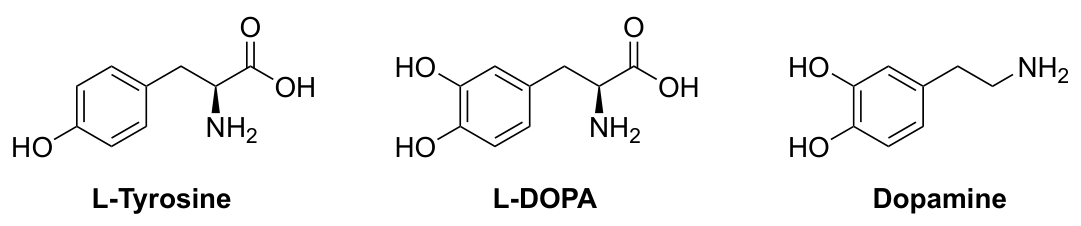
The activity of the tyrosine 3-monooxygenase enzyme is described well by the simplest model of enzyme action, the Michaelis-Menten equation. This gives the rate of the formation (\(r\)) of L-DOPA as a function of the enzyme (E) and substrate Tyr (S) concentrations as follows:
\[ r=\frac{k[E][S]}{K_{\mathrm M}+[S]} \]
The following values of enzymatic turnover frequency (\(k=250\ \mathrm{min^{-1}}\)) and Michaelis constant (\(K_{\mathrm M}=0.49\ \mathrm{mmol\,dm^{-3}}\)) can be used in this task when needed.
Catechol (1,2-dihydroxybenzene) inactivates the enzyme tyrosine 3-monooxygenase irreversibly by turning it into an inactive form. When a carefully purified sample of catechol is mixed with the enzyme with the exclusion of dissolved oxygen, no change is seen at all. So the reaction of catechol with dissolved oxygen, which produces o-quinone, must be important.
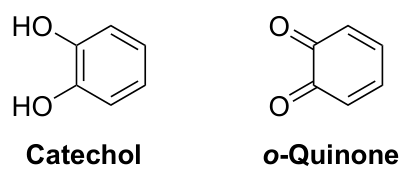
This process can be studied in the absence of the enzyme. A test experiment in a reactor not in contact with ambient air at \(37\,^\circ\mathrm C\) and at pH 7.5 gave the following kinetic data:
| time (min) | catechol concentration (\(\mathrm{mmol\,dm^{-3}}\)) | oxygen concentration (\(\mathrm{mmol\,dm^{-3}}\)) | o-quinone concentration (\(\mu\mathrm{mol\,dm^{-3}}\)) |
|---|---|---|---|
| 0 | 2.00 | 0.200 | 0 |
| 20.0 | 1.97 | 0.170 | 30 |
| 40.0 | 1.94 | 0.140 | 60 |
| 60.0 | 1.91 | 0.111 | 89 |
| 80.0 | 1.88 | 0.083 | 117 |
| 100.0 | 1.85 | 0.054 | 146 |
3.1 — 5.0 pt
Identify the only by-product (which is not one of the molecules shown in the table above) and write the balanced equation of the process with molecular formulas based on the kinetic data.
3.2 — 2.0 pt
Calculate the initial rate (\(r_0\)) of o-quinone formation in this experiment with an appropriate unit.
The rate law of the process was determined by varying the initial concentrations of the reactants. Changing the oxygen concentration did not influence the initial rate of the process. Using different catechol concentrations gave the following initial rates for o-quinone formation:
| catechol concentration (\(\mathrm{mmol\,dm^{-3}}\)) | initial rate of o-quinone formation (\(\mu\mathrm{mol\,dm^{-3}\,min^{-1}}\)) |
|---|---|
| 1.0 | 0.75 |
| 4.0 | 3.0 |
| 6.0 | 4.5 |
| 8.0 | 6.0 |
| 10.0 | 7.5 |
3.3 — 5.0 pt
Determine the rate law of the reaction between catechol and oxygen producing o-quinone. Calculate the rate constant of this process (\(k_{\mathrm{catechol}}\)) with an appropriate unit.
In separate experiments, it was confirmed that neither o-quinone, nor the by-product inactivates the enzyme alone, nor even in combination.
An experiment in which the enzyme is reacted with catechol in the presence of dissolved oxygen did show inactivation, though.
The experiment was done in an open vessel so that any oxygen consumed in the process could be continuously replenished from air. The initial concentration of the enzyme was \(4.2\ \mathrm{nmol\,dm^{-3}}\), the initial concentration of catechol was \(2.00\ \mathrm{mmol\,dm^{-3}}\) at \(37\,^\circ\mathrm C\) and at pH 7.5.
Samples were taken regularly from the enzyme-catechol reaction mixture, and the activity of the enzyme was assayed by adding L-tyrosine, tetrahydrofolic acid and ferrous ions. During the enzyme activity measurements, the concentration of added L-tyrosine was \(10.0\ \mathrm{mmol\,dm^{-3}}\) and the concentration of L-DOPA in each assay sample was measured after 2.0 minutes. The following results were obtained:
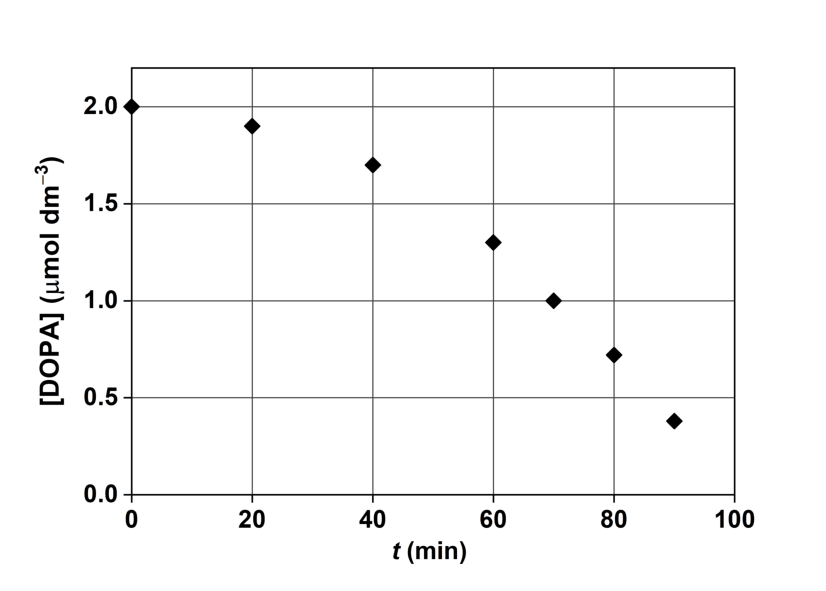
| inactivation reaction time \(t\) (min) | L-DOPA concentration after 2.0 minutes from the start of the assay \([\mathrm{DOPA}]\) (\(\mu\mathrm{mol\,dm^{-3}}\)) |
|---|---|
| 0 | 2.0 |
| 20.0 | 1.9 |
| 40.0 | 1.7 |
| 60.0 | 1.3 |
| 70.0 | 1.00 |
| 80.0 | 0.72 |
| 90.0 | 0.38 |
3.4 — 4.0 pt
Derive a formula that allows you to calculate the actual concentration of active enzyme (\([E]\)) from the data of these experiments in terms of \(k\) (\(=250\ \mathrm{min^{-1}}\)), \(K_{\mathrm M}\) (\(=0.49\ \mathrm{mmol\,dm^{-3}}\)), and/or reagent concentrations.
The change in the active enzyme concentration as a function of time is well described by a parabola (\([E]=[E]_0-k_{\mathrm{obs}}t^2\)), where \(k_{\mathrm{obs}}\) is an observed rate constant (i.e. one that can be written later as a combination of elementary rate constants and initial concentrations), and \([E]_0\) is the initial concentration of the enzyme.
3.5 — 3.0 pt
Give the value of \(k_{\mathrm{obs}}\) with an appropriate unit.
3.6 — 3.0 pt
Determine the first half-life of the enzyme inactivation reaction. Derive a formula that gives the first half-life as a function of the initial enzyme concentration and of \(k_{\mathrm{obs}}\).
The first half-lives for enzyme inactivation were determined using other initial catechol concentrations. The dependences of active enzyme concentrations on time were very well described by parabolas in these cases as well.
| catechol concentration (\(\mathrm{mmol\,dm^{-3}}\)) | first half-life (min) |
|---|---|
| 1.0 | 140 |
| 4.0 | 35 |
| 6.0 | 23 |
| 8.0 | 17.5 |
| 10.0 | 14 |
3.7 — 6.0 pt
Derive a rate equation of the enzyme inactivation process consistent with all the experimental observations.
3.8 — 3.0 pt
What are the reactants of the rate determining step for the enzyme inactivation process? Select the ONLY correct option on the answer sheet.
A) \(\ce{\text{catechol} + O2 ->} \ldots\)
B) \(\ce{\text{catechol} + \text{o-quinone} ->} \ldots\)
C) \(\ce{\text{o-quinone} + O2 ->} \ldots\)
D) \(\ce{\text{enzyme} + 2 \text{catechol} ->} \ldots\)
E) \(\ce{\text{enzyme} + O2 ->} \ldots\)
F) \(\ce{2 \text{catechol} + O2 ->} \ldots\)
G) \(\ce{\text{enzyme} + \text{catechol} ->} \ldots\)
H) \(\ce{\text{enzyme} + \text{by-product} ->} \ldots\)
Official English text of the problem.
Answers
-
3.1: Hydrogen peroxide, \(\ce{H2O2}\), SMILES
OO. \[ \boxed{\ce{C6H6O2 + O2 -> C6H4O2 + H2O2}} \] -
3.2: \(\boxed{r_0=1.5\ \mu\mathrm{mol\,dm^{-3}\,min^{-1}}}\).
-
3.3: \(\boxed{r=k_{\mathrm{catechol}}[\text{catechol}]}\), first order in catechol and zero order in oxygen over the investigated range, with \[ \boxed{k_{\mathrm{catechol}}=7.5\times10^{-4}\ \mathrm{min^{-1}}}. \]
-
3.4: For assay duration \(\tau=2.0\ \mathrm{min}\), \[ \boxed{[E]=\frac{[\mathrm{DOPA}](K_{\mathrm M}+[S])}{k\tau[S]}}. \]
-
3.5: \[ \boxed{k_{\mathrm{obs}}\approx4.2\times10^{-4}\ \mathrm{nmol\,dm^{-3}\,min^{-2}} =4.2\times10^{-13}\ \mathrm{mol\,dm^{-3}\,min^{-2}}}. \]
-
3.6: Approximately \(70\ \mathrm{min}\), with \[ \boxed{t_{1/2}=\sqrt{\frac{[E]_0}{2k_{\mathrm{obs}}}}}. \]
-
3.7: Writing \(C=[\text{catechol}]\), \(Q=[o\text{-quinone}]\), and \(C_0=C(0)\), a consistent rate equation is \[ \boxed{-\frac{d[E]}{dt}=k_I C Q \simeq k_I k_{\mathrm{catechol}}C_0^2t}, \qquad \boxed{k_{\mathrm{obs}}=\frac12 k_I k_{\mathrm{catechol}}C_0^2}. \]
-
3.8: B — catechol + \(o\)-quinone. Catechol:
Oc1ccccc1O; \(o\)-quinone:O=C1C=CC=CC1=O.
Solution
3.1 — Identification of the by-product and balanced reaction
The relevant molecules are catechol (benzene-1,2-diol), Oc1ccccc1O, with formula \(\ce{C6H6O2}\); dioxygen, O=O; and \(o\)-quinone (1,2-benzoquinone), O=C1C=CC=CC1=O, with formula \(\ce{C6H4O2}\).
During the first \(20.0\ \mathrm{min}\),
\[ -\Delta[\text{catechol}] =2.00-1.97 =0.030\ \mathrm{mmol\,dm^{-3}}, \]
\[ -\Delta[\ce{O2}] =0.200-0.170 =0.030\ \mathrm{mmol\,dm^{-3}}, \]
and
\[ \Delta[o\text{-quinone}] =30\ \mu\mathrm{mol\,dm^{-3}} =0.030\ \mathrm{mmol\,dm^{-3}}. \]
Thus catechol consumption, oxygen consumption, and quinone formation occur in a \(1:1:1\) molar ratio.
Converting one molecule of catechol into one molecule of quinone removes two hydrogen atoms. With one molecule of oxygen consumed, atom balance requires the remaining product to be hydrogen peroxide, \(\ce{H2O2}\), OO:
\[ \boxed{\ce{C6H6O2 + O2 -> C6H4O2 + H2O2}}. \]
Both sides contain six carbon atoms, six hydrogen atoms, and four oxygen atoms.
3.2 — Initial rate of quinone formation
The first interval gives the initial slope:
\[ r_0\simeq \frac{[\text{quinone}]_{20}-[\text{quinone}]_0}{20.0-0} =\frac{30-0}{20.0}. \]
Therefore,
\[ \boxed{r_0=1.5\ \mu\mathrm{mol\,dm^{-3}\,min^{-1}}}. \]
The next interval gives the same slope to the precision of the data.
3.3 — Rate law and catechol oxidation rate constant
Write the empirical rate law as
\[ r=k_{\mathrm{catechol}}[\text{catechol}]^a[\ce{O2}]^b. \]
Changing the oxygen concentration does not change the initial rate, so \(b=0\) over the investigated concentration range.
Increasing catechol concentration from \(1.0\) to \(4.0\ \mathrm{mmol\,dm^{-3}}\) increases the rate from \(0.75\) to \(3.0\ \mu\mathrm{mol\,dm^{-3}\,min^{-1}}\), also by a factor of four. All the other measurements show the same proportionality. Hence \(a=1\), and
\[ \boxed{r=k_{\mathrm{catechol}}[\text{catechol}]}. \]
Converting the numerator and denominator to matching concentration units,
\[ k_{\mathrm{catechol}} =\frac{0.75\times10^{-3}\ \mathrm{mmol\,dm^{-3}\,min^{-1}}} {1.0\ \mathrm{mmol\,dm^{-3}}} =\boxed{7.5\times10^{-4}\ \mathrm{min^{-1}}}. \]
The zero order in oxygen applies while oxygen is available under the experimental conditions; it does not imply that oxidation can proceed without oxygen.
3.4 — Active-enzyme concentration from the assay
The assay substrate is L-tyrosine, N[C@@H](Cc1ccc(O)cc1)C(=O)O, and its measured product is L-DOPA, N[C@@H](Cc1ccc(O)c(O)c1)C(=O)O. These SMILES represent the neutral structures shown in the paper, with the \(S\) configuration of both L-amino acids.
Let \(\tau=2.0\ \mathrm{min}\) denote the assay duration, distinct from the inactivation time \(t\). The maximum product concentration is only \(2.0\ \mu\mathrm{mol\,dm^{-3}}\), compared with \(10.0\ \mathrm{mmol\,dm^{-3}}\) of substrate. Thus substrate depletion is at most
\[ \frac{2.0\times10^{-3}}{10.0}\times100\%=0.020\%, \]
and \([S]\) can be treated as constant.
Under the short-assay approximation that the sampled active-enzyme concentration remains effectively constant,
\[ \frac{[\mathrm{DOPA}]}{\tau} =r=\frac{k[E][S]}{K_{\mathrm M}+[S]}. \]
Rearranging gives
\[ \boxed{ [E]=\frac{[\mathrm{DOPA}]}{k\tau} \left(1+\frac{K_{\mathrm M}}{[S]}\right) }. \]
Numerically,
\[ [E] =[\mathrm{DOPA}] \frac{0.49+10.0}{250(2.0)(10.0)} =0.002098[\mathrm{DOPA}], \]
when both concentrations use the same units. Equivalently,
\[ \boxed{ \frac{[E]}{\mathrm{nmol\,dm^{-3}}} =2.098\, \frac{[\mathrm{DOPA}]}{\mu\mathrm{mol\,dm^{-3}}} }. \]
For the initial sample, this gives \(2.098(2.0)=4.196\ \mathrm{nmol\,dm^{-3}}\), agreeing with the stated \(4.2\ \mathrm{nmol\,dm^{-3}}\).
3.5 — Observed rate constant
From
\[ [E]=[E]_0-k_{\mathrm{obs}}t^2, \]
we obtain
\[ k_{\mathrm{obs}}=\frac{[E]_0-[E](t)}{t^2}. \]
At \(t=90.0\ \mathrm{min}\),
\[ [E](90)=2.098(0.38) =0.79724\ \mathrm{nmol\,dm^{-3}}. \]
Therefore,
\[ k_{\mathrm{obs}} =\frac{4.2-0.79724}{(90.0)^2} =4.2009\times10^{-4}\ \mathrm{nmol\,dm^{-3}\,min^{-2}}. \]
To sensible precision,
\[ \boxed{k_{\mathrm{obs}}\approx4.2\times10^{-4}\ \mathrm{nmol\,dm^{-3}\,min^{-2}}}. \]
A fit using all the measurements gives approximately \(4.20\times10^{-4}\) in the same units. Its units are concentration divided by time squared, as required by the parabolic equation.
3.6 — First half-life
The measured DOPA concentration is proportional to active-enzyme concentration. It falls from \(2.0\) to \(1.00\ \mu\mathrm{mol\,dm^{-3}}\) at \(t=70.0\ \mathrm{min}\), so the experimental first half-life is approximately
\[ \boxed{t_{1/2}\approx70\ \mathrm{min}}. \]
In general, substituting \([E](t_{1/2})=[E]_0/2\) gives
\[ \frac{[E]_0}{2}=[E]_0-k_{\mathrm{obs}}t_{1/2}^2. \]
Thus,
\[ \boxed{t_{1/2}=\sqrt{\frac{[E]_0}{2k_{\mathrm{obs}}}}}. \]
Using the coefficient from 3.5 gives
\[ t_{1/2} =\sqrt{\frac{4.2}{2(4.2\times10^{-4})}} =70.7\ \mathrm{min}, \]
consistent with about \(70\ \mathrm{min}\) from the rounded experimental data.
3.7 — Rate equation for enzyme inactivation
Let
\[ C=[\text{catechol}],\qquad Q=[o\text{-quinone}],\qquad C_0=C(0). \]
First, differentiating the observed parabola gives
\[ r_I\equiv-\frac{d[E]}{dt}=2k_{\mathrm{obs}}t. \]
Thus the enzyme-loss rate increases approximately linearly with time.
Next, the half-life data show that
\[ C_0t_{1/2}\approx 140\ \mathrm{mmol\,dm^{-3}\,min}. \]
For example, \(1.0(140)=4.0(35)=8.0(17.5)=10.0(14)=140\); the \(6.0\) entry gives \(138\), consistent with rounding. Therefore,
\[ t_{1/2}\propto C_0^{-1}. \]
At the fixed initial enzyme concentration, the relation from 3.6 then requires
\[ k_{\mathrm{obs}}\propto t_{1/2}^{-2}\propto C_0^2. \]
Writing \(k_{\mathrm{obs}}=aC_0^2\), the directly inferred time-dependent rate equation is
\[ \boxed{r_I=2aC_0^2t}. \]
To express this in terms of reacting species, use quinone formation:
\[ \frac{dQ}{dt}=k_{\mathrm{catechol}}C. \]
For the approximate parabolic model, take \(C\simeq C_0\). This is reasonable over the reported experiment: independent catechol oxidation changes its concentration by only about \(6.5\%\) in \(90\ \mathrm{min}\). With initially negligible quinone,
\[ Q(t)\simeq k_{\mathrm{catechol}}C_0t. \]
A rate law first order in both catechol and quinone therefore gives
\[ r_I=k_I C Q \simeq k_I k_{\mathrm{catechol}}C_0^2t, \]
which has exactly the required time and initial-catechol dependences. Consequently, a consistent rate equation is
\[ \boxed{-\frac{d[E]}{dt}=k_I[\text{catechol}][o\text{-quinone}]}. \]
Integrating under the same approximations,
\[ \boxed{ [E](t)\simeq[E]_0 -\frac12 k_I k_{\mathrm{catechol}}C_0^2t^2 }, \]
so that
\[ \boxed{k_{\mathrm{obs}}=\frac12 k_I k_{\mathrm{catechol}}C_0^2}. \]
Here \(k_I\) is defined for the rate of active-enzyme loss, including any fixed yield of inactivation per slow reaction event. Its fitted value is
\[ k_I =\frac{2(4.2\times10^{-13})} {(7.5\times10^{-4})(2.00\times10^{-3})^2} \approx2.8\times10^{-4}\ \mathrm{dm^3\,mol^{-1}\,min^{-1}}. \]
This model accounts for the observations through slow generation of an inactivating species from catechol and quinone, followed by rapid reaction with the enzyme. Oxygen is needed to generate quinone; quinone and hydrogen peroxide without catechol do not provide this route. The enzyme concentration does not appear in the limiting rate while sufficient active enzyme remains to capture the generated species.
3.8 — Reactants of the rate-determining step
The rate law derived above is proportional to catechol concentration multiplied by quinone concentration. The corresponding listed reactants are therefore
\[ \boxed{\text{B: catechol + }o\text{-quinone}}. \]
Catechol is Oc1ccccc1O, and \(o\)-quinone is O=C1C=CC=CC1=O.
Quinone accumulates approximately linearly with time, so its slow reaction with the nearly constant catechol concentration generates the inactivating species at an increasing rate. This produces the observed quadratic loss of active enzyme.
The solution was checked against the official solution.
IChO 2024 · Theorieaufgabe 3
Tyrosinase
Das Enzym Tyrosin-3-Monooxygenase spielt eine wichtige biologische Rolle, da es den ersten und geschwindigkeitsbestimmenden Schritt der Biosynthese des Neurotransmitters Dopamin katalysiert. In diesem ersten Schritt wird L-DOPA aus der Aminosäure L-Tyrosin (Tyr) in Gegenwart von gelöstem Sauerstoff, Tetrahydrofolsäure und Eisen(II)-Ionen gebildet. In einem nachfolgenden Schritt wandelt ein anderes Enzym L-DOPA in Dopamin um.
Die Aktivität des Enzyms Tyrosin-3-Monooxygenase wird durch das einfachste Modell der Enzymwirkung, die Michaelis-Menten-Gleichung, gut beschrieben. Diese gibt die Bildungsgeschwindigkeit (\(r\)) von L-DOPA in Abhängigkeit von den Konzentrationen des Enzyms (E) und des Substrats Tyr (S) wie folgt an:
\[ r=\frac{k[E][S]}{K_{\mathrm M}+[S]} \]
Die folgenden Werte der Wechselzahl (\(k=250\ \mathrm{min^{-1}}\)) und der Michaelis-Konstante (\(K_{\mathrm M}=0.49\ \mathrm{mmol\,dm^{-3}}\)) können bei Bedarf in dieser Aufgabe verwendet werden.
Brenzcatechin (1,2-Dihydroxybenzol) inaktiviert das Enzym Tyrosin-3-Monooxygenase irreversibel, indem es dieses in eine inaktive Form überführt. Wird eine sorgfältig gereinigte Probe von Brenzcatechin unter Ausschluss von gelöstem Sauerstoff mit dem Enzym gemischt, ist keinerlei Veränderung zu beobachten. Daher muss die Reaktion von Brenzcatechin mit gelöstem Sauerstoff, bei der o-Chinon entsteht, von Bedeutung sein.
Dieser Prozess kann in Abwesenheit des Enzyms untersucht werden. Ein Versuch in einem Reaktor ohne Kontakt zur Umgebungsluft bei \(37\,^\circ\mathrm C\) und pH 7.5 lieferte die folgenden kinetischen Daten:
| Zeit (min) | Brenzcatechinkonzentration (\(\mathrm{mmol\,dm^{-3}}\)) | Sauerstoffkonzentration (\(\mathrm{mmol\,dm^{-3}}\)) | o-Chinonkonzentration (\(\mu\mathrm{mol\,dm^{-3}}\)) |
|---|---|---|---|
| 0 | 2.00 | 0.200 | 0 |
| 20.0 | 1.97 | 0.170 | 30 |
| 40.0 | 1.94 | 0.140 | 60 |
| 60.0 | 1.91 | 0.111 | 89 |
| 80.0 | 1.88 | 0.083 | 117 |
| 100.0 | 1.85 | 0.054 | 146 |
3.1 — 5.0 Pkt.
Identifizieren Sie das einzige Nebenprodukt (das keines der in der obigen Tabelle aufgeführten Moleküle ist) und stellen Sie anhand der kinetischen Daten die ausgeglichene Reaktionsgleichung mit Summenformeln auf.
3.2 — 2.0 Pkt.
Berechnen Sie die Anfangsgeschwindigkeit (\(r_0\)) der Bildung von o-Chinon in diesem Versuch und geben Sie eine geeignete Einheit an.
Das Geschwindigkeitsgesetz des Prozesses wurde durch Variation der Anfangskonzentrationen der Reaktanten bestimmt. Eine Änderung der Sauerstoffkonzentration hatte keinen Einfluss auf die Anfangsgeschwindigkeit des Prozesses. Bei verschiedenen Brenzcatechinkonzentrationen ergaben sich die folgenden Anfangsgeschwindigkeiten der Bildung von o-Chinon:
| Brenzcatechinkonzentration (\(\mathrm{mmol\,dm^{-3}}\)) | Anfangsgeschwindigkeit der Bildung von o-Chinon (\(\mu\mathrm{mol\,dm^{-3}\,min^{-1}}\)) |
|---|---|
| 1.0 | 0.75 |
| 4.0 | 3.0 |
| 6.0 | 4.5 |
| 8.0 | 6.0 |
| 10.0 | 7.5 |
3.3 — 5.0 Pkt.
Bestimmen Sie das Geschwindigkeitsgesetz der Reaktion zwischen Brenzcatechin und Sauerstoff, bei der o-Chinon entsteht. Berechnen Sie die Geschwindigkeitskonstante dieses Prozesses (\(k_{\mathrm{catechol}}\)) und geben Sie eine geeignete Einheit an.
In getrennten Versuchen wurde bestätigt, dass weder o-Chinon noch das Nebenprodukt das Enzym allein oder auch in Kombination inaktivieren.
Ein Versuch, bei dem das Enzym in Gegenwart von gelöstem Sauerstoff mit Brenzcatechin zur Reaktion gebracht wird, zeigte hingegen eine Inaktivierung.
Der Versuch wurde in einem offenen Gefäß durchgeführt, sodass der im Prozess verbrauchte Sauerstoff kontinuierlich aus der Luft nachgeliefert werden konnte. Die Anfangskonzentration des Enzyms betrug \(4.2\ \mathrm{nmol\,dm^{-3}}\), die Anfangskonzentration von Brenzcatechin betrug \(2.00\ \mathrm{mmol\,dm^{-3}}\) bei \(37\,^\circ\mathrm C\) und pH 7.5.
Aus dem Enzym-Brenzcatechin-Reaktionsgemisch wurden regelmäßig Proben entnommen, und die Aktivität des Enzyms wurde durch Zugabe von L-Tyrosin, Tetrahydrofolsäure und Eisen(II)-Ionen bestimmt. Bei den Enzymaktivitätsmessungen betrug die Konzentration des zugesetzten L-Tyrosins \(10.0\ \mathrm{mmol\,dm^{-3}}\), und die Konzentration von L-DOPA wurde in jeder Messprobe nach 2.0 Minuten gemessen. Die folgenden Ergebnisse wurden erhalten:
| Reaktionszeit der Inaktivierung \(t\) (min) | L-DOPA-Konzentration 2.0 Minuten nach Beginn der Aktivitätsmessung \([\mathrm{DOPA}]\) (\(\mu\mathrm{mol\,dm^{-3}}\)) |
|---|---|
| 0 | 2.0 |
| 20.0 | 1.9 |
| 40.0 | 1.7 |
| 60.0 | 1.3 |
| 70.0 | 1.00 |
| 80.0 | 0.72 |
| 90.0 | 0.38 |
3.4 — 4.0 Pkt.
Leiten Sie eine Formel her, mit der Sie die tatsächliche Konzentration an aktivem Enzym (\([E]\)) aus den Daten dieser Versuche in Abhängigkeit von \(k\) (\(=250\ \mathrm{min^{-1}}\)), \(K_{\mathrm M}\) (\(=0.49\ \mathrm{mmol\,dm^{-3}}\)) und/oder den Reagenzkonzentrationen berechnen können.
Die Änderung der Konzentration an aktivem Enzym in Abhängigkeit von der Zeit wird durch eine Parabel (\([E]=[E]_0-k_{\mathrm{obs}}t^2\)) gut beschrieben. Dabei ist \(k_{\mathrm{obs}}\) eine beobachtete Geschwindigkeitskonstante (d. h. eine Konstante, die später als Kombination von Geschwindigkeitskonstanten elementarer Reaktionsschritte und Anfangskonzentrationen geschrieben werden kann), und \([E]_0\) ist die Anfangskonzentration des Enzyms.
3.5 — 3.0 Pkt.
Geben Sie den Wert von \(k_{\mathrm{obs}}\) mit einer geeigneten Einheit an.
3.6 — 3.0 Pkt.
Bestimmen Sie die erste Halbwertszeit der Enzyminaktivierungsreaktion. Leiten Sie eine Formel her, die die erste Halbwertszeit in Abhängigkeit von der Anfangskonzentration des Enzyms und von \(k_{\mathrm{obs}}\) angibt.
Die ersten Halbwertszeiten der Enzyminaktivierung wurden auch bei anderen Anfangskonzentrationen von Brenzcatechin bestimmt. Die Zeitabhängigkeit der Konzentrationen an aktivem Enzym wurde auch in diesen Fällen sehr gut durch Parabeln beschrieben.
| Brenzcatechinkonzentration (\(\mathrm{mmol\,dm^{-3}}\)) | erste Halbwertszeit (min) |
|---|---|
| 1.0 | 140 |
| 4.0 | 35 |
| 6.0 | 23 |
| 8.0 | 17.5 |
| 10.0 | 14 |
3.7 — 6.0 Pkt.
Leiten Sie eine Geschwindigkeitsgleichung für den Enzyminaktivierungsprozess her, die mit allen experimentellen Beobachtungen im Einklang steht.
3.8 — 3.0 Pkt.
Welche Reaktanten sind am geschwindigkeitsbestimmenden Schritt des Enzyminaktivierungsprozesses beteiligt? Wählen Sie die EINZIGE richtige Option auf dem Antwortblatt aus.
A) \(\ce{\text{Brenzcatechin} + O2 ->} \ldots\)
B) \(\ce{\text{Brenzcatechin} + \text{o-Chinon} ->} \ldots\)
C) \(\ce{\text{o-Chinon} + O2 ->} \ldots\)
D) \(\ce{\text{Enzym} + 2 \text{Brenzcatechin} ->} \ldots\)
E) \(\ce{\text{Enzym} + O2 ->} \ldots\)
F) \(\ce{2 \text{Brenzcatechin} + O2 ->} \ldots\)
G) \(\ce{\text{Enzym} + \text{Brenzcatechin} ->} \ldots\)
H) \(\ce{\text{Enzym} + \text{Nebenprodukt} ->} \ldots\)
Aufgabentext aus dem offiziellen englischen Text übersetzt.
Antworten
-
3.1: Wasserstoffperoxid, \(\ce{H2O2}\), SMILES
OO. \[ \boxed{\ce{C6H6O2 + O2 -> C6H4O2 + H2O2}} \] -
3.2: \(\boxed{r_0=1.5\ \mu\mathrm{mol\,dm^{-3}\,min^{-1}}}\).
-
3.3: \(\boxed{r=k_{\mathrm{catechol}}[\text{Brenzcatechin}]}\), erste Ordnung bezüglich Brenzcatechin und nullte Ordnung bezüglich Sauerstoff im untersuchten Bereich, mit \[ \boxed{k_{\mathrm{catechol}}=7.5\times10^{-4}\ \mathrm{min^{-1}}}. \]
-
3.4: Für eine Messdauer von \(\tau=2.0\ \mathrm{min}\), \[ \boxed{[E]=\frac{[\mathrm{DOPA}](K_{\mathrm M}+[S])}{k\tau[S]}}. \]
-
3.5: \[ \boxed{k_{\mathrm{obs}}\approx4.2\times10^{-4}\ \mathrm{nmol\,dm^{-3}\,min^{-2}} =4.2\times10^{-13}\ \mathrm{mol\,dm^{-3}\,min^{-2}}}. \]
-
3.6: Ungefähr \(70\ \mathrm{min}\), mit \[ \boxed{t_{1/2}=\sqrt{\frac{[E]_0}{2k_{\mathrm{obs}}}}}. \]
-
3.7: Mit \(C=[\text{Brenzcatechin}]\), \(Q=[o\text{-Chinon}]\) und \(C_0=C(0)\) lautet eine mit den Beobachtungen vereinbare Geschwindigkeitsgleichung \[ \boxed{-\frac{d[E]}{dt}=k_I C Q \simeq k_I k_{\mathrm{catechol}}C_0^2t}, \qquad \boxed{k_{\mathrm{obs}}=\frac12 k_I k_{\mathrm{catechol}}C_0^2}. \]
-
3.8: B — Brenzcatechin + \(o\)-Chinon. Brenzcatechin:
Oc1ccccc1O; \(o\)-Chinon:O=C1C=CC=CC1=O.
Lösung
3.1 — Identifizierung des Nebenprodukts und ausgeglichene Reaktionsgleichung
Die relevanten Moleküle sind Brenzcatechin (Benzol-1,2-diol), Oc1ccccc1O, mit der Summenformel \(\ce{C6H6O2}\); molekularer Sauerstoff, O=O; und \(o\)-Chinon (1,2-Benzochinon), O=C1C=CC=CC1=O, mit der Summenformel \(\ce{C6H4O2}\).
Während der ersten \(20.0\ \mathrm{min}\) gilt
\[ -\Delta[\text{Brenzcatechin}] =2.00-1.97 =0.030\ \mathrm{mmol\,dm^{-3}}, \]
\[ -\Delta[\ce{O2}] =0.200-0.170 =0.030\ \mathrm{mmol\,dm^{-3}}, \]
und
\[ \Delta[o\text{-Chinon}] =30\ \mu\mathrm{mol\,dm^{-3}} =0.030\ \mathrm{mmol\,dm^{-3}}. \]
Somit erfolgen der Verbrauch von Brenzcatechin, der Verbrauch von Sauerstoff und die Bildung von Chinon im Stoffmengenverhältnis \(1:1:1\).
Bei der Umwandlung eines Moleküls Brenzcatechin in ein Molekül Chinon werden zwei Wasserstoffatome entfernt. Da dabei ein Molekül Sauerstoff verbraucht wird, muss das verbleibende Produkt gemäß der Atombilanz Wasserstoffperoxid, \(\ce{H2O2}\), OO, sein:
\[ \boxed{\ce{C6H6O2 + O2 -> C6H4O2 + H2O2}}. \]
Beide Seiten enthalten sechs Kohlenstoffatome, sechs Wasserstoffatome und vier Sauerstoffatome.
3.2 — Anfangsgeschwindigkeit der Chinonbildung
Das erste Zeitintervall liefert die Anfangssteigung:
\[ r_0\simeq \frac{[\text{Chinon}]_{20}-[\text{Chinon}]_0}{20.0-0} =\frac{30-0}{20.0}. \]
Daher gilt
\[ \boxed{r_0=1.5\ \mu\mathrm{mol\,dm^{-3}\,min^{-1}}}. \]
Das nächste Zeitintervall liefert im Rahmen der Genauigkeit der Daten dieselbe Steigung.
3.3 — Geschwindigkeitsgesetz und Geschwindigkeitskonstante der Brenzcatechinoxidation
Das empirische Geschwindigkeitsgesetz sei
\[ r=k_{\mathrm{catechol}}[\text{Brenzcatechin}]^a[\ce{O2}]^b. \]
Eine Änderung der Sauerstoffkonzentration verändert die Anfangsgeschwindigkeit nicht, daher gilt \(b=0\) im untersuchten Konzentrationsbereich.
Eine Erhöhung der Brenzcatechinkonzentration von \(1.0\) auf \(4.0\ \mathrm{mmol\,dm^{-3}}\) erhöht die Geschwindigkeit von \(0.75\) auf \(3.0\ \mu\mathrm{mol\,dm^{-3}\,min^{-1}}\), also ebenfalls um den Faktor vier. Alle anderen Messungen zeigen dieselbe Proportionalität. Somit gilt \(a=1\), und
\[ \boxed{r=k_{\mathrm{catechol}}[\text{Brenzcatechin}]}. \]
Nach Umrechnung von Zähler und Nenner auf übereinstimmende Konzentrationseinheiten ergibt sich
\[ k_{\mathrm{catechol}} =\frac{0.75\times10^{-3}\ \mathrm{mmol\,dm^{-3}\,min^{-1}}} {1.0\ \mathrm{mmol\,dm^{-3}}} =\boxed{7.5\times10^{-4}\ \mathrm{min^{-1}}}. \]
Die nullte Ordnung bezüglich Sauerstoff gilt, solange unter den Versuchsbedingungen Sauerstoff verfügbar ist; sie bedeutet nicht, dass die Oxidation ohne Sauerstoff ablaufen kann.
3.4 — Konzentration an aktivem Enzym aus der Aktivitätsmessung
Das Substrat der Aktivitätsmessung ist L-Tyrosin, N[C@@H](Cc1ccc(O)cc1)C(=O)O, und das gemessene Produkt ist L-DOPA, N[C@@H](Cc1ccc(O)c(O)c1)C(=O)O. Diese SMILES stellen die im Aufgabenblatt gezeigten neutralen Strukturen mit der \(S\)-Konfiguration beider L-Aminosäuren dar.
Die Messdauer sei \(\tau=2.0\ \mathrm{min}\), im Unterschied zur Inaktivierungszeit \(t\). Die maximale Produktkonzentration beträgt nur \(2.0\ \mu\mathrm{mol\,dm^{-3}}\), verglichen mit einer Substratkonzentration von \(10.0\ \mathrm{mmol\,dm^{-3}}\). Somit beträgt die Abnahme der Substratkonzentration höchstens
\[ \frac{2.0\times10^{-3}}{10.0}\times100\%=0.020\%, \]
und \([S]\) kann als konstant betrachtet werden.
Unter der für die kurze Messdauer geltenden Näherung, dass die Konzentration an aktivem Enzym in der entnommenen Probe praktisch konstant bleibt, gilt
\[ \frac{[\mathrm{DOPA}]}{\tau} =r=\frac{k[E][S]}{K_{\mathrm M}+[S]}. \]
Durch Umstellen erhält man
\[ \boxed{ [E]=\frac{[\mathrm{DOPA}]}{k\tau} \left(1+\frac{K_{\mathrm M}}{[S]}\right) }. \]
Numerisch ergibt sich
\[ [E] =[\mathrm{DOPA}] \frac{0.49+10.0}{250(2.0)(10.0)} =0.002098[\mathrm{DOPA}], \]
wenn beide Konzentrationen in derselben Einheit angegeben werden. Gleichwertig gilt
\[ \boxed{ \frac{[E]}{\mathrm{nmol\,dm^{-3}}} =2.098\, \frac{[\mathrm{DOPA}]}{\mu\mathrm{mol\,dm^{-3}}} }. \]
Für die Anfangsprobe ergibt dies \(2.098(2.0)=4.196\ \mathrm{nmol\,dm^{-3}}\), in Übereinstimmung mit den angegebenen \(4.2\ \mathrm{nmol\,dm^{-3}}\).
3.5 — Beobachtete Geschwindigkeitskonstante
Aus
\[ [E]=[E]_0-k_{\mathrm{obs}}t^2, \]
erhalten wir
\[ k_{\mathrm{obs}}=\frac{[E]_0-[E](t)}{t^2}. \]
Bei \(t=90.0\ \mathrm{min}\) gilt
\[ [E](90)=2.098(0.38) =0.79724\ \mathrm{nmol\,dm^{-3}}. \]
Daher ergibt sich
\[ k_{\mathrm{obs}} =\frac{4.2-0.79724}{(90.0)^2} =4.2009\times10^{-4}\ \mathrm{nmol\,dm^{-3}\,min^{-2}}. \]
Mit sinnvoller Genauigkeit gilt
\[ \boxed{k_{\mathrm{obs}}\approx4.2\times10^{-4}\ \mathrm{nmol\,dm^{-3}\,min^{-2}}}. \]
Eine Anpassung unter Verwendung aller Messwerte ergibt ungefähr \(4.20\times10^{-4}\) in denselben Einheiten. Die Einheit ist Konzentration dividiert durch das Quadrat der Zeit, wie es die Parabelgleichung erfordert.
3.6 — Erste Halbwertszeit
Die gemessene DOPA-Konzentration ist proportional zur Konzentration an aktivem Enzym. Sie fällt bei \(t=70.0\ \mathrm{min}\) von \(2.0\) auf \(1.00\ \mu\mathrm{mol\,dm^{-3}}\), sodass für die experimentell bestimmte erste Halbwertszeit näherungsweise gilt:
\[ \boxed{t_{1/2}\approx70\ \mathrm{min}}. \]
Allgemein ergibt das Einsetzen von \([E](t_{1/2})=[E]_0/2\)
\[ \frac{[E]_0}{2}=[E]_0-k_{\mathrm{obs}}t_{1/2}^2. \]
Somit gilt
\[ \boxed{t_{1/2}=\sqrt{\frac{[E]_0}{2k_{\mathrm{obs}}}}}. \]
Mit dem Koeffizienten aus 3.5 erhält man
\[ t_{1/2} =\sqrt{\frac{4.2}{2(4.2\times10^{-4})}} =70.7\ \mathrm{min}, \]
in Übereinstimmung mit den etwa \(70\ \mathrm{min}\) aus den gerundeten experimentellen Daten.
3.7 — Geschwindigkeitsgleichung der Enzyminaktivierung
Es sei
\[ C=[\text{Brenzcatechin}],\qquad Q=[o\text{-Chinon}],\qquad C_0=C(0). \]
Zunächst ergibt die Ableitung der beobachteten Parabel
\[ r_I\equiv-\frac{d[E]}{dt}=2k_{\mathrm{obs}}t. \]
Somit nimmt die Geschwindigkeit des Verlusts an aktivem Enzym annähernd linear mit der Zeit zu.
Weiterhin zeigen die Halbwertszeitdaten, dass
\[ C_0t_{1/2}\approx 140\ \mathrm{mmol\,dm^{-3}\,min}. \]
Beispielsweise gilt \(1.0(140)=4.0(35)=8.0(17.5)=10.0(14)=140\); der Eintrag für \(6.0\) ergibt \(138\), was mit der Rundung vereinbar ist. Daher gilt
\[ t_{1/2}\propto C_0^{-1}. \]
Bei der festgelegten Anfangskonzentration des Enzyms erfordert die Beziehung aus 3.6 dann
\[ k_{\mathrm{obs}}\propto t_{1/2}^{-2}\propto C_0^2. \]
Mit \(k_{\mathrm{obs}}=aC_0^2\) lautet die unmittelbar daraus abgeleitete zeitabhängige Geschwindigkeitsgleichung
\[ \boxed{r_I=2aC_0^2t}. \]
Um diese durch die reagierenden Spezies auszudrücken, verwenden wir die Chinonbildung:
\[ \frac{dQ}{dt}=k_{\mathrm{catechol}}C. \]
Für das näherungsweise parabolische Modell wird \(C\simeq C_0\) angenommen. Dies ist über die Dauer des beschriebenen Versuchs angemessen: Die unabhängig ablaufende Brenzcatechinoxidation verändert dessen Konzentration in \(90\ \mathrm{min}\) nur um etwa \(6.5\%\). Bei einer anfangs vernachlässigbaren Chinonkonzentration gilt
\[ Q(t)\simeq k_{\mathrm{catechol}}C_0t. \]
Ein Geschwindigkeitsgesetz erster Ordnung sowohl bezüglich Brenzcatechin als auch bezüglich Chinon ergibt daher
\[ r_I=k_I C Q \simeq k_I k_{\mathrm{catechol}}C_0^2t, \]
was genau die erforderlichen Abhängigkeiten von der Zeit und der Anfangskonzentration von Brenzcatechin aufweist. Folglich lautet eine mit den Beobachtungen vereinbare Geschwindigkeitsgleichung
\[ \boxed{-\frac{d[E]}{dt}=k_I[\text{Brenzcatechin}][o\text{-Chinon}]}. \]
Integration unter denselben Näherungen liefert
\[ \boxed{ [E](t)\simeq[E]_0 -\frac12 k_I k_{\mathrm{catechol}}C_0^2t^2 }, \]
sodass
\[ \boxed{k_{\mathrm{obs}}=\frac12 k_I k_{\mathrm{catechol}}C_0^2}. \]
Hier ist \(k_I\) für die Geschwindigkeit des Verlusts an aktivem Enzym definiert und schließt eine etwaige feste Inaktivierungsausbeute pro langsamem Reaktionsereignis ein. Sein durch Anpassung ermittelter Wert beträgt
\[ k_I =\frac{2(4.2\times10^{-13})} {(7.5\times10^{-4})(2.00\times10^{-3})^2} \approx2.8\times10^{-4}\ \mathrm{dm^3\,mol^{-1}\,min^{-1}}. \]
Dieses Modell erklärt die Beobachtungen durch die langsame Bildung einer inaktivierenden Spezies aus Brenzcatechin und Chinon, gefolgt von einer schnellen Reaktion mit dem Enzym. Sauerstoff wird benötigt, um Chinon zu bilden; Chinon und Wasserstoffperoxid ermöglichen diesen Reaktionsweg ohne Brenzcatechin nicht. Die Enzymkonzentration tritt im Ausdruck für die geschwindigkeitsbestimmende Reaktion nicht auf, solange genügend aktives Enzym verbleibt, um die gebildete Spezies abzufangen.
3.8 — Reaktanten des geschwindigkeitsbestimmenden Schritts
Das oben hergeleitete Geschwindigkeitsgesetz ist proportional zum Produkt der Brenzcatechinkonzentration und der Chinonkonzentration. Die entsprechenden aufgeführten Reaktanten sind daher
\[ \boxed{\text{B: Brenzcatechin + }o\text{-Chinon}}. \]
Brenzcatechin ist Oc1ccccc1O, und \(o\)-Chinon ist O=C1C=CC=CC1=O.
Chinon reichert sich annähernd linear mit der Zeit an, sodass seine langsame Reaktion bei nahezu konstanter Brenzcatechinkonzentration die inaktivierende Spezies mit zunehmender Geschwindigkeit erzeugt. Dies führt zum beobachteten quadratischen Verlust an aktivem Enzym.
Die Lösung wurde mit der offiziellen Lösung abgeglichen.
IChO 2024 · Teori sorusu 3
Tirozinaz
Tirozin 3-monooksijenaz enzimi, nörotransmitter dopaminin biyosentezindeki ilk ve hız sınırlayıcı basamağı katalizlediği için önemli bir biyolojik role sahiptir. Bu ilk basamakta, çözünmüş oksijen, tetrahidrofolik asit ve demir(II) iyonları varlığında L-tirozin (Tyr) amino asidinden L-DOPA üretilir. Sonraki bir basamakta başka bir enzim, L-DOPA'yı dopamine dönüştürür.
Tirozin 3-monooksijenaz enziminin aktivitesi, enzim etkisinin en basit modeli olan Michaelis-Menten denklemiyle iyi bir şekilde açıklanır. Bu denklem, L-DOPA oluşum hızını (\(r\)), enzim (E) ve substrat Tyr (S) derişimlerinin bir fonksiyonu olarak aşağıdaki şekilde verir:
\[ r=\frac{k[E][S]}{K_{\mathrm M}+[S]} \]
Bu soruda gerektiğinde enzimatik çevrim frekansı (\(k=250\ \mathrm{min^{-1}}\)) ve Michaelis sabiti (\(K_{\mathrm M}=0.49\ \mathrm{mmol\,dm^{-3}}\)) için verilen bu değerler kullanılabilir.
Katekol (1,2-dihidroksibenzen), tirozin 3-monooksijenaz enzimini inaktif bir forma dönüştürerek geri dönüşümsüz biçimde inaktive eder. Özenle saflaştırılmış bir katekol örneği, çözünmüş oksijenin bulunmadığı koşullarda enzimle karıştırıldığında hiçbir değişiklik gözlenmez. Dolayısıyla katekolün çözünmüş oksijenle tepkimeye girerek o-kinon oluşturması önemli olmalıdır.
Bu süreç, enzim yokluğunda incelenebilir. Ortam havasıyla temas etmeyen bir reaktörde, \(37\,^\circ\mathrm C\) sıcaklıkta ve pH 7.5'te yapılan bir deneme deneyinde aşağıdaki kinetik veriler elde edilmiştir:
| zaman (min) | katekol derişimi (\(\mathrm{mmol\,dm^{-3}}\)) | oksijen derişimi (\(\mathrm{mmol\,dm^{-3}}\)) | o-kinon derişimi (\(\mu\mathrm{mol\,dm^{-3}}\)) |
|---|---|---|---|
| 0 | 2.00 | 0.200 | 0 |
| 20.0 | 1.97 | 0.170 | 30 |
| 40.0 | 1.94 | 0.140 | 60 |
| 60.0 | 1.91 | 0.111 | 89 |
| 80.0 | 1.88 | 0.083 | 117 |
| 100.0 | 1.85 | 0.054 | 146 |
3.1 — 5.0 puan
Tek yan ürünü (yukarıdaki tabloda gösterilen moleküllerden biri değildir) belirleyiniz ve kinetik verilere dayanarak sürecin denkleştirilmiş tepkime denklemini molekül formülleriyle yazınız.
3.2 — 2.0 puan
Bu deneyde o-kinon oluşumunun başlangıç hızını (\(r_0\)) uygun bir birimle hesaplayınız.
Sürecin hız yasası, reaktanların başlangıç derişimleri değiştirilerek belirlenmiştir. Oksijen derişiminin değiştirilmesi sürecin başlangıç hızını etkilememiştir. Farklı katekol derişimleri kullanıldığında o-kinon oluşumu için aşağıdaki başlangıç hızları elde edilmiştir:
| katekol derişimi (\(\mathrm{mmol\,dm^{-3}}\)) | o-kinon oluşumunun başlangıç hızı (\(\mu\mathrm{mol\,dm^{-3}\,min^{-1}}\)) |
|---|---|
| 1.0 | 0.75 |
| 4.0 | 3.0 |
| 6.0 | 4.5 |
| 8.0 | 6.0 |
| 10.0 | 7.5 |
3.3 — 5.0 puan
Katekol ile oksijen arasında gerçekleşen ve o-kinon üreten tepkimenin hız yasasını belirleyiniz. Bu sürecin hız sabitini (\(k_{\mathrm{catechol}}\)) uygun bir birimle hesaplayınız.
Ayrı deneylerde, ne o-kinonun ne de yan ürünün tek başına veya birlikte enzimi inaktive ettiği doğrulanmıştır.
Bununla birlikte, enzimin çözünmüş oksijen varlığında katekolle tepkimeye sokulduğu bir deneyde inaktivasyon gözlenmiştir.
Deney, süreçte tüketilen oksijenin havadan sürekli olarak yenilenebilmesi için açık bir kapta yapılmıştır. \(37\,^\circ\mathrm C\) sıcaklıkta ve pH 7.5'te enzimin başlangıç derişimi \(4.2\ \mathrm{nmol\,dm^{-3}}\), katekolün başlangıç derişimi ise \(2.00\ \mathrm{mmol\,dm^{-3}}\) olmuştur.
Enzim-katekol tepkime karışımından düzenli olarak örnekler alınmış ve L-tirozin, tetrahidrofolik asit ve demir(II) iyonları eklenerek enzim aktivitesi tayin edilmiştir. Enzim aktivitesi ölçümleri sırasında eklenen L-tirozinin derişimi \(10.0\ \mathrm{mmol\,dm^{-3}}\) olmuş ve her bir tayin örneğindeki L-DOPA derişimi 2.0 dakika sonra ölçülmüştür. Aşağıdaki sonuçlar elde edilmiştir:
| inaktivasyon tepkimesi süresi \(t\) (min) | tayinin başlangıcından 2.0 dakika sonraki L-DOPA derişimi \([\mathrm{DOPA}]\) (\(\mu\mathrm{mol\,dm^{-3}}\)) |
|---|---|
| 0 | 2.0 |
| 20.0 | 1.9 |
| 40.0 | 1.7 |
| 60.0 | 1.3 |
| 70.0 | 1.00 |
| 80.0 | 0.72 |
| 90.0 | 0.38 |
3.4 — 4.0 puan
Bu deneylerin verilerinden, \(k\) (\(=250\ \mathrm{min^{-1}}\)), \(K_{\mathrm M}\) (\(=0.49\ \mathrm{mmol\,dm^{-3}}\)) ve/veya reaktif derişimleri cinsinden aktif enzimin o andaki derişimini (\([E]\)) hesaplamanızı sağlayan bir formül türetiniz.
Aktif enzim derişiminin zamana bağlı değişimi bir parabolle (\([E]=[E]_0-k_{\mathrm{obs}}t^2\)) iyi bir şekilde açıklanır; burada \(k_{\mathrm{obs}}\) gözlenen bir hız sabitidir (yani daha sonra elementer hız sabitleri ile başlangıç derişimlerinin bir birleşimi olarak yazılabilen bir sabit) ve \([E]_0\) enzimin başlangıç derişimidir.
3.5 — 3.0 puan
\(k_{\mathrm{obs}}\) değerini uygun bir birimle veriniz.
3.6 — 3.0 puan
Enzim inaktivasyonu tepkimesinin ilk yarı ömrünü belirleyiniz. İlk yarı ömrü, başlangıç enzim derişiminin ve \(k_{\mathrm{obs}}\)'un bir fonksiyonu olarak veren bir formül türetiniz.
Enzim inaktivasyonunun ilk yarı ömürleri, başka başlangıç katekol derişimleri kullanılarak belirlenmiştir. Bu durumlarda da aktif enzim derişimlerinin zamana bağımlılığı parabollerle çok iyi açıklanmıştır.
| katekol derişimi (\(\mathrm{mmol\,dm^{-3}}\)) | ilk yarı ömür (min) |
|---|---|
| 1.0 | 140 |
| 4.0 | 35 |
| 6.0 | 23 |
| 8.0 | 17.5 |
| 10.0 | 14 |
3.7 — 6.0 puan
Enzim inaktivasyonu süreci için tüm deneysel gözlemlerle tutarlı bir hız denklemi türetiniz.
3.8 — 3.0 puan
Enzim inaktivasyonu sürecinin hız belirleyici basamağının reaktanları nelerdir? Cevap kâğıdında doğru olan TEK seçeneği işaretleyiniz.
A) \(\ce{\text{katekol} + O2 ->} \ldots\)
B) \(\ce{\text{katekol} + \text{o-kinon} ->} \ldots\)
C) \(\ce{\text{o-kinon} + O2 ->} \ldots\)
D) \(\ce{\text{enzim} + 2 \text{katekol} ->} \ldots\)
E) \(\ce{\text{enzim} + O2 ->} \ldots\)
F) \(\ce{2 \text{katekol} + O2 ->} \ldots\)
G) \(\ce{\text{enzim} + \text{katekol} ->} \ldots\)
H) \(\ce{\text{enzim} + \text{yan ürün} ->} \ldots\)
Soru metni resmi İngilizce metinden çevrilmiştir.
Cevaplar
-
3.1: Hidrojen peroksit, \(\ce{H2O2}\), SMILES
OO. \[ \boxed{\ce{C6H6O2 + O2 -> C6H4O2 + H2O2}} \] -
3.2: \(\boxed{r_0=1.5\ \mu\mathrm{mol\,dm^{-3}\,min^{-1}}}\).
-
3.3: \(\boxed{r=k_{\mathrm{catechol}}[\text{katekol}]}\); incelenen aralıkta katekole göre birinci, oksijene göre sıfırıncı derecedendir ve hız sabiti \[ \boxed{k_{\mathrm{catechol}}=7.5\times10^{-4}\ \mathrm{min^{-1}}}. \]
-
3.4: \(\tau=2.0\ \mathrm{min}\) tayin süresi için, \[ \boxed{[E]=\frac{[\mathrm{DOPA}](K_{\mathrm M}+[S])}{k\tau[S]}}. \]
-
3.5: \[ \boxed{k_{\mathrm{obs}}\approx4.2\times10^{-4}\ \mathrm{nmol\,dm^{-3}\,min^{-2}} =4.2\times10^{-13}\ \mathrm{mol\,dm^{-3}\,min^{-2}}}. \]
-
3.6: Yaklaşık \(70\ \mathrm{min}\); formülü \[ \boxed{t_{1/2}=\sqrt{\frac{[E]_0}{2k_{\mathrm{obs}}}}}. \]
-
3.7: \(C=[\text{katekol}]\), \(Q=[o\text{-kinon}]\) ve \(C_0=C(0)\) olarak yazıldığında, tutarlı bir hız denklemi \[ \boxed{-\frac{d[E]}{dt}=k_I C Q \simeq k_I k_{\mathrm{catechol}}C_0^2t}, \qquad \boxed{k_{\mathrm{obs}}=\frac12 k_I k_{\mathrm{catechol}}C_0^2}. \]
-
3.8: B — katekol + \(o\)-kinon. Katekol:
Oc1ccccc1O; \(o\)-kinon:O=C1C=CC=CC1=O.
Çözüm
3.1 — Yan ürünün belirlenmesi ve denkleştirilmiş tepkime
İlgili moleküller; formülü \(\ce{C6H6O2}\) olan katekol (benzen-1,2-diol), Oc1ccccc1O; dioksijen, O=O; ve formülü \(\ce{C6H4O2}\) olan \(o\)-kinon (1,2-benzokinon), O=C1C=CC=CC1=O'dur.
İlk \(20.0\ \mathrm{min}\) boyunca,
\[ -\Delta[\text{katekol}] =2.00-1.97 =0.030\ \mathrm{mmol\,dm^{-3}}, \]
\[ -\Delta[\ce{O2}] =0.200-0.170 =0.030\ \mathrm{mmol\,dm^{-3}}, \]
ve
\[ \Delta[o\text{-kinon}] =30\ \mu\mathrm{mol\,dm^{-3}} =0.030\ \mathrm{mmol\,dm^{-3}}. \]
Dolayısıyla katekol tüketimi, oksijen tüketimi ve kinon oluşumu \(1:1:1\) mol oranında gerçekleşir.
Bir katekol molekülünün bir kinon molekülüne dönüşmesiyle iki hidrojen atomu uzaklaşır. Bir oksijen molekülü tüketildiğine göre atom dengesi, diğer ürünün hidrojen peroksit, \(\ce{H2O2}\), OO olmasını gerektirir:
\[ \boxed{\ce{C6H6O2 + O2 -> C6H4O2 + H2O2}}. \]
Her iki tarafta da altı karbon atomu, altı hidrojen atomu ve dört oksijen atomu bulunur.
3.2 — Kinon oluşumunun başlangıç hızı
İlk zaman aralığı başlangıç eğimini verir:
\[ r_0\simeq \frac{[\text{kinon}]_{20}-[\text{kinon}]_0}{20.0-0} =\frac{30-0}{20.0}. \]
Dolayısıyla,
\[ \boxed{r_0=1.5\ \mu\mathrm{mol\,dm^{-3}\,min^{-1}}}. \]
Sonraki zaman aralığı, verilerin hassasiyeti dâhilinde aynı eğimi verir.
3.3 — Hız yasası ve katekol yükseltgenmesinin hız sabiti
Ampirik hız yasasını şu şekilde yazalım:
\[ r=k_{\mathrm{catechol}}[\text{katekol}]^a[\ce{O2}]^b. \]
Oksijen derişiminin değiştirilmesi başlangıç hızını değiştirmez; dolayısıyla incelenen derişim aralığında \(b=0\)'dır.
Katekol derişiminin \(1.0\)'dan \(4.0\ \mathrm{mmol\,dm^{-3}}\)'e çıkarılması, hızı \(0.75\)'ten \(3.0\ \mu\mathrm{mol\,dm^{-3}\,min^{-1}}\)'e, yani yine dört katına çıkarır. Diğer tüm ölçümler de aynı orantıyı gösterir. Bu nedenle \(a=1\)'dir ve
\[ \boxed{r=k_{\mathrm{catechol}}[\text{katekol}]}. \]
Pay ve paydayı birbiriyle uyumlu derişim birimlerine dönüştürürsek,
\[ k_{\mathrm{catechol}} =\frac{0.75\times10^{-3}\ \mathrm{mmol\,dm^{-3}\,min^{-1}}} {1.0\ \mathrm{mmol\,dm^{-3}}} =\boxed{7.5\times10^{-4}\ \mathrm{min^{-1}}}. \]
Oksijene göre sıfırıncı dereceden olma durumu, deney koşullarında oksijen mevcut olduğu sürece geçerlidir; yükseltgenmenin oksijen olmadan ilerleyebileceği anlamına gelmez.
3.4 — Tayin verilerinden aktif enzim derişiminin bulunması
Tayinde kullanılan substrat L-tirozin, N[C@@H](Cc1ccc(O)cc1)C(=O)O, ölçülen ürün ise L-DOPA, N[C@@H](Cc1ccc(O)c(O)c1)C(=O)O'dır. Bu SMILES gösterimleri, her iki L-amino asidin de \(S\) konfigürasyonunda olduğu, metinde gösterilen nötr yapıları temsil eder.
\(\tau=2.0\ \mathrm{min}\), inaktivasyon süresi \(t\)'den farklı olan tayin süresini göstersin. \(10.0\ \mathrm{mmol\,dm^{-3}}\) substrat derişimine karşılık, en yüksek ürün derişimi yalnızca \(2.0\ \mu\mathrm{mol\,dm^{-3}}\)'tür. Dolayısıyla substratın tüketilen kısmı en fazla
\[ \frac{2.0\times10^{-3}}{10.0}\times100\%=0.020\%, \]
olur ve \([S]\) sabit kabul edilebilir.
Kısa tayin süresi boyunca örnekteki aktif enzim derişiminin pratikte sabit kaldığı yaklaşımı altında,
\[ \frac{[\mathrm{DOPA}]}{\tau} =r=\frac{k[E][S]}{K_{\mathrm M}+[S]}. \]
Yeniden düzenlendiğinde,
\[ \boxed{ [E]=\frac{[\mathrm{DOPA}]}{k\tau} \left(1+\frac{K_{\mathrm M}}{[S]}\right) }. \]
Sayısal olarak,
\[ [E] =[\mathrm{DOPA}] \frac{0.49+10.0}{250(2.0)(10.0)} =0.002098[\mathrm{DOPA}], \]
burada her iki derişim de aynı birimlerle ifade edilir. Eşdeğer olarak,
\[ \boxed{ \frac{[E]}{\mathrm{nmol\,dm^{-3}}} =2.098\, \frac{[\mathrm{DOPA}]}{\mu\mathrm{mol\,dm^{-3}}} }. \]
Başlangıç örneği için bu bağıntı \(2.098(2.0)=4.196\ \mathrm{nmol\,dm^{-3}}\) değerini verir; bu, belirtilen \(4.2\ \mathrm{nmol\,dm^{-3}}\) ile uyumludur.
3.5 — Gözlenen hız sabiti
\[ [E]=[E]_0-k_{\mathrm{obs}}t^2, \]
bağıntısından
\[ k_{\mathrm{obs}}=\frac{[E]_0-[E](t)}{t^2}. \]
elde edilir. \(t=90.0\ \mathrm{min}\) anında,
\[ [E](90)=2.098(0.38) =0.79724\ \mathrm{nmol\,dm^{-3}}. \]
Dolayısıyla,
\[ k_{\mathrm{obs}} =\frac{4.2-0.79724}{(90.0)^2} =4.2009\times10^{-4}\ \mathrm{nmol\,dm^{-3}\,min^{-2}}. \]
Uygun bir hassasiyetle,
\[ \boxed{k_{\mathrm{obs}}\approx4.2\times10^{-4}\ \mathrm{nmol\,dm^{-3}\,min^{-2}}}. \]
Tüm ölçümler kullanılarak yapılan bir uyumlama, aynı birimlerle yaklaşık \(4.20\times10^{-4}\) değerini verir. Parabolik denklemin gerektirdiği üzere, birimi derişimin zamanın karesine bölümüdür.
3.6 — İlk yarı ömür
Ölçülen DOPA derişimi, aktif enzim derişimiyle orantılıdır. \(t=70.0\ \mathrm{min}\) anında \(2.0\)'dan \(1.00\ \mu\mathrm{mol\,dm^{-3}}\)'e düştüğünden, deneysel ilk yarı ömür yaklaşık olarak
\[ \boxed{t_{1/2}\approx70\ \mathrm{min}}. \]
Genel olarak, \([E](t_{1/2})=[E]_0/2\) yerine konulduğunda
\[ \frac{[E]_0}{2}=[E]_0-k_{\mathrm{obs}}t_{1/2}^2. \]
elde edilir. Böylece,
\[ \boxed{t_{1/2}=\sqrt{\frac{[E]_0}{2k_{\mathrm{obs}}}}}. \]
3.5'teki katsayı kullanıldığında
\[ t_{1/2} =\sqrt{\frac{4.2}{2(4.2\times10^{-4})}} =70.7\ \mathrm{min}, \]
elde edilir; bu da yuvarlanmış deneysel verilerden bulunan yaklaşık \(70\ \mathrm{min}\) ile tutarlıdır.
3.7 — Enzim inaktivasyonu için hız denklemi
Şu tanımları yapalım:
\[ C=[\text{katekol}],\qquad Q=[o\text{-kinon}],\qquad C_0=C(0). \]
İlk olarak, gözlenen parabolün türevi alındığında
\[ r_I\equiv-\frac{d[E]}{dt}=2k_{\mathrm{obs}}t. \]
elde edilir. Dolayısıyla enzim kaybı hızı, zamanla yaklaşık olarak doğrusal biçimde artar.
Ardından, yarı ömür verileri şu bağıntıyı gösterir:
\[ C_0t_{1/2}\approx 140\ \mathrm{mmol\,dm^{-3}\,min}. \]
Örneğin, \(1.0(140)=4.0(35)=8.0(17.5)=10.0(14)=140\); \(6.0\) değerine ait veri ise yuvarlamayla tutarlı olarak \(138\) verir. Dolayısıyla,
\[ t_{1/2}\propto C_0^{-1}. \]
Başlangıç enzim derişimi sabitken, 3.6'daki bağıntı bu durumda şunu gerektirir:
\[ k_{\mathrm{obs}}\propto t_{1/2}^{-2}\propto C_0^2. \]
\(k_{\mathrm{obs}}=aC_0^2\) yazıldığında, doğrudan çıkarılan zamana bağlı hız denklemi
\[ \boxed{r_I=2aC_0^2t}. \]
şeklindedir. Bunu tepkimeye giren türler cinsinden ifade etmek için kinon oluşumunu kullanalım:
\[ \frac{dQ}{dt}=k_{\mathrm{catechol}}C. \]
Yaklaşık parabolik model için \(C\simeq C_0\) alalım. Bu, bildirilen deney süresince makul bir yaklaşımdır: bağımsız katekol yükseltgenmesi, katekol derişimini \(90\ \mathrm{min}\) içinde yalnızca yaklaşık \(6.5\%\) değiştirir. Başlangıçta kinon miktarı ihmal edilebilir olduğunda,
\[ Q(t)\simeq k_{\mathrm{catechol}}C_0t. \]
Bu nedenle hem katekole hem de kinona göre birinci dereceden bir hız yasası
\[ r_I=k_I C Q \simeq k_I k_{\mathrm{catechol}}C_0^2t, \]
ifadesini verir; bu ifade, gereken zaman ve başlangıç katekol derişimi bağımlılıklarını tam olarak sağlar. Sonuç olarak, tutarlı bir hız denklemi
\[ \boxed{-\frac{d[E]}{dt}=k_I[\text{katekol}][o\text{-kinon}]}. \]
şeklindedir. Aynı yaklaşımlar altında integral alındığında,
\[ \boxed{ [E](t)\simeq[E]_0 -\frac12 k_I k_{\mathrm{catechol}}C_0^2t^2 }, \]
dolayısıyla
\[ \boxed{k_{\mathrm{obs}}=\frac12 k_I k_{\mathrm{catechol}}C_0^2}. \]
Burada \(k_I\), her bir yavaş tepkime olayı başına sabit bir inaktivasyon verimini de içerecek şekilde, aktif enzim kaybının hızı için tanımlanmıştır. Uyumlamadan elde edilen değeri
\[ k_I =\frac{2(4.2\times10^{-13})} {(7.5\times10^{-4})(2.00\times10^{-3})^2} \approx2.8\times10^{-4}\ \mathrm{dm^3\,mol^{-1}\,min^{-1}}. \]
Bu model, katekol ve kinondan enzimi inaktive eden bir türün yavaşça oluşması ve ardından enzimle hızla tepkimeye girmesi yoluyla gözlemleri açıklar. Kinon oluşturmak için oksijen gereklidir; katekol olmadan kinon ve hidrojen peroksit bu tepkime yolunu sağlayamaz. Oluşan türü yakalamaya yetecek miktarda aktif enzim kaldığı sürece enzim derişimi, sınırlayıcı hız ifadesinde yer almaz.
3.8 — Hız belirleyici basamağın reaktanları
Yukarıda türetilen hız yasası, katekol derişimi ile kinon derişiminin çarpımıyla orantılıdır. Bu nedenle seçeneklerdeki karşılık gelen reaktanlar
\[ \boxed{\text{B: katekol + }o\text{-kinon}}. \]
şeklindedir. Katekolün SMILES gösterimi Oc1ccccc1O, \(o\)-kinonunki ise O=C1C=CC=CC1=O'dur.
Kinon zamanla yaklaşık olarak doğrusal biçimde birikir; bu nedenle derişimi hemen hemen sabit kalan katekolle yavaş tepkimesi, enzimi inaktive eden türü giderek artan bir hızla üretir. Bu da gözlenen, aktif enzim kaybının zamanın karesiyle artması sonucunu doğurur.
Çözüm, resmi çözümle karşılaştırılarak kontrol edildi.
IChO 2024 · Problema teórico 3
Tirosinasa
La enzima tirosina 3-monooxigenasa desempeña una función biológica importante porque cataliza la etapa inicial y limitante de la velocidad en la biosíntesis del neurotransmisor dopamina. En esta primera etapa, se produce L-DOPA a partir del aminoácido L-tirosina (Tyr) en presencia de oxígeno disuelto, ácido tetrahidrofólico e iones ferrosos. En una etapa posterior, otra enzima transforma la L-DOPA en dopamina.
La actividad de la enzima tirosina 3-monooxigenasa se describe bien mediante el modelo más sencillo de acción enzimática, la ecuación de Michaelis-Menten. Esta expresa la velocidad de formación (\(r\)) de L-DOPA en función de las concentraciones de enzima (E) y del sustrato Tyr (S) de la siguiente manera:
\[ r=\frac{k[E][S]}{K_{\mathrm M}+[S]} \]
En esta tarea pueden utilizarse, cuando sea necesario, los siguientes valores de la frecuencia de recambio enzimático (\(k=250\ \mathrm{min^{-1}}\)) y de la constante de Michaelis (\(K_{\mathrm M}=0.49\ \mathrm{mmol\,dm^{-3}}\)).
El catecol (1,2-dihidroxibenceno) inactiva irreversiblemente la enzima tirosina 3-monooxigenasa al convertirla en una forma inactiva. Cuando se mezcla una muestra de catecol cuidadosamente purificada con la enzima en ausencia de oxígeno disuelto, no se observa ningún cambio. Por tanto, la reacción del catecol con el oxígeno disuelto, que produce o-quinona, debe ser importante.
Este proceso puede estudiarse en ausencia de la enzima. Un experimento de prueba en un reactor sin contacto con el aire ambiente a \(37\,^\circ\mathrm C\) y a pH 7.5 proporcionó los siguientes datos cinéticos:
| tiempo (min) | concentración de catecol (\(\mathrm{mmol\,dm^{-3}}\)) | concentración de oxígeno (\(\mathrm{mmol\,dm^{-3}}\)) | concentración de o-quinona (\(\mu\mathrm{mol\,dm^{-3}}\)) |
|---|---|---|---|
| 0 | 2.00 | 0.200 | 0 |
| 20.0 | 1.97 | 0.170 | 30 |
| 40.0 | 1.94 | 0.140 | 60 |
| 60.0 | 1.91 | 0.111 | 89 |
| 80.0 | 1.88 | 0.083 | 117 |
| 100.0 | 1.85 | 0.054 | 146 |
3.1 — 5.0 pt
Identifique el único subproducto (que no es ninguna de las moléculas mostradas en la tabla anterior) y escriba la ecuación ajustada del proceso con fórmulas moleculares a partir de los datos cinéticos.
3.2 — 2.0 pt
Calcule la velocidad inicial (\(r_0\)) de formación de o-quinona en este experimento con una unidad apropiada.
La ley de velocidad del proceso se determinó variando las concentraciones iniciales de los reactivos. La modificación de la concentración de oxígeno no influyó en la velocidad inicial del proceso. Al utilizar distintas concentraciones de catecol se obtuvieron las siguientes velocidades iniciales de formación de o-quinona:
| concentración de catecol (\(\mathrm{mmol\,dm^{-3}}\)) | velocidad inicial de formación de o-quinona (\(\mu\mathrm{mol\,dm^{-3}\,min^{-1}}\)) |
|---|---|
| 1.0 | 0.75 |
| 4.0 | 3.0 |
| 6.0 | 4.5 |
| 8.0 | 6.0 |
| 10.0 | 7.5 |
3.3 — 5.0 pt
Determine la ley de velocidad de la reacción entre el catecol y el oxígeno que produce o-quinona. Calcule la constante de velocidad de este proceso (\(k_{\mathrm{catechol}}\)) con una unidad apropiada.
En experimentos separados, se confirmó que ni la o-quinona ni el subproducto inactivan la enzima por sí solos, ni siquiera en combinación.
Sin embargo, un experimento en el que se hace reaccionar la enzima con catecol en presencia de oxígeno disuelto sí mostró inactivación.
El experimento se realizó en un recipiente abierto para que el oxígeno consumido en el proceso pudiera reponerse continuamente a partir del aire. La concentración inicial de la enzima era de \(4.2\ \mathrm{nmol\,dm^{-3}}\), y la concentración inicial de catecol era de \(2.00\ \mathrm{mmol\,dm^{-3}}\), a \(37\,^\circ\mathrm C\) y a pH 7.5.
Se tomaron muestras periódicamente de la mezcla de reacción enzima-catecol y se determinó la actividad de la enzima mediante la adición de L-tirosina, ácido tetrahidrofólico e iones ferrosos. Durante las mediciones de actividad enzimática, la concentración de L-tirosina añadida era de \(10.0\ \mathrm{mmol\,dm^{-3}}\) y se midió la concentración de L-DOPA en cada muestra de ensayo al cabo de 2.0 minutos. Se obtuvieron los siguientes resultados:
| tiempo de reacción de inactivación \(t\) (min) | concentración de L-DOPA transcurridos 2.0 minutos desde el inicio del ensayo \([\mathrm{DOPA}]\) (\(\mu\mathrm{mol\,dm^{-3}}\)) |
|---|---|
| 0 | 2.0 |
| 20.0 | 1.9 |
| 40.0 | 1.7 |
| 60.0 | 1.3 |
| 70.0 | 1.00 |
| 80.0 | 0.72 |
| 90.0 | 0.38 |
3.4 — 4.0 pt
Deduzca una fórmula que permita calcular la concentración real de enzima activa (\([E]\)) a partir de los datos de estos experimentos en función de \(k\) (\(=250\ \mathrm{min^{-1}}\)), \(K_{\mathrm M}\) (\(=0.49\ \mathrm{mmol\,dm^{-3}}\)) y/o de las concentraciones de los reactivos.
La variación de la concentración de enzima activa en función del tiempo se describe bien mediante una parábola (\([E]=[E]_0-k_{\mathrm{obs}}t^2\)), donde \(k_{\mathrm{obs}}\) es una constante de velocidad observada (es decir, una que puede expresarse posteriormente como una combinación de constantes de velocidad elementales y concentraciones iniciales), y \([E]_0\) es la concentración inicial de la enzima.
3.5 — 3.0 pt
Indique el valor de \(k_{\mathrm{obs}}\) con una unidad apropiada.
3.6 — 3.0 pt
Determine el primer tiempo de semirreacción de la reacción de inactivación enzimática. Deduzca una fórmula que exprese el primer tiempo de semirreacción en función de la concentración inicial de enzima y de \(k_{\mathrm{obs}}\).
Se determinaron los primeros tiempos de semirreacción de la inactivación enzimática utilizando otras concentraciones iniciales de catecol. En estos casos, la dependencia de las concentraciones de enzima activa con el tiempo también se describía muy bien mediante parábolas.
| concentración de catecol (\(\mathrm{mmol\,dm^{-3}}\)) | primer tiempo de semirreacción (min) |
|---|---|
| 1.0 | 140 |
| 4.0 | 35 |
| 6.0 | 23 |
| 8.0 | 17.5 |
| 10.0 | 14 |
3.7 — 6.0 pt
Deduzca una ecuación de velocidad del proceso de inactivación enzimática compatible con todas las observaciones experimentales.
3.8 — 3.0 pt
¿Cuáles son los reactivos de la etapa determinante de la velocidad del proceso de inactivación enzimática? Seleccione la ÚNICA opción correcta en la hoja de respuestas.
A) \(\ce{\text{catecol} + O2 ->} \ldots\)
B) \(\ce{\text{catecol} + \text{o-quinona} ->} \ldots\)
C) \(\ce{\text{o-quinona} + O2 ->} \ldots\)
D) \(\ce{\text{enzima} + 2 \text{catecol} ->} \ldots\)
E) \(\ce{\text{enzima} + O2 ->} \ldots\)
F) \(\ce{2 \text{catecol} + O2 ->} \ldots\)
G) \(\ce{\text{enzima} + \text{catecol} ->} \ldots\)
H) \(\ce{\text{enzima} + \text{subproducto} ->} \ldots\)
Enunciado traducido del texto oficial en inglés.
Respuestas
-
3.1: Peróxido de hidrógeno, \(\ce{H2O2}\), SMILES
OO. \[ \boxed{\ce{C6H6O2 + O2 -> C6H4O2 + H2O2}} \] -
3.2: \(\boxed{r_0=1.5\ \mu\mathrm{mol\,dm^{-3}\,min^{-1}}}\).
-
3.3: \(\boxed{r=k_{\mathrm{catechol}}[\text{catecol}]}\), de primer orden respecto al catecol y de orden cero respecto al oxígeno en el intervalo investigado, con \[ \boxed{k_{\mathrm{catechol}}=7.5\times10^{-4}\ \mathrm{min^{-1}}}. \]
-
3.4: Para una duración del ensayo de \(\tau=2.0\ \mathrm{min}\), \[ \boxed{[E]=\frac{[\mathrm{DOPA}](K_{\mathrm M}+[S])}{k\tau[S]}}. \]
-
3.5: \[ \boxed{k_{\mathrm{obs}}\approx4.2\times10^{-4}\ \mathrm{nmol\,dm^{-3}\,min^{-2}} =4.2\times10^{-13}\ \mathrm{mol\,dm^{-3}\,min^{-2}}}. \]
-
3.6: Aproximadamente \(70\ \mathrm{min}\), con \[ \boxed{t_{1/2}=\sqrt{\frac{[E]_0}{2k_{\mathrm{obs}}}}}. \]
-
3.7: Si se escribe \(C=[\text{catecol}]\), \(Q=[o\text{-quinona}]\) y \(C_0=C(0)\), una ecuación de velocidad compatible es \[ \boxed{-\frac{d[E]}{dt}=k_I C Q \simeq k_I k_{\mathrm{catechol}}C_0^2t}, \qquad \boxed{k_{\mathrm{obs}}=\frac12 k_I k_{\mathrm{catechol}}C_0^2}. \]
-
3.8: B — catecol + \(o\)-quinona. Catecol:
Oc1ccccc1O; \(o\)-quinona:O=C1C=CC=CC1=O.
Solución
3.1 — Identificación del subproducto y reacción ajustada
Las moléculas pertinentes son el catecol (benceno-1,2-diol), Oc1ccccc1O, de fórmula \(\ce{C6H6O2}\); el dioxígeno, O=O; y la \(o\)-quinona (1,2-benzoquinona), O=C1C=CC=CC1=O, de fórmula \(\ce{C6H4O2}\).
Durante los primeros \(20.0\ \mathrm{min}\),
\[ -\Delta[\text{catecol}] =2.00-1.97 =0.030\ \mathrm{mmol\,dm^{-3}}, \]
\[ -\Delta[\ce{O2}] =0.200-0.170 =0.030\ \mathrm{mmol\,dm^{-3}}, \]
y
\[ \Delta[o\text{-quinona}] =30\ \mu\mathrm{mol\,dm^{-3}} =0.030\ \mathrm{mmol\,dm^{-3}}. \]
Por tanto, el consumo de catecol, el consumo de oxígeno y la formación de quinona se producen en una proporción molar de \(1:1:1\).
La conversión de una molécula de catecol en una molécula de quinona elimina dos átomos de hidrógeno. Al consumirse una molécula de oxígeno, el balance de átomos exige que el producto restante sea peróxido de hidrógeno, \(\ce{H2O2}\), OO:
\[ \boxed{\ce{C6H6O2 + O2 -> C6H4O2 + H2O2}}. \]
Ambos miembros contienen seis átomos de carbono, seis átomos de hidrógeno y cuatro átomos de oxígeno.
3.2 — Velocidad inicial de formación de quinona
El primer intervalo proporciona la pendiente inicial:
\[ r_0\simeq \frac{[\text{quinona}]_{20}-[\text{quinona}]_0}{20.0-0} =\frac{30-0}{20.0}. \]
Por tanto,
\[ \boxed{r_0=1.5\ \mu\mathrm{mol\,dm^{-3}\,min^{-1}}}. \]
El siguiente intervalo proporciona la misma pendiente dentro de la precisión de los datos.
3.3 — Ley de velocidad y constante de velocidad de oxidación del catecol
Escribimos la ley de velocidad empírica como
\[ r=k_{\mathrm{catechol}}[\text{catecol}]^a[\ce{O2}]^b. \]
La modificación de la concentración de oxígeno no altera la velocidad inicial, por lo que \(b=0\) en el intervalo de concentraciones investigado.
Al aumentar la concentración de catecol de \(1.0\) a \(4.0\ \mathrm{mmol\,dm^{-3}}\), la velocidad aumenta de \(0.75\) a \(3.0\ \mu\mathrm{mol\,dm^{-3}\,min^{-1}}\), también por un factor de cuatro. Todas las demás mediciones muestran la misma proporcionalidad. Por consiguiente, \(a=1\), y
\[ \boxed{r=k_{\mathrm{catechol}}[\text{catecol}]}. \]
Al convertir el numerador y el denominador a las mismas unidades de concentración,
\[ k_{\mathrm{catechol}} =\frac{0.75\times10^{-3}\ \mathrm{mmol\,dm^{-3}\,min^{-1}}} {1.0\ \mathrm{mmol\,dm^{-3}}} =\boxed{7.5\times10^{-4}\ \mathrm{min^{-1}}}. \]
El orden cero respecto al oxígeno se aplica mientras haya oxígeno disponible en las condiciones experimentales; no implica que la oxidación pueda transcurrir sin oxígeno.
3.4 — Concentración de enzima activa a partir del ensayo
El sustrato del ensayo es la L-tirosina, N[C@@H](Cc1ccc(O)cc1)C(=O)O, y el producto que se mide es la L-DOPA, N[C@@H](Cc1ccc(O)c(O)c1)C(=O)O. Estos SMILES representan las estructuras neutras mostradas en el enunciado, con la configuración \(S\) de ambos L-aminoácidos.
Sea \(\tau=2.0\ \mathrm{min}\) la duración del ensayo, distinta del tiempo de inactivación \(t\). La concentración máxima de producto es de solo \(2.0\ \mu\mathrm{mol\,dm^{-3}}\), frente a \(10.0\ \mathrm{mmol\,dm^{-3}}\) de sustrato. Por tanto, la disminución de sustrato es, como máximo,
\[ \frac{2.0\times10^{-3}}{10.0}\times100\%=0.020\%, \]
y \([S]\) puede considerarse constante.
Bajo la aproximación de ensayo breve, según la cual la concentración de enzima activa de la muestra permanece prácticamente constante,
\[ \frac{[\mathrm{DOPA}]}{\tau} =r=\frac{k[E][S]}{K_{\mathrm M}+[S]}. \]
Al reordenar se obtiene
\[ \boxed{ [E]=\frac{[\mathrm{DOPA}]}{k\tau} \left(1+\frac{K_{\mathrm M}}{[S]}\right) }. \]
Numéricamente,
\[ [E] =[\mathrm{DOPA}] \frac{0.49+10.0}{250(2.0)(10.0)} =0.002098[\mathrm{DOPA}], \]
cuando ambas concentraciones se expresan en las mismas unidades. De forma equivalente,
\[ \boxed{ \frac{[E]}{\mathrm{nmol\,dm^{-3}}} =2.098\, \frac{[\mathrm{DOPA}]}{\mu\mathrm{mol\,dm^{-3}}} }. \]
Para la muestra inicial, esto da \(2.098(2.0)=4.196\ \mathrm{nmol\,dm^{-3}}\), en concordancia con el valor indicado de \(4.2\ \mathrm{nmol\,dm^{-3}}\).
3.5 — Constante de velocidad observada
A partir de
\[ [E]=[E]_0-k_{\mathrm{obs}}t^2, \]
obtenemos
\[ k_{\mathrm{obs}}=\frac{[E]_0-[E](t)}{t^2}. \]
A \(t=90.0\ \mathrm{min}\),
\[ [E](90)=2.098(0.38) =0.79724\ \mathrm{nmol\,dm^{-3}}. \]
Por tanto,
\[ k_{\mathrm{obs}} =\frac{4.2-0.79724}{(90.0)^2} =4.2009\times10^{-4}\ \mathrm{nmol\,dm^{-3}\,min^{-2}}. \]
Con una precisión razonable,
\[ \boxed{k_{\mathrm{obs}}\approx4.2\times10^{-4}\ \mathrm{nmol\,dm^{-3}\,min^{-2}}}. \]
Un ajuste que utiliza todas las mediciones da aproximadamente \(4.20\times10^{-4}\) en las mismas unidades. Sus unidades son concentración dividida por tiempo al cuadrado, como exige la ecuación parabólica.
3.6 — Primer tiempo de semirreacción
La concentración de DOPA medida es proporcional a la concentración de enzima activa. Disminuye de \(2.0\) a \(1.00\ \mu\mathrm{mol\,dm^{-3}}\) a \(t=70.0\ \mathrm{min}\), por lo que el primer tiempo de semirreacción experimental es aproximadamente
\[ \boxed{t_{1/2}\approx70\ \mathrm{min}}. \]
En general, al sustituir \([E](t_{1/2})=[E]_0/2\) se obtiene
\[ \frac{[E]_0}{2}=[E]_0-k_{\mathrm{obs}}t_{1/2}^2. \]
Así,
\[ \boxed{t_{1/2}=\sqrt{\frac{[E]_0}{2k_{\mathrm{obs}}}}}. \]
Utilizando el coeficiente de 3.5 se obtiene
\[ t_{1/2} =\sqrt{\frac{4.2}{2(4.2\times10^{-4})}} =70.7\ \mathrm{min}, \]
en concordancia con los aproximadamente \(70\ \mathrm{min}\) obtenidos a partir de los datos experimentales redondeados.
3.7 — Ecuación de velocidad de la inactivación enzimática
Sean
\[ C=[\text{catecol}],\qquad Q=[o\text{-quinona}],\qquad C_0=C(0). \]
En primer lugar, al derivar la parábola observada se obtiene
\[ r_I\equiv-\frac{d[E]}{dt}=2k_{\mathrm{obs}}t. \]
Por tanto, la velocidad de pérdida de enzima aumenta aproximadamente de forma lineal con el tiempo.
A continuación, los datos de los tiempos de semirreacción muestran que
\[ C_0t_{1/2}\approx 140\ \mathrm{mmol\,dm^{-3}\,min}. \]
Por ejemplo, \(1.0(140)=4.0(35)=8.0(17.5)=10.0(14)=140\); el dato correspondiente a \(6.0\) da \(138\), compatible con el redondeo. Por tanto,
\[ t_{1/2}\propto C_0^{-1}. \]
Para una concentración inicial de enzima fija, la relación de 3.6 exige entonces que
\[ k_{\mathrm{obs}}\propto t_{1/2}^{-2}\propto C_0^2. \]
Si se escribe \(k_{\mathrm{obs}}=aC_0^2\), la ecuación de velocidad dependiente del tiempo que se infiere directamente es
\[ \boxed{r_I=2aC_0^2t}. \]
Para expresarla en función de las especies que reaccionan, utilizamos la formación de quinona:
\[ \frac{dQ}{dt}=k_{\mathrm{catechol}}C. \]
Para el modelo parabólico aproximado, tomamos \(C\simeq C_0\). Esto es razonable durante el experimento descrito: la oxidación independiente del catecol modifica su concentración en solo alrededor de un \(6.5\%\) en \(90\ \mathrm{min}\). Con una cantidad inicialmente despreciable de quinona,
\[ Q(t)\simeq k_{\mathrm{catechol}}C_0t. \]
Por tanto, una ley de velocidad de primer orden tanto respecto al catecol como respecto a la quinona da
\[ r_I=k_I C Q \simeq k_I k_{\mathrm{catechol}}C_0^2t, \]
que presenta exactamente las dependencias requeridas respecto al tiempo y a la concentración inicial de catecol. En consecuencia, una ecuación de velocidad compatible es
\[ \boxed{-\frac{d[E]}{dt}=k_I[\text{catecol}][o\text{-quinona}]}. \]
Al integrar bajo las mismas aproximaciones,
\[ \boxed{ [E](t)\simeq[E]_0 -\frac12 k_I k_{\mathrm{catechol}}C_0^2t^2 }, \]
de modo que
\[ \boxed{k_{\mathrm{obs}}=\frac12 k_I k_{\mathrm{catechol}}C_0^2}. \]
Aquí, \(k_I\) se define para la velocidad de pérdida de enzima activa e incluye cualquier rendimiento fijo de inactivación por cada evento de la reacción lenta. Su valor ajustado es
\[ k_I =\frac{2(4.2\times10^{-13})} {(7.5\times10^{-4})(2.00\times10^{-3})^2} \approx2.8\times10^{-4}\ \mathrm{dm^3\,mol^{-1}\,min^{-1}}. \]
Este modelo explica las observaciones mediante la generación lenta de una especie inactivante a partir del catecol y la quinona, seguida de una reacción rápida con la enzima. El oxígeno es necesario para generar quinona; la quinona y el peróxido de hidrógeno sin catecol no permiten esta vía. La concentración de enzima no aparece en la velocidad limitante mientras quede suficiente enzima activa para capturar la especie generada.
3.8 — Reactivos de la etapa determinante de la velocidad
La ley de velocidad deducida anteriormente es proporcional a la concentración de catecol multiplicada por la concentración de quinona. Por tanto, los reactivos correspondientes entre los enumerados son
\[ \boxed{\text{B: catecol + }o\text{-quinona}}. \]
El catecol es Oc1ccccc1O, y la \(o\)-quinona es O=C1C=CC=CC1=O.
La quinona se acumula aproximadamente de forma lineal con el tiempo, por lo que su reacción lenta con el catecol, cuya concentración es casi constante, genera la especie inactivante a una velocidad creciente. Esto produce la pérdida cuadrática de enzima activa observada.
La solución se comprobó con la solución oficial.
IChO 2024 · 理论题 3
酪氨酸酶
酪氨酸 3-单加氧酶具有重要的生物学作用,因为它催化神经递质多巴胺生物合成过程中的第一步反应,而这一步也是限速步骤。在这第一步中,在溶解氧、四氢叶酸和亚铁离子存在的条件下,氨基酸 L-酪氨酸(Tyr)转化为 L-DOPA。在随后的步骤中,另一种酶将 L-DOPA 转化为多巴胺。
最简单的酶作用模型——米氏方程,能够很好地描述酪氨酸 3-单加氧酶的活性。该方程给出了 L-DOPA 的生成速率(\(r\))与酶(E)及底物 Tyr(S)浓度之间的关系,如下所示:
\[ r=\frac{k[E][S]}{K_{\mathrm M}+[S]} \]
本题中需要时可使用以下酶催化转换频率(\(k=250\ \mathrm{min^{-1}}\))和米氏常数(\(K_{\mathrm M}=0.49\ \mathrm{mmol\,dm^{-3}}\))的数值。
邻苯二酚(1,2-二羟基苯)可将酪氨酸 3-单加氧酶转化为无活性形式,使其不可逆失活。当精心纯化的邻苯二酚样品在排除溶解氧的条件下与该酶混合时,完全观察不到变化。因此,邻苯二酚与溶解氧反应生成邻苯醌的过程必定起着重要作用。
可以在无酶的条件下研究这一过程。在不与外界空气接触的反应器中,于 \(37\,^\circ\mathrm C\)、pH 7.5 条件下进行的一次试验得到了以下动力学数据:
| 时间(min) | 邻苯二酚浓度(\(\mathrm{mmol\,dm^{-3}}\)) | 氧气浓度(\(\mathrm{mmol\,dm^{-3}}\)) | 邻苯醌浓度(\(\mu\mathrm{mol\,dm^{-3}}\)) |
|---|---|---|---|
| 0 | 2.00 | 0.200 | 0 |
| 20.0 | 1.97 | 0.170 | 30 |
| 40.0 | 1.94 | 0.140 | 60 |
| 60.0 | 1.91 | 0.111 | 89 |
| 80.0 | 1.88 | 0.083 | 117 |
| 100.0 | 1.85 | 0.054 | 146 |
3.1 — 5.0 分
确定唯一的副产物(它不是上表所列的任何一种分子),并根据动力学数据,用分子式写出该过程的配平反应方程式。
3.2 — 2.0 分
计算本实验中邻苯醌生成的初始速率(\(r_0\)),并给出适当的单位。
通过改变反应物的初始浓度,确定了该过程的速率方程。改变氧气浓度不影响该过程的初始速率。使用不同的邻苯二酚浓度,得到了以下邻苯醌生成的初始速率:
| 邻苯二酚浓度(\(\mathrm{mmol\,dm^{-3}}\)) | 邻苯醌生成的初始速率(\(\mu\mathrm{mol\,dm^{-3}\,min^{-1}}\)) |
|---|---|
| 1.0 | 0.75 |
| 4.0 | 3.0 |
| 6.0 | 4.5 |
| 8.0 | 6.0 |
| 10.0 | 7.5 |
3.3 — 5.0 分
确定邻苯二酚与氧气反应生成邻苯醌的速率方程。计算该过程的速率常数(\(k_{\mathrm{catechol}}\)),并给出适当的单位。
另外的实验确认,无论是邻苯醌还是该副产物,单独存在时都不能使酶失活,即使两者共同存在也不能使酶失活。
然而,在溶解氧存在的条件下使酶与邻苯二酚反应的实验中,确实观察到了失活现象。
该实验在敞口容器中进行,以便过程中消耗的氧气能够不断从空气中得到补充。在 \(37\,^\circ\mathrm C\)、pH 7.5 条件下,酶的初始浓度为 \(4.2\ \mathrm{nmol\,dm^{-3}}\),邻苯二酚的初始浓度为 \(2.00\ \mathrm{mmol\,dm^{-3}}\)。
定期从酶与邻苯二酚的反应混合物中取样,并通过加入 L-酪氨酸、四氢叶酸和亚铁离子来测定酶活性。在酶活性测定过程中,所加入的 L-酪氨酸浓度为 \(10.0\ \mathrm{mmol\,dm^{-3}}\),并在 2.0 分钟后测量每份测定样品中的 L-DOPA 浓度。得到了以下结果:
| 失活反应时间 \(t\)(min) | 活性测定开始 2.0 分钟后的 L-DOPA 浓度 \([\mathrm{DOPA}]\)(\(\mu\mathrm{mol\,dm^{-3}}\)) |
|---|---|
| 0 | 2.0 |
| 20.0 | 1.9 |
| 40.0 | 1.7 |
| 60.0 | 1.3 |
| 70.0 | 1.00 |
| 80.0 | 0.72 |
| 90.0 | 0.38 |
3.4 — 4.0 分
推导一个公式,使你能够根据这些实验的数据,利用 \(k\)(\(=250\ \mathrm{min^{-1}}\))、\(K_{\mathrm M}\)(\(=0.49\ \mathrm{mmol\,dm^{-3}}\))和/或试剂浓度,计算活性酶的实际浓度(\([E]\))。
活性酶浓度随时间的变化可以用抛物线(\([E]=[E]_0-k_{\mathrm{obs}}t^2\))很好地描述,其中 \(k_{\mathrm{obs}}\) 为表观速率常数(即随后可表示为基元反应速率常数与初始浓度的组合的常数),\([E]_0\) 为酶的初始浓度。
3.5 — 3.0 分
给出 \(k_{\mathrm{obs}}\) 的数值及适当的单位。
3.6 — 3.0 分
确定酶失活反应的第一个半衰期。推导第一个半衰期与酶的初始浓度及 \(k_{\mathrm{obs}}\) 之间关系的公式。
使用其他邻苯二酚初始浓度测定了酶失活的第一个半衰期。在这些情况下,活性酶浓度随时间的变化也都能用抛物线很好地描述。
| 邻苯二酚浓度(\(\mathrm{mmol\,dm^{-3}}\)) | 第一个半衰期(min) |
|---|---|
| 1.0 | 140 |
| 4.0 | 35 |
| 6.0 | 23 |
| 8.0 | 17.5 |
| 10.0 | 14 |
3.7 — 6.0 分
推导一个与所有实验观察结果相符的酶失活过程的速率方程。
3.8 — 3.0 分
酶失活过程决速步骤的反应物是什么?在答题纸上选择唯一正确的选项。
A) \(\ce{\text{邻苯二酚} + O2 ->} \ldots\)
B) \(\ce{\text{邻苯二酚} + \text{邻苯醌} ->} \ldots\)
C) \(\ce{\text{邻苯醌} + O2 ->} \ldots\)
D) \(\ce{\text{酶} + 2 \text{邻苯二酚} ->} \ldots\)
E) \(\ce{\text{酶} + O2 ->} \ldots\)
F) \(\ce{2 \text{邻苯二酚} + O2 ->} \ldots\)
G) \(\ce{\text{酶} + \text{邻苯二酚} ->} \ldots\)
H) \(\ce{\text{酶} + \text{副产物} ->} \ldots\)
题目译自官方英文原文。
答案
-
3.1: 过氧化氢,\(\ce{H2O2}\),SMILES
OO。 \[ \boxed{\ce{C6H6O2 + O2 -> C6H4O2 + H2O2}} \] -
3.2: \(\boxed{r_0=1.5\ \mu\mathrm{mol\,dm^{-3}\,min^{-1}}}\)。
-
3.3: \(\boxed{r=k_{\mathrm{catechol}}[\text{邻苯二酚}]}\),在所研究的范围内,对邻苯二酚为一级,对氧气为零级,其中 \[ \boxed{k_{\mathrm{catechol}}=7.5\times10^{-4}\ \mathrm{min^{-1}}}. \]
-
3.4: 当测定时长为 \(\tau=2.0\ \mathrm{min}\) 时, \[ \boxed{[E]=\frac{[\mathrm{DOPA}](K_{\mathrm M}+[S])}{k\tau[S]}}. \]
-
3.5: \[ \boxed{k_{\mathrm{obs}}\approx4.2\times10^{-4}\ \mathrm{nmol\,dm^{-3}\,min^{-2}} =4.2\times10^{-13}\ \mathrm{mol\,dm^{-3}\,min^{-2}}}. \]
-
3.6: 约为 \(70\ \mathrm{min}\),其中 \[ \boxed{t_{1/2}=\sqrt{\frac{[E]_0}{2k_{\mathrm{obs}}}}}. \]
-
3.7: 记 \(C=[\text{邻苯二酚}]\)、\(Q=[o\text{-苯醌}]\),且 \(C_0=C(0)\),一个与实验结果相符的速率方程为 \[ \boxed{-\frac{d[E]}{dt}=k_I C Q \simeq k_I k_{\mathrm{catechol}}C_0^2t}, \qquad \boxed{k_{\mathrm{obs}}=\frac12 k_I k_{\mathrm{catechol}}C_0^2}. \]
-
3.8: B — 邻苯二酚 + \(o\)-苯醌。 邻苯二酚:
Oc1ccccc1O;\(o\)-苯醌:O=C1C=CC=CC1=O。
解答
3.1 — 副产物的确定与反应方程式的配平
相关分子为邻苯二酚(苯-1,2-二醇),Oc1ccccc1O,分子式为 \(\ce{C6H6O2}\);氧气,O=O;以及 \(o\)-苯醌(1,2-苯醌),O=C1C=CC=CC1=O,分子式为 \(\ce{C6H4O2}\)。
在最初的 \(20.0\ \mathrm{min}\) 内,
\[ -\Delta[\text{邻苯二酚}] =2.00-1.97 =0.030\ \mathrm{mmol\,dm^{-3}}, \]
\[ -\Delta[\ce{O2}] =0.200-0.170 =0.030\ \mathrm{mmol\,dm^{-3}}, \]
以及
\[ \Delta[o\text{-苯醌}] =30\ \mu\mathrm{mol\,dm^{-3}} =0.030\ \mathrm{mmol\,dm^{-3}}. \]
因此,邻苯二酚的消耗量、氧气的消耗量与苯醌的生成量之比为 \(1:1:1\)(物质的量之比)。
一个邻苯二酚分子转化为一个苯醌分子时,会脱去两个氢原子。由于消耗了一个氧分子,根据原子守恒,另一种产物必须是过氧化氢,\(\ce{H2O2}\),OO:
\[ \boxed{\ce{C6H6O2 + O2 -> C6H4O2 + H2O2}}. \]
方程式两边均含有六个碳原子、六个氢原子和四个氧原子。
3.2 — 苯醌生成的初始速率
由第一个时间区间可得初始斜率:
\[ r_0\simeq \frac{[\text{苯醌}]_{20}-[\text{苯醌}]_0}{20.0-0} =\frac{30-0}{20.0}. \]
因此,
\[ \boxed{r_0=1.5\ \mu\mathrm{mol\,dm^{-3}\,min^{-1}}}. \]
在数据精度范围内,下一个时间区间给出的斜率相同。
3.3 — 速率方程与邻苯二酚氧化的速率常数
将经验速率方程写为
\[ r=k_{\mathrm{catechol}}[\text{邻苯二酚}]^a[\ce{O2}]^b. \]
改变氧气浓度不会改变初始速率,因此在所研究的浓度范围内,\(b=0\)。
邻苯二酚浓度从 \(1.0\) 增大至 \(4.0\ \mathrm{mmol\,dm^{-3}}\) 时,速率从 \(0.75\) 增大至 \(3.0\ \mu\mathrm{mol\,dm^{-3}\,min^{-1}}\),同样增大至原来的四倍。其他所有测量结果也表现出相同的正比关系。因此 \(a=1\),且
\[ \boxed{r=k_{\mathrm{catechol}}[\text{邻苯二酚}]}. \]
将分子和分母中的浓度单位统一,
\[ k_{\mathrm{catechol}} =\frac{0.75\times10^{-3}\ \mathrm{mmol\,dm^{-3}\,min^{-1}}} {1.0\ \mathrm{mmol\,dm^{-3}}} =\boxed{7.5\times10^{-4}\ \mathrm{min^{-1}}}. \]
对氧气为零级这一结论,适用于实验条件下有氧气可供反应的情况;它并不意味着氧化反应可以在无氧条件下进行。
3.4 — 由活性测定求活性酶浓度
活性测定所用的底物是 L-酪氨酸,N[C@@H](Cc1ccc(O)cc1)C(=O)O,测量的产物是 L-DOPA,N[C@@H](Cc1ccc(O)c(O)c1)C(=O)O。这些 SMILES 表示试卷中所示的中性结构,两种 L-氨基酸均为 \(S\) 构型。
用 \(\tau=2.0\ \mathrm{min}\) 表示活性测定时长,以区别于失活时间 \(t\)。产物的最高浓度仅为 \(2.0\ \mu\mathrm{mol\,dm^{-3}}\),而底物浓度为 \(10.0\ \mathrm{mmol\,dm^{-3}}\)。因此,底物的消耗比例最多为
\[ \frac{2.0\times10^{-3}}{10.0}\times100\%=0.020\%, \]
所以可将 \([S]\) 视为恒定。
采用短时间测定近似,认为所取样品中的活性酶浓度基本保持不变,则
\[ \frac{[\mathrm{DOPA}]}{\tau} =r=\frac{k[E][S]}{K_{\mathrm M}+[S]}. \]
整理得
\[ \boxed{ [E]=\frac{[\mathrm{DOPA}]}{k\tau} \left(1+\frac{K_{\mathrm M}}{[S]}\right) }. \]
代入数值得
\[ [E] =[\mathrm{DOPA}] \frac{0.49+10.0}{250(2.0)(10.0)} =0.002098[\mathrm{DOPA}], \]
其中两种浓度使用相同的单位。等价地,
\[ \boxed{ \frac{[E]}{\mathrm{nmol\,dm^{-3}}} =2.098\, \frac{[\mathrm{DOPA}]}{\mu\mathrm{mol\,dm^{-3}}} }. \]
对于初始样品,由此得到 \(2.098(2.0)=4.196\ \mathrm{nmol\,dm^{-3}}\),与题目给出的 \(4.2\ \mathrm{nmol\,dm^{-3}}\) 一致。
3.5 — 表观速率常数
由
\[ [E]=[E]_0-k_{\mathrm{obs}}t^2, \]
可得
\[ k_{\mathrm{obs}}=\frac{[E]_0-[E](t)}{t^2}. \]
当 \(t=90.0\ \mathrm{min}\) 时,
\[ [E](90)=2.098(0.38) =0.79724\ \mathrm{nmol\,dm^{-3}}. \]
因此,
\[ k_{\mathrm{obs}} =\frac{4.2-0.79724}{(90.0)^2} =4.2009\times10^{-4}\ \mathrm{nmol\,dm^{-3}\,min^{-2}}. \]
取合理的精度,
\[ \boxed{k_{\mathrm{obs}}\approx4.2\times10^{-4}\ \mathrm{nmol\,dm^{-3}\,min^{-2}}}. \]
使用所有测量数据进行拟合,在相同单位下得到的结果约为 \(4.20\times10^{-4}\)。其单位为浓度除以时间的平方,符合抛物线方程的要求。
3.6 — 第一个半衰期
测得的 DOPA 浓度与活性酶浓度成正比。在 \(t=70.0\ \mathrm{min}\) 时,DOPA 浓度从 \(2.0\) 降至 \(1.00\ \mu\mathrm{mol\,dm^{-3}}\),所以实验测得的第一个半衰期约为
\[ \boxed{t_{1/2}\approx70\ \mathrm{min}}. \]
一般而言,代入 \([E](t_{1/2})=[E]_0/2\) 得
\[ \frac{[E]_0}{2}=[E]_0-k_{\mathrm{obs}}t_{1/2}^2. \]
因此,
\[ \boxed{t_{1/2}=\sqrt{\frac{[E]_0}{2k_{\mathrm{obs}}}}}. \]
使用 3.5 中的系数,得
\[ t_{1/2} =\sqrt{\frac{4.2}{2(4.2\times10^{-4})}} =70.7\ \mathrm{min}, \]
这与经过舍入的实验数据所给出的约 \(70\ \mathrm{min}\) 一致。
3.7 — 酶失活的速率方程
令
\[ C=[\text{邻苯二酚}],\qquad Q=[o\text{-苯醌}],\qquad C_0=C(0). \]
首先,对实验观察到的抛物线求导,得
\[ r_I\equiv-\frac{d[E]}{dt}=2k_{\mathrm{obs}}t. \]
因此,活性酶的损失速率随时间近似线性增大。
其次,半衰期数据表明
\[ C_0t_{1/2}\approx 140\ \mathrm{mmol\,dm^{-3}\,min}. \]
例如,\(1.0(140)=4.0(35)=8.0(17.5)=10.0(14)=140\);\(6.0\) 这一组数据给出 \(138\),其差异与舍入相符。因此,
\[ t_{1/2}\propto C_0^{-1}. \]
在酶的初始浓度固定时,由 3.6 中的关系必有
\[ k_{\mathrm{obs}}\propto t_{1/2}^{-2}\propto C_0^2. \]
记 \(k_{\mathrm{obs}}=aC_0^2\),直接推得的含时间的速率方程为
\[ \boxed{r_I=2aC_0^2t}. \]
为将其表示为反应物种浓度的函数,利用苯醌的生成速率:
\[ \frac{dQ}{dt}=k_{\mathrm{catechol}}C. \]
对于近似的抛物线模型,取 \(C\simeq C_0\)。这一近似在所报告的实验期间是合理的:邻苯二酚自身的氧化在 \(90\ \mathrm{min}\) 内仅使其浓度变化约 \(6.5\%\)。初始苯醌浓度可忽略不计时,
\[ Q(t)\simeq k_{\mathrm{catechol}}C_0t. \]
因此,对邻苯二酚和苯醌均为一级的速率方程给出
\[ r_I=k_I C Q \simeq k_I k_{\mathrm{catechol}}C_0^2t, \]
这恰好具有所需的时间依赖关系和邻苯二酚初始浓度依赖关系。因此,一个与实验结果相符的速率方程为
\[ \boxed{-\frac{d[E]}{dt}=k_I[\text{邻苯二酚}][o\text{-苯醌}]}. \]
在相同近似下积分,得
\[ \boxed{ [E](t)\simeq[E]_0 -\frac12 k_I k_{\mathrm{catechol}}C_0^2t^2 }, \]
因此
\[ \boxed{k_{\mathrm{obs}}=\frac12 k_I k_{\mathrm{catechol}}C_0^2}. \]
这里,\(k_I\) 是针对活性酶损失速率定义的常数,其中包含每次慢反应事件所造成的固定失活产额。其拟合值为
\[ k_I =\frac{2(4.2\times10^{-13})} {(7.5\times10^{-4})(2.00\times10^{-3})^2} \approx2.8\times10^{-4}\ \mathrm{dm^3\,mol^{-1}\,min^{-1}}. \]
该模型通过以下过程解释实验观察结果:邻苯二酚与苯醌缓慢生成一种使酶失活的物种,该物种随后迅速与酶反应。生成苯醌需要氧气;没有邻苯二酚时,苯醌与过氧化氢无法通过这一路径使酶失活。只要仍有足量的活性酶来捕获所生成的物种,酶浓度就不会出现在决速过程的速率表达式中。
3.8 — 决速步骤的反应物
上述推导的速率方程与邻苯二酚浓度和苯醌浓度的乘积成正比。因此,所列选项中对应的反应物为
\[ \boxed{\text{B: 邻苯二酚 + }o\text{-苯醌}}. \]
邻苯二酚为 Oc1ccccc1O,\(o\)-苯醌为 O=C1C=CC=CC1=O。
苯醌随时间近似线性积累,因此它与浓度几乎恒定的邻苯二酚缓慢反应,以不断增大的速率生成使酶失活的物种。这就产生了实验观察到的活性酶损失量随时间呈二次函数变化的现象。
解答已与官方解答核对。
IChO 2024 · Теоретическая задача 3
Тирозиназа
Фермент тирозин-3-монооксигеназа играет важную биологическую роль, поскольку катализирует начальную, лимитирующую стадию биосинтеза нейромедиатора дофамина. На этой первой стадии из аминокислоты L-тирозина (Tyr) в присутствии растворённого кислорода, тетрагидрофолиевой кислоты и ионов железа(II) образуется L-ДОФА. На следующей стадии другой фермент превращает L-ДОФА в дофамин.
Активность фермента тирозин-3-монооксигеназы хорошо описывается простейшей моделью ферментативного действия — уравнением Михаэлиса—Ментен. Оно выражает скорость образования (\(r\)) L-ДОФА как функцию концентраций фермента (E) и субстрата Tyr (S) следующим образом:
\[ r=\frac{k[E][S]}{K_{\mathrm M}+[S]} \]
При необходимости в этой задаче можно использовать следующие значения числа оборотов фермента (\(k=250\ \mathrm{min^{-1}}\)) и константы Михаэлиса (\(K_{\mathrm M}=0.49\ \mathrm{mmol\,dm^{-3}}\)).
Пирокатехин (1,2-дигидроксибензол) необратимо инактивирует фермент тирозин-3-монооксигеназу, переводя его в неактивную форму. При смешивании тщательно очищенного образца пирокатехина с ферментом в отсутствие растворённого кислорода никаких изменений не наблюдается. Следовательно, существенную роль должна играть реакция пирокатехина с растворённым кислородом, в результате которой образуется о-хинон.
Этот процесс можно исследовать в отсутствие фермента. В пробном опыте в реакторе, не сообщающемся с атмосферным воздухом, при \(37\,^\circ\mathrm C\) и pH 7.5 были получены следующие кинетические данные:
| время (мин) | концентрация пирокатехина (\(\mathrm{mmol\,dm^{-3}}\)) | концентрация кислорода (\(\mathrm{mmol\,dm^{-3}}\)) | концентрация о-хинона (\(\mu\mathrm{mol\,dm^{-3}}\)) |
|---|---|---|---|
| 0 | 2.00 | 0.200 | 0 |
| 20.0 | 1.97 | 0.170 | 30 |
| 40.0 | 1.94 | 0.140 | 60 |
| 60.0 | 1.91 | 0.111 | 89 |
| 80.0 | 1.88 | 0.083 | 117 |
| 100.0 | 1.85 | 0.054 | 146 |
3.1 — 5.0 балла
Определите единственный побочный продукт (не являющийся ни одной из молекул, приведённых в таблице выше) и на основании кинетических данных запишите уравнение процесса с расставленными коэффициентами, используя молекулярные формулы.
3.2 — 2.0 балла
Рассчитайте начальную скорость (\(r_0\)) образования о-хинона в этом опыте и укажите соответствующую единицу измерения.
Кинетическое уравнение процесса определяли, варьируя начальные концентрации реагентов. Изменение концентрации кислорода не влияло на начальную скорость процесса. При различных концентрациях пирокатехина были получены следующие начальные скорости образования о-хинона:
| концентрация пирокатехина (\(\mathrm{mmol\,dm^{-3}}\)) | начальная скорость образования о-хинона (\(\mu\mathrm{mol\,dm^{-3}\,min^{-1}}\)) |
|---|---|
| 1.0 | 0.75 |
| 4.0 | 3.0 |
| 6.0 | 4.5 |
| 8.0 | 6.0 |
| 10.0 | 7.5 |
3.3 — 5.0 балла
Определите кинетическое уравнение реакции между пирокатехином и кислородом с образованием о-хинона. Рассчитайте константу скорости этого процесса (\(k_{\mathrm{catechol}}\)) и укажите соответствующую единицу измерения.
В отдельных опытах было подтверждено, что ни о-хинон, ни побочный продукт не инактивируют фермент ни по отдельности, ни даже совместно.
Однако в опыте, в котором фермент взаимодействовал с пирокатехином в присутствии растворённого кислорода, инактивация наблюдалась.
Опыт проводили в открытом сосуде, чтобы кислород, расходуемый в процессе, мог непрерывно восполняться из воздуха. Начальная концентрация фермента составляла \(4.2\ \mathrm{nmol\,dm^{-3}}\), начальная концентрация пирокатехина — \(2.00\ \mathrm{mmol\,dm^{-3}}\), температура — \(37\,^\circ\mathrm C\), а pH — 7.5.
Из реакционной смеси фермента и пирокатехина регулярно отбирали пробы и определяли активность фермента, добавляя L-тирозин, тетрагидрофолиевую кислоту и ионы железа(II). При измерении активности фермента концентрация добавленного L-тирозина составляла \(10.0\ \mathrm{mmol\,dm^{-3}}\), а концентрацию L-ДОФА в каждой анализируемой пробе измеряли через 2.0 минуты. Были получены следующие результаты:
| время реакции инактивации \(t\) (мин) | концентрация L-ДОФА через 2.0 минуты после начала определения активности \([\mathrm{DOPA}]\) (\(\mu\mathrm{mol\,dm^{-3}}\)) |
|---|---|
| 0 | 2.0 |
| 20.0 | 1.9 |
| 40.0 | 1.7 |
| 60.0 | 1.3 |
| 70.0 | 1.00 |
| 80.0 | 0.72 |
| 90.0 | 0.38 |
3.4 — 4.0 балла
Выведите формулу, позволяющую рассчитать текущую концентрацию активного фермента (\([E]\)) по данным этих опытов через \(k\) (\(=250\ \mathrm{min^{-1}}\)), \(K_{\mathrm M}\) (\(=0.49\ \mathrm{mmol\,dm^{-3}}\)) и/или концентрации реагентов.
Зависимость концентрации активного фермента от времени хорошо описывается параболой (\([E]=[E]_0-k_{\mathrm{obs}}t^2\)), где \(k_{\mathrm{obs}}\) — наблюдаемая константа скорости (то есть константа, которую впоследствии можно выразить через константы скоростей элементарных стадий и начальные концентрации), а \([E]_0\) — начальная концентрация фермента.
3.5 — 3.0 балла
Укажите значение \(k_{\mathrm{obs}}\) с соответствующей единицей измерения.
3.6 — 3.0 балла
Определите первый период полупревращения в реакции инактивации фермента. Выведите формулу, выражающую первый период полупревращения как функцию начальной концентрации фермента и \(k_{\mathrm{obs}}\).
Первые периоды полупревращения при инактивации фермента были определены и при других начальных концентрациях пирокатехина. В этих случаях зависимости концентраций активного фермента от времени также очень хорошо описывались параболами.
| концентрация пирокатехина (\(\mathrm{mmol\,dm^{-3}}\)) | первый период полупревращения (мин) |
|---|---|
| 1.0 | 140 |
| 4.0 | 35 |
| 6.0 | 23 |
| 8.0 | 17.5 |
| 10.0 | 14 |
3.7 — 6.0 балла
Выведите кинетическое уравнение процесса инактивации фермента, согласующееся со всеми экспериментальными наблюдениями.
3.8 — 3.0 балла
Какие реагенты участвуют в лимитирующей стадии процесса инактивации фермента? Выберите ЕДИНСТВЕННЫЙ правильный вариант в листе ответов.
A) \(\ce{\text{пирокатехин} + O2 ->} \ldots\)
B) \(\ce{\text{пирокатехин} + \text{о-хинон} ->} \ldots\)
C) \(\ce{\text{о-хинон} + O2 ->} \ldots\)
D) \(\ce{\text{фермент} + 2 \text{пирокатехин} ->} \ldots\)
E) \(\ce{\text{фермент} + O2 ->} \ldots\)
F) \(\ce{2 \text{пирокатехин} + O2 ->} \ldots\)
G) \(\ce{\text{фермент} + \text{пирокатехин} ->} \ldots\)
H) \(\ce{\text{фермент} + \text{побочный продукт} ->} \ldots\)
Условие переведено с официального английского текста.
Ответы
-
3.1: Пероксид водорода, \(\ce{H2O2}\), SMILES
OO. \[ \boxed{\ce{C6H6O2 + O2 -> C6H4O2 + H2O2}} \] -
3.2: \(\boxed{r_0=1.5\ \mu\mathrm{mol\,dm^{-3}\,min^{-1}}}\).
-
3.3: \(\boxed{r=k_{\mathrm{catechol}}[\text{пирокатехин}]}\), первый порядок по пирокатехину и нулевой порядок по кислороду в исследованном диапазоне, причём \[ \boxed{k_{\mathrm{catechol}}=7.5\times10^{-4}\ \mathrm{min^{-1}}}. \]
-
3.4: При продолжительности определения активности \(\tau=2.0\ \mathrm{min}\), \[ \boxed{[E]=\frac{[\mathrm{DOPA}](K_{\mathrm M}+[S])}{k\tau[S]}}. \]
-
3.5: \[ \boxed{k_{\mathrm{obs}}\approx4.2\times10^{-4}\ \mathrm{nmol\,dm^{-3}\,min^{-2}} =4.2\times10^{-13}\ \mathrm{mol\,dm^{-3}\,min^{-2}}}. \]
-
3.6: Приблизительно \(70\ \mathrm{min}\), причём \[ \boxed{t_{1/2}=\sqrt{\frac{[E]_0}{2k_{\mathrm{obs}}}}}. \]
-
3.7: Обозначив \(C=[\text{пирокатехин}]\), \(Q=[o\text{-хинон}]\) и \(C_0=C(0)\), получаем согласующееся с данными кинетическое уравнение \[ \boxed{-\frac{d[E]}{dt}=k_I C Q \simeq k_I k_{\mathrm{catechol}}C_0^2t}, \qquad \boxed{k_{\mathrm{obs}}=\frac12 k_I k_{\mathrm{catechol}}C_0^2}. \]
-
3.8: B — пирокатехин + \(o\)-хинон. Пирокатехин:
Oc1ccccc1O; \(o\)-хинон:O=C1C=CC=CC1=O.
Решение
3.1 — Определение побочного продукта и уравнение реакции с расставленными коэффициентами
Рассматриваемые молекулы — пирокатехин (бензол-1,2-диол), Oc1ccccc1O, с формулой \(\ce{C6H6O2}\); молекулярный кислород, O=O; и \(o\)-хинон (1,2-бензохинон), O=C1C=CC=CC1=O, с формулой \(\ce{C6H4O2}\).
За первые \(20.0\ \mathrm{min}\),
\[ -\Delta[\text{пирокатехин}] =2.00-1.97 =0.030\ \mathrm{mmol\,dm^{-3}}, \]
\[ -\Delta[\ce{O2}] =0.200-0.170 =0.030\ \mathrm{mmol\,dm^{-3}}, \]
и
\[ \Delta[o\text{-хинон}] =30\ \mu\mathrm{mol\,dm^{-3}} =0.030\ \mathrm{mmol\,dm^{-3}}. \]
Таким образом, расход пирокатехина, расход кислорода и образование хинона происходят в молярном соотношении \(1:1:1\).
При превращении одной молекулы пирокатехина в одну молекулу хинона отщепляются два атома водорода. Поскольку при этом расходуется одна молекула кислорода, из баланса атомов следует, что вторым продуктом должен быть пероксид водорода, \(\ce{H2O2}\), OO:
\[ \boxed{\ce{C6H6O2 + O2 -> C6H4O2 + H2O2}}. \]
В обеих частях уравнения содержится по шесть атомов углерода, шесть атомов водорода и четыре атома кислорода.
3.2 — Начальная скорость образования хинона
По первому временному интервалу определяем начальный наклон:
\[ r_0\simeq \frac{[\text{хинон}]_{20}-[\text{хинон}]_0}{20.0-0} =\frac{30-0}{20.0}. \]
Следовательно,
\[ \boxed{r_0=1.5\ \mu\mathrm{mol\,dm^{-3}\,min^{-1}}}. \]
Для следующего интервала получается такой же наклон в пределах точности данных.
3.3 — Кинетическое уравнение и константа скорости окисления пирокатехина
Запишем эмпирическое кинетическое уравнение в виде
\[ r=k_{\mathrm{catechol}}[\text{пирокатехин}]^a[\ce{O2}]^b. \]
Изменение концентрации кислорода не изменяет начальную скорость, поэтому \(b=0\) в исследованном диапазоне концентраций.
Увеличение концентрации пирокатехина с \(1.0\) до \(4.0\ \mathrm{mmol\,dm^{-3}}\) увеличивает скорость с \(0.75\) до \(3.0\ \mu\mathrm{mol\,dm^{-3}\,min^{-1}}\), то есть также в четыре раза. Все остальные измерения показывают ту же пропорциональность. Следовательно, \(a=1\), и
\[ \boxed{r=k_{\mathrm{catechol}}[\text{пирокатехин}]}. \]
Приведём единицы концентрации в числителе и знаменателе к одинаковому виду:
\[ k_{\mathrm{catechol}} =\frac{0.75\times10^{-3}\ \mathrm{mmol\,dm^{-3}\,min^{-1}}} {1.0\ \mathrm{mmol\,dm^{-3}}} =\boxed{7.5\times10^{-4}\ \mathrm{min^{-1}}}. \]
Нулевой порядок по кислороду справедлив, пока кислород присутствует в условиях опыта; это не означает, что окисление может протекать без кислорода.
3.4 — Концентрация активного фермента по результатам определения активности
Субстратом при определении активности служит L-тирозин, N[C@@H](Cc1ccc(O)cc1)C(=O)O, а измеряемым продуктом является L-ДОФА, N[C@@H](Cc1ccc(O)c(O)c1)C(=O)O. Эти SMILES соответствуют нейтральным структурам, приведённым в условии, с \(S\)-конфигурацией обеих L-аминокислот.
Обозначим через \(\tau=2.0\ \mathrm{min}\) продолжительность определения активности, отличную от времени инактивации \(t\). Максимальная концентрация продукта составляет всего \(2.0\ \mu\mathrm{mol\,dm^{-3}}\) по сравнению с концентрацией субстрата \(10.0\ \mathrm{mmol\,dm^{-3}}\). Таким образом, доля израсходованного субстрата составляет не более
\[ \frac{2.0\times10^{-3}}{10.0}\times100\%=0.020\%, \]
и \([S]\) можно считать постоянной.
В приближении кратковременного определения активности, при котором концентрация активного фермента в отобранной пробе остаётся практически постоянной,
\[ \frac{[\mathrm{DOPA}]}{\tau} =r=\frac{k[E][S]}{K_{\mathrm M}+[S]}. \]
После преобразования получаем
\[ \boxed{ [E]=\frac{[\mathrm{DOPA}]}{k\tau} \left(1+\frac{K_{\mathrm M}}{[S]}\right) }. \]
Численно,
\[ [E] =[\mathrm{DOPA}] \frac{0.49+10.0}{250(2.0)(10.0)} =0.002098[\mathrm{DOPA}], \]
если обе концентрации выражены в одинаковых единицах. Эквивалентная запись:
\[ \boxed{ \frac{[E]}{\mathrm{nmol\,dm^{-3}}} =2.098\, \frac{[\mathrm{DOPA}]}{\mu\mathrm{mol\,dm^{-3}}} }. \]
Для начальной пробы это даёт \(2.098(2.0)=4.196\ \mathrm{nmol\,dm^{-3}}\), что согласуется с указанным значением \(4.2\ \mathrm{nmol\,dm^{-3}}\).
3.5 — Наблюдаемая константа скорости
Из
\[ [E]=[E]_0-k_{\mathrm{obs}}t^2, \]
получаем
\[ k_{\mathrm{obs}}=\frac{[E]_0-[E](t)}{t^2}. \]
При \(t=90.0\ \mathrm{min}\),
\[ [E](90)=2.098(0.38) =0.79724\ \mathrm{nmol\,dm^{-3}}. \]
Следовательно,
\[ k_{\mathrm{obs}} =\frac{4.2-0.79724}{(90.0)^2} =4.2009\times10^{-4}\ \mathrm{nmol\,dm^{-3}\,min^{-2}}. \]
С разумной точностью,
\[ \boxed{k_{\mathrm{obs}}\approx4.2\times10^{-4}\ \mathrm{nmol\,dm^{-3}\,min^{-2}}}. \]
Аппроксимация по всем измерениям даёт приблизительно \(4.20\times10^{-4}\) в тех же единицах. Размерность этой константы — концентрация, делённая на квадрат времени, как и требуется уравнением параболы.
3.6 — Первый период полупревращения
Измеренная концентрация ДОФА пропорциональна концентрации активного фермента. Она уменьшается с \(2.0\) до \(1.00\ \mu\mathrm{mol\,dm^{-3}}\) при \(t=70.0\ \mathrm{min}\), поэтому экспериментальный первый период полупревращения составляет приблизительно
\[ \boxed{t_{1/2}\approx70\ \mathrm{min}}. \]
В общем случае подстановка \([E](t_{1/2})=[E]_0/2\) даёт
\[ \frac{[E]_0}{2}=[E]_0-k_{\mathrm{obs}}t_{1/2}^2. \]
Таким образом,
\[ \boxed{t_{1/2}=\sqrt{\frac{[E]_0}{2k_{\mathrm{obs}}}}}. \]
Используя коэффициент из 3.5, получаем
\[ t_{1/2} =\sqrt{\frac{4.2}{2(4.2\times10^{-4})}} =70.7\ \mathrm{min}, \]
что согласуется со значением около \(70\ \mathrm{min}\), полученным из округлённых экспериментальных данных.
3.7 — Кинетическое уравнение инактивации фермента
Пусть
\[ C=[\text{пирокатехин}],\qquad Q=[o\text{-хинон}],\qquad C_0=C(0). \]
Сначала продифференцируем наблюдаемую параболическую зависимость:
\[ r_I\equiv-\frac{d[E]}{dt}=2k_{\mathrm{obs}}t. \]
Таким образом, скорость убыли активного фермента возрастает приблизительно линейно со временем.
Далее, данные о периодах полупревращения показывают, что
\[ C_0t_{1/2}\approx 140\ \mathrm{mmol\,dm^{-3}\,min}. \]
Например, \(1.0(140)=4.0(35)=8.0(17.5)=10.0(14)=140\); для значения \(6.0\) получается \(138\), что согласуется с округлением. Следовательно,
\[ t_{1/2}\propto C_0^{-1}. \]
При фиксированной начальной концентрации фермента из соотношения, полученного в 3.6, тогда следует
\[ k_{\mathrm{obs}}\propto t_{1/2}^{-2}\propto C_0^2. \]
Записав \(k_{\mathrm{obs}}=aC_0^2\), получаем непосредственно выведенное кинетическое уравнение с явной зависимостью от времени:
\[ \boxed{r_I=2aC_0^2t}. \]
Чтобы выразить его через концентрации реагирующих частиц, воспользуемся уравнением образования хинона:
\[ \frac{dQ}{dt}=k_{\mathrm{catechol}}C. \]
Для приближённой параболической модели примем \(C\simeq C_0\). Это разумно в пределах описанного опыта: самостоятельное окисление пирокатехина изменяет его концентрацию лишь примерно на \(6.5\%\) за \(90\ \mathrm{min}\). При пренебрежимо малой начальной концентрации хинона,
\[ Q(t)\simeq k_{\mathrm{catechol}}C_0t. \]
Поэтому кинетическое уравнение первого порядка как по пирокатехину, так и по хинону даёт
\[ r_I=k_I C Q \simeq k_I k_{\mathrm{catechol}}C_0^2t, \]
что в точности соответствует требуемым зависимостям от времени и начальной концентрации пирокатехина. Следовательно, согласующееся с данными кинетическое уравнение имеет вид
\[ \boxed{-\frac{d[E]}{dt}=k_I[\text{пирокатехин}][o\text{-хинон}]}. \]
Интегрируя в тех же приближениях,
\[ \boxed{ [E](t)\simeq[E]_0 -\frac12 k_I k_{\mathrm{catechol}}C_0^2t^2 }, \]
получаем
\[ \boxed{k_{\mathrm{obs}}=\frac12 k_I k_{\mathrm{catechol}}C_0^2}. \]
Здесь \(k_I\) определена для скорости убыли активного фермента и включает любой постоянный выход инактивации на один акт медленной реакции. Её значение, найденное по экспериментальным данным, составляет
\[ k_I =\frac{2(4.2\times10^{-13})} {(7.5\times10^{-4})(2.00\times10^{-3})^2} \approx2.8\times10^{-4}\ \mathrm{dm^3\,mol^{-1}\,min^{-1}}. \]
Эта модель объясняет наблюдения медленным образованием инактивирующей частицы из пирокатехина и хинона с последующей быстрой реакцией с ферментом. Кислород необходим для образования хинона; хинон и пероксид водорода без пирокатехина не обеспечивают этот путь. Концентрация фермента не входит в выражение скорости лимитирующей стадии, пока активного фермента остаётся достаточно для связывания образующихся частиц.
3.8 — Реагенты лимитирующей стадии
Выведенное выше кинетическое уравнение показывает, что скорость пропорциональна произведению концентраций пирокатехина и хинона. Следовательно, соответствующие реагенты из предложенного списка —
\[ \boxed{\text{B: пирокатехин + }o\text{-хинон}}. \]
Пирокатехин — это Oc1ccccc1O, а \(o\)-хинон — O=C1C=CC=CC1=O.
Хинон накапливается приблизительно линейно со временем, поэтому его медленная реакция с пирокатехином, концентрация которого почти постоянна, приводит к образованию инактивирующих частиц с возрастающей скоростью. Это обусловливает наблюдаемую квадратичную убыль активного фермента.
Решение проверено по официальному решению.
IChO 2024 · مسألة نظرية 3
التيروزيناز
يؤدي إنزيم التيروزين 3-أحادي الأكسجيناز دورًا بيولوجيًا مهمًا لأنه يحفّز الخطوة الأولى والمحدِّدة للسرعة في التخليق الحيوي للناقل العصبي الدوبامين. في هذه الخطوة الأولى، يُنتَج L-DOPA من الحمض الأميني L-تيروزين (Tyr) بوجود الأكسجين المذاب وحمض رباعي هيدروفوليك وأيونات الحديد الثنائي. وفي خطوة لاحقة، يحوّل إنزيم آخر L-DOPA إلى دوبامين.
يُوصَف نشاط إنزيم التيروزين 3-أحادي الأكسجيناز وصفًا جيدًا بأبسط نموذج لعمل الإنزيمات، وهو معادلة ميكايليس–منتن. وتعطي هذه المعادلة سرعة تكوّن (\(r\)) L-DOPA بدلالة تركيزَي الإنزيم (E) والركيزة Tyr (S) كما يأتي:
\[ r=\frac{k[E][S]}{K_{\mathrm M}+[S]} \]
يمكن استخدام القيم الآتية لتردد الدوران التحفيزي للإنزيم (\(k=250\ \mathrm{min^{-1}}\)) وثابت ميكايليس (\(K_{\mathrm M}=0.49\ \mathrm{mmol\,dm^{-3}}\)) في هذه المسألة عند الحاجة.
يُعطِّل الكاتيكول (1,2-ثنائي هيدروكسي بنزين) إنزيم التيروزين 3-أحادي الأكسجيناز بصورة غير عكوسة بتحويله إلى صورة غير نشطة. وعند مزج عينة من الكاتيكول منقّاة بعناية مع الإنزيم في غياب الأكسجين المذاب، لا يُلاحَظ أي تغير على الإطلاق. ولذلك، لا بد أن يكون لتفاعل الكاتيكول مع الأكسجين المذاب، الذي يُنتج o-كينون، أهمية في ذلك.
يمكن دراسة هذه العملية في غياب الإنزيم. وقد أعطت تجربة اختبارية في مفاعل غير متصل بالهواء المحيط، عند \(37\,^\circ\mathrm C\) وعند pH يساوي 7.5، البيانات الحركية الآتية:
| الزمن (min) | تركيز الكاتيكول (\(\mathrm{mmol\,dm^{-3}}\)) | تركيز الأكسجين (\(\mathrm{mmol\,dm^{-3}}\)) | تركيز o-كينون (\(\mu\mathrm{mol\,dm^{-3}}\)) |
|---|---|---|---|
| 0 | 2.00 | 0.200 | 0 |
| 20.0 | 1.97 | 0.170 | 30 |
| 40.0 | 1.94 | 0.140 | 60 |
| 60.0 | 1.91 | 0.111 | 89 |
| 80.0 | 1.88 | 0.083 | 117 |
| 100.0 | 1.85 | 0.054 | 146 |
3.1 — 5.0 نقاط
حدِّد الناتج الثانوي الوحيد (وهو ليس أحد الجزيئات المبينة في الجدول أعلاه)، واكتب المعادلة الموزونة للعملية باستخدام الصيغ الجزيئية، استنادًا إلى البيانات الحركية.
3.2 — 2.0 نقطتان
احسب السرعة الابتدائية (\(r_0\)) لتكوّن o-كينون في هذه التجربة، بوحدة مناسبة.
حُدِّد قانون سرعة العملية بتغيير التراكيز الابتدائية للمتفاعلات. ولم يؤثر تغيير تركيز الأكسجين في السرعة الابتدائية للعملية. وأعطى استخدام تراكيز مختلفة من الكاتيكول السرعات الابتدائية الآتية لتكوّن o-كينون:
| تركيز الكاتيكول (\(\mathrm{mmol\,dm^{-3}}\)) | السرعة الابتدائية لتكوّن o-كينون (\(\mu\mathrm{mol\,dm^{-3}\,min^{-1}}\)) |
|---|---|
| 1.0 | 0.75 |
| 4.0 | 3.0 |
| 6.0 | 4.5 |
| 8.0 | 6.0 |
| 10.0 | 7.5 |
3.3 — 5.0 نقاط
حدِّد قانون سرعة التفاعل بين الكاتيكول والأكسجين الذي يُنتج o-كينون. احسب ثابت سرعة هذه العملية (\(k_{\mathrm{catechol}}\)) بوحدة مناسبة.
في تجارب منفصلة، تأكّد أن لا o-كينون ولا الناتج الثانوي يُعطِّل الإنزيم بمفرده، ولا حتى عند اجتماعهما معًا.
لكن تجربة جرى فيها تفاعل الإنزيم مع الكاتيكول بوجود الأكسجين المذاب أظهرت حدوث التعطيل.
أُجريت التجربة في وعاء مفتوح بحيث يمكن تعويض أي أكسجين يُستهلك في العملية باستمرار من الهواء. وكان التركيز الابتدائي للإنزيم \(4.2\ \mathrm{nmol\,dm^{-3}}\)، والتركيز الابتدائي للكاتيكول \(2.00\ \mathrm{mmol\,dm^{-3}}\)، عند \(37\,^\circ\mathrm C\) وعند pH يساوي 7.5.
أُخذت عينات بانتظام من مزيج تفاعل الإنزيم والكاتيكول، وقيس نشاط الإنزيم بإضافة L-تيروزين وحمض رباعي هيدروفوليك وأيونات الحديد الثنائي. وأثناء قياسات نشاط الإنزيم، كان تركيز L-تيروزين المضاف \(10.0\ \mathrm{mmol\,dm^{-3}}\)، وقيس تركيز L-DOPA في كل عينة من عينات اختبار النشاط بعد 2.0 دقيقة. وحُصل على النتائج الآتية:
| زمن تفاعل التعطيل \(t\) (min) | تركيز L-DOPA بعد 2.0 دقيقة من بدء اختبار النشاط \([\mathrm{DOPA}]\) (\(\mu\mathrm{mol\,dm^{-3}}\)) |
|---|---|
| 0 | 2.0 |
| 20.0 | 1.9 |
| 40.0 | 1.7 |
| 60.0 | 1.3 |
| 70.0 | 1.00 |
| 80.0 | 0.72 |
| 90.0 | 0.38 |
3.4 — 4.0 نقاط
اشتقّ صيغة تتيح لك حساب التركيز الفعلي للإنزيم النشط (\([E]\)) من بيانات هذه التجارب بدلالة \(k\) (\(=250\ \mathrm{min^{-1}}\))، و\(K_{\mathrm M}\) (\(=0.49\ \mathrm{mmol\,dm^{-3}}\))، و/أو تراكيز الكواشف.
يُوصَف تغير تركيز الإنزيم النشط بدلالة الزمن وصفًا جيدًا بقطع مكافئ (\([E]=[E]_0-k_{\mathrm{obs}}t^2\))، حيث \(k_{\mathrm{obs}}\) ثابت سرعة مرصود (أي ثابت يمكن كتابته لاحقًا على هيئة تركيب من ثوابت سرعات الخطوات الأولية والتراكيز الابتدائية)، و\([E]_0\) هو التركيز الابتدائي للإنزيم.
3.5 — 3.0 نقاط
أعطِ قيمة \(k_{\mathrm{obs}}\) بوحدة مناسبة.
3.6 — 3.0 نقاط
حدِّد عمر النصف الأول لتفاعل تعطيل الإنزيم. اشتقّ صيغة تعطي عمر النصف الأول بدلالة التركيز الابتدائي للإنزيم و\(k_{\mathrm{obs}}\).
حُدِّدت أعمار النصف الأولى لتعطيل الإنزيم باستخدام تراكيز ابتدائية أخرى من الكاتيكول. وكانت تبعية تراكيز الإنزيم النشط للزمن موصوفة جيدًا جدًا بقطوع مكافئة في هذه الحالات أيضًا.
| تركيز الكاتيكول (\(\mathrm{mmol\,dm^{-3}}\)) | عمر النصف الأول (min) |
|---|---|
| 1.0 | 140 |
| 4.0 | 35 |
| 6.0 | 23 |
| 8.0 | 17.5 |
| 10.0 | 14 |
3.7 — 6.0 نقاط
اشتقّ معادلة سرعة لعملية تعطيل الإنزيم تتفق مع جميع الملاحظات التجريبية.
3.8 — 3.0 نقاط
ما المتفاعلات في الخطوة المحدِّدة للسرعة في عملية تعطيل الإنزيم؟ اختر الخيار الصحيح الوحيد في ورقة الإجابة.
A) \(\ce{\text{كاتيكول} + O2 ->} \ldots\)
B) \(\ce{\text{كاتيكول} + \text{o-كينون} ->} \ldots\)
C) \(\ce{\text{o-كينون} + O2 ->} \ldots\)
D) \(\ce{\text{إنزيم} + 2 \text{كاتيكول} ->} \ldots\)
E) \(\ce{\text{إنزيم} + O2 ->} \ldots\)
F) \(\ce{2 \text{كاتيكول} + O2 ->} \ldots\)
G) \(\ce{\text{إنزيم} + \text{كاتيكول} ->} \ldots\)
H) \(\ce{\text{إنزيم} + \text{ناتج ثانوي} ->} \ldots\)
نص المسألة مترجم عن النص الإنجليزي الرسمي.
الإجابات
-
3.1: فوق أكسيد الهيدروجين، \(\ce{H2O2}\)، وصيغة SMILES هي
OO. \[ \boxed{\ce{C6H6O2 + O2 -> C6H4O2 + H2O2}} \] -
3.2: \(\boxed{r_0=1.5\ \mu\mathrm{mol\,dm^{-3}\,min^{-1}}}\).
-
3.3: \(\boxed{r=k_{\mathrm{catechol}}[\text{كاتيكول}]}\)، من الرتبة الأولى بالنسبة إلى الكاتيكول ومن الرتبة الصفرية بالنسبة إلى الأكسجين ضمن المجال المدروس، حيث \[ \boxed{k_{\mathrm{catechol}}=7.5\times10^{-4}\ \mathrm{min^{-1}}}. \]
-
3.4: لمدة اختبار نشاط \(\tau=2.0\ \mathrm{min}\)، \[ \boxed{[E]=\frac{[\mathrm{DOPA}](K_{\mathrm M}+[S])}{k\tau[S]}}. \]
-
3.5: \[ \boxed{k_{\mathrm{obs}}\approx4.2\times10^{-4}\ \mathrm{nmol\,dm^{-3}\,min^{-2}} =4.2\times10^{-13}\ \mathrm{mol\,dm^{-3}\,min^{-2}}}. \]
-
3.6: نحو \(70\ \mathrm{min}\)، حيث \[ \boxed{t_{1/2}=\sqrt{\frac{[E]_0}{2k_{\mathrm{obs}}}}}. \]
-
3.7: بكتابة \(C=[\text{كاتيكول}]\)، و\(Q=[o\text{-كينون}]\)، و\(C_0=C(0)\)، تكون معادلة سرعة متسقة مع المعطيات هي \[ \boxed{-\frac{d[E]}{dt}=k_I C Q \simeq k_I k_{\mathrm{catechol}}C_0^2t}, \qquad \boxed{k_{\mathrm{obs}}=\frac12 k_I k_{\mathrm{catechol}}C_0^2}. \]
-
3.8: B — الكاتيكول + \(o\)-كينون. الكاتيكول:
Oc1ccccc1O؛ \(o\)-كينون:O=C1C=CC=CC1=O.
الحل
3.1 — تحديد الناتج الثانوي والتفاعل الموزون
الجزيئات المعنية هي الكاتيكول (بنزين-1,2-ديول)، Oc1ccccc1O، وصيغته \(\ce{C6H6O2}\)؛ وثنائي الأكسجين، O=O؛ و\(o\)-كينون (1,2-بنزوكينون)، O=C1C=CC=CC1=O، وصيغته \(\ce{C6H4O2}\).
خلال أول \(20.0\ \mathrm{min}\)،
\[ -\Delta[\text{كاتيكول}] =2.00-1.97 =0.030\ \mathrm{mmol\,dm^{-3}}, \]
\[ -\Delta[\ce{O2}] =0.200-0.170 =0.030\ \mathrm{mmol\,dm^{-3}}, \]
و
\[ \Delta[o\text{-كينون}] =30\ \mu\mathrm{mol\,dm^{-3}} =0.030\ \mathrm{mmol\,dm^{-3}}. \]
إذًا يحدث استهلاك الكاتيكول واستهلاك الأكسجين وتكوّن الكينون بنسبة مولية \(1:1:1\).
يؤدي تحويل جزيء واحد من الكاتيكول إلى جزيء واحد من الكينون إلى نزع ذرتَي هيدروجين. ومع استهلاك جزيء واحد من الأكسجين، يقتضي توازن الذرات أن يكون الناتج المتبقي هو فوق أكسيد الهيدروجين، \(\ce{H2O2}\)، OO:
\[ \boxed{\ce{C6H6O2 + O2 -> C6H4O2 + H2O2}}. \]
يحتوي كلا الطرفين على ست ذرات كربون، وست ذرات هيدروجين، وأربع ذرات أكسجين.
3.2 — السرعة الابتدائية لتكوّن الكينون
تعطي الفترة الزمنية الأولى الميل الابتدائي:
\[ r_0\simeq \frac{[\text{كينون}]_{20}-[\text{كينون}]_0}{20.0-0} =\frac{30-0}{20.0}. \]
وعليه،
\[ \boxed{r_0=1.5\ \mu\mathrm{mol\,dm^{-3}\,min^{-1}}}. \]
تعطي الفترة التالية الميل نفسه ضمن دقة البيانات.
3.3 — قانون السرعة وثابت سرعة أكسدة الكاتيكول
نكتب قانون السرعة التجريبي على الصورة
\[ r=k_{\mathrm{catechol}}[\text{كاتيكول}]^a[\ce{O2}]^b. \]
لا يغيّر تغيير تركيز الأكسجين السرعة الابتدائية، لذا فإن \(b=0\) ضمن مجال التراكيز المدروس.
تؤدي زيادة تركيز الكاتيكول من \(1.0\) إلى \(4.0\ \mathrm{mmol\,dm^{-3}}\) إلى زيادة السرعة من \(0.75\) إلى \(3.0\ \mu\mathrm{mol\,dm^{-3}\,min^{-1}}\)، أي إلى أربعة أمثالها أيضًا. وتُظهر جميع القياسات الأخرى التناسب نفسه. ومن ثم فإن \(a=1\)، و
\[ \boxed{r=k_{\mathrm{catechol}}[\text{كاتيكول}]}. \]
بتحويل البسط والمقام إلى وحدات تركيز متطابقة،
\[ k_{\mathrm{catechol}} =\frac{0.75\times10^{-3}\ \mathrm{mmol\,dm^{-3}\,min^{-1}}} {1.0\ \mathrm{mmol\,dm^{-3}}} =\boxed{7.5\times10^{-4}\ \mathrm{min^{-1}}}. \]
تنطبق الرتبة الصفرية بالنسبة إلى الأكسجين ما دام الأكسجين متاحًا تحت الظروف التجريبية؛ ولا يعني ذلك أن الأكسدة يمكن أن تستمر دون أكسجين.
3.4 — تركيز الإنزيم النشط من اختبار النشاط
ركيزة اختبار النشاط هي L-تيروزين، N[C@@H](Cc1ccc(O)cc1)C(=O)O، والناتج المقيس هو L-DOPA، N[C@@H](Cc1ccc(O)c(O)c1)C(=O)O. تمثّل صيغ SMILES هذه البنى المتعادلة المبينة في ورقة المسألة، ذات التشكيل \(S\) لكلا الحمضين الأمينيين من النمط L.
لتكن \(\tau=2.0\ \mathrm{min}\) مدة اختبار النشاط، وهي تختلف عن زمن التعطيل \(t\). لا يتجاوز التركيز الأقصى للناتج \(2.0\ \mu\mathrm{mol\,dm^{-3}}\)، مقارنةً بتركيز الركيزة البالغ \(10.0\ \mathrm{mmol\,dm^{-3}}\). ولذلك فإن نسبة استنزاف الركيزة لا تتجاوز
\[ \frac{2.0\times10^{-3}}{10.0}\times100\%=0.020\%, \]
ويمكن التعامل مع \([S]\) على أنه ثابت.
باستخدام تقريب الاختبار القصير، الذي يفترض أن تركيز الإنزيم النشط في العينة يبقى ثابتًا عمليًا،
\[ \frac{[\mathrm{DOPA}]}{\tau} =r=\frac{k[E][S]}{K_{\mathrm M}+[S]}. \]
بإعادة الترتيب نحصل على
\[ \boxed{ [E]=\frac{[\mathrm{DOPA}]}{k\tau} \left(1+\frac{K_{\mathrm M}}{[S]}\right) }. \]
عدديًا،
\[ [E] =[\mathrm{DOPA}] \frac{0.49+10.0}{250(2.0)(10.0)} =0.002098[\mathrm{DOPA}], \]
عندما يُعبَّر عن كلا التركيزين بالوحدات نفسها. وبصورة مكافئة،
\[ \boxed{ \frac{[E]}{\mathrm{nmol\,dm^{-3}}} =2.098\, \frac{[\mathrm{DOPA}]}{\mu\mathrm{mol\,dm^{-3}}} }. \]
بالنسبة إلى العينة الابتدائية، يعطي ذلك \(2.098(2.0)=4.196\ \mathrm{nmol\,dm^{-3}}\)، وهو ما يتفق مع القيمة المعطاة \(4.2\ \mathrm{nmol\,dm^{-3}}\).
3.5 — ثابت السرعة المرصود
من
\[ [E]=[E]_0-k_{\mathrm{obs}}t^2, \]
نحصل على
\[ k_{\mathrm{obs}}=\frac{[E]_0-[E](t)}{t^2}. \]
عند \(t=90.0\ \mathrm{min}\)،
\[ [E](90)=2.098(0.38) =0.79724\ \mathrm{nmol\,dm^{-3}}. \]
وعليه،
\[ k_{\mathrm{obs}} =\frac{4.2-0.79724}{(90.0)^2} =4.2009\times10^{-4}\ \mathrm{nmol\,dm^{-3}\,min^{-2}}. \]
وبدقة مناسبة،
\[ \boxed{k_{\mathrm{obs}}\approx4.2\times10^{-4}\ \mathrm{nmol\,dm^{-3}\,min^{-2}}}. \]
تعطي الملاءمة باستخدام جميع القياسات قيمة تقارب \(4.20\times10^{-4}\) بالوحدات نفسها. ووحداته هي التركيز مقسومًا على مربع الزمن، كما تقتضي معادلة القطع المكافئ.
3.6 — عمر النصف الأول
يتناسب تركيز DOPA المقيس مع تركيز الإنزيم النشط. وينخفض من \(2.0\) إلى \(1.00\ \mu\mathrm{mol\,dm^{-3}}\) عند \(t=70.0\ \mathrm{min}\)، لذا فإن عمر النصف الأول التجريبي يساوي تقريبًا
\[ \boxed{t_{1/2}\approx70\ \mathrm{min}}. \]
بوجه عام، يعطي التعويض بـ \([E](t_{1/2})=[E]_0/2\)
\[ \frac{[E]_0}{2}=[E]_0-k_{\mathrm{obs}}t_{1/2}^2. \]
إذًا،
\[ \boxed{t_{1/2}=\sqrt{\frac{[E]_0}{2k_{\mathrm{obs}}}}}. \]
وباستخدام المعامل من 3.5 نحصل على
\[ t_{1/2} =\sqrt{\frac{4.2}{2(4.2\times10^{-4})}} =70.7\ \mathrm{min}, \]
وهو ما يتفق مع القيمة التقريبية \(70\ \mathrm{min}\) المستخلصة من البيانات التجريبية المقرَّبة.
3.7 — معادلة سرعة تعطيل الإنزيم
لتكن
\[ C=[\text{كاتيكول}],\qquad Q=[o\text{-كينون}],\qquad C_0=C(0). \]
أولًا، باشتقاق معادلة القطع المكافئ المرصود نحصل على
\[ r_I\equiv-\frac{d[E]}{dt}=2k_{\mathrm{obs}}t. \]
إذًا تزداد سرعة فقد الإنزيم خطيًا تقريبًا مع الزمن.
بعد ذلك، تُظهر بيانات عمر النصف أن
\[ C_0t_{1/2}\approx 140\ \mathrm{mmol\,dm^{-3}\,min}. \]
فعلى سبيل المثال، \(1.0(140)=4.0(35)=8.0(17.5)=10.0(14)=140\)؛ وتعطي القيمة المقابلة لـ \(6.0\) حاصلًا يساوي \(138\)، وهو ما يتفق مع التقريب. وعليه،
\[ t_{1/2}\propto C_0^{-1}. \]
عند ثبات التركيز الابتدائي للإنزيم، تقتضي العلاقة الواردة في 3.6 عندئذٍ أن
\[ k_{\mathrm{obs}}\propto t_{1/2}^{-2}\propto C_0^2. \]
بكتابة \(k_{\mathrm{obs}}=aC_0^2\)، تكون معادلة السرعة المعتمدة على الزمن والمستنتجة مباشرةً هي
\[ \boxed{r_I=2aC_0^2t}. \]
للتعبير عن ذلك بدلالة الأنواع الكيميائية المتفاعلة، نستخدم تكوّن الكينون:
\[ \frac{dQ}{dt}=k_{\mathrm{catechol}}C. \]
في نموذج القطع المكافئ التقريبي، نأخذ \(C\simeq C_0\). وهذا معقول خلال التجربة المبيّنة: فأكسدة الكاتيكول المستقلة لا تغيّر تركيزه إلا بنحو \(6.5\%\) خلال \(90\ \mathrm{min}\). ومع كون تركيز الكينون الابتدائي مهملًا،
\[ Q(t)\simeq k_{\mathrm{catechol}}C_0t. \]
لذلك فإن قانون سرعة من الرتبة الأولى بالنسبة إلى كلٍّ من الكاتيكول والكينون يعطي
\[ r_I=k_I C Q \simeq k_I k_{\mathrm{catechol}}C_0^2t, \]
وهو ما يُظهر تمامًا التبعية المطلوبة للزمن وللتركيز الابتدائي للكاتيكول. ومن ثم تكون معادلة سرعة متسقة مع المعطيات هي
\[ \boxed{-\frac{d[E]}{dt}=k_I[\text{كاتيكول}][o\text{-كينون}]}. \]
بالتكامل في ظل التقريبات نفسها،
\[ \boxed{ [E](t)\simeq[E]_0 -\frac12 k_I k_{\mathrm{catechol}}C_0^2t^2 }, \]
بحيث
\[ \boxed{k_{\mathrm{obs}}=\frac12 k_I k_{\mathrm{catechol}}C_0^2}. \]
يُعرَّف \(k_I\) هنا لسرعة فقد الإنزيم النشط، متضمنًا أي مردود ثابت للتعطيل لكل حدث من أحداث التفاعل البطيء. وقيمته المستخلصة من الملاءمة هي
\[ k_I =\frac{2(4.2\times10^{-13})} {(7.5\times10^{-4})(2.00\times10^{-3})^2} \approx2.8\times10^{-4}\ \mathrm{dm^3\,mol^{-1}\,min^{-1}}. \]
يفسّر هذا النموذج الملاحظات من خلال التولّد البطيء لنوع كيميائي مُعطِّل من الكاتيكول والكينون، يتبعه تفاعل سريع مع الإنزيم. والأكسجين ضروري لتوليد الكينون؛ أما الكينون وفوق أكسيد الهيدروجين في غياب الكاتيكول فلا يتيحان هذا المسار. ولا يظهر تركيز الإنزيم في السرعة المحدِّدة ما دام يبقى إنزيم نشط كافٍ لالتقاط النوع الكيميائي المتولّد.
3.8 — متفاعلات الخطوة المحدِّدة للسرعة
يتناسب قانون السرعة المشتق أعلاه مع حاصل ضرب تركيز الكاتيكول في تركيز الكينون. ولذلك فإن المتفاعلات الموافقة من بين الخيارات المذكورة هي
\[ \boxed{\text{B: كاتيكول + }o\text{-كينون}}. \]
صيغة الكاتيكول هي Oc1ccccc1O، وصيغة \(o\)-كينون هي O=C1C=CC=CC1=O.
يتراكم الكينون خطيًا تقريبًا مع الزمن، ولذلك فإن تفاعله البطيء مع الكاتيكول ذي التركيز شبه الثابت يولّد النوع الكيميائي المُعطِّل بسرعة متزايدة. وينتج عن ذلك الفقد التربيعي المرصود للإنزيم النشط.
تمت مراجعة الحل بمقارنته بالحل الرسمي.