IChO 2024 · Theory problem 2
Electronic nose
Resistive gas sensors, especially those using semiconducting metal oxides (SMOX), are becoming increasingly popular. They can detect tiny amounts of impurities, are small and stable, and are easy to make and use. These features make SMOX sensors stand out among the many types of gas sensors that work on different physical and chemical principles.
The mixed oxide X that has the normal spinel crystal structure, \(\ce{A^{2+}B2^{3+}O4^{2-}}\), is an example of one of these SMOX materials. X can be obtained by decomposition of the crystalline hydrated metal oxalate \(\ce{ZC2O4}\cdot k\ce{H2O}\) of metal Z on air. When heated to \(140\,^\circ\mathrm{C}\), the crystalline hydrate loses 19.7% of its mass. Further heating in air leads to the formation of 2.407 g of black colored X at \(500\,^\circ\mathrm{C}\) and \(3.8\,\mathrm{dm^3}\) of carbon dioxide at 101325 Pa.
2.1 Determine the formula of X and the value of \(k\) in \(\ce{ZC2O4}\cdot k\ce{H2O}\). 4 pt
In the spinel structures oxygen atoms form a face centered cubic (FCC) lattice. In normal spinels the \(\ce{A^{2+}}\) cations occupy part of the tetrahedral, and the \(\ce{B^{3+}}\) cations occupy part of the octahedral lattice sites.
2.2 Calculate the percentage of the tetrahedral sites that is occupied in the case of a normal spinel \(\ce{A^{2+}B2^{3+}O4^{2-}}\). 2 pt
In addition to the normal spinels, the \(\ce{MM'2O4}\) general formula also describes the inverse and the mixed spinel structures. Here \(\ce{M}\) are the tetrahedrally coordinated, \(\ce{M'}\) the octahedrally coordinated cations, but contrary to normal spinels, particular cations are not restricted to a single lattice site. A characteristic of the inverse spinel structures is that the electron configuration of the \(\ce{M'}\) site cations is \(d^0\), \(d^5\) or \(d^{10}\).
2.3 Select on the answer sheet two of the given formulas, which correspond to the structure of inverse spinel: \(\ce{Fe3O4}\), \(\ce{NiFe2O4}\), \(\ce{Mn3O4}\), \(\ce{FeCr2O4}\). 1 pt
Semiconductors are materials whose orbitals contain a small excess or deficit of electrons, leading to negative or positive charges (holes), respectively. These charges can move through the semiconductor and allow it to conduct electricity. Chemical reactions can increase or decrease the charge on a semiconductor, altering its conductivity.
X is an example of a semiconductor where electricity is carried by positive charges (holes). For a resistive gas sensor based on X, the resistance \(R\) is measured over time \(t\), while passing a gas over the sensor. This allows redox reactions to occur between the gas and the semiconductor surface, which will change the resistance of the sensor depending on the donor/acceptor properties of the gas. Figure 1 shows the two different types of signal obtained this way.
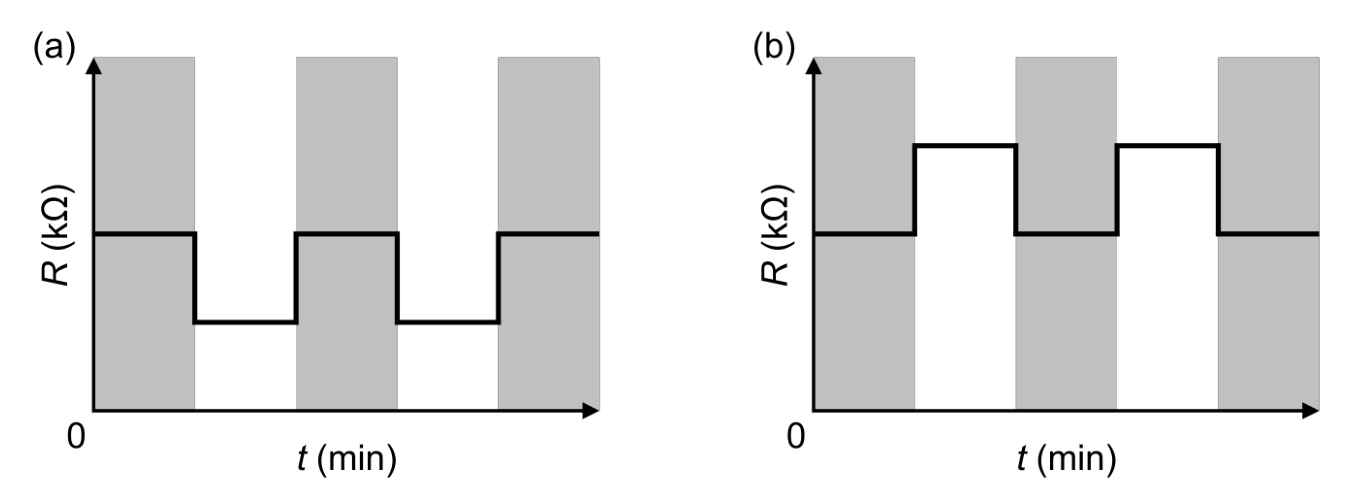
Figure 1: plot of resistance against time for two possible signal types, (a) and (b).
Grey bars = air, white bars = air + analyte gas.
2.4 Correlate the signal type (a or b) obtained from the X based sensor with the analyte gases (\(\ce{H2S}\), \(\ce{O3}\), \(\ce{NO2}\), \(\ce{NH3}\)) during their detection at low concentrations. 2 pt
The dependence of the specific conductivity (\(\sigma\)) of X on temperature is described by the Arrhenius law: \(\sigma(T)=\sigma_0\exp(-E_a/(RT))\), where \(E_a\) is the activation energy of conductivity. Three types of conductivity can be distinguished in different temperature ranges:
Ionization (I): 444–570 K, Impurity (II): 585–765 K, and Intrinsic (III): 800–905 K.
The sketch below illustrates the conductivity-temperature relation for the three temperature ranges.
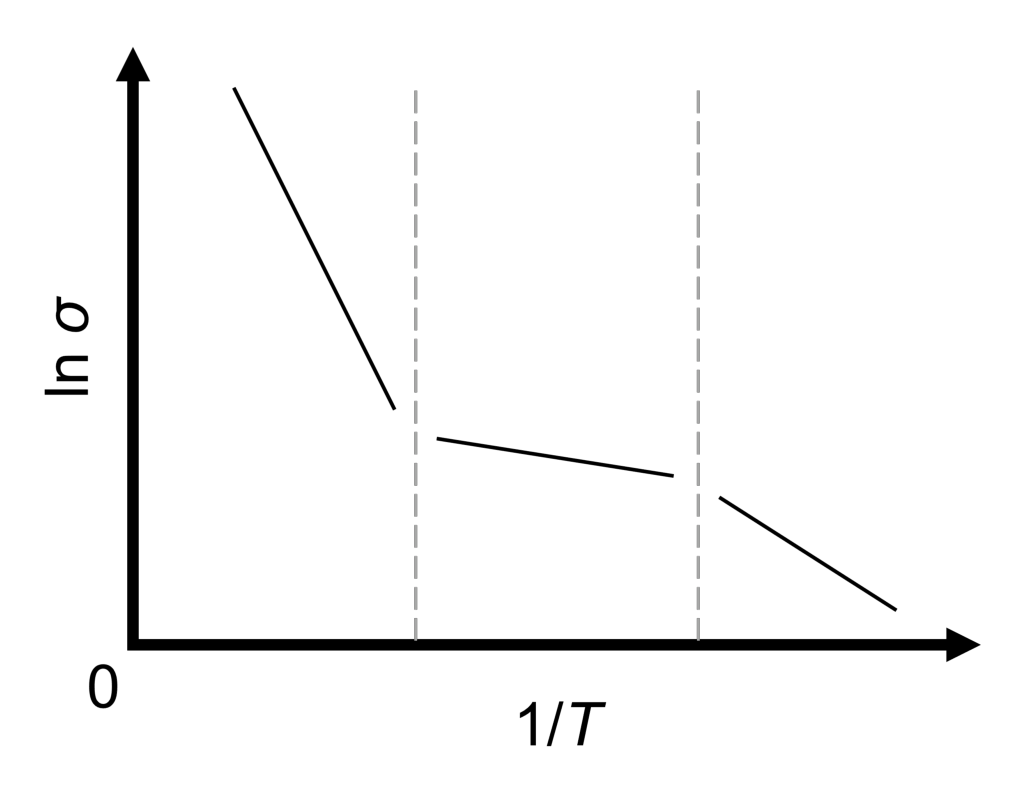
2.5 Based on the sketch above, order the activation energies associated with the different conductivity types, \(E_a(I)\), \(E_a(II)\), and \(E_a(III)\), from largest to smallest. 3 pt
| Avogadro constant: | \(N_A=6.022\cdot10^{23}\,\mathrm{mol^{-1}}\) | Gas constant: | \(R=8.314\,\mathrm{J\,mol^{-1}\,K^{-1}}\) |
| Ionic product of water at 298.15 K: | \(K_w=10^{-14}\) | Zero of the Celsius scale: | \(0\,^\circ\mathrm{C}=273.15\,\mathrm{K}\) |
| Faraday constant: | \(F=96485\,\mathrm{C\,mol^{-1}}\) | Planck constant: | \(h=6.626\cdot10^{-34}\,\mathrm{J\,s}\) |
| Speed of light: | \(c=2.998\cdot10^8\,\mathrm{m\,s^{-1}}\) | Standard pressure: | \(p^\circ=1\cdot10^5\,\mathrm{Pa}=1\,\mathrm{bar}\) |
| Ideal gas law: | \(pV=nRT\) | Beer-Lambert law: | \(A=\log\left(\frac{I_0}{I}\right)=\varepsilon\cdot l\cdot c\) |
| Enthalpy: | \(H=U+pV\) | Gibbs energy: | \(G=H-TS\) |
| \(\Delta_rG^\circ=-RT\ln K=-nFE^\circ_{\mathrm{cell}}\) | Henderson-Hasselbalch equation: | \(\mathrm{pH}=\mathrm{p}K_a+\log\left(\frac{[\ce{A-}]}{[\ce{HA}]}\right)\) | |
| Arrhenius equation: | \(k=A\exp\left(-\frac{E_A}{RT}\right)\) | Zeroth order integrated rate law: | \([\ce{A}]=[\ce{A}]_0-kt\) |
| Surface of a sphere: | \(A=4\pi R^2\) | First order integrated rate law: | \(\ln[\ce{A}]=\ln[\ce{A}]_0-kt\) |
| Volume of a sphere: | \(V=\frac{4\pi}{3}R^3\) | \(\displaystyle\sum_{k=0}^{\infty}ar^k=\frac{a}{1-r}\quad\text{for }\lvert r\rvert<1\) |
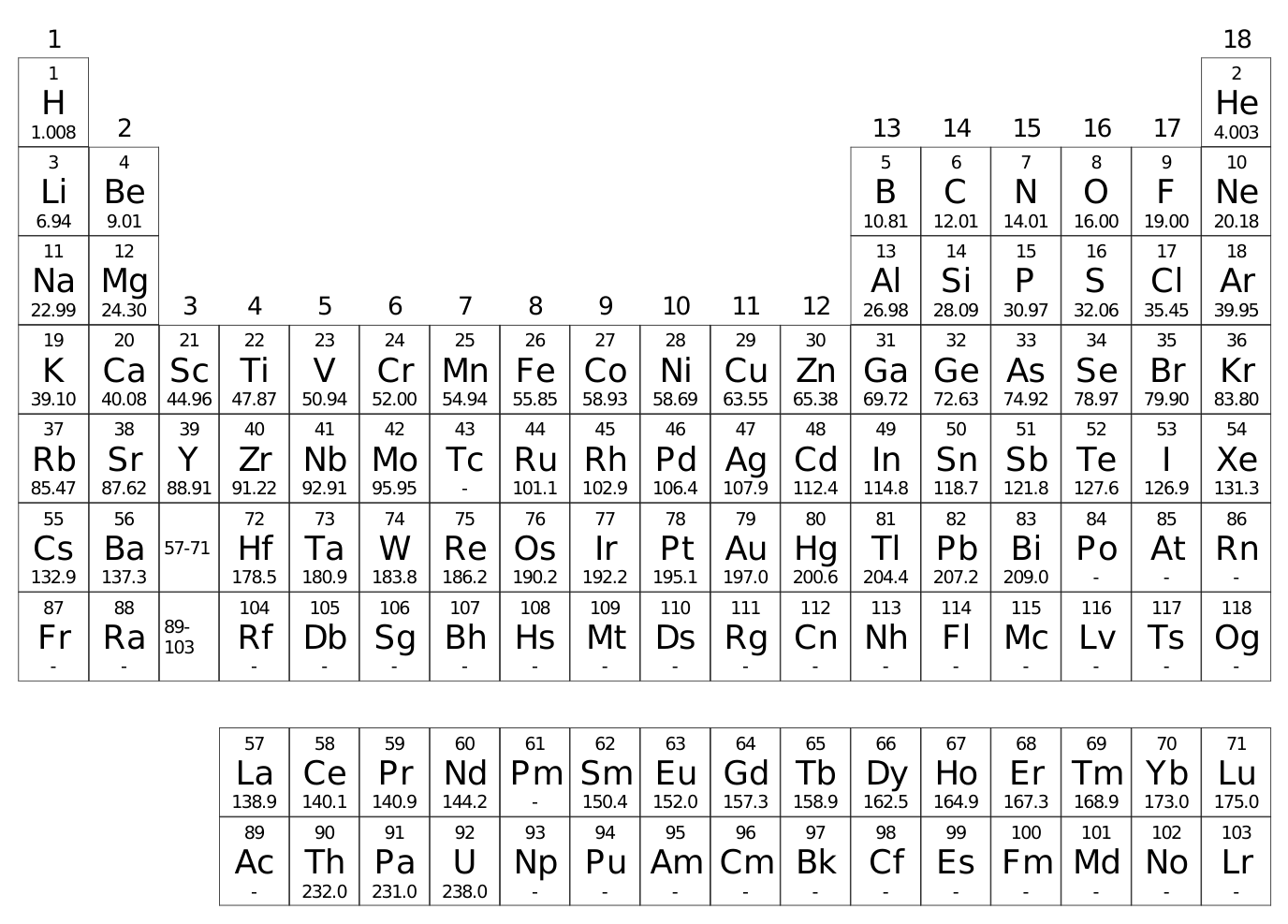
Periodic table
Official English text of the problem.
Answers
- 2.1: \(\boxed{X=\ce{Co3O4},\quad k=2}\). X is cobalt(II,III) oxide; the precursor is cobalt(II) oxalate dihydrate, \(\ce{CoC2O4 * 2H2O}\).
- 2.2: \(\boxed{12.5\%}\) of the tetrahedral sites.
- 2.3: \(\boxed{\ce{Fe3O4}\text{ and }\ce{NiFe2O4}}\): magnetite and nickel(II) ferrite.
- 2.4: (a) ozone, \(\ce{O3}\),
[O-][O+]=O, and nitrogen dioxide, \(\ce{NO2}\),[O-][N+]=O; (b) hydrogen sulfide, \(\ce{H2S}\),S, and ammonia, \(\ce{NH3}\),N. - 2.5: \(\boxed{E_a(\mathrm{III})>E_a(\mathrm{I})>E_a(\mathrm{II})}\).
Solution
2.1 — Identification of the oxide and hydrate
Because the precursor contains only one metal, the spinel must contain that metal in two oxidation states and have the formula \(\ce{Z3O4}\). The overall oxidation of the anhydrous oxalate in air is
\[ \ce{3ZC2O4 + 2O2 -> Z3O4 + 6CO2}. \]
Consequently,
\[ n(\ce{Z3O4})=\frac{n(\ce{CO2})}{6}. \]
Taking the gas temperature to be the stated decomposition temperature,
\[ T=500+273.15=773.15\,\mathrm{K}, \qquad V=3.8\times10^{-3}\,\mathrm{m^3}. \]
The ideal gas law gives, retaining guard digits,
\[ \begin{aligned} n(\ce{CO2}) &=\frac{pV}{RT}\\ &=\frac{(101325\,\mathrm{Pa})(3.8\times10^{-3}\,\mathrm{m^3})} {(8.314\,\mathrm{J\,mol^{-1}\,K^{-1}})(773.15\,\mathrm{K})}\\ &=0.0598999\ldots\,\mathrm{mol} \approx0.060\,\mathrm{mol}. \end{aligned} \]
Thus the metal’s molar mass is
\[ \begin{aligned} M(\ce{Z}) &=\frac{M(\ce{Z3O4})-4M(\ce{O})}{3}\\ &=\frac{1}{3}\left[ \frac{6(2.407\,\mathrm{g})}{0.0598999\ldots\,\mathrm{mol}} -4(16.00\,\mathrm{g\,mol^{-1}}) \right]\\ &\approx59\,\mathrm{g\,mol^{-1}}. \end{aligned} \]
This is consistent with cobalt, whose supplied molar mass is \(58.93\,\mathrm{g\,mol^{-1}}\), and its black normal-spinel oxide, cobalt(II,III) oxide:
\[ \boxed{\ce{X = Co3O4}}. \]
Its molar mass is
\[ M(\ce{Co3O4})=3(58.93)+4(16.00) =240.79\,\mathrm{g\,mol^{-1}}. \]
In the normal spinel, cobalt(II) ions, \(\ce{Co^{2+}}\), [Co+2], occupy tetrahedral sites; cobalt(III) ions, \(\ce{Co^{3+}}\), [Co+3], occupy octahedral sites. The anion lattice consists of oxide ions, \(\ce{O^{2-}}\), [O-2]. These isolated-ion SMILES do not encode the extended crystal lattice or its coordination geometries.
The mass lost at \(140\,^\circ\mathrm{C}\) is the water of crystallization. Using
\[ M(\ce{CoC2O4})=58.93+2(12.01)+4(16.00) =146.95\,\mathrm{g\,mol^{-1}} \]
and \(M(\ce{H2O})=18.016\,\mathrm{g\,mol^{-1}}\),
\[ \frac{18.016k}{146.95+18.016k}=0.197. \]
Therefore,
\[ k=\frac{0.197(146.95)}{(1-0.197)(18.016)} =2.001\ldots, \]
so
\[ \boxed{k=2}. \]
The balanced steps are
\[ \ce{CoC2O4 * 2H2O(s) -> CoC2O4(s) + 2H2O(g)} \qquad(140\,^\circ\mathrm{C}) \]
and
\[ \ce{3CoC2O4(s) + 2O2(g) -> Co3O4(s) + 6CO2(g)} \qquad(500\,^\circ\mathrm{C}). \]
For the dihydrate, the calculated water content is
\[ \frac{2(18.016)}{146.95+2(18.016)}\times100\% =19.69\ldots\%\approx19.7\%. \]
The molecular species in these equations are water O, dioxygen O=O, and carbon dioxide O=C=O. The oxalate ion, \(\ce{C2O4^{2-}}\), has SMILES [O-]C(=O)C(=O)[O-]. A composition-only ionic SMILES for cobalt(II) oxalate dihydrate is [Co+2].[O-]C(=O)C(=O)[O-].O.O; it does not specify the solid’s coordination structure. The dioxygen SMILES does not specify its triplet ground state.
2.2 — Occupancy of tetrahedral sites
An FCC array containing \(N\) oxide ions has \(2N\) tetrahedral holes.
Each formula unit of a normal spinel contains four oxide ions, corresponding to
\[ 2\times4=8 \]
tetrahedral holes. Only its one \(\ce{A^{2+}}\) cation occupies a tetrahedral hole; the two \(\ce{B^{3+}}\) cations occupy octahedral holes.
Hence,
\[ \boxed{ \text{Tetrahedral-site occupancy} =\frac{1}{8}\times100\%=12.5\%. } \]
2.3 — Selection of inverse spinels
A normal spinel places the divalent cation on tetrahedral sites and the trivalent cations on octahedral sites. An inverse spinel instead has the distribution
\[ (\ce{B^{3+}})_{\mathrm{tet}} [\ce{A^{2+}B^{3+}}]_{\mathrm{oct}}\ce{O4}. \]
The relevant ion identities are iron(II) [Fe+2], iron(III) [Fe+3], nickel(II) [Ni+2], manganese(II) [Mn+2], manganese(III) [Mn+3], and chromium(III) [Cr+3].
Their distributions in the four candidate oxides are:
| Oxide | Tetrahedral cations per formula unit | Octahedral cations per formula unit | Type |
|---|---|---|---|
| \(\ce{Fe3O4}\), iron(II,III) oxide (magnetite) | \(\ce{Fe^{3+}}\), \(d^5\) | \(\ce{Fe^{2+}}\), \(d^6\), and \(\ce{Fe^{3+}}\), \(d^5\) | Inverse |
| \(\ce{NiFe2O4}\), nickel(II) ferrite | \(\ce{Fe^{3+}}\), \(d^5\) | \(\ce{Ni^{2+}}\), \(d^8\), and \(\ce{Fe^{3+}}\), \(d^5\) | Inverse |
| \(\ce{Mn3O4}\), manganese(II,III) oxide | \(\ce{Mn^{2+}}\), \(d^5\) | Two \(\ce{Mn^{3+}}\), each \(d^4\) | Normal |
| \(\ce{FeCr2O4}\), iron(II) chromite | \(\ce{Fe^{2+}}\), \(d^6\) | Two \(\ce{Cr^{3+}}\), each \(d^3\) | Normal |
High-spin \(\ce{Fe^{3+}}\), with configuration \(d^5\), has zero crystal-field stabilization energy in either tetrahedral or octahedral coordination. The octahedral preferences of \(\ce{Fe^{2+}}\) and especially \(\ce{Ni^{2+}}\) therefore favor the inverse arrangements of the two ferrites.
For the other candidates, \(\ce{Mn^{3+}}\) and \(\ce{Cr^{3+}}\) favor octahedral coordination, supporting normal arrangements.
The two formulas to select are therefore
\[ \boxed{\ce{Fe3O4}\quad\text{and}\quad\ce{NiFe2O4}}. \]
The statement's criterion that the \(\ce{M'}\) (octahedral) cations of an inverse spinel are \(d^0\), \(d^5\) or \(d^{10}\) appears to contain a site-label error: in both selected inverse spinels the octahedral sites hold \(d^6\) \(\ce{Fe^{2+}}\) or \(d^8\) \(\ce{Ni^{2+}}\) alongside \(d^5\) \(\ce{Fe^{3+}}\), while the tetrahedral sites hold only \(d^5\) \(\ce{Fe^{3+}}\).
2.4 — Gas response of the sensor
The oxide is a p-type semiconductor: its mobile charge carriers are holes.
An electron-accepting, oxidizing gas removes electrons from the semiconductor surface, increasing the hole concentration. Conductivity increases and resistance decreases, giving signal (a) during the white intervals.
An electron-donating, reducing gas supplies electrons that recombine with holes. Conductivity decreases and resistance increases, giving signal (b).
| Analyte | Redox behavior | Effect on hole concentration | Resistance during exposure | Signal |
|---|---|---|---|---|
Hydrogen sulfide, \(\ce{H2S}\), S |
Reducing; electron donor | Decreases | Increases | b |
Ozone, \(\ce{O3}\), [O-][O+]=O |
Oxidizing; electron acceptor | Increases | Decreases | a |
Nitrogen dioxide, \(\ce{NO2}\), [O-][N+]=O |
Oxidizing; electron acceptor | Increases | Decreases | a |
Ammonia, \(\ce{NH3}\), N |
Reducing; electron donor | Decreases | Increases | b |
The ozone and nitrogen dioxide SMILES show individual resonance representations. Both molecules are bent, and nitrogen dioxide is a radical. The surface electron transfer and resulting changes in carrier concentration are described above; molecular SMILES alone do not show them.
2.5 — Ordering the activation energies
Taking logarithms of the Arrhenius expression,
\[ \ln\sigma=\ln\sigma_0-\frac{E_a}{R}\frac{1}{T}. \]
Thus the slope of a plot of \(\ln\sigma\) against \(1/T\) is
\[ \boxed{\text{slope}=-\frac{E_a}{R}}. \]
A larger magnitude of negative slope corresponds to a larger activation energy.
Because the horizontal coordinate is \(1/T\), temperature decreases from left to right. The three segments therefore represent:
| Position on the graph | Temperature range | Conductivity type | Magnitude of slope |
|---|---|---|---|
| Left | 800–905 K | Intrinsic, III | Largest |
| Middle | 585–765 K | Impurity, II | Smallest |
| Right | 444–570 K | Ionization, I | Intermediate |
Hence,
\[ \boxed{E_a(\mathrm{III})>E_a(\mathrm{I})>E_a(\mathrm{II})}. \]
The solution was checked against the official solution.
IChO 2024 · Theorieaufgabe 2
Elektronische Nase
Resistive Gassensoren, insbesondere solche auf der Basis halbleitender Metalloxide (SMOX), erfreuen sich zunehmender Beliebtheit. Sie können kleinste Mengen an Verunreinigungen nachweisen, sind klein und stabil und lassen sich leicht herstellen und verwenden. Diese Eigenschaften zeichnen SMOX-Sensoren unter den vielen Arten von Gassensoren aus, die auf unterschiedlichen physikalischen und chemischen Prinzipien beruhen.
Das Mischoxid X mit normaler Spinell-Kristallstruktur, \(\ce{A^{2+}B2^{3+}O4^{2-}}\), ist ein Beispiel für eines dieser SMOX-Materialien. X kann durch Zersetzung des kristallinen hydratisierten Metalloxalats \(\ce{ZC2O4}\cdot k\ce{H2O}\) des Metalls Z an der Luft erhalten werden. Beim Erhitzen auf \(140\,^\circ\mathrm{C}\) verliert das kristalline Hydrat 19.7% seiner Masse. Weiteres Erhitzen an der Luft führt bei \(500\,^\circ\mathrm{C}\) zur Bildung von 2.407 g schwarzem X und \(3.8\,\mathrm{dm^3}\) Kohlenstoffdioxid bei 101325 Pa.
2.1 Bestimmen Sie die Formel von X und den Wert von \(k\) in \(\ce{ZC2O4}\cdot k\ce{H2O}\). 4 Pkt.
In Spinellstrukturen bilden die Sauerstoffatome ein kubisch flächenzentriertes (FCC) Gitter. In normalen Spinellen besetzen die \(\ce{A^{2+}}\)-Kationen einen Teil der tetraedrischen und die \(\ce{B^{3+}}\)-Kationen einen Teil der oktaedrischen Gitterplätze.
2.2 Berechnen Sie den prozentualen Anteil der tetraedrischen Plätze, der bei einem normalen Spinell \(\ce{A^{2+}B2^{3+}O4^{2-}}\) besetzt ist. 2 Pkt.
Neben den normalen Spinellen beschreibt die allgemeine Formel \(\ce{MM'2O4}\) auch inverse und gemischte Spinellstrukturen. Dabei bezeichnet \(\ce{M}\) die tetraedrisch koordinierten und \(\ce{M'}\) die oktaedrisch koordinierten Kationen; im Gegensatz zu normalen Spinellen sind bestimmte Kationen jedoch nicht auf eine einzige Art von Gitterplatz beschränkt. Ein Merkmal inverser Spinellstrukturen ist, dass die Elektronenkonfiguration der Kationen auf den \(\ce{M'}\)-Plätzen \(d^0\), \(d^5\) oder \(d^{10}\) ist.
2.3 Wählen Sie auf dem Antwortbogen zwei der angegebenen Formeln aus, die der Struktur eines inversen Spinells entsprechen: \(\ce{Fe3O4}\), \(\ce{NiFe2O4}\), \(\ce{Mn3O4}\), \(\ce{FeCr2O4}\). 1 Pkt.
Halbleiter sind Materialien, deren Orbitale einen geringen Überschuss oder Mangel an Elektronen aufweisen, wodurch negative beziehungsweise positive Ladungen (Löcher) entstehen. Diese Ladungen können sich durch den Halbleiter bewegen und ermöglichen ihm, elektrischen Strom zu leiten. Chemische Reaktionen können die Ladung eines Halbleiters erhöhen oder verringern und dadurch seine Leitfähigkeit verändern.
X ist ein Beispiel für einen Halbleiter, in dem der elektrische Strom durch positive Ladungen (Löcher) getragen wird. Bei einem resistiven Gassensor auf der Basis von X wird der Widerstand \(R\) über die Zeit \(t\) gemessen, während ein Gas über den Sensor geleitet wird. Dadurch können Redoxreaktionen zwischen dem Gas und der Halbleiteroberfläche stattfinden, die den Widerstand des Sensors abhängig von den Donator-/Akzeptoreigenschaften des Gases verändern. Abbildung 1 zeigt die beiden unterschiedlichen Signaltypen, die auf diese Weise erhalten werden.
Abbildung 1: Auftragung des Widerstands gegen die Zeit für zwei mögliche Signaltypen, (a) und (b).
Graue Balken = Luft, weiße Balken = Luft + Analytgas.
2.4 Ordnen Sie den Analytgasen (\(\ce{H2S}\), \(\ce{O3}\), \(\ce{NO2}\), \(\ce{NH3}\)) den Signaltyp (a oder b) zu, der bei ihrem Nachweis in niedrigen Konzentrationen mit dem Sensor auf der Basis von X erhalten wird. 2 Pkt.
Die Temperaturabhängigkeit der spezifischen Leitfähigkeit (\(\sigma\)) von X wird durch das Arrhenius-Gesetz beschrieben: \(\sigma(T)=\sigma_0\exp(-E_a/(RT))\), wobei \(E_a\) die Aktivierungsenergie der Leitfähigkeit ist. In unterschiedlichen Temperaturbereichen lassen sich drei Arten der Leitfähigkeit unterscheiden:
Ionisation (I): 444–570 K, Störstellenleitung (II): 585–765 K und Eigenleitung (III): 800–905 K.
Die folgende Skizze veranschaulicht den Zusammenhang zwischen Leitfähigkeit und Temperatur für die drei Temperaturbereiche.
2.5 Ordnen Sie anhand der obigen Skizze die den verschiedenen Arten der Leitfähigkeit zugehörigen Aktivierungsenergien \(E_a(I)\), \(E_a(II)\) und \(E_a(III)\) von der größten zur kleinsten. 3 Pkt.
| Avogadro-Konstante: | \(N_A=6.022\cdot10^{23}\,\mathrm{mol^{-1}}\) | Gaskonstante: | \(R=8.314\,\mathrm{J\,mol^{-1}\,K^{-1}}\) |
| Ionenprodukt des Wassers bei 298.15 K: | \(K_w=10^{-14}\) | Nullpunkt der Celsius-Skala: | \(0\,^\circ\mathrm{C}=273.15\,\mathrm{K}\) |
| Faraday-Konstante: | \(F=96485\,\mathrm{C\,mol^{-1}}\) | Planck-Konstante: | \(h=6.626\cdot10^{-34}\,\mathrm{J\,s}\) |
| Lichtgeschwindigkeit: | \(c=2.998\cdot10^8\,\mathrm{m\,s^{-1}}\) | Standarddruck: | \(p^\circ=1\cdot10^5\,\mathrm{Pa}=1\,\mathrm{bar}\) |
| Ideales Gasgesetz: | \(pV=nRT\) | Lambert-Beer-Gesetz: | \(A=\log\left(\frac{I_0}{I}\right)=\varepsilon\cdot l\cdot c\) |
| Enthalpie: | \(H=U+pV\) | Gibbs-Energie: | \(G=H-TS\) |
| \(\Delta_rG^\circ=-RT\ln K=-nFE^\circ_{\mathrm{cell}}\) | Henderson-Hasselbalch-Gleichung: | \(\mathrm{pH}=\mathrm{p}K_a+\log\left(\frac{[\ce{A-}]}{[\ce{HA}]}\right)\) | |
| Arrhenius-Gleichung: | \(k=A\exp\left(-\frac{E_A}{RT}\right)\) | Integriertes Geschwindigkeitsgesetz nullter Ordnung: | \([\ce{A}]=[\ce{A}]_0-kt\) |
| Oberfläche einer Kugel: | \(A=4\pi R^2\) | Integriertes Geschwindigkeitsgesetz erster Ordnung: | \(\ln[\ce{A}]=\ln[\ce{A}]_0-kt\) |
| Volumen einer Kugel: | \(V=\frac{4\pi}{3}R^3\) | \(\displaystyle\sum_{k=0}^{\infty}ar^k=\frac{a}{1-r}\quad\text{für }\lvert r\rvert<1\) |
Periodensystem
Aufgabentext aus dem offiziellen englischen Text übersetzt.
Antworten
- 2.1: \(\boxed{X=\ce{Co3O4},\quad k=2}\). X ist Cobalt(II,III)-oxid; die Vorstufe ist Cobalt(II)-oxalat-Dihydrat, \(\ce{CoC2O4 * 2H2O}\).
- 2.2: \(\boxed{12.5\%}\) der tetraedrischen Plätze.
- 2.3: \(\boxed{\ce{Fe3O4}\text{ und }\ce{NiFe2O4}}\): Magnetit und Nickel(II)-ferrit.
- 2.4: (a) Ozon, \(\ce{O3}\),
[O-][O+]=O, und Stickstoffdioxid, \(\ce{NO2}\),[O-][N+]=O; (b) Schwefelwasserstoff, \(\ce{H2S}\),S, und Ammoniak, \(\ce{NH3}\),N. - 2.5: \(\boxed{E_a(\mathrm{III})>E_a(\mathrm{I})>E_a(\mathrm{II})}\).
Lösung
2.1 — Identifizierung des Oxids und des Hydrats
Da die Vorstufe nur ein Metall enthält, muss der Spinell dieses Metall in zwei Oxidationsstufen enthalten und die Formel \(\ce{Z3O4}\) haben. Die Gesamtreaktion der Oxidation des wasserfreien Oxalats an der Luft lautet
\[ \ce{3ZC2O4 + 2O2 -> Z3O4 + 6CO2}. \]
Folglich gilt
\[ n(\ce{Z3O4})=\frac{n(\ce{CO2})}{6}. \]
Setzt man als Gastemperatur die angegebene Zersetzungstemperatur an, so gilt
\[ T=500+273.15=773.15\,\mathrm{K}, \qquad V=3.8\times10^{-3}\,\mathrm{m^3}. \]
Das ideale Gasgesetz liefert unter Beibehaltung zusätzlicher Stellen zur Vermeidung von Rundungsfehlern
\[ \begin{aligned} n(\ce{CO2}) &=\frac{pV}{RT}\\ &=\frac{(101325\,\mathrm{Pa})(3.8\times10^{-3}\,\mathrm{m^3})} {(8.314\,\mathrm{J\,mol^{-1}\,K^{-1}})(773.15\,\mathrm{K})}\\ &=0.0598999\ldots\,\mathrm{mol} \approx0.060\,\mathrm{mol}. \end{aligned} \]
Damit beträgt die molare Masse des Metalls
\[ \begin{aligned} M(\ce{Z}) &=\frac{M(\ce{Z3O4})-4M(\ce{O})}{3}\\ &=\frac{1}{3}\left[ \frac{6(2.407\,\mathrm{g})}{0.0598999\ldots\,\mathrm{mol}} -4(16.00\,\mathrm{g\,mol^{-1}}) \right]\\ &\approx59\,\mathrm{g\,mol^{-1}}. \end{aligned} \]
Dies stimmt mit Cobalt, dessen angegebene molare Masse \(58.93\,\mathrm{g\,mol^{-1}}\) beträgt, und seinem schwarzen Oxid mit normaler Spinellstruktur, Cobalt(II,III)-oxid, überein:
\[ \boxed{\ce{X = Co3O4}}. \]
Seine molare Masse beträgt
\[ M(\ce{Co3O4})=3(58.93)+4(16.00) =240.79\,\mathrm{g\,mol^{-1}}. \]
Im normalen Spinell besetzen Cobalt(II)-Ionen, \(\ce{Co^{2+}}\), [Co+2], tetraedrische Plätze; Cobalt(III)-Ionen, \(\ce{Co^{3+}}\), [Co+3], besetzen oktaedrische Plätze. Das Anionengitter besteht aus Oxidionen, \(\ce{O^{2-}}\), [O-2]. Diese SMILES-Darstellungen isolierter Ionen codieren weder das ausgedehnte Kristallgitter noch dessen Koordinationsgeometrien.
Der Massenverlust bei \(140\,^\circ\mathrm{C}\) entspricht dem Kristallwasser. Mit
\[ M(\ce{CoC2O4})=58.93+2(12.01)+4(16.00) =146.95\,\mathrm{g\,mol^{-1}} \]
und \(M(\ce{H2O})=18.016\,\mathrm{g\,mol^{-1}}\) gilt
\[ \frac{18.016k}{146.95+18.016k}=0.197. \]
Daraus folgt
\[ k=\frac{0.197(146.95)}{(1-0.197)(18.016)} =2.001\ldots, \]
also
\[ \boxed{k=2}. \]
Die ausgeglichenen Reaktionsschritte lauten
\[ \ce{CoC2O4 * 2H2O(s) -> CoC2O4(s) + 2H2O(g)} \qquad(140\,^\circ\mathrm{C}) \]
und
\[ \ce{3CoC2O4(s) + 2O2(g) -> Co3O4(s) + 6CO2(g)} \qquad(500\,^\circ\mathrm{C}). \]
Für das Dihydrat beträgt der berechnete Wassergehalt
\[ \frac{2(18.016)}{146.95+2(18.016)}\times100\% =19.69\ldots\%\approx19.7\%. \]
Die molekularen Spezies in diesen Gleichungen sind Wasser O, Disauerstoff O=O und Kohlenstoffdioxid O=C=O. Das Oxalat-Ion, \(\ce{C2O4^{2-}}\), hat die SMILES-Darstellung [O-]C(=O)C(=O)[O-]. Eine ionische SMILES-Darstellung von Cobalt(II)-oxalat-Dihydrat, die nur die Zusammensetzung angibt, lautet [Co+2].[O-]C(=O)C(=O)[O-].O.O; sie legt die Koordinationsstruktur des Feststoffs nicht fest. Die SMILES-Darstellung von Disauerstoff gibt dessen Triplett-Grundzustand nicht an.
2.2 — Besetzung der tetraedrischen Plätze
Eine kubisch flächenzentrierte Anordnung mit \(N\) Oxidionen besitzt \(2N\) Tetraederlücken.
Jede Formeleinheit eines normalen Spinells enthält vier Oxidionen, was
\[ 2\times4=8 \]
Tetraederlücken entspricht. Nur ihr einziges \(\ce{A^{2+}}\)-Kation besetzt eine Tetraederlücke; die beiden \(\ce{B^{3+}}\)-Kationen besetzen Oktaederlücken.
Somit gilt
\[ \boxed{ \text{Besetzungsgrad der tetraedrischen Plätze} =\frac{1}{8}\times100\%=12.5\%. } \]
2.3 — Auswahl der inversen Spinelle
In einem normalen Spinell befinden sich die zweiwertigen Kationen auf tetraedrischen Plätzen und die dreiwertigen Kationen auf oktaedrischen Plätzen. Ein inverser Spinell weist dagegen folgende Verteilung auf:
\[ (\ce{B^{3+}})_{\mathrm{tet}} [\ce{A^{2+}B^{3+}}]_{\mathrm{oct}}\ce{O4}. \]
Die relevanten Ionen sind Eisen(II) [Fe+2], Eisen(III) [Fe+3], Nickel(II) [Ni+2], Mangan(II) [Mn+2], Mangan(III) [Mn+3] und Chrom(III) [Cr+3].
Ihre Verteilungen in den vier zur Auswahl stehenden Oxiden sind:
| Oxid | Tetraedrische Kationen pro Formeleinheit | Oktaedrische Kationen pro Formeleinheit | Typ |
|---|---|---|---|
| \(\ce{Fe3O4}\), Eisen(II,III)-oxid (Magnetit) | \(\ce{Fe^{3+}}\), \(d^5\) | \(\ce{Fe^{2+}}\), \(d^6\), und \(\ce{Fe^{3+}}\), \(d^5\) | Invers |
| \(\ce{NiFe2O4}\), Nickel(II)-ferrit | \(\ce{Fe^{3+}}\), \(d^5\) | \(\ce{Ni^{2+}}\), \(d^8\), und \(\ce{Fe^{3+}}\), \(d^5\) | Invers |
| \(\ce{Mn3O4}\), Mangan(II,III)-oxid | \(\ce{Mn^{2+}}\), \(d^5\) | Zwei \(\ce{Mn^{3+}}\), jeweils \(d^4\) | Normal |
| \(\ce{FeCr2O4}\), Eisen(II)-chromit | \(\ce{Fe^{2+}}\), \(d^6\) | Zwei \(\ce{Cr^{3+}}\), jeweils \(d^3\) | Normal |
High-Spin-\(\ce{Fe^{3+}}\) mit der Konfiguration \(d^5\) hat sowohl bei tetraedrischer als auch bei oktaedrischer Koordination eine Kristallfeldstabilisierungsenergie von null. Die Bevorzugung oktaedrischer Koordination durch \(\ce{Fe^{2+}}\) und insbesondere durch \(\ce{Ni^{2+}}\) begünstigt daher die inversen Anordnungen der beiden Ferrite.
Bei den anderen zur Auswahl stehenden Verbindungen bevorzugen \(\ce{Mn^{3+}}\) und \(\ce{Cr^{3+}}\) eine oktaedrische Koordination, was normale Anordnungen begünstigt.
Die beiden auszuwählenden Formeln sind daher
\[ \boxed{\ce{Fe3O4}\quad\text{und}\quad\ce{NiFe2O4}}. \]
Das in der Aufgabenstellung angegebene Kriterium, dass die \(\ce{M'}\)-Kationen (auf Oktaederplätzen) eines inversen Spinells die Konfiguration \(d^0\), \(d^5\) oder \(d^{10}\) aufweisen, scheint einen Fehler bei der Platzbezeichnung zu enthalten: In beiden ausgewählten inversen Spinellen sind die Oktaederplätze neben \(d^5\) \(\ce{Fe^{3+}}\) mit \(d^6\) \(\ce{Fe^{2+}}\) oder \(d^8\) \(\ce{Ni^{2+}}\) besetzt, während die Tetraederplätze nur \(d^5\) \(\ce{Fe^{3+}}\) enthalten.
2.4 — Ansprechverhalten des Sensors auf Gase
Das Oxid ist ein p-Halbleiter: Seine beweglichen Ladungsträger sind Löcher.
Ein elektronenaufnehmendes, oxidierendes Gas entzieht der Halbleiteroberfläche Elektronen und erhöht dadurch die Löcherkonzentration. Die Leitfähigkeit steigt und der Widerstand sinkt, sodass während der weißen Zeitabschnitte Signal (a) entsteht.
Ein elektronenabgebendes, reduzierendes Gas liefert Elektronen, die mit Löchern rekombinieren. Die Leitfähigkeit sinkt und der Widerstand steigt, sodass Signal (b) entsteht.
| Analyt | Redoxverhalten | Auswirkung auf die Löcherkonzentration | Widerstand während der Exposition | Signal |
|---|---|---|---|---|
Schwefelwasserstoff, \(\ce{H2S}\), S |
Reduzierend; Elektronendonator | Sinkt | Steigt | b |
Ozon, \(\ce{O3}\), [O-][O+]=O |
Oxidierend; Elektronenakzeptor | Steigt | Sinkt | a |
Stickstoffdioxid, \(\ce{NO2}\), [O-][N+]=O |
Oxidierend; Elektronenakzeptor | Steigt | Sinkt | a |
Ammoniak, \(\ce{NH3}\), N |
Reduzierend; Elektronendonator | Sinkt | Steigt | b |
Die SMILES-Darstellungen von Ozon und Stickstoffdioxid zeigen jeweils eine einzelne mesomere Grenzstruktur. Beide Moleküle sind gewinkelt, und Stickstoffdioxid ist ein Radikal. Die Elektronenübertragung an der Oberfläche und die daraus resultierenden Änderungen der Ladungsträgerkonzentration sind oben beschrieben; molekulare SMILES-Darstellungen allein zeigen sie nicht.
2.5 — Reihenfolge der Aktivierungsenergien
Durch Logarithmieren des Arrhenius-Ausdrucks erhält man
\[ \ln\sigma=\ln\sigma_0-\frac{E_a}{R}\frac{1}{T}. \]
Damit ist die Steigung einer Auftragung von \(\ln\sigma\) gegen \(1/T\)
\[ \boxed{\text{Steigung}=-\frac{E_a}{R}}. \]
Ein größerer Betrag der negativen Steigung entspricht einer größeren Aktivierungsenergie.
Da die horizontale Koordinate \(1/T\) ist, nimmt die Temperatur von links nach rechts ab. Die drei Abschnitte entsprechen daher:
| Position im Diagramm | Temperaturbereich | Art der Leitfähigkeit | Betrag der Steigung |
|---|---|---|---|
| Links | 800–905 K | Eigenleitung, III | Größter |
| Mitte | 585–765 K | Störstellenleitung, II | Kleinster |
| Rechts | 444–570 K | Ionisation, I | Mittlerer |
Somit gilt
\[ \boxed{E_a(\mathrm{III})>E_a(\mathrm{I})>E_a(\mathrm{II})}. \]
Die Lösung wurde mit der offiziellen Lösung abgeglichen.
IChO 2024 · Teori sorusu 2
Elektronik burun
Direnç tipi gaz sensörleri, özellikle yarı iletken metal oksitleri (SMOX) kullananlar, giderek yaygınlaşmaktadır. Çok küçük miktarlardaki safsızlıkları algılayabilirler; küçük boyutlu ve kararlıdırlar, ayrıca üretimleri ve kullanımları kolaydır. Bu özellikler, SMOX sensörlerini farklı fiziksel ve kimyasal ilkelere göre çalışan çok sayıdaki gaz sensörü türü arasında öne çıkarır.
Normal spinel kristal yapısına, \(\ce{A^{2+}B2^{3+}O4^{2-}}\), sahip olan karma oksit X, bu SMOX malzemelerinden birine örnektir. X, Z metalinin kristal hâlindeki hidratlı metal oksalatının, \(\ce{ZC2O4}\cdot k\ce{H2O}\), havada bozunmasıyla elde edilebilir. Kristal hidrat, \(140\,^\circ\mathrm{C}\) sıcaklığa ısıtıldığında kütlesinin %19.7'sini kaybeder. Havada ısıtmaya devam edildiğinde, \(500\,^\circ\mathrm{C}\) sıcaklıkta 2.407 g siyah renkli X ve 101325 Pa basınçta \(3.8\,\mathrm{dm^3}\) karbon dioksit oluşur.
2.1 X'in formülünü ve \(\ce{ZC2O4}\cdot k\ce{H2O}\) bileşiğindeki \(k\) değerini belirleyiniz. 4 puan
Spinel yapılarında oksijen atomları yüzey merkezli kübik (FCC) bir örgü oluşturur. Normal spinellerde \(\ce{A^{2+}}\) katyonları tetrahedral örgü konumlarının bir bölümünü, \(\ce{B^{3+}}\) katyonları ise oktahedral örgü konumlarının bir bölümünü işgal eder.
2.2 Normal bir \(\ce{A^{2+}B2^{3+}O4^{2-}}\) spinelinde tetrahedral konumların yüzde kaçının dolu olduğunu hesaplayınız. 2 puan
\(\ce{MM'2O4}\) genel formülü, normal spinellerin yanı sıra ters ve karma spinel yapılarını da tanımlar. Burada \(\ce{M}\) tetrahedral koordinasyonlu, \(\ce{M'}\) ise oktahedral koordinasyonlu katyonlardır; ancak normal spinellerin aksine, belirli katyonlar tek bir örgü konumuyla sınırlı değildir. Ters spinel yapılarının bir özelliği, \(\ce{M'}\) konumundaki katyonların elektron diziliminin \(d^0\), \(d^5\) veya \(d^{10}\) olmasıdır.
2.3 Verilen formüllerden ters spinel yapısına karşılık gelen ikisini cevap kâğıdında seçiniz: \(\ce{Fe3O4}\), \(\ce{NiFe2O4}\), \(\ce{Mn3O4}\), \(\ce{FeCr2O4}\). 1 puan
Yarı iletkenler, orbitallerinde az miktarda elektron fazlalığı veya eksikliği bulunan ve bunun sonucunda sırasıyla negatif veya pozitif yüklerin (deşiklerin) ortaya çıktığı malzemelerdir. Bu yükler yarı iletkenin içinde hareket ederek elektrik iletimini sağlar. Kimyasal tepkimeler, yarı iletkendeki yükü artırıp azaltarak iletkenliğini değiştirebilir.
X, elektriğin pozitif yükler (deşikler) tarafından taşındığı bir yarı iletkene örnektir. X esaslı bir direnç tipi gaz sensöründe, sensörün üzerinden bir gaz geçirilirken direnç \(R\), zaman \(t\) boyunca ölçülür. Böylece gaz ile yarı iletken yüzeyi arasında redoks tepkimeleri gerçekleşebilir; bu tepkimeler, gazın elektron verici/alıcı özelliklerine bağlı olarak sensörün direncini değiştirir. Şekil 1, bu yolla elde edilen iki farklı sinyal türünü göstermektedir.
Şekil 1: Olası iki sinyal türü (a) ve (b) için direncin zamana karşı grafiği.
Gri şeritler = hava, beyaz şeritler = hava + analit gazı.
2.4 X esaslı sensörden elde edilen sinyal türünü (a veya b), düşük derişimlerde algılanmaları sırasında analit gazlarıyla (\(\ce{H2S}\), \(\ce{O3}\), \(\ce{NO2}\), \(\ce{NH3}\)) eşleştiriniz. 2 puan
X'in öz iletkenliğinin (\(\sigma\)) sıcaklığa bağlılığı Arrhenius yasasıyla ifade edilir: \(\sigma(T)=\sigma_0\exp(-E_a/(RT))\). Burada \(E_a\), iletkenliğin aktivasyon enerjisidir. Farklı sıcaklık aralıklarında üç iletkenlik türü ayırt edilebilir:
İyonlaşma (I): 444–570 K, Safsızlık (II): 585–765 K ve Öz (III): 800–905 K.
Aşağıdaki şematik grafik, üç sıcaklık aralığı için iletkenlik-sıcaklık ilişkisini göstermektedir.
2.5 Yukarıdaki şematik grafiğe dayanarak, farklı iletkenlik türleriyle ilişkili aktivasyon enerjilerini, \(E_a(I)\), \(E_a(II)\) ve \(E_a(III)\), büyükten küçüğe sıralayınız. 3 puan
| Avogadro sabiti: | \(N_A=6.022\cdot10^{23}\,\mathrm{mol^{-1}}\) | Gaz sabiti: | \(R=8.314\,\mathrm{J\,mol^{-1}\,K^{-1}}\) |
| Suyun 298.15 K'deki iyon çarpımı: | \(K_w=10^{-14}\) | Celsius ölçeğinin sıfır noktası: | \(0\,^\circ\mathrm{C}=273.15\,\mathrm{K}\) |
| Faraday sabiti: | \(F=96485\,\mathrm{C\,mol^{-1}}\) | Planck sabiti: | \(h=6.626\cdot10^{-34}\,\mathrm{J\,s}\) |
| Işık hızı: | \(c=2.998\cdot10^8\,\mathrm{m\,s^{-1}}\) | Standart basınç: | \(p^\circ=1\cdot10^5\,\mathrm{Pa}=1\,\mathrm{bar}\) |
| İdeal gaz yasası: | \(pV=nRT\) | Beer-Lambert yasası: | \(A=\log\left(\frac{I_0}{I}\right)=\varepsilon\cdot l\cdot c\) |
| Entalpi: | \(H=U+pV\) | Gibbs enerjisi: | \(G=H-TS\) |
| \(\Delta_rG^\circ=-RT\ln K=-nFE^\circ_{\mathrm{cell}}\) | Henderson-Hasselbalch denklemi: | \(\mathrm{pH}=\mathrm{p}K_a+\log\left(\frac{[\ce{A-}]}{[\ce{HA}]}\right)\) | |
| Arrhenius denklemi: | \(k=A\exp\left(-\frac{E_A}{RT}\right)\) | Sıfırıncı dereceden tümleşik hız yasası: | \([\ce{A}]=[\ce{A}]_0-kt\) |
| Kürenin yüzey alanı: | \(A=4\pi R^2\) | Birinci dereceden tümleşik hız yasası: | \(\ln[\ce{A}]=\ln[\ce{A}]_0-kt\) |
| Kürenin hacmi: | \(V=\frac{4\pi}{3}R^3\) | \(\displaystyle\sum_{k=0}^{\infty}ar^k=\frac{a}{1-r}\quad\text{şu koşulda: }\lvert r\rvert<1\) |
Periyodik tablo
Soru metni resmi İngilizce metinden çevrilmiştir.
Cevaplar
- 2.1: \(\boxed{X=\ce{Co3O4},\quad k=2}\). X, kobalt(II,III) oksittir; başlangıç bileşiği kobalt(II) oksalat dihidrattır, \(\ce{CoC2O4 * 2H2O}\).
- 2.2: Tetrahedral konumların \(\boxed{12.5\%}\)'i.
- 2.3: \(\boxed{\ce{Fe3O4}\text{ ve }\ce{NiFe2O4}}\): manyetit ve nikel(II) ferrit.
- 2.4: (a) ozon, \(\ce{O3}\),
[O-][O+]=O, ve azot dioksit, \(\ce{NO2}\),[O-][N+]=O; (b) hidrojen sülfür, \(\ce{H2S}\),S, ve amonyak, \(\ce{NH3}\),N. - 2.5: \(\boxed{E_a(\mathrm{III})>E_a(\mathrm{I})>E_a(\mathrm{II})}\).
Çözüm
2.1 — Oksidin ve hidratın belirlenmesi
Başlangıç bileşiği yalnızca bir metal içerdiğinden, spinel bu metali iki yükseltgenme basamağında içermeli ve \(\ce{Z3O4}\) formülüne sahip olmalıdır. Susuz oksalatın havadaki toplam yükseltgenme tepkimesi şöyledir:
\[ \ce{3ZC2O4 + 2O2 -> Z3O4 + 6CO2}. \]
Dolayısıyla,
\[ n(\ce{Z3O4})=\frac{n(\ce{CO2})}{6}. \]
Gazın sıcaklığını belirtilen bozunma sıcaklığı olarak alırsak,
\[ T=500+273.15=773.15\,\mathrm{K}, \qquad V=3.8\times10^{-3}\,\mathrm{m^3}. \]
Yuvarlama hatalarını önlemek için ek basamaklar korunarak ideal gaz yasasından şu sonuç elde edilir:
\[ \begin{aligned} n(\ce{CO2}) &=\frac{pV}{RT}\\ &=\frac{(101325\,\mathrm{Pa})(3.8\times10^{-3}\,\mathrm{m^3})} {(8.314\,\mathrm{J\,mol^{-1}\,K^{-1}})(773.15\,\mathrm{K})}\\ &=0.0598999\ldots\,\mathrm{mol} \approx0.060\,\mathrm{mol}. \end{aligned} \]
Böylece metalin molar kütlesi
\[ \begin{aligned} M(\ce{Z}) &=\frac{M(\ce{Z3O4})-4M(\ce{O})}{3}\\ &=\frac{1}{3}\left[ \frac{6(2.407\,\mathrm{g})}{0.0598999\ldots\,\mathrm{mol}} -4(16.00\,\mathrm{g\,mol^{-1}}) \right]\\ &\approx59\,\mathrm{g\,mol^{-1}}. \end{aligned} \]
Bu sonuç, verilen molar kütlesi \(58.93\,\mathrm{g\,mol^{-1}}\) olan kobalt ve onun siyah renkli, normal spinel yapısındaki oksidi olan kobalt(II,III) oksitle uyumludur:
\[ \boxed{\ce{X = Co3O4}}. \]
Molar kütlesi şöyledir:
\[ M(\ce{Co3O4})=3(58.93)+4(16.00) =240.79\,\mathrm{g\,mol^{-1}}. \]
Normal spinelde kobalt(II) iyonları, \(\ce{Co^{2+}}\), [Co+2], tetrahedral konumları; kobalt(III) iyonları, \(\ce{Co^{3+}}\), [Co+3], oktahedral konumları işgal eder. Anyon örgüsü oksit iyonlarından, \(\ce{O^{2-}}\), [O-2], oluşur. Bu yalıtılmış iyonlara ait SMILES gösterimleri, uzanımlı kristal örgüsünü veya onun koordinasyon geometrilerini kodlamaz.
\(140\,^\circ\mathrm{C}\) sıcaklıkta kaybedilen kütle kristal suyudur.
\[ M(\ce{CoC2O4})=58.93+2(12.01)+4(16.00) =146.95\,\mathrm{g\,mol^{-1}} \]
ve \(M(\ce{H2O})=18.016\,\mathrm{g\,mol^{-1}}\) kullanılarak,
\[ \frac{18.016k}{146.95+18.016k}=0.197. \]
Dolayısıyla,
\[ k=\frac{0.197(146.95)}{(1-0.197)(18.016)} =2.001\ldots, \]
böylece
\[ \boxed{k=2}. \]
Denkleştirilmiş basamaklar şöyledir:
\[ \ce{CoC2O4 * 2H2O(s) -> CoC2O4(s) + 2H2O(g)} \qquad(140\,^\circ\mathrm{C}) \]
ve
\[ \ce{3CoC2O4(s) + 2O2(g) -> Co3O4(s) + 6CO2(g)} \qquad(500\,^\circ\mathrm{C}). \]
Dihidrat için hesaplanan su içeriği şöyledir:
\[ \frac{2(18.016)}{146.95+2(18.016)}\times100\% =19.69\ldots\%\approx19.7\%. \]
Bu denklemlerdeki moleküler türler su O, dioksijen O=O ve karbon dioksittir O=C=O. Oksalat iyonunun, \(\ce{C2O4^{2-}}\), SMILES gösterimi [O-]C(=O)C(=O)[O-] şeklindedir. Kobalt(II) oksalat dihidrat için yalnızca bileşimi gösteren iyonik bir SMILES gösterimi [Co+2].[O-]C(=O)C(=O)[O-].O.O şeklindedir; bu gösterim katının koordinasyon yapısını belirtmez. Dioksijenin SMILES gösterimi, onun triplet temel hâlini belirtmez.
2.2 — Tetrahedral konumların doluluk oranı
\(N\) oksit iyonu içeren bir FCC diziliminde \(2N\) tetrahedral boşluk bulunur.
Normal bir spinelin her formül birimi dört oksit iyonu içerir; bunlara karşılık gelen tetrahedral boşluk sayısı
\[ 2\times4=8 \]
olur. Yalnızca tek \(\ce{A^{2+}}\) katyonu bir tetrahedral boşluğu işgal eder; iki \(\ce{B^{3+}}\) katyonu ise oktahedral boşlukları işgal eder.
Buna göre,
\[ \boxed{ \text{Tetrahedral konumların doluluk oranı} =\frac{1}{8}\times100\%=12.5\%. } \]
2.3 — Ters spinellerin seçilmesi
Normal bir spinelde iki değerlikli katyon tetrahedral konumlarda, üç değerlikli katyonlar ise oktahedral konumlarda bulunur. Ters bir spinelde ise dağılım şöyledir:
\[ (\ce{B^{3+}})_{\mathrm{tet}} [\ce{A^{2+}B^{3+}}]_{\mathrm{oct}}\ce{O4}. \]
İlgili iyonlar demir(II) [Fe+2], demir(III) [Fe+3], nikel(II) [Ni+2], mangan(II) [Mn+2], mangan(III) [Mn+3] ve krom(III) [Cr+3] iyonlarıdır.
Bu iyonların dört aday oksitteki dağılımları şöyledir:
| Oksit | Formül birimi başına tetrahedral katyonlar | Formül birimi başına oktahedral katyonlar | Tür |
|---|---|---|---|
| \(\ce{Fe3O4}\), demir(II,III) oksit (manyetit) | \(\ce{Fe^{3+}}\), \(d^5\) | \(\ce{Fe^{2+}}\), \(d^6\), ve \(\ce{Fe^{3+}}\), \(d^5\) | Ters |
| \(\ce{NiFe2O4}\), nikel(II) ferrit | \(\ce{Fe^{3+}}\), \(d^5\) | \(\ce{Ni^{2+}}\), \(d^8\), ve \(\ce{Fe^{3+}}\), \(d^5\) | Ters |
| \(\ce{Mn3O4}\), mangan(II,III) oksit | \(\ce{Mn^{2+}}\), \(d^5\) | İki \(\ce{Mn^{3+}}\), her biri \(d^4\) diziliminde | Normal |
| \(\ce{FeCr2O4}\), demir(II) kromit | \(\ce{Fe^{2+}}\), \(d^6\) | İki \(\ce{Cr^{3+}}\), her biri \(d^3\) diziliminde | Normal |
\(d^5\) dizilimindeki yüksek spinli \(\ce{Fe^{3+}}\) iyonunun kristal alan kararlılık enerjisi, hem tetrahedral hem de oktahedral koordinasyonda sıfırdır. Bu nedenle \(\ce{Fe^{2+}}\) ve özellikle \(\ce{Ni^{2+}}\) iyonlarının oktahedral konumları tercih etmesi, iki ferritin ters düzende bulunmasını elverişli kılar.
Diğer adaylarda \(\ce{Mn^{3+}}\) ve \(\ce{Cr^{3+}}\) iyonları oktahedral koordinasyonu tercih ederek normal düzeni destekler.
Dolayısıyla seçilecek iki formül şunlardır:
\[ \boxed{\ce{Fe3O4}\quad\text{ve}\quad\ce{NiFe2O4}}. \]
Soru metnindeki, ters spinelin \(\ce{M'}\) (oktahedral) katyonlarının \(d^0\), \(d^5\) veya \(d^{10}\) elektron diziliminde olması ölçütü, konum etiketinde bir hata içeriyor görünmektedir: seçilen her iki ters spinelde de oktahedral konumlarda \(d^5\) \(\ce{Fe^{3+}}\) yanında \(d^6\) \(\ce{Fe^{2+}}\) veya \(d^8\) \(\ce{Ni^{2+}}\) bulunurken, tetrahedral konumlarda yalnızca \(d^5\) \(\ce{Fe^{3+}}\) bulunur.
2.4 — Sensörün gaza verdiği yanıt
Oksit bir p-tipi yarı iletkendir: hareketli yük taşıyıcıları deşiklerdir.
Elektron alan, yükseltgen bir gaz yarı iletken yüzeyinden elektron uzaklaştırarak deşik derişimini artırır. İletkenlik artar ve direnç azalır; böylece beyaz aralıklarda (a) sinyali elde edilir.
Elektron veren, indirgen bir gaz, deşiklerle yeniden birleşen elektronlar sağlar. İletkenlik azalır ve direnç artar; böylece (b) sinyali elde edilir.
| Analit | Redoks davranışı | Deşik derişimine etkisi | Gaza maruz kalma sırasındaki direnç | Sinyal |
|---|---|---|---|---|
Hidrojen sülfür, \(\ce{H2S}\), S |
İndirgen; elektron verici | Azalır | Artar | b |
Ozon, \(\ce{O3}\), [O-][O+]=O |
Yükseltgen; elektron alıcı | Artar | Azalır | a |
Azot dioksit, \(\ce{NO2}\), [O-][N+]=O |
Yükseltgen; elektron alıcı | Artar | Azalır | a |
Amonyak, \(\ce{NH3}\), N |
İndirgen; elektron verici | Azalır | Artar | b |
Ozon ve azot dioksitin SMILES gösterimleri, her biri için tek bir rezonans gösterimini verir. Her iki molekül de açısaldır ve azot dioksit bir radikaldir. Yüzeydeki elektron aktarımı ve bunun sonucunda taşıyıcı derişiminde meydana gelen değişimler yukarıda açıklanmıştır; moleküler SMILES gösterimleri tek başlarına bunları göstermez.
2.5 — Aktivasyon enerjilerinin sıralanması
Arrhenius ifadesinin logaritması alındığında,
\[ \ln\sigma=\ln\sigma_0-\frac{E_a}{R}\frac{1}{T}. \]
Böylece \(\ln\sigma\)'nın \(1/T\)'ye karşı grafiğinin eğimi şöyledir:
\[ \boxed{\text{eğim}=-\frac{E_a}{R}}. \]
Negatif eğimin mutlak değerinin daha büyük olması, daha büyük bir aktivasyon enerjisine karşılık gelir.
Yatay koordinat \(1/T\) olduğundan sıcaklık soldan sağa azalır. Dolayısıyla üç doğru parçası şunları temsil eder:
| Grafikteki konum | Sıcaklık aralığı | İletkenlik türü | Eğimin mutlak değeri |
|---|---|---|---|
| Sol | 800–905 K | Öz, III | En büyük |
| Orta | 585–765 K | Safsızlık, II | En küçük |
| Sağ | 444–570 K | İyonlaşma, I | Orta |
Buna göre,
\[ \boxed{E_a(\mathrm{III})>E_a(\mathrm{I})>E_a(\mathrm{II})}. \]
Çözüm, resmi çözümle karşılaştırılarak kontrol edildi.
IChO 2024 · Problema teórico 2
Nariz electrónica
Los sensores resistivos de gases, especialmente los que utilizan óxidos metálicos semiconductores (SMOX), son cada vez más populares. Pueden detectar cantidades ínfimas de impurezas, son pequeños y estables, y son fáciles de fabricar y utilizar. Estas características hacen que los sensores SMOX destaquen entre los numerosos tipos de sensores de gases que funcionan según distintos principios físicos y químicos.
El óxido mixto X, que presenta la estructura cristalina de espinela normal, \(\ce{A^{2+}B2^{3+}O4^{2-}}\), es un ejemplo de estos materiales SMOX. X puede obtenerse mediante la descomposición en aire del oxalato metálico hidratado cristalino \(\ce{ZC2O4}\cdot k\ce{H2O}\) del metal Z. Al calentarse a \(140\,^\circ\mathrm{C}\), el hidrato cristalino pierde el 19.7% de su masa. El calentamiento posterior en aire da lugar a la formación de 2.407 g de X de color negro a \(500\,^\circ\mathrm{C}\) y de \(3.8\,\mathrm{dm^3}\) de dióxido de carbono a 101325 Pa.
2.1 Determine la fórmula de X y el valor de \(k\) en \(\ce{ZC2O4}\cdot k\ce{H2O}\). 4 pt
En las estructuras de espinela, los átomos de oxígeno forman una red cúbica centrada en las caras (FCC). En las espinelas normales, los cationes \(\ce{A^{2+}}\) ocupan parte de los sitios tetraédricos de la red, y los cationes \(\ce{B^{3+}}\) ocupan parte de los sitios octaédricos.
2.2 Calcule el porcentaje de los sitios tetraédricos que está ocupado en el caso de una espinela normal \(\ce{A^{2+}B2^{3+}O4^{2-}}\). 2 pt
Además de las espinelas normales, la fórmula general \(\ce{MM'2O4}\) también describe las estructuras de espinela inversa y mixta. Aquí, \(\ce{M}\) representa los cationes con coordinación tetraédrica y \(\ce{M'}\) los cationes con coordinación octaédrica, pero, a diferencia de las espinelas normales, cada tipo de catión no está restringido a un único sitio de la red. Una característica de las estructuras de espinela inversa es que la configuración electrónica de los cationes de los sitios \(\ce{M'}\) es \(d^0\), \(d^5\) o \(d^{10}\).
2.3 Seleccione en la hoja de respuestas dos de las fórmulas dadas que correspondan a la estructura de espinela inversa: \(\ce{Fe3O4}\), \(\ce{NiFe2O4}\), \(\ce{Mn3O4}\), \(\ce{FeCr2O4}\). 1 pt
Los semiconductores son materiales cuyos orbitales contienen un pequeño exceso o déficit de electrones, lo que da lugar a cargas negativas o positivas (huecos), respectivamente. Estas cargas pueden desplazarse a través del semiconductor y permitir que conduzca la electricidad. Las reacciones químicas pueden aumentar o disminuir la carga de un semiconductor, modificando su conductividad.
X es un ejemplo de semiconductor en el que la electricidad es transportada por cargas positivas (huecos). En un sensor resistivo de gases basado en X, se mide la resistencia \(R\) a lo largo del tiempo \(t\), mientras se hace pasar un gas sobre el sensor. Esto permite que se produzcan reacciones redox entre el gas y la superficie del semiconductor, que modificarán la resistencia del sensor en función de las propiedades donadoras o aceptoras del gas. La Figura 1 muestra los dos tipos distintos de señal obtenidos de esta manera.
Figura 1: gráfica de la resistencia frente al tiempo para dos tipos posibles de señal, (a) y (b).
Barras grises = aire, barras blancas = aire + gas analito.
2.4 Relacione el tipo de señal (a o b) obtenido con el sensor basado en X con los gases analitos (\(\ce{H2S}\), \(\ce{O3}\), \(\ce{NO2}\), \(\ce{NH3}\)) durante su detección a bajas concentraciones. 2 pt
La dependencia de la conductividad específica (\(\sigma\)) de X con la temperatura se describe mediante la ley de Arrhenius: \(\sigma(T)=\sigma_0\exp(-E_a/(RT))\), donde \(E_a\) es la energía de activación de la conductividad. Se pueden distinguir tres tipos de conductividad en distintos intervalos de temperatura:
Ionización (I): 444–570 K, Impurezas (II): 585–765 K e Intrínseca (III): 800–905 K.
El esquema siguiente ilustra la relación entre la conductividad y la temperatura para los tres intervalos de temperatura.
2.5 A partir del esquema anterior, ordene de mayor a menor las energías de activación asociadas a los distintos tipos de conductividad, \(E_a(I)\), \(E_a(II)\) y \(E_a(III)\). 3 pt
| Constante de Avogadro: | \(N_A=6.022\cdot10^{23}\,\mathrm{mol^{-1}}\) | Constante de los gases: | \(R=8.314\,\mathrm{J\,mol^{-1}\,K^{-1}}\) |
| Producto iónico del agua a 298.15 K: | \(K_w=10^{-14}\) | Cero de la escala Celsius: | \(0\,^\circ\mathrm{C}=273.15\,\mathrm{K}\) |
| Constante de Faraday: | \(F=96485\,\mathrm{C\,mol^{-1}}\) | Constante de Planck: | \(h=6.626\cdot10^{-34}\,\mathrm{J\,s}\) |
| Velocidad de la luz: | \(c=2.998\cdot10^8\,\mathrm{m\,s^{-1}}\) | Presión estándar: | \(p^\circ=1\cdot10^5\,\mathrm{Pa}=1\,\mathrm{bar}\) |
| Ley de los gases ideales: | \(pV=nRT\) | Ley de Beer-Lambert: | \(A=\log\left(\frac{I_0}{I}\right)=\varepsilon\cdot l\cdot c\) |
| Entalpía: | \(H=U+pV\) | Energía de Gibbs: | \(G=H-TS\) |
| \(\Delta_rG^\circ=-RT\ln K=-nFE^\circ_{\mathrm{cell}}\) | Ecuación de Henderson-Hasselbalch: | \(\mathrm{pH}=\mathrm{p}K_a+\log\left(\frac{[\ce{A-}]}{[\ce{HA}]}\right)\) | |
| Ecuación de Arrhenius: | \(k=A\exp\left(-\frac{E_A}{RT}\right)\) | Ley de velocidad integrada de orden cero: | \([\ce{A}]=[\ce{A}]_0-kt\) |
| Superficie de una esfera: | \(A=4\pi R^2\) | Ley de velocidad integrada de primer orden: | \(\ln[\ce{A}]=\ln[\ce{A}]_0-kt\) |
| Volumen de una esfera: | \(V=\frac{4\pi}{3}R^3\) | \(\displaystyle\sum_{k=0}^{\infty}ar^k=\frac{a}{1-r}\quad\text{para }\lvert r\rvert<1\) |
Tabla periódica
Enunciado traducido del texto oficial en inglés.
Respuestas
- 2.1: \(\boxed{X=\ce{Co3O4},\quad k=2}\). X es óxido de cobalto(II,III); el precursor es oxalato de cobalto(II) dihidrato, \(\ce{CoC2O4 * 2H2O}\).
- 2.2: \(\boxed{12.5\%}\) de los sitios tetraédricos.
- 2.3: \(\boxed{\ce{Fe3O4}\text{ y }\ce{NiFe2O4}}\): magnetita y ferrita de níquel(II).
- 2.4: (a) ozono, \(\ce{O3}\),
[O-][O+]=O, y dióxido de nitrógeno, \(\ce{NO2}\),[O-][N+]=O; (b) sulfuro de hidrógeno, \(\ce{H2S}\),S, y amoníaco, \(\ce{NH3}\),N. - 2.5: \(\boxed{E_a(\mathrm{III})>E_a(\mathrm{I})>E_a(\mathrm{II})}\).
Solución
2.1 — Identificación del óxido y del hidrato
Como el precursor contiene un solo metal, la espinela debe contener ese metal en dos estados de oxidación y tener la fórmula \(\ce{Z3O4}\). La oxidación global del oxalato anhidro en aire es
\[ \ce{3ZC2O4 + 2O2 -> Z3O4 + 6CO2}. \]
Por consiguiente,
\[ n(\ce{Z3O4})=\frac{n(\ce{CO2})}{6}. \]
Tomando como temperatura del gas la temperatura de descomposición indicada,
\[ T=500+273.15=773.15\,\mathrm{K}, \qquad V=3.8\times10^{-3}\,\mathrm{m^3}. \]
La ley de los gases ideales da, conservando cifras adicionales para evitar errores de redondeo,
\[ \begin{aligned} n(\ce{CO2}) &=\frac{pV}{RT}\\ &=\frac{(101325\,\mathrm{Pa})(3.8\times10^{-3}\,\mathrm{m^3})} {(8.314\,\mathrm{J\,mol^{-1}\,K^{-1}})(773.15\,\mathrm{K})}\\ &=0.0598999\ldots\,\mathrm{mol} \approx0.060\,\mathrm{mol}. \end{aligned} \]
Por tanto, la masa molar del metal es
\[ \begin{aligned} M(\ce{Z}) &=\frac{M(\ce{Z3O4})-4M(\ce{O})}{3}\\ &=\frac{1}{3}\left[ \frac{6(2.407\,\mathrm{g})}{0.0598999\ldots\,\mathrm{mol}} -4(16.00\,\mathrm{g\,mol^{-1}}) \right]\\ &\approx59\,\mathrm{g\,mol^{-1}}. \end{aligned} \]
Esto es compatible con el cobalto, cuya masa molar proporcionada es \(58.93\,\mathrm{g\,mol^{-1}}\), y con su óxido negro de estructura de espinela normal, el óxido de cobalto(II,III):
\[ \boxed{\ce{X = Co3O4}}. \]
Su masa molar es
\[ M(\ce{Co3O4})=3(58.93)+4(16.00) =240.79\,\mathrm{g\,mol^{-1}}. \]
En la espinela normal, los iones cobalto(II), \(\ce{Co^{2+}}\), [Co+2], ocupan sitios tetraédricos; los iones cobalto(III), \(\ce{Co^{3+}}\), [Co+3], ocupan sitios octaédricos. La red aniónica está formada por iones óxido, \(\ce{O^{2-}}\), [O-2]. Estas representaciones SMILES de iones aislados no codifican la red cristalina extendida ni sus geometrías de coordinación.
La masa perdida a \(140\,^\circ\mathrm{C}\) corresponde al agua de cristalización. Utilizando
\[ M(\ce{CoC2O4})=58.93+2(12.01)+4(16.00) =146.95\,\mathrm{g\,mol^{-1}} \]
y \(M(\ce{H2O})=18.016\,\mathrm{g\,mol^{-1}}\),
\[ \frac{18.016k}{146.95+18.016k}=0.197. \]
Por tanto,
\[ k=\frac{0.197(146.95)}{(1-0.197)(18.016)} =2.001\ldots, \]
de modo que
\[ \boxed{k=2}. \]
Las etapas ajustadas son
\[ \ce{CoC2O4 * 2H2O(s) -> CoC2O4(s) + 2H2O(g)} \qquad(140\,^\circ\mathrm{C}) \]
y
\[ \ce{3CoC2O4(s) + 2O2(g) -> Co3O4(s) + 6CO2(g)} \qquad(500\,^\circ\mathrm{C}). \]
Para el dihidrato, el contenido de agua calculado es
\[ \frac{2(18.016)}{146.95+2(18.016)}\times100\% =19.69\ldots\%\approx19.7\%. \]
Las especies moleculares de estas ecuaciones son agua O, dioxígeno O=O y dióxido de carbono O=C=O. El ion oxalato, \(\ce{C2O4^{2-}}\), tiene la representación SMILES [O-]C(=O)C(=O)[O-]. Una representación SMILES iónica del oxalato de cobalto(II) dihidrato que solo indica su composición es [Co+2].[O-]C(=O)C(=O)[O-].O.O; no especifica la estructura de coordinación del sólido. La representación SMILES del dioxígeno no especifica su estado fundamental triplete.
2.2 — Ocupación de los sitios tetraédricos
Una disposición FCC que contiene \(N\) iones óxido tiene \(2N\) huecos tetraédricos.
Cada unidad fórmula de una espinela normal contiene cuatro iones óxido, que corresponden a
\[ 2\times4=8 \]
huecos tetraédricos. Solo su único catión \(\ce{A^{2+}}\) ocupa un hueco tetraédrico; los dos cationes \(\ce{B^{3+}}\) ocupan huecos octaédricos.
Por tanto,
\[ \boxed{ \text{Ocupación de los sitios tetraédricos} =\frac{1}{8}\times100\%=12.5\%. } \]
2.3 — Selección de las espinelas inversas
En una espinela normal, el catión divalente se sitúa en los sitios tetraédricos y los cationes trivalentes en los sitios octaédricos. Una espinela inversa, en cambio, presenta la distribución
\[ (\ce{B^{3+}})_{\mathrm{tet}} [\ce{A^{2+}B^{3+}}]_{\mathrm{oct}}\ce{O4}. \]
Los iones pertinentes son hierro(II) [Fe+2], hierro(III) [Fe+3], níquel(II) [Ni+2], manganeso(II) [Mn+2], manganeso(III) [Mn+3] y cromo(III) [Cr+3].
Sus distribuciones en los cuatro óxidos candidatos son:
| Óxido | Cationes tetraédricos por unidad fórmula | Cationes octaédricos por unidad fórmula | Tipo |
|---|---|---|---|
| \(\ce{Fe3O4}\), óxido de hierro(II,III) (magnetita) | \(\ce{Fe^{3+}}\), \(d^5\) | \(\ce{Fe^{2+}}\), \(d^6\), y \(\ce{Fe^{3+}}\), \(d^5\) | Inversa |
| \(\ce{NiFe2O4}\), ferrita de níquel(II) | \(\ce{Fe^{3+}}\), \(d^5\) | \(\ce{Ni^{2+}}\), \(d^8\), y \(\ce{Fe^{3+}}\), \(d^5\) | Inversa |
| \(\ce{Mn3O4}\), óxido de manganeso(II,III) | \(\ce{Mn^{2+}}\), \(d^5\) | Dos \(\ce{Mn^{3+}}\), cada uno \(d^4\) | Normal |
| \(\ce{FeCr2O4}\), cromita de hierro(II) | \(\ce{Fe^{2+}}\), \(d^6\) | Dos \(\ce{Cr^{3+}}\), cada uno \(d^3\) | Normal |
El \(\ce{Fe^{3+}}\) de alto espín, con configuración \(d^5\), tiene una energía de estabilización del campo cristalino nula tanto en coordinación tetraédrica como octaédrica. Por ello, las preferencias de \(\ce{Fe^{2+}}\) y, especialmente, de \(\ce{Ni^{2+}}\) por la coordinación octaédrica favorecen las disposiciones inversas de las dos ferritas.
En los otros candidatos, \(\ce{Mn^{3+}}\) y \(\ce{Cr^{3+}}\) prefieren la coordinación octaédrica, lo que favorece las disposiciones normales.
Por tanto, las dos fórmulas que deben seleccionarse son
\[ \boxed{\ce{Fe3O4}\quad\text{y}\quad\ce{NiFe2O4}}. \]
El criterio del enunciado según el cual los cationes \(\ce{M'}\) (octaédricos) de una espinela inversa son \(d^0\), \(d^5\) o \(d^{10}\) parece contener un error en la designación de los sitios: en ambas espinelas inversas seleccionadas, los sitios octaédricos contienen \(d^6\) \(\ce{Fe^{2+}}\) o \(d^8\) \(\ce{Ni^{2+}}\) junto con \(d^5\) \(\ce{Fe^{3+}}\), mientras que los sitios tetraédricos contienen únicamente \(d^5\) \(\ce{Fe^{3+}}\).
2.4 — Respuesta del sensor a los gases
El óxido es un semiconductor de tipo p: sus portadores de carga móviles son huecos.
Un gas oxidante, aceptor de electrones, retira electrones de la superficie del semiconductor, aumentando la concentración de huecos. La conductividad aumenta y la resistencia disminuye, lo que produce la señal (a) durante los intervalos blancos.
Un gas reductor, donador de electrones, aporta electrones que se recombinan con los huecos. La conductividad disminuye y la resistencia aumenta, lo que produce la señal (b).
| Analito | Comportamiento redox | Efecto sobre la concentración de huecos | Resistencia durante la exposición | Señal |
|---|---|---|---|---|
Sulfuro de hidrógeno, \(\ce{H2S}\), S |
Reductor; donador de electrones | Disminuye | Aumenta | b |
Ozono, \(\ce{O3}\), [O-][O+]=O |
Oxidante; aceptor de electrones | Aumenta | Disminuye | a |
Dióxido de nitrógeno, \(\ce{NO2}\), [O-][N+]=O |
Oxidante; aceptor de electrones | Aumenta | Disminuye | a |
Amoníaco, \(\ce{NH3}\), N |
Reductor; donador de electrones | Disminuye | Aumenta | b |
Las representaciones SMILES del ozono y del dióxido de nitrógeno muestran formas de resonancia individuales. Ambas moléculas son angulares, y el dióxido de nitrógeno es un radical. La transferencia electrónica superficial y los cambios resultantes en la concentración de portadores se describen más arriba; las representaciones SMILES moleculares por sí solas no los muestran.
2.5 — Ordenación de las energías de activación
Tomando logaritmos de la expresión de Arrhenius,
\[ \ln\sigma=\ln\sigma_0-\frac{E_a}{R}\frac{1}{T}. \]
Por tanto, la pendiente de una gráfica de \(\ln\sigma\) frente a \(1/T\) es
\[ \boxed{\text{pendiente}=-\frac{E_a}{R}}. \]
Un mayor valor absoluto de la pendiente negativa corresponde a una mayor energía de activación.
Como la coordenada horizontal es \(1/T\), la temperatura disminuye de izquierda a derecha. Por tanto, los tres tramos representan:
| Posición en la gráfica | Intervalo de temperatura | Tipo de conductividad | Valor absoluto de la pendiente |
|---|---|---|---|
| Izquierda | 800–905 K | Intrínseca, III | Mayor |
| Centro | 585–765 K | Impurezas, II | Menor |
| Derecha | 444–570 K | Ionización, I | Intermedio |
Por tanto,
\[ \boxed{E_a(\mathrm{III})>E_a(\mathrm{I})>E_a(\mathrm{II})}. \]
La solución se comprobó con la solución oficial.
IChO 2024 · 理论题 2
电子鼻
电阻式气体传感器,尤其是采用半导体金属氧化物(SMOX)的传感器,正得到越来越广泛的应用。它们能够检测微量杂质,体积小、稳定性好,而且易于制造和使用。这些特点使 SMOX 传感器在基于各种不同物理和化学原理工作的众多气体传感器中脱颖而出。
具有正尖晶石晶体结构 \(\ce{A^{2+}B2^{3+}O4^{2-}}\) 的混合氧化物 X 就是这类 SMOX 材料的一个例子。将金属 Z 的结晶水合草酸盐 \(\ce{ZC2O4}\cdot k\ce{H2O}\) 在空气中分解,即可得到 X。加热至 \(140\,^\circ\mathrm{C}\) 时,该结晶水合物失去其质量的 19.7%。在空气中继续加热,在 \(500\,^\circ\mathrm{C}\) 时生成 2.407 g 黑色的 X,以及在 101325 Pa 下体积为 \(3.8\,\mathrm{dm^3}\) 的二氧化碳。
2.1 确定 X 的化学式以及 \(\ce{ZC2O4}\cdot k\ce{H2O}\) 中 \(k\) 的值。4 分
在尖晶石结构中,氧原子形成面心立方(FCC)晶格。在正尖晶石中,\(\ce{A^{2+}}\) 阳离子占据部分四面体晶格位点,\(\ce{B^{3+}}\) 阳离子占据部分八面体晶格位点。
2.2 计算正尖晶石 \(\ce{A^{2+}B2^{3+}O4^{2-}}\) 中被占据的四面体位点所占的百分比。2 分
除正尖晶石外,通式 \(\ce{MM'2O4}\) 也可用于描述反尖晶石和混合尖晶石结构。这里,\(\ce{M}\) 为四面体配位的阳离子,\(\ce{M'}\) 为八面体配位的阳离子;但与正尖晶石不同,特定的阳离子并不局限于一种晶格位点。反尖晶石结构的一个特征是,\(\ce{M'}\) 位点上阳离子的电子组态为 \(d^0\)、\(d^5\) 或 \(d^{10}\)。
2.3 在答题纸上,从给出的化学式中选出两个具有反尖晶石结构的化学式:\(\ce{Fe3O4}\)、\(\ce{NiFe2O4}\)、\(\ce{Mn3O4}\)、\(\ce{FeCr2O4}\)。1 分
半导体是轨道中存在少量过剩电子或电子缺失的材料,分别由此产生负电荷或正电荷(空穴)。这些电荷可以在半导体中移动,使其能够导电。化学反应可以增加或减少半导体上的电荷,从而改变其电导率。
X 是一种由正电荷(空穴)传导电流的半导体。对于基于 X 的电阻式气体传感器,在让气体流经传感器的同时,测量电阻 \(R\) 随时间 \(t\) 的变化。这样,气体与半导体表面之间便可发生氧化还原反应,并根据气体的电子给体或受体性质改变传感器的电阻。图 1 展示了以这种方式得到的两种不同类型的信号。
图 1:两种可能的信号类型 (a) 和 (b) 的电阻随时间变化曲线。
灰色条带 = 空气,白色条带 = 空气 + 待测气体。
2.4 将基于 X 的传感器在检测低浓度待测气体(\(\ce{H2S}\)、\(\ce{O3}\)、\(\ce{NO2}\)、\(\ce{NH3}\))时得到的信号类型(a 或 b)与相应气体对应起来。2 分
X 的电导率(\(\sigma\))与温度的关系由阿伦尼乌斯定律描述:\(\sigma(T)=\sigma_0\exp(-E_a/(RT))\),其中 \(E_a\) 为导电活化能。在不同温度范围内,可区分出三种导电类型:
电离导电(I):444–570 K,杂质导电(II):585–765 K,以及本征导电(III):800–905 K。
下方示意图展示了这三个温度范围内电导率与温度的关系。
2.5 根据上方示意图,将不同导电类型对应的活化能 \(E_a(I)\)、\(E_a(II)\) 和 \(E_a(III)\) 按从大到小的顺序排列。3 分
| 阿伏伽德罗常数: | \(N_A=6.022\cdot10^{23}\,\mathrm{mol^{-1}}\) | 气体常数: | \(R=8.314\,\mathrm{J\,mol^{-1}\,K^{-1}}\) |
| 298.15 K 时水的离子积: | \(K_w=10^{-14}\) | 摄氏温标的零点: | \(0\,^\circ\mathrm{C}=273.15\,\mathrm{K}\) |
| 法拉第常数: | \(F=96485\,\mathrm{C\,mol^{-1}}\) | 普朗克常数: | \(h=6.626\cdot10^{-34}\,\mathrm{J\,s}\) |
| 光速: | \(c=2.998\cdot10^8\,\mathrm{m\,s^{-1}}\) | 标准压力: | \(p^\circ=1\cdot10^5\,\mathrm{Pa}=1\,\mathrm{bar}\) |
| 理想气体状态方程: | \(pV=nRT\) | 比尔–朗伯定律: | \(A=\log\left(\frac{I_0}{I}\right)=\varepsilon\cdot l\cdot c\) |
| 焓: | \(H=U+pV\) | 吉布斯能: | \(G=H-TS\) |
| \(\Delta_rG^\circ=-RT\ln K=-nFE^\circ_{\mathrm{cell}}\) | 亨德森–哈塞尔巴尔赫方程: | \(\mathrm{pH}=\mathrm{p}K_a+\log\left(\frac{[\ce{A-}]}{[\ce{HA}]}\right)\) | |
| 阿伦尼乌斯方程: | \(k=A\exp\left(-\frac{E_A}{RT}\right)\) | 零级反应积分速率方程: | \([\ce{A}]=[\ce{A}]_0-kt\) |
| 球的表面积: | \(A=4\pi R^2\) | 一级反应积分速率方程: | \(\ln[\ce{A}]=\ln[\ce{A}]_0-kt\) |
| 球的体积: | \(V=\frac{4\pi}{3}R^3\) | \(\displaystyle\sum_{k=0}^{\infty}ar^k=\frac{a}{1-r}\quad\text{当 }\lvert r\rvert<1\) |
元素周期表
题目译自官方英文原文。
答案
- 2.1: \(\boxed{X=\ce{Co3O4},\quad k=2}\)。X 为四氧化三钴;前体为二水合草酸钴(II),\(\ce{CoC2O4 * 2H2O}\)。
- 2.2: 四面体位点的 \(\boxed{12.5\%}\)。
- 2.3: \(\boxed{\ce{Fe3O4}\text{ 和 }\ce{NiFe2O4}}\):磁铁矿和铁酸镍(II)。
- 2.4: (a) 臭氧,\(\ce{O3}\),
[O-][O+]=O,以及二氧化氮,\(\ce{NO2}\),[O-][N+]=O;(b) 硫化氢,\(\ce{H2S}\),S,以及氨,\(\ce{NH3}\),N。 - 2.5: \(\boxed{E_a(\mathrm{III})>E_a(\mathrm{I})>E_a(\mathrm{II})}\)。
解答
2.1 — 确定氧化物和水合物
由于前体仅含一种金属,该尖晶石必然含有该金属的两种氧化态,其化学式为 \(\ce{Z3O4}\)。无水草酸盐在空气中氧化的总反应为
\[ \ce{3ZC2O4 + 2O2 -> Z3O4 + 6CO2}. \]
因此,
\[ n(\ce{Z3O4})=\frac{n(\ce{CO2})}{6}. \]
取气体温度为题目给出的分解温度,
\[ T=500+273.15=773.15\,\mathrm{K}, \qquad V=3.8\times10^{-3}\,\mathrm{m^3}. \]
由理想气体状态方程可得,在计算中保留额外数位,
\[ \begin{aligned} n(\ce{CO2}) &=\frac{pV}{RT}\\ &=\frac{(101325\,\mathrm{Pa})(3.8\times10^{-3}\,\mathrm{m^3})} {(8.314\,\mathrm{J\,mol^{-1}\,K^{-1}})(773.15\,\mathrm{K})}\\ &=0.0598999\ldots\,\mathrm{mol} \approx0.060\,\mathrm{mol}. \end{aligned} \]
因此,该金属的摩尔质量为
\[ \begin{aligned} M(\ce{Z}) &=\frac{M(\ce{Z3O4})-4M(\ce{O})}{3}\\ &=\frac{1}{3}\left[ \frac{6(2.407\,\mathrm{g})}{0.0598999\ldots\,\mathrm{mol}} -4(16.00\,\mathrm{g\,mol^{-1}}) \right]\\ &\approx59\,\mathrm{g\,mol^{-1}}. \end{aligned} \]
这与钴相符:题目给出的钴的摩尔质量为 \(58.93\,\mathrm{g\,mol^{-1}}\),其黑色正尖晶石氧化物为四氧化三钴:
\[ \boxed{\ce{X = Co3O4}}. \]
其摩尔质量为
\[ M(\ce{Co3O4})=3(58.93)+4(16.00) =240.79\,\mathrm{g\,mol^{-1}}. \]
在正尖晶石中,钴(II)离子 \(\ce{Co^{2+}}\),[Co+2],占据四面体位点;钴(III)离子 \(\ce{Co^{3+}}\),[Co+3],占据八面体位点。阴离子晶格由氧离子 \(\ce{O^{2-}}\),[O-2],构成。这些孤立离子的 SMILES 不编码延展的晶格结构或其中的配位几何构型。
在 \(140\,^\circ\mathrm{C}\) 时损失的质量来自结晶水。利用
\[ M(\ce{CoC2O4})=58.93+2(12.01)+4(16.00) =146.95\,\mathrm{g\,mol^{-1}} \]
以及 \(M(\ce{H2O})=18.016\,\mathrm{g\,mol^{-1}}\),可得
\[ \frac{18.016k}{146.95+18.016k}=0.197. \]
因此,
\[ k=\frac{0.197(146.95)}{(1-0.197)(18.016)} =2.001\ldots, \]
所以
\[ \boxed{k=2}. \]
各步骤的配平反应方程式为
\[ \ce{CoC2O4 * 2H2O(s) -> CoC2O4(s) + 2H2O(g)} \qquad(140\,^\circ\mathrm{C}) \]
和
\[ \ce{3CoC2O4(s) + 2O2(g) -> Co3O4(s) + 6CO2(g)} \qquad(500\,^\circ\mathrm{C}). \]
对于该二水合物,计算得到的含水量为
\[ \frac{2(18.016)}{146.95+2(18.016)}\times100\% =19.69\ldots\%\approx19.7\%. \]
这些方程式中的分子物种为水 O、氧气 O=O 和二氧化碳 O=C=O。草酸根离子 \(\ce{C2O4^{2-}}\) 的 SMILES 为 [O-]C(=O)C(=O)[O-]。仅表示组成的二水合草酸钴(II)离子 SMILES 为 [Co+2].[O-]C(=O)C(=O)[O-].O.O;它并未指定该固体的配位结构。氧气的 SMILES 并未指定其三重态基态。
2.2 — 四面体位点的占据率
含有 \(N\) 个氧离子的面心立方排列具有 \(2N\) 个四面体空隙。
正尖晶石的每个化学式单位含有四个氧离子,对应的四面体空隙数为
\[ 2\times4=8 \]
个。其中,只有一个 \(\ce{A^{2+}}\) 阳离子占据四面体空隙;两个 \(\ce{B^{3+}}\) 阳离子占据八面体空隙。
因此,
\[ \boxed{ \text{四面体位点占据率} =\frac{1}{8}\times100\%=12.5\%. } \]
2.3 — 选择反尖晶石
在正尖晶石中,二价阳离子位于四面体位点,三价阳离子位于八面体位点。反尖晶石则具有如下分布:
\[ (\ce{B^{3+}})_{\mathrm{tet}} [\ce{A^{2+}B^{3+}}]_{\mathrm{oct}}\ce{O4}. \]
相关离子分别为铁(II) [Fe+2]、铁(III) [Fe+3]、镍(II) [Ni+2]、锰(II) [Mn+2]、锰(III) [Mn+3] 和铬(III) [Cr+3]。
它们在四种候选氧化物中的分布如下:
| 氧化物 | 每个化学式单位中的四面体位点阳离子 | 每个化学式单位中的八面体位点阳离子 | 类型 |
|---|---|---|---|
| \(\ce{Fe3O4}\),四氧化三铁(磁铁矿) | \(\ce{Fe^{3+}}\),\(d^5\) | \(\ce{Fe^{2+}}\),\(d^6\),以及 \(\ce{Fe^{3+}}\),\(d^5\) | 反尖晶石 |
| \(\ce{NiFe2O4}\),铁酸镍(II) | \(\ce{Fe^{3+}}\),\(d^5\) | \(\ce{Ni^{2+}}\),\(d^8\),以及 \(\ce{Fe^{3+}}\),\(d^5\) | 反尖晶石 |
| \(\ce{Mn3O4}\),四氧化三锰 | \(\ce{Mn^{2+}}\),\(d^5\) | 两个 \(\ce{Mn^{3+}}\),各为 \(d^4\) | 正尖晶石 |
| \(\ce{FeCr2O4}\),亚铬酸亚铁 | \(\ce{Fe^{2+}}\),\(d^6\) | 两个 \(\ce{Cr^{3+}}\),各为 \(d^3\) | 正尖晶石 |
具有 \(d^5\) 组态的高自旋 \(\ce{Fe^{3+}}\),无论采用四面体配位还是八面体配位,其晶体场稳定化能均为零。因此,\(\ce{Fe^{2+}}\),尤其是 \(\ce{Ni^{2+}}\),对八面体配位的偏好使这两种铁酸盐更倾向于采取反尖晶石排列。
对于其余候选物,\(\ce{Mn^{3+}}\) 和 \(\ce{Cr^{3+}}\) 偏好八面体配位,因此有利于形成正尖晶石排列。
所以,应选择的两个化学式为
\[ \boxed{\ce{Fe3O4}\quad\text{和}\quad\ce{NiFe2O4}}. \]
题目中关于反尖晶石的 \(\ce{M'}\)(八面体)阳离子具有 \(d^0\)、\(d^5\) 或 \(d^{10}\) 电子组态的判据似乎存在位点标注错误:在所选的两种反尖晶石中,八面体位点除含有 \(d^5\) \(\ce{Fe^{3+}}\) 外,还含有 \(d^6\) \(\ce{Fe^{2+}}\) 或 \(d^8\) \(\ce{Ni^{2+}}\),而四面体位点仅含有 \(d^5\) \(\ce{Fe^{3+}}\)。
2.4 — 传感器对气体的响应
该氧化物是一种 p 型半导体:其可移动载流子为空穴。
接受电子的氧化性气体从半导体表面夺取电子,使空穴浓度增大。电导率增大,电阻减小,因此在白色区间内产生信号 (a)。
提供电子的还原性气体提供的电子会与空穴复合。电导率减小,电阻增大,因此产生信号 (b)。
| 待测物 | 氧化还原行为 | 对空穴浓度的影响 | 接触待测气体时的电阻 | 信号 |
|---|---|---|---|---|
硫化氢,\(\ce{H2S}\),S |
还原性;电子给体 | 减小 | 增大 | b |
臭氧,\(\ce{O3}\),[O-][O+]=O |
氧化性;电子受体 | 增大 | 减小 | a |
二氧化氮,\(\ce{NO2}\),[O-][N+]=O |
氧化性;电子受体 | 增大 | 减小 | a |
氨,\(\ce{NH3}\),N |
还原性;电子给体 | 减小 | 增大 | b |
臭氧和二氧化氮的 SMILES 各自表示一种共振式。这两种分子均为折线形,且二氧化氮是一种自由基。表面电子转移及其引起的载流子浓度变化已在上文描述;仅靠分子 SMILES 无法体现这些过程。
2.5 — 活化能的排序
对阿伦尼乌斯表达式取对数,
\[ \ln\sigma=\ln\sigma_0-\frac{E_a}{R}\frac{1}{T}. \]
因此,\(\ln\sigma\) 对 \(1/T\) 作图所得直线的斜率为
\[ \boxed{\text{斜率}=-\frac{E_a}{R}}. \]
负斜率的绝对值越大,对应的活化能越大。
由于横坐标为 \(1/T\),温度从左向右降低。因此,这三个线段分别表示:
| 图中位置 | 温度范围 | 导电类型 | 斜率的绝对值 |
|---|---|---|---|
| 左侧 | 800–905 K | 本征导电,III | 最大 |
| 中间 | 585–765 K | 杂质导电,II | 最小 |
| 右侧 | 444–570 K | 电离导电,I | 居中 |
因此,
\[ \boxed{E_a(\mathrm{III})>E_a(\mathrm{I})>E_a(\mathrm{II})}. \]
解答已与官方解答核对。
IChO 2024 · Теоретическая задача 2
Электронный нос
Резистивные газовые сенсоры, особенно на основе полупроводниковых оксидов металлов (SMOX), приобретают всё большую популярность. Они способны обнаруживать следовые количества примесей, имеют малые размеры и высокую стабильность, просты в изготовлении и использовании. Эти особенности выделяют сенсоры SMOX среди множества типов газовых сенсоров, работающих на различных физических и химических принципах.
Смешанный оксид X, имеющий кристаллическую структуру нормальной шпинели, \(\ce{A^{2+}B2^{3+}O4^{2-}}\), является одним из примеров таких материалов SMOX. X можно получить разложением на воздухе кристаллогидрата оксалата металла Z \(\ce{ZC2O4}\cdot k\ce{H2O}\). При нагревании до \(140\,^\circ\mathrm{C}\) кристаллогидрат теряет 19.7% своей массы. Дальнейшее нагревание на воздухе приводит к образованию 2.407 г чёрного X при \(500\,^\circ\mathrm{C}\) и \(3.8\,\mathrm{dm^3}\) углекислого газа при 101325 Па.
2.1 Определите формулу X и значение \(k\) в \(\ce{ZC2O4}\cdot k\ce{H2O}\). 4 балла
В структурах шпинели атомы кислорода образуют гранецентрированную кубическую (ГЦК) решётку. В нормальных шпинелях катионы \(\ce{A^{2+}}\) занимают часть тетраэдрических, а катионы \(\ce{B^{3+}}\) — часть октаэдрических позиций решётки.
2.2 Рассчитайте, какой процент тетраэдрических позиций занят в нормальной шпинели \(\ce{A^{2+}B2^{3+}O4^{2-}}\). 2 балла
Помимо нормальных шпинелей, общая формула \(\ce{MM'2O4}\) описывает также структуры обращённых и смешанных шпинелей. Здесь \(\ce{M}\) — катионы с тетраэдрической координацией, а \(\ce{M'}\) — с октаэдрической, однако, в отличие от нормальных шпинелей, катионы определённого вида не ограничены одним типом позиций решётки. Характерной особенностью структур обращённой шпинели является то, что электронная конфигурация катионов в позициях \(\ce{M'}\) — \(d^0\), \(d^5\) или \(d^{10}\).
2.3 Выберите в листе ответов две из приведённых формул, которые соответствуют структуре обращённой шпинели: \(\ce{Fe3O4}\), \(\ce{NiFe2O4}\), \(\ce{Mn3O4}\), \(\ce{FeCr2O4}\). 1 балл
Полупроводники — это материалы, на орбиталях которых имеется небольшой избыток или недостаток электронов, приводящий к возникновению соответственно отрицательных или положительных зарядов (дырок). Эти заряды могут перемещаться в полупроводнике, обеспечивая проведение электрического тока. Химические реакции могут увеличивать или уменьшать заряд полупроводника, изменяя его проводимость.
X является примером полупроводника, в котором электрический ток переносится положительными зарядами (дырками). Для резистивного газового сенсора на основе X измеряют сопротивление \(R\) в зависимости от времени \(t\), пропуская газ над сенсором. При этом между газом и поверхностью полупроводника могут протекать окислительно-восстановительные реакции, изменяющие сопротивление сенсора в зависимости от донорных или акцепторных свойств газа. На рисунке 1 показаны два различных типа сигналов, получаемых таким образом.
Рисунок 1: зависимость сопротивления от времени для двух возможных типов сигналов, (a) и (b).
Серые полосы = воздух, белые полосы = воздух + определяемый газ.
2.4 Сопоставьте тип сигнала (a или b), получаемого от сенсора на основе X, с определяемыми газами (\(\ce{H2S}\), \(\ce{O3}\), \(\ce{NO2}\), \(\ce{NH3}\)) при их обнаружении в низких концентрациях. 2 балла
Зависимость удельной электропроводности (\(\sigma\)) X от температуры описывается законом Аррениуса: \(\sigma(T)=\sigma_0\exp(-E_a/(RT))\), где \(E_a\) — энергия активации электропроводности. В различных температурных диапазонах можно выделить три типа электропроводности:
Ионизационная (I): 444–570 K, примесная (II): 585–765 K и собственная (III): 800–905 K.
На приведённом ниже схематическом графике показана зависимость электропроводности от температуры в трёх температурных диапазонах.
2.5 На основании приведённого выше графика расположите энергии активации, соответствующие различным типам электропроводности, \(E_a(I)\), \(E_a(II)\) и \(E_a(III)\), в порядке убывания. 3 балла
| Постоянная Авогадро: | \(N_A=6.022\cdot10^{23}\,\mathrm{mol^{-1}}\) | Газовая постоянная: | \(R=8.314\,\mathrm{J\,mol^{-1}\,K^{-1}}\) |
| Ионное произведение воды при 298.15 K: | \(K_w=10^{-14}\) | Нуль шкалы Цельсия: | \(0\,^\circ\mathrm{C}=273.15\,\mathrm{K}\) |
| Постоянная Фарадея: | \(F=96485\,\mathrm{C\,mol^{-1}}\) | Постоянная Планка: | \(h=6.626\cdot10^{-34}\,\mathrm{J\,s}\) |
| Скорость света: | \(c=2.998\cdot10^8\,\mathrm{m\,s^{-1}}\) | Стандартное давление: | \(p^\circ=1\cdot10^5\,\mathrm{Pa}=1\,\mathrm{bar}\) |
| Уравнение состояния идеального газа: | \(pV=nRT\) | Закон Бугера — Ламберта — Бера: | \(A=\log\left(\frac{I_0}{I}\right)=\varepsilon\cdot l\cdot c\) |
| Энтальпия: | \(H=U+pV\) | Энергия Гиббса: | \(G=H-TS\) |
| \(\Delta_rG^\circ=-RT\ln K=-nFE^\circ_{\mathrm{cell}}\) | Уравнение Гендерсона — Хассельбаха: | \(\mathrm{pH}=\mathrm{p}K_a+\log\left(\frac{[\ce{A-}]}{[\ce{HA}]}\right)\) | |
| Уравнение Аррениуса: | \(k=A\exp\left(-\frac{E_A}{RT}\right)\) | Интегральное кинетическое уравнение реакции нулевого порядка: | \([\ce{A}]=[\ce{A}]_0-kt\) |
| Площадь поверхности сферы: | \(A=4\pi R^2\) | Интегральное кинетическое уравнение реакции первого порядка: | \(\ln[\ce{A}]=\ln[\ce{A}]_0-kt\) |
| Объём шара: | \(V=\frac{4\pi}{3}R^3\) | \(\displaystyle\sum_{k=0}^{\infty}ar^k=\frac{a}{1-r}\quad\text{при }\lvert r\rvert<1\) |
Периодическая таблица
Условие переведено с официального английского текста.
Ответы
- 2.1: \(\boxed{X=\ce{Co3O4},\quad k=2}\). X — оксид кобальта(II,III); исходное вещество — дигидрат оксалата кобальта(II), \(\ce{CoC2O4 * 2H2O}\).
- 2.2: \(\boxed{12.5\%}\) тетраэдрических позиций.
- 2.3: \(\boxed{\ce{Fe3O4}\text{ и }\ce{NiFe2O4}}\): магнетит и феррит никеля(II).
- 2.4: (a) озон, \(\ce{O3}\),
[O-][O+]=O, и диоксид азота, \(\ce{NO2}\),[O-][N+]=O; (b) сероводород, \(\ce{H2S}\),S, и аммиак, \(\ce{NH3}\),N. - 2.5: \(\boxed{E_a(\mathrm{III})>E_a(\mathrm{I})>E_a(\mathrm{II})}\).
Решение
2.1 — Определение оксида и кристаллогидрата
Поскольку исходное вещество содержит только один металл, шпинель должна содержать этот металл в двух степенях окисления и иметь формулу \(\ce{Z3O4}\). Суммарное уравнение окисления безводного оксалата на воздухе имеет вид
\[ \ce{3ZC2O4 + 2O2 -> Z3O4 + 6CO2}. \]
Следовательно,
\[ n(\ce{Z3O4})=\frac{n(\ce{CO2})}{6}. \]
Принимая температуру газа равной указанной температуре разложения, получаем
\[ T=500+273.15=773.15\,\mathrm{K}, \qquad V=3.8\times10^{-3}\,\mathrm{m^3}. \]
Из уравнения состояния идеального газа, сохраняя дополнительные значащие цифры в промежуточных расчётах, получаем
\[ \begin{aligned} n(\ce{CO2}) &=\frac{pV}{RT}\\ &=\frac{(101325\,\mathrm{Pa})(3.8\times10^{-3}\,\mathrm{m^3})} {(8.314\,\mathrm{J\,mol^{-1}\,K^{-1}})(773.15\,\mathrm{K})}\\ &=0.0598999\ldots\,\mathrm{mol} \approx0.060\,\mathrm{mol}. \end{aligned} \]
Таким образом, молярная масса металла равна
\[ \begin{aligned} M(\ce{Z}) &=\frac{M(\ce{Z3O4})-4M(\ce{O})}{3}\\ &=\frac{1}{3}\left[ \frac{6(2.407\,\mathrm{g})}{0.0598999\ldots\,\mathrm{mol}} -4(16.00\,\mathrm{g\,mol^{-1}}) \right]\\ &\approx59\,\mathrm{g\,mol^{-1}}. \end{aligned} \]
Это согласуется с кобальтом, для которого приведена молярная масса \(58.93\,\mathrm{g\,mol^{-1}}\), и его чёрным оксидом со структурой нормальной шпинели — оксидом кобальта(II,III):
\[ \boxed{\ce{X = Co3O4}}. \]
Его молярная масса равна
\[ M(\ce{Co3O4})=3(58.93)+4(16.00) =240.79\,\mathrm{g\,mol^{-1}}. \]
В нормальной шпинели ионы кобальта(II), \(\ce{Co^{2+}}\), [Co+2], занимают тетраэдрические позиции; ионы кобальта(III), \(\ce{Co^{3+}}\), [Co+3], занимают октаэдрические позиции. Анионная решётка состоит из оксид-ионов, \(\ce{O^{2-}}\), [O-2]. Эти записи SMILES изолированных ионов не описывают протяжённую кристаллическую решётку и геометрию координационного окружения в ней.
Потеря массы при \(140\,^\circ\mathrm{C}\) обусловлена удалением кристаллизационной воды. Используя
\[ M(\ce{CoC2O4})=58.93+2(12.01)+4(16.00) =146.95\,\mathrm{g\,mol^{-1}} \]
и \(M(\ce{H2O})=18.016\,\mathrm{g\,mol^{-1}}\), получаем
\[ \frac{18.016k}{146.95+18.016k}=0.197. \]
Следовательно,
\[ k=\frac{0.197(146.95)}{(1-0.197)(18.016)} =2.001\ldots, \]
откуда
\[ \boxed{k=2}. \]
Уравнения стадий с расставленными коэффициентами имеют вид
\[ \ce{CoC2O4 * 2H2O(s) -> CoC2O4(s) + 2H2O(g)} \qquad(140\,^\circ\mathrm{C}) \]
и
\[ \ce{3CoC2O4(s) + 2O2(g) -> Co3O4(s) + 6CO2(g)} \qquad(500\,^\circ\mathrm{C}). \]
Для дигидрата расчётное содержание воды составляет
\[ \frac{2(18.016)}{146.95+2(18.016)}\times100\% =19.69\ldots\%\approx19.7\%. \]
Молекулярные вещества в этих уравнениях — вода O, молекулярный кислород O=O и углекислый газ O=C=O. Оксалат-ион, \(\ce{C2O4^{2-}}\), имеет запись SMILES [O-]C(=O)C(=O)[O-]. Ионная запись SMILES для дигидрата оксалата кобальта(II), отражающая только его состав, — [Co+2].[O-]C(=O)C(=O)[O-].O.O; она не задаёт координационную структуру твёрдого вещества. Запись SMILES молекулярного кислорода не указывает его триплетное основное состояние.
2.2 — Заполнение тетраэдрических позиций
ГЦК-упаковка, содержащая \(N\) оксид-ионов, имеет \(2N\) тетраэдрических пустот.
Каждая формульная единица нормальной шпинели содержит четыре оксид-иона, которым соответствуют
\[ 2\times4=8 \]
тетраэдрических пустот. Только один её катион \(\ce{A^{2+}}\) занимает тетраэдрическую пустоту; два катиона \(\ce{B^{3+}}\) занимают октаэдрические пустоты.
Следовательно,
\[ \boxed{ \text{Заполнение тетраэдрических позиций} =\frac{1}{8}\times100\%=12.5\%. } \]
2.3 — Выбор обращённых шпинелей
В нормальной шпинели двухвалентный катион занимает тетраэдрические позиции, а трёхвалентные катионы — октаэдрические. В обращённой шпинели распределение имеет вид
\[ (\ce{B^{3+}})_{\mathrm{tet}} [\ce{A^{2+}B^{3+}}]_{\mathrm{oct}}\ce{O4}. \]
Рассматриваемые ионы — железо(II) [Fe+2], железо(III) [Fe+3], никель(II) [Ni+2], марганец(II) [Mn+2], марганец(III) [Mn+3] и хром(III) [Cr+3].
Их распределение в четырёх предложенных оксидах:
| Оксид | Тетраэдрические катионы на формульную единицу | Октаэдрические катионы на формульную единицу | Тип |
|---|---|---|---|
| \(\ce{Fe3O4}\), оксид железа(II,III) (магнетит) | \(\ce{Fe^{3+}}\), \(d^5\) | \(\ce{Fe^{2+}}\), \(d^6\), и \(\ce{Fe^{3+}}\), \(d^5\) | Обращённая |
| \(\ce{NiFe2O4}\), феррит никеля(II) | \(\ce{Fe^{3+}}\), \(d^5\) | \(\ce{Ni^{2+}}\), \(d^8\), и \(\ce{Fe^{3+}}\), \(d^5\) | Обращённая |
| \(\ce{Mn3O4}\), оксид марганца(II,III) | \(\ce{Mn^{2+}}\), \(d^5\) | Два \(\ce{Mn^{3+}}\), каждый \(d^4\) | Нормальная |
| \(\ce{FeCr2O4}\), хромит железа(II) | \(\ce{Fe^{2+}}\), \(d^6\) | Два \(\ce{Cr^{3+}}\), каждый \(d^3\) | Нормальная |
Высокоспиновый ион \(\ce{Fe^{3+}}\) с конфигурацией \(d^5\) имеет нулевую энергию стабилизации кристаллическим полем как при тетраэдрической, так и при октаэдрической координации. Поэтому предпочтение октаэдрической координации ионами \(\ce{Fe^{2+}}\) и особенно \(\ce{Ni^{2+}}\) способствует образованию обращённых структур у двух ферритов.
В остальных предложенных веществах ионы \(\ce{Mn^{3+}}\) и \(\ce{Cr^{3+}}\) предпочитают октаэдрическую координацию, что благоприятствует нормальным структурам.
Таким образом, следует выбрать две формулы:
\[ \boxed{\ce{Fe3O4}\quad\text{и}\quad\ce{NiFe2O4}}. \]
Приведённый в условии критерий, согласно которому катионы \(\ce{M'}\) (в октаэдрических позициях) в обращённой шпинели имеют конфигурацию \(d^0\), \(d^5\) или \(d^{10}\), по-видимому, содержит ошибку в обозначении позиций: в обеих выбранных обращённых шпинелях октаэдрические позиции занимают \(d^6\) \(\ce{Fe^{2+}}\) или \(d^8\) \(\ce{Ni^{2+}}\) наряду с \(d^5\) \(\ce{Fe^{3+}}\), тогда как тетраэдрические позиции занимают только \(d^5\) \(\ce{Fe^{3+}}\).
2.4 — Отклик сенсора на газы
Этот оксид является полупроводником p-типа: его подвижные носители заряда — дырки.
Газ-окислитель, являющийся акцептором электронов, отнимает электроны у поверхности полупроводника, увеличивая концентрацию дырок. Электропроводность возрастает, а сопротивление уменьшается, что даёт сигнал (a) на белых интервалах.
Газ-восстановитель, являющийся донором электронов, поставляет электроны, которые рекомбинируют с дырками. Электропроводность уменьшается, а сопротивление возрастает, что даёт сигнал (b).
| Определяемое вещество | Окислительно-восстановительные свойства | Влияние на концентрацию дырок | Сопротивление при воздействии газа | Сигнал |
|---|---|---|---|---|
Сероводород, \(\ce{H2S}\), S |
Восстановитель; донор электронов | Уменьшает | Возрастает | b |
Озон, \(\ce{O3}\), [O-][O+]=O |
Окислитель; акцептор электронов | Увеличивает | Уменьшается | a |
Диоксид азота, \(\ce{NO2}\), [O-][N+]=O |
Окислитель; акцептор электронов | Увеличивает | Уменьшается | a |
Аммиак, \(\ce{NH3}\), N |
Восстановитель; донор электронов | Уменьшает | Возрастает | b |
Записи SMILES озона и диоксида азота показывают отдельные резонансные структуры. Обе молекулы имеют угловую форму, а диоксид азота является радикалом. Перенос электронов на поверхности и вызванные им изменения концентрации носителей заряда описаны выше; сами по себе молекулярные записи SMILES их не отражают.
2.5 — Порядок энергий активации
Логарифмируя выражение Аррениуса, получаем
\[ \ln\sigma=\ln\sigma_0-\frac{E_a}{R}\frac{1}{T}. \]
Таким образом, угловой коэффициент графика зависимости \(\ln\sigma\) от \(1/T\) равен
\[ \boxed{\text{угловой коэффициент}=-\frac{E_a}{R}}. \]
Большему модулю отрицательного углового коэффициента соответствует большая энергия активации.
Поскольку по горизонтальной оси отложена величина \(1/T\), температура уменьшается слева направо. Поэтому три участка соответствуют:
| Положение на графике | Температурный диапазон | Тип электропроводности | Модуль углового коэффициента |
|---|---|---|---|
| Слева | 800–905 K | Собственная, III | Наибольший |
| В середине | 585–765 K | Примесная, II | Наименьший |
| Справа | 444–570 K | Ионизационная, I | Промежуточный |
Следовательно,
\[ \boxed{E_a(\mathrm{III})>E_a(\mathrm{I})>E_a(\mathrm{II})}. \]
Решение проверено по официальному решению.
IChO 2024 · مسألة نظرية 2
الأنف الإلكتروني
تزداد شعبية مستشعرات الغازات المقاومة، ولا سيما تلك التي تستخدم أكاسيد الفلزات شبه الموصلة (SMOX). فهي قادرة على كشف كميات ضئيلة من الشوائب، وصغيرة الحجم ومستقرة، ويسهل تصنيعها واستخدامها. وهذه الخصائص تجعل مستشعرات SMOX متميزة بين الأنواع العديدة من مستشعرات الغازات التي تعمل وفق مبادئ فيزيائية وكيميائية مختلفة.
يمثل الأكسيد المختلط X، الذي يمتلك البنية البلورية للإسبينل العادي، \(\ce{A^{2+}B2^{3+}O4^{2-}}\)، مثالًا على إحدى مواد SMOX هذه. ويمكن الحصول على X بتحلل أكسالات الفلز Z المميهة البلورية \(\ce{ZC2O4}\cdot k\ce{H2O}\) في الهواء. وعند تسخين الهيدرات البلورية إلى \(140\,^\circ\mathrm{C}\)، فإنها تفقد 19.7% من كتلتها. ويؤدي استمرار التسخين في الهواء إلى تكوّن 2.407 g من X الأسود اللون عند \(500\,^\circ\mathrm{C}\)، و\(3.8\,\mathrm{dm^3}\) من ثنائي أكسيد الكربون عند ضغط 101325 Pa.
2.1 حدّد صيغة X وقيمة \(k\) في \(\ce{ZC2O4}\cdot k\ce{H2O}\). 4 نقاط
في بنى الإسبينل، تشكّل ذرات الأكسجين شبكة مكعبة متمركزة الوجوه (FCC). وفي الإسبينلات العادية، تشغل كاتيونات \(\ce{A^{2+}}\) جزءًا من المواقع الشبكية رباعية السطوح، وتشغل كاتيونات \(\ce{B^{3+}}\) جزءًا من المواقع الشبكية ثمانية السطوح.
2.2 احسب النسبة المئوية للمواقع رباعية السطوح المشغولة في حالة إسبينل عادي \(\ce{A^{2+}B2^{3+}O4^{2-}}\). نقطتان
إضافة إلى الإسبينلات العادية، تصف الصيغة العامة \(\ce{MM'2O4}\) أيضًا بنى الإسبينل المعكوس والمختلط. وهنا تمثل \(\ce{M}\) الكاتيونات ذات التناسق رباعي السطوح، وتمثل \(\ce{M'}\) الكاتيونات ذات التناسق ثماني السطوح، ولكن، خلافًا للإسبينلات العادية، لا تقتصر كاتيونات بعينها على موقع شبكي واحد. ومن خصائص بنى الإسبينل المعكوس أن التوزيع الإلكتروني لكاتيونات المواقع \(\ce{M'}\) هو \(d^0\) أو \(d^5\) أو \(d^{10}\).
2.3 اختر في ورقة الإجابة صيغتين من الصيغ المعطاة تتوافقان مع بنية الإسبينل المعكوس: \(\ce{Fe3O4}\)، \(\ce{NiFe2O4}\)، \(\ce{Mn3O4}\)، \(\ce{FeCr2O4}\). نقطة واحدة
أشباه الموصلات مواد تحتوي مداراتها على فائض صغير أو نقص صغير من الإلكترونات، مما يؤدي إلى شحنات سالبة أو موجبة (فجوات)، على الترتيب. ويمكن لهذه الشحنات أن تتحرك عبر شبه الموصل وتتيح له توصيل الكهرباء. ويمكن للتفاعلات الكيميائية أن تزيد الشحنة على شبه الموصل أو تقللها، فتغيّر موصليته.
يمثل X مثالًا على شبه موصل تحمل فيه الشحنات الموجبة (الفجوات) التيار الكهربائي. وفي مستشعر غازات مقاوم قائم على X، تُقاس المقاومة \(R\) مع الزمن \(t\)، أثناء تمرير غاز فوق المستشعر. ويتيح ذلك حدوث تفاعلات أكسدة واختزال بين الغاز وسطح شبه الموصل، فتتغير مقاومة المستشعر تبعًا لخصائص الغاز المانحة أو المستقبلة للإلكترونات. يبيّن الشكل 1 نوعي الإشارة المختلفين اللذين يُحصل عليهما بهذه الطريقة.
الشكل 1: رسم بياني للمقاومة بدلالة الزمن لنوعين محتملين من الإشارات، (a) و(b).
الأشرطة الرمادية = هواء، والأشرطة البيضاء = هواء + الغاز المراد تحليله.
2.4 اربط نوع الإشارة (a أو b) الناتجة من المستشعر القائم على X بالغازات المراد تحليلها (\(\ce{H2S}\)، \(\ce{O3}\)، \(\ce{NO2}\)، \(\ce{NH3}\)) أثناء الكشف عنها بتراكيز منخفضة. نقطتان
يصف قانون أرهينيوس اعتماد الموصلية النوعية (\(\sigma\)) للمادة X على درجة الحرارة: \(\sigma(T)=\sigma_0\exp(-E_a/(RT))\)، حيث تمثل \(E_a\) طاقة تنشيط التوصيل. ويمكن تمييز ثلاثة أنواع من التوصيل في نطاقات مختلفة من درجات الحرارة:
التأين (I): 444–570 K، والشوائب (II): 585–765 K، والتوصيل الذاتي (III): 800–905 K.
يوضح الرسم التخطيطي أدناه العلاقة بين الموصلية ودرجة الحرارة في نطاقات درجات الحرارة الثلاثة.
2.5 استنادًا إلى الرسم التخطيطي أعلاه، رتّب طاقات التنشيط المرتبطة بأنواع التوصيل المختلفة، \(E_a(I)\) و\(E_a(II)\) و\(E_a(III)\)، من الأكبر إلى الأصغر. 3 نقاط
| ثابت أفوغادرو: | \(N_A=6.022\cdot10^{23}\,\mathrm{mol^{-1}}\) | ثابت الغازات: | \(R=8.314\,\mathrm{J\,mol^{-1}\,K^{-1}}\) |
| الحاصل الأيوني للماء عند 298.15 K: | \(K_w=10^{-14}\) | صفر المقياس المئوي: | \(0\,^\circ\mathrm{C}=273.15\,\mathrm{K}\) |
| ثابت فاراداي: | \(F=96485\,\mathrm{C\,mol^{-1}}\) | ثابت بلانك: | \(h=6.626\cdot10^{-34}\,\mathrm{J\,s}\) |
| سرعة الضوء: | \(c=2.998\cdot10^8\,\mathrm{m\,s^{-1}}\) | الضغط القياسي: | \(p^\circ=1\cdot10^5\,\mathrm{Pa}=1\,\mathrm{bar}\) |
| قانون الغاز المثالي: | \(pV=nRT\) | قانون بير–لامبرت: | \(A=\log\left(\frac{I_0}{I}\right)=\varepsilon\cdot l\cdot c\) |
| الإنثالبي: | \(H=U+pV\) | طاقة غيبس: | \(G=H-TS\) |
| \(\Delta_rG^\circ=-RT\ln K=-nFE^\circ_{\mathrm{cell}}\) | معادلة هندرسون–هاسلبالخ: | \(\mathrm{pH}=\mathrm{p}K_a+\log\left(\frac{[\ce{A-}]}{[\ce{HA}]}\right)\) | |
| معادلة أرهينيوس: | \(k=A\exp\left(-\frac{E_A}{RT}\right)\) | قانون السرعة المتكامل للرتبة الصفرية: | \([\ce{A}]=[\ce{A}]_0-kt\) |
| مساحة سطح الكرة: | \(A=4\pi R^2\) | قانون السرعة المتكامل للرتبة الأولى: | \(\ln[\ce{A}]=\ln[\ce{A}]_0-kt\) |
| حجم الكرة: | \(V=\frac{4\pi}{3}R^3\) | \(\displaystyle\sum_{k=0}^{\infty}ar^k=\frac{a}{1-r}\quad\text{عندما }\lvert r\rvert<1\) |
الجدول الدوري
نص المسألة مترجم عن النص الإنجليزي الرسمي.
الإجابات
- 2.1: \(\boxed{X=\ce{Co3O4},\quad k=2}\). X هو أكسيد الكوبالت(II,III)؛ والمادة السلفية هي أكسالات الكوبالت(II) ثنائية الهيدرات، \(\ce{CoC2O4 * 2H2O}\).
- 2.2: \(\boxed{12.5\%}\) من المواقع رباعية السطوح.
- 2.3: \(\boxed{\ce{Fe3O4}\text{ و }\ce{NiFe2O4}}\): المغنيتيت وفيريت النيكل(II).
- 2.4: (a) الأوزون، \(\ce{O3}\)،
[O-][O+]=O، وثنائي أكسيد النيتروجين، \(\ce{NO2}\)،[O-][N+]=O؛ (b) كبريتيد الهيدروجين، \(\ce{H2S}\)،S، والأمونيا، \(\ce{NH3}\)،N. - 2.5: \(\boxed{E_a(\mathrm{III})>E_a(\mathrm{I})>E_a(\mathrm{II})}\).
الحل
2.1 — تحديد هوية الأكسيد والهيدرات
بما أن المادة السلفية تحتوي على فلز واحد فقط، فلا بد أن يحتوي الإسبينل على ذلك الفلز في حالتي أكسدة، وأن تكون صيغته \(\ce{Z3O4}\). وتكون الأكسدة الكلية للأكسالات اللامائية في الهواء كما يأتي:
\[ \ce{3ZC2O4 + 2O2 -> Z3O4 + 6CO2}. \]
وعليه،
\[ n(\ce{Z3O4})=\frac{n(\ce{CO2})}{6}. \]
باعتبار درجة حرارة الغاز هي درجة حرارة التحلل المذكورة،
\[ T=500+273.15=773.15\,\mathrm{K}, \qquad V=3.8\times10^{-3}\,\mathrm{m^3}. \]
يعطي قانون الغاز المثالي، مع الاحتفاظ بخانات إضافية لتفادي أخطاء التقريب،
\[ \begin{aligned} n(\ce{CO2}) &=\frac{pV}{RT}\\ &=\frac{(101325\,\mathrm{Pa})(3.8\times10^{-3}\,\mathrm{m^3})} {(8.314\,\mathrm{J\,mol^{-1}\,K^{-1}})(773.15\,\mathrm{K})}\\ &=0.0598999\ldots\,\mathrm{mol} \approx0.060\,\mathrm{mol}. \end{aligned} \]
ومن ثم تكون الكتلة المولية للفلز:
\[ \begin{aligned} M(\ce{Z}) &=\frac{M(\ce{Z3O4})-4M(\ce{O})}{3}\\ &=\frac{1}{3}\left[ \frac{6(2.407\,\mathrm{g})}{0.0598999\ldots\,\mathrm{mol}} -4(16.00\,\mathrm{g\,mol^{-1}}) \right]\\ &\approx59\,\mathrm{g\,mol^{-1}}. \end{aligned} \]
يتوافق ذلك مع الكوبالت، الذي تبلغ كتلته المولية المعطاة \(58.93\,\mathrm{g\,mol^{-1}}\)، ومع أكسيده الأسود ذي بنية الإسبينل العادي، أكسيد الكوبالت(II,III):
\[ \boxed{\ce{X = Co3O4}}. \]
وتكون كتلته المولية:
\[ M(\ce{Co3O4})=3(58.93)+4(16.00) =240.79\,\mathrm{g\,mol^{-1}}. \]
في الإسبينل العادي، تشغل أيونات الكوبالت(II)، \(\ce{Co^{2+}}\)، [Co+2]، المواقع رباعية السطوح؛ وتشغل أيونات الكوبالت(III)، \(\ce{Co^{3+}}\)، [Co+3]، المواقع ثمانية السطوح. وتتكون شبكة الأنيونات من أيونات الأكسيد، \(\ce{O^{2-}}\)، [O-2]. ولا ترمّز تمثيلات SMILES هذه للأيونات المنفردة الشبكة البلورية الممتدة أو أشكالها الهندسية التناسقية.
الكتلة المفقودة عند \(140\,^\circ\mathrm{C}\) هي ماء التبلور. باستخدام
\[ M(\ce{CoC2O4})=58.93+2(12.01)+4(16.00) =146.95\,\mathrm{g\,mol^{-1}} \]
و\(M(\ce{H2O})=18.016\,\mathrm{g\,mol^{-1}}\)،
\[ \frac{18.016k}{146.95+18.016k}=0.197. \]
إذن،
\[ k=\frac{0.197(146.95)}{(1-0.197)(18.016)} =2.001\ldots, \]
ومن ثم
\[ \boxed{k=2}. \]
خطوتا التفاعل الموزونتان هما:
\[ \ce{CoC2O4 * 2H2O(s) -> CoC2O4(s) + 2H2O(g)} \qquad(140\,^\circ\mathrm{C}) \]
و
\[ \ce{3CoC2O4(s) + 2O2(g) -> Co3O4(s) + 6CO2(g)} \qquad(500\,^\circ\mathrm{C}). \]
بالنسبة إلى ثنائي الهيدرات، يكون المحتوى المائي المحسوب:
\[ \frac{2(18.016)}{146.95+2(18.016)}\times100\% =19.69\ldots\%\approx19.7\%. \]
الأنواع الجزيئية في هذه المعادلات هي الماء O، وثنائي الأكسجين O=O، وثنائي أكسيد الكربون O=C=O. ولأيون الأكسالات، \(\ce{C2O4^{2-}}\)، تمثيل SMILES هو [O-]C(=O)C(=O)[O-]. والتمثيل الأيوني بنظام SMILES لأكسالات الكوبالت(II) ثنائية الهيدرات، الذي يعبّر عن التركيب فقط، هو [Co+2].[O-]C(=O)C(=O)[O-].O.O؛ وهو لا يحدد البنية التناسقية للمادة الصلبة. ولا يحدد تمثيل SMILES لثنائي الأكسجين حالته القاعية الثلاثية.
2.2 — إشغال المواقع رباعية السطوح
يحتوي ترتيب مكعب متمركز الوجوه يضم \(N\) من أيونات الأكسيد على \(2N\) من الفجوات رباعية السطوح.
تحتوي كل وحدة صيغة من الإسبينل العادي على أربعة أيونات أكسيد، يقابلها
\[ 2\times4=8 \]
فجوات رباعية السطوح. ولا يشغل فجوة رباعية السطوح سوى كاتيون \(\ce{A^{2+}}\) الوحيد فيها؛ أما كاتيونَا \(\ce{B^{3+}}\) فيشغلان فجوات ثمانية السطوح.
وعليه،
\[ \boxed{ \text{نسبة إشغال المواقع رباعية السطوح} =\frac{1}{8}\times100\%=12.5\%. } \]
2.3 — اختيار الإسبينلات المعكوسة
في الإسبينل العادي، يشغل الكاتيون ثنائي التكافؤ المواقع رباعية السطوح، وتشغل الكاتيونات ثلاثية التكافؤ المواقع ثمانية السطوح. أما الإسبينل المعكوس فله التوزيع الآتي:
\[ (\ce{B^{3+}})_{\mathrm{tet}} [\ce{A^{2+}B^{3+}}]_{\mathrm{oct}}\ce{O4}. \]
الأيونات المعنية هي الحديد(II) [Fe+2]، والحديد(III) [Fe+3]، والنيكل(II) [Ni+2]، والمنغنيز(II) [Mn+2]، والمنغنيز(III) [Mn+3]، والكروم(III) [Cr+3].
وتوزيعاتها في الأكاسيد الأربعة المرشحة هي:
| الأكسيد | الكاتيونات رباعية السطوح لكل وحدة صيغة | الكاتيونات ثمانية السطوح لكل وحدة صيغة | النوع |
|---|---|---|---|
| \(\ce{Fe3O4}\)، أكسيد الحديد(II,III) (المغنيتيت) | \(\ce{Fe^{3+}}\)، \(d^5\) | \(\ce{Fe^{2+}}\)، \(d^6\)، و\(\ce{Fe^{3+}}\)، \(d^5\) | معكوس |
| \(\ce{NiFe2O4}\)، فيريت النيكل(II) | \(\ce{Fe^{3+}}\)، \(d^5\) | \(\ce{Ni^{2+}}\)، \(d^8\)، و\(\ce{Fe^{3+}}\)، \(d^5\) | معكوس |
| \(\ce{Mn3O4}\)، أكسيد المنغنيز(II,III) | \(\ce{Mn^{2+}}\)، \(d^5\) | أيونان من \(\ce{Mn^{3+}}\)، لكل منهما \(d^4\) | عادي |
| \(\ce{FeCr2O4}\)، كروميت الحديد(II) | \(\ce{Fe^{2+}}\)، \(d^6\) | أيونان من \(\ce{Cr^{3+}}\)، لكل منهما \(d^3\) | عادي |
تساوي طاقة استقرار المجال البلوري لأيون \(\ce{Fe^{3+}}\) عالي اللف المغزلي، ذي التوزيع \(d^5\)، صفرًا في كل من التناسق رباعي السطوح والتناسق ثماني السطوح. ولذلك فإن تفضيل \(\ce{Fe^{2+}}\)، ولا سيما \(\ce{Ni^{2+}}\)، للتناسق ثماني السطوح يرجّح الترتيب المعكوس في الفيريتين.
أما في المركبين المرشحين الآخرين، فإن \(\ce{Mn^{3+}}\) و\(\ce{Cr^{3+}}\) يفضلان التناسق ثماني السطوح، مما يدعم الترتيب العادي.
إذن الصيغتان اللتان ينبغي اختيارهما هما:
\[ \boxed{\ce{Fe3O4}\quad\text{و}\quad\ce{NiFe2O4}}. \]
يبدو أن المعيار الوارد في نص المسألة، الذي ينص على أن كاتيونات \(\ce{M'}\) (ثمانية السطوح) في الإسبينل المعكوس لها توزيع إلكتروني \(d^0\) أو \(d^5\) أو \(d^{10}\)، يتضمّن خطأً في تسمية المواقع: ففي كلتا بنيتي الإسبينل المعكوس المختارتين، تشغل المواقع ثمانية السطوح أيونات \(\ce{Fe^{2+}}\) ذات التوزيع \(d^6\) أو أيونات \(\ce{Ni^{2+}}\) ذات التوزيع \(d^8\) إلى جانب أيونات \(\ce{Fe^{3+}}\) ذات التوزيع \(d^5\)، بينما لا تشغل المواقع رباعية السطوح إلا أيونات \(\ce{Fe^{3+}}\) ذات التوزيع \(d^5\).
2.4 — استجابة المستشعر للغازات
الأكسيد هو شبه موصل من النوع p: حاملات الشحنة المتحركة فيه هي الفجوات.
يسحب الغاز المؤكسِد المستقبل للإلكترونات إلكترونات من سطح شبه الموصل، فيزيد تركيز الفجوات. وتزداد الموصلية وتنخفض المقاومة، فتنتج الإشارة (a) خلال الفترات البيضاء.
ويزوّد الغاز المختزِل المانح للإلكترونات السطح بإلكترونات تتحد مجددًا مع الفجوات. فتنخفض الموصلية وتزداد المقاومة، وتنتج الإشارة (b).
| المادة المراد تحليلها | سلوك الأكسدة والاختزال | التأثير في تركيز الفجوات | المقاومة أثناء التعرض | الإشارة |
|---|---|---|---|---|
كبريتيد الهيدروجين، \(\ce{H2S}\)، S |
مختزِل؛ مانح للإلكترونات | ينخفض | تزداد | b |
الأوزون، \(\ce{O3}\)، [O-][O+]=O |
مؤكسِد؛ مستقبل للإلكترونات | يزداد | تنخفض | a |
ثنائي أكسيد النيتروجين، \(\ce{NO2}\)، [O-][N+]=O |
مؤكسِد؛ مستقبل للإلكترونات | يزداد | تنخفض | a |
الأمونيا، \(\ce{NH3}\)، N |
مختزِل؛ مانح للإلكترونات | ينخفض | تزداد | b |
يُظهر تمثيلا SMILES للأوزون وثنائي أكسيد النيتروجين صيغة رنين واحدة لكل منهما. وكلا الجزيئين منحني، وثنائي أكسيد النيتروجين جذر حر. وقد وُصف أعلاه انتقال الإلكترونات عند السطح والتغيرات الناتجة عنه في تركيز حاملات الشحنة؛ ولا تُظهر تمثيلات SMILES الجزيئية وحدها هذه الظواهر.
2.5 — ترتيب طاقات التنشيط
بأخذ لوغاريتم طرفي تعبير أرهينيوس،
\[ \ln\sigma=\ln\sigma_0-\frac{E_a}{R}\frac{1}{T}. \]
إذن ميل الرسم البياني لـ\(\ln\sigma\) بدلالة \(1/T\) هو:
\[ \boxed{\text{الميل}=-\frac{E_a}{R}}. \]
تقابل القيمة المطلقة الأكبر للميل السالب طاقة تنشيط أكبر.
بما أن الإحداثي الأفقي هو \(1/T\)، فإن درجة الحرارة تنخفض من اليسار إلى اليمين. ولذلك تمثل المقاطع الثلاثة ما يأتي:
| الموضع في الرسم البياني | نطاق درجات الحرارة | نوع التوصيل | القيمة المطلقة للميل |
|---|---|---|---|
| اليسار | 800–905 K | ذاتي، III | الأكبر |
| الوسط | 585–765 K | الشوائب، II | الأصغر |
| اليمين | 444–570 K | التأين، I | متوسطة |
وعليه،
\[ \boxed{E_a(\mathrm{III})>E_a(\mathrm{I})>E_a(\mathrm{II})}. \]
تمت مراجعة الحل بمقارنته بالحل الرسمي.