IChO 2024 · Theory problem 1
Ammonia
The Haber–Bosch process to produce ammonia from nitrogen and hydrogen is one of the most impactful industrial processes in history and estimated to sustain around half of today’s population. The process typically occurs at constant temperature and pressure, 400 °C and 100 bar, respectively. Equilibrium between the reactants and the product is established over Fe-based catalysts in the reactor.
The standard gas phase thermochemistry data of \(\ce{N2}\), \(\ce{H2}\), and \(\ce{NH3}\) are shown below. Assume the enthalpy and entropy of the reaction are temperature independent.
| \(\ce{N2(g)}\) | \(\ce{H2(g)}\) | \(\ce{NH3(g)}\) | |
|---|---|---|---|
| \(\Delta_f H^\circ/(\mathrm{kJ\,mol^{-1}})\) | 0 | 0 | −45.9 |
| \(S^\circ/(\mathrm{J\,mol^{-1}\,K^{-1}})\) | 191.6 | 130.7 | 192.8 |
1.1 — 7 pt
Find the molar nitrogen conversion (in percent) to ammonia under the production conditions from a stoichiometric mixture of nitrogen and hydrogen. Show your calculations for partial credit. If you cannot find a result, use 66% in subsequent calculations.
One of the reactants in the Haber–Bosch process is hydrogen, mainly produced by steam reforming of methane. The two-step process starts with \(\ce{CH4}\) reacting with water to produce \(\ce{H2}\) and \(\ce{CO}\). In a subsequent step, \(\ce{CO}\) reacts with water to form \(\ce{CO2}\) and additional hydrogen.
1.2 — 2 pt
Write the overall reaction equation for the combined process. Give the mass of \(\ce{CO2}\) produced in the reaction per 1.0 kg of \(\ce{H2}\) (\(m_{\ce{CO2}}\)).
In reality, 7.0 kg of carbon dioxide is produced for each 1.0 kg of hydrogen in steam reforming. The generated ammonia is classified based on \(\ce{CO2}\) management. For "gray" ammonia, the \(\ce{CO2}\) is released in the atmosphere; for "blue" ammonia, it is captured and stored. "Green" ammonia is made from hydrogen produced without carbon emissions.
1.3 — 3 pt
Calculate the mass of the carbon dioxide (\(m_{\ce{CO2},\,\mathrm{blue}}\)) that needs to be captured to produce 40,000 kg of “blue” ammonia. Assume that carbon dioxide only comes from a real steam reforming process. Assume further that the ammonia is produced at equilibrium from a stoichiometric mixture of nitrogen and hydrogen.
Using cheap renewable hydrogen, the prospect of converting it with captured \(\ce{CO2}\) into methanol appears promising. However, in this procedure, there is a competing reaction that produces \(\ce{CO}\):
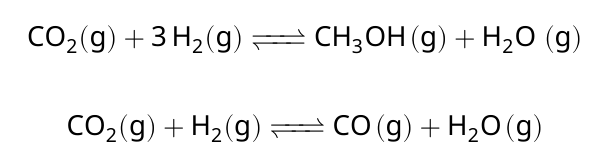
Into a reactor maintained at 250 °C and 50 bar, a mixture containing \(\ce{CO2}:\ce{H2}\) in a molar ratio of \(1:4\) is fed. It has been found that the \(\ce{CO2}\) conversion is 30% and the \(\ce{H2}\) conversion is 18.5% when these two reactions are at equilibrium. No other processes need to be considered.
1.4 — 5 pt
Calculate the thermodynamic equilibrium constants (at 250 °C) of the two reactions.
Heterogeneous copper-containing catalysts are commonly used for \(\ce{CO2}\) hydrogenation. Two specific, Cu-containing catalysts (\(A\) and \(B\)) showed promise for converting \(\ce{CO2}\) to methanol. These catalysts differ not only in their catalytic rates, but also in surface area, Cu content, and Cu dispersion (the ratio of surface Cu to the total Cu in the catalyst).
Cu dispersion is important, because only Cu species at the surface are active in \(\ce{CO2}\) hydrogenation. Under this assumption, 1 mole of active sites corresponds to 1 mole of surface Cu. The efficiency of these active sites is shown by their turnover frequencies (TOF, moles of product formed per moles of active site in a given time).
The table below reports the performance (reported as mass of produced methanol per total catalyst mass in a given time) and the specific surface areas of the two catalysts. The Cu content and dispersion of the catalysts was also measured and reported as follows:
- At the start, all the copper in the catalysts (oxidized beforehand) is present as Cu(II); that was fully reduced to Cu(0) with hydrogen. No other species in the catalysts reacted with hydrogen besides copper oxides.
- \(\ce{N2O}\) was introduced to the reduced samples at room temperature. At this temperature, \(\ce{N2O}\) only oxidizes active surface sites to Cu(I).
- The Cu(I) active surface sites were reduced again to Cu(0) with hydrogen.
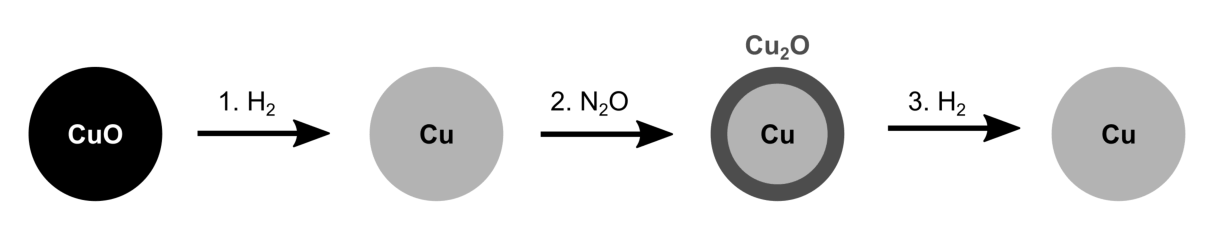
| Catalyst performance \((\mathrm{g}_{\mathrm{MeOH}}\,\mathrm{g}_{\mathrm{cat}}^{-1}\,\mathrm{h}^{-1})\) | Specific surface area \((\mathrm{m^2}\,\mathrm{g}_{\mathrm{cat}}^{-1})\) | \(\ce{H2}\) consumed in step 1 \((\mathrm{mmol}\,\mathrm{g}_{\mathrm{cat}}^{-1})\) | \(\ce{H2}\) consumed in step 3 \((\mathrm{mmol}\,\mathrm{g}_{\mathrm{cat}}^{-1})\) | |
|---|---|---|---|---|
| Catalyst \(A\) | 0.80 | 100 | 5.0 | 0.30 |
| Catalyst \(B\) | 0.90 | 120 | 4.0 | 0.70 |
1.5 — 3 pt
Find the methanol production rate per total mass of Cu (in \(\mathrm{g}_{\mathrm{MeOH}}\,\mathrm{g}_{\mathrm{Cu}}^{-1}\,\mathrm{h}^{-1}\)) for catalysts \(A\) and \(B\).
1.6 — 3 pt
Find the TOF (in \(\mathrm{h}^{-1}\)) for catalysts \(A\) and \(B\).
If you cannot find results, use \(\mathit{TOF}_{\mathrm{Catalyst}\ A}=100\ \mathrm{h}^{-1}\) and \(\mathit{TOF}_{\mathrm{Catalyst}\ B}=1\ \mathrm{h}^{-1}\) in subsequent calculations.
1.7 — 1 pt
Indicate the correct statement on the answer sheet.
a. Catalyst \(A\) has more efficient active sites.
b. Catalyst \(B\) has more efficient active sites.
c. The two catalysts have active sites with the same efficiency.
| Avogadro constant: | \(N_A=6.022\cdot10^{23}\ \mathrm{mol^{-1}}\) | Gas constant: | \(R=8.314\ \mathrm{J\,mol^{-1}\,K^{-1}}\) |
| Ionic product of water at 298.15 K: | \(K_w=10^{-14}\) | Zero of the Celsius scale: | \(0\,^\circ\mathrm{C}=273.15\ \mathrm{K}\) |
| Faraday constant: | \(F=96485\ \mathrm{C\,mol^{-1}}\) | Planck constant: | \(h=6.626\cdot10^{-34}\ \mathrm{J\,s}\) |
| Speed of light: | \(c=2.998\cdot10^8\ \mathrm{m\,s^{-1}}\) | Standard pressure: | \(p^\circ=1\cdot10^5\ \mathrm{Pa}=1\ \mathrm{bar}\) |
| Ideal gas law: | \(pV=nRT\) | Beer-Lambert law: | \(A=\log\left(\frac{I_0}{I}\right)=\varepsilon\cdot l\cdot c\) |
| Enthalpy: | \(H=U+pV\) | Gibbs energy: | \(G=H-TS\) |
| \(\Delta_rG^\circ=-RT\ln K=-nFE^\circ_{\mathrm{cell}}\) | Henderson-Hasselbalch equation: | \(\mathrm{pH}=\mathrm{p}K_a+\log\left(\frac{[\ce{A-}]}{[\ce{HA}]}\right)\) | |
| Arrhenius equation: | \(k=A\exp\left(-\frac{E_A}{RT}\right)\) | Zeroth order integrated rate law: | \([\ce{A}]=[\ce{A}]_0-kt\) |
| Surface of a sphere: | \(A=4\pi R^2\) | First order integrated rate law: | \(\ln[\ce{A}]=\ln[\ce{A}]_0-kt\) |
| Volume of a sphere: | \(V=\frac{4\pi}{3}R^3\) | \(\displaystyle\sum_{k=0}^{\infty}ar^k=\frac{a}{1-r}\quad\text{for }\lvert r\rvert<1\) |
Periodic table
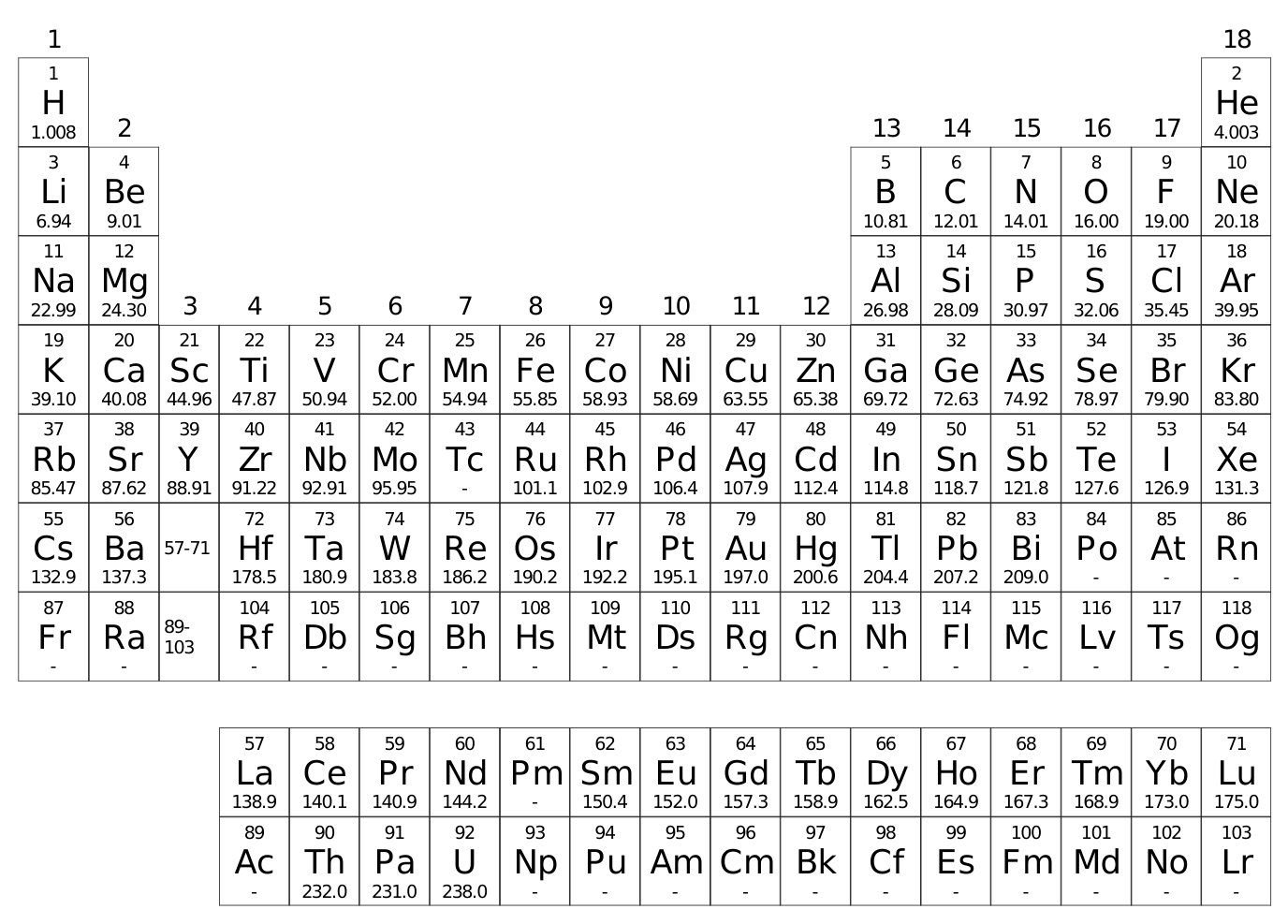
Official English text of the problem.
Answers
- 1.1: Nitrogen conversion \(=51.0\%\).
- 1.2: \(\ce{CH4 + 2H2O -> CO2 + 4H2}\); \(m_{\ce{CO2}}=5.46\ \mathrm{kg}\approx5.5\ \mathrm{kg}\) per \(1.0\ \mathrm{kg}\) of hydrogen. The species are methane
C, waterO, carbon dioxideO=C=O, and hydrogen[H][H]. - 1.3: \(m_{\ce{CO2},\,\mathrm{blue}}=9.74\times10^4\ \mathrm{kg}\approx9.7\times10^4\ \mathrm{kg}\).
- 1.4: Methanol synthesis: \(K=2.26\times10^{-5}\). Carbon monoxide formation: \(K=1.05\times10^{-2}\). Both are dimensionless and apply at \(250\,^\circ\mathrm{C}\).
- 1.5: Catalyst \(A\): \(2.52\); catalyst \(B\): \(3.54\), in \(\mathrm{g}_{\mathrm{MeOH}}\,\mathrm{g}_{\mathrm{Cu}}^{-1}\,\mathrm{h}^{-1}\), or \(2.5\) and \(3.5\) to two significant figures.
- 1.6: \(\mathit{TOF}_A=41.6\ \mathrm{h}^{-1}\) and \(\mathit{TOF}_B=20.1\ \mathrm{h}^{-1}\), or \(42\) and \(20\ \mathrm{h}^{-1}\) to two significant figures.
- 1.7: a. Catalyst \(A\) has more efficient active sites.
Solution
The molecular species used in the solution have the following names and SMILES:
| Formula | Name | SMILES |
|---|---|---|
| \(\ce{N2}\) | Nitrogen | N#N |
| \(\ce{H2}\) | Hydrogen | [H][H] |
| \(\ce{NH3}\) | Ammonia | N |
| \(\ce{CH4}\) | Methane | C |
| \(\ce{H2O}\) | Water | O |
| \(\ce{CO}\) | Carbon monoxide | [C-]#[O+] |
| \(\ce{CO2}\) | Carbon dioxide | O=C=O |
| \(\ce{CH3OH}\) | Methanol | CO |
| \(\ce{N2O}\) | Nitrous oxide | N#[N+][O-] |
Copper metal has the atomic SMILES [Cu]. Copper(II) oxide, \(\ce{CuO}\), and copper(I) oxide, \(\ce{Cu2O}\), can be encoded as formal ionic formula units [Cu+2].[O-2] and [Cu+].[Cu+].[O-2], respectively. These solids are extended structures; the encodings do not specify their crystal lattices or surface coordination.
For the gas equilibria, use ideal-gas activities, \[ a_i=\frac{p_i}{p^\circ},\qquad p^\circ=1\ \mathrm{bar}. \] This makes the thermodynamic equilibrium constants dimensionless.
1.1 — Equilibrium conversion of nitrogen
The balanced ammonia synthesis reaction is \[ \ce{N2(g) + 3H2(g) <=> 2NH3(g)}. \]
From the supplied thermochemical data, \[ \Delta_rH^\circ=2(-45.9)=-91.8\ \mathrm{kJ\,mol^{-1}}, \] and \[ \begin{aligned} \Delta_rS^\circ &=2(192.8)-191.6-3(130.7)\\ &=-198.1\ \mathrm{J\,mol^{-1}\,K^{-1}}. \end{aligned} \]
At \(T=400+273.15=673.15\ \mathrm{K}\), \[ \begin{aligned} \Delta_rG^\circ &=\Delta_rH^\circ-T\Delta_rS^\circ\\ &=-91800-(673.15)(-198.1)\\ &=41551\ \mathrm{J\,mol^{-1}}. \end{aligned} \]
Therefore, \[ K=\exp\left(-\frac{\Delta_rG^\circ}{RT}\right) =\exp\left(-\frac{41551}{8.314(673.15)}\right) =5.96535\times10^{-4}. \]
Take an initial mixture of \(1\ \mathrm{mol}\) nitrogen and \(3\ \mathrm{mol}\) hydrogen. Let \(x\) be the fraction of nitrogen converted.
| Species | Initial amount / mol | Equilibrium amount / mol |
|---|---|---|
| \(\ce{N2}\) | 1 | \(1-x\) |
| \(\ce{H2}\) | 3 | \(3(1-x)\) |
| \(\ce{NH3}\) | 0 | \(2x\) |
| Total | 4 | \(4-2x\) |
Since \(p_i=y_iP\), \[ \begin{aligned} K &=\frac{(p_{\ce{NH3}}/p^\circ)^2} {(p_{\ce{N2}}/p^\circ)(p_{\ce{H2}}/p^\circ)^3}\\ &=\frac{4x^2(4-2x)^2}{27(1-x)^4} \left(\frac{p^\circ}{P}\right)^2. \end{aligned} \]
With \(P/p^\circ=100\), taking the positive square root gives \[ \frac{x(2-x)}{(1-x)^2} =\frac{\sqrt{27}}{4}(100)\sqrt{K} =3.17278. \]
Using \(x(2-x)=1-(1-x)^2\), \[ \frac{1}{(1-x)^2}-1=3.17278, \] so the physically admissible root is \[ x=1-\frac{1}{\sqrt{4.17278}}=0.510461. \]
Thus, \[ \boxed{\text{Nitrogen conversion}=100x=51.0\%.} \]
1.2 — Carbon dioxide from the combined reforming process
The two balanced steps are steam reforming, \[ \ce{CH4 + H2O -> CO + 3H2}, \] and the water–gas shift reaction, \[ \ce{CO + H2O -> CO2 + H2}. \]
Adding them and cancelling the intermediate carbon monoxide gives \[ \boxed{\ce{CH4 + 2H2O -> CO2 + 4H2}}. \]
The supplied atomic masses give \[ M_{\ce{H2}}=2(1.008)=2.016\ \mathrm{g\,mol^{-1}}, \] \[ M_{\ce{CO2}}=12.01+2(16.00)=44.01\ \mathrm{g\,mol^{-1}}. \]
One mole of carbon dioxide accompanies four moles of hydrogen. Hence \[ \begin{aligned} m_{\ce{CO2}} &=(1.0\ \mathrm{kg}) \frac{44.01}{4(2.016)}\\ &=5.4576\ \mathrm{kg}. \end{aligned} \]
Therefore, \[ \boxed{m_{\ce{CO2}}\approx5.5\ \mathrm{kg}\text{ per }1.0\ \mathrm{kg\ of\ hydrogen}.} \]
1.3 — Carbon dioxide capture for blue ammonia
Use a single equilibrium pass of the stoichiometric feed. Both nitrogen and hydrogen have the same fractional conversion \(x\), because they are supplied and consumed in the ratio \(1:3\).
For each \(2x\ \mathrm{mol}\) of ammonia formed, the initial feed contains \(3\ \mathrm{mol}\) of hydrogen. Therefore, \[ n_{\ce{H2},\,\mathrm{feed}} =\frac{3}{2x}n_{\ce{NH3}}. \]
The molar mass of ammonia is \[ M_{\ce{NH3}}=14.01+3(1.008)=17.034\ \mathrm{g\,mol^{-1}}. \]
Thus, \[ \begin{aligned} m_{\ce{H2},\,\mathrm{feed}} &=m_{\ce{NH3}} \frac{3M_{\ce{H2}}}{2xM_{\ce{NH3}}}\\ &=(40000\ \mathrm{kg}) \frac{3(2.016)}{2(0.510461)(17.034)}\\ &=13911.1\ \mathrm{kg}. \end{aligned} \]
The real reforming process produces \(7.0\ \mathrm{kg}\) of carbon dioxide per kilogram of hydrogen supplied. Consequently, \[ \begin{aligned} m_{\ce{CO2},\,\mathrm{blue}} &=7.0\,m_{\ce{H2},\,\mathrm{feed}}\\ &=97377.9\ \mathrm{kg}. \end{aligned} \]
All of this carbon dioxide must be captured: \[ \boxed{m_{\ce{CO2},\,\mathrm{blue}}\approx9.7\times10^4\ \mathrm{kg}.} \]
The conversion factor is needed because some of the supplied hydrogen remains unreacted at equilibrium.
1.4 — Equilibrium constants for methanol and carbon monoxide formation
The two reactions are methanol synthesis, \[ \ce{CO2(g) + 3H2(g) <=> CH3OH(g) + H2O(g)}, \] and the reverse water–gas shift reaction, \[ \ce{CO2(g) + H2(g) <=> CO(g) + H2O(g)}. \]
Take a feed containing \(1.000\ \mathrm{mol}\) carbon dioxide and \(4.000\ \mathrm{mol}\) hydrogen. Let \(\xi_{\mathrm{M}}\) and \(\xi_{\mathrm{CO}}\) be the reaction extents for methanol synthesis and carbon monoxide formation.
The carbon dioxide conversion gives \[ \xi_{\mathrm{M}}+\xi_{\mathrm{CO}}=0.300\ \mathrm{mol}. \]
The hydrogen conversion gives \[ 3\xi_{\mathrm{M}}+\xi_{\mathrm{CO}} =(0.185)(4.000)=0.740\ \mathrm{mol}. \]
Subtracting, \[ 2\xi_{\mathrm{M}}=0.440\ \mathrm{mol}, \] so \[ \xi_{\mathrm{M}}=0.220\ \mathrm{mol}, \qquad \xi_{\mathrm{CO}}=0.080\ \mathrm{mol}. \]
The equilibrium composition and partial pressures at \(P=50\ \mathrm{bar}\) are:
| Species | Equilibrium amount / mol | Partial pressure / bar |
|---|---|---|
| \(\ce{CO2}\) | \(1-0.220-0.080=0.700\) | 7.6754 |
| \(\ce{H2}\) | \(4-3(0.220)-0.080=3.260\) | 35.7456 |
| \(\ce{CH3OH}\) | 0.220 | 2.4123 |
| \(\ce{H2O}\) | \(0.220+0.080=0.300\) | 3.2895 |
| \(\ce{CO}\) | 0.080 | 0.87719 |
| Total | 4.560 | 50.000 |
For methanol synthesis, \(\Delta\nu=-2\). Therefore, \[ K_{\mathrm{M}} =\frac{a_{\ce{CH3OH}}a_{\ce{H2O}}} {a_{\ce{CO2}}a_{\ce{H2}}^3}. \]
Substituting \(a_i=(n_i/n_{\mathrm{tot}})(P/p^\circ)\), \[ \begin{aligned} K_{\mathrm{M}} &=\frac{(0.220)(0.300)(4.560)^2} {(0.700)(3.260)^3} \left(\frac{1}{50}\right)^2\\ &=2.26351\times10^{-5}. \end{aligned} \]
Thus, \[ \boxed{K_{\mathrm{M}}=2.26\times10^{-5}.} \]
For carbon monoxide formation, \(\Delta\nu=0\), so total pressure and total amount cancel: \[ \begin{aligned} K_{\mathrm{CO}} &=\frac{a_{\ce{CO}}a_{\ce{H2O}}} {a_{\ce{CO2}}a_{\ce{H2}}}\\ &=\frac{(0.080)(0.300)}{(0.700)(3.260)}\\ &=0.0105171. \end{aligned} \]
Hence, \[ \boxed{K_{\mathrm{CO}}=1.05\times10^{-2}.} \]
Both constants are dimensionless and correspond to \(250\,^\circ\mathrm{C}=523.15\ \mathrm{K}\).
1.5 — Methanol production per total mass of copper
In step 1, copper(II) oxide is fully reduced: \[ \ce{CuO + H2 -> Cu + H2O}. \]
One mole of hydrogen reduces one mole of copper. Thus, \[ n_{\mathrm{Cu,total}}=n_{\ce{H2},\,\mathrm{step\ 1}}. \]
Using \(M_{\ce{Cu}}=63.55\ \mathrm{g\,mol^{-1}}\), the copper contents are \[ \left(\frac{m_{\mathrm{Cu}}}{m_{\mathrm{cat}}}\right)_A =(5.0\times10^{-3})(63.55) =0.31775\ \mathrm{g}_{\mathrm{Cu}}\,\mathrm{g}_{\mathrm{cat}}^{-1}, \] \[ \left(\frac{m_{\mathrm{Cu}}}{m_{\mathrm{cat}}}\right)_B =(4.0\times10^{-3})(63.55) =0.25420\ \mathrm{g}_{\mathrm{Cu}}\,\mathrm{g}_{\mathrm{cat}}^{-1}. \]
Divide each reported production rate by its copper mass fraction: \[ r_{A,\mathrm{Cu}} =\frac{0.80}{0.31775} =2.5177\ \mathrm{g}_{\mathrm{MeOH}}\, \mathrm{g}_{\mathrm{Cu}}^{-1}\,\mathrm{h}^{-1}, \] \[ r_{B,\mathrm{Cu}} =\frac{0.90}{0.25420} =3.5405\ \mathrm{g}_{\mathrm{MeOH}}\, \mathrm{g}_{\mathrm{Cu}}^{-1}\,\mathrm{h}^{-1}. \]
Therefore, to two significant figures, \[ \boxed{ r_{A,\mathrm{Cu}}=2.5,\qquad r_{B,\mathrm{Cu}}=3.5 \quad \mathrm{g}_{\mathrm{MeOH}}\, \mathrm{g}_{\mathrm{Cu}}^{-1}\,\mathrm{h}^{-1}. } \]
1.6 — Turnover frequencies
The selective oxidation of surface copper in step 2 is \[ \ce{2Cu + N2O -> Cu2O + N2}. \]
In step 3, the resulting copper(I) oxide is reduced: \[ \ce{Cu2O + H2 -> 2Cu + H2O}. \]
Thus, one mole of hydrogen consumed in step 3 corresponds to two moles of surface copper, and hence two moles of active sites: \[ n_{\mathrm{sites}}=2n_{\ce{H2},\,\mathrm{step\ 3}}. \]
Per gram of catalyst, \[ n_{\mathrm{sites},A} =2(0.30)=0.60\ \mathrm{mmol\,g_{\mathrm{cat}}^{-1}}, \] \[ n_{\mathrm{sites},B} =2(0.70)=1.40\ \mathrm{mmol\,g_{\mathrm{cat}}^{-1}}. \]
These correspond to copper dispersions of \[ D_A=\frac{0.60}{5.0}=12\%, \qquad D_B=\frac{1.40}{4.0}=35\%. \]
The molar mass of methanol is \[ M_{\ce{CH3OH}} =12.01+4(1.008)+16.00 =32.042\ \mathrm{g\,mol^{-1}}. \]
By definition, \[ \mathit{TOF} =\frac{\text{moles of methanol produced per hour}} {\text{moles of active sites}}. \]
For catalyst \(A\), \[ \begin{aligned} \mathit{TOF}_A &=\frac{0.80/32.042}{0.60\times10^{-3}}\\ &=41.612\ \mathrm{h}^{-1}. \end{aligned} \]
For catalyst \(B\), \[ \begin{aligned} \mathit{TOF}_B &=\frac{0.90/32.042}{1.40\times10^{-3}}\\ &=20.063\ \mathrm{h}^{-1}. \end{aligned} \]
Therefore, \[ \boxed{ \mathit{TOF}_A\approx42\ \mathrm{h}^{-1}, \qquad \mathit{TOF}_B\approx20\ \mathrm{h}^{-1}. } \]
The specific surface areas are unnecessary for this calculation because the hydrogen consumption directly measures the amount of active surface copper.
1.7 — Efficiency of the active sites
Active-site efficiency is measured by the turnover frequency. Here, \[ \frac{\mathit{TOF}_A}{\mathit{TOF}_B} =\frac{41.612}{20.063} \approx2.07. \]
Each active site on catalyst \(A\) therefore produces approximately twice as much methanol per unit time as an active site on catalyst \(B\).
Select: \[ \boxed{\text{a. Catalyst \(A\) has more efficient active sites.}} \]
The solution was checked against the official solution.
IChO 2024 · Theorieaufgabe 1
Ammoniak
Das Haber–Bosch-Verfahren zur Herstellung von Ammoniak aus Stickstoff und Wasserstoff zählt zu den einflussreichsten industriellen Verfahren der Geschichte und sichert Schätzungen zufolge die Ernährung von etwa der Hälfte der heutigen Weltbevölkerung. Das Verfahren wird üblicherweise bei konstanter Temperatur und konstantem Druck von 400 °C bzw. 100 bar durchgeführt. Im Reaktor stellt sich an Katalysatoren auf Fe-Basis ein Gleichgewicht zwischen den Edukten und dem Produkt ein.
Die thermochemischen Standarddaten für die Gasphase von \(\ce{N2}\), \(\ce{H2}\) und \(\ce{NH3}\) sind unten angegeben. Nehmen Sie an, dass die Reaktionsenthalpie und die Reaktionsentropie temperaturunabhängig sind.
| \(\ce{N2(g)}\) | \(\ce{H2(g)}\) | \(\ce{NH3(g)}\) | |
|---|---|---|---|
| \(\Delta_f H^\circ/(\mathrm{kJ\,mol^{-1}})\) | 0 | 0 | −45.9 |
| \(S^\circ/(\mathrm{J\,mol^{-1}\,K^{-1}})\) | 191.6 | 130.7 | 192.8 |
1.1 — 7 Punkte
Bestimmen Sie den molaren Umsatz von Stickstoff zu Ammoniak (in Prozent) unter den Produktionsbedingungen ausgehend von einem stöchiometrischen Gemisch aus Stickstoff und Wasserstoff. Geben Sie Ihren Rechenweg an, um Teilpunkte zu erhalten. Falls Sie kein Ergebnis erhalten, verwenden Sie in den folgenden Berechnungen 66%.
Eines der Edukte des Haber–Bosch-Verfahrens ist Wasserstoff, der hauptsächlich durch Dampfreformierung von Methan hergestellt wird. Das zweistufige Verfahren beginnt mit der Reaktion von \(\ce{CH4}\) mit Wasser zu \(\ce{H2}\) und \(\ce{CO}\). In einem anschließenden Schritt reagiert \(\ce{CO}\) mit Wasser zu \(\ce{CO2}\) und zusätzlichem Wasserstoff.
1.2 — 2 Punkte
Stellen Sie die Gesamtreaktionsgleichung für das kombinierte Verfahren auf. Geben Sie die Masse an \(\ce{CO2}\) an, die bei der Reaktion pro 1.0 kg \(\ce{H2}\) entsteht (\(m_{\ce{CO2}}\)).
In der Praxis entstehen bei der Dampfreformierung je 1.0 kg Wasserstoff 7.0 kg Kohlenstoffdioxid. Der erzeugte Ammoniak wird nach dem Umgang mit \(\ce{CO2}\) eingestuft. Bei „grauem“ Ammoniak wird das \(\ce{CO2}\) in die Atmosphäre freigesetzt; bei „blauem“ Ammoniak wird es abgeschieden und gespeichert. „Grüner“ Ammoniak wird aus Wasserstoff hergestellt, der ohne Kohlenstoffemissionen erzeugt wird.
1.3 — 3 Punkte
Berechnen Sie die Masse an Kohlenstoffdioxid (\(m_{\ce{CO2},\,\mathrm{blue}}\)), die zur Herstellung von 40,000 kg „blauem“ Ammoniak abgeschieden werden muss. Nehmen Sie an, dass das Kohlenstoffdioxid ausschließlich aus einem realen Dampfreformierungsprozess stammt. Nehmen Sie ferner an, dass der Ammoniak im Gleichgewicht aus einem stöchiometrischen Gemisch aus Stickstoff und Wasserstoff hergestellt wird.
Bei Verwendung von kostengünstigem erneuerbarem Wasserstoff erscheint dessen Umsetzung mit abgeschiedenem \(\ce{CO2}\) zu Methanol vielversprechend. Bei diesem Verfahren tritt jedoch eine konkurrierende Reaktion auf, bei der \(\ce{CO}\) entsteht:
In einen Reaktor, der bei 250 °C und 50 bar gehalten wird, wird ein Gemisch eingespeist, das \(\ce{CO2}:\ce{H2}\) im molaren Verhältnis \(1:4\) enthält. Es wurde festgestellt, dass der \(\ce{CO2}\)-Umsatz 30% und der \(\ce{H2}\)-Umsatz 18.5% beträgt, wenn sich diese beiden Reaktionen im Gleichgewicht befinden. Andere Prozesse müssen nicht berücksichtigt werden.
1.4 — 5 Punkte
Berechnen Sie die thermodynamischen Gleichgewichtskonstanten (bei 250 °C) der beiden Reaktionen.
Heterogene kupferhaltige Katalysatoren werden häufig zur Hydrierung von \(\ce{CO2}\) eingesetzt. Zwei bestimmte Cu-haltige Katalysatoren (\(A\) und \(B\)) erwiesen sich als vielversprechend für die Umwandlung von \(\ce{CO2}\) zu Methanol. Diese Katalysatoren unterscheiden sich nicht nur in ihren katalytischen Reaktionsgeschwindigkeiten, sondern auch in ihrer Oberfläche, ihrem Cu-Gehalt und ihrer Cu-Dispersion (dem Verhältnis des Oberflächen-Cu zum gesamten Cu im Katalysator).
Die Cu-Dispersion ist wichtig, weil nur Cu-Spezies an der Oberfläche bei der Hydrierung von \(\ce{CO2}\) aktiv sind. Unter dieser Annahme entspricht 1 Mol aktiver Zentren 1 Mol Oberflächen-Cu. Die Effizienz dieser aktiven Zentren wird durch ihre Umsatzfrequenzen (TOF, Mol gebildetes Produkt pro Mol aktiver Zentren in einer gegebenen Zeit) beschrieben.
Die folgende Tabelle gibt die Produktivität (angegeben als Masse des erzeugten Methanols pro Gesamtkatalysatormasse in einer gegebenen Zeit) und die spezifischen Oberflächen der beiden Katalysatoren an. Der Cu-Gehalt und die Dispersion der Katalysatoren wurden ebenfalls wie folgt gemessen und angegeben:
- Zu Beginn liegt das gesamte Kupfer in den zuvor oxidierten Katalysatoren als Cu(II) vor; dieses wurde mit Wasserstoff vollständig zu Cu(0) reduziert. Außer den Kupferoxiden reagierten keine anderen Spezies in den Katalysatoren mit Wasserstoff.
- Den reduzierten Proben wurde bei Raumtemperatur \(\ce{N2O}\) zugeführt. Bei dieser Temperatur oxidiert \(\ce{N2O}\) nur die aktiven Oberflächenzentren zu Cu(I).
- Die aktiven Cu(I)-Oberflächenzentren wurden mit Wasserstoff erneut zu Cu(0) reduziert.
| Katalysatorproduktivität \((\mathrm{g}_{\mathrm{MeOH}}\,\mathrm{g}_{\mathrm{cat}}^{-1}\,\mathrm{h}^{-1})\) | Spezifische Oberfläche \((\mathrm{m^2}\,\mathrm{g}_{\mathrm{cat}}^{-1})\) | In Schritt 1 verbrauchter \(\ce{H2}\) \((\mathrm{mmol}\,\mathrm{g}_{\mathrm{cat}}^{-1})\) | In Schritt 3 verbrauchter \(\ce{H2}\) \((\mathrm{mmol}\,\mathrm{g}_{\mathrm{cat}}^{-1})\) | |
|---|---|---|---|---|
| Katalysator \(A\) | 0.80 | 100 | 5.0 | 0.30 |
| Katalysator \(B\) | 0.90 | 120 | 4.0 | 0.70 |
1.5 — 3 Punkte
Bestimmen Sie die Methanolproduktionsrate pro Gesamtmasse an Cu (in \(\mathrm{g}_{\mathrm{MeOH}}\,\mathrm{g}_{\mathrm{Cu}}^{-1}\,\mathrm{h}^{-1}\)) für die Katalysatoren \(A\) und \(B\).
1.6 — 3 Punkte
Bestimmen Sie die TOF (in \(\mathrm{h}^{-1}\)) für die Katalysatoren \(A\) und \(B\).
Falls Sie keine Ergebnisse erhalten, verwenden Sie in den folgenden Berechnungen \(\mathit{TOF}_{\mathrm{Catalyst}\ A}=100\ \mathrm{h}^{-1}\) und \(\mathit{TOF}_{\mathrm{Catalyst}\ B}=1\ \mathrm{h}^{-1}\).
1.7 — 1 Punkt
Kennzeichnen Sie die richtige Aussage auf dem Antwortblatt.
a. Katalysator \(A\) besitzt effizientere aktive Zentren.
b. Katalysator \(B\) besitzt effizientere aktive Zentren.
c. Die beiden Katalysatoren besitzen aktive Zentren mit gleicher Effizienz.
| Avogadro-Konstante: | \(N_A=6.022\cdot10^{23}\ \mathrm{mol^{-1}}\) | Gaskonstante: | \(R=8.314\ \mathrm{J\,mol^{-1}\,K^{-1}}\) |
| Ionenprodukt des Wassers bei 298.15 K: | \(K_w=10^{-14}\) | Nullpunkt der Celsius-Skala: | \(0\,^\circ\mathrm{C}=273.15\ \mathrm{K}\) |
| Faraday-Konstante: | \(F=96485\ \mathrm{C\,mol^{-1}}\) | Planck-Konstante: | \(h=6.626\cdot10^{-34}\ \mathrm{J\,s}\) |
| Lichtgeschwindigkeit: | \(c=2.998\cdot10^8\ \mathrm{m\,s^{-1}}\) | Standarddruck: | \(p^\circ=1\cdot10^5\ \mathrm{Pa}=1\ \mathrm{bar}\) |
| Ideale Gasgleichung: | \(pV=nRT\) | Lambert-Beer-Gesetz: | \(A=\log\left(\frac{I_0}{I}\right)=\varepsilon\cdot l\cdot c\) |
| Enthalpie: | \(H=U+pV\) | Gibbs-Energie: | \(G=H-TS\) |
| \(\Delta_rG^\circ=-RT\ln K=-nFE^\circ_{\mathrm{cell}}\) | Henderson-Hasselbalch-Gleichung: | \(\mathrm{pH}=\mathrm{p}K_a+\log\left(\frac{[\ce{A-}]}{[\ce{HA}]}\right)\) | |
| Arrhenius-Gleichung: | \(k=A\exp\left(-\frac{E_A}{RT}\right)\) | Integriertes Geschwindigkeitsgesetz nullter Ordnung: | \([\ce{A}]=[\ce{A}]_0-kt\) |
| Oberfläche einer Kugel: | \(A=4\pi R^2\) | Integriertes Geschwindigkeitsgesetz erster Ordnung: | \(\ln[\ce{A}]=\ln[\ce{A}]_0-kt\) |
| Volumen einer Kugel: | \(V=\frac{4\pi}{3}R^3\) | \(\displaystyle\sum_{k=0}^{\infty}ar^k=\frac{a}{1-r}\quad\text{für }\lvert r\rvert<1\) |
Periodensystem
Aufgabentext aus dem offiziellen englischen Text übersetzt.
Antworten
- 1.1: Stickstoffumsatz \(=51.0\%\).
- 1.2: \(\ce{CH4 + 2H2O -> CO2 + 4H2}\); \(m_{\ce{CO2}}=5.46\ \mathrm{kg}\approx5.5\ \mathrm{kg}\) pro \(1.0\ \mathrm{kg}\) Wasserstoff. Die Spezies sind Methan
C, WasserO, KohlenstoffdioxidO=C=Ound Wasserstoff[H][H]. - 1.3: \(m_{\ce{CO2},\,\mathrm{blue}}=9.74\times10^4\ \mathrm{kg}\approx9.7\times10^4\ \mathrm{kg}\).
- 1.4: Methanolsynthese: \(K=2.26\times10^{-5}\). Bildung von Kohlenstoffmonoxid: \(K=1.05\times10^{-2}\). Beide sind dimensionslos und gelten bei \(250\,^\circ\mathrm{C}\).
- 1.5: Katalysator \(A\): \(2.52\); Katalysator \(B\): \(3.54\), in \(\mathrm{g}_{\mathrm{MeOH}}\,\mathrm{g}_{\mathrm{Cu}}^{-1}\,\mathrm{h}^{-1}\), bzw. \(2.5\) und \(3.5\) auf zwei signifikante Stellen.
- 1.6: \(\mathit{TOF}_A=41.6\ \mathrm{h}^{-1}\) und \(\mathit{TOF}_B=20.1\ \mathrm{h}^{-1}\), bzw. \(42\) und \(20\ \mathrm{h}^{-1}\) auf zwei signifikante Stellen.
- 1.7: a. Katalysator \(A\) besitzt effizientere aktive Zentren.
Lösung
Die in der Lösung verwendeten molekularen Spezies haben die folgenden Namen und SMILES:
| Formel | Name | SMILES |
|---|---|---|
| \(\ce{N2}\) | Stickstoff | N#N |
| \(\ce{H2}\) | Wasserstoff | [H][H] |
| \(\ce{NH3}\) | Ammoniak | N |
| \(\ce{CH4}\) | Methan | C |
| \(\ce{H2O}\) | Wasser | O |
| \(\ce{CO}\) | Kohlenstoffmonoxid | [C-]#[O+] |
| \(\ce{CO2}\) | Kohlenstoffdioxid | O=C=O |
| \(\ce{CH3OH}\) | Methanol | CO |
| \(\ce{N2O}\) | Distickstoffmonoxid | N#[N+][O-] |
Metallisches Kupfer hat den atomaren SMILES [Cu]. Kupfer(II)-oxid, \(\ce{CuO}\), und Kupfer(I)-oxid, \(\ce{Cu2O}\), können als formale ionische Formeleinheiten [Cu+2].[O-2] bzw. [Cu+].[Cu+].[O-2] codiert werden. Diese Feststoffe sind ausgedehnte Strukturen; die Codierungen legen weder ihre Kristallgitter noch ihre Oberflächenkoordination fest.
Für die Gasgleichgewichte werden Aktivitäten idealer Gase verwendet, \[ a_i=\frac{p_i}{p^\circ},\qquad p^\circ=1\ \mathrm{bar}. \] Dadurch sind die thermodynamischen Gleichgewichtskonstanten dimensionslos.
1.1 — Gleichgewichtsumsatz von Stickstoff
Die ausgeglichene Reaktionsgleichung der Ammoniaksynthese lautet \[ \ce{N2(g) + 3H2(g) <=> 2NH3(g)}. \]
Aus den angegebenen thermochemischen Daten ergibt sich \[ \Delta_rH^\circ=2(-45.9)=-91.8\ \mathrm{kJ\,mol^{-1}}, \] und \[ \begin{aligned} \Delta_rS^\circ &=2(192.8)-191.6-3(130.7)\\ &=-198.1\ \mathrm{J\,mol^{-1}\,K^{-1}}. \end{aligned} \]
Bei \(T=400+273.15=673.15\ \mathrm{K}\) gilt \[ \begin{aligned} \Delta_rG^\circ &=\Delta_rH^\circ-T\Delta_rS^\circ\\ &=-91800-(673.15)(-198.1)\\ &=41551\ \mathrm{J\,mol^{-1}}. \end{aligned} \]
Daher gilt \[ K=\exp\left(-\frac{\Delta_rG^\circ}{RT}\right) =\exp\left(-\frac{41551}{8.314(673.15)}\right) =5.96535\times10^{-4}. \]
Wir betrachten ein Ausgangsgemisch aus \(1\ \mathrm{mol}\) Stickstoff und \(3\ \mathrm{mol}\) Wasserstoff. Es sei \(x\) der umgesetzte Anteil des Stickstoffs.
| Spezies | Anfangsstoffmenge / mol | Stoffmenge im Gleichgewicht / mol |
|---|---|---|
| \(\ce{N2}\) | 1 | \(1-x\) |
| \(\ce{H2}\) | 3 | \(3(1-x)\) |
| \(\ce{NH3}\) | 0 | \(2x\) |
| Gesamt | 4 | \(4-2x\) |
Da \(p_i=y_iP\) gilt, \[ \begin{aligned} K &=\frac{(p_{\ce{NH3}}/p^\circ)^2} {(p_{\ce{N2}}/p^\circ)(p_{\ce{H2}}/p^\circ)^3}\\ &=\frac{4x^2(4-2x)^2}{27(1-x)^4} \left(\frac{p^\circ}{P}\right)^2. \end{aligned} \]
Mit \(P/p^\circ=100\) ergibt das Ziehen der positiven Quadratwurzel \[ \frac{x(2-x)}{(1-x)^2} =\frac{\sqrt{27}}{4}(100)\sqrt{K} =3.17278. \]
Mit \(x(2-x)=1-(1-x)^2\) folgt \[ \frac{1}{(1-x)^2}-1=3.17278, \] sodass die physikalisch zulässige Lösung lautet \[ x=1-\frac{1}{\sqrt{4.17278}}=0.510461. \]
Somit gilt \[ \boxed{\text{Stickstoffumsatz}=100x=51.0\%.} \]
1.2 — Kohlenstoffdioxid aus dem kombinierten Reformierungsprozess
Die beiden ausgeglichenen Teilschritte sind die Dampfreformierung, \[ \ce{CH4 + H2O -> CO + 3H2}, \] und die Wassergas-Shift-Reaktion, \[ \ce{CO + H2O -> CO2 + H2}. \]
Durch Addition und Kürzen des Zwischenprodukts Kohlenstoffmonoxid ergibt sich \[ \boxed{\ce{CH4 + 2H2O -> CO2 + 4H2}}. \]
Aus den angegebenen Atommassen ergibt sich \[ M_{\ce{H2}}=2(1.008)=2.016\ \mathrm{g\,mol^{-1}}, \] \[ M_{\ce{CO2}}=12.01+2(16.00)=44.01\ \mathrm{g\,mol^{-1}}. \]
Mit vier Mol Wasserstoff entsteht ein Mol Kohlenstoffdioxid. Daher gilt \[ \begin{aligned} m_{\ce{CO2}} &=(1.0\ \mathrm{kg}) \frac{44.01}{4(2.016)}\\ &=5.4576\ \mathrm{kg}. \end{aligned} \]
Somit gilt \[ \boxed{m_{\ce{CO2}}\approx5.5\ \mathrm{kg}\text{ pro }1.0\ \mathrm{kg\ of\ hydrogen}.} \]
1.3 — Kohlenstoffdioxidabscheidung für blauen Ammoniak
Es wird ein einmaliger Durchlauf des stöchiometrischen Zulaufs bis zum Gleichgewicht betrachtet. Stickstoff und Wasserstoff weisen denselben Umsatzanteil \(x\) auf, da sie im Verhältnis \(1:3\) zugeführt und verbraucht werden.
Für jeweils \(2x\ \mathrm{mol}\) gebildeten Ammoniak enthält der ursprüngliche Zulauf \(3\ \mathrm{mol}\) Wasserstoff. Daher gilt \[ n_{\ce{H2},\,\mathrm{feed}} =\frac{3}{2x}n_{\ce{NH3}}. \]
Die molare Masse von Ammoniak beträgt \[ M_{\ce{NH3}}=14.01+3(1.008)=17.034\ \mathrm{g\,mol^{-1}}. \]
Somit gilt \[ \begin{aligned} m_{\ce{H2},\,\mathrm{feed}} &=m_{\ce{NH3}} \frac{3M_{\ce{H2}}}{2xM_{\ce{NH3}}}\\ &=(40000\ \mathrm{kg}) \frac{3(2.016)}{2(0.510461)(17.034)}\\ &=13911.1\ \mathrm{kg}. \end{aligned} \]
Der reale Reformierungsprozess erzeugt \(7.0\ \mathrm{kg}\) Kohlenstoffdioxid pro Kilogramm zugeführten Wasserstoffs. Folglich gilt \[ \begin{aligned} m_{\ce{CO2},\,\mathrm{blue}} &=7.0\,m_{\ce{H2},\,\mathrm{feed}}\\ &=97377.9\ \mathrm{kg}. \end{aligned} \]
Dieses gesamte Kohlenstoffdioxid muss abgeschieden werden: \[ \boxed{m_{\ce{CO2},\,\mathrm{blue}}\approx9.7\times10^4\ \mathrm{kg}.} \]
Der Umsatzfaktor wird benötigt, weil ein Teil des zugeführten Wasserstoffs im Gleichgewicht unumgesetzt bleibt.
1.4 — Gleichgewichtskonstanten für die Bildung von Methanol und Kohlenstoffmonoxid
Die beiden Reaktionen sind die Methanolsynthese, \[ \ce{CO2(g) + 3H2(g) <=> CH3OH(g) + H2O(g)}, \] und die umgekehrte Wassergas-Shift-Reaktion, \[ \ce{CO2(g) + H2(g) <=> CO(g) + H2O(g)}. \]
Wir betrachten einen Zulauf mit \(1.000\ \mathrm{mol}\) Kohlenstoffdioxid und \(4.000\ \mathrm{mol}\) Wasserstoff. Es seien \(\xi_{\mathrm{M}}\) und \(\xi_{\mathrm{CO}}\) die Reaktionslaufzahlen der Methanolsynthese bzw. der Bildung von Kohlenstoffmonoxid.
Aus dem Kohlenstoffdioxidumsatz ergibt sich \[ \xi_{\mathrm{M}}+\xi_{\mathrm{CO}}=0.300\ \mathrm{mol}. \]
Aus dem Wasserstoffumsatz ergibt sich \[ 3\xi_{\mathrm{M}}+\xi_{\mathrm{CO}} =(0.185)(4.000)=0.740\ \mathrm{mol}. \]
Durch Subtraktion folgt \[ 2\xi_{\mathrm{M}}=0.440\ \mathrm{mol}, \] also \[ \xi_{\mathrm{M}}=0.220\ \mathrm{mol}, \qquad \xi_{\mathrm{CO}}=0.080\ \mathrm{mol}. \]
Die Gleichgewichtszusammensetzung und die Partialdrücke bei \(P=50\ \mathrm{bar}\) sind:
| Spezies | Stoffmenge im Gleichgewicht / mol | Partialdruck / bar |
|---|---|---|
| \(\ce{CO2}\) | \(1-0.220-0.080=0.700\) | 7.6754 |
| \(\ce{H2}\) | \(4-3(0.220)-0.080=3.260\) | 35.7456 |
| \(\ce{CH3OH}\) | 0.220 | 2.4123 |
| \(\ce{H2O}\) | \(0.220+0.080=0.300\) | 3.2895 |
| \(\ce{CO}\) | 0.080 | 0.87719 |
| Gesamt | 4.560 | 50.000 |
Für die Methanolsynthese gilt \(\Delta\nu=-2\). Daher gilt \[ K_{\mathrm{M}} =\frac{a_{\ce{CH3OH}}a_{\ce{H2O}}} {a_{\ce{CO2}}a_{\ce{H2}}^3}. \]
Durch Einsetzen von \(a_i=(n_i/n_{\mathrm{tot}})(P/p^\circ)\) ergibt sich \[ \begin{aligned} K_{\mathrm{M}} &=\frac{(0.220)(0.300)(4.560)^2} {(0.700)(3.260)^3} \left(\frac{1}{50}\right)^2\\ &=2.26351\times10^{-5}. \end{aligned} \]
Somit gilt \[ \boxed{K_{\mathrm{M}}=2.26\times10^{-5}.} \]
Für die Bildung von Kohlenstoffmonoxid gilt \(\Delta\nu=0\), sodass sich Gesamtdruck und Gesamtstoffmenge herauskürzen: \[ \begin{aligned} K_{\mathrm{CO}} &=\frac{a_{\ce{CO}}a_{\ce{H2O}}} {a_{\ce{CO2}}a_{\ce{H2}}}\\ &=\frac{(0.080)(0.300)}{(0.700)(3.260)}\\ &=0.0105171. \end{aligned} \]
Daher gilt \[ \boxed{K_{\mathrm{CO}}=1.05\times10^{-2}.} \]
Beide Konstanten sind dimensionslos und gelten bei \(250\,^\circ\mathrm{C}=523.15\ \mathrm{K}\).
1.5 — Methanolproduktion pro Gesamtmasse an Kupfer
In Schritt 1 wird Kupfer(II)-oxid vollständig reduziert: \[ \ce{CuO + H2 -> Cu + H2O}. \]
Ein Mol Wasserstoff reduziert ein Mol Kupfer. Somit gilt \[ n_{\mathrm{Cu,total}}=n_{\ce{H2},\,\mathrm{step\ 1}}. \]
Mit \(M_{\ce{Cu}}=63.55\ \mathrm{g\,mol^{-1}}\) ergeben sich die Kupfergehalte \[ \left(\frac{m_{\mathrm{Cu}}}{m_{\mathrm{cat}}}\right)_A =(5.0\times10^{-3})(63.55) =0.31775\ \mathrm{g}_{\mathrm{Cu}}\,\mathrm{g}_{\mathrm{cat}}^{-1}, \] \[ \left(\frac{m_{\mathrm{Cu}}}{m_{\mathrm{cat}}}\right)_B =(4.0\times10^{-3})(63.55) =0.25420\ \mathrm{g}_{\mathrm{Cu}}\,\mathrm{g}_{\mathrm{cat}}^{-1}. \]
Jede angegebene Produktionsrate wird durch den zugehörigen Kupfermassenanteil dividiert: \[ r_{A,\mathrm{Cu}} =\frac{0.80}{0.31775} =2.5177\ \mathrm{g}_{\mathrm{MeOH}}\, \mathrm{g}_{\mathrm{Cu}}^{-1}\,\mathrm{h}^{-1}, \] \[ r_{B,\mathrm{Cu}} =\frac{0.90}{0.25420} =3.5405\ \mathrm{g}_{\mathrm{MeOH}}\, \mathrm{g}_{\mathrm{Cu}}^{-1}\,\mathrm{h}^{-1}. \]
Auf zwei signifikante Stellen ergibt sich daher \[ \boxed{ r_{A,\mathrm{Cu}}=2.5,\qquad r_{B,\mathrm{Cu}}=3.5 \quad \mathrm{g}_{\mathrm{MeOH}}\, \mathrm{g}_{\mathrm{Cu}}^{-1}\,\mathrm{h}^{-1}. } \]
1.6 — Umsatzfrequenzen
Die selektive Oxidation des Oberflächenkupfers in Schritt 2 lautet \[ \ce{2Cu + N2O -> Cu2O + N2}. \]
In Schritt 3 wird das entstandene Kupfer(I)-oxid reduziert: \[ \ce{Cu2O + H2 -> 2Cu + H2O}. \]
Somit entspricht ein Mol des in Schritt 3 verbrauchten Wasserstoffs zwei Mol Oberflächenkupfer und damit zwei Mol aktiver Zentren: \[ n_{\mathrm{sites}}=2n_{\ce{H2},\,\mathrm{step\ 3}}. \]
Pro Gramm Katalysator gilt \[ n_{\mathrm{sites},A} =2(0.30)=0.60\ \mathrm{mmol\,g_{\mathrm{cat}}^{-1}}, \] \[ n_{\mathrm{sites},B} =2(0.70)=1.40\ \mathrm{mmol\,g_{\mathrm{cat}}^{-1}}. \]
Dies entspricht Kupferdispersionen von \[ D_A=\frac{0.60}{5.0}=12\%, \qquad D_B=\frac{1.40}{4.0}=35\%. \]
Die molare Masse von Methanol beträgt \[ M_{\ce{CH3OH}} =12.01+4(1.008)+16.00 =32.042\ \mathrm{g\,mol^{-1}}. \]
Definitionsgemäß gilt \[ \mathit{TOF} =\frac{\text{Mol produziertes Methanol pro Stunde}} {\text{Mol aktiver Zentren}}. \]
Für Katalysator \(A\) gilt \[ \begin{aligned} \mathit{TOF}_A &=\frac{0.80/32.042}{0.60\times10^{-3}}\\ &=41.612\ \mathrm{h}^{-1}. \end{aligned} \]
Für Katalysator \(B\) gilt \[ \begin{aligned} \mathit{TOF}_B &=\frac{0.90/32.042}{1.40\times10^{-3}}\\ &=20.063\ \mathrm{h}^{-1}. \end{aligned} \]
Daher gilt \[ \boxed{ \mathit{TOF}_A\approx42\ \mathrm{h}^{-1}, \qquad \mathit{TOF}_B\approx20\ \mathrm{h}^{-1}. } \]
Die spezifischen Oberflächen werden für diese Berechnung nicht benötigt, da der Wasserstoffverbrauch direkt die Stoffmenge des aktiven Oberflächenkupfers erfasst.
1.7 — Effizienz der aktiven Zentren
Die Effizienz der aktiven Zentren wird anhand der Umsatzfrequenz gemessen. Hier gilt \[ \frac{\mathit{TOF}_A}{\mathit{TOF}_B} =\frac{41.612}{20.063} \approx2.07. \]
Jedes aktive Zentrum auf Katalysator \(A\) produziert daher pro Zeiteinheit etwa doppelt so viel Methanol wie ein aktives Zentrum auf Katalysator \(B\).
Anzukreuzen ist: \[ \boxed{\text{a. Katalysator \(A\) besitzt effizientere aktive Zentren.}} \]
Die Lösung wurde mit der offiziellen Lösung abgeglichen.
IChO 2024 · Teori sorusu 1
Amonyak
Azot ve hidrojenden amonyak üretmek için kullanılan Haber–Bosch prosesi, tarihteki en büyük etkiye sahip endüstriyel proseslerden biridir ve günümüz nüfusunun yaklaşık yarısının yaşamını sürdürmesini sağladığı tahmin edilmektedir. Proses genellikle sırasıyla 400 °C ve 100 bar olan sabit sıcaklık ve basınçta gerçekleştirilir. Reaktörde, Fe esaslı katalizörler üzerinde reaktanlar ile ürün arasında denge kurulur.
\(\ce{N2}\), \(\ce{H2}\) ve \(\ce{NH3}\) için standart gaz fazı termokimyasal verileri aşağıda verilmiştir. Tepkimenin entalpisinin ve entropisinin sıcaklıktan bağımsız olduğunu varsayınız.
| \(\ce{N2(g)}\) | \(\ce{H2(g)}\) | \(\ce{NH3(g)}\) | |
|---|---|---|---|
| \(\Delta_f H^\circ/(\mathrm{kJ\,mol^{-1}})\) | 0 | 0 | −45.9 |
| \(S^\circ/(\mathrm{J\,mol^{-1}\,K^{-1}})\) | 191.6 | 130.7 | 192.8 |
1.1 — 7 puan
Stokiyometrik bir azot ve hidrojen karışımından, üretim koşullarında azotun amonyağa molar dönüşümünü (yüzde olarak) bulunuz. Kısmi puan alabilmek için hesaplamalarınızı gösteriniz. Bir sonuç bulamazsanız sonraki hesaplamalarda %66 kullanınız.
Haber–Bosch prosesindeki reaktanlardan biri, başlıca metanın buharla reformlanması yoluyla üretilen hidrojendir. İki basamaklı proses, \(\ce{CH4}\)'ün suyla tepkimeye girerek \(\ce{H2}\) ve \(\ce{CO}\) üretmesiyle başlar. Sonraki basamakta \(\ce{CO}\), suyla tepkimeye girerek \(\ce{CO2}\) ve ilave hidrojen oluşturur.
1.2 — 2 puan
Birleştirilmiş prosesin toplam tepkime denklemini yazınız. Tepkimede 1.0 kg \(\ce{H2}\) başına üretilen \(\ce{CO2}\)'nin kütlesini (\(m_{\ce{CO2}}\)) veriniz.
Gerçekte, buharla reformlamada her 1.0 kg hidrojen için 7.0 kg karbon dioksit üretilir. Üretilen amonyak, \(\ce{CO2}\) yönetimine göre sınıflandırılır. "Gri" amonyakta \(\ce{CO2}\) atmosfere salınır; "mavi" amonyakta ise yakalanıp depolanır. "Yeşil" amonyak, karbon emisyonu olmadan üretilen hidrojenden elde edilir.
1.3 — 3 puan
40,000 kg “mavi” amonyak üretmek için yakalanması gereken karbon dioksitin kütlesini (\(m_{\ce{CO2},\,\mathrm{blue}}\)) hesaplayınız. Karbon dioksitin yalnızca gerçek bir buharla reformlama prosesinden kaynaklandığını varsayınız. Ayrıca amonyağın, stokiyometrik bir azot ve hidrojen karışımından denge koşullarında üretildiğini varsayınız.
Ucuz yenilenebilir hidrojen kullanılarak, bu hidrojenin yakalanmış \(\ce{CO2}\) ile metanole dönüştürülmesi umut verici görünmektedir. Ancak bu işlemde \(\ce{CO}\) üreten rakip bir tepkime vardır:
250 °C ve 50 bar koşullarında tutulan bir reaktöre, molar \(\ce{CO2}:\ce{H2}\) oranı \(1:4\) olan bir karışım beslenir. Bu iki tepkime dengedeyken \(\ce{CO2}\) dönüşümünün %30 ve \(\ce{H2}\) dönüşümünün %18.5 olduğu bulunmuştur. Başka herhangi bir prosesin dikkate alınması gerekmemektedir.
1.4 — 5 puan
İki tepkimenin termodinamik denge sabitlerini (250 °C'de) hesaplayınız.
\(\ce{CO2}\) hidrojenasyonunda yaygın olarak bakır içeren heterojen katalizörler kullanılır. Cu içeren iki belirli katalizör (\(A\) ve \(B\)), \(\ce{CO2}\)'nin metanole dönüştürülmesinde umut verici sonuçlar göstermiştir. Bu katalizörler yalnızca katalitik hızları bakımından değil, yüzey alanları, Cu içerikleri ve Cu dispersiyonları (yüzeydeki Cu'nun katalizördeki toplam Cu'ya oranı) bakımından da farklılık gösterir.
Cu dispersiyonu önemlidir; çünkü \(\ce{CO2}\) hidrojenasyonunda yalnızca yüzeydeki Cu türleri aktiftir. Bu varsayım altında, 1 mol aktif merkez, yüzeydeki 1 mol Cu'ya karşılık gelir. Bu aktif merkezlerin etkinliği, çevrim frekanslarıyla (TOF, belirli bir sürede aktif merkezlerin molü başına oluşan ürünün molü) gösterilir.
Aşağıdaki tabloda, iki katalizörün performansları (belirli bir sürede toplam katalizör kütlesi başına üretilen metanolün kütlesi olarak verilmiştir) ve özgül yüzey alanları sunulmaktadır. Katalizörlerin Cu içerikleri ve dispersiyonları da aşağıdaki şekilde ölçülmüş ve raporlanmıştır:
- Başlangıçta, katalizörlerdeki (önceden yükseltgenmiş) bakırın tamamı Cu(II) olarak bulunur; bu bakır hidrojenle tamamen Cu(0)'a indirgenmiştir. Katalizörlerde bakır oksitler dışında hiçbir tür hidrojenle tepkimeye girmemiştir.
- İndirgenmiş numunelere oda sıcaklığında \(\ce{N2O}\) verilmiştir. Bu sıcaklıkta \(\ce{N2O}\), yalnızca aktif yüzey merkezlerini Cu(I)'e yükseltger.
- Cu(I) aktif yüzey merkezleri hidrojenle tekrar Cu(0)'a indirgenmiştir.
| Katalizör performansı \((\mathrm{g}_{\mathrm{MeOH}}\,\mathrm{g}_{\mathrm{cat}}^{-1}\,\mathrm{h}^{-1})\) | Özgül yüzey alanı \((\mathrm{m^2}\,\mathrm{g}_{\mathrm{cat}}^{-1})\) | 1. basamakta tüketilen \(\ce{H2}\) \((\mathrm{mmol}\,\mathrm{g}_{\mathrm{cat}}^{-1})\) | 3. basamakta tüketilen \(\ce{H2}\) \((\mathrm{mmol}\,\mathrm{g}_{\mathrm{cat}}^{-1})\) | |
|---|---|---|---|---|
| Katalizör \(A\) | 0.80 | 100 | 5.0 | 0.30 |
| Katalizör \(B\) | 0.90 | 120 | 4.0 | 0.70 |
1.5 — 3 puan
\(A\) ve \(B\) katalizörleri için toplam Cu kütlesi başına metanol üretim hızını (\(\mathrm{g}_{\mathrm{MeOH}}\,\mathrm{g}_{\mathrm{Cu}}^{-1}\,\mathrm{h}^{-1}\) biriminde) bulunuz.
1.6 — 3 puan
\(A\) ve \(B\) katalizörleri için TOF değerlerini (\(\mathrm{h}^{-1}\) biriminde) bulunuz.
Sonuçları bulamazsanız sonraki hesaplamalarda \(\mathit{TOF}_{\mathrm{Catalyst}\ A}=100\ \mathrm{h}^{-1}\) ve \(\mathit{TOF}_{\mathrm{Catalyst}\ B}=1\ \mathrm{h}^{-1}\) kullanınız.
1.7 — 1 puan
Cevap kâğıdında doğru ifadeyi işaretleyiniz.
a. Katalizör \(A\)'nın aktif merkezleri daha etkindir.
b. Katalizör \(B\)'nin aktif merkezleri daha etkindir.
c. İki katalizörün aktif merkezleri aynı etkinliğe sahiptir.
| Avogadro sabiti: | \(N_A=6.022\cdot10^{23}\ \mathrm{mol^{-1}}\) | Gaz sabiti: | \(R=8.314\ \mathrm{J\,mol^{-1}\,K^{-1}}\) |
| Suyun 298.15 K'deki iyon çarpımı: | \(K_w=10^{-14}\) | Celsius ölçeğinin sıfır noktası: | \(0\,^\circ\mathrm{C}=273.15\ \mathrm{K}\) |
| Faraday sabiti: | \(F=96485\ \mathrm{C\,mol^{-1}}\) | Planck sabiti: | \(h=6.626\cdot10^{-34}\ \mathrm{J\,s}\) |
| Işık hızı: | \(c=2.998\cdot10^8\ \mathrm{m\,s^{-1}}\) | Standart basınç: | \(p^\circ=1\cdot10^5\ \mathrm{Pa}=1\ \mathrm{bar}\) |
| İdeal gaz yasası: | \(pV=nRT\) | Beer-Lambert yasası: | \(A=\log\left(\frac{I_0}{I}\right)=\varepsilon\cdot l\cdot c\) |
| Entalpi: | \(H=U+pV\) | Gibbs enerjisi: | \(G=H-TS\) |
| \(\Delta_rG^\circ=-RT\ln K=-nFE^\circ_{\mathrm{cell}}\) | Henderson-Hasselbalch denklemi: | \(\mathrm{pH}=\mathrm{p}K_a+\log\left(\frac{[\ce{A-}]}{[\ce{HA}]}\right)\) | |
| Arrhenius denklemi: | \(k=A\exp\left(-\frac{E_A}{RT}\right)\) | Sıfırıncı dereceden integre hız yasası: | \([\ce{A}]=[\ce{A}]_0-kt\) |
| Kürenin yüzey alanı: | \(A=4\pi R^2\) | Birinci dereceden integre hız yasası: | \(\ln[\ce{A}]=\ln[\ce{A}]_0-kt\) |
| Kürenin hacmi: | \(V=\frac{4\pi}{3}R^3\) | \(\displaystyle\sum_{k=0}^{\infty}ar^k=\frac{a}{1-r}\quad\text{koşuluyla }\lvert r\rvert<1\) |
Periyodik tablo
Soru metni resmi İngilizce metinden çevrilmiştir.
Cevaplar
- 1.1: Azot dönüşümü \(=51.0\%\).
- 1.2: \(\ce{CH4 + 2H2O -> CO2 + 4H2}\); \(1.0\ \mathrm{kg}\) hidrojen başına \(m_{\ce{CO2}}=5.46\ \mathrm{kg}\approx5.5\ \mathrm{kg}\). Türler metan
C, suO, karbon dioksitO=C=Ove hidrojen[H][H]'dir. - 1.3: \(m_{\ce{CO2},\,\mathrm{blue}}=9.74\times10^4\ \mathrm{kg}\approx9.7\times10^4\ \mathrm{kg}\).
- 1.4: Metanol sentezi: \(K=2.26\times10^{-5}\). Karbon monoksit oluşumu: \(K=1.05\times10^{-2}\). Her ikisi de boyutsuzdur ve \(250\,^\circ\mathrm{C}\)'de geçerlidir.
- 1.5: Katalizör \(A\): \(2.52\); katalizör \(B\): \(3.54\), \(\mathrm{g}_{\mathrm{MeOH}}\,\mathrm{g}_{\mathrm{Cu}}^{-1}\,\mathrm{h}^{-1}\) biriminde; iki anlamlı rakamla \(2.5\) ve \(3.5\).
- 1.6: \(\mathit{TOF}_A=41.6\ \mathrm{h}^{-1}\) ve \(\mathit{TOF}_B=20.1\ \mathrm{h}^{-1}\); iki anlamlı rakamla \(42\) ve \(20\ \mathrm{h}^{-1}\).
- 1.7: a. Katalizör \(A\)'nın aktif merkezleri daha etkindir.
Çözüm
Çözümde kullanılan moleküler türlerin adları ve SMILES gösterimleri aşağıdaki gibidir:
| Formül | Ad | SMILES |
|---|---|---|
| \(\ce{N2}\) | Azot | N#N |
| \(\ce{H2}\) | Hidrojen | [H][H] |
| \(\ce{NH3}\) | Amonyak | N |
| \(\ce{CH4}\) | Metan | C |
| \(\ce{H2O}\) | Su | O |
| \(\ce{CO}\) | Karbon monoksit | [C-]#[O+] |
| \(\ce{CO2}\) | Karbon dioksit | O=C=O |
| \(\ce{CH3OH}\) | Metanol | CO |
| \(\ce{N2O}\) | Diazot monoksit | N#[N+][O-] |
Bakır metalinin atomik SMILES gösterimi [Cu]'dur. Bakır(II) oksit, \(\ce{CuO}\), ve bakır(I) oksit, \(\ce{Cu2O}\), sırasıyla [Cu+2].[O-2] ve [Cu+].[Cu+].[O-2] biçiminde formal iyonik formül birimleri olarak kodlanabilir. Bu katılar, uzanımlı yapılardır; bu kodlamalar kristal örgülerini veya yüzey koordinasyonlarını belirtmez.
Gaz dengeleri için ideal gaz aktivitelerini kullanınız: \[ a_i=\frac{p_i}{p^\circ},\qquad p^\circ=1\ \mathrm{bar}. \] Bu, termodinamik denge sabitlerinin boyutsuz olmasını sağlar.
1.1 — Azotun dengedeki dönüşümü
Denkleştirilmiş amonyak sentezi tepkimesi şöyledir: \[ \ce{N2(g) + 3H2(g) <=> 2NH3(g)}. \]
Verilen termokimyasal verilerden, \[ \Delta_rH^\circ=2(-45.9)=-91.8\ \mathrm{kJ\,mol^{-1}}, \] ve \[ \begin{aligned} \Delta_rS^\circ &=2(192.8)-191.6-3(130.7)\\ &=-198.1\ \mathrm{J\,mol^{-1}\,K^{-1}}. \end{aligned} \]
\(T=400+273.15=673.15\ \mathrm{K}\) sıcaklığında, \[ \begin{aligned} \Delta_rG^\circ &=\Delta_rH^\circ-T\Delta_rS^\circ\\ &=-91800-(673.15)(-198.1)\\ &=41551\ \mathrm{J\,mol^{-1}}. \end{aligned} \]
Dolayısıyla, \[ K=\exp\left(-\frac{\Delta_rG^\circ}{RT}\right) =\exp\left(-\frac{41551}{8.314(673.15)}\right) =5.96535\times10^{-4}. \]
Başlangıçta \(1\ \mathrm{mol}\) azot ve \(3\ \mathrm{mol}\) hidrojen içeren bir karışım alalım. Azotun dönüşen kesri \(x\) olsun.
| Tür | Başlangıç miktarı / mol | Denge miktarı / mol |
|---|---|---|
| \(\ce{N2}\) | 1 | \(1-x\) |
| \(\ce{H2}\) | 3 | \(3(1-x)\) |
| \(\ce{NH3}\) | 0 | \(2x\) |
| Toplam | 4 | \(4-2x\) |
\(p_i=y_iP\) olduğundan, \[ \begin{aligned} K &=\frac{(p_{\ce{NH3}}/p^\circ)^2} {(p_{\ce{N2}}/p^\circ)(p_{\ce{H2}}/p^\circ)^3}\\ &=\frac{4x^2(4-2x)^2}{27(1-x)^4} \left(\frac{p^\circ}{P}\right)^2. \end{aligned} \]
\(P/p^\circ=100\) için pozitif karekök alınırsa, \[ \frac{x(2-x)}{(1-x)^2} =\frac{\sqrt{27}}{4}(100)\sqrt{K} =3.17278. \]
\(x(2-x)=1-(1-x)^2\) kullanılarak, \[ \frac{1}{(1-x)^2}-1=3.17278, \] elde edilir; dolayısıyla fiziksel olarak kabul edilebilir kök şöyledir: \[ x=1-\frac{1}{\sqrt{4.17278}}=0.510461. \]
Böylece, \[ \boxed{\text{Azot dönüşümü}=100x=51.0\%.} \]
1.2 — Birleştirilmiş reformlama prosesinden kaynaklanan karbon dioksit
Denkleştirilmiş iki basamak, buharla reformlama, \[ \ce{CH4 + H2O -> CO + 3H2}, \] ve su–gaz kaydırma tepkimesidir: \[ \ce{CO + H2O -> CO2 + H2}. \]
Bu tepkimeler toplanıp ara ürün olan karbon monoksit sadeleştirildiğinde, \[ \boxed{\ce{CH4 + 2H2O -> CO2 + 4H2}}. \]
Verilen atom kütlelerinden, \[ M_{\ce{H2}}=2(1.008)=2.016\ \mathrm{g\,mol^{-1}}, \] \[ M_{\ce{CO2}}=12.01+2(16.00)=44.01\ \mathrm{g\,mol^{-1}}. \]
Dört mol hidrojenle birlikte bir mol karbon dioksit oluşur. Bu nedenle, \[ \begin{aligned} m_{\ce{CO2}} &=(1.0\ \mathrm{kg}) \frac{44.01}{4(2.016)}\\ &=5.4576\ \mathrm{kg}. \end{aligned} \]
Dolayısıyla, \[ \boxed{m_{\ce{CO2}}\approx5.5\ \mathrm{kg}\text{ her }1.0\ \mathrm{kg\ hidrojen\ için}.} \]
1.3 — Mavi amonyak için karbon dioksit yakalama
Stokiyometrik beslemenin tek geçişte dengeye ulaştığını kabul ediniz. Azot ve hidrojen \(1:3\) oranında beslendiği ve tüketildiği için her ikisinin de dönüşüm kesri aynıdır ve \(x\)'e eşittir.
Oluşan her \(2x\ \mathrm{mol}\) amonyak için başlangıç beslemesinde \(3\ \mathrm{mol}\) hidrojen bulunur. Dolayısıyla, \[ n_{\ce{H2},\,\mathrm{feed}} =\frac{3}{2x}n_{\ce{NH3}}. \]
Amonyağın molar kütlesi şöyledir: \[ M_{\ce{NH3}}=14.01+3(1.008)=17.034\ \mathrm{g\,mol^{-1}}. \]
Böylece, \[ \begin{aligned} m_{\ce{H2},\,\mathrm{feed}} &=m_{\ce{NH3}} \frac{3M_{\ce{H2}}}{2xM_{\ce{NH3}}}\\ &=(40000\ \mathrm{kg}) \frac{3(2.016)}{2(0.510461)(17.034)}\\ &=13911.1\ \mathrm{kg}. \end{aligned} \]
Gerçek reformlama prosesi, beslenen her bir kilogram hidrojen başına \(7.0\ \mathrm{kg}\) karbon dioksit üretir. Sonuç olarak, \[ \begin{aligned} m_{\ce{CO2},\,\mathrm{blue}} &=7.0\,m_{\ce{H2},\,\mathrm{feed}}\\ &=97377.9\ \mathrm{kg}. \end{aligned} \]
Bu karbon dioksitin tamamı yakalanmalıdır: \[ \boxed{m_{\ce{CO2},\,\mathrm{blue}}\approx9.7\times10^4\ \mathrm{kg}.} \]
Beslenen hidrojenin bir kısmı dengede tepkimeye girmeden kaldığı için dönüşüm faktörü gereklidir.
1.4 — Metanol ve karbon monoksit oluşumunun denge sabitleri
İki tepkime, metanol sentezi, \[ \ce{CO2(g) + 3H2(g) <=> CH3OH(g) + H2O(g)}, \] ve ters su–gaz kaydırma tepkimesidir: \[ \ce{CO2(g) + H2(g) <=> CO(g) + H2O(g)}. \]
\(1.000\ \mathrm{mol}\) karbon dioksit ve \(4.000\ \mathrm{mol}\) hidrojen içeren bir besleme alalım. Metanol sentezi ve karbon monoksit oluşumu için tepkime ilerleme miktarları sırasıyla \(\xi_{\mathrm{M}}\) ve \(\xi_{\mathrm{CO}}\) olsun.
Karbon dioksit dönüşümünden, \[ \xi_{\mathrm{M}}+\xi_{\mathrm{CO}}=0.300\ \mathrm{mol}. \]
Hidrojen dönüşümünden, \[ 3\xi_{\mathrm{M}}+\xi_{\mathrm{CO}} =(0.185)(4.000)=0.740\ \mathrm{mol}. \]
Çıkarma işlemiyle, \[ 2\xi_{\mathrm{M}}=0.440\ \mathrm{mol}, \] dolayısıyla, \[ \xi_{\mathrm{M}}=0.220\ \mathrm{mol}, \qquad \xi_{\mathrm{CO}}=0.080\ \mathrm{mol}. \]
\(P=50\ \mathrm{bar}\) basıncında denge bileşimi ve kısmi basınçlar şöyledir:
| Tür | Denge miktarı / mol | Kısmi basınç / bar |
|---|---|---|
| \(\ce{CO2}\) | \(1-0.220-0.080=0.700\) | 7.6754 |
| \(\ce{H2}\) | \(4-3(0.220)-0.080=3.260\) | 35.7456 |
| \(\ce{CH3OH}\) | 0.220 | 2.4123 |
| \(\ce{H2O}\) | \(0.220+0.080=0.300\) | 3.2895 |
| \(\ce{CO}\) | 0.080 | 0.87719 |
| Toplam | 4.560 | 50.000 |
Metanol sentezi için \(\Delta\nu=-2\)'dir. Dolayısıyla, \[ K_{\mathrm{M}} =\frac{a_{\ce{CH3OH}}a_{\ce{H2O}}} {a_{\ce{CO2}}a_{\ce{H2}}^3}. \]
\(a_i=(n_i/n_{\mathrm{tot}})(P/p^\circ)\) yerine konulduğunda, \[ \begin{aligned} K_{\mathrm{M}} &=\frac{(0.220)(0.300)(4.560)^2} {(0.700)(3.260)^3} \left(\frac{1}{50}\right)^2\\ &=2.26351\times10^{-5}. \end{aligned} \]
Böylece, \[ \boxed{K_{\mathrm{M}}=2.26\times10^{-5}.} \]
Karbon monoksit oluşumu için \(\Delta\nu=0\) olduğundan toplam basınç ve toplam madde miktarı sadeleşir: \[ \begin{aligned} K_{\mathrm{CO}} &=\frac{a_{\ce{CO}}a_{\ce{H2O}}} {a_{\ce{CO2}}a_{\ce{H2}}}\\ &=\frac{(0.080)(0.300)}{(0.700)(3.260)}\\ &=0.0105171. \end{aligned} \]
Bu nedenle, \[ \boxed{K_{\mathrm{CO}}=1.05\times10^{-2}.} \]
Her iki sabit de boyutsuzdur ve \(250\,^\circ\mathrm{C}=523.15\ \mathrm{K}\) sıcaklığına karşılık gelir.
1.5 — Toplam bakır kütlesi başına metanol üretimi
- basamakta bakır(II) oksit tamamen indirgenir: \[ \ce{CuO + H2 -> Cu + H2O}. \]
Bir mol hidrojen, bir mol bakırı indirger. Böylece, \[ n_{\mathrm{Cu,total}}=n_{\ce{H2},\,\mathrm{step\ 1}}. \]
\(M_{\ce{Cu}}=63.55\ \mathrm{g\,mol^{-1}}\) kullanılarak bakır içerikleri şöyle bulunur: \[ \left(\frac{m_{\mathrm{Cu}}}{m_{\mathrm{cat}}}\right)_A =(5.0\times10^{-3})(63.55) =0.31775\ \mathrm{g}_{\mathrm{Cu}}\,\mathrm{g}_{\mathrm{cat}}^{-1}, \] \[ \left(\frac{m_{\mathrm{Cu}}}{m_{\mathrm{cat}}}\right)_B =(4.0\times10^{-3})(63.55) =0.25420\ \mathrm{g}_{\mathrm{Cu}}\,\mathrm{g}_{\mathrm{cat}}^{-1}. \]
Verilen her bir üretim hızını ilgili bakır kütle kesrine bölünüz: \[ r_{A,\mathrm{Cu}} =\frac{0.80}{0.31775} =2.5177\ \mathrm{g}_{\mathrm{MeOH}}\, \mathrm{g}_{\mathrm{Cu}}^{-1}\,\mathrm{h}^{-1}, \] \[ r_{B,\mathrm{Cu}} =\frac{0.90}{0.25420} =3.5405\ \mathrm{g}_{\mathrm{MeOH}}\, \mathrm{g}_{\mathrm{Cu}}^{-1}\,\mathrm{h}^{-1}. \]
Dolayısıyla, iki anlamlı rakamla, \[ \boxed{ r_{A,\mathrm{Cu}}=2.5,\qquad r_{B,\mathrm{Cu}}=3.5 \quad \mathrm{g}_{\mathrm{MeOH}}\, \mathrm{g}_{\mathrm{Cu}}^{-1}\,\mathrm{h}^{-1}. } \]
1.6 — Çevrim frekansları
-
basamakta yüzeydeki bakırın seçici yükseltgenmesi şöyledir: \[ \ce{2Cu + N2O -> Cu2O + N2}. \]
-
basamakta oluşan bakır(I) oksit indirgenir: \[ \ce{Cu2O + H2 -> 2Cu + H2O}. \]
Böylece, 3. basamakta tüketilen bir mol hidrojen, yüzeydeki iki mol bakıra ve dolayısıyla iki mol aktif merkeze karşılık gelir: \[ n_{\mathrm{sites}}=2n_{\ce{H2},\,\mathrm{step\ 3}}. \]
Katalizörün gramı başına, \[ n_{\mathrm{sites},A} =2(0.30)=0.60\ \mathrm{mmol\,g_{\mathrm{cat}}^{-1}}, \] \[ n_{\mathrm{sites},B} =2(0.70)=1.40\ \mathrm{mmol\,g_{\mathrm{cat}}^{-1}}. \]
Bunlar aşağıdaki bakır dispersiyonlarına karşılık gelir: \[ D_A=\frac{0.60}{5.0}=12\%, \qquad D_B=\frac{1.40}{4.0}=35\%. \]
Metanolün molar kütlesi şöyledir: \[ M_{\ce{CH3OH}} =12.01+4(1.008)+16.00 =32.042\ \mathrm{g\,mol^{-1}}. \]
Tanım gereği, \[ \mathit{TOF} =\frac{\text{saat başına üretilen metanolün molü}} {\text{aktif merkezlerin molü}}. \]
Katalizör \(A\) için, \[ \begin{aligned} \mathit{TOF}_A &=\frac{0.80/32.042}{0.60\times10^{-3}}\\ &=41.612\ \mathrm{h}^{-1}. \end{aligned} \]
Katalizör \(B\) için, \[ \begin{aligned} \mathit{TOF}_B &=\frac{0.90/32.042}{1.40\times10^{-3}}\\ &=20.063\ \mathrm{h}^{-1}. \end{aligned} \]
Dolayısıyla, \[ \boxed{ \mathit{TOF}_A\approx42\ \mathrm{h}^{-1}, \qquad \mathit{TOF}_B\approx20\ \mathrm{h}^{-1}. } \]
Hidrojen tüketimi, yüzeydeki aktif bakırın miktarını doğrudan ölçtüğü için bu hesaplamada özgül yüzey alanlarına gerek yoktur.
1.7 — Aktif merkezlerin etkinliği
Aktif merkezlerin etkinliği çevrim frekansıyla ölçülür. Burada, \[ \frac{\mathit{TOF}_A}{\mathit{TOF}_B} =\frac{41.612}{20.063} \approx2.07. \]
Dolayısıyla katalizör \(A\) üzerindeki her bir aktif merkez, birim zamanda katalizör \(B\) üzerindeki bir aktif merkezin yaklaşık iki katı kadar metanol üretir.
Seçiniz: \[ \boxed{\text{a. Katalizör \(A\)'nın aktif merkezleri daha etkindir.}} \]
Çözüm, resmi çözümle karşılaştırılarak kontrol edildi.
IChO 2024 · Problema teórico 1
Amoníaco
El proceso Haber–Bosch para producir amoníaco a partir de nitrógeno e hidrógeno es uno de los procesos industriales de mayor impacto de la historia y se estima que permite alimentar a aproximadamente la mitad de la población actual. El proceso suele llevarse a cabo a temperatura y presión constantes, de 400 °C y 100 bar, respectivamente. El equilibrio entre los reactivos y el producto se establece sobre catalizadores basados en Fe en el reactor.
Los datos termoquímicos estándar en fase gaseosa de \(\ce{N2}\), \(\ce{H2}\) y \(\ce{NH3}\) se muestran a continuación. Suponga que la entalpía y la entropía de la reacción son independientes de la temperatura.
| \(\ce{N2(g)}\) | \(\ce{H2(g)}\) | \(\ce{NH3(g)}\) | |
|---|---|---|---|
| \(\Delta_f H^\circ/(\mathrm{kJ\,mol^{-1}})\) | 0 | 0 | −45.9 |
| \(S^\circ/(\mathrm{J\,mol^{-1}\,K^{-1}})\) | 191.6 | 130.7 | 192.8 |
1.1 — 7 pt
Determine la conversión molar de nitrógeno (en porcentaje) en amoníaco en las condiciones de producción a partir de una mezcla estequiométrica de nitrógeno e hidrógeno. Muestre sus cálculos para obtener puntuación parcial. Si no obtiene un resultado, utilice 66% en los cálculos posteriores.
Uno de los reactivos del proceso Haber–Bosch es el hidrógeno, que se produce principalmente mediante el reformado de metano con vapor de agua. El proceso, que consta de dos etapas, comienza con la reacción de \(\ce{CH4}\) con agua para producir \(\ce{H2}\) y \(\ce{CO}\). En una etapa posterior, el \(\ce{CO}\) reacciona con agua para formar \(\ce{CO2}\) e hidrógeno adicional.
1.2 — 2 pt
Escriba la ecuación de la reacción global del proceso combinado. Indique la masa de \(\ce{CO2}\) producida en la reacción por cada 1.0 kg de \(\ce{H2}\) (\(m_{\ce{CO2}}\)).
En la práctica, el reformado con vapor de agua produce 7.0 kg de dióxido de carbono por cada 1.0 kg de hidrógeno. El amoníaco generado se clasifica según la gestión del \(\ce{CO2}\). En el caso del amoníaco «gris», el \(\ce{CO2}\) se libera a la atmósfera; en el caso del amoníaco «azul», se captura y almacena. El amoníaco «verde» se obtiene a partir de hidrógeno producido sin emisiones de carbono.
1.3 — 3 pt
Calcule la masa de dióxido de carbono (\(m_{\ce{CO2},\,\mathrm{blue}}\)) que debe capturarse para producir 40,000 kg de amoníaco «azul». Suponga que el dióxido de carbono procede únicamente de un proceso real de reformado con vapor de agua. Suponga además que el amoníaco se produce en el equilibrio a partir de una mezcla estequiométrica de nitrógeno e hidrógeno.
La posibilidad de convertir hidrógeno renovable de bajo coste en metanol mediante su reacción con \(\ce{CO2}\) capturado resulta prometedora. Sin embargo, en este procedimiento hay una reacción competitiva que produce \(\ce{CO}\):
Se introduce en un reactor mantenido a 250 °C y 50 bar una mezcla que contiene \(\ce{CO2}:\ce{H2}\) en una proporción molar de \(1:4\). Se ha observado que la conversión de \(\ce{CO2}\) es del 30% y la de \(\ce{H2}\) es del 18.5% cuando estas dos reacciones están en equilibrio. No es necesario considerar ningún otro proceso.
1.4 — 5 pt
Calcule las constantes de equilibrio termodinámicas (a 250 °C) de las dos reacciones.
Los catalizadores heterogéneos que contienen cobre se utilizan habitualmente para la hidrogenación de \(\ce{CO2}\). Dos catalizadores específicos que contienen Cu (\(A\) y \(B\)) mostraron resultados prometedores para convertir \(\ce{CO2}\) en metanol. Estos catalizadores difieren no solo en sus velocidades catalíticas, sino también en su superficie, su contenido de Cu y su dispersión de Cu (la relación entre el Cu superficial y el Cu total del catalizador).
La dispersión de Cu es importante, porque solo las especies de Cu presentes en la superficie son activas en la hidrogenación de \(\ce{CO2}\). Bajo este supuesto, 1 mol de sitios activos corresponde a 1 mol de Cu superficial. La eficiencia de estos sitios activos se expresa mediante sus frecuencias de recambio (TOF, moles de producto formado por mol de sitios activos en un tiempo determinado).
La tabla siguiente presenta la productividad (expresada como masa de metanol producido por masa total de catalizador en un tiempo determinado) y las superficies específicas de los dos catalizadores. El contenido y la dispersión de Cu de los catalizadores también se midieron y se presentan a continuación:
- Al comienzo, todo el cobre de los catalizadores (previamente oxidados) está presente como Cu(II); este se redujo por completo a Cu(0) con hidrógeno. Ninguna otra especie de los catalizadores reaccionó con el hidrógeno, aparte de los óxidos de cobre.
- Se introdujo \(\ce{N2O}\) en las muestras reducidas a temperatura ambiente. A esta temperatura, el \(\ce{N2O}\) solo oxida los sitios activos superficiales a Cu(I).
- Los sitios activos superficiales de Cu(I) se redujeron de nuevo a Cu(0) con hidrógeno.
| Productividad del catalizador \((\mathrm{g}_{\mathrm{MeOH}}\,\mathrm{g}_{\mathrm{cat}}^{-1}\,\mathrm{h}^{-1})\) | Superficie específica \((\mathrm{m^2}\,\mathrm{g}_{\mathrm{cat}}^{-1})\) | \(\ce{H2}\) consumido en la etapa 1 \((\mathrm{mmol}\,\mathrm{g}_{\mathrm{cat}}^{-1})\) | \(\ce{H2}\) consumido en la etapa 3 \((\mathrm{mmol}\,\mathrm{g}_{\mathrm{cat}}^{-1})\) | |
|---|---|---|---|---|
| Catalizador \(A\) | 0.80 | 100 | 5.0 | 0.30 |
| Catalizador \(B\) | 0.90 | 120 | 4.0 | 0.70 |
1.5 — 3 pt
Determine la velocidad de producción de metanol por masa total de Cu (en \(\mathrm{g}_{\mathrm{MeOH}}\,\mathrm{g}_{\mathrm{Cu}}^{-1}\,\mathrm{h}^{-1}\)) para los catalizadores \(A\) y \(B\).
1.6 — 3 pt
Determine la TOF (en \(\mathrm{h}^{-1}\)) para los catalizadores \(A\) y \(B\).
Si no obtiene resultados, utilice \(\mathit{TOF}_{\mathrm{Catalyst}\ A}=100\ \mathrm{h}^{-1}\) y \(\mathit{TOF}_{\mathrm{Catalyst}\ B}=1\ \mathrm{h}^{-1}\) en los cálculos posteriores.
1.7 — 1 pt
Indique la afirmación correcta en la hoja de respuestas.
a. El catalizador \(A\) tiene sitios activos más eficientes.
b. El catalizador \(B\) tiene sitios activos más eficientes.
c. Los dos catalizadores tienen sitios activos con la misma eficiencia.
| Constante de Avogadro: | \(N_A=6.022\cdot10^{23}\ \mathrm{mol^{-1}}\) | Constante de los gases: | \(R=8.314\ \mathrm{J\,mol^{-1}\,K^{-1}}\) |
| Producto iónico del agua a 298.15 K: | \(K_w=10^{-14}\) | Cero de la escala Celsius: | \(0\,^\circ\mathrm{C}=273.15\ \mathrm{K}\) |
| Constante de Faraday: | \(F=96485\ \mathrm{C\,mol^{-1}}\) | Constante de Planck: | \(h=6.626\cdot10^{-34}\ \mathrm{J\,s}\) |
| Velocidad de la luz: | \(c=2.998\cdot10^8\ \mathrm{m\,s^{-1}}\) | Presión estándar: | \(p^\circ=1\cdot10^5\ \mathrm{Pa}=1\ \mathrm{bar}\) |
| Ley de los gases ideales: | \(pV=nRT\) | Ley de Beer-Lambert: | \(A=\log\left(\frac{I_0}{I}\right)=\varepsilon\cdot l\cdot c\) |
| Entalpía: | \(H=U+pV\) | Energía de Gibbs: | \(G=H-TS\) |
| \(\Delta_rG^\circ=-RT\ln K=-nFE^\circ_{\mathrm{cell}}\) | Ecuación de Henderson-Hasselbalch: | \(\mathrm{pH}=\mathrm{p}K_a+\log\left(\frac{[\ce{A-}]}{[\ce{HA}]}\right)\) | |
| Ecuación de Arrhenius: | \(k=A\exp\left(-\frac{E_A}{RT}\right)\) | Ley de velocidad integrada de orden cero: | \([\ce{A}]=[\ce{A}]_0-kt\) |
| Superficie de una esfera: | \(A=4\pi R^2\) | Ley de velocidad integrada de primer orden: | \(\ln[\ce{A}]=\ln[\ce{A}]_0-kt\) |
| Volumen de una esfera: | \(V=\frac{4\pi}{3}R^3\) | \(\displaystyle\sum_{k=0}^{\infty}ar^k=\frac{a}{1-r}\quad\text{para }\lvert r\rvert<1\) |
Tabla periódica
Enunciado traducido del texto oficial en inglés.
Respuestas
- 1.1: Conversión de nitrógeno \(=51.0\%\).
- 1.2: \(\ce{CH4 + 2H2O -> CO2 + 4H2}\); \(m_{\ce{CO2}}=5.46\ \mathrm{kg}\approx5.5\ \mathrm{kg}\) por cada \(1.0\ \mathrm{kg}\) de hidrógeno. Las especies son metano
C, aguaO, dióxido de carbonoO=C=Oe hidrógeno[H][H]. - 1.3: \(m_{\ce{CO2},\,\mathrm{blue}}=9.74\times10^4\ \mathrm{kg}\approx9.7\times10^4\ \mathrm{kg}\).
- 1.4: Síntesis de metanol: \(K=2.26\times10^{-5}\). Formación de monóxido de carbono: \(K=1.05\times10^{-2}\). Ambas son adimensionales y son válidas a \(250\,^\circ\mathrm{C}\).
- 1.5: Catalizador \(A\): \(2.52\); catalizador \(B\): \(3.54\), en \(\mathrm{g}_{\mathrm{MeOH}}\,\mathrm{g}_{\mathrm{Cu}}^{-1}\,\mathrm{h}^{-1}\), o \(2.5\) y \(3.5\) con dos cifras significativas.
- 1.6: \(\mathit{TOF}_A=41.6\ \mathrm{h}^{-1}\) y \(\mathit{TOF}_B=20.1\ \mathrm{h}^{-1}\), o \(42\) y \(20\ \mathrm{h}^{-1}\) con dos cifras significativas.
- 1.7: a. El catalizador \(A\) tiene sitios activos más eficientes.
Solución
Las especies moleculares utilizadas en la solución tienen los siguientes nombres y SMILES:
| Fórmula | Nombre | SMILES |
|---|---|---|
| \(\ce{N2}\) | Nitrógeno | N#N |
| \(\ce{H2}\) | Hidrógeno | [H][H] |
| \(\ce{NH3}\) | Amoníaco | N |
| \(\ce{CH4}\) | Metano | C |
| \(\ce{H2O}\) | Agua | O |
| \(\ce{CO}\) | Monóxido de carbono | [C-]#[O+] |
| \(\ce{CO2}\) | Dióxido de carbono | O=C=O |
| \(\ce{CH3OH}\) | Metanol | CO |
| \(\ce{N2O}\) | Óxido nitroso | N#[N+][O-] |
El cobre metálico tiene el SMILES atómico [Cu]. El óxido de cobre(II), \(\ce{CuO}\), y el óxido de cobre(I), \(\ce{Cu2O}\), pueden codificarse como unidades fórmula iónicas formales [Cu+2].[O-2] y [Cu+].[Cu+].[O-2], respectivamente. Estos sólidos tienen estructuras extendidas; las codificaciones no especifican sus redes cristalinas ni la coordinación superficial.
Para los equilibrios gaseosos, utilice actividades de gas ideal, \[ a_i=\frac{p_i}{p^\circ},\qquad p^\circ=1\ \mathrm{bar}. \] De este modo, las constantes de equilibrio termodinámicas son adimensionales.
1.1 — Conversión de nitrógeno en el equilibrio
La reacción ajustada de síntesis de amoníaco es \[ \ce{N2(g) + 3H2(g) <=> 2NH3(g)}. \]
A partir de los datos termoquímicos proporcionados, \[ \Delta_rH^\circ=2(-45.9)=-91.8\ \mathrm{kJ\,mol^{-1}}, \] y \[ \begin{aligned} \Delta_rS^\circ &=2(192.8)-191.6-3(130.7)\\ &=-198.1\ \mathrm{J\,mol^{-1}\,K^{-1}}. \end{aligned} \]
A \(T=400+273.15=673.15\ \mathrm{K}\), \[ \begin{aligned} \Delta_rG^\circ &=\Delta_rH^\circ-T\Delta_rS^\circ\\ &=-91800-(673.15)(-198.1)\\ &=41551\ \mathrm{J\,mol^{-1}}. \end{aligned} \]
Por tanto, \[ K=\exp\left(-\frac{\Delta_rG^\circ}{RT}\right) =\exp\left(-\frac{41551}{8.314(673.15)}\right) =5.96535\times10^{-4}. \]
Considere una mezcla inicial de \(1\ \mathrm{mol}\) de nitrógeno y \(3\ \mathrm{mol}\) de hidrógeno. Sea \(x\) la fracción de nitrógeno convertida.
| Especie | Cantidad inicial / mol | Cantidad en el equilibrio / mol |
|---|---|---|
| \(\ce{N2}\) | 1 | \(1-x\) |
| \(\ce{H2}\) | 3 | \(3(1-x)\) |
| \(\ce{NH3}\) | 0 | \(2x\) |
| Total | 4 | \(4-2x\) |
Como \(p_i=y_iP\), \[ \begin{aligned} K &=\frac{(p_{\ce{NH3}}/p^\circ)^2} {(p_{\ce{N2}}/p^\circ)(p_{\ce{H2}}/p^\circ)^3}\\ &=\frac{4x^2(4-2x)^2}{27(1-x)^4} \left(\frac{p^\circ}{P}\right)^2. \end{aligned} \]
Con \(P/p^\circ=100\), al tomar la raíz cuadrada positiva se obtiene \[ \frac{x(2-x)}{(1-x)^2} =\frac{\sqrt{27}}{4}(100)\sqrt{K} =3.17278. \]
Utilizando \(x(2-x)=1-(1-x)^2\), \[ \frac{1}{(1-x)^2}-1=3.17278, \] por lo que la raíz físicamente admisible es \[ x=1-\frac{1}{\sqrt{4.17278}}=0.510461. \]
Así, \[ \boxed{\text{Conversión de nitrógeno}=100x=51.0\%.} \]
1.2 — Dióxido de carbono procedente del proceso combinado de reformado
Las dos etapas ajustadas son el reformado con vapor de agua, \[ \ce{CH4 + H2O -> CO + 3H2}, \] y la reacción de desplazamiento del gas de agua, \[ \ce{CO + H2O -> CO2 + H2}. \]
Al sumarlas y cancelar el monóxido de carbono intermedio se obtiene \[ \boxed{\ce{CH4 + 2H2O -> CO2 + 4H2}}. \]
Las masas atómicas proporcionadas dan \[ M_{\ce{H2}}=2(1.008)=2.016\ \mathrm{g\,mol^{-1}}, \] \[ M_{\ce{CO2}}=12.01+2(16.00)=44.01\ \mathrm{g\,mol^{-1}}. \]
Por cada cuatro moles de hidrógeno se produce un mol de dióxido de carbono. Por consiguiente, \[ \begin{aligned} m_{\ce{CO2}} &=(1.0\ \mathrm{kg}) \frac{44.01}{4(2.016)}\\ &=5.4576\ \mathrm{kg}. \end{aligned} \]
Por tanto, \[ \boxed{m_{\ce{CO2}}\approx5.5\ \mathrm{kg}\text{ por cada }1.0\ \mathrm{kg\ of\ hydrogen}.} \]
1.3 — Captura de dióxido de carbono para el amoníaco azul
Considere una única pasada de la alimentación estequiométrica hasta alcanzar el equilibrio. Tanto el nitrógeno como el hidrógeno tienen la misma conversión fraccional \(x\), porque se suministran y consumen en la proporción \(1:3\).
Por cada \(2x\ \mathrm{mol}\) de amoníaco formado, la alimentación inicial contiene \(3\ \mathrm{mol}\) de hidrógeno. Por tanto, \[ n_{\ce{H2},\,\mathrm{feed}} =\frac{3}{2x}n_{\ce{NH3}}. \]
La masa molar del amoníaco es \[ M_{\ce{NH3}}=14.01+3(1.008)=17.034\ \mathrm{g\,mol^{-1}}. \]
Así, \[ \begin{aligned} m_{\ce{H2},\,\mathrm{feed}} &=m_{\ce{NH3}} \frac{3M_{\ce{H2}}}{2xM_{\ce{NH3}}}\\ &=(40000\ \mathrm{kg}) \frac{3(2.016)}{2(0.510461)(17.034)}\\ &=13911.1\ \mathrm{kg}. \end{aligned} \]
El proceso real de reformado produce \(7.0\ \mathrm{kg}\) de dióxido de carbono por kilogramo de hidrógeno suministrado. En consecuencia, \[ \begin{aligned} m_{\ce{CO2},\,\mathrm{blue}} &=7.0\,m_{\ce{H2},\,\mathrm{feed}}\\ &=97377.9\ \mathrm{kg}. \end{aligned} \]
Todo este dióxido de carbono debe capturarse: \[ \boxed{m_{\ce{CO2},\,\mathrm{blue}}\approx9.7\times10^4\ \mathrm{kg}.} \]
El factor de conversión es necesario porque parte del hidrógeno suministrado permanece sin reaccionar en el equilibrio.
1.4 — Constantes de equilibrio de la formación de metanol y monóxido de carbono
Las dos reacciones son la síntesis de metanol, \[ \ce{CO2(g) + 3H2(g) <=> CH3OH(g) + H2O(g)}, \] y la reacción inversa de desplazamiento del gas de agua, \[ \ce{CO2(g) + H2(g) <=> CO(g) + H2O(g)}. \]
Considere una alimentación que contiene \(1.000\ \mathrm{mol}\) de dióxido de carbono y \(4.000\ \mathrm{mol}\) de hidrógeno. Sean \(\xi_{\mathrm{M}}\) y \(\xi_{\mathrm{CO}}\) los avances de reacción de la síntesis de metanol y la formación de monóxido de carbono.
La conversión de dióxido de carbono da \[ \xi_{\mathrm{M}}+\xi_{\mathrm{CO}}=0.300\ \mathrm{mol}. \]
La conversión de hidrógeno da \[ 3\xi_{\mathrm{M}}+\xi_{\mathrm{CO}} =(0.185)(4.000)=0.740\ \mathrm{mol}. \]
Restando, \[ 2\xi_{\mathrm{M}}=0.440\ \mathrm{mol}, \] por lo que \[ \xi_{\mathrm{M}}=0.220\ \mathrm{mol}, \qquad \xi_{\mathrm{CO}}=0.080\ \mathrm{mol}. \]
La composición en el equilibrio y las presiones parciales a \(P=50\ \mathrm{bar}\) son:
| Especie | Cantidad en el equilibrio / mol | Presión parcial / bar |
|---|---|---|
| \(\ce{CO2}\) | \(1-0.220-0.080=0.700\) | 7.6754 |
| \(\ce{H2}\) | \(4-3(0.220)-0.080=3.260\) | 35.7456 |
| \(\ce{CH3OH}\) | 0.220 | 2.4123 |
| \(\ce{H2O}\) | \(0.220+0.080=0.300\) | 3.2895 |
| \(\ce{CO}\) | 0.080 | 0.87719 |
| Total | 4.560 | 50.000 |
Para la síntesis de metanol, \(\Delta\nu=-2\). Por tanto, \[ K_{\mathrm{M}} =\frac{a_{\ce{CH3OH}}a_{\ce{H2O}}} {a_{\ce{CO2}}a_{\ce{H2}}^3}. \]
Sustituyendo \(a_i=(n_i/n_{\mathrm{tot}})(P/p^\circ)\), \[ \begin{aligned} K_{\mathrm{M}} &=\frac{(0.220)(0.300)(4.560)^2} {(0.700)(3.260)^3} \left(\frac{1}{50}\right)^2\\ &=2.26351\times10^{-5}. \end{aligned} \]
Así, \[ \boxed{K_{\mathrm{M}}=2.26\times10^{-5}.} \]
Para la formación de monóxido de carbono, \(\Delta\nu=0\), por lo que la presión total y la cantidad total se cancelan: \[ \begin{aligned} K_{\mathrm{CO}} &=\frac{a_{\ce{CO}}a_{\ce{H2O}}} {a_{\ce{CO2}}a_{\ce{H2}}}\\ &=\frac{(0.080)(0.300)}{(0.700)(3.260)}\\ &=0.0105171. \end{aligned} \]
Por consiguiente, \[ \boxed{K_{\mathrm{CO}}=1.05\times10^{-2}.} \]
Ambas constantes son adimensionales y corresponden a \(250\,^\circ\mathrm{C}=523.15\ \mathrm{K}\).
1.5 — Producción de metanol por masa total de cobre
En la etapa 1, el óxido de cobre(II) se reduce por completo: \[ \ce{CuO + H2 -> Cu + H2O}. \]
Un mol de hidrógeno reduce un mol de cobre. Así, \[ n_{\mathrm{Cu,total}}=n_{\ce{H2},\,\mathrm{step\ 1}}. \]
Utilizando \(M_{\ce{Cu}}=63.55\ \mathrm{g\,mol^{-1}}\), los contenidos de cobre son \[ \left(\frac{m_{\mathrm{Cu}}}{m_{\mathrm{cat}}}\right)_A =(5.0\times10^{-3})(63.55) =0.31775\ \mathrm{g}_{\mathrm{Cu}}\,\mathrm{g}_{\mathrm{cat}}^{-1}, \] \[ \left(\frac{m_{\mathrm{Cu}}}{m_{\mathrm{cat}}}\right)_B =(4.0\times10^{-3})(63.55) =0.25420\ \mathrm{g}_{\mathrm{Cu}}\,\mathrm{g}_{\mathrm{cat}}^{-1}. \]
Divida cada velocidad de producción indicada entre su fracción másica de cobre: \[ r_{A,\mathrm{Cu}} =\frac{0.80}{0.31775} =2.5177\ \mathrm{g}_{\mathrm{MeOH}}\, \mathrm{g}_{\mathrm{Cu}}^{-1}\,\mathrm{h}^{-1}, \] \[ r_{B,\mathrm{Cu}} =\frac{0.90}{0.25420} =3.5405\ \mathrm{g}_{\mathrm{MeOH}}\, \mathrm{g}_{\mathrm{Cu}}^{-1}\,\mathrm{h}^{-1}. \]
Por tanto, con dos cifras significativas, \[ \boxed{ r_{A,\mathrm{Cu}}=2.5,\qquad r_{B,\mathrm{Cu}}=3.5 \quad \mathrm{g}_{\mathrm{MeOH}}\, \mathrm{g}_{\mathrm{Cu}}^{-1}\,\mathrm{h}^{-1}. } \]
1.6 — Frecuencias de recambio
La oxidación selectiva del cobre superficial en la etapa 2 es \[ \ce{2Cu + N2O -> Cu2O + N2}. \]
En la etapa 3, el óxido de cobre(I) resultante se reduce: \[ \ce{Cu2O + H2 -> 2Cu + H2O}. \]
Así, un mol de hidrógeno consumido en la etapa 3 corresponde a dos moles de cobre superficial y, por tanto, a dos moles de sitios activos: \[ n_{\mathrm{sites}}=2n_{\ce{H2},\,\mathrm{step\ 3}}. \]
Por gramo de catalizador, \[ n_{\mathrm{sites},A} =2(0.30)=0.60\ \mathrm{mmol\,g_{\mathrm{cat}}^{-1}}, \] \[ n_{\mathrm{sites},B} =2(0.70)=1.40\ \mathrm{mmol\,g_{\mathrm{cat}}^{-1}}. \]
Estas cantidades corresponden a dispersiones de cobre de \[ D_A=\frac{0.60}{5.0}=12\%, \qquad D_B=\frac{1.40}{4.0}=35\%. \]
La masa molar del metanol es \[ M_{\ce{CH3OH}} =12.01+4(1.008)+16.00 =32.042\ \mathrm{g\,mol^{-1}}. \]
Por definición, \[ \mathit{TOF} =\frac{\text{moles de metanol producidos por hora}} {\text{moles de sitios activos}}. \]
Para el catalizador \(A\), \[ \begin{aligned} \mathit{TOF}_A &=\frac{0.80/32.042}{0.60\times10^{-3}}\\ &=41.612\ \mathrm{h}^{-1}. \end{aligned} \]
Para el catalizador \(B\), \[ \begin{aligned} \mathit{TOF}_B &=\frac{0.90/32.042}{1.40\times10^{-3}}\\ &=20.063\ \mathrm{h}^{-1}. \end{aligned} \]
Por tanto, \[ \boxed{ \mathit{TOF}_A\approx42\ \mathrm{h}^{-1}, \qquad \mathit{TOF}_B\approx20\ \mathrm{h}^{-1}. } \]
Las superficies específicas no son necesarias para este cálculo porque el consumo de hidrógeno mide directamente la cantidad de cobre superficial activo.
1.7 — Eficiencia de los sitios activos
La eficiencia de los sitios activos se mide mediante la frecuencia de recambio. En este caso, \[ \frac{\mathit{TOF}_A}{\mathit{TOF}_B} =\frac{41.612}{20.063} \approx2.07. \]
Por tanto, cada sitio activo del catalizador \(A\) produce aproximadamente el doble de metanol por unidad de tiempo que un sitio activo del catalizador \(B\).
Seleccione: \[ \boxed{\text{a. El catalizador \(A\) tiene sitios activos más eficientes.}} \]
La solución se comprobó con la solución oficial.
IChO 2024 · 理论题 1
氨
哈伯–博施法以氮气和氢气为原料生产氨,是历史上影响最为深远的工业过程之一,据估计,它维系着当今世界约一半人口的生存。该过程通常在恒定的温度和压力下进行,分别为 400 °C 和 100 bar。在反应器中,反应物与产物在铁基催化剂上达到平衡。
\(\ce{N2}\)、\(\ce{H2}\) 和 \(\ce{NH3}\) 的标准气相热化学数据如下。假设反应的焓变和熵变与温度无关。
| \(\ce{N2(g)}\) | \(\ce{H2(g)}\) | \(\ce{NH3(g)}\) | |
|---|---|---|---|
| \(\Delta_f H^\circ/(\mathrm{kJ\,mol^{-1}})\) | 0 | 0 | −45.9 |
| \(S^\circ/(\mathrm{J\,mol^{-1}\,K^{-1}})\) | 191.6 | 130.7 | 192.8 |
1.1 — 7 分
求出在上述生产条件下,以按化学计量比混合的氮气和氢气为原料时,氮气转化为氨的摩尔转化率(以百分数表示)。请写出计算过程,以便获得部分分数。若无法求得结果,请在后续计算中使用 66%。
哈伯–博施法的反应物之一是氢气,主要通过甲烷的蒸汽重整制得。这一过程分为两步,首先由 \(\ce{CH4}\) 与水反应,生成 \(\ce{H2}\) 和 \(\ce{CO}\)。随后,\(\ce{CO}\) 与水反应,生成 \(\ce{CO2}\) 和更多的氢气。
1.2 — 2 分
写出这两个步骤合并后的总反应方程式。给出该反应中每生产 1.0 kg \(\ce{H2}\) 所产生的 \(\ce{CO2}\) 的质量(\(m_{\ce{CO2}}\))。
实际上,在蒸汽重整过程中,每生产 1.0 kg 氢气会产生 7.0 kg 二氧化碳。根据 \(\ce{CO2}\) 的处理方式,所生产的氨可分为不同类别。对于“灰氨”,\(\ce{CO2}\) 被排放到大气中;对于“蓝氨”,\(\ce{CO2}\) 被捕集并封存。“绿氨”则由生产过程中不产生碳排放的氢气制得。
1.3 — 3 分
计算生产 40,000 kg“蓝氨”需要捕集的二氧化碳质量(\(m_{\ce{CO2},\,\mathrm{blue}}\))。假设二氧化碳仅来源于实际的蒸汽重整过程。进一步假设氨由按化学计量比混合的氮气和氢气反应至平衡制得。
利用廉价的可再生氢气,使其与捕集的 \(\ce{CO2}\) 反应转化为甲醇,似乎具有良好的前景。然而,在这一过程中,还存在生成 \(\ce{CO}\) 的竞争反应:
将 \(\ce{CO2}:\ce{H2}\) 摩尔比为 \(1:4\) 的混合气体通入保持在 250 °C 和 50 bar 的反应器中。研究发现,当这两个反应达到平衡时,\(\ce{CO2}\) 的转化率为 30%,\(\ce{H2}\) 的转化率为 18.5%。无需考虑其他过程。
1.4 — 5 分
计算这两个反应在 250 °C 下的热力学平衡常数。
含铜多相催化剂常用于 \(\ce{CO2}\) 加氢。两种特定的含 Cu 催化剂(\(A\) 和 \(B\))在将 \(\ce{CO2}\) 转化为甲醇方面表现出应用潜力。这些催化剂不仅催化反应速率不同,而且表面积、Cu 含量和 Cu 分散度(催化剂中表面 Cu 与总 Cu 的比值)也不同。
Cu 分散度很重要,因为只有表面的 Cu 物种对 \(\ce{CO2}\) 加氢具有催化活性。在这一假设下,1 摩尔活性位点对应于 1 摩尔表面 Cu。这些活性位点的效率用其转换频率(TOF,单位时间内每摩尔活性位点所生成产物的摩尔数)表示。
下表列出了两种催化剂的性能(以单位时间内每单位催化剂总质量所生成的甲醇质量表示)和比表面积。催化剂的 Cu 含量和分散度也按以下步骤进行了测定:
- 起初,催化剂中的所有铜(事先已氧化)均以 Cu(II) 形式存在;用氢气将其完全还原为 Cu(0)。除铜的氧化物外,催化剂中的其他物种均不与氢气反应。
- 在室温下向还原后的样品中通入 \(\ce{N2O}\)。在此温度下,\(\ce{N2O}\) 仅将表面活性位点氧化为 Cu(I)。
- 再用氢气将 Cu(I) 表面活性位点还原为 Cu(0)。
| 催化剂性能 \((\mathrm{g}_{\mathrm{MeOH}}\,\mathrm{g}_{\mathrm{cat}}^{-1}\,\mathrm{h}^{-1})\) | 比表面积 \((\mathrm{m^2}\,\mathrm{g}_{\mathrm{cat}}^{-1})\) | 步骤 1 中消耗的 \(\ce{H2}\) \((\mathrm{mmol}\,\mathrm{g}_{\mathrm{cat}}^{-1})\) | 步骤 3 中消耗的 \(\ce{H2}\) \((\mathrm{mmol}\,\mathrm{g}_{\mathrm{cat}}^{-1})\) | |
|---|---|---|---|---|
| 催化剂 \(A\) | 0.80 | 100 | 5.0 | 0.30 |
| 催化剂 \(B\) | 0.90 | 120 | 4.0 | 0.70 |
1.5 — 3 分
求出催化剂 \(A\) 和 \(B\) 按 Cu 总质量计的甲醇生成速率(单位为 \(\mathrm{g}_{\mathrm{MeOH}}\,\mathrm{g}_{\mathrm{Cu}}^{-1}\,\mathrm{h}^{-1}\))。
1.6 — 3 分
求出催化剂 \(A\) 和 \(B\) 的 TOF(单位为 \(\mathrm{h}^{-1}\))。
若无法求得结果,请在后续计算中使用 \(\mathit{TOF}_{\mathrm{Catalyst}\ A}=100\ \mathrm{h}^{-1}\) 和 \(\mathit{TOF}_{\mathrm{Catalyst}\ B}=1\ \mathrm{h}^{-1}\)。
1.7 — 1 分
在答题纸上指出正确的陈述。
a. 催化剂 \(A\) 的活性位点效率更高。
b. 催化剂 \(B\) 的活性位点效率更高。
c. 两种催化剂的活性位点效率相同。
| 阿伏伽德罗常数: | \(N_A=6.022\cdot10^{23}\ \mathrm{mol^{-1}}\) | 气体常数: | \(R=8.314\ \mathrm{J\,mol^{-1}\,K^{-1}}\) |
| 298.15 K 时水的离子积: | \(K_w=10^{-14}\) | 摄氏温标的零点: | \(0\,^\circ\mathrm{C}=273.15\ \mathrm{K}\) |
| 法拉第常数: | \(F=96485\ \mathrm{C\,mol^{-1}}\) | 普朗克常数: | \(h=6.626\cdot10^{-34}\ \mathrm{J\,s}\) |
| 光速: | \(c=2.998\cdot10^8\ \mathrm{m\,s^{-1}}\) | 标准压力: | \(p^\circ=1\cdot10^5\ \mathrm{Pa}=1\ \mathrm{bar}\) |
| 理想气体状态方程: | \(pV=nRT\) | 朗伯–比尔定律: | \(A=\log\left(\frac{I_0}{I}\right)=\varepsilon\cdot l\cdot c\) |
| 焓: | \(H=U+pV\) | 吉布斯能: | \(G=H-TS\) |
| \(\Delta_rG^\circ=-RT\ln K=-nFE^\circ_{\mathrm{cell}}\) | 亨德森–哈塞尔巴尔赫方程: | \(\mathrm{pH}=\mathrm{p}K_a+\log\left(\frac{[\ce{A-}]}{[\ce{HA}]}\right)\) | |
| 阿伦尼乌斯方程: | \(k=A\exp\left(-\frac{E_A}{RT}\right)\) | 零级反应积分速率方程: | \([\ce{A}]=[\ce{A}]_0-kt\) |
| 球的表面积: | \(A=4\pi R^2\) | 一级反应积分速率方程: | \(\ln[\ce{A}]=\ln[\ce{A}]_0-kt\) |
| 球的体积: | \(V=\frac{4\pi}{3}R^3\) | \(\displaystyle\sum_{k=0}^{\infty}ar^k=\frac{a}{1-r}\quad\text{当 }\lvert r\rvert<1\) |
元素周期表
题目译自官方英文原文。
答案
- 1.1: 氮气转化率 \(=51.0\%\)。
- 1.2: \(\ce{CH4 + 2H2O -> CO2 + 4H2}\);\(m_{\ce{CO2}}=5.46\ \mathrm{kg}\approx5.5\ \mathrm{kg}\),对应于每 \(1.0\ \mathrm{kg}\) 氢气。涉及的物种为甲烷
C、水O、二氧化碳O=C=O和氢气[H][H]。 - 1.3: \(m_{\ce{CO2},\,\mathrm{blue}}=9.74\times10^4\ \mathrm{kg}\approx9.7\times10^4\ \mathrm{kg}\)。
- 1.4: 甲醇合成:\(K=2.26\times10^{-5}\)。一氧化碳生成:\(K=1.05\times10^{-2}\)。两者均为无量纲量,适用于 \(250\,^\circ\mathrm{C}\)。
- 1.5: 催化剂 \(A\):\(2.52\);催化剂 \(B\):\(3.54\),单位为 \(\mathrm{g}_{\mathrm{MeOH}}\,\mathrm{g}_{\mathrm{Cu}}^{-1}\,\mathrm{h}^{-1}\);保留两位有效数字时分别为 \(2.5\) 和 \(3.5\)。
- 1.6: \(\mathit{TOF}_A=41.6\ \mathrm{h}^{-1}\) 和 \(\mathit{TOF}_B=20.1\ \mathrm{h}^{-1}\);保留两位有效数字时分别为 \(42\) 和 \(20\ \mathrm{h}^{-1}\)。
- 1.7: a. 催化剂 \(A\) 的活性位点效率更高。
解答
解答中涉及的分子物种的名称和 SMILES 如下:
| 化学式 | 名称 | SMILES |
|---|---|---|
| \(\ce{N2}\) | 氮气 | N#N |
| \(\ce{H2}\) | 氢气 | [H][H] |
| \(\ce{NH3}\) | 氨 | N |
| \(\ce{CH4}\) | 甲烷 | C |
| \(\ce{H2O}\) | 水 | O |
| \(\ce{CO}\) | 一氧化碳 | [C-]#[O+] |
| \(\ce{CO2}\) | 二氧化碳 | O=C=O |
| \(\ce{CH3OH}\) | 甲醇 | CO |
| \(\ce{N2O}\) | 一氧化二氮 | N#[N+][O-] |
金属铜的原子 SMILES 为 [Cu]。氧化铜(\(\ce{CuO}\))和氧化亚铜(\(\ce{Cu2O}\))可分别编码为形式上的离子式单元 [Cu+2].[O-2] 和 [Cu+].[Cu+].[O-2]。这些固体具有延展结构;上述编码并未指定其晶格或表面配位情况。
对于气相平衡,采用理想气体活度, \[ a_i=\frac{p_i}{p^\circ},\qquad p^\circ=1\ \mathrm{bar}. \] 这样定义的热力学平衡常数为无量纲量。
1.1 — 氮气的平衡转化率
配平后的合成氨反应为 \[ \ce{N2(g) + 3H2(g) <=> 2NH3(g)}. \]
由所给热化学数据, \[ \Delta_rH^\circ=2(-45.9)=-91.8\ \mathrm{kJ\,mol^{-1}}, \] 以及 \[ \begin{aligned} \Delta_rS^\circ &=2(192.8)-191.6-3(130.7)\\ &=-198.1\ \mathrm{J\,mol^{-1}\,K^{-1}}. \end{aligned} \]
在 \(T=400+273.15=673.15\ \mathrm{K}\) 时, \[ \begin{aligned} \Delta_rG^\circ &=\Delta_rH^\circ-T\Delta_rS^\circ\\ &=-91800-(673.15)(-198.1)\\ &=41551\ \mathrm{J\,mol^{-1}}. \end{aligned} \]
因此, \[ K=\exp\left(-\frac{\Delta_rG^\circ}{RT}\right) =\exp\left(-\frac{41551}{8.314(673.15)}\right) =5.96535\times10^{-4}. \]
取初始混合物为 \(1\ \mathrm{mol}\) 氮气和 \(3\ \mathrm{mol}\) 氢气。设氮气转化的分数为 \(x\)。
| 物种 | 初始物质的量 / mol | 平衡物质的量 / mol |
|---|---|---|
| \(\ce{N2}\) | 1 | \(1-x\) |
| \(\ce{H2}\) | 3 | \(3(1-x)\) |
| \(\ce{NH3}\) | 0 | \(2x\) |
| 总计 | 4 | \(4-2x\) |
由于 \(p_i=y_iP\), \[ \begin{aligned} K &=\frac{(p_{\ce{NH3}}/p^\circ)^2} {(p_{\ce{N2}}/p^\circ)(p_{\ce{H2}}/p^\circ)^3}\\ &=\frac{4x^2(4-2x)^2}{27(1-x)^4} \left(\frac{p^\circ}{P}\right)^2. \end{aligned} \]
代入 \(P/p^\circ=100\),取正平方根,得到 \[ \frac{x(2-x)}{(1-x)^2} =\frac{\sqrt{27}}{4}(100)\sqrt{K} =3.17278. \]
利用 \(x(2-x)=1-(1-x)^2\), \[ \frac{1}{(1-x)^2}-1=3.17278, \] 因此,具有物理意义的根为 \[ x=1-\frac{1}{\sqrt{4.17278}}=0.510461. \]
于是, \[ \boxed{\text{氮气转化率}=100x=51.0\%.} \]
1.2 — 合并后的重整过程产生的二氧化碳
两个配平后的步骤分别为蒸汽重整, \[ \ce{CH4 + H2O -> CO + 3H2}, \] 以及水煤气变换反应, \[ \ce{CO + H2O -> CO2 + H2}. \]
将两式相加并消去中间产物一氧化碳,得到 \[ \boxed{\ce{CH4 + 2H2O -> CO2 + 4H2}}. \]
由所给原子量可得 \[ M_{\ce{H2}}=2(1.008)=2.016\ \mathrm{g\,mol^{-1}}, \] \[ M_{\ce{CO2}}=12.01+2(16.00)=44.01\ \mathrm{g\,mol^{-1}}. \]
每生成四摩尔氢气,同时生成一摩尔二氧化碳。因此 \[ \begin{aligned} m_{\ce{CO2}} &=(1.0\ \mathrm{kg}) \frac{44.01}{4(2.016)}\\ &=5.4576\ \mathrm{kg}. \end{aligned} \]
所以, \[ \boxed{m_{\ce{CO2}}\approx5.5\ \mathrm{kg}\text{ 对应于每 }1.0\ \mathrm{kg\ of\ hydrogen}.} \]
1.3 — 蓝氨生产中的二氧化碳捕集
按化学计量比进料并进行单程反应至平衡来计算。氮气和氢气均具有相同的转化分数 \(x\),因为它们按 \(1:3\) 的比例供给并消耗。
每生成 \(2x\ \mathrm{mol}\) 氨,初始进料中含有 \(3\ \mathrm{mol}\) 氢气。因此, \[ n_{\ce{H2},\,\mathrm{feed}} =\frac{3}{2x}n_{\ce{NH3}}. \]
氨的摩尔质量为 \[ M_{\ce{NH3}}=14.01+3(1.008)=17.034\ \mathrm{g\,mol^{-1}}. \]
于是, \[ \begin{aligned} m_{\ce{H2},\,\mathrm{feed}} &=m_{\ce{NH3}} \frac{3M_{\ce{H2}}}{2xM_{\ce{NH3}}}\\ &=(40000\ \mathrm{kg}) \frac{3(2.016)}{2(0.510461)(17.034)}\\ &=13911.1\ \mathrm{kg}. \end{aligned} \]
实际重整过程中,每供给一千克氢气会产生 \(7.0\ \mathrm{kg}\) 二氧化碳。因此, \[ \begin{aligned} m_{\ce{CO2},\,\mathrm{blue}} &=7.0\,m_{\ce{H2},\,\mathrm{feed}}\\ &=97377.9\ \mathrm{kg}. \end{aligned} \]
这些二氧化碳必须全部捕集: \[ \boxed{m_{\ce{CO2},\,\mathrm{blue}}\approx9.7\times10^4\ \mathrm{kg}.} \]
计算中需要计入转化率,因为达到平衡时,所供给的氢气中仍有一部分未反应。
1.4 — 甲醇和一氧化碳生成反应的平衡常数
两个反应分别为甲醇合成, \[ \ce{CO2(g) + 3H2(g) <=> CH3OH(g) + H2O(g)}, \] 以及逆水煤气变换反应, \[ \ce{CO2(g) + H2(g) <=> CO(g) + H2O(g)}. \]
取进料为 \(1.000\ \mathrm{mol}\) 二氧化碳和 \(4.000\ \mathrm{mol}\) 氢气。设甲醇合成和一氧化碳生成的反应进度分别为 \(\xi_{\mathrm{M}}\) 和 \(\xi_{\mathrm{CO}}\)。
由二氧化碳的转化率可得 \[ \xi_{\mathrm{M}}+\xi_{\mathrm{CO}}=0.300\ \mathrm{mol}. \]
由氢气的转化率可得 \[ 3\xi_{\mathrm{M}}+\xi_{\mathrm{CO}} =(0.185)(4.000)=0.740\ \mathrm{mol}. \]
两式相减, \[ 2\xi_{\mathrm{M}}=0.440\ \mathrm{mol}, \] 因此 \[ \xi_{\mathrm{M}}=0.220\ \mathrm{mol}, \qquad \xi_{\mathrm{CO}}=0.080\ \mathrm{mol}. \]
在 \(P=50\ \mathrm{bar}\) 时,平衡组成和分压为:
| 物种 | 平衡物质的量 / mol | 分压 / bar |
|---|---|---|
| \(\ce{CO2}\) | \(1-0.220-0.080=0.700\) | 7.6754 |
| \(\ce{H2}\) | \(4-3(0.220)-0.080=3.260\) | 35.7456 |
| \(\ce{CH3OH}\) | 0.220 | 2.4123 |
| \(\ce{H2O}\) | \(0.220+0.080=0.300\) | 3.2895 |
| \(\ce{CO}\) | 0.080 | 0.87719 |
| 总计 | 4.560 | 50.000 |
对于甲醇合成,\(\Delta\nu=-2\)。因此, \[ K_{\mathrm{M}} =\frac{a_{\ce{CH3OH}}a_{\ce{H2O}}} {a_{\ce{CO2}}a_{\ce{H2}}^3}. \]
代入 \(a_i=(n_i/n_{\mathrm{tot}})(P/p^\circ)\), \[ \begin{aligned} K_{\mathrm{M}} &=\frac{(0.220)(0.300)(4.560)^2} {(0.700)(3.260)^3} \left(\frac{1}{50}\right)^2\\ &=2.26351\times10^{-5}. \end{aligned} \]
于是, \[ \boxed{K_{\mathrm{M}}=2.26\times10^{-5}.} \]
对于一氧化碳的生成,\(\Delta\nu=0\),因此总压力和总物质的量相消: \[ \begin{aligned} K_{\mathrm{CO}} &=\frac{a_{\ce{CO}}a_{\ce{H2O}}} {a_{\ce{CO2}}a_{\ce{H2}}}\\ &=\frac{(0.080)(0.300)}{(0.700)(3.260)}\\ &=0.0105171. \end{aligned} \]
因此, \[ \boxed{K_{\mathrm{CO}}=1.05\times10^{-2}.} \]
两个常数均为无量纲量,对应的温度为 \(250\,^\circ\mathrm{C}=523.15\ \mathrm{K}\)。
1.5 — 按铜总质量计的甲醇生成速率
在步骤 1 中,氧化铜被完全还原: \[ \ce{CuO + H2 -> Cu + H2O}. \]
一摩尔氢气可还原一摩尔铜。因此, \[ n_{\mathrm{Cu,total}}=n_{\ce{H2},\,\mathrm{step\ 1}}. \]
采用 \(M_{\ce{Cu}}=63.55\ \mathrm{g\,mol^{-1}}\),可得铜含量为 \[ \left(\frac{m_{\mathrm{Cu}}}{m_{\mathrm{cat}}}\right)_A =(5.0\times10^{-3})(63.55) =0.31775\ \mathrm{g}_{\mathrm{Cu}}\,\mathrm{g}_{\mathrm{cat}}^{-1}, \] \[ \left(\frac{m_{\mathrm{Cu}}}{m_{\mathrm{cat}}}\right)_B =(4.0\times10^{-3})(63.55) =0.25420\ \mathrm{g}_{\mathrm{Cu}}\,\mathrm{g}_{\mathrm{cat}}^{-1}. \]
将所给的各甲醇生成速率除以相应的铜质量分数: \[ r_{A,\mathrm{Cu}} =\frac{0.80}{0.31775} =2.5177\ \mathrm{g}_{\mathrm{MeOH}}\, \mathrm{g}_{\mathrm{Cu}}^{-1}\,\mathrm{h}^{-1}, \] \[ r_{B,\mathrm{Cu}} =\frac{0.90}{0.25420} =3.5405\ \mathrm{g}_{\mathrm{MeOH}}\, \mathrm{g}_{\mathrm{Cu}}^{-1}\,\mathrm{h}^{-1}. \]
因此,保留两位有效数字, \[ \boxed{ r_{A,\mathrm{Cu}}=2.5,\qquad r_{B,\mathrm{Cu}}=3.5 \quad \mathrm{g}_{\mathrm{MeOH}}\, \mathrm{g}_{\mathrm{Cu}}^{-1}\,\mathrm{h}^{-1}. } \]
1.6 — 转换频率
步骤 2 中表面铜的选择性氧化反应为 \[ \ce{2Cu + N2O -> Cu2O + N2}. \]
在步骤 3 中,生成的氧化亚铜被还原: \[ \ce{Cu2O + H2 -> 2Cu + H2O}. \]
因此,步骤 3 中消耗的一摩尔氢气对应于两摩尔表面铜,也就对应于两摩尔活性位点: \[ n_{\mathrm{sites}}=2n_{\ce{H2},\,\mathrm{step\ 3}}. \]
每克催化剂中, \[ n_{\mathrm{sites},A} =2(0.30)=0.60\ \mathrm{mmol\,g_{\mathrm{cat}}^{-1}}, \] \[ n_{\mathrm{sites},B} =2(0.70)=1.40\ \mathrm{mmol\,g_{\mathrm{cat}}^{-1}}. \]
对应的铜分散度为 \[ D_A=\frac{0.60}{5.0}=12\%, \qquad D_B=\frac{1.40}{4.0}=35\%. \]
甲醇的摩尔质量为 \[ M_{\ce{CH3OH}} =12.01+4(1.008)+16.00 =32.042\ \mathrm{g\,mol^{-1}}. \]
根据定义, \[ \mathit{TOF} =\frac{\text{每小时生成甲醇的摩尔数}} {\text{活性位点的摩尔数}}. \]
对于催化剂 \(A\), \[ \begin{aligned} \mathit{TOF}_A &=\frac{0.80/32.042}{0.60\times10^{-3}}\\ &=41.612\ \mathrm{h}^{-1}. \end{aligned} \]
对于催化剂 \(B\), \[ \begin{aligned} \mathit{TOF}_B &=\frac{0.90/32.042}{1.40\times10^{-3}}\\ &=20.063\ \mathrm{h}^{-1}. \end{aligned} \]
因此, \[ \boxed{ \mathit{TOF}_A\approx42\ \mathrm{h}^{-1}, \qquad \mathit{TOF}_B\approx20\ \mathrm{h}^{-1}. } \]
这一计算不需要使用比表面积,因为氢气消耗量可直接测定具有催化活性的表面铜的物质的量。
1.7 — 活性位点的效率
活性位点的效率用转换频率衡量。此处, \[ \frac{\mathit{TOF}_A}{\mathit{TOF}_B} =\frac{41.612}{20.063} \approx2.07. \]
因此,催化剂 \(A\) 上每个活性位点在单位时间内生成的甲醇约为催化剂 \(B\) 上每个活性位点的两倍。
选择: \[ \boxed{\text{a. 催化剂 \(A\) 的活性位点效率更高。}} \]
解答已与官方解答核对。
IChO 2024 · Теоретическая задача 1
Аммиак
Процесс Габера — Боша, в котором аммиак получают из азота и водорода, — один из наиболее значимых промышленных процессов в истории; по оценкам, он обеспечивает существование примерно половины современного населения Земли. Процесс обычно проводят при постоянных температуре и давлении, равных соответственно 400 °C и 100 бар. Равновесие между реагентами и продуктом устанавливается в реакторе на катализаторах на основе Fe.
Ниже приведены стандартные термохимические данные для \(\ce{N2}\), \(\ce{H2}\) и \(\ce{NH3}\) в газовой фазе. Считайте, что энтальпия и энтропия реакции не зависят от температуры.
| \(\ce{N2(g)}\) | \(\ce{H2(g)}\) | \(\ce{NH3(g)}\) | |
|---|---|---|---|
| \(\Delta_f H^\circ/(\mathrm{kJ\,mol^{-1}})\) | 0 | 0 | −45.9 |
| \(S^\circ/(\mathrm{J\,mol^{-1}\,K^{-1}})\) | 191.6 | 130.7 | 192.8 |
1.1 — 7 баллов
Найдите молярную степень превращения азота (в процентах) в аммиак в условиях производства из стехиометрической смеси азота и водорода. Приведите расчёты, чтобы получить баллы за частичное решение. Если вам не удалось получить результат, используйте 66% в последующих расчётах.
Один из реагентов в процессе Габера — Боша — водород, который получают главным образом паровой конверсией метана. Этот двухстадийный процесс начинается с реакции \(\ce{CH4}\) с водой с образованием \(\ce{H2}\) и \(\ce{CO}\). На следующей стадии \(\ce{CO}\) реагирует с водой с образованием \(\ce{CO2}\) и дополнительного количества водорода.
1.2 — 2 балла
Запишите суммарное уравнение реакции для объединённого процесса. Укажите массу \(\ce{CO2}\), образующегося в реакции на 1.0 кг \(\ce{H2}\) (\(m_{\ce{CO2}}\)).
На практике при паровой конверсии на каждые 1.0 кг водорода образуется 7.0 кг диоксида углерода. Получаемый аммиак классифицируют в зависимости от обращения с \(\ce{CO2}\). При производстве «серого» аммиака \(\ce{CO2}\) выбрасывают в атмосферу; при производстве «голубого» аммиака его улавливают и хранят. «Зелёный» аммиак получают из водорода, произведённого без выбросов углерода.
1.3 — 3 балла
Рассчитайте массу диоксида углерода (\(m_{\ce{CO2},\,\mathrm{blue}}\)), которую необходимо уловить для производства 40,000 кг «голубого» аммиака. Считайте, что единственным источником диоксида углерода является реальный процесс паровой конверсии. Также считайте, что аммиак получают при равновесии из стехиометрической смеси азота и водорода.
При использовании дешёвого водорода из возобновляемых источников перспективным представляется его превращение совместно с уловленным \(\ce{CO2}\) в метанол. Однако при этом протекает конкурирующая реакция с образованием \(\ce{CO}\):
В реактор, в котором поддерживают температуру 250 °C и давление 50 бар, подают смесь с молярным соотношением \(\ce{CO2}:\ce{H2}\), равным \(1:4\). Установлено, что при достижении равновесия этих двух реакций степень превращения \(\ce{CO2}\) составляет 30%, а степень превращения \(\ce{H2}\) — 18.5%. Другие процессы учитывать не требуется.
1.4 — 5 баллов
Рассчитайте термодинамические константы равновесия (при 250 °C) обеих реакций.
Для гидрирования \(\ce{CO2}\) обычно используют гетерогенные медьсодержащие катализаторы. Два конкретных катализатора, содержащих Cu (\(A\) и \(B\)), показали перспективность для превращения \(\ce{CO2}\) в метанол. Эти катализаторы различаются не только скоростью катализируемой реакции, но и площадью поверхности, содержанием Cu и дисперсностью Cu (отношением количества поверхностной Cu к общему количеству Cu в катализаторе).
Дисперсность Cu важна, поскольку только частицы Cu на поверхности активны в гидрировании \(\ce{CO2}\). При таком предположении 1 моль активных центров соответствует 1 молю поверхностной Cu. Эффективность этих активных центров характеризуется частотой оборотов (TOF, количеством молей образовавшегося продукта на моль активных центров за определённое время).
В таблице ниже приведены производительность (выраженная как масса полученного метанола на общую массу катализатора за определённое время) и удельная площадь поверхности двух катализаторов. Содержание и дисперсность Cu в катализаторах также определяли следующим образом:
- Вначале вся медь в катализаторах (предварительно окисленных) находилась в виде Cu(II); её полностью восстановили водородом до Cu(0). Никакие другие компоненты катализаторов, кроме оксидов меди, с водородом не реагировали.
- К восстановленным образцам при комнатной температуре подвели \(\ce{N2O}\). При этой температуре \(\ce{N2O}\) окисляет до Cu(I) только активные поверхностные центры.
- Активные поверхностные центры Cu(I) вновь восстановили водородом до Cu(0).
| Производительность катализатора \((\mathrm{g}_{\mathrm{MeOH}}\,\mathrm{g}_{\mathrm{cat}}^{-1}\,\mathrm{h}^{-1})\) | Удельная площадь поверхности \((\mathrm{m^2}\,\mathrm{g}_{\mathrm{cat}}^{-1})\) | Расход \(\ce{H2}\) на стадии 1 \((\mathrm{mmol}\,\mathrm{g}_{\mathrm{cat}}^{-1})\) | Расход \(\ce{H2}\) на стадии 3 \((\mathrm{mmol}\,\mathrm{g}_{\mathrm{cat}}^{-1})\) | |
|---|---|---|---|---|
| Катализатор \(A\) | 0.80 | 100 | 5.0 | 0.30 |
| Катализатор \(B\) | 0.90 | 120 | 4.0 | 0.70 |
1.5 — 3 балла
Найдите скорость образования метанола в расчёте на общую массу Cu (в \(\mathrm{g}_{\mathrm{MeOH}}\,\mathrm{g}_{\mathrm{Cu}}^{-1}\,\mathrm{h}^{-1}\)) для катализаторов \(A\) и \(B\).
1.6 — 3 балла
Найдите TOF (в \(\mathrm{h}^{-1}\)) для катализаторов \(A\) и \(B\).
Если вам не удалось получить результаты, используйте \(\mathit{TOF}_{\mathrm{Catalyst}\ A}=100\ \mathrm{h}^{-1}\) и \(\mathit{TOF}_{\mathrm{Catalyst}\ B}=1\ \mathrm{h}^{-1}\) в последующих расчётах.
1.7 — 1 балл
Укажите верное утверждение в листе ответов.
a. Катализатор \(A\) имеет более эффективные активные центры.
b. Катализатор \(B\) имеет более эффективные активные центры.
c. Оба катализатора имеют активные центры с одинаковой эффективностью.
| Постоянная Авогадро: | \(N_A=6.022\cdot10^{23}\ \mathrm{mol^{-1}}\) | Газовая постоянная: | \(R=8.314\ \mathrm{J\,mol^{-1}\,K^{-1}}\) |
| Ионное произведение воды при 298.15 K: | \(K_w=10^{-14}\) | Нуль шкалы Цельсия: | \(0\,^\circ\mathrm{C}=273.15\ \mathrm{K}\) |
| Постоянная Фарадея: | \(F=96485\ \mathrm{C\,mol^{-1}}\) | Постоянная Планка: | \(h=6.626\cdot10^{-34}\ \mathrm{J\,s}\) |
| Скорость света: | \(c=2.998\cdot10^8\ \mathrm{m\,s^{-1}}\) | Стандартное давление: | \(p^\circ=1\cdot10^5\ \mathrm{Pa}=1\ \mathrm{bar}\) |
| Уравнение состояния идеального газа: | \(pV=nRT\) | Закон Бугера — Ламберта — Бера: | \(A=\log\left(\frac{I_0}{I}\right)=\varepsilon\cdot l\cdot c\) |
| Энтальпия: | \(H=U+pV\) | Энергия Гиббса: | \(G=H-TS\) |
| \(\Delta_rG^\circ=-RT\ln K=-nFE^\circ_{\mathrm{cell}}\) | Уравнение Гендерсона — Хассельбаха: | \(\mathrm{pH}=\mathrm{p}K_a+\log\left(\frac{[\ce{A-}]}{[\ce{HA}]}\right)\) | |
| Уравнение Аррениуса: | \(k=A\exp\left(-\frac{E_A}{RT}\right)\) | Интегральное кинетическое уравнение реакции нулевого порядка: | \([\ce{A}]=[\ce{A}]_0-kt\) |
| Площадь поверхности сферы: | \(A=4\pi R^2\) | Интегральное кинетическое уравнение реакции первого порядка: | \(\ln[\ce{A}]=\ln[\ce{A}]_0-kt\) |
| Объём шара: | \(V=\frac{4\pi}{3}R^3\) | \(\displaystyle\sum_{k=0}^{\infty}ar^k=\frac{a}{1-r}\quad\text{при }\lvert r\rvert<1\) |
Периодическая таблица
Условие переведено с официального английского текста.
Ответы
- 1.1: Степень превращения азота \(=51.0\%\).
- 1.2: \(\ce{CH4 + 2H2O -> CO2 + 4H2}\); \(m_{\ce{CO2}}=5.46\ \mathrm{kg}\approx5.5\ \mathrm{kg}\) на \(1.0\ \mathrm{kg}\) водорода. Вещества: метан
C, водаO, диоксид углеродаO=C=Oи водород[H][H]. - 1.3: \(m_{\ce{CO2},\,\mathrm{blue}}=9.74\times10^4\ \mathrm{kg}\approx9.7\times10^4\ \mathrm{kg}\).
- 1.4: Синтез метанола: \(K=2.26\times10^{-5}\). Образование монооксида углерода: \(K=1.05\times10^{-2}\). Обе константы безразмерны и относятся к температуре \(250\,^\circ\mathrm{C}\).
- 1.5: Катализатор \(A\): \(2.52\); катализатор \(B\): \(3.54\), в \(\mathrm{g}_{\mathrm{MeOH}}\,\mathrm{g}_{\mathrm{Cu}}^{-1}\,\mathrm{h}^{-1}\), или \(2.5\) и \(3.5\) с точностью до двух значащих цифр.
- 1.6: \(\mathit{TOF}_A=41.6\ \mathrm{h}^{-1}\) и \(\mathit{TOF}_B=20.1\ \mathrm{h}^{-1}\), или \(42\) и \(20\ \mathrm{h}^{-1}\) с точностью до двух значащих цифр.
- 1.7: a. Катализатор \(A\) имеет более эффективные активные центры.
Решение
Молекулярные вещества, используемые в решении, имеют следующие названия и записи SMILES:
| Формула | Название | SMILES |
|---|---|---|
| \(\ce{N2}\) | Азот | N#N |
| \(\ce{H2}\) | Водород | [H][H] |
| \(\ce{NH3}\) | Аммиак | N |
| \(\ce{CH4}\) | Метан | C |
| \(\ce{H2O}\) | Вода | O |
| \(\ce{CO}\) | Монооксид углерода | [C-]#[O+] |
| \(\ce{CO2}\) | Диоксид углерода | O=C=O |
| \(\ce{CH3OH}\) | Метанол | CO |
| \(\ce{N2O}\) | Оксид азота(I) | N#[N+][O-] |
Металлическая медь имеет атомную запись SMILES [Cu]. Оксид меди(II), \(\ce{CuO}\), и оксид меди(I), \(\ce{Cu2O}\), можно представить в виде формальных ионных формульных единиц [Cu+2].[O-2] и [Cu+].[Cu+].[O-2] соответственно. Эти твёрдые вещества имеют протяжённые структуры; такие записи не описывают их кристаллические решётки или координацию на поверхности.
Для газовых равновесий используем активности идеальных газов: \[ a_i=\frac{p_i}{p^\circ},\qquad p^\circ=1\ \mathrm{bar}. \] При таком определении термодинамические константы равновесия безразмерны.
1.1 — Равновесная степень превращения азота
Уравнение реакции синтеза аммиака с расставленными коэффициентами: \[ \ce{N2(g) + 3H2(g) <=> 2NH3(g)}. \]
Из приведённых термохимических данных: \[ \Delta_rH^\circ=2(-45.9)=-91.8\ \mathrm{kJ\,mol^{-1}}, \] и \[ \begin{aligned} \Delta_rS^\circ &=2(192.8)-191.6-3(130.7)\\ &=-198.1\ \mathrm{J\,mol^{-1}\,K^{-1}}. \end{aligned} \]
При \(T=400+273.15=673.15\ \mathrm{K}\): \[ \begin{aligned} \Delta_rG^\circ &=\Delta_rH^\circ-T\Delta_rS^\circ\\ &=-91800-(673.15)(-198.1)\\ &=41551\ \mathrm{J\,mol^{-1}}. \end{aligned} \]
Следовательно, \[ K=\exp\left(-\frac{\Delta_rG^\circ}{RT}\right) =\exp\left(-\frac{41551}{8.314(673.15)}\right) =5.96535\times10^{-4}. \]
Возьмём исходную смесь из \(1\ \mathrm{mol}\) азота и \(3\ \mathrm{mol}\) водорода. Обозначим через \(x\) долю прореагировавшего азота.
| Вещество | Исходное количество / моль | Равновесное количество / моль |
|---|---|---|
| \(\ce{N2}\) | 1 | \(1-x\) |
| \(\ce{H2}\) | 3 | \(3(1-x)\) |
| \(\ce{NH3}\) | 0 | \(2x\) |
| Всего | 4 | \(4-2x\) |
Поскольку \(p_i=y_iP\), \[ \begin{aligned} K &=\frac{(p_{\ce{NH3}}/p^\circ)^2} {(p_{\ce{N2}}/p^\circ)(p_{\ce{H2}}/p^\circ)^3}\\ &=\frac{4x^2(4-2x)^2}{27(1-x)^4} \left(\frac{p^\circ}{P}\right)^2. \end{aligned} \]
При \(P/p^\circ=100\), извлекая положительный квадратный корень, получаем \[ \frac{x(2-x)}{(1-x)^2} =\frac{\sqrt{27}}{4}(100)\sqrt{K} =3.17278. \]
Используя \(x(2-x)=1-(1-x)^2\), получаем \[ \frac{1}{(1-x)^2}-1=3.17278, \] так что физически допустимый корень равен \[ x=1-\frac{1}{\sqrt{4.17278}}=0.510461. \]
Таким образом, \[ \boxed{\text{Степень превращения азота}=100x=51.0\%.} \]
1.2 — Диоксид углерода в объединённом процессе конверсии
Две стадии с расставленными коэффициентами — паровая конверсия: \[ \ce{CH4 + H2O -> CO + 3H2}, \] и реакция конверсии монооксида углерода водяным паром: \[ \ce{CO + H2O -> CO2 + H2}. \]
Складывая эти уравнения и сокращая промежуточный продукт — монооксид углерода, получаем \[ \boxed{\ce{CH4 + 2H2O -> CO2 + 4H2}}. \]
Из приведённых атомных масс получаем \[ M_{\ce{H2}}=2(1.008)=2.016\ \mathrm{g\,mol^{-1}}, \] \[ M_{\ce{CO2}}=12.01+2(16.00)=44.01\ \mathrm{g\,mol^{-1}}. \]
На четыре моля водорода образуется один моль диоксида углерода. Следовательно, \[ \begin{aligned} m_{\ce{CO2}} &=(1.0\ \mathrm{kg}) \frac{44.01}{4(2.016)}\\ &=5.4576\ \mathrm{kg}. \end{aligned} \]
Поэтому \[ \boxed{m_{\ce{CO2}}\approx5.5\ \mathrm{kg}\text{ на }1.0\ \mathrm{kg\ of\ hydrogen}.} \]
1.3 — Улавливание диоксида углерода при производстве голубого аммиака
Рассмотрим однократное прохождение стехиометрической исходной смеси через реактор с достижением равновесия. Азот и водород имеют одинаковую степень превращения \(x\), поскольку они подаются и расходуются в соотношении \(1:3\).
На каждые \(2x\ \mathrm{mol}\) образовавшегося аммиака исходная смесь содержит \(3\ \mathrm{mol}\) водорода. Следовательно, \[ n_{\ce{H2},\,\mathrm{feed}} =\frac{3}{2x}n_{\ce{NH3}}. \]
Молярная масса аммиака равна \[ M_{\ce{NH3}}=14.01+3(1.008)=17.034\ \mathrm{g\,mol^{-1}}. \]
Таким образом, \[ \begin{aligned} m_{\ce{H2},\,\mathrm{feed}} &=m_{\ce{NH3}} \frac{3M_{\ce{H2}}}{2xM_{\ce{NH3}}}\\ &=(40000\ \mathrm{kg}) \frac{3(2.016)}{2(0.510461)(17.034)}\\ &=13911.1\ \mathrm{kg}. \end{aligned} \]
В реальном процессе конверсии образуется \(7.0\ \mathrm{kg}\) диоксида углерода на каждый килограмм подаваемого водорода. Следовательно, \[ \begin{aligned} m_{\ce{CO2},\,\mathrm{blue}} &=7.0\,m_{\ce{H2},\,\mathrm{feed}}\\ &=97377.9\ \mathrm{kg}. \end{aligned} \]
Весь этот диоксид углерода необходимо уловить: \[ \boxed{m_{\ce{CO2},\,\mathrm{blue}}\approx9.7\times10^4\ \mathrm{kg}.} \]
Степень превращения необходимо учитывать, поскольку при равновесии часть поданного водорода остаётся непрореагировавшей.
1.4 — Константы равновесия образования метанола и монооксида углерода
Две реакции — синтез метанола: \[ \ce{CO2(g) + 3H2(g) <=> CH3OH(g) + H2O(g)}, \] и обратная реакция конверсии монооксида углерода водяным паром: \[ \ce{CO2(g) + H2(g) <=> CO(g) + H2O(g)}. \]
Возьмём исходную смесь, содержащую \(1.000\ \mathrm{mol}\) диоксида углерода и \(4.000\ \mathrm{mol}\) водорода. Обозначим через \(\xi_{\mathrm{M}}\) и \(\xi_{\mathrm{CO}}\) глубины реакций синтеза метанола и образования монооксида углерода.
Из степени превращения диоксида углерода получаем \[ \xi_{\mathrm{M}}+\xi_{\mathrm{CO}}=0.300\ \mathrm{mol}. \]
Из степени превращения водорода получаем \[ 3\xi_{\mathrm{M}}+\xi_{\mathrm{CO}} =(0.185)(4.000)=0.740\ \mathrm{mol}. \]
Вычитая, получаем \[ 2\xi_{\mathrm{M}}=0.440\ \mathrm{mol}, \] откуда \[ \xi_{\mathrm{M}}=0.220\ \mathrm{mol}, \qquad \xi_{\mathrm{CO}}=0.080\ \mathrm{mol}. \]
Равновесный состав и парциальные давления при \(P=50\ \mathrm{bar}\):
| Вещество | Равновесное количество / моль | Парциальное давление / бар |
|---|---|---|
| \(\ce{CO2}\) | \(1-0.220-0.080=0.700\) | 7.6754 |
| \(\ce{H2}\) | \(4-3(0.220)-0.080=3.260\) | 35.7456 |
| \(\ce{CH3OH}\) | 0.220 | 2.4123 |
| \(\ce{H2O}\) | \(0.220+0.080=0.300\) | 3.2895 |
| \(\ce{CO}\) | 0.080 | 0.87719 |
| Всего | 4.560 | 50.000 |
Для синтеза метанола \(\Delta\nu=-2\). Следовательно, \[ K_{\mathrm{M}} =\frac{a_{\ce{CH3OH}}a_{\ce{H2O}}} {a_{\ce{CO2}}a_{\ce{H2}}^3}. \]
Подставляя \(a_i=(n_i/n_{\mathrm{tot}})(P/p^\circ)\), получаем \[ \begin{aligned} K_{\mathrm{M}} &=\frac{(0.220)(0.300)(4.560)^2} {(0.700)(3.260)^3} \left(\frac{1}{50}\right)^2\\ &=2.26351\times10^{-5}. \end{aligned} \]
Таким образом, \[ \boxed{K_{\mathrm{M}}=2.26\times10^{-5}.} \]
Для образования монооксида углерода \(\Delta\nu=0\), поэтому общее давление и общее количество вещества сокращаются: \[ \begin{aligned} K_{\mathrm{CO}} &=\frac{a_{\ce{CO}}a_{\ce{H2O}}} {a_{\ce{CO2}}a_{\ce{H2}}}\\ &=\frac{(0.080)(0.300)}{(0.700)(3.260)}\\ &=0.0105171. \end{aligned} \]
Следовательно, \[ \boxed{K_{\mathrm{CO}}=1.05\times10^{-2}.} \]
Обе константы безразмерны и соответствуют температуре \(250\,^\circ\mathrm{C}=523.15\ \mathrm{K}\).
1.5 — Производство метанола в расчёте на общую массу меди
На стадии 1 оксид меди(II) полностью восстанавливается: \[ \ce{CuO + H2 -> Cu + H2O}. \]
Один моль водорода восстанавливает один моль меди. Таким образом, \[ n_{\mathrm{Cu,total}}=n_{\ce{H2},\,\mathrm{step\ 1}}. \]
Используя \(M_{\ce{Cu}}=63.55\ \mathrm{g\,mol^{-1}}\), получаем содержание меди: \[ \left(\frac{m_{\mathrm{Cu}}}{m_{\mathrm{cat}}}\right)_A =(5.0\times10^{-3})(63.55) =0.31775\ \mathrm{g}_{\mathrm{Cu}}\,\mathrm{g}_{\mathrm{cat}}^{-1}, \] \[ \left(\frac{m_{\mathrm{Cu}}}{m_{\mathrm{cat}}}\right)_B =(4.0\times10^{-3})(63.55) =0.25420\ \mathrm{g}_{\mathrm{Cu}}\,\mathrm{g}_{\mathrm{cat}}^{-1}. \]
Разделим каждую приведённую скорость образования метанола на соответствующую массовую долю меди: \[ r_{A,\mathrm{Cu}} =\frac{0.80}{0.31775} =2.5177\ \mathrm{g}_{\mathrm{MeOH}}\, \mathrm{g}_{\mathrm{Cu}}^{-1}\,\mathrm{h}^{-1}, \] \[ r_{B,\mathrm{Cu}} =\frac{0.90}{0.25420} =3.5405\ \mathrm{g}_{\mathrm{MeOH}}\, \mathrm{g}_{\mathrm{Cu}}^{-1}\,\mathrm{h}^{-1}. \]
Следовательно, с точностью до двух значащих цифр, \[ \boxed{ r_{A,\mathrm{Cu}}=2.5,\qquad r_{B,\mathrm{Cu}}=3.5 \quad \mathrm{g}_{\mathrm{MeOH}}\, \mathrm{g}_{\mathrm{Cu}}^{-1}\,\mathrm{h}^{-1}. } \]
1.6 — Частоты оборотов
Селективное окисление поверхностной меди на стадии 2 описывается уравнением \[ \ce{2Cu + N2O -> Cu2O + N2}. \]
На стадии 3 образовавшийся оксид меди(I) восстанавливается: \[ \ce{Cu2O + H2 -> 2Cu + H2O}. \]
Таким образом, один моль водорода, израсходованного на стадии 3, соответствует двум молям поверхностной меди, а значит, двум молям активных центров: \[ n_{\mathrm{sites}}=2n_{\ce{H2},\,\mathrm{step\ 3}}. \]
В расчёте на грамм катализатора: \[ n_{\mathrm{sites},A} =2(0.30)=0.60\ \mathrm{mmol\,g_{\mathrm{cat}}^{-1}}, \] \[ n_{\mathrm{sites},B} =2(0.70)=1.40\ \mathrm{mmol\,g_{\mathrm{cat}}^{-1}}. \]
Этим значениям соответствует дисперсность меди \[ D_A=\frac{0.60}{5.0}=12\%, \qquad D_B=\frac{1.40}{4.0}=35\%. \]
Молярная масса метанола равна \[ M_{\ce{CH3OH}} =12.01+4(1.008)+16.00 =32.042\ \mathrm{g\,mol^{-1}}. \]
По определению, \[ \mathit{TOF} =\frac{\text{количество молей метанола, образовавшегося за час}} {\text{количество молей активных центров}}. \]
Для катализатора \(A\): \[ \begin{aligned} \mathit{TOF}_A &=\frac{0.80/32.042}{0.60\times10^{-3}}\\ &=41.612\ \mathrm{h}^{-1}. \end{aligned} \]
Для катализатора \(B\): \[ \begin{aligned} \mathit{TOF}_B &=\frac{0.90/32.042}{1.40\times10^{-3}}\\ &=20.063\ \mathrm{h}^{-1}. \end{aligned} \]
Следовательно, \[ \boxed{ \mathit{TOF}_A\approx42\ \mathrm{h}^{-1}, \qquad \mathit{TOF}_B\approx20\ \mathrm{h}^{-1}. } \]
Удельные площади поверхности для этого расчёта не нужны, поскольку расход водорода непосредственно определяет количество активной поверхностной меди.
1.7 — Эффективность активных центров
Эффективность активных центров характеризуется частотой оборотов. В данном случае \[ \frac{\mathit{TOF}_A}{\mathit{TOF}_B} =\frac{41.612}{20.063} \approx2.07. \]
Следовательно, каждый активный центр катализатора \(A\) производит за единицу времени примерно вдвое больше метанола, чем активный центр катализатора \(B\).
Выбираем: \[ \boxed{\text{a. Катализатор \(A\) имеет более эффективные активные центры.}} \]
Решение проверено по официальному решению.
IChO 2024 · مسألة نظرية 1
الأمونيا
تُعدّ عملية هابر–بوش لإنتاج الأمونيا من النيتروجين والهيدروجين من أكثر العمليات الصناعية تأثيرًا في التاريخ، ويُقدَّر أنها تسهم في إعالة نحو نصف سكان العالم اليوم. وتُجرى هذه العملية عادةً عند درجة حرارة وضغط ثابتين، هما 400 °C و100 bar، على الترتيب. ويتحقق الاتزان بين المتفاعلات والناتج على حفازات أساسها Fe داخل المفاعل.
ترد أدناه البيانات الثرموكيميائية القياسية في الطور الغازي لكلٍّ من \(\ce{N2}\) و\(\ce{H2}\) و\(\ce{NH3}\). افترض أن إنثالبي التفاعل وإنتروبيته لا يعتمدان على درجة الحرارة.
| \(\ce{N2(g)}\) | \(\ce{H2(g)}\) | \(\ce{NH3(g)}\) | |
|---|---|---|---|
| \(\Delta_f H^\circ/(\mathrm{kJ\,mol^{-1}})\) | 0 | 0 | −45.9 |
| \(S^\circ/(\mathrm{J\,mol^{-1}\,K^{-1}})\) | 191.6 | 130.7 | 192.8 |
1.1 — 7 درجات
أوجد نسبة التحول المولي للنيتروجين إلى أمونيا (بالنسبة المئوية) في ظروف الإنتاج، انطلاقًا من مزيج ستوكيومتري من النيتروجين والهيدروجين. بيّن حساباتك للحصول على درجات جزئية. إذا لم تتمكن من إيجاد نتيجة، فاستخدم 66% في الحسابات اللاحقة.
الهيدروجين أحد المتفاعلات في عملية هابر–بوش، ويُنتَج أساسًا بالإصلاح البخاري للميثان. تبدأ هذه العملية، المؤلفة من خطوتين، بتفاعل \(\ce{CH4}\) مع الماء لإنتاج \(\ce{H2}\) و\(\ce{CO}\). وفي خطوة لاحقة، يتفاعل \(\ce{CO}\) مع الماء لتكوين \(\ce{CO2}\) وكمية إضافية من الهيدروجين.
1.2 — درجتان
اكتب معادلة التفاعل الإجمالية للعملية المجمَّعة. حدّد كتلة \(\ce{CO2}\) الناتجة في التفاعل لكل 1.0 kg من \(\ce{H2}\) (\(m_{\ce{CO2}}\)).
في الواقع، ينتج 7.0 kg من ثاني أكسيد الكربون لكل 1.0 kg من الهيدروجين في الإصلاح البخاري. وتُصنَّف الأمونيا الناتجة وفقًا لكيفية التعامل مع \(\ce{CO2}\). ففي حالة الأمونيا «الرمادية»، يُطلَق \(\ce{CO2}\) إلى الغلاف الجوي؛ أما في حالة الأمونيا «الزرقاء»، فيُحتجَز ويُخزَّن. وتُصنَع الأمونيا «الخضراء» من هيدروجين يُنتَج دون انبعاثات كربونية.
1.3 — 3 درجات
احسب كتلة ثاني أكسيد الكربون (\(m_{\ce{CO2},\,\mathrm{blue}}\)) التي يجب احتجازها لإنتاج 40,000 kg من الأمونيا «الزرقاء». افترض أن ثاني أكسيد الكربون يأتي فقط من عملية إصلاح بخاري فعلية. وافترض أيضًا أن الأمونيا تُنتَج عند الاتزان من مزيج ستوكيومتري من النيتروجين والهيدروجين.
عند استخدام هيدروجين متجدد منخفض التكلفة، تبدو آفاق تحويله مع \(\ce{CO2}\) المحتجَز إلى ميثانول واعدة. إلا أن هذه العملية تتضمن تفاعلًا منافسًا يُنتج \(\ce{CO}\):
يُغذَّى مفاعل محفوظ عند 250 °C و50 bar بمزيج يحتوي على \(\ce{CO2}:\ce{H2}\) بنسبة مولية مقدارها \(1:4\). وقد وُجد أن نسبة تحول \(\ce{CO2}\) تبلغ 30% ونسبة تحول \(\ce{H2}\) تبلغ 18.5% عندما يكون هذان التفاعلان عند الاتزان. ولا يلزم أخذ أي عمليات أخرى في الحسبان.
1.4 — 5 درجات
احسب ثابتي الاتزان الديناميكي الحراري (عند 250 °C) للتفاعلين.
تُستخدَم الحفازات غير المتجانسة المحتوية على النحاس عادةً لهدرجة \(\ce{CO2}\). وقد أظهر حفازان محددان يحتويان على Cu (\(A\) و\(B\)) نتائج واعدة في تحويل \(\ce{CO2}\) إلى ميثانول. ولا يختلف هذان الحفازان في معدلات التحفيز فحسب، بل أيضًا في مساحة السطح، ومحتوى Cu، وتشتت Cu (نسبة Cu السطحي إلى إجمالي Cu في الحفاز).
يُعدّ تشتت Cu مهمًا لأن أنواع Cu الموجودة على السطح وحدها هي الفعالة في هدرجة \(\ce{CO2}\). وبناءً على هذا الافتراض، يقابل مول واحد من المواقع الفعالة مولًا واحدًا من Cu السطحي. وتُعبَّر عن كفاءة هذه المواقع الفعالة بترددات الدوران التحفيزي (TOF، عدد مولات الناتج المتكوِّنة لكل عدد مولات المواقع الفعالة خلال زمن معين).
يعرض الجدول أدناه أداء الحفازين (معبَّرًا عنه بكتلة الميثانول الناتج لكل كتلة كلية من الحفاز خلال زمن معين) ومساحتي سطحيهما النوعيتين. كما قيس محتوى Cu وتشتته في الحفازين وسُجِّلا على النحو الآتي:
- في البداية، يكون كل النحاس في الحفازين (اللذين أُكسدا مسبقًا) موجودًا في صورة Cu(II)؛ وقد اختُزل بالكامل إلى Cu(0) باستخدام الهيدروجين. ولم تتفاعل أي أنواع أخرى في الحفازين مع الهيدروجين باستثناء أكاسيد النحاس.
- أُدخل \(\ce{N2O}\) إلى العينات المختزلة عند درجة حرارة الغرفة. وعند هذه الدرجة، يؤكسد \(\ce{N2O}\) المواقع السطحية الفعالة وحدها إلى Cu(I).
- اختُزلت المواقع السطحية الفعالة من Cu(I) مجددًا إلى Cu(0) باستخدام الهيدروجين.
| أداء الحفاز \((\mathrm{g}_{\mathrm{MeOH}}\,\mathrm{g}_{\mathrm{cat}}^{-1}\,\mathrm{h}^{-1})\) | مساحة السطح النوعية \((\mathrm{m^2}\,\mathrm{g}_{\mathrm{cat}}^{-1})\) | \(\ce{H2}\) المستهلَك في الخطوة 1 \((\mathrm{mmol}\,\mathrm{g}_{\mathrm{cat}}^{-1})\) | \(\ce{H2}\) المستهلَك في الخطوة 3 \((\mathrm{mmol}\,\mathrm{g}_{\mathrm{cat}}^{-1})\) | |
|---|---|---|---|---|
| الحفاز \(A\) | 0.80 | 100 | 5.0 | 0.30 |
| الحفاز \(B\) | 0.90 | 120 | 4.0 | 0.70 |
1.5 — 3 درجات
أوجد معدل إنتاج الميثانول لكل كتلة كلية من Cu (بوحدة \(\mathrm{g}_{\mathrm{MeOH}}\,\mathrm{g}_{\mathrm{Cu}}^{-1}\,\mathrm{h}^{-1}\)) للحفازين \(A\) و\(B\).
1.6 — 3 درجات
أوجد TOF (بوحدة \(\mathrm{h}^{-1}\)) للحفازين \(A\) و\(B\).
إذا لم تتمكن من إيجاد نتائج، فاستخدم \(\mathit{TOF}_{\mathrm{Catalyst}\ A}=100\ \mathrm{h}^{-1}\) و\(\mathit{TOF}_{\mathrm{Catalyst}\ B}=1\ \mathrm{h}^{-1}\) في الحسابات اللاحقة.
1.7 — درجة واحدة
حدّد العبارة الصحيحة في ورقة الإجابة.
a. يمتلك الحفاز \(A\) مواقع فعالة أكثر كفاءة.
b. يمتلك الحفاز \(B\) مواقع فعالة أكثر كفاءة.
c. يمتلك الحفازان مواقع فعالة ذات كفاءة متساوية.
| ثابت أفوجادرو: | \(N_A=6.022\cdot10^{23}\ \mathrm{mol^{-1}}\) | ثابت الغازات: | \(R=8.314\ \mathrm{J\,mol^{-1}\,K^{-1}}\) |
| الحاصل الأيوني للماء عند 298.15 K: | \(K_w=10^{-14}\) | صفر مقياس سلسيوس: | \(0\,^\circ\mathrm{C}=273.15\ \mathrm{K}\) |
| ثابت فاراداي: | \(F=96485\ \mathrm{C\,mol^{-1}}\) | ثابت بلانك: | \(h=6.626\cdot10^{-34}\ \mathrm{J\,s}\) |
| سرعة الضوء: | \(c=2.998\cdot10^8\ \mathrm{m\,s^{-1}}\) | الضغط القياسي: | \(p^\circ=1\cdot10^5\ \mathrm{Pa}=1\ \mathrm{bar}\) |
| قانون الغاز المثالي: | \(pV=nRT\) | قانون بير–لامبرت: | \(A=\log\left(\frac{I_0}{I}\right)=\varepsilon\cdot l\cdot c\) |
| الإنثالبي: | \(H=U+pV\) | طاقة غيبس: | \(G=H-TS\) |
| \(\Delta_rG^\circ=-RT\ln K=-nFE^\circ_{\mathrm{cell}}\) | معادلة هندرسون–هاسلبالخ: | \(\mathrm{pH}=\mathrm{p}K_a+\log\left(\frac{[\ce{A-}]}{[\ce{HA}]}\right)\) | |
| معادلة أرهينيوس: | \(k=A\exp\left(-\frac{E_A}{RT}\right)\) | قانون السرعة المتكامل للرتبة الصفرية: | \([\ce{A}]=[\ce{A}]_0-kt\) |
| مساحة سطح الكرة: | \(A=4\pi R^2\) | قانون السرعة المتكامل للرتبة الأولى: | \(\ln[\ce{A}]=\ln[\ce{A}]_0-kt\) |
| حجم الكرة: | \(V=\frac{4\pi}{3}R^3\) | \(\displaystyle\sum_{k=0}^{\infty}ar^k=\frac{a}{1-r}\quad\text{عندما }\lvert r\rvert<1\) |
الجدول الدوري
نص المسألة مترجم عن النص الإنجليزي الرسمي.
الإجابات
- 1.1: نسبة تحول النيتروجين \(=51.0\%\).
- 1.2: \(\ce{CH4 + 2H2O -> CO2 + 4H2}\)؛ \(m_{\ce{CO2}}=5.46\ \mathrm{kg}\approx5.5\ \mathrm{kg}\) لكل \(1.0\ \mathrm{kg}\) من الهيدروجين. الأنواع الكيميائية هي الميثان
C، والماءO، وثاني أكسيد الكربونO=C=O، والهيدروجين[H][H]. - 1.3: \(m_{\ce{CO2},\,\mathrm{blue}}=9.74\times10^4\ \mathrm{kg}\approx9.7\times10^4\ \mathrm{kg}\).
- 1.4: تخليق الميثانول: \(K=2.26\times10^{-5}\). تكوّن أول أكسيد الكربون: \(K=1.05\times10^{-2}\). كلاهما بلا أبعاد وينطبق عند \(250\,^\circ\mathrm{C}\).
- 1.5: الحفاز \(A\): \(2.52\)؛ الحفاز \(B\): \(3.54\)، بوحدة \(\mathrm{g}_{\mathrm{MeOH}}\,\mathrm{g}_{\mathrm{Cu}}^{-1}\,\mathrm{h}^{-1}\)، أو \(2.5\) و\(3.5\) برقمين معنويين.
- 1.6: \(\mathit{TOF}_A=41.6\ \mathrm{h}^{-1}\) و\(\mathit{TOF}_B=20.1\ \mathrm{h}^{-1}\)، أو \(42\) و\(20\ \mathrm{h}^{-1}\) برقمين معنويين.
- 1.7: a. يمتلك الحفاز \(A\) مواقع فعالة أكثر كفاءة.
الحل
للأنواع الجزيئية المستخدمة في الحل الأسماء وتمثيلات SMILES الآتية:
| الصيغة | الاسم | SMILES |
|---|---|---|
| \(\ce{N2}\) | النيتروجين | N#N |
| \(\ce{H2}\) | الهيدروجين | [H][H] |
| \(\ce{NH3}\) | الأمونيا | N |
| \(\ce{CH4}\) | الميثان | C |
| \(\ce{H2O}\) | الماء | O |
| \(\ce{CO}\) | أول أكسيد الكربون | [C-]#[O+] |
| \(\ce{CO2}\) | ثاني أكسيد الكربون | O=C=O |
| \(\ce{CH3OH}\) | الميثانول | CO |
| \(\ce{N2O}\) | أكسيد النيتروز | N#[N+][O-] |
التمثيل الذري لـ SMILES للنحاس الفلزي هو [Cu]. ويمكن ترميز أكسيد النحاس(II)، \(\ce{CuO}\)، وأكسيد النحاس(I)، \(\ce{Cu2O}\)، بوصفهما وحدتي صيغة أيونيتين شكليتين بالتمثيلين [Cu+2].[O-2] و[Cu+].[Cu+].[O-2]، على الترتيب. هذه المواد الصلبة ذات بُنى ممتدة؛ ولا تحدد هذه الترميزات شبكاتها البلورية أو التناسق على أسطحها.
لاتزانات الغازات، استخدم فعاليات الغاز المثالي، \[ a_i=\frac{p_i}{p^\circ},\qquad p^\circ=1\ \mathrm{bar}. \] وهذا يجعل ثوابت الاتزان الديناميكي الحراري بلا أبعاد.
1.1 — نسبة تحول النيتروجين عند الاتزان
معادلة تفاعل تخليق الأمونيا الموزونة هي \[ \ce{N2(g) + 3H2(g) <=> 2NH3(g)}. \]
من البيانات الثرموكيميائية المعطاة، \[ \Delta_rH^\circ=2(-45.9)=-91.8\ \mathrm{kJ\,mol^{-1}}, \] و \[ \begin{aligned} \Delta_rS^\circ &=2(192.8)-191.6-3(130.7)\\ &=-198.1\ \mathrm{J\,mol^{-1}\,K^{-1}}. \end{aligned} \]
عند \(T=400+273.15=673.15\ \mathrm{K}\)، \[ \begin{aligned} \Delta_rG^\circ &=\Delta_rH^\circ-T\Delta_rS^\circ\\ &=-91800-(673.15)(-198.1)\\ &=41551\ \mathrm{J\,mol^{-1}}. \end{aligned} \]
إذن، \[ K=\exp\left(-\frac{\Delta_rG^\circ}{RT}\right) =\exp\left(-\frac{41551}{8.314(673.15)}\right) =5.96535\times10^{-4}. \]
لنأخذ مزيجًا ابتدائيًا من \(1\ \mathrm{mol}\) من النيتروجين و\(3\ \mathrm{mol}\) من الهيدروجين. ولتكن \(x\) الكسر المتحوِّل من النيتروجين.
| النوع الكيميائي | الكمية الابتدائية / mol | الكمية عند الاتزان / mol |
|---|---|---|
| \(\ce{N2}\) | 1 | \(1-x\) |
| \(\ce{H2}\) | 3 | \(3(1-x)\) |
| \(\ce{NH3}\) | 0 | \(2x\) |
| المجموع | 4 | \(4-2x\) |
بما أن \(p_i=y_iP\)، \[ \begin{aligned} K &=\frac{(p_{\ce{NH3}}/p^\circ)^2} {(p_{\ce{N2}}/p^\circ)(p_{\ce{H2}}/p^\circ)^3}\\ &=\frac{4x^2(4-2x)^2}{27(1-x)^4} \left(\frac{p^\circ}{P}\right)^2. \end{aligned} \]
عند \(P/p^\circ=100\)، نحصل بأخذ الجذر التربيعي الموجب على \[ \frac{x(2-x)}{(1-x)^2} =\frac{\sqrt{27}}{4}(100)\sqrt{K} =3.17278. \]
باستخدام \(x(2-x)=1-(1-x)^2\)، \[ \frac{1}{(1-x)^2}-1=3.17278, \] ومن ثم فإن الجذر المقبول فيزيائيًا هو \[ x=1-\frac{1}{\sqrt{4.17278}}=0.510461. \]
وعليه، \[ \boxed{\text{نسبة تحول النيتروجين}=100x=51.0\%.} \]
1.2 — ثاني أكسيد الكربون الناتج من عملية الإصلاح المجمَّعة
الخطوتان الموزونتان هما الإصلاح البخاري، \[ \ce{CH4 + H2O -> CO + 3H2}, \] وتفاعل إزاحة غاز الماء، \[ \ce{CO + H2O -> CO2 + H2}. \]
بجمعهما وحذف أول أكسيد الكربون الوسيط، نحصل على \[ \boxed{\ce{CH4 + 2H2O -> CO2 + 4H2}}. \]
تعطي الكتل الذرية المعطاة \[ M_{\ce{H2}}=2(1.008)=2.016\ \mathrm{g\,mol^{-1}}, \] \[ M_{\ce{CO2}}=12.01+2(16.00)=44.01\ \mathrm{g\,mol^{-1}}. \]
يترافق مول واحد من ثاني أكسيد الكربون مع أربعة مولات من الهيدروجين. ومن ثم \[ \begin{aligned} m_{\ce{CO2}} &=(1.0\ \mathrm{kg}) \frac{44.01}{4(2.016)}\\ &=5.4576\ \mathrm{kg}. \end{aligned} \]
إذن، \[ \boxed{m_{\ce{CO2}}\approx5.5\ \mathrm{kg}\text{ لكل }1.0\ \mathrm{kg\ of\ hydrogen}.} \]
1.3 — احتجاز ثاني أكسيد الكربون لإنتاج الأمونيا الزرقاء
اعتبر مرورًا واحدًا للتغذية الستوكيومترية وصولًا إلى الاتزان. وللنيتروجين والهيدروجين الكسر المتحوِّل نفسه \(x\)، لأنهما يُزوَّدان ويُستهلَكان بنسبة \(1:3\).
لكل \(2x\ \mathrm{mol}\) من الأمونيا المتكوِّنة، تحتوي التغذية الابتدائية على \(3\ \mathrm{mol}\) من الهيدروجين. لذلك، \[ n_{\ce{H2},\,\mathrm{feed}} =\frac{3}{2x}n_{\ce{NH3}}. \]
الكتلة المولية للأمونيا هي \[ M_{\ce{NH3}}=14.01+3(1.008)=17.034\ \mathrm{g\,mol^{-1}}. \]
وعليه، \[ \begin{aligned} m_{\ce{H2},\,\mathrm{feed}} &=m_{\ce{NH3}} \frac{3M_{\ce{H2}}}{2xM_{\ce{NH3}}}\\ &=(40000\ \mathrm{kg}) \frac{3(2.016)}{2(0.510461)(17.034)}\\ &=13911.1\ \mathrm{kg}. \end{aligned} \]
تنتج عملية الإصلاح الفعلية \(7.0\ \mathrm{kg}\) من ثاني أكسيد الكربون لكل كيلوغرام من الهيدروجين المزوَّد. وبالتالي، \[ \begin{aligned} m_{\ce{CO2},\,\mathrm{blue}} &=7.0\,m_{\ce{H2},\,\mathrm{feed}}\\ &=97377.9\ \mathrm{kg}. \end{aligned} \]
يجب احتجاز كل هذه الكمية من ثاني أكسيد الكربون: \[ \boxed{m_{\ce{CO2},\,\mathrm{blue}}\approx9.7\times10^4\ \mathrm{kg}.} \]
يلزم استخدام عامل التحول لأن جزءًا من الهيدروجين المزوَّد يبقى دون تفاعل عند الاتزان.
1.4 — ثابتا الاتزان لتكوّن الميثانول وأول أكسيد الكربون
التفاعلان هما تخليق الميثانول، \[ \ce{CO2(g) + 3H2(g) <=> CH3OH(g) + H2O(g)}, \] وتفاعل إزاحة غاز الماء العكسي، \[ \ce{CO2(g) + H2(g) <=> CO(g) + H2O(g)}. \]
لنأخذ تغذية تحتوي على \(1.000\ \mathrm{mol}\) من ثاني أكسيد الكربون و\(4.000\ \mathrm{mol}\) من الهيدروجين. ولتكن \(\xi_{\mathrm{M}}\) و\(\xi_{\mathrm{CO}}\) مقدارَي تقدم تفاعلي تخليق الميثانول وتكوّن أول أكسيد الكربون.
تعطي نسبة تحول ثاني أكسيد الكربون \[ \xi_{\mathrm{M}}+\xi_{\mathrm{CO}}=0.300\ \mathrm{mol}. \]
وتعطي نسبة تحول الهيدروجين \[ 3\xi_{\mathrm{M}}+\xi_{\mathrm{CO}} =(0.185)(4.000)=0.740\ \mathrm{mol}. \]
بالطرح، \[ 2\xi_{\mathrm{M}}=0.440\ \mathrm{mol}, \] ومن ثم \[ \xi_{\mathrm{M}}=0.220\ \mathrm{mol}, \qquad \xi_{\mathrm{CO}}=0.080\ \mathrm{mol}. \]
التركيب عند الاتزان والضغوط الجزئية عند \(P=50\ \mathrm{bar}\) هي:
| النوع الكيميائي | الكمية عند الاتزان / mol | الضغط الجزئي / bar |
|---|---|---|
| \(\ce{CO2}\) | \(1-0.220-0.080=0.700\) | 7.6754 |
| \(\ce{H2}\) | \(4-3(0.220)-0.080=3.260\) | 35.7456 |
| \(\ce{CH3OH}\) | 0.220 | 2.4123 |
| \(\ce{H2O}\) | \(0.220+0.080=0.300\) | 3.2895 |
| \(\ce{CO}\) | 0.080 | 0.87719 |
| المجموع | 4.560 | 50.000 |
لتخليق الميثانول، \(\Delta\nu=-2\). لذلك، \[ K_{\mathrm{M}} =\frac{a_{\ce{CH3OH}}a_{\ce{H2O}}} {a_{\ce{CO2}}a_{\ce{H2}}^3}. \]
بالتعويض بـ \(a_i=(n_i/n_{\mathrm{tot}})(P/p^\circ)\)، \[ \begin{aligned} K_{\mathrm{M}} &=\frac{(0.220)(0.300)(4.560)^2} {(0.700)(3.260)^3} \left(\frac{1}{50}\right)^2\\ &=2.26351\times10^{-5}. \end{aligned} \]
وعليه، \[ \boxed{K_{\mathrm{M}}=2.26\times10^{-5}.} \]
لتكوّن أول أكسيد الكربون، \(\Delta\nu=0\)، ولذلك يُختزَل كلٌّ من الضغط الكلي والكمية الكلية: \[ \begin{aligned} K_{\mathrm{CO}} &=\frac{a_{\ce{CO}}a_{\ce{H2O}}} {a_{\ce{CO2}}a_{\ce{H2}}}\\ &=\frac{(0.080)(0.300)}{(0.700)(3.260)}\\ &=0.0105171. \end{aligned} \]
ومن ثم، \[ \boxed{K_{\mathrm{CO}}=1.05\times10^{-2}.} \]
كلا الثابتين بلا أبعاد ويوافقان \(250\,^\circ\mathrm{C}=523.15\ \mathrm{K}\).
1.5 — إنتاج الميثانول لكل كتلة كلية من النحاس
في الخطوة 1، يُختزَل أكسيد النحاس(II) بالكامل: \[ \ce{CuO + H2 -> Cu + H2O}. \]
يختزل مول واحد من الهيدروجين مولًا واحدًا من النحاس. وعليه، \[ n_{\mathrm{Cu,total}}=n_{\ce{H2},\,\mathrm{step\ 1}}. \]
باستخدام \(M_{\ce{Cu}}=63.55\ \mathrm{g\,mol^{-1}}\)، يكون محتوى النحاس في الحفازين \[ \left(\frac{m_{\mathrm{Cu}}}{m_{\mathrm{cat}}}\right)_A =(5.0\times10^{-3})(63.55) =0.31775\ \mathrm{g}_{\mathrm{Cu}}\,\mathrm{g}_{\mathrm{cat}}^{-1}, \] \[ \left(\frac{m_{\mathrm{Cu}}}{m_{\mathrm{cat}}}\right)_B =(4.0\times10^{-3})(63.55) =0.25420\ \mathrm{g}_{\mathrm{Cu}}\,\mathrm{g}_{\mathrm{cat}}^{-1}. \]
اقسم كل معدل إنتاج مسجَّل على الكسر الكتلي للنحاس في الحفاز المقابل: \[ r_{A,\mathrm{Cu}} =\frac{0.80}{0.31775} =2.5177\ \mathrm{g}_{\mathrm{MeOH}}\, \mathrm{g}_{\mathrm{Cu}}^{-1}\,\mathrm{h}^{-1}, \] \[ r_{B,\mathrm{Cu}} =\frac{0.90}{0.25420} =3.5405\ \mathrm{g}_{\mathrm{MeOH}}\, \mathrm{g}_{\mathrm{Cu}}^{-1}\,\mathrm{h}^{-1}. \]
إذن، برقمين معنويين، \[ \boxed{ r_{A,\mathrm{Cu}}=2.5,\qquad r_{B,\mathrm{Cu}}=3.5 \quad \mathrm{g}_{\mathrm{MeOH}}\, \mathrm{g}_{\mathrm{Cu}}^{-1}\,\mathrm{h}^{-1}. } \]
1.6 — ترددات الدوران التحفيزي
الأكسدة الانتقائية للنحاس السطحي في الخطوة 2 هي \[ \ce{2Cu + N2O -> Cu2O + N2}. \]
في الخطوة 3، يُختزَل أكسيد النحاس(I) الناتج: \[ \ce{Cu2O + H2 -> 2Cu + H2O}. \]
وعليه، يقابل مول واحد من الهيدروجين المستهلَك في الخطوة 3 مولين من النحاس السطحي، ومن ثم مولين من المواقع الفعالة: \[ n_{\mathrm{sites}}=2n_{\ce{H2},\,\mathrm{step\ 3}}. \]
لكل غرام من الحفاز، \[ n_{\mathrm{sites},A} =2(0.30)=0.60\ \mathrm{mmol\,g_{\mathrm{cat}}^{-1}}, \] \[ n_{\mathrm{sites},B} =2(0.70)=1.40\ \mathrm{mmol\,g_{\mathrm{cat}}^{-1}}. \]
وتقابل هاتان القيمتان نسبتي تشتت النحاس الآتيتين: \[ D_A=\frac{0.60}{5.0}=12\%, \qquad D_B=\frac{1.40}{4.0}=35\%. \]
الكتلة المولية للميثانول هي \[ M_{\ce{CH3OH}} =12.01+4(1.008)+16.00 =32.042\ \mathrm{g\,mol^{-1}}. \]
حسب التعريف، \[ \mathit{TOF} =\frac{\text{عدد مولات الميثانول المنتَجة في الساعة}} {\text{عدد مولات المواقع الفعالة}}. \]
للحفاز \(A\)، \[ \begin{aligned} \mathit{TOF}_A &=\frac{0.80/32.042}{0.60\times10^{-3}}\\ &=41.612\ \mathrm{h}^{-1}. \end{aligned} \]
للحفاز \(B\)، \[ \begin{aligned} \mathit{TOF}_B &=\frac{0.90/32.042}{1.40\times10^{-3}}\\ &=20.063\ \mathrm{h}^{-1}. \end{aligned} \]
إذن، \[ \boxed{ \mathit{TOF}_A\approx42\ \mathrm{h}^{-1}, \qquad \mathit{TOF}_B\approx20\ \mathrm{h}^{-1}. } \]
لا تلزم مساحتا السطح النوعيتان لهذا الحساب، لأن استهلاك الهيدروجين يقيس مباشرةً كمية النحاس السطحي الفعال.
1.7 — كفاءة المواقع الفعالة
تُقاس كفاءة المواقع الفعالة بتردد الدوران التحفيزي. وهنا، \[ \frac{\mathit{TOF}_A}{\mathit{TOF}_B} =\frac{41.612}{20.063} \approx2.07. \]
لذلك ينتج كل موقع فعال على الحفاز \(A\)، في وحدة الزمن، نحو ضعفي كمية الميثانول التي ينتجها موقع فعال على الحفاز \(B\).
اختر: \[ \boxed{\text{a. يمتلك الحفاز \(A\) مواقع فعالة أكثر كفاءة.}} \]
تمت مراجعة الحل بمقارنته بالحل الرسمي.