IChO 2024 · Theory problem 8
Safflower
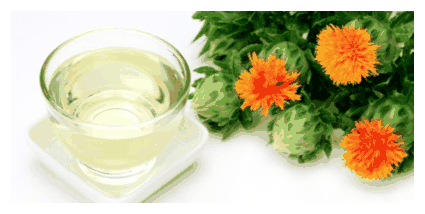
In Saudi culture, safflower drink is a traditional remedy used for its calming effects.
One ingredient with health benefits is kaempferol. The following scheme shows its total synthesis.
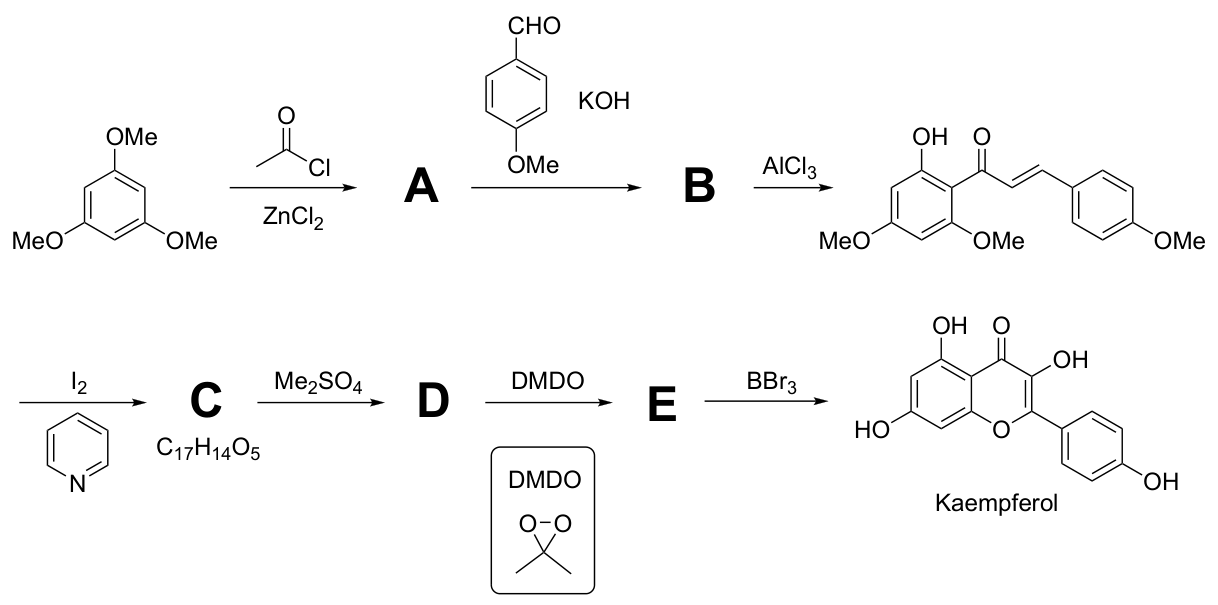
Hints:
- C has a tricyclic system. Also, it has the same number of hydroxyl groups as the compound preceding it.
- The step C to D is necessary to avoid any unwanted reactivity with DMDO.
- DMDO is a hydroxylating agent.
8.1. Draw the structures of compounds A–E. 15 pt
A unique pentacyclic indole alkaloid, serotobenine found in safflower has antimicrobial properties. Its total synthesis is shown below:
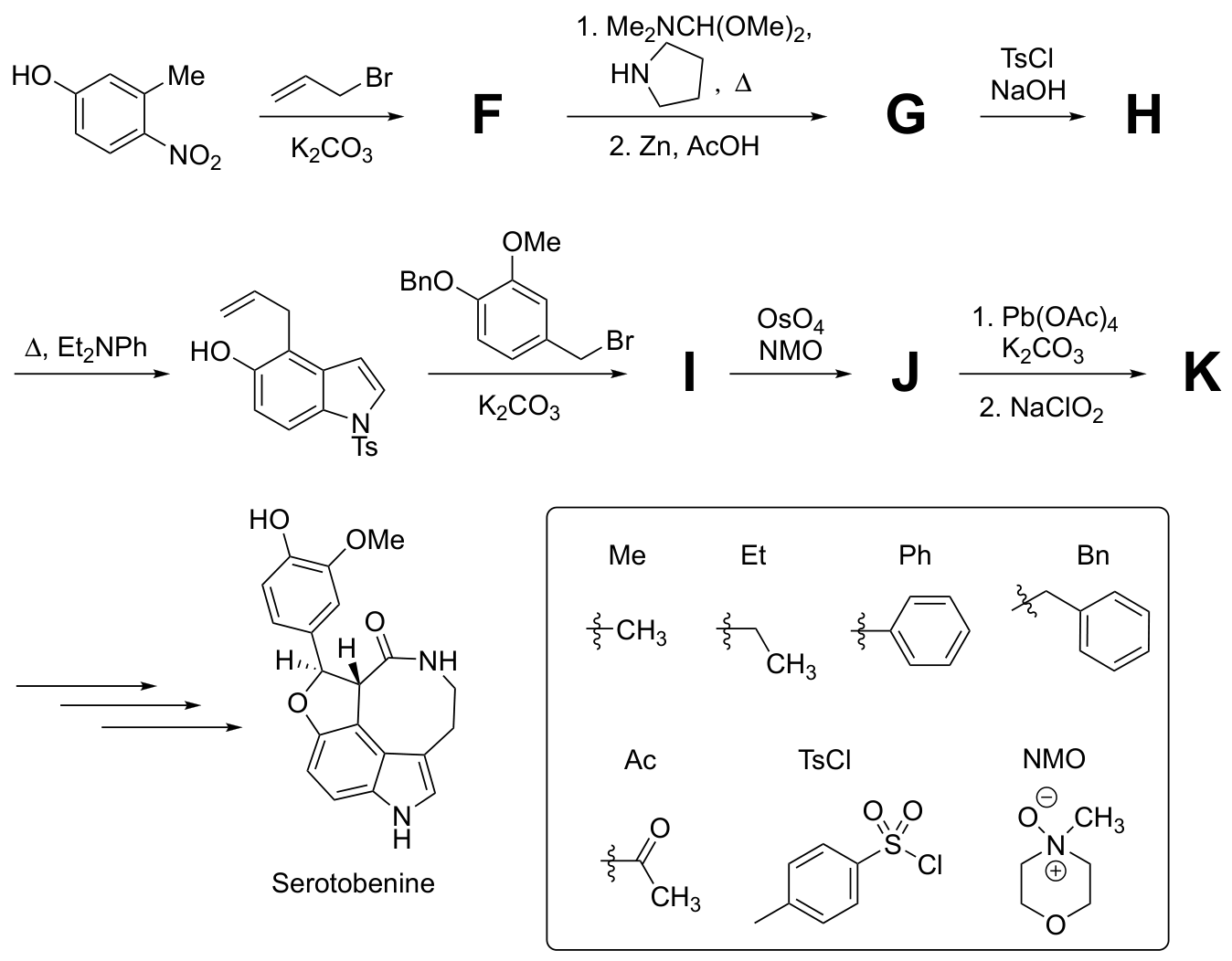
Hints:
- G is a bicyclic compound with one of the rings being a heterocycle.
- H isomerizes upon heating in the presence of the amine base.
- K is a product of an oxidative cleavage of the newly formed functional group in J. K has a \({}^{1}\mathrm{H}\) NMR signal at 12 ppm.
8.2. Draw the structures of compounds F–K. 18 pt
Carthamin gives safflower its red color.
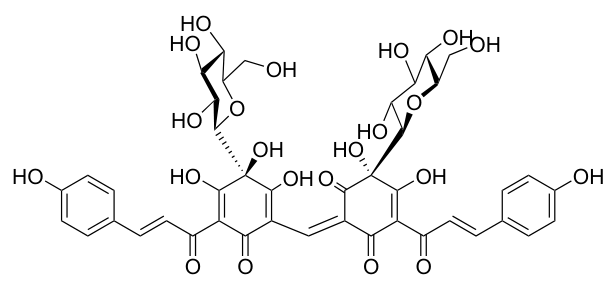
Carthamin
In the total synthesis of carthamin the assembly was tested on a model substrate L. Note that M resembles carthamin’s core structure.
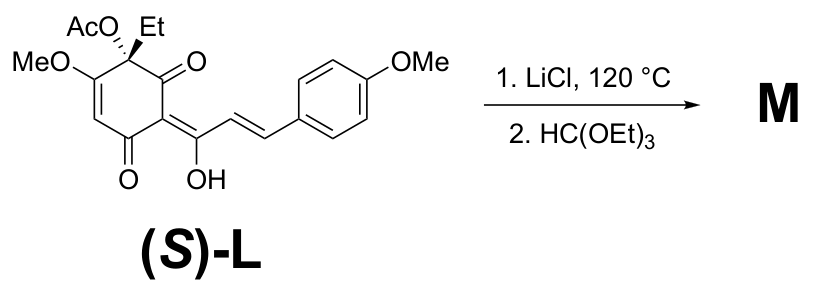
8.3. Draw the structure of compound M including its stereochemistry. (Hint: In methanol-\(d_4\) L has 11 and M has 10 distinct proton signals in their \({}^{1}\mathrm{H}\) NMR spectra). 5 pt
Official English text of the problem.
Answers
8.1.
-
A — 1-(2,4,6-Trimethoxyphenyl)ethan-1-one, or 2,4,6-trimethoxyacetophenone.
SMILES:CC(=O)c1c(OC)cc(OC)cc1OC -
B — (2E)-3-(4-Methoxyphenyl)-1-(2,4,6-trimethoxyphenyl)prop-2-en-1-one.
SMILES:COc1ccc(/C=C/C(=O)c2c(OC)cc(OC)cc2OC)cc1 -
C — 5-Hydroxy-7,4′-dimethoxyflavone.
SMILES:O=c1cc(-c2ccc(OC)cc2)oc2cc(OC)cc(O)c12 -
D — 5,7,4′-Trimethoxyflavone.
SMILES:O=c1cc(-c2ccc(OC)cc2)oc2cc(OC)cc(OC)c12 -
E — 3-Hydroxy-5,7,4′-trimethoxyflavone, or kaempferol 5,7,4′-trimethyl ether.
SMILES:O=c1c(O)c(-c2ccc(OC)cc2)oc2cc(OC)cc(OC)c12
8.2.
-
F — Allyl 3-methyl-4-nitrophenyl ether.
SMILES:C=CCOc1cc(C)c([N+](=O)[O-])cc1 -
G — 5-(Allyloxy)-1H-indole.
SMILES:C=CCOc1ccc2[nH]ccc2c1 -
H — 5-(Allyloxy)-1-tosyl-1H-indole.
SMILES:C=CCOc1ccc2n(S(=O)(=O)c3ccc(C)cc3)ccc2c1 -
I — 4-Allyl-5-[(4-benzyloxy-3-methoxybenzyl)oxy]-1-tosyl-1H-indole.
SMILES:C=CCc1c(OCc2cc(OC)c(OCc3ccccc3)cc2)ccc2n(S(=O)(=O)c3ccc(C)cc3)ccc12 -
J — Racemic 3-{5-[(4-benzyloxy-3-methoxybenzyl)oxy]-1-tosyl-1H-indol-4-yl}propane-1,2-diol.
SMILES:OCC(O)Cc1c(OCc2cc(OC)c(OCc3ccccc3)cc2)ccc2n(S(=O)(=O)c3ccc(C)cc3)ccc12
The unspecified alcohol stereocentre represents the racemic product. -
K — 2-{5-[(4-Benzyloxy-3-methoxybenzyl)oxy]-1-tosyl-1H-indol-4-yl}acetic acid.
SMILES:O=C(O)Cc1c(OCc2cc(OC)c(OCc3ccccc3)cc2)ccc2n(S(=O)(=O)c3ccc(C)cc3)ccc12
8.3.
- M — The homochiral, methine-linked carthamin-model dimer of enol-O-demethylated (S)-L, with molecular formula \(\ce{C41H38O14}\). Both original stereocentres retain their configurations.
One neutral keto–enol tautomer, with both stereocentres S in this representation, is specified by:
CC[C@@]1(OC(C)=O)C(=O)/C(=C(/O)\C=C\c2ccc(OC)cc2)C(=O)/C(=C/C2=C(O)[C@](CC)(OC(C)=O)C(=O)/C(=C(/O)\C=C\c3ccc(OC)cc3)C2=O)C1=O
To draw it, demethylate the ring enol ether of each of two copies of L, then connect their originally proton-bearing ring alkene carbons through one methine carbon. Represent the central conjugated segment as \(\ce{C_{\text{ring}}=CH-C_{\text{ring}}}\), with the adjacent carbonyl/enol arrangement encoded above. Retain both acetoxy groups, both ethyl groups and both aryl methoxy groups.
Solution
8.1. Identification of A–E
A: Friedel–Crafts acylation.
The three unsubstituted positions of the starting 1,3,5-trimethoxybenzene are equivalent. Acetylation introduces an acetyl group at one of them, giving A, 2,4,6-trimethoxyacetophenone.
The balanced organic transformation is
\[ \ce{C9H12O3 + CH3COCl ->[ZnCl2] C11H14O4 + HCl}. \]
B: Claisen–Schmidt condensation.
Base forms the enolate of A, which adds to the aldehyde carbonyl. Dehydration gives the conjugated chalcone B, predominantly with the \(E\) configuration:
\[ \ce{C11H14O4 + C8H8O2 ->[KOH] C19H20O5 + H2O}. \]
The carbonyl remains attached to the trimethoxyphenyl ring.
C: Cyclization accompanied by another demethylation.
The displayed product of the \(\ce{AlCl3}\) step is (2E)-1-(2-hydroxy-4,6-dimethoxyphenyl)-3-(4-methoxyphenyl)prop-2-en-1-one:
COc1ccc(/C=C/C(=O)c2c(O)cc(OC)cc2OC)cc1
Its ortho phenolic oxygen becomes the heterocyclic oxygen during oxidative cyclization. The chalcone’s carbonyl, α-carbon and β-carbon become flavone C4, C3 and C2, respectively.
Cyclization alone would give a trimethoxyflavone with formula \(\ce{C18H16O5}\), containing no free hydroxyl group. However, C must have formula \(\ce{C17H14O5}\) and one hydroxyl group. Therefore, one further methoxy group must be demethylated.
The remaining methoxy group ortho to the carbonyl becomes flavone’s 5-hydroxyl group. Thus C is 5-hydroxy-7,4′-dimethoxyflavone. This accounts for its formula and all three rings.
D: Protection of the phenolic hydroxyl group.
Dimethyl sulfate methylates the 5-hydroxyl group, giving D, 5,7,4′-trimethoxyflavone. Protection prevents unwanted oxidation of the free phenol during the next step.
E: Hydroxylation at C3.
DMDO introduces the hydroxyl group at flavone C3, giving E, 3-hydroxy-5,7,4′-trimethoxyflavone.
The balanced oxygen-transfer equation is
\[ \ce{C18H16O5 + C3H6O2 -> C18H16O6 + C3H6O}. \]
Here the oxygen donor is dimethyldioxirane, CC1(C)OO1, and its reduction product is acetone, CC(=O)C.
Finally, \(\ce{BBr3}\) cleaves the three methyl ethers. The existing 3-hydroxyl group remains, producing kaempferol, or 3,5,7,4′-tetrahydroxyflavone:
O=c1c(O)c(-c2ccc(O)cc2)oc2cc(O)cc(O)c12
8.2. Identification of F–K
F: Phenolic O-allylation.
Potassium carbonate generates the phenoxide, which substitutes bromide from allyl bromide. This gives the allyl ether F. The methyl and nitro groups remain unchanged.
G: Leimgruber–Batcho indole synthesis.
The adjacent methyl and nitro groups provide the required ortho-nitrotoluene arrangement.
The acetal/pyrrolidine treatment converts the methyl substituent into an enamine-containing two-carbon side chain. Zinc in acetic acid then reduces the nitro group, enabling intramolecular ring closure and formation of the aromatic indole.
The original nitro-bearing aromatic carbon becomes indole C7a, while the original methyl-bearing aromatic carbon becomes C3a. Consequently, the allyloxy substituent is at C5, identifying G as 5-(allyloxy)-1H-indole.
H: Indole N-protection.
Tosyl chloride replaces the indole N–H hydrogen with a tosyl group. The oxygen is already protected as an allyl ether, so H is the N-tosyl derivative of G.
Formation of I: Claisen rearrangement followed by O-benzylation.
Heating H causes an aromatic Claisen rearrangement: the oxygen-bound allyl group migrates to the adjacent C4 position, and the phenolic hydroxyl group is restored.
The depicted rearrangement product is 4-allyl-5-hydroxy-1-tosyl-1H-indole:
C=CCc1c(O)ccc2n(S(=O)(=O)c3ccc(C)cc3)ccc12
Its phenolic oxygen then substitutes bromide from the supplied substituted benzyl bromide. The benzyl ring bears methoxy at position 3 and benzyloxy at position 4, giving I.
J: Alkene dihydroxylation.
The \(\ce{OsO4}\)/NMO system converts the terminal allyl double bond into a vicinal diol. Thus the substituent changes from an allyl group to a 2,3-dihydroxypropyl group:
- In I, the side chain is ring–\(\ce{CH2CH=CH2}\).
- In J, it is ring–\(\ce{CH2CH(OH)CH2OH}\).
Addition is syn. Since the substrate and reagents are achiral and only one stereocentre is created, J is racemic.
K: Oxidative cleavage followed by aldehyde oxidation.
Lead tetraacetate cleaves the bond between the two hydroxyl-bearing carbons of J. The terminal carbon is removed from the retained side chain, leaving an aldehyde attached through the original benzylic methylene.
Sodium chlorite oxidizes this aldehyde to the carboxylic acid K. Therefore, the substituent in K is ring–\(\ce{CH2CO2H}\), rather than a carboxyl group directly attached to the ring.
The signal at 12 ppm is consistent with a carboxylic-acid proton.
8.3. Structure and stereochemistry of M
For this explanation, number each ring of L locally from the ethyl/acetoxy-bearing stereocentre as C1, proceeding clockwise in the supplied drawing. Then:
- C2 and C4 are carbonyl carbons.
- C3 carries the exocyclic enol side chain.
- The left-hand ring double bond is C5=C6, with methoxy at C6.
Demethylation.
Heating with \(\ce{LiCl}\) cleaves the methyl group from the activated C6 enol ether. The aryl methoxy group and the acetoxy group are retained.
The resulting 6-hydroxy analogue of (S)-L, after protonation, has SMILES:
CC[C@@]1(OC(C)=O)C(=O)/C(=C(/O)\C=C\c2ccc(OC)cc2)C(=O)C=C1O
Its formula is \(\ce{C20H20O7}\).
Methine-bridge formation.
Triethyl orthoformate supplies one carbon that links C5 of two such units. Elimination of ethanol produces the conjugated methine-linked dimer:
\[ \ce{2 C20H20O7 + HC(OC2H5)3 -> C41H38O14 + 3 C2H5OH}. \]
In the tautomer specified in the answer:
- The first ring has a C5=CH bond to the bridge and a C6 carbonyl.
- The second ring is singly bonded from C5′ to the bridge and retains C5′=C6′–OH.
- Both original exocyclic enol side chains remain represented as in L.
- The central double bond has the \(Z\) arrangement encoded in the SMILES.
This produces the same methine-linked, conjugated ring framework found in carthamin.
Stereochemistry.
Neither transformation breaks a bond at either acetoxy/ethyl-bearing stereocentre. Both centres therefore retain their absolute configurations. In the particular tautomer used in the answer, both are S. The original \(E\) side-chain alkene geometries are also retained.
Check against the NMR hint.
Exchangeable hydroxyl protons are excluded in methanol-\(d_4\). The ethyl methylene hydrogens are diastereotopic because of the neighbouring stereocentre.
For M, rapid keto–enol exchange makes the corresponding environments of its two halves equivalent on the NMR timescale.
| Proton environment | Signals in L | Signals in M |
|---|---|---|
| Para-disubstituted phenyl ring | 2 | 2 |
| Side-chain alkene hydrogens | 2 | 2 |
| Aryl methoxy group | 1 | 1 |
| Ring enol-ether methoxy group | 1 | 0 |
| Acetoxy methyl group | 1 | 1 |
| Ethyl methyl group | 1 | 1 |
| Diastereotopic ethyl methylene hydrogens | 2 | 2 |
| Original ring C5–H | 1 | 0 |
| New bridging methine hydrogen | 0 | 1 |
| Total | 11 | 10 |
The predicted counts agree with both values supplied in the problem.
The solution was checked against the official solution.
IChO 2024 · Theorieaufgabe 8
Färberdistel
In der saudischen Kultur ist ein Getränk aus Färberdistel ein traditionelles Heilmittel, das wegen seiner beruhigenden Wirkung verwendet wird.
Ein Inhaltsstoff mit gesundheitsfördernden Eigenschaften ist Kämpferol. Das folgende Schema zeigt seine Totalsynthese.
Hinweise:
- C besitzt ein tricyclisches System. Außerdem hat es die gleiche Anzahl an Hydroxygruppen wie die ihm vorausgehende Verbindung.
- Der Schritt von C zu D ist notwendig, um unerwünschte Reaktionen mit DMDO zu vermeiden.
- DMDO ist ein Hydroxylierungsreagenz.
8.1. Zeichnen Sie die Strukturen der Verbindungen A–E. 15 Pkt.
Serotobenin, ein einzigartiges pentacyclisches Indolalkaloid, das in der Färberdistel vorkommt, besitzt antimikrobielle Eigenschaften. Seine Totalsynthese ist nachstehend dargestellt:
Hinweise:
- G ist eine bicyclische Verbindung, bei der einer der Ringe ein Heterocyclus ist.
- H isomerisiert beim Erhitzen in Gegenwart der Aminbase.
- K ist ein Produkt der oxidativen Spaltung der neu gebildeten funktionellen Gruppe in J. K weist in seinem \({}^{1}\mathrm{H}\)-NMR-Spektrum ein Signal bei 12 ppm auf.
8.2. Zeichnen Sie die Strukturen der Verbindungen F–K. 18 Pkt.
Carthamin verleiht der Färberdistel ihre rote Farbe.
Carthamin
Bei der Totalsynthese von Carthamin wurde der Aufbau an einem Modellsubstrat L erprobt. Beachten Sie, dass M dem Grundgerüst von Carthamin ähnelt.
8.3. Zeichnen Sie die Struktur der Verbindung M einschließlich ihrer Stereochemie. (Hinweis: In Methanol-\(d_4\) zeigt L 11 und M 10 unterschiedliche Protonensignale in den jeweiligen \({}^{1}\mathrm{H}\)-NMR-Spektren.) 5 Pkt.
Aufgabentext aus dem offiziellen englischen Text übersetzt.
Antworten
8.1.
-
A — 1-(2,4,6-Trimethoxyphenyl)ethan-1-on, oder 2,4,6-Trimethoxyacetophenon.
SMILES:CC(=O)c1c(OC)cc(OC)cc1OC -
B — (2E)-3-(4-Methoxyphenyl)-1-(2,4,6-trimethoxyphenyl)prop-2-en-1-on.
SMILES:COc1ccc(/C=C/C(=O)c2c(OC)cc(OC)cc2OC)cc1 -
C — 5-Hydroxy-7,4′-dimethoxyflavon.
SMILES:O=c1cc(-c2ccc(OC)cc2)oc2cc(OC)cc(O)c12 -
D — 5,7,4′-Trimethoxyflavon.
SMILES:O=c1cc(-c2ccc(OC)cc2)oc2cc(OC)cc(OC)c12 -
E — 3-Hydroxy-5,7,4′-trimethoxyflavon, oder Kämpferol-5,7,4′-trimethylether.
SMILES:O=c1c(O)c(-c2ccc(OC)cc2)oc2cc(OC)cc(OC)c12
8.2.
-
F — Allyl-3-methyl-4-nitrophenylether.
SMILES:C=CCOc1cc(C)c([N+](=O)[O-])cc1 -
G — 5-(Allyloxy)-1H-indol.
SMILES:C=CCOc1ccc2[nH]ccc2c1 -
H — 5-(Allyloxy)-1-tosyl-1H-indol.
SMILES:C=CCOc1ccc2n(S(=O)(=O)c3ccc(C)cc3)ccc2c1 -
I — 4-Allyl-5-[(4-benzyloxy-3-methoxybenzyl)oxy]-1-tosyl-1H-indol.
SMILES:C=CCc1c(OCc2cc(OC)c(OCc3ccccc3)cc2)ccc2n(S(=O)(=O)c3ccc(C)cc3)ccc12 -
J — Racemisches 3-{5-[(4-Benzyloxy-3-methoxybenzyl)oxy]-1-tosyl-1H-indol-4-yl}propan-1,2-diol.
SMILES:OCC(O)Cc1c(OCc2cc(OC)c(OCc3ccccc3)cc2)ccc2n(S(=O)(=O)c3ccc(C)cc3)ccc12
Das nicht näher spezifizierte Stereozentrum am alkoholtragenden Kohlenstoff steht für das racemische Produkt. -
K — 2-{5-[(4-Benzyloxy-3-methoxybenzyl)oxy]-1-tosyl-1H-indol-4-yl}essigsäure.
SMILES:O=C(O)Cc1c(OCc2cc(OC)c(OCc3ccccc3)cc2)ccc2n(S(=O)(=O)c3ccc(C)cc3)ccc12
8.3.
- M — Das homochirale, über eine Methingruppe verknüpfte Carthamin-Modelldimer von enol-O-demethyliertem (S)-L, mit der Summenformel \(\ce{C41H38O14}\). Beide ursprünglichen Stereozentren behalten ihre Konfigurationen bei.
Ein neutrales Keto–Enol-Tautomer, bei dem beide Stereozentren in dieser Darstellung S-konfiguriert sind, wird wie folgt angegeben:
CC[C@@]1(OC(C)=O)C(=O)/C(=C(/O)\C=C\c2ccc(OC)cc2)C(=O)/C(=C/C2=C(O)[C@](CC)(OC(C)=O)C(=O)/C(=C(/O)\C=C\c3ccc(OC)cc3)C2=O)C1=O
Zum Zeichnen demethylieren Sie den Enolether am Ring in zwei Molekülen von L und verbinden anschließend deren ursprünglich protonentragende Alkenkohlenstoffatome im Ring über ein Methinkohlenstoffatom. Stellen Sie den zentralen konjugierten Abschnitt als \(\ce{C_{\text{Ring}}=CH-C_{\text{Ring}}}\) dar, mit der oben codierten benachbarten Carbonyl-/Enolanordnung. Behalten Sie beide Acetoxygruppen, beide Ethylgruppen und beide Arylmethoxygruppen bei.
Lösung
8.1. Identifizierung von A–E
A: Friedel–Crafts-Acylierung.
Die drei unsubstituierten Positionen des als Ausgangsstoff eingesetzten 1,3,5-Trimethoxybenzols sind äquivalent. Durch Acetylierung wird an einer dieser Positionen eine Acetylgruppe eingeführt, wodurch A, 2,4,6-Trimethoxyacetophenon, entsteht.
Die ausgeglichene Gleichung der organischen Umsetzung lautet
\[ \ce{C9H12O3 + CH3COCl ->[ZnCl2] C11H14O4 + HCl}. \]
B: Claisen–Schmidt-Kondensation.
Die Base bildet das Enolat von A, das an die Carbonylgruppe des Aldehyds addiert. Durch Wasserabspaltung entsteht das konjugierte Chalkon B, überwiegend in der \(E\)-Konfiguration:
\[ \ce{C11H14O4 + C8H8O2 ->[KOH] C19H20O5 + H2O}. \]
Die Carbonylgruppe bleibt mit dem Trimethoxyphenylring verbunden.
C: Cyclisierung unter weiterer Demethylierung.
Das dargestellte Produkt des \(\ce{AlCl3}\)-Schritts ist (2E)-1-(2-Hydroxy-4,6-dimethoxyphenyl)-3-(4-methoxyphenyl)prop-2-en-1-on:
COc1ccc(/C=C/C(=O)c2c(O)cc(OC)cc2OC)cc1
Sein phenolisches Sauerstoffatom in ortho-Position wird bei der oxidativen Cyclisierung zum Sauerstoffatom des Heterocyclus. Das Carbonylkohlenstoffatom, das α-Kohlenstoffatom und das β-Kohlenstoffatom des Chalkons werden zu C4, C3 bzw. C2 des Flavons.
Die Cyclisierung allein würde ein Trimethoxyflavon mit der Formel \(\ce{C18H16O5}\) ergeben, das keine freie Hydroxygruppe enthält. C muss jedoch die Formel \(\ce{C17H14O5}\) und eine Hydroxygruppe aufweisen. Daher muss eine weitere Methoxygruppe demethyliert werden.
Die verbleibende Methoxygruppe in ortho-Position zur Carbonylgruppe wird zur 5-Hydroxygruppe des Flavons. Somit ist C 5-Hydroxy-7,4′-dimethoxyflavon. Dies erklärt seine Formel und alle drei Ringe.
D: Schutz der phenolischen Hydroxygruppe.
Dimethylsulfat methyliert die 5-Hydroxygruppe, wodurch D, 5,7,4′-Trimethoxyflavon, entsteht. Der Schutz verhindert eine unerwünschte Oxidation des freien Phenols im nächsten Schritt.
E: Hydroxylierung an C3.
DMDO führt die Hydroxygruppe an C3 des Flavons ein, wodurch E, 3-Hydroxy-5,7,4′-trimethoxyflavon, entsteht.
Die ausgeglichene Gleichung der Sauerstoffübertragung lautet
\[ \ce{C18H16O5 + C3H6O2 -> C18H16O6 + C3H6O}. \]
Der Sauerstoffdonor ist hier Dimethyldioxiran, CC1(C)OO1, und sein Reduktionsprodukt ist Aceton, CC(=O)C.
Abschließend spaltet \(\ce{BBr3}\) die drei Methylether. Die vorhandene 3-Hydroxygruppe bleibt erhalten, sodass Kämpferol, auch 3,5,7,4′-Tetrahydroxyflavon genannt, entsteht:
O=c1c(O)c(-c2ccc(O)cc2)oc2cc(O)cc(O)c12
8.2. Identifizierung von F–K
F: Phenolische O-Allylierung.
Kaliumcarbonat erzeugt das Phenolat, das Bromid aus Allylbromid verdrängt. Dadurch entsteht der Allylether F. Die Methyl- und Nitrogruppen bleiben unverändert.
G: Leimgruber–Batcho-Indolsynthese.
Die benachbarten Methyl- und Nitrogruppen liefern die erforderliche ortho-Nitrotoluol-Anordnung.
Die Behandlung mit Acetal/Pyrrolidin wandelt den Methylsubstituenten in eine enaminhaltige Seitenkette mit zwei Kohlenstoffatomen um. Zink in Essigsäure reduziert anschließend die Nitrogruppe und ermöglicht so den intramolekularen Ringschluss und die Bildung des aromatischen Indols.
Das ursprünglich nitrogruppentragende aromatische Kohlenstoffatom wird zu C7a des Indols, während das ursprünglich methylgruppentragende aromatische Kohlenstoffatom zu C3a wird. Folglich befindet sich der Allyloxysubstituent an C5, womit G als 5-(Allyloxy)-1H-indol identifiziert ist.
H: N-Schutz des Indols.
Tosylchlorid ersetzt das N–H-Wasserstoffatom des Indols durch eine Tosylgruppe. Der Sauerstoff ist bereits als Allylether geschützt, sodass H das N-Tosylderivat von G ist.
Bildung von I: Claisen-Umlagerung mit anschließender O-Benzylierung.
Das Erhitzen von H bewirkt eine aromatische Claisen-Umlagerung: Die an den Sauerstoff gebundene Allylgruppe wandert an die benachbarte C4-Position, und die phenolische Hydroxygruppe wird wiederhergestellt.
Das dargestellte Umlagerungsprodukt ist 4-Allyl-5-hydroxy-1-tosyl-1H-indol:
C=CCc1c(O)ccc2n(S(=O)(=O)c3ccc(C)cc3)ccc12
Sein phenolisches Sauerstoffatom verdrängt anschließend Bromid aus dem vorgegebenen substituierten Benzylbromid. Der Benzylring trägt eine Methoxygruppe an Position 3 und eine Benzyloxygruppe an Position 4, wodurch I entsteht.
J: Dihydroxylierung des Alkens.
Das \(\ce{OsO4}\)/NMO-System wandelt die endständige Doppelbindung der Allylgruppe in ein vicinales Diol um. Der Substituent wird somit von einer Allylgruppe in eine 2,3-Dihydroxypropylgruppe umgewandelt:
- In I lautet die Seitenkette Ring–\(\ce{CH2CH=CH2}\).
- In J lautet sie Ring–\(\ce{CH2CH(OH)CH2OH}\).
Die Addition erfolgt syn. Da das Substrat und die Reagenzien achiral sind und nur ein Stereozentrum entsteht, ist J racemisch.
K: Oxidative Spaltung mit anschließender Aldehydoxidation.
Bleitetraacetat spaltet die Bindung zwischen den beiden hydroxygruppentragenden Kohlenstoffatomen von J. Das endständige Kohlenstoffatom wird von der verbleibenden Seitenkette abgespalten, sodass ein Aldehyd zurückbleibt, der über die ursprüngliche benzylische Methylengruppe angebunden ist.
Natriumchlorit oxidiert diesen Aldehyd zur Carbonsäure K. Daher ist der Substituent in K Ring–\(\ce{CH2CO2H}\) und keine direkt an den Ring gebundene Carboxygruppe.
Das Signal bei 12 ppm ist mit einem Carbonsäureproton vereinbar.
8.3. Struktur und Stereochemie von M
Für diese Erläuterung wird jeder Ring von L lokal nummeriert, beginnend mit dem ethyl-/acetoxygruppentragenden Stereozentrum als C1 und in der vorgegebenen Zeichnung im Uhrzeigersinn fortfahrend. Dann gilt:
- C2 und C4 sind Carbonylkohlenstoffatome.
- C3 trägt die exocyclische Enolseitenkette.
- Die links im Ring liegende Doppelbindung ist C5=C6, mit einer Methoxygruppe an C6.
Demethylierung.
Beim Erhitzen mit \(\ce{LiCl}\) wird die Methylgruppe des aktivierten C6-Enolethers abgespalten. Die Arylmethoxygruppe und die Acetoxygruppe bleiben erhalten.
Das entstehende 6-Hydroxyanalogon von (S)-L besitzt nach der Protonierung folgenden SMILES:
CC[C@@]1(OC(C)=O)C(=O)/C(=C(/O)\C=C\c2ccc(OC)cc2)C(=O)C=C1O
Seine Formel lautet \(\ce{C20H20O7}\).
Bildung der Methinbrücke.
Orthoameisensäuretriethylester liefert ein Kohlenstoffatom, das C5 zweier solcher Einheiten miteinander verbindet. Durch Abspaltung von Ethanol entsteht das konjugierte, über eine Methingruppe verknüpfte Dimer:
\[ \ce{2 C20H20O7 + HC(OC2H5)3 -> C41H38O14 + 3 C2H5OH}. \]
Für das in der Antwort angegebene Tautomer gilt:
- Der erste Ring weist eine C5=CH-Bindung zur Brücke und eine Carbonylgruppe an C6 auf.
- Der zweite Ring ist von C5′ aus über eine Einfachbindung mit der Brücke verbunden und behält C5′=C6′–OH bei.
- Beide ursprünglichen exocyclischen Enolseitenketten bleiben wie in L dargestellt.
- Die zentrale Doppelbindung weist die im SMILES codierte \(Z\)-Anordnung auf.
Dadurch entsteht dasselbe über eine Methingruppe verknüpfte, konjugierte Ringgerüst, das in Carthamin vorliegt.
Stereochemie.
Bei keiner der beiden Umsetzungen wird eine Bindung an einem der beiden acetoxy-/ethylgruppentragenden Stereozentren gespalten. Beide Zentren behalten daher ihre absoluten Konfigurationen bei. In dem in der Antwort verwendeten Tautomer sind beide S-konfiguriert. Auch die ursprünglichen \(E\)-Geometrien der Alkene in den Seitenketten bleiben erhalten.
Überprüfung anhand des NMR-Hinweises.
Austauschbare Hydroxyprotonen werden in Methanol-\(d_4\) nicht mitgezählt. Die Methylenwasserstoffatome der Ethylgruppe sind aufgrund des benachbarten Stereozentrums diastereotop.
Bei M führt der schnelle Keto–Enol-Austausch dazu, dass die einander entsprechenden Umgebungen seiner beiden Hälften auf der NMR-Zeitskala äquivalent sind.
| Protonenumgebung | Signale in L | Signale in M |
|---|---|---|
| Para-disubstituierter Phenylring | 2 | 2 |
| Alkenwasserstoffatome der Seitenkette | 2 | 2 |
| Arylmethoxygruppe | 1 | 1 |
| Methoxygruppe des Enolethers am Ring | 1 | 0 |
| Methylgruppe der Acetoxygruppe | 1 | 1 |
| Methylgruppe der Ethylgruppe | 1 | 1 |
| Diastereotope Methylenwasserstoffatome der Ethylgruppe | 2 | 2 |
| Ursprüngliches C5–H im Ring | 1 | 0 |
| Neues Wasserstoffatom der verbrückenden Methingruppe | 0 | 1 |
| Gesamt | 11 | 10 |
Die vorhergesagten Anzahlen stimmen mit beiden in der Aufgabe angegebenen Werten überein.
Die Lösung wurde mit der offiziellen Lösung abgeglichen.
IChO 2024 · Teori sorusu 8
Aspir
Suudi kültüründe aspir içeceği, sakinleştirici etkileri nedeniyle kullanılan geleneksel bir şifa kaynağıdır.
Sağlığa yararlı bileşenlerinden biri kemferoldür. Aşağıdaki şema, bu bileşiğin total sentezini göstermektedir.
İpuçları:
- C, üç halkalı bir sisteme sahiptir. Ayrıca, kendisinden önceki bileşikle aynı sayıda hidroksil grubuna sahiptir.
- C'den D'ye geçiş basamağı, DMDO ile istenmeyen herhangi bir tepkimeyi önlemek için gereklidir.
- DMDO bir hidroksilleme reaktifidir.
8.1. A–E bileşiklerinin yapılarını çiziniz. 15 puan
Aspirde bulunan, kendine özgü beş halkalı bir indol alkaloidi olan serotobenin, antimikrobiyal özelliklere sahiptir. Total sentezi aşağıda gösterilmiştir:
İpuçları:
- G, halkalarından biri heterohalka olan iki halkalı bir bileşiktir.
- H, amin bazı varlığında ısıtıldığında izomerleşir.
- K, J'de yeni oluşan fonksiyonel grubun yükseltgenerek parçalanmasının bir ürünüdür. K, 12 ppm'de bir \({}^{1}\mathrm{H}\) NMR sinyali verir.
8.2. F–K bileşiklerinin yapılarını çiziniz. 18 puan
Kartamin, aspire kırmızı rengini verir.
Kartamin
Kartaminin total sentezinde, yapının birleştirilmesi bir model substrat olan L üzerinde denenmiştir. M'nin kartaminin çekirdek yapısına benzediğine dikkat ediniz.
8.3. M bileşiğinin yapısını stereokimyasını da içerecek şekilde çiziniz. (İpucu: Metanol-\(d_4\) içinde alınan \({}^{1}\mathrm{H}\) NMR spektrumlarında L 11, M ise 10 farklı proton sinyali verir). 5 puan
Soru metni resmi İngilizce metinden çevrilmiştir.
Cevaplar
8.1.
-
A — 1-(2,4,6-Trimetoksifenil)etan-1-on veya 2,4,6-trimetoksiasetofenon.
SMILES:CC(=O)c1c(OC)cc(OC)cc1OC -
B — (2E)-3-(4-Metoksifenil)-1-(2,4,6-trimetoksifenil)prop-2-en-1-on.
SMILES:COc1ccc(/C=C/C(=O)c2c(OC)cc(OC)cc2OC)cc1 -
C — 5-Hidroksi-7,4′-dimetoksiflavon.
SMILES:O=c1cc(-c2ccc(OC)cc2)oc2cc(OC)cc(O)c12 -
D — 5,7,4′-Trimetoksiflavon.
SMILES:O=c1cc(-c2ccc(OC)cc2)oc2cc(OC)cc(OC)c12 -
E — 3-Hidroksi-5,7,4′-trimetoksiflavon veya kemferol 5,7,4′-trimetil eter.
SMILES:O=c1c(O)c(-c2ccc(OC)cc2)oc2cc(OC)cc(OC)c12
8.2.
-
F — Allil 3-metil-4-nitrofenil eter.
SMILES:C=CCOc1cc(C)c([N+](=O)[O-])cc1 -
G — 5-(Alliloksi)-1H-indol.
SMILES:C=CCOc1ccc2[nH]ccc2c1 -
H — 5-(Alliloksi)-1-tosil-1H-indol.
SMILES:C=CCOc1ccc2n(S(=O)(=O)c3ccc(C)cc3)ccc2c1 -
I — 4-Allil-5-[(4-benziloksi-3-metoksibenzil)oksi]-1-tosil-1H-indol.
SMILES:C=CCc1c(OCc2cc(OC)c(OCc3ccccc3)cc2)ccc2n(S(=O)(=O)c3ccc(C)cc3)ccc12 -
J — Rasemik 3-{5-[(4-benziloksi-3-metoksibenzil)oksi]-1-tosil-1H-indol-4-il}propan-1,2-diol.
SMILES:OCC(O)Cc1c(OCc2cc(OC)c(OCc3ccccc3)cc2)ccc2n(S(=O)(=O)c3ccc(C)cc3)ccc12
Alkol grubunu taşıyan stereomerkezin konfigürasyonunun belirtilmemiş olması, rasemik ürünü temsil eder. -
K — 2-{5-[(4-Benziloksi-3-metoksibenzil)oksi]-1-tosil-1H-indol-4-il}asetik asit.
SMILES:O=C(O)Cc1c(OCc2cc(OC)c(OCc3ccccc3)cc2)ccc2n(S(=O)(=O)c3ccc(C)cc3)ccc12
8.3.
- M — Enol-O-demetillenmiş (S)-L'nin homokiral, metin köprüsüyle bağlanmış kartamin modeli dimeri olup molekül formülü \(\ce{C41H38O14}\)'tür. Başlangıçtaki her iki stereomerkez de konfigürasyonunu korur.
Bu gösterimde her iki stereomerkezi de S olan nötr bir keto–enol tautomeri şu şekilde belirtilir:
CC[C@@]1(OC(C)=O)C(=O)/C(=C(/O)\C=C\c2ccc(OC)cc2)C(=O)/C(=C/C2=C(O)[C@](CC)(OC(C)=O)C(=O)/C(=C(/O)\C=C\c3ccc(OC)cc3)C2=O)C1=O
Yapıyı çizmek için iki L molekülünün her birindeki halka enol eterini demetilleyiniz; ardından başlangıçta proton taşıyan halka alken karbonlarını tek bir metin karbonu üzerinden bağlayınız. Merkezdeki konjuge bölümü, komşu karbonil/enol düzeni yukarıda kodlandığı şekilde olacak biçimde \(\ce{C_{\text{ring}}=CH-C_{\text{ring}}}\) olarak gösteriniz. Her iki asetoksi grubunu, her iki etil grubunu ve her iki aril metoksi grubunu koruyunuz.
Çözüm
8.1. A–E'nin belirlenmesi
A: Friedel–Crafts açillemesi.
Başlangıç maddesi olan 1,3,5-trimetoksibenzenin sübstitüe olmamış üç konumu eşdeğerdir. Asetilleme ile bunlardan birine bir asetil grubu bağlanır ve A, yani 2,4,6-trimetoksiasetofenon oluşur.
Denkleştirilmiş organik dönüşüm şöyledir:
\[ \ce{C9H12O3 + CH3COCl ->[ZnCl2] C11H14O4 + HCl}. \]
B: Claisen–Schmidt kondenzasyonu.
Baz, A'nın enolatını oluşturur; bu enolat aldehit karboniline katılır. Su ayrılması sonucunda, ağırlıklı olarak \(E\) konfigürasyonuna sahip konjuge kalkon B oluşur:
\[ \ce{C11H14O4 + C8H8O2 ->[KOH] C19H20O5 + H2O}. \]
Karbonil, trimetoksifenil halkasına bağlı kalır.
C: Ek bir demetillenmenin eşlik ettiği halkalaşma.
\(\ce{AlCl3}\) basamağında gösterilen ürün (2E)-1-(2-hidroksi-4,6-dimetoksifenil)-3-(4-metoksifenil)prop-2-en-1-on'dur:
COc1ccc(/C=C/C(=O)c2c(O)cc(OC)cc2OC)cc1
Bu bileşiğin orto konumundaki fenolik oksijeni, yükseltgen halkalaşma sırasında heterohalkanın oksijeni hâline gelir. Kalkonun karbonil karbonu, α-karbonu ve β-karbonu, sırasıyla flavonun C4, C3 ve C2 karbonları olur.
Yalnızca halkalaşma gerçekleşseydi, \(\ce{C18H16O5}\) formüllü ve serbest hidroksil grubu içermeyen bir trimetoksiflavon oluşurdu. Ancak C'nin formülü \(\ce{C17H14O5}\) olmalı ve bir hidroksil grubu içermelidir. Bu nedenle, bir metoksi grubu daha demetillenmelidir.
Karbonile göre orto konumunda kalan metoksi grubu, flavonun 5-hidroksil grubuna dönüşür. Dolayısıyla C, 5-hidroksi-7,4′-dimetoksiflavondur. Bu yapı, bileşiğin formülünü ve üç halkasının tümünü açıklar.
D: Fenolik hidroksil grubunun korunması.
Dimetil sülfat, 5-hidroksil grubunu metilleyerek D'yi, yani 5,7,4′-trimetoksiflavonu verir. Koruma, bir sonraki basamakta serbest fenolün istenmeyen yükseltgenmesini önler.
E: C3'te hidroksilleme.
DMDO, flavonun C3 konumuna hidroksil grubunu ekleyerek E'yi, yani 3-hidroksi-5,7,4′-trimetoksiflavonu verir.
Denkleştirilmiş oksijen aktarımı denklemi şöyledir:
\[ \ce{C18H16O5 + C3H6O2 -> C18H16O6 + C3H6O}. \]
Burada oksijen vericisi dimetildioksiran, CC1(C)OO1, indirgenme ürünü ise aseton, CC(=O)C'dir.
Son olarak, \(\ce{BBr3}\) üç metil eterini parçalar. Mevcut 3-hidroksil grubu korunur ve kemferol, yani 3,5,7,4′-tetrahidroksiflavon oluşur:
O=c1c(O)c(-c2ccc(O)cc2)oc2cc(O)cc(O)c12
8.2. F–K'nin belirlenmesi
F: Fenolik O-allilleme.
Potasyum karbonat fenoksiti oluşturur; fenoksit, allil bromürdeki bromürün yerini alır. Böylece allil eteri F elde edilir. Metil ve nitro grupları değişmeden kalır.
G: Leimgruber–Batcho indol sentezi.
Komşu metil ve nitro grupları, gerekli orto-nitrotoluen düzenini sağlar.
Asetal/pirolidin ile işlem, metil sübstitüentini enamin içeren iki karbonlu bir yan zincire dönüştürür. Ardından asetik asit içindeki çinko nitro grubunu indirger; bu da molekül içi halka kapanmasını ve aromatik indolün oluşmasını sağlar.
Başlangıçta nitro grubunu taşıyan aromatik karbon, indolün C7a karbonu olurken, başlangıçta metil grubunu taşıyan aromatik karbon C3a olur. Sonuç olarak, alliloksi sübstitüenti C5 konumundadır ve G'nin 5-(alliloksi)-1H-indol olduğu belirlenir.
H: İndolün N atomunun korunması.
Tosil klorür, indolün N–H hidrojeninin yerine bir tosil grubu bağlar. Oksijen zaten allil eteri olarak korunmuş olduğundan H, G'nin N-tosil türevidir.
I'nın oluşumu: Claisen çevrilmesi ve ardından O-benzilleme.
H'nin ısıtılması aromatik Claisen çevrilmesine yol açar: oksijene bağlı allil grubu komşu C4 konumuna göç eder ve fenolik hidroksil grubu yeniden oluşur.
Gösterilen çevrilme ürünü 4-allil-5-hidroksi-1-tosil-1H-indol'dür:
C=CCc1c(O)ccc2n(S(=O)(=O)c3ccc(C)cc3)ccc12
Ardından bu bileşiğin fenolik oksijeni, verilen sübstitüe benzil bromürdeki bromürün yerini alır. Benzil halkası 3 konumunda metoksi, 4 konumunda ise benziloksi grubu taşır ve böylece I oluşur.
J: Alkenin dihidroksillenmesi.
\(\ce{OsO4}\)/NMO sistemi, allil grubunun uç çift bağını bir visinal diole dönüştürür. Böylece sübstitüent, allil grubundan 2,3-dihidroksipropil grubuna dönüşür:
- I'da yan zincir halka–\(\ce{CH2CH=CH2}\) şeklindedir.
- J'de ise halka–\(\ce{CH2CH(OH)CH2OH}\) şeklindedir.
Katılma syn biçimindedir. Substrat ve reaktifler akiral olduğundan ve yalnızca bir stereomerkez oluştuğundan J rasemiktir.
K: Yükseltgen parçalanma ve ardından aldehidin yükseltgenmesi.
Kurşun tetraasetat, J'nin hidroksil taşıyan iki karbonu arasındaki bağı parçalar. Uç karbon, yapıda kalan yan zincirden ayrılır ve başlangıçtaki benzilik metilen üzerinden bağlı bir aldehit geride kalır.
Sodyum klorit bu aldehidi yükseltgeyerek karboksilik asit K'ye dönüştürür. Dolayısıyla K'deki sübstitüent, halkaya doğrudan bağlı bir karboksil grubu değil, halka–\(\ce{CH2CO2H}\) grubudur.
12 ppm'deki sinyal, bir karboksilik asit protonuyla uyumludur.
8.3. M'nin yapısı ve stereokimyası
Bu açıklama için L'nin her bir halkasını, etil/asetoksi taşıyan stereomerkezi C1 olarak alıp verilen çizimde saat yönünde ilerleyerek kendi içinde numaralandırınız. Buna göre:
- C2 ve C4 karbonil karbonlarıdır.
- C3, halka dışı enol yan zincirini taşır.
- Halkanın sol tarafındaki çift bağ C5=C6'dır ve metoksi grubu C6'dadır.
Demetillenme.
\(\ce{LiCl}\) ile ısıtma, etkinleştirilmiş C6 enol eterinden metil grubunu koparır. Aril metoksi grubu ve asetoksi grubu korunur.
Protonlanma sonrasında oluşan (S)-L'nin 6-hidroksi analoğu şu SMILES gösterimine sahiptir:
CC[C@@]1(OC(C)=O)C(=O)/C(=C(/O)\C=C\c2ccc(OC)cc2)C(=O)C=C1O
Formülü \(\ce{C20H20O7}\)'dir.
Metin köprüsünün oluşumu.
Trietil ortoformat, bu tür iki birimin C5 karbonlarını birbirine bağlayan tek bir karbon sağlar. Etanol ayrılması, metin köprüsüyle bağlanmış konjuge dimeri oluşturur:
\[ \ce{2 C20H20O7 + HC(OC2H5)3 -> C41H38O14 + 3 C2H5OH}. \]
Cevapta belirtilen tautomerde:
- Birinci halka, köprüye uzanan bir C5=CH bağına ve bir C6 karboniline sahiptir.
- İkinci halka, C5′ üzerinden köprüye tek bağla bağlanır ve C5′=C6′–OH yapısını korur.
- Başlangıçtaki her iki halka dışı enol yan zinciri de L'deki gibi gösterilmeye devam eder.
- Merkezdeki çift bağ, SMILES gösteriminde kodlanan \(Z\) düzenine sahiptir.
Böylece kartaminde bulunan, metin köprüsüyle bağlanmış aynı konjuge halka iskeleti oluşur.
Stereokimya.
Her iki dönüşümde de asetoksi/etil taşıyan stereomerkezlerden herhangi birindeki bir bağ kopmaz. Dolayısıyla her iki merkez de mutlak konfigürasyonunu korur. Cevapta kullanılan belirli tautomerde her ikisi de S'dir. Başlangıçtaki yan zincir alkenlerinin \(E\) geometrileri de korunur.
NMR ipucuyla karşılaştırma.
Metanol-\(d_4\) içinde değişebilir hidroksil protonları sayılmaz. Etil grubunun metilen hidrojenleri, komşu stereomerkez nedeniyle diastereotopiktir.
M için hızlı keto–enol değişimi, iki yarısındaki karşılık gelen çevreleri NMR zaman ölçeğinde eşdeğer hâle getirir.
| Proton çevresi | L'deki sinyaller | M'deki sinyaller |
|---|---|---|
| Para-disübstitüe fenil halkası | 2 | 2 |
| Yan zincir alken hidrojenleri | 2 | 2 |
| Aril metoksi grubu | 1 | 1 |
| Halka enol eterinin metoksi grubu | 1 | 0 |
| Asetoksi metil grubu | 1 | 1 |
| Etil grubunun metil grubu | 1 | 1 |
| Etil grubunun diastereotopik metilen hidrojenleri | 2 | 2 |
| Başlangıçtaki halka C5–H | 1 | 0 |
| Yeni köprü metin hidrojeni | 0 | 1 |
| Toplam | 11 | 10 |
Öngörülen sayılar, soruda verilen her iki değerle de uyumludur.
Çözüm, resmi çözümle karşılaştırılarak kontrol edildi.
IChO 2024 · Problema teórico 8
Cártamo
En la cultura saudí, la bebida de cártamo es un remedio tradicional utilizado por sus efectos calmantes.
Uno de los componentes con beneficios para la salud es el kaempferol. El siguiente esquema muestra su síntesis total.
Pistas:
- C tiene un sistema tricíclico. Además, tiene el mismo número de grupos hidroxilo que el compuesto que lo precede.
- El paso de C a D es necesario para evitar cualquier reactividad no deseada con el DMDO.
- El DMDO es un agente hidroxilante.
8.1. Dibuje las estructuras de los compuestos A–E. 15 pt
La serotobenina, un singular alcaloide indólico pentacíclico presente en el cártamo, tiene propiedades antimicrobianas. Su síntesis total se muestra a continuación:
Pistas:
- G es un compuesto bicíclico en el que uno de los anillos es un heterociclo.
- H se isomeriza al calentarlo en presencia de la base amínica.
- K es un producto de la escisión oxidativa del grupo funcional recién formado en J. K presenta una señal de RMN de \({}^{1}\mathrm{H}\) a 12 ppm.
8.2. Dibuje las estructuras de los compuestos F–K. 18 pt
La cartamina confiere al cártamo su color rojo.
Cartamina
En la síntesis total de la cartamina, el ensamblaje se ensayó con un sustrato modelo L. Observe que M se asemeja a la estructura central de la cartamina.
8.3. Dibuje la estructura del compuesto M, incluida su estereoquímica. (Pista: En metanol-\(d_4\), L presenta 11 señales de protones distintas y M presenta 10 en sus espectros de RMN de \({}^{1}\mathrm{H}\)). 5 pt
Enunciado traducido del texto oficial en inglés.
Respuestas
8.1.
-
A — 1-(2,4,6-Trimetoxifenil)etan-1-ona, o 2,4,6-trimetoxiacetofenona.
SMILES:CC(=O)c1c(OC)cc(OC)cc1OC -
B — (2E)-3-(4-Metoxifenil)-1-(2,4,6-trimetoxifenil)prop-2-en-1-ona.
SMILES:COc1ccc(/C=C/C(=O)c2c(OC)cc(OC)cc2OC)cc1 -
C — 5-Hidroxi-7,4′-dimetoxiflavona.
SMILES:O=c1cc(-c2ccc(OC)cc2)oc2cc(OC)cc(O)c12 -
D — 5,7,4′-Trimetoxiflavona.
SMILES:O=c1cc(-c2ccc(OC)cc2)oc2cc(OC)cc(OC)c12 -
E — 3-Hidroxi-5,7,4′-trimetoxiflavona, o 5,7,4′-trimetil éter de kaempferol.
SMILES:O=c1c(O)c(-c2ccc(OC)cc2)oc2cc(OC)cc(OC)c12
8.2.
-
F — Éter de alilo y 3-metil-4-nitrofenilo.
SMILES:C=CCOc1cc(C)c([N+](=O)[O-])cc1 -
G — 5-(Aliloxi)-1H-indol.
SMILES:C=CCOc1ccc2[nH]ccc2c1 -
H — 5-(Aliloxi)-1-tosil-1H-indol.
SMILES:C=CCOc1ccc2n(S(=O)(=O)c3ccc(C)cc3)ccc2c1 -
I — 4-Alil-5-[(4-benciloxi-3-metoxibencil)oxi]-1-tosil-1H-indol.
SMILES:C=CCc1c(OCc2cc(OC)c(OCc3ccccc3)cc2)ccc2n(S(=O)(=O)c3ccc(C)cc3)ccc12 -
J — 3-{5-[(4-Benciloxi-3-metoxibencil)oxi]-1-tosil-1H-indol-4-il}propano-1,2-diol racémico.
SMILES:OCC(O)Cc1c(OCc2cc(OC)c(OCc3ccccc3)cc2)ccc2n(S(=O)(=O)c3ccc(C)cc3)ccc12
El estereocentro del alcohol cuya configuración no se especifica representa el producto racémico. -
K — Ácido 2-{5-[(4-benciloxi-3-metoxibencil)oxi]-1-tosil-1H-indol-4-il}acético.
SMILES:O=C(O)Cc1c(OCc2cc(OC)c(OCc3ccccc3)cc2)ccc2n(S(=O)(=O)c3ccc(C)cc3)ccc12
8.3.
- M — El dímero homoquiral de (S)-L O-desmetilado en el enol, unido mediante un grupo metino y usado como modelo de la cartamina, con fórmula molecular \(\ce{C41H38O14}\). Ambos estereocentros originales conservan sus configuraciones.
Un tautómero ceto–enólico neutro, con ambos estereocentros S en esta representación, queda especificado por:
CC[C@@]1(OC(C)=O)C(=O)/C(=C(/O)\C=C\c2ccc(OC)cc2)C(=O)/C(=C/C2=C(O)[C@](CC)(OC(C)=O)C(=O)/C(=C(/O)\C=C\c3ccc(OC)cc3)C2=O)C1=O
Para dibujarlo, desmetile el éter enólico del anillo de cada una de dos unidades de L y, a continuación, conecte los carbonos del doble enlace de sus anillos que originalmente portaban un protón mediante un único carbono metínico. Represente el segmento conjugado central como \(\ce{C_{\text{ring}}=CH-C_{\text{ring}}}\), con la disposición adyacente de carbonilo/enol codificada arriba. Conserve ambos grupos acetoxi, ambos grupos etilo y ambos grupos metoxi arílicos.
Solución
8.1. Identificación de A–E
A: Acilación de Friedel–Crafts.
Las tres posiciones no sustituidas del 1,3,5-trimetoxibenceno de partida son equivalentes. La acetilación introduce un grupo acetilo en una de ellas, dando A, la 2,4,6-trimetoxiacetofenona.
La transformación orgánica ajustada es
\[ \ce{C9H12O3 + CH3COCl ->[ZnCl2] C11H14O4 + HCl}. \]
B: Condensación de Claisen–Schmidt.
La base forma el enolato de A, que se adiciona al carbonilo del aldehído. La deshidratación da la chalcona conjugada B, predominantemente con la configuración \(E\):
\[ \ce{C11H14O4 + C8H8O2 ->[KOH] C19H20O5 + H2O}. \]
El carbonilo permanece unido al anillo de trimetoxifenilo.
C: Ciclación acompañada de otra desmetilación.
El producto mostrado del paso con \(\ce{AlCl3}\) es la (2E)-1-(2-hidroxi-4,6-dimetoxifenil)-3-(4-metoxifenil)prop-2-en-1-ona:
COc1ccc(/C=C/C(=O)c2c(O)cc(OC)cc2OC)cc1
Su oxígeno fenólico en posición orto se convierte en el oxígeno heterocíclico durante la ciclación oxidativa. El carbonilo, el carbono α y el carbono β de la chalcona se convierten en C4, C3 y C2 de la flavona, respectivamente.
La ciclación por sí sola daría una trimetoxiflavona de fórmula \(\ce{C18H16O5}\), que no contiene ningún grupo hidroxilo libre. Sin embargo, C debe tener la fórmula \(\ce{C17H14O5}\) y un grupo hidroxilo. Por tanto, debe desmetilarse un grupo metoxi adicional.
El grupo metoxi restante en posición orto respecto al carbonilo se convierte en el grupo 5-hidroxilo de la flavona. Por tanto, C es la 5-hidroxi-7,4′-dimetoxiflavona. Esto explica su fórmula y sus tres anillos.
D: Protección del grupo hidroxilo fenólico.
El sulfato de dimetilo metila el grupo 5-hidroxilo, dando D, la 5,7,4′-trimetoxiflavona. La protección evita la oxidación no deseada del fenol libre durante el siguiente paso.
E: Hidroxilación en C3.
El DMDO introduce el grupo hidroxilo en C3 de la flavona, dando E, la 3-hidroxi-5,7,4′-trimetoxiflavona.
La ecuación ajustada de transferencia de oxígeno es
\[ \ce{C18H16O5 + C3H6O2 -> C18H16O6 + C3H6O}. \]
Aquí, el donante de oxígeno es el dimetildioxirano, CC1(C)OO1, y su producto de reducción es la acetona, CC(=O)C.
Finalmente, el \(\ce{BBr3}\) escinde los tres éteres metílicos. El grupo 3-hidroxilo existente se conserva, lo que produce kaempferol, o 3,5,7,4′-tetrahidroxiflavona:
O=c1c(O)c(-c2ccc(O)cc2)oc2cc(O)cc(O)c12
8.2. Identificación de F–K
F: O-alilación fenólica.
El carbonato de potasio genera el fenóxido, que desplaza el bromuro del bromuro de alilo. Esto da el éter alílico F. Los grupos metilo y nitro permanecen inalterados.
G: Síntesis de indoles de Leimgruber–Batcho.
Los grupos metilo y nitro adyacentes proporcionan la disposición de orto-nitrotolueno necesaria.
El tratamiento con acetal/pirrolidina convierte el sustituyente metilo en una cadena lateral de dos carbonos que contiene una enamina. A continuación, el zinc en ácido acético reduce el grupo nitro, lo que permite el cierre intramolecular del anillo y la formación del indol aromático.
El carbono aromático que originalmente portaba el grupo nitro se convierte en C7a del indol, mientras que el carbono aromático que originalmente portaba el grupo metilo se convierte en C3a. En consecuencia, el sustituyente aliloxi se encuentra en C5, lo que identifica G como 5-(aliloxi)-1H-indol.
H: Protección del N del indol.
El cloruro de tosilo sustituye el hidrógeno N–H del indol por un grupo tosilo. El oxígeno ya está protegido como éter alílico, por lo que H es el derivado N-tosilado de G.
Formación de I: Transposición de Claisen seguida de O-bencilación.
El calentamiento de H provoca una transposición aromática de Claisen: el grupo alilo unido al oxígeno migra a la posición C4 adyacente y se regenera el grupo hidroxilo fenólico.
El producto de transposición representado es el 4-alil-5-hidroxi-1-tosil-1H-indol:
C=CCc1c(O)ccc2n(S(=O)(=O)c3ccc(C)cc3)ccc12
Su oxígeno fenólico desplaza después el bromuro del bromuro de bencilo sustituido proporcionado. El anillo bencílico lleva un grupo metoxi en la posición 3 y un grupo benciloxi en la posición 4, dando I.
J: Dihidroxilación del alqueno.
El sistema \(\ce{OsO4}\)/NMO convierte el doble enlace terminal del grupo alilo en un diol vecinal. Así, el sustituyente pasa de ser un grupo alilo a un grupo 2,3-dihidroxipropilo:
- En I, la cadena lateral es anillo–\(\ce{CH2CH=CH2}\).
- En J, es anillo–\(\ce{CH2CH(OH)CH2OH}\).
La adición es syn. Dado que el sustrato y los reactivos son aquirales y solo se crea un estereocentro, J es racémico.
K: Escisión oxidativa seguida de oxidación del aldehído.
El tetraacetato de plomo escinde el enlace entre los dos carbonos que portan grupos hidroxilo de J. El carbono terminal se elimina de la cadena lateral conservada, dejando un aldehído unido a través del metileno bencílico original.
El clorito de sodio oxida este aldehído al ácido carboxílico K. Por tanto, el sustituyente en K es anillo–\(\ce{CH2CO2H}\), en lugar de un grupo carboxilo unido directamente al anillo.
La señal a 12 ppm es compatible con un protón de ácido carboxílico.
8.3. Estructura y estereoquímica de M
Para esta explicación, numere localmente cada anillo de L a partir del estereocentro que porta los grupos etilo/acetoxi como C1, siguiendo el sentido horario en el dibujo proporcionado. Entonces:
- C2 y C4 son carbonos carbonílicos.
- C3 porta la cadena lateral enólica exocíclica.
- El doble enlace del lado izquierdo del anillo es C5=C6, con un grupo metoxi en C6.
Desmetilación.
El calentamiento con \(\ce{LiCl}\) escinde el grupo metilo del éter enólico activado de C6. El grupo metoxi arílico y el grupo acetoxi se conservan.
El análogo 6-hidroxi de (S)-L resultante, tras la protonación, tiene el siguiente SMILES:
CC[C@@]1(OC(C)=O)C(=O)/C(=C(/O)\C=C\c2ccc(OC)cc2)C(=O)C=C1O
Su fórmula es \(\ce{C20H20O7}\).
Formación del puente metínico.
El ortoformiato de trietilo aporta un carbono que une los C5 de dos de estas unidades. La eliminación de etanol produce el dímero conjugado unido mediante un grupo metino:
\[ \ce{2 C20H20O7 + HC(OC2H5)3 -> C41H38O14 + 3 C2H5OH}. \]
En el tautómero especificado en la respuesta:
- El primer anillo tiene un enlace C5=CH con el puente y un carbonilo en C6.
- El segundo anillo está unido mediante un enlace sencillo desde C5′ al puente y conserva C5′=C6′–OH.
- Ambas cadenas laterales enólicas exocíclicas originales siguen representadas como en L.
- El doble enlace central tiene la disposición \(Z\) codificada en el SMILES.
Esto produce el mismo esqueleto de anillos conjugados unidos mediante un grupo metino que se encuentra en la cartamina.
Estereoquímica.
Ninguna de las transformaciones rompe un enlace en ninguno de los estereocentros que portan los grupos acetoxi/etilo. Por tanto, ambos centros conservan sus configuraciones absolutas. En el tautómero concreto utilizado en la respuesta, ambos son S. También se conservan las geometrías \(E\) originales de los alquenos de las cadenas laterales.
Comprobación con la pista de RMN.
En metanol-\(d_4\) se excluyen los protones hidroxílicos intercambiables. Los hidrógenos del metileno del grupo etilo son diastereotópicos debido al estereocentro vecino.
En M, el rápido intercambio ceto–enólico hace que los entornos correspondientes de sus dos mitades sean equivalentes en la escala temporal de la RMN.
| Entorno del protón | Señales en L | Señales en M |
|---|---|---|
| Anillo fenilo para-disustituido | 2 | 2 |
| Hidrógenos del alqueno de la cadena lateral | 2 | 2 |
| Grupo metoxi arílico | 1 | 1 |
| Grupo metoxi del éter enólico del anillo | 1 | 0 |
| Grupo metilo del acetoxi | 1 | 1 |
| Grupo metilo del etilo | 1 | 1 |
| Hidrógenos diastereotópicos del metileno del etilo | 2 | 2 |
| C5–H original del anillo | 1 | 0 |
| Nuevo hidrógeno metínico del puente | 0 | 1 |
| Total | 11 | 10 |
Los recuentos predichos concuerdan con ambos valores proporcionados en el problema.
La solución se comprobó con la solución oficial.
IChO 2024 · 理论题 8
红花
在沙特文化中,红花饮料是一种传统疗方,因其镇静作用而被使用。
其中一种有益健康的成分是山柰酚。下列反应路线展示了它的全合成。
提示:
- C 具有三环体系。此外,它所含羟基的数目与其前一步的化合物相同。
- 从 C 到 D 的步骤是必要的,可避免与 DMDO 发生任何不希望发生的反应。
- DMDO 是一种羟基化试剂。
8.1. 画出化合物 A–E 的结构。 15 分
红花中发现的一种独特的五环吲哚生物碱——红花碱,具有抗微生物活性。其全合成路线如下所示:
提示:
- G 是一种双环化合物,其中一个环是杂环。
- H 在胺碱存在下加热时发生异构化。
- K 是 J 中新形成的官能团经氧化断裂得到的产物。K 的 \({}^{1}\mathrm{H}\) NMR 谱在 12 ppm 处有一个信号。
8.2. 画出化合物 F–K 的结构。 18 分
红花红色素赋予红花红色。
红花红色素
在红花红色素的全合成中,使用模型底物 L 对组装过程进行了验证。注意,M 与红花红色素的核心结构相似。
8.3. 画出化合物 M 的结构,包括其立体化学。(提示:在甲醇-\(d_4\) 中,L 和 M 的 \({}^{1}\mathrm{H}\) NMR 谱分别有 11 个和 10 个不同的质子信号。) 5 分
题目译自官方英文原文。
答案
8.1.
-
A — 1-(2,4,6-三甲氧基苯基)乙-1-酮,或 2,4,6-三甲氧基苯乙酮。
SMILES:CC(=O)c1c(OC)cc(OC)cc1OC -
B — (2E)-3-(4-甲氧基苯基)-1-(2,4,6-三甲氧基苯基)丙-2-烯-1-酮。
SMILES:COc1ccc(/C=C/C(=O)c2c(OC)cc(OC)cc2OC)cc1 -
C — 5-羟基-7,4′-二甲氧基黄酮。
SMILES:O=c1cc(-c2ccc(OC)cc2)oc2cc(OC)cc(O)c12 -
D — 5,7,4′-三甲氧基黄酮。
SMILES:O=c1cc(-c2ccc(OC)cc2)oc2cc(OC)cc(OC)c12 -
E — 3-羟基-5,7,4′-三甲氧基黄酮,或山柰酚 5,7,4′-三甲醚。
SMILES:O=c1c(O)c(-c2ccc(OC)cc2)oc2cc(OC)cc(OC)c12
8.2.
-
F — 烯丙基 3-甲基-4-硝基苯基醚。
SMILES:C=CCOc1cc(C)c([N+](=O)[O-])cc1 -
G — 5-(烯丙氧基)-1H-吲哚。
SMILES:C=CCOc1ccc2[nH]ccc2c1 -
H — 5-(烯丙氧基)-1-对甲苯磺酰基-1H-吲哚。
SMILES:C=CCOc1ccc2n(S(=O)(=O)c3ccc(C)cc3)ccc2c1 -
I — 4-烯丙基-5-[(4-苄氧基-3-甲氧基苄基)氧基]-1-对甲苯磺酰基-1H-吲哚。
SMILES:C=CCc1c(OCc2cc(OC)c(OCc3ccccc3)cc2)ccc2n(S(=O)(=O)c3ccc(C)cc3)ccc12 -
J — 外消旋的 3-{5-[(4-苄氧基-3-甲氧基苄基)氧基]-1-对甲苯磺酰基-1H-吲哚-4-基}丙烷-1,2-二醇。
SMILES:OCC(O)Cc1c(OCc2cc(OC)c(OCc3ccccc3)cc2)ccc2n(S(=O)(=O)c3ccc(C)cc3)ccc12
未指定构型的醇羟基所连立体中心表示产物为外消旋体。 -
K — 2-{5-[(4-苄氧基-3-甲氧基苄基)氧基]-1-对甲苯磺酰基-1H-吲哚-4-基}乙酸。
SMILES:O=C(O)Cc1c(OCc2cc(OC)c(OCc3ccccc3)cc2)ccc2n(S(=O)(=O)c3ccc(C)cc3)ccc12
8.3.
- M — (S)-L 经烯醇氧原子上的去甲基化后形成的、由次甲基连接的同手性红花红色素模型二聚体,分子式为 \(\ce{C41H38O14}\)。两个原有立体中心均保持其构型。
其中一种中性的酮–烯醇互变异构体由下式指定,在此表示形式中,两个立体中心均为 S:
CC[C@@]1(OC(C)=O)C(=O)/C(=C(/O)\C=C\c2ccc(OC)cc2)C(=O)/C(=C/C2=C(O)[C@](CC)(OC(C)=O)C(=O)/C(=C(/O)\C=C\c3ccc(OC)cc3)C2=O)C1=O
绘制时,先将两个 L 分子各自的环上烯醇醚去甲基化,再通过一个次甲基碳连接它们原来带有质子的环上烯烃碳。将中央共轭片段表示为 \(\ce{C_{\text{ring}}=CH-C_{\text{ring}}}\),相邻的羰基/烯醇排列如上述编码所示。保留两个乙酰氧基、两个乙基和两个芳环甲氧基。
解答
8.1. A–E 的鉴定
A:傅–克酰基化反应。
起始原料 1,3,5-三甲氧基苯的三个未取代位置是等价的。乙酰化在其中一个位置引入乙酰基,得到 A,即 2,4,6-三甲氧基苯乙酮。
配平后的有机反应式为
\[ \ce{C9H12O3 + CH3COCl ->[ZnCl2] C11H14O4 + HCl}. \]
B:克莱森–施密特缩合反应。
碱使 A 形成烯醇负离子,后者加成到醛羰基上。脱水后得到共轭查耳酮 B,主要为 \(E\) 构型:
\[ \ce{C11H14O4 + C8H8O2 ->[KOH] C19H20O5 + H2O}. \]
羰基仍与三甲氧基苯环相连。
C:伴随另一次去甲基化的环化反应。
图示 \(\ce{AlCl3}\) 步骤的产物是 (2E)-1-(2-羟基-4,6-二甲氧基苯基)-3-(4-甲氧基苯基)丙-2-烯-1-酮:
COc1ccc(/C=C/C(=O)c2c(O)cc(OC)cc2OC)cc1
其邻位酚氧原子在氧化环化过程中成为杂环中的氧原子。查耳酮的羰基碳、α-碳和 β-碳分别成为黄酮的 C4、C3 和 C2。
单独发生环化会得到分子式为 \(\ce{C18H16O5}\) 的三甲氧基黄酮,不含游离羟基。然而,C 的分子式必须为 \(\ce{C17H14O5}\),并且含有一个羟基。因此,必须再有一个甲氧基发生去甲基化。
剩余的、位于羰基邻位的甲氧基变为黄酮的 5-羟基。因此,C 是 5-羟基-7,4′-二甲氧基黄酮。这与其分子式及全部三个环相符。
D:酚羟基的保护。
硫酸二甲酯使 5-羟基甲基化,得到 D,即 5,7,4′-三甲氧基黄酮。保护可防止游离酚羟基在下一步中发生不希望发生的氧化。
E:C3 位的羟基化。
DMDO 在黄酮的 C3 位引入羟基,得到 E,即 3-羟基-5,7,4′-三甲氧基黄酮。
配平后的氧转移反应方程式为
\[ \ce{C18H16O5 + C3H6O2 -> C18H16O6 + C3H6O}. \]
这里的氧供体是二甲基二氧杂环丙烷,CC1(C)OO1,其还原产物是丙酮,CC(=O)C。
最后,\(\ce{BBr3}\) 裂解三个甲醚基团。原有的 3-羟基保留,生成山柰酚,即 3,5,7,4′-四羟基黄酮:
O=c1c(O)c(-c2ccc(O)cc2)oc2cc(O)cc(O)c12
8.2. F–K 的鉴定
F:酚羟基的 O-烯丙基化。
碳酸钾使酚生成酚盐,酚氧负离子取代烯丙基溴中的溴离子,得到烯丙基醚 F。甲基和硝基保持不变。
G:Leimgruber–Batcho 吲哚合成。
相邻的甲基和硝基提供了所需的邻硝基甲苯结构单元。
缩醛/吡咯烷处理将甲基取代基转化为含烯胺的二碳侧链。随后,乙酸中的锌还原硝基,使分子内关环并形成芳香性的吲哚。
原来连接硝基的芳环碳成为吲哚的 C7a,而原来连接甲基的芳环碳成为 C3a。因此,烯丙氧基取代基位于 C5,由此确定 G 为 5-(烯丙氧基)-1H-吲哚。
H:吲哚氮原子的保护。
对甲苯磺酰氯用对甲苯磺酰基取代吲哚 N–H 中的氢。氧原子已以烯丙基醚的形式受到保护,因此 H 是 G 的 N-对甲苯磺酰基衍生物。
I 的形成:克莱森重排,随后发生 O-苄基化。
加热 H 引发芳香族克莱森重排:与氧相连的烯丙基迁移至相邻的 C4 位,并恢复酚羟基。
图示重排产物是 4-烯丙基-5-羟基-1-对甲苯磺酰基-1H-吲哚:
C=CCc1c(O)ccc2n(S(=O)(=O)c3ccc(C)cc3)ccc12
随后,其酚氧原子取代所给取代苄基溴中的溴离子。该苄基的苯环在 3 位带有甲氧基、4 位带有苄氧基,从而得到 I。
J:烯烃的双羟基化。
\(\ce{OsO4}\)/NMO 体系将末端烯丙基双键转化为邻二醇。因此,取代基由烯丙基变为 2,3-二羟基丙基:
- 在 I 中,侧链为环–\(\ce{CH2CH=CH2}\)。
- 在 J 中,侧链为环–\(\ce{CH2CH(OH)CH2OH}\)。
加成为同面加成。由于底物和试剂均无手性,且只生成一个立体中心,因此 J 为外消旋体。
K:氧化断裂,随后发生醛的氧化。
四乙酸铅使 J 中两个带羟基的碳之间的键断裂。末端碳从保留下来的侧链中被移除,留下一个通过原有苄位亚甲基连接的醛基。
亚氯酸钠将该醛氧化为羧酸 K。因此,K 中的取代基为环–\(\ce{CH2CO2H}\),而不是直接与环相连的羧基。
12 ppm 处的信号与羧酸质子相符。
8.3. M 的结构和立体化学
为便于说明,将 L 的每个环单独编号:以带有乙基/乙酰氧基的立体中心为 C1,沿所给图中的顺时针方向编号。于是:
- C2 和 C4 是羰基碳。
- C3 带有环外烯醇侧链。
- 环左侧的双键为 C5=C6,甲氧基位于 C6。
去甲基化。
与 \(\ce{LiCl}\) 一起加热,可使活化的 C6 烯醇醚脱去甲基。芳环甲氧基和乙酰氧基均保留。
生成的 (S)-L 的 6-羟基类似物经质子化后,其 SMILES 为:
CC[C@@]1(OC(C)=O)C(=O)/C(=C(/O)\C=C\c2ccc(OC)cc2)C(=O)C=C1O
其分子式为 \(\ce{C20H20O7}\)。
次甲基桥的形成。
原甲酸三乙酯提供一个碳原子,将两个这样的单元的 C5 连接起来。消去乙醇,生成由次甲基连接的共轭二聚体:
\[ \ce{2 C20H20O7 + HC(OC2H5)3 -> C41H38O14 + 3 C2H5OH}. \]
在答案所指定的互变异构体中:
- 第一个环通过 C5=CH 键与桥相连,C6 为羰基碳。
- 第二个环通过 C5′ 与桥形成单键,并保留 C5′=C6′–OH。
- 两条原有的环外烯醇侧链均保持 L 中的表示形式。
- 中央双键具有 SMILES 中编码的 \(Z\) 构型。
由此得到与红花红色素中相同的、由次甲基连接的共轭环骨架。
立体化学。
这两步转化均未使任何一个带有乙酰氧基/乙基的立体中心上的键断裂。因此,两个中心均保持其绝对构型。在答案采用的特定互变异构体中,两者均为 S。原有侧链烯烃的 \(E\) 构型也得以保留。
与 NMR 提示核对。
在甲醇-\(d_4\) 中,不计可交换的羟基质子。由于相邻立体中心的存在,乙基中的亚甲基氢具有非对映异位性。
对于 M,快速的酮–烯醇互变使其两半分子中对应的环境在 NMR 时间尺度上等价。
| 质子环境 | L 中的信号数 | M 中的信号数 |
|---|---|---|
| 对位二取代苯环 | 2 | 2 |
| 侧链烯烃氢 | 2 | 2 |
| 芳环甲氧基 | 1 | 1 |
| 环上烯醇醚的甲氧基 | 1 | 0 |
| 乙酰氧基中的甲基 | 1 | 1 |
| 乙基中的甲基 | 1 | 1 |
| 具有非对映异位性的乙基亚甲基氢 | 2 | 2 |
| 原有的环上 C5–H | 1 | 0 |
| 新形成的桥连次甲基氢 | 0 | 1 |
| 总计 | 11 | 10 |
预测的信号数与题目所给的两个数值均一致。
解答已与官方解答核对。
IChO 2024 · Теоретическая задача 8
Сафлор
В саудовской культуре напиток из сафлора — традиционное средство, применяемое благодаря его успокаивающему действию.
Один из компонентов, обладающих полезными для здоровья свойствами, — кемпферол. На следующей схеме представлен его полный синтез.
Подсказки:
- C содержит трициклическую систему. Кроме того, в нём столько же гидроксильных групп, сколько в предшествующем ему соединении.
- Стадия превращения C в D необходима для предотвращения нежелательных реакций с DMDO.
- DMDO — гидроксилирующий реагент.
8.1. Изобразите структуры соединений A–E. 15 баллов
Уникальный пентациклический индольный алкалоид серотобенин, содержащийся в сафлоре, обладает антимикробными свойствами. Его полный синтез представлен ниже:
Подсказки:
- G — бициклическое соединение, одно из колец которого является гетероциклом.
- H изомеризуется при нагревании в присутствии аминного основания.
- K — продукт окислительного расщепления функциональной группы, вновь образовавшейся в J. В спектре ЯМР \({}^{1}\mathrm{H}\) соединения K имеется сигнал при 12 м. д.
8.2. Изобразите структуры соединений F–K. 18 баллов
Картамин придаёт сафлору красный цвет.
Картамин
При разработке полного синтеза картамина сборку молекулы проверяли на модельном субстрате L. Обратите внимание, что M напоминает основную структурную часть молекулы картамина.
8.3. Изобразите структуру соединения M с указанием его стереохимии. (Подсказка: в метаноле-\(d_4\) в спектрах ЯМР \({}^{1}\mathrm{H}\) соединений L и M наблюдаются соответственно 11 и 10 различных протонных сигналов). 5 баллов
Условие переведено с официального английского текста.
Ответы
8.1.
-
A — 1-(2,4,6-Триметоксифенил)этан-1-он, или 2,4,6-триметоксиацетофенон.
SMILES:CC(=O)c1c(OC)cc(OC)cc1OC -
B — (2E)-3-(4-Метоксифенил)-1-(2,4,6-триметоксифенил)проп-2-ен-1-он.
SMILES:COc1ccc(/C=C/C(=O)c2c(OC)cc(OC)cc2OC)cc1 -
C — 5-Гидрокси-7,4′-диметоксифлавон.
SMILES:O=c1cc(-c2ccc(OC)cc2)oc2cc(OC)cc(O)c12 -
D — 5,7,4′-Триметоксифлавон.
SMILES:O=c1cc(-c2ccc(OC)cc2)oc2cc(OC)cc(OC)c12 -
E — 3-Гидрокси-5,7,4′-триметоксифлавон, или 5,7,4′-триметиловый эфир кемпферола.
SMILES:O=c1c(O)c(-c2ccc(OC)cc2)oc2cc(OC)cc(OC)c12
8.2.
-
F — Аллил-3-метил-4-нитрофениловый эфир.
SMILES:C=CCOc1cc(C)c([N+](=O)[O-])cc1 -
G — 5-(Аллилокси)-1H-индол.
SMILES:C=CCOc1ccc2[nH]ccc2c1 -
H — 5-(Аллилокси)-1-тозил-1H-индол.
SMILES:C=CCOc1ccc2n(S(=O)(=O)c3ccc(C)cc3)ccc2c1 -
I — 4-Аллил-5-[(4-бензилокси-3-метоксибензил)окси]-1-тозил-1H-индол.
SMILES:C=CCc1c(OCc2cc(OC)c(OCc3ccccc3)cc2)ccc2n(S(=O)(=O)c3ccc(C)cc3)ccc12 -
J — Рацемический 3-{5-[(4-бензилокси-3-метоксибензил)окси]-1-тозил-1H-индол-4-ил}пропан-1,2-диол.
SMILES:OCC(O)Cc1c(OCc2cc(OC)c(OCc3ccccc3)cc2)ccc2n(S(=O)(=O)c3ccc(C)cc3)ccc12
Отсутствие указания конфигурации стереоцентра при спиртовой группе отражает рацемический характер продукта. -
K — 2-{5-[(4-Бензилокси-3-метоксибензил)окси]-1-тозил-1H-индол-4-ил}уксусная кислота.
SMILES:O=C(O)Cc1c(OCc2cc(OC)c(OCc3ccccc3)cc2)ccc2n(S(=O)(=O)c3ccc(C)cc3)ccc12
8.3.
- M — Гомохиральный димер (S)-L с деметилированными енольными O-метильными группами, звенья которого соединены метиновым мостиком и который служит моделью картамина, с молекулярной формулой \(\ce{C41H38O14}\). Оба исходных стереоцентра сохраняют свои конфигурации.
Один из нейтральных кето-енольных таутомеров, в данном представлении имеющий конфигурацию S обоих стереоцентров, задаётся следующей записью:
CC[C@@]1(OC(C)=O)C(=O)/C(=C(/O)\C=C\c2ccc(OC)cc2)C(=O)/C(=C/C2=C(O)[C@](CC)(OC(C)=O)C(=O)/C(=C(/O)\C=C\c3ccc(OC)cc3)C2=O)C1=O
Чтобы изобразить его, деметилируйте енольный эфир в кольце каждой из двух молекул L, затем соедините через один метиновый атом углерода те атомы углерода двойных связей колец, которые исходно несли атомы водорода. Изобразите центральный сопряжённый фрагмент как \(\ce{C_{\text{кольцо}}=CH-C_{\text{кольцо}}}\), с расположением соседних карбонильных и енольных групп, заданным выше. Сохраните обе ацетоксигруппы, обе этильные группы и обе метоксигруппы при арильных кольцах.
Решение
8.1. Определение структур A–E
A: Ацилирование Фриделя–Крафтса.
Три незамещённых положения исходного 1,3,5-триметоксибензола эквивалентны. При ацетилировании ацетильная группа вводится в одно из них, образуя A, 2,4,6-триметоксиацетофенон.
Уравнение органического превращения с расставленными коэффициентами имеет вид
\[ \ce{C9H12O3 + CH3COCl ->[ZnCl2] C11H14O4 + HCl}. \]
B: Конденсация Кляйзена–Шмидта.
Под действием основания образуется енолят A, который присоединяется к карбонильной группе альдегида. Дегидратация приводит к сопряжённому халкону B, преимущественно с конфигурацией \(E\):
\[ \ce{C11H14O4 + C8H8O2 ->[KOH] C19H20O5 + H2O}. \]
Карбонильная группа остаётся связанной с триметоксифенильным кольцом.
C: Циклизация, сопровождающаяся дополнительным деметилированием.
Изображённый продукт стадии с \(\ce{AlCl3}\) — (2E)-1-(2-гидрокси-4,6-диметоксифенил)-3-(4-метоксифенил)проп-2-ен-1-он:
COc1ccc(/C=C/C(=O)c2c(O)cc(OC)cc2OC)cc1
В ходе окислительной циклизации атом кислорода его орто-фенольной группы становится атомом кислорода гетероцикла. Карбонильный атом углерода, α-атом углерода и β-атом углерода халкона становятся соответственно атомами C4, C3 и C2 флавона.
Одна лишь циклизация дала бы триметоксифлавон с формулой \(\ce{C18H16O5}\), не содержащий свободных гидроксильных групп. Однако C должно иметь формулу \(\ce{C17H14O5}\) и одну гидроксильную группу. Следовательно, должна деметилироваться ещё одна метоксигруппа.
Оставшаяся метоксигруппа в орто-положении к карбонильной группе превращается в 5-гидроксильную группу флавона. Таким образом, C — 5-гидрокси-7,4′-диметоксифлавон. Это объясняет его формулу и наличие всех трёх колец.
D: Защита фенольной гидроксильной группы.
Диметилсульфат метилирует 5-гидроксильную группу, образуя D, 5,7,4′-триметоксифлавон. Защита предотвращает нежелательное окисление свободной фенольной группы на следующей стадии.
E: Гидроксилирование по положению C3.
DMDO вводит гидроксильную группу в положение C3 флавона, образуя E, 3-гидрокси-5,7,4′-триметоксифлавон.
Уравнение переноса кислорода с расставленными коэффициентами имеет вид
\[ \ce{C18H16O5 + C3H6O2 -> C18H16O6 + C3H6O}. \]
Здесь донором кислорода является диметилдиоксиран, CC1(C)OO1, а продуктом его восстановления — ацетон, CC(=O)C.
Наконец, \(\ce{BBr3}\) расщепляет три метилэфирные группы. Уже имеющаяся 3-гидроксильная группа сохраняется, и образуется кемпферол, или 3,5,7,4′-тетрагидроксифлавон:
O=c1c(O)c(-c2ccc(O)cc2)oc2cc(O)cc(O)c12
8.2. Определение структур F–K
F: O-Аллилирование фенола.
Карбонат калия обеспечивает образование фенолят-иона, который замещает бромид-ион в аллилбромиде. В результате образуется аллиловый эфир F. Метильная и нитрогруппа остаются неизменными.
G: Синтез индола по Леймгруберу–Батчо.
Соседние метильная и нитрогруппа обеспечивают необходимый орто-нитротолуольный фрагмент.
Обработка ацеталем и пирролидином превращает метильный заместитель в двухуглеродную боковую цепь, содержащую енаминный фрагмент. Затем цинк в уксусной кислоте восстанавливает нитрогруппу, что делает возможными внутримолекулярное замыкание кольца и образование ароматического индола.
Исходный атом углерода ароматического кольца, несущий нитрогруппу, становится атомом C7a индола, а исходный атом углерода ароматического кольца, несущий метильную группу, — атомом C3a. Следовательно, аллилокси-заместитель находится при C5, и G представляет собой 5-(аллилокси)-1H-индол.
H: Защита атома N индола.
Тозилхлорид замещает водород связи N–H индола тозильной группой. Кислород уже защищён в виде аллилового эфира, поэтому H является N-тозильным производным G.
Образование I: Перегруппировка Кляйзена с последующим O-бензилированием.
Нагревание H вызывает ароматическую перегруппировку Кляйзена: связанная с кислородом аллильная группа мигрирует в соседнее положение C4, при этом восстанавливается фенольная гидроксильная группа.
Изображённый продукт перегруппировки — 4-аллил-5-гидрокси-1-тозил-1H-индол:
C=CCc1c(O)ccc2n(S(=O)(=O)c3ccc(C)cc3)ccc12
Затем его фенольный атом кислорода замещает бромид-ион в указанном замещённом бензилбромиде. Кольцо бензильной группы несёт метоксигруппу в положении 3 и бензилоксигруппу в положении 4, что приводит к образованию I.
J: Дигидроксилирование алкена.
Система \(\ce{OsO4}\)/NMO превращает концевую двойную связь аллильной группы в вицинальный диол. Таким образом, аллильный заместитель превращается в 2,3-дигидроксипропильную группу:
- В I боковая цепь имеет вид кольцо–\(\ce{CH2CH=CH2}\).
- В J она имеет вид кольцо–\(\ce{CH2CH(OH)CH2OH}\).
Присоединение протекает как син-присоединение. Поскольку субстрат и реагенты ахиральны и образуется только один стереоцентр, J является рацематом.
K: Окислительное расщепление с последующим окислением альдегида.
Тетраацетат свинца расщепляет связь между двумя несущими гидроксильные группы атомами углерода J. Концевой атом углерода удаляется из сохраняющейся боковой цепи, и остаётся альдегидная группа, связанная с кольцом через исходную бензильную метиленовую группу.
Хлорит натрия окисляет этот альдегид до карбоновой кислоты K. Следовательно, заместитель в K имеет вид кольцо–\(\ce{CH2CO2H}\), а не представляет собой карбоксильную группу, непосредственно связанную с кольцом.
Сигнал при 12 м. д. согласуется с наличием протона карбоксильной группы.
8.3. Структура и стереохимия M
Для этого объяснения введём локальную нумерацию каждого кольца L, обозначив стереоцентр, несущий этильную и ацетоксигруппу, как C1 и продолжая по часовой стрелке на приведённом рисунке. Тогда:
- C2 и C4 — карбонильные атомы углерода.
- C3 несёт экзоциклическую енольную боковую цепь.
- Двойная связь в левой части кольца — C5=C6, причём при C6 находится метоксигруппа.
Деметилирование.
При нагревании с \(\ce{LiCl}\) отщепляется метильная группа активированного енольного эфира при C6. Метоксигруппа при арильном кольце и ацетоксигруппа сохраняются.
Образующийся 6-гидроксианалог (S)-L после протонирования имеет следующую запись SMILES:
CC[C@@]1(OC(C)=O)C(=O)/C(=C(/O)\C=C\c2ccc(OC)cc2)C(=O)C=C1O
Его формула — \(\ce{C20H20O7}\).
Образование метинового мостика.
Триэтилортоформиат служит источником одного атома углерода, соединяющего атомы C5 двух таких фрагментов. Отщепление этанола приводит к сопряжённому димеру с метиновым мостиком:
\[ \ce{2 C20H20O7 + HC(OC2H5)3 -> C41H38O14 + 3 C2H5OH}. \]
В таутомере, указанном в ответе:
- Первое кольцо связано с мостиком связью C5=CH и содержит карбонильную группу при C6.
- Второе кольцо связано с мостиком одинарной связью от C5′ и сохраняет фрагмент C5′=C6′–OH.
- Обе исходные экзоциклические енольные боковые цепи остаются изображёнными так же, как в L.
- Центральная двойная связь имеет конфигурацию \(Z\), заданную в SMILES.
При этом образуется такой же сопряжённый каркас из колец, соединённых метиновым мостиком, как в картамине.
Стереохимия.
Ни одно из превращений не разрывает связей при каком-либо из двух стереоцентров, несущих ацетокси- и этильную группы. Поэтому оба центра сохраняют свои абсолютные конфигурации. В конкретном таутомере, использованном в ответе, оба имеют конфигурацию S. Исходная конфигурация \(E\) алкеновых фрагментов боковых цепей также сохраняется.
Проверка по подсказке о спектрах ЯМР.
В метаноле-\(d_4\) обменивающиеся гидроксильные протоны не учитываются. Атомы водорода метиленовой группы этильного заместителя диастереотопны из-за соседнего стереоцентра.
Для M быстрый кето-енольный обмен делает соответствующие окружения двух половин молекулы эквивалентными в шкале времени ЯМР.
| Протонное окружение | Сигналы в L | Сигналы в M |
|---|---|---|
| Пара-дизамещённое фенильное кольцо | 2 | 2 |
| Алкеновые атомы водорода боковой цепи | 2 | 2 |
| Метоксигруппа при арильном кольце | 1 | 1 |
| Метоксигруппа енольного эфира в кольце | 1 | 0 |
| Метильная группа ацетоксигруппы | 1 | 1 |
| Метильная группа этильного заместителя | 1 | 1 |
| Диастереотопные атомы водорода метиленовой группы этильного заместителя | 2 | 2 |
| Исходный фрагмент C5–H кольца | 1 | 0 |
| Новый атом водорода метинового мостика | 0 | 1 |
| Всего | 11 | 10 |
Предсказанные числа сигналов согласуются с обоими значениями, приведёнными в условии.
Решение проверено по официальному решению.
IChO 2024 · مسألة نظرية 8
العصفر
في الثقافة السعودية، يُستخدم مشروب العصفر علاجًا تقليديًا لما له من تأثيرات مهدئة.
من مكوّناته ذات الفوائد الصحية الكامبفيرول. يوضّح المخطط الآتي اصطناعه الكلي.
تلميحات:
- يحتوي C على نظام ثلاثي الحلقات. كما يحتوي على العدد نفسه من مجموعات الهيدروكسيل الذي يحتوي عليه المركّب السابق له.
- الخطوة من C إلى D ضرورية لتجنّب أي تفاعلية غير مرغوبة مع DMDO.
- DMDO عامل هيدروكسلة.
8.1. ارسم بُنى المركّبات A–E. 15 نقطة
السيروتوبينين، وهو قلويد إندولي فريد خماسي الحلقات موجود في العصفر، له خصائص مضادة للميكروبات. ويُعرض اصطناعه الكلي أدناه:
تلميحات:
- G مركّب ثنائي الحلقات، إحدى حلقتيه غير متجانسة.
- يخضع H للتصاوغ عند تسخينه بوجود القاعدة الأمينية.
- K ناتج انشطار تأكسدي للمجموعة الوظيفية المتشكّلة حديثًا في J. وللمركّب K إشارة في طيف الرنين المغناطيسي النووي \({}^{1}\mathrm{H}\) عند 12 ppm.
8.2. ارسم بُنى المركّبات F–K. 18 نقطة
يمنح الكارثامين العصفر لونه الأحمر.
الكارثامين
في الاصطناع الكلي للكارثامين، اختُبرت عملية التجميع على ركيزة نموذجية L. لاحظ أن M يشبه البنية الأساسية للكارثامين.
8.3. ارسم بنية المركّب M، بما في ذلك كيمياؤه الفراغية. (تلميح: في الميثانول-\(d_4\)، تظهر للمركّب L 11 إشارة بروتونية متميزة، وللمركّب M 10 إشارات بروتونية متميزة في طيفَي الرنين المغناطيسي النووي \({}^{1}\mathrm{H}\) لهما). 5 نقاط
نص المسألة مترجم عن النص الإنجليزي الرسمي.
الإجابات
8.1.
-
A — 1-(2,4,6-ثلاثي ميثوكسي فينيل)إيثان-1-ون، أو 2,4,6-ثلاثي ميثوكسي أسيتوفينون.
SMILES:CC(=O)c1c(OC)cc(OC)cc1OC -
B — (2E)-3-(4-ميثوكسي فينيل)-1-(2,4,6-ثلاثي ميثوكسي فينيل)بروب-2-ين-1-ون.
SMILES:COc1ccc(/C=C/C(=O)c2c(OC)cc(OC)cc2OC)cc1 -
C — 5-هيدروكسي-7,4′-ثنائي ميثوكسي فلافون.
SMILES:O=c1cc(-c2ccc(OC)cc2)oc2cc(OC)cc(O)c12 -
D — 5,7,4′-ثلاثي ميثوكسي فلافون.
SMILES:O=c1cc(-c2ccc(OC)cc2)oc2cc(OC)cc(OC)c12 -
E — 3-هيدروكسي-5,7,4′-ثلاثي ميثوكسي فلافون، أو إيثر الكامبفيرول 5,7,4′-ثلاثي الميثيل.
SMILES:O=c1c(O)c(-c2ccc(OC)cc2)oc2cc(OC)cc(OC)c12
8.2.
-
F — إيثر الأليل و3-ميثيل-4-نيتروفينيل.
SMILES:C=CCOc1cc(C)c([N+](=O)[O-])cc1 -
G — 5-(أليلوكسي)-1H-إندول.
SMILES:C=CCOc1ccc2[nH]ccc2c1 -
H — 5-(أليلوكسي)-1-توسيل-1H-إندول.
SMILES:C=CCOc1ccc2n(S(=O)(=O)c3ccc(C)cc3)ccc2c1 -
I — 4-أليل-5-[(4-بنزيلوكسي-3-ميثوكسي بنزيل)أوكسي]-1-توسيل-1H-إندول.
SMILES:C=CCc1c(OCc2cc(OC)c(OCc3ccccc3)cc2)ccc2n(S(=O)(=O)c3ccc(C)cc3)ccc12 -
J — 3-{5-[(4-بنزيلوكسي-3-ميثوكسي بنزيل)أوكسي]-1-توسيل-1H-إندول-4-يل}بروبان-1,2-ديول الراسيمي.
SMILES:OCC(O)Cc1c(OCc2cc(OC)c(OCc3ccccc3)cc2)ccc2n(S(=O)(=O)c3ccc(C)cc3)ccc12
يمثّل المركز الفراغي الكحولي غير المحدّد التكوين الناتج الراسيمي. -
K — حمض 2-{5-[(4-بنزيلوكسي-3-ميثوكسي بنزيل)أوكسي]-1-توسيل-1H-إندول-4-يل}الأسيتيك.
SMILES:O=C(O)Cc1c(OCc2cc(OC)c(OCc3ccccc3)cc2)ccc2n(S(=O)(=O)c3ccc(C)cc3)ccc12
8.3.
- M — ثنائي الوحدات المتجانس الكيرالية، المرتبط بمجموعة ميثين، المستخدم نموذجًا للكارثامين، والمشتق من (S)-L بعد نزع الميثيل من أكسجين الإينول، وصيغته الجزيئية \(\ce{C41H38O14}\). يحتفظ كلا المركزين الفراغيين الأصليين بتكوينهما.
يُحدَّد أحد التوتومرات المتعادلة من نوع كيتو–إينول، الذي يكون فيه كلا المركزين الفراغيين S في هذا التمثيل، كما يأتي:
CC[C@@]1(OC(C)=O)C(=O)/C(=C(/O)\C=C\c2ccc(OC)cc2)C(=O)/C(=C/C2=C(O)[C@](CC)(OC(C)=O)C(=O)/C(=C(/O)\C=C\c3ccc(OC)cc3)C2=O)C1=O
لرسمه، انزع الميثيل من إيثر الإينول الحلقي في كلٍّ من نسختين من L، ثم صِل ذرتَي كربون الألكين الحلقي اللتين كانتا تحملان بروتونًا في الأصل، عبر ذرة كربون ميثينية واحدة. مثّل الجزء المترافق المركزي بالصيغة \(\ce{C_{\text{الحلقة}}=CH-C_{\text{الحلقة}}}\)، مع ترتيب الكربونيل/الإينول المجاور المرمّز أعلاه. أبقِ مجموعتَي الأسيتوكسي، ومجموعتَي الإيثيل، ومجموعتَي الميثوكسي الأريليتين جميعها.
الحل
8.1. تحديد هوية A–E
A: أسيلة فريدل–كرافتس.
المواضع الثلاثة غير المستبدلة في مادة البدء، 1,3,5-ثلاثي ميثوكسي بنزين، متكافئة. تُدخِل الأستلة مجموعة أسيتيل في أحدها، لتعطي A، وهو 2,4,6-ثلاثي ميثوكسي أسيتوفينون.
التحوّل العضوي الموزون هو
\[ \ce{C9H12O3 + CH3COCl ->[ZnCl2] C11H14O4 + HCl}. \]
B: تكاثف كلايزن–شميدت.
تُكوِّن القاعدة إينولات A، التي تُضاف إلى كربونيل الألدهيد. ويعطي نزع الماء الشالكون المترافق B، بتكوين \(E\) في الغالب:
\[ \ce{C11H14O4 + C8H8O2 ->[KOH] C19H20O5 + H2O}. \]
يبقى الكربونيل مرتبطًا بحلقة ثلاثي ميثوكسي فينيل.
C: تحلّق مصحوب بنزع ميثيل إضافي.
الناتج المبيَّن لخطوة \(\ce{AlCl3}\) هو (2E)-1-(2-هيدروكسي-4,6-ثنائي ميثوكسي فينيل)-3-(4-ميثوكسي فينيل)بروب-2-ين-1-ون:
COc1ccc(/C=C/C(=O)c2c(O)cc(OC)cc2OC)cc1
تصبح ذرة الأكسجين الفينولية في موضع أورثو ذرةَ الأكسجين في الحلقة غير المتجانسة أثناء التحلّق التأكسدي. ويصبح كربون الكربونيل وكربون α وكربون β في الشالكون ذرات الكربون C4 وC3 وC2 في الفلافون، على الترتيب.
التحلّق وحده سيعطي ثلاثي ميثوكسي فلافون ذا الصيغة \(\ce{C18H16O5}\)، لا يحتوي على أي مجموعة هيدروكسيل حرة. لكن يجب أن تكون صيغة C هي \(\ce{C17H14O5}\)، وأن يحتوي على مجموعة هيدروكسيل واحدة. لذلك، لا بدّ من نزع الميثيل من مجموعة ميثوكسي إضافية واحدة.
تصبح مجموعة الميثوكسي المتبقية في موضع أورثو بالنسبة إلى الكربونيل مجموعة 5-هيدروكسيل في الفلافون. وبذلك يكون C هو 5-هيدروكسي-7,4′-ثنائي ميثوكسي فلافون. وهذا يفسّر صيغته وحلقاته الثلاث جميعها.
D: حماية مجموعة الهيدروكسيل الفينولية.
تُمَثْيِل كبريتات ثنائي الميثيل مجموعة 5-هيدروكسيل، لتعطي D، وهو 5,7,4′-ثلاثي ميثوكسي فلافون. تمنع الحماية الأكسدة غير المرغوبة للفينول الحر أثناء الخطوة التالية.
E: الهيدروكسلة عند C3.
يُدخِل DMDO مجموعة الهيدروكسيل عند C3 في الفلافون، ليعطي E، وهو 3-هيدروكسي-5,7,4′-ثلاثي ميثوكسي فلافون.
معادلة نقل الأكسجين الموزونة هي
\[ \ce{C18H16O5 + C3H6O2 -> C18H16O6 + C3H6O}. \]
مانح الأكسجين هنا هو ثنائي ميثيل ديوكسيران، CC1(C)OO1، وناتج اختزاله هو الأسيتون، CC(=O)C.
أخيرًا، يشطر \(\ce{BBr3}\) إيثرات الميثيل الثلاثة. وتبقى مجموعة 3-هيدروكسيل الموجودة أصلًا، فينتج الكامبفيرول، أو 3,5,7,4′-رباعي هيدروكسي فلافون:
O=c1c(O)c(-c2ccc(O)cc2)oc2cc(O)cc(O)c12
8.2. تحديد هوية F–K
F: الأَلْيَلة على الأكسجين الفينولي O.
تُولِّد كربونات البوتاسيوم الفينوكسيد، الذي يحلّ محل البروميد في بروميد الأليل. وينتج عن ذلك إيثر الأليل F. وتبقى مجموعتا الميثيل والنيترو دون تغيير.
G: اصطناع الإندول بطريقة لايمغروبر–باتشو.
توفّر مجموعتا الميثيل والنيترو المتجاورتان ترتيب أورثو-نيتروتولوين المطلوب.
تحوِّل المعالجة بالأسيتال/البيروليدين مستبدَل الميثيل إلى سلسلة جانبية ثنائية الكربون تحتوي على إينامين. ثم يختزل الزنك في حمض الأسيتيك مجموعة النيترو، مما يتيح انغلاق الحلقة داخل الجزيء وتشكّل الإندول العطري.
تصبح ذرة الكربون العطرية التي كانت تحمل النيترو في الأصل C7a في الإندول، بينما تصبح ذرة الكربون العطرية التي كانت تحمل الميثيل في الأصل C3a. ومن ثمّ، يكون مستبدَل الأليلوكسي عند C5، وهو ما يحدّد G على أنه 5-(أليلوكسي)-1H-إندول.
H: حماية نيتروجين الإندول N.
يستبدل كلوريد التوسيل هيدروجين N–H في الإندول بمجموعة توسيل. والأكسجين محمي أصلًا على هيئة إيثر أليل، لذا فإن H هو مشتق N-توسيل من G.
تشكّل I: إعادة ترتيب كلايزن تليها البَنْزَلة على الأكسجين O.
يسبّب تسخين H إعادة ترتيب كلايزن العطرية: تنتقل مجموعة الأليل المرتبطة بالأكسجين إلى الموضع المجاور C4، وتُستعاد مجموعة الهيدروكسيل الفينولية.
ناتج إعادة الترتيب المبيَّن هو 4-أليل-5-هيدروكسي-1-توسيل-1H-إندول:
C=CCc1c(O)ccc2n(S(=O)(=O)c3ccc(C)cc3)ccc12
ثم يحلّ أكسجينه الفينولي محل البروميد في بروميد البنزيل المستبدَل المعطى. وتحمل حلقة البنزيل ميثوكسي في الموضع 3 وبنزيلوكسي في الموضع 4، لتعطي I.
J: الهيدروكسلة الثنائية للألكين.
يحوّل نظام \(\ce{OsO4}\)/NMO الرابطة المزدوجة الطرفية في الأليل إلى ديول متجاور. وهكذا يتغيّر المستبدَل من مجموعة أليل إلى مجموعة 2,3-ثنائي هيدروكسي بروبيل:
- في I، تكون السلسلة الجانبية حلقة–\(\ce{CH2CH=CH2}\).
- في J، تكون حلقة–\(\ce{CH2CH(OH)CH2OH}\).
تحدث الإضافة من الجانب نفسه (syn). وبما أن الركيزة والكواشف غير كيرالية، ولا يتكوّن سوى مركز فراغي واحد، فإن J راسيمي.
K: انشطار تأكسدي تليه أكسدة الألدهيد.
تشطر رباعي أسيتات الرصاص الرابطة بين ذرتَي الكربون الحاملتين للهيدروكسيل في J. وتُزال ذرة الكربون الطرفية من السلسلة الجانبية المحتفَظ بها، فيتبقى ألدهيد مرتبط عبر مجموعة الميثيلين البنزيلية الأصلية.
تؤكسد كلوريت الصوديوم هذا الألدهيد إلى الحمض الكربوكسيلي K. لذلك، يكون المستبدَل في K هو حلقة–\(\ce{CH2CO2H}\)، وليس مجموعة كربوكسيل مرتبطة مباشرة بالحلقة.
تتوافق الإشارة عند 12 ppm مع بروتون حمض كربوكسيلي.
8.3. بنية M وكيمياؤه الفراغية
لأغراض هذا الشرح، رقِّم كل حلقة من L ترقيمًا محليًا، بدءًا من المركز الفراغي الحامل للإيثيل/الأسيتوكسي بوصفه C1، ثم تابع باتجاه عقارب الساعة في الرسم المعطى. عندئذٍ:
- تكون C2 وC4 ذرتَي كربون كربونيل.
- تحمل C3 السلسلة الجانبية الإينولية خارج الحلقية.
- تكون الرابطة المزدوجة في الجانب الأيسر من الحلقة C5=C6، مع ميثوكسي عند C6.
نزع الميثيل.
يشطر التسخين مع \(\ce{LiCl}\) مجموعة الميثيل من إيثر الإينول المنشَّط عند C6. ويُحتفَظ بمجموعة الميثوكسي الأريلية ومجموعة الأسيتوكسي.
يكون تمثيل SMILES لـنظير (S)-L ذي مجموعة 6-هيدروكسي الناتج، بعد البروتنة، كما يأتي:
CC[C@@]1(OC(C)=O)C(=O)/C(=C(/O)\C=C\c2ccc(OC)cc2)C(=O)C=C1O
وصيغته هي \(\ce{C20H20O7}\).
تشكّل جسر الميثين.
يوفّر أورثوفورمات ثلاثي الإيثيل ذرة كربون واحدة تربط C5 في وحدتين من هذا النوع. وينتج عن حذف الإيثانول ثنائي الوحدات المترافق المرتبط بمجموعة ميثين:
\[ \ce{2 C20H20O7 + HC(OC2H5)3 -> C41H38O14 + 3 C2H5OH}. \]
في التوتومر المحدَّد في الإجابة:
- تحتوي الحلقة الأولى على رابطة C5=CH مع الجسر، وعلى كربونيل عند C6.
- ترتبط الحلقة الثانية بالجسر برابطة أحادية من C5′، وتحتفظ بـ C5′=C6′–OH.
- تبقى السلسلتان الجانبيتان الإينوليتان الأصليتان خارج الحلقيتين ممثَّلتين كما في L.
- تتخذ الرابطة المزدوجة المركزية الترتيب \(Z\) المرمَّز في SMILES.
ينتج عن ذلك الهيكل الحلقي المترافق نفسه، المرتبط بمجموعة ميثين، الموجود في الكارثامين.
الكيمياء الفراغية.
لا يكسر أيٌّ من التحوّلين رابطة عند أيٍّ من المركزين الفراغيين الحاملين للأسيتوكسي/الإيثيل. لذلك يحتفظ كلا المركزين بتكوينهما المطلق. وفي التوتومر المحدَّد المستخدم في الإجابة، يكون كلاهما S. ويُحتفَظ أيضًا بالهيئات الهندسية الأصلية \(E\) لألكينات السلاسل الجانبية.
التحقّق بالاستناد إلى تلميح الرنين المغناطيسي النووي.
تُستبعَد بروتونات الهيدروكسيل القابلة للتبادل في الميثانول-\(d_4\). ويكون هيدروجينا الميثيلين في مجموعة الإيثيل دياستيريوتوبِيَّين بسبب المركز الفراغي المجاور.
بالنسبة إلى M، يجعل التبادل السريع بين صيغتَي الكيتو والإينول البيئات المتناظرة في نصفيه متكافئة على المقياس الزمني للرنين المغناطيسي النووي.
| البيئة البروتونية | الإشارات في L | الإشارات في M |
|---|---|---|
| حلقة فينيل ثنائية الاستبدال في موضعَي بارا | 2 | 2 |
| هيدروجينات الألكين في السلسلة الجانبية | 2 | 2 |
| مجموعة الميثوكسي الأريلية | 1 | 1 |
| مجموعة الميثوكسي في إيثر الإينول الحلقي | 1 | 0 |
| مجموعة الميثيل في الأسيتوكسي | 1 | 1 |
| مجموعة الميثيل في الإيثيل | 1 | 1 |
| هيدروجينا الميثيلين الدياستيريوتوبِيَّان في الإيثيل | 2 | 2 |
| C5–H الأصلية في الحلقة | 1 | 0 |
| هيدروجين الميثين الجسري الجديد | 0 | 1 |
| المجموع | 11 | 10 |
تتفق الأعداد المتوقَّعة مع القيمتين المعطاتين في المسألة.
تمت مراجعة الحل بمقارنته بالحل الرسمي.