IChO 2024 · Theory problem 9
Porphyrin complexes
Part A. Metals in petroleum
Saudi Arabian petroleum, primarily hydrocarbons, contains elements like vanadium in porphyrin complexes, hinting at its biological origins.
Vanadium complex B is presumably formed in petroleum from chlorophyll according to the following scheme:
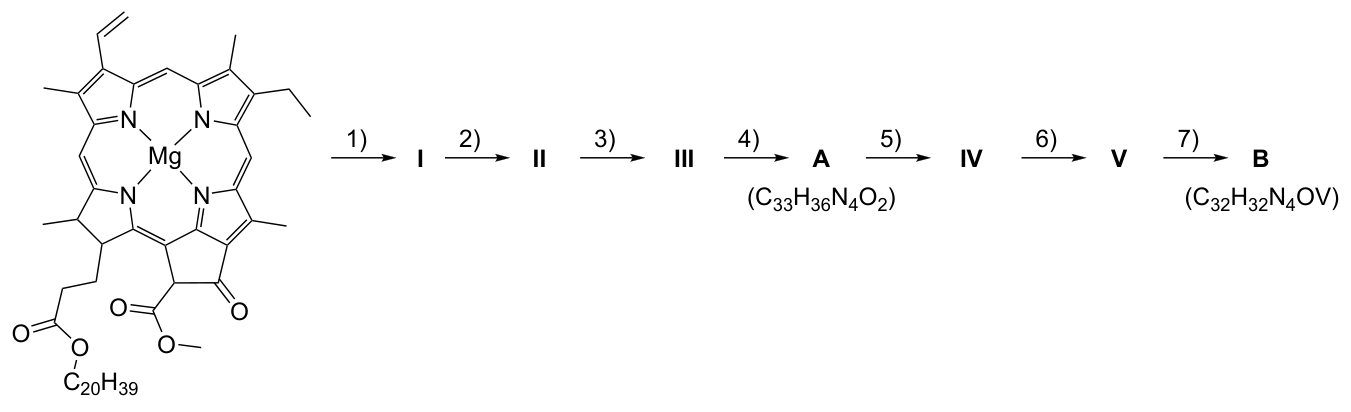
| Step | Name |
|---|---|
| 1) | Demetallization |
| 2) | Hydrolysis |
| 3) | Decarbomethoxylation |
| 4) | Reduction |
| 5) | Aromatization |
| 6) | Decarboxylation |
| 7) | Metal chelation |
9.1 Assign the molecular formulae a–e (given in the answer sheet) to the intermediates I–V. 4.0 pt

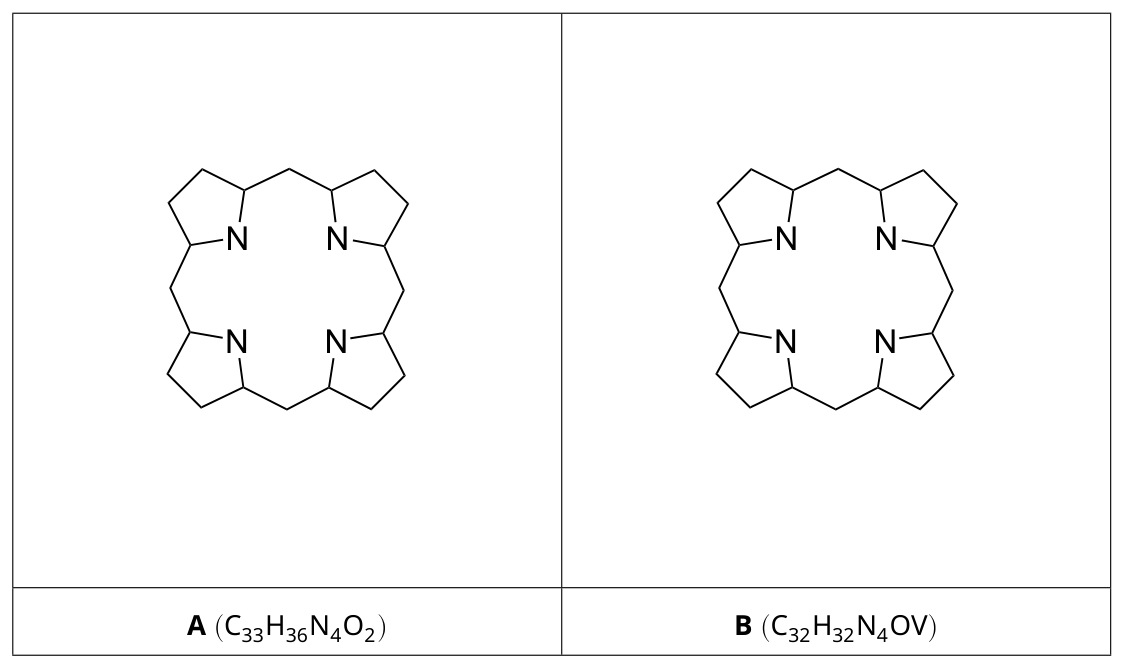
9.2 Draw the structures of intermediate A and vanadium complex B using the pre-drawn framework of porphyrin. (If you need a new template to redraw your structure(s), please ask the supervisor.) 7.0 pt
9.3 Indicate the oxidation state of vanadium in B. 1.0 pt
Part B. Porphyrin non-metal complexes
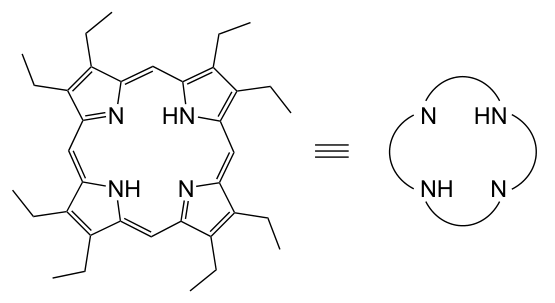
Porphyrins are known to form chelate-type complexes not only with metals but also with some non-metals, for example, with boron and phosphorus. Octaethylporphyrin (\(\ce{H2OEP}\)) is often used to model natural porphyrins and to study porphyrin complexes. It has the following structure and can be represented as:
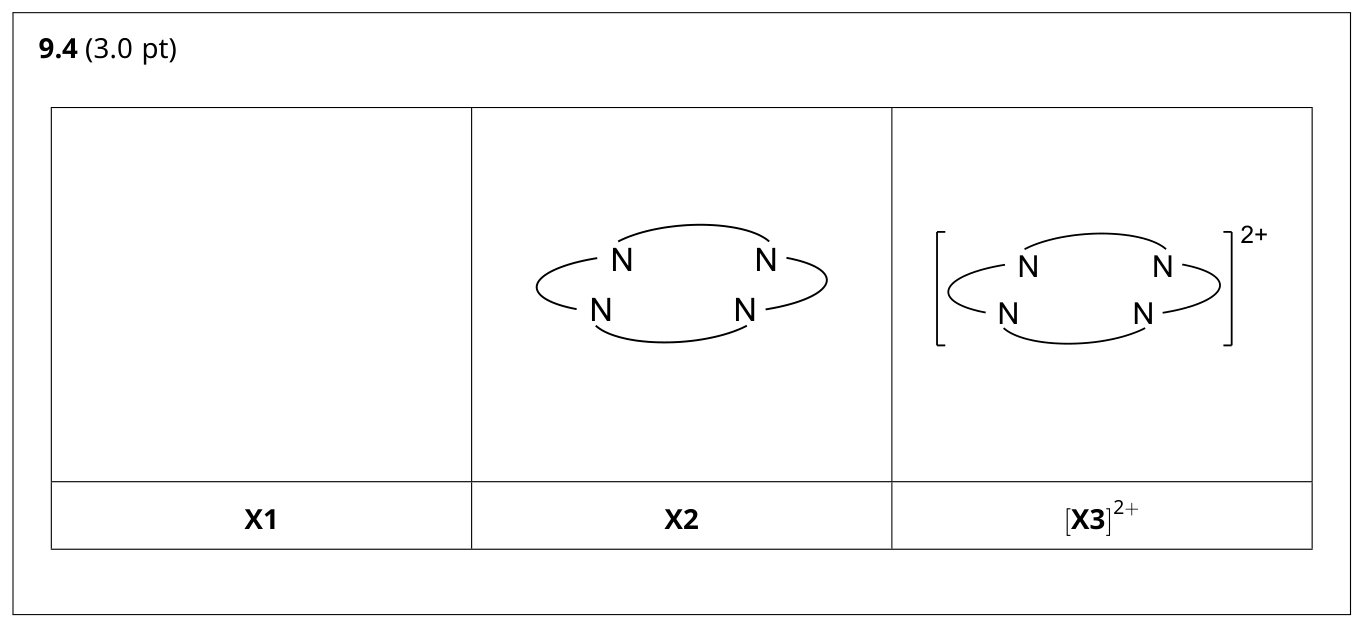
To produce dicationic planar boron porphyrin complex \(\ce{[X3]^2+}\), either \(\ce{BCl3}\) or another binary compound X1 can be used as a precursor:
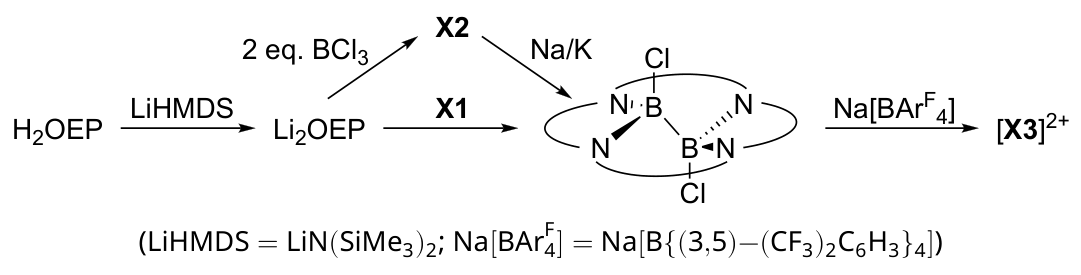
9.4 Draw the structures of X1, intermediate complex X2 and the product \(\ce{[X3]^2+}\). 3.0 pt
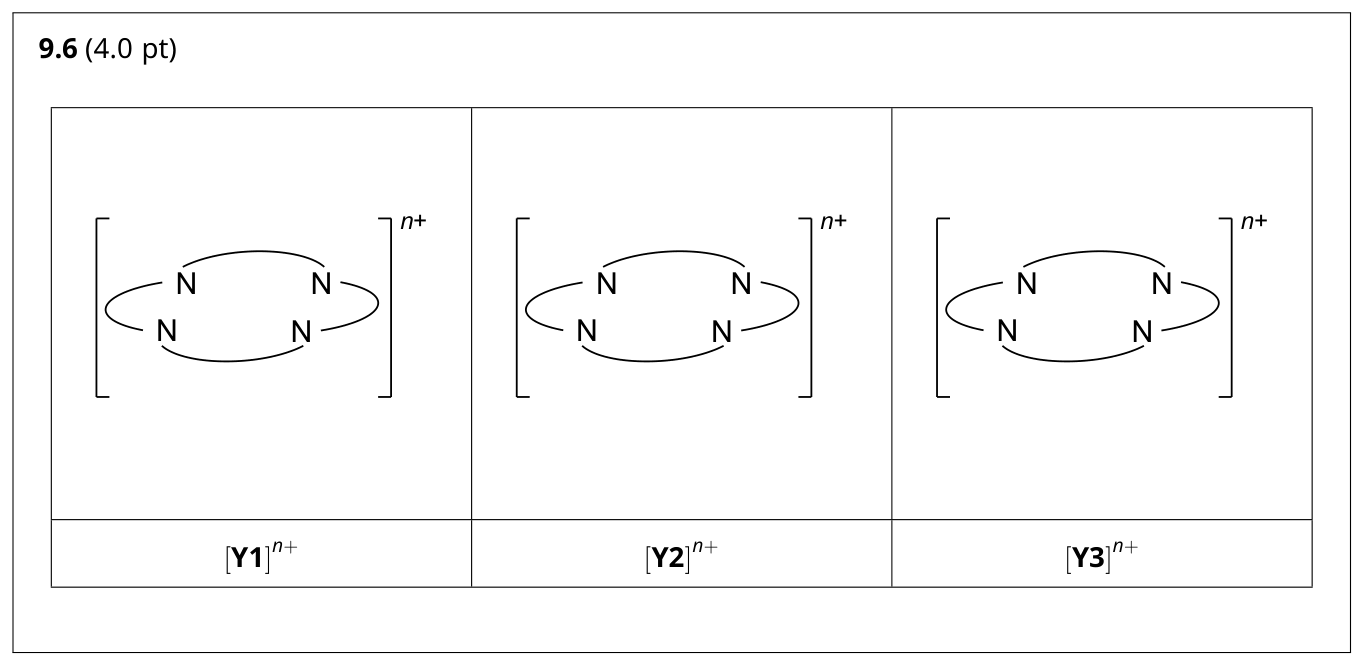
Phosphorus forms porphyrin cationic complexes \(\ce{[Y1]^{n+}}\), \(\ce{[Y2]^{n+}}\), and \(\ce{[Y3]^{n+}}\). The complex \(\ce{[Y3]^{n+}}\) has one less plane of symmetry compared to \(\ce{[Y1]^{n+}}\) and \(\ce{[Y2]^{n+}}\) (ignore ethyl substituents in OEP ligand when considering symmetry). Pyridine (Py) is used here as a basic solvent, “Hal” is one of the halogens: F, Cl, or Br:

9.5 Indicate: a) the charge “\(n+\)” of phosphorus porphyrin complexes; b) the number of planes of symmetry \(N(\sigma)\) that complex \(\ce{[Y1]^{n+}}\) has. 2.0 pt

9.6 Draw the structures of \(\ce{[Y1]^{n+}}\), \(\ce{[Y2]^{n+}}\), and \(\ce{[Y3]^{n+}}\). 4.0 pt
Part C. Porphyrin sandwiches
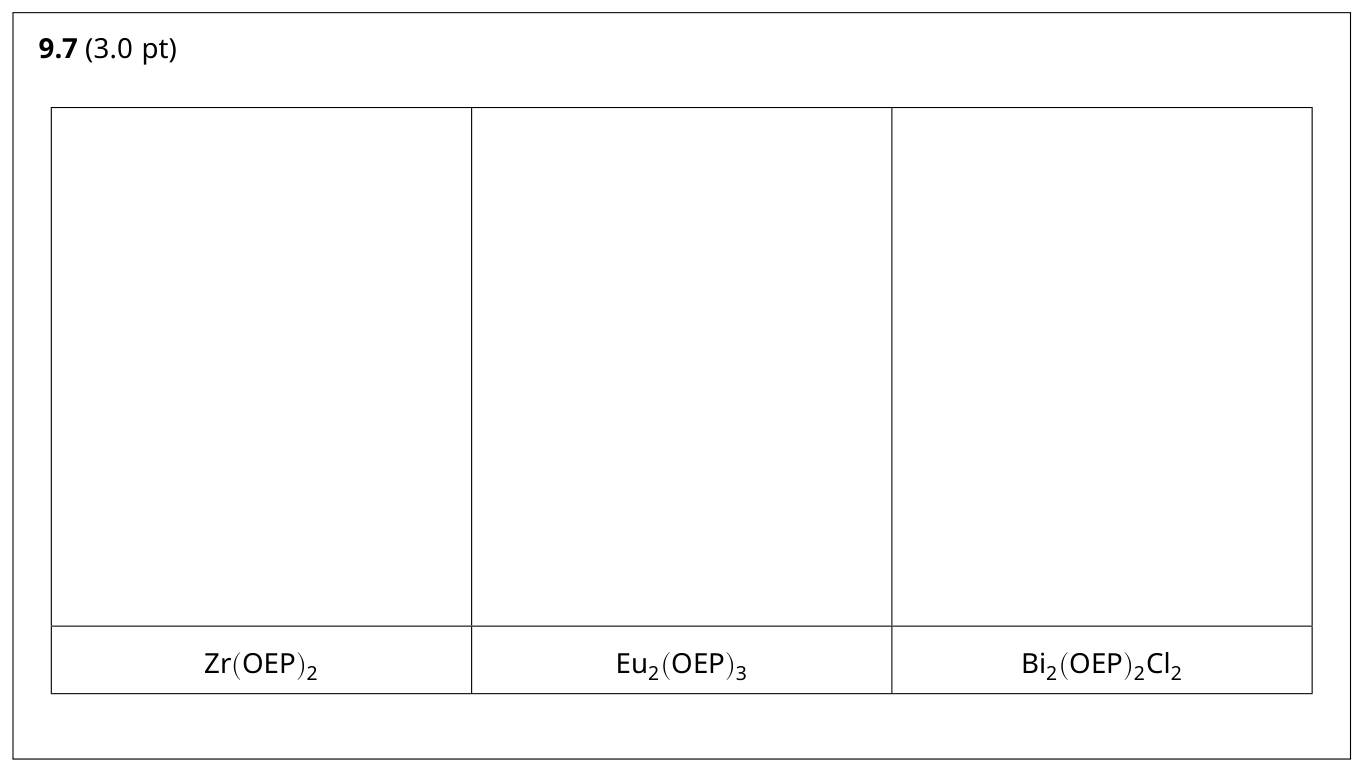
Porphyrin sandwich-type complexes form when there are several porphyrin rings aligned relative to each other. Examples are \(\ce{Zr(OEP)2}\), \(\ce{Eu2(OEP)3}\), \(\ce{Bi2(OEP)2Cl2}\) that have at least 3 planes of symmetry each. Note that the hole size in the OEP ligand is ca. \(4.0\ \text{Å}\), and the average metal–N distances in these complexes are \(2.4,\ 2.5,\ 2.3\ \text{Å}\), respectively.
9.7 Suggest the structures of \(\ce{Zr(OEP)2}\), \(\ce{Eu2(OEP)3}\), and \(\ce{Bi2(OEP)2Cl2}\). You may use a simplified representation of the OEP ligand. 3.0 pt
Another type of porphyrin sandwich-type complex is metal–porphyrin dimers with single or multiple metal–metal bonds. For example, \(\ce{[Ru(OEP)]2}\) has a Ru–Ru double bond (considering only d-electrons). Below is the molecular orbital diagram for an eclipsed dimer of the type \(\ce{[M(porphyrin)]2}\) (interaction between \(\mathrm d_{x^2-y^2}\) is not considered as these orbitals lie high in energy):
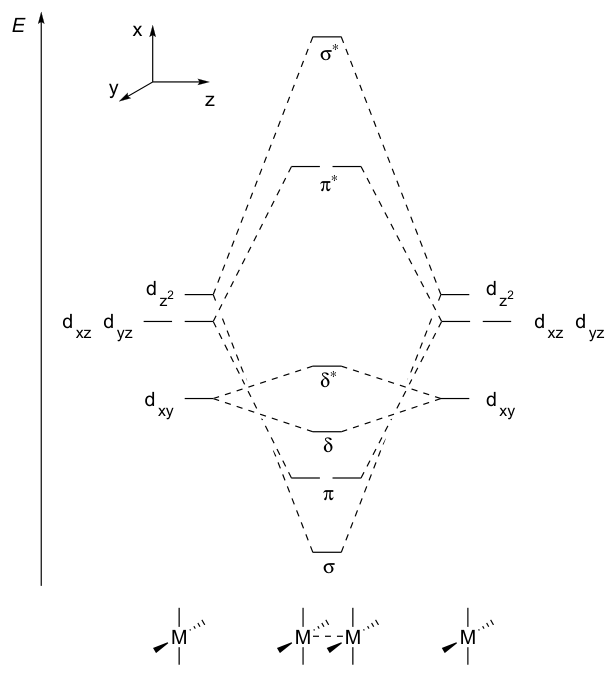
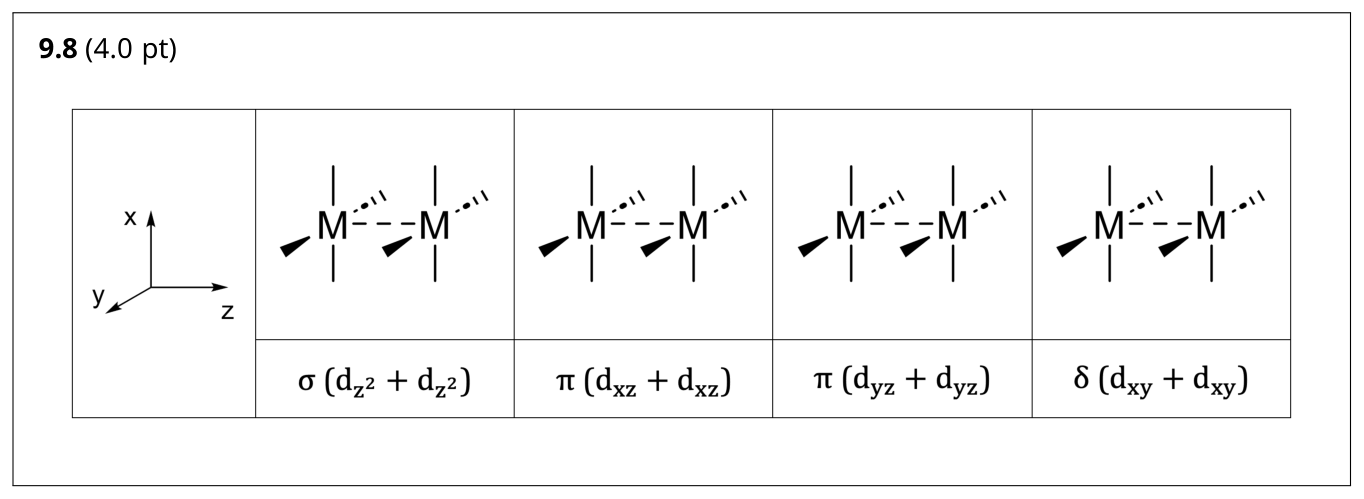
9.8 Draw the \(\sigma(\mathrm d_{z^2}+\mathrm d_{z^2})\), \(\pi(\mathrm d_{xz}+\mathrm d_{xz})\), \(\pi(\mathrm d_{yz}+\mathrm d_{yz})\), and \(\delta(\mathrm d_{xy}+\mathrm d_{xy})\) bonding orbitals according to the specified coordinate system. 4.0 pt
9.9 Calculate the metal–metal bond order in the following complexes in eclipsed conformation: \(\ce{[Mo(OEP)]2}\), \(\ce{[Ir(OEP)]2}\), \(\ce{[Re(OEP)]2^{+}}\). 3.0 pt

The eclipsed conformation is generally preferred for metal–porphyrin dimers with 7, 8, and 9 d-electrons. Otherwise, these complexes are more stable in a staggered conformation, where the porphyrin rings are rotated relative to each other by \(45^\circ\).
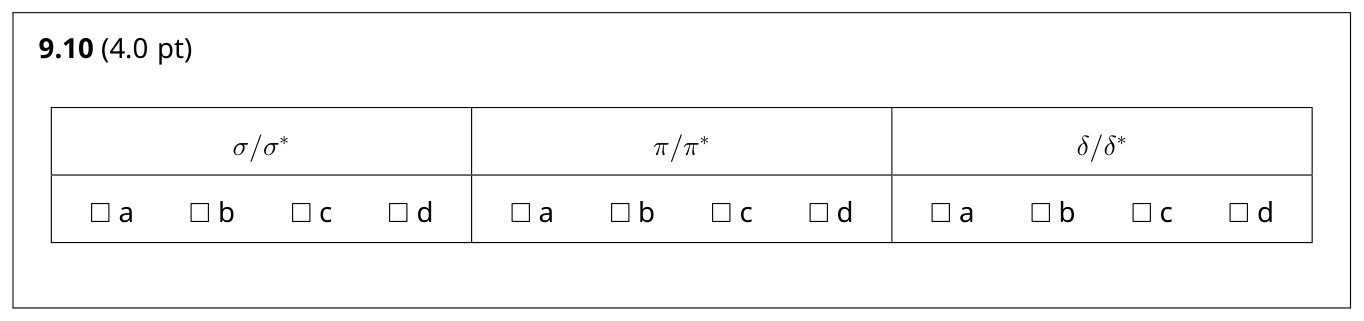
9.10 Select how the splitting (i.e., the energy between antibonding and bonding orbitals) changes for each type of orbital interaction during the conversion of eclipsed conformation into staggered:
a) increases;
b) remains unchanged;
c) decreases (not to zero);
d) decreases to zero.
4.0 pt
Official English text of the problem.
Answers
Here \(\ce{L^{2-}}\) denotes the octaethylporphyrinato ligand, \(\ce{OEP^{2-}}\). Full structural descriptions and SMILES follow in the Solution.
- 9.1: \(\boxed{\mathrm{I=b,\ II=e,\ III=c,\ IV=d,\ V=a}}\).
- 9.2: A is \(13^1\)-deoxopyropheophorbide a: the phytyl ester is hydrolysed, the methoxycarbonyl substituent is removed, and the ring ketone becomes a methylene group. B is its aromatized, decarboxylated oxovanadium(IV) complex; the vinyl group remains unchanged.
- 9.3: \(\boxed{+4}\).
- 9.4: X1 is diboron tetrachloride, \(\ce{Cl2B-BCl2}\). X2 is \(\ce{L(BCl2)2}\), with two adjacent N donors per B and no B–B bond. \(\ce{[X3]^2+}\) is planar \(\ce{[LB2]^2+}\), retaining a B–B single bond.
- 9.5: a) \(\boxed{n+=1+}\); b) \(\boxed{N(\sigma)=5}\).
- 9.6: \(\boxed{\ce{[Y1]+ = [P(L)Cl2]+}}\), \(\boxed{\ce{[Y2]+ = [P(L)(OH)2]+}}\), and \(\boxed{\ce{[Y3]+ = [P(L)(OH)F]+}}\). Each has two mutually trans axial ligands.
- 9.7: \(\ce{ZrL2}\): an eight-coordinate double-decker sandwich. \(\ce{Eu2L3}\): a triple-decker sandwich with one eight-coordinate Eu between each pair of adjacent decks. \(\ce{Bi2L2Cl2}\): \(\ce{LBi(\mu-Cl)2BiL}\), with two bridging chlorides.
- 9.8: Constructive end-on \(\mathrm d_{z^2}\) overlap gives \(\sigma\); constructive side-on overlap in the \(xz\) and \(yz\) planes gives the two \(\pi\) orbitals; four-lobe face-to-face \(\mathrm d_{xy}\) overlap gives \(\delta\).
- 9.9: \(\boxed{4,\ 1,\ 3.5}\), respectively.
- 9.10: \(\boxed{\sigma/\sigma^*:b;\quad \pi/\pi^*:b;\quad \delta/\delta^*:d}\).
Solution
SMILES below specify connectivity. Dative bonds are written using ->; coordination geometries are described separately. Formal charges appearing in a SMILES representation are not necessarily oxidation states. Stereochemistry not specified by the supplied drawings is left unspecified.
9.1 — Assignment of molecular formulae
The starting chlorophyll has formula \(\ce{C55H72MgN4O5}\).
| Intermediate | Formula | Choice | Identification |
|---|---|---|---|
| I | \(\ce{C55H74N4O5}\) | b | Pheophytin a |
| II | \(\ce{C35H36N4O5}\) | e | Pheophorbide a |
| III | \(\ce{C33H34N4O3}\) | c | Pyropheophorbide a |
| IV | \(\ce{C33H34N4O2}\) | d | Aromatized A |
| V | \(\ce{C32H34N4}\) | a | Decarboxylated IV, the metal-free ligand of B |
The atom balances explain every assignment:
-
Demetallization: replace the central \(\ce{Mg^2+}\) by two N-bound hydrogens. \[ \ce{C55H72MgN4O5 + 2H+ -> C55H74N4O5 + Mg^2+} \]
-
Hydrolysis: cleave the phytyl ester, replacing \(\ce{-OC20H39}\) by \(\ce{-OH}\). \[ \ce{C55H74N4O5 + H2O -> C35H36N4O5 + C20H40O} \]
-
Decarbomethoxylation: replace the ring’s \(\ce{-CO2CH3}\) substituent by H. An atom-balanced hydrolysis/decarboxylation description is \[ \ce{C35H36N4O5 + H2O -> C33H34N4O3 + CO2 + CH3OH}. \]
-
Reduction: convert the remaining ring ketone into a methylene group. \[ \ce{C33H34N4O3 + 2H2 -> C33H36N4O2 + H2O} \]
-
Aromatization: remove two hydrogens from the reduced pyrrole ring. \[ \ce{C33H36N4O2 -> C33H34N4O2 + H2} \]
-
Decarboxylation: \[ \ce{C33H34N4O2 -> C32H34N4 + CO2} \]
-
Vanadyl chelation: \[ \ce{C32H34N4 + VO^2+ -> C32H32N4OV + 2H+} \]
The \(\ce{H2}\) terms in steps 4–5 express the net redox balances; the actual reducing and oxidizing reagents are not specified.
The corresponding structural SMILES are:
- I, pheophytin a, using the conventional phytyl connectivity:
C=CC1=C(C)c2cc3[nH]c(c4c5nc(cc6[nH]c(cc1n2)c(C)c6CC)C(C)=C5C(=O)C4C(=O)OC)C(CCC(=O)OCC=C(C)CCCC(C)CCCC(C)CCCC(C)C)C3C - II, pheophorbide a:
C=CC1=C(C)c2cc3[nH]c(c4c5nc(cc6[nH]c(cc1n2)c(C)c6CC)C(C)=C5C(=O)C4C(=O)OC)C(CCC(=O)O)C3C - III, pyropheophorbide a:
C=CC1=C(C)c2cc3[nH]c(c4c5nc(cc6[nH]c(cc1n2)c(C)c6CC)C(C)=C5C(=O)C4)C(CCC(=O)O)C3C - IV, the aromatized derivative of A:
C=CC1=C(C)c2cc3[nH]c(c4c5nc(cc6[nH]c(cc1n2)c(C)c6CC)C(C)=C5CC4)c(CCC(=O)O)c3C - V, the decarboxylated derivative of IV:
C=CC1=C(C)c2cc3[nH]c(c4c5nc(cc6[nH]c(cc1n2)c(C)c6CC)C(C)=C5CC4)c(CC)c3C
9.2 — Structures of A and B
A: \(13^1\)-deoxopyropheophorbide a, \(\ce{C33H36N4O2}\).
SMILES:
C=CC1=C(C)c2cc3[nH]c(c4c5nc(cc6[nH]c(cc1n2)c(C)c6CC)C(C)=C5CC4)C(CCC(=O)O)C3C
To draw A, retain the orientation and peripheral substitution of the starting chlorophyll, making these changes:
- Remove Mg and place H on the upper-right and lower-left nitrogens, giving a free-base chlorin.
- Change the lower-left propionate ester into \(\ce{-CH2CH2COOH}\).
- Remove the methoxycarbonyl substituent from the fused five-membered ring, replacing it by H.
- Replace that ring’s \(\ce{C=O}\) group by \(\ce{CH2}\).
- Retain the upper-left vinyl group, the upper-right ethyl group, all four methyl groups, and the saturated bond between the two peripheral carbons of the lower-left pyrrole ring.
The fused five-membered ring consequently contains a \(\ce{-CH2-CH2-}\) bridge connecting the same two macrocycle positions as in the starting structure.
The formula fixes the extent of reduction: replacing \(\ce{C=O}\) by \(\ce{CH2}\) accounts exactly for the change from \(\ce{C33H34N4O3}\) to \(\ce{C33H36N4O2}\). Additional hydrogenation of the vinyl group would give too many hydrogens.
B: the oxovanadium(IV) complex of V, \(\ce{C32H32N4OV}\).
SMILES:
C=CC1=C(C)c2cc3c(C)c(CC)c4c5c6[n]7->[V+2]8(=[O])(<-[n]2c1cc1c(C)c(CC)c(cc7C(C)=C6CC5)[n-]->81)<-[n-]34
To obtain its drawing from A:
- Introduce a double bond between the two saturated peripheral carbons of the lower-left pyrrole ring, producing the porphyrin conjugation pattern.
- Replace \(\ce{-CH2CH2COOH}\) by \(\ce{-CH2CH3}\).
- Remove both inner N–H hydrogens and coordinate all four nitrogens to V.
- Add a terminal axial oxo ligand, drawn \(\ce{V=O}\).
The coordination geometry is approximately square pyramidal: four porphyrin nitrogens form the basal donor set and oxygen occupies the axial position. The peripheral vinyl group remains unchanged.
9.3 — Oxidation state of vanadium
The porphyrinato ligand has charge \(-2\), and the oxo ligand has charge \(-2\). Since B is neutral,
\[ x-2-2=0, \qquad \boxed{x=+4}. \]
Thus the metal is vanadium(IV).
9.4 — Boron complexes
Let \(\ce{L^{2-}}\) denote octaethylporphyrinato, whose SMILES is:
CCC1=C(CC)c2cc3[n-]c(cc4nc(cc5[n-]c(cc1n2)c(CC)c5CC)C(CC)=C4CC)c(CC)c3CC
The two inner N–H groups are first deprotonated:
\[ \ce{H2L + 2LiN(SiMe3)2 -> Li2L + 2HN(SiMe3)2}. \]
X1 is diboron tetrachloride, \(\ce{B2Cl4}\).
SMILES: ClB(Cl)B(Cl)Cl
Draw a B–B single bond, with two terminal chlorides on each B. Its reaction with the dilithium ligand is
\[ \ce{Li2L + B2Cl4 -> L(BCl)2 + 2LiCl}. \]
This directly gives the B–B-bonded dichloro complex shown in the problem.
X2 is the bis(dichloroboron) octaethylporphyrin complex, \(\ce{L(BCl2)2}\).
SMILES:
CCC1=C(CC)C2=[N+]3C1=Cc1c(CC)c(CC)c(n1[B-]3(Cl)Cl)C=C1C(CC)=C(CC)C3=[N+]1[B-](Cl)(Cl)n1c(c(CC)c(CC)c1=C3)=C2
Draw two B centres inside the macrocycle. One binds the two adjacent nitrogens on the left, and the other binds the two adjacent nitrogens on the right. Each B also bears two chlorides, giving approximately tetrahedral coordination. There is no B–B bond in X2.
Formation and reduction are balanced by
\[ \ce{Li2L + 2BCl3 -> L(BCl2)2 + 2LiCl}, \]
\[ \ce{L(BCl2)2 + 2M -> L(BCl)2 + 2MCl}, \qquad \ce{M = Na \text{ or } K}. \]
The latter reaction reduces each B from oxidation state \(+3\) to \(+2\), removes one chloride from each, and forms the B–B bond.
\(\ce{[X3]^2+}\) is the B–B-bonded diboron octaethylporphyrin dication, \(\ce{[LB2]^2+}\).
SMILES:
CCC1=C(CC)C2=[N+]3B4B5n6c(c(CC)c(CC)c6=CC6=[N+]5C(=Cc5c(CC)c(CC)c(n54)C=C13)C(CC)=C6CC)=C2
Draw the same adjacent N-pair chelation, remove both remaining chlorides, and retain the B–B single bond. The two B centres and four N donors are coplanar; each B is three-coordinate.
Writing \(\ce{W-}\) for the weakly coordinating borate anion supplied in the problem,
\[ \ce{L(BCl)2 + 2NaW -> [LB2]W2 + 2NaCl}. \]
Chloride abstraction is not a further reduction, so it does not increase the B–B bond order. Charge balance also gives
\[ 2(+2)+(-2)=+2 \]
for the diboron porphyrin dication.
9.5 — Charge and symmetry of the phosphorus complexes
Phosphorus is in oxidation state \(+5\). With a dianionic porphyrinato ligand and two singly charged axial ligands,
\[ q=+5-2-1-1=+1. \]
Therefore,
\[ \boxed{n+=1+}. \]
For Y1, the two identical axial chlorides and the idealized unsubstituted porphyrin framework give \(D_{4h}\) symmetry. Its mirror planes are:
- the porphyrin plane, \(\sigma_h\);
- two vertical planes passing through opposite N donors;
- two further vertical planes bisecting those N–P–N directions.
Hence
\[ \boxed{N(\sigma)=1+2+2=5}. \]
9.6 — Phosphorus structures
All three cations contain P coordinated to the four porphyrin nitrogens, with two additional ligands on opposite sides of the porphyrin plane.
| Species | Identification | Axial ligands |
|---|---|---|
| \(\ce{[Y1]+}\) | Dichlorido(octaethylporphyrinato)phosphorus(V) | Cl and Cl |
| \(\ce{[Y2]+}\) | Dihydroxido(octaethylporphyrinato)phosphorus(V) | OH and OH |
| \(\ce{[Y3]+}\) | Fluorido(hydroxido)(octaethylporphyrinato)phosphorus(V) | F and OH |
Their SMILES, using covalent, charge-separated representations of the P–N bonds, are:
- \(\ce{[Y1]+}\):
CCC1=C(CC)C2=[N+]3C1=Cc1c(CC)c(CC)c4n1[P-]31(Cl)(Cl)n3c(c(CC)c(CC)c3=CC3=[N+]1C(=C4)C(CC)=C3CC)=C2 - \(\ce{[Y2]+}\):
CCC1=C(CC)C2=[N+]3C1=Cc1c(CC)c(CC)c4n1[P-]31(O)(O)n3c(c(CC)c(CC)c3=CC3=[N+]1C(=C4)C(CC)=C3CC)=C2 - \(\ce{[Y3]+}\):
CCC1=C(CC)C2=[N+]3C1=Cc1c(CC)c(CC)c4n1[P-]31(O)(F)n3c(c(CC)c(CC)c3=CC3=[N+]1C(=C4)C(CC)=C3CC)=C2
The initial oxidative insertion can be balanced as
\[ \ce{H2L + PCl3 + Cl2 -> [P(L)Cl2]Cl + 2HCl}. \]
Pyridine acts as a base and captures the acid.
Hydrolysis replaces the axial chlorides with hydroxido ligands. A net balance including carbonate is
\[ \ce{[P(L)Cl2]+ + Na2CO3 + H2O -> [P(L)(OH)2]+ + 2NaCl + CO2}. \]
The acid workup establishes the protonated hydroxido form shown as Y2.
The decisive information for Y3 is its reversible conversion, under base, to the neutral oxo–halido complex. Thus Y3 must retain one OH group:
\[ \ce{[P(L)(OH)Hal]+ + OH- -> P(L)(O)Hal + H2O}. \]
Since the last substitution reagent is \(\ce{KF}\), \(\ce{Hal = F}\). An overall atom-balanced description of the oxalyl bromide/fluoride sequence is
\[ \ce{[P(L)(OH)2]+ + (COBr)2 + KF -> [P(L)(OH)F]+ + KBr + HBr + CO + CO2}. \]
This is a net balance, not a claim about every elementary step.
The final acid–base interconversion is therefore
\[ \ce{[P(L)(OH)F]+ + OH- <=> P(L)(O)F + H2O}. \]
The neutral product is fluorido(oxo)(octaethylporphyrinato)phosphorus(V). Its charge-separated SMILES is:
CCC1=C(CC)C2=[N+]3C1=Cc1c(CC)c(CC)c4n1[P-]31([O-])(F)n3c(c(CC)c(CC)c3=CC3=[N+]1C(=C4)C(CC)=C3CC)=C2
In the requested drawing, represent its axial oxygen as \(\ce{P=O}\).
Finally, different axial groups in Y3 remove the horizontal mirror plane that would exchange them. The four vertical mirror planes remain in the idealized geometry, explaining the stated loss of exactly one plane.
9.7 — Sandwich structures
The approximate cavity radius is
\[ r\approx \frac{4.0}{2}=2.0\ \text{Å}. \]
All three supplied metal–N distances exceed this radius, so the metals must lie outside the individual N-donor planes in the proposed structures. For an ideal planar, centred N-donor square,
\[ h=\sqrt{d_{\mathrm{M-N}}^2-r^2}. \]
| Metal | \(d_{\mathrm{M-N}}\) | Approximate height \(h\) above an N-donor plane |
|---|---|---|
| Zr | \(2.4\ \text{Å}\) | \(1.3\ \text{Å}\) |
| Eu | \(2.5\ \text{Å}\) | \(1.5\ \text{Å}\) |
| Bi | \(2.3\ \text{Å}\) | \(1.1\ \text{Å}\) |
These are geometric estimates using the approximate cavity size.
\(\ce{Zr(OEP)2}\): bis(octaethylporphyrinato)zirconium(IV).
Draw two parallel, cofacial porphyrin decks with Zr between their centres. Zr binds all four N donors of each deck, giving coordination number eight. A \(45^\circ\) offset between the N-donor squares gives a square-antiprismatic arrangement with four vertical mirror planes.
SMILES:
CCC1=C(CC)c2cc3c(CC)c(CC)c4cc5[n]6->[Zr+4]789%10(<-[n]2c1cc1c(CC)c(CC)c(cc6C(CC)=C5CC)[n-]->71)(<-[n]1c2cc5c(CC)c(CC)c(cc6[n]->8c(cc7c(CC)c(CC)c(cc1C(CC)=C2CC)[n-]->97)C(CC)=C6CC)[n-]->%105)<-[n-]34
\(\ce{Eu2(OEP)3}\): tris(octaethylporphyrinato)dieuropium(III).
Draw three parallel decks in the sequence
\[ \text{porphyrin–Eu–porphyrin–Eu–porphyrin}. \]
Each Eu binds the four nitrogens of each adjacent deck. The middle porphyrin coordinates both metals, one on each face. An arrangement with aligned outer decks and a middle deck rotated by \(45^\circ\) satisfies the required symmetry.
SMILES:
CCC1=C(CC)c2cc3c(CC)c(CC)c4cc5[n]6->[Eu+3]789%10(<-[n]2c1cc1c(CC)c(CC)c(cc6C(CC)=C5CC)[n-]->71)(<-[n-]34)<-[n]12->[Eu+3]34567(<-[n]%11c%12cc%13c(CC)c(CC)c(cc%14[n]->3c(cc3c(CC)c(CC)c(cc%11C(CC)=C%12CC)[n-]->43)C(CC)=C%14CC)[n-]->5%13)<-[n]->83c4cc5c(CC)c(CC)c(cc1C(CC)=C(CC)c2cc1c(CC)c(CC)c(cc3C(CC)=C4CC)[n-]->9->61)[n-]->%10->75
\(\ce{Bi2(OEP)2Cl2}\): di-\(\mu\)-chlorido-bis[(octaethylporphyrinato)bismuth(III)].
Draw two parallel porphyrins, each binding one Bi displaced toward the space between the decks. Join the two Bi atoms through two bridging chlorides, giving a central \(\ce{Bi2Cl2}\) four-membered ring:
\[ \ce{LBi(\mu-Cl)2BiL}. \]
Each Bi has four N donors and two chloride contacts. A symmetric arrangement with eclipsed decks has three mirror planes: the plane of the \(\ce{Bi2Cl2}\) ring, a perpendicular plane through the Bi–Bi axis, and the plane midway between the porphyrin decks. No Bi–Bi bond is required.
SMILES:
CCC1=C(CC)c2cc3c(CC)c(CC)c4cc5[n]6->[Bi+3]78(<-[Cl-]->[Bi+3]9%10%11(<-[Cl-]->7)<-[n]7c%12cc%13c(CC)c(CC)c(cc%14[n]->9c(cc9c(CC)c(CC)c(cc7C(CC)=C%12CC)[n-]->%109)C(CC)=C%14CC)[n-]->%11%13)(<-[n]2c1cc1c(CC)c(CC)c(cc6C(CC)=C5CC)[n-]->81)<-[n-]34
The oxidation-state balances are, respectively,
\[ +4+2(-2)=0,\qquad 2(+3)+3(-2)=0,\qquad 2(+3)+2(-2)+2(-1)=0. \]
The SMILES encode coordination connectivity; they do not encode the deck rotations just described.
9.8 — Bonding orbitals
Take the metal–metal axis as \(z\), pointing right in the printed coordinate system. Use two colours or \(+\)/\(-\) signs to denote orbital phase. In every bonding combination, overlapping lobes in the internuclear region must have the same phase.
| Orbital | Precise drawing description | Nodal planes containing the M–M axis |
|---|---|---|
| \(\sigma(\mathrm d_{z^2}+\mathrm d_{z^2})\) | On each metal, draw two lobes along \(z\) and an opposite-phase torus around the metal in the \(xy\) plane. The two facing axial lobes have the same phase and overlap end-on. | None |
| \(\pi(\mathrm d_{xz}+\mathrm d_{xz})\) | Draw four lobes on each metal in the \(xz\) plane, between the \(x\) and \(z\) axes. Match phases across the internuclear region both above and below the \(z\) axis; the upper and lower overlap regions have opposite phases. | \(yz\) |
| \(\pi(\mathrm d_{yz}+\mathrm d_{yz})\) | Draw the analogous four-lobed orbitals in the \(yz\) plane. Match phases across the internuclear region on both sides along \(y\). | \(xz\) |
| \(\delta(\mathrm d_{xy}+\mathrm d_{xy})\) | Draw four lobes around each metal in its \(xy\) plane, between the \(x\) and \(y\) axes. Corresponding lobes on the two metals overlap face-to-face with matching phases. Adjacent quadrants have opposite phases. | \(xz\) and \(yz\) |
The overall sign of an atomic orbital is arbitrary. For the \(\pi\) combinations, choose the relative atomic-orbital phases so that the “+” combinations printed in the question are constructive.
9.9 — Metal–metal bond orders
Each porphyrinato ligand contributes charge \(-2\). The supplied MO ordering is
\[ \sigma<\pi<\delta<\delta^*<\pi^*<\sigma^*, \]
where each \(\pi\) level contains two orbitals. Bond order is
\[ \mathrm{BO}=\frac{N_{\mathrm{bonding}}-N_{\mathrm{antibonding}}}{2}. \]
| Complex | Metal oxidation states | Total d-electrons | Occupancy | Bond order |
|---|---|---|---|---|
| \(\ce{[Mo(OEP)]2}\) | Two Mo(II) | \(2(6-2)=8\) | \(\sigma^2\pi^4\delta^2\) | \((8-0)/2=\boxed{4}\) |
| \(\ce{[Ir(OEP)]2}\) | Two Ir(II) | \(2(9-2)=14\) | \(\sigma^2\pi^4\delta^2(\delta^*)^2(\pi^*)^4\) | \((8-6)/2=\boxed{1}\) |
| \(\ce{[Re(OEP)]2^{+}}\) | Oxidation-state sum \(+5\) | \(2(7)-5=9\) | \(\sigma^2\pi^4\delta^2(\delta^*)^1\) | \((8-1)/2=\boxed{3.5}\) |
For the Re cation, the average oxidation state is \(+2.5\); assigning the positive charge to a particular metal is unnecessary.
9.10 — Effect of a \(45^\circ\) rotation
\(\sigma/\sigma^*\): b, remains unchanged.
The \(\mathrm d_{z^2}\) orbital is rotationally symmetric about the metal–metal axis. Rotating a porphyrin around \(z\) therefore leaves the \(\sigma\) interaction unchanged.
\(\pi/\pi^*\): b, remains unchanged.
Both members of the degenerate \(\{\mathrm d_{xz},\mathrm d_{yz}\}\) pair must be considered. Rotation changes their basis according to
\[ \begin{pmatrix} \mathrm d'_{xz}\\ \mathrm d'_{yz} \end{pmatrix} = \begin{pmatrix} \cos\theta&\sin\theta\\ -\sin\theta&\cos\theta \end{pmatrix} \begin{pmatrix} \mathrm d_{xz}\\ \mathrm d_{yz} \end{pmatrix}. \]
This mixes the two orbitals without changing the available \(\pi\) subspace or its bonding–antibonding splitting. Although an individual same-label overlap decreases, cross-overlap with the other \(\pi\) orbital compensates for it.
\(\delta/\delta^*\): d, decreases to zero.
For the retained \(\mathrm d_{xy}\)-based interaction, the overlap varies as
\[ S_\delta(\theta)\propto\cos(2\theta). \]
Thus, at \(45^\circ\),
\[ S_\delta(45^\circ)\propto\cos90^\circ=0. \]
Positive and negative overlap contributions cancel, so the \(\delta\) and \(\delta^*\) levels become nonbonding and degenerate in the stated model.
This also explains why 7, 8, or 9 d-electrons favour eclipsing: those occupancies give a net \(\delta\)-bonding contribution, which is lost on staggering.
The solution was checked against the official solution.
IChO 2024 · Theorieaufgabe 9
Porphyrinkomplexe
Teil A. Metalle im Erdöl
Saudi-arabisches Erdöl, das hauptsächlich aus Kohlenwasserstoffen besteht, enthält Elemente wie Vanadium in Porphyrinkomplexen, was auf seinen biologischen Ursprung hindeutet.
Der Vanadiumkomplex B entsteht im Erdöl vermutlich aus Chlorophyll gemäß dem folgenden Schema:
| Schritt | Bezeichnung |
|---|---|
| 1) | Demetallierung |
| 2) | Hydrolyse |
| 3) | Decarbomethoxylierung |
| 4) | Reduktion |
| 5) | Aromatisierung |
| 6) | Decarboxylierung |
| 7) | Metallchelatbildung |
9.1 Ordnen Sie die Summenformeln a–e (auf dem Antwortblatt angegeben) den Zwischenprodukten I–V zu. 4.0 Pkt.
9.2 Zeichnen Sie die Strukturen des Zwischenprodukts A und des Vanadiumkomplexes B unter Verwendung des vorgegebenen Porphyringerüsts. (Falls Sie eine neue Vorlage benötigen, um Ihre Struktur(en) erneut zu zeichnen, wenden Sie sich bitte an die Aufsicht.) 7.0 Pkt.
9.3 Geben Sie die Oxidationsstufe des Vanadiums in B an. 1.0 Pkt.
Teil B. Porphyrinkomplexe mit Nichtmetallen
Porphyrine bilden bekanntermaßen nicht nur mit Metallen, sondern auch mit einigen Nichtmetallen, beispielsweise Bor und Phosphor, chelatartige Komplexe. Octaethylporphyrin (\(\ce{H2OEP}\)) wird häufig als Modell für natürliche Porphyrine und zur Untersuchung von Porphyrinkomplexen verwendet. Es hat die folgende Struktur und kann wie folgt dargestellt werden:
Zur Herstellung des dikationischen planaren Bor-Porphyrinkomplexes \(\ce{[X3]^2+}\) kann entweder \(\ce{BCl3}\) oder eine andere binäre Verbindung X1 als Ausgangsstoff verwendet werden:
9.4 Zeichnen Sie die Strukturen von X1, des intermediären Komplexes X2 und des Produkts \(\ce{[X3]^2+}\). 3.0 Pkt.
Phosphor bildet die kationischen Porphyrinkomplexe \(\ce{[Y1]^{n+}}\), \(\ce{[Y2]^{n+}}\) und \(\ce{[Y3]^{n+}}\). Der Komplex \(\ce{[Y3]^{n+}}\) besitzt eine Symmetrieebene weniger als \(\ce{[Y1]^{n+}}\) und \(\ce{[Y2]^{n+}}\) (vernachlässigen Sie bei der Symmetriebetrachtung die Ethylsubstituenten des OEP-Liganden). Pyridin (Py) wird hier als basisches Lösungsmittel verwendet; „Hal“ steht für eines der Halogene F, Cl oder Br:
9.5 Geben Sie an: a) die Ladung „\(n+\)“ der Phosphor-Porphyrinkomplexe; b) die Anzahl der Symmetrieebenen \(N(\sigma)\) des Komplexes \(\ce{[Y1]^{n+}}\). 2.0 Pkt.
9.6 Zeichnen Sie die Strukturen von \(\ce{[Y1]^{n+}}\), \(\ce{[Y2]^{n+}}\) und \(\ce{[Y3]^{n+}}\). 4.0 Pkt.
Teil C. Porphyrin-Sandwichkomplexe
Porphyrin-Sandwichkomplexe entstehen, wenn mehrere Porphyrinringe relativ zueinander ausgerichtet sind. Beispiele sind \(\ce{Zr(OEP)2}\), \(\ce{Eu2(OEP)3}\) und \(\ce{Bi2(OEP)2Cl2}\), die jeweils mindestens 3 Symmetrieebenen besitzen. Beachten Sie, dass die Größe der zentralen Öffnung im OEP-Liganden etwa \(4.0\ \text{Å}\) beträgt und die mittleren Metall–N-Abstände in diesen Komplexen \(2.4,\ 2.5,\ 2.3\ \text{Å}\) betragen, in dieser Reihenfolge.
9.7 Schlagen Sie die Strukturen von \(\ce{Zr(OEP)2}\), \(\ce{Eu2(OEP)3}\) und \(\ce{Bi2(OEP)2Cl2}\) vor. Sie dürfen eine vereinfachte Darstellung des OEP-Liganden verwenden. 3.0 Pkt.
Eine weitere Art von Porphyrin-Sandwichkomplexen sind Metall-Porphyrin-Dimere mit Metall–Metall-Einfach- oder Mehrfachbindungen. Beispielsweise besitzt \(\ce{[Ru(OEP)]2}\) eine Ru–Ru-Doppelbindung (bei ausschließlicher Berücksichtigung der d-Elektronen). Nachstehend ist das Molekülorbitaldiagramm für ein ekliptisches Dimer des Typs \(\ce{[M(porphyrin)]2}\) dargestellt (die Wechselwirkung zwischen \(\mathrm d_{x^2-y^2}\)-Orbitalen wird nicht berücksichtigt, da diese Orbitale energetisch hoch liegen):
9.8 Zeichnen Sie die bindenden Orbitale \(\sigma(\mathrm d_{z^2}+\mathrm d_{z^2})\), \(\pi(\mathrm d_{xz}+\mathrm d_{xz})\), \(\pi(\mathrm d_{yz}+\mathrm d_{yz})\) und \(\delta(\mathrm d_{xy}+\mathrm d_{xy})\) entsprechend dem angegebenen Koordinatensystem. 4.0 Pkt.
9.9 Berechnen Sie die Metall–Metall-Bindungsordnung in den folgenden Komplexen in ekliptischer Konformation: \(\ce{[Mo(OEP)]2}\), \(\ce{[Ir(OEP)]2}\), \(\ce{[Re(OEP)]2^{+}}\). 3.0 Pkt.
Bei Metall-Porphyrin-Dimeren mit 7, 8 und 9 d-Elektronen wird im Allgemeinen die ekliptische Konformation bevorzugt. Andernfalls sind diese Komplexe in einer gestaffelten Konformation stabiler, in der die Porphyrinringe relativ zueinander um \(45^\circ\) gedreht sind.
9.10 Wählen Sie für jede Art der Orbitalwechselwirkung aus, wie sich die Aufspaltung (d. h. die Energiedifferenz zwischen antibindenden und bindenden Orbitalen) beim Übergang von der ekliptischen zur gestaffelten Konformation verändert:
a) nimmt zu;
b) bleibt unverändert;
c) nimmt ab (nicht auf null);
d) nimmt auf null ab.
4.0 Pkt.
Aufgabentext aus dem offiziellen englischen Text übersetzt.
Antworten
Hier bezeichnet \(\ce{L^{2-}}\) den Octaethylporphyrinato-Liganden, \(\ce{OEP^{2-}}\). Vollständige Strukturbeschreibungen und SMILES folgen in der Lösung.
- 9.1: \(\boxed{\mathrm{I=b,\ II=e,\ III=c,\ IV=d,\ V=a}}\).
- 9.2: A ist \(13^1\)-Desoxypyrophäophorbid a: Der Phytylester wird hydrolysiert, der Methoxycarbonylsubstituent wird entfernt und die Ketogruppe im Ring wird zu einer Methylengruppe. B ist dessen aromatisierter, decarboxylierter Oxovanadium(IV)-Komplex; die Vinylgruppe bleibt unverändert.
- 9.3: \(\boxed{+4}\).
- 9.4: X1 ist Dibortetrachlorid, \(\ce{Cl2B-BCl2}\). X2 ist \(\ce{L(BCl2)2}\), mit zwei benachbarten N-Donoren pro B und ohne B–B-Bindung. \(\ce{[X3]^2+}\) ist planares \(\ce{[LB2]^2+}\), wobei eine B–B-Einfachbindung erhalten bleibt.
- 9.5: a) \(\boxed{n+=1+}\); b) \(\boxed{N(\sigma)=5}\).
- 9.6: \(\boxed{\ce{[Y1]+ = [P(L)Cl2]+}}\), \(\boxed{\ce{[Y2]+ = [P(L)(OH)2]+}}\) und \(\boxed{\ce{[Y3]+ = [P(L)(OH)F]+}}\). Jeder Komplex besitzt zwei zueinander trans-ständige axiale Liganden.
- 9.7: \(\ce{ZrL2}\): ein Doppeldecker-Sandwichkomplex mit achtfach koordiniertem Metallzentrum. \(\ce{Eu2L3}\): ein Dreifachdecker-Sandwichkomplex mit jeweils einem achtfach koordinierten Eu zwischen zwei benachbarten Decks. \(\ce{Bi2L2Cl2}\): \(\ce{LBi(\mu-Cl)2BiL}\), mit zwei verbrückenden Chloridliganden.
- 9.8: Konstruktive frontale Überlappung der \(\mathrm d_{z^2}\)-Orbitale ergibt \(\sigma\); konstruktive seitliche Überlappung in der \(xz\)- und der \(yz\)-Ebene ergibt die beiden \(\pi\)-Orbitale; die flächige Überlappung der vier Lappen der \(\mathrm d_{xy}\)-Orbitale ergibt \(\delta\).
- 9.9: \(\boxed{4,\ 1,\ 3.5}\), in dieser Reihenfolge.
- 9.10: \(\boxed{\sigma/\sigma^*:b;\quad \pi/\pi^*:b;\quad \delta/\delta^*:d}\).
Lösung
Die nachstehenden SMILES geben die Konnektivität an. Koordinative Bindungen werden mit -> geschrieben; die Koordinationsgeometrien werden gesondert beschrieben. Formalladungen in einer SMILES-Darstellung entsprechen nicht notwendigerweise den Oxidationsstufen. Stereochemische Merkmale, die durch die vorgegebenen Zeichnungen nicht festgelegt sind, bleiben unbestimmt.
9.1 — Zuordnung der Summenformeln
Das als Ausgangsstoff verwendete Chlorophyll hat die Formel \(\ce{C55H72MgN4O5}\).
| Zwischenprodukt | Formel | Auswahl | Identifizierung |
|---|---|---|---|
| I | \(\ce{C55H74N4O5}\) | b | Phäophytin a |
| II | \(\ce{C35H36N4O5}\) | e | Phäophorbid a |
| III | \(\ce{C33H34N4O3}\) | c | Pyrophäophorbid a |
| IV | \(\ce{C33H34N4O2}\) | d | Aromatisiertes A |
| V | \(\ce{C32H34N4}\) | a | Decarboxyliertes IV, der metallfreie Ligand von B |
Die Atombilanzen erklären jede Zuordnung:
-
Demetallierung: Das zentrale \(\ce{Mg^2+}\) wird durch zwei an N gebundene Wasserstoffatome ersetzt. \[ \ce{C55H72MgN4O5 + 2H+ -> C55H74N4O5 + Mg^2+} \]
-
Hydrolyse: Der Phytylester wird gespalten, wobei \(\ce{-OC20H39}\) durch \(\ce{-OH}\) ersetzt wird. \[ \ce{C55H74N4O5 + H2O -> C35H36N4O5 + C20H40O} \]
-
Decarbomethoxylierung: Der \(\ce{-CO2CH3}\)-Substituent am Ring wird durch H ersetzt. Eine atomar ausgeglichene Beschreibung als Hydrolyse/Decarboxylierung lautet \[ \ce{C35H36N4O5 + H2O -> C33H34N4O3 + CO2 + CH3OH}. \]
-
Reduktion: Die verbleibende Ketogruppe im Ring wird in eine Methylengruppe umgewandelt. \[ \ce{C33H34N4O3 + 2H2 -> C33H36N4O2 + H2O} \]
-
Aromatisierung: Aus dem reduzierten Pyrrolring werden zwei Wasserstoffatome entfernt. \[ \ce{C33H36N4O2 -> C33H34N4O2 + H2} \]
-
Decarboxylierung: \[ \ce{C33H34N4O2 -> C32H34N4 + CO2} \]
-
Vanadyl-Chelatbildung: \[ \ce{C32H34N4 + VO^2+ -> C32H32N4OV + 2H+} \]
Die \(\ce{H2}\)-Terme in den Schritten 4–5 drücken die Netto-Redoxbilanzen aus; die tatsächlichen Reduktions- und Oxidationsmittel sind nicht angegeben.
Die entsprechenden Struktur-SMILES lauten:
- I, Phäophytin a, mit der üblichen Phytyl-Konnektivität:
C=CC1=C(C)c2cc3[nH]c(c4c5nc(cc6[nH]c(cc1n2)c(C)c6CC)C(C)=C5C(=O)C4C(=O)OC)C(CCC(=O)OCC=C(C)CCCC(C)CCCC(C)CCCC(C)C)C3C - II, Phäophorbid a:
C=CC1=C(C)c2cc3[nH]c(c4c5nc(cc6[nH]c(cc1n2)c(C)c6CC)C(C)=C5C(=O)C4C(=O)OC)C(CCC(=O)O)C3C - III, Pyrophäophorbid a:
C=CC1=C(C)c2cc3[nH]c(c4c5nc(cc6[nH]c(cc1n2)c(C)c6CC)C(C)=C5C(=O)C4)C(CCC(=O)O)C3C - IV, das aromatisierte Derivat von A:
C=CC1=C(C)c2cc3[nH]c(c4c5nc(cc6[nH]c(cc1n2)c(C)c6CC)C(C)=C5CC4)c(CCC(=O)O)c3C - V, das decarboxylierte Derivat von IV:
C=CC1=C(C)c2cc3[nH]c(c4c5nc(cc6[nH]c(cc1n2)c(C)c6CC)C(C)=C5CC4)c(CC)c3C
9.2 — Strukturen von A und B
A: \(13^1\)-Desoxypyrophäophorbid a, \(\ce{C33H36N4O2}\).
SMILES:
C=CC1=C(C)c2cc3[nH]c(c4c5nc(cc6[nH]c(cc1n2)c(C)c6CC)C(C)=C5CC4)C(CCC(=O)O)C3C
Um A zu zeichnen, behalten Sie die Orientierung und die periphere Substitution des Ausgangschlorophylls bei und nehmen folgende Änderungen vor:
- Entfernen Sie Mg und setzen Sie H an das obere rechte und das untere linke Stickstoffatom, sodass ein Chlorin in der freien Basenform entsteht.
- Wandeln Sie den Propionatester unten links in \(\ce{-CH2CH2COOH}\) um.
- Entfernen Sie den Methoxycarbonylsubstituenten am anellierten Fünfring und ersetzen Sie ihn durch H.
- Ersetzen Sie die \(\ce{C=O}\)-Gruppe dieses Rings durch \(\ce{CH2}\).
- Behalten Sie die Vinylgruppe oben links, die Ethylgruppe oben rechts, alle vier Methylgruppen und die gesättigte Bindung zwischen den beiden peripheren Kohlenstoffatomen des unteren linken Pyrrolrings bei.
Der anellierte Fünfring enthält folglich eine \(\ce{-CH2-CH2-}\)-Brücke, welche dieselben beiden Positionen des Makrocyclus wie in der Ausgangsstruktur verbindet.
Die Summenformel legt das Ausmaß der Reduktion fest: Der Ersatz von \(\ce{C=O}\) durch \(\ce{CH2}\) erklärt genau die Änderung von \(\ce{C33H34N4O3}\) zu \(\ce{C33H36N4O2}\). Eine zusätzliche Hydrierung der Vinylgruppe würde zu zu vielen Wasserstoffatomen führen.
B: der Oxovanadium(IV)-Komplex von V, \(\ce{C32H32N4OV}\).
SMILES:
C=CC1=C(C)c2cc3c(C)c(CC)c4c5c6[n]7->[V+2]8(=[O])(<-[n]2c1cc1c(C)c(CC)c(cc7C(C)=C6CC5)[n-]->81)<-[n-]34
Um seine Zeichnung aus A zu erhalten:
- Führen Sie eine Doppelbindung zwischen den beiden gesättigten peripheren Kohlenstoffatomen des unteren linken Pyrrolrings ein, sodass das Konjugationsmuster eines Porphyrins entsteht.
- Ersetzen Sie \(\ce{-CH2CH2COOH}\) durch \(\ce{-CH2CH3}\).
- Entfernen Sie beide inneren N–H-Wasserstoffatome und koordinieren Sie alle vier Stickstoffatome an V.
- Fügen Sie einen terminalen axialen Oxoliganden hinzu, dargestellt als \(\ce{V=O}\).
Die Koordinationsgeometrie ist näherungsweise quadratisch-pyramidal: Vier Porphyrinstickstoffatome bilden die basale Donoranordnung, und Sauerstoff besetzt die axiale Position. Die periphere Vinylgruppe bleibt unverändert.
9.3 — Oxidationsstufe des Vanadiums
Der Porphyrinato-Ligand hat die Ladung \(-2\), und der Oxoligand hat die Ladung \(-2\). Da B neutral ist, gilt
\[ x-2-2=0, \qquad \boxed{x=+4}. \]
Das Metall liegt somit als Vanadium(IV) vor.
9.4 — Borkomplexe
\(\ce{L^{2-}}\) bezeichne Octaethylporphyrinato, dessen SMILES lautet:
CCC1=C(CC)c2cc3[n-]c(cc4nc(cc5[n-]c(cc1n2)c(CC)c5CC)C(CC)=C4CC)c(CC)c3CC
Die beiden inneren N–H-Gruppen werden zunächst deprotoniert:
\[ \ce{H2L + 2LiN(SiMe3)2 -> Li2L + 2HN(SiMe3)2}. \]
X1 ist Dibortetrachlorid, \(\ce{B2Cl4}\).
SMILES: ClB(Cl)B(Cl)Cl
Zeichnen Sie eine B–B-Einfachbindung mit zwei terminalen Chloridliganden an jedem B. Die Reaktion mit dem Dilithiumsalz des Liganden lautet
\[ \ce{Li2L + B2Cl4 -> L(BCl)2 + 2LiCl}. \]
Dabei entsteht unmittelbar der in der Aufgabe dargestellte Dichlorkomplex mit B–B-Bindung.
X2 ist der Bis(dichlorbor)-Octaethylporphyrinkomplex, \(\ce{L(BCl2)2}\).
SMILES:
CCC1=C(CC)C2=[N+]3C1=Cc1c(CC)c(CC)c(n1[B-]3(Cl)Cl)C=C1C(CC)=C(CC)C3=[N+]1[B-](Cl)(Cl)n1c(c(CC)c(CC)c1=C3)=C2
Zeichnen Sie zwei B-Zentren im Inneren des Makrocyclus. Eines bindet die beiden benachbarten Stickstoffatome auf der linken Seite, das andere die beiden benachbarten Stickstoffatome auf der rechten Seite. Jedes B trägt außerdem zwei Chloridliganden, sodass sich eine näherungsweise tetraedrische Koordination ergibt. In X2 gibt es keine B–B-Bindung.
Bildung und Reduktion lassen sich durch folgende ausgeglichene Gleichungen beschreiben:
\[ \ce{Li2L + 2BCl3 -> L(BCl2)2 + 2LiCl}, \]
\[ \ce{L(BCl2)2 + 2M -> L(BCl)2 + 2MCl}, \qquad \ce{M = Na \text{ oder } K}. \]
Die letztere Reaktion reduziert jedes B von der Oxidationsstufe \(+3\) auf \(+2\), entfernt von jedem einen Chloridliganden und bildet die B–B-Bindung.
\(\ce{[X3]^2+}\) ist das Dibor-Octaethylporphyrin-Dikation mit B–B-Bindung, \(\ce{[LB2]^2+}\).
SMILES:
CCC1=C(CC)C2=[N+]3B4B5n6c(c(CC)c(CC)c6=CC6=[N+]5C(=Cc5c(CC)c(CC)c(n54)C=C13)C(CC)=C6CC)=C2
Zeichnen Sie dieselbe Chelatbindung durch benachbarte N-Paare, entfernen Sie die beiden verbleibenden Chloridliganden und behalten Sie die B–B-Einfachbindung bei. Die beiden B-Zentren und die vier N-Donoren liegen in einer Ebene; jedes B ist dreifach koordiniert.
Bezeichnet \(\ce{W-}\) das in der Aufgabe angegebene schwach koordinierende Boratanion, so gilt
\[ \ce{L(BCl)2 + 2NaW -> [LB2]W2 + 2NaCl}. \]
Die Chloridabstraktion ist keine weitere Reduktion und erhöht daher die B–B-Bindungsordnung nicht. Die Ladungsbilanz ergibt ebenfalls
\[ 2(+2)+(-2)=+2 \]
für das Dibor-Porphyrin-Dikation.
9.5 — Ladung und Symmetrie der Phosphorkomplexe
Phosphor liegt in der Oxidationsstufe \(+5\) vor. Mit einem dianionischen Porphyrinato-Liganden und zwei einfach geladenen axialen Liganden gilt
\[ q=+5-2-1-1=+1. \]
Daher gilt
\[ \boxed{n+=1+}. \]
Für Y1 ergeben die beiden identischen axialen Chloridliganden und das idealisierte unsubstituierte Porphyringerüst eine \(D_{4h}\)-Symmetrie. Seine Spiegelebenen sind:
- die Porphyrinebene, \(\sigma_h\);
- zwei vertikale Ebenen durch gegenüberliegende N-Donoren;
- zwei weitere vertikale Ebenen, welche die Winkel zwischen diesen N–P–N-Richtungen halbieren.
Somit gilt
\[ \boxed{N(\sigma)=1+2+2=5}. \]
9.6 — Phosphorstrukturen
In allen drei Kationen ist P an die vier Porphyrinstickstoffatome koordiniert, wobei sich zwei zusätzliche Liganden auf gegenüberliegenden Seiten der Porphyrinebene befinden.
| Spezies | Identifizierung | Axiale Liganden |
|---|---|---|
| \(\ce{[Y1]+}\) | Dichlorido(octaethylporphyrinato)phosphor(V) | Cl und Cl |
| \(\ce{[Y2]+}\) | Dihydroxido(octaethylporphyrinato)phosphor(V) | OH und OH |
| \(\ce{[Y3]+}\) | Fluorido(hydroxido)(octaethylporphyrinato)phosphor(V) | F und OH |
Ihre SMILES unter Verwendung kovalenter, ladungsgetrennter Darstellungen der P–N-Bindungen lauten:
- \(\ce{[Y1]+}\):
CCC1=C(CC)C2=[N+]3C1=Cc1c(CC)c(CC)c4n1[P-]31(Cl)(Cl)n3c(c(CC)c(CC)c3=CC3=[N+]1C(=C4)C(CC)=C3CC)=C2 - \(\ce{[Y2]+}\):
CCC1=C(CC)C2=[N+]3C1=Cc1c(CC)c(CC)c4n1[P-]31(O)(O)n3c(c(CC)c(CC)c3=CC3=[N+]1C(=C4)C(CC)=C3CC)=C2 - \(\ce{[Y3]+}\):
CCC1=C(CC)C2=[N+]3C1=Cc1c(CC)c(CC)c4n1[P-]31(O)(F)n3c(c(CC)c(CC)c3=CC3=[N+]1C(=C4)C(CC)=C3CC)=C2
Die anfängliche oxidative Insertion lässt sich wie folgt bilanzieren:
\[ \ce{H2L + PCl3 + Cl2 -> [P(L)Cl2]Cl + 2HCl}. \]
Pyridin wirkt als Base und fängt die Säure ab.
Durch Hydrolyse werden die axialen Chloridliganden durch Hydroxidoliganden ersetzt. Eine Nettobilanz unter Einbeziehung von Carbonat lautet
\[ \ce{[P(L)Cl2]+ + Na2CO3 + H2O -> [P(L)(OH)2]+ + 2NaCl + CO2}. \]
Durch die saure Aufarbeitung wird die als Y2 dargestellte protonierte Hydroxidoform erhalten.
Die entscheidende Information für Y3 ist seine reversible Umwandlung unter basischen Bedingungen in den neutralen Oxo-Halido-Komplex. Daher muss Y3 eine OH-Gruppe behalten:
\[ \ce{[P(L)(OH)Hal]+ + OH- -> P(L)(O)Hal + H2O}. \]
Da das letzte Substitutionsreagenz \(\ce{KF}\) ist, gilt \(\ce{Hal = F}\). Eine insgesamt atomar ausgeglichene Beschreibung der Oxalylbromid/Fluorid-Sequenz lautet
\[ \ce{[P(L)(OH)2]+ + (COBr)2 + KF -> [P(L)(OH)F]+ + KBr + HBr + CO + CO2}. \]
Dies ist eine Nettobilanz und keine Aussage über jeden einzelnen Elementarschritt.
Die abschließende Säure-Base-Umwandlung lautet daher
\[ \ce{[P(L)(OH)F]+ + OH- <=> P(L)(O)F + H2O}. \]
Das neutrale Produkt ist Fluorido(oxo)(octaethylporphyrinato)phosphor(V). Sein ladungsgetrennter SMILES lautet:
CCC1=C(CC)C2=[N+]3C1=Cc1c(CC)c(CC)c4n1[P-]31([O-])(F)n3c(c(CC)c(CC)c3=CC3=[N+]1C(=C4)C(CC)=C3CC)=C2
Stellen Sie in der geforderten Zeichnung seinen axialen Sauerstoff als \(\ce{P=O}\) dar.
Schließlich führen die unterschiedlichen axialen Gruppen in Y3 zum Wegfall der horizontalen Spiegelebene, die sie miteinander vertauschen würde. Die vier vertikalen Spiegelebenen bleiben in der idealisierten Geometrie erhalten, was den angegebenen Verlust genau einer Ebene erklärt.
9.7 — Sandwichstrukturen
Der ungefähre Radius der zentralen Öffnung beträgt
\[ r\approx \frac{4.0}{2}=2.0\ \text{Å}. \]
Alle drei angegebenen Metall–N-Abstände sind größer als dieser Radius, sodass die Metalle in den vorgeschlagenen Strukturen außerhalb der einzelnen N-Donorebenen liegen müssen. Für ein ideales planares Quadrat aus N-Donoren mit zentral darüberliegendem Metall gilt
\[ h=\sqrt{d_{\mathrm{M-N}}^2-r^2}. \]
| Metall | \(d_{\mathrm{M-N}}\) | Ungefähre Höhe \(h\) über einer N-Donorebene |
|---|---|---|
| Zr | \(2.4\ \text{Å}\) | \(1.3\ \text{Å}\) |
| Eu | \(2.5\ \text{Å}\) | \(1.5\ \text{Å}\) |
| Bi | \(2.3\ \text{Å}\) | \(1.1\ \text{Å}\) |
Dies sind geometrische Abschätzungen unter Verwendung der ungefähren Größe der zentralen Öffnung.
\(\ce{Zr(OEP)2}\): Bis(octaethylporphyrinato)zirconium(IV).
Zeichnen Sie zwei parallele, einander flächig gegenüberliegende Porphyrindecks mit Zr zwischen ihren Mittelpunkten. Zr bindet alle vier N-Donoren jedes Decks, sodass sich die Koordinationszahl acht ergibt. Eine Verdrehung der N-Donorquadrate um \(45^\circ\) gegeneinander ergibt eine quadratisch-antiprismatische Anordnung mit vier vertikalen Spiegelebenen.
SMILES:
CCC1=C(CC)c2cc3c(CC)c(CC)c4cc5[n]6->[Zr+4]789%10(<-[n]2c1cc1c(CC)c(CC)c(cc6C(CC)=C5CC)[n-]->71)(<-[n]1c2cc5c(CC)c(CC)c(cc6[n]->8c(cc7c(CC)c(CC)c(cc1C(CC)=C2CC)[n-]->97)C(CC)=C6CC)[n-]->%105)<-[n-]34
\(\ce{Eu2(OEP)3}\): Tris(octaethylporphyrinato)dieuropium(III).
Zeichnen Sie drei parallele Decks in der Reihenfolge
\[ \text{Porphyrin–Eu–Porphyrin–Eu–Porphyrin}. \]
Jedes Eu bindet die vier Stickstoffatome jedes benachbarten Decks. Das mittlere Porphyrin koordiniert beide Metalle, eines auf jeder Seite. Eine Anordnung mit gleich ausgerichteten äußeren Decks und einem um \(45^\circ\) gedrehten mittleren Deck erfüllt die geforderte Symmetrie.
SMILES:
CCC1=C(CC)c2cc3c(CC)c(CC)c4cc5[n]6->[Eu+3]789%10(<-[n]2c1cc1c(CC)c(CC)c(cc6C(CC)=C5CC)[n-]->71)(<-[n-]34)<-[n]12->[Eu+3]34567(<-[n]%11c%12cc%13c(CC)c(CC)c(cc%14[n]->3c(cc3c(CC)c(CC)c(cc%11C(CC)=C%12CC)[n-]->43)C(CC)=C%14CC)[n-]->5%13)<-[n]->83c4cc5c(CC)c(CC)c(cc1C(CC)=C(CC)c2cc1c(CC)c(CC)c(cc3C(CC)=C4CC)[n-]->9->61)[n-]->%10->75
\(\ce{Bi2(OEP)2Cl2}\): Di-\(\mu\)-chlorido-bis[(octaethylporphyrinato)bismut(III)].
Zeichnen Sie zwei parallele Porphyrine, die jeweils ein Bi binden, das in Richtung des Raums zwischen den Decks verschoben ist. Verbinden Sie die beiden Bi-Atome über zwei verbrückende Chloridliganden, sodass ein zentraler \(\ce{Bi2Cl2}\)-Vierring entsteht:
\[ \ce{LBi(\mu-Cl)2BiL}. \]
Jedes Bi besitzt vier N-Donoren und zwei Chloridkontakte. Eine symmetrische Anordnung mit ekliptischen Decks hat drei Spiegelebenen: die Ebene des \(\ce{Bi2Cl2}\)-Rings, eine dazu senkrechte Ebene durch die Bi–Bi-Achse und die Ebene auf halber Strecke zwischen den Porphyrindecks. Eine Bi–Bi-Bindung ist nicht erforderlich.
SMILES:
CCC1=C(CC)c2cc3c(CC)c(CC)c4cc5[n]6->[Bi+3]78(<-[Cl-]->[Bi+3]9%10%11(<-[Cl-]->7)<-[n]7c%12cc%13c(CC)c(CC)c(cc%14[n]->9c(cc9c(CC)c(CC)c(cc7C(CC)=C%12CC)[n-]->%109)C(CC)=C%14CC)[n-]->%11%13)(<-[n]2c1cc1c(CC)c(CC)c(cc6C(CC)=C5CC)[n-]->81)<-[n-]34
Die Oxidationsstufenbilanzen lauten in derselben Reihenfolge
\[ +4+2(-2)=0,\qquad 2(+3)+3(-2)=0,\qquad 2(+3)+2(-2)+2(-1)=0. \]
Die SMILES kodieren die Koordinationskonnektivität; sie kodieren nicht die soeben beschriebenen Drehungen der Decks.
9.8 — Bindende Orbitale
Wählen Sie die Metall–Metall-Achse als \(z\)-Achse, die im abgedruckten Koordinatensystem nach rechts zeigt. Verwenden Sie zwei Farben oder \(+\)/\(-\)-Zeichen, um die Orbitalphase anzugeben. Bei jeder bindenden Kombination müssen überlappende Lappen im Bereich zwischen den Kernen dieselbe Phase haben.
| Orbital | Genaue Beschreibung der Zeichnung | Knotenebenen, welche die M–M-Achse enthalten |
|---|---|---|
| \(\sigma(\mathrm d_{z^2}+\mathrm d_{z^2})\) | Zeichnen Sie an jedem Metall zwei Lappen entlang \(z\) und einen Torus mit entgegengesetzter Phase um das Metall in der \(xy\)-Ebene. Die beiden einander zugewandten axialen Lappen haben dieselbe Phase und überlappen frontal. | Keine |
| \(\pi(\mathrm d_{xz}+\mathrm d_{xz})\) | Zeichnen Sie an jedem Metall vier Lappen in der \(xz\)-Ebene zwischen der \(x\)- und der \(z\)-Achse. Stimmen Sie die Phasen über den Bereich zwischen den Kernen hinweg sowohl oberhalb als auch unterhalb der \(z\)-Achse aufeinander ab; der obere und der untere Überlappungsbereich haben entgegengesetzte Phasen. | \(yz\) |
| \(\pi(\mathrm d_{yz}+\mathrm d_{yz})\) | Zeichnen Sie die entsprechenden vierlappigen Orbitale in der \(yz\)-Ebene. Stimmen Sie die Phasen über den Bereich zwischen den Kernen hinweg auf beiden Seiten entlang \(y\) aufeinander ab. | \(xz\) |
| \(\delta(\mathrm d_{xy}+\mathrm d_{xy})\) | Zeichnen Sie um jedes Metall vier Lappen in seiner \(xy\)-Ebene zwischen der \(x\)- und der \(y\)-Achse. Einander entsprechende Lappen an den beiden Metallen überlappen flächig mit übereinstimmenden Phasen. Benachbarte Quadranten haben entgegengesetzte Phasen. | \(xz\) und \(yz\) |
Das Gesamtvorzeichen eines Atomorbitals ist beliebig. Wählen Sie für die \(\pi\)-Kombinationen die relativen Phasen der Atomorbitale so, dass die in der Aufgabe angegebenen „+“-Kombinationen konstruktiv sind.
9.9 — Metall–Metall-Bindungsordnungen
Jeder Porphyrinato-Ligand trägt die Ladung \(-2\) bei. Die vorgegebene MO-Reihenfolge lautet
\[ \sigma<\pi<\delta<\delta^*<\pi^*<\sigma^*, \]
wobei jedes \(\pi\)-Niveau zwei Orbitale enthält. Die Bindungsordnung ist
\[ \mathrm{BO}=\frac{N_{\mathrm{bonding}}-N_{\mathrm{antibonding}}}{2}. \]
| Komplex | Oxidationsstufen der Metalle | Gesamtzahl der d-Elektronen | Besetzung | Bindungsordnung |
|---|---|---|---|---|
| \(\ce{[Mo(OEP)]2}\) | Zwei Mo(II) | \(2(6-2)=8\) | \(\sigma^2\pi^4\delta^2\) | \((8-0)/2=\boxed{4}\) |
| \(\ce{[Ir(OEP)]2}\) | Zwei Ir(II) | \(2(9-2)=14\) | \(\sigma^2\pi^4\delta^2(\delta^*)^2(\pi^*)^4\) | \((8-6)/2=\boxed{1}\) |
| \(\ce{[Re(OEP)]2^{+}}\) | Summe der Oxidationsstufen \(+5\) | \(2(7)-5=9\) | \(\sigma^2\pi^4\delta^2(\delta^*)^1\) | \((8-1)/2=\boxed{3.5}\) |
Für das Re-Kation beträgt die mittlere Oxidationsstufe \(+2.5\); eine Zuordnung der positiven Ladung zu einem bestimmten Metall ist nicht erforderlich.
9.10 — Auswirkung einer Drehung um \(45^\circ\)
\(\sigma/\sigma^*\): b, bleibt unverändert.
Das \(\mathrm d_{z^2}\)-Orbital ist rotationssymmetrisch um die Metall–Metall-Achse. Eine Drehung eines Porphyrins um \(z\) lässt daher die \(\sigma\)-Wechselwirkung unverändert.
\(\pi/\pi^*\): b, bleibt unverändert.
Beide Orbitale des entarteten Paars \(\{\mathrm d_{xz},\mathrm d_{yz}\}\) müssen berücksichtigt werden. Durch die Drehung ändert sich ihre Basis gemäß
\[ \begin{pmatrix} \mathrm d'_{xz}\\ \mathrm d'_{yz} \end{pmatrix} = \begin{pmatrix} \cos\theta&\sin\theta\\ -\sin\theta&\cos\theta \end{pmatrix} \begin{pmatrix} \mathrm d_{xz}\\ \mathrm d_{yz} \end{pmatrix}. \]
Dadurch werden die beiden Orbitale gemischt, ohne den verfügbaren \(\pi\)-Unterraum oder seine Aufspaltung in bindende und antibindende Niveaus zu verändern. Zwar nimmt die Überlappung eines einzelnen Paars gleich bezeichneter Orbitale ab, doch die Kreuzüberlappung mit dem anderen \(\pi\)-Orbital gleicht dies aus.
\(\delta/\delta^*\): d, nimmt auf null ab.
Für die berücksichtigte Wechselwirkung auf Basis von \(\mathrm d_{xy}\) variiert die Überlappung gemäß
\[ S_\delta(\theta)\propto\cos(2\theta). \]
Somit gilt bei \(45^\circ\):
\[ S_\delta(45^\circ)\propto\cos90^\circ=0. \]
Positive und negative Überlappungsbeiträge heben sich auf, sodass die \(\delta\)- und \(\delta^*\)-Niveaus im angegebenen Modell nichtbindend und entartet werden.
Dies erklärt auch, warum 7, 8 oder 9 d-Elektronen die ekliptische Anordnung begünstigen: Diese Besetzungen ergeben einen netto bindenden \(\delta\)-Beitrag, der beim Übergang zur gestaffelten Anordnung verloren geht.
Die Lösung wurde mit der offiziellen Lösung abgeglichen.
IChO 2024 · Teori sorusu 9
Porfirin kompleksleri
Bölüm A. Petroldeki metaller
Başlıca hidrokarbonlardan oluşan Suudi Arabistan petrolü, porfirin kompleksleri içinde vanadyum gibi elementler içerir; bu da petrolün biyolojik kökenine işaret eder.
Vanadyum kompleksi B'nin petrolde klorofilden aşağıdaki şemaya göre oluştuğu düşünülmektedir:
| Basamak | Adı |
|---|---|
| 1) | Demetalasyon |
| 2) | Hidroliz |
| 3) | Dekarbometoksilasyon |
| 4) | İndirgenme |
| 5) | Aromatizasyon |
| 6) | Dekarboksilasyon |
| 7) | Metal şelasyonu |
9.1 a–e molekül formüllerini (cevap kâğıdında verilmiştir) I–V ara ürünleriyle eşleştiriniz. 4.0 puan
9.2 Önceden çizilmiş porfirin iskeletini kullanarak A ara ürününün ve vanadyum kompleksi B'nin yapılarını çiziniz. (Yapınızı/yapılarınızı yeniden çizmek için yeni bir şablona ihtiyacınız olursa lütfen gözetmenden isteyiniz.) 7.0 puan
9.3 B'deki vanadyumun yükseltgenme basamağını belirtiniz. 1.0 puan
Bölüm B. Porfirinin ametal kompleksleri
Porfirinlerin yalnızca metallerle değil, bor ve fosfor gibi bazı ametallerle de şelat tipi kompleksler oluşturduğu bilinmektedir. Oktaetilporfirin (\(\ce{H2OEP}\)), doğal porfirinleri modellemek ve porfirin komplekslerini incelemek için sıklıkla kullanılır. Aşağıdaki yapıya sahiptir ve şu şekilde gösterilebilir:
İki pozitif yüklü düzlemsel bor porfirin kompleksi \(\ce{[X3]^2+}\)'yi elde etmek için öncül olarak ya \(\ce{BCl3}\) ya da başka bir ikili bileşik olan X1 kullanılabilir:
9.4 X1'in, ara kompleks X2'nin ve ürün \(\ce{[X3]^2+}\)'nin yapılarını çiziniz. 3.0 puan
Fosfor, \(\ce{[Y1]^{n+}}\), \(\ce{[Y2]^{n+}}\) ve \(\ce{[Y3]^{n+}}\) katyonik porfirin komplekslerini oluşturur. \(\ce{[Y3]^{n+}}\) kompleksinin simetri düzlemi sayısı, \(\ce{[Y1]^{n+}}\) ve \(\ce{[Y2]^{n+}}\) komplekslerininkinden bir eksiktir (simetriyi değerlendirirken OEP ligandındaki etil sübstitüentlerini göz ardı ediniz). Burada piridin (Py) bazik çözücü olarak kullanılır; “Hal”, F, Cl veya Br halojenlerinden biridir:
9.5 Şunları belirtiniz: a) fosfor porfirin komplekslerinin “\(n+\)” yükü; b) \(\ce{[Y1]^{n+}}\) kompleksinin sahip olduğu simetri düzlemlerinin sayısı \(N(\sigma)\). 2.0 puan
9.6 \(\ce{[Y1]^{n+}}\), \(\ce{[Y2]^{n+}}\) ve \(\ce{[Y3]^{n+}}\)'nin yapılarını çiziniz. 4.0 puan
Bölüm C. Porfirin sandviçleri
Porfirin sandviç tipi kompleksler, birden fazla porfirin halkasının birbirine göre hizalanmasıyla oluşur. Her biri en az 3 simetri düzlemine sahip olan \(\ce{Zr(OEP)2}\), \(\ce{Eu2(OEP)3}\) ve \(\ce{Bi2(OEP)2Cl2}\) bunlara örnektir. OEP ligandındaki boşluğun boyutunun yaklaşık \(4.0\ \text{Å}\) ve bu komplekslerdeki ortalama metal–N uzaklıklarının sırasıyla \(2.4,\ 2.5,\ 2.3\ \text{Å}\) olduğunu dikkate alınız.
9.7 \(\ce{Zr(OEP)2}\), \(\ce{Eu2(OEP)3}\) ve \(\ce{Bi2(OEP)2Cl2}\) için yapılar öneriniz. OEP ligandının basitleştirilmiş bir gösterimini kullanabilirsiniz. 3.0 puan
Porfirin sandviç tipi komplekslerin bir başka türü, tekli veya çoklu metal–metal bağları içeren metal–porfirin dimerleridir. Örneğin \(\ce{[Ru(OEP)]2}\), bir Ru–Ru çift bağına sahiptir (yalnızca d elektronları dikkate alındığında). Aşağıda \(\ce{[M(porphyrin)]2}\) tipindeki örtüşük bir dimerin moleküler orbital diyagramı verilmiştir (\(\mathrm d_{x^2-y^2}\) orbitalleri yüksek enerjili olduğundan bunlar arasındaki etkileşim dikkate alınmamıştır):
9.8 \(\sigma(\mathrm d_{z^2}+\mathrm d_{z^2})\), \(\pi(\mathrm d_{xz}+\mathrm d_{xz})\), \(\pi(\mathrm d_{yz}+\mathrm d_{yz})\) ve \(\delta(\mathrm d_{xy}+\mathrm d_{xy})\) bağ orbitallerini belirtilen koordinat sistemine göre çiziniz. 4.0 puan
9.9 Örtüşük konformasyondaki şu komplekslerin metal–metal bağ mertebelerini hesaplayınız: \(\ce{[Mo(OEP)]2}\), \(\ce{[Ir(OEP)]2}\), \(\ce{[Re(OEP)]2^{+}}\). 3.0 puan
7, 8 ve 9 d elektronu içeren metal–porfirin dimerlerinde genellikle örtüşük konformasyon tercih edilir. Diğer durumlarda bu kompleksler, porfirin halkalarının birbirine göre \(45^\circ\) döndüğü çapraz konformasyonda daha kararlıdır.
9.10 Örtüşük konformasyonun çapraz konformasyona dönüşümü sırasında her bir orbital etkileşimi türü için yarılmanın (yani karşı bağ ve bağ orbitalleri arasındaki enerji farkının) nasıl değiştiğini seçiniz:
a) artar;
b) değişmez;
c) azalır (sıfıra inmez);
d) sıfıra iner.
4.0 puan
Soru metni resmi İngilizce metinden çevrilmiştir.
Cevaplar
Burada \(\ce{L^{2-}}\), oktaetilporfirinato ligandı \(\ce{OEP^{2-}}\)'yi belirtir. Ayrıntılı yapı açıklamaları ve SMILES gösterimleri Çözüm bölümünde verilmiştir.
- 9.1: \(\boxed{\mathrm{I=b,\ II=e,\ III=c,\ IV=d,\ V=a}}\).
- 9.2: A, \(13^1\)-deoksipirofeoforbit a'dır: fitil esteri hidroliz edilir, metoksikarbonil sübstitüenti uzaklaştırılır ve halka ketonu bir metilen grubuna dönüşür. B, bunun aromatize olmuş, dekarboksile olmuş oksovanadyum(IV) kompleksidir; vinil grubu değişmeden kalır.
- 9.3: \(\boxed{+4}\).
- 9.4: X1, dibor tetraklorür, \(\ce{Cl2B-BCl2}\)'dir. X2, her B başına iki komşu N donörü içeren ve B–B bağı bulunmayan \(\ce{L(BCl2)2}\)'dir. \(\ce{[X3]^2+}\), B–B tek bağını koruyan düzlemsel \(\ce{[LB2]^2+}\)'dir.
- 9.5: a) \(\boxed{n+=1+}\); b) \(\boxed{N(\sigma)=5}\).
- 9.6: \(\boxed{\ce{[Y1]+ = [P(L)Cl2]+}}\), \(\boxed{\ce{[Y2]+ = [P(L)(OH)2]+}}\) ve \(\boxed{\ce{[Y3]+ = [P(L)(OH)F]+}}\). Her birinde birbirine trans konumda iki eksenel ligand bulunur.
- 9.7: \(\ce{ZrL2}\): koordinasyon sayısı sekiz olan iki katlı bir sandviç. \(\ce{Eu2L3}\): her komşu kat çifti arasında koordinasyon sayısı sekiz olan bir Eu bulunan üç katlı bir sandviç. \(\ce{Bi2L2Cl2}\): iki köprü klorür içeren \(\ce{LBi(\mu-Cl)2BiL}\).
- 9.8: Yapıcı uç uca \(\mathrm d_{z^2}\) örtüşmesi \(\sigma\)'yı; \(xz\) ve \(yz\) düzlemlerindeki yapıcı yanal örtüşme iki \(\pi\) orbitalini; dört loblu yüz yüze \(\mathrm d_{xy}\) örtüşmesi ise \(\delta\)'yı verir.
- 9.9: Sırasıyla \(\boxed{4,\ 1,\ 3.5}\).
- 9.10: \(\boxed{\sigma/\sigma^*:b;\quad \pi/\pi^*:b;\quad \delta/\delta^*:d}\).
Çözüm
Aşağıdaki SMILES gösterimleri bağlanma düzenini belirtir. Koordinatif bağlar -> kullanılarak yazılmıştır; koordinasyon geometrileri ayrıca açıklanmıştır. Bir SMILES gösteriminde yer alan formal yükler, mutlaka yükseltgenme basamakları anlamına gelmez. Verilen çizimlerde belirtilmeyen stereokimya burada da belirtilmemiştir.
9.1 — Molekül formüllerinin eşleştirilmesi
Başlangıçtaki klorofilin formülü \(\ce{C55H72MgN4O5}\)'tir.
| Ara ürün | Formül | Seçenek | Tanımlama |
|---|---|---|---|
| I | \(\ce{C55H74N4O5}\) | b | Feofitin a |
| II | \(\ce{C35H36N4O5}\) | e | Feoforbit a |
| III | \(\ce{C33H34N4O3}\) | c | Pirofeoforbit a |
| IV | \(\ce{C33H34N4O2}\) | d | Aromatize olmuş A |
| V | \(\ce{C32H34N4}\) | a | Dekarboksile olmuş IV, B'nin metal içermeyen ligandı |
Atom denklikleri her eşleştirmeyi açıklar:
-
Demetalasyon: merkezdeki \(\ce{Mg^2+}\) yerine N'ye bağlı iki hidrojen yerleştirilir. \[ \ce{C55H72MgN4O5 + 2H+ -> C55H74N4O5 + Mg^2+} \]
-
Hidroliz: fitil esteri parçalanarak \(\ce{-OC20H39}\) yerine \(\ce{-OH}\) geçirilir. \[ \ce{C55H74N4O5 + H2O -> C35H36N4O5 + C20H40O} \]
-
Dekarbometoksilasyon: halkanın \(\ce{-CO2CH3}\) sübstitüenti yerine H geçirilir. Atom denkliği sağlanmış bir hidroliz/dekarboksilasyon gösterimi şöyledir: \[ \ce{C35H36N4O5 + H2O -> C33H34N4O3 + CO2 + CH3OH}. \]
-
İndirgenme: geriye kalan halka ketonu bir metilen grubuna dönüştürülür. \[ \ce{C33H34N4O3 + 2H2 -> C33H36N4O2 + H2O} \]
-
Aromatizasyon: indirgenmiş pirol halkasından iki hidrojen uzaklaştırılır. \[ \ce{C33H36N4O2 -> C33H34N4O2 + H2} \]
-
Dekarboksilasyon: \[ \ce{C33H34N4O2 -> C32H34N4 + CO2} \]
-
Vanadil şelasyonu: \[ \ce{C32H34N4 + VO^2+ -> C32H32N4OV + 2H+} \]
4–5. basamaklardaki \(\ce{H2}\) terimleri net redoks denkliklerini ifade eder; gerçekte kullanılan indirgen ve yükseltgen reaktifler belirtilmemiştir.
Bunlara karşılık gelen yapısal SMILES gösterimleri şöyledir:
- I, feofitin a, geleneksel fitil bağlanma düzeni kullanılarak:
C=CC1=C(C)c2cc3[nH]c(c4c5nc(cc6[nH]c(cc1n2)c(C)c6CC)C(C)=C5C(=O)C4C(=O)OC)C(CCC(=O)OCC=C(C)CCCC(C)CCCC(C)CCCC(C)C)C3C - II, feoforbit a:
C=CC1=C(C)c2cc3[nH]c(c4c5nc(cc6[nH]c(cc1n2)c(C)c6CC)C(C)=C5C(=O)C4C(=O)OC)C(CCC(=O)O)C3C - III, pirofeoforbit a:
C=CC1=C(C)c2cc3[nH]c(c4c5nc(cc6[nH]c(cc1n2)c(C)c6CC)C(C)=C5C(=O)C4)C(CCC(=O)O)C3C - IV, A'nın aromatize olmuş türevi:
C=CC1=C(C)c2cc3[nH]c(c4c5nc(cc6[nH]c(cc1n2)c(C)c6CC)C(C)=C5CC4)c(CCC(=O)O)c3C - V, IV'ün dekarboksile olmuş türevi:
C=CC1=C(C)c2cc3[nH]c(c4c5nc(cc6[nH]c(cc1n2)c(C)c6CC)C(C)=C5CC4)c(CC)c3C
9.2 — A ve B'nin yapıları
A: \(13^1\)-deoksipirofeoforbit a, \(\ce{C33H36N4O2}\).
SMILES:
C=CC1=C(C)c2cc3[nH]c(c4c5nc(cc6[nH]c(cc1n2)c(C)c6CC)C(C)=C5CC4)C(CCC(=O)O)C3C
A'yı çizmek için başlangıçtaki klorofilin yönelimini ve çevresel sübstitüsyon düzenini koruyarak şu değişiklikleri yapınız:
- Mg'yi uzaklaştırıp sağ üst ve sol alt azotlara H yerleştirerek serbest baz biçiminde bir klorin elde ediniz.
- Sol alttaki propiyonat esterini \(\ce{-CH2CH2COOH}\)'ye dönüştürünüz.
- Kaynaşmış beş üyeli halkadaki metoksikarbonil sübstitüentini uzaklaştırıp yerine H yerleştiriniz.
- Bu halkanın \(\ce{C=O}\) grubunu \(\ce{CH2}\) ile değiştiriniz.
- Sol üstteki vinil grubunu, sağ üstteki etil grubunu, dört metil grubunun tamamını ve sol alttaki pirol halkasının iki çevresel karbonu arasındaki doymuş bağı koruyunuz.
Böylece kaynaşmış beş üyeli halka, makrohalkanın başlangıç yapısındaki aynı iki konumunu birbirine bağlayan bir \(\ce{-CH2-CH2-}\) köprüsü içerir.
Formül, indirgenmenin kapsamını belirler: \(\ce{C=O}\)'nun \(\ce{CH2}\) ile değiştirilmesi, \(\ce{C33H34N4O3}\)'ten \(\ce{C33H36N4O2}\)'ye geçişi tam olarak açıklar. Vinil grubunun ayrıca hidrojenlenmesi, hidrojen sayısının gereğinden fazla olmasına yol açardı.
B: V'nin oksovanadyum(IV) kompleksi, \(\ce{C32H32N4OV}\).
SMILES:
C=CC1=C(C)c2cc3c(C)c(CC)c4c5c6[n]7->[V+2]8(=[O])(<-[n]2c1cc1c(C)c(CC)c(cc7C(C)=C6CC5)[n-]->81)<-[n-]34
Çizimini A'dan elde etmek için:
- Sol alttaki pirol halkasının iki doymuş çevresel karbonu arasına bir çift bağ ekleyerek porfirinin konjugasyon düzenini oluşturunuz.
- \(\ce{-CH2CH2COOH}\) yerine \(\ce{-CH2CH3}\) geçiriniz.
- İçteki iki N–H hidrojenini de uzaklaştırınız ve dört azotun tamamını V'ye koordine ediniz.
- \(\ce{V=O}\) şeklinde çizilen uç konumlu bir eksenel okso ligandı ekleyiniz.
Koordinasyon geometrisi yaklaşık olarak kare piramidaldir: dört porfirin azotu tabandaki donör kümesini oluşturur ve oksijen eksenel konumu işgal eder. Çevresel vinil grubu değişmeden kalır.
9.3 — Vanadyumun yükseltgenme basamağı
Porfirinato ligandının yükü \(-2\), okso ligandının yükü de \(-2\)'dir. B nötr olduğundan,
\[ x-2-2=0, \qquad \boxed{x=+4}. \]
Dolayısıyla metal vanadyum(IV)'tür.
9.4 — Bor kompleksleri
\(\ce{L^{2-}}\), SMILES gösterimi aşağıda verilen oktaetilporfirinato ligandını belirtsin:
CCC1=C(CC)c2cc3[n-]c(cc4nc(cc5[n-]c(cc1n2)c(CC)c5CC)C(CC)=C4CC)c(CC)c3CC
Önce içteki iki N–H grubunun protonları uzaklaştırılır:
\[ \ce{H2L + 2LiN(SiMe3)2 -> Li2L + 2HN(SiMe3)2}. \]
X1, dibor tetraklorürdür, \(\ce{B2Cl4}\).
SMILES: ClB(Cl)B(Cl)Cl
Her B üzerinde iki uç konumlu klorür olacak şekilde bir B–B tek bağı çiziniz. Ligandın dilityum tuzuyla tepkimesi şöyledir:
\[ \ce{Li2L + B2Cl4 -> L(BCl)2 + 2LiCl}. \]
Bu tepkime, soruda gösterilen B–B bağlı dikloro kompleksini doğrudan verir.
X2, bis(diklorobor) oktaetilporfirin kompleksidir, \(\ce{L(BCl2)2}\).
SMILES:
CCC1=C(CC)C2=[N+]3C1=Cc1c(CC)c(CC)c(n1[B-]3(Cl)Cl)C=C1C(CC)=C(CC)C3=[N+]1[B-](Cl)(Cl)n1c(c(CC)c(CC)c1=C3)=C2
Makrohalkanın içine iki B merkezi çiziniz. Biri soldaki iki komşu azota, diğeri sağdaki iki komşu azota bağlanır. Her B ayrıca iki klorür taşır; böylece yaklaşık tetrahedral koordinasyon oluşur. X2'de B–B bağı yoktur.
Oluşum ve indirgenme tepkimeleri şu şekilde denkleştirilir:
\[ \ce{Li2L + 2BCl3 -> L(BCl2)2 + 2LiCl}, \]
\[ \ce{L(BCl2)2 + 2M -> L(BCl)2 + 2MCl}, \qquad \ce{M = Na \text{ veya } K}. \]
İkinci tepkime, her B'yi \(+3\) yükseltgenme basamağından \(+2\)'ye indirger, her birinden bir klorür uzaklaştırır ve B–B bağını oluşturur.
\(\ce{[X3]^2+}\), B–B bağlı dibor oktaetilporfirin dikatyonudur, \(\ce{[LB2]^2+}\).
SMILES:
CCC1=C(CC)C2=[N+]3B4B5n6c(c(CC)c(CC)c6=CC6=[N+]5C(=Cc5c(CC)c(CC)c(n54)C=C13)C(CC)=C6CC)=C2
Aynı komşu N çifti şelasyonunu çiziniz, kalan iki klorürü de uzaklaştırınız ve B–B tek bağını koruyunuz. İki B merkezi ve dört N donörü aynı düzlemdedir; her B'nin koordinasyon sayısı üçtür.
Soruda verilen zayıf koordine olan borat anyonunu \(\ce{W-}\) ile gösterirsek,
\[ \ce{L(BCl)2 + 2NaW -> [LB2]W2 + 2NaCl}. \]
Klorür uzaklaştırılması ek bir indirgenme değildir; bu nedenle B–B bağ mertebesini artırmaz. Dibor porfirin dikatyonu için yük denkliği de
\[ 2(+2)+(-2)=+2 \]
sonucunu verir.
9.5 — Fosfor komplekslerinin yükü ve simetrisi
Fosfor \(+5\) yükseltgenme basamağındadır. Dianyonik bir porfirinato ligandı ve tek yüklü iki eksenel ligandla,
\[ q=+5-2-1-1=+1. \]
Dolayısıyla,
\[ \boxed{n+=1+}. \]
Y1 için, birbirinin aynı iki eksenel klorür ve idealleştirilmiş sübstitüe olmamış porfirin iskeleti \(D_{4h}\) simetrisi verir. Ayna düzlemleri şunlardır:
- porfirin düzlemi, \(\sigma_h\);
- karşılıklı N donörlerinden geçen iki düşey düzlem;
- bu N–P–N doğrultuları arasındaki açıları ikiye bölen iki ek düşey düzlem.
Böylece
\[ \boxed{N(\sigma)=1+2+2=5}. \]
9.6 — Fosfor yapıları
Üç katyonun tamamında P, dört porfirin azotuna koordine olmuştur; porfirin düzleminin karşılıklı iki tarafında iki ek ligand bulunur.
| Tür | Tanımlama | Eksenel ligandlar |
|---|---|---|
| \(\ce{[Y1]+}\) | Diklorido(oktaetilporfirinato)fosfor(V) | Cl ve Cl |
| \(\ce{[Y2]+}\) | Dihidroksido(oktaetilporfirinato)fosfor(V) | OH ve OH |
| \(\ce{[Y3]+}\) | Florido(hidroksido)(oktaetilporfirinato)fosfor(V) | F ve OH |
P–N bağlarının kovalent, yük ayrışmalı gösterimleri kullanılarak yazılan SMILES gösterimleri şöyledir:
- \(\ce{[Y1]+}\):
CCC1=C(CC)C2=[N+]3C1=Cc1c(CC)c(CC)c4n1[P-]31(Cl)(Cl)n3c(c(CC)c(CC)c3=CC3=[N+]1C(=C4)C(CC)=C3CC)=C2 - \(\ce{[Y2]+}\):
CCC1=C(CC)C2=[N+]3C1=Cc1c(CC)c(CC)c4n1[P-]31(O)(O)n3c(c(CC)c(CC)c3=CC3=[N+]1C(=C4)C(CC)=C3CC)=C2 - \(\ce{[Y3]+}\):
CCC1=C(CC)C2=[N+]3C1=Cc1c(CC)c(CC)c4n1[P-]31(O)(F)n3c(c(CC)c(CC)c3=CC3=[N+]1C(=C4)C(CC)=C3CC)=C2
Başlangıçtaki yükseltgenmeli yerleşme şu şekilde denkleştirilebilir:
\[ \ce{H2L + PCl3 + Cl2 -> [P(L)Cl2]Cl + 2HCl}. \]
Piridin baz olarak davranır ve asidi tutar.
Hidroliz, eksenel klorürlerin yerine hidroksido ligandlarını geçirir. Karbonatı da içeren net denklem şöyledir:
\[ \ce{[P(L)Cl2]+ + Na2CO3 + H2O -> [P(L)(OH)2]+ + 2NaCl + CO2}. \]
Asitle yapılan son işlem, Y2 olarak gösterilen protonlanmış hidroksido biçimini oluşturur.
Y3 için belirleyici bilgi, baz etkisi altında nötr okso–halido kompleksine tersinir olarak dönüşmesidir. Bu nedenle Y3, bir OH grubunu korumalıdır:
\[ \ce{[P(L)(OH)Hal]+ + OH- -> P(L)(O)Hal + H2O}. \]
Son yer değiştirme reaktifi \(\ce{KF}\) olduğundan, \(\ce{Hal = F}\)'tir. Oksalil bromür/florür dizisinin atom denkliği sağlanmış toplam gösterimi şöyledir:
\[ \ce{[P(L)(OH)2]+ + (COBr)2 + KF -> [P(L)(OH)F]+ + KBr + HBr + CO + CO2}. \]
Bu, net bir denkliktir; her bir elementer basamağa ilişkin bir iddia değildir.
Dolayısıyla son asit–baz karşılıklı dönüşümü şöyledir:
\[ \ce{[P(L)(OH)F]+ + OH- <=> P(L)(O)F + H2O}. \]
Nötr ürün florido(okso)(oktaetilporfirinato)fosfor(V)'tir. Yük ayrışmalı SMILES gösterimi şöyledir:
CCC1=C(CC)C2=[N+]3C1=Cc1c(CC)c(CC)c4n1[P-]31([O-])(F)n3c(c(CC)c(CC)c3=CC3=[N+]1C(=C4)C(CC)=C3CC)=C2
İstenen çizimde eksenel oksijeni \(\ce{P=O}\) olarak gösteriniz.
Son olarak, Y3'teki farklı eksenel gruplar, bu grupların yerlerini birbirleriyle değiştirecek yatay ayna düzlemini ortadan kaldırır. İdealleştirilmiş geometride dört düşey ayna düzlemi korunur; bu da belirtilen tam bir düzlemlik kaybı açıklar.
9.7 — Sandviç yapıları
Boşluğun yaklaşık yarıçapı şöyledir:
\[ r\approx \frac{4.0}{2}=2.0\ \text{Å}. \]
Verilen üç metal–N uzaklığının tamamı bu yarıçapı aştığından, önerilen yapılarda metaller tek tek N donör düzlemlerinin dışında yer almalıdır. Metalin merkez üzerinde bulunduğu ideal düzlemsel bir N donör karesi için,
\[ h=\sqrt{d_{\mathrm{M-N}}^2-r^2}. \]
| Metal | \(d_{\mathrm{M-N}}\) | N donör düzleminin üzerindeki yaklaşık yükseklik \(h\) |
|---|---|---|
| Zr | \(2.4\ \text{Å}\) | \(1.3\ \text{Å}\) |
| Eu | \(2.5\ \text{Å}\) | \(1.5\ \text{Å}\) |
| Bi | \(2.3\ \text{Å}\) | \(1.1\ \text{Å}\) |
Bunlar, yaklaşık boşluk boyutu kullanılarak yapılan geometrik tahminlerdir.
\(\ce{Zr(OEP)2}\): bis(oktaetilporfirinato)zirkonyum(IV).
Zr, iki katın merkezleri arasında olacak şekilde, birbirine paralel ve yüz yüze iki porfirin katı çiziniz. Zr, her kattaki dört N donörünün tamamına bağlanır; böylece koordinasyon sayısı sekiz olur. N donör kareleri arasındaki \(45^\circ\)'lik dönme farkı, dört düşey ayna düzlemi içeren kare antiprizmatik bir düzen verir.
SMILES:
CCC1=C(CC)c2cc3c(CC)c(CC)c4cc5[n]6->[Zr+4]789%10(<-[n]2c1cc1c(CC)c(CC)c(cc6C(CC)=C5CC)[n-]->71)(<-[n]1c2cc5c(CC)c(CC)c(cc6[n]->8c(cc7c(CC)c(CC)c(cc1C(CC)=C2CC)[n-]->97)C(CC)=C6CC)[n-]->%105)<-[n-]34
\(\ce{Eu2(OEP)3}\): tris(oktaetilporfirinato)diöropyum(III).
Şu sırayla üç paralel kat çiziniz:
\[ \text{porfirin–Eu–porfirin–Eu–porfirin}. \]
Her Eu, komşu katların her birindeki dört azota bağlanır. Ortadaki porfirin, her yüzünde bir metal olacak şekilde iki metale de koordine olur. Dış katların hizalı olduğu ve orta katın \(45^\circ\) döndürüldüğü bir düzen, gerekli simetriyi sağlar.
SMILES:
CCC1=C(CC)c2cc3c(CC)c(CC)c4cc5[n]6->[Eu+3]789%10(<-[n]2c1cc1c(CC)c(CC)c(cc6C(CC)=C5CC)[n-]->71)(<-[n-]34)<-[n]12->[Eu+3]34567(<-[n]%11c%12cc%13c(CC)c(CC)c(cc%14[n]->3c(cc3c(CC)c(CC)c(cc%11C(CC)=C%12CC)[n-]->43)C(CC)=C%14CC)[n-]->5%13)<-[n]->83c4cc5c(CC)c(CC)c(cc1C(CC)=C(CC)c2cc1c(CC)c(CC)c(cc3C(CC)=C4CC)[n-]->9->61)[n-]->%10->75
\(\ce{Bi2(OEP)2Cl2}\): di-\(\mu\)-klorido-bis[(oktaetilporfirinato)bizmut(III)].
Her biri katlar arasındaki boşluğa doğru kaymış bir Bi'ye bağlanan iki paralel porfirin çiziniz. İki Bi atomunu iki köprü klorür aracılığıyla birleştirerek merkezde dört üyeli bir \(\ce{Bi2Cl2}\) halkası oluşturunuz:
\[ \ce{LBi(\mu-Cl)2BiL}. \]
Her Bi'nin dört N donörü ve iki klorür teması vardır. Katların örtüşük olduğu simetrik bir düzenin üç ayna düzlemi bulunur: \(\ce{Bi2Cl2}\) halkasının düzlemi, Bi–Bi ekseninden geçen ve bu düzleme dik olan bir düzlem ve porfirin katlarının tam ortasındaki düzlem. Bi–Bi bağı gerekli değildir.
SMILES:
CCC1=C(CC)c2cc3c(CC)c(CC)c4cc5[n]6->[Bi+3]78(<-[Cl-]->[Bi+3]9%10%11(<-[Cl-]->7)<-[n]7c%12cc%13c(CC)c(CC)c(cc%14[n]->9c(cc9c(CC)c(CC)c(cc7C(CC)=C%12CC)[n-]->%109)C(CC)=C%14CC)[n-]->%11%13)(<-[n]2c1cc1c(CC)c(CC)c(cc6C(CC)=C5CC)[n-]->81)<-[n-]34
Yükseltgenme basamağı denklikleri sırasıyla şöyledir:
\[ +4+2(-2)=0,\qquad 2(+3)+3(-2)=0,\qquad 2(+3)+2(-2)+2(-1)=0. \]
SMILES gösterimleri koordinasyon bağlanma düzenini kodlar; az önce açıklanan kat dönmelerini kodlamaz.
9.8 — Bağ orbitalleri
Metal–metal eksenini, basılı koordinat sisteminde sağa yönelen \(z\) ekseni olarak alınız. Orbital fazını belirtmek için iki renk veya \(+\)/\(-\) işaretleri kullanınız. Her bağ yapan birleşimde çekirdekler arası bölgede örtüşen loblar aynı fazda olmalıdır.
| Orbital | Ayrıntılı çizim açıklaması | M–M eksenini içeren düğüm düzlemleri |
|---|---|---|
| \(\sigma(\mathrm d_{z^2}+\mathrm d_{z^2})\) | Her metal üzerinde \(z\) boyunca iki lob ve \(xy\) düzleminde metalin çevresinde ters fazlı bir torus çiziniz. Birbirine bakan iki eksenel lob aynı fazdadır ve uç uca örtüşür. | Yok |
| \(\pi(\mathrm d_{xz}+\mathrm d_{xz})\) | Her metal üzerinde \(xz\) düzleminde, \(x\) ve \(z\) eksenleri arasına dört lob çiziniz. Çekirdekler arası bölgede, \(z\) ekseninin hem üstünde hem altında karşılıklı fazları eşleştiriniz; üst ve alt örtüşme bölgeleri ters fazlıdır. | \(yz\) |
| \(\pi(\mathrm d_{yz}+\mathrm d_{yz})\) | Benzer dört loblu orbitalleri \(yz\) düzleminde çiziniz. Çekirdekler arası bölgede \(y\) boyunca her iki tarafta karşılıklı fazları eşleştiriniz. | \(xz\) |
| \(\delta(\mathrm d_{xy}+\mathrm d_{xy})\) | Her metalin çevresinde, kendi \(xy\) düzleminde \(x\) ve \(y\) eksenleri arasına dört lob çiziniz. İki metaldeki karşılık gelen loblar, fazları eşleşecek şekilde yüz yüze örtüşür. Komşu çeyrek bölgeler ters fazlıdır. | \(xz\) ve \(yz\) |
Bir atom orbitalinin genel işareti keyfîdir. \(\pi\) birleşimleri için atom orbitallerinin bağıl fazlarını, soruda basılı olan “+” birleşimleri yapıcı olacak şekilde seçiniz.
9.9 — Metal–metal bağ mertebeleri
Her porfirinato ligandı \(-2\) yük katkısı yapar. Verilen MO sıralaması şöyledir:
\[ \sigma<\pi<\delta<\delta^*<\pi^*<\sigma^*, \]
burada her \(\pi\) düzeyi iki orbital içerir. Bağ mertebesi şöyledir:
\[ \mathrm{BO}=\frac{N_{\mathrm{bonding}}-N_{\mathrm{antibonding}}}{2}. \]
| Kompleks | Metallerin yükseltgenme basamakları | Toplam d elektronu sayısı | Elektron yerleşimi | Bağ mertebesi |
|---|---|---|---|---|
| \(\ce{[Mo(OEP)]2}\) | İki Mo(II) | \(2(6-2)=8\) | \(\sigma^2\pi^4\delta^2\) | \((8-0)/2=\boxed{4}\) |
| \(\ce{[Ir(OEP)]2}\) | İki Ir(II) | \(2(9-2)=14\) | \(\sigma^2\pi^4\delta^2(\delta^*)^2(\pi^*)^4\) | \((8-6)/2=\boxed{1}\) |
| \(\ce{[Re(OEP)]2^{+}}\) | Yükseltgenme basamakları toplamı \(+5\) | \(2(7)-5=9\) | \(\sigma^2\pi^4\delta^2(\delta^*)^1\) | \((8-1)/2=\boxed{3.5}\) |
Re katyonu için ortalama yükseltgenme basamağı \(+2.5\)'tir; pozitif yükü belirli bir metale atamak gerekli değildir.
9.10 — \(45^\circ\)'lik dönmenin etkisi
\(\sigma/\sigma^*\): b, değişmez.
\(\mathrm d_{z^2}\) orbitali, metal–metal ekseni etrafında dönel simetriye sahiptir. Bu nedenle bir porfirinin \(z\) etrafında döndürülmesi \(\sigma\) etkileşimini değiştirmez.
\(\pi/\pi^*\): b, değişmez.
Eş enerjili \(\{\mathrm d_{xz},\mathrm d_{yz}\}\) çiftinin her iki üyesi de dikkate alınmalıdır. Dönme, bu orbitallerin bazını şu şekilde değiştirir:
\[ \begin{pmatrix} \mathrm d'_{xz}\\ \mathrm d'_{yz} \end{pmatrix} = \begin{pmatrix} \cos\theta&\sin\theta\\ -\sin\theta&\cos\theta \end{pmatrix} \begin{pmatrix} \mathrm d_{xz}\\ \mathrm d_{yz} \end{pmatrix}. \]
Bu işlem, mevcut \(\pi\) altuzayını veya onun bağ–karşı bağ yarılmasını değiştirmeden iki orbitali karıştırır. Aynı etiketli orbitaller arasındaki tek bir örtüşme azalsa da diğer \(\pi\) orbitaliyle çapraz örtüşme bunu telafi eder.
\(\delta/\delta^*\): d, sıfıra iner.
Modelde tutulan \(\mathrm d_{xy}\) temelli etkileşim için örtüşme şu şekilde değişir:
\[ S_\delta(\theta)\propto\cos(2\theta). \]
Dolayısıyla \(45^\circ\)'de,
\[ S_\delta(45^\circ)\propto\cos90^\circ=0. \]
Pozitif ve negatif örtüşme katkıları birbirini götürür; dolayısıyla belirtilen modelde \(\delta\) ve \(\delta^*\) düzeyleri bağ yapmayan ve eş enerjili düzeylere dönüşür.
Bu, 7, 8 veya 9 d elektronunun neden örtüşük düzeni tercih ettirdiğini de açıklar: bu elektron yerleşimleri net bir \(\delta\) bağı katkısı verir ve bu katkı çapraz düzene geçildiğinde kaybolur.
Çözüm, resmi çözümle karşılaştırılarak kontrol edildi.
IChO 2024 · Problema teórico 9
Complejos de porfirina
Parte A. Metales en el petróleo
El petróleo de Arabia Saudí, compuesto principalmente por hidrocarburos, contiene elementos como el vanadio en complejos de porfirina, lo que apunta a su origen biológico.
Se supone que el complejo de vanadio B se forma en el petróleo a partir de la clorofila según el siguiente esquema:
| Etapa | Nombre |
|---|---|
| 1) | Desmetalación |
| 2) | Hidrólisis |
| 3) | Descarbometoxilación |
| 4) | Reducción |
| 5) | Aromatización |
| 6) | Descarboxilación |
| 7) | Quelación metálica |
9.1 Asigne las fórmulas moleculares a–e (indicadas en la hoja de respuestas) a los intermedios I–V. 4.0 pt
9.2 Dibuje las estructuras del intermedio A y del complejo de vanadio B utilizando el esqueleto de porfirina ya dibujado. (Si necesita una plantilla nueva para volver a dibujar su(s) estructura(s), solicítela al supervisor.) 7.0 pt
9.3 Indique el estado de oxidación del vanadio en B. 1.0 pt
Parte B. Complejos de porfirina con no metales
Se sabe que las porfirinas forman complejos de tipo quelato no solo con metales, sino también con algunos no metales, por ejemplo, con boro y fósforo. La octaetilporfirina (\(\ce{H2OEP}\)) se utiliza a menudo como modelo de las porfirinas naturales y para estudiar los complejos de porfirina. Tiene la siguiente estructura y puede representarse como:
Para producir el complejo plano dicatiónico de porfirina con boro \(\ce{[X3]^2+}\), puede utilizarse como precursor tanto \(\ce{BCl3}\) como otro compuesto binario X1:
9.4 Dibuje las estructuras de X1, del complejo intermedio X2 y del producto \(\ce{[X3]^2+}\). 3.0 pt
El fósforo forma los complejos catiónicos de porfirina \(\ce{[Y1]^{n+}}\), \(\ce{[Y2]^{n+}}\) y \(\ce{[Y3]^{n+}}\). El complejo \(\ce{[Y3]^{n+}}\) tiene un plano de simetría menos que \(\ce{[Y1]^{n+}}\) y \(\ce{[Y2]^{n+}}\) (ignore los sustituyentes etilo del ligando OEP al considerar la simetría). Aquí se utiliza piridina (Py) como disolvente básico; «Hal» es uno de los halógenos: F, Cl o Br:
9.5 Indique: a) la carga «\(n+\)» de los complejos de porfirina con fósforo; b) el número de planos de simetría \(N(\sigma)\) que tiene el complejo \(\ce{[Y1]^{n+}}\). 2.0 pt
9.6 Dibuje las estructuras de \(\ce{[Y1]^{n+}}\), \(\ce{[Y2]^{n+}}\) y \(\ce{[Y3]^{n+}}\). 4.0 pt
Parte C. Sándwiches de porfirina
Los complejos de porfirina de tipo sándwich se forman cuando hay varios anillos de porfirina alineados entre sí. Algunos ejemplos son \(\ce{Zr(OEP)2}\), \(\ce{Eu2(OEP)3}\) y \(\ce{Bi2(OEP)2Cl2}\), cada uno de los cuales tiene al menos 3 planos de simetría. Tenga en cuenta que el tamaño de la cavidad del ligando OEP es de aproximadamente \(4.0\ \text{Å}\), y que las distancias medias metal–N en estos complejos son \(2.4,\ 2.5,\ 2.3\ \text{Å}\), respectivamente.
9.7 Proponga las estructuras de \(\ce{Zr(OEP)2}\), \(\ce{Eu2(OEP)3}\) y \(\ce{Bi2(OEP)2Cl2}\). Puede utilizar una representación simplificada del ligando OEP. 3.0 pt
Otro tipo de complejo de porfirina de tipo sándwich lo constituyen los dímeros metal–porfirina con enlaces metal–metal simples o múltiples. Por ejemplo, \(\ce{[Ru(OEP)]2}\) tiene un enlace doble Ru–Ru (considerando únicamente los electrones d). A continuación se muestra el diagrama de orbitales moleculares de un dímero eclipsado del tipo \(\ce{[M(porphyrin)]2}\) (no se considera la interacción entre los orbitales \(\mathrm d_{x^2-y^2}\), ya que estos tienen una energía elevada):
9.8 Dibuje los orbitales enlazantes \(\sigma(\mathrm d_{z^2}+\mathrm d_{z^2})\), \(\pi(\mathrm d_{xz}+\mathrm d_{xz})\), \(\pi(\mathrm d_{yz}+\mathrm d_{yz})\) y \(\delta(\mathrm d_{xy}+\mathrm d_{xy})\) de acuerdo con el sistema de coordenadas especificado. 4.0 pt
9.9 Calcule el orden de enlace metal–metal en los siguientes complejos en conformación eclipsada: \(\ce{[Mo(OEP)]2}\), \(\ce{[Ir(OEP)]2}\), \(\ce{[Re(OEP)]2^{+}}\). 3.0 pt
La conformación eclipsada suele ser la preferida para los dímeros metal–porfirina con 7, 8 y 9 electrones d. En los demás casos, estos complejos son más estables en una conformación alternada, en la que los anillos de porfirina están girados \(45^\circ\) uno respecto al otro.
9.10 Seleccione cómo cambia el desdoblamiento (es decir, la diferencia de energía entre los orbitales antienlazantes y enlazantes) para cada tipo de interacción orbital durante la conversión de la conformación eclipsada en alternada:
a) aumenta;
b) permanece inalterado;
c) disminuye (sin llegar a cero);
d) disminuye hasta cero.
4.0 pt
Enunciado traducido del texto oficial en inglés.
Respuestas
Aquí \(\ce{L^{2-}}\) designa el ligando octaetilporfirinato, \(\ce{OEP^{2-}}\). Las descripciones estructurales completas y los SMILES se presentan a continuación, en la Solución.
- 9.1: \(\boxed{\mathrm{I=b,\ II=e,\ III=c,\ IV=d,\ V=a}}\).
- 9.2: A es el \(13^1\)-desoxipirofeofórbido a: el éster de fitilo se hidroliza, se elimina el sustituyente metoxicarbonilo y la cetona del anillo se convierte en un grupo metileno. B es su complejo de oxovanadio(IV) aromatizado y descarboxilado; el grupo vinilo permanece inalterado.
- 9.3: \(\boxed{+4}\).
- 9.4: X1 es tetracloruro de diboro, \(\ce{Cl2B-BCl2}\). X2 es \(\ce{L(BCl2)2}\), con dos átomos donadores N adyacentes por cada B y sin enlace B–B. \(\ce{[X3]^2+}\) es \(\ce{[LB2]^2+}\) plano, que conserva un enlace simple B–B.
- 9.5: a) \(\boxed{n+=1+}\); b) \(\boxed{N(\sigma)=5}\).
- 9.6: \(\boxed{\ce{[Y1]+ = [P(L)Cl2]+}}\), \(\boxed{\ce{[Y2]+ = [P(L)(OH)2]+}}\) y \(\boxed{\ce{[Y3]+ = [P(L)(OH)F]+}}\). Cada uno tiene dos ligandos axiales en disposición trans entre sí.
- 9.7: \(\ce{ZrL2}\): un sándwich de dos pisos con número de coordinación ocho. \(\ce{Eu2L3}\): un sándwich de tres pisos con un Eu de número de coordinación ocho entre cada par de pisos adyacentes. \(\ce{Bi2L2Cl2}\): \(\ce{LBi(\mu-Cl)2BiL}\), con dos cloruros puente.
- 9.8: El solapamiento frontal constructivo de los orbitales \(\mathrm d_{z^2}\) da lugar a \(\sigma\); el solapamiento lateral constructivo en los planos \(xz\) e \(yz\) da lugar a los dos orbitales \(\pi\); el solapamiento cara a cara de los cuatro lóbulos de los orbitales \(\mathrm d_{xy}\) da lugar a \(\delta\).
- 9.9: \(\boxed{4,\ 1,\ 3.5}\), respectivamente.
- 9.10: \(\boxed{\sigma/\sigma^*:b;\quad \pi/\pi^*:b;\quad \delta/\delta^*:d}\).
Solución
Los SMILES que figuran a continuación especifican la conectividad. Los enlaces dativos se escriben utilizando ->; las geometrías de coordinación se describen por separado. Las cargas formales que aparecen en una representación SMILES no son necesariamente estados de oxidación. La estereoquímica que no se especifica en los dibujos proporcionados se deja sin especificar.
9.1 — Asignación de las fórmulas moleculares
La clorofila de partida tiene la fórmula \(\ce{C55H72MgN4O5}\).
| Intermedio | Fórmula | Opción | Identificación |
|---|---|---|---|
| I | \(\ce{C55H74N4O5}\) | b | Feofitina a |
| II | \(\ce{C35H36N4O5}\) | e | Feofórbido a |
| III | \(\ce{C33H34N4O3}\) | c | Pirofeofórbido a |
| IV | \(\ce{C33H34N4O2}\) | d | A aromatizado |
| V | \(\ce{C32H34N4}\) | a | IV descarboxilado, el ligando sin metal de B |
Los balances atómicos explican cada asignación:
-
Desmetalación: se sustituye el \(\ce{Mg^2+}\) central por dos hidrógenos unidos a N. \[ \ce{C55H72MgN4O5 + 2H+ -> C55H74N4O5 + Mg^2+} \]
-
Hidrólisis: se rompe el éster de fitilo, sustituyendo \(\ce{-OC20H39}\) por \(\ce{-OH}\). \[ \ce{C55H74N4O5 + H2O -> C35H36N4O5 + C20H40O} \]
-
Descarbometoxilación: se sustituye el sustituyente \(\ce{-CO2CH3}\) del anillo por H. Una descripción de la hidrólisis/descarboxilación con balance atómico es \[ \ce{C35H36N4O5 + H2O -> C33H34N4O3 + CO2 + CH3OH}. \]
-
Reducción: se convierte la cetona restante del anillo en un grupo metileno. \[ \ce{C33H34N4O3 + 2H2 -> C33H36N4O2 + H2O} \]
-
Aromatización: se eliminan dos hidrógenos del anillo de pirrol reducido. \[ \ce{C33H36N4O2 -> C33H34N4O2 + H2} \]
-
Descarboxilación: \[ \ce{C33H34N4O2 -> C32H34N4 + CO2} \]
-
Quelación del vanadilo: \[ \ce{C32H34N4 + VO^2+ -> C32H32N4OV + 2H+} \]
Los términos \(\ce{H2}\) de las etapas 4–5 expresan los balances redox netos; no se especifican los reactivos reductores y oxidantes reales.
Los SMILES estructurales correspondientes son:
- I, feofitina a, utilizando la conectividad convencional del fitilo:
C=CC1=C(C)c2cc3[nH]c(c4c5nc(cc6[nH]c(cc1n2)c(C)c6CC)C(C)=C5C(=O)C4C(=O)OC)C(CCC(=O)OCC=C(C)CCCC(C)CCCC(C)CCCC(C)C)C3C - II, feofórbido a:
C=CC1=C(C)c2cc3[nH]c(c4c5nc(cc6[nH]c(cc1n2)c(C)c6CC)C(C)=C5C(=O)C4C(=O)OC)C(CCC(=O)O)C3C - III, pirofeofórbido a:
C=CC1=C(C)c2cc3[nH]c(c4c5nc(cc6[nH]c(cc1n2)c(C)c6CC)C(C)=C5C(=O)C4)C(CCC(=O)O)C3C - IV, el derivado aromatizado de A:
C=CC1=C(C)c2cc3[nH]c(c4c5nc(cc6[nH]c(cc1n2)c(C)c6CC)C(C)=C5CC4)c(CCC(=O)O)c3C - V, el derivado descarboxilado de IV:
C=CC1=C(C)c2cc3[nH]c(c4c5nc(cc6[nH]c(cc1n2)c(C)c6CC)C(C)=C5CC4)c(CC)c3C
9.2 — Estructuras de A y B
A: \(13^1\)-desoxipirofeofórbido a, \(\ce{C33H36N4O2}\).
SMILES:
C=CC1=C(C)c2cc3[nH]c(c4c5nc(cc6[nH]c(cc1n2)c(C)c6CC)C(C)=C5CC4)C(CCC(=O)O)C3C
Para dibujar A, se conservan la orientación y la sustitución periférica de la clorofila de partida y se realizan estos cambios:
- Se elimina Mg y se coloca H en los nitrógenos superior derecho e inferior izquierdo, obteniéndose una clorina en forma de base libre.
- Se transforma el éster de propionato inferior izquierdo en \(\ce{-CH2CH2COOH}\).
- Se elimina el sustituyente metoxicarbonilo del anillo fusionado de cinco miembros y se sustituye por H.
- Se sustituye el grupo \(\ce{C=O}\) de ese anillo por \(\ce{CH2}\).
- Se conservan el grupo vinilo superior izquierdo, el grupo etilo superior derecho, los cuatro grupos metilo y el enlace saturado entre los dos carbonos periféricos del anillo de pirrol inferior izquierdo.
Por consiguiente, el anillo fusionado de cinco miembros contiene un puente \(\ce{-CH2-CH2-}\) que conecta las mismas dos posiciones del macrociclo que en la estructura de partida.
La fórmula determina el alcance de la reducción: la sustitución de \(\ce{C=O}\) por \(\ce{CH2}\) explica exactamente el cambio de \(\ce{C33H34N4O3}\) a \(\ce{C33H36N4O2}\). Una hidrogenación adicional del grupo vinilo daría un número excesivo de hidrógenos.
B: el complejo de oxovanadio(IV) de V, \(\ce{C32H32N4OV}\).
SMILES:
C=CC1=C(C)c2cc3c(C)c(CC)c4c5c6[n]7->[V+2]8(=[O])(<-[n]2c1cc1c(C)c(CC)c(cc7C(C)=C6CC5)[n-]->81)<-[n-]34
Para obtener su dibujo a partir de A:
- Se introduce un enlace doble entre los dos carbonos periféricos saturados del anillo de pirrol inferior izquierdo, produciendo el patrón de conjugación de la porfirina.
- Se sustituye \(\ce{-CH2CH2COOH}\) por \(\ce{-CH2CH3}\).
- Se eliminan ambos hidrógenos N–H internos y se coordinan los cuatro nitrógenos a V.
- Se añade un ligando oxo axial terminal, dibujado como \(\ce{V=O}\).
La geometría de coordinación es aproximadamente piramidal de base cuadrada: los cuatro nitrógenos de la porfirina constituyen el conjunto de donadores basales y el oxígeno ocupa la posición axial. El grupo vinilo periférico permanece inalterado.
9.3 — Estado de oxidación del vanadio
El ligando porfirinato tiene carga \(-2\), y el ligando oxo tiene carga \(-2\). Puesto que B es neutro,
\[ x-2-2=0, \qquad \boxed{x=+4}. \]
Por tanto, el metal es vanadio(IV).
9.4 — Complejos de boro
Sea \(\ce{L^{2-}}\) el ligando octaetilporfirinato, cuyo SMILES es:
CCC1=C(CC)c2cc3[n-]c(cc4nc(cc5[n-]c(cc1n2)c(CC)c5CC)C(CC)=C4CC)c(CC)c3CC
Primero se desprotonan los dos grupos N–H internos:
\[ \ce{H2L + 2LiN(SiMe3)2 -> Li2L + 2HN(SiMe3)2}. \]
X1 es tetracloruro de diboro, \(\ce{B2Cl4}\).
SMILES: ClB(Cl)B(Cl)Cl
Se dibuja un enlace simple B–B, con dos cloruros terminales en cada B. Su reacción con el ligando dilitiado es
\[ \ce{Li2L + B2Cl4 -> L(BCl)2 + 2LiCl}. \]
Esto da directamente el complejo dicloro con enlace B–B mostrado en el enunciado.
X2 es el complejo de octaetilporfirina con bis(dicloroboro), \(\ce{L(BCl2)2}\).
SMILES:
CCC1=C(CC)C2=[N+]3C1=Cc1c(CC)c(CC)c(n1[B-]3(Cl)Cl)C=C1C(CC)=C(CC)C3=[N+]1[B-](Cl)(Cl)n1c(c(CC)c(CC)c1=C3)=C2
Se dibujan dos centros de B dentro del macrociclo. Uno se une a los dos nitrógenos adyacentes de la izquierda y el otro a los dos nitrógenos adyacentes de la derecha. Cada B lleva además dos cloruros, lo que da una coordinación aproximadamente tetraédrica. No hay enlace B–B en X2.
La formación y la reducción se ajustan mediante
\[ \ce{Li2L + 2BCl3 -> L(BCl2)2 + 2LiCl}, \]
\[ \ce{L(BCl2)2 + 2M -> L(BCl)2 + 2MCl}, \qquad \ce{M = Na \text{ o } K}. \]
La última reacción reduce cada B del estado de oxidación \(+3\) al \(+2\), elimina un cloruro de cada uno y forma el enlace B–B.
\(\ce{[X3]^2+}\) es el dicatión de octaetilporfirina con diboro enlazado mediante B–B, \(\ce{[LB2]^2+}\).
SMILES:
CCC1=C(CC)C2=[N+]3B4B5n6c(c(CC)c(CC)c6=CC6=[N+]5C(=Cc5c(CC)c(CC)c(n54)C=C13)C(CC)=C6CC)=C2
Se dibuja la misma quelación por pares de N adyacentes, se eliminan los dos cloruros restantes y se conserva el enlace simple B–B. Los dos centros de B y los cuatro donadores N son coplanares; cada B tiene número de coordinación tres.
Si se representa mediante \(\ce{W-}\) el anión borato débilmente coordinante proporcionado en el enunciado,
\[ \ce{L(BCl)2 + 2NaW -> [LB2]W2 + 2NaCl}. \]
La abstracción de cloruro no constituye una reducción adicional, por lo que no aumenta el orden de enlace B–B. El balance de cargas también da
\[ 2(+2)+(-2)=+2 \]
para el dicatión de porfirina con diboro.
9.5 — Carga y simetría de los complejos de fósforo
El fósforo se encuentra en el estado de oxidación \(+5\). Con un ligando porfirinato dianiónico y dos ligandos axiales de carga unitaria,
\[ q=+5-2-1-1=+1. \]
Por tanto,
\[ \boxed{n+=1+}. \]
En Y1, los dos cloruros axiales idénticos y el esqueleto idealizado de porfirina sin sustituir dan lugar a una simetría \(D_{4h}\). Sus planos de reflexión son:
- el plano de la porfirina, \(\sigma_h\);
- dos planos verticales que pasan por donadores N opuestos;
- otros dos planos verticales que bisecan esas direcciones N–P–N.
Por consiguiente,
\[ \boxed{N(\sigma)=1+2+2=5}. \]
9.6 — Estructuras de fósforo
Los tres cationes contienen P coordinado a los cuatro nitrógenos de la porfirina, con dos ligandos adicionales a lados opuestos del plano de la porfirina.
| Especie | Identificación | Ligandos axiales |
|---|---|---|
| \(\ce{[Y1]+}\) | Diclorido(octaetilporfirinato)fósforo(V) | Cl y Cl |
| \(\ce{[Y2]+}\) | Dihidroxido(octaetilporfirinato)fósforo(V) | OH y OH |
| \(\ce{[Y3]+}\) | Fluorido(hidroxido)(octaetilporfirinato)fósforo(V) | F y OH |
Sus SMILES, utilizando representaciones covalentes con separación de cargas de los enlaces P–N, son:
- \(\ce{[Y1]+}\):
CCC1=C(CC)C2=[N+]3C1=Cc1c(CC)c(CC)c4n1[P-]31(Cl)(Cl)n3c(c(CC)c(CC)c3=CC3=[N+]1C(=C4)C(CC)=C3CC)=C2 - \(\ce{[Y2]+}\):
CCC1=C(CC)C2=[N+]3C1=Cc1c(CC)c(CC)c4n1[P-]31(O)(O)n3c(c(CC)c(CC)c3=CC3=[N+]1C(=C4)C(CC)=C3CC)=C2 - \(\ce{[Y3]+}\):
CCC1=C(CC)C2=[N+]3C1=Cc1c(CC)c(CC)c4n1[P-]31(O)(F)n3c(c(CC)c(CC)c3=CC3=[N+]1C(=C4)C(CC)=C3CC)=C2
La inserción oxidante inicial puede ajustarse como
\[ \ce{H2L + PCl3 + Cl2 -> [P(L)Cl2]Cl + 2HCl}. \]
La piridina actúa como base y capta el ácido.
La hidrólisis sustituye los cloruros axiales por ligandos hidroxido. Un balance neto que incluye el carbonato es
\[ \ce{[P(L)Cl2]+ + Na2CO3 + H2O -> [P(L)(OH)2]+ + 2NaCl + CO2}. \]
El tratamiento ácido final establece la forma hidroxido protonada que se muestra como Y2.
La información decisiva para Y3 es su conversión reversible, en medio básico, en el complejo neutro oxo–halido. Por tanto, Y3 debe conservar un grupo OH:
\[ \ce{[P(L)(OH)Hal]+ + OH- -> P(L)(O)Hal + H2O}. \]
Puesto que el último reactivo de sustitución es \(\ce{KF}\), \(\ce{Hal = F}\). Una descripción global con balance atómico de la secuencia bromuro de oxalilo/fluoruro es
\[ \ce{[P(L)(OH)2]+ + (COBr)2 + KF -> [P(L)(OH)F]+ + KBr + HBr + CO + CO2}. \]
Esto es un balance neto, no una afirmación sobre cada etapa elemental.
La interconversión ácido–base final es, por tanto,
\[ \ce{[P(L)(OH)F]+ + OH- <=> P(L)(O)F + H2O}. \]
El producto neutro es fluorido(oxo)(octaetilporfirinato)fósforo(V). Su SMILES con separación de cargas es:
CCC1=C(CC)C2=[N+]3C1=Cc1c(CC)c(CC)c4n1[P-]31([O-])(F)n3c(c(CC)c(CC)c3=CC3=[N+]1C(=C4)C(CC)=C3CC)=C2
En el dibujo solicitado, se representa su oxígeno axial como \(\ce{P=O}\).
Por último, los distintos grupos axiales de Y3 eliminan el plano de reflexión horizontal que los intercambiaría. Los cuatro planos de reflexión verticales se conservan en la geometría idealizada, lo que explica la pérdida de exactamente un plano indicada en el enunciado.
9.7 — Estructuras de tipo sándwich
El radio aproximado de la cavidad es
\[ r\approx \frac{4.0}{2}=2.0\ \text{Å}. \]
Las tres distancias metal–N proporcionadas superan este radio, por lo que, en las estructuras propuestas, los metales deben situarse fuera de los planos individuales de los donadores N. Para un cuadrado ideal plano de donadores N con el metal centrado sobre él,
\[ h=\sqrt{d_{\mathrm{M-N}}^2-r^2}. \]
| Metal | \(d_{\mathrm{M-N}}\) | Altura aproximada \(h\) sobre un plano de donadores N |
|---|---|---|
| Zr | \(2.4\ \text{Å}\) | \(1.3\ \text{Å}\) |
| Eu | \(2.5\ \text{Å}\) | \(1.5\ \text{Å}\) |
| Bi | \(2.3\ \text{Å}\) | \(1.1\ \text{Å}\) |
Estas son estimaciones geométricas basadas en el tamaño aproximado de la cavidad.
\(\ce{Zr(OEP)2}\): bis(octaetilporfirinato)zirconio(IV).
Se dibujan dos pisos de porfirina paralelos, con sus caras enfrentadas y Zr entre sus centros. Zr se une a los cuatro donadores N de cada piso, lo que da un número de coordinación de ocho. Un giro relativo de \(45^\circ\) entre los cuadrados de donadores N da lugar a una disposición antiprismática cuadrada con cuatro planos de reflexión verticales.
SMILES:
CCC1=C(CC)c2cc3c(CC)c(CC)c4cc5[n]6->[Zr+4]789%10(<-[n]2c1cc1c(CC)c(CC)c(cc6C(CC)=C5CC)[n-]->71)(<-[n]1c2cc5c(CC)c(CC)c(cc6[n]->8c(cc7c(CC)c(CC)c(cc1C(CC)=C2CC)[n-]->97)C(CC)=C6CC)[n-]->%105)<-[n-]34
\(\ce{Eu2(OEP)3}\): tris(octaetilporfirinato)dieuropio(III).
Se dibujan tres pisos paralelos en la secuencia
\[ \text{porfirina–Eu–porfirina–Eu–porfirina}. \]
Cada Eu se une a los cuatro nitrógenos de cada piso adyacente. La porfirina central coordina ambos metales, uno por cada cara. Una disposición con los pisos exteriores alineados y el piso central girado \(45^\circ\) satisface la simetría requerida.
SMILES:
CCC1=C(CC)c2cc3c(CC)c(CC)c4cc5[n]6->[Eu+3]789%10(<-[n]2c1cc1c(CC)c(CC)c(cc6C(CC)=C5CC)[n-]->71)(<-[n-]34)<-[n]12->[Eu+3]34567(<-[n]%11c%12cc%13c(CC)c(CC)c(cc%14[n]->3c(cc3c(CC)c(CC)c(cc%11C(CC)=C%12CC)[n-]->43)C(CC)=C%14CC)[n-]->5%13)<-[n]->83c4cc5c(CC)c(CC)c(cc1C(CC)=C(CC)c2cc1c(CC)c(CC)c(cc3C(CC)=C4CC)[n-]->9->61)[n-]->%10->75
\(\ce{Bi2(OEP)2Cl2}\): di-\(\mu\)-clorido-bis[(octaetilporfirinato)bismuto(III)].
Se dibujan dos porfirinas paralelas, cada una unida a un Bi desplazado hacia el espacio entre los pisos. Se conectan los dos átomos de Bi mediante dos cloruros puente, formando un anillo central de cuatro miembros \(\ce{Bi2Cl2}\):
\[ \ce{LBi(\mu-Cl)2BiL}. \]
Cada Bi tiene cuatro donadores N y dos contactos con cloruros. Una disposición simétrica con los pisos eclipsados tiene tres planos de reflexión: el plano del anillo \(\ce{Bi2Cl2}\), un plano perpendicular que pasa por el eje Bi–Bi y el plano situado a mitad de camino entre los pisos de porfirina. No se requiere un enlace Bi–Bi.
SMILES:
CCC1=C(CC)c2cc3c(CC)c(CC)c4cc5[n]6->[Bi+3]78(<-[Cl-]->[Bi+3]9%10%11(<-[Cl-]->7)<-[n]7c%12cc%13c(CC)c(CC)c(cc%14[n]->9c(cc9c(CC)c(CC)c(cc7C(CC)=C%12CC)[n-]->%109)C(CC)=C%14CC)[n-]->%11%13)(<-[n]2c1cc1c(CC)c(CC)c(cc6C(CC)=C5CC)[n-]->81)<-[n-]34
Los balances de los estados de oxidación son, respectivamente,
\[ +4+2(-2)=0,\qquad 2(+3)+3(-2)=0,\qquad 2(+3)+2(-2)+2(-1)=0. \]
Los SMILES codifican la conectividad de coordinación; no codifican los giros de los pisos que se acaban de describir.
9.8 — Orbitales enlazantes
Se toma el eje metal–metal como \(z\), orientado hacia la derecha en el sistema de coordenadas impreso. Se utilizan dos colores o signos \(+\)/\(-\) para indicar la fase orbital. En cada combinación enlazante, los lóbulos que se solapan en la región internuclear deben tener la misma fase.
| Orbital | Descripción precisa del dibujo | Planos nodales que contienen el eje M–M |
|---|---|---|
| \(\sigma(\mathrm d_{z^2}+\mathrm d_{z^2})\) | En cada metal, se dibujan dos lóbulos a lo largo de \(z\) y un toro de fase opuesta alrededor del metal en el plano \(xy\). Los dos lóbulos axiales enfrentados tienen la misma fase y se solapan frontalmente. | Ninguno |
| \(\pi(\mathrm d_{xz}+\mathrm d_{xz})\) | Se dibujan cuatro lóbulos en cada metal en el plano \(xz\), entre los ejes \(x\) y \(z\). Se hacen coincidir las fases a través de la región internuclear tanto por encima como por debajo del eje \(z\); las regiones de solapamiento superior e inferior tienen fases opuestas. | \(yz\) |
| \(\pi(\mathrm d_{yz}+\mathrm d_{yz})\) | Se dibujan los orbitales análogos de cuatro lóbulos en el plano \(yz\). Se hacen coincidir las fases a través de la región internuclear a ambos lados a lo largo de \(y\). | \(xz\) |
| \(\delta(\mathrm d_{xy}+\mathrm d_{xy})\) | Se dibujan cuatro lóbulos alrededor de cada metal en su plano \(xy\), entre los ejes \(x\) e \(y\). Los lóbulos correspondientes de los dos metales se solapan cara a cara con fases coincidentes. Los cuadrantes adyacentes tienen fases opuestas. | \(xz\) e \(yz\) |
El signo global de un orbital atómico es arbitrario. Para las combinaciones \(\pi\), se eligen las fases relativas de los orbitales atómicos de modo que las combinaciones «+» indicadas en la pregunta sean constructivas.
9.9 — Órdenes de enlace metal–metal
Cada ligando porfirinato aporta una carga \(-2\). El orden de los orbitales moleculares proporcionado es
\[ \sigma<\pi<\delta<\delta^*<\pi^*<\sigma^*, \]
donde cada nivel \(\pi\) contiene dos orbitales. El orden de enlace es
\[ \mathrm{BO}=\frac{N_{\mathrm{bonding}}-N_{\mathrm{antibonding}}}{2}. \]
| Complejo | Estados de oxidación de los metales | Total de electrones d | Ocupación | Orden de enlace |
|---|---|---|---|---|
| \(\ce{[Mo(OEP)]2}\) | Dos Mo(II) | \(2(6-2)=8\) | \(\sigma^2\pi^4\delta^2\) | \((8-0)/2=\boxed{4}\) |
| \(\ce{[Ir(OEP)]2}\) | Dos Ir(II) | \(2(9-2)=14\) | \(\sigma^2\pi^4\delta^2(\delta^*)^2(\pi^*)^4\) | \((8-6)/2=\boxed{1}\) |
| \(\ce{[Re(OEP)]2^{+}}\) | Suma de estados de oxidación \(+5\) | \(2(7)-5=9\) | \(\sigma^2\pi^4\delta^2(\delta^*)^1\) | \((8-1)/2=\boxed{3.5}\) |
Para el catión de Re, el estado de oxidación medio es \(+2.5\); no es necesario asignar la carga positiva a un metal concreto.
9.10 — Efecto de un giro de \(45^\circ\)
\(\sigma/\sigma^*\): b, permanece inalterado.
El orbital \(\mathrm d_{z^2}\) presenta simetría de rotación respecto al eje metal–metal. Por tanto, girar una porfirina alrededor de \(z\) deja inalterada la interacción \(\sigma\).
\(\pi/\pi^*\): b, permanece inalterado.
Deben considerarse ambos miembros del par degenerado \(\{\mathrm d_{xz},\mathrm d_{yz}\}\). El giro cambia su base según
\[ \begin{pmatrix} \mathrm d'_{xz}\\ \mathrm d'_{yz} \end{pmatrix} = \begin{pmatrix} \cos\theta&\sin\theta\\ -\sin\theta&\cos\theta \end{pmatrix} \begin{pmatrix} \mathrm d_{xz}\\ \mathrm d_{yz} \end{pmatrix}. \]
Esto mezcla los dos orbitales sin cambiar el subespacio \(\pi\) disponible ni su desdoblamiento enlazante–antienlazante. Aunque disminuye un solapamiento individual entre orbitales con la misma etiqueta, el solapamiento cruzado con el otro orbital \(\pi\) lo compensa.
\(\delta/\delta^*\): d, disminuye hasta cero.
Para la interacción basada en \(\mathrm d_{xy}\) que se conserva en el modelo, el solapamiento varía como
\[ S_\delta(\theta)\propto\cos(2\theta). \]
Así, a \(45^\circ\),
\[ S_\delta(45^\circ)\propto\cos90^\circ=0. \]
Las contribuciones positivas y negativas al solapamiento se cancelan, por lo que los niveles \(\delta\) y \(\delta^*\) se vuelven no enlazantes y degenerados en el modelo indicado.
Esto también explica por qué 7, 8 o 9 electrones d favorecen la conformación eclipsada: esas ocupaciones dan una contribución enlazante \(\delta\) neta, que se pierde al adoptar la conformación alternada.
La solución se comprobó con la solución oficial.
IChO 2024 · 理论题 9
卟啉配合物
部分 A. 石油中的金属
沙特阿拉伯石油主要由烃类组成,其中含有以卟啉配合物形式存在的钒等元素,这暗示了石油的生物成因。
推测石油中的钒配合物 B 由叶绿素按下列路线形成:
| 步骤 | 名称 |
|---|---|
| 1) | 脱金属 |
| 2) | 水解 |
| 3) | 脱甲氧羰基 |
| 4) | 还原 |
| 5) | 芳构化 |
| 6) | 脱羧 |
| 7) | 金属螯合 |
9.1 将分子式 a–e(见答题纸)与中间体 I–V 对应。4.0 分
9.2 利用预先画好的卟啉骨架,画出中间体 A 和钒配合物 B 的结构。(如果需要新模板来重画结构,请向监考人员索取。) 7.0 分
9.3 指出 B 中钒的氧化态。1.0 分
部分 B. 卟啉的非金属配合物
已知卟啉不仅能与金属形成螯合型配合物,还能与一些非金属(例如硼和磷)形成此类配合物。八乙基卟啉(\(\ce{H2OEP}\))常用于模拟天然卟啉及研究卟啉配合物。其结构如下,也可简记为:
要制备平面的硼卟啉二价阳离子配合物 \(\ce{[X3]^2+}\),可使用 \(\ce{BCl3}\) 或另一种二元化合物 X1 作为前体:
9.4 画出 X1、中间体配合物 X2 和产物 \(\ce{[X3]^2+}\) 的结构。3.0 分
磷可形成卟啉阳离子配合物 \(\ce{[Y1]^{n+}}\)、\(\ce{[Y2]^{n+}}\) 和 \(\ce{[Y3]^{n+}}\)。配合物 \(\ce{[Y3]^{n+}}\) 比 \(\ce{[Y1]^{n+}}\) 和 \(\ce{[Y2]^{n+}}\) 少一个对称面(考虑对称性时,忽略 OEP 配体上的乙基取代基)。此处以吡啶(Py)作为碱性溶剂,“Hal”表示卤素 F、Cl 或 Br 中的一种:
9.5 指出:a) 磷卟啉配合物的电荷“\(n+\)”;b) 配合物 \(\ce{[Y1]^{n+}}\) 的对称面数目 \(N(\sigma)\)。2.0 分
9.6 画出 \(\ce{[Y1]^{n+}}\)、\(\ce{[Y2]^{n+}}\) 和 \(\ce{[Y3]^{n+}}\) 的结构。4.0 分
部分 C. 卟啉夹心配合物
当多个卟啉环以一定的相对取向排列时,可形成卟啉夹心型配合物。例如 \(\ce{Zr(OEP)2}\)、\(\ce{Eu2(OEP)3}\) 和 \(\ce{Bi2(OEP)2Cl2}\),它们各自至少有 3 个对称面。注意,OEP 配体的孔径约为 \(4.0\ \text{Å}\),这些配合物中的平均金属–N 距离分别为 \(2.4,\ 2.5,\ 2.3\ \text{Å}\)。
9.7 提出 \(\ce{Zr(OEP)2}\)、\(\ce{Eu2(OEP)3}\) 和 \(\ce{Bi2(OEP)2Cl2}\) 的可能结构。可以使用 OEP 配体的简化表示。3.0 分
另一类卟啉夹心型配合物是具有金属–金属单键或多重键的金属–卟啉二聚体。例如,\(\ce{[Ru(OEP)]2}\) 具有 Ru–Ru 双键(仅考虑 d 电子)。下图为 \(\ce{[M(porphyrin)]2}\) 型重叠式二聚体的分子轨道图(不考虑 \(\mathrm d_{x^2-y^2}\) 之间的相互作用,因为这些轨道的能量较高):
9.8 按照指定的坐标系,画出 \(\sigma(\mathrm d_{z^2}+\mathrm d_{z^2})\)、\(\pi(\mathrm d_{xz}+\mathrm d_{xz})\)、\(\pi(\mathrm d_{yz}+\mathrm d_{yz})\) 和 \(\delta(\mathrm d_{xy}+\mathrm d_{xy})\) 成键轨道。4.0 分
9.9 计算下列配合物在重叠式构象下的金属–金属键级:\(\ce{[Mo(OEP)]2}\)、\(\ce{[Ir(OEP)]2}\)、\(\ce{[Re(OEP)]2^{+}}\)。3.0 分
具有 7、8 或 9 个 d 电子的金属–卟啉二聚体通常更倾向于采用重叠式构象。其他情况下,这些配合物的交错式构象更稳定;在交错式构象中,卟啉环相对转动了 \(45^\circ\)。
9.10 选择从重叠式构象转变为交错式构象时,各类轨道相互作用的分裂(即反键轨道与成键轨道之间的能量差)如何变化:
a) 增大;
b) 保持不变;
c) 减小(但不降至零);
d) 减小至零。
4.0 分
题目译自官方英文原文。
答案
此处 \(\ce{L^{2-}}\) 表示八乙基卟啉根配体,即 \(\ce{OEP^{2-}}\)。完整的结构描述和 SMILES 见后面的解答。
- 9.1: \(\boxed{\mathrm{I=b,\ II=e,\ III=c,\ IV=d,\ V=a}}\)。
- 9.2: A 为 \(13^1\)-脱氧焦脱镁叶绿酸 a:植醇酯发生水解,甲氧羰基取代基被脱除,环上的酮基转变为亚甲基。B 是其经芳构化和脱羧后形成的氧合钒(IV)配合物;乙烯基保持不变。
- 9.3: \(\boxed{+4}\)。
- 9.4: X1 为四氯化二硼,\(\ce{Cl2B-BCl2}\)。X2 为 \(\ce{L(BCl2)2}\),每个 B 与两个相邻的 N 配位原子配位,且不存在 B–B 键。\(\ce{[X3]^2+}\) 为平面的 \(\ce{[LB2]^2+}\),保留 B–B 单键。
- 9.5: a) \(\boxed{n+=1+}\);b) \(\boxed{N(\sigma)=5}\)。
- 9.6: \(\boxed{\ce{[Y1]+ = [P(L)Cl2]+}}\)、\(\boxed{\ce{[Y2]+ = [P(L)(OH)2]+}}\) 和 \(\boxed{\ce{[Y3]+ = [P(L)(OH)F]+}}\)。每种配合物均有两个互为反式的轴向配体。
- 9.7: \(\ce{ZrL2}\):八配位的双层夹心结构。\(\ce{Eu2L3}\):三层夹心结构,每对相邻层之间各有一个八配位的 Eu。\(\ce{Bi2L2Cl2}\):\(\ce{LBi(\mu-Cl)2BiL}\),具有两个桥联氯配体。
- 9.8: \(\mathrm d_{z^2}\) 轨道以端对端方式同相重叠形成 \(\sigma\);在 \(xz\) 和 \(yz\) 平面内以侧向方式同相重叠形成两个 \(\pi\) 轨道;\(\mathrm d_{xy}\) 轨道的四个瓣以面对面方式重叠形成 \(\delta\)。
- 9.9: 分别为 \(\boxed{4,\ 1,\ 3.5}\)。
- 9.10: \(\boxed{\sigma/\sigma^*:b;\quad \pi/\pi^*:b;\quad \delta/\delta^*:d}\)。
解答
以下 SMILES 指明原子间的连接关系。配位键使用 -> 表示;配位几何构型另作描述。SMILES 表示中的形式电荷不一定等于氧化态。题给图中未指定的立体化学信息在此也不作指定。
9.1 — 分子式的对应
起始叶绿素的分子式为 \(\ce{C55H72MgN4O5}\)。
| 中间体 | 分子式 | 选项 | 物质名称或说明 |
|---|---|---|---|
| I | \(\ce{C55H74N4O5}\) | b | 脱镁叶绿素 a |
| II | \(\ce{C35H36N4O5}\) | e | 脱镁叶绿酸 a |
| III | \(\ce{C33H34N4O3}\) | c | 焦脱镁叶绿酸 a |
| IV | \(\ce{C33H34N4O2}\) | d | 芳构化后的 A |
| V | \(\ce{C32H34N4}\) | a | IV 脱羧后的产物,即 B 的无金属配体 |
原子守恒关系可解释每一项对应:
-
脱金属: 用两个与 N 相连的氢替换中心的 \(\ce{Mg^2+}\)。 \[ \ce{C55H72MgN4O5 + 2H+ -> C55H74N4O5 + Mg^2+} \]
-
水解: 水解植醇酯,将 \(\ce{-OC20H39}\) 替换为 \(\ce{-OH}\)。 \[ \ce{C55H74N4O5 + H2O -> C35H36N4O5 + C20H40O} \]
-
脱甲氧羰基: 将环上的 \(\ce{-CO2CH3}\) 取代基替换为 H。满足原子守恒的水解/脱羧过程可表示为 \[ \ce{C35H36N4O5 + H2O -> C33H34N4O3 + CO2 + CH3OH}. \]
-
还原: 将环上剩余的酮基转变为亚甲基。 \[ \ce{C33H34N4O3 + 2H2 -> C33H36N4O2 + H2O} \]
-
芳构化: 从还原的吡咯环上脱去两个氢。 \[ \ce{C33H36N4O2 -> C33H34N4O2 + H2} \]
-
脱羧: \[ \ce{C33H34N4O2 -> C32H34N4 + CO2} \]
-
氧钒螯合: \[ \ce{C32H34N4 + VO^2+ -> C32H32N4OV + 2H+} \]
步骤 4–5 中的 \(\ce{H2}\) 表示净氧化还原计量关系;实际使用的还原剂和氧化剂并未指定。
相应结构的 SMILES 如下:
- I,脱镁叶绿素 a,采用常规的植醇基连接方式:
C=CC1=C(C)c2cc3[nH]c(c4c5nc(cc6[nH]c(cc1n2)c(C)c6CC)C(C)=C5C(=O)C4C(=O)OC)C(CCC(=O)OCC=C(C)CCCC(C)CCCC(C)CCCC(C)C)C3C - II,脱镁叶绿酸 a:
C=CC1=C(C)c2cc3[nH]c(c4c5nc(cc6[nH]c(cc1n2)c(C)c6CC)C(C)=C5C(=O)C4C(=O)OC)C(CCC(=O)O)C3C - III,焦脱镁叶绿酸 a:
C=CC1=C(C)c2cc3[nH]c(c4c5nc(cc6[nH]c(cc1n2)c(C)c6CC)C(C)=C5C(=O)C4)C(CCC(=O)O)C3C - IV,A 的芳构化衍生物:
C=CC1=C(C)c2cc3[nH]c(c4c5nc(cc6[nH]c(cc1n2)c(C)c6CC)C(C)=C5CC4)c(CCC(=O)O)c3C - V,IV 的脱羧衍生物:
C=CC1=C(C)c2cc3[nH]c(c4c5nc(cc6[nH]c(cc1n2)c(C)c6CC)C(C)=C5CC4)c(CC)c3C
9.2 — A 和 B 的结构
A:\(13^1\)-脱氧焦脱镁叶绿酸 a,\(\ce{C33H36N4O2}\)。
SMILES:
C=CC1=C(C)c2cc3[nH]c(c4c5nc(cc6[nH]c(cc1n2)c(C)c6CC)C(C)=C5CC4)C(CCC(=O)O)C3C
画 A 时,保留起始叶绿素的取向和外围取代方式,并作如下改变:
- 去除 Mg,在右上方和左下方的氮上各加一个 H,得到游离碱形式的二氢卟吩。
- 将左下方的丙酸酯基改为 \(\ce{-CH2CH2COOH}\)。
- 去除稠合五元环上的甲氧羰基取代基,以 H 替代。
- 将该环上的 \(\ce{C=O}\) 基团替换为 \(\ce{CH2}\)。
- 保留左上方的乙烯基、右上方的乙基、全部四个甲基,以及左下方吡咯环两个外围碳原子之间的饱和键。
因此,稠合五元环中含有一个 \(\ce{-CH2-CH2-}\) 桥,它连接的大环位置与起始结构中的相同。
分子式限定了还原的程度:将 \(\ce{C=O}\) 替换为 \(\ce{CH2}\),恰好对应于从 \(\ce{C33H34N4O3}\) 到 \(\ce{C33H36N4O2}\) 的变化。若乙烯基也进一步氢化,氢原子数就会过多。
B:V 的氧合钒(IV)配合物,\(\ce{C32H32N4OV}\)。
SMILES:
C=CC1=C(C)c2cc3c(C)c(CC)c4c5c6[n]7->[V+2]8(=[O])(<-[n]2c1cc1c(C)c(CC)c(cc7C(C)=C6CC5)[n-]->81)<-[n-]34
由 A 的结构图得到 B 时:
- 在左下方吡咯环的两个饱和外围碳原子之间引入一个双键,形成卟啉的共轭体系。
- 将 \(\ce{-CH2CH2COOH}\) 替换为 \(\ce{-CH2CH3}\)。
- 去除两个内侧 N–H 上的氢,使四个氮均与 V 配位。
- 添加一个端位轴向氧配体,画作 \(\ce{V=O}\)。
其配位几何构型近似为四方锥形:四个卟啉氮构成基底的配位原子组,氧占据轴向位置。外围的乙烯基保持不变。
9.3 — 钒的氧化态
卟啉根配体的电荷为 \(-2\),氧配体的电荷为 \(-2\)。由于 B 为中性,
\[ x-2-2=0, \qquad \boxed{x=+4}. \]
因此,金属为钒(IV)。
9.4 — 硼配合物
令 \(\ce{L^{2-}}\) 表示八乙基卟啉根,其 SMILES 为:
CCC1=C(CC)c2cc3[n-]c(cc4nc(cc5[n-]c(cc1n2)c(CC)c5CC)C(CC)=C4CC)c(CC)c3CC
首先使两个内侧 N–H 基团脱质子:
\[ \ce{H2L + 2LiN(SiMe3)2 -> Li2L + 2HN(SiMe3)2}. \]
X1 是四氯化二硼,\(\ce{B2Cl4}\)。
SMILES:ClB(Cl)B(Cl)Cl
画一条 B–B 单键,每个 B 上连接两个端位氯。它与配体二锂盐的反应为
\[ \ce{Li2L + B2Cl4 -> L(BCl)2 + 2LiCl}. \]
该反应直接生成题目所示的、具有 B–B 键的二氯配合物。
X2 是双(二氯硼)八乙基卟啉配合物,\(\ce{L(BCl2)2}\)。
SMILES:
CCC1=C(CC)C2=[N+]3C1=Cc1c(CC)c(CC)c(n1[B-]3(Cl)Cl)C=C1C(CC)=C(CC)C3=[N+]1[B-](Cl)(Cl)n1c(c(CC)c(CC)c1=C3)=C2
在大环内画两个 B 中心。其中一个与左侧两个相邻氮配位,另一个与右侧两个相邻氮配位。每个 B 还连接两个氯配体,形成近似四面体的配位构型。X2 中不存在 B–B 键。
其生成和还原过程的配平方程式为
\[ \ce{Li2L + 2BCl3 -> L(BCl2)2 + 2LiCl}, \]
\[ \ce{L(BCl2)2 + 2M -> L(BCl)2 + 2MCl}, \qquad \ce{M = Na \text{ 或 } K}. \]
后一个反应将每个 B 的氧化态由 \(+3\) 还原为 \(+2\),从每个 B 上移去一个氯配体,并形成 B–B 键。
\(\ce{[X3]^2+}\) 是具有 B–B 键的二硼八乙基卟啉二价阳离子,\(\ce{[LB2]^2+}\)。
SMILES:
CCC1=C(CC)C2=[N+]3B4B5n6c(c(CC)c(CC)c6=CC6=[N+]5C(=Cc5c(CC)c(CC)c(n54)C=C13)C(CC)=C6CC)=C2
画出相同的相邻 N 原子对螯合方式,去除剩余的两个氯配体,并保留 B–B 单键。两个 B 中心与四个 N 配位原子共面;每个 B 均为三配位。
以 \(\ce{W-}\) 表示题目给出的弱配位硼酸根阴离子,
\[ \ce{L(BCl)2 + 2NaW -> [LB2]W2 + 2NaCl}. \]
夺取氯离子的过程并非进一步还原,因此不会提高 B–B 键级。由电荷守恒也可得到
\[ 2(+2)+(-2)=+2 \]
即二硼卟啉二价阳离子的电荷。
9.5 — 磷配合物的电荷和对称性
磷的氧化态为 \(+5\)。配合物含有一个二价阴离子卟啉根配体和两个各带一个负电荷的轴向配体,因此
\[ q=+5-2-1-1=+1. \]
所以,
\[ \boxed{n+=1+}. \]
对于 Y1,两个相同的轴向氯配体与理想化的无取代卟啉骨架共同赋予其 \(D_{4h}\) 对称性。其镜面为:
- 卟啉平面,\(\sigma_h\);
- 两个通过相对 N 配位原子的垂直平面;
- 另外两个平分上述 N–P–N 方向之间夹角的垂直平面。
因此
\[ \boxed{N(\sigma)=1+2+2=5}. \]
9.6 — 磷配合物的结构
三个阳离子中的 P 均与四个卟啉氮配位,另有两个配体位于卟啉平面的两侧。
| 物种 | 名称 | 轴向配体 |
|---|---|---|
| \(\ce{[Y1]+}\) | 二氯(八乙基卟啉根)合磷(V) | Cl 和 Cl |
| \(\ce{[Y2]+}\) | 二羟基(八乙基卟啉根)合磷(V) | OH 和 OH |
| \(\ce{[Y3]+}\) | 氟(羟基)(八乙基卟啉根)合磷(V) | F 和 OH |
其 SMILES 如下,其中 P–N 键采用带电荷分离的共价键表示:
- \(\ce{[Y1]+}\):
CCC1=C(CC)C2=[N+]3C1=Cc1c(CC)c(CC)c4n1[P-]31(Cl)(Cl)n3c(c(CC)c(CC)c3=CC3=[N+]1C(=C4)C(CC)=C3CC)=C2 - \(\ce{[Y2]+}\):
CCC1=C(CC)C2=[N+]3C1=Cc1c(CC)c(CC)c4n1[P-]31(O)(O)n3c(c(CC)c(CC)c3=CC3=[N+]1C(=C4)C(CC)=C3CC)=C2 - \(\ce{[Y3]+}\):
CCC1=C(CC)C2=[N+]3C1=Cc1c(CC)c(CC)c4n1[P-]31(O)(F)n3c(c(CC)c(CC)c3=CC3=[N+]1C(=C4)C(CC)=C3CC)=C2
最初的氧化插入反应可配平为
\[ \ce{H2L + PCl3 + Cl2 -> [P(L)Cl2]Cl + 2HCl}. \]
吡啶作为碱,捕获生成的酸。
水解将轴向氯配体替换为羟基配体。包含碳酸盐的净反应计量关系为
\[ \ce{[P(L)Cl2]+ + Na2CO3 + H2O -> [P(L)(OH)2]+ + 2NaCl + CO2}. \]
酸性后处理使其成为 Y2 所示的质子化羟基形式。
确定 Y3 的关键信息是:它在碱作用下可逆地转化为中性的氧–卤配合物。因此,Y3 必须保留一个 OH 基团:
\[ \ce{[P(L)(OH)Hal]+ + OH- -> P(L)(O)Hal + H2O}. \]
由于最后的取代试剂是 \(\ce{KF}\),所以 \(\ce{Hal = F}\)。草酰溴/氟化物这一反应序列的总体原子守恒关系可表示为
\[ \ce{[P(L)(OH)2]+ + (COBr)2 + KF -> [P(L)(OH)F]+ + KBr + HBr + CO + CO2}. \]
这只是净反应计量关系,并不表示对每一个基元步骤的断言。
因此,最终的酸碱相互转化为
\[ \ce{[P(L)(OH)F]+ + OH- <=> P(L)(O)F + H2O}. \]
中性产物为氟(氧)(八乙基卟啉根)合磷(V)。其电荷分离形式的 SMILES 为:
CCC1=C(CC)C2=[N+]3C1=Cc1c(CC)c(CC)c4n1[P-]31([O-])(F)n3c(c(CC)c(CC)c3=CC3=[N+]1C(=C4)C(CC)=C3CC)=C2
在所要求的结构图中,将其轴向氧表示为 \(\ce{P=O}\)。
最后,Y3 中不同的轴向基团使原本会将二者互换的水平镜面消失。在理想化几何构型中,四个垂直镜面仍然保留,这解释了题述恰好减少一个对称面的原因。
9.7 — 夹心结构
空腔半径约为
\[ r\approx \frac{4.0}{2}=2.0\ \text{Å}. \]
题给的三个金属–N 距离均大于该半径,因此,在所提出的结构中,金属必须位于各个 N 配位原子平面之外。对于理想的平面正方形 N 配位原子排列,若金属位于其中心的正上方,则
\[ h=\sqrt{d_{\mathrm{M-N}}^2-r^2}. \]
| 金属 | \(d_{\mathrm{M-N}}\) | 高出 N 配位原子平面的近似高度 \(h\) |
|---|---|---|
| Zr | \(2.4\ \text{Å}\) | \(1.3\ \text{Å}\) |
| Eu | \(2.5\ \text{Å}\) | \(1.5\ \text{Å}\) |
| Bi | \(2.3\ \text{Å}\) | \(1.1\ \text{Å}\) |
这些数值是利用近似空腔尺寸得到的几何估计。
\(\ce{Zr(OEP)2}\):双(八乙基卟啉根)合锆(IV)。
画出两个平行、面对面的卟啉层,将 Zr 置于两个层中心之间。Zr 与每层的全部四个 N 配位原子结合,配位数为八。两个 N 配位原子正方形之间相对转动 \(45^\circ\),可得到具有四个垂直镜面的四方反棱柱排列。
SMILES:
CCC1=C(CC)c2cc3c(CC)c(CC)c4cc5[n]6->[Zr+4]789%10(<-[n]2c1cc1c(CC)c(CC)c(cc6C(CC)=C5CC)[n-]->71)(<-[n]1c2cc5c(CC)c(CC)c(cc6[n]->8c(cc7c(CC)c(CC)c(cc1C(CC)=C2CC)[n-]->97)C(CC)=C6CC)[n-]->%105)<-[n-]34
\(\ce{Eu2(OEP)3}\):三(八乙基卟啉根)合二铕(III)。
按以下顺序画出三个平行的层:
\[ \text{卟啉–Eu–卟啉–Eu–卟啉}. \]
每个 Eu 与相邻两层中每层的四个氮配位。中间的卟啉与两个金属配位,每一面各有一个金属。使外侧两层对齐、中间层相对转动 \(45^\circ\) 的排列可满足所要求的对称性。
SMILES:
CCC1=C(CC)c2cc3c(CC)c(CC)c4cc5[n]6->[Eu+3]789%10(<-[n]2c1cc1c(CC)c(CC)c(cc6C(CC)=C5CC)[n-]->71)(<-[n-]34)<-[n]12->[Eu+3]34567(<-[n]%11c%12cc%13c(CC)c(CC)c(cc%14[n]->3c(cc3c(CC)c(CC)c(cc%11C(CC)=C%12CC)[n-]->43)C(CC)=C%14CC)[n-]->5%13)<-[n]->83c4cc5c(CC)c(CC)c(cc1C(CC)=C(CC)c2cc1c(CC)c(CC)c(cc3C(CC)=C4CC)[n-]->9->61)[n-]->%10->75
\(\ce{Bi2(OEP)2Cl2}\):二-\(\mu\)-氯-双[(八乙基卟啉根)合铋(III)]。
画出两个平行的卟啉,各与一个向层间空间偏移的 Bi 配位。用两个桥联氯配体连接两个 Bi 原子,形成中心的 \(\ce{Bi2Cl2}\) 四元环:
\[ \ce{LBi(\mu-Cl)2BiL}. \]
每个 Bi 与四个 N 配位原子和两个氯配体接触。卟啉层呈重叠式的对称排列具有三个镜面:\(\ce{Bi2Cl2}\) 环所在平面、通过 Bi–Bi 轴且垂直于该环平面的平面,以及位于两个卟啉层正中间的平面。不需要 Bi–Bi 键。
SMILES:
CCC1=C(CC)c2cc3c(CC)c(CC)c4cc5[n]6->[Bi+3]78(<-[Cl-]->[Bi+3]9%10%11(<-[Cl-]->7)<-[n]7c%12cc%13c(CC)c(CC)c(cc%14[n]->9c(cc9c(CC)c(CC)c(cc7C(CC)=C%12CC)[n-]->%109)C(CC)=C%14CC)[n-]->%11%13)(<-[n]2c1cc1c(CC)c(CC)c(cc6C(CC)=C5CC)[n-]->81)<-[n-]34
相应的氧化态平衡关系分别为
\[ +4+2(-2)=0,\qquad 2(+3)+3(-2)=0,\qquad 2(+3)+2(-2)+2(-1)=0. \]
这些 SMILES 编码的是配位连接关系,并未编码刚才描述的层间转角。
9.8 — 成键轨道
取金属–金属轴为 \(z\) 轴,在题目印出的坐标系中指向右方。用两种颜色或 \(+\)/\(-\) 符号表示轨道相位。在每一个成键组合中,核间区域内相互重叠的轨道瓣必须具有相同相位。
| 轨道 | 精确的绘图说明 | 包含 M–M 轴的节面 |
|---|---|---|
| \(\sigma(\mathrm d_{z^2}+\mathrm d_{z^2})\) | 在每个金属上沿 \(z\) 方向画两个瓣,并在 \(xy\) 平面内围绕金属画一个相位相反的环面。相向的两个轴向瓣具有相同相位,并以端对端方式重叠。 | 无 |
| \(\pi(\mathrm d_{xz}+\mathrm d_{xz})\) | 在每个金属的 \(xz\) 平面内、\(x\) 轴与 \(z\) 轴之间画四个瓣。在 \(z\) 轴上方和下方,分别使跨越核间区域的轨道瓣相位匹配;上下两个重叠区域的相位相反。 | \(yz\) |
| \(\pi(\mathrm d_{yz}+\mathrm d_{yz})\) | 在 \(yz\) 平面内画出类似的四瓣轨道。在沿 \(y\) 方向的两侧,分别使跨越核间区域的轨道瓣相位匹配。 | \(xz\) |
| \(\delta(\mathrm d_{xy}+\mathrm d_{xy})\) | 在每个金属周围的 \(xy\) 平面内、\(x\) 轴与 \(y\) 轴之间画四个瓣。两个金属上相对应的瓣以相同相位面对面重叠。相邻象限的相位相反。 | \(xz\) 和 \(yz\) |
原子轨道的整体正负号可任意选取。对于 \(\pi\) 组合,应选择合适的原子轨道相对相位,使题目中印出的“+”组合为同相叠加。
9.9 — 金属–金属键级
每个卟啉根配体贡献 \(-2\) 电荷。题给的分子轨道能级顺序为
\[ \sigma<\pi<\delta<\delta^*<\pi^*<\sigma^*, \]
其中每个 \(\pi\) 能级包含两个轨道。键级为
\[ \mathrm{BO}=\frac{N_{\mathrm{bonding}}-N_{\mathrm{antibonding}}}{2}. \]
| 配合物 | 金属氧化态 | d 电子总数 | 电子占据情况 | 键级 |
|---|---|---|---|---|
| \(\ce{[Mo(OEP)]2}\) | 两个 Mo(II) | \(2(6-2)=8\) | \(\sigma^2\pi^4\delta^2\) | \((8-0)/2=\boxed{4}\) |
| \(\ce{[Ir(OEP)]2}\) | 两个 Ir(II) | \(2(9-2)=14\) | \(\sigma^2\pi^4\delta^2(\delta^*)^2(\pi^*)^4\) | \((8-6)/2=\boxed{1}\) |
| \(\ce{[Re(OEP)]2^{+}}\) | 氧化态之和为 \(+5\) | \(2(7)-5=9\) | \(\sigma^2\pi^4\delta^2(\delta^*)^1\) | \((8-1)/2=\boxed{3.5}\) |
对于 Re 阳离子,平均氧化态为 \(+2.5\);无需将正电荷指定给某一个金属。
9.10 — 转动 \(45^\circ\) 的影响
\(\sigma/\sigma^*\):b,保持不变。
\(\mathrm d_{z^2}\) 轨道关于金属–金属轴具有旋转对称性。因此,使一个卟啉绕 \(z\) 轴转动不会改变 \(\sigma\) 相互作用。
\(\pi/\pi^*\):b,保持不变。
必须同时考虑简并轨道对 \(\{\mathrm d_{xz},\mathrm d_{yz}\}\) 中的两个成员。转动按以下关系改变其基组:
\[ \begin{pmatrix} \mathrm d'_{xz}\\ \mathrm d'_{yz} \end{pmatrix} = \begin{pmatrix} \cos\theta&\sin\theta\\ -\sin\theta&\cos\theta \end{pmatrix} \begin{pmatrix} \mathrm d_{xz}\\ \mathrm d_{yz} \end{pmatrix}. \]
这会使两个轨道相互混合,但不会改变可用的 \(\pi\) 子空间及其成键–反键分裂。虽然单个同标记轨道间的重叠减小,但与另一个 \(\pi\) 轨道的交叉重叠会加以补偿。
\(\delta/\delta^*\):d,减小至零。
对于所保留的、基于 \(\mathrm d_{xy}\) 的相互作用,重叠按下式变化:
\[ S_\delta(\theta)\propto\cos(2\theta). \]
因此,在 \(45^\circ\) 时,
\[ S_\delta(45^\circ)\propto\cos90^\circ=0. \]
正、负重叠贡献相互抵消,因此,在所述模型中,\(\delta\) 和 \(\delta^*\) 能级变为非键能级并相互简并。
这也解释了为何 7、8 或 9 个 d 电子有利于重叠式构象:这些电子占据情况具有净的 \(\delta\) 成键贡献,而转为交错式后这一贡献消失。
解答已与官方解答核对。
IChO 2024 · Теоретическая задача 9
Порфириновые комплексы
Часть A. Металлы в нефти
Нефть Саудовской Аравии, состоящая преимущественно из углеводородов, содержит такие элементы, как ванадий, в составе порфириновых комплексов, что указывает на её биологическое происхождение.
Предполагается, что ванадиевый комплекс B образуется в нефти из хлорофилла по следующей схеме:
| Стадия | Название |
|---|---|
| 1) | Деметаллирование |
| 2) | Гидролиз |
| 3) | Декарбометоксилирование |
| 4) | Восстановление |
| 5) | Ароматизация |
| 6) | Декарбоксилирование |
| 7) | Хелатирование металла |
9.1 Установите соответствие между молекулярными формулами a–e (приведёнными в листе ответов) и промежуточными соединениями I–V. 4.0 балла
9.2 Изобразите структуры промежуточного соединения A и ванадиевого комплекса B, используя заранее нарисованный порфириновый каркас. (Если вам нужен новый шаблон, чтобы перерисовать структуру (структуры), обратитесь к наблюдателю.) 7.0 балла
9.3 Укажите степень окисления ванадия в B. 1.0 балл
Часть B. Порфириновые комплексы неметаллов
Известно, что порфирины образуют комплексы хелатного типа не только с металлами, но и с некоторыми неметаллами, например с бором и фосфором. Октаэтилпорфирин (\(\ce{H2OEP}\)) часто используют для моделирования природных порфиринов и изучения порфириновых комплексов. Он имеет следующую структуру и может быть представлен следующим образом:
Для получения плоского дикатионного порфиринового комплекса бора \(\ce{[X3]^2+}\) в качестве исходного вещества можно использовать как \(\ce{BCl3}\), так и другое бинарное соединение X1:
9.4 Изобразите структуры X1, промежуточного комплекса X2 и продукта \(\ce{[X3]^2+}\). 3.0 балла
Фосфор образует катионные порфириновые комплексы \(\ce{[Y1]^{n+}}\), \(\ce{[Y2]^{n+}}\) и \(\ce{[Y3]^{n+}}\). У комплекса \(\ce{[Y3]^{n+}}\) на одну плоскость симметрии меньше, чем у \(\ce{[Y1]^{n+}}\) и \(\ce{[Y2]^{n+}}\) (при рассмотрении симметрии не учитывайте этильные заместители в лиганде OEP). Пиридин (Py) здесь используется в качестве основного растворителя, а «Hal» обозначает один из галогенов: F, Cl или Br:
9.5 Укажите: a) заряд «\(n+\)» порфириновых комплексов фосфора; b) число плоскостей симметрии \(N(\sigma)\) комплекса \(\ce{[Y1]^{n+}}\). 2.0 балла
9.6 Изобразите структуры \(\ce{[Y1]^{n+}}\), \(\ce{[Y2]^{n+}}\) и \(\ce{[Y3]^{n+}}\). 4.0 балла
Часть C. Порфириновые сэндвичи
Порфириновые комплексы сэндвичевого типа образуются, когда несколько порфириновых колец располагаются одно над другим. Примерами служат \(\ce{Zr(OEP)2}\), \(\ce{Eu2(OEP)3}\), \(\ce{Bi2(OEP)2Cl2}\), каждый из которых имеет не менее 3 плоскостей симметрии. Обратите внимание, что размер полости в лиганде OEP составляет приблизительно \(4.0\ \text{Å}\), а средние расстояния металл–N в этих комплексах равны соответственно \(2.4,\ 2.5,\ 2.3\ \text{Å}\).
9.7 Предложите структуры \(\ce{Zr(OEP)2}\), \(\ce{Eu2(OEP)3}\) и \(\ce{Bi2(OEP)2Cl2}\). Вы можете использовать упрощённое изображение лиганда OEP. 3.0 балла
Другой разновидностью порфириновых комплексов сэндвичевого типа являются димеры металлопорфиринов с одинарными или кратными связями металл–металл. Например, \(\ce{[Ru(OEP)]2}\) имеет двойную связь Ru–Ru (если учитывать только d-электроны). Ниже приведена диаграмма молекулярных орбиталей для димера типа \(\ce{[M(porphyrin)]2}\) в заслонённой конформации (взаимодействие между \(\mathrm d_{x^2-y^2}\) не учитывается, поскольку эти орбитали имеют высокую энергию):
9.8 Изобразите связывающие орбитали \(\sigma(\mathrm d_{z^2}+\mathrm d_{z^2})\), \(\pi(\mathrm d_{xz}+\mathrm d_{xz})\), \(\pi(\mathrm d_{yz}+\mathrm d_{yz})\) и \(\delta(\mathrm d_{xy}+\mathrm d_{xy})\) в соответствии с указанной системой координат. 4.0 балла
9.9 Рассчитайте порядок связи металл–металл в следующих комплексах в заслонённой конформации: \(\ce{[Mo(OEP)]2}\), \(\ce{[Ir(OEP)]2}\), \(\ce{[Re(OEP)]2^{+}}\). 3.0 балла
Заслонённая конформация обычно предпочтительна для димеров металлопорфиринов с 7, 8 и 9 d-электронами. В остальных случаях эти комплексы более устойчивы в заторможенной конформации, в которой порфириновые кольца повёрнуты друг относительно друга на \(45^\circ\).
9.10 Выберите, как изменяется расщепление (то есть разность энергий разрыхляющей и связывающей орбиталей) для каждого типа орбитального взаимодействия при переходе из заслонённой конформации в заторможенную:
a) увеличивается;
b) остаётся неизменным;
c) уменьшается (не до нуля);
d) уменьшается до нуля.
4.0 балла
Условие переведено с официального английского текста.
Ответы
Здесь \(\ce{L^{2-}}\) обозначает октаэтилпорфиринатный лиганд, \(\ce{OEP^{2-}}\). Полные описания структур и SMILES приведены в разделе «Решение».
- 9.1: \(\boxed{\mathrm{I=b,\ II=e,\ III=c,\ IV=d,\ V=a}}\).
- 9.2: A — \(13^1\)-дезоксипирофеофорбид a: фитильный эфир гидролизован, метоксикарбонильный заместитель удалён, а кетонная группа в цикле превращена в метиленовую группу. B — его ароматизированный, декарбоксилированный комплекс оксованадия(IV); винильная группа остаётся неизменной.
- 9.3: \(\boxed{+4}\).
- 9.4: X1 — тетрахлорид дибора, \(\ce{Cl2B-BCl2}\). X2 — \(\ce{L(BCl2)2}\), с двумя соседними донорными атомами N на каждый B и без связи B–B. \(\ce{[X3]^2+}\) — плоский комплекс \(\ce{[LB2]^2+}\), сохраняющий одинарную связь B–B.
- 9.5: a) \(\boxed{n+=1+}\); b) \(\boxed{N(\sigma)=5}\).
- 9.6: \(\boxed{\ce{[Y1]+ = [P(L)Cl2]+}}\), \(\boxed{\ce{[Y2]+ = [P(L)(OH)2]+}}\) и \(\boxed{\ce{[Y3]+ = [P(L)(OH)F]+}}\). В каждом комплексе два аксиальных лиганда находятся в транс-положениях друг относительно друга.
- 9.7: \(\ce{ZrL2}\): двухпалубный сэндвич с координационным числом восемь. \(\ce{Eu2L3}\): трёхпалубный сэндвич с одним атомом Eu с координационным числом восемь между каждой парой соседних палуб. \(\ce{Bi2L2Cl2}\): \(\ce{LBi(\mu-Cl)2BiL}\), с двумя мостиковыми хлоридными лигандами.
- 9.8: Конструктивное лобовое перекрывание \(\mathrm d_{z^2}\) даёт \(\sigma\); конструктивное боковое перекрывание в плоскостях \(xz\) и \(yz\) даёт две \(\pi\)-орбитали; перекрывание четырёх лепестков \(\mathrm d_{xy}\), расположенных друг напротив друга, даёт \(\delta\).
- 9.9: \(\boxed{4,\ 1,\ 3.5}\) соответственно.
- 9.10: \(\boxed{\sigma/\sigma^*:b;\quad \pi/\pi^*:b;\quad \delta/\delta^*:d}\).
Решение
Приведённые ниже SMILES задают связность атомов. Донорно-акцепторные связи записаны с помощью ->; координационная геометрия описана отдельно. Формальные заряды в представлении SMILES не обязательно являются степенями окисления. Стереохимия, не указанная на приведённых рисунках, оставлена неуточнённой.
9.1 — Установление соответствия молекулярных формул
Исходный хлорофилл имеет формулу \(\ce{C55H72MgN4O5}\).
| Промежуточное соединение | Формула | Вариант | Название |
|---|---|---|---|
| I | \(\ce{C55H74N4O5}\) | b | Феофитин a |
| II | \(\ce{C35H36N4O5}\) | e | Феофорбид a |
| III | \(\ce{C33H34N4O3}\) | c | Пирофеофорбид a |
| IV | \(\ce{C33H34N4O2}\) | d | Ароматизированное соединение A |
| V | \(\ce{C32H34N4}\) | a | Декарбоксилированное соединение IV, свободный от металла лиганд комплекса B |
Атомные балансы объясняют каждое соответствие:
-
Деметаллирование: замена центрального \(\ce{Mg^2+}\) двумя атомами водорода, связанными с N. \[ \ce{C55H72MgN4O5 + 2H+ -> C55H74N4O5 + Mg^2+} \]
-
Гидролиз: расщепление фитильного эфира с заменой \(\ce{-OC20H39}\) на \(\ce{-OH}\). \[ \ce{C55H74N4O5 + H2O -> C35H36N4O5 + C20H40O} \]
-
Декарбометоксилирование: замена заместителя \(\ce{-CO2CH3}\) в цикле на H. Уравнение гидролиза/декарбоксилирования с соблюдением атомного баланса имеет вид \[ \ce{C35H36N4O5 + H2O -> C33H34N4O3 + CO2 + CH3OH}. \]
-
Восстановление: превращение оставшейся кетонной группы в цикле в метиленовую группу. \[ \ce{C33H34N4O3 + 2H2 -> C33H36N4O2 + H2O} \]
-
Ароматизация: удаление двух атомов водорода из восстановленного пиррольного кольца. \[ \ce{C33H36N4O2 -> C33H34N4O2 + H2} \]
-
Декарбоксилирование: \[ \ce{C33H34N4O2 -> C32H34N4 + CO2} \]
-
Хелатирование ванадила: \[ \ce{C32H34N4 + VO^2+ -> C32H32N4OV + 2H+} \]
Члены \(\ce{H2}\) в стадиях 4–5 выражают суммарные окислительно-восстановительные балансы; фактические восстанавливающие и окисляющие реагенты не указаны.
Соответствующие структурные SMILES:
- I, феофитин a, с общепринятой связностью атомов фитильного остатка:
C=CC1=C(C)c2cc3[nH]c(c4c5nc(cc6[nH]c(cc1n2)c(C)c6CC)C(C)=C5C(=O)C4C(=O)OC)C(CCC(=O)OCC=C(C)CCCC(C)CCCC(C)CCCC(C)C)C3C - II, феофорбид a:
C=CC1=C(C)c2cc3[nH]c(c4c5nc(cc6[nH]c(cc1n2)c(C)c6CC)C(C)=C5C(=O)C4C(=O)OC)C(CCC(=O)O)C3C - III, пирофеофорбид a:
C=CC1=C(C)c2cc3[nH]c(c4c5nc(cc6[nH]c(cc1n2)c(C)c6CC)C(C)=C5C(=O)C4)C(CCC(=O)O)C3C - IV, ароматизированное производное A:
C=CC1=C(C)c2cc3[nH]c(c4c5nc(cc6[nH]c(cc1n2)c(C)c6CC)C(C)=C5CC4)c(CCC(=O)O)c3C - V, декарбоксилированное производное IV:
C=CC1=C(C)c2cc3[nH]c(c4c5nc(cc6[nH]c(cc1n2)c(C)c6CC)C(C)=C5CC4)c(CC)c3C
9.2 — Структуры A и B
A: \(13^1\)-дезоксипирофеофорбид a, \(\ce{C33H36N4O2}\).
SMILES:
C=CC1=C(C)c2cc3[nH]c(c4c5nc(cc6[nH]c(cc1n2)c(C)c6CC)C(C)=C5CC4)C(CCC(=O)O)C3C
Чтобы изобразить A, сохраните ориентацию и расположение периферических заместителей исходного хлорофилла, внеся следующие изменения:
- Удалите Mg и присоедините H к верхнему правому и нижнему левому атомам азота, получив хлорин в форме свободного основания.
- Превратите нижний левый сложноэфирный остаток пропионовой кислоты в \(\ce{-CH2CH2COOH}\).
- Удалите метоксикарбонильный заместитель из конденсированного пятичленного кольца, заменив его на H.
- Замените группу \(\ce{C=O}\) этого кольца на \(\ce{CH2}\).
- Сохраните верхнюю левую винильную группу, верхнюю правую этильную группу, все четыре метильные группы и насыщенную связь между двумя периферическими атомами углерода нижнего левого пиррольного кольца.
Таким образом, конденсированное пятичленное кольцо содержит мостик \(\ce{-CH2-CH2-}\), соединяющий те же две позиции макроцикла, что и в исходной структуре.
Формула определяет глубину восстановления: замена \(\ce{C=O}\) на \(\ce{CH2}\) в точности соответствует переходу от \(\ce{C33H34N4O3}\) к \(\ce{C33H36N4O2}\). Дополнительное гидрирование винильной группы привело бы к избыточному числу атомов водорода.
B: комплекс оксованадия(IV) с V, \(\ce{C32H32N4OV}\).
SMILES:
C=CC1=C(C)c2cc3c(C)c(CC)c4c5c6[n]7->[V+2]8(=[O])(<-[n]2c1cc1c(C)c(CC)c(cc7C(C)=C6CC5)[n-]->81)<-[n-]34
Чтобы получить его изображение из A:
- Введите двойную связь между двумя насыщенными периферическими атомами углерода нижнего левого пиррольного кольца, создав систему сопряжения порфирина.
- Замените \(\ce{-CH2CH2COOH}\) на \(\ce{-CH2CH3}\).
- Удалите оба внутренних атома водорода N–H и координируйте все четыре атома азота к V.
- Добавьте концевой аксиальный оксолиганд, изобразив его как \(\ce{V=O}\).
Координационная геометрия приблизительно квадратно-пирамидальная: четыре атома азота порфирина образуют донорное основание пирамиды, а кислород занимает аксиальное положение. Периферическая винильная группа остаётся неизменной.
9.3 — Степень окисления ванадия
Порфиринатный лиганд имеет заряд \(-2\), и оксолиганд имеет заряд \(-2\). Поскольку B нейтрален,
\[ x-2-2=0, \qquad \boxed{x=+4}. \]
Следовательно, металл — ванадий(IV).
9.4 — Комплексы бора
Обозначим через \(\ce{L^{2-}}\) октаэтилпорфиринатный лиганд, SMILES которого имеет вид:
CCC1=C(CC)c2cc3[n-]c(cc4nc(cc5[n-]c(cc1n2)c(CC)c5CC)C(CC)=C4CC)c(CC)c3CC
Сначала депротонируются две внутренние группы N–H:
\[ \ce{H2L + 2LiN(SiMe3)2 -> Li2L + 2HN(SiMe3)2}. \]
X1 — тетрахлорид дибора, \(\ce{B2Cl4}\).
SMILES: ClB(Cl)B(Cl)Cl
Изобразите одинарную связь B–B с двумя концевыми хлоридными лигандами при каждом B. Его реакция с дилитиевой солью лиганда имеет вид
\[ \ce{Li2L + B2Cl4 -> L(BCl)2 + 2LiCl}. \]
При этом непосредственно образуется показанный в условии дихлорокомплекс со связью B–B.
X2 — бис(дихлороборный) комплекс октаэтилпорфирина, \(\ce{L(BCl2)2}\).
SMILES:
CCC1=C(CC)C2=[N+]3C1=Cc1c(CC)c(CC)c(n1[B-]3(Cl)Cl)C=C1C(CC)=C(CC)C3=[N+]1[B-](Cl)(Cl)n1c(c(CC)c(CC)c1=C3)=C2
Изобразите два центра B внутри макроцикла. Один связывается с двумя соседними атомами азота слева, а другой — с двумя соседними атомами азота справа. Каждый B также несёт два хлоридных лиганда, что даёт приблизительно тетраэдрическую координацию. В X2 нет связи B–B.
Уравнения образования и восстановления имеют вид
\[ \ce{Li2L + 2BCl3 -> L(BCl2)2 + 2LiCl}, \]
\[ \ce{L(BCl2)2 + 2M -> L(BCl)2 + 2MCl}, \qquad \ce{M = Na \text{ или } K}. \]
В последней реакции каждый B восстанавливается из степени окисления \(+3\) до \(+2\), от каждого удаляется по одному хлоридному лиганду и образуется связь B–B.
\(\ce{[X3]^2+}\) — дикатион диборного комплекса октаэтилпорфирина со связью B–B, \(\ce{[LB2]^2+}\).
SMILES:
CCC1=C(CC)C2=[N+]3B4B5n6c(c(CC)c(CC)c6=CC6=[N+]5C(=Cc5c(CC)c(CC)c(n54)C=C13)C(CC)=C6CC)=C2
Изобразите то же хелатирование соседними парами атомов N, удалите оба оставшихся хлоридных лиганда и сохраните одинарную связь B–B. Два центра B и четыре донорных атома N лежат в одной плоскости; каждый B имеет координационное число три.
Обозначая через \(\ce{W-}\) приведённый в условии слабокоординирующий боратный анион, получаем
\[ \ce{L(BCl)2 + 2NaW -> [LB2]W2 + 2NaCl}. \]
Отщепление хлоридных лигандов не является дальнейшим восстановлением, поэтому оно не увеличивает порядок связи B–B. Баланс зарядов также даёт
\[ 2(+2)+(-2)=+2 \]
для дикатиона диборного порфиринового комплекса.
9.5 — Заряд и симметрия комплексов фосфора
Фосфор находится в степени окисления \(+5\). При наличии дианионного порфиринатного лиганда и двух однозарядных аксиальных лигандов
\[ q=+5-2-1-1=+1. \]
Следовательно,
\[ \boxed{n+=1+}. \]
Для Y1 два одинаковых аксиальных хлоридных лиганда и идеализированный незамещённый порфириновый каркас дают симметрию \(D_{4h}\). Его плоскости симметрии:
- плоскость порфирина, \(\sigma_h\);
- две вертикальные плоскости, проходящие через противоположные донорные атомы N;
- ещё две вертикальные плоскости, делящие пополам углы между этими направлениями N–P–N.
Таким образом,
\[ \boxed{N(\sigma)=1+2+2=5}. \]
9.6 — Структуры комплексов фосфора
Все три катиона содержат P, координированный к четырём атомам азота порфирина, и два дополнительных лиганда по разные стороны от плоскости порфирина.
| Частица | Название | Аксиальные лиганды |
|---|---|---|
| \(\ce{[Y1]+}\) | Дихлоридо(октаэтилпорфиринато)фосфор(V) | Cl и Cl |
| \(\ce{[Y2]+}\) | Дигидроксидо(октаэтилпорфиринато)фосфор(V) | OH и OH |
| \(\ce{[Y3]+}\) | Фторидо(гидроксидо)(октаэтилпорфиринато)фосфор(V) | F и OH |
Их SMILES, в которых связи P–N представлены как ковалентные связи с разделением зарядов:
- \(\ce{[Y1]+}\):
CCC1=C(CC)C2=[N+]3C1=Cc1c(CC)c(CC)c4n1[P-]31(Cl)(Cl)n3c(c(CC)c(CC)c3=CC3=[N+]1C(=C4)C(CC)=C3CC)=C2 - \(\ce{[Y2]+}\):
CCC1=C(CC)C2=[N+]3C1=Cc1c(CC)c(CC)c4n1[P-]31(O)(O)n3c(c(CC)c(CC)c3=CC3=[N+]1C(=C4)C(CC)=C3CC)=C2 - \(\ce{[Y3]+}\):
CCC1=C(CC)C2=[N+]3C1=Cc1c(CC)c(CC)c4n1[P-]31(O)(F)n3c(c(CC)c(CC)c3=CC3=[N+]1C(=C4)C(CC)=C3CC)=C2
Уравнение первоначального окислительного внедрения можно записать как
\[ \ce{H2L + PCl3 + Cl2 -> [P(L)Cl2]Cl + 2HCl}. \]
Пиридин действует как основание и связывает кислоту.
При гидролизе аксиальные хлоридные лиганды замещаются гидроксидо-лигандами. Суммарное уравнение с участием карбоната имеет вид
\[ \ce{[P(L)Cl2]+ + Na2CO3 + H2O -> [P(L)(OH)2]+ + 2NaCl + CO2}. \]
Обработка кислотой приводит к протонированной гидроксидо-форме, показанной как Y2.
Решающая информация для Y3 — его обратимое превращение под действием основания в нейтральный оксо-галогенидный комплекс. Следовательно, Y3 должен сохранять одну группу OH:
\[ \ce{[P(L)(OH)Hal]+ + OH- -> P(L)(O)Hal + H2O}. \]
Поскольку последним реагентом замещения является \(\ce{KF}\), \(\ce{Hal = F}\). Суммарное уравнение последовательности реакций с оксалилбромидом и фторидом с соблюдением атомного баланса имеет вид
\[ \ce{[P(L)(OH)2]+ + (COBr)2 + KF -> [P(L)(OH)F]+ + KBr + HBr + CO + CO2}. \]
Это суммарный баланс, а не утверждение о каждой элементарной стадии.
Таким образом, конечное кислотно-основное взаимопревращение имеет вид
\[ \ce{[P(L)(OH)F]+ + OH- <=> P(L)(O)F + H2O}. \]
Нейтральный продукт — фторидо(оксо)(октаэтилпорфиринато)фосфор(V). Его SMILES с разделением зарядов:
CCC1=C(CC)C2=[N+]3C1=Cc1c(CC)c(CC)c4n1[P-]31([O-])(F)n3c(c(CC)c(CC)c3=CC3=[N+]1C(=C4)C(CC)=C3CC)=C2
На требуемом рисунке изобразите его аксиальный кислород как \(\ce{P=O}\).
Наконец, разные аксиальные группы в Y3 устраняют горизонтальную плоскость симметрии, которая меняла бы их местами. Четыре вертикальные плоскости симметрии сохраняются в идеализированной геометрии, что объясняет указанную потерю ровно одной плоскости.
9.7 — Сэндвичевые структуры
Приблизительный радиус полости равен
\[ r\approx \frac{4.0}{2}=2.0\ \text{Å}. \]
Все три приведённых расстояния металл–N превышают этот радиус, поэтому в предложенных структурах металлы должны находиться вне плоскостей отдельных наборов донорных атомов N. Для идеального плоского квадрата из донорных атомов N с металлом над его центром
\[ h=\sqrt{d_{\mathrm{M-N}}^2-r^2}. \]
| Металл | \(d_{\mathrm{M-N}}\) | Приблизительная высота \(h\) над плоскостью донорных атомов N |
|---|---|---|
| Zr | \(2.4\ \text{Å}\) | \(1.3\ \text{Å}\) |
| Eu | \(2.5\ \text{Å}\) | \(1.5\ \text{Å}\) |
| Bi | \(2.3\ \text{Å}\) | \(1.1\ \text{Å}\) |
Это геометрические оценки, использующие приблизительный размер полости.
\(\ce{Zr(OEP)2}\): бис(октаэтилпорфиринато)цирконий(IV).
Изобразите две параллельные порфириновые палубы, обращённые друг к другу, с Zr между их центрами. Zr связывается со всеми четырьмя донорными атомами N каждой палубы, что даёт координационное число восемь. Поворот квадратов из донорных атомов N друг относительно друга на \(45^\circ\) даёт расположение в виде квадратной антипризмы с четырьмя вертикальными плоскостями симметрии.
SMILES:
CCC1=C(CC)c2cc3c(CC)c(CC)c4cc5[n]6->[Zr+4]789%10(<-[n]2c1cc1c(CC)c(CC)c(cc6C(CC)=C5CC)[n-]->71)(<-[n]1c2cc5c(CC)c(CC)c(cc6[n]->8c(cc7c(CC)c(CC)c(cc1C(CC)=C2CC)[n-]->97)C(CC)=C6CC)[n-]->%105)<-[n-]34
\(\ce{Eu2(OEP)3}\): трис(октаэтилпорфиринато)диевропий(III).
Изобразите три параллельные палубы в последовательности
\[ \text{порфирин–Eu–порфирин–Eu–порфирин}. \]
Каждый Eu связывается с четырьмя атомами азота каждой соседней палубы. Средний порфирин координирует оба металла, по одному с каждой стороны. Расположение, при котором внешние палубы совмещены, а средняя повёрнута на \(45^\circ\), удовлетворяет требуемой симметрии.
SMILES:
CCC1=C(CC)c2cc3c(CC)c(CC)c4cc5[n]6->[Eu+3]789%10(<-[n]2c1cc1c(CC)c(CC)c(cc6C(CC)=C5CC)[n-]->71)(<-[n-]34)<-[n]12->[Eu+3]34567(<-[n]%11c%12cc%13c(CC)c(CC)c(cc%14[n]->3c(cc3c(CC)c(CC)c(cc%11C(CC)=C%12CC)[n-]->43)C(CC)=C%14CC)[n-]->5%13)<-[n]->83c4cc5c(CC)c(CC)c(cc1C(CC)=C(CC)c2cc1c(CC)c(CC)c(cc3C(CC)=C4CC)[n-]->9->61)[n-]->%10->75
\(\ce{Bi2(OEP)2Cl2}\): ди-\(\mu\)-хлоридо-бис[(октаэтилпорфиринато)висмут(III)].
Изобразите два параллельных порфирина, каждый из которых связывает один Bi, смещённый в сторону пространства между палубами. Соедините два атома Bi через два мостиковых хлоридных лиганда, образующих центральное четырёхчленное кольцо \(\ce{Bi2Cl2}\):
\[ \ce{LBi(\mu-Cl)2BiL}. \]
У каждого Bi есть четыре донорных атома N и два контакта с хлоридными лигандами. Симметричное расположение с заслонёнными палубами имеет три плоскости симметрии: плоскость кольца \(\ce{Bi2Cl2}\), перпендикулярную ей плоскость, проходящую через ось Bi–Bi, и плоскость посередине между порфириновыми палубами. Связь Bi–Bi не требуется.
SMILES:
CCC1=C(CC)c2cc3c(CC)c(CC)c4cc5[n]6->[Bi+3]78(<-[Cl-]->[Bi+3]9%10%11(<-[Cl-]->7)<-[n]7c%12cc%13c(CC)c(CC)c(cc%14[n]->9c(cc9c(CC)c(CC)c(cc7C(CC)=C%12CC)[n-]->%109)C(CC)=C%14CC)[n-]->%11%13)(<-[n]2c1cc1c(CC)c(CC)c(cc6C(CC)=C5CC)[n-]->81)<-[n-]34
Балансы степеней окисления соответственно равны
\[ +4+2(-2)=0,\qquad 2(+3)+3(-2)=0,\qquad 2(+3)+2(-2)+2(-1)=0. \]
SMILES задают связность координационных связей; они не кодируют описанные выше повороты палуб.
9.8 — Связывающие орбитали
Примите ось металл–металл за \(z\), направленную вправо в напечатанной системе координат. Для обозначения фазы орбитали используйте два цвета или знаки \(+\)/\(-\). В каждой связывающей комбинации перекрывающиеся лепестки в межъядерной области должны иметь одинаковую фазу.
| Орбиталь | Точное описание рисунка | Узловые плоскости, содержащие ось M–M |
|---|---|---|
| \(\sigma(\mathrm d_{z^2}+\mathrm d_{z^2})\) | На каждом металле изобразите два лепестка вдоль \(z\) и тор противоположной фазы вокруг металла в плоскости \(xy\). Два обращённых друг к другу аксиальных лепестка имеют одинаковую фазу и перекрываются лобовым образом. | Нет |
| \(\pi(\mathrm d_{xz}+\mathrm d_{xz})\) | Изобразите четыре лепестка на каждом металле в плоскости \(xz\), между осями \(x\) и \(z\). Согласуйте фазы по обе стороны межъядерной области как выше, так и ниже оси \(z\); верхняя и нижняя области перекрывания имеют противоположные фазы. | \(yz\) |
| \(\pi(\mathrm d_{yz}+\mathrm d_{yz})\) | Изобразите аналогичные четырёхлепестковые орбитали в плоскости \(yz\). Согласуйте фазы по обе стороны межъядерной области с обеих сторон вдоль \(y\). | \(xz\) |
| \(\delta(\mathrm d_{xy}+\mathrm d_{xy})\) | Изобразите четыре лепестка вокруг каждого металла в его плоскости \(xy\), между осями \(x\) и \(y\). Соответствующие лепестки на двух металлах расположены друг напротив друга и перекрываются с совпадающими фазами. Соседние квадранты имеют противоположные фазы. | \(xz\) и \(yz\) |
Общий знак атомной орбитали произволен. Для \(\pi\)-комбинаций выберите относительные фазы атомных орбиталей так, чтобы комбинации со знаком «+», приведённые в условии, были конструктивными.
9.9 — Порядки связей металл–металл
Каждый порфиринатный лиганд вносит заряд \(-2\). Приведённый порядок МО по энергии имеет вид
\[ \sigma<\pi<\delta<\delta^*<\pi^*<\sigma^*, \]
где каждый \(\pi\)-уровень содержит две орбитали. Порядок связи равен
\[ \mathrm{BO}=\frac{N_{\mathrm{bonding}}-N_{\mathrm{antibonding}}}{2}. \]
| Комплекс | Степени окисления металлов | Общее число d-электронов | Заселённость | Порядок связи |
|---|---|---|---|---|
| \(\ce{[Mo(OEP)]2}\) | Два Mo(II) | \(2(6-2)=8\) | \(\sigma^2\pi^4\delta^2\) | \((8-0)/2=\boxed{4}\) |
| \(\ce{[Ir(OEP)]2}\) | Два Ir(II) | \(2(9-2)=14\) | \(\sigma^2\pi^4\delta^2(\delta^*)^2(\pi^*)^4\) | \((8-6)/2=\boxed{1}\) |
| \(\ce{[Re(OEP)]2^{+}}\) | Сумма степеней окисления \(+5\) | \(2(7)-5=9\) | \(\sigma^2\pi^4\delta^2(\delta^*)^1\) | \((8-1)/2=\boxed{3.5}\) |
Для катиона Re средняя степень окисления равна \(+2.5\); приписывать положительный заряд конкретному атому металла не требуется.
9.10 — Влияние поворота на \(45^\circ\)
\(\sigma/\sigma^*\): b, остаётся неизменным.
Орбиталь \(\mathrm d_{z^2}\) обладает вращательной симметрией относительно оси металл–металл. Поэтому поворот порфирина вокруг \(z\) оставляет \(\sigma\)-взаимодействие неизменным.
\(\pi/\pi^*\): b, остаётся неизменным.
Необходимо учитывать обе орбитали вырожденной пары \(\{\mathrm d_{xz},\mathrm d_{yz}\}\). Поворот изменяет их базис согласно
\[ \begin{pmatrix} \mathrm d'_{xz}\\ \mathrm d'_{yz} \end{pmatrix} = \begin{pmatrix} \cos\theta&\sin\theta\\ -\sin\theta&\cos\theta \end{pmatrix} \begin{pmatrix} \mathrm d_{xz}\\ \mathrm d_{yz} \end{pmatrix}. \]
При этом две орбитали смешиваются без изменения доступного \(\pi\)-подпространства или расщепления его связывающих и разрыхляющих уровней. Хотя отдельное перекрывание одноимённых орбиталей уменьшается, перекрёстное перекрывание с другой \(\pi\)-орбиталью компенсирует это уменьшение.
\(\delta/\delta^*\): d, уменьшается до нуля.
Для учитываемого взаимодействия на основе \(\mathrm d_{xy}\) перекрывание изменяется как
\[ S_\delta(\theta)\propto\cos(2\theta). \]
Таким образом, при \(45^\circ\)
\[ S_\delta(45^\circ)\propto\cos90^\circ=0. \]
Положительные и отрицательные вклады в перекрывание взаимно компенсируются, поэтому в указанной модели уровни \(\delta\) и \(\delta^*\) становятся несвязывающими и вырожденными.
Это также объясняет, почему 7, 8 или 9 d-электронов благоприятствуют заслонённой конформации: такие заселённости дают результирующий связывающий \(\delta\)-вклад, который теряется при переходе к заторможенной конформации.
Решение проверено по официальному решению.
IChO 2024 · مسألة نظرية 9
معقّدات البورفيرين
الجزء A. الفلزات في النفط
يحتوي النفط السعودي، الذي يتكوّن أساسًا من الهيدروكربونات، على عناصر مثل الفاناديوم في معقّدات بورفيرينية، مما يشير إلى أصوله الحيوية.
يُفترض أن معقّد الفاناديوم B يتكوّن في النفط من الكلوروفيل وفقًا للمخطط الآتي:
| الخطوة | الاسم |
|---|---|
| 1) | نزع الفلز |
| 2) | التحلّل المائي |
| 3) | نزع مجموعة الميثوكسي كربونيل |
| 4) | الاختزال |
| 5) | الأرمتة |
| 6) | نزع الكربوكسيل |
| 7) | تكوين معقّد مخلبي مع الفلز |
9.1 أسند الصيغ الجزيئية a–e (المعطاة في ورقة الإجابة) إلى المركّبات الوسيطة I–V. 4.0 نقاط
9.2 ارسم بنيتي المركّب الوسيط A ومعقّد الفاناديوم B باستخدام هيكل البورفيرين المرسوم مسبقًا. (إذا احتجت إلى قالب جديد لإعادة رسم بنيتك أو بُناك، فيُرجى طلبه من المشرف.) 7.0 نقاط
9.3 حدّد حالة أكسدة الفاناديوم في B. 1.0 نقطة
الجزء B. معقّدات البورفيرين مع اللافلزات
من المعروف أن البورفيرينات تكوّن معقّدات من النوع المخلبي ليس مع الفلزات فحسب، بل مع بعض اللافلزات أيضًا، مثل البورون والفوسفور. يُستخدم ثماني إيثيل البورفيرين (\(\ce{H2OEP}\)) كثيرًا لنمذجة البورفيرينات الطبيعية ولدراسة معقّدات البورفيرين. وله البنية الآتية ويمكن تمثيله كما يأتي:
لإنتاج معقّد بورفيرين البورون المستوي ثنائي الشحنة الموجبة \(\ce{[X3]^2+}\)، يمكن استخدام إمّا \(\ce{BCl3}\) أو مركّب ثنائي آخر X1 بوصفه مادة بادئة:
9.4 ارسم بُنى X1 والمعقّد الوسيط X2 والناتج \(\ce{[X3]^2+}\). 3.0 نقاط
يكوّن الفوسفور معقّدات بورفيرينية كاتيونية \(\ce{[Y1]^{n+}}\) و\(\ce{[Y2]^{n+}}\) و\(\ce{[Y3]^{n+}}\). للمعقّد \(\ce{[Y3]^{n+}}\) مستوى تناظر أقل بواحد مقارنةً بكلٍّ من \(\ce{[Y1]^{n+}}\) و\(\ce{[Y2]^{n+}}\) (تجاهل مستبدلات الإيثيل في ربيطة OEP عند دراسة التناظر). يُستخدم البيريدين (Py) هنا مذيبًا قاعديًا، و«Hal» أحد الهالوجينات: F أو Cl أو Br:
9.5 حدّد: a) الشحنة «\(n+\)» لمعقّدات بورفيرين الفوسفور؛ b) عدد مستويات التناظر \(N(\sigma)\) التي يمتلكها المعقّد \(\ce{[Y1]^{n+}}\). 2.0 نقطتان
9.6 ارسم بُنى \(\ce{[Y1]^{n+}}\) و\(\ce{[Y2]^{n+}}\) و\(\ce{[Y3]^{n+}}\). 4.0 نقاط
الجزء C. معقّدات البورفيرين الشطيرية
تتكوّن معقّدات البورفيرين من النوع الشطيري عندما تصطف عدة حلقات بورفيرين بعضها بالنسبة إلى بعض. ومن أمثلتها \(\ce{Zr(OEP)2}\) و\(\ce{Eu2(OEP)3}\) و\(\ce{Bi2(OEP)2Cl2}\)، التي يمتلك كلٌّ منها 3 مستويات تناظر على الأقل. لاحظ أن حجم الفجوة في ربيطة OEP يبلغ نحو \(4.0\ \text{Å}\)، وأن متوسطات مسافات الفلز–N في هذه المعقّدات هي \(2.4,\ 2.5,\ 2.3\ \text{Å}\)، على الترتيب.
9.7 اقترح بُنى \(\ce{Zr(OEP)2}\) و\(\ce{Eu2(OEP)3}\) و\(\ce{Bi2(OEP)2Cl2}\). يمكنك استخدام تمثيل مبسّط لربيطة OEP. 3.0 نقاط
نوع آخر من معقّدات البورفيرين الشطيرية هو ثنائيات الفلز–بورفيرين ذات الروابط الأحادية أو المتعددة بين الفلزات. فعلى سبيل المثال، يمتلك \(\ce{[Ru(OEP)]2}\) رابطة مزدوجة Ru–Ru (عند أخذ إلكترونات d وحدها في الحسبان). فيما يأتي مخطّط المدارات الجزيئية لثنائي في التشكل المحجوب من النوع \(\ce{[M(porphyrin)]2}\) (لا يؤخذ التآثر بين مدارات \(\mathrm d_{x^2-y^2}\) في الحسبان لأن طاقة هذه المدارات مرتفعة):
9.8 ارسم المدارات الرابطة \(\sigma(\mathrm d_{z^2}+\mathrm d_{z^2})\) و\(\pi(\mathrm d_{xz}+\mathrm d_{xz})\) و\(\pi(\mathrm d_{yz}+\mathrm d_{yz})\) و\(\delta(\mathrm d_{xy}+\mathrm d_{xy})\) وفقًا لنظام الإحداثيات المحدّد. 4.0 نقاط
9.9 احسب رتبة الرابطة بين الفلزّين في المعقّدات الآتية في التشكل المحجوب: \(\ce{[Mo(OEP)]2}\) و\(\ce{[Ir(OEP)]2}\) و\(\ce{[Re(OEP)]2^{+}}\). 3.0 نقاط
يُفضَّل التشكل المحجوب عمومًا لثنائيات الفلز–بورفيرين التي تحتوي على 7 أو 8 أو 9 إلكترونات d. وفي غير ذلك، تكون هذه المعقّدات أكثر استقرارًا في التشكل المتناوب، حيث تدور حلقات البورفيرين بعضها بالنسبة إلى بعض بمقدار \(45^\circ\).
9.10 اختر كيفية تغيّر الانشقاق (أي فرق الطاقة بين المدارات المضادة للرابطة والمدارات الرابطة) لكل نوع من التآثر المداري أثناء التحوّل من التشكل المحجوب إلى التشكل المتناوب:
a) يزداد؛
b) يبقى دون تغيير؛
c) ينخفض (ولكن لا يصل إلى الصفر)؛
d) ينخفض إلى الصفر.
4.0 نقاط
نص المسألة مترجم عن النص الإنجليزي الرسمي.
الإجابات
يرمز \(\ce{L^{2-}}\) هنا إلى ربيطة ثماني إيثيل بورفيريناتو، \(\ce{OEP^{2-}}\). ترد الأوصاف البنيوية الكاملة وتمثيلات SMILES في الحل.
- 9.1: \(\boxed{\mathrm{I=b,\ II=e,\ III=c,\ IV=d,\ V=a}}\).
- 9.2: A هو \(13^1\)-ديوكسو بيروفيوفوربيد a: يتحلّل إستر الفيتيل مائيًا، ويُزال مستبدل الميثوكسي كربونيل، ويتحوّل كيتون الحلقة إلى مجموعة ميثيلين. B هو معقّد الأوكسوفاناديوم(IV) الناتج منه بعد الأرمتة ونزع الكربوكسيل؛ وتبقى مجموعة الفينيل دون تغيير.
- 9.3: \(\boxed{+4}\).
- 9.4: X1 هو رباعي كلوريد ثنائي البورون، \(\ce{Cl2B-BCl2}\). X2 هو \(\ce{L(BCl2)2}\)، وفيه ذرتا N مانحتان متجاورتان لكل ذرة B، ولا توجد رابطة B–B. أمّا \(\ce{[X3]^2+}\) فهو \(\ce{[LB2]^2+}\) المستوي، الذي يحتفظ برابطة أحادية B–B.
- 9.5: a) \(\boxed{n+=1+}\)؛ b) \(\boxed{N(\sigma)=5}\).
- 9.6: \(\boxed{\ce{[Y1]+ = [P(L)Cl2]+}}\) و\(\boxed{\ce{[Y2]+ = [P(L)(OH)2]+}}\) و\(\boxed{\ce{[Y3]+ = [P(L)(OH)F]+}}\). لكلٍّ منها ربيطتان محوريتان متقابلتان إحداهما بالنسبة إلى الأخرى.
- 9.7: \(\ce{ZrL2}\): معقّد شطيري ثنائي الطبقات ثماني التناسق. \(\ce{Eu2L3}\): معقّد شطيري ثلاثي الطبقات، توجد فيه ذرة Eu واحدة ثمانية التناسق بين كل زوج من الطبقات المتجاورة. \(\ce{Bi2L2Cl2}\): \(\ce{LBi(\mu-Cl)2BiL}\)، مع ربيطتي كلوريد جسريتين.
- 9.8: يعطي التداخل البنّاء طرفًا لطرف لمدارات \(\mathrm d_{z^2}\) مدار \(\sigma\)؛ ويعطي التداخل البنّاء الجانبي في المستويين \(xz\) و\(yz\) مداري \(\pi\)؛ ويعطي التداخل وجهًا لوجه للفصوص الأربعة لمدارات \(\mathrm d_{xy}\) مدار \(\delta\).
- 9.9: \(\boxed{4,\ 1,\ 3.5}\)، على الترتيب.
- 9.10: \(\boxed{\sigma/\sigma^*:b;\quad \pi/\pi^*:b;\quad \delta/\delta^*:d}\).
الحل
تحدّد تمثيلات SMILES أدناه كيفية اتصال الذرات. تُكتب الروابط التناسقية باستخدام ->؛ وتُوصَف الأشكال الهندسية للتناسق على نحو منفصل. الشحنات الشكلية التي تظهر في تمثيل SMILES ليست بالضرورة حالات أكسدة. وتُترك الكيمياء الفراغية التي لا تحدّدها الرسومات المعطاة دون تحديد.
9.1 — إسناد الصيغ الجزيئية
صيغة الكلوروفيل الابتدائي هي \(\ce{C55H72MgN4O5}\).
| المركّب الوسيط | الصيغة | الاختيار | الهوية |
|---|---|---|---|
| I | \(\ce{C55H74N4O5}\) | b | فيوفيتين a |
| II | \(\ce{C35H36N4O5}\) | e | فيوفوربيد a |
| III | \(\ce{C33H34N4O3}\) | c | بيروفيوفوربيد a |
| IV | \(\ce{C33H34N4O2}\) | d | A بعد الأرمتة |
| V | \(\ce{C32H34N4}\) | a | IV بعد نزع الكربوكسيل، وهو ربيطة B الخالية من الفلز |
تفسّر موازنات الذرات كل إسناد:
-
نزع الفلز: استبدال ذرة \(\ce{Mg^2+}\) المركزية بذرتي هيدروجين مرتبطتين بالنيتروجين. \[ \ce{C55H72MgN4O5 + 2H+ -> C55H74N4O5 + Mg^2+} \]
-
التحلّل المائي: شطر إستر الفيتيل، باستبدال \(\ce{-OC20H39}\) بـ\(\ce{-OH}\). \[ \ce{C55H74N4O5 + H2O -> C35H36N4O5 + C20H40O} \]
-
نزع مجموعة الميثوكسي كربونيل: استبدال مستبدل \(\ce{-CO2CH3}\) في الحلقة بـH. والوصف الموزون ذريًا للتحلّل المائي/نزع الكربوكسيل هو \[ \ce{C35H36N4O5 + H2O -> C33H34N4O3 + CO2 + CH3OH}. \]
-
الاختزال: تحويل كيتون الحلقة المتبقي إلى مجموعة ميثيلين. \[ \ce{C33H34N4O3 + 2H2 -> C33H36N4O2 + H2O} \]
-
الأرمتة: نزع ذرتي هيدروجين من حلقة البيرول المختزلة. \[ \ce{C33H36N4O2 -> C33H34N4O2 + H2} \]
-
نزع الكربوكسيل: \[ \ce{C33H34N4O2 -> C32H34N4 + CO2} \]
-
تكوين معقّد مخلبي مع الفاناديل: \[ \ce{C32H34N4 + VO^2+ -> C32H32N4OV + 2H+} \]
تعبّر حدود \(\ce{H2}\) في الخطوتين 4–5 عن موازنات الأكسدة والاختزال الصافية؛ أمّا الكواشف المختزِلة والمؤكسِدة الفعلية فغير محدّدة.
تمثيلات SMILES البنيوية المقابلة هي:
- I، فيوفيتين a، باستخدام الاتصال التقليدي لذرات الفيتيل:
C=CC1=C(C)c2cc3[nH]c(c4c5nc(cc6[nH]c(cc1n2)c(C)c6CC)C(C)=C5C(=O)C4C(=O)OC)C(CCC(=O)OCC=C(C)CCCC(C)CCCC(C)CCCC(C)C)C3C - II، فيوفوربيد a:
C=CC1=C(C)c2cc3[nH]c(c4c5nc(cc6[nH]c(cc1n2)c(C)c6CC)C(C)=C5C(=O)C4C(=O)OC)C(CCC(=O)O)C3C - III، بيروفيوفوربيد a:
C=CC1=C(C)c2cc3[nH]c(c4c5nc(cc6[nH]c(cc1n2)c(C)c6CC)C(C)=C5C(=O)C4)C(CCC(=O)O)C3C - IV، المشتق الناتج عن أرمتة A:
C=CC1=C(C)c2cc3[nH]c(c4c5nc(cc6[nH]c(cc1n2)c(C)c6CC)C(C)=C5CC4)c(CCC(=O)O)c3C - V، المشتق الناتج عن نزع الكربوكسيل من IV:
C=CC1=C(C)c2cc3[nH]c(c4c5nc(cc6[nH]c(cc1n2)c(C)c6CC)C(C)=C5CC4)c(CC)c3C
9.2 — بنيتا A وB
A: \(13^1\)-ديوكسو بيروفيوفوربيد a، \(\ce{C33H36N4O2}\).
تمثيل SMILES:
C=CC1=C(C)c2cc3[nH]c(c4c5nc(cc6[nH]c(cc1n2)c(C)c6CC)C(C)=C5CC4)C(CCC(=O)O)C3C
لرسم A، احتفظ باتجاه الكلوروفيل الابتدائي ونمط استبداله المحيطي، مع إجراء التغييرات الآتية:
- أزل Mg وضع H على ذرتي النيتروجين العلوية اليمنى والسفلية اليسرى، لتحصل على كلورين في صورة القاعدة الحرة.
- حوّل إستر البروبيونات في أسفل اليسار إلى \(\ce{-CH2CH2COOH}\).
- أزل مستبدل الميثوكسي كربونيل من الحلقة الخماسية المندمجة، واستبدله بـH.
- استبدل مجموعة \(\ce{C=O}\) في تلك الحلقة بـ\(\ce{CH2}\).
- احتفظ بمجموعة الفينيل العلوية اليسرى، ومجموعة الإيثيل العلوية اليمنى، ومجموعات الميثيل الأربع جميعها، والرابطة المشبعة بين ذرتي الكربون المحيطيتين في حلقة البيرول السفلية اليسرى.
وبالتالي تحتوي الحلقة الخماسية المندمجة على جسر \(\ce{-CH2-CH2-}\) يصل الموضعين نفسيهما في الحلقة الكبيرة كما في البنية الابتدائية.
تحدّد الصيغة مدى الاختزال: فاستبدال \(\ce{C=O}\) بـ\(\ce{CH2}\) يفسّر تمامًا التغيّر من \(\ce{C33H34N4O3}\) إلى \(\ce{C33H36N4O2}\). وأي هدرجة إضافية لمجموعة الفينيل ستعطي عددًا زائدًا من ذرات الهيدروجين.
B: معقّد الأوكسوفاناديوم(IV) للمركّب V، \(\ce{C32H32N4OV}\).
تمثيل SMILES:
C=CC1=C(C)c2cc3c(C)c(CC)c4c5c6[n]7->[V+2]8(=[O])(<-[n]2c1cc1c(C)c(CC)c(cc7C(C)=C6CC5)[n-]->81)<-[n-]34
للحصول على رسمه انطلاقًا من A:
- أدخل رابطة مزدوجة بين ذرتي الكربون المحيطيتين المشبعتين في حلقة البيرول السفلية اليسرى، لإنتاج نمط الترافق في البورفيرين.
- استبدل \(\ce{-CH2CH2COOH}\) بـ\(\ce{-CH2CH3}\).
- أزل ذرتي الهيدروجين الداخليتين في رابطتي N–H، واربط ذرات النيتروجين الأربع جميعها تناسقيًا بـV.
- أضف ربيطة أوكسو محورية طرفية، تُرسم على هيئة \(\ce{V=O}\).
هندسة التناسق هرمية مربعة تقريبًا: تشكّل ذرات نيتروجين البورفيرين الأربع مجموعة الذرات المانحة القاعدية، ويشغل الأكسجين الموضع المحوري. وتبقى مجموعة الفينيل المحيطية دون تغيير.
9.3 — حالة أكسدة الفاناديوم
شحنة ربيطة البورفيريناتو هي \(-2\)، وشحنة ربيطة الأوكسو هي \(-2\). وبما أن B متعادل،
\[ x-2-2=0, \qquad \boxed{x=+4}. \]
إذًا الفلز هو الفاناديوم(IV).
9.4 — معقّدات البورون
لنرمز بـ\(\ce{L^{2-}}\) إلى ثماني إيثيل بورفيريناتو، الذي يكون تمثيله بصيغة SMILES كما يأتي:
CCC1=C(CC)c2cc3[n-]c(cc4nc(cc5[n-]c(cc1n2)c(CC)c5CC)C(CC)=C4CC)c(CC)c3CC
تُنزع أولًا بروتونات مجموعتي N–H الداخليتين:
\[ \ce{H2L + 2LiN(SiMe3)2 -> Li2L + 2HN(SiMe3)2}. \]
X1 هو رباعي كلوريد ثنائي البورون، \(\ce{B2Cl4}\).
تمثيل SMILES: ClB(Cl)B(Cl)Cl
ارسم رابطة أحادية B–B، مع ربيطتي كلوريد طرفيتين على كل ذرة B. وتفاعله مع ربيطة ثنائي الليثيوم هو
\[ \ce{Li2L + B2Cl4 -> L(BCl)2 + 2LiCl}. \]
يعطي ذلك مباشرةً المعقّد ثنائي الكلور المرتبط برابطة B–B والمبيّن في المسألة.
X2 هو معقّد ثنائي(ثنائي كلورو البورون) لثماني إيثيل البورفيرين، \(\ce{L(BCl2)2}\).
تمثيل SMILES:
CCC1=C(CC)C2=[N+]3C1=Cc1c(CC)c(CC)c(n1[B-]3(Cl)Cl)C=C1C(CC)=C(CC)C3=[N+]1[B-](Cl)(Cl)n1c(c(CC)c(CC)c1=C3)=C2
ارسم مركزَي B داخل الحلقة الكبيرة. يرتبط أحدهما بذرتي النيتروجين المتجاورتين على اليسار، ويرتبط الآخر بذرتي النيتروجين المتجاورتين على اليمين. وتحمل كل ذرة B أيضًا ربيطتي كلوريد، مما يعطي تناسقًا رباعي السطوح تقريبًا. لا توجد رابطة B–B في X2.
تُوازَن عمليتا التكوّن والاختزال بالمعادلتين
\[ \ce{Li2L + 2BCl3 -> L(BCl2)2 + 2LiCl}, \]
\[ \ce{L(BCl2)2 + 2M -> L(BCl)2 + 2MCl}, \qquad \ce{M = Na \text{ أو } K}. \]
يختزل التفاعل الأخير كل ذرة B من حالة الأكسدة \(+3\) إلى \(+2\)، ويزيل ربيطة كلوريد واحدة من كلٍّ منهما، ويكوّن رابطة B–B.
\(\ce{[X3]^2+}\) هو الكاتيون ثنائي الشحنة الموجبة لثنائي البورون–ثماني إيثيل البورفيرين ذي الرابطة B–B، \(\ce{[LB2]^2+}\).
تمثيل SMILES:
CCC1=C(CC)C2=[N+]3B4B5n6c(c(CC)c(CC)c6=CC6=[N+]5C(=Cc5c(CC)c(CC)c(n54)C=C13)C(CC)=C6CC)=C2
ارسم الارتباط المخلبي نفسه بزوجَي N المتجاورين، وأزل ربيطتي الكلوريد المتبقيتين، واحتفظ بالرابطة الأحادية B–B. يقع مركزا B وذرات N المانحة الأربع في مستوى واحد؛ وكل ذرة B ثلاثية التناسق.
إذا رمزنا بـ\(\ce{W-}\) إلى أنيون البورات ضعيف التناسق المعطى في المسألة،
\[ \ce{L(BCl)2 + 2NaW -> [LB2]W2 + 2NaCl}. \]
لا يمثّل انتزاع الكلوريد اختزالًا إضافيًا، ولذلك لا يزيد رتبة رابطة B–B. وتعطي موازنة الشحنة أيضًا
\[ 2(+2)+(-2)=+2 \]
لكاتيون بورفيرين ثنائي البورون ثنائي الشحنة الموجبة.
9.5 — شحنة معقّدات الفوسفور وتناظرها
الفوسفور في حالة الأكسدة \(+5\). ومع وجود ربيطة بورفيريناتو ثنائية الشحنة السالبة وربيطتين محوريتين أحاديتي الشحنة،
\[ q=+5-2-1-1=+1. \]
لذلك،
\[ \boxed{n+=1+}. \]
بالنسبة إلى Y1، تعطي ربيطتا الكلوريد المحوريتان المتماثلتان وهيكل البورفيرين غير المستبدَل في صورته المثالية تناظرًا من النوع \(D_{4h}\). ومستويات انعكاسه هي:
- مستوى البورفيرين، \(\sigma_h\)؛
- مستويان رأسيان يمرّان بذرات N المانحة المتقابلة؛
- مستويان رأسيان آخران ينصّفان الزوايا بين اتجاهات N–P–N تلك.
ومن ثم
\[ \boxed{N(\sigma)=1+2+2=5}. \]
9.6 — بُنى الفوسفور
تحتوي الكاتيونات الثلاثة جميعها على P مرتبط تناسقيًا بذرات نيتروجين البورفيرين الأربع، مع ربيطتين إضافيتين على جانبين متقابلين من مستوى البورفيرين.
| النوع الكيميائي | الهوية | الربيطتان المحوريتان |
|---|---|---|
| \(\ce{[Y1]+}\) | ثنائي كلوريدو(ثماني إيثيل بورفيريناتو)الفوسفور(V) | Cl وCl |
| \(\ce{[Y2]+}\) | ثنائي هيدروكسيدو(ثماني إيثيل بورفيريناتو)الفوسفور(V) | OH وOH |
| \(\ce{[Y3]+}\) | فلوريدو(هيدروكسيدو)(ثماني إيثيل بورفيريناتو)الفوسفور(V) | F وOH |
تمثيلاتها بصيغة SMILES، باستخدام تمثيلات تساهمية مفصولة الشحنات لروابط P–N، هي:
- \(\ce{[Y1]+}\):
CCC1=C(CC)C2=[N+]3C1=Cc1c(CC)c(CC)c4n1[P-]31(Cl)(Cl)n3c(c(CC)c(CC)c3=CC3=[N+]1C(=C4)C(CC)=C3CC)=C2 - \(\ce{[Y2]+}\):
CCC1=C(CC)C2=[N+]3C1=Cc1c(CC)c(CC)c4n1[P-]31(O)(O)n3c(c(CC)c(CC)c3=CC3=[N+]1C(=C4)C(CC)=C3CC)=C2 - \(\ce{[Y3]+}\):
CCC1=C(CC)C2=[N+]3C1=Cc1c(CC)c(CC)c4n1[P-]31(O)(F)n3c(c(CC)c(CC)c3=CC3=[N+]1C(=C4)C(CC)=C3CC)=C2
يمكن موازنة الإدخال التأكسدي الابتدائي كما يأتي
\[ \ce{H2L + PCl3 + Cl2 -> [P(L)Cl2]Cl + 2HCl}. \]
يعمل البيريدين قاعدةً ويلتقط الحمض.
يستبدل التحلّل المائي ربيطات الكلوريد المحورية بربيطات هيدروكسيدو. والموازنة الصافية التي تتضمّن الكربونات هي
\[ \ce{[P(L)Cl2]+ + Na2CO3 + H2O -> [P(L)(OH)2]+ + 2NaCl + CO2}. \]
تُنتج المعالجة الحمضية اللاحقة صورة الهيدروكسيدو المبرطنة المبيّنة بوصفها Y2.
المعلومة الحاسمة بشأن Y3 هي تحوّله العكوس، في وسط قاعدي، إلى معقّد الأوكسو–هاليدو المتعادل. لذلك يجب أن يحتفظ Y3 بمجموعة OH واحدة:
\[ \ce{[P(L)(OH)Hal]+ + OH- -> P(L)(O)Hal + H2O}. \]
بما أن كاشف الاستبدال الأخير هو \(\ce{KF}\)، فإن \(\ce{Hal = F}\). والوصف الكلي الموزون ذريًا لتتابع بروميد الأوكساليل/الفلوريد هو
\[ \ce{[P(L)(OH)2]+ + (COBr)2 + KF -> [P(L)(OH)F]+ + KBr + HBr + CO + CO2}. \]
هذه موازنة صافية، وليست ادّعاءً بشأن كل خطوة أولية.
وبالتالي يكون التحوّل البيني الحمضي–القاعدي النهائي
\[ \ce{[P(L)(OH)F]+ + OH- <=> P(L)(O)F + H2O}. \]
الناتج المتعادل هو فلوريدو(أوكسو)(ثماني إيثيل بورفيريناتو)الفوسفور(V). وتمثيله بصيغة SMILES المفصولة الشحنات هو:
CCC1=C(CC)C2=[N+]3C1=Cc1c(CC)c(CC)c4n1[P-]31([O-])(F)n3c(c(CC)c(CC)c3=CC3=[N+]1C(=C4)C(CC)=C3CC)=C2
في الرسم المطلوب، مثّل الأكسجين المحوري فيه على هيئة \(\ce{P=O}\).
أخيرًا، يزيل اختلاف المجموعتين المحوريتين في Y3 مستوى الانعكاس الأفقي الذي كان سيبادلهما. وتبقى مستويات الانعكاس الرأسية الأربعة في الهندسة المثالية، مما يفسّر فقدان مستوى واحد بالضبط كما ورد في المعطيات.
9.7 — البُنى الشطيرية
نصف قطر التجويف التقريبي هو
\[ r\approx \frac{4.0}{2}=2.0\ \text{Å}. \]
تتجاوز مسافات الفلز–N الثلاث المعطاة جميعها نصف القطر هذا، لذا يجب أن تقع الفلزات خارج مستويات ذرات N المانحة المنفردة في البُنى المقترحة. ولمربّع مثالي مستوٍ من ذرات N المانحة يتمركز الفلز فوق مركزه،
\[ h=\sqrt{d_{\mathrm{M-N}}^2-r^2}. \]
| الفلز | \(d_{\mathrm{M-N}}\) | الارتفاع التقريبي \(h\) فوق مستوى ذرات N المانحة |
|---|---|---|
| Zr | \(2.4\ \text{Å}\) | \(1.3\ \text{Å}\) |
| Eu | \(2.5\ \text{Å}\) | \(1.5\ \text{Å}\) |
| Bi | \(2.3\ \text{Å}\) | \(1.1\ \text{Å}\) |
هذه تقديرات هندسية تستخدم الحجم التقريبي للتجويف.
\(\ce{Zr(OEP)2}\): ثنائي(ثماني إيثيل بورفيريناتو)الزركونيوم(IV).
ارسم طبقتي بورفيرين متوازيتين ومتقابلتي الوجه، مع وجود Zr بين مركزيهما. يرتبط Zr بذرات N المانحة الأربع جميعها في كل طبقة، مما يعطي عدد تناسق يساوي ثمانية. وتعطي إزاحة دورانية بمقدار \(45^\circ\) بين مربّعي ذرات N المانحة ترتيبًا على هيئة منشور مضاد مربع ذي أربعة مستويات انعكاس رأسية.
تمثيل SMILES:
CCC1=C(CC)c2cc3c(CC)c(CC)c4cc5[n]6->[Zr+4]789%10(<-[n]2c1cc1c(CC)c(CC)c(cc6C(CC)=C5CC)[n-]->71)(<-[n]1c2cc5c(CC)c(CC)c(cc6[n]->8c(cc7c(CC)c(CC)c(cc1C(CC)=C2CC)[n-]->97)C(CC)=C6CC)[n-]->%105)<-[n-]34
\(\ce{Eu2(OEP)3}\): ثلاثي(ثماني إيثيل بورفيريناتو)ثنائي اليوروبيوم(III).
ارسم ثلاث طبقات متوازية وفق التتابع
\[ \text{بورفيرين–Eu–بورفيرين–Eu–بورفيرين}. \]
ترتبط كل ذرة Eu بذرات النيتروجين الأربع في كل طبقة مجاورة لها. ويرتبط البورفيرين الأوسط تناسقيًا بكلا الفلزّين، أحدهما على كل وجه. ويحقّق ترتيبٌ تصطف فيه الطبقتان الخارجيتان وتدور فيه الطبقة الوسطى بمقدار \(45^\circ\) التناظرَ المطلوب.
تمثيل SMILES:
CCC1=C(CC)c2cc3c(CC)c(CC)c4cc5[n]6->[Eu+3]789%10(<-[n]2c1cc1c(CC)c(CC)c(cc6C(CC)=C5CC)[n-]->71)(<-[n-]34)<-[n]12->[Eu+3]34567(<-[n]%11c%12cc%13c(CC)c(CC)c(cc%14[n]->3c(cc3c(CC)c(CC)c(cc%11C(CC)=C%12CC)[n-]->43)C(CC)=C%14CC)[n-]->5%13)<-[n]->83c4cc5c(CC)c(CC)c(cc1C(CC)=C(CC)c2cc1c(CC)c(CC)c(cc3C(CC)=C4CC)[n-]->9->61)[n-]->%10->75
\(\ce{Bi2(OEP)2Cl2}\): ثنائي-\(\mu\)-كلوريدو-ثنائي[(ثماني إيثيل بورفيريناتو)البزموت(III)].
ارسم حلقتي بورفيرين متوازيتين، ترتبط كلٌّ منهما بذرة Bi واحدة مزاحة نحو الحيّز بين الطبقتين. صِل ذرتي Bi عبر ربيطتي كلوريد جسريتين، لتكوين حلقة مركزية رباعية الأعضاء \(\ce{Bi2Cl2}\):
\[ \ce{LBi(\mu-Cl)2BiL}. \]
لكل ذرة Bi أربع ذرات N مانحة وتلامسان مع الكلوريد. ويحتوي ترتيب متناظر ذو طبقتين في التشكل المحجوب على ثلاثة مستويات انعكاس: مستوى حلقة \(\ce{Bi2Cl2}\)، ومستوى عمودي عليه يمرّ بمحور Bi–Bi، والمستوى الواقع في منتصف المسافة بين طبقتي البورفيرين. ولا يلزم وجود رابطة Bi–Bi.
تمثيل SMILES:
CCC1=C(CC)c2cc3c(CC)c(CC)c4cc5[n]6->[Bi+3]78(<-[Cl-]->[Bi+3]9%10%11(<-[Cl-]->7)<-[n]7c%12cc%13c(CC)c(CC)c(cc%14[n]->9c(cc9c(CC)c(CC)c(cc7C(CC)=C%12CC)[n-]->%109)C(CC)=C%14CC)[n-]->%11%13)(<-[n]2c1cc1c(CC)c(CC)c(cc6C(CC)=C5CC)[n-]->81)<-[n-]34
موازنات حالات الأكسدة هي، على الترتيب،
\[ +4+2(-2)=0,\qquad 2(+3)+3(-2)=0,\qquad 2(+3)+2(-2)+2(-1)=0. \]
ترمّز تمثيلات SMILES الاتصالات التناسقية؛ ولا ترمّز دورانات الطبقات التي وُصفت للتو.
9.8 — المدارات الرابطة
اعتبر محور الفلز–الفلز هو \(z\)، متجهًا إلى اليمين في نظام الإحداثيات المطبوع. استخدم لونين أو إشارات \(+\)/\(-\) للدلالة على طور المدار. في كل تركيب رابط، يجب أن تكون الفصوص المتداخلة في المنطقة بين النواتين متماثلة الطور.
| المدار | وصف دقيق للرسم | المستويات العقدية التي تحتوي على محور M–M |
|---|---|---|
| \(\sigma(\mathrm d_{z^2}+\mathrm d_{z^2})\) | ارسم على كل فلز فصّين على امتداد \(z\)، وحلقة طوقية ذات طور معاكس حول الفلز في المستوى \(xy\). للفصّين المحوريين المتقابلين الطور نفسه، ويتداخلان طرفًا لطرف. | لا يوجد |
| \(\pi(\mathrm d_{xz}+\mathrm d_{xz})\) | ارسم أربعة فصوص على كل فلز في المستوى \(xz\)، بين المحورين \(x\) و\(z\). اجعل الأطوار متطابقة عبر المنطقة بين النواتين أعلى محور \(z\) وأسفله؛ ولمنطقتي التداخل العليا والسفلى طوران متعاكسان. | \(yz\) |
| \(\pi(\mathrm d_{yz}+\mathrm d_{yz})\) | ارسم المدارات المماثلة ذات الفصوص الأربعة في المستوى \(yz\). اجعل الأطوار متطابقة عبر المنطقة بين النواتين على كلا الجانبين على امتداد \(y\). | \(xz\) |
| \(\delta(\mathrm d_{xy}+\mathrm d_{xy})\) | ارسم أربعة فصوص حول كل فلز في مستواه \(xy\)، بين المحورين \(x\) و\(y\). تتداخل الفصوص المتناظرة على الفلزّين وجهًا لوجه بأطوار متطابقة. وللأرباع المتجاورة أطوار متعاكسة. | \(xz\) و\(yz\) |
الإشارة الكلية للمدار الذري اختيارية. بالنسبة إلى تراكيب \(\pi\)، اختر الأطوار النسبية للمدارات الذرية بحيث تكون تراكيب «+» المطبوعة في السؤال بنّاءة.
9.9 — رتب الروابط بين الفلزات
تسهم كل ربيطة بورفيريناتو بشحنة \(-2\). والترتيب المعطى للمدارات الجزيئية هو
\[ \sigma<\pi<\delta<\delta^*<\pi^*<\sigma^*, \]
حيث يحتوي كل مستوى \(\pi\) على مدارين. ورتبة الرابطة هي
\[ \mathrm{BO}=\frac{N_{\mathrm{bonding}}-N_{\mathrm{antibonding}}}{2}. \]
| المعقّد | حالات أكسدة الفلزات | مجموع إلكترونات d | الإشغال | رتبة الرابطة |
|---|---|---|---|---|
| \(\ce{[Mo(OEP)]2}\) | ذرتا Mo(II) | \(2(6-2)=8\) | \(\sigma^2\pi^4\delta^2\) | \((8-0)/2=\boxed{4}\) |
| \(\ce{[Ir(OEP)]2}\) | ذرتا Ir(II) | \(2(9-2)=14\) | \(\sigma^2\pi^4\delta^2(\delta^*)^2(\pi^*)^4\) | \((8-6)/2=\boxed{1}\) |
| \(\ce{[Re(OEP)]2^{+}}\) | مجموع حالات الأكسدة \(+5\) | \(2(7)-5=9\) | \(\sigma^2\pi^4\delta^2(\delta^*)^1\) | \((8-1)/2=\boxed{3.5}\) |
بالنسبة إلى كاتيون Re، يبلغ متوسط حالة الأكسدة \(+2.5\)؛ ولا يلزم إسناد الشحنة الموجبة إلى فلز بعينه.
9.10 — أثر دوران بمقدار \(45^\circ\)
\(\sigma/\sigma^*\): b، يبقى دون تغيير.
المدار \(\mathrm d_{z^2}\) متناظر دورانيًا حول محور الفلز–الفلز. ولذلك فإن تدوير البورفيرين حول \(z\) يُبقي تآثر \(\sigma\) دون تغيير.
\(\pi/\pi^*\): b، يبقى دون تغيير.
يجب أخذ كلا مداري الزوج المنحلّ \(\{\mathrm d_{xz},\mathrm d_{yz}\}\) في الحسبان. ويغيّر الدوران أساسهما وفقًا للعلاقة
\[ \begin{pmatrix} \mathrm d'_{xz}\\ \mathrm d'_{yz} \end{pmatrix} = \begin{pmatrix} \cos\theta&\sin\theta\\ -\sin\theta&\cos\theta \end{pmatrix} \begin{pmatrix} \mathrm d_{xz}\\ \mathrm d_{yz} \end{pmatrix}. \]
يمزج ذلك المدارين دون تغيير الفضاء الجزئي المتاح لمدارات \(\pi\) أو انشقاقه إلى مستويات رابطة ومضادة للرابطة. ومع أن تداخلًا منفردًا بين مدارين يحملان التسمية نفسها ينخفض، فإن التداخل المتقاطع مع مدار \(\pi\) الآخر يعوّضه.
\(\delta/\delta^*\): d، ينخفض إلى الصفر.
بالنسبة إلى التآثر القائم على \(\mathrm d_{xy}\) والمحتفَظ به في النموذج، يتغيّر التداخل وفقًا للعلاقة
\[ S_\delta(\theta)\propto\cos(2\theta). \]
ومن ثم، عند \(45^\circ\)،
\[ S_\delta(45^\circ)\propto\cos90^\circ=0. \]
تتلاشى إسهامات التداخل الموجبة والسالبة بعضها مع بعض، فتصبح مستويات \(\delta\) و\(\delta^*\) غير رابطة ومنحلّة في النموذج المذكور.
يفسّر ذلك أيضًا سبب تفضيل 7 أو 8 أو 9 إلكترونات d للتشكل المحجوب: إذ تعطي تلك الإشغالات إسهامًا رابطًا صافيًا من نوع \(\delta\)، يُفقَد عند الانتقال إلى التشكل المتناوب.
تمت مراجعة الحل بمقارنته بالحل الرسمي.