International Chemistry Olympiad
IChO 2022
Tianjin, China (held remotely) · 9 theory problems with complete solutions
Problem 1: Rapid and Visual Nucleic Acid Testing for COVID-19
Fast and simple methods for early detection of COVID-19 are urgently needed. Gold nanoparticles-aided detection is one of the promising methods. Gold nanoparticles are widely used as a visible readout for test strips due to their high molar extinction coefficients (molar absorptivity). The color appearance of gold nanoparticles is closely associated with their sizes and dispersity. Generally, the larger the gold nanoparticles, the more reddish the color is. Once the nanoparticles are aggregated, the color shifts from red to blue.
When the surface of gold nanoparticles is modified with two kinds of single-stranded nucleic acid fragments \(a\) and \(b\), the gold nanoparticles would aggregate in the presence of the target nucleic acid (\(a’b’\)), causing the color change of the solution from red to blue in several minutes (as indicated below). Based on this principle, the target nucleic acids collected from the coronavirus in a sample can be detected.
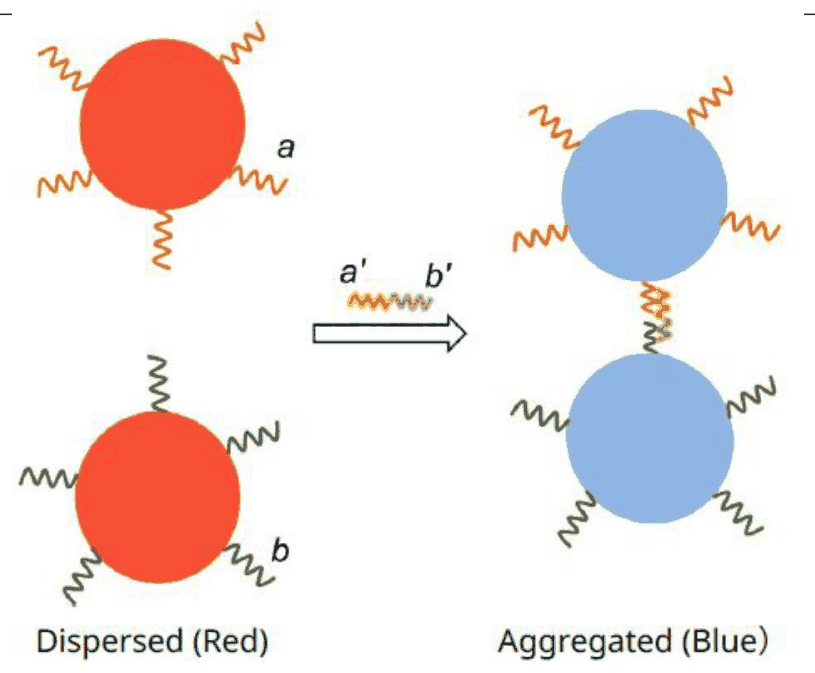
1.1 Indicate the absorption band region of the dispersed gold nanoparticles with an appropriate letter (a-f in the color wheel of Figure 0.1 in General Instructions).
The Color Wheel
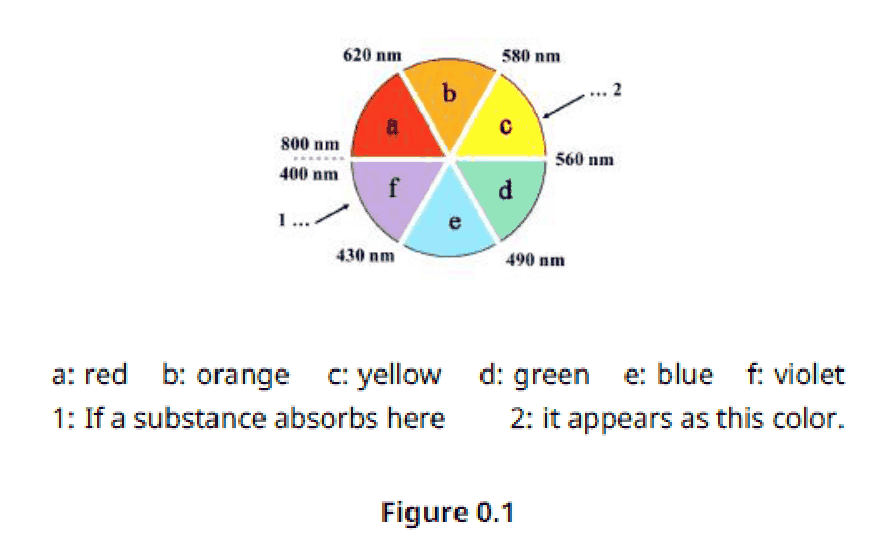
Figure 0.1
1.2 Indicate the change in the absorption spectrum of the gold nanoparticles once they are aggregated. Compared to the absorption wavelength of the dispersed gold nanoparticles, the wavelength of the aggregated nanoparticles
(a) becomes longer
(b) becomes shorter
(c) does not change
Gold nanoparticles are composed of gold atoms that are closely packed as solid gold (density \(\rho = 19.3\ \mathrm{g\,cm^{-3}}\)).
1.3 Calculate how many gold atoms (\(N\)) are there in a spherical gold nanoparticle with a diameter of 30.0 nm.
The synthesis of gold nanoparticles depends on the redox reaction between hydrogen tetrachloroaurate(III) (\(\ce{HAuCl4 * 3H2O}\), \(MW = 394\)) and reducing substances (such as sodium citrate). 5.2 mg of \(\ce{HAuCl4 * 3H2O}\) was completely converted into uniform spherical gold nanoparticles with a diameter of 30.0 nm in a 100.0 mL reaction solution. The absorbance of the resulting red solution was 0.800 measured at 530 nm by a UV-Vis spectrometer.
1.4 Calculate the molar extinction coefficient (molar absorptivity) of the resulting gold nanoparticles solution at 530 nm per mol of gold nanoparticles. The optical path of the cuvette used is 1 cm. If you failed to get the number of gold atoms (\(N\)) in 1.3 , use \(N = 1.00 \times 10^5\).
The standard addition method was used for colorimetric detection of the target nucleic acid. The original throat swab sample was collected and divided equally into two portions. After addition of the probe solutions and water (as indicated below), the absorbance of the two resulting solutions was measured at 600 nm separately.
No. Volume of throat swab sample (mL) Volume of solution of gold nanoparticles modified with nucleic acid fragments (mL) Volume of standard solution containing \(2.0\ \mu\mathrm{g\,mL^{-1}}\) target nucleic acid (mL) Volume of water (mL) Absorbance 1 0.10 0.80 0.00 0.10 0.400 2 0.10 0.80 0.10 0.00 0.900 1.5 Calculate the concentration of the viral nucleic acids in the original throat swab sample.
Official English text of the problem.
Problem 2: Chromium in Ancient and Modern Times
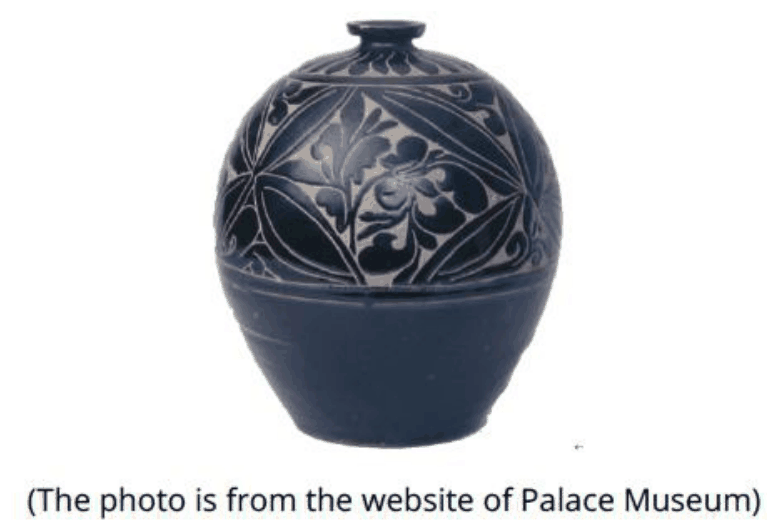
(The photo is from the website of Palace Museum)
Black glazed porcelain is a special Chinese porcelain and was popular in the Tang and Song dynasties (ca. 1000 years ago). The ceramic ware contained iron oxides as the main color rendering agent, which was mixed with other transition metal oxides to exhibit different color appearance such as auburn, dark brown or black. Currently, the black glazed porcelain is still popular in China.
The typical black glaze is composed of Fe-containing oxides with a spinel structure. Spinel oxides have the general formula \(\ce{AB2O4}\) and the structure consists of a cubic close packing array of \(\ce{O^{2-}}\) ions in which the A cations occupy one-eighth of the tetrahedral vacancies and the B cations occupy half of the octahedral vacancies, as shown in Figure 2.1(a) for a unit cell.
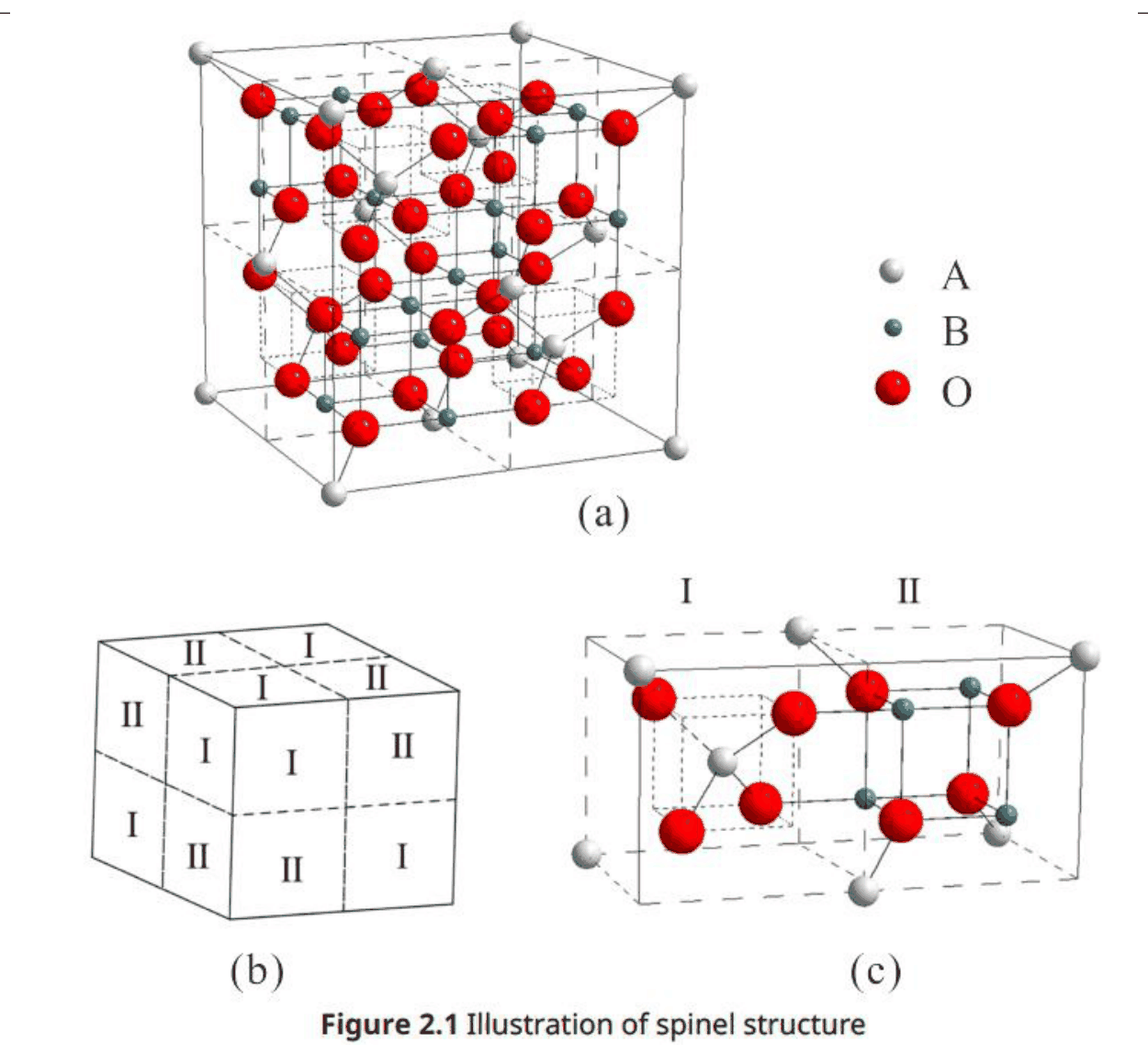
Figure 2.1 Illustration of spinel structure
The cubic unit cell of a spinel structure can be divided into 8 cubic subunits, and the dashed lines represent the internal edges of the subunits. 4 of the subunits belong to type I, and the other 4 subunits are type II (Figure 2.1(b)). The details of adjacent subunits of type I and type II are shown in Figure 2.1(c).
2.1 How many cations of type A and B are there in a unit cell?
The black ceramic glaze with spinel structure can be produced by roasting \(\ce{Fe2O3}\) and \(\ce{Cr2O3}\) in a certain proportion in a reducing atmosphere (reaction (I)). When \(\ce{Fe2O3}\) and \(\ce{Cr2O3}\) are reacted with the mass ratio of 63.6 : 36.4, they completely transform into a pure stoichiometric compound. The product has a spinel structure, in which the tetrahedral A sites are occupied by iron cations only.
2.2 In reaction (I), which element is reduced?
2.3 Calculate the numbers of \(\ce{Fe^{3+}}\) and \(\ce{Cr^{3+}}\) in the B sites of one unit cell.
Besides doping in black ceramic glaze, chromium-containing pigments are used in painting and printing due to the abundant color originating from chromium with different oxidation states, such as +2, +3 and +6. The pigment, chrome green (\(\ce{Cr2O3}\)) can be converted into a series of other compounds (D-G) in the following process, where E, F, G are yellow, orange and red respectively.
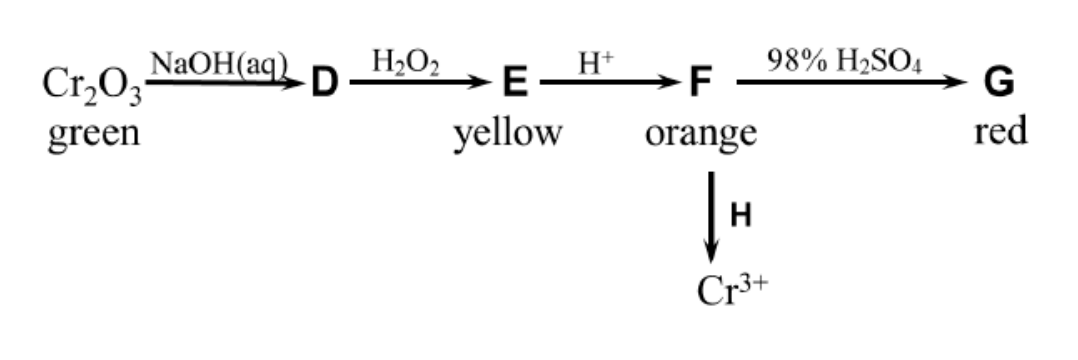
2.4 Write the chemical formula of E.
2.5 Write the reaction equation of F \(\rightarrow\) G.
2.6 Choose the agent which could be H.
(A) \(\ce{FeSO4}\)
(B) \(\ce{FeCl3}\)
(C) \(\ce{ZnSO4}\)
(D) \(\ce{CuSO4}\)
The variable valence of chromium is not only important for the production of pigments, but also useful for catalysis. For example, a typical Phillips catalyst for the polymerization of ethylene consists of chromium oxide species grafted onto a porous support material such as amorphous silica. The tetracoordinated Cr(VI) specie is the core in the pre-catalyst (1), which is proposed to be reduced quickly into a six-coordinated Cr(II) species (2) by the ethylene molecules at the beginning. 2 is proposed to further catalyze polymerization of ethylene molecules.
2.7 The reaction of 1 with ethylene can be traced by UV–vis spectra, which show the light absorption of 1 at \(21500\ \mathrm{cm^{-1}}\) and the light absorption of 2 at \(16700\ \mathrm{cm^{-1}}\) in the visible region, respectively. Choose the appropriate combination of colors of 1 and 2.
(A) orange and white, respectively
(B) orange and blue, respectively
(C) blue and orange, respectively
(D) blue and white, respectively
2.8 Assuming that the Cr(II) ion in 2 is located in a regular octahedral crystal field with a splitting energy \(\Delta_{\mathrm{o}}\) of \(16000\ \mathrm{cm^{-1}}\), draw the configurations of d electrons of the Cr(II) ion in 2, and calculate the crystal field stabilization energy (CFSE) for the Cr(II) ion in 2. (Note: The pairing energy \(P\) for Cr(II) in 2 is \(23500\ \mathrm{cm^{-1}}\).)
2.9 Coordination compounds/ions exhibit paramagnetism when containing unpaired electrons, and the corresponding magnetic moment (\(\mu\)) of transition metal cations is calculated by the function \(\mu=\sqrt{n(n+2)}\mu_B\) where \(n\) is the number of unpaired electrons. Calculate the magnetic moment in term of \(\mu_B\) for the Cr(II) ion in 2.
Official English text of the problem.
Problem 3: Capture and Transformation of Carbon Dioxide
Climate change is one of the most critical global challenges nowadays. The increase of \(\ce{CO2}\) concentration in the atmosphere has been recognized as the primary driver of global warming. The study of the capture and transformation of \(\ce{CO2}\) has attracted considerable attention.
Direct air capture (DAC) technology which aims to extract \(\ce{CO2}\) directly from ambient air is promising. The conventional method of DAC is wet scrubbing with alkaline hydroxide solutions (typically \(\ce{NaOH}\)), where \(\ce{CO2}\) in air is absorbed till pH ≈ 10 (step 1). The spent sorbent is regenerated by dosing calcium hydroxide into the system (step 2). The white precipitate A received in step 2 decomposes at \(700\,^\circ\mathrm{C}\), giving rise to \(\ce{CO2}\) and another white compound B (step 3). Finally, calcium hydroxide can be generated by the hydration of B. This process is highly energy-demanding. (\(\ce{H2CO3}\): \(K_{\mathrm{a1}}=4.5\times10^{-7}\), \(K_{\mathrm{a2}}=4.7\times10^{-11}\)).
3.1 Write the formulas for A and B respectively.
3.2 Write the balanced equations of all possible reactions in steps 1-3. \(\ce{NaOH}\) solution is used as sorbent.
Recently, an electrochemical process was developed for regenerating the alkaline solution in the wet scrubbing process for DAC application, and pure \(\ce{CO2}\) gas could be recovered that is suitable for storage or utilization. The process is based on a \(\ce{H2}\)-recycling electrochemical system (HRES), as shown in Figure 3.1.
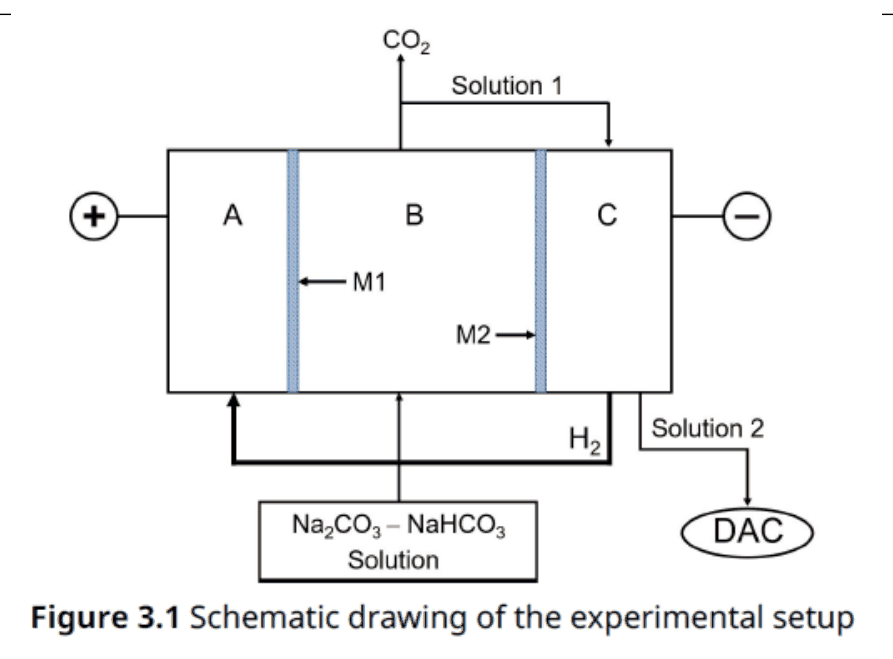
Figure 3.1 Schematic drawing of the experimental setup
The electrochemical cell contains three compartments: an anode region (A), an acidifying region (B), and a cathode region (C). They are separated by ion-selective permeable membranes M1 and M2. During the operation, protons produced from \(\ce{H2}\) oxidation at the anode are transported to the acidifying compartment where the spent solution (\(\ce{Na2CO3}\)-\(\ce{NaHCO3}\)) coming from the air contactor is fed. The decreasing pH of the solution leads to the conversions of carbonate to hydrocarbonate (reaction 1) and hydrocarbonate to carbonic acid (reaction 2). When the solution is saturated by dissolved \(\ce{CO2}\) (solubility: \(0.033\ \mathrm{mol\,L^{-1}}\)), a further pH decrease leads to the release of \(\ce{CO2}\) gas (reaction 3). \(\ce{H2}\) generated in the cathode is introduced to the anode and the solution from the cathode can be reused as a DAC absorbent.
3.3 Write the electrode reactions in the anode (A) and the cathode (C) respectively.
3.4 Write the balanced equations for the reactions 1–3 in the acidifying region (B).
3.5 Check all that correctly describe the movement of cations during the system operation.
(a) \(\ce{H+}\) ions permeate through M1 from A to B.
(b) \(\ce{H+}\) ions permeate through M2 from B to C.
(c) \(\ce{Na+}\) ions permeate through M1 from B to A.
(d) \(\ce{Na+}\) ions permeate through M2 from B to C.
(e) Both \(\ce{H+}\) and \(\ce{Na+}\) ions can permeate through M1and M2.
The cell works at a steady state when the current passing through the cell is \(2.00\ \mathrm{A}\) and the flow rate of the solution (\(0.050\ \mathrm{mol\,L^{-1}}\ \ce{Na2CO3}\) - \(0.10\ \mathrm{mol\,L^{-1}}\ \ce{NaHCO3}\)) into the region B is \(10.0\ \mathrm{mL\,min^{-1}}\). The pH in the anode compartment is maintained at 1 in the steady state.
3.6 Calculate the generation rate of \(\ce{CO2}\) gas (in \(\mathrm{mmol\,min^{-1}}\)).
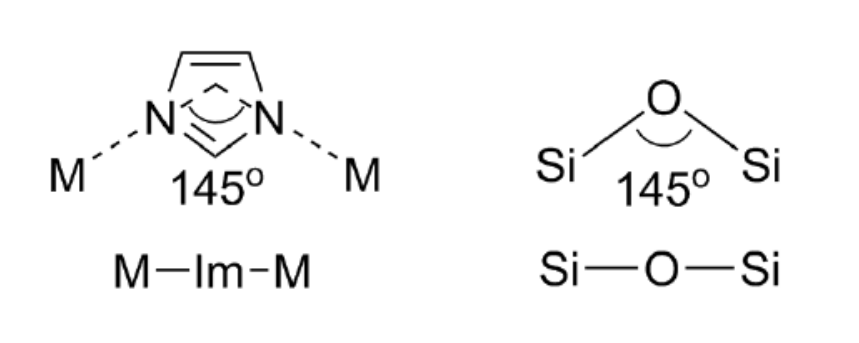
Zeolitic imidazolate frameworks (ZIFs), a sub-class of metal–organic frameworks (MOFs) are promising materials for the capture and utilization of \(\ce{CO2}\). The structures of ZIFs resemble zeolites. They form 3D frameworks with tetrahedrally coordinated metal ions (e.g. \(\ce{Zn^2+}\), \(\ce{Co^2+}\)) bridged by imidazolate (\(\ce{Im-}\)) and its derivatives. As the conjugated base of imidazole (\(\ce{HIm}\)), imidazolate anion binds to metal cations (M) by its two N atoms. The fact that the \(\ce{M-Im-M}\) angle is similar to the \(\ce{Si-O-Si}\) angle (145°) preferred in zeolites (as shown below) has led to the synthesis of a large number of ZIFs with zeolite-type tetrahedral topologies.
ZIF-8 is one of the representative ZIFs, which adopts a sodalite framework (SOD), as shown in Figure 3.2. ZIF-8 was firstly synthesized by Chinese scientists Xiao-Ming Chen et al. (they named it as MAF-4) by the reaction of \(\ce{Zn^2+}\) with 2-methylimidazole (\(\ce{CH3(C3N2H3)}\), \(\ce{HmIm}\)). It crystalizes in the cubic system with the cell parameter \(a=1.632\ \mathrm{nm}\) for a solvent-free phase with the effective pore diameter (shown by the inside virtual sphere in Figure 3.2d) of \(1.16\ \mathrm{nm}\).
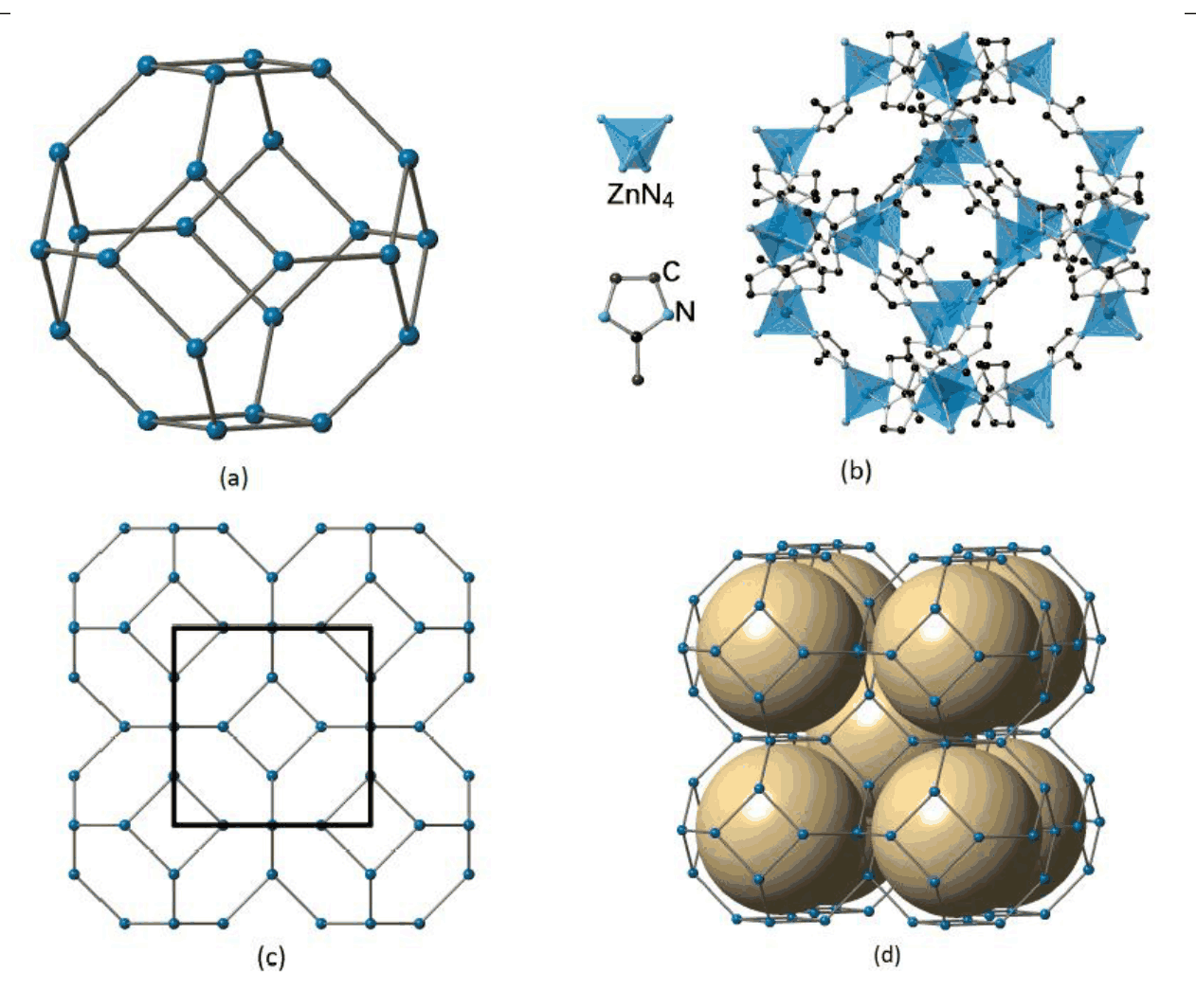
Figure 3.2 Topology of SOD and structure of ZIF-8
(a) Topology of SOD cage;
(b) SOD cage in ZIF-8 formed by \(\ce{Zn^2+}\) (at the centers of the tetrahedra) and imidazolate (H atoms are omitted for clarity);
(c) Framework of SOD with the unit cell shown by the square box;
(d) Some of the pores are highlighted by virtual spheres in ZIF-8.
Note: .If you wish, you may use the symbol "HmIm" and "mIm" representing 2-methylimidazole and 2-methylimidazolate respectively in solving the following questions.
3.7 Write the formula of the single sodalite cage.
3.8 Write the composition of the unit cell of ZIF-8.
3.9 Calculate the inner surface area (\(S\)) of the pores (modeled by the virtual spheres) of 1 g ZIF-8 (in \(\mathrm{m^2}\)). If you failed to get the composition of the unit cell, use 3500 as the formula weight of the unit cell.
3.10 Calculate the porosity \(R\) of ZIF-8 (\(R\) is the ratio of pore volume to the actual volume of the material) and the pore volume of 1 g ZIF-8 (\(V_p\), in \(\mathrm{cm^3}\)).
ZIF-8 can also act as a catalyst to promote the conversion of \(\ce{CO2}\) to high value-added chemicals. One of the most promising routes for \(\ce{CO2}\) fixation is the preparation of cyclic carbonates via \(\ce{CO2}\) cycloaddition. An example is shown as below:
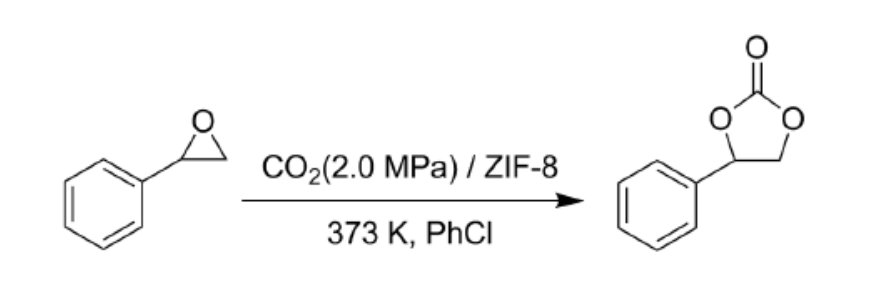
A mechanism of catalytic conversion of \(\ce{CO2}\) to cyclic carbonate over ZIF-8 catalyst is proposed:
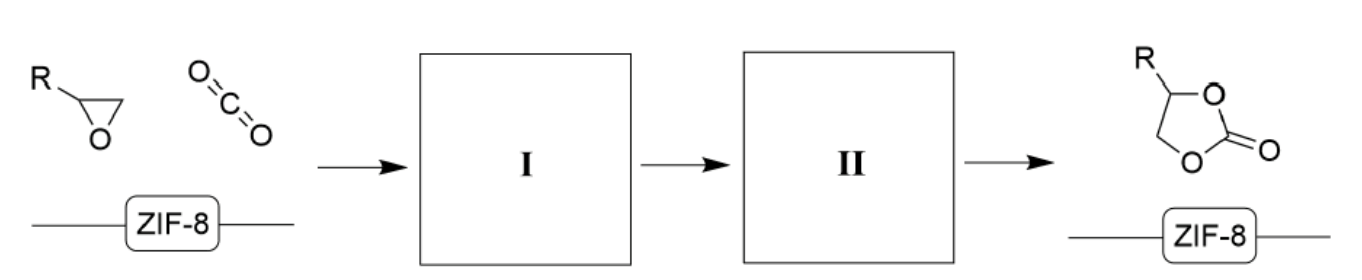
3.11 If ZIF-8 provides acid sites in the above catalytic process, complete the mechanism by choosing the reasonable intermediates from the following species:
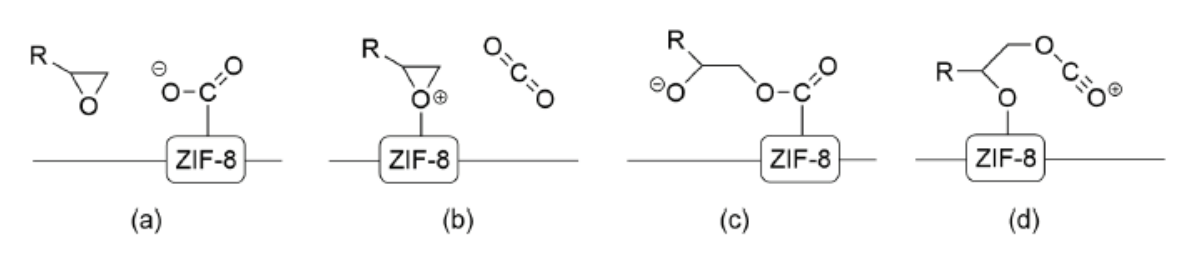
Choose the intermediates corresponding to I and II respectively.
ZIF-8 shows a relatively high thermal stability. However, a recent study revealed that its structure would be destroyed if applied in a wet acidic environment. The co-existence of \(\ce{CO2}\) and \(\ce{H2O}\) with ZIF-8 resulted in the formation of \(\ce{ZnCO3}\).
3.12 Write the balanced equation of ZIF-8 with \(\ce{CO2}\) and \(\ce{H2O}\).
Official English text of the problem.
Problem 4: A New Journey for Ancient Sulfur
Sulfur has been known and used since the ancient times. Nowadays, sulfur is widely used in chemical production and pharmaceutical industry as an inexpensive chemical raw material.
Pyrite (\(\ce{FeS2}\)) is commonly used as a raw material in the industrial production of elemental sulfur. By heating pyrite in the presence of limited air supply, the theoretical yield of elemental sulfur is 100% and a black magnetic oxide (\(\ce{Fe3O4}\)) is the other product.
4.1 Write the balanced reaction equation that describes the above conversion.
In addition to sulfur, a small amount of \(\ce{SO2}\) is generated as a by-product during the actual process. This reaction can be monitored by measuring the amount of \(\ce{SO2}\). The following recipe is used for the monitoring:
Raw ore powder is heated in a temperature-controlled tube furnace. The generated \(\ce{SO2}\) is absorbed by 2 mol L\(^{-1}\) \(\ce{NaOH}\) solution. When the reaction is completed, the solution is transferred to a 500 mL volumetric flask and diluted by distilled water to the mark. 25.00 mL of this diluted solution is then added into an iodine flask containing 50.00 mL 0.05122 mol L\(^{-1}\) \(\ce{I2}\) standard solution and 5 mL 20% \(\ce{H2SO4}\) solution. After maintaining the iodine flask in dark for 5 min, the solution is titrated with 0.1012 mol L\(^{-1}\) \(\ce{Na2S2O3}\) standard solution. When the color of the solution turns light brown, 3 mL 0.5% starch indicator is added. Continue the titration until the blue color disappears.
4.2 Write the balanced reaction equations involving \(\ce{I2}\) in the above measurement.
4.3 In such a test experiment starting from pyrite, 17.6 g of elemental sulfur was collected. The analysis of the by-product gases according to the above procedure resulted in the consumption of 18.47 mL of \(\ce{Na2S2O3}\) standard solution. Assuming that no other sulfur containing species were produced, calculate what percentage of the sulfur in pyrite was lost as the by-product?
The lithium-sulfur battery is a compelling energy storage system because its high theoretical energy density exceeds conventional Li-ion batteries. The net reaction of a lithium-sulfur battery can be simplified as: \(\ce{16Li + S8 -> 8Li2S}\). Sulfur is the cathode and metallic lithium is the anode active material during discharge.
4.4 Write the balanced equations for reactions that take place at cathode (a) and anode (b) during discharge.
4.5 Calculate the mass ratio of the cathode active material to the anode active material, according to the net battery reaction.
A lithium-ion battery (LIB) that possesses an average operating voltage of 3.8 V and a deliverable capacity of 3110 mAh can provide energy for a mobile phone to play videos continuously for 22 hours upon a full charge.
4.6 If the LIB is replaced by an ideal lithium-sulfur battery pack, which has an average operating voltage of 4.2 V and contains 23 g sulfur as the active electrode material that can react stoichiometrically during discharge, calculate how many hours the new battery pack will provide energy for the phone to play videos continuously after a full charge.
Elemental sulfur generally exists as \(\ce{S8}\) molecules. In real lithium-sulfur batteries, \(\ce{S8}\) is not directly reduced to \(\ce{Li2S}\) during discharge, but it undergoes stepwise reactions generating different soluble lithium polysulfides (\(\ce{Li2S_n}\), \(n=3–8\)). These lithium polysulfides could diffuse to the anode and corrode it, which results in the loss of active electrode materials. This phenomenon is called "shuttle effect".
4.7 Write the balanced reaction equation for the corrosion of anode by soluble lithium polysulfides (\(\ce{Li2S_n}\)) that produces \(\ce{Li2S}\).
In order to suppress the "shuttle effect", the forms of polysulfides in an electrolyte have been extensively studied. \(\ce{Li2S6}\) is one of the most representative intermediate products:

A theoretical study shows that two conformers with comparable energies, \(\ce{Li2S6}(I)\) and \(\ce{Li2S6}(II)\) coexist in 1,2-dimethoxyethane (DME), a common electrolyte solvent in lithium-sulfur batteries. The dissociation of \(\ce{Li2S6}\) in DME is shown below:
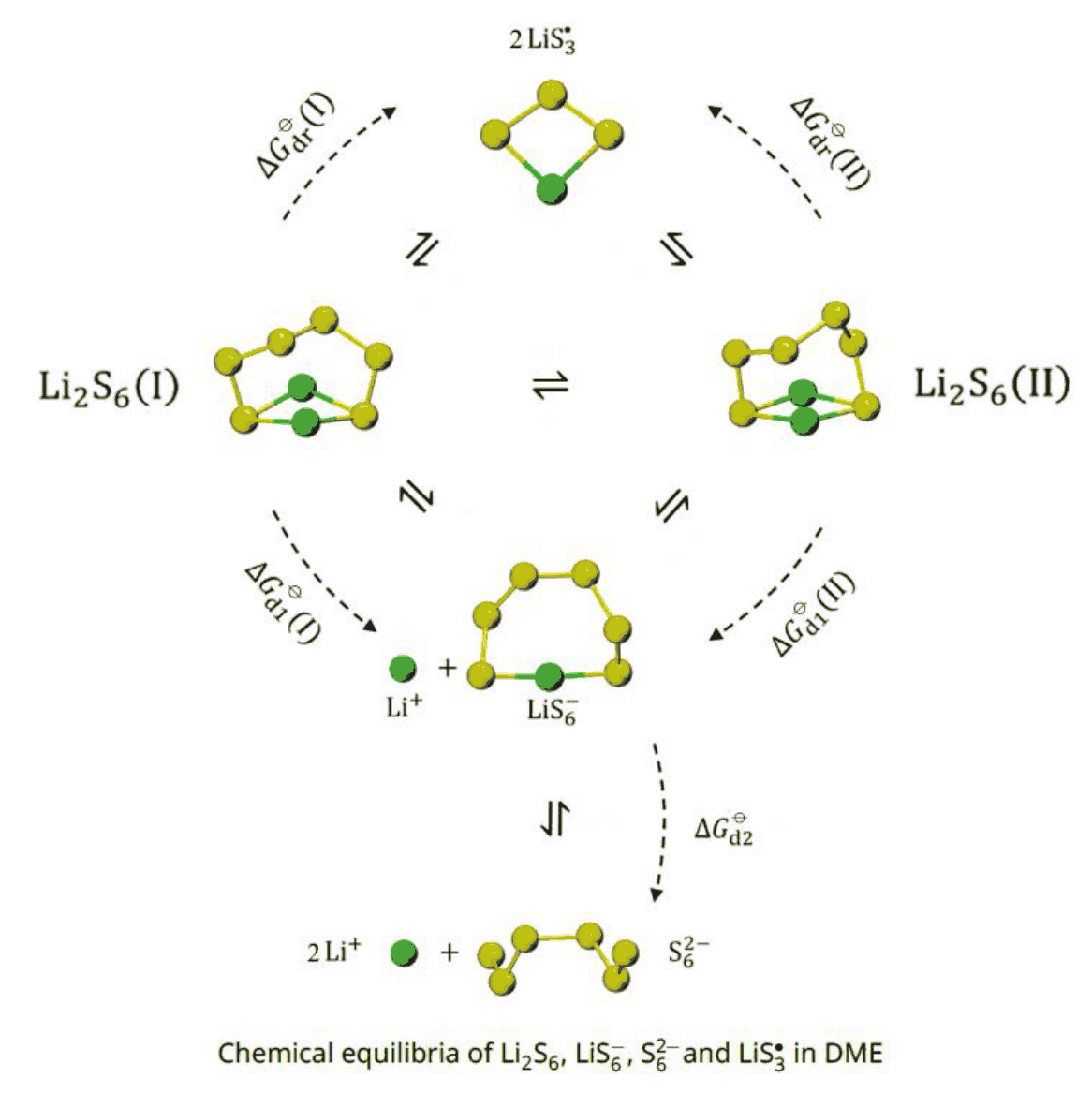
Chemical equilibria of \(\ce{Li2S6}\), \(\ce{LiS6^-}\), \(\ce{S6^{2-}}\) and \(\ce{LiS3^{\bullet}}\) in DME
Table 4.1 Dissociation Gibbs energies (\(\mathrm{kJ\,mol^{-1}}\)) of different reactions in DME (298.15 K, 1 bar)
\(\Delta G_{\mathrm{d1}}^{\ominus}(I)\) \(\Delta G_{\mathrm{d1}}^{\ominus}(II)\) \(\Delta G_{\mathrm{d2}}^{\ominus}\) \(\Delta G_{\mathrm{dr}}^{\ominus}(I)\) \(\Delta G_{\mathrm{dr}}^{\ominus}(II)\) 20.68 18.92 100.55 45.13 43.37 4.8 Using the data from Table 4.1, calculate the equilibrium concentration ratio of two conformers in DME (298.15 K, 1 bar), \(\dfrac{\ce{Li2S6}(II)}{\ce{Li2S6}(I)}\).
4.9 Using the data from Table 4.1, calculate the apparent dissociation constant of \(\ce{Li2S6 -> Li+ + LiS6^-}\) in DME (298.15 K, 1 bar).
4.10 Sort the following equilibrium concentrations in decreasing order: \([\ce{Li2S6}]\), \([\ce{LiS6^-}]\), \([\ce{S6^{2-}}]\), \([\ce{LiS3^{\bullet}}]\) in DME.
4.11 The standard reduction potential of metallic lithium in water at 298.15 K and 1 bar is:
\[ E^{\ominus}(\ce{Li+}/\ce{Li})=-3.040\ \mathrm{V} \]
The standard solvation Gibbs energies of gaseous \(\ce{Li+(g)}\) to \(\ce{Li+(sol)}\) in different solvents.
\(\ce{Li+}(\ce{H2O})\) \(\ce{Li+}(\mathrm{DME})\) \(\Delta G^{\ominus}/\mathrm{kJ\,mol^{-1}}\) −116.9 −114.6 Calculate the standard reduction potential of metallic lithium electrode in DME.
Studies have shown that electromotive force of a lithium-sulfur battery would be increased by replacing DME with dimethyl sulfoxide (DMSO). Therefore, the forms of polysulfides in DMSO also attract researchers' attention.
In a test, a certain amount of \(\ce{Li2S}\) and 4.81 mg sulfur powder were added into 10.00 mL DMSO, then heated and stirred until completely dissolved (ignoring the change in volume). Suppose that only the following polysulfides were present in the DMSO: \(\ce{S3^{\bullet-}}\), \(\ce{S4^{2-}}\), \(\ce{S5^{2-}}\), \(\ce{S6^{2-}}\), \(\ce{S7^{2-}}\), \(\ce{S8^{2-}}\). The equilibrium concentration ratio of the sulfur containing species was:
\[ [\ce{S3^{\bullet-}}]:[\ce{S4^{2-}}]:[\ce{S5^{2-}}]: [\ce{S6^{2-}}]:[\ce{S7^{2-}}]:[\ce{S8^{2-}}] =17.50:1.00:4.50:55.00:5.00:0.75 \]
4.12 Calculate the original mass \(m\) (in mg) of \(\ce{Li2S}\) added to DMSO.
Official English text of the problem.
Problem 5: Interconversion among Nitrogen Oxides
15% of the total
Question 5.1 5.2 5.3 5.4 5.5 5.6 5.7 5.8 5.9 5.10 Total Points 4 4 2 4 3 8 4 6 4 6 45 Score Nitrogen oxides (including \(\ce{N2O}\), \(\ce{NO}\), \(\ce{NO2}\), \(\ce{N2O4}\) and etc., usually written as \(\ce{NO_x}\)) are one of the main air pollutants that can cause a series of problems such as ozone depletion, acid rain, photochemical smog, and greenhouse effect. Therefore, the emission and conversion of \(\ce{NO_x}\) must be controlled to improve air quality. Here let us investigate the oxidation of \(\ce{NO}\) to \(\ce{NO2}\) via the reaction of \(\ce{2NO + O2 -> 2NO2}\).
Part A
It is generally accepted that this reaction proceeds through the following mechanism in the atmosphere:


Reaction (1) and (2) and the reverse of reaction (1) are elementary reactions. Reaction (1) is a pre-equilibrium reaction, and its equilibrium constant in terms of concentrations is denoted as \(K_{c1}\). Reaction (2) is the rate-determining step of the overall reaction, and its rate constant is \(k_2\).
5.1 Deduce the rate expression for the overall reaction of \(\ce{2NO + O2 -> 2NO2}\) as a function of \([\ce{NO}]\), \([\ce{O2}]\), \(K_{c1}\) and \(k_2\). 4.0 pt
The temperature dependence of \(K_{c1}\) could be approximately described as \(\ln K_{c1}=M-(N/T)\) (\(M\) and \(N\) are constants). The change of \(k_2\) with temperature follows the Arrhenius equation with the pre-exponential factor of \(A_2\) and apparent activation energy of \(E_{a,2}\). Assume that \(E_{a,2}\) and \(A_2\) are independent of the temperature.
5.2 Deduce the expressions for the pre-exponential factor (\(A_+\)) and apparent activation energy (\(E_{a+}\)) of the reaction of \(\ce{2NO + O2 -> 2NO2}\) as functions of \(M\), \(N\), \(A_2\) and \(E_{a,2}\). 4.0 pt
The apparent rate constant (\(k_+\)) of the overall reaction is \(6.63\times10^5\ \mathrm{L^2\,mol^{-2}\,min^{-1}}\) at 600 K, and its apparent activation energy is \(1.20\ \mathrm{kJ\,mol^{-1}}\).
5.3 Calculate the rate constant (in \(\mathrm{L^2\,mol^{-2}\,min^{-1}}\)) of this reaction at 700 K. 2.0 pt
The standard enthalpies of formation (\(\Delta_{\mathrm f}H_{\mathrm m}^{\ominus}\)) and standard entropies (\(S_{\mathrm m}^{\ominus}\)) at 298.15 K are as follows:
\(\ce{NO(g)}\) \(\ce{O2(g)}\) \(\ce{NO2(g)}\) \(\Delta_{\mathrm f}H_{\mathrm m}^{\ominus}\) (\(\mathrm{kJ\,mol^{-1}}\)) 91.3 33.1 \(S_{\mathrm m}^{\ominus}\) (\(\mathrm{J\,K^{-1}\,mol^{-1}}\)) 210.8 205.2 240.1 The standard reaction enthalpy and entropy changes of \(\ce{2NO + O2 -> 2NO2}\) can be regarded as temperature independent. All the gases are taken to be ideal for the following questions.
5.4 Calculate the thermodynamic equilibrium constant (\(K_p^{\ominus}\)) of this reaction at 600 K. 4.0 pt
5.5 Calculate the standard internal energy change \(\Delta_{\mathrm r}U_{\mathrm m}^{\ominus}\) (in \(\mathrm{kJ\,mol^{-1}}\)) of this reaction at 600 K. 3.0 pt
Experimental observation shows that the rate of the reaction of \(\ce{2NO2 -> 2NO + O2}\) is independent on the concentration of \(\ce{NO}\) and \(\ce{O2}\).
5.6 Deduce the expression of the rate for this reaction (the apparent rate constant could be directly used as \(k_-\)) and calculate the value of \(k_-\) apparent at 600 K.
(If you failed to find the \(K_p^{\ominus}(600\ \mathrm K)\) in question 5.4, use \(K_p^{\ominus}(600\ \mathrm K)=350.0\)) 8.0 pt\(\ce{NO2}\) gas is introduced to a container with a fixed volume which is held at 600 K and allowed to reach equilibrium. 20 percent of the reactant is converted to \(\ce{NO}\) and \(\ce{O2}\). All the gases are taken to be ideal.
5.7 Calculate the total pressure of this reaction system at equilibrium. (If you failed to find the \(K_p^{\ominus}(600\ \mathrm K)\) in question 5.4, use \(K_p^{\ominus}(600\ \mathrm K)=350.0\)) 4.0 pt
Part B
Industrial exhaust is a main source of \(\ce{NO_x}\). One of the approaches to reduce the emission of \(\ce{NO_x}\) is through the oxidation of \(\ce{NO}\) to \(\ce{NO2}\) and the subsequent absorption of the formed \(\ce{NO2}\) by absorbents. However, because of the low concentration of \(\ce{NO}\) in exhaust, its spontaneous oxidation in the atmosphere is too slow to meet the demand of industry. Generally, solid catalysts are used to accelerate this reaction. The \(\ce{NO}\) oxidation proceeds on the surface of a specific catalyst (CatX) through the following mechanism (adsorption site is denoted as Site):
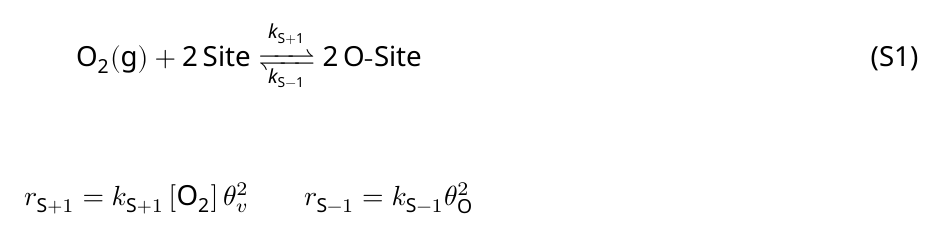
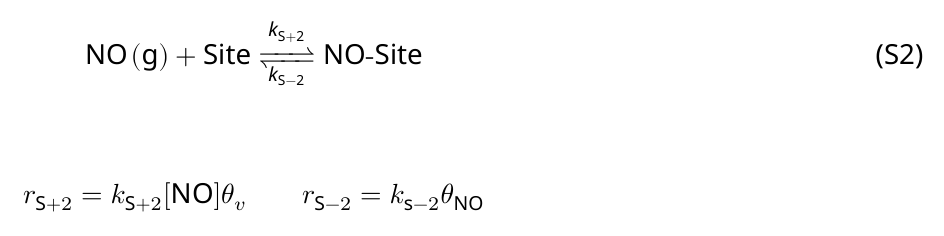
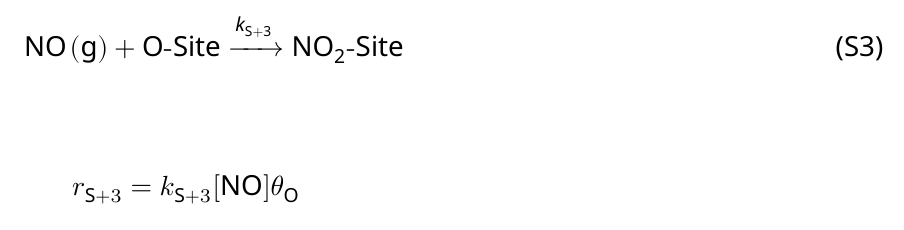
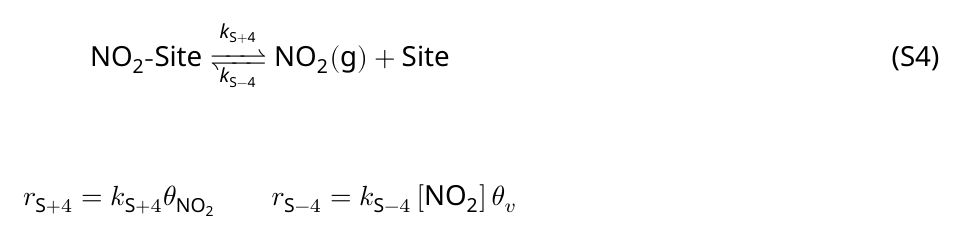
Assume that the adsorptions of \(\ce{NO}\), \(\ce{NO2}\) and \(\ce{O}\) (from the dissociation of \(\ce{O2}\)) cannot proceed beyond a monolayer coverage, and these species are adsorbed by the same kind of surface sites. Their fractional coverages (\(\theta\), defined as the ratio of the number of adsorption sites occupied to the number of total adsorption sites) are denoted as \(\theta_{\ce{NO}}\), \(\theta_{\ce{NO2}}\) and \(\theta_{\ce{O}}\), respectively. Thus, the fraction of unoccupied adsorption sites (\(\theta_v\)) is \(\theta_v=1-\theta_{\ce{NO}}-\theta_{\ce{NO2}}-\theta_{\ce{O}}\). Assume that all the adsorption and desorption processes are much faster than reaction (S3).
5.8 Deduce the expression for \(\theta_v\) as a function of \([\ce{NO}]\), \([\ce{O2}]\), \([\ce{NO2}]\) and the rate constants involved in reactions (S1)–(S4). 6.0 pt
5.9 Choose the correct expression for the rate of \(\ce{2NO(g) + O2(g) -> 2NO2(g)}\) at the beginning of the reaction. Assume that the concentration and adsorption of \(\ce{NO2}\) are both negligible. 4.0 pt
\[ \text{(A)}\quad r_{\mathrm{S}+}= \frac{ k_{\mathrm{S}+3}(k_{\mathrm{S}+1}/k_{\mathrm{S}-1})^{0.5} [\ce{NO}][\ce{O2}]^{0.5} }{ 1+(k_{\mathrm{S}+1}[\ce{O2}]/k_{\mathrm{S}-1})^{0.5} +k_{\mathrm{S}+2}[\ce{NO}]/k_{\mathrm{S}-2} } \]
\[ \text{(B)}\quad r_{\mathrm{S}+}= \frac{ 0.5k_{\mathrm{S}+3}(k_{\mathrm{S}+1}/k_{\mathrm{S}-1})^{0.5} [\ce{NO}][\ce{O2}]^{0.5} }{ 1+(k_{\mathrm{S}+1}[\ce{O2}]/k_{\mathrm{S}-1})^{0.5} +k_{\mathrm{S}+2}[\ce{NO}]/k_{\mathrm{S}-2} } \]
\[ \text{(C)}\quad r_{\mathrm{S}+}= \frac{ k_{\mathrm{S}+3}(k_{\mathrm{S}+1}/k_{\mathrm{S}-1}) [\ce{NO}][\ce{O2}]^{0.5} }{ 1+k_{\mathrm{S}+1}[\ce{O2}]/k_{\mathrm{S}-1} +k_{\mathrm{S}+2}[\ce{NO}]/k_{\mathrm{S}-2} } \]
\[ \text{(D)}\quad r_{\mathrm{S}+}= \frac{ k_{\mathrm{S}+4}k_{\mathrm{S}+3}(k_{\mathrm{S}+1}/k_{\mathrm{S}-1})^{0.5} [\ce{NO}][\ce{O2}]^{0.5}/k_{\mathrm{S}-4} }{ 1+k_{\mathrm{S}+1}([\ce{O2}]/k_{\mathrm{S}-1})^{0.5} +k_{\mathrm{S}+2}[\ce{NO}]/k_{\mathrm{S}-2} } \]
For some catalysts, the surface reaction proceeds via an alternative way instead of reaction (S3):
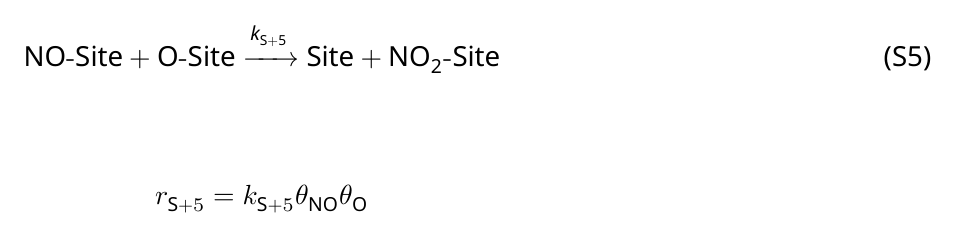
This step is also rate-determining for the overall reaction.
A catalyst (CatY) is used to promote the reaction of \(\ce{2NO + O2 -> 2NO2}\). When the temperature and \(\ce{NO}\) concentration are constant, the initial reaction rate changes with the concentration of \(\ce{O2}\) as follows:
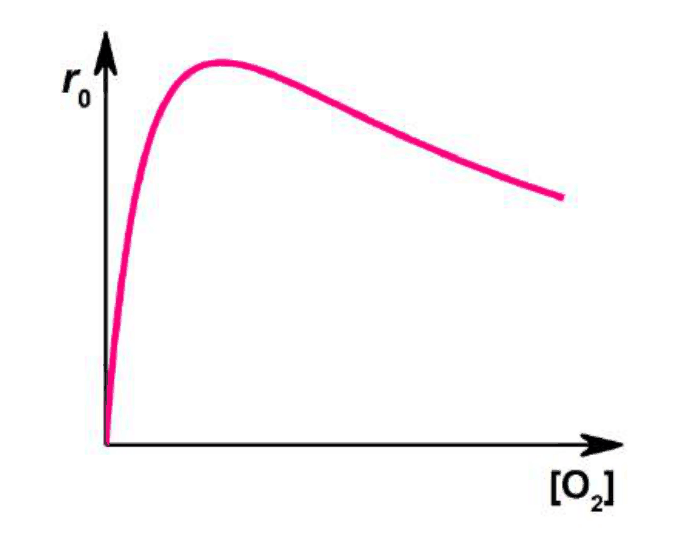
5.10 Choose a mechanism that is consistent with this curve. 6.0 pt
(A) S3
(B) S5
(C) cannot be determinedOfficial English text of the problem.
Problem 6: Enabling Phosphines
Phosphines are phosphorus analogues of amines. They also carry a lone pair of electrons at the phosphorus atom and thus exhibit Lewis basicity or nucleophilicity. But in contrast with tertiary amines, chiral phosphines like P1 with three different substituents can be isolated as single enantiomers. Chiral phosphines are often used as chiral ligands in transition metal catalysis.
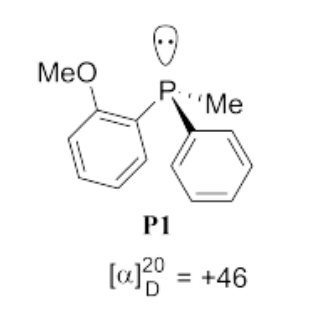
6.1 Using \(R/S\) symbol, assign the absolute configuration of P1.
In the past two decades, as organocatalysis grew rapidly, a large number of nucleophilic phosphinecatalyzed synthetic reactions have emerged. Among them, one of the most famous phosphine-catalyzed reactions is the Lu (3+2) cycloaddition reaction, which was first developed by Chinese scientist Xiyan Lu. For instance, under the catalysis of triphenylphosphine, ethyl allenoate 1 and methyl acrylate 2 smoothly produce two cyclopentene derivatives 3 (major) and 4 (minor).
Lu (3+2) cycloaddition:
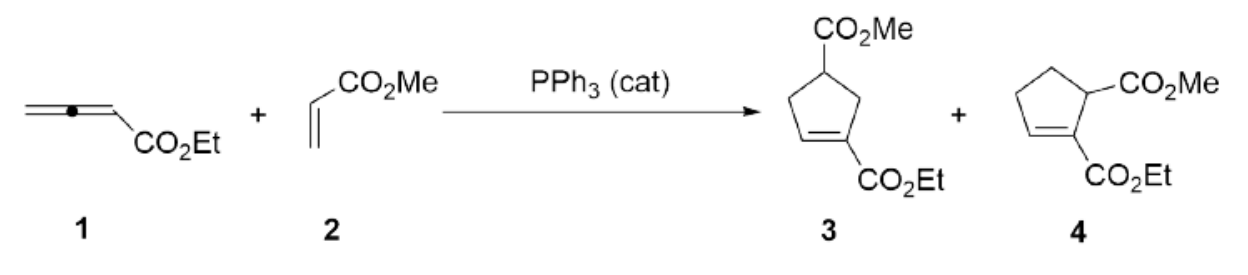
In a generally accepted mechanism, the Lu (3+2) reaction is a formal cycloaddition reaction. Initially, the catalyst triphenylphosphine engages in a nucleophilic addition to ethyl allenoate 1 to generate a zwitterionic intermediate A, which subsequently cyclizes with methyl acrylate 2 by two paths. In the path leading to compound 3, an in situ generated phosphorus ylide intermediate B reversibly converts into intermediate C via proton transfer; C undergoes an elimination to deliver the major product 3 and release the phosphine catalyst. In the path leading to compound 4, a phosphorus ylide intermediate B′ is formed, which also reversibly converts into intermediate C′ via proton transfer; C′ undergoes an elimination to give the minor product 4 and regenerate the phosphine catalyst.
Mechanism:
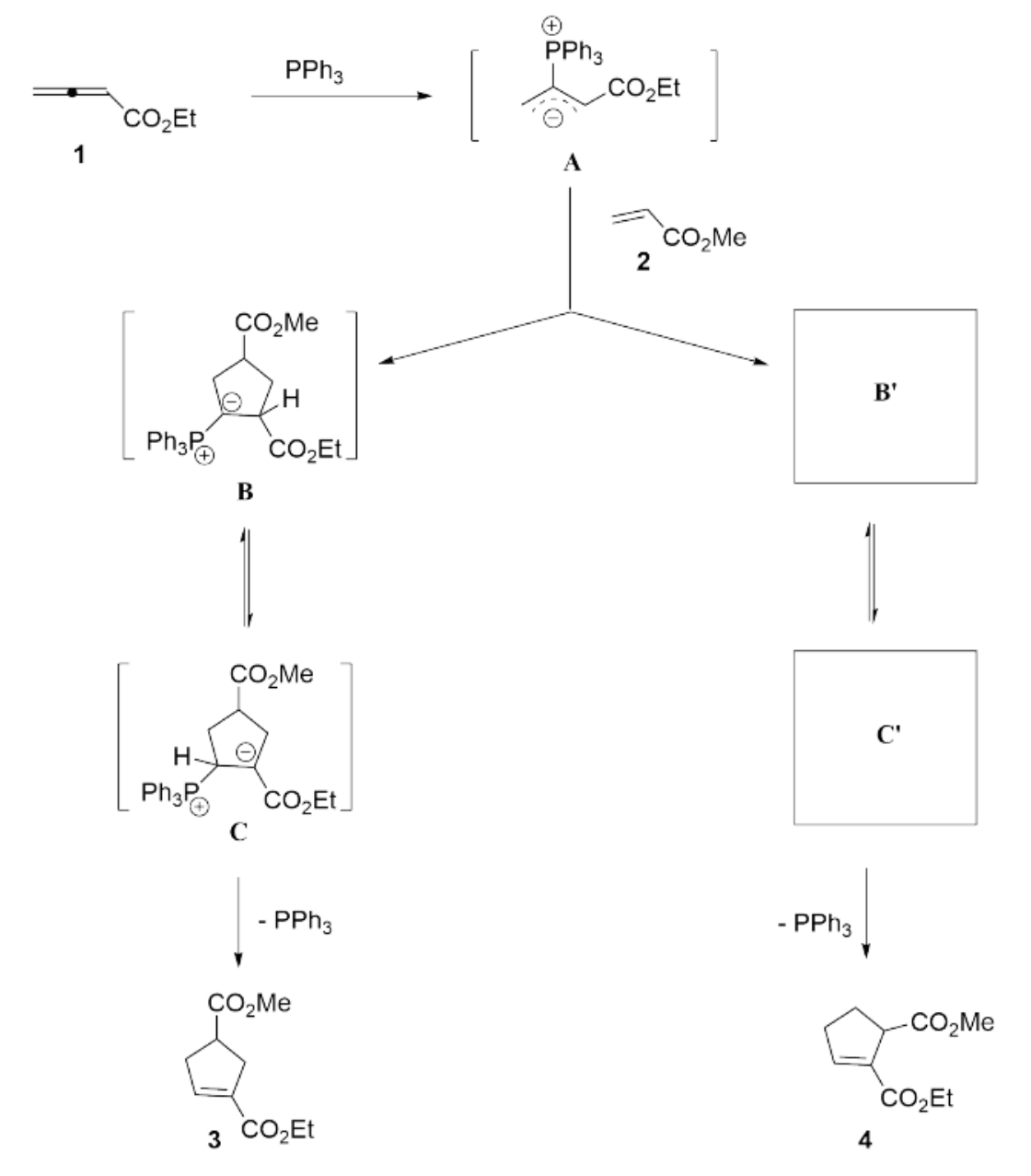
6.2 Draw the two major resonance structures that make up the shown resonance hybrid A (the involvement of ester group is not considered, and stereochemistry is not required).
6.3 Draw the structures of intermediates B′ and C′ (stereochemistry is not required).
Under similar conditions, ethyl allenoate 1 and diethyl fumarate 5 readily deliver the corresponding cycloaddition product 6.
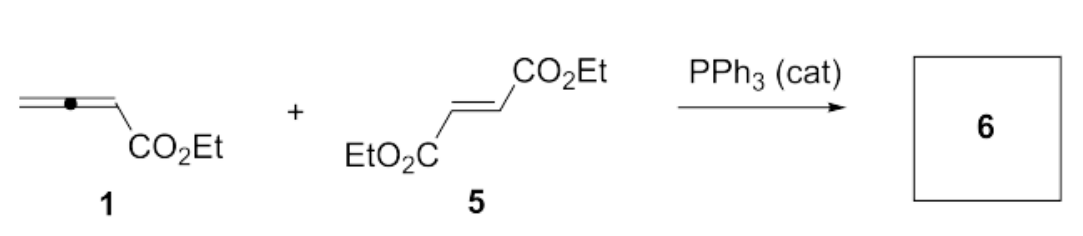
6.4 Draw the structure of compound 6 (stereochemistry is not required).
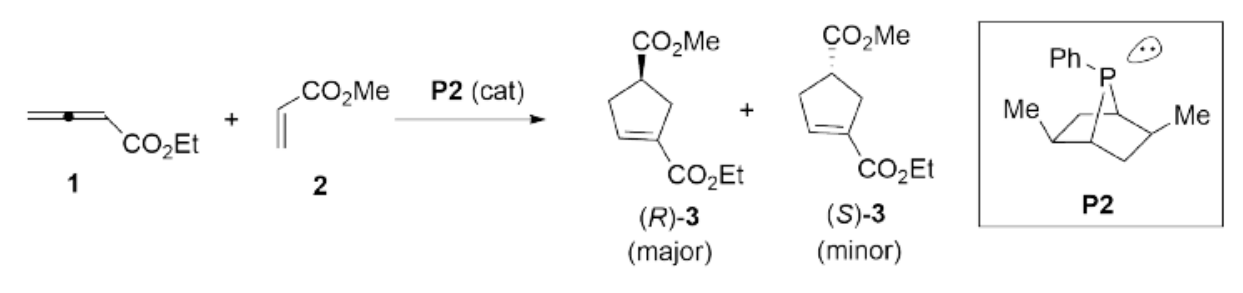
Asymmetric Lu (3+2) cycloaddition reaction can be readily realized by utilizing chiral phosphine catalysts. For example, under the catalysis of a chiral bicyclic phosphine P2, ethyl allenoate 1 and methyl acrylate 2 smoothly delivered an enantio-enriched cycloaddition product 3 in 80% ee (enantiomeric excess).
Asymmetric Lu (3+2) cycloaddition:
Calculation equation of ee:
\[ \mathrm{ee} =\frac{n_{\mathrm{major}}-n_{\mathrm{minor}}} {n_{\mathrm{major}}+n_{\mathrm{minor}}}\times100\% \]
\(n_{\mathrm{major}}\) = the amount of major enantiomer
\(n_{\mathrm{minor}}\) = the amount of minor enantiomer
6.5 Mark the chirality centers in the chiral phosphine P2 by using asterisks. (Note: points will be deducted for every wrong asterisk until 0 points)
6.6 Give the ratio of \(n_{\mathrm{major}}/n_{\mathrm{minor}}\) of product 3.
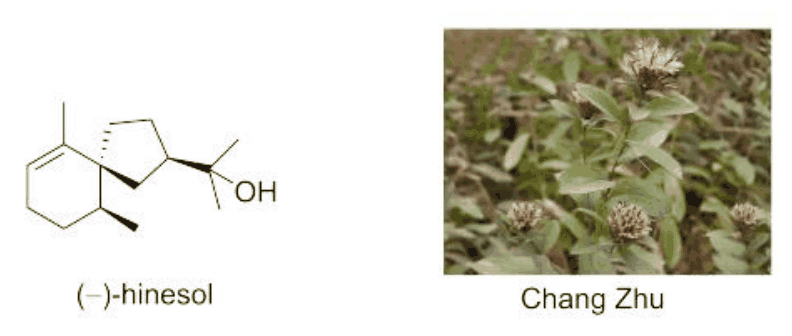
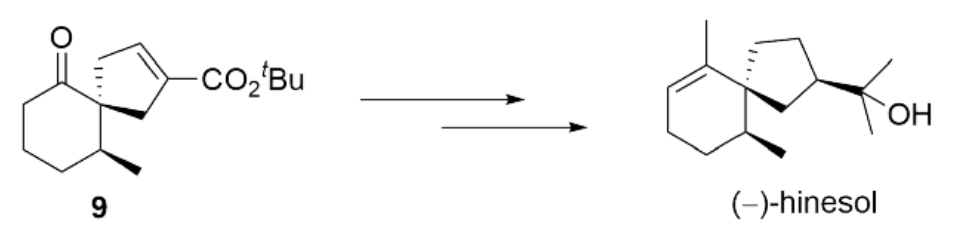
Lu (3+2) cycloaddition reaction is a versatile tool in organic synthesis. For example, it was successfully used to synthesize (–)-hinesol, an important component of the Chinese medicinal herb Chang Zhu (Atractylodes lancea var Chinensis). Under the catalysis of \(\ce{PPh3}\), a chiral cyclohexanone 7 cyclized with tertbutyl allenoate 8, affording a major product 9 and three minor products 10, 11 and 12. Minor products 10–12 are all the isomers of 9. Compound 9 could be readily transformed into (–)-hinesol by a multistep process.
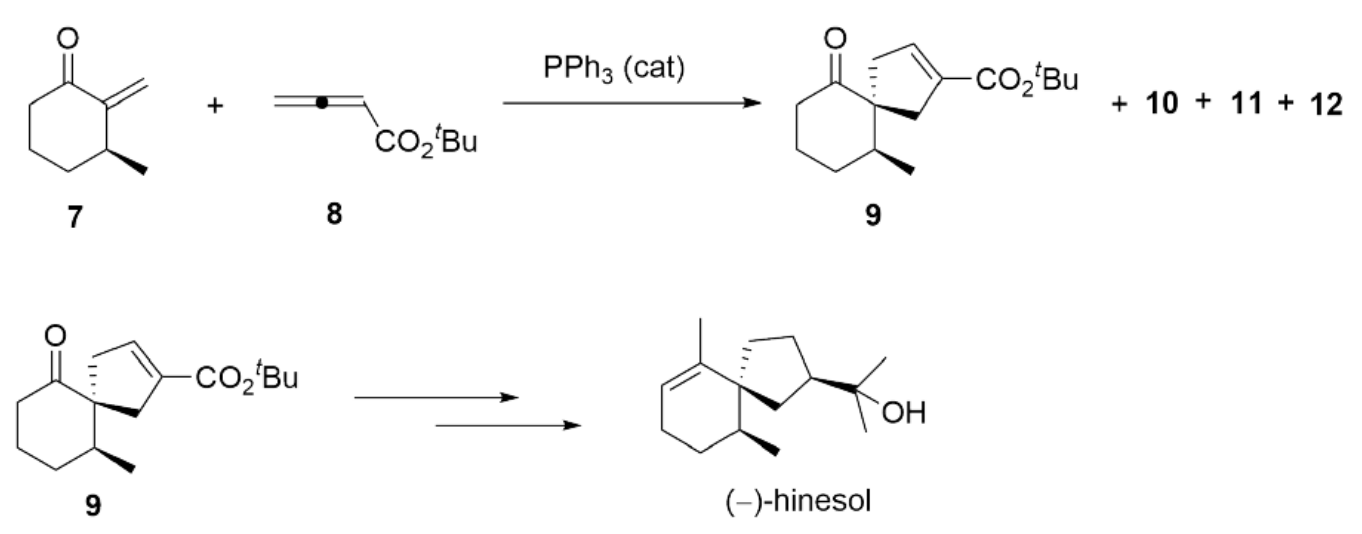
6.7 In the following compounds, choose which one does not belong to the minor products 10–12.

Official English text of the problem.
Problem 7: Organic Molecules in Life
The synthesis of complex peptides and proteins is a challenging task. On September 17, 1965, Chinese scientists synthesized crystalline bovine insulin artificially for the first time, marking a crucial step in the journey of exploring the secret of life and opening the era of protein synthesis.

Stamp issued on the 50th anniversary (2015) of the first synthesis of crystalline bovine insulin.
Coupling of carboxylic acid groups with amine groups to forge an amide bond is the most elementary reaction in the synthesis of peptides and proteins. Allenone 2 was reported to be able to activate the carboxylic acid 1 under mild reaction conditions forming the intermediate 3. Intermediate 3 then reacts with amine 4 to give amide 5 with high yield, along with the byproduct 6.
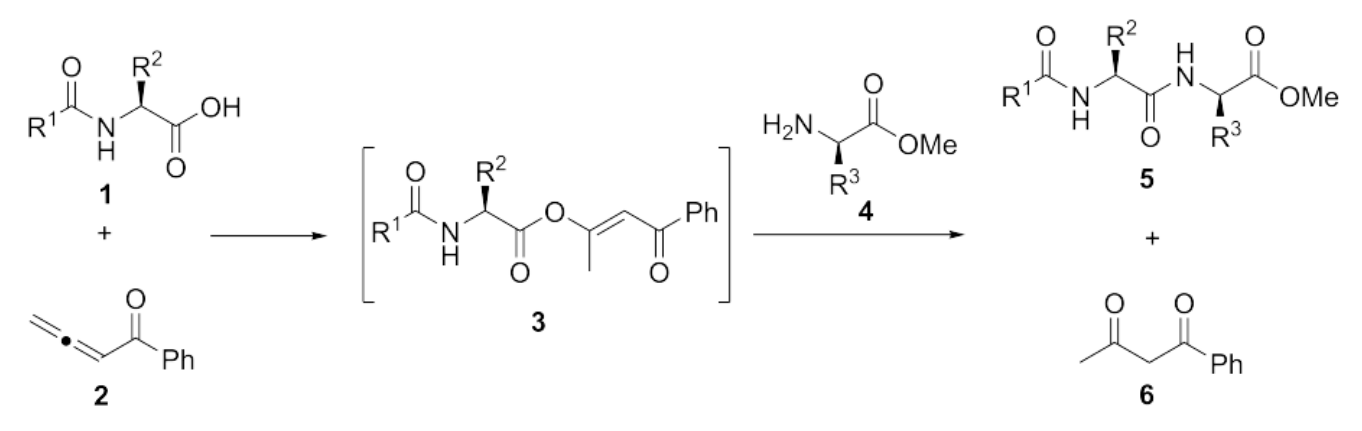
Similarly, N-ethynyl-N-methyl-p-toluenesulfonamide (MYTsA) with its major resonance structure 7 (involvement of Ts group is not considered) can activate carboxylic acid in the same way as allenone 2.
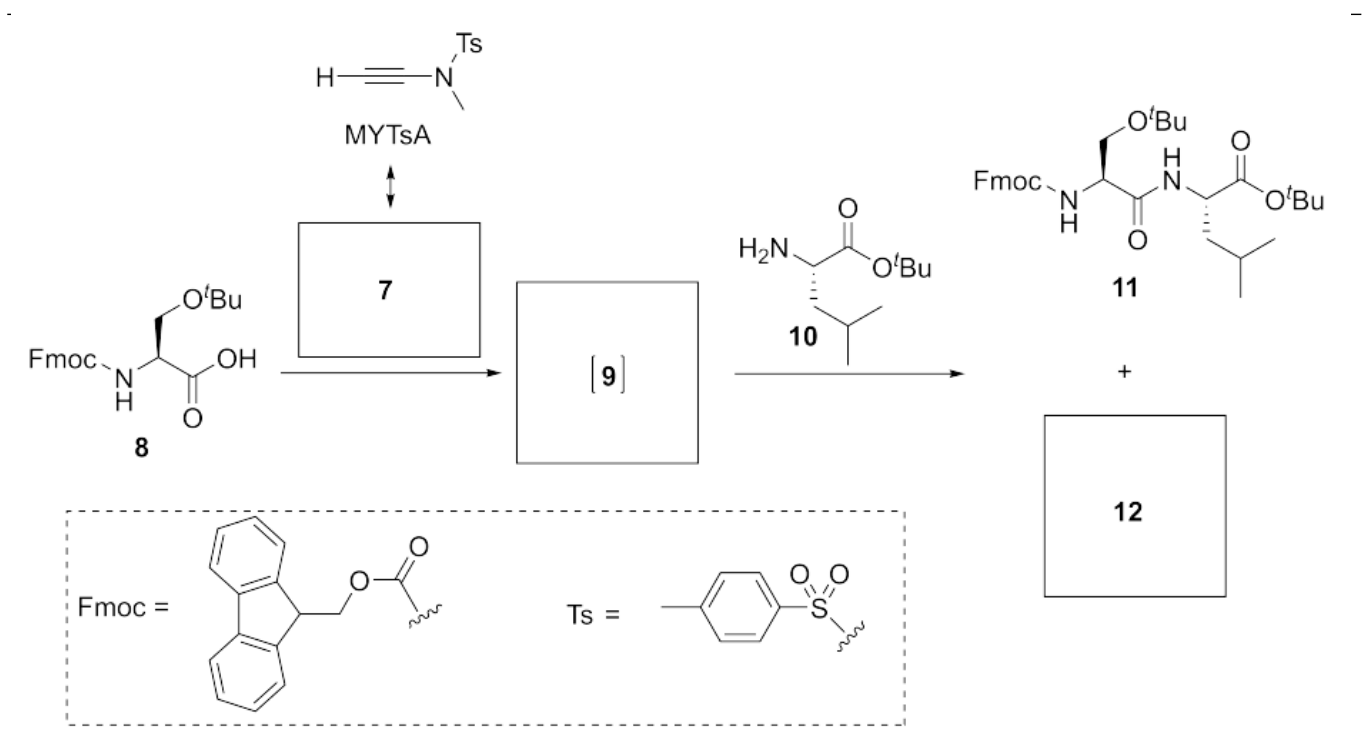
7.1 Draw the structures of 7, intermediate 9 and compound 12. Show the stereochemistry of any stereocenters.
As the length of peptide chain grows, formation of amide bonds becomes more difficult, and conventional condensation methods are not applicable in the synthesis of proteins. In the first synthesis of crystalline bovine insulin, a method based on the chemistry of acylhydrazine 13 was developed to achieve the challenging amide coupling between two peptides. As the following equations, compound 15 reacts with 16 smoothly in the presence of triethylamine.
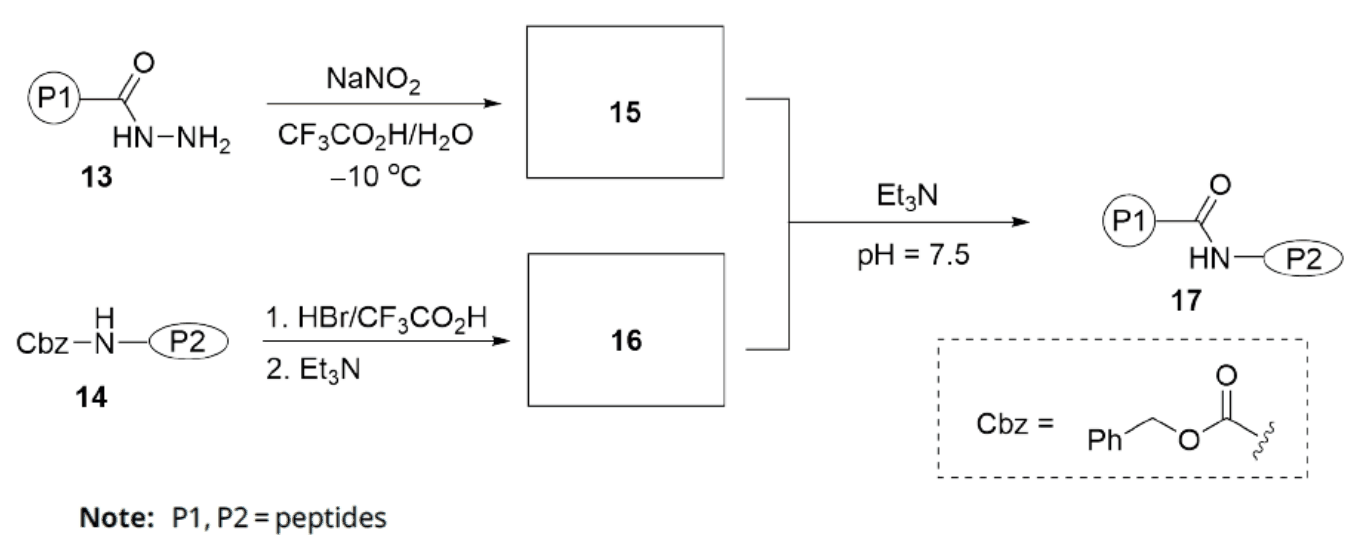
7.2 Draw the structures of compounds 15 and 16.
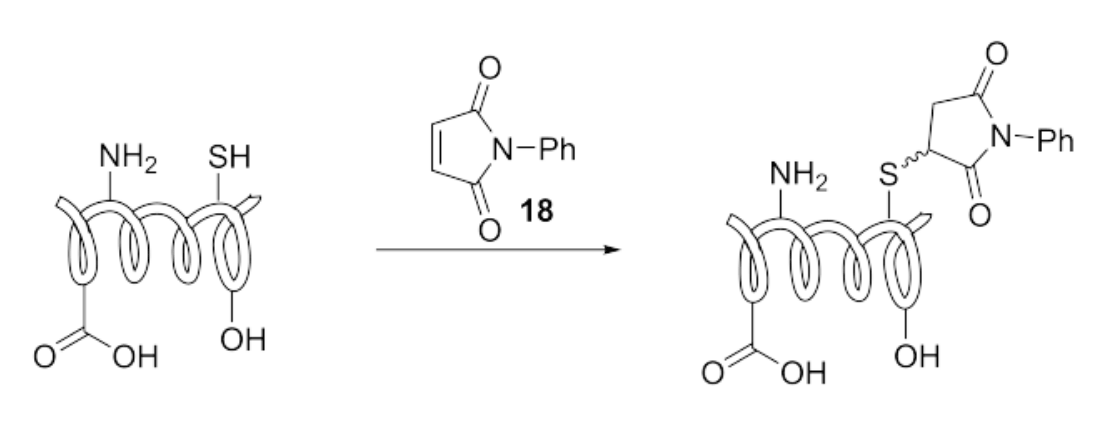
In addition to de novo synthesis, scientists can modify existing proteins. Although there are multiple reactive sites on the surface of protein, such as amino groups, thiol groups, and carboxyl groups, the most nucleophilic thiol groups are the preferred site when the protein is treated with electrophilic reagents such as N-phenyl maleimide 18 via Michael addition.
Under mild basic conditions (pH = 7.5), reagent 19 was proposed to react with the thiol group of protein 20 to give a neutral intermediate 21 which is attacked by hydroxide to give compound 22. Compound 22 can equilibrate with an acyclic form 23, and subsequently react with another protein 20. The resulting major product can exist either in the acyclic form 24 or in the cyclic form 25 in a similar way as the equilibration between 22 and 23.
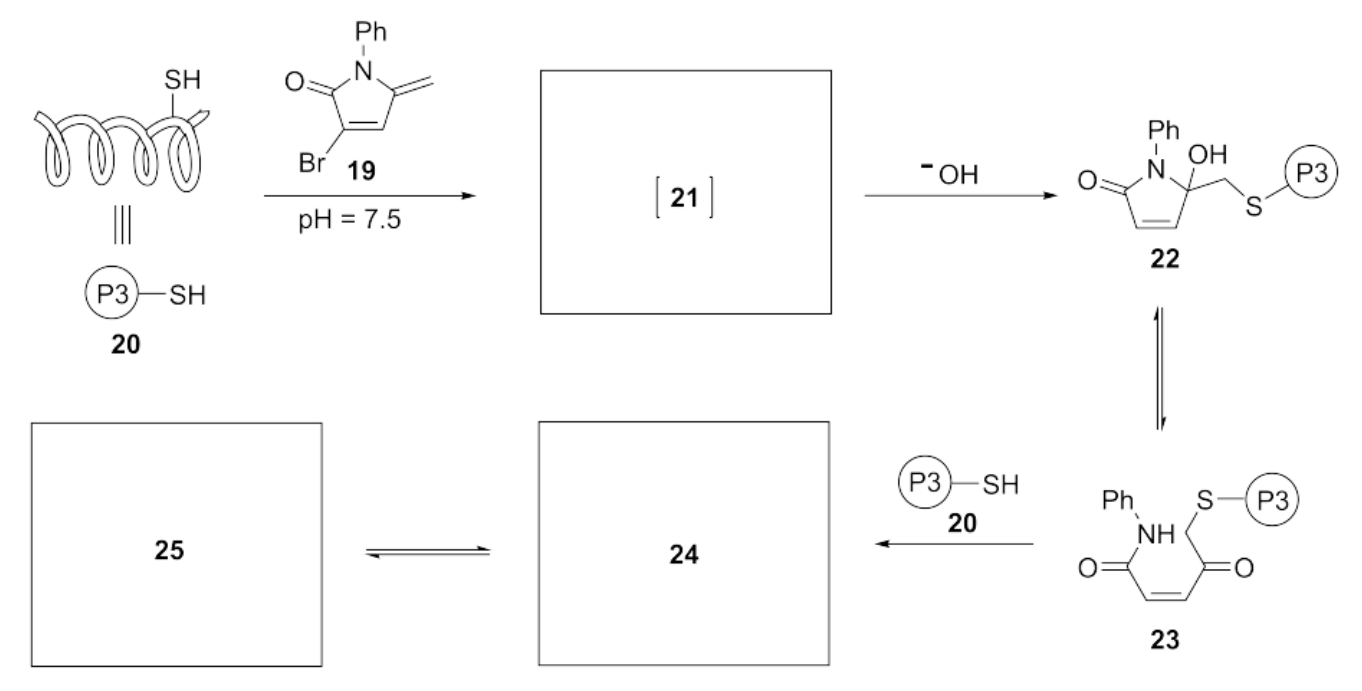
7.3 Draw the structures of intermediate 21, compounds 24 and 25. Stereochemistry is not required.
Official English text of the problem.
Problem 8: Amazing Chiral Spiro Catalyst
Chiral compounds are important for human health, for example, more than 50% of the medicines currently in clinical use are single enantiomers of chiral molecules. However, synthesizing chiral molecules in enantio-enriched form is a great challenge. Professor Qilin Zhou's team in Nankai University in China developed a series of chiral spiro catalysts with high activity, raising the efficiency of asymmetric synthesis to a new height, and being widely used in the pharmaceutical industry. These catalysts can give up to (reach up to) 99.9% ee and can be used down to 0.00002 mol% loading. This research result won the first prize of the 2019 National Natural Science Award of China.
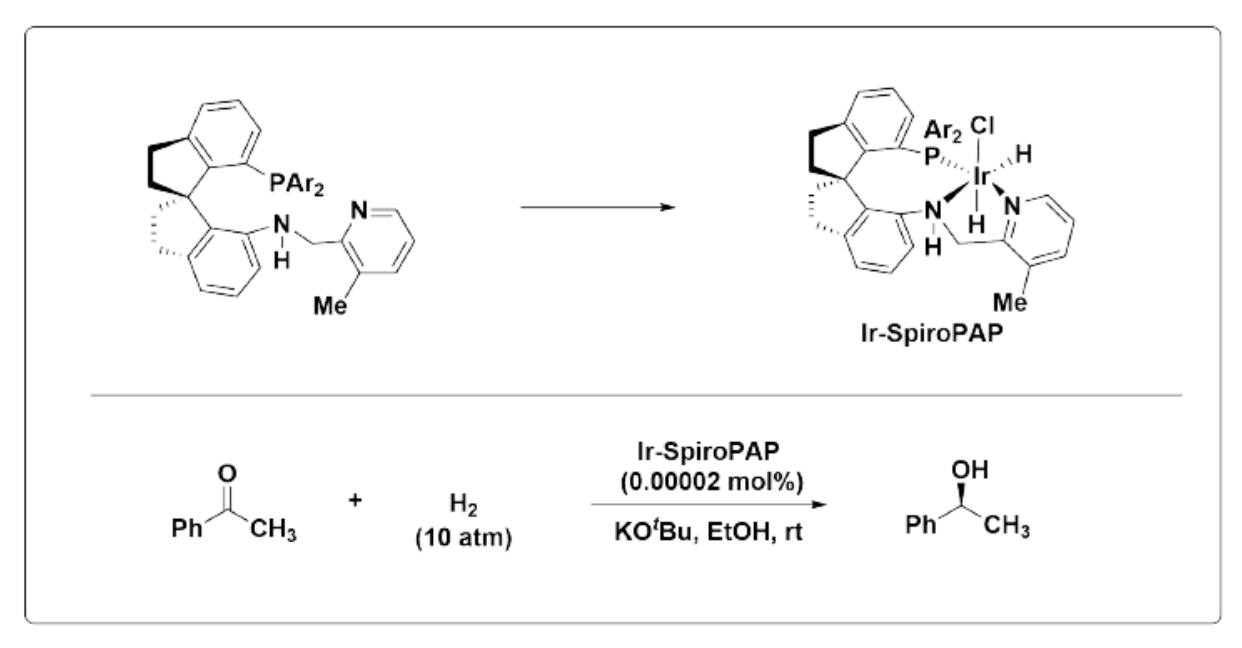
Note:
\(\ce{Ar} = 3,\,5\text{-}(\ce{^{t}Bu})_2\ce{C6H3}\)
Part A
The synthetic route of the chiral ligand SpiroPAP is shown in the following scheme.
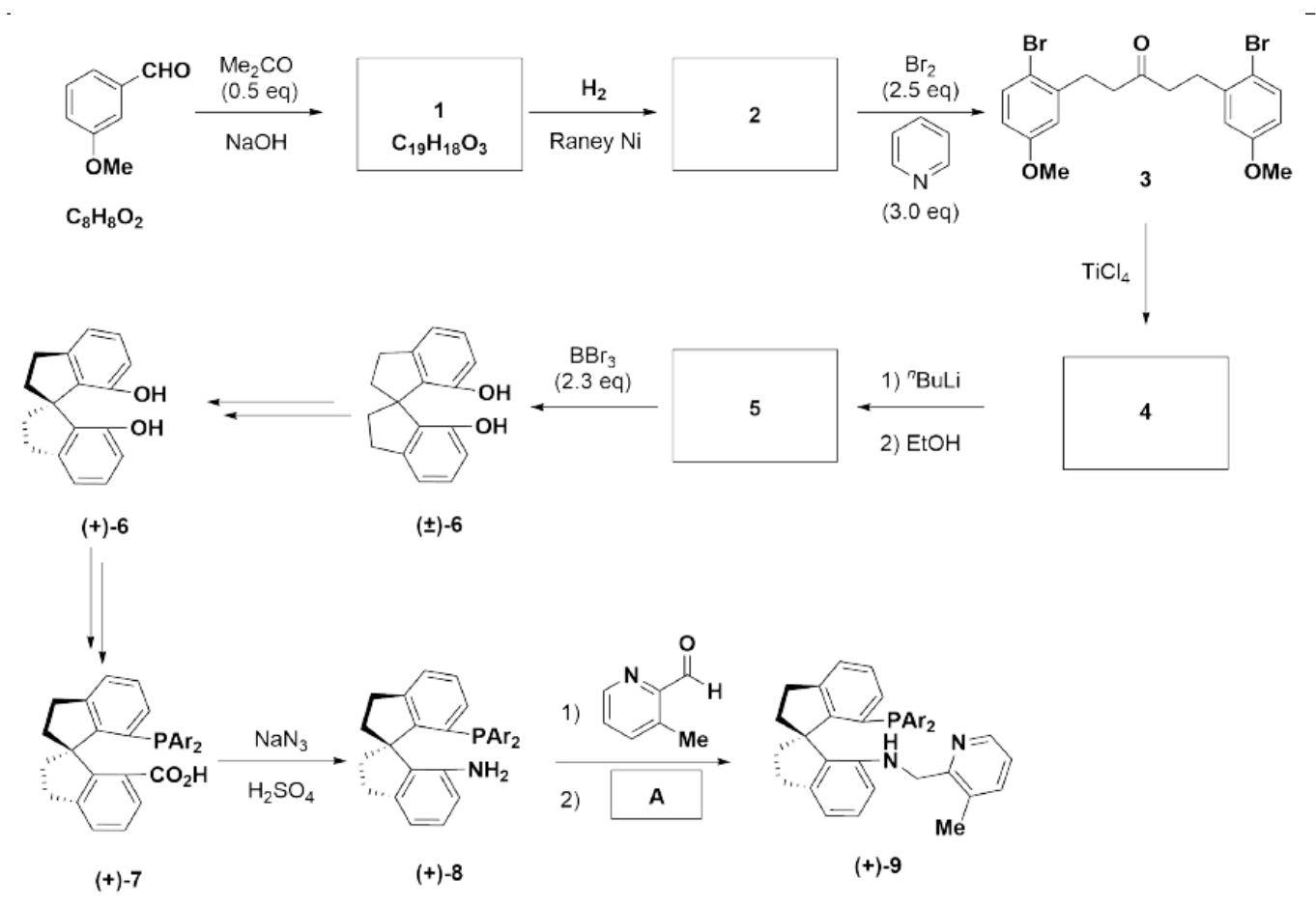
Note:
eq = equivalent
\(\ce{Ar} = 3,\,5\text{-}(\ce{^{t}Bu})_2\ce{C6H3}\)
8.1 Draw the structures of 1, 2, 4, 5. (Stereochemistry is not considered).
8.2 From the following reagents, which reagent A can NOT be used for the transformation of 8 to 9?
(a) \(\ce{NaBH(OAc)3}\)
(b) \(\ce{NaBH3CN}\)
(c) \(\ce{NH2NH2}\), \(\ce{NaOH}\)
(d) \(\ce{NaBH4}\)
The racemic spiro compound 6 reacts with (–)-menthyl chloroformate (10) to generate compounds 11a and 11b, which can be separated by column chromatography, followed by hydrazinolysis to obtain optically pure (+)-6 and (–)-6.
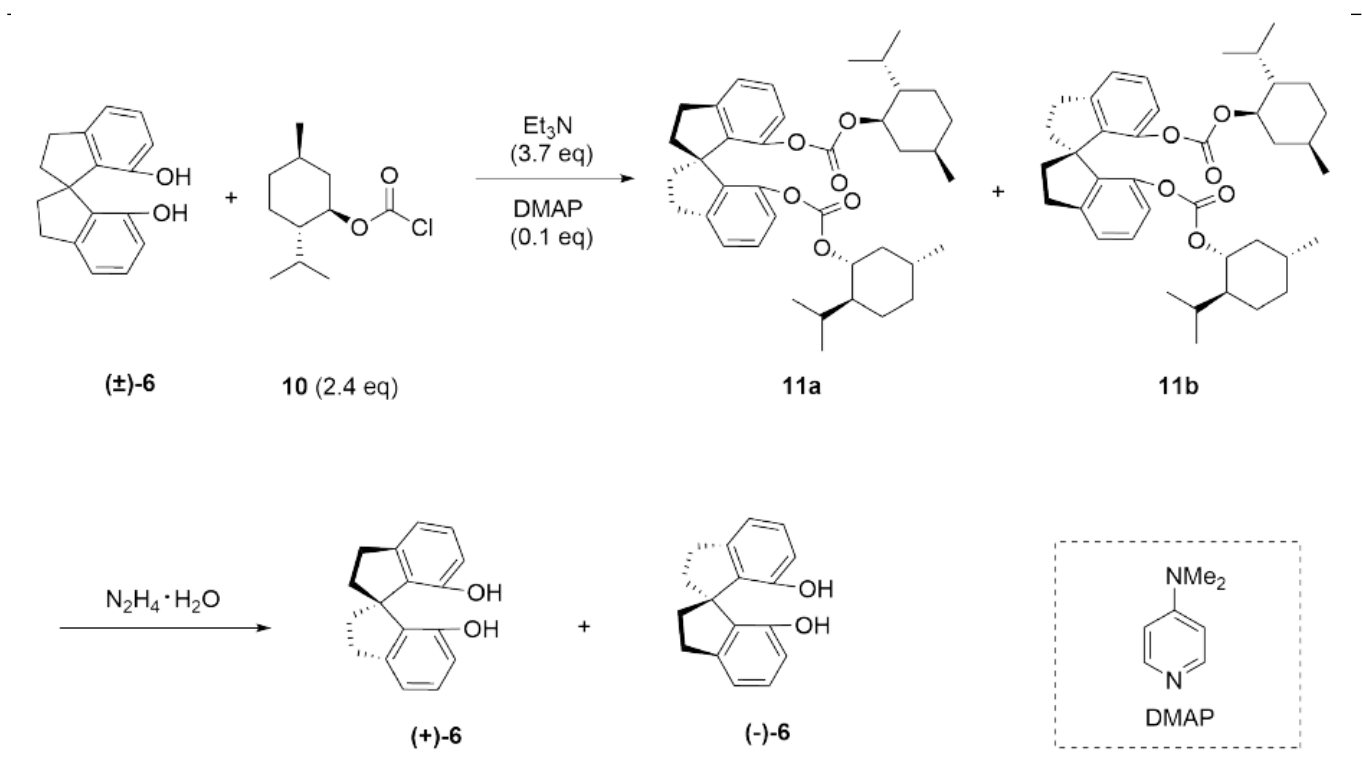
Note:
eq = equivalent
8.3 Choose the correct statement below.
(a) Compounds 11a and 11b are a pair of enantiomers.
(b) Compounds 11a and 11b are a pair of diastereomers.
(c) Compounds 11a and 11b are a pair of cis-trans isomers.
(d) Compounds 11a and 11b are a pair of conformational isomers.
Part B
The Ir-SpiroPAP was prepared by reaction of SpiroPAP with \(\ce{[Ir(cod)Cl]2}\) (cod is cycloocta-1,5-diene) in MeOH under hydrogen as shown below.
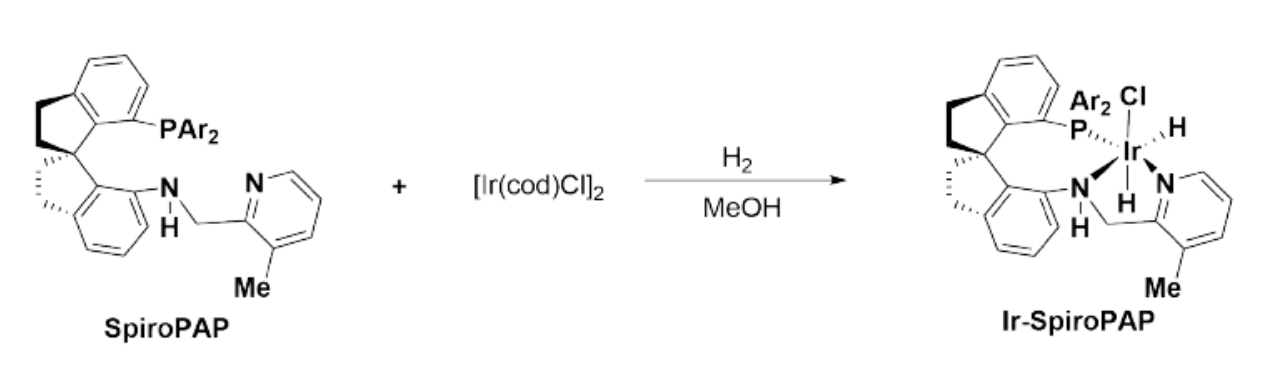
Note:
\(\ce{Ar} = 3,\,5\text{-}(\ce{^{t}Bu})_2\ce{C6H3}\)
8.4 Write the oxidation number of Ir in the catalyst Ir-SpiroPAP.
8.5 Write the number of valence electrons of d orbitals for metal Ir in the catalyst Ir-SpiroPAP.
The chiral spiro catalyst Ir-SpiroPAP was used for the asymmetric total synthesis of Mulinane-type diterpene 22 as shown below.
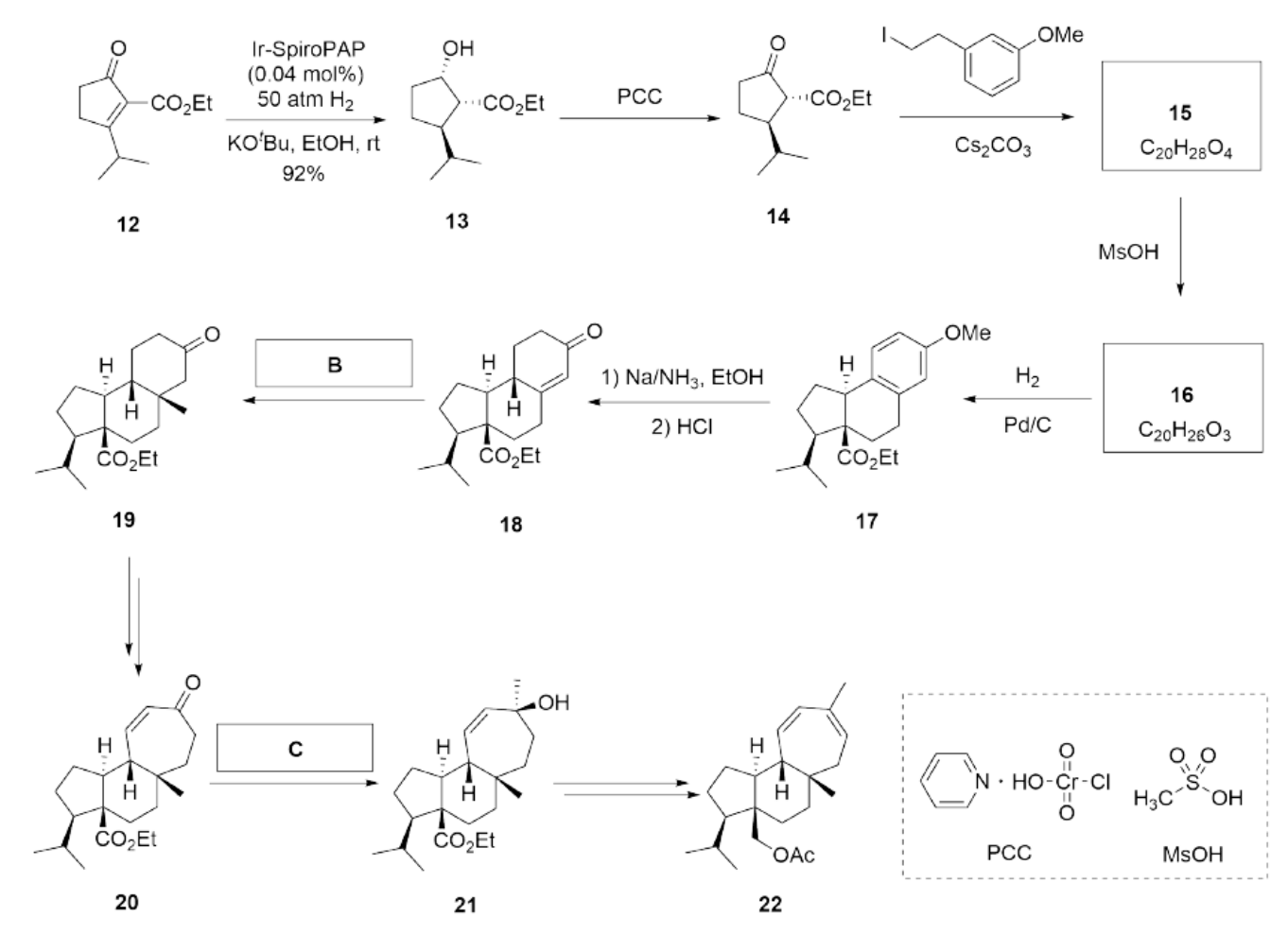
8.6 Draw the structures of 15 and 16, including the appropriate stereochemistry.
8.7 From the following reagents, choose the best for B.
(a) \(\ce{MeLi/CeCl3}\)
(b) \(\ce{MeLi/CuI}\)
(c) \(\ce{MePh3P+ I-}\), \(\ce{^{n}BuLi}\)
(d) \(\ce{Me3S+ I-}\), \(\ce{NaH}\)
8.8 From the following reagents, choose the best for C.
(a) \(\ce{MeLi/CeCl3}\)
(b) \(\ce{MeLi/CuI}\)
(c) \(\ce{MePh3P+ I-}\), \(\ce{^{n}BuLi}\)
(d) \(\ce{Me3S+ I-}\), \(\ce{NaH}\)
Official English text of the problem.
Problem 9: Total Synthesis of Capitulactone
The plant of Curculigo capitulata grows in the Southern China and has long been used in traditional Chinese herbal medicine for the treatment of many diseases. Capitulactone (1) was isolated from the roots of Curculigo capitulata. Its structure with absolute configuration was unambiguously established by a combination of spectroscopic data and total synthesis.
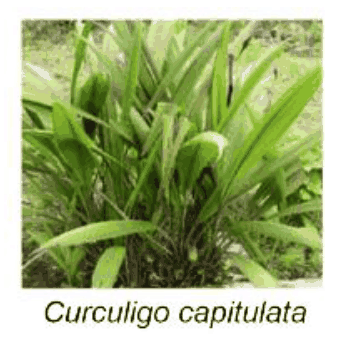
Curculigo capitulata
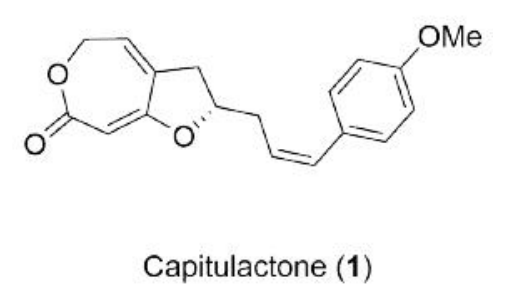
Capitulactone (1)
The total synthesis of 1 began with the iodination of commercially available 4-bromoveratrole 2 through a key intermediate 12 as shown in the following scheme.
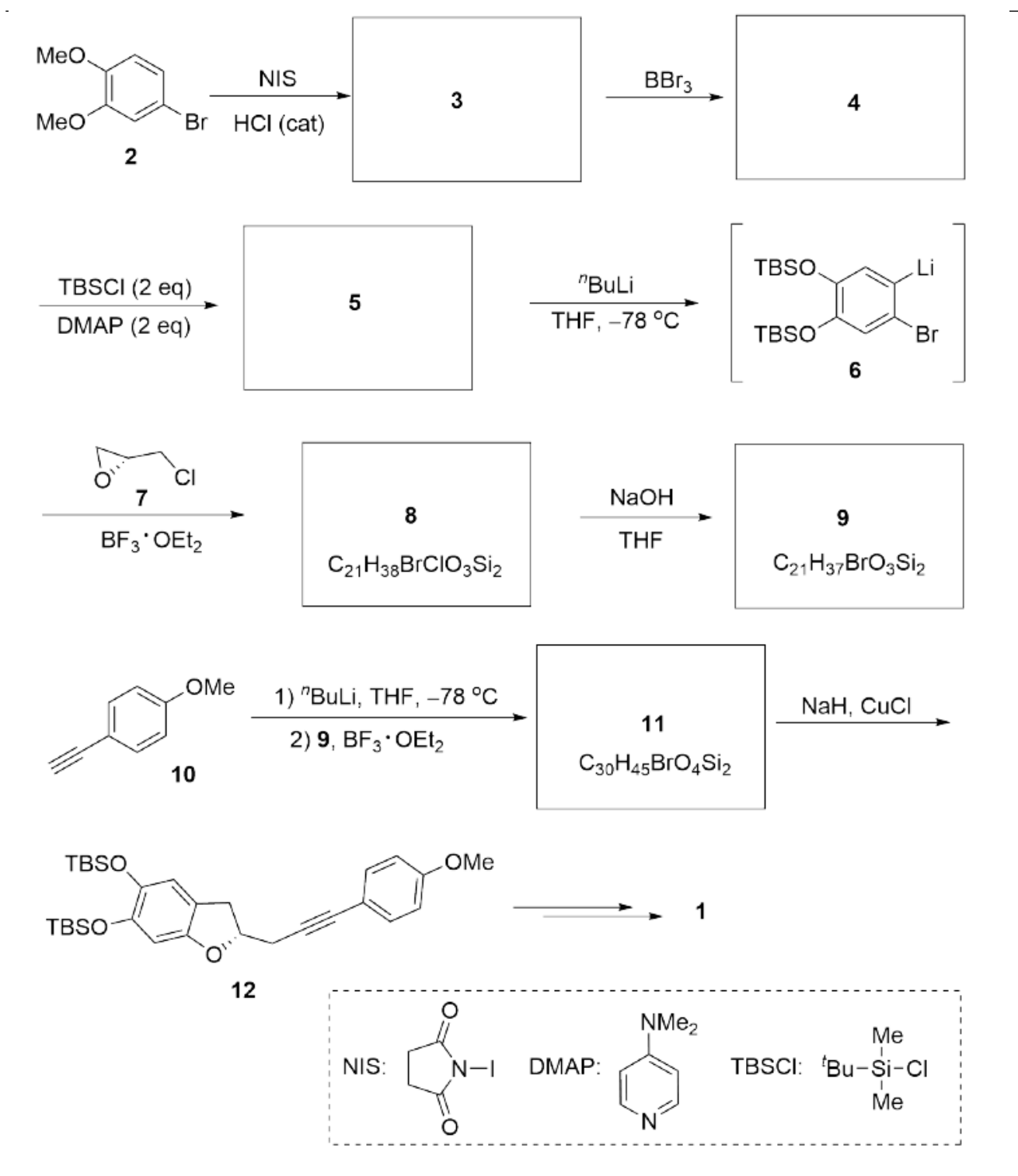
Note:
cat = catalyst
eq = equivalent
9.1 Draw the structures of compounds 3-5, 8, 9 and 11 and show the stereochemistry of any stereocenters.
(R)-Epichlorohydrin (7) was prepared from (+)-mannitol (13) through a route as shown below.
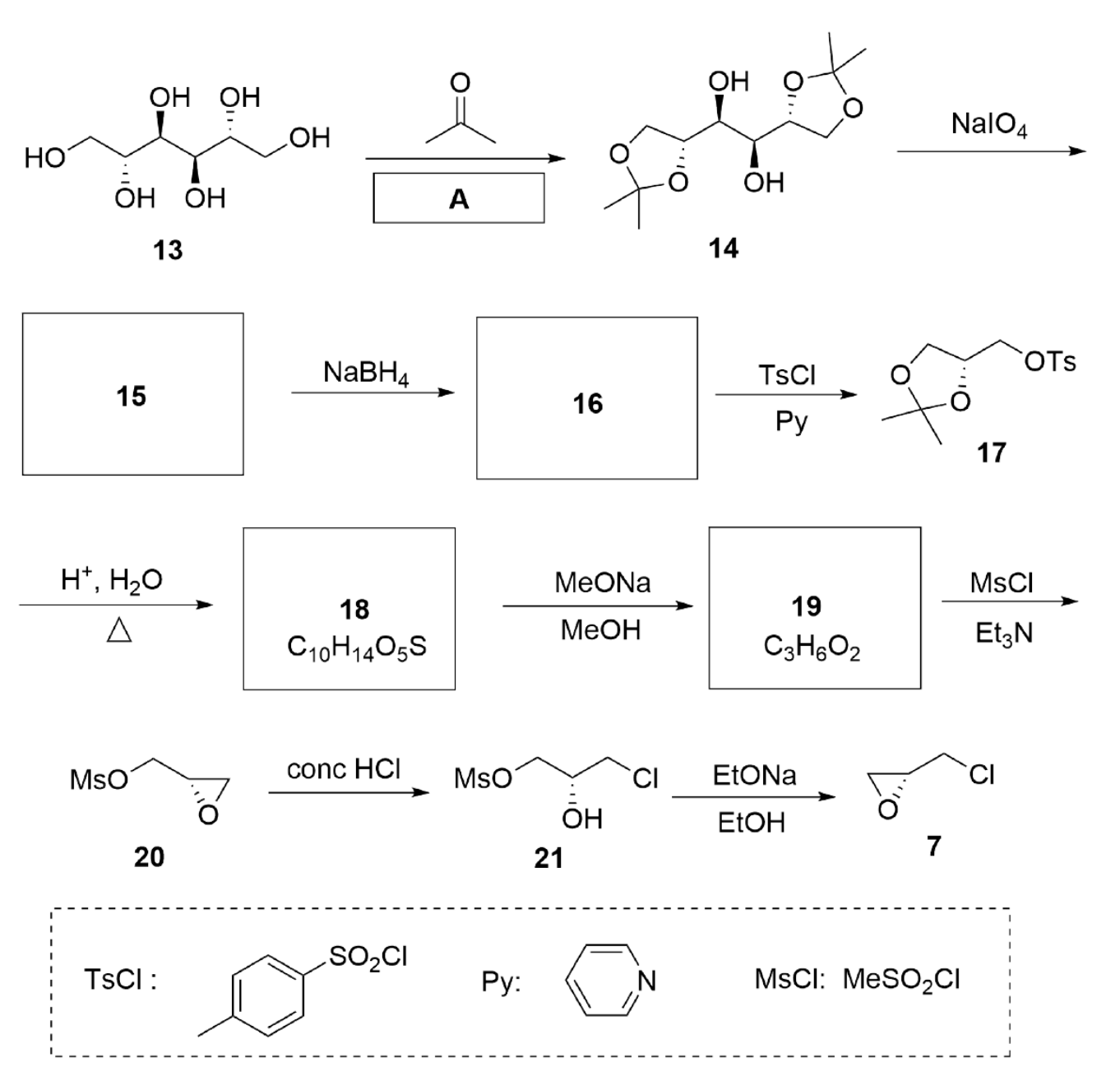
Note:
eq = equivalent
conc = concentrated
9.2 From the following conditions, choose the best for A.
(a) Pyridine
(b) 5% \(\ce{KOH/H2O}\)
(c) 1% \(\ce{HCl/H2O}\)
(d) Anhydrous \(\ce{ZnCl2}\)
9.3 Draw the structures of intermediate products 15, 16, 18 and 19 and show the stereochemistry of any stereocenters.
The diketal 14 can also be prepared by treating (+)-mannitol (13) with 2-methoxypropene (23) in the presence of catalytic amount of tolunesulfonic acid (TsOH) in anhydrous toluene. The model reaction is shown below.
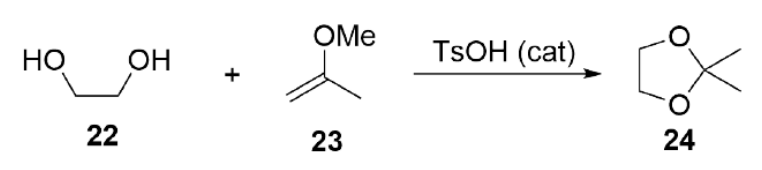
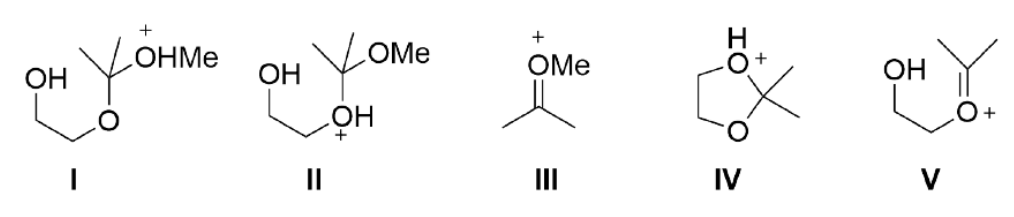
9.4 The proposed mechanism for this reaction involves key intermediates (I-V) as shown above, choose the correct order of the formation of the key intermediates during the reaction process.
(a) I, II, III, IV, V
(b) III, II, I, V, IV
(c) III, I, II, IV, V
(d) III, I, II, V, IV
Official English text of the problem.
Internationale Chemie-Olympiade
IChO 2022
Tianjin, China (als Fernwettbewerb ausgetragen) · 9 Theorieaufgaben mit vollständigen Lösungen
Aufgabe 1: Schneller und visueller Nukleinsäurenachweis für COVID-19
Schnelle und einfache Methoden zur Früherkennung von COVID-19 werden dringend benötigt. Der Nachweis mithilfe von Goldnanopartikeln gehört zu den vielversprechenden Methoden. Goldnanopartikel werden aufgrund ihrer hohen molaren Extinktionskoeffizienten (molaren Absorptionskoeffizienten) häufig als sichtbare Anzeige auf Teststreifen eingesetzt. Die Farbe von Goldnanopartikeln hängt eng mit ihrer Größe und ihrem Dispersitätsgrad zusammen. Im Allgemeinen gilt: Je größer die Goldnanopartikel sind, desto rötlicher ist ihre Farbe. Sobald die Nanopartikel aggregieren, schlägt die Farbe von Rot nach Blau um.
Wenn die Oberfläche von Goldnanopartikeln mit zwei Arten einzelsträngiger Nukleinsäurefragmente \(a\) und \(b\) modifiziert wird, aggregieren die Goldnanopartikel in Gegenwart der Zielnukleinsäure (\(a’b’\)), wodurch die Farbe der Lösung innerhalb weniger Minuten von Rot nach Blau umschlägt (wie unten dargestellt). Auf der Grundlage dieses Prinzips lassen sich die aus dem Coronavirus in einer Probe gewonnenen Zielnukleinsäuren nachweisen.
1.1 Geben Sie den Bereich der Absorptionsbande der dispergierten Goldnanopartikel mit dem entsprechenden Buchstaben an (a-f im Farbkreis in Abbildung 0.1 der Allgemeinen Hinweise).
Der Farbkreis
Abbildung 0.1
1.2 Geben Sie an, wie sich das Absorptionsspektrum der Goldnanopartikel verändert, sobald sie aggregieren. Im Vergleich zur Absorptionswellenlänge der dispergierten Goldnanopartikel ist die Wellenlänge der aggregierten Nanopartikel
(a) länger
(b) kürzer
(c) unverändert
Goldnanopartikel bestehen aus Goldatomen, die wie in festem Gold dicht gepackt sind (Dichte \(\rho = 19.3\ \mathrm{g\,cm^{-3}}\)).
1.3 Berechnen Sie, wie viele Goldatome (\(N\)) sich in einem kugelförmigen Goldnanopartikel mit einem Durchmesser von 30.0 nm befinden.
Die Synthese von Goldnanopartikeln beruht auf der Redoxreaktion zwischen Tetrachlorogoldsäure(III) (\(\ce{HAuCl4 * 3H2O}\), \(MW = 394\)) und reduzierenden Substanzen (wie Natriumcitrat). 5.2 mg \(\ce{HAuCl4 * 3H2O}\) wurden in einer Reaktionslösung mit einem Volumen von 100.0 mL vollständig in einheitliche kugelförmige Goldnanopartikel mit einem Durchmesser von 30.0 nm umgewandelt. Die mit einem UV-Vis-Spektrometer bei 530 nm gemessene Extinktion der entstandenen roten Lösung betrug 0.800.
1.4 Berechnen Sie den molaren Extinktionskoeffizienten (molaren Absorptionskoeffizienten) der entstandenen Goldnanopartikellösung bei 530 nm, bezogen auf ein Mol Goldnanopartikel. Die optische Weglänge der verwendeten Küvette beträgt 1 cm. Falls Sie die Anzahl der Goldatome (\(N\)) in 1.3 nicht bestimmen konnten, verwenden Sie \(N = 1.00 \times 10^5\).
Für den kolorimetrischen Nachweis der Zielnukleinsäure wurde die Standardadditionsmethode verwendet. Die ursprüngliche Rachenabstrichprobe wurde entnommen und in zwei gleiche Portionen aufgeteilt. Nach Zugabe der Sondenlösungen und von Wasser (wie unten angegeben) wurde die Extinktion der beiden entstandenen Lösungen jeweils bei 600 nm gemessen.
Nr. Volumen der Rachenabstrichprobe (mL) Volumen der Lösung von mit Nukleinsäurefragmenten modifizierten Goldnanopartikeln (mL) Volumen der Standardlösung mit \(2.0\ \mu\mathrm{g\,mL^{-1}}\) Zielnukleinsäure (mL) Volumen des Wassers (mL) Extinktion 1 0.10 0.80 0.00 0.10 0.400 2 0.10 0.80 0.10 0.00 0.900 1.5 Berechnen Sie die Konzentration der viralen Nukleinsäuren in der ursprünglichen Rachenabstrichprobe.
Aufgabentext aus dem offiziellen englischen Text übersetzt.
Aufgabe 2: Chrom in alter und neuer Zeit
(Das Foto stammt von der Website des Palastmuseums)
Schwarz glasiertes Porzellan ist eine besondere chinesische Porzellanart und war während der Tang- und Song-Dynastien (vor ca. 1000 Jahren) beliebt. Die Keramikwaren enthielten Eisenoxide als hauptsächliche Farbgeber, die mit anderen Übergangsmetalloxiden gemischt wurden, um verschiedene Farbtöne wie Rotbraun, Dunkelbraun oder Schwarz zu erzeugen. Auch heute ist schwarz glasiertes Porzellan in China noch beliebt.
Die typische schwarze Glasur besteht aus Fe-haltigen Oxiden mit Spinellstruktur. Spinelloxide haben die allgemeine Formel \(\ce{AB2O4}\), und ihre Struktur besteht aus einer kubisch dichtesten Packung von \(\ce{O^{2-}}\)-Ionen, in der die A-Kationen ein Achtel der Tetraederlücken und die B-Kationen die Hälfte der Oktaederlücken besetzen, wie in Abbildung 2.1(a) für eine Elementarzelle gezeigt.
Abbildung 2.1 Darstellung der Spinellstruktur
Die kubische Elementarzelle einer Spinellstruktur lässt sich in 8 kubische Untereinheiten unterteilen; die gestrichelten Linien stellen die innen liegenden Kanten der Untereinheiten dar. 4 der Untereinheiten gehören zum Typ I, die anderen 4 Untereinheiten zum Typ II (Abbildung 2.1(b)). Einzelheiten benachbarter Untereinheiten vom Typ I und Typ II sind in Abbildung 2.1(c) dargestellt.
2.1 Wie viele Kationen vom Typ A und B befinden sich in einer Elementarzelle?
Die schwarze Keramikglasur mit Spinellstruktur kann durch Glühen von \(\ce{Fe2O3}\) und \(\ce{Cr2O3}\) in einem bestimmten Verhältnis in einer reduzierenden Atmosphäre hergestellt werden (Reaktion (I)). Werden \(\ce{Fe2O3}\) und \(\ce{Cr2O3}\) im Massenverhältnis 63.6 : 36.4 umgesetzt, wandeln sie sich vollständig in eine reine stöchiometrische Verbindung um. Das Produkt besitzt eine Spinellstruktur, in der die tetraedrischen A-Plätze ausschließlich mit Eisenkationen besetzt sind.
2.2 Welches Element wird in Reaktion (I) reduziert?
2.3 Berechnen Sie die Anzahl der \(\ce{Fe^{3+}}\)- und \(\ce{Cr^{3+}}\)-Ionen auf den B-Plätzen einer Elementarzelle.
Neben ihrer Verwendung zur Dotierung schwarzer Keramikglasuren werden chromhaltige Pigmente aufgrund der vielfältigen Farben, die Chrom in verschiedenen Oxidationsstufen wie +2, +3 und +6 hervorbringt, in der Malerei und im Druck eingesetzt. Das Pigment Chromoxidgrün (\(\ce{Cr2O3}\)) lässt sich im folgenden Verfahren in eine Reihe weiterer Verbindungen (D-G) umwandeln, wobei E, F und G gelb, orange bzw. rot sind.
2.4 Geben Sie die chemische Formel von E an.
2.5 Geben Sie die Reaktionsgleichung für F \(\rightarrow\) G an.
2.6 Wählen Sie das Reagenz aus, das H sein könnte.
(A) \(\ce{FeSO4}\)
(B) \(\ce{FeCl3}\)
(C) \(\ce{ZnSO4}\)
(D) \(\ce{CuSO4}\)
Die wechselnden Oxidationsstufen des Chroms sind nicht nur für die Herstellung von Pigmenten wichtig, sondern auch für die Katalyse nützlich. Beispielsweise besteht ein typischer Phillips-Katalysator für die Polymerisation von Ethylen aus Chromoxidspezies, die auf einem porösen Trägermaterial wie amorphem Siliciumdioxid verankert sind. Die vierfach koordinierte Cr(VI)-Spezies bildet den Kern des Präkatalysators (1); es wird angenommen, dass sie zu Beginn durch die Ethylenmoleküle rasch zu einer sechsfach koordinierten Cr(II)-Spezies (2) reduziert wird. Es wird angenommen, dass 2 anschließend die Polymerisation der Ethylenmoleküle katalysiert.
2.7 Die Reaktion von 1 mit Ethylen kann mithilfe von UV–Vis-Spektren verfolgt werden, die im sichtbaren Bereich die Lichtabsorption von 1 bei \(21500\ \mathrm{cm^{-1}}\) und die Lichtabsorption von 2 bei \(16700\ \mathrm{cm^{-1}}\) zeigen. Wählen Sie die zutreffende Kombination der Farben von 1 und 2 aus.
(A) orange bzw. weiß
(B) orange bzw. blau
(C) blau bzw. orange
(D) blau bzw. weiß
2.8 Unter der Annahme, dass sich das Cr(II)-Ion in 2 in einem regulären oktaedrischen Kristallfeld mit einer Aufspaltungsenergie \(\Delta_{\mathrm{o}}\) von \(16000\ \mathrm{cm^{-1}}\) befindet, zeichnen Sie die Konfigurationen der d-Elektronen des Cr(II)-Ions in 2 und berechnen Sie die Kristallfeldstabilisierungsenergie (CFSE) für das Cr(II)-Ion in 2. (Hinweis: Die Paarungsenergie \(P\) für Cr(II) in 2 beträgt \(23500\ \mathrm{cm^{-1}}\).)
2.9 Koordinationsverbindungen/-ionen zeigen Paramagnetismus, wenn sie ungepaarte Elektronen enthalten; das entsprechende magnetische Moment (\(\mu\)) von Übergangsmetallkationen wird mithilfe der Funktion \(\mu=\sqrt{n(n+2)}\mu_B\) berechnet, wobei \(n\) die Anzahl der ungepaarten Elektronen ist. Berechnen Sie das magnetische Moment des Cr(II)-Ions in 2 in Einheiten von \(\mu_B\).
Aufgabentext aus dem offiziellen englischen Text übersetzt.
Aufgabe 3: Abscheidung und Umwandlung von Kohlenstoffdioxid
Der Klimawandel ist eine der größten globalen Herausforderungen unserer Zeit. Der Anstieg der \(\ce{CO2}\)-Konzentration in der Atmosphäre gilt als Hauptursache der globalen Erwärmung. Die Erforschung der Abscheidung und Umwandlung von \(\ce{CO2}\) hat beträchtliche Aufmerksamkeit auf sich gezogen.
Die direkte Abscheidung aus der Luft (Direct Air Capture, DAC), bei der \(\ce{CO2}\) unmittelbar aus der Umgebungsluft entnommen werden soll, ist eine vielversprechende Technologie. Das herkömmliche DAC-Verfahren ist die Nasswäsche mit alkalischen Hydroxidlösungen (üblicherweise \(\ce{NaOH}\)), bei der \(\ce{CO2}\) aus der Luft bis zu einem pH-Wert von ≈ 10 absorbiert wird (Schritt 1). Das verbrauchte Sorptionsmittel wird durch Zugabe von Calciumhydroxid zum System regeneriert (Schritt 2). Der in Schritt 2 erhaltene weiße Niederschlag A zersetzt sich bei \(700\,^\circ\mathrm{C}\), wobei \(\ce{CO2}\) und eine weitere weiße Verbindung B entstehen (Schritt 3). Schließlich kann durch Hydratisierung von B Calciumhydroxid erzeugt werden. Dieses Verfahren ist sehr energieaufwendig. (\(\ce{H2CO3}\): \(K_{\mathrm{a1}}=4.5\times10^{-7}\), \(K_{\mathrm{a2}}=4.7\times10^{-11}\)).
3.1 Geben Sie die Formeln von A bzw. B an.
3.2 Geben Sie die ausgeglichenen Gleichungen aller möglichen Reaktionen in den Schritten 1–3 an. Als Sorptionsmittel wird eine \(\ce{NaOH}\)-Lösung verwendet.
Kürzlich wurde ein elektrochemisches Verfahren zur Regenerierung der alkalischen Lösung bei der Nasswäsche für DAC-Anwendungen entwickelt, mit dem reines \(\ce{CO2}\)-Gas zurückgewonnen werden konnte, das sich zur Speicherung oder Nutzung eignet. Das Verfahren beruht auf einem elektrochemischen System mit \(\ce{H2}\)-Rückführung (HRES), wie in Abbildung 3.1 gezeigt.
Abbildung 3.1 Schematische Darstellung des Versuchsaufbaus
Die elektrochemische Zelle enthält drei Kompartimente: einen Anodenraum (A), einen Ansäuerungsraum (B) und einen Kathodenraum (C). Sie sind durch ionenselektiv durchlässige Membranen M1 und M2 voneinander getrennt. Während des Betriebs werden die bei der Oxidation von \(\ce{H2}\) an der Anode erzeugten Protonen in den Ansäuerungsraum transportiert, dem die verbrauchte Lösung (\(\ce{Na2CO3}\)-\(\ce{NaHCO3}\)) aus dem Luftkontaktor zugeführt wird. Der sinkende pH-Wert der Lösung führt zur Umwandlung von Carbonat in Hydrogencarbonat (Reaktion 1) und von Hydrogencarbonat in Kohlensäure (Reaktion 2). Wenn die Lösung mit gelöstem \(\ce{CO2}\) gesättigt ist (Löslichkeit: \(0.033\ \mathrm{mol\,L^{-1}}\)), führt eine weitere Absenkung des pH-Werts zur Freisetzung von \(\ce{CO2}\)-Gas (Reaktion 3). Das an der Kathode erzeugte \(\ce{H2}\) wird der Anode zugeführt, und die Lösung aus dem Kathodenraum kann als DAC-Absorptionsmittel wiederverwendet werden.
3.3 Geben Sie die Elektrodenreaktionen an der Anode (A) bzw. an der Kathode (C) an.
3.4 Geben Sie die ausgeglichenen Gleichungen für die Reaktionen 1–3 im Ansäuerungsraum (B) an.
3.5 Kreuzen Sie alle Aussagen an, die die Bewegung der Kationen während des Betriebs des Systems korrekt beschreiben.
(a) \(\ce{H+}\)-Ionen passieren M1 von A nach B.
(b) \(\ce{H+}\)-Ionen passieren M2 von B nach C.
(c) \(\ce{Na+}\)-Ionen passieren M1 von B nach A.
(d) \(\ce{Na+}\)-Ionen passieren M2 von B nach C.
(e) Sowohl \(\ce{H+}\)- als auch \(\ce{Na+}\)-Ionen können M1 und M2 passieren.
Die Zelle arbeitet im stationären Zustand, wenn der durch die Zelle fließende Strom \(2.00\ \mathrm{A}\) und der Volumenstrom der dem Raum B zugeführten Lösung (\(0.050\ \mathrm{mol\,L^{-1}}\ \ce{Na2CO3}\) - \(0.10\ \mathrm{mol\,L^{-1}}\ \ce{NaHCO3}\)) \(10.0\ \mathrm{mL\,min^{-1}}\) betragen. Der pH-Wert im Anodenraum wird im stationären Zustand bei 1 gehalten.
3.6 Berechnen Sie die Bildungsrate von \(\ce{CO2}\)-Gas (in \(\mathrm{mmol\,min^{-1}}\)).
Zeolithische Imidazolatgerüste (ZIFs), eine Unterklasse der metallorganischen Gerüstverbindungen (MOFs), sind vielversprechende Materialien für die Abscheidung und Nutzung von \(\ce{CO2}\). Die Strukturen der ZIFs ähneln denen von Zeolithen. Sie bilden dreidimensionale Gerüste mit tetraedrisch koordinierten Metallionen (z. B. \(\ce{Zn^2+}\), \(\ce{Co^2+}\)), die durch Imidazolat (\(\ce{Im-}\)) und dessen Derivate verbrückt sind. Als konjugierte Base von Imidazol (\(\ce{HIm}\)) bindet das Imidazolat-Anion über seine beiden N-Atome an Metallkationen (M). Die Tatsache, dass der \(\ce{M-Im-M}\)-Winkel dem in Zeolithen bevorzugten \(\ce{Si-O-Si}\)-Winkel (145°) ähnelt (wie unten gezeigt), hat zur Synthese einer großen Zahl von ZIFs mit tetraedrischen Topologien des Zeolithtyps geführt.
ZIF-8 ist eines der repräsentativen ZIFs und besitzt ein Sodalithgerüst (SOD), wie in Abbildung 3.2 gezeigt. ZIF-8 wurde erstmals von den chinesischen Wissenschaftlern Xiao-Ming Chen et al. (die es MAF-4 nannten) durch die Reaktion von \(\ce{Zn^2+}\) mit 2-Methylimidazol (\(\ce{CH3(C3N2H3)}\), \(\ce{HmIm}\)) synthetisiert. Es kristallisiert im kubischen System mit dem Gitterparameter \(a=1.632\ \mathrm{nm}\) für eine lösungsmittelfreie Phase und einem effektiven Porendurchmesser (dargestellt durch die innen liegende virtuelle Kugel in Abbildung 3.2d) von \(1.16\ \mathrm{nm}\).
Abbildung 3.2 Topologie von SOD und Struktur von ZIF-8
(a) Topologie des SOD-Käfigs;
(b) SOD-Käfig in ZIF-8, gebildet aus \(\ce{Zn^2+}\) (in den Zentren der Tetraeder) und Imidazolat (H-Atome sind der Übersichtlichkeit halber weggelassen);
(c) SOD-Gerüst mit der durch den quadratischen Rahmen dargestellten Elementarzelle;
(d) Einige der Poren in ZIF-8 sind durch virtuelle Kugeln hervorgehoben.
Hinweis: Wenn Sie möchten, können Sie bei der Bearbeitung der folgenden Fragen die Symbole „HmIm“ und „mIm“ für 2-Methylimidazol bzw. 2-Methylimidazolat verwenden.
3.7 Geben Sie die Formel eines einzelnen Sodalithkäfigs an.
3.8 Geben Sie die Zusammensetzung der Elementarzelle von ZIF-8 an.
3.9 Berechnen Sie die innere Oberfläche (\(S\)) der Poren (modelliert durch die virtuellen Kugeln) von 1 g ZIF-8 (in \(\mathrm{m^2}\)). Falls Sie die Zusammensetzung der Elementarzelle nicht bestimmen konnten, verwenden Sie 3500 als Formelmasse der Elementarzelle.
3.10 Berechnen Sie die Porosität \(R\) von ZIF-8 (\(R\) ist das Verhältnis des Porenvolumens zum tatsächlichen Volumen des Materials) und das Porenvolumen von 1 g ZIF-8 (\(V_p\), in \(\mathrm{cm^3}\)).
ZIF-8 kann auch als Katalysator die Umwandlung von \(\ce{CO2}\) in Chemikalien mit hoher Wertschöpfung fördern. Einer der vielversprechendsten Wege zur \(\ce{CO2}\)-Fixierung ist die Herstellung cyclischer Carbonate durch \(\ce{CO2}\)-Cycloaddition. Ein Beispiel ist im Folgenden gezeigt:
Für die katalytische Umwandlung von \(\ce{CO2}\) in ein cyclisches Carbonat am ZIF-8-Katalysator wird folgender Mechanismus vorgeschlagen:
3.11 Wenn ZIF-8 im obigen katalytischen Prozess Säurezentren bereitstellt, vervollständigen Sie den Mechanismus, indem Sie die plausiblen Zwischenprodukte aus den folgenden Spezies auswählen:
Wählen Sie die Zwischenprodukte aus, die I bzw. II entsprechen.
ZIF-8 weist eine relativ hohe thermische Stabilität auf. Eine kürzlich durchgeführte Studie ergab jedoch, dass seine Struktur bei Verwendung in einer feuchten, sauren Umgebung zerstört würde. Die gleichzeitige Anwesenheit von \(\ce{CO2}\) und \(\ce{H2O}\) bei ZIF-8 führte zur Bildung von \(\ce{ZnCO3}\).
3.12 Geben Sie die ausgeglichene Reaktionsgleichung von ZIF-8 mit \(\ce{CO2}\) und \(\ce{H2O}\) an.
Aufgabentext aus dem offiziellen englischen Text übersetzt.
Aufgabe 4: Eine neue Reise für den seit der Antike bekannten Schwefel
Schwefel ist seit der Antike bekannt und wird seitdem verwendet. Heute wird Schwefel als preiswerter chemischer Rohstoff in großem Umfang in der chemischen Produktion und der pharmazeutischen Industrie eingesetzt.
Pyrit (\(\ce{FeS2}\)) wird häufig als Rohstoff für die industrielle Herstellung von elementarem Schwefel verwendet. Beim Erhitzen von Pyrit unter begrenzter Luftzufuhr beträgt die theoretische Ausbeute an elementarem Schwefel 100%; als weiteres Produkt entsteht ein schwarzes magnetisches Oxid (\(\ce{Fe3O4}\)).
4.1 Stellen Sie die ausgeglichene Reaktionsgleichung für die oben beschriebene Umsetzung auf.
Neben Schwefel entsteht im tatsächlichen Prozess eine geringe Menge \(\ce{SO2}\) als Nebenprodukt. Diese Reaktion lässt sich durch die Bestimmung der Menge an \(\ce{SO2}\) überwachen. Dazu wird die folgende Arbeitsvorschrift verwendet:
Das pulverisierte Roherz wird in einem temperaturgeregelten Rohrofen erhitzt. Das entstehende \(\ce{SO2}\) wird in einer 2 mol L\(^{-1}\) \(\ce{NaOH}\)-Lösung absorbiert. Nach Abschluss der Reaktion wird die Lösung in einen 500-mL-Messkolben überführt und mit destilliertem Wasser bis zur Marke aufgefüllt. Anschließend werden 25.00 mL dieser verdünnten Lösung in einen Iodzahlkolben gegeben, der 50.00 mL einer 0.05122 mol L\(^{-1}\) \(\ce{I2}\)-Maßlösung und 5 mL einer 20%igen \(\ce{H2SO4}\)-Lösung enthält. Nachdem der Iodzahlkolben 5 min im Dunkeln aufbewahrt wurde, wird die Lösung mit einer 0.1012 mol L\(^{-1}\) \(\ce{Na2S2O3}\)-Maßlösung titriert. Sobald sich die Lösung hellbraun färbt, werden 3 mL einer 0.5%igen Stärkelösung als Indikator zugesetzt. Die Titration wird fortgesetzt, bis die blaue Farbe verschwindet.
4.2 Stellen Sie die ausgeglichenen Reaktionsgleichungen unter Beteiligung von \(\ce{I2}\) bei der oben beschriebenen Bestimmung auf.
4.3 Bei einem solchen Versuch mit Pyrit als Ausgangsstoff wurden 17.6 g elementarer Schwefel gesammelt. Bei der Analyse der als Nebenprodukte entstandenen Gase nach dem oben beschriebenen Verfahren wurden 18.47 mL der \(\ce{Na2S2O3}\)-Maßlösung verbraucht. Berechnen Sie unter der Annahme, dass keine weiteren schwefelhaltigen Spezies entstanden sind, welcher prozentuale Anteil des Schwefels im Pyrit als Nebenprodukt verloren ging.
Die Lithium-Schwefel-Batterie ist ein vielversprechendes Energiespeichersystem, da ihre hohe theoretische Energiedichte diejenige herkömmlicher Lithium-Ionen-Batterien übersteigt. Die Gesamtreaktion einer Lithium-Schwefel-Batterie lässt sich vereinfacht wie folgt schreiben: \(\ce{16Li + S8 -> 8Li2S}\). Beim Entladen ist Schwefel das aktive Kathodenmaterial und metallisches Lithium das aktive Anodenmaterial.
4.4 Stellen Sie die ausgeglichenen Gleichungen für die Reaktionen auf, die beim Entladen an der Kathode (a) und der Anode (b) ablaufen.
4.5 Berechnen Sie anhand der Gesamtreaktion der Batterie das Massenverhältnis des aktiven Kathodenmaterials zum aktiven Anodenmaterial.
Eine Lithium-Ionen-Batterie (LIB) mit einer mittleren Betriebsspannung von 3.8 V und einer nutzbaren Kapazität von 3110 mAh kann ein Mobiltelefon nach vollständigem Aufladen 22 Stunden lang mit Energie für die ununterbrochene Wiedergabe von Videos versorgen.
4.6 Die LIB wird durch ein ideales Lithium-Schwefel-Batteriepaket ersetzt, das eine mittlere Betriebsspannung von 4.2 V aufweist und 23 g Schwefel als aktives Elektrodenmaterial enthält, das beim Entladen stöchiometrisch reagieren kann. Berechnen Sie, wie viele Stunden das neue Batteriepaket das Telefon nach vollständigem Aufladen mit Energie für die ununterbrochene Wiedergabe von Videos versorgen kann.
Elementarer Schwefel liegt im Allgemeinen als \(\ce{S8}\)-Moleküle vor. In realen Lithium-Schwefel-Batterien wird \(\ce{S8}\) beim Entladen nicht direkt zu \(\ce{Li2S}\) reduziert, sondern durchläuft schrittweise Reaktionen, bei denen verschiedene lösliche Lithiumpolysulfide (\(\ce{Li2S_n}\), \(n=3–8\)) entstehen. Diese Lithiumpolysulfide können zur Anode diffundieren und diese korrodieren, was zum Verlust aktiver Elektrodenmaterialien führt. Dieses Phänomen wird als „Shuttle-Effekt“ bezeichnet.
4.7 Stellen Sie die ausgeglichene Reaktionsgleichung für die Korrosion der Anode durch lösliche Lithiumpolysulfide (\(\ce{Li2S_n}\)) unter Bildung von \(\ce{Li2S}\) auf.
Um den „Shuttle-Effekt“ zu unterdrücken, wurden die Formen, in denen Polysulfide in einem Elektrolyten vorliegen, umfassend untersucht. \(\ce{Li2S6}\) ist eines der repräsentativsten Zwischenprodukte:
Eine theoretische Untersuchung zeigt, dass zwei Konformere mit vergleichbaren Energien, \(\ce{Li2S6}(I)\) und \(\ce{Li2S6}(II)\), in 1,2-Dimethoxyethan (DME), einem gängigen Elektrolytlösungsmittel in Lithium-Schwefel-Batterien, nebeneinander vorliegen. Die Dissoziation von \(\ce{Li2S6}\) in DME ist nachfolgend dargestellt:
Chemische Gleichgewichte von \(\ce{Li2S6}\), \(\ce{LiS6^-}\), \(\ce{S6^{2-}}\) und \(\ce{LiS3^{\bullet}}\) in DME
Tabelle 4.1 Gibbs-Energien der Dissoziation (\(\mathrm{kJ\,mol^{-1}}\)) verschiedener Reaktionen in DME (298.15 K, 1 bar)
\(\Delta G_{\mathrm{d1}}^{\ominus}(I)\) \(\Delta G_{\mathrm{d1}}^{\ominus}(II)\) \(\Delta G_{\mathrm{d2}}^{\ominus}\) \(\Delta G_{\mathrm{dr}}^{\ominus}(I)\) \(\Delta G_{\mathrm{dr}}^{\ominus}(II)\) 20.68 18.92 100.55 45.13 43.37 4.8 Berechnen Sie mithilfe der Daten aus Tabelle 4.1 das Verhältnis der Gleichgewichtskonzentrationen der beiden Konformere in DME (298.15 K, 1 bar), \(\dfrac{\ce{Li2S6}(II)}{\ce{Li2S6}(I)}\).
4.9 Berechnen Sie mithilfe der Daten aus Tabelle 4.1 die scheinbare Dissoziationskonstante von \(\ce{Li2S6 -> Li+ + LiS6^-}\) in DME (298.15 K, 1 bar).
4.10 Ordnen Sie die folgenden Gleichgewichtskonzentrationen in DME in absteigender Reihenfolge: \([\ce{Li2S6}]\), \([\ce{LiS6^-}]\), \([\ce{S6^{2-}}]\), \([\ce{LiS3^{\bullet}}]\).
4.11 Das Standardreduktionspotenzial von metallischem Lithium in Wasser bei 298.15 K und 1 bar beträgt:
\[ E^{\ominus}(\ce{Li+}/\ce{Li})=-3.040\ \mathrm{V} \]
Die Standard-Gibbs-Energien der Solvatation von gasförmigem \(\ce{Li+(g)}\) zu \(\ce{Li+(sol)}\) in verschiedenen Lösungsmitteln sind:
\(\ce{Li+}(\ce{H2O})\) \(\ce{Li+}(\mathrm{DME})\) \(\Delta G^{\ominus}/\mathrm{kJ\,mol^{-1}}\) −116.9 −114.6 Berechnen Sie das Standardreduktionspotenzial der metallischen Lithiumelektrode in DME.
Untersuchungen haben gezeigt, dass sich die elektromotorische Kraft einer Lithium-Schwefel-Batterie durch den Ersatz von DME durch Dimethylsulfoxid (DMSO) erhöhen lässt. Daher sind auch die Formen, in denen Polysulfide in DMSO vorliegen, von Interesse für die Forschung.
In einem Versuch wurden eine bestimmte Menge \(\ce{Li2S}\) und 4.81 mg Schwefelpulver zu 10.00 mL DMSO gegeben und anschließend unter Rühren erhitzt, bis sie vollständig gelöst waren (die Volumenänderung wird vernachlässigt). Nehmen Sie an, dass nur die folgenden Polysulfide im DMSO vorlagen: \(\ce{S3^{\bullet-}}\), \(\ce{S4^{2-}}\), \(\ce{S5^{2-}}\), \(\ce{S6^{2-}}\), \(\ce{S7^{2-}}\), \(\ce{S8^{2-}}\). Das Verhältnis der Gleichgewichtskonzentrationen der schwefelhaltigen Spezies betrug:
\[ [\ce{S3^{\bullet-}}]:[\ce{S4^{2-}}]:[\ce{S5^{2-}}]: [\ce{S6^{2-}}]:[\ce{S7^{2-}}]:[\ce{S8^{2-}}] =17.50:1.00:4.50:55.00:5.00:0.75 \]
4.12 Berechnen Sie die ursprünglich zu DMSO gegebene Masse \(m\) (in mg) an \(\ce{Li2S}\).
Aufgabentext aus dem offiziellen englischen Text übersetzt.
Aufgabe 5: Umwandlungen zwischen Stickstoffoxiden
15% der Gesamtpunktzahl
Frage 5.1 5.2 5.3 5.4 5.5 5.6 5.7 5.8 5.9 5.10 Gesamt Punkte 4 4 2 4 3 8 4 6 4 6 45 Erreichte Punkte Stickstoffoxide (darunter \(\ce{N2O}\), \(\ce{NO}\), \(\ce{NO2}\), \(\ce{N2O4}\) usw., üblicherweise als \(\ce{NO_x}\) bezeichnet) gehören zu den wichtigsten Luftschadstoffen, die eine Reihe von Problemen wie Ozonabbau, sauren Regen, photochemischen Smog und den Treibhauseffekt verursachen können. Daher müssen die Emission und die Umwandlung von \(\ce{NO_x}\) kontrolliert werden, um die Luftqualität zu verbessern. Im Folgenden untersuchen wir die Oxidation von \(\ce{NO}\) zu \(\ce{NO2}\) durch die Reaktion \(\ce{2NO + O2 -> 2NO2}\).
Teil A
Es wird allgemein angenommen, dass diese Reaktion in der Atmosphäre nach folgendem Mechanismus abläuft:
Die Reaktionen (1) und (2) sowie die Rückreaktion von Reaktion (1) sind Elementarreaktionen. Reaktion (1) ist ein vorgelagertes Gleichgewicht, dessen konzentrationsbezogene Gleichgewichtskonstante mit \(K_{c1}\) bezeichnet wird. Reaktion (2) ist der geschwindigkeitsbestimmende Schritt der Gesamtreaktion; ihre Geschwindigkeitskonstante ist \(k_2\).
5.1 Leiten Sie das Geschwindigkeitsgesetz für die Gesamtreaktion \(\ce{2NO + O2 -> 2NO2}\) als Funktion von \([\ce{NO}]\), \([\ce{O2}]\), \(K_{c1}\) und \(k_2\) her. 4.0 Punkte
Die Temperaturabhängigkeit von \(K_{c1}\) lässt sich näherungsweise durch \(\ln K_{c1}=M-(N/T)\) beschreiben (\(M\) und \(N\) sind Konstanten). Die Änderung von \(k_2\) mit der Temperatur folgt der Arrhenius-Gleichung mit dem präexponentiellen Faktor \(A_2\) und der scheinbaren Aktivierungsenergie \(E_{a,2}\). Nehmen Sie an, dass \(E_{a,2}\) und \(A_2\) temperaturunabhängig sind.
5.2 Leiten Sie die Ausdrücke für den präexponentiellen Faktor (\(A_+\)) und die scheinbare Aktivierungsenergie (\(E_{a+}\)) der Reaktion \(\ce{2NO + O2 -> 2NO2}\) als Funktionen von \(M\), \(N\), \(A_2\) und \(E_{a,2}\) her. 4.0 Punkte
Die scheinbare Geschwindigkeitskonstante (\(k_+\)) der Gesamtreaktion beträgt bei 600 K \(6.63\times10^5\ \mathrm{L^2\,mol^{-2}\,min^{-1}}\), und ihre scheinbare Aktivierungsenergie beträgt \(1.20\ \mathrm{kJ\,mol^{-1}}\).
5.3 Berechnen Sie die Geschwindigkeitskonstante (in \(\mathrm{L^2\,mol^{-2}\,min^{-1}}\)) dieser Reaktion bei 700 K. 2.0 Punkte
Die Standardbildungsenthalpien (\(\Delta_{\mathrm f}H_{\mathrm m}^{\ominus}\)) und Standardentropien (\(S_{\mathrm m}^{\ominus}\)) bei 298.15 K sind wie folgt:
\(\ce{NO(g)}\) \(\ce{O2(g)}\) \(\ce{NO2(g)}\) \(\Delta_{\mathrm f}H_{\mathrm m}^{\ominus}\) (\(\mathrm{kJ\,mol^{-1}}\)) 91.3 33.1 \(S_{\mathrm m}^{\ominus}\) (\(\mathrm{J\,K^{-1}\,mol^{-1}}\)) 210.8 205.2 240.1 Die Standardreaktionsenthalpie und die Standardreaktionsentropie von \(\ce{2NO + O2 -> 2NO2}\) können als temperaturunabhängig betrachtet werden. Für die folgenden Fragen werden alle Gase als ideal angenommen.
5.4 Berechnen Sie die thermodynamische Gleichgewichtskonstante (\(K_p^{\ominus}\)) dieser Reaktion bei 600 K. 4.0 Punkte
5.5 Berechnen Sie die Standardänderung der inneren Energie \(\Delta_{\mathrm r}U_{\mathrm m}^{\ominus}\) (in \(\mathrm{kJ\,mol^{-1}}\)) dieser Reaktion bei 600 K. 3.0 Punkte
Experimentelle Beobachtungen zeigen, dass die Geschwindigkeit der Reaktion \(\ce{2NO2 -> 2NO + O2}\) unabhängig von den Konzentrationen von \(\ce{NO}\) und \(\ce{O2}\) ist.
5.6 Leiten Sie das Geschwindigkeitsgesetz für diese Reaktion her (die scheinbare Geschwindigkeitskonstante kann direkt als \(k_-\) verwendet werden) und berechnen Sie den Wert der scheinbaren Geschwindigkeitskonstante \(k_-\) bei 600 K.
(Falls Sie \(K_p^{\ominus}(600\ \mathrm K)\) in Frage 5.4 nicht bestimmen konnten, verwenden Sie \(K_p^{\ominus}(600\ \mathrm K)=350.0\)) 8.0 PunkteGasförmiges \(\ce{NO2}\) wird in einen Behälter mit konstantem Volumen eingebracht, der auf 600 K gehalten wird, und man lässt das System das Gleichgewicht erreichen. 20 Prozent des Edukts werden zu \(\ce{NO}\) und \(\ce{O2}\) umgesetzt. Alle Gase werden als ideal angenommen.
5.7 Berechnen Sie den Gesamtdruck dieses Reaktionssystems im Gleichgewicht. (Falls Sie \(K_p^{\ominus}(600\ \mathrm K)\) in Frage 5.4 nicht bestimmen konnten, verwenden Sie \(K_p^{\ominus}(600\ \mathrm K)=350.0\)) 4.0 Punkte
Teil B
Industrieabgase sind eine Hauptquelle von \(\ce{NO_x}\). Eine Möglichkeit zur Verringerung der Emission von \(\ce{NO_x}\) besteht in der Oxidation von \(\ce{NO}\) zu \(\ce{NO2}\) und der anschließenden Absorption des gebildeten \(\ce{NO2}\) durch Absorptionsmittel. Aufgrund der niedrigen Konzentration von \(\ce{NO}\) im Abgas verläuft seine spontane Oxidation in der Atmosphäre jedoch zu langsam, um den industriellen Anforderungen zu genügen. Im Allgemeinen werden feste Katalysatoren eingesetzt, um diese Reaktion zu beschleunigen. Die Oxidation von \(\ce{NO}\) läuft auf der Oberfläche eines bestimmten Katalysators (CatX) nach folgendem Mechanismus ab (ein Adsorptionsplatz wird als Site bezeichnet):
Nehmen Sie an, dass die Adsorption von \(\ce{NO}\), \(\ce{NO2}\) und \(\ce{O}\) (aus der Dissoziation von \(\ce{O2}\)) nicht über eine monomolekulare Schicht hinausgehen kann und dass diese Spezies an derselben Art von Oberflächenplätzen adsorbiert werden. Ihre Bedeckungsgrade (\(\theta\), definiert als Verhältnis der Anzahl besetzter Adsorptionsplätze zur Gesamtzahl der Adsorptionsplätze) werden mit \(\theta_{\ce{NO}}\), \(\theta_{\ce{NO2}}\) bzw. \(\theta_{\ce{O}}\) bezeichnet. Somit ist der Anteil unbesetzter Adsorptionsplätze (\(\theta_v\)) gleich \(\theta_v=1-\theta_{\ce{NO}}-\theta_{\ce{NO2}}-\theta_{\ce{O}}\). Nehmen Sie an, dass alle Adsorptions- und Desorptionsprozesse wesentlich schneller ablaufen als Reaktion (S3).
5.8 Leiten Sie den Ausdruck für \(\theta_v\) als Funktion von \([\ce{NO}]\), \([\ce{O2}]\), \([\ce{NO2}]\) und den an den Reaktionen (S1)–(S4) beteiligten Geschwindigkeitskonstanten her. 6.0 Punkte
5.9 Wählen Sie den richtigen Ausdruck für die Geschwindigkeit von \(\ce{2NO(g) + O2(g) -> 2NO2(g)}\) zu Beginn der Reaktion. Nehmen Sie an, dass sowohl die Konzentration als auch die Adsorption von \(\ce{NO2}\) vernachlässigbar sind. 4.0 Punkte
\[ \text{(A)}\quad r_{\mathrm{S}+}= \frac{ k_{\mathrm{S}+3}(k_{\mathrm{S}+1}/k_{\mathrm{S}-1})^{0.5} [\ce{NO}][\ce{O2}]^{0.5} }{ 1+(k_{\mathrm{S}+1}[\ce{O2}]/k_{\mathrm{S}-1})^{0.5} +k_{\mathrm{S}+2}[\ce{NO}]/k_{\mathrm{S}-2} } \]
\[ \text{(B)}\quad r_{\mathrm{S}+}= \frac{ 0.5k_{\mathrm{S}+3}(k_{\mathrm{S}+1}/k_{\mathrm{S}-1})^{0.5} [\ce{NO}][\ce{O2}]^{0.5} }{ 1+(k_{\mathrm{S}+1}[\ce{O2}]/k_{\mathrm{S}-1})^{0.5} +k_{\mathrm{S}+2}[\ce{NO}]/k_{\mathrm{S}-2} } \]
\[ \text{(C)}\quad r_{\mathrm{S}+}= \frac{ k_{\mathrm{S}+3}(k_{\mathrm{S}+1}/k_{\mathrm{S}-1}) [\ce{NO}][\ce{O2}]^{0.5} }{ 1+k_{\mathrm{S}+1}[\ce{O2}]/k_{\mathrm{S}-1} +k_{\mathrm{S}+2}[\ce{NO}]/k_{\mathrm{S}-2} } \]
\[ \text{(D)}\quad r_{\mathrm{S}+}= \frac{ k_{\mathrm{S}+4}k_{\mathrm{S}+3}(k_{\mathrm{S}+1}/k_{\mathrm{S}-1})^{0.5} [\ce{NO}][\ce{O2}]^{0.5}/k_{\mathrm{S}-4} }{ 1+k_{\mathrm{S}+1}([\ce{O2}]/k_{\mathrm{S}-1})^{0.5} +k_{\mathrm{S}+2}[\ce{NO}]/k_{\mathrm{S}-2} } \]
Bei manchen Katalysatoren verläuft die Oberflächenreaktion anstelle von Reaktion (S3) über einen alternativen Weg:
Auch dieser Schritt ist für die Gesamtreaktion geschwindigkeitsbestimmend.
Ein Katalysator (CatY) wird eingesetzt, um die Reaktion \(\ce{2NO + O2 -> 2NO2}\) zu beschleunigen. Bei konstanter Temperatur und konstanter \(\ce{NO}\)-Konzentration ändert sich die Anfangsgeschwindigkeit der Reaktion mit der Konzentration von \(\ce{O2}\) wie folgt:
5.10 Wählen Sie einen Mechanismus, der mit dieser Kurve vereinbar ist. 6.0 Punkte
(A) S3
(B) S5
(C) lässt sich nicht bestimmenAufgabentext aus dem offiziellen englischen Text übersetzt.
Aufgabe 6: Phosphine machen es möglich
Phosphine sind die Phosphoranaloga der Amine. Auch sie besitzen ein freies Elektronenpaar am Phosphoratom und zeigen daher Lewis-Basizität oder Nukleophilie. Im Gegensatz zu tertiären Aminen können chirale Phosphine wie P1 mit drei verschiedenen Substituenten jedoch als einzelne Enantiomere isoliert werden. Chirale Phosphine werden häufig als chirale Liganden in der Übergangsmetallkatalyse eingesetzt.
6.1 Geben Sie die absolute Konfiguration von P1 mit dem Symbol \(R/S\) an.
In den vergangenen zwei Jahrzehnten ist mit der rasanten Entwicklung der Organokatalyse eine große Zahl von Synthesereaktionen entstanden, die durch nukleophile Phosphine katalysiert werden. Eine der bekanntesten phosphinkatalysierten Reaktionen ist die Lu-(3+2)-Cycloaddition, die erstmals von dem chinesischen Wissenschaftler Xiyan Lu entwickelt wurde. Beispielsweise reagieren unter Katalyse durch Triphenylphosphin Allensäureethylester 1 und Acrylsäuremethylester 2 problemlos zu den beiden Cyclopentenderivaten 3 (Hauptprodukt) und 4 (Nebenprodukt).
Lu-(3+2)-Cycloaddition:
Nach einem allgemein anerkannten Mechanismus ist die Lu-(3+2)-Reaktion eine formale Cycloaddition. Zunächst addiert sich der Katalysator Triphenylphosphin nukleophil an Allensäureethylester 1, wobei das zwitterionische Intermediat A entsteht, das anschließend auf zwei Wegen mit Acrylsäuremethylester 2 cyclisiert. Auf dem zu Verbindung 3 führenden Reaktionsweg wandelt sich ein in situ gebildetes Phosphorylid-Intermediat B durch Protonenübertragung reversibel in das Intermediat C um; C geht eine Eliminierung ein, bei der das Hauptprodukt 3 entsteht und der Phosphinkatalysator freigesetzt wird. Auf dem zu Verbindung 4 führenden Reaktionsweg entsteht ein Phosphorylid-Intermediat B′, das sich ebenfalls durch Protonenübertragung reversibel in das Intermediat C′ umwandelt; C′ geht eine Eliminierung ein, bei der das Nebenprodukt 4 entsteht und der Phosphinkatalysator regeneriert wird.
Mechanismus:
6.2 Zeichnen Sie die beiden wichtigsten mesomeren Grenzstrukturen des dargestellten Mesomeriehybrids A (die Beteiligung der Estergruppe wird nicht berücksichtigt, und die Angabe der Stereochemie ist nicht erforderlich).
6.3 Zeichnen Sie die Strukturen der Intermediate B′ und C′ (die Angabe der Stereochemie ist nicht erforderlich).
Unter ähnlichen Bedingungen liefern Allensäureethylester 1 und Fumarsäurediethylester 5 leicht das entsprechende Cycloadditionsprodukt 6.
6.4 Zeichnen Sie die Struktur der Verbindung 6 (die Angabe der Stereochemie ist nicht erforderlich).
Die asymmetrische Lu-(3+2)-Cycloaddition lässt sich mithilfe chiraler Phosphinkatalysatoren leicht realisieren. Beispielsweise lieferten Allensäureethylester 1 und Acrylsäuremethylester 2 unter Katalyse durch das chirale bicyclische Phosphin P2 problemlos das enantiomerenangereicherte Cycloadditionsprodukt 3 mit 80% ee (Enantiomerenüberschuss).
Asymmetrische Lu-(3+2)-Cycloaddition:
Gleichung zur Berechnung von ee:
\[ \mathrm{ee} =\frac{n_{\mathrm{major}}-n_{\mathrm{minor}}} {n_{\mathrm{major}}+n_{\mathrm{minor}}}\times100\% \]
\(n_{\mathrm{major}}\) = Stoffmenge des überwiegenden Enantiomers
\(n_{\mathrm{minor}}\) = Stoffmenge des in geringerer Menge vorliegenden Enantiomers
6.5 Kennzeichnen Sie die Chiralitätszentren im chiralen Phosphin P2 mit Sternchen. (Hinweis: Für jedes falsch gesetzte Sternchen werden Punkte abgezogen, bis 0 Punkte erreicht sind.)
6.6 Geben Sie das Verhältnis \(n_{\mathrm{major}}/n_{\mathrm{minor}}\) für Produkt 3 an.
Die Lu-(3+2)-Cycloaddition ist ein vielseitiges Werkzeug in der organischen Synthese. Beispielsweise wurde sie erfolgreich zur Synthese von (–)-Hinesol eingesetzt, einem wichtigen Bestandteil der chinesischen Heilpflanze Chang Zhu (Atractylodes lancea var Chinensis). Unter Katalyse durch \(\ce{PPh3}\) cyclisierte ein chirales Cyclohexanon 7 mit Allensäure-tert-butylester 8, wobei das Hauptprodukt 9 und die drei Nebenprodukte 10, 11 und 12 entstanden. Die Nebenprodukte 10–12 sind sämtlich Isomere von 9. Verbindung 9 konnte durch ein mehrstufiges Verfahren leicht in (–)-Hinesol überführt werden.
6.7 Wählen Sie unter den folgenden Verbindungen diejenige aus, die nicht zu den Nebenprodukten 10–12 gehört.
Aufgabentext aus dem offiziellen englischen Text übersetzt.
Aufgabe 7: Organische Moleküle im Leben
Die Synthese komplexer Peptide und Proteine ist eine anspruchsvolle Aufgabe. Am 17. September 1965 synthetisierten chinesische Wissenschaftler erstmals kristallines Rinderinsulin künstlich. Dies markierte einen entscheidenden Schritt auf dem Weg zur Erforschung des Geheimnisses des Lebens und läutete das Zeitalter der Proteinsynthese ein.
Briefmarke, herausgegeben zum 50. Jahrestag (2015) der ersten Synthese von kristallinem Rinderinsulin.
Die Kupplung von Carbonsäuregruppen mit Aminogruppen zur Bildung einer Amidbindung ist die grundlegendste Reaktion bei der Synthese von Peptiden und Proteinen. Es wurde berichtet, dass das Allenon 2 die Carbonsäure 1 unter milden Reaktionsbedingungen unter Bildung des Zwischenprodukts 3 aktivieren kann. Das Zwischenprodukt 3 reagiert anschließend mit dem Amin 4 und liefert das Amid 5 in hoher Ausbeute sowie das Nebenprodukt 6.
Ebenso kann N-Ethinyl-N-methyl-p-toluolsulfonamid (MYTsA) mit seiner maßgeblichen mesomeren Grenzstruktur 7 (eine Beteiligung der Ts-Gruppe wird nicht berücksichtigt) Carbonsäuren auf dieselbe Weise wie das Allenon 2 aktivieren.
7.1 Zeichnen Sie die Strukturen von 7, des Zwischenprodukts 9 und der Verbindung 12. Geben Sie die Stereochemie aller Stereozentren an.
Mit zunehmender Länge der Peptidkette wird die Bildung von Amidbindungen schwieriger, und herkömmliche Kondensationsmethoden sind für die Synthese von Proteinen nicht geeignet. Bei der ersten Synthese von kristallinem Rinderinsulin wurde eine auf der Chemie des Acylhydrazins 13 beruhende Methode entwickelt, um die anspruchsvolle Amidkupplung zwischen zwei Peptiden zu ermöglichen. Wie in den folgenden Gleichungen dargestellt, reagiert Verbindung 15 in Gegenwart von Triethylamin problemlos mit 16.
7.2 Zeichnen Sie die Strukturen der Verbindungen 15 und 16.
Neben der De-novo-Synthese können Wissenschaftler auch vorhandene Proteine modifizieren. Obwohl es auf der Oberfläche eines Proteins mehrere reaktive Stellen wie Aminogruppen, Thiolgruppen und Carboxylgruppen gibt, sind die am stärksten nucleophilen Thiolgruppen die bevorzugten Reaktionsstellen, wenn das Protein mit elektrophilen Reagenzien wie N-Phenylmaleimid 18 über eine Michael-Addition umgesetzt wird.
Unter schwach basischen Bedingungen (pH = 7.5) wurde vorgeschlagen, dass das Reagenz 19 mit der Thiolgruppe des Proteins 20 zu einem neutralen Zwischenprodukt 21 reagiert, das von Hydroxid angegriffen wird und die Verbindung 22 ergibt. Verbindung 22 kann mit einer acyclischen Form 23 im Gleichgewicht stehen und anschließend mit einem weiteren Protein 20 reagieren. Das dabei entstehende Hauptprodukt kann entweder in der acyclischen Form 24 oder in der cyclischen Form 25 vorliegen, ähnlich wie beim Gleichgewicht zwischen 22 und 23.
7.3 Zeichnen Sie die Strukturen des Zwischenprodukts 21 und der Verbindungen 24 und 25. Die Angabe der Stereochemie ist nicht erforderlich.
Aufgabentext aus dem offiziellen englischen Text übersetzt.
Aufgabe 8: Erstaunlicher chiraler Spirokatalysator
Chirale Verbindungen sind für die menschliche Gesundheit wichtig; beispielsweise sind mehr als 50% der derzeit klinisch eingesetzten Arzneimittel einzelne Enantiomere chiraler Moleküle. Die Synthese chiraler Moleküle in enantiomerenangereicherter Form stellt jedoch eine große Herausforderung dar. Das Team von Professor Qilin Zhou an der Nankai-Universität in China entwickelte eine Reihe chiraler Spirokatalysatoren mit hoher Aktivität, die die Effizienz der asymmetrischen Synthese auf ein neues Niveau hoben und in der pharmazeutischen Industrie breite Anwendung finden. Mit diesen Katalysatoren lassen sich bis zu 99.9% ee erreichen, und sie können bei einer Katalysatorbeladung von nur 0.00002 mol% eingesetzt werden. Dieses Forschungsergebnis wurde 2019 mit dem ersten Preis des National Natural Science Award of China ausgezeichnet.
Hinweis:
\(\ce{Ar} = 3,\,5\text{-}(\ce{^{t}Bu})_2\ce{C6H3}\)
Teil A
Der Syntheseweg des chiralen Liganden SpiroPAP ist im folgenden Schema dargestellt.
Hinweis:
eq = Äquivalent
\(\ce{Ar} = 3,\,5\text{-}(\ce{^{t}Bu})_2\ce{C6H3}\)
8.1 Zeichnen Sie die Strukturen von 1, 2, 4, 5. (Die Stereochemie wird nicht berücksichtigt.)
8.2 Welches der folgenden Reagenzien A kann NICHT für die Umwandlung von 8 in 9 verwendet werden?
(a) \(\ce{NaBH(OAc)3}\)
(b) \(\ce{NaBH3CN}\)
(c) \(\ce{NH2NH2}\), \(\ce{NaOH}\)
(d) \(\ce{NaBH4}\)
Die racemische Spiroverbindung 6 reagiert mit (–)-Menthylchlorformiat (10) zu den Verbindungen 11a und 11b, die durch Säulenchromatographie getrennt werden können. Durch anschließende Hydrazinolyse erhält man optisch reines (+)-6 und (–)-6.
Hinweis:
eq = Äquivalent
8.3 Wählen Sie die richtige Aussage aus.
(a) Die Verbindungen 11a und 11b sind ein Enantiomerenpaar.
(b) Die Verbindungen 11a und 11b sind ein Diastereomerenpaar.
(c) Die Verbindungen 11a und 11b sind ein Paar von cis-trans-Isomeren.
(d) Die Verbindungen 11a und 11b sind ein Paar von Konformationsisomeren.
Teil B
Ir-SpiroPAP wurde durch Reaktion von SpiroPAP mit \(\ce{[Ir(cod)Cl]2}\) (cod ist Cycloocta-1,5-dien) in MeOH unter Wasserstoff hergestellt, wie unten gezeigt.
Hinweis:
\(\ce{Ar} = 3,\,5\text{-}(\ce{^{t}Bu})_2\ce{C6H3}\)
8.4 Geben Sie die Oxidationszahl von Ir im Katalysator Ir-SpiroPAP an.
8.5 Geben Sie die Anzahl der Valenzelektronen in den d-Orbitalen des Metalls Ir im Katalysator Ir-SpiroPAP an.
Der chirale Spirokatalysator Ir-SpiroPAP wurde für die asymmetrische Totalsynthese des Diterpens 22 vom Mulinan-Typ verwendet, wie unten gezeigt.
8.6 Zeichnen Sie die Strukturen von 15 und 16 einschließlich der korrekten Stereochemie.
8.7 Wählen Sie aus den folgenden Reagenzien das am besten geeignete für B aus.
(a) \(\ce{MeLi/CeCl3}\)
(b) \(\ce{MeLi/CuI}\)
(c) \(\ce{MePh3P+ I-}\), \(\ce{^{n}BuLi}\)
(d) \(\ce{Me3S+ I-}\), \(\ce{NaH}\)
8.8 Wählen Sie aus den folgenden Reagenzien das am besten geeignete für C aus.
(a) \(\ce{MeLi/CeCl3}\)
(b) \(\ce{MeLi/CuI}\)
(c) \(\ce{MePh3P+ I-}\), \(\ce{^{n}BuLi}\)
(d) \(\ce{Me3S+ I-}\), \(\ce{NaH}\)
Aufgabentext aus dem offiziellen englischen Text übersetzt.
Aufgabe 9: Totalsynthese von Capitulacton
Die Pflanze Curculigo capitulata wächst in Südchina und wird seit Langem in der traditionellen chinesischen Pflanzenheilkunde zur Behandlung vieler Krankheiten verwendet. Capitulacton (1) wurde aus den Wurzeln von Curculigo capitulata isoliert. Seine Struktur einschließlich der absoluten Konfiguration wurde durch eine Kombination aus spektroskopischen Daten und Totalsynthese eindeutig aufgeklärt.
Curculigo capitulata
Capitulacton (1)
Die Totalsynthese von 1 begann mit der Iodierung von kommerziell erhältlichem 4-Bromveratrol 2 und verlief über das Schlüsselintermediat 12, wie im folgenden Schema gezeigt.
Hinweis:
cat = Katalysator
eq = Äquivalent
9.1 Zeichnen Sie die Strukturen der Verbindungen 3-5, 8, 9 und 11 und geben Sie die Stereochemie aller Stereozentren an.
(R)-Epichlorhydrin (7) wurde aus (+)-Mannitol (13) über den unten gezeigten Syntheseweg hergestellt.
Hinweis:
eq = Äquivalent
conc = konzentriert
9.2 Wählen Sie aus den folgenden Bedingungen die für A am besten geeignete aus.
(a) Pyridin
(b) 5% \(\ce{KOH/H2O}\)
(c) 1% \(\ce{HCl/H2O}\)
(d) Wasserfreies \(\ce{ZnCl2}\)
9.3 Zeichnen Sie die Strukturen der Zwischenprodukte 15, 16, 18 und 19 und geben Sie die Stereochemie aller Stereozentren an.
Das Diketal 14 kann auch durch Umsetzung von (+)-Mannitol (13) mit 2-Methoxypropen (23) in Gegenwart einer katalytischen Menge Toluolsulfonsäure (TsOH) in wasserfreiem Toluol hergestellt werden. Die Modellreaktion ist unten gezeigt.
9.4 Der vorgeschlagene Mechanismus dieser Reaktion umfasst die oben gezeigten Schlüsselintermediate (I-V). Wählen Sie die richtige Reihenfolge der Bildung dieser Schlüsselintermediate im Verlauf der Reaktion.
(a) I, II, III, IV, V
(b) III, II, I, V, IV
(c) III, I, II, IV, V
(d) III, I, II, V, IV
Aufgabentext aus dem offiziellen englischen Text übersetzt.
Uluslararası Kimya Olimpiyatı
IChO 2022
Tianjin, Çin (uzaktan düzenlendi) · 9 teori sorusu, tam çözümleriyle
Soru 1: COVID-19 için Hızlı ve Görsel Nükleik Asit Testi
COVID-19'un erken tespiti için hızlı ve basit yöntemlere acilen ihtiyaç duyulmaktadır. Altın nanoparçacıkların yardımıyla tespit, umut vadeden yöntemlerden biridir. Altın nanoparçacıklar, yüksek molar sönüm katsayıları (molar absorptivite) nedeniyle test şeritlerinde görsel bir gösterge olarak yaygın biçimde kullanılır. Altın nanoparçacıkların görünen rengi, boyutları ve dağılma durumlarıyla yakından ilişkilidir. Genel olarak, altın nanoparçacıklar ne kadar büyükse renk o kadar kırmızımsıdır. Nanoparçacıklar agregat oluşturduğunda renk kırmızıdan maviye döner.
Altın nanoparçacıkların yüzeyi, iki tür tek zincirli nükleik asit parçası olan \(a\) ve \(b\) ile modifiye edildiğinde, altın nanoparçacıklar hedef nükleik asidin (\(a’b’\)) varlığında agregat oluşturur ve çözeltinin rengi birkaç dakika içinde kırmızıdan maviye döner (aşağıda gösterildiği gibi). Bu ilkeye dayanarak, bir örnekteki koronavirüsten elde edilen hedef nükleik asitler tespit edilebilir.
1.1 Dağılmış altın nanoparçacıkların soğurma bandının bulunduğu bölgeyi uygun bir harfle (Genel Talimatlar bölümündeki Şekil 0.1'in renk çemberinde a-f) belirtiniz.
Renk Çemberi
Şekil 0.1
1.2 Altın nanoparçacıklar agregat oluşturduğunda soğurma spektrumunda meydana gelen değişimi belirtiniz. Dağılmış altın nanoparçacıkların soğurma dalga boyuna kıyasla, agregat oluşturmuş nanoparçacıkların soğurma dalga boyu
(a) uzar
(b) kısalır
(c) değişmez
Altın nanoparçacıklar, katı altındaki gibi sıkı paketlenmiş altın atomlarından oluşur (yoğunluk \(\rho = 19.3\ \mathrm{g\,cm^{-3}}\)).
1.3 Çapı 30.0 nm olan küresel bir altın nanoparçacıkta kaç altın atomu (\(N\)) bulunduğunu hesaplayınız.
Altın nanoparçacıkların sentezi, hidrojen tetrakloroaurat(III) (\(\ce{HAuCl4 * 3H2O}\), \(MW = 394\)) ile indirgen maddeler (sodyum sitrat gibi) arasındaki redoks tepkimesine dayanır. 5.2 mg \(\ce{HAuCl4 * 3H2O}\), 100.0 mL tepkime çözeltisinde tamamen, çapı 30.0 nm olan eş boyutlu küresel altın nanoparçacıklara dönüştürülmüştür. Elde edilen kırmızı çözeltinin absorbansı, bir UV-Vis spektrometresiyle 530 nm'de 0.800 olarak ölçülmüştür.
1.4 Elde edilen altın nanoparçacık çözeltisinin 530 nm'deki molar sönüm katsayısını (molar absorptivitesini), altın nanoparçacıkların molü başına hesaplayınız. Kullanılan küvetin optik yol uzunluğu 1 cm'dir. 1.3'te altın atomlarının sayısını (\(N\)) bulamadıysanız, \(N = 1.00 \times 10^5\) kullanınız.
Hedef nükleik asidin kolorimetrik tespiti için standart ekleme yöntemi kullanılmıştır. Başlangıçtaki boğaz sürüntüsü örneği alınmış ve iki eşit kısma bölünmüştür. Prob çözeltileri ve su eklendikten sonra (aşağıda gösterildiği gibi), elde edilen iki çözeltinin absorbansı 600 nm'de ayrı ayrı ölçülmüştür.
No. Boğaz sürüntüsü örneğinin hacmi (mL) Nükleik asit parçalarıyla modifiye edilmiş altın nanoparçacık çözeltisinin hacmi (mL) \(2.0\ \mu\mathrm{g\,mL^{-1}}\) hedef nükleik asit içeren standart çözeltinin hacmi (mL) Suyun hacmi (mL) Absorbans 1 0.10 0.80 0.00 0.10 0.400 2 0.10 0.80 0.10 0.00 0.900 1.5 Başlangıçtaki boğaz sürüntüsü örneğinde bulunan viral nükleik asitlerin derişimini hesaplayınız.
Soru metni resmi İngilizce metinden çevrilmiştir.
Soru 2: Eski Çağlarda ve Günümüzde Krom
(Fotoğraf Saray Müzesi'nin web sitesinden alınmıştır)
Siyah sırlı porselen, Çin'e özgü özel bir porselen türüdür ve Tang ve Song hanedanları dönemlerinde (yaklaşık 1000 yıl önce) yaygın olarak kullanılmıştır. Bu seramik eşyalarda başlıca renk verici madde olarak demir oksitler bulunuyordu; bunlar, kızıl kahverengi, koyu kahverengi veya siyah gibi farklı renkler elde etmek için diğer geçiş metali oksitleriyle karıştırılıyordu. Siyah sırlı porselen günümüzde de Çin'de yaygın olarak kullanılmaktadır.
Tipik siyah sır, spinel yapısına sahip Fe içeren oksitlerden oluşur. Spinel oksitlerin genel formülü \(\ce{AB2O4}\) olup yapıları, bir birim hücre için Şekil 2.1(a)'da gösterildiği gibi, A katyonlarının tetrahedral boşlukların sekizde birini, B katyonlarının ise oktahedral boşlukların yarısını doldurduğu, \(\ce{O^{2-}}\) iyonlarından oluşan kübik sıkı paketlenmiş bir dizilimden meydana gelir.
Şekil 2.1 Spinel yapısının gösterimi
Spinel yapısının kübik birim hücresi 8 kübik alt birime ayrılabilir; kesikli çizgiler alt birimlerin iç kenarlarını göstermektedir. Alt birimlerin 4'ü tip I, diğer 4'ü ise tip II'dir (Şekil 2.1(b)). Birbirine komşu tip I ve tip II alt birimlerin ayrıntıları Şekil 2.1(c)'de gösterilmiştir.
2.1 Bir birim hücrede A ve B türlerinden kaçar katyon vardır?
Spinel yapısına sahip siyah seramik sır, \(\ce{Fe2O3}\) ve \(\ce{Cr2O3}\)'ün belirli bir oranda, indirgen bir atmosferde kavrulmasıyla üretilebilir (tepkime (I)). \(\ce{Fe2O3}\) ve \(\ce{Cr2O3}\), 63.6 : 36.4 kütle oranında tepkimeye sokulduğunda tamamen saf, stokiyometrik bir bileşiğe dönüşür. Ürün, tetrahedral A konumlarının yalnızca demir katyonları tarafından doldurulduğu bir spinel yapısına sahiptir.
2.2 Tepkime (I)'de hangi element indirgenir?
2.3 Bir birim hücrenin B konumlarındaki \(\ce{Fe^{3+}}\) ve \(\ce{Cr^{3+}}\) sayılarını hesaplayınız.
Krom içeren pigmentler, siyah seramik sıra katkı olarak eklenmelerinin yanı sıra, kromun +2, +3 ve +6 gibi farklı yükseltgenme basamaklarından kaynaklanan renk çeşitliliği nedeniyle resim ve baskıda da kullanılır. Krom yeşili (\(\ce{Cr2O3}\)) pigmenti, aşağıdaki süreçte bir dizi başka bileşiğe (D-G) dönüştürülebilir; burada E, F ve G sırasıyla sarı, turuncu ve kırmızıdır.
2.4 E'nin kimyasal formülünü yazınız.
2.5 F \(\rightarrow\) G dönüşümünün tepkime denklemini yazınız.
2.6 H olabilecek reaktifi seçiniz.
(A) \(\ce{FeSO4}\)
(B) \(\ce{FeCl3}\)
(C) \(\ce{ZnSO4}\)
(D) \(\ce{CuSO4}\)
Kromun değişken değerliği yalnızca pigment üretimi için önemli olmakla kalmaz, katalizde de yarar sağlar. Örneğin, etilenin polimerleşmesinde kullanılan tipik bir Phillips katalizörü, amorf silika gibi gözenekli bir destek malzemesine bağlanmış krom oksit türlerinden oluşur. Dört koordinasyonlu Cr(VI) türü, ön katalizörün (1) merkezini oluşturur; başlangıçta etilen molekülleri tarafından hızla altı koordinasyonlu bir Cr(II) türüne (2) indirgendiği öne sürülmektedir. Daha sonra 2'nin etilen moleküllerinin polimerleşmesini katalizlediği öne sürülmektedir.
2.7 1'in etilenle tepkimesi, görünür bölgede 1'in \(21500\ \mathrm{cm^{-1}}\)'de, 2'nin ise \(16700\ \mathrm{cm^{-1}}\)'de ışık soğurduğunu gösteren UV–vis spektrumlarıyla izlenebilir. 1 ve 2'nin renkleri için uygun bileşimi seçiniz.
(A) sırasıyla turuncu ve beyaz
(B) sırasıyla turuncu ve mavi
(C) sırasıyla mavi ve turuncu
(D) sırasıyla mavi ve beyaz
2.8 2'deki Cr(II) iyonunun, yarılma enerjisi \(\Delta_{\mathrm{o}}\) \(16000\ \mathrm{cm^{-1}}\) olan düzgün oktahedral bir kristal alanda bulunduğunu varsayarak, 2'deki Cr(II) iyonunun d elektronlarının yerleşimini çiziniz ve bu iyonun kristal alan kararlılık enerjisini (CFSE) hesaplayınız. (Not: 2'deki Cr(II) için eşleşme enerjisi \(P\), \(23500\ \mathrm{cm^{-1}}\)'dir.)
2.9 Koordinasyon bileşikleri/iyonları eşleşmemiş elektron içerdiklerinde paramanyetizma gösterir; geçiş metali katyonlarının buna karşılık gelen manyetik momenti (\(\mu\)), \(n\) eşleşmemiş elektron sayısı olmak üzere, \(\mu=\sqrt{n(n+2)}\mu_B\) bağıntısıyla hesaplanır. 2'deki Cr(II) iyonunun manyetik momentini \(\mu_B\) cinsinden hesaplayınız.
Soru metni resmi İngilizce metinden çevrilmiştir.
Soru 3: Karbondioksitin Yakalanması ve Dönüştürülmesi
İklim değişikliği, günümüzün en kritik küresel sorunlarından biridir. Atmosferdeki \(\ce{CO2}\) derişiminin artması, küresel ısınmanın başlıca nedeni olarak kabul edilmektedir. \(\ce{CO2}\)'nin yakalanması ve dönüştürülmesine yönelik çalışmalar büyük ilgi görmektedir.
\(\ce{CO2}\)'yi doğrudan ortam havasından ayırmayı amaçlayan doğrudan havadan yakalama (DAC) teknolojisi umut vericidir. Geleneksel DAC yöntemi, alkali hidroksit çözeltileriyle (genellikle \(\ce{NaOH}\)) yaş yıkamadır; bu yöntemde havadaki \(\ce{CO2}\), pH ≈ 10 olana kadar absorplanır (adım 1). Kullanılmış sorbent, sisteme kalsiyum hidroksit eklenerek rejenere edilir (adım 2). Adım 2'de elde edilen beyaz çökelek A, \(700\,^\circ\mathrm{C}\)'de ayrışarak \(\ce{CO2}\) ve başka bir beyaz bileşik olan B'yi oluşturur (adım 3). Son olarak, B'nin hidratasyonuyla kalsiyum hidroksit elde edilebilir. Bu süreç çok yüksek miktarda enerji gerektirir. (\(\ce{H2CO3}\): \(K_{\mathrm{a1}}=4.5\times10^{-7}\), \(K_{\mathrm{a2}}=4.7\times10^{-11}\)).
3.1 Sırasıyla A ve B'nin formüllerini yazınız.
3.2 Adım 1-3'teki olası tüm tepkimelerin denkleştirilmiş denklemlerini yazınız. Sorbent olarak \(\ce{NaOH}\) çözeltisi kullanılmaktadır.
Yakın zamanda, DAC uygulamasındaki yaş yıkama sürecinde alkali çözeltinin rejenerasyonu için elektrokimyasal bir süreç geliştirilmiş ve depolamaya veya kullanıma uygun saf \(\ce{CO2}\) gazı geri kazanılabilmiştir. Süreç, Şekil 3.1'de gösterildiği gibi, \(\ce{H2}\)'nin geri devrettirildiği bir elektrokimyasal sisteme (HRES) dayanmaktadır.
Şekil 3.1 Deney düzeneğinin şematik çizimi
Elektrokimyasal hücre üç bölmeden oluşur: anot bölgesi (A), asitlendirme bölgesi (B) ve katot bölgesi (C). Bu bölmeler, iyon seçici geçirgen M1 ve M2 membranlarıyla birbirinden ayrılır. Çalışma sırasında, anotta \(\ce{H2}\)'nin yükseltgenmesiyle oluşan protonlar, hava kontaktöründen gelen kullanılmış çözeltinin (\(\ce{Na2CO3}\)-\(\ce{NaHCO3}\)) beslendiği asitlendirme bölmesine taşınır. Çözeltinin pH'sının düşmesi, karbonatın hidrojenkarbonata (tepkime 1) ve hidrojenkarbonatın karbonik aside (tepkime 2) dönüşmesine yol açar. Çözelti, çözünmüş \(\ce{CO2}\) bakımından doygunluğa ulaştığında (çözünürlük: \(0.033\ \mathrm{mol\,L^{-1}}\)), pH'nın daha da düşmesi \(\ce{CO2}\) gazının açığa çıkmasına yol açar (tepkime 3). Katotta oluşan \(\ce{H2}\) anoda beslenir ve katottan çıkan çözelti DAC absorbenti olarak yeniden kullanılabilir.
3.3 Sırasıyla anottaki (A) ve katottaki (C) elektrot tepkimelerini yazınız.
3.4 Asitlendirme bölgesindeki (B) 1–3 tepkimelerinin denkleştirilmiş denklemlerini yazınız.
3.5 Sistemin çalışması sırasında katyonların hareketini doğru tanımlayan seçeneklerin tümünü işaretleyiniz.
(a) \(\ce{H+}\) iyonları M1'den geçerek A'dan B'ye gider.
(b) \(\ce{H+}\) iyonları M2'den geçerek B'den C'ye gider.
(c) \(\ce{Na+}\) iyonları M1'den geçerek B'den A'ya gider.
(d) \(\ce{Na+}\) iyonları M2'den geçerek B'den C'ye gider.
(e) Hem \(\ce{H+}\) hem de \(\ce{Na+}\) iyonları M1 ve M2'den geçebilir.
Hücreden geçen akım \(2.00\ \mathrm{A}\) ve B bölgesine giren çözeltinin (\(0.050\ \mathrm{mol\,L^{-1}}\ \ce{Na2CO3}\) - \(0.10\ \mathrm{mol\,L^{-1}}\ \ce{NaHCO3}\)) hacimsel akış hızı \(10.0\ \mathrm{mL\,min^{-1}}\) olduğunda hücre kararlı hâlde çalışmaktadır. Kararlı hâlde anot bölmesinin pH'sı 1'de tutulmaktadır.
3.6 \(\ce{CO2}\) gazının oluşum hızını (\(\mathrm{mmol\,min^{-1}}\) cinsinden) hesaplayınız.
Metal–organik iskeletlerin (MOF'ler) bir alt sınıfı olan zeolitik imidazolat iskeletleri (ZIF'ler), \(\ce{CO2}\)'nin yakalanması ve kullanılması için umut verici malzemelerdir. ZIF'lerin yapıları zeolitlere benzer. İmidazolat (\(\ce{Im-}\)) ve türevleriyle köprülenmiş, tetrahedral koordinasyonlu metal iyonlarıyla (örneğin \(\ce{Zn^2+}\), \(\ce{Co^2+}\)) üç boyutlu iskeletler oluştururlar. İmidazolün (\(\ce{HIm}\)) eşlenik bazı olan imidazolat anyonu, iki N atomu aracılığıyla metal katyonlarına (M) bağlanır. \(\ce{M-Im-M}\) açısının, zeolitlerde tercih edilen \(\ce{Si-O-Si}\) açısına (145°) benzemesi (aşağıda gösterildiği gibi), zeolit tipi tetrahedral topolojilere sahip çok sayıda ZIF'in sentezlenmesini sağlamıştır.
ZIF-8, Şekil 3.2'de gösterildiği gibi sodalit iskeletine (SOD) sahip, ZIF'lerin temsilî örneklerinden biridir. ZIF-8 ilk kez Çinli bilim insanı Xiao-Ming Chen ve çalışma arkadaşları tarafından (MAF-4 olarak adlandırılmıştır), \(\ce{Zn^2+}\)'nin 2-metilimidazol (\(\ce{CH3(C3N2H3)}\), \(\ce{HmIm}\)) ile tepkimesiyle sentezlenmiştir. Çözücü içermeyen fazı, \(a=1.632\ \mathrm{nm}\) hücre parametresiyle kübik sistemde kristallenir ve etkin gözenek çapı (Şekil 3.2d'de içerideki sanal küreyle gösterilmiştir) \(1.16\ \mathrm{nm}\)'dir.
Şekil 3.2 SOD'un topolojisi ve ZIF-8'in yapısı
(a) SOD kafesinin topolojisi;
(b) ZIF-8'de \(\ce{Zn^2+}\) (tetrahedronların merkezlerinde) ve imidazolat tarafından oluşturulan SOD kafesi (açıklık için H atomları gösterilmemiştir);
(c) Birim hücrenin kare kutuyla gösterildiği SOD iskeleti;
(d) ZIF-8'deki bazı gözenekler sanal kürelerle vurgulanmıştır.
Not: İsterseniz, aşağıdaki soruları çözerken sırasıyla 2-metilimidazol ve 2-metilimidazolatı temsil eden "HmIm" ve "mIm" simgelerini kullanabilirsiniz.
3.7 Tek bir sodalit kafesinin formülünü yazınız.
3.8 ZIF-8'in birim hücresinin bileşimini yazınız.
3.9 1 g ZIF-8'in gözeneklerinin (sanal kürelerle modellenen) iç yüzey alanını (\(S\)) (\(\mathrm{m^2}\) cinsinden) hesaplayınız. Birim hücrenin bileşimini bulamadıysanız, birim hücrenin formül ağırlığı olarak 3500 kullanınız.
3.10 ZIF-8'in gözenekliliğini \(R\) (\(R\), gözenek hacminin malzemenin gerçek hacmine oranıdır) ve 1 g ZIF-8'in gözenek hacmini (\(V_p\), \(\mathrm{cm^3}\) cinsinden) hesaplayınız.
ZIF-8, \(\ce{CO2}\)'nin katma değeri yüksek kimyasallara dönüşümünü kolaylaştıran bir katalizör olarak da işlev görebilir. \(\ce{CO2}\) bağlanması için en umut verici yollardan biri, \(\ce{CO2}\) siklokatılması yoluyla halkalı karbonatların hazırlanmasıdır. Aşağıda bir örnek gösterilmiştir:
\(\ce{CO2}\)'nin ZIF-8 katalizörü üzerinde halkalı karbonata katalitik dönüşümü için bir mekanizma önerilmiştir:
3.11 Yukarıdaki katalitik süreçte ZIF-8 asit merkezleri sağlıyorsa, aşağıdaki türler arasından uygun ara ürünleri seçerek mekanizmayı tamamlayınız:
Sırasıyla I ve II'ye karşılık gelen ara ürünleri seçiniz.
ZIF-8 nispeten yüksek bir ısıl kararlılık gösterir. Ancak yakın zamanda yapılan bir çalışma, nemli ve asidik bir ortamda kullanılması durumunda yapısının bozulacağını ortaya koymuştur. \(\ce{CO2}\) ve \(\ce{H2O}\)'nun ZIF-8 ile birlikte bulunması, \(\ce{ZnCO3}\) oluşumuyla sonuçlanmıştır.
3.12 ZIF-8'in \(\ce{CO2}\) ve \(\ce{H2O}\) ile tepkimesinin denkleştirilmiş denklemini yazınız.
Soru metni resmi İngilizce metinden çevrilmiştir.
Soru 4: Kadim Kükürt İçin Yeni Bir Yolculuk
Kükürt, antik çağlardan beri bilinmekte ve kullanılmaktadır. Günümüzde kükürt, ucuz bir kimyasal ham madde olarak kimyasal üretimde ve ilaç endüstrisinde yaygın biçimde kullanılmaktadır.
Pirit (\(\ce{FeS2}\)), elementel kükürdün endüstriyel üretiminde yaygın olarak ham madde olarak kullanılır. Pirit sınırlı hava beslemesi altında ısıtıldığında, elementel kükürdün teorik verimi %100 olur ve diğer ürün siyah, manyetik bir oksittir (\(\ce{Fe3O4}\)).
4.1 Yukarıdaki dönüşümü açıklayan denkleştirilmiş tepkime denklemini yazınız.
Gerçek işlem sırasında kükürde ek olarak yan ürün olarak az miktarda \(\ce{SO2}\) oluşur. Bu tepkime, \(\ce{SO2}\) miktarı ölçülerek izlenebilir. İzleme için aşağıdaki yöntem kullanılır:
Ham cevher tozu, sıcaklık kontrollü bir tüp fırında ısıtılır. Oluşan \(\ce{SO2}\), 2 mol L\(^{-1}\) \(\ce{NaOH}\) çözeltisinde absorplanır. Tepkime tamamlandığında çözelti 500 mL'lik bir balonjojeye aktarılır ve damıtık suyla çizgisine kadar seyreltilir. Ardından bu seyreltilmiş çözeltinin 25.00 mL'si, 50.00 mL 0.05122 mol L\(^{-1}\) \(\ce{I2}\) standart çözeltisi ve 5 mL %20'lik \(\ce{H2SO4}\) çözeltisi içeren bir iyot erlenine eklenir. İyot erleni karanlıkta 5 dakika bekletildikten sonra çözelti, 0.1012 mol L\(^{-1}\) \(\ce{Na2S2O3}\) standart çözeltisiyle titre edilir. Çözeltinin rengi açık kahverengiye döndüğünde 3 mL %0.5'lik nişasta indikatörü eklenir. Mavi renk kaybolana kadar titrasyona devam edilir.
4.2 Yukarıdaki ölçümde \(\ce{I2}\)'nin yer aldığı denkleştirilmiş tepkime denklemlerini yazınız.
4.3 Pirit ile başlanan böyle bir deneyde 17.6 g elementel kükürt toplanmıştır. Yan ürün gazlarının yukarıdaki yönteme göre analizi sonucunda 18.47 mL \(\ce{Na2S2O3}\) standart çözeltisi tüketilmiştir. Kükürt içeren başka hiçbir türün oluşmadığını varsayarak, piritteki kükürdün yüzde kaçının yan ürün olarak kaybedildiğini hesaplayınız.
Lityum-kükürt pili, yüksek teorik enerji yoğunluğu geleneksel Li-iyon pillerinkini aştığı için ilgi çekici bir enerji depolama sistemidir. Bir lityum-kükürt pilinin net tepkimesi şöyle basitleştirilebilir: \(\ce{16Li + S8 -> 8Li2S}\). Deşarj sırasında katodun aktif maddesi kükürt, anodun aktif maddesi ise metalik lityumdur.
4.4 Deşarj sırasında katotta (a) ve anotta (b) gerçekleşen tepkimelerin denkleştirilmiş denklemlerini yazınız.
4.5 Pilin net tepkimesine göre katot aktif maddesinin anot aktif maddesine kütle oranını hesaplayınız.
Ortalama çalışma gerilimi 3.8 V ve kullanılabilir kapasitesi 3110 mAh olan bir lityum-iyon pil (LIB), tam şarj edildiğinde bir cep telefonunun 22 saat boyunca kesintisiz video oynatması için enerji sağlayabilir.
4.6 LIB'nin yerine, ortalama çalışma gerilimi 4.2 V olan ve deşarj sırasında stokiyometrik olarak tepkimeye girebilen aktif elektrot maddesi olarak 23 g kükürt içeren ideal bir lityum-kükürt pil paketi takılırsa, yeni pil paketinin tam şarjdan sonra telefonun kesintisiz video oynatması için kaç saat enerji sağlayacağını hesaplayınız.
Elementel kükürt genellikle \(\ce{S8}\) molekülleri hâlinde bulunur. Gerçek lityum-kükürt pillerinde \(\ce{S8}\), deşarj sırasında doğrudan \(\ce{Li2S}\)'ye indirgenmez; bunun yerine farklı çözünür lityum polisülfürlerin (\(\ce{Li2S_n}\), \(n=3–8\)) oluştuğu basamaklı tepkimeler geçirir. Bu lityum polisülfürler anoda difüzlenerek onu korozyona uğratabilir; bu da aktif elektrot maddelerinin kaybına yol açar. Bu olguya "mekik etkisi" denir.
4.7 Çözünür lityum polisülfürlerin (\(\ce{Li2S_n}\)) anodu korozyona uğratarak \(\ce{Li2S}\) oluşturduğu tepkimenin denkleştirilmiş denklemini yazınız.
"Mekik etkisi"ni baskılamak amacıyla, polisülfürlerin bir elektrolit içinde bulunduğu biçimler kapsamlı olarak incelenmiştir. \(\ce{Li2S6}\), en tipik ara ürünlerden biridir:
Teorik bir çalışma, enerjileri birbirine yakın iki konformerin, \(\ce{Li2S6}(I)\) ve \(\ce{Li2S6}(II)\)'nin, lityum-kükürt pillerinde yaygın bir elektrolit çözücüsü olan 1,2-dimetoksietan (DME) içinde bir arada bulunduğunu göstermektedir. \(\ce{Li2S6}\)'nın DME içindeki ayrışması aşağıda gösterilmiştir:
DME içinde \(\ce{Li2S6}\), \(\ce{LiS6^-}\), \(\ce{S6^{2-}}\) ve \(\ce{LiS3^{\bullet}}\)'ün kimyasal dengeleri
Tablo 4.1 DME içindeki farklı tepkimelerin ayrışma Gibbs enerjileri (\(\mathrm{kJ\,mol^{-1}}\)) (298.15 K, 1 bar)
\(\Delta G_{\mathrm{d1}}^{\ominus}(I)\) \(\Delta G_{\mathrm{d1}}^{\ominus}(II)\) \(\Delta G_{\mathrm{d2}}^{\ominus}\) \(\Delta G_{\mathrm{dr}}^{\ominus}(I)\) \(\Delta G_{\mathrm{dr}}^{\ominus}(II)\) 20.68 18.92 100.55 45.13 43.37 4.8 Tablo 4.1'deki verileri kullanarak, iki konformerin DME içindeki (298.15 K, 1 bar) denge derişimleri oranını, \(\dfrac{\ce{Li2S6}(II)}{\ce{Li2S6}(I)}\), hesaplayınız.
4.9 Tablo 4.1'deki verileri kullanarak, DME içinde (298.15 K, 1 bar) \(\ce{Li2S6 -> Li+ + LiS6^-}\) tepkimesinin görünür ayrışma sabitini hesaplayınız.
4.10 DME içindeki şu denge derişimlerini azalan sırayla sıralayınız: \([\ce{Li2S6}]\), \([\ce{LiS6^-}]\), \([\ce{S6^{2-}}]\), \([\ce{LiS3^{\bullet}}]\).
4.11 Metalik lityumun suda 298.15 K ve 1 bar'daki standart indirgenme potansiyeli şöyledir:
\[ E^{\ominus}(\ce{Li+}/\ce{Li})=-3.040\ \mathrm{V} \]
Gaz hâlindeki \(\ce{Li+(g)}\)'nin farklı çözücülerde \(\ce{Li+(sol)}\)'ye dönüşümünün standart solvatasyon Gibbs enerjileri.
\(\ce{Li+}(\ce{H2O})\) \(\ce{Li+}(\mathrm{DME})\) \(\Delta G^{\ominus}/\mathrm{kJ\,mol^{-1}}\) −116.9 −114.6 Metalik lityum elektrodun DME içindeki standart indirgenme potansiyelini hesaplayınız.
Çalışmalar, DME yerine dimetil sülfoksit (DMSO) kullanıldığında bir lityum-kükürt pilinin elektromotor kuvvetinin artacağını göstermiştir. Bu nedenle polisülfürlerin DMSO içinde bulunduğu biçimler de araştırmacıların ilgisini çekmektedir.
Bir deneyde, belirli miktarda \(\ce{Li2S}\) ve 4.81 mg kükürt tozu 10.00 mL DMSO'ya eklenmiş, ardından tamamen çözünene kadar ısıtılıp karıştırılmıştır (hacim değişimini ihmal ediniz). DMSO içinde yalnızca şu polisülfürlerin bulunduğunu varsayınız: \(\ce{S3^{\bullet-}}\), \(\ce{S4^{2-}}\), \(\ce{S5^{2-}}\), \(\ce{S6^{2-}}\), \(\ce{S7^{2-}}\), \(\ce{S8^{2-}}\). Kükürt içeren türlerin denge derişimleri oranı şöyledir:
\[ [\ce{S3^{\bullet-}}]:[\ce{S4^{2-}}]:[\ce{S5^{2-}}]: [\ce{S6^{2-}}]:[\ce{S7^{2-}}]:[\ce{S8^{2-}}] =17.50:1.00:4.50:55.00:5.00:0.75 \]
4.12 DMSO'ya başlangıçta eklenen \(\ce{Li2S}\)'nin \(m\) kütlesini (mg cinsinden) hesaplayınız.
Soru metni resmi İngilizce metinden çevrilmiştir.
Soru 5: Azot Oksitlerinin Birbirine Dönüşümü
Toplam puanın %15'i
Soru 5.1 5.2 5.3 5.4 5.5 5.6 5.7 5.8 5.9 5.10 Toplam Puan 4 4 2 4 3 8 4 6 4 6 45 Alınan puan Azot oksitleri (\(\ce{N2O}\), \(\ce{NO}\), \(\ce{NO2}\), \(\ce{N2O4}\) vb. bileşikleri içerir ve genellikle \(\ce{NO_x}\) olarak gösterilir), ozon tabakasının incelmesi, asit yağmurları, fotokimyasal sis ve sera etkisi gibi bir dizi soruna yol açabilen başlıca hava kirleticilerindendir. Bu nedenle, hava kalitesini iyileştirmek için \(\ce{NO_x}\) emisyonları ve dönüşümleri kontrol edilmelidir. Burada \(\ce{NO}\)'nun \(\ce{2NO + O2 -> 2NO2}\) tepkimesi yoluyla \(\ce{NO2}\)'ye yükseltgenmesini inceleyelim.
Bölüm A
Bu tepkimenin atmosferde aşağıdaki mekanizma üzerinden ilerlediği genel olarak kabul edilir:
(1) ve (2) tepkimeleri ile (1) tepkimesinin tersi elementer tepkimelerdir. (1) tepkimesi bir ön denge tepkimesidir ve derişimler cinsinden denge sabiti \(K_{c1}\) ile gösterilir. (2) tepkimesi toplam tepkimenin hız belirleyen basamağıdır ve hız sabiti \(k_2\)'dir.
5.1 \(\ce{2NO + O2 -> 2NO2}\) toplam tepkimesinin hız ifadesini \([\ce{NO}]\), \([\ce{O2}]\), \(K_{c1}\) ve \(k_2\)'nin bir fonksiyonu olarak türetiniz. 4.0 puan
\(K_{c1}\)'in sıcaklığa bağımlılığı yaklaşık olarak \(\ln K_{c1}=M-(N/T)\) biçiminde ifade edilebilir (\(M\) ve \(N\) sabittir). \(k_2\)'nin sıcaklıkla değişimi, üstel öncesi çarpanı \(A_2\) ve görünür aktivasyon enerjisi \(E_{a,2}\) olan Arrhenius denklemine uyar. \(E_{a,2}\) ve \(A_2\)'nin sıcaklıktan bağımsız olduğunu varsayınız.
5.2 \(\ce{2NO + O2 -> 2NO2}\) tepkimesinin üstel öncesi çarpanı (\(A_+\)) ve görünür aktivasyon enerjisi (\(E_{a+}\)) için ifadeleri \(M\), \(N\), \(A_2\) ve \(E_{a,2}\)'nin fonksiyonları olarak türetiniz. 4.0 puan
Toplam tepkimenin görünür hız sabiti (\(k_+\)) 600 K'de \(6.63\times10^5\ \mathrm{L^2\,mol^{-2}\,min^{-1}}\), görünür aktivasyon enerjisi ise \(1.20\ \mathrm{kJ\,mol^{-1}}\)'dir.
5.3 Bu tepkimenin 700 K'deki hız sabitini (\(\mathrm{L^2\,mol^{-2}\,min^{-1}}\) cinsinden) hesaplayınız. 2.0 puan
298.15 K'deki standart oluşum entalpileri (\(\Delta_{\mathrm f}H_{\mathrm m}^{\ominus}\)) ve standart entropiler (\(S_{\mathrm m}^{\ominus}\)) aşağıdaki gibidir:
\(\ce{NO(g)}\) \(\ce{O2(g)}\) \(\ce{NO2(g)}\) \(\Delta_{\mathrm f}H_{\mathrm m}^{\ominus}\) (\(\mathrm{kJ\,mol^{-1}}\)) 91.3 33.1 \(S_{\mathrm m}^{\ominus}\) (\(\mathrm{J\,K^{-1}\,mol^{-1}}\)) 210.8 205.2 240.1 \(\ce{2NO + O2 -> 2NO2}\) tepkimesinin standart entalpi ve entropi değişimleri sıcaklıktan bağımsız kabul edilebilir. Aşağıdaki sorularda tüm gazlar ideal kabul edilmektedir.
5.4 Bu tepkimenin 600 K'deki termodinamik denge sabitini (\(K_p^{\ominus}\)) hesaplayınız. 4.0 puan
5.5 Bu tepkimenin 600 K'deki standart iç enerji değişimini \(\Delta_{\mathrm r}U_{\mathrm m}^{\ominus}\) (\(\mathrm{kJ\,mol^{-1}}\) cinsinden) hesaplayınız. 3.0 puan
Deneysel gözlemler, \(\ce{2NO2 -> 2NO + O2}\) tepkimesinin hızının \(\ce{NO}\) ve \(\ce{O2}\) derişimlerinden bağımsız olduğunu göstermektedir.
5.6 Bu tepkimenin hız ifadesini türetiniz (görünür hız sabiti doğrudan \(k_-\) olarak kullanılabilir) ve 600 K'deki görünür hız sabiti \(k_-\)'nin değerini hesaplayınız.
(5.4 sorusunda \(K_p^{\ominus}(600\ \mathrm K)\) değerini bulamadıysanız, \(K_p^{\ominus}(600\ \mathrm K)=350.0\) kullanınız.) 8.0 puan\(\ce{NO2}\) gazı, 600 K'de tutulan sabit hacimli bir kaba konulur ve dengeye ulaşması beklenir. Tepkimeye giren maddenin yüzde 20'si \(\ce{NO}\) ve \(\ce{O2}\)'ye dönüşür. Tüm gazlar ideal kabul edilmektedir.
5.7 Bu tepkime sisteminin dengedeki toplam basıncını hesaplayınız. (5.4 sorusunda \(K_p^{\ominus}(600\ \mathrm K)\) değerini bulamadıysanız, \(K_p^{\ominus}(600\ \mathrm K)=350.0\) kullanınız.) 4.0 puan
Bölüm B
Endüstriyel atık gazlar, \(\ce{NO_x}\)'in başlıca kaynaklarından biridir. \(\ce{NO_x}\) emisyonlarını azaltma yaklaşımlarından biri, \(\ce{NO}\)'nun \(\ce{NO2}\)'ye yükseltgenmesi ve ardından oluşan \(\ce{NO2}\)'nin absorbanlar tarafından absorplanmasıdır. Ancak, atık gazlardaki \(\ce{NO}\) derişimi düşük olduğundan, atmosferde kendiliğinden yükseltgenmesi endüstrinin gereksinimini karşılayamayacak kadar yavaştır. Bu tepkimeyi hızlandırmak için genellikle katı katalizörler kullanılır. \(\ce{NO}\)'nun yükseltgenmesi, belirli bir katalizörün (CatX) yüzeyinde aşağıdaki mekanizma üzerinden ilerler (adsorpsiyon merkezi Site ile gösterilmiştir):
\(\ce{NO}\), \(\ce{NO2}\) ve (\(\ce{O2}\)'nin ayrışmasından oluşan) \(\ce{O}\) adsorpsiyonunun tek tabakalı kaplanmanın ötesine geçemediğini ve bu türlerin aynı tür yüzey merkezlerinde adsorplandığını varsayınız. Bu türlerin kesirsel kaplanmaları (işgal edilen adsorpsiyon merkezlerinin sayısının toplam adsorpsiyon merkezi sayısına oranı olarak tanımlanan \(\theta\)) sırasıyla \(\theta_{\ce{NO}}\), \(\theta_{\ce{NO2}}\) ve \(\theta_{\ce{O}}\) ile gösterilir. Dolayısıyla, boş adsorpsiyon merkezlerinin kesri (\(\theta_v\)), \(\theta_v=1-\theta_{\ce{NO}}-\theta_{\ce{NO2}}-\theta_{\ce{O}}\) olur. Tüm adsorpsiyon ve desorpsiyon süreçlerinin (S3) tepkimesinden çok daha hızlı olduğunu varsayınız.
5.8 \(\theta_v\) ifadesini \([\ce{NO}]\), \([\ce{O2}]\), \([\ce{NO2}]\) ve (S1)–(S4) tepkimelerindeki hız sabitlerinin bir fonksiyonu olarak türetiniz. 6.0 puan
5.9 \(\ce{2NO(g) + O2(g) -> 2NO2(g)}\) tepkimesinin başlangıcındaki hızı için doğru ifadeyi seçiniz. \(\ce{NO2}\)'nin hem derişiminin hem de adsorpsiyonunun ihmal edilebilir olduğunu varsayınız. 4.0 puan
\[ \text{(A)}\quad r_{\mathrm{S}+}= \frac{ k_{\mathrm{S}+3}(k_{\mathrm{S}+1}/k_{\mathrm{S}-1})^{0.5} [\ce{NO}][\ce{O2}]^{0.5} }{ 1+(k_{\mathrm{S}+1}[\ce{O2}]/k_{\mathrm{S}-1})^{0.5} +k_{\mathrm{S}+2}[\ce{NO}]/k_{\mathrm{S}-2} } \]
\[ \text{(B)}\quad r_{\mathrm{S}+}= \frac{ 0.5k_{\mathrm{S}+3}(k_{\mathrm{S}+1}/k_{\mathrm{S}-1})^{0.5} [\ce{NO}][\ce{O2}]^{0.5} }{ 1+(k_{\mathrm{S}+1}[\ce{O2}]/k_{\mathrm{S}-1})^{0.5} +k_{\mathrm{S}+2}[\ce{NO}]/k_{\mathrm{S}-2} } \]
\[ \text{(C)}\quad r_{\mathrm{S}+}= \frac{ k_{\mathrm{S}+3}(k_{\mathrm{S}+1}/k_{\mathrm{S}-1}) [\ce{NO}][\ce{O2}]^{0.5} }{ 1+k_{\mathrm{S}+1}[\ce{O2}]/k_{\mathrm{S}-1} +k_{\mathrm{S}+2}[\ce{NO}]/k_{\mathrm{S}-2} } \]
\[ \text{(D)}\quad r_{\mathrm{S}+}= \frac{ k_{\mathrm{S}+4}k_{\mathrm{S}+3}(k_{\mathrm{S}+1}/k_{\mathrm{S}-1})^{0.5} [\ce{NO}][\ce{O2}]^{0.5}/k_{\mathrm{S}-4} }{ 1+k_{\mathrm{S}+1}([\ce{O2}]/k_{\mathrm{S}-1})^{0.5} +k_{\mathrm{S}+2}[\ce{NO}]/k_{\mathrm{S}-2} } \]
Bazı katalizörlerde yüzey tepkimesi, (S3) tepkimesi yerine alternatif bir yoldan ilerler:
Bu basamak da toplam tepkimenin hız belirleyen basamağıdır.
\(\ce{2NO + O2 -> 2NO2}\) tepkimesini hızlandırmak için bir katalizör (CatY) kullanılmaktadır. Sıcaklık ve \(\ce{NO}\) derişimi sabitken, başlangıç tepkime hızı \(\ce{O2}\) derişimiyle aşağıdaki gibi değişmektedir:
5.10 Bu eğriyle uyumlu bir mekanizma seçiniz. 6.0 puan
(A) S3
(B) S5
(C) belirlenemezSoru metni resmi İngilizce metinden çevrilmiştir.
Soru 6: Reaksiyonları Mümkün Kılan Fosfinler
Fosfinler, aminlerin fosfor analoglarıdır. Fosfor atomunda da ortaklanmamış bir elektron çifti taşırlar ve bu nedenle Lewis bazlığı veya nükleofillik gösterirler. Ancak tersiyer aminlerin aksine, üç farklı sübstitüente sahip P1 gibi kiral fosfinler tek enantiyomer hâlinde izole edilebilir. Kiral fosfinler, geçiş metali katalizinde sıklıkla kiral ligandlar olarak kullanılır.
6.1 \(R/S\) simgesini kullanarak P1'in mutlak konfigürasyonunu belirleyiniz.
Son yirmi yılda organokatalizin hızla gelişmesiyle birlikte, nükleofilik fosfinlerin katalizlediği çok sayıda sentez reaksiyonu ortaya çıkmıştır. Bunlar arasında en ünlü fosfin katalizli reaksiyonlardan biri, ilk kez Çinli bilim insanı Xiyan Lu tarafından geliştirilen Lu (3+2) siklokatılma reaksiyonudur. Örneğin, trifenilfosfin katalizörlüğünde etil allenoat 1 ve metil akrilat 2, kolaylıkla iki siklopenten türevi olan 3 (ana ürün) ve 4'ü (yan ürün) oluşturur.
Lu (3+2) siklokatılması:
Genel kabul gören mekanizmaya göre Lu (3+2) reaksiyonu, formal bir siklokatılma reaksiyonudur. Başlangıçta trifenilfosfin katalizörü, etil allenoat 1'e nükleofilik katılma gerçekleştirerek zwitteriyonik ara ürün A'yı oluşturur; bu ara ürün daha sonra metil akrilat 2 ile iki farklı yoldan halkalaşır. 3 bileşiğine götüren yolda, in situ oluşan fosfor ilidi ara ürünü B, proton aktarımı yoluyla tersinir olarak C ara ürününe dönüşür; C, bir eliminasyona uğrayarak ana ürün 3'ü oluşturur ve fosfin katalizörünü serbest bırakır. 4 bileşiğine götüren yolda ise fosfor ilidi ara ürünü B′ oluşur; bu da proton aktarımı yoluyla tersinir olarak C′ ara ürününe dönüşür; C′, bir eliminasyona uğrayarak yan ürün 4'ü oluşturur ve fosfin katalizörünü yeniden meydana getirir.
Mekanizma:
6.2 Gösterilen rezonans hibriti A'yı oluşturan iki başlıca rezonans yapısını çiziniz (ester grubunun katkısı dikkate alınmayacaktır ve stereokimyanın gösterilmesi gerekli değildir).
6.3 B′ ve C′ ara ürünlerinin yapılarını çiziniz (stereokimyanın gösterilmesi gerekli değildir).
Benzer koşullar altında etil allenoat 1 ve dietil fumarat 5, karşılık gelen siklokatılma ürünü 6'yı kolaylıkla oluşturur.
6.4 6 bileşiğinin yapısını çiziniz (stereokimyanın gösterilmesi gerekli değildir).
Asimetrik Lu (3+2) siklokatılma reaksiyonu, kiral fosfin katalizörleri kullanılarak kolaylıkla gerçekleştirilebilir. Örneğin, kiral bisiklik fosfin P2 katalizörlüğünde etil allenoat 1 ve metil akrilat 2, %80 ee (enantiyomerik fazlalık) ile enantiyomerce zenginleştirilmiş siklokatılma ürünü 3'ü kolaylıkla oluşturmuştur.
Asimetrik Lu (3+2) siklokatılması:
ee hesaplama denklemi:
\[ \mathrm{ee} =\frac{n_{\mathrm{major}}-n_{\mathrm{minor}}} {n_{\mathrm{major}}+n_{\mathrm{minor}}}\times100\% \]
\(n_{\mathrm{major}}\) = fazla bulunan enantiyomerin miktarı
\(n_{\mathrm{minor}}\) = az bulunan enantiyomerin miktarı
6.5 Kiral fosfin P2'deki kiralite merkezlerini yıldız işaretleri kullanarak işaretleyiniz. (Not: Her yanlış yıldız işareti için, puan 0'a ulaşıncaya kadar puan düşülecektir.)
6.6 3 ürününün \(n_{\mathrm{major}}/n_{\mathrm{minor}}\) oranını veriniz.
Lu (3+2) siklokatılma reaksiyonu, organik sentezde çok yönlü bir araçtır. Örneğin, Çin'de tıbbi amaçla kullanılan Chang Zhu (Atractylodes lancea var Chinensis) bitkisinin önemli bir bileşeni olan (–)-hinesolün sentezinde başarıyla kullanılmıştır. \(\ce{PPh3}\) katalizörlüğünde kiral siklohekzanon 7, tert-bütil allenoat 8 ile halkalaşarak ana ürün 9'u ve üç yan ürün olan 10, 11 ve 12'yi oluşturmuştur. 10–12 yan ürünlerinin tümü 9'un izomerleridir. 9 bileşiği, çok basamaklı bir işlemle kolaylıkla (–)-hinesole dönüştürülebilmiştir.
6.7 Aşağıdaki bileşiklerden hangisinin 10–12 yan ürünleri arasında yer almadığını seçiniz.
Soru metni resmi İngilizce metinden çevrilmiştir.
Soru 7: Yaşamdaki Organik Moleküller
Karmaşık peptitlerin ve proteinlerin sentezi zorlu bir iştir. Çinli bilim insanları 17 Eylül 1965 tarihinde kristal sığır insülinini ilk kez yapay olarak sentezleyerek yaşamın sırrını keşfetme yolculuğunda çok önemli bir adım atmış ve protein sentezi çağını başlatmışlardır.
Kristal sığır insülininin ilk sentezinin 50. yıl dönümünde (2015) çıkarılan pul.
Karboksilik asit gruplarının amin gruplarıyla bir amit bağı oluşturacak şekilde kenetlenmesi, peptit ve protein sentezindeki en temel tepkimedir. Allenon 2'nin, ılımlı tepkime koşullarında karboksilik asit 1'i etkinleştirerek 3 ara ürününü oluşturabildiği bildirilmiştir. Ardından 3 ara ürünü amin 4 ile tepkimeye girerek yüksek verimle amit 5'i ve bunun yanında yan ürün 6'yı verir.
Benzer şekilde, başlıca rezonans yapısı 7 olan (Ts grubunun katılımı dikkate alınmamıştır) N-etinil-N-metil-p-toluensülfonamit (MYTsA), karboksilik asidi allenon 2 ile aynı şekilde etkinleştirebilir.
7.1 7'nin, 9 ara ürününün ve 12 bileşiğinin yapılarını çiziniz. Varsa stereomerkezlerin stereokimyasını gösteriniz.
Peptit zincirinin uzunluğu arttıkça amit bağlarının oluşumu zorlaşır ve geleneksel kondenzasyon yöntemleri protein sentezinde uygulanamaz hâle gelir. Kristal sığır insülininin ilk sentezinde, iki peptit arasındaki zorlu amit kenetlenmesini gerçekleştirmek için açilhidrazin 13'ün kimyasına dayalı bir yöntem geliştirilmiştir. Aşağıdaki denklemlerde gösterildiği gibi, 15 bileşiği trietilamin varlığında 16 ile sorunsuz bir şekilde tepkimeye girer.
7.2 15 ve 16 bileşiklerinin yapılarını çiziniz.
Bilim insanları, de novo sentezin yanı sıra mevcut proteinleri de değiştirebilirler. Protein yüzeyinde amino grupları, tiyol grupları ve karboksil grupları gibi birden çok tepkimeye girebilen bölge bulunmasına rağmen, protein N-fenilmaleimit 18 gibi elektrofilik reaktiflerle işleme sokulduğunda, Michael katılması yoluyla tepkime için tercih edilen bölgeler nükleofilliği en yüksek olan tiyol gruplarıdır.
Hafif bazik koşullarda (pH = 7.5), 19 reaktifinin protein 20'nin tiyol grubuyla tepkimeye girerek nötr bir 21 ara ürünü oluşturduğu ve hidroksitin bu ara ürüne saldırmasıyla 22 bileşiğinin oluştuğu öne sürülmüştür. 22 bileşiği açık zincirli 23 biçimiyle dengeye gelebilir ve ardından başka bir protein 20 ile tepkimeye girebilir. Oluşan ana ürün, 22 ile 23 arasındaki dengeye benzer şekilde, açık zincirli 24 biçiminde veya halkalı 25 biçiminde bulunabilir.
7.3 21 ara ürününün, 24 ve 25 bileşiklerinin yapılarını çiziniz. Stereokimyanın gösterilmesi gerekli değildir.
Soru metni resmi İngilizce metinden çevrilmiştir.
Soru 8: Olağanüstü Kiral Spiro Katalizör
Kiral bileşikler insan sağlığı açısından önemlidir; örneğin, günümüzde klinik kullanımda olan ilaçların %50'den fazlası kiral moleküllerin tek enantiyomerlerinden oluşur. Bununla birlikte, kiral moleküllerin enantiyomerce zenginleştirilmiş biçimde sentezlenmesi büyük bir zorluktur. Çin'deki Nankai Üniversitesinden Profesör Qilin Zhou'nun ekibi, asimetrik sentezin verimliliğini yeni bir düzeye taşıyan ve ilaç endüstrisinde yaygın olarak kullanılan, yüksek etkinliğe sahip bir dizi kiral spiro katalizör geliştirmiştir. Bu katalizörler %99.9'a kadar ee sağlayabilir ve molce %0.00002 kadar düşük katalizör yüklemelerinde kullanılabilir. Bu araştırma sonucu, Çin'in 2019 Ulusal Doğa Bilimleri Ödülü'nde birincilik ödülünü kazanmıştır.
Not:
\(\ce{Ar} = 3,\,5\text{-}(\ce{^{t}Bu})_2\ce{C6H3}\)
Bölüm A
Kiral SpiroPAP ligandının sentez yolu aşağıdaki şemada gösterilmiştir.
Not:
eq = eşdeğer
\(\ce{Ar} = 3,\,5\text{-}(\ce{^{t}Bu})_2\ce{C6H3}\)
8.1 1, 2, 4, 5 bileşiklerinin yapılarını çiziniz. (Stereokimya dikkate alınmayacaktır).
8.2 Aşağıdaki reaktiflerden hangisi, 8'in 9'a dönüşümünde A reaktifi olarak KULLANILAMAZ?
(a) \(\ce{NaBH(OAc)3}\)
(b) \(\ce{NaBH3CN}\)
(c) \(\ce{NH2NH2}\), \(\ce{NaOH}\)
(d) \(\ce{NaBH4}\)
Rasemik spiro bileşiği 6, (–)-mentil kloroformat (10) ile tepkimeye girerek kolon kromatografisiyle ayrılabilen 11a ve 11b bileşiklerini oluşturur; ardından hidrazinoliz yoluyla optikçe saf (+)-6 ve (–)-6 elde edilir.
Not:
eq = eşdeğer
8.3 Aşağıdaki ifadelerden doğru olanı seçiniz.
(a) 11a ve 11b bileşikleri bir enantiyomer çiftidir.
(b) 11a ve 11b bileşikleri bir diastereomer çiftidir.
(c) 11a ve 11b bileşikleri bir cis-trans izomer çiftidir.
(d) 11a ve 11b bileşikleri bir konformasyon izomeri çiftidir.
Bölüm B
Ir-SpiroPAP, aşağıda gösterildiği gibi SpiroPAP'ın hidrojen atmosferinde MeOH içinde \(\ce{[Ir(cod)Cl]2}\) (cod, siklookta-1,5-diendir) ile tepkimesiyle hazırlanmıştır.
Not:
\(\ce{Ar} = 3,\,5\text{-}(\ce{^{t}Bu})_2\ce{C6H3}\)
8.4 Ir-SpiroPAP katalizöründeki Ir'nin yükseltgenme basamağını yazınız.
8.5 Ir-SpiroPAP katalizöründeki Ir metalinin d orbitallerindeki değerlik elektronlarının sayısını yazınız.
Kiral spiro katalizör Ir-SpiroPAP, aşağıda gösterildiği gibi Mulinan tipi diterpen 22'nin asimetrik total sentezinde kullanılmıştır.
8.6 15 ve 16'nın yapılarını uygun stereokimyayı da göstererek çiziniz.
8.7 Aşağıdaki reaktiflerden B için en uygun olanı seçiniz.
(a) \(\ce{MeLi/CeCl3}\)
(b) \(\ce{MeLi/CuI}\)
(c) \(\ce{MePh3P+ I-}\), \(\ce{^{n}BuLi}\)
(d) \(\ce{Me3S+ I-}\), \(\ce{NaH}\)
8.8 Aşağıdaki reaktiflerden C için en uygun olanı seçiniz.
(a) \(\ce{MeLi/CeCl3}\)
(b) \(\ce{MeLi/CuI}\)
(c) \(\ce{MePh3P+ I-}\), \(\ce{^{n}BuLi}\)
(d) \(\ce{Me3S+ I-}\), \(\ce{NaH}\)
Soru metni resmi İngilizce metinden çevrilmiştir.
Soru 9: Kapitulaktonun Total Sentezi
Curculigo capitulata bitkisi Güney Çin'de yetişir ve uzun zamandır geleneksel Çin bitkisel tıbbında birçok hastalığın tedavisinde kullanılmaktadır. Kapitulakton (1), Curculigo capitulata bitkisinin köklerinden izole edilmiştir. Mutlak konfigürasyonu da içeren yapısı, spektroskopik veriler ve total sentezin birlikte kullanılmasıyla kesin olarak belirlenmiştir.
Curculigo capitulata
Kapitulakton (1)
1'in total sentezi, aşağıdaki şemada gösterildiği gibi, ticari olarak temin edilebilen 4-bromoveratrol 2'nin iyotlanmasıyla başlamış ve kilit ara ürün 12 üzerinden ilerlemiştir.
Not:
cat = katalizör
eq = eşdeğer
9.1 3-5, 8, 9 ve 11 bileşiklerinin yapılarını çiziniz ve varsa stereomerkezlerin stereokimyasını gösteriniz.
(R)-Epiklorohidrin (7), aşağıda gösterilen yol izlenerek (+)-mannitolden (13) hazırlanmıştır.
Not:
eq = eşdeğer
conc = derişik
9.2 Aşağıdaki koşullardan A için en uygun olanını seçiniz.
(a) Piridin
(b) %5 \(\ce{KOH/H2O}\)
(c) %1 \(\ce{HCl/H2O}\)
(d) Susuz \(\ce{ZnCl2}\)
9.3 15, 16, 18 ve 19 ara ürünlerinin yapılarını çiziniz ve varsa stereomerkezlerin stereokimyasını gösteriniz.
Diketal 14, (+)-mannitolün (13) susuz toluen içinde katalitik miktarda toluensülfonik asit (TsOH) varlığında 2-metoksipropen (23) ile tepkimeye sokulmasıyla da hazırlanabilir. Model tepkime aşağıda gösterilmiştir.
9.4 Bu tepkime için önerilen mekanizma, yukarıda gösterilen kilit ara ürünleri (I-V) içermektedir. Tepkime sürecinde kilit ara ürünlerin oluşum sırasını doğru veren seçeneği seçiniz.
(a) I, II, III, IV, V
(b) III, II, I, V, IV
(c) III, I, II, IV, V
(d) III, I, II, V, IV
Soru metni resmi İngilizce metinden çevrilmiştir.
Olimpiada Internacional de Química
IChO 2022
Tianjin, China (celebrada a distancia) · 9 problemas teóricos con soluciones completas
Problema 1: Detección rápida y visual de ácidos nucleicos para la COVID-19
Se necesitan con urgencia métodos rápidos y sencillos para la detección temprana de la COVID-19. La detección mediante nanopartículas de oro es uno de los métodos prometedores. Las nanopartículas de oro se utilizan ampliamente como indicadores visuales en tiras reactivas debido a sus elevados coeficientes de extinción molar (absortividad molar). El color que presentan las nanopartículas de oro está estrechamente relacionado con su tamaño y su dispersidad. En general, cuanto más grandes son las nanopartículas de oro, más rojizo es su color. Cuando las nanopartículas se agregan, el color cambia de rojo a azul.
Cuando la superficie de las nanopartículas de oro se modifica con dos tipos de fragmentos de ácido nucleico monocatenario \(a\) y \(b\), las nanopartículas de oro se agregan en presencia del ácido nucleico diana (\(a’b’\)), lo que provoca que el color de la disolución cambie de rojo a azul en varios minutos (como se indica a continuación). Basándose en este principio, se pueden detectar los ácidos nucleicos diana procedentes del coronavirus presentes en una muestra.
1.1 Indique la región de la banda de absorción de las nanopartículas de oro dispersas con la letra correspondiente (a-f en el círculo cromático de la Figura 0.1 de las Instrucciones generales).
El círculo cromático
Figura 0.1
1.2 Indique el cambio en el espectro de absorción de las nanopartículas de oro cuando se agregan. En comparación con la longitud de onda de absorción de las nanopartículas de oro dispersas, la longitud de onda de las nanopartículas agregadas
(a) aumenta
(b) disminuye
(c) no cambia
Las nanopartículas de oro están compuestas por átomos de oro que se encuentran densamente empaquetados, como en el oro sólido (densidad \(\rho = 19.3\ \mathrm{g\,cm^{-3}}\)).
1.3 Calcule cuántos átomos de oro (\(N\)) hay en una nanopartícula de oro esférica de 30.0 nm de diámetro.
La síntesis de nanopartículas de oro se basa en la reacción de oxidación-reducción entre el tetracloroaurato(III) de hidrógeno (\(\ce{HAuCl4 * 3H2O}\), \(MW = 394\)) y sustancias reductoras (como el citrato de sodio). Se convirtieron completamente 5.2 mg de \(\ce{HAuCl4 * 3H2O}\) en nanopartículas de oro esféricas uniformes de 30.0 nm de diámetro en 100.0 mL de disolución de reacción. La absorbancia de la disolución roja resultante, medida a 530 nm con un espectrómetro UV-Vis, fue de 0.800.
1.4 Calcule el coeficiente de extinción molar (absortividad molar) de la disolución de nanopartículas de oro resultante a 530 nm, por mol de nanopartículas de oro. El camino óptico de la cubeta utilizada es de 1 cm. Si no ha obtenido el número de átomos de oro (\(N\)) en 1.3, utilice \(N = 1.00 \times 10^5\).
Se utilizó el método de adición estándar para la detección colorimétrica del ácido nucleico diana. Se recogió la muestra original mediante un hisopado faríngeo y se dividió en dos porciones iguales. Tras añadir las disoluciones de las sondas y el agua (como se indica a continuación), se midió por separado la absorbancia de las dos disoluciones resultantes a 600 nm.
N.º Volumen de muestra de hisopado faríngeo (mL) Volumen de disolución de nanopartículas de oro modificadas con fragmentos de ácido nucleico (mL) Volumen de disolución patrón que contiene \(2.0\ \mu\mathrm{g\,mL^{-1}}\) de ácido nucleico diana (mL) Volumen de agua (mL) Absorbancia 1 0.10 0.80 0.00 0.10 0.400 2 0.10 0.80 0.10 0.00 0.900 1.5 Calcule la concentración de los ácidos nucleicos víricos en la muestra original de hisopado faríngeo.
Enunciado traducido del texto oficial en inglés.
Problema 2: El cromo en la Antigüedad y en la actualidad
(La fotografía procede del sitio web del Museo del Palacio)
La porcelana de esmalte negro es un tipo especial de porcelana china que fue popular durante las dinastías Tang y Song (hace aproximadamente 1000 años). Las piezas cerámicas contenían óxidos de hierro como principal agente colorante, mezclados con otros óxidos de metales de transición para presentar distintas coloraciones, como castaño rojizo, marrón oscuro o negro. Actualmente, la porcelana de esmalte negro sigue siendo popular en China.
El esmalte negro típico está compuesto por óxidos que contienen Fe y presentan una estructura de espinela. Los óxidos de tipo espinela tienen la fórmula general \(\ce{AB2O4}\), y su estructura consiste en un empaquetamiento compacto cúbico de iones \(\ce{O^{2-}}\), en el que los cationes A ocupan una octava parte de los huecos tetraédricos y los cationes B ocupan la mitad de los huecos octaédricos, como se muestra para una celda unidad en la Figura 2.1(a).
Figura 2.1 Representación de la estructura de espinela
La celda unidad cúbica de una estructura de espinela puede dividirse en 8 subunidades cúbicas, y las líneas discontinuas representan las aristas internas de las subunidades. 4 de las subunidades pertenecen al tipo I, y las otras 4 son del tipo II (Figura 2.1(b)). Los detalles de las subunidades adyacentes de tipo I y tipo II se muestran en la Figura 2.1(c).
2.1 ¿Cuántos cationes de tipo A y B hay en una celda unidad?
El esmalte cerámico negro con estructura de espinela puede producirse mediante la tostación de \(\ce{Fe2O3}\) y \(\ce{Cr2O3}\) en una determinada proporción en una atmósfera reductora (reacción (I)). Cuando \(\ce{Fe2O3}\) y \(\ce{Cr2O3}\) reaccionan en una relación de masas de 63.6 : 36.4, se transforman por completo en un compuesto estequiométrico puro. El producto tiene una estructura de espinela en la que las posiciones tetraédricas A están ocupadas únicamente por cationes de hierro.
2.2 En la reacción (I), ¿qué elemento se reduce?
2.3 Calcule el número de iones \(\ce{Fe^{3+}}\) y \(\ce{Cr^{3+}}\) en las posiciones B de una celda unidad.
Además de utilizarse como dopantes en el esmalte cerámico negro, los pigmentos que contienen cromo se emplean en pintura e impresión debido a la amplia variedad de colores que presenta el cromo en distintos estados de oxidación, como +2, +3 y +6. El pigmento verde de cromo (\(\ce{Cr2O3}\)) puede convertirse en una serie de otros compuestos (D-G) mediante el siguiente proceso, en el que E, F y G son de color amarillo, naranja y rojo, respectivamente.
2.4 Escriba la fórmula química de E.
2.5 Escriba la ecuación de la reacción F \(\rightarrow\) G.
2.6 Elija el reactivo que podría ser H.
(A) \(\ce{FeSO4}\)
(B) \(\ce{FeCl3}\)
(C) \(\ce{ZnSO4}\)
(D) \(\ce{CuSO4}\)
La valencia variable del cromo no solo es importante para la producción de pigmentos, sino que también resulta útil en catálisis. Por ejemplo, un catalizador Phillips típico para la polimerización del etileno consiste en especies de óxido de cromo ancladas a un material de soporte poroso, como la sílice amorfa. La especie tetracoordinada de Cr(VI) constituye el núcleo del precatalizador (1), y se propone que, al inicio, las moléculas de etileno la reducen rápidamente a una especie hexacoordinada de Cr(II) (2). Se propone que 2 cataliza posteriormente la polimerización de las moléculas de etileno.
2.7 La reacción de 1 con etileno puede seguirse mediante espectros UV–vis, que muestran, respectivamente, la absorción de luz de 1 a \(21500\ \mathrm{cm^{-1}}\) y la absorción de luz de 2 a \(16700\ \mathrm{cm^{-1}}\) en la región visible. Elija la combinación adecuada de colores de 1 y 2.
(A) naranja y blanco, respectivamente
(B) naranja y azul, respectivamente
(C) azul y naranja, respectivamente
(D) azul y blanco, respectivamente
2.8 Suponiendo que el ion Cr(II) de 2 se encuentra en un campo cristalino octaédrico regular con una energía de desdoblamiento \(\Delta_{\mathrm{o}}\) de \(16000\ \mathrm{cm^{-1}}\), dibuje las configuraciones de los electrones d del ion Cr(II) de 2 y calcule la energía de estabilización del campo cristalino (CFSE) para el ion Cr(II) de 2. (Nota: La energía de apareamiento \(P\) para Cr(II) en 2 es \(23500\ \mathrm{cm^{-1}}\).)
2.9 Los compuestos o iones de coordinación presentan paramagnetismo cuando contienen electrones desapareados, y el momento magnético correspondiente (\(\mu\)) de los cationes de metales de transición se calcula mediante la función \(\mu=\sqrt{n(n+2)}\mu_B\), donde \(n\) es el número de electrones desapareados. Calcule el momento magnético en unidades de \(\mu_B\) para el ion Cr(II) de 2.
Enunciado traducido del texto oficial en inglés.
Problema 3: Captura y transformación del dióxido de carbono
El cambio climático es uno de los desafíos mundiales más importantes en la actualidad. El aumento de la concentración de \(\ce{CO2}\) en la atmósfera se ha reconocido como el principal causante del calentamiento global. El estudio de la captura y transformación del \(\ce{CO2}\) ha suscitado un interés considerable.
La tecnología de captura directa del aire (DAC), cuyo objetivo es extraer \(\ce{CO2}\) directamente del aire ambiente, es prometedora. El método convencional de DAC es el lavado húmedo con disoluciones de hidróxidos alcalinos (normalmente \(\ce{NaOH}\)), en el que el \(\ce{CO2}\) del aire se absorbe hasta alcanzar un pH ≈ 10 (etapa 1). El sorbente agotado se regenera mediante la adición de hidróxido de calcio al sistema (etapa 2). El precipitado blanco A obtenido en la etapa 2 se descompone a \(700\,^\circ\mathrm{C}\), dando lugar a \(\ce{CO2}\) y otro compuesto blanco B (etapa 3). Finalmente, puede obtenerse hidróxido de calcio mediante la hidratación de B. Este proceso requiere una gran cantidad de energía. (\(\ce{H2CO3}\): \(K_{\mathrm{a1}}=4.5\times10^{-7}\), \(K_{\mathrm{a2}}=4.7\times10^{-11}\)).
3.1 Escriba las fórmulas de A y B, respectivamente.
3.2 Escriba las ecuaciones ajustadas de todas las reacciones posibles en las etapas 1-3. Se utiliza una disolución de \(\ce{NaOH}\) como sorbente.
Recientemente se desarrolló un proceso electroquímico para regenerar la disolución alcalina en el proceso de lavado húmedo destinado a aplicaciones de DAC, que permite recuperar \(\ce{CO2}\) gaseoso puro adecuado para su almacenamiento o utilización. El proceso se basa en un sistema electroquímico con recirculación de \(\ce{H2}\) (HRES), como se muestra en la Figura 3.1.
Figura 3.1 Esquema del montaje experimental
La celda electroquímica contiene tres compartimentos: una región anódica (A), una región de acidificación (B) y una región catódica (C). Están separados por membranas de permeabilidad iónica selectiva M1 y M2. Durante el funcionamiento, los protones producidos por la oxidación del \(\ce{H2}\) en el ánodo se transportan al compartimento de acidificación, al que se alimenta la disolución agotada (\(\ce{Na2CO3}\)-\(\ce{NaHCO3}\)) procedente del contactor de aire. La disminución del pH de la disolución provoca las conversiones de carbonato en hidrogenocarbonato (reacción 1) y de hidrogenocarbonato en ácido carbónico (reacción 2). Cuando la disolución se satura de \(\ce{CO2}\) disuelto (solubilidad: \(0.033\ \mathrm{mol\,L^{-1}}\)), una disminución adicional del pH provoca la liberación de \(\ce{CO2}\) gaseoso (reacción 3). El \(\ce{H2}\) generado en el cátodo se introduce en el ánodo y la disolución del cátodo puede reutilizarse como absorbente para DAC.
3.3 Escriba las reacciones electródicas en el ánodo (A) y en el cátodo (C), respectivamente.
3.4 Escriba las ecuaciones ajustadas de las reacciones 1–3 en la región de acidificación (B).
3.5 Marque todas las opciones que describan correctamente el movimiento de los cationes durante el funcionamiento del sistema.
(a) Los iones \(\ce{H+}\) atraviesan M1 de A a B.
(b) Los iones \(\ce{H+}\) atraviesan M2 de B a C.
(c) Los iones \(\ce{Na+}\) atraviesan M1 de B a A.
(d) Los iones \(\ce{Na+}\) atraviesan M2 de B a C.
(e) Tanto los iones \(\ce{H+}\) como los iones \(\ce{Na+}\) pueden atravesar M1 y M2.
La celda funciona en estado estacionario cuando la corriente que la atraviesa es de \(2.00\ \mathrm{A}\) y el caudal de la disolución (\(0.050\ \mathrm{mol\,L^{-1}}\ \ce{Na2CO3}\) - \(0.10\ \mathrm{mol\,L^{-1}}\ \ce{NaHCO3}\)) que entra en la región B es de \(10.0\ \mathrm{mL\,min^{-1}}\). El pH del compartimento anódico se mantiene en 1 en el estado estacionario.
3.6 Calcule la velocidad de generación de \(\ce{CO2}\) gaseoso (en \(\mathrm{mmol\,min^{-1}}\)).
Las estructuras zeolíticas de imidazolato (ZIF), una subclase de las estructuras metalorgánicas (MOF), son materiales prometedores para la captura y utilización del \(\ce{CO2}\). Las estructuras de las ZIF se asemejan a las zeolitas. Forman redes tridimensionales con iones metálicos de coordinación tetraédrica (p. ej., \(\ce{Zn^2+}\), \(\ce{Co^2+}\)) unidos mediante puentes de imidazolato (\(\ce{Im-}\)) y sus derivados. Como base conjugada del imidazol (\(\ce{HIm}\)), el anión imidazolato se une a los cationes metálicos (M) mediante sus dos átomos de N. El hecho de que el ángulo \(\ce{M-Im-M}\) sea similar al ángulo \(\ce{Si-O-Si}\) (145°) preferido en las zeolitas (como se muestra a continuación) ha dado lugar a la síntesis de un gran número de ZIF con topologías tetraédricas de tipo zeolítico.
ZIF-8 es una de las ZIF representativas y adopta una red de sodalita (SOD), como se muestra en la Figura 3.2. ZIF-8 fue sintetizada por primera vez por los científicos chinos Xiao-Ming Chen et al. (que la denominaron MAF-4) mediante la reacción de \(\ce{Zn^2+}\) con 2-metilimidazol (\(\ce{CH3(C3N2H3)}\), \(\ce{HmIm}\)). Cristaliza en el sistema cúbico con un parámetro de celda \(a=1.632\ \mathrm{nm}\) para una fase libre de disolvente, con un diámetro efectivo de poro (representado por la esfera virtual interior en la Figura 3.2d) de \(1.16\ \mathrm{nm}\).
Figura 3.2 Topología de SOD y estructura de ZIF-8
(a) Topología de la jaula de SOD;
(b) Jaula de SOD en ZIF-8 formada por \(\ce{Zn^2+}\) (en los centros de los tetraedros) e imidazolato (los átomos de H se omiten para mayor claridad);
(c) Red de SOD con la celda unidad indicada por el recuadro cuadrado;
(d) Algunos de los poros se destacan mediante esferas virtuales en ZIF-8.
Nota: Si lo desea, puede utilizar los símbolos "HmIm" y "mIm" para representar el 2-metilimidazol y el 2-metilimidazolato, respectivamente, al resolver las siguientes preguntas.
3.7 Escriba la fórmula de una sola jaula de sodalita.
3.8 Escriba la composición de la celda unidad de ZIF-8.
3.9 Calcule el área superficial interna (\(S\)) de los poros (modelizados mediante las esferas virtuales) de 1 g de ZIF-8 (en \(\mathrm{m^2}\)). Si no ha obtenido la composición de la celda unidad, utilice 3500 como masa fórmula de la celda unidad.
3.10 Calcule la porosidad \(R\) de ZIF-8 (\(R\) es la relación entre el volumen de poros y el volumen real del material) y el volumen de poros de 1 g de ZIF-8 (\(V_p\), en \(\mathrm{cm^3}\)).
ZIF-8 también puede actuar como catalizador para favorecer la conversión de \(\ce{CO2}\) en productos químicos de alto valor añadido. Una de las vías más prometedoras para la fijación del \(\ce{CO2}\) es la preparación de carbonatos cíclicos mediante la cicloadición de \(\ce{CO2}\). A continuación se muestra un ejemplo:
Se propone un mecanismo de conversión catalítica de \(\ce{CO2}\) en carbonato cíclico sobre el catalizador ZIF-8:
3.11 Si ZIF-8 proporciona centros ácidos en el proceso catalítico anterior, complete el mecanismo eligiendo los intermedios razonables entre las siguientes especies:
Elija los intermedios correspondientes a I y II, respectivamente.
ZIF-8 presenta una estabilidad térmica relativamente alta. Sin embargo, un estudio reciente reveló que su estructura se destruiría si se utilizara en un entorno ácido húmedo. La coexistencia de \(\ce{CO2}\) y \(\ce{H2O}\) con ZIF-8 dio lugar a la formación de \(\ce{ZnCO3}\).
3.12 Escriba la ecuación ajustada de la reacción de ZIF-8 con \(\ce{CO2}\) y \(\ce{H2O}\).
Enunciado traducido del texto oficial en inglés.
Problema 4: Un nuevo viaje para el antiguo azufre
El azufre se conoce y se utiliza desde la Antigüedad. En la actualidad, el azufre se utiliza ampliamente en la producción química y en la industria farmacéutica como materia prima química de bajo coste.
La pirita (\(\ce{FeS2}\)) se utiliza habitualmente como materia prima en la producción industrial de azufre elemental. Al calentar pirita con un suministro limitado de aire, el rendimiento teórico de azufre elemental es del 100% y el otro producto es un óxido magnético negro (\(\ce{Fe3O4}\)).
4.1 Escriba la ecuación química ajustada que describe la conversión anterior.
Además de azufre, durante el proceso real se genera una pequeña cantidad de \(\ce{SO2}\) como subproducto. Esta reacción puede seguirse midiendo la cantidad de \(\ce{SO2}\). Para este seguimiento se utiliza el siguiente procedimiento:
El mineral bruto pulverizado se calienta en un horno tubular con temperatura controlada. El \(\ce{SO2}\) generado se absorbe en una disolución de \(\ce{NaOH}\) de 2 mol L\(^{-1}\). Una vez completada la reacción, la disolución se transfiere a un matraz aforado de 500 mL y se diluye con agua destilada hasta el enrase. A continuación, se añaden 25.00 mL de esta disolución diluida a un matraz para yodometría que contiene 50.00 mL de disolución patrón de \(\ce{I2}\) de 0.05122 mol L\(^{-1}\) y 5 mL de disolución de \(\ce{H2SO4}\) al 20%. Tras mantener el matraz para yodometría en la oscuridad durante 5 min, se valora la disolución con una disolución patrón de \(\ce{Na2S2O3}\) de 0.1012 mol L\(^{-1}\). Cuando el color de la disolución pasa a marrón claro, se añaden 3 mL de indicador de almidón al 0.5%. Se continúa la valoración hasta que desaparece el color azul.
4.2 Escriba las ecuaciones químicas ajustadas en las que interviene \(\ce{I2}\) en la determinación anterior.
4.3 En un ensayo de este tipo, partiendo de pirita, se recogieron 17.6 g de azufre elemental. El análisis de los gases obtenidos como subproductos según el procedimiento anterior dio lugar al consumo de 18.47 mL de disolución patrón de \(\ce{Na2S2O3}\). Suponiendo que no se produjeron otras especies que contuvieran azufre, calcule qué porcentaje del azufre de la pirita se perdió como subproducto.
La batería de litio-azufre es un sistema de almacenamiento de energía atractivo porque su elevada densidad energética teórica supera la de las baterías convencionales de iones de litio. La reacción neta de una batería de litio-azufre puede simplificarse como: \(\ce{16Li + S8 -> 8Li2S}\). Durante la descarga, el azufre es el material activo del cátodo y el litio metálico es el material activo del ánodo.
4.4 Escriba las ecuaciones ajustadas de las reacciones que tienen lugar en el cátodo (a) y en el ánodo (b) durante la descarga.
4.5 Calcule la relación entre la masa del material activo del cátodo y la del material activo del ánodo, de acuerdo con la reacción neta de la batería.
Una batería de iones de litio (LIB) que tiene una tensión media de funcionamiento de 3.8 V y una capacidad suministrable de 3110 mAh puede proporcionar energía a un teléfono móvil para reproducir vídeos de forma continua durante 22 horas tras una carga completa.
4.6 Si la LIB se sustituye por un conjunto ideal de baterías de litio-azufre, que tiene una tensión media de funcionamiento de 4.2 V y contiene 23 g de azufre como material activo del electrodo que puede reaccionar estequiométricamente durante la descarga, calcule durante cuántas horas el nuevo conjunto de baterías proporcionará energía al teléfono para reproducir vídeos de forma continua tras una carga completa.
El azufre elemental existe generalmente en forma de moléculas de \(\ce{S8}\). En las baterías reales de litio-azufre, el \(\ce{S8}\) no se reduce directamente a \(\ce{Li2S}\) durante la descarga, sino que experimenta reacciones sucesivas que generan distintos polisulfuros de litio solubles (\(\ce{Li2S_n}\), \(n=3–8\)). Estos polisulfuros de litio pueden difundirse hasta el ánodo y corroerlo, lo que provoca la pérdida de materiales activos de los electrodos. Este fenómeno se denomina «efecto lanzadera».
4.7 Escriba la ecuación química ajustada de la corrosión del ánodo por los polisulfuros de litio solubles (\(\ce{Li2S_n}\)) que produce \(\ce{Li2S}\).
Con el fin de suprimir el «efecto lanzadera», se han estudiado ampliamente las formas de los polisulfuros en un electrolito. El \(\ce{Li2S6}\) es uno de los productos intermedios más representativos:
Un estudio teórico muestra que dos confórmeros con energías comparables, \(\ce{Li2S6}(I)\) y \(\ce{Li2S6}(II)\), coexisten en 1,2-dimetoxietano (DME), un disolvente habitual del electrolito en las baterías de litio-azufre. La disociación de \(\ce{Li2S6}\) en DME se muestra a continuación:
Equilibrios químicos de \(\ce{Li2S6}\), \(\ce{LiS6^-}\), \(\ce{S6^{2-}}\) y \(\ce{LiS3^{\bullet}}\) en DME
Tabla 4.1 Energías de Gibbs de disociación (\(\mathrm{kJ\,mol^{-1}}\)) de distintas reacciones en DME (298.15 K, 1 bar)
\(\Delta G_{\mathrm{d1}}^{\ominus}(I)\) \(\Delta G_{\mathrm{d1}}^{\ominus}(II)\) \(\Delta G_{\mathrm{d2}}^{\ominus}\) \(\Delta G_{\mathrm{dr}}^{\ominus}(I)\) \(\Delta G_{\mathrm{dr}}^{\ominus}(II)\) 20.68 18.92 100.55 45.13 43.37 4.8 Utilizando los datos de la Tabla 4.1, calcule la relación entre las concentraciones de equilibrio de los dos confórmeros en DME (298.15 K, 1 bar), \(\dfrac{\ce{Li2S6}(II)}{\ce{Li2S6}(I)}\).
4.9 Utilizando los datos de la Tabla 4.1, calcule la constante aparente de disociación de \(\ce{Li2S6 -> Li+ + LiS6^-}\) en DME (298.15 K, 1 bar).
4.10 Ordene de mayor a menor las siguientes concentraciones de equilibrio en DME: \([\ce{Li2S6}]\), \([\ce{LiS6^-}]\), \([\ce{S6^{2-}}]\), \([\ce{LiS3^{\bullet}}]\).
4.11 El potencial estándar de reducción del litio metálico en agua a 298.15 K y 1 bar es:
\[ E^{\ominus}(\ce{Li+}/\ce{Li})=-3.040\ \mathrm{V} \]
Las energías de Gibbs estándar de solvatación de \(\ce{Li+(g)}\) gaseoso a \(\ce{Li+(sol)}\) en distintos disolventes son:
\(\ce{Li+}(\ce{H2O})\) \(\ce{Li+}(\mathrm{DME})\) \(\Delta G^{\ominus}/\mathrm{kJ\,mol^{-1}}\) −116.9 −114.6 Calcule el potencial estándar de reducción del electrodo de litio metálico en DME.
Los estudios han mostrado que la fuerza electromotriz de una batería de litio-azufre aumentaría al sustituir el DME por dimetilsulfóxido (DMSO). Por ello, las formas de los polisulfuros en DMSO también atraen la atención de los investigadores.
En un ensayo, se añadieron una cierta cantidad de \(\ce{Li2S}\) y 4.81 mg de azufre en polvo a 10.00 mL de DMSO y, a continuación, se calentó y agitó hasta su completa disolución (despreciando el cambio de volumen). Suponga que en el DMSO solo estaban presentes los siguientes polisulfuros: \(\ce{S3^{\bullet-}}\), \(\ce{S4^{2-}}\), \(\ce{S5^{2-}}\), \(\ce{S6^{2-}}\), \(\ce{S7^{2-}}\), \(\ce{S8^{2-}}\). La relación entre las concentraciones de equilibrio de las especies que contenían azufre era:
\[ [\ce{S3^{\bullet-}}]:[\ce{S4^{2-}}]:[\ce{S5^{2-}}]: [\ce{S6^{2-}}]:[\ce{S7^{2-}}]:[\ce{S8^{2-}}] =17.50:1.00:4.50:55.00:5.00:0.75 \]
4.12 Calcule la masa original \(m\) (en mg) de \(\ce{Li2S}\) añadida al DMSO.
Enunciado traducido del texto oficial en inglés.
Problema 5: Interconversión entre óxidos de nitrógeno
15% del total
Pregunta 5.1 5.2 5.3 5.4 5.5 5.6 5.7 5.8 5.9 5.10 Total Puntos 4 4 2 4 3 8 4 6 4 6 45 Puntuación Los óxidos de nitrógeno (entre ellos, \(\ce{N2O}\), \(\ce{NO}\), \(\ce{NO2}\), \(\ce{N2O4}\), etc., habitualmente representados como \(\ce{NO_x}\)) son uno de los principales contaminantes atmosféricos que pueden causar una serie de problemas, como el agotamiento de la capa de ozono, la lluvia ácida, el esmog fotoquímico y el efecto invernadero. Por tanto, es necesario controlar la emisión y la conversión de \(\ce{NO_x}\) para mejorar la calidad del aire. Aquí investigaremos la oxidación de \(\ce{NO}\) a \(\ce{NO2}\) mediante la reacción \(\ce{2NO + O2 -> 2NO2}\).
Parte A
Se acepta generalmente que esta reacción transcurre en la atmósfera mediante el siguiente mecanismo:
Las reacciones (1) y (2), así como la reacción inversa de (1), son reacciones elementales. La reacción (1) es un preequilibrio, y su constante de equilibrio expresada en términos de concentraciones se denota como \(K_{c1}\). La reacción (2) es la etapa determinante de la velocidad de la reacción global, y su constante de velocidad es \(k_2\).
5.1 Deduzca la expresión de la velocidad de la reacción global \(\ce{2NO + O2 -> 2NO2}\) en función de \([\ce{NO}]\), \([\ce{O2}]\), \(K_{c1}\) y \(k_2\). 4.0 puntos
La dependencia de \(K_{c1}\) con la temperatura puede describirse aproximadamente como \(\ln K_{c1}=M-(N/T)\) (\(M\) y \(N\) son constantes). La variación de \(k_2\) con la temperatura sigue la ecuación de Arrhenius, con un factor preexponencial \(A_2\) y una energía de activación aparente \(E_{a,2}\). Suponga que \(E_{a,2}\) y \(A_2\) son independientes de la temperatura.
5.2 Deduzca las expresiones del factor preexponencial (\(A_+\)) y de la energía de activación aparente (\(E_{a+}\)) de la reacción \(\ce{2NO + O2 -> 2NO2}\) en función de \(M\), \(N\), \(A_2\) y \(E_{a,2}\). 4.0 puntos
La constante de velocidad aparente (\(k_+\)) de la reacción global es \(6.63\times10^5\ \mathrm{L^2\,mol^{-2}\,min^{-1}}\) a 600 K, y su energía de activación aparente es \(1.20\ \mathrm{kJ\,mol^{-1}}\).
5.3 Calcule la constante de velocidad (en \(\mathrm{L^2\,mol^{-2}\,min^{-1}}\)) de esta reacción a 700 K. 2.0 puntos
Las entalpías estándar de formación (\(\Delta_{\mathrm f}H_{\mathrm m}^{\ominus}\)) y las entropías estándar (\(S_{\mathrm m}^{\ominus}\)) a 298.15 K son las siguientes:
\(\ce{NO(g)}\) \(\ce{O2(g)}\) \(\ce{NO2(g)}\) \(\Delta_{\mathrm f}H_{\mathrm m}^{\ominus}\) (\(\mathrm{kJ\,mol^{-1}}\)) 91.3 33.1 \(S_{\mathrm m}^{\ominus}\) (\(\mathrm{J\,K^{-1}\,mol^{-1}}\)) 210.8 205.2 240.1 Las variaciones estándar de entalpía y entropía de la reacción \(\ce{2NO + O2 -> 2NO2}\) pueden considerarse independientes de la temperatura. En las siguientes preguntas, todos los gases se consideran ideales.
5.4 Calcule la constante de equilibrio termodinámica (\(K_p^{\ominus}\)) de esta reacción a 600 K. 4.0 puntos
5.5 Calcule la variación estándar de energía interna \(\Delta_{\mathrm r}U_{\mathrm m}^{\ominus}\) (en \(\mathrm{kJ\,mol^{-1}}\)) de esta reacción a 600 K. 3.0 puntos
Las observaciones experimentales muestran que la velocidad de la reacción \(\ce{2NO2 -> 2NO + O2}\) es independiente de las concentraciones de \(\ce{NO}\) y \(\ce{O2}\).
5.6 Deduzca la expresión de la velocidad de esta reacción (puede utilizar directamente \(k_-\) como constante de velocidad aparente) y calcule el valor de la constante aparente \(k_-\) a 600 K.
(Si no ha obtenido \(K_p^{\ominus}(600\ \mathrm K)\) en la pregunta 5.4, utilice \(K_p^{\ominus}(600\ \mathrm K)=350.0\)) 8.0 puntosSe introduce \(\ce{NO2}\) gaseoso en un recipiente de volumen fijo que se mantiene a 600 K y se deja que alcance el equilibrio. El 20 por ciento del reactivo se convierte en \(\ce{NO}\) y \(\ce{O2}\). Todos los gases se consideran ideales.
5.7 Calcule la presión total de este sistema de reacción en el equilibrio. (Si no ha obtenido \(K_p^{\ominus}(600\ \mathrm K)\) en la pregunta 5.4, utilice \(K_p^{\ominus}(600\ \mathrm K)=350.0\)) 4.0 puntos
Parte B
Los gases de escape industriales son una fuente principal de \(\ce{NO_x}\). Uno de los métodos para reducir las emisiones de \(\ce{NO_x}\) consiste en oxidar \(\ce{NO}\) a \(\ce{NO2}\) y absorber posteriormente el \(\ce{NO2}\) formado mediante absorbentes. Sin embargo, debido a la baja concentración de \(\ce{NO}\) en los gases de escape, su oxidación espontánea en la atmósfera es demasiado lenta para satisfacer las necesidades de la industria. Por lo general, se utilizan catalizadores sólidos para acelerar esta reacción. La oxidación de \(\ce{NO}\) transcurre en la superficie de un catalizador específico (CatX) mediante el siguiente mecanismo (el sitio de adsorción se denota como Site):
Suponga que la adsorción de \(\ce{NO}\), \(\ce{NO2}\) y \(\ce{O}\) (procedente de la disociación de \(\ce{O2}\)) no puede superar la cobertura de una monocapa y que estas especies se adsorben en el mismo tipo de sitios superficiales. Sus coberturas fraccionarias (\(\theta\), definida como la razón entre el número de sitios de adsorción ocupados y el número total de sitios de adsorción) se denotan como \(\theta_{\ce{NO}}\), \(\theta_{\ce{NO2}}\) y \(\theta_{\ce{O}}\), respectivamente. Por tanto, la fracción de sitios de adsorción desocupados (\(\theta_v\)) es \(\theta_v=1-\theta_{\ce{NO}}-\theta_{\ce{NO2}}-\theta_{\ce{O}}\). Suponga que todos los procesos de adsorción y desorción son mucho más rápidos que la reacción (S3).
5.8 Deduzca la expresión de \(\theta_v\) en función de \([\ce{NO}]\), \([\ce{O2}]\), \([\ce{NO2}]\) y las constantes de velocidad que intervienen en las reacciones (S1)–(S4). 6.0 puntos
5.9 Elija la expresión correcta de la velocidad de \(\ce{2NO(g) + O2(g) -> 2NO2(g)}\) al comienzo de la reacción. Suponga que tanto la concentración como la adsorción de \(\ce{NO2}\) son despreciables. 4.0 puntos
\[ \text{(A)}\quad r_{\mathrm{S}+}= \frac{ k_{\mathrm{S}+3}(k_{\mathrm{S}+1}/k_{\mathrm{S}-1})^{0.5} [\ce{NO}][\ce{O2}]^{0.5} }{ 1+(k_{\mathrm{S}+1}[\ce{O2}]/k_{\mathrm{S}-1})^{0.5} +k_{\mathrm{S}+2}[\ce{NO}]/k_{\mathrm{S}-2} } \]
\[ \text{(B)}\quad r_{\mathrm{S}+}= \frac{ 0.5k_{\mathrm{S}+3}(k_{\mathrm{S}+1}/k_{\mathrm{S}-1})^{0.5} [\ce{NO}][\ce{O2}]^{0.5} }{ 1+(k_{\mathrm{S}+1}[\ce{O2}]/k_{\mathrm{S}-1})^{0.5} +k_{\mathrm{S}+2}[\ce{NO}]/k_{\mathrm{S}-2} } \]
\[ \text{(C)}\quad r_{\mathrm{S}+}= \frac{ k_{\mathrm{S}+3}(k_{\mathrm{S}+1}/k_{\mathrm{S}-1}) [\ce{NO}][\ce{O2}]^{0.5} }{ 1+k_{\mathrm{S}+1}[\ce{O2}]/k_{\mathrm{S}-1} +k_{\mathrm{S}+2}[\ce{NO}]/k_{\mathrm{S}-2} } \]
\[ \text{(D)}\quad r_{\mathrm{S}+}= \frac{ k_{\mathrm{S}+4}k_{\mathrm{S}+3}(k_{\mathrm{S}+1}/k_{\mathrm{S}-1})^{0.5} [\ce{NO}][\ce{O2}]^{0.5}/k_{\mathrm{S}-4} }{ 1+k_{\mathrm{S}+1}([\ce{O2}]/k_{\mathrm{S}-1})^{0.5} +k_{\mathrm{S}+2}[\ce{NO}]/k_{\mathrm{S}-2} } \]
En algunos catalizadores, la reacción superficial transcurre por una vía alternativa en lugar de la reacción (S3):
Esta etapa también es la determinante de la velocidad de la reacción global.
Se utiliza un catalizador (CatY) para promover la reacción \(\ce{2NO + O2 -> 2NO2}\). Cuando la temperatura y la concentración de \(\ce{NO}\) son constantes, la velocidad inicial de reacción varía con la concentración de \(\ce{O2}\) de la siguiente manera:
5.10 Elija un mecanismo compatible con esta curva. 6.0 puntos
(A) S3
(B) S5
(C) no se puede determinarEnunciado traducido del texto oficial en inglés.
Problema 6: El potencial de las fosfinas
Las fosfinas son los análogos fosforados de las aminas. También poseen un par de electrones no compartidos en el átomo de fósforo y, por tanto, presentan basicidad de Lewis o nucleofilia. Sin embargo, a diferencia de las aminas terciarias, las fosfinas quirales como P1, con tres sustituyentes diferentes, pueden aislarse como enantiómeros puros. Las fosfinas quirales se utilizan a menudo como ligandos quirales en la catálisis con metales de transición.
6.1 Utilizando el símbolo \(R/S\), asigne la configuración absoluta de P1.
En las dos últimas décadas, con el rápido desarrollo de la organocatálisis, han surgido numerosas reacciones sintéticas catalizadas por fosfinas nucleófilas. Entre ellas, una de las más conocidas es la reacción de cicloadición (3+2) de Lu, desarrollada por primera vez por el científico chino Xiyan Lu. Por ejemplo, bajo la catálisis de la trifenilfosfina, el alenoato de etilo 1 y el acrilato de metilo 2 producen fácilmente dos derivados del ciclopenteno, 3 (mayoritario) y 4 (minoritario).
Cicloadición (3+2) de Lu:
Según un mecanismo generalmente aceptado, la reacción (3+2) de Lu es una reacción de cicloadición formal. Inicialmente, el catalizador trifenilfosfina experimenta una adición nucleófila al alenoato de etilo 1 para generar un intermedio zwitteriónico A, que posteriormente se cicla con el acrilato de metilo 2 por dos vías. En la vía que conduce al compuesto 3, un intermedio de tipo iluro de fósforo B, generado in situ, se convierte reversiblemente en el intermedio C mediante una transferencia de protón; C experimenta una eliminación que proporciona el producto mayoritario 3 y libera el catalizador de fosfina. En la vía que conduce al compuesto 4, se forma un intermedio de tipo iluro de fósforo B′, que también se convierte reversiblemente en el intermedio C′ mediante una transferencia de protón; C′ experimenta una eliminación que da el producto minoritario 4 y regenera el catalizador de fosfina.
Mecanismo:
6.2 Dibuje las dos estructuras resonantes principales que contribuyen al híbrido de resonancia A mostrado (no se considera la participación del grupo éster y no se requiere la estereoquímica).
6.3 Dibuje las estructuras de los intermedios B′ y C′ (no se requiere la estereoquímica).
En condiciones similares, el alenoato de etilo 1 y el fumarato de dietilo 5 proporcionan fácilmente el producto de cicloadición correspondiente 6.
6.4 Dibuje la estructura del compuesto 6 (no se requiere la estereoquímica).
La reacción de cicloadición (3+2) de Lu asimétrica puede llevarse a cabo fácilmente utilizando catalizadores de fosfina quirales. Por ejemplo, bajo la catálisis de una fosfina bicíclica quiral P2, el alenoato de etilo 1 y el acrilato de metilo 2 proporcionaron fácilmente un producto de cicloadición 3 enriquecido enantioméricamente, con un ee (exceso enantiomérico) del 80%.
Cicloadición (3+2) de Lu asimétrica:
Ecuación para calcular el ee:
\[ \mathrm{ee} =\frac{n_{\mathrm{major}}-n_{\mathrm{minor}}} {n_{\mathrm{major}}+n_{\mathrm{minor}}}\times100\% \]
\(n_{\mathrm{major}}\) = cantidad del enantiómero mayoritario
\(n_{\mathrm{minor}}\) = cantidad del enantiómero minoritario
6.5 Marque con asteriscos los centros de quiralidad de la fosfina quiral P2. (Nota: se descontarán puntos por cada asterisco incorrecto hasta llegar a 0 puntos)
6.6 Indique la relación \(n_{\mathrm{major}}/n_{\mathrm{minor}}\) del producto 3.
La reacción de cicloadición (3+2) de Lu es una herramienta versátil en síntesis orgánica. Por ejemplo, se utilizó con éxito para sintetizar (–)-hinesol, un componente importante de la planta medicinal china Chang Zhu (Atractylodes lancea var Chinensis). Bajo la catálisis de \(\ce{PPh3}\), una ciclohexanona quiral 7 se cicló con alenoato de terc-butilo 8, dando un producto mayoritario 9 y tres productos minoritarios 10, 11 y 12. Todos los productos minoritarios 10–12 son isómeros de 9. El compuesto 9 podía transformarse fácilmente en (–)-hinesol mediante un proceso de varias etapas.
6.7 Entre los siguientes compuestos, elija cuál no pertenece a los productos minoritarios 10–12.
Enunciado traducido del texto oficial en inglés.
Problema 7: Moléculas orgánicas en la vida
La síntesis de péptidos y proteínas complejos es una tarea difícil. El 17 de septiembre de 1965, científicos chinos sintetizaron artificialmente insulina bovina cristalina por primera vez, lo que supuso un paso crucial en la exploración del secreto de la vida y abrió la era de la síntesis de proteínas.
Sello emitido con motivo del 50.º aniversario (2015) de la primera síntesis de insulina bovina cristalina.
El acoplamiento de grupos de ácido carboxílico con grupos amina para formar un enlace amida es la reacción más elemental en la síntesis de péptidos y proteínas. Se ha descrito que la alenona 2 puede activar el ácido carboxílico 1 en condiciones de reacción suaves, formando el intermedio 3. A continuación, el intermedio 3 reacciona con la amina 4 para dar la amida 5 con un alto rendimiento, junto con el subproducto 6.
De manera similar, la N-etinil-N-metil-p-toluenosulfonamida (MYTsA), con su estructura de resonancia principal 7 (no se considera la participación del grupo Ts), puede activar un ácido carboxílico del mismo modo que la alenona 2.
7.1 Dibuje las estructuras de 7, del intermedio 9 y del compuesto 12. Indique la estereoquímica de todos los centros estereogénicos.
A medida que aumenta la longitud de la cadena peptídica, la formación de enlaces amida se vuelve más difícil, y los métodos de condensación convencionales no son aplicables a la síntesis de proteínas. En la primera síntesis de insulina bovina cristalina, se desarrolló un método basado en la química de la acilhidrazina 13 para lograr el difícil acoplamiento amídico entre dos péptidos. Como muestran las siguientes ecuaciones, el compuesto 15 reacciona con 16 sin dificultad en presencia de trietilamina.
7.2 Dibuje las estructuras de los compuestos 15 y 16.
Además de la síntesis de novo, los científicos pueden modificar proteínas existentes. Aunque en la superficie de una proteína hay múltiples sitios reactivos, como grupos amino, grupos tiol y grupos carboxilo, los grupos tiol, que son los más nucleófilos, son el sitio preferido cuando la proteína se trata con reactivos electrófilos como la N-fenilmaleimida 18 mediante una adición de Michael.
Se propuso que, en condiciones ligeramente básicas (pH = 7.5), el reactivo 19 reacciona con el grupo tiol de la proteína 20 para dar un intermedio neutro 21, que es atacado por el ion hidróxido para dar el compuesto 22. El compuesto 22 puede estar en equilibrio con una forma acíclica 23 y, posteriormente, reaccionar con otra proteína 20. El producto mayoritario resultante puede existir tanto en la forma acíclica 24 como en la forma cíclica 25, de manera similar al equilibrio entre 22 y 23.
7.3 Dibuje las estructuras del intermedio 21 y de los compuestos 24 y 25. No es necesario indicar la estereoquímica.
Enunciado traducido del texto oficial en inglés.
Problema 8: Un asombroso catalizador espiro quiral
Los compuestos quirales son importantes para la salud humana; por ejemplo, más del 50% de los medicamentos que se utilizan actualmente en la práctica clínica son enantiómeros únicos de moléculas quirales. Sin embargo, sintetizar moléculas quirales en forma enantioméricamente enriquecida supone un gran desafío. El equipo del profesor Qilin Zhou, de la Universidad de Nankai, en China, desarrolló una serie de catalizadores espiro quirales de elevada actividad, que han llevado la eficiencia de la síntesis asimétrica a un nuevo nivel y se utilizan ampliamente en la industria farmacéutica. Estos catalizadores pueden proporcionar hasta (alcanzar hasta) un 99.9% de ee y pueden utilizarse con una carga de tan solo 0.00002 mol%. Este resultado de investigación recibió el primer premio del Premio Nacional de Ciencias Naturales de China de 2019.
Nota:
\(\ce{Ar} = 3,\,5\text{-}(\ce{^{t}Bu})_2\ce{C6H3}\)
Parte A
La ruta de síntesis del ligando quiral SpiroPAP se muestra en el siguiente esquema.
Nota:
eq = equivalente
\(\ce{Ar} = 3,\,5\text{-}(\ce{^{t}Bu})_2\ce{C6H3}\)
8.1 Dibuje las estructuras de 1, 2, 4, 5. (No se considera la estereoquímica).
8.2 De los siguientes reactivos, ¿qué reactivo A NO puede utilizarse para la transformación de 8 en 9?
(a) \(\ce{NaBH(OAc)3}\)
(b) \(\ce{NaBH3CN}\)
(c) \(\ce{NH2NH2}\), \(\ce{NaOH}\)
(d) \(\ce{NaBH4}\)
El compuesto espiro racémico 6 reacciona con cloroformiato de (–)-mentilo (10) para generar los compuestos 11a y 11b, que pueden separarse mediante cromatografía en columna y someterse posteriormente a hidrazinólisis para obtener (+)-6 y (–)-6 ópticamente puros.
Nota:
eq = equivalente
8.3 Elija la afirmación correcta de entre las siguientes.
(a) Los compuestos 11a y 11b son un par de enantiómeros.
(b) Los compuestos 11a y 11b son un par de diastereómeros.
(c) Los compuestos 11a y 11b son un par de isómeros cis-trans.
(d) Los compuestos 11a y 11b son un par de isómeros conformacionales.
Parte B
El Ir-SpiroPAP se preparó mediante la reacción de SpiroPAP con \(\ce{[Ir(cod)Cl]2}\) (cod es cicloocta-1,5-dieno) en MeOH bajo una atmósfera de hidrógeno, como se muestra a continuación.
Nota:
\(\ce{Ar} = 3,\,5\text{-}(\ce{^{t}Bu})_2\ce{C6H3}\)
8.4 Escriba el número de oxidación del Ir en el catalizador Ir-SpiroPAP.
8.5 Escriba el número de electrones de valencia en los orbitales d del metal Ir en el catalizador Ir-SpiroPAP.
El catalizador espiro quiral Ir-SpiroPAP se utilizó en la síntesis total asimétrica del diterpeno de tipo mulinano 22, como se muestra a continuación.
8.6 Dibuje las estructuras de 15 y 16, incluida la estereoquímica apropiada.
8.7 De los siguientes reactivos, elija el mejor para B.
(a) \(\ce{MeLi/CeCl3}\)
(b) \(\ce{MeLi/CuI}\)
(c) \(\ce{MePh3P+ I-}\), \(\ce{^{n}BuLi}\)
(d) \(\ce{Me3S+ I-}\), \(\ce{NaH}\)
8.8 De los siguientes reactivos, elija el mejor para C.
(a) \(\ce{MeLi/CeCl3}\)
(b) \(\ce{MeLi/CuI}\)
(c) \(\ce{MePh3P+ I-}\), \(\ce{^{n}BuLi}\)
(d) \(\ce{Me3S+ I-}\), \(\ce{NaH}\)
Enunciado traducido del texto oficial en inglés.
Problema 9: Síntesis total de la capitulactona
La planta Curculigo capitulata crece en el sur de China y se utiliza desde hace mucho tiempo en la fitoterapia tradicional china para tratar numerosas enfermedades. La capitulactona (1) se aisló de las raíces de Curculigo capitulata. Su estructura, incluida su configuración absoluta, se estableció inequívocamente mediante una combinación de datos espectroscópicos y síntesis total.
Curculigo capitulata
Capitulactona (1)
La síntesis total de 1 comenzó con la yodación del 4-bromoveratrol 2, disponible comercialmente, y pasó por el intermedio clave 12, como se muestra en el siguiente esquema.
Nota:
cat = catalizador
eq = equivalente
9.1 Dibuje las estructuras de los compuestos 3-5, 8, 9 y 11 e indique la estereoquímica de todos los estereocentros que presenten.
La (R)-epiclorhidrina (7) se preparó a partir de (+)-manitol (13) mediante la ruta que se muestra a continuación.
Nota:
eq = equivalente
conc = concentrado
9.2 De entre las siguientes condiciones, elija la más adecuada para A.
(a) Piridina
(b) \(\ce{KOH/H2O}\) al 5%
(c) \(\ce{HCl/H2O}\) al 1%
(d) \(\ce{ZnCl2}\) anhidro
9.3 Dibuje las estructuras de los productos intermedios 15, 16, 18 y 19 e indique la estereoquímica de todos los estereocentros que presenten.
El dicetal 14 también puede prepararse tratando (+)-manitol (13) con 2-metoxipropeno (23) en presencia de una cantidad catalítica de ácido toluenosulfónico (TsOH) en tolueno anhidro. La reacción modelo se muestra a continuación.
9.4 El mecanismo propuesto para esta reacción implica los intermedios clave (I-V) que se muestran arriba; elija el orden correcto de formación de los intermedios clave durante el proceso de reacción.
(a) I, II, III, IV, V
(b) III, II, I, V, IV
(c) III, I, II, IV, V
(d) III, I, II, V, IV
Enunciado traducido del texto oficial en inglés.
国际化学奥林匹克
IChO 2022
中国天津(远程举办) · 9 道理论题及完整解答
题目 1:COVID-19 的快速可视化核酸检测
目前迫切需要快速、简便的 COVID-19 早期检测方法。金纳米颗粒辅助检测是一种很有前景的方法。金纳米颗粒具有较高的摩尔消光系数(摩尔吸光系数),因此被广泛用作试纸条的可视化显色材料。金纳米颗粒呈现的颜色与其尺寸和分散性密切相关。一般而言,金纳米颗粒越大,颜色越偏红。一旦纳米颗粒发生聚集,颜色就会由红色变为蓝色。
当金纳米颗粒表面修饰有两种单链核酸片段 \(a\) 和 \(b\) 时,在靶核酸(\(a’b’\))存在的情况下,金纳米颗粒会发生聚集,使溶液在几分钟内由红色变为蓝色(如下图所示)。根据这一原理,可以检测从样品中的冠状病毒采集到的靶核酸。
1.1 用适当的字母(通用说明中图 0.1 色轮上的 a-f)指出分散状态的金纳米颗粒的吸收带所在区域。
色轮
图 0.1
1.2 指出金纳米颗粒发生聚集后其吸收光谱的变化。与分散状态的金纳米颗粒的吸收波长相比,聚集后的纳米颗粒的吸收波长
(a) 变长
(b) 变短
(c) 不变
金纳米颗粒由金原子组成,其中金原子像在固态金中一样紧密堆积(密度 \(\rho = 19.3\ \mathrm{g\,cm^{-3}}\))。
1.3 计算一个直径为 30.0 nm 的球形金纳米颗粒中含有多少个金原子(\(N\))。
金纳米颗粒的合成依赖于四氯合金(III)酸(\(\ce{HAuCl4 * 3H2O}\),\(MW = 394\))与还原性物质(如柠檬酸钠)之间的氧化还原反应。在 100.0 mL 反应溶液中,将 5.2 mg 的 \(\ce{HAuCl4 * 3H2O}\) 完全转化为直径均为 30.0 nm 的球形金纳米颗粒。用紫外-可见分光光度计在 530 nm 处测得所得红色溶液的吸光度为 0.800。
1.4 计算所得金纳米颗粒溶液在 530 nm 处以每摩尔金纳米颗粒计的摩尔消光系数(摩尔吸光系数)。所用比色皿的光程为 1 cm。如果未能在 1.3 中求出金原子数(\(N\)),请使用 \(N = 1.00 \times 10^5\)。
采用标准加入法对靶核酸进行比色检测。采集原始咽拭子样品,并将其等分为两份。加入探针溶液和水(如下所示)后,分别在 600 nm 处测量所得两份溶液的吸光度。
编号 咽拭子样品体积 (mL) 核酸片段修饰的金纳米颗粒溶液体积 (mL) 含 \(2.0\ \mu\mathrm{g\,mL^{-1}}\) 靶核酸的标准溶液体积 (mL) 水的体积 (mL) 吸光度 1 0.10 0.80 0.00 0.10 0.400 2 0.10 0.80 0.10 0.00 0.900 1.5 计算原始咽拭子样品中病毒核酸的浓度。
题目译自官方英文原文。
题目 2:古今铬的应用
(照片来自故宫博物院网站)
黑釉瓷是中国一种独特的瓷器,在唐宋时期(约 1000 年前)十分盛行。这类陶瓷器以氧化铁为主要呈色剂,并混入其他过渡金属氧化物,从而呈现红褐色、深棕色或黑色等不同颜色。如今,黑釉瓷在中国仍然广受欢迎。
典型的黑釉由具有尖晶石结构的含铁氧化物组成。尖晶石型氧化物的通式为 \(\ce{AB2O4}\),其结构由 \(\ce{O^{2-}}\) 离子的立方最密堆积构成,其中 A 阳离子占据八分之一的四面体空隙,B 阳离子占据一半的八面体空隙,其晶胞如图 2.1(a) 所示。
图 2.1 尖晶石结构示意图
尖晶石结构的立方晶胞可划分为 8 个立方子单元,虚线表示子单元内部的棱。其中 4 个子单元属于 I 型,另外 4 个属于 II 型(图 2.1(b))。相邻的 I 型和 II 型子单元的详细结构如图 2.1(c) 所示。
2.1 一个晶胞中分别有多少个 A 型和 B 型阳离子?
将一定比例的 \(\ce{Fe2O3}\) 和 \(\ce{Cr2O3}\) 在还原性气氛中焙烧,可制得具有尖晶石结构的黑色陶瓷釉(反应 (I))。当 \(\ce{Fe2O3}\) 与 \(\ce{Cr2O3}\) 按质量比 63.6 : 36.4 反应时,两者完全转化为一种符合化学计量比的纯化合物。产物具有尖晶石结构,其中四面体 A 位仅由铁阳离子占据。
2.2 在反应 (I) 中,哪种元素被还原?
2.3 计算一个晶胞的 B 位中 \(\ce{Fe^{3+}}\) 和 \(\ce{Cr^{3+}}\) 的数目。
除了掺入黑色陶瓷釉中,含铬颜料也用于绘画和印刷,这是因为铬具有 +2、+3 和 +6 等不同氧化态,能呈现丰富的颜色。颜料铬绿(\(\ce{Cr2O3}\))可通过下列过程转化为一系列其他化合物(D-G),其中 E、F、G 分别呈黄色、橙色和红色。
2.4 写出 E 的化学式。
2.5 写出 F \(\rightarrow\) G 的反应方程式。
2.6 选出可用作 H 的试剂。
(A) \(\ce{FeSO4}\)
(B) \(\ce{FeCl3}\)
(C) \(\ce{ZnSO4}\)
(D) \(\ce{CuSO4}\)
铬的可变价态不仅对颜料生产十分重要,而且在催化领域也有用途。例如,用于乙烯聚合的典型 Phillips 催化剂由接枝在无定形二氧化硅等多孔载体材料上的氧化铬物种组成。四配位的 Cr(VI) 物种是预催化剂(1)的核心,据推测,它在反应开始时迅速被乙烯分子还原为六配位的 Cr(II) 物种(2)。据推测,2 随后进一步催化乙烯分子的聚合。
2.7 1 与乙烯的反应可通过紫外–可见光谱进行跟踪,光谱显示,在可见光区,1 和 2 分别在 \(21500\ \mathrm{cm^{-1}}\) 和 \(16700\ \mathrm{cm^{-1}}\) 处吸收光。选出 1 和 2 颜色的正确组合。
(A) 分别为橙色和白色
(B) 分别为橙色和蓝色
(C) 分别为蓝色和橙色
(D) 分别为蓝色和白色
2.8 假设 2 中的 Cr(II) 离子处于正八面体晶体场中,其分裂能 \(\Delta_{\mathrm{o}}\) 为 \(16000\ \mathrm{cm^{-1}}\),画出 2 中 Cr(II) 离子的 d 电子排布,并计算 2 中 Cr(II) 离子的晶体场稳定化能(CFSE)。(注:2 中 Cr(II) 的电子成对能 \(P\) 为 \(23500\ \mathrm{cm^{-1}}\)。)
2.9 配位化合物或配离子含有未成对电子时表现出顺磁性,过渡金属阳离子的相应磁矩(\(\mu\))可由公式 \(\mu=\sqrt{n(n+2)}\mu_B\) 计算,其中 \(n\) 为未成对电子数。计算 2 中 Cr(II) 离子的磁矩,以 \(\mu_B\) 为单位表示。
题目译自官方英文原文。
题目 3:二氧化碳的捕集与转化
气候变化是当今全球面临的最严峻挑战之一。大气中 \(\ce{CO2}\) 浓度的升高已被认为是全球变暖的主要驱动因素。关于 \(\ce{CO2}\) 捕集与转化的研究受到了广泛关注。
直接空气捕集(DAC)技术旨在直接从环境空气中提取 \(\ce{CO2}\),具有良好的应用前景。传统的 DAC 方法是采用碱性氢氧化物溶液(通常为 \(\ce{NaOH}\))进行湿法洗涤,吸收空气中的 \(\ce{CO2}\),直至 pH ≈ 10(步骤 1)。通过向体系中加入氢氧化钙,使使用后的吸收剂再生(步骤 2)。步骤 2 中得到的白色沉淀 A 在 \(700\,^\circ\mathrm{C}\) 下分解,生成 \(\ce{CO2}\) 和另一种白色化合物 B(步骤 3)。最后,B 经水合可生成氢氧化钙。这一过程的能耗很高。(\(\ce{H2CO3}\):\(K_{\mathrm{a1}}=4.5\times10^{-7}\),\(K_{\mathrm{a2}}=4.7\times10^{-11}\))。
3.1 分别写出 A 和 B 的化学式。
3.2 写出步骤 1–3 中所有可能发生的反应的配平方程式。采用 \(\ce{NaOH}\) 溶液作为吸收剂。
最近,研究人员开发了一种电化学过程,用于再生 DAC 应用中湿法洗涤过程的碱性溶液,并可回收适于储存或利用的纯 \(\ce{CO2}\) 气体。该过程基于一种 \(\ce{H2}\) 循环电化学系统(HRES),如图 3.1 所示。
图 3.1 实验装置示意图
电解池包含三个隔室:阳极区(A)、酸化区(B)和阴极区(C)。它们由离子选择性渗透膜 M1 和 M2 隔开。运行过程中,阳极上 \(\ce{H2}\) 氧化产生的质子被输送至酸化室,来自空气接触器的使用后溶液(\(\ce{Na2CO3}\)-\(\ce{NaHCO3}\))也被送入该室。溶液 pH 降低,使碳酸根转化为碳酸氢根(反应 1),碳酸氢根转化为碳酸(反应 2)。当溶液中溶解的 \(\ce{CO2}\) 达到饱和(溶解度:\(0.033\ \mathrm{mol\,L^{-1}}\))时,pH 进一步降低会使 \(\ce{CO2}\) 气体释放(反应 3)。阴极产生的 \(\ce{H2}\) 被引入阳极,阴极流出的溶液可重新用作 DAC 吸收剂。
3.3 分别写出阳极(A)和阴极(C)的电极反应。
3.4 写出酸化区(B)中反应 1–3 的配平方程式。
3.5 选出所有正确描述系统运行过程中阳离子迁移的选项。
(a) \(\ce{H+}\) 离子通过 M1 从 A 迁移到 B。
(b) \(\ce{H+}\) 离子通过 M2 从 B 迁移到 C。
(c) \(\ce{Na+}\) 离子通过 M1 从 B 迁移到 A。
(d) \(\ce{Na+}\) 离子通过 M2 从 B 迁移到 C。
(e) \(\ce{H+}\) 和 \(\ce{Na+}\) 离子均可透过 M1 和 M2。
当通过电解池的电流为 \(2.00\ \mathrm{A}\),且流入 B 区的溶液(\(0.050\ \mathrm{mol\,L^{-1}}\ \ce{Na2CO3}\) - \(0.10\ \mathrm{mol\,L^{-1}}\ \ce{NaHCO3}\))流量为 \(10.0\ \mathrm{mL\,min^{-1}}\) 时,电解池处于稳态运行。在稳态下,阳极室的 pH 维持在 1。
3.6 计算 \(\ce{CO2}\) 气体的生成速率(以 \(\mathrm{mmol\,min^{-1}}\) 为单位)。
沸石咪唑酯骨架(ZIFs)是金属有机骨架(MOFs)的一个子类,是有望用于 \(\ce{CO2}\) 捕集与利用的材料。ZIFs 的结构与沸石相似。它们由咪唑负离子(\(\ce{Im-}\))及其衍生物桥联四面体配位的金属离子(如 \(\ce{Zn^2+}\)、\(\ce{Co^2+}\)),形成三维骨架。咪唑负离子是咪唑(\(\ce{HIm}\))的共轭碱,通过其两个 N 原子与金属阳离子(M)结合。由于 \(\ce{M-Im-M}\) 键角与沸石中优选的 \(\ce{Si-O-Si}\) 键角(145°)相近(如下图所示),研究人员已合成了大量具有沸石型四面体拓扑结构的 ZIFs。
ZIF-8 是具有代表性的 ZIFs 之一,采用方钠石骨架(SOD),如图 3.2 所示。中国科学家陈小明等人首次通过 \(\ce{Zn^2+}\) 与 2-甲基咪唑(\(\ce{CH3(C3N2H3)}\),\(\ce{HmIm}\))反应合成了 ZIF-8(他们将其命名为 MAF-4)。它属于立方晶系,无溶剂相的晶胞参数为 \(a=1.632\ \mathrm{nm}\),有效孔径(由图 3.2d 中内部的虚拟球表示)为 \(1.16\ \mathrm{nm}\)。
图 3.2 SOD 的拓扑结构与 ZIF-8 的结构
(a) SOD 笼的拓扑结构;
(b) ZIF-8 中由 \(\ce{Zn^2+}\)(位于四面体中心)和咪唑负离子形成的 SOD 笼(为清晰起见,省略了 H 原子);
(c) SOD 的骨架,方框表示晶胞;
(d) 用虚拟球突出显示 ZIF-8 中的部分孔隙。
注:解答以下问题时,可根据需要用符号“HmIm”和“mIm”分别表示 2-甲基咪唑和 2-甲基咪唑负离子。
3.7 写出单个方钠石笼的化学式。
3.8 写出 ZIF-8 晶胞的组成。
3.9 计算 1 g ZIF-8 中孔隙(以虚拟球模拟)的内表面积(\(S\))(以 \(\mathrm{m^2}\) 为单位)。如果未能求出晶胞的组成,可采用 3500 作为晶胞的式量。
3.10 计算 ZIF-8 的孔隙率 \(R\)(\(R\) 为孔隙体积与材料实际体积之比)以及 1 g ZIF-8 的孔隙体积(\(V_p\),以 \(\mathrm{cm^3}\) 为单位)。
ZIF-8 还可作为催化剂,促进 \(\ce{CO2}\) 转化为高附加值化学品。通过 \(\ce{CO2}\) 环加成反应制备环状碳酸酯,是最有前景的 \(\ce{CO2}\) 固定途径之一。下图给出了一个例子:
有人提出了以下在 ZIF-8 催化剂上将 \(\ce{CO2}\) 催化转化为环状碳酸酯的机理:
3.11 如果 ZIF-8 在上述催化过程中提供酸性位点,请从下列物种中选择合理的中间体,补全该机理:
分别选择与 I 和 II 对应的中间体。
ZIF-8 具有较高的热稳定性。然而,最近一项研究表明,若将其用于潮湿的酸性环境,其结构会被破坏。\(\ce{CO2}\) 和 \(\ce{H2O}\) 与 ZIF-8 共存会导致 \(\ce{ZnCO3}\) 的生成。
3.12 写出 ZIF-8 与 \(\ce{CO2}\) 和 \(\ce{H2O}\) 反应的配平方程式。
题目译自官方英文原文。
题目 4:古老硫元素的新征程
自古以来,人们就已经认识并使用硫。如今,硫作为一种廉价的化工原料,广泛用于化工生产和制药工业。
黄铁矿(\(\ce{FeS2}\))常用作工业生产单质硫的原料。在空气供应受限的条件下加热黄铁矿,单质硫的理论产率为 100%,另一产物为一种黑色磁性氧化物(\(\ce{Fe3O4}\))。
4.1 写出描述上述转化的配平反应方程式。
在实际过程中,除硫以外,还会生成少量副产物 \(\ce{SO2}\)。通过测定 \(\ce{SO2}\) 的量可以监测该反应。监测采用以下操作步骤:
将原矿粉末置于控温管式炉中加热。生成的 \(\ce{SO2}\) 用 2 mol L\(^{-1}\) \(\ce{NaOH}\) 溶液吸收。反应完成后,将溶液转移至 500 mL 容量瓶中,用蒸馏水稀释至刻度。然后,取 25.00 mL 该稀释溶液,加入盛有 50.00 mL 0.05122 mol L\(^{-1}\) \(\ce{I2}\) 标准溶液和 5 mL 20% \(\ce{H2SO4}\) 溶液的碘量瓶中。将碘量瓶避光放置 5 min 后,用 0.1012 mol L\(^{-1}\) \(\ce{Na2S2O3}\) 标准溶液滴定。当溶液变为浅棕色时,加入 3 mL 0.5% 淀粉指示剂。继续滴定,直至蓝色消失。
4.2 写出上述测定中涉及 \(\ce{I2}\) 的配平反应方程式。
4.3 在一次以黄铁矿为原料的上述试验中,收集到 17.6 g 单质硫。按上述步骤分析副产气体,消耗了 18.47 mL \(\ce{Na2S2O3}\) 标准溶液。假设未生成其他含硫物种,计算黄铁矿中的硫以副产物形式损失的百分比。
锂硫电池是一种备受关注的储能体系,因为其理论能量密度很高,超过了传统锂离子电池。锂硫电池的总反应可简化为:\(\ce{16Li + S8 -> 8Li2S}\)。放电时,硫为正极活性物质,金属锂为负极活性物质。
4.4 写出放电时正极 (a) 和负极 (b) 上发生反应的配平方程式。
4.5 根据电池总反应,计算正极活性物质与负极活性物质的质量比。
一种锂离子电池(LIB)的平均工作电压为 3.8 V,可用容量为 3110 mAh,充满电后可以为一部手机连续播放视频供电 22 小时。
4.6 若将该锂离子电池更换为一个理想锂硫电池组,其平均工作电压为 4.2 V,含有 23 g 硫作为电极活性物质,且这些硫在放电时能按化学计量关系反应,计算新电池组充满电后能为该手机连续播放视频供电多少小时。
单质硫通常以 \(\ce{S8}\) 分子的形式存在。在实际锂硫电池中,放电时 \(\ce{S8}\) 并不直接还原为 \(\ce{Li2S}\),而是经历逐步反应,生成不同的可溶性多硫化锂(\(\ce{Li2S_n}\),\(n=3–8\))。这些多硫化锂能够扩散到负极并腐蚀负极,导致电极活性物质损失。这一现象称为“穿梭效应”。
4.7 写出可溶性多硫化锂(\(\ce{Li2S_n}\))腐蚀负极并生成 \(\ce{Li2S}\) 的配平反应方程式。
为了抑制“穿梭效应”,人们对多硫化物在电解液中的存在形式进行了广泛研究。\(\ce{Li2S6}\) 是最具代表性的中间产物之一:
一项理论研究表明,在锂硫电池常用的电解液溶剂 1,2-二甲氧基乙烷(DME)中,两种能量相近的构象异构体 \(\ce{Li2S6}(I)\) 和 \(\ce{Li2S6}(II)\) 共存。\(\ce{Li2S6}\) 在 DME 中的解离如下所示:
\(\ce{Li2S6}\)、\(\ce{LiS6^-}\)、\(\ce{S6^{2-}}\) 和 \(\ce{LiS3^{\bullet}}\) 在 DME 中的化学平衡
表 4.1 DME 中不同反应的解离吉布斯能(\(\mathrm{kJ\,mol^{-1}}\))(298.15 K,1 bar)
\(\Delta G_{\mathrm{d1}}^{\ominus}(I)\) \(\Delta G_{\mathrm{d1}}^{\ominus}(II)\) \(\Delta G_{\mathrm{d2}}^{\ominus}\) \(\Delta G_{\mathrm{dr}}^{\ominus}(I)\) \(\Delta G_{\mathrm{dr}}^{\ominus}(II)\) 20.68 18.92 100.55 45.13 43.37 4.8 利用表 4.1 中的数据,计算两种构象异构体在 DME 中的平衡浓度比(298.15 K,1 bar),\(\dfrac{\ce{Li2S6}(II)}{\ce{Li2S6}(I)}\)。
4.9 利用表 4.1 中的数据,计算 \(\ce{Li2S6 -> Li+ + LiS6^-}\) 在 DME 中的表观解离常数(298.15 K,1 bar)。
4.10 将 DME 中的下列平衡浓度按从大到小的顺序排列:\([\ce{Li2S6}]\)、\([\ce{LiS6^-}]\)、\([\ce{S6^{2-}}]\)、\([\ce{LiS3^{\bullet}}]\)。
4.11 在 298.15 K、1 bar 下,金属锂在水中的标准还原电势为:
\[ E^{\ominus}(\ce{Li+}/\ce{Li})=-3.040\ \mathrm{V} \]
气态 \(\ce{Li+(g)}\) 在不同溶剂中转化为 \(\ce{Li+(sol)}\) 的标准溶剂化吉布斯能如下。
\(\ce{Li+}(\ce{H2O})\) \(\ce{Li+}(\mathrm{DME})\) \(\Delta G^{\ominus}/\mathrm{kJ\,mol^{-1}}\) −116.9 −114.6 计算金属锂电极在 DME 中的标准还原电势。
研究表明,用二甲基亚砜(DMSO)替代 DME 可以提高锂硫电池的电动势。因此,多硫化物在 DMSO 中的存在形式也引起了研究人员的关注。
在一次试验中,将一定量的 \(\ce{Li2S}\) 和 4.81 mg 硫粉加入 10.00 mL DMSO 中,然后加热并搅拌至完全溶解(忽略体积变化)。假设 DMSO 中仅存在以下多硫物种:\(\ce{S3^{\bullet-}}\)、\(\ce{S4^{2-}}\)、\(\ce{S5^{2-}}\)、\(\ce{S6^{2-}}\)、\(\ce{S7^{2-}}\)、\(\ce{S8^{2-}}\)。这些含硫物种的平衡浓度比为:
\[ [\ce{S3^{\bullet-}}]:[\ce{S4^{2-}}]:[\ce{S5^{2-}}]: [\ce{S6^{2-}}]:[\ce{S7^{2-}}]:[\ce{S8^{2-}}] =17.50:1.00:4.50:55.00:5.00:0.75 \]
4.12 计算最初加入 DMSO 中的 \(\ce{Li2S}\) 的质量 \(m\)(以 mg 为单位)。
题目译自官方英文原文。
题目 5:氮氧化物之间的相互转化
占总分的 15%
题号 5.1 5.2 5.3 5.4 5.5 5.6 5.7 5.8 5.9 5.10 合计 分值 4 4 2 4 3 8 4 6 4 6 45 得分 氮氧化物(包括 \(\ce{N2O}\)、\(\ce{NO}\)、\(\ce{NO2}\)、\(\ce{N2O4}\) 等,通常写作 \(\ce{NO_x}\))是主要的大气污染物之一,可引起臭氧层损耗、酸雨、光化学烟雾和温室效应等一系列问题。因此,必须控制 \(\ce{NO_x}\) 的排放和转化,以改善空气质量。下面我们研究通过反应 \(\ce{2NO + O2 -> 2NO2}\) 将 \(\ce{NO}\) 氧化为 \(\ce{NO2}\) 的过程。
部分 A
通常认为,该反应在大气中按以下机理进行:
反应 (1)、反应 (2) 以及反应 (1) 的逆反应均为基元反应。反应 (1) 为预平衡反应,其以浓度表示的平衡常数记为 \(K_{c1}\)。反应 (2) 是总反应的速率决定步骤,其速率常数为 \(k_2\)。
5.1 推导总反应 \(\ce{2NO + O2 -> 2NO2}\) 的速率表达式,用 \([\ce{NO}]\)、\([\ce{O2}]\)、\(K_{c1}\) 和 \(k_2\) 表示。4.0 分
\(K_{c1}\) 与温度的关系可近似表示为 \(\ln K_{c1}=M-(N/T)\)(\(M\) 和 \(N\) 为常数)。\(k_2\) 随温度的变化遵循阿伦尼乌斯方程,其指前因子为 \(A_2\),表观活化能为 \(E_{a,2}\)。假设 \(E_{a,2}\) 和 \(A_2\) 均与温度无关。
5.2 推导反应 \(\ce{2NO + O2 -> 2NO2}\) 的指前因子(\(A_+\))和表观活化能(\(E_{a+}\))的表达式,用 \(M\)、\(N\)、\(A_2\) 和 \(E_{a,2}\) 表示。4.0 分
总反应在 600 K 时的表观速率常数(\(k_+\))为 \(6.63\times10^5\ \mathrm{L^2\,mol^{-2}\,min^{-1}}\),其表观活化能为 \(1.20\ \mathrm{kJ\,mol^{-1}}\)。
5.3 计算该反应在 700 K 时的速率常数(单位为 \(\mathrm{L^2\,mol^{-2}\,min^{-1}}\))。2.0 分
298.15 K 时的标准摩尔生成焓(\(\Delta_{\mathrm f}H_{\mathrm m}^{\ominus}\))和标准摩尔熵(\(S_{\mathrm m}^{\ominus}\))如下:
\(\ce{NO(g)}\) \(\ce{O2(g)}\) \(\ce{NO2(g)}\) \(\Delta_{\mathrm f}H_{\mathrm m}^{\ominus}\)(\(\mathrm{kJ\,mol^{-1}}\)) 91.3 33.1 \(S_{\mathrm m}^{\ominus}\)(\(\mathrm{J\,K^{-1}\,mol^{-1}}\)) 210.8 205.2 240.1 反应 \(\ce{2NO + O2 -> 2NO2}\) 的标准反应焓变和熵变可视为与温度无关。在以下各题中,所有气体均视为理想气体。
5.4 计算该反应在 600 K 时的热力学平衡常数(\(K_p^{\ominus}\))。4.0 分
5.5 计算该反应在 600 K 时的标准摩尔反应内能变 \(\Delta_{\mathrm r}U_{\mathrm m}^{\ominus}\)(单位为 \(\mathrm{kJ\,mol^{-1}}\))。3.0 分
实验观察表明,反应 \(\ce{2NO2 -> 2NO + O2}\) 的速率与 \(\ce{NO}\) 和 \(\ce{O2}\) 的浓度无关。
5.6 推导该反应的速率表达式(可直接用 \(k_-\) 表示表观速率常数),并计算 600 K 时表观速率常数 \(k_-\) 的值。
(若未能求出第 5.4 题中的 \(K_p^{\ominus}(600\ \mathrm K)\),请使用 \(K_p^{\ominus}(600\ \mathrm K)=350.0\))8.0 分将 \(\ce{NO2}\) 气体通入一个保持在 600 K 的恒容容器中,并使其达到平衡。反应物的 20% 转化为 \(\ce{NO}\) 和 \(\ce{O2}\)。所有气体均视为理想气体。
5.7 计算该反应体系在平衡时的总压。(若未能求出第 5.4 题中的 \(K_p^{\ominus}(600\ \mathrm K)\),请使用 \(K_p^{\ominus}(600\ \mathrm K)=350.0\))4.0 分
部分 B
工业废气是 \(\ce{NO_x}\) 的主要来源之一。减少 \(\ce{NO_x}\) 排放的一种方法是先将 \(\ce{NO}\) 氧化为 \(\ce{NO2}\),随后用吸收剂吸收所生成的 \(\ce{NO2}\)。然而,由于废气中 \(\ce{NO}\) 的浓度较低,其在大气中的自发氧化速率过慢,无法满足工业需求。通常使用固体催化剂来加快该反应。\(\ce{NO}\) 在某种特定催化剂(CatX)表面的氧化按以下机理进行(吸附位点记为 Site):
假设 \(\ce{NO}\)、\(\ce{NO2}\) 和 \(\ce{O}\)(来自 \(\ce{O2}\) 的解离)的吸附均不超过单分子层覆盖,且这些物种吸附在同一类表面位点上。它们的覆盖度(\(\theta\),定义为被占据的吸附位点数与吸附位点总数之比)分别记为 \(\theta_{\ce{NO}}\)、\(\theta_{\ce{NO2}}\) 和 \(\theta_{\ce{O}}\)。因此,未被占据的吸附位点所占的比例(\(\theta_v\))为 \(\theta_v=1-\theta_{\ce{NO}}-\theta_{\ce{NO2}}-\theta_{\ce{O}}\)。假设所有吸附和脱附过程均远快于反应 (S3)。
5.8 推导 \(\theta_v\) 的表达式,用 \([\ce{NO}]\)、\([\ce{O2}]\)、\([\ce{NO2}]\) 以及反应 (S1)–(S4) 中涉及的速率常数表示。6.0 分
5.9 选择反应 \(\ce{2NO(g) + O2(g) -> 2NO2(g)}\) 在反应初始时刻的正确速率表达式。假设 \(\ce{NO2}\) 的浓度及其吸附均可忽略。4.0 分
\[ \text{(A)}\quad r_{\mathrm{S}+}= \frac{ k_{\mathrm{S}+3}(k_{\mathrm{S}+1}/k_{\mathrm{S}-1})^{0.5} [\ce{NO}][\ce{O2}]^{0.5} }{ 1+(k_{\mathrm{S}+1}[\ce{O2}]/k_{\mathrm{S}-1})^{0.5} +k_{\mathrm{S}+2}[\ce{NO}]/k_{\mathrm{S}-2} } \]
\[ \text{(B)}\quad r_{\mathrm{S}+}= \frac{ 0.5k_{\mathrm{S}+3}(k_{\mathrm{S}+1}/k_{\mathrm{S}-1})^{0.5} [\ce{NO}][\ce{O2}]^{0.5} }{ 1+(k_{\mathrm{S}+1}[\ce{O2}]/k_{\mathrm{S}-1})^{0.5} +k_{\mathrm{S}+2}[\ce{NO}]/k_{\mathrm{S}-2} } \]
\[ \text{(C)}\quad r_{\mathrm{S}+}= \frac{ k_{\mathrm{S}+3}(k_{\mathrm{S}+1}/k_{\mathrm{S}-1}) [\ce{NO}][\ce{O2}]^{0.5} }{ 1+k_{\mathrm{S}+1}[\ce{O2}]/k_{\mathrm{S}-1} +k_{\mathrm{S}+2}[\ce{NO}]/k_{\mathrm{S}-2} } \]
\[ \text{(D)}\quad r_{\mathrm{S}+}= \frac{ k_{\mathrm{S}+4}k_{\mathrm{S}+3}(k_{\mathrm{S}+1}/k_{\mathrm{S}-1})^{0.5} [\ce{NO}][\ce{O2}]^{0.5}/k_{\mathrm{S}-4} }{ 1+k_{\mathrm{S}+1}([\ce{O2}]/k_{\mathrm{S}-1})^{0.5} +k_{\mathrm{S}+2}[\ce{NO}]/k_{\mathrm{S}-2} } \]
对于某些催化剂,表面反应通过另一种途径进行,而非反应 (S3):
这一步也是总反应的速率决定步骤。
使用催化剂(CatY)促进反应 \(\ce{2NO + O2 -> 2NO2}\)。当温度和 \(\ce{NO}\) 浓度保持不变时,初始反应速率随 \(\ce{O2}\) 浓度的变化如下图所示:
5.10 选择与该曲线一致的机理。6.0 分
(A) S3
(B) S5
(C) 无法确定题目译自官方英文原文。
题目 6:膦的妙用
膦是胺的磷类似物。磷原子上也有一对孤对电子,因此膦表现出路易斯碱性或亲核性。但与叔胺不同,像 P1 这样带有三个不同取代基的手性膦可以以单一对映异构体的形式分离出来。手性膦常用作过渡金属催化中的手性配体。
6.1 用 \(R/S\) 符号标明 P1 的绝对构型。
过去二十年来,随着有机催化的迅速发展,涌现出了大量由亲核性膦催化的合成反应。其中,最著名的膦催化反应之一是由中国科学家陆熙炎首次开发的 Lu (3+2) 环加成反应。例如,在三苯基膦的催化下,联烯酸乙酯 1 与丙烯酸甲酯 2 顺利反应,生成两种环戊烯衍生物 3(主产物)和 4(次产物)。
Lu (3+2) 环加成:
根据普遍接受的机理,Lu (3+2) 反应是一种形式上的环加成反应。首先,催化剂三苯基膦对联烯酸乙酯 1 发生亲核加成,生成两性离子中间体 A,随后 A 经由两条途径与丙烯酸甲酯 2 环化。在生成化合物 3 的途径中,原位生成的磷叶立德中间体 B 通过质子转移可逆地转化为中间体 C;C 发生消除反应,生成主产物 3 并释放膦催化剂。在生成化合物 4 的途径中,先形成磷叶立德中间体 B′,它也通过质子转移可逆地转化为中间体 C′;C′ 发生消除反应,生成次产物 4 并再生膦催化剂。
机理:
6.2 画出构成图示共振杂化体 A 的两个主要共振结构(不考虑酯基的参与,无需表示立体化学)。
6.3 画出中间体 B′ 和 C′ 的结构(无需表示立体化学)。
在类似条件下,联烯酸乙酯 1 与富马酸二乙酯 5 很容易生成相应的环加成产物 6。
6.4 画出化合物 6 的结构(无需表示立体化学)。
使用手性膦催化剂可以很容易地实现不对称 Lu (3+2) 环加成反应。例如,在手性双环膦 P2 的催化下,联烯酸乙酯 1 与丙烯酸甲酯 2 顺利反应,得到一种对映异构体富集的环加成产物 3,其 ee(对映体过量)为 80%。
不对称 Lu (3+2) 环加成:
ee 的计算公式:
\[ \mathrm{ee} =\frac{n_{\mathrm{major}}-n_{\mathrm{minor}}} {n_{\mathrm{major}}+n_{\mathrm{minor}}}\times100\% \]
\(n_{\mathrm{major}}\) = 主要对映异构体的物质的量
\(n_{\mathrm{minor}}\) = 次要对映异构体的物质的量
6.5 用星号标出手性膦 P2 中的手性中心。(注意:每标错一个星号都会扣分,直至扣至 0 分)
6.6 给出产物 3 的 \(n_{\mathrm{major}}/n_{\mathrm{minor}}\) 比值。
Lu (3+2) 环加成反应是有机合成中用途广泛的工具。例如,该反应已成功用于合成 (–)-茅苍术醇,它是中药苍术(Atractylodes lancea var Chinensis)的重要成分。在 \(\ce{PPh3}\) 的催化下,手性环己酮 7 与联烯酸叔丁酯 8 发生环化,得到主产物 9 和三种次产物 10、11 和 12。次产物 10–12 均为 9 的异构体。化合物 9 可以通过多步反应很容易地转化为 (–)-茅苍术醇。
6.7 从下列化合物中选出不属于次产物 10–12 的一个。
题目译自官方英文原文。
题目 7:生命中的有机分子
合成复杂的多肽和蛋白质是一项具有挑战性的任务。1965 年 9 月 17 日,中国科学家首次人工合成了结晶牛胰岛素,标志着人类在探索生命奥秘的征程中迈出了关键一步,并开启了蛋白质合成的时代。
为纪念首次合成结晶牛胰岛素 50 周年(2015 年)而发行的邮票。
羧基与氨基偶联形成酰胺键,是多肽和蛋白质合成中最基本的反应。据报道,联烯酮 2 能够在温和的反应条件下活化羧酸 1,形成中间体 3。随后,中间体 3 与胺 4 反应,以高收率生成酰胺 5,同时产生副产物 6。
类似地,N-乙炔基-N-甲基对甲苯磺酰胺(MYTsA)的主要共振式为 7(不考虑 Ts 基团的参与),它能够以与联烯酮 2 相同的方式活化羧酸。
7.1 画出 7、中间体 9 和化合物 12 的结构。标明所有立体中心的立体化学。
随着肽链长度增加,酰胺键的形成变得更加困难,常规的缩合方法不再适用于蛋白质合成。在首次合成结晶牛胰岛素时,科学家开发了一种基于酰肼 13 的化学性质的方法,实现了两个肽片段之间具有挑战性的酰胺偶联。如下列反应式所示,化合物 15 在三乙胺存在下与 16 顺利反应。
7.2 画出化合物 15 和 16 的结构。
除了从头合成,科学家还可以修饰已有的蛋白质。尽管蛋白质表面存在氨基、巯基和羧基等多个反应位点,但当蛋白质与 N-苯基马来酰亚胺 18 等亲电试剂通过 Michael 加成发生反应时,亲核性最强的巯基是优先反应位点。
在温和的碱性条件下(pH = 7.5),提出用试剂 19 与蛋白质 20 的巯基反应,生成中性中间体 21,随后氢氧根离子进攻该中间体,生成化合物 22。化合物 22 可与其开链形式 23 建立平衡,随后与另一个蛋白质 20 反应。所得主要产物可以开链形式 24 或环状形式 25 存在,两者之间的平衡与 22 和 23 之间的平衡类似。
7.3 画出中间体 21、化合物 24 和 25 的结构。不要求标明立体化学。
题目译自官方英文原文。
题目 8:神奇的手性螺环催化剂
手性化合物对人类健康十分重要,例如,目前临床使用的药物中,超过 50% 是手性分子的单一对映体。然而,合成对映体富集的手性分子是一项重大挑战。中国南开大学周其林教授团队开发了一系列高活性的手性螺环催化剂,将不对称合成的效率提升到了新的高度,并在制药工业中得到广泛应用。这些催化剂可使产物的 ee 值高达 99.9%,其用量可低至 0.00002 mol%。这项研究成果荣获 2019 年中国国家自然科学奖一等奖。
注:
\(\ce{Ar} = 3,\,5\text{-}(\ce{^{t}Bu})_2\ce{C6H3}\)
部分 A
手性配体 SpiroPAP 的合成路线如下图所示。
注:
eq = 当量
\(\ce{Ar} = 3,\,5\text{-}(\ce{^{t}Bu})_2\ce{C6H3}\)
8.1 画出 1、2、4、5 的结构。(不考虑立体化学)。
8.2 在下列试剂中,哪一种试剂 A 不能用于将 8 转化为 9?
(a) \(\ce{NaBH(OAc)3}\)
(b) \(\ce{NaBH3CN}\)
(c) \(\ce{NH2NH2}\)、\(\ce{NaOH}\)
(d) \(\ce{NaBH4}\)
外消旋螺环化合物 6 与氯甲酸 (–)-薄荷酯(10)反应,生成化合物 11a 和 11b,二者可通过柱色谱分离,随后经肼解得到光学纯的 (+)-6 和 (–)-6。
注:
eq = 当量
8.3 选择下列正确的叙述。
(a) 化合物 11a 和 11b 是一对对映异构体。
(b) 化合物 11a 和 11b 是一对非对映异构体。
(c) 化合物 11a 和 11b 是一对顺反异构体。
(d) 化合物 11a 和 11b 是一对构象异构体。
部分 B
如下图所示,在氢气气氛下,使 SpiroPAP 与 \(\ce{[Ir(cod)Cl]2}\)(cod 为 1,5-环辛二烯)在 MeOH 中反应,制得 Ir-SpiroPAP。
注:
\(\ce{Ar} = 3,\,5\text{-}(\ce{^{t}Bu})_2\ce{C6H3}\)
8.4 写出催化剂 Ir-SpiroPAP 中 Ir 的氧化数。
8.5 写出催化剂 Ir-SpiroPAP 中金属 Ir 的 d 轨道价电子数。
手性螺环催化剂 Ir-SpiroPAP 被用于木林烷型二萜 22 的不对称全合成,如下图所示。
8.6 画出 15 和 16 的结构,并标明正确的立体化学。
8.7 从下列试剂中,选择最适合用作 B 的试剂。
(a) \(\ce{MeLi/CeCl3}\)
(b) \(\ce{MeLi/CuI}\)
(c) \(\ce{MePh3P+ I-}\)、\(\ce{^{n}BuLi}\)
(d) \(\ce{Me3S+ I-}\)、\(\ce{NaH}\)
8.8 从下列试剂中,选择最适合用作 C 的试剂。
(a) \(\ce{MeLi/CeCl3}\)
(b) \(\ce{MeLi/CuI}\)
(c) \(\ce{MePh3P+ I-}\)、\(\ce{^{n}BuLi}\)
(d) \(\ce{Me3S+ I-}\)、\(\ce{NaH}\)
题目译自官方英文原文。
题目 9:头状仙茅内酯的全合成
大叶仙茅(Curculigo capitulata)生长于中国南部,长期以来一直被用作中草药,治疗多种疾病。头状仙茅内酯(1)是从大叶仙茅的根中分离得到的。通过结合光谱数据和全合成,明确确定了其结构及绝对构型。
大叶仙茅(Curculigo capitulata)
头状仙茅内酯(1)
1 的全合成从市售的 4-溴藜芦醚 2 的碘化反应开始,经由关键中间体 12 完成,如下列合成路线所示。
注:
cat = 催化剂
eq = 当量
9.1 画出化合物 3-5、8、9 和 11 的结构,并标明所有立体中心的立体化学。
(R)-环氧氯丙烷(7)由 (+)-甘露醇(13)经下列路线制备。
注:
eq = 当量
conc = 浓的
9.2 从下列条件中选择最适合 A 的条件。
(a) 吡啶
(b) 5% \(\ce{KOH/H2O}\)
(c) 1% \(\ce{HCl/H2O}\)
(d) 无水 \(\ce{ZnCl2}\)
9.3 画出中间产物 15、16、18 和 19 的结构,并标明所有立体中心的立体化学。
在无水甲苯中,以催化量的甲苯磺酸(TsOH)为催化剂,使 (+)-甘露醇(13)与 2-甲氧基丙烯(23)反应,也可制得双缩酮 14。模型反应如下所示。
9.4 该反应所提出的机理涉及上图所示的关键中间体(I-V),请选择反应过程中这些关键中间体形成的正确顺序。
(a) I, II, III, IV, V
(b) III, II, I, V, IV
(c) III, I, II, IV, V
(d) III, I, II, V, IV
题目译自官方英文原文。
Международная химическая олимпиада
IChO 2022
Тяньцзинь, Китай (в дистанционном формате) · 9 теоретических задач с полными решениями
Задача 1: Быстрое и визуальное выявление нуклеиновых кислот для диагностики COVID-19
Существует острая потребность в быстрых и простых методах раннего выявления COVID-19. Одним из перспективных методов является обнаружение с помощью наночастиц золота. Благодаря высоким молярным коэффициентам экстинкции (молярным коэффициентам поглощения) наночастицы золота широко используются для визуальной индикации на тест-полосках. Окраска наночастиц золота тесно связана с их размерами и степенью дисперсности. Как правило, чем крупнее наночастицы золота, тем более красной является их окраска. При агрегации наночастиц окраска меняется с красной на синюю.
Если поверхность наночастиц золота модифицирована двумя видами одноцепочечных фрагментов нуклеиновых кислот \(a\) и \(b\), то в присутствии целевой нуклеиновой кислоты (\(a’b’\)) наночастицы золота агрегируют, вызывая изменение окраски раствора с красной на синюю в течение нескольких минут (как показано ниже). На основе этого принципа можно обнаружить целевые нуклеиновые кислоты, выделенные из коронавируса, содержащегося в образце.
1.1 Укажите область полосы поглощения диспергированных наночастиц золота соответствующей буквой (a-f на цветовом круге на рисунке 0.1 в Общих указаниях).
Цветовой круг
Рисунок 0.1
1.2 Укажите, как изменяется спектр поглощения наночастиц золота при их агрегации. По сравнению с длиной волны поглощения диспергированных наночастиц золота длина волны поглощения агрегированных наночастиц
(a) увеличивается
(b) уменьшается
(c) не изменяется
Наночастицы золота состоят из атомов золота, плотно упакованных, как в твёрдом золоте (плотность \(\rho = 19.3\ \mathrm{g\,cm^{-3}}\)).
1.3 Рассчитайте, сколько атомов золота (\(N\)) содержится в сферической наночастице золота диаметром 30.0 нм.
Синтез наночастиц золота основан на окислительно-восстановительной реакции между тетрахлороауратом(III) водорода (\(\ce{HAuCl4 * 3H2O}\), \(MW = 394\)) и восстановителями (например, цитратом натрия). 5.2 мг \(\ce{HAuCl4 * 3H2O}\) были полностью превращены в сферические наночастицы золота одинакового размера диаметром 30.0 нм в 100.0 мл реакционного раствора. Оптическая плотность полученного красного раствора, измеренная при 530 нм с помощью спектрофотометра УФ- и видимого диапазона, составила 0.800.
1.4 Рассчитайте молярный коэффициент экстинкции (молярный коэффициент поглощения) полученного раствора наночастиц золота при 530 нм в расчёте на моль наночастиц золота. Длина оптического пути использованной кюветы составляет 1 см. Если вам не удалось получить число атомов золота (\(N\)) в 1.3, используйте \(N = 1.00 \times 10^5\).
Для колориметрического определения целевой нуклеиновой кислоты использовали метод стандартных добавок. Исходный образец мазка из зева отобрали и разделили на две равные порции. После добавления растворов зондов и воды (как указано ниже) отдельно измерили оптическую плотность двух полученных растворов при 600 нм.
№ Объём образца мазка из зева (мл) Объём раствора наночастиц золота, модифицированных фрагментами нуклеиновых кислот (мл) Объём стандартного раствора, содержащего \(2.0\ \mu\mathrm{g\,mL^{-1}}\) целевой нуклеиновой кислоты (мл) Объём воды (мл) Оптическая плотность 1 0.10 0.80 0.00 0.10 0.400 2 0.10 0.80 0.10 0.00 0.900 1.5 Рассчитайте концентрацию вирусных нуклеиновых кислот в исходном образце мазка из зева.
Условие переведено с официального английского текста.
Задача 2: Хром в древности и современности
(Фотография с сайта Дворцового музея)
Фарфор с чёрной глазурью — особая разновидность китайского фарфора, популярная в эпохи династий Тан и Сун (около 1000 лет назад). Керамические изделия содержали оксиды железа в качестве основного красителя, который смешивали с оксидами других переходных металлов для получения различных цветов, таких как красновато-коричневый, тёмно-коричневый или чёрный. В настоящее время фарфор с чёрной глазурью по-прежнему популярен в Китае.
Типичная чёрная глазурь состоит из железосодержащих оксидов со структурой шпинели. Оксиды со структурой шпинели имеют общую формулу \(\ce{AB2O4}\); их структура представляет собой кубическую плотнейшую упаковку ионов \(\ce{O^{2-}}\), в которой катионы A занимают одну восьмую тетраэдрических пустот, а катионы B — половину октаэдрических пустот, как показано для элементарной ячейки на рисунке 2.1(a).
Рисунок 2.1. Изображение структуры шпинели
Кубическую элементарную ячейку структуры шпинели можно разделить на 8 кубических субъячеек; пунктирные линии обозначают внутренние рёбра этих субъячеек. 4 субъячейки относятся к типу I, а остальные 4 — к типу II (рисунок 2.1(b)). Подробное строение соседних субъячеек типов I и II показано на рисунке 2.1(c).
2.1 Сколько катионов типов A и B содержится в элементарной ячейке?
Чёрную керамическую глазурь со структурой шпинели можно получить обжигом \(\ce{Fe2O3}\) и \(\ce{Cr2O3}\), взятых в определённом соотношении, в восстановительной атмосфере (реакция (I)). При взаимодействии \(\ce{Fe2O3}\) и \(\ce{Cr2O3}\) в массовом соотношении 63.6 : 36.4 они полностью превращаются в чистое соединение стехиометрического состава. Продукт имеет структуру шпинели, в которой тетраэдрические позиции A заняты только катионами железа.
2.2 Какой элемент восстанавливается в реакции (I)?
2.3 Рассчитайте число ионов \(\ce{Fe^{3+}}\) и \(\ce{Cr^{3+}}\) в позициях B одной элементарной ячейки.
Помимо использования в качестве добавки к чёрной керамической глазури, хромсодержащие пигменты применяются в живописи и полиграфии благодаря богатству цветов, обусловленному различными степенями окисления хрома, такими как +2, +3 и +6. Пигмент хромовая зелень (\(\ce{Cr2O3}\)) можно превратить в ряд других соединений (D-G) по следующей схеме, где E, F, G имеют соответственно жёлтый, оранжевый и красный цвет.
2.4 Напишите химическую формулу E.
2.5 Напишите уравнение реакции F \(\rightarrow\) G.
2.6 Выберите реагент, который может быть H.
(A) \(\ce{FeSO4}\)
(B) \(\ce{FeCl3}\)
(C) \(\ce{ZnSO4}\)
(D) \(\ce{CuSO4}\)
Переменная валентность хрома важна не только для производства пигментов, но и для катализа. Например, типичный катализатор Филлипса для полимеризации этилена содержит оксидные формы хрома, закреплённые на пористом носителе, таком как аморфный диоксид кремния. Центр Cr(VI) с координационным числом четыре составляет основу предкатализатора (1); предполагается, что на начальной стадии он быстро восстанавливается молекулами этилена до центра Cr(II) с координационным числом шесть (2). Предполагается, что затем 2 катализирует полимеризацию молекул этилена.
2.7 За реакцией 1 с этиленом можно следить с помощью спектров поглощения в УФ- и видимой областях, которые показывают поглощение света соединением 1 при \(21500\ \mathrm{cm^{-1}}\) и соединением 2 при \(16700\ \mathrm{cm^{-1}}\) в видимой области соответственно. Выберите подходящее сочетание цветов 1 и 2.
(A) оранжевый и белый соответственно
(B) оранжевый и синий соответственно
(C) синий и оранжевый соответственно
(D) синий и белый соответственно
2.8 Предполагая, что ион Cr(II) в 2 находится в правильном октаэдрическом кристаллическом поле с энергией расщепления \(\Delta_{\mathrm{o}}\), равной \(16000\ \mathrm{cm^{-1}}\), изобразите распределение d-электронов иона Cr(II) в 2 и рассчитайте энергию стабилизации кристаллическим полем (CFSE) для иона Cr(II) в 2. (Примечание: энергия спаривания \(P\) для Cr(II) в 2 составляет \(23500\ \mathrm{cm^{-1}}\).)
2.9 Координационные соединения/ионы проявляют парамагнетизм, если содержат неспаренные электроны; соответствующий магнитный момент (\(\mu\)) катионов переходных металлов рассчитывается по формуле \(\mu=\sqrt{n(n+2)}\mu_B\), где \(n\) — число неспаренных электронов. Рассчитайте магнитный момент иона Cr(II) в 2 в единицах \(\mu_B\).
Условие переведено с официального английского текста.
Задача 3: Улавливание и превращение диоксида углерода
Изменение климата — одна из наиболее серьёзных глобальных проблем современности. Повышение концентрации \(\ce{CO2}\) в атмосфере признано основной причиной глобального потепления. Исследования улавливания и превращения \(\ce{CO2}\) привлекают значительное внимание.
Перспективной является технология прямого улавливания из воздуха (DAC), направленная на извлечение \(\ce{CO2}\) непосредственно из атмосферного воздуха. Традиционный метод DAC — мокрая очистка растворами гидроксидов щелочных металлов (обычно \(\ce{NaOH}\)), при которой \(\ce{CO2}\) из воздуха поглощается до достижения pH ≈ 10 (стадия 1). Отработанный сорбент регенерируют, добавляя в систему гидроксид кальция (стадия 2). Белый осадок A, полученный на стадии 2, разлагается при \(700\,^\circ\mathrm{C}\) с образованием \(\ce{CO2}\) и другого белого соединения B (стадия 3). Наконец, гидроксид кальция можно получить гидратацией B. Этот процесс требует больших затрат энергии. (\(\ce{H2CO3}\): \(K_{\mathrm{a1}}=4.5\times10^{-7}\), \(K_{\mathrm{a2}}=4.7\times10^{-11}\)).
3.1 Запишите формулы A и B соответственно.
3.2 Запишите уравнения всех возможных реакций на стадиях 1–3, расставив коэффициенты. В качестве сорбента используется раствор \(\ce{NaOH}\).
Недавно был разработан электрохимический процесс регенерации щелочного раствора при мокрой очистке в технологии DAC, позволяющий выделять чистый газообразный \(\ce{CO2}\), пригодный для хранения или использования. Процесс основан на электрохимической системе с рециркуляцией \(\ce{H2}\) (HRES), показанной на рисунке 3.1.
Рисунок 3.1 Схема экспериментальной установки
Электрохимическая ячейка содержит три отделения: анодное (A), отделение подкисления (B) и катодное (C). Они разделены ион-селективными проницаемыми мембранами M1 и M2. Во время работы протоны, образующиеся при окислении \(\ce{H2}\) на аноде, переносятся в отделение подкисления, куда подаётся отработанный раствор (\(\ce{Na2CO3}\)-\(\ce{NaHCO3}\)) из аппарата для контакта с воздухом. Снижение pH раствора приводит к превращению карбоната в гидрокарбонат (реакция 1) и гидрокарбоната в угольную кислоту (реакция 2). Когда раствор насыщается растворённым \(\ce{CO2}\) (растворимость: \(0.033\ \mathrm{mol\,L^{-1}}\)), дальнейшее снижение pH приводит к выделению газообразного \(\ce{CO2}\) (реакция 3). Образующийся на катоде \(\ce{H2}\) подаётся к аноду, а раствор из катодного отделения можно повторно использовать в качестве абсорбента для DAC.
3.3 Запишите электродные реакции на аноде (A) и катоде (C) соответственно.
3.4 Запишите уравнения реакций 1–3 в отделении подкисления (B), расставив коэффициенты.
3.5 Отметьте все утверждения, правильно описывающие перемещение катионов во время работы системы.
(a) Ионы \(\ce{H+}\) проходят через M1 из A в B.
(b) Ионы \(\ce{H+}\) проходят через M2 из B в C.
(c) Ионы \(\ce{Na+}\) проходят через M1 из B в A.
(d) Ионы \(\ce{Na+}\) проходят через M2 из B в C.
(e) Ионы как \(\ce{H+}\), так и \(\ce{Na+}\) могут проходить через M1 и M2.
Ячейка работает в стационарном режиме при силе тока \(2.00\ \mathrm{A}\) и объёмном расходе раствора (\(0.050\ \mathrm{mol\,L^{-1}}\ \ce{Na2CO3}\) - \(0.10\ \mathrm{mol\,L^{-1}}\ \ce{NaHCO3}\)), поступающего в отделение B, \(10.0\ \mathrm{mL\,min^{-1}}\). В стационарном режиме pH в анодном отделении поддерживается равным 1.
3.6 Рассчитайте скорость образования газообразного \(\ce{CO2}\) (в \(\mathrm{mmol\,min^{-1}}\)).
Цеолитные имидазолатные каркасы (ZIF), подкласс металлоорганических каркасов (MOF), являются перспективными материалами для улавливания и использования \(\ce{CO2}\). Структуры ZIF напоминают цеолиты. Они образуют трёхмерные каркасы с тетраэдрически координированными ионами металлов (например, \(\ce{Zn^2+}\), \(\ce{Co^2+}\)), соединёнными мостиковыми имидазолатными лигандами (\(\ce{Im-}\)) и их производными. Имидазолат-анион, являющийся сопряжённым основанием имидазола (\(\ce{HIm}\)), связывается с катионами металлов (M) двумя атомами N. Близость угла \(\ce{M-Im-M}\) к характерному для цеолитов углу \(\ce{Si-O-Si}\) (145°) (как показано ниже) позволила синтезировать большое число ZIF с тетраэдрическими топологиями цеолитного типа.
ZIF-8 — один из типичных представителей ZIF, имеющий содалитовый каркас (SOD), как показано на рисунке 3.2. ZIF-8 впервые синтезировали китайские учёные Сяо-Мин Чэнь и соавторы (они назвали его MAF-4) реакцией \(\ce{Zn^2+}\) с 2-метилимидазолом (\(\ce{CH3(C3N2H3)}\), \(\ce{HmIm}\)). Он кристаллизуется в кубической сингонии; для фазы, не содержащей растворителя, параметр ячейки составляет \(a=1.632\ \mathrm{nm}\), а эффективный диаметр пор (показанных вписанной воображаемой сферой на рисунке 3.2d) равен \(1.16\ \mathrm{nm}\).
Рисунок 3.2 Топология SOD и структура ZIF-8
(a) Топология содалитовой клетки;
(b) Содалитовая клетка в ZIF-8, образованная \(\ce{Zn^2+}\) (в центрах тетраэдров) и имидазолатом (атомы H для наглядности не показаны);
(c) Каркас SOD; элементарная ячейка выделена квадратной рамкой;
(d) Некоторые поры в ZIF-8 выделены воображаемыми сферами.
Примечание: при желании при решении следующих вопросов можно использовать обозначения «HmIm» и «mIm» для 2-метилимидазола и 2-метилимидазолата соответственно.
3.7 Запишите формулу одной содалитовой клетки.
3.8 Запишите состав элементарной ячейки ZIF-8.
3.9 Рассчитайте площадь внутренней поверхности (\(S\)) пор (моделируемых воображаемыми сферами) в 1 г ZIF-8 (в \(\mathrm{m^2}\)). Если вам не удалось определить состав элементарной ячейки, используйте значение 3500 для её формульной массы.
3.10 Рассчитайте пористость \(R\) ZIF-8 (\(R\) — отношение объёма пор к фактическому объёму материала) и объём пор в 1 г ZIF-8 (\(V_p\), в \(\mathrm{cm^3}\)).
ZIF-8 также может служить катализатором превращения \(\ce{CO2}\) в химические продукты с высокой добавленной стоимостью. Один из наиболее перспективных путей фиксации \(\ce{CO2}\) — получение циклических карбонатов посредством циклоприсоединения \(\ce{CO2}\). Ниже приведён пример:
Предложен следующий механизм каталитического превращения \(\ce{CO2}\) в циклический карбонат на катализаторе ZIF-8:
3.11 Если в приведённом выше каталитическом процессе ZIF-8 предоставляет кислотные центры, дополните механизм, выбрав подходящие промежуточные частицы из следующих:
Выберите промежуточные частицы, соответствующие I и II соответственно.
ZIF-8 обладает сравнительно высокой термической устойчивостью. Однако недавнее исследование показало, что при использовании во влажной кислой среде его структура разрушается. Совместное присутствие \(\ce{CO2}\) и \(\ce{H2O}\) в контакте с ZIF-8 приводило к образованию \(\ce{ZnCO3}\).
3.12 Запишите уравнение реакции ZIF-8 с \(\ce{CO2}\) и \(\ce{H2O}\), расставив коэффициенты.
Условие переведено с официального английского текста.
Задача 4: Новый путь давно известной серы
Сера известна и используется с древних времён. В наши дни сера широко применяется в химическом производстве и фармацевтической промышленности в качестве недорогого химического сырья.
Пирит (\(\ce{FeS2}\)) часто используют в качестве сырья при промышленном получении элементной серы. При нагревании пирита в условиях ограниченного доступа воздуха теоретический выход элементной серы составляет 100%, а другим продуктом является чёрный магнитный оксид (\(\ce{Fe3O4}\)).
4.1 Запишите уравнение реакции, описывающее указанное превращение, и расставьте коэффициенты.
В реальном процессе, помимо серы, в качестве побочного продукта образуется небольшое количество \(\ce{SO2}\). Ход этой реакции можно контролировать, измеряя количество \(\ce{SO2}\). Для контроля используют следующую методику:
Порошок исходной руды нагревают в трубчатой печи с регулируемой температурой. Образующийся \(\ce{SO2}\) поглощают раствором \(\ce{NaOH}\) с концентрацией 2 моль л\(^{-1}\). После завершения реакции раствор переносят в мерную колбу вместимостью 500 мл и доводят дистиллированной водой до метки. Затем 25.00 мл этого разбавленного раствора добавляют в колбу для йодометрического титрования, содержащую 50.00 мл стандартного раствора \(\ce{I2}\) с концентрацией 0.05122 моль л\(^{-1}\) и 5 мл 20% раствора \(\ce{H2SO4}\). Выдержав колбу в темноте в течение 5 мин, раствор титруют стандартным раствором \(\ce{Na2S2O3}\) с концентрацией 0.1012 моль л\(^{-1}\). Когда раствор приобретает светло-коричневую окраску, добавляют 3 мл 0.5% раствора крахмала в качестве индикатора. Продолжают титрование до исчезновения синей окраски.
4.2 Запишите уравнения реакций с участием \(\ce{I2}\), протекающих при описанном определении, и расставьте коэффициенты.
4.3 В таком пробном опыте с использованием пирита было получено 17.6 г элементной серы. При анализе побочных газообразных продуктов по описанной выше методике было израсходовано 18.47 мл стандартного раствора \(\ce{Na2S2O3}\). Предполагая, что другие серосодержащие вещества не образовывались, рассчитайте, какой процент серы, содержащейся в пирите, был потерян в виде побочного продукта.
Литий-серный аккумулятор представляет собой привлекательную систему накопления энергии, поскольку его высокая теоретическая удельная энергия превосходит удельную энергию обычных литий-ионных аккумуляторов. Суммарную реакцию в литий-серном аккумуляторе можно упрощённо представить следующим образом: \(\ce{16Li + S8 -> 8Li2S}\). При разряде активным материалом катода служит сера, а активным материалом анода — металлический литий.
4.4 Запишите уравнения реакций, протекающих на катоде (a) и аноде (b) при разряде, и расставьте коэффициенты.
4.5 Рассчитайте отношение массы активного материала катода к массе активного материала анода в соответствии с суммарной реакцией в аккумуляторе.
Литий-ионный аккумулятор (LIB) со средним рабочим напряжением 3.8 В и отдаваемой ёмкостью 3110 мА·ч после полной зарядки может обеспечивать энергией мобильный телефон для непрерывного воспроизведения видео в течение 22 часов.
4.6 Если заменить LIB идеальной литий-серной аккумуляторной батареей со средним рабочим напряжением 4.2 В, содержащей 23 г серы в качестве активного электродного материала, способного полностью вступить в стехиометрическую реакцию при разряде, рассчитайте, сколько часов новая батарея после полной зарядки будет обеспечивать энергией телефон для непрерывного воспроизведения видео.
Элементная сера обычно существует в виде молекул \(\ce{S8}\). В реальных литий-серных аккумуляторах при разряде \(\ce{S8}\) восстанавливается до \(\ce{Li2S}\) не напрямую, а в результате последовательных реакций, в которых образуются различные растворимые полисульфиды лития (\(\ce{Li2S_n}\), \(n=3–8\)). Эти полисульфиды лития могут диффундировать к аноду и вызывать его коррозию, что приводит к потере активных электродных материалов. Это явление называют «челночным эффектом».
4.7 Запишите уравнение реакции коррозии анода под действием растворимых полисульфидов лития (\(\ce{Li2S_n}\)) с образованием \(\ce{Li2S}\) и расставьте коэффициенты.
Для подавления «челночного эффекта» формы существования полисульфидов в электролите активно изучаются. Одним из наиболее характерных промежуточных продуктов является \(\ce{Li2S6}\):
Теоретическое исследование показывает, что два конформера с близкими энергиями, \(\ce{Li2S6}(I)\) и \(\ce{Li2S6}(II)\), сосуществуют в 1,2-диметоксиэтане (DME), широко используемом растворителе электролита литий-серных аккумуляторов. Диссоциация \(\ce{Li2S6}\) в DME показана ниже:
Химические равновесия между \(\ce{Li2S6}\), \(\ce{LiS6^-}\), \(\ce{S6^{2-}}\) и \(\ce{LiS3^{\bullet}}\) в DME
Таблица 4.1 Энергии Гиббса диссоциации (\(\mathrm{kJ\,mol^{-1}}\)) для различных реакций в DME (298.15 К, 1 бар)
\(\Delta G_{\mathrm{d1}}^{\ominus}(I)\) \(\Delta G_{\mathrm{d1}}^{\ominus}(II)\) \(\Delta G_{\mathrm{d2}}^{\ominus}\) \(\Delta G_{\mathrm{dr}}^{\ominus}(I)\) \(\Delta G_{\mathrm{dr}}^{\ominus}(II)\) 20.68 18.92 100.55 45.13 43.37 4.8 Используя данные таблицы 4.1, рассчитайте отношение равновесных концентраций двух конформеров в DME (298.15 К, 1 бар), \(\dfrac{\ce{Li2S6}(II)}{\ce{Li2S6}(I)}\).
4.9 Используя данные таблицы 4.1, рассчитайте кажущуюся константу диссоциации \(\ce{Li2S6 -> Li+ + LiS6^-}\) в DME (298.15 К, 1 бар).
4.10 Расположите следующие равновесные концентрации в DME в порядке убывания: \([\ce{Li2S6}]\), \([\ce{LiS6^-}]\), \([\ce{S6^{2-}}]\), \([\ce{LiS3^{\bullet}}]\).
4.11 Стандартный восстановительный потенциал металлического лития в воде при 298.15 К и 1 бар равен:
\[ E^{\ominus}(\ce{Li+}/\ce{Li})=-3.040\ \mathrm{V} \]
Стандартные энергии Гиббса сольватации газообразного \(\ce{Li+(g)}\) с образованием \(\ce{Li+(sol)}\) в различных растворителях.
\(\ce{Li+}(\ce{H2O})\) \(\ce{Li+}(\mathrm{DME})\) \(\Delta G^{\ominus}/\mathrm{kJ\,mol^{-1}}\) −116.9 −114.6 Рассчитайте стандартный восстановительный потенциал металлического литиевого электрода в DME.
Исследования показали, что замена DME на диметилсульфоксид (DMSO) увеличивает электродвижущую силу литий-серного аккумулятора. Поэтому формы существования полисульфидов в DMSO также привлекают внимание исследователей.
В одном опыте некоторое количество \(\ce{Li2S}\) и 4.81 мг порошка серы добавили в 10.00 мл DMSO, затем нагревали и перемешивали до полного растворения (изменением объёма пренебрегают). Предположим, что в DMSO присутствовали только следующие полисульфиды: \(\ce{S3^{\bullet-}}\), \(\ce{S4^{2-}}\), \(\ce{S5^{2-}}\), \(\ce{S6^{2-}}\), \(\ce{S7^{2-}}\), \(\ce{S8^{2-}}\). Отношение равновесных концентраций серосодержащих частиц составляло:
\[ [\ce{S3^{\bullet-}}]:[\ce{S4^{2-}}]:[\ce{S5^{2-}}]: [\ce{S6^{2-}}]:[\ce{S7^{2-}}]:[\ce{S8^{2-}}] =17.50:1.00:4.50:55.00:5.00:0.75 \]
4.12 Рассчитайте исходную массу \(m\) (в мг) \(\ce{Li2S}\), добавленного в DMSO.
Условие переведено с официального английского текста.
Задача 5: Взаимопревращения оксидов азота
15% от общего количества баллов
Вопрос 5.1 5.2 5.3 5.4 5.5 5.6 5.7 5.8 5.9 5.10 Всего Баллы 4 4 2 4 3 8 4 6 4 6 45 Полученные баллы Оксиды азота (включая \(\ce{N2O}\), \(\ce{NO}\), \(\ce{NO2}\), \(\ce{N2O4}\) и другие, обычно обозначаемые как \(\ce{NO_x}\)) относятся к основным загрязнителям воздуха, которые могут вызывать ряд проблем, таких как разрушение озонового слоя, кислотные дожди, фотохимический смог и парниковый эффект. Поэтому для улучшения качества воздуха необходимо контролировать выбросы и превращения \(\ce{NO_x}\). Рассмотрим окисление \(\ce{NO}\) до \(\ce{NO2}\) по реакции \(\ce{2NO + O2 -> 2NO2}\).
Часть A
Общепринято, что в атмосфере эта реакция протекает по следующему механизму:
Реакции (1) и (2), а также реакция, обратная реакции (1), являются элементарными. Реакция (1) представляет собой стадию предварительного равновесия, и её константа равновесия, выраженная через концентрации, обозначается \(K_{c1}\). Реакция (2) является лимитирующей стадией суммарной реакции, а её константа скорости равна \(k_2\).
5.1 Выведите выражение для скорости суммарной реакции \(\ce{2NO + O2 -> 2NO2}\) как функцию \([\ce{NO}]\), \([\ce{O2}]\), \(K_{c1}\) и \(k_2\). 4.0 балла
Температурную зависимость \(K_{c1}\) можно приближённо описать выражением \(\ln K_{c1}=M-(N/T)\) (\(M\) и \(N\) — постоянные). Изменение \(k_2\) с температурой подчиняется уравнению Аррениуса с предэкспоненциальным множителем \(A_2\) и кажущейся энергией активации \(E_{a,2}\). Считайте, что \(E_{a,2}\) и \(A_2\) не зависят от температуры.
5.2 Выведите выражения для предэкспоненциального множителя (\(A_+\)) и кажущейся энергии активации (\(E_{a+}\)) реакции \(\ce{2NO + O2 -> 2NO2}\) как функций \(M\), \(N\), \(A_2\) и \(E_{a,2}\). 4.0 балла
Кажущаяся константа скорости (\(k_+\)) суммарной реакции при 600 K равна \(6.63\times10^5\ \mathrm{L^2\,mol^{-2}\,min^{-1}}\), а её кажущаяся энергия активации составляет \(1.20\ \mathrm{kJ\,mol^{-1}}\).
5.3 Рассчитайте константу скорости (в \(\mathrm{L^2\,mol^{-2}\,min^{-1}}\)) этой реакции при 700 K. 2.0 балла
Стандартные энтальпии образования (\(\Delta_{\mathrm f}H_{\mathrm m}^{\ominus}\)) и стандартные энтропии (\(S_{\mathrm m}^{\ominus}\)) при 298.15 K приведены ниже:
\(\ce{NO(g)}\) \(\ce{O2(g)}\) \(\ce{NO2(g)}\) \(\Delta_{\mathrm f}H_{\mathrm m}^{\ominus}\) (\(\mathrm{kJ\,mol^{-1}}\)) 91.3 33.1 \(S_{\mathrm m}^{\ominus}\) (\(\mathrm{J\,K^{-1}\,mol^{-1}}\)) 210.8 205.2 240.1 Стандартные изменения энтальпии и энтропии реакции \(\ce{2NO + O2 -> 2NO2}\) можно считать не зависящими от температуры. В следующих вопросах все газы считайте идеальными.
5.4 Рассчитайте термодинамическую константу равновесия (\(K_p^{\ominus}\)) этой реакции при 600 K. 4.0 балла
5.5 Рассчитайте стандартное изменение внутренней энергии \(\Delta_{\mathrm r}U_{\mathrm m}^{\ominus}\) (в \(\mathrm{kJ\,mol^{-1}}\)) этой реакции при 600 K. 3.0 балла
Экспериментальные наблюдения показывают, что скорость реакции \(\ce{2NO2 -> 2NO + O2}\) не зависит от концентраций \(\ce{NO}\) и \(\ce{O2}\).
5.6 Выведите выражение для скорости этой реакции (кажущуюся константу скорости можно непосредственно обозначить как \(k_-\)) и рассчитайте значение кажущейся константы \(k_-\) при 600 K.
(Если вам не удалось найти \(K_p^{\ominus}(600\ \mathrm K)\) в вопросе 5.4, используйте \(K_p^{\ominus}(600\ \mathrm K)=350.0\)) 8.0 баллаГазообразный \(\ce{NO2}\) вводят в сосуд постоянного объёма, в котором поддерживают температуру 600 K, и дают системе достичь равновесия. При этом 20 процентов исходного вещества превращается в \(\ce{NO}\) и \(\ce{O2}\). Все газы считайте идеальными.
5.7 Рассчитайте общее давление в этой реакционной системе при равновесии. (Если вам не удалось найти \(K_p^{\ominus}(600\ \mathrm K)\) в вопросе 5.4, используйте \(K_p^{\ominus}(600\ \mathrm K)=350.0\)) 4.0 балла
Часть B
Промышленные отходящие газы являются одним из основных источников \(\ce{NO_x}\). Один из способов снижения выбросов \(\ce{NO_x}\) заключается в окислении \(\ce{NO}\) до \(\ce{NO2}\) с последующим поглощением образовавшегося \(\ce{NO2}\) абсорбентами. Однако из-за низкой концентрации \(\ce{NO}\) в отходящих газах его самопроизвольное окисление в атмосфере протекает слишком медленно для промышленных нужд. Обычно для ускорения этой реакции используют твёрдые катализаторы. Окисление \(\ce{NO}\) на поверхности определённого катализатора (CatX) протекает по следующему механизму (адсорбционный центр обозначен как Site):
Предположите, что адсорбция \(\ce{NO}\), \(\ce{NO2}\) и \(\ce{O}\) (образующегося при диссоциации \(\ce{O2}\)) ограничена образованием монослоя и что эти частицы адсорбируются на поверхностных центрах одного и того же типа. Их степени заполнения поверхности (\(\theta\), определяемые как отношение числа занятых адсорбционных центров к общему числу адсорбционных центров) обозначаются соответственно \(\theta_{\ce{NO}}\), \(\theta_{\ce{NO2}}\) и \(\theta_{\ce{O}}\). Таким образом, доля незанятых адсорбционных центров (\(\theta_v\)) равна \(\theta_v=1-\theta_{\ce{NO}}-\theta_{\ce{NO2}}-\theta_{\ce{O}}\). Считайте, что все процессы адсорбции и десорбции протекают гораздо быстрее реакции (S3).
5.8 Выведите выражение для \(\theta_v\) как функции \([\ce{NO}]\), \([\ce{O2}]\), \([\ce{NO2}]\) и констант скорости реакций (S1)–(S4). 6.0 балла
5.9 Выберите правильное выражение для скорости реакции \(\ce{2NO(g) + O2(g) -> 2NO2(g)}\) в начальный момент. Считайте, что как концентрацией, так и адсорбцией \(\ce{NO2}\) можно пренебречь. 4.0 балла
\[ \text{(A)}\quad r_{\mathrm{S}+}= \frac{ k_{\mathrm{S}+3}(k_{\mathrm{S}+1}/k_{\mathrm{S}-1})^{0.5} [\ce{NO}][\ce{O2}]^{0.5} }{ 1+(k_{\mathrm{S}+1}[\ce{O2}]/k_{\mathrm{S}-1})^{0.5} +k_{\mathrm{S}+2}[\ce{NO}]/k_{\mathrm{S}-2} } \]
\[ \text{(B)}\quad r_{\mathrm{S}+}= \frac{ 0.5k_{\mathrm{S}+3}(k_{\mathrm{S}+1}/k_{\mathrm{S}-1})^{0.5} [\ce{NO}][\ce{O2}]^{0.5} }{ 1+(k_{\mathrm{S}+1}[\ce{O2}]/k_{\mathrm{S}-1})^{0.5} +k_{\mathrm{S}+2}[\ce{NO}]/k_{\mathrm{S}-2} } \]
\[ \text{(C)}\quad r_{\mathrm{S}+}= \frac{ k_{\mathrm{S}+3}(k_{\mathrm{S}+1}/k_{\mathrm{S}-1}) [\ce{NO}][\ce{O2}]^{0.5} }{ 1+k_{\mathrm{S}+1}[\ce{O2}]/k_{\mathrm{S}-1} +k_{\mathrm{S}+2}[\ce{NO}]/k_{\mathrm{S}-2} } \]
\[ \text{(D)}\quad r_{\mathrm{S}+}= \frac{ k_{\mathrm{S}+4}k_{\mathrm{S}+3}(k_{\mathrm{S}+1}/k_{\mathrm{S}-1})^{0.5} [\ce{NO}][\ce{O2}]^{0.5}/k_{\mathrm{S}-4} }{ 1+k_{\mathrm{S}+1}([\ce{O2}]/k_{\mathrm{S}-1})^{0.5} +k_{\mathrm{S}+2}[\ce{NO}]/k_{\mathrm{S}-2} } \]
На некоторых катализаторах поверхностная реакция протекает по альтернативному пути вместо реакции (S3):
Эта стадия также является лимитирующей для суммарной реакции.
Для ускорения реакции \(\ce{2NO + O2 -> 2NO2}\) используют катализатор (CatY). При постоянных температуре и концентрации \(\ce{NO}\) начальная скорость реакции изменяется с концентрацией \(\ce{O2}\) следующим образом:
5.10 Выберите механизм, согласующийся с этой кривой. 6.0 балла
(A) S3
(B) S5
(C) определить невозможноУсловие переведено с официального английского текста.
Задача 6: Возможности фосфинов
Фосфины — фосфорные аналоги аминов. Они также имеют неподелённую пару электронов на атоме фосфора и поэтому проявляют свойства оснований Льюиса или нуклеофилов. Однако, в отличие от третичных аминов, хиральные фосфины, такие как P1, с тремя различными заместителями можно выделить в виде индивидуальных энантиомеров. Хиральные фосфины часто используют в качестве хиральных лигандов в катализе переходными металлами.
6.1 Используя обозначение \(R/S\), определите абсолютную конфигурацию P1.
За последние два десятилетия на фоне бурного развития органокатализа появилось множество синтетических реакций, катализируемых нуклеофильными фосфинами. Одна из наиболее известных среди них — реакция (3+2)-циклоприсоединения Лу, впервые разработанная китайским учёным Сиянем Лу. Например, в присутствии трифенилфосфина в качестве катализатора этилалленоат 1 и метилакрилат 2 легко образуют два производных циклопентена: 3 (основной продукт) и 4 (побочный продукт).
(3+2)-Циклоприсоединение Лу:
Согласно общепринятому механизму, реакция Лу (3+2) представляет собой формальное циклоприсоединение. Сначала катализатор трифенилфосфин вступает в нуклеофильное присоединение к этилалленоату 1 с образованием цвиттер-ионного интермедиата A, который затем циклизуется с метилакрилатом 2 по двум путям. На пути, ведущем к соединению 3, образующийся in situ промежуточный илид фосфора B обратимо превращается в интермедиат C путём переноса протона; C подвергается элиминированию с образованием основного продукта 3 и высвобождением фосфинового катализатора. На пути, ведущем к соединению 4, образуется промежуточный илид фосфора B′, который также обратимо превращается в интермедиат C′ путём переноса протона; C′ подвергается элиминированию с образованием побочного продукта 4 и регенерацией фосфинового катализатора.
Механизм:
6.2 Изобразите две основные резонансные структуры, составляющие показанный резонансный гибрид A (участие сложноэфирной группы не рассматривается, стереохимию указывать не требуется).
6.3 Изобразите структуры интермедиатов B′ и C′ (стереохимию указывать не требуется).
В аналогичных условиях этилалленоат 1 и диэтилфумарат 5 легко образуют соответствующий продукт циклоприсоединения 6.
6.4 Изобразите структуру соединения 6 (стереохимию указывать не требуется).
Асимметрическое (3+2)-циклоприсоединение Лу легко осуществить с использованием хиральных фосфиновых катализаторов. Например, в присутствии хирального бициклического фосфина P2 в качестве катализатора этилалленоат 1 и метилакрилат 2 легко образуют энантиомерно обогащённый продукт циклоприсоединения 3 с ee (энантиомерным избытком) 80%.
Асимметрическое (3+2)-циклоприсоединение Лу:
Формула для расчёта ee:
\[ \mathrm{ee} =\frac{n_{\mathrm{major}}-n_{\mathrm{minor}}} {n_{\mathrm{major}}+n_{\mathrm{minor}}}\times100\% \]
\(n_{\mathrm{major}}\) = количество преобладающего энантиомера
\(n_{\mathrm{minor}}\) = количество минорного энантиомера
6.5 Отметьте звёздочками центры хиральности в хиральном фосфине P2. (Примечание: за каждую неверно поставленную звёздочку будут вычитаться баллы, вплоть до 0 баллов.)
6.6 Укажите отношение \(n_{\mathrm{major}}/n_{\mathrm{minor}}\) для продукта 3.
Реакция (3+2)-циклоприсоединения Лу — универсальный инструмент органического синтеза. Например, она была успешно использована для синтеза (–)-хинезола, важного компонента китайского лекарственного растения цан-чжу (Atractylodes lancea var Chinensis). В присутствии \(\ce{PPh3}\) в качестве катализатора хиральный циклогексанон 7 циклизуется с трет-бутилалленоатом 8, образуя основной продукт 9 и три побочных продукта 10, 11 и 12. Все побочные продукты 10–12 являются изомерами 9. Соединение 9 можно легко превратить в (–)-хинезол в ходе многостадийного процесса.
6.7 Выберите среди следующих соединений то, которое не относится к побочным продуктам 10–12.
Условие переведено с официального английского текста.
Задача 7: Органические молекулы в жизни
Синтез сложных пептидов и белков — непростая задача. 17 сентября 1965 года китайские учёные впервые искусственно синтезировали кристаллический бычий инсулин, что стало важнейшим шагом на пути к раскрытию тайны жизни и открыло эру синтеза белков.
Почтовая марка, выпущенная к 50-летию (2015 год) первого синтеза кристаллического бычьего инсулина.
Взаимодействие карбоксильных групп с аминогруппами с образованием амидной связи — самая основная реакция в синтезе пептидов и белков. Было показано, что алленон 2 способен активировать карбоновую кислоту 1 в мягких условиях реакции с образованием промежуточного соединения 3. Затем промежуточное соединение 3 реагирует с амином 4, давая амид 5 с высоким выходом, а также побочный продукт 6.
Аналогично, N-этинил-N-метил-п-толуолсульфонамид (MYTsA), основная резонансная структура которого — 7 (участие группы Ts не учитывается), может активировать карбоновую кислоту так же, как алленон 2.
7.1 Изобразите структуры 7, промежуточного соединения 9 и соединения 12. Укажите стереохимию всех стереоцентров.
По мере увеличения длины пептидной цепи образование амидных связей затрудняется, и обычные методы конденсации становятся неприменимыми для синтеза белков. При первом синтезе кристаллического бычьего инсулина для осуществления сложной реакции образования амидной связи между двумя пептидами был разработан метод, основанный на химии ацилгидразина 13. Как показано в следующих уравнениях, соединение 15 легко реагирует с 16 в присутствии триэтиламина.
7.2 Изобразите структуры соединений 15 и 16.
Помимо синтеза de novo, учёные могут модифицировать уже существующие белки. Хотя на поверхности белка имеется множество реакционноспособных групп, таких как аминогруппы, тиольные и карбоксильные группы, при обработке белка электрофильными реагентами, например N-фенилмалеимидом 18, по реакции присоединения Михаэля предпочтительно реагируют наиболее нуклеофильные тиольные группы.
Было предложено, что в слабощелочных условиях (pH = 7.5) реагент 19 взаимодействует с тиольной группой белка 20, образуя нейтральное промежуточное соединение 21, которое подвергается атаке гидроксид-иона с образованием соединения 22. Соединение 22 может находиться в равновесии с ациклической формой 23 и затем реагировать с ещё одной молекулой белка 20. Образующийся основной продукт может существовать как в ациклической форме 24, так и в циклической форме 25, аналогично равновесию между 22 и 23.
7.3 Изобразите структуры промежуточного соединения 21 и соединений 24 и 25. Указывать стереохимию не требуется.
Условие переведено с официального английского текста.
Задача 8: Удивительный хиральный спирокатализатор
Хиральные соединения важны для здоровья человека: например, более 50% лекарственных препаратов, применяемых в настоящее время в клинической практике, представляют собой индивидуальные энантиомеры хиральных молекул. Однако синтез хиральных молекул в энантиомерно обогащённой форме представляет собой сложную задачу. Группа профессора Цилинь Чжоу из Нанькайского университета в Китае разработала серию высокоактивных хиральных спирокатализаторов, которые вывели эффективность асимметрического синтеза на новый уровень и получили широкое применение в фармацевтической промышленности. Эти катализаторы позволяют достичь энантиомерного избытка (ee) до 99.9% и могут использоваться в количествах вплоть до 0.00002 мол.%. За эту работу в 2019 году была присуждена первая премия Государственной премии Китая в области естественных наук.
Примечание:
\(\ce{Ar} = 3,\,5\text{-}(\ce{^{t}Bu})_2\ce{C6H3}\)
Часть A
Путь синтеза хирального лиганда SpiroPAP представлен на следующей схеме.
Примечание:
eq = эквивалент
\(\ce{Ar} = 3,\,5\text{-}(\ce{^{t}Bu})_2\ce{C6H3}\)
8.1 Изобразите структуры 1, 2, 4, 5. (Стереохимию не учитывайте).
8.2 Какой из следующих реагентов A НЕЛЬЗЯ использовать для превращения 8 в 9?
(a) \(\ce{NaBH(OAc)3}\)
(b) \(\ce{NaBH3CN}\)
(c) \(\ce{NH2NH2}\), \(\ce{NaOH}\)
(d) \(\ce{NaBH4}\)
Рацемическое спиросоединение 6 реагирует с (–)-ментилхлорформиатом (10) с образованием соединений 11a и 11b, которые можно разделить колоночной хроматографией, а затем подвергнуть гидразинолизу для получения оптически чистых (+)-6 и (–)-6.
Примечание:
eq = эквивалент
8.3 Выберите верное утверждение из приведённых ниже.
(a) Соединения 11a и 11b представляют собой пару энантиомеров.
(b) Соединения 11a и 11b представляют собой пару диастереомеров.
(c) Соединения 11a и 11b представляют собой пару цис-транс-изомеров.
(d) Соединения 11a и 11b представляют собой пару конформационных изомеров.
Часть B
Ir-SpiroPAP получали реакцией SpiroPAP с \(\ce{[Ir(cod)Cl]2}\) (cod — циклоокта-1,5-диен) в MeOH в атмосфере водорода, как показано ниже.
Примечание:
\(\ce{Ar} = 3,\,5\text{-}(\ce{^{t}Bu})_2\ce{C6H3}\)
8.4 Укажите степень окисления Ir в катализаторе Ir-SpiroPAP.
8.5 Укажите число валентных электронов на d-орбиталях металла Ir в катализаторе Ir-SpiroPAP.
Хиральный спирокатализатор Ir-SpiroPAP использовали в асимметрическом полном синтезе дитерпена мулинанового типа 22, как показано ниже.
8.6 Изобразите структуры 15 и 16, указав соответствующую стереохимию.
8.7 Из следующих реагентов выберите наиболее подходящий для B.
(a) \(\ce{MeLi/CeCl3}\)
(b) \(\ce{MeLi/CuI}\)
(c) \(\ce{MePh3P+ I-}\), \(\ce{^{n}BuLi}\)
(d) \(\ce{Me3S+ I-}\), \(\ce{NaH}\)
8.8 Из следующих реагентов выберите наиболее подходящий для C.
(a) \(\ce{MeLi/CeCl3}\)
(b) \(\ce{MeLi/CuI}\)
(c) \(\ce{MePh3P+ I-}\), \(\ce{^{n}BuLi}\)
(d) \(\ce{Me3S+ I-}\), \(\ce{NaH}\)
Условие переведено с официального английского текста.
Задача 9: Полный синтез капитулактона
Растение Curculigo capitulata произрастает на юге Китая и издавна используется в традиционной китайской фитотерапии для лечения многих заболеваний. Из корней Curculigo capitulata был выделен капитулактон (1). Его структура, включая абсолютную конфигурацию, была однозначно установлена на основании совокупности спектроскопических данных и полного синтеза.
Curculigo capitulata
Капитулактон (1)
Полный синтез 1, осуществлённый через ключевой интермедиат 12, начинался с иодирования коммерчески доступного 4-бромвератрола 2, как показано на следующей схеме.
Примечание:
cat = катализатор
eq = эквивалент
9.1 Изобразите структуры соединений 3-5, 8, 9 и 11 и укажите стереохимию всех стереоцентров.
(R)-Эпихлоргидрин (7) был получен из (+)-маннита (13) по приведённой ниже схеме.
Примечание:
eq = эквивалент
conc = концентрированный
9.2 Из следующих условий выберите наиболее подходящее для A.
(a) Пиридин
(b) 5% \(\ce{KOH/H2O}\)
(c) 1% \(\ce{HCl/H2O}\)
(d) Безводный \(\ce{ZnCl2}\)
9.3 Изобразите структуры промежуточных продуктов 15, 16, 18 и 19 и укажите стереохимию всех стереоцентров.
Дикеталь 14 также можно получить обработкой (+)-маннита (13) 2-метоксипропеном (23) в присутствии каталитического количества толуолсульфокислоты (TsOH) в безводном толуоле. Модельная реакция приведена ниже.
9.4 Предлагаемый механизм этой реакции включает ключевые интермедиаты (I-V), показанные выше; выберите правильный порядок образования ключевых интермедиатов в ходе реакции.
(a) I, II, III, IV, V
(b) III, II, I, V, IV
(c) III, I, II, IV, V
(d) III, I, II, V, IV
Условие переведено с официального английского текста.
الأولمبياد الدولي للكيمياء
IChO 2022
تيانجين، الصين (عُقد عن بُعد) · 9 مسائل نظرية مع حلول كاملة
المسألة 1: الكشف السريع والبصري عن الأحماض النووية لتشخيص COVID-19
ثمة حاجة ملحّة إلى طرائق سريعة وبسيطة للكشف المبكر عن COVID-19. ويُعدّ الكشف بمساعدة جسيمات الذهب النانوية إحدى الطرائق الواعدة. تُستخدم جسيمات الذهب النانوية على نطاق واسع لإظهار نتائج مرئية في شرائط الاختبار، نظرًا لارتفاع معاملات الانقراض المولارية (الامتصاصية المولارية) لها. ويرتبط اللون الظاهر لجسيمات الذهب النانوية ارتباطًا وثيقًا بأحجامها ودرجة تشتتها. وعمومًا، كلما كبر حجم جسيمات الذهب النانوية، ازداد لونها احمرارًا. وبمجرد أن تتجمع الجسيمات النانوية، يتحول اللون من الأحمر إلى الأزرق.
عندما يُعدَّل سطح جسيمات الذهب النانوية بنوعين من قطع الأحماض النووية أحادية السلسلة \(a\) و\(b\)، تتجمع جسيمات الذهب النانوية في وجود الحمض النووي المستهدف (\(a’b’\))، مما يؤدي إلى تغير لون المحلول من الأحمر إلى الأزرق خلال بضع دقائق (كما هو موضح أدناه). وبناءً على هذا المبدأ، يمكن الكشف عن الأحماض النووية المستهدفة المأخوذة من فيروس كورونا الموجود في عينة.
1.1 حدّد منطقة حزمة الامتصاص لجسيمات الذهب النانوية المشتتة باستخدام الحرف المناسب (a-f في عجلة الألوان في الشكل 0.1 ضمن التعليمات العامة).
عجلة الألوان
الشكل 0.1
1.2 حدّد التغير في طيف امتصاص جسيمات الذهب النانوية عند تجمعها. بالمقارنة مع الطول الموجي لامتصاص جسيمات الذهب النانوية المشتتة، فإن الطول الموجي لامتصاص الجسيمات النانوية المتجمعة
(a) يصبح أطول
(b) يصبح أقصر
(c) لا يتغير
تتكون جسيمات الذهب النانوية من ذرات ذهب متراصة بإحكام كما في الذهب الصلب (الكثافة \(\rho = 19.3\ \mathrm{g\,cm^{-3}}\)).
1.3 احسب عدد ذرات الذهب (\(N\)) الموجودة في جسيم ذهب نانوي كروي قطره 30.0 nm.
يعتمد تحضير جسيمات الذهب النانوية على تفاعل الأكسدة والاختزال بين رباعي كلوروأورات(III) الهيدروجين (\(\ce{HAuCl4 * 3H2O}\)، \(MW = 394\)) ومواد مختزلة (مثل سترات الصوديوم). حُوِّلت كمية مقدارها 5.2 mg من \(\ce{HAuCl4 * 3H2O}\) بالكامل إلى جسيمات ذهب نانوية كروية متجانسة بقطر 30.0 nm في محلول تفاعل حجمه 100.0 mL. وكانت امتصاصية المحلول الأحمر الناتج 0.800، مقيسة عند 530 nm باستخدام مطياف للأشعة فوق البنفسجية والمرئية.
1.4 احسب معامل الانقراض المولاري (الامتصاصية المولارية) لمحلول جسيمات الذهب النانوية الناتج عند 530 nm لكل مول من جسيمات الذهب النانوية. يبلغ طول المسار الضوئي لخلية القياس المستخدمة 1 cm. إذا لم تتمكن من إيجاد عدد ذرات الذهب (\(N\)) في 1.3، فاستخدم \(N = 1.00 \times 10^5\).
استُخدمت طريقة الإضافة القياسية للكشف اللوني عن الحمض النووي المستهدف. جُمعت عينة مسحة الحلق الأصلية وقُسمت بالتساوي إلى جزأين. وبعد إضافة محاليل المجسّات والماء (كما هو موضح أدناه)، قِيست امتصاصية كلٍّ من المحلولين الناتجين عند 600 nm على حدة.
الرقم حجم عينة مسحة الحلق (mL) حجم محلول جسيمات الذهب النانوية المعدّلة بقطع الأحماض النووية (mL) حجم المحلول القياسي المحتوي على \(2.0\ \mu\mathrm{g\,mL^{-1}}\) من الحمض النووي المستهدف (mL) حجم الماء (mL) الامتصاصية 1 0.10 0.80 0.00 0.10 0.400 2 0.10 0.80 0.10 0.00 0.900 1.5 احسب تركيز الأحماض النووية الفيروسية في عينة مسحة الحلق الأصلية.
نص المسألة مترجم عن النص الإنجليزي الرسمي.
المسألة 2: الكروم في العصور القديمة والحديثة
(الصورة من الموقع الإلكتروني لمتحف القصر)
الخزف ذو الطلاء الزجاجي الأسود نوع مميز من الخزف الصيني، وقد كان شائعًا في عهد أسرتي تانغ وسونغ (قبل نحو 1000 عام). كانت الأواني الخزفية تحتوي على أكاسيد الحديد بوصفها العامل الرئيسي لإكساب اللون، وكانت تُخلط بأكاسيد فلزات انتقالية أخرى لإظهار ألوان مختلفة، مثل البني المحمر أو البني الداكن أو الأسود. ولا يزال الخزف ذو الطلاء الزجاجي الأسود شائعًا في الصين حاليًا.
يتكون الطلاء الزجاجي الأسود النموذجي من أكاسيد تحتوي على Fe ولها بنية الإسبينل. ولأكاسيد الإسبينل الصيغة العامة \(\ce{AB2O4}\)، وتتكون بنيتها من ترتيب ذي تراص مكعب متراص لأيونات \(\ce{O^{2-}}\)، تشغل فيه الكاتيونات A ثُمن الفجوات رباعية السطوح، وتشغل الكاتيونات B نصف الفجوات ثمانية السطوح، كما هو موضح لخلية وحدة في الشكل 2.1(a).
الشكل 2.1 رسم توضيحي لبنية الإسبينل
يمكن تقسيم خلية الوحدة المكعبة لبنية الإسبينل إلى 8 وحدات فرعية مكعبة، وتمثل الخطوط المتقطعة الحواف الداخلية لهذه الوحدات الفرعية. تنتمي 4 وحدات فرعية إلى النوع I، وتنتمي الوحدات الفرعية الأربع الأخرى إلى النوع II (الشكل 2.1(b)). وتُعرض تفاصيل وحدتين فرعيتين متجاورتين من النوعين I وII في الشكل 2.1(c).
2.1 كم عدد الكاتيونات من النوعين A وB في خلية وحدة؟
يمكن إنتاج الطلاء الزجاجي الخزفي الأسود ذي بنية الإسبينل بتحميص \(\ce{Fe2O3}\) و\(\ce{Cr2O3}\) بنسبة معينة في جو مختزل (التفاعل (I)). عندما يتفاعل \(\ce{Fe2O3}\) و\(\ce{Cr2O3}\) بنسبة كتلية مقدارها 63.6 : 36.4، يتحولان بالكامل إلى مركب نقي ذي تركيب ستوكيومتري. ويكون للناتج بنية الإسبينل، التي لا تشغل فيها المواقع A رباعية السطوح إلا كاتيونات الحديد.
2.2 أي عنصر يُختزل في التفاعل (I)؟
2.3 احسب عدد أيونات \(\ce{Fe^{3+}}\) و\(\ce{Cr^{3+}}\) في المواقع B لخلية وحدة واحدة.
إلى جانب استخدام الكروم في إشابة الطلاء الزجاجي الخزفي الأسود، تُستخدم الأصباغ المحتوية عليه في الرسم والطباعة، نظرًا إلى تنوع الألوان الناتج عن حالات أكسدته المختلفة، مثل +2 و+3 و+6. ويمكن تحويل صباغ أخضر الكروم (\(\ce{Cr2O3}\)) إلى سلسلة من المركبات الأخرى (D-G) وفق العملية الآتية، حيث تكون E وF وG صفراء وبرتقالية وحمراء، على الترتيب.
2.4 اكتب الصيغة الكيميائية للمركب E.
2.5 اكتب معادلة التفاعل F \(\rightarrow\) G.
2.6 اختر الكاشف الذي يمكن أن يكون H.
(A) \(\ce{FeSO4}\)
(B) \(\ce{FeCl3}\)
(C) \(\ce{ZnSO4}\)
(D) \(\ce{CuSO4}\)
لا تقتصر أهمية تكافؤ الكروم المتغير على إنتاج الأصباغ، بل إنه مفيد أيضًا في التحفيز. فعلى سبيل المثال، يتكون حفاز فيليبس النموذجي لبلمرة الإيثيلين من أنواع كيميائية من أكسيد الكروم مثبتة على مادة داعمة مسامية، مثل السيليكا غير المتبلورة. ويمثل النوع Cr(VI) رباعي التناسق المركز الأساسي في طليعة الحفاز (1)، ويُفترض أنه يُختزل سريعًا في البداية بفعل جزيئات الإيثيلين إلى نوع Cr(II) سداسي التناسق (2). ويُفترض أن 2 يحفز بعد ذلك بلمرة جزيئات الإيثيلين.
2.7 يمكن تتبع تفاعل 1 مع الإيثيلين باستخدام أطياف الأشعة فوق البنفسجية والضوء المرئي، التي تُظهر امتصاص 1 للضوء عند \(21500\ \mathrm{cm^{-1}}\) وامتصاص 2 للضوء عند \(16700\ \mathrm{cm^{-1}}\) في المنطقة المرئية، على الترتيب. اختر التوليفة المناسبة للوني 1 و2.
(A) برتقالي وأبيض، على الترتيب
(B) برتقالي وأزرق، على الترتيب
(C) أزرق وبرتقالي، على الترتيب
(D) أزرق وأبيض، على الترتيب
2.8 بافتراض أن أيون Cr(II) في 2 يقع في مجال بلوري منتظم ثماني السطوح، طاقة انقسامه \(\Delta_{\mathrm{o}}\) تساوي \(16000\ \mathrm{cm^{-1}}\)، ارسم توزيع إلكترونات d لأيون Cr(II) في 2، واحسب طاقة استقرار المجال البلوري (CFSE) لأيون Cr(II) في 2. (ملاحظة: طاقة الازدواج \(P\) لأيون Cr(II) في 2 تساوي \(23500\ \mathrm{cm^{-1}}\).)
2.9 تُظهر المركبات/الأيونات التناسقية خاصية البارامغناطيسية عندما تحتوي على إلكترونات منفردة، ويُحسب العزم المغناطيسي (\(\mu\)) الموافق لكاتيونات الفلزات الانتقالية باستخدام العلاقة \(\mu=\sqrt{n(n+2)}\mu_B\)، حيث \(n\) عدد الإلكترونات المنفردة. احسب العزم المغناطيسي بوحدة \(\mu_B\) لأيون Cr(II) في 2.
نص المسألة مترجم عن النص الإنجليزي الرسمي.
المسألة 3: التقاط ثاني أكسيد الكربون وتحويله
يُعدّ تغيّر المناخ أحد أخطر التحديات العالمية في الوقت الحاضر. وقد اعتُبرت زيادة تركيز \(\ce{CO2}\) في الغلاف الجوي المحرّك الأساسي للاحترار العالمي. وحظيت دراسة التقاط \(\ce{CO2}\) وتحويله باهتمام كبير.
تُعدّ تقنية الالتقاط المباشر من الهواء (DAC)، التي تهدف إلى استخلاص \(\ce{CO2}\) مباشرةً من الهواء المحيط، تقنيةً واعدة. والطريقة التقليدية للالتقاط المباشر من الهواء هي الغسل الرطب بمحاليل الهيدروكسيدات القلوية (عادةً \(\ce{NaOH}\))، حيث يُمتصّ \(\ce{CO2}\) الموجود في الهواء حتى يصبح pH ≈ 10 (الخطوة 1). وتُجدَّد المادة الماصّة المستهلكة بإضافة جرعة من هيدروكسيد الكالسيوم إلى النظام (الخطوة 2). ويتحلّل الراسب الأبيض A الناتج في الخطوة 2 عند \(700\,^\circ\mathrm{C}\)، منتجًا \(\ce{CO2}\) ومركّبًا أبيض آخر B (الخطوة 3). وأخيرًا، يمكن إنتاج هيدروكسيد الكالسيوم بإماهة B. وتتطلّب هذه العملية قدرًا كبيرًا من الطاقة. (\(\ce{H2CO3}\): \(K_{\mathrm{a1}}=4.5\times10^{-7}\)، \(K_{\mathrm{a2}}=4.7\times10^{-11}\)).
3.1 اكتب صيغتَي A وB، على الترتيب.
3.2 اكتب المعادلات الموزونة لجميع التفاعلات الممكنة في الخطوات 1-3. يُستخدم محلول \(\ce{NaOH}\) مادةً ماصّة.
طُوِّرت حديثًا عملية كهروكيميائية لتجديد المحلول القلوي في عملية الغسل الرطب المستخدمة في الالتقاط المباشر من الهواء، ويمكن من خلالها استرجاع غاز \(\ce{CO2}\) نقيّ مناسب للتخزين أو الاستخدام. وتعتمد العملية على نظام كهروكيميائي يعيد تدوير \(\ce{H2}\) (HRES)، كما هو موضّح في الشكل 3.1.
الشكل 3.1 رسم تخطيطي للتجهيز التجريبي
تحتوي الخلية الكهروكيميائية على ثلاث حجرات: منطقة المصعد (A)، ومنطقة التحميض (B)، ومنطقة المهبط (C). وتفصل بينها أغشية انتقائية النفاذية للأيونات، M1 وM2. أثناء التشغيل، تنتقل البروتونات الناتجة عن أكسدة \(\ce{H2}\) عند المصعد إلى حجرة التحميض، التي يُغذّى إليها المحلول المستهلك (\(\ce{Na2CO3}\)-\(\ce{NaHCO3}\)) القادم من وحدة التلامس مع الهواء. ويؤدّي انخفاض pH المحلول إلى تحوّل الكربونات إلى هيدروجين كربونات (التفاعل 1)، وهيدروجين الكربونات إلى حمض الكربونيك (التفاعل 2). وعندما يتشبّع المحلول بغاز \(\ce{CO2}\) المذاب (الذوبانية: \(0.033\ \mathrm{mol\,L^{-1}}\))، يؤدّي مزيد من الانخفاض في pH إلى انطلاق غاز \(\ce{CO2}\) (التفاعل 3). ويُوجَّه \(\ce{H2}\) المتولّد عند المهبط إلى المصعد، ويمكن إعادة استخدام المحلول الخارج من المهبط مادةً ماصّة في الالتقاط المباشر من الهواء.
3.3 اكتب تفاعلَي القطب عند المصعد (A) والمهبط (C)، على الترتيب.
3.4 اكتب المعادلات الموزونة للتفاعلات 1–3 في منطقة التحميض (B).
3.5 حدّد جميع العبارات التي تصف حركة الكاتيونات أثناء تشغيل النظام وصفًا صحيحًا.
(a) تنفذ أيونات \(\ce{H+}\) عبر M1 من A إلى B.
(b) تنفذ أيونات \(\ce{H+}\) عبر M2 من B إلى C.
(c) تنفذ أيونات \(\ce{Na+}\) عبر M1 من B إلى A.
(d) تنفذ أيونات \(\ce{Na+}\) عبر M2 من B إلى C.
(e) يمكن لكلٍّ من أيونات \(\ce{H+}\) و\(\ce{Na+}\) النفاذ عبر M1 وM2.
تعمل الخلية في حالة مستقرة عندما يكون التيار المارّ فيها \(2.00\ \mathrm{A}\)، ويكون معدّل تدفّق المحلول (\(0.050\ \mathrm{mol\,L^{-1}}\ \ce{Na2CO3}\) - \(0.10\ \mathrm{mol\,L^{-1}}\ \ce{NaHCO3}\)) الداخل إلى المنطقة B مساويًا لـ \(10.0\ \mathrm{mL\,min^{-1}}\). ويُحافَظ على pH حجرة المصعد عند 1 في الحالة المستقرة.
3.6 احسب معدّل تولّد غاز \(\ce{CO2}\) (بوحدة \(\mathrm{mmol\,min^{-1}}\)).
تُعدّ أطر الإيميدازولات الزيوليتية (ZIFs)، وهي فئة فرعية من الأطر الفلزية العضوية (MOFs)، موادّ واعدة لالتقاط \(\ce{CO2}\) واستخدامه. وتشبه بُنى أطر الإيميدازولات الزيوليتية بُنى الزيوليتات. وهي تشكّل أطرًا ثلاثية الأبعاد تتكوّن من أيونات فلزية ذات تناسق رباعي السطوح (مثل \(\ce{Zn^2+}\)، و\(\ce{Co^2+}\)) تربط بينها جسور من الإيميدازولات (\(\ce{Im-}\)) ومشتقّاته. وبوصفه القاعدة المرافقة للإيميدازول (\(\ce{HIm}\))، يرتبط أنيون الإيميدازولات بالكاتيونات الفلزية (M) عبر ذرّتَي N فيه. وقد أدّى تشابه زاوية \(\ce{M-Im-M}\) مع زاوية \(\ce{Si-O-Si}\) (145°) المفضّلة في الزيوليتات (كما هو موضّح أدناه) إلى اصطناع عدد كبير من أطر الإيميدازولات الزيوليتية ذات طوبولوجيات رباعية السطوح من النمط الزيوليتي.
يُعدّ ZIF-8 أحد الأمثلة الممثّلة لأطر الإيميدازولات الزيوليتية، ويتّخذ إطار السوداليت (SOD)، كما هو موضّح في الشكل 3.2. وقد اصطنع العلماء الصينيون Xiao-Ming Chen وزملاؤه ZIF-8 لأوّل مرّة (وسمّوه MAF-4) بتفاعل \(\ce{Zn^2+}\) مع 2-ميثيل إيميدازول (\(\ce{CH3(C3N2H3)}\)، \(\ce{HmIm}\)). ويتبلور في النظام المكعّب، بمعامل خلية \(a=1.632\ \mathrm{nm}\) لطور خالٍ من المذيب، ويبلغ قطر المسام الفعّال (الممثّل بالكرة الافتراضية الداخلية في الشكل 3.2d) \(1.16\ \mathrm{nm}\).
الشكل 3.2 طوبولوجيا SOD وبنية ZIF-8
(a) طوبولوجيا قفص SOD؛
(b) قفص SOD في ZIF-8 المتشكّل من \(\ce{Zn^2+}\) (عند مراكز رباعيات السطوح) والإيميدازولات (حُذفت ذرّات H من أجل الوضوح)؛
(c) إطار SOD مع إظهار خلية الوحدة بواسطة المربّع؛
(d) أُبرزت بعض المسام بواسطة كرات افتراضية في ZIF-8.
ملاحظة: إذا رغبت، يمكنك استخدام الرمزين "HmIm" و"mIm" للدلالة على 2-ميثيل إيميدازول و2-ميثيل إيميدازولات، على الترتيب، عند حلّ الأسئلة التالية.
3.7 اكتب صيغة قفص سوداليت واحد.
3.8 اكتب تركيب خلية الوحدة لـ ZIF-8.
3.9 احسب مساحة السطح الداخلي (\(S\)) للمسام (الممثّلة بكرات افتراضية) في 1 g من ZIF-8 (بوحدة \(\mathrm{m^2}\)). إذا لم تتمكّن من إيجاد تركيب خلية الوحدة، فاستخدم 3500 للوزن الصيغي لخلية الوحدة.
3.10 احسب مسامية ZIF-8، \(R\) (حيث \(R\) هي نسبة حجم المسام إلى الحجم الفعلي للمادّة)، وحجم المسام في 1 g من ZIF-8 (\(V_p\)، بوحدة \(\mathrm{cm^3}\)).
يمكن أن يعمل ZIF-8 أيضًا حفّازًا لتعزيز تحويل \(\ce{CO2}\) إلى موادّ كيميائية ذات قيمة مضافة عالية. ومن أكثر المسارات الواعدة لتثبيت \(\ce{CO2}\) تحضير الكربونات الحلقية عبر الإضافة الحلقية لـ \(\ce{CO2}\). ويرد مثال على ذلك أدناه:
اقتُرحت آلية للتحويل الحفزي لـ \(\ce{CO2}\) إلى كربونات حلقية على حفّاز ZIF-8:
3.11 إذا كان ZIF-8 يوفّر مواقع حمضية في العملية الحفزية أعلاه، فأكمل الآلية باختيار الأنواع الوسطية المعقولة من الأنواع التالية:
اختر النوعين الوسطيين الموافقين لـ I وII، على الترتيب.
يُظهر ZIF-8 ثباتًا حراريًا مرتفعًا نسبيًا. غير أنّ دراسة حديثة كشفت أنّ بنيته تتدمّر إذا استُخدم في بيئة حمضية رطبة. وقد أدّى وجود \(\ce{CO2}\) و\(\ce{H2O}\) معًا مع ZIF-8 إلى تكوّن \(\ce{ZnCO3}\).
3.12 اكتب المعادلة الموزونة لتفاعل ZIF-8 مع \(\ce{CO2}\) و\(\ce{H2O}\).
نص المسألة مترجم عن النص الإنجليزي الرسمي.
المسألة 4: رحلة جديدة للكبريت المعروف منذ القدم
عُرف الكبريت واستُخدم منذ العصور القديمة. واليوم، يُستخدم الكبريت على نطاق واسع في الإنتاج الكيميائي والصناعة الدوائية بوصفه مادة خام كيميائية منخفضة التكلفة.
يُستخدم البيريت (\(\ce{FeS2}\)) عادةً مادةً خامًا في الإنتاج الصناعي للكبريت العنصري. وعند تسخين البيريت في وجود إمداد محدود من الهواء، يبلغ المردود النظري للكبريت العنصري 100%، ويكون الناتج الآخر أكسيدًا أسود مغناطيسيًا (\(\ce{Fe3O4}\)).
4.1 اكتب معادلة التفاعل الموزونة التي تصف التحول السابق.
إضافةً إلى الكبريت، تتولد كمية صغيرة من \(\ce{SO2}\) بوصفها ناتجًا ثانويًا أثناء العملية الفعلية. ويمكن تتبّع هذا التفاعل بقياس كمية \(\ce{SO2}\). ويُستخدم الإجراء الآتي للتتبّع:
يُسخَّن مسحوق الخام في فرن أنبوبي مضبوط درجة الحرارة. ويُمتص \(\ce{SO2}\) المتولد في محلول \(\ce{NaOH}\) تركيزه 2 mol L\(^{-1}\). وعند اكتمال التفاعل، يُنقل المحلول إلى دورق حجمي سعته 500 mL ويُخفَّف بالماء المقطر حتى العلامة. ثم يُضاف 25.00 mL من هذا المحلول المخفَّف إلى دورق يود يحتوي على 50.00 mL من محلول \(\ce{I2}\) القياسي بتركيز 0.05122 mol L\(^{-1}\)، و5 mL من محلول \(\ce{H2SO4}\) بتركيز 20%. وبعد إبقاء دورق اليود في الظلام مدة 5 min، يُعايَر المحلول بمحلول \(\ce{Na2S2O3}\) القياسي بتركيز 0.1012 mol L\(^{-1}\). وعندما يتحول لون المحلول إلى البني الفاتح، يُضاف 3 mL من دليل النشا بتركيز 0.5%. تُستكمل المعايرة حتى يختفي اللون الأزرق.
4.2 اكتب معادلات التفاعلات الموزونة التي يشارك فيها \(\ce{I2}\) في القياس السابق.
4.3 في تجربة اختبار من هذا النوع انطلاقًا من البيريت، جُمِع 17.6 g من الكبريت العنصري. وأسفر تحليل الغازات الناتجة ثانويًا وفق الإجراء السابق عن استهلاك 18.47 mL من محلول \(\ce{Na2S2O3}\) القياسي. بافتراض عدم تكوّن أي أنواع كيميائية أخرى تحتوي على الكبريت، احسب النسبة المئوية من كبريت البيريت التي فُقدت على هيئة الناتج الثانوي.
تُعدّ بطارية الليثيوم–الكبريت نظامًا جذابًا لتخزين الطاقة، لأن كثافة طاقتها النظرية العالية تتجاوز كثافة طاقة بطاريات أيون الليثيوم التقليدية. ويمكن تبسيط التفاعل الصافي لبطارية الليثيوم–الكبريت على النحو الآتي: \(\ce{16Li + S8 -> 8Li2S}\). ويكون الكبريت المادة الفعالة في المهبط، والليثيوم الفلزي المادة الفعالة في المصعد أثناء التفريغ.
4.4 اكتب المعادلات الموزونة للتفاعلات التي تحدث عند المهبط (a) والمصعد (b) أثناء التفريغ.
4.5 احسب نسبة كتلة المادة الفعالة في المهبط إلى كتلة المادة الفعالة في المصعد، وفق التفاعل الصافي للبطارية.
يمكن لبطارية أيون ليثيوم (LIB) متوسط جهد تشغيلها 3.8 V وسعتها القابلة للتسليم 3110 mAh أن تمدّ هاتفًا محمولًا بالطاقة لتشغيل مقاطع الفيديو باستمرار مدة 22 ساعة بعد شحنها بالكامل.
4.6 إذا استُبدلت بطارية LIB بحزمة بطاريات ليثيوم–كبريت مثالية، متوسط جهد تشغيلها 4.2 V وتحتوي على 23 g من الكبريت بوصفه المادة الفعالة في القطب، القادرة على التفاعل وفق النسب الستوكيومترية أثناء التفريغ، فاحسب عدد الساعات التي ستمدّ خلالها حزمة البطاريات الجديدة الهاتف بالطاقة لتشغيل مقاطع الفيديو باستمرار بعد شحنها بالكامل.
يوجد الكبريت العنصري عمومًا على هيئة جزيئات \(\ce{S8}\). وفي بطاريات الليثيوم–الكبريت الفعلية، لا يُختزَل \(\ce{S8}\) مباشرةً إلى \(\ce{Li2S}\) أثناء التفريغ، بل يخضع لتفاعلات متدرجة تولّد متعددات كبريتيد الليثيوم المختلفة القابلة للذوبان (\(\ce{Li2S_n}\)، \(n=3–8\)). ويمكن لمتعددات كبريتيد الليثيوم هذه أن تنتشر إلى المصعد وتؤدي إلى تآكله، مما يسبب فقدان المواد الفعالة في الأقطاب. وتُسمّى هذه الظاهرة «تأثير المكوك».
4.7 اكتب معادلة التفاعل الموزونة لتآكل المصعد بفعل متعددات كبريتيد الليثيوم القابلة للذوبان (\(\ce{Li2S_n}\))، الذي ينتج عنه \(\ce{Li2S}\).
بغية الحد من «تأثير المكوك»، دُرست على نطاق واسع الأشكال التي توجد بها متعددات الكبريتيد في الإلكتروليت. ويُعدّ \(\ce{Li2S6}\) أحد أبرز النواتج الوسيطة الممثلة لها:
تُظهر دراسة نظرية أن متوافقين ذوي طاقتين متقاربتين، هما \(\ce{Li2S6}(I)\) و\(\ce{Li2S6}(II)\)، يوجدان معًا في 1,2-ثنائي ميثوكسي الإيثان (DME)، وهو مذيب شائع للإلكتروليت في بطاريات الليثيوم–الكبريت. ويُبيَّن تفكك \(\ce{Li2S6}\) في DME أدناه:
الاتزانات الكيميائية لـ \(\ce{Li2S6}\) و\(\ce{LiS6^-}\) و\(\ce{S6^{2-}}\) و\(\ce{LiS3^{\bullet}}\) في DME
الجدول 4.1 طاقات غيبس للتفكك (\(\mathrm{kJ\,mol^{-1}}\)) لتفاعلات مختلفة في DME (298.15 K، 1 bar)
\(\Delta G_{\mathrm{d1}}^{\ominus}(I)\) \(\Delta G_{\mathrm{d1}}^{\ominus}(II)\) \(\Delta G_{\mathrm{d2}}^{\ominus}\) \(\Delta G_{\mathrm{dr}}^{\ominus}(I)\) \(\Delta G_{\mathrm{dr}}^{\ominus}(II)\) 20.68 18.92 100.55 45.13 43.37 4.8 باستخدام بيانات الجدول 4.1، احسب نسبة تركيزي المتوافقين عند الاتزان في DME (298.15 K، 1 bar)، \(\dfrac{\ce{Li2S6}(II)}{\ce{Li2S6}(I)}\).
4.9 باستخدام بيانات الجدول 4.1، احسب ثابت التفكك الظاهري للتفاعل \(\ce{Li2S6 -> Li+ + LiS6^-}\) في DME (298.15 K، 1 bar).
4.10 رتّب تراكيز الاتزان الآتية ترتيبًا تنازليًا: \([\ce{Li2S6}]\)، \([\ce{LiS6^-}]\)، \([\ce{S6^{2-}}]\)، \([\ce{LiS3^{\bullet}}]\) في DME.
4.11 جهد الاختزال القياسي لليثيوم الفلزي في الماء عند 298.15 K و1 bar هو:
\[ E^{\ominus}(\ce{Li+}/\ce{Li})=-3.040\ \mathrm{V} \]
طاقات غيبس القياسية للاستذواب من \(\ce{Li+(g)}\) الغازي إلى \(\ce{Li+(sol)}\) في مذيبات مختلفة.
\(\ce{Li+}(\ce{H2O})\) \(\ce{Li+}(\mathrm{DME})\) \(\Delta G^{\ominus}/\mathrm{kJ\,mol^{-1}}\) −116.9 −114.6 احسب جهد الاختزال القياسي لقطب الليثيوم الفلزي في DME.
أظهرت الدراسات أن القوة الدافعة الكهربائية لبطارية الليثيوم–الكبريت تزداد عند استبدال DME بثنائي ميثيل السلفوكسيد (DMSO). لذلك، تسترعي الأشكال التي توجد بها متعددات الكبريتيد في DMSO اهتمام الباحثين أيضًا.
في اختبار، أُضيفت كمية معينة من \(\ce{Li2S}\) و4.81 mg من مسحوق الكبريت إلى 10.00 mL من DMSO، ثم سُخّن المزيج وحُرّك حتى الذوبان التام (مع إهمال التغير في الحجم). افترض أن متعددات الكبريتيد الآتية وحدها كانت موجودة في DMSO: \(\ce{S3^{\bullet-}}\)، \(\ce{S4^{2-}}\)، \(\ce{S5^{2-}}\)، \(\ce{S6^{2-}}\)، \(\ce{S7^{2-}}\)، \(\ce{S8^{2-}}\). وكانت نسبة تراكيز الأنواع المحتوية على الكبريت عند الاتزان:
\[ [\ce{S3^{\bullet-}}]:[\ce{S4^{2-}}]:[\ce{S5^{2-}}]: [\ce{S6^{2-}}]:[\ce{S7^{2-}}]:[\ce{S8^{2-}}] =17.50:1.00:4.50:55.00:5.00:0.75 \]
4.12 احسب الكتلة الأصلية \(m\) (بوحدة mg) من \(\ce{Li2S}\) المضافة إلى DMSO.
نص المسألة مترجم عن النص الإنجليزي الرسمي.
المسألة 5: التحولات المتبادلة بين أكاسيد النيتروجين
15% من المجموع
السؤال 5.1 5.2 5.3 5.4 5.5 5.6 5.7 5.8 5.9 5.10 المجموع النقاط 4 4 2 4 3 8 4 6 4 6 45 الدرجة تُعدّ أكاسيد النيتروجين (ومنها \(\ce{N2O}\) و\(\ce{NO}\) و\(\ce{NO2}\) و\(\ce{N2O4}\) وغيرها، ويُرمز إليها عادةً بـ \(\ce{NO_x}\)) من ملوثات الهواء الرئيسية التي قد تسبب سلسلة من المشكلات، مثل استنزاف الأوزون، والأمطار الحمضية، والضباب الدخاني الكيميائي الضوئي، وتأثير الاحتباس الحراري. ولذلك، يجب التحكم في انبعاثات \(\ce{NO_x}\) وتحولاتها لتحسين جودة الهواء. لندرس هنا أكسدة \(\ce{NO}\) إلى \(\ce{NO2}\) من خلال التفاعل \(\ce{2NO + O2 -> 2NO2}\).
الجزء A
من المقبول عمومًا أن هذا التفاعل يجري في الغلاف الجوي وفق الآلية الآتية:
التفاعلان (1) و(2) والتفاعل العكسي للتفاعل (1) تفاعلات أولية. والتفاعل (1) تفاعل اتزان مسبق، ويُرمز إلى ثابت اتزانه بدلالة التراكيز بـ \(K_{c1}\). أما التفاعل (2) فهو الخطوة المحدِّدة لسرعة التفاعل الكلي، وثابت سرعته هو \(k_2\).
5.1 استنتج تعبير سرعة التفاعل الكلي \(\ce{2NO + O2 -> 2NO2}\) بدلالة \([\ce{NO}]\) و\([\ce{O2}]\) و\(K_{c1}\) و\(k_2\). 4.0 نقاط
يمكن وصف اعتماد \(K_{c1}\) على درجة الحرارة تقريبًا بالعلاقة \(\ln K_{c1}=M-(N/T)\) (حيث \(M\) و\(N\) ثابتان). ويتبع تغير \(k_2\) مع درجة الحرارة معادلة أرهينيوس، بعامل ما قبل أُسّي \(A_2\) وطاقة تنشيط ظاهرية \(E_{a,2}\). افترض أن \(E_{a,2}\) و\(A_2\) مستقلان عن درجة الحرارة.
5.2 استنتج تعبيري عامل ما قبل الأُسّ (\(A_+\)) وطاقة التنشيط الظاهرية (\(E_{a+}\)) للتفاعل \(\ce{2NO + O2 -> 2NO2}\) بدلالة \(M\) و\(N\) و\(A_2\) و\(E_{a,2}\). 4.0 نقاط
ثابت السرعة الظاهري (\(k_+\)) للتفاعل الكلي هو \(6.63\times10^5\ \mathrm{L^2\,mol^{-2}\,min^{-1}}\) عند 600 K، وطاقة تنشيطه الظاهرية هي \(1.20\ \mathrm{kJ\,mol^{-1}}\).
5.3 احسب ثابت سرعة هذا التفاعل (بوحدة \(\mathrm{L^2\,mol^{-2}\,min^{-1}}\)) عند 700 K. 2.0 نقطتان
إنثالبيات التكوين القياسية (\(\Delta_{\mathrm f}H_{\mathrm m}^{\ominus}\)) والإنتروبيات القياسية (\(S_{\mathrm m}^{\ominus}\)) عند 298.15 K هي كما يأتي:
| | \(\ce{NO(g)}\) | \(\ce{O2(g)}\) | \(\ce{NO2(g)}\) | |---|---:|---:|---:|---:| | \(\Delta_{\mathrm f}H_{\mathrm m}^{\ominus}\) (\(\mathrm{kJ\,mol^{-1}}\)) | 91.3 | | 33.1 | | \(S_{\mathrm m}^{\ominus}\) (\(\mathrm{J\,K^{-1}\,mol^{-1}}\)) | 210.8 | 205.2 | 240.1 |
يمكن اعتبار التغيرين القياسيين في إنثالبي التفاعل وإنتروبيته للتفاعل \(\ce{2NO + O2 -> 2NO2}\) مستقلين عن درجة الحرارة. وتُعدّ جميع الغازات مثالية في الأسئلة الآتية.
5.4 احسب ثابت الاتزان الديناميكي الحراري (\(K_p^{\ominus}\)) لهذا التفاعل عند 600 K. 4.0 نقاط
5.5 احسب التغير القياسي في الطاقة الداخلية \(\Delta_{\mathrm r}U_{\mathrm m}^{\ominus}\) (بوحدة \(\mathrm{kJ\,mol^{-1}}\)) لهذا التفاعل عند 600 K. 3.0 نقاط
تُظهر الملاحظة التجريبية أن سرعة التفاعل \(\ce{2NO2 -> 2NO + O2}\) مستقلة عن تركيزي \(\ce{NO}\) و\(\ce{O2}\).
5.6 استنتج تعبير سرعة هذا التفاعل (يمكن استخدام \(k_-\) مباشرةً للتعبير عن ثابت السرعة الظاهري)، واحسب قيمة ثابت السرعة الظاهري \(k_-\) عند 600 K.
(إذا لم تتمكن من إيجاد \(K_p^{\ominus}(600\ \mathrm K)\) في السؤال 5.4، فاستخدم \(K_p^{\ominus}(600\ \mathrm K)=350.0\)) 8.0 نقاطيُدخل غاز \(\ce{NO2}\) إلى وعاء ثابت الحجم يُحافَظ على درجة حرارته عند 600 K، ويُترك حتى يصل إلى الاتزان. ويتحول 20 بالمئة من المتفاعل إلى \(\ce{NO}\) و\(\ce{O2}\). وتُعدّ جميع الغازات مثالية.
5.7 احسب الضغط الكلي لنظام التفاعل هذا عند الاتزان. (إذا لم تتمكن من إيجاد \(K_p^{\ominus}(600\ \mathrm K)\) في السؤال 5.4، فاستخدم \(K_p^{\ominus}(600\ \mathrm K)=350.0\)) 4.0 نقاط
الجزء B
تُعدّ غازات العادم الصناعية مصدرًا رئيسيًا لـ \(\ce{NO_x}\). وتتمثل إحدى طرق خفض انبعاثات \(\ce{NO_x}\) في أكسدة \(\ce{NO}\) إلى \(\ce{NO2}\)، ثم امتصاص \(\ce{NO2}\) المتكوّن بواسطة مواد ماصّة. ولكن، بسبب انخفاض تركيز \(\ce{NO}\) في غازات العادم، تكون أكسدته التلقائية في الغلاف الجوي بطيئة جدًا بحيث لا تلبي متطلبات الصناعة. وتُستخدم عادةً حفازات صلبة لتسريع هذا التفاعل. تجري أكسدة \(\ce{NO}\) على سطح حفاز معيّن (CatX) وفق الآلية الآتية (يُرمز إلى موقع الامتزاز بـ Site):
افترض أن امتزاز \(\ce{NO}\) و\(\ce{NO2}\) و\(\ce{O}\) (الناتج من تفكك \(\ce{O2}\)) لا يمكن أن يتجاوز تغطية أحادية الطبقة، وأن هذه الأنواع الكيميائية تمتزّ على النوع نفسه من المواقع السطحية. ويُرمز إلى كسور تغطيتها السطحية (\(\theta\)، المُعرَّفة بأنها نسبة عدد مواقع الامتزاز المشغولة إلى العدد الكلي لمواقع الامتزاز) بـ \(\theta_{\ce{NO}}\) و\(\theta_{\ce{NO2}}\) و\(\theta_{\ce{O}}\)، على الترتيب. ومن ثم، فإن كسر مواقع الامتزاز غير المشغولة (\(\theta_v\)) هو \(\theta_v=1-\theta_{\ce{NO}}-\theta_{\ce{NO2}}-\theta_{\ce{O}}\). افترض أن جميع عمليات الامتزاز وإزالة الامتزاز أسرع بكثير من التفاعل (S3).
5.8 استنتج تعبير \(\theta_v\) بدلالة \([\ce{NO}]\) و\([\ce{O2}]\) و\([\ce{NO2}]\) وثوابت السرعة الداخلة في التفاعلات (S1)–(S4). 6.0 نقاط
5.9 اختر التعبير الصحيح لسرعة التفاعل \(\ce{2NO(g) + O2(g) -> 2NO2(g)}\) في بداية التفاعل. افترض أن تركيز \(\ce{NO2}\) وامتزازه كلاهما مهمل. 4.0 نقاط
\[ \text{(A)}\quad r_{\mathrm{S}+}= \frac{ k_{\mathrm{S}+3}(k_{\mathrm{S}+1}/k_{\mathrm{S}-1})^{0.5} [\ce{NO}][\ce{O2}]^{0.5} }{ 1+(k_{\mathrm{S}+1}[\ce{O2}]/k_{\mathrm{S}-1})^{0.5} +k_{\mathrm{S}+2}[\ce{NO}]/k_{\mathrm{S}-2} } \]
\[ \text{(B)}\quad r_{\mathrm{S}+}= \frac{ 0.5k_{\mathrm{S}+3}(k_{\mathrm{S}+1}/k_{\mathrm{S}-1})^{0.5} [\ce{NO}][\ce{O2}]^{0.5} }{ 1+(k_{\mathrm{S}+1}[\ce{O2}]/k_{\mathrm{S}-1})^{0.5} +k_{\mathrm{S}+2}[\ce{NO}]/k_{\mathrm{S}-2} } \]
\[ \text{(C)}\quad r_{\mathrm{S}+}= \frac{ k_{\mathrm{S}+3}(k_{\mathrm{S}+1}/k_{\mathrm{S}-1}) [\ce{NO}][\ce{O2}]^{0.5} }{ 1+k_{\mathrm{S}+1}[\ce{O2}]/k_{\mathrm{S}-1} +k_{\mathrm{S}+2}[\ce{NO}]/k_{\mathrm{S}-2} } \]
\[ \text{(D)}\quad r_{\mathrm{S}+}= \frac{ k_{\mathrm{S}+4}k_{\mathrm{S}+3}(k_{\mathrm{S}+1}/k_{\mathrm{S}-1})^{0.5} [\ce{NO}][\ce{O2}]^{0.5}/k_{\mathrm{S}-4} }{ 1+k_{\mathrm{S}+1}([\ce{O2}]/k_{\mathrm{S}-1})^{0.5} +k_{\mathrm{S}+2}[\ce{NO}]/k_{\mathrm{S}-2} } \]
في بعض الحفازات، يجري التفاعل السطحي عبر مسار بديل عن التفاعل (S3):
هذه الخطوة أيضًا هي الخطوة المحدِّدة لسرعة التفاعل الكلي.
يُستخدم حفاز (CatY) لتعزيز التفاعل \(\ce{2NO + O2 -> 2NO2}\). عندما تكون درجة الحرارة وتركيز \(\ce{NO}\) ثابتين، تتغير السرعة الابتدائية للتفاعل مع تركيز \(\ce{O2}\) كما يأتي:
5.10 اختر آلية تتفق مع هذا المنحنى. 6.0 نقاط
(A) S3
(B) S5
(C) لا يمكن تحديدهانص المسألة مترجم عن النص الإنجليزي الرسمي.
المسألة 6: تسخير الفوسفينات
الفوسفينات هي النظائر الفوسفورية للأمينات. وهي تحمل أيضًا زوجًا إلكترونيًا حرًّا على ذرة الفوسفور، ولذلك تُظهر قاعدية لويس أو صفة النوكليوفيل. ولكن، على خلاف الأمينات الثالثية، يمكن عزل الفوسفينات الكيرالية مثل P1، التي تحمل ثلاثة مستبدلات مختلفة، على هيئة متماكبات مرآتية منفردة. وكثيرًا ما تُستخدم الفوسفينات الكيرالية بوصفها ربيطات كيرالية في التحفيز بالفلزات الانتقالية.
6.1 عيّن التشكيل المطلق للفوسفين P1 باستخدام الرمز \(R/S\).
خلال العقدين الماضيين، ومع التطور السريع للتحفيز العضوي، ظهر عدد كبير من تفاعلات الاصطناع المحفَّزة بالفوسفينات النوكليوفيلية. ومن أشهر هذه التفاعلات تفاعل الإضافة الحلقية (3+2) لـ Lu، الذي طوّره لأول مرة العالم الصيني Xiyan Lu. فعلى سبيل المثال، بوجود ثلاثي فينيل الفوسفين حفّازًا، يتفاعل ألينوات الإيثيل 1 وأكريلات الميثيل 2 بسهولة ليعطيا مشتقَّين من السيكلوبنتين، هما 3 (الناتج الرئيسي) و4 (الناتج الثانوي).
الإضافة الحلقية (3+2) لـ Lu:
وفقًا لآلية مقبولة عمومًا، يُعد تفاعل Lu (3+2) تفاعل إضافة حلقية شكليًّا. في البداية، يُجري الحفّاز ثلاثي فينيل الفوسفين إضافة نوكليوفيلية إلى ألينوات الإيثيل 1، مولِّدًا وسيطًا ثنائي القطب A، يخضع بعد ذلك لتفاعل تحلّق مع أكريلات الميثيل 2 عبر مسارين. في المسار المؤدي إلى المركب 3، يتحول وسيط إيليد الفوسفور B المتولِّد في وسط التفاعل تحولًا عكوسًا إلى الوسيط C عن طريق انتقال بروتون؛ ويخضع C لتفاعل حذف يعطي الناتج الرئيسي 3 ويحرّر حفّاز الفوسفين. وفي المسار المؤدي إلى المركب 4، يتكوّن وسيط إيليد الفوسفور B′، الذي يتحول أيضًا تحولًا عكوسًا إلى الوسيط C′ عن طريق انتقال بروتون؛ ويخضع C′ لتفاعل حذف يعطي الناتج الثانوي 4 ويجدّد حفّاز الفوسفين.
الآلية:
6.2 ارسم بنيتَي الرنين الرئيسيتين اللتين تسهمان في هجين الرنين A الموضَّح (لا تؤخذ مساهمة مجموعة الإستر في الحسبان، ولا يلزم بيان الكيمياء الفراغية).
6.3 ارسم بنيتَي الوسيطين B′ وC′ (لا يلزم بيان الكيمياء الفراغية).
في ظروف مماثلة، يعطي ألينوات الإيثيل 1 وفومارات ثنائي الإيثيل 5 بسهولة ناتج الإضافة الحلقية الموافق 6.
6.4 ارسم بنية المركب 6 (لا يلزم بيان الكيمياء الفراغية).
يمكن إجراء الإضافة الحلقية غير المتناظرة (3+2) لـ Lu بسهولة باستخدام حفّازات فوسفين كيرالية. فعلى سبيل المثال، بوجود الفوسفين الكيرالي ثنائي الحلقة P2 حفّازًا، أعطى ألينوات الإيثيل 1 وأكريلات الميثيل 2 بسهولة ناتج الإضافة الحلقية 3 المُغنى بأحد المتماكبين المرآتيين، بقيمة ee مقدارها 80% (الفائض المرآتي).
الإضافة الحلقية غير المتناظرة (3+2) لـ Lu:
معادلة حساب ee:
\[ \mathrm{ee} =\frac{n_{\mathrm{major}}-n_{\mathrm{minor}}} {n_{\mathrm{major}}+n_{\mathrm{minor}}}\times100\% \]
\(n_{\mathrm{major}}\) = كمية المتماكب المرآتي الرئيسي
\(n_{\mathrm{minor}}\) = كمية المتماكب المرآتي الثانوي
6.5 حدّد مراكز الكيرالية في الفوسفين الكيرالي P2 باستخدام علامات النجمة. (ملاحظة: تُخصم درجات عن كل نجمة موضوعة خطأً حتى بلوغ 0 درجة)
6.6 أعطِ النسبة \(n_{\mathrm{major}}/n_{\mathrm{minor}}\) للناتج 3.
يُعد تفاعل الإضافة الحلقية (3+2) لـ Lu أداة متعددة الاستخدامات في الاصطناع العضوي. فعلى سبيل المثال، استُخدم بنجاح لاصطناع (–)-هينيسول، وهو مكوّن مهم في العشبة الطبية الصينية تشانغ تشو (Atractylodes lancea var Chinensis). وبوجود \(\ce{PPh3}\) حفّازًا، خضع السيكلوهكسانون الكيرالي 7 لتفاعل تحلّق مع ألينوات ثالثي البوتيل 8، فأعطى ناتجًا رئيسيًّا 9 وثلاثة نواتج ثانوية 10 و11 و12. وجميع النواتج الثانوية 10–12 متماكبات للمركب 9. ويمكن تحويل المركب 9 بسهولة إلى (–)-هينيسول بعملية متعددة الخطوات.
6.7 اختر، من بين المركبات الآتية، المركب الذي لا ينتمي إلى النواتج الثانوية 10–12.
نص المسألة مترجم عن النص الإنجليزي الرسمي.
المسألة 7: الجزيئات العضوية في الحياة
يُعدّ تخليق الببتيدات والبروتينات المعقدة مهمةً صعبة. في 17 سبتمبر 1965، خلّق علماء صينيون الأنسولين البقري البلوري اصطناعيًا للمرة الأولى، مما مثّل خطوةً حاسمة في رحلة استكشاف سرّ الحياة وافتتح عصر تخليق البروتينات.
طابع صدر في الذكرى الخمسين (2015) لأول تخليق للأنسولين البقري البلوري.
يُعدّ اقتران مجموعات الحمض الكربوكسيلي بمجموعات الأمين لتكوين رابطة أميدية أبسط تفاعل في تخليق الببتيدات والبروتينات. وقد أُفيد بأن الألينون 2 يستطيع تنشيط الحمض الكربوكسيلي 1 في ظروف تفاعل معتدلة، مكوِّنًا الوسيط 3. ثم يتفاعل الوسيط 3 مع الأمين 4 ليعطي الأميد 5 بمردود مرتفع، إلى جانب الناتج الثانوي 6.
وبالمثل، يستطيع N-إيثاينيل-N-ميثيل-p-تولوين سلفوناميد (MYTsA)، ذو صيغة الرنين الرئيسية 7 (لا تؤخذ مساهمة مجموعة Ts في الحسبان)، تنشيط الحمض الكربوكسيلي بالطريقة نفسها التي ينشّطه بها الألينون 2.
7.1 ارسم تراكيب 7 والوسيط 9 والمركب 12. بيّن الكيمياء الفراغية لأي مراكز فراغية.
كلما ازداد طول السلسلة الببتيدية، أصبح تكوين الروابط الأميدية أكثر صعوبة، ولم تعد طرائق التكاثف التقليدية قابلةً للتطبيق في تخليق البروتينات. وفي أول تخليق للأنسولين البقري البلوري، طُوِّرت طريقة تعتمد على كيمياء أسيل الهيدرازين 13 لتحقيق الاقتران الأميدي الصعب بين ببتيدين. وكما توضح المعادلات الآتية، يتفاعل المركب 15 مع 16 بسهولة في وجود ثلاثي إيثيل أمين.
7.2 ارسم تركيبي المركبين 15 و16.
بالإضافة إلى التخليق من البداية، يستطيع العلماء تعديل البروتينات الموجودة. وعلى الرغم من وجود مواقع تفاعلية متعددة على سطح البروتين، مثل مجموعات الأمينو والثيول والكربوكسيل، فإن مجموعات الثيول، وهي الأكثر نوكليوفيلية، تكون الموقع المفضّل عندما يُعالَج البروتين بكواشف إلكتروفيلية مثل N-فينيل ماليميد 18 عن طريق إضافة مايكل.
في ظروف قاعدية معتدلة (pH = 7.5)، اقتُرح أن الكاشف 19 يتفاعل مع مجموعة الثيول في البروتين 20 ليعطي وسيطًا متعادلًا 21 يهاجمه الهيدروكسيد ليعطي المركب 22. ويمكن للمركب 22 أن يكون في اتزان مع صيغة لاحلقية 23، وأن يتفاعل لاحقًا مع جزيء آخر من البروتين 20. ويمكن أن يوجد الناتج الرئيسي المتكوّن إما بالصيغة اللاحلقية 24 أو بالصيغة الحلقية 25، على نحو مماثل للاتزان بين 22 و23.
7.3 ارسم تراكيب الوسيط 21 والمركبين 24 و25. لا يُشترط بيان الكيمياء الفراغية.
نص المسألة مترجم عن النص الإنجليزي الرسمي.
المسألة 8: حفّاز سبيرو كيرالي مذهل
المركبات الكيرالية مهمة لصحة الإنسان؛ فعلى سبيل المثال، أكثر من 50% من الأدوية المستخدمة سريريًا في الوقت الحاضر هي متماكبات مرآتية منفردة لجزيئات كيرالية. غير أن اصطناع الجزيئات الكيرالية بصورة مُثرَاة بأحد المتماكبين المرآتيين يمثل تحديًا كبيرًا. وقد طوّر فريق الأستاذ تشيلين تشو في جامعة نانكاي في الصين سلسلة من حفّازات السبيرو الكيرالية ذات النشاط العالي، مما ارتقى بكفاءة الاصطناع غير المتناظر إلى مستوى جديد، وأصبحت هذه الحفّازات واسعة الاستخدام في الصناعة الدوائية. ويمكن لهذه الحفّازات أن تعطي فائضًا مرآتيًا يصل إلى (يبلغ حتى) 99.9% ee، وأن تُستخدم بتحميل حفّازي منخفض يصل إلى 0.00002 mol%. وقد فازت هذه النتيجة البحثية بالجائزة الأولى ضمن الجائزة الوطنية الصينية للعلوم الطبيعية لعام 2019.
ملاحظة:
\(\ce{Ar} = 3,\,5\text{-}(\ce{^{t}Bu})_2\ce{C6H3}\)
الجزء A
يُبيّن المخطط التالي مسار اصطناع الربيطة الكيرالية SpiroPAP.
ملاحظة:
eq = مكافئ
\(\ce{Ar} = 3,\,5\text{-}(\ce{^{t}Bu})_2\ce{C6H3}\)
8.1 ارسم بُنى 1، 2، 4، 5. (لا تؤخذ الكيمياء الفراغية في الحسبان).
8.2 أيٌّ من الكواشف التالية لا يمكن استخدامه بوصفه الكاشف A لتحويل 8 إلى 9؟
(a) \(\ce{NaBH(OAc)3}\)
(b) \(\ce{NaBH3CN}\)
(c) \(\ce{NH2NH2}\)، \(\ce{NaOH}\)
(d) \(\ce{NaBH4}\)
يتفاعل مركب السبيرو الراسيمي 6 مع كلوروفورمات (–)-المنثيل (10) ليُنتج المركبين 11a و11b، اللذين يمكن فصلهما باستشراب العمود، ثم إخضاعهما للتحلل بالهيدرازين للحصول على (+)-6 و(–)-6 النقيين ضوئيًا.
ملاحظة:
eq = مكافئ
8.3 اختر العبارة الصحيحة أدناه.
(a) المركبان 11a و11b زوج من المتماكبات المرآتية.
(b) المركبان 11a و11b زوج من المتماكبات الفراغية غير المرآتية.
(c) المركبان 11a و11b زوج من المتماكبات من نوع مقرون–مفروق.
(d) المركبان 11a و11b زوج من المتماكبات التشكلية.
الجزء B
حُضّر Ir-SpiroPAP بتفاعل SpiroPAP مع \(\ce{[Ir(cod)Cl]2}\) (حيث cod هو سيكلوأوكتا-1,5-ديين) في MeOH تحت جو من الهيدروجين، كما هو مبيّن أدناه.
ملاحظة:
\(\ce{Ar} = 3,\,5\text{-}(\ce{^{t}Bu})_2\ce{C6H3}\)
8.4 اكتب عدد أكسدة Ir في الحفّاز Ir-SpiroPAP.
8.5 اكتب عدد إلكترونات التكافؤ في المدارات d لفلز Ir في الحفّاز Ir-SpiroPAP.
استُخدم حفّاز السبيرو الكيرالي Ir-SpiroPAP في الاصطناع الكلي غير المتناظر للديتربين 22 من نوع المولينان، كما هو مبيّن أدناه.
8.6 ارسم بُنيتي 15 و16، مع إظهار الكيمياء الفراغية المناسبة.
8.7 اختر أفضل كاشف لـ B من الكواشف التالية.
(a) \(\ce{MeLi/CeCl3}\)
(b) \(\ce{MeLi/CuI}\)
(c) \(\ce{MePh3P+ I-}\)، \(\ce{^{n}BuLi}\)
(d) \(\ce{Me3S+ I-}\)، \(\ce{NaH}\)
8.8 اختر أفضل كاشف لـ C من الكواشف التالية.
(a) \(\ce{MeLi/CeCl3}\)
(b) \(\ce{MeLi/CuI}\)
(c) \(\ce{MePh3P+ I-}\)، \(\ce{^{n}BuLi}\)
(d) \(\ce{Me3S+ I-}\)، \(\ce{NaH}\)
نص المسألة مترجم عن النص الإنجليزي الرسمي.
المسألة 9: التخليق الكلي للكابيتولاكتون
ينمو نبات Curculigo capitulata في جنوب الصين، وقد استُخدم منذ زمن طويل في طب الأعشاب الصيني التقليدي لعلاج العديد من الأمراض. عُزل الكابيتولاكتون (1) من جذور Curculigo capitulata. وقد حُدِّدت بنيته وتشكيله المطلق تحديدًا قاطعًا بالجمع بين البيانات الطيفية والتخليق الكلي.
Curculigo capitulata
الكابيتولاكتون (1)
بدأ التخليق الكلي للمركب 1 بيودنة 4-بروموفيراترول 2 المتاح تجاريًا، ومرّ بمركب وسيط رئيسي 12، كما هو موضح في المخطط الآتي.
ملاحظة:
cat = حفّاز
eq = مكافئ
9.1 ارسم بُنى المركبات 3-5, 8, 9 و11، وبيّن الكيمياء الفراغية لأي مراكز فراغية فيها.
حُضِّر (R)-إبيكلوروهيدرين (7) من (+)-مانيتول (13) وفق المسار الموضح أدناه.
ملاحظة:
eq = مكافئ
conc = مركّز
9.2 اختر من الشروط الآتية أنسبها لـ A.
(a) البيريدين
(b) 5% \(\ce{KOH/H2O}\)
(c) 1% \(\ce{HCl/H2O}\)
(d) \(\ce{ZnCl2}\) اللامائي
9.3 ارسم بُنى النواتج الوسيطة 15, 16, 18 و19، وبيّن الكيمياء الفراغية لأي مراكز فراغية فيها.
يمكن أيضًا تحضير ثنائي الكيتال 14 بمعالجة (+)-مانيتول (13) بـ 2-ميثوكسي بروبين (23) في وجود كمية حفزية من حمض التولوين سلفونيك (TsOH) في التولوين اللامائي. والتفاعل النموذجي موضح أدناه.
9.4 تتضمن الآلية المقترحة لهذا التفاعل الأنواع الوسيطة الرئيسية (I-V) الموضحة أعلاه؛ اختر الترتيب الصحيح لتكوّن هذه الأنواع الوسيطة الرئيسية أثناء سير التفاعل.
(a) I, II, III, IV, V
(b) III, II, I, V, IV
(c) III, I, II, IV, V
(d) III, I, II, V, IV
نص المسألة مترجم عن النص الإنجليزي الرسمي.