IChO 2022 · Theory problem 3
Capture and Transformation of Carbon Dioxide
Climate change is one of the most critical global challenges nowadays. The increase of \(\ce{CO2}\) concentration in the atmosphere has been recognized as the primary driver of global warming. The study of the capture and transformation of \(\ce{CO2}\) has attracted considerable attention.
Direct air capture (DAC) technology which aims to extract \(\ce{CO2}\) directly from ambient air is promising. The conventional method of DAC is wet scrubbing with alkaline hydroxide solutions (typically \(\ce{NaOH}\)), where \(\ce{CO2}\) in air is absorbed till pH ≈ 10 (step 1). The spent sorbent is regenerated by dosing calcium hydroxide into the system (step 2). The white precipitate A received in step 2 decomposes at \(700\,^\circ\mathrm{C}\), giving rise to \(\ce{CO2}\) and another white compound B (step 3). Finally, calcium hydroxide can be generated by the hydration of B. This process is highly energy-demanding. (\(\ce{H2CO3}\): \(K_{\mathrm{a1}}=4.5\times10^{-7}\), \(K_{\mathrm{a2}}=4.7\times10^{-11}\)).
3.1 Write the formulas for A and B respectively.
3.2 Write the balanced equations of all possible reactions in steps 1-3. \(\ce{NaOH}\) solution is used as sorbent.
Recently, an electrochemical process was developed for regenerating the alkaline solution in the wet scrubbing process for DAC application, and pure \(\ce{CO2}\) gas could be recovered that is suitable for storage or utilization. The process is based on a \(\ce{H2}\)-recycling electrochemical system (HRES), as shown in Figure 3.1.
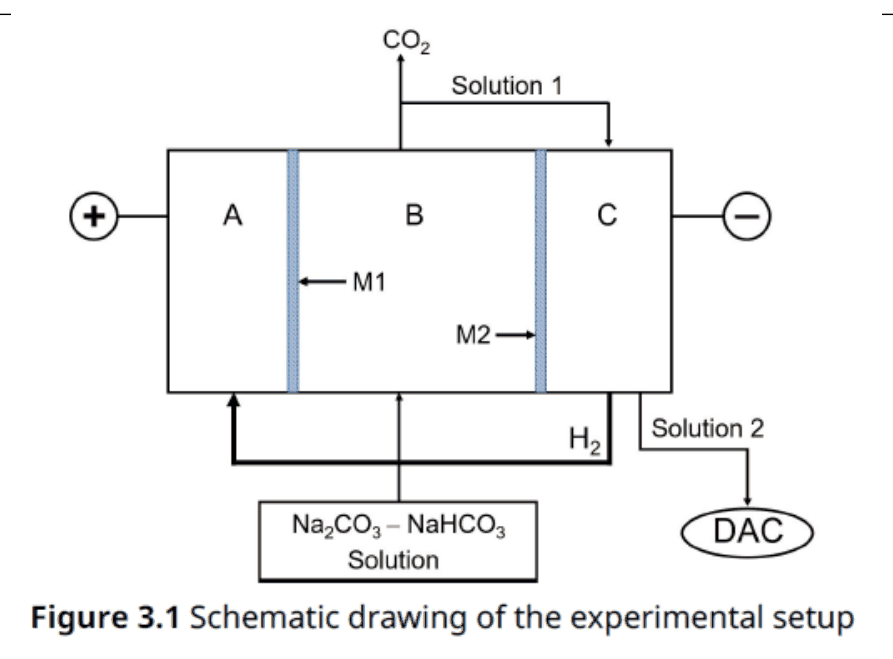
Figure 3.1 Schematic drawing of the experimental setup
The electrochemical cell contains three compartments: an anode region (A), an acidifying region (B), and a cathode region (C). They are separated by ion-selective permeable membranes M1 and M2. During the operation, protons produced from \(\ce{H2}\) oxidation at the anode are transported to the acidifying compartment where the spent solution (\(\ce{Na2CO3}\)-\(\ce{NaHCO3}\)) coming from the air contactor is fed. The decreasing pH of the solution leads to the conversions of carbonate to hydrocarbonate (reaction 1) and hydrocarbonate to carbonic acid (reaction 2). When the solution is saturated by dissolved \(\ce{CO2}\) (solubility: \(0.033\ \mathrm{mol\,L^{-1}}\)), a further pH decrease leads to the release of \(\ce{CO2}\) gas (reaction 3). \(\ce{H2}\) generated in the cathode is introduced to the anode and the solution from the cathode can be reused as a DAC absorbent.
3.3 Write the electrode reactions in the anode (A) and the cathode (C) respectively.
3.4 Write the balanced equations for the reactions 1–3 in the acidifying region (B).
3.5 Check all that correctly describe the movement of cations during the system operation.
(a) \(\ce{H+}\) ions permeate through M1 from A to B.
(b) \(\ce{H+}\) ions permeate through M2 from B to C.
(c) \(\ce{Na+}\) ions permeate through M1 from B to A.
(d) \(\ce{Na+}\) ions permeate through M2 from B to C.
(e) Both \(\ce{H+}\) and \(\ce{Na+}\) ions can permeate through M1and M2.
The cell works at a steady state when the current passing through the cell is \(2.00\ \mathrm{A}\) and the flow rate of the solution (\(0.050\ \mathrm{mol\,L^{-1}}\ \ce{Na2CO3}\) - \(0.10\ \mathrm{mol\,L^{-1}}\ \ce{NaHCO3}\)) into the region B is \(10.0\ \mathrm{mL\,min^{-1}}\). The pH in the anode compartment is maintained at 1 in the steady state.
3.6 Calculate the generation rate of \(\ce{CO2}\) gas (in \(\mathrm{mmol\,min^{-1}}\)).
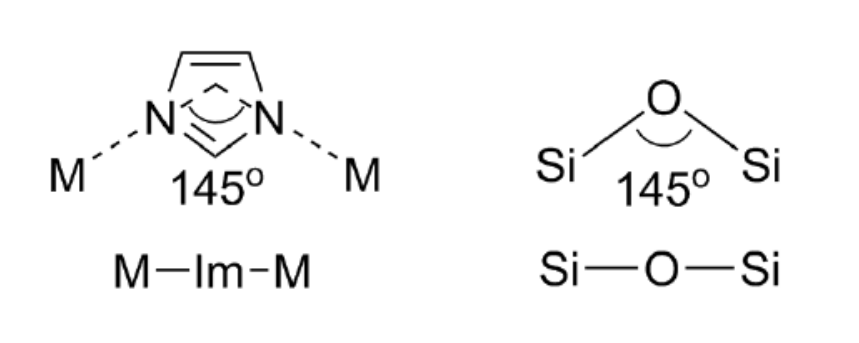
Zeolitic imidazolate frameworks (ZIFs), a sub-class of metal–organic frameworks (MOFs) are promising materials for the capture and utilization of \(\ce{CO2}\). The structures of ZIFs resemble zeolites. They form 3D frameworks with tetrahedrally coordinated metal ions (e.g. \(\ce{Zn^2+}\), \(\ce{Co^2+}\)) bridged by imidazolate (\(\ce{Im-}\)) and its derivatives. As the conjugated base of imidazole (\(\ce{HIm}\)), imidazolate anion binds to metal cations (M) by its two N atoms. The fact that the \(\ce{M-Im-M}\) angle is similar to the \(\ce{Si-O-Si}\) angle (145°) preferred in zeolites (as shown below) has led to the synthesis of a large number of ZIFs with zeolite-type tetrahedral topologies.
ZIF-8 is one of the representative ZIFs, which adopts a sodalite framework (SOD), as shown in Figure 3.2. ZIF-8 was firstly synthesized by Chinese scientists Xiao-Ming Chen et al. (they named it as MAF-4) by the reaction of \(\ce{Zn^2+}\) with 2-methylimidazole (\(\ce{CH3(C3N2H3)}\), \(\ce{HmIm}\)). It crystalizes in the cubic system with the cell parameter \(a=1.632\ \mathrm{nm}\) for a solvent-free phase with the effective pore diameter (shown by the inside virtual sphere in Figure 3.2d) of \(1.16\ \mathrm{nm}\).
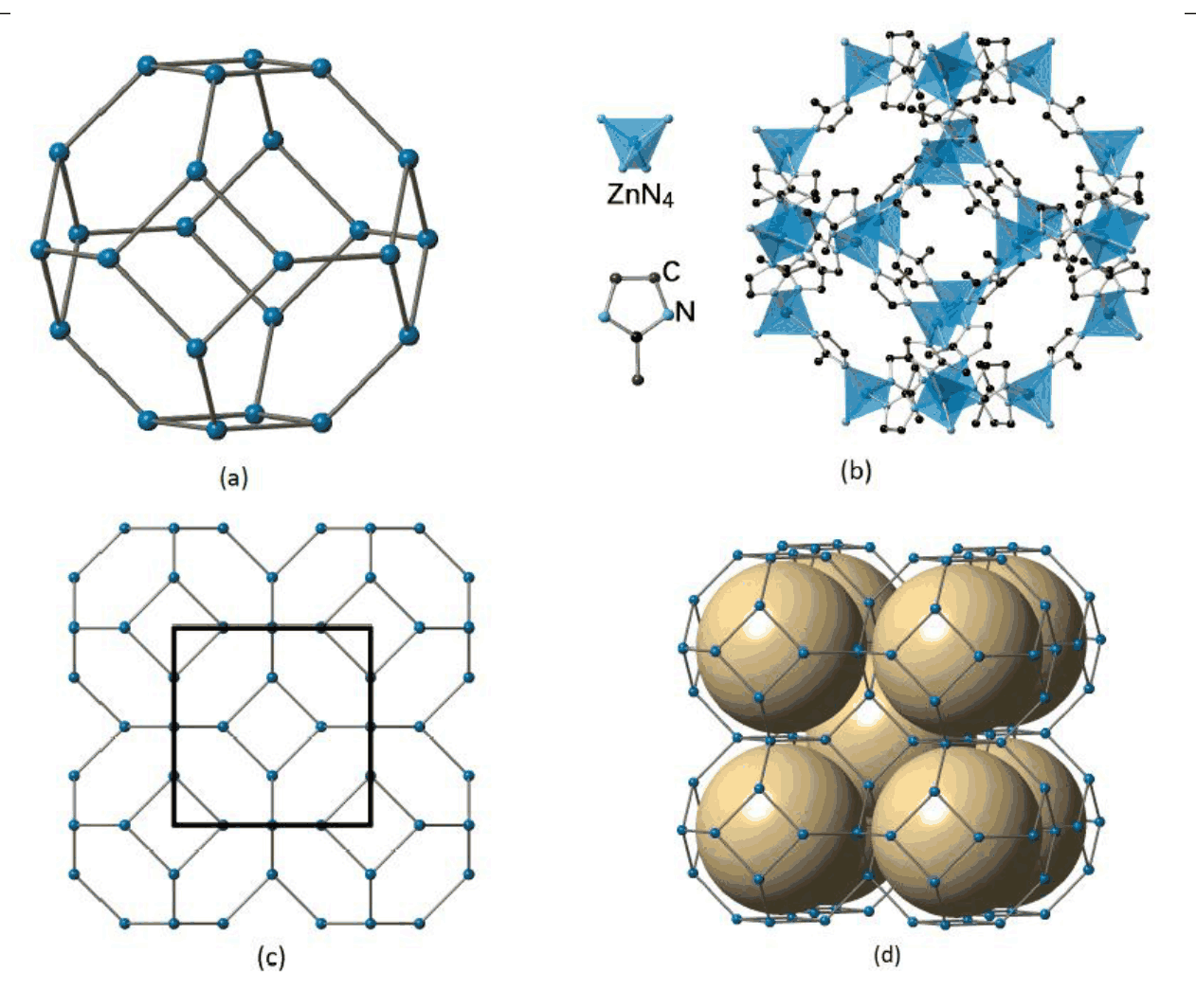
Figure 3.2 Topology of SOD and structure of ZIF-8
(a) Topology of SOD cage;
(b) SOD cage in ZIF-8 formed by \(\ce{Zn^2+}\) (at the centers of the tetrahedra) and imidazolate (H atoms are omitted for clarity);
(c) Framework of SOD with the unit cell shown by the square box;
(d) Some of the pores are highlighted by virtual spheres in ZIF-8.
Note: .If you wish, you may use the symbol "HmIm" and "mIm" representing 2-methylimidazole and 2-methylimidazolate respectively in solving the following questions.
3.7 Write the formula of the single sodalite cage.
3.8 Write the composition of the unit cell of ZIF-8.
3.9 Calculate the inner surface area (\(S\)) of the pores (modeled by the virtual spheres) of 1 g ZIF-8 (in \(\mathrm{m^2}\)). If you failed to get the composition of the unit cell, use 3500 as the formula weight of the unit cell.
3.10 Calculate the porosity \(R\) of ZIF-8 (\(R\) is the ratio of pore volume to the actual volume of the material) and the pore volume of 1 g ZIF-8 (\(V_p\), in \(\mathrm{cm^3}\)).
ZIF-8 can also act as a catalyst to promote the conversion of \(\ce{CO2}\) to high value-added chemicals. One of the most promising routes for \(\ce{CO2}\) fixation is the preparation of cyclic carbonates via \(\ce{CO2}\) cycloaddition. An example is shown as below:
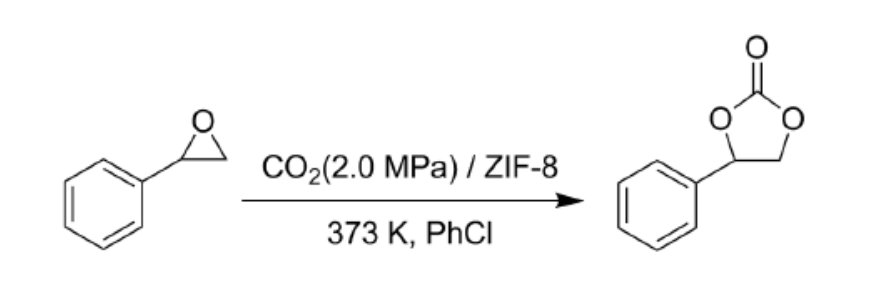
A mechanism of catalytic conversion of \(\ce{CO2}\) to cyclic carbonate over ZIF-8 catalyst is proposed:
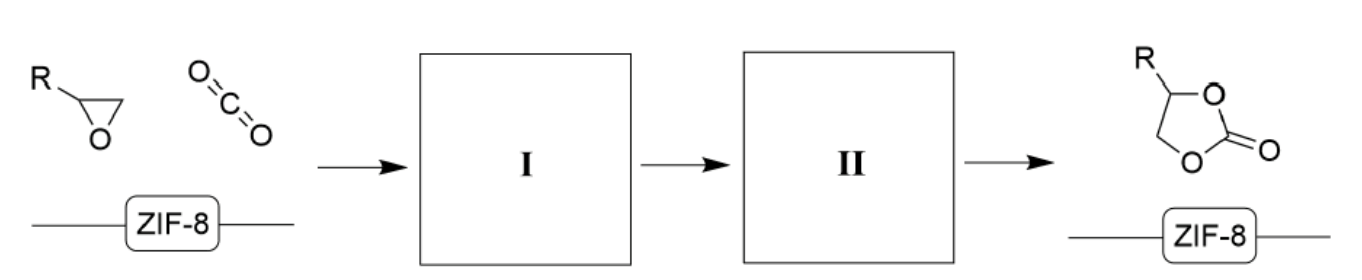
3.11 If ZIF-8 provides acid sites in the above catalytic process, complete the mechanism by choosing the reasonable intermediates from the following species:
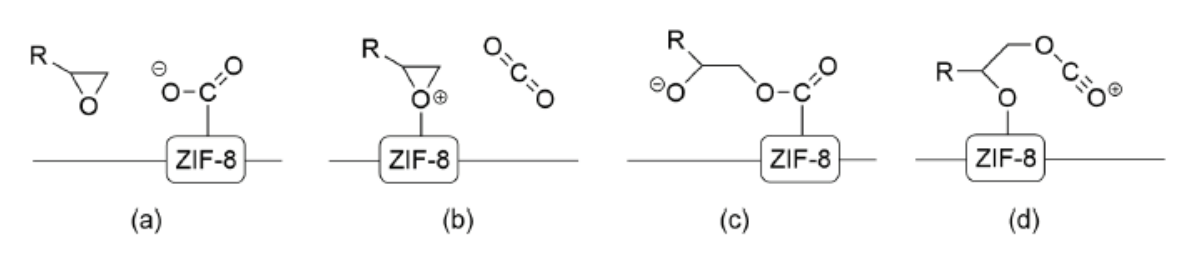
Choose the intermediates corresponding to I and II respectively.
ZIF-8 shows a relatively high thermal stability. However, a recent study revealed that its structure would be destroyed if applied in a wet acidic environment. The co-existence of \(\ce{CO2}\) and \(\ce{H2O}\) with ZIF-8 resulted in the formation of \(\ce{ZnCO3}\).
3.12 Write the balanced equation of ZIF-8 with \(\ce{CO2}\) and \(\ce{H2O}\).
Official English text of the problem.
Answers
-
3.1 A: calcium carbonate, \(\ce{CaCO3}\),
[Ca+2].[O-]C(=O)[O-]. B: calcium oxide, \(\ce{CaO}\),[Ca+2].[O-2]. -
3.2 The principal reactions are: \[ \begin{aligned} \text{Step 1:}\quad& \ce{CO2 + 2NaOH -> Na2CO3 + H2O}\\ &\ce{Na2CO3 + CO2 + H2O -> 2NaHCO3}\\[2pt] \text{Step 2:}\quad& \ce{Na2CO3 + Ca(OH)2 -> CaCO3 v + 2NaOH}\\ &\ce{NaHCO3 + Ca(OH)2 -> CaCO3 v + NaOH + H2O}\\[2pt] \text{Step 3:}\quad& \ce{CaCO3 -> CaO + CO2 ^} \end{aligned} \] Equivalent net reactions and the final hydration are included in the solution.
-
3.3 \[ \begin{aligned} \text{Anode:}\quad&\ce{H2 -> 2H+ + 2e-}\\ \text{Cathode:}\quad&\ce{2H2O + 2e- -> H2 + 2OH-} \end{aligned} \]
-
3.4 \[ \begin{aligned} (1)\quad&\ce{CO3^2- + H+ -> HCO3-}\\ (2)\quad&\ce{HCO3- + H+ -> H2CO3}\\ (3)\quad&\ce{H2CO3 -> CO2(g) + H2O} \end{aligned} \]
-
3.5 (a) and (d) under the intended ideal transport model.
-
3.6 \(\boxed{\dot n_{\ce{CO2(g)}}\approx0.41\ \mathrm{mmol\,min^{-1}}}\), with an unrounded stoichiometric result of \(0.4137\ \mathrm{mmol\,min^{-1}}\).
-
3.7 One geometric cage contains \(\boxed{\ce{[Zn24(C4H5N2)36]^{12+}}}\), conventionally written \(\ce{[Zn24(mIm)36]^{12+}}\).
-
3.8 \(\boxed{\ce{Zn12(C4H5N2)24}}\), or \(\ce{Zn12C96H120N48}\), per unit cell.
-
3.9 \(\boxed{S=1.86\times10^3\ \mathrm{m^2}}\) for 1 g.
-
3.10 \(\boxed{R=0.376=37.6\%}\) and \(\boxed{V_p=0.360\ \mathrm{cm^3}}\) for 1 g.
-
3.11 \(\boxed{\mathrm{I}=(b),\qquad \mathrm{II}=(d)}\). Names and schematic SMILES are given below.
-
3.12 \[ \boxed{\ce{Zn(C4H5N2)2 + CO2 + H2O -> ZnCO3 + 2C4H6N2}} \] The released organic compound is 2-methylimidazole,
Cc1ncc[nH]1.
Solution
The following names and SMILES identify the species used throughout the equations. Dot-separated SMILES for salts specify their constituent ions; they do not describe the crystal lattice.
| Species | SMILES |
|---|---|
| Carbon dioxide, \(\ce{CO2}\) | O=C=O |
| Water, \(\ce{H2O}\) | O |
| Sodium hydroxide, \(\ce{NaOH}\) | [Na+].[OH-] |
| Sodium carbonate, \(\ce{Na2CO3}\) | [Na+].[Na+].[O-]C(=O)[O-] |
| Sodium hydrogencarbonate, \(\ce{NaHCO3}\) | [Na+].O=C(O)[O-] |
| Calcium hydroxide, \(\ce{Ca(OH)2}\) | [Ca+2].[OH-].[OH-] |
| Calcium carbonate, \(\ce{CaCO3}\) | [Ca+2].[O-]C(=O)[O-] |
| Calcium oxide, \(\ce{CaO}\) | [Ca+2].[O-2] |
| Hydrogen, \(\ce{H2}\) | [H][H] |
| Proton, \(\ce{H+}\) | [H+] |
| Hydroxide ion, \(\ce{OH-}\) | [OH-] |
| Carbonate ion, \(\ce{CO3^2-}\) | [O-]C(=O)[O-] |
| Hydrogencarbonate ion, \(\ce{HCO3-}\) | O=C(O)[O-] |
| Carbonic acid, \(\ce{H2CO3}\) | O=C(O)O |
| Sodium ion, \(\ce{Na+}\) | [Na+] |
| Zinc(II) ion, \(\ce{Zn^2+}\) | [Zn+2] |
| 2-Methylimidazolate, \(\ce{C4H5N2-}\), abbreviated \(\ce{mIm-}\) | Cc1ncc[n-]1 |
| 2-Methylimidazole, \(\ce{C4H6N2}\), abbreviated \(\ce{HmIm}\) | Cc1ncc[nH]1 |
| Zinc carbonate, \(\ce{ZnCO3}\) | [Zn+2].[O-]C(=O)[O-] |
3.1
The precipitate contains calcium supplied by calcium hydroxide and carbonate obtained from absorbed carbon dioxide. Thus A is calcium carbonate, \(\ce{CaCO3}\).
Its thermal decomposition releases carbon dioxide and leaves calcium oxide, \(\ce{CaO}\), as B. Hydration of this oxide regenerates calcium hydroxide.
3.2
At pH 10, \[ \frac{[\ce{CO3^2-}]}{[\ce{HCO3-}]} =\frac{K_{\mathrm{a2}}}{[\ce{H+}]} =\frac{4.7\times10^{-11}}{10^{-10}} =0.47. \] Both carbonate and hydrogencarbonate must therefore be included.
In step 1, carbon dioxide initially reacts with strongly alkaline solution: \[ \ce{CO2 + 2NaOH -> Na2CO3 + H2O}. \] Further absorption produces hydrogencarbonate: \[ \ce{Na2CO3 + CO2 + H2O -> 2NaHCO3}. \] The corresponding overall equation for hydrogencarbonate formation is \[ \ce{CO2 + NaOH -> NaHCO3}. \]
In step 2, calcium carbonate precipitates, regenerating sodium hydroxide: \[ \ce{Na2CO3 + Ca(OH)2 -> CaCO3(s) + 2NaOH}. \] Hydrogencarbonate also reacts: \[ \ce{NaHCO3 + Ca(OH)2 -> CaCO3(s) + NaOH + H2O}. \] Here hydroxide first removes the hydrogencarbonate proton, \[ \ce{HCO3- + OH- -> CO3^2- + H2O}, \] and the resulting carbonate precipitates with calcium.
For partial regeneration with less calcium hydroxide, an equivalent possible net reaction is \[ \ce{2NaHCO3 + Ca(OH)2 -> CaCO3(s) + Na2CO3 + 2H2O}. \] The remaining sodium carbonate can subsequently undergo the first step-2 reaction.
In step 3, heating causes calcination: \[ \ce{CaCO3(s) -> CaO(s) + CO2(g)}. \]
Finally, the stated hydration closes the calcium cycle: \[ \ce{CaO(s) + H2O -> Ca(OH)2}. \]
3.3
Hydrogen is oxidized at the anode, producing one proton per electron transferred: \[ \boxed{\ce{H2 -> 2H+ + 2e-}}. \]
Water is reduced at the cathode, producing hydrogen for recycling and hydroxide for regeneration of the alkaline absorbent: \[ \boxed{\ce{2H2O + 2e- -> H2 + 2OH-}}. \]
3.4
Successive protonation in B gives: \[ \boxed{\ce{CO3^2- + H+ -> HCO3-}}\qquad(1) \] \[ \boxed{\ce{HCO3- + H+ -> H2CO3}}\qquad(2). \]
Carbonic acid supplies dissolved carbon dioxide; once saturation is reached, carbon dioxide escapes as gas: \[ \boxed{\ce{H2CO3 -> CO2(g) + H2O}}\qquad(3). \]
These reactions represent the acid–base and gas-release processes using the carbonic-acid convention of the problem.
3.5
The productive ion flows are:
- Protons travel through M1 from A to B, providing the acid needed for reactions 1 and 2.
- Sodium ions travel through M2 from B to C, carrying positive charge toward the cathode and balancing the hydroxide generated there.
Thus the intended selections are \[ \boxed{(a)\ \text{and}\ (d)}. \]
3.6
Use \(F=96485\ \mathrm{C\,mol^{-1}}\). The proton-generation rate is \[ \dot n_{\ce{H+}} =\frac{I}{F} =\frac{(2.00\ \mathrm{C\,s^{-1}})(60\ \mathrm{s\,min^{-1}})} {96485\ \mathrm{C\,mol^{-1}}} =1.2437\ \mathrm{mmol\,min^{-1}}. \]
The incoming carbonate and hydrogencarbonate rates are \[ \dot n_{\ce{CO3^2-},\mathrm{in}} =(0.050)(0.0100) =0.500\ \mathrm{mmol\,min^{-1}}, \] \[ \dot n_{\ce{HCO3-},\mathrm{in}} =(0.10)(0.0100) =1.00\ \mathrm{mmol\,min^{-1}}. \]
First, approximately \(0.500\ \mathrm{mmol\,min^{-1}}\) of protons converts carbonate to hydrogencarbonate. The remaining proton supply converts hydrogencarbonate into the carbonic-acid/dissolved-carbon-dioxide pool: \[ \dot n_{\text{converted to }\ce{CO2}} =1.2437-0.500 =0.7437\ \mathrm{mmol\,min^{-1}}. \]
The saturated liquid leaving B carries dissolved carbon dioxide at \[ \dot n_{\ce{CO2(aq)},\mathrm{out}} =(0.033\ \mathrm{mol\,L^{-1}}) (0.0100\ \mathrm{L\,min^{-1}}) =0.330\ \mathrm{mmol\,min^{-1}}. \]
Consequently, \[ \begin{aligned} \dot n_{\ce{CO2(g)}} &=0.7437-0.330\\ &=0.4137\ \mathrm{mmol\,min^{-1}}. \end{aligned} \] Thus, to sensible precision, \[ \boxed{\dot n_{\ce{CO2(g)}}\approx0.41\ \mathrm{mmol\,min^{-1}}}. \]
As a consistency check, the residual hydrogencarbonate rate is \[ 0.500+1.00-0.7437=0.7563\ \mathrm{mmol\,min^{-1}}, \] corresponding to about \(0.0756\ \mathrm{mol\,L^{-1}}\). The supplied acid constant then gives \[ [\ce{H+}]_{\mathrm B} \approx K_{\mathrm{a1}}\frac{0.033}{0.0756} =1.96\times10^{-7}\ \mathrm{mol\,L^{-1}}, \] or \(\mathrm{pH}_{\mathrm B}\approx6.71\). At this pH, \[ \frac{[\ce{CO3^2-}]}{[\ce{HCO3-}]} \approx2.4\times10^{-4}, \] so neglecting residual carbonate is justified. The specified pH 1 pertains to the anode compartment A.
3.7
The sodalite cage is a truncated octahedron with six quadrilateral faces and eight hexagonal faces. Every edge belongs to two faces, giving \[ E=\frac{6(4)+8(6)}{2}=36. \] Three cage edges meet at each vertex, so \[ V=\frac{2E}{3}=24. \]
There is one zinc ion at each vertex and one 2-methylimidazolate linker on each edge. Therefore the geometric cage contains \[ \boxed{\ce{[Zn24(C4H5N2)36]^{12+}}} \] or \(\ce{[Zn24(mIm)36]^{12+}}\).
This is a count of the atoms and linkers defining one cage within the extended framework. Each zinc has three connections along that cage and a fourth connection extending into the surrounding network. If only the counted constituents were treated as a separated fragment, their formal charge would be \(24(2)-36=+12\); the cage is not an isolated neutral molecule.
The constituent-ion SMILES are [Zn+2] and Cc1ncc[n-]1. Their periodic Zn–N coordination and tetrahedral geometry are specified by the framework description, rather than by a disconnected molecular SMILES.
3.8
The cubic unit cell contains two equivalent cage centers: \[ 8\left(\frac18\right)+1=2. \]
In the space-filling SOD arrangement, each zinc vertex belongs to four cages, and each linker edge belongs to three cages. Thus the unit-cell contents are \[ N_{\mathrm{Zn}}=\frac{2(24)}{4}=12, \qquad N_{\mathrm{mIm}}=\frac{2(36)}{3}=24. \]
Hence \[ \boxed{\ce{Zn12(C4H5N2)24}=\ce{Zn12C96H120N48}}. \]
The empirical formula is \(\ce{Zn(C4H5N2)2}\). Its ionic-composition SMILES is [Zn+2].Cc1ncc[n-]1.Cc1ncc[n-]1; this string does not encode the periodic coordination bonds.
3.9
Using standard atomic masses \(C=12.01\), \(H=1.008\), \(N=14.01\), and \(Zn=65.38\), \[ M_{\mathrm{mIm}} =4(12.01)+5(1.008)+2(14.01) =81.10\ \mathrm{g\,mol^{-1}}. \] The molar mass of unit cells is therefore \[ M_{\mathrm{cell}} =12(65.38)+24(81.10) =2730.96\ \mathrm{g\,mol^{-1}}. \]
Each cell contains two spherical pores. With \[ N_{\mathrm A}=6.02214076\times10^{23}\ \mathrm{mol^{-1}}, \] the number of pores in 1 g is \[ N_{\mathrm{pores}} =\frac{(1.00\ \mathrm g)(2N_{\mathrm A})}{M_{\mathrm{cell}}} =4.4103\times10^{20}. \]
The pore radius is \[ r=\frac{1.16}{2}=0.580\ \mathrm{nm}. \] Thus \[ \begin{aligned} S &=N_{\mathrm{pores}}\,4\pi r^2\\ &=(4.4103\times10^{20}) 4\pi(0.580\times10^{-9}\ \mathrm m)^2\\ &=1.8644\times10^3\ \mathrm{m^2}. \end{aligned} \] Therefore, \[ \boxed{S=1.86\times10^3\ \mathrm{m^2}\text{ for 1 g}}. \]
3.10
The volume of one spherical pore is \[ V_{\mathrm{sphere}} =\frac43\pi(0.580)^3 =0.817283\ \mathrm{nm^3}. \]
The unit-cell volume is \[ V_{\mathrm{cell}}=a^3=(1.632)^3 =4.346708\ \mathrm{nm^3}. \]
Since there are two pores per cell, \[ R=\frac{2V_{\mathrm{sphere}}}{V_{\mathrm{cell}}} =\frac{2(0.817283)}{4.346708} =0.376047. \] Thus \[ \boxed{R=0.376=37.6\%}. \]
Using \(1\ \mathrm{nm^3}=10^{-21}\ \mathrm{cm^3}\), the pore volume in 1 g is \[ \begin{aligned} V_p &=N_{\mathrm{pores}}V_{\mathrm{sphere}}\\ &=(4.4103\times10^{20}) (0.817283\times10^{-21}\ \mathrm{cm^3})\\ &=0.36044\ \mathrm{cm^3}. \end{aligned} \] Therefore, \[ \boxed{V_p=0.360\ \mathrm{cm^3}\text{ for 1 g}}. \]
3.11
A Lewis acid site accepts an electron pair from the epoxide oxygen. This activates the epoxide toward ring opening, corresponding to intermediate (b).
An oxygen atom of carbon dioxide then attacks the terminal epoxide carbon shown in the scheme. The attacked carbon–epoxide-oxygen bond breaks, giving the ring-opened, catalyst-bound intermediate (d).
Finally, the original epoxide oxygen attacks the carbon dioxide-derived carbon. Ring closure and release from the acid site produce the five-membered cyclic carbonate.
Hence \[ \boxed{\mathrm I=(b),\qquad \mathrm{II}=(d)}. \]
For precise schematic SMILES, let [*:1] denote the catalyst acid site and [*:2] denote the substituent R:
| Species | Name | Schematic SMILES |
|---|---|---|
| Starting epoxide | R-substituted oxirane | [*:2]C1CO1 |
| I, option (b) | Acid-site-bound epoxide, drawn as an oxonium adduct | [*:1][O+]1C([*:2])C1 |
| II, option (d) | Catalyst-bound, ring-opened alkoxycarbonyl cation | [*:1]OC([*:2])COC#[O+] |
| Product | 4-R-1,3-dioxolan-2-one | O=C1OCC([*:2])O1 |
For II, the carbonyl-cation resonance form can equivalently be written [*:1]OC([*:2])CO[C+]=O.
These SMILES encode the schematic connectivity and formal charges. The wildcard for the catalyst does not specify a particular atom, and the drawings do not fully specify the surface coordination geometry. Electron-pair donation, bond cleavage, and ring closure are the electron-flow steps described above.
In the illustrated phenyl-substituted example, the substrate is styrene oxide (2-phenyloxirane), c1ccccc1C1CO1, and the product is 4-phenyl-1,3-dioxolan-2-one, O=C1OCC(c2ccccc2)O1. No absolute stereochemistry is specified in the problem.
3.12
Each neutral framework formula unit contains one zinc ion and two 2-methylimidazolate anions. Carbon dioxide and water supply the carbonate group and the two protons needed to release two neutral 2-methylimidazole molecules.
Per formula unit, \[ \boxed{\ce{Zn(C4H5N2)2 + CO2 + H2O -> ZnCO3 + 2C4H6N2}}. \]
Equivalently, using the permitted ligand abbreviations, \[ \boxed{\ce{Zn(mIm)2 + CO2 + H2O -> ZnCO3 + 2HmIm}}. \]
Zinc carbonate precipitates, while protonation of the coordinating ligands breaks the Zn–N framework connections.
The solution was checked against the official solution. Where this solution differs from the official solution, the official solution contains an error or a misprint.
IChO 2022 · Theorieaufgabe 3
Abscheidung und Umwandlung von Kohlenstoffdioxid
Der Klimawandel ist eine der größten globalen Herausforderungen unserer Zeit. Der Anstieg der \(\ce{CO2}\)-Konzentration in der Atmosphäre gilt als Hauptursache der globalen Erwärmung. Die Erforschung der Abscheidung und Umwandlung von \(\ce{CO2}\) hat beträchtliche Aufmerksamkeit auf sich gezogen.
Die direkte Abscheidung aus der Luft (Direct Air Capture, DAC), bei der \(\ce{CO2}\) unmittelbar aus der Umgebungsluft entnommen werden soll, ist eine vielversprechende Technologie. Das herkömmliche DAC-Verfahren ist die Nasswäsche mit alkalischen Hydroxidlösungen (üblicherweise \(\ce{NaOH}\)), bei der \(\ce{CO2}\) aus der Luft bis zu einem pH-Wert von ≈ 10 absorbiert wird (Schritt 1). Das verbrauchte Sorptionsmittel wird durch Zugabe von Calciumhydroxid zum System regeneriert (Schritt 2). Der in Schritt 2 erhaltene weiße Niederschlag A zersetzt sich bei \(700\,^\circ\mathrm{C}\), wobei \(\ce{CO2}\) und eine weitere weiße Verbindung B entstehen (Schritt 3). Schließlich kann durch Hydratisierung von B Calciumhydroxid erzeugt werden. Dieses Verfahren ist sehr energieaufwendig. (\(\ce{H2CO3}\): \(K_{\mathrm{a1}}=4.5\times10^{-7}\), \(K_{\mathrm{a2}}=4.7\times10^{-11}\)).
3.1 Geben Sie die Formeln von A bzw. B an.
3.2 Geben Sie die ausgeglichenen Gleichungen aller möglichen Reaktionen in den Schritten 1–3 an. Als Sorptionsmittel wird eine \(\ce{NaOH}\)-Lösung verwendet.
Kürzlich wurde ein elektrochemisches Verfahren zur Regenerierung der alkalischen Lösung bei der Nasswäsche für DAC-Anwendungen entwickelt, mit dem reines \(\ce{CO2}\)-Gas zurückgewonnen werden konnte, das sich zur Speicherung oder Nutzung eignet. Das Verfahren beruht auf einem elektrochemischen System mit \(\ce{H2}\)-Rückführung (HRES), wie in Abbildung 3.1 gezeigt.
Abbildung 3.1 Schematische Darstellung des Versuchsaufbaus
Die elektrochemische Zelle enthält drei Kompartimente: einen Anodenraum (A), einen Ansäuerungsraum (B) und einen Kathodenraum (C). Sie sind durch ionenselektiv durchlässige Membranen M1 und M2 voneinander getrennt. Während des Betriebs werden die bei der Oxidation von \(\ce{H2}\) an der Anode erzeugten Protonen in den Ansäuerungsraum transportiert, dem die verbrauchte Lösung (\(\ce{Na2CO3}\)-\(\ce{NaHCO3}\)) aus dem Luftkontaktor zugeführt wird. Der sinkende pH-Wert der Lösung führt zur Umwandlung von Carbonat in Hydrogencarbonat (Reaktion 1) und von Hydrogencarbonat in Kohlensäure (Reaktion 2). Wenn die Lösung mit gelöstem \(\ce{CO2}\) gesättigt ist (Löslichkeit: \(0.033\ \mathrm{mol\,L^{-1}}\)), führt eine weitere Absenkung des pH-Werts zur Freisetzung von \(\ce{CO2}\)-Gas (Reaktion 3). Das an der Kathode erzeugte \(\ce{H2}\) wird der Anode zugeführt, und die Lösung aus dem Kathodenraum kann als DAC-Absorptionsmittel wiederverwendet werden.
3.3 Geben Sie die Elektrodenreaktionen an der Anode (A) bzw. an der Kathode (C) an.
3.4 Geben Sie die ausgeglichenen Gleichungen für die Reaktionen 1–3 im Ansäuerungsraum (B) an.
3.5 Kreuzen Sie alle Aussagen an, die die Bewegung der Kationen während des Betriebs des Systems korrekt beschreiben.
(a) \(\ce{H+}\)-Ionen passieren M1 von A nach B.
(b) \(\ce{H+}\)-Ionen passieren M2 von B nach C.
(c) \(\ce{Na+}\)-Ionen passieren M1 von B nach A.
(d) \(\ce{Na+}\)-Ionen passieren M2 von B nach C.
(e) Sowohl \(\ce{H+}\)- als auch \(\ce{Na+}\)-Ionen können M1 und M2 passieren.
Die Zelle arbeitet im stationären Zustand, wenn der durch die Zelle fließende Strom \(2.00\ \mathrm{A}\) und der Volumenstrom der dem Raum B zugeführten Lösung (\(0.050\ \mathrm{mol\,L^{-1}}\ \ce{Na2CO3}\) - \(0.10\ \mathrm{mol\,L^{-1}}\ \ce{NaHCO3}\)) \(10.0\ \mathrm{mL\,min^{-1}}\) betragen. Der pH-Wert im Anodenraum wird im stationären Zustand bei 1 gehalten.
3.6 Berechnen Sie die Bildungsrate von \(\ce{CO2}\)-Gas (in \(\mathrm{mmol\,min^{-1}}\)).
Zeolithische Imidazolatgerüste (ZIFs), eine Unterklasse der metallorganischen Gerüstverbindungen (MOFs), sind vielversprechende Materialien für die Abscheidung und Nutzung von \(\ce{CO2}\). Die Strukturen der ZIFs ähneln denen von Zeolithen. Sie bilden dreidimensionale Gerüste mit tetraedrisch koordinierten Metallionen (z. B. \(\ce{Zn^2+}\), \(\ce{Co^2+}\)), die durch Imidazolat (\(\ce{Im-}\)) und dessen Derivate verbrückt sind. Als konjugierte Base von Imidazol (\(\ce{HIm}\)) bindet das Imidazolat-Anion über seine beiden N-Atome an Metallkationen (M). Die Tatsache, dass der \(\ce{M-Im-M}\)-Winkel dem in Zeolithen bevorzugten \(\ce{Si-O-Si}\)-Winkel (145°) ähnelt (wie unten gezeigt), hat zur Synthese einer großen Zahl von ZIFs mit tetraedrischen Topologien des Zeolithtyps geführt.
ZIF-8 ist eines der repräsentativen ZIFs und besitzt ein Sodalithgerüst (SOD), wie in Abbildung 3.2 gezeigt. ZIF-8 wurde erstmals von den chinesischen Wissenschaftlern Xiao-Ming Chen et al. (die es MAF-4 nannten) durch die Reaktion von \(\ce{Zn^2+}\) mit 2-Methylimidazol (\(\ce{CH3(C3N2H3)}\), \(\ce{HmIm}\)) synthetisiert. Es kristallisiert im kubischen System mit dem Gitterparameter \(a=1.632\ \mathrm{nm}\) für eine lösungsmittelfreie Phase und einem effektiven Porendurchmesser (dargestellt durch die innen liegende virtuelle Kugel in Abbildung 3.2d) von \(1.16\ \mathrm{nm}\).
Abbildung 3.2 Topologie von SOD und Struktur von ZIF-8
(a) Topologie des SOD-Käfigs;
(b) SOD-Käfig in ZIF-8, gebildet aus \(\ce{Zn^2+}\) (in den Zentren der Tetraeder) und Imidazolat (H-Atome sind der Übersichtlichkeit halber weggelassen);
(c) SOD-Gerüst mit der durch den quadratischen Rahmen dargestellten Elementarzelle;
(d) Einige der Poren in ZIF-8 sind durch virtuelle Kugeln hervorgehoben.
Hinweis: Wenn Sie möchten, können Sie bei der Bearbeitung der folgenden Fragen die Symbole „HmIm“ und „mIm“ für 2-Methylimidazol bzw. 2-Methylimidazolat verwenden.
3.7 Geben Sie die Formel eines einzelnen Sodalithkäfigs an.
3.8 Geben Sie die Zusammensetzung der Elementarzelle von ZIF-8 an.
3.9 Berechnen Sie die innere Oberfläche (\(S\)) der Poren (modelliert durch die virtuellen Kugeln) von 1 g ZIF-8 (in \(\mathrm{m^2}\)). Falls Sie die Zusammensetzung der Elementarzelle nicht bestimmen konnten, verwenden Sie 3500 als Formelmasse der Elementarzelle.
3.10 Berechnen Sie die Porosität \(R\) von ZIF-8 (\(R\) ist das Verhältnis des Porenvolumens zum tatsächlichen Volumen des Materials) und das Porenvolumen von 1 g ZIF-8 (\(V_p\), in \(\mathrm{cm^3}\)).
ZIF-8 kann auch als Katalysator die Umwandlung von \(\ce{CO2}\) in Chemikalien mit hoher Wertschöpfung fördern. Einer der vielversprechendsten Wege zur \(\ce{CO2}\)-Fixierung ist die Herstellung cyclischer Carbonate durch \(\ce{CO2}\)-Cycloaddition. Ein Beispiel ist im Folgenden gezeigt:
Für die katalytische Umwandlung von \(\ce{CO2}\) in ein cyclisches Carbonat am ZIF-8-Katalysator wird folgender Mechanismus vorgeschlagen:
3.11 Wenn ZIF-8 im obigen katalytischen Prozess Säurezentren bereitstellt, vervollständigen Sie den Mechanismus, indem Sie die plausiblen Zwischenprodukte aus den folgenden Spezies auswählen:
Wählen Sie die Zwischenprodukte aus, die I bzw. II entsprechen.
ZIF-8 weist eine relativ hohe thermische Stabilität auf. Eine kürzlich durchgeführte Studie ergab jedoch, dass seine Struktur bei Verwendung in einer feuchten, sauren Umgebung zerstört würde. Die gleichzeitige Anwesenheit von \(\ce{CO2}\) und \(\ce{H2O}\) bei ZIF-8 führte zur Bildung von \(\ce{ZnCO3}\).
3.12 Geben Sie die ausgeglichene Reaktionsgleichung von ZIF-8 mit \(\ce{CO2}\) und \(\ce{H2O}\) an.
Aufgabentext aus dem offiziellen englischen Text übersetzt.
Antworten
-
3.1 A: Calciumcarbonat, \(\ce{CaCO3}\),
[Ca+2].[O-]C(=O)[O-]. B: Calciumoxid, \(\ce{CaO}\),[Ca+2].[O-2]. -
3.2 Die Hauptreaktionen sind: \[ \begin{aligned} \text{Schritt 1:}\quad& \ce{CO2 + 2NaOH -> Na2CO3 + H2O}\\ &\ce{Na2CO3 + CO2 + H2O -> 2NaHCO3}\\[2pt] \text{Schritt 2:}\quad& \ce{Na2CO3 + Ca(OH)2 -> CaCO3 v + 2NaOH}\\ &\ce{NaHCO3 + Ca(OH)2 -> CaCO3 v + NaOH + H2O}\\[2pt] \text{Schritt 3:}\quad& \ce{CaCO3 -> CaO + CO2 ^} \end{aligned} \] Äquivalente Nettoreaktionen und die abschließende Hydratisierung sind in der Lösung enthalten.
-
3.3 \[ \begin{aligned} \text{Anode:}\quad&\ce{H2 -> 2H+ + 2e-}\\ \text{Kathode:}\quad&\ce{2H2O + 2e- -> H2 + 2OH-} \end{aligned} \]
-
3.4 \[ \begin{aligned} (1)\quad&\ce{CO3^2- + H+ -> HCO3-}\\ (2)\quad&\ce{HCO3- + H+ -> H2CO3}\\ (3)\quad&\ce{H2CO3 -> CO2(g) + H2O} \end{aligned} \]
-
3.5 (a) und (d) im vorgesehenen idealen Transportmodell.
-
3.6 \(\boxed{\dot n_{\ce{CO2(g)}}\approx0.41\ \mathrm{mmol\,min^{-1}}}\), mit einem ungerundeten stöchiometrischen Ergebnis von \(0.4137\ \mathrm{mmol\,min^{-1}}\).
-
3.7 Ein geometrischer Käfig enthält \(\boxed{\ce{[Zn24(C4H5N2)36]^{12+}}}\), üblicherweise als \(\ce{[Zn24(mIm)36]^{12+}}\) geschrieben.
-
3.8 \(\boxed{\ce{Zn12(C4H5N2)24}}\) oder \(\ce{Zn12C96H120N48}\) pro Elementarzelle.
-
3.9 \(\boxed{S=1.86\times10^3\ \mathrm{m^2}}\) für 1 g.
-
3.10 \(\boxed{R=0.376=37.6\%}\) und \(\boxed{V_p=0.360\ \mathrm{cm^3}}\) für 1 g.
-
3.11 \(\boxed{\mathrm{I}=(b),\qquad \mathrm{II}=(d)}\). Namen und schematische SMILES sind unten angegeben.
-
3.12 \[ \boxed{\ce{Zn(C4H5N2)2 + CO2 + H2O -> ZnCO3 + 2C4H6N2}} \] Die freigesetzte organische Verbindung ist 2-Methylimidazol,
Cc1ncc[nH]1.
Lösung
Die folgenden Namen und SMILES kennzeichnen die in den Gleichungen verwendeten Spezies. Durch Punkte getrennte SMILES für Salze geben deren einzelne Ionen an; sie beschreiben nicht das Kristallgitter.
| Spezies | SMILES |
|---|---|
| Kohlenstoffdioxid, \(\ce{CO2}\) | O=C=O |
| Wasser, \(\ce{H2O}\) | O |
| Natriumhydroxid, \(\ce{NaOH}\) | [Na+].[OH-] |
| Natriumcarbonat, \(\ce{Na2CO3}\) | [Na+].[Na+].[O-]C(=O)[O-] |
| Natriumhydrogencarbonat, \(\ce{NaHCO3}\) | [Na+].O=C(O)[O-] |
| Calciumhydroxid, \(\ce{Ca(OH)2}\) | [Ca+2].[OH-].[OH-] |
| Calciumcarbonat, \(\ce{CaCO3}\) | [Ca+2].[O-]C(=O)[O-] |
| Calciumoxid, \(\ce{CaO}\) | [Ca+2].[O-2] |
| Wasserstoff, \(\ce{H2}\) | [H][H] |
| Proton, \(\ce{H+}\) | [H+] |
| Hydroxid-Ion, \(\ce{OH-}\) | [OH-] |
| Carbonat-Ion, \(\ce{CO3^2-}\) | [O-]C(=O)[O-] |
| Hydrogencarbonat-Ion, \(\ce{HCO3-}\) | O=C(O)[O-] |
| Kohlensäure, \(\ce{H2CO3}\) | O=C(O)O |
| Natrium-Ion, \(\ce{Na+}\) | [Na+] |
| Zink(II)-Ion, \(\ce{Zn^2+}\) | [Zn+2] |
| 2-Methylimidazolat, \(\ce{C4H5N2-}\), abgekürzt \(\ce{mIm-}\) | Cc1ncc[n-]1 |
| 2-Methylimidazol, \(\ce{C4H6N2}\), abgekürzt \(\ce{HmIm}\) | Cc1ncc[nH]1 |
| Zinkcarbonat, \(\ce{ZnCO3}\) | [Zn+2].[O-]C(=O)[O-] |
3.1
Der Niederschlag enthält Calcium aus dem Calciumhydroxid und Carbonat aus dem absorbierten Kohlenstoffdioxid. Somit ist A Calciumcarbonat, \(\ce{CaCO3}\).
Bei seiner thermischen Zersetzung wird Kohlenstoffdioxid freigesetzt, und Calciumoxid, \(\ce{CaO}\), bleibt als B zurück. Die Hydratisierung dieses Oxids regeneriert Calciumhydroxid.
3.2
Bei pH 10 gilt: \[ \frac{[\ce{CO3^2-}]}{[\ce{HCO3-}]} =\frac{K_{\mathrm{a2}}}{[\ce{H+}]} =\frac{4.7\times10^{-11}}{10^{-10}} =0.47. \] Daher müssen sowohl Carbonat als auch Hydrogencarbonat berücksichtigt werden.
In Schritt 1 reagiert Kohlenstoffdioxid zunächst mit der stark alkalischen Lösung: \[ \ce{CO2 + 2NaOH -> Na2CO3 + H2O}. \] Bei weiterer Absorption entsteht Hydrogencarbonat: \[ \ce{Na2CO3 + CO2 + H2O -> 2NaHCO3}. \] Die entsprechende Gesamtgleichung für die Bildung von Hydrogencarbonat lautet \[ \ce{CO2 + NaOH -> NaHCO3}. \]
In Schritt 2 fällt Calciumcarbonat aus, wobei Natriumhydroxid regeneriert wird: \[ \ce{Na2CO3 + Ca(OH)2 -> CaCO3(s) + 2NaOH}. \] Hydrogencarbonat reagiert ebenfalls: \[ \ce{NaHCO3 + Ca(OH)2 -> CaCO3(s) + NaOH + H2O}. \] Hier entfernt Hydroxid zunächst das Proton des Hydrogencarbonats, \[ \ce{HCO3- + OH- -> CO3^2- + H2O}, \] und das entstandene Carbonat fällt mit Calcium aus.
Für eine teilweise Regenerierung mit weniger Calciumhydroxid ist eine äquivalente mögliche Nettoreaktion \[ \ce{2NaHCO3 + Ca(OH)2 -> CaCO3(s) + Na2CO3 + 2H2O}. \] Das verbleibende Natriumcarbonat kann anschließend die erste Reaktion aus Schritt 2 eingehen.
In Schritt 3 bewirkt Erhitzen die Kalzinierung: \[ \ce{CaCO3(s) -> CaO(s) + CO2(g)}. \]
Schließlich schließt die angegebene Hydratisierung den Calciumkreislauf: \[ \ce{CaO(s) + H2O -> Ca(OH)2}. \]
3.3
Wasserstoff wird an der Anode oxidiert, wobei pro übertragenem Elektron ein Proton entsteht: \[ \boxed{\ce{H2 -> 2H+ + 2e-}}. \]
Wasser wird an der Kathode reduziert, wobei Wasserstoff zur Rückführung und Hydroxid zur Regenerierung des alkalischen Absorptionsmittels entstehen: \[ \boxed{\ce{2H2O + 2e- -> H2 + 2OH-}}. \]
3.4
Die schrittweise Protonierung in B ergibt: \[ \boxed{\ce{CO3^2- + H+ -> HCO3-}}\qquad(1) \] \[ \boxed{\ce{HCO3- + H+ -> H2CO3}}\qquad(2). \]
Kohlensäure liefert gelöstes Kohlenstoffdioxid; sobald die Sättigung erreicht ist, entweicht Kohlenstoffdioxid als Gas: \[ \boxed{\ce{H2CO3 -> CO2(g) + H2O}}\qquad(3). \]
Diese Reaktionen stellen die Säure-Base-Vorgänge und die Gasfreisetzung unter Verwendung der Kohlensäurekonvention der Aufgabe dar.
3.5
Die zum Prozess beitragenden Ionenströme sind:
- Protonen wandern durch M1 von A nach B und liefern die für die Reaktionen 1 und 2 benötigte Säure.
- Natrium-Ionen wandern durch M2 von B nach C, transportieren dabei positive Ladung zur Kathode und gleichen die Ladung des dort erzeugten Hydroxids aus.
Somit sind die vorgesehenen Antworten \[ \boxed{(a)\ \text{und}\ (d)}. \]
3.6
Wir verwenden \(F=96485\ \mathrm{C\,mol^{-1}}\). Die Protonenbildungsrate beträgt \[ \dot n_{\ce{H+}} =\frac{I}{F} =\frac{(2.00\ \mathrm{C\,s^{-1}})(60\ \mathrm{s\,min^{-1}})} {96485\ \mathrm{C\,mol^{-1}}} =1.2437\ \mathrm{mmol\,min^{-1}}. \]
Die zugeführten Stoffmengenströme an Carbonat und Hydrogencarbonat betragen \[ \dot n_{\ce{CO3^2-},\mathrm{in}} =(0.050)(0.0100) =0.500\ \mathrm{mmol\,min^{-1}}, \] \[ \dot n_{\ce{HCO3-},\mathrm{in}} =(0.10)(0.0100) =1.00\ \mathrm{mmol\,min^{-1}}. \]
Zunächst wandelt ein Protonenstrom von ungefähr \(0.500\ \mathrm{mmol\,min^{-1}}\) Carbonat in Hydrogencarbonat um. Die verbleibenden Protonen wandeln Hydrogencarbonat in den gemeinsamen Bestand aus Kohlensäure und gelöstem Kohlenstoffdioxid um: \[ \dot n_{\text{umgewandelt in }\ce{CO2}} =1.2437-0.500 =0.7437\ \mathrm{mmol\,min^{-1}}. \]
Die gesättigte Flüssigkeit, die B verlässt, führt gelöstes Kohlenstoffdioxid mit folgendem Stoffmengenstrom ab: \[ \dot n_{\ce{CO2(aq)},\mathrm{out}} =(0.033\ \mathrm{mol\,L^{-1}}) (0.0100\ \mathrm{L\,min^{-1}}) =0.330\ \mathrm{mmol\,min^{-1}}. \]
Folglich gilt \[ \begin{aligned} \dot n_{\ce{CO2(g)}} &=0.7437-0.330\\ &=0.4137\ \mathrm{mmol\,min^{-1}}. \end{aligned} \] Mit sinnvoller Genauigkeit ergibt sich somit \[ \boxed{\dot n_{\ce{CO2(g)}}\approx0.41\ \mathrm{mmol\,min^{-1}}}. \]
Zur Konsistenzprüfung beträgt der verbleibende Hydrogencarbonatstrom \[ 0.500+1.00-0.7437=0.7563\ \mathrm{mmol\,min^{-1}}, \] was etwa \(0.0756\ \mathrm{mol\,L^{-1}}\) entspricht. Mit der angegebenen Säurekonstante ergibt sich dann \[ [\ce{H+}]_{\mathrm B} \approx K_{\mathrm{a1}}\frac{0.033}{0.0756} =1.96\times10^{-7}\ \mathrm{mol\,L^{-1}}, \] also \(\mathrm{pH}_{\mathrm B}\approx6.71\). Bei diesem pH-Wert gilt \[ \frac{[\ce{CO3^2-}]}{[\ce{HCO3-}]} \approx2.4\times10^{-4}, \] sodass die Vernachlässigung des verbleibenden Carbonats gerechtfertigt ist. Der angegebene pH-Wert 1 bezieht sich auf den Anodenraum A.
3.7
Der Sodalithkäfig ist ein abgestumpftes Oktaeder mit sechs viereckigen und acht sechseckigen Flächen. Jede Kante gehört zu zwei Flächen, sodass gilt \[ E=\frac{6(4)+8(6)}{2}=36. \] An jeder Ecke treffen drei Käfigkanten zusammen, also gilt \[ V=\frac{2E}{3}=24. \]
An jeder Ecke befindet sich ein Zink-Ion und auf jeder Kante ein 2-Methylimidazolat-Linker. Daher enthält der geometrische Käfig \[ \boxed{\ce{[Zn24(C4H5N2)36]^{12+}}} \] oder \(\ce{[Zn24(mIm)36]^{12+}}\).
Dies ist eine Zählung der Atome und Linker, die einen Käfig innerhalb des ausgedehnten Gerüsts definieren. Jedes Zinkatom besitzt drei Verknüpfungen entlang dieses Käfigs und eine vierte Verknüpfung, die in das umgebende Netzwerk hineinreicht. Würden nur die gezählten Bestandteile als abgetrenntes Fragment betrachtet, wäre ihre formale Ladung \(24(2)-36=+12\); der Käfig ist kein isoliertes neutrales Molekül.
Die SMILES der einzelnen Ionen sind [Zn+2] und Cc1ncc[n-]1. Ihre periodische Zn–N-Koordination und tetraedrische Geometrie werden durch die Beschreibung des Gerüsts festgelegt und nicht durch einen molekularen SMILES-Ausdruck mit unverbundenen Bestandteilen.
3.8
Die kubische Elementarzelle enthält zwei äquivalente Käfigzentren: \[ 8\left(\frac18\right)+1=2. \]
In der raumfüllenden SOD-Anordnung gehört jede Zinkecke zu vier Käfigen und jede Linkerkante zu drei Käfigen. Somit enthält die Elementarzelle \[ N_{\mathrm{Zn}}=\frac{2(24)}{4}=12, \qquad N_{\mathrm{mIm}}=\frac{2(36)}{3}=24. \]
Daraus folgt \[ \boxed{\ce{Zn12(C4H5N2)24}=\ce{Zn12C96H120N48}}. \]
Die Verhältnisformel lautet \(\ce{Zn(C4H5N2)2}\). Der SMILES-Ausdruck für ihre ionische Zusammensetzung ist [Zn+2].Cc1ncc[n-]1.Cc1ncc[n-]1; diese Zeichenfolge codiert nicht die periodischen Koordinationsbindungen.
3.9
Mit den Standardatommassen \(C=12.01\), \(H=1.008\), \(N=14.01\) und \(Zn=65.38\) ergibt sich \[ M_{\mathrm{mIm}} =4(12.01)+5(1.008)+2(14.01) =81.10\ \mathrm{g\,mol^{-1}}. \] Die molare Masse der Elementarzellen beträgt daher \[ M_{\mathrm{cell}} =12(65.38)+24(81.10) =2730.96\ \mathrm{g\,mol^{-1}}. \]
Jede Zelle enthält zwei kugelförmige Poren. Mit \[ N_{\mathrm A}=6.02214076\times10^{23}\ \mathrm{mol^{-1}}, \] beträgt die Anzahl der Poren in 1 g \[ N_{\mathrm{pores}} =\frac{(1.00\ \mathrm g)(2N_{\mathrm A})}{M_{\mathrm{cell}}} =4.4103\times10^{20}. \]
Der Porenradius beträgt \[ r=\frac{1.16}{2}=0.580\ \mathrm{nm}. \] Somit gilt \[ \begin{aligned} S &=N_{\mathrm{pores}}\,4\pi r^2\\ &=(4.4103\times10^{20}) 4\pi(0.580\times10^{-9}\ \mathrm m)^2\\ &=1.8644\times10^3\ \mathrm{m^2}. \end{aligned} \] Daher ergibt sich \[ \boxed{S=1.86\times10^3\ \mathrm{m^2}\text{ für 1 g}}. \]
3.10
Das Volumen einer kugelförmigen Pore beträgt \[ V_{\mathrm{sphere}} =\frac43\pi(0.580)^3 =0.817283\ \mathrm{nm^3}. \]
Das Volumen der Elementarzelle beträgt \[ V_{\mathrm{cell}}=a^3=(1.632)^3 =4.346708\ \mathrm{nm^3}. \]
Da jede Zelle zwei Poren enthält, gilt \[ R=\frac{2V_{\mathrm{sphere}}}{V_{\mathrm{cell}}} =\frac{2(0.817283)}{4.346708} =0.376047. \] Somit ergibt sich \[ \boxed{R=0.376=37.6\%}. \]
Mit \(1\ \mathrm{nm^3}=10^{-21}\ \mathrm{cm^3}\) beträgt das Porenvolumen in 1 g \[ \begin{aligned} V_p &=N_{\mathrm{pores}}V_{\mathrm{sphere}}\\ &=(4.4103\times10^{20}) (0.817283\times10^{-21}\ \mathrm{cm^3})\\ &=0.36044\ \mathrm{cm^3}. \end{aligned} \] Daher ergibt sich \[ \boxed{V_p=0.360\ \mathrm{cm^3}\text{ für 1 g}}. \]
3.11
Ein Lewis-Säurezentrum nimmt ein Elektronenpaar des Epoxidsauerstoffs auf. Dadurch wird das Epoxid für die Ringöffnung aktiviert, was Zwischenprodukt (b) entspricht.
Ein Sauerstoffatom des Kohlenstoffdioxids greift anschließend das im Schema gezeigte terminale Epoxid-Kohlenstoffatom an. Die Bindung zwischen dem angegriffenen Kohlenstoffatom und dem Epoxidsauerstoff wird gespalten, wodurch das ringgeöffnete, an den Katalysator gebundene Zwischenprodukt (d) entsteht.
Schließlich greift der ursprüngliche Epoxidsauerstoff das aus dem Kohlenstoffdioxid stammende Kohlenstoffatom an. Ringschluss und Ablösung vom Säurezentrum ergeben das fünfgliedrige cyclische Carbonat.
Daraus folgt \[ \boxed{\mathrm I=(b),\qquad \mathrm{II}=(d)}. \]
Für präzise schematische SMILES bezeichne [*:1] das Säurezentrum des Katalysators und [*:2] den Substituenten R:
| Spezies | Name | Schematischer SMILES-Ausdruck |
|---|---|---|
| Ausgangsepoxid | R-substituiertes Oxiran | [*:2]C1CO1 |
| I, Option (b) | An das Säurezentrum gebundenes Epoxid, als Oxoniumaddukt dargestellt | [*:1][O+]1C([*:2])C1 |
| II, Option (d) | An den Katalysator gebundenes, ringgeöffnetes Alkoxycarbonyl-Kation | [*:1]OC([*:2])COC#[O+] |
| Produkt | 4-R-1,3-Dioxolan-2-on | O=C1OCC([*:2])O1 |
Für II kann die mesomere Grenzstruktur des Carbonyl-Kations äquivalent als [*:1]OC([*:2])CO[C+]=O geschrieben werden.
Diese SMILES codieren die schematische Verknüpfung und die formalen Ladungen. Der Platzhalter für den Katalysator legt kein bestimmtes Atom fest, und die Zeichnungen geben die Koordinationsgeometrie an der Oberfläche nicht vollständig an. Elektronenpaardonation, Bindungsspaltung und Ringschluss sind die oben beschriebenen Schritte des Elektronenflusses.
Im dargestellten phenylsubstituierten Beispiel ist das Substrat Styroloxid (2-Phenyloxiran), c1ccccc1C1CO1, und das Produkt 4-Phenyl-1,3-dioxolan-2-on, O=C1OCC(c2ccccc2)O1. In der Aufgabe ist keine absolute Stereochemie angegeben.
3.12
Jede neutrale Formeleinheit des Gerüsts enthält ein Zink-Ion und zwei 2-Methylimidazolat-Anionen. Kohlenstoffdioxid und Wasser liefern die Carbonatgruppe und die beiden Protonen, die zur Freisetzung zweier neutraler 2-Methylimidazol-Moleküle benötigt werden.
Pro Formeleinheit gilt \[ \boxed{\ce{Zn(C4H5N2)2 + CO2 + H2O -> ZnCO3 + 2C4H6N2}}. \]
Äquivalent ergibt sich mit den zulässigen Ligandenabkürzungen \[ \boxed{\ce{Zn(mIm)2 + CO2 + H2O -> ZnCO3 + 2HmIm}}. \]
Zinkcarbonat fällt aus, während die Protonierung der koordinierenden Liganden die Zn–N-Verknüpfungen des Gerüsts aufbricht.
Die Lösung wurde mit der offiziellen Lösung abgeglichen. Wo diese Lösung von der offiziellen Lösung abweicht, enthält die offizielle Lösung einen Fehler oder Druckfehler.
IChO 2022 · Teori sorusu 3
Karbondioksitin Yakalanması ve Dönüştürülmesi
İklim değişikliği, günümüzün en kritik küresel sorunlarından biridir. Atmosferdeki \(\ce{CO2}\) derişiminin artması, küresel ısınmanın başlıca nedeni olarak kabul edilmektedir. \(\ce{CO2}\)'nin yakalanması ve dönüştürülmesine yönelik çalışmalar büyük ilgi görmektedir.
\(\ce{CO2}\)'yi doğrudan ortam havasından ayırmayı amaçlayan doğrudan havadan yakalama (DAC) teknolojisi umut vericidir. Geleneksel DAC yöntemi, alkali hidroksit çözeltileriyle (genellikle \(\ce{NaOH}\)) yaş yıkamadır; bu yöntemde havadaki \(\ce{CO2}\), pH ≈ 10 olana kadar absorplanır (adım 1). Kullanılmış sorbent, sisteme kalsiyum hidroksit eklenerek rejenere edilir (adım 2). Adım 2'de elde edilen beyaz çökelek A, \(700\,^\circ\mathrm{C}\)'de ayrışarak \(\ce{CO2}\) ve başka bir beyaz bileşik olan B'yi oluşturur (adım 3). Son olarak, B'nin hidratasyonuyla kalsiyum hidroksit elde edilebilir. Bu süreç çok yüksek miktarda enerji gerektirir. (\(\ce{H2CO3}\): \(K_{\mathrm{a1}}=4.5\times10^{-7}\), \(K_{\mathrm{a2}}=4.7\times10^{-11}\)).
3.1 Sırasıyla A ve B'nin formüllerini yazınız.
3.2 Adım 1-3'teki olası tüm tepkimelerin denkleştirilmiş denklemlerini yazınız. Sorbent olarak \(\ce{NaOH}\) çözeltisi kullanılmaktadır.
Yakın zamanda, DAC uygulamasındaki yaş yıkama sürecinde alkali çözeltinin rejenerasyonu için elektrokimyasal bir süreç geliştirilmiş ve depolamaya veya kullanıma uygun saf \(\ce{CO2}\) gazı geri kazanılabilmiştir. Süreç, Şekil 3.1'de gösterildiği gibi, \(\ce{H2}\)'nin geri devrettirildiği bir elektrokimyasal sisteme (HRES) dayanmaktadır.
Şekil 3.1 Deney düzeneğinin şematik çizimi
Elektrokimyasal hücre üç bölmeden oluşur: anot bölgesi (A), asitlendirme bölgesi (B) ve katot bölgesi (C). Bu bölmeler, iyon seçici geçirgen M1 ve M2 membranlarıyla birbirinden ayrılır. Çalışma sırasında, anotta \(\ce{H2}\)'nin yükseltgenmesiyle oluşan protonlar, hava kontaktöründen gelen kullanılmış çözeltinin (\(\ce{Na2CO3}\)-\(\ce{NaHCO3}\)) beslendiği asitlendirme bölmesine taşınır. Çözeltinin pH'sının düşmesi, karbonatın hidrojenkarbonata (tepkime 1) ve hidrojenkarbonatın karbonik aside (tepkime 2) dönüşmesine yol açar. Çözelti, çözünmüş \(\ce{CO2}\) bakımından doygunluğa ulaştığında (çözünürlük: \(0.033\ \mathrm{mol\,L^{-1}}\)), pH'nın daha da düşmesi \(\ce{CO2}\) gazının açığa çıkmasına yol açar (tepkime 3). Katotta oluşan \(\ce{H2}\) anoda beslenir ve katottan çıkan çözelti DAC absorbenti olarak yeniden kullanılabilir.
3.3 Sırasıyla anottaki (A) ve katottaki (C) elektrot tepkimelerini yazınız.
3.4 Asitlendirme bölgesindeki (B) 1–3 tepkimelerinin denkleştirilmiş denklemlerini yazınız.
3.5 Sistemin çalışması sırasında katyonların hareketini doğru tanımlayan seçeneklerin tümünü işaretleyiniz.
(a) \(\ce{H+}\) iyonları M1'den geçerek A'dan B'ye gider.
(b) \(\ce{H+}\) iyonları M2'den geçerek B'den C'ye gider.
(c) \(\ce{Na+}\) iyonları M1'den geçerek B'den A'ya gider.
(d) \(\ce{Na+}\) iyonları M2'den geçerek B'den C'ye gider.
(e) Hem \(\ce{H+}\) hem de \(\ce{Na+}\) iyonları M1 ve M2'den geçebilir.
Hücreden geçen akım \(2.00\ \mathrm{A}\) ve B bölgesine giren çözeltinin (\(0.050\ \mathrm{mol\,L^{-1}}\ \ce{Na2CO3}\) - \(0.10\ \mathrm{mol\,L^{-1}}\ \ce{NaHCO3}\)) hacimsel akış hızı \(10.0\ \mathrm{mL\,min^{-1}}\) olduğunda hücre kararlı hâlde çalışmaktadır. Kararlı hâlde anot bölmesinin pH'sı 1'de tutulmaktadır.
3.6 \(\ce{CO2}\) gazının oluşum hızını (\(\mathrm{mmol\,min^{-1}}\) cinsinden) hesaplayınız.
Metal–organik iskeletlerin (MOF'ler) bir alt sınıfı olan zeolitik imidazolat iskeletleri (ZIF'ler), \(\ce{CO2}\)'nin yakalanması ve kullanılması için umut verici malzemelerdir. ZIF'lerin yapıları zeolitlere benzer. İmidazolat (\(\ce{Im-}\)) ve türevleriyle köprülenmiş, tetrahedral koordinasyonlu metal iyonlarıyla (örneğin \(\ce{Zn^2+}\), \(\ce{Co^2+}\)) üç boyutlu iskeletler oluştururlar. İmidazolün (\(\ce{HIm}\)) eşlenik bazı olan imidazolat anyonu, iki N atomu aracılığıyla metal katyonlarına (M) bağlanır. \(\ce{M-Im-M}\) açısının, zeolitlerde tercih edilen \(\ce{Si-O-Si}\) açısına (145°) benzemesi (aşağıda gösterildiği gibi), zeolit tipi tetrahedral topolojilere sahip çok sayıda ZIF'in sentezlenmesini sağlamıştır.
ZIF-8, Şekil 3.2'de gösterildiği gibi sodalit iskeletine (SOD) sahip, ZIF'lerin temsilî örneklerinden biridir. ZIF-8 ilk kez Çinli bilim insanı Xiao-Ming Chen ve çalışma arkadaşları tarafından (MAF-4 olarak adlandırılmıştır), \(\ce{Zn^2+}\)'nin 2-metilimidazol (\(\ce{CH3(C3N2H3)}\), \(\ce{HmIm}\)) ile tepkimesiyle sentezlenmiştir. Çözücü içermeyen fazı, \(a=1.632\ \mathrm{nm}\) hücre parametresiyle kübik sistemde kristallenir ve etkin gözenek çapı (Şekil 3.2d'de içerideki sanal küreyle gösterilmiştir) \(1.16\ \mathrm{nm}\)'dir.
Şekil 3.2 SOD'un topolojisi ve ZIF-8'in yapısı
(a) SOD kafesinin topolojisi;
(b) ZIF-8'de \(\ce{Zn^2+}\) (tetrahedronların merkezlerinde) ve imidazolat tarafından oluşturulan SOD kafesi (açıklık için H atomları gösterilmemiştir);
(c) Birim hücrenin kare kutuyla gösterildiği SOD iskeleti;
(d) ZIF-8'deki bazı gözenekler sanal kürelerle vurgulanmıştır.
Not: İsterseniz, aşağıdaki soruları çözerken sırasıyla 2-metilimidazol ve 2-metilimidazolatı temsil eden "HmIm" ve "mIm" simgelerini kullanabilirsiniz.
3.7 Tek bir sodalit kafesinin formülünü yazınız.
3.8 ZIF-8'in birim hücresinin bileşimini yazınız.
3.9 1 g ZIF-8'in gözeneklerinin (sanal kürelerle modellenen) iç yüzey alanını (\(S\)) (\(\mathrm{m^2}\) cinsinden) hesaplayınız. Birim hücrenin bileşimini bulamadıysanız, birim hücrenin formül ağırlığı olarak 3500 kullanınız.
3.10 ZIF-8'in gözenekliliğini \(R\) (\(R\), gözenek hacminin malzemenin gerçek hacmine oranıdır) ve 1 g ZIF-8'in gözenek hacmini (\(V_p\), \(\mathrm{cm^3}\) cinsinden) hesaplayınız.
ZIF-8, \(\ce{CO2}\)'nin katma değeri yüksek kimyasallara dönüşümünü kolaylaştıran bir katalizör olarak da işlev görebilir. \(\ce{CO2}\) bağlanması için en umut verici yollardan biri, \(\ce{CO2}\) siklokatılması yoluyla halkalı karbonatların hazırlanmasıdır. Aşağıda bir örnek gösterilmiştir:
\(\ce{CO2}\)'nin ZIF-8 katalizörü üzerinde halkalı karbonata katalitik dönüşümü için bir mekanizma önerilmiştir:
3.11 Yukarıdaki katalitik süreçte ZIF-8 asit merkezleri sağlıyorsa, aşağıdaki türler arasından uygun ara ürünleri seçerek mekanizmayı tamamlayınız:
Sırasıyla I ve II'ye karşılık gelen ara ürünleri seçiniz.
ZIF-8 nispeten yüksek bir ısıl kararlılık gösterir. Ancak yakın zamanda yapılan bir çalışma, nemli ve asidik bir ortamda kullanılması durumunda yapısının bozulacağını ortaya koymuştur. \(\ce{CO2}\) ve \(\ce{H2O}\)'nun ZIF-8 ile birlikte bulunması, \(\ce{ZnCO3}\) oluşumuyla sonuçlanmıştır.
3.12 ZIF-8'in \(\ce{CO2}\) ve \(\ce{H2O}\) ile tepkimesinin denkleştirilmiş denklemini yazınız.
Soru metni resmi İngilizce metinden çevrilmiştir.
Cevaplar
-
3.1 A: kalsiyum karbonat, \(\ce{CaCO3}\),
[Ca+2].[O-]C(=O)[O-]. B: kalsiyum oksit, \(\ce{CaO}\),[Ca+2].[O-2]. -
3.2 Başlıca tepkimeler şunlardır: \[ \begin{aligned} \text{Adım 1:}\quad& \ce{CO2 + 2NaOH -> Na2CO3 + H2O}\\ &\ce{Na2CO3 + CO2 + H2O -> 2NaHCO3}\\[2pt] \text{Adım 2:}\quad& \ce{Na2CO3 + Ca(OH)2 -> CaCO3 v + 2NaOH}\\ &\ce{NaHCO3 + Ca(OH)2 -> CaCO3 v + NaOH + H2O}\\[2pt] \text{Adım 3:}\quad& \ce{CaCO3 -> CaO + CO2 ^} \end{aligned} \] Eşdeğer net tepkimeler ve son hidratasyon tepkimesi çözümde yer almaktadır.
-
3.3 \[ \begin{aligned} \text{Anot:}\quad&\ce{H2 -> 2H+ + 2e-}\\ \text{Katot:}\quad&\ce{2H2O + 2e- -> H2 + 2OH-} \end{aligned} \]
-
3.4 \[ \begin{aligned} (1)\quad&\ce{CO3^2- + H+ -> HCO3-}\\ (2)\quad&\ce{HCO3- + H+ -> H2CO3}\\ (3)\quad&\ce{H2CO3 -> CO2(g) + H2O} \end{aligned} \]
-
3.5 Amaçlanan ideal taşınım modeline göre (a) ve (d).
-
3.6 \(\boxed{\dot n_{\ce{CO2(g)}}\approx0.41\ \mathrm{mmol\,min^{-1}}}\); yuvarlanmamış stokiyometrik sonuç \(0.4137\ \mathrm{mmol\,min^{-1}}\)'dir.
-
3.7 Bir geometrik kafes \(\boxed{\ce{[Zn24(C4H5N2)36]^{12+}}}\) içerir; bu, geleneksel olarak \(\ce{[Zn24(mIm)36]^{12+}}\) biçiminde yazılır.
-
3.8 Birim hücre başına \(\boxed{\ce{Zn12(C4H5N2)24}}\) veya \(\ce{Zn12C96H120N48}\).
-
3.9 1 g için \(\boxed{S=1.86\times10^3\ \mathrm{m^2}}\).
-
3.10 1 g için \(\boxed{R=0.376=37.6\%}\) ve \(\boxed{V_p=0.360\ \mathrm{cm^3}}\).
-
3.11 \(\boxed{\mathrm{I}=(b),\qquad \mathrm{II}=(d)}\). Adlar ve şematik SMILES gösterimleri aşağıda verilmiştir.
-
3.12 \[ \boxed{\ce{Zn(C4H5N2)2 + CO2 + H2O -> ZnCO3 + 2C4H6N2}} \] Açığa çıkan organik bileşik 2-metilimidazoldür,
Cc1ncc[nH]1.
Çözüm
Aşağıdaki adlar ve SMILES gösterimleri, denklemler boyunca kullanılan türleri tanımlar. Tuzlar için noktalarla ayrılmış SMILES gösterimleri, tuzu oluşturan iyonları belirtir; kristal örgüyü tanımlamaz.
| Tür | SMILES |
|---|---|
| Karbondioksit, \(\ce{CO2}\) | O=C=O |
| Su, \(\ce{H2O}\) | O |
| Sodyum hidroksit, \(\ce{NaOH}\) | [Na+].[OH-] |
| Sodyum karbonat, \(\ce{Na2CO3}\) | [Na+].[Na+].[O-]C(=O)[O-] |
| Sodyum hidrojenkarbonat, \(\ce{NaHCO3}\) | [Na+].O=C(O)[O-] |
| Kalsiyum hidroksit, \(\ce{Ca(OH)2}\) | [Ca+2].[OH-].[OH-] |
| Kalsiyum karbonat, \(\ce{CaCO3}\) | [Ca+2].[O-]C(=O)[O-] |
| Kalsiyum oksit, \(\ce{CaO}\) | [Ca+2].[O-2] |
| Hidrojen, \(\ce{H2}\) | [H][H] |
| Proton, \(\ce{H+}\) | [H+] |
| Hidroksit iyonu, \(\ce{OH-}\) | [OH-] |
| Karbonat iyonu, \(\ce{CO3^2-}\) | [O-]C(=O)[O-] |
| Hidrojenkarbonat iyonu, \(\ce{HCO3-}\) | O=C(O)[O-] |
| Karbonik asit, \(\ce{H2CO3}\) | O=C(O)O |
| Sodyum iyonu, \(\ce{Na+}\) | [Na+] |
| Çinko(II) iyonu, \(\ce{Zn^2+}\) | [Zn+2] |
| 2-Metilimidazolat, \(\ce{C4H5N2-}\), kısaltması \(\ce{mIm-}\) | Cc1ncc[n-]1 |
| 2-Metilimidazol, \(\ce{C4H6N2}\), kısaltması \(\ce{HmIm}\) | Cc1ncc[nH]1 |
| Çinko karbonat, \(\ce{ZnCO3}\) | [Zn+2].[O-]C(=O)[O-] |
3.1
Çökelek, kalsiyum hidroksitten sağlanan kalsiyumu ve absorplanan karbondioksitten elde edilen karbonatı içerir. Dolayısıyla A, kalsiyum karbonattır, \(\ce{CaCO3}\).
Isıl ayrışması karbondioksit açığa çıkarır ve geride B olarak kalsiyum oksit, \(\ce{CaO}\), bırakır. Bu oksidin hidratasyonu kalsiyum hidroksiti yeniden oluşturur.
3.2
pH 10'da, \[ \frac{[\ce{CO3^2-}]}{[\ce{HCO3-}]} =\frac{K_{\mathrm{a2}}}{[\ce{H+}]} =\frac{4.7\times10^{-11}}{10^{-10}} =0.47. \] Bu nedenle hem karbonat hem de hidrojenkarbonat dikkate alınmalıdır.
Adım 1'de karbondioksit başlangıçta kuvvetli alkali çözeltiyle tepkimeye girer: \[ \ce{CO2 + 2NaOH -> Na2CO3 + H2O}. \] Absorpsiyonun devam etmesi hidrojenkarbonat oluşturur: \[ \ce{Na2CO3 + CO2 + H2O -> 2NaHCO3}. \] Hidrojenkarbonat oluşumuna karşılık gelen toplam denklem şöyledir: \[ \ce{CO2 + NaOH -> NaHCO3}. \]
Adım 2'de kalsiyum karbonat çöker ve sodyum hidroksit yeniden oluşur: \[ \ce{Na2CO3 + Ca(OH)2 -> CaCO3(s) + 2NaOH}. \] Hidrojenkarbonat da tepkimeye girer: \[ \ce{NaHCO3 + Ca(OH)2 -> CaCO3(s) + NaOH + H2O}. \] Burada hidroksit önce hidrojenkarbonatın protonunu uzaklaştırır, \[ \ce{HCO3- + OH- -> CO3^2- + H2O}, \] ve oluşan karbonat kalsiyumla çöker.
Daha az kalsiyum hidroksitle kısmi rejenerasyon için eşdeğer bir olası net tepkime şöyledir: \[ \ce{2NaHCO3 + Ca(OH)2 -> CaCO3(s) + Na2CO3 + 2H2O}. \] Kalan sodyum karbonat daha sonra adım 2'nin ilk tepkimesine girebilir.
Adım 3'te ısıtma kalsinasyona yol açar: \[ \ce{CaCO3(s) -> CaO(s) + CO2(g)}. \]
Son olarak, belirtilen hidratasyon kalsiyum döngüsünü tamamlar: \[ \ce{CaO(s) + H2O -> Ca(OH)2}. \]
3.3
Hidrojen anotta yükseltgenir ve aktarılan her elektron başına bir proton oluşur: \[ \boxed{\ce{H2 -> 2H+ + 2e-}}. \]
Su katotta indirgenerek geri devrettirilecek hidrojeni ve alkali absorbentin rejenerasyonu için gereken hidroksiti oluşturur: \[ \boxed{\ce{2H2O + 2e- -> H2 + 2OH-}}. \]
3.4
B'deki ardışık protonlanmalar şu tepkimeleri verir: \[ \boxed{\ce{CO3^2- + H+ -> HCO3-}}\qquad(1) \] \[ \boxed{\ce{HCO3- + H+ -> H2CO3}}\qquad(2). \]
Karbonik asit çözünmüş karbondioksit sağlar; doygunluğa ulaşıldığında karbondioksit gaz olarak ayrılır: \[ \boxed{\ce{H2CO3 -> CO2(g) + H2O}}\qquad(3). \]
Bu tepkimeler, soruda benimsenen karbonik asit gösterimini kullanarak asit–baz ve gaz çıkışı süreçlerini temsil eder.
3.5
Sürecin gerçekleşmesini sağlayan iyon akışları şunlardır:
- Protonlar M1'den geçerek A'dan B'ye gider ve tepkime 1 ve 2 için gereken asidi sağlar.
- Sodyum iyonları M2'den geçerek B'den C'ye gider, katoda doğru pozitif yük taşır ve orada oluşan hidroksiti yük bakımından dengeler.
Dolayısıyla amaçlanan seçimler şunlardır: \[ \boxed{(a)\ \text{ve}\ (d)}. \]
3.6
\(F=96485\ \mathrm{C\,mol^{-1}}\) kullanılır. Proton oluşum hızı şöyledir: \[ \dot n_{\ce{H+}} =\frac{I}{F} =\frac{(2.00\ \mathrm{C\,s^{-1}})(60\ \mathrm{s\,min^{-1}})} {96485\ \mathrm{C\,mol^{-1}}} =1.2437\ \mathrm{mmol\,min^{-1}}. \]
Giren karbonat ve hidrojenkarbonatın molar akış hızları şöyledir: \[ \dot n_{\ce{CO3^2-},\mathrm{in}} =(0.050)(0.0100) =0.500\ \mathrm{mmol\,min^{-1}}, \] \[ \dot n_{\ce{HCO3-},\mathrm{in}} =(0.10)(0.0100) =1.00\ \mathrm{mmol\,min^{-1}}. \]
Önce, yaklaşık \(0.500\ \mathrm{mmol\,min^{-1}}\) hızında sağlanan protonlar karbonatı hidrojenkarbonata dönüştürür. Geriye kalan protonlar, hidrojenkarbonatı karbonik asit/çözünmüş karbondioksit havuzuna dönüştürür: \[ \dot n_{\text{dönüşüm sonucu oluşan }\ce{CO2}} =1.2437-0.500 =0.7437\ \mathrm{mmol\,min^{-1}}. \]
B'den çıkan doygun sıvı, çözünmüş karbondioksiti şu hızda taşır: \[ \dot n_{\ce{CO2(aq)},\mathrm{out}} =(0.033\ \mathrm{mol\,L^{-1}}) (0.0100\ \mathrm{L\,min^{-1}}) =0.330\ \mathrm{mmol\,min^{-1}}. \]
Buna göre, \[ \begin{aligned} \dot n_{\ce{CO2(g)}} &=0.7437-0.330\\ &=0.4137\ \mathrm{mmol\,min^{-1}}. \end{aligned} \] Dolayısıyla, uygun bir hassasiyetle, \[ \boxed{\dot n_{\ce{CO2(g)}}\approx0.41\ \mathrm{mmol\,min^{-1}}}. \]
Tutarlılık kontrolü olarak, kalan hidrojenkarbonatın molar akış hızı şöyledir: \[ 0.500+1.00-0.7437=0.7563\ \mathrm{mmol\,min^{-1}}, \] bu da yaklaşık \(0.0756\ \mathrm{mol\,L^{-1}}\) derişime karşılık gelir. Verilen asit sabitiyle şu sonuç elde edilir: \[ [\ce{H+}]_{\mathrm B} \approx K_{\mathrm{a1}}\frac{0.033}{0.0756} =1.96\times10^{-7}\ \mathrm{mol\,L^{-1}}, \] yani \(\mathrm{pH}_{\mathrm B}\approx6.71\). Bu pH'da, \[ \frac{[\ce{CO3^2-}]}{[\ce{HCO3-}]} \approx2.4\times10^{-4}, \] olduğundan kalan karbonatın ihmal edilmesi uygundur. Belirtilen pH 1 değeri, anot bölmesi A'ya aittir.
3.7
Sodalit kafesi, altı dörtgen yüzü ve sekiz altıgen yüzü olan bir kesik oktahedrondur. Her ayrıt iki yüze ait olduğundan, \[ E=\frac{6(4)+8(6)}{2}=36. \] Her köşede üç kafes ayrıtı birleşir; dolayısıyla, \[ V=\frac{2E}{3}=24. \]
Her köşede bir çinko iyonu ve her ayrıt üzerinde bir 2-metilimidazolat bağlayıcısı bulunur. Bu nedenle geometrik kafes şunu içerir: \[ \boxed{\ce{[Zn24(C4H5N2)36]^{12+}}} \] veya \(\ce{[Zn24(mIm)36]^{12+}}\).
Bu, genişleyen iskelet içinde tek bir kafesi tanımlayan atomların ve bağlayıcıların sayımıdır. Her çinkonun bu kafes boyunca üç bağlantısı ve çevredeki ağa uzanan dördüncü bir bağlantısı vardır. Yalnızca sayılan bileşenler ayrılmış bir parça olarak ele alınsaydı, bunların formal yükü \(24(2)-36=+12\) olurdu; kafes, yalıtılmış nötr bir molekül değildir.
Bileşen iyonların SMILES gösterimleri [Zn+2] ve Cc1ncc[n-]1 şeklindedir. Bunların periyodik Zn–N koordinasyonu ve tetrahedral geometrisi, bağlantısız bir moleküler SMILES gösterimiyle değil, iskelet tanımıyla belirtilir.
3.8
Kübik birim hücre iki eşdeğer kafes merkezi içerir: \[ 8\left(\frac18\right)+1=2. \]
Uzayı dolduran SOD düzeninde her çinko köşesi dört kafese, her bağlayıcı ayrıtı ise üç kafese aittir. Dolayısıyla birim hücrenin içeriği şöyledir: \[ N_{\mathrm{Zn}}=\frac{2(24)}{4}=12, \qquad N_{\mathrm{mIm}}=\frac{2(36)}{3}=24. \]
Böylece, \[ \boxed{\ce{Zn12(C4H5N2)24}=\ce{Zn12C96H120N48}}. \]
Basit formül \(\ce{Zn(C4H5N2)2}\)'dir. İyonik bileşiminin SMILES gösterimi [Zn+2].Cc1ncc[n-]1.Cc1ncc[n-]1 şeklindedir; bu dizge periyodik koordinasyon bağlarını kodlamaz.
3.9
Standart atom kütleleri \(C=12.01\), \(H=1.008\), \(N=14.01\) ve \(Zn=65.38\) kullanılarak, \[ M_{\mathrm{mIm}} =4(12.01)+5(1.008)+2(14.01) =81.10\ \mathrm{g\,mol^{-1}}. \] Dolayısıyla birim hücrelerin molar kütlesi şöyledir: \[ M_{\mathrm{cell}} =12(65.38)+24(81.10) =2730.96\ \mathrm{g\,mol^{-1}}. \]
Her hücre iki küresel gözenek içerir. \[ N_{\mathrm A}=6.02214076\times10^{23}\ \mathrm{mol^{-1}}, \] değeri kullanıldığında, 1 g'daki gözenek sayısı şöyledir: \[ N_{\mathrm{pores}} =\frac{(1.00\ \mathrm g)(2N_{\mathrm A})}{M_{\mathrm{cell}}} =4.4103\times10^{20}. \]
Gözenek yarıçapı şöyledir: \[ r=\frac{1.16}{2}=0.580\ \mathrm{nm}. \] Dolayısıyla, \[ \begin{aligned} S &=N_{\mathrm{pores}}\,4\pi r^2\\ &=(4.4103\times10^{20}) 4\pi(0.580\times10^{-9}\ \mathrm m)^2\\ &=1.8644\times10^3\ \mathrm{m^2}. \end{aligned} \] Buna göre, \[ \boxed{S=1.86\times10^3\ \mathrm{m^2}\text{ 1 g için}}. \]
3.10
Bir küresel gözeneğin hacmi şöyledir: \[ V_{\mathrm{sphere}} =\frac43\pi(0.580)^3 =0.817283\ \mathrm{nm^3}. \]
Birim hücrenin hacmi şöyledir: \[ V_{\mathrm{cell}}=a^3=(1.632)^3 =4.346708\ \mathrm{nm^3}. \]
Hücre başına iki gözenek bulunduğundan, \[ R=\frac{2V_{\mathrm{sphere}}}{V_{\mathrm{cell}}} =\frac{2(0.817283)}{4.346708} =0.376047. \] Dolayısıyla, \[ \boxed{R=0.376=37.6\%}. \]
\(1\ \mathrm{nm^3}=10^{-21}\ \mathrm{cm^3}\) kullanılarak, 1 g'daki gözenek hacmi şöyle bulunur: \[ \begin{aligned} V_p &=N_{\mathrm{pores}}V_{\mathrm{sphere}}\\ &=(4.4103\times10^{20}) (0.817283\times10^{-21}\ \mathrm{cm^3})\\ &=0.36044\ \mathrm{cm^3}. \end{aligned} \] Buna göre, \[ \boxed{V_p=0.360\ \mathrm{cm^3}\text{ 1 g için}}. \]
3.11
Bir Lewis asidi merkezi, epoksit oksijeninden bir elektron çifti kabul eder. Bu, epoksiti halka açılmasına karşı etkinleştirir ve ara ürün (b)'ye karşılık gelir.
Ardından karbondioksitin bir oksijen atomu, şemada gösterilen uç epoksit karbonuna saldırır. Saldırıya uğrayan karbon ile epoksit oksijeni arasındaki bağ kırılır ve halkası açılmış, katalizöre bağlı (d) ara ürünü oluşur.
Son olarak, başlangıçtaki epoksit oksijeni karbondioksitten gelen karbona saldırır. Halkanın kapanması ve asit merkezinden ayrılma, beş üyeli halkalı karbonatı oluşturur.
Böylece, \[ \boxed{\mathrm I=(b),\qquad \mathrm{II}=(d)}. \]
Kesin şematik SMILES gösterimleri için [*:1] katalizörün asit merkezini, [*:2] ise R sübstitüentini göstersin:
| Tür | Ad | Şematik SMILES |
|---|---|---|
| Başlangıç epoksiti | R-sübstitüe oksiran | [*:2]C1CO1 |
| I, seçenek (b) | Oksonyum katılma ürünü olarak çizilmiş, asit merkezine bağlı epoksit | [*:1][O+]1C([*:2])C1 |
| II, seçenek (d) | Katalizöre bağlı, halkası açılmış alkoksikarbonil katyonu | [*:1]OC([*:2])COC#[O+] |
| Ürün | 4-R-1,3-dioksolan-2-on | O=C1OCC([*:2])O1 |
II için karbonil katyonu rezonans biçimi eşdeğer olarak [*:1]OC([*:2])CO[C+]=O şeklinde yazılabilir.
Bu SMILES gösterimleri şematik bağlanma düzenini ve formal yükleri kodlar. Katalizör için kullanılan joker simge belirli bir atomu belirtmez ve çizimler yüzey koordinasyon geometrisini tam olarak tanımlamaz. Elektron çifti verme, bağ kırılması ve halka kapanması, yukarıda açıklanan elektron akışı adımlarıdır.
Gösterilen fenil sübstitüe örnekte substrat stiren oksit (2-feniloksiran), c1ccccc1C1CO1, ürün ise 4-fenil-1,3-dioksolan-2-on, O=C1OCC(c2ccccc2)O1, bileşiğidir. Soruda mutlak stereokimya belirtilmemiştir.
3.12
Her nötr iskelet formül birimi, bir çinko iyonu ve iki 2-metilimidazolat anyonu içerir. Karbondioksit ve su, karbonat grubunu ve iki nötr 2-metilimidazol molekülünü serbest bırakmak için gereken iki protonu sağlar.
Formül birimi başına, \[ \boxed{\ce{Zn(C4H5N2)2 + CO2 + H2O -> ZnCO3 + 2C4H6N2}}. \]
İzin verilen ligand kısaltmaları kullanılarak eşdeğer biçimde, \[ \boxed{\ce{Zn(mIm)2 + CO2 + H2O -> ZnCO3 + 2HmIm}}. \]
Çinko karbonat çökerken, koordine olan ligandların protonlanması Zn–N iskelet bağlantılarını koparır.
Çözüm, resmi çözümle karşılaştırılarak kontrol edildi. Bu çözümün resmi çözümden ayrıldığı yerlerde resmi çözümde bir hata ya da baskı hatası vardır.
IChO 2022 · Problema teórico 3
Captura y transformación del dióxido de carbono
El cambio climático es uno de los desafíos mundiales más importantes en la actualidad. El aumento de la concentración de \(\ce{CO2}\) en la atmósfera se ha reconocido como el principal causante del calentamiento global. El estudio de la captura y transformación del \(\ce{CO2}\) ha suscitado un interés considerable.
La tecnología de captura directa del aire (DAC), cuyo objetivo es extraer \(\ce{CO2}\) directamente del aire ambiente, es prometedora. El método convencional de DAC es el lavado húmedo con disoluciones de hidróxidos alcalinos (normalmente \(\ce{NaOH}\)), en el que el \(\ce{CO2}\) del aire se absorbe hasta alcanzar un pH ≈ 10 (etapa 1). El sorbente agotado se regenera mediante la adición de hidróxido de calcio al sistema (etapa 2). El precipitado blanco A obtenido en la etapa 2 se descompone a \(700\,^\circ\mathrm{C}\), dando lugar a \(\ce{CO2}\) y otro compuesto blanco B (etapa 3). Finalmente, puede obtenerse hidróxido de calcio mediante la hidratación de B. Este proceso requiere una gran cantidad de energía. (\(\ce{H2CO3}\): \(K_{\mathrm{a1}}=4.5\times10^{-7}\), \(K_{\mathrm{a2}}=4.7\times10^{-11}\)).
3.1 Escriba las fórmulas de A y B, respectivamente.
3.2 Escriba las ecuaciones ajustadas de todas las reacciones posibles en las etapas 1-3. Se utiliza una disolución de \(\ce{NaOH}\) como sorbente.
Recientemente se desarrolló un proceso electroquímico para regenerar la disolución alcalina en el proceso de lavado húmedo destinado a aplicaciones de DAC, que permite recuperar \(\ce{CO2}\) gaseoso puro adecuado para su almacenamiento o utilización. El proceso se basa en un sistema electroquímico con recirculación de \(\ce{H2}\) (HRES), como se muestra en la Figura 3.1.
Figura 3.1 Esquema del montaje experimental
La celda electroquímica contiene tres compartimentos: una región anódica (A), una región de acidificación (B) y una región catódica (C). Están separados por membranas de permeabilidad iónica selectiva M1 y M2. Durante el funcionamiento, los protones producidos por la oxidación del \(\ce{H2}\) en el ánodo se transportan al compartimento de acidificación, al que se alimenta la disolución agotada (\(\ce{Na2CO3}\)-\(\ce{NaHCO3}\)) procedente del contactor de aire. La disminución del pH de la disolución provoca las conversiones de carbonato en hidrogenocarbonato (reacción 1) y de hidrogenocarbonato en ácido carbónico (reacción 2). Cuando la disolución se satura de \(\ce{CO2}\) disuelto (solubilidad: \(0.033\ \mathrm{mol\,L^{-1}}\)), una disminución adicional del pH provoca la liberación de \(\ce{CO2}\) gaseoso (reacción 3). El \(\ce{H2}\) generado en el cátodo se introduce en el ánodo y la disolución del cátodo puede reutilizarse como absorbente para DAC.
3.3 Escriba las reacciones electródicas en el ánodo (A) y en el cátodo (C), respectivamente.
3.4 Escriba las ecuaciones ajustadas de las reacciones 1–3 en la región de acidificación (B).
3.5 Marque todas las opciones que describan correctamente el movimiento de los cationes durante el funcionamiento del sistema.
(a) Los iones \(\ce{H+}\) atraviesan M1 de A a B.
(b) Los iones \(\ce{H+}\) atraviesan M2 de B a C.
(c) Los iones \(\ce{Na+}\) atraviesan M1 de B a A.
(d) Los iones \(\ce{Na+}\) atraviesan M2 de B a C.
(e) Tanto los iones \(\ce{H+}\) como los iones \(\ce{Na+}\) pueden atravesar M1 y M2.
La celda funciona en estado estacionario cuando la corriente que la atraviesa es de \(2.00\ \mathrm{A}\) y el caudal de la disolución (\(0.050\ \mathrm{mol\,L^{-1}}\ \ce{Na2CO3}\) - \(0.10\ \mathrm{mol\,L^{-1}}\ \ce{NaHCO3}\)) que entra en la región B es de \(10.0\ \mathrm{mL\,min^{-1}}\). El pH del compartimento anódico se mantiene en 1 en el estado estacionario.
3.6 Calcule la velocidad de generación de \(\ce{CO2}\) gaseoso (en \(\mathrm{mmol\,min^{-1}}\)).
Las estructuras zeolíticas de imidazolato (ZIF), una subclase de las estructuras metalorgánicas (MOF), son materiales prometedores para la captura y utilización del \(\ce{CO2}\). Las estructuras de las ZIF se asemejan a las zeolitas. Forman redes tridimensionales con iones metálicos de coordinación tetraédrica (p. ej., \(\ce{Zn^2+}\), \(\ce{Co^2+}\)) unidos mediante puentes de imidazolato (\(\ce{Im-}\)) y sus derivados. Como base conjugada del imidazol (\(\ce{HIm}\)), el anión imidazolato se une a los cationes metálicos (M) mediante sus dos átomos de N. El hecho de que el ángulo \(\ce{M-Im-M}\) sea similar al ángulo \(\ce{Si-O-Si}\) (145°) preferido en las zeolitas (como se muestra a continuación) ha dado lugar a la síntesis de un gran número de ZIF con topologías tetraédricas de tipo zeolítico.
ZIF-8 es una de las ZIF representativas y adopta una red de sodalita (SOD), como se muestra en la Figura 3.2. ZIF-8 fue sintetizada por primera vez por los científicos chinos Xiao-Ming Chen et al. (que la denominaron MAF-4) mediante la reacción de \(\ce{Zn^2+}\) con 2-metilimidazol (\(\ce{CH3(C3N2H3)}\), \(\ce{HmIm}\)). Cristaliza en el sistema cúbico con un parámetro de celda \(a=1.632\ \mathrm{nm}\) para una fase libre de disolvente, con un diámetro efectivo de poro (representado por la esfera virtual interior en la Figura 3.2d) de \(1.16\ \mathrm{nm}\).
Figura 3.2 Topología de SOD y estructura de ZIF-8
(a) Topología de la jaula de SOD;
(b) Jaula de SOD en ZIF-8 formada por \(\ce{Zn^2+}\) (en los centros de los tetraedros) e imidazolato (los átomos de H se omiten para mayor claridad);
(c) Red de SOD con la celda unidad indicada por el recuadro cuadrado;
(d) Algunos de los poros se destacan mediante esferas virtuales en ZIF-8.
Nota: Si lo desea, puede utilizar los símbolos "HmIm" y "mIm" para representar el 2-metilimidazol y el 2-metilimidazolato, respectivamente, al resolver las siguientes preguntas.
3.7 Escriba la fórmula de una sola jaula de sodalita.
3.8 Escriba la composición de la celda unidad de ZIF-8.
3.9 Calcule el área superficial interna (\(S\)) de los poros (modelizados mediante las esferas virtuales) de 1 g de ZIF-8 (en \(\mathrm{m^2}\)). Si no ha obtenido la composición de la celda unidad, utilice 3500 como masa fórmula de la celda unidad.
3.10 Calcule la porosidad \(R\) de ZIF-8 (\(R\) es la relación entre el volumen de poros y el volumen real del material) y el volumen de poros de 1 g de ZIF-8 (\(V_p\), en \(\mathrm{cm^3}\)).
ZIF-8 también puede actuar como catalizador para favorecer la conversión de \(\ce{CO2}\) en productos químicos de alto valor añadido. Una de las vías más prometedoras para la fijación del \(\ce{CO2}\) es la preparación de carbonatos cíclicos mediante la cicloadición de \(\ce{CO2}\). A continuación se muestra un ejemplo:
Se propone un mecanismo de conversión catalítica de \(\ce{CO2}\) en carbonato cíclico sobre el catalizador ZIF-8:
3.11 Si ZIF-8 proporciona centros ácidos en el proceso catalítico anterior, complete el mecanismo eligiendo los intermedios razonables entre las siguientes especies:
Elija los intermedios correspondientes a I y II, respectivamente.
ZIF-8 presenta una estabilidad térmica relativamente alta. Sin embargo, un estudio reciente reveló que su estructura se destruiría si se utilizara en un entorno ácido húmedo. La coexistencia de \(\ce{CO2}\) y \(\ce{H2O}\) con ZIF-8 dio lugar a la formación de \(\ce{ZnCO3}\).
3.12 Escriba la ecuación ajustada de la reacción de ZIF-8 con \(\ce{CO2}\) y \(\ce{H2O}\).
Enunciado traducido del texto oficial en inglés.
Respuestas
-
3.1 A: carbonato de calcio, \(\ce{CaCO3}\),
[Ca+2].[O-]C(=O)[O-]. B: óxido de calcio, \(\ce{CaO}\),[Ca+2].[O-2]. -
3.2 Las reacciones principales son: \[ \begin{aligned} \text{Etapa 1:}\quad& \ce{CO2 + 2NaOH -> Na2CO3 + H2O}\\ &\ce{Na2CO3 + CO2 + H2O -> 2NaHCO3}\\[2pt] \text{Etapa 2:}\quad& \ce{Na2CO3 + Ca(OH)2 -> CaCO3 v + 2NaOH}\\ &\ce{NaHCO3 + Ca(OH)2 -> CaCO3 v + NaOH + H2O}\\[2pt] \text{Etapa 3:}\quad& \ce{CaCO3 -> CaO + CO2 ^} \end{aligned} \] En la solución se incluyen reacciones netas equivalentes y la hidratación final.
-
3.3 \[ \begin{aligned} \text{Ánodo:}\quad&\ce{H2 -> 2H+ + 2e-}\\ \text{Cátodo:}\quad&\ce{2H2O + 2e- -> H2 + 2OH-} \end{aligned} \]
-
3.4 \[ \begin{aligned} (1)\quad&\ce{CO3^2- + H+ -> HCO3-}\\ (2)\quad&\ce{HCO3- + H+ -> H2CO3}\\ (3)\quad&\ce{H2CO3 -> CO2(g) + H2O} \end{aligned} \]
-
3.5 (a) y (d) bajo el modelo ideal de transporte previsto.
-
3.6 \(\boxed{\dot n_{\ce{CO2(g)}}\approx0.41\ \mathrm{mmol\,min^{-1}}}\), con un resultado estequiométrico sin redondear de \(0.4137\ \mathrm{mmol\,min^{-1}}\).
-
3.7 Una jaula geométrica contiene \(\boxed{\ce{[Zn24(C4H5N2)36]^{12+}}}\), que convencionalmente se escribe \(\ce{[Zn24(mIm)36]^{12+}}\).
-
3.8 \(\boxed{\ce{Zn12(C4H5N2)24}}\), o \(\ce{Zn12C96H120N48}\), por celda unidad.
-
3.9 \(\boxed{S=1.86\times10^3\ \mathrm{m^2}}\) para 1 g.
-
3.10 \(\boxed{R=0.376=37.6\%}\) y \(\boxed{V_p=0.360\ \mathrm{cm^3}}\) para 1 g.
-
3.11 \(\boxed{\mathrm{I}=(b),\qquad \mathrm{II}=(d)}\). Los nombres y los SMILES esquemáticos se indican más adelante.
-
3.12 \[ \boxed{\ce{Zn(C4H5N2)2 + CO2 + H2O -> ZnCO3 + 2C4H6N2}} \] El compuesto orgánico liberado es 2-metilimidazol,
Cc1ncc[nH]1.
Solución
Los siguientes nombres y SMILES identifican las especies utilizadas en las ecuaciones. Los SMILES de las sales separados por puntos especifican sus iones constituyentes; no describen la red cristalina.
| Especie | SMILES |
|---|---|
| Dióxido de carbono, \(\ce{CO2}\) | O=C=O |
| Agua, \(\ce{H2O}\) | O |
| Hidróxido de sodio, \(\ce{NaOH}\) | [Na+].[OH-] |
| Carbonato de sodio, \(\ce{Na2CO3}\) | [Na+].[Na+].[O-]C(=O)[O-] |
| Hidrogenocarbonato de sodio, \(\ce{NaHCO3}\) | [Na+].O=C(O)[O-] |
| Hidróxido de calcio, \(\ce{Ca(OH)2}\) | [Ca+2].[OH-].[OH-] |
| Carbonato de calcio, \(\ce{CaCO3}\) | [Ca+2].[O-]C(=O)[O-] |
| Óxido de calcio, \(\ce{CaO}\) | [Ca+2].[O-2] |
| Hidrógeno, \(\ce{H2}\) | [H][H] |
| Protón, \(\ce{H+}\) | [H+] |
| Ion hidróxido, \(\ce{OH-}\) | [OH-] |
| Ion carbonato, \(\ce{CO3^2-}\) | [O-]C(=O)[O-] |
| Ion hidrogenocarbonato, \(\ce{HCO3-}\) | O=C(O)[O-] |
| Ácido carbónico, \(\ce{H2CO3}\) | O=C(O)O |
| Ion sodio, \(\ce{Na+}\) | [Na+] |
| Ion zinc(II), \(\ce{Zn^2+}\) | [Zn+2] |
| 2-Metilimidazolato, \(\ce{C4H5N2-}\), abreviado \(\ce{mIm-}\) | Cc1ncc[n-]1 |
| 2-Metilimidazol, \(\ce{C4H6N2}\), abreviado \(\ce{HmIm}\) | Cc1ncc[nH]1 |
| Carbonato de zinc, \(\ce{ZnCO3}\) | [Zn+2].[O-]C(=O)[O-] |
3.1
El precipitado contiene calcio aportado por el hidróxido de calcio y carbonato obtenido del dióxido de carbono absorbido. Por tanto, A es carbonato de calcio, \(\ce{CaCO3}\).
Su descomposición térmica libera dióxido de carbono y deja óxido de calcio, \(\ce{CaO}\), como B. La hidratación de este óxido regenera el hidróxido de calcio.
3.2
A pH 10, \[ \frac{[\ce{CO3^2-}]}{[\ce{HCO3-}]} =\frac{K_{\mathrm{a2}}}{[\ce{H+}]} =\frac{4.7\times10^{-11}}{10^{-10}} =0.47. \] Por lo tanto, deben incluirse tanto el carbonato como el hidrogenocarbonato.
En la etapa 1, el dióxido de carbono reacciona inicialmente con la disolución fuertemente alcalina: \[ \ce{CO2 + 2NaOH -> Na2CO3 + H2O}. \] La absorción adicional produce hidrogenocarbonato: \[ \ce{Na2CO3 + CO2 + H2O -> 2NaHCO3}. \] La ecuación global correspondiente a la formación de hidrogenocarbonato es \[ \ce{CO2 + NaOH -> NaHCO3}. \]
En la etapa 2, precipita carbonato de calcio, regenerándose el hidróxido de sodio: \[ \ce{Na2CO3 + Ca(OH)2 -> CaCO3(s) + 2NaOH}. \] El hidrogenocarbonato también reacciona: \[ \ce{NaHCO3 + Ca(OH)2 -> CaCO3(s) + NaOH + H2O}. \] Aquí, el hidróxido elimina primero el protón del hidrogenocarbonato, \[ \ce{HCO3- + OH- -> CO3^2- + H2O}, \] y el carbonato resultante precipita con el calcio.
Para una regeneración parcial con menos hidróxido de calcio, una posible reacción neta equivalente es \[ \ce{2NaHCO3 + Ca(OH)2 -> CaCO3(s) + Na2CO3 + 2H2O}. \] El carbonato de sodio restante puede experimentar posteriormente la primera reacción de la etapa 2.
En la etapa 3, el calentamiento provoca la calcinación: \[ \ce{CaCO3(s) -> CaO(s) + CO2(g)}. \]
Finalmente, la hidratación indicada cierra el ciclo del calcio: \[ \ce{CaO(s) + H2O -> Ca(OH)2}. \]
3.3
El hidrógeno se oxida en el ánodo, produciendo un protón por cada electrón transferido: \[ \boxed{\ce{H2 -> 2H+ + 2e-}}. \]
El agua se reduce en el cátodo, produciendo hidrógeno para su recirculación e hidróxido para regenerar el absorbente alcalino: \[ \boxed{\ce{2H2O + 2e- -> H2 + 2OH-}}. \]
3.4
La protonación sucesiva en B da lugar a: \[ \boxed{\ce{CO3^2- + H+ -> HCO3-}}\qquad(1) \] \[ \boxed{\ce{HCO3- + H+ -> H2CO3}}\qquad(2). \]
El ácido carbónico aporta dióxido de carbono disuelto; una vez alcanzada la saturación, el dióxido de carbono se desprende como gas: \[ \boxed{\ce{H2CO3 -> CO2(g) + H2O}}\qquad(3). \]
Estas reacciones representan los procesos ácido–base y de liberación de gas utilizando la convención del ácido carbónico del problema.
3.5
Los flujos iónicos que contribuyen al proceso son:
- Los protones atraviesan M1 de A a B, proporcionando el ácido necesario para las reacciones 1 y 2.
- Los iones sodio atraviesan M2 de B a C, transportando carga positiva hacia el cátodo y compensando la carga del hidróxido generado allí.
Por tanto, las opciones previstas son \[ \boxed{(a)\ \text{y}\ (d)}. \]
3.6
Utilizamos \(F=96485\ \mathrm{C\,mol^{-1}}\). La velocidad de generación de protones es \[ \dot n_{\ce{H+}} =\frac{I}{F} =\frac{(2.00\ \mathrm{C\,s^{-1}})(60\ \mathrm{s\,min^{-1}})} {96485\ \mathrm{C\,mol^{-1}}} =1.2437\ \mathrm{mmol\,min^{-1}}. \]
Los caudales molares de entrada de carbonato e hidrogenocarbonato son \[ \dot n_{\ce{CO3^2-},\mathrm{in}} =(0.050)(0.0100) =0.500\ \mathrm{mmol\,min^{-1}}, \] \[ \dot n_{\ce{HCO3-},\mathrm{in}} =(0.10)(0.0100) =1.00\ \mathrm{mmol\,min^{-1}}. \]
En primer lugar, aproximadamente \(0.500\ \mathrm{mmol\,min^{-1}}\) de protones convierten el carbonato en hidrogenocarbonato. El aporte restante de protones convierte el hidrogenocarbonato en el conjunto de ácido carbónico y dióxido de carbono disuelto: \[ \dot n_{\text{convertido en }\ce{CO2}} =1.2437-0.500 =0.7437\ \mathrm{mmol\,min^{-1}}. \]
El líquido saturado que sale de B transporta dióxido de carbono disuelto con un caudal molar de \[ \dot n_{\ce{CO2(aq)},\mathrm{out}} =(0.033\ \mathrm{mol\,L^{-1}}) (0.0100\ \mathrm{L\,min^{-1}}) =0.330\ \mathrm{mmol\,min^{-1}}. \]
En consecuencia, \[ \begin{aligned} \dot n_{\ce{CO2(g)}} &=0.7437-0.330\\ &=0.4137\ \mathrm{mmol\,min^{-1}}. \end{aligned} \] Así, con una precisión razonable, \[ \boxed{\dot n_{\ce{CO2(g)}}\approx0.41\ \mathrm{mmol\,min^{-1}}}. \]
Como comprobación de coherencia, el caudal molar de hidrogenocarbonato residual es \[ 0.500+1.00-0.7437=0.7563\ \mathrm{mmol\,min^{-1}}, \] que corresponde a aproximadamente \(0.0756\ \mathrm{mol\,L^{-1}}\). La constante de acidez proporcionada da entonces \[ [\ce{H+}]_{\mathrm B} \approx K_{\mathrm{a1}}\frac{0.033}{0.0756} =1.96\times10^{-7}\ \mathrm{mol\,L^{-1}}, \] o \(\mathrm{pH}_{\mathrm B}\approx6.71\). A este pH, \[ \frac{[\ce{CO3^2-}]}{[\ce{HCO3-}]} \approx2.4\times10^{-4}, \] por lo que está justificado despreciar el carbonato residual. El pH 1 especificado corresponde al compartimento anódico A.
3.7
La jaula de sodalita es un octaedro truncado con seis caras cuadriláteras y ocho caras hexagonales. Cada arista pertenece a dos caras, de modo que \[ E=\frac{6(4)+8(6)}{2}=36. \] En cada vértice se unen tres aristas de la jaula, por lo que \[ V=\frac{2E}{3}=24. \]
Hay un ion zinc en cada vértice y un ligando puente de 2-metilimidazolato en cada arista. Por tanto, la jaula geométrica contiene \[ \boxed{\ce{[Zn24(C4H5N2)36]^{12+}}} \] o \(\ce{[Zn24(mIm)36]^{12+}}\).
Este es un recuento de los átomos y ligandos puente que definen una jaula dentro de la red extendida. Cada zinc tiene tres conexiones a lo largo de esa jaula y una cuarta conexión que se extiende hacia la red circundante. Si únicamente los constituyentes contabilizados se trataran como un fragmento separado, su carga formal sería \(24(2)-36=+12\); la jaula no es una molécula neutra aislada.
Los SMILES de los iones constituyentes son [Zn+2] y Cc1ncc[n-]1. Su coordinación periódica Zn–N y su geometría tetraédrica quedan especificadas por la descripción de la red, en lugar de por un SMILES molecular con componentes desconectados.
3.8
La celda unidad cúbica contiene dos centros de jaula equivalentes: \[ 8\left(\frac18\right)+1=2. \]
En la disposición de SOD que llena el espacio, cada vértice de zinc pertenece a cuatro jaulas y cada arista con un ligando puente pertenece a tres jaulas. Por tanto, el contenido de la celda unidad es \[ N_{\mathrm{Zn}}=\frac{2(24)}{4}=12, \qquad N_{\mathrm{mIm}}=\frac{2(36)}{3}=24. \]
Por consiguiente, \[ \boxed{\ce{Zn12(C4H5N2)24}=\ce{Zn12C96H120N48}}. \]
La fórmula empírica es \(\ce{Zn(C4H5N2)2}\). Su SMILES de composición iónica es [Zn+2].Cc1ncc[n-]1.Cc1ncc[n-]1; esta cadena no codifica los enlaces de coordinación periódicos.
3.9
Utilizando las masas atómicas estándar \(C=12.01\), \(H=1.008\), \(N=14.01\) y \(Zn=65.38\), \[ M_{\mathrm{mIm}} =4(12.01)+5(1.008)+2(14.01) =81.10\ \mathrm{g\,mol^{-1}}. \] La masa molar de las celdas unidad es, por tanto, \[ M_{\mathrm{cell}} =12(65.38)+24(81.10) =2730.96\ \mathrm{g\,mol^{-1}}. \]
Cada celda contiene dos poros esféricos. Con \[ N_{\mathrm A}=6.02214076\times10^{23}\ \mathrm{mol^{-1}}, \] el número de poros en 1 g es \[ N_{\mathrm{pores}} =\frac{(1.00\ \mathrm g)(2N_{\mathrm A})}{M_{\mathrm{cell}}} =4.4103\times10^{20}. \]
El radio del poro es \[ r=\frac{1.16}{2}=0.580\ \mathrm{nm}. \] Así, \[ \begin{aligned} S &=N_{\mathrm{pores}}\,4\pi r^2\\ &=(4.4103\times10^{20}) 4\pi(0.580\times10^{-9}\ \mathrm m)^2\\ &=1.8644\times10^3\ \mathrm{m^2}. \end{aligned} \] Por lo tanto, \[ \boxed{S=1.86\times10^3\ \mathrm{m^2}\text{ para 1 g}}. \]
3.10
El volumen de un poro esférico es \[ V_{\mathrm{sphere}} =\frac43\pi(0.580)^3 =0.817283\ \mathrm{nm^3}. \]
El volumen de la celda unidad es \[ V_{\mathrm{cell}}=a^3=(1.632)^3 =4.346708\ \mathrm{nm^3}. \]
Como hay dos poros por celda, \[ R=\frac{2V_{\mathrm{sphere}}}{V_{\mathrm{cell}}} =\frac{2(0.817283)}{4.346708} =0.376047. \] Así, \[ \boxed{R=0.376=37.6\%}. \]
Utilizando \(1\ \mathrm{nm^3}=10^{-21}\ \mathrm{cm^3}\), el volumen de poros en 1 g es \[ \begin{aligned} V_p &=N_{\mathrm{pores}}V_{\mathrm{sphere}}\\ &=(4.4103\times10^{20}) (0.817283\times10^{-21}\ \mathrm{cm^3})\\ &=0.36044\ \mathrm{cm^3}. \end{aligned} \] Por lo tanto, \[ \boxed{V_p=0.360\ \mathrm{cm^3}\text{ para 1 g}}. \]
3.11
Un centro ácido de Lewis acepta un par de electrones del oxígeno del epóxido. Esto activa el epóxido frente a la apertura del anillo, lo que corresponde al intermedio (b).
A continuación, un átomo de oxígeno del dióxido de carbono ataca al carbono terminal del epóxido mostrado en el esquema. El enlace entre el carbono atacado y el oxígeno del epóxido se rompe, dando lugar al intermedio (d), con el anillo abierto y unido al catalizador.
Finalmente, el oxígeno original del epóxido ataca al carbono procedente del dióxido de carbono. El cierre del anillo y la liberación del centro ácido producen el carbonato cíclico de cinco miembros.
Por consiguiente, \[ \boxed{\mathrm I=(b),\qquad \mathrm{II}=(d)}. \]
Para precisar los SMILES esquemáticos, sea [*:1] el centro ácido del catalizador y [*:2] el sustituyente R:
| Especie | Nombre | SMILES esquemático |
|---|---|---|
| Epóxido de partida | Oxirano sustituido con R | [*:2]C1CO1 |
| I, opción (b) | Epóxido unido al centro ácido, representado como un aducto de oxonio | [*:1][O+]1C([*:2])C1 |
| II, opción (d) | Catión alcoxicarbonilo con el anillo abierto, unido al catalizador | [*:1]OC([*:2])COC#[O+] |
| Producto | 4-R-1,3-dioxolan-2-ona | O=C1OCC([*:2])O1 |
Para II, la forma resonante del catión carbonilo puede escribirse de manera equivalente como [*:1]OC([*:2])CO[C+]=O.
Estos SMILES codifican la conectividad esquemática y las cargas formales. El comodín que representa al catalizador no especifica un átomo concreto, y los dibujos no especifican por completo la geometría de coordinación superficial. La donación de un par de electrones, la ruptura del enlace y el cierre del anillo son las etapas de flujo electrónico descritas anteriormente.
En el ejemplo ilustrado con un sustituyente fenilo, el sustrato es óxido de estireno (2-feniloxirano), c1ccccc1C1CO1, y el producto es 4-fenil-1,3-dioxolan-2-ona, O=C1OCC(c2ccccc2)O1. El problema no especifica ninguna estereoquímica absoluta.
3.12
Cada unidad fórmula neutra de la red contiene un ion zinc y dos aniones 2-metilimidazolato. El dióxido de carbono y el agua aportan el grupo carbonato y los dos protones necesarios para liberar dos moléculas neutras de 2-metilimidazol.
Por unidad fórmula, \[ \boxed{\ce{Zn(C4H5N2)2 + CO2 + H2O -> ZnCO3 + 2C4H6N2}}. \]
De manera equivalente, utilizando las abreviaturas permitidas para los ligandos, \[ \boxed{\ce{Zn(mIm)2 + CO2 + H2O -> ZnCO3 + 2HmIm}}. \]
El carbonato de zinc precipita, mientras que la protonación de los ligandos coordinantes rompe las conexiones Zn–N de la red.
La solución se comprobó con la solución oficial. Donde esta solución difiere de la solución oficial, la solución oficial contiene un error o una errata.
IChO 2022 · 理论题 3
二氧化碳的捕集与转化
气候变化是当今全球面临的最严峻挑战之一。大气中 \(\ce{CO2}\) 浓度的升高已被认为是全球变暖的主要驱动因素。关于 \(\ce{CO2}\) 捕集与转化的研究受到了广泛关注。
直接空气捕集(DAC)技术旨在直接从环境空气中提取 \(\ce{CO2}\),具有良好的应用前景。传统的 DAC 方法是采用碱性氢氧化物溶液(通常为 \(\ce{NaOH}\))进行湿法洗涤,吸收空气中的 \(\ce{CO2}\),直至 pH ≈ 10(步骤 1)。通过向体系中加入氢氧化钙,使使用后的吸收剂再生(步骤 2)。步骤 2 中得到的白色沉淀 A 在 \(700\,^\circ\mathrm{C}\) 下分解,生成 \(\ce{CO2}\) 和另一种白色化合物 B(步骤 3)。最后,B 经水合可生成氢氧化钙。这一过程的能耗很高。(\(\ce{H2CO3}\):\(K_{\mathrm{a1}}=4.5\times10^{-7}\),\(K_{\mathrm{a2}}=4.7\times10^{-11}\))。
3.1 分别写出 A 和 B 的化学式。
3.2 写出步骤 1–3 中所有可能发生的反应的配平方程式。采用 \(\ce{NaOH}\) 溶液作为吸收剂。
最近,研究人员开发了一种电化学过程,用于再生 DAC 应用中湿法洗涤过程的碱性溶液,并可回收适于储存或利用的纯 \(\ce{CO2}\) 气体。该过程基于一种 \(\ce{H2}\) 循环电化学系统(HRES),如图 3.1 所示。
图 3.1 实验装置示意图
电解池包含三个隔室:阳极区(A)、酸化区(B)和阴极区(C)。它们由离子选择性渗透膜 M1 和 M2 隔开。运行过程中,阳极上 \(\ce{H2}\) 氧化产生的质子被输送至酸化室,来自空气接触器的使用后溶液(\(\ce{Na2CO3}\)-\(\ce{NaHCO3}\))也被送入该室。溶液 pH 降低,使碳酸根转化为碳酸氢根(反应 1),碳酸氢根转化为碳酸(反应 2)。当溶液中溶解的 \(\ce{CO2}\) 达到饱和(溶解度:\(0.033\ \mathrm{mol\,L^{-1}}\))时,pH 进一步降低会使 \(\ce{CO2}\) 气体释放(反应 3)。阴极产生的 \(\ce{H2}\) 被引入阳极,阴极流出的溶液可重新用作 DAC 吸收剂。
3.3 分别写出阳极(A)和阴极(C)的电极反应。
3.4 写出酸化区(B)中反应 1–3 的配平方程式。
3.5 选出所有正确描述系统运行过程中阳离子迁移的选项。
(a) \(\ce{H+}\) 离子通过 M1 从 A 迁移到 B。
(b) \(\ce{H+}\) 离子通过 M2 从 B 迁移到 C。
(c) \(\ce{Na+}\) 离子通过 M1 从 B 迁移到 A。
(d) \(\ce{Na+}\) 离子通过 M2 从 B 迁移到 C。
(e) \(\ce{H+}\) 和 \(\ce{Na+}\) 离子均可透过 M1 和 M2。
当通过电解池的电流为 \(2.00\ \mathrm{A}\),且流入 B 区的溶液(\(0.050\ \mathrm{mol\,L^{-1}}\ \ce{Na2CO3}\) - \(0.10\ \mathrm{mol\,L^{-1}}\ \ce{NaHCO3}\))流量为 \(10.0\ \mathrm{mL\,min^{-1}}\) 时,电解池处于稳态运行。在稳态下,阳极室的 pH 维持在 1。
3.6 计算 \(\ce{CO2}\) 气体的生成速率(以 \(\mathrm{mmol\,min^{-1}}\) 为单位)。
沸石咪唑酯骨架(ZIFs)是金属有机骨架(MOFs)的一个子类,是有望用于 \(\ce{CO2}\) 捕集与利用的材料。ZIFs 的结构与沸石相似。它们由咪唑负离子(\(\ce{Im-}\))及其衍生物桥联四面体配位的金属离子(如 \(\ce{Zn^2+}\)、\(\ce{Co^2+}\)),形成三维骨架。咪唑负离子是咪唑(\(\ce{HIm}\))的共轭碱,通过其两个 N 原子与金属阳离子(M)结合。由于 \(\ce{M-Im-M}\) 键角与沸石中优选的 \(\ce{Si-O-Si}\) 键角(145°)相近(如下图所示),研究人员已合成了大量具有沸石型四面体拓扑结构的 ZIFs。
ZIF-8 是具有代表性的 ZIFs 之一,采用方钠石骨架(SOD),如图 3.2 所示。中国科学家陈小明等人首次通过 \(\ce{Zn^2+}\) 与 2-甲基咪唑(\(\ce{CH3(C3N2H3)}\),\(\ce{HmIm}\))反应合成了 ZIF-8(他们将其命名为 MAF-4)。它属于立方晶系,无溶剂相的晶胞参数为 \(a=1.632\ \mathrm{nm}\),有效孔径(由图 3.2d 中内部的虚拟球表示)为 \(1.16\ \mathrm{nm}\)。
图 3.2 SOD 的拓扑结构与 ZIF-8 的结构
(a) SOD 笼的拓扑结构;
(b) ZIF-8 中由 \(\ce{Zn^2+}\)(位于四面体中心)和咪唑负离子形成的 SOD 笼(为清晰起见,省略了 H 原子);
(c) SOD 的骨架,方框表示晶胞;
(d) 用虚拟球突出显示 ZIF-8 中的部分孔隙。
注:解答以下问题时,可根据需要用符号“HmIm”和“mIm”分别表示 2-甲基咪唑和 2-甲基咪唑负离子。
3.7 写出单个方钠石笼的化学式。
3.8 写出 ZIF-8 晶胞的组成。
3.9 计算 1 g ZIF-8 中孔隙(以虚拟球模拟)的内表面积(\(S\))(以 \(\mathrm{m^2}\) 为单位)。如果未能求出晶胞的组成,可采用 3500 作为晶胞的式量。
3.10 计算 ZIF-8 的孔隙率 \(R\)(\(R\) 为孔隙体积与材料实际体积之比)以及 1 g ZIF-8 的孔隙体积(\(V_p\),以 \(\mathrm{cm^3}\) 为单位)。
ZIF-8 还可作为催化剂,促进 \(\ce{CO2}\) 转化为高附加值化学品。通过 \(\ce{CO2}\) 环加成反应制备环状碳酸酯,是最有前景的 \(\ce{CO2}\) 固定途径之一。下图给出了一个例子:
有人提出了以下在 ZIF-8 催化剂上将 \(\ce{CO2}\) 催化转化为环状碳酸酯的机理:
3.11 如果 ZIF-8 在上述催化过程中提供酸性位点,请从下列物种中选择合理的中间体,补全该机理:
分别选择与 I 和 II 对应的中间体。
ZIF-8 具有较高的热稳定性。然而,最近一项研究表明,若将其用于潮湿的酸性环境,其结构会被破坏。\(\ce{CO2}\) 和 \(\ce{H2O}\) 与 ZIF-8 共存会导致 \(\ce{ZnCO3}\) 的生成。
3.12 写出 ZIF-8 与 \(\ce{CO2}\) 和 \(\ce{H2O}\) 反应的配平方程式。
题目译自官方英文原文。
答案
-
3.1 A: 碳酸钙,\(\ce{CaCO3}\),
[Ca+2].[O-]C(=O)[O-]。B: 氧化钙,\(\ce{CaO}\),[Ca+2].[O-2]。 -
3.2 主要反应为: \[ \begin{aligned} \text{步骤 1:}\quad& \ce{CO2 + 2NaOH -> Na2CO3 + H2O}\\ &\ce{Na2CO3 + CO2 + H2O -> 2NaHCO3}\\[2pt] \text{步骤 2:}\quad& \ce{Na2CO3 + Ca(OH)2 -> CaCO3 v + 2NaOH}\\ &\ce{NaHCO3 + Ca(OH)2 -> CaCO3 v + NaOH + H2O}\\[2pt] \text{步骤 3:}\quad& \ce{CaCO3 -> CaO + CO2 ^} \end{aligned} \] 等效的净反应以及最后的水合反应见解答。
-
3.3 \[ \begin{aligned} \text{阳极:}\quad&\ce{H2 -> 2H+ + 2e-}\\ \text{阴极:}\quad&\ce{2H2O + 2e- -> H2 + 2OH-} \end{aligned} \]
-
3.4 \[ \begin{aligned} (1)\quad&\ce{CO3^2- + H+ -> HCO3-}\\ (2)\quad&\ce{HCO3- + H+ -> H2CO3}\\ (3)\quad&\ce{H2CO3 -> CO2(g) + H2O} \end{aligned} \]
-
3.5 在题目预期的理想传输模型下,选 (a) 和 (d)。
-
3.6 \(\boxed{\dot n_{\ce{CO2(g)}}\approx0.41\ \mathrm{mmol\,min^{-1}}}\),未舍入的化学计量计算结果为 \(0.4137\ \mathrm{mmol\,min^{-1}}\)。
-
3.7 一个几何意义上的笼包含 \(\boxed{\ce{[Zn24(C4H5N2)36]^{12+}}}\),通常写作 \(\ce{[Zn24(mIm)36]^{12+}}\)。
-
3.8 每个晶胞的组成为 \(\boxed{\ce{Zn12(C4H5N2)24}}\),或 \(\ce{Zn12C96H120N48}\)。
-
3.9 对于 1 g,\(\boxed{S=1.86\times10^3\ \mathrm{m^2}}\)。
-
3.10 对于 1 g,\(\boxed{R=0.376=37.6\%}\),\(\boxed{V_p=0.360\ \mathrm{cm^3}}\)。
-
3.11 \(\boxed{\mathrm{I}=(b),\qquad \mathrm{II}=(d)}\)。名称和示意性 SMILES 见下文。
-
3.12 \[ \boxed{\ce{Zn(C4H5N2)2 + CO2 + H2O -> ZnCO3 + 2C4H6N2}} \] 释放的有机化合物为 2-甲基咪唑,
Cc1ncc[nH]1。
解答
以下名称和 SMILES 用于标识各方程式中使用的物种。盐的点分隔 SMILES 表示其组成离子,并不描述晶格。
| 物种 | SMILES |
|---|---|
| 二氧化碳,\(\ce{CO2}\) | O=C=O |
| 水,\(\ce{H2O}\) | O |
| 氢氧化钠,\(\ce{NaOH}\) | [Na+].[OH-] |
| 碳酸钠,\(\ce{Na2CO3}\) | [Na+].[Na+].[O-]C(=O)[O-] |
| 碳酸氢钠,\(\ce{NaHCO3}\) | [Na+].O=C(O)[O-] |
| 氢氧化钙,\(\ce{Ca(OH)2}\) | [Ca+2].[OH-].[OH-] |
| 碳酸钙,\(\ce{CaCO3}\) | [Ca+2].[O-]C(=O)[O-] |
| 氧化钙,\(\ce{CaO}\) | [Ca+2].[O-2] |
| 氢气,\(\ce{H2}\) | [H][H] |
| 质子,\(\ce{H+}\) | [H+] |
| 氢氧根离子,\(\ce{OH-}\) | [OH-] |
| 碳酸根离子,\(\ce{CO3^2-}\) | [O-]C(=O)[O-] |
| 碳酸氢根离子,\(\ce{HCO3-}\) | O=C(O)[O-] |
| 碳酸,\(\ce{H2CO3}\) | O=C(O)O |
| 钠离子,\(\ce{Na+}\) | [Na+] |
| 锌(II)离子,\(\ce{Zn^2+}\) | [Zn+2] |
| 2-甲基咪唑负离子,\(\ce{C4H5N2-}\),缩写为 \(\ce{mIm-}\) | Cc1ncc[n-]1 |
| 2-甲基咪唑,\(\ce{C4H6N2}\),缩写为 \(\ce{HmIm}\) | Cc1ncc[nH]1 |
| 碳酸锌,\(\ce{ZnCO3}\) | [Zn+2].[O-]C(=O)[O-] |
3.1
沉淀中含有由氢氧化钙提供的钙,以及由吸收的二氧化碳形成的碳酸根。因此,A 为碳酸钙,\(\ce{CaCO3}\)。
其热分解释放二氧化碳,留下的氧化钙 \(\ce{CaO}\) 即为 B。该氧化物经水合可再生氢氧化钙。
3.2
在 pH 为 10 时, \[ \frac{[\ce{CO3^2-}]}{[\ce{HCO3-}]} =\frac{K_{\mathrm{a2}}}{[\ce{H+}]} =\frac{4.7\times10^{-11}}{10^{-10}} =0.47. \] 因此,必须同时考虑碳酸根和碳酸氢根。
在步骤 1 中,二氧化碳首先与强碱性溶液反应: \[ \ce{CO2 + 2NaOH -> Na2CO3 + H2O}. \] 继续吸收会生成碳酸氢盐: \[ \ce{Na2CO3 + CO2 + H2O -> 2NaHCO3}. \] 生成碳酸氢盐的相应总反应方程式为 \[ \ce{CO2 + NaOH -> NaHCO3}. \]
在步骤 2 中,碳酸钙沉淀析出,同时再生氢氧化钠: \[ \ce{Na2CO3 + Ca(OH)2 -> CaCO3(s) + 2NaOH}. \] 碳酸氢盐也会发生反应: \[ \ce{NaHCO3 + Ca(OH)2 -> CaCO3(s) + NaOH + H2O}. \] 此处,氢氧根首先夺取碳酸氢根的质子, \[ \ce{HCO3- + OH- -> CO3^2- + H2O}, \] 生成的碳酸根随后与钙离子形成沉淀。
若使用较少的氢氧化钙进行部分再生,一个等效的可能净反应为 \[ \ce{2NaHCO3 + Ca(OH)2 -> CaCO3(s) + Na2CO3 + 2H2O}. \] 剩余的碳酸钠随后可发生步骤 2 中的第一个反应。
在步骤 3 中,加热引起煅烧分解: \[ \ce{CaCO3(s) -> CaO(s) + CO2(g)}. \]
最后,题述水合反应使钙循环闭合: \[ \ce{CaO(s) + H2O -> Ca(OH)2}. \]
3.3
氢气在阳极被氧化,每转移一个电子就产生一个质子: \[ \boxed{\ce{H2 -> 2H+ + 2e-}}. \]
水在阴极被还原,生成用于循环的氢气和用于再生碱性吸收剂的氢氧根: \[ \boxed{\ce{2H2O + 2e- -> H2 + 2OH-}}. \]
3.4
B 区中依次发生质子化: \[ \boxed{\ce{CO3^2- + H+ -> HCO3-}}\qquad(1) \] \[ \boxed{\ce{HCO3- + H+ -> H2CO3}}\qquad(2). \]
碳酸产生溶解态二氧化碳;一旦达到饱和,二氧化碳便以气体形式逸出: \[ \boxed{\ce{H2CO3 -> CO2(g) + H2O}}\qquad(3). \]
这些反应沿用题目中以碳酸表示的约定,描述酸碱反应和气体释放过程。
3.5
实现该过程的有效离子迁移为:
- 质子通过 M1 从 A 迁移到 B,提供反应 1 和 2 所需的酸。
- 钠离子通过 M2 从 B 迁移到 C,向阴极传递正电荷,并平衡阴极生成的氢氧根所带的电荷。
因此,题目预期的选项为 \[ \boxed{(a)\ \text{和}\ (d)}. \]
3.6
采用 \(F=96485\ \mathrm{C\,mol^{-1}}\)。质子的生成速率为 \[ \dot n_{\ce{H+}} =\frac{I}{F} =\frac{(2.00\ \mathrm{C\,s^{-1}})(60\ \mathrm{s\,min^{-1}})} {96485\ \mathrm{C\,mol^{-1}}} =1.2437\ \mathrm{mmol\,min^{-1}}. \]
碳酸根和碳酸氢根的流入速率为 \[ \dot n_{\ce{CO3^2-},\mathrm{in}} =(0.050)(0.0100) =0.500\ \mathrm{mmol\,min^{-1}}, \] \[ \dot n_{\ce{HCO3-},\mathrm{in}} =(0.10)(0.0100) =1.00\ \mathrm{mmol\,min^{-1}}. \]
首先,约 \(0.500\ \mathrm{mmol\,min^{-1}}\) 的质子用于将碳酸根转化为碳酸氢根。剩余的质子将碳酸氢根转化为碳酸与溶解态二氧化碳: \[ \dot n_{\text{转化为 }\ce{CO2}} =1.2437-0.500 =0.7437\ \mathrm{mmol\,min^{-1}}. \]
离开 B 区的饱和液体携带溶解态二氧化碳的速率为 \[ \dot n_{\ce{CO2(aq)},\mathrm{out}} =(0.033\ \mathrm{mol\,L^{-1}}) (0.0100\ \mathrm{L\,min^{-1}}) =0.330\ \mathrm{mmol\,min^{-1}}. \]
因此, \[ \begin{aligned} \dot n_{\ce{CO2(g)}} &=0.7437-0.330\\ &=0.4137\ \mathrm{mmol\,min^{-1}}. \end{aligned} \] 取合理的精度,得到 \[ \boxed{\dot n_{\ce{CO2(g)}}\approx0.41\ \mathrm{mmol\,min^{-1}}}. \]
为检验结果的一致性,残留碳酸氢根的流出速率为 \[ 0.500+1.00-0.7437=0.7563\ \mathrm{mmol\,min^{-1}}, \] 对应的浓度约为 \(0.0756\ \mathrm{mol\,L^{-1}}\)。由给定的酸解离常数可得 \[ [\ce{H+}]_{\mathrm B} \approx K_{\mathrm{a1}}\frac{0.033}{0.0756} =1.96\times10^{-7}\ \mathrm{mol\,L^{-1}}, \] 即 \(\mathrm{pH}_{\mathrm B}\approx6.71\)。在此 pH 下, \[ \frac{[\ce{CO3^2-}]}{[\ce{HCO3-}]} \approx2.4\times10^{-4}, \] 因此可以合理地忽略残留的碳酸根。题目给定的 pH 为 1 指的是阳极室 A。
3.7
方钠石笼是一个截角八面体,具有六个四边形面和八个六边形面。每条棱由两个面共用,因此 \[ E=\frac{6(4)+8(6)}{2}=36. \] 每个顶点有三条笼棱相交,所以 \[ V=\frac{2E}{3}=24. \]
每个顶点有一个锌离子,每条棱上有一个 2-甲基咪唑负离子连接体。因此,这个几何意义上的笼包含 \[ \boxed{\ce{[Zn24(C4H5N2)36]^{12+}}} \] 或写作 \(\ce{[Zn24(mIm)36]^{12+}}\)。
这里统计的是在延展骨架中界定一个笼的原子和连接体。每个锌原子沿该笼具有三个连接,第四个连接则延伸至周围的网络。如果仅将所计入的组分视为一个独立片段,其形式电荷为 \(24(2)-36=+12\);该笼并不是一个孤立的中性分子。
组成离子的 SMILES 为 [Zn+2] 和 Cc1ncc[n-]1。它们的周期性 Zn–N 配位及四面体几何构型由骨架描述确定,而不是由彼此不相连的分子 SMILES 确定。
3.8
立方晶胞包含两个等价的笼中心: \[ 8\left(\frac18\right)+1=2. \]
在填满空间的 SOD 排列中,每个锌顶点由四个笼共用,每条连接体棱由三个笼共用。因此,晶胞内的组分数目为 \[ N_{\mathrm{Zn}}=\frac{2(24)}{4}=12, \qquad N_{\mathrm{mIm}}=\frac{2(36)}{3}=24. \]
因此 \[ \boxed{\ce{Zn12(C4H5N2)24}=\ce{Zn12C96H120N48}}. \]
其最简式为 \(\ce{Zn(C4H5N2)2}\)。表示其离子组成的 SMILES 为 [Zn+2].Cc1ncc[n-]1.Cc1ncc[n-]1;该字符串不编码周期性的配位键。
3.9
采用标准原子量 \(C=12.01\)、\(H=1.008\)、\(N=14.01\) 和 \(Zn=65.38\), \[ M_{\mathrm{mIm}} =4(12.01)+5(1.008)+2(14.01) =81.10\ \mathrm{g\,mol^{-1}}. \] 因此,以晶胞为单位的摩尔质量为 \[ M_{\mathrm{cell}} =12(65.38)+24(81.10) =2730.96\ \mathrm{g\,mol^{-1}}. \]
每个晶胞包含两个球形孔隙。取 \[ N_{\mathrm A}=6.02214076\times10^{23}\ \mathrm{mol^{-1}}, \] 则 1 g 中的孔隙数为 \[ N_{\mathrm{pores}} =\frac{(1.00\ \mathrm g)(2N_{\mathrm A})}{M_{\mathrm{cell}}} =4.4103\times10^{20}. \]
孔隙半径为 \[ r=\frac{1.16}{2}=0.580\ \mathrm{nm}. \] 于是 \[ \begin{aligned} S &=N_{\mathrm{pores}}\,4\pi r^2\\ &=(4.4103\times10^{20}) 4\pi(0.580\times10^{-9}\ \mathrm m)^2\\ &=1.8644\times10^3\ \mathrm{m^2}. \end{aligned} \] 因此, \[ \boxed{S=1.86\times10^3\ \mathrm{m^2}\text{ 对于 1 g}}. \]
3.10
单个球形孔隙的体积为 \[ V_{\mathrm{sphere}} =\frac43\pi(0.580)^3 =0.817283\ \mathrm{nm^3}. \]
晶胞体积为 \[ V_{\mathrm{cell}}=a^3=(1.632)^3 =4.346708\ \mathrm{nm^3}. \]
由于每个晶胞有两个孔隙, \[ R=\frac{2V_{\mathrm{sphere}}}{V_{\mathrm{cell}}} =\frac{2(0.817283)}{4.346708} =0.376047. \] 因此 \[ \boxed{R=0.376=37.6\%}. \]
利用 \(1\ \mathrm{nm^3}=10^{-21}\ \mathrm{cm^3}\),1 g 中的孔隙体积为 \[ \begin{aligned} V_p &=N_{\mathrm{pores}}V_{\mathrm{sphere}}\\ &=(4.4103\times10^{20}) (0.817283\times10^{-21}\ \mathrm{cm^3})\\ &=0.36044\ \mathrm{cm^3}. \end{aligned} \] 因此, \[ \boxed{V_p=0.360\ \mathrm{cm^3}\text{ 对于 1 g}}. \]
3.11
路易斯酸位点接受环氧化合物氧原子提供的一对电子。这使环氧化合物活化,易于发生开环,对应于中间体 (b)。
随后,二氧化碳的一个氧原子进攻示意图中环氧基的末端碳原子。被进攻的碳原子与环氧氧原子之间的键断裂,生成与催化剂结合的开环中间体 (d)。
最后,原来的环氧氧原子进攻来自二氧化碳的碳原子。通过闭环并从酸位点释放,生成五元环状碳酸酯。
因此 \[ \boxed{\mathrm I=(b),\qquad \mathrm{II}=(d)}. \]
为准确给出示意性 SMILES,令 [*:1] 表示催化剂酸位点,[*:2] 表示取代基 R:
| 物种 | 名称 | 示意性 SMILES |
|---|---|---|
| 起始环氧化合物 | R 取代的环氧乙烷 | [*:2]C1CO1 |
| I,选项 (b) | 与酸位点结合的环氧化合物,以氧鎓加合物形式表示 | [*:1][O+]1C([*:2])C1 |
| II,选项 (d) | 与催化剂结合的开环烷氧羰基阳离子 | [*:1]OC([*:2])COC#[O+] |
| 产物 | 4-R-1,3-二氧戊环-2-酮 | O=C1OCC([*:2])O1 |
对于 II,其羰基阳离子共振式也可等效地写为 [*:1]OC([*:2])CO[C+]=O。
这些 SMILES 编码了示意性的连接关系和形式电荷。代表催化剂的通配符并不指定某个特定原子,图中也未完整指定表面配位几何构型。电子对的给出、键的断裂和闭环即为上述电子流动步骤。
在图示的苯基取代实例中,底物为氧化苯乙烯(2-苯基环氧乙烷),c1ccccc1C1CO1,产物为 4-苯基-1,3-二氧戊环-2-酮,O=C1OCC(c2ccccc2)O1。题目未指定绝对立体化学构型。
3.12
每个中性骨架化学式单位包含一个锌离子和两个 2-甲基咪唑负离子。二氧化碳和水提供碳酸根基团,以及释放两个中性 2-甲基咪唑分子所需的两个质子。
按每个化学式单位计, \[ \boxed{\ce{Zn(C4H5N2)2 + CO2 + H2O -> ZnCO3 + 2C4H6N2}}. \]
等效地,使用题目允许的配体缩写, \[ \boxed{\ce{Zn(mIm)2 + CO2 + H2O -> ZnCO3 + 2HmIm}}. \]
碳酸锌沉淀析出,同时配位配体的质子化使 Zn–N 骨架连接断裂。
解答已与官方解答核对。本解答与官方解答不同之处,均为官方解答中的错误或印刷错误。
IChO 2022 · Теоретическая задача 3
Улавливание и превращение диоксида углерода
Изменение климата — одна из наиболее серьёзных глобальных проблем современности. Повышение концентрации \(\ce{CO2}\) в атмосфере признано основной причиной глобального потепления. Исследования улавливания и превращения \(\ce{CO2}\) привлекают значительное внимание.
Перспективной является технология прямого улавливания из воздуха (DAC), направленная на извлечение \(\ce{CO2}\) непосредственно из атмосферного воздуха. Традиционный метод DAC — мокрая очистка растворами гидроксидов щелочных металлов (обычно \(\ce{NaOH}\)), при которой \(\ce{CO2}\) из воздуха поглощается до достижения pH ≈ 10 (стадия 1). Отработанный сорбент регенерируют, добавляя в систему гидроксид кальция (стадия 2). Белый осадок A, полученный на стадии 2, разлагается при \(700\,^\circ\mathrm{C}\) с образованием \(\ce{CO2}\) и другого белого соединения B (стадия 3). Наконец, гидроксид кальция можно получить гидратацией B. Этот процесс требует больших затрат энергии. (\(\ce{H2CO3}\): \(K_{\mathrm{a1}}=4.5\times10^{-7}\), \(K_{\mathrm{a2}}=4.7\times10^{-11}\)).
3.1 Запишите формулы A и B соответственно.
3.2 Запишите уравнения всех возможных реакций на стадиях 1–3, расставив коэффициенты. В качестве сорбента используется раствор \(\ce{NaOH}\).
Недавно был разработан электрохимический процесс регенерации щелочного раствора при мокрой очистке в технологии DAC, позволяющий выделять чистый газообразный \(\ce{CO2}\), пригодный для хранения или использования. Процесс основан на электрохимической системе с рециркуляцией \(\ce{H2}\) (HRES), показанной на рисунке 3.1.
Рисунок 3.1 Схема экспериментальной установки
Электрохимическая ячейка содержит три отделения: анодное (A), отделение подкисления (B) и катодное (C). Они разделены ион-селективными проницаемыми мембранами M1 и M2. Во время работы протоны, образующиеся при окислении \(\ce{H2}\) на аноде, переносятся в отделение подкисления, куда подаётся отработанный раствор (\(\ce{Na2CO3}\)-\(\ce{NaHCO3}\)) из аппарата для контакта с воздухом. Снижение pH раствора приводит к превращению карбоната в гидрокарбонат (реакция 1) и гидрокарбоната в угольную кислоту (реакция 2). Когда раствор насыщается растворённым \(\ce{CO2}\) (растворимость: \(0.033\ \mathrm{mol\,L^{-1}}\)), дальнейшее снижение pH приводит к выделению газообразного \(\ce{CO2}\) (реакция 3). Образующийся на катоде \(\ce{H2}\) подаётся к аноду, а раствор из катодного отделения можно повторно использовать в качестве абсорбента для DAC.
3.3 Запишите электродные реакции на аноде (A) и катоде (C) соответственно.
3.4 Запишите уравнения реакций 1–3 в отделении подкисления (B), расставив коэффициенты.
3.5 Отметьте все утверждения, правильно описывающие перемещение катионов во время работы системы.
(a) Ионы \(\ce{H+}\) проходят через M1 из A в B.
(b) Ионы \(\ce{H+}\) проходят через M2 из B в C.
(c) Ионы \(\ce{Na+}\) проходят через M1 из B в A.
(d) Ионы \(\ce{Na+}\) проходят через M2 из B в C.
(e) Ионы как \(\ce{H+}\), так и \(\ce{Na+}\) могут проходить через M1 и M2.
Ячейка работает в стационарном режиме при силе тока \(2.00\ \mathrm{A}\) и объёмном расходе раствора (\(0.050\ \mathrm{mol\,L^{-1}}\ \ce{Na2CO3}\) - \(0.10\ \mathrm{mol\,L^{-1}}\ \ce{NaHCO3}\)), поступающего в отделение B, \(10.0\ \mathrm{mL\,min^{-1}}\). В стационарном режиме pH в анодном отделении поддерживается равным 1.
3.6 Рассчитайте скорость образования газообразного \(\ce{CO2}\) (в \(\mathrm{mmol\,min^{-1}}\)).
Цеолитные имидазолатные каркасы (ZIF), подкласс металлоорганических каркасов (MOF), являются перспективными материалами для улавливания и использования \(\ce{CO2}\). Структуры ZIF напоминают цеолиты. Они образуют трёхмерные каркасы с тетраэдрически координированными ионами металлов (например, \(\ce{Zn^2+}\), \(\ce{Co^2+}\)), соединёнными мостиковыми имидазолатными лигандами (\(\ce{Im-}\)) и их производными. Имидазолат-анион, являющийся сопряжённым основанием имидазола (\(\ce{HIm}\)), связывается с катионами металлов (M) двумя атомами N. Близость угла \(\ce{M-Im-M}\) к характерному для цеолитов углу \(\ce{Si-O-Si}\) (145°) (как показано ниже) позволила синтезировать большое число ZIF с тетраэдрическими топологиями цеолитного типа.
ZIF-8 — один из типичных представителей ZIF, имеющий содалитовый каркас (SOD), как показано на рисунке 3.2. ZIF-8 впервые синтезировали китайские учёные Сяо-Мин Чэнь и соавторы (они назвали его MAF-4) реакцией \(\ce{Zn^2+}\) с 2-метилимидазолом (\(\ce{CH3(C3N2H3)}\), \(\ce{HmIm}\)). Он кристаллизуется в кубической сингонии; для фазы, не содержащей растворителя, параметр ячейки составляет \(a=1.632\ \mathrm{nm}\), а эффективный диаметр пор (показанных вписанной воображаемой сферой на рисунке 3.2d) равен \(1.16\ \mathrm{nm}\).
Рисунок 3.2 Топология SOD и структура ZIF-8
(a) Топология содалитовой клетки;
(b) Содалитовая клетка в ZIF-8, образованная \(\ce{Zn^2+}\) (в центрах тетраэдров) и имидазолатом (атомы H для наглядности не показаны);
(c) Каркас SOD; элементарная ячейка выделена квадратной рамкой;
(d) Некоторые поры в ZIF-8 выделены воображаемыми сферами.
Примечание: при желании при решении следующих вопросов можно использовать обозначения «HmIm» и «mIm» для 2-метилимидазола и 2-метилимидазолата соответственно.
3.7 Запишите формулу одной содалитовой клетки.
3.8 Запишите состав элементарной ячейки ZIF-8.
3.9 Рассчитайте площадь внутренней поверхности (\(S\)) пор (моделируемых воображаемыми сферами) в 1 г ZIF-8 (в \(\mathrm{m^2}\)). Если вам не удалось определить состав элементарной ячейки, используйте значение 3500 для её формульной массы.
3.10 Рассчитайте пористость \(R\) ZIF-8 (\(R\) — отношение объёма пор к фактическому объёму материала) и объём пор в 1 г ZIF-8 (\(V_p\), в \(\mathrm{cm^3}\)).
ZIF-8 также может служить катализатором превращения \(\ce{CO2}\) в химические продукты с высокой добавленной стоимостью. Один из наиболее перспективных путей фиксации \(\ce{CO2}\) — получение циклических карбонатов посредством циклоприсоединения \(\ce{CO2}\). Ниже приведён пример:
Предложен следующий механизм каталитического превращения \(\ce{CO2}\) в циклический карбонат на катализаторе ZIF-8:
3.11 Если в приведённом выше каталитическом процессе ZIF-8 предоставляет кислотные центры, дополните механизм, выбрав подходящие промежуточные частицы из следующих:
Выберите промежуточные частицы, соответствующие I и II соответственно.
ZIF-8 обладает сравнительно высокой термической устойчивостью. Однако недавнее исследование показало, что при использовании во влажной кислой среде его структура разрушается. Совместное присутствие \(\ce{CO2}\) и \(\ce{H2O}\) в контакте с ZIF-8 приводило к образованию \(\ce{ZnCO3}\).
3.12 Запишите уравнение реакции ZIF-8 с \(\ce{CO2}\) и \(\ce{H2O}\), расставив коэффициенты.
Условие переведено с официального английского текста.
Ответы
-
3.1 A: карбонат кальция, \(\ce{CaCO3}\),
[Ca+2].[O-]C(=O)[O-]. B: оксид кальция, \(\ce{CaO}\),[Ca+2].[O-2]. -
3.2 Основные реакции: \[ \begin{aligned} \text{Стадия 1:}\quad& \ce{CO2 + 2NaOH -> Na2CO3 + H2O}\\ &\ce{Na2CO3 + CO2 + H2O -> 2NaHCO3}\\[2pt] \text{Стадия 2:}\quad& \ce{Na2CO3 + Ca(OH)2 -> CaCO3 v + 2NaOH}\\ &\ce{NaHCO3 + Ca(OH)2 -> CaCO3 v + NaOH + H2O}\\[2pt] \text{Стадия 3:}\quad& \ce{CaCO3 -> CaO + CO2 ^} \end{aligned} \] Эквивалентные суммарные реакции и заключительная гидратация приведены в решении.
-
3.3 \[ \begin{aligned} \text{Анод:}\quad&\ce{H2 -> 2H+ + 2e-}\\ \text{Катод:}\quad&\ce{2H2O + 2e- -> H2 + 2OH-} \end{aligned} \]
-
3.4 \[ \begin{aligned} (1)\quad&\ce{CO3^2- + H+ -> HCO3-}\\ (2)\quad&\ce{HCO3- + H+ -> H2CO3}\\ (3)\quad&\ce{H2CO3 -> CO2(g) + H2O} \end{aligned} \]
-
3.5 (a) и (d) в рамках предполагаемой идеальной модели переноса.
-
3.6 \(\boxed{\dot n_{\ce{CO2(g)}}\approx0.41\ \mathrm{mmol\,min^{-1}}}\), неокруглённый результат стехиометрического расчёта составляет \(0.4137\ \mathrm{mmol\,min^{-1}}\).
-
3.7 Одна геометрическая клетка содержит \(\boxed{\ce{[Zn24(C4H5N2)36]^{12+}}}\), обычно записываемую как \(\ce{[Zn24(mIm)36]^{12+}}\).
-
3.8 \(\boxed{\ce{Zn12(C4H5N2)24}}\), или \(\ce{Zn12C96H120N48}\), на элементарную ячейку.
-
3.9 \(\boxed{S=1.86\times10^3\ \mathrm{m^2}}\) для 1 г.
-
3.10 \(\boxed{R=0.376=37.6\%}\) и \(\boxed{V_p=0.360\ \mathrm{cm^3}}\) для 1 г.
-
3.11 \(\boxed{\mathrm{I}=(b),\qquad \mathrm{II}=(d)}\). Названия и схематические записи SMILES приведены ниже.
-
3.12 \[ \boxed{\ce{Zn(C4H5N2)2 + CO2 + H2O -> ZnCO3 + 2C4H6N2}} \] Высвобождающееся органическое соединение — 2-метилимидазол,
Cc1ncc[nH]1.
Решение
Следующие названия и записи SMILES определяют частицы, используемые во всех уравнениях. Разделённые точками записи SMILES для солей указывают составляющие их ионы; они не описывают кристаллическую решётку.
| Частица | SMILES |
|---|---|
| Диоксид углерода, \(\ce{CO2}\) | O=C=O |
| Вода, \(\ce{H2O}\) | O |
| Гидроксид натрия, \(\ce{NaOH}\) | [Na+].[OH-] |
| Карбонат натрия, \(\ce{Na2CO3}\) | [Na+].[Na+].[O-]C(=O)[O-] |
| Гидрокарбонат натрия, \(\ce{NaHCO3}\) | [Na+].O=C(O)[O-] |
| Гидроксид кальция, \(\ce{Ca(OH)2}\) | [Ca+2].[OH-].[OH-] |
| Карбонат кальция, \(\ce{CaCO3}\) | [Ca+2].[O-]C(=O)[O-] |
| Оксид кальция, \(\ce{CaO}\) | [Ca+2].[O-2] |
| Водород, \(\ce{H2}\) | [H][H] |
| Протон, \(\ce{H+}\) | [H+] |
| Гидроксид-ион, \(\ce{OH-}\) | [OH-] |
| Карбонат-ион, \(\ce{CO3^2-}\) | [O-]C(=O)[O-] |
| Гидрокарбонат-ион, \(\ce{HCO3-}\) | O=C(O)[O-] |
| Угольная кислота, \(\ce{H2CO3}\) | O=C(O)O |
| Ион натрия, \(\ce{Na+}\) | [Na+] |
| Ион цинка(II), \(\ce{Zn^2+}\) | [Zn+2] |
| 2-Метилимидазолат, \(\ce{C4H5N2-}\), сокращённо \(\ce{mIm-}\) | Cc1ncc[n-]1 |
| 2-Метилимидазол, \(\ce{C4H6N2}\), сокращённо \(\ce{HmIm}\) | Cc1ncc[nH]1 |
| Карбонат цинка, \(\ce{ZnCO3}\) | [Zn+2].[O-]C(=O)[O-] |
3.1
Осадок содержит кальций, поступивший из гидроксида кальция, и карбонат, образовавшийся из поглощённого диоксида углерода. Следовательно, A — карбонат кальция, \(\ce{CaCO3}\).
При его термическом разложении выделяется диоксид углерода и остаётся оксид кальция, \(\ce{CaO}\), то есть B. Гидратация этого оксида регенерирует гидроксид кальция.
3.2
При pH 10 \[ \frac{[\ce{CO3^2-}]}{[\ce{HCO3-}]} =\frac{K_{\mathrm{a2}}}{[\ce{H+}]} =\frac{4.7\times10^{-11}}{10^{-10}} =0.47. \] Поэтому необходимо учитывать как карбонат, так и гидрокарбонат.
На стадии 1 диоксид углерода сначала реагирует с сильнощелочным раствором: \[ \ce{CO2 + 2NaOH -> Na2CO3 + H2O}. \] При дальнейшем поглощении образуется гидрокарбонат: \[ \ce{Na2CO3 + CO2 + H2O -> 2NaHCO3}. \] Соответствующее суммарное уравнение образования гидрокарбоната имеет вид \[ \ce{CO2 + NaOH -> NaHCO3}. \]
На стадии 2 карбонат кальция выпадает в осадок, при этом регенерируется гидроксид натрия: \[ \ce{Na2CO3 + Ca(OH)2 -> CaCO3(s) + 2NaOH}. \] Гидрокарбонат также вступает в реакцию: \[ \ce{NaHCO3 + Ca(OH)2 -> CaCO3(s) + NaOH + H2O}. \] Здесь гидроксид-ион сначала отщепляет протон от гидрокарбонат-иона, \[ \ce{HCO3- + OH- -> CO3^2- + H2O}, \] а образовавшийся карбонат осаждается с кальцием.
При частичной регенерации с меньшим количеством гидроксида кальция возможна эквивалентная суммарная реакция \[ \ce{2NaHCO3 + Ca(OH)2 -> CaCO3(s) + Na2CO3 + 2H2O}. \] Оставшийся карбонат натрия затем может вступить в первую реакцию стадии 2.
На стадии 3 при нагревании происходит обжиг: \[ \ce{CaCO3(s) -> CaO(s) + CO2(g)}. \]
Наконец, указанная в условии гидратация замыкает кальциевый цикл: \[ \ce{CaO(s) + H2O -> Ca(OH)2}. \]
3.3
Водород окисляется на аноде, образуя один протон на каждый переданный электрон: \[ \boxed{\ce{H2 -> 2H+ + 2e-}}. \]
Вода восстанавливается на катоде с образованием водорода для рециркуляции и гидроксид-ионов для регенерации щелочного абсорбента: \[ \boxed{\ce{2H2O + 2e- -> H2 + 2OH-}}. \]
3.4
Последовательное протонирование в B приводит к реакциям: \[ \boxed{\ce{CO3^2- + H+ -> HCO3-}}\qquad(1) \] \[ \boxed{\ce{HCO3- + H+ -> H2CO3}}\qquad(2). \]
Угольная кислота служит источником растворённого диоксида углерода; после достижения насыщения диоксид углерода выделяется в виде газа: \[ \boxed{\ce{H2CO3 -> CO2(g) + H2O}}\qquad(3). \]
Эти реакции описывают кислотно-основные процессы и выделение газа с использованием принятого в задаче представления через угольную кислоту.
3.5
Полезные потоки ионов следующие:
- Протоны проходят через M1 из A в B, обеспечивая кислотность, необходимую для реакций 1 и 2.
- Ионы натрия проходят через M2 из B в C, перенося положительный заряд к катоду и компенсируя заряд образующихся там гидроксид-ионов.
Таким образом, предполагаемые правильные варианты: \[ \boxed{(a)\ \text{и}\ (d)}. \]
3.6
Используем \(F=96485\ \mathrm{C\,mol^{-1}}\). Скорость образования протонов равна \[ \dot n_{\ce{H+}} =\frac{I}{F} =\frac{(2.00\ \mathrm{C\,s^{-1}})(60\ \mathrm{s\,min^{-1}})} {96485\ \mathrm{C\,mol^{-1}}} =1.2437\ \mathrm{mmol\,min^{-1}}. \]
Скорости поступления карбоната и гидрокарбоната составляют \[ \dot n_{\ce{CO3^2-},\mathrm{in}} =(0.050)(0.0100) =0.500\ \mathrm{mmol\,min^{-1}}, \] \[ \dot n_{\ce{HCO3-},\mathrm{in}} =(0.10)(0.0100) =1.00\ \mathrm{mmol\,min^{-1}}. \]
Сначала приблизительно \(0.500\ \mathrm{mmol\,min^{-1}}\) протонов расходуется на превращение карбоната в гидрокарбонат. Оставшийся поток протонов превращает гидрокарбонат в угольную кислоту и растворённый диоксид углерода: \[ \dot n_{\text{превращённого в }\ce{CO2}} =1.2437-0.500 =0.7437\ \mathrm{mmol\,min^{-1}}. \]
Насыщенная жидкость, выходящая из B, уносит растворённый диоксид углерода со скоростью \[ \dot n_{\ce{CO2(aq)},\mathrm{out}} =(0.033\ \mathrm{mol\,L^{-1}}) (0.0100\ \mathrm{L\,min^{-1}}) =0.330\ \mathrm{mmol\,min^{-1}}. \]
Следовательно, \[ \begin{aligned} \dot n_{\ce{CO2(g)}} &=0.7437-0.330\\ &=0.4137\ \mathrm{mmol\,min^{-1}}. \end{aligned} \] Таким образом, с разумной точностью \[ \boxed{\dot n_{\ce{CO2(g)}}\approx0.41\ \mathrm{mmol\,min^{-1}}}. \]
Для проверки согласованности найдём скорость выноса остаточного гидрокарбоната: \[ 0.500+1.00-0.7437=0.7563\ \mathrm{mmol\,min^{-1}}, \] что соответствует концентрации около \(0.0756\ \mathrm{mol\,L^{-1}}\). Тогда приведённая константа кислотности даёт \[ [\ce{H+}]_{\mathrm B} \approx K_{\mathrm{a1}}\frac{0.033}{0.0756} =1.96\times10^{-7}\ \mathrm{mol\,L^{-1}}, \] или \(\mathrm{pH}_{\mathrm B}\approx6.71\). При этом pH \[ \frac{[\ce{CO3^2-}]}{[\ce{HCO3-}]} \approx2.4\times10^{-4}, \] поэтому пренебрежение остаточным карбонатом оправданно. Указанное значение pH 1 относится к анодному отделению A.
3.7
Содалитовая клетка представляет собой усечённый октаэдр с шестью четырёхугольными и восемью шестиугольными гранями. Каждое ребро принадлежит двум граням, поэтому \[ E=\frac{6(4)+8(6)}{2}=36. \] В каждой вершине сходятся три ребра клетки, следовательно, \[ V=\frac{2E}{3}=24. \]
В каждой вершине находится один ион цинка, а на каждом ребре — один связующий 2-метилимидазолатный лиганд. Поэтому геометрическая клетка содержит \[ \boxed{\ce{[Zn24(C4H5N2)36]^{12+}}} \] или \(\ce{[Zn24(mIm)36]^{12+}}\).
Здесь подсчитаны атомы и связующие лиганды, образующие одну клетку внутри протяжённого каркаса. Каждый атом цинка имеет три связи вдоль этой клетки и четвёртую связь, направленную в окружающую сетку. Если рассматривать только подсчитанные составляющие как отдельный фрагмент, их формальный заряд составил бы \(24(2)-36=+12\); клетка не является изолированной нейтральной молекулой.
Записи SMILES составляющих ионов: [Zn+2] и Cc1ncc[n-]1. Их периодическая координация Zn–N и тетраэдрическая геометрия задаются описанием каркаса, а не молекулярной записью SMILES из несвязанных компонентов.
3.8
Кубическая элементарная ячейка содержит два эквивалентных центра клеток: \[ 8\left(\frac18\right)+1=2. \]
В заполняющей пространство структуре SOD каждая цинковая вершина принадлежит четырём клеткам, а каждое ребро со связующим лигандом — трём клеткам. Таким образом, содержимое элементарной ячейки составляет \[ N_{\mathrm{Zn}}=\frac{2(24)}{4}=12, \qquad N_{\mathrm{mIm}}=\frac{2(36)}{3}=24. \]
Следовательно, \[ \boxed{\ce{Zn12(C4H5N2)24}=\ce{Zn12C96H120N48}}. \]
Эмпирическая формула — \(\ce{Zn(C4H5N2)2}\). Запись SMILES её ионного состава: [Zn+2].Cc1ncc[n-]1.Cc1ncc[n-]1; эта строка не кодирует периодические координационные связи.
3.9
Используя стандартные атомные массы \(C=12.01\), \(H=1.008\), \(N=14.01\) и \(Zn=65.38\), получаем \[ M_{\mathrm{mIm}} =4(12.01)+5(1.008)+2(14.01) =81.10\ \mathrm{g\,mol^{-1}}. \] Следовательно, молярная масса элементарных ячеек равна \[ M_{\mathrm{cell}} =12(65.38)+24(81.10) =2730.96\ \mathrm{g\,mol^{-1}}. \]
Каждая ячейка содержит две сферические поры. При \[ N_{\mathrm A}=6.02214076\times10^{23}\ \mathrm{mol^{-1}}, \] число пор в 1 г равно \[ N_{\mathrm{pores}} =\frac{(1.00\ \mathrm g)(2N_{\mathrm A})}{M_{\mathrm{cell}}} =4.4103\times10^{20}. \]
Радиус поры равен \[ r=\frac{1.16}{2}=0.580\ \mathrm{nm}. \] Таким образом, \[ \begin{aligned} S &=N_{\mathrm{pores}}\,4\pi r^2\\ &=(4.4103\times10^{20}) 4\pi(0.580\times10^{-9}\ \mathrm m)^2\\ &=1.8644\times10^3\ \mathrm{m^2}. \end{aligned} \] Следовательно, \[ \boxed{S=1.86\times10^3\ \mathrm{m^2}\text{ для 1 g}}. \]
3.10
Объём одной сферической поры равен \[ V_{\mathrm{sphere}} =\frac43\pi(0.580)^3 =0.817283\ \mathrm{nm^3}. \]
Объём элементарной ячейки равен \[ V_{\mathrm{cell}}=a^3=(1.632)^3 =4.346708\ \mathrm{nm^3}. \]
Поскольку на ячейку приходятся две поры, \[ R=\frac{2V_{\mathrm{sphere}}}{V_{\mathrm{cell}}} =\frac{2(0.817283)}{4.346708} =0.376047. \] Таким образом, \[ \boxed{R=0.376=37.6\%}. \]
Используя \(1\ \mathrm{nm^3}=10^{-21}\ \mathrm{cm^3}\), получаем объём пор в 1 г: \[ \begin{aligned} V_p &=N_{\mathrm{pores}}V_{\mathrm{sphere}}\\ &=(4.4103\times10^{20}) (0.817283\times10^{-21}\ \mathrm{cm^3})\\ &=0.36044\ \mathrm{cm^3}. \end{aligned} \] Следовательно, \[ \boxed{V_p=0.360\ \mathrm{cm^3}\text{ для 1 g}}. \]
3.11
Льюисовский кислотный центр принимает электронную пару от атома кислорода эпоксида. Это активирует эпоксид к раскрытию цикла и соответствует промежуточной частице (b).
Затем атом кислорода диоксида углерода атакует концевой атом углерода эпоксида, показанный на схеме. Связь атакуемого атома углерода с эпоксидным атомом кислорода разрывается, образуя связанную с катализатором промежуточную частицу (d) с раскрытым циклом.
Наконец, исходный эпоксидный атом кислорода атакует атом углерода, происходящий из диоксида углерода. Замыкание цикла и высвобождение с кислотного центра дают пятичленный циклический карбонат.
Следовательно, \[ \boxed{\mathrm I=(b),\qquad \mathrm{II}=(d)}. \]
Для точных схематических записей SMILES обозначим кислотный центр катализатора как [*:1], а заместитель R — как [*:2]:
| Частица | Название | Схематическая запись SMILES |
|---|---|---|
| Исходный эпоксид | R-замещённый оксиран | [*:2]C1CO1 |
| I, вариант (b) | Эпоксид, связанный с кислотным центром и изображённый в виде оксониевого аддукта | [*:1][O+]1C([*:2])C1 |
| II, вариант (d) | Связанный с катализатором алкоксикарбонильный катион с раскрытым циклом | [*:1]OC([*:2])COC#[O+] |
| Продукт | 4-R-1,3-диоксолан-2-он | O=C1OCC([*:2])O1 |
Для II резонансную форму с карбонильным катионом можно эквивалентно записать как [*:1]OC([*:2])CO[C+]=O.
Эти записи SMILES кодируют схематическую связность и формальные заряды. Универсальный символ, обозначающий катализатор, не задаёт конкретного атома, а рисунки не полностью определяют геометрию координации на поверхности. Передача электронной пары, разрыв связи и замыкание цикла — это описанные выше стадии перемещения электронов.
В приведённом примере с фенильным заместителем субстратом является оксид стирола (2-фенилоксиран), c1ccccc1C1CO1, а продуктом — 4-фенил-1,3-диоксолан-2-он, O=C1OCC(c2ccccc2)O1. Абсолютная стереохимия в задаче не указана.
3.12
Каждая нейтральная формульная единица каркаса содержит один ион цинка и два 2-метилимидазолат-аниона. Диоксид углерода и вода обеспечивают карбонатную группу и два протона, необходимые для высвобождения двух нейтральных молекул 2-метилимидазола.
В расчёте на формульную единицу \[ \boxed{\ce{Zn(C4H5N2)2 + CO2 + H2O -> ZnCO3 + 2C4H6N2}}. \]
Эквивалентно, используя разрешённые сокращения для лигандов, \[ \boxed{\ce{Zn(mIm)2 + CO2 + H2O -> ZnCO3 + 2HmIm}}. \]
Карбонат цинка выпадает в осадок, а протонирование координированных лигандов разрушает связи Zn–N в каркасе.
Решение проверено по официальному решению. Там, где это решение расходится с официальным, в официальном решении есть ошибка или опечатка.
IChO 2022 · مسألة نظرية 3
التقاط ثاني أكسيد الكربون وتحويله
يُعدّ تغيّر المناخ أحد أخطر التحديات العالمية في الوقت الحاضر. وقد اعتُبرت زيادة تركيز \(\ce{CO2}\) في الغلاف الجوي المحرّك الأساسي للاحترار العالمي. وحظيت دراسة التقاط \(\ce{CO2}\) وتحويله باهتمام كبير.
تُعدّ تقنية الالتقاط المباشر من الهواء (DAC)، التي تهدف إلى استخلاص \(\ce{CO2}\) مباشرةً من الهواء المحيط، تقنيةً واعدة. والطريقة التقليدية للالتقاط المباشر من الهواء هي الغسل الرطب بمحاليل الهيدروكسيدات القلوية (عادةً \(\ce{NaOH}\))، حيث يُمتصّ \(\ce{CO2}\) الموجود في الهواء حتى يصبح pH ≈ 10 (الخطوة 1). وتُجدَّد المادة الماصّة المستهلكة بإضافة جرعة من هيدروكسيد الكالسيوم إلى النظام (الخطوة 2). ويتحلّل الراسب الأبيض A الناتج في الخطوة 2 عند \(700\,^\circ\mathrm{C}\)، منتجًا \(\ce{CO2}\) ومركّبًا أبيض آخر B (الخطوة 3). وأخيرًا، يمكن إنتاج هيدروكسيد الكالسيوم بإماهة B. وتتطلّب هذه العملية قدرًا كبيرًا من الطاقة. (\(\ce{H2CO3}\): \(K_{\mathrm{a1}}=4.5\times10^{-7}\)، \(K_{\mathrm{a2}}=4.7\times10^{-11}\)).
3.1 اكتب صيغتَي A وB، على الترتيب.
3.2 اكتب المعادلات الموزونة لجميع التفاعلات الممكنة في الخطوات 1-3. يُستخدم محلول \(\ce{NaOH}\) مادةً ماصّة.
طُوِّرت حديثًا عملية كهروكيميائية لتجديد المحلول القلوي في عملية الغسل الرطب المستخدمة في الالتقاط المباشر من الهواء، ويمكن من خلالها استرجاع غاز \(\ce{CO2}\) نقيّ مناسب للتخزين أو الاستخدام. وتعتمد العملية على نظام كهروكيميائي يعيد تدوير \(\ce{H2}\) (HRES)، كما هو موضّح في الشكل 3.1.
الشكل 3.1 رسم تخطيطي للتجهيز التجريبي
تحتوي الخلية الكهروكيميائية على ثلاث حجرات: منطقة المصعد (A)، ومنطقة التحميض (B)، ومنطقة المهبط (C). وتفصل بينها أغشية انتقائية النفاذية للأيونات، M1 وM2. أثناء التشغيل، تنتقل البروتونات الناتجة عن أكسدة \(\ce{H2}\) عند المصعد إلى حجرة التحميض، التي يُغذّى إليها المحلول المستهلك (\(\ce{Na2CO3}\)-\(\ce{NaHCO3}\)) القادم من وحدة التلامس مع الهواء. ويؤدّي انخفاض pH المحلول إلى تحوّل الكربونات إلى هيدروجين كربونات (التفاعل 1)، وهيدروجين الكربونات إلى حمض الكربونيك (التفاعل 2). وعندما يتشبّع المحلول بغاز \(\ce{CO2}\) المذاب (الذوبانية: \(0.033\ \mathrm{mol\,L^{-1}}\))، يؤدّي مزيد من الانخفاض في pH إلى انطلاق غاز \(\ce{CO2}\) (التفاعل 3). ويُوجَّه \(\ce{H2}\) المتولّد عند المهبط إلى المصعد، ويمكن إعادة استخدام المحلول الخارج من المهبط مادةً ماصّة في الالتقاط المباشر من الهواء.
3.3 اكتب تفاعلَي القطب عند المصعد (A) والمهبط (C)، على الترتيب.
3.4 اكتب المعادلات الموزونة للتفاعلات 1–3 في منطقة التحميض (B).
3.5 حدّد جميع العبارات التي تصف حركة الكاتيونات أثناء تشغيل النظام وصفًا صحيحًا.
(a) تنفذ أيونات \(\ce{H+}\) عبر M1 من A إلى B.
(b) تنفذ أيونات \(\ce{H+}\) عبر M2 من B إلى C.
(c) تنفذ أيونات \(\ce{Na+}\) عبر M1 من B إلى A.
(d) تنفذ أيونات \(\ce{Na+}\) عبر M2 من B إلى C.
(e) يمكن لكلٍّ من أيونات \(\ce{H+}\) و\(\ce{Na+}\) النفاذ عبر M1 وM2.
تعمل الخلية في حالة مستقرة عندما يكون التيار المارّ فيها \(2.00\ \mathrm{A}\)، ويكون معدّل تدفّق المحلول (\(0.050\ \mathrm{mol\,L^{-1}}\ \ce{Na2CO3}\) - \(0.10\ \mathrm{mol\,L^{-1}}\ \ce{NaHCO3}\)) الداخل إلى المنطقة B مساويًا لـ \(10.0\ \mathrm{mL\,min^{-1}}\). ويُحافَظ على pH حجرة المصعد عند 1 في الحالة المستقرة.
3.6 احسب معدّل تولّد غاز \(\ce{CO2}\) (بوحدة \(\mathrm{mmol\,min^{-1}}\)).
تُعدّ أطر الإيميدازولات الزيوليتية (ZIFs)، وهي فئة فرعية من الأطر الفلزية العضوية (MOFs)، موادّ واعدة لالتقاط \(\ce{CO2}\) واستخدامه. وتشبه بُنى أطر الإيميدازولات الزيوليتية بُنى الزيوليتات. وهي تشكّل أطرًا ثلاثية الأبعاد تتكوّن من أيونات فلزية ذات تناسق رباعي السطوح (مثل \(\ce{Zn^2+}\)، و\(\ce{Co^2+}\)) تربط بينها جسور من الإيميدازولات (\(\ce{Im-}\)) ومشتقّاته. وبوصفه القاعدة المرافقة للإيميدازول (\(\ce{HIm}\))، يرتبط أنيون الإيميدازولات بالكاتيونات الفلزية (M) عبر ذرّتَي N فيه. وقد أدّى تشابه زاوية \(\ce{M-Im-M}\) مع زاوية \(\ce{Si-O-Si}\) (145°) المفضّلة في الزيوليتات (كما هو موضّح أدناه) إلى اصطناع عدد كبير من أطر الإيميدازولات الزيوليتية ذات طوبولوجيات رباعية السطوح من النمط الزيوليتي.
يُعدّ ZIF-8 أحد الأمثلة الممثّلة لأطر الإيميدازولات الزيوليتية، ويتّخذ إطار السوداليت (SOD)، كما هو موضّح في الشكل 3.2. وقد اصطنع العلماء الصينيون Xiao-Ming Chen وزملاؤه ZIF-8 لأوّل مرّة (وسمّوه MAF-4) بتفاعل \(\ce{Zn^2+}\) مع 2-ميثيل إيميدازول (\(\ce{CH3(C3N2H3)}\)، \(\ce{HmIm}\)). ويتبلور في النظام المكعّب، بمعامل خلية \(a=1.632\ \mathrm{nm}\) لطور خالٍ من المذيب، ويبلغ قطر المسام الفعّال (الممثّل بالكرة الافتراضية الداخلية في الشكل 3.2d) \(1.16\ \mathrm{nm}\).
الشكل 3.2 طوبولوجيا SOD وبنية ZIF-8
(a) طوبولوجيا قفص SOD؛
(b) قفص SOD في ZIF-8 المتشكّل من \(\ce{Zn^2+}\) (عند مراكز رباعيات السطوح) والإيميدازولات (حُذفت ذرّات H من أجل الوضوح)؛
(c) إطار SOD مع إظهار خلية الوحدة بواسطة المربّع؛
(d) أُبرزت بعض المسام بواسطة كرات افتراضية في ZIF-8.
ملاحظة: إذا رغبت، يمكنك استخدام الرمزين "HmIm" و"mIm" للدلالة على 2-ميثيل إيميدازول و2-ميثيل إيميدازولات، على الترتيب، عند حلّ الأسئلة التالية.
3.7 اكتب صيغة قفص سوداليت واحد.
3.8 اكتب تركيب خلية الوحدة لـ ZIF-8.
3.9 احسب مساحة السطح الداخلي (\(S\)) للمسام (الممثّلة بكرات افتراضية) في 1 g من ZIF-8 (بوحدة \(\mathrm{m^2}\)). إذا لم تتمكّن من إيجاد تركيب خلية الوحدة، فاستخدم 3500 للوزن الصيغي لخلية الوحدة.
3.10 احسب مسامية ZIF-8، \(R\) (حيث \(R\) هي نسبة حجم المسام إلى الحجم الفعلي للمادّة)، وحجم المسام في 1 g من ZIF-8 (\(V_p\)، بوحدة \(\mathrm{cm^3}\)).
يمكن أن يعمل ZIF-8 أيضًا حفّازًا لتعزيز تحويل \(\ce{CO2}\) إلى موادّ كيميائية ذات قيمة مضافة عالية. ومن أكثر المسارات الواعدة لتثبيت \(\ce{CO2}\) تحضير الكربونات الحلقية عبر الإضافة الحلقية لـ \(\ce{CO2}\). ويرد مثال على ذلك أدناه:
اقتُرحت آلية للتحويل الحفزي لـ \(\ce{CO2}\) إلى كربونات حلقية على حفّاز ZIF-8:
3.11 إذا كان ZIF-8 يوفّر مواقع حمضية في العملية الحفزية أعلاه، فأكمل الآلية باختيار الأنواع الوسطية المعقولة من الأنواع التالية:
اختر النوعين الوسطيين الموافقين لـ I وII، على الترتيب.
يُظهر ZIF-8 ثباتًا حراريًا مرتفعًا نسبيًا. غير أنّ دراسة حديثة كشفت أنّ بنيته تتدمّر إذا استُخدم في بيئة حمضية رطبة. وقد أدّى وجود \(\ce{CO2}\) و\(\ce{H2O}\) معًا مع ZIF-8 إلى تكوّن \(\ce{ZnCO3}\).
3.12 اكتب المعادلة الموزونة لتفاعل ZIF-8 مع \(\ce{CO2}\) و\(\ce{H2O}\).
نص المسألة مترجم عن النص الإنجليزي الرسمي.
الإجابات
-
3.1 A: كربونات الكالسيوم، \(\ce{CaCO3}\)،
[Ca+2].[O-]C(=O)[O-]. B: أكسيد الكالسيوم، \(\ce{CaO}\)،[Ca+2].[O-2]. -
3.2 التفاعلات الرئيسية هي: \[ \begin{aligned} \text{الخطوة 1:}\quad& \ce{CO2 + 2NaOH -> Na2CO3 + H2O}\\ &\ce{Na2CO3 + CO2 + H2O -> 2NaHCO3}\\[2pt] \text{الخطوة 2:}\quad& \ce{Na2CO3 + Ca(OH)2 -> CaCO3 v + 2NaOH}\\ &\ce{NaHCO3 + Ca(OH)2 -> CaCO3 v + NaOH + H2O}\\[2pt] \text{الخطوة 3:}\quad& \ce{CaCO3 -> CaO + CO2 ^} \end{aligned} \] ترد في الحلّ التفاعلات الصافية المكافئة وتفاعل الإماهة النهائي.
-
3.3 \[ \begin{aligned} \text{المصعد:}\quad&\ce{H2 -> 2H+ + 2e-}\\ \text{المهبط:}\quad&\ce{2H2O + 2e- -> H2 + 2OH-} \end{aligned} \]
-
3.4 \[ \begin{aligned} (1)\quad&\ce{CO3^2- + H+ -> HCO3-}\\ (2)\quad&\ce{HCO3- + H+ -> H2CO3}\\ (3)\quad&\ce{H2CO3 -> CO2(g) + H2O} \end{aligned} \]
-
3.5 (a) و(d) وفق نموذج النقل المثالي المقصود.
-
3.6 \(\boxed{\dot n_{\ce{CO2(g)}}\approx0.41\ \mathrm{mmol\,min^{-1}}}\)، والنتيجة الستوكيومترية قبل التقريب هي \(0.4137\ \mathrm{mmol\,min^{-1}}\).
-
3.7 يحتوي قفص هندسي واحد على \(\boxed{\ce{[Zn24(C4H5N2)36]^{12+}}}\)، ويُكتب اصطلاحًا \(\ce{[Zn24(mIm)36]^{12+}}\).
-
3.8 \(\boxed{\ce{Zn12(C4H5N2)24}}\)، أو \(\ce{Zn12C96H120N48}\)، لكلّ خلية وحدة.
-
3.9 \(\boxed{S=1.86\times10^3\ \mathrm{m^2}}\) لكلّ 1 g.
-
3.10 \(\boxed{R=0.376=37.6\%}\) و\(\boxed{V_p=0.360\ \mathrm{cm^3}}\) لكلّ 1 g.
-
3.11 \(\boxed{\mathrm{I}=(b),\qquad \mathrm{II}=(d)}\). ترد الأسماء وتمثيلات SMILES التخطيطية أدناه.
-
3.12 \[ \boxed{\ce{Zn(C4H5N2)2 + CO2 + H2O -> ZnCO3 + 2C4H6N2}} \] المركّب العضوي المتحرّر هو 2-ميثيل إيميدازول،
Cc1ncc[nH]1.
الحل
تُعرِّف الأسماء وتمثيلات SMILES التالية الأنواع المستخدمة في المعادلات كلّها. وتحدّد تمثيلات SMILES المفصولة بنقاط للأملاح الأيونات المكوّنة لها؛ ولا تصف الشبكة البلورية.
| النوع الكيميائي | SMILES |
|---|---|
| ثاني أكسيد الكربون، \(\ce{CO2}\) | O=C=O |
| الماء، \(\ce{H2O}\) | O |
| هيدروكسيد الصوديوم، \(\ce{NaOH}\) | [Na+].[OH-] |
| كربونات الصوديوم، \(\ce{Na2CO3}\) | [Na+].[Na+].[O-]C(=O)[O-] |
| هيدروجين كربونات الصوديوم، \(\ce{NaHCO3}\) | [Na+].O=C(O)[O-] |
| هيدروكسيد الكالسيوم، \(\ce{Ca(OH)2}\) | [Ca+2].[OH-].[OH-] |
| كربونات الكالسيوم، \(\ce{CaCO3}\) | [Ca+2].[O-]C(=O)[O-] |
| أكسيد الكالسيوم، \(\ce{CaO}\) | [Ca+2].[O-2] |
| الهيدروجين، \(\ce{H2}\) | [H][H] |
| البروتون، \(\ce{H+}\) | [H+] |
| أيون الهيدروكسيد، \(\ce{OH-}\) | [OH-] |
| أيون الكربونات، \(\ce{CO3^2-}\) | [O-]C(=O)[O-] |
| أيون هيدروجين الكربونات، \(\ce{HCO3-}\) | O=C(O)[O-] |
| حمض الكربونيك، \(\ce{H2CO3}\) | O=C(O)O |
| أيون الصوديوم، \(\ce{Na+}\) | [Na+] |
| أيون الزنك(II)، \(\ce{Zn^2+}\) | [Zn+2] |
| 2-ميثيل إيميدازولات، \(\ce{C4H5N2-}\)، واختصاره \(\ce{mIm-}\) | Cc1ncc[n-]1 |
| 2-ميثيل إيميدازول، \(\ce{C4H6N2}\)، واختصاره \(\ce{HmIm}\) | Cc1ncc[nH]1 |
| كربونات الزنك، \(\ce{ZnCO3}\) | [Zn+2].[O-]C(=O)[O-] |
3.1
يحتوي الراسب على الكالسيوم الذي يوفّره هيدروكسيد الكالسيوم، وعلى الكربونات الناتجة من ثاني أكسيد الكربون الممتصّ. ومن ثمّ فإنّ A هو كربونات الكالسيوم، \(\ce{CaCO3}\).
يُطلِق تحلّله الحراري ثاني أكسيد الكربون، ويترك أكسيد الكالسيوم، \(\ce{CaO}\)، بوصفه B. وتُجدِّد إماهة هذا الأكسيد هيدروكسيد الكالسيوم.
3.2
عند pH يساوي 10، \[ \frac{[\ce{CO3^2-}]}{[\ce{HCO3-}]} =\frac{K_{\mathrm{a2}}}{[\ce{H+}]} =\frac{4.7\times10^{-11}}{10^{-10}} =0.47. \] لذلك لا بدّ من أخذ كلٍّ من الكربونات وهيدروجين الكربونات في الحسبان.
في الخطوة 1، يتفاعل ثاني أكسيد الكربون في البداية مع المحلول الشديد القلوية: \[ \ce{CO2 + 2NaOH -> Na2CO3 + H2O}. \] وينتج عن استمرار الامتصاص هيدروجين الكربونات: \[ \ce{Na2CO3 + CO2 + H2O -> 2NaHCO3}. \] والمعادلة الإجمالية الموافقة لتكوّن هيدروجين الكربونات هي \[ \ce{CO2 + NaOH -> NaHCO3}. \]
في الخطوة 2، تترسّب كربونات الكالسيوم، ويتجدّد هيدروكسيد الصوديوم: \[ \ce{Na2CO3 + Ca(OH)2 -> CaCO3(s) + 2NaOH}. \] وتتفاعل هيدروجين الكربونات أيضًا: \[ \ce{NaHCO3 + Ca(OH)2 -> CaCO3(s) + NaOH + H2O}. \] هنا ينتزع الهيدروكسيد أوّلًا بروتون هيدروجين الكربونات، \[ \ce{HCO3- + OH- -> CO3^2- + H2O}, \] وتترسّب الكربونات الناتجة مع الكالسيوم.
وللتجديد الجزئي باستخدام كمّية أقلّ من هيدروكسيد الكالسيوم، يكون أحد التفاعلات الصافية المكافئة الممكنة هو \[ \ce{2NaHCO3 + Ca(OH)2 -> CaCO3(s) + Na2CO3 + 2H2O}. \] ويمكن لكربونات الصوديوم المتبقّية أن تخضع لاحقًا للتفاعل الأوّل في الخطوة 2.
في الخطوة 3، يسبّب التسخين التكليس: \[ \ce{CaCO3(s) -> CaO(s) + CO2(g)}. \]
وأخيرًا، تُغلِق الإماهة المذكورة دورة الكالسيوم: \[ \ce{CaO(s) + H2O -> Ca(OH)2}. \]
3.3
يتأكسد الهيدروجين عند المصعد، منتجًا بروتونًا واحدًا لكلّ إلكترون منقول: \[ \boxed{\ce{H2 -> 2H+ + 2e-}}. \]
يُختزَل الماء عند المهبط، منتجًا الهيدروجين لإعادة تدويره، والهيدروكسيد لتجديد المادة الماصّة القلوية: \[ \boxed{\ce{2H2O + 2e- -> H2 + 2OH-}}. \]
3.4
تعطي البروتنة المتعاقبة في B ما يلي: \[ \boxed{\ce{CO3^2- + H+ -> HCO3-}}\qquad(1) \] \[ \boxed{\ce{HCO3- + H+ -> H2CO3}}\qquad(2). \]
يوفّر حمض الكربونيك ثاني أكسيد الكربون المذاب؛ وعند بلوغ التشبّع، ينطلق ثاني أكسيد الكربون على هيئة غاز: \[ \boxed{\ce{H2CO3 -> CO2(g) + H2O}}\qquad(3). \]
تمثّل هذه التفاعلات عمليات الحمض–القاعدة وانطلاق الغاز وفق الاصطلاح المتّبع في المسألة لحمض الكربونيك.
3.5
تدفّقات الأيونات التي تسهم في العملية هي:
- تنتقل البروتونات عبر M1 من A إلى B، موفّرةً الحمض اللازم للتفاعلين 1 و2.
- تنتقل أيونات الصوديوم عبر M2 من B إلى C، حاملةً شحنة موجبة نحو المهبط وموازنةً الهيدروكسيد المتولّد هناك.
وعليه، فالاختياران المقصودان هما \[ \boxed{(a)\ \text{و}\ (d)}. \]
3.6
استخدم \(F=96485\ \mathrm{C\,mol^{-1}}\). معدّل تولّد البروتونات هو \[ \dot n_{\ce{H+}} =\frac{I}{F} =\frac{(2.00\ \mathrm{C\,s^{-1}})(60\ \mathrm{s\,min^{-1}})} {96485\ \mathrm{C\,mol^{-1}}} =1.2437\ \mathrm{mmol\,min^{-1}}. \]
معدّلا دخول الكربونات وهيدروجين الكربونات هما \[ \dot n_{\ce{CO3^2-},\mathrm{in}} =(0.050)(0.0100) =0.500\ \mathrm{mmol\,min^{-1}}, \] \[ \dot n_{\ce{HCO3-},\mathrm{in}} =(0.10)(0.0100) =1.00\ \mathrm{mmol\,min^{-1}}. \]
أوّلًا، تحوّل البروتونات بمعدّل يقارب \(0.500\ \mathrm{mmol\,min^{-1}}\) الكربونات إلى هيدروجين كربونات. ويحوّل ما يتبقّى من إمداد البروتونات هيدروجين الكربونات إلى مجموع حمض الكربونيك وثاني أكسيد الكربون المذاب: \[ \dot n_{\text{المحوَّل إلى }\ce{CO2}} =1.2437-0.500 =0.7437\ \mathrm{mmol\,min^{-1}}. \]
يحمل السائل المشبع الخارج من B ثاني أكسيد الكربون المذاب بمعدّل \[ \dot n_{\ce{CO2(aq)},\mathrm{out}} =(0.033\ \mathrm{mol\,L^{-1}}) (0.0100\ \mathrm{L\,min^{-1}}) =0.330\ \mathrm{mmol\,min^{-1}}. \]
وبالتالي، \[ \begin{aligned} \dot n_{\ce{CO2(g)}} &=0.7437-0.330\\ &=0.4137\ \mathrm{mmol\,min^{-1}}. \end{aligned} \] إذن، بدقّة مناسبة، \[ \boxed{\dot n_{\ce{CO2(g)}}\approx0.41\ \mathrm{mmol\,min^{-1}}}. \]
وللتحقّق من الاتّساق، فإنّ معدّل هيدروجين الكربونات المتبقّية هو \[ 0.500+1.00-0.7437=0.7563\ \mathrm{mmol\,min^{-1}}, \] وهو ما يقابل نحو \(0.0756\ \mathrm{mol\,L^{-1}}\). وعندئذٍ يعطي ثابت تأيّن الحمض المعطى \[ [\ce{H+}]_{\mathrm B} \approx K_{\mathrm{a1}}\frac{0.033}{0.0756} =1.96\times10^{-7}\ \mathrm{mol\,L^{-1}}, \] أو \(\mathrm{pH}_{\mathrm B}\approx6.71\). وعند هذه القيمة من pH، \[ \frac{[\ce{CO3^2-}]}{[\ce{HCO3-}]} \approx2.4\times10^{-4}, \] لذا فإنّ إهمال الكربونات المتبقّية مبرَّر. أمّا قيمة pH المحدّدة بـ 1 فتخصّ حجرة المصعد A.
3.7
قفص السوداليت هو ثمانيّ سطوح مبتور له ستة أوجه رباعية الأضلاع وثمانية أوجه سداسية الأضلاع. وينتمي كلّ حرف إلى وجهين، ممّا يعطي \[ E=\frac{6(4)+8(6)}{2}=36. \] تلتقي ثلاثة أحرف من القفص عند كلّ رأس، لذا \[ V=\frac{2E}{3}=24. \]
يوجد أيون زنك واحد عند كلّ رأس، ورابط واحد من 2-ميثيل إيميدازولات على كلّ حرف. ولذلك يحتوي القفص الهندسي على \[ \boxed{\ce{[Zn24(C4H5N2)36]^{12+}}} \] أو \(\ce{[Zn24(mIm)36]^{12+}}\).
هذا تعداد للذرّات والروابط التي تحدّد قفصًا واحدًا داخل الإطار الممتدّ. ولكلّ ذرة زنك ثلاث وصلات على امتداد ذلك القفص، ووصلة رابعة تمتدّ إلى الشبكة المحيطة. ولو عوملت المكوّنات المعدودة وحدها بوصفها جزءًا منفصلًا، لكانت شحنتها الشكلية \(24(2)-36=+12\)؛ فالقفص ليس جزيئًا متعادلًا معزولًا.
تمثيلا SMILES للأيونات المكوّنة هما [Zn+2] وCc1ncc[n-]1. ويُحدَّد تناسق Zn–N الدوري وهندستها رباعية السطوح بوصف الإطار، لا بتمثيل SMILES جزيئي غير مترابط.
3.8
تحتوي خلية الوحدة المكعّبة على مركزَي قفص متكافئين: \[ 8\left(\frac18\right)+1=2. \]
في ترتيب SOD المالئ للفراغ، ينتمي كلّ رأس زنك إلى أربعة أقفاص، وينتمي كلّ حرف رابط إلى ثلاثة أقفاص. ومن ثمّ فإنّ محتويات خلية الوحدة هي \[ N_{\mathrm{Zn}}=\frac{2(24)}{4}=12, \qquad N_{\mathrm{mIm}}=\frac{2(36)}{3}=24. \]
وعليه، \[ \boxed{\ce{Zn12(C4H5N2)24}=\ce{Zn12C96H120N48}}. \]
الصيغة الأوّلية هي \(\ce{Zn(C4H5N2)2}\). وتمثيل SMILES لتركيبها الأيوني هو [Zn+2].Cc1ncc[n-]1.Cc1ncc[n-]1؛ ولا يرمّز هذا التسلسل روابط التناسق الدورية.
3.9
باستخدام الكتل الذرّية القياسية \(C=12.01\)، و\(H=1.008\)، و\(N=14.01\)، و\(Zn=65.38\)، \[ M_{\mathrm{mIm}} =4(12.01)+5(1.008)+2(14.01) =81.10\ \mathrm{g\,mol^{-1}}. \] تكون الكتلة المولية لخلايا الوحدة إذن \[ M_{\mathrm{cell}} =12(65.38)+24(81.10) =2730.96\ \mathrm{g\,mol^{-1}}. \]
تحتوي كلّ خلية على مسامّين كرويّين. وباستخدام \[ N_{\mathrm A}=6.02214076\times10^{23}\ \mathrm{mol^{-1}}, \] يكون عدد المسام في 1 g هو \[ N_{\mathrm{pores}} =\frac{(1.00\ \mathrm g)(2N_{\mathrm A})}{M_{\mathrm{cell}}} =4.4103\times10^{20}. \]
نصف قطر المسام هو \[ r=\frac{1.16}{2}=0.580\ \mathrm{nm}. \] ومن ثمّ، \[ \begin{aligned} S &=N_{\mathrm{pores}}\,4\pi r^2\\ &=(4.4103\times10^{20}) 4\pi(0.580\times10^{-9}\ \mathrm m)^2\\ &=1.8644\times10^3\ \mathrm{m^2}. \end{aligned} \] لذلك، \[ \boxed{S=1.86\times10^3\ \mathrm{m^2}\text{ لكلّ 1 g}}. \]
3.10
حجم مسام كروي واحد هو \[ V_{\mathrm{sphere}} =\frac43\pi(0.580)^3 =0.817283\ \mathrm{nm^3}. \]
حجم خلية الوحدة هو \[ V_{\mathrm{cell}}=a^3=(1.632)^3 =4.346708\ \mathrm{nm^3}. \]
بما أنّ كلّ خلية تحتوي على مسامّين، \[ R=\frac{2V_{\mathrm{sphere}}}{V_{\mathrm{cell}}} =\frac{2(0.817283)}{4.346708} =0.376047. \] ومن ثمّ، \[ \boxed{R=0.376=37.6\%}. \]
باستخدام \(1\ \mathrm{nm^3}=10^{-21}\ \mathrm{cm^3}\)، يكون حجم المسام في 1 g هو \[ \begin{aligned} V_p &=N_{\mathrm{pores}}V_{\mathrm{sphere}}\\ &=(4.4103\times10^{20}) (0.817283\times10^{-21}\ \mathrm{cm^3})\\ &=0.36044\ \mathrm{cm^3}. \end{aligned} \] لذلك، \[ \boxed{V_p=0.360\ \mathrm{cm^3}\text{ لكلّ 1 g}}. \]
3.11
يستقبل موقع حمض لويس زوجًا إلكترونيًا من أكسجين الإيبوكسيد. وهذا ينشّط الإيبوكسيد نحو فتح الحلقة، ويوافق النوع الوسطي (b).
ثمّ تهاجم ذرّة أكسجين من ثاني أكسيد الكربون ذرّة كربون الإيبوكسيد الطرفية المبيّنة في المخطّط. وتنكسر الرابطة بين ذرّة الكربون التي تعرّضت للهجوم وأكسجين الإيبوكسيد، ممّا يعطي النوع الوسطي (d) ذا الحلقة المفتوحة والمرتبط بالحفّاز.
وأخيرًا، يهاجم أكسجين الإيبوكسيد الأصلي ذرّة الكربون الآتية من ثاني أكسيد الكربون. وينتج عن انغلاق الحلقة والتحرّر من الموقع الحمضي الكربونات الحلقية الخماسية الأعضاء.
وعليه، \[ \boxed{\mathrm I=(b),\qquad \mathrm{II}=(d)}. \]
لإعطاء تمثيلات SMILES تخطيطية دقيقة، لنجعل [*:1] يرمز إلى الموقع الحمضي للحفّاز، و[*:2] يرمز إلى المستبدل R:
| النوع الكيميائي | الاسم | تمثيل SMILES التخطيطي |
|---|---|---|
| الإيبوكسيد الابتدائي | أوكسيران مستبدَل بـ R | [*:2]C1CO1 |
| I، الخيار (b) | إيبوكسيد مرتبط بالموقع الحمضي، مرسوم بوصفه ناتج إضافة أوكسونيوميًا | [*:1][O+]1C([*:2])C1 |
| II، الخيار (d) | كاتيون ألكوكسي كربونيل ذو حلقة مفتوحة ومرتبط بالحفّاز | [*:1]OC([*:2])COC#[O+] |
| الناتج | 4-R-1,3-ديوكسولان-2-ون | O=C1OCC([*:2])O1 |
بالنسبة إلى II، يمكن كتابة صيغة الرنين لكاتيون الكربونيل بصورة مكافئة هكذا: [*:1]OC([*:2])CO[C+]=O.
ترمّز تمثيلات SMILES هذه الترابط التخطيطي والشحنات الشكلية. ولا يحدّد الرمز البديل للحفّاز ذرّة بعينها، كما أنّ الرسوم لا تحدّد هندسة التناسق السطحي تحديدًا كاملًا. والتبرّع بزوج إلكتروني، وانشطار الرابطة، وانغلاق الحلقة هي خطوات انتقال الإلكترونات الموصوفة أعلاه.
في المثال المرسوم المستبدَل بالفينيل، تكون الركيزة هي أكسيد الستايرين (2-فينيل أوكسيران)، c1ccccc1C1CO1، ويكون الناتج هو 4-فينيل-1,3-ديوكسولان-2-ون، O=C1OCC(c2ccccc2)O1. ولا تحدّد المسألة أيّ كيمياء فراغية مطلقة.
3.12
تحتوي كلّ وحدة صيغة متعادلة من الإطار على أيون زنك واحد وأنيونين من 2-ميثيل إيميدازولات. ويوفّر ثاني أكسيد الكربون والماء مجموعة الكربونات والبروتونين اللازمين لتحرير جزيئين متعادلين من 2-ميثيل إيميدازول.
لكلّ وحدة صيغة، \[ \boxed{\ce{Zn(C4H5N2)2 + CO2 + H2O -> ZnCO3 + 2C4H6N2}}. \]
وبصورة مكافئة، باستخدام اختصارات الربيطات المسموح بها، \[ \boxed{\ce{Zn(mIm)2 + CO2 + H2O -> ZnCO3 + 2HmIm}}. \]
تترسّب كربونات الزنك، بينما تكسر بروتنة الربيطات المتناسقة وصلات Zn–N في الإطار.
تمت مراجعة الحل بمقارنته بالحل الرسمي. حيثما يختلف هذا الحل عن الحل الرسمي، يحتوي الحل الرسمي على خطأ أو خطأ مطبعي.