IChO 2022 · Theory problem 4
A New Journey for Ancient Sulfur
Sulfur has been known and used since the ancient times. Nowadays, sulfur is widely used in chemical production and pharmaceutical industry as an inexpensive chemical raw material.
Pyrite (\(\ce{FeS2}\)) is commonly used as a raw material in the industrial production of elemental sulfur. By heating pyrite in the presence of limited air supply, the theoretical yield of elemental sulfur is 100% and a black magnetic oxide (\(\ce{Fe3O4}\)) is the other product.
4.1 Write the balanced reaction equation that describes the above conversion.
In addition to sulfur, a small amount of \(\ce{SO2}\) is generated as a by-product during the actual process. This reaction can be monitored by measuring the amount of \(\ce{SO2}\). The following recipe is used for the monitoring:
Raw ore powder is heated in a temperature-controlled tube furnace. The generated \(\ce{SO2}\) is absorbed by 2 mol L\(^{-1}\) \(\ce{NaOH}\) solution. When the reaction is completed, the solution is transferred to a 500 mL volumetric flask and diluted by distilled water to the mark. 25.00 mL of this diluted solution is then added into an iodine flask containing 50.00 mL 0.05122 mol L\(^{-1}\) \(\ce{I2}\) standard solution and 5 mL 20% \(\ce{H2SO4}\) solution. After maintaining the iodine flask in dark for 5 min, the solution is titrated with 0.1012 mol L\(^{-1}\) \(\ce{Na2S2O3}\) standard solution. When the color of the solution turns light brown, 3 mL 0.5% starch indicator is added. Continue the titration until the blue color disappears.
4.2 Write the balanced reaction equations involving \(\ce{I2}\) in the above measurement.
4.3 In such a test experiment starting from pyrite, 17.6 g of elemental sulfur was collected. The analysis of the by-product gases according to the above procedure resulted in the consumption of 18.47 mL of \(\ce{Na2S2O3}\) standard solution. Assuming that no other sulfur containing species were produced, calculate what percentage of the sulfur in pyrite was lost as the by-product?
The lithium-sulfur battery is a compelling energy storage system because its high theoretical energy density exceeds conventional Li-ion batteries. The net reaction of a lithium-sulfur battery can be simplified as: \(\ce{16Li + S8 -> 8Li2S}\). Sulfur is the cathode and metallic lithium is the anode active material during discharge.
4.4 Write the balanced equations for reactions that take place at cathode (a) and anode (b) during discharge.
4.5 Calculate the mass ratio of the cathode active material to the anode active material, according to the net battery reaction.
A lithium-ion battery (LIB) that possesses an average operating voltage of 3.8 V and a deliverable capacity of 3110 mAh can provide energy for a mobile phone to play videos continuously for 22 hours upon a full charge.
4.6 If the LIB is replaced by an ideal lithium-sulfur battery pack, which has an average operating voltage of 4.2 V and contains 23 g sulfur as the active electrode material that can react stoichiometrically during discharge, calculate how many hours the new battery pack will provide energy for the phone to play videos continuously after a full charge.
Elemental sulfur generally exists as \(\ce{S8}\) molecules. In real lithium-sulfur batteries, \(\ce{S8}\) is not directly reduced to \(\ce{Li2S}\) during discharge, but it undergoes stepwise reactions generating different soluble lithium polysulfides (\(\ce{Li2S_n}\), \(n=3–8\)). These lithium polysulfides could diffuse to the anode and corrode it, which results in the loss of active electrode materials. This phenomenon is called "shuttle effect".
4.7 Write the balanced reaction equation for the corrosion of anode by soluble lithium polysulfides (\(\ce{Li2S_n}\)) that produces \(\ce{Li2S}\).
In order to suppress the "shuttle effect", the forms of polysulfides in an electrolyte have been extensively studied. \(\ce{Li2S6}\) is one of the most representative intermediate products:

A theoretical study shows that two conformers with comparable energies, \(\ce{Li2S6}(I)\) and \(\ce{Li2S6}(II)\) coexist in 1,2-dimethoxyethane (DME), a common electrolyte solvent in lithium-sulfur batteries. The dissociation of \(\ce{Li2S6}\) in DME is shown below:
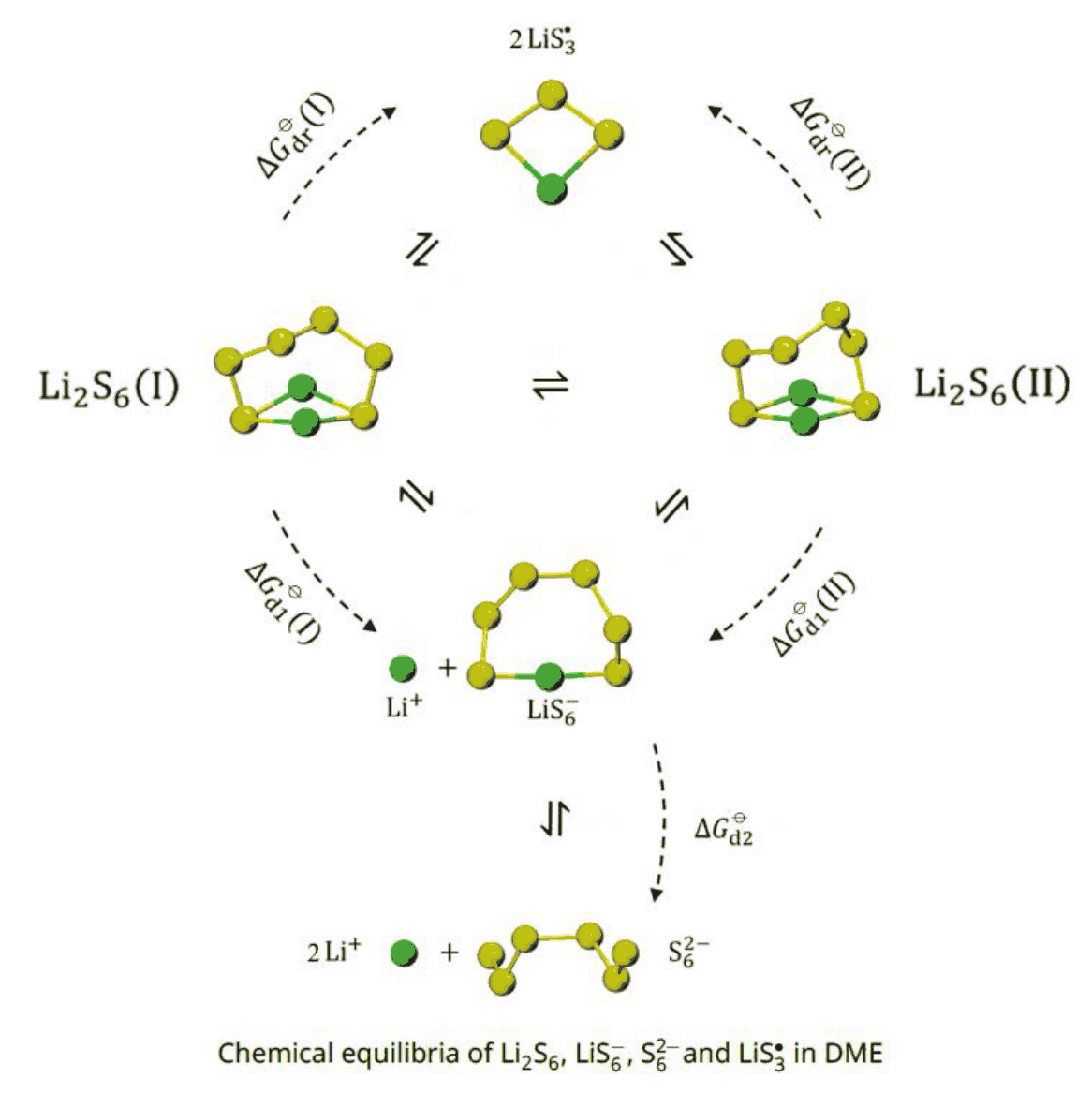
Chemical equilibria of \(\ce{Li2S6}\), \(\ce{LiS6^-}\), \(\ce{S6^{2-}}\) and \(\ce{LiS3^{\bullet}}\) in DME
Table 4.1 Dissociation Gibbs energies (\(\mathrm{kJ\,mol^{-1}}\)) of different reactions in DME (298.15 K, 1 bar)
| \(\Delta G_{\mathrm{d1}}^{\ominus}(I)\) | \(\Delta G_{\mathrm{d1}}^{\ominus}(II)\) | \(\Delta G_{\mathrm{d2}}^{\ominus}\) | \(\Delta G_{\mathrm{dr}}^{\ominus}(I)\) | \(\Delta G_{\mathrm{dr}}^{\ominus}(II)\) |
|---|---|---|---|---|
| 20.68 | 18.92 | 100.55 | 45.13 | 43.37 |
4.8 Using the data from Table 4.1, calculate the equilibrium concentration ratio of two conformers in DME (298.15 K, 1 bar), \(\dfrac{\ce{Li2S6}(II)}{\ce{Li2S6}(I)}\).
4.9 Using the data from Table 4.1, calculate the apparent dissociation constant of \(\ce{Li2S6 -> Li+ + LiS6^-}\) in DME (298.15 K, 1 bar).
4.10 Sort the following equilibrium concentrations in decreasing order: \([\ce{Li2S6}]\), \([\ce{LiS6^-}]\), \([\ce{S6^{2-}}]\), \([\ce{LiS3^{\bullet}}]\) in DME.
4.11 The standard reduction potential of metallic lithium in water at 298.15 K and 1 bar is:
\[ E^{\ominus}(\ce{Li+}/\ce{Li})=-3.040\ \mathrm{V} \]
The standard solvation Gibbs energies of gaseous \(\ce{Li+(g)}\) to \(\ce{Li+(sol)}\) in different solvents.
| \(\ce{Li+}(\ce{H2O})\) | \(\ce{Li+}(\mathrm{DME})\) | |
|---|---|---|
| \(\Delta G^{\ominus}/\mathrm{kJ\,mol^{-1}}\) | −116.9 | −114.6 |
Calculate the standard reduction potential of metallic lithium electrode in DME.
Studies have shown that electromotive force of a lithium-sulfur battery would be increased by replacing DME with dimethyl sulfoxide (DMSO). Therefore, the forms of polysulfides in DMSO also attract researchers' attention.
In a test, a certain amount of \(\ce{Li2S}\) and 4.81 mg sulfur powder were added into 10.00 mL DMSO, then heated and stirred until completely dissolved (ignoring the change in volume). Suppose that only the following polysulfides were present in the DMSO: \(\ce{S3^{\bullet-}}\), \(\ce{S4^{2-}}\), \(\ce{S5^{2-}}\), \(\ce{S6^{2-}}\), \(\ce{S7^{2-}}\), \(\ce{S8^{2-}}\). The equilibrium concentration ratio of the sulfur containing species was:
\[ [\ce{S3^{\bullet-}}]:[\ce{S4^{2-}}]:[\ce{S5^{2-}}]: [\ce{S6^{2-}}]:[\ce{S7^{2-}}]:[\ce{S8^{2-}}] =17.50:1.00:4.50:55.00:5.00:0.75 \]
4.12 Calculate the original mass \(m\) (in mg) of \(\ce{Li2S}\) added to DMSO.
Official English text of the problem.
Answers
-
4.1 \[ \boxed{\ce{3FeS2 + 2O2 -> Fe3O4 + 6S}} \]
-
4.2 \[ \boxed{\ce{SO3^{2-} + I2 + H2O -> SO4^{2-} + 2I^- + 2H+}} \] \[ \boxed{\ce{2S2O3^{2-} + I2 -> S4O6^{2-} + 2I^-}} \]
-
4.3 \(\boxed{5.59\%}\) of the original sulfur was lost as \(\ce{SO2}\).
-
4.4 Cathode (a): \[ \boxed{\ce{S8 + 16Li+ + 16e^- -> 8Li2S}} \] Anode (b): \[ \boxed{\ce{16Li -> 16Li+ + 16e^-}} \]
-
4.5 \(\boxed{m_{\mathrm{cathode}}:m_{\mathrm{anode}}=2.31:1}\).
-
4.6 \(\boxed{t\approx3.0\times10^2\ \mathrm{h}}\), with an unrounded result of \(300.7\ \mathrm{h}\).
-
4.7 \[ \boxed{\ce{Li2S_n + 2(n-1)Li -> nLi2S}\qquad(n=3–8)} \]
-
4.8 \[ \boxed{\frac{[\ce{Li2S6}(II)]}{[\ce{Li2S6}(I)]}=0.492} \]
-
4.9 \(\boxed{K_{\mathrm{app}}=1.60\times10^{-4}}\) using dimensionless activities. The corresponding concentration quotient is \(1.60\times10^{-4}\ \mathrm{mol\,L^{-1}}\) for \(c^{\ominus}=1\ \mathrm{mol\,L^{-1}}\).
-
4.10 The intended ordering at ordinary concentrations is \[ \boxed{[\ce{Li2S6}]>[\ce{LiS6^-}]>[\ce{LiS3^{\bullet}}]>[\ce{S6^{2-}}]}. \] A concentration-independent ordering is not determined by the supplied data; see the qualification below.
-
4.11 \(\boxed{E_{\mathrm{DME}}^{\ominus}=-3.016\ \mathrm{V}}\), on the same reference scale as the aqueous value.
-
4.12 \(\boxed{m(\ce{Li2S})=1.38\ \mathrm{mg}}\).
Names and SMILES for the species in these answers are collected at the end of the Solution.
Solution
The numerical calculations use \[ R=8.31446\ \mathrm{J\,mol^{-1}\,K^{-1}},\qquad F=96485.33\ \mathrm{C\,mol^{-1}}, \] \[ M(\ce{S})=32.06\ \mathrm{g\,mol^{-1}},\qquad M(\ce{Li})=6.94\ \mathrm{g\,mol^{-1}}. \] For the equilibrium calculations, activities are approximated by \(a_i=[i]/c^{\ominus}\), where \(c^{\ominus}=1\ \mathrm{mol\,L^{-1}}\).
4.1
One formula unit of magnetite contains three iron atoms and four oxygen atoms. It therefore requires three formula units of pyrite and two oxygen molecules. The six sulfur atoms from the pyrite become elemental sulfur:
\[ \boxed{\ce{3FeS2 + 2O2 -> Fe3O4 + 6S}}. \]
Here \(\ce{S}\) denotes elemental sulfur counted by sulfur atoms. Written using its common molecular form, cyclooctasulfur, the equivalent equation is
\[ \ce{12FeS2 + 8O2 -> 4Fe3O4 + 3S8}. \]
4.2
The alkaline absorber converts sulfur dioxide into sulfite:
\[ \ce{SO2 + 2OH^- -> SO3^{2-} + H2O}. \]
Iodine then oxidizes sulfur from oxidation state \(+4\) in sulfite to \(+6\) in sulfate. Each sulfur atom transfers two electrons, while one iodine molecule accepts two electrons:
\[ \boxed{\ce{SO3^{2-} + I2 + H2O -> SO4^{2-} + 2I^- + 2H+}}. \]
Equivalently, expressing the sulfur(IV) species as sulfur dioxide in the acidic solution,
\[ \ce{SO2 + I2 + 2H2O -> SO4^{2-} + 2I^- + 4H+}. \]
The excess iodine is determined by thiosulfate, which is oxidized to tetrathionate:
\[ \boxed{\ce{2S2O3^{2-} + I2 -> S4O6^{2-} + 2I^-}}. \]
Thus one mole of sulfur dioxide consumes one mole of iodine, and each mole of residual iodine consumes two moles of thiosulfate.
4.3
The initial iodine amount in the flask is
\[ n_0(\ce{I2}) =(0.05000\ \mathrm{L})(0.05122\ \mathrm{mol\,L^{-1}}) =2.5610\times10^{-3}\ \mathrm{mol}. \]
The thiosulfate amount used is
\[ n(\ce{S2O3^{2-}}) =(0.01847\ \mathrm{L})(0.1012\ \mathrm{mol\,L^{-1}}) =1.869164\times10^{-3}\ \mathrm{mol}. \]
Therefore, the residual iodine amount is
\[ n_{\mathrm{remaining}}(\ce{I2}) =\frac12n(\ce{S2O3^{2-}}) =9.34582\times10^{-4}\ \mathrm{mol}. \]
The iodine consumed by sulfur(IV) in the 25.00 mL aliquot is
\[ n_{\mathrm{aliquot}}(\ce{SO2}) =2.5610\times10^{-3}-9.34582\times10^{-4} =1.626418\times10^{-3}\ \mathrm{mol}. \]
Scaling to the entire 500 mL solution,
\[ n_{\mathrm{total}}(\ce{SO2}) =\frac{500}{25.00}(1.626418\times10^{-3}) =0.03252836\ \mathrm{mol}. \]
The sulfur mass lost in this sulfur dioxide is
\[ m_{\mathrm{lost}}(\ce{S}) =(0.03252836)(32.06) =1.04286\ \mathrm{g}. \]
Because the collected elemental sulfur and sulfur dioxide account for all original sulfur,
\[ \text{percentage lost} =\frac{1.04286}{17.6+1.04286}\times100\% =\boxed{5.59\%}. \]
4.4
During discharge, sulfur is reduced at the cathode. Each sulfur atom gains two electrons, so one \(\ce{S8}\) molecule gains sixteen:
\[ \boxed{\text{Cathode (a): }\ce{S8 + 16Li+ + 16e^- -> 8Li2S}}. \]
Lithium is oxidized at the anode:
\[ \boxed{\text{Anode (b): }\ce{16Li -> 16Li+ + 16e^-}}. \]
Adding these half-reactions cancels the lithium ions and electrons and gives the stated overall reaction.
4.5
The overall reaction consumes one mole of \(\ce{S8}\) per sixteen moles of lithium:
\[ \frac{m_{\mathrm{cathode}}}{m_{\mathrm{anode}}} =\frac{8M(\ce{S})}{16M(\ce{Li})} =\frac{32.06}{2(6.94)} =2.3098. \]
Therefore,
\[ \boxed{m_{\mathrm{cathode}}:m_{\mathrm{anode}}=2.31:1}. \]
4.6
The original battery supplies energy
\[ E_{\mathrm{LIB}} =(3.8\ \mathrm{V})(3.110\ \mathrm{Ah}) =11.818\ \mathrm{Wh}. \]
Hence the phone’s average power consumption is
\[ P=\frac{11.818\ \mathrm{Wh}}{22\ \mathrm{h}} =0.53718\ \mathrm{W}. \]
Each mole of sulfur atoms accepts two moles of electrons. Complete discharge of 23 g sulfur therefore transfers charge
\[ Q=2F\frac{m(\ce{S})}{M(\ce{S})} =2(96485.33)\frac{23}{32.06} =1.38438\times10^5\ \mathrm{C}. \]
Using \(1\ \mathrm{Ah}=3600\ \mathrm{C}\),
\[ Q=38.455\ \mathrm{Ah}. \]
The ideal replacement battery supplies
\[ E_{\mathrm{Li-S}} =(4.2\ \mathrm{V})(38.455\ \mathrm{Ah}) =161.511\ \mathrm{Wh}. \]
At the same phone power consumption,
\[ t=\frac{161.511\ \mathrm{Wh}}{0.53718\ \mathrm{W}} =300.66\ \mathrm{h}. \]
Thus, to the precision of the supplied data,
\[ \boxed{t\approx3.0\times10^2\ \mathrm{h}}. \]
4.7
The \(n\) sulfur atoms in one formula unit of \(\ce{Li2S_n}\) form \(n\) formula units of lithium sulfide. These products contain \(2n\) lithium atoms; two are already present in the polysulfide, so \(2n-2\) must come from the lithium anode:
\[ \boxed{\ce{Li2S_n + 2(n-1)Li -> nLi2S}}. \]
This reaction consumes metallic lithium without delivering its electrons through the external circuit, explaining the loss of active material.
4.8
Both conformers dissociate to the same products, \(\ce{Li+ + LiS6^-}\). Consequently,
\[ G^{\ominus}_{II}-G^{\ominus}_{I} =\Delta G_{\mathrm{d1}}^{\ominus}(I) -\Delta G_{\mathrm{d1}}^{\ominus}(II) =20.68-18.92 =1.76\ \mathrm{kJ\,mol^{-1}}. \]
The radical dissociation energies give the same difference: \(45.13-43.37=1.76\ \mathrm{kJ\,mol^{-1}}\).
For conformer interconversion,
\[ \frac{[\ce{Li2S6}(II)]}{[\ce{Li2S6}(I)]} =\exp\left(-\frac{G^{\ominus}_{II}-G^{\ominus}_{I}}{RT}\right). \]
Therefore,
\[ \frac{[\ce{Li2S6}(II)]}{[\ce{Li2S6}(I)]} =\exp\left[-\frac{1760}{(8.31446)(298.15)}\right] =\boxed{0.492}. \]
Conformer I has the lower standard Gibbs energy and is therefore more abundant.
4.9
The separate dimensionless dissociation constants are
\[ K_I=\exp\left[-\frac{20680}{RT}\right] =2.3824\times10^{-4}, \]
\[ K_{II}=\exp\left[-\frac{18920}{RT}\right] =4.8457\times10^{-4}. \]
Let \(a_I\) and \(a_{II}\) denote the conformer activities, and let \(p=a_{\ce{Li+}}a_{\ce{LiS6^-}}\). Then
\[ K_I=\frac{p}{a_I},\qquad K_{II}=\frac{p}{a_{II}}. \]
The apparent constant uses the total undissociated population:
\[ K_{\mathrm{app}} =\frac{p}{a_I+a_{II}} =\frac{1}{K_I^{-1}+K_{II}^{-1}} =\frac{K_IK_{II}}{K_I+K_{II}}. \]
Numerically,
\[ \boxed{K_{\mathrm{app}}=1.5972\times10^{-4} \approx1.60\times10^{-4}}. \]
In concentration form,
\[ \frac{[\ce{Li+}][\ce{LiS6^-}]} {[\ce{Li2S6}(I)]+[\ce{Li2S6}(II)]} =K_{\mathrm{app}}c^{\ominus} =\boxed{1.60\times10^{-4}\ \mathrm{mol\,L^{-1}}}. \]
4.10
Write
\[ C_0=[\ce{Li2S6}(I)]+[\ce{Li2S6}(II)]. \]
For the second ionic dissociation,
\[ \ce{LiS6^- <=> Li+ + S6^{2-}}, \]
\[ K_{\mathrm{d2}} =\exp\left[-\frac{100550}{RT}\right] =2.42\times10^{-18}. \]
Thus the free hexasulfide dianion is strongly suppressed at ordinary lithium-ion concentrations.
For radical formation,
\[ \ce{Li2S6 <=> 2LiS3^{\bullet}}, \]
the apparent constant for the combined conformer pool is
\[ K_{\mathrm r,app} =\frac{\exp[-45130/(RT)]}{1+0.491656} =8.32\times10^{-9}. \]
If these dissociations are the only source of free lithium ions, electroneutrality gives
\[ [\ce{Li+}]=[\ce{LiS6^-}]+2[\ce{S6^{2-}}] \approx[\ce{LiS6^-}], \]
because the second dissociation is negligible at ordinary concentrations. Consequently,
\[ [\ce{LiS6^-}] \approx\sqrt{K_{\mathrm{app}}C_0c^{\ominus}}, \]
\[ [\ce{LiS3^{\bullet}}] =\sqrt{K_{\mathrm r,app}C_0c^{\ominus}}. \]
Their ratio is approximately
\[ \frac{[\ce{LiS6^-}]}{[\ce{LiS3^{\bullet}}]} \approx \sqrt{\frac{1.5972\times10^{-4}}{8.3157\times10^{-9}}} =139. \]
Thus the intended ordering is
\[ \boxed{[\ce{Li2S6}]>[\ce{LiS6^-}]> [\ce{LiS3^{\bullet}}]>[\ce{S6^{2-}}]}. \]
However, the first inequality requires approximately
\[ C_0>\sqrt{K_{\mathrm{app}}C_0c^{\ominus}} \quad\Longleftrightarrow\quad C_0>K_{\mathrm{app}}c^{\ominus} =1.60\times10^{-4}\ \mathrm{mol\,L^{-1}}. \]
At sufficiently low concentration, ionic dissociation becomes extensive and that inequality reverses. Therefore, the stated ordering is conditional on concentration; it is not a universal consequence of the standard Gibbs energies alone.
4.11
Transfer of a lithium ion from DME to water has standard Gibbs energy
\[ \Delta G_{\mathrm{tr}}^{\ominus} =\Delta G_{\mathrm{solv,H_2O}}^{\ominus} -\Delta G_{\mathrm{solv,DME}}^{\ominus} =-116.9-(-114.6) =-2.3\ \mathrm{kJ\,mol^{-1}}. \]
Reduction in DME can be represented by the following thermodynamic cycle:
- Transfer \(\ce{Li+}\) from DME to water.
- Reduce the aqueous lithium ion to metallic lithium.
Hence
\[ \Delta G_{\mathrm{red,DME}}^{\ominus} =\Delta G_{\mathrm{tr}}^{\ominus} +\Delta G_{\mathrm{red,H_2O}}^{\ominus}. \]
Using \(\Delta G^{\ominus}=-FE^{\ominus}\) for this one-electron reaction,
\[ -FE_{\mathrm{DME}}^{\ominus} =-2300-FE_{\mathrm{H_2O}}^{\ominus}, \]
so
\[ E_{\mathrm{DME}}^{\ominus} =E_{\mathrm{H_2O}}^{\ominus}+\frac{2300}{F} =-3.040+\frac{2300}{96485.33}. \]
Therefore,
\[ \boxed{E_{\mathrm{DME}}^{\ominus}=-3.016\ \mathrm{V}}. \]
The sign is consistent with the weaker stabilization of the lithium ion in DME: its reduction is slightly more favorable.
4.12
Let the concentrations be the stated numerical ratios multiplied by a common factor \(x\), with units \(\mathrm{mol\,L^{-1}}\).
The relative sulfur-atom concentration is
\[ \begin{aligned} &3(17.50)+4(1.00)+5(4.50)\\ &\qquad+6(55.00)+7(5.00)+8(0.75) =450.00. \end{aligned} \]
Thus the total amount of sulfur atoms is \(450xV\).
The trisulfur radical anion is singly charged; all the other listed anions are doubly charged. Their total negative-charge concentration is therefore
\[ 17.50+2(1.00+4.50+55.00+5.00+0.75) =150.00. \]
Let \(n_0\) be the initial amount of lithium sulfide. Each mole supplies two moles of lithium ions, so charge balance gives
\[ 2n_0=150xV, \qquad n_0=75xV. \]
Sulfur balance gives
\[ n_0+n_{\mathrm{powder}}=450xV. \]
Subtracting the sulfur initially supplied by lithium sulfide,
\[ n_{\mathrm{powder}}=(450-75)xV=375xV. \]
Consequently,
\[ \frac{n_{\mathrm{powder}}}{n_0}=\frac{375}{75}=5. \]
The common volume cancels. Therefore,
\[ n_0 =\frac{1}{5}\frac{4.81\ \mathrm{mg}} {32.06\ \mathrm{mg\,mmol^{-1}}} =0.030006\ \mathrm{mmol}. \]
Since
\[ M(\ce{Li2S})=2(6.94)+32.06 =45.94\ \mathrm{mg\,mmol^{-1}}, \]
\[ m(\ce{Li2S}) =(0.030006)(45.94) =\boxed{1.38\ \mathrm{mg}}. \]
Species names and SMILES
The salt representations below give formal ionic components. They do not encode crystal lattices, solvent coordination, or lithium–sulfur coordination geometry. In particular, the two \(\ce{Li2S6}\) conformers have the same formula-unit SMILES; their different spatial arrangements are shown in the supplied figure. The \(\ce{S8}\) SMILES specifies an eight-membered ring but does not specify its crown conformation.
| Species | Name | SMILES |
|---|---|---|
| \(\ce{FeS2}\) | Pyrite; iron(II) disulfide, formal ionic representation | [Fe+2].[S-][S-] |
| \(\ce{Fe3O4}\) | Magnetite; iron(II,III) oxide, formal ionic representation | [Fe+2].[Fe+3].[Fe+3].[O-2].[O-2].[O-2].[O-2] |
| \(\ce{S8}\) | Cyclooctasulfur | S1SSSSSSS1 |
| \(\ce{O2}\) | Dioxygen | O=O |
| \(\ce{SO2}\) | Sulfur dioxide | O=S=O |
| \(\ce{H2O}\) | Water | O |
| \(\ce{OH^-}\) | Hydroxide ion | [OH-] |
| \(\ce{H+}\) | Hydrogen ion; proton | [H+] |
| \(\ce{SO3^{2-}}\) | Sulfite ion | [O-]S(=O)[O-] |
| \(\ce{SO4^{2-}}\) | Sulfate ion | [O-]S(=O)(=O)[O-] |
| \(\ce{I2}\) | Iodine | II |
| \(\ce{I^-}\) | Iodide ion | [I-] |
| \(\ce{S2O3^{2-}}\) | Thiosulfate ion | [O-]S(=O)(=O)[S-] |
| \(\ce{S4O6^{2-}}\) | Tetrathionate ion | [O-]S(=O)(=O)SSS(=O)(=O)[O-] |
| \(\ce{Li}\) | Lithium; atomic representation of the metallic element | [Li] |
| \(\ce{Li+}\) | Lithium ion | [Li+] |
| \(\ce{S^{2-}}\) | Sulfide ion | [S-2] |
| \(\ce{Li2S}\) | Lithium sulfide | [Li+].[Li+].[S-2] |
| \(\ce{LiS6^-}\) | Lithium hexasulfide monoanion | [Li+].[S-]SSSS[S-] |
| \(\ce{S3^{\bullet-}}\) | Trisulfur radical anion | [S-]S[S] |
| \(\ce{LiS3^{\bullet}}\) | Lithium trisulfide radical | [Li+].[S-]S[S] |
| DME | 1,2-Dimethoxyethane | COCCOC |
| DMSO | Dimethyl sulfoxide | CS(C)=O |
The radical SMILES show one localized charge/radical representation; they do not describe the actual delocalization of spin and charge.
The polysulfides in the general corrosion equation and final equilibrium calculation have the following formal representations:
| \(n\) | \(\ce{S_n^{2-}}\): name and SMILES | \(\ce{Li2S_n}\): name and SMILES |
|---|---|---|
| 3 | Trisulfide ion: [S-]S[S-] |
Lithium trisulfide: [Li+].[Li+].[S-]S[S-] |
| 4 | Tetrasulfide ion: [S-]SS[S-] |
Lithium tetrasulfide: [Li+].[Li+].[S-]SS[S-] |
| 5 | Pentasulfide ion: [S-]SSS[S-] |
Lithium pentasulfide: [Li+].[Li+].[S-]SSS[S-] |
| 6 | Hexasulfide ion: [S-]SSSS[S-] |
Lithium hexasulfide: [Li+].[Li+].[S-]SSSS[S-] |
| 7 | Heptasulfide ion: [S-]SSSSS[S-] |
Lithium heptasulfide: [Li+].[Li+].[S-]SSSSS[S-] |
| 8 | Octasulfide ion: [S-]SSSSSS[S-] |
Lithium octasulfide: [Li+].[Li+].[S-]SSSSSS[S-] |
The solution was checked against the official solution.
IChO 2022 · Theorieaufgabe 4
Eine neue Reise für den seit der Antike bekannten Schwefel
Schwefel ist seit der Antike bekannt und wird seitdem verwendet. Heute wird Schwefel als preiswerter chemischer Rohstoff in großem Umfang in der chemischen Produktion und der pharmazeutischen Industrie eingesetzt.
Pyrit (\(\ce{FeS2}\)) wird häufig als Rohstoff für die industrielle Herstellung von elementarem Schwefel verwendet. Beim Erhitzen von Pyrit unter begrenzter Luftzufuhr beträgt die theoretische Ausbeute an elementarem Schwefel 100%; als weiteres Produkt entsteht ein schwarzes magnetisches Oxid (\(\ce{Fe3O4}\)).
4.1 Stellen Sie die ausgeglichene Reaktionsgleichung für die oben beschriebene Umsetzung auf.
Neben Schwefel entsteht im tatsächlichen Prozess eine geringe Menge \(\ce{SO2}\) als Nebenprodukt. Diese Reaktion lässt sich durch die Bestimmung der Menge an \(\ce{SO2}\) überwachen. Dazu wird die folgende Arbeitsvorschrift verwendet:
Das pulverisierte Roherz wird in einem temperaturgeregelten Rohrofen erhitzt. Das entstehende \(\ce{SO2}\) wird in einer 2 mol L\(^{-1}\) \(\ce{NaOH}\)-Lösung absorbiert. Nach Abschluss der Reaktion wird die Lösung in einen 500-mL-Messkolben überführt und mit destilliertem Wasser bis zur Marke aufgefüllt. Anschließend werden 25.00 mL dieser verdünnten Lösung in einen Iodzahlkolben gegeben, der 50.00 mL einer 0.05122 mol L\(^{-1}\) \(\ce{I2}\)-Maßlösung und 5 mL einer 20%igen \(\ce{H2SO4}\)-Lösung enthält. Nachdem der Iodzahlkolben 5 min im Dunkeln aufbewahrt wurde, wird die Lösung mit einer 0.1012 mol L\(^{-1}\) \(\ce{Na2S2O3}\)-Maßlösung titriert. Sobald sich die Lösung hellbraun färbt, werden 3 mL einer 0.5%igen Stärkelösung als Indikator zugesetzt. Die Titration wird fortgesetzt, bis die blaue Farbe verschwindet.
4.2 Stellen Sie die ausgeglichenen Reaktionsgleichungen unter Beteiligung von \(\ce{I2}\) bei der oben beschriebenen Bestimmung auf.
4.3 Bei einem solchen Versuch mit Pyrit als Ausgangsstoff wurden 17.6 g elementarer Schwefel gesammelt. Bei der Analyse der als Nebenprodukte entstandenen Gase nach dem oben beschriebenen Verfahren wurden 18.47 mL der \(\ce{Na2S2O3}\)-Maßlösung verbraucht. Berechnen Sie unter der Annahme, dass keine weiteren schwefelhaltigen Spezies entstanden sind, welcher prozentuale Anteil des Schwefels im Pyrit als Nebenprodukt verloren ging.
Die Lithium-Schwefel-Batterie ist ein vielversprechendes Energiespeichersystem, da ihre hohe theoretische Energiedichte diejenige herkömmlicher Lithium-Ionen-Batterien übersteigt. Die Gesamtreaktion einer Lithium-Schwefel-Batterie lässt sich vereinfacht wie folgt schreiben: \(\ce{16Li + S8 -> 8Li2S}\). Beim Entladen ist Schwefel das aktive Kathodenmaterial und metallisches Lithium das aktive Anodenmaterial.
4.4 Stellen Sie die ausgeglichenen Gleichungen für die Reaktionen auf, die beim Entladen an der Kathode (a) und der Anode (b) ablaufen.
4.5 Berechnen Sie anhand der Gesamtreaktion der Batterie das Massenverhältnis des aktiven Kathodenmaterials zum aktiven Anodenmaterial.
Eine Lithium-Ionen-Batterie (LIB) mit einer mittleren Betriebsspannung von 3.8 V und einer nutzbaren Kapazität von 3110 mAh kann ein Mobiltelefon nach vollständigem Aufladen 22 Stunden lang mit Energie für die ununterbrochene Wiedergabe von Videos versorgen.
4.6 Die LIB wird durch ein ideales Lithium-Schwefel-Batteriepaket ersetzt, das eine mittlere Betriebsspannung von 4.2 V aufweist und 23 g Schwefel als aktives Elektrodenmaterial enthält, das beim Entladen stöchiometrisch reagieren kann. Berechnen Sie, wie viele Stunden das neue Batteriepaket das Telefon nach vollständigem Aufladen mit Energie für die ununterbrochene Wiedergabe von Videos versorgen kann.
Elementarer Schwefel liegt im Allgemeinen als \(\ce{S8}\)-Moleküle vor. In realen Lithium-Schwefel-Batterien wird \(\ce{S8}\) beim Entladen nicht direkt zu \(\ce{Li2S}\) reduziert, sondern durchläuft schrittweise Reaktionen, bei denen verschiedene lösliche Lithiumpolysulfide (\(\ce{Li2S_n}\), \(n=3–8\)) entstehen. Diese Lithiumpolysulfide können zur Anode diffundieren und diese korrodieren, was zum Verlust aktiver Elektrodenmaterialien führt. Dieses Phänomen wird als „Shuttle-Effekt“ bezeichnet.
4.7 Stellen Sie die ausgeglichene Reaktionsgleichung für die Korrosion der Anode durch lösliche Lithiumpolysulfide (\(\ce{Li2S_n}\)) unter Bildung von \(\ce{Li2S}\) auf.
Um den „Shuttle-Effekt“ zu unterdrücken, wurden die Formen, in denen Polysulfide in einem Elektrolyten vorliegen, umfassend untersucht. \(\ce{Li2S6}\) ist eines der repräsentativsten Zwischenprodukte:
Eine theoretische Untersuchung zeigt, dass zwei Konformere mit vergleichbaren Energien, \(\ce{Li2S6}(I)\) und \(\ce{Li2S6}(II)\), in 1,2-Dimethoxyethan (DME), einem gängigen Elektrolytlösungsmittel in Lithium-Schwefel-Batterien, nebeneinander vorliegen. Die Dissoziation von \(\ce{Li2S6}\) in DME ist nachfolgend dargestellt:
Chemische Gleichgewichte von \(\ce{Li2S6}\), \(\ce{LiS6^-}\), \(\ce{S6^{2-}}\) und \(\ce{LiS3^{\bullet}}\) in DME
Tabelle 4.1 Gibbs-Energien der Dissoziation (\(\mathrm{kJ\,mol^{-1}}\)) verschiedener Reaktionen in DME (298.15 K, 1 bar)
| \(\Delta G_{\mathrm{d1}}^{\ominus}(I)\) | \(\Delta G_{\mathrm{d1}}^{\ominus}(II)\) | \(\Delta G_{\mathrm{d2}}^{\ominus}\) | \(\Delta G_{\mathrm{dr}}^{\ominus}(I)\) | \(\Delta G_{\mathrm{dr}}^{\ominus}(II)\) |
|---|---|---|---|---|
| 20.68 | 18.92 | 100.55 | 45.13 | 43.37 |
4.8 Berechnen Sie mithilfe der Daten aus Tabelle 4.1 das Verhältnis der Gleichgewichtskonzentrationen der beiden Konformere in DME (298.15 K, 1 bar), \(\dfrac{\ce{Li2S6}(II)}{\ce{Li2S6}(I)}\).
4.9 Berechnen Sie mithilfe der Daten aus Tabelle 4.1 die scheinbare Dissoziationskonstante von \(\ce{Li2S6 -> Li+ + LiS6^-}\) in DME (298.15 K, 1 bar).
4.10 Ordnen Sie die folgenden Gleichgewichtskonzentrationen in DME in absteigender Reihenfolge: \([\ce{Li2S6}]\), \([\ce{LiS6^-}]\), \([\ce{S6^{2-}}]\), \([\ce{LiS3^{\bullet}}]\).
4.11 Das Standardreduktionspotenzial von metallischem Lithium in Wasser bei 298.15 K und 1 bar beträgt:
\[ E^{\ominus}(\ce{Li+}/\ce{Li})=-3.040\ \mathrm{V} \]
Die Standard-Gibbs-Energien der Solvatation von gasförmigem \(\ce{Li+(g)}\) zu \(\ce{Li+(sol)}\) in verschiedenen Lösungsmitteln sind:
| \(\ce{Li+}(\ce{H2O})\) | \(\ce{Li+}(\mathrm{DME})\) | |
|---|---|---|
| \(\Delta G^{\ominus}/\mathrm{kJ\,mol^{-1}}\) | −116.9 | −114.6 |
Berechnen Sie das Standardreduktionspotenzial der metallischen Lithiumelektrode in DME.
Untersuchungen haben gezeigt, dass sich die elektromotorische Kraft einer Lithium-Schwefel-Batterie durch den Ersatz von DME durch Dimethylsulfoxid (DMSO) erhöhen lässt. Daher sind auch die Formen, in denen Polysulfide in DMSO vorliegen, von Interesse für die Forschung.
In einem Versuch wurden eine bestimmte Menge \(\ce{Li2S}\) und 4.81 mg Schwefelpulver zu 10.00 mL DMSO gegeben und anschließend unter Rühren erhitzt, bis sie vollständig gelöst waren (die Volumenänderung wird vernachlässigt). Nehmen Sie an, dass nur die folgenden Polysulfide im DMSO vorlagen: \(\ce{S3^{\bullet-}}\), \(\ce{S4^{2-}}\), \(\ce{S5^{2-}}\), \(\ce{S6^{2-}}\), \(\ce{S7^{2-}}\), \(\ce{S8^{2-}}\). Das Verhältnis der Gleichgewichtskonzentrationen der schwefelhaltigen Spezies betrug:
\[ [\ce{S3^{\bullet-}}]:[\ce{S4^{2-}}]:[\ce{S5^{2-}}]: [\ce{S6^{2-}}]:[\ce{S7^{2-}}]:[\ce{S8^{2-}}] =17.50:1.00:4.50:55.00:5.00:0.75 \]
4.12 Berechnen Sie die ursprünglich zu DMSO gegebene Masse \(m\) (in mg) an \(\ce{Li2S}\).
Aufgabentext aus dem offiziellen englischen Text übersetzt.
Antworten
-
4.1 \[ \boxed{\ce{3FeS2 + 2O2 -> Fe3O4 + 6S}} \]
-
4.2 \[ \boxed{\ce{SO3^{2-} + I2 + H2O -> SO4^{2-} + 2I^- + 2H+}} \] \[ \boxed{\ce{2S2O3^{2-} + I2 -> S4O6^{2-} + 2I^-}} \]
-
4.3 \(\boxed{5.59\%}\) des ursprünglich vorhandenen Schwefels gingen als \(\ce{SO2}\) verloren.
-
4.4 Kathode (a): \[ \boxed{\ce{S8 + 16Li+ + 16e^- -> 8Li2S}} \] Anode (b): \[ \boxed{\ce{16Li -> 16Li+ + 16e^-}} \]
-
4.5 \(\boxed{m_{\mathrm{cathode}}:m_{\mathrm{anode}}=2.31:1}\).
-
4.6 \(\boxed{t\approx3.0\times10^2\ \mathrm{h}}\), mit einem ungerundeten Ergebnis von \(300.7\ \mathrm{h}\).
-
4.7 \[ \boxed{\ce{Li2S_n + 2(n-1)Li -> nLi2S}\qquad(n=3–8)} \]
-
4.8 \[ \boxed{\frac{[\ce{Li2S6}(II)]}{[\ce{Li2S6}(I)]}=0.492} \]
-
4.9 \(\boxed{K_{\mathrm{app}}=1.60\times10^{-4}}\) bei Verwendung dimensionsloser Aktivitäten. Der entsprechende Konzentrationsquotient beträgt \(1.60\times10^{-4}\ \mathrm{mol\,L^{-1}}\) für \(c^{\ominus}=1\ \mathrm{mol\,L^{-1}}\).
-
4.10 Die beabsichtigte Reihenfolge bei üblichen Konzentrationen lautet \[ \boxed{[\ce{Li2S6}]>[\ce{LiS6^-}]>[\ce{LiS3^{\bullet}}]>[\ce{S6^{2-}}]}. \] Eine konzentrationsunabhängige Reihenfolge lässt sich aus den angegebenen Daten nicht bestimmen; siehe die nachfolgende Einschränkung.
-
4.11 \(\boxed{E_{\mathrm{DME}}^{\ominus}=-3.016\ \mathrm{V}}\), auf derselben Bezugsskala wie der Wert in wässriger Lösung.
-
4.12 \(\boxed{m(\ce{Li2S})=1.38\ \mathrm{mg}}\).
Die Namen und SMILES der in diesen Antworten vorkommenden Spezies sind am Ende der Lösung zusammengestellt.
Lösung
Für die numerischen Berechnungen werden folgende Werte verwendet: \[ R=8.31446\ \mathrm{J\,mol^{-1}\,K^{-1}},\qquad F=96485.33\ \mathrm{C\,mol^{-1}}, \] \[ M(\ce{S})=32.06\ \mathrm{g\,mol^{-1}},\qquad M(\ce{Li})=6.94\ \mathrm{g\,mol^{-1}}. \] Für die Gleichgewichtsberechnungen werden die Aktivitäten durch \(a_i=[i]/c^{\ominus}\) angenähert, wobei \(c^{\ominus}=1\ \mathrm{mol\,L^{-1}}\) ist.
4.1
Eine Formeleinheit Magnetit enthält drei Eisenatome und vier Sauerstoffatome. Daher werden drei Formeleinheiten Pyrit und zwei Sauerstoffmoleküle benötigt. Die sechs Schwefelatome aus dem Pyrit bilden elementaren Schwefel:
\[ \boxed{\ce{3FeS2 + 2O2 -> Fe3O4 + 6S}}. \]
Hier bezeichnet \(\ce{S}\) elementaren Schwefel, gezählt nach Schwefelatomen. Unter Verwendung seiner üblichen molekularen Form, Cyclooctaschwefel, lautet die äquivalente Gleichung
\[ \ce{12FeS2 + 8O2 -> 4Fe3O4 + 3S8}. \]
4.2
Die alkalische Absorptionslösung wandelt Schwefeldioxid in Sulfit um:
\[ \ce{SO2 + 2OH^- -> SO3^{2-} + H2O}. \]
Anschließend oxidiert Iod den Schwefel von der Oxidationsstufe \(+4\) im Sulfit zur Oxidationsstufe \(+6\) im Sulfat. Jedes Schwefelatom gibt zwei Elektronen ab, während ein Iodmolekül zwei Elektronen aufnimmt:
\[ \boxed{\ce{SO3^{2-} + I2 + H2O -> SO4^{2-} + 2I^- + 2H+}}. \]
Wird die Schwefel(IV)-Spezies in der sauren Lösung als Schwefeldioxid ausgedrückt, ergibt sich äquivalent
\[ \ce{SO2 + I2 + 2H2O -> SO4^{2-} + 2I^- + 4H+}. \]
Das überschüssige Iod wird mit Thiosulfat bestimmt, das dabei zu Tetrathionat oxidiert wird:
\[ \boxed{\ce{2S2O3^{2-} + I2 -> S4O6^{2-} + 2I^-}}. \]
Somit verbraucht ein Mol Schwefeldioxid ein Mol Iod, und jedes Mol verbliebenen Iods verbraucht zwei Mol Thiosulfat.
4.3
Die anfängliche Stoffmenge an Iod im Kolben beträgt
\[ n_0(\ce{I2}) =(0.05000\ \mathrm{L})(0.05122\ \mathrm{mol\,L^{-1}}) =2.5610\times10^{-3}\ \mathrm{mol}. \]
Die verbrauchte Stoffmenge an Thiosulfat beträgt
\[ n(\ce{S2O3^{2-}}) =(0.01847\ \mathrm{L})(0.1012\ \mathrm{mol\,L^{-1}}) =1.869164\times10^{-3}\ \mathrm{mol}. \]
Daher beträgt die verbleibende Stoffmenge an Iod
\[ n_{\mathrm{remaining}}(\ce{I2}) =\frac12n(\ce{S2O3^{2-}}) =9.34582\times10^{-4}\ \mathrm{mol}. \]
Die durch Schwefel(IV) im 25.00-mL-Aliquot verbrauchte Stoffmenge an Iod beträgt
\[ n_{\mathrm{aliquot}}(\ce{SO2}) =2.5610\times10^{-3}-9.34582\times10^{-4} =1.626418\times10^{-3}\ \mathrm{mol}. \]
Hochgerechnet auf die gesamte Lösung von 500 mL ergibt sich
\[ n_{\mathrm{total}}(\ce{SO2}) =\frac{500}{25.00}(1.626418\times10^{-3}) =0.03252836\ \mathrm{mol}. \]
Die in diesem Schwefeldioxid verlorene Schwefelmasse beträgt
\[ m_{\mathrm{lost}}(\ce{S}) =(0.03252836)(32.06) =1.04286\ \mathrm{g}. \]
Da der gesammelte elementare Schwefel und das Schwefeldioxid den gesamten ursprünglich vorhandenen Schwefel ausmachen, gilt
\[ \text{prozentualer Verlust} =\frac{1.04286}{17.6+1.04286}\times100\% =\boxed{5.59\%}. \]
4.4
Beim Entladen wird Schwefel an der Kathode reduziert. Jedes Schwefelatom nimmt zwei Elektronen auf, sodass ein \(\ce{S8}\)-Molekül sechzehn Elektronen aufnimmt:
\[ \boxed{\text{Kathode (a): }\ce{S8 + 16Li+ + 16e^- -> 8Li2S}}. \]
Lithium wird an der Anode oxidiert:
\[ \boxed{\text{Anode (b): }\ce{16Li -> 16Li+ + 16e^-}}. \]
Bei der Addition dieser Teilreaktionen kürzen sich die Lithiumionen und Elektronen heraus, und es ergibt sich die angegebene Gesamtreaktion.
4.5
Die Gesamtreaktion verbraucht ein Mol \(\ce{S8}\) pro sechzehn Mol Lithium:
\[ \frac{m_{\mathrm{cathode}}}{m_{\mathrm{anode}}} =\frac{8M(\ce{S})}{16M(\ce{Li})} =\frac{32.06}{2(6.94)} =2.3098. \]
Daher gilt
\[ \boxed{m_{\mathrm{cathode}}:m_{\mathrm{anode}}=2.31:1}. \]
4.6
Die ursprüngliche Batterie liefert die Energie
\[ E_{\mathrm{LIB}} =(3.8\ \mathrm{V})(3.110\ \mathrm{Ah}) =11.818\ \mathrm{Wh}. \]
Damit beträgt die mittlere Leistungsaufnahme des Telefons
\[ P=\frac{11.818\ \mathrm{Wh}}{22\ \mathrm{h}} =0.53718\ \mathrm{W}. \]
Jedes Mol Schwefelatome nimmt zwei Mol Elektronen auf. Bei der vollständigen Entladung von 23 g Schwefel wird daher die folgende Ladung übertragen:
\[ Q=2F\frac{m(\ce{S})}{M(\ce{S})} =2(96485.33)\frac{23}{32.06} =1.38438\times10^5\ \mathrm{C}. \]
Mit \(1\ \mathrm{Ah}=3600\ \mathrm{C}\) ergibt sich
\[ Q=38.455\ \mathrm{Ah}. \]
Die ideale Ersatzbatterie liefert
\[ E_{\mathrm{Li-S}} =(4.2\ \mathrm{V})(38.455\ \mathrm{Ah}) =161.511\ \mathrm{Wh}. \]
Bei unveränderter Leistungsaufnahme des Telefons gilt
\[ t=\frac{161.511\ \mathrm{Wh}}{0.53718\ \mathrm{W}} =300.66\ \mathrm{h}. \]
Somit ergibt sich entsprechend der Genauigkeit der angegebenen Daten
\[ \boxed{t\approx3.0\times10^2\ \mathrm{h}}. \]
4.7
Die \(n\) Schwefelatome in einer Formeleinheit \(\ce{Li2S_n}\) bilden \(n\) Formeleinheiten Lithiumsulfid. Diese Produkte enthalten \(2n\) Lithiumatome; zwei sind bereits im Polysulfid vorhanden, sodass \(2n-2\) aus der Lithiumanode stammen müssen:
\[ \boxed{\ce{Li2S_n + 2(n-1)Li -> nLi2S}}. \]
Diese Reaktion verbraucht metallisches Lithium, ohne dessen Elektronen durch den äußeren Stromkreis zu leiten, und erklärt damit den Verlust an aktivem Material.
4.8
Beide Konformere dissoziieren zu denselben Produkten, \(\ce{Li+ + LiS6^-}\). Folglich gilt
\[ G^{\ominus}_{II}-G^{\ominus}_{I} =\Delta G_{\mathrm{d1}}^{\ominus}(I) -\Delta G_{\mathrm{d1}}^{\ominus}(II) =20.68-18.92 =1.76\ \mathrm{kJ\,mol^{-1}}. \]
Die Energien der Dissoziation zu Radikalen ergeben dieselbe Differenz: \(45.13-43.37=1.76\ \mathrm{kJ\,mol^{-1}}\).
Für die Umwandlung der Konformere ineinander gilt
\[ \frac{[\ce{Li2S6}(II)]}{[\ce{Li2S6}(I)]} =\exp\left(-\frac{G^{\ominus}_{II}-G^{\ominus}_{I}}{RT}\right). \]
Daher ergibt sich
\[ \frac{[\ce{Li2S6}(II)]}{[\ce{Li2S6}(I)]} =\exp\left[-\frac{1760}{(8.31446)(298.15)}\right] =\boxed{0.492}. \]
Konformer I besitzt die niedrigere Standard-Gibbs-Energie und liegt daher in größerer Menge vor.
4.9
Die einzelnen dimensionslosen Dissoziationskonstanten sind
\[ K_I=\exp\left[-\frac{20680}{RT}\right] =2.3824\times10^{-4}, \]
\[ K_{II}=\exp\left[-\frac{18920}{RT}\right] =4.8457\times10^{-4}. \]
Mit \(a_I\) und \(a_{II}\) seien die Aktivitäten der Konformere bezeichnet, und es sei \(p=a_{\ce{Li+}}a_{\ce{LiS6^-}}\). Dann gilt
\[ K_I=\frac{p}{a_I},\qquad K_{II}=\frac{p}{a_{II}}. \]
Die scheinbare Konstante bezieht sich auf die Gesamtheit der undissoziierten Spezies:
\[ K_{\mathrm{app}} =\frac{p}{a_I+a_{II}} =\frac{1}{K_I^{-1}+K_{II}^{-1}} =\frac{K_IK_{II}}{K_I+K_{II}}. \]
Numerisch ergibt sich
\[ \boxed{K_{\mathrm{app}}=1.5972\times10^{-4} \approx1.60\times10^{-4}}. \]
In Konzentrationsform gilt
\[ \frac{[\ce{Li+}][\ce{LiS6^-}]} {[\ce{Li2S6}(I)]+[\ce{Li2S6}(II)]} =K_{\mathrm{app}}c^{\ominus} =\boxed{1.60\times10^{-4}\ \mathrm{mol\,L^{-1}}}. \]
4.10
Wir setzen
\[ C_0=[\ce{Li2S6}(I)]+[\ce{Li2S6}(II)]. \]
Für die zweite ionische Dissoziation
\[ \ce{LiS6^- <=> Li+ + S6^{2-}}, \]
\[ K_{\mathrm{d2}} =\exp\left[-\frac{100550}{RT}\right] =2.42\times10^{-18}. \]
Damit ist die Bildung des freien Hexasulfid-Dianions bei üblichen Lithiumionenkonzentrationen stark unterdrückt.
Für die Radikalbildung
\[ \ce{Li2S6 <=> 2LiS3^{\bullet}}, \]
beträgt die scheinbare Konstante für beide Konformere zusammen
\[ K_{\mathrm r,app} =\frac{\exp[-45130/(RT)]}{1+0.491656} =8.32\times10^{-9}. \]
Wenn diese Dissoziationen die einzige Quelle freier Lithiumionen sind, ergibt sich aus der Elektroneutralität
\[ [\ce{Li+}]=[\ce{LiS6^-}]+2[\ce{S6^{2-}}] \approx[\ce{LiS6^-}], \]
da die zweite Dissoziation bei üblichen Konzentrationen vernachlässigbar ist. Folglich gilt
\[ [\ce{LiS6^-}] \approx\sqrt{K_{\mathrm{app}}C_0c^{\ominus}}, \]
\[ [\ce{LiS3^{\bullet}}] =\sqrt{K_{\mathrm r,app}C_0c^{\ominus}}. \]
Ihr Verhältnis beträgt näherungsweise
\[ \frac{[\ce{LiS6^-}]}{[\ce{LiS3^{\bullet}}]} \approx \sqrt{\frac{1.5972\times10^{-4}}{8.3157\times10^{-9}}} =139. \]
Somit lautet die beabsichtigte Reihenfolge
\[ \boxed{[\ce{Li2S6}]>[\ce{LiS6^-}]> [\ce{LiS3^{\bullet}}]>[\ce{S6^{2-}}]}. \]
Die erste Ungleichung setzt jedoch näherungsweise voraus, dass
\[ C_0>\sqrt{K_{\mathrm{app}}C_0c^{\ominus}} \quad\Longleftrightarrow\quad C_0>K_{\mathrm{app}}c^{\ominus} =1.60\times10^{-4}\ \mathrm{mol\,L^{-1}}. \]
Bei hinreichend niedriger Konzentration nimmt der Grad der ionischen Dissoziation stark zu, und diese Ungleichung kehrt sich um. Die angegebene Reihenfolge gilt daher nur unter bestimmten Konzentrationsbedingungen; sie folgt nicht allgemeingültig allein aus den Standard-Gibbs-Energien.
4.11
Die Überführung eines Lithiumions von DME in Wasser besitzt die Standard-Gibbs-Energie
\[ \Delta G_{\mathrm{tr}}^{\ominus} =\Delta G_{\mathrm{solv,H_2O}}^{\ominus} -\Delta G_{\mathrm{solv,DME}}^{\ominus} =-116.9-(-114.6) =-2.3\ \mathrm{kJ\,mol^{-1}}. \]
Die Reduktion in DME lässt sich durch den folgenden thermodynamischen Kreisprozess darstellen:
- Überführung von \(\ce{Li+}\) aus DME in Wasser.
- Reduktion des wässrigen Lithiumions zu metallischem Lithium.
Daher gilt
\[ \Delta G_{\mathrm{red,DME}}^{\ominus} =\Delta G_{\mathrm{tr}}^{\ominus} +\Delta G_{\mathrm{red,H_2O}}^{\ominus}. \]
Mit \(\Delta G^{\ominus}=-FE^{\ominus}\) für diese Einelektronenreaktion ergibt sich
\[ -FE_{\mathrm{DME}}^{\ominus} =-2300-FE_{\mathrm{H_2O}}^{\ominus}, \]
also
\[ E_{\mathrm{DME}}^{\ominus} =E_{\mathrm{H_2O}}^{\ominus}+\frac{2300}{F} =-3.040+\frac{2300}{96485.33}. \]
Daher gilt
\[ \boxed{E_{\mathrm{DME}}^{\ominus}=-3.016\ \mathrm{V}}. \]
Das Vorzeichen stimmt mit der schwächeren Stabilisierung des Lithiumions in DME überein: Seine Reduktion ist etwas günstiger.
4.12
Die Konzentrationen seien die angegebenen Zahlenverhältnisse, multipliziert mit einem gemeinsamen Faktor \(x\) mit der Einheit \(\mathrm{mol\,L^{-1}}\).
Die relative Schwefelatomkonzentration beträgt
\[ \begin{aligned} &3(17.50)+4(1.00)+5(4.50)\\ &\qquad+6(55.00)+7(5.00)+8(0.75) =450.00. \end{aligned} \]
Somit beträgt die gesamte Stoffmenge an Schwefelatomen \(450xV\).
Das Trischwefel-Radikalanion ist einfach geladen; alle anderen aufgeführten Anionen sind zweifach geladen. Ihre gesamte Konzentration an negativen Ladungen beträgt daher
\[ 17.50+2(1.00+4.50+55.00+5.00+0.75) =150.00. \]
Es sei \(n_0\) die anfängliche Stoffmenge an Lithiumsulfid. Jedes Mol liefert zwei Mol Lithiumionen, sodass die Ladungsbilanz ergibt:
\[ 2n_0=150xV, \qquad n_0=75xV. \]
Die Schwefelbilanz ergibt
\[ n_0+n_{\mathrm{powder}}=450xV. \]
Nach Abzug des ursprünglich durch Lithiumsulfid eingebrachten Schwefels ergibt sich
\[ n_{\mathrm{powder}}=(450-75)xV=375xV. \]
Folglich gilt
\[ \frac{n_{\mathrm{powder}}}{n_0}=\frac{375}{75}=5. \]
Das gemeinsame Volumen kürzt sich heraus. Daher gilt
\[ n_0 =\frac{1}{5}\frac{4.81\ \mathrm{mg}} {32.06\ \mathrm{mg\,mmol^{-1}}} =0.030006\ \mathrm{mmol}. \]
Da
\[ M(\ce{Li2S})=2(6.94)+32.06 =45.94\ \mathrm{mg\,mmol^{-1}}, \]
\[ m(\ce{Li2S}) =(0.030006)(45.94) =\boxed{1.38\ \mathrm{mg}}. \]
Namen der Spezies und SMILES
Die nachfolgenden Darstellungen der Salze geben formale ionische Bestandteile wieder. Sie codieren weder Kristallgitter noch Lösungsmittelkoordination oder die Geometrie der Lithium-Schwefel-Koordination. Insbesondere besitzen die beiden \(\ce{Li2S6}\)-Konformere dieselbe SMILES-Darstellung der Formeleinheit; ihre unterschiedlichen räumlichen Anordnungen sind in der vorgegebenen Abbildung dargestellt. Die SMILES-Darstellung von \(\ce{S8}\) legt einen achtgliedrigen Ring fest, jedoch nicht dessen Kronenkonformation.
| Spezies | Name | SMILES |
|---|---|---|
| \(\ce{FeS2}\) | Pyrit; Eisen(II)-disulfid, formale ionische Darstellung | [Fe+2].[S-][S-] |
| \(\ce{Fe3O4}\) | Magnetit; Eisen(II,III)-oxid, formale ionische Darstellung | [Fe+2].[Fe+3].[Fe+3].[O-2].[O-2].[O-2].[O-2] |
| \(\ce{S8}\) | Cyclooctaschwefel | S1SSSSSSS1 |
| \(\ce{O2}\) | Disauerstoff | O=O |
| \(\ce{SO2}\) | Schwefeldioxid | O=S=O |
| \(\ce{H2O}\) | Wasser | O |
| \(\ce{OH^-}\) | Hydroxidion | [OH-] |
| \(\ce{H+}\) | Wasserstoffion; Proton | [H+] |
| \(\ce{SO3^{2-}}\) | Sulfition | [O-]S(=O)[O-] |
| \(\ce{SO4^{2-}}\) | Sulfation | [O-]S(=O)(=O)[O-] |
| \(\ce{I2}\) | Iod | II |
| \(\ce{I^-}\) | Iodidion | [I-] |
| \(\ce{S2O3^{2-}}\) | Thiosulfation | [O-]S(=O)(=O)[S-] |
| \(\ce{S4O6^{2-}}\) | Tetrathionation | [O-]S(=O)(=O)SSS(=O)(=O)[O-] |
| \(\ce{Li}\) | Lithium; atomare Darstellung des metallischen Elements | [Li] |
| \(\ce{Li+}\) | Lithiumion | [Li+] |
| \(\ce{S^{2-}}\) | Sulfidion | [S-2] |
| \(\ce{Li2S}\) | Lithiumsulfid | [Li+].[Li+].[S-2] |
| \(\ce{LiS6^-}\) | Lithiumhexasulfid-Monoanion | [Li+].[S-]SSSS[S-] |
| \(\ce{S3^{\bullet-}}\) | Trischwefel-Radikalanion | [S-]S[S] |
| \(\ce{LiS3^{\bullet}}\) | Lithiumtrisulfid-Radikal | [Li+].[S-]S[S] |
| DME | 1,2-Dimethoxyethan | COCCOC |
| DMSO | Dimethylsulfoxid | CS(C)=O |
Die SMILES-Darstellungen der Radikale zeigen jeweils eine lokalisierte Ladungs- und Radikaldarstellung; sie beschreiben nicht die tatsächliche Delokalisierung von Spin und Ladung.
Die Polysulfide in der allgemeinen Korrosionsgleichung und der abschließenden Gleichgewichtsberechnung besitzen die folgenden formalen Darstellungen:
| \(n\) | \(\ce{S_n^{2-}}\): Name und SMILES | \(\ce{Li2S_n}\): Name und SMILES |
|---|---|---|
| 3 | Trisulfidion: [S-]S[S-] |
Lithiumtrisulfid: [Li+].[Li+].[S-]S[S-] |
| 4 | Tetrasulfidion: [S-]SS[S-] |
Lithiumtetrasulfid: [Li+].[Li+].[S-]SS[S-] |
| 5 | Pentasulfidion: [S-]SSS[S-] |
Lithiumpentasulfid: [Li+].[Li+].[S-]SSS[S-] |
| 6 | Hexasulfidion: [S-]SSSS[S-] |
Lithiumhexasulfid: [Li+].[Li+].[S-]SSSS[S-] |
| 7 | Heptasulfidion: [S-]SSSSS[S-] |
Lithiumheptasulfid: [Li+].[Li+].[S-]SSSSS[S-] |
| 8 | Octasulfidion: [S-]SSSSSS[S-] |
Lithiumoctasulfid: [Li+].[Li+].[S-]SSSSSS[S-] |
Die Lösung wurde mit der offiziellen Lösung abgeglichen.
IChO 2022 · Teori sorusu 4
Kadim Kükürt İçin Yeni Bir Yolculuk
Kükürt, antik çağlardan beri bilinmekte ve kullanılmaktadır. Günümüzde kükürt, ucuz bir kimyasal ham madde olarak kimyasal üretimde ve ilaç endüstrisinde yaygın biçimde kullanılmaktadır.
Pirit (\(\ce{FeS2}\)), elementel kükürdün endüstriyel üretiminde yaygın olarak ham madde olarak kullanılır. Pirit sınırlı hava beslemesi altında ısıtıldığında, elementel kükürdün teorik verimi %100 olur ve diğer ürün siyah, manyetik bir oksittir (\(\ce{Fe3O4}\)).
4.1 Yukarıdaki dönüşümü açıklayan denkleştirilmiş tepkime denklemini yazınız.
Gerçek işlem sırasında kükürde ek olarak yan ürün olarak az miktarda \(\ce{SO2}\) oluşur. Bu tepkime, \(\ce{SO2}\) miktarı ölçülerek izlenebilir. İzleme için aşağıdaki yöntem kullanılır:
Ham cevher tozu, sıcaklık kontrollü bir tüp fırında ısıtılır. Oluşan \(\ce{SO2}\), 2 mol L\(^{-1}\) \(\ce{NaOH}\) çözeltisinde absorplanır. Tepkime tamamlandığında çözelti 500 mL'lik bir balonjojeye aktarılır ve damıtık suyla çizgisine kadar seyreltilir. Ardından bu seyreltilmiş çözeltinin 25.00 mL'si, 50.00 mL 0.05122 mol L\(^{-1}\) \(\ce{I2}\) standart çözeltisi ve 5 mL %20'lik \(\ce{H2SO4}\) çözeltisi içeren bir iyot erlenine eklenir. İyot erleni karanlıkta 5 dakika bekletildikten sonra çözelti, 0.1012 mol L\(^{-1}\) \(\ce{Na2S2O3}\) standart çözeltisiyle titre edilir. Çözeltinin rengi açık kahverengiye döndüğünde 3 mL %0.5'lik nişasta indikatörü eklenir. Mavi renk kaybolana kadar titrasyona devam edilir.
4.2 Yukarıdaki ölçümde \(\ce{I2}\)'nin yer aldığı denkleştirilmiş tepkime denklemlerini yazınız.
4.3 Pirit ile başlanan böyle bir deneyde 17.6 g elementel kükürt toplanmıştır. Yan ürün gazlarının yukarıdaki yönteme göre analizi sonucunda 18.47 mL \(\ce{Na2S2O3}\) standart çözeltisi tüketilmiştir. Kükürt içeren başka hiçbir türün oluşmadığını varsayarak, piritteki kükürdün yüzde kaçının yan ürün olarak kaybedildiğini hesaplayınız.
Lityum-kükürt pili, yüksek teorik enerji yoğunluğu geleneksel Li-iyon pillerinkini aştığı için ilgi çekici bir enerji depolama sistemidir. Bir lityum-kükürt pilinin net tepkimesi şöyle basitleştirilebilir: \(\ce{16Li + S8 -> 8Li2S}\). Deşarj sırasında katodun aktif maddesi kükürt, anodun aktif maddesi ise metalik lityumdur.
4.4 Deşarj sırasında katotta (a) ve anotta (b) gerçekleşen tepkimelerin denkleştirilmiş denklemlerini yazınız.
4.5 Pilin net tepkimesine göre katot aktif maddesinin anot aktif maddesine kütle oranını hesaplayınız.
Ortalama çalışma gerilimi 3.8 V ve kullanılabilir kapasitesi 3110 mAh olan bir lityum-iyon pil (LIB), tam şarj edildiğinde bir cep telefonunun 22 saat boyunca kesintisiz video oynatması için enerji sağlayabilir.
4.6 LIB'nin yerine, ortalama çalışma gerilimi 4.2 V olan ve deşarj sırasında stokiyometrik olarak tepkimeye girebilen aktif elektrot maddesi olarak 23 g kükürt içeren ideal bir lityum-kükürt pil paketi takılırsa, yeni pil paketinin tam şarjdan sonra telefonun kesintisiz video oynatması için kaç saat enerji sağlayacağını hesaplayınız.
Elementel kükürt genellikle \(\ce{S8}\) molekülleri hâlinde bulunur. Gerçek lityum-kükürt pillerinde \(\ce{S8}\), deşarj sırasında doğrudan \(\ce{Li2S}\)'ye indirgenmez; bunun yerine farklı çözünür lityum polisülfürlerin (\(\ce{Li2S_n}\), \(n=3–8\)) oluştuğu basamaklı tepkimeler geçirir. Bu lityum polisülfürler anoda difüzlenerek onu korozyona uğratabilir; bu da aktif elektrot maddelerinin kaybına yol açar. Bu olguya "mekik etkisi" denir.
4.7 Çözünür lityum polisülfürlerin (\(\ce{Li2S_n}\)) anodu korozyona uğratarak \(\ce{Li2S}\) oluşturduğu tepkimenin denkleştirilmiş denklemini yazınız.
"Mekik etkisi"ni baskılamak amacıyla, polisülfürlerin bir elektrolit içinde bulunduğu biçimler kapsamlı olarak incelenmiştir. \(\ce{Li2S6}\), en tipik ara ürünlerden biridir:
Teorik bir çalışma, enerjileri birbirine yakın iki konformerin, \(\ce{Li2S6}(I)\) ve \(\ce{Li2S6}(II)\)'nin, lityum-kükürt pillerinde yaygın bir elektrolit çözücüsü olan 1,2-dimetoksietan (DME) içinde bir arada bulunduğunu göstermektedir. \(\ce{Li2S6}\)'nın DME içindeki ayrışması aşağıda gösterilmiştir:
DME içinde \(\ce{Li2S6}\), \(\ce{LiS6^-}\), \(\ce{S6^{2-}}\) ve \(\ce{LiS3^{\bullet}}\)'ün kimyasal dengeleri
Tablo 4.1 DME içindeki farklı tepkimelerin ayrışma Gibbs enerjileri (\(\mathrm{kJ\,mol^{-1}}\)) (298.15 K, 1 bar)
| \(\Delta G_{\mathrm{d1}}^{\ominus}(I)\) | \(\Delta G_{\mathrm{d1}}^{\ominus}(II)\) | \(\Delta G_{\mathrm{d2}}^{\ominus}\) | \(\Delta G_{\mathrm{dr}}^{\ominus}(I)\) | \(\Delta G_{\mathrm{dr}}^{\ominus}(II)\) |
|---|---|---|---|---|
| 20.68 | 18.92 | 100.55 | 45.13 | 43.37 |
4.8 Tablo 4.1'deki verileri kullanarak, iki konformerin DME içindeki (298.15 K, 1 bar) denge derişimleri oranını, \(\dfrac{\ce{Li2S6}(II)}{\ce{Li2S6}(I)}\), hesaplayınız.
4.9 Tablo 4.1'deki verileri kullanarak, DME içinde (298.15 K, 1 bar) \(\ce{Li2S6 -> Li+ + LiS6^-}\) tepkimesinin görünür ayrışma sabitini hesaplayınız.
4.10 DME içindeki şu denge derişimlerini azalan sırayla sıralayınız: \([\ce{Li2S6}]\), \([\ce{LiS6^-}]\), \([\ce{S6^{2-}}]\), \([\ce{LiS3^{\bullet}}]\).
4.11 Metalik lityumun suda 298.15 K ve 1 bar'daki standart indirgenme potansiyeli şöyledir:
\[ E^{\ominus}(\ce{Li+}/\ce{Li})=-3.040\ \mathrm{V} \]
Gaz hâlindeki \(\ce{Li+(g)}\)'nin farklı çözücülerde \(\ce{Li+(sol)}\)'ye dönüşümünün standart solvatasyon Gibbs enerjileri.
| \(\ce{Li+}(\ce{H2O})\) | \(\ce{Li+}(\mathrm{DME})\) | |
|---|---|---|
| \(\Delta G^{\ominus}/\mathrm{kJ\,mol^{-1}}\) | −116.9 | −114.6 |
Metalik lityum elektrodun DME içindeki standart indirgenme potansiyelini hesaplayınız.
Çalışmalar, DME yerine dimetil sülfoksit (DMSO) kullanıldığında bir lityum-kükürt pilinin elektromotor kuvvetinin artacağını göstermiştir. Bu nedenle polisülfürlerin DMSO içinde bulunduğu biçimler de araştırmacıların ilgisini çekmektedir.
Bir deneyde, belirli miktarda \(\ce{Li2S}\) ve 4.81 mg kükürt tozu 10.00 mL DMSO'ya eklenmiş, ardından tamamen çözünene kadar ısıtılıp karıştırılmıştır (hacim değişimini ihmal ediniz). DMSO içinde yalnızca şu polisülfürlerin bulunduğunu varsayınız: \(\ce{S3^{\bullet-}}\), \(\ce{S4^{2-}}\), \(\ce{S5^{2-}}\), \(\ce{S6^{2-}}\), \(\ce{S7^{2-}}\), \(\ce{S8^{2-}}\). Kükürt içeren türlerin denge derişimleri oranı şöyledir:
\[ [\ce{S3^{\bullet-}}]:[\ce{S4^{2-}}]:[\ce{S5^{2-}}]: [\ce{S6^{2-}}]:[\ce{S7^{2-}}]:[\ce{S8^{2-}}] =17.50:1.00:4.50:55.00:5.00:0.75 \]
4.12 DMSO'ya başlangıçta eklenen \(\ce{Li2S}\)'nin \(m\) kütlesini (mg cinsinden) hesaplayınız.
Soru metni resmi İngilizce metinden çevrilmiştir.
Cevaplar
-
4.1 \[ \boxed{\ce{3FeS2 + 2O2 -> Fe3O4 + 6S}} \]
-
4.2 \[ \boxed{\ce{SO3^{2-} + I2 + H2O -> SO4^{2-} + 2I^- + 2H+}} \] \[ \boxed{\ce{2S2O3^{2-} + I2 -> S4O6^{2-} + 2I^-}} \]
-
4.3 Başlangıçtaki kükürdün \(\boxed{5.59\%}\)'i \(\ce{SO2}\) olarak kaybedilmiştir.
-
4.4 Katot (a): \[ \boxed{\ce{S8 + 16Li+ + 16e^- -> 8Li2S}} \] Anot (b): \[ \boxed{\ce{16Li -> 16Li+ + 16e^-}} \]
-
4.5 \(\boxed{m_{\mathrm{cathode}}:m_{\mathrm{anode}}=2.31:1}\).
-
4.6 \(\boxed{t\approx3.0\times10^2\ \mathrm{h}}\); yuvarlanmamış sonuç \(300.7\ \mathrm{h}\)'tir.
-
4.7 \[ \boxed{\ce{Li2S_n + 2(n-1)Li -> nLi2S}\qquad(n=3–8)} \]
-
4.8 \[ \boxed{\frac{[\ce{Li2S6}(II)]}{[\ce{Li2S6}(I)]}=0.492} \]
-
4.9 Boyutsuz aktiviteler kullanıldığında \(\boxed{K_{\mathrm{app}}=1.60\times10^{-4}}\). Buna karşılık gelen derişim bölümü, \(c^{\ominus}=1\ \mathrm{mol\,L^{-1}}\) için \(1.60\times10^{-4}\ \mathrm{mol\,L^{-1}}\)'dir.
-
4.10 Olağan derişimlerde beklenen sıralama şöyledir: \[ \boxed{[\ce{Li2S6}]>[\ce{LiS6^-}]>[\ce{LiS3^{\bullet}}]>[\ce{S6^{2-}}]}. \] Verilen verilerden derişimden bağımsız bir sıralama belirlenemez; aşağıdaki koşula ilişkin açıklamaya bakınız.
-
4.11 Sulu ortamdaki değerle aynı referans ölçeğinde \(\boxed{E_{\mathrm{DME}}^{\ominus}=-3.016\ \mathrm{V}}\).
-
4.12 \(\boxed{m(\ce{Li2S})=1.38\ \mathrm{mg}}\).
Bu cevaplardaki türlerin adları ve SMILES gösterimleri Çözüm bölümünün sonunda bir araya getirilmiştir.
Çözüm
Sayısal hesaplamalarda şu değerler kullanılmıştır: \[ R=8.31446\ \mathrm{J\,mol^{-1}\,K^{-1}},\qquad F=96485.33\ \mathrm{C\,mol^{-1}}, \] \[ M(\ce{S})=32.06\ \mathrm{g\,mol^{-1}},\qquad M(\ce{Li})=6.94\ \mathrm{g\,mol^{-1}}. \] Denge hesaplamalarında aktiviteler, \(a_i=[i]/c^{\ominus}\) yaklaşımıyla alınmıştır; burada \(c^{\ominus}=1\ \mathrm{mol\,L^{-1}}\)'dir.
4.1
Manyetitin bir formül birimi üç demir atomu ve dört oksijen atomu içerir. Dolayısıyla üç formül birimi pirit ve iki oksijen molekülü gerektirir. Piritten gelen altı kükürt atomu elementel kükürde dönüşür:
\[ \boxed{\ce{3FeS2 + 2O2 -> Fe3O4 + 6S}}. \]
Burada \(\ce{S}\), kükürt atomları üzerinden sayılan elementel kükürdü belirtir. Yaygın moleküler biçimi olan siklooktakükürt kullanılarak yazıldığında eşdeğer denklem şöyledir:
\[ \ce{12FeS2 + 8O2 -> 4Fe3O4 + 3S8}. \]
4.2
Bazik absorplama çözeltisi, kükürt dioksidi sülfit iyonuna dönüştürür:
\[ \ce{SO2 + 2OH^- -> SO3^{2-} + H2O}. \]
Ardından iyot, kükürdü sülfitteki \(+4\) yükseltgenme basamağından sülfattaki \(+6\) yükseltgenme basamağına yükseltger. Her kükürt atomu iki elektron verirken bir iyot molekülü iki elektron alır:
\[ \boxed{\ce{SO3^{2-} + I2 + H2O -> SO4^{2-} + 2I^- + 2H+}}. \]
Eşdeğer olarak, asidik çözeltide kükürt(IV) türü kükürt dioksit biçiminde ifade edilirse,
\[ \ce{SO2 + I2 + 2H2O -> SO4^{2-} + 2I^- + 4H+}. \]
Fazla iyot, tetratiyonata yükseltgenen tiyosülfat kullanılarak belirlenir:
\[ \boxed{\ce{2S2O3^{2-} + I2 -> S4O6^{2-} + 2I^-}}. \]
Böylece bir mol kükürt dioksit bir mol iyot tüketir ve kalan iyodun her bir molü iki mol tiyosülfat tüketir.
4.3
Erlendeki başlangıç iyot miktarı şöyledir:
\[ n_0(\ce{I2}) =(0.05000\ \mathrm{L})(0.05122\ \mathrm{mol\,L^{-1}}) =2.5610\times10^{-3}\ \mathrm{mol}. \]
Kullanılan tiyosülfat miktarı şöyledir:
\[ n(\ce{S2O3^{2-}}) =(0.01847\ \mathrm{L})(0.1012\ \mathrm{mol\,L^{-1}}) =1.869164\times10^{-3}\ \mathrm{mol}. \]
Dolayısıyla kalan iyot miktarı şöyledir:
\[ n_{\mathrm{remaining}}(\ce{I2}) =\frac12n(\ce{S2O3^{2-}}) =9.34582\times10^{-4}\ \mathrm{mol}. \]
25.00 mL'lik alikottaki kükürt(IV) tarafından tüketilen iyot miktarı şöyledir:
\[ n_{\mathrm{aliquot}}(\ce{SO2}) =2.5610\times10^{-3}-9.34582\times10^{-4} =1.626418\times10^{-3}\ \mathrm{mol}. \]
500 mL'lik çözeltinin tamamına ölçeklendiğinde,
\[ n_{\mathrm{total}}(\ce{SO2}) =\frac{500}{25.00}(1.626418\times10^{-3}) =0.03252836\ \mathrm{mol}. \]
Bu kükürt dioksit içinde kaybedilen kükürdün kütlesi şöyledir:
\[ m_{\mathrm{lost}}(\ce{S}) =(0.03252836)(32.06) =1.04286\ \mathrm{g}. \]
Toplanan elementel kükürt ve kükürt dioksit, başlangıçtaki kükürdün tamamını oluşturduğundan,
\[ \text{kayıp yüzdesi} =\frac{1.04286}{17.6+1.04286}\times100\% =\boxed{5.59\%}. \]
4.4
Deşarj sırasında kükürt katotta indirgenir. Her kükürt atomu iki elektron alır; dolayısıyla bir \(\ce{S8}\) molekülü on altı elektron alır:
\[ \boxed{\text{Katot (a): }\ce{S8 + 16Li+ + 16e^- -> 8Li2S}}. \]
Lityum anotta yükseltgenir:
\[ \boxed{\text{Anot (b): }\ce{16Li -> 16Li+ + 16e^-}}. \]
Bu yarı tepkimeler toplandığında lityum iyonları ve elektronlar birbirini götürür ve verilen toplam tepkime elde edilir.
4.5
Toplam tepkimede on altı mol lityum başına bir mol \(\ce{S8}\) tüketilir:
\[ \frac{m_{\mathrm{cathode}}}{m_{\mathrm{anode}}} =\frac{8M(\ce{S})}{16M(\ce{Li})} =\frac{32.06}{2(6.94)} =2.3098. \]
Dolayısıyla,
\[ \boxed{m_{\mathrm{cathode}}:m_{\mathrm{anode}}=2.31:1}. \]
4.6
Başlangıçtaki pilin sağladığı enerji şöyledir:
\[ E_{\mathrm{LIB}} =(3.8\ \mathrm{V})(3.110\ \mathrm{Ah}) =11.818\ \mathrm{Wh}. \]
Buna göre telefonun ortalama güç tüketimi şöyledir:
\[ P=\frac{11.818\ \mathrm{Wh}}{22\ \mathrm{h}} =0.53718\ \mathrm{W}. \]
Her bir mol kükürt atomu iki mol elektron alır. Dolayısıyla 23 g kükürdün tamamen deşarj olmasıyla aktarılan yük şöyledir:
\[ Q=2F\frac{m(\ce{S})}{M(\ce{S})} =2(96485.33)\frac{23}{32.06} =1.38438\times10^5\ \mathrm{C}. \]
\(1\ \mathrm{Ah}=3600\ \mathrm{C}\) kullanılarak,
\[ Q=38.455\ \mathrm{Ah}. \]
Yerine takılan ideal pilin sağladığı enerji şöyledir:
\[ E_{\mathrm{Li-S}} =(4.2\ \mathrm{V})(38.455\ \mathrm{Ah}) =161.511\ \mathrm{Wh}. \]
Telefonun aynı güç tüketimi için,
\[ t=\frac{161.511\ \mathrm{Wh}}{0.53718\ \mathrm{W}} =300.66\ \mathrm{h}. \]
Böylece, verilen verilerin hassasiyetine uygun olarak,
\[ \boxed{t\approx3.0\times10^2\ \mathrm{h}}. \]
4.7
Bir formül birimi \(\ce{Li2S_n}\) içindeki \(n\) kükürt atomu, \(n\) formül birimi lityum sülfür oluşturur. Bu ürünler \(2n\) lityum atomu içerir; bunların ikisi polisülfürde zaten bulunduğundan, \(2n-2\) tanesi lityum anottan gelmelidir:
\[ \boxed{\ce{Li2S_n + 2(n-1)Li -> nLi2S}}. \]
Bu tepkime, elektronlarını dış devre üzerinden aktarmadan metalik lityumu tüketir ve böylece aktif madde kaybını açıklar.
4.8
Her iki konformer de aynı ürünlere, \(\ce{Li+ + LiS6^-}\)'ye ayrışır. Dolayısıyla,
\[ G^{\ominus}_{II}-G^{\ominus}_{I} =\Delta G_{\mathrm{d1}}^{\ominus}(I) -\Delta G_{\mathrm{d1}}^{\ominus}(II) =20.68-18.92 =1.76\ \mathrm{kJ\,mol^{-1}}. \]
Radikal ayrışma enerjileri de aynı farkı verir: \(45.13-43.37=1.76\ \mathrm{kJ\,mol^{-1}}\).
Konformerlerin birbirine dönüşümü için,
\[ \frac{[\ce{Li2S6}(II)]}{[\ce{Li2S6}(I)]} =\exp\left(-\frac{G^{\ominus}_{II}-G^{\ominus}_{I}}{RT}\right). \]
Dolayısıyla,
\[ \frac{[\ce{Li2S6}(II)]}{[\ce{Li2S6}(I)]} =\exp\left[-\frac{1760}{(8.31446)(298.15)}\right] =\boxed{0.492}. \]
Konformer I'in standart Gibbs enerjisi daha düşüktür ve bu nedenle daha bol bulunur.
4.9
Ayrı ayrı boyutsuz ayrışma sabitleri şöyledir:
\[ K_I=\exp\left[-\frac{20680}{RT}\right] =2.3824\times10^{-4}, \]
\[ K_{II}=\exp\left[-\frac{18920}{RT}\right] =4.8457\times10^{-4}. \]
Konformerlerin aktiviteleri \(a_I\) ve \(a_{II}\) ile gösterilsin ve \(p=a_{\ce{Li+}}a_{\ce{LiS6^-}}\) olsun. O hâlde,
\[ K_I=\frac{p}{a_I},\qquad K_{II}=\frac{p}{a_{II}}. \]
Görünür sabitte ayrışmamış türlerin toplamı kullanılır:
\[ K_{\mathrm{app}} =\frac{p}{a_I+a_{II}} =\frac{1}{K_I^{-1}+K_{II}^{-1}} =\frac{K_IK_{II}}{K_I+K_{II}}. \]
Sayısal olarak,
\[ \boxed{K_{\mathrm{app}}=1.5972\times10^{-4} \approx1.60\times10^{-4}}. \]
Derişim cinsinden,
\[ \frac{[\ce{Li+}][\ce{LiS6^-}]} {[\ce{Li2S6}(I)]+[\ce{Li2S6}(II)]} =K_{\mathrm{app}}c^{\ominus} =\boxed{1.60\times10^{-4}\ \mathrm{mol\,L^{-1}}}. \]
4.10
Şöyle yazalım:
\[ C_0=[\ce{Li2S6}(I)]+[\ce{Li2S6}(II)]. \]
İkinci iyonik ayrışma için,
\[ \ce{LiS6^- <=> Li+ + S6^{2-}}, \]
\[ K_{\mathrm{d2}} =\exp\left[-\frac{100550}{RT}\right] =2.42\times10^{-18}. \]
Dolayısıyla olağan lityum iyonu derişimlerinde serbest heksasülfür dianyonunun oluşumu güçlü biçimde baskılanır.
Radikal oluşumu için,
\[ \ce{Li2S6 <=> 2LiS3^{\bullet}}, \]
iki konformerin toplamı için görünür sabit şöyledir:
\[ K_{\mathrm r,app} =\frac{\exp[-45130/(RT)]}{1+0.491656} =8.32\times10^{-9}. \]
Serbest lityum iyonlarının tek kaynağı bu ayrışmalar ise, elektroneötrlük koşulu şu bağıntıyı verir:
\[ [\ce{Li+}]=[\ce{LiS6^-}]+2[\ce{S6^{2-}}] \approx[\ce{LiS6^-}], \]
çünkü olağan derişimlerde ikinci ayrışma ihmal edilebilir. Dolayısıyla,
\[ [\ce{LiS6^-}] \approx\sqrt{K_{\mathrm{app}}C_0c^{\ominus}}, \]
\[ [\ce{LiS3^{\bullet}}] =\sqrt{K_{\mathrm r,app}C_0c^{\ominus}}. \]
Bunların oranı yaklaşık olarak şöyledir:
\[ \frac{[\ce{LiS6^-}]}{[\ce{LiS3^{\bullet}}]} \approx \sqrt{\frac{1.5972\times10^{-4}}{8.3157\times10^{-9}}} =139. \]
Böylece beklenen sıralama şöyledir:
\[ \boxed{[\ce{Li2S6}]>[\ce{LiS6^-}]> [\ce{LiS3^{\bullet}}]>[\ce{S6^{2-}}]}. \]
Ancak ilk eşitsizlik yaklaşık olarak şu koşulu gerektirir:
\[ C_0>\sqrt{K_{\mathrm{app}}C_0c^{\ominus}} \quad\Longleftrightarrow\quad C_0>K_{\mathrm{app}}c^{\ominus} =1.60\times10^{-4}\ \mathrm{mol\,L^{-1}}. \]
Yeterince düşük derişimde iyonik ayrışma büyük ölçüde gerçekleşir ve bu eşitsizlik tersine döner. Dolayısıyla belirtilen sıralama derişime bağlıdır; yalnızca standart Gibbs enerjilerinden çıkan evrensel bir sonuç değildir.
4.11
Bir lityum iyonunun DME'den suya aktarılmasının standart Gibbs enerjisi şöyledir:
\[ \Delta G_{\mathrm{tr}}^{\ominus} =\Delta G_{\mathrm{solv,H_2O}}^{\ominus} -\Delta G_{\mathrm{solv,DME}}^{\ominus} =-116.9-(-114.6) =-2.3\ \mathrm{kJ\,mol^{-1}}. \]
DME içindeki indirgenme, aşağıdaki termodinamik çevrimle gösterilebilir:
- \(\ce{Li+}\) iyonunu DME'den suya aktarınız.
- Sulu ortamdaki lityum iyonunu metalik lityuma indirgeyiniz.
Buna göre,
\[ \Delta G_{\mathrm{red,DME}}^{\ominus} =\Delta G_{\mathrm{tr}}^{\ominus} +\Delta G_{\mathrm{red,H_2O}}^{\ominus}. \]
Bu tek elektronlu tepkime için \(\Delta G^{\ominus}=-FE^{\ominus}\) kullanılarak,
\[ -FE_{\mathrm{DME}}^{\ominus} =-2300-FE_{\mathrm{H_2O}}^{\ominus}, \]
böylece,
\[ E_{\mathrm{DME}}^{\ominus} =E_{\mathrm{H_2O}}^{\ominus}+\frac{2300}{F} =-3.040+\frac{2300}{96485.33}. \]
Dolayısıyla,
\[ \boxed{E_{\mathrm{DME}}^{\ominus}=-3.016\ \mathrm{V}}. \]
İşaret, lityum iyonunun DME içinde daha zayıf kararlılaştırılmasıyla tutarlıdır: indirgenmesi biraz daha elverişlidir.
4.12
Derişimler, verilen sayısal oranların \(\mathrm{mol\,L^{-1}}\) birimine sahip ortak bir \(x\) çarpanıyla çarpımı olsun.
Bağıl kükürt atomu derişimi şöyledir:
\[ \begin{aligned} &3(17.50)+4(1.00)+5(4.50)\\ &\qquad+6(55.00)+7(5.00)+8(0.75) =450.00. \end{aligned} \]
Böylece kükürt atomlarının toplam miktarı \(450xV\)'dir.
Trikükürt radikal anyonu tek yüklüdür; listelenen diğer tüm anyonlar çift yüklüdür. Dolayısıyla bunların toplam negatif yük derişimi şöyledir:
\[ 17.50+2(1.00+4.50+55.00+5.00+0.75) =150.00. \]
Başlangıçtaki lityum sülfür miktarı \(n_0\) olsun. Her bir mol, iki mol lityum iyonu sağladığından yük denkliği şu bağıntıyı verir:
\[ 2n_0=150xV, \qquad n_0=75xV. \]
Kükürt denkliği şu bağıntıyı verir:
\[ n_0+n_{\mathrm{powder}}=450xV. \]
Başlangıçta lityum sülfürden gelen kükürt çıkarıldığında,
\[ n_{\mathrm{powder}}=(450-75)xV=375xV. \]
Dolayısıyla,
\[ \frac{n_{\mathrm{powder}}}{n_0}=\frac{375}{75}=5. \]
Ortak hacim sadeleşir. Dolayısıyla,
\[ n_0 =\frac{1}{5}\frac{4.81\ \mathrm{mg}} {32.06\ \mathrm{mg\,mmol^{-1}}} =0.030006\ \mathrm{mmol}. \]
Şu eşitlikten,
\[ M(\ce{Li2S})=2(6.94)+32.06 =45.94\ \mathrm{mg\,mmol^{-1}}, \]
\[ m(\ce{Li2S}) =(0.030006)(45.94) =\boxed{1.38\ \mathrm{mg}}. \]
Türlerin adları ve SMILES gösterimleri
Aşağıdaki tuz gösterimleri biçimsel iyonik bileşenleri verir. Kristal örgüleri, çözücü koordinasyonunu veya lityum–kükürt koordinasyon geometrisini kodlamazlar. Özellikle, iki \(\ce{Li2S6}\) konformerinin formül birimi SMILES gösterimleri aynıdır; farklı uzaysal düzenlenmeleri verilen şekilde gösterilmiştir. \(\ce{S8}\) için SMILES gösterimi sekiz üyeli bir halkayı belirtir, ancak bunun taç konformasyonunu belirtmez.
| Tür | Adı | SMILES |
|---|---|---|
| \(\ce{FeS2}\) | Pirit; demir(II) disülfür, biçimsel iyonik gösterim | [Fe+2].[S-][S-] |
| \(\ce{Fe3O4}\) | Manyetit; demir(II,III) oksit, biçimsel iyonik gösterim | [Fe+2].[Fe+3].[Fe+3].[O-2].[O-2].[O-2].[O-2] |
| \(\ce{S8}\) | Siklooktakükürt | S1SSSSSSS1 |
| \(\ce{O2}\) | Dioksijen | O=O |
| \(\ce{SO2}\) | Kükürt dioksit | O=S=O |
| \(\ce{H2O}\) | Su | O |
| \(\ce{OH^-}\) | Hidroksit iyonu | [OH-] |
| \(\ce{H+}\) | Hidrojen iyonu; proton | [H+] |
| \(\ce{SO3^{2-}}\) | Sülfit iyonu | [O-]S(=O)[O-] |
| \(\ce{SO4^{2-}}\) | Sülfat iyonu | [O-]S(=O)(=O)[O-] |
| \(\ce{I2}\) | İyot | II |
| \(\ce{I^-}\) | İyodür iyonu | [I-] |
| \(\ce{S2O3^{2-}}\) | Tiyosülfat iyonu | [O-]S(=O)(=O)[S-] |
| \(\ce{S4O6^{2-}}\) | Tetratiyonat iyonu | [O-]S(=O)(=O)SSS(=O)(=O)[O-] |
| \(\ce{Li}\) | Lityum; metalik elementin atomik gösterimi | [Li] |
| \(\ce{Li+}\) | Lityum iyonu | [Li+] |
| \(\ce{S^{2-}}\) | Sülfür iyonu | [S-2] |
| \(\ce{Li2S}\) | Lityum sülfür | [Li+].[Li+].[S-2] |
| \(\ce{LiS6^-}\) | Lityum heksasülfür monoanyonu | [Li+].[S-]SSSS[S-] |
| \(\ce{S3^{\bullet-}}\) | Trikükürt radikal anyonu | [S-]S[S] |
| \(\ce{LiS3^{\bullet}}\) | Lityum trisülfür radikali | [Li+].[S-]S[S] |
| DME | 1,2-Dimetoksietan | COCCOC |
| DMSO | Dimetil sülfoksit | CS(C)=O |
Radikallerin SMILES gösterimleri, yükün ve radikalin yerelleştiği tek bir gösterimi sunar; spin ve yükün gerçek delokalizasyonunu betimlemezler.
Genel korozyon denklemindeki ve son denge hesabındaki polisülfürlerin biçimsel gösterimleri şöyledir:
| \(n\) | \(\ce{S_n^{2-}}\): adı ve SMILES gösterimi | \(\ce{Li2S_n}\): adı ve SMILES gösterimi |
|---|---|---|
| 3 | Trisülfür iyonu: [S-]S[S-] |
Lityum trisülfür: [Li+].[Li+].[S-]S[S-] |
| 4 | Tetrasülfür iyonu: [S-]SS[S-] |
Lityum tetrasülfür: [Li+].[Li+].[S-]SS[S-] |
| 5 | Pentasülfür iyonu: [S-]SSS[S-] |
Lityum pentasülfür: [Li+].[Li+].[S-]SSS[S-] |
| 6 | Heksasülfür iyonu: [S-]SSSS[S-] |
Lityum heksasülfür: [Li+].[Li+].[S-]SSSS[S-] |
| 7 | Heptasülfür iyonu: [S-]SSSSS[S-] |
Lityum heptasülfür: [Li+].[Li+].[S-]SSSSS[S-] |
| 8 | Oktasülfür iyonu: [S-]SSSSSS[S-] |
Lityum oktasülfür: [Li+].[Li+].[S-]SSSSSS[S-] |
Çözüm, resmi çözümle karşılaştırılarak kontrol edildi.
IChO 2022 · Problema teórico 4
Un nuevo viaje para el antiguo azufre
El azufre se conoce y se utiliza desde la Antigüedad. En la actualidad, el azufre se utiliza ampliamente en la producción química y en la industria farmacéutica como materia prima química de bajo coste.
La pirita (\(\ce{FeS2}\)) se utiliza habitualmente como materia prima en la producción industrial de azufre elemental. Al calentar pirita con un suministro limitado de aire, el rendimiento teórico de azufre elemental es del 100% y el otro producto es un óxido magnético negro (\(\ce{Fe3O4}\)).
4.1 Escriba la ecuación química ajustada que describe la conversión anterior.
Además de azufre, durante el proceso real se genera una pequeña cantidad de \(\ce{SO2}\) como subproducto. Esta reacción puede seguirse midiendo la cantidad de \(\ce{SO2}\). Para este seguimiento se utiliza el siguiente procedimiento:
El mineral bruto pulverizado se calienta en un horno tubular con temperatura controlada. El \(\ce{SO2}\) generado se absorbe en una disolución de \(\ce{NaOH}\) de 2 mol L\(^{-1}\). Una vez completada la reacción, la disolución se transfiere a un matraz aforado de 500 mL y se diluye con agua destilada hasta el enrase. A continuación, se añaden 25.00 mL de esta disolución diluida a un matraz para yodometría que contiene 50.00 mL de disolución patrón de \(\ce{I2}\) de 0.05122 mol L\(^{-1}\) y 5 mL de disolución de \(\ce{H2SO4}\) al 20%. Tras mantener el matraz para yodometría en la oscuridad durante 5 min, se valora la disolución con una disolución patrón de \(\ce{Na2S2O3}\) de 0.1012 mol L\(^{-1}\). Cuando el color de la disolución pasa a marrón claro, se añaden 3 mL de indicador de almidón al 0.5%. Se continúa la valoración hasta que desaparece el color azul.
4.2 Escriba las ecuaciones químicas ajustadas en las que interviene \(\ce{I2}\) en la determinación anterior.
4.3 En un ensayo de este tipo, partiendo de pirita, se recogieron 17.6 g de azufre elemental. El análisis de los gases obtenidos como subproductos según el procedimiento anterior dio lugar al consumo de 18.47 mL de disolución patrón de \(\ce{Na2S2O3}\). Suponiendo que no se produjeron otras especies que contuvieran azufre, calcule qué porcentaje del azufre de la pirita se perdió como subproducto.
La batería de litio-azufre es un sistema de almacenamiento de energía atractivo porque su elevada densidad energética teórica supera la de las baterías convencionales de iones de litio. La reacción neta de una batería de litio-azufre puede simplificarse como: \(\ce{16Li + S8 -> 8Li2S}\). Durante la descarga, el azufre es el material activo del cátodo y el litio metálico es el material activo del ánodo.
4.4 Escriba las ecuaciones ajustadas de las reacciones que tienen lugar en el cátodo (a) y en el ánodo (b) durante la descarga.
4.5 Calcule la relación entre la masa del material activo del cátodo y la del material activo del ánodo, de acuerdo con la reacción neta de la batería.
Una batería de iones de litio (LIB) que tiene una tensión media de funcionamiento de 3.8 V y una capacidad suministrable de 3110 mAh puede proporcionar energía a un teléfono móvil para reproducir vídeos de forma continua durante 22 horas tras una carga completa.
4.6 Si la LIB se sustituye por un conjunto ideal de baterías de litio-azufre, que tiene una tensión media de funcionamiento de 4.2 V y contiene 23 g de azufre como material activo del electrodo que puede reaccionar estequiométricamente durante la descarga, calcule durante cuántas horas el nuevo conjunto de baterías proporcionará energía al teléfono para reproducir vídeos de forma continua tras una carga completa.
El azufre elemental existe generalmente en forma de moléculas de \(\ce{S8}\). En las baterías reales de litio-azufre, el \(\ce{S8}\) no se reduce directamente a \(\ce{Li2S}\) durante la descarga, sino que experimenta reacciones sucesivas que generan distintos polisulfuros de litio solubles (\(\ce{Li2S_n}\), \(n=3–8\)). Estos polisulfuros de litio pueden difundirse hasta el ánodo y corroerlo, lo que provoca la pérdida de materiales activos de los electrodos. Este fenómeno se denomina «efecto lanzadera».
4.7 Escriba la ecuación química ajustada de la corrosión del ánodo por los polisulfuros de litio solubles (\(\ce{Li2S_n}\)) que produce \(\ce{Li2S}\).
Con el fin de suprimir el «efecto lanzadera», se han estudiado ampliamente las formas de los polisulfuros en un electrolito. El \(\ce{Li2S6}\) es uno de los productos intermedios más representativos:
Un estudio teórico muestra que dos confórmeros con energías comparables, \(\ce{Li2S6}(I)\) y \(\ce{Li2S6}(II)\), coexisten en 1,2-dimetoxietano (DME), un disolvente habitual del electrolito en las baterías de litio-azufre. La disociación de \(\ce{Li2S6}\) en DME se muestra a continuación:
Equilibrios químicos de \(\ce{Li2S6}\), \(\ce{LiS6^-}\), \(\ce{S6^{2-}}\) y \(\ce{LiS3^{\bullet}}\) en DME
Tabla 4.1 Energías de Gibbs de disociación (\(\mathrm{kJ\,mol^{-1}}\)) de distintas reacciones en DME (298.15 K, 1 bar)
| \(\Delta G_{\mathrm{d1}}^{\ominus}(I)\) | \(\Delta G_{\mathrm{d1}}^{\ominus}(II)\) | \(\Delta G_{\mathrm{d2}}^{\ominus}\) | \(\Delta G_{\mathrm{dr}}^{\ominus}(I)\) | \(\Delta G_{\mathrm{dr}}^{\ominus}(II)\) |
|---|---|---|---|---|
| 20.68 | 18.92 | 100.55 | 45.13 | 43.37 |
4.8 Utilizando los datos de la Tabla 4.1, calcule la relación entre las concentraciones de equilibrio de los dos confórmeros en DME (298.15 K, 1 bar), \(\dfrac{\ce{Li2S6}(II)}{\ce{Li2S6}(I)}\).
4.9 Utilizando los datos de la Tabla 4.1, calcule la constante aparente de disociación de \(\ce{Li2S6 -> Li+ + LiS6^-}\) en DME (298.15 K, 1 bar).
4.10 Ordene de mayor a menor las siguientes concentraciones de equilibrio en DME: \([\ce{Li2S6}]\), \([\ce{LiS6^-}]\), \([\ce{S6^{2-}}]\), \([\ce{LiS3^{\bullet}}]\).
4.11 El potencial estándar de reducción del litio metálico en agua a 298.15 K y 1 bar es:
\[ E^{\ominus}(\ce{Li+}/\ce{Li})=-3.040\ \mathrm{V} \]
Las energías de Gibbs estándar de solvatación de \(\ce{Li+(g)}\) gaseoso a \(\ce{Li+(sol)}\) en distintos disolventes son:
| \(\ce{Li+}(\ce{H2O})\) | \(\ce{Li+}(\mathrm{DME})\) | |
|---|---|---|
| \(\Delta G^{\ominus}/\mathrm{kJ\,mol^{-1}}\) | −116.9 | −114.6 |
Calcule el potencial estándar de reducción del electrodo de litio metálico en DME.
Los estudios han mostrado que la fuerza electromotriz de una batería de litio-azufre aumentaría al sustituir el DME por dimetilsulfóxido (DMSO). Por ello, las formas de los polisulfuros en DMSO también atraen la atención de los investigadores.
En un ensayo, se añadieron una cierta cantidad de \(\ce{Li2S}\) y 4.81 mg de azufre en polvo a 10.00 mL de DMSO y, a continuación, se calentó y agitó hasta su completa disolución (despreciando el cambio de volumen). Suponga que en el DMSO solo estaban presentes los siguientes polisulfuros: \(\ce{S3^{\bullet-}}\), \(\ce{S4^{2-}}\), \(\ce{S5^{2-}}\), \(\ce{S6^{2-}}\), \(\ce{S7^{2-}}\), \(\ce{S8^{2-}}\). La relación entre las concentraciones de equilibrio de las especies que contenían azufre era:
\[ [\ce{S3^{\bullet-}}]:[\ce{S4^{2-}}]:[\ce{S5^{2-}}]: [\ce{S6^{2-}}]:[\ce{S7^{2-}}]:[\ce{S8^{2-}}] =17.50:1.00:4.50:55.00:5.00:0.75 \]
4.12 Calcule la masa original \(m\) (en mg) de \(\ce{Li2S}\) añadida al DMSO.
Enunciado traducido del texto oficial en inglés.
Respuestas
-
4.1 \[ \boxed{\ce{3FeS2 + 2O2 -> Fe3O4 + 6S}} \]
-
4.2 \[ \boxed{\ce{SO3^{2-} + I2 + H2O -> SO4^{2-} + 2I^- + 2H+}} \] \[ \boxed{\ce{2S2O3^{2-} + I2 -> S4O6^{2-} + 2I^-}} \]
-
4.3 Se perdió el \(\boxed{5.59\%}\) del azufre original como \(\ce{SO2}\).
-
4.4 Cátodo (a): \[ \boxed{\ce{S8 + 16Li+ + 16e^- -> 8Li2S}} \] Ánodo (b): \[ \boxed{\ce{16Li -> 16Li+ + 16e^-}} \]
-
4.5 \(\boxed{m_{\mathrm{cathode}}:m_{\mathrm{anode}}=2.31:1}\).
-
4.6 \(\boxed{t\approx3.0\times10^2\ \mathrm{h}}\), con un resultado sin redondear de \(300.7\ \mathrm{h}\).
-
4.7 \[ \boxed{\ce{Li2S_n + 2(n-1)Li -> nLi2S}\qquad(n=3–8)} \]
-
4.8 \[ \boxed{\frac{[\ce{Li2S6}(II)]}{[\ce{Li2S6}(I)]}=0.492} \]
-
4.9 \(\boxed{K_{\mathrm{app}}=1.60\times10^{-4}}\) utilizando actividades adimensionales. El cociente de concentraciones correspondiente es \(1.60\times10^{-4}\ \mathrm{mol\,L^{-1}}\) para \(c^{\ominus}=1\ \mathrm{mol\,L^{-1}}\).
-
4.10 El orden esperado a concentraciones habituales es \[ \boxed{[\ce{Li2S6}]>[\ce{LiS6^-}]>[\ce{LiS3^{\bullet}}]>[\ce{S6^{2-}}]}. \] Los datos proporcionados no determinan un orden independiente de la concentración; véase la salvedad que se expone más adelante.
-
4.11 \(\boxed{E_{\mathrm{DME}}^{\ominus}=-3.016\ \mathrm{V}}\), en la misma escala de referencia que el valor en medio acuoso.
-
4.12 \(\boxed{m(\ce{Li2S})=1.38\ \mathrm{mg}}\).
Los nombres y los SMILES de las especies que aparecen en estas respuestas se recopilan al final de la Solución.
Solución
En los cálculos numéricos se utilizan \[ R=8.31446\ \mathrm{J\,mol^{-1}\,K^{-1}},\qquad F=96485.33\ \mathrm{C\,mol^{-1}}, \] \[ M(\ce{S})=32.06\ \mathrm{g\,mol^{-1}},\qquad M(\ce{Li})=6.94\ \mathrm{g\,mol^{-1}}. \] Para los cálculos de equilibrio, las actividades se aproximan mediante \(a_i=[i]/c^{\ominus}\), donde \(c^{\ominus}=1\ \mathrm{mol\,L^{-1}}\).
4.1
Una unidad fórmula de magnetita contiene tres átomos de hierro y cuatro átomos de oxígeno. Por tanto, requiere tres unidades fórmula de pirita y dos moléculas de oxígeno. Los seis átomos de azufre de la pirita se convierten en azufre elemental:
\[ \boxed{\ce{3FeS2 + 2O2 -> Fe3O4 + 6S}}. \]
Aquí, \(\ce{S}\) representa el azufre elemental contabilizado por átomos de azufre. Si se utiliza su forma molecular habitual, el ciclooctaazufre, la ecuación equivalente es
\[ \ce{12FeS2 + 8O2 -> 4Fe3O4 + 3S8}. \]
4.2
La disolución absorbente alcalina convierte el dióxido de azufre en sulfito:
\[ \ce{SO2 + 2OH^- -> SO3^{2-} + H2O}. \]
A continuación, el yodo oxida el azufre desde el estado de oxidación \(+4\) en el sulfito hasta \(+6\) en el sulfato. Cada átomo de azufre cede dos electrones, mientras que una molécula de yodo acepta dos electrones:
\[ \boxed{\ce{SO3^{2-} + I2 + H2O -> SO4^{2-} + 2I^- + 2H+}}. \]
De forma equivalente, expresando la especie de azufre(IV) como dióxido de azufre en la disolución ácida,
\[ \ce{SO2 + I2 + 2H2O -> SO4^{2-} + 2I^- + 4H+}. \]
El exceso de yodo se determina con tiosulfato, que se oxida a tetrationato:
\[ \boxed{\ce{2S2O3^{2-} + I2 -> S4O6^{2-} + 2I^-}}. \]
Así, un mol de dióxido de azufre consume un mol de yodo, y cada mol de yodo residual consume dos moles de tiosulfato.
4.3
La cantidad inicial de yodo en el matraz es
\[ n_0(\ce{I2}) =(0.05000\ \mathrm{L})(0.05122\ \mathrm{mol\,L^{-1}}) =2.5610\times10^{-3}\ \mathrm{mol}. \]
La cantidad de tiosulfato utilizada es
\[ n(\ce{S2O3^{2-}}) =(0.01847\ \mathrm{L})(0.1012\ \mathrm{mol\,L^{-1}}) =1.869164\times10^{-3}\ \mathrm{mol}. \]
Por tanto, la cantidad de yodo residual es
\[ n_{\mathrm{remaining}}(\ce{I2}) =\frac12n(\ce{S2O3^{2-}}) =9.34582\times10^{-4}\ \mathrm{mol}. \]
El yodo consumido por el azufre(IV) en la alícuota de 25.00 mL es
\[ n_{\mathrm{aliquot}}(\ce{SO2}) =2.5610\times10^{-3}-9.34582\times10^{-4} =1.626418\times10^{-3}\ \mathrm{mol}. \]
Al extrapolar a los 500 mL de disolución,
\[ n_{\mathrm{total}}(\ce{SO2}) =\frac{500}{25.00}(1.626418\times10^{-3}) =0.03252836\ \mathrm{mol}. \]
La masa de azufre perdida en este dióxido de azufre es
\[ m_{\mathrm{lost}}(\ce{S}) =(0.03252836)(32.06) =1.04286\ \mathrm{g}. \]
Como el azufre elemental recogido y el dióxido de azufre representan todo el azufre original,
\[ \text{porcentaje perdido} =\frac{1.04286}{17.6+1.04286}\times100\% =\boxed{5.59\%}. \]
4.4
Durante la descarga, el azufre se reduce en el cátodo. Cada átomo de azufre gana dos electrones, de modo que una molécula de \(\ce{S8}\) gana dieciséis:
\[ \boxed{\text{Cátodo (a): }\ce{S8 + 16Li+ + 16e^- -> 8Li2S}}. \]
El litio se oxida en el ánodo:
\[ \boxed{\text{Ánodo (b): }\ce{16Li -> 16Li+ + 16e^-}}. \]
Al sumar estas semirreacciones, se cancelan los iones de litio y los electrones y se obtiene la reacción global indicada.
4.5
La reacción global consume un mol de \(\ce{S8}\) por cada dieciséis moles de litio:
\[ \frac{m_{\mathrm{cathode}}}{m_{\mathrm{anode}}} =\frac{8M(\ce{S})}{16M(\ce{Li})} =\frac{32.06}{2(6.94)} =2.3098. \]
Por tanto,
\[ \boxed{m_{\mathrm{cathode}}:m_{\mathrm{anode}}=2.31:1}. \]
4.6
La batería original suministra una energía
\[ E_{\mathrm{LIB}} =(3.8\ \mathrm{V})(3.110\ \mathrm{Ah}) =11.818\ \mathrm{Wh}. \]
Por consiguiente, la potencia media consumida por el teléfono es
\[ P=\frac{11.818\ \mathrm{Wh}}{22\ \mathrm{h}} =0.53718\ \mathrm{W}. \]
Cada mol de átomos de azufre acepta dos moles de electrones. Por tanto, la descarga completa de 23 g de azufre transfiere una carga
\[ Q=2F\frac{m(\ce{S})}{M(\ce{S})} =2(96485.33)\frac{23}{32.06} =1.38438\times10^5\ \mathrm{C}. \]
Utilizando \(1\ \mathrm{Ah}=3600\ \mathrm{C}\),
\[ Q=38.455\ \mathrm{Ah}. \]
La batería ideal de sustitución suministra
\[ E_{\mathrm{Li-S}} =(4.2\ \mathrm{V})(38.455\ \mathrm{Ah}) =161.511\ \mathrm{Wh}. \]
Con el mismo consumo de potencia del teléfono,
\[ t=\frac{161.511\ \mathrm{Wh}}{0.53718\ \mathrm{W}} =300.66\ \mathrm{h}. \]
Así, con la precisión de los datos proporcionados,
\[ \boxed{t\approx3.0\times10^2\ \mathrm{h}}. \]
4.7
Los \(n\) átomos de azufre de una unidad fórmula de \(\ce{Li2S_n}\) forman \(n\) unidades fórmula de sulfuro de litio. Estos productos contienen \(2n\) átomos de litio; dos ya están presentes en el polisulfuro, por lo que \(2n-2\) deben proceder del ánodo de litio:
\[ \boxed{\ce{Li2S_n + 2(n-1)Li -> nLi2S}}. \]
Esta reacción consume litio metálico sin que sus electrones circulen por el circuito externo, lo que explica la pérdida de material activo.
4.8
Ambos confórmeros se disocian para dar los mismos productos, \(\ce{Li+ + LiS6^-}\). En consecuencia,
\[ G^{\ominus}_{II}-G^{\ominus}_{I} =\Delta G_{\mathrm{d1}}^{\ominus}(I) -\Delta G_{\mathrm{d1}}^{\ominus}(II) =20.68-18.92 =1.76\ \mathrm{kJ\,mol^{-1}}. \]
Las energías de disociación radicalaria dan la misma diferencia: \(45.13-43.37=1.76\ \mathrm{kJ\,mol^{-1}}\).
Para la interconversión de los confórmeros,
\[ \frac{[\ce{Li2S6}(II)]}{[\ce{Li2S6}(I)]} =\exp\left(-\frac{G^{\ominus}_{II}-G^{\ominus}_{I}}{RT}\right). \]
Por tanto,
\[ \frac{[\ce{Li2S6}(II)]}{[\ce{Li2S6}(I)]} =\exp\left[-\frac{1760}{(8.31446)(298.15)}\right] =\boxed{0.492}. \]
El confórmero I tiene la menor energía de Gibbs estándar y, por tanto, es más abundante.
4.9
Las constantes de disociación adimensionales individuales son
\[ K_I=\exp\left[-\frac{20680}{RT}\right] =2.3824\times10^{-4}, \]
\[ K_{II}=\exp\left[-\frac{18920}{RT}\right] =4.8457\times10^{-4}. \]
Sean \(a_I\) y \(a_{II}\) las actividades de los confórmeros, y sea \(p=a_{\ce{Li+}}a_{\ce{LiS6^-}}\). Entonces
\[ K_I=\frac{p}{a_I},\qquad K_{II}=\frac{p}{a_{II}}. \]
La constante aparente utiliza la población total no disociada:
\[ K_{\mathrm{app}} =\frac{p}{a_I+a_{II}} =\frac{1}{K_I^{-1}+K_{II}^{-1}} =\frac{K_IK_{II}}{K_I+K_{II}}. \]
Numéricamente,
\[ \boxed{K_{\mathrm{app}}=1.5972\times10^{-4} \approx1.60\times10^{-4}}. \]
En términos de concentraciones,
\[ \frac{[\ce{Li+}][\ce{LiS6^-}]} {[\ce{Li2S6}(I)]+[\ce{Li2S6}(II)]} =K_{\mathrm{app}}c^{\ominus} =\boxed{1.60\times10^{-4}\ \mathrm{mol\,L^{-1}}}. \]
4.10
Escribamos
\[ C_0=[\ce{Li2S6}(I)]+[\ce{Li2S6}(II)]. \]
Para la segunda disociación iónica,
\[ \ce{LiS6^- <=> Li+ + S6^{2-}}, \]
\[ K_{\mathrm{d2}} =\exp\left[-\frac{100550}{RT}\right] =2.42\times10^{-18}. \]
Así, la formación del dianión hexasulfuro libre está fuertemente desfavorecida a las concentraciones habituales de iones de litio.
Para la formación de radicales,
\[ \ce{Li2S6 <=> 2LiS3^{\bullet}}, \]
la constante aparente para el conjunto de ambos confórmeros es
\[ K_{\mathrm r,app} =\frac{\exp[-45130/(RT)]}{1+0.491656} =8.32\times10^{-9}. \]
Si estas disociaciones son la única fuente de iones de litio libres, la electroneutralidad da
\[ [\ce{Li+}]=[\ce{LiS6^-}]+2[\ce{S6^{2-}}] \approx[\ce{LiS6^-}], \]
porque la segunda disociación es despreciable a concentraciones habituales. En consecuencia,
\[ [\ce{LiS6^-}] \approx\sqrt{K_{\mathrm{app}}C_0c^{\ominus}}, \]
\[ [\ce{LiS3^{\bullet}}] =\sqrt{K_{\mathrm r,app}C_0c^{\ominus}}. \]
Su cociente es aproximadamente
\[ \frac{[\ce{LiS6^-}]}{[\ce{LiS3^{\bullet}}]} \approx \sqrt{\frac{1.5972\times10^{-4}}{8.3157\times10^{-9}}} =139. \]
Así, el orden esperado es
\[ \boxed{[\ce{Li2S6}]>[\ce{LiS6^-}]> [\ce{LiS3^{\bullet}}]>[\ce{S6^{2-}}]}. \]
Sin embargo, la primera desigualdad requiere aproximadamente
\[ C_0>\sqrt{K_{\mathrm{app}}C_0c^{\ominus}} \quad\Longleftrightarrow\quad C_0>K_{\mathrm{app}}c^{\ominus} =1.60\times10^{-4}\ \mathrm{mol\,L^{-1}}. \]
A una concentración suficientemente baja, la disociación iónica se hace extensa y esa desigualdad se invierte. Por tanto, el orden indicado está condicionado por la concentración; no es una consecuencia universal de las energías de Gibbs estándar por sí solas.
4.11
La transferencia de un ion de litio desde DME al agua tiene una energía de Gibbs estándar
\[ \Delta G_{\mathrm{tr}}^{\ominus} =\Delta G_{\mathrm{solv,H_2O}}^{\ominus} -\Delta G_{\mathrm{solv,DME}}^{\ominus} =-116.9-(-114.6) =-2.3\ \mathrm{kJ\,mol^{-1}}. \]
La reducción en DME puede representarse mediante el siguiente ciclo termodinámico:
- Transferir \(\ce{Li+}\) desde DME al agua.
- Reducir el ion de litio acuoso a litio metálico.
Por consiguiente,
\[ \Delta G_{\mathrm{red,DME}}^{\ominus} =\Delta G_{\mathrm{tr}}^{\ominus} +\Delta G_{\mathrm{red,H_2O}}^{\ominus}. \]
Utilizando \(\Delta G^{\ominus}=-FE^{\ominus}\) para esta reacción de un electrón,
\[ -FE_{\mathrm{DME}}^{\ominus} =-2300-FE_{\mathrm{H_2O}}^{\ominus}, \]
de modo que
\[ E_{\mathrm{DME}}^{\ominus} =E_{\mathrm{H_2O}}^{\ominus}+\frac{2300}{F} =-3.040+\frac{2300}{96485.33}. \]
Por tanto,
\[ \boxed{E_{\mathrm{DME}}^{\ominus}=-3.016\ \mathrm{V}}. \]
El signo es coherente con la menor estabilización del ion de litio en DME: su reducción es ligeramente más favorable.
4.12
Sean las concentraciones las proporciones numéricas indicadas multiplicadas por un factor común \(x\), con unidades de \(\mathrm{mol\,L^{-1}}\).
La concentración relativa de átomos de azufre es
\[ \begin{aligned} &3(17.50)+4(1.00)+5(4.50)\\ &\qquad+6(55.00)+7(5.00)+8(0.75) =450.00. \end{aligned} \]
Así, la cantidad total de átomos de azufre es \(450xV\).
El anión radical triazufre tiene una sola carga negativa; todos los demás aniones enumerados tienen dos cargas negativas. Por tanto, su concentración total de carga negativa es
\[ 17.50+2(1.00+4.50+55.00+5.00+0.75) =150.00. \]
Sea \(n_0\) la cantidad inicial de sulfuro de litio. Cada mol aporta dos moles de iones de litio, de modo que el balance de cargas da
\[ 2n_0=150xV, \qquad n_0=75xV. \]
El balance de azufre da
\[ n_0+n_{\mathrm{powder}}=450xV. \]
Al restar el azufre aportado inicialmente por el sulfuro de litio,
\[ n_{\mathrm{powder}}=(450-75)xV=375xV. \]
En consecuencia,
\[ \frac{n_{\mathrm{powder}}}{n_0}=\frac{375}{75}=5. \]
El volumen común se cancela. Por tanto,
\[ n_0 =\frac{1}{5}\frac{4.81\ \mathrm{mg}} {32.06\ \mathrm{mg\,mmol^{-1}}} =0.030006\ \mathrm{mmol}. \]
Puesto que
\[ M(\ce{Li2S})=2(6.94)+32.06 =45.94\ \mathrm{mg\,mmol^{-1}}, \]
\[ m(\ce{Li2S}) =(0.030006)(45.94) =\boxed{1.38\ \mathrm{mg}}. \]
Nombres de las especies y SMILES
Las representaciones de las sales que figuran a continuación muestran sus componentes iónicos formales. No codifican las redes cristalinas, la coordinación del disolvente ni la geometría de coordinación litio–azufre. En particular, los dos confórmeros de \(\ce{Li2S6}\) tienen el mismo SMILES de unidad fórmula; sus distintas disposiciones espaciales se muestran en la figura proporcionada. El SMILES de \(\ce{S8}\) especifica un anillo de ocho miembros, pero no especifica su conformación de corona.
| Especie | Nombre | SMILES |
|---|---|---|
| \(\ce{FeS2}\) | Pirita; disulfuro de hierro(II), representación iónica formal | [Fe+2].[S-][S-] |
| \(\ce{Fe3O4}\) | Magnetita; óxido de hierro(II,III), representación iónica formal | [Fe+2].[Fe+3].[Fe+3].[O-2].[O-2].[O-2].[O-2] |
| \(\ce{S8}\) | Ciclooctaazufre | S1SSSSSSS1 |
| \(\ce{O2}\) | Dioxígeno | O=O |
| \(\ce{SO2}\) | Dióxido de azufre | O=S=O |
| \(\ce{H2O}\) | Agua | O |
| \(\ce{OH^-}\) | Ion hidróxido | [OH-] |
| \(\ce{H+}\) | Ion hidrógeno; protón | [H+] |
| \(\ce{SO3^{2-}}\) | Ion sulfito | [O-]S(=O)[O-] |
| \(\ce{SO4^{2-}}\) | Ion sulfato | [O-]S(=O)(=O)[O-] |
| \(\ce{I2}\) | Yodo | II |
| \(\ce{I^-}\) | Ion yoduro | [I-] |
| \(\ce{S2O3^{2-}}\) | Ion tiosulfato | [O-]S(=O)(=O)[S-] |
| \(\ce{S4O6^{2-}}\) | Ion tetrationato | [O-]S(=O)(=O)SSS(=O)(=O)[O-] |
| \(\ce{Li}\) | Litio; representación atómica del elemento metálico | [Li] |
| \(\ce{Li+}\) | Ion litio | [Li+] |
| \(\ce{S^{2-}}\) | Ion sulfuro | [S-2] |
| \(\ce{Li2S}\) | Sulfuro de litio | [Li+].[Li+].[S-2] |
| \(\ce{LiS6^-}\) | Monoanión hexasulfuro de litio | [Li+].[S-]SSSS[S-] |
| \(\ce{S3^{\bullet-}}\) | Anión radical triazufre | [S-]S[S] |
| \(\ce{LiS3^{\bullet}}\) | Radical trisulfuro de litio | [Li+].[S-]S[S] |
| DME | 1,2-Dimetoxietano | COCCOC |
| DMSO | Dimetilsulfóxido | CS(C)=O |
Los SMILES de los radicales muestran una representación localizada de la carga y del radical; no describen la deslocalización real del espín y de la carga.
Los polisulfuros de la ecuación general de corrosión y del cálculo final de equilibrio tienen las siguientes representaciones formales:
| \(n\) | \(\ce{S_n^{2-}}\): nombre y SMILES | \(\ce{Li2S_n}\): nombre y SMILES |
|---|---|---|
| 3 | Ion trisulfuro: [S-]S[S-] |
Trisulfuro de litio: [Li+].[Li+].[S-]S[S-] |
| 4 | Ion tetrasulfuro: [S-]SS[S-] |
Tetrasulfuro de litio: [Li+].[Li+].[S-]SS[S-] |
| 5 | Ion pentasulfuro: [S-]SSS[S-] |
Pentasulfuro de litio: [Li+].[Li+].[S-]SSS[S-] |
| 6 | Ion hexasulfuro: [S-]SSSS[S-] |
Hexasulfuro de litio: [Li+].[Li+].[S-]SSSS[S-] |
| 7 | Ion heptasulfuro: [S-]SSSSS[S-] |
Heptasulfuro de litio: [Li+].[Li+].[S-]SSSSS[S-] |
| 8 | Ion octasulfuro: [S-]SSSSSS[S-] |
Octasulfuro de litio: [Li+].[Li+].[S-]SSSSSS[S-] |
La solución se comprobó con la solución oficial.
IChO 2022 · 理论题 4
古老硫元素的新征程
自古以来,人们就已经认识并使用硫。如今,硫作为一种廉价的化工原料,广泛用于化工生产和制药工业。
黄铁矿(\(\ce{FeS2}\))常用作工业生产单质硫的原料。在空气供应受限的条件下加热黄铁矿,单质硫的理论产率为 100%,另一产物为一种黑色磁性氧化物(\(\ce{Fe3O4}\))。
4.1 写出描述上述转化的配平反应方程式。
在实际过程中,除硫以外,还会生成少量副产物 \(\ce{SO2}\)。通过测定 \(\ce{SO2}\) 的量可以监测该反应。监测采用以下操作步骤:
将原矿粉末置于控温管式炉中加热。生成的 \(\ce{SO2}\) 用 2 mol L\(^{-1}\) \(\ce{NaOH}\) 溶液吸收。反应完成后,将溶液转移至 500 mL 容量瓶中,用蒸馏水稀释至刻度。然后,取 25.00 mL 该稀释溶液,加入盛有 50.00 mL 0.05122 mol L\(^{-1}\) \(\ce{I2}\) 标准溶液和 5 mL 20% \(\ce{H2SO4}\) 溶液的碘量瓶中。将碘量瓶避光放置 5 min 后,用 0.1012 mol L\(^{-1}\) \(\ce{Na2S2O3}\) 标准溶液滴定。当溶液变为浅棕色时,加入 3 mL 0.5% 淀粉指示剂。继续滴定,直至蓝色消失。
4.2 写出上述测定中涉及 \(\ce{I2}\) 的配平反应方程式。
4.3 在一次以黄铁矿为原料的上述试验中,收集到 17.6 g 单质硫。按上述步骤分析副产气体,消耗了 18.47 mL \(\ce{Na2S2O3}\) 标准溶液。假设未生成其他含硫物种,计算黄铁矿中的硫以副产物形式损失的百分比。
锂硫电池是一种备受关注的储能体系,因为其理论能量密度很高,超过了传统锂离子电池。锂硫电池的总反应可简化为:\(\ce{16Li + S8 -> 8Li2S}\)。放电时,硫为正极活性物质,金属锂为负极活性物质。
4.4 写出放电时正极 (a) 和负极 (b) 上发生反应的配平方程式。
4.5 根据电池总反应,计算正极活性物质与负极活性物质的质量比。
一种锂离子电池(LIB)的平均工作电压为 3.8 V,可用容量为 3110 mAh,充满电后可以为一部手机连续播放视频供电 22 小时。
4.6 若将该锂离子电池更换为一个理想锂硫电池组,其平均工作电压为 4.2 V,含有 23 g 硫作为电极活性物质,且这些硫在放电时能按化学计量关系反应,计算新电池组充满电后能为该手机连续播放视频供电多少小时。
单质硫通常以 \(\ce{S8}\) 分子的形式存在。在实际锂硫电池中,放电时 \(\ce{S8}\) 并不直接还原为 \(\ce{Li2S}\),而是经历逐步反应,生成不同的可溶性多硫化锂(\(\ce{Li2S_n}\),\(n=3–8\))。这些多硫化锂能够扩散到负极并腐蚀负极,导致电极活性物质损失。这一现象称为“穿梭效应”。
4.7 写出可溶性多硫化锂(\(\ce{Li2S_n}\))腐蚀负极并生成 \(\ce{Li2S}\) 的配平反应方程式。
为了抑制“穿梭效应”,人们对多硫化物在电解液中的存在形式进行了广泛研究。\(\ce{Li2S6}\) 是最具代表性的中间产物之一:
一项理论研究表明,在锂硫电池常用的电解液溶剂 1,2-二甲氧基乙烷(DME)中,两种能量相近的构象异构体 \(\ce{Li2S6}(I)\) 和 \(\ce{Li2S6}(II)\) 共存。\(\ce{Li2S6}\) 在 DME 中的解离如下所示:
\(\ce{Li2S6}\)、\(\ce{LiS6^-}\)、\(\ce{S6^{2-}}\) 和 \(\ce{LiS3^{\bullet}}\) 在 DME 中的化学平衡
表 4.1 DME 中不同反应的解离吉布斯能(\(\mathrm{kJ\,mol^{-1}}\))(298.15 K,1 bar)
| \(\Delta G_{\mathrm{d1}}^{\ominus}(I)\) | \(\Delta G_{\mathrm{d1}}^{\ominus}(II)\) | \(\Delta G_{\mathrm{d2}}^{\ominus}\) | \(\Delta G_{\mathrm{dr}}^{\ominus}(I)\) | \(\Delta G_{\mathrm{dr}}^{\ominus}(II)\) |
|---|---|---|---|---|
| 20.68 | 18.92 | 100.55 | 45.13 | 43.37 |
4.8 利用表 4.1 中的数据,计算两种构象异构体在 DME 中的平衡浓度比(298.15 K,1 bar),\(\dfrac{\ce{Li2S6}(II)}{\ce{Li2S6}(I)}\)。
4.9 利用表 4.1 中的数据,计算 \(\ce{Li2S6 -> Li+ + LiS6^-}\) 在 DME 中的表观解离常数(298.15 K,1 bar)。
4.10 将 DME 中的下列平衡浓度按从大到小的顺序排列:\([\ce{Li2S6}]\)、\([\ce{LiS6^-}]\)、\([\ce{S6^{2-}}]\)、\([\ce{LiS3^{\bullet}}]\)。
4.11 在 298.15 K、1 bar 下,金属锂在水中的标准还原电势为:
\[ E^{\ominus}(\ce{Li+}/\ce{Li})=-3.040\ \mathrm{V} \]
气态 \(\ce{Li+(g)}\) 在不同溶剂中转化为 \(\ce{Li+(sol)}\) 的标准溶剂化吉布斯能如下。
| \(\ce{Li+}(\ce{H2O})\) | \(\ce{Li+}(\mathrm{DME})\) | |
|---|---|---|
| \(\Delta G^{\ominus}/\mathrm{kJ\,mol^{-1}}\) | −116.9 | −114.6 |
计算金属锂电极在 DME 中的标准还原电势。
研究表明,用二甲基亚砜(DMSO)替代 DME 可以提高锂硫电池的电动势。因此,多硫化物在 DMSO 中的存在形式也引起了研究人员的关注。
在一次试验中,将一定量的 \(\ce{Li2S}\) 和 4.81 mg 硫粉加入 10.00 mL DMSO 中,然后加热并搅拌至完全溶解(忽略体积变化)。假设 DMSO 中仅存在以下多硫物种:\(\ce{S3^{\bullet-}}\)、\(\ce{S4^{2-}}\)、\(\ce{S5^{2-}}\)、\(\ce{S6^{2-}}\)、\(\ce{S7^{2-}}\)、\(\ce{S8^{2-}}\)。这些含硫物种的平衡浓度比为:
\[ [\ce{S3^{\bullet-}}]:[\ce{S4^{2-}}]:[\ce{S5^{2-}}]: [\ce{S6^{2-}}]:[\ce{S7^{2-}}]:[\ce{S8^{2-}}] =17.50:1.00:4.50:55.00:5.00:0.75 \]
4.12 计算最初加入 DMSO 中的 \(\ce{Li2S}\) 的质量 \(m\)(以 mg 为单位)。
题目译自官方英文原文。
答案
-
4.1 \[ \boxed{\ce{3FeS2 + 2O2 -> Fe3O4 + 6S}} \]
-
4.2 \[ \boxed{\ce{SO3^{2-} + I2 + H2O -> SO4^{2-} + 2I^- + 2H+}} \] \[ \boxed{\ce{2S2O3^{2-} + I2 -> S4O6^{2-} + 2I^-}} \]
-
4.3 原有硫的 \(\boxed{5.59\%}\) 以 \(\ce{SO2}\) 的形式损失。
-
4.4 正极 (a): \[ \boxed{\ce{S8 + 16Li+ + 16e^- -> 8Li2S}} \] 负极 (b): \[ \boxed{\ce{16Li -> 16Li+ + 16e^-}} \]
-
4.5 \(\boxed{m_{\mathrm{cathode}}:m_{\mathrm{anode}}=2.31:1}\)。
-
4.6 \(\boxed{t\approx3.0\times10^2\ \mathrm{h}}\),未按有效数字舍入的结果为 \(300.7\ \mathrm{h}\)。
-
4.7 \[ \boxed{\ce{Li2S_n + 2(n-1)Li -> nLi2S}\qquad(n=3–8)} \]
-
4.8 \[ \boxed{\frac{[\ce{Li2S6}(II)]}{[\ce{Li2S6}(I)]}=0.492} \]
-
4.9 使用无量纲活度时,\(\boxed{K_{\mathrm{app}}=1.60\times10^{-4}}\)。当 \(c^{\ominus}=1\ \mathrm{mol\,L^{-1}}\) 时,相应的浓度商为 \(1.60\times10^{-4}\ \mathrm{mol\,L^{-1}}\)。
-
4.10 在通常浓度下,预期的排序为 \[ \boxed{[\ce{Li2S6}]>[\ce{LiS6^-}]>[\ce{LiS3^{\bullet}}]>[\ce{S6^{2-}}]}. \] 所给数据无法确定一个与浓度无关的排序;参见下文对适用条件的说明。
-
4.11 \(\boxed{E_{\mathrm{DME}}^{\ominus}=-3.016\ \mathrm{V}}\),采用与水溶液数值相同的参比标度。
-
4.12 \(\boxed{m(\ce{Li2S})=1.38\ \mathrm{mg}}\)。
这些答案中各物种的名称和 SMILES 汇总于解答末尾。
解答
数值计算采用 \[ R=8.31446\ \mathrm{J\,mol^{-1}\,K^{-1}},\qquad F=96485.33\ \mathrm{C\,mol^{-1}}, \] \[ M(\ce{S})=32.06\ \mathrm{g\,mol^{-1}},\qquad M(\ce{Li})=6.94\ \mathrm{g\,mol^{-1}}. \] 在平衡计算中,活度近似为 \(a_i=[i]/c^{\ominus}\),其中 \(c^{\ominus}=1\ \mathrm{mol\,L^{-1}}\)。
4.1
磁铁矿的一个化学式单元含有三个铁原子和四个氧原子。因此,需要三个黄铁矿化学式单元和两个氧分子。黄铁矿中的六个硫原子转化为单质硫:
\[ \boxed{\ce{3FeS2 + 2O2 -> Fe3O4 + 6S}}. \]
这里的 \(\ce{S}\) 表示按硫原子计量的单质硫。若用其常见分子形式环八硫来表示,则等价的方程式为
\[ \ce{12FeS2 + 8O2 -> 4Fe3O4 + 3S8}. \]
4.2
碱性吸收液将二氧化硫转化为亚硫酸根离子:
\[ \ce{SO2 + 2OH^- -> SO3^{2-} + H2O}. \]
随后,碘将亚硫酸根离子中氧化态为 \(+4\) 的硫氧化为硫酸根离子中氧化态为 \(+6\) 的硫。每个硫原子转移两个电子,而一个碘分子接受两个电子:
\[ \boxed{\ce{SO3^{2-} + I2 + H2O -> SO4^{2-} + 2I^- + 2H+}}. \]
等价地,将酸性溶液中的硫(IV)物种表示为二氧化硫,可得
\[ \ce{SO2 + I2 + 2H2O -> SO4^{2-} + 2I^- + 4H+}. \]
过量的碘用硫代硫酸根离子测定,后者被氧化为连四硫酸根离子:
\[ \boxed{\ce{2S2O3^{2-} + I2 -> S4O6^{2-} + 2I^-}}. \]
因此,一摩尔二氧化硫消耗一摩尔碘,而每摩尔剩余的碘消耗两摩尔硫代硫酸根离子。
4.3
碘量瓶中碘的初始物质的量为
\[ n_0(\ce{I2}) =(0.05000\ \mathrm{L})(0.05122\ \mathrm{mol\,L^{-1}}) =2.5610\times10^{-3}\ \mathrm{mol}. \]
消耗的硫代硫酸根离子的物质的量为
\[ n(\ce{S2O3^{2-}}) =(0.01847\ \mathrm{L})(0.1012\ \mathrm{mol\,L^{-1}}) =1.869164\times10^{-3}\ \mathrm{mol}. \]
因此,剩余碘的物质的量为
\[ n_{\mathrm{remaining}}(\ce{I2}) =\frac12n(\ce{S2O3^{2-}}) =9.34582\times10^{-4}\ \mathrm{mol}. \]
25.00 mL 分取液中的硫(IV)所消耗的碘的物质的量为
\[ n_{\mathrm{aliquot}}(\ce{SO2}) =2.5610\times10^{-3}-9.34582\times10^{-4} =1.626418\times10^{-3}\ \mathrm{mol}. \]
换算至全部 500 mL 溶液,
\[ n_{\mathrm{total}}(\ce{SO2}) =\frac{500}{25.00}(1.626418\times10^{-3}) =0.03252836\ \mathrm{mol}. \]
以这些二氧化硫形式损失的硫的质量为
\[ m_{\mathrm{lost}}(\ce{S}) =(0.03252836)(32.06) =1.04286\ \mathrm{g}. \]
由于收集到的单质硫和二氧化硫包含了原有的全部硫,
\[ \text{损失百分比} =\frac{1.04286}{17.6+1.04286}\times100\% =\boxed{5.59\%}. \]
4.4
放电时,硫在正极被还原。每个硫原子得到两个电子,因此一个 \(\ce{S8}\) 分子得到十六个电子:
\[ \boxed{\text{正极 (a): }\ce{S8 + 16Li+ + 16e^- -> 8Li2S}}. \]
锂在负极被氧化:
\[ \boxed{\text{负极 (b): }\ce{16Li -> 16Li+ + 16e^-}}. \]
将这两个半反应相加,消去锂离子和电子,即得到题目给出的总反应。
4.5
总反应每消耗十六摩尔锂,就消耗一摩尔 \(\ce{S8}\):
\[ \frac{m_{\mathrm{cathode}}}{m_{\mathrm{anode}}} =\frac{8M(\ce{S})}{16M(\ce{Li})} =\frac{32.06}{2(6.94)} =2.3098. \]
因此,
\[ \boxed{m_{\mathrm{cathode}}:m_{\mathrm{anode}}=2.31:1}. \]
4.6
原电池提供的能量为
\[ E_{\mathrm{LIB}} =(3.8\ \mathrm{V})(3.110\ \mathrm{Ah}) =11.818\ \mathrm{Wh}. \]
因此,手机的平均功耗为
\[ P=\frac{11.818\ \mathrm{Wh}}{22\ \mathrm{h}} =0.53718\ \mathrm{W}. \]
每摩尔硫原子接受两摩尔电子。因此,23 g 硫完全放电时转移的电荷量为
\[ Q=2F\frac{m(\ce{S})}{M(\ce{S})} =2(96485.33)\frac{23}{32.06} =1.38438\times10^5\ \mathrm{C}. \]
利用 \(1\ \mathrm{Ah}=3600\ \mathrm{C}\),
\[ Q=38.455\ \mathrm{Ah}. \]
理想替换电池提供的能量为
\[ E_{\mathrm{Li-S}} =(4.2\ \mathrm{V})(38.455\ \mathrm{Ah}) =161.511\ \mathrm{Wh}. \]
在手机功耗相同的情况下,
\[ t=\frac{161.511\ \mathrm{Wh}}{0.53718\ \mathrm{W}} =300.66\ \mathrm{h}. \]
因此,按所给数据的精度,
\[ \boxed{t\approx3.0\times10^2\ \mathrm{h}}. \]
4.7
一个 \(\ce{Li2S_n}\) 化学式单元中的 \(n\) 个硫原子形成 \(n\) 个硫化锂化学式单元。这些产物含有 \(2n\) 个锂原子;多硫化物中已经有两个,因此还需要从锂负极获得 \(2n-2\) 个:
\[ \boxed{\ce{Li2S_n + 2(n-1)Li -> nLi2S}}. \]
该反应消耗金属锂,却不使其电子通过外电路传递,这解释了活性物质的损失。
4.8
两种构象异构体均解离为相同的产物 \(\ce{Li+ + LiS6^-}\)。因此,
\[ G^{\ominus}_{II}-G^{\ominus}_{I} =\Delta G_{\mathrm{d1}}^{\ominus}(I) -\Delta G_{\mathrm{d1}}^{\ominus}(II) =20.68-18.92 =1.76\ \mathrm{kJ\,mol^{-1}}. \]
生成自由基的解离能给出相同的差值: \(45.13-43.37=1.76\ \mathrm{kJ\,mol^{-1}}\)。
对于构象异构体之间的相互转化,
\[ \frac{[\ce{Li2S6}(II)]}{[\ce{Li2S6}(I)]} =\exp\left(-\frac{G^{\ominus}_{II}-G^{\ominus}_{I}}{RT}\right). \]
因此,
\[ \frac{[\ce{Li2S6}(II)]}{[\ce{Li2S6}(I)]} =\exp\left[-\frac{1760}{(8.31446)(298.15)}\right] =\boxed{0.492}. \]
构象异构体 I 的标准吉布斯能较低,因此其含量较高。
4.9
各自的无量纲解离常数为
\[ K_I=\exp\left[-\frac{20680}{RT}\right] =2.3824\times10^{-4}, \]
\[ K_{II}=\exp\left[-\frac{18920}{RT}\right] =4.8457\times10^{-4}. \]
用 \(a_I\) 和 \(a_{II}\) 表示两种构象异构体的活度,并令 \(p=a_{\ce{Li+}}a_{\ce{LiS6^-}}\)。则
\[ K_I=\frac{p}{a_I},\qquad K_{II}=\frac{p}{a_{II}}. \]
表观常数以所有未解离物种的总量为基础:
\[ K_{\mathrm{app}} =\frac{p}{a_I+a_{II}} =\frac{1}{K_I^{-1}+K_{II}^{-1}} =\frac{K_IK_{II}}{K_I+K_{II}}. \]
代入数值得
\[ \boxed{K_{\mathrm{app}}=1.5972\times10^{-4} \approx1.60\times10^{-4}}. \]
写成浓度形式,
\[ \frac{[\ce{Li+}][\ce{LiS6^-}]} {[\ce{Li2S6}(I)]+[\ce{Li2S6}(II)]} =K_{\mathrm{app}}c^{\ominus} =\boxed{1.60\times10^{-4}\ \mathrm{mol\,L^{-1}}}. \]
4.10
记
\[ C_0=[\ce{Li2S6}(I)]+[\ce{Li2S6}(II)]. \]
对于第二级离子解离,
\[ \ce{LiS6^- <=> Li+ + S6^{2-}}, \]
\[ K_{\mathrm{d2}} =\exp\left[-\frac{100550}{RT}\right] =2.42\times10^{-18}. \]
因此,在通常的锂离子浓度下,游离六硫二价阴离子的生成受到强烈抑制。
对于自由基的生成,
\[ \ce{Li2S6 <=> 2LiS3^{\bullet}}, \]
将两种构象异构体合并考虑时的表观常数为
\[ K_{\mathrm r,app} =\frac{\exp[-45130/(RT)]}{1+0.491656} =8.32\times10^{-9}. \]
若这些解离是游离锂离子的唯一来源,则由电中性条件可得
\[ [\ce{Li+}]=[\ce{LiS6^-}]+2[\ce{S6^{2-}}] \approx[\ce{LiS6^-}], \]
因为在通常浓度下,第二级解离可以忽略。因此,
\[ [\ce{LiS6^-}] \approx\sqrt{K_{\mathrm{app}}C_0c^{\ominus}}, \]
\[ [\ce{LiS3^{\bullet}}] =\sqrt{K_{\mathrm r,app}C_0c^{\ominus}}. \]
两者之比近似为
\[ \frac{[\ce{LiS6^-}]}{[\ce{LiS3^{\bullet}}]} \approx \sqrt{\frac{1.5972\times10^{-4}}{8.3157\times10^{-9}}} =139. \]
因此,预期的排序为
\[ \boxed{[\ce{Li2S6}]>[\ce{LiS6^-}]> [\ce{LiS3^{\bullet}}]>[\ce{S6^{2-}}]}. \]
然而,第一个不等式近似要求
\[ C_0>\sqrt{K_{\mathrm{app}}C_0c^{\ominus}} \quad\Longleftrightarrow\quad C_0>K_{\mathrm{app}}c^{\ominus} =1.60\times10^{-4}\ \mathrm{mol\,L^{-1}}. \]
当浓度足够低时,离子解离程度会很大,该不等式将反向。因此,上述排序取决于浓度条件;它并非仅凭标准吉布斯能就能得到的普遍结论。
4.11
锂离子从 DME 转移至水中的标准吉布斯能为
\[ \Delta G_{\mathrm{tr}}^{\ominus} =\Delta G_{\mathrm{solv,H_2O}}^{\ominus} -\Delta G_{\mathrm{solv,DME}}^{\ominus} =-116.9-(-114.6) =-2.3\ \mathrm{kJ\,mol^{-1}}. \]
DME 中的还原过程可用以下热力学循环表示:
- 将 \(\ce{Li+}\) 从 DME 转移至水中。
- 将水溶液中的锂离子还原为金属锂。
因此
\[ \Delta G_{\mathrm{red,DME}}^{\ominus} =\Delta G_{\mathrm{tr}}^{\ominus} +\Delta G_{\mathrm{red,H_2O}}^{\ominus}. \]
对于这一单电子反应,利用 \(\Delta G^{\ominus}=-FE^{\ominus}\),
\[ -FE_{\mathrm{DME}}^{\ominus} =-2300-FE_{\mathrm{H_2O}}^{\ominus}, \]
于是
\[ E_{\mathrm{DME}}^{\ominus} =E_{\mathrm{H_2O}}^{\ominus}+\frac{2300}{F} =-3.040+\frac{2300}{96485.33}. \]
因此,
\[ \boxed{E_{\mathrm{DME}}^{\ominus}=-3.016\ \mathrm{V}}. \]
这一变化的符号与 DME 对锂离子的稳定作用较弱相符:其还原在热力学上略微更有利。
4.12
设各浓度为题给比例数值乘以一个共同因子 \(x\),其单位为 \(\mathrm{mol\,L^{-1}}\)。
硫原子浓度的相对值为
\[ \begin{aligned} &3(17.50)+4(1.00)+5(4.50)\\ &\qquad+6(55.00)+7(5.00)+8(0.75) =450.00. \end{aligned} \]
因此,硫原子的总物质的量为 \(450xV\)。
三硫自由基阴离子带一个单位负电荷;其余列出的阴离子均带两个单位负电荷。因此,它们的总负电荷浓度对应的比例系数为
\[ 17.50+2(1.00+4.50+55.00+5.00+0.75) =150.00. \]
设 \(n_0\) 为硫化锂的初始物质的量。每摩尔硫化锂提供两摩尔锂离子,因此由电荷平衡可得
\[ 2n_0=150xV, \qquad n_0=75xV. \]
由硫元素守恒可得
\[ n_0+n_{\mathrm{powder}}=450xV. \]
扣除最初由硫化锂提供的硫,
\[ n_{\mathrm{powder}}=(450-75)xV=375xV. \]
因此,
\[ \frac{n_{\mathrm{powder}}}{n_0}=\frac{375}{75}=5. \]
共同的体积因子消去。因此,
\[ n_0 =\frac{1}{5}\frac{4.81\ \mathrm{mg}} {32.06\ \mathrm{mg\,mmol^{-1}}} =0.030006\ \mathrm{mmol}. \]
由于
\[ M(\ce{Li2S})=2(6.94)+32.06 =45.94\ \mathrm{mg\,mmol^{-1}}, \]
\[ m(\ce{Li2S}) =(0.030006)(45.94) =\boxed{1.38\ \mathrm{mg}}. \]
物种名称和 SMILES
下列盐的表示法给出其形式上的离子组分,并不编码晶格、溶剂配位或锂–硫配位几何结构。特别是,两种 \(\ce{Li2S6}\) 构象异构体具有相同的化学式单元 SMILES;它们不同的空间排列已在所给图中展示。\(\ce{S8}\) 的 SMILES 指定了一个八元环,但未指定其冠状构象。
| 物种 | 名称 | SMILES |
|---|---|---|
| \(\ce{FeS2}\) | 黄铁矿;二硫化铁(II),形式离子表示法 | [Fe+2].[S-][S-] |
| \(\ce{Fe3O4}\) | 磁铁矿;氧化铁(II,III),形式离子表示法 | [Fe+2].[Fe+3].[Fe+3].[O-2].[O-2].[O-2].[O-2] |
| \(\ce{S8}\) | 环八硫 | S1SSSSSSS1 |
| \(\ce{O2}\) | 氧气 | O=O |
| \(\ce{SO2}\) | 二氧化硫 | O=S=O |
| \(\ce{H2O}\) | 水 | O |
| \(\ce{OH^-}\) | 氢氧根离子 | [OH-] |
| \(\ce{H+}\) | 氢离子;质子 | [H+] |
| \(\ce{SO3^{2-}}\) | 亚硫酸根离子 | [O-]S(=O)[O-] |
| \(\ce{SO4^{2-}}\) | 硫酸根离子 | [O-]S(=O)(=O)[O-] |
| \(\ce{I2}\) | 碘 | II |
| \(\ce{I^-}\) | 碘离子 | [I-] |
| \(\ce{S2O3^{2-}}\) | 硫代硫酸根离子 | [O-]S(=O)(=O)[S-] |
| \(\ce{S4O6^{2-}}\) | 连四硫酸根离子 | [O-]S(=O)(=O)SSS(=O)(=O)[O-] |
| \(\ce{Li}\) | 锂;金属元素的原子表示法 | [Li] |
| \(\ce{Li+}\) | 锂离子 | [Li+] |
| \(\ce{S^{2-}}\) | 硫离子 | [S-2] |
| \(\ce{Li2S}\) | 硫化锂 | [Li+].[Li+].[S-2] |
| \(\ce{LiS6^-}\) | 六硫化锂一价阴离子 | [Li+].[S-]SSSS[S-] |
| \(\ce{S3^{\bullet-}}\) | 三硫自由基阴离子 | [S-]S[S] |
| \(\ce{LiS3^{\bullet}}\) | 三硫化锂自由基 | [Li+].[S-]S[S] |
| DME | 1,2-二甲氧基乙烷 | COCCOC |
| DMSO | 二甲基亚砜 | CS(C)=O |
自由基的 SMILES 展示的是一种电荷和自由基定域的表示形式;它们并不描述自旋和电荷的实际离域情况。
一般腐蚀方程式和最后的平衡计算中涉及的多硫化物具有以下形式表示:
| \(n\) | \(\ce{S_n^{2-}}\):名称和 SMILES | \(\ce{Li2S_n}\):名称和 SMILES |
|---|---|---|
| 3 | 三硫离子:[S-]S[S-] |
三硫化锂:[Li+].[Li+].[S-]S[S-] |
| 4 | 四硫离子:[S-]SS[S-] |
四硫化锂:[Li+].[Li+].[S-]SS[S-] |
| 5 | 五硫离子:[S-]SSS[S-] |
五硫化锂:[Li+].[Li+].[S-]SSS[S-] |
| 6 | 六硫离子:[S-]SSSS[S-] |
六硫化锂:[Li+].[Li+].[S-]SSSS[S-] |
| 7 | 七硫离子:[S-]SSSSS[S-] |
七硫化锂:[Li+].[Li+].[S-]SSSSS[S-] |
| 8 | 八硫离子:[S-]SSSSSS[S-] |
八硫化锂:[Li+].[Li+].[S-]SSSSSS[S-] |
解答已与官方解答核对。
IChO 2022 · Теоретическая задача 4
Новый путь давно известной серы
Сера известна и используется с древних времён. В наши дни сера широко применяется в химическом производстве и фармацевтической промышленности в качестве недорогого химического сырья.
Пирит (\(\ce{FeS2}\)) часто используют в качестве сырья при промышленном получении элементной серы. При нагревании пирита в условиях ограниченного доступа воздуха теоретический выход элементной серы составляет 100%, а другим продуктом является чёрный магнитный оксид (\(\ce{Fe3O4}\)).
4.1 Запишите уравнение реакции, описывающее указанное превращение, и расставьте коэффициенты.
В реальном процессе, помимо серы, в качестве побочного продукта образуется небольшое количество \(\ce{SO2}\). Ход этой реакции можно контролировать, измеряя количество \(\ce{SO2}\). Для контроля используют следующую методику:
Порошок исходной руды нагревают в трубчатой печи с регулируемой температурой. Образующийся \(\ce{SO2}\) поглощают раствором \(\ce{NaOH}\) с концентрацией 2 моль л\(^{-1}\). После завершения реакции раствор переносят в мерную колбу вместимостью 500 мл и доводят дистиллированной водой до метки. Затем 25.00 мл этого разбавленного раствора добавляют в колбу для йодометрического титрования, содержащую 50.00 мл стандартного раствора \(\ce{I2}\) с концентрацией 0.05122 моль л\(^{-1}\) и 5 мл 20% раствора \(\ce{H2SO4}\). Выдержав колбу в темноте в течение 5 мин, раствор титруют стандартным раствором \(\ce{Na2S2O3}\) с концентрацией 0.1012 моль л\(^{-1}\). Когда раствор приобретает светло-коричневую окраску, добавляют 3 мл 0.5% раствора крахмала в качестве индикатора. Продолжают титрование до исчезновения синей окраски.
4.2 Запишите уравнения реакций с участием \(\ce{I2}\), протекающих при описанном определении, и расставьте коэффициенты.
4.3 В таком пробном опыте с использованием пирита было получено 17.6 г элементной серы. При анализе побочных газообразных продуктов по описанной выше методике было израсходовано 18.47 мл стандартного раствора \(\ce{Na2S2O3}\). Предполагая, что другие серосодержащие вещества не образовывались, рассчитайте, какой процент серы, содержащейся в пирите, был потерян в виде побочного продукта.
Литий-серный аккумулятор представляет собой привлекательную систему накопления энергии, поскольку его высокая теоретическая удельная энергия превосходит удельную энергию обычных литий-ионных аккумуляторов. Суммарную реакцию в литий-серном аккумуляторе можно упрощённо представить следующим образом: \(\ce{16Li + S8 -> 8Li2S}\). При разряде активным материалом катода служит сера, а активным материалом анода — металлический литий.
4.4 Запишите уравнения реакций, протекающих на катоде (a) и аноде (b) при разряде, и расставьте коэффициенты.
4.5 Рассчитайте отношение массы активного материала катода к массе активного материала анода в соответствии с суммарной реакцией в аккумуляторе.
Литий-ионный аккумулятор (LIB) со средним рабочим напряжением 3.8 В и отдаваемой ёмкостью 3110 мА·ч после полной зарядки может обеспечивать энергией мобильный телефон для непрерывного воспроизведения видео в течение 22 часов.
4.6 Если заменить LIB идеальной литий-серной аккумуляторной батареей со средним рабочим напряжением 4.2 В, содержащей 23 г серы в качестве активного электродного материала, способного полностью вступить в стехиометрическую реакцию при разряде, рассчитайте, сколько часов новая батарея после полной зарядки будет обеспечивать энергией телефон для непрерывного воспроизведения видео.
Элементная сера обычно существует в виде молекул \(\ce{S8}\). В реальных литий-серных аккумуляторах при разряде \(\ce{S8}\) восстанавливается до \(\ce{Li2S}\) не напрямую, а в результате последовательных реакций, в которых образуются различные растворимые полисульфиды лития (\(\ce{Li2S_n}\), \(n=3–8\)). Эти полисульфиды лития могут диффундировать к аноду и вызывать его коррозию, что приводит к потере активных электродных материалов. Это явление называют «челночным эффектом».
4.7 Запишите уравнение реакции коррозии анода под действием растворимых полисульфидов лития (\(\ce{Li2S_n}\)) с образованием \(\ce{Li2S}\) и расставьте коэффициенты.
Для подавления «челночного эффекта» формы существования полисульфидов в электролите активно изучаются. Одним из наиболее характерных промежуточных продуктов является \(\ce{Li2S6}\):
Теоретическое исследование показывает, что два конформера с близкими энергиями, \(\ce{Li2S6}(I)\) и \(\ce{Li2S6}(II)\), сосуществуют в 1,2-диметоксиэтане (DME), широко используемом растворителе электролита литий-серных аккумуляторов. Диссоциация \(\ce{Li2S6}\) в DME показана ниже:
Химические равновесия между \(\ce{Li2S6}\), \(\ce{LiS6^-}\), \(\ce{S6^{2-}}\) и \(\ce{LiS3^{\bullet}}\) в DME
Таблица 4.1 Энергии Гиббса диссоциации (\(\mathrm{kJ\,mol^{-1}}\)) для различных реакций в DME (298.15 К, 1 бар)
| \(\Delta G_{\mathrm{d1}}^{\ominus}(I)\) | \(\Delta G_{\mathrm{d1}}^{\ominus}(II)\) | \(\Delta G_{\mathrm{d2}}^{\ominus}\) | \(\Delta G_{\mathrm{dr}}^{\ominus}(I)\) | \(\Delta G_{\mathrm{dr}}^{\ominus}(II)\) |
|---|---|---|---|---|
| 20.68 | 18.92 | 100.55 | 45.13 | 43.37 |
4.8 Используя данные таблицы 4.1, рассчитайте отношение равновесных концентраций двух конформеров в DME (298.15 К, 1 бар), \(\dfrac{\ce{Li2S6}(II)}{\ce{Li2S6}(I)}\).
4.9 Используя данные таблицы 4.1, рассчитайте кажущуюся константу диссоциации \(\ce{Li2S6 -> Li+ + LiS6^-}\) в DME (298.15 К, 1 бар).
4.10 Расположите следующие равновесные концентрации в DME в порядке убывания: \([\ce{Li2S6}]\), \([\ce{LiS6^-}]\), \([\ce{S6^{2-}}]\), \([\ce{LiS3^{\bullet}}]\).
4.11 Стандартный восстановительный потенциал металлического лития в воде при 298.15 К и 1 бар равен:
\[ E^{\ominus}(\ce{Li+}/\ce{Li})=-3.040\ \mathrm{V} \]
Стандартные энергии Гиббса сольватации газообразного \(\ce{Li+(g)}\) с образованием \(\ce{Li+(sol)}\) в различных растворителях.
| \(\ce{Li+}(\ce{H2O})\) | \(\ce{Li+}(\mathrm{DME})\) | |
|---|---|---|
| \(\Delta G^{\ominus}/\mathrm{kJ\,mol^{-1}}\) | −116.9 | −114.6 |
Рассчитайте стандартный восстановительный потенциал металлического литиевого электрода в DME.
Исследования показали, что замена DME на диметилсульфоксид (DMSO) увеличивает электродвижущую силу литий-серного аккумулятора. Поэтому формы существования полисульфидов в DMSO также привлекают внимание исследователей.
В одном опыте некоторое количество \(\ce{Li2S}\) и 4.81 мг порошка серы добавили в 10.00 мл DMSO, затем нагревали и перемешивали до полного растворения (изменением объёма пренебрегают). Предположим, что в DMSO присутствовали только следующие полисульфиды: \(\ce{S3^{\bullet-}}\), \(\ce{S4^{2-}}\), \(\ce{S5^{2-}}\), \(\ce{S6^{2-}}\), \(\ce{S7^{2-}}\), \(\ce{S8^{2-}}\). Отношение равновесных концентраций серосодержащих частиц составляло:
\[ [\ce{S3^{\bullet-}}]:[\ce{S4^{2-}}]:[\ce{S5^{2-}}]: [\ce{S6^{2-}}]:[\ce{S7^{2-}}]:[\ce{S8^{2-}}] =17.50:1.00:4.50:55.00:5.00:0.75 \]
4.12 Рассчитайте исходную массу \(m\) (в мг) \(\ce{Li2S}\), добавленного в DMSO.
Условие переведено с официального английского текста.
Ответы
-
4.1 \[ \boxed{\ce{3FeS2 + 2O2 -> Fe3O4 + 6S}} \]
-
4.2 \[ \boxed{\ce{SO3^{2-} + I2 + H2O -> SO4^{2-} + 2I^- + 2H+}} \] \[ \boxed{\ce{2S2O3^{2-} + I2 -> S4O6^{2-} + 2I^-}} \]
-
4.3 \(\boxed{5.59\%}\) исходной серы было потеряно в виде \(\ce{SO2}\).
-
4.4 Катод (a): \[ \boxed{\ce{S8 + 16Li+ + 16e^- -> 8Li2S}} \] Анод (b): \[ \boxed{\ce{16Li -> 16Li+ + 16e^-}} \]
-
4.5 \(\boxed{m_{\mathrm{cathode}}:m_{\mathrm{anode}}=2.31:1}\).
-
4.6 \(\boxed{t\approx3.0\times10^2\ \mathrm{h}}\), до округления получается \(300.7\ \mathrm{h}\).
-
4.7 \[ \boxed{\ce{Li2S_n + 2(n-1)Li -> nLi2S}\qquad(n=3–8)} \]
-
4.8 \[ \boxed{\frac{[\ce{Li2S6}(II)]}{[\ce{Li2S6}(I)]}=0.492} \]
-
4.9 \(\boxed{K_{\mathrm{app}}=1.60\times10^{-4}}\) при использовании безразмерных активностей. Соответствующее отношение концентраций равно \(1.60\times10^{-4}\ \mathrm{mol\,L^{-1}}\) при \(c^{\ominus}=1\ \mathrm{mol\,L^{-1}}\).
-
4.10 При обычных концентрациях предполагается следующий порядок: \[ \boxed{[\ce{Li2S6}]>[\ce{LiS6^-}]>[\ce{LiS3^{\bullet}}]>[\ce{S6^{2-}}]}. \] Приведённые данные не определяют порядок, не зависящий от концентрации; см. уточнение ниже.
-
4.11 \(\boxed{E_{\mathrm{DME}}^{\ominus}=-3.016\ \mathrm{V}}\) в той же шкале отсчёта, что и значение для водного раствора.
-
4.12 \(\boxed{m(\ce{Li2S})=1.38\ \mathrm{mg}}\).
Названия и SMILES частиц, встречающихся в этих ответах, приведены в конце решения.
Решение
В численных расчётах используются значения \[ R=8.31446\ \mathrm{J\,mol^{-1}\,K^{-1}},\qquad F=96485.33\ \mathrm{C\,mol^{-1}}, \] \[ M(\ce{S})=32.06\ \mathrm{g\,mol^{-1}},\qquad M(\ce{Li})=6.94\ \mathrm{g\,mol^{-1}}. \] При расчётах равновесий активности приближённо принимаются равными \(a_i=[i]/c^{\ominus}\), где \(c^{\ominus}=1\ \mathrm{mol\,L^{-1}}\).
4.1
Одна формульная единица магнетита содержит три атома железа и четыре атома кислорода. Следовательно, для её образования необходимы три формульные единицы пирита и две молекулы кислорода. Шесть атомов серы из пирита переходят в элементную серу:
\[ \boxed{\ce{3FeS2 + 2O2 -> Fe3O4 + 6S}}. \]
Здесь \(\ce{S}\) обозначает элементную серу, количество которой выражено через атомы серы. При записи с использованием её обычной молекулярной формы, циклооктасеры, эквивалентное уравнение имеет вид
\[ \ce{12FeS2 + 8O2 -> 4Fe3O4 + 3S8}. \]
4.2
В щелочном поглотителе диоксид серы превращается в сульфит:
\[ \ce{SO2 + 2OH^- -> SO3^{2-} + H2O}. \]
Затем йод окисляет серу из степени окисления \(+4\) в сульфите до \(+6\) в сульфате. Каждый атом серы отдаёт два электрона, а одна молекула йода принимает два электрона:
\[ \boxed{\ce{SO3^{2-} + I2 + H2O -> SO4^{2-} + 2I^- + 2H+}}. \]
Эквивалентная запись, в которой сера(IV) в кислом растворе представлена диоксидом серы, имеет вид
\[ \ce{SO2 + I2 + 2H2O -> SO4^{2-} + 2I^- + 4H+}. \]
Избыток йода определяют с помощью тиосульфата, который окисляется до тетратионата:
\[ \boxed{\ce{2S2O3^{2-} + I2 -> S4O6^{2-} + 2I^-}}. \]
Таким образом, на один моль диоксида серы расходуется один моль йода, а на каждый моль оставшегося йода расходуется два моля тиосульфата.
4.3
Исходное количество йода в колбе равно
\[ n_0(\ce{I2}) =(0.05000\ \mathrm{L})(0.05122\ \mathrm{mol\,L^{-1}}) =2.5610\times10^{-3}\ \mathrm{mol}. \]
Количество израсходованного тиосульфата равно
\[ n(\ce{S2O3^{2-}}) =(0.01847\ \mathrm{L})(0.1012\ \mathrm{mol\,L^{-1}}) =1.869164\times10^{-3}\ \mathrm{mol}. \]
Следовательно, количество оставшегося йода равно
\[ n_{\mathrm{remaining}}(\ce{I2}) =\frac12n(\ce{S2O3^{2-}}) =9.34582\times10^{-4}\ \mathrm{mol}. \]
Количество йода, израсходованного на окисление серы(IV) в аликвоте объёмом 25.00 мл, равно
\[ n_{\mathrm{aliquot}}(\ce{SO2}) =2.5610\times10^{-3}-9.34582\times10^{-4} =1.626418\times10^{-3}\ \mathrm{mol}. \]
Пересчитывая на весь объём раствора, равный 500 мл, получаем
\[ n_{\mathrm{total}}(\ce{SO2}) =\frac{500}{25.00}(1.626418\times10^{-3}) =0.03252836\ \mathrm{mol}. \]
Масса серы, потерянной в виде этого диоксида серы, равна
\[ m_{\mathrm{lost}}(\ce{S}) =(0.03252836)(32.06) =1.04286\ \mathrm{g}. \]
Поскольку вся исходная сера содержится в собранной элементной сере и диоксиде серы,
\[ \text{потери в процентах} =\frac{1.04286}{17.6+1.04286}\times100\% =\boxed{5.59\%}. \]
4.4
При разряде сера восстанавливается на катоде. Каждый атом серы принимает два электрона, поэтому одна молекула \(\ce{S8}\) принимает шестнадцать:
\[ \boxed{\text{Катод (a): }\ce{S8 + 16Li+ + 16e^- -> 8Li2S}}. \]
Литий окисляется на аноде:
\[ \boxed{\text{Анод (b): }\ce{16Li -> 16Li+ + 16e^-}}. \]
При сложении этих полуреакций ионы лития и электроны сокращаются и получается приведённая суммарная реакция.
4.5
В суммарной реакции на один моль \(\ce{S8}\) расходуется шестнадцать молей лития:
\[ \frac{m_{\mathrm{cathode}}}{m_{\mathrm{anode}}} =\frac{8M(\ce{S})}{16M(\ce{Li})} =\frac{32.06}{2(6.94)} =2.3098. \]
Следовательно,
\[ \boxed{m_{\mathrm{cathode}}:m_{\mathrm{anode}}=2.31:1}. \]
4.6
Исходный аккумулятор отдаёт энергию
\[ E_{\mathrm{LIB}} =(3.8\ \mathrm{V})(3.110\ \mathrm{Ah}) =11.818\ \mathrm{Wh}. \]
Следовательно, средняя потребляемая мощность телефона равна
\[ P=\frac{11.818\ \mathrm{Wh}}{22\ \mathrm{h}} =0.53718\ \mathrm{W}. \]
Каждый моль атомов серы принимает два моля электронов. Поэтому при полном разряде с участием 23 г серы переносится заряд
\[ Q=2F\frac{m(\ce{S})}{M(\ce{S})} =2(96485.33)\frac{23}{32.06} =1.38438\times10^5\ \mathrm{C}. \]
Используя соотношение \(1\ \mathrm{Ah}=3600\ \mathrm{C}\), получаем
\[ Q=38.455\ \mathrm{Ah}. \]
Идеальная батарея, установленная взамен исходного аккумулятора, отдаёт энергию
\[ E_{\mathrm{Li-S}} =(4.2\ \mathrm{V})(38.455\ \mathrm{Ah}) =161.511\ \mathrm{Wh}. \]
При той же потребляемой мощности телефона
\[ t=\frac{161.511\ \mathrm{Wh}}{0.53718\ \mathrm{W}} =300.66\ \mathrm{h}. \]
Таким образом, с точностью, соответствующей исходным данным,
\[ \boxed{t\approx3.0\times10^2\ \mathrm{h}}. \]
4.7
\(n\) атомов серы в одной формульной единице \(\ce{Li2S_n}\) образуют \(n\) формульных единиц сульфида лития. Эти продукты содержат \(2n\) атомов лития; два из них уже присутствуют в полисульфиде, поэтому \(2n-2\) атомов должны поступить из литиевого анода:
\[ \boxed{\ce{Li2S_n + 2(n-1)Li -> nLi2S}}. \]
В этой реакции металлический литий расходуется без передачи его электронов по внешней цепи, что объясняет потерю активного материала.
4.8
Оба конформера диссоциируют с образованием одних и тех же продуктов, \(\ce{Li+ + LiS6^-}\). Следовательно,
\[ G^{\ominus}_{II}-G^{\ominus}_{I} =\Delta G_{\mathrm{d1}}^{\ominus}(I) -\Delta G_{\mathrm{d1}}^{\ominus}(II) =20.68-18.92 =1.76\ \mathrm{kJ\,mol^{-1}}. \]
Энергии диссоциации с образованием радикалов дают ту же разность: \(45.13-43.37=1.76\ \mathrm{kJ\,mol^{-1}}\).
Для взаимопревращения конформеров
\[ \frac{[\ce{Li2S6}(II)]}{[\ce{Li2S6}(I)]} =\exp\left(-\frac{G^{\ominus}_{II}-G^{\ominus}_{I}}{RT}\right). \]
Следовательно,
\[ \frac{[\ce{Li2S6}(II)]}{[\ce{Li2S6}(I)]} =\exp\left[-\frac{1760}{(8.31446)(298.15)}\right] =\boxed{0.492}. \]
Конформер I имеет меньшую стандартную энергию Гиббса и поэтому присутствует в большем количестве.
4.9
Безразмерные константы диссоциации отдельных конформеров равны
\[ K_I=\exp\left[-\frac{20680}{RT}\right] =2.3824\times10^{-4}, \]
\[ K_{II}=\exp\left[-\frac{18920}{RT}\right] =4.8457\times10^{-4}. \]
Обозначим активности конформеров через \(a_I\) и \(a_{II}\), а также положим \(p=a_{\ce{Li+}}a_{\ce{LiS6^-}}\). Тогда
\[ K_I=\frac{p}{a_I},\qquad K_{II}=\frac{p}{a_{II}}. \]
Кажущаяся константа учитывает совокупность всех недиссоциированных частиц:
\[ K_{\mathrm{app}} =\frac{p}{a_I+a_{II}} =\frac{1}{K_I^{-1}+K_{II}^{-1}} =\frac{K_IK_{II}}{K_I+K_{II}}. \]
Численно получаем
\[ \boxed{K_{\mathrm{app}}=1.5972\times10^{-4} \approx1.60\times10^{-4}}. \]
При записи через концентрации
\[ \frac{[\ce{Li+}][\ce{LiS6^-}]} {[\ce{Li2S6}(I)]+[\ce{Li2S6}(II)]} =K_{\mathrm{app}}c^{\ominus} =\boxed{1.60\times10^{-4}\ \mathrm{mol\,L^{-1}}}. \]
4.10
Обозначим
\[ C_0=[\ce{Li2S6}(I)]+[\ce{Li2S6}(II)]. \]
Для второй ступени ионной диссоциации
\[ \ce{LiS6^- <=> Li+ + S6^{2-}}, \]
\[ K_{\mathrm{d2}} =\exp\left[-\frac{100550}{RT}\right] =2.42\times10^{-18}. \]
Таким образом, при обычных концентрациях ионов лития образование свободного гексасульфид-дианиона сильно подавлено.
Для образования радикалов
\[ \ce{Li2S6 <=> 2LiS3^{\bullet}}, \]
кажущаяся константа, учитывающая совокупность обоих конформеров, равна
\[ K_{\mathrm r,app} =\frac{\exp[-45130/(RT)]}{1+0.491656} =8.32\times10^{-9}. \]
Если эти процессы диссоциации являются единственным источником свободных ионов лития, из условия электронейтральности следует
\[ [\ce{Li+}]=[\ce{LiS6^-}]+2[\ce{S6^{2-}}] \approx[\ce{LiS6^-}], \]
поскольку при обычных концентрациях второй ступенью диссоциации можно пренебречь. Следовательно,
\[ [\ce{LiS6^-}] \approx\sqrt{K_{\mathrm{app}}C_0c^{\ominus}}, \]
\[ [\ce{LiS3^{\bullet}}] =\sqrt{K_{\mathrm r,app}C_0c^{\ominus}}. \]
Их отношение приближённо равно
\[ \frac{[\ce{LiS6^-}]}{[\ce{LiS3^{\bullet}}]} \approx \sqrt{\frac{1.5972\times10^{-4}}{8.3157\times10^{-9}}} =139. \]
Таким образом, предполагаемый порядок имеет вид
\[ \boxed{[\ce{Li2S6}]>[\ce{LiS6^-}]> [\ce{LiS3^{\bullet}}]>[\ce{S6^{2-}}]}. \]
Однако для выполнения первого неравенства приближённо требуется
\[ C_0>\sqrt{K_{\mathrm{app}}C_0c^{\ominus}} \quad\Longleftrightarrow\quad C_0>K_{\mathrm{app}}c^{\ominus} =1.60\times10^{-4}\ \mathrm{mol\,L^{-1}}. \]
При достаточно низкой концентрации степень ионной диссоциации становится большой и знак этого неравенства меняется на противоположный. Следовательно, указанный порядок справедлив лишь при определённых концентрациях; он не является универсальным следствием одних только стандартных энергий Гиббса.
4.11
Стандартная энергия Гиббса переноса иона лития из DME в воду равна
\[ \Delta G_{\mathrm{tr}}^{\ominus} =\Delta G_{\mathrm{solv,H_2O}}^{\ominus} -\Delta G_{\mathrm{solv,DME}}^{\ominus} =-116.9-(-114.6) =-2.3\ \mathrm{kJ\,mol^{-1}}. \]
Восстановление в DME можно представить с помощью следующего термодинамического цикла:
- Перенос \(\ce{Li+}\) из DME в воду.
- Восстановление иона лития в водном растворе до металлического лития.
Следовательно,
\[ \Delta G_{\mathrm{red,DME}}^{\ominus} =\Delta G_{\mathrm{tr}}^{\ominus} +\Delta G_{\mathrm{red,H_2O}}^{\ominus}. \]
Используя соотношение \(\Delta G^{\ominus}=-FE^{\ominus}\) для этой одноэлектронной реакции, получаем
\[ -FE_{\mathrm{DME}}^{\ominus} =-2300-FE_{\mathrm{H_2O}}^{\ominus}, \]
откуда
\[ E_{\mathrm{DME}}^{\ominus} =E_{\mathrm{H_2O}}^{\ominus}+\frac{2300}{F} =-3.040+\frac{2300}{96485.33}. \]
Следовательно,
\[ \boxed{E_{\mathrm{DME}}^{\ominus}=-3.016\ \mathrm{V}}. \]
Знак согласуется с более слабой стабилизацией иона лития в DME: его восстановление несколько более выгодно.
4.12
Пусть концентрации равны указанным численным отношениям, умноженным на общий множитель \(x\), имеющий размерность \(\mathrm{mol\,L^{-1}}\).
Относительная концентрация атомов серы равна
\[ \begin{aligned} &3(17.50)+4(1.00)+5(4.50)\\ &\qquad+6(55.00)+7(5.00)+8(0.75) =450.00. \end{aligned} \]
Таким образом, общее количество атомов серы равно \(450xV\).
Радикал-анион трисеры имеет один отрицательный заряд; все остальные перечисленные анионы имеют два отрицательных заряда. Поэтому их суммарная концентрация отрицательных зарядов составляет
\[ 17.50+2(1.00+4.50+55.00+5.00+0.75) =150.00. \]
Пусть \(n_0\) — исходное количество сульфида лития. Каждый его моль даёт два моля ионов лития, поэтому из баланса зарядов следует
\[ 2n_0=150xV, \qquad n_0=75xV. \]
Баланс серы даёт
\[ n_0+n_{\mathrm{powder}}=450xV. \]
Вычитая количество серы, первоначально внесённой в составе сульфида лития, получаем
\[ n_{\mathrm{powder}}=(450-75)xV=375xV. \]
Следовательно,
\[ \frac{n_{\mathrm{powder}}}{n_0}=\frac{375}{75}=5. \]
Общий объём сокращается. Поэтому
\[ n_0 =\frac{1}{5}\frac{4.81\ \mathrm{mg}} {32.06\ \mathrm{mg\,mmol^{-1}}} =0.030006\ \mathrm{mmol}. \]
Поскольку
\[ M(\ce{Li2S})=2(6.94)+32.06 =45.94\ \mathrm{mg\,mmol^{-1}}, \]
\[ m(\ce{Li2S}) =(0.030006)(45.94) =\boxed{1.38\ \mathrm{mg}}. \]
Названия частиц и SMILES
Приведённые ниже представления солей отражают формальные ионные компоненты. Они не кодируют кристаллические решётки, координацию растворителя или геометрию координационных связей литий–сера. В частности, два конформера \(\ce{Li2S6}\) имеют одинаковую запись SMILES для формульной единицы; различия в их пространственном строении показаны на приведённом рисунке. Запись SMILES для \(\ce{S8}\) задаёт восьмичленный цикл, но не задаёт его конформацию короны.
| Частица | Название | SMILES |
|---|---|---|
| \(\ce{FeS2}\) | Пирит; дисульфид железа(II), формальное ионное представление | [Fe+2].[S-][S-] |
| \(\ce{Fe3O4}\) | Магнетит; оксид железа(II,III), формальное ионное представление | [Fe+2].[Fe+3].[Fe+3].[O-2].[O-2].[O-2].[O-2] |
| \(\ce{S8}\) | Циклооктасера | S1SSSSSSS1 |
| \(\ce{O2}\) | Молекулярный кислород | O=O |
| \(\ce{SO2}\) | Диоксид серы | O=S=O |
| \(\ce{H2O}\) | Вода | O |
| \(\ce{OH^-}\) | Гидроксид-ион | [OH-] |
| \(\ce{H+}\) | Ион водорода; протон | [H+] |
| \(\ce{SO3^{2-}}\) | Сульфит-ион | [O-]S(=O)[O-] |
| \(\ce{SO4^{2-}}\) | Сульфат-ион | [O-]S(=O)(=O)[O-] |
| \(\ce{I2}\) | Йод | II |
| \(\ce{I^-}\) | Йодид-ион | [I-] |
| \(\ce{S2O3^{2-}}\) | Тиосульфат-ион | [O-]S(=O)(=O)[S-] |
| \(\ce{S4O6^{2-}}\) | Тетратионат-ион | [O-]S(=O)(=O)SSS(=O)(=O)[O-] |
| \(\ce{Li}\) | Литий; атомное представление металлического элемента | [Li] |
| \(\ce{Li+}\) | Ион лития | [Li+] |
| \(\ce{S^{2-}}\) | Сульфид-ион | [S-2] |
| \(\ce{Li2S}\) | Сульфид лития | [Li+].[Li+].[S-2] |
| \(\ce{LiS6^-}\) | Моноанион гексасульфида лития | [Li+].[S-]SSSS[S-] |
| \(\ce{S3^{\bullet-}}\) | Радикал-анион трисеры | [S-]S[S] |
| \(\ce{LiS3^{\bullet}}\) | Радикал трисульфида лития | [Li+].[S-]S[S] |
| DME | 1,2-Диметоксиэтан | COCCOC |
| DMSO | Диметилсульфоксид | CS(C)=O |
Записи SMILES радикалов показывают один из вариантов представления с локализованными зарядом и неспаренным электроном; они не описывают реальную делокализацию спина и заряда.
Полисульфиды в общем уравнении коррозии и заключительном расчёте равновесия имеют следующие формальные представления:
| \(n\) | \(\ce{S_n^{2-}}\): название и SMILES | \(\ce{Li2S_n}\): название и SMILES |
|---|---|---|
| 3 | Трисульфид-ион: [S-]S[S-] |
Трисульфид лития: [Li+].[Li+].[S-]S[S-] |
| 4 | Тетрасульфид-ион: [S-]SS[S-] |
Тетрасульфид лития: [Li+].[Li+].[S-]SS[S-] |
| 5 | Пентасульфид-ион: [S-]SSS[S-] |
Пентасульфид лития: [Li+].[Li+].[S-]SSS[S-] |
| 6 | Гексасульфид-ион: [S-]SSSS[S-] |
Гексасульфид лития: [Li+].[Li+].[S-]SSSS[S-] |
| 7 | Гептасульфид-ион: [S-]SSSSS[S-] |
Гептасульфид лития: [Li+].[Li+].[S-]SSSSS[S-] |
| 8 | Октасульфид-ион: [S-]SSSSSS[S-] |
Октасульфид лития: [Li+].[Li+].[S-]SSSSSS[S-] |
Решение проверено по официальному решению.
IChO 2022 · مسألة نظرية 4
رحلة جديدة للكبريت المعروف منذ القدم
عُرف الكبريت واستُخدم منذ العصور القديمة. واليوم، يُستخدم الكبريت على نطاق واسع في الإنتاج الكيميائي والصناعة الدوائية بوصفه مادة خام كيميائية منخفضة التكلفة.
يُستخدم البيريت (\(\ce{FeS2}\)) عادةً مادةً خامًا في الإنتاج الصناعي للكبريت العنصري. وعند تسخين البيريت في وجود إمداد محدود من الهواء، يبلغ المردود النظري للكبريت العنصري 100%، ويكون الناتج الآخر أكسيدًا أسود مغناطيسيًا (\(\ce{Fe3O4}\)).
4.1 اكتب معادلة التفاعل الموزونة التي تصف التحول السابق.
إضافةً إلى الكبريت، تتولد كمية صغيرة من \(\ce{SO2}\) بوصفها ناتجًا ثانويًا أثناء العملية الفعلية. ويمكن تتبّع هذا التفاعل بقياس كمية \(\ce{SO2}\). ويُستخدم الإجراء الآتي للتتبّع:
يُسخَّن مسحوق الخام في فرن أنبوبي مضبوط درجة الحرارة. ويُمتص \(\ce{SO2}\) المتولد في محلول \(\ce{NaOH}\) تركيزه 2 mol L\(^{-1}\). وعند اكتمال التفاعل، يُنقل المحلول إلى دورق حجمي سعته 500 mL ويُخفَّف بالماء المقطر حتى العلامة. ثم يُضاف 25.00 mL من هذا المحلول المخفَّف إلى دورق يود يحتوي على 50.00 mL من محلول \(\ce{I2}\) القياسي بتركيز 0.05122 mol L\(^{-1}\)، و5 mL من محلول \(\ce{H2SO4}\) بتركيز 20%. وبعد إبقاء دورق اليود في الظلام مدة 5 min، يُعايَر المحلول بمحلول \(\ce{Na2S2O3}\) القياسي بتركيز 0.1012 mol L\(^{-1}\). وعندما يتحول لون المحلول إلى البني الفاتح، يُضاف 3 mL من دليل النشا بتركيز 0.5%. تُستكمل المعايرة حتى يختفي اللون الأزرق.
4.2 اكتب معادلات التفاعلات الموزونة التي يشارك فيها \(\ce{I2}\) في القياس السابق.
4.3 في تجربة اختبار من هذا النوع انطلاقًا من البيريت، جُمِع 17.6 g من الكبريت العنصري. وأسفر تحليل الغازات الناتجة ثانويًا وفق الإجراء السابق عن استهلاك 18.47 mL من محلول \(\ce{Na2S2O3}\) القياسي. بافتراض عدم تكوّن أي أنواع كيميائية أخرى تحتوي على الكبريت، احسب النسبة المئوية من كبريت البيريت التي فُقدت على هيئة الناتج الثانوي.
تُعدّ بطارية الليثيوم–الكبريت نظامًا جذابًا لتخزين الطاقة، لأن كثافة طاقتها النظرية العالية تتجاوز كثافة طاقة بطاريات أيون الليثيوم التقليدية. ويمكن تبسيط التفاعل الصافي لبطارية الليثيوم–الكبريت على النحو الآتي: \(\ce{16Li + S8 -> 8Li2S}\). ويكون الكبريت المادة الفعالة في المهبط، والليثيوم الفلزي المادة الفعالة في المصعد أثناء التفريغ.
4.4 اكتب المعادلات الموزونة للتفاعلات التي تحدث عند المهبط (a) والمصعد (b) أثناء التفريغ.
4.5 احسب نسبة كتلة المادة الفعالة في المهبط إلى كتلة المادة الفعالة في المصعد، وفق التفاعل الصافي للبطارية.
يمكن لبطارية أيون ليثيوم (LIB) متوسط جهد تشغيلها 3.8 V وسعتها القابلة للتسليم 3110 mAh أن تمدّ هاتفًا محمولًا بالطاقة لتشغيل مقاطع الفيديو باستمرار مدة 22 ساعة بعد شحنها بالكامل.
4.6 إذا استُبدلت بطارية LIB بحزمة بطاريات ليثيوم–كبريت مثالية، متوسط جهد تشغيلها 4.2 V وتحتوي على 23 g من الكبريت بوصفه المادة الفعالة في القطب، القادرة على التفاعل وفق النسب الستوكيومترية أثناء التفريغ، فاحسب عدد الساعات التي ستمدّ خلالها حزمة البطاريات الجديدة الهاتف بالطاقة لتشغيل مقاطع الفيديو باستمرار بعد شحنها بالكامل.
يوجد الكبريت العنصري عمومًا على هيئة جزيئات \(\ce{S8}\). وفي بطاريات الليثيوم–الكبريت الفعلية، لا يُختزَل \(\ce{S8}\) مباشرةً إلى \(\ce{Li2S}\) أثناء التفريغ، بل يخضع لتفاعلات متدرجة تولّد متعددات كبريتيد الليثيوم المختلفة القابلة للذوبان (\(\ce{Li2S_n}\)، \(n=3–8\)). ويمكن لمتعددات كبريتيد الليثيوم هذه أن تنتشر إلى المصعد وتؤدي إلى تآكله، مما يسبب فقدان المواد الفعالة في الأقطاب. وتُسمّى هذه الظاهرة «تأثير المكوك».
4.7 اكتب معادلة التفاعل الموزونة لتآكل المصعد بفعل متعددات كبريتيد الليثيوم القابلة للذوبان (\(\ce{Li2S_n}\))، الذي ينتج عنه \(\ce{Li2S}\).
بغية الحد من «تأثير المكوك»، دُرست على نطاق واسع الأشكال التي توجد بها متعددات الكبريتيد في الإلكتروليت. ويُعدّ \(\ce{Li2S6}\) أحد أبرز النواتج الوسيطة الممثلة لها:
تُظهر دراسة نظرية أن متوافقين ذوي طاقتين متقاربتين، هما \(\ce{Li2S6}(I)\) و\(\ce{Li2S6}(II)\)، يوجدان معًا في 1,2-ثنائي ميثوكسي الإيثان (DME)، وهو مذيب شائع للإلكتروليت في بطاريات الليثيوم–الكبريت. ويُبيَّن تفكك \(\ce{Li2S6}\) في DME أدناه:
الاتزانات الكيميائية لـ \(\ce{Li2S6}\) و\(\ce{LiS6^-}\) و\(\ce{S6^{2-}}\) و\(\ce{LiS3^{\bullet}}\) في DME
الجدول 4.1 طاقات غيبس للتفكك (\(\mathrm{kJ\,mol^{-1}}\)) لتفاعلات مختلفة في DME (298.15 K، 1 bar)
| \(\Delta G_{\mathrm{d1}}^{\ominus}(I)\) | \(\Delta G_{\mathrm{d1}}^{\ominus}(II)\) | \(\Delta G_{\mathrm{d2}}^{\ominus}\) | \(\Delta G_{\mathrm{dr}}^{\ominus}(I)\) | \(\Delta G_{\mathrm{dr}}^{\ominus}(II)\) |
|---|---|---|---|---|
| 20.68 | 18.92 | 100.55 | 45.13 | 43.37 |
4.8 باستخدام بيانات الجدول 4.1، احسب نسبة تركيزي المتوافقين عند الاتزان في DME (298.15 K، 1 bar)، \(\dfrac{\ce{Li2S6}(II)}{\ce{Li2S6}(I)}\).
4.9 باستخدام بيانات الجدول 4.1، احسب ثابت التفكك الظاهري للتفاعل \(\ce{Li2S6 -> Li+ + LiS6^-}\) في DME (298.15 K، 1 bar).
4.10 رتّب تراكيز الاتزان الآتية ترتيبًا تنازليًا: \([\ce{Li2S6}]\)، \([\ce{LiS6^-}]\)، \([\ce{S6^{2-}}]\)، \([\ce{LiS3^{\bullet}}]\) في DME.
4.11 جهد الاختزال القياسي لليثيوم الفلزي في الماء عند 298.15 K و1 bar هو:
\[ E^{\ominus}(\ce{Li+}/\ce{Li})=-3.040\ \mathrm{V} \]
طاقات غيبس القياسية للاستذواب من \(\ce{Li+(g)}\) الغازي إلى \(\ce{Li+(sol)}\) في مذيبات مختلفة.
| \(\ce{Li+}(\ce{H2O})\) | \(\ce{Li+}(\mathrm{DME})\) | |
|---|---|---|
| \(\Delta G^{\ominus}/\mathrm{kJ\,mol^{-1}}\) | −116.9 | −114.6 |
احسب جهد الاختزال القياسي لقطب الليثيوم الفلزي في DME.
أظهرت الدراسات أن القوة الدافعة الكهربائية لبطارية الليثيوم–الكبريت تزداد عند استبدال DME بثنائي ميثيل السلفوكسيد (DMSO). لذلك، تسترعي الأشكال التي توجد بها متعددات الكبريتيد في DMSO اهتمام الباحثين أيضًا.
في اختبار، أُضيفت كمية معينة من \(\ce{Li2S}\) و4.81 mg من مسحوق الكبريت إلى 10.00 mL من DMSO، ثم سُخّن المزيج وحُرّك حتى الذوبان التام (مع إهمال التغير في الحجم). افترض أن متعددات الكبريتيد الآتية وحدها كانت موجودة في DMSO: \(\ce{S3^{\bullet-}}\)، \(\ce{S4^{2-}}\)، \(\ce{S5^{2-}}\)، \(\ce{S6^{2-}}\)، \(\ce{S7^{2-}}\)، \(\ce{S8^{2-}}\). وكانت نسبة تراكيز الأنواع المحتوية على الكبريت عند الاتزان:
\[ [\ce{S3^{\bullet-}}]:[\ce{S4^{2-}}]:[\ce{S5^{2-}}]: [\ce{S6^{2-}}]:[\ce{S7^{2-}}]:[\ce{S8^{2-}}] =17.50:1.00:4.50:55.00:5.00:0.75 \]
4.12 احسب الكتلة الأصلية \(m\) (بوحدة mg) من \(\ce{Li2S}\) المضافة إلى DMSO.
نص المسألة مترجم عن النص الإنجليزي الرسمي.
الإجابات
-
4.1 \[ \boxed{\ce{3FeS2 + 2O2 -> Fe3O4 + 6S}} \]
-
4.2 \[ \boxed{\ce{SO3^{2-} + I2 + H2O -> SO4^{2-} + 2I^- + 2H+}} \] \[ \boxed{\ce{2S2O3^{2-} + I2 -> S4O6^{2-} + 2I^-}} \]
-
4.3 فُقد \(\boxed{5.59\%}\) من الكبريت الأصلي على هيئة \(\ce{SO2}\).
-
4.4 المهبط (a): \[ \boxed{\ce{S8 + 16Li+ + 16e^- -> 8Li2S}} \] المصعد (b): \[ \boxed{\ce{16Li -> 16Li+ + 16e^-}} \]
-
4.5 \(\boxed{m_{\mathrm{cathode}}:m_{\mathrm{anode}}=2.31:1}\).
-
4.6 \(\boxed{t\approx3.0\times10^2\ \mathrm{h}}\)، والنتيجة قبل التقريب هي \(300.7\ \mathrm{h}\).
-
4.7 \[ \boxed{\ce{Li2S_n + 2(n-1)Li -> nLi2S}\qquad(n=3–8)} \]
-
4.8 \[ \boxed{\frac{[\ce{Li2S6}(II)]}{[\ce{Li2S6}(I)]}=0.492} \]
-
4.9 \(\boxed{K_{\mathrm{app}}=1.60\times10^{-4}}\) باستخدام فعاليات بلا أبعاد. ويكون حاصل قسمة التراكيز المقابل \(1.60\times10^{-4}\ \mathrm{mol\,L^{-1}}\) عندما يكون \(c^{\ominus}=1\ \mathrm{mol\,L^{-1}}\).
-
4.10 الترتيب المقصود عند التراكيز المعتادة هو \[ \boxed{[\ce{Li2S6}]>[\ce{LiS6^-}]>[\ce{LiS3^{\bullet}}]>[\ce{S6^{2-}}]}. \] لا تحدد البيانات المعطاة ترتيبًا مستقلًا عن التركيز؛ انظر التوضيح المقيِّد أدناه.
-
4.11 \(\boxed{E_{\mathrm{DME}}^{\ominus}=-3.016\ \mathrm{V}}\)، على المقياس المرجعي نفسه المستخدم للقيمة في الوسط المائي.
-
4.12 \(\boxed{m(\ce{Li2S})=1.38\ \mathrm{mg}}\).
جُمعت أسماء الأنواع الكيميائية وتمثيلاتها بصيغة SMILES الواردة في هذه الإجابات في نهاية الحل.
الحل
تُستخدم في الحسابات العددية القيم \[ R=8.31446\ \mathrm{J\,mol^{-1}\,K^{-1}},\qquad F=96485.33\ \mathrm{C\,mol^{-1}}, \] \[ M(\ce{S})=32.06\ \mathrm{g\,mol^{-1}},\qquad M(\ce{Li})=6.94\ \mathrm{g\,mol^{-1}}. \] في حسابات الاتزان، تُقرَّب الفعاليات بالعلاقة \(a_i=[i]/c^{\ominus}\)، حيث \(c^{\ominus}=1\ \mathrm{mol\,L^{-1}}\).
4.1
تحتوي وحدة صيغة واحدة من المغنيتيت على ثلاث ذرات حديد وأربع ذرات أكسجين. ولذلك يتطلب تكوينها ثلاث وحدات صيغة من البيريت وجزيئَي أكسجين. وتتحول ذرات الكبريت الست في البيريت إلى كبريت عنصري:
\[ \boxed{\ce{3FeS2 + 2O2 -> Fe3O4 + 6S}}. \]
يرمز \(\ce{S}\) هنا إلى الكبريت العنصري محسوبًا بعدد ذرات الكبريت. وعند كتابة المعادلة باستخدام شكله الجزيئي الشائع، ثماني الكبريت الحلقي، تكون المعادلة المكافئة
\[ \ce{12FeS2 + 8O2 -> 4Fe3O4 + 3S8}. \]
4.2
يحوّل المحلول الماصّ القلوي ثاني أكسيد الكبريت إلى كبريتيت:
\[ \ce{SO2 + 2OH^- -> SO3^{2-} + H2O}. \]
ثم يؤكسد اليود الكبريت من حالة الأكسدة \(+4\) في الكبريتيت إلى \(+6\) في الكبريتات. وتنقل كل ذرة كبريت إلكترونين، بينما يستقبل جزيء يود واحد إلكترونين:
\[ \boxed{\ce{SO3^{2-} + I2 + H2O -> SO4^{2-} + 2I^- + 2H+}}. \]
وبصورة مكافئة، عند التعبير عن النوع الكيميائي للكبريت(IV) بثاني أكسيد الكبريت في المحلول الحمضي،
\[ \ce{SO2 + I2 + 2H2O -> SO4^{2-} + 2I^- + 4H+}. \]
تُحدَّد كمية اليود الزائد باستخدام الثيوكبريتات، التي تتأكسد إلى رباعي الثيونات:
\[ \boxed{\ce{2S2O3^{2-} + I2 -> S4O6^{2-} + 2I^-}}. \]
إذن، يستهلك مول واحد من ثاني أكسيد الكبريت مولًا واحدًا من اليود، ويستهلك كل مول من اليود المتبقي مولين من الثيوكبريتات.
4.3
كمية مادة اليود الابتدائية في الدورق هي
\[ n_0(\ce{I2}) =(0.05000\ \mathrm{L})(0.05122\ \mathrm{mol\,L^{-1}}) =2.5610\times10^{-3}\ \mathrm{mol}. \]
وكمية مادة الثيوكبريتات المستخدمة هي
\[ n(\ce{S2O3^{2-}}) =(0.01847\ \mathrm{L})(0.1012\ \mathrm{mol\,L^{-1}}) =1.869164\times10^{-3}\ \mathrm{mol}. \]
لذلك، تكون كمية مادة اليود المتبقي
\[ n_{\mathrm{remaining}}(\ce{I2}) =\frac12n(\ce{S2O3^{2-}}) =9.34582\times10^{-4}\ \mathrm{mol}. \]
كمية مادة اليود التي استهلكها الكبريت(IV) في العينة المسحوبة ذات الحجم 25.00 mL هي
\[ n_{\mathrm{aliquot}}(\ce{SO2}) =2.5610\times10^{-3}-9.34582\times10^{-4} =1.626418\times10^{-3}\ \mathrm{mol}. \]
وبالتحويل إلى كامل المحلول ذي الحجم 500 mL،
\[ n_{\mathrm{total}}(\ce{SO2}) =\frac{500}{25.00}(1.626418\times10^{-3}) =0.03252836\ \mathrm{mol}. \]
كتلة الكبريت المفقودة في ثاني أكسيد الكبريت هذا هي
\[ m_{\mathrm{lost}}(\ce{S}) =(0.03252836)(32.06) =1.04286\ \mathrm{g}. \]
بما أن الكبريت العنصري المجموع وثاني أكسيد الكبريت يمثلان كل الكبريت الأصلي، فإن
\[ \text{النسبة المئوية المفقودة} =\frac{1.04286}{17.6+1.04286}\times100\% =\boxed{5.59\%}. \]
4.4
أثناء التفريغ، يُختزَل الكبريت عند المهبط. وتكتسب كل ذرة كبريت إلكترونين، ولذلك يكتسب جزيء واحد من \(\ce{S8}\) ستة عشر إلكترونًا:
\[ \boxed{\text{المهبط (a): }\ce{S8 + 16Li+ + 16e^- -> 8Li2S}}. \]
يتأكسد الليثيوم عند المصعد:
\[ \boxed{\text{المصعد (b): }\ce{16Li -> 16Li+ + 16e^-}}. \]
بجمع نصفي التفاعل هذين، تُحذف أيونات الليثيوم والإلكترونات، فنحصل على التفاعل الكلي المذكور.
4.5
يستهلك التفاعل الكلي مولًا واحدًا من \(\ce{S8}\) لكل ستة عشر مولًا من الليثيوم:
\[ \frac{m_{\mathrm{cathode}}}{m_{\mathrm{anode}}} =\frac{8M(\ce{S})}{16M(\ce{Li})} =\frac{32.06}{2(6.94)} =2.3098. \]
لذلك،
\[ \boxed{m_{\mathrm{cathode}}:m_{\mathrm{anode}}=2.31:1}. \]
4.6
توفّر البطارية الأصلية طاقة مقدارها
\[ E_{\mathrm{LIB}} =(3.8\ \mathrm{V})(3.110\ \mathrm{Ah}) =11.818\ \mathrm{Wh}. \]
ومن ثم، فإن متوسط القدرة التي يستهلكها الهاتف هو
\[ P=\frac{11.818\ \mathrm{Wh}}{22\ \mathrm{h}} =0.53718\ \mathrm{W}. \]
يستقبل كل مول من ذرات الكبريت مولين من الإلكترونات. ولذلك ينقل التفريغ الكامل لـ 23 g من الكبريت شحنة مقدارها
\[ Q=2F\frac{m(\ce{S})}{M(\ce{S})} =2(96485.33)\frac{23}{32.06} =1.38438\times10^5\ \mathrm{C}. \]
باستخدام \(1\ \mathrm{Ah}=3600\ \mathrm{C}\)،
\[ Q=38.455\ \mathrm{Ah}. \]
توفّر البطارية البديلة المثالية
\[ E_{\mathrm{Li-S}} =(4.2\ \mathrm{V})(38.455\ \mathrm{Ah}) =161.511\ \mathrm{Wh}. \]
عند استهلاك الهاتف القدرة نفسها،
\[ t=\frac{161.511\ \mathrm{Wh}}{0.53718\ \mathrm{W}} =300.66\ \mathrm{h}. \]
إذن، وفق دقة البيانات المعطاة،
\[ \boxed{t\approx3.0\times10^2\ \mathrm{h}}. \]
4.7
تكوّن ذرات الكبريت البالغ عددها \(n\) في وحدة صيغة واحدة من \(\ce{Li2S_n}\) عددًا قدره \(n\) من وحدات صيغة كبريتيد الليثيوم. وتحتوي هذه النواتج على \(2n\) من ذرات الليثيوم؛ توجد اثنتان منها أصلًا في متعدد الكبريتيد، ولذلك يجب أن تأتي \(2n-2\) ذرة من مصعد الليثيوم:
\[ \boxed{\ce{Li2S_n + 2(n-1)Li -> nLi2S}}. \]
يستهلك هذا التفاعل الليثيوم الفلزي من دون تمرير إلكتروناته عبر الدائرة الخارجية، وهو ما يفسر فقدان المادة الفعالة.
4.8
يتفكك كلا المتوافقين إلى النواتج نفسها، \(\ce{Li+ + LiS6^-}\). وبناءً على ذلك،
\[ G^{\ominus}_{II}-G^{\ominus}_{I} =\Delta G_{\mathrm{d1}}^{\ominus}(I) -\Delta G_{\mathrm{d1}}^{\ominus}(II) =20.68-18.92 =1.76\ \mathrm{kJ\,mol^{-1}}. \]
تعطي طاقات التفكك إلى جذور الفرق نفسه: \(45.13-43.37=1.76\ \mathrm{kJ\,mol^{-1}}\).
للتحول المتبادل بين المتوافقين،
\[ \frac{[\ce{Li2S6}(II)]}{[\ce{Li2S6}(I)]} =\exp\left(-\frac{G^{\ominus}_{II}-G^{\ominus}_{I}}{RT}\right). \]
لذلك،
\[ \frac{[\ce{Li2S6}(II)]}{[\ce{Li2S6}(I)]} =\exp\left[-\frac{1760}{(8.31446)(298.15)}\right] =\boxed{0.492}. \]
يمتلك المتوافق I طاقة غيبس قياسية أقل، ولذلك يكون أكثر وفرة.
4.9
ثابتا التفكك المنفصلان اللذان لا أبعاد لهما هما
\[ K_I=\exp\left[-\frac{20680}{RT}\right] =2.3824\times10^{-4}, \]
\[ K_{II}=\exp\left[-\frac{18920}{RT}\right] =4.8457\times10^{-4}. \]
لنرمز إلى فعاليتي المتوافقين بـ \(a_I\) و\(a_{II}\)، ولتكن \(p=a_{\ce{Li+}}a_{\ce{LiS6^-}}\). عندئذٍ
\[ K_I=\frac{p}{a_I},\qquad K_{II}=\frac{p}{a_{II}}. \]
يُستخدم في الثابت الظاهري مجموع النوعين غير المتفككين:
\[ K_{\mathrm{app}} =\frac{p}{a_I+a_{II}} =\frac{1}{K_I^{-1}+K_{II}^{-1}} =\frac{K_IK_{II}}{K_I+K_{II}}. \]
عدديًا،
\[ \boxed{K_{\mathrm{app}}=1.5972\times10^{-4} \approx1.60\times10^{-4}}. \]
وبصيغة التراكيز،
\[ \frac{[\ce{Li+}][\ce{LiS6^-}]} {[\ce{Li2S6}(I)]+[\ce{Li2S6}(II)]} =K_{\mathrm{app}}c^{\ominus} =\boxed{1.60\times10^{-4}\ \mathrm{mol\,L^{-1}}}. \]
4.10
لنكتب
\[ C_0=[\ce{Li2S6}(I)]+[\ce{Li2S6}(II)]. \]
للتفكك الأيوني الثاني،
\[ \ce{LiS6^- <=> Li+ + S6^{2-}}, \]
\[ K_{\mathrm{d2}} =\exp\left[-\frac{100550}{RT}\right] =2.42\times10^{-18}. \]
إذن، يكون تكوّن أنيون سداسي الكبريتيد الحر ثنائي الشحنة السالبة محدودًا جدًا عند التراكيز المعتادة لأيون الليثيوم.
لتكوّن الجذور،
\[ \ce{Li2S6 <=> 2LiS3^{\bullet}}, \]
يكون الثابت الظاهري لمجموع المتوافقين
\[ K_{\mathrm r,app} =\frac{\exp[-45130/(RT)]}{1+0.491656} =8.32\times10^{-9}. \]
إذا كانت عمليات التفكك هذه المصدر الوحيد لأيونات الليثيوم الحرة، فإن التعادل الكهربائي يعطي
\[ [\ce{Li+}]=[\ce{LiS6^-}]+2[\ce{S6^{2-}}] \approx[\ce{LiS6^-}], \]
لأن التفكك الثاني مهمل عند التراكيز المعتادة. وبناءً على ذلك،
\[ [\ce{LiS6^-}] \approx\sqrt{K_{\mathrm{app}}C_0c^{\ominus}}, \]
\[ [\ce{LiS3^{\bullet}}] =\sqrt{K_{\mathrm r,app}C_0c^{\ominus}}. \]
وتكون النسبة بين تركيزيهما تقريبًا
\[ \frac{[\ce{LiS6^-}]}{[\ce{LiS3^{\bullet}}]} \approx \sqrt{\frac{1.5972\times10^{-4}}{8.3157\times10^{-9}}} =139. \]
إذن، يكون الترتيب المقصود
\[ \boxed{[\ce{Li2S6}]>[\ce{LiS6^-}]> [\ce{LiS3^{\bullet}}]>[\ce{S6^{2-}}]}. \]
لكن المتباينة الأولى تتطلب تقريبًا
\[ C_0>\sqrt{K_{\mathrm{app}}C_0c^{\ominus}} \quad\Longleftrightarrow\quad C_0>K_{\mathrm{app}}c^{\ominus} =1.60\times10^{-4}\ \mathrm{mol\,L^{-1}}. \]
عند تركيز منخفض بما يكفي، يصبح التفكك الأيوني واسع النطاق وتنعكس تلك المتباينة. لذلك، فإن الترتيب المذكور مشروط بالتركيز؛ وليس نتيجة عامة لطاقات غيبس القياسية وحدها.
4.11
لنقل أيون ليثيوم من DME إلى الماء طاقة غيبس قياسية مقدارها
\[ \Delta G_{\mathrm{tr}}^{\ominus} =\Delta G_{\mathrm{solv,H_2O}}^{\ominus} -\Delta G_{\mathrm{solv,DME}}^{\ominus} =-116.9-(-114.6) =-2.3\ \mathrm{kJ\,mol^{-1}}. \]
يمكن تمثيل الاختزال في DME بالدورة الديناميكية الحرارية الآتية:
- نقل \(\ce{Li+}\) من DME إلى الماء.
- اختزال أيون الليثيوم المائي إلى ليثيوم فلزي.
ومن ثم
\[ \Delta G_{\mathrm{red,DME}}^{\ominus} =\Delta G_{\mathrm{tr}}^{\ominus} +\Delta G_{\mathrm{red,H_2O}}^{\ominus}. \]
باستخدام \(\Delta G^{\ominus}=-FE^{\ominus}\) لهذا التفاعل ذي الإلكترون الواحد،
\[ -FE_{\mathrm{DME}}^{\ominus} =-2300-FE_{\mathrm{H_2O}}^{\ominus}, \]
إذن
\[ E_{\mathrm{DME}}^{\ominus} =E_{\mathrm{H_2O}}^{\ominus}+\frac{2300}{F} =-3.040+\frac{2300}{96485.33}. \]
لذلك،
\[ \boxed{E_{\mathrm{DME}}^{\ominus}=-3.016\ \mathrm{V}}. \]
تتوافق الإشارة مع التثبيت الأضعف لأيون الليثيوم في DME: إذ يكون اختزاله أكثر ملاءمة بدرجة طفيفة.
4.12
لتكن التراكيز مساوية للنسب العددية المذكورة مضروبة في عامل مشترك \(x\)، وحدته \(\mathrm{mol\,L^{-1}}\).
تركيز ذرات الكبريت النسبي هو
\[ \begin{aligned} &3(17.50)+4(1.00)+5(4.50)\\ &\qquad+6(55.00)+7(5.00)+8(0.75) =450.00. \end{aligned} \]
إذن، تكون كمية المادة الكلية لذرات الكبريت \(450xV\).
أنيون جذر ثلاثي الكبريت أحادي الشحنة؛ أما جميع الأنيونات الأخرى المدرجة فثنائية الشحنة. ولذلك يكون مجموع تركيز الشحنات السالبة
\[ 17.50+2(1.00+4.50+55.00+5.00+0.75) =150.00. \]
لتكن \(n_0\) كمية مادة كبريتيد الليثيوم الابتدائية. يوفّر كل مول مولين من أيونات الليثيوم، ولذلك يعطي ميزان الشحنة
\[ 2n_0=150xV, \qquad n_0=75xV. \]
ويعطي ميزان الكبريت
\[ n_0+n_{\mathrm{powder}}=450xV. \]
بطرح الكبريت الذي وفّره كبريتيد الليثيوم ابتداءً،
\[ n_{\mathrm{powder}}=(450-75)xV=375xV. \]
وبناءً على ذلك،
\[ \frac{n_{\mathrm{powder}}}{n_0}=\frac{375}{75}=5. \]
يُختزَل الحجم المشترك. لذلك،
\[ n_0 =\frac{1}{5}\frac{4.81\ \mathrm{mg}} {32.06\ \mathrm{mg\,mmol^{-1}}} =0.030006\ \mathrm{mmol}. \]
بما أن
\[ M(\ce{Li2S})=2(6.94)+32.06 =45.94\ \mathrm{mg\,mmol^{-1}}, \]
\[ m(\ce{Li2S}) =(0.030006)(45.94) =\boxed{1.38\ \mathrm{mg}}. \]
أسماء الأنواع الكيميائية وتمثيلاتها بصيغة SMILES
تُبيّن تمثيلات الأملاح أدناه المكوّنات الأيونية الشكلية. وهي لا ترمّز الشبكات البلورية أو التناسق مع المذيب أو هندسة التناسق بين الليثيوم والكبريت. وعلى وجه الخصوص، يمتلك متوافقا \(\ce{Li2S6}\) تمثيل SMILES نفسه لوحدة الصيغة؛ وتُبيَّن ترتيباتهما الفراغية المختلفة في الشكل المعطى. ويحدّد تمثيل SMILES لـ \(\ce{S8}\) حلقة ثمانية الأعضاء، لكنه لا يحدّد توافقها التاجي.
| النوع الكيميائي | الاسم | SMILES |
|---|---|---|
| \(\ce{FeS2}\) | البيريت؛ ثنائي كبريتيد الحديد(II)، تمثيل أيوني شكلي | [Fe+2].[S-][S-] |
| \(\ce{Fe3O4}\) | المغنيتيت؛ أكسيد الحديد(II,III)، تمثيل أيوني شكلي | [Fe+2].[Fe+3].[Fe+3].[O-2].[O-2].[O-2].[O-2] |
| \(\ce{S8}\) | ثماني الكبريت الحلقي | S1SSSSSSS1 |
| \(\ce{O2}\) | ثنائي الأكسجين | O=O |
| \(\ce{SO2}\) | ثاني أكسيد الكبريت | O=S=O |
| \(\ce{H2O}\) | الماء | O |
| \(\ce{OH^-}\) | أيون الهيدروكسيد | [OH-] |
| \(\ce{H+}\) | أيون الهيدروجين؛ بروتون | [H+] |
| \(\ce{SO3^{2-}}\) | أيون الكبريتيت | [O-]S(=O)[O-] |
| \(\ce{SO4^{2-}}\) | أيون الكبريتات | [O-]S(=O)(=O)[O-] |
| \(\ce{I2}\) | اليود | II |
| \(\ce{I^-}\) | أيون اليوديد | [I-] |
| \(\ce{S2O3^{2-}}\) | أيون الثيوكبريتات | [O-]S(=O)(=O)[S-] |
| \(\ce{S4O6^{2-}}\) | أيون رباعي الثيونات | [O-]S(=O)(=O)SSS(=O)(=O)[O-] |
| \(\ce{Li}\) | الليثيوم؛ تمثيل ذري للعنصر الفلزي | [Li] |
| \(\ce{Li+}\) | أيون الليثيوم | [Li+] |
| \(\ce{S^{2-}}\) | أيون الكبريتيد | [S-2] |
| \(\ce{Li2S}\) | كبريتيد الليثيوم | [Li+].[Li+].[S-2] |
| \(\ce{LiS6^-}\) | أنيون سداسي كبريتيد الليثيوم أحادي الشحنة السالبة | [Li+].[S-]SSSS[S-] |
| \(\ce{S3^{\bullet-}}\) | أنيون جذر ثلاثي الكبريت | [S-]S[S] |
| \(\ce{LiS3^{\bullet}}\) | جذر ثلاثي كبريتيد الليثيوم | [Li+].[S-]S[S] |
| DME | 1,2-ثنائي ميثوكسي الإيثان | COCCOC |
| DMSO | ثنائي ميثيل السلفوكسيد | CS(C)=O |
تُظهر تمثيلات SMILES للجذور تمثيلًا واحدًا تكون فيه الشحنة والجذر موضّعين؛ ولا تصف عدم التموضع الفعلي للّف المغزلي والشحنة.
لمتعددات الكبريتيد في معادلة التآكل العامة وحساب الاتزان النهائي التمثيلات الشكلية الآتية:
| \(n\) | \(\ce{S_n^{2-}}\): الاسم وتمثيل SMILES | \(\ce{Li2S_n}\): الاسم وتمثيل SMILES |
|---|---|---|
| 3 | أيون ثلاثي الكبريتيد: [S-]S[S-] |
ثلاثي كبريتيد الليثيوم: [Li+].[Li+].[S-]S[S-] |
| 4 | أيون رباعي الكبريتيد: [S-]SS[S-] |
رباعي كبريتيد الليثيوم: [Li+].[Li+].[S-]SS[S-] |
| 5 | أيون خماسي الكبريتيد: [S-]SSS[S-] |
خماسي كبريتيد الليثيوم: [Li+].[Li+].[S-]SSS[S-] |
| 6 | أيون سداسي الكبريتيد: [S-]SSSS[S-] |
سداسي كبريتيد الليثيوم: [Li+].[Li+].[S-]SSSS[S-] |
| 7 | أيون سباعي الكبريتيد: [S-]SSSSS[S-] |
سباعي كبريتيد الليثيوم: [Li+].[Li+].[S-]SSSSS[S-] |
| 8 | أيون ثماني الكبريتيد: [S-]SSSSSS[S-] |
ثماني كبريتيد الليثيوم: [Li+].[Li+].[S-]SSSSSS[S-] |
تمت مراجعة الحل بمقارنته بالحل الرسمي.