IChO 2022 · Theory problem 5
Interconversion among Nitrogen Oxides
15% of the total
| Question | 5.1 | 5.2 | 5.3 | 5.4 | 5.5 | 5.6 | 5.7 | 5.8 | 5.9 | 5.10 | Total |
|---|---|---|---|---|---|---|---|---|---|---|---|
| Points | 4 | 4 | 2 | 4 | 3 | 8 | 4 | 6 | 4 | 6 | 45 |
| Score |
Nitrogen oxides (including \(\ce{N2O}\), \(\ce{NO}\), \(\ce{NO2}\), \(\ce{N2O4}\) and etc., usually written as \(\ce{NO_x}\)) are one of the main air pollutants that can cause a series of problems such as ozone depletion, acid rain, photochemical smog, and greenhouse effect. Therefore, the emission and conversion of \(\ce{NO_x}\) must be controlled to improve air quality. Here let us investigate the oxidation of \(\ce{NO}\) to \(\ce{NO2}\) via the reaction of \(\ce{2NO + O2 -> 2NO2}\).
Part A
It is generally accepted that this reaction proceeds through the following mechanism in the atmosphere:


Reaction (1) and (2) and the reverse of reaction (1) are elementary reactions. Reaction (1) is a pre-equilibrium reaction, and its equilibrium constant in terms of concentrations is denoted as \(K_{c1}\). Reaction (2) is the rate-determining step of the overall reaction, and its rate constant is \(k_2\).
5.1 Deduce the rate expression for the overall reaction of \(\ce{2NO + O2 -> 2NO2}\) as a function of \([\ce{NO}]\), \([\ce{O2}]\), \(K_{c1}\) and \(k_2\). 4.0 pt
The temperature dependence of \(K_{c1}\) could be approximately described as \(\ln K_{c1}=M-(N/T)\) (\(M\) and \(N\) are constants). The change of \(k_2\) with temperature follows the Arrhenius equation with the pre-exponential factor of \(A_2\) and apparent activation energy of \(E_{a,2}\). Assume that \(E_{a,2}\) and \(A_2\) are independent of the temperature.
5.2 Deduce the expressions for the pre-exponential factor (\(A_+\)) and apparent activation energy (\(E_{a+}\)) of the reaction of \(\ce{2NO + O2 -> 2NO2}\) as functions of \(M\), \(N\), \(A_2\) and \(E_{a,2}\). 4.0 pt
The apparent rate constant (\(k_+\)) of the overall reaction is \(6.63\times10^5\ \mathrm{L^2\,mol^{-2}\,min^{-1}}\) at 600 K, and its apparent activation energy is \(1.20\ \mathrm{kJ\,mol^{-1}}\).
5.3 Calculate the rate constant (in \(\mathrm{L^2\,mol^{-2}\,min^{-1}}\)) of this reaction at 700 K. 2.0 pt
The standard enthalpies of formation (\(\Delta_{\mathrm f}H_{\mathrm m}^{\ominus}\)) and standard entropies (\(S_{\mathrm m}^{\ominus}\)) at 298.15 K are as follows:
| \(\ce{NO(g)}\) | \(\ce{O2(g)}\) | \(\ce{NO2(g)}\) | |
|---|---|---|---|
| \(\Delta_{\mathrm f}H_{\mathrm m}^{\ominus}\) (\(\mathrm{kJ\,mol^{-1}}\)) | 91.3 | 33.1 | |
| \(S_{\mathrm m}^{\ominus}\) (\(\mathrm{J\,K^{-1}\,mol^{-1}}\)) | 210.8 | 205.2 | 240.1 |
The standard reaction enthalpy and entropy changes of \(\ce{2NO + O2 -> 2NO2}\) can be regarded as temperature independent. All the gases are taken to be ideal for the following questions.
5.4 Calculate the thermodynamic equilibrium constant (\(K_p^{\ominus}\)) of this reaction at 600 K. 4.0 pt
5.5 Calculate the standard internal energy change \(\Delta_{\mathrm r}U_{\mathrm m}^{\ominus}\) (in \(\mathrm{kJ\,mol^{-1}}\)) of this reaction at 600 K. 3.0 pt
Experimental observation shows that the rate of the reaction of \(\ce{2NO2 -> 2NO + O2}\) is independent on the concentration of \(\ce{NO}\) and \(\ce{O2}\).
5.6 Deduce the expression of the rate for this reaction (the apparent rate constant could be directly used as \(k_-\)) and calculate the value of \(k_-\) apparent at 600 K.
(If you failed to find the \(K_p^{\ominus}(600\ \mathrm K)\) in question 5.4, use \(K_p^{\ominus}(600\ \mathrm K)=350.0\)) 8.0 pt
\(\ce{NO2}\) gas is introduced to a container with a fixed volume which is held at 600 K and allowed to reach equilibrium. 20 percent of the reactant is converted to \(\ce{NO}\) and \(\ce{O2}\). All the gases are taken to be ideal.
5.7 Calculate the total pressure of this reaction system at equilibrium. (If you failed to find the \(K_p^{\ominus}(600\ \mathrm K)\) in question 5.4, use \(K_p^{\ominus}(600\ \mathrm K)=350.0\)) 4.0 pt
Part B
Industrial exhaust is a main source of \(\ce{NO_x}\). One of the approaches to reduce the emission of \(\ce{NO_x}\) is through the oxidation of \(\ce{NO}\) to \(\ce{NO2}\) and the subsequent absorption of the formed \(\ce{NO2}\) by absorbents. However, because of the low concentration of \(\ce{NO}\) in exhaust, its spontaneous oxidation in the atmosphere is too slow to meet the demand of industry. Generally, solid catalysts are used to accelerate this reaction. The \(\ce{NO}\) oxidation proceeds on the surface of a specific catalyst (CatX) through the following mechanism (adsorption site is denoted as Site):
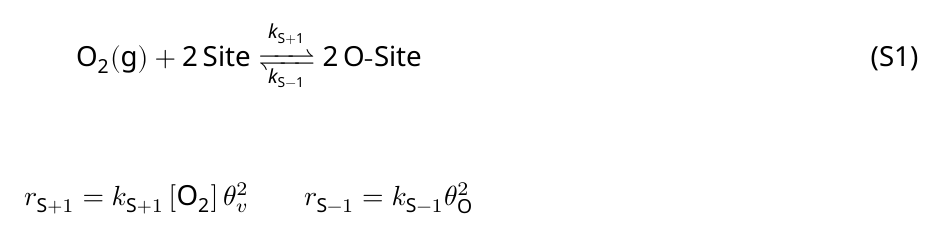
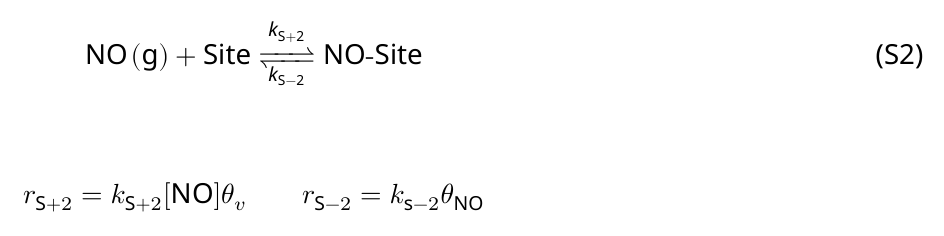
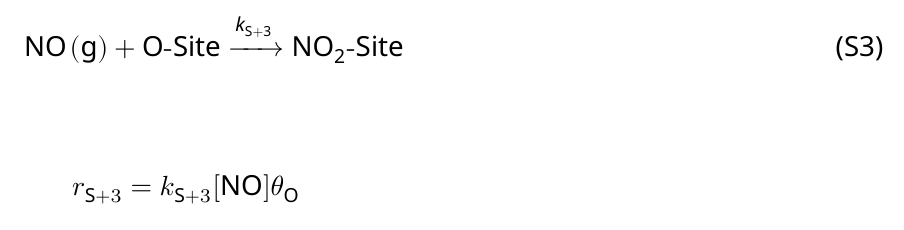
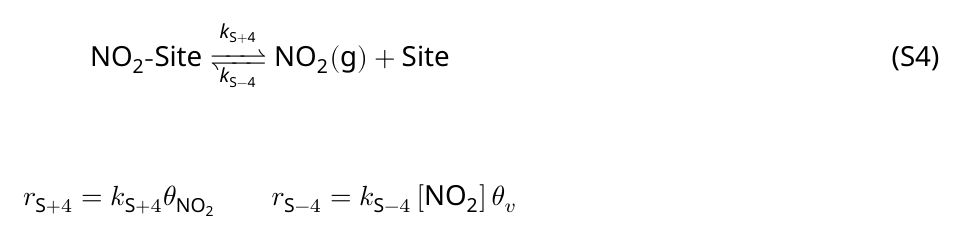
Assume that the adsorptions of \(\ce{NO}\), \(\ce{NO2}\) and \(\ce{O}\) (from the dissociation of \(\ce{O2}\)) cannot proceed beyond a monolayer coverage, and these species are adsorbed by the same kind of surface sites. Their fractional coverages (\(\theta\), defined as the ratio of the number of adsorption sites occupied to the number of total adsorption sites) are denoted as \(\theta_{\ce{NO}}\), \(\theta_{\ce{NO2}}\) and \(\theta_{\ce{O}}\), respectively. Thus, the fraction of unoccupied adsorption sites (\(\theta_v\)) is \(\theta_v=1-\theta_{\ce{NO}}-\theta_{\ce{NO2}}-\theta_{\ce{O}}\). Assume that all the adsorption and desorption processes are much faster than reaction (S3).
5.8 Deduce the expression for \(\theta_v\) as a function of \([\ce{NO}]\), \([\ce{O2}]\), \([\ce{NO2}]\) and the rate constants involved in reactions (S1)–(S4). 6.0 pt
5.9 Choose the correct expression for the rate of \(\ce{2NO(g) + O2(g) -> 2NO2(g)}\) at the beginning of the reaction. Assume that the concentration and adsorption of \(\ce{NO2}\) are both negligible. 4.0 pt
\[ \text{(A)}\quad r_{\mathrm{S}+}= \frac{ k_{\mathrm{S}+3}(k_{\mathrm{S}+1}/k_{\mathrm{S}-1})^{0.5} [\ce{NO}][\ce{O2}]^{0.5} }{ 1+(k_{\mathrm{S}+1}[\ce{O2}]/k_{\mathrm{S}-1})^{0.5} +k_{\mathrm{S}+2}[\ce{NO}]/k_{\mathrm{S}-2} } \]
\[ \text{(B)}\quad r_{\mathrm{S}+}= \frac{ 0.5k_{\mathrm{S}+3}(k_{\mathrm{S}+1}/k_{\mathrm{S}-1})^{0.5} [\ce{NO}][\ce{O2}]^{0.5} }{ 1+(k_{\mathrm{S}+1}[\ce{O2}]/k_{\mathrm{S}-1})^{0.5} +k_{\mathrm{S}+2}[\ce{NO}]/k_{\mathrm{S}-2} } \]
\[ \text{(C)}\quad r_{\mathrm{S}+}= \frac{ k_{\mathrm{S}+3}(k_{\mathrm{S}+1}/k_{\mathrm{S}-1}) [\ce{NO}][\ce{O2}]^{0.5} }{ 1+k_{\mathrm{S}+1}[\ce{O2}]/k_{\mathrm{S}-1} +k_{\mathrm{S}+2}[\ce{NO}]/k_{\mathrm{S}-2} } \]
\[ \text{(D)}\quad r_{\mathrm{S}+}= \frac{ k_{\mathrm{S}+4}k_{\mathrm{S}+3}(k_{\mathrm{S}+1}/k_{\mathrm{S}-1})^{0.5} [\ce{NO}][\ce{O2}]^{0.5}/k_{\mathrm{S}-4} }{ 1+k_{\mathrm{S}+1}([\ce{O2}]/k_{\mathrm{S}-1})^{0.5} +k_{\mathrm{S}+2}[\ce{NO}]/k_{\mathrm{S}-2} } \]
For some catalysts, the surface reaction proceeds via an alternative way instead of reaction (S3):
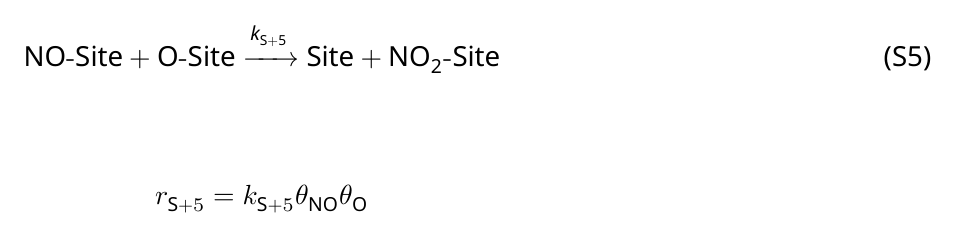
This step is also rate-determining for the overall reaction.
A catalyst (CatY) is used to promote the reaction of \(\ce{2NO + O2 -> 2NO2}\). When the temperature and \(\ce{NO}\) concentration are constant, the initial reaction rate changes with the concentration of \(\ce{O2}\) as follows:
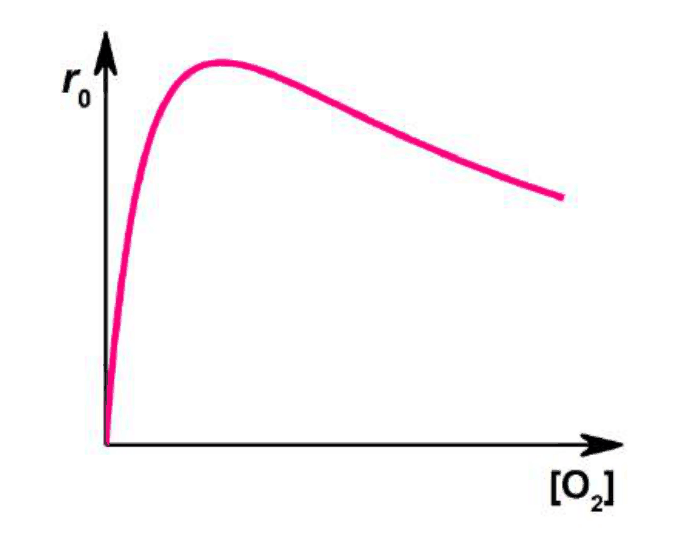
5.10 Choose a mechanism that is consistent with this curve. 6.0 pt
(A) S3
(B) S5
(C) cannot be determined
Official English text of the problem.
Answers
- 5.1: \(\displaystyle r_+=k_2K_{c1}[\ce{NO}]^2[\ce{O2}]\), so \(k_+=k_2K_{c1}\).
- 5.2: \(\displaystyle A_+=A_2e^M,\qquad E_{a+}=E_{a,2}+RN.\)
- 5.3: \(\displaystyle k_+(700\ \mathrm K)=6.86\times10^5\ \mathrm{L^2\,mol^{-2}\,min^{-1}}.\)
- 5.4: \(\displaystyle K_p^{\ominus}(600\ \mathrm K)=2.99\times10^2\), dimensionless.
- 5.5: \(\displaystyle \Delta_{\mathrm r}U_{\mathrm m}^{\ominus}(600\ \mathrm K)=-111.4\ \mathrm{kJ\,mol^{-1}}.\)
- 5.6: \(\displaystyle r_-=k_-[\ce{NO2}]^2,\qquad k_-(600\ \mathrm K)=44.4\ \mathrm{L\,mol^{-1}\,min^{-1}}.\)
- 5.7: \(\displaystyle P_{\mathrm{eq}}=0.588\ \mathrm{bar}=58.8\ \mathrm{kPa}.\)
- 5.8: \[ \boxed{ \theta_v= \left[ 1+\sqrt{\frac{k_{\mathrm{S}+1}[\ce{O2}]}{k_{\mathrm{S}-1}}} +\frac{k_{\mathrm{S}+2}[\ce{NO}]}{k_{\mathrm{S}-2}} +\frac{k_{\mathrm{S}-4}[\ce{NO2}]}{k_{\mathrm{S}+4}} \right]^{-1} } \]
- 5.9: (B); the overall reaction rate is \(\displaystyle r_{\mathrm{S}+}=\tfrac12r_{\mathrm{S}+3}\).
- 5.10: (B), mechanism (S5).
Solution
Use \(R=8.314\ \mathrm{J\,mol^{-1}\,K^{-1}}\) and the standard pressure \(p^{\ominus}=1\ \mathrm{bar}=10^5\ \mathrm{Pa}\).
The molecular names and SMILES used in the problem are:
| Formula | Name | SMILES |
|---|---|---|
| \(\ce{NO}\) | Nitric oxide (nitrogen monoxide) | [N]=O |
| \(\ce{O2}\) | Dioxygen | O=O |
| \(\ce{NO2}\) | Nitrogen dioxide | [N+](=O)[O-] |
| \(\ce{N2O2}\) | Dinitrogen dioxide, the NO dimer | O=NN=O |
| \(\ce{N2O}\) | Nitrous oxide (dinitrogen monoxide) | N#[N+][O-] |
| \(\ce{N2O4}\) | Dinitrogen tetroxide | [O-][N+](=O)[N+](=O)[O-] |
The dimer SMILES gives an N–N-linked connectivity without specifying conformation. The conventional O=O representation does not encode dioxygen’s triplet spin state. Surface binding geometries are unspecified, so complete adsorbate–catalyst structures cannot be assigned.
For the overall reaction as written, \[ \ce{2NO + O2 -> 2NO2}, \] the stoichiometrically normalized rate is \[ r=-\frac12\frac{d[\ce{NO}]}{dt} =-\frac{d[\ce{O2}]}{dt} =\frac12\frac{d[\ce{NO2}]}{dt}. \] When both directions operate, \(r=r_+-r_-\).
5.1
The pre-equilibrium is \[ \ce{2NO <=> N2O2}. \] Consequently, \[ K_{c1}=\frac{[\ce{N2O2}]}{[\ce{NO}]^2}, \qquad [\ce{N2O2}]=K_{c1}[\ce{NO}]^2. \]
The elementary rate-determining step is \[ \ce{N2O2 + O2 -> 2NO2}, \] with rate \[ r_2=k_2[\ce{N2O2}][\ce{O2}]. \]
One occurrence of this step produces two molecules of \(\ce{NO2}\), exactly as in the overall equation. Therefore \(r_+=r_2\), giving \[ \boxed{r_+=k_2K_{c1}[\ce{NO}]^2[\ce{O2}]}. \]
Thus the apparent rate constant is \[ \boxed{k_+=k_2K_{c1}}. \]
5.2
The given temperature dependences give \[ K_{c1}=e^M e^{-N/T}, \qquad k_2=A_2\exp\left(-\frac{E_{a,2}}{RT}\right). \]
Hence \[ \begin{aligned} k_+ &=A_2e^M \exp\left(-\frac{N}{T}-\frac{E_{a,2}}{RT}\right)\\ &=A_2e^M \exp\left[-\frac{E_{a,2}+RN}{RT}\right]. \end{aligned} \]
Comparison with \(k_+=A_+\exp[-E_{a+}/(RT)]\) gives \[ \boxed{A_+=A_2e^M}, \qquad \boxed{E_{a+}=E_{a,2}+RN}. \]
5.3
The two-temperature Arrhenius relation is \[ \ln\frac{k_+(700)}{k_+(600)} = \frac{E_{a+}}{R} \left(\frac1{600}-\frac1{700}\right). \]
Using \(E_{a+}=1.20\times10^3\ \mathrm{J\,mol^{-1}}\), \[ \ln\frac{k_+(700)}{6.63\times10^5} = \frac{1200}{8.314} \left(\frac1{600}-\frac1{700}\right) =0.03437. \]
Therefore, \[ \boxed{ k_+(700\ \mathrm K) =6.63\times10^5e^{0.03437} =6.86\times10^5\ \mathrm{L^2\,mol^{-2}\,min^{-1}} }. \]
5.4
For \[ \ce{2NO(g) + O2(g) -> 2NO2(g)}, \] the standard formation enthalpy of elemental \(\ce{O2(g)}\) is zero. Thus \[ \begin{aligned} \Delta_{\mathrm r}H_{\mathrm m}^{\ominus} &=2(33.1)-2(91.3)-0\\ &=-116.4\ \mathrm{kJ\,mol^{-1}}, \end{aligned} \] and \[ \begin{aligned} \Delta_{\mathrm r}S_{\mathrm m}^{\ominus} &=2(240.1)-2(210.8)-205.2\\ &=-146.6\ \mathrm{J\,K^{-1}\,mol^{-1}}. \end{aligned} \]
At 600 K, \[ \begin{aligned} \Delta_{\mathrm r}G_{\mathrm m}^{\ominus} &=\Delta_{\mathrm r}H_{\mathrm m}^{\ominus} -T\Delta_{\mathrm r}S_{\mathrm m}^{\ominus}\\ &=-116.4-600(-0.1466)\\ &=-28.44\ \mathrm{kJ\,mol^{-1}}. \end{aligned} \]
Since \[ \Delta_{\mathrm r}G_{\mathrm m}^{\ominus} =-RT\ln K_p^{\ominus}, \] we obtain \[ K_p^{\ominus} =\exp\left(\frac{28440}{8.314(600)}\right) =299.234. \]
Therefore, \[ \boxed{K_p^{\ominus}(600\ \mathrm K)=2.99\times10^2}. \]
This thermodynamic equilibrium constant is dimensionless.
5.5
For ideal gases, \[ \Delta_{\mathrm r}H_{\mathrm m}^{\ominus} = \Delta_{\mathrm r}U_{\mathrm m}^{\ominus} +\Delta n_{\mathrm g}RT. \]
The change in gaseous stoichiometric amount is \[ \Delta n_{\mathrm g}=2-(2+1)=-1. \]
Therefore, \[ \begin{aligned} \Delta_{\mathrm r}U_{\mathrm m}^{\ominus} &=\Delta_{\mathrm r}H_{\mathrm m}^{\ominus} -\Delta n_{\mathrm g}RT\\ &=-116.4+\frac{8.314(600)}{1000}\\ &=-111.4116\ \mathrm{kJ\,mol^{-1}}. \end{aligned} \]
Thus, \[ \boxed{\Delta_{\mathrm r}U_{\mathrm m}^{\ominus}(600\ \mathrm K) =-111.4\ \mathrm{kJ\,mol^{-1}}}. \]
5.6
The reverse reaction is \[ \ce{2NO2 -> 2NO + O2}. \]
Define the concentration equilibrium ratio \[ K_c= \frac{[\ce{NO2}]_{\mathrm{eq}}^2} {[\ce{NO}]_{\mathrm{eq}}^2[\ce{O2}]_{\mathrm{eq}}}. \]
At equilibrium, the forward and reverse rates are equal: \[ r_{-,\mathrm{eq}} =k_+[\ce{NO}]_{\mathrm{eq}}^2[\ce{O2}]_{\mathrm{eq}} =\frac{k_+}{K_c}[\ce{NO2}]_{\mathrm{eq}}^2. \]
Because the reverse rate depends only on \([\ce{NO2}]\), consistency with this relation for equilibrium mixtures gives \[ \boxed{r_-=k_-[\ce{NO2}]^2}, \qquad \boxed{k_-=\frac{k_+}{K_c}}. \]
The dimensionless pressure equilibrium constant is \[ K_p^{\ominus} = \frac{(p_{\ce{NO2}}/p^{\ominus})^2} {(p_{\ce{NO}}/p^{\ominus})^2(p_{\ce{O2}}/p^{\ominus})}. \]
Substituting \(p_i=[i]RT\), \[ K_p^{\ominus}=\frac{p^{\ominus}}{RT}K_c, \qquad K_c=\frac{RT}{p^{\ominus}}K_p^{\ominus}. \]
Using \(R=0.08314\ \mathrm{L\,bar\,mol^{-1}\,K^{-1}}\), \[ K_c = \frac{(0.08314)(600)}{1}(299.234) =1.4927\times10^4\ \mathrm{L\,mol^{-1}}. \]
Therefore, \[ \boxed{ k_-= \frac{6.63\times10^5}{1.4927\times10^4} =44.4\ \mathrm{L\,mol^{-1}\,min^{-1}} }. \]
For the reverse contribution alone, the corresponding disappearance rate is \[ -\frac{d[\ce{NO2}]}{dt}=2r_-=2k_-[\ce{NO2}]^2. \]
5.7
The equilibrium is \[ \ce{2NO2(g) <=> 2NO(g) + O2(g)}. \]
Let the initial amount of \(\ce{NO2}\) be \(n_0\). With 20% conversion:
| Species | Equilibrium amount | Equilibrium mole fraction |
|---|---|---|
| \(\ce{NO2}\) | \(0.80n_0\) | \(8/11\) |
| \(\ce{NO}\) | \(0.20n_0\) | \(2/11\) |
| \(\ce{O2}\) | \(0.10n_0\) | \(1/11\) |
The total amount is \(1.10n_0\). With \(p_i=y_iP\), the equilibrium constant for the forward oxidation is \[ \begin{aligned} K_p^{\ominus} &= \frac{y_{\ce{NO2}}^2} {y_{\ce{NO}}^2y_{\ce{O2}}} \frac{p^{\ominus}}{P}\\ &= \frac{(8/11)^2}{(2/11)^2(1/11)} \frac{p^{\ominus}}{P}\\ &=176\frac{p^{\ominus}}{P}. \end{aligned} \]
Hence \[ \boxed{ P=\frac{176p^{\ominus}}{K_p^{\ominus}} =\frac{176}{299.234}\ \mathrm{bar} =0.588\ \mathrm{bar} =58.8\ \mathrm{kPa} }. \]
5.8
Write \(*\) for a vacant adsorption site and \(\ce{O*}\), \(\ce{NO*}\), and \(\ce{NO2*}\) for occupied sites.
The fast adsorption and desorption steps are approximately equilibrated.
For (S1), \[ \ce{O2(g) + 2* <=> 2O*}, \] so \[ k_{\mathrm{S}+1}[\ce{O2}]\theta_v^2 =k_{\mathrm{S}-1}\theta_{\ce{O}}^2. \] Taking the physically meaningful nonnegative root, \[ \theta_{\ce{O}} = \sqrt{\frac{k_{\mathrm{S}+1}[\ce{O2}]}{k_{\mathrm{S}-1}}}\,\theta_v. \]
For (S2), \[ \ce{NO(g) + * <=> NO*}, \] so \[ k_{\mathrm{S}+2}[\ce{NO}]\theta_v =k_{\mathrm{S}-2}\theta_{\ce{NO}}, \] giving \[ \theta_{\ce{NO}} =\frac{k_{\mathrm{S}+2}[\ce{NO}]}{k_{\mathrm{S}-2}}\theta_v. \]
For (S4), \[ \ce{NO2* <=> NO2(g) + *}, \] so \[ k_{\mathrm{S}+4}\theta_{\ce{NO2}} =k_{\mathrm{S}-4}[\ce{NO2}]\theta_v, \] giving \[ \theta_{\ce{NO2}} =\frac{k_{\mathrm{S}-4}[\ce{NO2}]}{k_{\mathrm{S}+4}}\theta_v. \]
Substitution into the site balance \[ 1=\theta_v+\theta_{\ce{O}}+\theta_{\ce{NO}}+\theta_{\ce{NO2}} \] gives \[ \boxed{ \theta_v= \frac{1}{ 1+ \sqrt{k_{\mathrm{S}+1}[\ce{O2}]/k_{\mathrm{S}-1}} +k_{\mathrm{S}+2}[\ce{NO}]/k_{\mathrm{S}-2} +k_{\mathrm{S}-4}[\ce{NO2}]/k_{\mathrm{S}+4} } }. \]
5.9
Initially, the \(\ce{NO2}\) adsorption term is negligible. Therefore, \[ \theta_{\ce{O}} = \frac{ \sqrt{k_{\mathrm{S}+1}[\ce{O2}]/k_{\mathrm{S}-1}} }{ 1+\sqrt{k_{\mathrm{S}+1}[\ce{O2}]/k_{\mathrm{S}-1}} +k_{\mathrm{S}+2}[\ce{NO}]/k_{\mathrm{S}-2} }. \]
The slow step is \[ \ce{NO(g) + O* -> NO2*}, \] with \[ r_{\mathrm{S}+3}=k_{\mathrm{S}+3}[\ce{NO}]\theta_{\ce{O}}. \]
Each occurrence produces one adsorbed \(\ce{NO2}\), which rapidly desorbs. Two occurrences of (S3) are required per occurrence of the overall reaction \[ \ce{2NO(g) + O2(g) -> 2NO2(g)}. \]
Thus, \[ r_{\mathrm{S}+}=\frac12r_{\mathrm{S}+3}, \] and \[ \boxed{ r_{\mathrm{S}+} = \frac{ 0.5k_{\mathrm{S}+3}(k_{\mathrm{S}+1}/k_{\mathrm{S}-1})^{0.5} [\ce{NO}][\ce{O2}]^{0.5} }{ 1+(k_{\mathrm{S}+1}[\ce{O2}]/k_{\mathrm{S}-1})^{0.5} +k_{\mathrm{S}+2}[\ce{NO}]/k_{\mathrm{S}-2} } }. \]
The correct choice is (B).
5.10
For the alternative slow step, \[ \ce{NO* + O* -> * + NO2*}, \] the overall rate is \[ r_{\mathrm{S}+}=\frac12k_{\mathrm{S}+5}\theta_{\ce{NO}}\theta_{\ce{O}}. \]
At fixed temperature and \([\ce{NO}]\), define \[ b=\frac{k_{\mathrm{S}+2}[\ce{NO}]}{k_{\mathrm{S}-2}}, \qquad a=1+b, \qquad x=\sqrt{\frac{k_{\mathrm{S}+1}[\ce{O2}]}{k_{\mathrm{S}-1}}}. \] Here \(a\) and \(b\) are constant, while \(x\) increases with \([\ce{O2}]\).
With negligible initial \(\ce{NO2}\) adsorption, \[ \theta_v=\frac1{a+x}, \qquad \theta_{\ce{O}}=\frac{x}{a+x}, \qquad \theta_{\ce{NO}}=\frac{b}{a+x}. \]
For mechanism (S3), \[ r_{\mathrm{S}+}^{(S3)} =\frac12k_{\mathrm{S}+3}[\ce{NO}]\frac{x}{a+x}. \] Its derivative is \[ \frac{dr_{\mathrm{S}+}^{(S3)}}{dx} = \frac12k_{\mathrm{S}+3}[\ce{NO}] \frac{a}{(a+x)^2}>0. \] Thus its rate rises monotonically toward a plateau.
For mechanism (S5), \[ r_{\mathrm{S}+}^{(S5)} =\frac12k_{\mathrm{S}+5}\frac{bx}{(a+x)^2}, \] and \[ \frac{dr_{\mathrm{S}+}^{(S5)}}{dx} = \frac12k_{\mathrm{S}+5}b \frac{a-x}{(a+x)^3}. \]
This derivative is positive for \(x<a\), zero at \(x=a\), and negative for \(x>a\). The rate therefore rises to a maximum and then falls, as shown in the figure. The maximum occurs at \[ \sqrt{\frac{k_{\mathrm{S}+1}[\ce{O2}]}{k_{\mathrm{S}-1}}} = 1+\frac{k_{\mathrm{S}+2}[\ce{NO}]}{k_{\mathrm{S}-2}}. \]
At high oxygen concentration, oxygen occupies most sites and suppresses the coverage of adsorbed \(\ce{NO}\). Since (S5) requires both adsorbed species, its rate decreases.
Therefore the consistent choice is \[ \boxed{\text{(B), mechanism (S5)}}. \]
The solution was checked against the official solution.
IChO 2022 · Theorieaufgabe 5
Umwandlungen zwischen Stickstoffoxiden
15% der Gesamtpunktzahl
| Frage | 5.1 | 5.2 | 5.3 | 5.4 | 5.5 | 5.6 | 5.7 | 5.8 | 5.9 | 5.10 | Gesamt |
|---|---|---|---|---|---|---|---|---|---|---|---|
| Punkte | 4 | 4 | 2 | 4 | 3 | 8 | 4 | 6 | 4 | 6 | 45 |
| Erreichte Punkte |
Stickstoffoxide (darunter \(\ce{N2O}\), \(\ce{NO}\), \(\ce{NO2}\), \(\ce{N2O4}\) usw., üblicherweise als \(\ce{NO_x}\) bezeichnet) gehören zu den wichtigsten Luftschadstoffen, die eine Reihe von Problemen wie Ozonabbau, sauren Regen, photochemischen Smog und den Treibhauseffekt verursachen können. Daher müssen die Emission und die Umwandlung von \(\ce{NO_x}\) kontrolliert werden, um die Luftqualität zu verbessern. Im Folgenden untersuchen wir die Oxidation von \(\ce{NO}\) zu \(\ce{NO2}\) durch die Reaktion \(\ce{2NO + O2 -> 2NO2}\).
Teil A
Es wird allgemein angenommen, dass diese Reaktion in der Atmosphäre nach folgendem Mechanismus abläuft:
Die Reaktionen (1) und (2) sowie die Rückreaktion von Reaktion (1) sind Elementarreaktionen. Reaktion (1) ist ein vorgelagertes Gleichgewicht, dessen konzentrationsbezogene Gleichgewichtskonstante mit \(K_{c1}\) bezeichnet wird. Reaktion (2) ist der geschwindigkeitsbestimmende Schritt der Gesamtreaktion; ihre Geschwindigkeitskonstante ist \(k_2\).
5.1 Leiten Sie das Geschwindigkeitsgesetz für die Gesamtreaktion \(\ce{2NO + O2 -> 2NO2}\) als Funktion von \([\ce{NO}]\), \([\ce{O2}]\), \(K_{c1}\) und \(k_2\) her. 4.0 Punkte
Die Temperaturabhängigkeit von \(K_{c1}\) lässt sich näherungsweise durch \(\ln K_{c1}=M-(N/T)\) beschreiben (\(M\) und \(N\) sind Konstanten). Die Änderung von \(k_2\) mit der Temperatur folgt der Arrhenius-Gleichung mit dem präexponentiellen Faktor \(A_2\) und der scheinbaren Aktivierungsenergie \(E_{a,2}\). Nehmen Sie an, dass \(E_{a,2}\) und \(A_2\) temperaturunabhängig sind.
5.2 Leiten Sie die Ausdrücke für den präexponentiellen Faktor (\(A_+\)) und die scheinbare Aktivierungsenergie (\(E_{a+}\)) der Reaktion \(\ce{2NO + O2 -> 2NO2}\) als Funktionen von \(M\), \(N\), \(A_2\) und \(E_{a,2}\) her. 4.0 Punkte
Die scheinbare Geschwindigkeitskonstante (\(k_+\)) der Gesamtreaktion beträgt bei 600 K \(6.63\times10^5\ \mathrm{L^2\,mol^{-2}\,min^{-1}}\), und ihre scheinbare Aktivierungsenergie beträgt \(1.20\ \mathrm{kJ\,mol^{-1}}\).
5.3 Berechnen Sie die Geschwindigkeitskonstante (in \(\mathrm{L^2\,mol^{-2}\,min^{-1}}\)) dieser Reaktion bei 700 K. 2.0 Punkte
Die Standardbildungsenthalpien (\(\Delta_{\mathrm f}H_{\mathrm m}^{\ominus}\)) und Standardentropien (\(S_{\mathrm m}^{\ominus}\)) bei 298.15 K sind wie folgt:
| \(\ce{NO(g)}\) | \(\ce{O2(g)}\) | \(\ce{NO2(g)}\) | |
|---|---|---|---|
| \(\Delta_{\mathrm f}H_{\mathrm m}^{\ominus}\) (\(\mathrm{kJ\,mol^{-1}}\)) | 91.3 | 33.1 | |
| \(S_{\mathrm m}^{\ominus}\) (\(\mathrm{J\,K^{-1}\,mol^{-1}}\)) | 210.8 | 205.2 | 240.1 |
Die Standardreaktionsenthalpie und die Standardreaktionsentropie von \(\ce{2NO + O2 -> 2NO2}\) können als temperaturunabhängig betrachtet werden. Für die folgenden Fragen werden alle Gase als ideal angenommen.
5.4 Berechnen Sie die thermodynamische Gleichgewichtskonstante (\(K_p^{\ominus}\)) dieser Reaktion bei 600 K. 4.0 Punkte
5.5 Berechnen Sie die Standardänderung der inneren Energie \(\Delta_{\mathrm r}U_{\mathrm m}^{\ominus}\) (in \(\mathrm{kJ\,mol^{-1}}\)) dieser Reaktion bei 600 K. 3.0 Punkte
Experimentelle Beobachtungen zeigen, dass die Geschwindigkeit der Reaktion \(\ce{2NO2 -> 2NO + O2}\) unabhängig von den Konzentrationen von \(\ce{NO}\) und \(\ce{O2}\) ist.
5.6 Leiten Sie das Geschwindigkeitsgesetz für diese Reaktion her (die scheinbare Geschwindigkeitskonstante kann direkt als \(k_-\) verwendet werden) und berechnen Sie den Wert der scheinbaren Geschwindigkeitskonstante \(k_-\) bei 600 K.
(Falls Sie \(K_p^{\ominus}(600\ \mathrm K)\) in Frage 5.4 nicht bestimmen konnten, verwenden Sie \(K_p^{\ominus}(600\ \mathrm K)=350.0\)) 8.0 Punkte
Gasförmiges \(\ce{NO2}\) wird in einen Behälter mit konstantem Volumen eingebracht, der auf 600 K gehalten wird, und man lässt das System das Gleichgewicht erreichen. 20 Prozent des Edukts werden zu \(\ce{NO}\) und \(\ce{O2}\) umgesetzt. Alle Gase werden als ideal angenommen.
5.7 Berechnen Sie den Gesamtdruck dieses Reaktionssystems im Gleichgewicht. (Falls Sie \(K_p^{\ominus}(600\ \mathrm K)\) in Frage 5.4 nicht bestimmen konnten, verwenden Sie \(K_p^{\ominus}(600\ \mathrm K)=350.0\)) 4.0 Punkte
Teil B
Industrieabgase sind eine Hauptquelle von \(\ce{NO_x}\). Eine Möglichkeit zur Verringerung der Emission von \(\ce{NO_x}\) besteht in der Oxidation von \(\ce{NO}\) zu \(\ce{NO2}\) und der anschließenden Absorption des gebildeten \(\ce{NO2}\) durch Absorptionsmittel. Aufgrund der niedrigen Konzentration von \(\ce{NO}\) im Abgas verläuft seine spontane Oxidation in der Atmosphäre jedoch zu langsam, um den industriellen Anforderungen zu genügen. Im Allgemeinen werden feste Katalysatoren eingesetzt, um diese Reaktion zu beschleunigen. Die Oxidation von \(\ce{NO}\) läuft auf der Oberfläche eines bestimmten Katalysators (CatX) nach folgendem Mechanismus ab (ein Adsorptionsplatz wird als Site bezeichnet):
Nehmen Sie an, dass die Adsorption von \(\ce{NO}\), \(\ce{NO2}\) und \(\ce{O}\) (aus der Dissoziation von \(\ce{O2}\)) nicht über eine monomolekulare Schicht hinausgehen kann und dass diese Spezies an derselben Art von Oberflächenplätzen adsorbiert werden. Ihre Bedeckungsgrade (\(\theta\), definiert als Verhältnis der Anzahl besetzter Adsorptionsplätze zur Gesamtzahl der Adsorptionsplätze) werden mit \(\theta_{\ce{NO}}\), \(\theta_{\ce{NO2}}\) bzw. \(\theta_{\ce{O}}\) bezeichnet. Somit ist der Anteil unbesetzter Adsorptionsplätze (\(\theta_v\)) gleich \(\theta_v=1-\theta_{\ce{NO}}-\theta_{\ce{NO2}}-\theta_{\ce{O}}\). Nehmen Sie an, dass alle Adsorptions- und Desorptionsprozesse wesentlich schneller ablaufen als Reaktion (S3).
5.8 Leiten Sie den Ausdruck für \(\theta_v\) als Funktion von \([\ce{NO}]\), \([\ce{O2}]\), \([\ce{NO2}]\) und den an den Reaktionen (S1)–(S4) beteiligten Geschwindigkeitskonstanten her. 6.0 Punkte
5.9 Wählen Sie den richtigen Ausdruck für die Geschwindigkeit von \(\ce{2NO(g) + O2(g) -> 2NO2(g)}\) zu Beginn der Reaktion. Nehmen Sie an, dass sowohl die Konzentration als auch die Adsorption von \(\ce{NO2}\) vernachlässigbar sind. 4.0 Punkte
\[ \text{(A)}\quad r_{\mathrm{S}+}= \frac{ k_{\mathrm{S}+3}(k_{\mathrm{S}+1}/k_{\mathrm{S}-1})^{0.5} [\ce{NO}][\ce{O2}]^{0.5} }{ 1+(k_{\mathrm{S}+1}[\ce{O2}]/k_{\mathrm{S}-1})^{0.5} +k_{\mathrm{S}+2}[\ce{NO}]/k_{\mathrm{S}-2} } \]
\[ \text{(B)}\quad r_{\mathrm{S}+}= \frac{ 0.5k_{\mathrm{S}+3}(k_{\mathrm{S}+1}/k_{\mathrm{S}-1})^{0.5} [\ce{NO}][\ce{O2}]^{0.5} }{ 1+(k_{\mathrm{S}+1}[\ce{O2}]/k_{\mathrm{S}-1})^{0.5} +k_{\mathrm{S}+2}[\ce{NO}]/k_{\mathrm{S}-2} } \]
\[ \text{(C)}\quad r_{\mathrm{S}+}= \frac{ k_{\mathrm{S}+3}(k_{\mathrm{S}+1}/k_{\mathrm{S}-1}) [\ce{NO}][\ce{O2}]^{0.5} }{ 1+k_{\mathrm{S}+1}[\ce{O2}]/k_{\mathrm{S}-1} +k_{\mathrm{S}+2}[\ce{NO}]/k_{\mathrm{S}-2} } \]
\[ \text{(D)}\quad r_{\mathrm{S}+}= \frac{ k_{\mathrm{S}+4}k_{\mathrm{S}+3}(k_{\mathrm{S}+1}/k_{\mathrm{S}-1})^{0.5} [\ce{NO}][\ce{O2}]^{0.5}/k_{\mathrm{S}-4} }{ 1+k_{\mathrm{S}+1}([\ce{O2}]/k_{\mathrm{S}-1})^{0.5} +k_{\mathrm{S}+2}[\ce{NO}]/k_{\mathrm{S}-2} } \]
Bei manchen Katalysatoren verläuft die Oberflächenreaktion anstelle von Reaktion (S3) über einen alternativen Weg:
Auch dieser Schritt ist für die Gesamtreaktion geschwindigkeitsbestimmend.
Ein Katalysator (CatY) wird eingesetzt, um die Reaktion \(\ce{2NO + O2 -> 2NO2}\) zu beschleunigen. Bei konstanter Temperatur und konstanter \(\ce{NO}\)-Konzentration ändert sich die Anfangsgeschwindigkeit der Reaktion mit der Konzentration von \(\ce{O2}\) wie folgt:
5.10 Wählen Sie einen Mechanismus, der mit dieser Kurve vereinbar ist. 6.0 Punkte
(A) S3
(B) S5
(C) lässt sich nicht bestimmen
Aufgabentext aus dem offiziellen englischen Text übersetzt.
Antworten
- 5.1: \(\displaystyle r_+=k_2K_{c1}[\ce{NO}]^2[\ce{O2}]\), also \(k_+=k_2K_{c1}\).
- 5.2: \(\displaystyle A_+=A_2e^M,\qquad E_{a+}=E_{a,2}+RN.\)
- 5.3: \(\displaystyle k_+(700\ \mathrm K)=6.86\times10^5\ \mathrm{L^2\,mol^{-2}\,min^{-1}}.\)
- 5.4: \(\displaystyle K_p^{\ominus}(600\ \mathrm K)=2.99\times10^2\), dimensionslos.
- 5.5: \(\displaystyle \Delta_{\mathrm r}U_{\mathrm m}^{\ominus}(600\ \mathrm K)=-111.4\ \mathrm{kJ\,mol^{-1}}.\)
- 5.6: \(\displaystyle r_-=k_-[\ce{NO2}]^2,\qquad k_-(600\ \mathrm K)=44.4\ \mathrm{L\,mol^{-1}\,min^{-1}}.\)
- 5.7: \(\displaystyle P_{\mathrm{eq}}=0.588\ \mathrm{bar}=58.8\ \mathrm{kPa}.\)
- 5.8: \[ \boxed{ \theta_v= \left[ 1+\sqrt{\frac{k_{\mathrm{S}+1}[\ce{O2}]}{k_{\mathrm{S}-1}}} +\frac{k_{\mathrm{S}+2}[\ce{NO}]}{k_{\mathrm{S}-2}} +\frac{k_{\mathrm{S}-4}[\ce{NO2}]}{k_{\mathrm{S}+4}} \right]^{-1} } \]
- 5.9: (B); die Geschwindigkeit der Gesamtreaktion ist \(\displaystyle r_{\mathrm{S}+}=\tfrac12r_{\mathrm{S}+3}\).
- 5.10: (B), Mechanismus (S5).
Lösung
Verwenden Sie \(R=8.314\ \mathrm{J\,mol^{-1}\,K^{-1}}\) und den Standarddruck \(p^{\ominus}=1\ \mathrm{bar}=10^5\ \mathrm{Pa}\).
Die in der Aufgabe verwendeten Molekülnamen und SMILES sind:
| Formel | Name | SMILES |
|---|---|---|
| \(\ce{NO}\) | Stickstoffoxid (Stickstoffmonoxid) | [N]=O |
| \(\ce{O2}\) | Disauerstoff | O=O |
| \(\ce{NO2}\) | Stickstoffdioxid | [N+](=O)[O-] |
| \(\ce{N2O2}\) | Distickstoffdioxid, das NO-Dimer | O=NN=O |
| \(\ce{N2O}\) | Lachgas (Distickstoffmonoxid) | N#[N+][O-] |
| \(\ce{N2O4}\) | Distickstofftetraoxid | [O-][N+](=O)[N+](=O)[O-] |
Der SMILES-Ausdruck des Dimers gibt eine über eine N–N-Bindung verknüpfte Struktur an, ohne die Konformation festzulegen. Die übliche Darstellung O=O bildet den Triplett-Spinzustand von Disauerstoff nicht ab. Die Bindungsgeometrien an der Oberfläche sind nicht angegeben, sodass keine vollständigen Adsorbat-Katalysator-Strukturen zugeordnet werden können.
Für die Gesamtreaktion in der angegebenen Form \[ \ce{2NO + O2 -> 2NO2}, \] ist die stöchiometrisch normierte Reaktionsgeschwindigkeit \[ r=-\frac12\frac{d[\ce{NO}]}{dt} =-\frac{d[\ce{O2}]}{dt} =\frac12\frac{d[\ce{NO2}]}{dt}. \] Wenn beide Reaktionsrichtungen ablaufen, gilt \(r=r_+-r_-\).
5.1
Das vorgelagerte Gleichgewicht lautet \[ \ce{2NO <=> N2O2}. \] Daraus folgt \[ K_{c1}=\frac{[\ce{N2O2}]}{[\ce{NO}]^2}, \qquad [\ce{N2O2}]=K_{c1}[\ce{NO}]^2. \]
Der geschwindigkeitsbestimmende Elementarschritt lautet \[ \ce{N2O2 + O2 -> 2NO2}, \] mit der Geschwindigkeit \[ r_2=k_2[\ce{N2O2}][\ce{O2}]. \]
Bei einmaligem Ablauf dieses Schrittes entstehen zwei Moleküle \(\ce{NO2}\), genau wie in der Gesamtgleichung. Daher gilt \(r_+=r_2\), woraus folgt: \[ \boxed{r_+=k_2K_{c1}[\ce{NO}]^2[\ce{O2}]}. \]
Somit ist die scheinbare Geschwindigkeitskonstante \[ \boxed{k_+=k_2K_{c1}}. \]
5.2
Aus den angegebenen Temperaturabhängigkeiten folgt \[ K_{c1}=e^M e^{-N/T}, \qquad k_2=A_2\exp\left(-\frac{E_{a,2}}{RT}\right). \]
Daher gilt \[ \begin{aligned} k_+ &=A_2e^M \exp\left(-\frac{N}{T}-\frac{E_{a,2}}{RT}\right)\\ &=A_2e^M \exp\left[-\frac{E_{a,2}+RN}{RT}\right]. \end{aligned} \]
Der Vergleich mit \(k_+=A_+\exp[-E_{a+}/(RT)]\) ergibt \[ \boxed{A_+=A_2e^M}, \qquad \boxed{E_{a+}=E_{a,2}+RN}. \]
5.3
Die Arrhenius-Beziehung für zwei Temperaturen lautet \[ \ln\frac{k_+(700)}{k_+(600)} = \frac{E_{a+}}{R} \left(\frac1{600}-\frac1{700}\right). \]
Mit \(E_{a+}=1.20\times10^3\ \mathrm{J\,mol^{-1}}\) ergibt sich \[ \ln\frac{k_+(700)}{6.63\times10^5} = \frac{1200}{8.314} \left(\frac1{600}-\frac1{700}\right) =0.03437. \]
Daher gilt \[ \boxed{ k_+(700\ \mathrm K) =6.63\times10^5e^{0.03437} =6.86\times10^5\ \mathrm{L^2\,mol^{-2}\,min^{-1}} }. \]
5.4
Für \[ \ce{2NO(g) + O2(g) -> 2NO2(g)}, \] ist die Standardbildungsenthalpie von elementarem \(\ce{O2(g)}\) null. Somit gilt \[ \begin{aligned} \Delta_{\mathrm r}H_{\mathrm m}^{\ominus} &=2(33.1)-2(91.3)-0\\ &=-116.4\ \mathrm{kJ\,mol^{-1}}, \end{aligned} \] und \[ \begin{aligned} \Delta_{\mathrm r}S_{\mathrm m}^{\ominus} &=2(240.1)-2(210.8)-205.2\\ &=-146.6\ \mathrm{J\,K^{-1}\,mol^{-1}}. \end{aligned} \]
Bei 600 K gilt \[ \begin{aligned} \Delta_{\mathrm r}G_{\mathrm m}^{\ominus} &=\Delta_{\mathrm r}H_{\mathrm m}^{\ominus} -T\Delta_{\mathrm r}S_{\mathrm m}^{\ominus}\\ &=-116.4-600(-0.1466)\\ &=-28.44\ \mathrm{kJ\,mol^{-1}}. \end{aligned} \]
Da \[ \Delta_{\mathrm r}G_{\mathrm m}^{\ominus} =-RT\ln K_p^{\ominus}, \] erhalten wir \[ K_p^{\ominus} =\exp\left(\frac{28440}{8.314(600)}\right) =299.234. \]
Daher gilt \[ \boxed{K_p^{\ominus}(600\ \mathrm K)=2.99\times10^2}. \]
Diese thermodynamische Gleichgewichtskonstante ist dimensionslos.
5.5
Für ideale Gase gilt \[ \Delta_{\mathrm r}H_{\mathrm m}^{\ominus} = \Delta_{\mathrm r}U_{\mathrm m}^{\ominus} +\Delta n_{\mathrm g}RT. \]
Die stöchiometrische Änderung der Stoffmenge gasförmiger Spezies beträgt \[ \Delta n_{\mathrm g}=2-(2+1)=-1. \]
Daher gilt \[ \begin{aligned} \Delta_{\mathrm r}U_{\mathrm m}^{\ominus} &=\Delta_{\mathrm r}H_{\mathrm m}^{\ominus} -\Delta n_{\mathrm g}RT\\ &=-116.4+\frac{8.314(600)}{1000}\\ &=-111.4116\ \mathrm{kJ\,mol^{-1}}. \end{aligned} \]
Somit gilt \[ \boxed{\Delta_{\mathrm r}U_{\mathrm m}^{\ominus}(600\ \mathrm K) =-111.4\ \mathrm{kJ\,mol^{-1}}}. \]
5.6
Die Rückreaktion lautet \[ \ce{2NO2 -> 2NO + O2}. \]
Wir definieren den Konzentrationsquotienten im Gleichgewicht als \[ K_c= \frac{[\ce{NO2}]_{\mathrm{eq}}^2} {[\ce{NO}]_{\mathrm{eq}}^2[\ce{O2}]_{\mathrm{eq}}}. \]
Im Gleichgewicht sind die Geschwindigkeiten der Hin- und Rückreaktion gleich: \[ r_{-,\mathrm{eq}} =k_+[\ce{NO}]_{\mathrm{eq}}^2[\ce{O2}]_{\mathrm{eq}} =\frac{k_+}{K_c}[\ce{NO2}]_{\mathrm{eq}}^2. \]
Da die Geschwindigkeit der Rückreaktion nur von \([\ce{NO2}]\) abhängt, ergibt die Übereinstimmung mit dieser Beziehung für Gleichgewichtsgemische \[ \boxed{r_-=k_-[\ce{NO2}]^2}, \qquad \boxed{k_-=\frac{k_+}{K_c}}. \]
Die dimensionslose druckbezogene Gleichgewichtskonstante lautet \[ K_p^{\ominus} = \frac{(p_{\ce{NO2}}/p^{\ominus})^2} {(p_{\ce{NO}}/p^{\ominus})^2(p_{\ce{O2}}/p^{\ominus})}. \]
Einsetzen von \(p_i=[i]RT\) ergibt \[ K_p^{\ominus}=\frac{p^{\ominus}}{RT}K_c, \qquad K_c=\frac{RT}{p^{\ominus}}K_p^{\ominus}. \]
Mit \(R=0.08314\ \mathrm{L\,bar\,mol^{-1}\,K^{-1}}\) ergibt sich \[ K_c = \frac{(0.08314)(600)}{1}(299.234) =1.4927\times10^4\ \mathrm{L\,mol^{-1}}. \]
Daher gilt \[ \boxed{ k_-= \frac{6.63\times10^5}{1.4927\times10^4} =44.4\ \mathrm{L\,mol^{-1}\,min^{-1}} }. \]
Berücksichtigt man nur den Beitrag der Rückreaktion, lautet die entsprechende Verbrauchsgeschwindigkeit \[ -\frac{d[\ce{NO2}]}{dt}=2r_-=2k_-[\ce{NO2}]^2. \]
5.7
Das Gleichgewicht lautet \[ \ce{2NO2(g) <=> 2NO(g) + O2(g)}. \]
Die anfängliche Stoffmenge von \(\ce{NO2}\) sei \(n_0\). Bei 20% Umsatz gilt:
| Spezies | Stoffmenge im Gleichgewicht | Stoffmengenanteil im Gleichgewicht |
|---|---|---|
| \(\ce{NO2}\) | \(0.80n_0\) | \(8/11\) |
| \(\ce{NO}\) | \(0.20n_0\) | \(2/11\) |
| \(\ce{O2}\) | \(0.10n_0\) | \(1/11\) |
Die Gesamtstoffmenge beträgt \(1.10n_0\). Mit \(p_i=y_iP\) lautet die Gleichgewichtskonstante für die Oxidation in Hinrichtung \[ \begin{aligned} K_p^{\ominus} &= \frac{y_{\ce{NO2}}^2} {y_{\ce{NO}}^2y_{\ce{O2}}} \frac{p^{\ominus}}{P}\\ &= \frac{(8/11)^2}{(2/11)^2(1/11)} \frac{p^{\ominus}}{P}\\ &=176\frac{p^{\ominus}}{P}. \end{aligned} \]
Daraus folgt \[ \boxed{ P=\frac{176p^{\ominus}}{K_p^{\ominus}} =\frac{176}{299.234}\ \mathrm{bar} =0.588\ \mathrm{bar} =58.8\ \mathrm{kPa} }. \]
5.8
Wir schreiben \(*\) für einen freien Adsorptionsplatz und \(\ce{O*}\), \(\ce{NO*}\) sowie \(\ce{NO2*}\) für besetzte Plätze.
Die schnellen Adsorptions- und Desorptionsschritte befinden sich näherungsweise im Gleichgewicht.
Für (S1) gilt \[ \ce{O2(g) + 2* <=> 2O*}, \] also \[ k_{\mathrm{S}+1}[\ce{O2}]\theta_v^2 =k_{\mathrm{S}-1}\theta_{\ce{O}}^2. \] Durch Ziehen der physikalisch sinnvollen nichtnegativen Wurzel erhalten wir \[ \theta_{\ce{O}} = \sqrt{\frac{k_{\mathrm{S}+1}[\ce{O2}]}{k_{\mathrm{S}-1}}}\,\theta_v. \]
Für (S2) gilt \[ \ce{NO(g) + * <=> NO*}, \] also \[ k_{\mathrm{S}+2}[\ce{NO}]\theta_v =k_{\mathrm{S}-2}\theta_{\ce{NO}}, \] woraus folgt \[ \theta_{\ce{NO}} =\frac{k_{\mathrm{S}+2}[\ce{NO}]}{k_{\mathrm{S}-2}}\theta_v. \]
Für (S4) gilt \[ \ce{NO2* <=> NO2(g) + *}, \] also \[ k_{\mathrm{S}+4}\theta_{\ce{NO2}} =k_{\mathrm{S}-4}[\ce{NO2}]\theta_v, \] woraus folgt \[ \theta_{\ce{NO2}} =\frac{k_{\mathrm{S}-4}[\ce{NO2}]}{k_{\mathrm{S}+4}}\theta_v. \]
Einsetzen in die Platzbilanz \[ 1=\theta_v+\theta_{\ce{O}}+\theta_{\ce{NO}}+\theta_{\ce{NO2}} \] ergibt \[ \boxed{ \theta_v= \frac{1}{ 1+ \sqrt{k_{\mathrm{S}+1}[\ce{O2}]/k_{\mathrm{S}-1}} +k_{\mathrm{S}+2}[\ce{NO}]/k_{\mathrm{S}-2} +k_{\mathrm{S}-4}[\ce{NO2}]/k_{\mathrm{S}+4} } }. \]
5.9
Zu Beginn ist der Adsorptionsterm für \(\ce{NO2}\) vernachlässigbar. Daher gilt \[ \theta_{\ce{O}} = \frac{ \sqrt{k_{\mathrm{S}+1}[\ce{O2}]/k_{\mathrm{S}-1}} }{ 1+\sqrt{k_{\mathrm{S}+1}[\ce{O2}]/k_{\mathrm{S}-1}} +k_{\mathrm{S}+2}[\ce{NO}]/k_{\mathrm{S}-2} }. \]
Der langsame Schritt lautet \[ \ce{NO(g) + O* -> NO2*}, \] mit \[ r_{\mathrm{S}+3}=k_{\mathrm{S}+3}[\ce{NO}]\theta_{\ce{O}}. \]
Bei jedem Ablauf entsteht ein adsorbiertes \(\ce{NO2}\), das rasch desorbiert. (S3) muss zweimal ablaufen, damit die folgende Gesamtreaktion einmal abläuft: \[ \ce{2NO(g) + O2(g) -> 2NO2(g)}. \]
Somit gilt \[ r_{\mathrm{S}+}=\frac12r_{\mathrm{S}+3}, \] und \[ \boxed{ r_{\mathrm{S}+} = \frac{ 0.5k_{\mathrm{S}+3}(k_{\mathrm{S}+1}/k_{\mathrm{S}-1})^{0.5} [\ce{NO}][\ce{O2}]^{0.5} }{ 1+(k_{\mathrm{S}+1}[\ce{O2}]/k_{\mathrm{S}-1})^{0.5} +k_{\mathrm{S}+2}[\ce{NO}]/k_{\mathrm{S}-2} } }. \]
Die richtige Antwort ist (B).
5.10
Für den alternativen langsamen Schritt \[ \ce{NO* + O* -> * + NO2*}, \] lautet die Geschwindigkeit der Gesamtreaktion \[ r_{\mathrm{S}+}=\frac12k_{\mathrm{S}+5}\theta_{\ce{NO}}\theta_{\ce{O}}. \]
Bei konstanter Temperatur und konstantem \([\ce{NO}]\) definieren wir \[ b=\frac{k_{\mathrm{S}+2}[\ce{NO}]}{k_{\mathrm{S}-2}}, \qquad a=1+b, \qquad x=\sqrt{\frac{k_{\mathrm{S}+1}[\ce{O2}]}{k_{\mathrm{S}-1}}}. \] Hier sind \(a\) und \(b\) konstant, während \(x\) mit \([\ce{O2}]\) zunimmt.
Bei vernachlässigbarer anfänglicher Adsorption von \(\ce{NO2}\) gilt \[ \theta_v=\frac1{a+x}, \qquad \theta_{\ce{O}}=\frac{x}{a+x}, \qquad \theta_{\ce{NO}}=\frac{b}{a+x}. \]
Für Mechanismus (S3) gilt \[ r_{\mathrm{S}+}^{(S3)} =\frac12k_{\mathrm{S}+3}[\ce{NO}]\frac{x}{a+x}. \] Die Ableitung lautet \[ \frac{dr_{\mathrm{S}+}^{(S3)}}{dx} = \frac12k_{\mathrm{S}+3}[\ce{NO}] \frac{a}{(a+x)^2}>0. \] Somit steigt die Reaktionsgeschwindigkeit monoton an und nähert sich einem Plateau.
Für Mechanismus (S5) gilt \[ r_{\mathrm{S}+}^{(S5)} =\frac12k_{\mathrm{S}+5}\frac{bx}{(a+x)^2}, \] und \[ \frac{dr_{\mathrm{S}+}^{(S5)}}{dx} = \frac12k_{\mathrm{S}+5}b \frac{a-x}{(a+x)^3}. \]
Diese Ableitung ist für \(x<a\) positiv, bei \(x=a\) null und für \(x>a\) negativ. Die Reaktionsgeschwindigkeit steigt daher bis zu einem Maximum an und fällt anschließend ab, wie in der Abbildung dargestellt. Das Maximum tritt auf bei \[ \sqrt{\frac{k_{\mathrm{S}+1}[\ce{O2}]}{k_{\mathrm{S}-1}}} = 1+\frac{k_{\mathrm{S}+2}[\ce{NO}]}{k_{\mathrm{S}-2}}. \]
Bei hoher Sauerstoffkonzentration besetzt Sauerstoff die meisten Plätze und verringert den Bedeckungsgrad des adsorbierten \(\ce{NO}\). Da (S5) beide adsorbierten Spezies benötigt, nimmt seine Geschwindigkeit ab.
Die mit der Kurve vereinbare Antwort ist daher \[ \boxed{\text{(B), Mechanismus (S5)}}. \]
Die Lösung wurde mit der offiziellen Lösung abgeglichen.
IChO 2022 · Teori sorusu 5
Azot Oksitlerinin Birbirine Dönüşümü
Toplam puanın %15'i
| Soru | 5.1 | 5.2 | 5.3 | 5.4 | 5.5 | 5.6 | 5.7 | 5.8 | 5.9 | 5.10 | Toplam |
|---|---|---|---|---|---|---|---|---|---|---|---|
| Puan | 4 | 4 | 2 | 4 | 3 | 8 | 4 | 6 | 4 | 6 | 45 |
| Alınan puan |
Azot oksitleri (\(\ce{N2O}\), \(\ce{NO}\), \(\ce{NO2}\), \(\ce{N2O4}\) vb. bileşikleri içerir ve genellikle \(\ce{NO_x}\) olarak gösterilir), ozon tabakasının incelmesi, asit yağmurları, fotokimyasal sis ve sera etkisi gibi bir dizi soruna yol açabilen başlıca hava kirleticilerindendir. Bu nedenle, hava kalitesini iyileştirmek için \(\ce{NO_x}\) emisyonları ve dönüşümleri kontrol edilmelidir. Burada \(\ce{NO}\)'nun \(\ce{2NO + O2 -> 2NO2}\) tepkimesi yoluyla \(\ce{NO2}\)'ye yükseltgenmesini inceleyelim.
Bölüm A
Bu tepkimenin atmosferde aşağıdaki mekanizma üzerinden ilerlediği genel olarak kabul edilir:
(1) ve (2) tepkimeleri ile (1) tepkimesinin tersi elementer tepkimelerdir. (1) tepkimesi bir ön denge tepkimesidir ve derişimler cinsinden denge sabiti \(K_{c1}\) ile gösterilir. (2) tepkimesi toplam tepkimenin hız belirleyen basamağıdır ve hız sabiti \(k_2\)'dir.
5.1 \(\ce{2NO + O2 -> 2NO2}\) toplam tepkimesinin hız ifadesini \([\ce{NO}]\), \([\ce{O2}]\), \(K_{c1}\) ve \(k_2\)'nin bir fonksiyonu olarak türetiniz. 4.0 puan
\(K_{c1}\)'in sıcaklığa bağımlılığı yaklaşık olarak \(\ln K_{c1}=M-(N/T)\) biçiminde ifade edilebilir (\(M\) ve \(N\) sabittir). \(k_2\)'nin sıcaklıkla değişimi, üstel öncesi çarpanı \(A_2\) ve görünür aktivasyon enerjisi \(E_{a,2}\) olan Arrhenius denklemine uyar. \(E_{a,2}\) ve \(A_2\)'nin sıcaklıktan bağımsız olduğunu varsayınız.
5.2 \(\ce{2NO + O2 -> 2NO2}\) tepkimesinin üstel öncesi çarpanı (\(A_+\)) ve görünür aktivasyon enerjisi (\(E_{a+}\)) için ifadeleri \(M\), \(N\), \(A_2\) ve \(E_{a,2}\)'nin fonksiyonları olarak türetiniz. 4.0 puan
Toplam tepkimenin görünür hız sabiti (\(k_+\)) 600 K'de \(6.63\times10^5\ \mathrm{L^2\,mol^{-2}\,min^{-1}}\), görünür aktivasyon enerjisi ise \(1.20\ \mathrm{kJ\,mol^{-1}}\)'dir.
5.3 Bu tepkimenin 700 K'deki hız sabitini (\(\mathrm{L^2\,mol^{-2}\,min^{-1}}\) cinsinden) hesaplayınız. 2.0 puan
298.15 K'deki standart oluşum entalpileri (\(\Delta_{\mathrm f}H_{\mathrm m}^{\ominus}\)) ve standart entropiler (\(S_{\mathrm m}^{\ominus}\)) aşağıdaki gibidir:
| \(\ce{NO(g)}\) | \(\ce{O2(g)}\) | \(\ce{NO2(g)}\) | |
|---|---|---|---|
| \(\Delta_{\mathrm f}H_{\mathrm m}^{\ominus}\) (\(\mathrm{kJ\,mol^{-1}}\)) | 91.3 | 33.1 | |
| \(S_{\mathrm m}^{\ominus}\) (\(\mathrm{J\,K^{-1}\,mol^{-1}}\)) | 210.8 | 205.2 | 240.1 |
\(\ce{2NO + O2 -> 2NO2}\) tepkimesinin standart entalpi ve entropi değişimleri sıcaklıktan bağımsız kabul edilebilir. Aşağıdaki sorularda tüm gazlar ideal kabul edilmektedir.
5.4 Bu tepkimenin 600 K'deki termodinamik denge sabitini (\(K_p^{\ominus}\)) hesaplayınız. 4.0 puan
5.5 Bu tepkimenin 600 K'deki standart iç enerji değişimini \(\Delta_{\mathrm r}U_{\mathrm m}^{\ominus}\) (\(\mathrm{kJ\,mol^{-1}}\) cinsinden) hesaplayınız. 3.0 puan
Deneysel gözlemler, \(\ce{2NO2 -> 2NO + O2}\) tepkimesinin hızının \(\ce{NO}\) ve \(\ce{O2}\) derişimlerinden bağımsız olduğunu göstermektedir.
5.6 Bu tepkimenin hız ifadesini türetiniz (görünür hız sabiti doğrudan \(k_-\) olarak kullanılabilir) ve 600 K'deki görünür hız sabiti \(k_-\)'nin değerini hesaplayınız.
(5.4 sorusunda \(K_p^{\ominus}(600\ \mathrm K)\) değerini bulamadıysanız, \(K_p^{\ominus}(600\ \mathrm K)=350.0\) kullanınız.) 8.0 puan
\(\ce{NO2}\) gazı, 600 K'de tutulan sabit hacimli bir kaba konulur ve dengeye ulaşması beklenir. Tepkimeye giren maddenin yüzde 20'si \(\ce{NO}\) ve \(\ce{O2}\)'ye dönüşür. Tüm gazlar ideal kabul edilmektedir.
5.7 Bu tepkime sisteminin dengedeki toplam basıncını hesaplayınız. (5.4 sorusunda \(K_p^{\ominus}(600\ \mathrm K)\) değerini bulamadıysanız, \(K_p^{\ominus}(600\ \mathrm K)=350.0\) kullanınız.) 4.0 puan
Bölüm B
Endüstriyel atık gazlar, \(\ce{NO_x}\)'in başlıca kaynaklarından biridir. \(\ce{NO_x}\) emisyonlarını azaltma yaklaşımlarından biri, \(\ce{NO}\)'nun \(\ce{NO2}\)'ye yükseltgenmesi ve ardından oluşan \(\ce{NO2}\)'nin absorbanlar tarafından absorplanmasıdır. Ancak, atık gazlardaki \(\ce{NO}\) derişimi düşük olduğundan, atmosferde kendiliğinden yükseltgenmesi endüstrinin gereksinimini karşılayamayacak kadar yavaştır. Bu tepkimeyi hızlandırmak için genellikle katı katalizörler kullanılır. \(\ce{NO}\)'nun yükseltgenmesi, belirli bir katalizörün (CatX) yüzeyinde aşağıdaki mekanizma üzerinden ilerler (adsorpsiyon merkezi Site ile gösterilmiştir):
\(\ce{NO}\), \(\ce{NO2}\) ve (\(\ce{O2}\)'nin ayrışmasından oluşan) \(\ce{O}\) adsorpsiyonunun tek tabakalı kaplanmanın ötesine geçemediğini ve bu türlerin aynı tür yüzey merkezlerinde adsorplandığını varsayınız. Bu türlerin kesirsel kaplanmaları (işgal edilen adsorpsiyon merkezlerinin sayısının toplam adsorpsiyon merkezi sayısına oranı olarak tanımlanan \(\theta\)) sırasıyla \(\theta_{\ce{NO}}\), \(\theta_{\ce{NO2}}\) ve \(\theta_{\ce{O}}\) ile gösterilir. Dolayısıyla, boş adsorpsiyon merkezlerinin kesri (\(\theta_v\)), \(\theta_v=1-\theta_{\ce{NO}}-\theta_{\ce{NO2}}-\theta_{\ce{O}}\) olur. Tüm adsorpsiyon ve desorpsiyon süreçlerinin (S3) tepkimesinden çok daha hızlı olduğunu varsayınız.
5.8 \(\theta_v\) ifadesini \([\ce{NO}]\), \([\ce{O2}]\), \([\ce{NO2}]\) ve (S1)–(S4) tepkimelerindeki hız sabitlerinin bir fonksiyonu olarak türetiniz. 6.0 puan
5.9 \(\ce{2NO(g) + O2(g) -> 2NO2(g)}\) tepkimesinin başlangıcındaki hızı için doğru ifadeyi seçiniz. \(\ce{NO2}\)'nin hem derişiminin hem de adsorpsiyonunun ihmal edilebilir olduğunu varsayınız. 4.0 puan
\[ \text{(A)}\quad r_{\mathrm{S}+}= \frac{ k_{\mathrm{S}+3}(k_{\mathrm{S}+1}/k_{\mathrm{S}-1})^{0.5} [\ce{NO}][\ce{O2}]^{0.5} }{ 1+(k_{\mathrm{S}+1}[\ce{O2}]/k_{\mathrm{S}-1})^{0.5} +k_{\mathrm{S}+2}[\ce{NO}]/k_{\mathrm{S}-2} } \]
\[ \text{(B)}\quad r_{\mathrm{S}+}= \frac{ 0.5k_{\mathrm{S}+3}(k_{\mathrm{S}+1}/k_{\mathrm{S}-1})^{0.5} [\ce{NO}][\ce{O2}]^{0.5} }{ 1+(k_{\mathrm{S}+1}[\ce{O2}]/k_{\mathrm{S}-1})^{0.5} +k_{\mathrm{S}+2}[\ce{NO}]/k_{\mathrm{S}-2} } \]
\[ \text{(C)}\quad r_{\mathrm{S}+}= \frac{ k_{\mathrm{S}+3}(k_{\mathrm{S}+1}/k_{\mathrm{S}-1}) [\ce{NO}][\ce{O2}]^{0.5} }{ 1+k_{\mathrm{S}+1}[\ce{O2}]/k_{\mathrm{S}-1} +k_{\mathrm{S}+2}[\ce{NO}]/k_{\mathrm{S}-2} } \]
\[ \text{(D)}\quad r_{\mathrm{S}+}= \frac{ k_{\mathrm{S}+4}k_{\mathrm{S}+3}(k_{\mathrm{S}+1}/k_{\mathrm{S}-1})^{0.5} [\ce{NO}][\ce{O2}]^{0.5}/k_{\mathrm{S}-4} }{ 1+k_{\mathrm{S}+1}([\ce{O2}]/k_{\mathrm{S}-1})^{0.5} +k_{\mathrm{S}+2}[\ce{NO}]/k_{\mathrm{S}-2} } \]
Bazı katalizörlerde yüzey tepkimesi, (S3) tepkimesi yerine alternatif bir yoldan ilerler:
Bu basamak da toplam tepkimenin hız belirleyen basamağıdır.
\(\ce{2NO + O2 -> 2NO2}\) tepkimesini hızlandırmak için bir katalizör (CatY) kullanılmaktadır. Sıcaklık ve \(\ce{NO}\) derişimi sabitken, başlangıç tepkime hızı \(\ce{O2}\) derişimiyle aşağıdaki gibi değişmektedir:
5.10 Bu eğriyle uyumlu bir mekanizma seçiniz. 6.0 puan
(A) S3
(B) S5
(C) belirlenemez
Soru metni resmi İngilizce metinden çevrilmiştir.
Cevaplar
- 5.1: \(\displaystyle r_+=k_2K_{c1}[\ce{NO}]^2[\ce{O2}]\), dolayısıyla \(k_+=k_2K_{c1}\).
- 5.2: \(\displaystyle A_+=A_2e^M,\qquad E_{a+}=E_{a,2}+RN.\)
- 5.3: \(\displaystyle k_+(700\ \mathrm K)=6.86\times10^5\ \mathrm{L^2\,mol^{-2}\,min^{-1}}.\)
- 5.4: \(\displaystyle K_p^{\ominus}(600\ \mathrm K)=2.99\times10^2\), boyutsuz.
- 5.5: \(\displaystyle \Delta_{\mathrm r}U_{\mathrm m}^{\ominus}(600\ \mathrm K)=-111.4\ \mathrm{kJ\,mol^{-1}}.\)
- 5.6: \(\displaystyle r_-=k_-[\ce{NO2}]^2,\qquad k_-(600\ \mathrm K)=44.4\ \mathrm{L\,mol^{-1}\,min^{-1}}.\)
- 5.7: \(\displaystyle P_{\mathrm{eq}}=0.588\ \mathrm{bar}=58.8\ \mathrm{kPa}.\)
- 5.8: \[ \boxed{ \theta_v= \left[ 1+\sqrt{\frac{k_{\mathrm{S}+1}[\ce{O2}]}{k_{\mathrm{S}-1}}} +\frac{k_{\mathrm{S}+2}[\ce{NO}]}{k_{\mathrm{S}-2}} +\frac{k_{\mathrm{S}-4}[\ce{NO2}]}{k_{\mathrm{S}+4}} \right]^{-1} } \]
- 5.9: (B); toplam tepkime hızı \(\displaystyle r_{\mathrm{S}+}=\tfrac12r_{\mathrm{S}+3}\)'tür.
- 5.10: (B), (S5) mekanizması.
Çözüm
\(R=8.314\ \mathrm{J\,mol^{-1}\,K^{-1}}\) ve standart basınç olarak \(p^{\ominus}=1\ \mathrm{bar}=10^5\ \mathrm{Pa}\) kullanınız.
Soruda kullanılan moleküllerin adları ve SMILES gösterimleri şunlardır:
| Formül | Ad | SMILES |
|---|---|---|
| \(\ce{NO}\) | Nitrik oksit (azot monoksit) | [N]=O |
| \(\ce{O2}\) | Dioksijen | O=O |
| \(\ce{NO2}\) | Azot dioksit | [N+](=O)[O-] |
| \(\ce{N2O2}\) | Diazot dioksit, NO dimeri | O=NN=O |
| \(\ce{N2O}\) | Nitröz oksit (diazot monoksit) | N#[N+][O-] |
| \(\ce{N2O4}\) | Diazot tetraoksit | [O-][N+](=O)[N+](=O)[O-] |
Dimerin SMILES gösterimi, konformasyonu belirtmeden N–N bağıyla bağlanmış bir bağlantı düzeni verir. Geleneksel O=O gösterimi, dioksijenin triplet spin durumunu kodlamaz. Yüzeye bağlanma geometrileri belirtilmediğinden, adsorplanan tür–katalizör yapıları eksiksiz olarak atanamaz.
Yazıldığı biçimiyle toplam tepkime \[ \ce{2NO + O2 -> 2NO2} \] için stokiyometrik olarak normalize edilmiş hız \[ r=-\frac12\frac{d[\ce{NO}]}{dt} =-\frac{d[\ce{O2}]}{dt} =\frac12\frac{d[\ce{NO2}]}{dt} \] şeklindedir. Her iki yöndeki tepkime de gerçekleştiğinde \(r=r_+-r_-\) olur.
5.1
Ön denge \[ \ce{2NO <=> N2O2} \] şeklindedir. Dolayısıyla, \[ K_{c1}=\frac{[\ce{N2O2}]}{[\ce{NO}]^2}, \qquad [\ce{N2O2}]=K_{c1}[\ce{NO}]^2. \]
Hız belirleyen elementer basamak \[ \ce{N2O2 + O2 -> 2NO2} \] olup hızı \[ r_2=k_2[\ce{N2O2}][\ce{O2}] \] şeklindedir.
Bu basamağın bir kez gerçekleşmesi, toplam denklemde olduğu gibi iki \(\ce{NO2}\) molekülü oluşturur. Bu nedenle \(r_+=r_2\) olur ve \[ \boxed{r_+=k_2K_{c1}[\ce{NO}]^2[\ce{O2}]} \] elde edilir.
Böylece görünür hız sabiti \[ \boxed{k_+=k_2K_{c1}} \] olur.
5.2
Verilen sıcaklık bağımlılıklarından \[ K_{c1}=e^M e^{-N/T}, \qquad k_2=A_2\exp\left(-\frac{E_{a,2}}{RT}\right) \] elde edilir.
Buradan \[ \begin{aligned} k_+ &=A_2e^M \exp\left(-\frac{N}{T}-\frac{E_{a,2}}{RT}\right)\\ &=A_2e^M \exp\left[-\frac{E_{a,2}+RN}{RT}\right]. \end{aligned} \] bulunur.
\(k_+=A_+\exp[-E_{a+}/(RT)]\) ile karşılaştırıldığında \[ \boxed{A_+=A_2e^M}, \qquad \boxed{E_{a+}=E_{a,2}+RN} \] elde edilir.
5.3
İki sıcaklık için Arrhenius bağıntısı \[ \ln\frac{k_+(700)}{k_+(600)} = \frac{E_{a+}}{R} \left(\frac1{600}-\frac1{700}\right) \] şeklindedir.
\(E_{a+}=1.20\times10^3\ \mathrm{J\,mol^{-1}}\) kullanılırsa, \[ \ln\frac{k_+(700)}{6.63\times10^5} = \frac{1200}{8.314} \left(\frac1{600}-\frac1{700}\right) =0.03437. \]
Dolayısıyla, \[ \boxed{ k_+(700\ \mathrm K) =6.63\times10^5e^{0.03437} =6.86\times10^5\ \mathrm{L^2\,mol^{-2}\,min^{-1}} }. \]
5.4
\[ \ce{2NO(g) + O2(g) -> 2NO2(g)} \] tepkimesinde, element hâlindeki \(\ce{O2(g)}\)'nin standart oluşum entalpisi sıfırdır. Böylece \[ \begin{aligned} \Delta_{\mathrm r}H_{\mathrm m}^{\ominus} &=2(33.1)-2(91.3)-0\\ &=-116.4\ \mathrm{kJ\,mol^{-1}}, \end{aligned} \] ve \[ \begin{aligned} \Delta_{\mathrm r}S_{\mathrm m}^{\ominus} &=2(240.1)-2(210.8)-205.2\\ &=-146.6\ \mathrm{J\,K^{-1}\,mol^{-1}}. \end{aligned} \] bulunur.
600 K'de, \[ \begin{aligned} \Delta_{\mathrm r}G_{\mathrm m}^{\ominus} &=\Delta_{\mathrm r}H_{\mathrm m}^{\ominus} -T\Delta_{\mathrm r}S_{\mathrm m}^{\ominus}\\ &=-116.4-600(-0.1466)\\ &=-28.44\ \mathrm{kJ\,mol^{-1}}. \end{aligned} \]
\[ \Delta_{\mathrm r}G_{\mathrm m}^{\ominus} =-RT\ln K_p^{\ominus} \] olduğundan, \[ K_p^{\ominus} =\exp\left(\frac{28440}{8.314(600)}\right) =299.234 \] elde edilir.
Dolayısıyla, \[ \boxed{K_p^{\ominus}(600\ \mathrm K)=2.99\times10^2}. \]
Bu termodinamik denge sabiti boyutsuzdur.
5.5
İdeal gazlar için, \[ \Delta_{\mathrm r}H_{\mathrm m}^{\ominus} = \Delta_{\mathrm r}U_{\mathrm m}^{\ominus} +\Delta n_{\mathrm g}RT. \]
Gazların stokiyometrik madde miktarındaki değişim \[ \Delta n_{\mathrm g}=2-(2+1)=-1 \] olur.
Dolayısıyla, \[ \begin{aligned} \Delta_{\mathrm r}U_{\mathrm m}^{\ominus} &=\Delta_{\mathrm r}H_{\mathrm m}^{\ominus} -\Delta n_{\mathrm g}RT\\ &=-116.4+\frac{8.314(600)}{1000}\\ &=-111.4116\ \mathrm{kJ\,mol^{-1}}. \end{aligned} \]
Böylece, \[ \boxed{\Delta_{\mathrm r}U_{\mathrm m}^{\ominus}(600\ \mathrm K) =-111.4\ \mathrm{kJ\,mol^{-1}}}. \]
5.6
Ters tepkime \[ \ce{2NO2 -> 2NO + O2} \] şeklindedir.
Derişimler cinsinden denge oranını \[ K_c= \frac{[\ce{NO2}]_{\mathrm{eq}}^2} {[\ce{NO}]_{\mathrm{eq}}^2[\ce{O2}]_{\mathrm{eq}}} \] olarak tanımlayalım.
Dengede ileri ve ters tepkime hızları eşittir: \[ r_{-,\mathrm{eq}} =k_+[\ce{NO}]_{\mathrm{eq}}^2[\ce{O2}]_{\mathrm{eq}} =\frac{k_+}{K_c}[\ce{NO2}]_{\mathrm{eq}}^2. \]
Ters tepkimenin hızı yalnızca \([\ce{NO2}]\)'ye bağlı olduğundan, denge karışımları için bu bağıntıyla tutarlılık \[ \boxed{r_-=k_-[\ce{NO2}]^2}, \qquad \boxed{k_-=\frac{k_+}{K_c}} \] sonucunu verir.
Basınçlar cinsinden boyutsuz denge sabiti \[ K_p^{\ominus} = \frac{(p_{\ce{NO2}}/p^{\ominus})^2} {(p_{\ce{NO}}/p^{\ominus})^2(p_{\ce{O2}}/p^{\ominus})} \] şeklindedir.
\(p_i=[i]RT\) yerine yazılırsa, \[ K_p^{\ominus}=\frac{p^{\ominus}}{RT}K_c, \qquad K_c=\frac{RT}{p^{\ominus}}K_p^{\ominus}. \]
\(R=0.08314\ \mathrm{L\,bar\,mol^{-1}\,K^{-1}}\) kullanılarak, \[ K_c = \frac{(0.08314)(600)}{1}(299.234) =1.4927\times10^4\ \mathrm{L\,mol^{-1}}. \]
Dolayısıyla, \[ \boxed{ k_-= \frac{6.63\times10^5}{1.4927\times10^4} =44.4\ \mathrm{L\,mol^{-1}\,min^{-1}} }. \]
Yalnızca ters tepkimenin katkısı ele alındığında, buna karşılık gelen tükenme hızı \[ -\frac{d[\ce{NO2}]}{dt}=2r_-=2k_-[\ce{NO2}]^2 \] olur.
5.7
Denge \[ \ce{2NO2(g) <=> 2NO(g) + O2(g)} \] şeklindedir.
Başlangıçtaki \(\ce{NO2}\) miktarı \(n_0\) olsun. %20 dönüşüm için:
| Tür | Dengedeki miktar | Dengedeki mol kesri |
|---|---|---|
| \(\ce{NO2}\) | \(0.80n_0\) | \(8/11\) |
| \(\ce{NO}\) | \(0.20n_0\) | \(2/11\) |
| \(\ce{O2}\) | \(0.10n_0\) | \(1/11\) |
Toplam miktar \(1.10n_0\)'dır. \(p_i=y_iP\) kullanıldığında, ileri yöndeki yükseltgenmenin denge sabiti \[ \begin{aligned} K_p^{\ominus} &= \frac{y_{\ce{NO2}}^2} {y_{\ce{NO}}^2y_{\ce{O2}}} \frac{p^{\ominus}}{P}\\ &= \frac{(8/11)^2}{(2/11)^2(1/11)} \frac{p^{\ominus}}{P}\\ &=176\frac{p^{\ominus}}{P}. \end{aligned} \] olur.
Buradan \[ \boxed{ P=\frac{176p^{\ominus}}{K_p^{\ominus}} =\frac{176}{299.234}\ \mathrm{bar} =0.588\ \mathrm{bar} =58.8\ \mathrm{kPa} } \] elde edilir.
5.8
Boş bir adsorpsiyon merkezini \(*\), dolu merkezleri ise \(\ce{O*}\), \(\ce{NO*}\) ve \(\ce{NO2*}\) ile gösterelim.
Hızlı adsorpsiyon ve desorpsiyon basamakları yaklaşık olarak dengededir.
(S1) için, \[ \ce{O2(g) + 2* <=> 2O*} \] dolayısıyla \[ k_{\mathrm{S}+1}[\ce{O2}]\theta_v^2 =k_{\mathrm{S}-1}\theta_{\ce{O}}^2. \] Fiziksel olarak anlamlı olan, negatif olmayan kök alınırsa, \[ \theta_{\ce{O}} = \sqrt{\frac{k_{\mathrm{S}+1}[\ce{O2}]}{k_{\mathrm{S}-1}}}\,\theta_v. \]
(S2) için, \[ \ce{NO(g) + * <=> NO*} \] dolayısıyla \[ k_{\mathrm{S}+2}[\ce{NO}]\theta_v =k_{\mathrm{S}-2}\theta_{\ce{NO}} \] buradan \[ \theta_{\ce{NO}} =\frac{k_{\mathrm{S}+2}[\ce{NO}]}{k_{\mathrm{S}-2}}\theta_v \] elde edilir.
(S4) için, \[ \ce{NO2* <=> NO2(g) + *} \] dolayısıyla \[ k_{\mathrm{S}+4}\theta_{\ce{NO2}} =k_{\mathrm{S}-4}[\ce{NO2}]\theta_v \] buradan \[ \theta_{\ce{NO2}} =\frac{k_{\mathrm{S}-4}[\ce{NO2}]}{k_{\mathrm{S}+4}}\theta_v \] elde edilir.
Bu ifadeler merkez bilançosunda \[ 1=\theta_v+\theta_{\ce{O}}+\theta_{\ce{NO}}+\theta_{\ce{NO2}} \] yerine yazıldığında \[ \boxed{ \theta_v= \frac{1}{ 1+ \sqrt{k_{\mathrm{S}+1}[\ce{O2}]/k_{\mathrm{S}-1}} +k_{\mathrm{S}+2}[\ce{NO}]/k_{\mathrm{S}-2} +k_{\mathrm{S}-4}[\ce{NO2}]/k_{\mathrm{S}+4} } } \] elde edilir.
5.9
Başlangıçta \(\ce{NO2}\) adsorpsiyon terimi ihmal edilebilir. Dolayısıyla, \[ \theta_{\ce{O}} = \frac{ \sqrt{k_{\mathrm{S}+1}[\ce{O2}]/k_{\mathrm{S}-1}} }{ 1+\sqrt{k_{\mathrm{S}+1}[\ce{O2}]/k_{\mathrm{S}-1}} +k_{\mathrm{S}+2}[\ce{NO}]/k_{\mathrm{S}-2} }. \]
Yavaş basamak \[ \ce{NO(g) + O* -> NO2*} \] olup hızı \[ r_{\mathrm{S}+3}=k_{\mathrm{S}+3}[\ce{NO}]\theta_{\ce{O}} \] şeklindedir.
Bu basamağın her gerçekleşmesinde, hızla desorplanan bir adsorplanmış \(\ce{NO2}\) oluşur. Toplam tepkimenin \[ \ce{2NO(g) + O2(g) -> 2NO2(g)} \] bir kez gerçekleşmesi için (S3)'ün iki kez gerçekleşmesi gerekir.
Böylece, \[ r_{\mathrm{S}+}=\frac12r_{\mathrm{S}+3} \] ve \[ \boxed{ r_{\mathrm{S}+} = \frac{ 0.5k_{\mathrm{S}+3}(k_{\mathrm{S}+1}/k_{\mathrm{S}-1})^{0.5} [\ce{NO}][\ce{O2}]^{0.5} }{ 1+(k_{\mathrm{S}+1}[\ce{O2}]/k_{\mathrm{S}-1})^{0.5} +k_{\mathrm{S}+2}[\ce{NO}]/k_{\mathrm{S}-2} } }. \]
Doğru seçenek (B)'dir.
5.10
Alternatif yavaş basamak \[ \ce{NO* + O* -> * + NO2*} \] için toplam hız \[ r_{\mathrm{S}+}=\frac12k_{\mathrm{S}+5}\theta_{\ce{NO}}\theta_{\ce{O}} \] şeklindedir.
Sabit sıcaklık ve \([\ce{NO}]\) için \[ b=\frac{k_{\mathrm{S}+2}[\ce{NO}]}{k_{\mathrm{S}-2}}, \qquad a=1+b, \qquad x=\sqrt{\frac{k_{\mathrm{S}+1}[\ce{O2}]}{k_{\mathrm{S}-1}}} \] tanımlarını yapalım. Burada \(a\) ve \(b\) sabitken, \(x\), \([\ce{O2}]\) ile artar.
Başlangıçtaki \(\ce{NO2}\) adsorpsiyonu ihmal edilebilir olduğunda, \[ \theta_v=\frac1{a+x}, \qquad \theta_{\ce{O}}=\frac{x}{a+x}, \qquad \theta_{\ce{NO}}=\frac{b}{a+x}. \]
(S3) mekanizması için, \[ r_{\mathrm{S}+}^{(S3)} =\frac12k_{\mathrm{S}+3}[\ce{NO}]\frac{x}{a+x}. \] Bunun türevi \[ \frac{dr_{\mathrm{S}+}^{(S3)}}{dx} = \frac12k_{\mathrm{S}+3}[\ce{NO}] \frac{a}{(a+x)^2}>0 \] olur. Dolayısıyla hız, monoton olarak artarak bir platoya yaklaşır.
(S5) mekanizması için, \[ r_{\mathrm{S}+}^{(S5)} =\frac12k_{\mathrm{S}+5}\frac{bx}{(a+x)^2} \] ve \[ \frac{dr_{\mathrm{S}+}^{(S5)}}{dx} = \frac12k_{\mathrm{S}+5}b \frac{a-x}{(a+x)^3}. \]
Bu türev \(x<a\) için pozitif, \(x=a\)'da sıfır ve \(x>a\) için negatiftir. Bu nedenle hız, şekilde gösterildiği gibi bir maksimuma kadar yükselir ve ardından azalır. Maksimum, \[ \sqrt{\frac{k_{\mathrm{S}+1}[\ce{O2}]}{k_{\mathrm{S}-1}}} = 1+\frac{k_{\mathrm{S}+2}[\ce{NO}]}{k_{\mathrm{S}-2}} \] koşulunda ortaya çıkar.
Yüksek oksijen derişiminde oksijen, merkezlerin çoğunu işgal eder ve adsorplanmış \(\ce{NO}\)'nun yüzey kaplanmasını baskılar. (S5), her iki türün de adsorplanmış olmasını gerektirdiğinden hızı azalır.
Dolayısıyla uyumlu seçenek \[ \boxed{\text{(B), (S5) mekanizması}} \] olur.
Çözüm, resmi çözümle karşılaştırılarak kontrol edildi.
IChO 2022 · Problema teórico 5
Interconversión entre óxidos de nitrógeno
15% del total
| Pregunta | 5.1 | 5.2 | 5.3 | 5.4 | 5.5 | 5.6 | 5.7 | 5.8 | 5.9 | 5.10 | Total |
|---|---|---|---|---|---|---|---|---|---|---|---|
| Puntos | 4 | 4 | 2 | 4 | 3 | 8 | 4 | 6 | 4 | 6 | 45 |
| Puntuación |
Los óxidos de nitrógeno (entre ellos, \(\ce{N2O}\), \(\ce{NO}\), \(\ce{NO2}\), \(\ce{N2O4}\), etc., habitualmente representados como \(\ce{NO_x}\)) son uno de los principales contaminantes atmosféricos que pueden causar una serie de problemas, como el agotamiento de la capa de ozono, la lluvia ácida, el esmog fotoquímico y el efecto invernadero. Por tanto, es necesario controlar la emisión y la conversión de \(\ce{NO_x}\) para mejorar la calidad del aire. Aquí investigaremos la oxidación de \(\ce{NO}\) a \(\ce{NO2}\) mediante la reacción \(\ce{2NO + O2 -> 2NO2}\).
Parte A
Se acepta generalmente que esta reacción transcurre en la atmósfera mediante el siguiente mecanismo:
Las reacciones (1) y (2), así como la reacción inversa de (1), son reacciones elementales. La reacción (1) es un preequilibrio, y su constante de equilibrio expresada en términos de concentraciones se denota como \(K_{c1}\). La reacción (2) es la etapa determinante de la velocidad de la reacción global, y su constante de velocidad es \(k_2\).
5.1 Deduzca la expresión de la velocidad de la reacción global \(\ce{2NO + O2 -> 2NO2}\) en función de \([\ce{NO}]\), \([\ce{O2}]\), \(K_{c1}\) y \(k_2\). 4.0 puntos
La dependencia de \(K_{c1}\) con la temperatura puede describirse aproximadamente como \(\ln K_{c1}=M-(N/T)\) (\(M\) y \(N\) son constantes). La variación de \(k_2\) con la temperatura sigue la ecuación de Arrhenius, con un factor preexponencial \(A_2\) y una energía de activación aparente \(E_{a,2}\). Suponga que \(E_{a,2}\) y \(A_2\) son independientes de la temperatura.
5.2 Deduzca las expresiones del factor preexponencial (\(A_+\)) y de la energía de activación aparente (\(E_{a+}\)) de la reacción \(\ce{2NO + O2 -> 2NO2}\) en función de \(M\), \(N\), \(A_2\) y \(E_{a,2}\). 4.0 puntos
La constante de velocidad aparente (\(k_+\)) de la reacción global es \(6.63\times10^5\ \mathrm{L^2\,mol^{-2}\,min^{-1}}\) a 600 K, y su energía de activación aparente es \(1.20\ \mathrm{kJ\,mol^{-1}}\).
5.3 Calcule la constante de velocidad (en \(\mathrm{L^2\,mol^{-2}\,min^{-1}}\)) de esta reacción a 700 K. 2.0 puntos
Las entalpías estándar de formación (\(\Delta_{\mathrm f}H_{\mathrm m}^{\ominus}\)) y las entropías estándar (\(S_{\mathrm m}^{\ominus}\)) a 298.15 K son las siguientes:
| \(\ce{NO(g)}\) | \(\ce{O2(g)}\) | \(\ce{NO2(g)}\) | |
|---|---|---|---|
| \(\Delta_{\mathrm f}H_{\mathrm m}^{\ominus}\) (\(\mathrm{kJ\,mol^{-1}}\)) | 91.3 | 33.1 | |
| \(S_{\mathrm m}^{\ominus}\) (\(\mathrm{J\,K^{-1}\,mol^{-1}}\)) | 210.8 | 205.2 | 240.1 |
Las variaciones estándar de entalpía y entropía de la reacción \(\ce{2NO + O2 -> 2NO2}\) pueden considerarse independientes de la temperatura. En las siguientes preguntas, todos los gases se consideran ideales.
5.4 Calcule la constante de equilibrio termodinámica (\(K_p^{\ominus}\)) de esta reacción a 600 K. 4.0 puntos
5.5 Calcule la variación estándar de energía interna \(\Delta_{\mathrm r}U_{\mathrm m}^{\ominus}\) (en \(\mathrm{kJ\,mol^{-1}}\)) de esta reacción a 600 K. 3.0 puntos
Las observaciones experimentales muestran que la velocidad de la reacción \(\ce{2NO2 -> 2NO + O2}\) es independiente de las concentraciones de \(\ce{NO}\) y \(\ce{O2}\).
5.6 Deduzca la expresión de la velocidad de esta reacción (puede utilizar directamente \(k_-\) como constante de velocidad aparente) y calcule el valor de la constante aparente \(k_-\) a 600 K.
(Si no ha obtenido \(K_p^{\ominus}(600\ \mathrm K)\) en la pregunta 5.4, utilice \(K_p^{\ominus}(600\ \mathrm K)=350.0\)) 8.0 puntos
Se introduce \(\ce{NO2}\) gaseoso en un recipiente de volumen fijo que se mantiene a 600 K y se deja que alcance el equilibrio. El 20 por ciento del reactivo se convierte en \(\ce{NO}\) y \(\ce{O2}\). Todos los gases se consideran ideales.
5.7 Calcule la presión total de este sistema de reacción en el equilibrio. (Si no ha obtenido \(K_p^{\ominus}(600\ \mathrm K)\) en la pregunta 5.4, utilice \(K_p^{\ominus}(600\ \mathrm K)=350.0\)) 4.0 puntos
Parte B
Los gases de escape industriales son una fuente principal de \(\ce{NO_x}\). Uno de los métodos para reducir las emisiones de \(\ce{NO_x}\) consiste en oxidar \(\ce{NO}\) a \(\ce{NO2}\) y absorber posteriormente el \(\ce{NO2}\) formado mediante absorbentes. Sin embargo, debido a la baja concentración de \(\ce{NO}\) en los gases de escape, su oxidación espontánea en la atmósfera es demasiado lenta para satisfacer las necesidades de la industria. Por lo general, se utilizan catalizadores sólidos para acelerar esta reacción. La oxidación de \(\ce{NO}\) transcurre en la superficie de un catalizador específico (CatX) mediante el siguiente mecanismo (el sitio de adsorción se denota como Site):
Suponga que la adsorción de \(\ce{NO}\), \(\ce{NO2}\) y \(\ce{O}\) (procedente de la disociación de \(\ce{O2}\)) no puede superar la cobertura de una monocapa y que estas especies se adsorben en el mismo tipo de sitios superficiales. Sus coberturas fraccionarias (\(\theta\), definida como la razón entre el número de sitios de adsorción ocupados y el número total de sitios de adsorción) se denotan como \(\theta_{\ce{NO}}\), \(\theta_{\ce{NO2}}\) y \(\theta_{\ce{O}}\), respectivamente. Por tanto, la fracción de sitios de adsorción desocupados (\(\theta_v\)) es \(\theta_v=1-\theta_{\ce{NO}}-\theta_{\ce{NO2}}-\theta_{\ce{O}}\). Suponga que todos los procesos de adsorción y desorción son mucho más rápidos que la reacción (S3).
5.8 Deduzca la expresión de \(\theta_v\) en función de \([\ce{NO}]\), \([\ce{O2}]\), \([\ce{NO2}]\) y las constantes de velocidad que intervienen en las reacciones (S1)–(S4). 6.0 puntos
5.9 Elija la expresión correcta de la velocidad de \(\ce{2NO(g) + O2(g) -> 2NO2(g)}\) al comienzo de la reacción. Suponga que tanto la concentración como la adsorción de \(\ce{NO2}\) son despreciables. 4.0 puntos
\[ \text{(A)}\quad r_{\mathrm{S}+}= \frac{ k_{\mathrm{S}+3}(k_{\mathrm{S}+1}/k_{\mathrm{S}-1})^{0.5} [\ce{NO}][\ce{O2}]^{0.5} }{ 1+(k_{\mathrm{S}+1}[\ce{O2}]/k_{\mathrm{S}-1})^{0.5} +k_{\mathrm{S}+2}[\ce{NO}]/k_{\mathrm{S}-2} } \]
\[ \text{(B)}\quad r_{\mathrm{S}+}= \frac{ 0.5k_{\mathrm{S}+3}(k_{\mathrm{S}+1}/k_{\mathrm{S}-1})^{0.5} [\ce{NO}][\ce{O2}]^{0.5} }{ 1+(k_{\mathrm{S}+1}[\ce{O2}]/k_{\mathrm{S}-1})^{0.5} +k_{\mathrm{S}+2}[\ce{NO}]/k_{\mathrm{S}-2} } \]
\[ \text{(C)}\quad r_{\mathrm{S}+}= \frac{ k_{\mathrm{S}+3}(k_{\mathrm{S}+1}/k_{\mathrm{S}-1}) [\ce{NO}][\ce{O2}]^{0.5} }{ 1+k_{\mathrm{S}+1}[\ce{O2}]/k_{\mathrm{S}-1} +k_{\mathrm{S}+2}[\ce{NO}]/k_{\mathrm{S}-2} } \]
\[ \text{(D)}\quad r_{\mathrm{S}+}= \frac{ k_{\mathrm{S}+4}k_{\mathrm{S}+3}(k_{\mathrm{S}+1}/k_{\mathrm{S}-1})^{0.5} [\ce{NO}][\ce{O2}]^{0.5}/k_{\mathrm{S}-4} }{ 1+k_{\mathrm{S}+1}([\ce{O2}]/k_{\mathrm{S}-1})^{0.5} +k_{\mathrm{S}+2}[\ce{NO}]/k_{\mathrm{S}-2} } \]
En algunos catalizadores, la reacción superficial transcurre por una vía alternativa en lugar de la reacción (S3):
Esta etapa también es la determinante de la velocidad de la reacción global.
Se utiliza un catalizador (CatY) para promover la reacción \(\ce{2NO + O2 -> 2NO2}\). Cuando la temperatura y la concentración de \(\ce{NO}\) son constantes, la velocidad inicial de reacción varía con la concentración de \(\ce{O2}\) de la siguiente manera:
5.10 Elija un mecanismo compatible con esta curva. 6.0 puntos
(A) S3
(B) S5
(C) no se puede determinar
Enunciado traducido del texto oficial en inglés.
Respuestas
- 5.1: \(\displaystyle r_+=k_2K_{c1}[\ce{NO}]^2[\ce{O2}]\), por lo que \(k_+=k_2K_{c1}\).
- 5.2: \(\displaystyle A_+=A_2e^M,\qquad E_{a+}=E_{a,2}+RN.\)
- 5.3: \(\displaystyle k_+(700\ \mathrm K)=6.86\times10^5\ \mathrm{L^2\,mol^{-2}\,min^{-1}}.\)
- 5.4: \(\displaystyle K_p^{\ominus}(600\ \mathrm K)=2.99\times10^2\), adimensional.
- 5.5: \(\displaystyle \Delta_{\mathrm r}U_{\mathrm m}^{\ominus}(600\ \mathrm K)=-111.4\ \mathrm{kJ\,mol^{-1}}.\)
- 5.6: \(\displaystyle r_-=k_-[\ce{NO2}]^2,\qquad k_-(600\ \mathrm K)=44.4\ \mathrm{L\,mol^{-1}\,min^{-1}}.\)
- 5.7: \(\displaystyle P_{\mathrm{eq}}=0.588\ \mathrm{bar}=58.8\ \mathrm{kPa}.\)
- 5.8: \[ \boxed{ \theta_v= \left[ 1+\sqrt{\frac{k_{\mathrm{S}+1}[\ce{O2}]}{k_{\mathrm{S}-1}}} +\frac{k_{\mathrm{S}+2}[\ce{NO}]}{k_{\mathrm{S}-2}} +\frac{k_{\mathrm{S}-4}[\ce{NO2}]}{k_{\mathrm{S}+4}} \right]^{-1} } \]
- 5.9: (B); la velocidad de la reacción global es \(\displaystyle r_{\mathrm{S}+}=\tfrac12r_{\mathrm{S}+3}\).
- 5.10: (B), mecanismo (S5).
Solución
Utilice \(R=8.314\ \mathrm{J\,mol^{-1}\,K^{-1}}\) y la presión estándar \(p^{\ominus}=1\ \mathrm{bar}=10^5\ \mathrm{Pa}\).
Los nombres de las moléculas y los SMILES utilizados en el problema son:
| Fórmula | Nombre | SMILES |
|---|---|---|
| \(\ce{NO}\) | Óxido nítrico (monóxido de nitrógeno) | [N]=O |
| \(\ce{O2}\) | Dioxígeno | O=O |
| \(\ce{NO2}\) | Dióxido de nitrógeno | [N+](=O)[O-] |
| \(\ce{N2O2}\) | Dióxido de dinitrógeno, el dímero de NO | O=NN=O |
| \(\ce{N2O}\) | Óxido nitroso (monóxido de dinitrógeno) | N#[N+][O-] |
| \(\ce{N2O4}\) | Tetróxido de dinitrógeno | [O-][N+](=O)[N+](=O)[O-] |
El SMILES del dímero indica una conectividad mediante un enlace N–N, sin especificar la conformación. La representación convencional O=O no codifica el estado de espín triplete del dioxígeno. No se especifican las geometrías de enlace a la superficie, por lo que no pueden asignarse estructuras completas de los sistemas adsorbato–catalizador.
Para la reacción global tal como está escrita, \[ \ce{2NO + O2 -> 2NO2}, \] la velocidad normalizada estequiométricamente es \[ r=-\frac12\frac{d[\ce{NO}]}{dt} =-\frac{d[\ce{O2}]}{dt} =\frac12\frac{d[\ce{NO2}]}{dt}. \] Cuando la reacción transcurre en ambos sentidos, \(r=r_+-r_-\).
5.1
El preequilibrio es \[ \ce{2NO <=> N2O2}. \] En consecuencia, \[ K_{c1}=\frac{[\ce{N2O2}]}{[\ce{NO}]^2}, \qquad [\ce{N2O2}]=K_{c1}[\ce{NO}]^2. \]
La etapa elemental determinante de la velocidad es \[ \ce{N2O2 + O2 -> 2NO2}, \] cuya velocidad es \[ r_2=k_2[\ce{N2O2}][\ce{O2}]. \]
Cada vez que ocurre esta etapa se producen dos moléculas de \(\ce{NO2}\), exactamente como en la ecuación global. Por tanto, \(r_+=r_2\), lo que da \[ \boxed{r_+=k_2K_{c1}[\ce{NO}]^2[\ce{O2}]}. \]
Así, la constante de velocidad aparente es \[ \boxed{k_+=k_2K_{c1}}. \]
5.2
Las dependencias con la temperatura dadas conducen a \[ K_{c1}=e^M e^{-N/T}, \qquad k_2=A_2\exp\left(-\frac{E_{a,2}}{RT}\right). \]
Por tanto, \[ \begin{aligned} k_+ &=A_2e^M \exp\left(-\frac{N}{T}-\frac{E_{a,2}}{RT}\right)\\ &=A_2e^M \exp\left[-\frac{E_{a,2}+RN}{RT}\right]. \end{aligned} \]
Al comparar con \(k_+=A_+\exp[-E_{a+}/(RT)]\), se obtiene \[ \boxed{A_+=A_2e^M}, \qquad \boxed{E_{a+}=E_{a,2}+RN}. \]
5.3
La relación de Arrhenius para dos temperaturas es \[ \ln\frac{k_+(700)}{k_+(600)} = \frac{E_{a+}}{R} \left(\frac1{600}-\frac1{700}\right). \]
Utilizando \(E_{a+}=1.20\times10^3\ \mathrm{J\,mol^{-1}}\), \[ \ln\frac{k_+(700)}{6.63\times10^5} = \frac{1200}{8.314} \left(\frac1{600}-\frac1{700}\right) =0.03437. \]
Por tanto, \[ \boxed{ k_+(700\ \mathrm K) =6.63\times10^5e^{0.03437} =6.86\times10^5\ \mathrm{L^2\,mol^{-2}\,min^{-1}} }. \]
5.4
Para \[ \ce{2NO(g) + O2(g) -> 2NO2(g)}, \] la entalpía estándar de formación del \(\ce{O2(g)}\) elemental es cero. Así, \[ \begin{aligned} \Delta_{\mathrm r}H_{\mathrm m}^{\ominus} &=2(33.1)-2(91.3)-0\\ &=-116.4\ \mathrm{kJ\,mol^{-1}}, \end{aligned} \] y \[ \begin{aligned} \Delta_{\mathrm r}S_{\mathrm m}^{\ominus} &=2(240.1)-2(210.8)-205.2\\ &=-146.6\ \mathrm{J\,K^{-1}\,mol^{-1}}. \end{aligned} \]
A 600 K, \[ \begin{aligned} \Delta_{\mathrm r}G_{\mathrm m}^{\ominus} &=\Delta_{\mathrm r}H_{\mathrm m}^{\ominus} -T\Delta_{\mathrm r}S_{\mathrm m}^{\ominus}\\ &=-116.4-600(-0.1466)\\ &=-28.44\ \mathrm{kJ\,mol^{-1}}. \end{aligned} \]
Puesto que \[ \Delta_{\mathrm r}G_{\mathrm m}^{\ominus} =-RT\ln K_p^{\ominus}, \] obtenemos \[ K_p^{\ominus} =\exp\left(\frac{28440}{8.314(600)}\right) =299.234. \]
Por tanto, \[ \boxed{K_p^{\ominus}(600\ \mathrm K)=2.99\times10^2}. \]
Esta constante de equilibrio termodinámica es adimensional.
5.5
Para gases ideales, \[ \Delta_{\mathrm r}H_{\mathrm m}^{\ominus} = \Delta_{\mathrm r}U_{\mathrm m}^{\ominus} +\Delta n_{\mathrm g}RT. \]
La variación estequiométrica de la cantidad de sustancia gaseosa es \[ \Delta n_{\mathrm g}=2-(2+1)=-1. \]
Por tanto, \[ \begin{aligned} \Delta_{\mathrm r}U_{\mathrm m}^{\ominus} &=\Delta_{\mathrm r}H_{\mathrm m}^{\ominus} -\Delta n_{\mathrm g}RT\\ &=-116.4+\frac{8.314(600)}{1000}\\ &=-111.4116\ \mathrm{kJ\,mol^{-1}}. \end{aligned} \]
Así, \[ \boxed{\Delta_{\mathrm r}U_{\mathrm m}^{\ominus}(600\ \mathrm K) =-111.4\ \mathrm{kJ\,mol^{-1}}}. \]
5.6
La reacción inversa es \[ \ce{2NO2 -> 2NO + O2}. \]
Definimos el cociente de concentraciones en el equilibrio \[ K_c= \frac{[\ce{NO2}]_{\mathrm{eq}}^2} {[\ce{NO}]_{\mathrm{eq}}^2[\ce{O2}]_{\mathrm{eq}}}. \]
En el equilibrio, las velocidades de las reacciones directa e inversa son iguales: \[ r_{-,\mathrm{eq}} =k_+[\ce{NO}]_{\mathrm{eq}}^2[\ce{O2}]_{\mathrm{eq}} =\frac{k_+}{K_c}[\ce{NO2}]_{\mathrm{eq}}^2. \]
Como la velocidad de la reacción inversa depende únicamente de \([\ce{NO2}]\), la compatibilidad con esta relación para las mezclas en equilibrio da \[ \boxed{r_-=k_-[\ce{NO2}]^2}, \qquad \boxed{k_-=\frac{k_+}{K_c}}. \]
La constante de equilibrio adimensional expresada en presiones es \[ K_p^{\ominus} = \frac{(p_{\ce{NO2}}/p^{\ominus})^2} {(p_{\ce{NO}}/p^{\ominus})^2(p_{\ce{O2}}/p^{\ominus})}. \]
Sustituyendo \(p_i=[i]RT\), \[ K_p^{\ominus}=\frac{p^{\ominus}}{RT}K_c, \qquad K_c=\frac{RT}{p^{\ominus}}K_p^{\ominus}. \]
Utilizando \(R=0.08314\ \mathrm{L\,bar\,mol^{-1}\,K^{-1}}\), \[ K_c = \frac{(0.08314)(600)}{1}(299.234) =1.4927\times10^4\ \mathrm{L\,mol^{-1}}. \]
Por tanto, \[ \boxed{ k_-= \frac{6.63\times10^5}{1.4927\times10^4} =44.4\ \mathrm{L\,mol^{-1}\,min^{-1}} }. \]
Considerando únicamente la contribución de la reacción inversa, la velocidad de desaparición correspondiente es \[ -\frac{d[\ce{NO2}]}{dt}=2r_-=2k_-[\ce{NO2}]^2. \]
5.7
El equilibrio es \[ \ce{2NO2(g) <=> 2NO(g) + O2(g)}. \]
Sea \(n_0\) la cantidad inicial de \(\ce{NO2}\). Con una conversión del 20%:
| Especie | Cantidad en el equilibrio | Fracción molar en el equilibrio |
|---|---|---|
| \(\ce{NO2}\) | \(0.80n_0\) | \(8/11\) |
| \(\ce{NO}\) | \(0.20n_0\) | \(2/11\) |
| \(\ce{O2}\) | \(0.10n_0\) | \(1/11\) |
La cantidad total es \(1.10n_0\). Con \(p_i=y_iP\), la constante de equilibrio de la oxidación en el sentido directo es \[ \begin{aligned} K_p^{\ominus} &= \frac{y_{\ce{NO2}}^2} {y_{\ce{NO}}^2y_{\ce{O2}}} \frac{p^{\ominus}}{P}\\ &= \frac{(8/11)^2}{(2/11)^2(1/11)} \frac{p^{\ominus}}{P}\\ &=176\frac{p^{\ominus}}{P}. \end{aligned} \]
Por tanto, \[ \boxed{ P=\frac{176p^{\ominus}}{K_p^{\ominus}} =\frac{176}{299.234}\ \mathrm{bar} =0.588\ \mathrm{bar} =58.8\ \mathrm{kPa} }. \]
5.8
Representamos un sitio de adsorción vacante mediante \(*\) y los sitios ocupados mediante \(\ce{O*}\), \(\ce{NO*}\) y \(\ce{NO2*}\).
Las etapas rápidas de adsorción y desorción se encuentran aproximadamente en equilibrio.
Para (S1), \[ \ce{O2(g) + 2* <=> 2O*}, \] por lo que \[ k_{\mathrm{S}+1}[\ce{O2}]\theta_v^2 =k_{\mathrm{S}-1}\theta_{\ce{O}}^2. \] Tomando la raíz no negativa, que tiene sentido físico, \[ \theta_{\ce{O}} = \sqrt{\frac{k_{\mathrm{S}+1}[\ce{O2}]}{k_{\mathrm{S}-1}}}\,\theta_v. \]
Para (S2), \[ \ce{NO(g) + * <=> NO*}, \] por lo que \[ k_{\mathrm{S}+2}[\ce{NO}]\theta_v =k_{\mathrm{S}-2}\theta_{\ce{NO}}, \] lo que da \[ \theta_{\ce{NO}} =\frac{k_{\mathrm{S}+2}[\ce{NO}]}{k_{\mathrm{S}-2}}\theta_v. \]
Para (S4), \[ \ce{NO2* <=> NO2(g) + *}, \] por lo que \[ k_{\mathrm{S}+4}\theta_{\ce{NO2}} =k_{\mathrm{S}-4}[\ce{NO2}]\theta_v, \] lo que da \[ \theta_{\ce{NO2}} =\frac{k_{\mathrm{S}-4}[\ce{NO2}]}{k_{\mathrm{S}+4}}\theta_v. \]
Al sustituir en el balance de sitios \[ 1=\theta_v+\theta_{\ce{O}}+\theta_{\ce{NO}}+\theta_{\ce{NO2}} \] se obtiene \[ \boxed{ \theta_v= \frac{1}{ 1+ \sqrt{k_{\mathrm{S}+1}[\ce{O2}]/k_{\mathrm{S}-1}} +k_{\mathrm{S}+2}[\ce{NO}]/k_{\mathrm{S}-2} +k_{\mathrm{S}-4}[\ce{NO2}]/k_{\mathrm{S}+4} } }. \]
5.9
Inicialmente, el término de adsorción de \(\ce{NO2}\) es despreciable. Por tanto, \[ \theta_{\ce{O}} = \frac{ \sqrt{k_{\mathrm{S}+1}[\ce{O2}]/k_{\mathrm{S}-1}} }{ 1+\sqrt{k_{\mathrm{S}+1}[\ce{O2}]/k_{\mathrm{S}-1}} +k_{\mathrm{S}+2}[\ce{NO}]/k_{\mathrm{S}-2} }. \]
La etapa lenta es \[ \ce{NO(g) + O* -> NO2*}, \] con \[ r_{\mathrm{S}+3}=k_{\mathrm{S}+3}[\ce{NO}]\theta_{\ce{O}}. \]
Cada vez que ocurre se produce una molécula de \(\ce{NO2}\) adsorbida, que se desorbe rápidamente. La etapa (S3) debe ocurrir dos veces por cada vez que ocurre la reacción global \[ \ce{2NO(g) + O2(g) -> 2NO2(g)}. \]
Así, \[ r_{\mathrm{S}+}=\frac12r_{\mathrm{S}+3}, \] y \[ \boxed{ r_{\mathrm{S}+} = \frac{ 0.5k_{\mathrm{S}+3}(k_{\mathrm{S}+1}/k_{\mathrm{S}-1})^{0.5} [\ce{NO}][\ce{O2}]^{0.5} }{ 1+(k_{\mathrm{S}+1}[\ce{O2}]/k_{\mathrm{S}-1})^{0.5} +k_{\mathrm{S}+2}[\ce{NO}]/k_{\mathrm{S}-2} } }. \]
La opción correcta es (B).
5.10
Para la etapa lenta alternativa, \[ \ce{NO* + O* -> * + NO2*}, \] la velocidad global es \[ r_{\mathrm{S}+}=\frac12k_{\mathrm{S}+5}\theta_{\ce{NO}}\theta_{\ce{O}}. \]
A temperatura y \([\ce{NO}]\) constantes, definimos \[ b=\frac{k_{\mathrm{S}+2}[\ce{NO}]}{k_{\mathrm{S}-2}}, \qquad a=1+b, \qquad x=\sqrt{\frac{k_{\mathrm{S}+1}[\ce{O2}]}{k_{\mathrm{S}-1}}}. \] Aquí, \(a\) y \(b\) son constantes, mientras que \(x\) aumenta con \([\ce{O2}]\).
Con una adsorción inicial de \(\ce{NO2}\) despreciable, \[ \theta_v=\frac1{a+x}, \qquad \theta_{\ce{O}}=\frac{x}{a+x}, \qquad \theta_{\ce{NO}}=\frac{b}{a+x}. \]
Para el mecanismo (S3), \[ r_{\mathrm{S}+}^{(S3)} =\frac12k_{\mathrm{S}+3}[\ce{NO}]\frac{x}{a+x}. \] Su derivada es \[ \frac{dr_{\mathrm{S}+}^{(S3)}}{dx} = \frac12k_{\mathrm{S}+3}[\ce{NO}] \frac{a}{(a+x)^2}>0. \] Así, su velocidad aumenta monótonamente hasta aproximarse a una meseta.
Para el mecanismo (S5), \[ r_{\mathrm{S}+}^{(S5)} =\frac12k_{\mathrm{S}+5}\frac{bx}{(a+x)^2}, \] y \[ \frac{dr_{\mathrm{S}+}^{(S5)}}{dx} = \frac12k_{\mathrm{S}+5}b \frac{a-x}{(a+x)^3}. \]
Esta derivada es positiva para \(x<a\), nula en \(x=a\) y negativa para \(x>a\). Por tanto, la velocidad aumenta hasta un máximo y después disminuye, tal como se muestra en la figura. El máximo se alcanza cuando \[ \sqrt{\frac{k_{\mathrm{S}+1}[\ce{O2}]}{k_{\mathrm{S}-1}}} = 1+\frac{k_{\mathrm{S}+2}[\ce{NO}]}{k_{\mathrm{S}-2}}. \]
A concentraciones elevadas de oxígeno, este ocupa la mayoría de los sitios y reduce la cobertura de \(\ce{NO}\) adsorbido. Como (S5) requiere ambas especies adsorbidas, su velocidad disminuye.
Por tanto, la opción compatible es \[ \boxed{\text{(B), mecanismo (S5)}}. \]
La solución se comprobó con la solución oficial.
IChO 2022 · 理论题 5
氮氧化物之间的相互转化
占总分的 15%
| 题号 | 5.1 | 5.2 | 5.3 | 5.4 | 5.5 | 5.6 | 5.7 | 5.8 | 5.9 | 5.10 | 合计 |
|---|---|---|---|---|---|---|---|---|---|---|---|
| 分值 | 4 | 4 | 2 | 4 | 3 | 8 | 4 | 6 | 4 | 6 | 45 |
| 得分 |
氮氧化物(包括 \(\ce{N2O}\)、\(\ce{NO}\)、\(\ce{NO2}\)、\(\ce{N2O4}\) 等,通常写作 \(\ce{NO_x}\))是主要的大气污染物之一,可引起臭氧层损耗、酸雨、光化学烟雾和温室效应等一系列问题。因此,必须控制 \(\ce{NO_x}\) 的排放和转化,以改善空气质量。下面我们研究通过反应 \(\ce{2NO + O2 -> 2NO2}\) 将 \(\ce{NO}\) 氧化为 \(\ce{NO2}\) 的过程。
部分 A
通常认为,该反应在大气中按以下机理进行:
反应 (1)、反应 (2) 以及反应 (1) 的逆反应均为基元反应。反应 (1) 为预平衡反应,其以浓度表示的平衡常数记为 \(K_{c1}\)。反应 (2) 是总反应的速率决定步骤,其速率常数为 \(k_2\)。
5.1 推导总反应 \(\ce{2NO + O2 -> 2NO2}\) 的速率表达式,用 \([\ce{NO}]\)、\([\ce{O2}]\)、\(K_{c1}\) 和 \(k_2\) 表示。4.0 分
\(K_{c1}\) 与温度的关系可近似表示为 \(\ln K_{c1}=M-(N/T)\)(\(M\) 和 \(N\) 为常数)。\(k_2\) 随温度的变化遵循阿伦尼乌斯方程,其指前因子为 \(A_2\),表观活化能为 \(E_{a,2}\)。假设 \(E_{a,2}\) 和 \(A_2\) 均与温度无关。
5.2 推导反应 \(\ce{2NO + O2 -> 2NO2}\) 的指前因子(\(A_+\))和表观活化能(\(E_{a+}\))的表达式,用 \(M\)、\(N\)、\(A_2\) 和 \(E_{a,2}\) 表示。4.0 分
总反应在 600 K 时的表观速率常数(\(k_+\))为 \(6.63\times10^5\ \mathrm{L^2\,mol^{-2}\,min^{-1}}\),其表观活化能为 \(1.20\ \mathrm{kJ\,mol^{-1}}\)。
5.3 计算该反应在 700 K 时的速率常数(单位为 \(\mathrm{L^2\,mol^{-2}\,min^{-1}}\))。2.0 分
298.15 K 时的标准摩尔生成焓(\(\Delta_{\mathrm f}H_{\mathrm m}^{\ominus}\))和标准摩尔熵(\(S_{\mathrm m}^{\ominus}\))如下:
| \(\ce{NO(g)}\) | \(\ce{O2(g)}\) | \(\ce{NO2(g)}\) | |
|---|---|---|---|
| \(\Delta_{\mathrm f}H_{\mathrm m}^{\ominus}\)(\(\mathrm{kJ\,mol^{-1}}\)) | 91.3 | 33.1 | |
| \(S_{\mathrm m}^{\ominus}\)(\(\mathrm{J\,K^{-1}\,mol^{-1}}\)) | 210.8 | 205.2 | 240.1 |
反应 \(\ce{2NO + O2 -> 2NO2}\) 的标准反应焓变和熵变可视为与温度无关。在以下各题中,所有气体均视为理想气体。
5.4 计算该反应在 600 K 时的热力学平衡常数(\(K_p^{\ominus}\))。4.0 分
5.5 计算该反应在 600 K 时的标准摩尔反应内能变 \(\Delta_{\mathrm r}U_{\mathrm m}^{\ominus}\)(单位为 \(\mathrm{kJ\,mol^{-1}}\))。3.0 分
实验观察表明,反应 \(\ce{2NO2 -> 2NO + O2}\) 的速率与 \(\ce{NO}\) 和 \(\ce{O2}\) 的浓度无关。
5.6 推导该反应的速率表达式(可直接用 \(k_-\) 表示表观速率常数),并计算 600 K 时表观速率常数 \(k_-\) 的值。
(若未能求出第 5.4 题中的 \(K_p^{\ominus}(600\ \mathrm K)\),请使用 \(K_p^{\ominus}(600\ \mathrm K)=350.0\))8.0 分
将 \(\ce{NO2}\) 气体通入一个保持在 600 K 的恒容容器中,并使其达到平衡。反应物的 20% 转化为 \(\ce{NO}\) 和 \(\ce{O2}\)。所有气体均视为理想气体。
5.7 计算该反应体系在平衡时的总压。(若未能求出第 5.4 题中的 \(K_p^{\ominus}(600\ \mathrm K)\),请使用 \(K_p^{\ominus}(600\ \mathrm K)=350.0\))4.0 分
部分 B
工业废气是 \(\ce{NO_x}\) 的主要来源之一。减少 \(\ce{NO_x}\) 排放的一种方法是先将 \(\ce{NO}\) 氧化为 \(\ce{NO2}\),随后用吸收剂吸收所生成的 \(\ce{NO2}\)。然而,由于废气中 \(\ce{NO}\) 的浓度较低,其在大气中的自发氧化速率过慢,无法满足工业需求。通常使用固体催化剂来加快该反应。\(\ce{NO}\) 在某种特定催化剂(CatX)表面的氧化按以下机理进行(吸附位点记为 Site):
假设 \(\ce{NO}\)、\(\ce{NO2}\) 和 \(\ce{O}\)(来自 \(\ce{O2}\) 的解离)的吸附均不超过单分子层覆盖,且这些物种吸附在同一类表面位点上。它们的覆盖度(\(\theta\),定义为被占据的吸附位点数与吸附位点总数之比)分别记为 \(\theta_{\ce{NO}}\)、\(\theta_{\ce{NO2}}\) 和 \(\theta_{\ce{O}}\)。因此,未被占据的吸附位点所占的比例(\(\theta_v\))为 \(\theta_v=1-\theta_{\ce{NO}}-\theta_{\ce{NO2}}-\theta_{\ce{O}}\)。假设所有吸附和脱附过程均远快于反应 (S3)。
5.8 推导 \(\theta_v\) 的表达式,用 \([\ce{NO}]\)、\([\ce{O2}]\)、\([\ce{NO2}]\) 以及反应 (S1)–(S4) 中涉及的速率常数表示。6.0 分
5.9 选择反应 \(\ce{2NO(g) + O2(g) -> 2NO2(g)}\) 在反应初始时刻的正确速率表达式。假设 \(\ce{NO2}\) 的浓度及其吸附均可忽略。4.0 分
\[ \text{(A)}\quad r_{\mathrm{S}+}= \frac{ k_{\mathrm{S}+3}(k_{\mathrm{S}+1}/k_{\mathrm{S}-1})^{0.5} [\ce{NO}][\ce{O2}]^{0.5} }{ 1+(k_{\mathrm{S}+1}[\ce{O2}]/k_{\mathrm{S}-1})^{0.5} +k_{\mathrm{S}+2}[\ce{NO}]/k_{\mathrm{S}-2} } \]
\[ \text{(B)}\quad r_{\mathrm{S}+}= \frac{ 0.5k_{\mathrm{S}+3}(k_{\mathrm{S}+1}/k_{\mathrm{S}-1})^{0.5} [\ce{NO}][\ce{O2}]^{0.5} }{ 1+(k_{\mathrm{S}+1}[\ce{O2}]/k_{\mathrm{S}-1})^{0.5} +k_{\mathrm{S}+2}[\ce{NO}]/k_{\mathrm{S}-2} } \]
\[ \text{(C)}\quad r_{\mathrm{S}+}= \frac{ k_{\mathrm{S}+3}(k_{\mathrm{S}+1}/k_{\mathrm{S}-1}) [\ce{NO}][\ce{O2}]^{0.5} }{ 1+k_{\mathrm{S}+1}[\ce{O2}]/k_{\mathrm{S}-1} +k_{\mathrm{S}+2}[\ce{NO}]/k_{\mathrm{S}-2} } \]
\[ \text{(D)}\quad r_{\mathrm{S}+}= \frac{ k_{\mathrm{S}+4}k_{\mathrm{S}+3}(k_{\mathrm{S}+1}/k_{\mathrm{S}-1})^{0.5} [\ce{NO}][\ce{O2}]^{0.5}/k_{\mathrm{S}-4} }{ 1+k_{\mathrm{S}+1}([\ce{O2}]/k_{\mathrm{S}-1})^{0.5} +k_{\mathrm{S}+2}[\ce{NO}]/k_{\mathrm{S}-2} } \]
对于某些催化剂,表面反应通过另一种途径进行,而非反应 (S3):
这一步也是总反应的速率决定步骤。
使用催化剂(CatY)促进反应 \(\ce{2NO + O2 -> 2NO2}\)。当温度和 \(\ce{NO}\) 浓度保持不变时,初始反应速率随 \(\ce{O2}\) 浓度的变化如下图所示:
5.10 选择与该曲线一致的机理。6.0 分
(A) S3
(B) S5
(C) 无法确定
题目译自官方英文原文。
答案
- 5.1: \(\displaystyle r_+=k_2K_{c1}[\ce{NO}]^2[\ce{O2}]\),因此 \(k_+=k_2K_{c1}\)。
- 5.2: \(\displaystyle A_+=A_2e^M,\qquad E_{a+}=E_{a,2}+RN.\)
- 5.3: \(\displaystyle k_+(700\ \mathrm K)=6.86\times10^5\ \mathrm{L^2\,mol^{-2}\,min^{-1}}.\)
- 5.4: \(\displaystyle K_p^{\ominus}(600\ \mathrm K)=2.99\times10^2\),无量纲。
- 5.5: \(\displaystyle \Delta_{\mathrm r}U_{\mathrm m}^{\ominus}(600\ \mathrm K)=-111.4\ \mathrm{kJ\,mol^{-1}}.\)
- 5.6: \(\displaystyle r_-=k_-[\ce{NO2}]^2,\qquad k_-(600\ \mathrm K)=44.4\ \mathrm{L\,mol^{-1}\,min^{-1}}.\)
- 5.7: \(\displaystyle P_{\mathrm{eq}}=0.588\ \mathrm{bar}=58.8\ \mathrm{kPa}.\)
- 5.8: \[ \boxed{ \theta_v= \left[ 1+\sqrt{\frac{k_{\mathrm{S}+1}[\ce{O2}]}{k_{\mathrm{S}-1}}} +\frac{k_{\mathrm{S}+2}[\ce{NO}]}{k_{\mathrm{S}-2}} +\frac{k_{\mathrm{S}-4}[\ce{NO2}]}{k_{\mathrm{S}+4}} \right]^{-1} } \]
- 5.9: (B);总反应速率为 \(\displaystyle r_{\mathrm{S}+}=\tfrac12r_{\mathrm{S}+3}\)。
- 5.10: (B),机理 (S5)。
解答
取 \(R=8.314\ \mathrm{J\,mol^{-1}\,K^{-1}}\),标准压力为 \(p^{\ominus}=1\ \mathrm{bar}=10^5\ \mathrm{Pa}\)。
题目中涉及的分子名称及 SMILES 如下:
| 分子式 | 名称 | SMILES |
|---|---|---|
| \(\ce{NO}\) | 一氧化氮(一氧化氮) | [N]=O |
| \(\ce{O2}\) | 氧气 | O=O |
| \(\ce{NO2}\) | 二氧化氮 | [N+](=O)[O-] |
| \(\ce{N2O2}\) | 二氧化二氮,NO 的二聚体 | O=NN=O |
| \(\ce{N2O}\) | 氧化亚氮(一氧化二氮) | N#[N+][O-] |
| \(\ce{N2O4}\) | 四氧化二氮 | [O-][N+](=O)[N+](=O)[O-] |
二聚体的 SMILES 给出了通过 N–N 键连接的结构,但未指定构象。常规的 O=O 表示法不包含氧气的三重态自旋信息。表面结合的几何构型未作说明,因此无法确定完整的吸附物–催化剂结构。
对于按下式书写的总反应, \[ \ce{2NO + O2 -> 2NO2}, \] 按化学计量数归一化的反应速率为 \[ r=-\frac12\frac{d[\ce{NO}]}{dt} =-\frac{d[\ce{O2}]}{dt} =\frac12\frac{d[\ce{NO2}]}{dt}. \] 当正、逆反应同时进行时,\(r=r_+-r_-\)。
5.1
预平衡为 \[ \ce{2NO <=> N2O2}. \] 因此, \[ K_{c1}=\frac{[\ce{N2O2}]}{[\ce{NO}]^2}, \qquad [\ce{N2O2}]=K_{c1}[\ce{NO}]^2. \]
作为速率决定步骤的基元反应为 \[ \ce{N2O2 + O2 -> 2NO2}, \] 其速率为 \[ r_2=k_2[\ce{N2O2}][\ce{O2}]. \]
该步骤每发生一次就生成两个 \(\ce{NO2}\) 分子,与总反应方程式完全一致。因此 \(r_+=r_2\),得到 \[ \boxed{r_+=k_2K_{c1}[\ce{NO}]^2[\ce{O2}]}. \]
因此,表观速率常数为 \[ \boxed{k_+=k_2K_{c1}}. \]
5.2
由题给的温度依赖关系可得 \[ K_{c1}=e^M e^{-N/T}, \qquad k_2=A_2\exp\left(-\frac{E_{a,2}}{RT}\right). \]
因此 \[ \begin{aligned} k_+ &=A_2e^M \exp\left(-\frac{N}{T}-\frac{E_{a,2}}{RT}\right)\\ &=A_2e^M \exp\left[-\frac{E_{a,2}+RN}{RT}\right]. \end{aligned} \]
与 \(k_+=A_+\exp[-E_{a+}/(RT)]\) 比较可得 \[ \boxed{A_+=A_2e^M}, \qquad \boxed{E_{a+}=E_{a,2}+RN}. \]
5.3
两个温度下的阿伦尼乌斯关系式为 \[ \ln\frac{k_+(700)}{k_+(600)} = \frac{E_{a+}}{R} \left(\frac1{600}-\frac1{700}\right). \]
代入 \(E_{a+}=1.20\times10^3\ \mathrm{J\,mol^{-1}}\), \[ \ln\frac{k_+(700)}{6.63\times10^5} = \frac{1200}{8.314} \left(\frac1{600}-\frac1{700}\right) =0.03437. \]
因此, \[ \boxed{ k_+(700\ \mathrm K) =6.63\times10^5e^{0.03437} =6.86\times10^5\ \mathrm{L^2\,mol^{-2}\,min^{-1}} }. \]
5.4
对于反应 \[ \ce{2NO(g) + O2(g) -> 2NO2(g)}, \] 单质 \(\ce{O2(g)}\) 的标准生成焓为零。因此 \[ \begin{aligned} \Delta_{\mathrm r}H_{\mathrm m}^{\ominus} &=2(33.1)-2(91.3)-0\\ &=-116.4\ \mathrm{kJ\,mol^{-1}}, \end{aligned} \] 且 \[ \begin{aligned} \Delta_{\mathrm r}S_{\mathrm m}^{\ominus} &=2(240.1)-2(210.8)-205.2\\ &=-146.6\ \mathrm{J\,K^{-1}\,mol^{-1}}. \end{aligned} \]
在 600 K 时, \[ \begin{aligned} \Delta_{\mathrm r}G_{\mathrm m}^{\ominus} &=\Delta_{\mathrm r}H_{\mathrm m}^{\ominus} -T\Delta_{\mathrm r}S_{\mathrm m}^{\ominus}\\ &=-116.4-600(-0.1466)\\ &=-28.44\ \mathrm{kJ\,mol^{-1}}. \end{aligned} \]
由于 \[ \Delta_{\mathrm r}G_{\mathrm m}^{\ominus} =-RT\ln K_p^{\ominus}, \] 可得 \[ K_p^{\ominus} =\exp\left(\frac{28440}{8.314(600)}\right) =299.234. \]
因此, \[ \boxed{K_p^{\ominus}(600\ \mathrm K)=2.99\times10^2}. \]
该热力学平衡常数是无量纲的。
5.5
对于理想气体, \[ \Delta_{\mathrm r}H_{\mathrm m}^{\ominus} = \Delta_{\mathrm r}U_{\mathrm m}^{\ominus} +\Delta n_{\mathrm g}RT. \]
按反应的化学计量关系,气体物质的量变化为 \[ \Delta n_{\mathrm g}=2-(2+1)=-1. \]
因此, \[ \begin{aligned} \Delta_{\mathrm r}U_{\mathrm m}^{\ominus} &=\Delta_{\mathrm r}H_{\mathrm m}^{\ominus} -\Delta n_{\mathrm g}RT\\ &=-116.4+\frac{8.314(600)}{1000}\\ &=-111.4116\ \mathrm{kJ\,mol^{-1}}. \end{aligned} \]
于是, \[ \boxed{\Delta_{\mathrm r}U_{\mathrm m}^{\ominus}(600\ \mathrm K) =-111.4\ \mathrm{kJ\,mol^{-1}}}. \]
5.6
逆反应为 \[ \ce{2NO2 -> 2NO + O2}. \]
定义平衡浓度比 \[ K_c= \frac{[\ce{NO2}]_{\mathrm{eq}}^2} {[\ce{NO}]_{\mathrm{eq}}^2[\ce{O2}]_{\mathrm{eq}}}. \]
平衡时,正、逆反应速率相等: \[ r_{-,\mathrm{eq}} =k_+[\ce{NO}]_{\mathrm{eq}}^2[\ce{O2}]_{\mathrm{eq}} =\frac{k_+}{K_c}[\ce{NO2}]_{\mathrm{eq}}^2. \]
由于逆反应速率仅取决于 \([\ce{NO2}]\),为使其与平衡混合物的上述关系一致,可得 \[ \boxed{r_-=k_-[\ce{NO2}]^2}, \qquad \boxed{k_-=\frac{k_+}{K_c}}. \]
无量纲的压力平衡常数为 \[ K_p^{\ominus} = \frac{(p_{\ce{NO2}}/p^{\ominus})^2} {(p_{\ce{NO}}/p^{\ominus})^2(p_{\ce{O2}}/p^{\ominus})}. \]
代入 \(p_i=[i]RT\), \[ K_p^{\ominus}=\frac{p^{\ominus}}{RT}K_c, \qquad K_c=\frac{RT}{p^{\ominus}}K_p^{\ominus}. \]
使用 \(R=0.08314\ \mathrm{L\,bar\,mol^{-1}\,K^{-1}}\), \[ K_c = \frac{(0.08314)(600)}{1}(299.234) =1.4927\times10^4\ \mathrm{L\,mol^{-1}}. \]
因此, \[ \boxed{ k_-= \frac{6.63\times10^5}{1.4927\times10^4} =44.4\ \mathrm{L\,mol^{-1}\,min^{-1}} }. \]
仅考虑逆反应的贡献时,对应的消耗速率为 \[ -\frac{d[\ce{NO2}]}{dt}=2r_-=2k_-[\ce{NO2}]^2. \]
5.7
平衡反应为 \[ \ce{2NO2(g) <=> 2NO(g) + O2(g)}. \]
设 \(\ce{NO2}\) 的初始物质的量为 \(n_0\)。转化率为 20% 时:
| 物种 | 平衡物质的量 | 平衡摩尔分数 |
|---|---|---|
| \(\ce{NO2}\) | \(0.80n_0\) | \(8/11\) |
| \(\ce{NO}\) | \(0.20n_0\) | \(2/11\) |
| \(\ce{O2}\) | \(0.10n_0\) | \(1/11\) |
总物质的量为 \(1.10n_0\)。由 \(p_i=y_iP\),正向氧化反应的平衡常数为 \[ \begin{aligned} K_p^{\ominus} &= \frac{y_{\ce{NO2}}^2} {y_{\ce{NO}}^2y_{\ce{O2}}} \frac{p^{\ominus}}{P}\\ &= \frac{(8/11)^2}{(2/11)^2(1/11)} \frac{p^{\ominus}}{P}\\ &=176\frac{p^{\ominus}}{P}. \end{aligned} \]
因此 \[ \boxed{ P=\frac{176p^{\ominus}}{K_p^{\ominus}} =\frac{176}{299.234}\ \mathrm{bar} =0.588\ \mathrm{bar} =58.8\ \mathrm{kPa} }. \]
5.8
用 \(*\) 表示空的吸附位点,用 \(\ce{O*}\)、\(\ce{NO*}\) 和 \(\ce{NO2*}\) 表示被占据的位点。
快速的吸附和脱附步骤近似处于平衡。
对于 (S1), \[ \ce{O2(g) + 2* <=> 2O*}, \] 因此 \[ k_{\mathrm{S}+1}[\ce{O2}]\theta_v^2 =k_{\mathrm{S}-1}\theta_{\ce{O}}^2. \] 取具有物理意义的非负根, \[ \theta_{\ce{O}} = \sqrt{\frac{k_{\mathrm{S}+1}[\ce{O2}]}{k_{\mathrm{S}-1}}}\,\theta_v. \]
对于 (S2), \[ \ce{NO(g) + * <=> NO*}, \] 因此 \[ k_{\mathrm{S}+2}[\ce{NO}]\theta_v =k_{\mathrm{S}-2}\theta_{\ce{NO}}, \] 得到 \[ \theta_{\ce{NO}} =\frac{k_{\mathrm{S}+2}[\ce{NO}]}{k_{\mathrm{S}-2}}\theta_v. \]
对于 (S4), \[ \ce{NO2* <=> NO2(g) + *}, \] 因此 \[ k_{\mathrm{S}+4}\theta_{\ce{NO2}} =k_{\mathrm{S}-4}[\ce{NO2}]\theta_v, \] 得到 \[ \theta_{\ce{NO2}} =\frac{k_{\mathrm{S}-4}[\ce{NO2}]}{k_{\mathrm{S}+4}}\theta_v. \]
代入位点守恒关系 \[ 1=\theta_v+\theta_{\ce{O}}+\theta_{\ce{NO}}+\theta_{\ce{NO2}} \] 可得 \[ \boxed{ \theta_v= \frac{1}{ 1+ \sqrt{k_{\mathrm{S}+1}[\ce{O2}]/k_{\mathrm{S}-1}} +k_{\mathrm{S}+2}[\ce{NO}]/k_{\mathrm{S}-2} +k_{\mathrm{S}-4}[\ce{NO2}]/k_{\mathrm{S}+4} } }. \]
5.9
初始时,\(\ce{NO2}\) 的吸附项可忽略。因此, \[ \theta_{\ce{O}} = \frac{ \sqrt{k_{\mathrm{S}+1}[\ce{O2}]/k_{\mathrm{S}-1}} }{ 1+\sqrt{k_{\mathrm{S}+1}[\ce{O2}]/k_{\mathrm{S}-1}} +k_{\mathrm{S}+2}[\ce{NO}]/k_{\mathrm{S}-2} }. \]
慢步骤为 \[ \ce{NO(g) + O* -> NO2*}, \] 其速率为 \[ r_{\mathrm{S}+3}=k_{\mathrm{S}+3}[\ce{NO}]\theta_{\ce{O}}. \]
该步骤每发生一次就生成一个吸附态 \(\ce{NO2}\),随后迅速脱附。总反应每发生一次,需要 (S3) 发生两次: \[ \ce{2NO(g) + O2(g) -> 2NO2(g)}. \]
因此, \[ r_{\mathrm{S}+}=\frac12r_{\mathrm{S}+3}, \] 且 \[ \boxed{ r_{\mathrm{S}+} = \frac{ 0.5k_{\mathrm{S}+3}(k_{\mathrm{S}+1}/k_{\mathrm{S}-1})^{0.5} [\ce{NO}][\ce{O2}]^{0.5} }{ 1+(k_{\mathrm{S}+1}[\ce{O2}]/k_{\mathrm{S}-1})^{0.5} +k_{\mathrm{S}+2}[\ce{NO}]/k_{\mathrm{S}-2} } }. \]
正确选项为 (B)。
5.10
对于另一种慢步骤, \[ \ce{NO* + O* -> * + NO2*}, \] 总反应速率为 \[ r_{\mathrm{S}+}=\frac12k_{\mathrm{S}+5}\theta_{\ce{NO}}\theta_{\ce{O}}. \]
在温度和 \([\ce{NO}]\) 固定时,定义 \[ b=\frac{k_{\mathrm{S}+2}[\ce{NO}]}{k_{\mathrm{S}-2}}, \qquad a=1+b, \qquad x=\sqrt{\frac{k_{\mathrm{S}+1}[\ce{O2}]}{k_{\mathrm{S}-1}}}. \] 其中 \(a\) 和 \(b\) 为常数,而 \(x\) 随 \([\ce{O2}]\) 增大而增大。
在初始 \(\ce{NO2}\) 吸附可忽略时, \[ \theta_v=\frac1{a+x}, \qquad \theta_{\ce{O}}=\frac{x}{a+x}, \qquad \theta_{\ce{NO}}=\frac{b}{a+x}. \]
对于机理 (S3), \[ r_{\mathrm{S}+}^{(S3)} =\frac12k_{\mathrm{S}+3}[\ce{NO}]\frac{x}{a+x}. \] 其导数为 \[ \frac{dr_{\mathrm{S}+}^{(S3)}}{dx} = \frac12k_{\mathrm{S}+3}[\ce{NO}] \frac{a}{(a+x)^2}>0. \] 因此,其速率单调上升并趋于平台。
对于机理 (S5), \[ r_{\mathrm{S}+}^{(S5)} =\frac12k_{\mathrm{S}+5}\frac{bx}{(a+x)^2}, \] 且 \[ \frac{dr_{\mathrm{S}+}^{(S5)}}{dx} = \frac12k_{\mathrm{S}+5}b \frac{a-x}{(a+x)^3}. \]
当 \(x<a\) 时,该导数为正;当 \(x=a\) 时为零;当 \(x>a\) 时为负。因此,速率先升至最大值,随后下降,与图示一致。达到最大值时满足 \[ \sqrt{\frac{k_{\mathrm{S}+1}[\ce{O2}]}{k_{\mathrm{S}-1}}} = 1+\frac{k_{\mathrm{S}+2}[\ce{NO}]}{k_{\mathrm{S}-2}}. \]
在高氧浓度下,氧占据大多数位点,使吸附态 \(\ce{NO}\) 的覆盖度降低。由于 (S5) 需要两种吸附态物种同时参与,其速率随之下降。
因此,与曲线一致的选项为 \[ \boxed{\text{(B), 机理 (S5)}}. \]
解答已与官方解答核对。
IChO 2022 · Теоретическая задача 5
Взаимопревращения оксидов азота
15% от общего количества баллов
| Вопрос | 5.1 | 5.2 | 5.3 | 5.4 | 5.5 | 5.6 | 5.7 | 5.8 | 5.9 | 5.10 | Всего |
|---|---|---|---|---|---|---|---|---|---|---|---|
| Баллы | 4 | 4 | 2 | 4 | 3 | 8 | 4 | 6 | 4 | 6 | 45 |
| Полученные баллы |
Оксиды азота (включая \(\ce{N2O}\), \(\ce{NO}\), \(\ce{NO2}\), \(\ce{N2O4}\) и другие, обычно обозначаемые как \(\ce{NO_x}\)) относятся к основным загрязнителям воздуха, которые могут вызывать ряд проблем, таких как разрушение озонового слоя, кислотные дожди, фотохимический смог и парниковый эффект. Поэтому для улучшения качества воздуха необходимо контролировать выбросы и превращения \(\ce{NO_x}\). Рассмотрим окисление \(\ce{NO}\) до \(\ce{NO2}\) по реакции \(\ce{2NO + O2 -> 2NO2}\).
Часть A
Общепринято, что в атмосфере эта реакция протекает по следующему механизму:
Реакции (1) и (2), а также реакция, обратная реакции (1), являются элементарными. Реакция (1) представляет собой стадию предварительного равновесия, и её константа равновесия, выраженная через концентрации, обозначается \(K_{c1}\). Реакция (2) является лимитирующей стадией суммарной реакции, а её константа скорости равна \(k_2\).
5.1 Выведите выражение для скорости суммарной реакции \(\ce{2NO + O2 -> 2NO2}\) как функцию \([\ce{NO}]\), \([\ce{O2}]\), \(K_{c1}\) и \(k_2\). 4.0 балла
Температурную зависимость \(K_{c1}\) можно приближённо описать выражением \(\ln K_{c1}=M-(N/T)\) (\(M\) и \(N\) — постоянные). Изменение \(k_2\) с температурой подчиняется уравнению Аррениуса с предэкспоненциальным множителем \(A_2\) и кажущейся энергией активации \(E_{a,2}\). Считайте, что \(E_{a,2}\) и \(A_2\) не зависят от температуры.
5.2 Выведите выражения для предэкспоненциального множителя (\(A_+\)) и кажущейся энергии активации (\(E_{a+}\)) реакции \(\ce{2NO + O2 -> 2NO2}\) как функций \(M\), \(N\), \(A_2\) и \(E_{a,2}\). 4.0 балла
Кажущаяся константа скорости (\(k_+\)) суммарной реакции при 600 K равна \(6.63\times10^5\ \mathrm{L^2\,mol^{-2}\,min^{-1}}\), а её кажущаяся энергия активации составляет \(1.20\ \mathrm{kJ\,mol^{-1}}\).
5.3 Рассчитайте константу скорости (в \(\mathrm{L^2\,mol^{-2}\,min^{-1}}\)) этой реакции при 700 K. 2.0 балла
Стандартные энтальпии образования (\(\Delta_{\mathrm f}H_{\mathrm m}^{\ominus}\)) и стандартные энтропии (\(S_{\mathrm m}^{\ominus}\)) при 298.15 K приведены ниже:
| \(\ce{NO(g)}\) | \(\ce{O2(g)}\) | \(\ce{NO2(g)}\) | |
|---|---|---|---|
| \(\Delta_{\mathrm f}H_{\mathrm m}^{\ominus}\) (\(\mathrm{kJ\,mol^{-1}}\)) | 91.3 | 33.1 | |
| \(S_{\mathrm m}^{\ominus}\) (\(\mathrm{J\,K^{-1}\,mol^{-1}}\)) | 210.8 | 205.2 | 240.1 |
Стандартные изменения энтальпии и энтропии реакции \(\ce{2NO + O2 -> 2NO2}\) можно считать не зависящими от температуры. В следующих вопросах все газы считайте идеальными.
5.4 Рассчитайте термодинамическую константу равновесия (\(K_p^{\ominus}\)) этой реакции при 600 K. 4.0 балла
5.5 Рассчитайте стандартное изменение внутренней энергии \(\Delta_{\mathrm r}U_{\mathrm m}^{\ominus}\) (в \(\mathrm{kJ\,mol^{-1}}\)) этой реакции при 600 K. 3.0 балла
Экспериментальные наблюдения показывают, что скорость реакции \(\ce{2NO2 -> 2NO + O2}\) не зависит от концентраций \(\ce{NO}\) и \(\ce{O2}\).
5.6 Выведите выражение для скорости этой реакции (кажущуюся константу скорости можно непосредственно обозначить как \(k_-\)) и рассчитайте значение кажущейся константы \(k_-\) при 600 K.
(Если вам не удалось найти \(K_p^{\ominus}(600\ \mathrm K)\) в вопросе 5.4, используйте \(K_p^{\ominus}(600\ \mathrm K)=350.0\)) 8.0 балла
Газообразный \(\ce{NO2}\) вводят в сосуд постоянного объёма, в котором поддерживают температуру 600 K, и дают системе достичь равновесия. При этом 20 процентов исходного вещества превращается в \(\ce{NO}\) и \(\ce{O2}\). Все газы считайте идеальными.
5.7 Рассчитайте общее давление в этой реакционной системе при равновесии. (Если вам не удалось найти \(K_p^{\ominus}(600\ \mathrm K)\) в вопросе 5.4, используйте \(K_p^{\ominus}(600\ \mathrm K)=350.0\)) 4.0 балла
Часть B
Промышленные отходящие газы являются одним из основных источников \(\ce{NO_x}\). Один из способов снижения выбросов \(\ce{NO_x}\) заключается в окислении \(\ce{NO}\) до \(\ce{NO2}\) с последующим поглощением образовавшегося \(\ce{NO2}\) абсорбентами. Однако из-за низкой концентрации \(\ce{NO}\) в отходящих газах его самопроизвольное окисление в атмосфере протекает слишком медленно для промышленных нужд. Обычно для ускорения этой реакции используют твёрдые катализаторы. Окисление \(\ce{NO}\) на поверхности определённого катализатора (CatX) протекает по следующему механизму (адсорбционный центр обозначен как Site):
Предположите, что адсорбция \(\ce{NO}\), \(\ce{NO2}\) и \(\ce{O}\) (образующегося при диссоциации \(\ce{O2}\)) ограничена образованием монослоя и что эти частицы адсорбируются на поверхностных центрах одного и того же типа. Их степени заполнения поверхности (\(\theta\), определяемые как отношение числа занятых адсорбционных центров к общему числу адсорбционных центров) обозначаются соответственно \(\theta_{\ce{NO}}\), \(\theta_{\ce{NO2}}\) и \(\theta_{\ce{O}}\). Таким образом, доля незанятых адсорбционных центров (\(\theta_v\)) равна \(\theta_v=1-\theta_{\ce{NO}}-\theta_{\ce{NO2}}-\theta_{\ce{O}}\). Считайте, что все процессы адсорбции и десорбции протекают гораздо быстрее реакции (S3).
5.8 Выведите выражение для \(\theta_v\) как функции \([\ce{NO}]\), \([\ce{O2}]\), \([\ce{NO2}]\) и констант скорости реакций (S1)–(S4). 6.0 балла
5.9 Выберите правильное выражение для скорости реакции \(\ce{2NO(g) + O2(g) -> 2NO2(g)}\) в начальный момент. Считайте, что как концентрацией, так и адсорбцией \(\ce{NO2}\) можно пренебречь. 4.0 балла
\[ \text{(A)}\quad r_{\mathrm{S}+}= \frac{ k_{\mathrm{S}+3}(k_{\mathrm{S}+1}/k_{\mathrm{S}-1})^{0.5} [\ce{NO}][\ce{O2}]^{0.5} }{ 1+(k_{\mathrm{S}+1}[\ce{O2}]/k_{\mathrm{S}-1})^{0.5} +k_{\mathrm{S}+2}[\ce{NO}]/k_{\mathrm{S}-2} } \]
\[ \text{(B)}\quad r_{\mathrm{S}+}= \frac{ 0.5k_{\mathrm{S}+3}(k_{\mathrm{S}+1}/k_{\mathrm{S}-1})^{0.5} [\ce{NO}][\ce{O2}]^{0.5} }{ 1+(k_{\mathrm{S}+1}[\ce{O2}]/k_{\mathrm{S}-1})^{0.5} +k_{\mathrm{S}+2}[\ce{NO}]/k_{\mathrm{S}-2} } \]
\[ \text{(C)}\quad r_{\mathrm{S}+}= \frac{ k_{\mathrm{S}+3}(k_{\mathrm{S}+1}/k_{\mathrm{S}-1}) [\ce{NO}][\ce{O2}]^{0.5} }{ 1+k_{\mathrm{S}+1}[\ce{O2}]/k_{\mathrm{S}-1} +k_{\mathrm{S}+2}[\ce{NO}]/k_{\mathrm{S}-2} } \]
\[ \text{(D)}\quad r_{\mathrm{S}+}= \frac{ k_{\mathrm{S}+4}k_{\mathrm{S}+3}(k_{\mathrm{S}+1}/k_{\mathrm{S}-1})^{0.5} [\ce{NO}][\ce{O2}]^{0.5}/k_{\mathrm{S}-4} }{ 1+k_{\mathrm{S}+1}([\ce{O2}]/k_{\mathrm{S}-1})^{0.5} +k_{\mathrm{S}+2}[\ce{NO}]/k_{\mathrm{S}-2} } \]
На некоторых катализаторах поверхностная реакция протекает по альтернативному пути вместо реакции (S3):
Эта стадия также является лимитирующей для суммарной реакции.
Для ускорения реакции \(\ce{2NO + O2 -> 2NO2}\) используют катализатор (CatY). При постоянных температуре и концентрации \(\ce{NO}\) начальная скорость реакции изменяется с концентрацией \(\ce{O2}\) следующим образом:
5.10 Выберите механизм, согласующийся с этой кривой. 6.0 балла
(A) S3
(B) S5
(C) определить невозможно
Условие переведено с официального английского текста.
Ответы
- 5.1: \(\displaystyle r_+=k_2K_{c1}[\ce{NO}]^2[\ce{O2}]\), поэтому \(k_+=k_2K_{c1}\).
- 5.2: \(\displaystyle A_+=A_2e^M,\qquad E_{a+}=E_{a,2}+RN.\)
- 5.3: \(\displaystyle k_+(700\ \mathrm K)=6.86\times10^5\ \mathrm{L^2\,mol^{-2}\,min^{-1}}.\)
- 5.4: \(\displaystyle K_p^{\ominus}(600\ \mathrm K)=2.99\times10^2\), безразмерная величина.
- 5.5: \(\displaystyle \Delta_{\mathrm r}U_{\mathrm m}^{\ominus}(600\ \mathrm K)=-111.4\ \mathrm{kJ\,mol^{-1}}.\)
- 5.6: \(\displaystyle r_-=k_-[\ce{NO2}]^2,\qquad k_-(600\ \mathrm K)=44.4\ \mathrm{L\,mol^{-1}\,min^{-1}}.\)
- 5.7: \(\displaystyle P_{\mathrm{eq}}=0.588\ \mathrm{bar}=58.8\ \mathrm{kPa}.\)
- 5.8: \[ \boxed{ \theta_v= \left[ 1+\sqrt{\frac{k_{\mathrm{S}+1}[\ce{O2}]}{k_{\mathrm{S}-1}}} +\frac{k_{\mathrm{S}+2}[\ce{NO}]}{k_{\mathrm{S}-2}} +\frac{k_{\mathrm{S}-4}[\ce{NO2}]}{k_{\mathrm{S}+4}} \right]^{-1} } \]
- 5.9: (B); скорость суммарной реакции равна \(\displaystyle r_{\mathrm{S}+}=\tfrac12r_{\mathrm{S}+3}\).
- 5.10: (B), механизм (S5).
Решение
Используем \(R=8.314\ \mathrm{J\,mol^{-1}\,K^{-1}}\) и стандартное давление \(p^{\ominus}=1\ \mathrm{bar}=10^5\ \mathrm{Pa}\).
Названия молекул и записи SMILES, используемые в задаче:
| Формула | Название | SMILES |
|---|---|---|
| \(\ce{NO}\) | Оксид азота(II) (монооксид азота) | [N]=O |
| \(\ce{O2}\) | Молекулярный кислород | O=O |
| \(\ce{NO2}\) | Диоксид азота | [N+](=O)[O-] |
| \(\ce{N2O2}\) | Диоксид диазота, димер NO | O=NN=O |
| \(\ce{N2O}\) | Оксид азота(I) (монооксид диазота) | N#[N+][O-] |
| \(\ce{N2O4}\) | Тетраоксид диазота | [O-][N+](=O)[N+](=O)[O-] |
Запись SMILES для димера задаёт структуру со связью N–N, не указывая конформацию. Общепринятая запись O=O не отражает триплетное спиновое состояние молекулярного кислорода. Геометрия связывания с поверхностью не указана, поэтому полные структуры комплексов адсорбат–катализатор определить нельзя.
Для суммарной реакции в записанном виде \[ \ce{2NO + O2 -> 2NO2}, \] скорость, нормированная на стехиометрические коэффициенты, равна \[ r=-\frac12\frac{d[\ce{NO}]}{dt} =-\frac{d[\ce{O2}]}{dt} =\frac12\frac{d[\ce{NO2}]}{dt}. \] Если реакция протекает в обоих направлениях, \(r=r_+-r_-\).
5.1
Предварительное равновесие имеет вид \[ \ce{2NO <=> N2O2}. \] Следовательно, \[ K_{c1}=\frac{[\ce{N2O2}]}{[\ce{NO}]^2}, \qquad [\ce{N2O2}]=K_{c1}[\ce{NO}]^2. \]
Элементарная лимитирующая стадия имеет вид \[ \ce{N2O2 + O2 -> 2NO2}, \] а её скорость равна \[ r_2=k_2[\ce{N2O2}][\ce{O2}]. \]
В одном акте этой стадии образуются две молекулы \(\ce{NO2}\), как и в суммарном уравнении. Поэтому \(r_+=r_2\), откуда \[ \boxed{r_+=k_2K_{c1}[\ce{NO}]^2[\ce{O2}]}. \]
Таким образом, кажущаяся константа скорости равна \[ \boxed{k_+=k_2K_{c1}}. \]
5.2
Из заданных температурных зависимостей следует \[ K_{c1}=e^M e^{-N/T}, \qquad k_2=A_2\exp\left(-\frac{E_{a,2}}{RT}\right). \]
Следовательно, \[ \begin{aligned} k_+ &=A_2e^M \exp\left(-\frac{N}{T}-\frac{E_{a,2}}{RT}\right)\\ &=A_2e^M \exp\left[-\frac{E_{a,2}+RN}{RT}\right]. \end{aligned} \]
Сравнение с \(k_+=A_+\exp[-E_{a+}/(RT)]\) даёт \[ \boxed{A_+=A_2e^M}, \qquad \boxed{E_{a+}=E_{a,2}+RN}. \]
5.3
Уравнение Аррениуса для двух температур имеет вид \[ \ln\frac{k_+(700)}{k_+(600)} = \frac{E_{a+}}{R} \left(\frac1{600}-\frac1{700}\right). \]
Подставляя \(E_{a+}=1.20\times10^3\ \mathrm{J\,mol^{-1}}\), получаем \[ \ln\frac{k_+(700)}{6.63\times10^5} = \frac{1200}{8.314} \left(\frac1{600}-\frac1{700}\right) =0.03437. \]
Следовательно, \[ \boxed{ k_+(700\ \mathrm K) =6.63\times10^5e^{0.03437} =6.86\times10^5\ \mathrm{L^2\,mol^{-2}\,min^{-1}} }. \]
5.4
Для реакции \[ \ce{2NO(g) + O2(g) -> 2NO2(g)}, \] стандартная энтальпия образования простого вещества \(\ce{O2(g)}\) равна нулю. Поэтому \[ \begin{aligned} \Delta_{\mathrm r}H_{\mathrm m}^{\ominus} &=2(33.1)-2(91.3)-0\\ &=-116.4\ \mathrm{kJ\,mol^{-1}}, \end{aligned} \] и \[ \begin{aligned} \Delta_{\mathrm r}S_{\mathrm m}^{\ominus} &=2(240.1)-2(210.8)-205.2\\ &=-146.6\ \mathrm{J\,K^{-1}\,mol^{-1}}. \end{aligned} \]
При 600 K \[ \begin{aligned} \Delta_{\mathrm r}G_{\mathrm m}^{\ominus} &=\Delta_{\mathrm r}H_{\mathrm m}^{\ominus} -T\Delta_{\mathrm r}S_{\mathrm m}^{\ominus}\\ &=-116.4-600(-0.1466)\\ &=-28.44\ \mathrm{kJ\,mol^{-1}}. \end{aligned} \]
Поскольку \[ \Delta_{\mathrm r}G_{\mathrm m}^{\ominus} =-RT\ln K_p^{\ominus}, \] получаем \[ K_p^{\ominus} =\exp\left(\frac{28440}{8.314(600)}\right) =299.234. \]
Следовательно, \[ \boxed{K_p^{\ominus}(600\ \mathrm K)=2.99\times10^2}. \]
Эта термодинамическая константа равновесия безразмерна.
5.5
Для идеальных газов \[ \Delta_{\mathrm r}H_{\mathrm m}^{\ominus} = \Delta_{\mathrm r}U_{\mathrm m}^{\ominus} +\Delta n_{\mathrm g}RT. \]
Изменение количества газообразных веществ согласно стехиометрии реакции составляет \[ \Delta n_{\mathrm g}=2-(2+1)=-1. \]
Следовательно, \[ \begin{aligned} \Delta_{\mathrm r}U_{\mathrm m}^{\ominus} &=\Delta_{\mathrm r}H_{\mathrm m}^{\ominus} -\Delta n_{\mathrm g}RT\\ &=-116.4+\frac{8.314(600)}{1000}\\ &=-111.4116\ \mathrm{kJ\,mol^{-1}}. \end{aligned} \]
Таким образом, \[ \boxed{\Delta_{\mathrm r}U_{\mathrm m}^{\ominus}(600\ \mathrm K) =-111.4\ \mathrm{kJ\,mol^{-1}}}. \]
5.6
Обратная реакция имеет вид \[ \ce{2NO2 -> 2NO + O2}. \]
Определим равновесное отношение концентраций \[ K_c= \frac{[\ce{NO2}]_{\mathrm{eq}}^2} {[\ce{NO}]_{\mathrm{eq}}^2[\ce{O2}]_{\mathrm{eq}}}. \]
При равновесии скорости прямой и обратной реакций равны: \[ r_{-,\mathrm{eq}} =k_+[\ce{NO}]_{\mathrm{eq}}^2[\ce{O2}]_{\mathrm{eq}} =\frac{k_+}{K_c}[\ce{NO2}]_{\mathrm{eq}}^2. \]
Поскольку скорость обратной реакции зависит только от \([\ce{NO2}]\), условие согласованности с этим соотношением для равновесных смесей даёт \[ \boxed{r_-=k_-[\ce{NO2}]^2}, \qquad \boxed{k_-=\frac{k_+}{K_c}}. \]
Безразмерная константа равновесия, выраженная через давления, равна \[ K_p^{\ominus} = \frac{(p_{\ce{NO2}}/p^{\ominus})^2} {(p_{\ce{NO}}/p^{\ominus})^2(p_{\ce{O2}}/p^{\ominus})}. \]
Подставляя \(p_i=[i]RT\), получаем \[ K_p^{\ominus}=\frac{p^{\ominus}}{RT}K_c, \qquad K_c=\frac{RT}{p^{\ominus}}K_p^{\ominus}. \]
Используя \(R=0.08314\ \mathrm{L\,bar\,mol^{-1}\,K^{-1}}\), получаем \[ K_c = \frac{(0.08314)(600)}{1}(299.234) =1.4927\times10^4\ \mathrm{L\,mol^{-1}}. \]
Следовательно, \[ \boxed{ k_-= \frac{6.63\times10^5}{1.4927\times10^4} =44.4\ \mathrm{L\,mol^{-1}\,min^{-1}} }. \]
Если учитывать только вклад обратной реакции, соответствующая скорость расходования равна \[ -\frac{d[\ce{NO2}]}{dt}=2r_-=2k_-[\ce{NO2}]^2. \]
5.7
Равновесие имеет вид \[ \ce{2NO2(g) <=> 2NO(g) + O2(g)}. \]
Пусть начальное количество \(\ce{NO2}\) равно \(n_0\). При степени превращения 20%:
| Вещество | Равновесное количество | Равновесная мольная доля |
|---|---|---|
| \(\ce{NO2}\) | \(0.80n_0\) | \(8/11\) |
| \(\ce{NO}\) | \(0.20n_0\) | \(2/11\) |
| \(\ce{O2}\) | \(0.10n_0\) | \(1/11\) |
Общее количество вещества равно \(1.10n_0\). С учётом \(p_i=y_iP\) константа равновесия прямой реакции окисления равна \[ \begin{aligned} K_p^{\ominus} &= \frac{y_{\ce{NO2}}^2} {y_{\ce{NO}}^2y_{\ce{O2}}} \frac{p^{\ominus}}{P}\\ &= \frac{(8/11)^2}{(2/11)^2(1/11)} \frac{p^{\ominus}}{P}\\ &=176\frac{p^{\ominus}}{P}. \end{aligned} \]
Отсюда \[ \boxed{ P=\frac{176p^{\ominus}}{K_p^{\ominus}} =\frac{176}{299.234}\ \mathrm{bar} =0.588\ \mathrm{bar} =58.8\ \mathrm{kPa} }. \]
5.8
Обозначим свободный адсорбционный центр символом \(*\), а занятые центры — \(\ce{O*}\), \(\ce{NO*}\) и \(\ce{NO2*}\).
Быстрые стадии адсорбции и десорбции находятся приближённо в равновесии.
Для (S1) \[ \ce{O2(g) + 2* <=> 2O*}, \] поэтому \[ k_{\mathrm{S}+1}[\ce{O2}]\theta_v^2 =k_{\mathrm{S}-1}\theta_{\ce{O}}^2. \] Выбирая физически осмысленный неотрицательный корень, получаем \[ \theta_{\ce{O}} = \sqrt{\frac{k_{\mathrm{S}+1}[\ce{O2}]}{k_{\mathrm{S}-1}}}\,\theta_v. \]
Для (S2) \[ \ce{NO(g) + * <=> NO*}, \] поэтому \[ k_{\mathrm{S}+2}[\ce{NO}]\theta_v =k_{\mathrm{S}-2}\theta_{\ce{NO}}, \] откуда \[ \theta_{\ce{NO}} =\frac{k_{\mathrm{S}+2}[\ce{NO}]}{k_{\mathrm{S}-2}}\theta_v. \]
Для (S4) \[ \ce{NO2* <=> NO2(g) + *}, \] поэтому \[ k_{\mathrm{S}+4}\theta_{\ce{NO2}} =k_{\mathrm{S}-4}[\ce{NO2}]\theta_v, \] откуда \[ \theta_{\ce{NO2}} =\frac{k_{\mathrm{S}-4}[\ce{NO2}]}{k_{\mathrm{S}+4}}\theta_v. \]
Подстановка в уравнение баланса центров \[ 1=\theta_v+\theta_{\ce{O}}+\theta_{\ce{NO}}+\theta_{\ce{NO2}} \] даёт \[ \boxed{ \theta_v= \frac{1}{ 1+ \sqrt{k_{\mathrm{S}+1}[\ce{O2}]/k_{\mathrm{S}-1}} +k_{\mathrm{S}+2}[\ce{NO}]/k_{\mathrm{S}-2} +k_{\mathrm{S}-4}[\ce{NO2}]/k_{\mathrm{S}+4} } }. \]
5.9
В начальный момент слагаемым, описывающим адсорбцию \(\ce{NO2}\), можно пренебречь. Поэтому \[ \theta_{\ce{O}} = \frac{ \sqrt{k_{\mathrm{S}+1}[\ce{O2}]/k_{\mathrm{S}-1}} }{ 1+\sqrt{k_{\mathrm{S}+1}[\ce{O2}]/k_{\mathrm{S}-1}} +k_{\mathrm{S}+2}[\ce{NO}]/k_{\mathrm{S}-2} }. \]
Медленная стадия имеет вид \[ \ce{NO(g) + O* -> NO2*}, \] причём \[ r_{\mathrm{S}+3}=k_{\mathrm{S}+3}[\ce{NO}]\theta_{\ce{O}}. \]
В каждом акте образуется одна адсорбированная молекула \(\ce{NO2}\), которая быстро десорбируется. Два акта стадии (S3) необходимы для одного акта суммарной реакции \[ \ce{2NO(g) + O2(g) -> 2NO2(g)}. \]
Таким образом, \[ r_{\mathrm{S}+}=\frac12r_{\mathrm{S}+3}, \] и \[ \boxed{ r_{\mathrm{S}+} = \frac{ 0.5k_{\mathrm{S}+3}(k_{\mathrm{S}+1}/k_{\mathrm{S}-1})^{0.5} [\ce{NO}][\ce{O2}]^{0.5} }{ 1+(k_{\mathrm{S}+1}[\ce{O2}]/k_{\mathrm{S}-1})^{0.5} +k_{\mathrm{S}+2}[\ce{NO}]/k_{\mathrm{S}-2} } }. \]
Правильный ответ — (B).
5.10
Для альтернативной медленной стадии \[ \ce{NO* + O* -> * + NO2*}, \] скорость суммарной реакции равна \[ r_{\mathrm{S}+}=\frac12k_{\mathrm{S}+5}\theta_{\ce{NO}}\theta_{\ce{O}}. \]
При постоянных температуре и \([\ce{NO}]\) введём обозначения \[ b=\frac{k_{\mathrm{S}+2}[\ce{NO}]}{k_{\mathrm{S}-2}}, \qquad a=1+b, \qquad x=\sqrt{\frac{k_{\mathrm{S}+1}[\ce{O2}]}{k_{\mathrm{S}-1}}}. \] Здесь \(a\) и \(b\) постоянны, а \(x\) увеличивается с ростом \([\ce{O2}]\).
Если начальной адсорбцией \(\ce{NO2}\) можно пренебречь, \[ \theta_v=\frac1{a+x}, \qquad \theta_{\ce{O}}=\frac{x}{a+x}, \qquad \theta_{\ce{NO}}=\frac{b}{a+x}. \]
Для механизма (S3) \[ r_{\mathrm{S}+}^{(S3)} =\frac12k_{\mathrm{S}+3}[\ce{NO}]\frac{x}{a+x}. \] Производная скорости равна \[ \frac{dr_{\mathrm{S}+}^{(S3)}}{dx} = \frac12k_{\mathrm{S}+3}[\ce{NO}] \frac{a}{(a+x)^2}>0. \] Таким образом, скорость монотонно возрастает, выходя на плато.
Для механизма (S5) \[ r_{\mathrm{S}+}^{(S5)} =\frac12k_{\mathrm{S}+5}\frac{bx}{(a+x)^2}, \] и \[ \frac{dr_{\mathrm{S}+}^{(S5)}}{dx} = \frac12k_{\mathrm{S}+5}b \frac{a-x}{(a+x)^3}. \]
Эта производная положительна при \(x<a\), равна нулю при \(x=a\) и отрицательна при \(x>a\). Следовательно, скорость возрастает до максимума, а затем уменьшается, как показано на рисунке. Максимум достигается при \[ \sqrt{\frac{k_{\mathrm{S}+1}[\ce{O2}]}{k_{\mathrm{S}-1}}} = 1+\frac{k_{\mathrm{S}+2}[\ce{NO}]}{k_{\mathrm{S}-2}}. \]
При высокой концентрации кислорода он занимает большинство центров и снижает степень заполнения поверхности адсорбированным \(\ce{NO}\). Поскольку для (S5) необходимы оба адсорбированных компонента, скорость этой стадии уменьшается.
Следовательно, согласующийся с кривой ответ: \[ \boxed{\text{(B), механизм (S5)}}. \]
Решение проверено по официальному решению.
IChO 2022 · مسألة نظرية 5
التحولات المتبادلة بين أكاسيد النيتروجين
15% من المجموع
| السؤال | 5.1 | 5.2 | 5.3 | 5.4 | 5.5 | 5.6 | 5.7 | 5.8 | 5.9 | 5.10 | المجموع |
|---|---|---|---|---|---|---|---|---|---|---|---|
| النقاط | 4 | 4 | 2 | 4 | 3 | 8 | 4 | 6 | 4 | 6 | 45 |
| الدرجة |
تُعدّ أكاسيد النيتروجين (ومنها \(\ce{N2O}\) و\(\ce{NO}\) و\(\ce{NO2}\) و\(\ce{N2O4}\) وغيرها، ويُرمز إليها عادةً بـ \(\ce{NO_x}\)) من ملوثات الهواء الرئيسية التي قد تسبب سلسلة من المشكلات، مثل استنزاف الأوزون، والأمطار الحمضية، والضباب الدخاني الكيميائي الضوئي، وتأثير الاحتباس الحراري. ولذلك، يجب التحكم في انبعاثات \(\ce{NO_x}\) وتحولاتها لتحسين جودة الهواء. لندرس هنا أكسدة \(\ce{NO}\) إلى \(\ce{NO2}\) من خلال التفاعل \(\ce{2NO + O2 -> 2NO2}\).
الجزء A
من المقبول عمومًا أن هذا التفاعل يجري في الغلاف الجوي وفق الآلية الآتية:
التفاعلان (1) و(2) والتفاعل العكسي للتفاعل (1) تفاعلات أولية. والتفاعل (1) تفاعل اتزان مسبق، ويُرمز إلى ثابت اتزانه بدلالة التراكيز بـ \(K_{c1}\). أما التفاعل (2) فهو الخطوة المحدِّدة لسرعة التفاعل الكلي، وثابت سرعته هو \(k_2\).
5.1 استنتج تعبير سرعة التفاعل الكلي \(\ce{2NO + O2 -> 2NO2}\) بدلالة \([\ce{NO}]\) و\([\ce{O2}]\) و\(K_{c1}\) و\(k_2\). 4.0 نقاط
يمكن وصف اعتماد \(K_{c1}\) على درجة الحرارة تقريبًا بالعلاقة \(\ln K_{c1}=M-(N/T)\) (حيث \(M\) و\(N\) ثابتان). ويتبع تغير \(k_2\) مع درجة الحرارة معادلة أرهينيوس، بعامل ما قبل أُسّي \(A_2\) وطاقة تنشيط ظاهرية \(E_{a,2}\). افترض أن \(E_{a,2}\) و\(A_2\) مستقلان عن درجة الحرارة.
5.2 استنتج تعبيري عامل ما قبل الأُسّ (\(A_+\)) وطاقة التنشيط الظاهرية (\(E_{a+}\)) للتفاعل \(\ce{2NO + O2 -> 2NO2}\) بدلالة \(M\) و\(N\) و\(A_2\) و\(E_{a,2}\). 4.0 نقاط
ثابت السرعة الظاهري (\(k_+\)) للتفاعل الكلي هو \(6.63\times10^5\ \mathrm{L^2\,mol^{-2}\,min^{-1}}\) عند 600 K، وطاقة تنشيطه الظاهرية هي \(1.20\ \mathrm{kJ\,mol^{-1}}\).
5.3 احسب ثابت سرعة هذا التفاعل (بوحدة \(\mathrm{L^2\,mol^{-2}\,min^{-1}}\)) عند 700 K. 2.0 نقطتان
إنثالبيات التكوين القياسية (\(\Delta_{\mathrm f}H_{\mathrm m}^{\ominus}\)) والإنتروبيات القياسية (\(S_{\mathrm m}^{\ominus}\)) عند 298.15 K هي كما يأتي:
| | \(\ce{NO(g)}\) | \(\ce{O2(g)}\) | \(\ce{NO2(g)}\) | |---|---:|---:|---:|---:| | \(\Delta_{\mathrm f}H_{\mathrm m}^{\ominus}\) (\(\mathrm{kJ\,mol^{-1}}\)) | 91.3 | | 33.1 | | \(S_{\mathrm m}^{\ominus}\) (\(\mathrm{J\,K^{-1}\,mol^{-1}}\)) | 210.8 | 205.2 | 240.1 |
يمكن اعتبار التغيرين القياسيين في إنثالبي التفاعل وإنتروبيته للتفاعل \(\ce{2NO + O2 -> 2NO2}\) مستقلين عن درجة الحرارة. وتُعدّ جميع الغازات مثالية في الأسئلة الآتية.
5.4 احسب ثابت الاتزان الديناميكي الحراري (\(K_p^{\ominus}\)) لهذا التفاعل عند 600 K. 4.0 نقاط
5.5 احسب التغير القياسي في الطاقة الداخلية \(\Delta_{\mathrm r}U_{\mathrm m}^{\ominus}\) (بوحدة \(\mathrm{kJ\,mol^{-1}}\)) لهذا التفاعل عند 600 K. 3.0 نقاط
تُظهر الملاحظة التجريبية أن سرعة التفاعل \(\ce{2NO2 -> 2NO + O2}\) مستقلة عن تركيزي \(\ce{NO}\) و\(\ce{O2}\).
5.6 استنتج تعبير سرعة هذا التفاعل (يمكن استخدام \(k_-\) مباشرةً للتعبير عن ثابت السرعة الظاهري)، واحسب قيمة ثابت السرعة الظاهري \(k_-\) عند 600 K.
(إذا لم تتمكن من إيجاد \(K_p^{\ominus}(600\ \mathrm K)\) في السؤال 5.4، فاستخدم \(K_p^{\ominus}(600\ \mathrm K)=350.0\)) 8.0 نقاط
يُدخل غاز \(\ce{NO2}\) إلى وعاء ثابت الحجم يُحافَظ على درجة حرارته عند 600 K، ويُترك حتى يصل إلى الاتزان. ويتحول 20 بالمئة من المتفاعل إلى \(\ce{NO}\) و\(\ce{O2}\). وتُعدّ جميع الغازات مثالية.
5.7 احسب الضغط الكلي لنظام التفاعل هذا عند الاتزان. (إذا لم تتمكن من إيجاد \(K_p^{\ominus}(600\ \mathrm K)\) في السؤال 5.4، فاستخدم \(K_p^{\ominus}(600\ \mathrm K)=350.0\)) 4.0 نقاط
الجزء B
تُعدّ غازات العادم الصناعية مصدرًا رئيسيًا لـ \(\ce{NO_x}\). وتتمثل إحدى طرق خفض انبعاثات \(\ce{NO_x}\) في أكسدة \(\ce{NO}\) إلى \(\ce{NO2}\)، ثم امتصاص \(\ce{NO2}\) المتكوّن بواسطة مواد ماصّة. ولكن، بسبب انخفاض تركيز \(\ce{NO}\) في غازات العادم، تكون أكسدته التلقائية في الغلاف الجوي بطيئة جدًا بحيث لا تلبي متطلبات الصناعة. وتُستخدم عادةً حفازات صلبة لتسريع هذا التفاعل. تجري أكسدة \(\ce{NO}\) على سطح حفاز معيّن (CatX) وفق الآلية الآتية (يُرمز إلى موقع الامتزاز بـ Site):
افترض أن امتزاز \(\ce{NO}\) و\(\ce{NO2}\) و\(\ce{O}\) (الناتج من تفكك \(\ce{O2}\)) لا يمكن أن يتجاوز تغطية أحادية الطبقة، وأن هذه الأنواع الكيميائية تمتزّ على النوع نفسه من المواقع السطحية. ويُرمز إلى كسور تغطيتها السطحية (\(\theta\)، المُعرَّفة بأنها نسبة عدد مواقع الامتزاز المشغولة إلى العدد الكلي لمواقع الامتزاز) بـ \(\theta_{\ce{NO}}\) و\(\theta_{\ce{NO2}}\) و\(\theta_{\ce{O}}\)، على الترتيب. ومن ثم، فإن كسر مواقع الامتزاز غير المشغولة (\(\theta_v\)) هو \(\theta_v=1-\theta_{\ce{NO}}-\theta_{\ce{NO2}}-\theta_{\ce{O}}\). افترض أن جميع عمليات الامتزاز وإزالة الامتزاز أسرع بكثير من التفاعل (S3).
5.8 استنتج تعبير \(\theta_v\) بدلالة \([\ce{NO}]\) و\([\ce{O2}]\) و\([\ce{NO2}]\) وثوابت السرعة الداخلة في التفاعلات (S1)–(S4). 6.0 نقاط
5.9 اختر التعبير الصحيح لسرعة التفاعل \(\ce{2NO(g) + O2(g) -> 2NO2(g)}\) في بداية التفاعل. افترض أن تركيز \(\ce{NO2}\) وامتزازه كلاهما مهمل. 4.0 نقاط
\[ \text{(A)}\quad r_{\mathrm{S}+}= \frac{ k_{\mathrm{S}+3}(k_{\mathrm{S}+1}/k_{\mathrm{S}-1})^{0.5} [\ce{NO}][\ce{O2}]^{0.5} }{ 1+(k_{\mathrm{S}+1}[\ce{O2}]/k_{\mathrm{S}-1})^{0.5} +k_{\mathrm{S}+2}[\ce{NO}]/k_{\mathrm{S}-2} } \]
\[ \text{(B)}\quad r_{\mathrm{S}+}= \frac{ 0.5k_{\mathrm{S}+3}(k_{\mathrm{S}+1}/k_{\mathrm{S}-1})^{0.5} [\ce{NO}][\ce{O2}]^{0.5} }{ 1+(k_{\mathrm{S}+1}[\ce{O2}]/k_{\mathrm{S}-1})^{0.5} +k_{\mathrm{S}+2}[\ce{NO}]/k_{\mathrm{S}-2} } \]
\[ \text{(C)}\quad r_{\mathrm{S}+}= \frac{ k_{\mathrm{S}+3}(k_{\mathrm{S}+1}/k_{\mathrm{S}-1}) [\ce{NO}][\ce{O2}]^{0.5} }{ 1+k_{\mathrm{S}+1}[\ce{O2}]/k_{\mathrm{S}-1} +k_{\mathrm{S}+2}[\ce{NO}]/k_{\mathrm{S}-2} } \]
\[ \text{(D)}\quad r_{\mathrm{S}+}= \frac{ k_{\mathrm{S}+4}k_{\mathrm{S}+3}(k_{\mathrm{S}+1}/k_{\mathrm{S}-1})^{0.5} [\ce{NO}][\ce{O2}]^{0.5}/k_{\mathrm{S}-4} }{ 1+k_{\mathrm{S}+1}([\ce{O2}]/k_{\mathrm{S}-1})^{0.5} +k_{\mathrm{S}+2}[\ce{NO}]/k_{\mathrm{S}-2} } \]
في بعض الحفازات، يجري التفاعل السطحي عبر مسار بديل عن التفاعل (S3):
هذه الخطوة أيضًا هي الخطوة المحدِّدة لسرعة التفاعل الكلي.
يُستخدم حفاز (CatY) لتعزيز التفاعل \(\ce{2NO + O2 -> 2NO2}\). عندما تكون درجة الحرارة وتركيز \(\ce{NO}\) ثابتين، تتغير السرعة الابتدائية للتفاعل مع تركيز \(\ce{O2}\) كما يأتي:
5.10 اختر آلية تتفق مع هذا المنحنى. 6.0 نقاط
(A) S3
(B) S5
(C) لا يمكن تحديدها
نص المسألة مترجم عن النص الإنجليزي الرسمي.
الإجابات
- 5.1: \(\displaystyle r_+=k_2K_{c1}[\ce{NO}]^2[\ce{O2}]\)، ومن ثم \(k_+=k_2K_{c1}\).
- 5.2: \(\displaystyle A_+=A_2e^M,\qquad E_{a+}=E_{a,2}+RN.\)
- 5.3: \(\displaystyle k_+(700\ \mathrm K)=6.86\times10^5\ \mathrm{L^2\,mol^{-2}\,min^{-1}}.\)
- 5.4: \(\displaystyle K_p^{\ominus}(600\ \mathrm K)=2.99\times10^2\)، بلا أبعاد.
- 5.5: \(\displaystyle \Delta_{\mathrm r}U_{\mathrm m}^{\ominus}(600\ \mathrm K)=-111.4\ \mathrm{kJ\,mol^{-1}}.\)
- 5.6: \(\displaystyle r_-=k_-[\ce{NO2}]^2,\qquad k_-(600\ \mathrm K)=44.4\ \mathrm{L\,mol^{-1}\,min^{-1}}.\)
- 5.7: \(\displaystyle P_{\mathrm{eq}}=0.588\ \mathrm{bar}=58.8\ \mathrm{kPa}.\)
- 5.8: \[ \boxed{ \theta_v= \left[ 1+\sqrt{\frac{k_{\mathrm{S}+1}[\ce{O2}]}{k_{\mathrm{S}-1}}} +\frac{k_{\mathrm{S}+2}[\ce{NO}]}{k_{\mathrm{S}-2}} +\frac{k_{\mathrm{S}-4}[\ce{NO2}]}{k_{\mathrm{S}+4}} \right]^{-1} } \]
- 5.9: (B)؛ سرعة التفاعل الكلي هي \(\displaystyle r_{\mathrm{S}+}=\tfrac12r_{\mathrm{S}+3}\).
- 5.10: (B)، الآلية (S5).
الحل
استخدم \(R=8.314\ \mathrm{J\,mol^{-1}\,K^{-1}}\) والضغط القياسي \(p^{\ominus}=1\ \mathrm{bar}=10^5\ \mathrm{Pa}\).
أسماء الجزيئات وتمثيلات SMILES المستخدمة في المسألة هي:
| الصيغة | الاسم | SMILES |
|---|---|---|
| \(\ce{NO}\) | أكسيد النيتريك (أحادي أكسيد النيتروجين) | [N]=O |
| \(\ce{O2}\) | ثنائي الأكسجين | O=O |
| \(\ce{NO2}\) | ثنائي أكسيد النيتروجين | [N+](=O)[O-] |
| \(\ce{N2O2}\) | ثنائي أكسيد ثنائي النيتروجين، ثنائي الوحدات من NO | O=NN=O |
| \(\ce{N2O}\) | أكسيد النيتروز (أحادي أكسيد ثنائي النيتروجين) | N#[N+][O-] |
| \(\ce{N2O4}\) | رباعي أكسيد ثنائي النيتروجين | [O-][N+](=O)[N+](=O)[O-] |
يوضح تمثيل SMILES لثنائي الوحدات اتصالًا عبر رابطة N–N دون تحديد التشكل الفراغي. ولا يعبّر التمثيل التقليدي O=O عن حالة اللف المغزلي الثلاثية لثنائي الأكسجين. ولم تُحدَّد هندسات الارتباط بالسطح، ولذلك لا يمكن تعيين بُنى كاملة للمادة الممتزّة والحفاز معًا.
للتفاعل الكلي كما هو مكتوب، \[ \ce{2NO + O2 -> 2NO2}, \] تكون السرعة المُطبَّعة وفق المعاملات الستوكيومترية هي \[ r=-\frac12\frac{d[\ce{NO}]}{dt} =-\frac{d[\ce{O2}]}{dt} =\frac12\frac{d[\ce{NO2}]}{dt}. \] عندما يجري التفاعل في كلا الاتجاهين، فإن \(r=r_+-r_-\).
5.1
الاتزان المسبق هو \[ \ce{2NO <=> N2O2}. \] وبالتالي، \[ K_{c1}=\frac{[\ce{N2O2}]}{[\ce{NO}]^2}, \qquad [\ce{N2O2}]=K_{c1}[\ce{NO}]^2. \]
الخطوة الأولية المحدِّدة للسرعة هي \[ \ce{N2O2 + O2 -> 2NO2}, \] وسرعتها \[ r_2=k_2[\ce{N2O2}][\ce{O2}]. \]
ينتج عن حدوث هذه الخطوة مرة واحدة جزيئان من \(\ce{NO2}\)، تمامًا كما في المعادلة الكلية. ولذلك فإن \(r_+=r_2\)، مما يعطي \[ \boxed{r_+=k_2K_{c1}[\ce{NO}]^2[\ce{O2}]}. \]
إذن ثابت السرعة الظاهري هو \[ \boxed{k_+=k_2K_{c1}}. \]
5.2
تعطي علاقتا الاعتماد على درجة الحرارة المعطاتان \[ K_{c1}=e^M e^{-N/T}, \qquad k_2=A_2\exp\left(-\frac{E_{a,2}}{RT}\right). \]
ومن ثم \[ \begin{aligned} k_+ &=A_2e^M \exp\left(-\frac{N}{T}-\frac{E_{a,2}}{RT}\right)\\ &=A_2e^M \exp\left[-\frac{E_{a,2}+RN}{RT}\right]. \end{aligned} \]
بالمقارنة مع \(k_+=A_+\exp[-E_{a+}/(RT)]\) نحصل على \[ \boxed{A_+=A_2e^M}, \qquad \boxed{E_{a+}=E_{a,2}+RN}. \]
5.3
علاقة أرهينيوس لدرجتي حرارة هي \[ \ln\frac{k_+(700)}{k_+(600)} = \frac{E_{a+}}{R} \left(\frac1{600}-\frac1{700}\right). \]
باستخدام \(E_{a+}=1.20\times10^3\ \mathrm{J\,mol^{-1}}\)، \[ \ln\frac{k_+(700)}{6.63\times10^5} = \frac{1200}{8.314} \left(\frac1{600}-\frac1{700}\right) =0.03437. \]
ولذلك، \[ \boxed{ k_+(700\ \mathrm K) =6.63\times10^5e^{0.03437} =6.86\times10^5\ \mathrm{L^2\,mol^{-2}\,min^{-1}} }. \]
5.4
للتفاعل \[ \ce{2NO(g) + O2(g) -> 2NO2(g)}, \] تكون إنثالبيّة التكوين القياسية لـ \(\ce{O2(g)}\) في حالته العنصرية مساوية للصفر. ومن ثم \[ \begin{aligned} \Delta_{\mathrm r}H_{\mathrm m}^{\ominus} &=2(33.1)-2(91.3)-0\\ &=-116.4\ \mathrm{kJ\,mol^{-1}}, \end{aligned} \] و \[ \begin{aligned} \Delta_{\mathrm r}S_{\mathrm m}^{\ominus} &=2(240.1)-2(210.8)-205.2\\ &=-146.6\ \mathrm{J\,K^{-1}\,mol^{-1}}. \end{aligned} \]
عند 600 K، \[ \begin{aligned} \Delta_{\mathrm r}G_{\mathrm m}^{\ominus} &=\Delta_{\mathrm r}H_{\mathrm m}^{\ominus} -T\Delta_{\mathrm r}S_{\mathrm m}^{\ominus}\\ &=-116.4-600(-0.1466)\\ &=-28.44\ \mathrm{kJ\,mol^{-1}}. \end{aligned} \]
بما أن \[ \Delta_{\mathrm r}G_{\mathrm m}^{\ominus} =-RT\ln K_p^{\ominus}, \] نحصل على \[ K_p^{\ominus} =\exp\left(\frac{28440}{8.314(600)}\right) =299.234. \]
ولذلك، \[ \boxed{K_p^{\ominus}(600\ \mathrm K)=2.99\times10^2}. \]
ثابت الاتزان الديناميكي الحراري هذا بلا أبعاد.
5.5
للغازات المثالية، \[ \Delta_{\mathrm r}H_{\mathrm m}^{\ominus} = \Delta_{\mathrm r}U_{\mathrm m}^{\ominus} +\Delta n_{\mathrm g}RT. \]
التغير في كمية المادة الغازية وفق المعاملات الستوكيومترية هو \[ \Delta n_{\mathrm g}=2-(2+1)=-1. \]
ولذلك، \[ \begin{aligned} \Delta_{\mathrm r}U_{\mathrm m}^{\ominus} &=\Delta_{\mathrm r}H_{\mathrm m}^{\ominus} -\Delta n_{\mathrm g}RT\\ &=-116.4+\frac{8.314(600)}{1000}\\ &=-111.4116\ \mathrm{kJ\,mol^{-1}}. \end{aligned} \]
إذن، \[ \boxed{\Delta_{\mathrm r}U_{\mathrm m}^{\ominus}(600\ \mathrm K) =-111.4\ \mathrm{kJ\,mol^{-1}}}. \]
5.6
التفاعل العكسي هو \[ \ce{2NO2 -> 2NO + O2}. \]
نعرّف نسبة التراكيز عند الاتزان \[ K_c= \frac{[\ce{NO2}]_{\mathrm{eq}}^2} {[\ce{NO}]_{\mathrm{eq}}^2[\ce{O2}]_{\mathrm{eq}}}. \]
عند الاتزان، تتساوى سرعتا التفاعل الأمامي والعكسي: \[ r_{-,\mathrm{eq}} =k_+[\ce{NO}]_{\mathrm{eq}}^2[\ce{O2}]_{\mathrm{eq}} =\frac{k_+}{K_c}[\ce{NO2}]_{\mathrm{eq}}^2. \]
بما أن سرعة التفاعل العكسي تعتمد فقط على \([\ce{NO2}]\)، فإن الاتساق مع هذه العلاقة لمخاليط الاتزان يعطي \[ \boxed{r_-=k_-[\ce{NO2}]^2}, \qquad \boxed{k_-=\frac{k_+}{K_c}}. \]
ثابت الاتزان بدلالة الضغوط، الخالي من الأبعاد، هو \[ K_p^{\ominus} = \frac{(p_{\ce{NO2}}/p^{\ominus})^2} {(p_{\ce{NO}}/p^{\ominus})^2(p_{\ce{O2}}/p^{\ominus})}. \]
بالتعويض بـ \(p_i=[i]RT\)، \[ K_p^{\ominus}=\frac{p^{\ominus}}{RT}K_c, \qquad K_c=\frac{RT}{p^{\ominus}}K_p^{\ominus}. \]
باستخدام \(R=0.08314\ \mathrm{L\,bar\,mol^{-1}\,K^{-1}}\)، \[ K_c = \frac{(0.08314)(600)}{1}(299.234) =1.4927\times10^4\ \mathrm{L\,mol^{-1}}. \]
ولذلك، \[ \boxed{ k_-= \frac{6.63\times10^5}{1.4927\times10^4} =44.4\ \mathrm{L\,mol^{-1}\,min^{-1}} }. \]
بالنسبة إلى مساهمة التفاعل العكسي وحدها، تكون سرعة الاختفاء المقابلة \[ -\frac{d[\ce{NO2}]}{dt}=2r_-=2k_-[\ce{NO2}]^2. \]
5.7
الاتزان هو \[ \ce{2NO2(g) <=> 2NO(g) + O2(g)}. \]
لتكن الكمية الابتدائية من \(\ce{NO2}\) هي \(n_0\). عند تحوّل 20%:
| النوع الكيميائي | الكمية عند الاتزان | الكسر المولي عند الاتزان |
|---|---|---|
| \(\ce{NO2}\) | \(0.80n_0\) | \(8/11\) |
| \(\ce{NO}\) | \(0.20n_0\) | \(2/11\) |
| \(\ce{O2}\) | \(0.10n_0\) | \(1/11\) |
الكمية الكلية هي \(1.10n_0\). وباستخدام \(p_i=y_iP\)، يكون ثابت الاتزان لتفاعل الأكسدة الأمامي \[ \begin{aligned} K_p^{\ominus} &= \frac{y_{\ce{NO2}}^2} {y_{\ce{NO}}^2y_{\ce{O2}}} \frac{p^{\ominus}}{P}\\ &= \frac{(8/11)^2}{(2/11)^2(1/11)} \frac{p^{\ominus}}{P}\\ &=176\frac{p^{\ominus}}{P}. \end{aligned} \]
ومن ثم \[ \boxed{ P=\frac{176p^{\ominus}}{K_p^{\ominus}} =\frac{176}{299.234}\ \mathrm{bar} =0.588\ \mathrm{bar} =58.8\ \mathrm{kPa} }. \]
5.8
نرمز بـ \(*\) إلى موقع امتزاز شاغر، وبـ \(\ce{O*}\) و\(\ce{NO*}\) و\(\ce{NO2*}\) إلى المواقع المشغولة.
تكون خطوات الامتزاز وإزالة الامتزاز السريعة في حالة اتزان تقريبًا.
بالنسبة إلى (S1)، \[ \ce{O2(g) + 2* <=> 2O*}, \] ومن ثم \[ k_{\mathrm{S}+1}[\ce{O2}]\theta_v^2 =k_{\mathrm{S}-1}\theta_{\ce{O}}^2. \] بأخذ الجذر غير السالب ذي المعنى الفيزيائي، \[ \theta_{\ce{O}} = \sqrt{\frac{k_{\mathrm{S}+1}[\ce{O2}]}{k_{\mathrm{S}-1}}}\,\theta_v. \]
بالنسبة إلى (S2)، \[ \ce{NO(g) + * <=> NO*}, \] ومن ثم \[ k_{\mathrm{S}+2}[\ce{NO}]\theta_v =k_{\mathrm{S}-2}\theta_{\ce{NO}}, \] مما يعطي \[ \theta_{\ce{NO}} =\frac{k_{\mathrm{S}+2}[\ce{NO}]}{k_{\mathrm{S}-2}}\theta_v. \]
بالنسبة إلى (S4)، \[ \ce{NO2* <=> NO2(g) + *}, \] ومن ثم \[ k_{\mathrm{S}+4}\theta_{\ce{NO2}} =k_{\mathrm{S}-4}[\ce{NO2}]\theta_v, \] مما يعطي \[ \theta_{\ce{NO2}} =\frac{k_{\mathrm{S}-4}[\ce{NO2}]}{k_{\mathrm{S}+4}}\theta_v. \]
بالتعويض في موازنة المواقع \[ 1=\theta_v+\theta_{\ce{O}}+\theta_{\ce{NO}}+\theta_{\ce{NO2}} \] نحصل على \[ \boxed{ \theta_v= \frac{1}{ 1+ \sqrt{k_{\mathrm{S}+1}[\ce{O2}]/k_{\mathrm{S}-1}} +k_{\mathrm{S}+2}[\ce{NO}]/k_{\mathrm{S}-2} +k_{\mathrm{S}-4}[\ce{NO2}]/k_{\mathrm{S}+4} } }. \]
5.9
في البداية، يكون حد امتزاز \(\ce{NO2}\) مهملًا. ولذلك، \[ \theta_{\ce{O}} = \frac{ \sqrt{k_{\mathrm{S}+1}[\ce{O2}]/k_{\mathrm{S}-1}} }{ 1+\sqrt{k_{\mathrm{S}+1}[\ce{O2}]/k_{\mathrm{S}-1}} +k_{\mathrm{S}+2}[\ce{NO}]/k_{\mathrm{S}-2} }. \]
الخطوة البطيئة هي \[ \ce{NO(g) + O* -> NO2*}, \] حيث \[ r_{\mathrm{S}+3}=k_{\mathrm{S}+3}[\ce{NO}]\theta_{\ce{O}}. \]
ينتج عن كل حدوث لهذه الخطوة جزيء واحد ممتزّ من \(\ce{NO2}\)، يتحرر سريعًا من السطح بإزالة الامتزاز. ويلزم حدوث (S3) مرتين لكل حدوث واحد للتفاعل الكلي \[ \ce{2NO(g) + O2(g) -> 2NO2(g)}. \]
إذن، \[ r_{\mathrm{S}+}=\frac12r_{\mathrm{S}+3}, \] و \[ \boxed{ r_{\mathrm{S}+} = \frac{ 0.5k_{\mathrm{S}+3}(k_{\mathrm{S}+1}/k_{\mathrm{S}-1})^{0.5} [\ce{NO}][\ce{O2}]^{0.5} }{ 1+(k_{\mathrm{S}+1}[\ce{O2}]/k_{\mathrm{S}-1})^{0.5} +k_{\mathrm{S}+2}[\ce{NO}]/k_{\mathrm{S}-2} } }. \]
الاختيار الصحيح هو (B).
5.10
بالنسبة إلى الخطوة البطيئة البديلة، \[ \ce{NO* + O* -> * + NO2*}, \] تكون السرعة الكلية \[ r_{\mathrm{S}+}=\frac12k_{\mathrm{S}+5}\theta_{\ce{NO}}\theta_{\ce{O}}. \]
عند ثبات درجة الحرارة و\([\ce{NO}]\)، نعرّف \[ b=\frac{k_{\mathrm{S}+2}[\ce{NO}]}{k_{\mathrm{S}-2}}, \qquad a=1+b, \qquad x=\sqrt{\frac{k_{\mathrm{S}+1}[\ce{O2}]}{k_{\mathrm{S}-1}}}. \] هنا يكون \(a\) و\(b\) ثابتين، بينما يزداد \(x\) بزيادة \([\ce{O2}]\).
مع إهمال امتزاز \(\ce{NO2}\) الابتدائي، \[ \theta_v=\frac1{a+x}, \qquad \theta_{\ce{O}}=\frac{x}{a+x}, \qquad \theta_{\ce{NO}}=\frac{b}{a+x}. \]
بالنسبة إلى الآلية (S3)، \[ r_{\mathrm{S}+}^{(S3)} =\frac12k_{\mathrm{S}+3}[\ce{NO}]\frac{x}{a+x}. \] مشتقتها هي \[ \frac{dr_{\mathrm{S}+}^{(S3)}}{dx} = \frac12k_{\mathrm{S}+3}[\ce{NO}] \frac{a}{(a+x)^2}>0. \] إذن تزداد سرعتها بصورة رتيبة مقتربةً من قيمة ثابتة.
بالنسبة إلى الآلية (S5)، \[ r_{\mathrm{S}+}^{(S5)} =\frac12k_{\mathrm{S}+5}\frac{bx}{(a+x)^2}, \] و \[ \frac{dr_{\mathrm{S}+}^{(S5)}}{dx} = \frac12k_{\mathrm{S}+5}b \frac{a-x}{(a+x)^3}. \]
هذه المشتقة موجبة عندما \(x<a\)، وتساوي صفرًا عند \(x=a\)، وسالبة عندما \(x>a\). ولذلك ترتفع السرعة إلى قيمة عظمى ثم تنخفض، كما هو موضح في الشكل. وتتحقق القيمة العظمى عند \[ \sqrt{\frac{k_{\mathrm{S}+1}[\ce{O2}]}{k_{\mathrm{S}-1}}} = 1+\frac{k_{\mathrm{S}+2}[\ce{NO}]}{k_{\mathrm{S}-2}}. \]
عند ارتفاع تركيز الأكسجين، يشغل الأكسجين معظم المواقع ويقلل التغطية السطحية لـ \(\ce{NO}\) الممتزّ. وبما أن (S5) يتطلب كلا النوعين الممتزّين، فإن سرعته تنخفض.
ولذلك فإن الاختيار المتسق هو \[ \boxed{\text{(B), الآلية (S5)}}. \]
تمت مراجعة الحل بمقارنته بالحل الرسمي.