IChO 2022 · Theory problem 6
Enabling Phosphines
Phosphines are phosphorus analogues of amines. They also carry a lone pair of electrons at the phosphorus atom and thus exhibit Lewis basicity or nucleophilicity. But in contrast with tertiary amines, chiral phosphines like P1 with three different substituents can be isolated as single enantiomers. Chiral phosphines are often used as chiral ligands in transition metal catalysis.
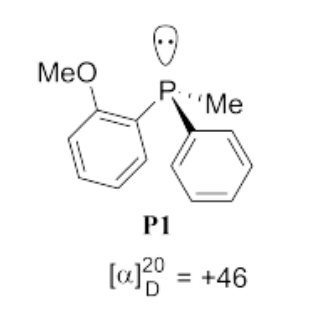
6.1 Using \(R/S\) symbol, assign the absolute configuration of P1.
In the past two decades, as organocatalysis grew rapidly, a large number of nucleophilic phosphinecatalyzed synthetic reactions have emerged. Among them, one of the most famous phosphine-catalyzed reactions is the Lu (3+2) cycloaddition reaction, which was first developed by Chinese scientist Xiyan Lu. For instance, under the catalysis of triphenylphosphine, ethyl allenoate 1 and methyl acrylate 2 smoothly produce two cyclopentene derivatives 3 (major) and 4 (minor).
Lu (3+2) cycloaddition:
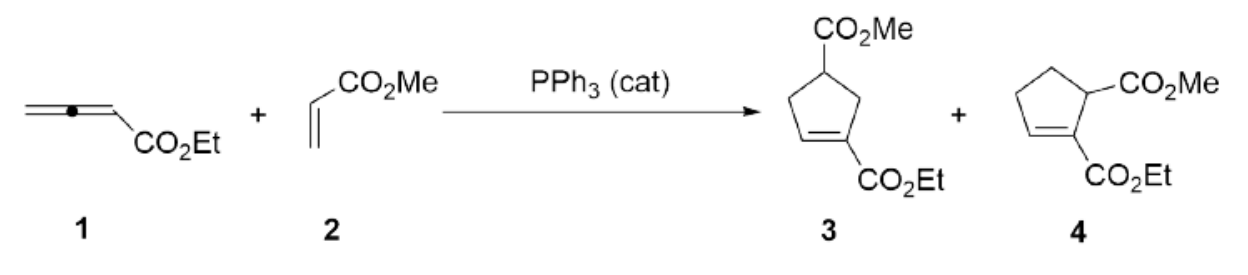
In a generally accepted mechanism, the Lu (3+2) reaction is a formal cycloaddition reaction. Initially, the catalyst triphenylphosphine engages in a nucleophilic addition to ethyl allenoate 1 to generate a zwitterionic intermediate A, which subsequently cyclizes with methyl acrylate 2 by two paths. In the path leading to compound 3, an in situ generated phosphorus ylide intermediate B reversibly converts into intermediate C via proton transfer; C undergoes an elimination to deliver the major product 3 and release the phosphine catalyst. In the path leading to compound 4, a phosphorus ylide intermediate B′ is formed, which also reversibly converts into intermediate C′ via proton transfer; C′ undergoes an elimination to give the minor product 4 and regenerate the phosphine catalyst.
Mechanism:
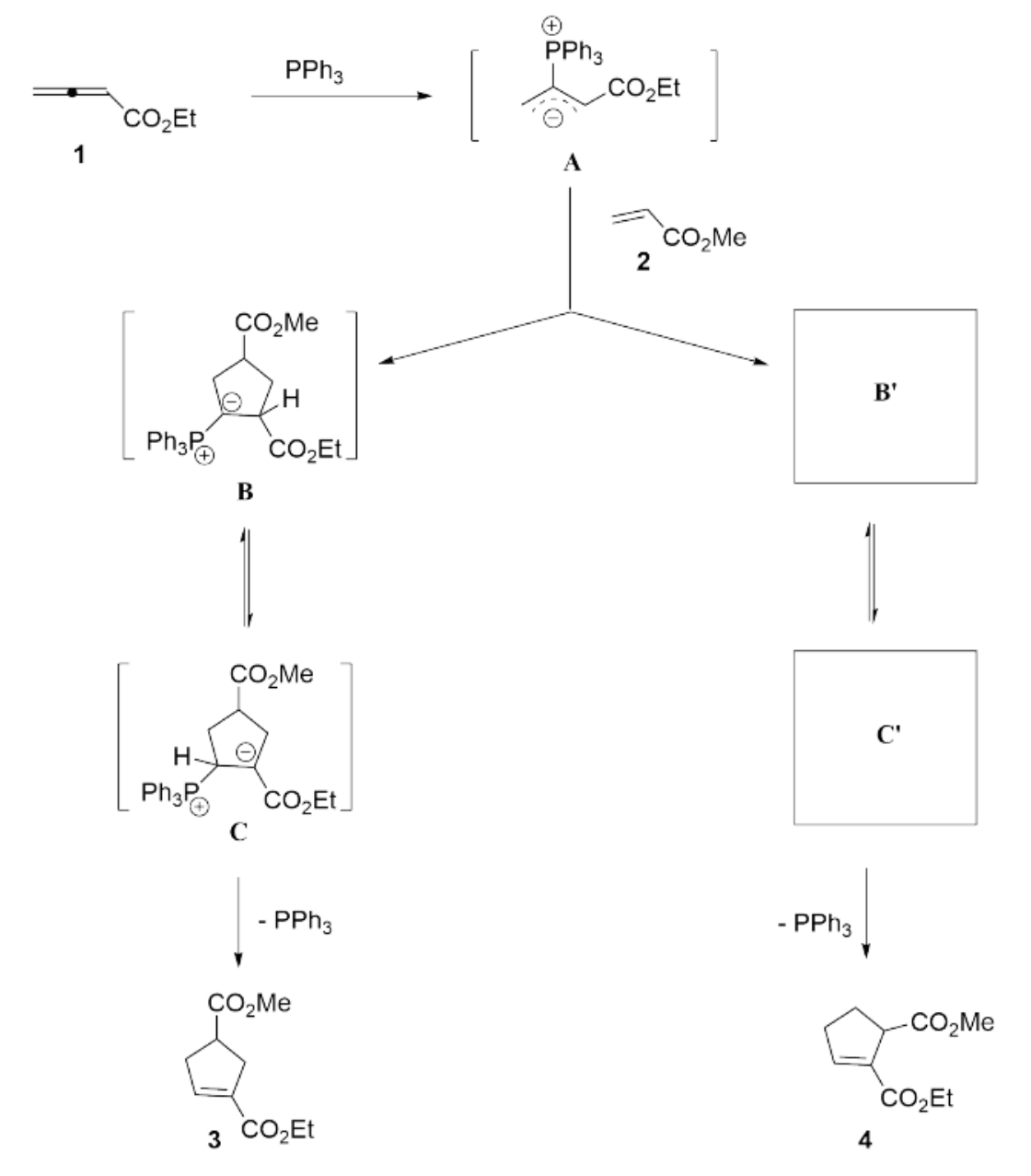
6.2 Draw the two major resonance structures that make up the shown resonance hybrid A (the involvement of ester group is not considered, and stereochemistry is not required).
6.3 Draw the structures of intermediates B′ and C′ (stereochemistry is not required).
Under similar conditions, ethyl allenoate 1 and diethyl fumarate 5 readily deliver the corresponding cycloaddition product 6.
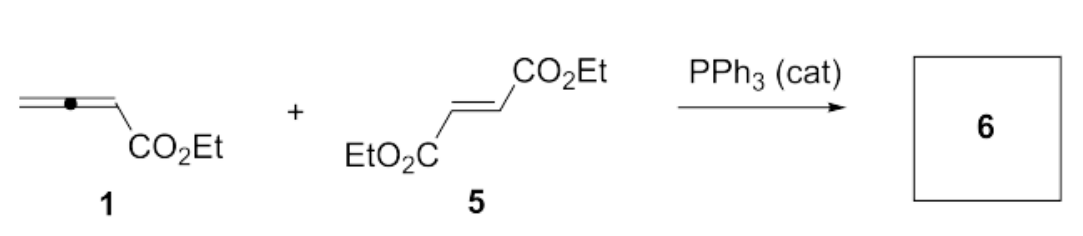
6.4 Draw the structure of compound 6 (stereochemistry is not required).
Asymmetric Lu (3+2) cycloaddition reaction can be readily realized by utilizing chiral phosphine catalysts. For example, under the catalysis of a chiral bicyclic phosphine P2, ethyl allenoate 1 and methyl acrylate 2 smoothly delivered an enantio-enriched cycloaddition product 3 in 80% ee (enantiomeric excess).
Asymmetric Lu (3+2) cycloaddition:
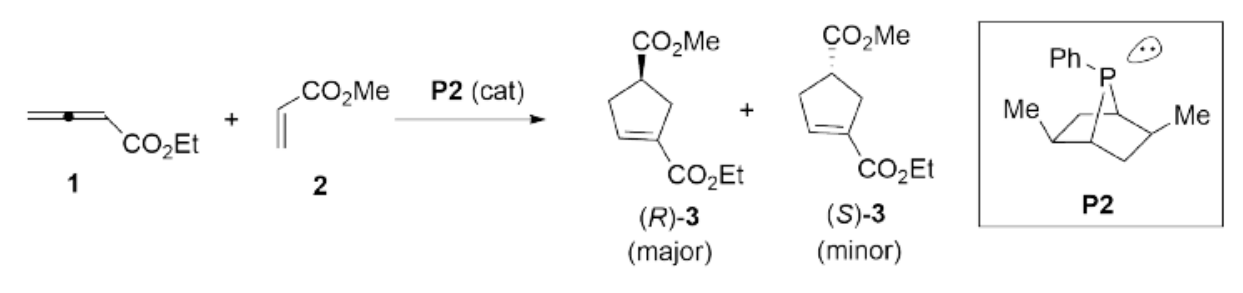
Calculation equation of ee:
\[ \mathrm{ee} =\frac{n_{\mathrm{major}}-n_{\mathrm{minor}}} {n_{\mathrm{major}}+n_{\mathrm{minor}}}\times100\% \]
\(n_{\mathrm{major}}\) = the amount of major enantiomer
\(n_{\mathrm{minor}}\) = the amount of minor enantiomer
6.5 Mark the chirality centers in the chiral phosphine P2 by using asterisks. (Note: points will be deducted for every wrong asterisk until 0 points)
6.6 Give the ratio of \(n_{\mathrm{major}}/n_{\mathrm{minor}}\) of product 3.
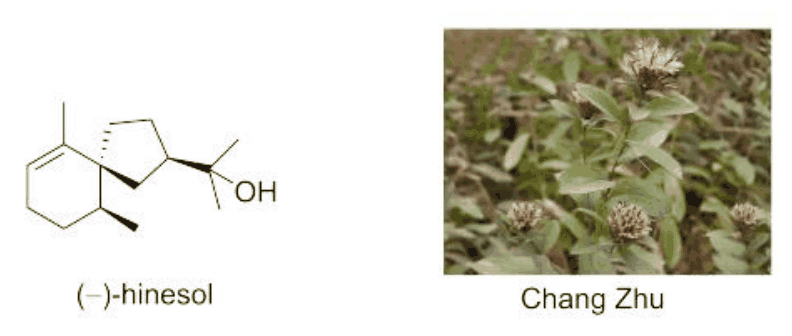
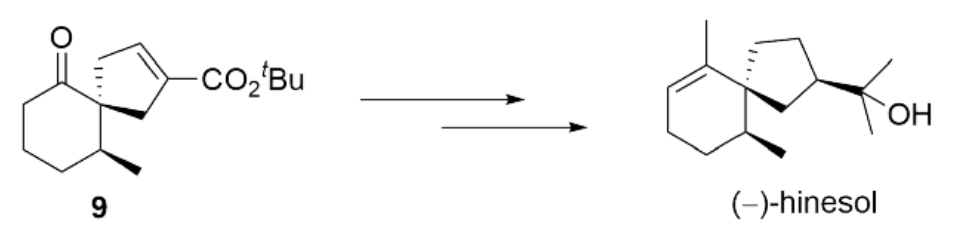
Lu (3+2) cycloaddition reaction is a versatile tool in organic synthesis. For example, it was successfully used to synthesize (–)-hinesol, an important component of the Chinese medicinal herb Chang Zhu (Atractylodes lancea var Chinensis). Under the catalysis of \(\ce{PPh3}\), a chiral cyclohexanone 7 cyclized with tertbutyl allenoate 8, affording a major product 9 and three minor products 10, 11 and 12. Minor products 10–12 are all the isomers of 9. Compound 9 could be readily transformed into (–)-hinesol by a multistep process.
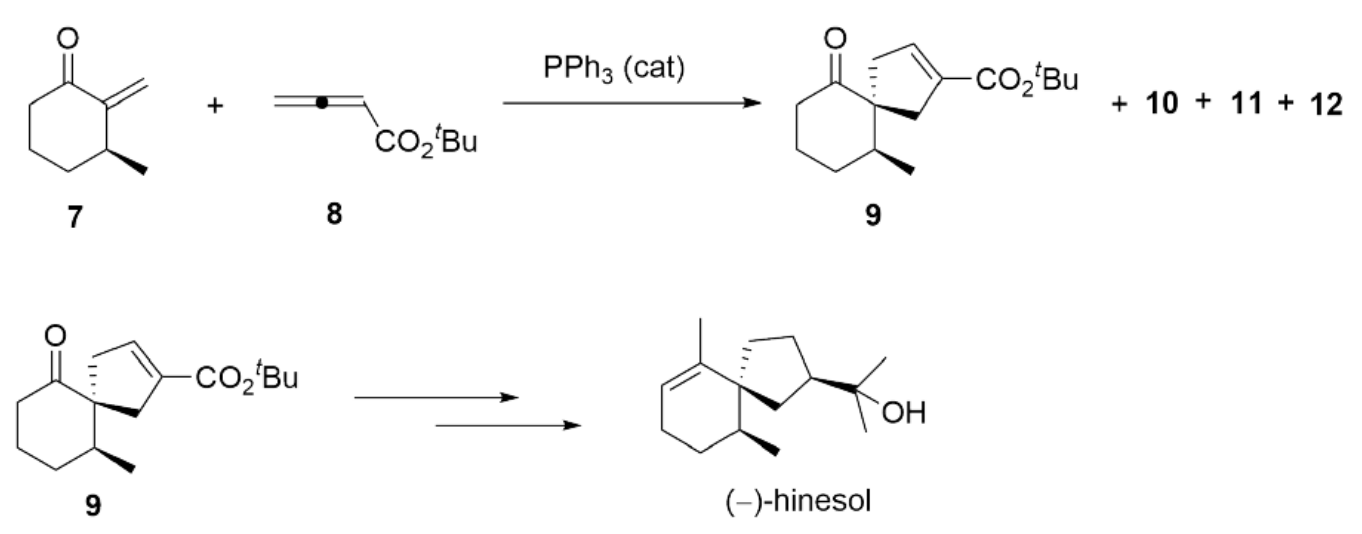
6.7 In the following compounds, choose which one does not belong to the minor products 10–12.

Official English text of the problem.
Answers
-
6.1: \(R\). P1 is \((R)\)-methyl(2-methoxyphenyl)(phenyl)phosphine:
COc1ccccc1[P@](C)c1ccccc1. -
6.2: The two contributors to the β-triphenylphosphonium allylic zwitterion A are:
- α-carbanion contributor:
C=C([P+](c1ccccc1)(c1ccccc1)c1ccccc1)[CH-]C(=O)OCC -
γ-carbanion contributor:
[CH2-]C([P+](c1ccccc1)(c1ccccc1)c1ccccc1)=CC(=O)OCC -
6.3:
- B′, the cyclic triphenylphosphonium ylide:
[C-]1([P+](c2ccccc2)(c2ccccc2)c2ccccc2)C(C(=O)OCC)C(C(=O)OC)CC1 -
C′, the proton-transferred phosphonium ester enolate:
C1([P+](c2ccccc2)(c2ccccc2)c2ccccc2)[C-](C(=O)OCC)C(C(=O)OC)CC1 -
6.4: 6 is triethyl cyclopent-3-ene-1,2,3-tricarboxylate:
CCOC(=O)C1=CCC(C(=O)OCC)C1C(=O)OCC. -
6.5: Mark four carbon atoms: both bridgehead carbons bonded to phosphorus and both methyl-bearing ring carbons. These are C1, C2, C4 and C5 of the 7-phosphabicyclo[2.2.1]heptane framework. Do not mark phosphorus.
P2, 2,5-dimethyl-7-phenyl-7-phosphabicyclo[2.2.1]heptane:C[C@H]1C[C@@H]2[C@@H](C)C[C@H]1P2c1ccccc1. -
6.6: \(\boxed{n_{\mathrm{major}}/n_{\mathrm{minor}}=9}\), or \(9:1\); the mixture contains 90% \((R)\)-3 and 10% \((S)\)-3.
-
6.7: (d) does not belong. It is tert-butyl (5S,6S)-6-methyl-10-oxospiro[4.5]dec-3-ene-2-carboxylate, with its C2 configuration unspecified:
O=C1CCC[C@H](C)[C@]12CC(C(=O)OC(C)(C)C)C=C2.
Solution
6.1
For pyramidal phosphorus, the lone pair is treated as the lowest-priority group. The CIP order is
\[ \text{2-methoxyphenyl}>\text{phenyl}>\text{methyl}>\text{lone pair}. \]
All three organic groups begin with carbon. The aromatic groups outrank methyl at the next comparison, and the ortho oxygen distinguishes 2-methoxyphenyl from phenyl.
In the drawing, the phenyl bond is a solid wedge toward the observer, while methyl is behind the page. Orienting the lowest-priority lone pair away makes the sequence \(1\rightarrow2\rightarrow3\) clockwise. Thus P1 is \(R\).
The positive optical rotation shown in the figure does not itself establish an \(R\) configuration; the assignment follows from the molecular geometry and CIP priorities.
6.2
The starting materials relevant here are ethyl buta-2,3-dienoate, or ethyl allenoate 1, C=C=CC(=O)OCC, and triphenylphosphine, P(c1ccccc1)(c1ccccc1)c1ccccc1.
Label the allenoate carbon adjacent to the ester α, its central allene carbon β, and its terminal methylene carbon γ. Phosphorus attacks β, and the α–β π electrons move onto α. This gives the first contributor:
\[ \ce{CH2=C(PPh3^{+})-CH^{-}-CO2Et <-> ^{-}CH2-C(PPh3^{+})=CH-CO2Et}. \]
To obtain the second contributor, move the α-carbon lone pair into the α–β bond and move the β–γ π electrons onto γ.
Thus, in the requested drawings:
- Phosphorus is positively charged and bonded to β in both contributors.
- One contributor has a β–γ double bond and a negative charge on α.
- The other has an α–β double bond and a negative charge on γ.
- The ester group is unchanged.
These are resonance contributors of one zwitterion, not species interconverting by proton transfer.
6.3
The alkene partner is methyl acrylate 2, or methyl prop-2-enoate, C=CC(=O)OC.
The two products are:
- 3, ethyl 4-(methoxycarbonyl)cyclopent-1-ene-1-carboxylate:
CCOC(=O)C1=CCC(C(=O)OC)C1. - 4, ethyl 5-(methoxycarbonyl)cyclopent-1-ene-1-carboxylate:
CCOC(=O)C1=CCCC1C(=O)OC.
For the minor pathway, the γ end of A bonds to the terminal carbon of methyl acrylate. The resulting acrylate-derived carbanion closes the ring by bonding to the allenoate α carbon, producing B′.
For a precise drawing, number the five-membered ring consecutively as follows:
| Ring atom | Origin | Substitution in B′ |
|---|---|---|
| 1 | Allenoate β carbon | \(\ce{PPh3+}\), negative charge on carbon, no hydrogen |
| 2 | Allenoate α carbon | \(\ce{CO2Et}\) and one hydrogen |
| 3 | Ester-bearing acrylate carbon | \(\ce{CO2Me}\) and one hydrogen |
| 4 | Terminal acrylate carbon | Methylene |
| 5 | Allenoate γ carbon | Methylene |
All ring bonds in B′ are single bonds. The adjacent formal charges on ring carbon 1 and phosphorus identify the phosphorus ylide.
To draw C′, transfer the hydrogen from ring carbon 2 to ring carbon 1:
- Carbon 1 becomes neutral and bears hydrogen and \(\ce{PPh3+}\).
- Carbon 2 bears the negative charge and \(\ce{CO2Et}\), with no hydrogen.
- The remaining connectivity is unchanged.
Finally, the lone pair on carbon 2 forms the carbon 1–carbon 2 double bond. The carbon–phosphorus bond breaks with its electrons returning to phosphorus, releasing triphenylphosphine and giving 4.
The elimination is atom-balanced:
\[ \ce{C28H29O4P -> C10H14O4 + C18H15P}. \]
The overall cycloaddition, for either regioisomer, is
\[ \ce{C6H8O2 + C4H6O2 -> C10H14O4} \qquad(\ce{PPh3}\text{ catalyst}). \]
6.4
Diethyl fumarate 5, diethyl \((E)\)-but-2-enedioate, is CCOC(=O)/C=C/C(=O)OCC.
Its two alkene carbons each carry an ethoxycarbonyl group. Both carbons enter the new five-membered ring, retaining those substituents. The allenoate supplies the other three ring carbons and the third ester.
Consequently, 6 has:
- One \(\ce{CO2Et}\) group on an alkene carbon.
- One \(\ce{CO2Et}\) group on each of two adjacent saturated ring carbons.
The two possible orientations of fumarate give the same constitution because fumarate is symmetric. No stereochemical specification is required.
The balanced overall equation is
\[ \ce{C6H8O2 + C8H12O4 -> C14H20O6} \qquad(\ce{PPh3}\text{ catalyst}). \]
6.5
There are four chirality centers in P2:
- The two methyl-bearing ring carbons, C2 and C5. Each is attached to hydrogen, methyl and two different paths through the bicyclic framework.
- The two bridgehead carbons, C1 and C4. Each is attached to hydrogen, phosphorus and two different carbon paths; one path immediately encounters a methyl-bearing carbon, while the other encounters a methylene carbon.
Place an asterisk on each of these four carbons.
The two carbon ligands attached to phosphorus are equivalent within the stereochemical framework. Phosphorus therefore does not have three distinguishable organic substituents and is not an additional chirality center.
The isomeric SMILES in the answer records the four carbon configurations; it does not reproduce the particular perspective used to draw the cage.
6.6
Let
\[ r=\frac{n_{\mathrm{major}}}{n_{\mathrm{minor}}}. \]
Using the given 80% ee,
\[ \frac{r-1}{r+1}=0.80, \]
so
\[ r-1=0.80r+0.80, \qquad 0.20r=1.80, \qquad \boxed{r=9}. \]
Equivalently,
\[ x_{\mathrm{major}}=\frac{1+0.80}{2}=0.90, \qquad x_{\mathrm{minor}}=\frac{1-0.80}{2}=0.10. \]
The ratio is dimensionless. The enantiomers are:
- Major \((R)\)-3: ethyl (4R)-4-(methoxycarbonyl)cyclopent-1-ene-1-carboxylate,
CCOC(=O)C1=CC[C@@H](C(=O)OC)C1. - Minor \((S)\)-3: ethyl (4S)-4-(methoxycarbonyl)cyclopent-1-ene-1-carboxylate,
CCOC(=O)C1=CC[C@H](C(=O)OC)C1.
6.7
The starting compounds are:
- 7, (3S)-3-methyl-2-methylidenecyclohexan-1-one:
C=C1[C@@H](C)CCCC1=O. - 8, tert-butyl buta-2,3-dienoate:
C=C=CC(=O)OC(C)(C)C.
Their cycloaddition has the balanced molecular equation
\[ \ce{C8H12O + C8H12O2 -> C16H24O3} \qquad(\ce{PPh3}\text{ catalyst}). \]
The existing methyl-bearing stereocenter is retained. Two regioisomeric connections are possible, and each can give either configuration at the new spiro center. These produce four products in total: major product 9 and the three minor products represented by (a), (b) and (c).
Their identities are:
| Structure | Name | SMILES |
|---|---|---|
| 9 | tert-Butyl (5S,6S)-6-methyl-10-oxospiro[4.5]dec-2-ene-2-carboxylate | O=C1CCC[C@H](C)[C@]12CC(C(=O)OC(C)(C)C)=CC2 |
| (a) | tert-Butyl (5R,6S)-6-methyl-10-oxospiro[4.5]dec-2-ene-2-carboxylate | O=C1CCC[C@H](C)[C@@]12CC(C(=O)OC(C)(C)C)=CC2 |
| (b) | tert-Butyl (5R,6S)-6-methyl-10-oxospiro[4.5]dec-1-ene-1-carboxylate | O=C1CCC[C@H](C)[C@]12C(C(=O)OC(C)(C)C)=CCC2 |
| (c) | tert-Butyl (5S,6S)-6-methyl-10-oxospiro[4.5]dec-1-ene-1-carboxylate | O=C1CCC[C@H](C)[C@@]12C(C(=O)OC(C)(C)C)=CCC2 |
Thus, (a) is the spiro epimer of 9, while (b) and (c) are the two spiro configurations of the alternative regioisomer.
In every one of these products, elimination of phosphine forms a double bond involving the allenoate’s ester-bearing α carbon. The ester is consequently conjugated with the ring double bond.
In (d), the ester is attached to a saturated ring carbon, and the double bond lies elsewhere. That connectivity does not result from either of the two illustrated cycloaddition/elimination pathways. Therefore,
\[ \boxed{\text{(d) does not belong to products 10–12.}} \]
The configuration of the additional, saturated ester-bearing stereocenter in (d) is not specified in the drawing.
The answers were checked against the official answers published by the organisers.
IChO 2022 · Theorieaufgabe 6
Phosphine machen es möglich
Phosphine sind die Phosphoranaloga der Amine. Auch sie besitzen ein freies Elektronenpaar am Phosphoratom und zeigen daher Lewis-Basizität oder Nukleophilie. Im Gegensatz zu tertiären Aminen können chirale Phosphine wie P1 mit drei verschiedenen Substituenten jedoch als einzelne Enantiomere isoliert werden. Chirale Phosphine werden häufig als chirale Liganden in der Übergangsmetallkatalyse eingesetzt.
6.1 Geben Sie die absolute Konfiguration von P1 mit dem Symbol \(R/S\) an.
In den vergangenen zwei Jahrzehnten ist mit der rasanten Entwicklung der Organokatalyse eine große Zahl von Synthesereaktionen entstanden, die durch nukleophile Phosphine katalysiert werden. Eine der bekanntesten phosphinkatalysierten Reaktionen ist die Lu-(3+2)-Cycloaddition, die erstmals von dem chinesischen Wissenschaftler Xiyan Lu entwickelt wurde. Beispielsweise reagieren unter Katalyse durch Triphenylphosphin Allensäureethylester 1 und Acrylsäuremethylester 2 problemlos zu den beiden Cyclopentenderivaten 3 (Hauptprodukt) und 4 (Nebenprodukt).
Lu-(3+2)-Cycloaddition:
Nach einem allgemein anerkannten Mechanismus ist die Lu-(3+2)-Reaktion eine formale Cycloaddition. Zunächst addiert sich der Katalysator Triphenylphosphin nukleophil an Allensäureethylester 1, wobei das zwitterionische Intermediat A entsteht, das anschließend auf zwei Wegen mit Acrylsäuremethylester 2 cyclisiert. Auf dem zu Verbindung 3 führenden Reaktionsweg wandelt sich ein in situ gebildetes Phosphorylid-Intermediat B durch Protonenübertragung reversibel in das Intermediat C um; C geht eine Eliminierung ein, bei der das Hauptprodukt 3 entsteht und der Phosphinkatalysator freigesetzt wird. Auf dem zu Verbindung 4 führenden Reaktionsweg entsteht ein Phosphorylid-Intermediat B′, das sich ebenfalls durch Protonenübertragung reversibel in das Intermediat C′ umwandelt; C′ geht eine Eliminierung ein, bei der das Nebenprodukt 4 entsteht und der Phosphinkatalysator regeneriert wird.
Mechanismus:
6.2 Zeichnen Sie die beiden wichtigsten mesomeren Grenzstrukturen des dargestellten Mesomeriehybrids A (die Beteiligung der Estergruppe wird nicht berücksichtigt, und die Angabe der Stereochemie ist nicht erforderlich).
6.3 Zeichnen Sie die Strukturen der Intermediate B′ und C′ (die Angabe der Stereochemie ist nicht erforderlich).
Unter ähnlichen Bedingungen liefern Allensäureethylester 1 und Fumarsäurediethylester 5 leicht das entsprechende Cycloadditionsprodukt 6.
6.4 Zeichnen Sie die Struktur der Verbindung 6 (die Angabe der Stereochemie ist nicht erforderlich).
Die asymmetrische Lu-(3+2)-Cycloaddition lässt sich mithilfe chiraler Phosphinkatalysatoren leicht realisieren. Beispielsweise lieferten Allensäureethylester 1 und Acrylsäuremethylester 2 unter Katalyse durch das chirale bicyclische Phosphin P2 problemlos das enantiomerenangereicherte Cycloadditionsprodukt 3 mit 80% ee (Enantiomerenüberschuss).
Asymmetrische Lu-(3+2)-Cycloaddition:
Gleichung zur Berechnung von ee:
\[ \mathrm{ee} =\frac{n_{\mathrm{major}}-n_{\mathrm{minor}}} {n_{\mathrm{major}}+n_{\mathrm{minor}}}\times100\% \]
\(n_{\mathrm{major}}\) = Stoffmenge des überwiegenden Enantiomers
\(n_{\mathrm{minor}}\) = Stoffmenge des in geringerer Menge vorliegenden Enantiomers
6.5 Kennzeichnen Sie die Chiralitätszentren im chiralen Phosphin P2 mit Sternchen. (Hinweis: Für jedes falsch gesetzte Sternchen werden Punkte abgezogen, bis 0 Punkte erreicht sind.)
6.6 Geben Sie das Verhältnis \(n_{\mathrm{major}}/n_{\mathrm{minor}}\) für Produkt 3 an.
Die Lu-(3+2)-Cycloaddition ist ein vielseitiges Werkzeug in der organischen Synthese. Beispielsweise wurde sie erfolgreich zur Synthese von (–)-Hinesol eingesetzt, einem wichtigen Bestandteil der chinesischen Heilpflanze Chang Zhu (Atractylodes lancea var Chinensis). Unter Katalyse durch \(\ce{PPh3}\) cyclisierte ein chirales Cyclohexanon 7 mit Allensäure-tert-butylester 8, wobei das Hauptprodukt 9 und die drei Nebenprodukte 10, 11 und 12 entstanden. Die Nebenprodukte 10–12 sind sämtlich Isomere von 9. Verbindung 9 konnte durch ein mehrstufiges Verfahren leicht in (–)-Hinesol überführt werden.
6.7 Wählen Sie unter den folgenden Verbindungen diejenige aus, die nicht zu den Nebenprodukten 10–12 gehört.
Aufgabentext aus dem offiziellen englischen Text übersetzt.
Antworten
-
6.1: \(R\). P1 ist \((R)\)-Methyl(2-methoxyphenyl)(phenyl)phosphin:
COc1ccccc1[P@](C)c1ccccc1. -
6.2: Die beiden Grenzstrukturen des allylischen β-Triphenylphosphonium-Zwitterions A sind:
- α-Carbanion-Grenzstruktur:
C=C([P+](c1ccccc1)(c1ccccc1)c1ccccc1)[CH-]C(=O)OCC -
γ-Carbanion-Grenzstruktur:
[CH2-]C([P+](c1ccccc1)(c1ccccc1)c1ccccc1)=CC(=O)OCC -
6.3:
- B′, das cyclische Triphenylphosphoniumylid:
[C-]1([P+](c2ccccc2)(c2ccccc2)c2ccccc2)C(C(=O)OCC)C(C(=O)OC)CC1 -
C′, das durch Protonenübertragung entstandene Phosphoniumesterenolat:
C1([P+](c2ccccc2)(c2ccccc2)c2ccccc2)[C-](C(=O)OCC)C(C(=O)OC)CC1 -
6.4: 6 ist Cyclopent-3-en-1,2,3-tricarbonsäuretriethylester:
CCOC(=O)C1=CCC(C(=O)OCC)C1C(=O)OCC. -
6.5: Kennzeichnen Sie vier Kohlenstoffatome: die beiden an Phosphor gebundenen Brückenkopf-Kohlenstoffatome und die beiden methylsubstituierten Ringkohlenstoffatome. Dies sind C1, C2, C4 und C5 des 7-Phosphabicyclo[2.2.1]heptan-Gerüsts. Kennzeichnen Sie Phosphor nicht.
P2, 2,5-Dimethyl-7-phenyl-7-phosphabicyclo[2.2.1]heptan:C[C@H]1C[C@@H]2[C@@H](C)C[C@H]1P2c1ccccc1. -
6.6: \(\boxed{n_{\mathrm{major}}/n_{\mathrm{minor}}=9}\), oder \(9:1\); das Gemisch enthält 90% \((R)\)-3 und 10% \((S)\)-3.
-
6.7: (d) gehört nicht dazu. Es handelt sich um (5S,6S)-6-Methyl-10-oxospiro[4.5]dec-3-en-2-carbonsäure-tert-butylester, dessen Konfiguration an C2 nicht angegeben ist:
O=C1CCC[C@H](C)[C@]12CC(C(=O)OC(C)(C)C)C=C2.
Lösung
6.1
Bei pyramidalem Phosphor wird das freie Elektronenpaar als Gruppe mit der niedrigsten Priorität behandelt. Die CIP-Reihenfolge lautet
\[ \text{2-Methoxyphenyl}>\text{Phenyl}>\text{Methyl}>\text{freies Elektronenpaar}. \]
Alle drei organischen Gruppen beginnen mit Kohlenstoff. Beim nächsten Vergleich haben die aromatischen Gruppen Vorrang vor Methyl, und das Sauerstoffatom in ortho-Stellung unterscheidet 2-Methoxyphenyl von Phenyl.
In der Zeichnung ist die Bindung zur Phenylgruppe als ausgefüllter Keil zum Betrachter hin dargestellt, während die Methylgruppe hinter der Zeichenebene liegt. Wird das freie Elektronenpaar mit der niedrigsten Priorität vom Betrachter weg ausgerichtet, verläuft die Folge \(1\rightarrow2\rightarrow3\) im Uhrzeigersinn. Somit ist P1 \(R\)-konfiguriert.
Die in der Abbildung angegebene positive optische Drehung belegt für sich genommen keine \(R\)-Konfiguration; die Zuordnung ergibt sich aus der Molekülgeometrie und den CIP-Prioritäten.
6.2
Die hier relevanten Ausgangsstoffe sind Buta-2,3-diensäureethylester, auch Allensäureethylester 1, C=C=CC(=O)OCC, und Triphenylphosphin, P(c1ccccc1)(c1ccccc1)c1ccccc1.
Bezeichnen Sie das zur Estergruppe benachbarte Kohlenstoffatom des Allensäureesters mit α, sein zentrales Allen-Kohlenstoffatom mit β und sein endständiges Methylen-Kohlenstoffatom mit γ. Phosphor greift β an, und die α–β-π-Elektronen werden auf α verschoben. Dadurch entsteht die erste Grenzstruktur:
\[ \ce{CH2=C(PPh3^{+})-CH^{-}-CO2Et <-> ^{-}CH2-C(PPh3^{+})=CH-CO2Et}. \]
Um die zweite Grenzstruktur zu erhalten, verschieben Sie das freie Elektronenpaar am α-Kohlenstoffatom in die α–β-Bindung und die β–γ-π-Elektronen auf γ.
Für die geforderten Zeichnungen gilt somit:
- Phosphor ist in beiden Grenzstrukturen positiv geladen und an β gebunden.
- Eine Grenzstruktur weist eine β–γ-Doppelbindung und eine negative Ladung an α auf.
- Die andere weist eine α–β-Doppelbindung und eine negative Ladung an γ auf.
- Die Estergruppe bleibt unverändert.
Dies sind mesomere Grenzstrukturen eines einzigen Zwitterions, keine Spezies, die durch Protonenübertragung ineinander übergehen.
6.3
Der Alken-Reaktionspartner ist Acrylsäuremethylester 2, auch Prop-2-ensäuremethylester, C=CC(=O)OC.
Die beiden Produkte sind:
- 3, 4-(Methoxycarbonyl)cyclopent-1-en-1-carbonsäureethylester:
CCOC(=O)C1=CCC(C(=O)OC)C1. - 4, 5-(Methoxycarbonyl)cyclopent-1-en-1-carbonsäureethylester:
CCOC(=O)C1=CCCC1C(=O)OC.
Auf dem zum Nebenprodukt führenden Reaktionsweg bindet das γ-Ende von A an das endständige Kohlenstoffatom des Acrylsäuremethylesters. Das dabei aus dem Acrylat entstehende Carbanion schließt den Ring durch Bindung an das α-Kohlenstoffatom des Allensäureesters, wodurch B′ entsteht.
Für eine präzise Zeichnung nummerieren Sie den Fünfring wie folgt fortlaufend:
| Ringatom | Herkunft | Substitution in B′ |
|---|---|---|
| 1 | β-Kohlenstoffatom des Allensäureesters | \(\ce{PPh3+}\), negative Ladung am Kohlenstoff, kein Wasserstoff |
| 2 | α-Kohlenstoffatom des Allensäureesters | \(\ce{CO2Et}\) und ein Wasserstoffatom |
| 3 | Estergruppentragendes Kohlenstoffatom des Acrylats | \(\ce{CO2Me}\) und ein Wasserstoffatom |
| 4 | Endständiges Kohlenstoffatom des Acrylats | Methylengruppe |
| 5 | γ-Kohlenstoffatom des Allensäureesters | Methylengruppe |
Alle Ringbindungen in B′ sind Einfachbindungen. Die benachbarten Formalladungen am Ringkohlenstoffatom 1 und am Phosphor kennzeichnen das Phosphorylid.
Um C′ zu zeichnen, übertragen Sie das Wasserstoffatom von Ringkohlenstoffatom 2 auf Ringkohlenstoffatom 1:
- Kohlenstoffatom 1 wird neutral und trägt Wasserstoff und \(\ce{PPh3+}\).
- Kohlenstoffatom 2 trägt die negative Ladung und \(\ce{CO2Et}\), jedoch keinen Wasserstoff.
- Die übrige Konnektivität bleibt unverändert.
Schließlich bildet das freie Elektronenpaar an Kohlenstoffatom 2 die Doppelbindung zwischen Kohlenstoffatom 1 und Kohlenstoffatom 2. Die Kohlenstoff–Phosphor-Bindung wird gespalten, wobei ihre Elektronen auf Phosphor zurückübertragen werden; dadurch wird Triphenylphosphin freigesetzt und 4 gebildet.
Die Eliminierung ist hinsichtlich der Atome bilanziert:
\[ \ce{C28H29O4P -> C10H14O4 + C18H15P}. \]
Die Gesamtgleichung der Cycloaddition lautet für beide Regioisomere
\[ \ce{C6H8O2 + C4H6O2 -> C10H14O4} \qquad(\ce{PPh3}\text{ als Katalysator}). \]
6.4
Fumarsäurediethylester 5, \((E)\)-But-2-endisäurediethylester, ist CCOC(=O)/C=C/C(=O)OCC.
Seine beiden Alken-Kohlenstoffatome tragen jeweils eine Ethoxycarbonylgruppe. Beide Kohlenstoffatome werden unter Beibehaltung dieser Substituenten in den neuen Fünfring eingebaut. Der Allensäureester liefert die übrigen drei Ringkohlenstoffatome und die dritte Estergruppe.
Folglich besitzt 6:
- Eine \(\ce{CO2Et}\)-Gruppe an einem Alken-Kohlenstoffatom.
- Je eine \(\ce{CO2Et}\)-Gruppe an zwei benachbarten gesättigten Ringkohlenstoffatomen.
Die beiden möglichen Orientierungen des Fumarats ergeben dieselbe Konstitution, da Fumarat symmetrisch ist. Eine Angabe der Stereochemie ist nicht erforderlich.
Die ausgeglichene Gesamtgleichung lautet
\[ \ce{C6H8O2 + C8H12O4 -> C14H20O6} \qquad(\ce{PPh3}\text{ als Katalysator}). \]
6.5
In P2 gibt es vier Chiralitätszentren:
- Die beiden methylsubstituierten Ringkohlenstoffatome C2 und C5. Jedes ist an Wasserstoff, Methyl und zwei unterschiedliche Wege durch das bicyclische Gerüst gebunden.
- Die beiden Brückenkopf-Kohlenstoffatome C1 und C4. Jedes ist an Wasserstoff, Phosphor und zwei unterschiedliche Kohlenstoffwege gebunden; auf dem einen Weg folgt unmittelbar ein methylsubstituiertes Kohlenstoffatom, auf dem anderen ein Methylen-Kohlenstoffatom.
Setzen Sie an jedes dieser vier Kohlenstoffatome ein Sternchen.
Die beiden an Phosphor gebundenen Kohlenstoffliganden sind innerhalb des stereochemischen Gerüsts äquivalent. Phosphor besitzt daher keine drei unterscheidbaren organischen Substituenten und ist kein zusätzliches Chiralitätszentrum.
Der isomere SMILES in der Antwort gibt die vier Kohlenstoffkonfigurationen an; er bildet nicht die besondere Perspektive ab, aus der das Käfiggerüst gezeichnet wurde.
6.6
Es sei
\[ r=\frac{n_{\mathrm{major}}}{n_{\mathrm{minor}}}. \]
Mit den gegebenen 80% ee gilt
\[ \frac{r-1}{r+1}=0.80, \]
also
\[ r-1=0.80r+0.80, \qquad 0.20r=1.80, \qquad \boxed{r=9}. \]
Äquivalent dazu gilt
\[ x_{\mathrm{major}}=\frac{1+0.80}{2}=0.90, \qquad x_{\mathrm{minor}}=\frac{1-0.80}{2}=0.10. \]
Das Verhältnis ist dimensionslos. Die Enantiomere sind:
- Überwiegendes \((R)\)-3: (4R)-4-(Methoxycarbonyl)cyclopent-1-en-1-carbonsäureethylester,
CCOC(=O)C1=CC[C@@H](C(=O)OC)C1. - In geringerer Menge vorliegendes \((S)\)-3: (4S)-4-(Methoxycarbonyl)cyclopent-1-en-1-carbonsäureethylester,
CCOC(=O)C1=CC[C@H](C(=O)OC)C1.
6.7
Die Ausgangsverbindungen sind:
- 7, (3S)-3-Methyl-2-methylidencyclohexan-1-on:
C=C1[C@@H](C)CCCC1=O. - 8, Buta-2,3-diensäure-tert-butylester:
C=C=CC(=O)OC(C)(C)C.
Ihre Cycloaddition hat die ausgeglichene Summenformelgleichung
\[ \ce{C8H12O + C8H12O2 -> C16H24O3} \qquad(\ce{PPh3}\text{ als Katalysator}). \]
Das bereits vorhandene methylsubstituierte Stereozentrum bleibt erhalten. Zwei regioisomere Verknüpfungen sind möglich, und jede kann zu beiden Konfigurationen am neuen Spirozentrum führen. Dadurch entstehen insgesamt vier Produkte: das Hauptprodukt 9 und die drei durch (a), (b) und (c) dargestellten Nebenprodukte.
Ihre Identitäten sind:
| Struktur | Name | SMILES |
|---|---|---|
| 9 | (5S,6S)-6-Methyl-10-oxospiro[4.5]dec-2-en-2-carbonsäure-tert-butylester | O=C1CCC[C@H](C)[C@]12CC(C(=O)OC(C)(C)C)=CC2 |
| (a) | (5R,6S)-6-Methyl-10-oxospiro[4.5]dec-2-en-2-carbonsäure-tert-butylester | O=C1CCC[C@H](C)[C@@]12CC(C(=O)OC(C)(C)C)=CC2 |
| (b) | (5R,6S)-6-Methyl-10-oxospiro[4.5]dec-1-en-1-carbonsäure-tert-butylester | O=C1CCC[C@H](C)[C@]12C(C(=O)OC(C)(C)C)=CCC2 |
| (c) | (5S,6S)-6-Methyl-10-oxospiro[4.5]dec-1-en-1-carbonsäure-tert-butylester | O=C1CCC[C@H](C)[C@@]12C(C(=O)OC(C)(C)C)=CCC2 |
Somit ist (a) das Spiroepimer von 9, während (b) und (c) die beiden Spirokonfigurationen des alternativen Regioisomers sind.
In jedem dieser Produkte bildet die Eliminierung von Phosphin eine Doppelbindung, an der das estergruppentragende α-Kohlenstoffatom des Allensäureesters beteiligt ist. Die Estergruppe ist daher mit der Ringdoppelbindung konjugiert.
In (d) ist die Estergruppe an ein gesättigtes Ringkohlenstoffatom gebunden, und die Doppelbindung befindet sich an anderer Stelle. Diese Konnektivität ergibt sich aus keinem der beiden dargestellten Cycloadditions-/Eliminierungswege. Daher gilt
\[ \boxed{\text{(d) gehört nicht zu den Produkten 10–12.}} \]
Die Konfiguration des zusätzlichen gesättigten, estergruppentragenden Stereozentrums in (d) ist in der Zeichnung nicht angegeben.
Die Ergebnisse wurden mit den von den Veranstaltern veröffentlichten offiziellen Ergebnissen abgeglichen.
IChO 2022 · Teori sorusu 6
Reaksiyonları Mümkün Kılan Fosfinler
Fosfinler, aminlerin fosfor analoglarıdır. Fosfor atomunda da ortaklanmamış bir elektron çifti taşırlar ve bu nedenle Lewis bazlığı veya nükleofillik gösterirler. Ancak tersiyer aminlerin aksine, üç farklı sübstitüente sahip P1 gibi kiral fosfinler tek enantiyomer hâlinde izole edilebilir. Kiral fosfinler, geçiş metali katalizinde sıklıkla kiral ligandlar olarak kullanılır.
6.1 \(R/S\) simgesini kullanarak P1'in mutlak konfigürasyonunu belirleyiniz.
Son yirmi yılda organokatalizin hızla gelişmesiyle birlikte, nükleofilik fosfinlerin katalizlediği çok sayıda sentez reaksiyonu ortaya çıkmıştır. Bunlar arasında en ünlü fosfin katalizli reaksiyonlardan biri, ilk kez Çinli bilim insanı Xiyan Lu tarafından geliştirilen Lu (3+2) siklokatılma reaksiyonudur. Örneğin, trifenilfosfin katalizörlüğünde etil allenoat 1 ve metil akrilat 2, kolaylıkla iki siklopenten türevi olan 3 (ana ürün) ve 4'ü (yan ürün) oluşturur.
Lu (3+2) siklokatılması:
Genel kabul gören mekanizmaya göre Lu (3+2) reaksiyonu, formal bir siklokatılma reaksiyonudur. Başlangıçta trifenilfosfin katalizörü, etil allenoat 1'e nükleofilik katılma gerçekleştirerek zwitteriyonik ara ürün A'yı oluşturur; bu ara ürün daha sonra metil akrilat 2 ile iki farklı yoldan halkalaşır. 3 bileşiğine götüren yolda, in situ oluşan fosfor ilidi ara ürünü B, proton aktarımı yoluyla tersinir olarak C ara ürününe dönüşür; C, bir eliminasyona uğrayarak ana ürün 3'ü oluşturur ve fosfin katalizörünü serbest bırakır. 4 bileşiğine götüren yolda ise fosfor ilidi ara ürünü B′ oluşur; bu da proton aktarımı yoluyla tersinir olarak C′ ara ürününe dönüşür; C′, bir eliminasyona uğrayarak yan ürün 4'ü oluşturur ve fosfin katalizörünü yeniden meydana getirir.
Mekanizma:
6.2 Gösterilen rezonans hibriti A'yı oluşturan iki başlıca rezonans yapısını çiziniz (ester grubunun katkısı dikkate alınmayacaktır ve stereokimyanın gösterilmesi gerekli değildir).
6.3 B′ ve C′ ara ürünlerinin yapılarını çiziniz (stereokimyanın gösterilmesi gerekli değildir).
Benzer koşullar altında etil allenoat 1 ve dietil fumarat 5, karşılık gelen siklokatılma ürünü 6'yı kolaylıkla oluşturur.
6.4 6 bileşiğinin yapısını çiziniz (stereokimyanın gösterilmesi gerekli değildir).
Asimetrik Lu (3+2) siklokatılma reaksiyonu, kiral fosfin katalizörleri kullanılarak kolaylıkla gerçekleştirilebilir. Örneğin, kiral bisiklik fosfin P2 katalizörlüğünde etil allenoat 1 ve metil akrilat 2, %80 ee (enantiyomerik fazlalık) ile enantiyomerce zenginleştirilmiş siklokatılma ürünü 3'ü kolaylıkla oluşturmuştur.
Asimetrik Lu (3+2) siklokatılması:
ee hesaplama denklemi:
\[ \mathrm{ee} =\frac{n_{\mathrm{major}}-n_{\mathrm{minor}}} {n_{\mathrm{major}}+n_{\mathrm{minor}}}\times100\% \]
\(n_{\mathrm{major}}\) = fazla bulunan enantiyomerin miktarı
\(n_{\mathrm{minor}}\) = az bulunan enantiyomerin miktarı
6.5 Kiral fosfin P2'deki kiralite merkezlerini yıldız işaretleri kullanarak işaretleyiniz. (Not: Her yanlış yıldız işareti için, puan 0'a ulaşıncaya kadar puan düşülecektir.)
6.6 3 ürününün \(n_{\mathrm{major}}/n_{\mathrm{minor}}\) oranını veriniz.
Lu (3+2) siklokatılma reaksiyonu, organik sentezde çok yönlü bir araçtır. Örneğin, Çin'de tıbbi amaçla kullanılan Chang Zhu (Atractylodes lancea var Chinensis) bitkisinin önemli bir bileşeni olan (–)-hinesolün sentezinde başarıyla kullanılmıştır. \(\ce{PPh3}\) katalizörlüğünde kiral siklohekzanon 7, tert-bütil allenoat 8 ile halkalaşarak ana ürün 9'u ve üç yan ürün olan 10, 11 ve 12'yi oluşturmuştur. 10–12 yan ürünlerinin tümü 9'un izomerleridir. 9 bileşiği, çok basamaklı bir işlemle kolaylıkla (–)-hinesole dönüştürülebilmiştir.
6.7 Aşağıdaki bileşiklerden hangisinin 10–12 yan ürünleri arasında yer almadığını seçiniz.
Soru metni resmi İngilizce metinden çevrilmiştir.
Cevaplar
-
6.1: \(R\). P1, \((R)\)-metil(2-metoksifenil)(fenil)fosfindir:
COc1ccccc1[P@](C)c1ccccc1. -
6.2: β-trifenilfosfonyum allilik zwitteriyonu A'nın iki rezonans katkı yapısı şunlardır:
- α-karbanyon katkı yapısı:
C=C([P+](c1ccccc1)(c1ccccc1)c1ccccc1)[CH-]C(=O)OCC -
γ-karbanyon katkı yapısı:
[CH2-]C([P+](c1ccccc1)(c1ccccc1)c1ccccc1)=CC(=O)OCC -
6.3:
- B′, halkalı trifenilfosfonyum ilidi:
[C-]1([P+](c2ccccc2)(c2ccccc2)c2ccccc2)C(C(=O)OCC)C(C(=O)OC)CC1 -
C′, proton aktarımı sonucu oluşan fosfonyum ester enolatı:
C1([P+](c2ccccc2)(c2ccccc2)c2ccccc2)[C-](C(=O)OCC)C(C(=O)OC)CC1 -
6.4: 6, trietil siklopent-3-en-1,2,3-trikarboksilattır:
CCOC(=O)C1=CCC(C(=O)OCC)C1C(=O)OCC. -
6.5: Dört karbon atomunu işaretleyiniz: fosfora bağlı iki köprübaşı karbonu ve metil taşıyan iki halka karbonu. Bunlar, 7-fosfabisiklo[2.2.1]heptan iskeletinin C1, C2, C4 ve C5 atomlarıdır. Fosforu işaretlemeyiniz.
P2, 2,5-dimetil-7-fenil-7-fosfabisiklo[2.2.1]heptan:C[C@H]1C[C@@H]2[C@@H](C)C[C@H]1P2c1ccccc1. -
6.6: \(\boxed{n_{\mathrm{major}}/n_{\mathrm{minor}}=9}\), veya \(9:1\); karışım %90 \((R)\)-3 ve %10 \((S)\)-3 içerir.
-
6.7: (d) bu ürünler arasında yer almaz. Bu bileşik, C2 konfigürasyonu belirtilmemiş olan tert-bütil (5S,6S)-6-metil-10-oksospiro[4.5]dek-3-en-2-karboksilattır:
O=C1CCC[C@H](C)[C@]12CC(C(=O)OC(C)(C)C)C=C2.
Çözüm
6.1
Piramidal fosfor için ortaklanmamış elektron çifti, en düşük öncelikli grup olarak kabul edilir. CIP sıralaması şöyledir:
\[ \text{2-metoksifenil}>\text{fenil}>\text{metil}>\text{ortaklanmamış elektron çifti}. \]
Üç organik grubun da ilk atomu karbondur. Bir sonraki karşılaştırmada aromatik gruplar metilden daha yüksek önceliğe sahiptir ve orto konumundaki oksijen, 2-metoksifenili fenilden ayırır.
Çizimde fenil bağı, gözlemciye doğru yönelen dolu bir kama olarak gösterilirken metil sayfa düzleminin arkasındadır. En düşük öncelikli ortaklanmamış elektron çifti gözlemciden uzağa yöneltildiğinde, \(1\rightarrow2\rightarrow3\) sırası saat yönünde olur. Dolayısıyla P1'in konfigürasyonu \(R\)'dir.
Şekilde gösterilen pozitif optik dönme, tek başına \(R\) konfigürasyonunu belirlemez; bu atama, molekül geometrisi ve CIP önceliklerinden kaynaklanır.
6.2
Burada ilgili başlangıç maddeleri, etil büta-2,3-dienoat, diğer adıyla etil allenoat 1, C=C=CC(=O)OCC, ve trifenilfosfin, P(c1ccccc1)(c1ccccc1)c1ccccc1, bileşikleridir.
Allenoatın estere komşu karbonunu α, merkezî allen karbonunu β ve uç metilen karbonunu γ olarak etiketleyiniz. Fosfor β'ya saldırır ve α–β π elektronları α üzerine geçer. Böylece ilk katkı yapısı elde edilir:
\[ \ce{CH2=C(PPh3^{+})-CH^{-}-CO2Et <-> ^{-}CH2-C(PPh3^{+})=CH-CO2Et}. \]
İkinci katkı yapısını elde etmek için α karbonundaki ortaklanmamış elektron çiftini α–β bağına, β–γ π elektronlarını ise γ üzerine taşıyınız.
Dolayısıyla, istenen çizimlerde:
- Fosfor, her iki katkı yapısında da pozitif yüklüdür ve β'ya bağlıdır.
- Katkı yapılarından birinde β–γ çift bağı ve α üzerinde negatif yük bulunur.
- Diğerinde α–β çift bağı ve γ üzerinde negatif yük bulunur.
- Ester grubu değişmeden kalır.
Bunlar, proton aktarımıyla birbirine dönüşen türler değil, tek bir zwitteriyonun rezonans katkı yapılarıdır.
6.3
Reaksiyona katılan alken, metil akrilat 2, diğer adıyla metil prop-2-enoat, C=CC(=O)OC, bileşiğidir.
İki ürün şunlardır:
- 3, etil 4-(metoksikarbonil)siklopent-1-en-1-karboksilat:
CCOC(=O)C1=CCC(C(=O)OC)C1. - 4, etil 5-(metoksikarbonil)siklopent-1-en-1-karboksilat:
CCOC(=O)C1=CCCC1C(=O)OC.
Yan ürüne götüren yolda A'nın γ ucu, metil akrilatın uç karbonuna bağlanır. Oluşan akrilat kökenli karbanyon, allenoatın α karbonuna bağlanarak halkayı kapatır ve B′'yi oluşturur.
Kesin bir çizim için beş üyeli halkayı aşağıdaki gibi ardışık olarak numaralandırınız:
| Halka atomu | Kökeni | B′'deki sübstitüsyon |
|---|---|---|
| 1 | Allenoatın β karbonu | \(\ce{PPh3+}\), karbon üzerinde negatif yük, hidrojen yok |
| 2 | Allenoatın α karbonu | \(\ce{CO2Et}\) ve bir hidrojen |
| 3 | Ester taşıyan akrilat karbonu | \(\ce{CO2Me}\) ve bir hidrojen |
| 4 | Akrilatın uç karbonu | Metilen |
| 5 | Allenoatın γ karbonu | Metilen |
B′'deki tüm halka bağları tekli bağlardır. Halkanın 1 numaralı karbonu ve fosfor üzerindeki komşu formal yükler, fosfor ilidini tanımlar.
C′'yi çizmek için halkanın 2 numaralı karbonundaki hidrojeni 1 numaralı karbonuna aktarınız:
- 1 numaralı karbon yüksüz hâle gelir ve hidrojen ile \(\ce{PPh3+}\) taşır.
- 2 numaralı karbon negatif yük ve \(\ce{CO2Et}\) taşır; hidrojen taşımaz.
- Geri kalan bağlanma düzeni değişmeden kalır.
Son olarak, 2 numaralı karbondaki ortaklanmamış elektron çifti, 1 numaralı karbon ile 2 numaralı karbon arasındaki çift bağı oluşturur. Karbon–fosfor bağı, elektronları fosfora dönecek şekilde kırılır; trifenilfosfin serbest kalır ve 4 oluşur.
Eliminasyon, atom sayıları bakımından denkleştirilmiştir:
\[ \ce{C28H29O4P -> C10H14O4 + C18H15P}. \]
Her iki regioizomer için de toplam siklokatılma denklemi şöyledir:
\[ \ce{C6H8O2 + C4H6O2 -> C10H14O4} \qquad(\ce{PPh3}\text{ katalizörü}). \]
6.4
Dietil fumarat 5, dietil \((E)\)-büt-2-endioat, CCOC(=O)/C=C/C(=O)OCC yapısındadır.
İki alken karbonunun her biri bir etoksikarbonil grubu taşır. Her iki karbon da bu sübstitüentleri koruyarak yeni beş üyeli halkaya katılır. Allenoat, halkanın diğer üç karbonunu ve üçüncü ester grubunu sağlar.
Sonuç olarak 6 şu grupları taşır:
- Bir alken karbonu üzerinde bir \(\ce{CO2Et}\) grubu.
- Birbirine komşu iki doymuş halka karbonunun her biri üzerinde bir \(\ce{CO2Et}\) grubu.
Fumarat simetrik olduğu için, fumaratın iki olası yönelimi aynı yapısal bağlantı düzenini verir. Stereokimyasal belirtim gerekli değildir.
Denkleştirilmiş toplam denklem şöyledir:
\[ \ce{C6H8O2 + C8H12O4 -> C14H20O6} \qquad(\ce{PPh3}\text{ katalizörü}). \]
6.5
P2'de dört kiralite merkezi vardır:
- Metil taşıyan iki halka karbonu, C2 ve C5. Her biri hidrojene, metile ve bisiklik iskelet boyunca ilerleyen iki farklı yola bağlıdır.
- İki köprübaşı karbonu, C1 ve C4. Her biri hidrojene, fosfora ve iki farklı karbon yoluna bağlıdır; yollardan biri hemen metil taşıyan bir karbona ulaşırken diğeri bir metilen karbonuna ulaşır.
Bu dört karbonun her birine bir yıldız işareti koyunuz.
Fosfora bağlı iki karbon ligandı, stereokimyasal iskelet içinde eşdeğerdir. Bu nedenle fosforun birbirinden ayırt edilebilir üç organik sübstitüenti yoktur ve fosfor ek bir kiralite merkezi değildir.
Cevaptaki izomerik SMILES, dört karbonun konfigürasyonlarını belirtir; kafesin çiziminde kullanılan belirli bakış açısını yeniden oluşturmaz.
6.6
Şöyle tanımlayalım:
\[ r=\frac{n_{\mathrm{major}}}{n_{\mathrm{minor}}}. \]
Verilen %80 ee değerini kullanırsak,
\[ \frac{r-1}{r+1}=0.80, \]
dolayısıyla
\[ r-1=0.80r+0.80, \qquad 0.20r=1.80, \qquad \boxed{r=9}. \]
Eşdeğer olarak,
\[ x_{\mathrm{major}}=\frac{1+0.80}{2}=0.90, \qquad x_{\mathrm{minor}}=\frac{1-0.80}{2}=0.10. \]
Bu oran boyutsuzdur. Enantiyomerler şunlardır:
- Fazla bulunan \((R)\)-3: etil (4R)-4-(metoksikarbonil)siklopent-1-en-1-karboksilat,
CCOC(=O)C1=CC[C@@H](C(=O)OC)C1. - Az bulunan \((S)\)-3: etil (4S)-4-(metoksikarbonil)siklopent-1-en-1-karboksilat,
CCOC(=O)C1=CC[C@H](C(=O)OC)C1.
6.7
Başlangıç bileşikleri şunlardır:
- 7, (3S)-3-metil-2-metilidensiklohekzan-1-on:
C=C1[C@@H](C)CCCC1=O. - 8, tert-bütil büta-2,3-dienoat:
C=C=CC(=O)OC(C)(C)C.
Bu bileşiklerin siklokatılması için denkleştirilmiş moleküler denklem şöyledir:
\[ \ce{C8H12O + C8H12O2 -> C16H24O3} \qquad(\ce{PPh3}\text{ katalizörü}). \]
Metil taşıyan mevcut stereomerkez korunur. İki regioizomerik bağlanma düzeni mümkündür ve bunların her biri yeni spiro merkezinde iki konfigürasyondan birini verebilir. Böylece toplam dört ürün oluşur: ana ürün 9 ve (a), (b) ve (c) ile gösterilen üç yan ürün.
Bunların kimlikleri şöyledir:
| Yapı | Adı | SMILES |
|---|---|---|
| 9 | tert-Bütil (5S,6S)-6-metil-10-oksospiro[4.5]dek-2-en-2-karboksilat | O=C1CCC[C@H](C)[C@]12CC(C(=O)OC(C)(C)C)=CC2 |
| (a) | tert-Bütil (5R,6S)-6-metil-10-oksospiro[4.5]dek-2-en-2-karboksilat | O=C1CCC[C@H](C)[C@@]12CC(C(=O)OC(C)(C)C)=CC2 |
| (b) | tert-Bütil (5R,6S)-6-metil-10-oksospiro[4.5]dek-1-en-1-karboksilat | O=C1CCC[C@H](C)[C@]12C(C(=O)OC(C)(C)C)=CCC2 |
| (c) | tert-Bütil (5S,6S)-6-metil-10-oksospiro[4.5]dek-1-en-1-karboksilat | O=C1CCC[C@H](C)[C@@]12C(C(=O)OC(C)(C)C)=CCC2 |
Dolayısıyla (a), 9'un spiro epimeridir; (b) ve (c) ise alternatif regioizomerin iki spiro konfigürasyonudur.
Bu ürünlerin her birinde fosfin eliminasyonu, allenoatın ester taşıyan α karbonunu içeren bir çift bağ oluşturur. Bu nedenle ester, halkadaki çift bağ ile konjuge durumdadır.
(d)'de ester, doymuş bir halka karbonuna bağlıdır ve çift bağ başka bir konumdadır. Bu bağlanma düzeni, gösterilen iki siklokatılma/eliminasyon yolundan hiçbiriyle oluşmaz. Dolayısıyla,
\[ \boxed{\text{(d), 10–12 ürünleri arasında yer almaz.}} \]
(d)'de ester taşıyan ek doymuş stereomerkezin konfigürasyonu çizimde belirtilmemiştir.
Sonuçlar, düzenleyicilerin yayımladığı resmi sonuçlarla karşılaştırılarak kontrol edildi.
IChO 2022 · Problema teórico 6
El potencial de las fosfinas
Las fosfinas son los análogos fosforados de las aminas. También poseen un par de electrones no compartidos en el átomo de fósforo y, por tanto, presentan basicidad de Lewis o nucleofilia. Sin embargo, a diferencia de las aminas terciarias, las fosfinas quirales como P1, con tres sustituyentes diferentes, pueden aislarse como enantiómeros puros. Las fosfinas quirales se utilizan a menudo como ligandos quirales en la catálisis con metales de transición.
6.1 Utilizando el símbolo \(R/S\), asigne la configuración absoluta de P1.
En las dos últimas décadas, con el rápido desarrollo de la organocatálisis, han surgido numerosas reacciones sintéticas catalizadas por fosfinas nucleófilas. Entre ellas, una de las más conocidas es la reacción de cicloadición (3+2) de Lu, desarrollada por primera vez por el científico chino Xiyan Lu. Por ejemplo, bajo la catálisis de la trifenilfosfina, el alenoato de etilo 1 y el acrilato de metilo 2 producen fácilmente dos derivados del ciclopenteno, 3 (mayoritario) y 4 (minoritario).
Cicloadición (3+2) de Lu:
Según un mecanismo generalmente aceptado, la reacción (3+2) de Lu es una reacción de cicloadición formal. Inicialmente, el catalizador trifenilfosfina experimenta una adición nucleófila al alenoato de etilo 1 para generar un intermedio zwitteriónico A, que posteriormente se cicla con el acrilato de metilo 2 por dos vías. En la vía que conduce al compuesto 3, un intermedio de tipo iluro de fósforo B, generado in situ, se convierte reversiblemente en el intermedio C mediante una transferencia de protón; C experimenta una eliminación que proporciona el producto mayoritario 3 y libera el catalizador de fosfina. En la vía que conduce al compuesto 4, se forma un intermedio de tipo iluro de fósforo B′, que también se convierte reversiblemente en el intermedio C′ mediante una transferencia de protón; C′ experimenta una eliminación que da el producto minoritario 4 y regenera el catalizador de fosfina.
Mecanismo:
6.2 Dibuje las dos estructuras resonantes principales que contribuyen al híbrido de resonancia A mostrado (no se considera la participación del grupo éster y no se requiere la estereoquímica).
6.3 Dibuje las estructuras de los intermedios B′ y C′ (no se requiere la estereoquímica).
En condiciones similares, el alenoato de etilo 1 y el fumarato de dietilo 5 proporcionan fácilmente el producto de cicloadición correspondiente 6.
6.4 Dibuje la estructura del compuesto 6 (no se requiere la estereoquímica).
La reacción de cicloadición (3+2) de Lu asimétrica puede llevarse a cabo fácilmente utilizando catalizadores de fosfina quirales. Por ejemplo, bajo la catálisis de una fosfina bicíclica quiral P2, el alenoato de etilo 1 y el acrilato de metilo 2 proporcionaron fácilmente un producto de cicloadición 3 enriquecido enantioméricamente, con un ee (exceso enantiomérico) del 80%.
Cicloadición (3+2) de Lu asimétrica:
Ecuación para calcular el ee:
\[ \mathrm{ee} =\frac{n_{\mathrm{major}}-n_{\mathrm{minor}}} {n_{\mathrm{major}}+n_{\mathrm{minor}}}\times100\% \]
\(n_{\mathrm{major}}\) = cantidad del enantiómero mayoritario
\(n_{\mathrm{minor}}\) = cantidad del enantiómero minoritario
6.5 Marque con asteriscos los centros de quiralidad de la fosfina quiral P2. (Nota: se descontarán puntos por cada asterisco incorrecto hasta llegar a 0 puntos)
6.6 Indique la relación \(n_{\mathrm{major}}/n_{\mathrm{minor}}\) del producto 3.
La reacción de cicloadición (3+2) de Lu es una herramienta versátil en síntesis orgánica. Por ejemplo, se utilizó con éxito para sintetizar (–)-hinesol, un componente importante de la planta medicinal china Chang Zhu (Atractylodes lancea var Chinensis). Bajo la catálisis de \(\ce{PPh3}\), una ciclohexanona quiral 7 se cicló con alenoato de terc-butilo 8, dando un producto mayoritario 9 y tres productos minoritarios 10, 11 y 12. Todos los productos minoritarios 10–12 son isómeros de 9. El compuesto 9 podía transformarse fácilmente en (–)-hinesol mediante un proceso de varias etapas.
6.7 Entre los siguientes compuestos, elija cuál no pertenece a los productos minoritarios 10–12.
Enunciado traducido del texto oficial en inglés.
Respuestas
-
6.1: \(R\). P1 es \((R)\)-metil(2-metoxifenil)(fenil)fosfina:
COc1ccccc1[P@](C)c1ccccc1. -
6.2: Las dos formas contribuyentes del zwitterión alílico de β-trifenilfosfonio A son:
- Forma contribuyente con un carbanión en α:
C=C([P+](c1ccccc1)(c1ccccc1)c1ccccc1)[CH-]C(=O)OCC -
Forma contribuyente con un carbanión en γ:
[CH2-]C([P+](c1ccccc1)(c1ccccc1)c1ccccc1)=CC(=O)OCC -
6.3:
- B′, el iluro cíclico de trifenilfosfonio:
[C-]1([P+](c2ccccc2)(c2ccccc2)c2ccccc2)C(C(=O)OCC)C(C(=O)OC)CC1 -
C′, el enolato de éster con un grupo fosfonio formado por transferencia de protón:
C1([P+](c2ccccc2)(c2ccccc2)c2ccccc2)[C-](C(=O)OCC)C(C(=O)OC)CC1 -
6.4: 6 es ciclopent-3-eno-1,2,3-tricarboxilato de trietilo:
CCOC(=O)C1=CCC(C(=O)OCC)C1C(=O)OCC. -
6.5: Marque cuatro átomos de carbono: los dos carbonos cabeza de puente unidos al fósforo y los dos carbonos del anillo que llevan un grupo metilo. Son C1, C2, C4 y C5 del esqueleto de 7-fosfabiciclo[2.2.1]heptano. No marque el fósforo.
P2, 2,5-dimetil-7-fenil-7-fosfabiciclo[2.2.1]heptano:C[C@H]1C[C@@H]2[C@@H](C)C[C@H]1P2c1ccccc1. -
6.6: \(\boxed{n_{\mathrm{major}}/n_{\mathrm{minor}}=9}\), o \(9:1\); la mezcla contiene 90% de \((R)\)-3 y 10% de \((S)\)-3.
-
6.7: (d) no pertenece a estos productos. Es (5S,6S)-6-metil-10-oxoespiro[4.5]dec-3-eno-2-carboxilato de terc-butilo, cuya configuración en C2 no se especifica:
O=C1CCC[C@H](C)[C@]12CC(C(=O)OC(C)(C)C)C=C2.
Solución
6.1
Para un átomo de fósforo piramidal, el par de electrones no compartidos se trata como el grupo de menor prioridad. El orden CIP es
\[ \text{2-metoxifenil}>\text{fenil}>\text{metil}>\text{par de electrones no compartidos}. \]
Los tres grupos orgánicos comienzan por un átomo de carbono. En la siguiente comparación, los grupos aromáticos tienen prioridad sobre el metilo, y el oxígeno en posición orto distingue el 2-metoxifenilo del fenilo.
En el dibujo, el enlace al fenilo es una cuña sólida dirigida hacia el observador, mientras que el metilo queda por detrás del plano de la página. Al orientar el par de electrones no compartidos de menor prioridad alejándolo del observador, la secuencia \(1\rightarrow2\rightarrow3\) queda en sentido horario. Por tanto, P1 es \(R\).
La rotación óptica positiva indicada en la figura no establece por sí sola una configuración \(R\); la asignación se deriva de la geometría molecular y de las prioridades CIP.
6.2
Los reactivos de partida relevantes aquí son el buta-2,3-dienoato de etilo, o alenoato de etilo 1, C=C=CC(=O)OCC, y la trifenilfosfina, P(c1ccccc1)(c1ccccc1)c1ccccc1.
Designe como α el carbono del alenoato adyacente al éster, como β el carbono central del aleno y como γ el carbono del metileno terminal. El fósforo ataca a β, y los electrones π del enlace α–β se desplazan hacia α. Esto da la primera forma contribuyente:
\[ \ce{CH2=C(PPh3^{+})-CH^{-}-CO2Et <-> ^{-}CH2-C(PPh3^{+})=CH-CO2Et}. \]
Para obtener la segunda forma contribuyente, desplace el par de electrones no compartidos del carbono α hacia el enlace α–β y desplace los electrones π del enlace β–γ hacia γ.
Así, en los dibujos solicitados:
- El fósforo tiene carga positiva y está unido a β en ambas formas contribuyentes.
- Una forma contribuyente tiene un doble enlace β–γ y una carga negativa en α.
- La otra tiene un doble enlace α–β y una carga negativa en γ.
- El grupo éster permanece inalterado.
Estas son formas resonantes de un mismo zwitterión, no especies que se interconvierten por transferencia de protón.
6.3
El alqueno que participa en la reacción es el acrilato de metilo 2, o prop-2-enoato de metilo, C=CC(=O)OC.
Los dos productos son:
- 3, 4-(metoxicarbonil)ciclopent-1-eno-1-carboxilato de etilo:
CCOC(=O)C1=CCC(C(=O)OC)C1. - 4, 5-(metoxicarbonil)ciclopent-1-eno-1-carboxilato de etilo:
CCOC(=O)C1=CCCC1C(=O)OC.
En la vía minoritaria, el extremo γ de A se une al carbono terminal del acrilato de metilo. El carbanión resultante, derivado del acrilato, cierra el anillo al unirse al carbono α del alenoato, produciendo B′.
Para realizar un dibujo preciso, numere consecutivamente el anillo de cinco miembros de la siguiente manera:
| Átomo del anillo | Origen | Sustitución en B′ |
|---|---|---|
| 1 | Carbono β del alenoato | \(\ce{PPh3+}\), carga negativa en el carbono, sin hidrógeno |
| 2 | Carbono α del alenoato | \(\ce{CO2Et}\) y un hidrógeno |
| 3 | Carbono del acrilato que lleva el grupo éster | \(\ce{CO2Me}\) y un hidrógeno |
| 4 | Carbono terminal del acrilato | Metileno |
| 5 | Carbono γ del alenoato | Metileno |
Todos los enlaces del anillo en B′ son simples. Las cargas formales adyacentes en el carbono 1 del anillo y en el fósforo identifican al iluro de fósforo.
Para dibujar C′, transfiera el hidrógeno del carbono 2 del anillo al carbono 1:
- El carbono 1 pasa a ser neutro y lleva un hidrógeno y \(\ce{PPh3+}\).
- El carbono 2 lleva la carga negativa y \(\ce{CO2Et}\), sin hidrógeno.
- El resto de la conectividad permanece inalterado.
Finalmente, el par de electrones no compartidos del carbono 2 forma el doble enlace carbono 1–carbono 2. El enlace carbono–fósforo se rompe y sus electrones regresan al fósforo, liberando trifenilfosfina y dando 4.
La eliminación está ajustada en cuanto al número de átomos:
\[ \ce{C28H29O4P -> C10H14O4 + C18H15P}. \]
La cicloadición global, para cualquiera de los dos regioisómeros, es
\[ \ce{C6H8O2 + C4H6O2 -> C10H14O4} \qquad(\ce{PPh3}\text{ catalizador}). \]
6.4
El fumarato de dietilo 5, \((E)\)-but-2-enedioato de dietilo, es CCOC(=O)/C=C/C(=O)OCC.
Cada uno de sus dos carbonos del alqueno lleva un grupo etoxicarbonilo. Ambos carbonos se incorporan al nuevo anillo de cinco miembros conservando esos sustituyentes. El alenoato aporta los otros tres carbonos del anillo y el tercer éster.
Por consiguiente, 6 tiene:
- Un grupo \(\ce{CO2Et}\) en un carbono del alqueno.
- Un grupo \(\ce{CO2Et}\) en cada uno de dos carbonos saturados adyacentes del anillo.
Las dos orientaciones posibles del fumarato dan la misma constitución porque el fumarato es simétrico. No se requiere ninguna especificación estereoquímica.
La ecuación global ajustada es
\[ \ce{C6H8O2 + C8H12O4 -> C14H20O6} \qquad(\ce{PPh3}\text{ catalizador}). \]
6.5
Hay cuatro centros de quiralidad en P2:
- Los dos carbonos del anillo que llevan un grupo metilo, C2 y C5. Cada uno está unido a un hidrógeno, a un metilo y a dos recorridos diferentes a través del esqueleto bicíclico.
- Los dos carbonos cabeza de puente, C1 y C4. Cada uno está unido a un hidrógeno, al fósforo y a dos recorridos carbonados diferentes; uno de los recorridos encuentra inmediatamente un carbono que lleva un grupo metilo, mientras que el otro encuentra un carbono de un grupo metileno.
Coloque un asterisco en cada uno de estos cuatro carbonos.
Los dos ligandos carbonados unidos al fósforo son equivalentes dentro de la estructura estereoquímica. Por tanto, el fósforo no tiene tres sustituyentes orgánicos distinguibles y no es un centro de quiralidad adicional.
El SMILES isomérico de la respuesta recoge las configuraciones de los cuatro carbonos; no reproduce la perspectiva particular utilizada para dibujar la estructura de jaula.
6.6
Sea
\[ r=\frac{n_{\mathrm{major}}}{n_{\mathrm{minor}}}. \]
Utilizando el ee del 80% dado,
\[ \frac{r-1}{r+1}=0.80, \]
por lo que
\[ r-1=0.80r+0.80, \qquad 0.20r=1.80, \qquad \boxed{r=9}. \]
De forma equivalente,
\[ x_{\mathrm{major}}=\frac{1+0.80}{2}=0.90, \qquad x_{\mathrm{minor}}=\frac{1-0.80}{2}=0.10. \]
La relación es adimensional. Los enantiómeros son:
- Mayoritario \((R)\)-3: (4R)-4-(metoxicarbonil)ciclopent-1-eno-1-carboxilato de etilo,
CCOC(=O)C1=CC[C@@H](C(=O)OC)C1. - Minoritario \((S)\)-3: (4S)-4-(metoxicarbonil)ciclopent-1-eno-1-carboxilato de etilo,
CCOC(=O)C1=CC[C@H](C(=O)OC)C1.
6.7
Los compuestos de partida son:
- 7, (3S)-3-metil-2-metilidenciclohexan-1-ona:
C=C1[C@@H](C)CCCC1=O. - 8, buta-2,3-dienoato de terc-butilo:
C=C=CC(=O)OC(C)(C)C.
Su cicloadición tiene la ecuación molecular ajustada
\[ \ce{C8H12O + C8H12O2 -> C16H24O3} \qquad(\ce{PPh3}\text{ catalizador}). \]
Se conserva el estereocentro preexistente que lleva el grupo metilo. Son posibles dos conectividades regioisoméricas, y cada una puede dar cualquiera de las dos configuraciones en el nuevo centro espiránico. Estas producen cuatro productos en total: el producto mayoritario 9 y los tres productos minoritarios representados por (a), (b) y (c).
Sus identidades son:
| Estructura | Nombre | SMILES |
|---|---|---|
| 9 | (5S,6S)-6-metil-10-oxoespiro[4.5]dec-2-eno-2-carboxilato de terc-butilo | O=C1CCC[C@H](C)[C@]12CC(C(=O)OC(C)(C)C)=CC2 |
| (a) | (5R,6S)-6-metil-10-oxoespiro[4.5]dec-2-eno-2-carboxilato de terc-butilo | O=C1CCC[C@H](C)[C@@]12CC(C(=O)OC(C)(C)C)=CC2 |
| (b) | (5R,6S)-6-metil-10-oxoespiro[4.5]dec-1-eno-1-carboxilato de terc-butilo | O=C1CCC[C@H](C)[C@]12C(C(=O)OC(C)(C)C)=CCC2 |
| (c) | (5S,6S)-6-metil-10-oxoespiro[4.5]dec-1-eno-1-carboxilato de terc-butilo | O=C1CCC[C@H](C)[C@@]12C(C(=O)OC(C)(C)C)=CCC2 |
Así, (a) es el epímero de 9 en el centro espiránico, mientras que (b) y (c) son las dos configuraciones en el centro espiránico del regioisómero alternativo.
En todos estos productos, la eliminación de la fosfina forma un doble enlace en el que participa el carbono α del alenoato que lleva el grupo éster. En consecuencia, el éster está conjugado con el doble enlace del anillo.
En (d), el éster está unido a un carbono saturado del anillo y el doble enlace se encuentra en otra posición. Esa conectividad no resulta de ninguna de las dos vías de cicloadición/eliminación ilustradas. Por tanto,
\[ \boxed{\text{(d) no pertenece a los productos 10–12.}} \]
La configuración del estereocentro adicional, saturado y portador del grupo éster en (d) no se especifica en el dibujo.
Los resultados se comprobaron con los resultados oficiales publicados por los organizadores.
IChO 2022 · 理论题 6
膦的妙用
膦是胺的磷类似物。磷原子上也有一对孤对电子,因此膦表现出路易斯碱性或亲核性。但与叔胺不同,像 P1 这样带有三个不同取代基的手性膦可以以单一对映异构体的形式分离出来。手性膦常用作过渡金属催化中的手性配体。
6.1 用 \(R/S\) 符号标明 P1 的绝对构型。
过去二十年来,随着有机催化的迅速发展,涌现出了大量由亲核性膦催化的合成反应。其中,最著名的膦催化反应之一是由中国科学家陆熙炎首次开发的 Lu (3+2) 环加成反应。例如,在三苯基膦的催化下,联烯酸乙酯 1 与丙烯酸甲酯 2 顺利反应,生成两种环戊烯衍生物 3(主产物)和 4(次产物)。
Lu (3+2) 环加成:
根据普遍接受的机理,Lu (3+2) 反应是一种形式上的环加成反应。首先,催化剂三苯基膦对联烯酸乙酯 1 发生亲核加成,生成两性离子中间体 A,随后 A 经由两条途径与丙烯酸甲酯 2 环化。在生成化合物 3 的途径中,原位生成的磷叶立德中间体 B 通过质子转移可逆地转化为中间体 C;C 发生消除反应,生成主产物 3 并释放膦催化剂。在生成化合物 4 的途径中,先形成磷叶立德中间体 B′,它也通过质子转移可逆地转化为中间体 C′;C′ 发生消除反应,生成次产物 4 并再生膦催化剂。
机理:
6.2 画出构成图示共振杂化体 A 的两个主要共振结构(不考虑酯基的参与,无需表示立体化学)。
6.3 画出中间体 B′ 和 C′ 的结构(无需表示立体化学)。
在类似条件下,联烯酸乙酯 1 与富马酸二乙酯 5 很容易生成相应的环加成产物 6。
6.4 画出化合物 6 的结构(无需表示立体化学)。
使用手性膦催化剂可以很容易地实现不对称 Lu (3+2) 环加成反应。例如,在手性双环膦 P2 的催化下,联烯酸乙酯 1 与丙烯酸甲酯 2 顺利反应,得到一种对映异构体富集的环加成产物 3,其 ee(对映体过量)为 80%。
不对称 Lu (3+2) 环加成:
ee 的计算公式:
\[ \mathrm{ee} =\frac{n_{\mathrm{major}}-n_{\mathrm{minor}}} {n_{\mathrm{major}}+n_{\mathrm{minor}}}\times100\% \]
\(n_{\mathrm{major}}\) = 主要对映异构体的物质的量
\(n_{\mathrm{minor}}\) = 次要对映异构体的物质的量
6.5 用星号标出手性膦 P2 中的手性中心。(注意:每标错一个星号都会扣分,直至扣至 0 分)
6.6 给出产物 3 的 \(n_{\mathrm{major}}/n_{\mathrm{minor}}\) 比值。
Lu (3+2) 环加成反应是有机合成中用途广泛的工具。例如,该反应已成功用于合成 (–)-茅苍术醇,它是中药苍术(Atractylodes lancea var Chinensis)的重要成分。在 \(\ce{PPh3}\) 的催化下,手性环己酮 7 与联烯酸叔丁酯 8 发生环化,得到主产物 9 和三种次产物 10、11 和 12。次产物 10–12 均为 9 的异构体。化合物 9 可以通过多步反应很容易地转化为 (–)-茅苍术醇。
6.7 从下列化合物中选出不属于次产物 10–12 的一个。
题目译自官方英文原文。
答案
-
6.1: \(R\)。P1 是 \((R)\)-甲基(2-甲氧基苯基)(苯基)膦:
COc1ccccc1[P@](C)c1ccccc1。 -
6.2: β-三苯基膦鎓烯丙基两性离子 A 的两个共振贡献结构为:
- α-碳负离子贡献结构:
C=C([P+](c1ccccc1)(c1ccccc1)c1ccccc1)[CH-]C(=O)OCC -
γ-碳负离子贡献结构:
[CH2-]C([P+](c1ccccc1)(c1ccccc1)c1ccccc1)=CC(=O)OCC -
6.3:
- B′,环状三苯基膦鎓叶立德:
[C-]1([P+](c2ccccc2)(c2ccccc2)c2ccccc2)C(C(=O)OCC)C(C(=O)OC)CC1 -
C′,经质子转移形成的膦鎓酯烯醇负离子:
C1([P+](c2ccccc2)(c2ccccc2)c2ccccc2)[C-](C(=O)OCC)C(C(=O)OC)CC1 -
6.4: 6 是环戊-3-烯-1,2,3-三甲酸三乙酯:
CCOC(=O)C1=CCC(C(=O)OCC)C1C(=O)OCC。 -
6.5: 标出四个碳原子:与磷相连的两个桥头碳原子,以及带有甲基的两个环碳原子。它们是 7-磷杂双环[2.2.1]庚烷骨架中的 C1、C2、C4 和 C5。不要标记磷原子。
P2,2,5-二甲基-7-苯基-7-磷杂双环[2.2.1]庚烷:C[C@H]1C[C@@H]2[C@@H](C)C[C@H]1P2c1ccccc1。 -
6.6: \(\boxed{n_{\mathrm{major}}/n_{\mathrm{minor}}=9}\),或 \(9:1\);混合物含有 90% 的 \((R)\)-3 和 10% 的 \((S)\)-3。
-
6.7: (d) 不属于这些次产物。它是 (5S,6S)-6-甲基-10-氧代螺[4.5]癸-3-烯-2-甲酸叔丁酯,其 C2 构型未指定:
O=C1CCC[C@H](C)[C@]12CC(C(=O)OC(C)(C)C)C=C2。
解答
6.1
对于三角锥形的磷原子,将孤对电子视为优先级最低的基团。CIP 优先次序为
\[ \text{2-甲氧基苯基}>\text{苯基}>\text{甲基}>\text{孤对电子}. \]
三个有机基团与磷直接相连的原子都是碳。在下一层比较中,芳香基团的优先级高于甲基,而邻位的氧原子使 2-甲氧基苯基与苯基得以区分。
图中,连接苯基的键是朝向观察者的实楔形键,而甲基位于纸面后方。将优先级最低的孤对电子朝向远离观察者的方向时,\(1\rightarrow2\rightarrow3\) 的顺序为顺时针。因此,P1 为 \(R\) 构型。
图中所示的正旋光性本身并不能确定其为 \(R\) 构型;构型的判定依据是分子几何结构和 CIP 优先次序。
6.2
这里涉及的起始原料是丁-2,3-二烯酸乙酯,即联烯酸乙酯 1,C=C=CC(=O)OCC,以及三苯基膦,P(c1ccccc1)(c1ccccc1)c1ccccc1。
将联烯酸酯中与酯基相邻的碳标记为 α,联烯的中心碳标记为 β,末端亚甲基碳标记为 γ。磷进攻 β,α–β 的 π 电子移至 α,得到第一个贡献结构:
\[ \ce{CH2=C(PPh3^{+})-CH^{-}-CO2Et <-> ^{-}CH2-C(PPh3^{+})=CH-CO2Et}. \]
要得到第二个贡献结构,将 α 碳上的孤对电子移入 α–β 键,并将 β–γ 的 π 电子移至 γ。
因此,所要求绘制的结构应满足:
- 在两个贡献结构中,磷均带正电荷并与 β 相连。
- 一个贡献结构具有 β–γ 双键,且 α 上带负电荷。
- 另一个贡献结构具有 α–β 双键,且 γ 上带负电荷。
- 酯基保持不变。
这些是同一个两性离子的共振贡献结构,而不是通过质子转移相互转化的物种。
6.3
参与反应的烯烃是丙烯酸甲酯 2,即丙-2-烯酸甲酯,C=CC(=O)OC。
两种产物为:
- 3,4-(甲氧羰基)环戊-1-烯-1-甲酸乙酯:
CCOC(=O)C1=CCC(C(=O)OC)C1。 - 4,5-(甲氧羰基)环戊-1-烯-1-甲酸乙酯:
CCOC(=O)C1=CCCC1C(=O)OC。
在生成次产物的途径中,A 的 γ 端与丙烯酸甲酯的末端碳成键。由此形成的、源自丙烯酸酯的碳负离子与联烯酸酯的 α 碳成键闭环,生成 B′。
为准确绘制结构,将五元环依次编号如下:
| 环原子 | 来源 | B′ 中的取代情况 |
|---|---|---|
| 1 | 联烯酸酯的 β 碳 | \(\ce{PPh3+}\),碳上带负电荷,无氢 |
| 2 | 联烯酸酯的 α 碳 | \(\ce{CO2Et}\) 和一个氢 |
| 3 | 丙烯酸酯中带酯基的碳 | \(\ce{CO2Me}\) 和一个氢 |
| 4 | 丙烯酸酯的末端碳 | 亚甲基 |
| 5 | 联烯酸酯的 γ 碳 | 亚甲基 |
B′ 中所有环内的键均为单键。环碳 1 与磷上相邻的形式电荷表明它是磷叶立德。
绘制 C′ 时,将环碳 2 上的氢转移至环碳 1:
- 碳 1 变为电中性,并带有氢和 \(\ce{PPh3+}\)。
- 碳 2 带有负电荷和 \(\ce{CO2Et}\),不带氢。
- 其余连接关系保持不变。
最后,碳 2 上的孤对电子形成碳 1–碳 2 双键。碳–磷键断裂,成键电子回到磷上,释放三苯基膦并生成 4。
该消除反应的原子数守恒:
\[ \ce{C28H29O4P -> C10H14O4 + C18H15P}. \]
对于任一区域异构体,总环加成反应均为
\[ \ce{C6H8O2 + C4H6O2 -> C10H14O4} \qquad(\ce{PPh3}\text{ 催化剂}). \]
6.4
富马酸二乙酯 5,即 \((E)\)-丁-2-烯二酸二乙酯,其结构为 CCOC(=O)/C=C/C(=O)OCC。
其两个烯烃碳原子各带有一个乙氧羰基。这两个碳均进入新形成的五元环,并保留各自的取代基。联烯酸酯提供另外三个环碳以及第三个酯基。
因此,6 具有:
- 一个烯烃碳上带有一个 \(\ce{CO2Et}\) 基团。
- 两个相邻的饱和环碳上各带有一个 \(\ce{CO2Et}\) 基团。
由于富马酸酯具有对称性,其两种可能的取向会产生相同的构造。无需指定立体化学。
配平后的总反应方程式为
\[ \ce{C6H8O2 + C8H12O4 -> C14H20O6} \qquad(\ce{PPh3}\text{ 催化剂}). \]
6.5
P2 中有四个手性中心:
- 带有甲基的两个环碳 C2 和 C5。 每个碳均与氢、甲基以及沿双环骨架延伸的两条不同路径相连。
- 两个桥头碳 C1 和 C4。 每个碳均与氢、磷以及两条不同的碳链路径相连;其中一条路径紧接着遇到带甲基的碳,另一条则遇到亚甲基碳。
在这四个碳上各标一个星号。
与磷相连的两个碳配体在该立体化学骨架中是等价的。因此,磷不具有三个可区分的有机取代基,不是额外的手性中心。
答案中的异构 SMILES 记录了四个碳的构型;它并不复现绘制该笼状结构时采用的特定视角。
6.6
令
\[ r=\frac{n_{\mathrm{major}}}{n_{\mathrm{minor}}}. \]
根据给定的 80% ee,
\[ \frac{r-1}{r+1}=0.80, \]
因此
\[ r-1=0.80r+0.80, \qquad 0.20r=1.80, \qquad \boxed{r=9}. \]
等价地,
\[ x_{\mathrm{major}}=\frac{1+0.80}{2}=0.90, \qquad x_{\mathrm{minor}}=\frac{1-0.80}{2}=0.10. \]
该比值无量纲。两种对映异构体为:
- 主要对映异构体 \((R)\)-3: (4R)-4-(甲氧羰基)环戊-1-烯-1-甲酸乙酯,
CCOC(=O)C1=CC[C@@H](C(=O)OC)C1。 - 次要对映异构体 \((S)\)-3: (4S)-4-(甲氧羰基)环戊-1-烯-1-甲酸乙酯,
CCOC(=O)C1=CC[C@H](C(=O)OC)C1。
6.7
起始化合物为:
- 7,(3S)-3-甲基-2-亚甲基环己-1-酮:
C=C1[C@@H](C)CCCC1=O。 - 8,丁-2,3-二烯酸叔丁酯:
C=C=CC(=O)OC(C)(C)C。
它们的环加成反应具有如下配平的分子式方程式
\[ \ce{C8H12O + C8H12O2 -> C16H24O3} \qquad(\ce{PPh3}\text{ 催化剂}). \]
原有的带甲基立体中心得以保留。存在两种区域异构的连接方式,而每一种连接方式在新形成的螺中心处都可产生两种构型。这些情况总共形成四种产物:主产物 9,以及由 (a)、(b) 和 (c) 表示的三种次产物。
它们分别为:
| 结构 | 名称 | SMILES |
|---|---|---|
| 9 | (5S,6S)-6-甲基-10-氧代螺[4.5]癸-2-烯-2-甲酸叔丁酯 | O=C1CCC[C@H](C)[C@]12CC(C(=O)OC(C)(C)C)=CC2 |
| (a) | (5R,6S)-6-甲基-10-氧代螺[4.5]癸-2-烯-2-甲酸叔丁酯 | O=C1CCC[C@H](C)[C@@]12CC(C(=O)OC(C)(C)C)=CC2 |
| (b) | (5R,6S)-6-甲基-10-氧代螺[4.5]癸-1-烯-1-甲酸叔丁酯 | O=C1CCC[C@H](C)[C@]12C(C(=O)OC(C)(C)C)=CCC2 |
| (c) | (5S,6S)-6-甲基-10-氧代螺[4.5]癸-1-烯-1-甲酸叔丁酯 | O=C1CCC[C@H](C)[C@@]12C(C(=O)OC(C)(C)C)=CCC2 |
因此,(a) 是 9 在螺中心处的差向异构体,而 (b) 和 (c) 是另一种区域异构体在螺中心处的两种构型。
在这些产物中的每一种中,膦的消除都会形成一个涉及联烯酸酯中带酯基的 α 碳的双键。因此,酯基与环内双键共轭。
在 (d) 中,酯基连接在一个饱和环碳上,而双键位于其他位置。图示的两条环加成/消除途径均不会产生这种连接关系。因此,
\[ \boxed{\text{(d) 不属于产物 10–12。}} \]
图中未指定 (d) 中额外的、带酯基的饱和立体中心的构型。
结果已与主办方公布的官方答案核对。
IChO 2022 · Теоретическая задача 6
Возможности фосфинов
Фосфины — фосфорные аналоги аминов. Они также имеют неподелённую пару электронов на атоме фосфора и поэтому проявляют свойства оснований Льюиса или нуклеофилов. Однако, в отличие от третичных аминов, хиральные фосфины, такие как P1, с тремя различными заместителями можно выделить в виде индивидуальных энантиомеров. Хиральные фосфины часто используют в качестве хиральных лигандов в катализе переходными металлами.
6.1 Используя обозначение \(R/S\), определите абсолютную конфигурацию P1.
За последние два десятилетия на фоне бурного развития органокатализа появилось множество синтетических реакций, катализируемых нуклеофильными фосфинами. Одна из наиболее известных среди них — реакция (3+2)-циклоприсоединения Лу, впервые разработанная китайским учёным Сиянем Лу. Например, в присутствии трифенилфосфина в качестве катализатора этилалленоат 1 и метилакрилат 2 легко образуют два производных циклопентена: 3 (основной продукт) и 4 (побочный продукт).
(3+2)-Циклоприсоединение Лу:
Согласно общепринятому механизму, реакция Лу (3+2) представляет собой формальное циклоприсоединение. Сначала катализатор трифенилфосфин вступает в нуклеофильное присоединение к этилалленоату 1 с образованием цвиттер-ионного интермедиата A, который затем циклизуется с метилакрилатом 2 по двум путям. На пути, ведущем к соединению 3, образующийся in situ промежуточный илид фосфора B обратимо превращается в интермедиат C путём переноса протона; C подвергается элиминированию с образованием основного продукта 3 и высвобождением фосфинового катализатора. На пути, ведущем к соединению 4, образуется промежуточный илид фосфора B′, который также обратимо превращается в интермедиат C′ путём переноса протона; C′ подвергается элиминированию с образованием побочного продукта 4 и регенерацией фосфинового катализатора.
Механизм:
6.2 Изобразите две основные резонансные структуры, составляющие показанный резонансный гибрид A (участие сложноэфирной группы не рассматривается, стереохимию указывать не требуется).
6.3 Изобразите структуры интермедиатов B′ и C′ (стереохимию указывать не требуется).
В аналогичных условиях этилалленоат 1 и диэтилфумарат 5 легко образуют соответствующий продукт циклоприсоединения 6.
6.4 Изобразите структуру соединения 6 (стереохимию указывать не требуется).
Асимметрическое (3+2)-циклоприсоединение Лу легко осуществить с использованием хиральных фосфиновых катализаторов. Например, в присутствии хирального бициклического фосфина P2 в качестве катализатора этилалленоат 1 и метилакрилат 2 легко образуют энантиомерно обогащённый продукт циклоприсоединения 3 с ee (энантиомерным избытком) 80%.
Асимметрическое (3+2)-циклоприсоединение Лу:
Формула для расчёта ee:
\[ \mathrm{ee} =\frac{n_{\mathrm{major}}-n_{\mathrm{minor}}} {n_{\mathrm{major}}+n_{\mathrm{minor}}}\times100\% \]
\(n_{\mathrm{major}}\) = количество преобладающего энантиомера
\(n_{\mathrm{minor}}\) = количество минорного энантиомера
6.5 Отметьте звёздочками центры хиральности в хиральном фосфине P2. (Примечание: за каждую неверно поставленную звёздочку будут вычитаться баллы, вплоть до 0 баллов.)
6.6 Укажите отношение \(n_{\mathrm{major}}/n_{\mathrm{minor}}\) для продукта 3.
Реакция (3+2)-циклоприсоединения Лу — универсальный инструмент органического синтеза. Например, она была успешно использована для синтеза (–)-хинезола, важного компонента китайского лекарственного растения цан-чжу (Atractylodes lancea var Chinensis). В присутствии \(\ce{PPh3}\) в качестве катализатора хиральный циклогексанон 7 циклизуется с трет-бутилалленоатом 8, образуя основной продукт 9 и три побочных продукта 10, 11 и 12. Все побочные продукты 10–12 являются изомерами 9. Соединение 9 можно легко превратить в (–)-хинезол в ходе многостадийного процесса.
6.7 Выберите среди следующих соединений то, которое не относится к побочным продуктам 10–12.
Условие переведено с официального английского текста.
Ответы
-
6.1: \(R\). P1 — \((R)\)-метил(2-метоксифенил)(фенил)фосфин:
COc1ccccc1[P@](C)c1ccccc1. -
6.2: Две резонансные структуры аллильного цвиттер-иона A с β-трифенилфосфониевой группой:
- Структура с α-карбанионом:
C=C([P+](c1ccccc1)(c1ccccc1)c1ccccc1)[CH-]C(=O)OCC -
Структура с γ-карбанионом:
[CH2-]C([P+](c1ccccc1)(c1ccccc1)c1ccccc1)=CC(=O)OCC -
6.3:
- B′, циклический трифенилфосфониевый илид:
[C-]1([P+](c2ccccc2)(c2ccccc2)c2ccccc2)C(C(=O)OCC)C(C(=O)OC)CC1 -
C′, фосфониевый енолят сложного эфира, образующийся при переносе протона:
C1([P+](c2ccccc2)(c2ccccc2)c2ccccc2)[C-](C(=O)OCC)C(C(=O)OC)CC1 -
6.4: 6 — триэтилциклопент-3-ен-1,2,3-трикарбоксилат:
CCOC(=O)C1=CCC(C(=O)OCC)C1C(=O)OCC. -
6.5: Отметьте четыре атома углерода: оба узловых атома углерода, связанных с фосфором, и оба атома углерода цикла, несущих метильные группы. Это C1, C2, C4 и C5 в скелете 7-фосфабицикло[2.2.1]гептана. Не отмечайте фосфор.
P2, 2,5-диметил-7-фенил-7-фосфабицикло[2.2.1]гептан:C[C@H]1C[C@@H]2[C@@H](C)C[C@H]1P2c1ccccc1. -
6.6: \(\boxed{n_{\mathrm{major}}/n_{\mathrm{minor}}=9}\), или \(9:1\); смесь содержит 90% \((R)\)-3 и 10% \((S)\)-3.
-
6.7: (d) не относится к этим продуктам. Это трет-бутил-(5S,6S)-6-метил-10-оксоспиро[4.5]дец-3-ен-2-карбоксилат с неуказанной конфигурацией при C2:
O=C1CCC[C@H](C)[C@]12CC(C(=O)OC(C)(C)C)C=C2.
Решение
6.1
Для пирамидального атома фосфора неподелённую пару рассматривают как группу с наименьшим приоритетом. Порядок приоритетов по правилам CIP:
\[ \text{2-метоксифенил}>\text{фенил}>\text{метил}>\text{неподелённая пара}. \]
Все три органические группы начинаются с атома углерода. При следующем сравнении ароматические группы имеют более высокий приоритет, чем метил, а атом кислорода в орто-положении позволяет различить 2-метоксифенил и фенил.
На рисунке связь с фенилом изображена сплошным клином, направленным к наблюдателю, а метил находится за плоскостью страницы. Если направить неподелённую пару с наименьшим приоритетом от наблюдателя, последовательность \(1\rightarrow2\rightarrow3\) идёт по часовой стрелке. Следовательно, P1 имеет конфигурацию \(R\).
Положительное оптическое вращение, указанное на рисунке, само по себе не доказывает конфигурацию \(R\); её определяют по геометрии молекулы и приоритетам CIP.
6.2
Рассматриваемые здесь исходные вещества — этилбута-2,3-диеноат, или этилалленоат 1, C=C=CC(=O)OCC, и трифенилфосфин, P(c1ccccc1)(c1ccccc1)c1ccccc1.
Обозначим атом углерода алленоата, соседний со сложноэфирной группой, как α, центральный атом углерода алленового фрагмента — как β, а концевой метиленовый атом углерода — как γ. Фосфор атакует β, и π-электроны связи α–β переходят на α. Так образуется первая резонансная структура:
\[ \ce{CH2=C(PPh3^{+})-CH^{-}-CO2Et <-> ^{-}CH2-C(PPh3^{+})=CH-CO2Et}. \]
Чтобы получить вторую резонансную структуру, переместите неподелённую пару α-атома углерода на связь α–β, а π-электроны связи β–γ — на γ.
Таким образом, на требуемых рисунках:
- Фосфор заряжен положительно и связан с β в обеих резонансных структурах.
- В одной структуре имеется двойная связь β–γ и отрицательный заряд на α.
- В другой имеется двойная связь α–β и отрицательный заряд на γ.
- Сложноэфирная группа не изменяется.
Это резонансные структуры одного цвиттер-иона, а не частицы, взаимопревращающиеся путём переноса протона.
6.3
Алкеновый партнёр — метилакрилат 2, или метилпроп-2-еноат, C=CC(=O)OC.
Два продукта:
- 3, этил-4-(метоксикарбонил)циклопент-1-ен-1-карбоксилат:
CCOC(=O)C1=CCC(C(=O)OC)C1. - 4, этил-5-(метоксикарбонил)циклопент-1-ен-1-карбоксилат:
CCOC(=O)C1=CCCC1C(=O)OC.
В побочном пути γ-конец A образует связь с концевым атомом углерода метилакрилата. Возникающий карбанион акрилатного фрагмента замыкает цикл, образуя связь с α-атомом углерода алленоата и давая B′.
Для точного изображения последовательно пронумеруйте атомы пятичленного цикла следующим образом:
| Атом цикла | Происхождение | Заместители в B′ |
|---|---|---|
| 1 | β-Атом углерода алленоата | \(\ce{PPh3+}\), отрицательный заряд на углероде, водород отсутствует |
| 2 | α-Атом углерода алленоата | \(\ce{CO2Et}\) и один атом водорода |
| 3 | Атом углерода акрилата, несущий сложноэфирную группу | \(\ce{CO2Me}\) и один атом водорода |
| 4 | Концевой атом углерода акрилата | Метиленовая группа |
| 5 | γ-Атом углерода алленоата | Метиленовая группа |
Все связи в цикле B′ одинарные. Формальные заряды на соседних атомах — атоме углерода 1 цикла и атоме фосфора — указывают на илид фосфора.
Чтобы изобразить C′, перенесите атом водорода с атома углерода 2 цикла на атом углерода 1:
- Атом углерода 1 становится нейтральным и несёт водород и \(\ce{PPh3+}\).
- Атом углерода 2 несёт отрицательный заряд и \(\ce{CO2Et}\), водорода при нём нет.
- Остальной порядок связей не изменяется.
Наконец, неподелённая пара на атоме углерода 2 образует двойную связь между атомами углерода 1 и 2. Связь углерод–фосфор разрывается, её электроны возвращаются к фосфору, высвобождается трифенилфосфин и образуется 4.
Уравнение элиминирования сбалансировано по числу атомов:
\[ \ce{C28H29O4P -> C10H14O4 + C18H15P}. \]
Суммарное уравнение циклоприсоединения для любого из региоизомеров:
\[ \ce{C6H8O2 + C4H6O2 -> C10H14O4} \qquad(\ce{PPh3}\text{ катализатор}). \]
6.4
Диэтилфумарат 5, диэтил-\((E)\)-бут-2-ендиоат, имеет структуру CCOC(=O)/C=C/C(=O)OCC.
Каждый из двух атомов углерода его двойной связи несёт этоксикарбонильную группу. Оба атома углерода входят в новый пятичленный цикл, сохраняя эти заместители. Алленоат даёт остальные три атома углерода цикла и третью сложноэфирную группу.
Следовательно, в 6 имеются:
- Одна группа \(\ce{CO2Et}\) при атоме углерода двойной связи.
- По одной группе \(\ce{CO2Et}\) при каждом из двух соседних насыщенных атомов углерода цикла.
Две возможные ориентации фумарата приводят к одинаковому строению, поскольку фумарат симметричен. Указывать стереохимию не требуется.
Сбалансированное суммарное уравнение:
\[ \ce{C6H8O2 + C8H12O4 -> C14H20O6} \qquad(\ce{PPh3}\text{ катализатор}). \]
6.5
В P2 имеются четыре центра хиральности:
- Два атома углерода цикла, несущих метильные группы, C2 и C5. Каждый связан с водородом, метилом и двумя различными путями по бициклическому скелету.
- Два узловых атома углерода, C1 и C4. Каждый связан с водородом, фосфором и двумя различными углеродными путями; на одном пути непосредственно следующим является атом углерода, несущий метильную группу, а на другом — метиленовый атом углерода.
Поставьте звёздочку у каждого из этих четырёх атомов углерода.
Два углеродных лиганда, присоединённых к фосфору, эквивалентны в данном стереохимическом каркасе. Поэтому у фосфора нет трёх различимых органических заместителей, и он не является дополнительным центром хиральности.
Изомерическая запись SMILES в ответе задаёт конфигурации четырёх атомов углерода; она не воспроизводит конкретный ракурс изображения каркасной структуры.
6.6
Пусть
\[ r=\frac{n_{\mathrm{major}}}{n_{\mathrm{minor}}}. \]
Используя заданное значение ee, равное 80%, получаем
\[ \frac{r-1}{r+1}=0.80, \]
откуда
\[ r-1=0.80r+0.80, \qquad 0.20r=1.80, \qquad \boxed{r=9}. \]
Эквивалентно,
\[ x_{\mathrm{major}}=\frac{1+0.80}{2}=0.90, \qquad x_{\mathrm{minor}}=\frac{1-0.80}{2}=0.10. \]
Отношение безразмерно. Энантиомеры:
- Преобладающий \((R)\)-3: этил-(4R)-4-(метоксикарбонил)циклопент-1-ен-1-карбоксилат,
CCOC(=O)C1=CC[C@@H](C(=O)OC)C1. - Минорный \((S)\)-3: этил-(4S)-4-(метоксикарбонил)циклопент-1-ен-1-карбоксилат,
CCOC(=O)C1=CC[C@H](C(=O)OC)C1.
6.7
Исходные соединения:
- 7, (3S)-3-метил-2-метилиденциклогексан-1-он:
C=C1[C@@H](C)CCCC1=O. - 8, трет-бутилбута-2,3-диеноат:
C=C=CC(=O)OC(C)(C)C.
Их циклоприсоединению соответствует сбалансированное молекулярное уравнение
\[ \ce{C8H12O + C8H12O2 -> C16H24O3} \qquad(\ce{PPh3}\text{ катализатор}). \]
Существующий стереоцентр, несущий метильную группу, сохраняется. Возможны два региоизомерных варианта соединения, каждый из которых может дать любую из двух конфигураций нового спироцентра. В результате образуются всего четыре продукта: основной продукт 9 и три побочных продукта, представленных структурами (a), (b) и (c).
Это следующие соединения:
| Структура | Название | SMILES |
|---|---|---|
| 9 | трет-Бутил-(5S,6S)-6-метил-10-оксоспиро[4.5]дец-2-ен-2-карбоксилат | O=C1CCC[C@H](C)[C@]12CC(C(=O)OC(C)(C)C)=CC2 |
| (a) | трет-Бутил-(5R,6S)-6-метил-10-оксоспиро[4.5]дец-2-ен-2-карбоксилат | O=C1CCC[C@H](C)[C@@]12CC(C(=O)OC(C)(C)C)=CC2 |
| (b) | трет-Бутил-(5R,6S)-6-метил-10-оксоспиро[4.5]дец-1-ен-1-карбоксилат | O=C1CCC[C@H](C)[C@]12C(C(=O)OC(C)(C)C)=CCC2 |
| (c) | трет-Бутил-(5S,6S)-6-метил-10-оксоспиро[4.5]дец-1-ен-1-карбоксилат | O=C1CCC[C@H](C)[C@@]12C(C(=O)OC(C)(C)C)=CCC2 |
Таким образом, (a) — эпимер 9 по спироцентру, а (b) и (c) — две конфигурации спироцентра альтернативного региоизомера.
В каждом из этих продуктов элиминирование фосфина образует двойную связь с участием α-атома углерода алленоата, несущего сложноэфирную группу. Поэтому сложноэфирная группа сопряжена с двойной связью цикла.
В (d) сложноэфирная группа присоединена к насыщенному атому углерода цикла, а двойная связь расположена в другом месте. Такой порядок связей не возникает ни в одном из двух показанных путей циклоприсоединения/элиминирования. Следовательно,
\[ \boxed{\text{(d) не относится к продуктам 10–12.}} \]
Конфигурация дополнительного насыщенного стереоцентра, несущего сложноэфирную группу, в (d) на рисунке не указана.
Ответы проверены по официальным ответам, опубликованным организаторами.
IChO 2022 · مسألة نظرية 6
تسخير الفوسفينات
الفوسفينات هي النظائر الفوسفورية للأمينات. وهي تحمل أيضًا زوجًا إلكترونيًا حرًّا على ذرة الفوسفور، ولذلك تُظهر قاعدية لويس أو صفة النوكليوفيل. ولكن، على خلاف الأمينات الثالثية، يمكن عزل الفوسفينات الكيرالية مثل P1، التي تحمل ثلاثة مستبدلات مختلفة، على هيئة متماكبات مرآتية منفردة. وكثيرًا ما تُستخدم الفوسفينات الكيرالية بوصفها ربيطات كيرالية في التحفيز بالفلزات الانتقالية.
6.1 عيّن التشكيل المطلق للفوسفين P1 باستخدام الرمز \(R/S\).
خلال العقدين الماضيين، ومع التطور السريع للتحفيز العضوي، ظهر عدد كبير من تفاعلات الاصطناع المحفَّزة بالفوسفينات النوكليوفيلية. ومن أشهر هذه التفاعلات تفاعل الإضافة الحلقية (3+2) لـ Lu، الذي طوّره لأول مرة العالم الصيني Xiyan Lu. فعلى سبيل المثال، بوجود ثلاثي فينيل الفوسفين حفّازًا، يتفاعل ألينوات الإيثيل 1 وأكريلات الميثيل 2 بسهولة ليعطيا مشتقَّين من السيكلوبنتين، هما 3 (الناتج الرئيسي) و4 (الناتج الثانوي).
الإضافة الحلقية (3+2) لـ Lu:
وفقًا لآلية مقبولة عمومًا، يُعد تفاعل Lu (3+2) تفاعل إضافة حلقية شكليًّا. في البداية، يُجري الحفّاز ثلاثي فينيل الفوسفين إضافة نوكليوفيلية إلى ألينوات الإيثيل 1، مولِّدًا وسيطًا ثنائي القطب A، يخضع بعد ذلك لتفاعل تحلّق مع أكريلات الميثيل 2 عبر مسارين. في المسار المؤدي إلى المركب 3، يتحول وسيط إيليد الفوسفور B المتولِّد في وسط التفاعل تحولًا عكوسًا إلى الوسيط C عن طريق انتقال بروتون؛ ويخضع C لتفاعل حذف يعطي الناتج الرئيسي 3 ويحرّر حفّاز الفوسفين. وفي المسار المؤدي إلى المركب 4، يتكوّن وسيط إيليد الفوسفور B′، الذي يتحول أيضًا تحولًا عكوسًا إلى الوسيط C′ عن طريق انتقال بروتون؛ ويخضع C′ لتفاعل حذف يعطي الناتج الثانوي 4 ويجدّد حفّاز الفوسفين.
الآلية:
6.2 ارسم بنيتَي الرنين الرئيسيتين اللتين تسهمان في هجين الرنين A الموضَّح (لا تؤخذ مساهمة مجموعة الإستر في الحسبان، ولا يلزم بيان الكيمياء الفراغية).
6.3 ارسم بنيتَي الوسيطين B′ وC′ (لا يلزم بيان الكيمياء الفراغية).
في ظروف مماثلة، يعطي ألينوات الإيثيل 1 وفومارات ثنائي الإيثيل 5 بسهولة ناتج الإضافة الحلقية الموافق 6.
6.4 ارسم بنية المركب 6 (لا يلزم بيان الكيمياء الفراغية).
يمكن إجراء الإضافة الحلقية غير المتناظرة (3+2) لـ Lu بسهولة باستخدام حفّازات فوسفين كيرالية. فعلى سبيل المثال، بوجود الفوسفين الكيرالي ثنائي الحلقة P2 حفّازًا، أعطى ألينوات الإيثيل 1 وأكريلات الميثيل 2 بسهولة ناتج الإضافة الحلقية 3 المُغنى بأحد المتماكبين المرآتيين، بقيمة ee مقدارها 80% (الفائض المرآتي).
الإضافة الحلقية غير المتناظرة (3+2) لـ Lu:
معادلة حساب ee:
\[ \mathrm{ee} =\frac{n_{\mathrm{major}}-n_{\mathrm{minor}}} {n_{\mathrm{major}}+n_{\mathrm{minor}}}\times100\% \]
\(n_{\mathrm{major}}\) = كمية المتماكب المرآتي الرئيسي
\(n_{\mathrm{minor}}\) = كمية المتماكب المرآتي الثانوي
6.5 حدّد مراكز الكيرالية في الفوسفين الكيرالي P2 باستخدام علامات النجمة. (ملاحظة: تُخصم درجات عن كل نجمة موضوعة خطأً حتى بلوغ 0 درجة)
6.6 أعطِ النسبة \(n_{\mathrm{major}}/n_{\mathrm{minor}}\) للناتج 3.
يُعد تفاعل الإضافة الحلقية (3+2) لـ Lu أداة متعددة الاستخدامات في الاصطناع العضوي. فعلى سبيل المثال، استُخدم بنجاح لاصطناع (–)-هينيسول، وهو مكوّن مهم في العشبة الطبية الصينية تشانغ تشو (Atractylodes lancea var Chinensis). وبوجود \(\ce{PPh3}\) حفّازًا، خضع السيكلوهكسانون الكيرالي 7 لتفاعل تحلّق مع ألينوات ثالثي البوتيل 8، فأعطى ناتجًا رئيسيًّا 9 وثلاثة نواتج ثانوية 10 و11 و12. وجميع النواتج الثانوية 10–12 متماكبات للمركب 9. ويمكن تحويل المركب 9 بسهولة إلى (–)-هينيسول بعملية متعددة الخطوات.
6.7 اختر، من بين المركبات الآتية، المركب الذي لا ينتمي إلى النواتج الثانوية 10–12.
نص المسألة مترجم عن النص الإنجليزي الرسمي.
الإجابات
-
6.1: \(R\). P1 هو \((R)\)-ميثيل(2-ميثوكسي فينيل)(فينيل)فوسفين:
COc1ccccc1[P@](C)c1ccccc1. -
6.2: البنيتان المساهمتان في رنين الأيون ثنائي القطب الأليلي β-ثلاثي فينيل الفوسفونيوم A هما:
- البنية المساهمة ذات الكربانيون عند α:
C=C([P+](c1ccccc1)(c1ccccc1)c1ccccc1)[CH-]C(=O)OCC -
البنية المساهمة ذات الكربانيون عند γ:
[CH2-]C([P+](c1ccccc1)(c1ccccc1)c1ccccc1)=CC(=O)OCC -
6.3:
- B′، إيليد ثلاثي فينيل الفوسفونيوم الحلقي:
[C-]1([P+](c2ccccc2)(c2ccccc2)c2ccccc2)C(C(=O)OCC)C(C(=O)OC)CC1 -
C′، إينولات إستر الفوسفونيوم الناتجة عن انتقال البروتون:
C1([P+](c2ccccc2)(c2ccccc2)c2ccccc2)[C-](C(=O)OCC)C(C(=O)OC)CC1 -
6.4: 6 هو سيكلوبنت-3-ين-1،2،3-ثلاثي كربوكسيلات ثلاثي الإيثيل:
CCOC(=O)C1=CCC(C(=O)OCC)C1C(=O)OCC. -
6.5: ضع العلامات على أربع ذرات كربون: ذرتَي الكربون عند رأسَي الجسر المرتبطتين بالفوسفور، وذرتَي كربون الحلقة الحاملتين لمجموعتَي الميثيل. وهذه هي C1 وC2 وC4 وC5 في هيكل 7-فوسفاثنائي سيكلو[2.2.1]هبتان. لا تضع علامة على الفوسفور.
P2، 2،5-ثنائي ميثيل-7-فينيل-7-فوسفاثنائي سيكلو[2.2.1]هبتان:C[C@H]1C[C@@H]2[C@@H](C)C[C@H]1P2c1ccccc1. -
6.6: \(\boxed{n_{\mathrm{major}}/n_{\mathrm{minor}}=9}\)، أو \(9:1\)؛ ويحتوي المزيج على 90% من \((R)\)-3 و10% من \((S)\)-3.
-
6.7: (d) لا ينتمي إليها. وهو (5S,6S)-6-ميثيل-10-أوكسوسبيرو[4.5]ديس-3-ين-2-كربوكسيلات ثالثي البوتيل، مع عدم تحديد التشكيل عند C2:
O=C1CCC[C@H](C)[C@]12CC(C(=O)OC(C)(C)C)C=C2.
الحل
6.1
في الفوسفور ذي البنية الهرمية، يُعامَل الزوج الإلكتروني الحر بوصفه المجموعة الأدنى أولوية. ويكون ترتيب الأولوية وفق قواعد CIP كما يأتي:
\[ \text{2-ميثوكسي فينيل}>\text{فينيل}>\text{ميثيل}>\text{الزوج الإلكتروني الحر}. \]
تبدأ المجموعات العضوية الثلاث جميعها بذرة كربون. وتتقدم المجموعتان العطريتان على الميثيل في المقارنة التالية، ويميّز الأكسجين في الموضع أورثو مجموعة 2-ميثوكسي فينيل عن الفينيل.
في الرسم، تُمثَّل رابطة الفينيل بإسفين ممتلئ متجه نحو الناظر، بينما يقع الميثيل خلف مستوى الصفحة. وعند توجيه الزوج الإلكتروني الحر، الأدنى أولوية، بعيدًا عن الناظر، يصبح التسلسل \(1\rightarrow2\rightarrow3\) في اتجاه عقارب الساعة. ومن ثم فإن تشكيل P1 هو \(R\).
لا يثبت الدوران الضوئي الموجب الموضَّح في الشكل، في حد ذاته، أن التشكيل هو \(R\)؛ إذ يستند تعيين التشكيل إلى الهندسة الجزيئية وأولويات CIP.
6.2
المادتان الابتدائيتان المعنيتان هنا هما بوتا-2،3-ديينوات الإيثيل، أو ألينوات الإيثيل 1، C=C=CC(=O)OCC، وثلاثي فينيل الفوسفين، P(c1ccccc1)(c1ccccc1)c1ccccc1.
سمِّ ذرة كربون الألينوات المجاورة للإستر α، وذرة كربون الألين المركزية β، وذرة كربون الميثيلين الطرفية γ. يهاجم الفوسفور الموضع β، وتنتقل إلكترونات π للرابطة α–β إلى α. وينتج عن ذلك البنية المساهمة الأولى:
\[ \ce{CH2=C(PPh3^{+})-CH^{-}-CO2Et <-> ^{-}CH2-C(PPh3^{+})=CH-CO2Et}. \]
للحصول على البنية المساهمة الثانية، انقل الزوج الإلكتروني الحر على كربون α إلى الرابطة α–β، وانقل إلكترونات π للرابطة β–γ إلى γ.
وعليه، في الرسوم المطلوبة:
- يكون الفوسفور موجب الشحنة ومرتبطًا بالموضع β في كلتا البنيتين المساهمتين.
- تحتوي إحدى البنيتين المساهمتين على رابطة مزدوجة β–γ وشحنة سالبة على α.
- تحتوي الأخرى على رابطة مزدوجة α–β وشحنة سالبة على γ.
- تبقى مجموعة الإستر دون تغيير.
هذه بُنى مساهمة في رنين أيون ثنائي القطب واحد، وليست أنواعًا كيميائية يتحول بعضها إلى بعض بانتقال بروتون.
6.3
الشريك الألكيني هو أكريلات الميثيل 2، أو بروب-2-ينوات الميثيل، C=CC(=O)OC.
الناتجان هما:
- 3، 4-(ميثوكسي كربونيل)سيكلوبنت-1-ين-1-كربوكسيلات الإيثيل:
CCOC(=O)C1=CCC(C(=O)OC)C1. - 4، 5-(ميثوكسي كربونيل)سيكلوبنت-1-ين-1-كربوكسيلات الإيثيل:
CCOC(=O)C1=CCCC1C(=O)OC.
في المسار الثانوي، يرتبط الطرف γ من A بذرة الكربون الطرفية لأكريلات الميثيل. ويُغلق الكربانيون الناتج، المشتق من الأكريلات، الحلقةَ بارتباطه بكربون α في الألينوات، فينتج B′.
لرسم البنية بدقة، رقّم ذرات الحلقة الخماسية بالتتابع كما يأتي:
| ذرة الحلقة | الأصل | المستبدلات في B′ |
|---|---|---|
| 1 | كربون β في الألينوات | \(\ce{PPh3+}\)، شحنة سالبة على الكربون، دون هيدروجين |
| 2 | كربون α في الألينوات | \(\ce{CO2Et}\) وذرة هيدروجين واحدة |
| 3 | كربون الأكريلات الحامل لمجموعة الإستر | \(\ce{CO2Me}\) وذرة هيدروجين واحدة |
| 4 | كربون الأكريلات الطرفي | ميثيلين |
| 5 | كربون γ في الألينوات | ميثيلين |
جميع روابط الحلقة في B′ أحادية. وتُميّز الشحنتان الشكليتان المتجاورتان على كربون الحلقة 1 والفوسفور إيليدَ الفوسفور.
لرسم C′، انقل الهيدروجين من كربون الحلقة 2 إلى كربون الحلقة 1:
- يصبح الكربون 1 متعادلًا ويحمل هيدروجينًا و\(\ce{PPh3+}\).
- يحمل الكربون 2 الشحنة السالبة و\(\ce{CO2Et}\)، دون هيدروجين.
- يبقى نمط الترابط في بقية البنية دون تغيير.
أخيرًا، يُكوِّن الزوج الإلكتروني الحر على الكربون 2 الرابطة المزدوجة بين الكربون 1 والكربون 2. وتنكسر رابطة الكربون–الفوسفور، وتعود إلكتروناتها إلى الفوسفور، فيتحرر ثلاثي فينيل الفوسفين ويتكوّن 4.
تفاعل الحذف موزون من حيث الذرات:
\[ \ce{C28H29O4P -> C10H14O4 + C18H15P}. \]
وتكون معادلة الإضافة الحلقية الكلية، لأيٍّ من المتماكبين الموضعيين، كما يأتي:
\[ \ce{C6H8O2 + C4H6O2 -> C10H14O4} \qquad(\ce{PPh3}\text{ حفّاز}). \]
6.4
فومارات ثنائي الإيثيل 5، أي \((E)\)-بوت-2-ينديوات ثنائي الإيثيل، هي CCOC(=O)/C=C/C(=O)OCC.
تحمل كلٌّ من ذرتَي كربون الألكين فيها مجموعة إيثوكسي كربونيل. وتدخل كلتا الذرتين في الحلقة الخماسية الجديدة مع الاحتفاظ بهذين المستبدلين. ويوفّر الألينوات ذرات كربون الحلقة الثلاث الأخرى ومجموعة الإستر الثالثة.
وبناءً على ذلك، يحتوي 6 على:
- مجموعة \(\ce{CO2Et}\) واحدة على إحدى ذرات كربون الألكين.
- مجموعة \(\ce{CO2Et}\) واحدة على كلٍّ من ذرتَي كربون متجاورتين مشبعتين في الحلقة.
يعطي الاتجاهان الممكنان للفومارات البنية الترابطية نفسها، لأن الفومارات متناظرة. ولا يلزم تحديد الكيمياء الفراغية.
المعادلة الكلية الموزونة هي:
\[ \ce{C6H8O2 + C8H12O4 -> C14H20O6} \qquad(\ce{PPh3}\text{ حفّاز}). \]
6.5
توجد أربعة مراكز كيرالية في P2:
- ذرتا كربون الحلقة الحاملتان لمجموعتَي الميثيل، C2 وC5. ترتبط كلٌّ منهما بهيدروجين وميثيل ومسارين مختلفين عبر الهيكل ثنائي الحلقة.
- ذرتا الكربون عند رأسَي الجسر، C1 وC4. ترتبط كلٌّ منهما بهيدروجين وفوسفور ومسارين كربونيين مختلفين؛ يمر أحد المسارين مباشرة بذرة كربون حاملة لمجموعة ميثيل، بينما يمر الآخر بذرة كربون ميثيلينية.
ضع نجمة على كلٍّ من ذرات الكربون الأربع هذه.
الربيطتان الكربونيتان المرتبطتان بالفوسفور متكافئتان ضمن البنية الفراغية. ولذلك لا يحمل الفوسفور ثلاثة مستبدلات عضوية يمكن تمييز بعضها عن بعض، وهو ليس مركز كيرالية إضافيًّا.
يسجّل ترميز SMILES المتماكبي الوارد في الإجابة التشكيلات الأربعة لذرات الكربون؛ لكنه لا يعيد تمثيل منظور الرسم المحدد المستخدم لإظهار البنية القفصية.
6.6
لتكن:
\[ r=\frac{n_{\mathrm{major}}}{n_{\mathrm{minor}}}. \]
باستخدام القيمة المعطاة للفائض المرآتي ee، وهي 80%،
\[ \frac{r-1}{r+1}=0.80, \]
إذن:
\[ r-1=0.80r+0.80, \qquad 0.20r=1.80, \qquad \boxed{r=9}. \]
وبصورة مكافئة:
\[ x_{\mathrm{major}}=\frac{1+0.80}{2}=0.90, \qquad x_{\mathrm{minor}}=\frac{1-0.80}{2}=0.10. \]
النسبة عديمة الأبعاد. والمتماكبان المرآتيان هما:
- الرئيسي \((R)\)-3: (4R)-4-(ميثوكسي كربونيل)سيكلوبنت-1-ين-1-كربوكسيلات الإيثيل،
CCOC(=O)C1=CC[C@@H](C(=O)OC)C1. - الثانوي \((S)\)-3: (4S)-4-(ميثوكسي كربونيل)سيكلوبنت-1-ين-1-كربوكسيلات الإيثيل،
CCOC(=O)C1=CC[C@H](C(=O)OC)C1.
6.7
المركبان الابتدائيان هما:
- 7، (3S)-3-ميثيل-2-ميثيليدين سيكلوهكسان-1-ون:
C=C1[C@@H](C)CCCC1=O. - 8، بوتا-2،3-ديينوات ثالثي البوتيل:
C=C=CC(=O)OC(C)(C)C.
تُمثَّل إضافتهما الحلقية بالمعادلة الجزيئية الموزونة:
\[ \ce{C8H12O + C8H12O2 -> C16H24O3} \qquad(\ce{PPh3}\text{ حفّاز}). \]
يُحتفظ بالمركز الفراغي الموجود أصلًا والحامل لمجموعة الميثيل. ويمكن تكوين نمطَي ترابط متماكبين موضعيًّا، ويمكن لكلٍّ منهما أن يعطي أيًّا من التشكيلين عند مركز السبيرو الجديد. وينتج عن ذلك أربعة نواتج في المجموع: الناتج الرئيسي 9 والنواتج الثانوية الثلاثة الممثَّلة بالبُنى (a) و(b) و(c).
وهوياتها هي:
| البنية | الاسم | SMILES |
|---|---|---|
| 9 | (5S,6S)-6-ميثيل-10-أوكسوسبيرو[4.5]ديس-2-ين-2-كربوكسيلات ثالثي البوتيل | O=C1CCC[C@H](C)[C@]12CC(C(=O)OC(C)(C)C)=CC2 |
| (a) | (5R,6S)-6-ميثيل-10-أوكسوسبيرو[4.5]ديس-2-ين-2-كربوكسيلات ثالثي البوتيل | O=C1CCC[C@H](C)[C@@]12CC(C(=O)OC(C)(C)C)=CC2 |
| (b) | (5R,6S)-6-ميثيل-10-أوكسوسبيرو[4.5]ديس-1-ين-1-كربوكسيلات ثالثي البوتيل | O=C1CCC[C@H](C)[C@]12C(C(=O)OC(C)(C)C)=CCC2 |
| (c) | (5S,6S)-6-ميثيل-10-أوكسوسبيرو[4.5]ديس-1-ين-1-كربوكسيلات ثالثي البوتيل | O=C1CCC[C@H](C)[C@@]12C(C(=O)OC(C)(C)C)=CCC2 |
ومن ثم فإن (a) هو إبيمر 9 عند مركز السبيرو، بينما يمثّل (b) و(c) التشكيلين عند مركز السبيرو للمتماكب الموضعي البديل.
في كلٍّ من هذه النواتج، يُكوِّن حذف الفوسفين رابطة مزدوجة تشارك فيها ذرة كربون α الحاملة لمجموعة الإستر في الألينوات. ولذلك تكون مجموعة الإستر مترافقة مع الرابطة المزدوجة في الحلقة.
في (d)، ترتبط مجموعة الإستر بذرة كربون مشبعة في الحلقة، وتقع الرابطة المزدوجة في موضع آخر. ولا ينتج نمط الترابط هذا عن أيٍّ من مسارَي الإضافة الحلقية/الحذف الموضَّحين. ولذلك،
\[ \boxed{\text{(d) لا ينتمي إلى النواتج 10–12.}} \]
لم يُحدَّد في الرسم تشكيل المركز الفراغي الإضافي المشبع والحامل لمجموعة الإستر في (d).
تمت مراجعة النتائج بمقارنتها بالنتائج الرسمية التي نشرها المنظمون.