IChO 2022 · Theory problem 7
Organic Molecules in Life
The synthesis of complex peptides and proteins is a challenging task. On September 17, 1965, Chinese scientists synthesized crystalline bovine insulin artificially for the first time, marking a crucial step in the journey of exploring the secret of life and opening the era of protein synthesis.
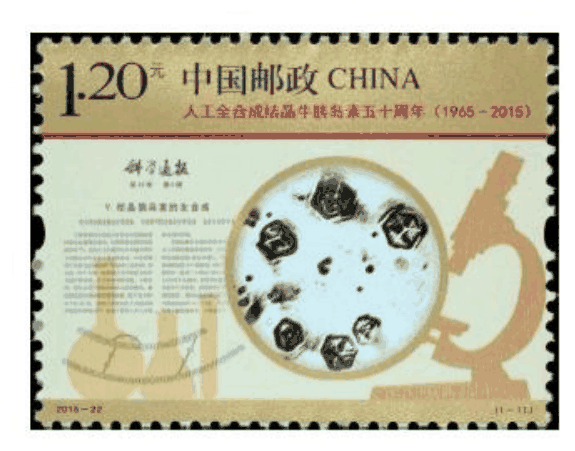
Stamp issued on the 50th anniversary (2015) of the first synthesis of crystalline bovine insulin.
Coupling of carboxylic acid groups with amine groups to forge an amide bond is the most elementary reaction in the synthesis of peptides and proteins. Allenone 2 was reported to be able to activate the carboxylic acid 1 under mild reaction conditions forming the intermediate 3. Intermediate 3 then reacts with amine 4 to give amide 5 with high yield, along with the byproduct 6.
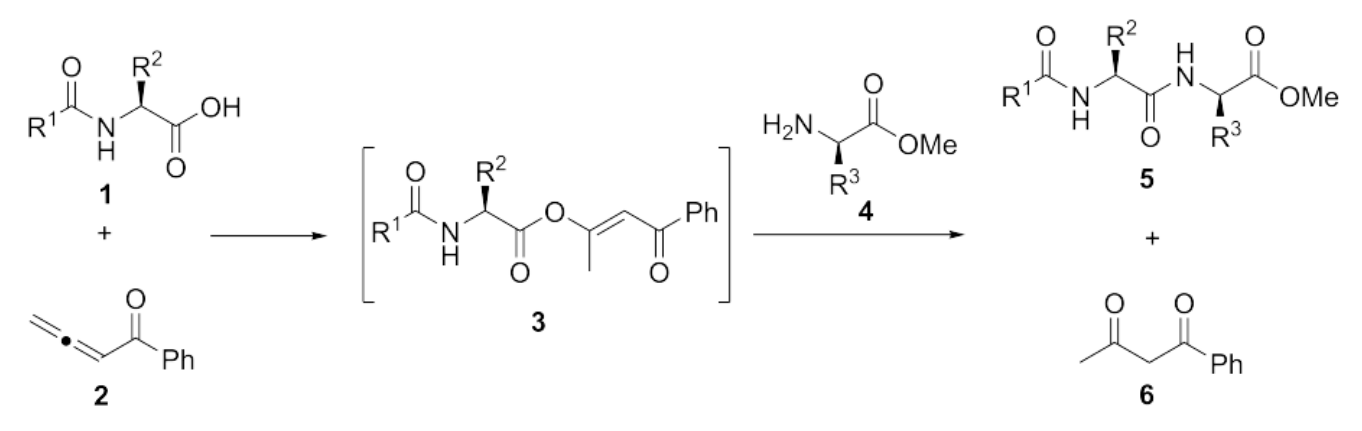
Similarly, N-ethynyl-N-methyl-p-toluenesulfonamide (MYTsA) with its major resonance structure 7 (involvement of Ts group is not considered) can activate carboxylic acid in the same way as allenone 2.
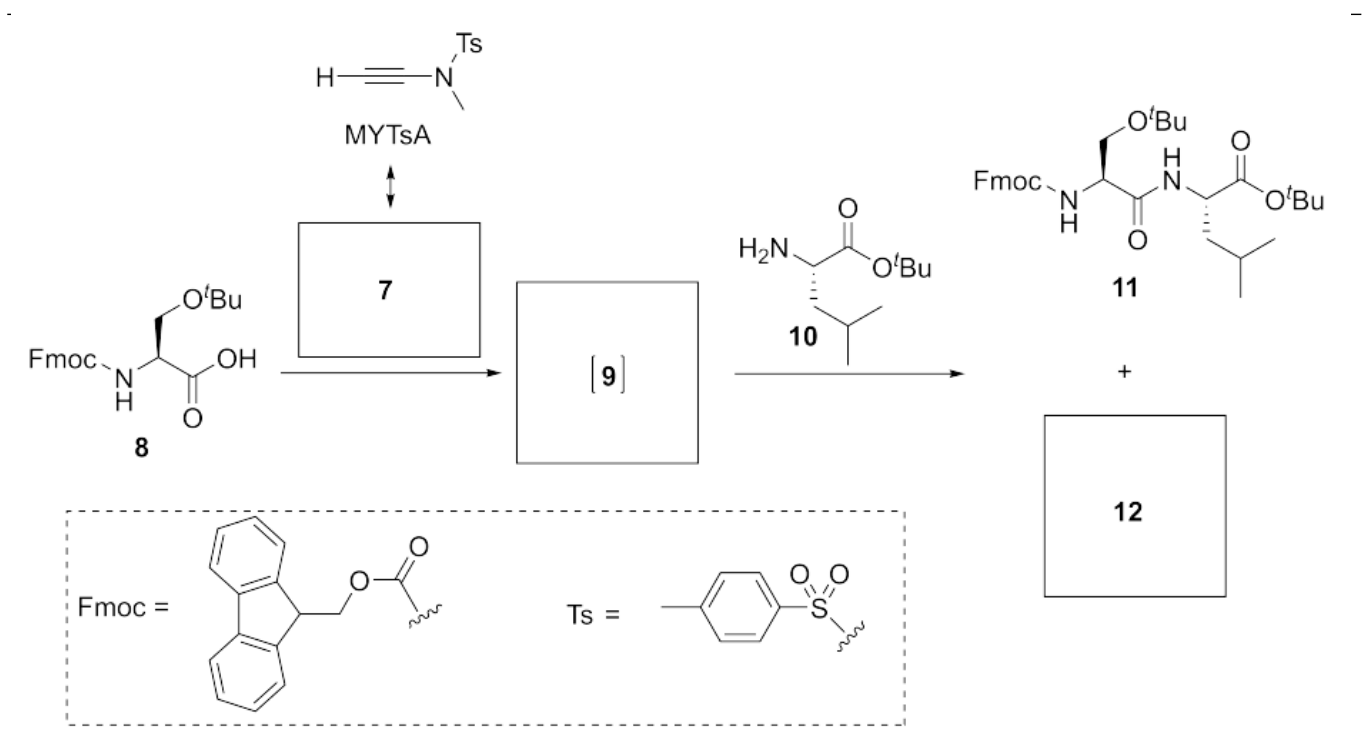
7.1 Draw the structures of 7, intermediate 9 and compound 12. Show the stereochemistry of any stereocenters.
As the length of peptide chain grows, formation of amide bonds becomes more difficult, and conventional condensation methods are not applicable in the synthesis of proteins. In the first synthesis of crystalline bovine insulin, a method based on the chemistry of acylhydrazine 13 was developed to achieve the challenging amide coupling between two peptides. As the following equations, compound 15 reacts with 16 smoothly in the presence of triethylamine.
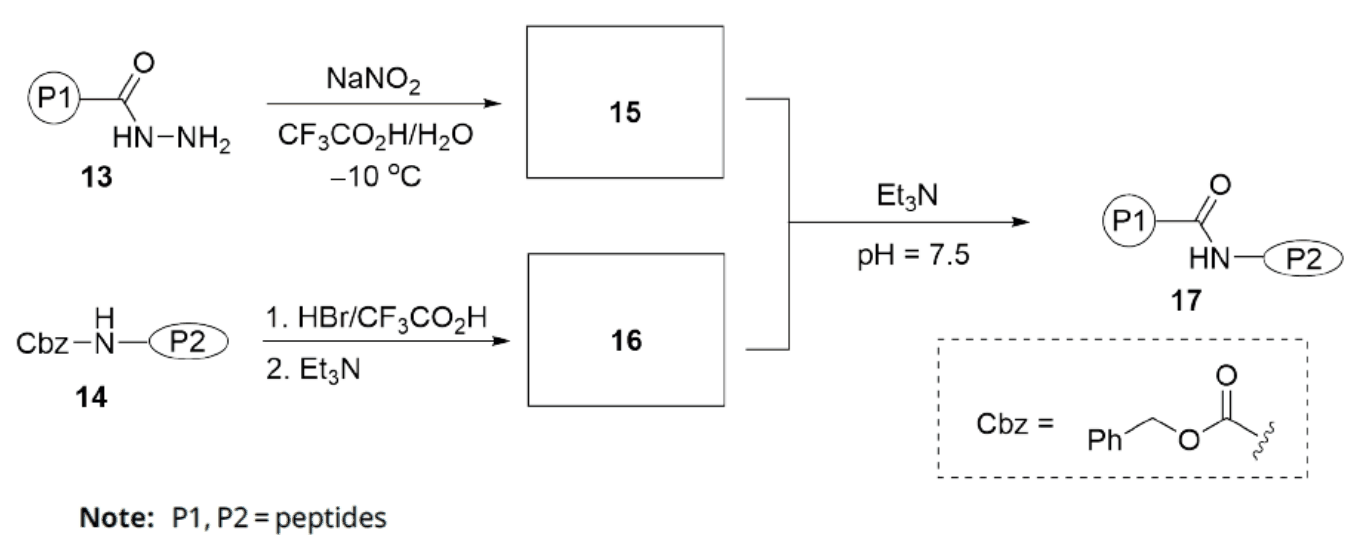
7.2 Draw the structures of compounds 15 and 16.
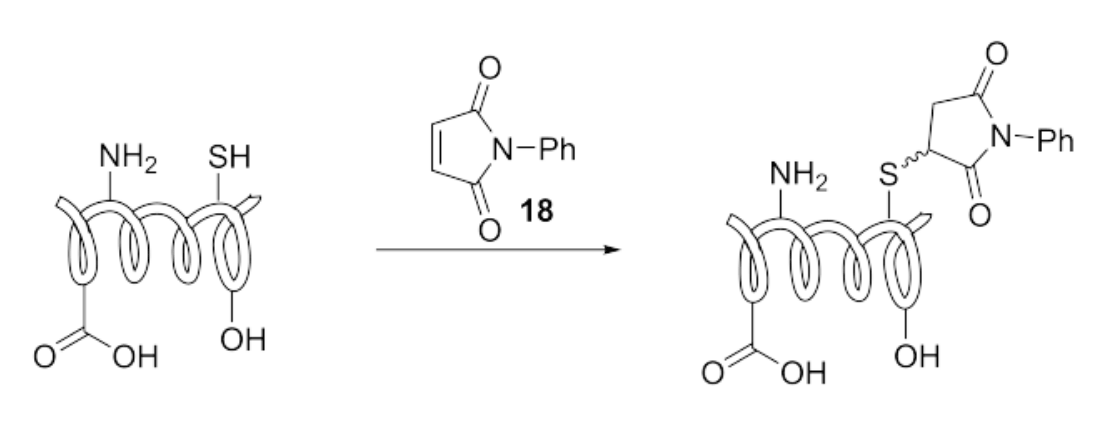
In addition to de novo synthesis, scientists can modify existing proteins. Although there are multiple reactive sites on the surface of protein, such as amino groups, thiol groups, and carboxyl groups, the most nucleophilic thiol groups are the preferred site when the protein is treated with electrophilic reagents such as N-phenyl maleimide 18 via Michael addition.
Under mild basic conditions (pH = 7.5), reagent 19 was proposed to react with the thiol group of protein 20 to give a neutral intermediate 21 which is attacked by hydroxide to give compound 22. Compound 22 can equilibrate with an acyclic form 23, and subsequently react with another protein 20. The resulting major product can exist either in the acyclic form 24 or in the cyclic form 25 in a similar way as the equilibration between 22 and 23.
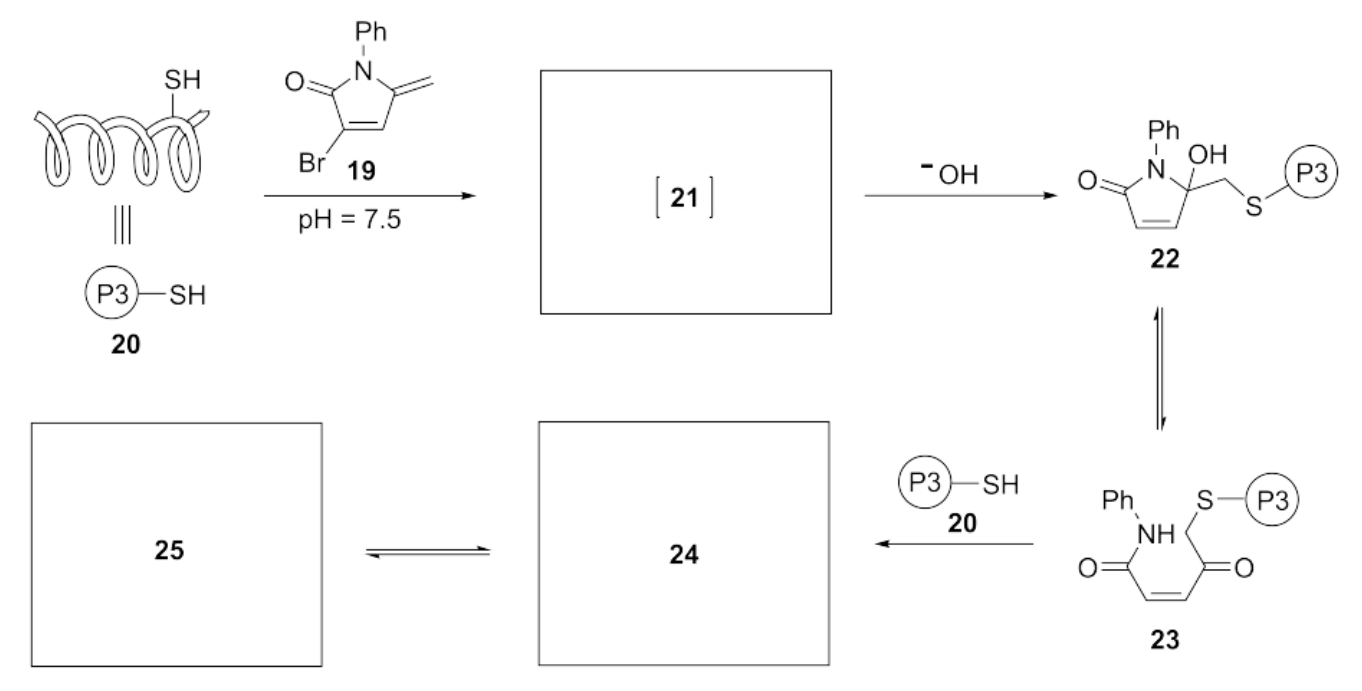
7.3 Draw the structures of intermediate 21, compounds 24 and 25. Stereochemistry is not required.
Official English text of the problem.
Answers
In the SMILES below, [*:1] and [*:2] represent the unspecified peptide residues P1 and P2. [*:3] and [*:4] represent two separate copies of protein residue P3. Their internal structures are not specified in the problem.
- 7.1
- 7: The charge-separated keteniminium–carbanion resonance contributor of MYTsA:
\[
\ce{H-C^{-}=C=N^{+}(CH3)-Ts}.
\]
SMILES:
[CH-]=C=[N+](C)S(=O)(=O)c1ccc(C)cc1 -
9: 1-[Methyl(tosyl)amino]ethenyl N-Fmoc-O-tert-butyl-L-serinate, the activated enol ester. The serine stereocenter remains \(S\).
SMILES:
O=C(OCC1c2ccccc2-c2ccccc21)N[C@@H](COC(C)(C)C)C(=O)OC(=C)N(C)S(=O)(=O)c1ccc(C)cc1- 12: N-Acetyl-N-methyl-4-methylbenzenesulfonamide, also called N-methyl-N-tosylacetamide.SMILES:
CC(=O)N(C)S(=O)(=O)c1ccc(C)cc1 -
7.2
-
15: The P1 peptide acyl azide, \(\ce{P1-C(=O)-N3}\).
SMILES:
[*:1]C(=O)N=[N+]=[N-]- 16: The P2 peptide with its free terminal amino group, \(\ce{H2N-P2}\).SMILES:
N[*:2] -
7.3
-
21: 3-Bromo-1-phenyl-5-[(P3-sulfanyl)methyl]-1,3-dihydro-2H-pyrrol-2-one, a neutral brominated enamine lactam.
SMILES:
O=C1C(Br)C=C(CS[*:3])N1c1ccccc1- 24: N-Phenyl-4-oxo-2,5-bis(P3-sulfanyl)pentanamide: \[ \ce{PhNH-C(=O)-CH(S-P3)-CH2-C(=O)-CH2-S-P3}. \] SMILES:O=C(Nc1ccccc1)C(S[*:4])CC(=O)CS[*:3]- 25: 5-Hydroxy-1-phenyl-3-(P3-sulfanyl)-5-[(P3-sulfanyl)methyl]pyrrolidin-2-one, the cyclic hemiaminal of 24.SMILES:
O=C1C(S[*:4])CC(O)(CS[*:3])N1c1ccccc1
Solution
7.1 — Activation by MYTsA and peptide-bond formation
MYTsA is N-ethynyl-N-methyl-4-methylbenzenesulfonamide, SMILES C#CN(C)S(=O)(=O)c1ccc(C)cc1.
Donation of the nitrogen lone pair into the adjacent alkyne, accompanied by movement of one alkyne \(\pi\)-electron pair onto the terminal carbon, gives resonance contributor 7:
\[ \ce{H-C#C-N(CH3)-Ts <-> H-C^{-}=C=N^{+}(CH3)-Ts}. \]
Thus, the terminal carbon carries the negative formal charge, and nitrogen carries the positive formal charge. This is a resonance relationship, not an equilibrium between separate compounds.
Acid 8 is N-Fmoc-O-tert-butyl-L-serine, SMILES O=C(OCC1c2ccccc2-c2ccccc21)N[C@@H](COC(C)(C)C)C(=O)O.
Write it as \(\ce{RCO2H}\), with its existing stereochemistry understood. Addition across the ynamide places the acid’s proton on the terminal carbon and its carboxylate oxygen on the carbon adjacent to nitrogen:
\[ \ce{R-C(=O)-OH + H-C#C-N(CH3)-Ts -> R-C(=O)-O-C(=CH2)-N(CH3)-Ts}. \]
The product is 9. Its newly formed ester linkage is specifically
\[ \ce{R-C(=O)-O-C(=CH2)-N(CH3)-Ts}. \]
The double bond terminates in a methylene group, so it has no \(E/Z\) stereochemistry.
At the serine stereocenter, the priority order is amino nitrogen, carboxyl carbon, side-chain carbon, then hydrogen. The configuration shown in 8 is \(S\), and it is retained in 9 because no bond at that stereocenter is broken. A drawing should therefore preserve the solid wedge to the serine side chain when using the same orientation as 8.
Amine 10 is tert-butyl L-leucinate, SMILES N[C@@H](CC(C)C)C(=O)OC(C)(C)C. Writing it as \(\ce{H2N-R'}\), its nitrogen attacks the amino-acid acyl carbonyl of 9. Collapse of the tetrahedral intermediate gives the peptide bond:
\[ \ce{R-C(=O)-O-C(=CH2)-N(CH3)-Ts + H2N-R' -> R-C(=O)-NH-R' + CH3-C(=O)-N(CH3)-Ts}. \]
The leaving fragment is initially protonated to 1-[methyl(tosyl)amino]ethen-1-ol, SMILES C=C(O)N(C)S(=O)(=O)c1ccc(C)cc1. It tautomerizes to 12:
\[ \ce{CH2=C(OH)-N(CH3)-Ts <=> CH3-C(=O)-N(CH3)-Ts}. \]
Product 11 is N-Fmoc-O-tert-butyl-L-seryl-L-leucine tert-butyl ester, SMILES O=C(OCC1c2ccccc2-c2ccccc21)N[C@@H](COC(C)(C)C)C(=O)N[C@@H](CC(C)C)C(=O)OC(C)(C)C.
Both amino-acid stereocenters retain their \(S\) configurations. The two coupling equations above are atom-balanced; no separate water molecule is released in these steps.
7.2 — Acyl-azide coupling of peptide fragments
Compound 13 is the P1 peptide acyl hydrazide, SMILES [*:1]C(=O)NN.
Acidified nitrite converts its hydrazide group into an acyl azide through nitrosation and dehydration. The balanced net ionic equation is
\[ \ce{P1-C(=O)-NH-NH2 + NO2- + H+ -> P1-C(=O)-N3 + 2H2O}. \]
Thus, 15 is the acyl azide identified above. One valid charge-explicit representation of its azide group is
\[ \ce{P1-C(=O)-N=N^{+}=N^{-}}. \]
The low temperature, \(-10\,^\circ\mathrm{C}\), allows the acyl azide to be used for the subsequent coupling.
Compound 14 is the N-Cbz-protected P2 peptide, SMILES O=C(OCc1ccccc1)N[*:2].
Hydrogen bromide cleaves the benzyl protecting group, and the remaining carbamate decarboxylates. Written with bromide as the ammonium counterion, the balanced reaction is
\[ \ce{P2-NH-C(=O)-O-CH2-Ph + 2HBr -> P2-NH3+ + Br- + Ph-CH2-Br + CO2}. \]
The initially formed P2 peptide ammonium ion has SMILES [NH3+][*:2]. Triethylamine liberates the free amine 16:
\[ \ce{P2-NH3+ + Et3N -> P2-NH2 + Et3NH+}. \]
Amine 16 then attacks the acyl carbonyl of 15. Elimination of azide and removal of a proton give the new peptide bond. Including the base, the balanced coupling is
\[ \ce{P1-C(=O)-N3 + H2N-P2 + Et3N -> P1-C(=O)-NH-P2 + Et3NH+ + N3-}. \]
The product, 17, is the amide-linked P1–P2 peptide, SMILES [*:1]C(=O)N[*:2].
The small species used in these equations are nitrite, [O-]N=O; proton, [H+]; water, O; hydrogen bromide, [H]Br; bromide, [Br-]; benzyl bromide, BrCc1ccccc1; carbon dioxide, O=C=O; triethylamine, CCN(CC)CC; triethylammonium, CC[NH+](CC)CC; and azide, [N-]=[N+]=[N-].
7.3 — Formation of the two-protein conjugate
For the five-membered ring, number the nitrogen 1, the carbonyl carbon 2, and the remaining ring carbons 3, 4, and 5 in sequence.
Reagent 19 is 3-bromo-5-methylene-1-phenyl-1,5-dihydro-2H-pyrrol-2-one, SMILES C=C1C=C(Br)C(=O)N1c1ccccc1.
Protein 20 is the P3 thiol, SMILES [*:3]S; its reactive thiolate form has SMILES [*:3][S-].
The thiolate attacks the terminal exocyclic methylene carbon in a 1,6-conjugate addition. Electron displacement through the conjugated system gives an enolate, and protonation at ring position 3 produces neutral 21. Using bold-numbered compounds as the molecular labels, the stoichiometry is
\[ \ce{19 + P3-SH -> 21}. \]
A precise drawing of 21 has:
- an N-phenyl nitrogen at position 1;
- a carbonyl at position 2;
- a \(\ce{CHBr}\) group at position 3;
- a double bond between positions 4 and 5;
- a \(\ce{-CH2-S-P3}\) substituent at position 5.
In particular, bromine remains attached in 21.
Hydroxide then gives an allylic substitution with double-bond migration: oxygen bonds to position 5, the double bond shifts to positions 3–4, and bromide leaves position 3. The balanced equation is
\[ \ce{21 + OH- -> 22 + Br-}. \]
Hydroxide has SMILES [OH-]. Product 22 is 5-hydroxy-1-phenyl-5-[(P3-sulfanyl)methyl]-1,5-dihydro-2H-pyrrol-2-one, SMILES O=C1C=CC(O)(CS[*:3])N1c1ccccc1.
Compound 22 is a cyclic hemiaminal. Breaking its bond between nitrogen and position 5, forming a carbonyl at position 5, and transferring the hydroxyl proton to nitrogen give 23. No water is gained or lost:
\[ \ce{22 <=> 23}. \]
Compound 23 is N-phenyl-4-oxo-5-(P3-sulfanyl)pent-2-enamide, SMILES O=C(Nc1ccccc1)C=CC(=O)CS[*:3]. Its connectivity is
\[ \ce{PhNH-C(=O)-CH=CH-C(=O)-CH2-S-P3}. \]
The alkene is conjugated with both an amide carbonyl and a ketone carbonyl. The ketone provides the stronger Michael-acceptor activation because nitrogen donation reduces the electron-withdrawing effect of the amide carbonyl. Consequently, the second thiol adds predominantly at the alkene carbon beta to the ketone, which is the carbon next to the amide carbonyl:
\[ \ce{PhNH-C(=O)-CH=CH-C(=O)-CH2-S-P3 + P3-SH -> PhNH-C(=O)-CH(S-P3)-CH2-C(=O)-CH2-S-P3}. \]
This identifies 24, with the second protein attached through sulfur at the carbon adjacent to the amide carbonyl.
Finally, the amide nitrogen attacks the ketone intramolecularly. Proton transfer gives the cyclic hemiaminal 25:
\[ \ce{24 <=> 25}. \]
A precise drawing of 25 is a five-membered ring containing an N-phenyl nitrogen at position 1, a carbonyl at position 2, \(\ce{CH(S-P3)}\) at position 3, methylene at position 4, and a carbon bearing both \(\ce{-OH}\) and \(\ce{-CH2-S-P3}\) at position 5. The two P3 groups are separate protein molecules. No water is eliminated during this ring closure, and stereochemistry need not be specified.
The answers were checked against the official answers published by the organisers.
IChO 2022 · Theorieaufgabe 7
Organische Moleküle im Leben
Die Synthese komplexer Peptide und Proteine ist eine anspruchsvolle Aufgabe. Am 17. September 1965 synthetisierten chinesische Wissenschaftler erstmals kristallines Rinderinsulin künstlich. Dies markierte einen entscheidenden Schritt auf dem Weg zur Erforschung des Geheimnisses des Lebens und läutete das Zeitalter der Proteinsynthese ein.
Briefmarke, herausgegeben zum 50. Jahrestag (2015) der ersten Synthese von kristallinem Rinderinsulin.
Die Kupplung von Carbonsäuregruppen mit Aminogruppen zur Bildung einer Amidbindung ist die grundlegendste Reaktion bei der Synthese von Peptiden und Proteinen. Es wurde berichtet, dass das Allenon 2 die Carbonsäure 1 unter milden Reaktionsbedingungen unter Bildung des Zwischenprodukts 3 aktivieren kann. Das Zwischenprodukt 3 reagiert anschließend mit dem Amin 4 und liefert das Amid 5 in hoher Ausbeute sowie das Nebenprodukt 6.
Ebenso kann N-Ethinyl-N-methyl-p-toluolsulfonamid (MYTsA) mit seiner maßgeblichen mesomeren Grenzstruktur 7 (eine Beteiligung der Ts-Gruppe wird nicht berücksichtigt) Carbonsäuren auf dieselbe Weise wie das Allenon 2 aktivieren.
7.1 Zeichnen Sie die Strukturen von 7, des Zwischenprodukts 9 und der Verbindung 12. Geben Sie die Stereochemie aller Stereozentren an.
Mit zunehmender Länge der Peptidkette wird die Bildung von Amidbindungen schwieriger, und herkömmliche Kondensationsmethoden sind für die Synthese von Proteinen nicht geeignet. Bei der ersten Synthese von kristallinem Rinderinsulin wurde eine auf der Chemie des Acylhydrazins 13 beruhende Methode entwickelt, um die anspruchsvolle Amidkupplung zwischen zwei Peptiden zu ermöglichen. Wie in den folgenden Gleichungen dargestellt, reagiert Verbindung 15 in Gegenwart von Triethylamin problemlos mit 16.
7.2 Zeichnen Sie die Strukturen der Verbindungen 15 und 16.
Neben der De-novo-Synthese können Wissenschaftler auch vorhandene Proteine modifizieren. Obwohl es auf der Oberfläche eines Proteins mehrere reaktive Stellen wie Aminogruppen, Thiolgruppen und Carboxylgruppen gibt, sind die am stärksten nucleophilen Thiolgruppen die bevorzugten Reaktionsstellen, wenn das Protein mit elektrophilen Reagenzien wie N-Phenylmaleimid 18 über eine Michael-Addition umgesetzt wird.
Unter schwach basischen Bedingungen (pH = 7.5) wurde vorgeschlagen, dass das Reagenz 19 mit der Thiolgruppe des Proteins 20 zu einem neutralen Zwischenprodukt 21 reagiert, das von Hydroxid angegriffen wird und die Verbindung 22 ergibt. Verbindung 22 kann mit einer acyclischen Form 23 im Gleichgewicht stehen und anschließend mit einem weiteren Protein 20 reagieren. Das dabei entstehende Hauptprodukt kann entweder in der acyclischen Form 24 oder in der cyclischen Form 25 vorliegen, ähnlich wie beim Gleichgewicht zwischen 22 und 23.
7.3 Zeichnen Sie die Strukturen des Zwischenprodukts 21 und der Verbindungen 24 und 25. Die Angabe der Stereochemie ist nicht erforderlich.
Aufgabentext aus dem offiziellen englischen Text übersetzt.
Antworten
In den folgenden SMILES stehen [*:1] und [*:2] für die nicht näher angegebenen Peptidreste P1 und P2. [*:3] und [*:4] stehen für zwei getrennte Exemplare des Proteinrests P3. Ihre inneren Strukturen sind in der Aufgabe nicht angegeben.
- 7.1
- 7: Die ladungsgetrennte Keteniminium–Carbanion-Grenzstruktur von MYTsA:
\[
\ce{H-C^{-}=C=N^{+}(CH3)-Ts}.
\]
SMILES:
[CH-]=C=[N+](C)S(=O)(=O)c1ccc(C)cc1 -
9: 1-[Methyl(tosyl)amino]ethenyl-N-Fmoc-O-tert-butyl-L-serinat, der aktivierte Enolester. Das Serin-Stereozentrum bleibt \(S\).
SMILES:
O=C(OCC1c2ccccc2-c2ccccc21)N[C@@H](COC(C)(C)C)C(=O)OC(=C)N(C)S(=O)(=O)c1ccc(C)cc1- 12: N-Acetyl-N-methyl-4-methylbenzolsulfonamid, auch N-Methyl-N-tosylacetamid genannt.SMILES:
CC(=O)N(C)S(=O)(=O)c1ccc(C)cc1 -
7.2
-
15: Das Acylazid des P1-Peptids, \(\ce{P1-C(=O)-N3}\).
SMILES:
[*:1]C(=O)N=[N+]=[N-]- 16: Das P2-Peptid mit seiner freien endständigen Aminogruppe, \(\ce{H2N-P2}\).SMILES:
N[*:2] -
7.3
-
21: 3-Brom-1-phenyl-5-[(P3-sulfanyl)methyl]-1,3-dihydro-2H-pyrrol-2-on, ein neutrales bromiertes Enaminlactam.
SMILES:
O=C1C(Br)C=C(CS[*:3])N1c1ccccc1- 24: N-Phenyl-4-oxo-2,5-bis(P3-sulfanyl)pentanamid: \[ \ce{PhNH-C(=O)-CH(S-P3)-CH2-C(=O)-CH2-S-P3}. \] SMILES:O=C(Nc1ccccc1)C(S[*:4])CC(=O)CS[*:3]- 25: 5-Hydroxy-1-phenyl-3-(P3-sulfanyl)-5-[(P3-sulfanyl)methyl]pyrrolidin-2-on, das cyclische Halbaminal von 24.SMILES:
O=C1C(S[*:4])CC(O)(CS[*:3])N1c1ccccc1
Lösung
7.1 — Aktivierung durch MYTsA und Bildung der Peptidbindung
MYTsA ist N-Ethinyl-N-methyl-4-methylbenzolsulfonamid, SMILES C#CN(C)S(=O)(=O)c1ccc(C)cc1.
Die Delokalisierung des freien Elektronenpaars des Stickstoffs in die benachbarte Alkinbindung unter gleichzeitiger Verschiebung eines \(\pi\)-Elektronenpaars des Alkins auf das endständige Kohlenstoffatom ergibt die mesomere Grenzstruktur 7:
\[ \ce{H-C#C-N(CH3)-Ts <-> H-C^{-}=C=N^{+}(CH3)-Ts}. \]
Somit trägt das endständige Kohlenstoffatom die negative Formalladung und der Stickstoff die positive Formalladung. Es handelt sich um Mesomerie, nicht um ein Gleichgewicht zwischen getrennten Verbindungen.
Säure 8 ist N-Fmoc-O-tert-butyl-L-serin, SMILES O=C(OCC1c2ccccc2-c2ccccc21)N[C@@H](COC(C)(C)C)C(=O)O.
Sie wird als \(\ce{RCO2H}\) geschrieben, wobei ihre vorhandene Stereochemie als gegeben vorausgesetzt wird. Bei der Addition an das Inamid gelangt das Proton der Säure an das endständige Kohlenstoffatom und ihr Carboxylat-Sauerstoff an das dem Stickstoff benachbarte Kohlenstoffatom:
\[ \ce{R-C(=O)-OH + H-C#C-N(CH3)-Ts -> R-C(=O)-O-C(=CH2)-N(CH3)-Ts}. \]
Das Produkt ist 9. Seine neu gebildete Esterverknüpfung lautet im Einzelnen
\[ \ce{R-C(=O)-O-C(=CH2)-N(CH3)-Ts}. \]
Die Doppelbindung endet in einer Methylengruppe, sodass sie keine \(E/Z\)-Stereochemie aufweist.
Am Serin-Stereozentrum lautet die Prioritätsreihenfolge: Aminostickstoff, Carboxylkohlenstoff, Seitenkettenkohlenstoff und schließlich Wasserstoff. Die in 8 gezeigte Konfiguration ist \(S\), und sie bleibt in 9 erhalten, da keine Bindung an diesem Stereozentrum gespalten wird. In einer Zeichnung sollte daher der ausgefüllte Keil zur Serin-Seitenkette beibehalten werden, wenn dieselbe Orientierung wie in 8 verwendet wird.
Amin 10 ist L-Leucin-tert-butylester, SMILES N[C@@H](CC(C)C)C(=O)OC(C)(C)C. Schreibt man es als \(\ce{H2N-R'}\), so greift sein Stickstoff die Acylcarbonylgruppe der Aminosäure in 9 an. Der Zerfall des tetraedrischen Zwischenprodukts ergibt die Peptidbindung:
\[ \ce{R-C(=O)-O-C(=CH2)-N(CH3)-Ts + H2N-R' -> R-C(=O)-NH-R' + CH3-C(=O)-N(CH3)-Ts}. \]
Das austretende Fragment wird zunächst zu 1-[Methyl(tosyl)amino]ethen-1-ol protoniert, SMILES C=C(O)N(C)S(=O)(=O)c1ccc(C)cc1. Es tautomerisiert zu 12:
\[ \ce{CH2=C(OH)-N(CH3)-Ts <=> CH3-C(=O)-N(CH3)-Ts}. \]
Produkt 11 ist N-Fmoc-O-tert-butyl-L-seryl-L-leucin-tert-butylester, SMILES O=C(OCC1c2ccccc2-c2ccccc21)N[C@@H](COC(C)(C)C)C(=O)N[C@@H](CC(C)C)C(=O)OC(C)(C)C.
Beide Aminosäure-Stereozentren behalten ihre \(S\)-Konfigurationen bei. Die beiden obigen Kupplungsgleichungen sind hinsichtlich der Atome ausgeglichen; in diesen Schritten wird kein separates Wassermolekül freigesetzt.
7.2 — Acylazidkupplung von Peptidfragmenten
Verbindung 13 ist das Acylhydrazid des P1-Peptids, SMILES [*:1]C(=O)NN.
Nitrit in saurer Lösung wandelt seine Hydrazidgruppe durch Nitrosierung und Dehydratisierung in ein Acylazid um. Die ausgeglichene Netto-Ionengleichung lautet
\[ \ce{P1-C(=O)-NH-NH2 + NO2- + H+ -> P1-C(=O)-N3 + 2H2O}. \]
Somit ist 15 das oben angegebene Acylazid. Eine gültige Darstellung seiner Azidgruppe mit expliziten Ladungen ist
\[ \ce{P1-C(=O)-N=N^{+}=N^{-}}. \]
Die niedrige Temperatur von \(-10\,^\circ\mathrm{C}\) ermöglicht es, das Acylazid für die anschließende Kupplung zu verwenden.
Verbindung 14 ist das N-Cbz-geschützte P2-Peptid, SMILES O=C(OCc1ccccc1)N[*:2].
Bromwasserstoff spaltet die Benzylschutzgruppe ab, und das verbleibende Carbamat decarboxyliert. Mit Bromid als Gegenion des Ammoniumions geschrieben lautet die ausgeglichene Reaktion
\[ \ce{P2-NH-C(=O)-O-CH2-Ph + 2HBr -> P2-NH3+ + Br- + Ph-CH2-Br + CO2}. \]
Das zunächst gebildete Ammoniumion des P2-Peptids hat den SMILES [NH3+][*:2]. Triethylamin setzt das freie Amin 16 frei:
\[ \ce{P2-NH3+ + Et3N -> P2-NH2 + Et3NH+}. \]
Amin 16 greift anschließend die Acylcarbonylgruppe von 15 an. Die Abspaltung von Azid und die Entfernung eines Protons ergeben die neue Peptidbindung. Unter Einbeziehung der Base lautet die ausgeglichene Kupplungsreaktion
\[ \ce{P1-C(=O)-N3 + H2N-P2 + Et3N -> P1-C(=O)-NH-P2 + Et3NH+ + N3-}. \]
Das Produkt 17 ist das über eine Amidbindung verknüpfte P1–P2-Peptid, SMILES [*:1]C(=O)N[*:2].
Die in diesen Gleichungen verwendeten kleinen Spezies sind Nitrit, [O-]N=O; Proton, [H+]; Wasser, O; Bromwasserstoff, [H]Br; Bromid, [Br-]; Benzylbromid, BrCc1ccccc1; Kohlenstoffdioxid, O=C=O; Triethylamin, CCN(CC)CC; Triethylammonium, CC[NH+](CC)CC; und Azid, [N-]=[N+]=[N-].
7.3 — Bildung des Konjugats aus zwei Proteinen
Für den fünfgliedrigen Ring wird der Stickstoff mit 1, der Carbonylkohlenstoff mit 2 und die übrigen Ringkohlenstoffatome der Reihe nach mit 3, 4 und 5 nummeriert.
Reagenz 19 ist 3-Brom-5-methylen-1-phenyl-1,5-dihydro-2H-pyrrol-2-on, SMILES C=C1C=C(Br)C(=O)N1c1ccccc1.
Protein 20 ist das P3-Thiol, SMILES [*:3]S; seine reaktive Thiolat-Form hat den SMILES [*:3][S-].
Das Thiolat greift das endständige exocyclische Methylen-Kohlenstoffatom in einer konjugierten 1,6-Addition an. Die Elektronenverschiebung durch das konjugierte System ergibt ein Enolat, und die Protonierung an Ringposition 3 liefert das neutrale 21. Bei Verwendung der fett gedruckten Verbindungsnummern als Molekülbezeichnungen lautet die Stöchiometrie
\[ \ce{19 + P3-SH -> 21}. \]
Eine genaue Zeichnung von 21 weist Folgendes auf:
- einen N-Phenyl-Stickstoff an Position 1;
- eine Carbonylgruppe an Position 2;
- eine \(\ce{CHBr}\)-Gruppe an Position 3;
- eine Doppelbindung zwischen den Positionen 4 und 5;
- einen \(\ce{-CH2-S-P3}\)-Substituenten an Position 5.
Insbesondere bleibt Brom in 21 gebunden.
Hydroxid bewirkt anschließend eine allylische Substitution mit Doppelbindungsverschiebung: Sauerstoff bindet an Position 5, die Doppelbindung verschiebt sich zu den Positionen 3–4, und Bromid verlässt Position 3. Die ausgeglichene Gleichung lautet
\[ \ce{21 + OH- -> 22 + Br-}. \]
Hydroxid hat den SMILES [OH-]. Produkt 22 ist 5-Hydroxy-1-phenyl-5-[(P3-sulfanyl)methyl]-1,5-dihydro-2H-pyrrol-2-on, SMILES O=C1C=CC(O)(CS[*:3])N1c1ccccc1.
Verbindung 22 ist ein cyclisches Halbaminal. Die Spaltung ihrer Bindung zwischen Stickstoff und Position 5, die Bildung einer Carbonylgruppe an Position 5 und die Übertragung des Hydroxylprotons auf den Stickstoff ergeben 23. Dabei wird weder Wasser aufgenommen noch abgegeben:
\[ \ce{22 <=> 23}. \]
Verbindung 23 ist N-Phenyl-4-oxo-5-(P3-sulfanyl)pent-2-enamid, SMILES O=C(Nc1ccccc1)C=CC(=O)CS[*:3]. Ihre Bindungsverknüpfung lautet
\[ \ce{PhNH-C(=O)-CH=CH-C(=O)-CH2-S-P3}. \]
Das Alken ist sowohl mit einer Amidcarbonylgruppe als auch mit einer Ketoncarbonylgruppe konjugiert. Das Keton bewirkt die stärkere Aktivierung als Michael-Akzeptor, da die Elektronendonationswirkung des Stickstoffs die elektronenziehende Wirkung der Amidcarbonylgruppe verringert. Folglich addiert das zweite Thiol überwiegend an das Alken-Kohlenstoffatom in beta-Position zum Keton, also an das Kohlenstoffatom neben der Amidcarbonylgruppe:
\[ \ce{PhNH-C(=O)-CH=CH-C(=O)-CH2-S-P3 + P3-SH -> PhNH-C(=O)-CH(S-P3)-CH2-C(=O)-CH2-S-P3}. \]
Damit ist 24 bestimmt, wobei das zweite Protein über Schwefel an das der Amidcarbonylgruppe benachbarte Kohlenstoffatom gebunden ist.
Schließlich greift der Amidstickstoff das Keton intramolekular an. Eine Protonenübertragung ergibt das cyclische Halbaminal 25:
\[ \ce{24 <=> 25}. \]
Eine genaue Zeichnung von 25 zeigt einen fünfgliedrigen Ring mit einem N-Phenyl-Stickstoff an Position 1, einer Carbonylgruppe an Position 2, \(\ce{CH(S-P3)}\) an Position 3, einer Methylengruppe an Position 4 und einem Kohlenstoffatom, das sowohl \(\ce{-OH}\) als auch \(\ce{-CH2-S-P3}\) trägt, an Position 5. Die beiden P3-Gruppen sind getrennte Proteinmoleküle. Bei diesem Ringschluss wird kein Wasser abgespalten, und die Stereochemie muss nicht angegeben werden.
Die Ergebnisse wurden mit den von den Veranstaltern veröffentlichten offiziellen Ergebnissen abgeglichen.
IChO 2022 · Teori sorusu 7
Yaşamdaki Organik Moleküller
Karmaşık peptitlerin ve proteinlerin sentezi zorlu bir iştir. Çinli bilim insanları 17 Eylül 1965 tarihinde kristal sığır insülinini ilk kez yapay olarak sentezleyerek yaşamın sırrını keşfetme yolculuğunda çok önemli bir adım atmış ve protein sentezi çağını başlatmışlardır.
Kristal sığır insülininin ilk sentezinin 50. yıl dönümünde (2015) çıkarılan pul.
Karboksilik asit gruplarının amin gruplarıyla bir amit bağı oluşturacak şekilde kenetlenmesi, peptit ve protein sentezindeki en temel tepkimedir. Allenon 2'nin, ılımlı tepkime koşullarında karboksilik asit 1'i etkinleştirerek 3 ara ürününü oluşturabildiği bildirilmiştir. Ardından 3 ara ürünü amin 4 ile tepkimeye girerek yüksek verimle amit 5'i ve bunun yanında yan ürün 6'yı verir.
Benzer şekilde, başlıca rezonans yapısı 7 olan (Ts grubunun katılımı dikkate alınmamıştır) N-etinil-N-metil-p-toluensülfonamit (MYTsA), karboksilik asidi allenon 2 ile aynı şekilde etkinleştirebilir.
7.1 7'nin, 9 ara ürününün ve 12 bileşiğinin yapılarını çiziniz. Varsa stereomerkezlerin stereokimyasını gösteriniz.
Peptit zincirinin uzunluğu arttıkça amit bağlarının oluşumu zorlaşır ve geleneksel kondenzasyon yöntemleri protein sentezinde uygulanamaz hâle gelir. Kristal sığır insülininin ilk sentezinde, iki peptit arasındaki zorlu amit kenetlenmesini gerçekleştirmek için açilhidrazin 13'ün kimyasına dayalı bir yöntem geliştirilmiştir. Aşağıdaki denklemlerde gösterildiği gibi, 15 bileşiği trietilamin varlığında 16 ile sorunsuz bir şekilde tepkimeye girer.
7.2 15 ve 16 bileşiklerinin yapılarını çiziniz.
Bilim insanları, de novo sentezin yanı sıra mevcut proteinleri de değiştirebilirler. Protein yüzeyinde amino grupları, tiyol grupları ve karboksil grupları gibi birden çok tepkimeye girebilen bölge bulunmasına rağmen, protein N-fenilmaleimit 18 gibi elektrofilik reaktiflerle işleme sokulduğunda, Michael katılması yoluyla tepkime için tercih edilen bölgeler nükleofilliği en yüksek olan tiyol gruplarıdır.
Hafif bazik koşullarda (pH = 7.5), 19 reaktifinin protein 20'nin tiyol grubuyla tepkimeye girerek nötr bir 21 ara ürünü oluşturduğu ve hidroksitin bu ara ürüne saldırmasıyla 22 bileşiğinin oluştuğu öne sürülmüştür. 22 bileşiği açık zincirli 23 biçimiyle dengeye gelebilir ve ardından başka bir protein 20 ile tepkimeye girebilir. Oluşan ana ürün, 22 ile 23 arasındaki dengeye benzer şekilde, açık zincirli 24 biçiminde veya halkalı 25 biçiminde bulunabilir.
7.3 21 ara ürününün, 24 ve 25 bileşiklerinin yapılarını çiziniz. Stereokimyanın gösterilmesi gerekli değildir.
Soru metni resmi İngilizce metinden çevrilmiştir.
Cevaplar
Aşağıdaki SMILES gösterimlerinde [*:1] ve [*:2], yapıları belirtilmemiş P1 ve P2 peptit kalıntılarını temsil eder. [*:3] ve [*:4], P3 protein kalıntısının iki ayrı kopyasını temsil eder. Bunların iç yapıları soruda belirtilmemiştir.
- 7.1
- 7: MYTsA'nın yük ayrışmalı keteniminyum–karbanyon rezonans katkı yapısı:
\[
\ce{H-C^{-}=C=N^{+}(CH3)-Ts}.
\]
SMILES:
[CH-]=C=[N+](C)S(=O)(=O)c1ccc(C)cc1 -
9: Etkinleştirilmiş enol esteri olan 1-[metil(tosil)amino]etenil N-Fmoc-O-tert-bütil-L-serinat. Serin stereomerkezi \(S\) olarak kalır.
SMILES:
O=C(OCC1c2ccccc2-c2ccccc21)N[C@@H](COC(C)(C)C)C(=O)OC(=C)N(C)S(=O)(=O)c1ccc(C)cc1- 12: N-metil-N-tosilasetamit olarak da adlandırılan N-asetil-N-metil-4-metilbenzensülfonamit.SMILES:
CC(=O)N(C)S(=O)(=O)c1ccc(C)cc1 -
7.2
-
15: P1 peptit açil azidi, \(\ce{P1-C(=O)-N3}\).
SMILES:
[*:1]C(=O)N=[N+]=[N-]- 16: Uç amino grubu serbest olan P2 peptidi, \(\ce{H2N-P2}\).SMILES:
N[*:2] -
7.3
-
21: Nötr, bromlanmış bir enamin laktam olan 3-bromo-1-fenil-5-[(P3-sülfanil)metil]-1,3-dihidro-2H-pirol-2-on.
SMILES:
O=C1C(Br)C=C(CS[*:3])N1c1ccccc1- 24: N-fenil-4-okso-2,5-bis(P3-sülfanil)pentanamit: \[ \ce{PhNH-C(=O)-CH(S-P3)-CH2-C(=O)-CH2-S-P3}. \] SMILES:O=C(Nc1ccccc1)C(S[*:4])CC(=O)CS[*:3]- 25: 24'ün halkalı hemiaminali olan 5-hidroksi-1-fenil-3-(P3-sülfanil)-5-[(P3-sülfanil)metil]pirolidin-2-on.SMILES:
O=C1C(S[*:4])CC(O)(CS[*:3])N1c1ccccc1
Çözüm
7.1 — MYTsA ile etkinleştirme ve peptit bağı oluşumu
MYTsA, N-etinil-N-metil-4-metilbenzensülfonamit olup SMILES gösterimi C#CN(C)S(=O)(=O)c1ccc(C)cc1 şeklindedir.
Azotun ortaklanmamış elektron çiftinin komşu alkine aktarılması ve buna eşlik eden, alkinin bir \(\pi\)-elektron çiftinin uç karbona kayması, 7 rezonans katkı yapısını verir:
\[ \ce{H-C#C-N(CH3)-Ts <-> H-C^{-}=C=N^{+}(CH3)-Ts}. \]
Böylece uç karbon negatif formal yükü, azot ise pozitif formal yükü taşır. Bu, ayrı bileşikler arasındaki bir denge değil, bir rezonans ilişkisidir.
Asit 8, N-Fmoc-O-tert-bütil-L-serin olup SMILES gösterimi O=C(OCC1c2ccccc2-c2ccccc21)N[C@@H](COC(C)(C)C)C(=O)O şeklindedir.
Mevcut stereokimyasının korunduğu kabul edilerek bu asit \(\ce{RCO2H}\) şeklinde yazılsın. İnamidin üçlü bağına katılmada, asidin protonu uç karbona, karboksilat oksijeni ise azota komşu karbona bağlanır:
\[ \ce{R-C(=O)-OH + H-C#C-N(CH3)-Ts -> R-C(=O)-O-C(=CH2)-N(CH3)-Ts}. \]
Ürün 9'dur. Yeni oluşan ester bağlantısı tam olarak şöyledir:
\[ \ce{R-C(=O)-O-C(=CH2)-N(CH3)-Ts}. \]
Çift bağ bir metilen grubuyla sonlandığından \(E/Z\) stereokimyası yoktur.
Serin stereomerkezinde öncelik sırası amino azotu, karboksil karbonu, yan zincir karbonu ve son olarak hidrojendir. 8'de gösterilen konfigürasyon \(S\)'dir ve bu stereomerkezde hiçbir bağ kırılmadığı için 9'da korunur. Bu nedenle çizimde 8 ile aynı yönelim kullanıldığında, serin yan zincirine uzanan dolu kama bağı korunmalıdır.
Amin 10, tert-bütil L-lösinat olup SMILES gösterimi N[C@@H](CC(C)C)C(=O)OC(C)(C)C şeklindedir. Bu amin \(\ce{H2N-R'}\) şeklinde yazıldığında, azotu 9'un amino asit açil karboniline saldırır. Tetrahedral ara ürünün çökmesi peptit bağını oluşturur:
\[ \ce{R-C(=O)-O-C(=CH2)-N(CH3)-Ts + H2N-R' -> R-C(=O)-NH-R' + CH3-C(=O)-N(CH3)-Ts}. \]
Ayrılan parça önce protonlanarak SMILES gösterimi C=C(O)N(C)S(=O)(=O)c1ccc(C)cc1 olan 1-[metil(tosil)amino]eten-1-ol oluşturur. Bu bileşik tautomerleşerek 12'ye dönüşür:
\[ \ce{CH2=C(OH)-N(CH3)-Ts <=> CH3-C(=O)-N(CH3)-Ts}. \]
Ürün 11, N-Fmoc-O-tert-bütil-L-seril-L-lösin tert-bütil esteri olup SMILES gösterimi O=C(OCC1c2ccccc2-c2ccccc21)N[C@@H](COC(C)(C)C)C(=O)N[C@@H](CC(C)C)C(=O)OC(C)(C)C şeklindedir.
Her iki amino asit stereomerkezi de \(S\) konfigürasyonunu korur. Yukarıdaki iki kenetlenme denklemi atom sayıları bakımından denkleştirilmiştir; bu adımlarda ayrı bir su molekülü açığa çıkmaz.
7.2 — Peptit parçalarının açil azit yoluyla kenetlenmesi
13 bileşiği, SMILES gösterimi [*:1]C(=O)NN olan P1 peptit açil hidrazididir.
Asitlendirilmiş nitrit, hidrazit grubunu nitrozolama ve dehidrasyon yoluyla bir açil azide dönüştürür. Denkleştirilmiş net iyon denklemi şöyledir:
\[ \ce{P1-C(=O)-NH-NH2 + NO2- + H+ -> P1-C(=O)-N3 + 2H2O}. \]
Dolayısıyla 15, yukarıda tanımlanan açil azittir. Azit grubunun yükleri açıkça gösteren geçerli bir gösterimi şöyledir:
\[ \ce{P1-C(=O)-N=N^{+}=N^{-}}. \]
\(-10\,^\circ\mathrm{C}\) gibi düşük bir sıcaklık, açil azidin sonraki kenetlenmede kullanılmasına olanak tanır.
14 bileşiği, SMILES gösterimi O=C(OCc1ccccc1)N[*:2] olan N-Cbz ile korunmuş P2 peptididir.
Hidrojen bromür benzil koruyucu grubunu uzaklaştırır ve geriye kalan karbamat dekarboksillenir. Amonyumun karşı iyonu bromür olarak yazıldığında, denkleştirilmiş tepkime şöyledir:
\[ \ce{P2-NH-C(=O)-O-CH2-Ph + 2HBr -> P2-NH3+ + Br- + Ph-CH2-Br + CO2}. \]
Başlangıçta oluşan P2 peptit amonyum iyonunun SMILES gösterimi [NH3+][*:2] şeklindedir. Trietilamin, serbest amin 16'yı açığa çıkarır:
\[ \ce{P2-NH3+ + Et3N -> P2-NH2 + Et3NH+}. \]
Ardından amin 16, 15'in açil karboniline saldırır. Azidin ayrılması ve bir protonun uzaklaştırılması yeni peptit bağını oluşturur. Baz da dâhil edildiğinde, denkleştirilmiş kenetlenme tepkimesi şöyledir:
\[ \ce{P1-C(=O)-N3 + H2N-P2 + Et3N -> P1-C(=O)-NH-P2 + Et3NH+ + N3-}. \]
Ürün 17, SMILES gösterimi [*:1]C(=O)N[*:2] olan amit bağıyla bağlanmış P1–P2 peptididir.
Bu denklemlerde kullanılan küçük türler nitrit, [O-]N=O; proton, [H+]; su, O; hidrojen bromür, [H]Br; bromür, [Br-]; benzil bromür, BrCc1ccccc1; karbon dioksit, O=C=O; trietilamin, CCN(CC)CC; trietilamonyum, CC[NH+](CC)CC; ve azit, [N-]=[N+]=[N-] şeklindedir.
7.3 — İki proteinli konjugatın oluşumu
Beş üyeli halkada azotu 1, karbonil karbonunu 2 ve geri kalan halka karbonlarını sırasıyla 3, 4 ve 5 olarak numaralandırınız.
Reaktif 19, 3-bromo-5-metilen-1-fenil-1,5-dihidro-2H-pirol-2-on olup SMILES gösterimi C=C1C=C(Br)C(=O)N1c1ccccc1 şeklindedir.
Protein 20, SMILES gösterimi [*:3]S olan P3 tiyolüdür; tepkimeye giren tiyolat biçiminin SMILES gösterimi ise [*:3][S-] şeklindedir.
Tiyolat, 1,6-konjuge katılma yoluyla halka dışındaki uç metilen karbonuna saldırır. Konjuge sistem boyunca elektronların yer değiştirmesi bir enolat verir ve halkanın 3 konumunda protonlanma nötr 21'i oluşturur. Kalın yazılmış bileşik numaraları molekül etiketleri olarak kullanıldığında, stokiyometri şöyledir:
\[ \ce{19 + P3-SH -> 21}. \]
21'in doğru bir çiziminde şunlar bulunur:
- 1 konumunda bir N-fenil azotu;
- 2 konumunda bir karbonil;
- 3 konumunda bir \(\ce{CHBr}\) grubu;
- 4 ve 5 konumları arasında bir çift bağ;
- 5 konumunda bir \(\ce{-CH2-S-P3}\) sübstitüenti.
Özellikle, 21'de brom bağlı kalır.
Ardından hidroksit, çift bağın yer değiştirmesiyle birlikte allilik bir yer değiştirme tepkimesi verir: oksijen 5 konumuna bağlanır, çift bağ 3–4 konumlarına kayar ve bromür 3 konumundan ayrılır. Denkleştirilmiş denklem şöyledir:
\[ \ce{21 + OH- -> 22 + Br-}. \]
Hidroksitin SMILES gösterimi [OH-] şeklindedir. Ürün 22, 5-hidroksi-1-fenil-5-[(P3-sülfanil)metil]-1,5-dihidro-2H-pirol-2-on olup SMILES gösterimi O=C1C=CC(O)(CS[*:3])N1c1ccccc1 şeklindedir.
22 bileşiği halkalı bir hemiaminaldir. Azot ile 5 konumu arasındaki bağının kırılması, 5 konumunda bir karbonil oluşması ve hidroksil protonunun azota aktarılması 23'ü verir. Su alınmaz veya kaybedilmez:
\[ \ce{22 <=> 23}. \]
23 bileşiği, N-fenil-4-okso-5-(P3-sülfanil)pent-2-enamit olup SMILES gösterimi O=C(Nc1ccccc1)C=CC(=O)CS[*:3] şeklindedir. Atomların bağlanma düzeni şöyledir:
\[ \ce{PhNH-C(=O)-CH=CH-C(=O)-CH2-S-P3}. \]
Alken hem bir amit karboniliyle hem de bir keton karboniliyle konjugasyon hâlindedir. Azotun elektron vermesi amit karbonilinin elektron çekici etkisini azalttığından, keton Michael alıcısı olarak daha güçlü bir etkinleştirme sağlar. Sonuç olarak ikinci tiyol, ağırlıklı olarak ketona göre beta konumundaki alken karbonuna, yani amit karbonilinin yanındaki karbona katılır:
\[ \ce{PhNH-C(=O)-CH=CH-C(=O)-CH2-S-P3 + P3-SH -> PhNH-C(=O)-CH(S-P3)-CH2-C(=O)-CH2-S-P3}. \]
Böylece, ikinci proteinin kükürt üzerinden amit karboniline komşu karbona bağlandığı 24 belirlenmiş olur.
Son olarak amit azotu, molekül içi bir tepkimeyle ketona saldırır. Proton aktarımı halkalı hemiaminal 25'i verir:
\[ \ce{24 <=> 25}. \]
25'in doğru bir çizimi, 1 konumunda bir N-fenil azotu, 2 konumunda bir karbonil, 3 konumunda \(\ce{CH(S-P3)}\), 4 konumunda metilen ve 5 konumunda hem \(\ce{-OH}\) hem de \(\ce{-CH2-S-P3}\) taşıyan bir karbon içeren beş üyeli bir halkadır. İki P3 grubu ayrı protein molekülleridir. Bu halka kapanması sırasında su ayrılmaz ve stereokimyanın belirtilmesi gerekmez.
Sonuçlar, düzenleyicilerin yayımladığı resmi sonuçlarla karşılaştırılarak kontrol edildi.
IChO 2022 · Problema teórico 7
Moléculas orgánicas en la vida
La síntesis de péptidos y proteínas complejos es una tarea difícil. El 17 de septiembre de 1965, científicos chinos sintetizaron artificialmente insulina bovina cristalina por primera vez, lo que supuso un paso crucial en la exploración del secreto de la vida y abrió la era de la síntesis de proteínas.
Sello emitido con motivo del 50.º aniversario (2015) de la primera síntesis de insulina bovina cristalina.
El acoplamiento de grupos de ácido carboxílico con grupos amina para formar un enlace amida es la reacción más elemental en la síntesis de péptidos y proteínas. Se ha descrito que la alenona 2 puede activar el ácido carboxílico 1 en condiciones de reacción suaves, formando el intermedio 3. A continuación, el intermedio 3 reacciona con la amina 4 para dar la amida 5 con un alto rendimiento, junto con el subproducto 6.
De manera similar, la N-etinil-N-metil-p-toluenosulfonamida (MYTsA), con su estructura de resonancia principal 7 (no se considera la participación del grupo Ts), puede activar un ácido carboxílico del mismo modo que la alenona 2.
7.1 Dibuje las estructuras de 7, del intermedio 9 y del compuesto 12. Indique la estereoquímica de todos los centros estereogénicos.
A medida que aumenta la longitud de la cadena peptídica, la formación de enlaces amida se vuelve más difícil, y los métodos de condensación convencionales no son aplicables a la síntesis de proteínas. En la primera síntesis de insulina bovina cristalina, se desarrolló un método basado en la química de la acilhidrazina 13 para lograr el difícil acoplamiento amídico entre dos péptidos. Como muestran las siguientes ecuaciones, el compuesto 15 reacciona con 16 sin dificultad en presencia de trietilamina.
7.2 Dibuje las estructuras de los compuestos 15 y 16.
Además de la síntesis de novo, los científicos pueden modificar proteínas existentes. Aunque en la superficie de una proteína hay múltiples sitios reactivos, como grupos amino, grupos tiol y grupos carboxilo, los grupos tiol, que son los más nucleófilos, son el sitio preferido cuando la proteína se trata con reactivos electrófilos como la N-fenilmaleimida 18 mediante una adición de Michael.
Se propuso que, en condiciones ligeramente básicas (pH = 7.5), el reactivo 19 reacciona con el grupo tiol de la proteína 20 para dar un intermedio neutro 21, que es atacado por el ion hidróxido para dar el compuesto 22. El compuesto 22 puede estar en equilibrio con una forma acíclica 23 y, posteriormente, reaccionar con otra proteína 20. El producto mayoritario resultante puede existir tanto en la forma acíclica 24 como en la forma cíclica 25, de manera similar al equilibrio entre 22 y 23.
7.3 Dibuje las estructuras del intermedio 21 y de los compuestos 24 y 25. No es necesario indicar la estereoquímica.
Enunciado traducido del texto oficial en inglés.
Respuestas
En los SMILES siguientes, [*:1] y [*:2] representan los residuos peptídicos P1 y P2 no especificados. [*:3] y [*:4] representan dos copias distintas del residuo proteico P3. Sus estructuras internas no se especifican en el problema.
- 7.1
- 7: La estructura contribuyente de resonancia de MYTsA de tipo ceteniminio–carbanión con separación de cargas:
\[
\ce{H-C^{-}=C=N^{+}(CH3)-Ts}.
\]
SMILES:
[CH-]=C=[N+](C)S(=O)(=O)c1ccc(C)cc1 -
9: N-Fmoc-O-terc-butil-L-serinato de 1-[metil(tosil)amino]etenilo, el éster enólico activado. El centro estereogénico de la serina conserva la configuración \(S\).
SMILES:
O=C(OCC1c2ccccc2-c2ccccc21)N[C@@H](COC(C)(C)C)C(=O)OC(=C)N(C)S(=O)(=O)c1ccc(C)cc1- 12: N-Acetil-N-metil-4-metilbencenosulfonamida, también denominada N-metil-N-tosilacetamida.SMILES:
CC(=O)N(C)S(=O)(=O)c1ccc(C)cc1 -
7.2
-
15: La azida de acilo del péptido P1, \(\ce{P1-C(=O)-N3}\).
SMILES:
[*:1]C(=O)N=[N+]=[N-]- 16: El péptido P2 con su grupo amino terminal libre, \(\ce{H2N-P2}\).SMILES:
N[*:2] -
7.3
-
21: 3-Bromo-1-fenil-5-[(P3-sulfanil)metil]-1,3-dihidro-2H-pirrol-2-ona, una lactama enamínica bromada neutra.
SMILES:
O=C1C(Br)C=C(CS[*:3])N1c1ccccc1- 24: N-Fenil-4-oxo-2,5-bis(P3-sulfanil)pentanamida: \[ \ce{PhNH-C(=O)-CH(S-P3)-CH2-C(=O)-CH2-S-P3}. \] SMILES:O=C(Nc1ccccc1)C(S[*:4])CC(=O)CS[*:3]- 25: 5-Hidroxi-1-fenil-3-(P3-sulfanil)-5-[(P3-sulfanil)metil]pirrolidin-2-ona, el hemiaminal cíclico de 24.SMILES:
O=C1C(S[*:4])CC(O)(CS[*:3])N1c1ccccc1
Solución
7.1 — Activación mediante MYTsA y formación del enlace peptídico
MYTsA es N-etinil-N-metil-4-metilbencenosulfonamida, SMILES C#CN(C)S(=O)(=O)c1ccc(C)cc1.
La donación del par de electrones no compartido del nitrógeno al alquino adyacente, acompañada del desplazamiento de un par de electrones \(\pi\) del alquino hacia el carbono terminal, da lugar a la estructura contribuyente de resonancia 7:
\[ \ce{H-C#C-N(CH3)-Ts <-> H-C^{-}=C=N^{+}(CH3)-Ts}. \]
Así, el carbono terminal lleva la carga formal negativa y el nitrógeno lleva la carga formal positiva. Se trata de una relación de resonancia, no de un equilibrio entre compuestos distintos.
El ácido 8 es N-Fmoc-O-terc-butil-L-serina, SMILES O=C(OCC1c2ccccc2-c2ccccc21)N[C@@H](COC(C)(C)C)C(=O)O.
Representémoslo como \(\ce{RCO2H}\), dando por implícita su estereoquímica existente. La adición al triple enlace de la inamida sitúa el protón del ácido en el carbono terminal y su oxígeno carboxilato en el carbono adyacente al nitrógeno:
\[ \ce{R-C(=O)-OH + H-C#C-N(CH3)-Ts -> R-C(=O)-O-C(=CH2)-N(CH3)-Ts}. \]
El producto es 9. Su enlace éster recién formado es, concretamente,
\[ \ce{R-C(=O)-O-C(=CH2)-N(CH3)-Ts}. \]
El doble enlace termina en un grupo metileno, por lo que no presenta estereoquímica \(E/Z\).
En el centro estereogénico de la serina, el orden de prioridad es: nitrógeno del grupo amino, carbono del grupo carboxilo, carbono de la cadena lateral y, por último, hidrógeno. La configuración mostrada en 8 es \(S\), y se conserva en 9 porque no se rompe ningún enlace en ese centro estereogénico. Por tanto, al dibujar la estructura con la misma orientación que 8, debe conservarse la cuña sólida hacia la cadena lateral de la serina.
La amina 10 es L-leucinato de terc-butilo, SMILES N[C@@H](CC(C)C)C(=O)OC(C)(C)C. Si la representamos como \(\ce{H2N-R'}\), su nitrógeno ataca el carbonilo del grupo acilo del aminoácido de 9. El colapso del intermedio tetraédrico da lugar al enlace peptídico:
\[ \ce{R-C(=O)-O-C(=CH2)-N(CH3)-Ts + H2N-R' -> R-C(=O)-NH-R' + CH3-C(=O)-N(CH3)-Ts}. \]
El fragmento saliente se protona inicialmente para dar 1-[metil(tosil)amino]eten-1-ol, SMILES C=C(O)N(C)S(=O)(=O)c1ccc(C)cc1. Este se tautomeriza a 12:
\[ \ce{CH2=C(OH)-N(CH3)-Ts <=> CH3-C(=O)-N(CH3)-Ts}. \]
El producto 11 es el éster terc-butílico de N-Fmoc-O-terc-butil-L-seril-L-leucina, SMILES O=C(OCC1c2ccccc2-c2ccccc21)N[C@@H](COC(C)(C)C)C(=O)N[C@@H](CC(C)C)C(=O)OC(C)(C)C.
Ambos centros estereogénicos de los aminoácidos conservan sus configuraciones \(S\). Las dos ecuaciones de acoplamiento anteriores están ajustadas en cuanto a los átomos; no se libera ninguna molécula de agua independiente en estas etapas.
7.2 — Acoplamiento de fragmentos peptídicos mediante azidas de acilo
El compuesto 13 es la hidrazida de acilo del péptido P1, SMILES [*:1]C(=O)NN.
El nitrito en medio ácido convierte su grupo hidrazida en una azida de acilo mediante nitrosación y deshidratación. La ecuación iónica neta ajustada es
\[ \ce{P1-C(=O)-NH-NH2 + NO2- + H+ -> P1-C(=O)-N3 + 2H2O}. \]
Por tanto, 15 es la azida de acilo identificada anteriormente. Una representación válida de su grupo azida con las cargas explícitas es
\[ \ce{P1-C(=O)-N=N^{+}=N^{-}}. \]
La baja temperatura, \(-10\,^\circ\mathrm{C}\), permite utilizar la azida de acilo en el acoplamiento posterior.
El compuesto 14 es el péptido P2 protegido con N-Cbz, SMILES O=C(OCc1ccccc1)N[*:2].
El bromuro de hidrógeno escinde el grupo protector bencilo, y el carbamato restante se descarboxila. Escrita con bromuro como contraión del amonio, la reacción ajustada es
\[ \ce{P2-NH-C(=O)-O-CH2-Ph + 2HBr -> P2-NH3+ + Br- + Ph-CH2-Br + CO2}. \]
El ion amonio del péptido P2 formado inicialmente tiene el SMILES [NH3+][*:2]. La trietilamina libera la amina libre 16:
\[ \ce{P2-NH3+ + Et3N -> P2-NH2 + Et3NH+}. \]
A continuación, la amina 16 ataca el carbonilo del grupo acilo de 15. La eliminación de azida y la pérdida de un protón dan lugar al nuevo enlace peptídico. Incluyendo la base, el acoplamiento ajustado es
\[ \ce{P1-C(=O)-N3 + H2N-P2 + Et3N -> P1-C(=O)-NH-P2 + Et3NH+ + N3-}. \]
El producto, 17, es el péptido P1–P2 unido mediante un enlace amida, SMILES [*:1]C(=O)N[*:2].
Las especies pequeñas utilizadas en estas ecuaciones son nitrito, [O-]N=O; protón, [H+]; agua, O; bromuro de hidrógeno, [H]Br; bromuro, [Br-]; bromuro de bencilo, BrCc1ccccc1; dióxido de carbono, O=C=O; trietilamina, CCN(CC)CC; trietilamonio, CC[NH+](CC)CC; y azida, [N-]=[N+]=[N-].
7.3 — Formación del conjugado de dos proteínas
En el anillo de cinco miembros, numere el nitrógeno como 1, el carbono carbonílico como 2 y los demás carbonos del anillo como 3, 4 y 5, consecutivamente.
El reactivo 19 es 3-bromo-5-metilen-1-fenil-1,5-dihidro-2H-pirrol-2-ona, SMILES C=C1C=C(Br)C(=O)N1c1ccccc1.
La proteína 20 es el tiol P3, SMILES [*:3]S; su forma reactiva de tiolato tiene el SMILES [*:3][S-].
El tiolato ataca el carbono metilénico exocíclico terminal en una adición conjugada 1,6. El desplazamiento de electrones a través del sistema conjugado da lugar a un enolato, y la protonación en la posición 3 del anillo produce 21 neutro. Utilizando los números en negrita de los compuestos como etiquetas moleculares, la estequiometría es
\[ \ce{19 + P3-SH -> 21}. \]
Una representación precisa de 21 presenta:
- un nitrógeno N-fenilado en la posición 1;
- un carbonilo en la posición 2;
- un grupo \(\ce{CHBr}\) en la posición 3;
- un doble enlace entre las posiciones 4 y 5;
- un sustituyente \(\ce{-CH2-S-P3}\) en la posición 5.
En particular, el bromo permanece unido en 21.
A continuación, el hidróxido provoca una sustitución alílica con migración del doble enlace: el oxígeno se une a la posición 5, el doble enlace se desplaza a las posiciones 3–4 y el bromuro sale de la posición 3. La ecuación ajustada es
\[ \ce{21 + OH- -> 22 + Br-}. \]
El hidróxido tiene el SMILES [OH-]. El producto 22 es 5-hidroxi-1-fenil-5-[(P3-sulfanil)metil]-1,5-dihidro-2H-pirrol-2-ona, SMILES O=C1C=CC(O)(CS[*:3])N1c1ccccc1.
El compuesto 22 es un hemiaminal cíclico. La ruptura de su enlace entre el nitrógeno y la posición 5, la formación de un carbonilo en la posición 5 y la transferencia del protón del hidroxilo al nitrógeno dan lugar a 23. No se incorpora ni se pierde agua:
\[ \ce{22 <=> 23}. \]
El compuesto 23 es N-fenil-4-oxo-5-(P3-sulfanil)pent-2-enamida, SMILES O=C(Nc1ccccc1)C=CC(=O)CS[*:3]. Su conectividad es
\[ \ce{PhNH-C(=O)-CH=CH-C(=O)-CH2-S-P3}. \]
El alqueno está conjugado tanto con un carbonilo de amida como con un carbonilo de cetona. La cetona proporciona una mayor activación como aceptor de Michael porque la donación electrónica del nitrógeno reduce el efecto atractor de electrones del carbonilo de la amida. En consecuencia, el segundo tiol se adiciona predominantemente al carbono del alqueno situado en posición beta respecto a la cetona, que es el carbono contiguo al carbonilo de la amida:
\[ \ce{PhNH-C(=O)-CH=CH-C(=O)-CH2-S-P3 + P3-SH -> PhNH-C(=O)-CH(S-P3)-CH2-C(=O)-CH2-S-P3}. \]
Esto identifica 24, con la segunda proteína unida a través del azufre al carbono adyacente al carbonilo de la amida.
Por último, el nitrógeno de la amida ataca la cetona de forma intramolecular. La transferencia de un protón da lugar al hemiaminal cíclico 25:
\[ \ce{24 <=> 25}. \]
Una representación precisa de 25 es un anillo de cinco miembros que contiene un nitrógeno N-fenilado en la posición 1, un carbonilo en la posición 2, \(\ce{CH(S-P3)}\) en la posición 3, un metileno en la posición 4 y un carbono que lleva tanto \(\ce{-OH}\) como \(\ce{-CH2-S-P3}\) en la posición 5. Los dos grupos P3 son moléculas de proteína distintas. No se elimina agua durante este cierre del anillo y no es necesario especificar la estereoquímica.
Los resultados se comprobaron con los resultados oficiales publicados por los organizadores.
IChO 2022 · 理论题 7
生命中的有机分子
合成复杂的多肽和蛋白质是一项具有挑战性的任务。1965 年 9 月 17 日,中国科学家首次人工合成了结晶牛胰岛素,标志着人类在探索生命奥秘的征程中迈出了关键一步,并开启了蛋白质合成的时代。
为纪念首次合成结晶牛胰岛素 50 周年(2015 年)而发行的邮票。
羧基与氨基偶联形成酰胺键,是多肽和蛋白质合成中最基本的反应。据报道,联烯酮 2 能够在温和的反应条件下活化羧酸 1,形成中间体 3。随后,中间体 3 与胺 4 反应,以高收率生成酰胺 5,同时产生副产物 6。
类似地,N-乙炔基-N-甲基对甲苯磺酰胺(MYTsA)的主要共振式为 7(不考虑 Ts 基团的参与),它能够以与联烯酮 2 相同的方式活化羧酸。
7.1 画出 7、中间体 9 和化合物 12 的结构。标明所有立体中心的立体化学。
随着肽链长度增加,酰胺键的形成变得更加困难,常规的缩合方法不再适用于蛋白质合成。在首次合成结晶牛胰岛素时,科学家开发了一种基于酰肼 13 的化学性质的方法,实现了两个肽片段之间具有挑战性的酰胺偶联。如下列反应式所示,化合物 15 在三乙胺存在下与 16 顺利反应。
7.2 画出化合物 15 和 16 的结构。
除了从头合成,科学家还可以修饰已有的蛋白质。尽管蛋白质表面存在氨基、巯基和羧基等多个反应位点,但当蛋白质与 N-苯基马来酰亚胺 18 等亲电试剂通过 Michael 加成发生反应时,亲核性最强的巯基是优先反应位点。
在温和的碱性条件下(pH = 7.5),提出用试剂 19 与蛋白质 20 的巯基反应,生成中性中间体 21,随后氢氧根离子进攻该中间体,生成化合物 22。化合物 22 可与其开链形式 23 建立平衡,随后与另一个蛋白质 20 反应。所得主要产物可以开链形式 24 或环状形式 25 存在,两者之间的平衡与 22 和 23 之间的平衡类似。
7.3 画出中间体 21、化合物 24 和 25 的结构。不要求标明立体化学。
题目译自官方英文原文。
答案
在以下 SMILES 中,[*:1] 和 [*:2] 表示未指定结构的肽残基 P1 和 P2。[*:3] 和 [*:4] 表示两个独立的蛋白质残基 P3。题目未指定它们的内部结构。
- 7.1
- 7: MYTsA 的电荷分离型烯酮亚胺鎓–碳负离子共振式:
\[
\ce{H-C^{-}=C=N^{+}(CH3)-Ts}.
\]
SMILES:
[CH-]=C=[N+](C)S(=O)(=O)c1ccc(C)cc1 -
9: N-Fmoc-O-叔丁基-L-丝氨酸 1-[甲基(对甲苯磺酰基)氨基]乙烯酯,即活化的烯醇酯。丝氨酸的立体中心保持 \(S\) 构型。
SMILES:
O=C(OCC1c2ccccc2-c2ccccc21)N[C@@H](COC(C)(C)C)C(=O)OC(=C)N(C)S(=O)(=O)c1ccc(C)cc1- 12: N-乙酰基-N-甲基-4-甲基苯磺酰胺,也称为 N-甲基-N-对甲苯磺酰基乙酰胺。SMILES:
CC(=O)N(C)S(=O)(=O)c1ccc(C)cc1 -
7.2
-
15: P1 肽酰基叠氮化物,\(\ce{P1-C(=O)-N3}\)。
SMILES:
[*:1]C(=O)N=[N+]=[N-]- 16: 具有游离末端氨基的 P2 肽,\(\ce{H2N-P2}\)。SMILES:
N[*:2] -
7.3
-
21: 3-溴-1-苯基-5-[(P3-硫基)甲基]-1,3-二氢-2H-吡咯-2-酮,一种中性的溴代烯胺内酰胺。
SMILES:
O=C1C(Br)C=C(CS[*:3])N1c1ccccc1- 24: N-苯基-4-氧代-2,5-双(P3-硫基)戊酰胺: \[ \ce{PhNH-C(=O)-CH(S-P3)-CH2-C(=O)-CH2-S-P3}. \] SMILES:O=C(Nc1ccccc1)C(S[*:4])CC(=O)CS[*:3]- 25: 5-羟基-1-苯基-3-(P3-硫基)-5-[(P3-硫基)甲基]吡咯烷-2-酮,即 24 的环状半缩醛胺形式。SMILES:
O=C1C(S[*:4])CC(O)(CS[*:3])N1c1ccccc1
解答
7.1 — MYTsA 活化与肽键的形成
MYTsA 是 N-乙炔基-N-甲基-4-甲基苯磺酰胺,SMILES 为 C#CN(C)S(=O)(=O)c1ccc(C)cc1。
氮的孤电子对向相邻炔键给电子,同时炔键的一对 \(\pi\) 电子移至末端碳原子,得到共振式 7:
\[ \ce{H-C#C-N(CH3)-Ts <-> H-C^{-}=C=N^{+}(CH3)-Ts}. \]
因此,末端碳原子带负形式电荷,氮原子带正形式电荷。这是共振关系,而不是不同化合物之间的平衡。
酸 8 是 N-Fmoc-O-叔丁基-L-丝氨酸,SMILES 为 O=C(OCC1c2ccccc2-c2ccccc21)N[C@@H](COC(C)(C)C)C(=O)O。
将其写作 \(\ce{RCO2H}\),并默认保留其已有的立体化学。向炔酰胺的三键进行加成时,酸的质子加到末端碳原子上,而羧酸根的氧原子加到与氮相邻的碳原子上:
\[ \ce{R-C(=O)-OH + H-C#C-N(CH3)-Ts -> R-C(=O)-O-C(=CH2)-N(CH3)-Ts}. \]
产物为 9。其新形成的酯键连接方式具体为
\[ \ce{R-C(=O)-O-C(=CH2)-N(CH3)-Ts}. \]
双键的一端为亚甲基,因此不存在 \(E/Z\) 立体异构。
在丝氨酸的立体中心,优先顺序依次为氨基氮原子、羧基碳原子、侧链碳原子和氢原子。8 中所示的构型为 \(S\),由于该立体中心上的任何键都未断裂,因此 9 中保留了这一构型。所以,若采用与 8 相同的绘图取向,应保留指向丝氨酸侧链的实楔形键。
胺 10 是 L-亮氨酸叔丁酯,SMILES 为 N[C@@H](CC(C)C)C(=O)OC(C)(C)C。将其写作 \(\ce{H2N-R'}\),其氮原子进攻 9 的氨基酸酰基羰基。四面体中间体塌陷,形成肽键:
\[ \ce{R-C(=O)-O-C(=CH2)-N(CH3)-Ts + H2N-R' -> R-C(=O)-NH-R' + CH3-C(=O)-N(CH3)-Ts}. \]
离去片段最初经质子化生成 1-[甲基(对甲苯磺酰基)氨基]乙烯-1-醇,SMILES 为 C=C(O)N(C)S(=O)(=O)c1ccc(C)cc1。它经互变异构转化为 12:
\[ \ce{CH2=C(OH)-N(CH3)-Ts <=> CH3-C(=O)-N(CH3)-Ts}. \]
产物 11 是 N-Fmoc-O-叔丁基-L-丝氨酰-L-亮氨酸叔丁酯,SMILES 为 O=C(OCC1c2ccccc2-c2ccccc21)N[C@@H](COC(C)(C)C)C(=O)N[C@@H](CC(C)C)C(=O)OC(C)(C)C。
两个氨基酸立体中心均保留其 \(S\) 构型。上述两个偶联反应式均满足原子守恒;这些步骤中没有单独的水分子释放。
7.2 — 肽片段的酰基叠氮化物偶联
化合物 13 是 P1 肽酰肼,SMILES 为 [*:1]C(=O)NN。
酸化的亚硝酸盐通过亚硝化和脱水,将其酰肼基团转化为酰基叠氮化物。配平后的净离子方程式为
\[ \ce{P1-C(=O)-NH-NH2 + NO2- + H+ -> P1-C(=O)-N3 + 2H2O}. \]
因此,15 即为上文确定的酰基叠氮化物。其叠氮基团的一种明确标示电荷的正确表示方式为
\[ \ce{P1-C(=O)-N=N^{+}=N^{-}}. \]
\(-10\,^\circ\mathrm{C}\) 的低温使该酰基叠氮化物能够用于后续偶联。
化合物 14 是 N-Cbz 保护的 P2 肽,SMILES 为 O=C(OCc1ccccc1)N[*:2]。
溴化氢使苄基保护基团断裂,剩余的氨基甲酸酯部分随后脱羧。以溴离子作为铵离子的反离子,配平后的反应式为
\[ \ce{P2-NH-C(=O)-O-CH2-Ph + 2HBr -> P2-NH3+ + Br- + Ph-CH2-Br + CO2}. \]
最初形成的 P2 肽铵离子的 SMILES 为 [NH3+][*:2]。三乙胺使游离胺 16 释放出来:
\[ \ce{P2-NH3+ + Et3N -> P2-NH2 + Et3NH+}. \]
随后,胺 16 进攻 15 的酰基羰基。叠氮离子离去并脱去一个质子,形成新的肽键。计入碱后,配平的偶联反应式为
\[ \ce{P1-C(=O)-N3 + H2N-P2 + Et3N -> P1-C(=O)-NH-P2 + Et3NH+ + N3-}. \]
产物 17 是通过酰胺键连接的 P1–P2 肽,SMILES 为 [*:1]C(=O)N[*:2]。
这些反应式中使用的小分子或离子为:亚硝酸根离子,[O-]N=O;质子,[H+];水,O;溴化氢,[H]Br;溴离子,[Br-];溴化苄,BrCc1ccccc1;二氧化碳,O=C=O;三乙胺,CCN(CC)CC;三乙基铵离子,CC[NH+](CC)CC;以及叠氮离子,[N-]=[N+]=[N-]。
7.3 — 双蛋白质偶联物的形成
对于该五元环,将氮原子编号为 1,羰基碳原子编号为 2,其余环碳原子依次编号为 3、4 和 5。
试剂 19 是 3-溴-5-亚甲基-1-苯基-1,5-二氢-2H-吡咯-2-酮,SMILES 为 C=C1C=C(Br)C(=O)N1c1ccccc1。
蛋白质 20 是 P3 硫醇,SMILES 为 [*:3]S;其具有反应活性的硫醇盐阴离子形式的 SMILES 为 [*:3][S-]。
硫醇盐阴离子通过 1,6-共轭加成进攻末端的环外亚甲基碳原子。电子沿共轭体系移动,生成烯醇负离子,随后在环的 3 位发生质子化,生成中性的 21。用粗体编号的化合物作为分子标记,化学计量关系为
\[ \ce{19 + P3-SH -> 21}. \]
21 的准确结构图应具有:
- 1 位为连接苯基的氮原子;
- 2 位为羰基;
- 3 位为 \(\ce{CHBr}\) 基团;
- 4 位与 5 位之间为双键;
- 5 位带有一个 \(\ce{-CH2-S-P3}\) 取代基。
特别是,21 中仍保留与溴原子的连接。
随后,氢氧根离子引发伴随双键迁移的烯丙位取代反应:氧原子与 5 位成键,双键移至 3–4 位之间,溴离子从 3 位离去。配平后的方程式为
\[ \ce{21 + OH- -> 22 + Br-}. \]
氢氧根离子的 SMILES 为 [OH-]。产物 22 是 5-羟基-1-苯基-5-[(P3-硫基)甲基]-1,5-二氢-2H-吡咯-2-酮,SMILES 为 O=C1C=CC(O)(CS[*:3])N1c1ccccc1。
化合物 22 是一种环状半缩醛胺。断开其氮原子与 5 位之间的键,在 5 位形成羰基,并将羟基质子转移至氮原子,即得到 23。这一过程既不消耗水,也不生成水:
\[ \ce{22 <=> 23}. \]
化合物 23 是 N-苯基-4-氧代-5-(P3-硫基)戊-2-烯酰胺,SMILES 为 O=C(Nc1ccccc1)C=CC(=O)CS[*:3]。其连接方式为
\[ \ce{PhNH-C(=O)-CH=CH-C(=O)-CH2-S-P3}. \]
该碳碳双键同时与酰胺羰基和酮羰基共轭。酮羰基对 Michael 受体的活化作用更强,因为氮原子的给电子作用减弱了酰胺羰基的吸电子效应。因此,第二个硫醇主要加成到相对于酮羰基处于 β 位的烯碳原子上,即紧邻酰胺羰基的碳原子:
\[ \ce{PhNH-C(=O)-CH=CH-C(=O)-CH2-S-P3 + P3-SH -> PhNH-C(=O)-CH(S-P3)-CH2-C(=O)-CH2-S-P3}. \]
由此确定 24 的结构,其中第二个蛋白质通过硫原子连接到与酰胺羰基相邻的碳原子上。
最后,酰胺氮原子在分子内进攻酮羰基。经质子转移,生成环状半缩醛胺 25:
\[ \ce{24 <=> 25}. \]
25 的准确结构图为一个五元环:1 位是连接苯基的氮原子,2 位是羰基,3 位是 \(\ce{CH(S-P3)}\),4 位是亚甲基,5 位是同时带有 \(\ce{-OH}\) 和 \(\ce{-CH2-S-P3}\) 的碳原子。两个 P3 基团分别属于两个独立的蛋白质分子。该关环过程中不脱去水,且无需指定立体化学。
结果已与主办方公布的官方答案核对。
IChO 2022 · Теоретическая задача 7
Органические молекулы в жизни
Синтез сложных пептидов и белков — непростая задача. 17 сентября 1965 года китайские учёные впервые искусственно синтезировали кристаллический бычий инсулин, что стало важнейшим шагом на пути к раскрытию тайны жизни и открыло эру синтеза белков.
Почтовая марка, выпущенная к 50-летию (2015 год) первого синтеза кристаллического бычьего инсулина.
Взаимодействие карбоксильных групп с аминогруппами с образованием амидной связи — самая основная реакция в синтезе пептидов и белков. Было показано, что алленон 2 способен активировать карбоновую кислоту 1 в мягких условиях реакции с образованием промежуточного соединения 3. Затем промежуточное соединение 3 реагирует с амином 4, давая амид 5 с высоким выходом, а также побочный продукт 6.
Аналогично, N-этинил-N-метил-п-толуолсульфонамид (MYTsA), основная резонансная структура которого — 7 (участие группы Ts не учитывается), может активировать карбоновую кислоту так же, как алленон 2.
7.1 Изобразите структуры 7, промежуточного соединения 9 и соединения 12. Укажите стереохимию всех стереоцентров.
По мере увеличения длины пептидной цепи образование амидных связей затрудняется, и обычные методы конденсации становятся неприменимыми для синтеза белков. При первом синтезе кристаллического бычьего инсулина для осуществления сложной реакции образования амидной связи между двумя пептидами был разработан метод, основанный на химии ацилгидразина 13. Как показано в следующих уравнениях, соединение 15 легко реагирует с 16 в присутствии триэтиламина.
7.2 Изобразите структуры соединений 15 и 16.
Помимо синтеза de novo, учёные могут модифицировать уже существующие белки. Хотя на поверхности белка имеется множество реакционноспособных групп, таких как аминогруппы, тиольные и карбоксильные группы, при обработке белка электрофильными реагентами, например N-фенилмалеимидом 18, по реакции присоединения Михаэля предпочтительно реагируют наиболее нуклеофильные тиольные группы.
Было предложено, что в слабощелочных условиях (pH = 7.5) реагент 19 взаимодействует с тиольной группой белка 20, образуя нейтральное промежуточное соединение 21, которое подвергается атаке гидроксид-иона с образованием соединения 22. Соединение 22 может находиться в равновесии с ациклической формой 23 и затем реагировать с ещё одной молекулой белка 20. Образующийся основной продукт может существовать как в ациклической форме 24, так и в циклической форме 25, аналогично равновесию между 22 и 23.
7.3 Изобразите структуры промежуточного соединения 21 и соединений 24 и 25. Указывать стереохимию не требуется.
Условие переведено с официального английского текста.
Ответы
В приведённых ниже SMILES [*:1] и [*:2] обозначают пептидные остатки P1 и P2, структура которых не уточняется. [*:3] и [*:4] обозначают два отдельных экземпляра белкового остатка P3. Их внутреннее строение в условии задачи не задано.
- 7.1
- 7: Резонансная структура MYTsA с разделением зарядов — кетениминиевым и карбанионным центрами:
\[
\ce{H-C^{-}=C=N^{+}(CH3)-Ts}.
\]
SMILES:
[CH-]=C=[N+](C)S(=O)(=O)c1ccc(C)cc1 -
9: 1-[Метил(тозил)амино]этениловый эфир N-Fmoc-O-трет-бутил-L-серина, активированный енольный эфир. Стереоцентр серина сохраняет конфигурацию \(S\).
SMILES:
O=C(OCC1c2ccccc2-c2ccccc21)N[C@@H](COC(C)(C)C)C(=O)OC(=C)N(C)S(=O)(=O)c1ccc(C)cc1- 12: N-Ацетил-N-метил-4-метилбензолсульфонамид, также называемый N-метил-N-тозилацетамидом.SMILES:
CC(=O)N(C)S(=O)(=O)c1ccc(C)cc1 -
7.2
-
15: Ацилазид пептида P1, \(\ce{P1-C(=O)-N3}\).
SMILES:
[*:1]C(=O)N=[N+]=[N-]- 16: Пептид P2 со свободной концевой аминогруппой, \(\ce{H2N-P2}\).SMILES:
N[*:2] -
7.3
-
21: 3-Бром-1-фенил-5-[(P3-сульфанил)метил]-1,3-дигидро-2H-пиррол-2-он, нейтральный бромсодержащий енаминный лактам.
SMILES:
O=C1C(Br)C=C(CS[*:3])N1c1ccccc1- 24: N-Фенил-4-оксо-2,5-бис(P3-сульфанил)пентанамид: \[ \ce{PhNH-C(=O)-CH(S-P3)-CH2-C(=O)-CH2-S-P3}. \] SMILES:O=C(Nc1ccccc1)C(S[*:4])CC(=O)CS[*:3]- 25: 5-Гидрокси-1-фенил-3-(P3-сульфанил)-5-[(P3-сульфанил)метил]пирролидин-2-он, циклический полуаминаль соединения 24.SMILES:
O=C1C(S[*:4])CC(O)(CS[*:3])N1c1ccccc1
Решение
7.1 — Активация с помощью MYTsA и образование пептидной связи
MYTsA — это N-этинил-N-метил-4-метилбензолсульфонамид, SMILES C#CN(C)S(=O)(=O)c1ccc(C)cc1.
Делокализация неподелённой пары электронов азота на соседнюю тройную связь, сопровождающаяся смещением одной \(\pi\)-электронной пары тройной связи на концевой атом углерода, даёт резонансную структуру 7:
\[ \ce{H-C#C-N(CH3)-Ts <-> H-C^{-}=C=N^{+}(CH3)-Ts}. \]
Таким образом, концевой атом углерода несёт отрицательный формальный заряд, а атом азота — положительный формальный заряд. Это резонансные структуры, а не отдельные соединения, находящиеся в равновесии.
Кислота 8 — это N-Fmoc-O-трет-бутил-L-серин, SMILES O=C(OCC1c2ccccc2-c2ccccc21)N[C@@H](COC(C)(C)C)C(=O)O.
Обозначим её как \(\ce{RCO2H}\), подразумевая сохранение исходной стереохимии. При присоединении по тройной связи инамида протон кислоты присоединяется к концевому атому углерода, а её карбоксилатный атом кислорода — к атому углерода, соседнему с азотом:
\[ \ce{R-C(=O)-OH + H-C#C-N(CH3)-Ts -> R-C(=O)-O-C(=CH2)-N(CH3)-Ts}. \]
Полученный продукт — 9. Образовавшийся в нём сложноэфирный фрагмент имеет именно следующее строение:
\[ \ce{R-C(=O)-O-C(=CH2)-N(CH3)-Ts}. \]
Двойная связь оканчивается метиленовой группой, поэтому \(E/Z\)-стереоизомерия для неё отсутствует.
У стереоцентра серина порядок старшинства заместителей следующий: атом азота аминогруппы, атом углерода карбоксильной группы, атом углерода боковой цепи, затем водород. Конфигурация, показанная в 8, — \(S\), и она сохраняется в 9, поскольку ни одна связь при этом стереоцентре не разрывается. Поэтому при изображении в той же ориентации, что и 8, следует сохранить сплошную клиновидную связь, направленную к боковой цепи серина.
Амин 10 — это трет-бутиловый эфир L-лейцина, SMILES N[C@@H](CC(C)C)C(=O)OC(C)(C)C. Если обозначить его как \(\ce{H2N-R'}\), то его атом азота атакует карбонильную группу аминокислотного ацильного остатка соединения 9. Распад тетраэдрического промежуточного соединения приводит к образованию пептидной связи:
\[ \ce{R-C(=O)-O-C(=CH2)-N(CH3)-Ts + H2N-R' -> R-C(=O)-NH-R' + CH3-C(=O)-N(CH3)-Ts}. \]
Уходящий фрагмент сначала протонируется с образованием 1-[метил(тозил)амино]этен-1-ола, SMILES C=C(O)N(C)S(=O)(=O)c1ccc(C)cc1. Он таутомеризуется в 12:
\[ \ce{CH2=C(OH)-N(CH3)-Ts <=> CH3-C(=O)-N(CH3)-Ts}. \]
Продукт 11 — это трет-бутиловый эфир N-Fmoc-O-трет-бутил-L-серил-L-лейцина, SMILES O=C(OCC1c2ccccc2-c2ccccc21)N[C@@H](COC(C)(C)C)C(=O)N[C@@H](CC(C)C)C(=O)OC(C)(C)C.
Оба аминокислотных стереоцентра сохраняют свои \(S\)-конфигурации. В двух приведённых выше уравнениях реакций сочетания соблюдён баланс атомов; отдельная молекула воды на этих стадиях не выделяется.
7.2 — Ацилазидное сочетание пептидных фрагментов
Соединение 13 — это ацилгидразид пептида P1, SMILES [*:1]C(=O)NN.
Нитрит в кислой среде превращает его гидразидную группу в ацилазидную путём нитрозирования и дегидратации. Суммарное сокращённое ионное уравнение с расставленными коэффициентами имеет вид
\[ \ce{P1-C(=O)-NH-NH2 + NO2- + H+ -> P1-C(=O)-N3 + 2H2O}. \]
Таким образом, 15 — это указанный выше ацилазид. Один из корректных способов изображения его азидной группы с явно указанными зарядами:
\[ \ce{P1-C(=O)-N=N^{+}=N^{-}}. \]
Низкая температура, \(-10\,^\circ\mathrm{C}\), позволяет использовать ацилазид для последующего сочетания.
Соединение 14 — это пептид P2 с N-Cbz-защитой, SMILES O=C(OCc1ccccc1)N[*:2].
Бромоводород отщепляет бензильную защитную группу, а оставшийся карбамат декарбоксилируется. Если записать бромид в качестве противоиона аммониевого катиона, уравнение реакции с расставленными коэффициентами имеет вид
\[ \ce{P2-NH-C(=O)-O-CH2-Ph + 2HBr -> P2-NH3+ + Br- + Ph-CH2-Br + CO2}. \]
Первоначально образующийся аммониевый катион пептида P2 имеет SMILES [NH3+][*:2]. Триэтиламин высвобождает свободный амин 16:
\[ \ce{P2-NH3+ + Et3N -> P2-NH2 + Et3NH+}. \]
Затем амин 16 атакует ацильную карбонильную группу соединения 15. Отщепление азид-иона и удаление протона приводят к образованию новой пептидной связи. С учётом основания уравнение реакции сочетания с расставленными коэффициентами имеет вид
\[ \ce{P1-C(=O)-N3 + H2N-P2 + Et3N -> P1-C(=O)-NH-P2 + Et3NH+ + N3-}. \]
Продукт 17 — это пептид P1–P2, фрагменты которого соединены амидной связью, SMILES [*:1]C(=O)N[*:2].
Низкомолекулярные частицы, участвующие в этих уравнениях: нитрит-ион, [O-]N=O; протон, [H+]; вода, O; бромоводород, [H]Br; бромид-ион, [Br-]; бензилбромид, BrCc1ccccc1; диоксид углерода, O=C=O; триэтиламин, CCN(CC)CC; катион триэтиламмония, CC[NH+](CC)CC; азид-ион, [N-]=[N+]=[N-].
7.3 — Образование конъюгата двух белков
В пятичленном цикле присвоим атому азота номер 1, карбонильному атому углерода — 2, а остальным атомам углерода цикла последовательно — 3, 4 и 5.
Реагент 19 — это 3-бром-5-метилен-1-фенил-1,5-дигидро-2H-пиррол-2-он, SMILES C=C1C=C(Br)C(=O)N1c1ccccc1.
Белок 20 — это тиол P3, SMILES [*:3]S; его реакционноспособная тиолятная форма имеет SMILES [*:3][S-].
Тиолят атакует концевой экзоциклический метиленовый атом углерода в реакции 1,6-сопряжённого присоединения. Смещение электронов по сопряжённой системе приводит к образованию енолята, а протонирование в положении 3 цикла даёт нейтральное соединение 21. Если обозначить молекулы номерами соединений, выделенными жирным шрифтом, стехиометрия имеет вид
\[ \ce{19 + P3-SH -> 21}. \]
Точная структура 21 содержит:
- атом азота с фенильным заместителем в положении 1;
- карбонильную группу в положении 2;
- группу \(\ce{CHBr}\) в положении 3;
- двойную связь между положениями 4 и 5;
- заместитель \(\ce{-CH2-S-P3}\) в положении 5.
В частности, в соединении 21 бром остаётся связанным с молекулой.
Затем гидроксид-ион вступает в реакцию аллильного замещения с перемещением двойной связи: кислород образует связь с атомом в положении 5, двойная связь смещается в положения 3–4, а бромид-ион отщепляется из положения 3. Уравнение с расставленными коэффициентами имеет вид
\[ \ce{21 + OH- -> 22 + Br-}. \]
Гидроксид-ион имеет SMILES [OH-]. Продукт 22 — это 5-гидрокси-1-фенил-5-[(P3-сульфанил)метил]-1,5-дигидро-2H-пиррол-2-он, SMILES O=C1C=CC(O)(CS[*:3])N1c1ccccc1.
Соединение 22 представляет собой циклический полуаминаль. Разрыв связи между атомом азота и атомом в положении 5, образование карбонильной группы в положении 5 и перенос протона гидроксильной группы на азот дают 23. Вода при этом не присоединяется и не отщепляется:
\[ \ce{22 <=> 23}. \]
Соединение 23 — это N-фенил-4-оксо-5-(P3-сульфанил)пент-2-енамид, SMILES O=C(Nc1ccccc1)C=CC(=O)CS[*:3]. Порядок соединения атомов в нём следующий:
\[ \ce{PhNH-C(=O)-CH=CH-C(=O)-CH2-S-P3}. \]
Алкеновая двойная связь сопряжена как с амидной, так и с кетонной карбонильной группой. Кетонная группа сильнее активирует её как акцептор Михаэля, поскольку донорное влияние азота ослабляет электроноакцепторный эффект амидной карбонильной группы. Поэтому второй тиол присоединяется преимущественно к алкеновому атому углерода в бета-положении к кетонной группе, то есть к атому углерода, соседнему с амидной карбонильной группой:
\[ \ce{PhNH-C(=O)-CH=CH-C(=O)-CH2-S-P3 + P3-SH -> PhNH-C(=O)-CH(S-P3)-CH2-C(=O)-CH2-S-P3}. \]
Таким образом определяется структура 24, в которой второй белок присоединён через атом серы к атому углерода, соседнему с амидной карбонильной группой.
Наконец, амидный атом азота внутримолекулярно атакует кетонную группу. Перенос протона даёт циклический полуаминаль 25:
\[ \ce{24 <=> 25}. \]
Точная структура 25 представляет собой пятичленный цикл, содержащий атом азота с фенильным заместителем в положении 1, карбонильную группу в положении 2, \(\ce{CH(S-P3)}\) в положении 3, метиленовую группу в положении 4 и атом углерода, несущий одновременно \(\ce{-OH}\) и \(\ce{-CH2-S-P3}\), в положении 5. Две группы P3 представляют собой отдельные молекулы белка. При этом замыкании цикла вода не отщепляется, а указывать стереохимию не требуется.
Ответы проверены по официальным ответам, опубликованным организаторами.
IChO 2022 · مسألة نظرية 7
الجزيئات العضوية في الحياة
يُعدّ تخليق الببتيدات والبروتينات المعقدة مهمةً صعبة. في 17 سبتمبر 1965، خلّق علماء صينيون الأنسولين البقري البلوري اصطناعيًا للمرة الأولى، مما مثّل خطوةً حاسمة في رحلة استكشاف سرّ الحياة وافتتح عصر تخليق البروتينات.
طابع صدر في الذكرى الخمسين (2015) لأول تخليق للأنسولين البقري البلوري.
يُعدّ اقتران مجموعات الحمض الكربوكسيلي بمجموعات الأمين لتكوين رابطة أميدية أبسط تفاعل في تخليق الببتيدات والبروتينات. وقد أُفيد بأن الألينون 2 يستطيع تنشيط الحمض الكربوكسيلي 1 في ظروف تفاعل معتدلة، مكوِّنًا الوسيط 3. ثم يتفاعل الوسيط 3 مع الأمين 4 ليعطي الأميد 5 بمردود مرتفع، إلى جانب الناتج الثانوي 6.
وبالمثل، يستطيع N-إيثاينيل-N-ميثيل-p-تولوين سلفوناميد (MYTsA)، ذو صيغة الرنين الرئيسية 7 (لا تؤخذ مساهمة مجموعة Ts في الحسبان)، تنشيط الحمض الكربوكسيلي بالطريقة نفسها التي ينشّطه بها الألينون 2.
7.1 ارسم تراكيب 7 والوسيط 9 والمركب 12. بيّن الكيمياء الفراغية لأي مراكز فراغية.
كلما ازداد طول السلسلة الببتيدية، أصبح تكوين الروابط الأميدية أكثر صعوبة، ولم تعد طرائق التكاثف التقليدية قابلةً للتطبيق في تخليق البروتينات. وفي أول تخليق للأنسولين البقري البلوري، طُوِّرت طريقة تعتمد على كيمياء أسيل الهيدرازين 13 لتحقيق الاقتران الأميدي الصعب بين ببتيدين. وكما توضح المعادلات الآتية، يتفاعل المركب 15 مع 16 بسهولة في وجود ثلاثي إيثيل أمين.
7.2 ارسم تركيبي المركبين 15 و16.
بالإضافة إلى التخليق من البداية، يستطيع العلماء تعديل البروتينات الموجودة. وعلى الرغم من وجود مواقع تفاعلية متعددة على سطح البروتين، مثل مجموعات الأمينو والثيول والكربوكسيل، فإن مجموعات الثيول، وهي الأكثر نوكليوفيلية، تكون الموقع المفضّل عندما يُعالَج البروتين بكواشف إلكتروفيلية مثل N-فينيل ماليميد 18 عن طريق إضافة مايكل.
في ظروف قاعدية معتدلة (pH = 7.5)، اقتُرح أن الكاشف 19 يتفاعل مع مجموعة الثيول في البروتين 20 ليعطي وسيطًا متعادلًا 21 يهاجمه الهيدروكسيد ليعطي المركب 22. ويمكن للمركب 22 أن يكون في اتزان مع صيغة لاحلقية 23، وأن يتفاعل لاحقًا مع جزيء آخر من البروتين 20. ويمكن أن يوجد الناتج الرئيسي المتكوّن إما بالصيغة اللاحلقية 24 أو بالصيغة الحلقية 25، على نحو مماثل للاتزان بين 22 و23.
7.3 ارسم تراكيب الوسيط 21 والمركبين 24 و25. لا يُشترط بيان الكيمياء الفراغية.
نص المسألة مترجم عن النص الإنجليزي الرسمي.
الإجابات
في تمثيلات SMILES أدناه، يمثّل [*:1] و[*:2] البقيتين الببتيديتين غير المحدّدتين P1 وP2. ويمثّل [*:3] و[*:4] نسختين منفصلتين من البقية البروتينية P3. ولا تُحدَّد تراكيبهما الداخلية في المسألة.
- 7.1
- 7: صيغة الرنين المساهمة لـ MYTsA من نوع كيتينيمينيوم–كربانيون ذات الشحنات المنفصلة:
\[
\ce{H-C^{-}=C=N^{+}(CH3)-Ts}.
\]
SMILES:
[CH-]=C=[N+](C)S(=O)(=O)c1ccc(C)cc1 -
9: N-Fmoc-O-ثالثي-بيوتيل-L-سيرينات 1-[ميثيل(توسيل)أمينو]إيثينيل، وهو إستر الإينول المنشَّط. يبقى المركز الفراغي في السيرين ذا التشكيل \(S\).
SMILES:
O=C(OCC1c2ccccc2-c2ccccc21)N[C@@H](COC(C)(C)C)C(=O)OC(=C)N(C)S(=O)(=O)c1ccc(C)cc1- 12: N-أسيتيل-N-ميثيل-4-ميثيل بنزين سلفوناميد، ويُسمّى أيضًا N-ميثيل-N-توسيل أسيتاميد.SMILES:
CC(=O)N(C)S(=O)(=O)c1ccc(C)cc1 -
7.2
-
15: أزيد الأسيل للببتيد P1، \(\ce{P1-C(=O)-N3}\).
SMILES:
[*:1]C(=O)N=[N+]=[N-]- 16: الببتيد P2 ذو مجموعة الأمينو الطرفية الحرة، \(\ce{H2N-P2}\).SMILES:
N[*:2] -
7.3
-
21: 3-برومو-1-فينيل-5-[(P3-سلفانيل)ميثيل]-1,3-ثنائي هيدرو-2H-بيرول-2-ون، وهو لاكتام إيناميني مبروم متعادل.
SMILES:
O=C1C(Br)C=C(CS[*:3])N1c1ccccc1- 24: N-فينيل-4-أوكسو-2,5-ثنائي(P3-سلفانيل)بنتاناميد: \[ \ce{PhNH-C(=O)-CH(S-P3)-CH2-C(=O)-CH2-S-P3}. \] SMILES:O=C(Nc1ccccc1)C(S[*:4])CC(=O)CS[*:3]- 25: 5-هيدروكسي-1-فينيل-3-(P3-سلفانيل)-5-[(P3-سلفانيل)ميثيل]بيروليدين-2-ون، وهو الهيمي أمينال الحلقي للمركب 24.SMILES:
O=C1C(S[*:4])CC(O)(CS[*:3])N1c1ccccc1
الحل
7.1 — التنشيط بواسطة MYTsA وتكوين الرابطة الببتيدية
MYTsA هو N-إيثاينيل-N-ميثيل-4-ميثيل بنزين سلفوناميد، وتمثيله بصيغة SMILES هو C#CN(C)S(=O)(=O)c1ccc(C)cc1.
يؤدي منح زوج الإلكترونات غير الرابط على النيتروجين إلى الألكاين المجاور، بالتزامن مع انتقال أحد زوجي إلكترونات \(\pi\) في الألكاين إلى ذرة الكربون الطرفية، إلى صيغة الرنين المساهمة 7:
\[ \ce{H-C#C-N(CH3)-Ts <-> H-C^{-}=C=N^{+}(CH3)-Ts}. \]
وبذلك تحمل ذرة الكربون الطرفية الشحنة الصورية السالبة، ويحمل النيتروجين الشحنة الصورية الموجبة. وهذه علاقة رنين، وليست اتزانًا بين مركبات منفصلة.
الحمض 8 هو N-Fmoc-O-ثالثي-بيوتيل-L-سيرين، وتمثيله بصيغة SMILES هو O=C(OCC1c2ccccc2-c2ccccc21)N[C@@H](COC(C)(C)C)C(=O)O.
لنكتبه على الصورة \(\ce{RCO2H}\)، مع اعتبار كيميائه الفراغية القائمة مفهومةً ضمنًا. تضع الإضافة عبر الإيناميد بروتون الحمض على ذرة الكربون الطرفية، وأكسجين مجموعة الكربوكسيلات على ذرة الكربون المجاورة للنيتروجين:
\[ \ce{R-C(=O)-OH + H-C#C-N(CH3)-Ts -> R-C(=O)-O-C(=CH2)-N(CH3)-Ts}. \]
الناتج هو 9. وتكون الوصلة الإسترية المتكوّنة حديثًا فيه على وجه التحديد
\[ \ce{R-C(=O)-O-C(=CH2)-N(CH3)-Ts}. \]
تنتهي الرابطة المزدوجة بمجموعة ميثيلين، ولذلك ليست لها كيمياء فراغية من النوع \(E/Z\).
عند المركز الفراغي في السيرين، يكون ترتيب الأولوية: نيتروجين مجموعة الأمينو، ثم كربون مجموعة الكربوكسيل، ثم كربون السلسلة الجانبية، ثم الهيدروجين. والتشكيل الموضَّح في 8 هو \(S\)، ويُحتفَظ به في 9 لأنه لا تُكسَر أي رابطة عند ذلك المركز الفراغي. ولذلك ينبغي أن يحافظ الرسم على الإسفين الممتلئ المتجه نحو السلسلة الجانبية للسيرين عند استخدام الاتجاه نفسه كما في 8.
الأمين 10 هو L-ليوسينات ثالثي-البيوتيل، وتمثيله بصيغة SMILES هو N[C@@H](CC(C)C)C(=O)OC(C)(C)C. وبكتابته على الصورة \(\ce{H2N-R'}\)، تهاجم ذرة النيتروجين فيه كربونيل أسيل الحمض الأميني في 9. ويؤدي انهيار الوسيط رباعي السطوح إلى تكوين الرابطة الببتيدية:
\[ \ce{R-C(=O)-O-C(=CH2)-N(CH3)-Ts + H2N-R' -> R-C(=O)-NH-R' + CH3-C(=O)-N(CH3)-Ts}. \]
يُبرتن الجزء المغادر في البداية ليعطي 1-[ميثيل(توسيل)أمينو]إيثين-1-ول، وتمثيله بصيغة SMILES هو C=C(O)N(C)S(=O)(=O)c1ccc(C)cc1. ويتحوّل بالتوتومرية إلى 12:
\[ \ce{CH2=C(OH)-N(CH3)-Ts <=> CH3-C(=O)-N(CH3)-Ts}. \]
الناتج 11 هو إستر ثالثي-البيوتيل لـ N-Fmoc-O-ثالثي-بيوتيل-L-سيريل-L-ليوسين، وتمثيله بصيغة SMILES هو O=C(OCC1c2ccccc2-c2ccccc21)N[C@@H](COC(C)(C)C)C(=O)N[C@@H](CC(C)C)C(=O)OC(C)(C)C.
يحتفظ كلا المركزين الفراغيين للحمضين الأمينيين بتشكيلهما \(S\). ومعادلتا الاقتران أعلاه موزونتان من حيث الذرات؛ ولا يتحرّر جزيء ماء منفصل في هذه الخطوات.
7.2 — اقتران الأجزاء الببتيدية بواسطة أزيد الأسيل
المركب 13 هو هيدرازيد الأسيل للببتيد P1، وتمثيله بصيغة SMILES هو [*:1]C(=O)NN.
يحوّل النتريت المحمَّض مجموعة الهيدرازيد فيه إلى أزيد أسيل من خلال النتروزة ونزع الماء. والمعادلة الأيونية الصافية الموزونة هي
\[ \ce{P1-C(=O)-NH-NH2 + NO2- + H+ -> P1-C(=O)-N3 + 2H2O}. \]
إذن، 15 هو أزيد الأسيل المحدَّد أعلاه. وأحد التمثيلات الصحيحة التي تُظهر الشحنات صراحةً لمجموعة الأزيد فيه هو
\[ \ce{P1-C(=O)-N=N^{+}=N^{-}}. \]
تتيح درجة الحرارة المنخفضة، \(-10\,^\circ\mathrm{C}\)، استخدام أزيد الأسيل في الاقتران اللاحق.
المركب 14 هو الببتيد P2 المحمي بمجموعة N-Cbz، وتمثيله بصيغة SMILES هو O=C(OCc1ccccc1)N[*:2].
يشطر بروميد الهيدروجين مجموعة الحماية البنزيلية، وتفقد مجموعة الكربامات المتبقية ثاني أكسيد الكربون. وعند كتابة البروميد بوصفه الأيون المقابل للأمونيوم، يكون التفاعل الموزون هو
\[ \ce{P2-NH-C(=O)-O-CH2-Ph + 2HBr -> P2-NH3+ + Br- + Ph-CH2-Br + CO2}. \]
يكون تمثيل أيون أمونيوم الببتيد P2 المتكوّن أولًا بصيغة SMILES هو [NH3+][*:2]. ويحرّر ثلاثي إيثيل أمين الأمين الحر 16:
\[ \ce{P2-NH3+ + Et3N -> P2-NH2 + Et3NH+}. \]
ثم يهاجم الأمين 16 كربونيل الأسيل في 15. ويؤدي خروج الأزيد ونزع بروتون إلى تكوين الرابطة الببتيدية الجديدة. وبإدراج القاعدة، يكون تفاعل الاقتران الموزون هو
\[ \ce{P1-C(=O)-N3 + H2N-P2 + Et3N -> P1-C(=O)-NH-P2 + Et3NH+ + N3-}. \]
الناتج، 17، هو الببتيد P1–P2 المرتبط برابطة أميدية، وتمثيله بصيغة SMILES هو [*:1]C(=O)N[*:2].
الأنواع الكيميائية الصغيرة المستخدمة في هذه المعادلات هي النتريت، [O-]N=O؛ والبروتون، [H+]؛ والماء، O؛ وبروميد الهيدروجين، [H]Br؛ والبروميد، [Br-]؛ وبروميد البنزيل، BrCc1ccccc1؛ وثاني أكسيد الكربون، O=C=O؛ وثلاثي إيثيل أمين، CCN(CC)CC؛ وثلاثي إيثيل أمونيوم، CC[NH+](CC)CC؛ والأزيد، [N-]=[N+]=[N-].
7.3 — تكوين مقترن البروتينين
في الحلقة الخماسية، رقّم النيتروجين بالرقم 1، وكربون الكربونيل بالرقم 2، وذرات الكربون المتبقية في الحلقة بالأرقام 3 و4 و5 بالتتابع.
الكاشف 19 هو 3-برومو-5-ميثيلين-1-فينيل-1,5-ثنائي هيدرو-2H-بيرول-2-ون، وتمثيله بصيغة SMILES هو C=C1C=C(Br)C(=O)N1c1ccccc1.
البروتين 20 هو ثيول P3، وتمثيله بصيغة SMILES هو [*:3]S؛ أما صيغته التفاعلية من الثيولات فتمثيلها بصيغة SMILES هو [*:3][S-].
يهاجم أيون الثيولات ذرة كربون الميثيلين الطرفية الواقعة خارج الحلقة في إضافة مترافقة من النوع 1,6. وتؤدي إزاحة الإلكترونات عبر النظام المترافق إلى تكوين إينولات، وتنتج عن البرتنة عند الموضع 3 في الحلقة الصيغة المتعادلة 21. وباستخدام أرقام المركبات المكتوبة بخط عريض رموزًا للجزيئات، تكون العلاقة الستوكيومترية هي
\[ \ce{19 + P3-SH -> 21}. \]
يتضمن الرسم الدقيق لـ 21 ما يأتي:
- ذرة نيتروجين مرتبطة بمجموعة فينيل عند الموضع 1؛
- مجموعة كربونيل عند الموضع 2؛
- مجموعة \(\ce{CHBr}\) عند الموضع 3؛
- رابطة مزدوجة بين الموضعين 4 و5؛
- مستبدل \(\ce{-CH2-S-P3}\) عند الموضع 5.
وعلى وجه الخصوص، يبقى البروم مرتبطًا في 21.
ثم يُحدِث الهيدروكسيد استبدالًا أليليًا مصحوبًا بانتقال الرابطة المزدوجة: يرتبط الأكسجين بالموضع 5، وتنتقل الرابطة المزدوجة إلى الموضعين 3–4، ويغادر البروميد الموضع 3. والمعادلة الموزونة هي
\[ \ce{21 + OH- -> 22 + Br-}. \]
تمثيل الهيدروكسيد بصيغة SMILES هو [OH-]. والناتج 22 هو 5-هيدروكسي-1-فينيل-5-[(P3-سلفانيل)ميثيل]-1,5-ثنائي هيدرو-2H-بيرول-2-ون، وتمثيله بصيغة SMILES هو O=C1C=CC(O)(CS[*:3])N1c1ccccc1.
المركب 22 هيمي أمينال حلقي. ويؤدي كسر الرابطة فيه بين النيتروجين والموضع 5، وتكوين مجموعة كربونيل عند الموضع 5، ونقل بروتون الهيدروكسيل إلى النيتروجين، إلى إعطاء 23. ولا يُكتسَب ماء ولا يُفقَد:
\[ \ce{22 <=> 23}. \]
المركب 23 هو N-فينيل-4-أوكسو-5-(P3-سلفانيل)بنت-2-يناميد، وتمثيله بصيغة SMILES هو O=C(Nc1ccccc1)C=CC(=O)CS[*:3]. وترابط ذراته هو
\[ \ce{PhNH-C(=O)-CH=CH-C(=O)-CH2-S-P3}. \]
الألكين مترافق مع كلٍّ من كربونيل الأميد وكربونيل الكيتون. ويوفّر الكيتون تنشيطًا أقوى بوصفه مستقبِلًا في إضافة مايكل، لأن منح الإلكترونات من النيتروجين يقلّل الأثر الساحِب للإلكترونات لكربونيل الأميد. وبناءً على ذلك، يُضاف الثيول الثاني بصورة غالبة إلى ذرة كربون الألكين الواقعة في الموضع بيتا بالنسبة إلى الكيتون، وهي ذرة الكربون المجاورة لكربونيل الأميد:
\[ \ce{PhNH-C(=O)-CH=CH-C(=O)-CH2-S-P3 + P3-SH -> PhNH-C(=O)-CH(S-P3)-CH2-C(=O)-CH2-S-P3}. \]
وهذا يحدّد 24، حيث يرتبط البروتين الثاني عبر الكبريت بذرة الكربون المجاورة لكربونيل الأميد.
أخيرًا، يهاجم نيتروجين الأميد الكيتون داخل الجزيء. ويعطي انتقال البروتون الهيمي أمينال الحلقي 25:
\[ \ce{24 <=> 25}. \]
الرسم الدقيق لـ 25 هو حلقة خماسية تحتوي على ذرة نيتروجين مرتبطة بمجموعة فينيل عند الموضع 1، ومجموعة كربونيل عند الموضع 2، و\(\ce{CH(S-P3)}\) عند الموضع 3، ومجموعة ميثيلين عند الموضع 4، وذرة كربون تحمل كلًّا من \(\ce{-OH}\) و\(\ce{-CH2-S-P3}\) عند الموضع 5. وتمثّل مجموعتا P3 جزيئين بروتينيين منفصلين. ولا يُطرَد ماء أثناء انغلاق الحلقة هذا، ولا يلزم تحديد الكيمياء الفراغية.
تمت مراجعة النتائج بمقارنتها بالنتائج الرسمية التي نشرها المنظمون.