IChO 2022 · Theory problem 8
Amazing Chiral Spiro Catalyst
Chiral compounds are important for human health, for example, more than 50% of the medicines currently in clinical use are single enantiomers of chiral molecules. However, synthesizing chiral molecules in enantio-enriched form is a great challenge. Professor Qilin Zhou's team in Nankai University in China developed a series of chiral spiro catalysts with high activity, raising the efficiency of asymmetric synthesis to a new height, and being widely used in the pharmaceutical industry. These catalysts can give up to (reach up to) 99.9% ee and can be used down to 0.00002 mol% loading. This research result won the first prize of the 2019 National Natural Science Award of China.
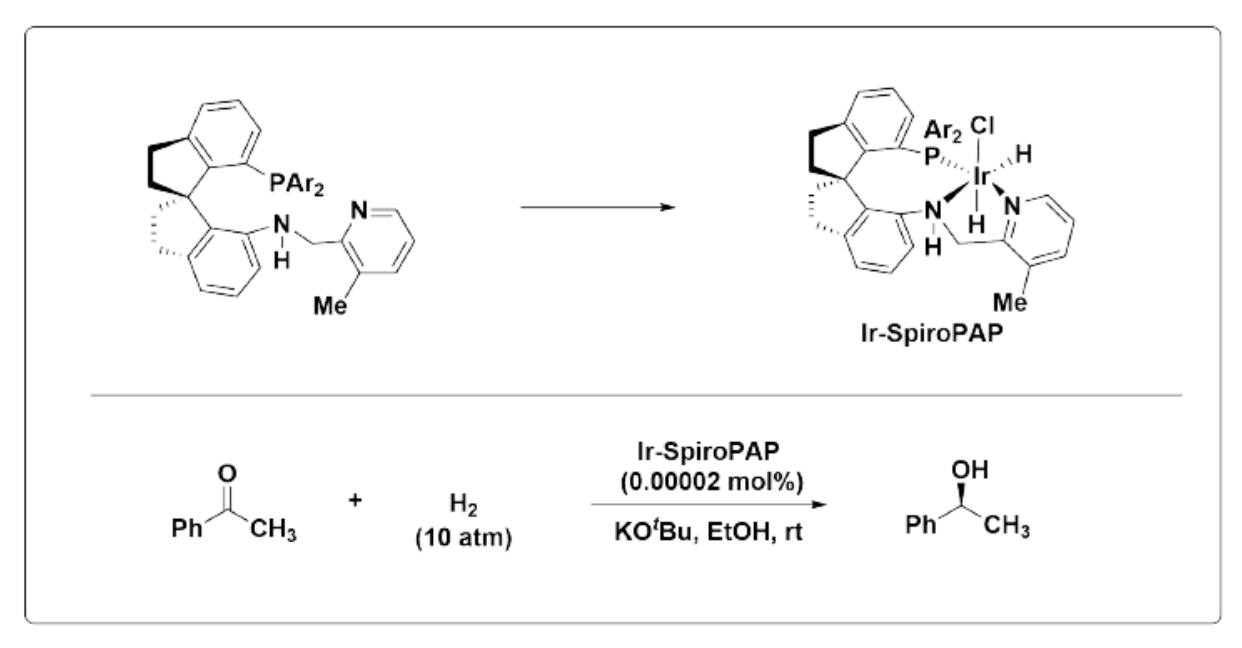
Note:
\(\ce{Ar} = 3,\,5\text{-}(\ce{^{t}Bu})_2\ce{C6H3}\)
Part A
The synthetic route of the chiral ligand SpiroPAP is shown in the following scheme.
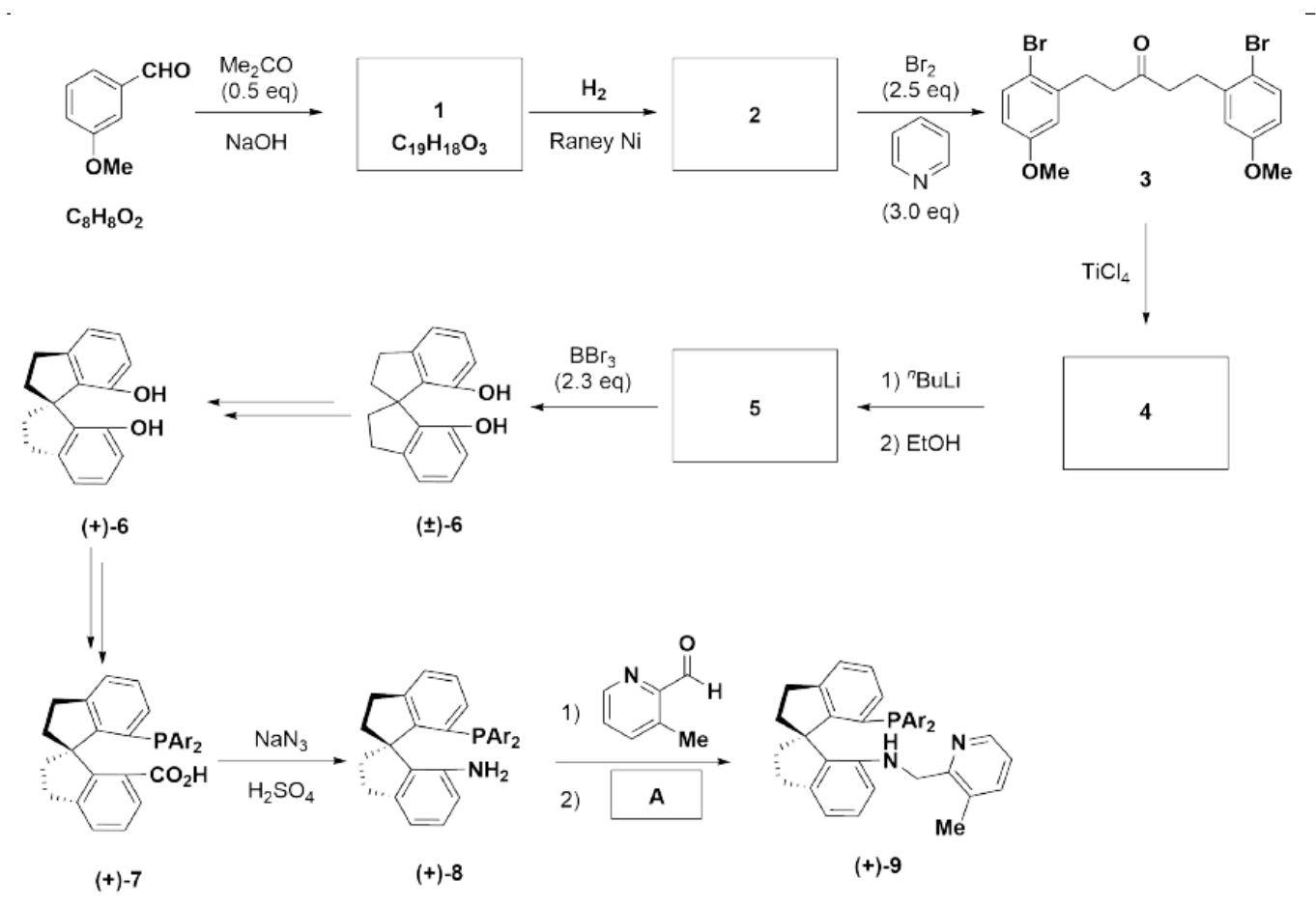
Note:
eq = equivalent
\(\ce{Ar} = 3,\,5\text{-}(\ce{^{t}Bu})_2\ce{C6H3}\)
8.1 Draw the structures of 1, 2, 4, 5. (Stereochemistry is not considered).
8.2 From the following reagents, which reagent A can NOT be used for the transformation of 8 to 9?
(a) \(\ce{NaBH(OAc)3}\)
(b) \(\ce{NaBH3CN}\)
(c) \(\ce{NH2NH2}\), \(\ce{NaOH}\)
(d) \(\ce{NaBH4}\)
The racemic spiro compound 6 reacts with (–)-menthyl chloroformate (10) to generate compounds 11a and 11b, which can be separated by column chromatography, followed by hydrazinolysis to obtain optically pure (+)-6 and (–)-6.
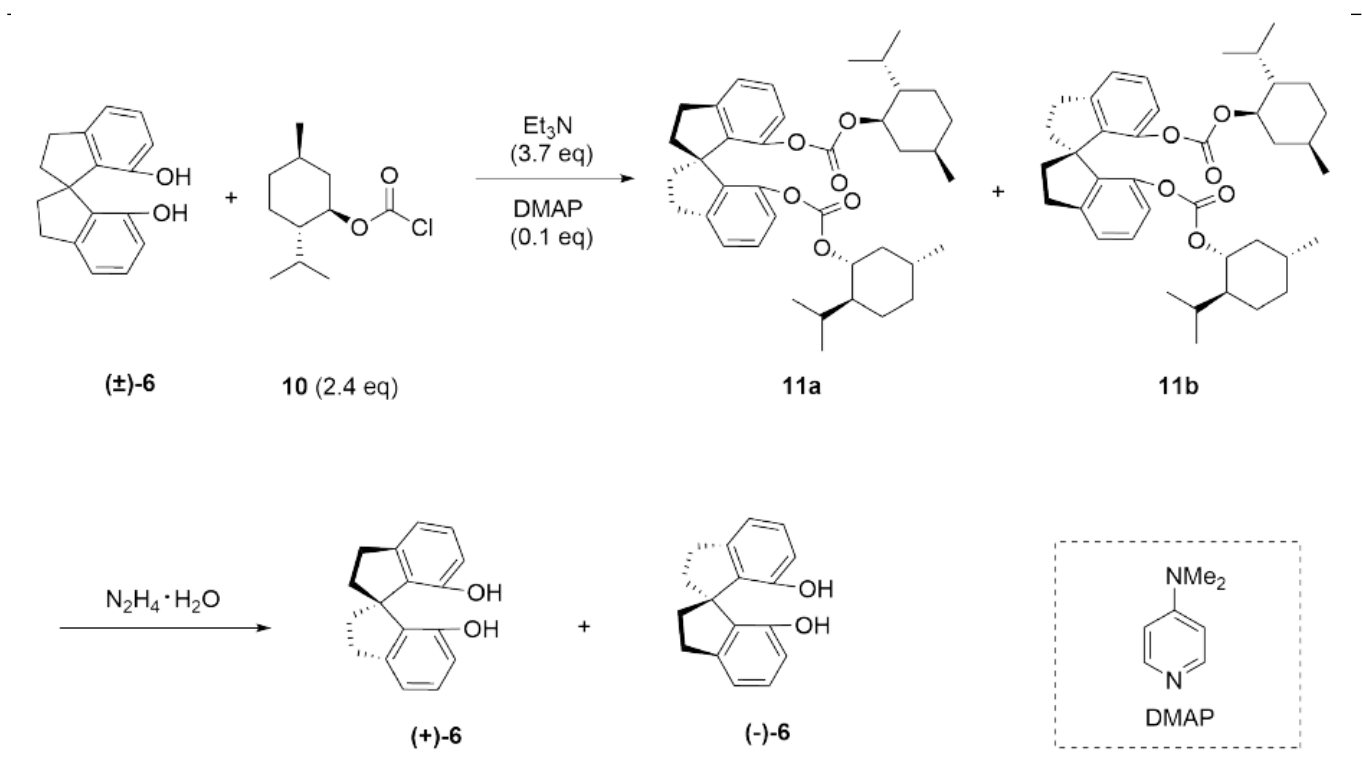
Note:
eq = equivalent
8.3 Choose the correct statement below.
(a) Compounds 11a and 11b are a pair of enantiomers.
(b) Compounds 11a and 11b are a pair of diastereomers.
(c) Compounds 11a and 11b are a pair of cis-trans isomers.
(d) Compounds 11a and 11b are a pair of conformational isomers.
Part B
The Ir-SpiroPAP was prepared by reaction of SpiroPAP with \(\ce{[Ir(cod)Cl]2}\) (cod is cycloocta-1,5-diene) in MeOH under hydrogen as shown below.
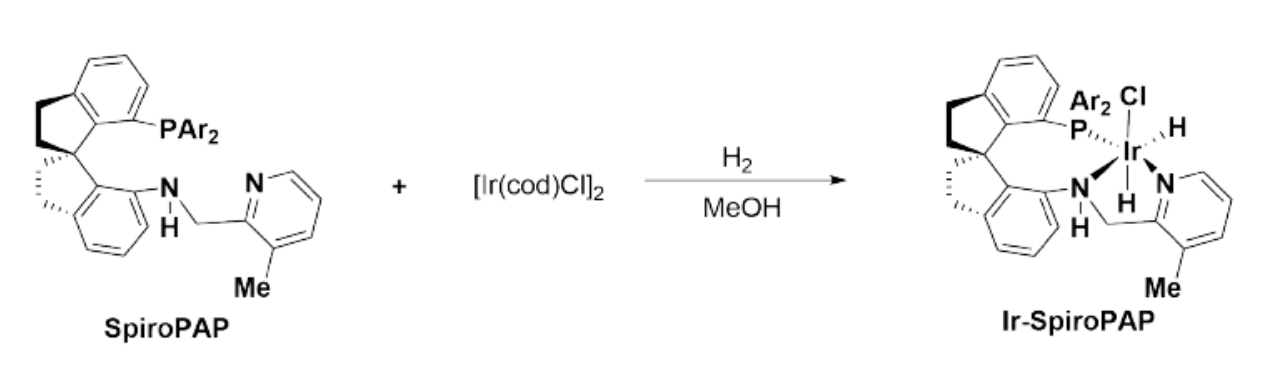
Note:
\(\ce{Ar} = 3,\,5\text{-}(\ce{^{t}Bu})_2\ce{C6H3}\)
8.4 Write the oxidation number of Ir in the catalyst Ir-SpiroPAP.
8.5 Write the number of valence electrons of d orbitals for metal Ir in the catalyst Ir-SpiroPAP.
The chiral spiro catalyst Ir-SpiroPAP was used for the asymmetric total synthesis of Mulinane-type diterpene 22 as shown below.
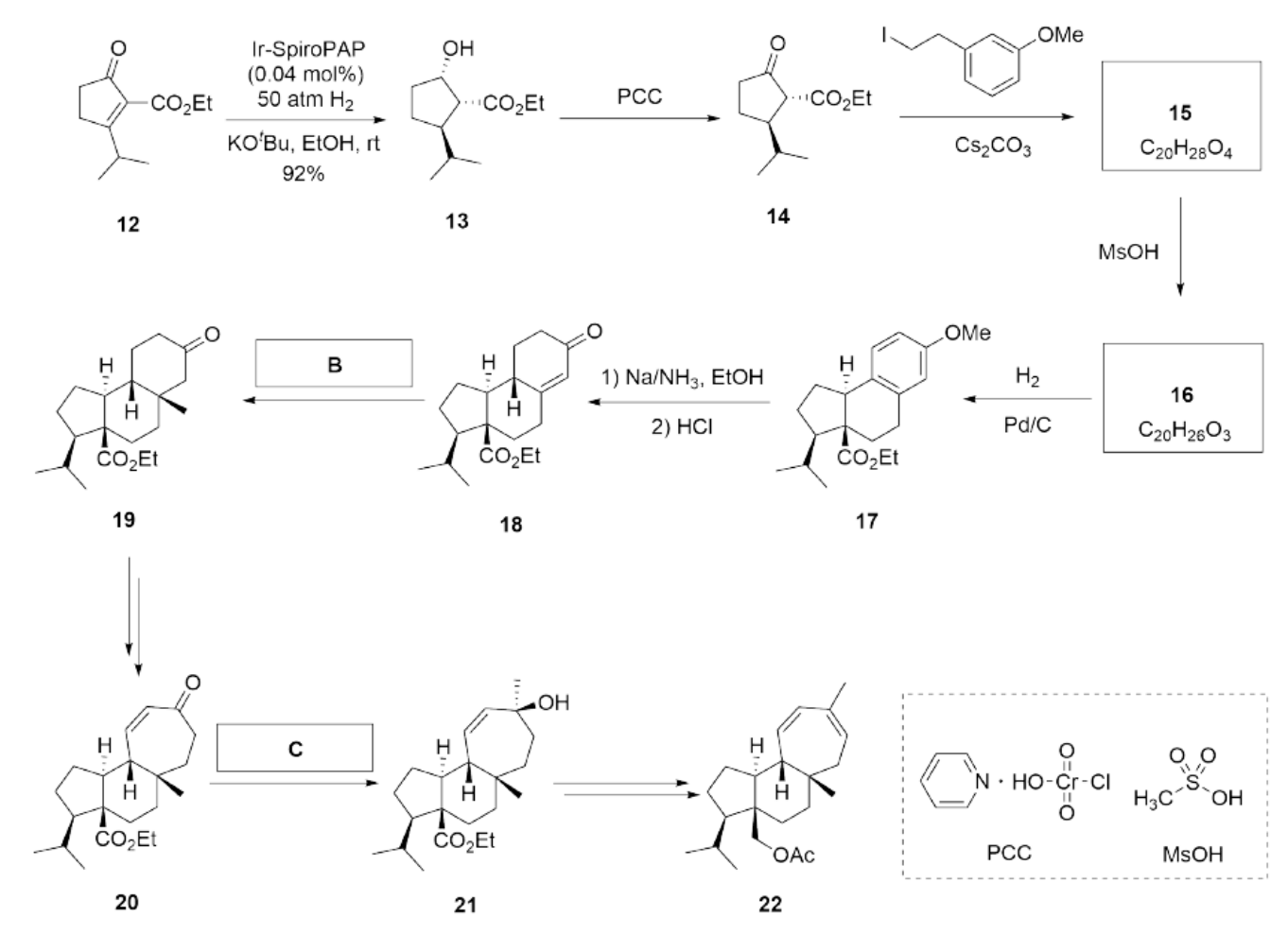
8.6 Draw the structures of 15 and 16, including the appropriate stereochemistry.
8.7 From the following reagents, choose the best for B.
(a) \(\ce{MeLi/CeCl3}\)
(b) \(\ce{MeLi/CuI}\)
(c) \(\ce{MePh3P+ I-}\), \(\ce{^{n}BuLi}\)
(d) \(\ce{Me3S+ I-}\), \(\ce{NaH}\)
8.8 From the following reagents, choose the best for C.
(a) \(\ce{MeLi/CeCl3}\)
(b) \(\ce{MeLi/CuI}\)
(c) \(\ce{MePh3P+ I-}\), \(\ce{^{n}BuLi}\)
(d) \(\ce{Me3S+ I-}\), \(\ce{NaH}\)
Official English text of the problem.
Answers
- 8.1
- 1: 1,5-Bis(3-methoxyphenyl)penta-1,4-dien-3-one.
SMILES:COc1cccc(C=CC(=O)C=Cc2cccc(OC)c2)c1 - 2: 1,5-Bis(3-methoxyphenyl)pentan-3-one.
SMILES:COc1cccc(CCC(=O)CCc2cccc(OC)c2)c1 - 4: 4,4′-Dibromo-7,7′-dimethoxy-1,1′-spirobiindane.
SMILES:COc1ccc(Br)c2c1C1(CCc3c(Br)ccc(OC)c31)CC2 -
5: 7,7′-Dimethoxy-1,1′-spirobiindane.
SMILES:COc1cccc2c1C1(CCc3cccc(OC)c31)CC2 -
8.2: (c) Hydrazine,
NN, with sodium hydroxide,[Na+].[OH-]. -
8.3: (b) Diastereomers.
-
8.4: The oxidation number of Ir is \(+3\).
-
8.5: Six \(d\) electrons, i.e. \(5d^6\).
-
8.6
- 15: Ethyl (1S,5R)-1-[2-(3-methoxyphenyl)ethyl]-2-oxo-5-(propan-2-yl)cyclopentane-1-carboxylate.
SMILES:CCOC(=O)[C@]1(CCc2cccc(OC)c2)C(=O)CC[C@@H]1C(C)C -
16: Ethyl (3R,3aS)-7-methoxy-3-(propan-2-yl)-2,3,4,5-tetrahydro-3aH-cyclopenta[a]naphthalene-3a-carboxylate.
SMILES:CCOC(=O)[C@]12CCc3cc(OC)ccc3C1=CC[C@@H]2C(C)C
In both 15 and 16, the ethoxycarbonyl and isopropyl groups are cis. In 16, the nonaromatic double bond lies in the five-membered ring. -
8.7: (b) Methyllithium,
[Li+].[CH3-], with copper(I) iodide,[Cu+].[I-]. -
8.8: (a) Methyllithium,
[Li+].[CH3-], with cerium(III) chloride,[Ce+3].[Cl-].[Cl-].[Cl-].
Solution
8.1 — Structures of 1, 2, 4 and 5
The starting aldehyde is 3-methoxybenzaldehyde, COc1cccc(C=O)c1, and the ketone reagent is acetone, CC(=O)C.
Formation of 1. Acetone has two enolizable methyl groups. The stated 0.5 equivalent of acetone therefore allows two aldehyde molecules to condense with one acetone molecule. Two aldol additions, each followed by dehydration, give the conjugated dienone 1:
\[ \ce{2 C8H8O2 + C3H6O ->[NaOH] C19H18O3 + 2 H2O}. \]
Thus, draw a central ketone bearing a \(\ce{-CH=CH-(3-methoxyphenyl)}\) group on each side. Its formula agrees with the supplied \(\ce{C19H18O3}\). Alkene stereochemistry is omitted as instructed.
Formation of 2. Hydrogenation reduces both carbon–carbon double bonds. The ketone remains, as confirmed by the structure of 3:
\[ \ce{C19H18O3 + 2 H2 ->[Raney\ Ni] C19H22O3}. \]
Thus, 2 has a central ketone bearing two \(\ce{-CH2CH2-(3-methoxyphenyl)}\) groups.
Formation of 4. In the supplied dibrominated ketone 3, bromine blocks one ortho position of each aryl ring. Titanium tetrachloride activates the carbonyl group, permitting successive intramolecular Friedel–Crafts cyclizations at the two unblocked ortho positions.
The original carbonyl carbon becomes the common spiro carbon of two five-membered rings. The net organic balance is:
\[ \ce{C19H20Br2O3 ->[TiCl4] C19H18Br2O2 + H2O}. \]
Draw two indane units sharing only their C1 atom. Each aromatic ring carries bromine at C4 and methoxy at C7. This gives 4, 4,4′-dibromo-7,7′-dimethoxy-1,1′-spirobiindane.
Formation of 5. Butyllithium effects bromine–lithium exchange at both aryl bromides. Ethanol then protonates the two carbon–lithium sites, replacing both bromines with hydrogen. An overall balanced equation is:
\[ \ce{ C19H18Br2O2 + 2 C4H9Li + 2 C2H5OH -> C19H20O2 + 2 C4H9Br + 2 C2H5OLi }. \]
The spiro skeleton and both methoxy groups remain intact, giving 5. Subsequent boron tribromide cleavage of its methyl ethers produces the two phenolic groups of 6, confirming the methoxy positions.
8.2 — Reagent A that cannot be used
The transformation is reductive amination. The primary amino group of 8 first condenses with 3-methylpyridine-2-carbaldehyde, Cc1cccnc1C=O, forming an imine. Reduction then gives the secondary amine 9.
Writing \(R\) for the spiroaryl portion and \(R'\) for the 3-methylpyridin-2-yl group:
\[ \ce{RNH2 + R'CHO <=> RN=CHR' + H2O}, \]
\[ \ce{RN=CHR' + 2[H] -> RNHCH2R'}. \]
Here, \(2[\ce{H}]\) denotes the formal hydrogen equivalents supplied by reduction and protonation.
The following reagents can reduce the imine:
- Sodium triacetoxyborohydride:
[Na+].[BH-](OC(C)=O)(OC(C)=O)OC(C)=O - Sodium cyanoborohydride:
[Na+].[BH3-]C#N - Sodium borohydride:
[Na+].[BH4-]
Sodium borohydride is suitable because the scheme specifies condensation first and reduction second.
Hydrazine with sodium hydroxide supplies Wolff–Kishner conditions. These convert a carbonyl group into a methylene group through a hydrazone; they do not perform the required reduction of the imine while retaining the linkage to the amino group of 8.
Therefore, A cannot be (c).
8.3 — Relationship between 11a and 11b
The two derivatives have:
- Opposite configurations of the spiro framework.
- The same configurations at every stereocentre of their menthyl groups.
A mirror image would invert both the spiro configuration and all the menthyl stereocentres. Since only the spiro configuration differs, 11a and 11b are diastereomers.
Their different physical properties allow chromatographic separation. Removal of the menthyl-derived carbonate groups then releases the separate enantiomers of 6.
Thus, (b) is correct.
8.4 — Oxidation number of Ir
The depicted complex is neutral. Its ligands comprise:
- One neutral tridentate phosphine–amine–pyridine ligand.
- One chloride ligand,
[Cl-], of charge \(-1\). - Two hydride ligands,
[H-], each of charge \(-1\).
The hydrogen attached to the amine nitrogen belongs to the neutral amine; it is not an additional hydride ligand.
If the oxidation number of Ir is \(x\),
\[ x+0-1-1-1=0, \]
so
\[ \boxed{x=+3}. \]
The three donor atoms of SpiroPAP, chloride and two hydrides give a six-coordinate, approximately octahedral complex.
8.5 — Number of metal \(d\) electrons
Iridium belongs to group 9. The formal \(d\)-electron count is therefore
\[ n_d=9-\text{oxidation number}=9-3=6. \]
Hence the metal has the configuration
\[ \boxed{5d^6}. \]
As a consistency check, the six \(d\) electrons plus twelve electrons donated by the six donor sites give an 18-electron complex.
8.6 — Structures and stereochemistry of 15 and 16
For tracing the atoms, number the cyclopentanone ring of 14 as follows:
- C1: the carbon bearing the ethoxycarbonyl group.
- C2: the ketone carbonyl carbon.
- C3 and C4: the two methylene carbons.
- C5: the carbon bearing the isopropyl group.
For the incoming aromatic ring, let C1′ bear the ethyl tether and C3′ bear methoxy.
Formation of 15. The alkylating reagent is 1-(2-iodoethyl)-3-methoxybenzene, COc1cccc(CCI)c1.
The hydrogen at C1 of 14 lies between the ketone and ester carbonyl groups. Carbonate-assisted enolate formation followed by \(S_\mathrm{N}2\) alkylation introduces a \(\ce{-CH2CH2-(3-methoxyphenyl)}\) group at C1.
An overall balance including carbonate neutralization is:
\[ \ce{ 2 C11H18O3 + 2 C9H11IO + Cs2CO3 -> 2 C20H28O4 + 2 CsI + CO2 + H2O }. \]
The resulting formula is the supplied \(\ce{C20H28O4}\).
Stereochemistry of 15. Enolate formation removes the original configuration at C1; that stereocentre is established again during alkylation. The configuration at C5 is retained.
The subsequent structure 17 fixes the required relative configuration: its ethoxycarbonyl and isopropyl groups are both shown as solid wedges. Therefore, these groups must already be cis in 15. The new phenethyl substituent is trans to the isopropyl group.
To draw 15 in the orientation of 14, retain the solid-wedge isopropyl group and show the ethoxycarbonyl group on the same face, with the new phenethyl group on the opposite face. The absolute configuration is (1S,5R), as encoded in the answer SMILES.
Formation of 16. Methanesulfonic acid activates the ketone for intramolecular Friedel–Crafts attack. Aromatic C6′ attacks carbonyl carbon C2, forming a new six-membered ring. C6′ is ortho to the tether and para to methoxy.
The resulting alcohol loses water. C1 has no hydrogen after alkylation, so dehydration forms the C2=C3 double bond in the five-membered ring:
\[ \ce{C20H28O4 ->[MsOH] C20H26O3 + H2O}. \]
This matches the formula supplied for 16.
The configurations at the original C1 and C5 remain unchanged. In the fused-ring nomenclature used in the answer, these correspond to 3aS and 3R, respectively.
A precise way to draw 16 is to start from the supplied structure 17:
- Retain its complete carbon skeleton, methoxy group, ester and isopropyl group.
- Retain the solid-wedge ester and isopropyl substituents.
- Remove the dashed-wedge hydrogen from the upper five-/six-membered-ring junction.
- Make the bond from that junction to the adjacent nonjunction carbon of the five-membered ring a double bond.
Hydrogenation of this alkene then gives 17:
\[ \ce{C20H26O3 + H2 ->[Pd/C] C20H28O3}. \]
8.7 — Best reagent for B
Comparing 18 with 19, the required transformation:
- Adds a methyl group to the β-carbon of the enone.
- Consumes the enone carbon–carbon double bond.
- Retains the ketone.
This is 1,4-conjugate addition.
Methyllithium with copper(I) iodide supplies an organocopper methyl reagent. A representative species is lithium dimethylcuprate, [Li+].C[Cu-]C, formed formally by:
\[ \ce{2 CH3Li + CuI -> LiCu(CH3)2 + LiI}. \]
The formal conjugate-addition balance, including protonation, is:
\[ \ce{ RCOCH=CR'R'' + CH3^- + H+ -> RCOCH2C(CH3)R'R'' }. \]
Organocuprates favour this conjugate addition, producing the methyl-substituted saturated ketone 19.
Therefore, B is (b), \(\ce{MeLi/CuI}\).
8.8 — Best reagent for C
Comparing 20 with 21, the required transformation:
- Adds methyl directly to the ketone carbonyl carbon.
- Converts that carbonyl into a tertiary alcohol.
- Retains the pre-existing carbon–carbon double bond.
This is 1,2-addition to the carbonyl, with the formal balance:
\[ \ce{R2C=O + CH3^- + H+ -> R2C(OH)CH3}. \]
Methyllithium with cerium(III) chloride generates an organocerium reagent that favours carbonyl addition and reduces competing strongly basic behaviour. Protonation of the alkoxide gives 21.
The copper-containing reagent instead favours conjugate addition. The phosphorus- and sulfur-ylide options do not give the required methyl-substituted tertiary alcohol.
Therefore, C is (a), \(\ce{MeLi/CeCl3}\).
The answers were checked against the official answers published by the organisers.
IChO 2022 · Theorieaufgabe 8
Erstaunlicher chiraler Spirokatalysator
Chirale Verbindungen sind für die menschliche Gesundheit wichtig; beispielsweise sind mehr als 50% der derzeit klinisch eingesetzten Arzneimittel einzelne Enantiomere chiraler Moleküle. Die Synthese chiraler Moleküle in enantiomerenangereicherter Form stellt jedoch eine große Herausforderung dar. Das Team von Professor Qilin Zhou an der Nankai-Universität in China entwickelte eine Reihe chiraler Spirokatalysatoren mit hoher Aktivität, die die Effizienz der asymmetrischen Synthese auf ein neues Niveau hoben und in der pharmazeutischen Industrie breite Anwendung finden. Mit diesen Katalysatoren lassen sich bis zu 99.9% ee erreichen, und sie können bei einer Katalysatorbeladung von nur 0.00002 mol% eingesetzt werden. Dieses Forschungsergebnis wurde 2019 mit dem ersten Preis des National Natural Science Award of China ausgezeichnet.
Hinweis:
\(\ce{Ar} = 3,\,5\text{-}(\ce{^{t}Bu})_2\ce{C6H3}\)
Teil A
Der Syntheseweg des chiralen Liganden SpiroPAP ist im folgenden Schema dargestellt.
Hinweis:
eq = Äquivalent
\(\ce{Ar} = 3,\,5\text{-}(\ce{^{t}Bu})_2\ce{C6H3}\)
8.1 Zeichnen Sie die Strukturen von 1, 2, 4, 5. (Die Stereochemie wird nicht berücksichtigt.)
8.2 Welches der folgenden Reagenzien A kann NICHT für die Umwandlung von 8 in 9 verwendet werden?
(a) \(\ce{NaBH(OAc)3}\)
(b) \(\ce{NaBH3CN}\)
(c) \(\ce{NH2NH2}\), \(\ce{NaOH}\)
(d) \(\ce{NaBH4}\)
Die racemische Spiroverbindung 6 reagiert mit (–)-Menthylchlorformiat (10) zu den Verbindungen 11a und 11b, die durch Säulenchromatographie getrennt werden können. Durch anschließende Hydrazinolyse erhält man optisch reines (+)-6 und (–)-6.
Hinweis:
eq = Äquivalent
8.3 Wählen Sie die richtige Aussage aus.
(a) Die Verbindungen 11a und 11b sind ein Enantiomerenpaar.
(b) Die Verbindungen 11a und 11b sind ein Diastereomerenpaar.
(c) Die Verbindungen 11a und 11b sind ein Paar von cis-trans-Isomeren.
(d) Die Verbindungen 11a und 11b sind ein Paar von Konformationsisomeren.
Teil B
Ir-SpiroPAP wurde durch Reaktion von SpiroPAP mit \(\ce{[Ir(cod)Cl]2}\) (cod ist Cycloocta-1,5-dien) in MeOH unter Wasserstoff hergestellt, wie unten gezeigt.
Hinweis:
\(\ce{Ar} = 3,\,5\text{-}(\ce{^{t}Bu})_2\ce{C6H3}\)
8.4 Geben Sie die Oxidationszahl von Ir im Katalysator Ir-SpiroPAP an.
8.5 Geben Sie die Anzahl der Valenzelektronen in den d-Orbitalen des Metalls Ir im Katalysator Ir-SpiroPAP an.
Der chirale Spirokatalysator Ir-SpiroPAP wurde für die asymmetrische Totalsynthese des Diterpens 22 vom Mulinan-Typ verwendet, wie unten gezeigt.
8.6 Zeichnen Sie die Strukturen von 15 und 16 einschließlich der korrekten Stereochemie.
8.7 Wählen Sie aus den folgenden Reagenzien das am besten geeignete für B aus.
(a) \(\ce{MeLi/CeCl3}\)
(b) \(\ce{MeLi/CuI}\)
(c) \(\ce{MePh3P+ I-}\), \(\ce{^{n}BuLi}\)
(d) \(\ce{Me3S+ I-}\), \(\ce{NaH}\)
8.8 Wählen Sie aus den folgenden Reagenzien das am besten geeignete für C aus.
(a) \(\ce{MeLi/CeCl3}\)
(b) \(\ce{MeLi/CuI}\)
(c) \(\ce{MePh3P+ I-}\), \(\ce{^{n}BuLi}\)
(d) \(\ce{Me3S+ I-}\), \(\ce{NaH}\)
Aufgabentext aus dem offiziellen englischen Text übersetzt.
Antworten
- 8.1
- 1: 1,5-Bis(3-methoxyphenyl)penta-1,4-dien-3-on.
SMILES:COc1cccc(C=CC(=O)C=Cc2cccc(OC)c2)c1 - 2: 1,5-Bis(3-methoxyphenyl)pentan-3-on.
SMILES:COc1cccc(CCC(=O)CCc2cccc(OC)c2)c1 - 4: 4,4′-Dibrom-7,7′-dimethoxy-1,1′-spirobiindan.
SMILES:COc1ccc(Br)c2c1C1(CCc3c(Br)ccc(OC)c31)CC2 -
5: 7,7′-Dimethoxy-1,1′-spirobiindan.
SMILES:COc1cccc2c1C1(CCc3cccc(OC)c31)CC2 -
8.2: (c) Hydrazin,
NN, mit Natriumhydroxid,[Na+].[OH-]. -
8.3: (b) Diastereomere.
-
8.4: Die Oxidationszahl von Ir ist \(+3\).
-
8.5: Sechs \(d\)-Elektronen, d. h. \(5d^6\).
-
8.6
- 15: Ethyl-(1S,5R)-1-[2-(3-methoxyphenyl)ethyl]-2-oxo-5-(propan-2-yl)cyclopentan-1-carboxylat.
SMILES:CCOC(=O)[C@]1(CCc2cccc(OC)c2)C(=O)CC[C@@H]1C(C)C -
16: Ethyl-(3R,3aS)-7-methoxy-3-(propan-2-yl)-2,3,4,5-tetrahydro-3aH-cyclopenta[a]naphthalin-3a-carboxylat.
SMILES:CCOC(=O)[C@]12CCc3cc(OC)ccc3C1=CC[C@@H]2C(C)C
Sowohl in 15 als auch in 16 stehen die Ethoxycarbonyl- und Isopropylgruppen cis zueinander. In 16 liegt die nichtaromatische Doppelbindung im Fünfring. -
8.7: (b) Methyllithium,
[Li+].[CH3-], mit Kupfer(I)-iodid,[Cu+].[I-]. -
8.8: (a) Methyllithium,
[Li+].[CH3-], mit Cer(III)-chlorid,[Ce+3].[Cl-].[Cl-].[Cl-].
Lösung
8.1 — Strukturen von 1, 2, 4 und 5
Der als Ausgangsstoff verwendete Aldehyd ist 3-Methoxybenzaldehyd, COc1cccc(C=O)c1, und das als Reagenz eingesetzte Keton ist Aceton, CC(=O)C.
Bildung von 1. Aceton besitzt zwei enolisierbare Methylgruppen. Die angegebenen 0.5 Äquivalente Aceton ermöglichen daher die Kondensation von zwei Aldehydmolekülen mit einem Acetonmolekül. Zwei Aldoladditionen mit jeweils anschließender Dehydratisierung ergeben das konjugierte Dienon 1:
\[ \ce{2 C8H8O2 + C3H6O ->[NaOH] C19H18O3 + 2 H2O}. \]
Zeichnen Sie daher eine zentrale Ketongruppe, die auf jeder Seite eine \(\ce{-CH=CH-(3-methoxyphenyl)}\)-Gruppe trägt. Die Summenformel stimmt mit der angegebenen Formel \(\ce{C19H18O3}\) überein. Die Stereochemie der Alkene wird wie gefordert weggelassen.
Bildung von 2. Durch Hydrierung werden beide Kohlenstoff–Kohlenstoff-Doppelbindungen reduziert. Die Ketongruppe bleibt erhalten, wie die Struktur von 3 bestätigt:
\[ \ce{C19H18O3 + 2 H2 ->[Raney\ Ni] C19H22O3}. \]
Somit besitzt 2 eine zentrale Ketongruppe mit zwei \(\ce{-CH2CH2-(3-methoxyphenyl)}\)-Gruppen.
Bildung von 4. Im vorgegebenen dibromierten Keton 3 blockiert Brom jeweils eine ortho-Position jedes Arylrings. Titantetrachlorid aktiviert die Carbonylgruppe und ermöglicht dadurch aufeinanderfolgende intramolekulare Friedel–Crafts-Cyclisierungen an den beiden nicht blockierten ortho-Positionen.
Das ursprüngliche Carbonylkohlenstoffatom wird zum gemeinsamen Spirokohlenstoffatom zweier Fünfringe. Die Nettobilanz der organischen Umsetzung lautet:
\[ \ce{C19H20Br2O3 ->[TiCl4] C19H18Br2O2 + H2O}. \]
Zeichnen Sie zwei Indaneinheiten, die nur ihr C1-Atom gemeinsam haben. Jeder aromatische Ring trägt Brom an C4 und eine Methoxygruppe an C7. Daraus ergibt sich 4, 4,4′-Dibrom-7,7′-dimethoxy-1,1′-spirobiindan.
Bildung von 5. Butyllithium bewirkt einen Brom–Lithium-Austausch an beiden Arylbromiden. Anschließend protoniert Ethanol die beiden Kohlenstoff–Lithium-Stellen und ersetzt dadurch beide Bromatome durch Wasserstoff. Eine ausgeglichene Gesamtgleichung lautet:
\[ \ce{ C19H18Br2O2 + 2 C4H9Li + 2 C2H5OH -> C19H20O2 + 2 C4H9Br + 2 C2H5OLi }. \]
Das Spirogerüst und beide Methoxygruppen bleiben intakt, sodass 5 entsteht. Die anschließende Spaltung der Methylether durch Bortribromid liefert die beiden phenolischen Gruppen von 6 und bestätigt damit die Positionen der Methoxygruppen.
8.2 — Reagenz A, das nicht verwendet werden kann
Bei der Umwandlung handelt es sich um eine reduktive Aminierung. Die primäre Aminogruppe von 8 kondensiert zunächst mit 3-Methylpyridin-2-carbaldehyd, Cc1cccnc1C=O, zu einem Imin. Die anschließende Reduktion ergibt das sekundäre Amin 9.
Mit \(R\) für den Spiroarylrest und \(R'\) für die 3-Methylpyridin-2-yl-Gruppe gilt:
\[ \ce{RNH2 + R'CHO <=> RN=CHR' + H2O}, \]
\[ \ce{RN=CHR' + 2[H] -> RNHCH2R'}. \]
Hier bezeichnet \(2[\ce{H}]\) die formalen Wasserstoffäquivalente, die durch Reduktion und Protonierung zugeführt werden.
Die folgenden Reagenzien können das Imin reduzieren:
- Natriumtriacetoxyborhydrid:
[Na+].[BH-](OC(C)=O)(OC(C)=O)OC(C)=O - Natriumcyanoborhydrid:
[Na+].[BH3-]C#N - Natriumborhydrid:
[Na+].[BH4-]
Natriumborhydrid ist geeignet, da das Schema zuerst die Kondensation und danach die Reduktion vorsieht.
Hydrazin mit Natriumhydroxid stellt Wolff–Kishner-Bedingungen bereit. Unter diesen Bedingungen wird eine Carbonylgruppe über ein Hydrazon in eine Methylengruppe umgewandelt; die erforderliche Reduktion des Imins unter Erhalt der Verknüpfung mit der Aminogruppe von 8 erfolgt dabei nicht.
Daher kann A nicht (c) sein.
8.3 — Beziehung zwischen 11a und 11b
Die beiden Derivate besitzen:
- Entgegengesetzte Konfigurationen des Spirogerüsts.
- Dieselben Konfigurationen an jedem Stereozentrum ihrer Menthylgruppen.
Bei einem Spiegelbild wären sowohl die Spirokonfiguration als auch alle Menthyl-Stereozentren invertiert. Da sich nur die Spirokonfiguration unterscheidet, sind 11a und 11b Diastereomere.
Ihre unterschiedlichen physikalischen Eigenschaften ermöglichen eine chromatographische Trennung. Durch Abspaltung der vom Menthol abgeleiteten Carbonatgruppen werden anschließend die getrennten Enantiomere von 6 freigesetzt.
Somit ist (b) richtig.
8.4 — Oxidationszahl von Ir
Der abgebildete Komplex ist neutral. Seine Liganden umfassen:
- Einen neutralen dreizähnigen Phosphin–Amin–Pyridin-Liganden.
- Einen Chloridoliganden,
[Cl-], mit der Ladung \(-1\). - Zwei Hydridoliganden,
[H-], mit jeweils der Ladung \(-1\).
Der an den Aminstickstoff gebundene Wasserstoff gehört zum neutralen Amin; er ist kein zusätzlicher Hydridoligand.
Wenn die Oxidationszahl von Ir \(x\) ist, gilt
\[ x+0-1-1-1=0, \]
also
\[ \boxed{x=+3}. \]
Die drei Donoratome von SpiroPAP, das Chlorid und die beiden Hydride ergeben einen sechsfach koordinierten, annähernd oktaedrischen Komplex.
8.5 — Anzahl der \(d\)-Elektronen des Metalls
Iridium gehört zur Gruppe 9. Die formale Anzahl der \(d\)-Elektronen beträgt daher
\[ n_d=9-\text{Oxidationszahl}=9-3=6. \]
Somit besitzt das Metall die Konfiguration
\[ \boxed{5d^6}. \]
Als Konsistenzprüfung ergeben die sechs \(d\)-Elektronen zusammen mit den zwölf von den sechs Donorstellen beigesteuerten Elektronen einen 18-Elektronen-Komplex.
8.6 — Strukturen und Stereochemie von 15 und 16
Um die Atome nachzuverfolgen, wird der Cyclopentanonring von 14 wie folgt nummeriert:
- C1: das Kohlenstoffatom, das die Ethoxycarbonylgruppe trägt.
- C2: das Carbonylkohlenstoffatom der Ketongruppe.
- C3 und C4: die beiden Methylenkohlenstoffatome.
- C5: das Kohlenstoffatom, das die Isopropylgruppe trägt.
Im neu hinzukommenden aromatischen Ring trage C1′ die Ethylbrücke und C3′ die Methoxygruppe.
Bildung von 15. Das Alkylierungsreagenz ist 1-(2-Iodethyl)-3-methoxybenzol, COc1cccc(CCI)c1.
Der Wasserstoff an C1 von 14 liegt zwischen der Keton- und der Estercarbonylgruppe. Eine durch Carbonat unterstützte Enolatbildung mit anschließender \(S_\mathrm{N}2\)-Alkylierung führt eine \(\ce{-CH2CH2-(3-methoxyphenyl)}\)-Gruppe an C1 ein.
Eine Gesamtbilanz unter Einbeziehung der Neutralisation durch Carbonat lautet:
\[ \ce{ 2 C11H18O3 + 2 C9H11IO + Cs2CO3 -> 2 C20H28O4 + 2 CsI + CO2 + H2O }. \]
Die resultierende Summenformel ist die angegebene Formel \(\ce{C20H28O4}\).
Stereochemie von 15. Durch die Enolatbildung geht die ursprüngliche Konfiguration an C1 verloren; dieses Stereozentrum wird bei der Alkylierung neu gebildet. Die Konfiguration an C5 bleibt erhalten.
Die nachfolgende Struktur 17 legt die erforderliche relative Konfiguration fest: Ihre Ethoxycarbonyl- und Isopropylgruppen sind beide mit ausgefüllten Keilen dargestellt. Daher müssen diese Gruppen bereits in 15 cis zueinander stehen. Der neue Phenethylsubstituent steht trans zur Isopropylgruppe.
Um 15 in der Orientierung von 14 zu zeichnen, behalten Sie die mit einem ausgefüllten Keil dargestellte Isopropylgruppe bei und zeichnen Sie die Ethoxycarbonylgruppe auf derselben Seite sowie die neue Phenethylgruppe auf der gegenüberliegenden Seite. Die absolute Konfiguration ist (1S,5R), wie im SMILES der Antwort kodiert.
Bildung von 16. Methansulfonsäure aktiviert die Ketongruppe für einen intramolekularen Friedel–Crafts-Angriff. Das aromatische C6′ greift das Carbonylkohlenstoffatom C2 an, wodurch ein neuer Sechsring entsteht. C6′ steht ortho zur Brücke und para zur Methoxygruppe.
Der entstehende Alkohol spaltet Wasser ab. C1 trägt nach der Alkylierung keinen Wasserstoff, sodass bei der Dehydratisierung die C2=C3-Doppelbindung im Fünfring entsteht:
\[ \ce{C20H28O4 ->[MsOH] C20H26O3 + H2O}. \]
Dies stimmt mit der für 16 angegebenen Summenformel überein.
Die Konfigurationen an den ursprünglichen Atomen C1 und C5 bleiben unverändert. In der in der Antwort verwendeten Nomenklatur für kondensierte Ringe entsprechen diese 3aS bzw. 3R.
Eine präzise Vorgehensweise zum Zeichnen von 16 besteht darin, von der vorgegebenen Struktur 17 auszugehen:
- Behalten Sie das gesamte Kohlenstoffgerüst, die Methoxygruppe, die Estergruppe und die Isopropylgruppe bei.
- Behalten Sie die mit ausgefüllten Keilen dargestellten Ester- und Isopropylsubstituenten bei.
- Entfernen Sie den mit einem gestrichelten Keil dargestellten Wasserstoff am oberen Verknüpfungsatom des Fünf- und Sechsrings.
- Ändern Sie die Bindung von diesem Verknüpfungsatom zum benachbarten Kohlenstoffatom des Fünfrings, das nicht zur Ringverknüpfung gehört, in eine Doppelbindung.
Die Hydrierung dieses Alkens ergibt anschließend 17:
\[ \ce{C20H26O3 + H2 ->[Pd/C] C20H28O3}. \]
8.7 — Bestes Reagenz für B
Der Vergleich von 18 mit 19 zeigt, dass die erforderliche Umwandlung:
- Eine Methylgruppe am β-Kohlenstoffatom des Enons einführt.
- Die Kohlenstoff–Kohlenstoff-Doppelbindung des Enons aufhebt.
- Die Ketongruppe erhält.
Dies ist eine konjugierte 1,4-Addition.
Methyllithium mit Kupfer(I)-iodid liefert ein methylierendes Organokupferreagenz. Eine repräsentative Spezies ist Lithiumdimethylcuprat, [Li+].C[Cu-]C, das formal wie folgt entsteht:
\[ \ce{2 CH3Li + CuI -> LiCu(CH3)2 + LiI}. \]
Die formale Bilanz der konjugierten Addition einschließlich Protonierung lautet:
\[ \ce{ RCOCH=CR'R'' + CH3^- + H+ -> RCOCH2C(CH3)R'R'' }. \]
Organocuprate begünstigen diese konjugierte Addition, wobei das methylsubstituierte gesättigte Keton 19 entsteht.
Daher ist B (b), \(\ce{MeLi/CuI}\).
8.8 — Bestes Reagenz für C
Der Vergleich von 20 mit 21 zeigt, dass die erforderliche Umwandlung:
- Eine Methylgruppe direkt am Carbonylkohlenstoffatom der Ketongruppe einführt.
- Diese Carbonylgruppe in einen tertiären Alkohol umwandelt.
- Die bereits vorhandene Kohlenstoff–Kohlenstoff-Doppelbindung erhält.
Dies ist eine 1,2-Addition an die Carbonylgruppe mit der formalen Bilanz:
\[ \ce{R2C=O + CH3^- + H+ -> R2C(OH)CH3}. \]
Methyllithium mit Cer(III)-chlorid erzeugt ein Organocerreagenz, das die Addition an die Carbonylgruppe begünstigt und konkurrierende Reaktionen aufgrund stark basischen Verhaltens vermindert. Die Protonierung des Alkoholats ergibt 21.
Das kupferhaltige Reagenz begünstigt stattdessen die konjugierte Addition. Die zur Auswahl stehenden Phosphor- und Schwefelylide liefern nicht den erforderlichen methylsubstituierten tertiären Alkohol.
Daher ist C (a), \(\ce{MeLi/CeCl3}\).
Die Ergebnisse wurden mit den von den Veranstaltern veröffentlichten offiziellen Ergebnissen abgeglichen.
IChO 2022 · Teori sorusu 8
Olağanüstü Kiral Spiro Katalizör
Kiral bileşikler insan sağlığı açısından önemlidir; örneğin, günümüzde klinik kullanımda olan ilaçların %50'den fazlası kiral moleküllerin tek enantiyomerlerinden oluşur. Bununla birlikte, kiral moleküllerin enantiyomerce zenginleştirilmiş biçimde sentezlenmesi büyük bir zorluktur. Çin'deki Nankai Üniversitesinden Profesör Qilin Zhou'nun ekibi, asimetrik sentezin verimliliğini yeni bir düzeye taşıyan ve ilaç endüstrisinde yaygın olarak kullanılan, yüksek etkinliğe sahip bir dizi kiral spiro katalizör geliştirmiştir. Bu katalizörler %99.9'a kadar ee sağlayabilir ve molce %0.00002 kadar düşük katalizör yüklemelerinde kullanılabilir. Bu araştırma sonucu, Çin'in 2019 Ulusal Doğa Bilimleri Ödülü'nde birincilik ödülünü kazanmıştır.
Not:
\(\ce{Ar} = 3,\,5\text{-}(\ce{^{t}Bu})_2\ce{C6H3}\)
Bölüm A
Kiral SpiroPAP ligandının sentez yolu aşağıdaki şemada gösterilmiştir.
Not:
eq = eşdeğer
\(\ce{Ar} = 3,\,5\text{-}(\ce{^{t}Bu})_2\ce{C6H3}\)
8.1 1, 2, 4, 5 bileşiklerinin yapılarını çiziniz. (Stereokimya dikkate alınmayacaktır).
8.2 Aşağıdaki reaktiflerden hangisi, 8'in 9'a dönüşümünde A reaktifi olarak KULLANILAMAZ?
(a) \(\ce{NaBH(OAc)3}\)
(b) \(\ce{NaBH3CN}\)
(c) \(\ce{NH2NH2}\), \(\ce{NaOH}\)
(d) \(\ce{NaBH4}\)
Rasemik spiro bileşiği 6, (–)-mentil kloroformat (10) ile tepkimeye girerek kolon kromatografisiyle ayrılabilen 11a ve 11b bileşiklerini oluşturur; ardından hidrazinoliz yoluyla optikçe saf (+)-6 ve (–)-6 elde edilir.
Not:
eq = eşdeğer
8.3 Aşağıdaki ifadelerden doğru olanı seçiniz.
(a) 11a ve 11b bileşikleri bir enantiyomer çiftidir.
(b) 11a ve 11b bileşikleri bir diastereomer çiftidir.
(c) 11a ve 11b bileşikleri bir cis-trans izomer çiftidir.
(d) 11a ve 11b bileşikleri bir konformasyon izomeri çiftidir.
Bölüm B
Ir-SpiroPAP, aşağıda gösterildiği gibi SpiroPAP'ın hidrojen atmosferinde MeOH içinde \(\ce{[Ir(cod)Cl]2}\) (cod, siklookta-1,5-diendir) ile tepkimesiyle hazırlanmıştır.
Not:
\(\ce{Ar} = 3,\,5\text{-}(\ce{^{t}Bu})_2\ce{C6H3}\)
8.4 Ir-SpiroPAP katalizöründeki Ir'nin yükseltgenme basamağını yazınız.
8.5 Ir-SpiroPAP katalizöründeki Ir metalinin d orbitallerindeki değerlik elektronlarının sayısını yazınız.
Kiral spiro katalizör Ir-SpiroPAP, aşağıda gösterildiği gibi Mulinan tipi diterpen 22'nin asimetrik total sentezinde kullanılmıştır.
8.6 15 ve 16'nın yapılarını uygun stereokimyayı da göstererek çiziniz.
8.7 Aşağıdaki reaktiflerden B için en uygun olanı seçiniz.
(a) \(\ce{MeLi/CeCl3}\)
(b) \(\ce{MeLi/CuI}\)
(c) \(\ce{MePh3P+ I-}\), \(\ce{^{n}BuLi}\)
(d) \(\ce{Me3S+ I-}\), \(\ce{NaH}\)
8.8 Aşağıdaki reaktiflerden C için en uygun olanı seçiniz.
(a) \(\ce{MeLi/CeCl3}\)
(b) \(\ce{MeLi/CuI}\)
(c) \(\ce{MePh3P+ I-}\), \(\ce{^{n}BuLi}\)
(d) \(\ce{Me3S+ I-}\), \(\ce{NaH}\)
Soru metni resmi İngilizce metinden çevrilmiştir.
Cevaplar
- 8.1
- 1: 1,5-Bis(3-metoksifenil)penta-1,4-dien-3-on.
SMILES:COc1cccc(C=CC(=O)C=Cc2cccc(OC)c2)c1 - 2: 1,5-Bis(3-metoksifenil)pentan-3-on.
SMILES:COc1cccc(CCC(=O)CCc2cccc(OC)c2)c1 - 4: 4,4′-Dibromo-7,7′-dimetoksi-1,1′-spirobiindan.
SMILES:COc1ccc(Br)c2c1C1(CCc3c(Br)ccc(OC)c31)CC2 -
5: 7,7′-Dimetoksi-1,1′-spirobiindan.
SMILES:COc1cccc2c1C1(CCc3cccc(OC)c31)CC2 -
8.2: (c) Hidrazin,
NN, ve sodyum hidroksit,[Na+].[OH-]. -
8.3: (b) Diastereomerler.
-
8.4: Ir'nin yükseltgenme basamağı \(+3\)'tür.
-
8.5: Altı \(d\) elektronu, yani \(5d^6\).
-
8.6
- 15: Etil (1S,5R)-1-[2-(3-metoksifenil)etil]-2-okso-5-(propan-2-il)siklopentan-1-karboksilat.
SMILES:CCOC(=O)[C@]1(CCc2cccc(OC)c2)C(=O)CC[C@@H]1C(C)C -
16: Etil (3R,3aS)-7-metoksi-3-(propan-2-il)-2,3,4,5-tetrahidro-3aH-siklopenta[a]naftalen-3a-karboksilat.
SMILES:CCOC(=O)[C@]12CCc3cc(OC)ccc3C1=CC[C@@H]2C(C)C
Hem 15'te hem de 16'da etoksikarbonil ve izopropil grupları cis konumundadır. 16'da aromatik olmayan çift bağ, beş üyeli halkada bulunur. -
8.7: (b) Metillityum,
[Li+].[CH3-], ve bakır(I) iyodür,[Cu+].[I-]. -
8.8: (a) Metillityum,
[Li+].[CH3-], ve seryum(III) klorür,[Ce+3].[Cl-].[Cl-].[Cl-].
Çözüm
8.1 — 1, 2, 4 ve 5'in yapıları
Başlangıç aldehidi 3-metoksibenzaldehit, COc1cccc(C=O)c1, keton reaktifi ise aseton, CC(=O)C, bileşiğidir.
1'in oluşumu. Asetonun enolleşebilen iki metil grubu vardır. Bu nedenle belirtilen 0.5 eşdeğer aseton, iki aldehit molekülünün bir aseton molekülüyle kondenzasyonuna olanak sağlar. Her birini dehidrasyonun izlediği iki aldol katılması, konjuge dienon 1'i verir:
\[ \ce{2 C8H8O2 + C3H6O ->[NaOH] C19H18O3 + 2 H2O}. \]
Dolayısıyla, her iki yanında birer \(\ce{-CH=CH-(3-methoxyphenyl)}\) grubu taşıyan merkezî bir keton çiziniz. Bu yapının formülü, verilen \(\ce{C19H18O3}\) ile uyumludur. Yönerge doğrultusunda alken stereokimyası gösterilmez.
2'nin oluşumu. Hidrojenasyon, her iki karbon–karbon çift bağını da indirger. 3'ün yapısının da doğruladığı üzere keton grubu korunur:
\[ \ce{C19H18O3 + 2 H2 ->[Raney\ Ni] C19H22O3}. \]
Dolayısıyla 2, iki \(\ce{-CH2CH2-(3-methoxyphenyl)}\) grubu taşıyan merkezî bir keton içerir.
4'ün oluşumu. Verilen dibromlanmış keton 3'te brom, her aril halkasının bir orto konumunu bloke eder. Titanyum tetraklorür karbonil grubunu etkinleştirerek bloke edilmemiş iki orto konumunda art arda molekül içi Friedel–Crafts halkalaşmalarının gerçekleşmesini sağlar.
Başlangıçtaki karbonil karbonu, iki beş üyeli halkanın ortak spiro karbonu hâline gelir. Organik dönüşümün net denklemi şöyledir:
\[ \ce{C19H20Br2O3 ->[TiCl4] C19H18Br2O2 + H2O}. \]
Yalnızca C1 atomları ortak olan iki indan birimi çiziniz. Her aromatik halka C4'te brom ve C7'de metoksi taşır. Böylece 4, yani 4,4′-dibromo-7,7′-dimetoksi-1,1′-spirobiindan elde edilir.
5'in oluşumu. Bütillityum, her iki aril bromürde brom–lityum değişimini gerçekleştirir. Ardından etanol, iki karbon–lityum konumunu protonlayarak her iki bromun yerine hidrojen getirir. Toplam denkleştirilmiş denklem şöyledir:
\[ \ce{ C19H18Br2O2 + 2 C4H9Li + 2 C2H5OH -> C19H20O2 + 2 C4H9Br + 2 C2H5OLi }. \]
Spiro iskeleti ve her iki metoksi grubu değişmeden kalır ve 5 elde edilir. Ardından metil eterlerinin bor tribromürle parçalanması, 6'nın iki fenolik grubunu oluşturur ve metoksi gruplarının konumlarını doğrular.
8.2 — Kullanılamayan A reaktifi
Bu dönüşüm indirgemeli aminasyondur. 8'in birincil amino grubu önce 3-metilpiridin-2-karbaldehit, Cc1cccnc1C=O, ile kondenzasyona girerek bir imin oluşturur. Ardından indirgeme, ikincil amin 9'u verir.
Spiroaril kısmı \(R\), 3-metilpiridin-2-il grubu ise \(R'\) ile gösterilirse:
\[ \ce{RNH2 + R'CHO <=> RN=CHR' + H2O}, \]
\[ \ce{RN=CHR' + 2[H] -> RNHCH2R'}. \]
Burada \(2[\ce{H}]\), indirgeme ve protonlama ile sağlanan biçimsel hidrojen eşdeğerlerini belirtir.
Aşağıdaki reaktifler imini indirgeyebilir:
- Sodyum triasetoksiborohidrür:
[Na+].[BH-](OC(C)=O)(OC(C)=O)OC(C)=O - Sodyum siyanoborohidrür:
[Na+].[BH3-]C#N - Sodyum borohidrür:
[Na+].[BH4-]
Şemada önce kondenzasyonun, sonra indirgemenin gerçekleştiği belirtildiğinden sodyum borohidrür uygundur.
Sodyum hidroksit ile birlikte hidrazin, Wolff–Kishner koşullarını sağlar. Bu koşullar, bir karbonil grubunu hidrazon üzerinden metilen grubuna dönüştürür; 8'in amino grubuyla olan bağlantıyı koruyarak iminin gerekli indirgenmesini gerçekleştirmez.
Bu nedenle A, (c) olamaz.
8.3 — 11a ile 11b arasındaki ilişki
İki türevde:
- Spiro iskeletinin konfigürasyonları birbirinin tersidir.
- Mentil gruplarındaki her stereomerkezin konfigürasyonu aynıdır.
Bir ayna görüntüsünde hem spiro konfigürasyonu hem de mentil gruplarının tüm stereomerkezlerinin konfigürasyonları tersine dönerdi. Yalnızca spiro konfigürasyonu farklı olduğundan 11a ve 11b diastereomerdir.
Fiziksel özelliklerinin farklı olması kromatografik ayırmayı mümkün kılar. Ardından mentil türevi karbonat gruplarının uzaklaştırılmasıyla 6'nın ayrı enantiyomerleri serbest kalır.
Dolayısıyla (b) doğrudur.
8.4 — Ir'nin yükseltgenme basamağı
Gösterilen kompleks nötrdür. Ligandları şunlardır:
- Bir nötr, üç dişli fosfin–amin–piridin ligandı.
- Yükü \(-1\) olan bir klorür ligandı,
[Cl-]. - Her birinin yükü \(-1\) olan iki hidrür ligandı,
[H-].
Amin azotuna bağlı hidrojen nötr aminin bir parçasıdır; ek bir hidrür ligandı değildir.
Ir'nin yükseltgenme basamağı \(x\) ise,
\[ x+0-1-1-1=0, \]
dolayısıyla
\[ \boxed{x=+3}. \]
SpiroPAP'ın üç donör atomu, klorür ve iki hidrür, koordinasyon sayısı altı olan, yaklaşık oktahedral bir kompleks oluşturur.
8.5 — Metalin \(d\) elektronlarının sayısı
İridyum 9. gruptadır. Bu nedenle biçimsel \(d\) elektronu sayısı
\[ n_d=9-\text{yükseltgenme basamağı}=9-3=6. \]
olur. Dolayısıyla metalin elektron dizilimi
\[ \boxed{5d^6}. \]
şeklindedir. Tutarlılık kontrolü olarak, altı \(d\) elektronu ile altı donör merkezden bağışlanan on iki elektron toplandığında 18 elektronlu bir kompleks elde edilir.
8.6 — 15 ve 16'nın yapıları ve stereokimyası
Atomları takip etmek için 14'ün siklopentanon halkasını aşağıdaki gibi numaralandırınız:
- C1: etoksikarbonil grubunu taşıyan karbon.
- C2: ketonun karbonil karbonu.
- C3 ve C4: iki metilen karbonu.
- C5: izopropil grubunu taşıyan karbon.
Katılan aromatik halkada, etil bağlantı zincirini taşıyan karbon C1′, metoksi grubunu taşıyan karbon ise C3′ olsun.
15'in oluşumu. Alkilleyici reaktif 1-(2-iyodoetil)-3-metoksibenzen, COc1cccc(CCI)c1, bileşiğidir.
14'ün C1 atomundaki hidrojen, keton ve ester karbonil grupları arasında bulunur. Karbonat yardımıyla enolat oluşumunu izleyen \(S_\mathrm{N}2\) alkillemesi, C1'e bir \(\ce{-CH2CH2-(3-methoxyphenyl)}\) grubu ekler.
Karbonatın nötrleşmesini de içeren toplam denklem şöyledir:
\[ \ce{ 2 C11H18O3 + 2 C9H11IO + Cs2CO3 -> 2 C20H28O4 + 2 CsI + CO2 + H2O }. \]
Elde edilen formül, verilen \(\ce{C20H28O4}\) formülüdür.
15'in stereokimyası. Enolat oluşumu C1'deki başlangıç konfigürasyonunu ortadan kaldırır; bu stereomerkez alkilleme sırasında yeniden oluşur. C5'teki konfigürasyon korunur.
Sonraki yapı 17, gerekli bağıl konfigürasyonu belirler: etoksikarbonil ve izopropil gruplarının ikisi de dolu kama bağlarıyla gösterilmiştir. Bu nedenle bu gruplar 15'te de cis konumunda olmalıdır. Yeni fenetil sübstitüenti, izopropil grubuna göre trans konumundadır.
15'i 14 ile aynı yönelimde çizmek için dolu kama bağıyla gösterilen izopropil grubunu koruyunuz ve etoksikarbonil grubunu aynı yüzde, yeni fenetil grubunu ise karşı yüzde gösteriniz. Mutlak konfigürasyon, cevaptaki SMILES gösteriminde kodlandığı gibi (1S,5R)'dir.
16'nın oluşumu. Metansülfonik asit, ketonu molekül içi Friedel–Crafts saldırısı için etkinleştirir. Aromatik C6′, karbonil karbonu C2'ye saldırarak yeni bir altı üyeli halka oluşturur. C6′, bağlantı zincirine göre orto, metoksi grubuna göre para konumundadır.
Oluşan alkol su kaybeder. Alkillemeden sonra C1'de hidrojen bulunmadığından dehidrasyon, beş üyeli halkada C2=C3 çift bağını oluşturur:
\[ \ce{C20H28O4 ->[MsOH] C20H26O3 + H2O}. \]
Bu, 16 için verilen formülle uyumludur.
Başlangıçtaki C1 ve C5'in konfigürasyonları değişmeden kalır. Cevapta kullanılan kaynaşık halka adlandırmasında bunlar sırasıyla 3aS ve 3R'ye karşılık gelir.
16'yı kesin biçimde çizmenin bir yolu, verilen 17 yapısından başlamaktır:
- Karbon iskeletinin tamamını, metoksi grubunu, esterini ve izopropil grubunu koruyunuz.
- Dolu kama bağlarıyla gösterilen ester ve izopropil sübstitüentlerini koruyunuz.
- Beş ve altı üyeli halkaların üstteki birleşme noktasından kesikli kama bağıyla gösterilen hidrojeni kaldırınız.
- Bu birleşme noktasından, beş üyeli halkanın birleşme noktasında bulunmayan komşu karbonuna uzanan bağı çift bağ hâline getiriniz.
Ardından bu alkenin hidrojenasyonu 17'yi verir:
\[ \ce{C20H26O3 + H2 ->[Pd/C] C20H28O3}. \]
8.7 — B için en uygun reaktif
18 ile 19 karşılaştırıldığında, gerekli dönüşüm:
- Enonun β-karbonuna bir metil grubu ekler.
- Enonun karbon–karbon çift bağını ortadan kaldırır.
- Keton grubunu korur.
Bu, 1,4-konjuge katılmadır.
Bakır(I) iyodür ile birlikte metillityum, organobakır türünde bir metilleme reaktifi sağlar. Temsilî bir tür, biçimsel olarak aşağıdaki tepkimeyle oluşan lityum dimetilkuprat, [Li+].C[Cu-]C, bileşiğidir:
\[ \ce{2 CH3Li + CuI -> LiCu(CH3)2 + LiI}. \]
Protonlamayı da içeren biçimsel konjuge katılma denklemi şöyledir:
\[ \ce{ RCOCH=CR'R'' + CH3^- + H+ -> RCOCH2C(CH3)R'R'' }. \]
Organokupratlar bu konjuge katılmayı tercih ederek metil sübstitüe doymuş keton 19'u oluşturur.
Bu nedenle B, (b), \(\ce{MeLi/CuI}\)'dir.
8.8 — C için en uygun reaktif
20 ile 21 karşılaştırıldığında, gerekli dönüşüm:
- Metili doğrudan ketonun karbonil karbonuna ekler.
- Bu karbonil grubunu üçüncül bir alkole dönüştürür.
- Önceden var olan karbon–karbon çift bağını korur.
Bu, karbonile 1,2-katılmadır ve biçimsel denklemi şöyledir:
\[ \ce{R2C=O + CH3^- + H+ -> R2C(OH)CH3}. \]
Seryum(III) klorür ile birlikte metillityum, karbonile katılmayı tercih eden ve bununla yarışan kuvvetli bazik davranışı azaltan bir organoseryum reaktifi oluşturur. Alkoksitin protonlanması 21'i verir.
Bakır içeren reaktif ise konjuge katılmayı tercih eder. Fosfor ve kükürt ilidi seçenekleri, gerekli metil sübstitüe üçüncül alkolü vermez.
Bu nedenle C, (a), \(\ce{MeLi/CeCl3}\)'tür.
Sonuçlar, düzenleyicilerin yayımladığı resmi sonuçlarla karşılaştırılarak kontrol edildi.
IChO 2022 · Problema teórico 8
Un asombroso catalizador espiro quiral
Los compuestos quirales son importantes para la salud humana; por ejemplo, más del 50% de los medicamentos que se utilizan actualmente en la práctica clínica son enantiómeros únicos de moléculas quirales. Sin embargo, sintetizar moléculas quirales en forma enantioméricamente enriquecida supone un gran desafío. El equipo del profesor Qilin Zhou, de la Universidad de Nankai, en China, desarrolló una serie de catalizadores espiro quirales de elevada actividad, que han llevado la eficiencia de la síntesis asimétrica a un nuevo nivel y se utilizan ampliamente en la industria farmacéutica. Estos catalizadores pueden proporcionar hasta (alcanzar hasta) un 99.9% de ee y pueden utilizarse con una carga de tan solo 0.00002 mol%. Este resultado de investigación recibió el primer premio del Premio Nacional de Ciencias Naturales de China de 2019.
Nota:
\(\ce{Ar} = 3,\,5\text{-}(\ce{^{t}Bu})_2\ce{C6H3}\)
Parte A
La ruta de síntesis del ligando quiral SpiroPAP se muestra en el siguiente esquema.
Nota:
eq = equivalente
\(\ce{Ar} = 3,\,5\text{-}(\ce{^{t}Bu})_2\ce{C6H3}\)
8.1 Dibuje las estructuras de 1, 2, 4, 5. (No se considera la estereoquímica).
8.2 De los siguientes reactivos, ¿qué reactivo A NO puede utilizarse para la transformación de 8 en 9?
(a) \(\ce{NaBH(OAc)3}\)
(b) \(\ce{NaBH3CN}\)
(c) \(\ce{NH2NH2}\), \(\ce{NaOH}\)
(d) \(\ce{NaBH4}\)
El compuesto espiro racémico 6 reacciona con cloroformiato de (–)-mentilo (10) para generar los compuestos 11a y 11b, que pueden separarse mediante cromatografía en columna y someterse posteriormente a hidrazinólisis para obtener (+)-6 y (–)-6 ópticamente puros.
Nota:
eq = equivalente
8.3 Elija la afirmación correcta de entre las siguientes.
(a) Los compuestos 11a y 11b son un par de enantiómeros.
(b) Los compuestos 11a y 11b son un par de diastereómeros.
(c) Los compuestos 11a y 11b son un par de isómeros cis-trans.
(d) Los compuestos 11a y 11b son un par de isómeros conformacionales.
Parte B
El Ir-SpiroPAP se preparó mediante la reacción de SpiroPAP con \(\ce{[Ir(cod)Cl]2}\) (cod es cicloocta-1,5-dieno) en MeOH bajo una atmósfera de hidrógeno, como se muestra a continuación.
Nota:
\(\ce{Ar} = 3,\,5\text{-}(\ce{^{t}Bu})_2\ce{C6H3}\)
8.4 Escriba el número de oxidación del Ir en el catalizador Ir-SpiroPAP.
8.5 Escriba el número de electrones de valencia en los orbitales d del metal Ir en el catalizador Ir-SpiroPAP.
El catalizador espiro quiral Ir-SpiroPAP se utilizó en la síntesis total asimétrica del diterpeno de tipo mulinano 22, como se muestra a continuación.
8.6 Dibuje las estructuras de 15 y 16, incluida la estereoquímica apropiada.
8.7 De los siguientes reactivos, elija el mejor para B.
(a) \(\ce{MeLi/CeCl3}\)
(b) \(\ce{MeLi/CuI}\)
(c) \(\ce{MePh3P+ I-}\), \(\ce{^{n}BuLi}\)
(d) \(\ce{Me3S+ I-}\), \(\ce{NaH}\)
8.8 De los siguientes reactivos, elija el mejor para C.
(a) \(\ce{MeLi/CeCl3}\)
(b) \(\ce{MeLi/CuI}\)
(c) \(\ce{MePh3P+ I-}\), \(\ce{^{n}BuLi}\)
(d) \(\ce{Me3S+ I-}\), \(\ce{NaH}\)
Enunciado traducido del texto oficial en inglés.
Respuestas
- 8.1
- 1: 1,5-Bis(3-metoxifenil)penta-1,4-dien-3-ona.
SMILES:COc1cccc(C=CC(=O)C=Cc2cccc(OC)c2)c1 - 2: 1,5-Bis(3-metoxifenil)pentan-3-ona.
SMILES:COc1cccc(CCC(=O)CCc2cccc(OC)c2)c1 - 4: 4,4′-Dibromo-7,7′-dimetoxi-1,1′-espirobiindano.
SMILES:COc1ccc(Br)c2c1C1(CCc3c(Br)ccc(OC)c31)CC2 -
5: 7,7′-Dimetoxi-1,1′-espirobiindano.
SMILES:COc1cccc2c1C1(CCc3cccc(OC)c31)CC2 -
8.2: (c) Hidrazina,
NN, con hidróxido de sodio,[Na+].[OH-]. -
8.3: (b) Diastereómeros.
-
8.4: El número de oxidación del Ir es \(+3\).
-
8.5: Seis electrones \(d\), es decir, \(5d^6\).
-
8.6
- 15: (1S,5R)-1-[2-(3-metoxifenil)etil]-2-oxo-5-(propan-2-il)ciclopentano-1-carboxilato de etilo.
SMILES:CCOC(=O)[C@]1(CCc2cccc(OC)c2)C(=O)CC[C@@H]1C(C)C -
16: (3R,3aS)-7-Metoxi-3-(propan-2-il)-2,3,4,5-tetrahidro-3aH-ciclopenta[a]naftaleno-3a-carboxilato de etilo.
SMILES:CCOC(=O)[C@]12CCc3cc(OC)ccc3C1=CC[C@@H]2C(C)C
Tanto en 15 como en 16, los grupos etoxicarbonilo e isopropilo son cis. En 16, el doble enlace no aromático se encuentra en el anillo de cinco miembros. -
8.7: (b) Metillitio,
[Li+].[CH3-], con yoduro de cobre(I),[Cu+].[I-]. -
8.8: (a) Metillitio,
[Li+].[CH3-], con cloruro de cerio(III),[Ce+3].[Cl-].[Cl-].[Cl-].
Solución
8.1 — Estructuras de 1, 2, 4 y 5
El aldehído de partida es 3-metoxibenzaldehído, COc1cccc(C=O)c1, y el reactivo cetónico es acetona, CC(=O)C.
Formación de 1. La acetona tiene dos grupos metilo enolizables. Por tanto, los 0.5 equivalentes de acetona indicados permiten que dos moléculas de aldehído se condensen con una molécula de acetona. Dos adiciones aldólicas, cada una seguida de deshidratación, dan la dienona conjugada 1:
\[ \ce{2 C8H8O2 + C3H6O ->[NaOH] C19H18O3 + 2 H2O}. \]
Por tanto, dibuje una cetona central con un grupo \(\ce{-CH=CH-(3-methoxyphenyl)}\) a cada lado. Su fórmula concuerda con la fórmula proporcionada, \(\ce{C19H18O3}\). Se omite la estereoquímica de los alquenos, tal como se indica.
Formación de 2. La hidrogenación reduce ambos dobles enlaces carbono–carbono. La cetona se conserva, como confirma la estructura de 3:
\[ \ce{C19H18O3 + 2 H2 ->[Raney\ Ni] C19H22O3}. \]
Por tanto, 2 tiene una cetona central con dos grupos \(\ce{-CH2CH2-(3-methoxyphenyl)}\).
Formación de 4. En la cetona dibromada 3 proporcionada, el bromo bloquea una posición orto de cada anillo arílico. El tetracloruro de titanio activa el grupo carbonilo, lo que permite ciclaciones intramoleculares sucesivas de Friedel–Crafts en las dos posiciones orto no bloqueadas.
El carbono carbonílico original se convierte en el carbono espiro común a dos anillos de cinco miembros. El balance orgánico neto es:
\[ \ce{C19H20Br2O3 ->[TiCl4] C19H18Br2O2 + H2O}. \]
Dibuje dos unidades de indano que compartan únicamente su átomo C1. Cada anillo aromático lleva bromo en C4 y metoxi en C7. Así se obtiene 4, 4,4′-dibromo-7,7′-dimetoxi-1,1′-espirobiindano.
Formación de 5. El butillitio provoca un intercambio bromo–litio en ambos bromuros de arilo. A continuación, el etanol protona los dos sitios carbono–litio, sustituyendo ambos bromos por hidrógeno. Una ecuación global ajustada es:
\[ \ce{ C19H18Br2O2 + 2 C4H9Li + 2 C2H5OH -> C19H20O2 + 2 C4H9Br + 2 C2H5OLi }. \]
El esqueleto espiro y ambos grupos metoxi permanecen intactos, dando 5. La posterior escisión de sus éteres metílicos con tribromuro de boro produce los dos grupos fenólicos de 6, lo que confirma las posiciones de los grupos metoxi.
8.2 — Reactivo A que no puede utilizarse
La transformación es una aminación reductora. El grupo amino primario de 8 se condensa primero con 3-metilpiridina-2-carbaldehído, Cc1cccnc1C=O, formando una imina. La reducción da después la amina secundaria 9.
Si se utiliza \(R\) para representar la porción espiroarílica y \(R'\) para el grupo 3-metilpiridin-2-ilo:
\[ \ce{RNH2 + R'CHO <=> RN=CHR' + H2O}, \]
\[ \ce{RN=CHR' + 2[H] -> RNHCH2R'}. \]
Aquí, \(2[\ce{H}]\) representa los equivalentes formales de hidrógeno aportados por la reducción y la protonación.
Los siguientes reactivos pueden reducir la imina:
- Triacetoxiborohidruro de sodio:
[Na+].[BH-](OC(C)=O)(OC(C)=O)OC(C)=O - Cianoborohidruro de sodio:
[Na+].[BH3-]C#N - Borohidruro de sodio:
[Na+].[BH4-]
El borohidruro de sodio es adecuado porque el esquema especifica primero la condensación y después la reducción.
La hidrazina con hidróxido de sodio proporciona las condiciones de Wolff–Kishner. Estas convierten un grupo carbonilo en un grupo metileno a través de una hidrazona; no efectúan la reducción requerida de la imina conservando el enlace con el grupo amino de 8.
Por tanto, A no puede ser (c).
8.3 — Relación entre 11a y 11b
Los dos derivados tienen:
- Configuraciones opuestas del esqueleto espiro.
- Las mismas configuraciones en todos los estereocentros de sus grupos mentilo.
Una imagen especular invertiría tanto la configuración espiro como todos los estereocentros de los grupos mentilo. Puesto que solo difiere la configuración espiro, 11a y 11b son diastereómeros.
Sus diferentes propiedades físicas permiten la separación cromatográfica. La eliminación de los grupos carbonato derivados del mentilo libera después los enantiómeros separados de 6.
Por tanto, (b) es correcta.
8.4 — Número de oxidación del Ir
El complejo representado es neutro. Sus ligandos comprenden:
- Un ligando neutro tridentado fosfina–amina–piridina.
- Un ligando cloruro,
[Cl-], de carga \(-1\). - Dos ligandos hidruro,
[H-], cada uno de carga \(-1\).
El hidrógeno unido al nitrógeno de la amina pertenece a la amina neutra; no es un ligando hidruro adicional.
Si el número de oxidación del Ir es \(x\),
\[ x+0-1-1-1=0, \]
entonces
\[ \boxed{x=+3}. \]
Los tres átomos dadores de SpiroPAP, el cloruro y los dos hidruros dan un complejo de número de coordinación seis, aproximadamente octaédrico.
8.5 — Número de electrones \(d\) del metal
El iridio pertenece al grupo 9. Por tanto, el recuento formal de electrones \(d\) es
\[ n_d=9-\text{número de oxidación}=9-3=6. \]
Por consiguiente, el metal tiene la configuración
\[ \boxed{5d^6}. \]
Como comprobación de coherencia, los seis electrones \(d\) más los doce electrones aportados por los seis sitios dadores dan un complejo de 18 electrones.
8.6 — Estructuras y estereoquímica de 15 y 16
Para seguir los átomos, numere el anillo de ciclopentanona de 14 de la siguiente manera:
- C1: el carbono que lleva el grupo etoxicarbonilo.
- C2: el carbono carbonílico de la cetona.
- C3 y C4: los dos carbonos metilénicos.
- C5: el carbono que lleva el grupo isopropilo.
En el anillo aromático que se incorpora, sea C1′ el carbono que lleva la cadena de enlace de dos carbonos y C3′ el que lleva el grupo metoxi.
Formación de 15. El reactivo alquilante es 1-(2-yodoetil)-3-metoxibenceno, COc1cccc(CCI)c1.
El hidrógeno de C1 de 14 se encuentra entre los grupos carbonilo de la cetona y del éster. La formación del enolato favorecida por el carbonato, seguida de una alquilación \(S_\mathrm{N}2\), introduce un grupo \(\ce{-CH2CH2-(3-methoxyphenyl)}\) en C1.
Un balance global que incluye la neutralización del carbonato es:
\[ \ce{ 2 C11H18O3 + 2 C9H11IO + Cs2CO3 -> 2 C20H28O4 + 2 CsI + CO2 + H2O }. \]
La fórmula resultante es la proporcionada, \(\ce{C20H28O4}\).
Estereoquímica de 15. La formación del enolato elimina la configuración original en C1; ese estereocentro se establece de nuevo durante la alquilación. La configuración en C5 se conserva.
La estructura posterior 17 fija la configuración relativa requerida: tanto su grupo etoxicarbonilo como su grupo isopropilo se representan mediante cuñas sólidas. Por tanto, estos grupos ya deben ser cis en 15. El nuevo sustituyente fenetilo es trans respecto al grupo isopropilo.
Para dibujar 15 con la orientación de 14, mantenga el grupo isopropilo con cuña sólida y represente el grupo etoxicarbonilo en la misma cara, con el nuevo grupo fenetilo en la cara opuesta. La configuración absoluta es (1S,5R), tal como se codifica en el SMILES de la respuesta.
Formación de 16. El ácido metanosulfónico activa la cetona para un ataque intramolecular de Friedel–Crafts. El carbono aromático C6′ ataca al carbono carbonílico C2, formando un nuevo anillo de seis miembros. C6′ está en posición orto respecto a la cadena de enlace y para respecto al grupo metoxi.
El alcohol resultante pierde agua. C1 no tiene hidrógeno después de la alquilación, por lo que la deshidratación forma el doble enlace C2=C3 en el anillo de cinco miembros:
\[ \ce{C20H28O4 ->[MsOH] C20H26O3 + H2O}. \]
Esto coincide con la fórmula proporcionada para 16.
Las configuraciones en los C1 y C5 originales permanecen inalteradas. En la nomenclatura de anillos fusionados utilizada en la respuesta, corresponden a 3aS y 3R, respectivamente.
Una forma precisa de dibujar 16 consiste en partir de la estructura 17 proporcionada:
- Conserve su esqueleto carbonado completo, el grupo metoxi, el éster y el grupo isopropilo.
- Conserve los sustituyentes éster e isopropilo representados con cuñas sólidas.
- Elimine el hidrógeno representado con cuña discontinua de la unión superior entre los anillos de cinco y seis miembros.
- Convierta en doble enlace el enlace entre esa unión y el carbono adyacente del anillo de cinco miembros que no pertenece a la unión de los anillos.
La hidrogenación de este alqueno da después 17:
\[ \ce{C20H26O3 + H2 ->[Pd/C] C20H28O3}. \]
8.7 — Mejor reactivo para B
Al comparar 18 con 19, la transformación requerida:
- Añade un grupo metilo al carbono β de la enona.
- Consume el doble enlace carbono–carbono de la enona.
- Conserva la cetona.
Se trata de una adición conjugada 1,4.
El metillitio con yoduro de cobre(I) proporciona un reactivo organocúprico de metilo. Una especie representativa es el dimetilcuprato de litio, [Li+].C[Cu-]C, formado formalmente mediante:
\[ \ce{2 CH3Li + CuI -> LiCu(CH3)2 + LiI}. \]
El balance formal de la adición conjugada, incluida la protonación, es:
\[ \ce{ RCOCH=CR'R'' + CH3^- + H+ -> RCOCH2C(CH3)R'R'' }. \]
Los organocupratos favorecen esta adición conjugada, produciendo la cetona saturada con un sustituyente metilo 19.
Por tanto, B es (b), \(\ce{MeLi/CuI}\).
8.8 — Mejor reactivo para C
Al comparar 20 con 21, la transformación requerida:
- Añade metilo directamente al carbono carbonílico de la cetona.
- Convierte ese carbonilo en un alcohol terciario.
- Conserva el doble enlace carbono–carbono preexistente.
Se trata de una adición 1,2 al carbonilo, con el balance formal:
\[ \ce{R2C=O + CH3^- + H+ -> R2C(OH)CH3}. \]
El metillitio con cloruro de cerio(III) genera un reactivo organocérico que favorece la adición al carbonilo y reduce las reacciones competitivas debidas a un comportamiento fuertemente básico. La protonación del alcóxido da 21.
El reactivo que contiene cobre, en cambio, favorece la adición conjugada. Las opciones con iluros de fósforo y de azufre no dan el alcohol terciario con un sustituyente metilo requerido.
Por tanto, C es (a), \(\ce{MeLi/CeCl3}\).
Los resultados se comprobaron con los resultados oficiales publicados por los organizadores.
IChO 2022 · 理论题 8
神奇的手性螺环催化剂
手性化合物对人类健康十分重要,例如,目前临床使用的药物中,超过 50% 是手性分子的单一对映体。然而,合成对映体富集的手性分子是一项重大挑战。中国南开大学周其林教授团队开发了一系列高活性的手性螺环催化剂,将不对称合成的效率提升到了新的高度,并在制药工业中得到广泛应用。这些催化剂可使产物的 ee 值高达 99.9%,其用量可低至 0.00002 mol%。这项研究成果荣获 2019 年中国国家自然科学奖一等奖。
注:
\(\ce{Ar} = 3,\,5\text{-}(\ce{^{t}Bu})_2\ce{C6H3}\)
部分 A
手性配体 SpiroPAP 的合成路线如下图所示。
注:
eq = 当量
\(\ce{Ar} = 3,\,5\text{-}(\ce{^{t}Bu})_2\ce{C6H3}\)
8.1 画出 1、2、4、5 的结构。(不考虑立体化学)。
8.2 在下列试剂中,哪一种试剂 A 不能用于将 8 转化为 9?
(a) \(\ce{NaBH(OAc)3}\)
(b) \(\ce{NaBH3CN}\)
(c) \(\ce{NH2NH2}\)、\(\ce{NaOH}\)
(d) \(\ce{NaBH4}\)
外消旋螺环化合物 6 与氯甲酸 (–)-薄荷酯(10)反应,生成化合物 11a 和 11b,二者可通过柱色谱分离,随后经肼解得到光学纯的 (+)-6 和 (–)-6。
注:
eq = 当量
8.3 选择下列正确的叙述。
(a) 化合物 11a 和 11b 是一对对映异构体。
(b) 化合物 11a 和 11b 是一对非对映异构体。
(c) 化合物 11a 和 11b 是一对顺反异构体。
(d) 化合物 11a 和 11b 是一对构象异构体。
部分 B
如下图所示,在氢气气氛下,使 SpiroPAP 与 \(\ce{[Ir(cod)Cl]2}\)(cod 为 1,5-环辛二烯)在 MeOH 中反应,制得 Ir-SpiroPAP。
注:
\(\ce{Ar} = 3,\,5\text{-}(\ce{^{t}Bu})_2\ce{C6H3}\)
8.4 写出催化剂 Ir-SpiroPAP 中 Ir 的氧化数。
8.5 写出催化剂 Ir-SpiroPAP 中金属 Ir 的 d 轨道价电子数。
手性螺环催化剂 Ir-SpiroPAP 被用于木林烷型二萜 22 的不对称全合成,如下图所示。
8.6 画出 15 和 16 的结构,并标明正确的立体化学。
8.7 从下列试剂中,选择最适合用作 B 的试剂。
(a) \(\ce{MeLi/CeCl3}\)
(b) \(\ce{MeLi/CuI}\)
(c) \(\ce{MePh3P+ I-}\)、\(\ce{^{n}BuLi}\)
(d) \(\ce{Me3S+ I-}\)、\(\ce{NaH}\)
8.8 从下列试剂中,选择最适合用作 C 的试剂。
(a) \(\ce{MeLi/CeCl3}\)
(b) \(\ce{MeLi/CuI}\)
(c) \(\ce{MePh3P+ I-}\)、\(\ce{^{n}BuLi}\)
(d) \(\ce{Me3S+ I-}\)、\(\ce{NaH}\)
题目译自官方英文原文。
答案
- 8.1
- 1: 1,5-双(3-甲氧基苯基)-1,4-戊二烯-3-酮。
SMILES:COc1cccc(C=CC(=O)C=Cc2cccc(OC)c2)c1 - 2: 1,5-双(3-甲氧基苯基)戊烷-3-酮。
SMILES:COc1cccc(CCC(=O)CCc2cccc(OC)c2)c1 - 4: 4,4′-二溴-7,7′-二甲氧基-1,1′-螺二茚满。
SMILES:COc1ccc(Br)c2c1C1(CCc3c(Br)ccc(OC)c31)CC2 -
5: 7,7′-二甲氧基-1,1′-螺二茚满。
SMILES:COc1cccc2c1C1(CCc3cccc(OC)c31)CC2 -
8.2: (c) 肼
NN与氢氧化钠[Na+].[OH-]。 -
8.3: (b) 非对映异构体。
-
8.4: Ir 的氧化数为 \(+3\)。
-
8.5: 六个 \(d\) 电子,即 \(5d^6\)。
-
8.6
- 15: (1S,5R)-1-[2-(3-甲氧基苯基)乙基]-2-氧代-5-(丙-2-基)环戊烷-1-甲酸乙酯。
SMILES:CCOC(=O)[C@]1(CCc2cccc(OC)c2)C(=O)CC[C@@H]1C(C)C -
16: (3R,3aS)-7-甲氧基-3-(丙-2-基)-2,3,4,5-四氢-3aH-环戊并[a]萘-3a-甲酸乙酯。
SMILES:CCOC(=O)[C@]12CCc3cc(OC)ccc3C1=CC[C@@H]2C(C)C
在 15 和 16 中,乙氧羰基与异丙基均为顺式。在 16 中,非芳香性双键位于五元环内。 -
8.7: (b) 甲基锂
[Li+].[CH3-]与碘化亚铜[Cu+].[I-]。 -
8.8: (a) 甲基锂
[Li+].[CH3-]与三氯化铈[Ce+3].[Cl-].[Cl-].[Cl-]。
解答
8.1 — 1、2、4 和 5 的结构
起始醛为 3-甲氧基苯甲醛 COc1cccc(C=O)c1,酮试剂为丙酮 CC(=O)C。
1 的生成。 丙酮具有两个可发生烯醇化的甲基。因此,题目所给的 0.5 当量丙酮可使两个醛分子与一个丙酮分子缩合。经过两次羟醛加成,每次加成后均发生脱水,得到共轭二烯酮 1:
\[ \ce{2 C8H8O2 + C3H6O ->[NaOH] C19H18O3 + 2 H2O}. \]
因此,应画出一个中心酮基,其两侧各连接一个 \(\ce{-CH=CH-(3-methoxyphenyl)}\) 基团。其分子式与所给的 \(\ce{C19H18O3}\) 一致。按照题目要求,省略烯烃的立体化学。
2 的生成。 加氢使两个碳碳双键均被还原。酮基保留,这可由 3 的结构确认:
\[ \ce{C19H18O3 + 2 H2 ->[Raney\ Ni] C19H22O3}. \]
因此,2 具有一个中心酮基,连接两个 \(\ce{-CH2CH2-(3-methoxyphenyl)}\) 基团。
4 的生成。 在所给的二溴代酮 3 中,溴占据了每个芳环的一个邻位。四氯化钛活化羰基,使两个未被占据的邻位依次发生分子内傅–克环化反应。
原来的羰基碳成为两个五元环共用的螺碳原子。有机物的净反应式为:
\[ \ce{C19H20Br2O3 ->[TiCl4] C19H18Br2O2 + H2O}. \]
画出两个仅共用 C1 原子的茚满单元。每个芳环的 C4 上连接溴,C7 上连接甲氧基。由此得到 4,即 4,4′-二溴-7,7′-二甲氧基-1,1′-螺二茚满。
5 的生成。 丁基锂使两个芳基溴部位均发生溴–锂交换。随后,乙醇使两个碳–锂部位质子化,将两个溴均替换为氢。配平后的总反应式为:
\[ \ce{ C19H18Br2O2 + 2 C4H9Li + 2 C2H5OH -> C19H20O2 + 2 C4H9Br + 2 C2H5OLi }. \]
螺环骨架和两个甲氧基均保持完整,得到 5。随后,三溴化硼使其甲醚键断裂,生成 6 中的两个酚羟基,从而确认了甲氧基的位置。
8.2 — 不能使用的试剂 A
该转化为还原胺化。8 的伯氨基首先与 3-甲基吡啶-2-甲醛 Cc1cccnc1C=O 缩合,形成亚胺。随后还原得到仲胺 9。
用 \(R\) 表示螺环芳基部分,用 \(R'\) 表示 3-甲基吡啶-2-基:
\[ \ce{RNH2 + R'CHO <=> RN=CHR' + H2O}, \]
\[ \ce{RN=CHR' + 2[H] -> RNHCH2R'}. \]
这里,\(2[\ce{H}]\) 表示由还原和质子化提供的形式氢当量。
下列试剂可以还原亚胺:
- 三乙酰氧基硼氢化钠:
[Na+].[BH-](OC(C)=O)(OC(C)=O)OC(C)=O - 氰基硼氢化钠:
[Na+].[BH3-]C#N - 硼氢化钠:
[Na+].[BH4-]
硼氢化钠适用于此反应,因为反应路线明确规定先缩合、后还原。
肼与氢氧化钠提供了 Wolff–Kishner 还原条件。这些条件通过腙中间体将羰基转化为亚甲基;它们不能在保留与 8 的氨基连接的同时,完成所需的亚胺还原。
因此,A 不能是 (c)。
8.3 — 11a 与 11b 的关系
这两种衍生物具有:
- 相反的螺环骨架构型。
- 薄荷基中每个立体中心均相同的构型。
镜像会同时使螺环构型和薄荷基的所有立体中心构型反转。由于二者仅螺环构型不同,11a 和 11b 是非对映异构体。
它们的物理性质不同,因此可以通过色谱分离。随后脱除由薄荷基衍生的碳酸酯基团,即可分别得到 6 的两个对映体。
因此,(b) 正确。
8.4 — Ir 的氧化数
图示配合物呈电中性。其配体包括:
- 一个中性的三齿膦–胺–吡啶配体。
- 一个氯离子配体
[Cl-],电荷为 \(-1\)。 - 两个氢负离子配体
[H-],各带 \(-1\) 电荷。
与胺氮相连的氢属于中性胺的一部分;它不是额外的氢负离子配体。
若 Ir 的氧化数为 \(x\),则
\[ x+0-1-1-1=0, \]
所以
\[ \boxed{x=+3}. \]
SpiroPAP 的三个配位原子、氯离子和两个氢负离子形成六配位、近似八面体的配合物。
8.5 — 金属 \(d\) 电子数
铱属于第 9 族。因此,形式 \(d\) 电子数为
\[ n_d=9-\text{氧化数}=9-3=6. \]
因此,金属的电子构型为
\[ \boxed{5d^6}. \]
作为一致性检验,六个 \(d\) 电子加上六个配位位点提供的十二个电子,构成一个 18 电子配合物。
8.6 — 15 和 16 的结构及立体化学
为追踪原子,将 14 的环戊酮环按如下方式编号:
- C1: 连接乙氧羰基的碳。
- C2: 酮羰基碳。
- C3 和 C4: 两个亚甲基碳。
- C5: 连接异丙基的碳。
对于引入的芳环,令 C1′ 连接乙基链,C3′ 连接甲氧基。
15 的生成。 烷基化试剂为 1-(2-碘乙基)-3-甲氧基苯 COc1cccc(CCI)c1。
14 的 C1 上的氢位于酮羰基和酯羰基之间。在碳酸根辅助下形成烯醇负离子,随后发生 \(S_\mathrm{N}2\) 烷基化,在 C1 上引入一个 \(\ce{-CH2CH2-(3-methoxyphenyl)}\) 基团。
包含碳酸根中和过程的配平总反应式为:
\[ \ce{ 2 C11H18O3 + 2 C9H11IO + Cs2CO3 -> 2 C20H28O4 + 2 CsI + CO2 + H2O }. \]
所得分子式即为所给的 \(\ce{C20H28O4}\)。
15 的立体化学。 烯醇负离子的形成使 C1 原有的构型消失;该立体中心在烷基化过程中重新建立。C5 的构型保持不变。
后续的结构 17 确定了所需的相对构型:其中的乙氧羰基和异丙基均以实楔线表示。因此,这两个基团在 15 中就必须已经为顺式。新引入的苯乙基取代基与异丙基为反式。
按 14 的取向绘制 15 时,应保留以实楔线表示的异丙基,并将乙氧羰基画在同一面,新引入的苯乙基则位于相反的一面。其绝对构型为 (1S,5R),与答案中的 SMILES 所编码的构型一致。
16 的生成。 甲磺酸活化酮基,使其发生分子内傅–克进攻。芳环 C6′ 进攻羰基碳 C2,形成一个新的六元环。C6′ 位于连接链的邻位、甲氧基的对位。
生成的醇脱水。烷基化后 C1 上没有氢,因此脱水在五元环内形成 C2=C3 双键:
\[ \ce{C20H28O4 ->[MsOH] C20H26O3 + H2O}. \]
这与题目所给 16 的分子式一致。
原有 C1 和 C5 的构型保持不变。在答案采用的稠环命名中,它们分别对应 3aS 和 3R。
准确绘制 16 的一种方法是从所给的 17 的结构出发:
- 保留其完整的碳骨架、甲氧基、酯基和异丙基。
- 保留以实楔线表示的酯基和异丙基取代基。
- 去掉上方五元环与六元环稠合处以虚楔线表示的氢。
- 将该稠合处原子与五元环中相邻的非稠合碳原子之间的键改为双键。
该烯烃随后经加氢得到 17:
\[ \ce{C20H26O3 + H2 ->[Pd/C] C20H28O3}. \]
8.7 — 最适合用作 B 的试剂
比较 18 与 19,所需的转化为:
- 在烯酮的 β-碳上加成一个甲基。
- 消耗烯酮的碳碳双键。
- 保留酮基。
这是 1,4-共轭加成。
甲基锂与碘化亚铜提供有机铜甲基试剂。一种代表性物种是二甲基铜酸锂 [Li+].C[Cu-]C,其形式生成反应为:
\[ \ce{2 CH3Li + CuI -> LiCu(CH3)2 + LiI}. \]
包含质子化过程的共轭加成形式配平反应式为:
\[ \ce{ RCOCH=CR'R'' + CH3^- + H+ -> RCOCH2C(CH3)R'R'' }. \]
有机铜酸盐倾向于发生这种共轭加成,生成甲基取代的饱和酮 19。
因此,B 是 (b),\(\ce{MeLi/CuI}\)。
8.8 — 最适合用作 C 的试剂
比较 20 与 21,所需的转化为:
- 将甲基直接加成到酮羰基碳上。
- 将该羰基转化为叔醇。
- 保留原有的碳碳双键。
这是对羰基的 1,2-加成,其形式配平反应式为:
\[ \ce{R2C=O + CH3^- + H+ -> R2C(OH)CH3}. \]
甲基锂与三氯化铈生成有机铈试剂,该试剂有利于羰基加成,并减少由强碱性引起的竞争反应。醇盐质子化后得到 21。
含铜试剂则倾向于发生共轭加成。磷叶立德和硫叶立德选项不能生成所需的甲基取代叔醇。
因此,C 是 (a),\(\ce{MeLi/CeCl3}\)。
结果已与主办方公布的官方答案核对。
IChO 2022 · Теоретическая задача 8
Удивительный хиральный спирокатализатор
Хиральные соединения важны для здоровья человека: например, более 50% лекарственных препаратов, применяемых в настоящее время в клинической практике, представляют собой индивидуальные энантиомеры хиральных молекул. Однако синтез хиральных молекул в энантиомерно обогащённой форме представляет собой сложную задачу. Группа профессора Цилинь Чжоу из Нанькайского университета в Китае разработала серию высокоактивных хиральных спирокатализаторов, которые вывели эффективность асимметрического синтеза на новый уровень и получили широкое применение в фармацевтической промышленности. Эти катализаторы позволяют достичь энантиомерного избытка (ee) до 99.9% и могут использоваться в количествах вплоть до 0.00002 мол.%. За эту работу в 2019 году была присуждена первая премия Государственной премии Китая в области естественных наук.
Примечание:
\(\ce{Ar} = 3,\,5\text{-}(\ce{^{t}Bu})_2\ce{C6H3}\)
Часть A
Путь синтеза хирального лиганда SpiroPAP представлен на следующей схеме.
Примечание:
eq = эквивалент
\(\ce{Ar} = 3,\,5\text{-}(\ce{^{t}Bu})_2\ce{C6H3}\)
8.1 Изобразите структуры 1, 2, 4, 5. (Стереохимию не учитывайте).
8.2 Какой из следующих реагентов A НЕЛЬЗЯ использовать для превращения 8 в 9?
(a) \(\ce{NaBH(OAc)3}\)
(b) \(\ce{NaBH3CN}\)
(c) \(\ce{NH2NH2}\), \(\ce{NaOH}\)
(d) \(\ce{NaBH4}\)
Рацемическое спиросоединение 6 реагирует с (–)-ментилхлорформиатом (10) с образованием соединений 11a и 11b, которые можно разделить колоночной хроматографией, а затем подвергнуть гидразинолизу для получения оптически чистых (+)-6 и (–)-6.
Примечание:
eq = эквивалент
8.3 Выберите верное утверждение из приведённых ниже.
(a) Соединения 11a и 11b представляют собой пару энантиомеров.
(b) Соединения 11a и 11b представляют собой пару диастереомеров.
(c) Соединения 11a и 11b представляют собой пару цис-транс-изомеров.
(d) Соединения 11a и 11b представляют собой пару конформационных изомеров.
Часть B
Ir-SpiroPAP получали реакцией SpiroPAP с \(\ce{[Ir(cod)Cl]2}\) (cod — циклоокта-1,5-диен) в MeOH в атмосфере водорода, как показано ниже.
Примечание:
\(\ce{Ar} = 3,\,5\text{-}(\ce{^{t}Bu})_2\ce{C6H3}\)
8.4 Укажите степень окисления Ir в катализаторе Ir-SpiroPAP.
8.5 Укажите число валентных электронов на d-орбиталях металла Ir в катализаторе Ir-SpiroPAP.
Хиральный спирокатализатор Ir-SpiroPAP использовали в асимметрическом полном синтезе дитерпена мулинанового типа 22, как показано ниже.
8.6 Изобразите структуры 15 и 16, указав соответствующую стереохимию.
8.7 Из следующих реагентов выберите наиболее подходящий для B.
(a) \(\ce{MeLi/CeCl3}\)
(b) \(\ce{MeLi/CuI}\)
(c) \(\ce{MePh3P+ I-}\), \(\ce{^{n}BuLi}\)
(d) \(\ce{Me3S+ I-}\), \(\ce{NaH}\)
8.8 Из следующих реагентов выберите наиболее подходящий для C.
(a) \(\ce{MeLi/CeCl3}\)
(b) \(\ce{MeLi/CuI}\)
(c) \(\ce{MePh3P+ I-}\), \(\ce{^{n}BuLi}\)
(d) \(\ce{Me3S+ I-}\), \(\ce{NaH}\)
Условие переведено с официального английского текста.
Ответы
- 8.1
- 1: 1,5-Бис(3-метоксифенил)пента-1,4-диен-3-он.
SMILES:COc1cccc(C=CC(=O)C=Cc2cccc(OC)c2)c1 - 2: 1,5-Бис(3-метоксифенил)пентан-3-он.
SMILES:COc1cccc(CCC(=O)CCc2cccc(OC)c2)c1 - 4: 4,4′-Дибром-7,7′-диметокси-1,1′-спиробииндан.
SMILES:COc1ccc(Br)c2c1C1(CCc3c(Br)ccc(OC)c31)CC2 -
5: 7,7′-Диметокси-1,1′-спиробииндан.
SMILES:COc1cccc2c1C1(CCc3cccc(OC)c31)CC2 -
8.2: (c) Гидразин,
NN, с гидроксидом натрия,[Na+].[OH-]. -
8.3: (b) Диастереомеры.
-
8.4: Степень окисления Ir равна \(+3\).
-
8.5: Шесть \(d\)-электронов, т. е. \(5d^6\).
-
8.6
- 15: Этил-(1S,5R)-1-[2-(3-метоксифенил)этил]-2-оксо-5-(пропан-2-ил)циклопентан-1-карбоксилат.
SMILES:CCOC(=O)[C@]1(CCc2cccc(OC)c2)C(=O)CC[C@@H]1C(C)C -
16: Этил-(3R,3aS)-7-метокси-3-(пропан-2-ил)-2,3,4,5-тетрагидро-3aH-циклопента[a]нафталин-3a-карбоксилат.
SMILES:CCOC(=O)[C@]12CCc3cc(OC)ccc3C1=CC[C@@H]2C(C)C
Как в 15, так и в 16 этоксикарбонильная и изопропильная группы находятся в цис-положении. В 16 неароматическая двойная связь расположена в пятичленном кольце. -
8.7: (b) Метиллитий,
[Li+].[CH3-], с иодидом меди(I),[Cu+].[I-]. -
8.8: (a) Метиллитий,
[Li+].[CH3-], с хлоридом церия(III),[Ce+3].[Cl-].[Cl-].[Cl-].
Решение
8.1 — Структуры 1, 2, 4 и 5
Исходный альдегид — 3-метоксибензальдегид, COc1cccc(C=O)c1, а кетонный реагент — ацетон, CC(=O)C.
Образование 1. Ацетон имеет две метильные группы, способные к енолизации. Поэтому указанное количество ацетона, 0.5 эквивалента, позволяет двум молекулам альдегида конденсироваться с одной молекулой ацетона. Два альдольных присоединения, каждое из которых сопровождается последующей дегидратацией, дают сопряжённый диенон 1:
\[ \ce{2 C8H8O2 + C3H6O ->[NaOH] C19H18O3 + 2 H2O}. \]
Таким образом, следует изобразить кетон с центральной карбонильной группой и группой \(\ce{-CH=CH-(3-methoxyphenyl)}\) с каждой стороны. Его формула соответствует приведённой \(\ce{C19H18O3}\). Стереохимия алкенов не указывается в соответствии с условием.
Образование 2. При гидрировании восстанавливаются обе двойные связи углерод–углерод. Кетонная группа сохраняется, что подтверждается структурой 3:
\[ \ce{C19H18O3 + 2 H2 ->[Raney\ Ni] C19H22O3}. \]
Таким образом, 2 представляет собой кетон с центральной карбонильной группой и двумя группами \(\ce{-CH2CH2-(3-methoxyphenyl)}\).
Образование 4. В приведённом дибромированном кетоне 3 бром блокирует одно орто-положение каждого арильного кольца. Тетрахлорид титана активирует карбонильную группу, что позволяет провести последовательные внутримолекулярные циклизации Фриделя–Крафтса по двум незаблокированным орто-положениям.
Исходный карбонильный атом углерода становится общим спироатомом углерода двух пятичленных колец. Суммарное уравнение превращения органического соединения:
\[ \ce{C19H20Br2O3 ->[TiCl4] C19H18Br2O2 + H2O}. \]
Изобразите два индановых фрагмента, имеющих только один общий атом C1. Каждое ароматическое кольцо содержит бром при C4 и метоксигруппу при C7. Получается 4, 4,4′-дибром-7,7′-диметокси-1,1′-спиробииндан.
Образование 5. Бутиллитий осуществляет обмен брома на литий в обоих арилбромидных фрагментах. Затем этанол протонирует оба участка со связями углерод–литий, замещая оба атома брома водородом. Суммарное уравнение с расставленными коэффициентами:
\[ \ce{ C19H18Br2O2 + 2 C4H9Li + 2 C2H5OH -> C19H20O2 + 2 C4H9Br + 2 C2H5OLi }. \]
Спироскелет и обе метоксигруппы сохраняются, и образуется 5. Последующее расщепление его метиловых эфиров трибромидом бора приводит к образованию двух фенольных групп соединения 6, подтверждая положения метоксигрупп.
8.2 — Реагент A, который нельзя использовать
Это превращение представляет собой восстановительное аминирование. Первичная аминогруппа 8 сначала конденсируется с 3-метилпиридин-2-карбальдегидом, Cc1cccnc1C=O, образуя имин. Последующее восстановление даёт вторичный амин 9.
Обозначим спироарильный фрагмент как \(R\), а 3-метилпиридин-2-ильную группу как \(R'\):
\[ \ce{RNH2 + R'CHO <=> RN=CHR' + H2O}, \]
\[ \ce{RN=CHR' + 2[H] -> RNHCH2R'}. \]
Здесь \(2[\ce{H}]\) обозначает формальные эквиваленты водорода, поступающие при восстановлении и протонировании.
Следующие реагенты способны восстанавливать имин:
- Триацетоксиборогидрид натрия:
[Na+].[BH-](OC(C)=O)(OC(C)=O)OC(C)=O - Цианоборогидрид натрия:
[Na+].[BH3-]C#N - Борогидрид натрия:
[Na+].[BH4-]
Борогидрид натрия подходит, поскольку схема предусматривает сначала конденсацию, а затем восстановление.
Гидразин с гидроксидом натрия создаёт условия реакции Кижнера–Вольфа. В этих условиях карбонильная группа превращается в метиленовую через образование гидразона; требуемого восстановления имина с сохранением связи с аминогруппой 8 при этом не происходит.
Следовательно, реагентом A не может быть (c).
8.3 — Соотношение между 11a и 11b
Эти два производных имеют:
- Противоположные конфигурации спироскелета.
- Одинаковые конфигурации всех стереоцентров своих ментильных групп.
Зеркальное отражение изменило бы как конфигурацию спирофрагмента, так и конфигурации всех ментильных стереоцентров. Поскольку различается только конфигурация спирофрагмента, 11a и 11b являются диастереомерами.
Различия их физических свойств позволяют разделить их хроматографически. Последующее удаление карбонатных групп, содержащих ментильные остатки, высвобождает отдельные энантиомеры 6.
Таким образом, верен ответ (b).
8.4 — Степень окисления Ir
Изображённый комплекс нейтрален. В состав его лигандов входят:
- Один нейтральный тридентатный фосфин–амин–пиридиновый лиганд.
- Один хлоридный лиганд,
[Cl-], с зарядом \(-1\). - Два гидридных лиганда,
[H-], каждый с зарядом \(-1\).
Водород, связанный с атомом азота аминогруппы, относится к нейтральному амину; он не является дополнительным гидридным лигандом.
Если степень окисления Ir равна \(x\), то
\[ x+0-1-1-1=0, \]
следовательно,
\[ \boxed{x=+3}. \]
Три донорных атома SpiroPAP, хлорид и два гидрида образуют шестикоординационный комплекс с приблизительно октаэдрической геометрией.
8.5 — Число \(d\)-электронов металла
Иридий относится к группе 9. Поэтому формальное число \(d\)-электронов равно
\[ n_d=9-\text{степень окисления}=9-3=6. \]
Следовательно, металл имеет конфигурацию
\[ \boxed{5d^6}. \]
Для проверки согласованности отметим, что шесть \(d\)-электронов и двенадцать электронов, предоставляемых шестью донорными центрами, дают 18-электронный комплекс.
8.6 — Структуры и стереохимия 15 и 16
Чтобы проследить судьбу атомов, пронумеруем циклопентаноновое кольцо 14 следующим образом:
- C1: атом углерода, несущий этоксикарбонильную группу.
- C2: карбонильный атом углерода кетонной группы.
- C3 и C4: два метиленовых атома углерода.
- C5: атом углерода, несущий изопропильную группу.
В присоединяемом ароматическом кольце обозначим атом, несущий этильную цепочку, как C1′, а атом, несущий метоксигруппу, — как C3′.
Образование 15. Алкилирующий реагент — 1-(2-иодэтил)-3-метоксибензол, COc1cccc(CCI)c1.
Водород при C1 соединения 14 расположен между карбонильными группами кетона и сложного эфира. Образование енолята под действием карбоната с последующим \(S_\mathrm{N}2\)-алкилированием вводит группу \(\ce{-CH2CH2-(3-methoxyphenyl)}\) в положение C1.
Суммарное уравнение, учитывающее нейтрализацию карбонатом:
\[ \ce{ 2 C11H18O3 + 2 C9H11IO + Cs2CO3 -> 2 C20H28O4 + 2 CsI + CO2 + H2O }. \]
Полученная формула совпадает с приведённой \(\ce{C20H28O4}\).
Стереохимия 15. При образовании енолята исходная конфигурация C1 утрачивается; этот стереоцентр формируется заново при алкилировании. Конфигурация C5 сохраняется.
Структура последующего соединения 17 задаёт требуемую относительную конфигурацию: его этоксикарбонильная и изопропильная группы обе изображены сплошными клиньями. Следовательно, эти группы должны находиться в цис-положении уже в 15. Новый фенэтильный заместитель находится в транс-положении по отношению к изопропильной группе.
Чтобы изобразить 15 в той же ориентации, что и 14, сохраните изопропильную группу на сплошном клине и покажите этоксикарбонильную группу с той же стороны, а новую фенэтильную группу — с противоположной. Абсолютная конфигурация — (1S,5R), как закодировано в SMILES в ответе.
Образование 16. Метансульфоновая кислота активирует кетонную группу для внутримолекулярной атаки по Фриделю–Крафтсу. Ароматический атом C6′ атакует карбонильный атом углерода C2, образуя новое шестичленное кольцо. C6′ находится в орто-положении к соединяющей цепочке и в пара-положении к метоксигруппе.
Образовавшийся спирт отщепляет воду. После алкилирования у C1 нет водорода, поэтому при дегидратации образуется двойная связь C2=C3 в пятичленном кольце:
\[ \ce{C20H28O4 ->[MsOH] C20H26O3 + H2O}. \]
Это соответствует формуле, приведённой для 16.
Конфигурации исходных атомов C1 и C5 остаются неизменными. В номенклатуре конденсированных колец, использованной в ответе, им соответствуют 3aS и 3R соответственно.
Чтобы точно изобразить 16, можно исходить из приведённой структуры 17:
- Сохраните весь её углеродный скелет, метоксигруппу, сложноэфирную и изопропильную группы.
- Сохраните сложноэфирный и изопропильный заместители на сплошных клиньях.
- Удалите водород на штриховом клине у верхнего атома сочленения пяти- и шестичленного колец.
- Сделайте двойной связь между этим атомом сочленения и соседним атомом углерода пятичленного кольца, не принадлежащим сочленению.
Последующее гидрирование этого алкена даёт 17:
\[ \ce{C20H26O3 + H2 ->[Pd/C] C20H28O3}. \]
8.7 — Наиболее подходящий реагент B
Сравнение 18 и 19 показывает, что требуемое превращение:
- Вводит метильную группу к β-атому углерода енона.
- Устраняет двойную связь углерод–углерод енона.
- Сохраняет кетонную группу.
Это 1,4-сопряжённое присоединение.
Метиллитий с иодидом меди(I) образует метильный медьорганический реагент. Характерный пример такого соединения — диметилкупрат лития, [Li+].C[Cu-]C, формально образующийся по уравнению:
\[ \ce{2 CH3Li + CuI -> LiCu(CH3)2 + LiI}. \]
Формальное уравнение сопряжённого присоединения, включая протонирование:
\[ \ce{ RCOCH=CR'R'' + CH3^- + H+ -> RCOCH2C(CH3)R'R'' }. \]
Органокупраты преимущественно вступают в такое сопряжённое присоединение, образуя насыщенный кетон 19 с метильным заместителем.
Следовательно, B — это (b), \(\ce{MeLi/CuI}\).
8.8 — Наиболее подходящий реагент C
Сравнение 20 и 21 показывает, что требуемое превращение:
- Присоединяет метильную группу непосредственно к карбонильному атому углерода кетона.
- Превращает эту карбонильную группу в третичную спиртовую группу.
- Сохраняет уже имеющуюся двойную связь углерод–углерод.
Это 1,2-присоединение к карбонильной группе, формально описываемое уравнением:
\[ \ce{R2C=O + CH3^- + H+ -> R2C(OH)CH3}. \]
Метиллитий с хлоридом церия(III) образует церийорганический реагент, который преимущественно присоединяется к карбонильной группе и уменьшает роль конкурирующих реакций, обусловленных высокой основностью. Протонирование алкоголята даёт 21.
Медьсодержащий реагент, напротив, преимущественно вступает в сопряжённое присоединение. Варианты с илидами фосфора и серы не дают требуемого третичного спирта с метильным заместителем.
Следовательно, C — это (a), \(\ce{MeLi/CeCl3}\).
Ответы проверены по официальным ответам, опубликованным организаторами.
IChO 2022 · مسألة نظرية 8
حفّاز سبيرو كيرالي مذهل
المركبات الكيرالية مهمة لصحة الإنسان؛ فعلى سبيل المثال، أكثر من 50% من الأدوية المستخدمة سريريًا في الوقت الحاضر هي متماكبات مرآتية منفردة لجزيئات كيرالية. غير أن اصطناع الجزيئات الكيرالية بصورة مُثرَاة بأحد المتماكبين المرآتيين يمثل تحديًا كبيرًا. وقد طوّر فريق الأستاذ تشيلين تشو في جامعة نانكاي في الصين سلسلة من حفّازات السبيرو الكيرالية ذات النشاط العالي، مما ارتقى بكفاءة الاصطناع غير المتناظر إلى مستوى جديد، وأصبحت هذه الحفّازات واسعة الاستخدام في الصناعة الدوائية. ويمكن لهذه الحفّازات أن تعطي فائضًا مرآتيًا يصل إلى (يبلغ حتى) 99.9% ee، وأن تُستخدم بتحميل حفّازي منخفض يصل إلى 0.00002 mol%. وقد فازت هذه النتيجة البحثية بالجائزة الأولى ضمن الجائزة الوطنية الصينية للعلوم الطبيعية لعام 2019.
ملاحظة:
\(\ce{Ar} = 3,\,5\text{-}(\ce{^{t}Bu})_2\ce{C6H3}\)
الجزء A
يُبيّن المخطط التالي مسار اصطناع الربيطة الكيرالية SpiroPAP.
ملاحظة:
eq = مكافئ
\(\ce{Ar} = 3,\,5\text{-}(\ce{^{t}Bu})_2\ce{C6H3}\)
8.1 ارسم بُنى 1، 2، 4، 5. (لا تؤخذ الكيمياء الفراغية في الحسبان).
8.2 أيٌّ من الكواشف التالية لا يمكن استخدامه بوصفه الكاشف A لتحويل 8 إلى 9؟
(a) \(\ce{NaBH(OAc)3}\)
(b) \(\ce{NaBH3CN}\)
(c) \(\ce{NH2NH2}\)، \(\ce{NaOH}\)
(d) \(\ce{NaBH4}\)
يتفاعل مركب السبيرو الراسيمي 6 مع كلوروفورمات (–)-المنثيل (10) ليُنتج المركبين 11a و11b، اللذين يمكن فصلهما باستشراب العمود، ثم إخضاعهما للتحلل بالهيدرازين للحصول على (+)-6 و(–)-6 النقيين ضوئيًا.
ملاحظة:
eq = مكافئ
8.3 اختر العبارة الصحيحة أدناه.
(a) المركبان 11a و11b زوج من المتماكبات المرآتية.
(b) المركبان 11a و11b زوج من المتماكبات الفراغية غير المرآتية.
(c) المركبان 11a و11b زوج من المتماكبات من نوع مقرون–مفروق.
(d) المركبان 11a و11b زوج من المتماكبات التشكلية.
الجزء B
حُضّر Ir-SpiroPAP بتفاعل SpiroPAP مع \(\ce{[Ir(cod)Cl]2}\) (حيث cod هو سيكلوأوكتا-1,5-ديين) في MeOH تحت جو من الهيدروجين، كما هو مبيّن أدناه.
ملاحظة:
\(\ce{Ar} = 3,\,5\text{-}(\ce{^{t}Bu})_2\ce{C6H3}\)
8.4 اكتب عدد أكسدة Ir في الحفّاز Ir-SpiroPAP.
8.5 اكتب عدد إلكترونات التكافؤ في المدارات d لفلز Ir في الحفّاز Ir-SpiroPAP.
استُخدم حفّاز السبيرو الكيرالي Ir-SpiroPAP في الاصطناع الكلي غير المتناظر للديتربين 22 من نوع المولينان، كما هو مبيّن أدناه.
8.6 ارسم بُنيتي 15 و16، مع إظهار الكيمياء الفراغية المناسبة.
8.7 اختر أفضل كاشف لـ B من الكواشف التالية.
(a) \(\ce{MeLi/CeCl3}\)
(b) \(\ce{MeLi/CuI}\)
(c) \(\ce{MePh3P+ I-}\)، \(\ce{^{n}BuLi}\)
(d) \(\ce{Me3S+ I-}\)، \(\ce{NaH}\)
8.8 اختر أفضل كاشف لـ C من الكواشف التالية.
(a) \(\ce{MeLi/CeCl3}\)
(b) \(\ce{MeLi/CuI}\)
(c) \(\ce{MePh3P+ I-}\)، \(\ce{^{n}BuLi}\)
(d) \(\ce{Me3S+ I-}\)، \(\ce{NaH}\)
نص المسألة مترجم عن النص الإنجليزي الرسمي.
الإجابات
- 8.1
- 1: 1,5-بيس(3-ميثوكسي فينيل)بنتا-1,4-ديين-3-ون.
SMILES:COc1cccc(C=CC(=O)C=Cc2cccc(OC)c2)c1 - 2: 1,5-بيس(3-ميثوكسي فينيل)بنتان-3-ون.
SMILES:COc1cccc(CCC(=O)CCc2cccc(OC)c2)c1 - 4: 4,4′-ثنائي برومو-7,7′-ثنائي ميثوكسي-1,1′-سبيرو ثنائي الإندان.
SMILES:COc1ccc(Br)c2c1C1(CCc3c(Br)ccc(OC)c31)CC2 -
5: 7,7′-ثنائي ميثوكسي-1,1′-سبيرو ثنائي الإندان.
SMILES:COc1cccc2c1C1(CCc3cccc(OC)c31)CC2 -
8.2: (c) الهيدرازين،
NN، مع هيدروكسيد الصوديوم،[Na+].[OH-]. -
8.3: (b) متماكبان فراغيان غير مرآتيين.
-
8.4: عدد أكسدة Ir هو \(+3\).
-
8.5: ستة إلكترونات \(d\)، أي \(5d^6\).
-
8.6
- 15: (1S,5R)-1-[2-(3-ميثوكسي فينيل)إيثيل]-2-أوكسو-5-(بروبان-2-يل)سيكلوبنتان-1-كربوكسيلات الإيثيل.
SMILES:CCOC(=O)[C@]1(CCc2cccc(OC)c2)C(=O)CC[C@@H]1C(C)C -
16: (3R,3aS)-7-ميثوكسي-3-(بروبان-2-يل)-2,3,4,5-رباعي هيدرو-3aH-سيكلوبنتا[a]نفثالين-3a-كربوكسيلات الإيثيل.
SMILES:CCOC(=O)[C@]12CCc3cc(OC)ccc3C1=CC[C@@H]2C(C)C
في كلٍّ من 15 و16، تكون مجموعتا الإيثوكسي كربونيل والأيزوبروبيل في وضع مقرون. وفي 16، تقع الرابطة المزدوجة غير العطرية في الحلقة الخماسية. -
8.7: (b) ميثيل الليثيوم،
[Li+].[CH3-]، مع يوديد النحاس(I)،[Cu+].[I-]. -
8.8: (a) ميثيل الليثيوم،
[Li+].[CH3-]، مع كلوريد السيريوم(III)،[Ce+3].[Cl-].[Cl-].[Cl-].
الحل
8.1 — بُنى 1 و2 و4 و5
الألدهيد الابتدائي هو 3-ميثوكسي بنزالدهيد، COc1cccc(C=O)c1، والكاشف الكيتوني هو الأسيتون، CC(=O)C.
تكوّن 1. يحتوي الأسيتون على مجموعتي ميثيل قابلتين للتأنول. لذلك تسمح كمية الأسيتون المحددة، وهي 0.5 مكافئ، بتكاثف جزيئَي ألدهيد مع جزيء أسيتون واحد. وتؤدي إضافتان ألدوليتان، تتبع كلًّا منهما إزالة الماء، إلى تكوّن الديينون المترافق 1:
\[ \ce{2 C8H8O2 + C3H6O ->[NaOH] C19H18O3 + 2 H2O}. \]
وعليه، ارسم كيتونًا مركزيًا يحمل مجموعة \(\ce{-CH=CH-(3-methoxyphenyl)}\) على كل جانب. وتتفق صيغته مع الصيغة المعطاة \(\ce{C19H18O3}\). وتُحذف الكيمياء الفراغية للألكين وفقًا للتعليمات.
تكوّن 2. تختزل الهدرجة كلتا رابطتي الكربون–الكربون المزدوجتين. وتبقى مجموعة الكيتون، كما تؤكد بنية 3:
\[ \ce{C19H18O3 + 2 H2 ->[Raney\ Ni] C19H22O3}. \]
وعليه، يحتوي 2 على كيتون مركزي يحمل مجموعتي \(\ce{-CH2CH2-(3-methoxyphenyl)}\).
تكوّن 4. في الكيتون ثنائي البرومة 3 المعطى، يشغل البروم أحد موضعي أورثو في كل حلقة أريل. وينشّط رباعي كلوريد التيتانيوم مجموعة الكربونيل، مما يتيح حدوث تفاعلي تحلّق متتاليين من نوع فريدل–كرافتس داخل الجزيء عند موضعي أورثو غير المشغولين.
تصبح ذرة كربون الكربونيل الأصلية ذرة كربون السبيرو المشتركة بين حلقتين خماسيتين. والموازنة العضوية الصافية هي:
\[ \ce{C19H20Br2O3 ->[TiCl4] C19H18Br2O2 + H2O}. \]
ارسم وحدتي إندان تشتركان فقط في ذرة C1. وتحمل كل حلقة عطرية برومًا عند C4 وميثوكسي عند C7. وينتج بذلك 4، وهو 4,4′-ثنائي برومو-7,7′-ثنائي ميثوكسي-1,1′-سبيرو ثنائي الإندان.
تكوّن 5. يُحدث بوتيل الليثيوم تبادلًا بين البروم والليثيوم في كلتا مجموعتي بروميد الأريل. ثم يَبرتن الإيثانول موضعي الكربون–الليثيوم، فيستبدل كلتا ذرتي البروم بالهيدروجين. والمعادلة الإجمالية الموزونة هي:
\[ \ce{ C19H18Br2O2 + 2 C4H9Li + 2 C2H5OH -> C19H20O2 + 2 C4H9Br + 2 C2H5OLi }. \]
يبقى هيكل السبيرو وكلتا مجموعتي الميثوكسي دون تغيير، فينتج 5. ويؤدي الشطر اللاحق لإيثرات الميثيل فيه باستخدام ثلاثي بروميد البورون إلى تكوّن المجموعتين الفينوليتين في 6، مما يؤكد موضعي الميثوكسي.
8.2 — الكاشف A الذي لا يمكن استخدامه
التحول هو أَمْيَنة اختزالية. تتكاثف مجموعة الأمينو الأولية في 8 أولًا مع 3-ميثيل بيريدين-2-كربالدهيد، Cc1cccnc1C=O، لتكوين إيمين. ثم يعطي الاختزال الأمين الثانوي 9.
إذا رمزنا إلى جزء السبيروأريل بـ \(R\)، وإلى مجموعة 3-ميثيل بيريدين-2-يل بـ \(R'\):
\[ \ce{RNH2 + R'CHO <=> RN=CHR' + H2O}, \]
\[ \ce{RN=CHR' + 2[H] -> RNHCH2R'}. \]
يرمز \(2[\ce{H}]\) هنا إلى مكافئات الهيدروجين الشكلية التي يوفرها الاختزال والبروتنة.
يمكن للكواشف التالية اختزال الإيمين:
- ثلاثي أسيتوكسي بوروهيدريد الصوديوم:
[Na+].[BH-](OC(C)=O)(OC(C)=O)OC(C)=O - سيانوبوروهيدريد الصوديوم:
[Na+].[BH3-]C#N - بوروهيدريد الصوديوم:
[Na+].[BH4-]
بوروهيدريد الصوديوم مناسب لأن المخطط يحدد إجراء التكاثف أولًا والاختزال ثانيًا.
يوفر الهيدرازين مع هيدروكسيد الصوديوم شروط وولف–كيشنر. وتحوّل هذه الشروط مجموعة الكربونيل إلى مجموعة ميثيلين عبر هيدرازون؛ ولا تُجري الاختزال المطلوب للإيمين مع الاحتفاظ بالارتباط بمجموعة الأمينو في 8.
لذلك، لا يمكن أن يكون A هو (c).
8.3 — العلاقة بين 11a و11b
يمتلك المشتقان:
- تشكيلين فراغيين متعاكسين لهيكل السبيرو.
- التشكيلات الفراغية نفسها عند جميع المراكز الفراغية في مجموعات المنثيل فيهما.
تقتضي الصورة المرآتية قلب كلٍّ من التشكيل الفراغي للسبيرو وجميع المراكز الفراغية للمنثيل. ولأن الاختلاف يقتصر على التشكيل الفراغي للسبيرو، فإن 11a و11b متماكبان فراغيان غير مرآتيين.
تتيح خواصهما الفيزيائية المختلفة فصلهما بالاستشراب. ثم تؤدي إزالة مجموعات الكربونات المشتقة من المنثيل إلى تحرير المتماكبين المرآتيين المنفصلين للمركب 6.
وعليه، فإن (b) هو الاختيار الصحيح.
8.4 — عدد أكسدة Ir
المعقّد المرسوم متعادل. وتتألف ربيطاته مما يلي:
- ربيطة فوسفين–أمين–بيريدين واحدة متعادلة ثلاثية السن.
- ربيطة كلوريد واحدة،
[Cl-]، شحنتها \(-1\). - ربيطتا هيدريد،
[H-]، شحنة كلٍّ منهما \(-1\).
الهيدروجين المرتبط بنيتروجين الأمين جزء من الأمين المتعادل؛ وليس ربيطة هيدريد إضافية.
إذا كان عدد أكسدة Ir هو \(x\)، فإن
\[ x+0-1-1-1=0, \]
ومن ثم
\[ \boxed{x=+3}. \]
تعطي الذرات المانحة الثلاث في SpiroPAP والكلوريد والهيدريدان معقّدًا سداسي التناسق ذا هندسة ثمانية السطوح تقريبًا.
8.5 — عدد إلكترونات \(d\) للفلز
ينتمي الإيريديوم إلى المجموعة 9. ولذلك فإن العدد الشكلي لإلكترونات \(d\) هو
\[ n_d=9-\text{عدد الأكسدة}=9-3=6. \]
ومن ثم يكون التوزيع الإلكتروني للفلز
\[ \boxed{5d^6}. \]
وللتحقق من الاتساق، فإن إلكترونات \(d\) الستة مع الإلكترونات الاثني عشر التي تمنحها المواقع المانحة الستة تعطي معقّدًا ذا 18 إلكترونًا.
8.6 — بُنى 15 و16 وكيمياؤهما الفراغية
لتتبّع الذرات، رقّم حلقة السيكلوبنتانون في 14 كما يلي:
- C1: الكربون الحامل لمجموعة الإيثوكسي كربونيل.
- C2: كربون الكربونيل الكيتوني.
- C3 وC4: ذرتا كربون الميثيلين.
- C5: الكربون الحامل لمجموعة الأيزوبروبيل.
وفي الحلقة العطرية الداخلة، لتكن C1′ حاملة للسلسلة الرابطة الإيثيلية، وC3′ حاملة للميثوكسي.
تكوّن 15. كاشف الألكلة هو 1-(2-يودوإيثيل)-3-ميثوكسي بنزين، COc1cccc(CCI)c1.
يقع الهيدروجين عند C1 في 14 بين مجموعتي الكربونيل الكيتونية والإسترية. ويؤدي تكوّن الإينولات بمساعدة الكربونات، ثم الألكلة بآلية \(S_\mathrm{N}2\)، إلى إدخال مجموعة \(\ce{-CH2CH2-(3-methoxyphenyl)}\) عند C1.
الموازنة الإجمالية، بما فيها تعادل الكربونات، هي:
\[ \ce{ 2 C11H18O3 + 2 C9H11IO + Cs2CO3 -> 2 C20H28O4 + 2 CsI + CO2 + H2O }. \]
الصيغة الناتجة هي الصيغة المعطاة \(\ce{C20H28O4}\).
الكيمياء الفراغية للمركب 15. يزيل تكوّن الإينولات التشكيل الفراغي الأصلي عند C1؛ ويُنشأ ذلك المركز الفراغي مجددًا أثناء الألكلة. ويُحتفظ بالتشكيل الفراغي عند C5.
تحدد البنية اللاحقة 17 التشكيل الفراغي النسبي المطلوب: إذ تُرسم مجموعتا الإيثوكسي كربونيل والأيزوبروبيل فيها كلتاهما بأوتاد ممتلئة. لذلك يجب أن تكون هاتان المجموعتان في وضع مقرون بالفعل في 15. ويكون مستبدَل الفينيثيل الجديد في وضع مفروق بالنسبة إلى مجموعة الأيزوبروبيل.
لرسم 15 بالاتجاه نفسه المرسوم به 14، احتفظ بمجموعة الأيزوبروبيل ذات الوتد الممتلئ، وأظهر مجموعة الإيثوكسي كربونيل على الوجه نفسه، ومجموعة الفينيثيل الجديدة على الوجه المقابل. والتشكيل الفراغي المطلق هو (1S,5R)، كما هو مرمّز في SMILES الواردة في الإجابة.
تكوّن 16. ينشّط حمض الميثان سلفونيك الكيتون لهجوم فريدل–كرافتس داخل الجزيء. تهاجم ذرة الكربون العطرية C6′ كربون الكربونيل C2، فتتكوّن حلقة سداسية جديدة. وتقع C6′ في موضع أورثو بالنسبة إلى السلسلة الرابطة، وبارا بالنسبة إلى الميثوكسي.
يفقد الكحول الناتج الماء. ولا تحمل C1 هيدروجينًا بعد الألكلة، لذلك تؤدي إزالة الماء إلى تكوّن الرابطة المزدوجة C2=C3 في الحلقة الخماسية:
\[ \ce{C20H28O4 ->[MsOH] C20H26O3 + H2O}. \]
وهذا يطابق الصيغة المعطاة للمركب 16.
يبقى التشكيلان الفراغيان عند C1 وC5 الأصليتين دون تغيير. وفي تسمية الحلقات المندمجة المستخدمة في الإجابة، يقابل هذان التشكيلان 3aS و3R، على الترتيب.
من الطرق الدقيقة لرسم 16 البدء من البنية المعطاة للمركب 17:
- احتفظ بهيكله الكربوني كاملًا، وبمجموعة الميثوكسي والإستر ومجموعة الأيزوبروبيل.
- احتفظ بمستبدَلي الإستر والأيزوبروبيل المرسومين بأوتاد ممتلئة.
- أزل الهيدروجين المرسوم بوتد متقطع عند نقطة الالتحام العلوية للحلقتين الخماسية والسداسية.
- اجعل الرابطة بين نقطة الالتحام تلك وذرة الكربون المجاورة غير الواقعة عند الالتحام في الحلقة الخماسية رابطة مزدوجة.
ثم تعطي هدرجة هذا الألكين 17:
\[ \ce{C20H26O3 + H2 ->[Pd/C] C20H28O3}. \]
8.7 — أفضل كاشف لـ B
بمقارنة 18 مع 19، نجد أن التحول المطلوب:
- يضيف مجموعة ميثيل إلى كربون β في الإينون.
- يستهلك رابطة الكربون–الكربون المزدوجة في الإينون.
- يُبقي مجموعة الكيتون.
وهذا إضافة مترافقة من نوع 1,4.
يوفر ميثيل الليثيوم مع يوديد النحاس(I) كاشف ميثيل نحاسيًا عضويًا. ومن الأنواع الممثلة له ثنائي ميثيل كوبرات الليثيوم، [Li+].C[Cu-]C، الذي يتكوّن شكليًا وفقًا للمعادلة:
\[ \ce{2 CH3Li + CuI -> LiCu(CH3)2 + LiI}. \]
الموازنة الشكلية للإضافة المترافقة، بما فيها البروتنة، هي:
\[ \ce{ RCOCH=CR'R'' + CH3^- + H+ -> RCOCH2C(CH3)R'R'' }. \]
تفضّل الكوبرات العضوية هذه الإضافة المترافقة، فتنتج الكيتون المشبع المستبدَل بالميثيل 19.
لذلك، B هو (b)، \(\ce{MeLi/CuI}\).
8.8 — أفضل كاشف لـ C
بمقارنة 20 مع 21، نجد أن التحول المطلوب:
- يضيف الميثيل مباشرة إلى كربون الكربونيل الكيتوني.
- يحوّل مجموعة الكربونيل تلك إلى كحول ثالثي.
- يُبقي رابطة الكربون–الكربون المزدوجة الموجودة مسبقًا.
وهذا إضافة من نوع 1,2 إلى الكربونيل، وموازنتها الشكلية:
\[ \ce{R2C=O + CH3^- + H+ -> R2C(OH)CH3}. \]
يُولّد ميثيل الليثيوم مع كلوريد السيريوم(III) كاشفًا سيريوميًا عضويًا يفضّل الإضافة إلى الكربونيل ويحدّ من السلوك القاعدي القوي المنافس. وتعطي بروتنة الألكوكسيد 21.
أما الكاشف المحتوي على النحاس فيفضّل الإضافة المترافقة. ولا تعطي خيارات إيليدات الفوسفور والكبريت الكحول الثالثي المستبدَل بالميثيل المطلوب.
لذلك، C هو (a)، \(\ce{MeLi/CeCl3}\).
تمت مراجعة النتائج بمقارنتها بالنتائج الرسمية التي نشرها المنظمون.