IChO 2022 · Theory problem 9
Total Synthesis of Capitulactone
The plant of Curculigo capitulata grows in the Southern China and has long been used in traditional Chinese herbal medicine for the treatment of many diseases. Capitulactone (1) was isolated from the roots of Curculigo capitulata. Its structure with absolute configuration was unambiguously established by a combination of spectroscopic data and total synthesis.
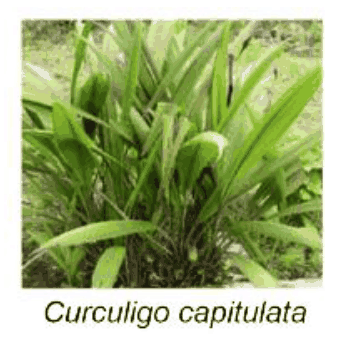
Curculigo capitulata
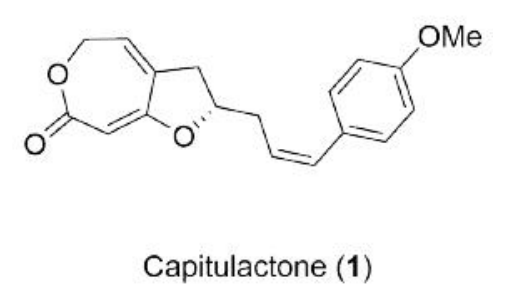
Capitulactone (1)
The total synthesis of 1 began with the iodination of commercially available 4-bromoveratrole 2 through a key intermediate 12 as shown in the following scheme.
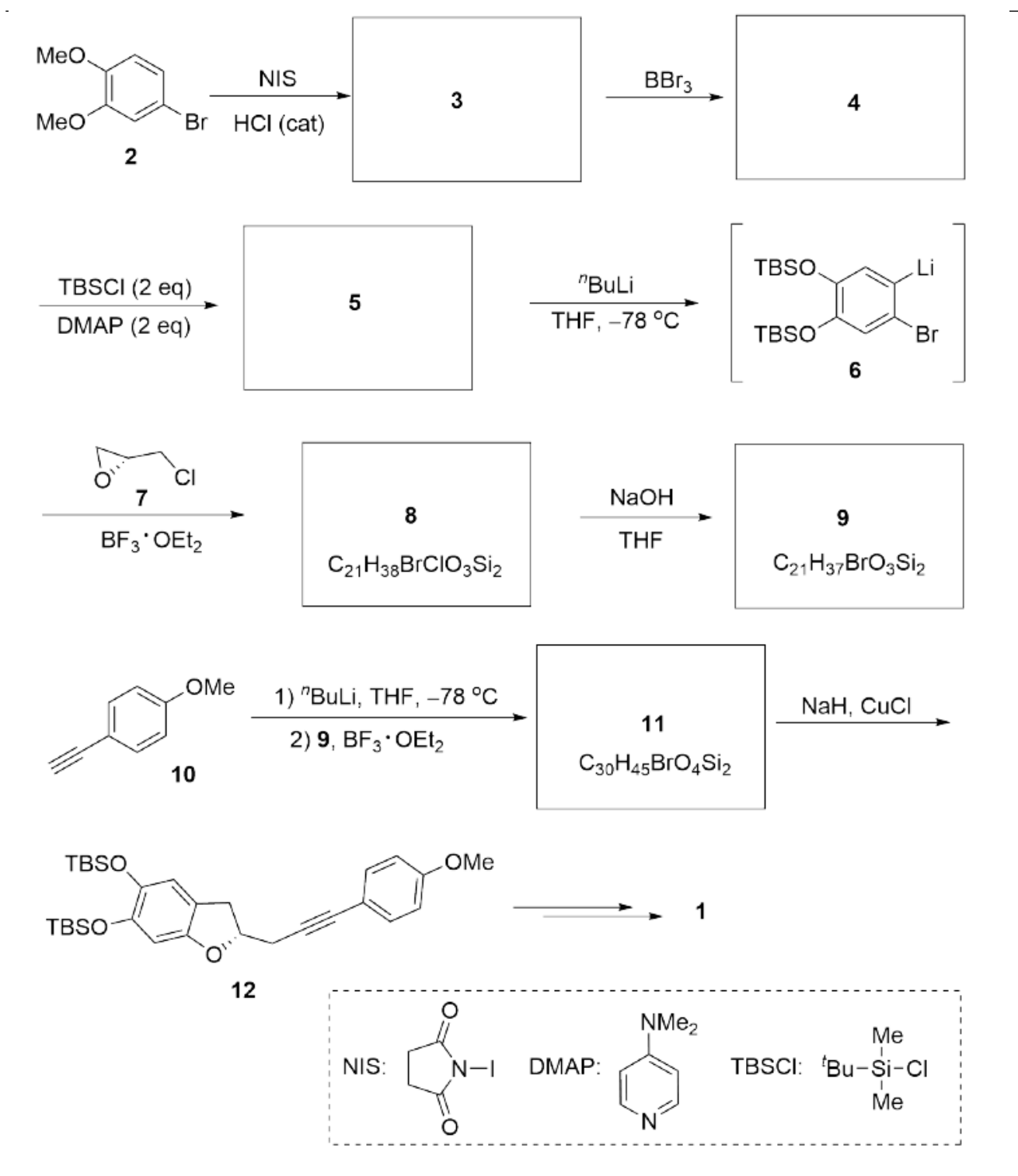
Note:
cat = catalyst
eq = equivalent
9.1 Draw the structures of compounds 3-5, 8, 9 and 11 and show the stereochemistry of any stereocenters.
(R)-Epichlorohydrin (7) was prepared from (+)-mannitol (13) through a route as shown below.
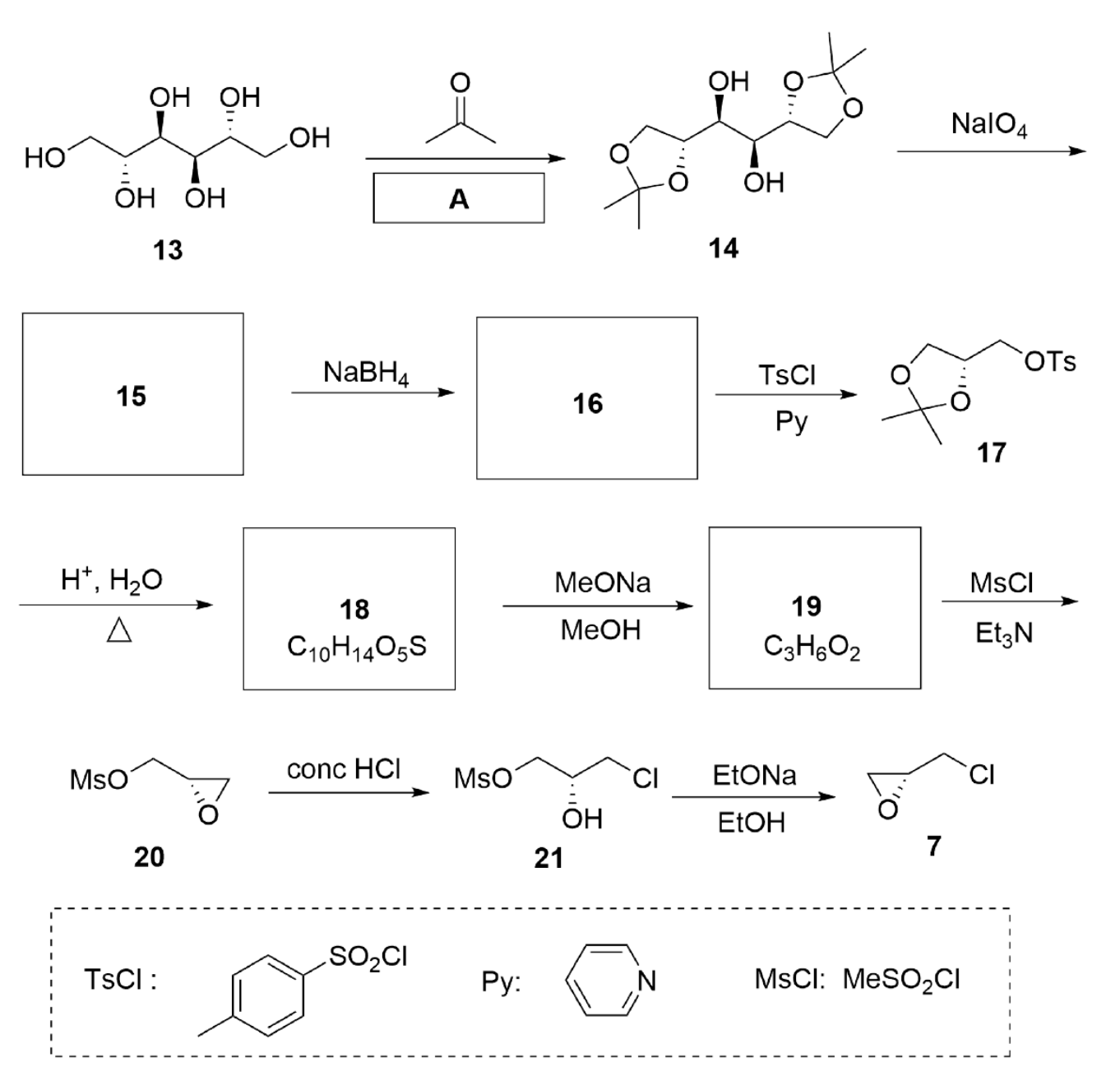
Note:
eq = equivalent
conc = concentrated
9.2 From the following conditions, choose the best for A.
(a) Pyridine
(b) 5% \(\ce{KOH/H2O}\)
(c) 1% \(\ce{HCl/H2O}\)
(d) Anhydrous \(\ce{ZnCl2}\)
9.3 Draw the structures of intermediate products 15, 16, 18 and 19 and show the stereochemistry of any stereocenters.
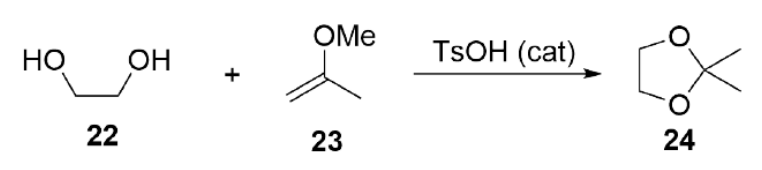
The diketal 14 can also be prepared by treating (+)-mannitol (13) with 2-methoxypropene (23) in the presence of catalytic amount of tolunesulfonic acid (TsOH) in anhydrous toluene. The model reaction is shown below.
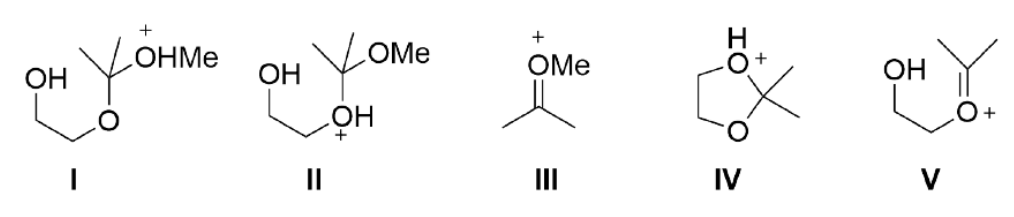
9.4 The proposed mechanism for this reaction involves key intermediates (I-V) as shown above, choose the correct order of the formation of the key intermediates during the reaction process.
(a) I, II, III, IV, V
(b) III, II, I, V, IV
(c) III, I, II, IV, V
(d) III, I, II, V, IV
Official English text of the problem.
Answers
- 9.1. The structures are:
| Compound | Name and absolute configuration | SMILES |
|---|---|---|
| 3 | 4-Bromo-5-iodo-1,2-dimethoxybenzene | COc1cc(I)c(Br)cc1OC |
| 4 | 4-Bromo-5-iodobenzene-1,2-diol | Oc1cc(I)c(Br)cc1O |
| 5 | 1-Bromo-2-iodo-4,5-bis[(tert-butyldimethylsilyl)oxy]benzene | CC(C)(C)[Si](C)(C)Oc1cc(I)c(Br)cc1O[Si](C)(C)C(C)(C)C |
| 8 | (2R)-1-Chloro-3-{2-bromo-4,5-bis[(tert-butyldimethylsilyl)oxy]phenyl}propan-2-ol | CC(C)(C)[Si](C)(C)Oc1cc(C[C@@H](O)CCl)c(Br)cc1O[Si](C)(C)C(C)(C)C |
| 9 | (2R)-2-[(2-Bromo-4,5-bis[(tert-butyldimethylsilyl)oxy]phenyl)methyl]oxirane | CC(C)(C)[Si](C)(C)Oc1cc(C[C@@H]2CO2)c(Br)cc1O[Si](C)(C)C(C)(C)C |
| 11 | (2S)-1-{2-Bromo-4,5-bis[(tert-butyldimethylsilyl)oxy]phenyl}-5-(4-methoxyphenyl)pent-4-yn-2-ol | CC(C)(C)[Si](C)(C)Oc1cc(C[C@@H](O)CC#Cc2ccc(OC)cc2)c(Br)cc1O[Si](C)(C)C(C)(C)C |
Compounds 3–5 have no stereocenters. Compounds 8, 9, and 11 each have one.
-
9.2. (d) Anhydrous zinc chloride, \(\ce{ZnCl2}\),
[Zn+2].[Cl-].[Cl-]. -
9.3. The structures are:
| Compound | Name and absolute configuration | SMILES |
|---|---|---|
| 15 | (4R)-2,2-Dimethyl-1,3-dioxolane-4-carbaldehyde | CC1(C)OC[C@H](C=O)O1 |
| 16 | [(4S)-2,2-Dimethyl-1,3-dioxolan-4-yl]methanol, also called (S)-solketal | CC1(C)OC[C@H](CO)O1 |
| 18 | (2R)-2,3-Dihydroxypropyl 4-methylbenzenesulfonate | OC[C@@H](O)COS(=O)(=O)c1ccc(C)cc1 |
| 19 | [(2R)-Oxiran-2-yl]methanol, also called (R)-glycidol | OC[C@@H]1CO1 |
- 9.4. (b): III → II → I → V → IV.
Solution
9.1 — Identification of compounds 3–5, 8, 9, and 11
For the explanations below, let:
- \(\mathrm{Ar}\) denote the 2-bromo-4,5-bis[(tert-butyldimethylsilyl)oxy]phenyl group.
- \(\mathrm{An}\) denote the 4-methoxyphenyl group.
The complete molecular structures, including all protecting groups, are specified by the SMILES in the Answers section.
Formation of 3: electrophilic aromatic iodination.
The starting material, 4-bromoveratrole (2), is 4-bromo-1,2-dimethoxybenzene, COc1ccc(Br)cc1OC.
The methoxy groups activate the ring toward electrophilic aromatic substitution. N-Iodosuccinimide supplies electrophilic iodine. Iodination occurs at the position adjacent to bromine and para to one methoxy group. This position is also fixed unambiguously by the carbon bearing lithium in the supplied structure of 6.
Thus 3 is 4-bromo-5-iodo-1,2-dimethoxybenzene.
N-Iodosuccinimide, O=C1CCC(=O)N1I, becomes succinimide, O=C1CCC(=O)N1. The balanced net equation is
\[ \ce{C8H9BrO2 + C4H4INO2 -> C8H8BrIO2 + C4H5NO2}. \]
Formation of 4: cleavage of both methyl ethers.
Boron tribromide coordinates to the ether oxygens and promotes cleavage of the oxygen–methyl bonds. Hydrolytic work-up gives the two phenolic groups. The aryl–oxygen bonds and both aryl–halogen bonds remain intact.
Therefore 4 is 4-bromo-5-iodobenzene-1,2-diol.
One balanced representation including hydrolytic work-up is
\[ \ce{C8H8BrIO2 + 2 BBr3 + 6 H2O -> C6H4BrIO2 + 2 CH3Br + 2 B(OH)3 + 4 HBr}. \]
Formation of 5: protection of both phenolic groups.
The two equivalents of tert-butyldimethylsilyl chloride convert both phenolic groups into TBS ethers. DMAP assists silylation and accepts the released protons.
Consequently, 5 has the same substituted aromatic ring as 4, with each \(\ce{OH}\) replaced by \(\ce{O-Si(CH3)2-C(CH3)3}\).
Using the molecular formulas of TBSCl and DMAP, the balanced net equation is
\[ \ce{C6H4BrIO2 + 2 C6H15ClSi + 2 C7H10N2 -> C18H32BrIO2Si2 + 2 C7H11N2+ + 2 Cl-}. \]
Formation of 8: opening of (R)-epichlorohydrin.
Iodine–lithium exchange converts 5 into the drawn aryllithium 6, while retaining the aryl bromide.
The electrophile 7 is (R)-epichlorohydrin, or (2R)-2-(chloromethyl)oxirane, ClC[C@H]1CO1.
The aryl nucleophile attacks the less substituted epoxide carbon, the terminal ring \(\ce{CH2}\). The carbon–oxygen bond at the stereogenic carbon is not broken. Protonation of the resulting alkoxide gives
\[ \mathrm{Ar{-}CH_2{-}CH(OH){-}CH_2Cl}. \]
This is 8, with R configuration. Its priorities at the stereocenter are
\[ \ce{OH}>\ce{CH2Cl}>\ce{CH2Ar}>\ce{H}. \]
A balanced net equation combining lithium–iodine exchange, epoxide opening, and aqueous work-up is
\[ \ce{C18H32BrIO2Si2 + C4H9Li + C3H5ClO + H2O -> C21H38BrClO3Si2 + C4H9I + LiOH}. \]
The product formula matches the supplied \(\ce{C21H38BrClO3Si2}\).
Formation of 9: intramolecular epoxide formation.
Hydroxide converts the alcohol into an alkoxide. The alkoxide attacks the neighboring primary carbon bearing chlorine by an intramolecular \(S_\mathrm{N}2\) reaction.
The new epoxide therefore contains the original alcohol-bearing carbon and the carbon that previously belonged to \(\ce{CH2Cl}\). Its substituent is \(\mathrm{Ar{-}CH_2{-}}\).
The attacked carbon is not the stereocenter, so the existing spatial arrangement is retained. The configuration of 9 is R:
\[ \text{epoxide O}>\text{epoxide }\ce{CH2}> \ce{CH2Ar}>\ce{H}. \]
The balanced equation is
\[ \ce{C21H38BrClO3Si2 + NaOH -> C21H37BrO3Si2 + NaCl + H2O}. \]
Thus the formula changes by loss of \(\ce{HCl}\), exactly as shown in the problem.
Formation of 11: acetylide opening of epoxide 9.
Compound 10 is 1-ethynyl-4-methoxybenzene, COc1ccc(C#C)cc1.
Its terminal alkyne is deprotonated by \(n\)-butyllithium. The resulting acetylide attacks the less substituted carbon of epoxide 9, giving, after protonation,
\[ \mathrm{Ar{-}CH_2{-}CH(OH){-}CH_2{-}C{\equiv}C{-}An}. \]
This identifies 11.
Again, the carbon–oxygen bond at the existing stereocenter is retained. Nevertheless, its descriptor becomes S, because the priorities now are
\[ \ce{OH}> \mathrm{CH_2Ar}> \mathrm{CH_2C{\equiv}CAn}> \ce{H}. \]
The two carbon chains initially tie in the CIP comparison; the path through the ortho-brominated aromatic ring eventually reaches bromine and takes priority over the alkynyl chain.
The balanced net equation, including deprotonation and aqueous work-up, is
\[ \ce{C21H37BrO3Si2 + C9H8O + C4H9Li + H2O -> C30H45BrO4Si2 + C4H10 + LiOH}. \]
This gives the stated formula \(\ce{C30H45BrO4Si2}\).
As a structural check, the alcohol of 11 can undergo the supplied NaH/CuCl-mediated intramolecular aryl ether formation at the adjacent aryl bromide. This produces the five-membered ring of 12:
(2S)-5,6-bis[(tert-butyldimethylsilyl)oxy]-2-[3-(4-methoxyphenyl)prop-2-yn-1-yl]-2,3-dihydrobenzofuran,
CC(C)(C)[Si](C)(C)Oc1cc2c(cc1O[Si](C)(C)C(C)(C)C)O[C@@H](CC#Cc1ccc(OC)cc1)C2.
The net cyclization is
\[ \ce{C30H45BrO4Si2 + NaH ->[CuCl] C30H44O4Si2 + NaBr + H2}. \]
9.2 — Selection of condition A
The starting material 13 is D-(+)-mannitol,
OC[C@@H](O)[C@@H](O)[C@H](O)[C@H](O)CO.
Reaction with acetone, CC(=O)C, protects the terminal 1,2- and 5,6-diol pairs as cyclic ketals. The product 14 is 1,2:5,6-di-O-isopropylidene-D-mannitol,
CC1(C)OC[C@H]([C@@H](O)[C@H](O)[C@H]2COC(C)(C)O2)O1.
The balanced equilibrium is
\[ \ce{C6H14O6 + 2 C3H6O <=>[ZnCl2] C12H22O6 + 2 H2O}. \]
Anhydrous \(\ce{ZnCl2}\), option (d), is the best condition. It acts as a Lewis acid to activate acetone, and anhydrous conditions favor ketal formation.
Pyridine and aqueous KOH do not provide the required acid activation. Aqueous HCl supplies acid, but the large amount of water opposes ketal formation and favors ketal hydrolysis.
9.3 — Identification of 15, 16, 18, and 19
Formation of 15: periodate cleavage of the central diol.
In 14, the two terminal diols are protected, leaving only the hydroxyl groups at the original mannitol carbons 3 and 4 available for periodate oxidation.
Periodate forms a cyclic intermediate with this vicinal diol and cleaves the bond between those two carbons. Each becomes an aldehyde carbon. The two halves are identical and give two molecules of (R)-glyceraldehyde acetonide, 15.
The balanced equation is
\[ \ce{C12H22O6 + NaIO4 -> 2 C6H10O3 + NaIO3 + H2O}. \]
To draw 15, retain the acetonide ring and stereochemical arrangement shown in 17, but replace its \(\ce{CH2OTs}\) substituent by \(\ce{CHO}\). The ring stereocenter is R.
Formation of 16: aldehyde reduction.
Sodium borohydride reduces the aldehyde group of 15 to a primary alcohol. It does not alter the existing stereocenter or the acetonide.
Thus 16 is (S)-solketal. To draw it, replace the \(\ce{CH2OTs}\) group of 17 by \(\ce{CH2OH}\), keeping the depicted geometry.
A balanced formal reduction equation including aqueous work-up is
\[ \ce{4 C6H10O3 + NaBH4 + 4 H2O -> 4 C6H12O3 + Na[B(OH)4]}. \]
The change from R in 15 to S in 16 is a priority change, not an inversion:
| Compound | CIP priority order at the existing stereocenter |
|---|---|
| 15 | Ring O \(>\) \(\ce{CHO}\) \(>\) ring \(\ce{CH2O}\) \(>\) H |
| 16 | Ring O \(>\) ring \(\ce{CH2O}\) \(>\) \(\ce{CH2OH}\) \(>\) H |
In 15, the aldehyde carbon is compared as \((\mathrm{O,O,H})\), which outranks the ring methylene carbon’s \((\mathrm{O,H,H})\). After reduction, the two methylene branches initially tie, but the ring oxygen is attached to carbon whereas the hydroxyl oxygen is attached to hydrogen.
Formation of 18: tosylation followed by acetonide hydrolysis.
Tosylation of the only free alcohol in 16 gives the supplied 17, [(4R)-2,2-dimethyl-1,3-dioxolan-4-yl]methyl 4-methylbenzenesulfonate,
CC1(C)OC[C@H](COS(=O)(=O)c2ccc(C)cc2)O1.
Acidic hydrolysis removes the acetonide, regenerating the primary and secondary hydroxyl groups while retaining the terminal tosylate. Hence 18 has the connectivity
\[ \ce{HOCH2-CH(OH)-CH2OTs} \]
and R configuration.
The balanced hydrolysis is
\[ \ce{C13H18O5S + H2O ->[H+] C10H14O5S + C3H6O}. \]
Its formula is therefore \(\ce{C10H14O5S}\), as required.
Formation of 19: intramolecular displacement of tosylate.
Methoxide deprotonates the secondary alcohol of 18. The resulting alkoxide attacks the adjacent primary \(\ce{CH2OTs}\) carbon, expelling tosylate and forming an epoxide.
The product is (R)-glycidol, 19: an epoxide bearing a hydroxymethyl substituent. The substitution occurs at a primary carbon, so the existing stereocenter retains its spatial arrangement.
The balanced net equation is
\[ \ce{C10H14O5S + CH3ONa -> C3H6O2 + C7H7NaO3S + CH3OH}. \]
To draw 19, use the epoxide geometry shown for 20, replacing \(\ce{MsO}\) by \(\ce{HO}\). This gives the required formula \(\ce{C3H6O2}\).
The subsequent supplied transformations provide a consistency check:
- 20, [(2S)-oxiran-2-yl]methyl methanesulfonate,
CS(=O)(=O)OC[C@@H]1CO1, results from mesylating the primary alcohol. - Terminal epoxide opening gives 21, (2R)-3-chloro-2-hydroxypropyl methanesulfonate,
CS(=O)(=O)OC[C@@H](O)CCl. - Intramolecular displacement of mesylate then gives the supplied (R)-epichlorohydrin, 7.
These steps preserve the stereogenic carbon’s geometry; changes in descriptors arise from changes in substituent priorities.
9.4 — Ordering the ketalization intermediates
The reactants are ethylene glycol (22), OCCO, and 2-methoxyprop-1-ene (23), C=C(C)OC.
The correct sequence is III → II → I → V → IV, for the following reasons.
- III: methoxy-stabilized isopropyl oxocarbenium ion,
C[O+]=C(C)C.
The alkene is protonated at its terminal carbon, converting that carbon into a methyl group. Donation from the methoxy oxygen stabilizes the resulting cation. The drawing represents its oxygen-positive, carbon–oxygen double-bond resonance contributor.
- II: the mixed ketal protonated on the incoming ethylene-glycol oxygen,
COC(C)(C)[OH+]CCO.
One hydroxyl oxygen of ethylene glycol attacks the electrophilic carbon of III. The carbon–oxygen \(\pi\) electrons move onto the methoxy oxygen. The attacking oxygen now has three bonds and bears the positive charge.
- I: the mixed ketal protonated on the methoxy oxygen,
C[OH+]C(C)(C)OCCO.
Proton transfer, which may be mediated by other molecules in the reaction mixture, moves the proton from the incoming glycol oxygen to the methoxy oxygen. This converts the methoxy group into a suitable neutral leaving group upon bond cleavage.
- V: 2-hydroxyethoxy-stabilized isopropyl oxocarbenium ion,
CC(C)=[O+]CCO.
Methanol, CO, leaves. Donation from the remaining ether oxygen produces the oxocarbenium resonance form shown as V.
- IV: O-protonated 2,2-dimethyl-1,3-dioxolane,
CC1(C)OCC[OH+]1.
The remaining hydroxyl group attacks the electrophilic carbon intramolecularly. This closes the five-membered ring, while the carbon–oxygen \(\pi\) electrons move onto the other oxygen.
Finally, deprotonation of IV regenerates the acid catalyst and gives 2,2-dimethyl-1,3-dioxolane (24), CC1(C)OCCO1.
The balanced overall reaction is
\[ \ce{C2H6O2 + C4H8O ->[H+] C5H10O2 + CH3OH}. \]
The SMILES for III and V encode the resonance contributors drawn in the question; the actual positive charge is delocalized over the oxygen–carbon unit.
The answers were checked against the official answers published by the organisers.
IChO 2022 · Theorieaufgabe 9
Totalsynthese von Capitulacton
Die Pflanze Curculigo capitulata wächst in Südchina und wird seit Langem in der traditionellen chinesischen Pflanzenheilkunde zur Behandlung vieler Krankheiten verwendet. Capitulacton (1) wurde aus den Wurzeln von Curculigo capitulata isoliert. Seine Struktur einschließlich der absoluten Konfiguration wurde durch eine Kombination aus spektroskopischen Daten und Totalsynthese eindeutig aufgeklärt.
Curculigo capitulata
Capitulacton (1)
Die Totalsynthese von 1 begann mit der Iodierung von kommerziell erhältlichem 4-Bromveratrol 2 und verlief über das Schlüsselintermediat 12, wie im folgenden Schema gezeigt.
Hinweis:
cat = Katalysator
eq = Äquivalent
9.1 Zeichnen Sie die Strukturen der Verbindungen 3-5, 8, 9 und 11 und geben Sie die Stereochemie aller Stereozentren an.
(R)-Epichlorhydrin (7) wurde aus (+)-Mannitol (13) über den unten gezeigten Syntheseweg hergestellt.
Hinweis:
eq = Äquivalent
conc = konzentriert
9.2 Wählen Sie aus den folgenden Bedingungen die für A am besten geeignete aus.
(a) Pyridin
(b) 5% \(\ce{KOH/H2O}\)
(c) 1% \(\ce{HCl/H2O}\)
(d) Wasserfreies \(\ce{ZnCl2}\)
9.3 Zeichnen Sie die Strukturen der Zwischenprodukte 15, 16, 18 und 19 und geben Sie die Stereochemie aller Stereozentren an.
Das Diketal 14 kann auch durch Umsetzung von (+)-Mannitol (13) mit 2-Methoxypropen (23) in Gegenwart einer katalytischen Menge Toluolsulfonsäure (TsOH) in wasserfreiem Toluol hergestellt werden. Die Modellreaktion ist unten gezeigt.
9.4 Der vorgeschlagene Mechanismus dieser Reaktion umfasst die oben gezeigten Schlüsselintermediate (I-V). Wählen Sie die richtige Reihenfolge der Bildung dieser Schlüsselintermediate im Verlauf der Reaktion.
(a) I, II, III, IV, V
(b) III, II, I, V, IV
(c) III, I, II, IV, V
(d) III, I, II, V, IV
Aufgabentext aus dem offiziellen englischen Text übersetzt.
Antworten
- 9.1. Die Strukturen sind:
| Verbindung | Name und absolute Konfiguration | SMILES |
|---|---|---|
| 3 | 4-Brom-5-iod-1,2-dimethoxybenzol | COc1cc(I)c(Br)cc1OC |
| 4 | 4-Brom-5-iodbenzol-1,2-diol | Oc1cc(I)c(Br)cc1O |
| 5 | 1-Brom-2-iod-4,5-bis[(tert-butyldimethylsilyl)oxy]benzol | CC(C)(C)[Si](C)(C)Oc1cc(I)c(Br)cc1O[Si](C)(C)C(C)(C)C |
| 8 | (2R)-1-Chlor-3-{2-brom-4,5-bis[(tert-butyldimethylsilyl)oxy]phenyl}propan-2-ol | CC(C)(C)[Si](C)(C)Oc1cc(C[C@@H](O)CCl)c(Br)cc1O[Si](C)(C)C(C)(C)C |
| 9 | (2R)-2-[(2-Brom-4,5-bis[(tert-butyldimethylsilyl)oxy]phenyl)methyl]oxiran | CC(C)(C)[Si](C)(C)Oc1cc(C[C@@H]2CO2)c(Br)cc1O[Si](C)(C)C(C)(C)C |
| 11 | (2S)-1-{2-Brom-4,5-bis[(tert-butyldimethylsilyl)oxy]phenyl}-5-(4-methoxyphenyl)pent-4-in-2-ol | CC(C)(C)[Si](C)(C)Oc1cc(C[C@@H](O)CC#Cc2ccc(OC)cc2)c(Br)cc1O[Si](C)(C)C(C)(C)C |
Die Verbindungen 3–5 besitzen keine Stereozentren. Die Verbindungen 8, 9 und 11 besitzen jeweils eines.
-
9.2. (d) Wasserfreies Zinkchlorid, \(\ce{ZnCl2}\),
[Zn+2].[Cl-].[Cl-]. -
9.3. Die Strukturen sind:
| Verbindung | Name und absolute Konfiguration | SMILES |
|---|---|---|
| 15 | (4R)-2,2-Dimethyl-1,3-dioxolan-4-carbaldehyd | CC1(C)OC[C@H](C=O)O1 |
| 16 | [(4S)-2,2-Dimethyl-1,3-dioxolan-4-yl]methanol, auch (S)-Solketal genannt | CC1(C)OC[C@H](CO)O1 |
| 18 | (2R)-2,3-Dihydroxypropyl-4-methylbenzolsulfonat | OC[C@@H](O)COS(=O)(=O)c1ccc(C)cc1 |
| 19 | [(2R)-Oxiran-2-yl]methanol, auch (R)-Glycidol genannt | OC[C@@H]1CO1 |
- 9.4. (b): III → II → I → V → IV.
Lösung
9.1 — Identifizierung der Verbindungen 3–5, 8, 9 und 11
Für die folgenden Erläuterungen gelte:
- \(\mathrm{Ar}\) bezeichnet die 2-Brom-4,5-bis[(tert-butyldimethylsilyl)oxy]phenyl-Gruppe.
- \(\mathrm{An}\) bezeichnet die 4-Methoxyphenyl-Gruppe.
Die vollständigen Molekülstrukturen einschließlich aller Schutzgruppen sind durch die SMILES im Abschnitt Antworten angegeben.
Bildung von 3: elektrophile aromatische Iodierung.
Das Ausgangsmaterial 4-Bromveratrol (2) ist 4-Brom-1,2-dimethoxybenzol, COc1ccc(Br)cc1OC.
Die Methoxygruppen aktivieren den Ring für die elektrophile aromatische Substitution. N-Iodsuccinimid liefert elektrophiles Iod. Die Iodierung erfolgt an der Position benachbart zum Brom und in para-Stellung zu einer Methoxygruppe. Diese Position ist auch durch das lithiumtragende Kohlenstoffatom in der vorgegebenen Struktur von 6 eindeutig festgelegt.
Somit ist 3 4-Brom-5-iod-1,2-dimethoxybenzol.
N-Iodsuccinimid, O=C1CCC(=O)N1I, wird zu Succinimid, O=C1CCC(=O)N1. Die ausgeglichene Nettogleichung lautet
\[ \ce{C8H9BrO2 + C4H4INO2 -> C8H8BrIO2 + C4H5NO2}. \]
Bildung von 4: Spaltung beider Methylether.
Bortribromid koordiniert an die Ethersauerstoffatome und fördert die Spaltung der Sauerstoff–Methyl-Bindungen. Die hydrolytische Aufarbeitung ergibt die beiden phenolischen Gruppen. Die Aryl–Sauerstoff-Bindungen und beide Aryl–Halogen-Bindungen bleiben intakt.
Daher ist 4 4-Brom-5-iodbenzol-1,2-diol.
Eine ausgeglichene Darstellung einschließlich der hydrolytischen Aufarbeitung lautet
\[ \ce{C8H8BrIO2 + 2 BBr3 + 6 H2O -> C6H4BrIO2 + 2 CH3Br + 2 B(OH)3 + 4 HBr}. \]
Bildung von 5: Schutz beider phenolischen Gruppen.
Die zwei Äquivalente tert-Butyldimethylsilylchlorid überführen beide phenolischen Gruppen in TBS-Ether. DMAP unterstützt die Silylierung und nimmt die freigesetzten Protonen auf.
Folglich besitzt 5 denselben substituierten aromatischen Ring wie 4, wobei jedes \(\ce{OH}\) durch \(\ce{O-Si(CH3)2-C(CH3)3}\) ersetzt ist.
Unter Verwendung der Summenformeln von TBSCl und DMAP lautet die ausgeglichene Nettogleichung
\[ \ce{C6H4BrIO2 + 2 C6H15ClSi + 2 C7H10N2 -> C18H32BrIO2Si2 + 2 C7H11N2+ + 2 Cl-}. \]
Bildung von 8: Ringöffnung von (R)-Epichlorhydrin.
Durch Iod–Lithium-Austausch wird 5 in die gezeichnete Aryllithiumverbindung 6 überführt, wobei das Arylbromid erhalten bleibt.
Das Elektrophil 7 ist (R)-Epichlorhydrin, oder (2R)-2-(Chlormethyl)oxiran, ClC[C@H]1CO1.
Das Arylnukleophil greift das weniger substituierte Epoxid-Kohlenstoffatom, die endständige Ringgruppe \(\ce{CH2}\), an. Die Kohlenstoff–Sauerstoff-Bindung am stereogenen Kohlenstoffatom wird nicht gespalten. Die Protonierung des entstehenden Alkoholats ergibt
\[ \mathrm{Ar{-}CH_2{-}CH(OH){-}CH_2Cl}. \]
Dies ist 8 mit R-Konfiguration. Die Prioritäten am Stereozentrum sind
\[ \ce{OH}>\ce{CH2Cl}>\ce{CH2Ar}>\ce{H}. \]
Eine ausgeglichene Nettogleichung, die Lithium–Iod-Austausch, Epoxid-Ringöffnung und wässrige Aufarbeitung zusammenfasst, lautet
\[ \ce{C18H32BrIO2Si2 + C4H9Li + C3H5ClO + H2O -> C21H38BrClO3Si2 + C4H9I + LiOH}. \]
Die Summenformel des Produkts stimmt mit der vorgegebenen Formel \(\ce{C21H38BrClO3Si2}\) überein.
Bildung von 9: intramolekulare Epoxidbildung.
Hydroxid überführt den Alkohol in ein Alkoholat. Das Alkoholat greift das benachbarte primäre, chlortragende Kohlenstoffatom in einer intramolekularen \(S_\mathrm{N}2\)-Reaktion an.
Das neue Epoxid enthält daher das ursprünglich die Alkoholgruppe tragende Kohlenstoffatom und das Kohlenstoffatom, das zuvor zu \(\ce{CH2Cl}\) gehörte. Sein Substituent ist \(\mathrm{Ar{-}CH_2{-}}\).
Das angegriffene Kohlenstoffatom ist nicht das Stereozentrum, sodass die vorhandene räumliche Anordnung erhalten bleibt. Die Konfiguration von 9 ist R:
\[ \text{Epoxid-O}>\text{Epoxid-}\ce{CH2}> \ce{CH2Ar}>\ce{H}. \]
Die ausgeglichene Gleichung lautet
\[ \ce{C21H38BrClO3Si2 + NaOH -> C21H37BrO3Si2 + NaCl + H2O}. \]
Die Summenformel ändert sich somit durch den Verlust von \(\ce{HCl}\), genau wie in der Aufgabe gezeigt.
Bildung von 11: Öffnung von Epoxid 9 durch ein Acetylid.
Verbindung 10 ist 1-Ethinyl-4-methoxybenzol, COc1ccc(C#C)cc1.
Ihre terminale Alkingruppe wird durch \(n\)-Butyllithium deprotoniert. Das entstehende Acetylid greift das weniger substituierte Kohlenstoffatom des Epoxids 9 an und ergibt nach Protonierung
\[ \mathrm{Ar{-}CH_2{-}CH(OH){-}CH_2{-}C{\equiv}C{-}An}. \]
Damit ist 11 identifiziert.
Erneut bleibt die Kohlenstoff–Sauerstoff-Bindung am vorhandenen Stereozentrum erhalten. Dennoch wird sein Deskriptor zu S, da die Prioritäten nun wie folgt lauten:
\[ \ce{OH}> \mathrm{CH_2Ar}> \mathrm{CH_2C{\equiv}CAn}> \ce{H}. \]
Die beiden Kohlenstoffketten sind beim CIP-Vergleich zunächst gleichrangig; der Weg durch den ortho-bromierten aromatischen Ring erreicht schließlich das Brom und erhält dadurch Vorrang vor der Alkinylkette.
Die ausgeglichene Nettogleichung einschließlich Deprotonierung und wässriger Aufarbeitung lautet
\[ \ce{C21H37BrO3Si2 + C9H8O + C4H9Li + H2O -> C30H45BrO4Si2 + C4H10 + LiOH}. \]
Dies ergibt die angegebene Summenformel \(\ce{C30H45BrO4Si2}\).
Zur Überprüfung der Struktur kann die Alkoholgruppe von 11 die vorgegebene, durch NaH/CuCl vermittelte intramolekulare Aryletherbildung am benachbarten Arylbromid eingehen. Dabei entsteht der fünfgliedrige Ring von 12:
(2S)-5,6-Bis[(tert-butyldimethylsilyl)oxy]-2-[3-(4-methoxyphenyl)prop-2-in-1-yl]-2,3-dihydrobenzofuran,
CC(C)(C)[Si](C)(C)Oc1cc2c(cc1O[Si](C)(C)C(C)(C)C)O[C@@H](CC#Cc1ccc(OC)cc1)C2.
Die Nettogleichung der Cyclisierung lautet
\[ \ce{C30H45BrO4Si2 + NaH ->[CuCl] C30H44O4Si2 + NaBr + H2}. \]
9.2 — Auswahl der Bedingung A
Das Ausgangsmaterial 13 ist D-(+)-Mannitol,
OC[C@@H](O)[C@@H](O)[C@H](O)[C@H](O)CO.
Durch Reaktion mit Aceton, CC(=O)C, werden die endständigen 1,2- und 5,6-Diolpaare als cyclische Ketale geschützt. Das Produkt 14 ist 1,2:5,6-Di-O-isopropyliden-D-mannitol,
CC1(C)OC[C@H]([C@@H](O)[C@H](O)[C@H]2COC(C)(C)O2)O1.
Die ausgeglichene Gleichgewichtsreaktion lautet
\[ \ce{C6H14O6 + 2 C3H6O <=>[ZnCl2] C12H22O6 + 2 H2O}. \]
Wasserfreies \(\ce{ZnCl2}\), Option (d), ist die am besten geeignete Bedingung. Es wirkt als Lewis-Säure und aktiviert Aceton; wasserfreie Bedingungen begünstigen die Ketalbildung.
Pyridin und wässrige KOH bewirken nicht die erforderliche Säureaktivierung. Wässrige HCl liefert zwar Säure, doch die große Wassermenge wirkt der Ketalbildung entgegen und begünstigt die Ketalhydrolyse.
9.3 — Identifizierung von 15, 16, 18 und 19
Bildung von 15: Periodatspaltung des zentralen Diols.
In 14 sind die beiden endständigen Diole geschützt, sodass nur die Hydroxygruppen an den ursprünglichen Mannitol-Kohlenstoffatomen 3 und 4 für die Periodatoxidation zur Verfügung stehen.
Periodat bildet mit diesem vicinalen Diol ein cyclisches Zwischenprodukt und spaltet die Bindung zwischen den beiden Kohlenstoffatomen. Beide werden jeweils zu einem Aldehyd-Kohlenstoffatom. Die beiden Hälften sind identisch und ergeben zwei Moleküle (R)-Glycerinaldehydacetonid, 15.
Die ausgeglichene Gleichung lautet
\[ \ce{C12H22O6 + NaIO4 -> 2 C6H10O3 + NaIO3 + H2O}. \]
Um 15 zu zeichnen, behalten Sie den Acetonidring und die in 17 gezeigte stereochemische Anordnung bei, ersetzen jedoch dessen \(\ce{CH2OTs}\)-Substituenten durch \(\ce{CHO}\). Das Stereozentrum im Ring hat die Konfiguration R.
Bildung von 16: Aldehydreduktion.
Natriumborhydrid reduziert die Aldehydgruppe von 15 zu einem primären Alkohol. Das vorhandene Stereozentrum und das Acetonid werden dabei nicht verändert.
Somit ist 16 (S)-Solketal. Um es zu zeichnen, ersetzen Sie die \(\ce{CH2OTs}\)-Gruppe von 17 durch \(\ce{CH2OH}\) und behalten dabei die dargestellte Geometrie bei.
Eine ausgeglichene formale Reduktionsgleichung einschließlich wässriger Aufarbeitung lautet
\[ \ce{4 C6H10O3 + NaBH4 + 4 H2O -> 4 C6H12O3 + Na[B(OH)4]}. \]
Der Wechsel von R in 15 zu S in 16 beruht auf einer Änderung der Prioritäten, nicht auf einer Inversion:
| Verbindung | CIP-Prioritätsreihenfolge am vorhandenen Stereozentrum |
|---|---|
| 15 | Ring-O \(>\) \(\ce{CHO}\) \(>\) Ring-\(\ce{CH2O}\) \(>\) H |
| 16 | Ring-O \(>\) Ring-\(\ce{CH2O}\) \(>\) \(\ce{CH2OH}\) \(>\) H |
In 15 wird das Aldehyd-Kohlenstoffatom als \((\mathrm{O,O,H})\) verglichen und erhält damit Vorrang vor \((\mathrm{O,H,H})\) des Methylen-Kohlenstoffatoms im Ring. Nach der Reduktion sind die beiden Methylenzweige zunächst gleichrangig, doch das Ringsauerstoffatom ist an Kohlenstoff gebunden, während das Hydroxysauerstoffatom an Wasserstoff gebunden ist.
Bildung von 18: Tosylierung mit anschließender Acetonidhydrolyse.
Die Tosylierung der einzigen freien Alkoholgruppe in 16 ergibt die vorgegebene Verbindung 17, [(4R)-2,2-Dimethyl-1,3-dioxolan-4-yl]methyl-4-methylbenzolsulfonat,
CC1(C)OC[C@H](COS(=O)(=O)c2ccc(C)cc2)O1.
Die saure Hydrolyse entfernt die Acetonidgruppe und setzt die primäre und die sekundäre Hydroxygruppe wieder frei, während das endständige Tosylat erhalten bleibt. Somit besitzt 18 die Konnektivität
\[ \ce{HOCH2-CH(OH)-CH2OTs} \]
und die Konfiguration R.
Die ausgeglichene Hydrolysegleichung lautet
\[ \ce{C13H18O5S + H2O ->[H+] C10H14O5S + C3H6O}. \]
Die Summenformel ist daher wie gefordert \(\ce{C10H14O5S}\).
Bildung von 19: intramolekulare Substitution des Tosylats.
Methanolat deprotoniert die sekundäre Alkoholgruppe von 18. Das entstehende Alkoholat greift das benachbarte primäre \(\ce{CH2OTs}\)-Kohlenstoffatom an, wobei Tosylat abgespalten und ein Epoxid gebildet wird.
Das Produkt ist (R)-Glycidol, 19: ein Epoxid mit einem Hydroxymethylsubstituenten. Die Substitution erfolgt an einem primären Kohlenstoffatom, sodass das vorhandene Stereozentrum seine räumliche Anordnung beibehält.
Die ausgeglichene Nettogleichung lautet
\[ \ce{C10H14O5S + CH3ONa -> C3H6O2 + C7H7NaO3S + CH3OH}. \]
Um 19 zu zeichnen, verwenden Sie die für 20 gezeigte Epoxidgeometrie und ersetzen \(\ce{MsO}\) durch \(\ce{HO}\). Dies ergibt die geforderte Summenformel \(\ce{C3H6O2}\).
Die nachfolgenden vorgegebenen Umwandlungen ermöglichen eine Konsistenzprüfung:
- 20, [(2S)-Oxiran-2-yl]methylmethansulfonat,
CS(=O)(=O)OC[C@@H]1CO1, entsteht durch Mesylierung der primären Alkoholgruppe. - Die Epoxid-Ringöffnung am endständigen Kohlenstoffatom ergibt 21, (2R)-3-Chlor-2-hydroxypropylmethansulfonat,
CS(=O)(=O)OC[C@@H](O)CCl. - Die anschließende intramolekulare Substitution des Mesylats ergibt das vorgegebene (R)-Epichlorhydrin, 7.
Diese Schritte bewahren die Geometrie des stereogenen Kohlenstoffatoms; Änderungen der Deskriptoren ergeben sich aus Änderungen der Substituentenprioritäten.
9.4 — Reihenfolge der Ketalisierungsintermediate
Die Reaktanten sind Ethylenglykol (22), OCCO, und 2-Methoxyprop-1-en (23), C=C(C)OC.
Die richtige Reihenfolge ist III → II → I → V → IV, aus den folgenden Gründen.
- III: methoxystabilisiertes Isopropyl-Oxocarbeniumion,
C[O+]=C(C)C.
Das Alken wird an seinem endständigen Kohlenstoffatom protoniert, wodurch dieses Kohlenstoffatom zu einer Methylgruppe wird. Elektronendonierung durch das Methoxysauerstoffatom stabilisiert das entstehende Kation. Die Zeichnung stellt dessen mesomere Grenzstruktur mit positiver Ladung am Sauerstoff und einer Kohlenstoff–Sauerstoff-Doppelbindung dar.
- II: das am hinzukommenden Ethylenglykolsauerstoffatom protonierte gemischte Ketal,
COC(C)(C)[OH+]CCO.
Ein Hydroxysauerstoffatom des Ethylenglykols greift das elektrophile Kohlenstoffatom von III an. Die Kohlenstoff–Sauerstoff-\(\pi\)-Elektronen werden auf das Methoxysauerstoffatom verschoben. Das angreifende Sauerstoffatom besitzt nun drei Bindungen und trägt die positive Ladung.
- I: das am Methoxysauerstoffatom protonierte gemischte Ketal,
C[OH+]C(C)(C)OCCO.
Durch eine Protonenübertragung, die durch andere Moleküle im Reaktionsgemisch vermittelt werden kann, gelangt das Proton vom hinzukommenden Glykolsauerstoffatom auf das Methoxysauerstoffatom. Dadurch wird die Methoxygruppe bei der Bindungsspaltung zu einer geeigneten neutralen Abgangsgruppe.
- V: 2-hydroxyethoxystabilisiertes Isopropyl-Oxocarbeniumion,
CC(C)=[O+]CCO.
Methanol, CO, wird abgespalten. Elektronendonierung durch das verbleibende Ethersauerstoffatom erzeugt die als V gezeigte Oxocarbenium-Grenzstruktur.
- IV: O-protoniertes 2,2-Dimethyl-1,3-dioxolan,
CC1(C)OCC[OH+]1.
Die verbleibende Hydroxygruppe greift das elektrophile Kohlenstoffatom intramolekular an. Dadurch schließt sich der fünfgliedrige Ring, während die Kohlenstoff–Sauerstoff-\(\pi\)-Elektronen auf das andere Sauerstoffatom verschoben werden.
Schließlich regeneriert die Deprotonierung von IV den Säurekatalysator und ergibt 2,2-Dimethyl-1,3-dioxolan (24), CC1(C)OCCO1.
Die ausgeglichene Gesamtreaktion lautet
\[ \ce{C2H6O2 + C4H8O ->[H+] C5H10O2 + CH3OH}. \]
Die SMILES für III und V codieren die in der Aufgabe gezeichneten mesomeren Grenzstrukturen; die tatsächliche positive Ladung ist über die Sauerstoff–Kohlenstoff-Einheit delokalisiert.
Die Ergebnisse wurden mit den von den Veranstaltern veröffentlichten offiziellen Ergebnissen abgeglichen.
IChO 2022 · Teori sorusu 9
Kapitulaktonun Total Sentezi
Curculigo capitulata bitkisi Güney Çin'de yetişir ve uzun zamandır geleneksel Çin bitkisel tıbbında birçok hastalığın tedavisinde kullanılmaktadır. Kapitulakton (1), Curculigo capitulata bitkisinin köklerinden izole edilmiştir. Mutlak konfigürasyonu da içeren yapısı, spektroskopik veriler ve total sentezin birlikte kullanılmasıyla kesin olarak belirlenmiştir.
Curculigo capitulata
Kapitulakton (1)
1'in total sentezi, aşağıdaki şemada gösterildiği gibi, ticari olarak temin edilebilen 4-bromoveratrol 2'nin iyotlanmasıyla başlamış ve kilit ara ürün 12 üzerinden ilerlemiştir.
Not:
cat = katalizör
eq = eşdeğer
9.1 3-5, 8, 9 ve 11 bileşiklerinin yapılarını çiziniz ve varsa stereomerkezlerin stereokimyasını gösteriniz.
(R)-Epiklorohidrin (7), aşağıda gösterilen yol izlenerek (+)-mannitolden (13) hazırlanmıştır.
Not:
eq = eşdeğer
conc = derişik
9.2 Aşağıdaki koşullardan A için en uygun olanını seçiniz.
(a) Piridin
(b) %5 \(\ce{KOH/H2O}\)
(c) %1 \(\ce{HCl/H2O}\)
(d) Susuz \(\ce{ZnCl2}\)
9.3 15, 16, 18 ve 19 ara ürünlerinin yapılarını çiziniz ve varsa stereomerkezlerin stereokimyasını gösteriniz.
Diketal 14, (+)-mannitolün (13) susuz toluen içinde katalitik miktarda toluensülfonik asit (TsOH) varlığında 2-metoksipropen (23) ile tepkimeye sokulmasıyla da hazırlanabilir. Model tepkime aşağıda gösterilmiştir.
9.4 Bu tepkime için önerilen mekanizma, yukarıda gösterilen kilit ara ürünleri (I-V) içermektedir. Tepkime sürecinde kilit ara ürünlerin oluşum sırasını doğru veren seçeneği seçiniz.
(a) I, II, III, IV, V
(b) III, II, I, V, IV
(c) III, I, II, IV, V
(d) III, I, II, V, IV
Soru metni resmi İngilizce metinden çevrilmiştir.
Cevaplar
- 9.1. Yapılar şöyledir:
| Bileşik | Adı ve mutlak konfigürasyonu | SMILES |
|---|---|---|
| 3 | 4-Bromo-5-iyodo-1,2-dimetoksibenzen | COc1cc(I)c(Br)cc1OC |
| 4 | 4-Bromo-5-iyodobenzen-1,2-diol | Oc1cc(I)c(Br)cc1O |
| 5 | 1-Bromo-2-iyodo-4,5-bis[(tert-bütildimetilsilil)oksi]benzen | CC(C)(C)[Si](C)(C)Oc1cc(I)c(Br)cc1O[Si](C)(C)C(C)(C)C |
| 8 | (2R)-1-Kloro-3-{2-bromo-4,5-bis[(tert-bütildimetilsilil)oksi]fenil}propan-2-ol | CC(C)(C)[Si](C)(C)Oc1cc(C[C@@H](O)CCl)c(Br)cc1O[Si](C)(C)C(C)(C)C |
| 9 | (2R)-2-[(2-Bromo-4,5-bis[(tert-bütildimetilsilil)oksi]fenil)metil]oksiran | CC(C)(C)[Si](C)(C)Oc1cc(C[C@@H]2CO2)c(Br)cc1O[Si](C)(C)C(C)(C)C |
| 11 | (2S)-1-{2-Bromo-4,5-bis[(tert-bütildimetilsilil)oksi]fenil}-5-(4-metoksifenil)pent-4-in-2-ol | CC(C)(C)[Si](C)(C)Oc1cc(C[C@@H](O)CC#Cc2ccc(OC)cc2)c(Br)cc1O[Si](C)(C)C(C)(C)C |
3–5 bileşiklerinin stereomerkezi yoktur. 8, 9 ve 11 bileşiklerinin her birinin bir stereomerkezi vardır.
-
9.2. (d) Susuz çinko klorür, \(\ce{ZnCl2}\),
[Zn+2].[Cl-].[Cl-]. -
9.3. Yapılar şöyledir:
| Bileşik | Adı ve mutlak konfigürasyonu | SMILES |
|---|---|---|
| 15 | (4R)-2,2-Dimetil-1,3-dioksolan-4-karbaldehit | CC1(C)OC[C@H](C=O)O1 |
| 16 | [(4S)-2,2-Dimetil-1,3-dioksolan-4-il]metanol, diğer adıyla (S)-solketal | CC1(C)OC[C@H](CO)O1 |
| 18 | (2R)-2,3-Dihidroksipropil 4-metilbenzensülfonat | OC[C@@H](O)COS(=O)(=O)c1ccc(C)cc1 |
| 19 | [(2R)-Oksiran-2-il]metanol, diğer adıyla (R)-glisidol | OC[C@@H]1CO1 |
- 9.4. (b): III → II → I → V → IV.
Çözüm
9.1 — 3–5, 8, 9 ve 11 bileşiklerinin belirlenmesi
Aşağıdaki açıklamalarda:
- \(\mathrm{Ar}\), 2-bromo-4,5-bis[(tert-bütildimetilsilil)oksi]fenil grubunu göstersin.
- \(\mathrm{An}\), 4-metoksifenil grubunu göstersin.
Tüm koruyucu grupları içeren eksiksiz molekül yapıları, Cevaplar bölümündeki SMILES gösterimleriyle verilmiştir.
3'ün oluşumu: elektrofilik aromatik iyotlama.
Başlangıç maddesi olan 4-bromoveratrol (2), 4-bromo-1,2-dimetoksibenzendir: COc1ccc(Br)cc1OC.
Metoksi grupları halkayı elektrofilik aromatik sübstitüsyona karşı etkinleştirir. N-İyodosüksinimit, elektrofilik iyot sağlar. İyotlama, broma komşu ve metoksi gruplarından birine göre para konumunda gerçekleşir. Bu konum, 6'nın verilen yapısında lityum taşıyan karbon tarafından da kesin olarak belirlenmektedir.
Dolayısıyla 3, 4-bromo-5-iyodo-1,2-dimetoksibenzendir.
N-İyodosüksinimit, O=C1CCC(=O)N1I, süksinimide, O=C1CCC(=O)N1, dönüşür. Denkleştirilmiş net tepkime şöyledir:
\[ \ce{C8H9BrO2 + C4H4INO2 -> C8H8BrIO2 + C4H5NO2}. \]
4'ün oluşumu: her iki metil eterin parçalanması.
Bor tribromür, eter oksijenlerine koordine olur ve oksijen–metil bağlarının kopmasını kolaylaştırır. Hidrolitik son işlem, iki fenolik grubun oluşmasını sağlar. Aril–oksijen bağları ve her iki aril–halojen bağı korunur.
Bu nedenle 4, 4-bromo-5-iyodobenzen-1,2-dioldür.
Hidrolitik son işlemi de içeren denkleştirilmiş bir gösterim şöyledir:
\[ \ce{C8H8BrIO2 + 2 BBr3 + 6 H2O -> C6H4BrIO2 + 2 CH3Br + 2 B(OH)3 + 4 HBr}. \]
5'in oluşumu: her iki fenolik grubun korunması.
İki eşdeğer tert-bütildimetilsilil klorür, her iki fenolik grubu TBS eterlerine dönüştürür. DMAP, silillemeye yardımcı olur ve açığa çıkan protonları kabul eder.
Sonuç olarak 5, 4 ile aynı sübstitüe aromatik halkaya sahiptir; her bir \(\ce{OH}\) grubunun yerini \(\ce{O-Si(CH3)2-C(CH3)3}\) almıştır.
TBSCl ve DMAP'ın molekül formülleri kullanıldığında denkleştirilmiş net tepkime şöyledir:
\[ \ce{C6H4BrIO2 + 2 C6H15ClSi + 2 C7H10N2 -> C18H32BrIO2Si2 + 2 C7H11N2+ + 2 Cl-}. \]
8'in oluşumu: (R)-epiklorohidrinin halka açılması.
İyot–lityum değişimi, aril bromürü koruyarak 5'i çizimdeki arillityum 6'ya dönüştürür.
Elektrofil 7, (R)-epiklorohidrin, yani (2R)-2-(klorometil)oksirandır: ClC[C@H]1CO1.
Aril nükleofili, daha az sübstitüe epoksit karbonuna, yani halkanın uçtaki \(\ce{CH2}\) karbonuna saldırır. Stereojenik karbondaki karbon–oksijen bağı kırılmaz. Oluşan alkoksitin protonlanmasıyla şu yapı elde edilir:
\[ \mathrm{Ar{-}CH_2{-}CH(OH){-}CH_2Cl}. \]
Bu, R konfigürasyonuna sahip 8'dir. Stereomerkezindeki öncelik sırası şöyledir:
\[ \ce{OH}>\ce{CH2Cl}>\ce{CH2Ar}>\ce{H}. \]
Lityum–iyot değişimini, epoksit halkasının açılmasını ve sulu son işlemi bir arada gösteren denkleştirilmiş net tepkime şöyledir:
\[ \ce{C18H32BrIO2Si2 + C4H9Li + C3H5ClO + H2O -> C21H38BrClO3Si2 + C4H9I + LiOH}. \]
Ürünün formülü, verilen \(\ce{C21H38BrClO3Si2}\) formülüyle örtüşür.
9'un oluşumu: molekül içi epoksit oluşumu.
Hidroksit, alkolü bir alkoksite dönüştürür. Alkoksit, molekül içi bir \(S_\mathrm{N}2\) tepkimesiyle klor taşıyan komşu birincil karbona saldırır.
Dolayısıyla yeni epoksit, başlangıçta alkol grubunu taşıyan karbonu ve daha önce \(\ce{CH2Cl}\) grubuna ait olan karbonu içerir. Sübstitüenti \(\mathrm{Ar{-}CH_2{-}}\) grubudur.
Saldırıya uğrayan karbon stereomerkez olmadığından mevcut uzaysal düzen korunur. 9'un konfigürasyonu R'dir:
\[ \text{epoksit O}>\text{epoksit }\ce{CH2}> \ce{CH2Ar}>\ce{H}. \]
Denkleştirilmiş tepkime şöyledir:
\[ \ce{C21H38BrClO3Si2 + NaOH -> C21H37BrO3Si2 + NaCl + H2O}. \]
Böylece formül, tam da soruda gösterildiği gibi, \(\ce{HCl}\) kaybıyla değişir.
11'in oluşumu: epoksit 9'un asetilitle halka açılması.
10 bileşiği, 1-etinil-4-metoksibenzendir: COc1ccc(C#C)cc1.
Uç alkin grubu, \(n\)-bütillityum tarafından deprotonlanır. Oluşan asetilit, epoksit 9'un daha az sübstitüe karbonuna saldırır ve protonlanmanın ardından şu yapı elde edilir:
\[ \mathrm{Ar{-}CH_2{-}CH(OH){-}CH_2{-}C{\equiv}C{-}An}. \]
Bu yapı, 11'i tanımlar.
Yine, mevcut stereomerkezdeki karbon–oksijen bağı korunur. Buna rağmen konfigürasyon tanımlayıcısı S olur; çünkü öncelik sırası artık şöyledir:
\[ \ce{OH}> \mathrm{CH_2Ar}> \mathrm{CH_2C{\equiv}CAn}> \ce{H}. \]
İki karbon zinciri, CIP karşılaştırmasında başlangıçta eşit önceliktedir; orto konumunda brom taşıyan aromatik halka üzerinden izlenen yol sonunda broma ulaşır ve alkinil zincirine göre öncelik kazanır.
Deprotonlanmayı ve sulu son işlemi de içeren denkleştirilmiş net tepkime şöyledir:
\[ \ce{C21H37BrO3Si2 + C9H8O + C4H9Li + H2O -> C30H45BrO4Si2 + C4H10 + LiOH}. \]
Bu, belirtilen \(\ce{C30H45BrO4Si2}\) formülünü verir.
Yapısal bir kontrol olarak, 11'in alkol grubu, komşu aril bromür konumunda, verilen NaH/CuCl aracılı molekül içi aril eter oluşumu tepkimesine girebilir. Bu, 12'nin beş üyeli halkasını oluşturur:
(2S)-5,6-bis[(tert-bütildimetilsilil)oksi]-2-[3-(4-metoksifenil)prop-2-in-1-il]-2,3-dihidrobenzofuran,
CC(C)(C)[Si](C)(C)Oc1cc2c(cc1O[Si](C)(C)C(C)(C)C)O[C@@H](CC#Cc1ccc(OC)cc1)C2.
Net halkalaşma tepkimesi şöyledir:
\[ \ce{C30H45BrO4Si2 + NaH ->[CuCl] C30H44O4Si2 + NaBr + H2}. \]
9.2 — A koşulunun seçilmesi
Başlangıç maddesi 13, D-(+)-mannitoldür:
OC[C@@H](O)[C@@H](O)[C@H](O)[C@H](O)CO.
Asetonla, CC(=O)C, tepkime, uçlardaki 1,2- ve 5,6-diol çiftlerini halkalı ketaller olarak korur. Ürün 14, 1,2:5,6-di-O-izopropiliden-D-mannitoldür:
CC1(C)OC[C@H]([C@@H](O)[C@H](O)[C@H]2COC(C)(C)O2)O1.
Denkleştirilmiş denge tepkimesi şöyledir:
\[ \ce{C6H14O6 + 2 C3H6O <=>[ZnCl2] C12H22O6 + 2 H2O}. \]
En uygun koşul, (d) seçeneğindeki susuz \(\ce{ZnCl2}\)'dir. Asetonu etkinleştiren bir Lewis asidi olarak işlev görür ve susuz koşullar ketal oluşumunu destekler.
Piridin ve sulu KOH, gerekli asit etkinleştirmesini sağlamaz. Sulu HCl asit sağlar; ancak büyük miktardaki su, ketal oluşumuna karşı etki gösterir ve ketal hidrolizini destekler.
9.3 — 15, 16, 18 ve 19'un belirlenmesi
15'in oluşumu: merkezdeki diolün periyodatla parçalanması.
14'te uçlardaki iki diol korunmuştur; dolayısıyla periyodat yükseltgenmesine yalnızca başlangıçtaki mannitolün 3 ve 4 numaralı karbonlarındaki hidroksil grupları açıktır.
Periyodat, bu komşu diolle halkalı bir ara ürün oluşturur ve bu iki karbon arasındaki bağı koparır. Her biri bir aldehit karbonuna dönüşür. İki yarı birbirinin aynıdır ve iki molekül (R)-gliseraldehit asetonit, 15, verir.
Denkleştirilmiş tepkime şöyledir:
\[ \ce{C12H22O6 + NaIO4 -> 2 C6H10O3 + NaIO3 + H2O}. \]
15'i çizmek için 17'de gösterilen asetonit halkasını ve stereokimyasal düzeni koruyunuz, ancak \(\ce{CH2OTs}\) sübstitüentinin yerine \(\ce{CHO}\) koyunuz. Halkadaki stereomerkez R'dir.
16'nın oluşumu: aldehit indirgenmesi.
Sodyum borohidrür, 15'in aldehit grubunu birincil alkole indirger. Mevcut stereomerkezi veya asetonidi değiştirmez.
Dolayısıyla 16, (S)-solketaldir. Yapısını çizmek için 17'nin \(\ce{CH2OTs}\) grubunu \(\ce{CH2OH}\) ile değiştiriniz ve gösterilen geometriyi koruyunuz.
Sulu son işlemi de içeren denkleştirilmiş biçimsel bir indirgenme tepkimesi şöyledir:
\[ \ce{4 C6H10O3 + NaBH4 + 4 H2O -> 4 C6H12O3 + Na[B(OH)4]}. \]
15'teki R'den 16'daki S'ye geçiş, bir inversiyon değil, öncelik değişimidir:
| Bileşik | Mevcut stereomerkezdeki CIP öncelik sırası |
|---|---|
| 15 | Halka O \(>\) \(\ce{CHO}\) \(>\) halka \(\ce{CH2O}\) \(>\) H |
| 16 | Halka O \(>\) halka \(\ce{CH2O}\) \(>\) \(\ce{CH2OH}\) \(>\) H |
15'te aldehit karbonu, \((\mathrm{O,O,H})\) olarak karşılaştırılır ve bu, halka metilen karbonunun \((\mathrm{O,H,H})\) diziliminden daha yüksek önceliklidir. İndirgenmeden sonra iki metilen kolu başlangıçta eşit önceliktedir; ancak halka oksijeni karbona bağlıyken hidroksil oksijeni hidrojene bağlıdır.
18'in oluşumu: tosilleme ve ardından asetonit hidrolizi.
16'daki tek serbest alkolün tosillenmesi, verilen 17'yi, [(4R)-2,2-dimetil-1,3-dioksolan-4-il]metil 4-metilbenzensülfonatı, verir:
CC1(C)OC[C@H](COS(=O)(=O)c2ccc(C)cc2)O1.
Asidik hidroliz, uçtaki tosilatı korurken asetonidi uzaklaştırır ve birincil ve ikincil hidroksil gruplarını yeniden oluşturur. Bu nedenle 18, aşağıdaki bağlanma düzenine
\[ \ce{HOCH2-CH(OH)-CH2OTs} \]
ve R konfigürasyonuna sahiptir.
Denkleştirilmiş hidroliz tepkimesi şöyledir:
\[ \ce{C13H18O5S + H2O ->[H+] C10H14O5S + C3H6O}. \]
Dolayısıyla formülü, gerektiği gibi \(\ce{C10H14O5S}\)'tir.
19'un oluşumu: tosilatın molekül içi yer değiştirmesi.
Metoksit, 18'in ikincil alkolünü deprotonlar. Oluşan alkoksit, komşu birincil \(\ce{CH2OTs}\) karbonuna saldırarak tosilatı uzaklaştırır ve bir epoksit oluşturur.
Ürün, hidroksimetil sübstitüenti taşıyan bir epoksit olan (R)-glisidol, 19'dur. Sübstitüsyon birincil bir karbonda gerçekleştiğinden mevcut stereomerkez uzaysal düzenini korur.
Denkleştirilmiş net tepkime şöyledir:
\[ \ce{C10H14O5S + CH3ONa -> C3H6O2 + C7H7NaO3S + CH3OH}. \]
19'u çizmek için 20'de gösterilen epoksit geometrisini kullanınız ve \(\ce{MsO}\) yerine \(\ce{HO}\) koyunuz. Bu, gerekli \(\ce{C3H6O2}\) formülünü verir.
Verilen sonraki dönüşümler bir tutarlılık kontrolü sağlar:
- 20, [(2S)-oksiran-2-il]metil metansülfonat,
CS(=O)(=O)OC[C@@H]1CO1, birincil alkolün mesillenmesiyle oluşur. - Epoksit halkasının uç karbondan açılması, 21'i, (2R)-3-kloro-2-hidroksipropil metansülfonatı,
CS(=O)(=O)OC[C@@H](O)CCl, verir. - Ardından mesilatın molekül içi yer değiştirmesi, verilen (R)-epiklorohidrin, 7'yi verir.
Bu adımlar, stereojenik karbonun geometrisini korur; konfigürasyon tanımlayıcılarındaki değişiklikler, sübstitüent önceliklerinin değişmesinden kaynaklanır.
9.4 — Ketalleşme ara ürünlerinin sıralanması
Tepkimeye giren maddeler etilen glikol (22), OCCO, ve 2-metoksiprop-1-en (23), C=C(C)OC, bileşikleridir.
Aşağıdaki nedenlerle doğru sıra III → II → I → V → IV'tür.
- III: metoksi grubuyla kararlı hâle getirilmiş izopropil oksokarbenyum iyonu,
C[O+]=C(C)C.
Alken uç karbonundan protonlanır ve bu karbon bir metil grubuna dönüşür. Metoksi oksijeninin elektron vermesi, oluşan katyonu kararlı hâle getirir. Çizim, oksijenin pozitif yüklü olduğu ve karbon–oksijen çift bağı içeren rezonans katkı yapısını gösterir.
- II: katılan etilen glikolün oksijeni üzerinde protonlanmış karışık ketal,
COC(C)(C)[OH+]CCO.
Etilen glikolün hidroksil oksijenlerinden biri, III'ün elektrofilik karbonuna saldırır. Karbon–oksijen \(\pi\) elektronları metoksi oksijenine geçer. Saldıran oksijen artık üç bağa sahiptir ve pozitif yük taşır.
- I: metoksi oksijeni üzerinde protonlanmış karışık ketal,
C[OH+]C(C)(C)OCCO.
Tepkime karışımındaki diğer moleküllerin aracılık edebileceği proton aktarımı, protonu katılan glikol oksijeninden metoksi oksijenine taşır. Bu, metoksi grubunu bağın kopmasıyla ayrılabilecek uygun bir nötr ayrılan gruba dönüştürür.
- V: 2-hidroksietoksi grubuyla kararlı hâle getirilmiş izopropil oksokarbenyum iyonu,
CC(C)=[O+]CCO.
Metanol, CO, ayrılır. Kalan eter oksijeninin elektron vermesi, V olarak gösterilen oksokarbenyum rezonans yapısını oluşturur.
- IV: O-protonlanmış 2,2-dimetil-1,3-dioksolan,
CC1(C)OCC[OH+]1.
Kalan hidroksil grubu, molekül içi bir saldırıyla elektrofilik karbona bağlanır. Bu sırada karbon–oksijen \(\pi\) elektronları diğer oksijene geçerken beş üyeli halka kapanır.
Son olarak IV'ün deprotonlanması, asit katalizörünü yeniden oluşturur ve 2,2-dimetil-1,3-dioksolanı (24), CC1(C)OCCO1, verir.
Denkleştirilmiş toplam tepkime şöyledir:
\[ \ce{C2H6O2 + C4H8O ->[H+] C5H10O2 + CH3OH}. \]
III ve V için verilen SMILES gösterimleri, soruda çizilen rezonans katkı yapılarını kodlar; gerçekte pozitif yük, oksijen–karbon birimi üzerinde delokalizedir.
Sonuçlar, düzenleyicilerin yayımladığı resmi sonuçlarla karşılaştırılarak kontrol edildi.
IChO 2022 · Problema teórico 9
Síntesis total de la capitulactona
La planta Curculigo capitulata crece en el sur de China y se utiliza desde hace mucho tiempo en la fitoterapia tradicional china para tratar numerosas enfermedades. La capitulactona (1) se aisló de las raíces de Curculigo capitulata. Su estructura, incluida su configuración absoluta, se estableció inequívocamente mediante una combinación de datos espectroscópicos y síntesis total.
Curculigo capitulata
Capitulactona (1)
La síntesis total de 1 comenzó con la yodación del 4-bromoveratrol 2, disponible comercialmente, y pasó por el intermedio clave 12, como se muestra en el siguiente esquema.
Nota:
cat = catalizador
eq = equivalente
9.1 Dibuje las estructuras de los compuestos 3-5, 8, 9 y 11 e indique la estereoquímica de todos los estereocentros que presenten.
La (R)-epiclorhidrina (7) se preparó a partir de (+)-manitol (13) mediante la ruta que se muestra a continuación.
Nota:
eq = equivalente
conc = concentrado
9.2 De entre las siguientes condiciones, elija la más adecuada para A.
(a) Piridina
(b) \(\ce{KOH/H2O}\) al 5%
(c) \(\ce{HCl/H2O}\) al 1%
(d) \(\ce{ZnCl2}\) anhidro
9.3 Dibuje las estructuras de los productos intermedios 15, 16, 18 y 19 e indique la estereoquímica de todos los estereocentros que presenten.
El dicetal 14 también puede prepararse tratando (+)-manitol (13) con 2-metoxipropeno (23) en presencia de una cantidad catalítica de ácido toluenosulfónico (TsOH) en tolueno anhidro. La reacción modelo se muestra a continuación.
9.4 El mecanismo propuesto para esta reacción implica los intermedios clave (I-V) que se muestran arriba; elija el orden correcto de formación de los intermedios clave durante el proceso de reacción.
(a) I, II, III, IV, V
(b) III, II, I, V, IV
(c) III, I, II, IV, V
(d) III, I, II, V, IV
Enunciado traducido del texto oficial en inglés.
Respuestas
- 9.1. Las estructuras son:
| Compuesto | Nombre y configuración absoluta | SMILES |
|---|---|---|
| 3 | 4-Bromo-5-yodo-1,2-dimetoxibenceno | COc1cc(I)c(Br)cc1OC |
| 4 | 4-Bromo-5-yodobenceno-1,2-diol | Oc1cc(I)c(Br)cc1O |
| 5 | 1-Bromo-2-yodo-4,5-bis[(terc-butildimetilsilil)oxi]benceno | CC(C)(C)[Si](C)(C)Oc1cc(I)c(Br)cc1O[Si](C)(C)C(C)(C)C |
| 8 | (2R)-1-Cloro-3-{2-bromo-4,5-bis[(terc-butildimetilsilil)oxi]fenil}propan-2-ol | CC(C)(C)[Si](C)(C)Oc1cc(C[C@@H](O)CCl)c(Br)cc1O[Si](C)(C)C(C)(C)C |
| 9 | (2R)-2-[(2-Bromo-4,5-bis[(terc-butildimetilsilil)oxi]fenil)metil]oxirano | CC(C)(C)[Si](C)(C)Oc1cc(C[C@@H]2CO2)c(Br)cc1O[Si](C)(C)C(C)(C)C |
| 11 | (2S)-1-{2-Bromo-4,5-bis[(terc-butildimetilsilil)oxi]fenil}-5-(4-metoxifenil)pent-4-in-2-ol | CC(C)(C)[Si](C)(C)Oc1cc(C[C@@H](O)CC#Cc2ccc(OC)cc2)c(Br)cc1O[Si](C)(C)C(C)(C)C |
Los compuestos 3–5 no tienen estereocentros. Los compuestos 8, 9 y 11 tienen uno cada uno.
-
9.2. (d) Cloruro de zinc anhidro, \(\ce{ZnCl2}\),
[Zn+2].[Cl-].[Cl-]. -
9.3. Las estructuras son:
| Compuesto | Nombre y configuración absoluta | SMILES |
|---|---|---|
| 15 | (4R)-2,2-Dimetil-1,3-dioxolano-4-carbaldehído | CC1(C)OC[C@H](C=O)O1 |
| 16 | [(4S)-2,2-Dimetil-1,3-dioxolan-4-il]metanol, también llamado (S)-solketal | CC1(C)OC[C@H](CO)O1 |
| 18 | 4-Metilbencenosulfonato de (2R)-2,3-dihidroxipropilo | OC[C@@H](O)COS(=O)(=O)c1ccc(C)cc1 |
| 19 | [(2R)-Oxiran-2-il]metanol, también llamado (R)-glicidol | OC[C@@H]1CO1 |
- 9.4. (b): III → II → I → V → IV.
Solución
9.1 — Identificación de los compuestos 3–5, 8, 9 y 11
En las explicaciones siguientes:
- \(\mathrm{Ar}\) representa el grupo 2-bromo-4,5-bis[(terc-butildimetilsilil)oxi]fenilo.
- \(\mathrm{An}\) representa el grupo 4-metoxifenilo.
Las estructuras moleculares completas, incluidos todos los grupos protectores, se especifican mediante los SMILES de la sección Respuestas.
Formación de 3: yodación aromática electrófila.
El material de partida, el 4-bromoveratrol (2), es el 4-bromo-1,2-dimetoxibenceno, COc1ccc(Br)cc1OC.
Los grupos metoxi activan el anillo frente a la sustitución aromática electrófila. La N-yodosuccinimida aporta yodo electrófilo. La yodación tiene lugar en la posición adyacente al bromo y en para respecto a uno de los grupos metoxi. Esta posición también queda fijada inequívocamente por el carbono que lleva el litio en la estructura proporcionada de 6.
Por tanto, 3 es 4-bromo-5-yodo-1,2-dimetoxibenceno.
La N-yodosuccinimida, O=C1CCC(=O)N1I, se convierte en succinimida, O=C1CCC(=O)N1. La ecuación neta ajustada es
\[ \ce{C8H9BrO2 + C4H4INO2 -> C8H8BrIO2 + C4H5NO2}. \]
Formación de 4: escisión de ambos éteres metílicos.
El tribromuro de boro se coordina a los oxígenos de los éteres y promueve la escisión de los enlaces oxígeno–metilo. El tratamiento hidrolítico posterior da lugar a los dos grupos fenólicos. Los enlaces arilo–oxígeno y ambos enlaces arilo–halógeno permanecen intactos.
Por lo tanto, 4 es 4-bromo-5-yodobenceno-1,2-diol.
Una representación ajustada que incluye el tratamiento hidrolítico posterior es
\[ \ce{C8H8BrIO2 + 2 BBr3 + 6 H2O -> C6H4BrIO2 + 2 CH3Br + 2 B(OH)3 + 4 HBr}. \]
Formación de 5: protección de ambos grupos fenólicos.
Los dos equivalentes de cloruro de terc-butildimetilsililo convierten ambos grupos fenólicos en éteres TBS. La DMAP facilita la sililación y acepta los protones liberados.
En consecuencia, 5 tiene el mismo anillo aromático sustituido que 4, con cada \(\ce{OH}\) reemplazado por \(\ce{O-Si(CH3)2-C(CH3)3}\).
Utilizando las fórmulas moleculares de TBSCl y DMAP, la ecuación neta ajustada es
\[ \ce{C6H4BrIO2 + 2 C6H15ClSi + 2 C7H10N2 -> C18H32BrIO2Si2 + 2 C7H11N2+ + 2 Cl-}. \]
Formación de 8: apertura de la (R)-epiclorhidrina.
El intercambio yodo–litio convierte 5 en el arillitio 6 representado, conservando el bromuro de arilo.
El electrófilo 7 es (R)-epiclorhidrina, o (2R)-2-(clorometil)oxirano, ClC[C@H]1CO1.
El nucleófilo arílico ataca al carbono menos sustituido del epóxido, el \(\ce{CH2}\) terminal del anillo. El enlace carbono–oxígeno del carbono estereogénico no se rompe. La protonación del alcóxido resultante da
\[ \mathrm{Ar{-}CH_2{-}CH(OH){-}CH_2Cl}. \]
Este es 8, con configuración R. Sus prioridades en el estereocentro son
\[ \ce{OH}>\ce{CH2Cl}>\ce{CH2Ar}>\ce{H}. \]
Una ecuación neta ajustada que combina el intercambio litio–yodo, la apertura del epóxido y el tratamiento acuoso posterior es
\[ \ce{C18H32BrIO2Si2 + C4H9Li + C3H5ClO + H2O -> C21H38BrClO3Si2 + C4H9I + LiOH}. \]
La fórmula del producto coincide con la proporcionada, \(\ce{C21H38BrClO3Si2}\).
Formación de 9: formación intramolecular de un epóxido.
El hidróxido convierte el alcohol en un alcóxido. El alcóxido ataca al carbono primario vecino que lleva el cloro mediante una reacción \(S_\mathrm{N}2\) intramolecular.
Por tanto, el nuevo epóxido contiene el carbono que originalmente llevaba el grupo alcohol y el carbono que antes pertenecía a \(\ce{CH2Cl}\). Su sustituyente es \(\mathrm{Ar{-}CH_2{-}}\).
El carbono atacado no es el estereocentro, por lo que se conserva la disposición espacial existente. La configuración de 9 es R:
\[ \text{O del epóxido}>\text{del epóxido }\ce{CH2}> \ce{CH2Ar}>\ce{H}. \]
La ecuación ajustada es
\[ \ce{C21H38BrClO3Si2 + NaOH -> C21H37BrO3Si2 + NaCl + H2O}. \]
Así, la fórmula cambia por pérdida de \(\ce{HCl}\), exactamente como se muestra en el enunciado.
Formación de 11: apertura del epóxido 9 por un acetiluro.
El compuesto 10 es 1-etinil-4-metoxibenceno, COc1ccc(C#C)cc1.
Su alquino terminal es desprotonado por el \(n\)-butillitio. El acetiluro resultante ataca al carbono menos sustituido del epóxido 9, dando, tras la protonación,
\[ \mathrm{Ar{-}CH_2{-}CH(OH){-}CH_2{-}C{\equiv}C{-}An}. \]
Esto identifica a 11.
De nuevo, se conserva el enlace carbono–oxígeno del estereocentro existente. Sin embargo, su descriptor pasa a ser S, porque ahora las prioridades son
\[ \ce{OH}> \mathrm{CH_2Ar}> \mathrm{CH_2C{\equiv}CAn}> \ce{H}. \]
Las dos cadenas carbonadas empatan inicialmente en la comparación CIP; la trayectoria que pasa por el anillo aromático bromado en orto acaba alcanzando el bromo y tiene prioridad sobre la cadena alquinílica.
La ecuación neta ajustada, incluidas la desprotonación y el tratamiento acuoso posterior, es
\[ \ce{C21H37BrO3Si2 + C9H8O + C4H9Li + H2O -> C30H45BrO4Si2 + C4H10 + LiOH}. \]
Esto da la fórmula indicada, \(\ce{C30H45BrO4Si2}\).
Como comprobación estructural, el alcohol de 11 puede experimentar la formación intramolecular de un éter arílico mediada por NaH/CuCl que se indica, en el bromuro de arilo adyacente. Esto produce el anillo de cinco miembros de 12:
(2S)-5,6-bis[(terc-butildimetilsilil)oxi]-2-[3-(4-metoxifenil)prop-2-in-1-il]-2,3-dihidrobenzofurano,
CC(C)(C)[Si](C)(C)Oc1cc2c(cc1O[Si](C)(C)C(C)(C)C)O[C@@H](CC#Cc1ccc(OC)cc1)C2.
La ciclación neta es
\[ \ce{C30H45BrO4Si2 + NaH ->[CuCl] C30H44O4Si2 + NaBr + H2}. \]
9.2 — Selección de la condición A
El material de partida 13 es D-(+)-manitol,
OC[C@@H](O)[C@@H](O)[C@H](O)[C@H](O)CO.
La reacción con acetona, CC(=O)C, protege los pares de grupos diol terminales 1,2 y 5,6 como cetales cíclicos. El producto 14 es 1,2:5,6-di-O-isopropiliden-D-manitol,
CC1(C)OC[C@H]([C@@H](O)[C@H](O)[C@H]2COC(C)(C)O2)O1.
El equilibrio ajustado es
\[ \ce{C6H14O6 + 2 C3H6O <=>[ZnCl2] C12H22O6 + 2 H2O}. \]
El \(\ce{ZnCl2}\) anhidro, opción (d), es la condición más adecuada. Actúa como ácido de Lewis para activar la acetona, y las condiciones anhidras favorecen la formación de cetales.
La piridina y el KOH acuoso no proporcionan la activación ácida necesaria. El HCl acuoso aporta ácido, pero la gran cantidad de agua desfavorece la formación de cetales y favorece su hidrólisis.
9.3 — Identificación de 15, 16, 18 y 19
Formación de 15: escisión del diol central con peryodato.
En 14, los dos dioles terminales están protegidos, de modo que solo quedan disponibles para la oxidación con peryodato los grupos hidroxilo situados en los carbonos 3 y 4 del manitol original.
El peryodato forma un intermedio cíclico con este diol vecinal y rompe el enlace entre esos dos carbonos. Cada uno se convierte en un carbono aldehídico. Las dos mitades son idénticas y dan dos moléculas del acetónido del (R)-gliceraldehído, 15.
La ecuación ajustada es
\[ \ce{C12H22O6 + NaIO4 -> 2 C6H10O3 + NaIO3 + H2O}. \]
Para dibujar 15, conserve el anillo del acetónido y la disposición estereoquímica mostrados en 17, pero sustituya su sustituyente \(\ce{CH2OTs}\) por \(\ce{CHO}\). El estereocentro del anillo es R.
Formación de 16: reducción del aldehído.
El borohidruro de sodio reduce el grupo aldehído de 15 a un alcohol primario. No altera el estereocentro existente ni el acetónido.
Por tanto, 16 es (S)-solketal. Para dibujarlo, sustituya el grupo \(\ce{CH2OTs}\) de 17 por \(\ce{CH2OH}\), manteniendo la geometría representada.
Una ecuación formal de reducción ajustada que incluye el tratamiento acuoso posterior es
\[ \ce{4 C6H10O3 + NaBH4 + 4 H2O -> 4 C6H12O3 + Na[B(OH)4]}. \]
El cambio de R en 15 a S en 16 se debe a un cambio de prioridades, no a una inversión:
| Compuesto | Orden de prioridad CIP en el estereocentro existente |
|---|---|
| 15 | O del anillo \(>\) \(\ce{CHO}\) \(>\) \(\ce{CH2O}\) del anillo \(>\) H |
| 16 | O del anillo \(>\) \(\ce{CH2O}\) del anillo \(>\) \(\ce{CH2OH}\) \(>\) H |
En 15, el carbono del aldehído se compara como \((\mathrm{O,O,H})\), que tiene mayor prioridad que \((\mathrm{O,H,H})\) del carbono metilénico del anillo. Tras la reducción, las dos ramas metilénicas empatan inicialmente, pero el oxígeno del anillo está unido a un carbono, mientras que el oxígeno del hidroxilo está unido a un hidrógeno.
Formación de 18: tosilación seguida de hidrólisis del acetónido.
La tosilación del único alcohol libre de 16 da el compuesto 17 proporcionado, 4-metilbencenosulfonato de [(4R)-2,2-dimetil-1,3-dioxolan-4-il]metilo,
CC1(C)OC[C@H](COS(=O)(=O)c2ccc(C)cc2)O1.
La hidrólisis ácida elimina el acetónido y regenera los grupos hidroxilo primario y secundario, conservando el tosilato terminal. Por tanto, 18 tiene la conectividad
\[ \ce{HOCH2-CH(OH)-CH2OTs} \]
y configuración R.
La hidrólisis ajustada es
\[ \ce{C13H18O5S + H2O ->[H+] C10H14O5S + C3H6O}. \]
Su fórmula es, por tanto, \(\ce{C10H14O5S}\), como se requiere.
Formación de 19: desplazamiento intramolecular del tosilato.
El metóxido desprotona el alcohol secundario de 18. El alcóxido resultante ataca al carbono primario adyacente de \(\ce{CH2OTs}\), expulsando tosilato y formando un epóxido.
El producto es (R)-glicidol, 19: un epóxido con un sustituyente hidroximetilo. La sustitución tiene lugar en un carbono primario, por lo que el estereocentro existente conserva su disposición espacial.
La ecuación neta ajustada es
\[ \ce{C10H14O5S + CH3ONa -> C3H6O2 + C7H7NaO3S + CH3OH}. \]
Para dibujar 19, utilice la geometría del epóxido mostrada para 20, sustituyendo \(\ce{MsO}\) por \(\ce{HO}\). Esto da la fórmula requerida, \(\ce{C3H6O2}\).
Las transformaciones posteriores proporcionadas permiten comprobar la coherencia:
- 20, metanosulfonato de [(2S)-oxiran-2-il]metilo,
CS(=O)(=O)OC[C@@H]1CO1, resulta de la mesilación del alcohol primario. - La apertura del epóxido en el carbono terminal da 21, metanosulfonato de (2R)-3-cloro-2-hidroxipropilo,
CS(=O)(=O)OC[C@@H](O)CCl. - El desplazamiento intramolecular del mesilato da entonces la (R)-epiclorhidrina, 7 proporcionada.
Estos pasos conservan la geometría del carbono estereogénico; los cambios de descriptor se deben a cambios en las prioridades de los sustituyentes.
9.4 — Orden de los intermedios de la cetalización
Los reactivos son etilenglicol (22), OCCO, y 2-metoxiprop-1-eno (23), C=C(C)OC.
La secuencia correcta es III → II → I → V → IV, por las siguientes razones.
- III: ion oxocarbenio isopropílico estabilizado por un grupo metoxi,
C[O+]=C(C)C.
El alqueno se protona en su carbono terminal, convirtiendo ese carbono en un grupo metilo. La donación electrónica del oxígeno del grupo metoxi estabiliza el catión resultante. El dibujo representa su contribuyente de resonancia con carga positiva en el oxígeno y un doble enlace carbono–oxígeno.
- II: el cetal mixto protonado en el oxígeno del etilenglicol entrante,
COC(C)(C)[OH+]CCO.
Uno de los oxígenos de los grupos hidroxilo del etilenglicol ataca al carbono electrófilo de III. Los electrones \(\pi\) del enlace carbono–oxígeno se desplazan hacia el oxígeno del grupo metoxi. El oxígeno atacante tiene ahora tres enlaces y lleva la carga positiva.
- I: el cetal mixto protonado en el oxígeno del grupo metoxi,
C[OH+]C(C)(C)OCCO.
Una transferencia de protón, que puede estar mediada por otras moléculas de la mezcla de reacción, desplaza el protón desde el oxígeno del glicol entrante hasta el oxígeno del grupo metoxi. Esto convierte al grupo metoxi en un grupo saliente neutro adecuado al romperse el enlace.
- V: ion oxocarbenio isopropílico estabilizado por un grupo 2-hidroxietoxi,
CC(C)=[O+]CCO.
Se desprende metanol, CO. La donación electrónica del oxígeno etéreo restante produce la forma de resonancia del oxocarbenio mostrada como V.
- IV: 2,2-dimetil-1,3-dioxolano O-protonado,
CC1(C)OCC[OH+]1.
El grupo hidroxilo restante ataca intramolecularmente al carbono electrófilo. Esto cierra el anillo de cinco miembros, mientras que los electrones \(\pi\) del enlace carbono–oxígeno se desplazan hacia el otro oxígeno.
Por último, la desprotonación de IV regenera el catalizador ácido y da 2,2-dimetil-1,3-dioxolano (24), CC1(C)OCCO1.
La reacción global ajustada es
\[ \ce{C2H6O2 + C4H8O ->[H+] C5H10O2 + CH3OH}. \]
Los SMILES de III y V codifican los contribuyentes de resonancia representados en el enunciado; la carga positiva real está deslocalizada sobre la unidad oxígeno–carbono.
Los resultados se comprobaron con los resultados oficiales publicados por los organizadores.
IChO 2022 · 理论题 9
头状仙茅内酯的全合成
大叶仙茅(Curculigo capitulata)生长于中国南部,长期以来一直被用作中草药,治疗多种疾病。头状仙茅内酯(1)是从大叶仙茅的根中分离得到的。通过结合光谱数据和全合成,明确确定了其结构及绝对构型。
大叶仙茅(Curculigo capitulata)
头状仙茅内酯(1)
1 的全合成从市售的 4-溴藜芦醚 2 的碘化反应开始,经由关键中间体 12 完成,如下列合成路线所示。
注:
cat = 催化剂
eq = 当量
9.1 画出化合物 3-5、8、9 和 11 的结构,并标明所有立体中心的立体化学。
(R)-环氧氯丙烷(7)由 (+)-甘露醇(13)经下列路线制备。
注:
eq = 当量
conc = 浓的
9.2 从下列条件中选择最适合 A 的条件。
(a) 吡啶
(b) 5% \(\ce{KOH/H2O}\)
(c) 1% \(\ce{HCl/H2O}\)
(d) 无水 \(\ce{ZnCl2}\)
9.3 画出中间产物 15、16、18 和 19 的结构,并标明所有立体中心的立体化学。
在无水甲苯中,以催化量的甲苯磺酸(TsOH)为催化剂,使 (+)-甘露醇(13)与 2-甲氧基丙烯(23)反应,也可制得双缩酮 14。模型反应如下所示。
9.4 该反应所提出的机理涉及上图所示的关键中间体(I-V),请选择反应过程中这些关键中间体形成的正确顺序。
(a) I, II, III, IV, V
(b) III, II, I, V, IV
(c) III, I, II, IV, V
(d) III, I, II, V, IV
题目译自官方英文原文。
答案
- 9.1. 结构如下:
| 化合物 | 名称及绝对构型 | SMILES |
|---|---|---|
| 3 | 4-溴-5-碘-1,2-二甲氧基苯 | COc1cc(I)c(Br)cc1OC |
| 4 | 4-溴-5-碘苯-1,2-二酚 | Oc1cc(I)c(Br)cc1O |
| 5 | 1-溴-2-碘-4,5-双[(叔丁基二甲基硅基)氧基]苯 | CC(C)(C)[Si](C)(C)Oc1cc(I)c(Br)cc1O[Si](C)(C)C(C)(C)C |
| 8 | (2R)-1-氯-3-{2-溴-4,5-双[(叔丁基二甲基硅基)氧基]苯基}丙-2-醇 | CC(C)(C)[Si](C)(C)Oc1cc(C[C@@H](O)CCl)c(Br)cc1O[Si](C)(C)C(C)(C)C |
| 9 | (2R)-2-[(2-溴-4,5-双[(叔丁基二甲基硅基)氧基]苯基)甲基]环氧乙烷 | CC(C)(C)[Si](C)(C)Oc1cc(C[C@@H]2CO2)c(Br)cc1O[Si](C)(C)C(C)(C)C |
| 11 | (2S)-1-{2-溴-4,5-双[(叔丁基二甲基硅基)氧基]苯基}-5-(4-甲氧基苯基)戊-4-炔-2-醇 | CC(C)(C)[Si](C)(C)Oc1cc(C[C@@H](O)CC#Cc2ccc(OC)cc2)c(Br)cc1O[Si](C)(C)C(C)(C)C |
化合物 3–5 没有立体中心。化合物 8、9 和 11 各有一个立体中心。
-
9.2. (d) 无水氯化锌,\(\ce{ZnCl2}\),
[Zn+2].[Cl-].[Cl-]。 -
9.3. 结构如下:
| 化合物 | 名称及绝对构型 | SMILES |
|---|---|---|
| 15 | (4R)-2,2-二甲基-1,3-二氧戊环-4-甲醛 | CC1(C)OC[C@H](C=O)O1 |
| 16 | [(4S)-2,2-二甲基-1,3-二氧戊环-4-基]甲醇,又称 (S)-甘油缩丙酮 | CC1(C)OC[C@H](CO)O1 |
| 18 | 4-甲基苯磺酸 (2R)-2,3-二羟基丙酯 | OC[C@@H](O)COS(=O)(=O)c1ccc(C)cc1 |
| 19 | [(2R)-环氧乙烷-2-基]甲醇,又称 (R)-缩水甘油 | OC[C@@H]1CO1 |
- 9.4. (b):III → II → I → V → IV。
解答
9.1 — 化合物 3–5、8、9 和 11 的确定
在以下解释中,令:
- \(\mathrm{Ar}\) 表示 2-溴-4,5-双[(叔丁基二甲基硅基)氧基]苯基。
- \(\mathrm{An}\) 表示 4-甲氧基苯基。
包含所有保护基的完整分子结构由“答案”部分中的 SMILES 给出。
3 的形成:芳香亲电碘化。
起始原料 4-溴藜芦醚(2)即 4-溴-1,2-二甲氧基苯,COc1ccc(Br)cc1OC。
甲氧基使芳环活化,易于发生芳香亲电取代反应。N-碘代丁二酰亚胺提供亲电性的碘。碘化发生在溴的邻位、同时也是一个甲氧基的对位的位置。题目给出的 6 的结构中与锂相连的碳也明确确定了这一位置。
因此,3 是 4-溴-5-碘-1,2-二甲氧基苯。
N-碘代丁二酰亚胺 O=C1CCC(=O)N1I 转化为丁二酰亚胺 O=C1CCC(=O)N1。配平的净反应方程式为
\[ \ce{C8H9BrO2 + C4H4INO2 -> C8H8BrIO2 + C4H5NO2}. \]
4 的形成:两个甲醚基的断裂。
三溴化硼与醚氧配位,促进氧–甲基键的断裂。经水解后处理,得到两个酚羟基。芳基–氧键及两个芳基–卤素键均保持完整。
因此,4 是 4-溴-5-碘苯-1,2-二酚。
包含水解后处理的一种配平反应式为
\[ \ce{C8H8BrIO2 + 2 BBr3 + 6 H2O -> C6H4BrIO2 + 2 CH3Br + 2 B(OH)3 + 4 HBr}. \]
5 的形成:两个酚羟基的保护。
两当量的叔丁基二甲基氯硅烷将两个酚羟基均转化为 TBS 醚。DMAP 促进硅基化,并接受释放出的质子。
因此,5 与 4 具有相同的取代芳环,其中每个 \(\ce{OH}\) 均被 \(\ce{O-Si(CH3)2-C(CH3)3}\) 替代。
使用 TBSCl 和 DMAP 的分子式,配平的净反应方程式为
\[ \ce{C6H4BrIO2 + 2 C6H15ClSi + 2 C7H10N2 -> C18H32BrIO2Si2 + 2 C7H11N2+ + 2 Cl-}. \]
8 的形成:(R)-环氧氯丙烷的开环。
碘–锂交换将 5 转化为图示的芳基锂 6,同时保留芳基溴。
亲电试剂 7 是 (R)-环氧氯丙烷,即 (2R)-2-(氯甲基)环氧乙烷,ClC[C@H]1CO1。
芳基亲核试剂进攻取代较少的环氧碳原子,即环上的末端 \(\ce{CH2}\)。立体中心碳原子上的碳–氧键不发生断裂。生成的醇盐经质子化后得到
\[ \mathrm{Ar{-}CH_2{-}CH(OH){-}CH_2Cl}. \]
这就是 8,具有 R 构型。其立体中心处的优先次序为
\[ \ce{OH}>\ce{CH2Cl}>\ce{CH2Ar}>\ce{H}. \]
将锂–碘交换、环氧开环及水相后处理合并,配平的净反应方程式为
\[ \ce{C18H32BrIO2Si2 + C4H9Li + C3H5ClO + H2O -> C21H38BrClO3Si2 + C4H9I + LiOH}. \]
产物的分子式与题目给出的 \(\ce{C21H38BrClO3Si2}\) 一致。
9 的形成:分子内成环生成环氧化物。
氢氧根将醇转化为醇盐。醇盐通过分子内 \(S_\mathrm{N}2\) 反应进攻相邻的、连有氯的伯碳原子。
因此,新形成的环氧环包含原先连有羟基的碳原子,以及原先属于 \(\ce{CH2Cl}\) 的碳原子。其取代基为 \(\mathrm{Ar{-}CH_2{-}}\)。
受到进攻的碳原子不是立体中心,因此原有的空间排列得以保留。9 的构型为 R:
\[ \text{环氧环中的 O}>\text{环氧环中的 }\ce{CH2}> \ce{CH2Ar}>\ce{H}. \]
配平的反应方程式为
\[ \ce{C21H38BrClO3Si2 + NaOH -> C21H37BrO3Si2 + NaCl + H2O}. \]
因此,分子式的变化相当于失去 \(\ce{HCl}\),与题目所示完全一致。
11 的形成:炔负离子使环氧化物 9 开环。
化合物 10 是 1-乙炔基-4-甲氧基苯,COc1ccc(C#C)cc1。
其端炔被 \(n\)-丁基锂去质子化。生成的炔负离子进攻环氧化物 9 中取代较少的碳原子,经质子化后得到
\[ \mathrm{Ar{-}CH_2{-}CH(OH){-}CH_2{-}C{\equiv}C{-}An}. \]
由此确定了 11 的结构。
原有立体中心处的碳–氧键同样保持不变。然而,其构型描述符变为 S,因为此时的优先次序为
\[ \ce{OH}> \mathrm{CH_2Ar}> \mathrm{CH_2C{\equiv}CAn}> \ce{H}. \]
在 CIP 比较中,两条碳链在最初的比较层级上相同;沿邻位溴代芳环的路径继续比较,最终会遇到溴,因此该路径的优先次序高于炔基链。
包含去质子化和水相后处理的配平净反应方程式为
\[ \ce{C21H37BrO3Si2 + C9H8O + C4H9Li + H2O -> C30H45BrO4Si2 + C4H10 + LiOH}. \]
由此得到题目所给的分子式 \(\ce{C30H45BrO4Si2}\)。
作为结构核验,11 的羟基可在题目所示的 NaH/CuCl 作用下,于相邻的芳基溴位点发生分子内芳基醚形成反应。这将生成 12 的五元环:
(2S)-5,6-双[(叔丁基二甲基硅基)氧基]-2-[3-(4-甲氧基苯基)丙-2-炔-1-基]-2,3-二氢苯并呋喃,
CC(C)(C)[Si](C)(C)Oc1cc2c(cc1O[Si](C)(C)C(C)(C)C)O[C@@H](CC#Cc1ccc(OC)cc1)C2。
净环化反应为
\[ \ce{C30H45BrO4Si2 + NaH ->[CuCl] C30H44O4Si2 + NaBr + H2}. \]
9.2 — 条件 A 的选择
起始原料 13 是 D-(+)-甘露醇,
OC[C@@H](O)[C@@H](O)[C@H](O)[C@H](O)CO。
与丙酮 CC(=O)C 反应,使末端的 1,2-和 5,6-两对羟基以环状缩酮的形式受到保护。产物 14 是 1,2:5,6-二-O-异丙叉基-D-甘露醇,
CC1(C)OC[C@H]([C@@H](O)[C@H](O)[C@H]2COC(C)(C)O2)O1。
配平的平衡反应式为
\[ \ce{C6H14O6 + 2 C3H6O <=>[ZnCl2] C12H22O6 + 2 H2O}. \]
无水 \(\ce{ZnCl2}\),即选项 (d),是最佳条件。 它作为路易斯酸活化丙酮,而无水条件有利于缩酮的形成。
吡啶和 KOH 水溶液不能提供所需的酸活化作用。HCl 水溶液虽能提供酸,但其中大量的水不利于缩酮形成,而有利于缩酮水解。
9.3 — 15、16、18 和 19 的确定
15 的形成:高碘酸盐使中部邻二醇断裂。
在 14 中,两端的邻二醇均已受到保护,仅剩原甘露醇 3 号和 4 号碳上的羟基可被高碘酸盐氧化。
高碘酸盐与这一邻二醇形成环状中间体,并使这两个碳原子之间的键断裂。两个碳原子各自转变为醛基碳。所得两部分完全相同,生成两分子 (R)-甘油醛缩丙酮 15。
配平的反应方程式为
\[ \ce{C12H22O6 + NaIO4 -> 2 C6H10O3 + NaIO3 + H2O}. \]
画 15 时,保留 17 中所示的丙酮缩酮环及立体化学排列,但将其 \(\ce{CH2OTs}\) 取代基替换为 \(\ce{CHO}\)。环上立体中心为 R 构型。
16 的形成:醛基的还原。
硼氢化钠将 15 的醛基还原为伯醇。它不改变原有立体中心,也不改变丙酮缩酮结构。
因此,16 是 (S)-甘油缩丙酮。画其结构时,将 17 的 \(\ce{CH2OTs}\) 基团替换为 \(\ce{CH2OH}\),并保持图示的几何构型。
包含水相后处理的配平形式还原方程式为
\[ \ce{4 C6H10O3 + NaBH4 + 4 H2O -> 4 C6H12O3 + Na[B(OH)4]}. \]
从 15 的 R 变为 16 的 S,是由于优先次序发生变化,而非构型翻转:
| 化合物 | 原有立体中心处的 CIP 优先次序 |
|---|---|
| 15 | 环上的 O \(>\) \(\ce{CHO}\) \(>\) 环上的 \(\ce{CH2O}\) \(>\) H |
| 16 | 环上的 O \(>\) 环上的 \(\ce{CH2O}\) \(>\) \(\ce{CH2OH}\) \(>\) H |
在 15 中,比较时将醛基碳视为连接 \((\mathrm{O,O,H})\),其优先次序高于环上亚甲基碳所连接的 \((\mathrm{O,H,H})\)。还原后,两个亚甲基分支在最初的比较层级上相同,但环上的氧与碳相连,而羟基氧与氢相连。
18 的形成:对甲苯磺酰化后进行丙酮缩酮水解。
对 16 中唯一的游离羟基进行对甲苯磺酰化,得到题目所给的 17,即 4-甲基苯磺酸 [(4R)-2,2-二甲基-1,3-二氧戊环-4-基]甲酯,
CC1(C)OC[C@H](COS(=O)(=O)c2ccc(C)cc2)O1。
酸性水解除去丙酮缩酮保护基,重新生成伯羟基和仲羟基,同时保留末端的对甲苯磺酸酯基。因此,18 具有如下连接方式
\[ \ce{HOCH2-CH(OH)-CH2OTs} \]
且构型为 R。
配平的水解反应式为
\[ \ce{C13H18O5S + H2O ->[H+] C10H14O5S + C3H6O}. \]
因此,其分子式为 \(\ce{C10H14O5S}\),符合要求。
19 的形成:分子内取代对甲苯磺酸酯基。
甲氧基负离子使 18 的仲羟基去质子化。生成的醇盐进攻相邻的伯碳,即 \(\ce{CH2OTs}\) 中的碳,脱去对甲苯磺酸根并形成环氧化物。
产物为 (R)-缩水甘油 19:一种带有羟甲基取代基的环氧化物。取代发生在伯碳上,因此原有立体中心的空间排列保持不变。
配平的净反应方程式为
\[ \ce{C10H14O5S + CH3ONa -> C3H6O2 + C7H7NaO3S + CH3OH}. \]
画 19 时,采用 20 所示的环氧环几何构型,将 \(\ce{MsO}\) 替换为 \(\ce{HO}\)。由此得到所要求的分子式 \(\ce{C3H6O2}\)。
题目给出的后续转化可用于检验一致性:
- 20,即甲磺酸 [(2S)-环氧乙烷-2-基]甲酯,
CS(=O)(=O)OC[C@@H]1CO1,由伯羟基的甲磺酰化得到。 - 环氧环在末端开环,得到 21,即甲磺酸 (2R)-3-氯-2-羟基丙酯,
CS(=O)(=O)OC[C@@H](O)CCl。 - 随后,甲磺酸酯基发生分子内取代,生成题目所给的 (R)-环氧氯丙烷 7。
这些步骤均保留了立体中心碳原子的几何构型;构型描述符的变化源于取代基优先次序的变化。
9.4 — 缩酮化中间体的排序
反应物为乙二醇(22),OCCO,以及 2-甲氧基丙-1-烯(23),C=C(C)OC。
正确顺序为 III → II → I → V → IV,理由如下。
- III:由甲氧基稳定的异丙基氧代碳正离子,
C[O+]=C(C)C。
烯烃的末端碳原子被质子化,使该碳转变为甲基。甲氧基氧的供电子作用使生成的阳离子稳定。图示结构是其氧带正电、具有碳–氧双键的共振贡献式。
- II:新引入的乙二醇氧被质子化的混合缩酮,
COC(C)(C)[OH+]CCO。
乙二醇的一个羟基氧进攻 III 的亲电碳原子。碳–氧 \(\pi\) 电子转移至甲氧基氧上。进攻的氧此时形成三个键,并带有正电荷。
- I:甲氧基氧被质子化的混合缩酮,
C[OH+]C(C)(C)OCCO。
质子转移将质子从新引入的乙二醇氧转移至甲氧基氧,这一过程可能由反应混合物中的其他分子介导。这样,甲氧基在断键时便可作为适宜的中性离去基团离去。
- V:由 2-羟基乙氧基稳定的异丙基氧代碳正离子,
CC(C)=[O+]CCO。
甲醇 CO 离去。剩余醚氧的供电子作用产生 V 所示的氧代碳正离子共振式。
- IV:O-质子化的 2,2-二甲基-1,3-二氧戊环,
CC1(C)OCC[OH+]1。
剩余羟基在分子内进攻亲电碳原子。这使五元环闭合,同时碳–氧 \(\pi\) 电子转移至另一个氧上。
最后,IV 去质子化,使酸催化剂再生,并生成 2,2-二甲基-1,3-二氧戊环(24),CC1(C)OCCO1。
配平的总反应方程式为
\[ \ce{C2H6O2 + C4H8O ->[H+] C5H10O2 + CH3OH}. \]
III 和 V 的 SMILES 表示题目中画出的共振贡献式;实际的正电荷离域于氧–碳单元上。
结果已与主办方公布的官方答案核对。
IChO 2022 · Теоретическая задача 9
Полный синтез капитулактона
Растение Curculigo capitulata произрастает на юге Китая и издавна используется в традиционной китайской фитотерапии для лечения многих заболеваний. Из корней Curculigo capitulata был выделен капитулактон (1). Его структура, включая абсолютную конфигурацию, была однозначно установлена на основании совокупности спектроскопических данных и полного синтеза.
Curculigo capitulata
Капитулактон (1)
Полный синтез 1, осуществлённый через ключевой интермедиат 12, начинался с иодирования коммерчески доступного 4-бромвератрола 2, как показано на следующей схеме.
Примечание:
cat = катализатор
eq = эквивалент
9.1 Изобразите структуры соединений 3-5, 8, 9 и 11 и укажите стереохимию всех стереоцентров.
(R)-Эпихлоргидрин (7) был получен из (+)-маннита (13) по приведённой ниже схеме.
Примечание:
eq = эквивалент
conc = концентрированный
9.2 Из следующих условий выберите наиболее подходящее для A.
(a) Пиридин
(b) 5% \(\ce{KOH/H2O}\)
(c) 1% \(\ce{HCl/H2O}\)
(d) Безводный \(\ce{ZnCl2}\)
9.3 Изобразите структуры промежуточных продуктов 15, 16, 18 и 19 и укажите стереохимию всех стереоцентров.
Дикеталь 14 также можно получить обработкой (+)-маннита (13) 2-метоксипропеном (23) в присутствии каталитического количества толуолсульфокислоты (TsOH) в безводном толуоле. Модельная реакция приведена ниже.
9.4 Предлагаемый механизм этой реакции включает ключевые интермедиаты (I-V), показанные выше; выберите правильный порядок образования ключевых интермедиатов в ходе реакции.
(a) I, II, III, IV, V
(b) III, II, I, V, IV
(c) III, I, II, IV, V
(d) III, I, II, V, IV
Условие переведено с официального английского текста.
Ответы
- 9.1. Структуры:
| Соединение | Название и абсолютная конфигурация | SMILES |
|---|---|---|
| 3 | 4-Бром-5-иод-1,2-диметоксибензол | COc1cc(I)c(Br)cc1OC |
| 4 | 4-Бром-5-иодбензол-1,2-диол | Oc1cc(I)c(Br)cc1O |
| 5 | 1-Бром-2-иод-4,5-бис[(трет-бутилдиметилсилил)окси]бензол | CC(C)(C)[Si](C)(C)Oc1cc(I)c(Br)cc1O[Si](C)(C)C(C)(C)C |
| 8 | (2R)-1-Хлор-3-{2-бром-4,5-бис[(трет-бутилдиметилсилил)окси]фенил}пропан-2-ол | CC(C)(C)[Si](C)(C)Oc1cc(C[C@@H](O)CCl)c(Br)cc1O[Si](C)(C)C(C)(C)C |
| 9 | (2R)-2-[(2-Бром-4,5-бис[(трет-бутилдиметилсилил)окси]фенил)метил]оксиран | CC(C)(C)[Si](C)(C)Oc1cc(C[C@@H]2CO2)c(Br)cc1O[Si](C)(C)C(C)(C)C |
| 11 | (2S)-1-{2-Бром-4,5-бис[(трет-бутилдиметилсилил)окси]фенил}-5-(4-метоксифенил)пент-4-ин-2-ол | CC(C)(C)[Si](C)(C)Oc1cc(C[C@@H](O)CC#Cc2ccc(OC)cc2)c(Br)cc1O[Si](C)(C)C(C)(C)C |
Соединения 3–5 не имеют стереоцентров. Соединения 8, 9 и 11 имеют по одному стереоцентру.
-
9.2. (d) Безводный хлорид цинка, \(\ce{ZnCl2}\),
[Zn+2].[Cl-].[Cl-]. -
9.3. Структуры:
| Соединение | Название и абсолютная конфигурация | SMILES |
|---|---|---|
| 15 | (4R)-2,2-Диметил-1,3-диоксолан-4-карбальдегид | CC1(C)OC[C@H](C=O)O1 |
| 16 | [(4S)-2,2-Диметил-1,3-диоксолан-4-ил]метанол, также называемый (S)-солкеталем | CC1(C)OC[C@H](CO)O1 |
| 18 | 4-Метилбензолсульфонат (2R)-2,3-дигидроксипропила | OC[C@@H](O)COS(=O)(=O)c1ccc(C)cc1 |
| 19 | [(2R)-Оксиран-2-ил]метанол, также называемый (R)-глицидолом | OC[C@@H]1CO1 |
- 9.4. (b): III → II → I → V → IV.
Решение
9.1 — Определение структур соединений 3–5, 8, 9 и 11
В приведённых ниже объяснениях примем следующие обозначения:
- \(\mathrm{Ar}\) обозначает 2-бром-4,5-бис[(трет-бутилдиметилсилил)окси]фенильную группу.
- \(\mathrm{An}\) обозначает 4-метоксифенильную группу.
Полные структуры молекул, включая все защитные группы, заданы строками SMILES в разделе «Ответы».
Образование 3: электрофильное иодирование ароматического кольца.
Исходное вещество, 4-бромвератрол (2), представляет собой 4-бром-1,2-диметоксибензол, COc1ccc(Br)cc1OC.
Метоксигруппы активируют кольцо по отношению к электрофильному ароматическому замещению. N-Иодсукцинимид служит источником электрофильного иода. Иодирование происходит в положение, соседнее с бромом и находящееся в пара-положении к одной из метоксигрупп. Это положение также однозначно определяется атомом углерода, связанным с литием, в приведённой структуре 6.
Таким образом, 3 — это 4-бром-5-иод-1,2-диметоксибензол.
N-Иодсукцинимид, O=C1CCC(=O)N1I, превращается в сукцинимид, O=C1CCC(=O)N1. Суммарное уравнение с расставленными коэффициентами имеет вид
\[ \ce{C8H9BrO2 + C4H4INO2 -> C8H8BrIO2 + C4H5NO2}. \]
Образование 4: расщепление обеих метильных эфирных групп.
Трибромид бора координируется с атомами кислорода эфирных групп и способствует разрыву связей кислород–метил. При последующей гидролитической обработке образуются две фенольные группы. Связи арил–кислород и обе связи арил–галоген сохраняются.
Следовательно, 4 — это 4-бром-5-иодбензол-1,2-диол.
Один из вариантов уравнения с расставленными коэффициентами, включающий гидролитическую обработку, имеет вид
\[ \ce{C8H8BrIO2 + 2 BBr3 + 6 H2O -> C6H4BrIO2 + 2 CH3Br + 2 B(OH)3 + 4 HBr}. \]
Образование 5: защита обеих фенольных групп.
Два эквивалента трет-бутилдиметилсилилхлорида превращают обе фенольные группы в TBS-эфиры. DMAP способствует силилированию и связывает высвобождающиеся протоны.
Таким образом, 5 имеет то же замещённое ароматическое кольцо, что и 4, но каждая группа \(\ce{OH}\) заменена на \(\ce{O-Si(CH3)2-C(CH3)3}\).
С использованием молекулярных формул TBSCl и DMAP суммарное уравнение с расставленными коэффициентами записывается как
\[ \ce{C6H4BrIO2 + 2 C6H15ClSi + 2 C7H10N2 -> C18H32BrIO2Si2 + 2 C7H11N2+ + 2 Cl-}. \]
Образование 8: раскрытие цикла (R)-эпихлоргидрина.
Обмен иода на литий превращает 5 в изображённое ариллитиевое соединение 6, при этом связь арил–бром сохраняется.
Электрофил 7 — это (R)-эпихлоргидрин, или (2R)-2-(хлорметил)оксиран, ClC[C@H]1CO1.
Арильный нуклеофил атакует менее замещённый атом углерода эпоксидного цикла, концевую группу \(\ce{CH2}\) кольца. Связь углерод–кислород при стереогенном атоме углерода не разрывается. Протонирование образовавшегося алкоголята даёт
\[ \mathrm{Ar{-}CH_2{-}CH(OH){-}CH_2Cl}. \]
Это соединение 8, имеющее конфигурацию R. Порядок старшинства заместителей при его стереоцентре:
\[ \ce{OH}>\ce{CH2Cl}>\ce{CH2Ar}>\ce{H}. \]
Суммарное уравнение с расставленными коэффициентами, объединяющее литий-иодный обмен, раскрытие эпоксидного цикла и обработку водой, имеет вид
\[ \ce{C18H32BrIO2Si2 + C4H9Li + C3H5ClO + H2O -> C21H38BrClO3Si2 + C4H9I + LiOH}. \]
Формула продукта совпадает с приведённой в условии: \(\ce{C21H38BrClO3Si2}\).
Образование 9: внутримолекулярное образование эпоксида.
Гидроксид превращает спирт в алкоголят. Алкоголят атакует соседний первичный атом углерода, связанный с хлором, по механизму внутримолекулярной реакции \(S_\mathrm{N}2\).
Таким образом, новый эпоксидный цикл включает исходный атом углерода, несущий спиртовую группу, и атом углерода, ранее входивший в состав \(\ce{CH2Cl}\). Его заместитель — \(\mathrm{Ar{-}CH_2{-}}\).
Атакуемый атом углерода не является стереоцентром, поэтому исходное пространственное расположение сохраняется. Конфигурация 9 — R:
\[ \text{эпоксидный O}>\text{эпоксидная }\ce{CH2}> \ce{CH2Ar}>\ce{H}. \]
Уравнение с расставленными коэффициентами:
\[ \ce{C21H38BrClO3Si2 + NaOH -> C21H37BrO3Si2 + NaCl + H2O}. \]
Таким образом, формула изменяется за счёт отщепления \(\ce{HCl}\), в точности как указано в условии.
Образование 11: раскрытие эпоксидного цикла 9 ацетилидом.
Соединение 10 — это 1-этинил-4-метоксибензол, COc1ccc(C#C)cc1.
Его концевая алкиновая группа депротонируется \(n\)-бутиллитием. Образовавшийся ацетилид атакует менее замещённый атом углерода эпоксидного цикла 9, что после протонирования даёт
\[ \mathrm{Ar{-}CH_2{-}CH(OH){-}CH_2{-}C{\equiv}C{-}An}. \]
Это определяет структуру 11.
И в этом случае связь углерод–кислород при имеющемся стереоцентре сохраняется. Тем не менее его дескриптор становится S, поскольку теперь порядок старшинства следующий:
\[ \ce{OH}> \mathrm{CH_2Ar}> \mathrm{CH_2C{\equiv}CAn}> \ce{H}. \]
На начальных этапах сравнения по правилам CIP обе углеродные цепи равноценны; путь через ароматическое кольцо с бромом в орто-положении в конечном счёте достигает брома и получает старшинство над алкинильной цепью.
Суммарное уравнение с расставленными коэффициентами, включающее депротонирование и обработку водой, имеет вид
\[ \ce{C21H37BrO3Si2 + C9H8O + C4H9Li + H2O -> C30H45BrO4Si2 + C4H10 + LiOH}. \]
Получается указанная формула \(\ce{C30H45BrO4Si2}\).
Для проверки структуры можно рассмотреть приведённое в условии внутримолекулярное образование арилового эфира из спирта 11 с участием NaH/CuCl по соседней связи арил–бром. При этом образуется пятичленный цикл соединения 12:
(2S)-5,6-бис[(трет-бутилдиметилсилил)окси]-2-[3-(4-метоксифенил)проп-2-ин-1-ил]-2,3-дигидробензофуран,
CC(C)(C)[Si](C)(C)Oc1cc2c(cc1O[Si](C)(C)C(C)(C)C)O[C@@H](CC#Cc1ccc(OC)cc1)C2.
Суммарное уравнение циклизации:
\[ \ce{C30H45BrO4Si2 + NaH ->[CuCl] C30H44O4Si2 + NaBr + H2}. \]
9.2 — Выбор условия A
Исходное вещество 13 — это D-(+)-маннит,
OC[C@@H](O)[C@@H](O)[C@H](O)[C@H](O)CO.
Реакция с ацетоном, CC(=O)C, защищает концевые 1,2- и 5,6-диольные фрагменты в виде циклических кеталей. Продукт 14 — это 1,2:5,6-ди-O-изопропилиден-D-маннит,
CC1(C)OC[C@H]([C@@H](O)[C@H](O)[C@H]2COC(C)(C)O2)O1.
Уравнение равновесия с расставленными коэффициентами:
\[ \ce{C6H14O6 + 2 C3H6O <=>[ZnCl2] C12H22O6 + 2 H2O}. \]
Безводный \(\ce{ZnCl2}\), вариант (d), — наиболее подходящее условие. Он действует как кислота Льюиса, активируя ацетон, а безводные условия благоприятствуют образованию кеталя.
Пиридин и водный раствор KOH не обеспечивают необходимой кислотной активации. Водный раствор HCl создаёт кислую среду, но большое количество воды препятствует образованию кеталя и способствует его гидролизу.
9.3 — Определение структур 15, 16, 18 и 19
Образование 15: периодатное расщепление центрального диольного фрагмента.
В 14 оба концевых диольных фрагмента защищены, поэтому для периодатного окисления доступны только гидроксильные группы при атомах углерода 3 и 4 исходного маннита.
Периодат образует циклический интермедиат с этим вицинальным диолом и расщепляет связь между двумя указанными атомами углерода. Каждый из них становится атомом углерода альдегидной группы. Обе половины одинаковы и дают две молекулы ацетонида (R)-глицеринового альдегида, 15.
Уравнение с расставленными коэффициентами:
\[ \ce{C12H22O6 + NaIO4 -> 2 C6H10O3 + NaIO3 + H2O}. \]
Чтобы изобразить 15, сохраните ацетонидный цикл и стереохимическое расположение, показанные для 17, но замените его заместитель \(\ce{CH2OTs}\) на \(\ce{CHO}\). Стереоцентр в цикле имеет конфигурацию R.
Образование 16: восстановление альдегида.
Борогидрид натрия восстанавливает альдегидную группу 15 до первичной спиртовой группы. Он не изменяет имеющийся стереоцентр и ацетонидный фрагмент.
Таким образом, 16 — это (S)-солкеталь. Чтобы изобразить его, замените группу \(\ce{CH2OTs}\) в 17 на \(\ce{CH2OH}\), сохранив изображённую геометрию.
Формальное уравнение восстановления с расставленными коэффициентами, включающее обработку водой, имеет вид
\[ \ce{4 C6H10O3 + NaBH4 + 4 H2O -> 4 C6H12O3 + Na[B(OH)4]}. \]
Переход от R в 15 к S в 16 обусловлен изменением старшинства заместителей, а не обращением конфигурации:
| Соединение | Порядок старшинства по CIP при имеющемся стереоцентре |
|---|---|
| 15 | O цикла \(>\) \(\ce{CHO}\) \(>\) \(\ce{CH2O}\) цикла \(>\) H |
| 16 | O цикла \(>\) \(\ce{CH2O}\) цикла \(>\) \(\ce{CH2OH}\) \(>\) H |
В 15 альдегидный атом углерода при сравнении рассматривается как \((\mathrm{O,O,H})\), что имеет более высокое старшинство, чем \((\mathrm{O,H,H})\) метиленового атома углерода цикла. После восстановления обе метиленовые ветви первоначально равноценны, но атом кислорода цикла связан с углеродом, тогда как гидроксильный атом кислорода связан с водородом.
Образование 18: тозилирование с последующим гидролизом ацетонида.
Тозилирование единственной свободной спиртовой группы в 16 даёт приведённое в условии соединение 17, 4-метилбензолсульфонат [(4R)-2,2-диметил-1,3-диоксолан-4-ил]метила,
CC1(C)OC[C@H](COS(=O)(=O)c2ccc(C)cc2)O1.
Кислотный гидролиз удаляет ацетонидную защиту, восстанавливая первичную и вторичную гидроксильные группы при сохранении концевой тозилатной группы. Следовательно, 18 имеет следующую последовательность связей:
\[ \ce{HOCH2-CH(OH)-CH2OTs} \]
и конфигурацию R.
Уравнение гидролиза с расставленными коэффициентами:
\[ \ce{C13H18O5S + H2O ->[H+] C10H14O5S + C3H6O}. \]
Таким образом, его формула — \(\ce{C10H14O5S}\), как и требуется.
Образование 19: внутримолекулярное замещение тозилатной группы.
Метоксид депротонирует вторичную спиртовую группу 18. Образовавшийся алкоголят атакует соседний первичный атом углерода группы \(\ce{CH2OTs}\), вытесняя тозилат и образуя эпоксид.
Продукт — (R)-глицидол, 19: эпоксид с гидроксиметильным заместителем. Замещение происходит при первичном атоме углерода, поэтому имеющийся стереоцентр сохраняет своё пространственное расположение.
Суммарное уравнение с расставленными коэффициентами:
\[ \ce{C10H14O5S + CH3ONa -> C3H6O2 + C7H7NaO3S + CH3OH}. \]
Чтобы изобразить 19, используйте геометрию эпоксида, показанную для 20, заменив \(\ce{MsO}\) на \(\ce{HO}\). Это даёт требуемую формулу \(\ce{C3H6O2}\).
Последующие превращения, приведённые в условии, позволяют проверить согласованность структур:
- 20, метансульфонат [(2S)-оксиран-2-ил]метила,
CS(=O)(=O)OC[C@@H]1CO1, образуется при мезилировании первичной спиртовой группы. - Раскрытие эпоксидного цикла по концевому атому углерода даёт 21, метансульфонат (2R)-3-хлор-2-гидроксипропила,
CS(=O)(=O)OC[C@@H](O)CCl. - Последующее внутримолекулярное замещение мезилатной группы даёт приведённый в условии (R)-эпихлоргидрин, 7.
Эти стадии сохраняют геометрию стереогенного атома углерода; изменения дескрипторов обусловлены изменениями старшинства заместителей.
9.4 — Определение порядка интермедиатов кетализации
Реагенты — этиленгликоль (22), OCCO, и 2-метоксипроп-1-ен (23), C=C(C)OC.
Правильная последовательность — III → II → I → V → IV по следующим причинам.
- III: изопропильный оксокарбениевый ион, стабилизированный метоксигруппой,
C[O+]=C(C)C.
Алкен протонируется по концевому атому углерода, превращая его в метильную группу. Донорное взаимодействие с метоксильным атомом кислорода стабилизирует образующийся катион. На рисунке представлена его резонансная структура с положительным зарядом на кислороде и двойной связью углерод–кислород.
- II: смешанный кеталь, протонированный по атому кислорода присоединившегося этиленгликоля,
COC(C)(C)[OH+]CCO.
Один из гидроксильных атомов кислорода этиленгликоля атакует электрофильный атом углерода III. Электроны \(\pi\)-связи углерод–кислород переходят на метоксильный атом кислорода. Атакующий атом кислорода теперь имеет три связи и несёт положительный заряд.
- I: смешанный кеталь, протонированный по метоксильному атому кислорода,
C[OH+]C(C)(C)OCCO.
Перенос протона, который может происходить при участии других молекул реакционной смеси, перемещает протон с атома кислорода присоединившегося гликоля на метоксильный атом кислорода. В результате при разрыве связи метоксигруппа может отщепиться в виде подходящей нейтральной уходящей группы.
- V: изопропильный оксокарбениевый ион, стабилизированный 2-гидроксиэтоксигруппой,
CC(C)=[O+]CCO.
Отщепляется метанол, CO. Донорное взаимодействие с оставшимся эфирным атомом кислорода приводит к оксокарбениевой резонансной форме, изображённой как V.
- IV: O-протонированный 2,2-диметил-1,3-диоксолан,
CC1(C)OCC[OH+]1.
Оставшаяся гидроксильная группа внутримолекулярно атакует электрофильный атом углерода. При этом замыкается пятичленный цикл, а электроны \(\pi\)-связи углерод–кислород переходят на другой атом кислорода.
Наконец, депротонирование IV регенерирует кислотный катализатор и даёт 2,2-диметил-1,3-диоксолан (24), CC1(C)OCCO1.
Суммарное уравнение реакции с расставленными коэффициентами:
\[ \ce{C2H6O2 + C4H8O ->[H+] C5H10O2 + CH3OH}. \]
Строки SMILES для III и V кодируют резонансные структуры, изображённые в условии; в действительности положительный заряд делокализован по фрагменту кислород–углерод.
Ответы проверены по официальным ответам, опубликованным организаторами.
IChO 2022 · مسألة نظرية 9
التخليق الكلي للكابيتولاكتون
ينمو نبات Curculigo capitulata في جنوب الصين، وقد استُخدم منذ زمن طويل في طب الأعشاب الصيني التقليدي لعلاج العديد من الأمراض. عُزل الكابيتولاكتون (1) من جذور Curculigo capitulata. وقد حُدِّدت بنيته وتشكيله المطلق تحديدًا قاطعًا بالجمع بين البيانات الطيفية والتخليق الكلي.
Curculigo capitulata
الكابيتولاكتون (1)
بدأ التخليق الكلي للمركب 1 بيودنة 4-بروموفيراترول 2 المتاح تجاريًا، ومرّ بمركب وسيط رئيسي 12، كما هو موضح في المخطط الآتي.
ملاحظة:
cat = حفّاز
eq = مكافئ
9.1 ارسم بُنى المركبات 3-5, 8, 9 و11، وبيّن الكيمياء الفراغية لأي مراكز فراغية فيها.
حُضِّر (R)-إبيكلوروهيدرين (7) من (+)-مانيتول (13) وفق المسار الموضح أدناه.
ملاحظة:
eq = مكافئ
conc = مركّز
9.2 اختر من الشروط الآتية أنسبها لـ A.
(a) البيريدين
(b) 5% \(\ce{KOH/H2O}\)
(c) 1% \(\ce{HCl/H2O}\)
(d) \(\ce{ZnCl2}\) اللامائي
9.3 ارسم بُنى النواتج الوسيطة 15, 16, 18 و19، وبيّن الكيمياء الفراغية لأي مراكز فراغية فيها.
يمكن أيضًا تحضير ثنائي الكيتال 14 بمعالجة (+)-مانيتول (13) بـ 2-ميثوكسي بروبين (23) في وجود كمية حفزية من حمض التولوين سلفونيك (TsOH) في التولوين اللامائي. والتفاعل النموذجي موضح أدناه.
9.4 تتضمن الآلية المقترحة لهذا التفاعل الأنواع الوسيطة الرئيسية (I-V) الموضحة أعلاه؛ اختر الترتيب الصحيح لتكوّن هذه الأنواع الوسيطة الرئيسية أثناء سير التفاعل.
(a) I, II, III, IV, V
(b) III, II, I, V, IV
(c) III, I, II, IV, V
(d) III, I, II, V, IV
نص المسألة مترجم عن النص الإنجليزي الرسمي.
الإجابات
- 9.1. البُنى هي:
| المركب | الاسم والتشكيل المطلق | SMILES |
|---|---|---|
| 3 | 4-برومو-5-يودو-1,2-ثنائي ميثوكسي بنزين | COc1cc(I)c(Br)cc1OC |
| 4 | 4-برومو-5-يودوبنزين-1,2-ديول | Oc1cc(I)c(Br)cc1O |
| 5 | 1-برومو-2-يودو-4,5-ثنائي[(ثالثي-بوتيل ثنائي ميثيل سيليل)أوكسي]بنزين | CC(C)(C)[Si](C)(C)Oc1cc(I)c(Br)cc1O[Si](C)(C)C(C)(C)C |
| 8 | (2R)-1-كلورو-3-{2-برومو-4,5-ثنائي[(ثالثي-بوتيل ثنائي ميثيل سيليل)أوكسي]فينيل}بروبان-2-ول | CC(C)(C)[Si](C)(C)Oc1cc(C[C@@H](O)CCl)c(Br)cc1O[Si](C)(C)C(C)(C)C |
| 9 | (2R)-2-[(2-برومو-4,5-ثنائي[(ثالثي-بوتيل ثنائي ميثيل سيليل)أوكسي]فينيل)ميثيل]أوكسيران | CC(C)(C)[Si](C)(C)Oc1cc(C[C@@H]2CO2)c(Br)cc1O[Si](C)(C)C(C)(C)C |
| 11 | (2S)-1-{2-برومو-4,5-ثنائي[(ثالثي-بوتيل ثنائي ميثيل سيليل)أوكسي]فينيل}-5-(4-ميثوكسي فينيل)بنت-4-اين-2-ول | CC(C)(C)[Si](C)(C)Oc1cc(C[C@@H](O)CC#Cc2ccc(OC)cc2)c(Br)cc1O[Si](C)(C)C(C)(C)C |
لا تحتوي المركبات 3–5 على مراكز فراغية. ويحتوي كلٌّ من المركبات 8 و9 و11 على مركز فراغي واحد.
-
9.2. (d) كلوريد الزنك اللامائي، \(\ce{ZnCl2}\)،
[Zn+2].[Cl-].[Cl-]. -
9.3. البُنى هي:
| المركب | الاسم والتشكيل المطلق | SMILES |
|---|---|---|
| 15 | (4R)-2,2-ثنائي ميثيل-1,3-ديوكسولان-4-كربالدهيد | CC1(C)OC[C@H](C=O)O1 |
| 16 | [(4S)-2,2-ثنائي ميثيل-1,3-ديوكسولان-4-يل]ميثانول، ويسمى أيضًا (S)-سولكيتال | CC1(C)OC[C@H](CO)O1 |
| 18 | 4-ميثيل بنزين سلفونات (2R)-2,3-ثنائي هيدروكسي بروبيل | OC[C@@H](O)COS(=O)(=O)c1ccc(C)cc1 |
| 19 | [(2R)-أوكسيران-2-يل]ميثانول، ويسمى أيضًا (R)-غليسيدول | OC[C@@H]1CO1 |
- 9.4. (b): III → II → I → V → IV.
الحل
9.1 — تحديد هوية المركبات 3–5 و8 و9 و11
في الشروح الآتية، لنرمز:
- بـ \(\mathrm{Ar}\) إلى مجموعة 2-برومو-4,5-ثنائي[(ثالثي-بوتيل ثنائي ميثيل سيليل)أوكسي]فينيل.
- بـ \(\mathrm{An}\) إلى مجموعة 4-ميثوكسي فينيل.
تحدّد صيغ SMILES الواردة في قسم الإجابات البُنى الجزيئية الكاملة، بما فيها جميع مجموعات الحماية.
تكوّن 3: اليودنة العطرية الإلكتروفيلية.
المادة الابتدائية، 4-بروموفيراترول (2)، هي 4-برومو-1,2-ثنائي ميثوكسي بنزين، COc1ccc(Br)cc1OC.
تنشّط مجموعات الميثوكسي الحلقة تجاه الاستبدال العطري الإلكتروفيلي. ويوفّر N-يودوسكسينيميد اليود الإلكتروفيلي. تحدث اليودنة في الموضع المجاور للبروم والواقع في وضع بارا بالنسبة إلى إحدى مجموعتي الميثوكسي. كما يُحدَّد هذا الموضع دون لبس من ذرة الكربون الحاملة لليثيوم في البنية المعطاة للمركب 6.
إذن، المركب 3 هو 4-برومو-5-يودو-1,2-ثنائي ميثوكسي بنزين.
يتحوّل N-يودوسكسينيميد، O=C1CCC(=O)N1I، إلى سكسينيميد، O=C1CCC(=O)N1. والمعادلة الصافية الموزونة هي
\[ \ce{C8H9BrO2 + C4H4INO2 -> C8H8BrIO2 + C4H5NO2}. \]
تكوّن 4: شطر كلا إيثري الميثيل.
يتناسق ثلاثي بروميد البورون مع ذرات أكسجين الإيثر، ويعزّز شطر روابط الأكسجين–الميثيل. وتعطي المعالجة النهائية بالتحلل المائي مجموعتي الفينول. وتبقى روابط الأريل–الأكسجين وكلتا رابطتي الأريل–الهالوجين سليمة.
لذلك فإن 4 هو 4-برومو-5-يودوبنزين-1,2-ديول.
يمكن تمثيل التفاعل بمعادلة موزونة تتضمن المعالجة النهائية بالتحلل المائي كما يأتي
\[ \ce{C8H8BrIO2 + 2 BBr3 + 6 H2O -> C6H4BrIO2 + 2 CH3Br + 2 B(OH)3 + 4 HBr}. \]
تكوّن 5: حماية مجموعتي الفينول.
يحوّل مكافئان من كلوريد ثالثي-بوتيل ثنائي ميثيل سيليل مجموعتي الفينول إلى إيثري TBS. ويساعد DMAP على السيللة ويستقبل البروتونات المتحررة.
وبناءً على ذلك، يحتوي 5 على الحلقة العطرية المستبدلة نفسها الموجودة في 4، مع استبدال كل \(\ce{OH}\) بـ \(\ce{O-Si(CH3)2-C(CH3)3}\).
باستخدام الصيغ الجزيئية لـ TBSCl وDMAP، تكون المعادلة الصافية الموزونة
\[ \ce{C6H4BrIO2 + 2 C6H15ClSi + 2 C7H10N2 -> C18H32BrIO2Si2 + 2 C7H11N2+ + 2 Cl-}. \]
تكوّن 8: فتح حلقة (R)-إبيكلوروهيدرين.
يحوّل تبادل اليود–الليثيوم المركب 5 إلى أريل الليثيوم 6 المرسوم، مع الإبقاء على بروميد الأريل.
الإلكتروفيل 7 هو (R)-إبيكلوروهيدرين، أو (2R)-2-(كلوروميثيل)أوكسيران، ClC[C@H]1CO1.
يهاجم نوكليوفيل الأريل ذرة كربون الإيبوكسيد الأقل استبدالًا، وهي مجموعة \(\ce{CH2}\) الطرفية في الحلقة. ولا تُكسر رابطة الكربون–الأكسجين عند ذرة الكربون المولّدة للتصاوغ الفراغي. وتعطي بروتنة الألكوكسيد الناتج
\[ \mathrm{Ar{-}CH_2{-}CH(OH){-}CH_2Cl}. \]
وهذا هو المركب 8، ذو التشكيل R. وترتيب الأولويات عند مركزه الفراغي هو
\[ \ce{OH}>\ce{CH2Cl}>\ce{CH2Ar}>\ce{H}. \]
المعادلة الصافية الموزونة التي تجمع تبادل الليثيوم–اليود وفتح حلقة الإيبوكسيد والمعالجة النهائية المائية هي
\[ \ce{C18H32BrIO2Si2 + C4H9Li + C3H5ClO + H2O -> C21H38BrClO3Si2 + C4H9I + LiOH}. \]
تطابق صيغة الناتج الصيغة المعطاة \(\ce{C21H38BrClO3Si2}\).
تكوّن 9: تكوّن الإيبوكسيد داخل الجزيء.
يحوّل الهيدروكسيد الكحول إلى ألكوكسيد. ويهاجم الألكوكسيد ذرة الكربون الأولية المجاورة الحاملة للكلور بتفاعل \(S_\mathrm{N}2\) داخل الجزيء.
لذلك يحتوي الإيبوكسيد الجديد على ذرة الكربون التي كانت تحمل مجموعة الكحول أصلًا، وذرة الكربون التي كانت تنتمي سابقًا إلى \(\ce{CH2Cl}\). والمستبدل المرتبط به هو \(\mathrm{Ar{-}CH_2{-}}\).
ذرة الكربون التي تتعرض للهجوم ليست المركز الفراغي، ولذلك يُحفَظ الترتيب الفراغي القائم. وتشكيل 9 هو R:
\[ \text{O الإيبوكسيد}>\text{الإيبوكسيد }\ce{CH2}> \ce{CH2Ar}>\ce{H}. \]
المعادلة الموزونة هي
\[ \ce{C21H38BrClO3Si2 + NaOH -> C21H37BrO3Si2 + NaCl + H2O}. \]
وهكذا تتغير الصيغة بفقدان \(\ce{HCl}\)، تمامًا كما هو موضح في المسألة.
تكوّن 11: فتح حلقة الإيبوكسيد 9 بواسطة الأسيتيليد.
المركب 10 هو 1-إيثاينيل-4-ميثوكسي بنزين، COc1ccc(C#C)cc1.
يُنزع بروتون مجموعة الألكاين الطرفية فيه بواسطة \(n\)-بوتيل الليثيوم. ويهاجم الأسيتيليد الناتج ذرة الكربون الأقل استبدالًا في الإيبوكسيد 9، ليعطي، بعد البروتنة،
\[ \mathrm{Ar{-}CH_2{-}CH(OH){-}CH_2{-}C{\equiv}C{-}An}. \]
وهذا يحدّد هوية 11.
ومرة أخرى، تُحفَظ رابطة الكربون–الأكسجين عند المركز الفراغي القائم. ومع ذلك، يصبح واصفه S، لأن ترتيب الأولويات أصبح الآن
\[ \ce{OH}> \mathrm{CH_2Ar}> \mathrm{CH_2C{\equiv}CAn}> \ce{H}. \]
تتعادل السلسلتان الكربونيتان في البداية عند المقارنة وفق قواعد CIP؛ لكن المسار عبر الحلقة العطرية المبرومة في موضع أورثو يصل في النهاية إلى البروم، فتكون له الأولوية على سلسلة الألكاينيل.
المعادلة الصافية الموزونة، بما فيها نزع البروتون والمعالجة النهائية المائية، هي
\[ \ce{C21H37BrO3Si2 + C9H8O + C4H9Li + H2O -> C30H45BrO4Si2 + C4H10 + LiOH}. \]
وهذا يعطي الصيغة المذكورة \(\ce{C30H45BrO4Si2}\).
للتحقق من البنية، يمكن لمجموعة الكحول في 11 أن تخضع لتفاعل تكوين إيثر أريل داخل الجزيء عند موضع بروميد الأريل المجاور، بوساطة NaH/CuCl كما هو معطى. وينتج عن ذلك الحلقة الخماسية للمركب 12:
(2S)-5,6-ثنائي[(ثالثي-بوتيل ثنائي ميثيل سيليل)أوكسي]-2-[3-(4-ميثوكسي فينيل)بروب-2-اين-1-يل]-2,3-ثنائي هيدروبنزوفوران،
CC(C)(C)[Si](C)(C)Oc1cc2c(cc1O[Si](C)(C)C(C)(C)C)O[C@@H](CC#Cc1ccc(OC)cc1)C2.
المعادلة الصافية للتحلّق هي
\[ \ce{C30H45BrO4Si2 + NaH ->[CuCl] C30H44O4Si2 + NaBr + H2}. \]
9.2 — اختيار الشرط A
المادة الابتدائية 13 هي D-(+)-مانيتول،
OC[C@@H](O)[C@@H](O)[C@H](O)[C@H](O)CO.
يحمي التفاعل مع الأسيتون، CC(=O)C، زوجي الديول الطرفيين 1,2 و5,6 على هيئة كيتالات حلقية. والناتج 14 هو 1,2:5,6-ثنائي-O-إيزوبروبيليدين-D-مانيتول،
CC1(C)OC[C@H]([C@@H](O)[C@H](O)[C@H]2COC(C)(C)O2)O1.
معادلة الاتزان الموزونة هي
\[ \ce{C6H14O6 + 2 C3H6O <=>[ZnCl2] C12H22O6 + 2 H2O}. \]
يمثّل \(\ce{ZnCl2}\) اللامائي، الخيار (d)، أنسب شرط. فهو يعمل بوصفه حمض لويس لتنشيط الأسيتون، كما ترجّح الشروط اللامائية تكوّن الكيتال.
لا يوفّر البيريدين ولا KOH المائي التنشيط الحمضي المطلوب. ويوفّر HCl المائي الحمض، لكن كمية الماء الكبيرة تعاكس تكوّن الكيتال وترجّح تحلله المائي.
9.3 — تحديد هوية 15 و16 و18 و19
تكوّن 15: شطر الديول المركزي بالبيريودات.
في 14، يكون الديولان الطرفيان محميين، فلا تتاح لأكسدة البيريودات إلا مجموعتا الهيدروكسيل عند ذرتي الكربون 3 و4 في المانيتول الأصلي.
تكوّن البيريودات نوعًا وسيطًا حلقيًا مع هذا الديول المتجاور، وتشطر الرابطة بين ذرتي الكربون هاتين. وتصبح كل منهما ذرة كربون ألدهيدية. والنصفان متماثلان، ويعطيان جزيئين من أسيتونيد (R)-غليسرألدهيد، 15.
المعادلة الموزونة هي
\[ \ce{C12H22O6 + NaIO4 -> 2 C6H10O3 + NaIO3 + H2O}. \]
لرسم 15، أبقِ حلقة الأسيتونيد والترتيب الفراغي الموضحين في 17، لكن استبدل المستبدل \(\ce{CH2OTs}\) بـ \(\ce{CHO}\). وتشكيل المركز الفراغي في الحلقة هو R.
تكوّن 16: اختزال الألدهيد.
يختزل بوروهيدريد الصوديوم مجموعة الألدهيد في 15 إلى كحول أولي. ولا يغيّر المركز الفراغي القائم أو الأسيتونيد.
إذن، 16 هو (S)-سولكيتال. ولرسمه، استبدل مجموعة \(\ce{CH2OTs}\) في 17 بـ \(\ce{CH2OH}\)، مع الحفاظ على الهيئة الفراغية المرسومة.
معادلة اختزال شكلية موزونة تتضمن المعالجة النهائية المائية هي
\[ \ce{4 C6H10O3 + NaBH4 + 4 H2O -> 4 C6H12O3 + Na[B(OH)4]}. \]
التغيّر من R في 15 إلى S في 16 هو تغيّر في الأولوية، وليس انقلابًا في التشكيل:
| المركب | ترتيب الأولويات وفق قواعد CIP عند المركز الفراغي القائم |
|---|---|
| 15 | أكسجين الحلقة O \(>\) \(\ce{CHO}\) \(>\) مجموعة الحلقة \(\ce{CH2O}\) \(>\) H |
| 16 | أكسجين الحلقة O \(>\) مجموعة الحلقة \(\ce{CH2O}\) \(>\) \(\ce{CH2OH}\) \(>\) H |
في 15، تُقارَن ذرة كربون الألدهيد بوصفها \((\mathrm{O,O,H})\)، التي تتقدّم في الأولوية على \((\mathrm{O,H,H})\) لذرة كربون الميثيلين في الحلقة. وبعد الاختزال، يتعادل فرعا الميثيلين في البداية، لكن أكسجين الحلقة مرتبط بالكربون، في حين أن أكسجين الهيدروكسيل مرتبط بالهيدروجين.
تكوّن 18: التوسلة ثم التحلل المائي للأسيتونيد.
تعطي توسلة مجموعة الكحول الحرة الوحيدة في 16 المركب المعطى 17، وهو 4-ميثيل بنزين سلفونات [(4R)-2,2-ثنائي ميثيل-1,3-ديوكسولان-4-يل]ميثيل،
CC1(C)OC[C@H](COS(=O)(=O)c2ccc(C)cc2)O1.
يزيل التحلل المائي الحمضي الأسيتونيد، فيعيد توليد مجموعتي الهيدروكسيل الأولية والثانوية، مع الإبقاء على التوسيلات الطرفية. ومن ثم يكون اتصال الذرات في 18 كما يأتي
\[ \ce{HOCH2-CH(OH)-CH2OTs} \]
ويكون تشكيله R.
معادلة التحلل المائي الموزونة هي
\[ \ce{C13H18O5S + H2O ->[H+] C10H14O5S + C3H6O}. \]
ولذلك فإن صيغته هي \(\ce{C10H14O5S}\)، كما هو مطلوب.
تكوّن 19: إحلال التوسيلات داخل الجزيء.
ينزع الميثوكسيد بروتون مجموعة الكحول الثانوية في 18. ويهاجم الألكوكسيد الناتج ذرة الكربون الأولية المجاورة في \(\ce{CH2OTs}\)، طاردًا التوسيلات ومكوّنًا إيبوكسيدًا.
الناتج هو (R)-غليسيدول، 19: إيبوكسيد يحمل مستبدل هيدروكسي ميثيل. ويحدث الاستبدال عند ذرة كربون أولية، ولذلك يحتفظ المركز الفراغي القائم بترتيبه الفراغي.
المعادلة الصافية الموزونة هي
\[ \ce{C10H14O5S + CH3ONa -> C3H6O2 + C7H7NaO3S + CH3OH}. \]
لرسم 19، استخدم الهيئة الفراغية للإيبوكسيد الموضحة في 20، مع استبدال \(\ce{MsO}\) بـ \(\ce{HO}\). وهذا يعطي الصيغة المطلوبة \(\ce{C3H6O2}\).
تتيح التحولات اللاحقة المعطاة التحقق من الاتساق:
- ينتج 20، ميثان سلفونات [(2S)-أوكسيران-2-يل]ميثيل،
CS(=O)(=O)OC[C@@H]1CO1، عن مسيلة مجموعة الكحول الأولية. - يعطي فتح حلقة الإيبوكسيد عند الطرف المركب 21، ميثان سلفونات (2R)-3-كلورو-2-هيدروكسي بروبيل،
CS(=O)(=O)OC[C@@H](O)CCl. - ثم يعطي إحلال الميسيلات داخل الجزيء المركب المعطى (R)-إبيكلوروهيدرين، 7.
تحافظ هذه الخطوات على الهيئة الفراغية لذرة الكربون المولّدة للتصاوغ الفراغي؛ وتنشأ التغيّرات في الواصفات من تغيّر أولويات المستبدلات.
9.4 — ترتيب الأنواع الوسيطة لتكوين الكيتال
المتفاعلان هما الإيثيلين غليكول (22)، OCCO، و2-ميثوكسي بروب-1-ين (23)، C=C(C)OC.
التسلسل الصحيح هو III → II → I → V → IV، للأسباب الآتية.
- III: أيون إيزوبروبيل أوكسوكربينيوم المثبَّت بمجموعة الميثوكسي،
C[O+]=C(C)C.
يُبرتن الألكين عند ذرة الكربون الطرفية، فتتحول هذه الذرة إلى مجموعة ميثيل. ويثبّت التبرع الإلكتروني من أكسجين الميثوكسي الكاتيون الناتج. ويمثّل الرسم الصيغة الرنينية المساهمة التي تحمل فيها ذرة الأكسجين الشحنة الموجبة وتوجد فيها رابطة مزدوجة بين الكربون والأكسجين.
- II: الكيتال المختلط المبرتن عند ذرة أكسجين الإيثيلين غليكول الداخل،
COC(C)(C)[OH+]CCO.
تهاجم إحدى ذرتي أكسجين الهيدروكسيل في الإيثيلين غليكول ذرة الكربون الإلكتروفيلية في III. وتنتقل إلكترونات \(\pi\) لرابطة الكربون–الأكسجين إلى أكسجين الميثوكسي. وتصبح للأكسجين المهاجم ثلاث روابط، ويحمل الشحنة الموجبة.
- I: الكيتال المختلط المبرتن عند أكسجين الميثوكسي،
C[OH+]C(C)(C)OCCO.
ينتقل البروتون من أكسجين الغليكول الداخل إلى أكسجين الميثوكسي، وقد تتوسط جزيئات أخرى في مزيج التفاعل هذا الانتقال. ويحوّل ذلك مجموعة الميثوكسي إلى مجموعة مغادرة متعادلة مناسبة عند شطر الرابطة.
- V: أيون إيزوبروبيل أوكسوكربينيوم المثبَّت بمجموعة 2-هيدروكسي إيثوكسي،
CC(C)=[O+]CCO.
يغادر الميثانول، CO. وينتج عن التبرع الإلكتروني من أكسجين الإيثر المتبقي الشكل الرنيني للأوكسوكربينيوم الموضح بالرمز V.
- IV: 2,2-ثنائي ميثيل-1,3-ديوكسولان المبرتن عند O،
CC1(C)OCC[OH+]1.
تهاجم مجموعة الهيدروكسيل المتبقية ذرة الكربون الإلكتروفيلية داخل الجزيء. ويؤدي ذلك إلى إغلاق الحلقة الخماسية، بينما تنتقل إلكترونات \(\pi\) لرابطة الكربون–الأكسجين إلى ذرة الأكسجين الأخرى.
أخيرًا، يعيد نزع البروتون من IV توليد الحفّاز الحمضي، ويعطي 2,2-ثنائي ميثيل-1,3-ديوكسولان (24)، CC1(C)OCCO1.
المعادلة الإجمالية الموزونة للتفاعل هي
\[ \ce{C2H6O2 + C4H8O ->[H+] C5H10O2 + CH3OH}. \]
تمثّل صيغتا SMILES لـ III وV الصيغ الرنينية المساهمة المرسومة في السؤال؛ أما الشحنة الموجبة الفعلية فهي موزّعة على وحدة الأكسجين–الكربون.
تمت مراجعة النتائج بمقارنتها بالنتائج الرسمية التي نشرها المنظمون.