IChO 2022 · Theory problem 2
Chromium in Ancient and Modern Times
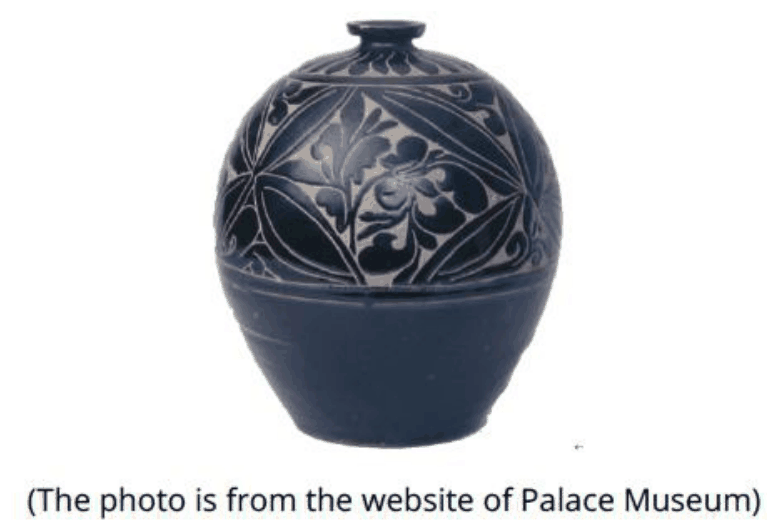
(The photo is from the website of Palace Museum)
Black glazed porcelain is a special Chinese porcelain and was popular in the Tang and Song dynasties (ca. 1000 years ago). The ceramic ware contained iron oxides as the main color rendering agent, which was mixed with other transition metal oxides to exhibit different color appearance such as auburn, dark brown or black. Currently, the black glazed porcelain is still popular in China.
The typical black glaze is composed of Fe-containing oxides with a spinel structure. Spinel oxides have the general formula \(\ce{AB2O4}\) and the structure consists of a cubic close packing array of \(\ce{O^{2-}}\) ions in which the A cations occupy one-eighth of the tetrahedral vacancies and the B cations occupy half of the octahedral vacancies, as shown in Figure 2.1(a) for a unit cell.
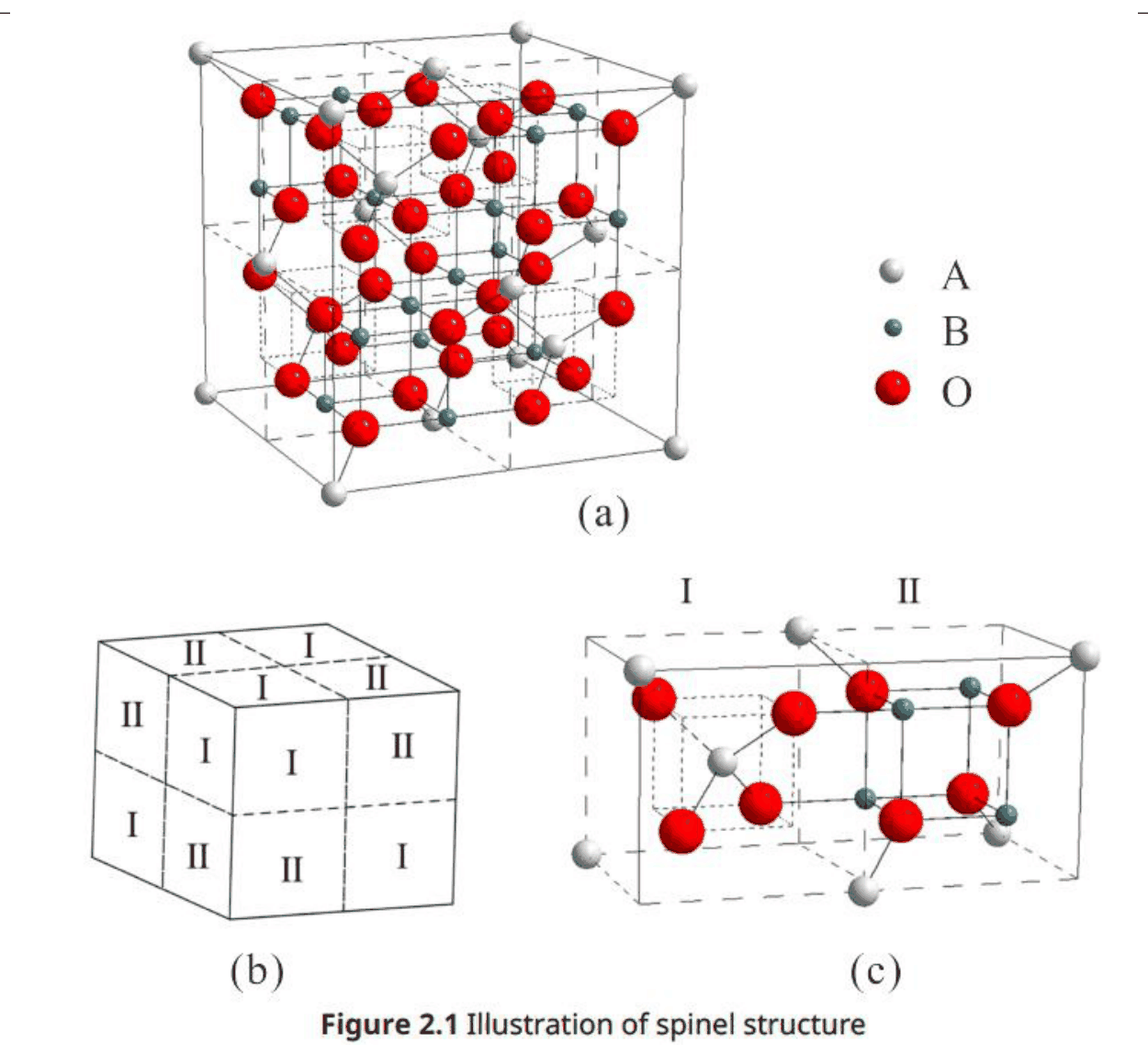
Figure 2.1 Illustration of spinel structure
The cubic unit cell of a spinel structure can be divided into 8 cubic subunits, and the dashed lines represent the internal edges of the subunits. 4 of the subunits belong to type I, and the other 4 subunits are type II (Figure 2.1(b)). The details of adjacent subunits of type I and type II are shown in Figure 2.1(c).
2.1 How many cations of type A and B are there in a unit cell?
The black ceramic glaze with spinel structure can be produced by roasting \(\ce{Fe2O3}\) and \(\ce{Cr2O3}\) in a certain proportion in a reducing atmosphere (reaction (I)). When \(\ce{Fe2O3}\) and \(\ce{Cr2O3}\) are reacted with the mass ratio of 63.6 : 36.4, they completely transform into a pure stoichiometric compound. The product has a spinel structure, in which the tetrahedral A sites are occupied by iron cations only.
2.2 In reaction (I), which element is reduced?
2.3 Calculate the numbers of \(\ce{Fe^{3+}}\) and \(\ce{Cr^{3+}}\) in the B sites of one unit cell.
Besides doping in black ceramic glaze, chromium-containing pigments are used in painting and printing due to the abundant color originating from chromium with different oxidation states, such as +2, +3 and +6. The pigment, chrome green (\(\ce{Cr2O3}\)) can be converted into a series of other compounds (D-G) in the following process, where E, F, G are yellow, orange and red respectively.
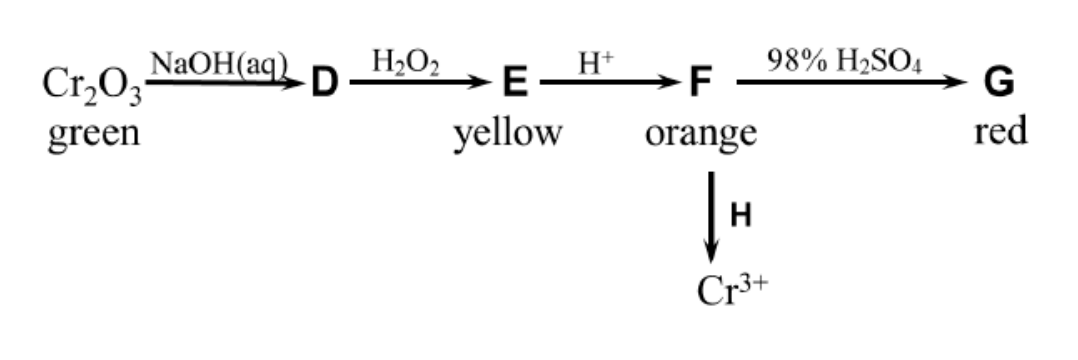
2.4 Write the chemical formula of E.
2.5 Write the reaction equation of F \(\rightarrow\) G.
2.6 Choose the agent which could be H.
(A) \(\ce{FeSO4}\)
(B) \(\ce{FeCl3}\)
(C) \(\ce{ZnSO4}\)
(D) \(\ce{CuSO4}\)
The variable valence of chromium is not only important for the production of pigments, but also useful for catalysis. For example, a typical Phillips catalyst for the polymerization of ethylene consists of chromium oxide species grafted onto a porous support material such as amorphous silica. The tetracoordinated Cr(VI) specie is the core in the pre-catalyst (1), which is proposed to be reduced quickly into a six-coordinated Cr(II) species (2) by the ethylene molecules at the beginning. 2 is proposed to further catalyze polymerization of ethylene molecules.
2.7 The reaction of 1 with ethylene can be traced by UV–vis spectra, which show the light absorption of 1 at \(21500\ \mathrm{cm^{-1}}\) and the light absorption of 2 at \(16700\ \mathrm{cm^{-1}}\) in the visible region, respectively. Choose the appropriate combination of colors of 1 and 2.
(A) orange and white, respectively
(B) orange and blue, respectively
(C) blue and orange, respectively
(D) blue and white, respectively
2.8 Assuming that the Cr(II) ion in 2 is located in a regular octahedral crystal field with a splitting energy \(\Delta_{\mathrm{o}}\) of \(16000\ \mathrm{cm^{-1}}\), draw the configurations of d electrons of the Cr(II) ion in 2, and calculate the crystal field stabilization energy (CFSE) for the Cr(II) ion in 2. (Note: The pairing energy \(P\) for Cr(II) in 2 is \(23500\ \mathrm{cm^{-1}}\).)
2.9 Coordination compounds/ions exhibit paramagnetism when containing unpaired electrons, and the corresponding magnetic moment (\(\mu\)) of transition metal cations is calculated by the function \(\mu=\sqrt{n(n+2)}\mu_B\) where \(n\) is the number of unpaired electrons. Calculate the magnetic moment in term of \(\mu_B\) for the Cr(II) ion in 2.
Official English text of the problem.
Answers
- 2.1: 8 A cations and 16 B cations per unit cell.
- 2.2: Iron, reduced from \(\ce{Fe^{3+}}\) to \(\ce{Fe^{2+}}\).
- 2.3: 7 \(\ce{Fe^{3+}}\) and 9 \(\ce{Cr^{3+}}\) ions in the B sites, using the normal-spinel assignment.
- 2.4: Sodium chromate, \(\ce{Na2CrO4}\); its yellow ion is chromate, \(\ce{CrO4^{2-}}\).
- 2.5: \(\boxed{\ce{Na2Cr2O7 + H2SO4 -> 2CrO3(s) + Na2SO4 + H2O}}\), using 98% sulfuric acid. G is chromium(VI) oxide.
- 2.6: (A) \(\ce{FeSO4}\), iron(II) sulfate.
- 2.7: (B): 1 is orange; 2 is blue.
- 2.8: High-spin \(d^4\), \(t_{2g}^{3}e_g^{1}\), with four unpaired electrons. \(\boxed{\mathrm{CFSE}=-9600\ \mathrm{cm^{-1}}}\), corresponding to a stabilization magnitude of \(9600\ \mathrm{cm^{-1}}\).
- 2.9: \(\boxed{\mu=\sqrt{24}\,\mu_B\approx4.90\,\mu_B}\).
Names, SMILES, and structural qualifications are supplied with the identifications below.
Solution
2.1 — Cation counts
The conventional spinel cell contains eight subunits of the cubic close-packed oxide array. Each accounts for four oxide ions, giving
\[ N_{\mathrm O}=8\times4=32. \]
The oxide ion is \(\ce{O^{2-}}\), SMILES [O-2].
A close-packed array containing \(N\) anions has \(2N\) tetrahedral holes and \(N\) octahedral holes. Therefore,
\[ N_A=\frac18(2\times32)=\boxed{8}, \qquad N_B=\frac12(32)=\boxed{16}. \]
Thus the cell contains eight \(\ce{AB2O4}\) formula units. Spinel is an extended crystal; a molecular SMILES cannot represent its periodic unit-cell geometry.
2.2 — Element reduced
Initially, both metals have oxidation state \(+3\) in \(\ce{Fe2O3}\) and \(\ce{Cr2O3}\).
For the normal-spinel assignment intended here, the B-site ions are trivalent. Charge neutrality of \(\ce{AB2O4}\) then requires
\[ q_A+2(+3)+4(-2)=0, \]
so \(q_A=+2\). Because the A sites contain only iron, iron must undergo reduction:
\[ \boxed{\ce{Fe^{3+} + e- -> Fe^{2+}}}. \]
The species are the iron(III) ion, [Fe+3], and the iron(II) ion, [Fe+2].
2.3 — Iron(III) and chromium(III) in the B sites
Take a \(100.0\ \mathrm g\) mixture. Using approximate molar masses
\[ M(\ce{Fe2O3})=159.7\ \mathrm{g\,mol^{-1}}, \qquad M(\ce{Cr2O3})=152.0\ \mathrm{g\,mol^{-1}}, \]
the amounts of metal atoms are
\[ n(\ce{Fe}) =2\frac{63.6\ \mathrm g}{159.7\ \mathrm{g\,mol^{-1}}} \approx0.796\ \mathrm{mol}, \]
\[ n(\ce{Cr}) =2\frac{36.4\ \mathrm g}{152.0\ \mathrm{g\,mol^{-1}}} \approx0.479\ \mathrm{mol}. \]
Hence,
\[ n(\ce{Fe}):n(\ce{Cr})\approx1.66:1\approx5:3. \]
There are \(8+16=24\) metal ions per unit cell, so the corresponding integer populations are
\[ N_{\mathrm{Fe}}=24\frac58=15, \qquad N_{\mathrm{Cr}}=24\frac38=9. \]
All nine chromium ions must occupy B sites because A sites contain only iron. Chromium remains trivalent: the chromium(III) ion has SMILES [Cr+3].
Under the normal-spinel assignment, the eight A-site ions are \(\ce{Fe^{2+}}\). The remaining seven iron ions occupy B sites as \(\ce{Fe^{3+}}\):
\[ \boxed{N_B(\ce{Fe^{3+}})=15-8=7}, \qquad \boxed{N_B(\ce{Cr^{3+}})=9}. \]
Both the site count and charge balance agree:
\[ 7+9=16, \]
\[ 8(+2)+7(+3)+9(+3)+32(-2)=0. \]
2.4 — Identification of E
Hydrogen peroxide, \(\ce{H2O2}\), SMILES OO, oxidizes chromium(III) to chromium(VI) in alkaline solution. The yellow chromium(VI) species is the chromate ion:
\[ \boxed{\ce{CrO4^{2-}}}, \]
SMILES [O-][Cr](=O)(=O)[O-].
Because the solution contains sodium ions from sodium hydroxide, E is sodium chromate:
\[ \boxed{\ce{Na2CrO4}}, \]
SMILES [Na+].[Na+].[O-][Cr](=O)(=O)[O-].
Chromate has tetrahedral coordination around chromium. The SMILES gives a formal bonding representation; it does not explicitly show the tetrahedral geometry or the delocalization of bonding among the oxygen atoms.
2.5 — Conversion of F into G
Acidification shifts chromate toward the orange dichromate ion, \(\ce{Cr2O7^{2-}}\):
\[ \ce{2CrO4^{2-} + 2H+ <=> Cr2O7^{2-} + H2O}. \]
Dichromate has SMILES [O-][Cr](=O)(=O)O[Cr](=O)(=O)[O-]; structurally, it contains two chromium–oxygen tetrahedra sharing one oxygen atom.
Thus F is sodium dichromate, \(\ce{Na2Cr2O7}\), SMILES [Na+].[Na+].[O-][Cr](=O)(=O)O[Cr](=O)(=O)[O-].
Treatment with 98% sulfuric acid produces red chromium(VI) oxide, also called chromium trioxide, \(\ce{CrO3}\):
\[ \boxed{\ce{Na2Cr2O7 + H2SO4 -> 2CrO3(s) + Na2SO4 + H2O}}. \]
The corresponding net ionic equation is
\[ \boxed{\ce{Cr2O7^{2-} + 2H+ -> 2CrO3(s) + H2O}}. \]
Chromium remains in oxidation state \(+6\). Concentrated sulfuric acid promotes formation of the oxide through acidification and dehydration.
A formula-unit SMILES for chromium trioxide is O=[Cr](=O)=O. This representation does not show the polymeric solid structure, which contains linked chromium–oxygen tetrahedra.
The other species in these equations are:
- Sulfuric acid, \(\ce{H2SO4}\):
OS(=O)(=O)O. - Sodium sulfate, \(\ce{Na2SO4}\):
[Na+].[Na+].[O-]S(=O)(=O)[O-]. - Hydrogen ion, \(\ce{H+}\):
[H+]. - Water, \(\ce{H2O}\):
O.
2.6 — Identification of H
Dichromate must be reduced from chromium(VI) to chromium(III). Iron(II) supplies electrons by being oxidized to iron(III), so the suitable reagent is iron(II) sulfate, \(\ce{FeSO4}\), SMILES [Fe+2].[O-]S(=O)(=O)[O-].
Each of the two chromium atoms gains three electrons, requiring six iron(II) ions:
\[ \boxed{\ce{Cr2O7^{2-} + 14H+ + 6Fe^{2+} -> 2Cr^{3+} + 7H2O + 6Fe^{3+}}}. \]
Therefore,
\[ \boxed{\text{H is option (A), }\ce{FeSO4}}. \]
2.7 — Colors of 1 and 2
Wavelength and wavenumber are related by
\[ \lambda(\mathrm{nm}) =\frac{10^7}{\widetilde{\nu}(\mathrm{cm^{-1}})}. \]
For 1,
\[ \lambda_1=\frac{10^7}{21500}\ \mathrm{nm} \approx465\ \mathrm{nm}. \]
This lies in the blue region. Absorption of blue light gives the complementary observed color, orange.
For 2,
\[ \lambda_2=\frac{10^7}{16700}\ \mathrm{nm} \approx599\ \mathrm{nm}. \]
This lies in the orange region, giving the complementary observed color, blue.
Thus,
\[ \boxed{\text{Option (B): 1 is orange and 2 is blue.}} \]
2.8 — Electron configuration and CFSE
The chromium(II) ion, \(\ce{Cr^{2+}}\), SMILES [Cr+2], has a \(3d^4\) electron configuration. This SMILES represents the metal ion alone; the stipulated octahedral coordination must be specified separately because the ligands of the supported site are not given.
In an octahedral field:
\[ E(t_{2g})=-0.4\Delta_{\mathrm o}, \qquad E(e_g)=+0.6\Delta_{\mathrm o}. \]
Since
\[ \Delta_{\mathrm o}=16000\ \mathrm{cm^{-1}} < P=23500\ \mathrm{cm^{-1}}, \]
placing the fourth electron in an \(e_g\) orbital costs less energy than pairing it in a \(t_{2g}\) orbital. The configuration is therefore high-spin:
\[ \boxed{t_{2g}^{3}e_g^{1}}. \]
For the requested drawing: draw three degenerate lower \(t_{2g}\) orbitals, each containing one electron with the same spin. Above them, draw two degenerate \(e_g\) orbitals, with one containing a single electron of that same spin and the other empty. The separation between the levels is \(\Delta_{\mathrm o}\).
There are no electron pairs, so
\[ \begin{aligned} \mathrm{CFSE} &=3(-0.4\Delta_{\mathrm o})+1(+0.6\Delta_{\mathrm o})\\ &=-0.6\Delta_{\mathrm o}\\ &=-0.6(16000\ \mathrm{cm^{-1}}). \end{aligned} \]
Thus,
\[ \boxed{\mathrm{CFSE}=-9600\ \mathrm{cm^{-1}}}. \]
The stabilization magnitude is \(9600\ \mathrm{cm^{-1}}\).
As a check, the alternative low-spin configuration \(t_{2g}^{4}\) would have one electron pair and total energy
\[ -1.6\Delta_{\mathrm o}+P =-25600+23500 =-2100\ \mathrm{cm^{-1}}, \]
which is higher than the high-spin energy by \(7500\ \mathrm{cm^{-1}}\).
2.9 — Magnetic moment
The high-spin \(t_{2g}^{3}e_g^{1}\) configuration has four unpaired electrons. Substitution into the supplied expression gives
\[ \mu=\sqrt{n(n+2)}\,\mu_B =\sqrt{4(4+2)}\,\mu_B =\sqrt{24}\,\mu_B. \]
Therefore,
\[ \boxed{\mu\approx4.90\,\mu_B}. \]
The solution was checked against the official solution.
IChO 2022 · Theorieaufgabe 2
Chrom in alter und neuer Zeit
(Das Foto stammt von der Website des Palastmuseums)
Schwarz glasiertes Porzellan ist eine besondere chinesische Porzellanart und war während der Tang- und Song-Dynastien (vor ca. 1000 Jahren) beliebt. Die Keramikwaren enthielten Eisenoxide als hauptsächliche Farbgeber, die mit anderen Übergangsmetalloxiden gemischt wurden, um verschiedene Farbtöne wie Rotbraun, Dunkelbraun oder Schwarz zu erzeugen. Auch heute ist schwarz glasiertes Porzellan in China noch beliebt.
Die typische schwarze Glasur besteht aus Fe-haltigen Oxiden mit Spinellstruktur. Spinelloxide haben die allgemeine Formel \(\ce{AB2O4}\), und ihre Struktur besteht aus einer kubisch dichtesten Packung von \(\ce{O^{2-}}\)-Ionen, in der die A-Kationen ein Achtel der Tetraederlücken und die B-Kationen die Hälfte der Oktaederlücken besetzen, wie in Abbildung 2.1(a) für eine Elementarzelle gezeigt.
Abbildung 2.1 Darstellung der Spinellstruktur
Die kubische Elementarzelle einer Spinellstruktur lässt sich in 8 kubische Untereinheiten unterteilen; die gestrichelten Linien stellen die innen liegenden Kanten der Untereinheiten dar. 4 der Untereinheiten gehören zum Typ I, die anderen 4 Untereinheiten zum Typ II (Abbildung 2.1(b)). Einzelheiten benachbarter Untereinheiten vom Typ I und Typ II sind in Abbildung 2.1(c) dargestellt.
2.1 Wie viele Kationen vom Typ A und B befinden sich in einer Elementarzelle?
Die schwarze Keramikglasur mit Spinellstruktur kann durch Glühen von \(\ce{Fe2O3}\) und \(\ce{Cr2O3}\) in einem bestimmten Verhältnis in einer reduzierenden Atmosphäre hergestellt werden (Reaktion (I)). Werden \(\ce{Fe2O3}\) und \(\ce{Cr2O3}\) im Massenverhältnis 63.6 : 36.4 umgesetzt, wandeln sie sich vollständig in eine reine stöchiometrische Verbindung um. Das Produkt besitzt eine Spinellstruktur, in der die tetraedrischen A-Plätze ausschließlich mit Eisenkationen besetzt sind.
2.2 Welches Element wird in Reaktion (I) reduziert?
2.3 Berechnen Sie die Anzahl der \(\ce{Fe^{3+}}\)- und \(\ce{Cr^{3+}}\)-Ionen auf den B-Plätzen einer Elementarzelle.
Neben ihrer Verwendung zur Dotierung schwarzer Keramikglasuren werden chromhaltige Pigmente aufgrund der vielfältigen Farben, die Chrom in verschiedenen Oxidationsstufen wie +2, +3 und +6 hervorbringt, in der Malerei und im Druck eingesetzt. Das Pigment Chromoxidgrün (\(\ce{Cr2O3}\)) lässt sich im folgenden Verfahren in eine Reihe weiterer Verbindungen (D-G) umwandeln, wobei E, F und G gelb, orange bzw. rot sind.
2.4 Geben Sie die chemische Formel von E an.
2.5 Geben Sie die Reaktionsgleichung für F \(\rightarrow\) G an.
2.6 Wählen Sie das Reagenz aus, das H sein könnte.
(A) \(\ce{FeSO4}\)
(B) \(\ce{FeCl3}\)
(C) \(\ce{ZnSO4}\)
(D) \(\ce{CuSO4}\)
Die wechselnden Oxidationsstufen des Chroms sind nicht nur für die Herstellung von Pigmenten wichtig, sondern auch für die Katalyse nützlich. Beispielsweise besteht ein typischer Phillips-Katalysator für die Polymerisation von Ethylen aus Chromoxidspezies, die auf einem porösen Trägermaterial wie amorphem Siliciumdioxid verankert sind. Die vierfach koordinierte Cr(VI)-Spezies bildet den Kern des Präkatalysators (1); es wird angenommen, dass sie zu Beginn durch die Ethylenmoleküle rasch zu einer sechsfach koordinierten Cr(II)-Spezies (2) reduziert wird. Es wird angenommen, dass 2 anschließend die Polymerisation der Ethylenmoleküle katalysiert.
2.7 Die Reaktion von 1 mit Ethylen kann mithilfe von UV–Vis-Spektren verfolgt werden, die im sichtbaren Bereich die Lichtabsorption von 1 bei \(21500\ \mathrm{cm^{-1}}\) und die Lichtabsorption von 2 bei \(16700\ \mathrm{cm^{-1}}\) zeigen. Wählen Sie die zutreffende Kombination der Farben von 1 und 2 aus.
(A) orange bzw. weiß
(B) orange bzw. blau
(C) blau bzw. orange
(D) blau bzw. weiß
2.8 Unter der Annahme, dass sich das Cr(II)-Ion in 2 in einem regulären oktaedrischen Kristallfeld mit einer Aufspaltungsenergie \(\Delta_{\mathrm{o}}\) von \(16000\ \mathrm{cm^{-1}}\) befindet, zeichnen Sie die Konfigurationen der d-Elektronen des Cr(II)-Ions in 2 und berechnen Sie die Kristallfeldstabilisierungsenergie (CFSE) für das Cr(II)-Ion in 2. (Hinweis: Die Paarungsenergie \(P\) für Cr(II) in 2 beträgt \(23500\ \mathrm{cm^{-1}}\).)
2.9 Koordinationsverbindungen/-ionen zeigen Paramagnetismus, wenn sie ungepaarte Elektronen enthalten; das entsprechende magnetische Moment (\(\mu\)) von Übergangsmetallkationen wird mithilfe der Funktion \(\mu=\sqrt{n(n+2)}\mu_B\) berechnet, wobei \(n\) die Anzahl der ungepaarten Elektronen ist. Berechnen Sie das magnetische Moment des Cr(II)-Ions in 2 in Einheiten von \(\mu_B\).
Aufgabentext aus dem offiziellen englischen Text übersetzt.
Antworten
- 2.1: 8 A-Kationen und 16 B-Kationen pro Elementarzelle.
- 2.2: Eisen, das von \(\ce{Fe^{3+}}\) zu \(\ce{Fe^{2+}}\) reduziert wird.
- 2.3: 7 \(\ce{Fe^{3+}}\)- und 9 \(\ce{Cr^{3+}}\)-Ionen auf den B-Plätzen bei Annahme einer normalen Spinellstruktur.
- 2.4: Natriumchromat, \(\ce{Na2CrO4}\); sein gelbes Ion ist das Chromat-Ion, \(\ce{CrO4^{2-}}\).
- 2.5: \(\boxed{\ce{Na2Cr2O7 + H2SO4 -> 2CrO3(s) + Na2SO4 + H2O}}\), unter Verwendung von 98%iger Schwefelsäure. G ist Chrom(VI)-oxid.
- 2.6: (A) \(\ce{FeSO4}\), Eisen(II)-sulfat.
- 2.7: (B): 1 ist orange; 2 ist blau.
- 2.8: High-Spin-\(d^4\), \(t_{2g}^{3}e_g^{1}\), mit vier ungepaarten Elektronen. \(\boxed{\mathrm{CFSE}=-9600\ \mathrm{cm^{-1}}}\), entsprechend einem Stabilisierungsbetrag von \(9600\ \mathrm{cm^{-1}}\).
- 2.9: \(\boxed{\mu=\sqrt{24}\,\mu_B\approx4.90\,\mu_B}\).
Namen, SMILES und Erläuterungen zur Struktur werden nachstehend bei den jeweiligen Identifizierungen angegeben.
Lösung
2.1 — Anzahl der Kationen
Die konventionelle Spinellzelle enthält acht Untereinheiten der kubisch dichtesten Oxidionenpackung. Auf jede entfallen vier Oxidionen, sodass sich ergibt:
\[ N_{\mathrm O}=8\times4=32. \]
Das Oxid-Ion ist \(\ce{O^{2-}}\), SMILES [O-2].
Eine dichteste Packung mit \(N\) Anionen besitzt \(2N\) Tetraederlücken und \(N\) Oktaederlücken. Daher gilt:
\[ N_A=\frac18(2\times32)=\boxed{8}, \qquad N_B=\frac12(32)=\boxed{16}. \]
Die Zelle enthält somit acht \(\ce{AB2O4}\)-Formeleinheiten. Spinell bildet einen ausgedehnten Kristall; eine molekulare SMILES-Darstellung kann die periodische Geometrie seiner Elementarzelle nicht wiedergeben.
2.2 — Reduziertes Element
Anfangs haben beide Metalle in \(\ce{Fe2O3}\) und \(\ce{Cr2O3}\) die Oxidationsstufe \(+3\).
Bei der hier vorgesehenen Zuordnung zu einer normalen Spinellstruktur sind die Ionen auf den B-Plätzen dreiwertig. Die Ladungsneutralität von \(\ce{AB2O4}\) erfordert dann:
\[ q_A+2(+3)+4(-2)=0, \]
also \(q_A=+2\). Da die A-Plätze ausschließlich Eisen enthalten, muss Eisen reduziert werden:
\[ \boxed{\ce{Fe^{3+} + e- -> Fe^{2+}}}. \]
Die Spezies sind das Eisen(III)-Ion, [Fe+3], und das Eisen(II)-Ion, [Fe+2].
2.3 — Eisen(III) und Chrom(III) auf den B-Plätzen
Betrachtet wird eine Mischung von \(100.0\ \mathrm g\). Unter Verwendung der ungefähren molaren Massen
\[ M(\ce{Fe2O3})=159.7\ \mathrm{g\,mol^{-1}}, \qquad M(\ce{Cr2O3})=152.0\ \mathrm{g\,mol^{-1}}, \]
ergeben sich für die Stoffmengen der Metallatome:
\[ n(\ce{Fe}) =2\frac{63.6\ \mathrm g}{159.7\ \mathrm{g\,mol^{-1}}} \approx0.796\ \mathrm{mol}, \]
\[ n(\ce{Cr}) =2\frac{36.4\ \mathrm g}{152.0\ \mathrm{g\,mol^{-1}}} \approx0.479\ \mathrm{mol}. \]
Somit gilt:
\[ n(\ce{Fe}):n(\ce{Cr})\approx1.66:1\approx5:3. \]
Pro Elementarzelle gibt es \(8+16=24\) Metallionen, sodass die entsprechenden ganzzahligen Besetzungszahlen lauten:
\[ N_{\mathrm{Fe}}=24\frac58=15, \qquad N_{\mathrm{Cr}}=24\frac38=9. \]
Alle neun Chromionen müssen B-Plätze besetzen, da die A-Plätze ausschließlich Eisen enthalten. Chrom bleibt dreiwertig: Das Chrom(III)-Ion hat die SMILES-Darstellung [Cr+3].
Bei Annahme einer normalen Spinellstruktur sind die acht Ionen auf den A-Plätzen \(\ce{Fe^{2+}}\). Die übrigen sieben Eisenionen besetzen als \(\ce{Fe^{3+}}\) die B-Plätze:
\[ \boxed{N_B(\ce{Fe^{3+}})=15-8=7}, \qquad \boxed{N_B(\ce{Cr^{3+}})=9}. \]
Sowohl die Anzahl der Plätze als auch die Ladungsbilanz stimmen überein:
\[ 7+9=16, \]
\[ 8(+2)+7(+3)+9(+3)+32(-2)=0. \]
2.4 — Identifizierung von E
Wasserstoffperoxid, \(\ce{H2O2}\), SMILES OO, oxidiert Chrom(III) in alkalischer Lösung zu Chrom(VI). Die gelbe Chrom(VI)-Spezies ist das Chromat-Ion:
\[ \boxed{\ce{CrO4^{2-}}}, \]
SMILES [O-][Cr](=O)(=O)[O-].
Da die Lösung Natriumionen aus dem Natriumhydroxid enthält, ist E Natriumchromat:
\[ \boxed{\ce{Na2CrO4}}, \]
SMILES [Na+].[Na+].[O-][Cr](=O)(=O)[O-].
Im Chromat ist Chrom tetraedrisch koordiniert. Die SMILES-Darstellung gibt eine formale Bindungsdarstellung wieder; sie zeigt weder die tetraedrische Geometrie noch die Delokalisierung der Bindungen über die Sauerstoffatome explizit.
2.5 — Umwandlung von F in G
Ansäuern verschiebt das Gleichgewicht vom Chromat zum orangefarbenen Dichromat-Ion, \(\ce{Cr2O7^{2-}}\):
\[ \ce{2CrO4^{2-} + 2H+ <=> Cr2O7^{2-} + H2O}. \]
Dichromat hat die SMILES-Darstellung [O-][Cr](=O)(=O)O[Cr](=O)(=O)[O-]; strukturell enthält es zwei Chrom–Sauerstoff-Tetraeder, die ein Sauerstoffatom gemeinsam haben.
Somit ist F Natriumdichromat, \(\ce{Na2Cr2O7}\), SMILES [Na+].[Na+].[O-][Cr](=O)(=O)O[Cr](=O)(=O)[O-].
Die Behandlung mit 98%iger Schwefelsäure liefert rotes Chrom(VI)-oxid, auch Chromtrioxid genannt, \(\ce{CrO3}\):
\[ \boxed{\ce{Na2Cr2O7 + H2SO4 -> 2CrO3(s) + Na2SO4 + H2O}}. \]
Die entsprechende Netto-Ionengleichung lautet:
\[ \boxed{\ce{Cr2O7^{2-} + 2H+ -> 2CrO3(s) + H2O}}. \]
Chrom bleibt in der Oxidationsstufe \(+6\). Konzentrierte Schwefelsäure fördert die Bildung des Oxids durch Ansäuern und Wasserentzug.
Eine SMILES-Darstellung der Formeleinheit von Chromtrioxid lautet O=[Cr](=O)=O. Diese Darstellung zeigt nicht die polymere Festkörperstruktur, die verknüpfte Chrom–Sauerstoff-Tetraeder enthält.
Die weiteren Spezies in diesen Gleichungen sind:
- Schwefelsäure, \(\ce{H2SO4}\):
OS(=O)(=O)O. - Natriumsulfat, \(\ce{Na2SO4}\):
[Na+].[Na+].[O-]S(=O)(=O)[O-]. - Wasserstoff-Ion, \(\ce{H+}\):
[H+]. - Wasser, \(\ce{H2O}\):
O.
2.6 — Identifizierung von H
Im Dichromat muss Chrom(VI) zu Chrom(III) reduziert werden. Eisen(II) liefert Elektronen, indem es zu Eisen(III) oxidiert wird; das geeignete Reagenz ist daher Eisen(II)-sulfat, \(\ce{FeSO4}\), SMILES [Fe+2].[O-]S(=O)(=O)[O-].
Jedes der beiden Chromatome nimmt drei Elektronen auf, wofür sechs Eisen(II)-Ionen benötigt werden:
\[ \boxed{\ce{Cr2O7^{2-} + 14H+ + 6Fe^{2+} -> 2Cr^{3+} + 7H2O + 6Fe^{3+}}}. \]
Daher gilt:
\[ \boxed{\text{H ist Option (A), }\ce{FeSO4}}. \]
2.7 — Farben von 1 und 2
Wellenlänge und Wellenzahl hängen wie folgt zusammen:
\[ \lambda(\mathrm{nm}) =\frac{10^7}{\widetilde{\nu}(\mathrm{cm^{-1}})}. \]
Für 1 gilt:
\[ \lambda_1=\frac{10^7}{21500}\ \mathrm{nm} \approx465\ \mathrm{nm}. \]
Dies liegt im blauen Bereich. Die Absorption von blauem Licht führt zur beobachteten Komplementärfarbe Orange.
Für 2 gilt:
\[ \lambda_2=\frac{10^7}{16700}\ \mathrm{nm} \approx599\ \mathrm{nm}. \]
Dies liegt im orangefarbenen Bereich und führt zur beobachteten Komplementärfarbe Blau.
Somit gilt:
\[ \boxed{\text{Option (B): 1 ist orange und 2 ist blau.}} \]
2.8 — Elektronenkonfiguration und CFSE
Das Chrom(II)-Ion, \(\ce{Cr^{2+}}\), SMILES [Cr+2], hat eine \(3d^4\)-Elektronenkonfiguration. Diese SMILES-Darstellung repräsentiert nur das Metallion; die vorgegebene oktaedrische Koordination muss gesondert angegeben werden, da die Liganden des auf dem Träger befindlichen Zentrums nicht angegeben sind.
In einem oktaedrischen Feld gilt:
\[ E(t_{2g})=-0.4\Delta_{\mathrm o}, \qquad E(e_g)=+0.6\Delta_{\mathrm o}. \]
Da
\[ \Delta_{\mathrm o}=16000\ \mathrm{cm^{-1}} < P=23500\ \mathrm{cm^{-1}}, \]
erfordert die Besetzung eines \(e_g\)-Orbitals mit dem vierten Elektron weniger Energie als seine Paarung in einem \(t_{2g}\)-Orbital. Daher liegt eine High-Spin-Konfiguration vor:
\[ \boxed{t_{2g}^{3}e_g^{1}}. \]
Für die geforderte Zeichnung: Zeichnen Sie drei entartete, energetisch tiefer liegende \(t_{2g}\)-Orbitale, die jeweils ein Elektron mit gleichem Spin enthalten. Zeichnen Sie darüber zwei entartete \(e_g\)-Orbitale, von denen eines ein einzelnes Elektron mit demselben Spin enthält und das andere leer ist. Der Abstand zwischen den Energieniveaus beträgt \(\Delta_{\mathrm o}\).
Es gibt keine Elektronenpaare, daher gilt:
\[ \begin{aligned} \mathrm{CFSE} &=3(-0.4\Delta_{\mathrm o})+1(+0.6\Delta_{\mathrm o})\\ &=-0.6\Delta_{\mathrm o}\\ &=-0.6(16000\ \mathrm{cm^{-1}}). \end{aligned} \]
Somit gilt:
\[ \boxed{\mathrm{CFSE}=-9600\ \mathrm{cm^{-1}}}. \]
Der Stabilisierungsbetrag beträgt \(9600\ \mathrm{cm^{-1}}\).
Zur Kontrolle: Die alternative Low-Spin-Konfiguration \(t_{2g}^{4}\) hätte ein Elektronenpaar und die Gesamtenergie
\[ -1.6\Delta_{\mathrm o}+P =-25600+23500 =-2100\ \mathrm{cm^{-1}}, \]
die um \(7500\ \mathrm{cm^{-1}}\) höher liegt als die Energie der High-Spin-Konfiguration.
2.9 — Magnetisches Moment
Die High-Spin-Konfiguration \(t_{2g}^{3}e_g^{1}\) besitzt vier ungepaarte Elektronen. Einsetzen in den angegebenen Ausdruck ergibt:
\[ \mu=\sqrt{n(n+2)}\,\mu_B =\sqrt{4(4+2)}\,\mu_B =\sqrt{24}\,\mu_B. \]
Daher gilt:
\[ \boxed{\mu\approx4.90\,\mu_B}. \]
Die Lösung wurde mit der offiziellen Lösung abgeglichen.
IChO 2022 · Teori sorusu 2
Eski Çağlarda ve Günümüzde Krom
(Fotoğraf Saray Müzesi'nin web sitesinden alınmıştır)
Siyah sırlı porselen, Çin'e özgü özel bir porselen türüdür ve Tang ve Song hanedanları dönemlerinde (yaklaşık 1000 yıl önce) yaygın olarak kullanılmıştır. Bu seramik eşyalarda başlıca renk verici madde olarak demir oksitler bulunuyordu; bunlar, kızıl kahverengi, koyu kahverengi veya siyah gibi farklı renkler elde etmek için diğer geçiş metali oksitleriyle karıştırılıyordu. Siyah sırlı porselen günümüzde de Çin'de yaygın olarak kullanılmaktadır.
Tipik siyah sır, spinel yapısına sahip Fe içeren oksitlerden oluşur. Spinel oksitlerin genel formülü \(\ce{AB2O4}\) olup yapıları, bir birim hücre için Şekil 2.1(a)'da gösterildiği gibi, A katyonlarının tetrahedral boşlukların sekizde birini, B katyonlarının ise oktahedral boşlukların yarısını doldurduğu, \(\ce{O^{2-}}\) iyonlarından oluşan kübik sıkı paketlenmiş bir dizilimden meydana gelir.
Şekil 2.1 Spinel yapısının gösterimi
Spinel yapısının kübik birim hücresi 8 kübik alt birime ayrılabilir; kesikli çizgiler alt birimlerin iç kenarlarını göstermektedir. Alt birimlerin 4'ü tip I, diğer 4'ü ise tip II'dir (Şekil 2.1(b)). Birbirine komşu tip I ve tip II alt birimlerin ayrıntıları Şekil 2.1(c)'de gösterilmiştir.
2.1 Bir birim hücrede A ve B türlerinden kaçar katyon vardır?
Spinel yapısına sahip siyah seramik sır, \(\ce{Fe2O3}\) ve \(\ce{Cr2O3}\)'ün belirli bir oranda, indirgen bir atmosferde kavrulmasıyla üretilebilir (tepkime (I)). \(\ce{Fe2O3}\) ve \(\ce{Cr2O3}\), 63.6 : 36.4 kütle oranında tepkimeye sokulduğunda tamamen saf, stokiyometrik bir bileşiğe dönüşür. Ürün, tetrahedral A konumlarının yalnızca demir katyonları tarafından doldurulduğu bir spinel yapısına sahiptir.
2.2 Tepkime (I)'de hangi element indirgenir?
2.3 Bir birim hücrenin B konumlarındaki \(\ce{Fe^{3+}}\) ve \(\ce{Cr^{3+}}\) sayılarını hesaplayınız.
Krom içeren pigmentler, siyah seramik sıra katkı olarak eklenmelerinin yanı sıra, kromun +2, +3 ve +6 gibi farklı yükseltgenme basamaklarından kaynaklanan renk çeşitliliği nedeniyle resim ve baskıda da kullanılır. Krom yeşili (\(\ce{Cr2O3}\)) pigmenti, aşağıdaki süreçte bir dizi başka bileşiğe (D-G) dönüştürülebilir; burada E, F ve G sırasıyla sarı, turuncu ve kırmızıdır.
2.4 E'nin kimyasal formülünü yazınız.
2.5 F \(\rightarrow\) G dönüşümünün tepkime denklemini yazınız.
2.6 H olabilecek reaktifi seçiniz.
(A) \(\ce{FeSO4}\)
(B) \(\ce{FeCl3}\)
(C) \(\ce{ZnSO4}\)
(D) \(\ce{CuSO4}\)
Kromun değişken değerliği yalnızca pigment üretimi için önemli olmakla kalmaz, katalizde de yarar sağlar. Örneğin, etilenin polimerleşmesinde kullanılan tipik bir Phillips katalizörü, amorf silika gibi gözenekli bir destek malzemesine bağlanmış krom oksit türlerinden oluşur. Dört koordinasyonlu Cr(VI) türü, ön katalizörün (1) merkezini oluşturur; başlangıçta etilen molekülleri tarafından hızla altı koordinasyonlu bir Cr(II) türüne (2) indirgendiği öne sürülmektedir. Daha sonra 2'nin etilen moleküllerinin polimerleşmesini katalizlediği öne sürülmektedir.
2.7 1'in etilenle tepkimesi, görünür bölgede 1'in \(21500\ \mathrm{cm^{-1}}\)'de, 2'nin ise \(16700\ \mathrm{cm^{-1}}\)'de ışık soğurduğunu gösteren UV–vis spektrumlarıyla izlenebilir. 1 ve 2'nin renkleri için uygun bileşimi seçiniz.
(A) sırasıyla turuncu ve beyaz
(B) sırasıyla turuncu ve mavi
(C) sırasıyla mavi ve turuncu
(D) sırasıyla mavi ve beyaz
2.8 2'deki Cr(II) iyonunun, yarılma enerjisi \(\Delta_{\mathrm{o}}\) \(16000\ \mathrm{cm^{-1}}\) olan düzgün oktahedral bir kristal alanda bulunduğunu varsayarak, 2'deki Cr(II) iyonunun d elektronlarının yerleşimini çiziniz ve bu iyonun kristal alan kararlılık enerjisini (CFSE) hesaplayınız. (Not: 2'deki Cr(II) için eşleşme enerjisi \(P\), \(23500\ \mathrm{cm^{-1}}\)'dir.)
2.9 Koordinasyon bileşikleri/iyonları eşleşmemiş elektron içerdiklerinde paramanyetizma gösterir; geçiş metali katyonlarının buna karşılık gelen manyetik momenti (\(\mu\)), \(n\) eşleşmemiş elektron sayısı olmak üzere, \(\mu=\sqrt{n(n+2)}\mu_B\) bağıntısıyla hesaplanır. 2'deki Cr(II) iyonunun manyetik momentini \(\mu_B\) cinsinden hesaplayınız.
Soru metni resmi İngilizce metinden çevrilmiştir.
Cevaplar
- 2.1: Birim hücre başına 8 A katyonu ve 16 B katyonu.
- 2.2: \(\ce{Fe^{3+}}\)'ten \(\ce{Fe^{2+}}\)'ye indirgenen demir.
- 2.3: Normal spinel yerleşimine göre B konumlarında 7 \(\ce{Fe^{3+}}\) ve 9 \(\ce{Cr^{3+}}\) iyonu.
- 2.4: Sodyum kromat, \(\ce{Na2CrO4}\); sarı renkli iyonu kromattır, \(\ce{CrO4^{2-}}\).
- 2.5: %98'lik sülfürik asit kullanılarak \(\boxed{\ce{Na2Cr2O7 + H2SO4 -> 2CrO3(s) + Na2SO4 + H2O}}\). G, krom(VI) oksittir.
- 2.6: (A) \(\ce{FeSO4}\), demir(II) sülfat.
- 2.7: (B): 1 turuncudur; 2 mavidir.
- 2.8: Dört eşleşmemiş elektron içeren yüksek spinli \(d^4\), \(t_{2g}^{3}e_g^{1}\). \(\boxed{\mathrm{CFSE}=-9600\ \mathrm{cm^{-1}}}\); bu, \(9600\ \mathrm{cm^{-1}}\) büyüklüğünde bir kararlılık kazanımına karşılık gelir.
- 2.9: \(\boxed{\mu=\sqrt{24}\,\mu_B\approx4.90\,\mu_B}\).
Adlar, SMILES gösterimleri ve yapısal açıklamalar aşağıdaki tanımlamalarla birlikte verilmiştir.
Çözüm
2.1 — Katyon sayıları
Geleneksel spinel hücresi, kübik sıkı paketlenmiş oksit diziliminin sekiz alt birimini içerir. Her bir alt birime dört oksit iyonu düşer; böylece
\[ N_{\mathrm O}=8\times4=32. \]
Oksit iyonu \(\ce{O^{2-}}\) olup SMILES gösterimi [O-2]'dir.
\(N\) anyon içeren sıkı paketlenmiş bir dizilimde \(2N\) tetrahedral boşluk ve \(N\) oktahedral boşluk bulunur. Dolayısıyla,
\[ N_A=\frac18(2\times32)=\boxed{8}, \qquad N_B=\frac12(32)=\boxed{16}. \]
Böylece hücre, sekiz \(\ce{AB2O4}\) formül birimi içerir. Spinel, uzanımlı bir kristal yapıdır; moleküler bir SMILES gösterimi, onun periyodik birim hücre geometrisini temsil edemez.
2.2 — İndirgenen element
Başlangıçta, \(\ce{Fe2O3}\) ve \(\ce{Cr2O3}\)'te her iki metalin yükseltgenme basamağı da \(+3\)'tür.
Burada kastedilen normal spinel yerleşiminde, B konumlarındaki iyonlar üç değerlidir. Bu durumda \(\ce{AB2O4}\)'ün yük nötrlüğü
\[ q_A+2(+3)+4(-2)=0, \]
olmasını gerektirir; dolayısıyla \(q_A=+2\)'dir. A konumları yalnızca demir içerdiğinden, demir indirgenmelidir:
\[ \boxed{\ce{Fe^{3+} + e- -> Fe^{2+}}}. \]
Bu türler, demir(III) iyonu, [Fe+3], ve demir(II) iyonu, [Fe+2]'dir.
2.3 — B konumlarındaki demir(III) ve krom(III)
\(100.0\ \mathrm g\)'lık bir karışım ele alalım. Yaklaşık molar kütleler
\[ M(\ce{Fe2O3})=159.7\ \mathrm{g\,mol^{-1}}, \qquad M(\ce{Cr2O3})=152.0\ \mathrm{g\,mol^{-1}}, \]
kullanıldığında metal atomlarının madde miktarları
\[ n(\ce{Fe}) =2\frac{63.6\ \mathrm g}{159.7\ \mathrm{g\,mol^{-1}}} \approx0.796\ \mathrm{mol}, \]
\[ n(\ce{Cr}) =2\frac{36.4\ \mathrm g}{152.0\ \mathrm{g\,mol^{-1}}} \approx0.479\ \mathrm{mol}. \]
olur. Buna göre,
\[ n(\ce{Fe}):n(\ce{Cr})\approx1.66:1\approx5:3. \]
Birim hücre başına \(8+16=24\) metal iyonu bulunduğundan, bunlara karşılık gelen tam sayı iyon sayıları
\[ N_{\mathrm{Fe}}=24\frac58=15, \qquad N_{\mathrm{Cr}}=24\frac38=9. \]
olur. A konumları yalnızca demir içerdiğinden, dokuz krom iyonunun tamamı B konumlarında bulunmalıdır. Krom üç değerli kalır: krom(III) iyonunun SMILES gösterimi [Cr+3]'tür.
Normal spinel yerleşiminde, A konumlarındaki sekiz iyon \(\ce{Fe^{2+}}\)'dir. Geriye kalan yedi demir iyonu, B konumlarında \(\ce{Fe^{3+}}\) olarak bulunur:
\[ \boxed{N_B(\ce{Fe^{3+}})=15-8=7}, \qquad \boxed{N_B(\ce{Cr^{3+}})=9}. \]
Hem konum sayısı hem de yük dengesi sağlanır:
\[ 7+9=16, \]
\[ 8(+2)+7(+3)+9(+3)+32(-2)=0. \]
2.4 — E'nin belirlenmesi
Hidrojen peroksit, \(\ce{H2O2}\), SMILES OO, bazik çözeltide krom(III)'ü krom(VI)'ya yükseltger. Sarı renkli krom(VI) türü kromat iyonudur:
\[ \boxed{\ce{CrO4^{2-}}}, \]
SMILES [O-][Cr](=O)(=O)[O-].
Çözelti, sodyum hidroksitten gelen sodyum iyonlarını içerdiğinden, E sodyum kromattır:
\[ \boxed{\ce{Na2CrO4}}, \]
SMILES [Na+].[Na+].[O-][Cr](=O)(=O)[O-].
Kromatta, kromun çevresindeki koordinasyon tetrahedraldir. SMILES, bağlanmanın biçimsel bir gösterimini verir; tetrahedral geometriyi veya oksijen atomları arasındaki bağlanmanın delokalizasyonunu açıkça göstermez.
2.5 — F'nin G'ye dönüştürülmesi
Asitlendirme, kromat dengesini turuncu renkli dikromat iyonu, \(\ce{Cr2O7^{2-}}\), yönüne kaydırır:
\[ \ce{2CrO4^{2-} + 2H+ <=> Cr2O7^{2-} + H2O}. \]
Dikromatın SMILES gösterimi [O-][Cr](=O)(=O)O[Cr](=O)(=O)[O-]'dir; yapısal olarak, bir oksijen atomunu paylaşan iki krom–oksijen tetrahedrinden oluşur.
Dolayısıyla F sodyum dikromattır, \(\ce{Na2Cr2O7}\), SMILES [Na+].[Na+].[O-][Cr](=O)(=O)O[Cr](=O)(=O)[O-].
%98'lik sülfürik asitle muamele edildiğinde, krom trioksit olarak da adlandırılan kırmızı renkli krom(VI) oksit, \(\ce{CrO3}\), oluşur:
\[ \boxed{\ce{Na2Cr2O7 + H2SO4 -> 2CrO3(s) + Na2SO4 + H2O}}. \]
Buna karşılık gelen net iyon denklemi
\[ \boxed{\ce{Cr2O7^{2-} + 2H+ -> 2CrO3(s) + H2O}}. \]
şeklindedir. Kromun yükseltgenme basamağı \(+6\) olarak kalır. Derişik sülfürik asit, asitlendirme ve su uzaklaştırma yoluyla oksit oluşumunu kolaylaştırır.
Krom trioksitin formül birimi için bir SMILES gösterimi O=[Cr](=O)=O'dur. Bu gösterim, birbirine bağlı krom–oksijen tetrahedrlerini içeren polimerik katı yapıyı göstermez.
Bu denklemlerdeki diğer türler şunlardır:
- Sülfürik asit, \(\ce{H2SO4}\):
OS(=O)(=O)O. - Sodyum sülfat, \(\ce{Na2SO4}\):
[Na+].[Na+].[O-]S(=O)(=O)[O-]. - Hidrojen iyonu, \(\ce{H+}\):
[H+]. - Su, \(\ce{H2O}\):
O.
2.6 — H'nin belirlenmesi
Dikromattaki krom(VI), krom(III)'e indirgenmelidir. Demir(II), demir(III)'e yükseltgenerek elektron sağlar; dolayısıyla uygun reaktif demir(II) sülfattır, \(\ce{FeSO4}\), SMILES [Fe+2].[O-]S(=O)(=O)[O-].
İki krom atomunun her biri üç elektron alır; bunun için altı demir(II) iyonu gerekir:
\[ \boxed{\ce{Cr2O7^{2-} + 14H+ + 6Fe^{2+} -> 2Cr^{3+} + 7H2O + 6Fe^{3+}}}. \]
Dolayısıyla,
\[ \boxed{\text{H, (A) seçeneğidir, }\ce{FeSO4}}. \]
2.7 — 1 ve 2'nin renkleri
Dalga boyu ile dalga sayısı arasındaki ilişki
\[ \lambda(\mathrm{nm}) =\frac{10^7}{\widetilde{\nu}(\mathrm{cm^{-1}})}. \]
şeklindedir. 1 için,
\[ \lambda_1=\frac{10^7}{21500}\ \mathrm{nm} \approx465\ \mathrm{nm}. \]
Bu değer mavi bölgeye karşılık gelir. Mavi ışığın soğurulması, gözlenen rengin tamamlayıcı renk olan turuncu olmasını sağlar.
2 için,
\[ \lambda_2=\frac{10^7}{16700}\ \mathrm{nm} \approx599\ \mathrm{nm}. \]
Bu değer turuncu bölgeye karşılık gelir ve gözlenen rengin tamamlayıcı renk olan mavi olmasını sağlar.
Böylece,
\[ \boxed{\text{(B) seçeneği: 1 turuncudur ve 2 mavidir.}} \]
2.8 — Elektron dizilimi ve CFSE
Krom(II) iyonu, \(\ce{Cr^{2+}}\), SMILES [Cr+2], \(3d^4\) elektron dizilimine sahiptir. Bu SMILES yalnızca metal iyonunu temsil eder; destek üzerindeki merkezin ligandları verilmediğinden, varsayılan oktahedral koordinasyon ayrıca belirtilmelidir.
Oktahedral bir alanda:
\[ E(t_{2g})=-0.4\Delta_{\mathrm o}, \qquad E(e_g)=+0.6\Delta_{\mathrm o}. \]
\[ \Delta_{\mathrm o}=16000\ \mathrm{cm^{-1}} < P=23500\ \mathrm{cm^{-1}}, \]
olduğundan, dördüncü elektronu bir \(e_g\) orbitaline yerleştirmek, onu bir \(t_{2g}\) orbitalinde eşleştirmekten daha az enerji gerektirir. Bu nedenle dizilim yüksek spinlidir:
\[ \boxed{t_{2g}^{3}e_g^{1}}. \]
İstenen çizim için: alt enerji düzeyinde, her biri aynı spinli bir elektron içeren üç eş enerjili \(t_{2g}\) orbitali çiziniz. Bunların üzerine, biri aynı spinli tek bir elektron içeren, diğeri boş olan iki eş enerjili \(e_g\) orbitali çiziniz. Düzeyler arasındaki enerji farkı \(\Delta_{\mathrm o}\)'dur.
Elektron çifti bulunmadığından,
\[ \begin{aligned} \mathrm{CFSE} &=3(-0.4\Delta_{\mathrm o})+1(+0.6\Delta_{\mathrm o})\\ &=-0.6\Delta_{\mathrm o}\\ &=-0.6(16000\ \mathrm{cm^{-1}}). \end{aligned} \]
Böylece,
\[ \boxed{\mathrm{CFSE}=-9600\ \mathrm{cm^{-1}}}. \]
Kararlılık kazanımının büyüklüğü \(9600\ \mathrm{cm^{-1}}\)'dir.
Kontrol amacıyla, alternatif düşük spinli \(t_{2g}^{4}\) diziliminde bir elektron çifti bulunur ve toplam enerji
\[ -1.6\Delta_{\mathrm o}+P =-25600+23500 =-2100\ \mathrm{cm^{-1}}, \]
olur; bu değer, yüksek spinli durumun enerjisinden \(7500\ \mathrm{cm^{-1}}\) daha yüksektir.
2.9 — Manyetik moment
Yüksek spinli \(t_{2g}^{3}e_g^{1}\) diziliminde dört eşleşmemiş elektron vardır. Verilen bağıntıda yerine yazıldığında
\[ \mu=\sqrt{n(n+2)}\,\mu_B =\sqrt{4(4+2)}\,\mu_B =\sqrt{24}\,\mu_B. \]
elde edilir. Dolayısıyla,
\[ \boxed{\mu\approx4.90\,\mu_B}. \]
Çözüm, resmi çözümle karşılaştırılarak kontrol edildi.
IChO 2022 · Problema teórico 2
El cromo en la Antigüedad y en la actualidad
(La fotografía procede del sitio web del Museo del Palacio)
La porcelana de esmalte negro es un tipo especial de porcelana china que fue popular durante las dinastías Tang y Song (hace aproximadamente 1000 años). Las piezas cerámicas contenían óxidos de hierro como principal agente colorante, mezclados con otros óxidos de metales de transición para presentar distintas coloraciones, como castaño rojizo, marrón oscuro o negro. Actualmente, la porcelana de esmalte negro sigue siendo popular en China.
El esmalte negro típico está compuesto por óxidos que contienen Fe y presentan una estructura de espinela. Los óxidos de tipo espinela tienen la fórmula general \(\ce{AB2O4}\), y su estructura consiste en un empaquetamiento compacto cúbico de iones \(\ce{O^{2-}}\), en el que los cationes A ocupan una octava parte de los huecos tetraédricos y los cationes B ocupan la mitad de los huecos octaédricos, como se muestra para una celda unidad en la Figura 2.1(a).
Figura 2.1 Representación de la estructura de espinela
La celda unidad cúbica de una estructura de espinela puede dividirse en 8 subunidades cúbicas, y las líneas discontinuas representan las aristas internas de las subunidades. 4 de las subunidades pertenecen al tipo I, y las otras 4 son del tipo II (Figura 2.1(b)). Los detalles de las subunidades adyacentes de tipo I y tipo II se muestran en la Figura 2.1(c).
2.1 ¿Cuántos cationes de tipo A y B hay en una celda unidad?
El esmalte cerámico negro con estructura de espinela puede producirse mediante la tostación de \(\ce{Fe2O3}\) y \(\ce{Cr2O3}\) en una determinada proporción en una atmósfera reductora (reacción (I)). Cuando \(\ce{Fe2O3}\) y \(\ce{Cr2O3}\) reaccionan en una relación de masas de 63.6 : 36.4, se transforman por completo en un compuesto estequiométrico puro. El producto tiene una estructura de espinela en la que las posiciones tetraédricas A están ocupadas únicamente por cationes de hierro.
2.2 En la reacción (I), ¿qué elemento se reduce?
2.3 Calcule el número de iones \(\ce{Fe^{3+}}\) y \(\ce{Cr^{3+}}\) en las posiciones B de una celda unidad.
Además de utilizarse como dopantes en el esmalte cerámico negro, los pigmentos que contienen cromo se emplean en pintura e impresión debido a la amplia variedad de colores que presenta el cromo en distintos estados de oxidación, como +2, +3 y +6. El pigmento verde de cromo (\(\ce{Cr2O3}\)) puede convertirse en una serie de otros compuestos (D-G) mediante el siguiente proceso, en el que E, F y G son de color amarillo, naranja y rojo, respectivamente.
2.4 Escriba la fórmula química de E.
2.5 Escriba la ecuación de la reacción F \(\rightarrow\) G.
2.6 Elija el reactivo que podría ser H.
(A) \(\ce{FeSO4}\)
(B) \(\ce{FeCl3}\)
(C) \(\ce{ZnSO4}\)
(D) \(\ce{CuSO4}\)
La valencia variable del cromo no solo es importante para la producción de pigmentos, sino que también resulta útil en catálisis. Por ejemplo, un catalizador Phillips típico para la polimerización del etileno consiste en especies de óxido de cromo ancladas a un material de soporte poroso, como la sílice amorfa. La especie tetracoordinada de Cr(VI) constituye el núcleo del precatalizador (1), y se propone que, al inicio, las moléculas de etileno la reducen rápidamente a una especie hexacoordinada de Cr(II) (2). Se propone que 2 cataliza posteriormente la polimerización de las moléculas de etileno.
2.7 La reacción de 1 con etileno puede seguirse mediante espectros UV–vis, que muestran, respectivamente, la absorción de luz de 1 a \(21500\ \mathrm{cm^{-1}}\) y la absorción de luz de 2 a \(16700\ \mathrm{cm^{-1}}\) en la región visible. Elija la combinación adecuada de colores de 1 y 2.
(A) naranja y blanco, respectivamente
(B) naranja y azul, respectivamente
(C) azul y naranja, respectivamente
(D) azul y blanco, respectivamente
2.8 Suponiendo que el ion Cr(II) de 2 se encuentra en un campo cristalino octaédrico regular con una energía de desdoblamiento \(\Delta_{\mathrm{o}}\) de \(16000\ \mathrm{cm^{-1}}\), dibuje las configuraciones de los electrones d del ion Cr(II) de 2 y calcule la energía de estabilización del campo cristalino (CFSE) para el ion Cr(II) de 2. (Nota: La energía de apareamiento \(P\) para Cr(II) en 2 es \(23500\ \mathrm{cm^{-1}}\).)
2.9 Los compuestos o iones de coordinación presentan paramagnetismo cuando contienen electrones desapareados, y el momento magnético correspondiente (\(\mu\)) de los cationes de metales de transición se calcula mediante la función \(\mu=\sqrt{n(n+2)}\mu_B\), donde \(n\) es el número de electrones desapareados. Calcule el momento magnético en unidades de \(\mu_B\) para el ion Cr(II) de 2.
Enunciado traducido del texto oficial en inglés.
Respuestas
- 2.1: 8 cationes A y 16 cationes B por celda unidad.
- 2.2: Hierro, que se reduce de \(\ce{Fe^{3+}}\) a \(\ce{Fe^{2+}}\).
- 2.3: 7 iones \(\ce{Fe^{3+}}\) y 9 iones \(\ce{Cr^{3+}}\) en las posiciones B, utilizando la distribución de una espinela normal.
- 2.4: Cromato de sodio, \(\ce{Na2CrO4}\); su ion amarillo es el cromato, \(\ce{CrO4^{2-}}\).
- 2.5: \(\boxed{\ce{Na2Cr2O7 + H2SO4 -> 2CrO3(s) + Na2SO4 + H2O}}\), utilizando ácido sulfúrico al 98%. G es óxido de cromo(VI).
- 2.6: (A) \(\ce{FeSO4}\), sulfato de hierro(II).
- 2.7: (B): 1 es naranja; 2 es azul.
- 2.8: \(d^4\) de espín alto, \(t_{2g}^{3}e_g^{1}\), con cuatro electrones desapareados. \(\boxed{\mathrm{CFSE}=-9600\ \mathrm{cm^{-1}}}\), que corresponde a una magnitud de estabilización de \(9600\ \mathrm{cm^{-1}}\).
- 2.9: \(\boxed{\mu=\sqrt{24}\,\mu_B\approx4.90\,\mu_B}\).
Los nombres, los SMILES y las precisiones estructurales se proporcionan junto con las identificaciones que aparecen a continuación.
Solución
2.1 — Recuento de cationes
La celda convencional de espinela contiene ocho subunidades del empaquetamiento compacto cúbico de iones óxido. A cada una le corresponden cuatro iones óxido, lo que da
\[ N_{\mathrm O}=8\times4=32. \]
El ion óxido es \(\ce{O^{2-}}\), SMILES [O-2].
Un empaquetamiento compacto que contiene \(N\) aniones tiene \(2N\) huecos tetraédricos y \(N\) huecos octaédricos. Por tanto,
\[ N_A=\frac18(2\times32)=\boxed{8}, \qquad N_B=\frac12(32)=\boxed{16}. \]
Así, la celda contiene ocho unidades de fórmula \(\ce{AB2O4}\). La espinela es un cristal extendido; un SMILES molecular no puede representar la geometría periódica de su celda unidad.
2.2 — Elemento que se reduce
Inicialmente, ambos metales tienen estado de oxidación \(+3\) en \(\ce{Fe2O3}\) y \(\ce{Cr2O3}\).
En la distribución de espinela normal que se considera aquí, los iones de las posiciones B son trivalentes. La neutralidad eléctrica de \(\ce{AB2O4}\) exige entonces que
\[ q_A+2(+3)+4(-2)=0, \]
por lo que \(q_A=+2\). Como las posiciones A contienen únicamente hierro, el hierro debe reducirse:
\[ \boxed{\ce{Fe^{3+} + e- -> Fe^{2+}}}. \]
Las especies son el ion hierro(III), [Fe+3], y el ion hierro(II), [Fe+2].
2.3 — Hierro(III) y cromo(III) en las posiciones B
Consideremos una mezcla de \(100.0\ \mathrm g\). Utilizando las masas molares aproximadas
\[ M(\ce{Fe2O3})=159.7\ \mathrm{g\,mol^{-1}}, \qquad M(\ce{Cr2O3})=152.0\ \mathrm{g\,mol^{-1}}, \]
las cantidades de sustancia de los átomos metálicos son
\[ n(\ce{Fe}) =2\frac{63.6\ \mathrm g}{159.7\ \mathrm{g\,mol^{-1}}} \approx0.796\ \mathrm{mol}, \]
\[ n(\ce{Cr}) =2\frac{36.4\ \mathrm g}{152.0\ \mathrm{g\,mol^{-1}}} \approx0.479\ \mathrm{mol}. \]
Por consiguiente,
\[ n(\ce{Fe}):n(\ce{Cr})\approx1.66:1\approx5:3. \]
Hay \(8+16=24\) iones metálicos por celda unidad, de modo que los números enteros correspondientes de iones son
\[ N_{\mathrm{Fe}}=24\frac58=15, \qquad N_{\mathrm{Cr}}=24\frac38=9. \]
Los nueve iones de cromo deben ocupar posiciones B, porque las posiciones A contienen únicamente hierro. El cromo sigue siendo trivalente: el ion cromo(III) tiene el SMILES [Cr+3].
En la distribución de espinela normal, los ocho iones de las posiciones A son \(\ce{Fe^{2+}}\). Los siete iones de hierro restantes ocupan posiciones B como \(\ce{Fe^{3+}}\):
\[ \boxed{N_B(\ce{Fe^{3+}})=15-8=7}, \qquad \boxed{N_B(\ce{Cr^{3+}})=9}. \]
Tanto el recuento de posiciones como el balance de cargas concuerdan:
\[ 7+9=16, \]
\[ 8(+2)+7(+3)+9(+3)+32(-2)=0. \]
2.4 — Identificación de E
El peróxido de hidrógeno, \(\ce{H2O2}\), SMILES OO, oxida el cromo(III) a cromo(VI) en disolución alcalina. La especie amarilla de cromo(VI) es el ion cromato:
\[ \boxed{\ce{CrO4^{2-}}}, \]
SMILES [O-][Cr](=O)(=O)[O-].
Como la disolución contiene iones sodio procedentes del hidróxido de sodio, E es cromato de sodio:
\[ \boxed{\ce{Na2CrO4}}, \]
SMILES [Na+].[Na+].[O-][Cr](=O)(=O)[O-].
El cromato presenta coordinación tetraédrica alrededor del cromo. El SMILES proporciona una representación formal de los enlaces; no muestra explícitamente la geometría tetraédrica ni la deslocalización de los enlaces entre los átomos de oxígeno.
2.5 — Conversión de F en G
La acidificación desplaza el equilibrio del cromato hacia el ion dicromato, \(\ce{Cr2O7^{2-}}\), de color naranja:
\[ \ce{2CrO4^{2-} + 2H+ <=> Cr2O7^{2-} + H2O}. \]
El dicromato tiene el SMILES [O-][Cr](=O)(=O)O[Cr](=O)(=O)[O-]; estructuralmente, contiene dos tetraedros de cromo–oxígeno que comparten un átomo de oxígeno.
Por tanto, F es dicromato de sodio, \(\ce{Na2Cr2O7}\), SMILES [Na+].[Na+].[O-][Cr](=O)(=O)O[Cr](=O)(=O)[O-].
El tratamiento con ácido sulfúrico al 98% produce óxido de cromo(VI) rojo, también llamado trióxido de cromo, \(\ce{CrO3}\):
\[ \boxed{\ce{Na2Cr2O7 + H2SO4 -> 2CrO3(s) + Na2SO4 + H2O}}. \]
La ecuación iónica neta correspondiente es
\[ \boxed{\ce{Cr2O7^{2-} + 2H+ -> 2CrO3(s) + H2O}}. \]
El cromo permanece en el estado de oxidación \(+6\). El ácido sulfúrico concentrado favorece la formación del óxido mediante acidificación y deshidratación.
Un SMILES de la unidad de fórmula del trióxido de cromo es O=[Cr](=O)=O. Esta representación no muestra la estructura polimérica del sólido, que contiene tetraedros de cromo–oxígeno enlazados entre sí.
Las otras especies de estas ecuaciones son:
- Ácido sulfúrico, \(\ce{H2SO4}\):
OS(=O)(=O)O. - Sulfato de sodio, \(\ce{Na2SO4}\):
[Na+].[Na+].[O-]S(=O)(=O)[O-]. - Ion hidrógeno, \(\ce{H+}\):
[H+]. - Agua, \(\ce{H2O}\):
O.
2.6 — Identificación de H
El dicromato debe reducirse de cromo(VI) a cromo(III). El hierro(II) aporta electrones al oxidarse a hierro(III), por lo que el reactivo adecuado es el sulfato de hierro(II), \(\ce{FeSO4}\), SMILES [Fe+2].[O-]S(=O)(=O)[O-].
Cada uno de los dos átomos de cromo gana tres electrones, lo que requiere seis iones hierro(II):
\[ \boxed{\ce{Cr2O7^{2-} + 14H+ + 6Fe^{2+} -> 2Cr^{3+} + 7H2O + 6Fe^{3+}}}. \]
Por tanto,
\[ \boxed{\text{H es la opción (A), }\ce{FeSO4}}. \]
2.7 — Colores de 1 y 2
La longitud de onda y el número de onda se relacionan mediante
\[ \lambda(\mathrm{nm}) =\frac{10^7}{\widetilde{\nu}(\mathrm{cm^{-1}})}. \]
Para 1,
\[ \lambda_1=\frac{10^7}{21500}\ \mathrm{nm} \approx465\ \mathrm{nm}. \]
Esta longitud de onda se encuentra en la región azul. La absorción de luz azul da lugar al color complementario observado, el naranja.
Para 2,
\[ \lambda_2=\frac{10^7}{16700}\ \mathrm{nm} \approx599\ \mathrm{nm}. \]
Esta longitud de onda se encuentra en la región naranja, lo que da lugar al color complementario observado, el azul.
Así,
\[ \boxed{\text{Opción (B): 1 es naranja y 2 es azul.}} \]
2.8 — Configuración electrónica y CFSE
El ion cromo(II), \(\ce{Cr^{2+}}\), SMILES [Cr+2], tiene una configuración electrónica \(3d^4\). Este SMILES representa únicamente el ion metálico; la coordinación octaédrica estipulada debe especificarse por separado, porque no se indican los ligandos del centro soportado.
En un campo octaédrico:
\[ E(t_{2g})=-0.4\Delta_{\mathrm o}, \qquad E(e_g)=+0.6\Delta_{\mathrm o}. \]
Como
\[ \Delta_{\mathrm o}=16000\ \mathrm{cm^{-1}} < P=23500\ \mathrm{cm^{-1}}, \]
colocar el cuarto electrón en un orbital \(e_g\) requiere menos energía que aparearlo en un orbital \(t_{2g}\). Por tanto, la configuración es de espín alto:
\[ \boxed{t_{2g}^{3}e_g^{1}}. \]
Para el dibujo solicitado: dibuje tres orbitales inferiores \(t_{2g}\) degenerados, cada uno con un electrón del mismo espín. Por encima de ellos, dibuje dos orbitales \(e_g\) degenerados, uno con un único electrón de ese mismo espín y el otro vacío. La separación entre los niveles es \(\Delta_{\mathrm o}\).
No hay pares de electrones, por lo que
\[ \begin{aligned} \mathrm{CFSE} &=3(-0.4\Delta_{\mathrm o})+1(+0.6\Delta_{\mathrm o})\\ &=-0.6\Delta_{\mathrm o}\\ &=-0.6(16000\ \mathrm{cm^{-1}}). \end{aligned} \]
Así,
\[ \boxed{\mathrm{CFSE}=-9600\ \mathrm{cm^{-1}}}. \]
La magnitud de la estabilización es \(9600\ \mathrm{cm^{-1}}\).
Como comprobación, la configuración alternativa de espín bajo \(t_{2g}^{4}\) tendría un par de electrones y una energía total de
\[ -1.6\Delta_{\mathrm o}+P =-25600+23500 =-2100\ \mathrm{cm^{-1}}, \]
que supera la energía de la configuración de espín alto en \(7500\ \mathrm{cm^{-1}}\).
2.9 — Momento magnético
La configuración de espín alto \(t_{2g}^{3}e_g^{1}\) tiene cuatro electrones desapareados. La sustitución en la expresión proporcionada da
\[ \mu=\sqrt{n(n+2)}\,\mu_B =\sqrt{4(4+2)}\,\mu_B =\sqrt{24}\,\mu_B. \]
Por tanto,
\[ \boxed{\mu\approx4.90\,\mu_B}. \]
La solución se comprobó con la solución oficial.
IChO 2022 · 理论题 2
古今铬的应用
(照片来自故宫博物院网站)
黑釉瓷是中国一种独特的瓷器,在唐宋时期(约 1000 年前)十分盛行。这类陶瓷器以氧化铁为主要呈色剂,并混入其他过渡金属氧化物,从而呈现红褐色、深棕色或黑色等不同颜色。如今,黑釉瓷在中国仍然广受欢迎。
典型的黑釉由具有尖晶石结构的含铁氧化物组成。尖晶石型氧化物的通式为 \(\ce{AB2O4}\),其结构由 \(\ce{O^{2-}}\) 离子的立方最密堆积构成,其中 A 阳离子占据八分之一的四面体空隙,B 阳离子占据一半的八面体空隙,其晶胞如图 2.1(a) 所示。
图 2.1 尖晶石结构示意图
尖晶石结构的立方晶胞可划分为 8 个立方子单元,虚线表示子单元内部的棱。其中 4 个子单元属于 I 型,另外 4 个属于 II 型(图 2.1(b))。相邻的 I 型和 II 型子单元的详细结构如图 2.1(c) 所示。
2.1 一个晶胞中分别有多少个 A 型和 B 型阳离子?
将一定比例的 \(\ce{Fe2O3}\) 和 \(\ce{Cr2O3}\) 在还原性气氛中焙烧,可制得具有尖晶石结构的黑色陶瓷釉(反应 (I))。当 \(\ce{Fe2O3}\) 与 \(\ce{Cr2O3}\) 按质量比 63.6 : 36.4 反应时,两者完全转化为一种符合化学计量比的纯化合物。产物具有尖晶石结构,其中四面体 A 位仅由铁阳离子占据。
2.2 在反应 (I) 中,哪种元素被还原?
2.3 计算一个晶胞的 B 位中 \(\ce{Fe^{3+}}\) 和 \(\ce{Cr^{3+}}\) 的数目。
除了掺入黑色陶瓷釉中,含铬颜料也用于绘画和印刷,这是因为铬具有 +2、+3 和 +6 等不同氧化态,能呈现丰富的颜色。颜料铬绿(\(\ce{Cr2O3}\))可通过下列过程转化为一系列其他化合物(D-G),其中 E、F、G 分别呈黄色、橙色和红色。
2.4 写出 E 的化学式。
2.5 写出 F \(\rightarrow\) G 的反应方程式。
2.6 选出可用作 H 的试剂。
(A) \(\ce{FeSO4}\)
(B) \(\ce{FeCl3}\)
(C) \(\ce{ZnSO4}\)
(D) \(\ce{CuSO4}\)
铬的可变价态不仅对颜料生产十分重要,而且在催化领域也有用途。例如,用于乙烯聚合的典型 Phillips 催化剂由接枝在无定形二氧化硅等多孔载体材料上的氧化铬物种组成。四配位的 Cr(VI) 物种是预催化剂(1)的核心,据推测,它在反应开始时迅速被乙烯分子还原为六配位的 Cr(II) 物种(2)。据推测,2 随后进一步催化乙烯分子的聚合。
2.7 1 与乙烯的反应可通过紫外–可见光谱进行跟踪,光谱显示,在可见光区,1 和 2 分别在 \(21500\ \mathrm{cm^{-1}}\) 和 \(16700\ \mathrm{cm^{-1}}\) 处吸收光。选出 1 和 2 颜色的正确组合。
(A) 分别为橙色和白色
(B) 分别为橙色和蓝色
(C) 分别为蓝色和橙色
(D) 分别为蓝色和白色
2.8 假设 2 中的 Cr(II) 离子处于正八面体晶体场中,其分裂能 \(\Delta_{\mathrm{o}}\) 为 \(16000\ \mathrm{cm^{-1}}\),画出 2 中 Cr(II) 离子的 d 电子排布,并计算 2 中 Cr(II) 离子的晶体场稳定化能(CFSE)。(注:2 中 Cr(II) 的电子成对能 \(P\) 为 \(23500\ \mathrm{cm^{-1}}\)。)
2.9 配位化合物或配离子含有未成对电子时表现出顺磁性,过渡金属阳离子的相应磁矩(\(\mu\))可由公式 \(\mu=\sqrt{n(n+2)}\mu_B\) 计算,其中 \(n\) 为未成对电子数。计算 2 中 Cr(II) 离子的磁矩,以 \(\mu_B\) 为单位表示。
题目译自官方英文原文。
答案
- 2.1: 每个晶胞含 8 个 A 阳离子和 16 个 B 阳离子。
- 2.2: 铁,由 \(\ce{Fe^{3+}}\) 还原为 \(\ce{Fe^{2+}}\)。
- 2.3: 按正尖晶石的离子占位方式,B 位中有 7 个 \(\ce{Fe^{3+}}\) 和 9 个 \(\ce{Cr^{3+}}\) 离子。
- 2.4: 铬酸钠,\(\ce{Na2CrO4}\);其中呈黄色的离子是铬酸根离子,\(\ce{CrO4^{2-}}\)。
- 2.5: \(\boxed{\ce{Na2Cr2O7 + H2SO4 -> 2CrO3(s) + Na2SO4 + H2O}}\),使用 98% 硫酸。G 是氧化铬(VI)。
- 2.6: (A) \(\ce{FeSO4}\),硫酸亚铁。
- 2.7: (B):1 呈橙色;2 呈蓝色。
- 2.8: 高自旋 \(d^4\),\(t_{2g}^{3}e_g^{1}\),有四个未成对电子。\(\boxed{\mathrm{CFSE}=-9600\ \mathrm{cm^{-1}}}\),对应的稳定化能大小为 \(9600\ \mathrm{cm^{-1}}\)。
- 2.9: \(\boxed{\mu=\sqrt{24}\,\mu_B\approx4.90\,\mu_B}\)。
下文在确定各物种时给出了名称、SMILES 及有关结构表示的限定说明。
解答
2.1 — 阳离子数目
常规尖晶石晶胞包含氧离子立方最密堆积阵列的八个子单元。每个子单元对应四个氧离子,因此
\[ N_{\mathrm O}=8\times4=32. \]
氧离子为 \(\ce{O^{2-}}\),SMILES 为 [O-2]。
含有 \(N\) 个阴离子的最密堆积阵列具有 \(2N\) 个四面体空隙和 \(N\) 个八面体空隙。因此,
\[ N_A=\frac18(2\times32)=\boxed{8}, \qquad N_B=\frac12(32)=\boxed{16}. \]
因此,该晶胞含有八个 \(\ce{AB2O4}\) 化学式单位。尖晶石是具有延展结构的晶体;分子 SMILES 无法表示其周期性晶胞的几何结构。
2.2 — 被还原的元素
起初,两种金属在 \(\ce{Fe2O3}\) 和 \(\ce{Cr2O3}\) 中的氧化态均为 \(+3\)。
按照本题所采用的正尖晶石离子占位方式,B 位离子为三价。由 \(\ce{AB2O4}\) 的电中性条件可得
\[ q_A+2(+3)+4(-2)=0, \]
所以 \(q_A=+2\)。由于 A 位仅含铁,因此铁必然发生还原:
\[ \boxed{\ce{Fe^{3+} + e- -> Fe^{2+}}}. \]
这些物种分别是铁(III)离子,[Fe+3],和铁(II)离子,[Fe+2]。
2.3 — B 位中的铁(III)和铬(III)
取 \(100.0\ \mathrm g\) 混合物。使用近似摩尔质量
\[ M(\ce{Fe2O3})=159.7\ \mathrm{g\,mol^{-1}}, \qquad M(\ce{Cr2O3})=152.0\ \mathrm{g\,mol^{-1}}, \]
金属原子的物质的量为
\[ n(\ce{Fe}) =2\frac{63.6\ \mathrm g}{159.7\ \mathrm{g\,mol^{-1}}} \approx0.796\ \mathrm{mol}, \]
\[ n(\ce{Cr}) =2\frac{36.4\ \mathrm g}{152.0\ \mathrm{g\,mol^{-1}}} \approx0.479\ \mathrm{mol}. \]
因此,
\[ n(\ce{Fe}):n(\ce{Cr})\approx1.66:1\approx5:3. \]
每个晶胞中有 \(8+16=24\) 个金属离子,因此相应的整数数目为
\[ N_{\mathrm{Fe}}=24\frac58=15, \qquad N_{\mathrm{Cr}}=24\frac38=9. \]
由于 A 位仅含铁,九个铬离子必须全部占据 B 位。铬保持三价:铬(III)离子的 SMILES 为 [Cr+3]。
按照正尖晶石的离子占位方式,八个 A 位离子均为 \(\ce{Fe^{2+}}\)。其余七个铁离子以 \(\ce{Fe^{3+}}\) 的形式占据 B 位:
\[ \boxed{N_B(\ce{Fe^{3+}})=15-8=7}, \qquad \boxed{N_B(\ce{Cr^{3+}})=9}. \]
位点数目和电荷平衡均符合要求:
\[ 7+9=16, \]
\[ 8(+2)+7(+3)+9(+3)+32(-2)=0. \]
2.4 — 确定 E
过氧化氢,\(\ce{H2O2}\),SMILES 为 OO,在碱性溶液中将铬(III)氧化为铬(VI)。黄色的铬(VI)物种是铬酸根离子:
\[ \boxed{\ce{CrO4^{2-}}}, \]
SMILES 为 [O-][Cr](=O)(=O)[O-]。
由于溶液中含有来自氢氧化钠的钠离子,E 是铬酸钠:
\[ \boxed{\ce{Na2CrO4}}, \]
SMILES 为 [Na+].[Na+].[O-][Cr](=O)(=O)[O-]。
铬酸根离子中,铬周围呈四面体配位。该 SMILES 给出的是形式上的成键表示;它并未明确表示四面体几何构型,也未表示涉及各氧原子的成键离域情况。
2.5 — F 转化为 G
酸化使铬酸根向橙色的重铬酸根离子 \(\ce{Cr2O7^{2-}}\) 转化:
\[ \ce{2CrO4^{2-} + 2H+ <=> Cr2O7^{2-} + H2O}. \]
重铬酸根离子的 SMILES 为 [O-][Cr](=O)(=O)O[Cr](=O)(=O)[O-];从结构上看,它包含两个共用一个氧原子的铬–氧四面体。
因此,F 是重铬酸钠,\(\ce{Na2Cr2O7}\),SMILES 为 [Na+].[Na+].[O-][Cr](=O)(=O)O[Cr](=O)(=O)[O-]。
用 98% 硫酸处理,生成红色的氧化铬(VI),也称三氧化铬,\(\ce{CrO3}\):
\[ \boxed{\ce{Na2Cr2O7 + H2SO4 -> 2CrO3(s) + Na2SO4 + H2O}}. \]
相应的净离子方程式为
\[ \boxed{\ce{Cr2O7^{2-} + 2H+ -> 2CrO3(s) + H2O}}. \]
铬的氧化态保持为 \(+6\)。浓硫酸通过酸化和脱水促进该氧化物的形成。
三氧化铬的化学式单位可用 SMILES O=[Cr](=O)=O 表示。这一表示并未体现其由相互连接的铬–氧四面体构成的聚合型固体结构。
这些方程式中的其他物种为:
- 硫酸,\(\ce{H2SO4}\):
OS(=O)(=O)O。 - 硫酸钠,\(\ce{Na2SO4}\):
[Na+].[Na+].[O-]S(=O)(=O)[O-]。 - 氢离子,\(\ce{H+}\):
[H+]。 - 水,\(\ce{H2O}\):
O。
2.6 — 确定 H
必须将重铬酸根中的铬(VI)还原为铬(III)。铁(II)通过被氧化为铁(III)提供电子,因此适用的试剂是硫酸亚铁,\(\ce{FeSO4}\),SMILES 为 [Fe+2].[O-]S(=O)(=O)[O-]。
两个铬原子各得到三个电子,因此需要六个铁(II)离子:
\[ \boxed{\ce{Cr2O7^{2-} + 14H+ + 6Fe^{2+} -> 2Cr^{3+} + 7H2O + 6Fe^{3+}}}. \]
因此,
\[ \boxed{\text{H 为选项 (A),}\ce{FeSO4}}. \]
2.7 — 1 和 2 的颜色
波长与波数之间的关系为
\[ \lambda(\mathrm{nm}) =\frac{10^7}{\widetilde{\nu}(\mathrm{cm^{-1}})}. \]
对于 1,
\[ \lambda_1=\frac{10^7}{21500}\ \mathrm{nm} \approx465\ \mathrm{nm}. \]
该波长位于蓝光区。吸收蓝光后,观察到的颜色为其互补色,即橙色。
对于 2,
\[ \lambda_2=\frac{10^7}{16700}\ \mathrm{nm} \approx599\ \mathrm{nm}. \]
该波长位于橙光区,因此观察到的颜色为其互补色,即蓝色。
因此,
\[ \boxed{\text{选项 (B):1 呈橙色,2 呈蓝色。}} \]
2.8 — 电子排布与 CFSE
铬(II)离子,\(\ce{Cr^{2+}}\),SMILES 为 [Cr+2],具有 \(3d^4\) 电子排布。该 SMILES 仅表示金属离子本身;由于题目未给出负载位点上的配体,所规定的八面体配位结构必须另行说明。
在八面体场中:
\[ E(t_{2g})=-0.4\Delta_{\mathrm o}, \qquad E(e_g)=+0.6\Delta_{\mathrm o}. \]
由于
\[ \Delta_{\mathrm o}=16000\ \mathrm{cm^{-1}} < P=23500\ \mathrm{cm^{-1}}, \]
将第四个电子放入 \(e_g\) 轨道所需的能量低于使其在 \(t_{2g}\) 轨道中成对所需的能量。因此,该电子排布为高自旋:
\[ \boxed{t_{2g}^{3}e_g^{1}}. \]
按题目要求作图:画出三个能量较低的简并 \(t_{2g}\) 轨道,每个轨道中各有一个自旋方向相同的电子。在其上方画出两个简并的 \(e_g\) 轨道,其中一个轨道含有一个自旋方向与上述电子相同的电子,另一个轨道为空。两组能级之间的间隔为 \(\Delta_{\mathrm o}\)。
由于没有成对电子,因此
\[ \begin{aligned} \mathrm{CFSE} &=3(-0.4\Delta_{\mathrm o})+1(+0.6\Delta_{\mathrm o})\\ &=-0.6\Delta_{\mathrm o}\\ &=-0.6(16000\ \mathrm{cm^{-1}}). \end{aligned} \]
因此,
\[ \boxed{\mathrm{CFSE}=-9600\ \mathrm{cm^{-1}}}. \]
稳定化能的大小为 \(9600\ \mathrm{cm^{-1}}\)。
作为核验,另一种低自旋排布 \(t_{2g}^{4}\) 将含有一对成对电子,其总能量为
\[ -1.6\Delta_{\mathrm o}+P =-25600+23500 =-2100\ \mathrm{cm^{-1}}, \]
比高自旋排布的能量高 \(7500\ \mathrm{cm^{-1}}\)。
2.9 — 磁矩
高自旋 \(t_{2g}^{3}e_g^{1}\) 排布含有四个未成对电子。代入题给表达式可得
\[ \mu=\sqrt{n(n+2)}\,\mu_B =\sqrt{4(4+2)}\,\mu_B =\sqrt{24}\,\mu_B. \]
因此,
\[ \boxed{\mu\approx4.90\,\mu_B}. \]
解答已与官方解答核对。
IChO 2022 · Теоретическая задача 2
Хром в древности и современности
(Фотография с сайта Дворцового музея)
Фарфор с чёрной глазурью — особая разновидность китайского фарфора, популярная в эпохи династий Тан и Сун (около 1000 лет назад). Керамические изделия содержали оксиды железа в качестве основного красителя, который смешивали с оксидами других переходных металлов для получения различных цветов, таких как красновато-коричневый, тёмно-коричневый или чёрный. В настоящее время фарфор с чёрной глазурью по-прежнему популярен в Китае.
Типичная чёрная глазурь состоит из железосодержащих оксидов со структурой шпинели. Оксиды со структурой шпинели имеют общую формулу \(\ce{AB2O4}\); их структура представляет собой кубическую плотнейшую упаковку ионов \(\ce{O^{2-}}\), в которой катионы A занимают одну восьмую тетраэдрических пустот, а катионы B — половину октаэдрических пустот, как показано для элементарной ячейки на рисунке 2.1(a).
Рисунок 2.1. Изображение структуры шпинели
Кубическую элементарную ячейку структуры шпинели можно разделить на 8 кубических субъячеек; пунктирные линии обозначают внутренние рёбра этих субъячеек. 4 субъячейки относятся к типу I, а остальные 4 — к типу II (рисунок 2.1(b)). Подробное строение соседних субъячеек типов I и II показано на рисунке 2.1(c).
2.1 Сколько катионов типов A и B содержится в элементарной ячейке?
Чёрную керамическую глазурь со структурой шпинели можно получить обжигом \(\ce{Fe2O3}\) и \(\ce{Cr2O3}\), взятых в определённом соотношении, в восстановительной атмосфере (реакция (I)). При взаимодействии \(\ce{Fe2O3}\) и \(\ce{Cr2O3}\) в массовом соотношении 63.6 : 36.4 они полностью превращаются в чистое соединение стехиометрического состава. Продукт имеет структуру шпинели, в которой тетраэдрические позиции A заняты только катионами железа.
2.2 Какой элемент восстанавливается в реакции (I)?
2.3 Рассчитайте число ионов \(\ce{Fe^{3+}}\) и \(\ce{Cr^{3+}}\) в позициях B одной элементарной ячейки.
Помимо использования в качестве добавки к чёрной керамической глазури, хромсодержащие пигменты применяются в живописи и полиграфии благодаря богатству цветов, обусловленному различными степенями окисления хрома, такими как +2, +3 и +6. Пигмент хромовая зелень (\(\ce{Cr2O3}\)) можно превратить в ряд других соединений (D-G) по следующей схеме, где E, F, G имеют соответственно жёлтый, оранжевый и красный цвет.
2.4 Напишите химическую формулу E.
2.5 Напишите уравнение реакции F \(\rightarrow\) G.
2.6 Выберите реагент, который может быть H.
(A) \(\ce{FeSO4}\)
(B) \(\ce{FeCl3}\)
(C) \(\ce{ZnSO4}\)
(D) \(\ce{CuSO4}\)
Переменная валентность хрома важна не только для производства пигментов, но и для катализа. Например, типичный катализатор Филлипса для полимеризации этилена содержит оксидные формы хрома, закреплённые на пористом носителе, таком как аморфный диоксид кремния. Центр Cr(VI) с координационным числом четыре составляет основу предкатализатора (1); предполагается, что на начальной стадии он быстро восстанавливается молекулами этилена до центра Cr(II) с координационным числом шесть (2). Предполагается, что затем 2 катализирует полимеризацию молекул этилена.
2.7 За реакцией 1 с этиленом можно следить с помощью спектров поглощения в УФ- и видимой областях, которые показывают поглощение света соединением 1 при \(21500\ \mathrm{cm^{-1}}\) и соединением 2 при \(16700\ \mathrm{cm^{-1}}\) в видимой области соответственно. Выберите подходящее сочетание цветов 1 и 2.
(A) оранжевый и белый соответственно
(B) оранжевый и синий соответственно
(C) синий и оранжевый соответственно
(D) синий и белый соответственно
2.8 Предполагая, что ион Cr(II) в 2 находится в правильном октаэдрическом кристаллическом поле с энергией расщепления \(\Delta_{\mathrm{o}}\), равной \(16000\ \mathrm{cm^{-1}}\), изобразите распределение d-электронов иона Cr(II) в 2 и рассчитайте энергию стабилизации кристаллическим полем (CFSE) для иона Cr(II) в 2. (Примечание: энергия спаривания \(P\) для Cr(II) в 2 составляет \(23500\ \mathrm{cm^{-1}}\).)
2.9 Координационные соединения/ионы проявляют парамагнетизм, если содержат неспаренные электроны; соответствующий магнитный момент (\(\mu\)) катионов переходных металлов рассчитывается по формуле \(\mu=\sqrt{n(n+2)}\mu_B\), где \(n\) — число неспаренных электронов. Рассчитайте магнитный момент иона Cr(II) в 2 в единицах \(\mu_B\).
Условие переведено с официального английского текста.
Ответы
- 2.1: 8 катионов A и 16 катионов B на элементарную ячейку.
- 2.2: Железо, восстанавливающееся из \(\ce{Fe^{3+}}\) в \(\ce{Fe^{2+}}\).
- 2.3: 7 ионов \(\ce{Fe^{3+}}\) и 9 ионов \(\ce{Cr^{3+}}\) в позициях B при распределении катионов, соответствующем нормальной шпинели.
- 2.4: Хромат натрия, \(\ce{Na2CrO4}\); его жёлтый ион — хромат-ион, \(\ce{CrO4^{2-}}\).
- 2.5: \(\boxed{\ce{Na2Cr2O7 + H2SO4 -> 2CrO3(s) + Na2SO4 + H2O}}\), при использовании 98%-ной серной кислоты. G — оксид хрома(VI).
- 2.6: (A) \(\ce{FeSO4}\), сульфат железа(II).
- 2.7: (B): 1 — оранжевого цвета; 2 — синего.
- 2.8: Высокоспиновая конфигурация \(d^4\), \(t_{2g}^{3}e_g^{1}\), с четырьмя неспаренными электронами. \(\boxed{\mathrm{CFSE}=-9600\ \mathrm{cm^{-1}}}\), что соответствует величине стабилизации \(9600\ \mathrm{cm^{-1}}\).
- 2.9: \(\boxed{\mu=\sqrt{24}\,\mu_B\approx4.90\,\mu_B}\).
Названия, SMILES и уточнения относительно структуры приведены ниже при установлении состава веществ.
Решение
2.1 — Число катионов
Обычная элементарная ячейка шпинели содержит восемь субъячеек кубической плотнейшей упаковки оксид-ионов. На каждую приходится четыре оксид-иона, что даёт
\[ N_{\mathrm O}=8\times4=32. \]
Оксид-ион — \(\ce{O^{2-}}\), SMILES [O-2].
Плотнейшая упаковка, содержащая \(N\) анионов, имеет \(2N\) тетраэдрических пустот и \(N\) октаэдрических пустот. Следовательно,
\[ N_A=\frac18(2\times32)=\boxed{8}, \qquad N_B=\frac12(32)=\boxed{16}. \]
Таким образом, ячейка содержит восемь формульных единиц \(\ce{AB2O4}\). Шпинель представляет собой протяжённую кристаллическую структуру; молекулярная запись SMILES не может передать периодическую геометрию её элементарной ячейки.
2.2 — Восстанавливающийся элемент
Изначально оба металла имеют степень окисления \(+3\) в \(\ce{Fe2O3}\) и \(\ce{Cr2O3}\).
При подразумеваемом здесь распределении катионов, соответствующем нормальной шпинели, ионы в позициях B трёхвалентны. Тогда электронейтральность \(\ce{AB2O4}\) требует
\[ q_A+2(+3)+4(-2)=0, \]
откуда \(q_A=+2\). Поскольку позиции A содержат только железо, именно железо должно восстанавливаться:
\[ \boxed{\ce{Fe^{3+} + e- -> Fe^{2+}}}. \]
Это ион железа(III), [Fe+3], и ион железа(II), [Fe+2].
2.3 — Железо(III) и хром(III) в позициях B
Возьмём \(100.0\ \mathrm g\) смеси. Используя приближённые молярные массы
\[ M(\ce{Fe2O3})=159.7\ \mathrm{g\,mol^{-1}}, \qquad M(\ce{Cr2O3})=152.0\ \mathrm{g\,mol^{-1}}, \]
получаем количества вещества атомов металлов:
\[ n(\ce{Fe}) =2\frac{63.6\ \mathrm g}{159.7\ \mathrm{g\,mol^{-1}}} \approx0.796\ \mathrm{mol}, \]
\[ n(\ce{Cr}) =2\frac{36.4\ \mathrm g}{152.0\ \mathrm{g\,mol^{-1}}} \approx0.479\ \mathrm{mol}. \]
Следовательно,
\[ n(\ce{Fe}):n(\ce{Cr})\approx1.66:1\approx5:3. \]
На элементарную ячейку приходится \(8+16=24\) иона металлов, поэтому соответствующие целочисленные количества равны
\[ N_{\mathrm{Fe}}=24\frac58=15, \qquad N_{\mathrm{Cr}}=24\frac38=9. \]
Все девять ионов хрома должны занимать позиции B, поскольку позиции A содержат только железо. Хром остаётся трёхвалентным: ион хрома(III) имеет SMILES [Cr+3].
При распределении катионов, соответствующем нормальной шпинели, восемь ионов в позициях A — это \(\ce{Fe^{2+}}\). Остальные семь ионов железа занимают позиции B в виде \(\ce{Fe^{3+}}\):
\[ \boxed{N_B(\ce{Fe^{3+}})=15-8=7}, \qquad \boxed{N_B(\ce{Cr^{3+}})=9}. \]
Как число занятых позиций, так и баланс зарядов согласуются с полученным результатом:
\[ 7+9=16, \]
\[ 8(+2)+7(+3)+9(+3)+32(-2)=0. \]
2.4 — Установление состава E
Пероксид водорода, \(\ce{H2O2}\), SMILES OO, окисляет хром(III) до хрома(VI) в щелочном растворе. Жёлтая форма хрома(VI) — хромат-ион:
\[ \boxed{\ce{CrO4^{2-}}}, \]
SMILES [O-][Cr](=O)(=O)[O-].
Поскольку раствор содержит ионы натрия из гидроксида натрия, E — хромат натрия:
\[ \boxed{\ce{Na2CrO4}}, \]
SMILES [Na+].[Na+].[O-][Cr](=O)(=O)[O-].
В хромат-ионе хром имеет тетраэдрическое координационное окружение. Запись SMILES представляет формальную схему связей; она не показывает явно тетраэдрическую геометрию или делокализацию связей между атомами кислорода.
2.5 — Превращение F в G
Подкисление смещает равновесие превращения хромата в сторону оранжевого дихромат-иона, \(\ce{Cr2O7^{2-}}\):
\[ \ce{2CrO4^{2-} + 2H+ <=> Cr2O7^{2-} + H2O}. \]
Дихромат-ион имеет SMILES [O-][Cr](=O)(=O)O[Cr](=O)(=O)[O-]; его структура содержит два хромокислородных тетраэдра с одним общим атомом кислорода.
Таким образом, F — дихромат натрия, \(\ce{Na2Cr2O7}\), SMILES [Na+].[Na+].[O-][Cr](=O)(=O)O[Cr](=O)(=O)[O-].
При обработке 98%-ной серной кислотой образуется красный оксид хрома(VI), также называемый триоксидом хрома, \(\ce{CrO3}\):
\[ \boxed{\ce{Na2Cr2O7 + H2SO4 -> 2CrO3(s) + Na2SO4 + H2O}}. \]
Соответствующее сокращённое ионное уравнение:
\[ \boxed{\ce{Cr2O7^{2-} + 2H+ -> 2CrO3(s) + H2O}}. \]
Хром сохраняет степень окисления \(+6\). Концентрированная серная кислота способствует образованию оксида за счёт подкисления и дегидратации.
SMILES формульной единицы триоксида хрома — O=[Cr](=O)=O. Эта запись не показывает полимерную структуру твёрдого вещества, содержащую связанные между собой хромокислородные тетраэдры.
Остальные частицы и вещества в этих уравнениях:
- Серная кислота, \(\ce{H2SO4}\):
OS(=O)(=O)O. - Сульфат натрия, \(\ce{Na2SO4}\):
[Na+].[Na+].[O-]S(=O)(=O)[O-]. - Ион водорода, \(\ce{H+}\):
[H+]. - Вода, \(\ce{H2O}\):
O.
2.6 — Установление состава H
Хром(VI) в дихромате должен восстановиться до хрома(III). Железо(II) отдаёт электроны, окисляясь до железа(III), поэтому подходящий реагент — сульфат железа(II), \(\ce{FeSO4}\), SMILES [Fe+2].[O-]S(=O)(=O)[O-].
Каждый из двух атомов хрома принимает три электрона, для чего требуется шесть ионов железа(II):
\[ \boxed{\ce{Cr2O7^{2-} + 14H+ + 6Fe^{2+} -> 2Cr^{3+} + 7H2O + 6Fe^{3+}}}. \]
Следовательно,
\[ \boxed{\text{H — вариант (A), }\ce{FeSO4}}. \]
2.7 — Цвета 1 и 2
Длина волны и волновое число связаны соотношением
\[ \lambda(\mathrm{nm}) =\frac{10^7}{\widetilde{\nu}(\mathrm{cm^{-1}})}. \]
Для 1:
\[ \lambda_1=\frac{10^7}{21500}\ \mathrm{nm} \approx465\ \mathrm{nm}. \]
Эта длина волны находится в синей области спектра. Поглощение синего света даёт дополнительный наблюдаемый цвет — оранжевый.
Для 2:
\[ \lambda_2=\frac{10^7}{16700}\ \mathrm{nm} \approx599\ \mathrm{nm}. \]
Эта длина волны находится в оранжевой области спектра, что даёт дополнительный наблюдаемый цвет — синий.
Таким образом,
\[ \boxed{\text{Вариант (B): 1 — оранжевого цвета, а 2 — синего.}} \]
2.8 — Электронная конфигурация и CFSE
Ион хрома(II), \(\ce{Cr^{2+}}\), SMILES [Cr+2], имеет электронную конфигурацию \(3d^4\). Эта запись SMILES представляет только ион металла; указанное в условии октаэдрическое координационное окружение необходимо задавать отдельно, поскольку лиганды центра, закреплённого на носителе, не приведены.
В октаэдрическом поле:
\[ E(t_{2g})=-0.4\Delta_{\mathrm o}, \qquad E(e_g)=+0.6\Delta_{\mathrm o}. \]
Поскольку
\[ \Delta_{\mathrm o}=16000\ \mathrm{cm^{-1}} < P=23500\ \mathrm{cm^{-1}}, \]
размещение четвёртого электрона на орбитали \(e_g\) требует меньше энергии, чем его спаривание на орбитали \(t_{2g}\). Поэтому конфигурация является высокоспиновой:
\[ \boxed{t_{2g}^{3}e_g^{1}}. \]
Для требуемой схемы: изобразите три вырожденные нижние орбитали \(t_{2g}\), на каждой из которых находится по одному электрону с одинаковым спином. Над ними изобразите две вырожденные орбитали \(e_g\), одна из которых содержит один электрон с тем же спином, а другая пуста. Расстояние между уровнями равно \(\Delta_{\mathrm o}\).
Электронных пар нет, поэтому
\[ \begin{aligned} \mathrm{CFSE} &=3(-0.4\Delta_{\mathrm o})+1(+0.6\Delta_{\mathrm o})\\ &=-0.6\Delta_{\mathrm o}\\ &=-0.6(16000\ \mathrm{cm^{-1}}). \end{aligned} \]
Таким образом,
\[ \boxed{\mathrm{CFSE}=-9600\ \mathrm{cm^{-1}}}. \]
Величина стабилизации составляет \(9600\ \mathrm{cm^{-1}}\).
Для проверки: альтернативная низкоспиновая конфигурация \(t_{2g}^{4}\) имела бы одну электронную пару и полную энергию
\[ -1.6\Delta_{\mathrm o}+P =-25600+23500 =-2100\ \mathrm{cm^{-1}}, \]
что выше энергии высокоспиновой конфигурации на \(7500\ \mathrm{cm^{-1}}\).
2.9 — Магнитный момент
Высокоспиновая конфигурация \(t_{2g}^{3}e_g^{1}\) содержит четыре неспаренных электрона. Подстановка в приведённое выражение даёт
\[ \mu=\sqrt{n(n+2)}\,\mu_B =\sqrt{4(4+2)}\,\mu_B =\sqrt{24}\,\mu_B. \]
Следовательно,
\[ \boxed{\mu\approx4.90\,\mu_B}. \]
Решение проверено по официальному решению.
IChO 2022 · مسألة نظرية 2
الكروم في العصور القديمة والحديثة
(الصورة من الموقع الإلكتروني لمتحف القصر)
الخزف ذو الطلاء الزجاجي الأسود نوع مميز من الخزف الصيني، وقد كان شائعًا في عهد أسرتي تانغ وسونغ (قبل نحو 1000 عام). كانت الأواني الخزفية تحتوي على أكاسيد الحديد بوصفها العامل الرئيسي لإكساب اللون، وكانت تُخلط بأكاسيد فلزات انتقالية أخرى لإظهار ألوان مختلفة، مثل البني المحمر أو البني الداكن أو الأسود. ولا يزال الخزف ذو الطلاء الزجاجي الأسود شائعًا في الصين حاليًا.
يتكون الطلاء الزجاجي الأسود النموذجي من أكاسيد تحتوي على Fe ولها بنية الإسبينل. ولأكاسيد الإسبينل الصيغة العامة \(\ce{AB2O4}\)، وتتكون بنيتها من ترتيب ذي تراص مكعب متراص لأيونات \(\ce{O^{2-}}\)، تشغل فيه الكاتيونات A ثُمن الفجوات رباعية السطوح، وتشغل الكاتيونات B نصف الفجوات ثمانية السطوح، كما هو موضح لخلية وحدة في الشكل 2.1(a).
الشكل 2.1 رسم توضيحي لبنية الإسبينل
يمكن تقسيم خلية الوحدة المكعبة لبنية الإسبينل إلى 8 وحدات فرعية مكعبة، وتمثل الخطوط المتقطعة الحواف الداخلية لهذه الوحدات الفرعية. تنتمي 4 وحدات فرعية إلى النوع I، وتنتمي الوحدات الفرعية الأربع الأخرى إلى النوع II (الشكل 2.1(b)). وتُعرض تفاصيل وحدتين فرعيتين متجاورتين من النوعين I وII في الشكل 2.1(c).
2.1 كم عدد الكاتيونات من النوعين A وB في خلية وحدة؟
يمكن إنتاج الطلاء الزجاجي الخزفي الأسود ذي بنية الإسبينل بتحميص \(\ce{Fe2O3}\) و\(\ce{Cr2O3}\) بنسبة معينة في جو مختزل (التفاعل (I)). عندما يتفاعل \(\ce{Fe2O3}\) و\(\ce{Cr2O3}\) بنسبة كتلية مقدارها 63.6 : 36.4، يتحولان بالكامل إلى مركب نقي ذي تركيب ستوكيومتري. ويكون للناتج بنية الإسبينل، التي لا تشغل فيها المواقع A رباعية السطوح إلا كاتيونات الحديد.
2.2 أي عنصر يُختزل في التفاعل (I)؟
2.3 احسب عدد أيونات \(\ce{Fe^{3+}}\) و\(\ce{Cr^{3+}}\) في المواقع B لخلية وحدة واحدة.
إلى جانب استخدام الكروم في إشابة الطلاء الزجاجي الخزفي الأسود، تُستخدم الأصباغ المحتوية عليه في الرسم والطباعة، نظرًا إلى تنوع الألوان الناتج عن حالات أكسدته المختلفة، مثل +2 و+3 و+6. ويمكن تحويل صباغ أخضر الكروم (\(\ce{Cr2O3}\)) إلى سلسلة من المركبات الأخرى (D-G) وفق العملية الآتية، حيث تكون E وF وG صفراء وبرتقالية وحمراء، على الترتيب.
2.4 اكتب الصيغة الكيميائية للمركب E.
2.5 اكتب معادلة التفاعل F \(\rightarrow\) G.
2.6 اختر الكاشف الذي يمكن أن يكون H.
(A) \(\ce{FeSO4}\)
(B) \(\ce{FeCl3}\)
(C) \(\ce{ZnSO4}\)
(D) \(\ce{CuSO4}\)
لا تقتصر أهمية تكافؤ الكروم المتغير على إنتاج الأصباغ، بل إنه مفيد أيضًا في التحفيز. فعلى سبيل المثال، يتكون حفاز فيليبس النموذجي لبلمرة الإيثيلين من أنواع كيميائية من أكسيد الكروم مثبتة على مادة داعمة مسامية، مثل السيليكا غير المتبلورة. ويمثل النوع Cr(VI) رباعي التناسق المركز الأساسي في طليعة الحفاز (1)، ويُفترض أنه يُختزل سريعًا في البداية بفعل جزيئات الإيثيلين إلى نوع Cr(II) سداسي التناسق (2). ويُفترض أن 2 يحفز بعد ذلك بلمرة جزيئات الإيثيلين.
2.7 يمكن تتبع تفاعل 1 مع الإيثيلين باستخدام أطياف الأشعة فوق البنفسجية والضوء المرئي، التي تُظهر امتصاص 1 للضوء عند \(21500\ \mathrm{cm^{-1}}\) وامتصاص 2 للضوء عند \(16700\ \mathrm{cm^{-1}}\) في المنطقة المرئية، على الترتيب. اختر التوليفة المناسبة للوني 1 و2.
(A) برتقالي وأبيض، على الترتيب
(B) برتقالي وأزرق، على الترتيب
(C) أزرق وبرتقالي، على الترتيب
(D) أزرق وأبيض، على الترتيب
2.8 بافتراض أن أيون Cr(II) في 2 يقع في مجال بلوري منتظم ثماني السطوح، طاقة انقسامه \(\Delta_{\mathrm{o}}\) تساوي \(16000\ \mathrm{cm^{-1}}\)، ارسم توزيع إلكترونات d لأيون Cr(II) في 2، واحسب طاقة استقرار المجال البلوري (CFSE) لأيون Cr(II) في 2. (ملاحظة: طاقة الازدواج \(P\) لأيون Cr(II) في 2 تساوي \(23500\ \mathrm{cm^{-1}}\).)
2.9 تُظهر المركبات/الأيونات التناسقية خاصية البارامغناطيسية عندما تحتوي على إلكترونات منفردة، ويُحسب العزم المغناطيسي (\(\mu\)) الموافق لكاتيونات الفلزات الانتقالية باستخدام العلاقة \(\mu=\sqrt{n(n+2)}\mu_B\)، حيث \(n\) عدد الإلكترونات المنفردة. احسب العزم المغناطيسي بوحدة \(\mu_B\) لأيون Cr(II) في 2.
نص المسألة مترجم عن النص الإنجليزي الرسمي.
الإجابات
- 2.1: 8 كاتيونات A و16 كاتيونًا B لكل خلية وحدة.
- 2.2: الحديد، الذي يُختزل من \(\ce{Fe^{3+}}\) إلى \(\ce{Fe^{2+}}\).
- 2.3: 7 أيونات \(\ce{Fe^{3+}}\) و9 أيونات \(\ce{Cr^{3+}}\) في المواقع B، وفق توزيع الإسبينل العادي.
- 2.4: كرومات الصوديوم، \(\ce{Na2CrO4}\)؛ وأيونها الأصفر هو الكرومات، \(\ce{CrO4^{2-}}\).
- 2.5: \(\boxed{\ce{Na2Cr2O7 + H2SO4 -> 2CrO3(s) + Na2SO4 + H2O}}\)، باستخدام حمض الكبريتيك بتركيز 98%. المركب G هو أكسيد الكروم(VI).
- 2.6: (A) \(\ce{FeSO4}\)، كبريتات الحديد(II).
- 2.7: (B): لون 1 برتقالي؛ ولون 2 أزرق.
- 2.8: \(d^4\) عالي اللف المغزلي، \(t_{2g}^{3}e_g^{1}\)، مع أربعة إلكترونات منفردة. \(\boxed{\mathrm{CFSE}=-9600\ \mathrm{cm^{-1}}}\)، وهو ما يقابل مقدار استقرار قدره \(9600\ \mathrm{cm^{-1}}\).
- 2.9: \(\boxed{\mu=\sqrt{24}\,\mu_B\approx4.90\,\mu_B}\).
تُورد الأسماء وتمثيلات SMILES والتوضيحات البنيوية مع تحديد الأنواع الكيميائية أدناه.
الحل
2.1 — أعداد الكاتيونات
تحتوي خلية الإسبينل التقليدية على ثماني وحدات فرعية من ترتيب أكاسيد ذي تراص مكعب متراص. وتساهم كل وحدة منها بأربعة أيونات أكسيد، مما يعطي
\[ N_{\mathrm O}=8\times4=32. \]
أيون الأكسيد هو \(\ce{O^{2-}}\)، وتمثيله بصيغة SMILES هو [O-2].
يحتوي الترتيب المتراص الذي يضم \(N\) أنيونًا على \(2N\) فجوة رباعية السطوح و\(N\) فجوة ثمانية السطوح. ولذلك،
\[ N_A=\frac18(2\times32)=\boxed{8}, \qquad N_B=\frac12(32)=\boxed{16}. \]
إذن تحتوي الخلية على ثماني وحدات صيغة من \(\ce{AB2O4}\). والإسبينل بلورة ممتدة؛ ولا يمكن لتمثيل SMILES جزيئي أن يمثل الهندسة الدورية لخلية وحدته.
2.2 — العنصر المختزل
في البداية، تكون حالة أكسدة كلا الفلزين \(+3\) في \(\ce{Fe2O3}\) و\(\ce{Cr2O3}\).
وفق توزيع الإسبينل العادي المقصود هنا، تكون أيونات المواقع B ثلاثية التكافؤ. وعندئذ يتطلب التعادل الكهربائي للصيغة \(\ce{AB2O4}\) أن يكون
\[ q_A+2(+3)+4(-2)=0, \]
ومن ثم \(q_A=+2\). ولأن المواقع A لا تحتوي إلا على الحديد، فلا بد أن يخضع الحديد للاختزال:
\[ \boxed{\ce{Fe^{3+} + e- -> Fe^{2+}}}. \]
النوعان الكيميائيان هما أيون الحديد(III)، [Fe+3]، وأيون الحديد(II)، [Fe+2].
2.3 — الحديد(III) والكروم(III) في المواقع B
لنأخذ خليطًا كتلته \(100.0\ \mathrm g\). باستخدام الكتل المولية التقريبية
\[ M(\ce{Fe2O3})=159.7\ \mathrm{g\,mol^{-1}}, \qquad M(\ce{Cr2O3})=152.0\ \mathrm{g\,mol^{-1}}, \]
تكون كميتا مادة ذرات الفلزين
\[ n(\ce{Fe}) =2\frac{63.6\ \mathrm g}{159.7\ \mathrm{g\,mol^{-1}}} \approx0.796\ \mathrm{mol}, \]
\[ n(\ce{Cr}) =2\frac{36.4\ \mathrm g}{152.0\ \mathrm{g\,mol^{-1}}} \approx0.479\ \mathrm{mol}. \]
وعليه،
\[ n(\ce{Fe}):n(\ce{Cr})\approx1.66:1\approx5:3. \]
يوجد \(8+16=24\) أيونًا فلزيًا في كل خلية وحدة، لذا تكون الأعداد الصحيحة الموافقة
\[ N_{\mathrm{Fe}}=24\frac58=15, \qquad N_{\mathrm{Cr}}=24\frac38=9. \]
يجب أن تشغل أيونات الكروم التسعة جميعها المواقع B، لأن المواقع A لا تحتوي إلا على الحديد. ويبقى الكروم ثلاثي التكافؤ: تمثيل أيون الكروم(III) بصيغة SMILES هو [Cr+3].
وفق توزيع الإسبينل العادي، تكون الأيونات الثمانية في المواقع A من نوع \(\ce{Fe^{2+}}\). وتشغل أيونات الحديد السبعة المتبقية المواقع B على هيئة \(\ce{Fe^{3+}}\):
\[ \boxed{N_B(\ce{Fe^{3+}})=15-8=7}, \qquad \boxed{N_B(\ce{Cr^{3+}})=9}. \]
يتوافق كل من عدد المواقع وتوازن الشحنات:
\[ 7+9=16, \]
\[ 8(+2)+7(+3)+9(+3)+32(-2)=0. \]
2.4 — تحديد هوية E
يؤكسد فوق أكسيد الهيدروجين، \(\ce{H2O2}\)، وتمثيله بصيغة SMILES هو OO، الكروم(III) إلى الكروم(VI) في محلول قلوي. والنوع الكيميائي الأصفر للكروم(VI) هو أيون الكرومات:
\[ \boxed{\ce{CrO4^{2-}}}, \]
وتمثيله بصيغة SMILES هو [O-][Cr](=O)(=O)[O-].
ولأن المحلول يحتوي على أيونات الصوديوم الآتية من هيدروكسيد الصوديوم، فإن E هو كرومات الصوديوم:
\[ \boxed{\ce{Na2CrO4}}, \]
وتمثيله بصيغة SMILES هو [Na+].[Na+].[O-][Cr](=O)(=O)[O-].
يكون التناسق حول الكروم في الكرومات رباعي السطوح. ويقدم تمثيل SMILES وصفًا شكليًا للروابط؛ لكنه لا يُظهر صراحةً الهندسة رباعية السطوح أو عدم تموضع الروابط بين ذرات الأكسجين.
2.5 — تحويل F إلى G
تؤدي زيادة الحموضة إلى إزاحة اتزان الكرومات نحو أيون ثنائي الكرومات البرتقالي، \(\ce{Cr2O7^{2-}}\):
\[ \ce{2CrO4^{2-} + 2H+ <=> Cr2O7^{2-} + H2O}. \]
تمثيل ثنائي الكرومات بصيغة SMILES هو [O-][Cr](=O)(=O)O[Cr](=O)(=O)[O-]؛ ومن الناحية البنيوية، يتكون من وحدتين رباعيتي السطوح من الكروم والأكسجين تشتركان في ذرة أكسجين واحدة.
إذن F هو ثنائي كرومات الصوديوم، \(\ce{Na2Cr2O7}\)، وتمثيله بصيغة SMILES هو [Na+].[Na+].[O-][Cr](=O)(=O)O[Cr](=O)(=O)[O-].
تنتج المعالجة بحمض الكبريتيك بتركيز 98% أكسيد الكروم(VI) الأحمر، الذي يُسمى أيضًا ثلاثي أكسيد الكروم، \(\ce{CrO3}\):
\[ \boxed{\ce{Na2Cr2O7 + H2SO4 -> 2CrO3(s) + Na2SO4 + H2O}}. \]
والمعادلة الأيونية الصافية الموافقة هي
\[ \boxed{\ce{Cr2O7^{2-} + 2H+ -> 2CrO3(s) + H2O}}. \]
يبقى الكروم في حالة الأكسدة \(+6\). ويعزز حمض الكبريتيك المركز تكوّن الأكسيد من خلال التحميض ونزع الماء.
تمثيل وحدة الصيغة لثلاثي أكسيد الكروم بصيغة SMILES هو O=[Cr](=O)=O. ولا يُظهر هذا التمثيل البنية الصلبة البوليمرية، التي تحتوي على وحدات رباعية السطوح مترابطة من الكروم والأكسجين.
الأنواع الكيميائية الأخرى في هذه المعادلات هي:
- حمض الكبريتيك، \(\ce{H2SO4}\):
OS(=O)(=O)O. - كبريتات الصوديوم، \(\ce{Na2SO4}\):
[Na+].[Na+].[O-]S(=O)(=O)[O-]. - أيون الهيدروجين، \(\ce{H+}\):
[H+]. - الماء، \(\ce{H2O}\):
O.
2.6 — تحديد هوية H
يجب اختزال الكروم في ثنائي الكرومات من الكروم(VI) إلى الكروم(III). ويوفر الحديد(II) الإلكترونات بأكسدته إلى الحديد(III)، لذا فإن الكاشف المناسب هو كبريتات الحديد(II)، \(\ce{FeSO4}\)، وتمثيله بصيغة SMILES هو [Fe+2].[O-]S(=O)(=O)[O-].
تكتسب كل من ذرتي الكروم ثلاثة إلكترونات، مما يتطلب ستة أيونات من الحديد(II):
\[ \boxed{\ce{Cr2O7^{2-} + 14H+ + 6Fe^{2+} -> 2Cr^{3+} + 7H2O + 6Fe^{3+}}}. \]
لذلك،
\[ \boxed{\text{H هو الخيار (A)، }\ce{FeSO4}}. \]
2.7 — لونا 1 و2
يرتبط الطول الموجي بالعدد الموجي بالعلاقة
\[ \lambda(\mathrm{nm}) =\frac{10^7}{\widetilde{\nu}(\mathrm{cm^{-1}})}. \]
بالنسبة إلى 1،
\[ \lambda_1=\frac{10^7}{21500}\ \mathrm{nm} \approx465\ \mathrm{nm}. \]
يقع هذا الطول الموجي في المنطقة الزرقاء. ويؤدي امتصاص الضوء الأزرق إلى ظهور اللون المكمّل، وهو البرتقالي.
بالنسبة إلى 2،
\[ \lambda_2=\frac{10^7}{16700}\ \mathrm{nm} \approx599\ \mathrm{nm}. \]
يقع هذا الطول الموجي في المنطقة البرتقالية، مما يعطي اللون المكمّل المرصود، وهو الأزرق.
إذن،
\[ \boxed{\text{الخيار (B): لون 1 برتقالي ولون 2 أزرق.}} \]
2.8 — التوزيع الإلكتروني وطاقة استقرار المجال البلوري CFSE
لـأيون الكروم(II)، \(\ce{Cr^{2+}}\)، وتمثيله بصيغة SMILES هو [Cr+2]، توزيع إلكتروني \(3d^4\). ويمثل هذا الوصف بصيغة SMILES الأيون الفلزي وحده؛ ويجب تحديد التناسق ثماني السطوح المفترض بصورة منفصلة، لأن ربيطات الموقع المثبت على الدعامة غير معطاة.
في مجال ثماني السطوح:
\[ E(t_{2g})=-0.4\Delta_{\mathrm o}, \qquad E(e_g)=+0.6\Delta_{\mathrm o}. \]
بما أن
\[ \Delta_{\mathrm o}=16000\ \mathrm{cm^{-1}} < P=23500\ \mathrm{cm^{-1}}, \]
فإن وضع الإلكترون الرابع في مدار \(e_g\) يتطلب طاقة أقل من إقرانه بإلكترون في مدار \(t_{2g}\). ولذلك يكون التوزيع عالي اللف المغزلي:
\[ \boxed{t_{2g}^{3}e_g^{1}}. \]
لإنجاز الرسم المطلوب: ارسم ثلاثة مدارات \(t_{2g}\) منخفضة ومتساوية الطاقة، يحتوي كل منها على إلكترون واحد له اللف المغزلي نفسه. وارسم فوقها مداري \(e_g\) متساويي الطاقة، يحتوي أحدهما على إلكترون واحد ذي اللف المغزلي نفسه، ويكون الآخر فارغًا. ويكون الفارق بين المستويين \(\Delta_{\mathrm o}\).
لا توجد أزواج إلكترونية، لذا
\[ \begin{aligned} \mathrm{CFSE} &=3(-0.4\Delta_{\mathrm o})+1(+0.6\Delta_{\mathrm o})\\ &=-0.6\Delta_{\mathrm o}\\ &=-0.6(16000\ \mathrm{cm^{-1}}). \end{aligned} \]
إذن،
\[ \boxed{\mathrm{CFSE}=-9600\ \mathrm{cm^{-1}}}. \]
مقدار الاستقرار هو \(9600\ \mathrm{cm^{-1}}\).
وللتحقق، فإن التوزيع البديل منخفض اللف المغزلي \(t_{2g}^{4}\) يحتوي على زوج إلكتروني واحد، وتكون طاقته الكلية
\[ -1.6\Delta_{\mathrm o}+P =-25600+23500 =-2100\ \mathrm{cm^{-1}}, \]
وهي أعلى من طاقة التوزيع عالي اللف المغزلي بمقدار \(7500\ \mathrm{cm^{-1}}\).
2.9 — العزم المغناطيسي
يحتوي التوزيع عالي اللف المغزلي \(t_{2g}^{3}e_g^{1}\) على أربعة إلكترونات منفردة. وبالتعويض في العلاقة المعطاة نحصل على
\[ \mu=\sqrt{n(n+2)}\,\mu_B =\sqrt{4(4+2)}\,\mu_B =\sqrt{24}\,\mu_B. \]
لذلك،
\[ \boxed{\mu\approx4.90\,\mu_B}. \]
تمت مراجعة الحل بمقارنته بالحل الرسمي.