International Chemistry Olympiad
IChO 2021
Osaka, Japan (held remotely) · 9 theory problems with complete solutions
Problem 1: Hydrogen at a Metal Surface
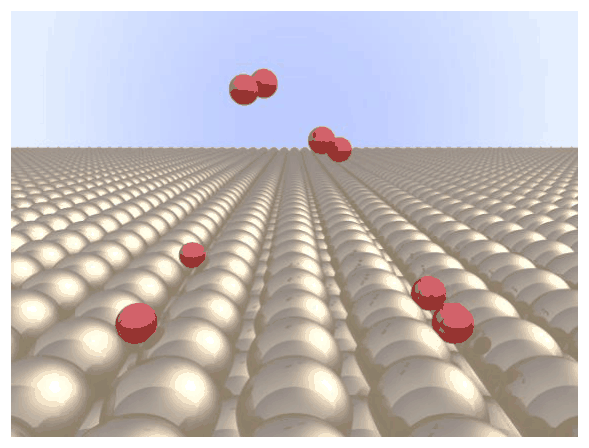
Hydrogen is expected to be a future energy source that does not depend on fossil fuels. Here, we will consider the hydrogen-storage process in a metal, which is related to hydrogen-transport and -storage technology.
PART A
As hydrogen is absorbed into the bulk of a metal via its surface, let us first consider the adsorption process of hydrogen at the metal surface, \(\ce{H2(g) -> 2H(ad)}\), where the gaseous and adsorbed states of hydrogen are represented as (g) and (ad), respectively. Hydrogen molecules (\(\ce{H2}\)) that reach the metal surface (M) dissociate at the surface and are adsorbed as \(\ce{H}\) atoms (Fig. 1). Here, the potential energy of \(\ce{H2}\) is represented by two variables: the interatomic distance, \(d\), and the height relative to the surface metal atom, \(z\). It is assumed that the axis along the two \(\ce{H}\) atoms is parallel to the surface and that the center of gravity is always on the vertical dotted line in Fig. 1. Fig. 2 shows the potential energy contour plot for the dissociation at the surface. The numerical values represent the potential energy in units of kJ per mole of \(\ce{H2}\). The solid line spacing is \(20\ \mathrm{kJ\,mol^{-1}}\), the dashed line spacing is \(100\ \mathrm{kJ\,mol^{-1}}\), and the spacing between solid and dashed lines is \(80\ \mathrm{kJ\,mol^{-1}}\). The zero-point vibration energy is ignored.
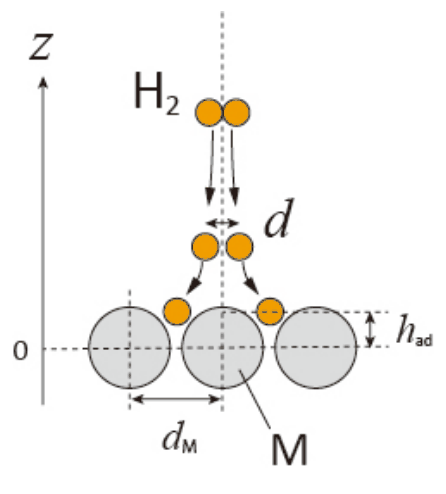
Fig.1 Definition of variables. Drawing is not in scale.
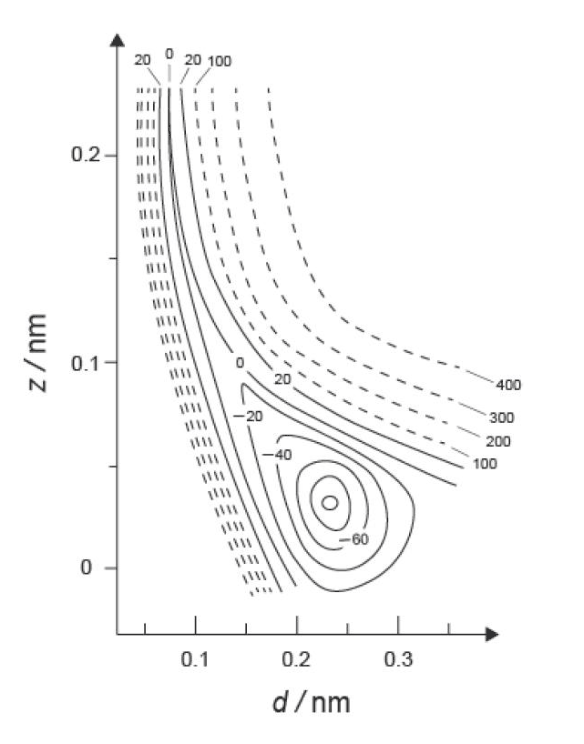
Fig.2
1.1 For each of the following items (i)–(iii), select the closest value from A–G.
(i) The interatomic distance for a gaseous \(\ce{H2}\) molecule
(ii) The interatomic distance between metal atoms (\(d_{\mathrm M}\) in Fig. 1)
(iii) The distance of adsorbed \(\ce{H}\) atoms from the surface (\(h_{\mathrm{AD}}\) in Fig. 1)
A. \(0.03\ \mathrm{nm}\) B. \(0.07\ \mathrm{nm}\) C. \(0.11\ \mathrm{nm}\) D. \(0.15\ \mathrm{nm}\) E. \(0.19\ \mathrm{nm}\) F. \(0.23\ \mathrm{nm}\) G. \(0.27\ \mathrm{nm}\) 1.2 For each of the following items (i)–(ii), select the closest value from A–H.
(i) the energy required for the dissociation of gaseous \(\ce{H2}\) to gaseous \(\ce{H}\) [\(\ce{H2(g) -> 2H(g)}\)]
(ii) the energy released during the adsorption of a gaseous \(\ce{H2}\) [\(\ce{H2(g) -> 2H(ad)}\)]
A. \(20\ \mathrm{kJ\,mol^{-1}}\) B. \(40\ \mathrm{kJ\,mol^{-1}}\) C. \(60\ \mathrm{kJ\,mol^{-1}}\) D. \(100\ \mathrm{kJ\,mol^{-1}}\) E. \(150\ \mathrm{kJ\,mol^{-1}}\) F. \(200\ \mathrm{kJ\,mol^{-1}}\) G. \(300\ \mathrm{kJ\,mol^{-1}}\) H. \(400\ \mathrm{kJ\,mol^{-1}}\) PART B
The adsorbed hydrogen atoms are then either absorbed into the bulk, or recombine and desorb back into the gas phase, as shown in the reactions (1a) and (1b). \(\ce{H(ab)}\) represents a hydrogen atom absorbed in the bulk.


The reaction rates per surface site for adsorption, desorption, and absorption are \(r_1[\mathrm{s^{-1}}]\), \(r_2[\mathrm{s^{-1}}]\) and \(r_3[\mathrm{s^{-1}}]\), respectively. They are expressed as:
\[ r_1=k_1P_{\ce{H2}}(1-\theta)^2 \tag{2} \]
\[ r_2=k_2\theta^2 \tag{3} \]
\[ r_3=k_3\theta \tag{4} \]
where \(k_1\ [\mathrm{s^{-1}\,Pa^{-1}}]\), \(k_2\ [\mathrm{s^{-1}}]\) and \(k_3\ [\mathrm{s^{-1}}]\) are the reaction rate constants and \(P_{\ce{H2}}\) is the pressure of \(\ce{H2}\). Among the sites available on the surface, \(\theta\) (\(0\leq\theta\leq1\)) is the fraction occupied by \(\ce{H}\) atoms. It is assumed that adsorption and desorption are fast compared to absorption (\(r_1,r_2\gg r_3\)) and that \(\theta\) remains constant.
1.3 \(r_3\) can be expressed as:
\[ r_3=\frac{k_3}{1+\sqrt{\dfrac{1}{P_{\ce{H2}}C}}} \tag{5} \]
Express \(C\) using \(k_1\) and \(k_2\).
A metal sample with a surface area of \(S=1.0\times10^{-3}\ \mathrm{m^2}\) was placed in a container (\(1\mathrm{L}=1.0\times10^{-3}\ \mathrm{m^3}\)) with \(\ce{H2}\) (\(P_{\ce{H2}}=1.0\times10^2\ \mathrm{Pa}\)). The density of hydrogen-atom adsorption sites on the surface was \(N=1.3\times10^{18}\ \mathrm{m^{-2}}\). The surface temperature was kept at \(T=400\ \mathrm K\). As the reaction (1) proceeded, \(P_{\ce{H2}}\) decreased at a constant rate of \(v=4.0\times10^{-4}\ \mathrm{Pa\,s^{-1}}\). Assume that \(\ce{H2}\) is an ideal gas and that the volume of the metal sample is negligible.
1.4 Calculate the amount of \(\ce{H}\) atoms in moles absorbed per unit area of the surface per unit time, \(A\ [\mathrm{mol\,s^{-1}\,m^{-2}}]\).
1.5 At \(T=400\ \mathrm K\), \(C\) equals \(1.0\times10^2\ \mathrm{Pa^{-1}}\). Calculate the value of \(k_3\) at \(400\ \mathrm K\). If you did not obtain the answer to 1.4, use \(A=3.6\times10^{-7}\ \mathrm{mol\,s^{-1}\,m^{-2}}\).
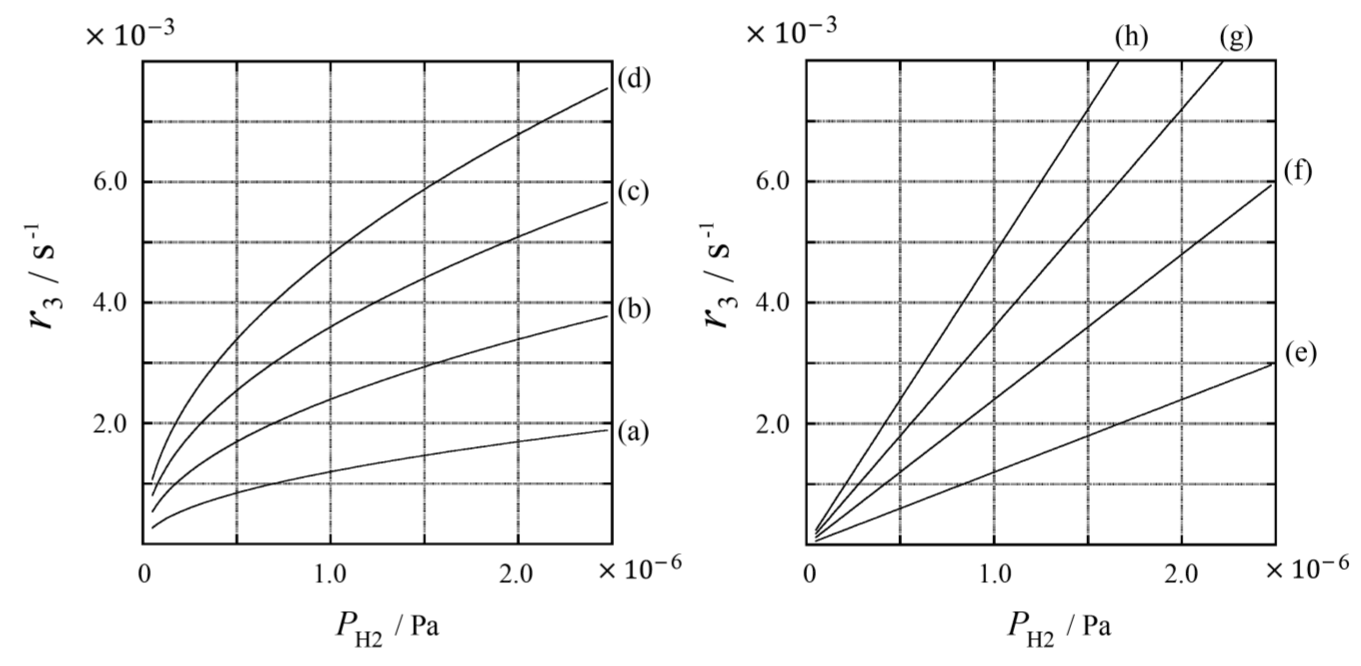
1.6 At a different \(T\), \(C=2.5\times10^3\ \mathrm{Pa^{-1}}\) and \(k_3=4.8\times10^{-2}\ \mathrm{s^{-1}}\) are given. For \(r_3\) as a function of \(P_{\ce{H2}}\) at this temperature, select the correct plot from (a)–(h).
Official English text of the problem.
Problem 2: Isotope Time Capsule
Molecular entities that differ only in isotopic composition, such as \(\ce{CH4}\) and \(\ce{CH3D}\), are called isotopologues. Isotopologues are considered to have the same chemical characteristics. In nature, however, there exists a slight difference.
Assume that all of the substances shown in this Question are in a gas phase.
Let us consider the following equilibrium:

The entropy, \(S\), increases with increasing the number of possible microscopic states of a system, \(W\):
\[ S=k_{\mathrm B}\ln W \tag{2} \]
\(W=1\) for \(\ce{^{12}C^{16}O2}\) and \(\ce{^{12}C^{18}O2}\). In contrast, \(W=2\) for a \(\ce{^{12}C^{16}O^{18}O}\) molecule because the oxygen atoms are distinguishable in this molecule. As the right-hand side of the equilibrium shown in eq. 1 has two \(\ce{^{12}C^{16}O^{18}O}\) molecules, \(W=2^2=4\).
2.1 The enthalpy change, \(\Delta H\), of eq. 3 is positive regardless of the temperature.

Calculate the equilibrium constants, \(K\), for eq. 3 at very low (think of \(T\to0\)) and very high (think of \(T\to+\infty\)) temperatures. Assume that the reaction remains unchanged at these temperatures and that \(\Delta H\) converges to a constant value for high temperatures.
The \(\Delta H\) of the following process can be explained by molecular vibrations.

At \(T=0\ \mathrm K\), the vibrational energy of a diatomic molecule whose vibration frequency is \(\nu\ [\mathrm{s^{-1}}]\) is expressed as:
\[ E=\frac12h\nu \tag{5} \]
\[ \nu=\frac{1}{2\pi}\sqrt{\frac{k}{\mu}} \tag{6} \]
Wherein \(k\) is the force constant and \(\mu\) the reduced mass, which is expressed in terms of the mass of the two atoms in the diatomic molecule, \(m_1\) and \(m_2\), according to:
\[ \mu=\frac{m_1m_2}{m_1+m_2} \tag{7} \]
2.2 The vibration of \(\ce{H2}\) is at \(4161.0\ \mathrm{cm^{-1}}\) when reported as a wavenumber.
Calculate the \(\Delta H\) of the following equation at \(T=0\ \mathrm K\) in units of \(\mathrm{J\,mol^{-1}}\).

Assume that:
- only the vibrational energy contributes to the \(\Delta H\).
- the \(k\) values for \(\ce{H2}\), \(\ce{HD}\), and \(\ce{D2}\) are identical.
- the mass of \(\ce{H}\) to be \(1\ \mathrm{Da}\) and the mass of \(\ce{D}\) to be \(2\ \mathrm{Da}\).
The molar ratio of \(\ce{H2}\), \(\ce{HD}\), and \(\ce{D2}\) depends on the temperature in a system in equilibrium. Here, \(\Delta_{\ce{D2}}\) is defined as the change of the molar ratio of \(\ce{D2}\).
\[ \Delta_{\ce{D2}}=\frac{R_{\ce{D2}}}{R_{\ce{D2}}^*}-1 \tag{9} \]
Here, \(R_{\ce{D2}}\) refers to \(\dfrac{[\ce{D2}]}{[\ce{H2}]}\) in the sample and \(R_{\ce{D2}}^*\) to \(\dfrac{[\ce{D2}]}{[\ce{H2}]}\) at \(T\to+\infty\). It should be noted here that the distribution of isotopes becomes random at \(T\to+\infty\).
2.3 Calculate \(\Delta_{\ce{D2}}\) with natural \(\ce{D}\) abundance when the isotopic exchange is in equilibrium at the temperature where \(K\) in eq. 4 is \(0.300\). Assume that the natural abundance ratios of \(\ce{D}\) and \(\ce{H}\) are \(1.5576\times10^{-4}\) and \(1-1.5576\times10^{-4}\), respectively.
In general, the molar ratio of the doubly substituted isotopologue, which contains two heavy isotope atoms in one molecule, increases with decreasing temperature. Let us consider the molar ratio of \(\ce{CO2}\) molecules with molecular weights of 44 and 47, which are described as \(\ce{CO2}[44]\) and \(\ce{CO2}[47]\) below. The quantity \(\Delta_{47}\) is defined as:
\[ \Delta_{47}=\frac{R_{47}}{R_{47}^*}-1 \tag{10} \]
\(R_{47}\) refers to \(\dfrac{[\ce{CO2}[47]]}{[\ce{CO2}[44]]}\) in the sample and \(R_{47}^*\) to \(\dfrac{[\ce{CO2}[47]]}{[\ce{CO2}[44]]}\) at \(T\to+\infty\). The natural abundances of carbon and oxygen atoms are shown below; ignore isotopes that are not shown here.
\(\ce{^{12}C}\) \(\ce{^{13}O}\) natural abundance 0.988888 0.011112 \(\ce{^{16}O}\) \(\ce{^{17}O}\) \(\ce{^{18}O}\) natural abundance 0.997621 0.0003790 0.0020000 The temperature dependence of \(\Delta_{47}\) is determined as follows, where \(T\) is given as the absolute temperature in units of K:
\[ \Delta_{47}=\frac{36.2}{T^2}+2.920\times10^{-4} \tag{11} \]
2.4 The \(\Delta_{47}\) of fossil plankton obtained from the Antarctic seabed was \(4.50865\times10^{-5}\).
Estimate the temperature using this \(R_{47}\). This temperature is interpreted as the air temperature during the era in which the plankton lived. Consider only the most common isotopologue of \(\ce{CO2}[47]\) for the calculation.
Official English text of the problem.
Problem 3: Lambert–Beer Law?
In this problem, ignore the absorption of the cell and the solvent. The temperatures of all solutions and gases are kept constant at 25 °C.
PART A
An aqueous solution X was prepared using \(\ce{HA}\) and \(\ce{NaA}\). The concentrations \([\ce{A^-}]\), \([\ce{HA}]\), and \([\ce{H+}]\) in solution X are \(1.00 \times 10^{-2}\ \mathrm{mol\,L^{-1}}\), \(1.00 \times 10^{-3}\ \mathrm{mol\,L^{-1}}\), and \(1.00 \times 10^{-4}\ \mathrm{mol\,L^{-1}}\), respectively, which are correlated via the following acid-base equilibrium:

The optical path length is \(l\) in Part A. Ignore the density change upon dilution. Assume that no chemical reactions other than eq 1 occur.
3.1 The absorbance of X was \(A_1\) at a wavelength of \(\lambda_1\). Then, solution X was diluted to twice its initial volume using hydrochloric acid with pH = 2.500. After the dilution, the absorbance was still \(A_1\) at \(\lambda_1\). Determine the ratio \(\varepsilon_{\ce{HA}}/\varepsilon_{\ce{A^-}}\), where \(\varepsilon_{\ce{HA}}\) and \(\varepsilon_{\ce{A^-}}\) represent the absorption coefficients of \(\ce{HA}\) and of \(\ce{A^-}\), respectively, at \(\lambda_1\).
PART B
Let us consider the following equilibrium in the gas phase:

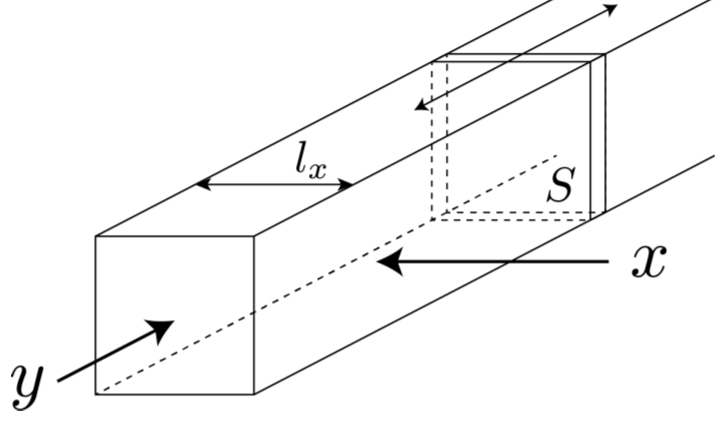
Pure gas \(\ce{D}\) is filled into a cuboid container that has a transparent movable wall with a cross-section of \(S\) (see the figure below) at a pressure \(P\), and equilibrium is established while the total pressure is kept at \(P\). The absorbance of the gas is \(A=\varepsilon(n/V)l\), where \(\varepsilon\), \(n\), \(V\), and \(l\) are the absorption coefficient, amount of the gas in moles, volume of the gas, and optical path length, respectively. Assume that all components of the gas mixture behave as ideal gases.
Use the following definitions if necessary.
Initial state After equilibrium \(\ce{D}\) \(\ce{M}\) \(\ce{D}\) \(\ce{M}\) Partial pressure \(P\) \(0\) \(p_{\mathrm D}\) \(p_{\mathrm M}\) Amount in moles \(n_0\) \(0\) \(n_{\mathrm D}\) \(n_{\mathrm M}\) Volume \(V_0\) \(V\) 3.2 The absorbance of the gas at \(\lambda_{\mathrm{B1}}\) measured from direction \(x\) (\(l=l_x\)) was \(A_{\mathrm{B1}}\) both at the initial state and after the equilibrium. Determine the ratio \(\varepsilon_{\mathrm D}/\varepsilon_{\mathrm M}\) at \(\lambda_{\mathrm{B1}}\), where \(\varepsilon_{\mathrm D}\) and \(\varepsilon_{\mathrm M}\) represent the absorption coefficients of \(\ce{D}\) and of \(\ce{M}\), respectively.
3.3 The absorbance of the gas at \(\lambda_{\mathrm{B2}}\) measured from direction \(y\) was \(A_{\mathrm{B2}}\) both at the initial state (\(l=l_{y0}\)) and after the equilibrium (\(l=l_y\)). Determine the ratio \(\varepsilon_{\mathrm D}/\varepsilon_{\mathrm M}\) at \(\lambda_{\mathrm{B2}}\).
Official English text of the problem.
Problem 4: The Redox Chemistry of Zinc
Zinc has long been used as alloys for brass and steel materials. The zinc contained in industrial wastewater is separated by precipitation to detoxify the water, and the obtained precipitate is reduced to recover and reuse it as metallic zinc.
PART A
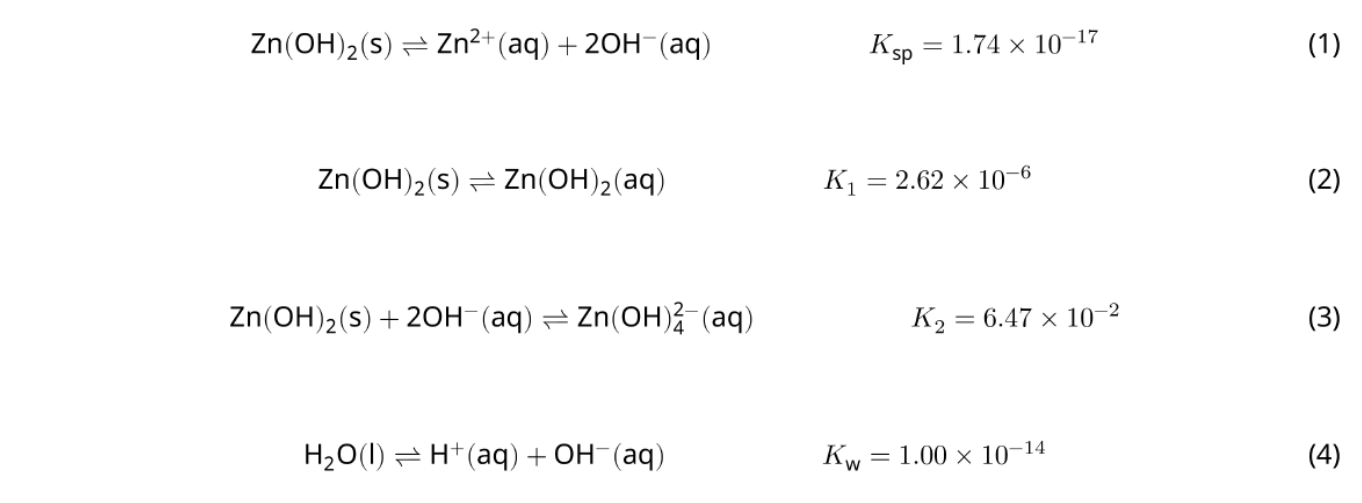
The dissolution equilibrium of zinc hydroxide \(\ce{Zn(OH)2(s)}\) at 25 °C and the relevant equilibrium constants are given in eq. 1–4.
The solubility, \(S\), of zinc (concentration of zinc in a saturated aqueous solution) is given in eq. 5.
\[ S=[\ce{Zn^2+(aq)}]+[\ce{Zn(OH)2(aq)}]+[\ce{Zn(OH)4^2-(aq)}] \tag{5} \]
4.1 When the equilibria in eq. 1–4 are established, calculate the pH range in which \([\ce{Zn(OH)2(aq)}]\) is the greatest among \([\ce{Zn^2+(aq)}]\), \([\ce{Zn(OH)2(aq)}]\) and \([\ce{Zn(OH)4^2-(aq)}]\).
4.2 A saturated aqueous solution of \(\ce{Zn(OH)2(s)}\) with pH = 7.00 was prepared and filtered. NaOH was added to this filtrate to increase its pH to 12.00. Calculate the molar percentage of zinc that precipitates when increasing the pH from 7.00 to 12.00. Ignore the volume and temperature changes.
PART B
Next, the recovered zinc hydroxide is heated to obtain zinc oxide according to the reaction below:

The zinc oxide is then reduced to metallic zinc by reaction with hydrogen:

4.3 In order for reaction (7) to proceed at a hydrogen pressure kept at 1 bar, it is necessary to reduce the partial pressure of the generated water vapor. Calculate the upper limit for the partial pressure of water vapor to allow reaction (7) to proceed at 300 °C. Here, the Gibbs formation energies of zinc oxide and water vapor at 300 °C and 1 bar for all gaseous species are \(\Delta G_{\ce{ZnO}}(300\,^\circ\mathrm{C})=-2.90\times10^2\ \mathrm{kJ\,mol^{-1}}\) and \(\Delta G_{\ce{H2O}}(300\,^\circ\mathrm{C})=-2.20\times10^2\ \mathrm{kJ\,mol^{-1}}\), respectively.
Metallic zinc is used as a negative electrode (anode) material for metal-air batteries. The electrode consists of \(\ce{Zn}\) and \(\ce{ZnO}\). It uses the following redox reaction to generate electricity with the electromotive force (e.m.f.) at 25 °C and pressure of 1 bar, \(E^\circ\).

4.4 A zinc–air battery was discharged at 20 mA for 24 hours. Calculate the change in mass of the negative electrode (anode) of the battery.
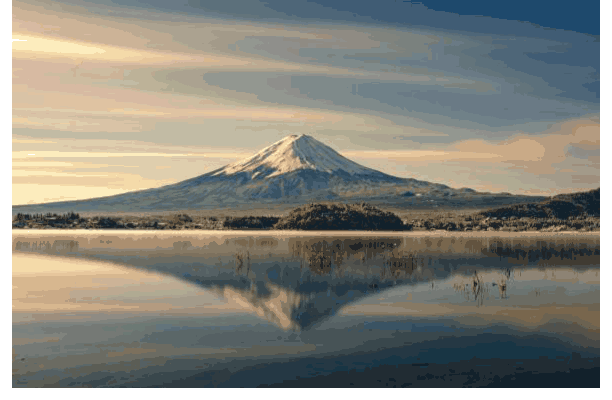
Mt. Fuji
4.5 Consider the change of e.m.f. of a zinc–air battery depending on the environment. Calculate the e.m.f. at the summit of Mt. Fuji, where the temperature and altitude are −38 °C (February) and 3776 m, respectively. The atmospheric pressure is represented by
\[ P\,[\mathrm{bar}] =1.013\times \left(1-\frac{0.0065h}{T+0.0065h+273.15}\right)^{5.257} \tag{9} \]
at altitude \(h\) [m] and temperature \(T\) [°C]. The molar ratio of oxygen in the atmosphere is 21%. The Gibbs energy change of reaction (8) is \(\Delta G_{\ce{ZnO}}(-38\,^\circ\mathrm{C})=-3.26\times10^2\ \mathrm{kJ\,mol^{-1}}\) at −38 °C and 1 bar.
4.6 Calculate the Gibbs energy change for reaction (6) at 25 °C. Note that the standard reduction potentials, \(E^\circ(\ce{Zn^2+/Zn})\) and \(E^\circ(\ce{O2/H2O})\) at 25 °C and 1 bar are given as (10) and (11), respectively.

Official English text of the problem.
Problem 5: Mysterious Silicon
Although silicon is also a group 14 element like carbon, their properties differ significantly.
PART A
Unlike the carbon–carbon triple bond, the silicon–silicon triple bond in a compound formulated as \(\ce{R^{1}-Si#Si-R^{1}}\) (R: organic substituent) is extremely reactive. For example, it reacts with ethylene to form a cyclic product that contains a four-membered ring.

When \(\ce{R^{1}-Si#Si-R^{1}}\) is treated with an alkyne (\(\ce{R^{2}-C#C-R^{2}}\)), the four-membered-ring compound A is formed as an initial intermediate. Further reaction of another molecule of \(\ce{R^{2}-C#C-R^{2}}\) with A affords isomers B and C, both of which have benzene-like cyclic conjugated structures, so-called ‘disilabenzenes’ that contain a six-membered ring and can be formulated as \(\ce{(R^{1}-Si)2(R^{2}-C)4}\).

The \(\ce{^{13}C}\) NMR analysis of the corresponding six-membered ring skeletons \(\ce{Si2C4}\) shows two signals for B and one signal for C.
5.1 Draw the structural formulae of A, B, and C using \(\ce{R^{1}}\), \(\ce{R^{2}}\), \(\ce{Si}\), and \(\ce{C}\), with one of the possible resonance structures.
5.2 Calculate the aromatic stabilization energy (ASE) for benzene and C (in the case of \(\ce{R^{1}}=\ce{R^{2}}=\ce{H}\)) as positive values, considering the enthalpy change in some hydrogenation reactions of unsaturated systems shown below (Fig. 1).
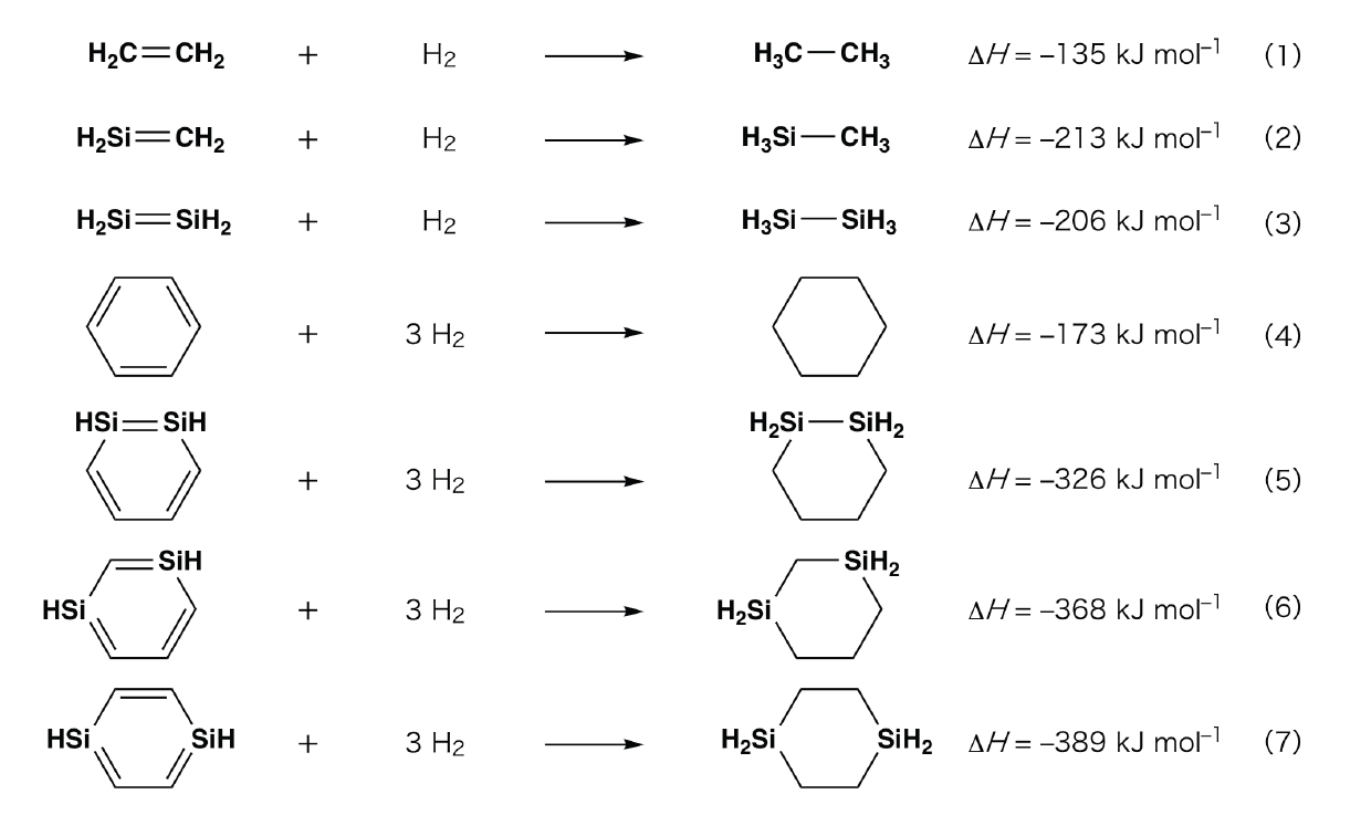
Fig. 1
When a xylene solution of C is heated, it undergoes isomerization to give an equilibrium mixture of compounds D and E. The molar ratio is D : E = 1 : 40.0 at 50.0 °C and D : E = 1 : 20.0 at 120.0 °C.
5.3 Calculate \(\Delta H\) for the transformation of D to E. Assume that \(\Delta H\) does not depend on temperature.
The isomerization from C to D and to E proceeds via transformations of \(\pi\)-bonds into \(\sigma\)-bonds without breaking any \(\sigma\)-bonds. A \(\ce{^{13}C}\) NMR analysis revealed one signal for the \(\ce{Si2C4}\) skeleton of D and two signals for that of E. The skeleton of D does not contain any three-membered rings, while E has two three membered rings that share an edge.
5.4 Draw the structural formulae of D and E using \(\ce{R^{1}}\), \(\ce{R^{2}}\), \(\ce{Si}\), and \(\ce{C}\)
PART B
Silicon is able to form highly coordinated compounds (> four substituents) with electronegative elements such as fluorine. As metal fluorides are often used as fluorination reagents, highly coordinated silicon fluorides also act as fluorination reagents.
The fluorination reaction of \(\ce{CCl4}\) using \(\ce{Na2SiF6}\) was carried out as follows.
Standardization of \(\ce{Na2SiF6}\) solution:
- Preparation
Aqueous solution F: 0.855 g of \(\ce{Na2SiF6}\) (188.053 g mol\(^{-1}\)) dissolved in water (total volume: 200 mL).
Aqueous solution G: 6.86 g of \(\ce{Ce2(SO4)3}\) (568.424 g mol\(^{-1}\)) dissolved in water (total volume: 200 mL).
- Procedure
Precipitation titration of a solution F (50.0 mL) by dropwise adding solution G in the presence of xylenol orange, which coordinates to \(\ce{Ce^{3+}}\), as an indicator. After adding 18.8 mL of solution G, the color of the solution changes from yellow to magenta. The generated precipitate is a binary compound that contains \(\ce{Ce^{3+}}\), and the only resulting silicon compound is \(\ce{Si(OH)4}\).
5.5 Write the balanced equation for the reaction of \(\ce{Na2SiF6}\) with \(\ce{Ce2(SO4)3}\).
- Reaction of \(\ce{CCl4}\) with \(\ce{Na2SiF6}\):
(Substance losses by e.g. evaporation are negligible during the following operations.)
\(\ce{Na2SiF6}\)(\(x\) [g]) was added to \(\ce{CCl4}\) (500.0 g) and heated to 300°C in a sealed pressure-resistant reaction vessel. The unreacted \(\ce{Na2SiF6}\) and generated \(\ce{NaCl}\) were removed by filtration. The filtrate was diluted to a total volume of 1.00 L with \(\ce{CCl4}\) (solution H). The \(\ce{^{29}Si}\) and \(\ce{^{19}F}\) NMR spectra of solution H showed \(\ce{SiF4}\) as the only silicon compound. In the \(\ce{^{19}F}\) NMR spectrum, in addition to \(\ce{SiF4}\), signals corresponding to \(\ce{CFCl3}\), \(\ce{CF2Cl2}\), \(\ce{CF3Cl}\), and \(\ce{CF4}\) were observed (cf. Table 1). The integration ratios in the \(\ce{^{19}F}\) NMR spectrum are proportional to the number of fluorine nuclei.
Table 1
\(\ce{^{19}F}\) NMR data \(\ce{CFCl3}\) \(\ce{CF2Cl2}\) \(\ce{CF3Cl}\) \(\ce{CF4}\) Integration ratio 45.0 65.0 18.0 2.0 \(\ce{SiF4}\) is hydrolyzed to form \(\ce{H2SiF6}\) according to the following eq. 8:

Solution H (10 mL) was added to an excess amount of water, which resulted in the complete hydrolysis of \(\ce{SiF4}\). After separation, the \(\ce{H2SiF6}\) generated from the hydrolysis in the aqueous solution was neutralized and completely converted to \(\ce{Na2SiF6}\) (aqueous solution J).
The precipitate of unreacted \(\ce{Na2SiF6}\) and \(\ce{NaCl}\), which was removed by filtration in the initial step (underlined), was completely dissolved in water to give an aqueous solution (solution K; 10.0 L).
Then, additional precipitation titrations using solution G were carried out, and the endpoints of the titrations with G were as follows:
- For solution J (entire amount): 61.6 mL.
- For 100 mL of solution K: 44.4 mL.
It should be noted here that the coexistence of \(\ce{NaCl}\) or \(\ce{SiO2}\) has no effect on the precipitation titration.
5.6 Calculate the mass of the \(\ce{NaCl}\) produced in the reaction vessel (information underlined), and calculate the mass (\(x\) [g]) of the \(\ce{Na2SiF6}\) used as a starting material.
5.7 77.8% of the \(\ce{CCl4}\) used as a starting material was unreacted. Calculate the mass of \(\ce{CF3Cl}\) generated.
Official English text of the problem.
Problem 6: The Solid-State Chemistry of Transition Metals
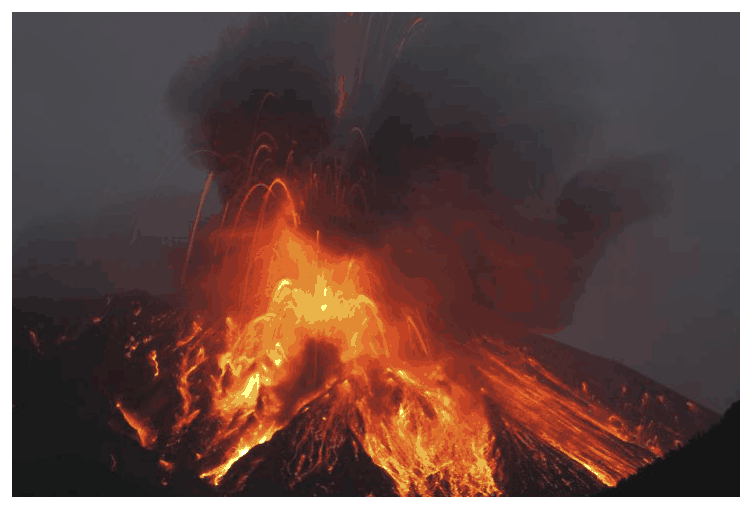
Volcano at Sakurajima island
PART A
Japan is one of the countries with the highest numbers of volcanos worldwide. When silicate minerals crystallize from magma, a part of the transition-metal ions (\(\ce{M^{n+}}\)) in the magma is incorporated into the silicate minerals. The \(\ce{M^{n+}}\) studied in the problem are coordinated by oxide ions (\(\ce{O^2-}\)) and adopt a four-coordinate tetrahedral (\(T_d\)) geometry in the magma and six-coordinate octahedral (\(O_h\)) geometry in the silicate minerals, both of which exhibit a high-spin electron configuration. The distribution coefficient of \(\ce{M^{n+}}\) between the silicate minerals and magma, \(D\), can be expressed by:
\[ D=\frac{[\mathrm M]_{\mathrm s}}{[\mathrm M]_{\mathrm l}} \]
where \([\mathrm M]_{\mathrm s}\) and \([\mathrm M]_{\mathrm l}\) are the concentrations of \(\ce{M^{n+}}\) in the silicate minerals and the magma, respectively. The table below shows the \(D\) values of \(\ce{Cr^2+}\) and \(\ce{Mn^2+}\) as examples.
\(\ce{Cr^2+}\) \(\ce{Mn^2+}\) \(D\) 7.2 1.1 Let \(\Delta_{\mathrm O}\) and \(\mathrm{CFSE}^{\mathrm O}\) be the energy separation of the d-orbitals of \(\ce{M^{n+}}\) and the crystal-field stabilization energy in a \(O_h\) field, respectively. Let \(\Delta_{\mathrm T}\) and \(\mathrm{CFSE}^{\mathrm T}\) be those in a \(T_d\) field.
6.1 Calculate \(\left|\mathrm{CFSE}^{\mathrm O}-\mathrm{CFSE}^{\mathrm T}\right|=\Delta\mathrm{CFSE}\) in terms of \(\Delta_{\mathrm O}\) for \(\ce{Cr^2+}\), \(\ce{Mn^2+}\), and \(\ce{Co^2+}\); assume \(\Delta_{\mathrm T}=4/9\Delta_{\mathrm O}\).
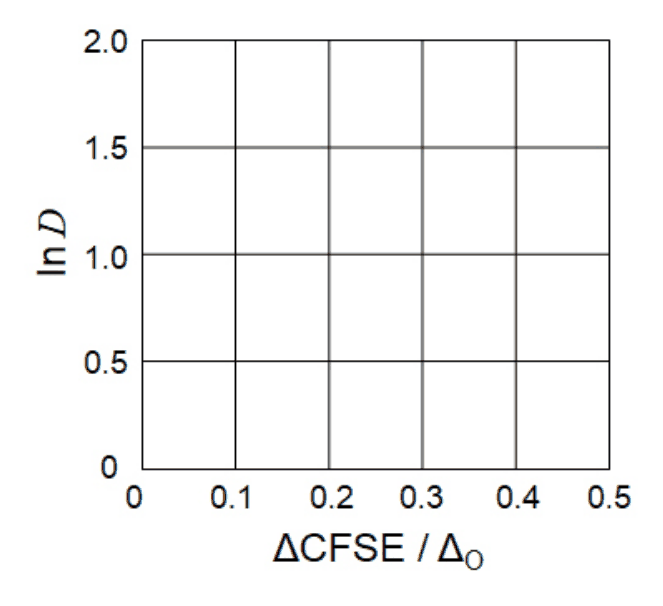
6.2 A linear relationship is observed by plotting \(\ln D\) against \(\Delta\mathrm{CFSE}/\Delta_{\mathrm O}\) in the Cartesian coordinate system shown below. Estimate \(D\) for \(\ce{Co^2+}\).
Metal oxides \(\ce{MO}\) (M: Ca, Ti, V, Mn, or Co) crystallize in a rock-salt structure wherein the \(\ce{M^{n+}}\) adopts an \(O_h\) geometry with a high-spin electron configuration. The lattice enthalpy of these oxides is mainly governed by the Coulomb interactions based on the radius and charge of the ions and some contributions from the CFSE of \(\ce{M^{n+}}\) in the \(O_h\) field.
6.3 Choose the appropriate set of lattice enthalpies [\(\mathrm{kJ\,mol^{-1}}\)] from one of the options (a) to (f).
\(\ce{CaO}\) \(\ce{TiO}\) \(\ce{VO}\) \(\ce{MnO}\) \(\ce{CoO}\) (a) 3460 3878 3913 3810 3916 (b) 3460 3916 3878 3810 3913 (c) 3460 3913 3916 3810 3878 (d) 3810 3878 3913 3460 3916 (e) 3810 3916 3878 3460 3913 (f) 3810 3913 3916 3460 3878 PART B
A mixed oxide A, which contains \(\ce{La^3+}\) and \(\ce{Cu^2+}\), crystallizes in a tetragonal unit cell shown in Fig.1. In the \(\ce{[CuO6]}\) octahedron, the Cu–O length along the z-axis (\(l_z\)) is longer than that of the x-axis (\(l_x\)), and \(\ce{[CuO6]}\) is distorted from the regular \(O_h\) geometry. This distortion removes the degeneracy of the \(e_g\) orbitals (\(d_{x^2-y^2}\) and \(d_{z^2}\)).
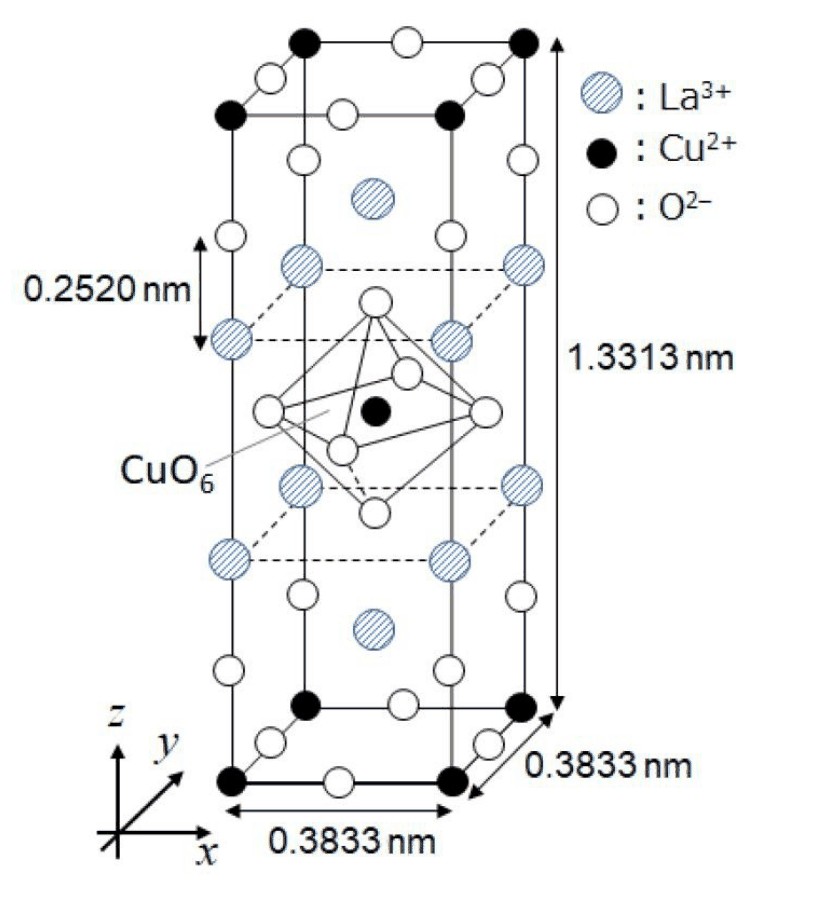
Fig. 1
A can be synthesized by thermal decomposition (pyrolysis) of complex B, which is formed by mixing metal chlorides in dilute aqueous ammonia solution containing squaric acid \(\ce{C4H2O4}\), i.e., a diacid. The pyrolysis behavior of B in dry air shows a weight loss of 29.1% up to \(200\,^\circ\mathrm C\) due to the loss of crystallization water, followed by another weight loss up to \(700\,^\circ\mathrm C\) due to the release of \(\ce{CO2}\). The total weight loss during the formation of A from B is 63.6%. It should be noted that only water and \(\ce{CO2}\) are released in the pyrolysis reaction.
6.4 Write the chemical formulae for A and B.
6.5 Calculate \(l_x\) and \(l_z\) using Fig. 1.
6.6 For \(\ce{Cu^2+}\) in the distorted \(\ce{[CuO6]}\) octahedron in A of Fig. 1, write the names of the split \(e_g\) orbitals (\(d_{x^2-y^2}\) and \(d_{z^2}\)) in (i) and (ii), and draw the electron configuration in the dotted box in your answer sheet.
A is an insulator. When one \(\ce{La^3+}\) is substituted with one \(\ce{Sr^2+}\), one hole is generated in the crystal lattice that can conduct electricity. As a result, the \(\ce{Sr^2+}\)-doped A shows superconductivity below 38 K. When a substitution reaction took place for A, \(2.05\times10^{27}\) holes \(\mathrm{m^{-3}}\) were generated.
6.7 Calculate the percentage of \(\ce{Sr^2+}\) substituted for \(\ce{La^3+}\) based on the mole ratio in the substitution reaction. Note that the valences of the constituent ions and the crystal structure are not altered by the substitution reaction
PART C
\(\ce{Cu2(CH3CO2)4}\) is composed of four \(\ce{CH3CO2^-}\) coordinated to two \(\ce{Cu^2+}\) (Fig. 2A). \(\ce{Cu2(CH3CO2)4}\) exhibits high levels of structural symmetry, with two axes passing through the carbon atoms of the four \(\ce{CH3CO2^-}\) and an axis passing through the two \(\ce{Cu^2+}\), all of which are oriented orthogonal relative to each other. When a dicarboxylate ligand is used instead of \(\ce{CH3CO2^-}\), a “cage complex” is formed. The cage complex \(\ce{Cu4(L1)4}\) is composed of planar dicarboxylate L1 (Fig. 2B) and \(\ce{Cu^2+}\) (Fig. 2C). The angle \(\theta\) between the coordination directions of the two carboxylates, indicated by the arrows in Fig. 2B, determines the structure of the cage complex. The \(\theta\) is \(0^\circ\) for L1. Note that hydrogen atoms are not shown in Fig. 2.
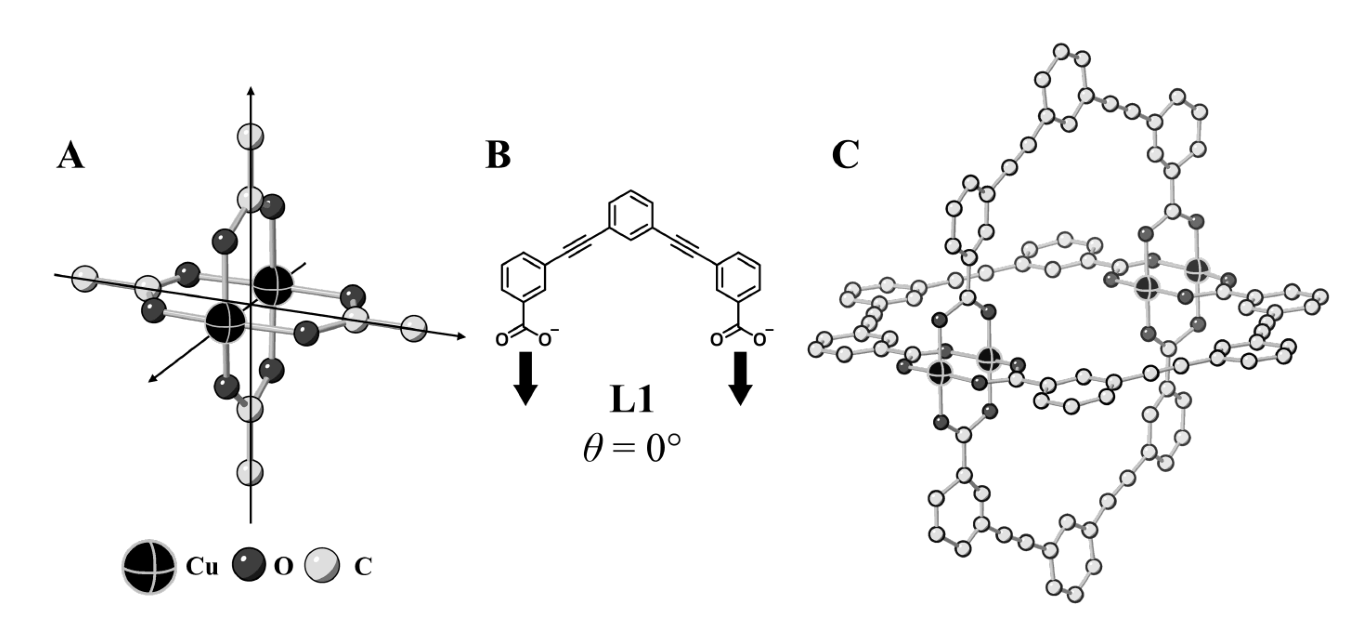
Fig. 2
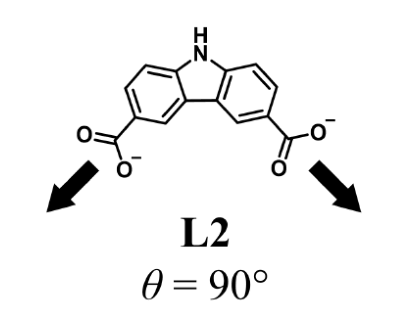
6.8 The \(\theta\) of the planar dicarboxylate L2 below is fixed to \(90^\circ\). If the composition of the cage complex formed from L2 and \(\ce{Cu^2+}\) is \(\ce{Cu_{n}(L2)_{m}}\), give the smallest integer combination of \(n\) and \(m\). Assume that only the \(\ce{CO2^-}\) groups of L2 form a coordination bond to \(\ce{Cu^2+}\) ions.
A zinc complex, \(\ce{Zn4O(CH3CO2)6}\), contains four tetrahedral \(\ce{Zn^2+}\), six \(\ce{CH3CO2^-}\), and one \(\ce{O^2-}\) (Fig. 3A). In \(\ce{Zn4O(CH3CO2)6}\), the \(\ce{O^2-}\) is located at the origin, and the three axes passing through the carbon atoms of \(\ce{CH3CO2^-}\) are oriented orthogonal relative to each other. When \(p\)-benzenedicarboxylate (Fig. 3B, L3, \(\theta=180^\circ\)) is used instead of \(\ce{CH3CO2^-}\), the \(\ce{Zn^2+}\) clusters are linked to each other to form a crystalline solid (X) that is called a “porous coordination polymer” (Fig. 3C). The composition of X is \(\ce{[Zn4O(L3)3]_{n}}\), and it has a cubic crystal structure with nano-sized pores. One pore is represented as a sphere in Fig. 3D, and each tetrahedral \(\ce{Zn^2+}\) cluster is represented as a dark gray polyhedron in Fig. 3C and 3D. Note that hydrogen atoms are not shown in Fig. 3.
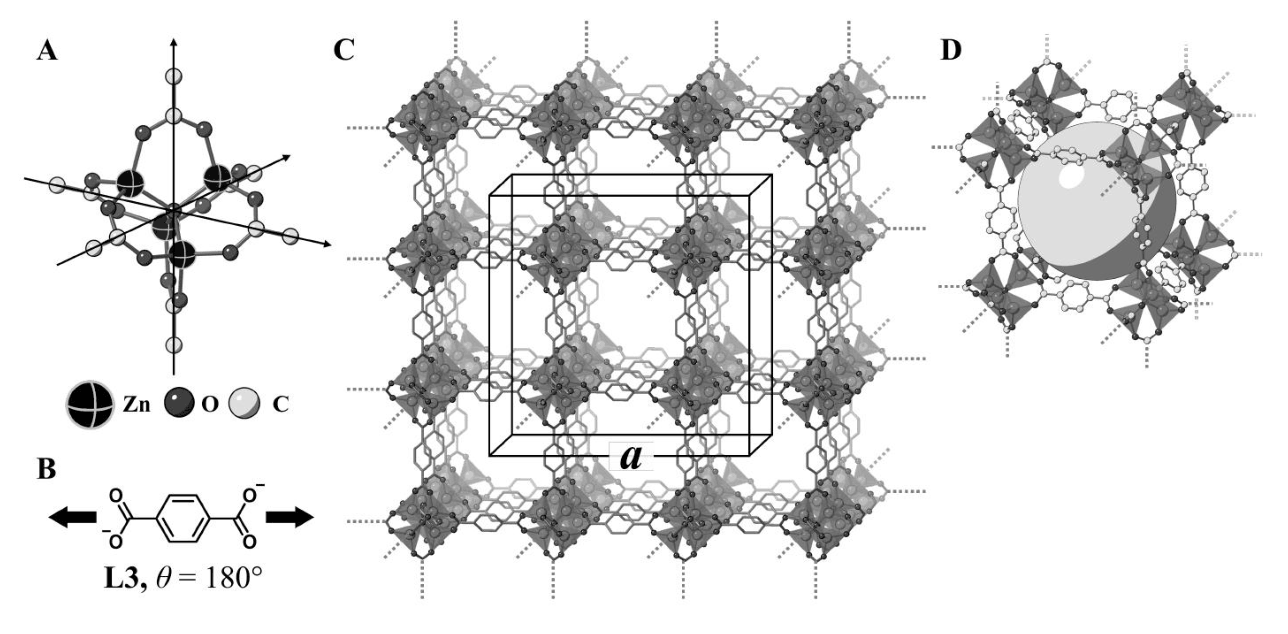
Fig. 3
6.9 X has a cubic unit cell with a side length of \(a\) (Fig. 3C) and a density of \(0.592\,\mathrm{g\,cm^{-3}}\). Calculate \(a\) in [cm].
6.10 X contains a considerable number of pores, and 1 g of X can accommodate \(3.0\times10^2\) mL of \(\ce{CO2}\) gas in the pores at 1 bar and \(25\,^\circ\mathrm C\). Calculate the average number of \(\ce{CO2}\) molecules per pore.
Official English text of the problem.
Problem 7: Playing with Non-benzenoid Aromaticity
Prof. Nozoe (1902–1996) opened the research field of non-benzenoid aromatic compounds, which are now ubiquitous in organic chemistry.
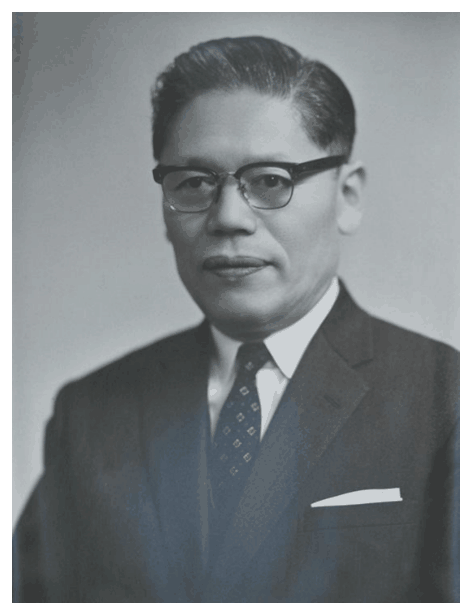
Photo courtesy: Tohoku Univ.
PART A
Lineariifolianone is a natural product with a unique structure, which was isolated from Inula linariifolia. From valencene (1), a one-step conversion yields 2, before a three-step conversion via 3 yields ketone 4. Eremophilene (5) is converted into 6 by performing the same four-step conversion.
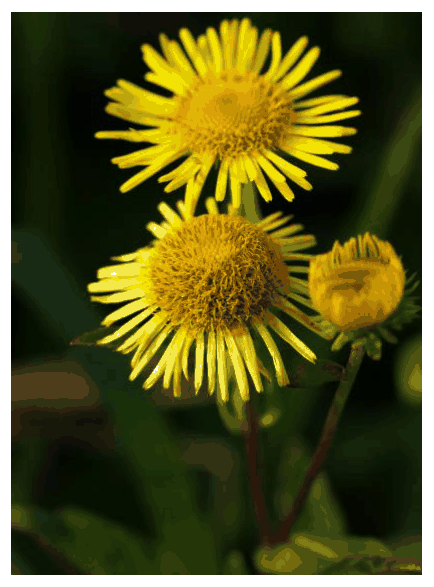
Inula linariifolia
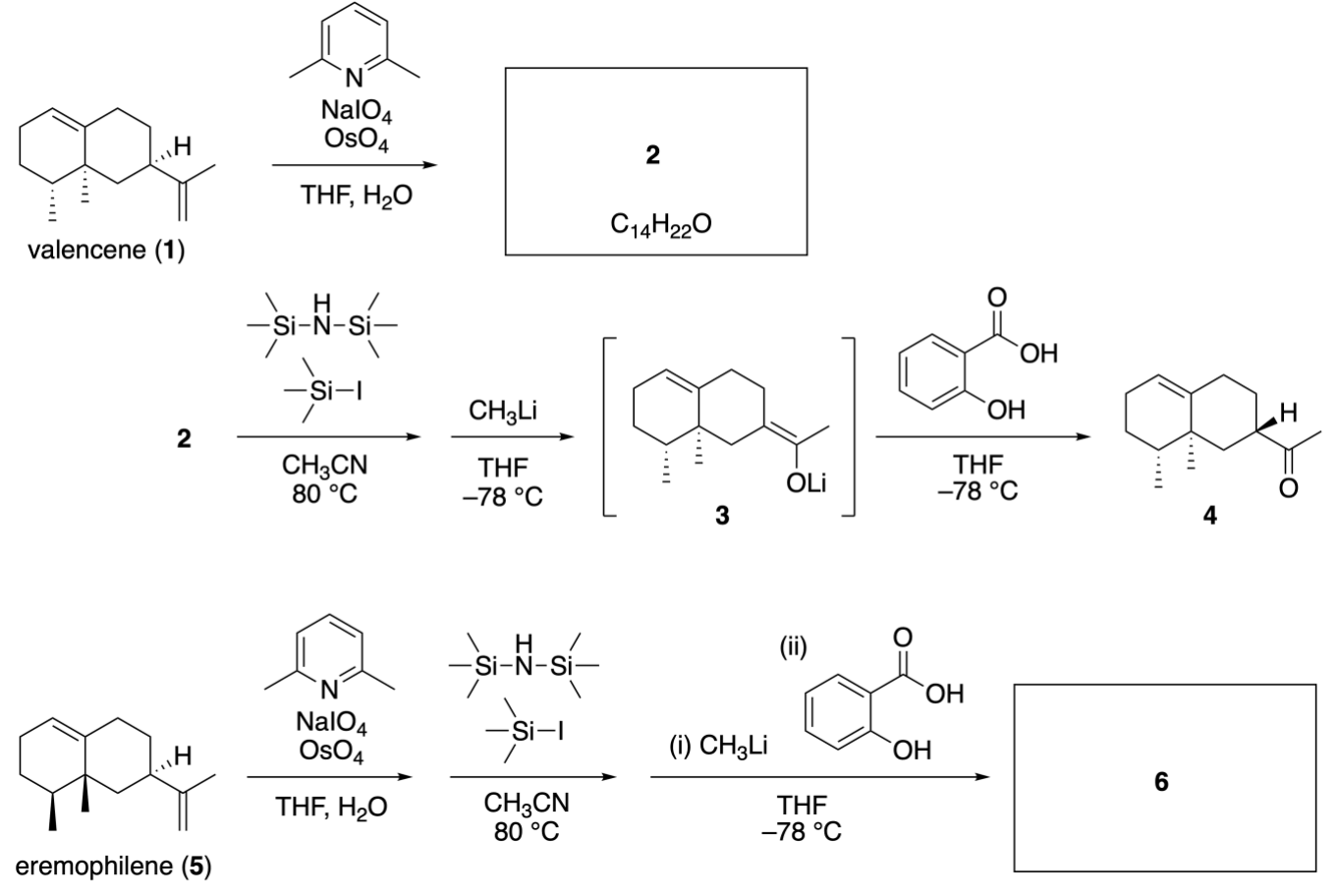
7.1 Draw the structures of 2 and 6 and clearly identify the stereochemistry where necessary.
Then, ketone 4 is converted into ester 15. Compound 8 (molecular weight: 188) retains all the stereocenters in 7. Compounds 9 and 10 have five stereocenters and no carbon-carbon double bonds. Assume that \(\ce{H2^{18}O}\) is used instead of \(\ce{H2^{16}O}\) for the synthesis of \(\ce{^{18}O}\)-labelled-lineariifolianones 13 and 14 from 11 and 12, respectively. Compounds 13 and 14 are \(\ce{^{18}O}\)-labelled isotopomers. Ignoring isotopic labelling, both 13 and 14 provide the same product 15 with identical stereochemistry.
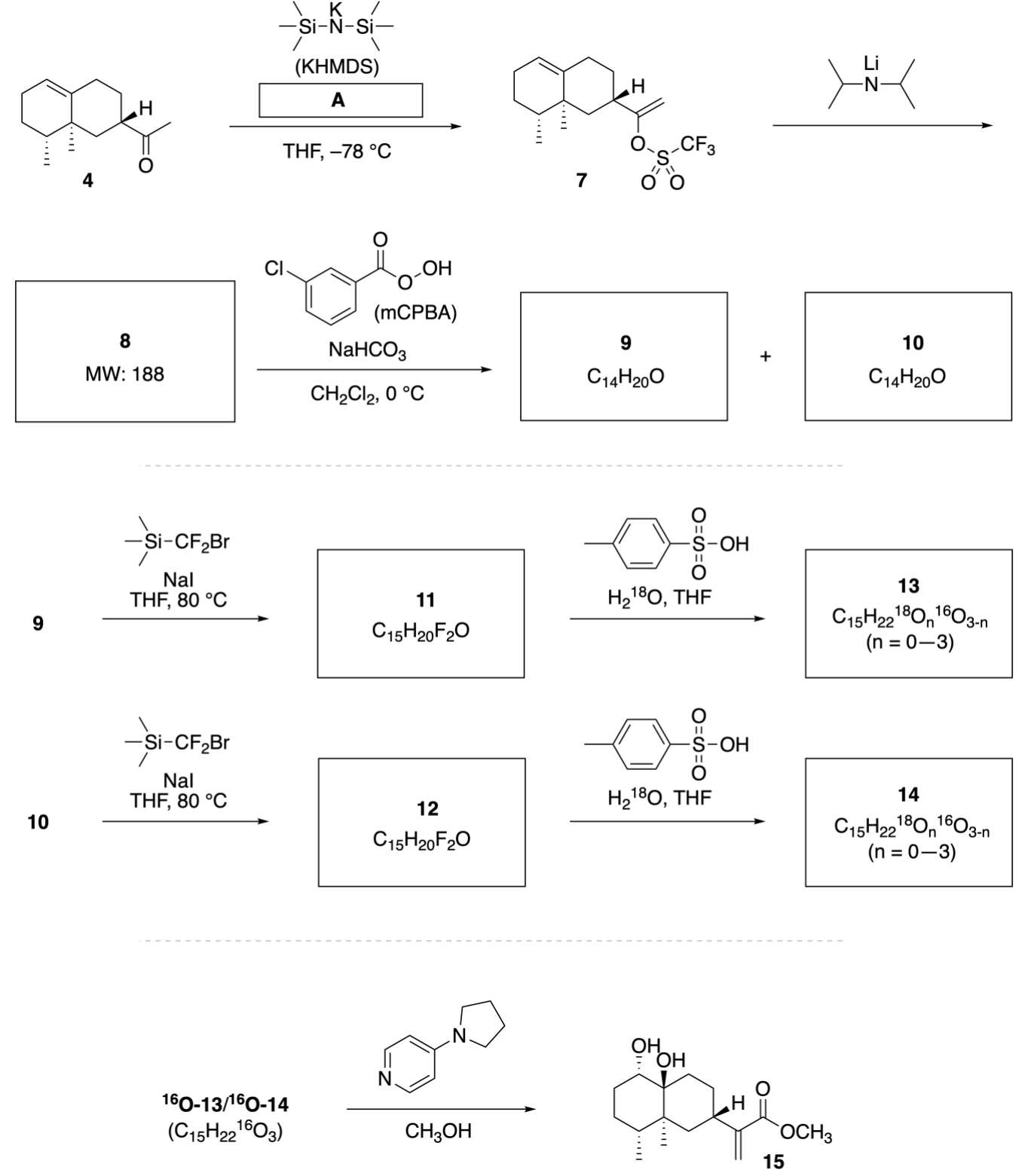
7.2 Choose the appropriate structure for A.

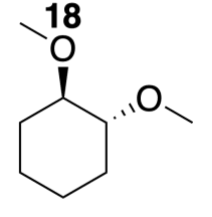
7.3 Draw the structures of 8–14 and clearly identify the stereochemistry where necessary. Also, indicate the introduced \(\ce{^{18}O}\) atoms for 13 and 14 as shown in the example below.
PART B
Compound 19 is synthesized as shown below. In relation to non-benzenoid aromaticity, 19 can be used as an activator for alcohols, and 20 was converted to 22 via ion-pair intermediate 21. Although the formation of 21 was observed by NMR, 21 gradually decomposes to give 18 and 22.
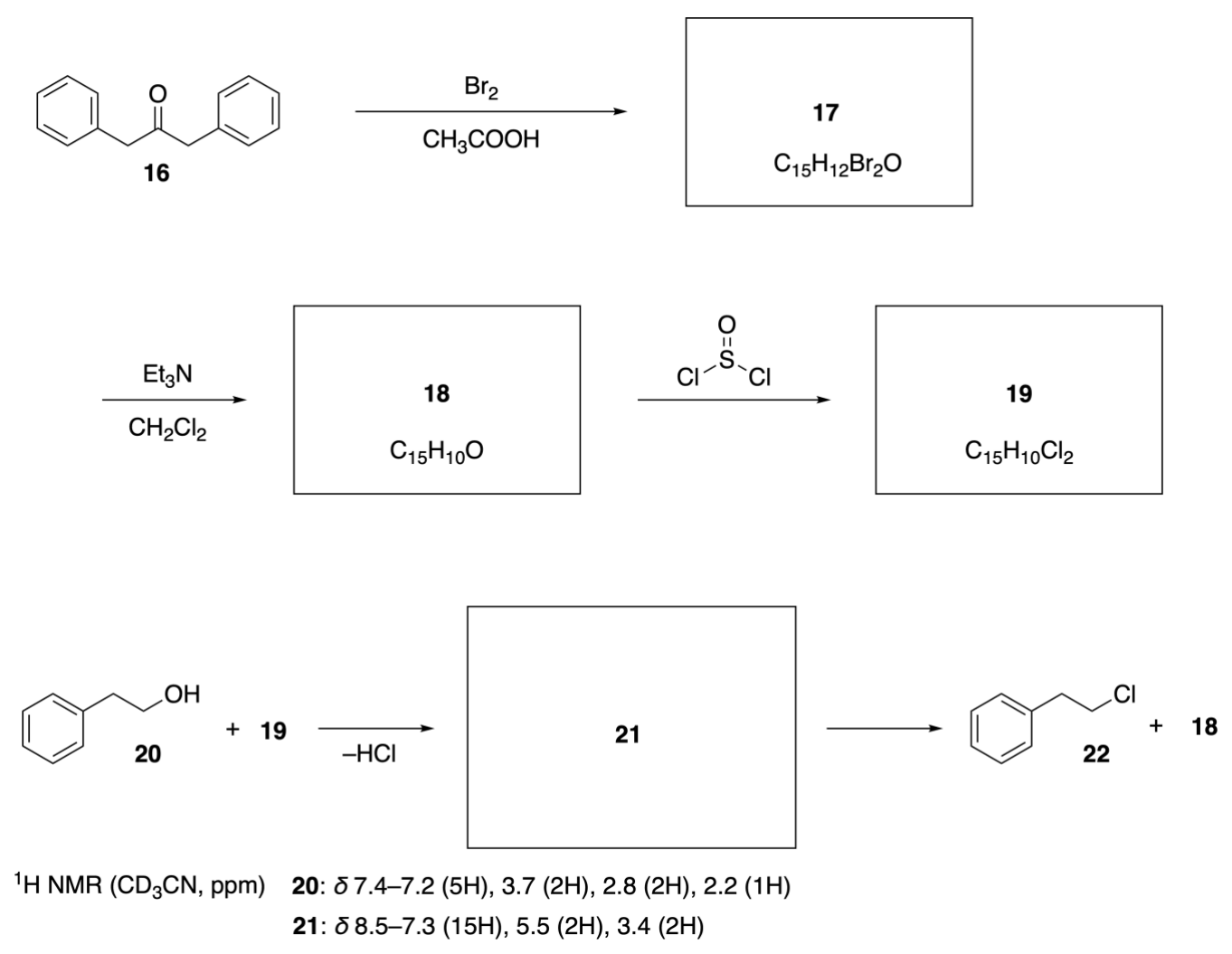
7.4 Draw the structures of 17–19 and 21. Identifying the stereochemistry is not necessary.
Official English text of the problem.
Problem 8: Dynamic Organic Molecules and Their Chirality
PART A
Polycyclic aromatic hydrocarbons with successive ortho-connections are called [n]carbohelicenes (here, n represents the number of six-membered rings) (see below). [4]Carbohelicene ([4]C) is efficiently prepared by a route using a photoreaction as shown below, via an intermediate (Int.) that is readily oxidized by iodine.
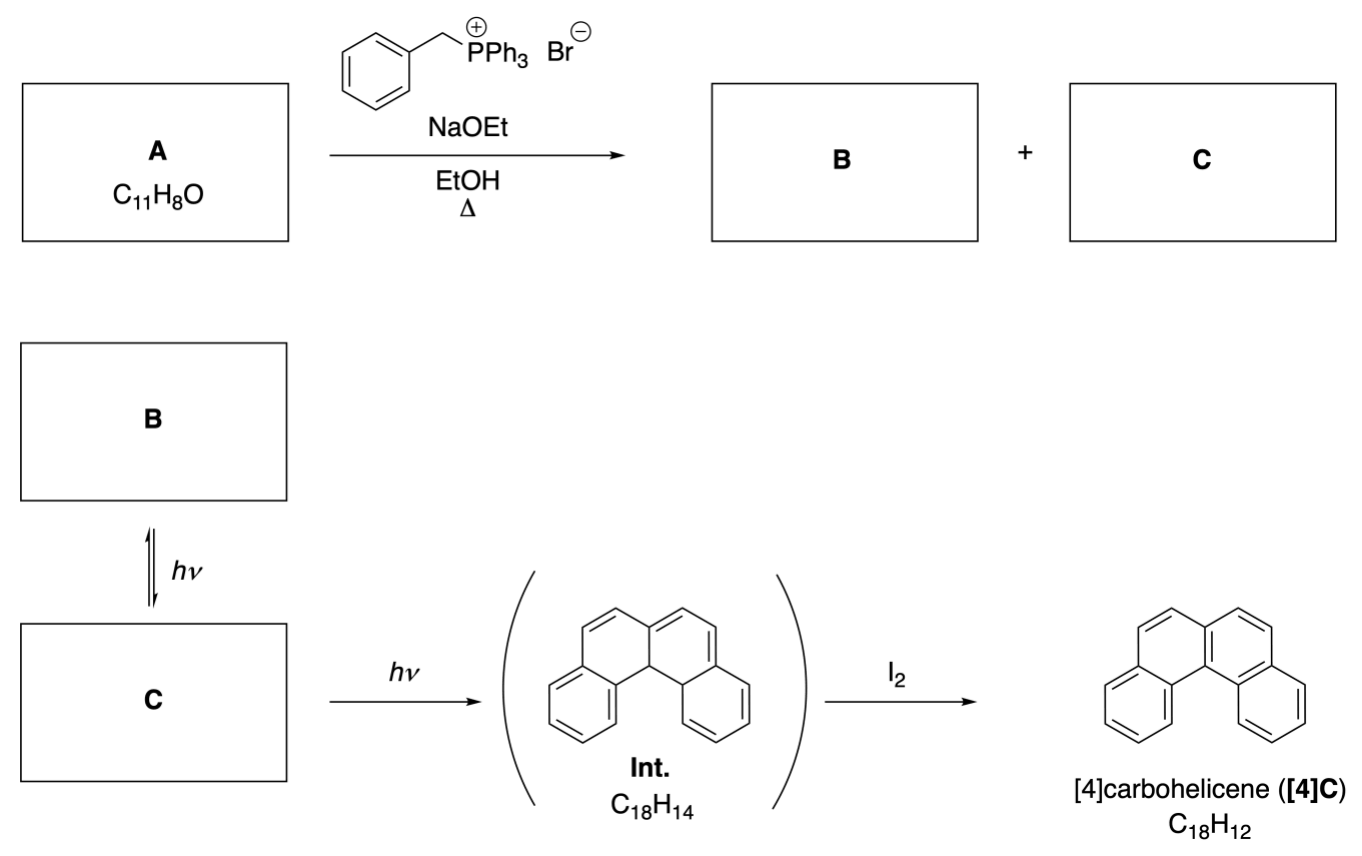
The photoreaction proceeds in a manner similar to the following example.

Note: For all of Question 8, please draw alternating single and double bonds in your answers to the problems as depicted in the examples of carbohelicene. Do not use circles for conjugated \(\pi\) systems.
8.1 Draw the structures of A–C. Stereoisomers should be distinguished.
8.2 Attempts to synthesize [5]carbohelicene from the same phosphonium salt and an appropriate starting compound resulted in the formation of only a trace amount of [5]carbohelicene, instead affording product D whose molecular weight was 2 Da lower than that of [5]carbohelicene. The \({}^{1}\mathrm H\) NMR chemical shifts of D are listed below. Draw the structure of D. [D (\(\delta\), ppm in \(\ce{CS2}\), r.t.), 8.85 (2H), 8.23 (2H), 8.07 (2H), 8.01 (2H), 7.97 (2H), 7.91 (2H)]
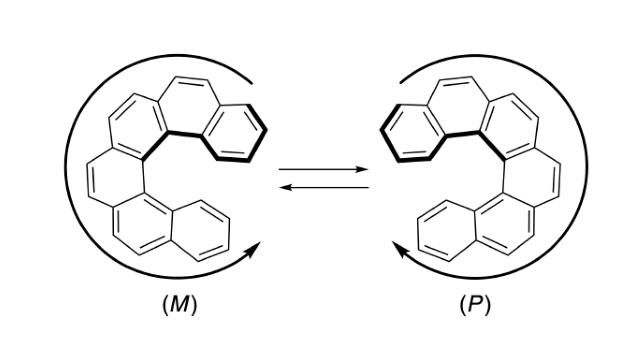
[5]- and larger [n]carbohelicenes have helical chirality and interconversion between enantiomers of these helicenes is significantly slow at room temperature. The chirality of [n]carbohelicenes is defined as \((M)\) or \((P)\) as shown below.
[n]Carbohelicenes with n larger than 4 can be enantiomerically separated by a chiral column chromatography, which was developed by Prof. Yoshio Okamoto.
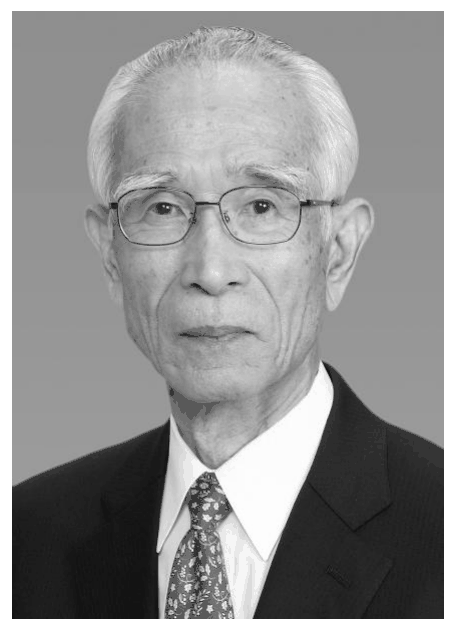
Photo courtesy: The Japan Prize Foundation
Multiple helicenes are molecules that contain two or more helicene-like structures. If its helical chirality is considered, several stereoisomers exist in a multiple helicene. For example, compound E contains three [5]carbohelicene-like moieties in one molecule. One of the stereoisomers is described as \((P,P,P)\) as shown below.
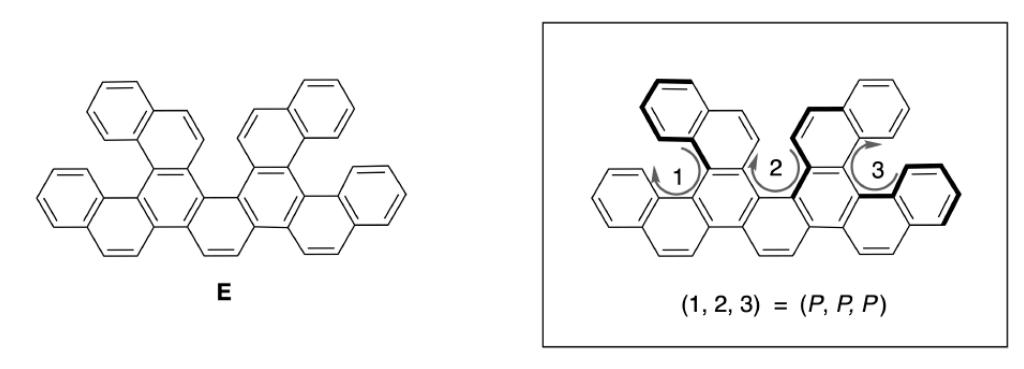
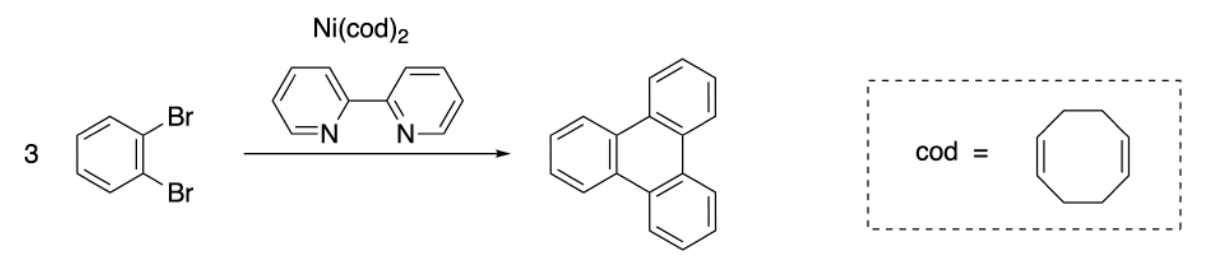
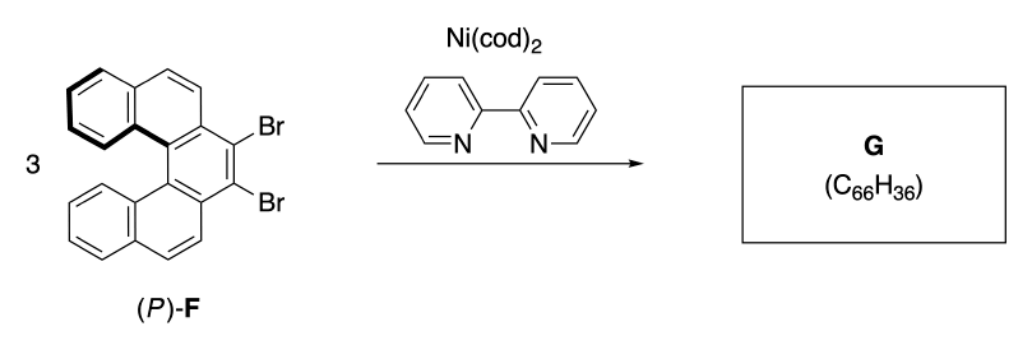
8.3 The nickel-mediated trimerization of 1,2-dibromobenzene generates triphenylene. When the same reaction is applied to an enantiomer of F, \((P)\)-F, multiple helicene G (\(\ce{C66H36}\)) is obtained. Given that interconversion between stereoisomers does not occur during the reaction, identify all the possible stereoisomers of G formed in this process, without duplication. As a reference, one isomer should be drawn completely with the chirality defined as in the example above, with numerical labels; the other stereoisomers should be listed with location numbers and \(M\) and \(P\) labels according to the same numbering. For instance, the other stereoisomers of E should be listed as \((1,2,3)=(P,M,P)\), \((P,M,M)\), \((P,P,M)\), \((M,M,M)\), \((M,M,P)\), \((M,P,P)\), and \((M,P,M)\).
PART B
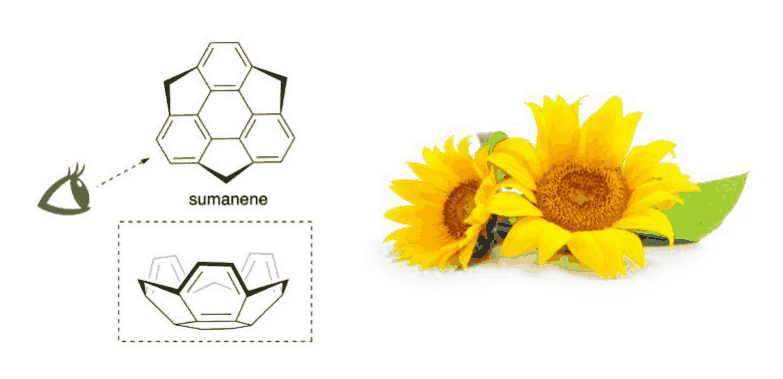
Sumanene is a bowl-shaped hydrocarbon that was first reported in Japan in 2003. The name "sumanene" derives from a Sanskrit-Hindi word "suman" that means sunflower. The synthesis of sumanene was achieved by a reaction sequence that consists of a ring-opening and a ring-closing metathesis.
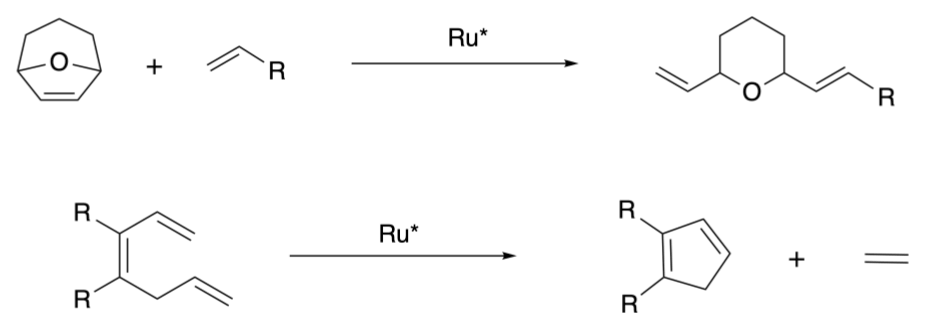
Representative metathesis reactions catalyzed by a ruthenium catalyst (\(\mathrm{Ru^*}\)) are shown below.
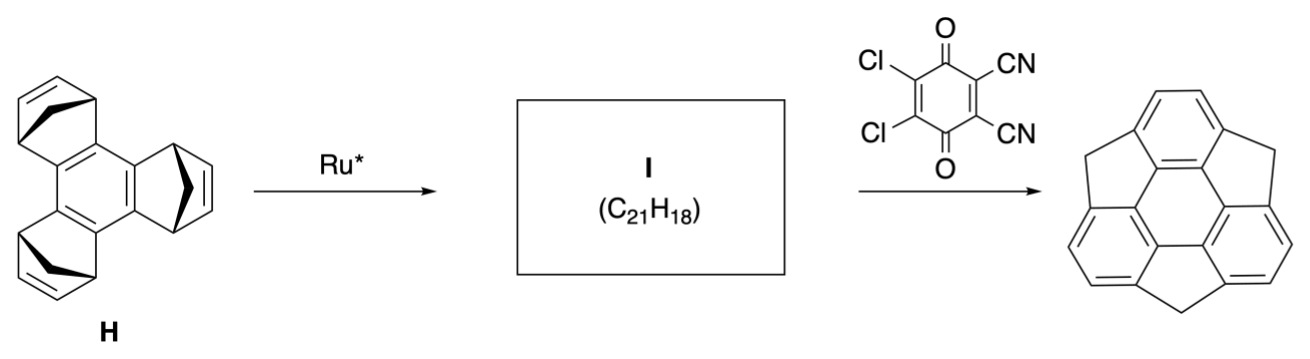
8.4 Draw the structure of intermediate I (its stereochemistry is not required).
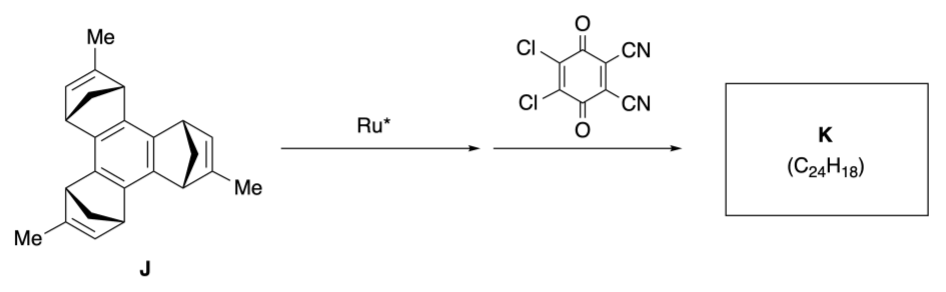
8.5 Starting from the optically active precursor J, the same reaction sequence gives the optically active sumanene derivative K. The stereocenters in J suffer no inversion during the metathesis reaction. Draw the structure of K with the appropriate stereochemistry.
Official English text of the problem.
Problem 9: Likes and Dislikes of Capsule
Good kids don’t do this, but if you unseam a tennis ball, you can disassemble it into two U-shaped pieces.
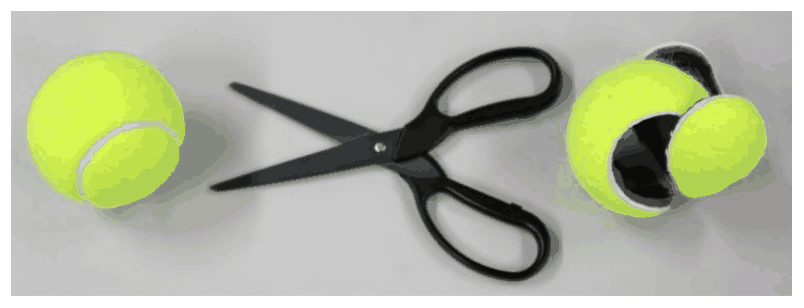
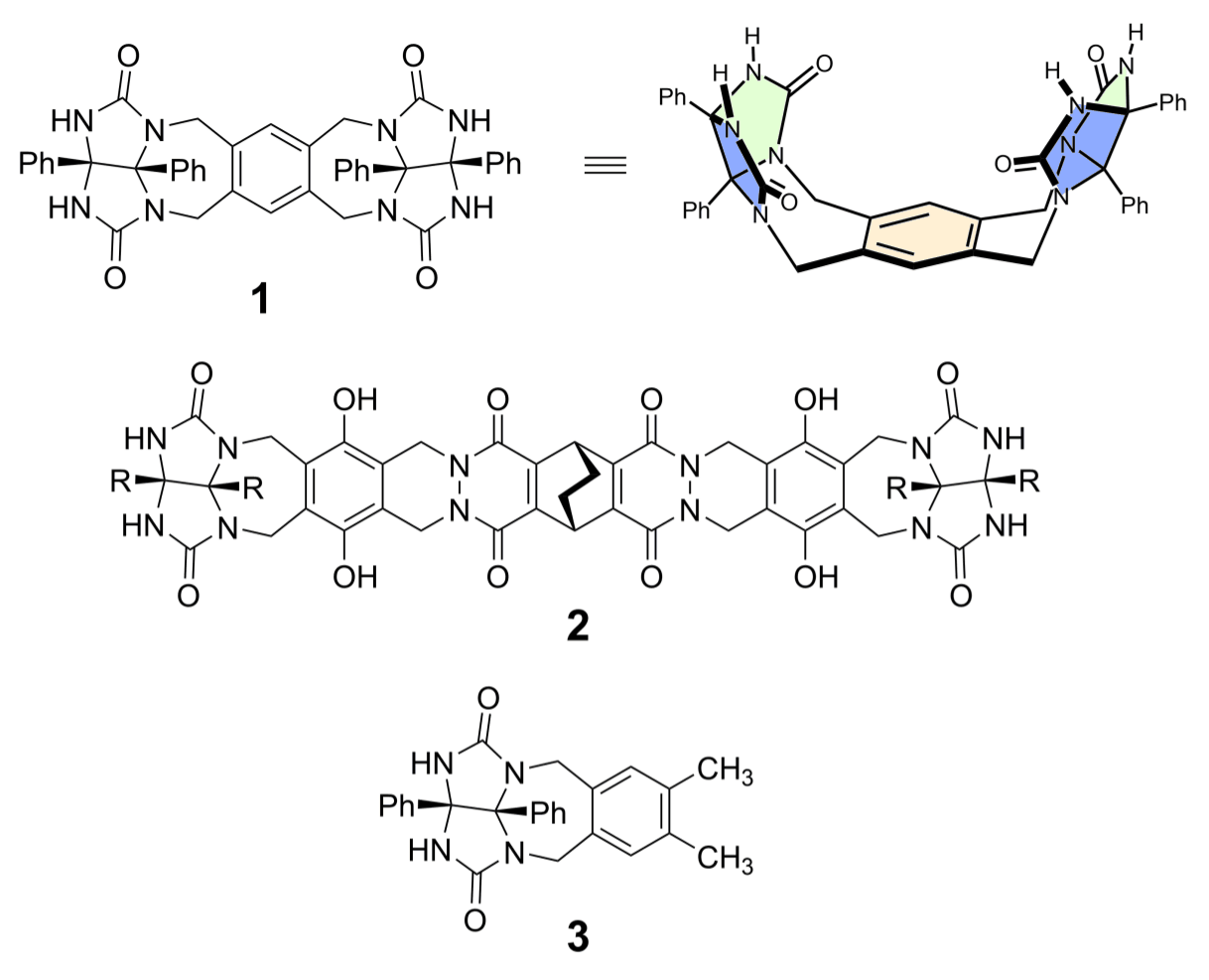
Based on this idea, compounds 1 and 2 were synthesized as U-shaped molecules with different sizes. Compound 3 was prepared as a comparison of 1 and the encapsulation behavior of these compounds was investigated.
The synthetic route to 2 is shown below. The elemental composition of compound 9: C; 40.49%, H; 1.70%, and O; 17.98% by mass.
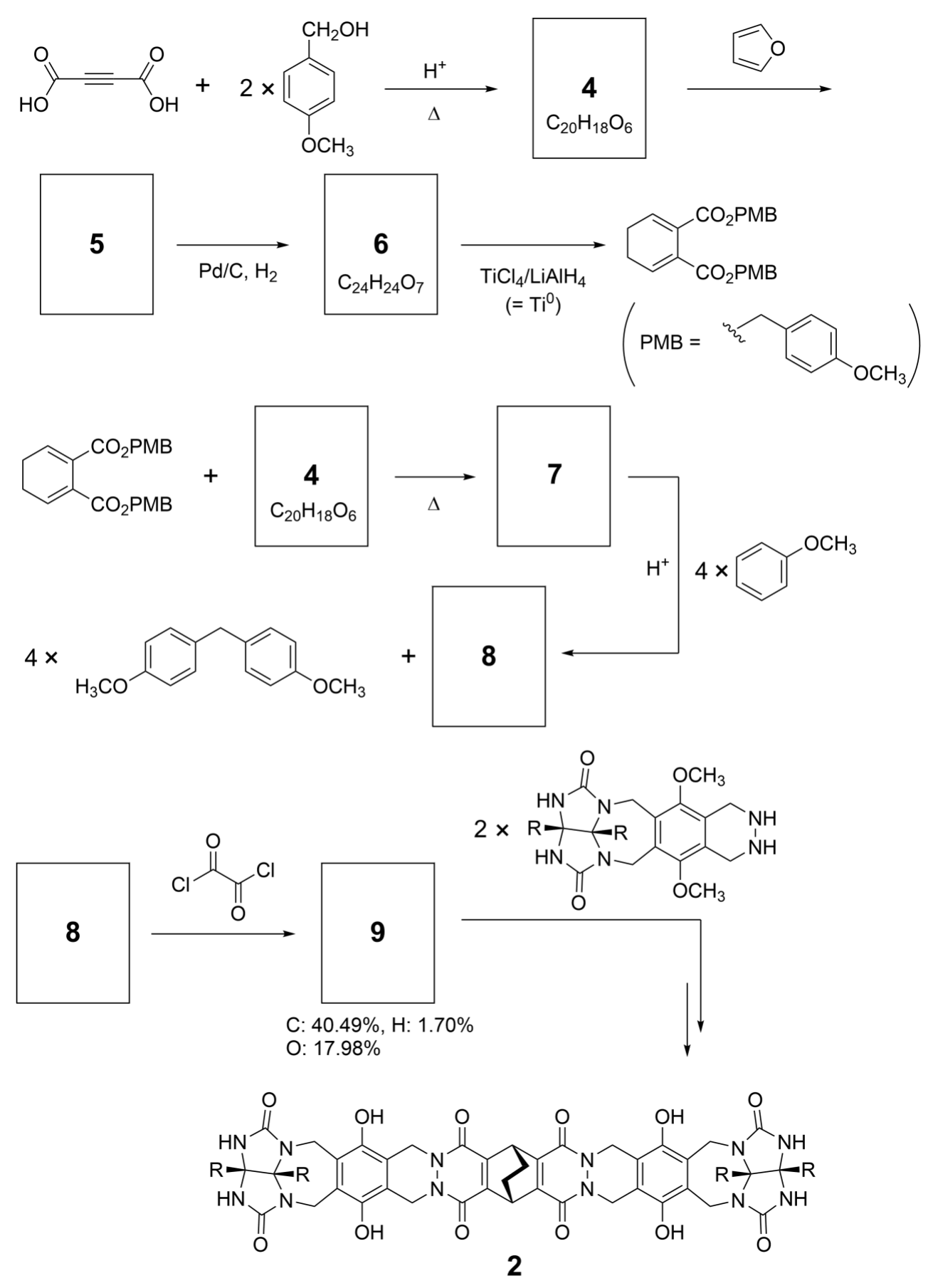
9.1 Draw the structures of 4–9; the stereochemistry can be neglected. Use "PMB" as a substituent instead of drawing the whole structure of p-methoxybenzyl group shown in the scheme above.
In the mass spectrum of 1, the ion peak corresponding to its dimer (\(\mathbf{1}_2\)) was clearly observed, whereas an ion peak for \(\mathbf{3}_2\) was not observed in the spectrum of 3. In the \({}^{1}\ce{H}\) NMR spectra of a solution of \(\mathbf{1}_2\), all the NH protons derived from 1 were observed to be chemically equivalent, and their chemical shift was significantly different from that of the NH protons of 3. These data indicate that hydrogen bonds are formed between the NH moieties of 1 and atoms X of another molecule of 1 to form the dimeric capsule.
9.2 Circle all the appropriate atom(s) X in 1.
9.3 Give the number of the hydrogen bonds in the dimeric capsule (\(\mathbf{1}_2\)).
The dimeric capsule of 1 (\(\mathbf{1}_2\)) has an internal space wherein an appropriate small molecule Z can be encapsulated. This phenomenon is expressed by the following equation:
\[ \ce{Z}+\mathbf{1}_2\ce{->}\ce{Z}@\mathbf{1}_2 \tag{1} \]
The equilibrium constant of the encapsulation of Z into \(\mathbf{1}_2\) is given as below:
\[ K_a=\frac{[\ce{Z}@\mathbf{1}_2]}{[\ce{Z}][\mathbf{1}_2]} \tag{2} \]
Encapsulation of a molecule into a capsule could be monitored by NMR spectroscopy. For example, \(\mathbf{1}_2\) in \(\ce{C6D6}\) gave different signals in the \({}^{1}\ce{H}\) NMR spectra before and after addition of \(\ce{CH4}\).
Compound 2 also forms a rigid and larger dimeric capsule (\(\mathbf{2}_2\)). The \({}^{1}\ce{H}\) NMR spectrum of \(\mathbf{2}_2\) was measured in \(\ce{C6D6}\), \(\ce{C6D5F}\), and a \(\ce{C6D6}/\ce{C6D5F}\) solvent mixture, with all other conditions being kept constant. The chemical shifts for the \(\ce{H}^{a}\) proton of 2 in the above solvents are summarized below, and no other signals from the \(\ce{H}^{a}\) in 2, except for the listed, were observed. Assume that the interior of the capsule is always filled with the largest possible number of solvent molecules and that each signal corresponds to one species of the filled capsule.
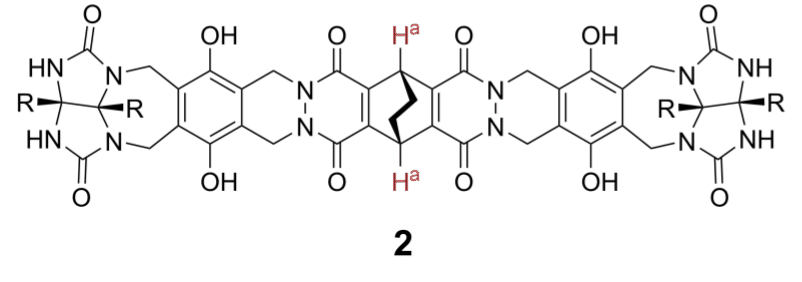
solvent \(\delta\) (ppm) of \(\ce{H}^{a}\) \(\ce{C6D6}\) 4.60 \(\ce{C6D5F}\) 4.71 \(\ce{C6D6}/\ce{C6D5F}\) 4.60, 4.71, 4.82 9.4 Determine the number of \(\ce{C6D6}\) and \(\ce{C6D5F}\) molecules encapsulated in \(\mathbf{2}_2\) giving each \(\ce{H}^{a}\) signal.
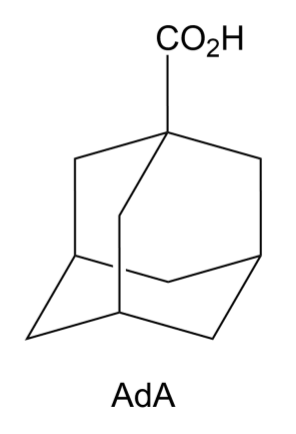
\({}^{1}\ce{H}\) NMR measurements in \(\ce{C6D6}\) revealed that \(\mathbf{2}_2\) can incorporate one molecule of 1-adamantanecarboxylic acid (AdA), and the association constants (\(K_a\)) which are expressed below were determined for various temperatures. \([\mathrm{solvent}@\mathbf{2}_2]\) denotes a species containing one or more solvent molecules.
\[ K_a=\frac{[\ce{Z}@\mathbf{2}_2]} {[\ce{Z}][\mathrm{solvent}@\mathbf{2}_2]} \tag{3} \]
Similarly, the \(K_a\) values of \(\ce{CH4}\) and \(\mathbf{1}_2\) given as eq (2) at various temperatures in \(\ce{C6D6}\) were also determined by \({}^{1}\ce{H}\) NMR measurements. The plots of the two association constants (as \(\ln K_a\) vs \(1/T\)) are shown below.
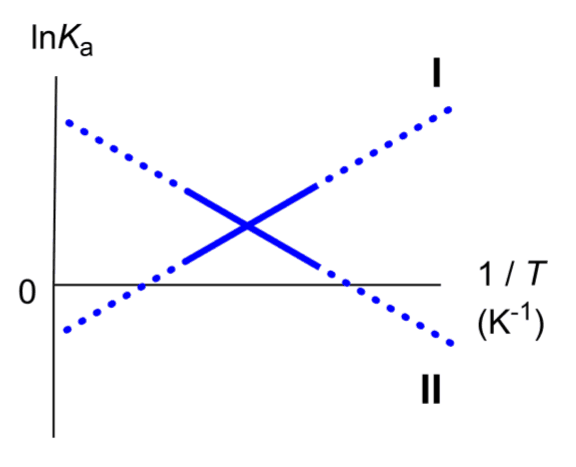
No \(\ce{C6D6}\) molecule is encapsulated in \(\mathbf{1}_2\). In line II, the entropy change (\(\Delta S\)) is ( 1 ) and enthalpy change (\(\Delta H\)) is ( 2 ), indicating that the driving force for the encapsulation in line II is ( 3 ). Therefore, line I corresponds to ( 4 ), and line II corresponds to ( 5 ).
9.5 Choose the correct options in gaps (1)–(5) in the following paragraph from A and B.
A B ( 1 ) positive negative ( 2 ) positive negative ( 3 ) \(\Delta S\) \(\Delta H\) ( 4 ) \(\mathbf{1}_2\) and \(\ce{CH4}\) \(\mathbf{2}_2\) and AdA ( 5 ) \(\mathbf{1}_2\) and \(\ce{CH4}\) \(\mathbf{2}_2\) and AdA Official English text of the problem.
Internationale Chemie-Olympiade
IChO 2021
Osaka, Japan (als Fernwettbewerb ausgetragen) · 9 Theorieaufgaben mit vollständigen Lösungen
Aufgabe 1: Wasserstoff an einer Metalloberfläche
Wasserstoff gilt als zukünftiger Energieträger, der nicht von fossilen Brennstoffen abhängt. Hier betrachten wir den Prozess der Wasserstoffspeicherung in einem Metall, der mit Technologien zum Transport und zur Speicherung von Wasserstoff zusammenhängt.
TEIL A
Da Wasserstoff über die Oberfläche eines Metalls in dessen Inneres aufgenommen wird, betrachten wir zunächst den Adsorptionsprozess von Wasserstoff an der Metalloberfläche, \(\ce{H2(g) -> 2H(ad)}\), wobei der gasförmige und der adsorbierte Zustand des Wasserstoffs mit (g) bzw. (ad) bezeichnet werden. Wasserstoffmoleküle (\(\ce{H2}\)), die die Metalloberfläche (M) erreichen, dissoziieren an der Oberfläche und werden als \(\ce{H}\)-Atome adsorbiert (Abb. 1). Die potenzielle Energie von \(\ce{H2}\) wird hier durch zwei Variablen beschrieben: den Abstand zwischen den Atomen, \(d\), und die Höhe relativ zum Metallatom an der Oberfläche, \(z\). Es wird angenommen, dass die Achse durch die beiden \(\ce{H}\)-Atome parallel zur Oberfläche verläuft und sich der Schwerpunkt stets auf der vertikalen gepunkteten Linie in Abb. 1 befindet. Abb. 2 zeigt das Konturdiagramm der potenziellen Energie für die Dissoziation an der Oberfläche. Die Zahlenwerte geben die potenzielle Energie in kJ pro Mol \(\ce{H2}\) an. Der Abstand zwischen den durchgezogenen Linien beträgt \(20\ \mathrm{kJ\,mol^{-1}}\), der Abstand zwischen den gestrichelten Linien \(100\ \mathrm{kJ\,mol^{-1}}\) und der Abstand zwischen durchgezogenen und gestrichelten Linien \(80\ \mathrm{kJ\,mol^{-1}}\). Die Nullpunktsschwingungsenergie wird vernachlässigt.
Abb. 1 Definition der Variablen. Die Zeichnung ist nicht maßstabsgetreu.
Abb. 2
1.1 Wählen Sie für jede der folgenden Größen (i)–(iii) den nächstliegenden Wert aus A–G aus.
(i) Der Abstand zwischen den Atomen eines gasförmigen \(\ce{H2}\)-Moleküls
(ii) Der Abstand zwischen den Metallatomen (\(d_{\mathrm M}\) in Abb. 1)
(iii) Der Abstand der adsorbierten \(\ce{H}\)-Atome von der Oberfläche (\(h_{\mathrm{AD}}\) in Abb. 1)
A. \(0.03\ \mathrm{nm}\) B. \(0.07\ \mathrm{nm}\) C. \(0.11\ \mathrm{nm}\) D. \(0.15\ \mathrm{nm}\) E. \(0.19\ \mathrm{nm}\) F. \(0.23\ \mathrm{nm}\) G. \(0.27\ \mathrm{nm}\) 1.2 Wählen Sie für jede der folgenden Größen (i)–(ii) den nächstliegenden Wert aus A–H aus.
(i) die für die Dissoziation von gasförmigem \(\ce{H2}\) zu gasförmigem \(\ce{H}\) erforderliche Energie [\(\ce{H2(g) -> 2H(g)}\)]
(ii) die bei der Adsorption von gasförmigem \(\ce{H2}\) freigesetzte Energie [\(\ce{H2(g) -> 2H(ad)}\)]
A. \(20\ \mathrm{kJ\,mol^{-1}}\) B. \(40\ \mathrm{kJ\,mol^{-1}}\) C. \(60\ \mathrm{kJ\,mol^{-1}}\) D. \(100\ \mathrm{kJ\,mol^{-1}}\) E. \(150\ \mathrm{kJ\,mol^{-1}}\) F. \(200\ \mathrm{kJ\,mol^{-1}}\) G. \(300\ \mathrm{kJ\,mol^{-1}}\) H. \(400\ \mathrm{kJ\,mol^{-1}}\) TEIL B
Die adsorbierten Wasserstoffatome werden anschließend entweder in das Metallinnere aufgenommen oder rekombinieren und desorbieren zurück in die Gasphase, wie in den Reaktionen (1a) und (1b) dargestellt. \(\ce{H(ab)}\) bezeichnet ein im Metallinneren absorbiertes Wasserstoffatom.
Die Reaktionsgeschwindigkeiten pro Oberflächenplatz für Adsorption, Desorption und Absorption sind \(r_1[\mathrm{s^{-1}}]\), \(r_2[\mathrm{s^{-1}}]\) bzw. \(r_3[\mathrm{s^{-1}}]\). Sie werden wie folgt ausgedrückt:
\[ r_1=k_1P_{\ce{H2}}(1-\theta)^2 \tag{2} \]
\[ r_2=k_2\theta^2 \tag{3} \]
\[ r_3=k_3\theta \tag{4} \]
wobei \(k_1\ [\mathrm{s^{-1}\,Pa^{-1}}]\), \(k_2\ [\mathrm{s^{-1}}]\) und \(k_3\ [\mathrm{s^{-1}}]\) die Reaktionsgeschwindigkeitskonstanten sind und \(P_{\ce{H2}}\) der Druck von \(\ce{H2}\) ist. Von den auf der Oberfläche verfügbaren Plätzen ist \(\theta\) (\(0\leq\theta\leq1\)) der Anteil, der von \(\ce{H}\)-Atomen besetzt ist. Es wird angenommen, dass Adsorption und Desorption im Vergleich zur Absorption schnell sind (\(r_1,r_2\gg r_3\)) und dass \(\theta\) konstant bleibt.
1.3 \(r_3\) lässt sich wie folgt ausdrücken:
\[ r_3=\frac{k_3}{1+\sqrt{\dfrac{1}{P_{\ce{H2}}C}}} \tag{5} \]
Drücken Sie \(C\) durch \(k_1\) und \(k_2\) aus.
Eine Metallprobe mit einer Oberfläche von \(S=1.0\times10^{-3}\ \mathrm{m^2}\) wurde in einen Behälter (\(1\mathrm{L}=1.0\times10^{-3}\ \mathrm{m^3}\)) mit \(\ce{H2}\) (\(P_{\ce{H2}}=1.0\times10^2\ \mathrm{Pa}\)) eingebracht. Die Dichte der Adsorptionsplätze für Wasserstoffatome auf der Oberfläche betrug \(N=1.3\times10^{18}\ \mathrm{m^{-2}}\). Die Oberflächentemperatur wurde bei \(T=400\ \mathrm K\) konstant gehalten. Während Reaktion (1) ablief, nahm \(P_{\ce{H2}}\) mit einer konstanten Geschwindigkeit von \(v=4.0\times10^{-4}\ \mathrm{Pa\,s^{-1}}\) ab. Nehmen Sie an, dass \(\ce{H2}\) ein ideales Gas ist und das Volumen der Metallprobe vernachlässigbar ist.
1.4 Berechnen Sie die Stoffmenge der pro Flächeneinheit der Oberfläche und pro Zeiteinheit absorbierten \(\ce{H}\)-Atome in Mol, \(A\ [\mathrm{mol\,s^{-1}\,m^{-2}}]\).
1.5 Bei \(T=400\ \mathrm K\) beträgt \(C\) \(1.0\times10^2\ \mathrm{Pa^{-1}}\). Berechnen Sie den Wert von \(k_3\) bei \(400\ \mathrm K\). Falls Sie keine Antwort auf 1.4 erhalten haben, verwenden Sie \(A=3.6\times10^{-7}\ \mathrm{mol\,s^{-1}\,m^{-2}}\).
1.6 Bei einer anderen Temperatur \(T\) sind \(C=2.5\times10^3\ \mathrm{Pa^{-1}}\) und \(k_3=4.8\times10^{-2}\ \mathrm{s^{-1}}\) gegeben. Wählen Sie aus (a)–(h) den richtigen Graphen für \(r_3\) als Funktion von \(P_{\ce{H2}}\) bei dieser Temperatur aus.
Aufgabentext aus dem offiziellen englischen Text übersetzt.
Aufgabe 2: Isotopen-Zeitkapsel
Molekulare Einheiten, die sich nur in ihrer Isotopenzusammensetzung unterscheiden, wie etwa \(\ce{CH4}\) und \(\ce{CH3D}\), werden als Isotopologe bezeichnet. Man geht davon aus, dass Isotopologe dieselben chemischen Eigenschaften besitzen. In der Natur besteht jedoch ein geringfügiger Unterschied.
Nehmen Sie an, dass alle in dieser Aufgabe dargestellten Stoffe gasförmig vorliegen.
Betrachten wir das folgende Gleichgewicht:
Die Entropie \(S\) nimmt mit zunehmender Anzahl möglicher mikroskopischer Zustände eines Systems \(W\) zu:
\[ S=k_{\mathrm B}\ln W \tag{2} \]
Für \(\ce{^{12}C^{16}O2}\) und \(\ce{^{12}C^{18}O2}\) gilt \(W=1\). Dagegen gilt für ein \(\ce{^{12}C^{16}O^{18}O}\)-Molekül \(W=2\), da die Sauerstoffatome in diesem Molekül unterscheidbar sind. Da auf der rechten Seite des in Gl. 1 dargestellten Gleichgewichts zwei \(\ce{^{12}C^{16}O^{18}O}\)-Moleküle stehen, gilt \(W=2^2=4\).
2.1 Die Enthalpieänderung \(\Delta H\) von Gl. 3 ist unabhängig von der Temperatur positiv.
Berechnen Sie die Gleichgewichtskonstanten \(K\) für Gl. 3 bei sehr niedrigen (denken Sie an \(T\to0\)) und sehr hohen (denken Sie an \(T\to+\infty\)) Temperaturen. Nehmen Sie an, dass die Reaktion bei diesen Temperaturen unverändert bleibt und dass \(\Delta H\) bei hohen Temperaturen gegen einen konstanten Wert konvergiert.
Die Enthalpieänderung \(\Delta H\) des folgenden Vorgangs lässt sich durch Molekülschwingungen erklären.
Bei \(T=0\ \mathrm K\) wird die Schwingungsenergie eines zweiatomigen Moleküls mit der Schwingungsfrequenz \(\nu\ [\mathrm{s^{-1}}]\) wie folgt ausgedrückt:
\[ E=\frac12h\nu \tag{5} \]
\[ \nu=\frac{1}{2\pi}\sqrt{\frac{k}{\mu}} \tag{6} \]
Dabei ist \(k\) die Kraftkonstante und \(\mu\) die reduzierte Masse, die sich aus den Massen der beiden Atome im zweiatomigen Molekül, \(m_1\) und \(m_2\), wie folgt ergibt:
\[ \mu=\frac{m_1m_2}{m_1+m_2} \tag{7} \]
2.2 Die Schwingung von \(\ce{H2}\) liegt, als Wellenzahl angegeben, bei \(4161.0\ \mathrm{cm^{-1}}\).
Berechnen Sie \(\Delta H\) für die folgende Gleichung bei \(T=0\ \mathrm K\) in der Einheit \(\mathrm{J\,mol^{-1}}\).
Nehmen Sie an, dass:
- nur die Schwingungsenergie zu \(\Delta H\) beiträgt.
- die \(k\)-Werte für \(\ce{H2}\), \(\ce{HD}\) und \(\ce{D2}\) identisch sind.
- die Masse von \(\ce{H}\) \(1\ \mathrm{Da}\) und die Masse von \(\ce{D}\) \(2\ \mathrm{Da}\) beträgt.
Das Stoffmengenverhältnis von \(\ce{H2}\), \(\ce{HD}\) und \(\ce{D2}\) hängt in einem System im Gleichgewicht von der Temperatur ab. Hier wird \(\Delta_{\ce{D2}}\) als Änderung des Stoffmengenverhältnisses von \(\ce{D2}\) definiert.
\[ \Delta_{\ce{D2}}=\frac{R_{\ce{D2}}}{R_{\ce{D2}}^*}-1 \tag{9} \]
Dabei bezeichnet \(R_{\ce{D2}}\) das Verhältnis \(\dfrac{[\ce{D2}]}{[\ce{H2}]}\) in der Probe und \(R_{\ce{D2}}^*\) das Verhältnis \(\dfrac{[\ce{D2}]}{[\ce{H2}]}\) bei \(T\to+\infty\). Beachten Sie hierbei, dass die Isotopenverteilung bei \(T\to+\infty\) zufällig wird.
2.3 Berechnen Sie \(\Delta_{\ce{D2}}\) bei natürlicher Häufigkeit von \(\ce{D}\), wenn der Isotopenaustausch bei der Temperatur im Gleichgewicht ist, bei der \(K\) in Gl. 4 den Wert \(0.300\) hat. Nehmen Sie an, dass die natürlichen Häufigkeiten von \(\ce{D}\) und \(\ce{H}\) \(1.5576\times10^{-4}\) bzw. \(1-1.5576\times10^{-4}\) betragen.
Im Allgemeinen nimmt das Stoffmengenverhältnis des zweifach substituierten Isotopologs, das zwei schwere Isotopenatome in einem Molekül enthält, mit sinkender Temperatur zu. Betrachten wir das Stoffmengenverhältnis von \(\ce{CO2}\)-Molekülen mit den Molekülmassen 44 und 47, die im Folgenden als \(\ce{CO2}[44]\) und \(\ce{CO2}[47]\) bezeichnet werden. Die Größe \(\Delta_{47}\) ist definiert als:
\[ \Delta_{47}=\frac{R_{47}}{R_{47}^*}-1 \tag{10} \]
\(R_{47}\) bezeichnet das Verhältnis \(\dfrac{[\ce{CO2}[47]]}{[\ce{CO2}[44]]}\) in der Probe und \(R_{47}^*\) das Verhältnis \(\dfrac{[\ce{CO2}[47]]}{[\ce{CO2}[44]]}\) bei \(T\to+\infty\). Die natürlichen Häufigkeiten der Kohlenstoff- und Sauerstoffatome sind unten angegeben; vernachlässigen Sie hier nicht aufgeführte Isotope.
\(\ce{^{12}C}\) \(\ce{^{13}O}\) natürliche Häufigkeit 0.988888 0.011112 \(\ce{^{16}O}\) \(\ce{^{17}O}\) \(\ce{^{18}O}\) natürliche Häufigkeit 0.997621 0.0003790 0.0020000 Die Temperaturabhängigkeit von \(\Delta_{47}\) wird wie folgt bestimmt, wobei \(T\) die absolute Temperatur in der Einheit K ist:
\[ \Delta_{47}=\frac{36.2}{T^2}+2.920\times10^{-4} \tag{11} \]
2.4 Der Wert von \(\Delta_{47}\) für fossiles Plankton vom antarktischen Meeresboden betrug \(4.50865\times10^{-5}\).
Schätzen Sie die Temperatur mithilfe dieses Wertes von \(R_{47}\) ab. Diese Temperatur wird als die Lufttemperatur in der Epoche interpretiert, in der das Plankton lebte. Berücksichtigen Sie bei der Berechnung nur das häufigste Isotopolog von \(\ce{CO2}[47]\).
Aufgabentext aus dem offiziellen englischen Text übersetzt.
Aufgabe 3: Lambert–Beersches Gesetz?
Vernachlässigen Sie in dieser Aufgabe die Absorption der Küvette und des Lösungsmittels. Die Temperaturen aller Lösungen und Gase werden konstant bei 25 °C gehalten.
TEIL A
Eine wässrige Lösung X wurde aus \(\ce{HA}\) und \(\ce{NaA}\) hergestellt. Die Konzentrationen \([\ce{A^-}]\), \([\ce{HA}]\) und \([\ce{H+}]\) in Lösung X betragen \(1.00 \times 10^{-2}\ \mathrm{mol\,L^{-1}}\), \(1.00 \times 10^{-3}\ \mathrm{mol\,L^{-1}}\) bzw. \(1.00 \times 10^{-4}\ \mathrm{mol\,L^{-1}}\) und sind über das folgende Säure-Base-Gleichgewicht miteinander verknüpft:
Die optische Weglänge beträgt in Teil A \(l\). Vernachlässigen Sie die Dichteänderung beim Verdünnen. Nehmen Sie an, dass außer der Reaktion in Gl. 1 keine weiteren chemischen Reaktionen stattfinden.
3.1 Die Extinktion von X betrug bei einer Wellenlänge von \(\lambda_1\) \(A_1\). Anschließend wurde Lösung X mit Salzsäure mit pH = 2.500 auf das Doppelte ihres ursprünglichen Volumens verdünnt. Nach dem Verdünnen betrug die Extinktion bei \(\lambda_1\) weiterhin \(A_1\). Bestimmen Sie das Verhältnis \(\varepsilon_{\ce{HA}}/\varepsilon_{\ce{A^-}}\), wobei \(\varepsilon_{\ce{HA}}\) und \(\varepsilon_{\ce{A^-}}\) die molaren Extinktionskoeffizienten von \(\ce{HA}\) bzw. \(\ce{A^-}\) bei \(\lambda_1\) bezeichnen.
TEIL B
Betrachten wir das folgende Gleichgewicht in der Gasphase:
Reines Gas \(\ce{D}\) wird bei einem Druck \(P\) in einen quaderförmigen Behälter gefüllt, der eine durchsichtige, bewegliche Wand mit einer Querschnittsfläche von \(S\) besitzt (siehe Abbildung unten). Das Gleichgewicht stellt sich ein, während der Gesamtdruck bei \(P\) gehalten wird. Die Extinktion des Gases beträgt \(A=\varepsilon(n/V)l\), wobei \(\varepsilon\), \(n\), \(V\) und \(l\) den molaren Extinktionskoeffizienten, die Stoffmenge des Gases in Mol, das Volumen des Gases bzw. die optische Weglänge bezeichnen. Nehmen Sie an, dass sich alle Komponenten des Gasgemisches wie ideale Gase verhalten.
Verwenden Sie bei Bedarf die folgenden Definitionen.
Anfangszustand Nach Einstellung des Gleichgewichts \(\ce{D}\) \(\ce{M}\) \(\ce{D}\) \(\ce{M}\) Partialdruck \(P\) \(0\) \(p_{\mathrm D}\) \(p_{\mathrm M}\) Stoffmenge in Mol \(n_0\) \(0\) \(n_{\mathrm D}\) \(n_{\mathrm M}\) Volumen \(V_0\) \(V\) 3.2 Die aus Richtung \(x\) (\(l=l_x\)) gemessene Extinktion des Gases bei \(\lambda_{\mathrm{B1}}\) betrug sowohl im Anfangszustand als auch nach Einstellung des Gleichgewichts \(A_{\mathrm{B1}}\). Bestimmen Sie das Verhältnis \(\varepsilon_{\mathrm D}/\varepsilon_{\mathrm M}\) bei \(\lambda_{\mathrm{B1}}\), wobei \(\varepsilon_{\mathrm D}\) und \(\varepsilon_{\mathrm M}\) die molaren Extinktionskoeffizienten von \(\ce{D}\) bzw. \(\ce{M}\) bezeichnen.
3.3 Die aus Richtung \(y\) gemessene Extinktion des Gases bei \(\lambda_{\mathrm{B2}}\) betrug sowohl im Anfangszustand (\(l=l_{y0}\)) als auch nach Einstellung des Gleichgewichts (\(l=l_y\)) \(A_{\mathrm{B2}}\). Bestimmen Sie das Verhältnis \(\varepsilon_{\mathrm D}/\varepsilon_{\mathrm M}\) bei \(\lambda_{\mathrm{B2}}\).
Aufgabentext aus dem offiziellen englischen Text übersetzt.
Aufgabe 4: Die Redoxchemie des Zinks
Zink wird seit Langem in Legierungen für Messing- und Stahlwerkstoffe eingesetzt. Das in industriellem Abwasser enthaltene Zink wird durch Fällung abgetrennt, um das Wasser zu entgiften, und der erhaltene Niederschlag wird reduziert, um das Zink als metallisches Zink zurückzugewinnen und wiederzuverwenden.
TEIL A
Das Lösungsgleichgewicht von Zinkhydroxid \(\ce{Zn(OH)2(s)}\) bei 25 °C und die zugehörigen Gleichgewichtskonstanten sind in Gl. 1–4 angegeben.
Die Löslichkeit \(S\) von Zink (die Zinkkonzentration in einer gesättigten wässrigen Lösung) ist in Gl. 5 angegeben.
\[ S=[\ce{Zn^2+(aq)}]+[\ce{Zn(OH)2(aq)}]+[\ce{Zn(OH)4^2-(aq)}] \tag{5} \]
4.1 Berechnen Sie für den Fall, dass sich die Gleichgewichte in Gl. 1–4 eingestellt haben, den pH-Bereich, in dem \([\ce{Zn(OH)2(aq)}]\) unter den Konzentrationen \([\ce{Zn^2+(aq)}]\), \([\ce{Zn(OH)2(aq)}]\) und \([\ce{Zn(OH)4^2-(aq)}]\) am größten ist.
4.2 Eine gesättigte wässrige Lösung von \(\ce{Zn(OH)2(s)}\) mit pH = 7.00 wurde hergestellt und filtriert. Diesem Filtrat wurde NaOH zugesetzt, um seinen pH-Wert auf 12.00 zu erhöhen. Berechnen Sie den auf die Stoffmenge bezogenen prozentualen Anteil des Zinks, der bei der Erhöhung des pH-Werts von 7.00 auf 12.00 ausfällt. Vernachlässigen Sie die Volumen- und Temperaturänderungen.
TEIL B
Anschließend wird das zurückgewonnene Zinkhydroxid erhitzt, um gemäß der folgenden Reaktion Zinkoxid zu erhalten:
Das Zinkoxid wird dann durch Reaktion mit Wasserstoff zu metallischem Zink reduziert:
4.3 Damit Reaktion (7) bei einem konstant gehaltenen Wasserstoffdruck von 1 bar ablaufen kann, muss der Partialdruck des entstehenden Wasserdampfs gesenkt werden. Berechnen Sie die Obergrenze des Wasserdampfpartialdrucks, bei der Reaktion (7) bei 300 °C ablaufen kann. Dabei betragen die Gibbs-Bildungsenergien von Zinkoxid bzw. Wasserdampf bei 300 °C und einem Druck von 1 bar für alle gasförmigen Spezies \(\Delta G_{\ce{ZnO}}(300\,^\circ\mathrm{C})=-2.90\times10^2\ \mathrm{kJ\,mol^{-1}}\) bzw. \(\Delta G_{\ce{H2O}}(300\,^\circ\mathrm{C})=-2.20\times10^2\ \mathrm{kJ\,mol^{-1}}\).
Metallisches Zink wird als Material für die negative Elektrode (Anode) von Metall-Luft-Batterien verwendet. Die Elektrode besteht aus \(\ce{Zn}\) und \(\ce{ZnO}\). Sie nutzt die folgende Redoxreaktion zur Erzeugung elektrischer Energie mit der elektromotorischen Kraft (EMK) \(E^\circ\) bei 25 °C und einem Druck von 1 bar.
4.4 Eine Zink-Luft-Batterie wurde 24 Stunden lang mit 20 mA entladen. Berechnen Sie die Massenänderung der negativen Elektrode (Anode) der Batterie.
Berg Fuji
4.5 Betrachten Sie die Änderung der EMK einer Zink-Luft-Batterie in Abhängigkeit von den Umgebungsbedingungen. Berechnen Sie die EMK auf dem Gipfel des Berges Fuji, wo die Temperatur −38 °C (im Februar) und die Höhe 3776 m beträgt. Der Luftdruck wird durch
\[ P\,[\mathrm{bar}] =1.013\times \left(1-\frac{0.0065h}{T+0.0065h+273.15}\right)^{5.257} \tag{9} \]
bei einer Höhe \(h\) [m] und einer Temperatur \(T\) [°C] beschrieben. Der Stoffmengenanteil von Sauerstoff in der Atmosphäre beträgt 21%. Die Änderung der Gibbs-Energie bei Reaktion (8) beträgt \(\Delta G_{\ce{ZnO}}(-38\,^\circ\mathrm{C})=-3.26\times10^2\ \mathrm{kJ\,mol^{-1}}\) bei −38 °C und 1 bar.
4.6 Berechnen Sie die Änderung der Gibbs-Energie für Reaktion (6) bei 25 °C. Beachten Sie, dass die Standardreduktionspotentiale \(E^\circ(\ce{Zn^2+/Zn})\) und \(E^\circ(\ce{O2/H2O})\) bei 25 °C und 1 bar in (10) bzw. (11) angegeben sind.
Aufgabentext aus dem offiziellen englischen Text übersetzt.
Aufgabe 5: Geheimnisvolles Silicium
Obwohl Silicium ebenso wie Kohlenstoff ein Element der Gruppe 14 ist, unterscheiden sich ihre Eigenschaften erheblich.
TEIL A
Anders als die Kohlenstoff–Kohlenstoff-Dreifachbindung ist die Silicium–Silicium-Dreifachbindung in einer Verbindung der Formel \(\ce{R^{1}-Si#Si-R^{1}}\) (R: organischer Substituent) äußerst reaktiv. Beispielsweise reagiert sie mit Ethen zu einem cyclischen Produkt, das einen viergliedrigen Ring enthält.
Bei der Umsetzung von \(\ce{R^{1}-Si#Si-R^{1}}\) mit einem Alkin (\(\ce{R^{2}-C#C-R^{2}}\)) entsteht zunächst die Verbindung A mit einem viergliedrigen Ring als Zwischenprodukt. Die weitere Reaktion eines weiteren Moleküls \(\ce{R^{2}-C#C-R^{2}}\) mit A liefert die Isomere B und C, die beide benzolähnliche cyclisch konjugierte Strukturen aufweisen. Diese sogenannten „Disilabenzole“ enthalten einen sechsgliedrigen Ring und lassen sich durch die Formel \(\ce{(R^{1}-Si)2(R^{2}-C)4}\) beschreiben.
Die \(\ce{^{13}C}\)-NMR-Analyse der jeweiligen sechsgliedrigen Ringgerüste \(\ce{Si2C4}\) zeigt zwei Signale für B und ein Signal für C.
5.1 Zeichnen Sie die Strukturformeln von A, B und C unter Verwendung von \(\ce{R^{1}}\), \(\ce{R^{2}}\), \(\ce{Si}\) und \(\ce{C}\) in einer der möglichen mesomeren Grenzstrukturen.
5.2 Berechnen Sie die aromatische Stabilisierungsenergie (ASE) für Benzol und C (für den Fall \(\ce{R^{1}}=\ce{R^{2}}=\ce{H}\)) als positive Werte unter Berücksichtigung der unten dargestellten Enthalpieänderungen einiger Hydrierungsreaktionen ungesättigter Systeme (Abb. 1).
Abb. 1
Beim Erhitzen einer Lösung von C in Xylol erfolgt eine Isomerisierung zu einem Gleichgewichtsgemisch der Verbindungen D und E. Das Stoffmengenverhältnis beträgt D : E = 1 : 40.0 bei 50.0 °C und D : E = 1 : 20.0 bei 120.0 °C.
5.3 Berechnen Sie \(\Delta H\) für die Umwandlung von D in E. Nehmen Sie an, dass \(\Delta H\) nicht von der Temperatur abhängt.
Die Isomerisierung von C zu D und zu E verläuft durch Umwandlungen von \(\pi\)-Bindungen in \(\sigma\)-Bindungen, ohne dass dabei \(\sigma\)-Bindungen gebrochen werden. Eine \(\ce{^{13}C}\)-NMR-Analyse ergab ein Signal für das \(\ce{Si2C4}\)-Gerüst von D und zwei Signale für dasjenige von E. Das Gerüst von D enthält keine dreigliedrigen Ringe, während E zwei dreigliedrige Ringe mit einer gemeinsamen Kante aufweist.
5.4 Zeichnen Sie die Strukturformeln von D und E unter Verwendung von \(\ce{R^{1}}\), \(\ce{R^{2}}\), \(\ce{Si}\) und \(\ce{C}\)
TEIL B
Silicium kann mit elektronegativen Elementen wie Fluor Verbindungen mit hoher Koordinationszahl (> vier Substituenten) bilden. Ebenso wie Metallfluoride häufig als Fluorierungsreagenzien eingesetzt werden, wirken auch Siliciumfluoride mit hoher Koordinationszahl als Fluorierungsreagenzien.
Die Fluorierungsreaktion von \(\ce{CCl4}\) mit \(\ce{Na2SiF6}\) wurde wie folgt durchgeführt.
Gehaltsbestimmung der \(\ce{Na2SiF6}\)-Lösung:
- Herstellung
Wässrige Lösung F: 0.855 g \(\ce{Na2SiF6}\) (188.053 g mol\(^{-1}\)), in Wasser gelöst (Gesamtvolumen: 200 mL).
Wässrige Lösung G: 6.86 g \(\ce{Ce2(SO4)3}\) (568.424 g mol\(^{-1}\)), in Wasser gelöst (Gesamtvolumen: 200 mL).
- Durchführung
Fällungstitration der Lösung F (50.0 mL) durch tropfenweise Zugabe der Lösung G in Gegenwart von Xylenolorange, das an \(\ce{Ce^{3+}}\) koordiniert, als Indikator. Nach Zugabe von 18.8 mL der Lösung G schlägt die Farbe der Lösung von Gelb nach Magenta um. Der gebildete Niederschlag ist eine binäre Verbindung, die \(\ce{Ce^{3+}}\) enthält, und die einzige entstehende Siliciumverbindung ist \(\ce{Si(OH)4}\).
5.5 Geben Sie die ausgeglichene Reaktionsgleichung für die Reaktion von \(\ce{Na2SiF6}\) mit \(\ce{Ce2(SO4)3}\) an.
- Reaktion von \(\ce{CCl4}\) mit \(\ce{Na2SiF6}\):
(Stoffverluste, z. B. durch Verdampfen, sind während der folgenden Arbeitsschritte vernachlässigbar.)
\(\ce{Na2SiF6}\)(\(x\) [g]) wurde zu \(\ce{CCl4}\) (500.0 g) gegeben und in einem verschlossenen druckbeständigen Reaktionsgefäß auf 300°C erhitzt. Das nicht umgesetzte \(\ce{Na2SiF6}\) und das gebildete \(\ce{NaCl}\) wurden durch Filtration entfernt. Das Filtrat wurde mit \(\ce{CCl4}\) auf ein Gesamtvolumen von 1.00 L verdünnt (Lösung H). Die \(\ce{^{29}Si}\)- und \(\ce{^{19}F}\)-NMR-Spektren der Lösung H zeigten \(\ce{SiF4}\) als einzige Siliciumverbindung. Im \(\ce{^{19}F}\)-NMR-Spektrum wurden neben \(\ce{SiF4}\) Signale beobachtet, die \(\ce{CFCl3}\), \(\ce{CF2Cl2}\), \(\ce{CF3Cl}\) und \(\ce{CF4}\) entsprechen (vgl. Tabelle 1). Die Integralverhältnisse im \(\ce{^{19}F}\)-NMR-Spektrum sind proportional zur Anzahl der Fluorkerne.
Tabelle 1
\(\ce{^{19}F}\)-NMR-Daten \(\ce{CFCl3}\) \(\ce{CF2Cl2}\) \(\ce{CF3Cl}\) \(\ce{CF4}\) Integralverhältnis 45.0 65.0 18.0 2.0 \(\ce{SiF4}\) wird gemäß der folgenden Gl. 8 unter Bildung von \(\ce{H2SiF6}\) hydrolysiert:
Lösung H (10 mL) wurde zu einem Überschuss an Wasser gegeben, wodurch \(\ce{SiF4}\) vollständig hydrolysiert wurde. Nach der Abtrennung wurde das bei der Hydrolyse gebildete \(\ce{H2SiF6}\) in der wässrigen Lösung neutralisiert und vollständig in \(\ce{Na2SiF6}\) umgewandelt (wässrige Lösung J).
Der Niederschlag aus nicht umgesetztem \(\ce{Na2SiF6}\) und \(\ce{NaCl}\), der im ersten Schritt (unterstrichen) durch Filtration entfernt worden war, wurde vollständig in Wasser gelöst, sodass eine wässrige Lösung entstand (Lösung K; 10.0 L).
Anschließend wurden weitere Fällungstitrationen mit Lösung G durchgeführt. Die Endpunkte der Titrationen mit G wurden bei folgenden Volumina erreicht:
- Für Lösung J (gesamte Menge): 61.6 mL.
- Für 100 mL der Lösung K: 44.4 mL.
Hierbei ist zu beachten, dass die gleichzeitige Anwesenheit von \(\ce{NaCl}\) oder \(\ce{SiO2}\) keinen Einfluss auf die Fällungstitration hat.
5.6 Berechnen Sie die Masse des im Reaktionsgefäß gebildeten \(\ce{NaCl}\) (unterstrichene Angaben) und berechnen Sie die Masse (\(x\) [g]) des als Ausgangsstoff eingesetzten \(\ce{Na2SiF6}\).
5.7 77.8% des als Ausgangsstoff eingesetzten \(\ce{CCl4}\) wurden nicht umgesetzt. Berechnen Sie die Masse des gebildeten \(\ce{CF3Cl}\).
Aufgabentext aus dem offiziellen englischen Text übersetzt.
Aufgabe 6: Die Festkörperchemie der Übergangsmetalle
Vulkan auf der Insel Sakurajima
TEIL A
Japan gehört zu den Ländern mit den meisten Vulkanen weltweit. Wenn Silicatminerale aus Magma kristallisieren, wird ein Teil der Übergangsmetallionen (\(\ce{M^{n+}}\)) im Magma in die Silicatminerale eingebaut. Die in dieser Aufgabe untersuchten \(\ce{M^{n+}}\) sind von Oxidionen (\(\ce{O^2-}\)) koordiniert und nehmen im Magma eine vierfach koordinierte tetraedrische (\(T_d\)) Geometrie und in den Silicatmineralen eine sechsfach koordinierte oktaedrische (\(O_h\)) Geometrie an, jeweils mit einer High-Spin-Elektronenkonfiguration. Der Verteilungskoeffizient von \(\ce{M^{n+}}\) zwischen den Silicatmineralen und dem Magma, \(D\), lässt sich wie folgt ausdrücken:
\[ D=\frac{[\mathrm M]_{\mathrm s}}{[\mathrm M]_{\mathrm l}} \]
Dabei sind \([\mathrm M]_{\mathrm s}\) und \([\mathrm M]_{\mathrm l}\) die Konzentrationen von \(\ce{M^{n+}}\) in den Silicatmineralen bzw. im Magma. Die folgende Tabelle zeigt beispielhaft die \(D\)-Werte von \(\ce{Cr^2+}\) und \(\ce{Mn^2+}\).
\(\ce{Cr^2+}\) \(\ce{Mn^2+}\) \(D\) 7.2 1.1 \(\Delta_{\mathrm O}\) und \(\mathrm{CFSE}^{\mathrm O}\) bezeichnen die energetische Aufspaltung der d-Orbitale von \(\ce{M^{n+}}\) bzw. die Kristallfeldstabilisierungsenergie in einem \(O_h\)-Feld. \(\Delta_{\mathrm T}\) und \(\mathrm{CFSE}^{\mathrm T}\) bezeichnen die entsprechenden Größen in einem \(T_d\)-Feld.
6.1 Berechnen Sie \(\left|\mathrm{CFSE}^{\mathrm O}-\mathrm{CFSE}^{\mathrm T}\right|=\Delta\mathrm{CFSE}\) in Abhängigkeit von \(\Delta_{\mathrm O}\) für \(\ce{Cr^2+}\), \(\ce{Mn^2+}\) und \(\ce{Co^2+}\); nehmen Sie \(\Delta_{\mathrm T}=4/9\Delta_{\mathrm O}\) an.
6.2 Bei der Auftragung von \(\ln D\) gegen \(\Delta\mathrm{CFSE}/\Delta_{\mathrm O}\) im unten dargestellten kartesischen Koordinatensystem wird ein linearer Zusammenhang beobachtet. Schätzen Sie \(D\) für \(\ce{Co^2+}\) ab.
Metalloxide \(\ce{MO}\) (M: Ca, Ti, V, Mn oder Co) kristallisieren in einer Steinsalzstruktur, in der \(\ce{M^{n+}}\) eine \(O_h\)-Geometrie mit einer High-Spin-Elektronenkonfiguration annimmt. Die Gitterenthalpie dieser Oxide wird hauptsächlich durch die vom Radius und der Ladung der Ionen abhängigen Coulomb-Wechselwirkungen sowie durch Beiträge der CFSE von \(\ce{M^{n+}}\) im \(O_h\)-Feld bestimmt.
6.3 Wählen Sie aus den Optionen (a) bis (f) den zutreffenden Satz von Gitterenthalpien [\(\mathrm{kJ\,mol^{-1}}\)] aus.
\(\ce{CaO}\) \(\ce{TiO}\) \(\ce{VO}\) \(\ce{MnO}\) \(\ce{CoO}\) (a) 3460 3878 3913 3810 3916 (b) 3460 3916 3878 3810 3913 (c) 3460 3913 3916 3810 3878 (d) 3810 3878 3913 3460 3916 (e) 3810 3916 3878 3460 3913 (f) 3810 3913 3916 3460 3878 TEIL B
Ein Mischoxid A, das \(\ce{La^3+}\) und \(\ce{Cu^2+}\) enthält, kristallisiert in der in Abb. 1 gezeigten tetragonalen Elementarzelle. Im \(\ce{[CuO6]}\)-Oktaeder ist die Cu–O-Bindungslänge entlang der z-Achse (\(l_z\)) größer als entlang der x-Achse (\(l_x\)), und \(\ce{[CuO6]}\) ist gegenüber der regulären \(O_h\)-Geometrie verzerrt. Diese Verzerrung hebt die Entartung der \(e_g\)-Orbitale (\(d_{x^2-y^2}\) und \(d_{z^2}\)) auf.
Abb. 1
A lässt sich durch thermische Zersetzung (Pyrolyse) des Komplexes B synthetisieren, der beim Mischen von Metallchloriden in einer verdünnten wässrigen Ammoniaklösung entsteht, die Quadratsäure \(\ce{C4H2O4}\), also eine zweiprotonige Säure, enthält. Bei der Pyrolyse von B in trockener Luft tritt bis \(200\,^\circ\mathrm C\) ein Massenverlust von 29.1% durch die Abgabe von Kristallwasser auf, gefolgt von einem weiteren Massenverlust bis \(700\,^\circ\mathrm C\) durch die Freisetzung von \(\ce{CO2}\). Der gesamte Massenverlust bei der Bildung von A aus B beträgt 63.6%. Beachten Sie, dass bei der Pyrolysereaktion nur Wasser und \(\ce{CO2}\) freigesetzt werden.
6.4 Geben Sie die chemischen Formeln von A und B an.
6.5 Berechnen Sie \(l_x\) und \(l_z\) mithilfe von Abb. 1.
6.6 Tragen Sie für \(\ce{Cu^2+}\) im verzerrten \(\ce{[CuO6]}\)-Oktaeder von A in Abb. 1 die Bezeichnungen der aufgespaltenen \(e_g\)-Orbitale (\(d_{x^2-y^2}\) und \(d_{z^2}\)) bei (i) und (ii) ein und zeichnen Sie die Elektronenkonfiguration in das gepunktete Kästchen auf Ihrem Antwortbogen.
A ist ein Isolator. Wird ein \(\ce{La^3+}\) durch ein \(\ce{Sr^2+}\) ersetzt, entsteht im Kristallgitter ein Loch, das zur elektrischen Leitung beitragen kann. Infolgedessen zeigt das mit \(\ce{Sr^2+}\) dotierte A unterhalb von 38 K Supraleitfähigkeit. Bei einer Substitutionsreaktion von A wurden \(2.05\times10^{27}\) Löcher \(\mathrm{m^{-3}}\) erzeugt.
6.7 Berechnen Sie anhand des Stoffmengenverhältnisses bei der Substitutionsreaktion den prozentualen Anteil der durch \(\ce{Sr^2+}\) ersetzten \(\ce{La^3+}\). Beachten Sie, dass die Wertigkeiten der beteiligten Ionen und die Kristallstruktur durch die Substitutionsreaktion nicht verändert werden
TEIL C
\(\ce{Cu2(CH3CO2)4}\) besteht aus vier \(\ce{CH3CO2^-}\), die an zwei \(\ce{Cu^2+}\) koordiniert sind (Abb. 2A). \(\ce{Cu2(CH3CO2)4}\) weist eine hohe Struktursymmetrie auf: Zwei Achsen verlaufen durch die Kohlenstoffatome der vier \(\ce{CH3CO2^-}\), und eine Achse verläuft durch die beiden \(\ce{Cu^2+}\); alle drei Achsen stehen senkrecht aufeinander. Wird anstelle von \(\ce{CH3CO2^-}\) ein Dicarboxylatligand verwendet, entsteht ein „Käfigkomplex“. Der Käfigkomplex \(\ce{Cu4(L1)4}\) besteht aus dem planaren Dicarboxylat L1 (Abb. 2B) und \(\ce{Cu^2+}\) (Abb. 2C). Der Winkel \(\theta\) zwischen den Koordinationsrichtungen der beiden Carboxylatgruppen, die durch die Pfeile in Abb. 2B angegeben sind, bestimmt die Struktur des Käfigkomplexes. Für L1 beträgt \(\theta\) \(0^\circ\). Beachten Sie, dass die Wasserstoffatome in Abb. 2 nicht dargestellt sind.
Abb. 2
6.8 Der Winkel \(\theta\) des unten gezeigten planaren Dicarboxylats L2 ist auf \(90^\circ\) festgelegt. Wenn die Zusammensetzung des aus L2 und \(\ce{Cu^2+}\) gebildeten Käfigkomplexes \(\ce{Cu_{n}(L2)_{m}}\) ist, geben Sie die kleinste ganzzahlige Kombination von \(n\) und \(m\) an. Nehmen Sie an, dass nur die \(\ce{CO2^-}\)-Gruppen von L2 eine koordinative Bindung zu \(\ce{Cu^2+}\)-Ionen bilden.
Ein Zinkkomplex, \(\ce{Zn4O(CH3CO2)6}\), enthält vier tetraedrisch koordinierte \(\ce{Zn^2+}\), sechs \(\ce{CH3CO2^-}\) und ein \(\ce{O^2-}\) (Abb. 3A). In \(\ce{Zn4O(CH3CO2)6}\) befindet sich das \(\ce{O^2-}\) im Ursprung, und die drei Achsen durch die Kohlenstoffatome der \(\ce{CH3CO2^-}\) stehen senkrecht aufeinander. Wird anstelle von \(\ce{CH3CO2^-}\) \(p\)-Benzoldicarboxylat (Abb. 3B, L3, \(\theta=180^\circ\)) verwendet, werden die \(\ce{Zn^2+}\)-Cluster miteinander verknüpft und bilden einen kristallinen Feststoff (X), der als „poröses Koordinationspolymer“ bezeichnet wird (Abb. 3C). Die Zusammensetzung von X ist \(\ce{[Zn4O(L3)3]_{n}}\), und es besitzt eine kubische Kristallstruktur mit nanometergroßen Poren. Eine Pore ist in Abb. 3D als Kugel dargestellt, und jeder tetraedrische \(\ce{Zn^2+}\)-Cluster ist in Abb. 3C und 3D als dunkelgraues Polyeder dargestellt. Beachten Sie, dass die Wasserstoffatome in Abb. 3 nicht dargestellt sind.
Abb. 3
6.9 X besitzt eine kubische Elementarzelle mit der Kantenlänge \(a\) (Abb. 3C) und eine Dichte von \(0.592\,\mathrm{g\,cm^{-3}}\). Berechnen Sie \(a\) in [cm].
6.10 X enthält eine beträchtliche Anzahl von Poren, und 1 g X kann bei 1 bar und \(25\,^\circ\mathrm C\) \(3.0\times10^2\) mL \(\ce{CO2}\)-Gas in den Poren aufnehmen. Berechnen Sie die mittlere Anzahl von \(\ce{CO2}\)-Molekülen pro Pore.
Aufgabentext aus dem offiziellen englischen Text übersetzt.
Aufgabe 7: Spiel mit nichtbenzoider Aromatizität
Prof. Nozoe (1902–1996) begründete das Forschungsgebiet der nichtbenzoiden aromatischen Verbindungen, die heute in der organischen Chemie allgegenwärtig sind.
Foto mit freundlicher Genehmigung der Tohoku Univ.
TEIL A
Lineariifolianon ist ein Naturstoff mit einer einzigartigen Struktur, der aus Inula linariifolia isoliert wurde. Aus Valencen (1) entsteht in einer einstufigen Umsetzung 2, bevor eine dreistufige Umsetzung über 3 das Keton 4 liefert. Eremophilen (5) wird durch dieselbe vierstufige Umsetzung in 6 überführt.
Inula linariifolia
7.1 Zeichnen Sie die Strukturen von 2 und 6 und geben Sie, wo erforderlich, die Stereochemie eindeutig an.
Anschließend wird das Keton 4 in den Ester 15 überführt. Verbindung 8 (Molekülmasse: 188) behält alle Stereozentren von 7 bei. Die Verbindungen 9 und 10 besitzen fünf Stereozentren und keine Kohlenstoff-Kohlenstoff-Doppelbindungen. Nehmen Sie an, dass für die Synthese der \(\ce{^{18}O}\)-markierten Lineariifolianone 13 und 14 aus 11 bzw. 12 \(\ce{H2^{18}O}\) anstelle von \(\ce{H2^{16}O}\) verwendet wird. Die Verbindungen 13 und 14 sind \(\ce{^{18}O}\)-markierte Isotopomere. Unter Vernachlässigung der Isotopenmarkierung liefern sowohl 13 als auch 14 dasselbe Produkt 15 mit identischer Stereochemie.
7.2 Wählen Sie die passende Struktur für A aus.
7.3 Zeichnen Sie die Strukturen von 8–14 und geben Sie, wo erforderlich, die Stereochemie eindeutig an. Kennzeichnen Sie außerdem bei 13 und 14 die eingeführten \(\ce{^{18}O}\)-Atome wie im folgenden Beispiel gezeigt.
TEIL B
Verbindung 19 wird wie unten gezeigt synthetisiert. Aufgrund ihrer nichtbenzoiden Aromatizität kann 19 als Aktivator für Alkohole verwendet werden, und 20 wurde über das Ionenpaar-Zwischenprodukt 21 in 22 überführt. Obwohl die Bildung von 21 mittels NMR beobachtet wurde, zersetzt sich 21 allmählich unter Bildung von 18 und 22.
7.4 Zeichnen Sie die Strukturen von 17–19 und 21. Die Angabe der Stereochemie ist nicht erforderlich.
Aufgabentext aus dem offiziellen englischen Text übersetzt.
Aufgabe 8: Dynamische organische Moleküle und ihre Chiralität
TEIL A
Polycyclische aromatische Kohlenwasserstoffe mit aufeinanderfolgenden ortho-Verknüpfungen werden als [n]Carbohelicene bezeichnet (dabei steht n für die Anzahl der Sechsringe) (siehe unten). [4]Carbohelicen ([4]C) lässt sich effizient über einen Syntheseweg herstellen, der wie unten gezeigt eine Photoreaktion nutzt und über ein Zwischenprodukt (Int.) verläuft, das leicht durch Iod oxidiert wird.
Die Photoreaktion verläuft ähnlich wie im folgenden Beispiel.
Hinweis: Zeichnen Sie in Ihren Antworten zu allen Teilaufgaben von Aufgabe 8 alternierende Einfach- und Doppelbindungen, wie in den Beispielen für Carbohelicene dargestellt. Verwenden Sie keine Kreise für konjugierte \(\pi\)-Systeme.
8.1 Zeichnen Sie die Strukturen von A–C. Stereoisomere sind zu unterscheiden.
8.2 Versuche, [5]Carbohelicen aus demselben Phosphoniumsalz und einer geeigneten Ausgangsverbindung zu synthetisieren, führten nur zur Bildung von Spuren von [5]Carbohelicen. Stattdessen entstand das Produkt D, dessen Molekülmasse um 2 Da geringer war als die von [5]Carbohelicen. Die chemischen Verschiebungen im \({}^{1}\mathrm H\)-NMR-Spektrum von D sind unten aufgeführt. Zeichnen Sie die Struktur von D. [D (\(\delta\), ppm in \(\ce{CS2}\), Raumtemp.), 8.85 (2H), 8.23 (2H), 8.07 (2H), 8.01 (2H), 7.97 (2H), 7.91 (2H)]
[5]Carbohelicen und größere [n]Carbohelicene weisen helicale Chiralität auf, und die Umwandlung zwischen den Enantiomeren dieser Helicene verläuft bei Raumtemperatur sehr langsam. Die Chiralität von [n]Carbohelicenen wird wie unten gezeigt als \((M)\) oder \((P)\) bezeichnet.
Die Enantiomere von [n]Carbohelicenen mit n größer als 4 können durch chirale Säulenchromatographie getrennt werden, die von Prof. Yoshio Okamoto entwickelt wurde.
Foto mit freundlicher Genehmigung von: The Japan Prize Foundation
Mehrfachhelicene sind Moleküle, die zwei oder mehr helicenartige Strukturen enthalten. Unter Berücksichtigung ihrer helicalen Chiralität existieren bei einem Mehrfachhelicen mehrere Stereoisomere. Beispielsweise enthält die Verbindung E drei [5]Carbohelicen-artige Struktureinheiten in einem Molekül. Eines der Stereoisomere wird wie unten gezeigt als \((P,P,P)\) beschrieben.
8.3 Die nickelvermittelte Trimerisierung von 1,2-Dibrombenzol ergibt Triphenylen. Wird dieselbe Reaktion auf ein Enantiomer von F, \((P)\)-F, angewendet, erhält man das Mehrfachhelicen G (\(\ce{C66H36}\)). Bestimmen Sie unter der Voraussetzung, dass während der Reaktion keine Umwandlung zwischen Stereoisomeren stattfindet, alle möglichen Stereoisomere von G, die bei diesem Prozess entstehen, ohne Doppelungen. Zeichnen Sie als Referenz ein Isomer vollständig, wobei die Chiralität wie im obigen Beispiel definiert und mit Zahlen gekennzeichnet werden soll; die anderen Stereoisomere sind anhand derselben Nummerierung mit Positionsnummern und den Bezeichnungen \(M\) und \(P\) aufzulisten. Beispielsweise sind die anderen Stereoisomere von E als \((1,2,3)=(P,M,P)\), \((P,M,M)\), \((P,P,M)\), \((M,M,M)\), \((M,M,P)\), \((M,P,P)\) und \((M,P,M)\) aufzulisten.
TEIL B
Sumanen ist ein schüsselförmiger Kohlenwasserstoff, über den erstmals 2003 in Japan berichtet wurde. Der Name „Sumanen“ leitet sich vom Sanskrit-Hindi-Wort „suman“ ab, das Sonnenblume bedeutet. Die Synthese von Sumanen gelang durch eine Reaktionsfolge, die aus einer Ringöffnungs- und einer Ringschlussmetathese besteht.
Typische Metathesereaktionen, die durch einen Rutheniumkatalysator (\(\mathrm{Ru^*}\)) katalysiert werden, sind unten gezeigt.
8.4 Zeichnen Sie die Struktur des Zwischenprodukts I (seine Stereochemie ist nicht erforderlich).
8.5 Ausgehend von der optisch aktiven Vorstufe J ergibt dieselbe Reaktionsfolge das optisch aktive Sumanenderivat K. Die Stereozentren in J erfahren während der Metathesereaktion keine Inversion. Zeichnen Sie die Struktur von K mit der entsprechenden Stereochemie.
Aufgabentext aus dem offiziellen englischen Text übersetzt.
Aufgabe 9: Vorlieben und Abneigungen einer Kapsel
Brave Kinder tun so etwas nicht, aber wenn man die Naht eines Tennisballs auftrennt, kann man ihn in zwei U-förmige Teile zerlegen.
Ausgehend von dieser Idee wurden die Verbindungen 1 und 2 als U-förmige Moleküle unterschiedlicher Größe synthetisiert. Verbindung 3 wurde zum Vergleich mit 1 hergestellt, und das Einschlussverhalten dieser Verbindungen wurde untersucht.
Der Syntheseweg zu 2 ist unten dargestellt. Die elementare Zusammensetzung der Verbindung 9 beträgt: C; 40.49%, H; 1.70% und O; 17.98% Massenanteil.
9.1 Zeichnen Sie die Strukturen von 4–9; die Stereochemie kann vernachlässigt werden. Verwenden Sie „PMB“ als Substituenten, anstatt die vollständige Struktur der im obigen Schema dargestellten p-Methoxybenzylgruppe zu zeichnen.
Im Massenspektrum von 1 wurde der seinem Dimer (\(\mathbf{1}_2\)) entsprechende Ionenpeak deutlich beobachtet, während im Spektrum von 3 kein Ionenpeak für \(\mathbf{3}_2\) beobachtet wurde. In den \({}^{1}\ce{H}\)-NMR-Spektren einer Lösung von \(\mathbf{1}_2\) erwiesen sich alle von 1 stammenden NH-Protonen als chemisch äquivalent, und ihre chemische Verschiebung unterschied sich deutlich von derjenigen der NH-Protonen von 3. Diese Daten zeigen, dass zwischen den NH-Gruppen von 1 und den Atomen X eines anderen Moleküls von 1 Wasserstoffbrückenbindungen gebildet werden, wodurch die dimere Kapsel entsteht.
9.2 Kreisen Sie alle infrage kommenden Atome X in 1 ein.
9.3 Geben Sie die Anzahl der Wasserstoffbrückenbindungen in der dimeren Kapsel (\(\mathbf{1}_2\)) an.
Die dimere Kapsel von 1 (\(\mathbf{1}_2\)) besitzt einen Innenraum, in dem ein geeignetes kleines Molekül Z eingeschlossen werden kann. Dieses Phänomen wird durch die folgende Gleichung beschrieben:
\[ \ce{Z}+\mathbf{1}_2\ce{->}\ce{Z}@\mathbf{1}_2 \tag{1} \]
Die Gleichgewichtskonstante für den Einschluss von Z in \(\mathbf{1}_2\) ist wie folgt gegeben:
\[ K_a=\frac{[\ce{Z}@\mathbf{1}_2]}{[\ce{Z}][\mathbf{1}_2]} \tag{2} \]
Der Einschluss eines Moleküls in eine Kapsel kann mittels NMR-Spektroskopie verfolgt werden. Beispielsweise lieferte \(\mathbf{1}_2\) in \(\ce{C6D6}\) vor und nach der Zugabe von \(\ce{CH4}\) unterschiedliche Signale in den \({}^{1}\ce{H}\)-NMR-Spektren.
Verbindung 2 bildet ebenfalls eine starre, größere dimere Kapsel (\(\mathbf{2}_2\)). Das \({}^{1}\ce{H}\)-NMR-Spektrum von \(\mathbf{2}_2\) wurde in \(\ce{C6D6}\), \(\ce{C6D5F}\) und einem Lösungsmittelgemisch aus \(\ce{C6D6}/\ce{C6D5F}\) gemessen, wobei alle anderen Bedingungen konstant gehalten wurden. Die chemischen Verschiebungen des \(\ce{H}^{a}\)-Protons von 2 in den genannten Lösungsmitteln sind unten zusammengefasst; außer den aufgeführten wurden keine weiteren Signale von \(\ce{H}^{a}\) in 2 beobachtet. Nehmen Sie an, dass der Innenraum der Kapsel stets mit der größtmöglichen Anzahl an Lösungsmittelmolekülen gefüllt ist und dass jedes Signal einer Spezies der gefüllten Kapsel entspricht.
Lösungsmittel \(\delta\) (ppm) von \(\ce{H}^{a}\) \(\ce{C6D6}\) 4.60 \(\ce{C6D5F}\) 4.71 \(\ce{C6D6}/\ce{C6D5F}\) 4.60, 4.71, 4.82 9.4 Bestimmen Sie für jedes \(\ce{H}^{a}\)-Signal die Anzahl der in \(\mathbf{2}_2\) eingeschlossenen \(\ce{C6D6}\)- und \(\ce{C6D5F}\)-Moleküle.
\({}^{1}\ce{H}\)-NMR-Messungen in \(\ce{C6D6}\) zeigten, dass \(\mathbf{2}_2\) ein Molekül Adamantan-1-carbonsäure (AdA) aufnehmen kann, und die unten definierten Assoziationskonstanten (\(K_a\)) wurden für verschiedene Temperaturen bestimmt. \([\mathrm{solvent}@\mathbf{2}_2]\) bezeichnet eine Spezies, die ein oder mehrere Lösungsmittelmoleküle enthält.
\[ K_a=\frac{[\ce{Z}@\mathbf{2}_2]} {[\ce{Z}][\mathrm{solvent}@\mathbf{2}_2]} \tag{3} \]
Ebenso wurden die in Gl. (2) definierten \(K_a\)-Werte für \(\ce{CH4}\) und \(\mathbf{1}_2\) bei verschiedenen Temperaturen in \(\ce{C6D6}\) mittels \({}^{1}\ce{H}\)-NMR-Messungen bestimmt. Die Auftragungen der beiden Assoziationskonstanten (als \(\ln K_a\) gegen \(1/T\)) sind unten dargestellt.
In \(\mathbf{1}_2\) ist kein \(\ce{C6D6}\)-Molekül eingeschlossen. Bei Gerade II ist die Entropieänderung (\(\Delta S\)) ( 1 ) und die Enthalpieänderung (\(\Delta H\)) ( 2 ); dies zeigt, dass die Triebkraft für den Einschluss bei Gerade II ( 3 ) ist. Daher entspricht Gerade I ( 4 ) und Gerade II ( 5 ).
9.5 Wählen Sie für die Lücken (1)–(5) im folgenden Absatz jeweils die richtige Option A oder B aus.
A B ( 1 ) positiv negativ ( 2 ) positiv negativ ( 3 ) \(\Delta S\) \(\Delta H\) ( 4 ) \(\mathbf{1}_2\) und \(\ce{CH4}\) \(\mathbf{2}_2\) und AdA ( 5 ) \(\mathbf{1}_2\) und \(\ce{CH4}\) \(\mathbf{2}_2\) und AdA Aufgabentext aus dem offiziellen englischen Text übersetzt.
Uluslararası Kimya Olimpiyatı
IChO 2021
Osaka, Japonya (uzaktan düzenlendi) · 9 teori sorusu, tam çözümleriyle
Soru 1: Metal Yüzeyinde Hidrojen
Hidrojenin gelecekte fosil yakıtlara bağımlı olmayan bir enerji kaynağı olması beklenmektedir. Burada, hidrojen taşıma ve depolama teknolojisiyle ilişkili olan, bir metalde hidrojen depolama sürecini ele alacağız.
BÖLÜM A
Hidrojen, metalin yüzeyi üzerinden metalin iç hacmine absorplandığından, önce hidrojenin metal yüzeyindeki adsorpsiyon sürecini, \(\ce{H2(g) -> 2H(ad)}\), ele alalım; burada hidrojenin gaz ve adsorplanmış hâlleri sırasıyla (g) ve (ad) ile gösterilmektedir. Metal yüzeyine (M) ulaşan hidrojen molekülleri (\(\ce{H2}\)) yüzeyde ayrışır ve \(\ce{H}\) atomları olarak adsorplanır (Şekil 1). Burada \(\ce{H2}\)'nin potansiyel enerjisi iki değişkenle ifade edilmektedir: atomlar arası uzaklık, \(d\), ve yüzeydeki metal atomuna göre yükseklik, \(z\). İki \(\ce{H}\) atomundan geçen eksenin yüzeye paralel olduğu ve ağırlık merkezinin her zaman Şekil 1'deki düşey noktalı çizgi üzerinde bulunduğu varsayılmaktadır. Şekil 2, yüzeydeki ayrışmaya ait potansiyel enerji eş yükselti eğrilerini göstermektedir. Sayısal değerler, potansiyel enerjiyi bir mol \(\ce{H2}\) başına kJ biriminde ifade etmektedir. Sürekli çizgiler arasındaki enerji farkı \(20\ \mathrm{kJ\,mol^{-1}}\), kesikli çizgiler arasındaki enerji farkı \(100\ \mathrm{kJ\,mol^{-1}}\), sürekli ve kesikli çizgiler arasındaki enerji farkı ise \(80\ \mathrm{kJ\,mol^{-1}}\)'dir. Sıfır noktası titreşim enerjisi ihmal edilmektedir.
Şekil 1 Değişkenlerin tanımı. Çizim ölçekli değildir.
Şekil 2
1.1 Aşağıdaki (i)–(iii) maddelerinin her biri için A–G seçenekleri arasından en yakın değeri seçiniz.
(i) Gaz hâlindeki bir \(\ce{H2}\) molekülünde atomlar arası uzaklık
(ii) Metal atomları arasındaki uzaklık (Şekil 1'deki \(d_{\mathrm M}\))
(iii) Adsorplanmış \(\ce{H}\) atomlarının yüzeyden uzaklığı (Şekil 1'deki \(h_{\mathrm{AD}}\))
A. \(0.03\ \mathrm{nm}\) B. \(0.07\ \mathrm{nm}\) C. \(0.11\ \mathrm{nm}\) D. \(0.15\ \mathrm{nm}\) E. \(0.19\ \mathrm{nm}\) F. \(0.23\ \mathrm{nm}\) G. \(0.27\ \mathrm{nm}\) 1.2 Aşağıdaki (i)–(ii) maddelerinin her biri için A–H seçenekleri arasından en yakın değeri seçiniz.
(i) gaz hâlindeki \(\ce{H2}\)'nin gaz hâlindeki \(\ce{H}\)'ye ayrışması için gereken enerji [\(\ce{H2(g) -> 2H(g)}\)]
(ii) gaz hâlindeki bir \(\ce{H2}\)'nin adsorpsiyonu sırasında açığa çıkan enerji [\(\ce{H2(g) -> 2H(ad)}\)]
A. \(20\ \mathrm{kJ\,mol^{-1}}\) B. \(40\ \mathrm{kJ\,mol^{-1}}\) C. \(60\ \mathrm{kJ\,mol^{-1}}\) D. \(100\ \mathrm{kJ\,mol^{-1}}\) E. \(150\ \mathrm{kJ\,mol^{-1}}\) F. \(200\ \mathrm{kJ\,mol^{-1}}\) G. \(300\ \mathrm{kJ\,mol^{-1}}\) H. \(400\ \mathrm{kJ\,mol^{-1}}\) BÖLÜM B
Adsorplanmış hidrojen atomları daha sonra, (1a) ve (1b) tepkimelerinde gösterildiği gibi, ya metalin iç hacmine absorplanır ya da yeniden birleşip desorplanarak gaz fazına geri döner. \(\ce{H(ab)}\), metalin iç hacmine absorplanmış bir hidrojen atomunu temsil etmektedir.
Adsorpsiyon, desorpsiyon ve absorpsiyon için yüzey merkezi başına tepkime hızları sırasıyla \(r_1[\mathrm{s^{-1}}]\), \(r_2[\mathrm{s^{-1}}]\) ve \(r_3[\mathrm{s^{-1}}]\)'tür. Bu hızlar aşağıdaki gibi ifade edilir:
\[ r_1=k_1P_{\ce{H2}}(1-\theta)^2 \tag{2} \]
\[ r_2=k_2\theta^2 \tag{3} \]
\[ r_3=k_3\theta \tag{4} \]
Burada \(k_1\ [\mathrm{s^{-1}\,Pa^{-1}}]\), \(k_2\ [\mathrm{s^{-1}}]\) ve \(k_3\ [\mathrm{s^{-1}}]\) tepkime hız sabitleri, \(P_{\ce{H2}}\) ise \(\ce{H2}\)'nin basıncıdır. \(\theta\) (\(0\leq\theta\leq1\)), yüzeydeki kullanılabilir merkezlerin \(\ce{H}\) atomları tarafından işgal edilen kesridir. Adsorpsiyon ve desorpsiyonun absorpsiyona kıyasla hızlı olduğu (\(r_1,r_2\gg r_3\)) ve \(\theta\)'nın sabit kaldığı varsayılmaktadır.
1.3 \(r_3\) aşağıdaki gibi ifade edilebilir:
\[ r_3=\frac{k_3}{1+\sqrt{\dfrac{1}{P_{\ce{H2}}C}}} \tag{5} \]
\(C\)'yi \(k_1\) ve \(k_2\) cinsinden ifade ediniz.
Yüzey alanı \(S=1.0\times10^{-3}\ \mathrm{m^2}\) olan bir metal numunesi, \(\ce{H2}\) (\(P_{\ce{H2}}=1.0\times10^2\ \mathrm{Pa}\)) içeren bir kaba (\(1\mathrm{L}=1.0\times10^{-3}\ \mathrm{m^3}\)) yerleştirilmiştir. Yüzeydeki hidrojen atomu adsorpsiyon merkezlerinin yoğunluğu \(N=1.3\times10^{18}\ \mathrm{m^{-2}}\)'dir. Yüzey sıcaklığı \(T=400\ \mathrm K\)'de sabit tutulmuştur. Tepkime (1) ilerledikçe \(P_{\ce{H2}}\), sabit bir \(v=4.0\times10^{-4}\ \mathrm{Pa\,s^{-1}}\) hızıyla azalmıştır. \(\ce{H2}\)'nin ideal gaz olduğunu ve metal numunesinin hacminin ihmal edilebilir olduğunu varsayınız.
1.4 Birim yüzey alanı başına birim zamanda absorplanan \(\ce{H}\) atomlarının mol cinsinden miktarını, \(A\ [\mathrm{mol\,s^{-1}\,m^{-2}}]\), hesaplayınız.
1.5 \(T=400\ \mathrm K\)'de \(C\), \(1.0\times10^2\ \mathrm{Pa^{-1}}\)'e eşittir. \(400\ \mathrm K\)'deki \(k_3\) değerini hesaplayınız. 1.4'ün cevabını bulamadıysanız \(A=3.6\times10^{-7}\ \mathrm{mol\,s^{-1}\,m^{-2}}\) değerini kullanınız.
1.6 Farklı bir \(T\) için \(C=2.5\times10^3\ \mathrm{Pa^{-1}}\) ve \(k_3=4.8\times10^{-2}\ \mathrm{s^{-1}}\) değerleri verilmiştir. Bu sıcaklıkta \(P_{\ce{H2}}\)'nin fonksiyonu olarak \(r_3\)'ü gösteren doğru grafiği (a)–(h) arasından seçiniz.
Soru metni resmi İngilizce metinden çevrilmiştir.
Soru 2: İzotop Zaman Kapsülü
\(\ce{CH4}\) ve \(\ce{CH3D}\) gibi yalnızca izotop bileşimleri bakımından farklılık gösteren moleküler türlere izotopolog denir. İzotopologların aynı kimyasal özelliklere sahip olduğu kabul edilir. Ancak doğada küçük bir farklılık vardır.
Bu soruda gösterilen tüm maddelerin gaz fazında olduğunu varsayın.
Aşağıdaki dengeyi ele alalım:
Bir sistemin olası mikroskobik durumlarının sayısı, \(W\), arttıkça entropisi, \(S\), artar:
\[ S=k_{\mathrm B}\ln W \tag{2} \]
\(\ce{^{12}C^{16}O2}\) ve \(\ce{^{12}C^{18}O2}\) için \(W=1\)'dir. Buna karşılık, bir \(\ce{^{12}C^{16}O^{18}O}\) molekülü için \(W=2\)'dir; çünkü bu moleküldeki oksijen atomları birbirinden ayırt edilebilir. Denklem 1'de gösterilen dengenin sağ tarafında iki \(\ce{^{12}C^{16}O^{18}O}\) molekülü bulunduğundan, \(W=2^2=4\)'tür.
2.1 Denklem 3'ün entalpi değişimi, \(\Delta H\), sıcaklıktan bağımsız olarak pozitiftir.
Denklem 3 için çok düşük (\(T\to0\) durumunu düşünün) ve çok yüksek (\(T\to+\infty\) durumunu düşünün) sıcaklıklardaki denge sabitlerini, \(K\), hesaplayın. Tepkimenin bu sıcaklıklarda değişmeden kaldığını ve yüksek sıcaklıklarda \(\Delta H\)'nin sabit bir değere yakınsadığını varsayın.
Aşağıdaki sürecin \(\Delta H\) değeri moleküler titreşimlerle açıklanabilir.
\(T=0\ \mathrm K\)'de, titreşim frekansı \(\nu\ [\mathrm{s^{-1}}]\) olan iki atomlu bir molekülün titreşim enerjisi şöyle ifade edilir:
\[ E=\frac12h\nu \tag{5} \]
\[ \nu=\frac{1}{2\pi}\sqrt{\frac{k}{\mu}} \tag{6} \]
Burada \(k\) kuvvet sabiti, \(\mu\) ise indirgenmiş kütledir. İndirgenmiş kütle, iki atomlu moleküldeki iki atomun kütleleri olan \(m_1\) ve \(m_2\) cinsinden şöyle ifade edilir:
\[ \mu=\frac{m_1m_2}{m_1+m_2} \tag{7} \]
2.2 \(\ce{H2}\)'nin titreşimi dalga sayısı cinsinden ifade edildiğinde \(4161.0\ \mathrm{cm^{-1}}\)'dir.
Aşağıdaki denklemin \(T=0\ \mathrm K\)'deki \(\Delta H\) değerini \(\mathrm{J\,mol^{-1}}\) biriminde hesaplayın.
Şunları varsayın:
- \(\Delta H\)'ye yalnızca titreşim enerjisi katkıda bulunur.
- \(\ce{H2}\), \(\ce{HD}\) ve \(\ce{D2}\) için \(k\) değerleri aynıdır.
- \(\ce{H}\)'nin kütlesi \(1\ \mathrm{Da}\), \(\ce{D}\)'nin kütlesi ise \(2\ \mathrm{Da}\)'dır.
Dengedeki bir sistemde \(\ce{H2}\), \(\ce{HD}\) ve \(\ce{D2}\)'nin mol oranları sıcaklığa bağlıdır. Burada \(\Delta_{\ce{D2}}\), \(\ce{D2}\)'nin mol oranındaki değişim olarak tanımlanır.
\[ \Delta_{\ce{D2}}=\frac{R_{\ce{D2}}}{R_{\ce{D2}}^*}-1 \tag{9} \]
Burada \(R_{\ce{D2}}\), numunedeki \(\dfrac{[\ce{D2}]}{[\ce{H2}]}\) oranını; \(R_{\ce{D2}}^*\) ise \(T\to+\infty\) durumundaki \(\dfrac{[\ce{D2}]}{[\ce{H2}]}\) oranını ifade eder. \(T\to+\infty\) durumunda izotop dağılımının rastgele hâle geldiğine dikkat edilmelidir.
2.3 İzotop değişimi, denklem 4'teki \(K\)'nın \(0.300\) olduğu sıcaklıkta dengedeyken, doğal \(\ce{D}\) bolluğu için \(\Delta_{\ce{D2}}\)'yi hesaplayın. \(\ce{D}\) ve \(\ce{H}\)'nin doğal bolluk oranlarının sırasıyla \(1.5576\times10^{-4}\) ve \(1-1.5576\times10^{-4}\) olduğunu varsayın.
Genel olarak, bir molekülde iki ağır izotop atomu içeren, iki kez izotopik olarak sübstitüe olmuş izotopoloğun mol oranı sıcaklık azaldıkça artar. Aşağıda \(\ce{CO2}[44]\) ve \(\ce{CO2}[47]\) olarak gösterilen, molekül ağırlıkları 44 ve 47 olan \(\ce{CO2}\) moleküllerinin mol oranını ele alalım. \(\Delta_{47}\) niceliği şöyle tanımlanır:
\[ \Delta_{47}=\frac{R_{47}}{R_{47}^*}-1 \tag{10} \]
\(R_{47}\), numunedeki \(\dfrac{[\ce{CO2}[47]]}{[\ce{CO2}[44]]}\) oranını; \(R_{47}^*\) ise \(T\to+\infty\) durumundaki \(\dfrac{[\ce{CO2}[47]]}{[\ce{CO2}[44]]}\) oranını ifade eder. Karbon ve oksijen atomlarının doğal bollukları aşağıda gösterilmiştir; burada gösterilmeyen izotopları ihmal edin.
\(\ce{^{12}C}\) \(\ce{^{13}O}\) doğal bolluk 0.988888 0.011112 \(\ce{^{16}O}\) \(\ce{^{17}O}\) \(\ce{^{18}O}\) doğal bolluk 0.997621 0.0003790 0.0020000 \(\Delta_{47}\)'nin sıcaklığa bağlılığı aşağıdaki gibi belirlenmiştir; burada \(T\), K biriminde mutlak sıcaklıktır:
\[ \Delta_{47}=\frac{36.2}{T^2}+2.920\times10^{-4} \tag{11} \]
2.4 Antarktika deniz tabanından elde edilen fosil planktonun \(\Delta_{47}\) değeri \(4.50865\times10^{-5}\) bulunmuştur.
Bu \(R_{47}\) değerini kullanarak sıcaklığı tahmin edin. Bu sıcaklık, planktonun yaşadığı dönemdeki hava sıcaklığı olarak yorumlanır. Hesaplamada yalnızca \(\ce{CO2}[47]\)'nin en yaygın izotopoloğunu dikkate alın.
Soru metni resmi İngilizce metinden çevrilmiştir.
Soru 3: Lambert–Beer Yasası?
Bu soruda, küvetin ve çözücünün ışığı soğurmasını ihmal ediniz. Tüm çözeltilerin ve gazların sıcaklıkları 25 °C'de sabit tutulmaktadır.
BÖLÜM A
\(\ce{HA}\) ve \(\ce{NaA}\) kullanılarak sulu bir X çözeltisi hazırlanmıştır. X çözeltisindeki \([\ce{A^-}]\), \([\ce{HA}]\) ve \([\ce{H+}]\) derişimleri sırasıyla \(1.00 \times 10^{-2}\ \mathrm{mol\,L^{-1}}\), \(1.00 \times 10^{-3}\ \mathrm{mol\,L^{-1}}\) ve \(1.00 \times 10^{-4}\ \mathrm{mol\,L^{-1}}\) olup aşağıdaki asit-baz dengesi aracılığıyla birbiriyle ilişkilidir:
Bölüm A'da optik yol uzunluğu \(l\)'dir. Seyreltme sırasında meydana gelen yoğunluk değişimini ihmal ediniz. Denklem 1 dışında hiçbir kimyasal tepkimenin gerçekleşmediğini varsayınız.
3.1 X çözeltisinin \(\lambda_1\) dalga boyundaki absorbansı \(A_1\) olarak ölçülmüştür. Ardından X çözeltisi, pH = 2.500 olan hidroklorik asit kullanılarak başlangıç hacminin iki katına seyreltilmiştir. Seyreltmeden sonra \(\lambda_1\) dalga boyundaki absorbans yine \(A_1\) olmuştur. \(\varepsilon_{\ce{HA}}\) ve \(\varepsilon_{\ce{A^-}}\), \(\lambda_1\) dalga boyunda sırasıyla \(\ce{HA}\) ve \(\ce{A^-}\) türlerinin soğurma katsayılarını göstermek üzere, \(\varepsilon_{\ce{HA}}/\varepsilon_{\ce{A^-}}\) oranını belirleyiniz.
BÖLÜM B
Gaz fazındaki aşağıdaki dengeyi ele alalım:
Kesit alanı \(S\) olan saydam, hareketli bir duvara sahip dikdörtgenler prizması biçimindeki bir kaba (aşağıdaki şekle bakınız), \(P\) basıncında saf \(\ce{D}\) gazı doldurulur ve toplam basınç \(P\)'de tutulurken dengeye ulaşılır. Gazın absorbansı \(A=\varepsilon(n/V)l\) olup burada \(\varepsilon\), \(n\), \(V\) ve \(l\) sırasıyla soğurma katsayısını, gazın mol cinsinden miktarını, gazın hacmini ve optik yol uzunluğunu gösterir. Gaz karışımının tüm bileşenlerinin ideal gaz gibi davrandığını varsayınız.
Gerekirse aşağıdaki tanımları kullanınız.
Başlangıç durumu Dengeye ulaşıldıktan sonra \(\ce{D}\) \(\ce{M}\) \(\ce{D}\) \(\ce{M}\) Kısmi basınç \(P\) \(0\) \(p_{\mathrm D}\) \(p_{\mathrm M}\) Mol cinsinden miktar \(n_0\) \(0\) \(n_{\mathrm D}\) \(n_{\mathrm M}\) Hacim \(V_0\) \(V\) 3.2 Gazın \(\lambda_{\mathrm{B1}}\) dalga boyunda \(x\) yönünden (\(l=l_x\)) ölçülen absorbansı, hem başlangıç durumunda hem de dengeye ulaşıldıktan sonra \(A_{\mathrm{B1}}\) olarak bulunmuştur. \(\varepsilon_{\mathrm D}\) ve \(\varepsilon_{\mathrm M}\), sırasıyla \(\ce{D}\) ve \(\ce{M}\) türlerinin soğurma katsayılarını göstermek üzere, \(\lambda_{\mathrm{B1}}\) dalga boyundaki \(\varepsilon_{\mathrm D}/\varepsilon_{\mathrm M}\) oranını belirleyiniz.
3.3 Gazın \(\lambda_{\mathrm{B2}}\) dalga boyunda \(y\) yönünden ölçülen absorbansı, hem başlangıç durumunda (\(l=l_{y0}\)) hem de dengeye ulaşıldıktan sonra (\(l=l_y\)) \(A_{\mathrm{B2}}\) olarak bulunmuştur. \(\lambda_{\mathrm{B2}}\) dalga boyundaki \(\varepsilon_{\mathrm D}/\varepsilon_{\mathrm M}\) oranını belirleyiniz.
Soru metni resmi İngilizce metinden çevrilmiştir.
Soru 4: Çinkonun Redoks Kimyası
Çinko, pirinç ve çelik malzemelerde uzun zamandır alaşım bileşeni olarak kullanılmaktadır. Endüstriyel atık sularda bulunan çinko, suyu zehirli maddelerden arındırmak için çöktürme yoluyla ayrılır; elde edilen çökelek ise metalik çinko olarak geri kazanılıp yeniden kullanılmak üzere indirgenir.
BÖLÜM A
Çinko hidroksitin \(\ce{Zn(OH)2(s)}\) 25 °C'deki çözünme dengesi ve ilgili denge sabitleri, 1–4 numaralı denklemlerde verilmiştir.
Çinkonun çözünürlüğü \(S\) (doymuş sulu çözeltideki çinko derişimi), 5 numaralı denklemde verilmiştir.
\[ S=[\ce{Zn^2+(aq)}]+[\ce{Zn(OH)2(aq)}]+[\ce{Zn(OH)4^2-(aq)}] \tag{5} \]
4.1 1–4 numaralı denklemlerdeki dengeler kurulduğunda, \([\ce{Zn(OH)2(aq)}]\) derişiminin \([\ce{Zn^2+(aq)}]\), \([\ce{Zn(OH)2(aq)}]\) ve \([\ce{Zn(OH)4^2-(aq)}]\) derişimleri arasında en büyük olduğu pH aralığını hesaplayınız.
4.2 pH = 7.00 olan doymuş bir \(\ce{Zn(OH)2(s)}\) sulu çözeltisi hazırlanmış ve süzülmüştür. Bu süzüntüye, pH değerini 12.00'ye yükseltmek için NaOH eklenmiştir. pH 7.00'den 12.00'ye yükseltilirken çinkonun molce yüzde kaçının çöktüğünü hesaplayınız. Hacim ve sıcaklık değişimlerini ihmal ediniz.
BÖLÜM B
Ardından, geri kazanılan çinko hidroksit, aşağıdaki tepkimeye göre çinko oksit elde etmek üzere ısıtılır:
Çinko oksit daha sonra hidrojenle tepkimeye sokularak metalik çinkoya indirgenir:
4.3 Hidrojen basıncı 1 bar'da sabit tutulurken (7) numaralı tepkimenin ilerleyebilmesi için oluşan su buharının kısmi basıncını düşürmek gerekir. (7) numaralı tepkimenin 300 °C'de ilerlemesine olanak sağlayan su buharı kısmi basıncının üst sınırını hesaplayınız. Burada, 300 °C'de ve tüm gaz türleri için 1 bar basınçta çinko oksit ve su buharının Gibbs oluşum enerjileri sırasıyla \(\Delta G_{\ce{ZnO}}(300\,^\circ\mathrm{C})=-2.90\times10^2\ \mathrm{kJ\,mol^{-1}}\) ve \(\Delta G_{\ce{H2O}}(300\,^\circ\mathrm{C})=-2.20\times10^2\ \mathrm{kJ\,mol^{-1}}\) olarak verilmiştir.
Metalik çinko, metal–hava pillerinde negatif elektrot (anot) malzemesi olarak kullanılır. Elektrot, \(\ce{Zn}\) ve \(\ce{ZnO}\)'dan oluşur. Elektrik üretmek için aşağıdaki redoks tepkimesini kullanır; 25 °C'de ve 1 bar basınçta elektromotor kuvveti (e.m.k.) \(E^\circ\)'dır.
4.4 Bir çinko–hava pili, 24 saat boyunca 20 mA akımla deşarj edilmiştir. Pilin negatif elektrodunun (anot) kütlesindeki değişimi hesaplayınız.
Fuji Dağı
4.5 Bir çinko–hava pilinin e.m.k.'sının çevre koşullarına bağlı değişimini ele alınız. Sıcaklığın ve rakımın sırasıyla −38 °C (şubat) ve 3776 m olduğu Fuji Dağı'nın zirvesindeki e.m.k.'yı hesaplayınız. Atmosfer basıncı,
\[ P\,[\mathrm{bar}] =1.013\times \left(1-\frac{0.0065h}{T+0.0065h+273.15}\right)^{5.257} \tag{9} \]
bağıntısıyla, \(h\) [m] rakımında ve \(T\) [°C] sıcaklığında ifade edilir. Atmosferdeki oksijenin mol oranı %21'dir. (8) numaralı tepkimenin −38 °C ve 1 bar'daki Gibbs enerjisi değişimi \(\Delta G_{\ce{ZnO}}(-38\,^\circ\mathrm{C})=-3.26\times10^2\ \mathrm{kJ\,mol^{-1}}\)'dir.
4.6 (6) numaralı tepkimenin 25 °C'deki Gibbs enerjisi değişimini hesaplayınız. 25 °C ve 1 bar'daki standart indirgenme potansiyelleri \(E^\circ(\ce{Zn^2+/Zn})\) ve \(E^\circ(\ce{O2/H2O})\)'nun sırasıyla (10) ve (11)'de verildiğine dikkat ediniz.
Soru metni resmi İngilizce metinden çevrilmiştir.
Soru 5: Gizemli Silisyum
Silisyum da karbon gibi bir 14. grup elementi olmasına rağmen, özellikleri önemli ölçüde farklıdır.
BÖLÜM A
Karbon–karbon üçlü bağının aksine, \(\ce{R^{1}-Si#Si-R^{1}}\) (R: organik sübstitüent) formülüyle gösterilen bir bileşikteki silisyum–silisyum üçlü bağı son derece reaktiftir. Örneğin, etilenle tepkimeye girerek dört üyeli bir halka içeren halkalı bir ürün oluşturur.
\(\ce{R^{1}-Si#Si-R^{1}}\), bir alkinle (\(\ce{R^{2}-C#C-R^{2}}\)) tepkimeye sokulduğunda, ilk ara ürün olarak dört üyeli halkalı A bileşiği oluşur. Bir başka \(\ce{R^{2}-C#C-R^{2}}\) molekülünün A ile tepkimeye girmesiyle, her ikisi de benzen benzeri halkalı konjuge yapılara sahip olan B ve C izomerleri elde edilir. Altı üyeli bir halka içeren ve \(\ce{(R^{1}-Si)2(R^{2}-C)4}\) formülüyle gösterilebilen bu bileşikler, ‘disilabenzenler’ olarak adlandırılır.
İlgili altı üyeli \(\ce{Si2C4}\) halka iskeletlerinin \(\ce{^{13}C}\) NMR analizi, B için iki sinyal, C için ise bir sinyal gösterir.
5.1 Olası rezonans yapılarından birini kullanarak A, B ve C bileşiklerinin yapı formüllerini \(\ce{R^{1}}\), \(\ce{R^{2}}\), \(\ce{Si}\) ve \(\ce{C}\) ile çiziniz.
5.2 Aşağıda gösterilen doymamış sistemlerin bazı hidrojenasyon tepkimelerindeki entalpi değişimlerini dikkate alarak (Şekil 1), benzen ve C (\(\ce{R^{1}}=\ce{R^{2}}=\ce{H}\) durumu için) için aromatik kararlılık enerjisini (ASE) pozitif değerler olarak hesaplayınız.
Şekil 1
C bileşiğinin ksilendeki çözeltisi ısıtıldığında, izomerleşerek D ve E bileşiklerinin bir denge karışımını oluşturur. Mol oranı 50.0 °C'de D : E = 1 : 40.0 ve 120.0 °C'de D : E = 1 : 20.0'dır.
5.3 D bileşiğinin E bileşiğine dönüşümü için \(\Delta H\) değerini hesaplayınız. \(\Delta H\)'nin sıcaklığa bağlı olmadığını varsayınız.
C bileşiğinin D ve E bileşiklerine izomerleşmesi, herhangi bir \(\sigma\)-bağı kırılmadan \(\pi\)-bağlarının \(\sigma\)-bağlarına dönüşmesiyle gerçekleşir. \(\ce{^{13}C}\) NMR analizi, D bileşiğinin \(\ce{Si2C4}\) iskeleti için bir sinyal, E bileşiğinin iskeleti için ise iki sinyal olduğunu ortaya koymuştur. D bileşiğinin iskeleti üç üyeli halka içermezken, E ortak bir kenarı paylaşan iki üç üyeli halka içerir.
5.4 D ve E bileşiklerinin yapı formüllerini \(\ce{R^{1}}\), \(\ce{R^{2}}\), \(\ce{Si}\) ve \(\ce{C}\) ile çiziniz
BÖLÜM B
Silisyum, flor gibi elektronegatif elementlerle yüksek koordinasyonlu bileşikler (> dört sübstitüent) oluşturabilir. Metal florürlerin sıklıkla florlama reaktifi olarak kullanılması gibi, yüksek koordinasyonlu silisyum florürler de florlama reaktifi olarak işlev görür.
\(\ce{Na2SiF6}\) kullanılarak \(\ce{CCl4}\)'ün florlama tepkimesi aşağıdaki gibi gerçekleştirilmiştir.
\(\ce{Na2SiF6}\) çözeltisinin standardizasyonu:
- Hazırlama
Sulu çözelti F: 0.855 g \(\ce{Na2SiF6}\) (188.053 g mol\(^{-1}\)) suda çözülür (toplam hacim: 200 mL).
Sulu çözelti G: 6.86 g \(\ce{Ce2(SO4)3}\) (568.424 g mol\(^{-1}\)) suda çözülür (toplam hacim: 200 mL).
- İşlem
\(\ce{Ce^{3+}}\)'e koordine olan ksilenol turuncusu indikatör olarak kullanılarak, F çözeltisine (50.0 mL) G çözeltisinin damla damla eklenmesiyle çöktürme titrasyonu yapılır. 18.8 mL G çözeltisi eklendikten sonra çözeltinin rengi sarıdan macentaya döner. Oluşan çökelek, \(\ce{Ce^{3+}}\) içeren ikili bir bileşiktir ve oluşan tek silisyum bileşiği \(\ce{Si(OH)4}\)'tür.
5.5 \(\ce{Na2SiF6}\) ile \(\ce{Ce2(SO4)3}\) arasındaki tepkimenin denkleştirilmiş denklemini yazınız.
- \(\ce{CCl4}\)'ün \(\ce{Na2SiF6}\) ile tepkimesi:
(Aşağıdaki işlemler sırasında örneğin buharlaşma yoluyla gerçekleşen madde kayıpları ihmal edilebilir düzeydedir.)
\(\ce{Na2SiF6}\)(\(x\) [g]), \(\ce{CCl4}\)'e (500.0 g) eklenmiş ve kapalı, basınca dayanıklı bir tepkime kabında 300°C'ye ısıtılmıştır. Tepkimeye girmeyen \(\ce{Na2SiF6}\) ve oluşan \(\ce{NaCl}\) süzülerek uzaklaştırılmıştır. Süzüntü, \(\ce{CCl4}\) ile toplam hacmi 1.00 L olacak şekilde seyreltilmiştir (H çözeltisi). H çözeltisinin \(\ce{^{29}Si}\) ve \(\ce{^{19}F}\) NMR spektrumları, tek silisyum bileşiğinin \(\ce{SiF4}\) olduğunu göstermiştir. \(\ce{^{19}F}\) NMR spektrumunda, \(\ce{SiF4}\)'e ek olarak \(\ce{CFCl3}\), \(\ce{CF2Cl2}\), \(\ce{CF3Cl}\) ve \(\ce{CF4}\)'e karşılık gelen sinyaller gözlenmiştir (bkz. Tablo 1). \(\ce{^{19}F}\) NMR spektrumundaki integral oranları, flor çekirdeklerinin sayısıyla orantılıdır.
Tablo 1
\(\ce{^{19}F}\) NMR verileri \(\ce{CFCl3}\) \(\ce{CF2Cl2}\) \(\ce{CF3Cl}\) \(\ce{CF4}\) İntegral oranı 45.0 65.0 18.0 2.0 \(\ce{SiF4}\), aşağıdaki denklem 8'e göre hidroliz olarak \(\ce{H2SiF6}\) oluşturur:
H çözeltisi (10 mL) fazla miktarda suya eklenmiş ve bunun sonucunda \(\ce{SiF4}\) tamamen hidroliz olmuştur. Ayırma işleminden sonra, hidroliz sonucu sulu çözeltide oluşan \(\ce{H2SiF6}\) nötrleştirilmiş ve tamamen \(\ce{Na2SiF6}\)'ya dönüştürülmüştür (sulu çözelti J).
İlk basamakta (altı çizili) süzülerek uzaklaştırılan, tepkimeye girmemiş \(\ce{Na2SiF6}\) ve \(\ce{NaCl}\) çökeleği suda tamamen çözülerek sulu bir çözelti elde edilmiştir (K çözeltisi; 10.0 L).
Daha sonra G çözeltisi kullanılarak ek çöktürme titrasyonları gerçekleştirilmiş ve G ile yapılan titrasyonların dönüm noktaları aşağıdaki gibi bulunmuştur:
- J çözeltisi (tamamı) için: 61.6 mL.
- 100 mL K çözeltisi için: 44.4 mL.
Burada, ortamda \(\ce{NaCl}\) veya \(\ce{SiO2}\)'nin birlikte bulunmasının çöktürme titrasyonunu etkilemediği belirtilmelidir.
5.6 Tepkime kabında oluşan \(\ce{NaCl}\)'ün kütlesini (altı çizili bilgi) ve başlangıç maddesi olarak kullanılan \(\ce{Na2SiF6}\)'nın kütlesini (\(x\) [g]) hesaplayınız.
5.7 Başlangıç maddesi olarak kullanılan \(\ce{CCl4}\)'ün %77.8'i tepkimeye girmemiştir. Oluşan \(\ce{CF3Cl}\)'ün kütlesini hesaplayınız.
Soru metni resmi İngilizce metinden çevrilmiştir.
Soru 6: Geçiş Metallerinin Katı Hâl Kimyası
Sakurajima adasındaki yanardağ
BÖLÜM A
Japonya, dünyada en fazla yanardağa sahip ülkelerden biridir. Silikat mineralleri magmadan kristallenirken magmadaki geçiş metali iyonlarının (\(\ce{M^{n+}}\)) bir kısmı silikat minerallerinin yapısına katılır. Bu soruda incelenen \(\ce{M^{n+}}\) iyonları oksit iyonları (\(\ce{O^2-}\)) ile koordine olur ve magmada dört koordinasyonlu tetrahedral (\(T_d\)), silikat minerallerinde ise altı koordinasyonlu oktahedral (\(O_h\)) geometri benimser; her iki durumda da yüksek spinli elektron dizilimi gösterirler. \(\ce{M^{n+}}\) iyonlarının silikat mineralleri ile magma arasındaki dağılım katsayısı \(D\), şu şekilde ifade edilebilir:
\[ D=\frac{[\mathrm M]_{\mathrm s}}{[\mathrm M]_{\mathrm l}} \]
Burada \([\mathrm M]_{\mathrm s}\) ve \([\mathrm M]_{\mathrm l}\), sırasıyla silikat minerallerindeki ve magmadaki \(\ce{M^{n+}}\) derişimleridir. Aşağıdaki tabloda örnek olarak \(\ce{Cr^2+}\) ve \(\ce{Mn^2+}\) iyonlarının \(D\) değerleri verilmiştir.
\(\ce{Cr^2+}\) \(\ce{Mn^2+}\) \(D\) 7.2 1.1 \(\Delta_{\mathrm O}\) ve \(\mathrm{CFSE}^{\mathrm O}\), sırasıyla \(\ce{M^{n+}}\) iyonunun \(O_h\) alanındaki d orbitallerinin enerji ayrılmasını ve kristal alan kararlılık enerjisini göstersin. \(\Delta_{\mathrm T}\) ve \(\mathrm{CFSE}^{\mathrm T}\) ise \(T_d\) alanındaki karşılıklarını göstersin.
6.1 \(\ce{Cr^2+}\), \(\ce{Mn^2+}\) ve \(\ce{Co^2+}\) için \(\left|\mathrm{CFSE}^{\mathrm O}-\mathrm{CFSE}^{\mathrm T}\right|=\Delta\mathrm{CFSE}\) değerini \(\Delta_{\mathrm O}\) cinsinden hesaplayınız; \(\Delta_{\mathrm T}=4/9\Delta_{\mathrm O}\) olduğunu varsayınız.
6.2 Aşağıda gösterilen Kartezyen koordinat sisteminde \(\ln D\), \(\Delta\mathrm{CFSE}/\Delta_{\mathrm O}\)'ya karşı çizildiğinde doğrusal bir ilişki gözlenir. \(\ce{Co^2+}\) için \(D\) değerini tahmin ediniz.
\(\ce{MO}\) metal oksitleri (M: Ca, Ti, V, Mn veya Co), \(\ce{M^{n+}}\) iyonunun yüksek spinli elektron dizilimine sahip \(O_h\) geometrisi benimsediği kaya tuzu yapısında kristallenir. Bu oksitlerin örgü entalpisi, esas olarak iyonların yarıçaplarına ve yüklerine bağlı Coulomb etkileşimleriyle ve kısmen de \(\ce{M^{n+}}\) iyonunun \(O_h\) alanındaki CFSE katkılarıyla belirlenir.
6.3 (a)–(f) seçenekleri arasından uygun örgü entalpileri [\(\mathrm{kJ\,mol^{-1}}\)] kümesini seçiniz.
\(\ce{CaO}\) \(\ce{TiO}\) \(\ce{VO}\) \(\ce{MnO}\) \(\ce{CoO}\) (a) 3460 3878 3913 3810 3916 (b) 3460 3916 3878 3810 3913 (c) 3460 3913 3916 3810 3878 (d) 3810 3878 3913 3460 3916 (e) 3810 3916 3878 3460 3913 (f) 3810 3913 3916 3460 3878 BÖLÜM B
\(\ce{La^3+}\) ve \(\ce{Cu^2+}\) içeren bir karışık oksit olan A, Şekil 1'de gösterilen tetragonal birim hücrede kristallenir. \(\ce{[CuO6]}\) oktahedronunda z ekseni boyunca Cu–O uzunluğu (\(l_z\)), x ekseni boyunca olan uzunluktan (\(l_x\)) daha büyüktür ve \(\ce{[CuO6]}\), düzgün \(O_h\) geometrisinden saparak bozulmuştur. Bu bozulma, \(e_g\) orbitallerinin (\(d_{x^2-y^2}\) ve \(d_{z^2}\)) eşenerjililiğini ortadan kaldırır.
Şekil 1
A, iki protonlu bir asit olan skuarik asit \(\ce{C4H2O4}\) içeren seyreltik sulu amonyak çözeltisinde metal klorürlerin karıştırılmasıyla oluşan B kompleksinin ısıl bozunmasıyla (piroliziyle) sentezlenebilir. B'nin kuru havadaki piroliz davranışı, kristal suyunun kaybı nedeniyle \(200\,^\circ\mathrm C\)'ye kadar %29.1'lik bir kütle kaybı, ardından \(\ce{CO2}\) çıkışı nedeniyle \(700\,^\circ\mathrm C\)'ye kadar ek bir kütle kaybı gösterir. B'den A oluşumu sırasındaki toplam kütle kaybı %63.6'dır. Piroliz tepkimesinde yalnızca su ve \(\ce{CO2}\) açığa çıktığına dikkat ediniz.
6.4 A ve B'nin kimyasal formüllerini yazınız.
6.5 Şekil 1'i kullanarak \(l_x\) ve \(l_z\)'yi hesaplayınız.
6.6 Şekil 1'deki A'nın bozulmuş \(\ce{[CuO6]}\) oktahedronunda bulunan \(\ce{Cu^2+}\) için, ayrılmış \(e_g\) orbitallerinin (\(d_{x^2-y^2}\) ve \(d_{z^2}\)) adlarını (i) ve (ii)'ye yazınız ve cevap kâğıdınızdaki noktalı kutuya elektron dizilimini çiziniz.
A bir yalıtkandır. Bir \(\ce{La^3+}\) iyonu bir \(\ce{Sr^2+}\) iyonuyla yer değiştirdiğinde, kristal örgüsünde elektriği iletebilen bir delik oluşur. Bunun sonucunda \(\ce{Sr^2+}\) katkılanmış A, 38 K'nin altında süperiletkenlik gösterir. A için bir yer değiştirme tepkimesi gerçekleştiğinde, \(2.05\times10^{27}\) delik \(\mathrm{m^{-3}}\) oluşmuştur.
6.7 Yer değiştirme tepkimesindeki mol oranına dayanarak \(\ce{La^3+}\) yerine geçen \(\ce{Sr^2+}\) yüzdesini hesaplayınız. Bileşen iyonların değerliklerinin ve kristal yapının yer değiştirme tepkimesiyle değişmediğine dikkat ediniz
BÖLÜM C
\(\ce{Cu2(CH3CO2)4}\), iki \(\ce{Cu^2+}\) iyonuna koordine olmuş dört \(\ce{CH3CO2^-}\) iyonundan oluşur (Şekil 2A). \(\ce{Cu2(CH3CO2)4}\), dört \(\ce{CH3CO2^-}\) iyonunun karbon atomlarından geçen iki eksen ve iki \(\ce{Cu^2+}\) iyonundan geçen bir eksen ile yüksek düzeyde yapısal simetri gösterir; bu eksenlerin tümü birbirine diktir. \(\ce{CH3CO2^-}\) yerine bir dikarboksilat ligandı kullanıldığında bir “kafes kompleksi” oluşur. \(\ce{Cu4(L1)4}\) kafes kompleksi, düzlemsel dikarboksilat L1 (Şekil 2B) ve \(\ce{Cu^2+}\) iyonlarından oluşur (Şekil 2C). İki karboksilatın Şekil 2B'de oklarla gösterilen koordinasyon doğrultuları arasındaki \(\theta\) açısı, kafes kompleksinin yapısını belirler. L1 için \(\theta\), \(0^\circ\)'dir. Şekil 2'de hidrojen atomlarının gösterilmediğine dikkat ediniz.
Şekil 2
6.8 Aşağıdaki düzlemsel dikarboksilat L2'nin \(\theta\) açısı \(90^\circ\)'ye sabitlenmiştir. L2 ve \(\ce{Cu^2+}\) iyonlarından oluşan kafes kompleksinin bileşimi \(\ce{Cu_{n}(L2)_{m}}\) ise, \(n\) ve \(m\)'nin en küçük tam sayı kombinasyonunu veriniz. L2'nin yalnızca \(\ce{CO2^-}\) gruplarının \(\ce{Cu^2+}\) iyonlarına koordinasyon bağı oluşturduğunu varsayınız.
Bir çinko kompleksi olan \(\ce{Zn4O(CH3CO2)6}\), dört tetrahedral \(\ce{Zn^2+}\), altı \(\ce{CH3CO2^-}\) ve bir \(\ce{O^2-}\) içerir (Şekil 3A). \(\ce{Zn4O(CH3CO2)6}\)'da \(\ce{O^2-}\) orijinde bulunur ve \(\ce{CH3CO2^-}\) iyonlarının karbon atomlarından geçen üç eksen birbirine diktir. \(\ce{CH3CO2^-}\) yerine \(p\)-benzendikarboksilat (Şekil 3B, L3, \(\theta=180^\circ\)) kullanıldığında, \(\ce{Zn^2+}\) kümeleri birbirine bağlanarak “gözenekli koordinasyon polimeri” adı verilen kristal bir katı (X) oluşturur (Şekil 3C). X'in bileşimi \(\ce{[Zn4O(L3)3]_{n}}\)'dir ve nano boyutlu gözenekler içeren kübik bir kristal yapıya sahiptir. Şekil 3D'de bir gözenek küre olarak gösterilmiştir ve Şekil 3C ile 3D'de her bir tetrahedral \(\ce{Zn^2+}\) kümesi koyu gri bir çokyüzlü olarak gösterilmiştir. Şekil 3'te hidrojen atomlarının gösterilmediğine dikkat ediniz.
Şekil 3
6.9 X, kenar uzunluğu \(a\) olan kübik bir birim hücreye (Şekil 3C) ve \(0.592\,\mathrm{g\,cm^{-3}}\) yoğunluğa sahiptir. \(a\)'yı [cm] cinsinden hesaplayınız.
6.10 X, çok sayıda gözenek içerir ve 1 g X, 1 bar ve \(25\,^\circ\mathrm C\)'de gözeneklerinde \(3.0\times10^2\) mL \(\ce{CO2}\) gazı barındırabilir. Gözenek başına ortalama \(\ce{CO2}\) molekülü sayısını hesaplayınız.
Soru metni resmi İngilizce metinden çevrilmiştir.
Soru 7: Benzenoid Olmayan Aromatiklikle Oynamak
Prof. Nozoe (1902–1996), günümüzde organik kimyada yaygın olarak karşılaşılan benzenoid olmayan aromatik bileşiklerin araştırılmasına öncülük etmiştir.
Fotoğraf: Tohoku Üniversitesi'nin izniyle.
BÖLÜM A
Lineariifolianon, Inula linariifolia bitkisinden izole edilmiş, benzersiz bir yapıya sahip doğal bir üründür. Valensenden (1) tek basamaklı bir dönüşümle 2 elde edilir; ardından 3 üzerinden ilerleyen üç basamaklı bir dönüşümle keton 4 oluşur. Eremofilen (5), aynı dört basamaklı dönüşüm uygulanarak 6'ya dönüştürülür.
Inula linariifolia
7.1 2 ve 6'nın yapılarını çiziniz ve gerekli yerlerde stereokimyayı açıkça belirtiniz.
Ardından keton 4, ester 15'e dönüştürülür. Bileşik 8 (molekül ağırlığı: 188), 7'deki tüm stereomerkezleri korur. 9 ve 10 bileşiklerinin beş stereomerkezi vardır ve karbon-karbon çift bağları yoktur. Sırasıyla 11 ve 12'den \(\ce{^{18}O}\) ile işaretlenmiş lineariifolianonlar 13 ve 14'ün sentezinde \(\ce{H2^{16}O}\) yerine \(\ce{H2^{18}O}\) kullanıldığını varsayınız. 13 ve 14 bileşikleri, \(\ce{^{18}O}\) ile işaretlenmiş izotopomerlerdir. İzotopik işaretleme göz ardı edildiğinde, hem 13 hem de 14, aynı stereokimyaya sahip aynı ürün 15'i verir.
7.2 A için uygun yapıyı seçiniz.
7.3 8–14'ün yapılarını çiziniz ve gerekli yerlerde stereokimyayı açıkça belirtiniz. Ayrıca, 13 ve 14 için yapıya katılan \(\ce{^{18}O}\) atomlarını aşağıdaki örnekte gösterildiği gibi belirtiniz.
BÖLÜM B
19 bileşiği aşağıda gösterildiği gibi sentezlenir. Benzenoid olmayan aromatiklikle ilişkili olarak 19, alkoller için bir etkinleştirici olarak kullanılabilir ve 20, iyon çifti ara ürünü 21 üzerinden 22'ye dönüştürülmüştür. 21'in oluşumu NMR ile gözlenmiş olsa da 21, zamanla bozunarak 18 ve 22'yi verir.
7.4 17–19 ve 21'in yapılarını çiziniz. Stereokimyanın belirtilmesi gerekli değildir.
Soru metni resmi İngilizce metinden çevrilmiştir.
Soru 8: Dinamik Organik Moleküller ve Kiraliteleri
BÖLÜM A
Ardışık orto bağlantılara sahip polisiklik aromatik hidrokarbonlara [n]karbohelisenler denir (burada n, altı üyeli halkaların sayısını belirtir) (aşağıya bakınız). [4]Karbohelisen ([4]C), aşağıda gösterildiği gibi bir fototepkimenin kullanıldığı bir yolla, iyot tarafından kolayca yükseltgenen bir ara ürün (Int.) üzerinden verimli bir şekilde hazırlanır.
Fototepkime, aşağıdaki örneğe benzer şekilde ilerler.
Not: Soru 8'in tamamında, lütfen cevaplarınızda karbohelisen örneklerinde gösterildiği gibi tek ve çift bağları dönüşümlü olarak çiziniz. Konjuge \(\pi\) sistemleri için çember kullanmayınız.
8.1 A–C'nin yapılarını çiziniz. Stereoizomerler birbirinden ayırt edilmelidir.
8.2 Aynı fosfonyum tuzundan ve uygun bir başlangıç bileşiğinden [5]karbohelisen sentezleme girişimleri sonucunda yalnızca eser miktarda [5]karbohelisen oluşmuş, bunun yerine molekül ağırlığı [5]karboheliseninkinden 2 Da daha düşük olan D ürünü elde edilmiştir. D'nin \({}^{1}\mathrm H\) NMR kimyasal kaymaları aşağıda verilmiştir. D'nin yapısını çiziniz. [D (\(\delta\), \(\ce{CS2}\) içinde ppm, oda sıcaklığı), 8.85 (2H), 8.23 (2H), 8.07 (2H), 8.01 (2H), 7.97 (2H), 7.91 (2H)]
[5]karbohelisen ve daha büyük [n]karbohelisenler helisel kiraliteye sahiptir ve bu helisenlerin enantiyomerleri arasındaki dönüşüm oda sıcaklığında oldukça yavaştır. [n]Karbohelisenlerin kiralitesi, aşağıda gösterildiği gibi \((M)\) veya \((P)\) olarak tanımlanır.
n değeri 4'ten büyük olan [n]karbohelisenler, Prof. Yoshio Okamoto tarafından geliştirilen kiral kolon kromatografisi ile enantiyomerlerine ayrılabilir.
Fotoğrafı sağlayan: The Japan Prize Foundation
Çoklu helisenler, iki veya daha fazla helisen benzeri yapı içeren moleküllerdir. Helisel kiralitesi dikkate alındığında, bir çoklu helisenin çeşitli stereoizomerleri vardır. Örneğin E bileşiği, tek bir molekülde [5]karbohelisen benzeri üç yapısal birim içerir. Stereoizomerlerden biri, aşağıda gösterildiği gibi \((P,P,P)\) olarak tanımlanır.
8.3 1,2-Dibromobenzenin nikel aracılı trimerleşmesi trifenilen oluşturur. Aynı tepkime F'nin bir enantiyomeri olan \((P)\)-F'ye uygulandığında, çoklu helisen G (\(\ce{C66H36}\)) elde edilir. Tepkime sırasında stereoizomerler arasında dönüşüm gerçekleşmediği verildiğine göre, bu süreçte oluşabilecek G stereoizomerlerinin tümünü, tekrar olmaksızın belirleyiniz. Referans olarak, bir izomerin yapısı, yukarıdaki örnekte olduğu gibi kiralitesi tanımlanarak ve sayısal etiketler kullanılarak eksiksiz çizilmelidir; diğer stereoizomerler aynı numaralandırmaya göre konum numaraları ve \(M\) ve \(P\) etiketleriyle listelenmelidir. Örneğin E'nin diğer stereoizomerleri \((1,2,3)=(P,M,P)\), \((P,M,M)\), \((P,P,M)\), \((M,M,M)\), \((M,M,P)\), \((M,P,P)\) ve \((M,P,M)\) olarak listelenmelidir.
BÖLÜM B
Sumanen, ilk kez 2003 yılında Japonya'da bildirilen, çanak biçiminde bir hidrokarbondur. "Sumanen" adı, ayçiçeği anlamına gelen Sanskritçe-Hintçe "suman" sözcüğünden türemiştir. Sumanenin sentezi, halka açılma ve halka kapanma metatezinden oluşan bir tepkime dizisiyle gerçekleştirilmiştir.
Bir rutenyum katalizörü (\(\mathrm{Ru^*}\)) tarafından katalizlenen tipik metatez tepkimeleri aşağıda gösterilmiştir.
8.4 I ara ürününün yapısını çiziniz (stereokimyasının gösterilmesi gerekli değildir).
8.5 Optikçe aktif öncül J'den başlandığında, aynı tepkime dizisi optikçe aktif sumanen türevi K'yi verir. J'deki stereomerkezler metatez tepkimesi sırasında inversiyona uğramaz. K'nin yapısını uygun stereokimyasıyla çiziniz.
Soru metni resmi İngilizce metinden çevrilmiştir.
Soru 9: Kapsülün Sevdikleri ve Sevmedikleri
Uslu çocuklar bunu yapmaz ama bir tenis topunun dikişlerini sökerseniz onu U biçiminde iki parçaya ayırabilirsiniz.
Bu fikirden hareketle, 1 ve 2 bileşikleri farklı boyutlarda U biçimli moleküller olarak sentezlendi. 1 ile karşılaştırmak amacıyla 3 bileşiği hazırlandı ve bu bileşiklerin kapsülleme davranışı incelendi.
2 bileşiğinin sentez yolu aşağıda gösterilmiştir. 9 bileşiğinin element bileşimi kütlece şöyledir: C; %40.49, H; %1.70 ve O; %17.98.
9.1 4–9 bileşiklerinin yapılarını çiziniz; stereokimya ihmal edilebilir. Yukarıdaki şemada gösterilen p-metoksibenzil grubunun yapısının tamamını çizmek yerine sübstitüent olarak "PMB" kullanınız.
1 bileşiğinin kütle spektrumunda dimerine (\(\mathbf{1}_2\)) karşılık gelen iyon piki açıkça gözlenirken, 3 bileşiğinin spektrumunda \(\mathbf{3}_2\) için bir iyon piki gözlenmedi. Bir \(\mathbf{1}_2\) çözeltisinin \({}^{1}\ce{H}\) NMR spektrumlarında, 1 bileşiğinden gelen tüm NH protonlarının kimyasal olarak eşdeğer olduğu ve kimyasal kaymalarının 3 bileşiğinin NH protonlarınınkinden belirgin biçimde farklı olduğu gözlendi. Bu veriler, dimerik kapsülü oluşturmak üzere 1 bileşiğinin NH grupları ile başka bir 1 molekülünün X atomları arasında hidrojen bağları oluştuğunu göstermektedir.
9.2 1 bileşiğindeki uygun X atomlarının tümünü daire içine alınız.
9.3 Dimerik kapsüldeki (\(\mathbf{1}_2\)) hidrojen bağlarının sayısını veriniz.
1 bileşiğinin dimerik kapsülü (\(\mathbf{1}_2\)), uygun bir küçük Z molekülünün kapsüllenebileceği bir iç boşluğa sahiptir. Bu olgu aşağıdaki denklemle ifade edilir:
\[ \ce{Z}+\mathbf{1}_2\ce{->}\ce{Z}@\mathbf{1}_2 \tag{1} \]
Z'nin \(\mathbf{1}_2\) içine kapsüllenmesinin denge sabiti aşağıdaki gibi verilir:
\[ K_a=\frac{[\ce{Z}@\mathbf{1}_2]}{[\ce{Z}][\mathbf{1}_2]} \tag{2} \]
Bir molekülün bir kapsül içine alınması NMR spektroskopisiyle izlenebilir. Örneğin, \(\ce{C6D6}\) içindeki \(\mathbf{1}_2\), \(\ce{CH4}\) eklenmesinden önce ve sonra \({}^{1}\ce{H}\) NMR spektrumlarında farklı sinyaller vermiştir.
2 bileşiği de rijit ve daha büyük bir dimerik kapsül (\(\mathbf{2}_2\)) oluşturur. \(\mathbf{2}_2\) kapsülünün \({}^{1}\ce{H}\) NMR spektrumu, diğer tüm koşullar sabit tutularak \(\ce{C6D6}\), \(\ce{C6D5F}\) ve bir \(\ce{C6D6}/\ce{C6D5F}\) çözücü karışımı içinde ölçüldü. 2 bileşiğinin \(\ce{H}^{a}\) protonunun yukarıdaki çözücülerdeki kimyasal kaymaları aşağıda özetlenmiştir; 2 bileşiğindeki \(\ce{H}^{a}\) protonundan kaynaklanan, listelenenler dışında başka hiçbir sinyal gözlenmemiştir. Kapsülün içinin her zaman mümkün olan en fazla sayıda çözücü molekülüyle dolu olduğunu ve her sinyalin dolu kapsülün bir türüne karşılık geldiğini varsayınız.
Çözücü \(\ce{H}^{a}\) protonunun \(\delta\) (ppm) değeri \(\ce{C6D6}\) 4.60 \(\ce{C6D5F}\) 4.71 \(\ce{C6D6}/\ce{C6D5F}\) 4.60, 4.71, 4.82 9.4 Her bir \(\ce{H}^{a}\) sinyalini veren \(\mathbf{2}_2\) kapsülünde kapsüllenmiş \(\ce{C6D6}\) ve \(\ce{C6D5F}\) moleküllerinin sayısını belirleyiniz.
\(\ce{C6D6}\) içinde yapılan \({}^{1}\ce{H}\) NMR ölçümleri, \(\mathbf{2}_2\) kapsülünün bir adet 1-adamantankarboksilik asit (AdA) molekülünü içine alabildiğini ortaya koymuş ve aşağıda ifade edilen birleşme sabitleri (\(K_a\)) çeşitli sıcaklıklar için belirlenmiştir. \([\mathrm{solvent}@\mathbf{2}_2]\), bir veya daha fazla çözücü molekülü içeren bir türü belirtir.
\[ K_a=\frac{[\ce{Z}@\mathbf{2}_2]} {[\ce{Z}][\mathrm{solvent}@\mathbf{2}_2]} \tag{3} \]
Benzer şekilde, \(\ce{CH4}\) ile \(\mathbf{1}_2\) için denklem (2)'de verilen \(K_a\) değerleri de \(\ce{C6D6}\) içinde çeşitli sıcaklıklarda \({}^{1}\ce{H}\) NMR ölçümleriyle belirlenmiştir. İki birleşme sabitinin grafikleri (\(1/T\)'ye karşı \(\ln K_a\) olarak) aşağıda gösterilmiştir.
\(\mathbf{1}_2\) içinde hiçbir \(\ce{C6D6}\) molekülü kapsüllenmez. II doğrusunda entropi değişimi (\(\Delta S\)) ( 1 ), entalpi değişimi (\(\Delta H\)) ise ( 2 ) olup bu durum, II doğrusundaki kapsüllenmenin itici gücünün ( 3 ) olduğunu gösterir. Dolayısıyla I doğrusu ( 4 ), II doğrusu ise ( 5 ) ile ilişkilidir.
9.5 Aşağıdaki paragrafta yer alan (1)–(5) boşlukları için A ve B arasından doğru seçenekleri seçiniz.
A B ( 1 ) pozitif negatif ( 2 ) pozitif negatif ( 3 ) \(\Delta S\) \(\Delta H\) ( 4 ) \(\mathbf{1}_2\) ve \(\ce{CH4}\) \(\mathbf{2}_2\) ve AdA ( 5 ) \(\mathbf{1}_2\) ve \(\ce{CH4}\) \(\mathbf{2}_2\) ve AdA Soru metni resmi İngilizce metinden çevrilmiştir.
Olimpiada Internacional de Química
IChO 2021
Osaka, Japón (celebrada a distancia) · 9 problemas teóricos con soluciones completas
Problema 1: Hidrógeno en una superficie metálica
Se espera que el hidrógeno sea una fuente de energía del futuro que no dependa de los combustibles fósiles. Aquí consideraremos el proceso de almacenamiento de hidrógeno en un metal, relacionado con la tecnología de transporte y almacenamiento de hidrógeno.
PARTE A
Como el hidrógeno se absorbe en el interior de un metal a través de su superficie, consideremos primero el proceso de adsorción del hidrógeno en la superficie metálica, \(\ce{H2(g) -> 2H(ad)}\), donde los estados gaseoso y adsorbido del hidrógeno se representan como (g) y (ad), respectivamente. Las moléculas de hidrógeno (\(\ce{H2}\)) que llegan a la superficie metálica (M) se disocian en ella y se adsorben como átomos de \(\ce{H}\) (Fig. 1). Aquí, la energía potencial de \(\ce{H2}\) se representa mediante dos variables: la distancia interatómica, \(d\), y la altura respecto al átomo metálico de la superficie, \(z\). Se supone que el eje que une los dos átomos de \(\ce{H}\) es paralelo a la superficie y que el centro de gravedad se encuentra siempre sobre la línea vertical de puntos de la Fig. 1. La Fig. 2 muestra el diagrama de curvas de nivel de la energía potencial para la disociación en la superficie. Los valores numéricos representan la energía potencial en unidades de kJ por mol de \(\ce{H2}\). El intervalo entre líneas continuas es de \(20\ \mathrm{kJ\,mol^{-1}}\), el intervalo entre líneas discontinuas es de \(100\ \mathrm{kJ\,mol^{-1}}\) y el intervalo entre líneas continuas y discontinuas es de \(80\ \mathrm{kJ\,mol^{-1}}\). Se desprecia la energía vibracional de punto cero.
Fig.1 Definición de las variables. El dibujo no está a escala.
Fig.2
1.1 Para cada uno de los siguientes apartados (i)–(iii), seleccione el valor más próximo entre A–G.
(i) La distancia interatómica de una molécula de \(\ce{H2}\) gaseoso
(ii) La distancia interatómica entre los átomos metálicos (\(d_{\mathrm M}\) en la Fig. 1)
(iii) La distancia de los átomos de \(\ce{H}\) adsorbidos a la superficie (\(h_{\mathrm{AD}}\) en la Fig. 1)
A. \(0.03\ \mathrm{nm}\) B. \(0.07\ \mathrm{nm}\) C. \(0.11\ \mathrm{nm}\) D. \(0.15\ \mathrm{nm}\) E. \(0.19\ \mathrm{nm}\) F. \(0.23\ \mathrm{nm}\) G. \(0.27\ \mathrm{nm}\) 1.2 Para cada uno de los siguientes apartados (i)–(ii), seleccione el valor más próximo entre A–H.
(i) la energía necesaria para la disociación de \(\ce{H2}\) gaseoso en \(\ce{H}\) gaseoso [\(\ce{H2(g) -> 2H(g)}\)]
(ii) la energía liberada durante la adsorción de \(\ce{H2}\) gaseoso [\(\ce{H2(g) -> 2H(ad)}\)]
A. \(20\ \mathrm{kJ\,mol^{-1}}\) B. \(40\ \mathrm{kJ\,mol^{-1}}\) C. \(60\ \mathrm{kJ\,mol^{-1}}\) D. \(100\ \mathrm{kJ\,mol^{-1}}\) E. \(150\ \mathrm{kJ\,mol^{-1}}\) F. \(200\ \mathrm{kJ\,mol^{-1}}\) G. \(300\ \mathrm{kJ\,mol^{-1}}\) H. \(400\ \mathrm{kJ\,mol^{-1}}\) PARTE B
A continuación, los átomos de hidrógeno adsorbidos se absorben en el interior del metal, o bien se recombinan y se desorben, regresando a la fase gaseosa, como se muestra en las reacciones (1a) y (1b). \(\ce{H(ab)}\) representa un átomo de hidrógeno absorbido en el interior del metal.
Las velocidades de reacción por sitio superficial para la adsorción, la desorción y la absorción son \(r_1[\mathrm{s^{-1}}]\), \(r_2[\mathrm{s^{-1}}]\) y \(r_3[\mathrm{s^{-1}}]\), respectivamente. Se expresan como:
\[ r_1=k_1P_{\ce{H2}}(1-\theta)^2 \tag{2} \]
\[ r_2=k_2\theta^2 \tag{3} \]
\[ r_3=k_3\theta \tag{4} \]
donde \(k_1\ [\mathrm{s^{-1}\,Pa^{-1}}]\), \(k_2\ [\mathrm{s^{-1}}]\) y \(k_3\ [\mathrm{s^{-1}}]\) son las constantes de velocidad de reacción y \(P_{\ce{H2}}\) es la presión de \(\ce{H2}\). De los sitios disponibles en la superficie, \(\theta\) (\(0\leq\theta\leq1\)) es la fracción ocupada por átomos de \(\ce{H}\). Se supone que la adsorción y la desorción son rápidas en comparación con la absorción (\(r_1,r_2\gg r_3\)) y que \(\theta\) permanece constante.
1.3 \(r_3\) puede expresarse como:
\[ r_3=\frac{k_3}{1+\sqrt{\dfrac{1}{P_{\ce{H2}}C}}} \tag{5} \]
Exprese \(C\) en función de \(k_1\) y \(k_2\).
Se colocó una muestra metálica con un área superficial de \(S=1.0\times10^{-3}\ \mathrm{m^2}\) en un recipiente (\(1\mathrm{L}=1.0\times10^{-3}\ \mathrm{m^3}\)) con \(\ce{H2}\) (\(P_{\ce{H2}}=1.0\times10^2\ \mathrm{Pa}\)). La densidad de sitios de adsorción de átomos de hidrógeno en la superficie era de \(N=1.3\times10^{18}\ \mathrm{m^{-2}}\). La temperatura de la superficie se mantuvo a \(T=400\ \mathrm K\). A medida que avanzaba la reacción (1), \(P_{\ce{H2}}\) disminuía a una velocidad constante de \(v=4.0\times10^{-4}\ \mathrm{Pa\,s^{-1}}\). Suponga que \(\ce{H2}\) es un gas ideal y que el volumen de la muestra metálica es despreciable.
1.4 Calcule la cantidad de átomos de \(\ce{H}\), en moles, absorbidos por unidad de área superficial y por unidad de tiempo, \(A\ [\mathrm{mol\,s^{-1}\,m^{-2}}]\).
1.5 A \(T=400\ \mathrm K\), \(C\) es igual a \(1.0\times10^2\ \mathrm{Pa^{-1}}\). Calcule el valor de \(k_3\) a \(400\ \mathrm K\). Si no obtuvo la respuesta a 1.4, utilice \(A=3.6\times10^{-7}\ \mathrm{mol\,s^{-1}\,m^{-2}}\).
1.6 A una \(T\) diferente, se dan \(C=2.5\times10^3\ \mathrm{Pa^{-1}}\) y \(k_3=4.8\times10^{-2}\ \mathrm{s^{-1}}\). Para \(r_3\) en función de \(P_{\ce{H2}}\) a esta temperatura, seleccione la gráfica correcta entre (a)–(h).
Enunciado traducido del texto oficial en inglés.
Problema 2: Cápsula del tiempo isotópica
Las entidades moleculares que difieren únicamente en su composición isotópica, como \(\ce{CH4}\) y \(\ce{CH3D}\), se denominan isotopólogos. Se considera que los isotopólogos tienen las mismas características químicas. Sin embargo, en la naturaleza existe una ligera diferencia.
Suponga que todas las sustancias que se muestran en este problema se encuentran en fase gaseosa.
Consideremos el siguiente equilibrio:
La entropía, \(S\), aumenta al aumentar el número de estados microscópicos posibles de un sistema, \(W\):
\[ S=k_{\mathrm B}\ln W \tag{2} \]
\(W=1\) para \(\ce{^{12}C^{16}O2}\) y \(\ce{^{12}C^{18}O2}\). En cambio, \(W=2\) para una molécula de \(\ce{^{12}C^{16}O^{18}O}\), porque los átomos de oxígeno son distinguibles en esta molécula. Como el lado derecho del equilibrio mostrado en la ec. 1 tiene dos moléculas de \(\ce{^{12}C^{16}O^{18}O}\), \(W=2^2=4\).
2.1 La variación de entalpía, \(\Delta H\), de la ec. 3 es positiva independientemente de la temperatura.
Calcule las constantes de equilibrio, \(K\), de la ec. 3 a temperaturas muy bajas (considere \(T\to0\)) y muy altas (considere \(T\to+\infty\)). Suponga que la reacción no cambia a estas temperaturas y que \(\Delta H\) converge a un valor constante a temperaturas altas.
La \(\Delta H\) del siguiente proceso puede explicarse mediante las vibraciones moleculares.
A \(T=0\ \mathrm K\), la energía vibracional de una molécula diatómica cuya frecuencia de vibración es \(\nu\ [\mathrm{s^{-1}}]\) se expresa como:
\[ E=\frac12h\nu \tag{5} \]
\[ \nu=\frac{1}{2\pi}\sqrt{\frac{k}{\mu}} \tag{6} \]
Aquí, \(k\) es la constante de fuerza y \(\mu\) la masa reducida, que se expresa en función de las masas de los dos átomos de la molécula diatómica, \(m_1\) y \(m_2\), según:
\[ \mu=\frac{m_1m_2}{m_1+m_2} \tag{7} \]
2.2 La vibración de \(\ce{H2}\), expresada como número de onda, se encuentra a \(4161.0\ \mathrm{cm^{-1}}\).
Calcule la \(\Delta H\) de la siguiente ecuación a \(T=0\ \mathrm K\) en unidades de \(\mathrm{J\,mol^{-1}}\).
Suponga que:
- solo la energía vibracional contribuye a la \(\Delta H\).
- los valores de \(k\) para \(\ce{H2}\), \(\ce{HD}\) y \(\ce{D2}\) son idénticos.
- la masa de \(\ce{H}\) es \(1\ \mathrm{Da}\) y la masa de \(\ce{D}\) es \(2\ \mathrm{Da}\).
La proporción molar de \(\ce{H2}\), \(\ce{HD}\) y \(\ce{D2}\) depende de la temperatura en un sistema en equilibrio. Aquí, \(\Delta_{\ce{D2}}\) se define como la variación de la proporción molar de \(\ce{D2}\).
\[ \Delta_{\ce{D2}}=\frac{R_{\ce{D2}}}{R_{\ce{D2}}^*}-1 \tag{9} \]
Aquí, \(R_{\ce{D2}}\) se refiere a \(\dfrac{[\ce{D2}]}{[\ce{H2}]}\) en la muestra y \(R_{\ce{D2}}^*\) a \(\dfrac{[\ce{D2}]}{[\ce{H2}]}\) cuando \(T\to+\infty\). Cabe señalar que la distribución de los isótopos se vuelve aleatoria cuando \(T\to+\infty\).
2.3 Calcule \(\Delta_{\ce{D2}}\) con la abundancia natural de \(\ce{D}\) cuando el intercambio isotópico está en equilibrio a la temperatura a la que \(K\) en la ec. 4 es \(0.300\). Suponga que las abundancias naturales de \(\ce{D}\) y \(\ce{H}\) son \(1.5576\times10^{-4}\) y \(1-1.5576\times10^{-4}\), respectivamente.
En general, la proporción molar del isotopólogo doblemente sustituido, que contiene dos átomos de isótopos pesados en una misma molécula, aumenta al disminuir la temperatura. Consideremos la proporción molar de las moléculas de \(\ce{CO2}\) con pesos moleculares de 44 y 47, que a continuación se designan como \(\ce{CO2}[44]\) y \(\ce{CO2}[47]\). La magnitud \(\Delta_{47}\) se define como:
\[ \Delta_{47}=\frac{R_{47}}{R_{47}^*}-1 \tag{10} \]
\(R_{47}\) se refiere a \(\dfrac{[\ce{CO2}[47]]}{[\ce{CO2}[44]]}\) en la muestra y \(R_{47}^*\) a \(\dfrac{[\ce{CO2}[47]]}{[\ce{CO2}[44]]}\) cuando \(T\to+\infty\). A continuación se muestran las abundancias naturales de los átomos de carbono y oxígeno; ignore los isótopos que no se muestran aquí.
\(\ce{^{12}C}\) \(\ce{^{13}O}\) abundancia natural 0.988888 0.011112 \(\ce{^{16}O}\) \(\ce{^{17}O}\) \(\ce{^{18}O}\) abundancia natural 0.997621 0.0003790 0.0020000 La dependencia de \(\Delta_{47}\) con la temperatura viene dada por la siguiente expresión, donde \(T\) es la temperatura absoluta en unidades de K:
\[ \Delta_{47}=\frac{36.2}{T^2}+2.920\times10^{-4} \tag{11} \]
2.4 La \(\Delta_{47}\) del plancton fósil obtenido del fondo marino antártico fue de \(4.50865\times10^{-5}\).
Estime la temperatura utilizando este \(R_{47}\). Esta temperatura se interpreta como la temperatura del aire durante la época en que vivió el plancton. Considere únicamente el isotopólogo más común de \(\ce{CO2}[47]\) para el cálculo.
Enunciado traducido del texto oficial en inglés.
Problema 3: ¿Ley de Lambert–Beer?
En este problema, desprecie la absorción de la cubeta y del disolvente. Las temperaturas de todas las disoluciones y de todos los gases se mantienen constantes a 25 °C.
PARTE A
Se preparó una disolución acuosa X utilizando \(\ce{HA}\) y \(\ce{NaA}\). Las concentraciones \([\ce{A^-}]\), \([\ce{HA}]\) y \([\ce{H+}]\) en la disolución X son \(1.00 \times 10^{-2}\ \mathrm{mol\,L^{-1}}\), \(1.00 \times 10^{-3}\ \mathrm{mol\,L^{-1}}\) y \(1.00 \times 10^{-4}\ \mathrm{mol\,L^{-1}}\), respectivamente, y están relacionadas mediante el siguiente equilibrio ácido-base:
La longitud del camino óptico es \(l\) en la Parte A. Desprecie el cambio de densidad al diluir. Suponga que no se produce ninguna reacción química distinta de la indicada en la ec. 1.
3.1 La absorbancia de X era \(A_1\) a una longitud de onda de \(\lambda_1\). A continuación, se diluyó la disolución X hasta el doble de su volumen inicial utilizando ácido clorhídrico de pH = 2.500. Tras la dilución, la absorbancia seguía siendo \(A_1\) a \(\lambda_1\). Determine la relación \(\varepsilon_{\ce{HA}}/\varepsilon_{\ce{A^-}}\), donde \(\varepsilon_{\ce{HA}}\) y \(\varepsilon_{\ce{A^-}}\) representan los coeficientes de absorción de \(\ce{HA}\) y de \(\ce{A^-}\), respectivamente, a \(\lambda_1\).
PARTE B
Consideremos el siguiente equilibrio en fase gaseosa:
Se introduce el gas puro \(\ce{D}\) a una presión \(P\) en un recipiente con forma de paralelepípedo rectangular que tiene una pared móvil transparente de sección transversal \(S\) (véase la figura siguiente), y se establece el equilibrio manteniendo la presión total en \(P\). La absorbancia del gas es \(A=\varepsilon(n/V)l\), donde \(\varepsilon\), \(n\), \(V\) y \(l\) son el coeficiente de absorción, la cantidad de gas en moles, el volumen del gas y la longitud del camino óptico, respectivamente. Suponga que todos los componentes de la mezcla gaseosa se comportan como gases ideales.
Utilice las siguientes definiciones si es necesario.
Estado inicial Una vez alcanzado el equilibrio \(\ce{D}\) \(\ce{M}\) \(\ce{D}\) \(\ce{M}\) Presión parcial \(P\) \(0\) \(p_{\mathrm D}\) \(p_{\mathrm M}\) Cantidad en moles \(n_0\) \(0\) \(n_{\mathrm D}\) \(n_{\mathrm M}\) Volumen \(V_0\) \(V\) 3.2 La absorbancia del gas a \(\lambda_{\mathrm{B1}}\), medida desde la dirección \(x\) (\(l=l_x\)), era \(A_{\mathrm{B1}}\) tanto en el estado inicial como una vez alcanzado el equilibrio. Determine la relación \(\varepsilon_{\mathrm D}/\varepsilon_{\mathrm M}\) a \(\lambda_{\mathrm{B1}}\), donde \(\varepsilon_{\mathrm D}\) y \(\varepsilon_{\mathrm M}\) representan los coeficientes de absorción de \(\ce{D}\) y de \(\ce{M}\), respectivamente.
3.3 La absorbancia del gas a \(\lambda_{\mathrm{B2}}\), medida desde la dirección \(y\), era \(A_{\mathrm{B2}}\) tanto en el estado inicial (\(l=l_{y0}\)) como una vez alcanzado el equilibrio (\(l=l_y\)). Determine la relación \(\varepsilon_{\mathrm D}/\varepsilon_{\mathrm M}\) a \(\lambda_{\mathrm{B2}}\).
Enunciado traducido del texto oficial en inglés.
Problema 4: La química redox del zinc
El zinc se utiliza desde hace mucho tiempo en aleaciones para materiales de latón y acero. El zinc contenido en las aguas residuales industriales se separa por precipitación para eliminar la toxicidad del agua, y el precipitado obtenido se reduce para recuperarlo y reutilizarlo como zinc metálico.
PARTE A
El equilibrio de disolución del hidróxido de zinc \(\ce{Zn(OH)2(s)}\) a 25 °C y las constantes de equilibrio correspondientes se indican en las ec. 1–4.
La solubilidad, \(S\), del zinc (concentración de zinc en una disolución acuosa saturada) viene dada por la ec. 5.
\[ S=[\ce{Zn^2+(aq)}]+[\ce{Zn(OH)2(aq)}]+[\ce{Zn(OH)4^2-(aq)}] \tag{5} \]
4.1 Cuando se establecen los equilibrios de las ec. 1–4, calcule el intervalo de pH en el que \([\ce{Zn(OH)2(aq)}]\) es la mayor de las concentraciones \([\ce{Zn^2+(aq)}]\), \([\ce{Zn(OH)2(aq)}]\) y \([\ce{Zn(OH)4^2-(aq)}]\).
4.2 Se preparó una disolución acuosa saturada de \(\ce{Zn(OH)2(s)}\) con pH = 7.00 y se filtró. Se añadió NaOH al filtrado para aumentar su pH hasta 12.00. Calcule el porcentaje molar de zinc que precipita al aumentar el pH de 7.00 a 12.00. Desprecie los cambios de volumen y temperatura.
PARTE B
A continuación, el hidróxido de zinc recuperado se calienta para obtener óxido de zinc según la siguiente reacción:
Después, el óxido de zinc se reduce a zinc metálico mediante su reacción con hidrógeno:
4.3 Para que la reacción (7) avance manteniendo la presión de hidrógeno en 1 bar, es necesario reducir la presión parcial del vapor de agua generado. Calcule el límite superior de la presión parcial del vapor de agua que permite que la reacción (7) avance a 300 °C. Las energías de Gibbs de formación del óxido de zinc y del vapor de agua a 300 °C y 1 bar para todas las especies gaseosas son \(\Delta G_{\ce{ZnO}}(300\,^\circ\mathrm{C})=-2.90\times10^2\ \mathrm{kJ\,mol^{-1}}\) y \(\Delta G_{\ce{H2O}}(300\,^\circ\mathrm{C})=-2.20\times10^2\ \mathrm{kJ\,mol^{-1}}\), respectivamente.
El zinc metálico se utiliza como material del electrodo negativo (ánodo) en las baterías de metal-aire. El electrodo está compuesto por \(\ce{Zn}\) y \(\ce{ZnO}\). Utiliza la siguiente reacción redox para generar electricidad con una fuerza electromotriz (f.e.m.) a 25 °C y una presión de 1 bar, \(E^\circ\).
4.4 Una batería de zinc–aire se descargó a 20 mA durante 24 horas. Calcule la variación de masa del electrodo negativo (ánodo) de la batería.
Monte Fuji
4.5 Considere la variación de la f.e.m. de una batería de zinc–aire en función de las condiciones ambientales. Calcule la f.e.m. en la cima del monte Fuji, donde la temperatura y la altitud son −38 °C (febrero) y 3776 m, respectivamente. La presión atmosférica se expresa como
\[ P\,[\mathrm{bar}] =1.013\times \left(1-\frac{0.0065h}{T+0.0065h+273.15}\right)^{5.257} \tag{9} \]
a una altitud \(h\) [m] y una temperatura \(T\) [°C]. La fracción molar de oxígeno en la atmósfera es del 21%. La variación de energía de Gibbs de la reacción (8) es \(\Delta G_{\ce{ZnO}}(-38\,^\circ\mathrm{C})=-3.26\times10^2\ \mathrm{kJ\,mol^{-1}}\) a −38 °C y 1 bar.
4.6 Calcule la variación de energía de Gibbs de la reacción (6) a 25 °C. Tenga en cuenta que los potenciales estándar de reducción, \(E^\circ(\ce{Zn^2+/Zn})\) y \(E^\circ(\ce{O2/H2O})\), a 25 °C y 1 bar se indican en (10) y (11), respectivamente.
Enunciado traducido del texto oficial en inglés.
Problema 5: El misterioso silicio
Aunque el silicio también es un elemento del grupo 14, como el carbono, sus propiedades difieren significativamente.
PARTE A
A diferencia del enlace triple carbono–carbono, el enlace triple silicio–silicio en un compuesto de fórmula \(\ce{R^{1}-Si#Si-R^{1}}\) (R: sustituyente orgánico) es extremadamente reactivo. Por ejemplo, reacciona con etileno para formar un producto cíclico que contiene un anillo de cuatro miembros.
Cuando se trata \(\ce{R^{1}-Si#Si-R^{1}}\) con un alquino (\(\ce{R^{2}-C#C-R^{2}}\)), se forma el compuesto A, con un anillo de cuatro miembros, como intermedio inicial. La reacción posterior de otra molécula de \(\ce{R^{2}-C#C-R^{2}}\) con A da lugar a los isómeros B y C, ambos con estructuras cíclicas conjugadas similares a la del benceno, los llamados «disilabencenos», que contienen un anillo de seis miembros y pueden formularse como \(\ce{(R^{1}-Si)2(R^{2}-C)4}\).
El análisis por RMN de \(\ce{^{13}C}\) de los correspondientes esqueletos anulares de seis miembros \(\ce{Si2C4}\) muestra dos señales para B y una señal para C.
5.1 Dibuje las fórmulas estructurales de A, B y C utilizando \(\ce{R^{1}}\), \(\ce{R^{2}}\), \(\ce{Si}\) y \(\ce{C}\), con una de las posibles estructuras de resonancia.
5.2 Calcule la energía de estabilización aromática (ASE) del benceno y de C (en el caso de \(\ce{R^{1}}=\ce{R^{2}}=\ce{H}\)) como valores positivos, considerando la variación de entalpía de algunas reacciones de hidrogenación de sistemas insaturados que se muestran a continuación (Fig. 1).
Fig. 1
Cuando se calienta una disolución de C en xileno, se produce una isomerización que da lugar a una mezcla en equilibrio de los compuestos D y E. La relación molar es D : E = 1 : 40.0 a 50.0 °C y D : E = 1 : 20.0 a 120.0 °C.
5.3 Calcule \(\Delta H\) para la transformación de D en E. Suponga que \(\Delta H\) no depende de la temperatura.
La isomerización de C a D y a E transcurre mediante transformaciones de enlaces \(\pi\) en enlaces \(\sigma\) sin romper ningún enlace \(\sigma\). Un análisis por RMN de \(\ce{^{13}C}\) reveló una señal para el esqueleto \(\ce{Si2C4}\) de D y dos señales para el de E. El esqueleto de D no contiene ningún anillo de tres miembros, mientras que E tiene dos anillos de tres miembros que comparten una arista.
5.4 Dibuje las fórmulas estructurales de D y E utilizando \(\ce{R^{1}}\), \(\ce{R^{2}}\), \(\ce{Si}\) y \(\ce{C}\)
PARTE B
El silicio puede formar compuestos con un número de coordinación elevado (> cuatro sustituyentes) con elementos electronegativos como el flúor. Al igual que los fluoruros metálicos, que se utilizan a menudo como reactivos de fluoración, los fluoruros de silicio con un número de coordinación elevado también actúan como reactivos de fluoración.
La reacción de fluoración de \(\ce{CCl4}\) utilizando \(\ce{Na2SiF6}\) se llevó a cabo del siguiente modo.
Estandarización de la disolución de \(\ce{Na2SiF6}\):
- Preparación
Disolución acuosa F: 0.855 g de \(\ce{Na2SiF6}\) (188.053 g mol\(^{-1}\)) disueltos en agua (volumen total: 200 mL).
Disolución acuosa G: 6.86 g de \(\ce{Ce2(SO4)3}\) (568.424 g mol\(^{-1}\)) disueltos en agua (volumen total: 200 mL).
- Procedimiento
Valoración por precipitación de una disolución F (50.0 mL) mediante la adición gota a gota de la disolución G en presencia de naranja de xilenol, que se coordina al \(\ce{Ce^{3+}}\), como indicador. Tras añadir 18.8 mL de la disolución G, el color de la disolución cambia de amarillo a magenta. El precipitado generado es un compuesto binario que contiene \(\ce{Ce^{3+}}\), y el único compuesto de silicio resultante es \(\ce{Si(OH)4}\).
5.5 Escriba la ecuación ajustada de la reacción de \(\ce{Na2SiF6}\) con \(\ce{Ce2(SO4)3}\).
- Reacción de \(\ce{CCl4}\) con \(\ce{Na2SiF6}\):
(Las pérdidas de sustancias, por ejemplo, por evaporación, son despreciables durante las siguientes operaciones.)
Se añadió \(\ce{Na2SiF6}\)(\(x\) [g]) a \(\ce{CCl4}\) (500.0 g) y se calentó a 300°C en un recipiente de reacción cerrado resistente a la presión. El \(\ce{Na2SiF6}\) sin reaccionar y el \(\ce{NaCl}\) generado se separaron por filtración. El filtrado se diluyó hasta un volumen total de 1.00 L con \(\ce{CCl4}\) (disolución H). Los espectros de RMN de \(\ce{^{29}Si}\) y \(\ce{^{19}F}\) de la disolución H mostraron \(\ce{SiF4}\) como único compuesto de silicio. En el espectro de RMN de \(\ce{^{19}F}\), además de \(\ce{SiF4}\), se observaron señales correspondientes a \(\ce{CFCl3}\), \(\ce{CF2Cl2}\), \(\ce{CF3Cl}\) y \(\ce{CF4}\) (véase la Tabla 1). Las relaciones de integración en el espectro de RMN de \(\ce{^{19}F}\) son proporcionales al número de núcleos de flúor.
Tabla 1
Datos de RMN de \(\ce{^{19}F}\) \(\ce{CFCl3}\) \(\ce{CF2Cl2}\) \(\ce{CF3Cl}\) \(\ce{CF4}\) Relación de integración 45.0 65.0 18.0 2.0 El \(\ce{SiF4}\) se hidroliza para formar \(\ce{H2SiF6}\) según la siguiente ec. 8:
Se añadió la disolución H (10 mL) a una cantidad de agua en exceso, lo que dio lugar a la hidrólisis completa del \(\ce{SiF4}\). Tras la separación, el \(\ce{H2SiF6}\) generado por la hidrólisis en la disolución acuosa se neutralizó y se convirtió por completo en \(\ce{Na2SiF6}\) (disolución acuosa J).
El precipitado de \(\ce{Na2SiF6}\) sin reaccionar y \(\ce{NaCl}\), que se había separado por filtración en la etapa inicial (subrayada), se disolvió por completo en agua para obtener una disolución acuosa (disolución K; 10.0 L).
A continuación, se realizaron valoraciones por precipitación adicionales utilizando la disolución G, y los puntos finales de las valoraciones con G fueron los siguientes:
- Para la disolución J (cantidad total): 61.6 mL.
- Para 100 mL de la disolución K: 44.4 mL.
Cabe señalar que la presencia simultánea de \(\ce{NaCl}\) o \(\ce{SiO2}\) no afecta a la valoración por precipitación.
5.6 Calcule la masa de \(\ce{NaCl}\) producida en el recipiente de reacción (información subrayada) y calcule la masa (\(x\) [g]) de \(\ce{Na2SiF6}\) utilizada como material de partida.
5.7 El 77.8% del \(\ce{CCl4}\) utilizado como material de partida quedó sin reaccionar. Calcule la masa de \(\ce{CF3Cl}\) generada.
Enunciado traducido del texto oficial en inglés.
Problema 6: La química del estado sólido de los metales de transición
Volcán en la isla de Sakurajima
PARTE A
Japón es uno de los países con mayor número de volcanes del mundo. Cuando los minerales silicatados cristalizan a partir del magma, una parte de los iones de metales de transición (\(\ce{M^{n+}}\)) del magma se incorpora a los minerales silicatados. Los \(\ce{M^{n+}}\) estudiados en este problema están coordinados por iones óxido (\(\ce{O^2-}\)) y adoptan una geometría tetraédrica tetracoordinada (\(T_d\)) en el magma y una geometría octaédrica hexacoordinada (\(O_h\)) en los minerales silicatados, ambas con una configuración electrónica de alto espín. El coeficiente de distribución de \(\ce{M^{n+}}\) entre los minerales silicatados y el magma, \(D\), puede expresarse como:
\[ D=\frac{[\mathrm M]_{\mathrm s}}{[\mathrm M]_{\mathrm l}} \]
donde \([\mathrm M]_{\mathrm s}\) y \([\mathrm M]_{\mathrm l}\) son las concentraciones de \(\ce{M^{n+}}\) en los minerales silicatados y en el magma, respectivamente. La tabla siguiente muestra, como ejemplos, los valores de \(D\) de \(\ce{Cr^2+}\) y \(\ce{Mn^2+}\).
\(\ce{Cr^2+}\) \(\ce{Mn^2+}\) \(D\) 7.2 1.1 Sean \(\Delta_{\mathrm O}\) y \(\mathrm{CFSE}^{\mathrm O}\) la separación energética de los orbitales d de \(\ce{M^{n+}}\) y la energía de estabilización del campo cristalino en un campo \(O_h\), respectivamente. Sean \(\Delta_{\mathrm T}\) y \(\mathrm{CFSE}^{\mathrm T}\) las magnitudes correspondientes en un campo \(T_d\).
6.1 Calcule \(\left|\mathrm{CFSE}^{\mathrm O}-\mathrm{CFSE}^{\mathrm T}\right|=\Delta\mathrm{CFSE}\) en función de \(\Delta_{\mathrm O}\) para \(\ce{Cr^2+}\), \(\ce{Mn^2+}\) y \(\ce{Co^2+}\); suponga que \(\Delta_{\mathrm T}=4/9\Delta_{\mathrm O}\).
6.2 Se observa una relación lineal al representar \(\ln D\) frente a \(\Delta\mathrm{CFSE}/\Delta_{\mathrm O}\) en el sistema de coordenadas cartesianas que se muestra a continuación. Estime \(D\) para \(\ce{Co^2+}\).
Los óxidos metálicos \(\ce{MO}\) (M: Ca, Ti, V, Mn o Co) cristalizan en una estructura de tipo sal gema, en la que el \(\ce{M^{n+}}\) adopta una geometría \(O_h\) con una configuración electrónica de alto espín. La entalpía reticular de estos óxidos está determinada principalmente por las interacciones de Coulomb, que dependen del radio y la carga de los iones, y por ciertas contribuciones de la CFSE de \(\ce{M^{n+}}\) en el campo \(O_h\).
6.3 Elija el conjunto adecuado de entalpías reticulares [\(\mathrm{kJ\,mol^{-1}}\)] entre las opciones (a) a (f).
\(\ce{CaO}\) \(\ce{TiO}\) \(\ce{VO}\) \(\ce{MnO}\) \(\ce{CoO}\) (a) 3460 3878 3913 3810 3916 (b) 3460 3916 3878 3810 3913 (c) 3460 3913 3916 3810 3878 (d) 3810 3878 3913 3460 3916 (e) 3810 3916 3878 3460 3913 (f) 3810 3913 3916 3460 3878 PARTE B
Un óxido mixto A, que contiene \(\ce{La^3+}\) y \(\ce{Cu^2+}\), cristaliza en la celda unidad tetragonal que se muestra en la Fig. 1. En el octaedro \(\ce{[CuO6]}\), la longitud Cu–O a lo largo del eje z (\(l_z\)) es mayor que la correspondiente al eje x (\(l_x\)), y \(\ce{[CuO6]}\) presenta una distorsión respecto a la geometría \(O_h\) regular. Esta distorsión elimina la degeneración de los orbitales \(e_g\) (\(d_{x^2-y^2}\) y \(d_{z^2}\)).
Fig. 1
A puede sintetizarse por descomposición térmica (pirólisis) del complejo B, que se forma al mezclar cloruros metálicos en una disolución acuosa diluida de amoníaco que contiene ácido escuárico \(\ce{C4H2O4}\), es decir, un diácido. Durante la pirólisis de B en aire seco se observa una pérdida de masa del 29.1% hasta \(200\,^\circ\mathrm C\) debida a la pérdida de agua de cristalización, seguida de otra pérdida de masa hasta \(700\,^\circ\mathrm C\) debida a la liberación de \(\ce{CO2}\). La pérdida total de masa durante la formación de A a partir de B es del 63.6%. Tenga en cuenta que en la reacción de pirólisis solo se liberan agua y \(\ce{CO2}\).
6.4 Escriba las fórmulas químicas de A y B.
6.5 Calcule \(l_x\) y \(l_z\) utilizando la Fig. 1.
6.6 Para el \(\ce{Cu^2+}\) del octaedro distorsionado \(\ce{[CuO6]}\) de A en la Fig. 1, escriba los nombres de los orbitales \(e_g\) desdoblados (\(d_{x^2-y^2}\) y \(d_{z^2}\)) en (i) y (ii), y dibuje la configuración electrónica en el recuadro de líneas discontinuas de su hoja de respuestas.
A es un aislante. Cuando se sustituye un \(\ce{La^3+}\) por un \(\ce{Sr^2+}\), se genera en la red cristalina un hueco que puede conducir la electricidad. Como resultado, A dopado con \(\ce{Sr^2+}\) presenta superconductividad por debajo de 38 K. Al llevar a cabo una reacción de sustitución en A, se generaron \(2.05\times10^{27}\) huecos \(\mathrm{m^{-3}}\).
6.7 Calcule el porcentaje de \(\ce{La^3+}\) sustituido por \(\ce{Sr^2+}\) a partir de la relación molar en la reacción de sustitución. Tenga en cuenta que las valencias de los iones constituyentes y la estructura cristalina no se alteran por la reacción de sustitución
PARTE C
\(\ce{Cu2(CH3CO2)4}\) está compuesto por cuatro \(\ce{CH3CO2^-}\) coordinados a dos \(\ce{Cu^2+}\) (Fig. 2A). \(\ce{Cu2(CH3CO2)4}\) presenta una elevada simetría estructural, con dos ejes que pasan por los átomos de carbono de los cuatro \(\ce{CH3CO2^-}\) y un eje que pasa por los dos \(\ce{Cu^2+}\), todos ellos perpendiculares entre sí. Cuando se utiliza un ligando dicarboxilato en lugar de \(\ce{CH3CO2^-}\), se forma un «complejo jaula». El complejo jaula \(\ce{Cu4(L1)4}\) está compuesto por el dicarboxilato plano L1 (Fig. 2B) y \(\ce{Cu^2+}\) (Fig. 2C). El ángulo \(\theta\) entre las direcciones de coordinación de los dos carboxilatos, indicadas por las flechas en la Fig. 2B, determina la estructura del complejo jaula. Para L1, \(\theta\) es \(0^\circ\). Tenga en cuenta que en la Fig. 2 no se muestran los átomos de hidrógeno.
Fig. 2
6.8 El ángulo \(\theta\) del dicarboxilato plano L2 que se muestra a continuación está fijado en \(90^\circ\). Si la composición del complejo jaula formado a partir de L2 y \(\ce{Cu^2+}\) es \(\ce{Cu_{n}(L2)_{m}}\), indique la combinación de los menores valores enteros de \(n\) y \(m\). Suponga que únicamente los grupos \(\ce{CO2^-}\) de L2 forman enlaces de coordinación con los iones \(\ce{Cu^2+}\).
Un complejo de zinc, \(\ce{Zn4O(CH3CO2)6}\), contiene cuatro \(\ce{Zn^2+}\) tetraédricos, seis \(\ce{CH3CO2^-}\) y un \(\ce{O^2-}\) (Fig. 3A). En \(\ce{Zn4O(CH3CO2)6}\), el \(\ce{O^2-}\) está situado en el origen, y los tres ejes que pasan por los átomos de carbono de \(\ce{CH3CO2^-}\) son perpendiculares entre sí. Cuando se utiliza \(p\)-bencenodicarboxilato (Fig. 3B, L3, \(\theta=180^\circ\)) en lugar de \(\ce{CH3CO2^-}\), los clústeres de \(\ce{Zn^2+}\) se enlazan entre sí para formar un sólido cristalino (X) denominado «polímero de coordinación poroso» (Fig. 3C). La composición de X es \(\ce{[Zn4O(L3)3]_{n}}\), y posee una estructura cristalina cúbica con poros de tamaño nanométrico. En la Fig. 3D se representa un poro mediante una esfera, y cada clúster tetraédrico de \(\ce{Zn^2+}\) se representa mediante un poliedro gris oscuro en las Fig. 3C y 3D. Tenga en cuenta que en la Fig. 3 no se muestran los átomos de hidrógeno.
Fig. 3
6.9 X tiene una celda unidad cúbica cuya arista mide \(a\) (Fig. 3C) y una densidad de \(0.592\,\mathrm{g\,cm^{-3}}\). Calcule \(a\) en [cm].
6.10 X contiene un número considerable de poros, y 1 g de X puede alojar en ellos \(3.0\times10^2\) mL de gas \(\ce{CO2}\) a 1 bar y \(25\,^\circ\mathrm C\). Calcule el número medio de moléculas de \(\ce{CO2}\) por poro.
Enunciado traducido del texto oficial en inglés.
Problema 7: Jugando con la aromaticidad no bencenoide
El profesor Nozoe (1902–1996) abrió el campo de investigación de los compuestos aromáticos no bencenoides, que hoy son ubicuos en la química orgánica.
Fotografía cortesía de la Universidad de Tohoku.
PARTE A
La lineariifolianona es un producto natural con una estructura singular, que se aisló de Inula linariifolia. A partir del valenceno (1), una transformación en una etapa da 2, antes de que una transformación en tres etapas a través de 3 dé la cetona 4. El eremofileno (5) se convierte en 6 mediante la misma transformación en cuatro etapas.
Inula linariifolia
7.1 Dibuje las estructuras de 2 y 6 e indique claramente la estereoquímica cuando sea necesario.
A continuación, la cetona 4 se convierte en el éster 15. El compuesto 8 (masa molecular: 188) conserva todos los estereocentros de 7. Los compuestos 9 y 10 tienen cinco estereocentros y ningún doble enlace carbono-carbono. Suponga que se utiliza \(\ce{H2^{18}O}\) en lugar de \(\ce{H2^{16}O}\) para sintetizar las lineariifolianonas 13 y 14 marcadas con \(\ce{^{18}O}\) a partir de 11 y 12, respectivamente. Los compuestos 13 y 14 son isotopómeros marcados con \(\ce{^{18}O}\). Si se ignora el marcaje isotópico, tanto 13 como 14 dan el mismo producto 15, con idéntica estereoquímica.
7.2 Elija la estructura adecuada para A.
7.3 Dibuje las estructuras de 8–14 e indique claramente la estereoquímica cuando sea necesario. Indique también los átomos de \(\ce{^{18}O}\) introducidos en 13 y 14, como se muestra en el ejemplo siguiente.
PARTE B
El compuesto 19 se sintetiza como se muestra a continuación. En relación con la aromaticidad no bencenoide, 19 puede utilizarse como activador de alcoholes, y 20 se convirtió en 22 a través del intermedio de par iónico 21. Aunque la formación de 21 se observó mediante RMN, 21 se descompone gradualmente para dar 18 y 22.
7.4 Dibuje las estructuras de 17–19 y 21. No es necesario indicar la estereoquímica.
Enunciado traducido del texto oficial en inglés.
Problema 8: Moléculas orgánicas dinámicas y su quiralidad
PARTE A
Los hidrocarburos aromáticos policíclicos con uniones orto sucesivas se denominan [n]carbohelicenos (aquí, n representa el número de anillos de seis miembros) (véase más abajo). El [4]carboheliceno ([4]C) se prepara de manera eficiente mediante una ruta que utiliza una fotorreacción, como se muestra a continuación, a través de un intermedio (Int.) que se oxida fácilmente con yodo.
La fotorreacción transcurre de manera similar al siguiente ejemplo.
Nota: En toda la pregunta 8, dibuje enlaces simples y dobles alternados en sus respuestas a los problemas, como se representa en los ejemplos de carboheliceno. No utilice círculos para los sistemas \(\pi\) conjugados.
8.1 Dibuje las estructuras de A–C. Deben distinguirse los estereoisómeros.
8.2 Los intentos de sintetizar [5]carboheliceno a partir de la misma sal de fosfonio y un compuesto de partida adecuado dieron lugar a la formación de tan solo trazas de [5]carboheliceno; en su lugar, se obtuvo el producto D, cuyo peso molecular era 2 Da menor que el del [5]carboheliceno. Los desplazamientos químicos de RMN de \({}^{1}\mathrm H\) de D se indican a continuación. Dibuje la estructura de D. [D (\(\delta\), ppm en \(\ce{CS2}\), t. amb.), 8.85 (2H), 8.23 (2H), 8.07 (2H), 8.01 (2H), 7.97 (2H), 7.91 (2H)]
El [5]carboheliceno y los [n]carbohelicenos de mayor tamaño presentan quiralidad helicoidal, y la interconversión entre los enantiómeros de estos helicenos es considerablemente lenta a temperatura ambiente. La quiralidad de los [n]carbohelicenos se define como \((M)\) o \((P)\), como se muestra a continuación.
Los enantiómeros de los [n]carbohelicenos con n mayor que 4 pueden separarse mediante cromatografía en columna quiral, desarrollada por el Prof. Yoshio Okamoto.
Fotografía cortesía de: The Japan Prize Foundation
Los helicenos múltiples son moléculas que contienen dos o más estructuras de tipo heliceno. Si se considera su quiralidad helicoidal, un heliceno múltiple presenta varios estereoisómeros. Por ejemplo, el compuesto E contiene tres unidades de tipo [5]carboheliceno en una sola molécula. Uno de los estereoisómeros se describe como \((P,P,P)\), como se muestra a continuación.
8.3 La trimerización del 1,2-dibromobenceno mediada por níquel genera trifenileno. Cuando se aplica la misma reacción a un enantiómero de F, \((P)\)-F, se obtiene el heliceno múltiple G (\(\ce{C66H36}\)). Dado que durante la reacción no se produce interconversión entre estereoisómeros, identifique todos los estereoisómeros posibles de G formados en este proceso, sin duplicaciones. Como referencia, debe dibujarse por completo un isómero con la quiralidad definida como en el ejemplo anterior, con etiquetas numéricas; los demás estereoisómeros deben enumerarse mediante números de posición y etiquetas \(M\) y \(P\), siguiendo la misma numeración. Por ejemplo, los demás estereoisómeros de E deben enumerarse como \((1,2,3)=(P,M,P)\), \((P,M,M)\), \((P,P,M)\), \((M,M,M)\), \((M,M,P)\), \((M,P,P)\) y \((M,P,M)\).
PARTE B
El sumaneno es un hidrocarburo con forma de cuenco descrito por primera vez en Japón en 2003. El nombre «sumaneno» deriva de la palabra sánscrita-hindi «suman», que significa girasol. La síntesis del sumaneno se logró mediante una secuencia de reacciones que consta de una metátesis de apertura de anillo y una metátesis de cierre de anillo.
A continuación se muestran reacciones de metátesis representativas catalizadas por un catalizador de rutenio (\(\mathrm{Ru^*}\)).
8.4 Dibuje la estructura del intermedio I (no es necesario indicar su estereoquímica).
8.5 Partiendo del precursor ópticamente activo J, la misma secuencia de reacciones da lugar al derivado de sumaneno ópticamente activo K. Los estereocentros de J no experimentan inversión durante la reacción de metátesis. Dibuje la estructura de K con la estereoquímica adecuada.
Enunciado traducido del texto oficial en inglés.
Problema 9: Lo que le gusta y lo que no le gusta a la cápsula
Los niños buenos no hacen esto, pero, si descose una pelota de tenis, puede desmontarla en dos piezas con forma de U.
A partir de esta idea, se sintetizaron los compuestos 1 y 2 como moléculas con forma de U de distintos tamaños. El compuesto 3 se preparó para compararlo con 1, y se investigó el comportamiento de encapsulación de estos compuestos.
La ruta sintética de 2 se muestra a continuación. La composición elemental del compuesto 9 es: C; 40.49%, H; 1.70% y O; 17.98% en masa.
9.1 Dibuje las estructuras de 4–9; se puede omitir la estereoquímica. Utilice «PMB» como sustituyente en lugar de dibujar la estructura completa del grupo p-metoxibencilo mostrado en el esquema anterior.
En el espectro de masas de 1, se observó claramente el pico iónico correspondiente a su dímero (\(\mathbf{1}_2\)), mientras que en el espectro de 3 no se observó ningún pico iónico de \(\mathbf{3}_2\). En los espectros de RMN de \({}^{1}\ce{H}\) de una disolución de \(\mathbf{1}_2\), se observó que todos los protones NH procedentes de 1 eran químicamente equivalentes, y su desplazamiento químico era significativamente distinto del de los protones NH de 3. Estos datos indican que se forman enlaces de hidrógeno entre los grupos NH de 1 y los átomos X de otra molécula de 1 para formar la cápsula dimérica.
9.2 Rodee con un círculo todos los átomos X adecuados de 1.
9.3 Indique el número de enlaces de hidrógeno de la cápsula dimérica (\(\mathbf{1}_2\)).
La cápsula dimérica de 1 (\(\mathbf{1}_2\)) tiene un espacio interior en el que puede encapsularse una molécula pequeña Z adecuada. Este fenómeno se expresa mediante la siguiente ecuación:
\[ \ce{Z}+\mathbf{1}_2\ce{->}\ce{Z}@\mathbf{1}_2 \tag{1} \]
La constante de equilibrio de la encapsulación de Z en \(\mathbf{1}_2\) viene dada por:
\[ K_a=\frac{[\ce{Z}@\mathbf{1}_2]}{[\ce{Z}][\mathbf{1}_2]} \tag{2} \]
La encapsulación de una molécula en una cápsula puede seguirse mediante espectroscopia de RMN. Por ejemplo, \(\mathbf{1}_2\) en \(\ce{C6D6}\) dio señales diferentes en los espectros de RMN de \({}^{1}\ce{H}\) antes y después de añadir \(\ce{CH4}\).
El compuesto 2 también forma una cápsula dimérica rígida y de mayor tamaño (\(\mathbf{2}_2\)). Se midió el espectro de RMN de \({}^{1}\ce{H}\) de \(\mathbf{2}_2\) en \(\ce{C6D6}\), \(\ce{C6D5F}\) y una mezcla de disolventes \(\ce{C6D6}/\ce{C6D5F}\), manteniendo constantes todas las demás condiciones. Los desplazamientos químicos del protón \(\ce{H}^{a}\) de 2 en los disolventes anteriores se resumen a continuación, y no se observaron otras señales del \(\ce{H}^{a}\) de 2 aparte de las indicadas. Suponga que el interior de la cápsula siempre está lleno con el mayor número posible de moléculas de disolvente y que cada señal corresponde a una especie de cápsula llena.
Disolvente \(\delta\) (ppm) de \(\ce{H}^{a}\) \(\ce{C6D6}\) 4.60 \(\ce{C6D5F}\) 4.71 \(\ce{C6D6}/\ce{C6D5F}\) 4.60, 4.71, 4.82 9.4 Determine el número de moléculas de \(\ce{C6D6}\) y \(\ce{C6D5F}\) encapsuladas en \(\mathbf{2}_2\) que dan lugar a cada señal de \(\ce{H}^{a}\).
Las medidas de RMN de \({}^{1}\ce{H}\) en \(\ce{C6D6}\) revelaron que \(\mathbf{2}_2\) puede incorporar una molécula de ácido adamantano-1-carboxílico (AdA), y se determinaron a distintas temperaturas las constantes de asociación (\(K_a\)) expresadas a continuación. \([\mathrm{solvent}@\mathbf{2}_2]\) designa una especie que contiene una o más moléculas de disolvente.
\[ K_a=\frac{[\ce{Z}@\mathbf{2}_2]} {[\ce{Z}][\mathrm{solvent}@\mathbf{2}_2]} \tag{3} \]
De forma análoga, también se determinaron mediante medidas de RMN de \({}^{1}\ce{H}\) los valores de \(K_a\) de \(\ce{CH4}\) y \(\mathbf{1}_2\), dados por la ecuación (2), a distintas temperaturas en \(\ce{C6D6}\). A continuación se muestran las gráficas de las dos constantes de asociación (como \(\ln K_a\) frente a \(1/T\)).
No se encapsula ninguna molécula de \(\ce{C6D6}\) en \(\mathbf{1}_2\). En la recta II, la variación de entropía (\(\Delta S\)) es ( 1 ) y la variación de entalpía (\(\Delta H\)) es ( 2 ), lo que indica que la fuerza impulsora de la encapsulación en la recta II es ( 3 ). Por tanto, la recta I corresponde a ( 4 ), y la recta II corresponde a ( 5 ).
9.5 Elija entre A y B las opciones correctas para los huecos (1)–(5) del siguiente párrafo.
A B ( 1 ) positiva negativa ( 2 ) positiva negativa ( 3 ) \(\Delta S\) \(\Delta H\) ( 4 ) \(\mathbf{1}_2\) y \(\ce{CH4}\) \(\mathbf{2}_2\) y AdA ( 5 ) \(\mathbf{1}_2\) y \(\ce{CH4}\) \(\mathbf{2}_2\) y AdA Enunciado traducido del texto oficial en inglés.
国际化学奥林匹克
IChO 2021
日本大阪(远程举办) · 9 道理论题及完整解答
题目 1:金属表面的氢
氢有望成为未来一种不依赖化石燃料的能源。这里,我们将考察金属中的储氢过程,这一过程与氢的运输和储存技术有关。
部分 A
由于氢经由金属表面被吸收进入金属内部,我们首先考察氢在金属表面的吸附过程,\(\ce{H2(g) -> 2H(ad)}\),其中 (g) 和 (ad) 分别表示氢的气态和吸附态。到达金属表面 (M) 的氢分子(\(\ce{H2}\))在表面解离,并以 \(\ce{H}\) 原子的形式被吸附(图 1)。这里,\(\ce{H2}\) 的势能用两个变量表示:原子间距 \(d\) 和相对于表面金属原子的高度 \(z\)。假设两个 \(\ce{H}\) 原子的连线平行于表面,且重心始终位于图 1 中的竖直虚线上。图 2 给出了表面解离过程的势能等高线图。图中数值表示每摩尔 \(\ce{H2}\) 的势能,单位为 kJ。实线之间的势能间隔为 \(20\ \mathrm{kJ\,mol^{-1}}\),虚线之间的势能间隔为 \(100\ \mathrm{kJ\,mol^{-1}}\),实线与虚线之间的势能间隔为 \(80\ \mathrm{kJ\,mol^{-1}}\)。忽略零点振动能。
图 1 变量的定义。示意图未按比例绘制。
图 2
1.1 对于下列各项 (i)–(iii),从 A–G 中选择最接近的数值。
(i) 气态 \(\ce{H2}\) 分子的原子间距
(ii) 金属原子之间的距离(图 1 中的 \(d_{\mathrm M}\))
(iii) 吸附的 \(\ce{H}\) 原子到表面的距离(图 1 中的 \(h_{\mathrm{AD}}\))
A. \(0.03\ \mathrm{nm}\) B. \(0.07\ \mathrm{nm}\) C. \(0.11\ \mathrm{nm}\) D. \(0.15\ \mathrm{nm}\) E. \(0.19\ \mathrm{nm}\) F. \(0.23\ \mathrm{nm}\) G. \(0.27\ \mathrm{nm}\) 1.2 对于下列各项 (i)–(ii),从 A–H 中选择最接近的数值。
(i) 气态 \(\ce{H2}\) 解离为气态 \(\ce{H}\) 所需的能量 [\(\ce{H2(g) -> 2H(g)}\)]
(ii) 气态 \(\ce{H2}\) 吸附过程中释放的能量 [\(\ce{H2(g) -> 2H(ad)}\)]
A. \(20\ \mathrm{kJ\,mol^{-1}}\) B. \(40\ \mathrm{kJ\,mol^{-1}}\) C. \(60\ \mathrm{kJ\,mol^{-1}}\) D. \(100\ \mathrm{kJ\,mol^{-1}}\) E. \(150\ \mathrm{kJ\,mol^{-1}}\) F. \(200\ \mathrm{kJ\,mol^{-1}}\) G. \(300\ \mathrm{kJ\,mol^{-1}}\) H. \(400\ \mathrm{kJ\,mol^{-1}}\) 部分 B
随后,吸附的氢原子或者被吸收进入金属内部,或者重新结合并脱附返回气相,如反应 (1a) 和 (1b) 所示。\(\ce{H(ab)}\) 表示被吸收进入金属内部的氢原子。
每个表面位点的吸附、脱附和吸收反应速率分别为 \(r_1[\mathrm{s^{-1}}]\)、\(r_2[\mathrm{s^{-1}}]\) 和 \(r_3[\mathrm{s^{-1}}]\)。它们可表示为:
\[ r_1=k_1P_{\ce{H2}}(1-\theta)^2 \tag{2} \]
\[ r_2=k_2\theta^2 \tag{3} \]
\[ r_3=k_3\theta \tag{4} \]
其中,\(k_1\ [\mathrm{s^{-1}\,Pa^{-1}}]\)、\(k_2\ [\mathrm{s^{-1}}]\) 和 \(k_3\ [\mathrm{s^{-1}}]\) 为反应速率常数,\(P_{\ce{H2}}\) 为 \(\ce{H2}\) 的压力。\(\theta\)(\(0\leq\theta\leq1\))表示表面可用位点中被 \(\ce{H}\) 原子占据的比例。假设吸附和脱附比吸收快得多(\(r_1,r_2\gg r_3\)),且 \(\theta\) 保持不变。
1.3 \(r_3\) 可表示为:
\[ r_3=\frac{k_3}{1+\sqrt{\dfrac{1}{P_{\ce{H2}}C}}} \tag{5} \]
用 \(k_1\) 和 \(k_2\) 表示 \(C\)。
将一块表面积为 \(S=1.0\times10^{-3}\ \mathrm{m^2}\) 的金属样品放入装有 \(\ce{H2}\)(\(P_{\ce{H2}}=1.0\times10^2\ \mathrm{Pa}\))的容器(\(1\mathrm{L}=1.0\times10^{-3}\ \mathrm{m^3}\))中。表面氢原子吸附位点的密度为 \(N=1.3\times10^{18}\ \mathrm{m^{-2}}\)。表面温度保持在 \(T=400\ \mathrm K\)。随着反应 (1) 进行,\(P_{\ce{H2}}\) 以恒定速率 \(v=4.0\times10^{-4}\ \mathrm{Pa\,s^{-1}}\) 下降。假设 \(\ce{H2}\) 为理想气体,且金属样品的体积可忽略不计。
1.4 计算单位时间内经单位表面积被吸收的 \(\ce{H}\) 原子的物质的量,\(A\ [\mathrm{mol\,s^{-1}\,m^{-2}}]\)。
1.5 在 \(T=400\ \mathrm K\) 时,\(C\) 等于 \(1.0\times10^2\ \mathrm{Pa^{-1}}\)。计算 \(400\ \mathrm K\) 时 \(k_3\) 的值。如果你未能求得 1.4 的答案,请使用 \(A=3.6\times10^{-7}\ \mathrm{mol\,s^{-1}\,m^{-2}}\)。
1.6 在另一温度 \(T\) 下,已知 \(C=2.5\times10^3\ \mathrm{Pa^{-1}}\),\(k_3=4.8\times10^{-2}\ \mathrm{s^{-1}}\)。对于该温度下 \(r_3\) 随 \(P_{\ce{H2}}\) 变化的关系,从 (a)–(h) 中选择正确的图像。
题目译自官方英文原文。
题目 2:同位素时间胶囊
仅在同位素组成上存在差异的分子实体,例如 \(\ce{CH4}\) 和 \(\ce{CH3D}\),称为同位素体。通常认为,同位素体具有相同的化学性质。然而,在自然界中,它们之间仍存在细微差异。
假设本题中所涉及的所有物质均处于气相。
考虑以下平衡:
熵 \(S\) 随体系可能的微观状态数 \(W\) 的增加而增大:
\[ S=k_{\mathrm B}\ln W \tag{2} \]
对于 \(\ce{^{12}C^{16}O2}\) 和 \(\ce{^{12}C^{18}O2}\),\(W=1\)。相比之下,对于一个 \(\ce{^{12}C^{16}O^{18}O}\) 分子,\(W=2\),因为该分子中的两个氧原子可以区分。由于式 1 所示平衡的右侧有两个 \(\ce{^{12}C^{16}O^{18}O}\) 分子,因此 \(W=2^2=4\)。
2.1 无论温度如何,式 3 的焓变 \(\Delta H\) 均为正值。
计算式 3 在极低温度(考虑 \(T\to0\))和极高温度(考虑 \(T\to+\infty\))下的平衡常数 \(K\)。假设在这些温度下反应保持不变,且在高温下 \(\Delta H\) 趋于一个常数。
以下过程的 \(\Delta H\) 可以通过分子振动来解释。
在 \(T=0\ \mathrm K\) 时,振动频率为 \(\nu\ [\mathrm{s^{-1}}]\) 的双原子分子的振动能可表示为:
\[ E=\frac12h\nu \tag{5} \]
\[ \nu=\frac{1}{2\pi}\sqrt{\frac{k}{\mu}} \tag{6} \]
其中,\(k\) 为力常数,\(\mu\) 为约化质量;约化质量可用双原子分子中两个原子的质量 \(m_1\) 和 \(m_2\) 表示如下:
\[ \mu=\frac{m_1m_2}{m_1+m_2} \tag{7} \]
2.2 以波数表示时,\(\ce{H2}\) 的振动波数为 \(4161.0\ \mathrm{cm^{-1}}\)。
计算以下反应式在 \(T=0\ \mathrm K\) 时的 \(\Delta H\),单位为 \(\mathrm{J\,mol^{-1}}\)。
假设:
- 只有振动能对 \(\Delta H\) 有贡献。
- \(\ce{H2}\)、\(\ce{HD}\) 和 \(\ce{D2}\) 的 \(k\) 值相同。
- \(\ce{H}\) 的质量为 \(1\ \mathrm{Da}\),\(\ce{D}\) 的质量为 \(2\ \mathrm{Da}\)。
在处于平衡的体系中,\(\ce{H2}\)、\(\ce{HD}\) 和 \(\ce{D2}\) 的摩尔比取决于温度。这里,将 \(\Delta_{\ce{D2}}\) 定义为 \(\ce{D2}\) 摩尔比的变化。
\[ \Delta_{\ce{D2}}=\frac{R_{\ce{D2}}}{R_{\ce{D2}}^*}-1 \tag{9} \]
这里,\(R_{\ce{D2}}\) 表示样品中的 \(\dfrac{[\ce{D2}]}{[\ce{H2}]}\),而 \(R_{\ce{D2}}^*\) 表示 \(T\to+\infty\) 时的 \(\dfrac{[\ce{D2}]}{[\ce{H2}]}\)。需要注意的是,在 \(T\to+\infty\) 时,同位素呈随机分布。
2.3 当同位素交换在式 4 的 \(K\) 为 \(0.300\) 所对应的温度下达到平衡时,计算具有天然 \(\ce{D}\) 丰度的体系的 \(\Delta_{\ce{D2}}\)。假设 \(\ce{D}\) 和 \(\ce{H}\) 的天然丰度分别为 \(1.5576\times10^{-4}\) 和 \(1-1.5576\times10^{-4}\)。
一般而言,双重取代同位素体(即一个分子中含有两个重同位素原子的同位素体)的摩尔比随温度降低而增大。考虑分子量分别为 44 和 47 的 \(\ce{CO2}\) 分子的摩尔比,下文将这两种分子分别记为 \(\ce{CO2}[44]\) 和 \(\ce{CO2}[47]\)。量 \(\Delta_{47}\) 定义为:
\[ \Delta_{47}=\frac{R_{47}}{R_{47}^*}-1 \tag{10} \]
\(R_{47}\) 表示样品中的 \(\dfrac{[\ce{CO2}[47]]}{[\ce{CO2}[44]]}\),而 \(R_{47}^*\) 表示 \(T\to+\infty\) 时的 \(\dfrac{[\ce{CO2}[47]]}{[\ce{CO2}[44]]}\)。碳原子和氧原子的天然丰度如下表所示;忽略表中未列出的同位素。
\(\ce{^{12}C}\) \(\ce{^{13}O}\) 天然丰度 0.988888 0.011112 \(\ce{^{16}O}\) \(\ce{^{17}O}\) \(\ce{^{18}O}\) 天然丰度 0.997621 0.0003790 0.0020000 \(\Delta_{47}\) 与温度的关系如下,其中 \(T\) 为以 K 为单位的绝对温度:
\[ \Delta_{47}=\frac{36.2}{T^2}+2.920\times10^{-4} \tag{11} \]
2.4 从南极海底获得的浮游生物化石的 \(\Delta_{47}\) 为 \(4.50865\times10^{-5}\)。
利用此 \(R_{47}\) 估算温度。该温度被解释为这些浮游生物生活年代的气温。计算时仅考虑 \(\ce{CO2}[47]\) 中最常见的同位素体。
题目译自官方英文原文。
题目 3:朗伯–比尔定律?
本题中,忽略吸收池和溶剂的吸收。所有溶液和气体的温度均保持在 25 °C。
部分 A
用 \(\ce{HA}\) 和 \(\ce{NaA}\) 配制水溶液 X。溶液 X 中的浓度 \([\ce{A^-}]\)、\([\ce{HA}]\) 和 \([\ce{H+}]\) 分别为 \(1.00 \times 10^{-2}\ \mathrm{mol\,L^{-1}}\)、\(1.00 \times 10^{-3}\ \mathrm{mol\,L^{-1}}\) 和 \(1.00 \times 10^{-4}\ \mathrm{mol\,L^{-1}}\),它们通过以下酸碱平衡相互关联:
部分 A 中的光程为 \(l\)。忽略稀释引起的密度变化。假设除式 1 外,不发生其他化学反应。
3.1 在波长 \(\lambda_1\) 处,X 的吸光度为 \(A_1\)。随后,用 pH = 2.500 的盐酸将溶液 X 稀释至初始体积的两倍。稀释后,在 \(\lambda_1\) 处的吸光度仍为 \(A_1\)。求比值 \(\varepsilon_{\ce{HA}}/\varepsilon_{\ce{A^-}}\),其中 \(\varepsilon_{\ce{HA}}\) 和 \(\varepsilon_{\ce{A^-}}\) 分别表示 \(\ce{HA}\) 和 \(\ce{A^-}\) 在 \(\lambda_1\) 处的吸收系数。
部分 B
考虑以下气相平衡:
将纯气体 \(\ce{D}\) 充入一个长方体容器,使压强为 \(P\)。该容器有一面横截面积为 \(S\) 的透明可移动壁(见下图)。在总压强保持为 \(P\) 的条件下,体系达到平衡。气体的吸光度为 \(A=\varepsilon(n/V)l\),其中 \(\varepsilon\)、\(n\)、\(V\) 和 \(l\) 分别为吸收系数、气体的物质的量、气体体积和光程。假设混合气体的所有组分均可视为理想气体。
必要时使用以下定义。
初始状态 达到平衡后 \(\ce{D}\) \(\ce{M}\) \(\ce{D}\) \(\ce{M}\) 分压 \(P\) \(0\) \(p_{\mathrm D}\) \(p_{\mathrm M}\) 物质的量 \(n_0\) \(0\) \(n_{\mathrm D}\) \(n_{\mathrm M}\) 体积 \(V_0\) \(V\) 3.2 沿 \(x\) 方向(\(l=l_x\))测得的气体在 \(\lambda_{\mathrm{B1}}\) 处的吸光度,在初始状态和平衡后均为 \(A_{\mathrm{B1}}\)。求在 \(\lambda_{\mathrm{B1}}\) 处的比值 \(\varepsilon_{\mathrm D}/\varepsilon_{\mathrm M}\),其中 \(\varepsilon_{\mathrm D}\) 和 \(\varepsilon_{\mathrm M}\) 分别表示 \(\ce{D}\) 和 \(\ce{M}\) 的吸收系数。
3.3 沿 \(y\) 方向测得的气体在 \(\lambda_{\mathrm{B2}}\) 处的吸光度,在初始状态(\(l=l_{y0}\))和平衡后(\(l=l_y\))均为 \(A_{\mathrm{B2}}\)。求在 \(\lambda_{\mathrm{B2}}\) 处的比值 \(\varepsilon_{\mathrm D}/\varepsilon_{\mathrm M}\)。
题目译自官方英文原文。
题目 4:锌的氧化还原化学
长期以来,锌一直以合金形式用于黄铜和钢材。工业废水中的锌通过沉淀分离,以消除水的毒性;所得沉淀经还原后,以金属锌的形式回收并重新利用。
部分 A
25 °C 时氢氧化锌 \(\ce{Zn(OH)2(s)}\) 的溶解平衡及相关平衡常数见式 1–4。
锌的溶解度 \(S\)(饱和水溶液中锌的浓度)由式 5 给出。
\[ S=[\ce{Zn^2+(aq)}]+[\ce{Zn(OH)2(aq)}]+[\ce{Zn(OH)4^2-(aq)}] \tag{5} \]
4.1 当式 1–4 中的平衡建立时,计算 \([\ce{Zn(OH)2(aq)}]\) 在 \([\ce{Zn^2+(aq)}]\)、\([\ce{Zn(OH)2(aq)}]\) 和 \([\ce{Zn(OH)4^2-(aq)}]\) 中最大的 pH 范围。
4.2 配制 pH = 7.00 的 \(\ce{Zn(OH)2(s)}\) 饱和水溶液并过滤。向滤液中加入 NaOH,使其 pH 升至 12.00。计算 pH 从 7.00 升至 12.00 时沉淀析出的锌的摩尔百分比。忽略体积和温度的变化。
部分 B
接下来,按照下列反应加热回收的氢氧化锌,得到氧化锌:
随后,氧化锌与氢气反应,被还原为金属锌:
4.3 要使反应 (7) 在氢气压力保持为 1 bar 时进行,必须降低所生成水蒸气的分压。计算在 300 °C 时使反应 (7) 能够进行的水蒸气分压上限。已知在 300 °C、所有气态物种的压力均为 1 bar 时,氧化锌和水蒸气的生成吉布斯能分别为 \(\Delta G_{\ce{ZnO}}(300\,^\circ\mathrm{C})=-2.90\times10^2\ \mathrm{kJ\,mol^{-1}}\) 和 \(\Delta G_{\ce{H2O}}(300\,^\circ\mathrm{C})=-2.20\times10^2\ \mathrm{kJ\,mol^{-1}}\)。
金属锌用作金属–空气电池的负极(阳极)材料。该电极由 \(\ce{Zn}\) 和 \(\ce{ZnO}\) 组成。电池利用下列氧化还原反应发电,在 25 °C、压力为 1 bar 时的电动势(e.m.f.)为 \(E^\circ\)。
4.4 一只锌–空气电池以 20 mA 的电流放电 24 小时。计算电池负极(阳极)的质量变化。
富士山
4.5 考虑锌–空气电池的电动势随环境的变化。计算富士山山顶的电动势,该处温度为 −38 °C(2 月),海拔为 3776 m。大气压表示为
\[ P\,[\mathrm{bar}] =1.013\times \left(1-\frac{0.0065h}{T+0.0065h+273.15}\right)^{5.257} \tag{9} \]
其中,海拔为 \(h\) [m],温度为 \(T\) [°C]。大气中氧气的摩尔分数为 21%。在 −38 °C、1 bar 时,反应 (8) 的吉布斯能变为 \(\Delta G_{\ce{ZnO}}(-38\,^\circ\mathrm{C})=-3.26\times10^2\ \mathrm{kJ\,mol^{-1}}\)。
4.6 计算 25 °C 时反应 (6) 的吉布斯能变。注意,25 °C、1 bar 时的标准还原电势 \(E^\circ(\ce{Zn^2+/Zn})\) 和 \(E^\circ(\ce{O2/H2O})\) 分别由 (10) 和 (11) 给出。
题目译自官方英文原文。
题目 5:神秘的硅
虽然硅和碳一样,也是第14族元素,但它们的性质有显著差异。
部分 A
与碳—碳三键不同,化学式为 \(\ce{R^{1}-Si#Si-R^{1}}\)(R:有机取代基)的化合物中的硅—硅三键具有极高的反应活性。例如,它与乙烯反应,生成含有四元环的环状产物。
当 \(\ce{R^{1}-Si#Si-R^{1}}\) 与炔烃(\(\ce{R^{2}-C#C-R^{2}}\))反应时,首先生成四元环化合物 A 作为中间体。另一分子 \(\ce{R^{2}-C#C-R^{2}}\) 进一步与 A 反应,得到异构体 B 和 C。两者均具有类似苯的环状共轭结构,即所谓的“二硅杂苯”,含有一个六元环,其化学式可表示为 \(\ce{(R^{1}-Si)2(R^{2}-C)4}\)。
对相应六元环骨架 \(\ce{Si2C4}\) 的 \(\ce{^{13}C}\) 核磁共振分析表明,B 有两个信号,C 有一个信号。
5.1 画出 A、B 和 C 的结构式,使用 \(\ce{R^{1}}\)、\(\ce{R^{2}}\)、\(\ce{Si}\) 和 \(\ce{C}\) 表示,并采用其中一种可能的共振结构。
5.2 根据下图(图 1)所示若干不饱和体系的加氢反应焓变,计算苯和 C(当 \(\ce{R^{1}}=\ce{R^{2}}=\ce{H}\) 时)的芳香稳定化能(ASE),以正值表示。
图 1
加热 C 的二甲苯溶液时,C 发生异构化,生成由化合物 D 和 E 组成的平衡混合物。在 50.0 °C 时,摩尔比为 D : E = 1 : 40.0;在 120.0 °C 时,摩尔比为 D : E = 1 : 20.0。
5.3 计算 D 转化为 E 的 \(\Delta H\)。假设 \(\Delta H\) 不随温度变化。
C 异构化为 D 和 E 的过程是通过将 \(\pi\) 键转化为 \(\sigma\) 键实现的,不断裂任何 \(\sigma\) 键。\(\ce{^{13}C}\) 核磁共振分析表明,D 的 \(\ce{Si2C4}\) 骨架产生一个信号,而 E 的骨架产生两个信号。D 的骨架不含任何三元环,而 E 含有两个共用一条边的三元环。
5.4 画出 D 和 E 的结构式,使用 \(\ce{R^{1}}\)、\(\ce{R^{2}}\)、\(\ce{Si}\) 和 \(\ce{C}\) 表示
部分 B
硅能够与氟等电负性元素形成高配位化合物(取代基数目大于四)。金属氟化物常用作氟化试剂,高配位氟化硅化合物同样可以用作氟化试剂。
使用 \(\ce{Na2SiF6}\) 对 \(\ce{CCl4}\) 进行氟化反应,操作如下。
\(\ce{Na2SiF6}\) 溶液的标定:
- 配制
水溶液 F:将 0.855 g \(\ce{Na2SiF6}\)(188.053 g mol\(^{-1}\))溶于水中(总体积:200 mL)。
水溶液 G:将 6.86 g \(\ce{Ce2(SO4)3}\)(568.424 g mol\(^{-1}\))溶于水中(总体积:200 mL)。
- 步骤
以能与 \(\ce{Ce^{3+}}\) 配位的二甲酚橙为指示剂,向溶液 F(50.0 mL)中逐滴加入溶液 G,进行沉淀滴定。加入 18.8 mL 溶液 G 后,溶液颜色由黄色变为品红色。生成的沉淀是含有 \(\ce{Ce^{3+}}\) 的二元化合物,生成的唯一含硅化合物为 \(\ce{Si(OH)4}\)。
5.5 写出 \(\ce{Na2SiF6}\) 与 \(\ce{Ce2(SO4)3}\) 反应的配平化学方程式。
- \(\ce{CCl4}\) 与 \(\ce{Na2SiF6}\) 的反应:
(以下操作中,例如蒸发等原因造成的物质损失可忽略不计。)
将 \(\ce{Na2SiF6}\)(\(x\) [g])加入 \(\ce{CCl4}\)(500.0 g)中,在密闭耐压反应容器内加热至 300°C。通过过滤除去未反应的 \(\ce{Na2SiF6}\) 和生成的 \(\ce{NaCl}\)。用 \(\ce{CCl4}\) 将滤液稀释至总体积为 1.00 L(溶液 H)。溶液 H 的 \(\ce{^{29}Si}\) 和 \(\ce{^{19}F}\) 核磁共振谱表明,\(\ce{SiF4}\) 是唯一的含硅化合物。在 \(\ce{^{19}F}\) 核磁共振谱中,除 \(\ce{SiF4}\) 外,还观察到对应于 \(\ce{CFCl3}\)、\(\ce{CF2Cl2}\)、\(\ce{CF3Cl}\) 和 \(\ce{CF4}\) 的信号(参见表 1)。\(\ce{^{19}F}\) 核磁共振谱中的积分比与氟核数目成正比。
表 1
\(\ce{^{19}F}\) 核磁共振数据 \(\ce{CFCl3}\) \(\ce{CF2Cl2}\) \(\ce{CF3Cl}\) \(\ce{CF4}\) 积分比 45.0 65.0 18.0 2.0 \(\ce{SiF4}\) 按照下列方程式 8 水解生成 \(\ce{H2SiF6}\):
将溶液 H(10 mL)加入过量的水中,使 \(\ce{SiF4}\) 完全水解。分离后,将水溶液中水解生成的 \(\ce{H2SiF6}\) 中和,使其完全转化为 \(\ce{Na2SiF6}\)(水溶液 J)。
将最初步骤(下划线部分)中过滤除去的未反应 \(\ce{Na2SiF6}\) 和 \(\ce{NaCl}\) 沉淀完全溶于水,得到水溶液(溶液 K;10.0 L)。
随后,使用溶液 G 进行进一步的沉淀滴定,以 G 滴定至终点时的用量如下:
- 对于溶液 J(全部):61.6 mL。
- 对于 100 mL 溶液 K:44.4 mL。
这里应注意,\(\ce{NaCl}\) 或 \(\ce{SiO2}\) 的共存不影响沉淀滴定。
5.6 计算反应容器中生成的 \(\ce{NaCl}\) 的质量(下划线部分的信息),并计算用作起始原料的 \(\ce{Na2SiF6}\) 的质量(\(x\) [g])。
5.7 用作起始原料的 \(\ce{CCl4}\) 有 77.8% 未反应。计算生成的 \(\ce{CF3Cl}\) 的质量。
题目译自官方英文原文。
题目 6:过渡金属的固态化学
樱岛上的火山
部分 A
日本是世界上火山数量最多的国家之一。当硅酸盐矿物从岩浆中结晶时,岩浆中的一部分过渡金属离子(\(\ce{M^{n+}}\))会进入硅酸盐矿物中。本题研究的 \(\ce{M^{n+}}\) 由氧离子(\(\ce{O^2-}\))配位,在岩浆中采取四配位四面体(\(T_d\))构型,在硅酸盐矿物中采取六配位八面体(\(O_h\))构型,两者均具有高自旋电子组态。\(\ce{M^{n+}}\) 在硅酸盐矿物与岩浆之间的分配系数 \(D\) 可表示为:
\[ D=\frac{[\mathrm M]_{\mathrm s}}{[\mathrm M]_{\mathrm l}} \]
其中,\([\mathrm M]_{\mathrm s}\) 和 \([\mathrm M]_{\mathrm l}\) 分别为 \(\ce{M^{n+}}\) 在硅酸盐矿物和岩浆中的浓度。下表以 \(\ce{Cr^2+}\) 和 \(\ce{Mn^2+}\) 为例列出了它们的 \(D\) 值。
\(\ce{Cr^2+}\) \(\ce{Mn^2+}\) \(D\) 7.2 1.1 设 \(\Delta_{\mathrm O}\) 和 \(\mathrm{CFSE}^{\mathrm O}\) 分别表示 \(\ce{M^{n+}}\) 在 \(O_h\) 场中的 d 轨道能级间隔和晶体场稳定化能。设 \(\Delta_{\mathrm T}\) 和 \(\mathrm{CFSE}^{\mathrm T}\) 表示其在 \(T_d\) 场中的相应量。
6.1 对于 \(\ce{Cr^2+}\)、\(\ce{Mn^2+}\) 和 \(\ce{Co^2+}\),计算 \(\left|\mathrm{CFSE}^{\mathrm O}-\mathrm{CFSE}^{\mathrm T}\right|=\Delta\mathrm{CFSE}\),并用 \(\Delta_{\mathrm O}\) 表示;假设 \(\Delta_{\mathrm T}=4/9\Delta_{\mathrm O}\)。
6.2 在下示笛卡尔坐标系中,以 \(\ln D\) 对 \(\Delta\mathrm{CFSE}/\Delta_{\mathrm O}\) 作图,可观察到线性关系。估算 \(\ce{Co^2+}\) 的 \(D\)。
金属氧化物 \(\ce{MO}\)(M:Ca、Ti、V、Mn 或 Co)结晶形成岩盐型结构,其中 \(\ce{M^{n+}}\) 采取 \(O_h\) 构型,并具有高自旋电子组态。这些氧化物的晶格焓主要由取决于离子半径和电荷的库仑相互作用决定,同时也有 \(\ce{M^{n+}}\) 在 \(O_h\) 场中的 CFSE 的一定贡献。
6.3 从选项 (a) 至 (f) 中选择一组恰当的晶格焓 [\(\mathrm{kJ\,mol^{-1}}\)]。
\(\ce{CaO}\) \(\ce{TiO}\) \(\ce{VO}\) \(\ce{MnO}\) \(\ce{CoO}\) (a) 3460 3878 3913 3810 3916 (b) 3460 3916 3878 3810 3913 (c) 3460 3913 3916 3810 3878 (d) 3810 3878 3913 3460 3916 (e) 3810 3916 3878 3460 3913 (f) 3810 3913 3916 3460 3878 部分 B
含有 \(\ce{La^3+}\) 和 \(\ce{Cu^2+}\) 的复合氧化物 A 结晶形成图 1 所示的四方晶胞。在 \(\ce{[CuO6]}\) 八面体中,沿 z 轴的 Cu–O 键长(\(l_z\))大于沿 x 轴的键长(\(l_x\)),因此 \(\ce{[CuO6]}\) 偏离正 \(O_h\) 构型而发生畸变。这种畸变消除了 \(e_g\) 轨道(\(d_{x^2-y^2}\) 和 \(d_{z^2}\))的简并。
图 1
A 可通过配合物 B 的热分解(热解)合成;B 则通过在含有方酸 \(\ce{C4H2O4}\)(一种二元酸)的稀氨水中混合金属氯化物制得。B 在干燥空气中的热解行为表明:升温至 \(200\,^\circ\mathrm C\) 时,由于失去结晶水,其质量减少 29.1%;随后继续升温至 \(700\,^\circ\mathrm C\) 时,由于释放 \(\ce{CO2}\),质量进一步减少。由 B 生成 A 的过程中,总失重为 63.6%。应注意,热解反应中仅释放水和 \(\ce{CO2}\)。
6.4 写出 A 和 B 的化学式。
6.5 根据图 1 计算 \(l_x\) 和 \(l_z\)。
6.6 对于图 1 中 A 的畸变 \(\ce{[CuO6]}\) 八面体中的 \(\ce{Cu^2+}\),在答题纸的 (i) 和 (ii) 处写出分裂后的 \(e_g\) 轨道(\(d_{x^2-y^2}\) 和 \(d_{z^2}\))的名称,并在虚线框中画出电子组态。
A 是绝缘体。当一个 \(\ce{La^3+}\) 被一个 \(\ce{Sr^2+}\) 取代时,晶格中会产生一个能够导电的空穴。因此,掺杂 \(\ce{Sr^2+}\) 的 A 在低于 38 K 时表现出超导性。对 A 进行取代反应后,产生了 \(2.05\times10^{27}\) 个空穴 \(\mathrm{m^{-3}}\)。
6.7 根据取代反应中的物质的量之比,计算 \(\ce{La^3+}\) 被 \(\ce{Sr^2+}\) 取代的百分比。注意,取代反应不改变组成离子的价态和晶体结构
部分 C
\(\ce{Cu2(CH3CO2)4}\) 由四个 \(\ce{CH3CO2^-}\) 与两个 \(\ce{Cu^2+}\) 配位组成(图 2A)。\(\ce{Cu2(CH3CO2)4}\) 具有高度的结构对称性:两条轴穿过四个 \(\ce{CH3CO2^-}\) 的碳原子,另一条轴穿过两个 \(\ce{Cu^2+}\),这三条轴彼此正交。当用二羧酸根配体代替 \(\ce{CH3CO2^-}\) 时,会形成“笼状配合物”。笼状配合物 \(\ce{Cu4(L1)4}\) 由平面型二羧酸根 L1(图 2B)和 \(\ce{Cu^2+}\) 组成(图 2C)。图 2B 中箭头所示的两个羧酸根的配位方向之间的夹角 \(\theta\) 决定了笼状配合物的结构。L1 的 \(\theta\) 为 \(0^\circ\)。注意,图 2 中未画出氢原子。
图 2
6.8 下示平面型二羧酸根 L2 的 \(\theta\) 固定为 \(90^\circ\)。若 L2 与 \(\ce{Cu^2+}\) 形成的笼状配合物的组成为 \(\ce{Cu_{n}(L2)_{m}}\),给出 \(n\) 和 \(m\) 的最小整数组合。假设 L2 中只有 \(\ce{CO2^-}\) 基团与 \(\ce{Cu^2+}\) 离子形成配位键。
锌配合物 \(\ce{Zn4O(CH3CO2)6}\) 含有四个呈四面体配位的 \(\ce{Zn^2+}\)、六个 \(\ce{CH3CO2^-}\) 和一个 \(\ce{O^2-}\)(图 3A)。在 \(\ce{Zn4O(CH3CO2)6}\) 中,\(\ce{O^2-}\) 位于原点,穿过 \(\ce{CH3CO2^-}\) 碳原子的三条轴彼此正交。当用对苯二甲酸根(图 3B,L3,\(\theta=180^\circ\))代替 \(\ce{CH3CO2^-}\) 时,\(\ce{Zn^2+}\) 簇相互连接,形成称为“多孔配位聚合物”的晶体固体(X)(图 3C)。X 的组成为 \(\ce{[Zn4O(L3)3]_{n}}\),具有含纳米尺寸孔隙的立方晶体结构。图 3D 中用一个球体表示一个孔隙,图 3C 和 3D 中用深灰色多面体表示每个四面体型 \(\ce{Zn^2+}\) 簇。注意,图 3 中未画出氢原子。
图 3
6.9 X 的立方晶胞边长为 \(a\)(图 3C),密度为 \(0.592\,\mathrm{g\,cm^{-3}}\)。计算 \(a\),以 [cm] 为单位。
6.10 X 含有大量孔隙,1 g X 的孔隙在 1 bar、\(25\,^\circ\mathrm C\) 下可容纳 \(3.0\times10^2\) mL 的 \(\ce{CO2}\) 气体。计算每个孔隙中 \(\ce{CO2}\) 分子的平均数目。
题目译自官方英文原文。
题目 7:玩转非苯芳香性
Nozoe 教授(1902–1996)开创了非苯芳香化合物的研究领域,如今这类化合物已广泛见于有机化学中。
照片提供:东北大学。
部分 A
线叶旋覆花酮是一种具有独特结构的天然产物,分离自线叶旋覆花(Inula linariifolia)。瓦伦烯(1)经一步转化生成 2,随后经由 3 的三步转化生成酮 4。雅槛蓝烯(5)经相同的四步转化生成 6。
线叶旋覆花(Inula linariifolia)
7.1 画出 2 和 6 的结构,并在必要时明确标出立体化学构型。
随后,酮 4 转化为酯 15。化合物 8(分子量:188)保留了 7 中的所有立体中心。化合物 9 和 10 均有五个立体中心,且不含碳碳双键。假设分别由 11 和 12 合成 \(\ce{^{18}O}\) 标记的线叶旋覆花酮 13 和 14 时,使用 \(\ce{H2^{18}O}\) 代替 \(\ce{H2^{16}O}\)。化合物 13 和 14 是 \(\ce{^{18}O}\) 标记的同位素异构体。忽略同位素标记,13 和 14 均生成相同的产物 15,且其立体化学构型完全相同。
7.2 为 A 选择合适的结构。
7.3 画出 8–14 的结构,并在必要时明确标出立体化学构型。此外,按照下面的示例,标出 13 和 14 中引入的 \(\ce{^{18}O}\) 原子。
部分 B
化合物 19 的合成如下所示。由于具有与非苯芳香性相关的性质,19 可用作醇的活化剂,20 经离子对中间体 21 转化为 22。尽管通过 NMR 观察到了 21 的形成,但 21 会逐渐分解,生成 18 和 22。
7.4 画出 17–19 和 21 的结构。无需标明立体化学构型。
题目译自官方英文原文。
题目 8:动态有机分子及其手性
部分 A
具有连续邻位稠合结构的多环芳烃称为 [n]碳螺烯(这里,n 表示六元环的数目)(见下图)。通过下图所示的包含光反应的路线,可以高效制备 [4]碳螺烯([4]C);该路线经过一种易被碘氧化的中间体(Int.)。
该光反应的进行方式与下例类似。
注意:在第 8 题的所有作答中,请按照碳螺烯示例中的画法,画出交替的单键和双键。不要用圆圈表示共轭 \(\pi\) 体系。
8.1 画出 A–C 的结构。应区分立体异构体。
8.2 尝试用相同的鏻盐和适当的起始化合物合成 [5]碳螺烯时,仅生成了痕量的 [5]碳螺烯,而得到了分子量比 [5]碳螺烯低 2 Da 的产物 D。D 的 \({}^{1}\mathrm H\) NMR 化学位移列于下方。画出 D 的结构。[D(\(\delta\),以 \(\ce{CS2}\) 为溶剂,室温,单位为 ppm),8.85 (2H)、8.23 (2H)、8.07 (2H)、8.01 (2H)、7.97 (2H)、7.91 (2H)]
[5]碳螺烯及环数更大的 [n]碳螺烯具有螺旋手性,且这些螺烯的对映异构体之间在室温下的相互转化十分缓慢。[n]碳螺烯的手性按下图定义为 \((M)\) 或 \((P)\)。
n 大于 4 的 [n]碳螺烯可通过 Yoshio Okamoto 教授开发的手性柱色谱法进行对映体分离。
照片提供:日本国际奖基金会
多重螺烯是含有两个或更多类螺烯结构的分子。考虑螺旋手性时,多重螺烯存在若干种立体异构体。例如,化合物 E 的一个分子中含有三个类似 [5]碳螺烯的结构单元。其中一种立体异构体可描述为 \((P,P,P)\),如下图所示。
8.3 镍介导的 1,2-二溴苯三聚反应可生成苯并菲。将同一反应用于 F 的一种对映异构体 \((P)\)-F 时,可得到多重螺烯 G(\(\ce{C66H36}\))。假定反应过程中立体异构体之间不发生相互转化,确定此过程中可能形成的 G 的所有立体异构体,不得重复。应完整画出一种异构体作为参照,并按上述示例定义其手性、标注数字编号;其余立体异构体应按同一编号方式,用位置编号以及 \(M\) 和 \(P\) 标记列出。例如,E 的其余立体异构体应列为 \((1,2,3)=(P,M,P)\)、\((P,M,M)\)、\((P,P,M)\)、\((M,M,M)\)、\((M,M,P)\)、\((M,P,P)\) 和 \((M,P,M)\)。
部分 B
碗烯是一种碗状烃,于 2003 年在日本首次报道。其英文名称“sumanene”源于梵语—印地语词“suman”,意为向日葵。碗烯的合成通过由开环复分解和关环复分解组成的反应序列实现。
由钌催化剂(\(\mathrm{Ru^*}\))催化的典型复分解反应如下所示。
8.4 画出中间体 I 的结构(不要求表示其立体化学)。
8.5 从具有旋光活性的前体 J 出发,经相同的反应序列可得到具有旋光活性的碗烯衍生物 K。J 中的立体中心在复分解反应过程中不发生构型反转。画出 K 的结构,并正确表示其立体化学。
题目译自官方英文原文。
题目 9:胶囊的好恶
乖孩子可不会这么做,不过,如果你拆开网球的接缝,就可以把它拆成两个 U 形的部分。
基于这一想法,研究人员合成了化合物 1 和 2,它们是尺寸不同的 U 形分子。研究人员还制备了化合物 3,作为 1 的对照,并研究了这些化合物的包封行为。
2 的合成路线如下所示。化合物 9 的元素组成(质量百分比)为:C,40.49%;H,1.70%;O,17.98%。
9.1 画出 4–9 的结构;可不考虑立体化学。请用“PMB”表示取代基,而不必画出上述反应路线中所示的完整的对甲氧基苄基结构。
在 1 的质谱中,可以清楚地观察到对应于其二聚体(\(\mathbf{1}_2\))的离子峰,而在 3 的质谱中未观察到 \(\mathbf{3}_2\) 的离子峰。在 \(\mathbf{1}_2\) 溶液的 \({}^{1}\ce{H}\) NMR 谱中,观察到来自 1 的所有 NH 质子均为化学等价的,且其化学位移与 3 中 NH 质子的化学位移显著不同。这些数据表明,1 的 NH 基团与另一个 1 分子中的原子 X 之间形成氢键,从而形成二聚体胶囊。
9.2 在 1 中圈出所有符合条件的原子 X。
9.3 给出二聚体胶囊(\(\mathbf{1}_2\))中的氢键数目。
1 的二聚体胶囊(\(\mathbf{1}_2\))具有内部空腔,可以将合适的小分子 Z 包封在其中。这一现象可用下式表示:
\[ \ce{Z}+\mathbf{1}_2\ce{->}\ce{Z}@\mathbf{1}_2 \tag{1} \]
Z 被包封进入 \(\mathbf{1}_2\) 的平衡常数如下:
\[ K_a=\frac{[\ce{Z}@\mathbf{1}_2]}{[\ce{Z}][\mathbf{1}_2]} \tag{2} \]
分子被包封进入胶囊的过程可以通过 NMR 光谱法监测。例如,\(\ce{C6D6}\) 中的 \(\mathbf{1}_2\) 在加入 \(\ce{CH4}\) 前后,其 \({}^{1}\ce{H}\) NMR 谱呈现不同的信号。
化合物 2 也能形成刚性且尺寸更大的二聚体胶囊(\(\mathbf{2}_2\))。在其他所有条件保持不变的情况下,分别在 \(\ce{C6D6}\)、\(\ce{C6D5F}\) 以及 \(\ce{C6D6}/\ce{C6D5F}\) 混合溶剂中测量了 \(\mathbf{2}_2\) 的 \({}^{1}\ce{H}\) NMR 谱。2 的 \(\ce{H}^{a}\) 质子在上述溶剂中的化学位移汇总如下,除所列信号外,未观察到 2 中 \(\ce{H}^{a}\) 的其他信号。假设胶囊内部始终容纳着尽可能多的溶剂分子,且每个信号对应于一种填满的胶囊物种。
溶剂 \(\ce{H}^{a}\) 的 \(\delta\)(ppm) \(\ce{C6D6}\) 4.60 \(\ce{C6D5F}\) 4.71 \(\ce{C6D6}/\ce{C6D5F}\) 4.60, 4.71, 4.82 9.4 对于每个 \(\ce{H}^{a}\) 信号,确定产生该信号的 \(\mathbf{2}_2\) 中所包封的 \(\ce{C6D6}\) 和 \(\ce{C6D5F}\) 分子数。
在 \(\ce{C6D6}\) 中进行的 \({}^{1}\ce{H}\) NMR 测量表明,\(\mathbf{2}_2\) 可以容纳一个 1-金刚烷甲酸(AdA)分子,并测定了不同温度下的缔合常数(\(K_a\)),其表达式如下。\([\mathrm{solvent}@\mathbf{2}_2]\) 表示含有一个或多个溶剂分子的物种。
\[ K_a=\frac{[\ce{Z}@\mathbf{2}_2]} {[\ce{Z}][\mathrm{solvent}@\mathbf{2}_2]} \tag{3} \]
类似地,也通过 \({}^{1}\ce{H}\) NMR 测量,确定了 \(\ce{C6D6}\) 中不同温度下 \(\ce{CH4}\) 与 \(\mathbf{1}_2\) 按式 (2) 定义的 \(K_a\) 值。两种缔合常数的图线(以 \(\ln K_a\) 对 \(1/T\) 作图)如下所示。
\(\mathbf{1}_2\) 中没有包封 \(\ce{C6D6}\) 分子。对于直线 II,熵变(\(\Delta S\))为 ( 1 ),焓变(\(\Delta H\))为 ( 2 ),表明直线 II 所对应的包封过程的驱动力是 ( 3 )。因此,直线 I 对应于 ( 4 ),直线 II 对应于 ( 5 )。
9.5 从 A 和 B 中为下述段落的空格 (1)–(5) 选择正确选项。
A B ( 1 ) 正 负 ( 2 ) 正 负 ( 3 ) \(\Delta S\) \(\Delta H\) ( 4 ) \(\mathbf{1}_2\) 与 \(\ce{CH4}\) \(\mathbf{2}_2\) 与 AdA ( 5 ) \(\mathbf{1}_2\) 与 \(\ce{CH4}\) \(\mathbf{2}_2\) 与 AdA 题目译自官方英文原文。
Международная химическая олимпиада
IChO 2021
Осака, Япония (в дистанционном формате) · 9 теоретических задач с полными решениями
Задача 1: Водород на поверхности металла
Ожидается, что в будущем водород станет источником энергии, не зависящим от ископаемого топлива. Здесь мы рассмотрим процесс накопления водорода в металле, связанный с технологиями транспортировки и хранения водорода.
ЧАСТЬ A
Поскольку водород поглощается объёмом металла через его поверхность, сначала рассмотрим процесс адсорбции водорода на поверхности металла, \(\ce{H2(g) -> 2H(ad)}\), где газообразное и адсорбированное состояния водорода обозначены соответственно (g) и (ad). Молекулы водорода (\(\ce{H2}\)), достигающие поверхности металла (M), диссоциируют на поверхности и адсорбируются в виде атомов \(\ce{H}\) (рис. 1). Здесь потенциальная энергия \(\ce{H2}\) представлена как функция двух переменных: межатомного расстояния \(d\) и высоты относительно поверхностного атома металла \(z\). Предполагается, что ось, проходящая через два атома \(\ce{H}\), параллельна поверхности, а центр тяжести всегда находится на вертикальной пунктирной линии на рис. 1. На рис. 2 приведена карта линий равной потенциальной энергии для диссоциации на поверхности. Числовые значения представляют потенциальную энергию в кДж на моль \(\ce{H2}\). Интервал между сплошными линиями составляет \(20\ \mathrm{kJ\,mol^{-1}}\), между пунктирными линиями — \(100\ \mathrm{kJ\,mol^{-1}}\), а между сплошной и пунктирной линиями — \(80\ \mathrm{kJ\,mol^{-1}}\). Энергией нулевых колебаний пренебрегают.
Рис. 1. Определение переменных. Масштаб на рисунке не соблюдён.
Рис. 2
1.1 Для каждого из следующих пунктов (i)–(iii) выберите наиболее близкое значение из A–G.
(i) Межатомное расстояние в газообразной молекуле \(\ce{H2}\)
(ii) Межатомное расстояние между атомами металла (\(d_{\mathrm M}\) на рис. 1)
(iii) Расстояние от адсорбированных атомов \(\ce{H}\) до поверхности (\(h_{\mathrm{AD}}\) на рис. 1)
A. \(0.03\ \mathrm{nm}\) B. \(0.07\ \mathrm{nm}\) C. \(0.11\ \mathrm{nm}\) D. \(0.15\ \mathrm{nm}\) E. \(0.19\ \mathrm{nm}\) F. \(0.23\ \mathrm{nm}\) G. \(0.27\ \mathrm{nm}\) 1.2 Для каждого из следующих пунктов (i)–(ii) выберите наиболее близкое значение из A–H.
(i) энергия, необходимая для диссоциации газообразного \(\ce{H2}\) на газообразные атомы \(\ce{H}\) [\(\ce{H2(g) -> 2H(g)}\)]
(ii) энергия, выделяющаяся при адсорбции газообразного \(\ce{H2}\) [\(\ce{H2(g) -> 2H(ad)}\)]
A. \(20\ \mathrm{kJ\,mol^{-1}}\) B. \(40\ \mathrm{kJ\,mol^{-1}}\) C. \(60\ \mathrm{kJ\,mol^{-1}}\) D. \(100\ \mathrm{kJ\,mol^{-1}}\) E. \(150\ \mathrm{kJ\,mol^{-1}}\) F. \(200\ \mathrm{kJ\,mol^{-1}}\) G. \(300\ \mathrm{kJ\,mol^{-1}}\) H. \(400\ \mathrm{kJ\,mol^{-1}}\) ЧАСТЬ B
Затем адсорбированные атомы водорода либо поглощаются объёмом металла, либо рекомбинируют и десорбируются обратно в газовую фазу, как показано в реакциях (1a) и (1b). \(\ce{H(ab)}\) обозначает атом водорода, поглощённый объёмом металла.
Скорости реакций адсорбции, десорбции и поглощения объёмом металла в расчёте на один поверхностный центр равны соответственно \(r_1[\mathrm{s^{-1}}]\), \(r_2[\mathrm{s^{-1}}]\) и \(r_3[\mathrm{s^{-1}}]\). Они выражаются следующим образом:
\[ r_1=k_1P_{\ce{H2}}(1-\theta)^2 \tag{2} \]
\[ r_2=k_2\theta^2 \tag{3} \]
\[ r_3=k_3\theta \tag{4} \]
где \(k_1\ [\mathrm{s^{-1}\,Pa^{-1}}]\), \(k_2\ [\mathrm{s^{-1}}]\) и \(k_3\ [\mathrm{s^{-1}}]\) — константы скоростей реакций, а \(P_{\ce{H2}}\) — давление \(\ce{H2}\). Величина \(\theta\) (\(0\leq\theta\leq1\)) представляет собой долю доступных поверхностных центров, занятых атомами \(\ce{H}\). Предполагается, что адсорбция и десорбция протекают быстро по сравнению с поглощением объёмом металла (\(r_1,r_2\gg r_3\)) и что \(\theta\) остаётся постоянной.
1.3 \(r_3\) можно выразить следующим образом:
\[ r_3=\frac{k_3}{1+\sqrt{\dfrac{1}{P_{\ce{H2}}C}}} \tag{5} \]
Выразите \(C\) через \(k_1\) и \(k_2\).
Образец металла с площадью поверхности \(S=1.0\times10^{-3}\ \mathrm{m^2}\) поместили в сосуд (\(1\mathrm{L}=1.0\times10^{-3}\ \mathrm{m^3}\)) с \(\ce{H2}\) (\(P_{\ce{H2}}=1.0\times10^2\ \mathrm{Pa}\)). Плотность центров адсорбции атомов водорода на поверхности составляла \(N=1.3\times10^{18}\ \mathrm{m^{-2}}\). Температуру поверхности поддерживали равной \(T=400\ \mathrm K\). По мере протекания реакции (1) \(P_{\ce{H2}}\) уменьшалось с постоянной скоростью \(v=4.0\times10^{-4}\ \mathrm{Pa\,s^{-1}}\). Считайте \(\ce{H2}\) идеальным газом, а объём образца металла — пренебрежимо малым.
1.4 Рассчитайте количество атомов \(\ce{H}\) в молях, поглощаемых единицей площади поверхности за единицу времени, \(A\ [\mathrm{mol\,s^{-1}\,m^{-2}}]\).
1.5 При \(T=400\ \mathrm K\) величина \(C\) равна \(1.0\times10^2\ \mathrm{Pa^{-1}}\). Рассчитайте значение \(k_3\) при \(400\ \mathrm K\). Если вы не получили ответ в 1.4, используйте \(A=3.6\times10^{-7}\ \mathrm{mol\,s^{-1}\,m^{-2}}\).
1.6 При другой температуре \(T\) даны \(C=2.5\times10^3\ \mathrm{Pa^{-1}}\) и \(k_3=4.8\times10^{-2}\ \mathrm{s^{-1}}\). Выберите из (a)–(h) правильный график зависимости \(r_3\) от \(P_{\ce{H2}}\) при этой температуре.
Условие переведено с официального английского текста.
Задача 2: Изотопная капсула времени
Молекулярные частицы, различающиеся только изотопным составом, например \(\ce{CH4}\) и \(\ce{CH3D}\), называются изотопологами. Считается, что изотопологи обладают одинаковыми химическими свойствами. Однако в природе между ними существует небольшое различие.
Считайте, что все вещества, приведённые в этой задаче, находятся в газовой фазе.
Рассмотрим следующее равновесие:
Энтропия \(S\) возрастает с увеличением числа возможных микроскопических состояний системы \(W\):
\[ S=k_{\mathrm B}\ln W \tag{2} \]
Для \(\ce{^{12}C^{16}O2}\) и \(\ce{^{12}C^{18}O2}\) \(W=1\). Напротив, для молекулы \(\ce{^{12}C^{16}O^{18}O}\) \(W=2\), поскольку атомы кислорода в этой молекуле различимы. Так как в правой части равновесия, показанного в уравнении 1, находятся две молекулы \(\ce{^{12}C^{16}O^{18}O}\), \(W=2^2=4\).
2.1 Изменение энтальпии \(\Delta H\) для уравнения 3 положительно независимо от температуры.
Рассчитайте константы равновесия \(K\) для уравнения 3 при очень низкой (рассмотрите \(T\to0\)) и очень высокой (рассмотрите \(T\to+\infty\)) температурах. Считайте, что при этих температурах реакция остаётся неизменной, а \(\Delta H\) при высоких температурах стремится к постоянному значению.
Значение \(\Delta H\) для следующего процесса можно объяснить молекулярными колебаниями.
При \(T=0\ \mathrm K\) колебательная энергия двухатомной молекулы с частотой колебаний \(\nu\ [\mathrm{s^{-1}}]\) выражается следующим образом:
\[ E=\frac12h\nu \tag{5} \]
\[ \nu=\frac{1}{2\pi}\sqrt{\frac{k}{\mu}} \tag{6} \]
Здесь \(k\) — силовая постоянная, а \(\mu\) — приведённая масса, которая выражается через массы двух атомов двухатомной молекулы, \(m_1\) и \(m_2\), по формуле:
\[ \mu=\frac{m_1m_2}{m_1+m_2} \tag{7} \]
2.2 Колебанию \(\ce{H2}\) соответствует волновое число \(4161.0\ \mathrm{cm^{-1}}\).
Рассчитайте \(\Delta H\) для следующего уравнения при \(T=0\ \mathrm K\) в единицах \(\mathrm{J\,mol^{-1}}\).
Примите, что:
- вклад в \(\Delta H\) вносит только колебательная энергия.
- значения \(k\) для \(\ce{H2}\), \(\ce{HD}\) и \(\ce{D2}\) одинаковы.
- масса \(\ce{H}\) равна \(1\ \mathrm{Da}\), а масса \(\ce{D}\) — \(2\ \mathrm{Da}\).
Мольное соотношение \(\ce{H2}\), \(\ce{HD}\) и \(\ce{D2}\) в равновесной системе зависит от температуры. Здесь \(\Delta_{\ce{D2}}\) определяется как изменение мольного отношения для \(\ce{D2}\).
\[ \Delta_{\ce{D2}}=\frac{R_{\ce{D2}}}{R_{\ce{D2}}^*}-1 \tag{9} \]
Здесь \(R_{\ce{D2}}\) обозначает \(\dfrac{[\ce{D2}]}{[\ce{H2}]}\) в образце, а \(R_{\ce{D2}}^*\) — \(\dfrac{[\ce{D2}]}{[\ce{H2}]}\) при \(T\to+\infty\). Следует отметить, что при \(T\to+\infty\) распределение изотопов становится случайным.
2.3 Рассчитайте \(\Delta_{\ce{D2}}\) при природной распространённости \(\ce{D}\), когда изотопный обмен находится в равновесии при температуре, при которой \(K\) в уравнении 4 равна \(0.300\). Считайте, что природные доли \(\ce{D}\) и \(\ce{H}\) равны \(1.5576\times10^{-4}\) и \(1-1.5576\times10^{-4}\) соответственно.
В общем случае мольное отношение для дважды замещённого изотополога, содержащего в одной молекуле два атома тяжёлых изотопов, возрастает с понижением температуры. Рассмотрим мольное отношение молекул \(\ce{CO2}\) с молекулярными массами 44 и 47, которые далее обозначаются как \(\ce{CO2}[44]\) и \(\ce{CO2}[47]\). Величина \(\Delta_{47}\) определяется следующим образом:
\[ \Delta_{47}=\frac{R_{47}}{R_{47}^*}-1 \tag{10} \]
\(R_{47}\) обозначает \(\dfrac{[\ce{CO2}[47]]}{[\ce{CO2}[44]]}\) в образце, а \(R_{47}^*\) — \(\dfrac{[\ce{CO2}[47]]}{[\ce{CO2}[44]]}\) при \(T\to+\infty\). Природные распространённости изотопов углерода и кислорода приведены ниже; изотопами, которые здесь не указаны, пренебрегите.
\(\ce{^{12}C}\) \(\ce{^{13}O}\) Природная распространённость 0.988888 0.011112 \(\ce{^{16}O}\) \(\ce{^{17}O}\) \(\ce{^{18}O}\) Природная распространённость 0.997621 0.0003790 0.0020000 Температурная зависимость \(\Delta_{47}\) задаётся следующим выражением, где \(T\) — абсолютная температура в единицах K:
\[ \Delta_{47}=\frac{36.2}{T^2}+2.920\times10^{-4} \tag{11} \]
2.4 Значение \(\Delta_{47}\) для ископаемого планктона, полученного со дна моря у Антарктиды, составило \(4.50865\times10^{-5}\).
Оцените температуру, используя это значение \(R_{47}\). Эту температуру интерпретируют как температуру воздуха в эпоху, когда жил планктон. При расчёте учитывайте только наиболее распространённый изотополог \(\ce{CO2}[47]\).
Условие переведено с официального английского текста.
Задача 3: Закон Ламберта–Бера?
В этой задаче пренебрегайте поглощением кюветы и растворителя. Температура всех растворов и газов поддерживается постоянной и равной 25 °C.
ЧАСТЬ A
Водный раствор X приготовили с использованием \(\ce{HA}\) и \(\ce{NaA}\). Концентрации \([\ce{A^-}]\), \([\ce{HA}]\) и \([\ce{H+}]\) в растворе X равны соответственно \(1.00 \times 10^{-2}\ \mathrm{mol\,L^{-1}}\), \(1.00 \times 10^{-3}\ \mathrm{mol\,L^{-1}}\) и \(1.00 \times 10^{-4}\ \mathrm{mol\,L^{-1}}\) и связаны следующим кислотно-основным равновесием:
В части A длина оптического пути равна \(l\). Пренебрегайте изменением плотности при разбавлении. Считайте, что никаких химических реакций, кроме реакции по уравнению 1, не происходит.
3.1 Оптическая плотность раствора X при длине волны \(\lambda_1\) составляла \(A_1\). Затем раствор X разбавили до удвоенного исходного объёма соляной кислотой с pH = 2.500. После разбавления оптическая плотность при \(\lambda_1\) по-прежнему составляла \(A_1\). Определите отношение \(\varepsilon_{\ce{HA}}/\varepsilon_{\ce{A^-}}\), где \(\varepsilon_{\ce{HA}}\) и \(\varepsilon_{\ce{A^-}}\) — коэффициенты поглощения \(\ce{HA}\) и \(\ce{A^-}\) соответственно при \(\lambda_1\).
ЧАСТЬ B
Рассмотрим следующее равновесие в газовой фазе:
Чистым газом \(\ce{D}\) при давлении \(P\) заполняют сосуд в форме прямоугольного параллелепипеда с прозрачной подвижной стенкой площадью поперечного сечения \(S\) (см. рисунок ниже), после чего устанавливается равновесие при поддержании общего давления равным \(P\). Оптическая плотность газа равна \(A=\varepsilon(n/V)l\), где \(\varepsilon\), \(n\), \(V\) и \(l\) — соответственно коэффициент поглощения, количество газа в молях, объём газа и длина оптического пути. Считайте, что все компоненты газовой смеси ведут себя как идеальные газы.
При необходимости используйте следующие обозначения.
Начальное состояние После установления равновесия \(\ce{D}\) \(\ce{M}\) \(\ce{D}\) \(\ce{M}\) Парциальное давление \(P\) \(0\) \(p_{\mathrm D}\) \(p_{\mathrm M}\) Количество вещества в молях \(n_0\) \(0\) \(n_{\mathrm D}\) \(n_{\mathrm M}\) Объём \(V_0\) \(V\) 3.2 Оптическая плотность газа при \(\lambda_{\mathrm{B1}}\), измеренная в направлении \(x\) (\(l=l_x\)), составляла \(A_{\mathrm{B1}}\) как в начальном состоянии, так и после установления равновесия. Определите отношение \(\varepsilon_{\mathrm D}/\varepsilon_{\mathrm M}\) при \(\lambda_{\mathrm{B1}}\), где \(\varepsilon_{\mathrm D}\) и \(\varepsilon_{\mathrm M}\) — коэффициенты поглощения \(\ce{D}\) и \(\ce{M}\) соответственно.
3.3 Оптическая плотность газа при \(\lambda_{\mathrm{B2}}\), измеренная в направлении \(y\), составляла \(A_{\mathrm{B2}}\) как в начальном состоянии (\(l=l_{y0}\)), так и после установления равновесия (\(l=l_y\)). Определите отношение \(\varepsilon_{\mathrm D}/\varepsilon_{\mathrm M}\) при \(\lambda_{\mathrm{B2}}\).
Условие переведено с официального английского текста.
Задача 4: Окислительно-восстановительная химия цинка
Цинк издавна используют в сплавах, в частности в латуни, а также при производстве стальных материалов. Для обезвреживания промышленных сточных вод содержащийся в них цинк отделяют осаждением, а полученный осадок восстанавливают, чтобы извлечь цинк в металлическом виде и использовать его повторно.
ЧАСТЬ A
Равновесия растворения гидроксида цинка \(\ce{Zn(OH)2(s)}\) при 25 °C и соответствующие константы равновесия приведены в уравнениях 1–4.
Растворимость цинка \(S\) (концентрация цинка в насыщенном водном растворе) определяется уравнением 5.
\[ S=[\ce{Zn^2+(aq)}]+[\ce{Zn(OH)2(aq)}]+[\ce{Zn(OH)4^2-(aq)}] \tag{5} \]
4.1 Рассчитайте диапазон pH, в котором при установлении равновесий, описанных уравнениями 1–4, концентрация \([\ce{Zn(OH)2(aq)}]\) является наибольшей среди \([\ce{Zn^2+(aq)}]\), \([\ce{Zn(OH)2(aq)}]\) и \([\ce{Zn(OH)4^2-(aq)}]\).
4.2 Приготовили насыщенный водный раствор \(\ce{Zn(OH)2(s)}\) с pH = 7.00 и отфильтровали его. К фильтрату добавили NaOH, чтобы повысить его pH до 12.00. Рассчитайте молярную долю цинка, выпадающего в осадок при повышении pH с 7.00 до 12.00, в процентах. Изменениями объёма и температуры пренебрегите.
ЧАСТЬ B
Далее выделенный гидроксид цинка нагревают для получения оксида цинка по следующей реакции:
Затем оксид цинка восстанавливают до металлического цинка реакцией с водородом:
4.3 Для протекания реакции (7) при постоянном давлении водорода 1 бар необходимо понижать парциальное давление образующегося водяного пара. Рассчитайте верхний предел парциального давления водяного пара, при котором реакция (7) может протекать при 300 °C. Энергии Гиббса образования оксида цинка и водяного пара при 300 °C и давлении всех газообразных веществ 1 бар равны соответственно \(\Delta G_{\ce{ZnO}}(300\,^\circ\mathrm{C})=-2.90\times10^2\ \mathrm{kJ\,mol^{-1}}\) и \(\Delta G_{\ce{H2O}}(300\,^\circ\mathrm{C})=-2.20\times10^2\ \mathrm{kJ\,mol^{-1}}\).
Металлический цинк используют в качестве материала отрицательного электрода (анода) в металл-воздушных батареях. Электрод состоит из \(\ce{Zn}\) и \(\ce{ZnO}\). Для выработки электричества в нём используется следующая окислительно-восстановительная реакция, электродвижущая сила (ЭДС) которой при 25 °C и давлении 1 бар равна \(E^\circ\).
4.4 Цинк-воздушную батарею разряжали током 20 мА в течение 24 часов. Рассчитайте изменение массы отрицательного электрода (анода) батареи.
Гора Фудзи
4.5 Рассмотрите изменение ЭДС цинк-воздушной батареи в зависимости от условий окружающей среды. Рассчитайте ЭДС на вершине горы Фудзи, где температура и высота над уровнем моря составляют соответственно −38 °C (в феврале) и 3776 м. Атмосферное давление описывается выражением
\[ P\,[\mathrm{bar}] =1.013\times \left(1-\frac{0.0065h}{T+0.0065h+273.15}\right)^{5.257} \tag{9} \]
на высоте \(h\) [м] при температуре \(T\) [°C]. Молярная доля кислорода в атмосфере составляет 21%. Изменение энергии Гиббса реакции (8) при −38 °C и 1 бар равно \(\Delta G_{\ce{ZnO}}(-38\,^\circ\mathrm{C})=-3.26\times10^2\ \mathrm{kJ\,mol^{-1}}\).
4.6 Рассчитайте изменение энергии Гиббса реакции (6) при 25 °C. Обратите внимание, что стандартные восстановительные потенциалы \(E^\circ(\ce{Zn^2+/Zn})\) и \(E^\circ(\ce{O2/H2O})\) при 25 °C и 1 бар приведены в (10) и (11) соответственно.
Условие переведено с официального английского текста.
Задача 5: Загадочный кремний
Хотя кремний, как и углерод, является элементом группы 14, их свойства существенно различаются.
ЧАСТЬ A
В отличие от тройной связи углерод–углерод, тройная связь кремний–кремний в соединении с формулой \(\ce{R^{1}-Si#Si-R^{1}}\) (R: органический заместитель) обладает чрезвычайно высокой реакционной способностью. Например, это соединение реагирует с этиленом с образованием циклического продукта, содержащего четырёхчленный цикл.
При обработке \(\ce{R^{1}-Si#Si-R^{1}}\) алкином (\(\ce{R^{2}-C#C-R^{2}}\)) в качестве первичного промежуточного продукта образуется соединение A с четырёхчленным циклом. Последующая реакция ещё одной молекулы \(\ce{R^{2}-C#C-R^{2}}\) с A приводит к изомерам B и C, оба из которых имеют бензолоподобные циклические сопряжённые структуры — так называемые «дисилабензолы», содержащие шестичленный цикл и имеющие формулу \(\ce{(R^{1}-Si)2(R^{2}-C)4}\).
Анализ методом ЯМР \(\ce{^{13}C}\) соответствующих шестичленных циклических скелетов \(\ce{Si2C4}\) показывает два сигнала для B и один сигнал для C.
5.1 Изобразите структурные формулы A, B и C, используя \(\ce{R^{1}}\), \(\ce{R^{2}}\), \(\ce{Si}\) и \(\ce{C}\), в виде одной из возможных резонансных структур.
5.2 Рассчитайте энергию ароматической стабилизации (ASE) бензола и C (для случая \(\ce{R^{1}}=\ce{R^{2}}=\ce{H}\)) в виде положительных величин, используя изменения энтальпии некоторых реакций гидрирования ненасыщенных систем, приведённых ниже (рис. 1).
Рис. 1
При нагревании раствора C в ксилоле происходит изомеризация с образованием равновесной смеси соединений D и E. Молярное соотношение составляет D : E = 1 : 40.0 при 50.0 °C и D : E = 1 : 20.0 при 120.0 °C.
5.3 Рассчитайте \(\Delta H\) превращения D в E. Считайте, что \(\Delta H\) не зависит от температуры.
Изомеризация C в D и в E протекает путём превращения \(\pi\)-связей в \(\sigma\)-связи без разрыва каких-либо \(\sigma\)-связей. Анализ методом ЯМР \(\ce{^{13}C}\) выявил один сигнал для скелета \(\ce{Si2C4}\) соединения D и два сигнала для скелета соединения E. Скелет D не содержит трёхчленных циклов, тогда как E содержит два трёхчленных цикла с общим ребром.
5.4 Изобразите структурные формулы D и E, используя \(\ce{R^{1}}\), \(\ce{R^{2}}\), \(\ce{Si}\) и \(\ce{C}\)
ЧАСТЬ B
Кремний способен образовывать соединения с высоким координационным числом (> четырёх заместителей) с электроотрицательными элементами, такими как фтор. Подобно фторидам металлов, которые часто используют в качестве фторирующих реагентов, фториды кремния с высоким координационным числом также служат фторирующими реагентами.
Реакцию фторирования \(\ce{CCl4}\) с использованием \(\ce{Na2SiF6}\) проводили следующим образом.
Стандартизация раствора \(\ce{Na2SiF6}\):
- Приготовление
Водный раствор F: 0.855 г \(\ce{Na2SiF6}\) (188.053 г моль\(^{-1}\)) растворено в воде (общий объём: 200 мл).
Водный раствор G: 6.86 г \(\ce{Ce2(SO4)3}\) (568.424 г моль\(^{-1}\)) растворено в воде (общий объём: 200 мл).
- Методика
Осадительное титрование раствора F (50.0 мл) проводили, добавляя по каплям раствор G в присутствии индикатора ксиленолового оранжевого, который координируется с \(\ce{Ce^{3+}}\). После добавления 18.8 мл раствора G окраска раствора меняется с жёлтой на пурпурную. Образующийся осадок представляет собой бинарное соединение, содержащее \(\ce{Ce^{3+}}\), а единственным образующимся соединением кремния является \(\ce{Si(OH)4}\).
5.5 Напишите уравнение реакции \(\ce{Na2SiF6}\) с \(\ce{Ce2(SO4)3}\), расставив коэффициенты.
- Реакция \(\ce{CCl4}\) с \(\ce{Na2SiF6}\):
(Потерями веществ, например вследствие испарения, в ходе следующих операций можно пренебречь.)
\(\ce{Na2SiF6}\)(\(x\) [г]) добавили к \(\ce{CCl4}\) (500.0 г) и нагрели до 300°C в герметичном реакционном сосуде, выдерживающем повышенное давление. Непрореагировавший \(\ce{Na2SiF6}\) и образовавшийся \(\ce{NaCl}\) удалили фильтрованием. Фильтрат разбавили \(\ce{CCl4}\) до общего объёма 1.00 л (раствор H). Спектры ЯМР \(\ce{^{29}Si}\) и \(\ce{^{19}F}\) раствора H показали, что единственным соединением кремния является \(\ce{SiF4}\). В спектре ЯМР \(\ce{^{19}F}\), помимо \(\ce{SiF4}\), наблюдались сигналы, соответствующие \(\ce{CFCl3}\), \(\ce{CF2Cl2}\), \(\ce{CF3Cl}\) и \(\ce{CF4}\) (см. таблицу 1). Соотношения интегральных интенсивностей в спектре ЯМР \(\ce{^{19}F}\) пропорциональны числу ядер фтора.
Таблица 1
Данные ЯМР \(\ce{^{19}F}\) \(\ce{CFCl3}\) \(\ce{CF2Cl2}\) \(\ce{CF3Cl}\) \(\ce{CF4}\) Соотношение интегральных интенсивностей 45.0 65.0 18.0 2.0 \(\ce{SiF4}\) гидролизуется с образованием \(\ce{H2SiF6}\) согласно следующему уравнению 8:
Раствор H (10 мл) добавили к избытку воды, что привело к полному гидролизу \(\ce{SiF4}\). После разделения фаз образовавшуюся при гидролизе \(\ce{H2SiF6}\) в водном растворе нейтрализовали и полностью превратили в \(\ce{Na2SiF6}\) (водный раствор J).
Осадок непрореагировавшего \(\ce{Na2SiF6}\) и \(\ce{NaCl}\), удалённый фильтрованием на начальном этапе (подчёркнутый текст), полностью растворили в воде, получив водный раствор (раствор K; 10.0 л).
Затем провели дополнительные осадительные титрования раствором G; для достижения конечных точек титрования потребовались следующие объёмы G:
- Для раствора J (весь объём): 61.6 мл.
- Для 100 мл раствора K: 44.4 мл.
Следует отметить, что присутствие \(\ce{NaCl}\) или \(\ce{SiO2}\) не влияет на осадительное титрование.
5.6 Рассчитайте массу \(\ce{NaCl}\), образовавшегося в реакционном сосуде (подчёркнутая информация), и рассчитайте массу (\(x\) [г]) \(\ce{Na2SiF6}\), использованного в качестве исходного вещества.
5.7 77.8% \(\ce{CCl4}\), использованного в качестве исходного вещества, не прореагировало. Рассчитайте массу образовавшегося \(\ce{CF3Cl}\).
Условие переведено с официального английского текста.
Задача 6: Химия твёрдого тела переходных металлов
Вулкан на острове Сакурадзима
ЧАСТЬ A
Япония входит в число стран с наибольшим количеством вулканов в мире. При кристаллизации силикатных минералов из магмы часть содержащихся в ней ионов переходных металлов (\(\ce{M^{n+}}\)) включается в состав силикатных минералов. Рассматриваемые в задаче ионы \(\ce{M^{n+}}\) координированы оксид-ионами (\(\ce{O^2-}\)) и имеют в магме тетраэдрическое окружение (\(T_d\)) с координационным числом четыре, а в силикатных минералах — октаэдрическое окружение (\(O_h\)) с координационным числом шесть; в обоих случаях электронная конфигурация высокоспиновая. Коэффициент распределения \(\ce{M^{n+}}\) между силикатными минералами и магмой, \(D\), можно выразить следующим образом:
\[ D=\frac{[\mathrm M]_{\mathrm s}}{[\mathrm M]_{\mathrm l}} \]
где \([\mathrm M]_{\mathrm s}\) и \([\mathrm M]_{\mathrm l}\) — концентрации \(\ce{M^{n+}}\) в силикатных минералах и магме соответственно. В таблице ниже в качестве примеров приведены значения \(D\) для \(\ce{Cr^2+}\) и \(\ce{Mn^2+}\).
\(\ce{Cr^2+}\) \(\ce{Mn^2+}\) \(D\) 7.2 1.1 Пусть \(\Delta_{\mathrm O}\) и \(\mathrm{CFSE}^{\mathrm O}\) — соответственно величина энергетического расщепления d-орбиталей \(\ce{M^{n+}}\) и энергия стабилизации кристаллическим полем в поле симметрии \(O_h\). Пусть \(\Delta_{\mathrm T}\) и \(\mathrm{CFSE}^{\mathrm T}\) обозначают соответствующие величины в поле симметрии \(T_d\).
6.1 Вычислите \(\left|\mathrm{CFSE}^{\mathrm O}-\mathrm{CFSE}^{\mathrm T}\right|=\Delta\mathrm{CFSE}\) через \(\Delta_{\mathrm O}\) для \(\ce{Cr^2+}\), \(\ce{Mn^2+}\) и \(\ce{Co^2+}\); считайте, что \(\Delta_{\mathrm T}=4/9\Delta_{\mathrm O}\).
6.2 При построении графика зависимости \(\ln D\) от \(\Delta\mathrm{CFSE}/\Delta_{\mathrm O}\) в приведённой ниже декартовой системе координат наблюдается линейная зависимость. Оцените \(D\) для \(\ce{Co^2+}\).
Оксиды металлов \(\ce{MO}\) (M: Ca, Ti, V, Mn или Co) кристаллизуются в структуре типа каменной соли, в которой \(\ce{M^{n+}}\) имеет окружение симметрии \(O_h\) и высокоспиновую электронную конфигурацию. Энтальпия кристаллической решётки этих оксидов определяется главным образом кулоновскими взаимодействиями, зависящими от радиусов и зарядов ионов, а также некоторым вкладом CFSE ионов \(\ce{M^{n+}}\) в поле симметрии \(O_h\).
6.3 Выберите подходящий набор энтальпий кристаллической решётки [\(\mathrm{kJ\,mol^{-1}}\)] из вариантов (a)–(f).
\(\ce{CaO}\) \(\ce{TiO}\) \(\ce{VO}\) \(\ce{MnO}\) \(\ce{CoO}\) (a) 3460 3878 3913 3810 3916 (b) 3460 3916 3878 3810 3913 (c) 3460 3913 3916 3810 3878 (d) 3810 3878 3913 3460 3916 (e) 3810 3916 3878 3460 3913 (f) 3810 3913 3916 3460 3878 ЧАСТЬ B
Смешанный оксид A, содержащий \(\ce{La^3+}\) и \(\ce{Cu^2+}\), кристаллизуется в тетрагональной элементарной ячейке, показанной на рис. 1. В октаэдре \(\ce{[CuO6]}\) длина связи Cu–O вдоль оси z (\(l_z\)) больше, чем вдоль оси x (\(l_x\)), и геометрия \(\ce{[CuO6]}\) искажена относительно правильной геометрии симметрии \(O_h\). Это искажение снимает вырождение \(e_g\)-орбиталей (\(d_{x^2-y^2}\) и \(d_{z^2}\)).
Рис. 1
A можно синтезировать термическим разложением (пиролизом) комплекса B, который образуется при смешивании хлоридов металлов в разбавленном водном растворе аммиака, содержащем скваровую кислоту \(\ce{C4H2O4}\), являющуюся двухосновной кислотой. При пиролизе B в сухом воздухе до \(200\,^\circ\mathrm C\) наблюдается потеря массы 29.1% вследствие удаления кристаллизационной воды, а затем, при дальнейшем нагревании до \(700\,^\circ\mathrm C\), — дополнительная потеря массы вследствие выделения \(\ce{CO2}\). Общая потеря массы при образовании A из B составляет 63.6%. Следует отметить, что при пиролизе выделяются только вода и \(\ce{CO2}\).
6.4 Запишите химические формулы A и B.
6.5 Вычислите \(l_x\) и \(l_z\), используя рис. 1.
6.6 Для \(\ce{Cu^2+}\) в искажённом октаэдре \(\ce{[CuO6]}\) в A на рис. 1 укажите обозначения расщеплённых \(e_g\)-орбиталей (\(d_{x^2-y^2}\) и \(d_{z^2}\)) в позициях (i) и (ii) и изобразите электронную конфигурацию в пунктирной рамке на листе ответов.
A является изолятором. При замещении одного иона \(\ce{La^3+}\) одним ионом \(\ce{Sr^2+}\) в кристаллической решётке возникает одна дырка, которая может переносить электрический заряд. В результате A, легированный \(\ce{Sr^2+}\), проявляет сверхпроводимость ниже 38 K. При проведении реакции замещения в A образовалось \(2.05\times10^{27}\) дырок \(\mathrm{m^{-3}}\).
6.7 Вычислите процент замещения \(\ce{La^3+}\) на \(\ce{Sr^2+}\) на основе мольного соотношения в реакции замещения. Учтите, что валентности составляющих ионов и кристаллическая структура при реакции замещения не изменяются
ЧАСТЬ C
\(\ce{Cu2(CH3CO2)4}\) состоит из четырёх \(\ce{CH3CO2^-}\), координированных с двумя \(\ce{Cu^2+}\) (рис. 2A). Структура \(\ce{Cu2(CH3CO2)4}\) обладает высокой симметрией: две оси проходят через атомы углерода четырёх \(\ce{CH3CO2^-}\), а ещё одна ось — через два \(\ce{Cu^2+}\); все эти оси взаимно перпендикулярны. Если вместо \(\ce{CH3CO2^-}\) использовать дикарбоксилатный лиганд, образуется «клеточный комплекс». Клеточный комплекс \(\ce{Cu4(L1)4}\) состоит из плоского дикарбоксилата L1 (рис. 2B) и \(\ce{Cu^2+}\) (рис. 2C). Угол \(\theta\) между направлениями координации двух карбоксилатных групп, обозначенными стрелками на рис. 2B, определяет структуру клеточного комплекса. Для L1 угол \(\theta\) равен \(0^\circ\). Учтите, что атомы водорода на рис. 2 не показаны.
Рис. 2
6.8 Угол \(\theta\) плоского дикарбоксилата L2, приведённого ниже, фиксирован и равен \(90^\circ\). Если состав клеточного комплекса, образующегося из L2 и \(\ce{Cu^2+}\), выражается формулой \(\ce{Cu_{n}(L2)_{m}}\), укажите наименьшую пару целых чисел \(n\) и \(m\). Считайте, что только группы \(\ce{CO2^-}\) лиганда L2 образуют координационные связи с ионами \(\ce{Cu^2+}\).
Комплекс цинка \(\ce{Zn4O(CH3CO2)6}\) содержит четыре иона \(\ce{Zn^2+}\) с тетраэдрическим окружением, шесть \(\ce{CH3CO2^-}\) и один \(\ce{O^2-}\) (рис. 3A). В \(\ce{Zn4O(CH3CO2)6}\) ион \(\ce{O^2-}\) находится в начале координат, а три оси, проходящие через атомы углерода \(\ce{CH3CO2^-}\), взаимно перпендикулярны. Если вместо \(\ce{CH3CO2^-}\) использовать \(p\)-бензолдикарбоксилат (рис. 3B, L3, \(\theta=180^\circ\)), кластеры \(\ce{Zn^2+}\) связываются друг с другом, образуя кристаллическое твёрдое вещество (X), называемое «пористым координационным полимером» (рис. 3C). Состав X выражается формулой \(\ce{[Zn4O(L3)3]_{n}}\); он имеет кубическую кристаллическую структуру с порами нанометрового размера. Одна пора показана в виде сферы на рис. 3D, а каждый тетраэдрический кластер \(\ce{Zn^2+}\) изображён в виде тёмно-серого многогранника на рис. 3C и 3D. Учтите, что атомы водорода на рис. 3 не показаны.
Рис. 3
6.9 X имеет кубическую элементарную ячейку с длиной ребра \(a\) (рис. 3C) и плотность \(0.592\,\mathrm{g\,cm^{-3}}\). Вычислите \(a\) в [см].
6.10 X содержит значительное количество пор, и 1 г X может вместить в порах \(3.0\times10^2\) мл газа \(\ce{CO2}\) при 1 бар и \(25\,^\circ\mathrm C\). Вычислите среднее число молекул \(\ce{CO2}\) на одну пору.
Условие переведено с официального английского текста.
Задача 7: Игра с небензоидной ароматичностью
Профессор Нодзоэ (1902–1996) положил начало исследованиям небензоидных ароматических соединений, которые сегодня повсеместно встречаются в органической химии.
Фотография предоставлена Университетом Тохоку.
ЧАСТЬ A
Линеариифолианон — природное соединение с уникальной структурой, выделенное из Inula linariifolia. Из валенсена (1) в результате одностадийного превращения получают 2, а затем в результате трёхстадийного превращения через 3 получают кетон 4. Эремофилен (5) превращают в 6 с помощью той же последовательности из четырёх стадий.
Inula linariifolia
7.1 Изобразите структуры 2 и 6 и чётко укажите стереохимию там, где это необходимо.
Затем кетон 4 превращают в сложный эфир 15. Соединение 8 (молекулярная масса: 188) сохраняет все стереоцентры соединения 7. Соединения 9 и 10 имеют пять стереоцентров и не содержат двойных связей углерод–углерод. Предположите, что для синтеза меченных \(\ce{^{18}O}\) линеариифолианонов 13 и 14 из 11 и 12 соответственно вместо \(\ce{H2^{16}O}\) используют \(\ce{H2^{18}O}\). Соединения 13 и 14 являются меченными \(\ce{^{18}O}\) изотопомерами. Если не учитывать изотопные метки, и 13, и 14 дают один и тот же продукт 15 с одинаковой стереохимией.
7.2 Выберите подходящую структуру для A.
7.3 Изобразите структуры 8–14 и чётко укажите стереохимию там, где это необходимо. Также обозначьте введённые атомы \(\ce{^{18}O}\) в 13 и 14, как показано в приведённом ниже примере.
ЧАСТЬ B
Соединение 19 синтезируют по приведённой ниже схеме. Благодаря небензоидной ароматичности 19 можно использовать в качестве активатора спиртов; соединение 20 было превращено в 22 через промежуточную ионную пару 21. Хотя образование 21 наблюдалось методом ЯМР, 21 постепенно разлагается с образованием 18 и 22.
7.4 Изобразите структуры 17–19 и 21. Указывать стереохимию не требуется.
Условие переведено с официального английского текста.
Задача 8: Динамические органические молекулы и их хиральность
ЧАСТЬ A
Полициклические ароматические углеводороды с последовательным орто-сочленением колец называются [n]карбогелиценами (здесь n обозначает число шестичленных колец) (см. ниже). [4]Карбогелицен ([4]C) эффективно получают по приведённой ниже схеме с использованием фотохимической реакции через промежуточное соединение (Int.), которое легко окисляется иодом.
Фотохимическая реакция протекает аналогично следующему примеру.
Примечание: во всех ответах к задаче 8 изображайте чередующиеся одинарные и двойные связи, как показано в примерах карбогелиценов. Не используйте окружности для обозначения сопряжённых \(\pi\)-систем.
8.1 Изобразите структуры A–C. Стереоизомеры следует различать.
8.2 Попытки синтезировать [5]карбогелицен из той же фосфониевой соли и подходящего исходного соединения привели к образованию лишь следовых количеств [5]карбогелицена; вместо него получался продукт D, молекулярная масса которого была на 2 Да меньше, чем у [5]карбогелицена. Химические сдвиги в спектре ЯМР \({}^{1}\mathrm H\) соединения D приведены ниже. Изобразите структуру D. [D (\(\delta\), м.д. в \(\ce{CS2}\), комнатная температура), 8.85 (2H), 8.23 (2H), 8.07 (2H), 8.01 (2H), 7.97 (2H), 7.91 (2H)]
[5]Карбогелицен и [n]карбогелицены с большим числом колец обладают спиральной хиральностью, и взаимопревращение энантиомеров этих гелиценов при комнатной температуре происходит очень медленно. Хиральность [n]карбогелиценов обозначают как \((M)\) или \((P)\), как показано ниже.
[n]Карбогелицены с n больше 4 можно разделять на энантиомеры методом колоночной хроматографии на хиральной фазе, разработанным профессором Ёсио Окамото.
Фотография предоставлена: The Japan Prize Foundation
Множественные гелицены — это молекулы, содержащие две или более гелиценоподобные структуры. С учётом спиральной хиральности у множественного гелицена существует несколько стереоизомеров. Например, соединение E содержит три фрагмента, подобных [5]карбогелицену, в одной молекуле. Один из стереоизомеров обозначается как \((P,P,P)\), как показано ниже.
8.3 Тримеризация 1,2-дибромбензола под действием никеля приводит к образованию трифенилена. При проведении той же реакции с энантиомером F, \((P)\)-F, получается множественный гелицен G (\(\ce{C66H36}\)). Учитывая, что в ходе реакции взаимопревращение стереоизомеров не происходит, определите все возможные стереоизомеры G, образующиеся в этом процессе, без повторений. В качестве образца один изомер следует изобразить полностью, указав хиральность, как в приведённом выше примере, и проставив числовые метки; остальные стереоизомеры следует перечислить, используя номера позиций и обозначения \(M\) и \(P\) в соответствии с той же нумерацией. Например, остальные стереоизомеры E следует перечислить как \((1,2,3)=(P,M,P)\), \((P,M,M)\), \((P,P,M)\), \((M,M,M)\), \((M,M,P)\), \((M,P,P)\) и \((M,P,M)\).
ЧАСТЬ B
Суманен — чашеобразный углеводород, о котором впервые сообщили в Японии в 2003 году. Название «суманен» происходит от санскритско-хиндийского слова «suman», означающего «подсолнечник». Синтез суманена был осуществлён с помощью последовательности реакций, включающей метатезис с раскрытием и замыканием циклов.
Ниже приведены характерные реакции метатезиса, катализируемые рутениевым катализатором (\(\mathrm{Ru^*}\)).
8.4 Изобразите структуру промежуточного соединения I (указывать его стереохимию не требуется).
8.5 При использовании оптически активного исходного соединения J та же последовательность реакций приводит к оптически активному производному суманена K. В ходе реакции метатезиса конфигурации стереоцентров в J не обращаются. Изобразите структуру K с правильной стереохимией.
Условие переведено с официального английского текста.
Задача 9: Что нравится и не нравится капсуле
Хорошие дети так не делают, но если распороть теннисный мяч по шву, его можно разобрать на две U-образные части.
На основе этой идеи были синтезированы соединения 1 и 2, представляющие собой U-образные молекулы разных размеров. Соединение 3 было получено для сравнения с 1, и была исследована способность этих соединений к инкапсуляции.
Схема синтеза 2 приведена ниже. Элементный состав соединения 9: массовые доли C — 40.49%, H — 1.70% и O — 17.98%.
9.1 Изобразите структуры 4–9; стереохимией можно пренебречь. Используйте обозначение заместителя «PMB» вместо изображения полной структуры п-метоксибензильной группы, показанной на схеме выше.
В масс-спектре 1 отчётливо наблюдался пик иона, соответствующего его димеру (\(\mathbf{1}_2\)), тогда как в спектре 3 пик иона \(\mathbf{3}_2\) не наблюдался. В спектрах ЯМР \({}^{1}\ce{H}\) раствора \(\mathbf{1}_2\) все протоны NH, принадлежащие 1, были химически эквивалентны, а их химический сдвиг существенно отличался от химического сдвига протонов NH соединения 3. Эти данные указывают на то, что между группами NH молекулы 1 и атомами X другой молекулы 1 образуются водородные связи, приводящие к образованию димерной капсулы.
9.2 Обведите все подходящие атомы X в 1.
9.3 Укажите число водородных связей в димерной капсуле (\(\mathbf{1}_2\)).
Димерная капсула соединения 1 (\(\mathbf{1}_2\)) имеет внутреннюю полость, в которую может быть включена подходящая небольшая молекула Z. Это явление описывается следующим уравнением:
\[ \ce{Z}+\mathbf{1}_2\ce{->}\ce{Z}@\mathbf{1}_2 \tag{1} \]
Константа равновесия инкапсуляции Z в \(\mathbf{1}_2\) задаётся следующим выражением:
\[ K_a=\frac{[\ce{Z}@\mathbf{1}_2]}{[\ce{Z}][\mathbf{1}_2]} \tag{2} \]
За включением молекулы в капсулу можно следить с помощью ЯМР-спектроскопии. Например, \(\mathbf{1}_2\) в \(\ce{C6D6}\) давал разные сигналы в спектрах ЯМР \({}^{1}\ce{H}\) до и после добавления \(\ce{CH4}\).
Соединение 2 также образует жёсткую димерную капсулу большего размера (\(\mathbf{2}_2\)). Спектр ЯМР \({}^{1}\ce{H}\) капсулы \(\mathbf{2}_2\) регистрировали в \(\ce{C6D6}\), \(\ce{C6D5F}\) и смеси растворителей \(\ce{C6D6}/\ce{C6D5F}\), сохраняя все остальные условия неизменными. Химические сдвиги протона \(\ce{H}^{a}\) соединения 2 в указанных растворителях приведены ниже; никаких других сигналов \(\ce{H}^{a}\) соединения 2, кроме перечисленных, не наблюдалось. Считайте, что внутренняя полость капсулы всегда заполнена максимально возможным числом молекул растворителя и что каждый сигнал соответствует одному виду заполненной капсулы.
Растворитель \(\delta\) (м.д.) протона \(\ce{H}^{a}\) \(\ce{C6D6}\) 4.60 \(\ce{C6D5F}\) 4.71 \(\ce{C6D6}/\ce{C6D5F}\) 4.60, 4.71, 4.82 9.4 Определите число молекул \(\ce{C6D6}\) и \(\ce{C6D5F}\), включённых в \(\mathbf{2}_2\), для каждого сигнала \(\ce{H}^{a}\).
Измерения ЯМР \({}^{1}\ce{H}\) в \(\ce{C6D6}\) показали, что \(\mathbf{2}_2\) может включать одну молекулу адамантан-1-карбоновой кислоты (AdA); при различных температурах были определены константы ассоциации (\(K_a\)), выраженные приведённой ниже формулой. \([\mathrm{solvent}@\mathbf{2}_2]\) обозначает частицу, содержащую одну или несколько молекул растворителя.
\[ K_a=\frac{[\ce{Z}@\mathbf{2}_2]} {[\ce{Z}][\mathrm{solvent}@\mathbf{2}_2]} \tag{3} \]
Аналогично, с помощью измерений ЯМР \({}^{1}\ce{H}\) были определены значения \(K_a\) для \(\ce{CH4}\) и \(\mathbf{1}_2\), задаваемые уравнением (2), при различных температурах в \(\ce{C6D6}\). Ниже приведены графики для двух констант ассоциации (зависимости \(\ln K_a\) от \(1/T\)).
В \(\mathbf{1}_2\) не включается ни одна молекула \(\ce{C6D6}\). Для прямой II изменение энтропии (\(\Delta S\)) ( 1 ), а изменение энтальпии (\(\Delta H\)) ( 2 ), что указывает на то, что движущей силой инкапсуляции для прямой II является ( 3 ). Следовательно, прямая I соответствует ( 4 ), а прямая II соответствует ( 5 ).
9.5 Выберите из A и B правильные варианты для пропусков (1)–(5) в следующем абзаце.
A B ( 1 ) положительно отрицательно ( 2 ) положительно отрицательно ( 3 ) \(\Delta S\) \(\Delta H\) ( 4 ) \(\mathbf{1}_2\) и \(\ce{CH4}\) \(\mathbf{2}_2\) и AdA ( 5 ) \(\mathbf{1}_2\) и \(\ce{CH4}\) \(\mathbf{2}_2\) и AdA Условие переведено с официального английского текста.
الأولمبياد الدولي للكيمياء
IChO 2021
أوساكا، اليابان (عُقد عن بُعد) · 9 مسائل نظرية مع حلول كاملة
المسألة 1: الهيدروجين عند سطح فلز
من المتوقع أن يكون الهيدروجين مصدرًا للطاقة في المستقبل لا يعتمد على الوقود الأحفوري. سنتناول هنا عملية تخزين الهيدروجين في فلز، وهي عملية مرتبطة بتقنية نقل الهيدروجين وتخزينه.
الجزء A
نظرًا إلى أن الهيدروجين يُمتص إلى داخل كتلة الفلز عبر سطحه، فلننظر أولًا في عملية امتزاز الهيدروجين عند سطح الفلز، \(\ce{H2(g) -> 2H(ad)}\)، حيث يُرمز إلى حالتي الهيدروجين الغازية والممتزة بـ (g) و(ad)، على الترتيب. تتفكك جزيئات الهيدروجين (\(\ce{H2}\)) التي تصل إلى سطح الفلز (M) عند السطح، وتُمتز على هيئة ذرات \(\ce{H}\) (الشكل 1). تُمثَّل هنا طاقة الوضع لجزيء \(\ce{H2}\) بمتغيرين: المسافة بين الذرتين، \(d\)، والارتفاع بالنسبة إلى ذرة الفلز السطحية، \(z\). يُفترض أن المحور المار بذرتي \(\ce{H}\) موازٍ للسطح، وأن مركز الثقل يقع دائمًا على الخط الرأسي المنقّط في الشكل 1. يوضح الشكل 2 مخطط خطوط تساوي طاقة الوضع للتفكك عند السطح. تمثل القيم العددية طاقة الوضع بوحدة kJ لكل مول من \(\ce{H2}\). يبلغ الفارق بين الخطوط المتصلة \(20\ \mathrm{kJ\,mol^{-1}}\)، وبين الخطوط المتقطعة \(100\ \mathrm{kJ\,mol^{-1}}\)، وبين الخطوط المتصلة والمتقطعة \(80\ \mathrm{kJ\,mol^{-1}}\). تُهمَل طاقة اهتزاز نقطة الصفر.
الشكل 1 تعريف المتغيرات. الرسم ليس وفق مقياس رسم.
الشكل 2
1.1 اختر أقرب قيمة من A–G لكل بند من البنود التالية (i)–(iii).
(i) المسافة بين الذرتين في جزيء \(\ce{H2}\) غازي
(ii) المسافة بين ذرات الفلز (\(d_{\mathrm M}\) في الشكل 1)
(iii) بُعد ذرات \(\ce{H}\) الممتزة عن السطح (\(h_{\mathrm{AD}}\) في الشكل 1)
A. \(0.03\ \mathrm{nm}\) B. \(0.07\ \mathrm{nm}\) C. \(0.11\ \mathrm{nm}\) D. \(0.15\ \mathrm{nm}\) E. \(0.19\ \mathrm{nm}\) F. \(0.23\ \mathrm{nm}\) G. \(0.27\ \mathrm{nm}\) 1.2 اختر أقرب قيمة من A–H لكل بند من البنود التالية (i)–(ii).
(i) الطاقة اللازمة لتفكك \(\ce{H2}\) الغازي إلى \(\ce{H}\) غازي [\(\ce{H2(g) -> 2H(g)}\)]
(ii) الطاقة المنطلقة أثناء امتزاز \(\ce{H2}\) غازي [\(\ce{H2(g) -> 2H(ad)}\)]
A. \(20\ \mathrm{kJ\,mol^{-1}}\) B. \(40\ \mathrm{kJ\,mol^{-1}}\) C. \(60\ \mathrm{kJ\,mol^{-1}}\) D. \(100\ \mathrm{kJ\,mol^{-1}}\) E. \(150\ \mathrm{kJ\,mol^{-1}}\) F. \(200\ \mathrm{kJ\,mol^{-1}}\) G. \(300\ \mathrm{kJ\,mol^{-1}}\) H. \(400\ \mathrm{kJ\,mol^{-1}}\) الجزء B
بعد ذلك، إما أن تُمتص ذرات الهيدروجين الممتزة إلى داخل كتلة الفلز، وإما أن تتحد مجددًا وتُنتز عائدةً إلى الطور الغازي، كما هو موضح في التفاعلين (1a) و(1b). يمثل \(\ce{H(ab)}\) ذرة هيدروجين ممتصة داخل كتلة الفلز.
معدلات تفاعلات الامتزاز والانتزاز والامتصاص لكل موقع سطحي هي \(r_1[\mathrm{s^{-1}}]\) و\(r_2[\mathrm{s^{-1}}]\) و\(r_3[\mathrm{s^{-1}}]\)، على الترتيب. ويُعبَّر عنها كما يلي:
\[ r_1=k_1P_{\ce{H2}}(1-\theta)^2 \tag{2} \]
\[ r_2=k_2\theta^2 \tag{3} \]
\[ r_3=k_3\theta \tag{4} \]
حيث تمثل \(k_1\ [\mathrm{s^{-1}\,Pa^{-1}}]\) و\(k_2\ [\mathrm{s^{-1}}]\) و\(k_3\ [\mathrm{s^{-1}}]\) ثوابت سرعة التفاعلات، ويمثل \(P_{\ce{H2}}\) ضغط \(\ce{H2}\). وتمثل \(\theta\) (\(0\leq\theta\leq1\)) نسبة المواقع المتاحة على السطح التي تشغلها ذرات \(\ce{H}\). يُفترض أن الامتزاز والانتزاز سريعان مقارنةً بالامتصاص (\(r_1,r_2\gg r_3\))، وأن \(\theta\) تظل ثابتة.
1.3 يمكن التعبير عن \(r_3\) كما يلي:
\[ r_3=\frac{k_3}{1+\sqrt{\dfrac{1}{P_{\ce{H2}}C}}} \tag{5} \]
عبّر عن \(C\) باستخدام \(k_1\) و\(k_2\).
وُضعت عينة فلزية مساحة سطحها \(S=1.0\times10^{-3}\ \mathrm{m^2}\) في وعاء (\(1\mathrm{L}=1.0\times10^{-3}\ \mathrm{m^3}\)) يحتوي على \(\ce{H2}\) (\(P_{\ce{H2}}=1.0\times10^2\ \mathrm{Pa}\)). كانت كثافة مواقع امتزاز ذرات الهيدروجين على السطح \(N=1.3\times10^{18}\ \mathrm{m^{-2}}\). حُفظت درجة حرارة السطح عند \(T=400\ \mathrm K\). ومع تقدم التفاعل (1)، انخفض \(P_{\ce{H2}}\) بمعدل ثابت قدره \(v=4.0\times10^{-4}\ \mathrm{Pa\,s^{-1}}\). افترض أن \(\ce{H2}\) غاز مثالي، وأن حجم العينة الفلزية مهمل.
1.4 احسب كمية ذرات \(\ce{H}\) بالمول التي تُمتص لكل وحدة مساحة من السطح في وحدة الزمن، \(A\ [\mathrm{mol\,s^{-1}\,m^{-2}}]\).
1.5 عند \(T=400\ \mathrm K\)، تساوي \(C\) القيمة \(1.0\times10^2\ \mathrm{Pa^{-1}}\). احسب قيمة \(k_3\) عند \(400\ \mathrm K\). إذا لم تحصل على إجابة 1.4، فاستخدم \(A=3.6\times10^{-7}\ \mathrm{mol\,s^{-1}\,m^{-2}}\).
1.6 عند درجة حرارة \(T\) مختلفة، أُعطيت القيمتان \(C=2.5\times10^3\ \mathrm{Pa^{-1}}\) و\(k_3=4.8\times10^{-2}\ \mathrm{s^{-1}}\). اختر الرسم البياني الصحيح من (a)–(h) الذي يمثل \(r_3\) بدلالة \(P_{\ce{H2}}\) عند درجة الحرارة هذه.
نص المسألة مترجم عن النص الإنجليزي الرسمي.
المسألة 2: كبسولة الزمن النظيرية
تُسمّى الكيانات الجزيئية التي تختلف فقط في تركيبها النظيري، مثل \(\ce{CH4}\) و\(\ce{CH3D}\)، جزيئات متناظرة نظيريًا. وتُعدّ هذه الجزيئات ذات خصائص كيميائية متماثلة. غير أنّ ثمة اختلافًا طفيفًا بينها في الطبيعة.
افترض أن جميع المواد المذكورة في هذا السؤال في الحالة الغازية.
لننظر في الاتزان الآتي:
تزداد الإنتروبيا، \(S\)، بزيادة عدد الحالات المجهرية الممكنة للنظام، \(W\):
\[ S=k_{\mathrm B}\ln W \tag{2} \]
تكون \(W=1\) لكلٍّ من \(\ce{^{12}C^{16}O2}\) و\(\ce{^{12}C^{18}O2}\). وفي المقابل، تكون \(W=2\) لجزيء \(\ce{^{12}C^{16}O^{18}O}\)، لأن ذرتَي الأكسجين في هذا الجزيء قابلتان للتمييز. وبما أن الطرف الأيمن من الاتزان الموضّح في المعادلة 1 يحتوي على جزيئَين من \(\ce{^{12}C^{16}O^{18}O}\)، فإن \(W=2^2=4\).
2.1 التغيّر في الإنثالبي، \(\Delta H\)، للمعادلة 3 موجب بصرف النظر عن درجة الحرارة.
احسب ثابتَي الاتزان، \(K\)، للمعادلة 3 عند درجات الحرارة المنخفضة جدًا (فكّر في \(T\to0\)) والمرتفعة جدًا (فكّر في \(T\to+\infty\)). افترض أن التفاعل يبقى دون تغيير عند درجات الحرارة هذه، وأن \(\Delta H\) يؤول إلى قيمة ثابتة عند درجات الحرارة المرتفعة.
يمكن تفسير \(\Delta H\) للعملية الآتية بالاهتزازات الجزيئية.
عند \(T=0\ \mathrm K\)، يُعبَّر عن الطاقة الاهتزازية لجزيء ثنائي الذرة تردّد اهتزازه \(\nu\ [\mathrm{s^{-1}}]\) كما يأتي:
\[ E=\frac12h\nu \tag{5} \]
\[ \nu=\frac{1}{2\pi}\sqrt{\frac{k}{\mu}} \tag{6} \]
حيث \(k\) ثابت القوة و\(\mu\) الكتلة المختزلة، التي يُعبَّر عنها بدلالة كتلتَي الذرتين في الجزيء ثنائي الذرة، \(m_1\) و\(m_2\)، وفقًا للعلاقة:
\[ \mu=\frac{m_1m_2}{m_1+m_2} \tag{7} \]
2.2 يقع اهتزاز \(\ce{H2}\) عند \(4161.0\ \mathrm{cm^{-1}}\) عند التعبير عنه بالعدد الموجي.
احسب \(\Delta H\) للمعادلة الآتية عند \(T=0\ \mathrm K\) بوحدة \(\mathrm{J\,mol^{-1}}\).
افترض ما يأتي:
- الطاقة الاهتزازية وحدها تسهم في \(\Delta H\).
- قيم \(k\) لكلٍّ من \(\ce{H2}\) و\(\ce{HD}\) و\(\ce{D2}\) متطابقة.
- كتلة \(\ce{H}\) تساوي \(1\ \mathrm{Da}\)، وكتلة \(\ce{D}\) تساوي \(2\ \mathrm{Da}\).
تعتمد النسب المولية لكلٍّ من \(\ce{H2}\) و\(\ce{HD}\) و\(\ce{D2}\) على درجة الحرارة في نظام متزن. ويُعرَّف \(\Delta_{\ce{D2}}\) هنا بأنه التغيّر في النسبة المولية لـ\(\ce{D2}\).
\[ \Delta_{\ce{D2}}=\frac{R_{\ce{D2}}}{R_{\ce{D2}}^*}-1 \tag{9} \]
يشير \(R_{\ce{D2}}\) هنا إلى \(\dfrac{[\ce{D2}]}{[\ce{H2}]}\) في العينة، ويشير \(R_{\ce{D2}}^*\) إلى \(\dfrac{[\ce{D2}]}{[\ce{H2}]}\) عند \(T\to+\infty\). وتجدر الإشارة هنا إلى أن توزيع النظائر يصبح عشوائيًا عند \(T\to+\infty\).
2.3 احسب \(\Delta_{\ce{D2}}\) عند الوفرة الطبيعية لـ\(\ce{D}\)، عندما يكون التبادل النظيري في حالة اتزان عند درجة الحرارة التي تكون فيها قيمة \(K\) في المعادلة 4 مساوية لـ\(0.300\). افترض أن نسبتَي الوفرة الطبيعية لـ\(\ce{D}\) و\(\ce{H}\) هما \(1.5576\times10^{-4}\) و\(1-1.5576\times10^{-4}\)، على الترتيب.
بوجه عام، تزداد النسبة المولية للجزيء المتناظر نظيريًا ذي الاستبدال المزدوج، الذي يحتوي على ذرتين من نظائر ثقيلة في جزيء واحد، مع انخفاض درجة الحرارة. لننظر في النسبة المولية لجزيئات \(\ce{CO2}\) ذات الوزنين الجزيئيين 44 و47، التي يُشار إليها فيما يأتي بالرمزين \(\ce{CO2}[44]\) و\(\ce{CO2}[47]\). وتُعرَّف الكمية \(\Delta_{47}\) كما يأتي:
\[ \Delta_{47}=\frac{R_{47}}{R_{47}^*}-1 \tag{10} \]
يشير \(R_{47}\) إلى \(\dfrac{[\ce{CO2}[47]]}{[\ce{CO2}[44]]}\) في العينة، ويشير \(R_{47}^*\) إلى \(\dfrac{[\ce{CO2}[47]]}{[\ce{CO2}[44]]}\) عند \(T\to+\infty\). ترد أدناه الوفرة الطبيعية لذرات الكربون والأكسجين؛ أهمل النظائر غير المذكورة هنا.
\(\ce{^{12}C}\) \(\ce{^{13}O}\) الوفرة الطبيعية 0.988888 0.011112 \(\ce{^{16}O}\) \(\ce{^{17}O}\) \(\ce{^{18}O}\) الوفرة الطبيعية 0.997621 0.0003790 0.0020000 تُحدَّد علاقة \(\Delta_{47}\) بدرجة الحرارة كما يأتي، حيث \(T\) هي درجة الحرارة المطلقة بوحدة K:
\[ \Delta_{47}=\frac{36.2}{T^2}+2.920\times10^{-4} \tag{11} \]
2.4 بلغت قيمة \(\Delta_{47}\) لعوالق أحفورية مأخوذة من قاع البحر في المنطقة القطبية الجنوبية \(4.50865\times10^{-5}\).
قدِّر درجة الحرارة باستخدام قيمة \(R_{47}\) هذه. تُفسَّر درجة الحرارة هذه على أنها درجة حرارة الهواء خلال العصر الذي عاشت فيه العوالق. اقتصر في الحساب على الجزيء المتناظر نظيريًا الأكثر شيوعًا من \(\ce{CO2}[47]\).
نص المسألة مترجم عن النص الإنجليزي الرسمي.
المسألة 3: قانون لامبرت–بير؟
في هذه المسألة، أهمل امتصاص الخلية والمذيب. تُحفظ درجات حرارة جميع المحاليل والغازات ثابتة عند 25 °C.
الجزء A
حُضِّر محلول مائي X باستخدام \(\ce{HA}\) و\(\ce{NaA}\). تراكيز \([\ce{A^-}]\) و\([\ce{HA}]\) و\([\ce{H+}]\) في المحلول X هي \(1.00 \times 10^{-2}\ \mathrm{mol\,L^{-1}}\) و\(1.00 \times 10^{-3}\ \mathrm{mol\,L^{-1}}\) و\(1.00 \times 10^{-4}\ \mathrm{mol\,L^{-1}}\)، على الترتيب، وترتبط هذه التراكيز باتزان الحمض–القاعدة الآتي:
طول المسار الضوئي في الجزء A هو \(l\). أهمل تغير الكثافة عند التخفيف. افترض عدم حدوث أي تفاعلات كيميائية غير التفاعل الوارد في المعادلة 1.
3.1 كانت امتصاصية X تساوي \(A_1\) عند طول موجي قدره \(\lambda_1\). ثم خُفِّف المحلول X إلى ضعف حجمه الابتدائي باستخدام حمض الهيدروكلوريك ذي pH = 2.500. بعد التخفيف، ظلت الامتصاصية مساوية لـ\(A_1\) عند \(\lambda_1\). حدد النسبة \(\varepsilon_{\ce{HA}}/\varepsilon_{\ce{A^-}}\)، حيث يمثل \(\varepsilon_{\ce{HA}}\) و\(\varepsilon_{\ce{A^-}}\) معاملي امتصاص \(\ce{HA}\) و\(\ce{A^-}\)، على الترتيب، عند \(\lambda_1\).
الجزء B
لننظر في الاتزان الآتي في الطور الغازي:
يُملأ وعاء على شكل متوازي مستطيلات بالغاز النقي \(\ce{D}\) عند ضغط \(P\). للوعاء جدار شفاف متحرك مساحة مقطعه العرضي \(S\) (انظر الشكل أدناه)، ويُترك الغاز حتى يتحقق الاتزان مع إبقاء الضغط الكلي عند \(P\). امتصاصية الغاز هي \(A=\varepsilon(n/V)l\)، حيث تمثل \(\varepsilon\) و\(n\) و\(V\) و\(l\) معامل الامتصاص وكمية الغاز بالمول وحجم الغاز وطول المسار الضوئي، على الترتيب. افترض أن جميع مكونات المزيج الغازي تسلك سلوك الغازات المثالية.
استخدم التعريفات الآتية عند الحاجة.
الحالة الابتدائية بعد تحقق الاتزان \(\ce{D}\) \(\ce{M}\) \(\ce{D}\) \(\ce{M}\) الضغط الجزئي \(P\) \(0\) \(p_{\mathrm D}\) \(p_{\mathrm M}\) الكمية بالمول \(n_0\) \(0\) \(n_{\mathrm D}\) \(n_{\mathrm M}\) الحجم \(V_0\) \(V\) 3.2 كانت امتصاصية الغاز عند \(\lambda_{\mathrm{B1}}\)، المقيسة من الاتجاه \(x\) (\(l=l_x\))، تساوي \(A_{\mathrm{B1}}\) في كلٍّ من الحالة الابتدائية وبعد تحقق الاتزان. حدد النسبة \(\varepsilon_{\mathrm D}/\varepsilon_{\mathrm M}\) عند \(\lambda_{\mathrm{B1}}\)، حيث يمثل \(\varepsilon_{\mathrm D}\) و\(\varepsilon_{\mathrm M}\) معاملي امتصاص \(\ce{D}\) و\(\ce{M}\)، على الترتيب.
3.3 كانت امتصاصية الغاز عند \(\lambda_{\mathrm{B2}}\)، المقيسة من الاتجاه \(y\)، تساوي \(A_{\mathrm{B2}}\) في كلٍّ من الحالة الابتدائية (\(l=l_{y0}\)) وبعد تحقق الاتزان (\(l=l_y\)). حدد النسبة \(\varepsilon_{\mathrm D}/\varepsilon_{\mathrm M}\) عند \(\lambda_{\mathrm{B2}}\).
نص المسألة مترجم عن النص الإنجليزي الرسمي.
المسألة 4: كيمياء الأكسدة والاختزال للزنك
استُخدم الزنك منذ زمن طويل في السبائك، مثل النحاس الأصفر والصلب. ويُفصل الزنك الموجود في مياه الصرف الصناعي بالترسيب لإزالة سُمّية المياه، ثم يُختزل الراسب الناتج لاسترجاع الزنك وإعادة استخدامه في صورته الفلزية.
الجزء A
يرد اتزان ذوبان هيدروكسيد الزنك \(\ce{Zn(OH)2(s)}\) عند 25 °C وثوابت الاتزان ذات الصلة في المعادلات 1–4.
تُعطى ذوبانية الزنك، \(S\)، (تركيز الزنك في محلول مائي مشبع) بالمعادلة 5.
\[ S=[\ce{Zn^2+(aq)}]+[\ce{Zn(OH)2(aq)}]+[\ce{Zn(OH)4^2-(aq)}] \tag{5} \]
4.1 عند تحقق الاتزانات في المعادلات 1–4، احسب مجال الأس الهيدروجيني pH الذي يكون فيه \([\ce{Zn(OH)2(aq)}]\) الأكبر بين \([\ce{Zn^2+(aq)}]\) و\([\ce{Zn(OH)2(aq)}]\) و\([\ce{Zn(OH)4^2-(aq)}]\).
4.2 حُضّر محلول مائي مشبع من \(\ce{Zn(OH)2(s)}\) عند pH = 7.00 ثم رُشّح. وأُضيف NaOH إلى الرشاحة لرفع أسّها الهيدروجيني إلى 12.00. احسب النسبة المئوية المولية للزنك الذي يترسّب عند رفع الأس الهيدروجيني من 7.00 إلى 12.00. أهمل التغيرات في الحجم ودرجة الحرارة.
الجزء B
بعد ذلك، يُسخّن هيدروكسيد الزنك المسترجع للحصول على أكسيد الزنك وفقًا للتفاعل الآتي:
ثم يُختزل أكسيد الزنك إلى زنك فلزي بتفاعله مع الهيدروجين:
4.3 لكي يسير التفاعل (7) مع إبقاء ضغط الهيدروجين عند 1 bar، يلزم خفض الضغط الجزئي لبخار الماء المتولّد. احسب الحد الأعلى للضغط الجزئي لبخار الماء الذي يسمح بسير التفاعل (7) عند 300 °C. هنا، طاقتا غيبس لتكوّن أكسيد الزنك وبخار الماء عند 300 °C وضغط 1 bar لجميع الأنواع الغازية هما \(\Delta G_{\ce{ZnO}}(300\,^\circ\mathrm{C})=-2.90\times10^2\ \mathrm{kJ\,mol^{-1}}\) و\(\Delta G_{\ce{H2O}}(300\,^\circ\mathrm{C})=-2.20\times10^2\ \mathrm{kJ\,mol^{-1}}\)، على الترتيب.
يُستخدم الزنك الفلزي مادةً للقطب السالب (المصعد) في بطاريات الفلز–الهواء. ويتكوّن القطب من \(\ce{Zn}\) و\(\ce{ZnO}\). ويستخدم تفاعل الأكسدة والاختزال الآتي لتوليد الكهرباء بقوة دافعة كهربائية (e.m.f.) عند 25 °C وضغط 1 bar مقدارها \(E^\circ\).
4.4 فُرّغت بطارية زنك–هواء بتيار مقداره 20 mA لمدة 24 ساعة. احسب التغير في كتلة القطب السالب (المصعد) للبطارية.
جبل فوجي
4.5 ادرس تغير القوة الدافعة الكهربائية لبطارية زنك–هواء تبعًا للبيئة المحيطة. احسب القوة الدافعة الكهربائية عند قمة جبل فوجي، حيث تبلغ درجة الحرارة والارتفاع −38 °C (فبراير) و3776 m، على الترتيب. ويُمثّل الضغط الجوي بالعلاقة
\[ P\,[\mathrm{bar}] =1.013\times \left(1-\frac{0.0065h}{T+0.0065h+273.15}\right)^{5.257} \tag{9} \]
عند ارتفاع \(h\) [m] ودرجة حرارة \(T\) [°C]. تبلغ النسبة المولية للأكسجين في الغلاف الجوي 21%. ويبلغ تغير طاقة غيبس للتفاعل (8) \(\Delta G_{\ce{ZnO}}(-38\,^\circ\mathrm{C})=-3.26\times10^2\ \mathrm{kJ\,mol^{-1}}\) عند −38 °C وضغط 1 bar.
4.6 احسب تغير طاقة غيبس للتفاعل (6) عند 25 °C. لاحظ أن جهدي الاختزال القياسيين، \(E^\circ(\ce{Zn^2+/Zn})\) و\(E^\circ(\ce{O2/H2O})\)، عند 25 °C وضغط 1 bar معطيان في (10) و(11)، على الترتيب.
نص المسألة مترجم عن النص الإنجليزي الرسمي.
المسألة 5: السيليكون الغامض
على الرغم من أن السيليكون عنصر من المجموعة 14 أيضًا، شأنه شأن الكربون، فإن خواصهما تختلف اختلافًا كبيرًا.
الجزء A
بخلاف الرابطة الثلاثية بين ذرتي كربون، فإن الرابطة الثلاثية بين ذرتي سيليكون في مركب صيغته \(\ce{R^{1}-Si#Si-R^{1}}\) (R: مستبدل عضوي) شديدة النشاط التفاعلي. فعلى سبيل المثال، تتفاعل مع الإيثيلين لتكوين ناتج حلقي يحتوي على حلقة رباعية الأعضاء.
عند معالجة \(\ce{R^{1}-Si#Si-R^{1}}\) بألكاين (\(\ce{R^{2}-C#C-R^{2}}\))، يتكوّن المركب ذو الحلقة الرباعية A بوصفه وسيطًا أوليًا. ويؤدي تفاعل جزيء آخر من \(\ce{R^{2}-C#C-R^{2}}\) مع A إلى المتماكبين B وC، ولكليهما بنية حلقية مترافقة شبيهة بالبنزين؛ ويُطلق عليهما اسم «ثنائي سيلا بنزين»، ويحتوي كل منهما على حلقة سداسية الأعضاء ويمكن التعبير عن صيغتهما بـ \(\ce{(R^{1}-Si)2(R^{2}-C)4}\).
يُظهر تحليل الرنين المغناطيسي النووي لـ \(\ce{^{13}C}\) للهيكلين الحلقيين السداسيين الموافقين \(\ce{Si2C4}\) إشارتين للمركب B وإشارة واحدة للمركب C.
5.1 ارسم الصيغ البنائية للمركبات A وB وC باستخدام \(\ce{R^{1}}\) و\(\ce{R^{2}}\) و\(\ce{Si}\) و\(\ce{C}\)، مع تمثيل أحد تراكيب الرنين الممكنة.
5.2 احسب طاقة التثبيت العطري (ASE) للبنزين وللمركب C (في حالة \(\ce{R^{1}}=\ce{R^{2}}=\ce{H}\)) بوصفها قيمًا موجبة، بالاستعانة بتغير الإنثالبي في بعض تفاعلات هدرجة الأنظمة غير المشبعة الموضحة أدناه (الشكل 1).
الشكل 1
عند تسخين محلول من C في الزيلين، يخضع لتماكب ليعطي مزيجًا اتزانيًا من المركبين D وE. وتكون النسبة المولية D : E = 1 : 40.0 عند 50.0 °C، وD : E = 1 : 20.0 عند 120.0 °C.
5.3 احسب \(\Delta H\) لتحول D إلى E. افترض أن \(\Delta H\) لا تعتمد على درجة الحرارة.
يجري التماكب من C إلى D وإلى E عبر تحوّل روابط \(\pi\) إلى روابط \(\sigma\) دون كسر أي من روابط \(\sigma\). وقد أظهر تحليل الرنين المغناطيسي النووي لـ \(\ce{^{13}C}\) إشارة واحدة لهيكل \(\ce{Si2C4}\) في D وإشارتين للهيكل نفسه في E. لا يحتوي هيكل D على أي حلقات ثلاثية الأعضاء، بينما يحتوي E على حلقتين ثلاثيتي الأعضاء تشتركان في ضلع.
5.4 ارسم الصيغ البنائية للمركبين D وE باستخدام \(\ce{R^{1}}\) و\(\ce{R^{2}}\) و\(\ce{Si}\) و\(\ce{C}\)
الجزء B
يستطيع السيليكون تكوين مركبات ذات عدد تناسق مرتفع (> أربعة مستبدلات) مع العناصر الكهروسالبة مثل الفلور. وكما تُستخدم فلوريدات الفلزات غالبًا كواشفَ للفلورة، فإن فلوريدات السيليكون ذات عدد التناسق المرتفع تعمل أيضًا كواشفَ للفلورة.
أُجري تفاعل فلورة \(\ce{CCl4}\) باستخدام \(\ce{Na2SiF6}\) على النحو الآتي.
تقييس محلول \(\ce{Na2SiF6}\):
- التحضير
المحلول المائي F: أُذيب 0.855 g من \(\ce{Na2SiF6}\) (188.053 g mol\(^{-1}\)) في الماء (الحجم الكلي: 200 mL).
المحلول المائي G: أُذيب 6.86 g من \(\ce{Ce2(SO4)3}\) (568.424 g mol\(^{-1}\)) في الماء (الحجم الكلي: 200 mL).
- الإجراء
أُجريت معايرة ترسيبية للمحلول F (50.0 mL) بإضافة المحلول G قطرة قطرة في وجود برتقالي الزيلينول، الذي يتناسق مع \(\ce{Ce^{3+}}\)، بوصفه دليلًا. بعد إضافة 18.8 mL من المحلول G، يتغير لون المحلول من الأصفر إلى الأرجواني. والراسب المتكوّن مركب ثنائي العناصر يحتوي على \(\ce{Ce^{3+}}\)، ومركب السيليكون الوحيد الناتج هو \(\ce{Si(OH)4}\).
5.5 اكتب المعادلة الموزونة لتفاعل \(\ce{Na2SiF6}\) مع \(\ce{Ce2(SO4)3}\).
- تفاعل \(\ce{CCl4}\) مع \(\ce{Na2SiF6}\):
(يُهمل فقد المادة، مثلًا بالتبخر، أثناء العمليات الآتية.)
أُضيف \(\ce{Na2SiF6}\)(\(x\) [g]) إلى \(\ce{CCl4}\) (500.0 g)، وسُخّن إلى 300°C في وعاء تفاعل مغلق مقاوم للضغط. أُزيل \(\ce{Na2SiF6}\) غير المتفاعل و\(\ce{NaCl}\) المتكوّن بالترشيح. خُفّف الراشح باستخدام \(\ce{CCl4}\) إلى حجم كلي مقداره 1.00 L (المحلول H). أظهر طيفا الرنين المغناطيسي النووي لـ \(\ce{^{29}Si}\) و\(\ce{^{19}F}\) للمحلول H أن \(\ce{SiF4}\) هو مركب السيليكون الوحيد. وفي طيف الرنين المغناطيسي النووي لـ \(\ce{^{19}F}\)، لوحظت، بالإضافة إلى \(\ce{SiF4}\)، إشارات توافق \(\ce{CFCl3}\) و\(\ce{CF2Cl2}\) و\(\ce{CF3Cl}\) و\(\ce{CF4}\) (انظر الجدول 1). تتناسب نسب التكامل في طيف الرنين المغناطيسي النووي لـ \(\ce{^{19}F}\) طرديًا مع عدد نوى الفلور.
الجدول 1
بيانات الرنين المغناطيسي النووي لـ \(\ce{^{19}F}\) \(\ce{CFCl3}\) \(\ce{CF2Cl2}\) \(\ce{CF3Cl}\) \(\ce{CF4}\) نسبة التكامل 45.0 65.0 18.0 2.0 يتحلل \(\ce{SiF4}\) مائيًا ليكوّن \(\ce{H2SiF6}\) وفق المعادلة 8 الآتية:
أُضيف المحلول H (10 mL) إلى كمية فائضة من الماء، مما أدى إلى التحلل المائي الكامل لـ \(\ce{SiF4}\). بعد الفصل، عُودل \(\ce{H2SiF6}\) الناتج من التحلل المائي في المحلول المائي، وحُوّل بالكامل إلى \(\ce{Na2SiF6}\) (المحلول المائي J).
أُذيب بالكامل في الماء راسب \(\ce{Na2SiF6}\) غير المتفاعل و\(\ce{NaCl}\)، الذي أُزيل بالترشيح في الخطوة الأولى (المسطّر تحتها)، للحصول على محلول مائي (المحلول K؛ 10.0 L).
ثم أُجريت معايرات ترسيبية إضافية باستخدام المحلول G، وكانت نقاط نهاية المعايرات باستخدام G كما يأتي:
- للمحلول J (الكمية كاملة): 61.6 mL.
- لـ 100 mL من المحلول K: 44.4 mL.
تجدر الإشارة هنا إلى أن وجود \(\ce{NaCl}\) أو \(\ce{SiO2}\) مع المواد الأخرى لا يؤثر في المعايرة الترسيبية.
5.6 احسب كتلة \(\ce{NaCl}\) الناتج في وعاء التفاعل (المعلومات المسطّر تحتها)، واحسب كتلة (\(x\) [g]) \(\ce{Na2SiF6}\) المستخدم مادةً ابتدائية.
5.7 بقي 77.8% من \(\ce{CCl4}\) المستخدم مادةً ابتدائية دون تفاعل. احسب كتلة \(\ce{CF3Cl}\) المتكوّن.
نص المسألة مترجم عن النص الإنجليزي الرسمي.
المسألة 6: كيمياء الحالة الصلبة للفلزات الانتقالية
بركان في جزيرة ساكوراجيما
الجزء A
تُعدّ اليابان من البلدان التي تضم أكبر عدد من البراكين في العالم. عندما تتبلور معادن السيليكات من الصهارة، يندمج جزء من أيونات الفلزات الانتقالية (\(\ce{M^{n+}}\)) الموجودة في الصهارة في معادن السيليكات. تتناسق أيونات \(\ce{M^{n+}}\) المدروسة في هذه المسألة مع أيونات الأكسيد (\(\ce{O^2-}\))، وتتخذ في الصهارة هندسة رباعية السطوح (\(T_d\)) ذات عدد تناسق أربعة، وفي معادن السيليكات هندسة ثمانية السطوح (\(O_h\)) ذات عدد تناسق ستة، ويكون التوزيع الإلكتروني في كلتا الحالتين عالي اللف المغزلي. يمكن التعبير عن معامل توزيع \(\ce{M^{n+}}\) بين معادن السيليكات والصهارة، \(D\)، بالعلاقة:
\[ D=\frac{[\mathrm M]_{\mathrm s}}{[\mathrm M]_{\mathrm l}} \]
حيث يمثّل \([\mathrm M]_{\mathrm s}\) و\([\mathrm M]_{\mathrm l}\) تركيزي \(\ce{M^{n+}}\) في معادن السيليكات والصهارة، على الترتيب. يبيّن الجدول أدناه قيم \(D\) لكلٍّ من \(\ce{Cr^2+}\) و\(\ce{Mn^2+}\) على سبيل المثال.
\(\ce{Cr^2+}\) \(\ce{Mn^2+}\) \(D\) 7.2 1.1 ليكن \(\Delta_{\mathrm O}\) و\(\mathrm{CFSE}^{\mathrm O}\) فرق الطاقة بين مدارات d لأيون \(\ce{M^{n+}}\) وطاقة الاستقرار بفعل المجال البلوري في مجال \(O_h\)، على الترتيب. وليكن \(\Delta_{\mathrm T}\) و\(\mathrm{CFSE}^{\mathrm T}\) الكميتين المناظرتين في مجال \(T_d\).
6.1 احسب \(\left|\mathrm{CFSE}^{\mathrm O}-\mathrm{CFSE}^{\mathrm T}\right|=\Delta\mathrm{CFSE}\) بدلالة \(\Delta_{\mathrm O}\) لكلٍّ من \(\ce{Cr^2+}\) و\(\ce{Mn^2+}\) و\(\ce{Co^2+}\)؛ وافترض أن \(\Delta_{\mathrm T}=4/9\Delta_{\mathrm O}\).
6.2 تُلاحظ علاقة خطية عند رسم \(\ln D\) بدلالة \(\Delta\mathrm{CFSE}/\Delta_{\mathrm O}\) في نظام الإحداثيات الديكارتية الموضّح أدناه. قدّر \(D\) لأيون \(\ce{Co^2+}\).
تتبلور أكاسيد الفلزات \(\ce{MO}\) (M: Ca أو Ti أو V أو Mn أو Co) في بنية الملح الصخري، حيث يتخذ \(\ce{M^{n+}}\) هندسة \(O_h\) ذات توزيع إلكتروني عالي اللف المغزلي. تتحكم في إنثالبيّة الشبكة البلورية لهذه الأكاسيد أساسًا تآثرات كولوم المعتمدة على أنصاف أقطار الأيونات وشحناتها، مع بعض الإسهامات من طاقة الاستقرار بفعل المجال البلوري CFSE لأيون \(\ce{M^{n+}}\) في مجال \(O_h\).
6.3 اختر المجموعة المناسبة من قيم إنثالبيّة الشبكة البلورية [\(\mathrm{kJ\,mol^{-1}}\)] من أحد الخيارات (a) إلى (f).
\(\ce{CaO}\) \(\ce{TiO}\) \(\ce{VO}\) \(\ce{MnO}\) \(\ce{CoO}\) (a) 3460 3878 3913 3810 3916 (b) 3460 3916 3878 3810 3913 (c) 3460 3913 3916 3810 3878 (d) 3810 3878 3913 3460 3916 (e) 3810 3916 3878 3460 3913 (f) 3810 3913 3916 3460 3878 الجزء B
يتبلور أكسيد مختلط A، يحتوي على \(\ce{La^3+}\) و\(\ce{Cu^2+}\)، في خلية وحدة رباعية موضّحة في الشكل 1. في ثماني السطوح \(\ce{[CuO6]}\)، يكون طول الرابطة Cu–O على امتداد المحور z (\(l_z\)) أكبر منه على امتداد المحور x (\(l_x\))، وتنحرف هندسة \(\ce{[CuO6]}\) عن هندسة \(O_h\) المنتظمة. يزيل هذا التشوّه انحلال مداري \(e_g\) (\(d_{x^2-y^2}\) و\(d_{z^2}\)).
الشكل 1
يمكن تحضير A بالتحلّل الحراري (الانحلال الحراري) للمعقّد B، الذي يتكوّن بمزج كلوريدات الفلزات في محلول مائي مخفّف من الأمونيا يحتوي على حمض السكويريك \(\ce{C4H2O4}\)، وهو حمض ثنائي البروتون. يُظهر سلوك التحلّل الحراري للمعقّد B في الهواء الجاف فقدانًا في الكتلة مقداره 29.1% حتى \(200\,^\circ\mathrm C\) بسبب فقدان ماء التبلور، يتبعه فقدان آخر في الكتلة حتى \(700\,^\circ\mathrm C\) بسبب انطلاق \(\ce{CO2}\). يبلغ الفقد الكلي في الكتلة أثناء تكوّن A من B مقدار 63.6%. ينبغي ملاحظة أن الماء و\(\ce{CO2}\) هما فقط ما ينطلق في تفاعل التحلّل الحراري.
6.4 اكتب الصيغتين الكيميائيتين لكلٍّ من A وB.
6.5 احسب \(l_x\) و\(l_z\) باستخدام الشكل 1.
6.6 بالنسبة إلى \(\ce{Cu^2+}\) في ثماني السطوح المشوّه \(\ce{[CuO6]}\) في A الموضّح في الشكل 1، اكتب اسمي مداري \(e_g\) المنفصلين (\(d_{x^2-y^2}\) و\(d_{z^2}\)) في (i) و(ii)، وارسم التوزيع الإلكتروني في المربّع المنقّط في ورقة إجابتك.
المركّب A عازل. عندما يحلّ أيون واحد من \(\ce{Sr^2+}\) محلّ أيون واحد من \(\ce{La^3+}\)، تتولّد في الشبكة البلورية فجوة واحدة يمكنها توصيل الكهرباء. ونتيجة لذلك، يُظهر A المطعّم بأيونات \(\ce{Sr^2+}\) موصلية فائقة دون 38 K. عندما أُجري تفاعل إحلال للمركّب A، تولّدت \(2.05\times10^{27}\) فجوة \(\mathrm{m^{-3}}\).
6.7 احسب النسبة المئوية لأيونات \(\ce{Sr^2+}\) التي حلّت محلّ \(\ce{La^3+}\) اعتمادًا على النسبة المولية في تفاعل الإحلال. لاحظ أن تكافؤات الأيونات المكوّنة والبنية البلورية لا تتغير بتفاعل الإحلال
الجزء C
يتكوّن \(\ce{Cu2(CH3CO2)4}\) من أربعة أيونات \(\ce{CH3CO2^-}\) متناسقة مع أيونين من \(\ce{Cu^2+}\) (الشكل 2A). يتمتّع \(\ce{Cu2(CH3CO2)4}\) بدرجة عالية من التناظر البنيوي، وله محوران يمرّان بذرات الكربون في أيونات \(\ce{CH3CO2^-}\) الأربعة، ومحور يمرّ بأيونَي \(\ce{Cu^2+}\)، وجميع هذه المحاور متعامدة بعضها مع بعض. عند استخدام ربيطة ثنائية الكربوكسيلات بدلًا من \(\ce{CH3CO2^-}\)، يتكوّن «معقّد قفصي». يتكوّن المعقّد القفصي \(\ce{Cu4(L1)4}\) من ثنائي الكربوكسيلات المستوي L1 (الشكل 2B) و\(\ce{Cu^2+}\) (الشكل 2C). تحدّد الزاوية \(\theta\) بين اتجاهَي تناسق مجموعتَي الكربوكسيلات، المشار إليهما بالسهمين في الشكل 2B، بنية المعقّد القفصي. تبلغ \(\theta\) للربيطة L1 مقدار \(0^\circ\). لاحظ أن ذرات الهيدروجين غير موضّحة في الشكل 2.
الشكل 2
6.8 تكون الزاوية \(\theta\) لثنائي الكربوكسيلات المستوي L2 أدناه ثابتة عند \(90^\circ\). إذا كانت صيغة المعقّد القفصي المتكوّن من L2 و\(\ce{Cu^2+}\) هي \(\ce{Cu_{n}(L2)_{m}}\)، فأعطِ أصغر زوج من الأعداد الصحيحة لـ\(n\) و\(m\). افترض أن مجموعات \(\ce{CO2^-}\) في L2 وحدها هي التي تكوّن رابطة تناسقية مع أيونات \(\ce{Cu^2+}\).
يحتوي معقّد الزنك \(\ce{Zn4O(CH3CO2)6}\) على أربعة أيونات \(\ce{Zn^2+}\) ذات هندسة رباعية السطوح، وستة أيونات \(\ce{CH3CO2^-}\)، وأيون واحد من \(\ce{O^2-}\) (الشكل 3A). في \(\ce{Zn4O(CH3CO2)6}\)، يقع \(\ce{O^2-}\) عند نقطة الأصل، وتكون المحاور الثلاثة المارّة بذرات الكربون في \(\ce{CH3CO2^-}\) متعامدة بعضها مع بعض. عند استخدام \(p\)-بنزين ثنائي الكربوكسيلات (الشكل 3B، L3، \(\theta=180^\circ\)) بدلًا من \(\ce{CH3CO2^-}\)، ترتبط عناقيد \(\ce{Zn^2+}\) بعضها ببعض لتكوّن مادة صلبة بلورية (X) تُسمّى «بوليمرًا تناسقيًا مساميًا» (الشكل 3C). صيغة X هي \(\ce{[Zn4O(L3)3]_{n}}\)، وله بنية بلورية مكعّبة ذات مسام نانوية الحجم. يُمثَّل أحد المسام بكرة في الشكل 3D، ويُمثَّل كل عنقود رباعي السطوح من \(\ce{Zn^2+}\) بمتعدد سطوح رمادي داكن في الشكلين 3C و3D. لاحظ أن ذرات الهيدروجين غير موضّحة في الشكل 3.
الشكل 3
6.9 للمركّب X خلية وحدة مكعّبة طول ضلعها \(a\) (الشكل 3C)، وكثافته \(0.592\,\mathrm{g\,cm^{-3}}\). احسب \(a\) بوحدة [cm].
6.10 يحتوي X على عدد كبير من المسام، ويمكن أن يستوعب 1 g من X مقدار \(3.0\times10^2\) mL من غاز \(\ce{CO2}\) في المسام عند 1 bar و\(25\,^\circ\mathrm C\). احسب متوسط عدد جزيئات \(\ce{CO2}\) في كل مسام.
نص المسألة مترجم عن النص الإنجليزي الرسمي.
المسألة 7: اللعب بالعطرية غير البنزينويدية
فتح الأستاذ نوزوي (1902–1996) مجال البحث في المركبات العطرية غير البنزينويدية، التي أصبحت اليوم واسعة الانتشار في الكيمياء العضوية.
الصورة مقدمة من: جامعة توهوكو.
الجزء A
اللينارييفوليانون ناتج طبيعي ذو بنية فريدة، عُزل من نبات Inula linariifolia. انطلاقًا من الفالنسين (1)، يُنتج تحويل من خطوة واحدة المركب 2، ثم يُنتج تحويل من ثلاث خطوات عبر 3 الكيتون 4. ويُحوَّل الإريموفيلين (5) إلى 6 بإجراء التحويل نفسه المؤلف من أربع خطوات.
Inula linariifolia
7.1 ارسم بنيتي 2 و6، وحدد بوضوح الكيمياء الفراغية حيثما يلزم.
بعد ذلك، يُحوَّل الكيتون 4 إلى الإستر 15. يحتفظ المركب 8 (الوزن الجزيئي: 188) بجميع المراكز الفراغية في 7. ويحتوي كل من المركبين 9 و10 على خمسة مراكز فراغية، ولا يحتوي أي منهما على روابط مزدوجة بين ذرات الكربون. افترض استخدام \(\ce{H2^{18}O}\) بدلًا من \(\ce{H2^{16}O}\) لتخليق اللينارييفوليانونين 13 و14 الموسومين بـ \(\ce{^{18}O}\) انطلاقًا من 11 و12، على الترتيب. المركبان 13 و14 متماكبان نظيريان موسومان بـ \(\ce{^{18}O}\). وعند إهمال الوسم النظائري، يعطي كل من 13 و14 الناتج نفسه 15 بكيمياء فراغية متطابقة.
7.2 اختر البنية المناسبة لـ A.
7.3 ارسم بنى 8–14، وحدد بوضوح الكيمياء الفراغية حيثما يلزم. وأشر أيضًا إلى ذرات \(\ce{^{18}O}\) المُدخلة في 13 و14 كما هو موضح في المثال أدناه.
الجزء B
يُخلَّق المركب 19 كما هو موضح أدناه. وبالارتباط بالعطرية غير البنزينويدية، يمكن استخدام 19 منشِّطًا للكحولات، وقد حُوِّل 20 إلى 22 عبر الوسيط المكوَّن من زوج أيوني 21. وعلى الرغم من رصد تكوُّن 21 بالرنين المغناطيسي النووي (NMR)، فإنه يتحلل تدريجيًا ليعطي 18 و22.
7.4 ارسم بنى 17–19 و21. ليس من الضروري تحديد الكيمياء الفراغية.
نص المسألة مترجم عن النص الإنجليزي الرسمي.
المسألة 8: الجزيئات العضوية الديناميكية وكيراليتها
الجزء A
تُسمّى الهيدروكربونات العطرية متعددة الحلقات ذات الارتباطات المتتالية في مواضع أورثو كربوهليسينات [n] (حيث يمثّل n عدد الحلقات السداسية) (انظر أدناه). يُحضَّر كربوهليسين [4] ([4]C) بكفاءة بمسار يستخدم تفاعلًا ضوئيًا كما هو موضّح أدناه، مرورًا بمركّب وسيط (Int.) يتأكسد بسهولة باليود.
يجري التفاعل الضوئي بطريقة مشابهة للمثال الآتي.
ملاحظة: في جميع أجزاء السؤال 8، يُرجى رسم الروابط الأحادية والمزدوجة بالتناوب في إجاباتكم عن المسائل، كما هو موضّح في أمثلة الكربوهليسين. لا تستخدموا الدوائر لتمثيل أنظمة \(\pi\) المترافقة.
8.1 ارسم تراكيب A–C. يجب التمييز بين المتماكبات الفراغية.
8.2 أدّت محاولات اصطناع كربوهليسين [5] من ملح الفوسفونيوم نفسه ومركّب ابتدائي مناسب إلى تكوّن كمية ضئيلة جدًا فقط من كربوهليسين [5]، وأعطت بدلًا منه الناتج D الذي كان وزنه الجزيئي أقل بمقدار 2 Da من وزن كربوهليسين [5]. ترد أدناه الإزاحات الكيميائية في طيف الرنين المغناطيسي النووي لـ \({}^{1}\mathrm H\) للمركّب D. ارسم تركيب D. [D (\(\delta\)، بوحدة ppm في \(\ce{CS2}\)، عند درجة حرارة الغرفة)، 8.85 (2H)، 8.23 (2H)، 8.07 (2H)، 8.01 (2H)، 7.97 (2H)، 7.91 (2H)]
تتمتّع كربوهليسينات [5] وكربوهليسينات [n] الأكبر بكيرالية حلزونية، ويكون التحوّل المتبادل بين المتماكبات المرآتية لهذه الهليسينات بطيئًا بدرجة ملحوظة عند درجة حرارة الغرفة. تُحدَّد كيرالية كربوهليسينات [n] بالرمز \((M)\) أو \((P)\) كما هو موضّح أدناه.
يمكن فصل المتماكبات المرآتية لكربوهليسينات [n] التي تكون فيها n أكبر من 4 باستخدام كروماتوغرافيا الأعمدة الكيرالية، التي طوّرها الأستاذ يوشيو أوكاموتو.
الصورة بإذن من: مؤسسة جائزة اليابان
الهليسينات المتعددة هي جزيئات تحتوي على تركيبين أو أكثر شبيهين بالهليسين. وعند أخذ كيراليتها الحلزونية في الحسبان، توجد عدة متماكبات فراغية للهليسين المتعدد. على سبيل المثال، يحتوي المركّب E على ثلاث وحدات شبيهة بكربوهليسين [5] في جزيء واحد. يُوصَف أحد المتماكبات الفراغية بالرمز \((P,P,P)\) كما هو موضّح أدناه.
8.3 يولّد التثليث بوساطة النيكل لـ 1,2-ثنائي بروموبنزين مركّب التريفينيلين. وعند تطبيق التفاعل نفسه على أحد المتماكبين المرآتيين للمركّب F، وهو \((P)\)-F، يُحصَل على الهليسين المتعدد G (\(\ce{C66H36}\)). بافتراض عدم حدوث تحوّل متبادل بين المتماكبات الفراغية أثناء التفاعل، حدّد جميع المتماكبات الفراغية الممكنة للمركّب G المتكوّنة في هذه العملية، دون تكرار. يجب رسم أحد المتماكبات رسمًا كاملًا بوصفه مرجعًا، مع تحديد الكيرالية كما في المثال أعلاه ووضع تسميات رقمية؛ ويجب سرد المتماكبات الفراغية الأخرى بأرقام المواضع والرمزين \(M\) و\(P\) وفق الترقيم نفسه. على سبيل المثال، ينبغي سرد المتماكبات الفراغية الأخرى للمركّب E كما يأتي: \((1,2,3)=(P,M,P)\)، و\((P,M,M)\)، و\((P,P,M)\)، و\((M,M,M)\)، و\((M,M,P)\)، و\((M,P,P)\)، و\((M,P,M)\).
الجزء B
السومانين هيدروكربون ذو شكل وعائي أُعلن عنه لأول مرة في اليابان عام 2003. ويُشتق اسم «سومانين» من الكلمة السنسكريتية الهندية «سومان» التي تعني دوّار الشمس. أُنجز اصطناع السومانين بسلسلة من التفاعلات تتكوّن من تفاعل تبادل أوليفيني لفتح الحلقات وآخر لغلق الحلقات.
ترد أدناه أمثلة نموذجية لتفاعلات التبادل الأوليفيني المحفَّزة بحفّاز من الروثينيوم (\(\mathrm{Ru^*}\)).
8.4 ارسم تركيب المركّب الوسيط I (لا يُشترَط بيان كيميائه الفراغية).
8.5 انطلاقًا من الطليعة الفعّالة ضوئيًا J، تعطي سلسلة التفاعلات نفسها مشتق السومانين الفعّال ضوئيًا K. لا تتعرّض المراكز الفراغية في J لأي انقلاب أثناء تفاعل التبادل الأوليفيني. ارسم تركيب K مع بيان الكيمياء الفراغية المناسبة.
نص المسألة مترجم عن النص الإنجليزي الرسمي.
المسألة 9: ما تحبّه الكبسولة وما تكرهه
لا يفعل الأطفال المهذّبون هذا، ولكن إذا فككت خياطة كرة تنس، أمكنك تفكيكها إلى قطعتين على شكل حرف U.
استنادًا إلى هذه الفكرة، صُنِّع المركّبان 1 و2 على هيئة جزيئات على شكل حرف U ذات حجمين مختلفين. وحُضِّر المركّب 3 للمقارنة مع 1، ودُرِس سلوك الاحتواء داخل هذه المركّبات.
يُبيَّن أدناه مسار اصطناع 2. التركيب العنصري للمركّب 9: C؛ 40.49%، وH؛ 1.70%، وO؛ 17.98% كتليًا.
9.1 ارسم بُنى 4–9؛ يمكن إهمال الكيمياء الفراغية. استخدم "PMB" بوصفه مستبدلًا بدلًا من رسم البنية الكاملة لمجموعة p-ميثوكسي بنزيل المبيَّنة في المخطّط أعلاه.
في طيف الكتلة للمركّب 1، لوحظت بوضوح قمة الأيون الموافق لثنائي وحدته (\(\mathbf{1}_2\))، بينما لم تُلاحَظ قمة أيون لـ \(\mathbf{3}_2\) في طيف 3. وفي أطياف الرنين المغناطيسي النووي لـ \({}^{1}\ce{H}\) لمحلول من \(\mathbf{1}_2\)، لوحظ أن جميع بروتونات NH الآتية من 1 متكافئة كيميائيًا، وأن إزاحتها الكيميائية تختلف اختلافًا ملحوظًا عن إزاحة بروتونات NH في 3. تشير هذه البيانات إلى تكوُّن روابط هيدروجينية بين مجموعات NH في 1 والذرات X في جزيء آخر من 1 لتشكيل الكبسولة ثنائية الوحدات.
9.2 ضع دائرة حول جميع الذرات X المناسبة في 1.
9.3 أعطِ عدد الروابط الهيدروجينية في الكبسولة ثنائية الوحدات (\(\mathbf{1}_2\)).
تحتوي الكبسولة ثنائية الوحدات للمركّب 1 (\(\mathbf{1}_2\)) على حيّز داخلي يمكن احتواء جزيء صغير مناسب Z فيه. ويُعبَّر عن هذه الظاهرة بالمعادلة الآتية:
\[ \ce{Z}+\mathbf{1}_2\ce{->}\ce{Z}@\mathbf{1}_2 \tag{1} \]
يُعطى ثابت اتزان احتواء Z داخل \(\mathbf{1}_2\) كما يأتي:
\[ K_a=\frac{[\ce{Z}@\mathbf{1}_2]}{[\ce{Z}][\mathbf{1}_2]} \tag{2} \]
يمكن تتبُّع احتواء جزيء داخل كبسولة باستخدام مطيافية الرنين المغناطيسي النووي. فعلى سبيل المثال، أعطى \(\mathbf{1}_2\) في \(\ce{C6D6}\) إشارات مختلفة في أطياف الرنين المغناطيسي النووي لـ \({}^{1}\ce{H}\) قبل إضافة \(\ce{CH4}\) وبعدها.
يشكِّل المركّب 2 أيضًا كبسولة ثنائية الوحدات صلبة وأكبر حجمًا (\(\mathbf{2}_2\)). قيس طيف الرنين المغناطيسي النووي لـ \({}^{1}\ce{H}\) للكبسولة \(\mathbf{2}_2\) في \(\ce{C6D6}\)، وفي \(\ce{C6D5F}\)، وفي مزيج المذيبين \(\ce{C6D6}/\ce{C6D5F}\)، مع إبقاء جميع الظروف الأخرى ثابتة. تُلخَّص أدناه الإزاحات الكيميائية لبروتون \(\ce{H}^{a}\) في 2 في المذيبات المذكورة، ولم تُلاحَظ أي إشارات أخرى من \(\ce{H}^{a}\) في 2 سوى الإشارات المدرجة. افترض أن داخل الكبسولة ممتلئ دائمًا بأكبر عدد ممكن من جزيئات المذيب، وأن كل إشارة تقابل نوعًا واحدًا من الكبسولة الممتلئة.
المذيب \(\delta\) (ppm) لبروتون \(\ce{H}^{a}\) \(\ce{C6D6}\) 4.60 \(\ce{C6D5F}\) 4.71 \(\ce{C6D6}/\ce{C6D5F}\) 4.60, 4.71, 4.82 9.4 حدِّد عدد جزيئات \(\ce{C6D6}\) و\(\ce{C6D5F}\) المحتواة داخل \(\mathbf{2}_2\) التي تعطي كل إشارة من إشارات \(\ce{H}^{a}\).
كشفت قياسات الرنين المغناطيسي النووي لـ \({}^{1}\ce{H}\) في \(\ce{C6D6}\) أن \(\mathbf{2}_2\) يمكن أن يحتضن جزيئًا واحدًا من حمض الأدامانتان-1-كربوكسيليك (AdA)، وحُدِّدت ثوابت الارتباط (\(K_a\))، المعبَّر عنها أدناه، عند درجات حرارة مختلفة. يرمز \([\mathrm{solvent}@\mathbf{2}_2]\) إلى نوع يحتوي على جزيء واحد أو أكثر من المذيب.
\[ K_a=\frac{[\ce{Z}@\mathbf{2}_2]} {[\ce{Z}][\mathrm{solvent}@\mathbf{2}_2]} \tag{3} \]
وبالمثل، حُدِّدت أيضًا قيم \(K_a\) لـ \(\ce{CH4}\) و\(\mathbf{1}_2\)، المعطاة في المعادلة (2)، عند درجات حرارة مختلفة في \(\ce{C6D6}\) باستخدام قياسات الرنين المغناطيسي النووي لـ \({}^{1}\ce{H}\). ويُبيَّن أدناه التمثيل البياني لثابتَي الارتباط (على هيئة \(\ln K_a\) بدلالة \(1/T\)).
لا يُحتوى أي جزيء من \(\ce{C6D6}\) داخل \(\mathbf{1}_2\). في المستقيم II، يكون تغيُّر الإنتروبيا (\(\Delta S\)) ( 1 ) وتغيُّر الإنثالبي (\(\Delta H\)) ( 2 )، مما يشير إلى أن القوة الدافعة للاحتواء في المستقيم II هي ( 3 ). لذلك، يقابل المستقيم I ( 4 )، ويقابل المستقيم II ( 5 ).
9.5 اختر البدائل الصحيحة للفراغات (1)–(5) في الفقرة الآتية من A وB.
A B ( 1 ) موجب سالب ( 2 ) موجب سالب ( 3 ) \(\Delta S\) \(\Delta H\) ( 4 ) \(\mathbf{1}_2\) و\(\ce{CH4}\) \(\mathbf{2}_2\) وAdA ( 5 ) \(\mathbf{1}_2\) و\(\ce{CH4}\) \(\mathbf{2}_2\) وAdA نص المسألة مترجم عن النص الإنجليزي الرسمي.