IChO 2021 · Theory problem 6
The Solid-State Chemistry of Transition Metals
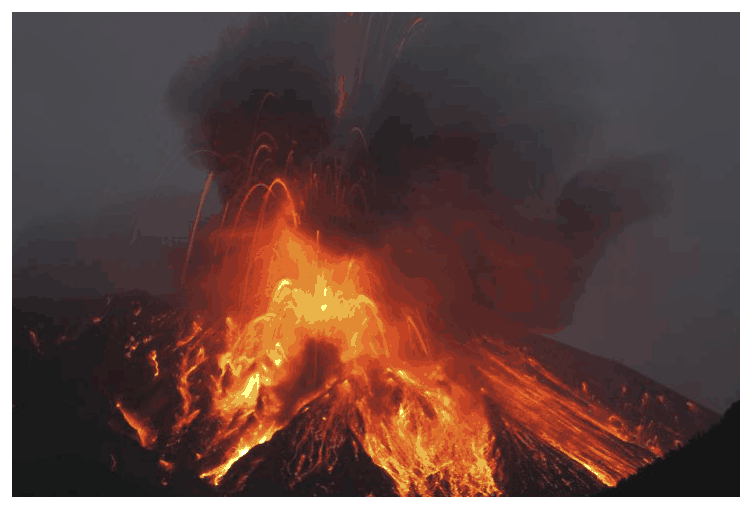
Volcano at Sakurajima island
PART A
Japan is one of the countries with the highest numbers of volcanos worldwide. When silicate minerals crystallize from magma, a part of the transition-metal ions (\(\ce{M^{n+}}\)) in the magma is incorporated into the silicate minerals. The \(\ce{M^{n+}}\) studied in the problem are coordinated by oxide ions (\(\ce{O^2-}\)) and adopt a four-coordinate tetrahedral (\(T_d\)) geometry in the magma and six-coordinate octahedral (\(O_h\)) geometry in the silicate minerals, both of which exhibit a high-spin electron configuration. The distribution coefficient of \(\ce{M^{n+}}\) between the silicate minerals and magma, \(D\), can be expressed by:
\[ D=\frac{[\mathrm M]_{\mathrm s}}{[\mathrm M]_{\mathrm l}} \]
where \([\mathrm M]_{\mathrm s}\) and \([\mathrm M]_{\mathrm l}\) are the concentrations of \(\ce{M^{n+}}\) in the silicate minerals and the magma, respectively. The table below shows the \(D\) values of \(\ce{Cr^2+}\) and \(\ce{Mn^2+}\) as examples.
| \(\ce{Cr^2+}\) | \(\ce{Mn^2+}\) | |
|---|---|---|
| \(D\) | 7.2 | 1.1 |
Let \(\Delta_{\mathrm O}\) and \(\mathrm{CFSE}^{\mathrm O}\) be the energy separation of the d-orbitals of \(\ce{M^{n+}}\) and the crystal-field stabilization energy in a \(O_h\) field, respectively. Let \(\Delta_{\mathrm T}\) and \(\mathrm{CFSE}^{\mathrm T}\) be those in a \(T_d\) field.
6.1 Calculate \(\left|\mathrm{CFSE}^{\mathrm O}-\mathrm{CFSE}^{\mathrm T}\right|=\Delta\mathrm{CFSE}\) in terms of \(\Delta_{\mathrm O}\) for \(\ce{Cr^2+}\), \(\ce{Mn^2+}\), and \(\ce{Co^2+}\); assume \(\Delta_{\mathrm T}=4/9\Delta_{\mathrm O}\).
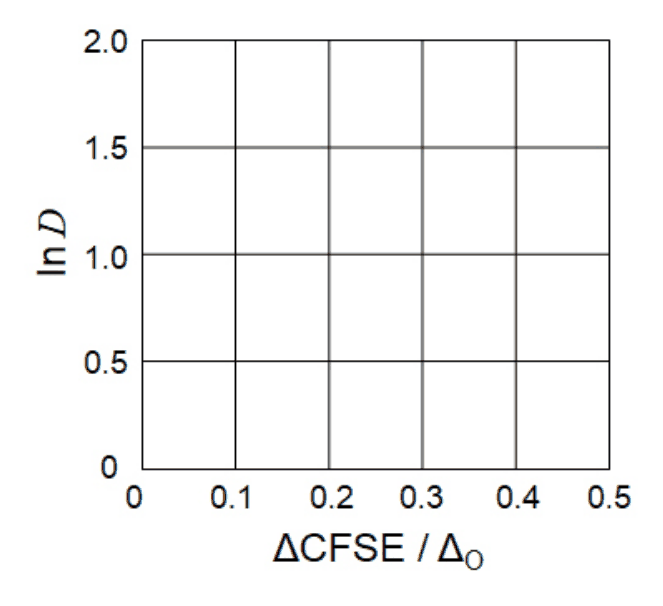
6.2 A linear relationship is observed by plotting \(\ln D\) against \(\Delta\mathrm{CFSE}/\Delta_{\mathrm O}\) in the Cartesian coordinate system shown below. Estimate \(D\) for \(\ce{Co^2+}\).
Metal oxides \(\ce{MO}\) (M: Ca, Ti, V, Mn, or Co) crystallize in a rock-salt structure wherein the \(\ce{M^{n+}}\) adopts an \(O_h\) geometry with a high-spin electron configuration. The lattice enthalpy of these oxides is mainly governed by the Coulomb interactions based on the radius and charge of the ions and some contributions from the CFSE of \(\ce{M^{n+}}\) in the \(O_h\) field.
6.3 Choose the appropriate set of lattice enthalpies [\(\mathrm{kJ\,mol^{-1}}\)] from one of the options (a) to (f).
| \(\ce{CaO}\) | \(\ce{TiO}\) | \(\ce{VO}\) | \(\ce{MnO}\) | \(\ce{CoO}\) | |
|---|---|---|---|---|---|
| (a) | 3460 | 3878 | 3913 | 3810 | 3916 |
| (b) | 3460 | 3916 | 3878 | 3810 | 3913 |
| (c) | 3460 | 3913 | 3916 | 3810 | 3878 |
| (d) | 3810 | 3878 | 3913 | 3460 | 3916 |
| (e) | 3810 | 3916 | 3878 | 3460 | 3913 |
| (f) | 3810 | 3913 | 3916 | 3460 | 3878 |
PART B
A mixed oxide A, which contains \(\ce{La^3+}\) and \(\ce{Cu^2+}\), crystallizes in a tetragonal unit cell shown in Fig.1. In the \(\ce{[CuO6]}\) octahedron, the Cu–O length along the z-axis (\(l_z\)) is longer than that of the x-axis (\(l_x\)), and \(\ce{[CuO6]}\) is distorted from the regular \(O_h\) geometry. This distortion removes the degeneracy of the \(e_g\) orbitals (\(d_{x^2-y^2}\) and \(d_{z^2}\)).
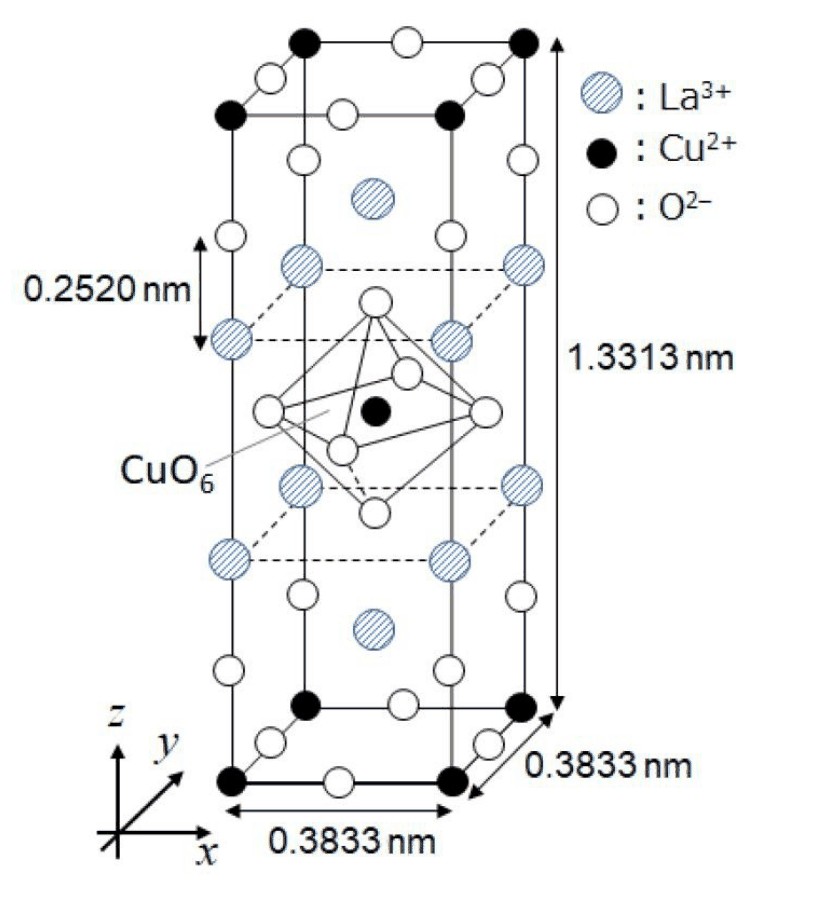
Fig. 1
A can be synthesized by thermal decomposition (pyrolysis) of complex B, which is formed by mixing metal chlorides in dilute aqueous ammonia solution containing squaric acid \(\ce{C4H2O4}\), i.e., a diacid. The pyrolysis behavior of B in dry air shows a weight loss of 29.1% up to \(200\,^\circ\mathrm C\) due to the loss of crystallization water, followed by another weight loss up to \(700\,^\circ\mathrm C\) due to the release of \(\ce{CO2}\). The total weight loss during the formation of A from B is 63.6%. It should be noted that only water and \(\ce{CO2}\) are released in the pyrolysis reaction.
6.4 Write the chemical formulae for A and B.
6.5 Calculate \(l_x\) and \(l_z\) using Fig. 1.
6.6 For \(\ce{Cu^2+}\) in the distorted \(\ce{[CuO6]}\) octahedron in A of Fig. 1, write the names of the split \(e_g\) orbitals (\(d_{x^2-y^2}\) and \(d_{z^2}\)) in (i) and (ii), and draw the electron configuration in the dotted box in your answer sheet.
A is an insulator. When one \(\ce{La^3+}\) is substituted with one \(\ce{Sr^2+}\), one hole is generated in the crystal lattice that can conduct electricity. As a result, the \(\ce{Sr^2+}\)-doped A shows superconductivity below 38 K. When a substitution reaction took place for A, \(2.05\times10^{27}\) holes \(\mathrm{m^{-3}}\) were generated.
6.7 Calculate the percentage of \(\ce{Sr^2+}\) substituted for \(\ce{La^3+}\) based on the mole ratio in the substitution reaction. Note that the valences of the constituent ions and the crystal structure are not altered by the substitution reaction
PART C
\(\ce{Cu2(CH3CO2)4}\) is composed of four \(\ce{CH3CO2^-}\) coordinated to two \(\ce{Cu^2+}\) (Fig. 2A). \(\ce{Cu2(CH3CO2)4}\) exhibits high levels of structural symmetry, with two axes passing through the carbon atoms of the four \(\ce{CH3CO2^-}\) and an axis passing through the two \(\ce{Cu^2+}\), all of which are oriented orthogonal relative to each other. When a dicarboxylate ligand is used instead of \(\ce{CH3CO2^-}\), a “cage complex” is formed. The cage complex \(\ce{Cu4(L1)4}\) is composed of planar dicarboxylate L1 (Fig. 2B) and \(\ce{Cu^2+}\) (Fig. 2C). The angle \(\theta\) between the coordination directions of the two carboxylates, indicated by the arrows in Fig. 2B, determines the structure of the cage complex. The \(\theta\) is \(0^\circ\) for L1. Note that hydrogen atoms are not shown in Fig. 2.
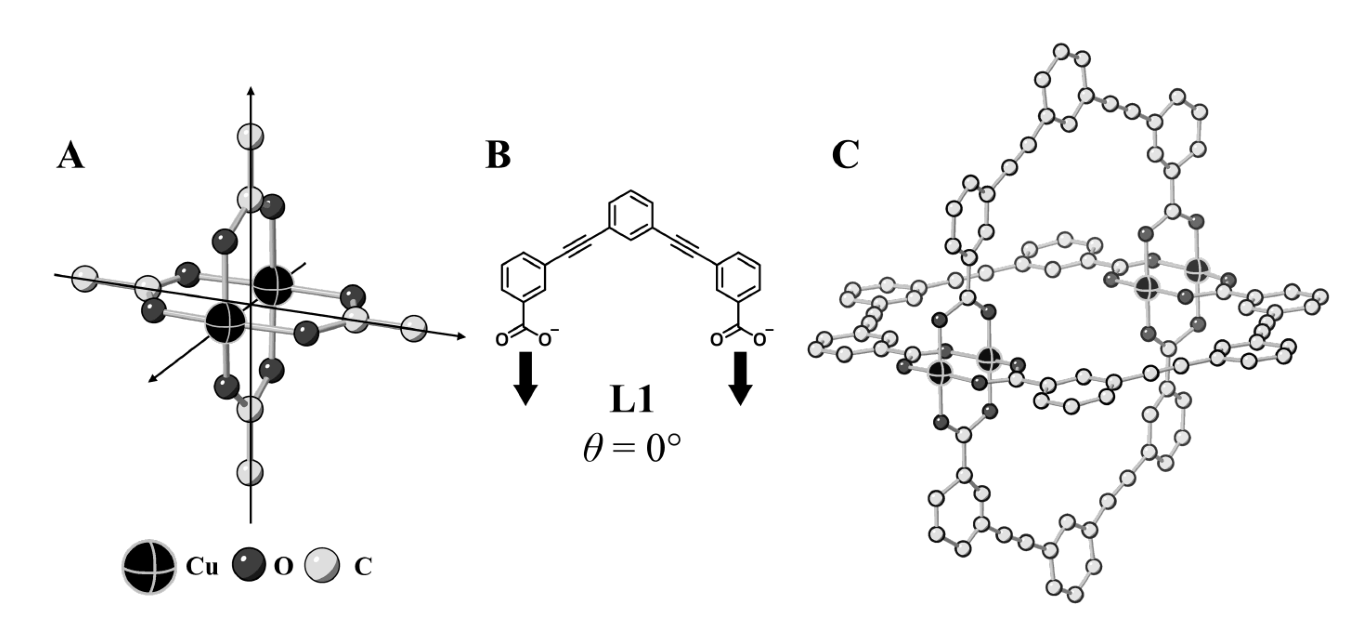
Fig. 2
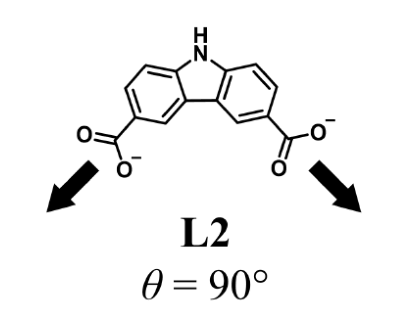
6.8 The \(\theta\) of the planar dicarboxylate L2 below is fixed to \(90^\circ\). If the composition of the cage complex formed from L2 and \(\ce{Cu^2+}\) is \(\ce{Cu_{n}(L2)_{m}}\), give the smallest integer combination of \(n\) and \(m\). Assume that only the \(\ce{CO2^-}\) groups of L2 form a coordination bond to \(\ce{Cu^2+}\) ions.
A zinc complex, \(\ce{Zn4O(CH3CO2)6}\), contains four tetrahedral \(\ce{Zn^2+}\), six \(\ce{CH3CO2^-}\), and one \(\ce{O^2-}\) (Fig. 3A). In \(\ce{Zn4O(CH3CO2)6}\), the \(\ce{O^2-}\) is located at the origin, and the three axes passing through the carbon atoms of \(\ce{CH3CO2^-}\) are oriented orthogonal relative to each other. When \(p\)-benzenedicarboxylate (Fig. 3B, L3, \(\theta=180^\circ\)) is used instead of \(\ce{CH3CO2^-}\), the \(\ce{Zn^2+}\) clusters are linked to each other to form a crystalline solid (X) that is called a “porous coordination polymer” (Fig. 3C). The composition of X is \(\ce{[Zn4O(L3)3]_{n}}\), and it has a cubic crystal structure with nano-sized pores. One pore is represented as a sphere in Fig. 3D, and each tetrahedral \(\ce{Zn^2+}\) cluster is represented as a dark gray polyhedron in Fig. 3C and 3D. Note that hydrogen atoms are not shown in Fig. 3.
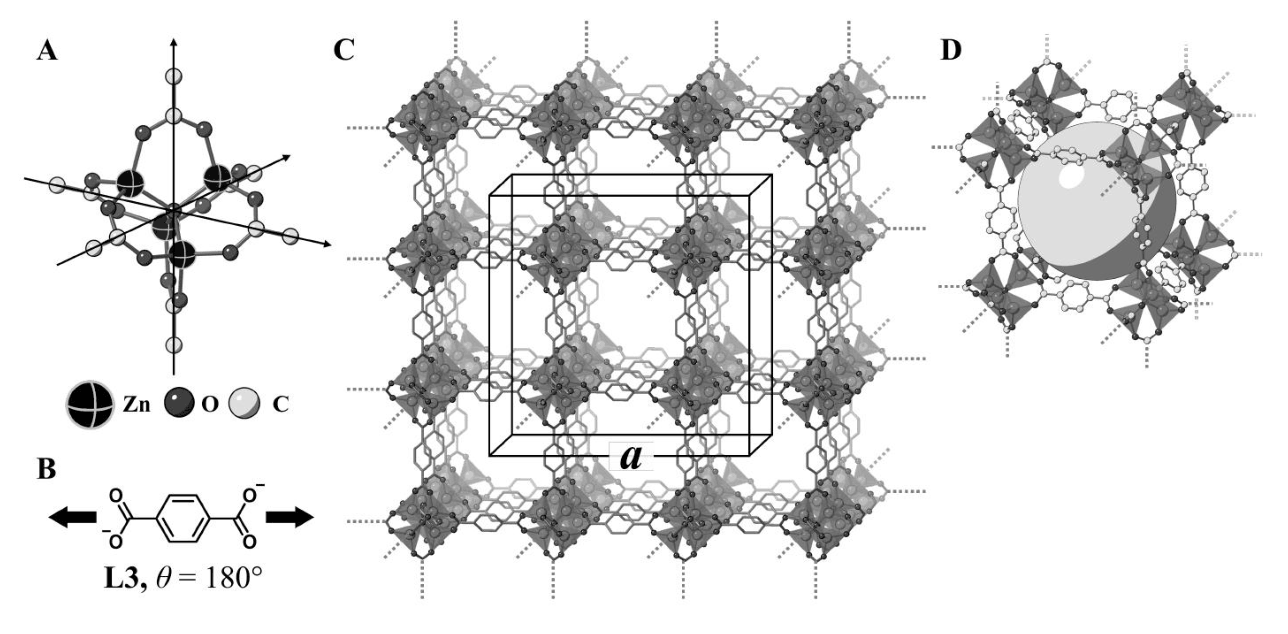
Fig. 3
6.9 X has a cubic unit cell with a side length of \(a\) (Fig. 3C) and a density of \(0.592\,\mathrm{g\,cm^{-3}}\). Calculate \(a\) in [cm].
6.10 X contains a considerable number of pores, and 1 g of X can accommodate \(3.0\times10^2\) mL of \(\ce{CO2}\) gas in the pores at 1 bar and \(25\,^\circ\mathrm C\). Calculate the average number of \(\ce{CO2}\) molecules per pore.
Official English text of the problem.
Answers
- 6.1: \(\ce{Cr^2+}\): \(\dfrac{19}{45}\Delta_{\mathrm O}\); \(\ce{Mn^2+}\): \(0\); \(\ce{Co^2+}\): \(\dfrac{4}{15}\Delta_{\mathrm O}\).
- 6.2: \(D(\ce{Co^2+})\approx\boxed{3.6}\).
- 6.3: Option (a): \(3460,\ 3878,\ 3913,\ 3810,\ 3916\,\mathrm{kJ\,mol^{-1}}\), respectively.
- 6.4: \(\boxed{\mathbf A=\ce{La2CuO4}}\); \(\boxed{\mathbf B=\ce{La2Cu(C4O4)4.18H2O}}\).
- 6.5: \(\boxed{l_x=0.1917\,\mathrm{nm},\quad l_z=0.2068\,\mathrm{nm}}\).
- 6.6: Higher \(e_g\) level: \(d_{x^2-y^2}\), one electron; lower \(e_g\) level: \(d_{z^2}\), two electrons. The three \(t_{2g}\)-derived orbitals are all doubly occupied.
- 6.7: \(\boxed{10.0\%}\) of the original La sites are substituted; approximately \(\ce{La1.80Sr0.20CuO4}\).
- 6.8: \(\boxed{n=m=12}\), giving \(\ce{Cu12(L2)12}\).
- 6.9: \(\boxed{a=2.59\times10^{-7}\,\mathrm{cm}}\).
- 6.10: \(\boxed{9.3\text{ molecules of }\ce{CO2}\text{ per pore}}\), on average.
Solution
For the extended solids and coordination assemblies, the SMILES below identify their constituent ions and ligands. Their spatial arrangements and connections are described separately; component SMILES do not encode the periodic lattice or cage geometry.
6.1 — Crystal-field stabilization energies
The metal ions are chromium(II), \(\ce{Cr^2+}\), [Cr+2]; manganese(II), \(\ce{Mn^2+}\), [Mn+2]; and cobalt(II), \(\ce{Co^2+}\), [Co+2]. Their configurations are \(d^4\), \(d^5\), and \(d^7\), respectively.
Taking the orbital barycentre as zero, the octahedral orbital energies are
\[ E(t_{2g})=-\frac25\Delta_{\mathrm O}, \qquad E(e_g)=+\frac35\Delta_{\mathrm O}, \]
whereas the tetrahedral orbital energies are
\[ E(e)=-\frac35\Delta_{\mathrm T}, \qquad E(t_2)=+\frac25\Delta_{\mathrm T}. \]
Filling all orbitals according to the specified high-spin configurations gives:
| Ion | Octahedral configuration | \(\mathrm{CFSE}^{\mathrm O}\) | Tetrahedral configuration | \(\mathrm{CFSE}^{\mathrm T}\) |
|---|---|---|---|---|
| \(\ce{Cr^2+}\), \(d^4\) | \(t_{2g}^{3}e_g^{1}\) | \(-\frac35\Delta_{\mathrm O}\) | \(e^{2}t_2^{2}\) | \(-\frac25\Delta_{\mathrm T}\) |
| \(\ce{Mn^2+}\), \(d^5\) | \(t_{2g}^{3}e_g^{2}\) | \(0\) | \(e^{2}t_2^{3}\) | \(0\) |
| \(\ce{Co^2+}\), \(d^7\) | \(t_{2g}^{5}e_g^{2}\) | \(-\frac45\Delta_{\mathrm O}\) | \(e^{4}t_2^{3}\) | \(-\frac65\Delta_{\mathrm T}\) |
Using \(\Delta_{\mathrm T}=\frac49\Delta_{\mathrm O}\),
\[ \begin{aligned} \Delta\mathrm{CFSE}(\ce{Cr^2+}) &=\left|-\frac35+\frac25\frac49\right|\Delta_{\mathrm O} =\boxed{\frac{19}{45}\Delta_{\mathrm O}},\\[2mm] \Delta\mathrm{CFSE}(\ce{Mn^2+}) &=\boxed{0},\\[2mm] \Delta\mathrm{CFSE}(\ce{Co^2+}) &=\left|-\frac45+\frac65\frac49\right|\Delta_{\mathrm O} =\boxed{\frac4{15}\Delta_{\mathrm O}}. \end{aligned} \]
The numbers of paired electrons are unchanged between the two geometries for each ion, so a pairing-energy term would cancel in these differences.
6.2 — Distribution coefficient of cobalt(II)
Set
\[ x=\frac{\Delta\mathrm{CFSE}}{\Delta_{\mathrm O}}, \qquad y=\ln D. \]
The two known points are
\[ \ce{Mn^2+}:\ (0,\ln1.1)=(0,0.09531), \]
\[ \ce{Cr^2+}:\ \left(\frac{19}{45},\ln7.2\right) =(0.42222,1.97408). \]
Thus the straight line to draw on the supplied axes is
\[ y=0.09531+4.44972x. \]
For cobalt(II), \(x=4/15\), so
\[ \begin{aligned} \ln D_{\ce{Co^2+}} &=\ln1.1+ \frac{4/15}{19/45}\left(\ln7.2-\ln1.1\right)\\ &=\ln1.1+\frac{12}{19}\ln\left(\frac{7.2}{1.1}\right)\\ &=1.28190. \end{aligned} \]
Therefore,
\[ \boxed{D_{\ce{Co^2+}}=e^{1.28190}=3.6035\approx3.6}. \]
On the graph, mark the cobalt point at approximately \((0.267,1.282)\).
6.3 — Lattice enthalpies
All five oxides contain divalent metal ions and oxide ions, \(\ce{O^2-}\), [O-2]. Their relevant electronic configurations are:
| Oxide and name | Ionic-component SMILES | Metal configuration | Octahedral CFSE |
|---|---|---|---|
| \(\ce{CaO}\), calcium oxide | [Ca+2].[O-2] |
\(d^0\) | \(0\) |
| \(\ce{TiO}\), titanium(II) oxide | [Ti+2].[O-2] |
\(d^2\) | \(-0.8\Delta_{\mathrm O}\) |
| \(\ce{VO}\), vanadium(II) oxide | [V+2].[O-2] |
\(d^3\) | \(-1.2\Delta_{\mathrm O}\) |
| \(\ce{MnO}\), manganese(II) oxide | [Mn+2].[O-2] |
High-spin \(d^5\) | \(0\) |
| \(\ce{CoO}\), cobalt(II) oxide | [Co+2].[O-2] |
High-spin \(d^7\) | \(-0.8\Delta_{\mathrm O}\) |
The lattices are extended rock-salt structures, with each metal surrounded octahedrally by six oxide ions.
Neither calcium(II) nor high-spin manganese(II) has CFSE. The smaller manganese(II) ion gives stronger Coulomb attraction, so
\[ U(\ce{CaO})<U(\ce{MnO}). \]
This eliminates options (d)–(f).
Titanium(II) and cobalt(II) have the same CFSE coefficient, while the later, smaller cobalt(II) ion gives stronger electrostatic binding. Thus
\[ U(\ce{CoO})>U(\ce{TiO}), \]
which selects (a) among the remaining choices. The stronger CFSE of \(d^3\) vanadium(II) also supports \(\ce{VO}\) lying above \(\ce{TiO}\).
The positive lattice-enthalpy values in the question are therefore
\[ \boxed{ \begin{array}{c|ccccc} &\ce{CaO}&\ce{TiO}&\ce{VO}&\ce{MnO}&\ce{CoO}\\ \hline U/(\mathrm{kJ\,mol^{-1}})&3460&3878&3913&3810&3916 \end{array}} \]
6.4 — Formulae of A and B
First count the ions in the unit cell, accounting for sharing with neighbouring cells.
| Species | Count in Fig. 1 | Number per unit cell |
|---|---|---|
| \(\ce{Cu^2+}\) | Eight corners and one interior site | \(8(\frac18)+1=2\) |
| \(\ce{La^3+}\) | Eight edge sites and two interior sites | \(8(\frac14)+2=4\) |
| \(\ce{O^2-}\) | Sixteen edge sites, four face sites, and two interior sites | \(16(\frac14)+4(\frac12)+2=8\) |
The unit-cell composition is therefore \(\ce{La4Cu2O8}\), giving
\[ \boxed{\mathbf A=\ce{La2CuO4}}. \]
This is lanthanum(III) copper(II) oxide, also called lanthanum cuprate. Its constituent ions are lanthanum(III), [La+3]; copper(II), [Cu+2]; and oxide, [O-2]. A composition-only ionic SMILES is [La+3].[La+3].[Cu+2].[O-2].[O-2].[O-2].[O-2].
Squaric acid, \(\ce{C4H2O4}\), has SMILES O=C1C(=O)C(O)=C1O. Its doubly deprotonated ligand is the squarate dianion, \(\ce{C4O4^2-}\), O=C1C(=O)C([O-])=C1[O-]; this SMILES shows one resonance form.
The total metal charge per \(\ce{La2Cu}\) unit is
\[ 2(+3)+(+2)=+8, \]
requiring four squarate dianions. Hence write
\[ \mathbf B=\ce{La2Cu(C4O4)4}\cdot x\ce{H2O}. \]
Using conventional atomic masses,
\[ M_A=2(138.91)+63.55+4(16.00) =405.37\,\mathrm{g\,mol^{-1}}. \]
Since the final residue is \(100-63.6=36.4\%\) of the initial mass,
\[ M_B=\frac{405.37}{0.364} =1113.65\,\mathrm{g\,mol^{-1}}. \]
Crystallization water accounts for 29.1% of this mass:
\[ x=\frac{0.291(1113.65)}{18.016}=17.99\approx18. \]
Thus
\[ \boxed{\mathbf B=\ce{La2Cu(C4O4)4.18H2O}}, \]
lanthanum(III) copper(II) squarate octadecahydrate. Its components are two [La+3] ions, one [Cu+2] ion, four squarate dianions with the SMILES above, and eighteen water molecules, O. The empirical formula does not determine all metal–ligand connections in B.
The balanced overall pyrolysis in air is
\[ \boxed{\ce{ La2Cu(C4O4)4.18H2O + 10O2 -> La2CuO4 + 16CO2 + 18H2O }}. \]
Here dioxygen is O=O, carbon dioxide is O=C=O, and water is O.
Oxygen uptake is necessary: the net mass loss during oxidation is the mass of escaping carbon dioxide minus the mass of oxygen absorbed. With \(M_B=1113.818\,\mathrm{g\,mol^{-1}}\), the predicted losses are
\[ \frac{18(18.016)}{1113.818}\times100=29.115\%, \]
and
\[ \left(1-\frac{405.37}{1113.818}\right)\times100=63.605\%, \]
both matching the supplied values.
6.5 — Copper–oxygen distances
Along \(x\), oxygen lies halfway between neighbouring copper sites:
\[ l_x=\frac{0.3833}{2} =\boxed{0.1917\,\mathrm{nm}}. \]
Along \(z\), adjacent copper planes are separated by \(c/2\). The marked \(0.2520\,\mathrm{nm}\) interval lies between their facing apical-oxygen planes, giving
\[ l_z+0.2520+l_z=\frac{1.3313}{2}. \]
Therefore,
\[ l_z=\frac{1.3313/2-0.2520}{2} =0.206825\,\mathrm{nm} \approx\boxed{0.2068\,\mathrm{nm}}. \]
As specified in the problem, \(l_z>l_x\).
6.6 — Splitting and electron configuration
Copper(II) is \(d^9\). Elongation along \(z\) weakens the interaction between the axial oxide ligands and \(d_{z^2}\), lowering this orbital relative to \(d_{x^2-y^2}\).
Thus, within the split \(e_g\) pair,
\[ \boxed{E(d_{x^2-y^2})>E(d_{z^2})}. \]
The required drawing has:
| Level | Orbital | Electrons |
|---|---|---|
| Higher split \(e_g\) level | \(d_{x^2-y^2}\) | \(\uparrow\) |
| Lower split \(e_g\) level | \(d_{z^2}\) | \(\uparrow\downarrow\) |
| Three \(t_{2g}\)-derived orbitals | \(d_{xy},d_{xz},d_{yz}\) | \(\uparrow\downarrow\) in each |
In words, draw two separated horizontal \(e_g\) lines, put one electron on the upper \(d_{x^2-y^2}\) line and a pair on the lower \(d_{z^2}\) line. The other six d electrons form three pairs.
If answer-sheet label (i) denotes the upper line and (ii) the lower line, then
\[ \text{(i)}=d_{x^2-y^2}, \qquad \text{(ii)}=d_{z^2}. \]
6.7 — Percentage substitution by strontium
The unit-cell volume is
\[ \begin{aligned} V_{\mathrm{cell}} &=(0.3833\,\mathrm{nm})^2(1.3313\,\mathrm{nm})\\ &=0.1955931\,\mathrm{nm^3}\\ &=1.955931\times10^{-28}\,\mathrm{m^3}. \end{aligned} \]
The number of holes per cell is
\[ N_h=(2.05\times10^{27}\,\mathrm{m^{-3}}) (1.955931\times10^{-28}\,\mathrm{m^3}) =0.400966. \]
Each strontium(II) ion, \(\ce{Sr^2+}\), [Sr+2], produces one hole, so this also equals the average number of substituted La sites per cell.
There are four La sites per undoped cell. Consequently,
\[ \boxed{ \text{substitution percentage} =\frac{0.400966}{4}\times100 =10.0\%. } \]
There are two formula units per cell, so the Sr content per formula unit is
\[ x=\frac{0.400966}{2}=0.20048. \]
The approximate composition is therefore
\[ \ce{La_{2-x}Sr_xCuO4} \approx\ce{La1.80Sr0.20CuO4}. \]
The holes provide the specified charge compensation without assigning a changed formal valence to the constituent ions.
6.8 — Smallest cage formed by L2
The reference acetate ligand is acetate (ethanoate), \(\ce{CH3CO2^-}\), CC(=O)[O-].
L2 is 9H-carbazole-3,6-dicarboxylate, with SMILES O=C([O-])c1ccc2[nH]c3ccc(C(=O)[O-])cc3c2c1. Its two carboxylates coordinate; the N–H group remains uncoordinated. The imposed planar conformation and \(90^\circ\) angle are geometric information not fixed by the SMILES alone.
Each copper-carboxylate paddlewheel contains two copper ions and has four carboxylate connection directions arranged as a square around its Cu–Cu axis.
With a \(90^\circ\) linker, the smallest closed assembly places six paddlewheel units at the vertices of an octahedron. Equivalently, put their centres on the \(+x,-x,+y,-y,+z,-z\) directions. Each vertex connects to its four adjacent vertices, and opposite vertices are unconnected.
Therefore:
\[ n=6\times2=12 \]
copper ions, and
\[ m=\frac{6\times4}{2}=12 \]
dicarboxylate ligands, because each ligand connects two paddlewheels.
Hence
\[ \boxed{n=m=12,\qquad \ce{Cu12(L2)12}}. \]
These are the counts in a complete cage. Charge balance alone establishes only \(n=m\).
6.9 — Cubic unit-cell edge
L3 is terephthalate (benzene-1,4-dicarboxylate), \(\ce{C8H4O4^2-}\), with SMILES O=C([O-])c1ccc(C(=O)[O-])cc1.
The metal building block contains four zinc(II) ions, [Zn+2], arranged tetrahedrally about a central oxide ion, [O-2]. Its six linker connections extend along three mutually perpendicular axes. The resulting solid is a zinc(II) oxide–terephthalate coordination polymer.
Figure 3C shows two cluster spacings along each unit-cell edge, so the depicted cell contains
\[ Z=2^3=8 \]
\(\ce{Zn4O(L3)3}\) formula units.
The formula-unit molar mass is
\[ \begin{aligned} M &=4(65.38)+16.00+ 3\left[8(12.01)+4(1.008)+4(16.00)\right]\\ &=769.856\,\mathrm{g\,mol^{-1}}. \end{aligned} \]
Using \(N_{\mathrm A}=6.02214076\times10^{23}\,\mathrm{mol^{-1}}\),
\[ \rho=\frac{ZM}{N_{\mathrm A}a^3}, \]
and therefore
\[ \begin{aligned} a &=\left(\frac{8(769.856)} {(6.02214076\times10^{23})(0.592)}\right)^{1/3} \mathrm{cm}\\ &=2.58509\times10^{-7}\,\mathrm{cm}. \end{aligned} \]
Thus
\[ \boxed{a=2.59\times10^{-7}\,\mathrm{cm}} \]
or approximately \(2.59\,\mathrm{nm}\).
6.10 — Average number of carbon dioxide molecules per pore
Each elementary cubic pore is bounded by eight cluster nodes, while each node belongs to eight neighbouring pores. Thus the numbers of pores and cluster nodes are equal: eight pores per depicted unit cell, or one pore per \(\ce{Zn4O(L3)3}\) formula unit.
For \(1.00\,\mathrm g\) of X,
\[ N_{\mathrm{pores}} =\frac{1.00\,\mathrm g}{769.856\,\mathrm{g\,mol^{-1}}}N_{\mathrm A} =7.8224\times10^{20}. \]
The supplied gas volume is
\[ V=3.0\times10^2\,\mathrm{mL}=0.300\,\mathrm L, \qquad T=298.15\,\mathrm K. \]
Using the ideal-gas equation with \(R=0.08314\,\mathrm{L\,bar\,mol^{-1}\,K^{-1}}\),
\[ n_{\ce{CO2}} =\frac{PV}{RT} =\frac{(1\,\mathrm{bar})(0.300\,\mathrm L)} {(0.08314\,\mathrm{L\,bar\,mol^{-1}\,K^{-1}}) (298.15\,\mathrm K)} =0.0121025\,\mathrm{mol}. \]
The average occupancy is consequently
\[ \begin{aligned} \frac{N_{\ce{CO2}}}{N_{\mathrm{pores}}} &=\frac{0.0121025\,N_{\mathrm A}} {(1.00/769.856)N_{\mathrm A}}\\ &=9.3172. \end{aligned} \]
To the precision of the gas-volume data,
\[ \boxed{9.3\text{ carbon dioxide molecules per pore, on average}.} \]
The solution was checked against the official solution.
IChO 2021 · Theorieaufgabe 6
Die Festkörperchemie der Übergangsmetalle
Vulkan auf der Insel Sakurajima
TEIL A
Japan gehört zu den Ländern mit den meisten Vulkanen weltweit. Wenn Silicatminerale aus Magma kristallisieren, wird ein Teil der Übergangsmetallionen (\(\ce{M^{n+}}\)) im Magma in die Silicatminerale eingebaut. Die in dieser Aufgabe untersuchten \(\ce{M^{n+}}\) sind von Oxidionen (\(\ce{O^2-}\)) koordiniert und nehmen im Magma eine vierfach koordinierte tetraedrische (\(T_d\)) Geometrie und in den Silicatmineralen eine sechsfach koordinierte oktaedrische (\(O_h\)) Geometrie an, jeweils mit einer High-Spin-Elektronenkonfiguration. Der Verteilungskoeffizient von \(\ce{M^{n+}}\) zwischen den Silicatmineralen und dem Magma, \(D\), lässt sich wie folgt ausdrücken:
\[ D=\frac{[\mathrm M]_{\mathrm s}}{[\mathrm M]_{\mathrm l}} \]
Dabei sind \([\mathrm M]_{\mathrm s}\) und \([\mathrm M]_{\mathrm l}\) die Konzentrationen von \(\ce{M^{n+}}\) in den Silicatmineralen bzw. im Magma. Die folgende Tabelle zeigt beispielhaft die \(D\)-Werte von \(\ce{Cr^2+}\) und \(\ce{Mn^2+}\).
| \(\ce{Cr^2+}\) | \(\ce{Mn^2+}\) | |
|---|---|---|
| \(D\) | 7.2 | 1.1 |
\(\Delta_{\mathrm O}\) und \(\mathrm{CFSE}^{\mathrm O}\) bezeichnen die energetische Aufspaltung der d-Orbitale von \(\ce{M^{n+}}\) bzw. die Kristallfeldstabilisierungsenergie in einem \(O_h\)-Feld. \(\Delta_{\mathrm T}\) und \(\mathrm{CFSE}^{\mathrm T}\) bezeichnen die entsprechenden Größen in einem \(T_d\)-Feld.
6.1 Berechnen Sie \(\left|\mathrm{CFSE}^{\mathrm O}-\mathrm{CFSE}^{\mathrm T}\right|=\Delta\mathrm{CFSE}\) in Abhängigkeit von \(\Delta_{\mathrm O}\) für \(\ce{Cr^2+}\), \(\ce{Mn^2+}\) und \(\ce{Co^2+}\); nehmen Sie \(\Delta_{\mathrm T}=4/9\Delta_{\mathrm O}\) an.
6.2 Bei der Auftragung von \(\ln D\) gegen \(\Delta\mathrm{CFSE}/\Delta_{\mathrm O}\) im unten dargestellten kartesischen Koordinatensystem wird ein linearer Zusammenhang beobachtet. Schätzen Sie \(D\) für \(\ce{Co^2+}\) ab.
Metalloxide \(\ce{MO}\) (M: Ca, Ti, V, Mn oder Co) kristallisieren in einer Steinsalzstruktur, in der \(\ce{M^{n+}}\) eine \(O_h\)-Geometrie mit einer High-Spin-Elektronenkonfiguration annimmt. Die Gitterenthalpie dieser Oxide wird hauptsächlich durch die vom Radius und der Ladung der Ionen abhängigen Coulomb-Wechselwirkungen sowie durch Beiträge der CFSE von \(\ce{M^{n+}}\) im \(O_h\)-Feld bestimmt.
6.3 Wählen Sie aus den Optionen (a) bis (f) den zutreffenden Satz von Gitterenthalpien [\(\mathrm{kJ\,mol^{-1}}\)] aus.
| \(\ce{CaO}\) | \(\ce{TiO}\) | \(\ce{VO}\) | \(\ce{MnO}\) | \(\ce{CoO}\) | |
|---|---|---|---|---|---|
| (a) | 3460 | 3878 | 3913 | 3810 | 3916 |
| (b) | 3460 | 3916 | 3878 | 3810 | 3913 |
| (c) | 3460 | 3913 | 3916 | 3810 | 3878 |
| (d) | 3810 | 3878 | 3913 | 3460 | 3916 |
| (e) | 3810 | 3916 | 3878 | 3460 | 3913 |
| (f) | 3810 | 3913 | 3916 | 3460 | 3878 |
TEIL B
Ein Mischoxid A, das \(\ce{La^3+}\) und \(\ce{Cu^2+}\) enthält, kristallisiert in der in Abb. 1 gezeigten tetragonalen Elementarzelle. Im \(\ce{[CuO6]}\)-Oktaeder ist die Cu–O-Bindungslänge entlang der z-Achse (\(l_z\)) größer als entlang der x-Achse (\(l_x\)), und \(\ce{[CuO6]}\) ist gegenüber der regulären \(O_h\)-Geometrie verzerrt. Diese Verzerrung hebt die Entartung der \(e_g\)-Orbitale (\(d_{x^2-y^2}\) und \(d_{z^2}\)) auf.
Abb. 1
A lässt sich durch thermische Zersetzung (Pyrolyse) des Komplexes B synthetisieren, der beim Mischen von Metallchloriden in einer verdünnten wässrigen Ammoniaklösung entsteht, die Quadratsäure \(\ce{C4H2O4}\), also eine zweiprotonige Säure, enthält. Bei der Pyrolyse von B in trockener Luft tritt bis \(200\,^\circ\mathrm C\) ein Massenverlust von 29.1% durch die Abgabe von Kristallwasser auf, gefolgt von einem weiteren Massenverlust bis \(700\,^\circ\mathrm C\) durch die Freisetzung von \(\ce{CO2}\). Der gesamte Massenverlust bei der Bildung von A aus B beträgt 63.6%. Beachten Sie, dass bei der Pyrolysereaktion nur Wasser und \(\ce{CO2}\) freigesetzt werden.
6.4 Geben Sie die chemischen Formeln von A und B an.
6.5 Berechnen Sie \(l_x\) und \(l_z\) mithilfe von Abb. 1.
6.6 Tragen Sie für \(\ce{Cu^2+}\) im verzerrten \(\ce{[CuO6]}\)-Oktaeder von A in Abb. 1 die Bezeichnungen der aufgespaltenen \(e_g\)-Orbitale (\(d_{x^2-y^2}\) und \(d_{z^2}\)) bei (i) und (ii) ein und zeichnen Sie die Elektronenkonfiguration in das gepunktete Kästchen auf Ihrem Antwortbogen.
A ist ein Isolator. Wird ein \(\ce{La^3+}\) durch ein \(\ce{Sr^2+}\) ersetzt, entsteht im Kristallgitter ein Loch, das zur elektrischen Leitung beitragen kann. Infolgedessen zeigt das mit \(\ce{Sr^2+}\) dotierte A unterhalb von 38 K Supraleitfähigkeit. Bei einer Substitutionsreaktion von A wurden \(2.05\times10^{27}\) Löcher \(\mathrm{m^{-3}}\) erzeugt.
6.7 Berechnen Sie anhand des Stoffmengenverhältnisses bei der Substitutionsreaktion den prozentualen Anteil der durch \(\ce{Sr^2+}\) ersetzten \(\ce{La^3+}\). Beachten Sie, dass die Wertigkeiten der beteiligten Ionen und die Kristallstruktur durch die Substitutionsreaktion nicht verändert werden
TEIL C
\(\ce{Cu2(CH3CO2)4}\) besteht aus vier \(\ce{CH3CO2^-}\), die an zwei \(\ce{Cu^2+}\) koordiniert sind (Abb. 2A). \(\ce{Cu2(CH3CO2)4}\) weist eine hohe Struktursymmetrie auf: Zwei Achsen verlaufen durch die Kohlenstoffatome der vier \(\ce{CH3CO2^-}\), und eine Achse verläuft durch die beiden \(\ce{Cu^2+}\); alle drei Achsen stehen senkrecht aufeinander. Wird anstelle von \(\ce{CH3CO2^-}\) ein Dicarboxylatligand verwendet, entsteht ein „Käfigkomplex“. Der Käfigkomplex \(\ce{Cu4(L1)4}\) besteht aus dem planaren Dicarboxylat L1 (Abb. 2B) und \(\ce{Cu^2+}\) (Abb. 2C). Der Winkel \(\theta\) zwischen den Koordinationsrichtungen der beiden Carboxylatgruppen, die durch die Pfeile in Abb. 2B angegeben sind, bestimmt die Struktur des Käfigkomplexes. Für L1 beträgt \(\theta\) \(0^\circ\). Beachten Sie, dass die Wasserstoffatome in Abb. 2 nicht dargestellt sind.
Abb. 2
6.8 Der Winkel \(\theta\) des unten gezeigten planaren Dicarboxylats L2 ist auf \(90^\circ\) festgelegt. Wenn die Zusammensetzung des aus L2 und \(\ce{Cu^2+}\) gebildeten Käfigkomplexes \(\ce{Cu_{n}(L2)_{m}}\) ist, geben Sie die kleinste ganzzahlige Kombination von \(n\) und \(m\) an. Nehmen Sie an, dass nur die \(\ce{CO2^-}\)-Gruppen von L2 eine koordinative Bindung zu \(\ce{Cu^2+}\)-Ionen bilden.
Ein Zinkkomplex, \(\ce{Zn4O(CH3CO2)6}\), enthält vier tetraedrisch koordinierte \(\ce{Zn^2+}\), sechs \(\ce{CH3CO2^-}\) und ein \(\ce{O^2-}\) (Abb. 3A). In \(\ce{Zn4O(CH3CO2)6}\) befindet sich das \(\ce{O^2-}\) im Ursprung, und die drei Achsen durch die Kohlenstoffatome der \(\ce{CH3CO2^-}\) stehen senkrecht aufeinander. Wird anstelle von \(\ce{CH3CO2^-}\) \(p\)-Benzoldicarboxylat (Abb. 3B, L3, \(\theta=180^\circ\)) verwendet, werden die \(\ce{Zn^2+}\)-Cluster miteinander verknüpft und bilden einen kristallinen Feststoff (X), der als „poröses Koordinationspolymer“ bezeichnet wird (Abb. 3C). Die Zusammensetzung von X ist \(\ce{[Zn4O(L3)3]_{n}}\), und es besitzt eine kubische Kristallstruktur mit nanometergroßen Poren. Eine Pore ist in Abb. 3D als Kugel dargestellt, und jeder tetraedrische \(\ce{Zn^2+}\)-Cluster ist in Abb. 3C und 3D als dunkelgraues Polyeder dargestellt. Beachten Sie, dass die Wasserstoffatome in Abb. 3 nicht dargestellt sind.
Abb. 3
6.9 X besitzt eine kubische Elementarzelle mit der Kantenlänge \(a\) (Abb. 3C) und eine Dichte von \(0.592\,\mathrm{g\,cm^{-3}}\). Berechnen Sie \(a\) in [cm].
6.10 X enthält eine beträchtliche Anzahl von Poren, und 1 g X kann bei 1 bar und \(25\,^\circ\mathrm C\) \(3.0\times10^2\) mL \(\ce{CO2}\)-Gas in den Poren aufnehmen. Berechnen Sie die mittlere Anzahl von \(\ce{CO2}\)-Molekülen pro Pore.
Aufgabentext aus dem offiziellen englischen Text übersetzt.
Antworten
- 6.1: \(\ce{Cr^2+}\): \(\dfrac{19}{45}\Delta_{\mathrm O}\); \(\ce{Mn^2+}\): \(0\); \(\ce{Co^2+}\): \(\dfrac{4}{15}\Delta_{\mathrm O}\).
- 6.2: \(D(\ce{Co^2+})\approx\boxed{3.6}\).
- 6.3: Option (a): \(3460,\ 3878,\ 3913,\ 3810,\ 3916\,\mathrm{kJ\,mol^{-1}}\), in dieser Reihenfolge.
- 6.4: \(\boxed{\mathbf A=\ce{La2CuO4}}\); \(\boxed{\mathbf B=\ce{La2Cu(C4O4)4.18H2O}}\).
- 6.5: \(\boxed{l_x=0.1917\,\mathrm{nm},\quad l_z=0.2068\,\mathrm{nm}}\).
- 6.6: Höheres \(e_g\)-Niveau: \(d_{x^2-y^2}\), ein Elektron; niedrigeres \(e_g\)-Niveau: \(d_{z^2}\), zwei Elektronen. Die drei aus \(t_{2g}\) hervorgegangenen Orbitale sind alle doppelt besetzt.
- 6.7: \(\boxed{10.0\%}\) der ursprünglichen La-Plätze sind substituiert; näherungsweise \(\ce{La1.80Sr0.20CuO4}\).
- 6.8: \(\boxed{n=m=12}\), entsprechend \(\ce{Cu12(L2)12}\).
- 6.9: \(\boxed{a=2.59\times10^{-7}\,\mathrm{cm}}\).
- 6.10: Im Mittel \(\boxed{9.3\text{ Moleküle }\ce{CO2}\text{ pro Pore}}\).
Lösung
Für die ausgedehnten Festkörper und Koordinationsverbände geben die nachstehenden SMILES deren Ionen und Liganden an. Ihre räumlichen Anordnungen und Verknüpfungen werden gesondert beschrieben; die SMILES der Bestandteile codieren weder das periodische Gitter noch die Käfiggeometrie.
6.1 — Kristallfeldstabilisierungsenergien
Die Metallionen sind Chrom(II), \(\ce{Cr^2+}\), [Cr+2]; Mangan(II), \(\ce{Mn^2+}\), [Mn+2]; und Cobalt(II), \(\ce{Co^2+}\), [Co+2]. Ihre Konfigurationen sind \(d^4\), \(d^5\) bzw. \(d^7\).
Wird der energetische Schwerpunkt der Orbitale als Nullpunkt gewählt, lauten die oktaedrischen Orbitalenergien
\[ E(t_{2g})=-\frac25\Delta_{\mathrm O}, \qquad E(e_g)=+\frac35\Delta_{\mathrm O}, \]
während die tetraedrischen Orbitalenergien wie folgt lauten:
\[ E(e)=-\frac35\Delta_{\mathrm T}, \qquad E(t_2)=+\frac25\Delta_{\mathrm T}. \]
Die Besetzung aller Orbitale gemäß den vorgegebenen High-Spin-Konfigurationen ergibt:
| Ion | Oktaedrische Konfiguration | \(\mathrm{CFSE}^{\mathrm O}\) | Tetraedrische Konfiguration | \(\mathrm{CFSE}^{\mathrm T}\) |
|---|---|---|---|---|
| \(\ce{Cr^2+}\), \(d^4\) | \(t_{2g}^{3}e_g^{1}\) | \(-\frac35\Delta_{\mathrm O}\) | \(e^{2}t_2^{2}\) | \(-\frac25\Delta_{\mathrm T}\) |
| \(\ce{Mn^2+}\), \(d^5\) | \(t_{2g}^{3}e_g^{2}\) | \(0\) | \(e^{2}t_2^{3}\) | \(0\) |
| \(\ce{Co^2+}\), \(d^7\) | \(t_{2g}^{5}e_g^{2}\) | \(-\frac45\Delta_{\mathrm O}\) | \(e^{4}t_2^{3}\) | \(-\frac65\Delta_{\mathrm T}\) |
Mit \(\Delta_{\mathrm T}=\frac49\Delta_{\mathrm O}\) ergibt sich
\[ \begin{aligned} \Delta\mathrm{CFSE}(\ce{Cr^2+}) &=\left|-\frac35+\frac25\frac49\right|\Delta_{\mathrm O} =\boxed{\frac{19}{45}\Delta_{\mathrm O}},\\[2mm] \Delta\mathrm{CFSE}(\ce{Mn^2+}) &=\boxed{0},\\[2mm] \Delta\mathrm{CFSE}(\ce{Co^2+}) &=\left|-\frac45+\frac65\frac49\right|\Delta_{\mathrm O} =\boxed{\frac4{15}\Delta_{\mathrm O}}. \end{aligned} \]
Die Anzahl der gepaarten Elektronen bleibt für jedes Ion beim Wechsel zwischen den beiden Geometrien unverändert, sodass sich ein Beitrag der Paarungsenergie in diesen Differenzen aufheben würde.
6.2 — Verteilungskoeffizient von Cobalt(II)
Wir setzen
\[ x=\frac{\Delta\mathrm{CFSE}}{\Delta_{\mathrm O}}, \qquad y=\ln D. \]
Die beiden bekannten Punkte sind
\[ \ce{Mn^2+}:\ (0,\ln1.1)=(0,0.09531), \]
\[ \ce{Cr^2+}:\ \left(\frac{19}{45},\ln7.2\right) =(0.42222,1.97408). \]
Die in das vorgegebene Koordinatensystem einzuzeichnende Gerade lautet somit
\[ y=0.09531+4.44972x. \]
Für Cobalt(II) ist \(x=4/15\), also
\[ \begin{aligned} \ln D_{\ce{Co^2+}} &=\ln1.1+ \frac{4/15}{19/45}\left(\ln7.2-\ln1.1\right)\\ &=\ln1.1+\frac{12}{19}\ln\left(\frac{7.2}{1.1}\right)\\ &=1.28190. \end{aligned} \]
Daher gilt
\[ \boxed{D_{\ce{Co^2+}}=e^{1.28190}=3.6035\approx3.6}. \]
Im Diagramm ist der Cobalt-Punkt näherungsweise bei \((0.267,1.282)\) zu markieren.
6.3 — Gitterenthalpien
Alle fünf Oxide enthalten zweiwertige Metallionen und Oxidionen, \(\ce{O^2-}\), [O-2]. Ihre relevanten Elektronenkonfigurationen sind:
| Oxid und Name | SMILES der ionischen Bestandteile | Metallkonfiguration | Oktaedrische CFSE |
|---|---|---|---|
| \(\ce{CaO}\), Calciumoxid | [Ca+2].[O-2] |
\(d^0\) | \(0\) |
| \(\ce{TiO}\), Titan(II)-oxid | [Ti+2].[O-2] |
\(d^2\) | \(-0.8\Delta_{\mathrm O}\) |
| \(\ce{VO}\), Vanadium(II)-oxid | [V+2].[O-2] |
\(d^3\) | \(-1.2\Delta_{\mathrm O}\) |
| \(\ce{MnO}\), Mangan(II)-oxid | [Mn+2].[O-2] |
High-Spin-\(d^5\) | \(0\) |
| \(\ce{CoO}\), Cobalt(II)-oxid | [Co+2].[O-2] |
High-Spin-\(d^7\) | \(-0.8\Delta_{\mathrm O}\) |
Die Gitter sind ausgedehnte Steinsalzstrukturen, in denen jedes Metallion oktaedrisch von sechs Oxidionen umgeben ist.
Weder Calcium(II) noch High-Spin-Mangan(II) besitzt eine CFSE. Das kleinere Mangan(II)-Ion bewirkt eine stärkere Coulomb-Anziehung, sodass
\[ U(\ce{CaO})<U(\ce{MnO}). \]
Damit scheiden die Optionen (d)–(f) aus.
Titan(II) und Cobalt(II) haben denselben CFSE-Koeffizienten, während das in der Übergangsmetallreihe später stehende, kleinere Cobalt(II)-Ion eine stärkere elektrostatische Bindung bewirkt. Somit gilt
\[ U(\ce{CoO})>U(\ce{TiO}), \]
wodurch unter den verbleibenden Möglichkeiten (a) ausgewählt wird. Die stärkere CFSE von \(d^3\)-Vanadium(II) spricht ebenfalls dafür, dass \(\ce{VO}\) oberhalb von \(\ce{TiO}\) liegt.
Die positiven Gitterenthalpiewerte aus der Aufgabenstellung lauten daher
\[ \boxed{ \begin{array}{c|ccccc} &\ce{CaO}&\ce{TiO}&\ce{VO}&\ce{MnO}&\ce{CoO}\\ \hline U/(\mathrm{kJ\,mol^{-1}})&3460&3878&3913&3810&3916 \end{array}} \]
6.4 — Formeln von A und B
Zunächst werden die Ionen in der Elementarzelle gezählt, wobei ihre gemeinsame Nutzung durch benachbarte Zellen berücksichtigt wird.
| Spezies | Zählung in Abb. 1 | Anzahl pro Elementarzelle |
|---|---|---|
| \(\ce{Cu^2+}\) | Acht Ecken und ein Platz im Inneren | \(8(\frac18)+1=2\) |
| \(\ce{La^3+}\) | Acht Kantenplätze und zwei Plätze im Inneren | \(8(\frac14)+2=4\) |
| \(\ce{O^2-}\) | Sechzehn Kantenplätze, vier Flächenplätze und zwei Plätze im Inneren | \(16(\frac14)+4(\frac12)+2=8\) |
Die Zusammensetzung der Elementarzelle ist daher \(\ce{La4Cu2O8}\), woraus folgt:
\[ \boxed{\mathbf A=\ce{La2CuO4}}. \]
Dies ist Lanthan(III)-Kupfer(II)-oxid, auch Lanthancuprat genannt. Seine Ionen sind Lanthan(III), [La+3]; Kupfer(II), [Cu+2]; und Oxid, [O-2]. Ein ionischer SMILES, der nur die Zusammensetzung wiedergibt, lautet [La+3].[La+3].[Cu+2].[O-2].[O-2].[O-2].[O-2].
Quadratsäure, \(\ce{C4H2O4}\), hat den SMILES O=C1C(=O)C(O)=C1O. Ihr zweifach deprotonierter Ligand ist das Quadratat-Dianion, \(\ce{C4O4^2-}\), O=C1C(=O)C([O-])=C1[O-]; dieser SMILES zeigt eine mesomere Grenzstruktur.
Die gesamte Metallionenladung pro \(\ce{La2Cu}\)-Einheit beträgt
\[ 2(+3)+(+2)=+8, \]
sodass vier Quadratat-Dianionen benötigt werden. Daher schreiben wir
\[ \mathbf B=\ce{La2Cu(C4O4)4}\cdot x\ce{H2O}. \]
Mit den üblichen Atommassen ergibt sich
\[ M_A=2(138.91)+63.55+4(16.00) =405.37\,\mathrm{g\,mol^{-1}}. \]
Da der abschließende Rückstand \(100-63.6=36.4\%\) der Ausgangsmasse ausmacht, gilt
\[ M_B=\frac{405.37}{0.364} =1113.65\,\mathrm{g\,mol^{-1}}. \]
Kristallwasser macht 29.1% dieser Masse aus:
\[ x=\frac{0.291(1113.65)}{18.016}=17.99\approx18. \]
Somit ergibt sich
\[ \boxed{\mathbf B=\ce{La2Cu(C4O4)4.18H2O}}, \]
Lanthan(III)-Kupfer(II)-quadratat-Octadecahydrat. Seine Bestandteile sind zwei [La+3]-Ionen, ein [Cu+2]-Ion, vier Quadratat-Dianionen mit dem oben angegebenen SMILES und achtzehn Wassermoleküle, O. Die Verhältnisformel legt nicht alle Metall–Ligand-Verknüpfungen in B fest.
Die ausgeglichene Gesamtgleichung der Pyrolyse an Luft lautet
\[ \boxed{\ce{ La2Cu(C4O4)4.18H2O + 10O2 -> La2CuO4 + 16CO2 + 18H2O }}. \]
Dabei ist Disauerstoff O=O, Kohlenstoffdioxid O=C=O und Wasser O.
Eine Sauerstoffaufnahme ist notwendig: Der Nettomassenverlust während der Oxidation ist die Masse des entweichenden Kohlenstoffdioxids abzüglich der Masse des aufgenommenen Sauerstoffs. Mit \(M_B=1113.818\,\mathrm{g\,mol^{-1}}\) ergeben sich die vorausgesagten Verluste zu
\[ \frac{18(18.016)}{1113.818}\times100=29.115\%, \]
und
\[ \left(1-\frac{405.37}{1113.818}\right)\times100=63.605\%, \]
die beide mit den angegebenen Werten übereinstimmen.
6.5 — Kupfer–Sauerstoff-Abstände
Entlang \(x\) liegt Sauerstoff auf halbem Weg zwischen benachbarten Kupferplätzen:
\[ l_x=\frac{0.3833}{2} =\boxed{0.1917\,\mathrm{nm}}. \]
Entlang \(z\) haben benachbarte Kupferebenen einen Abstand von \(c/2\). Der markierte Abstand von \(0.2520\,\mathrm{nm}\) liegt zwischen den einander zugewandten Ebenen der apikalen Sauerstoffatome, sodass
\[ l_z+0.2520+l_z=\frac{1.3313}{2}. \]
Daher gilt
\[ l_z=\frac{1.3313/2-0.2520}{2} =0.206825\,\mathrm{nm} \approx\boxed{0.2068\,\mathrm{nm}}. \]
Wie in der Aufgabenstellung angegeben, ist \(l_z>l_x\).
6.6 — Aufspaltung und Elektronenkonfiguration
Kupfer(II) hat die Konfiguration \(d^9\). Die Streckung entlang \(z\) schwächt die Wechselwirkung zwischen den axialen Oxidliganden und \(d_{z^2}\), wodurch dieses Orbital gegenüber \(d_{x^2-y^2}\) energetisch abgesenkt wird.
Innerhalb des aufgespaltenen \(e_g\)-Paars gilt somit
\[ \boxed{E(d_{x^2-y^2})>E(d_{z^2})}. \]
Die geforderte Zeichnung enthält:
| Niveau | Orbital | Elektronen |
|---|---|---|
| Höheres aufgespaltenes \(e_g\)-Niveau | \(d_{x^2-y^2}\) | \(\uparrow\) |
| Niedrigeres aufgespaltenes \(e_g\)-Niveau | \(d_{z^2}\) | \(\uparrow\downarrow\) |
| Drei aus \(t_{2g}\) hervorgegangene Orbitale | \(d_{xy},d_{xz},d_{yz}\) | Jeweils \(\uparrow\downarrow\) |
In Worten: Zeichnen Sie zwei getrennte horizontale \(e_g\)-Linien, setzen Sie ein Elektron auf die obere \(d_{x^2-y^2}\)-Linie und ein Elektronenpaar auf die untere \(d_{z^2}\)-Linie. Die übrigen sechs d-Elektronen bilden drei Paare.
Wenn die Beschriftung (i) auf dem Antwortbogen die obere Linie und (ii) die untere Linie bezeichnet, gilt
\[ \text{(i)}=d_{x^2-y^2}, \qquad \text{(ii)}=d_{z^2}. \]
6.7 — Prozentualer Substitutionsanteil durch Strontium
Das Volumen der Elementarzelle beträgt
\[ \begin{aligned} V_{\mathrm{cell}} &=(0.3833\,\mathrm{nm})^2(1.3313\,\mathrm{nm})\\ &=0.1955931\,\mathrm{nm^3}\\ &=1.955931\times10^{-28}\,\mathrm{m^3}. \end{aligned} \]
Die Anzahl der Löcher pro Zelle beträgt
\[ N_h=(2.05\times10^{27}\,\mathrm{m^{-3}}) (1.955931\times10^{-28}\,\mathrm{m^3}) =0.400966. \]
Jedes Strontium(II)-Ion, \(\ce{Sr^2+}\), [Sr+2], erzeugt ein Loch, sodass dies zugleich der mittleren Anzahl substituierter La-Plätze pro Zelle entspricht.
Pro undotierter Zelle gibt es vier La-Plätze. Folglich gilt
\[ \boxed{ \text{prozentualer Substitutionsanteil} =\frac{0.400966}{4}\times100 =10.0\%. } \]
Es gibt zwei Formeleinheiten pro Zelle, sodass sich der Sr-Gehalt pro Formeleinheit wie folgt ergibt:
\[ x=\frac{0.400966}{2}=0.20048. \]
Die näherungsweise Zusammensetzung ist daher
\[ \ce{La_{2-x}Sr_xCuO4} \approx\ce{La1.80Sr0.20CuO4}. \]
Die Löcher sorgen für den angegebenen Ladungsausgleich, ohne den beteiligten Ionen eine veränderte formale Wertigkeit zuzuweisen.
6.8 — Kleinster aus L2 gebildeter Käfig
Der als Referenz dienende Acetatligand ist Acetat (Ethanoat), \(\ce{CH3CO2^-}\), CC(=O)[O-].
L2 ist 9H-Carbazol-3,6-dicarboxylat mit dem SMILES O=C([O-])c1ccc2[nH]c3ccc(C(=O)[O-])cc3c2c1. Seine beiden Carboxylatgruppen koordinieren; die N–H-Gruppe bleibt unkoordiniert. Die vorgegebene planare Konformation und der Winkel von \(90^\circ\) sind geometrische Informationen, die durch den SMILES allein nicht festgelegt werden.
Jede Kupfercarboxylat-Schaufelradeinheit enthält zwei Kupferionen und besitzt vier Carboxylat-Verknüpfungsrichtungen, die quadratisch um ihre Cu–Cu-Achse angeordnet sind.
Mit einem \(90^\circ\)-Brückenliganden entsteht die kleinste geschlossene Anordnung, indem sechs Schaufelradeinheiten an den Ecken eines Oktaeders platziert werden. Gleichbedeutend damit werden ihre Zentren in den Richtungen \(+x,-x,+y,-y,+z,-z\) angeordnet. Jede Ecke ist mit ihren vier benachbarten Ecken verbunden, während gegenüberliegende Ecken nicht miteinander verbunden sind.
Daher gibt es
\[ n=6\times2=12 \]
Kupferionen und
\[ m=\frac{6\times4}{2}=12 \]
Dicarboxylatliganden, da jeder Ligand zwei Schaufelradeinheiten verbindet.
Somit gilt
\[ \boxed{n=m=12,\qquad \ce{Cu12(L2)12}}. \]
Dies sind die Anzahlen in einem vollständigen Käfig. Aus der Ladungsbilanz allein folgt lediglich \(n=m\).
6.9 — Kantenlänge der kubischen Elementarzelle
L3 ist Terephthalat (Benzol-1,4-dicarboxylat), \(\ce{C8H4O4^2-}\), mit dem SMILES O=C([O-])c1ccc(C(=O)[O-])cc1.
Der Metallbaustein enthält vier Zink(II)-Ionen, [Zn+2], die tetraedrisch um ein zentrales Oxidion, [O-2], angeordnet sind. Seine sechs Verknüpfungen über Brückenliganden erstrecken sich entlang dreier zueinander senkrechter Achsen. Der entstehende Feststoff ist ein Zink(II)-oxid-Terephthalat-Koordinationspolymer.
Abbildung 3C zeigt zwei Clusterabstände entlang jeder Elementarzellenkante, sodass die dargestellte Zelle
\[ Z=2^3=8 \]
\(\ce{Zn4O(L3)3}\)-Formeleinheiten enthält.
Die molare Masse der Formeleinheit beträgt
\[ \begin{aligned} M &=4(65.38)+16.00+ 3\left[8(12.01)+4(1.008)+4(16.00)\right]\\ &=769.856\,\mathrm{g\,mol^{-1}}. \end{aligned} \]
Mit \(N_{\mathrm A}=6.02214076\times10^{23}\,\mathrm{mol^{-1}}\) gilt
\[ \rho=\frac{ZM}{N_{\mathrm A}a^3}, \]
und daher
\[ \begin{aligned} a &=\left(\frac{8(769.856)} {(6.02214076\times10^{23})(0.592)}\right)^{1/3} \mathrm{cm}\\ &=2.58509\times10^{-7}\,\mathrm{cm}. \end{aligned} \]
Somit ergibt sich
\[ \boxed{a=2.59\times10^{-7}\,\mathrm{cm}} \]
oder näherungsweise \(2.59\,\mathrm{nm}\).
6.10 — Mittlere Anzahl von Kohlenstoffdioxidmolekülen pro Pore
Jede elementare kubische Pore wird durch acht Clusterknoten begrenzt, während jeder Knoten zu acht benachbarten Poren gehört. Daher sind die Anzahlen der Poren und der Clusterknoten gleich: acht Poren pro dargestellter Elementarzelle oder eine Pore pro \(\ce{Zn4O(L3)3}\)-Formeleinheit.
Für \(1.00\,\mathrm g\) X gilt
\[ N_{\mathrm{pores}} =\frac{1.00\,\mathrm g}{769.856\,\mathrm{g\,mol^{-1}}}N_{\mathrm A} =7.8224\times10^{20}. \]
Das angegebene Gasvolumen beträgt
\[ V=3.0\times10^2\,\mathrm{mL}=0.300\,\mathrm L, \qquad T=298.15\,\mathrm K. \]
Mit der idealen Gasgleichung und \(R=0.08314\,\mathrm{L\,bar\,mol^{-1}\,K^{-1}}\) ergibt sich
\[ n_{\ce{CO2}} =\frac{PV}{RT} =\frac{(1\,\mathrm{bar})(0.300\,\mathrm L)} {(0.08314\,\mathrm{L\,bar\,mol^{-1}\,K^{-1}}) (298.15\,\mathrm K)} =0.0121025\,\mathrm{mol}. \]
Die mittlere Belegung ist folglich
\[ \begin{aligned} \frac{N_{\ce{CO2}}}{N_{\mathrm{pores}}} &=\frac{0.0121025\,N_{\mathrm A}} {(1.00/769.856)N_{\mathrm A}}\\ &=9.3172. \end{aligned} \]
Mit der Genauigkeit der Angaben zum Gasvolumen ergibt sich
\[ \boxed{9.3\text{ Kohlenstoffdioxidmoleküle pro Pore im Mittel}.} \]
Die Lösung wurde mit der offiziellen Lösung abgeglichen.
IChO 2021 · Teori sorusu 6
Geçiş Metallerinin Katı Hâl Kimyası
Sakurajima adasındaki yanardağ
BÖLÜM A
Japonya, dünyada en fazla yanardağa sahip ülkelerden biridir. Silikat mineralleri magmadan kristallenirken magmadaki geçiş metali iyonlarının (\(\ce{M^{n+}}\)) bir kısmı silikat minerallerinin yapısına katılır. Bu soruda incelenen \(\ce{M^{n+}}\) iyonları oksit iyonları (\(\ce{O^2-}\)) ile koordine olur ve magmada dört koordinasyonlu tetrahedral (\(T_d\)), silikat minerallerinde ise altı koordinasyonlu oktahedral (\(O_h\)) geometri benimser; her iki durumda da yüksek spinli elektron dizilimi gösterirler. \(\ce{M^{n+}}\) iyonlarının silikat mineralleri ile magma arasındaki dağılım katsayısı \(D\), şu şekilde ifade edilebilir:
\[ D=\frac{[\mathrm M]_{\mathrm s}}{[\mathrm M]_{\mathrm l}} \]
Burada \([\mathrm M]_{\mathrm s}\) ve \([\mathrm M]_{\mathrm l}\), sırasıyla silikat minerallerindeki ve magmadaki \(\ce{M^{n+}}\) derişimleridir. Aşağıdaki tabloda örnek olarak \(\ce{Cr^2+}\) ve \(\ce{Mn^2+}\) iyonlarının \(D\) değerleri verilmiştir.
| \(\ce{Cr^2+}\) | \(\ce{Mn^2+}\) | |
|---|---|---|
| \(D\) | 7.2 | 1.1 |
\(\Delta_{\mathrm O}\) ve \(\mathrm{CFSE}^{\mathrm O}\), sırasıyla \(\ce{M^{n+}}\) iyonunun \(O_h\) alanındaki d orbitallerinin enerji ayrılmasını ve kristal alan kararlılık enerjisini göstersin. \(\Delta_{\mathrm T}\) ve \(\mathrm{CFSE}^{\mathrm T}\) ise \(T_d\) alanındaki karşılıklarını göstersin.
6.1 \(\ce{Cr^2+}\), \(\ce{Mn^2+}\) ve \(\ce{Co^2+}\) için \(\left|\mathrm{CFSE}^{\mathrm O}-\mathrm{CFSE}^{\mathrm T}\right|=\Delta\mathrm{CFSE}\) değerini \(\Delta_{\mathrm O}\) cinsinden hesaplayınız; \(\Delta_{\mathrm T}=4/9\Delta_{\mathrm O}\) olduğunu varsayınız.
6.2 Aşağıda gösterilen Kartezyen koordinat sisteminde \(\ln D\), \(\Delta\mathrm{CFSE}/\Delta_{\mathrm O}\)'ya karşı çizildiğinde doğrusal bir ilişki gözlenir. \(\ce{Co^2+}\) için \(D\) değerini tahmin ediniz.
\(\ce{MO}\) metal oksitleri (M: Ca, Ti, V, Mn veya Co), \(\ce{M^{n+}}\) iyonunun yüksek spinli elektron dizilimine sahip \(O_h\) geometrisi benimsediği kaya tuzu yapısında kristallenir. Bu oksitlerin örgü entalpisi, esas olarak iyonların yarıçaplarına ve yüklerine bağlı Coulomb etkileşimleriyle ve kısmen de \(\ce{M^{n+}}\) iyonunun \(O_h\) alanındaki CFSE katkılarıyla belirlenir.
6.3 (a)–(f) seçenekleri arasından uygun örgü entalpileri [\(\mathrm{kJ\,mol^{-1}}\)] kümesini seçiniz.
| \(\ce{CaO}\) | \(\ce{TiO}\) | \(\ce{VO}\) | \(\ce{MnO}\) | \(\ce{CoO}\) | |
|---|---|---|---|---|---|
| (a) | 3460 | 3878 | 3913 | 3810 | 3916 |
| (b) | 3460 | 3916 | 3878 | 3810 | 3913 |
| (c) | 3460 | 3913 | 3916 | 3810 | 3878 |
| (d) | 3810 | 3878 | 3913 | 3460 | 3916 |
| (e) | 3810 | 3916 | 3878 | 3460 | 3913 |
| (f) | 3810 | 3913 | 3916 | 3460 | 3878 |
BÖLÜM B
\(\ce{La^3+}\) ve \(\ce{Cu^2+}\) içeren bir karışık oksit olan A, Şekil 1'de gösterilen tetragonal birim hücrede kristallenir. \(\ce{[CuO6]}\) oktahedronunda z ekseni boyunca Cu–O uzunluğu (\(l_z\)), x ekseni boyunca olan uzunluktan (\(l_x\)) daha büyüktür ve \(\ce{[CuO6]}\), düzgün \(O_h\) geometrisinden saparak bozulmuştur. Bu bozulma, \(e_g\) orbitallerinin (\(d_{x^2-y^2}\) ve \(d_{z^2}\)) eşenerjililiğini ortadan kaldırır.
Şekil 1
A, iki protonlu bir asit olan skuarik asit \(\ce{C4H2O4}\) içeren seyreltik sulu amonyak çözeltisinde metal klorürlerin karıştırılmasıyla oluşan B kompleksinin ısıl bozunmasıyla (piroliziyle) sentezlenebilir. B'nin kuru havadaki piroliz davranışı, kristal suyunun kaybı nedeniyle \(200\,^\circ\mathrm C\)'ye kadar %29.1'lik bir kütle kaybı, ardından \(\ce{CO2}\) çıkışı nedeniyle \(700\,^\circ\mathrm C\)'ye kadar ek bir kütle kaybı gösterir. B'den A oluşumu sırasındaki toplam kütle kaybı %63.6'dır. Piroliz tepkimesinde yalnızca su ve \(\ce{CO2}\) açığa çıktığına dikkat ediniz.
6.4 A ve B'nin kimyasal formüllerini yazınız.
6.5 Şekil 1'i kullanarak \(l_x\) ve \(l_z\)'yi hesaplayınız.
6.6 Şekil 1'deki A'nın bozulmuş \(\ce{[CuO6]}\) oktahedronunda bulunan \(\ce{Cu^2+}\) için, ayrılmış \(e_g\) orbitallerinin (\(d_{x^2-y^2}\) ve \(d_{z^2}\)) adlarını (i) ve (ii)'ye yazınız ve cevap kâğıdınızdaki noktalı kutuya elektron dizilimini çiziniz.
A bir yalıtkandır. Bir \(\ce{La^3+}\) iyonu bir \(\ce{Sr^2+}\) iyonuyla yer değiştirdiğinde, kristal örgüsünde elektriği iletebilen bir delik oluşur. Bunun sonucunda \(\ce{Sr^2+}\) katkılanmış A, 38 K'nin altında süperiletkenlik gösterir. A için bir yer değiştirme tepkimesi gerçekleştiğinde, \(2.05\times10^{27}\) delik \(\mathrm{m^{-3}}\) oluşmuştur.
6.7 Yer değiştirme tepkimesindeki mol oranına dayanarak \(\ce{La^3+}\) yerine geçen \(\ce{Sr^2+}\) yüzdesini hesaplayınız. Bileşen iyonların değerliklerinin ve kristal yapının yer değiştirme tepkimesiyle değişmediğine dikkat ediniz
BÖLÜM C
\(\ce{Cu2(CH3CO2)4}\), iki \(\ce{Cu^2+}\) iyonuna koordine olmuş dört \(\ce{CH3CO2^-}\) iyonundan oluşur (Şekil 2A). \(\ce{Cu2(CH3CO2)4}\), dört \(\ce{CH3CO2^-}\) iyonunun karbon atomlarından geçen iki eksen ve iki \(\ce{Cu^2+}\) iyonundan geçen bir eksen ile yüksek düzeyde yapısal simetri gösterir; bu eksenlerin tümü birbirine diktir. \(\ce{CH3CO2^-}\) yerine bir dikarboksilat ligandı kullanıldığında bir “kafes kompleksi” oluşur. \(\ce{Cu4(L1)4}\) kafes kompleksi, düzlemsel dikarboksilat L1 (Şekil 2B) ve \(\ce{Cu^2+}\) iyonlarından oluşur (Şekil 2C). İki karboksilatın Şekil 2B'de oklarla gösterilen koordinasyon doğrultuları arasındaki \(\theta\) açısı, kafes kompleksinin yapısını belirler. L1 için \(\theta\), \(0^\circ\)'dir. Şekil 2'de hidrojen atomlarının gösterilmediğine dikkat ediniz.
Şekil 2
6.8 Aşağıdaki düzlemsel dikarboksilat L2'nin \(\theta\) açısı \(90^\circ\)'ye sabitlenmiştir. L2 ve \(\ce{Cu^2+}\) iyonlarından oluşan kafes kompleksinin bileşimi \(\ce{Cu_{n}(L2)_{m}}\) ise, \(n\) ve \(m\)'nin en küçük tam sayı kombinasyonunu veriniz. L2'nin yalnızca \(\ce{CO2^-}\) gruplarının \(\ce{Cu^2+}\) iyonlarına koordinasyon bağı oluşturduğunu varsayınız.
Bir çinko kompleksi olan \(\ce{Zn4O(CH3CO2)6}\), dört tetrahedral \(\ce{Zn^2+}\), altı \(\ce{CH3CO2^-}\) ve bir \(\ce{O^2-}\) içerir (Şekil 3A). \(\ce{Zn4O(CH3CO2)6}\)'da \(\ce{O^2-}\) orijinde bulunur ve \(\ce{CH3CO2^-}\) iyonlarının karbon atomlarından geçen üç eksen birbirine diktir. \(\ce{CH3CO2^-}\) yerine \(p\)-benzendikarboksilat (Şekil 3B, L3, \(\theta=180^\circ\)) kullanıldığında, \(\ce{Zn^2+}\) kümeleri birbirine bağlanarak “gözenekli koordinasyon polimeri” adı verilen kristal bir katı (X) oluşturur (Şekil 3C). X'in bileşimi \(\ce{[Zn4O(L3)3]_{n}}\)'dir ve nano boyutlu gözenekler içeren kübik bir kristal yapıya sahiptir. Şekil 3D'de bir gözenek küre olarak gösterilmiştir ve Şekil 3C ile 3D'de her bir tetrahedral \(\ce{Zn^2+}\) kümesi koyu gri bir çokyüzlü olarak gösterilmiştir. Şekil 3'te hidrojen atomlarının gösterilmediğine dikkat ediniz.
Şekil 3
6.9 X, kenar uzunluğu \(a\) olan kübik bir birim hücreye (Şekil 3C) ve \(0.592\,\mathrm{g\,cm^{-3}}\) yoğunluğa sahiptir. \(a\)'yı [cm] cinsinden hesaplayınız.
6.10 X, çok sayıda gözenek içerir ve 1 g X, 1 bar ve \(25\,^\circ\mathrm C\)'de gözeneklerinde \(3.0\times10^2\) mL \(\ce{CO2}\) gazı barındırabilir. Gözenek başına ortalama \(\ce{CO2}\) molekülü sayısını hesaplayınız.
Soru metni resmi İngilizce metinden çevrilmiştir.
Cevaplar
- 6.1: \(\ce{Cr^2+}\): \(\dfrac{19}{45}\Delta_{\mathrm O}\); \(\ce{Mn^2+}\): \(0\); \(\ce{Co^2+}\): \(\dfrac{4}{15}\Delta_{\mathrm O}\).
- 6.2: \(D(\ce{Co^2+})\approx\boxed{3.6}\).
- 6.3: (a) seçeneği: sırasıyla \(3460,\ 3878,\ 3913,\ 3810,\ 3916\,\mathrm{kJ\,mol^{-1}}\).
- 6.4: \(\boxed{\mathbf A=\ce{La2CuO4}}\); \(\boxed{\mathbf B=\ce{La2Cu(C4O4)4.18H2O}}\).
- 6.5: \(\boxed{l_x=0.1917\,\mathrm{nm},\quad l_z=0.2068\,\mathrm{nm}}\).
- 6.6: Daha yüksek \(e_g\) düzeyi: \(d_{x^2-y^2}\), bir elektron; daha düşük \(e_g\) düzeyi: \(d_{z^2}\), iki elektron. \(t_{2g}\)'den türeyen üç orbitalin her biri iki elektronla doludur.
- 6.7: Başlangıçtaki La konumlarının \(\boxed{10.0\%}\)'unda yer değiştirme gerçekleşir; yaklaşık olarak \(\ce{La1.80Sr0.20CuO4}\).
- 6.8: \(\boxed{n=m=12}\), dolayısıyla \(\ce{Cu12(L2)12}\).
- 6.9: \(\boxed{a=2.59\times10^{-7}\,\mathrm{cm}}\).
- 6.10: Ortalama olarak \(\boxed{9.3\text{ molekül }\ce{CO2}\text{ gözenek başına}}\).
Çözüm
Uzamış katı yapılar ve koordinasyon toplulukları için aşağıdaki SMILES gösterimleri, bunları oluşturan iyonları ve ligandları tanımlar. Bunların uzaysal düzenleri ve bağlantıları ayrıca açıklanmıştır; bileşen SMILES gösterimleri periyodik örgüyü veya kafes geometrisini kodlamaz.
6.1 — Kristal alan kararlılık enerjileri
Metal iyonları krom(II), \(\ce{Cr^2+}\), [Cr+2]; mangan(II), \(\ce{Mn^2+}\), [Mn+2]; ve kobalt(II), \(\ce{Co^2+}\), [Co+2]'dır. Dizilimleri sırasıyla \(d^4\), \(d^5\) ve \(d^7\)'dir.
Orbitallerin enerji ağırlık merkezi sıfır alındığında, oktahedral orbital enerjileri
\[ E(t_{2g})=-\frac25\Delta_{\mathrm O}, \qquad E(e_g)=+\frac35\Delta_{\mathrm O}, \]
iken tetrahedral orbital enerjileri şöyledir:
\[ E(e)=-\frac35\Delta_{\mathrm T}, \qquad E(t_2)=+\frac25\Delta_{\mathrm T}. \]
Tüm orbitaller belirtilen yüksek spinli dizilimlere göre doldurulduğunda şu sonuçlar elde edilir:
| İyon | Oktahedral dizilim | \(\mathrm{CFSE}^{\mathrm O}\) | Tetrahedral dizilim | \(\mathrm{CFSE}^{\mathrm T}\) |
|---|---|---|---|---|
| \(\ce{Cr^2+}\), \(d^4\) | \(t_{2g}^{3}e_g^{1}\) | \(-\frac35\Delta_{\mathrm O}\) | \(e^{2}t_2^{2}\) | \(-\frac25\Delta_{\mathrm T}\) |
| \(\ce{Mn^2+}\), \(d^5\) | \(t_{2g}^{3}e_g^{2}\) | \(0\) | \(e^{2}t_2^{3}\) | \(0\) |
| \(\ce{Co^2+}\), \(d^7\) | \(t_{2g}^{5}e_g^{2}\) | \(-\frac45\Delta_{\mathrm O}\) | \(e^{4}t_2^{3}\) | \(-\frac65\Delta_{\mathrm T}\) |
\(\Delta_{\mathrm T}=\frac49\Delta_{\mathrm O}\) kullanılarak,
\[ \begin{aligned} \Delta\mathrm{CFSE}(\ce{Cr^2+}) &=\left|-\frac35+\frac25\frac49\right|\Delta_{\mathrm O} =\boxed{\frac{19}{45}\Delta_{\mathrm O}},\\[2mm] \Delta\mathrm{CFSE}(\ce{Mn^2+}) &=\boxed{0},\\[2mm] \Delta\mathrm{CFSE}(\ce{Co^2+}) &=\left|-\frac45+\frac65\frac49\right|\Delta_{\mathrm O} =\boxed{\frac4{15}\Delta_{\mathrm O}}. \end{aligned} \]
Her iyon için eşleşmiş elektron sayısı iki geometri arasında değişmediğinden, bir eşleşme enerjisi terimi bu farklarda birbirini götürür.
6.2 — Kobalt(II)'nin dağılım katsayısı
Şöyle tanımlayalım:
\[ x=\frac{\Delta\mathrm{CFSE}}{\Delta_{\mathrm O}}, \qquad y=\ln D. \]
Bilinen iki nokta şunlardır:
\[ \ce{Mn^2+}:\ (0,\ln1.1)=(0,0.09531), \]
\[ \ce{Cr^2+}:\ \left(\frac{19}{45},\ln7.2\right) =(0.42222,1.97408). \]
Dolayısıyla verilen eksenler üzerinde çizilecek doğru şöyledir:
\[ y=0.09531+4.44972x. \]
Kobalt(II) için \(x=4/15\) olduğundan,
\[ \begin{aligned} \ln D_{\ce{Co^2+}} &=\ln1.1+ \frac{4/15}{19/45}\left(\ln7.2-\ln1.1\right)\\ &=\ln1.1+\frac{12}{19}\ln\left(\frac{7.2}{1.1}\right)\\ &=1.28190. \end{aligned} \]
Böylece,
\[ \boxed{D_{\ce{Co^2+}}=e^{1.28190}=3.6035\approx3.6}. \]
Grafikte kobalt noktasını yaklaşık \((0.267,1.282)\) konumunda işaretleyiniz.
6.3 — Örgü entalpileri
Beş oksidin tümü iki değerlikli metal iyonları ve oksit iyonları, \(\ce{O^2-}\), [O-2], içerir. İlgili elektron dizilimleri şöyledir:
| Oksit ve adı | İyonik bileşenlerin SMILES gösterimi | Metal dizilimi | Oktahedral CFSE |
|---|---|---|---|
| \(\ce{CaO}\), kalsiyum oksit | [Ca+2].[O-2] |
\(d^0\) | \(0\) |
| \(\ce{TiO}\), titanyum(II) oksit | [Ti+2].[O-2] |
\(d^2\) | \(-0.8\Delta_{\mathrm O}\) |
| \(\ce{VO}\), vanadyum(II) oksit | [V+2].[O-2] |
\(d^3\) | \(-1.2\Delta_{\mathrm O}\) |
| \(\ce{MnO}\), mangan(II) oksit | [Mn+2].[O-2] |
Yüksek spinli \(d^5\) | \(0\) |
| \(\ce{CoO}\), kobalt(II) oksit | [Co+2].[O-2] |
Yüksek spinli \(d^7\) | \(-0.8\Delta_{\mathrm O}\) |
Örgüler, her metalin altı oksit iyonuyla oktahedral olarak çevrelendiği uzamış kaya tuzu yapılarıdır.
Ne kalsiyum(II)'nin ne de yüksek spinli mangan(II)'nin CFSE'si vardır. Daha küçük olan mangan(II) iyonu daha güçlü Coulomb çekimi oluşturduğundan,
\[ U(\ce{CaO})<U(\ce{MnO}). \]
Bu, (d)–(f) seçeneklerini eler.
Titanyum(II) ve kobalt(II) aynı CFSE katsayısına sahiptir; buna karşılık periyotta daha sonra gelen, daha küçük kobalt(II) iyonu daha güçlü elektrostatik bağlanma sağlar. Dolayısıyla
\[ U(\ce{CoO})>U(\ce{TiO}), \]
olduğundan kalan seçenekler arasından (a) seçilir. \(d^3\) vanadyum(II)'nin daha güçlü CFSE'si de \(\ce{VO}\)'nun \(\ce{TiO}\)'dan daha yüksek olmasını destekler.
Dolayısıyla sorudaki pozitif örgü entalpisi değerleri şöyledir:
\[ \boxed{ \begin{array}{c|ccccc} &\ce{CaO}&\ce{TiO}&\ce{VO}&\ce{MnO}&\ce{CoO}\\ \hline U/(\mathrm{kJ\,mol^{-1}})&3460&3878&3913&3810&3916 \end{array}} \]
6.4 — A ve B'nin formülleri
Önce komşu hücrelerle paylaşımı hesaba katarak birim hücredeki iyonları sayalım.
| Tür | Şekil 1'deki sayı | Birim hücre başına sayı |
|---|---|---|
| \(\ce{Cu^2+}\) | Sekiz köşe ve bir iç konum | \(8(\frac18)+1=2\) |
| \(\ce{La^3+}\) | Sekiz kenar konumu ve iki iç konum | \(8(\frac14)+2=4\) |
| \(\ce{O^2-}\) | On altı kenar konumu, dört yüz konumu ve iki iç konum | \(16(\frac14)+4(\frac12)+2=8\) |
Dolayısıyla birim hücrenin bileşimi \(\ce{La4Cu2O8}\)'dir ve buradan
\[ \boxed{\mathbf A=\ce{La2CuO4}}. \]
Bu bileşik, lantan kuprat olarak da adlandırılan lantan(III) bakır(II) oksittir. Bileşen iyonları lantan(III), [La+3]; bakır(II), [Cu+2]; ve oksit, [O-2]'tir. Yalnızca bileşimi gösteren bir iyonik SMILES gösterimi [La+3].[La+3].[Cu+2].[O-2].[O-2].[O-2].[O-2] biçimindedir.
Skuarik asidin, \(\ce{C4H2O4}\), SMILES gösterimi O=C1C(=O)C(O)=C1O biçimindedir. İki protonunu kaybetmiş ligandı skuarat dianyonu, \(\ce{C4O4^2-}\), O=C1C(=O)C([O-])=C1[O-]'dur; bu SMILES gösterimi bir rezonans yapısını gösterir.
\(\ce{La2Cu}\) birimi başına toplam metal yükü
\[ 2(+3)+(+2)=+8, \]
olduğundan dört skuarat dianyonu gerekir. Bu nedenle şöyle yazılır:
\[ \mathbf B=\ce{La2Cu(C4O4)4}\cdot x\ce{H2O}. \]
Yaygın olarak kullanılan atom kütleleriyle,
\[ M_A=2(138.91)+63.55+4(16.00) =405.37\,\mathrm{g\,mol^{-1}}. \]
Son kalıntı başlangıç kütlesinin \(100-63.6=36.4\%\)'ü olduğundan,
\[ M_B=\frac{405.37}{0.364} =1113.65\,\mathrm{g\,mol^{-1}}. \]
Kristal suyu bu kütlenin %29.1'ini oluşturur:
\[ x=\frac{0.291(1113.65)}{18.016}=17.99\approx18. \]
Dolayısıyla
\[ \boxed{\mathbf B=\ce{La2Cu(C4O4)4.18H2O}}, \]
lantan(III) bakır(II) skuarat oktadekahidrattır. Bileşenleri iki [La+3] iyonu, bir [Cu+2] iyonu, yukarıdaki SMILES gösterimine sahip dört skuarat dianyonu ve on sekiz su molekülü, O'dur. Basit formül, B'deki tüm metal–ligand bağlantılarını belirlemez.
Havadaki toplam piroliz tepkimesinin denkleştirilmiş hâli şöyledir:
\[ \boxed{\ce{ La2Cu(C4O4)4.18H2O + 10O2 -> La2CuO4 + 16CO2 + 18H2O }}. \]
Burada dioksijen O=O, karbondioksit O=C=O ve su O ile gösterilir.
Oksijen alımı gereklidir: yükseltgenme sırasındaki net kütle kaybı, çıkan karbondioksitin kütlesinden alınan oksijenin kütlesinin çıkarılmasıyla bulunur. \(M_B=1113.818\,\mathrm{g\,mol^{-1}}\) ile öngörülen kayıplar
\[ \frac{18(18.016)}{1113.818}\times100=29.115\%, \]
ve
\[ \left(1-\frac{405.37}{1113.818}\right)\times100=63.605\%, \]
olup her ikisi de verilen değerlerle uyuşur.
6.5 — Bakır–oksijen uzaklıkları
\(x\) doğrultusunda oksijen, komşu bakır konumlarının tam ortasında bulunur:
\[ l_x=\frac{0.3833}{2} =\boxed{0.1917\,\mathrm{nm}}. \]
\(z\) doğrultusunda komşu bakır düzlemleri arasındaki uzaklık \(c/2\)'dir. İşaretlenen \(0.2520\,\mathrm{nm}\)'lik aralık, bu düzlemlerin birbirine bakan apikal oksijen düzlemleri arasındadır; buradan
\[ l_z+0.2520+l_z=\frac{1.3313}{2}. \]
Dolayısıyla,
\[ l_z=\frac{1.3313/2-0.2520}{2} =0.206825\,\mathrm{nm} \approx\boxed{0.2068\,\mathrm{nm}}. \]
Soruda belirtildiği gibi, \(l_z>l_x\)'tir.
6.6 — Ayrılma ve elektron dizilimi
Bakır(II), \(d^9\) dizilimine sahiptir. \(z\) doğrultusundaki uzama, eksenel oksit ligandları ile \(d_{z^2}\) arasındaki etkileşimi zayıflatarak bu orbitalin enerjisini \(d_{x^2-y^2}\)'ye göre düşürür.
Dolayısıyla ayrılmış \(e_g\) çifti içinde,
\[ \boxed{E(d_{x^2-y^2})>E(d_{z^2})}. \]
İstenen çizim şunları içerir:
| Düzey | Orbital | Elektronlar |
|---|---|---|
| Ayrılmış \(e_g\) düzeylerinden daha yüksek olanı | \(d_{x^2-y^2}\) | \(\uparrow\) |
| Ayrılmış \(e_g\) düzeylerinden daha düşük olanı | \(d_{z^2}\) | \(\uparrow\downarrow\) |
| \(t_{2g}\)'den türeyen üç orbital | \(d_{xy},d_{xz},d_{yz}\) | Her birinde \(\uparrow\downarrow\) |
Sözel olarak, birbirinden ayrılmış iki yatay \(e_g\) çizgisi çiziniz; üstteki \(d_{x^2-y^2}\) çizgisine bir elektron, alttaki \(d_{z^2}\) çizgisine bir çift elektron yerleştiriniz. Diğer altı d elektronu üç çift oluşturur.
Cevap kâğıdındaki (i) etiketi üst çizgiyi, (ii) ise alt çizgiyi gösteriyorsa,
\[ \text{(i)}=d_{x^2-y^2}, \qquad \text{(ii)}=d_{z^2}. \]
6.7 — Stronsiyum ile yer değiştirme yüzdesi
Birim hücre hacmi şöyledir:
\[ \begin{aligned} V_{\mathrm{cell}} &=(0.3833\,\mathrm{nm})^2(1.3313\,\mathrm{nm})\\ &=0.1955931\,\mathrm{nm^3}\\ &=1.955931\times10^{-28}\,\mathrm{m^3}. \end{aligned} \]
Hücre başına delik sayısı şöyledir:
\[ N_h=(2.05\times10^{27}\,\mathrm{m^{-3}}) (1.955931\times10^{-28}\,\mathrm{m^3}) =0.400966. \]
Her stronsiyum(II) iyonu, \(\ce{Sr^2+}\), [Sr+2], bir delik oluşturduğundan bu değer, hücre başına yer değiştirme gerçekleşen ortalama La konumu sayısına da eşittir.
Katkılanmamış hücre başına dört La konumu vardır. Sonuç olarak,
\[ \boxed{ \text{yer değiştirme yüzdesi} =\frac{0.400966}{4}\times100 =10.0\%. } \]
Hücre başına iki formül birimi bulunduğundan formül birimi başına Sr içeriği şöyledir:
\[ x=\frac{0.400966}{2}=0.20048. \]
Dolayısıyla yaklaşık bileşim şöyledir:
\[ \ce{La_{2-x}Sr_xCuO4} \approx\ce{La1.80Sr0.20CuO4}. \]
Delikler, bileşen iyonlara değişmiş bir formal değerlik atamadan belirtilen yük dengelemesini sağlar.
6.8 — L2'nin oluşturduğu en küçük kafes
Referans asetat ligandı asetat (etanoat), \(\ce{CH3CO2^-}\), CC(=O)[O-]'tır.
L2, SMILES gösterimi O=C([O-])c1ccc2[nH]c3ccc(C(=O)[O-])cc3c2c1 olan 9H-karbazol-3,6-dikarboksilattır. İki karboksilat grubu koordine olur; N–H grubu koordine olmadan kalır. Verilen düzlemsel konformasyon ve \(90^\circ\)'lik açı, yalnızca SMILES gösterimiyle belirlenmeyen geometrik bilgilerdir.
Her bakır-karboksilat çark birimi iki bakır iyonu içerir ve Cu–Cu ekseni çevresinde kare biçiminde düzenlenmiş dört karboksilat bağlantı doğrultusuna sahiptir.
\(90^\circ\)'lik bir bağlayıcıyla en küçük kapalı yapı, bir oktahedronun köşelerine yerleştirilmiş altı çark biriminden oluşur. Eşdeğer olarak, bunların merkezlerini \(+x,-x,+y,-y,+z,-z\) doğrultularına yerleştiriniz. Her köşe dört komşu köşesine bağlanır; karşılıklı köşeler birbirine bağlı değildir.
Dolayısıyla:
\[ n=6\times2=12 \]
bakır iyonu ve
\[ m=\frac{6\times4}{2}=12 \]
dikarboksilat ligandı vardır; çünkü her ligand iki çark birimini birbirine bağlar.
Böylece
\[ \boxed{n=m=12,\qquad \ce{Cu12(L2)12}}. \]
Bunlar tam bir kafesteki sayılardır. Yük dengesi tek başına yalnızca \(n=m\) olduğunu ortaya koyar.
6.9 — Kübik birim hücrenin kenarı
L3, SMILES gösterimi O=C([O-])c1ccc(C(=O)[O-])cc1 olan tereftalat (benzen-1,4-dikarboksilat), \(\ce{C8H4O4^2-}\)'tır.
Metal yapı taşı, merkezdeki bir oksit iyonunun, [O-2], çevresinde tetrahedral olarak düzenlenmiş dört çinko(II) iyonu, [Zn+2], içerir. Altı bağlayıcı bağlantısı birbirine dik üç eksen boyunca uzanır. Oluşan katı, bir çinko(II) oksit–tereftalat koordinasyon polimeridir.
Şekil 3C, her birim hücre kenarı boyunca iki küme aralığı gösterir; dolayısıyla gösterilen hücre
\[ Z=2^3=8 \]
adet \(\ce{Zn4O(L3)3}\) formül birimi içerir.
Formül biriminin molar kütlesi şöyledir:
\[ \begin{aligned} M &=4(65.38)+16.00+ 3\left[8(12.01)+4(1.008)+4(16.00)\right]\\ &=769.856\,\mathrm{g\,mol^{-1}}. \end{aligned} \]
\(N_{\mathrm A}=6.02214076\times10^{23}\,\mathrm{mol^{-1}}\) kullanılarak,
\[ \rho=\frac{ZM}{N_{\mathrm A}a^3}, \]
ve dolayısıyla
\[ \begin{aligned} a &=\left(\frac{8(769.856)} {(6.02214076\times10^{23})(0.592)}\right)^{1/3} \mathrm{cm}\\ &=2.58509\times10^{-7}\,\mathrm{cm}. \end{aligned} \]
Böylece
\[ \boxed{a=2.59\times10^{-7}\,\mathrm{cm}} \]
veya yaklaşık \(2.59\,\mathrm{nm}\) bulunur.
6.10 — Gözenek başına ortalama karbondioksit molekülü sayısı
Her temel kübik gözenek sekiz küme düğümüyle sınırlanırken her düğüm sekiz komşu gözeneğe aittir. Dolayısıyla gözeneklerin ve küme düğümlerinin sayıları eşittir: gösterilen birim hücre başına sekiz gözenek veya \(\ce{Zn4O(L3)3}\) formül birimi başına bir gözenek.
\(1.00\,\mathrm g\) X için,
\[ N_{\mathrm{pores}} =\frac{1.00\,\mathrm g}{769.856\,\mathrm{g\,mol^{-1}}}N_{\mathrm A} =7.8224\times10^{20}. \]
Verilen gaz hacmi şöyledir:
\[ V=3.0\times10^2\,\mathrm{mL}=0.300\,\mathrm L, \qquad T=298.15\,\mathrm K. \]
İdeal gaz denklemi \(R=0.08314\,\mathrm{L\,bar\,mol^{-1}\,K^{-1}}\) ile kullanılarak,
\[ n_{\ce{CO2}} =\frac{PV}{RT} =\frac{(1\,\mathrm{bar})(0.300\,\mathrm L)} {(0.08314\,\mathrm{L\,bar\,mol^{-1}\,K^{-1}}) (298.15\,\mathrm K)} =0.0121025\,\mathrm{mol}. \]
Sonuç olarak ortalama doluluk şöyledir:
\[ \begin{aligned} \frac{N_{\ce{CO2}}}{N_{\mathrm{pores}}} &=\frac{0.0121025\,N_{\mathrm A}} {(1.00/769.856)N_{\mathrm A}}\\ &=9.3172. \end{aligned} \]
Gaz hacmi verisinin hassasiyetine göre,
\[ \boxed{9.3\text{ karbondioksit molekülü, gözenek başına ortalama}.} \]
Çözüm, resmi çözümle karşılaştırılarak kontrol edildi.
IChO 2021 · Problema teórico 6
La química del estado sólido de los metales de transición
Volcán en la isla de Sakurajima
PARTE A
Japón es uno de los países con mayor número de volcanes del mundo. Cuando los minerales silicatados cristalizan a partir del magma, una parte de los iones de metales de transición (\(\ce{M^{n+}}\)) del magma se incorpora a los minerales silicatados. Los \(\ce{M^{n+}}\) estudiados en este problema están coordinados por iones óxido (\(\ce{O^2-}\)) y adoptan una geometría tetraédrica tetracoordinada (\(T_d\)) en el magma y una geometría octaédrica hexacoordinada (\(O_h\)) en los minerales silicatados, ambas con una configuración electrónica de alto espín. El coeficiente de distribución de \(\ce{M^{n+}}\) entre los minerales silicatados y el magma, \(D\), puede expresarse como:
\[ D=\frac{[\mathrm M]_{\mathrm s}}{[\mathrm M]_{\mathrm l}} \]
donde \([\mathrm M]_{\mathrm s}\) y \([\mathrm M]_{\mathrm l}\) son las concentraciones de \(\ce{M^{n+}}\) en los minerales silicatados y en el magma, respectivamente. La tabla siguiente muestra, como ejemplos, los valores de \(D\) de \(\ce{Cr^2+}\) y \(\ce{Mn^2+}\).
| \(\ce{Cr^2+}\) | \(\ce{Mn^2+}\) | |
|---|---|---|
| \(D\) | 7.2 | 1.1 |
Sean \(\Delta_{\mathrm O}\) y \(\mathrm{CFSE}^{\mathrm O}\) la separación energética de los orbitales d de \(\ce{M^{n+}}\) y la energía de estabilización del campo cristalino en un campo \(O_h\), respectivamente. Sean \(\Delta_{\mathrm T}\) y \(\mathrm{CFSE}^{\mathrm T}\) las magnitudes correspondientes en un campo \(T_d\).
6.1 Calcule \(\left|\mathrm{CFSE}^{\mathrm O}-\mathrm{CFSE}^{\mathrm T}\right|=\Delta\mathrm{CFSE}\) en función de \(\Delta_{\mathrm O}\) para \(\ce{Cr^2+}\), \(\ce{Mn^2+}\) y \(\ce{Co^2+}\); suponga que \(\Delta_{\mathrm T}=4/9\Delta_{\mathrm O}\).
6.2 Se observa una relación lineal al representar \(\ln D\) frente a \(\Delta\mathrm{CFSE}/\Delta_{\mathrm O}\) en el sistema de coordenadas cartesianas que se muestra a continuación. Estime \(D\) para \(\ce{Co^2+}\).
Los óxidos metálicos \(\ce{MO}\) (M: Ca, Ti, V, Mn o Co) cristalizan en una estructura de tipo sal gema, en la que el \(\ce{M^{n+}}\) adopta una geometría \(O_h\) con una configuración electrónica de alto espín. La entalpía reticular de estos óxidos está determinada principalmente por las interacciones de Coulomb, que dependen del radio y la carga de los iones, y por ciertas contribuciones de la CFSE de \(\ce{M^{n+}}\) en el campo \(O_h\).
6.3 Elija el conjunto adecuado de entalpías reticulares [\(\mathrm{kJ\,mol^{-1}}\)] entre las opciones (a) a (f).
| \(\ce{CaO}\) | \(\ce{TiO}\) | \(\ce{VO}\) | \(\ce{MnO}\) | \(\ce{CoO}\) | |
|---|---|---|---|---|---|
| (a) | 3460 | 3878 | 3913 | 3810 | 3916 |
| (b) | 3460 | 3916 | 3878 | 3810 | 3913 |
| (c) | 3460 | 3913 | 3916 | 3810 | 3878 |
| (d) | 3810 | 3878 | 3913 | 3460 | 3916 |
| (e) | 3810 | 3916 | 3878 | 3460 | 3913 |
| (f) | 3810 | 3913 | 3916 | 3460 | 3878 |
PARTE B
Un óxido mixto A, que contiene \(\ce{La^3+}\) y \(\ce{Cu^2+}\), cristaliza en la celda unidad tetragonal que se muestra en la Fig. 1. En el octaedro \(\ce{[CuO6]}\), la longitud Cu–O a lo largo del eje z (\(l_z\)) es mayor que la correspondiente al eje x (\(l_x\)), y \(\ce{[CuO6]}\) presenta una distorsión respecto a la geometría \(O_h\) regular. Esta distorsión elimina la degeneración de los orbitales \(e_g\) (\(d_{x^2-y^2}\) y \(d_{z^2}\)).
Fig. 1
A puede sintetizarse por descomposición térmica (pirólisis) del complejo B, que se forma al mezclar cloruros metálicos en una disolución acuosa diluida de amoníaco que contiene ácido escuárico \(\ce{C4H2O4}\), es decir, un diácido. Durante la pirólisis de B en aire seco se observa una pérdida de masa del 29.1% hasta \(200\,^\circ\mathrm C\) debida a la pérdida de agua de cristalización, seguida de otra pérdida de masa hasta \(700\,^\circ\mathrm C\) debida a la liberación de \(\ce{CO2}\). La pérdida total de masa durante la formación de A a partir de B es del 63.6%. Tenga en cuenta que en la reacción de pirólisis solo se liberan agua y \(\ce{CO2}\).
6.4 Escriba las fórmulas químicas de A y B.
6.5 Calcule \(l_x\) y \(l_z\) utilizando la Fig. 1.
6.6 Para el \(\ce{Cu^2+}\) del octaedro distorsionado \(\ce{[CuO6]}\) de A en la Fig. 1, escriba los nombres de los orbitales \(e_g\) desdoblados (\(d_{x^2-y^2}\) y \(d_{z^2}\)) en (i) y (ii), y dibuje la configuración electrónica en el recuadro de líneas discontinuas de su hoja de respuestas.
A es un aislante. Cuando se sustituye un \(\ce{La^3+}\) por un \(\ce{Sr^2+}\), se genera en la red cristalina un hueco que puede conducir la electricidad. Como resultado, A dopado con \(\ce{Sr^2+}\) presenta superconductividad por debajo de 38 K. Al llevar a cabo una reacción de sustitución en A, se generaron \(2.05\times10^{27}\) huecos \(\mathrm{m^{-3}}\).
6.7 Calcule el porcentaje de \(\ce{La^3+}\) sustituido por \(\ce{Sr^2+}\) a partir de la relación molar en la reacción de sustitución. Tenga en cuenta que las valencias de los iones constituyentes y la estructura cristalina no se alteran por la reacción de sustitución
PARTE C
\(\ce{Cu2(CH3CO2)4}\) está compuesto por cuatro \(\ce{CH3CO2^-}\) coordinados a dos \(\ce{Cu^2+}\) (Fig. 2A). \(\ce{Cu2(CH3CO2)4}\) presenta una elevada simetría estructural, con dos ejes que pasan por los átomos de carbono de los cuatro \(\ce{CH3CO2^-}\) y un eje que pasa por los dos \(\ce{Cu^2+}\), todos ellos perpendiculares entre sí. Cuando se utiliza un ligando dicarboxilato en lugar de \(\ce{CH3CO2^-}\), se forma un «complejo jaula». El complejo jaula \(\ce{Cu4(L1)4}\) está compuesto por el dicarboxilato plano L1 (Fig. 2B) y \(\ce{Cu^2+}\) (Fig. 2C). El ángulo \(\theta\) entre las direcciones de coordinación de los dos carboxilatos, indicadas por las flechas en la Fig. 2B, determina la estructura del complejo jaula. Para L1, \(\theta\) es \(0^\circ\). Tenga en cuenta que en la Fig. 2 no se muestran los átomos de hidrógeno.
Fig. 2
6.8 El ángulo \(\theta\) del dicarboxilato plano L2 que se muestra a continuación está fijado en \(90^\circ\). Si la composición del complejo jaula formado a partir de L2 y \(\ce{Cu^2+}\) es \(\ce{Cu_{n}(L2)_{m}}\), indique la combinación de los menores valores enteros de \(n\) y \(m\). Suponga que únicamente los grupos \(\ce{CO2^-}\) de L2 forman enlaces de coordinación con los iones \(\ce{Cu^2+}\).
Un complejo de zinc, \(\ce{Zn4O(CH3CO2)6}\), contiene cuatro \(\ce{Zn^2+}\) tetraédricos, seis \(\ce{CH3CO2^-}\) y un \(\ce{O^2-}\) (Fig. 3A). En \(\ce{Zn4O(CH3CO2)6}\), el \(\ce{O^2-}\) está situado en el origen, y los tres ejes que pasan por los átomos de carbono de \(\ce{CH3CO2^-}\) son perpendiculares entre sí. Cuando se utiliza \(p\)-bencenodicarboxilato (Fig. 3B, L3, \(\theta=180^\circ\)) en lugar de \(\ce{CH3CO2^-}\), los clústeres de \(\ce{Zn^2+}\) se enlazan entre sí para formar un sólido cristalino (X) denominado «polímero de coordinación poroso» (Fig. 3C). La composición de X es \(\ce{[Zn4O(L3)3]_{n}}\), y posee una estructura cristalina cúbica con poros de tamaño nanométrico. En la Fig. 3D se representa un poro mediante una esfera, y cada clúster tetraédrico de \(\ce{Zn^2+}\) se representa mediante un poliedro gris oscuro en las Fig. 3C y 3D. Tenga en cuenta que en la Fig. 3 no se muestran los átomos de hidrógeno.
Fig. 3
6.9 X tiene una celda unidad cúbica cuya arista mide \(a\) (Fig. 3C) y una densidad de \(0.592\,\mathrm{g\,cm^{-3}}\). Calcule \(a\) en [cm].
6.10 X contiene un número considerable de poros, y 1 g de X puede alojar en ellos \(3.0\times10^2\) mL de gas \(\ce{CO2}\) a 1 bar y \(25\,^\circ\mathrm C\). Calcule el número medio de moléculas de \(\ce{CO2}\) por poro.
Enunciado traducido del texto oficial en inglés.
Respuestas
- 6.1: \(\ce{Cr^2+}\): \(\dfrac{19}{45}\Delta_{\mathrm O}\); \(\ce{Mn^2+}\): \(0\); \(\ce{Co^2+}\): \(\dfrac{4}{15}\Delta_{\mathrm O}\).
- 6.2: \(D(\ce{Co^2+})\approx\boxed{3.6}\).
- 6.3: Opción (a): \(3460,\ 3878,\ 3913,\ 3810,\ 3916\,\mathrm{kJ\,mol^{-1}}\), respectivamente.
- 6.4: \(\boxed{\mathbf A=\ce{La2CuO4}}\); \(\boxed{\mathbf B=\ce{La2Cu(C4O4)4.18H2O}}\).
- 6.5: \(\boxed{l_x=0.1917\,\mathrm{nm},\quad l_z=0.2068\,\mathrm{nm}}\).
- 6.6: Nivel \(e_g\) superior: \(d_{x^2-y^2}\), un electrón; nivel \(e_g\) inferior: \(d_{z^2}\), dos electrones. Los tres orbitales derivados de \(t_{2g}\) están todos doblemente ocupados.
- 6.7: Se sustituye el \(\boxed{10.0\%}\) de las posiciones originales de La; aproximadamente \(\ce{La1.80Sr0.20CuO4}\).
- 6.8: \(\boxed{n=m=12}\), lo que da \(\ce{Cu12(L2)12}\).
- 6.9: \(\boxed{a=2.59\times10^{-7}\,\mathrm{cm}}\).
- 6.10: \(\boxed{9.3\text{ moléculas de }\ce{CO2}\text{ por poro}}\), en promedio.
Solución
Para los sólidos extendidos y los ensamblajes de coordinación, los SMILES que se indican a continuación identifican sus iones y ligandos constituyentes. Sus disposiciones espaciales y conexiones se describen por separado; los SMILES de los componentes no codifican la red periódica ni la geometría de la jaula.
6.1 — Energías de estabilización del campo cristalino
Los iones metálicos son cromo(II), \(\ce{Cr^2+}\), [Cr+2]; manganeso(II), \(\ce{Mn^2+}\), [Mn+2]; y cobalto(II), \(\ce{Co^2+}\), [Co+2]. Sus configuraciones son \(d^4\), \(d^5\) y \(d^7\), respectivamente.
Tomando como cero el baricentro de los orbitales, las energías de los orbitales octaédricos son
\[ E(t_{2g})=-\frac25\Delta_{\mathrm O}, \qquad E(e_g)=+\frac35\Delta_{\mathrm O}, \]
mientras que las energías de los orbitales tetraédricos son
\[ E(e)=-\frac35\Delta_{\mathrm T}, \qquad E(t_2)=+\frac25\Delta_{\mathrm T}. \]
Al llenar todos los orbitales de acuerdo con las configuraciones de alto espín especificadas se obtiene:
| Ion | Configuración octaédrica | \(\mathrm{CFSE}^{\mathrm O}\) | Configuración tetraédrica | \(\mathrm{CFSE}^{\mathrm T}\) |
|---|---|---|---|---|
| \(\ce{Cr^2+}\), \(d^4\) | \(t_{2g}^{3}e_g^{1}\) | \(-\frac35\Delta_{\mathrm O}\) | \(e^{2}t_2^{2}\) | \(-\frac25\Delta_{\mathrm T}\) |
| \(\ce{Mn^2+}\), \(d^5\) | \(t_{2g}^{3}e_g^{2}\) | \(0\) | \(e^{2}t_2^{3}\) | \(0\) |
| \(\ce{Co^2+}\), \(d^7\) | \(t_{2g}^{5}e_g^{2}\) | \(-\frac45\Delta_{\mathrm O}\) | \(e^{4}t_2^{3}\) | \(-\frac65\Delta_{\mathrm T}\) |
Utilizando \(\Delta_{\mathrm T}=\frac49\Delta_{\mathrm O}\),
\[ \begin{aligned} \Delta\mathrm{CFSE}(\ce{Cr^2+}) &=\left|-\frac35+\frac25\frac49\right|\Delta_{\mathrm O} =\boxed{\frac{19}{45}\Delta_{\mathrm O}},\\[2mm] \Delta\mathrm{CFSE}(\ce{Mn^2+}) &=\boxed{0},\\[2mm] \Delta\mathrm{CFSE}(\ce{Co^2+}) &=\left|-\frac45+\frac65\frac49\right|\Delta_{\mathrm O} =\boxed{\frac4{15}\Delta_{\mathrm O}}. \end{aligned} \]
El número de electrones apareados de cada ion no cambia entre las dos geometrías, por lo que un término de energía de apareamiento se cancelaría en estas diferencias.
6.2 — Coeficiente de distribución del cobalto(II)
Definimos
\[ x=\frac{\Delta\mathrm{CFSE}}{\Delta_{\mathrm O}}, \qquad y=\ln D. \]
Los dos puntos conocidos son
\[ \ce{Mn^2+}:\ (0,\ln1.1)=(0,0.09531), \]
\[ \ce{Cr^2+}:\ \left(\frac{19}{45},\ln7.2\right) =(0.42222,1.97408). \]
Por tanto, la recta que debe trazarse en los ejes proporcionados es
\[ y=0.09531+4.44972x. \]
Para el cobalto(II), \(x=4/15\), de modo que
\[ \begin{aligned} \ln D_{\ce{Co^2+}} &=\ln1.1+ \frac{4/15}{19/45}\left(\ln7.2-\ln1.1\right)\\ &=\ln1.1+\frac{12}{19}\ln\left(\frac{7.2}{1.1}\right)\\ &=1.28190. \end{aligned} \]
Por tanto,
\[ \boxed{D_{\ce{Co^2+}}=e^{1.28190}=3.6035\approx3.6}. \]
En la gráfica, marque el punto del cobalto aproximadamente en \((0.267,1.282)\).
6.3 — Entalpías reticulares
Los cinco óxidos contienen iones metálicos divalentes e iones óxido, \(\ce{O^2-}\), [O-2]. Sus configuraciones electrónicas pertinentes son:
| Óxido y nombre | SMILES de los componentes iónicos | Configuración del metal | CFSE octaédrica |
|---|---|---|---|
| \(\ce{CaO}\), óxido de calcio | [Ca+2].[O-2] |
\(d^0\) | \(0\) |
| \(\ce{TiO}\), óxido de titanio(II) | [Ti+2].[O-2] |
\(d^2\) | \(-0.8\Delta_{\mathrm O}\) |
| \(\ce{VO}\), óxido de vanadio(II) | [V+2].[O-2] |
\(d^3\) | \(-1.2\Delta_{\mathrm O}\) |
| \(\ce{MnO}\), óxido de manganeso(II) | [Mn+2].[O-2] |
\(d^5\) de alto espín | \(0\) |
| \(\ce{CoO}\), óxido de cobalto(II) | [Co+2].[O-2] |
\(d^7\) de alto espín | \(-0.8\Delta_{\mathrm O}\) |
Las redes son estructuras extendidas de tipo sal gema, en las que cada metal está rodeado octaédricamente por seis iones óxido.
Ni el calcio(II) ni el manganeso(II) de alto espín tienen CFSE. El ion manganeso(II), de menor tamaño, produce una atracción de Coulomb más intensa, por lo que
\[ U(\ce{CaO})<U(\ce{MnO}). \]
Esto descarta las opciones (d)–(f).
El titanio(II) y el cobalto(II) tienen el mismo coeficiente de CFSE, mientras que el ion cobalto(II), situado más adelante en la serie y de menor tamaño, produce una unión electrostática más fuerte. Por tanto,
\[ U(\ce{CoO})>U(\ce{TiO}), \]
lo que selecciona (a) entre las opciones restantes. La mayor CFSE del vanadio(II) \(d^3\) también respalda que \(\ce{VO}\) se sitúe por encima de \(\ce{TiO}\).
Por tanto, los valores positivos de entalpía reticular del enunciado son
\[ \boxed{ \begin{array}{c|ccccc} &\ce{CaO}&\ce{TiO}&\ce{VO}&\ce{MnO}&\ce{CoO}\\ \hline U/(\mathrm{kJ\,mol^{-1}})&3460&3878&3913&3810&3916 \end{array}} \]
6.4 — Fórmulas de A y B
Primero se cuentan los iones de la celda unidad, teniendo en cuenta que se comparten con las celdas vecinas.
| Especie | Recuento en la Fig. 1 | Número por celda unidad |
|---|---|---|
| \(\ce{Cu^2+}\) | Ocho vértices y una posición interior | \(8(\frac18)+1=2\) |
| \(\ce{La^3+}\) | Ocho posiciones en aristas y dos posiciones interiores | \(8(\frac14)+2=4\) |
| \(\ce{O^2-}\) | Dieciséis posiciones en aristas, cuatro en caras y dos interiores | \(16(\frac14)+4(\frac12)+2=8\) |
La composición de la celda unidad es, por tanto, \(\ce{La4Cu2O8}\), lo que da
\[ \boxed{\mathbf A=\ce{La2CuO4}}. \]
Se trata del óxido de lantano(III) y cobre(II), también llamado cuprato de lantano. Sus iones constituyentes son lantano(III), [La+3]; cobre(II), [Cu+2]; y óxido, [O-2]. Un SMILES iónico que representa únicamente la composición es [La+3].[La+3].[Cu+2].[O-2].[O-2].[O-2].[O-2].
El ácido escuárico, \(\ce{C4H2O4}\), tiene el SMILES O=C1C(=O)C(O)=C1O. Su ligando doblemente desprotonado es el dianión escuarato, \(\ce{C4O4^2-}\), O=C1C(=O)C([O-])=C1[O-]; este SMILES muestra una forma de resonancia.
La carga metálica total por unidad \(\ce{La2Cu}\) es
\[ 2(+3)+(+2)=+8, \]
lo que requiere cuatro dianiones escuarato. Por ello, se escribe
\[ \mathbf B=\ce{La2Cu(C4O4)4}\cdot x\ce{H2O}. \]
Utilizando las masas atómicas convencionales,
\[ M_A=2(138.91)+63.55+4(16.00) =405.37\,\mathrm{g\,mol^{-1}}. \]
Como el residuo final representa el \(100-63.6=36.4\%\) de la masa inicial,
\[ M_B=\frac{405.37}{0.364} =1113.65\,\mathrm{g\,mol^{-1}}. \]
El agua de cristalización constituye el 29.1% de esta masa:
\[ x=\frac{0.291(1113.65)}{18.016}=17.99\approx18. \]
Por tanto,
\[ \boxed{\mathbf B=\ce{La2Cu(C4O4)4.18H2O}}, \]
escuarato de lantano(III) y cobre(II) octadecahidratado. Sus componentes son dos iones [La+3], un ion [Cu+2], cuatro dianiones escuarato con el SMILES indicado anteriormente y dieciocho moléculas de agua, O. La fórmula empírica no determina todas las conexiones metal–ligando de B.
La reacción global ajustada de pirólisis en aire es
\[ \boxed{\ce{ La2Cu(C4O4)4.18H2O + 10O2 -> La2CuO4 + 16CO2 + 18H2O }}. \]
Aquí, el dioxígeno es O=O, el dióxido de carbono es O=C=O y el agua es O.
La captación de oxígeno es necesaria: la pérdida neta de masa durante la oxidación es la masa del dióxido de carbono desprendido menos la masa del oxígeno absorbido. Con \(M_B=1113.818\,\mathrm{g\,mol^{-1}}\), las pérdidas previstas son
\[ \frac{18(18.016)}{1113.818}\times100=29.115\%, \]
y
\[ \left(1-\frac{405.37}{1113.818}\right)\times100=63.605\%, \]
ambas coincidentes con los valores proporcionados.
6.5 — Distancias cobre–oxígeno
A lo largo de \(x\), el oxígeno se encuentra a mitad de camino entre posiciones vecinas de cobre:
\[ l_x=\frac{0.3833}{2} =\boxed{0.1917\,\mathrm{nm}}. \]
A lo largo de \(z\), los planos de cobre adyacentes están separados por \(c/2\). El intervalo señalado de \(0.2520\,\mathrm{nm}\) se encuentra entre sus planos enfrentados de oxígenos apicales, lo que da
\[ l_z+0.2520+l_z=\frac{1.3313}{2}. \]
Por tanto,
\[ l_z=\frac{1.3313/2-0.2520}{2} =0.206825\,\mathrm{nm} \approx\boxed{0.2068\,\mathrm{nm}}. \]
Tal como se especifica en el enunciado, \(l_z>l_x\).
6.6 — Desdoblamiento y configuración electrónica
El cobre(II) es \(d^9\). El alargamiento a lo largo de \(z\) debilita la interacción entre los ligandos óxido axiales y \(d_{z^2}\), disminuyendo la energía de este orbital respecto a \(d_{x^2-y^2}\).
Por tanto, dentro del par \(e_g\) desdoblado,
\[ \boxed{E(d_{x^2-y^2})>E(d_{z^2})}. \]
El dibujo solicitado contiene:
| Nivel | Orbital | Electrones |
|---|---|---|
| Nivel superior del desdoblamiento \(e_g\) | \(d_{x^2-y^2}\) | \(\uparrow\) |
| Nivel inferior del desdoblamiento \(e_g\) | \(d_{z^2}\) | \(\uparrow\downarrow\) |
| Tres orbitales derivados de \(t_{2g}\) | \(d_{xy},d_{xz},d_{yz}\) | \(\uparrow\downarrow\) en cada uno |
En palabras, dibuje dos líneas horizontales \(e_g\) separadas, coloque un electrón en la línea superior \(d_{x^2-y^2}\) y un par en la línea inferior \(d_{z^2}\). Los otros seis electrones d forman tres pares.
Si la etiqueta (i) de la hoja de respuestas designa la línea superior y (ii) la inferior, entonces
\[ \text{(i)}=d_{x^2-y^2}, \qquad \text{(ii)}=d_{z^2}. \]
6.7 — Porcentaje de sustitución por estroncio
El volumen de la celda unidad es
\[ \begin{aligned} V_{\mathrm{cell}} &=(0.3833\,\mathrm{nm})^2(1.3313\,\mathrm{nm})\\ &=0.1955931\,\mathrm{nm^3}\\ &=1.955931\times10^{-28}\,\mathrm{m^3}. \end{aligned} \]
El número de huecos por celda es
\[ N_h=(2.05\times10^{27}\,\mathrm{m^{-3}}) (1.955931\times10^{-28}\,\mathrm{m^3}) =0.400966. \]
Cada ion estroncio(II), \(\ce{Sr^2+}\), [Sr+2], produce un hueco, por lo que este valor también equivale al número medio de posiciones de La sustituidas por celda.
Hay cuatro posiciones de La por celda sin dopar. En consecuencia,
\[ \boxed{ \text{porcentaje de sustitución} =\frac{0.400966}{4}\times100 =10.0\%. } \]
Hay dos unidades fórmula por celda, por lo que el contenido de Sr por unidad fórmula es
\[ x=\frac{0.400966}{2}=0.20048. \]
La composición aproximada es, por tanto,
\[ \ce{La_{2-x}Sr_xCuO4} \approx\ce{La1.80Sr0.20CuO4}. \]
Los huecos proporcionan la compensación de carga especificada sin asignar una valencia formal diferente a los iones constituyentes.
6.8 — Jaula más pequeña formada por L2
El ligando acetato de referencia es el acetato (etanoato), \(\ce{CH3CO2^-}\), CC(=O)[O-].
L2 es el 9H-carbazol-3,6-dicarboxilato, con SMILES O=C([O-])c1ccc2[nH]c3ccc(C(=O)[O-])cc3c2c1. Sus dos carboxilatos se coordinan; el grupo N–H permanece sin coordinar. La conformación plana y el ángulo de \(90^\circ\) impuestos son información geométrica que el SMILES por sí solo no fija.
Cada unidad de carboxilato de cobre de tipo rueda de paletas contiene dos iones cobre y tiene cuatro direcciones de conexión de carboxilato dispuestas formando un cuadrado alrededor de su eje Cu–Cu.
Con un ligando conector de \(90^\circ\), el ensamblaje cerrado más pequeño sitúa seis unidades de tipo rueda de paletas en los vértices de un octaedro. De forma equivalente, se colocan sus centros en las direcciones \(+x,-x,+y,-y,+z,-z\). Cada vértice se conecta con sus cuatro vértices adyacentes, y los vértices opuestos no están conectados.
Por tanto:
\[ n=6\times2=12 \]
iones cobre, y
\[ m=\frac{6\times4}{2}=12 \]
ligandos dicarboxilato, porque cada ligando conecta dos unidades de tipo rueda de paletas.
Así,
\[ \boxed{n=m=12,\qquad \ce{Cu12(L2)12}}. \]
Estos son los recuentos de una jaula completa. El balance de carga por sí solo únicamente establece que \(n=m\).
6.9 — Arista de la celda unidad cúbica
L3 es el tereftalato (benceno-1,4-dicarboxilato), \(\ce{C8H4O4^2-}\), con SMILES O=C([O-])c1ccc(C(=O)[O-])cc1.
La unidad estructural metálica contiene cuatro iones zinc(II), [Zn+2], dispuestos tetraédricamente alrededor de un ion óxido central, [O-2]. Sus seis conexiones con ligandos conectores se extienden a lo largo de tres ejes mutuamente perpendiculares. El sólido resultante es un polímero de coordinación de óxido–tereftalato de zinc(II).
La Figura 3C muestra dos distancias entre clústeres a lo largo de cada arista de la celda unidad, por lo que la celda representada contiene
\[ Z=2^3=8 \]
unidades fórmula \(\ce{Zn4O(L3)3}\).
La masa molar de la unidad fórmula es
\[ \begin{aligned} M &=4(65.38)+16.00+ 3\left[8(12.01)+4(1.008)+4(16.00)\right]\\ &=769.856\,\mathrm{g\,mol^{-1}}. \end{aligned} \]
Utilizando \(N_{\mathrm A}=6.02214076\times10^{23}\,\mathrm{mol^{-1}}\),
\[ \rho=\frac{ZM}{N_{\mathrm A}a^3}, \]
y, por tanto,
\[ \begin{aligned} a &=\left(\frac{8(769.856)} {(6.02214076\times10^{23})(0.592)}\right)^{1/3} \mathrm{cm}\\ &=2.58509\times10^{-7}\,\mathrm{cm}. \end{aligned} \]
Así,
\[ \boxed{a=2.59\times10^{-7}\,\mathrm{cm}} \]
o aproximadamente \(2.59\,\mathrm{nm}\).
6.10 — Número medio de moléculas de dióxido de carbono por poro
Cada poro cúbico elemental está delimitado por ocho nodos constituidos por clústeres, mientras que cada nodo pertenece a ocho poros vecinos. Por tanto, el número de poros y el de nodos constituidos por clústeres son iguales: ocho poros por celda unidad representada, o un poro por unidad fórmula \(\ce{Zn4O(L3)3}\).
Para \(1.00\,\mathrm g\) de X,
\[ N_{\mathrm{pores}} =\frac{1.00\,\mathrm g}{769.856\,\mathrm{g\,mol^{-1}}}N_{\mathrm A} =7.8224\times10^{20}. \]
El volumen de gas proporcionado es
\[ V=3.0\times10^2\,\mathrm{mL}=0.300\,\mathrm L, \qquad T=298.15\,\mathrm K. \]
Utilizando la ecuación del gas ideal con \(R=0.08314\,\mathrm{L\,bar\,mol^{-1}\,K^{-1}}\),
\[ n_{\ce{CO2}} =\frac{PV}{RT} =\frac{(1\,\mathrm{bar})(0.300\,\mathrm L)} {(0.08314\,\mathrm{L\,bar\,mol^{-1}\,K^{-1}}) (298.15\,\mathrm K)} =0.0121025\,\mathrm{mol}. \]
La ocupación media es, en consecuencia,
\[ \begin{aligned} \frac{N_{\ce{CO2}}}{N_{\mathrm{pores}}} &=\frac{0.0121025\,N_{\mathrm A}} {(1.00/769.856)N_{\mathrm A}}\\ &=9.3172. \end{aligned} \]
Con la precisión de los datos del volumen de gas,
\[ \boxed{9.3\text{ moléculas de dióxido de carbono por poro, en promedio}.} \]
La solución se comprobó con la solución oficial.
IChO 2021 · 理论题 6
过渡金属的固态化学
樱岛上的火山
部分 A
日本是世界上火山数量最多的国家之一。当硅酸盐矿物从岩浆中结晶时,岩浆中的一部分过渡金属离子(\(\ce{M^{n+}}\))会进入硅酸盐矿物中。本题研究的 \(\ce{M^{n+}}\) 由氧离子(\(\ce{O^2-}\))配位,在岩浆中采取四配位四面体(\(T_d\))构型,在硅酸盐矿物中采取六配位八面体(\(O_h\))构型,两者均具有高自旋电子组态。\(\ce{M^{n+}}\) 在硅酸盐矿物与岩浆之间的分配系数 \(D\) 可表示为:
\[ D=\frac{[\mathrm M]_{\mathrm s}}{[\mathrm M]_{\mathrm l}} \]
其中,\([\mathrm M]_{\mathrm s}\) 和 \([\mathrm M]_{\mathrm l}\) 分别为 \(\ce{M^{n+}}\) 在硅酸盐矿物和岩浆中的浓度。下表以 \(\ce{Cr^2+}\) 和 \(\ce{Mn^2+}\) 为例列出了它们的 \(D\) 值。
| \(\ce{Cr^2+}\) | \(\ce{Mn^2+}\) | |
|---|---|---|
| \(D\) | 7.2 | 1.1 |
设 \(\Delta_{\mathrm O}\) 和 \(\mathrm{CFSE}^{\mathrm O}\) 分别表示 \(\ce{M^{n+}}\) 在 \(O_h\) 场中的 d 轨道能级间隔和晶体场稳定化能。设 \(\Delta_{\mathrm T}\) 和 \(\mathrm{CFSE}^{\mathrm T}\) 表示其在 \(T_d\) 场中的相应量。
6.1 对于 \(\ce{Cr^2+}\)、\(\ce{Mn^2+}\) 和 \(\ce{Co^2+}\),计算 \(\left|\mathrm{CFSE}^{\mathrm O}-\mathrm{CFSE}^{\mathrm T}\right|=\Delta\mathrm{CFSE}\),并用 \(\Delta_{\mathrm O}\) 表示;假设 \(\Delta_{\mathrm T}=4/9\Delta_{\mathrm O}\)。
6.2 在下示笛卡尔坐标系中,以 \(\ln D\) 对 \(\Delta\mathrm{CFSE}/\Delta_{\mathrm O}\) 作图,可观察到线性关系。估算 \(\ce{Co^2+}\) 的 \(D\)。
金属氧化物 \(\ce{MO}\)(M:Ca、Ti、V、Mn 或 Co)结晶形成岩盐型结构,其中 \(\ce{M^{n+}}\) 采取 \(O_h\) 构型,并具有高自旋电子组态。这些氧化物的晶格焓主要由取决于离子半径和电荷的库仑相互作用决定,同时也有 \(\ce{M^{n+}}\) 在 \(O_h\) 场中的 CFSE 的一定贡献。
6.3 从选项 (a) 至 (f) 中选择一组恰当的晶格焓 [\(\mathrm{kJ\,mol^{-1}}\)]。
| \(\ce{CaO}\) | \(\ce{TiO}\) | \(\ce{VO}\) | \(\ce{MnO}\) | \(\ce{CoO}\) | |
|---|---|---|---|---|---|
| (a) | 3460 | 3878 | 3913 | 3810 | 3916 |
| (b) | 3460 | 3916 | 3878 | 3810 | 3913 |
| (c) | 3460 | 3913 | 3916 | 3810 | 3878 |
| (d) | 3810 | 3878 | 3913 | 3460 | 3916 |
| (e) | 3810 | 3916 | 3878 | 3460 | 3913 |
| (f) | 3810 | 3913 | 3916 | 3460 | 3878 |
部分 B
含有 \(\ce{La^3+}\) 和 \(\ce{Cu^2+}\) 的复合氧化物 A 结晶形成图 1 所示的四方晶胞。在 \(\ce{[CuO6]}\) 八面体中,沿 z 轴的 Cu–O 键长(\(l_z\))大于沿 x 轴的键长(\(l_x\)),因此 \(\ce{[CuO6]}\) 偏离正 \(O_h\) 构型而发生畸变。这种畸变消除了 \(e_g\) 轨道(\(d_{x^2-y^2}\) 和 \(d_{z^2}\))的简并。
图 1
A 可通过配合物 B 的热分解(热解)合成;B 则通过在含有方酸 \(\ce{C4H2O4}\)(一种二元酸)的稀氨水中混合金属氯化物制得。B 在干燥空气中的热解行为表明:升温至 \(200\,^\circ\mathrm C\) 时,由于失去结晶水,其质量减少 29.1%;随后继续升温至 \(700\,^\circ\mathrm C\) 时,由于释放 \(\ce{CO2}\),质量进一步减少。由 B 生成 A 的过程中,总失重为 63.6%。应注意,热解反应中仅释放水和 \(\ce{CO2}\)。
6.4 写出 A 和 B 的化学式。
6.5 根据图 1 计算 \(l_x\) 和 \(l_z\)。
6.6 对于图 1 中 A 的畸变 \(\ce{[CuO6]}\) 八面体中的 \(\ce{Cu^2+}\),在答题纸的 (i) 和 (ii) 处写出分裂后的 \(e_g\) 轨道(\(d_{x^2-y^2}\) 和 \(d_{z^2}\))的名称,并在虚线框中画出电子组态。
A 是绝缘体。当一个 \(\ce{La^3+}\) 被一个 \(\ce{Sr^2+}\) 取代时,晶格中会产生一个能够导电的空穴。因此,掺杂 \(\ce{Sr^2+}\) 的 A 在低于 38 K 时表现出超导性。对 A 进行取代反应后,产生了 \(2.05\times10^{27}\) 个空穴 \(\mathrm{m^{-3}}\)。
6.7 根据取代反应中的物质的量之比,计算 \(\ce{La^3+}\) 被 \(\ce{Sr^2+}\) 取代的百分比。注意,取代反应不改变组成离子的价态和晶体结构
部分 C
\(\ce{Cu2(CH3CO2)4}\) 由四个 \(\ce{CH3CO2^-}\) 与两个 \(\ce{Cu^2+}\) 配位组成(图 2A)。\(\ce{Cu2(CH3CO2)4}\) 具有高度的结构对称性:两条轴穿过四个 \(\ce{CH3CO2^-}\) 的碳原子,另一条轴穿过两个 \(\ce{Cu^2+}\),这三条轴彼此正交。当用二羧酸根配体代替 \(\ce{CH3CO2^-}\) 时,会形成“笼状配合物”。笼状配合物 \(\ce{Cu4(L1)4}\) 由平面型二羧酸根 L1(图 2B)和 \(\ce{Cu^2+}\) 组成(图 2C)。图 2B 中箭头所示的两个羧酸根的配位方向之间的夹角 \(\theta\) 决定了笼状配合物的结构。L1 的 \(\theta\) 为 \(0^\circ\)。注意,图 2 中未画出氢原子。
图 2
6.8 下示平面型二羧酸根 L2 的 \(\theta\) 固定为 \(90^\circ\)。若 L2 与 \(\ce{Cu^2+}\) 形成的笼状配合物的组成为 \(\ce{Cu_{n}(L2)_{m}}\),给出 \(n\) 和 \(m\) 的最小整数组合。假设 L2 中只有 \(\ce{CO2^-}\) 基团与 \(\ce{Cu^2+}\) 离子形成配位键。
锌配合物 \(\ce{Zn4O(CH3CO2)6}\) 含有四个呈四面体配位的 \(\ce{Zn^2+}\)、六个 \(\ce{CH3CO2^-}\) 和一个 \(\ce{O^2-}\)(图 3A)。在 \(\ce{Zn4O(CH3CO2)6}\) 中,\(\ce{O^2-}\) 位于原点,穿过 \(\ce{CH3CO2^-}\) 碳原子的三条轴彼此正交。当用对苯二甲酸根(图 3B,L3,\(\theta=180^\circ\))代替 \(\ce{CH3CO2^-}\) 时,\(\ce{Zn^2+}\) 簇相互连接,形成称为“多孔配位聚合物”的晶体固体(X)(图 3C)。X 的组成为 \(\ce{[Zn4O(L3)3]_{n}}\),具有含纳米尺寸孔隙的立方晶体结构。图 3D 中用一个球体表示一个孔隙,图 3C 和 3D 中用深灰色多面体表示每个四面体型 \(\ce{Zn^2+}\) 簇。注意,图 3 中未画出氢原子。
图 3
6.9 X 的立方晶胞边长为 \(a\)(图 3C),密度为 \(0.592\,\mathrm{g\,cm^{-3}}\)。计算 \(a\),以 [cm] 为单位。
6.10 X 含有大量孔隙,1 g X 的孔隙在 1 bar、\(25\,^\circ\mathrm C\) 下可容纳 \(3.0\times10^2\) mL 的 \(\ce{CO2}\) 气体。计算每个孔隙中 \(\ce{CO2}\) 分子的平均数目。
题目译自官方英文原文。
答案
- 6.1: \(\ce{Cr^2+}\):\(\dfrac{19}{45}\Delta_{\mathrm O}\);\(\ce{Mn^2+}\):\(0\);\(\ce{Co^2+}\):\(\dfrac{4}{15}\Delta_{\mathrm O}\)。
- 6.2: \(D(\ce{Co^2+})\approx\boxed{3.6}\)。
- 6.3: 选项 (a):依次为 \(3460,\ 3878,\ 3913,\ 3810,\ 3916\,\mathrm{kJ\,mol^{-1}}\)。
- 6.4: \(\boxed{\mathbf A=\ce{La2CuO4}}\);\(\boxed{\mathbf B=\ce{La2Cu(C4O4)4.18H2O}}\)。
- 6.5: \(\boxed{l_x=0.1917\,\mathrm{nm},\quad l_z=0.2068\,\mathrm{nm}}\)。
- 6.6: 较高的 \(e_g\) 能级:\(d_{x^2-y^2}\),一个电子;较低的 \(e_g\) 能级:\(d_{z^2}\),两个电子。由 \(t_{2g}\) 衍生的三个轨道均被两个电子占据。
- 6.7: 原有 La 位点的 \(\boxed{10.0\%}\) 被取代;组成近似为 \(\ce{La1.80Sr0.20CuO4}\)。
- 6.8: \(\boxed{n=m=12}\),得到 \(\ce{Cu12(L2)12}\)。
- 6.9: \(\boxed{a=2.59\times10^{-7}\,\mathrm{cm}}\)。
- 6.10: 平均而言,\(\boxed{9.3\text{ 个}\ce{CO2}\text{分子/孔隙}}\)。
解答
对于无限延伸的固体结构和配位组装体,以下 SMILES 用于标识其组成离子和配体。它们的空间排列及连接方式另行说明;组分的 SMILES 并不编码周期性晶格或笼状几何结构。
6.1 — 晶体场稳定化能
这些金属离子分别是铬(II)离子,\(\ce{Cr^2+}\),[Cr+2];锰(II)离子,\(\ce{Mn^2+}\),[Mn+2];以及钴(II)离子,\(\ce{Co^2+}\),[Co+2]。它们的电子组态依次为 \(d^4\)、\(d^5\) 和 \(d^7\)。
以轨道能量重心为零点,八面体场中的轨道能量为
\[ E(t_{2g})=-\frac25\Delta_{\mathrm O}, \qquad E(e_g)=+\frac35\Delta_{\mathrm O}, \]
而四面体场中的轨道能量为
\[ E(e)=-\frac35\Delta_{\mathrm T}, \qquad E(t_2)=+\frac25\Delta_{\mathrm T}. \]
按照指定的高自旋组态填充所有轨道,得到:
| 离子 | 八面体场中的组态 | \(\mathrm{CFSE}^{\mathrm O}\) | 四面体场中的组态 | \(\mathrm{CFSE}^{\mathrm T}\) |
|---|---|---|---|---|
| \(\ce{Cr^2+}\), \(d^4\) | \(t_{2g}^{3}e_g^{1}\) | \(-\frac35\Delta_{\mathrm O}\) | \(e^{2}t_2^{2}\) | \(-\frac25\Delta_{\mathrm T}\) |
| \(\ce{Mn^2+}\), \(d^5\) | \(t_{2g}^{3}e_g^{2}\) | \(0\) | \(e^{2}t_2^{3}\) | \(0\) |
| \(\ce{Co^2+}\), \(d^7\) | \(t_{2g}^{5}e_g^{2}\) | \(-\frac45\Delta_{\mathrm O}\) | \(e^{4}t_2^{3}\) | \(-\frac65\Delta_{\mathrm T}\) |
利用 \(\Delta_{\mathrm T}=\frac49\Delta_{\mathrm O}\),
\[ \begin{aligned} \Delta\mathrm{CFSE}(\ce{Cr^2+}) &=\left|-\frac35+\frac25\frac49\right|\Delta_{\mathrm O} =\boxed{\frac{19}{45}\Delta_{\mathrm O}},\\[2mm] \Delta\mathrm{CFSE}(\ce{Mn^2+}) &=\boxed{0},\\[2mm] \Delta\mathrm{CFSE}(\ce{Co^2+}) &=\left|-\frac45+\frac65\frac49\right|\Delta_{\mathrm O} =\boxed{\frac4{15}\Delta_{\mathrm O}}. \end{aligned} \]
对于每种离子,两种几何构型中的成对电子数相同,因此成对能项在这些能量差中会相互抵消。
6.2 — 钴(II)的分配系数
令
\[ x=\frac{\Delta\mathrm{CFSE}}{\Delta_{\mathrm O}}, \qquad y=\ln D. \]
两个已知点为
\[ \ce{Mn^2+}:\ (0,\ln1.1)=(0,0.09531), \]
\[ \ce{Cr^2+}:\ \left(\frac{19}{45},\ln7.2\right) =(0.42222,1.97408). \]
因此,应在给定坐标系中绘制的直线为
\[ y=0.09531+4.44972x. \]
对于钴(II),\(x=4/15\),所以
\[ \begin{aligned} \ln D_{\ce{Co^2+}} &=\ln1.1+ \frac{4/15}{19/45}\left(\ln7.2-\ln1.1\right)\\ &=\ln1.1+\frac{12}{19}\ln\left(\frac{7.2}{1.1}\right)\\ &=1.28190. \end{aligned} \]
因此,
\[ \boxed{D_{\ce{Co^2+}}=e^{1.28190}=3.6035\approx3.6}. \]
在图中,将钴对应的点标在约 \((0.267,1.282)\) 处。
6.3 — 晶格焓
这五种氧化物均含有二价金属离子和氧离子,\(\ce{O^2-}\),[O-2]。相关的电子组态如下:
| 氧化物及名称 | 离子组分的 SMILES | 金属电子组态 | 八面体场中的 CFSE |
|---|---|---|---|
| \(\ce{CaO}\),氧化钙 | [Ca+2].[O-2] |
\(d^0\) | \(0\) |
| \(\ce{TiO}\),氧化钛(II) | [Ti+2].[O-2] |
\(d^2\) | \(-0.8\Delta_{\mathrm O}\) |
| \(\ce{VO}\),氧化钒(II) | [V+2].[O-2] |
\(d^3\) | \(-1.2\Delta_{\mathrm O}\) |
| \(\ce{MnO}\),氧化锰(II) | [Mn+2].[O-2] |
高自旋 \(d^5\) | \(0\) |
| \(\ce{CoO}\),氧化钴(II) | [Co+2].[O-2] |
高自旋 \(d^7\) | \(-0.8\Delta_{\mathrm O}\) |
这些晶格均为无限延伸的岩盐型结构,每个金属离子周围有六个氧离子,呈八面体排列。
钙(II)和高自旋锰(II)的 CFSE 均为零。较小的锰(II)离子产生更强的库仑吸引,因此
\[ U(\ce{CaO})<U(\ce{MnO}). \]
由此排除选项 (d)–(f)。
钛(II)和钴(II)具有相同的 CFSE 系数,而在周期表中位置更靠后、半径更小的钴(II)离子产生更强的静电结合。因此
\[ U(\ce{CoO})>U(\ce{TiO}), \]
从剩余选项中可选出 (a)。\(d^3\) 钒(II)具有更大的晶体场稳定化作用,也支持 \(\ce{VO}\) 的晶格焓高于 \(\ce{TiO}\)。
因此,题目中以正值表示的晶格焓为
\[ \boxed{ \begin{array}{c|ccccc} &\ce{CaO}&\ce{TiO}&\ce{VO}&\ce{MnO}&\ce{CoO}\\ \hline U/(\mathrm{kJ\,mol^{-1}})&3460&3878&3913&3810&3916 \end{array}} \]
6.4 — A 和 B 的化学式
首先计数晶胞中的离子,并考虑与相邻晶胞的共用情况。
| 物种 | 图 1 中的计数 | 每个晶胞中的数目 |
|---|---|---|
| \(\ce{Cu^2+}\) | 八个顶点和一个内部位点 | \(8(\frac18)+1=2\) |
| \(\ce{La^3+}\) | 八个棱上位点和两个内部位点 | \(8(\frac14)+2=4\) |
| \(\ce{O^2-}\) | 十六个棱上位点、四个面上位点和两个内部位点 | \(16(\frac14)+4(\frac12)+2=8\) |
因此,晶胞组成为 \(\ce{La4Cu2O8}\),得到
\[ \boxed{\mathbf A=\ce{La2CuO4}}. \]
这是镧(III)铜(II)氧化物,也称为铜酸镧。其组成离子为镧(III)离子,[La+3];铜(II)离子,[Cu+2];以及氧离子,[O-2]。仅表示组成的离子 SMILES 为 [La+3].[La+3].[Cu+2].[O-2].[O-2].[O-2].[O-2]。
方酸 \(\ce{C4H2O4}\) 的 SMILES 为 O=C1C(=O)C(O)=C1O。其失去两个质子后的配体为方酸根二阴离子,\(\ce{C4O4^2-}\),O=C1C(=O)C([O-])=C1[O-];该 SMILES 表示其中一种共振式。
每个 \(\ce{La2Cu}\) 单元的金属总电荷为
\[ 2(+3)+(+2)=+8, \]
需要四个方酸根二阴离子来平衡。因此可写为
\[ \mathbf B=\ce{La2Cu(C4O4)4}\cdot x\ce{H2O}. \]
采用常用原子量,
\[ M_A=2(138.91)+63.55+4(16.00) =405.37\,\mathrm{g\,mol^{-1}}. \]
由于最终残留物占初始质量的 \(100-63.6=36.4\%\),
\[ M_B=\frac{405.37}{0.364} =1113.65\,\mathrm{g\,mol^{-1}}. \]
结晶水占该质量的 29.1%:
\[ x=\frac{0.291(1113.65)}{18.016}=17.99\approx18. \]
因此
\[ \boxed{\mathbf B=\ce{La2Cu(C4O4)4.18H2O}}, \]
即十八水合方酸镧(III)铜(II)。其组分为两个 [La+3] 离子、一个 [Cu+2] 离子、四个具有上述 SMILES 的方酸根二阴离子,以及十八个水分子 O。该实验式并不能确定 B 中所有的金属–配体连接方式。
在空气中发生的总热解反应配平如下:
\[ \boxed{\ce{ La2Cu(C4O4)4.18H2O + 10O2 -> La2CuO4 + 16CO2 + 18H2O }}. \]
这里,氧气为 O=O,二氧化碳为 O=C=O,水为 O。
必须有氧气的吸收:氧化过程中的净失重等于逸出的二氧化碳质量减去吸收的氧气质量。取 \(M_B=1113.818\,\mathrm{g\,mol^{-1}}\),预计失重分别为
\[ \frac{18(18.016)}{1113.818}\times100=29.115\%, \]
以及
\[ \left(1-\frac{405.37}{1113.818}\right)\times100=63.605\%, \]
均与给定数值一致。
6.5 — 铜–氧距离
沿 \(x\) 方向,氧位于相邻铜位点的中点:
\[ l_x=\frac{0.3833}{2} =\boxed{0.1917\,\mathrm{nm}}. \]
沿 \(z\) 方向,相邻铜原子平面之间的间距为 \(c/2\)。标出的 \(0.2520\,\mathrm{nm}\) 间距位于两平面相向的顶端氧原子平面之间,因此
\[ l_z+0.2520+l_z=\frac{1.3313}{2}. \]
因此,
\[ l_z=\frac{1.3313/2-0.2520}{2} =0.206825\,\mathrm{nm} \approx\boxed{0.2068\,\mathrm{nm}}. \]
与题目所述一致,\(l_z>l_x\)。
6.6 — 能级分裂与电子组态
铜(II)具有 \(d^9\) 组态。沿 \(z\) 方向的拉长削弱了轴向氧离子配体与 \(d_{z^2}\) 之间的相互作用,使该轨道的能量相对于 \(d_{x^2-y^2}\) 降低。
因此,在分裂后的两个 \(e_g\) 轨道中,
\[ \boxed{E(d_{x^2-y^2})>E(d_{z^2})}. \]
所需图示应包含:
| 能级 | 轨道 | 电子 |
|---|---|---|
| 分裂后较高的 \(e_g\) 能级 | \(d_{x^2-y^2}\) | \(\uparrow\) |
| 分裂后较低的 \(e_g\) 能级 | \(d_{z^2}\) | \(\uparrow\downarrow\) |
| 由 \(t_{2g}\) 衍生的三个轨道 | \(d_{xy},d_{xz},d_{yz}\) | 每个轨道均为 \(\uparrow\downarrow\) |
用文字描述,即画出两条彼此分开的水平 \(e_g\) 能级线,在上方的 \(d_{x^2-y^2}\) 能级线上放置一个电子,在下方的 \(d_{z^2}\) 能级线上放置一对电子。其余六个 d 电子组成三对。
若答题纸中的标号 (i) 表示上方能级线,(ii) 表示下方能级线,则
\[ \text{(i)}=d_{x^2-y^2}, \qquad \text{(ii)}=d_{z^2}. \]
6.7 — 锶取代的百分比
晶胞体积为
\[ \begin{aligned} V_{\mathrm{cell}} &=(0.3833\,\mathrm{nm})^2(1.3313\,\mathrm{nm})\\ &=0.1955931\,\mathrm{nm^3}\\ &=1.955931\times10^{-28}\,\mathrm{m^3}. \end{aligned} \]
每个晶胞中的空穴数为
\[ N_h=(2.05\times10^{27}\,\mathrm{m^{-3}}) (1.955931\times10^{-28}\,\mathrm{m^3}) =0.400966. \]
每个锶(II)离子,\(\ce{Sr^2+}\),[Sr+2],产生一个空穴,因此这也等于每个晶胞中被取代的 La 位点的平均数目。
每个未掺杂晶胞中有四个 La 位点。因此,
\[ \boxed{ \text{取代百分比} =\frac{0.400966}{4}\times100 =10.0\%. } \]
每个晶胞含有两个化学式单元,因此每个化学式单元中的 Sr 含量为
\[ x=\frac{0.400966}{2}=0.20048. \]
因此,近似组成为
\[ \ce{La_{2-x}Sr_xCuO4} \approx\ce{La1.80Sr0.20CuO4}. \]
空穴提供了题目所述的电荷补偿,而不必赋予组成离子改变后的形式价态。
6.8 — L2 形成的最小笼状结构
作为参照的乙酸根配体为乙酸根(醋酸根),\(\ce{CH3CO2^-}\),CC(=O)[O-]。
L2 为 9H-咔唑-3,6-二甲酸根,其 SMILES 为 O=C([O-])c1ccc2[nH]c3ccc(C(=O)[O-])cc3c2c1。其两个羧酸根参与配位;N–H 基团不参与配位。题设的平面构象及 \(90^\circ\) 夹角是几何信息,仅凭 SMILES 无法确定。
每个铜–羧酸根桨轮单元含有两个铜离子,并具有四个羧酸根连接方向,这些方向围绕其 Cu–Cu 轴呈正方形排列。
对于夹角为 \(90^\circ\) 的连接配体,最小的闭合组装体将六个桨轮单元置于八面体的顶点。等价地,将它们的中心置于 \(+x,-x,+y,-y,+z,-z\) 方向。每个顶点与其四个相邻顶点相连,相对的顶点之间不相连。
因此:
\[ n=6\times2=12 \]
个铜离子,以及
\[ m=\frac{6\times4}{2}=12 \]
个二羧酸根配体,因为每个配体连接两个桨轮单元。
所以
\[ \boxed{n=m=12,\qquad \ce{Cu12(L2)12}}. \]
这些是一个完整笼状结构中的数目。仅凭电荷平衡只能确定 \(n=m\)。
6.9 — 立方晶胞的边长
L3 为对苯二甲酸根(苯-1,4-二甲酸根),\(\ce{C8H4O4^2-}\),其 SMILES 为 O=C([O-])c1ccc(C(=O)[O-])cc1。
金属构筑单元含有四个锌(II)离子,[Zn+2],围绕中心氧离子 [O-2] 呈四面体排列。其六个配体连接方向沿三条相互垂直的轴延伸。所得固体为氧化锌(II)–对苯二甲酸根配位聚合物。
图 3C 显示,每条晶胞棱边上有两个簇间距,因此图示晶胞含有
\[ Z=2^3=8 \]
个 \(\ce{Zn4O(L3)3}\) 化学式单元。
化学式单元的摩尔质量为
\[ \begin{aligned} M &=4(65.38)+16.00+ 3\left[8(12.01)+4(1.008)+4(16.00)\right]\\ &=769.856\,\mathrm{g\,mol^{-1}}. \end{aligned} \]
取 \(N_{\mathrm A}=6.02214076\times10^{23}\,\mathrm{mol^{-1}}\),
\[ \rho=\frac{ZM}{N_{\mathrm A}a^3}, \]
因此
\[ \begin{aligned} a &=\left(\frac{8(769.856)} {(6.02214076\times10^{23})(0.592)}\right)^{1/3} \mathrm{cm}\\ &=2.58509\times10^{-7}\,\mathrm{cm}. \end{aligned} \]
所以
\[ \boxed{a=2.59\times10^{-7}\,\mathrm{cm}} \]
即约为 \(2.59\,\mathrm{nm}\)。
6.10 — 每个孔隙中二氧化碳分子的平均数目
每个基本立方孔隙由八个簇节点围成,而每个节点又属于八个相邻孔隙。因此,孔隙数与簇节点数相等:每个图示晶胞含有八个孔隙,即每个 \(\ce{Zn4O(L3)3}\) 化学式单元对应一个孔隙。
对于 \(1.00\,\mathrm g\) 的 X,
\[ N_{\mathrm{pores}} =\frac{1.00\,\mathrm g}{769.856\,\mathrm{g\,mol^{-1}}}N_{\mathrm A} =7.8224\times10^{20}. \]
给定的气体体积为
\[ V=3.0\times10^2\,\mathrm{mL}=0.300\,\mathrm L, \qquad T=298.15\,\mathrm K. \]
利用理想气体状态方程,取 \(R=0.08314\,\mathrm{L\,bar\,mol^{-1}\,K^{-1}}\),
\[ n_{\ce{CO2}} =\frac{PV}{RT} =\frac{(1\,\mathrm{bar})(0.300\,\mathrm L)} {(0.08314\,\mathrm{L\,bar\,mol^{-1}\,K^{-1}}) (298.15\,\mathrm K)} =0.0121025\,\mathrm{mol}. \]
因此,平均占据数为
\[ \begin{aligned} \frac{N_{\ce{CO2}}}{N_{\mathrm{pores}}} &=\frac{0.0121025\,N_{\mathrm A}} {(1.00/769.856)N_{\mathrm A}}\\ &=9.3172. \end{aligned} \]
按照气体体积数据的精度,
\[ \boxed{9.3\text{ 个二氧化碳分子/孔隙,平均而言}.} \]
解答已与官方解答核对。
IChO 2021 · Теоретическая задача 6
Химия твёрдого тела переходных металлов
Вулкан на острове Сакурадзима
ЧАСТЬ A
Япония входит в число стран с наибольшим количеством вулканов в мире. При кристаллизации силикатных минералов из магмы часть содержащихся в ней ионов переходных металлов (\(\ce{M^{n+}}\)) включается в состав силикатных минералов. Рассматриваемые в задаче ионы \(\ce{M^{n+}}\) координированы оксид-ионами (\(\ce{O^2-}\)) и имеют в магме тетраэдрическое окружение (\(T_d\)) с координационным числом четыре, а в силикатных минералах — октаэдрическое окружение (\(O_h\)) с координационным числом шесть; в обоих случаях электронная конфигурация высокоспиновая. Коэффициент распределения \(\ce{M^{n+}}\) между силикатными минералами и магмой, \(D\), можно выразить следующим образом:
\[ D=\frac{[\mathrm M]_{\mathrm s}}{[\mathrm M]_{\mathrm l}} \]
где \([\mathrm M]_{\mathrm s}\) и \([\mathrm M]_{\mathrm l}\) — концентрации \(\ce{M^{n+}}\) в силикатных минералах и магме соответственно. В таблице ниже в качестве примеров приведены значения \(D\) для \(\ce{Cr^2+}\) и \(\ce{Mn^2+}\).
| \(\ce{Cr^2+}\) | \(\ce{Mn^2+}\) | |
|---|---|---|
| \(D\) | 7.2 | 1.1 |
Пусть \(\Delta_{\mathrm O}\) и \(\mathrm{CFSE}^{\mathrm O}\) — соответственно величина энергетического расщепления d-орбиталей \(\ce{M^{n+}}\) и энергия стабилизации кристаллическим полем в поле симметрии \(O_h\). Пусть \(\Delta_{\mathrm T}\) и \(\mathrm{CFSE}^{\mathrm T}\) обозначают соответствующие величины в поле симметрии \(T_d\).
6.1 Вычислите \(\left|\mathrm{CFSE}^{\mathrm O}-\mathrm{CFSE}^{\mathrm T}\right|=\Delta\mathrm{CFSE}\) через \(\Delta_{\mathrm O}\) для \(\ce{Cr^2+}\), \(\ce{Mn^2+}\) и \(\ce{Co^2+}\); считайте, что \(\Delta_{\mathrm T}=4/9\Delta_{\mathrm O}\).
6.2 При построении графика зависимости \(\ln D\) от \(\Delta\mathrm{CFSE}/\Delta_{\mathrm O}\) в приведённой ниже декартовой системе координат наблюдается линейная зависимость. Оцените \(D\) для \(\ce{Co^2+}\).
Оксиды металлов \(\ce{MO}\) (M: Ca, Ti, V, Mn или Co) кристаллизуются в структуре типа каменной соли, в которой \(\ce{M^{n+}}\) имеет окружение симметрии \(O_h\) и высокоспиновую электронную конфигурацию. Энтальпия кристаллической решётки этих оксидов определяется главным образом кулоновскими взаимодействиями, зависящими от радиусов и зарядов ионов, а также некоторым вкладом CFSE ионов \(\ce{M^{n+}}\) в поле симметрии \(O_h\).
6.3 Выберите подходящий набор энтальпий кристаллической решётки [\(\mathrm{kJ\,mol^{-1}}\)] из вариантов (a)–(f).
| \(\ce{CaO}\) | \(\ce{TiO}\) | \(\ce{VO}\) | \(\ce{MnO}\) | \(\ce{CoO}\) | |
|---|---|---|---|---|---|
| (a) | 3460 | 3878 | 3913 | 3810 | 3916 |
| (b) | 3460 | 3916 | 3878 | 3810 | 3913 |
| (c) | 3460 | 3913 | 3916 | 3810 | 3878 |
| (d) | 3810 | 3878 | 3913 | 3460 | 3916 |
| (e) | 3810 | 3916 | 3878 | 3460 | 3913 |
| (f) | 3810 | 3913 | 3916 | 3460 | 3878 |
ЧАСТЬ B
Смешанный оксид A, содержащий \(\ce{La^3+}\) и \(\ce{Cu^2+}\), кристаллизуется в тетрагональной элементарной ячейке, показанной на рис. 1. В октаэдре \(\ce{[CuO6]}\) длина связи Cu–O вдоль оси z (\(l_z\)) больше, чем вдоль оси x (\(l_x\)), и геометрия \(\ce{[CuO6]}\) искажена относительно правильной геометрии симметрии \(O_h\). Это искажение снимает вырождение \(e_g\)-орбиталей (\(d_{x^2-y^2}\) и \(d_{z^2}\)).
Рис. 1
A можно синтезировать термическим разложением (пиролизом) комплекса B, который образуется при смешивании хлоридов металлов в разбавленном водном растворе аммиака, содержащем скваровую кислоту \(\ce{C4H2O4}\), являющуюся двухосновной кислотой. При пиролизе B в сухом воздухе до \(200\,^\circ\mathrm C\) наблюдается потеря массы 29.1% вследствие удаления кристаллизационной воды, а затем, при дальнейшем нагревании до \(700\,^\circ\mathrm C\), — дополнительная потеря массы вследствие выделения \(\ce{CO2}\). Общая потеря массы при образовании A из B составляет 63.6%. Следует отметить, что при пиролизе выделяются только вода и \(\ce{CO2}\).
6.4 Запишите химические формулы A и B.
6.5 Вычислите \(l_x\) и \(l_z\), используя рис. 1.
6.6 Для \(\ce{Cu^2+}\) в искажённом октаэдре \(\ce{[CuO6]}\) в A на рис. 1 укажите обозначения расщеплённых \(e_g\)-орбиталей (\(d_{x^2-y^2}\) и \(d_{z^2}\)) в позициях (i) и (ii) и изобразите электронную конфигурацию в пунктирной рамке на листе ответов.
A является изолятором. При замещении одного иона \(\ce{La^3+}\) одним ионом \(\ce{Sr^2+}\) в кристаллической решётке возникает одна дырка, которая может переносить электрический заряд. В результате A, легированный \(\ce{Sr^2+}\), проявляет сверхпроводимость ниже 38 K. При проведении реакции замещения в A образовалось \(2.05\times10^{27}\) дырок \(\mathrm{m^{-3}}\).
6.7 Вычислите процент замещения \(\ce{La^3+}\) на \(\ce{Sr^2+}\) на основе мольного соотношения в реакции замещения. Учтите, что валентности составляющих ионов и кристаллическая структура при реакции замещения не изменяются
ЧАСТЬ C
\(\ce{Cu2(CH3CO2)4}\) состоит из четырёх \(\ce{CH3CO2^-}\), координированных с двумя \(\ce{Cu^2+}\) (рис. 2A). Структура \(\ce{Cu2(CH3CO2)4}\) обладает высокой симметрией: две оси проходят через атомы углерода четырёх \(\ce{CH3CO2^-}\), а ещё одна ось — через два \(\ce{Cu^2+}\); все эти оси взаимно перпендикулярны. Если вместо \(\ce{CH3CO2^-}\) использовать дикарбоксилатный лиганд, образуется «клеточный комплекс». Клеточный комплекс \(\ce{Cu4(L1)4}\) состоит из плоского дикарбоксилата L1 (рис. 2B) и \(\ce{Cu^2+}\) (рис. 2C). Угол \(\theta\) между направлениями координации двух карбоксилатных групп, обозначенными стрелками на рис. 2B, определяет структуру клеточного комплекса. Для L1 угол \(\theta\) равен \(0^\circ\). Учтите, что атомы водорода на рис. 2 не показаны.
Рис. 2
6.8 Угол \(\theta\) плоского дикарбоксилата L2, приведённого ниже, фиксирован и равен \(90^\circ\). Если состав клеточного комплекса, образующегося из L2 и \(\ce{Cu^2+}\), выражается формулой \(\ce{Cu_{n}(L2)_{m}}\), укажите наименьшую пару целых чисел \(n\) и \(m\). Считайте, что только группы \(\ce{CO2^-}\) лиганда L2 образуют координационные связи с ионами \(\ce{Cu^2+}\).
Комплекс цинка \(\ce{Zn4O(CH3CO2)6}\) содержит четыре иона \(\ce{Zn^2+}\) с тетраэдрическим окружением, шесть \(\ce{CH3CO2^-}\) и один \(\ce{O^2-}\) (рис. 3A). В \(\ce{Zn4O(CH3CO2)6}\) ион \(\ce{O^2-}\) находится в начале координат, а три оси, проходящие через атомы углерода \(\ce{CH3CO2^-}\), взаимно перпендикулярны. Если вместо \(\ce{CH3CO2^-}\) использовать \(p\)-бензолдикарбоксилат (рис. 3B, L3, \(\theta=180^\circ\)), кластеры \(\ce{Zn^2+}\) связываются друг с другом, образуя кристаллическое твёрдое вещество (X), называемое «пористым координационным полимером» (рис. 3C). Состав X выражается формулой \(\ce{[Zn4O(L3)3]_{n}}\); он имеет кубическую кристаллическую структуру с порами нанометрового размера. Одна пора показана в виде сферы на рис. 3D, а каждый тетраэдрический кластер \(\ce{Zn^2+}\) изображён в виде тёмно-серого многогранника на рис. 3C и 3D. Учтите, что атомы водорода на рис. 3 не показаны.
Рис. 3
6.9 X имеет кубическую элементарную ячейку с длиной ребра \(a\) (рис. 3C) и плотность \(0.592\,\mathrm{g\,cm^{-3}}\). Вычислите \(a\) в [см].
6.10 X содержит значительное количество пор, и 1 г X может вместить в порах \(3.0\times10^2\) мл газа \(\ce{CO2}\) при 1 бар и \(25\,^\circ\mathrm C\). Вычислите среднее число молекул \(\ce{CO2}\) на одну пору.
Условие переведено с официального английского текста.
Ответы
- 6.1: \(\ce{Cr^2+}\): \(\dfrac{19}{45}\Delta_{\mathrm O}\); \(\ce{Mn^2+}\): \(0\); \(\ce{Co^2+}\): \(\dfrac{4}{15}\Delta_{\mathrm O}\).
- 6.2: \(D(\ce{Co^2+})\approx\boxed{3.6}\).
- 6.3: Вариант (a): \(3460,\ 3878,\ 3913,\ 3810,\ 3916\,\mathrm{kJ\,mol^{-1}}\) соответственно.
- 6.4: \(\boxed{\mathbf A=\ce{La2CuO4}}\); \(\boxed{\mathbf B=\ce{La2Cu(C4O4)4.18H2O}}\).
- 6.5: \(\boxed{l_x=0.1917\,\mathrm{nm},\quad l_z=0.2068\,\mathrm{nm}}\).
- 6.6: Верхний уровень \(e_g\): \(d_{x^2-y^2}\), один электрон; нижний уровень \(e_g\): \(d_{z^2}\), два электрона. Все три орбитали, происходящие от \(t_{2g}\), заняты двумя электронами каждая.
- 6.7: \(\boxed{10.0\%}\) исходных позиций La замещено; приблизительный состав — \(\ce{La1.80Sr0.20CuO4}\).
- 6.8: \(\boxed{n=m=12}\), что даёт \(\ce{Cu12(L2)12}\).
- 6.9: \(\boxed{a=2.59\times10^{-7}\,\mathrm{cm}}\).
- 6.10: \(\boxed{9.3\text{ молекулы }\ce{CO2}\text{ на пору}}\) в среднем.
Решение
Для протяжённых твёрдых структур и координационных ансамблей приведённые ниже SMILES обозначают составляющие их ионы и лиганды. Их пространственное расположение и связи описаны отдельно; SMILES компонентов не кодируют периодическую решётку или геометрию клетки.
6.1 — Энергии стабилизации кристаллическим полем
Ионы металлов — хром(II), \(\ce{Cr^2+}\), [Cr+2]; марганец(II), \(\ce{Mn^2+}\), [Mn+2]; и кобальт(II), \(\ce{Co^2+}\), [Co+2]. Их конфигурации — \(d^4\), \(d^5\) и \(d^7\) соответственно.
Принимая барицентр орбитальных энергий за нуль, получаем следующие энергии орбиталей в октаэдрическом поле:
\[ E(t_{2g})=-\frac25\Delta_{\mathrm O}, \qquad E(e_g)=+\frac35\Delta_{\mathrm O}, \]
тогда как энергии орбиталей в тетраэдрическом поле равны
\[ E(e)=-\frac35\Delta_{\mathrm T}, \qquad E(t_2)=+\frac25\Delta_{\mathrm T}. \]
Заполнение всех орбиталей в соответствии с заданными высокоспиновыми конфигурациями даёт:
| Ион | Октаэдрическая конфигурация | \(\mathrm{CFSE}^{\mathrm O}\) | Тетраэдрическая конфигурация | \(\mathrm{CFSE}^{\mathrm T}\) |
|---|---|---|---|---|
| \(\ce{Cr^2+}\), \(d^4\) | \(t_{2g}^{3}e_g^{1}\) | \(-\frac35\Delta_{\mathrm O}\) | \(e^{2}t_2^{2}\) | \(-\frac25\Delta_{\mathrm T}\) |
| \(\ce{Mn^2+}\), \(d^5\) | \(t_{2g}^{3}e_g^{2}\) | \(0\) | \(e^{2}t_2^{3}\) | \(0\) |
| \(\ce{Co^2+}\), \(d^7\) | \(t_{2g}^{5}e_g^{2}\) | \(-\frac45\Delta_{\mathrm O}\) | \(e^{4}t_2^{3}\) | \(-\frac65\Delta_{\mathrm T}\) |
Используя \(\Delta_{\mathrm T}=\frac49\Delta_{\mathrm O}\), получаем
\[ \begin{aligned} \Delta\mathrm{CFSE}(\ce{Cr^2+}) &=\left|-\frac35+\frac25\frac49\right|\Delta_{\mathrm O} =\boxed{\frac{19}{45}\Delta_{\mathrm O}},\\[2mm] \Delta\mathrm{CFSE}(\ce{Mn^2+}) &=\boxed{0},\\[2mm] \Delta\mathrm{CFSE}(\ce{Co^2+}) &=\left|-\frac45+\frac65\frac49\right|\Delta_{\mathrm O} =\boxed{\frac4{15}\Delta_{\mathrm O}}. \end{aligned} \]
Для каждого иона число спаренных электронов при переходе между двумя геометриями не изменяется, поэтому вклад энергии спаривания в этих разностях сокращается.
6.2 — Коэффициент распределения кобальта(II)
Положим
\[ x=\frac{\Delta\mathrm{CFSE}}{\Delta_{\mathrm O}}, \qquad y=\ln D. \]
Две известные точки имеют координаты
\[ \ce{Mn^2+}:\ (0,\ln1.1)=(0,0.09531), \]
\[ \ce{Cr^2+}:\ \left(\frac{19}{45},\ln7.2\right) =(0.42222,1.97408). \]
Таким образом, прямая, которую следует построить в заданной системе координат, описывается уравнением
\[ y=0.09531+4.44972x. \]
Для кобальта(II) \(x=4/15\), поэтому
\[ \begin{aligned} \ln D_{\ce{Co^2+}} &=\ln1.1+ \frac{4/15}{19/45}\left(\ln7.2-\ln1.1\right)\\ &=\ln1.1+\frac{12}{19}\ln\left(\frac{7.2}{1.1}\right)\\ &=1.28190. \end{aligned} \]
Следовательно,
\[ \boxed{D_{\ce{Co^2+}}=e^{1.28190}=3.6035\approx3.6}. \]
На графике отметьте точку для кобальта с приблизительными координатами \((0.267,1.282)\).
6.3 — Энтальпии кристаллической решётки
Все пять оксидов содержат двухвалентные ионы металлов и оксид-ионы, \(\ce{O^2-}\), [O-2]. Соответствующие электронные конфигурации приведены ниже:
| Оксид и его название | SMILES ионных компонентов | Конфигурация металла | CFSE в октаэдрическом поле |
|---|---|---|---|
| \(\ce{CaO}\), оксид кальция | [Ca+2].[O-2] |
\(d^0\) | \(0\) |
| \(\ce{TiO}\), оксид титана(II) | [Ti+2].[O-2] |
\(d^2\) | \(-0.8\Delta_{\mathrm O}\) |
| \(\ce{VO}\), оксид ванадия(II) | [V+2].[O-2] |
\(d^3\) | \(-1.2\Delta_{\mathrm O}\) |
| \(\ce{MnO}\), оксид марганца(II) | [Mn+2].[O-2] |
Высокоспиновая \(d^5\) | \(0\) |
| \(\ce{CoO}\), оксид кобальта(II) | [Co+2].[O-2] |
Высокоспиновая \(d^7\) | \(-0.8\Delta_{\mathrm O}\) |
Решётки представляют собой протяжённые структуры типа каменной соли, в которых каждый ион металла окружён шестью оксид-ионами, образующими октаэдр.
Ни кальций(II), ни высокоспиновый марганец(II) не имеют стабилизации кристаллическим полем. Меньший ион марганца(II) обеспечивает более сильное кулоновское притяжение, поэтому
\[ U(\ce{CaO})<U(\ce{MnO}). \]
Это исключает варианты (d)–(f).
Титан(II) и кобальт(II) имеют одинаковый коэффициент CFSE, однако меньший ион кобальта(II), расположенного далее в периоде, обеспечивает более сильное электростатическое связывание. Таким образом,
\[ U(\ce{CoO})>U(\ce{TiO}), \]
что позволяет выбрать (a) из оставшихся вариантов. Более сильная стабилизация кристаллическим полем для ванадия(II) с конфигурацией \(d^3\) также согласуется с тем, что значение для \(\ce{VO}\) выше, чем для \(\ce{TiO}\).
Следовательно, положительные значения энтальпии кристаллической решётки, приведённые в условии, равны
\[ \boxed{ \begin{array}{c|ccccc} &\ce{CaO}&\ce{TiO}&\ce{VO}&\ce{MnO}&\ce{CoO}\\ \hline U/(\mathrm{kJ\,mol^{-1}})&3460&3878&3913&3810&3916 \end{array}} \]
6.4 — Формулы A и B
Сначала подсчитаем ионы в элементарной ячейке с учётом их совместной принадлежности соседним ячейкам.
| Частица | Позиции на рис. 1 | Число на элементарную ячейку |
|---|---|---|
| \(\ce{Cu^2+}\) | Восемь вершин и одна внутренняя позиция | \(8(\frac18)+1=2\) |
| \(\ce{La^3+}\) | Восемь позиций на рёбрах и две внутренние позиции | \(8(\frac14)+2=4\) |
| \(\ce{O^2-}\) | Шестнадцать позиций на рёбрах, четыре на гранях и две внутренние позиции | \(16(\frac14)+4(\frac12)+2=8\) |
Таким образом, состав элементарной ячейки — \(\ce{La4Cu2O8}\), откуда
\[ \boxed{\mathbf A=\ce{La2CuO4}}. \]
Это оксид лантана(III) и меди(II), также называемый купратом лантана. Его составляющие ионы — лантан(III), [La+3]; медь(II), [Cu+2]; и оксид-ион, [O-2]. Ионная запись SMILES, отражающая только состав: [La+3].[La+3].[Cu+2].[O-2].[O-2].[O-2].[O-2].
Скваровая кислота, \(\ce{C4H2O4}\), имеет SMILES O=C1C(=O)C(O)=C1O. Её дважды депротонированный лиганд — скварат-дианион, \(\ce{C4O4^2-}\), O=C1C(=O)C([O-])=C1[O-]; эта запись SMILES показывает одну резонансную форму.
Суммарный заряд металлов на фрагмент \(\ce{La2Cu}\) равен
\[ 2(+3)+(+2)=+8, \]
поэтому требуются четыре скварат-дианиона. Следовательно, запишем
\[ \mathbf B=\ce{La2Cu(C4O4)4}\cdot x\ce{H2O}. \]
Используя общепринятые атомные массы, получаем
\[ M_A=2(138.91)+63.55+4(16.00) =405.37\,\mathrm{g\,mol^{-1}}. \]
Поскольку конечный остаток составляет \(100-63.6=36.4\%\) исходной массы,
\[ M_B=\frac{405.37}{0.364} =1113.65\,\mathrm{g\,mol^{-1}}. \]
На кристаллизационную воду приходится 29.1% этой массы:
\[ x=\frac{0.291(1113.65)}{18.016}=17.99\approx18. \]
Таким образом,
\[ \boxed{\mathbf B=\ce{La2Cu(C4O4)4.18H2O}}, \]
октадекагидрат скварата лантана(III) и меди(II). Его компоненты — два иона [La+3], один ион [Cu+2], четыре скварат-дианиона с указанной выше записью SMILES и восемнадцать молекул воды, O. Эмпирическая формула не определяет все связи металл–лиганд в B.
Суммарное уравнение пиролиза на воздухе с расставленными коэффициентами имеет вид
\[ \boxed{\ce{ La2Cu(C4O4)4.18H2O + 10O2 -> La2CuO4 + 16CO2 + 18H2O }}. \]
Здесь молекулярный кислород — O=O, диоксид углерода — O=C=O, а вода — O.
Поглощение кислорода необходимо: результирующая потеря массы при окислении равна массе выделившегося диоксида углерода за вычетом массы поглощённого кислорода. При \(M_B=1113.818\,\mathrm{g\,mol^{-1}}\) расчётные потери составляют
\[ \frac{18(18.016)}{1113.818}\times100=29.115\%, \]
и
\[ \left(1-\frac{405.37}{1113.818}\right)\times100=63.605\%, \]
и обе согласуются с заданными значениями.
6.5 — Расстояния медь–кислород
Вдоль \(x\) кислород расположен посередине между соседними позициями меди:
\[ l_x=\frac{0.3833}{2} =\boxed{0.1917\,\mathrm{nm}}. \]
Вдоль \(z\) соседние плоскости атомов меди разделены расстоянием \(c/2\). Отмеченный промежуток \(0.2520\,\mathrm{nm}\) находится между обращёнными друг к другу плоскостями апикальных атомов кислорода этих слоёв, откуда
\[ l_z+0.2520+l_z=\frac{1.3313}{2}. \]
Следовательно,
\[ l_z=\frac{1.3313/2-0.2520}{2} =0.206825\,\mathrm{nm} \approx\boxed{0.2068\,\mathrm{nm}}. \]
Как указано в условии, \(l_z>l_x\).
6.6 — Расщепление и электронная конфигурация
Медь(II) имеет конфигурацию \(d^9\). Удлинение вдоль \(z\) ослабляет взаимодействие между аксиальными оксидными лигандами и \(d_{z^2}\), понижая энергию этой орбитали относительно \(d_{x^2-y^2}\).
Таким образом, для расщеплённой пары \(e_g\)
\[ \boxed{E(d_{x^2-y^2})>E(d_{z^2})}. \]
На требуемой схеме следует изобразить:
| Уровень | Орбиталь | Электроны |
|---|---|---|
| Верхний уровень расщеплённой пары \(e_g\) | \(d_{x^2-y^2}\) | \(\uparrow\) |
| Нижний уровень расщеплённой пары \(e_g\) | \(d_{z^2}\) | \(\uparrow\downarrow\) |
| Три орбитали, происходящие от \(t_{2g}\) | \(d_{xy},d_{xz},d_{yz}\) | \(\uparrow\downarrow\) на каждой |
Иными словами, нарисуйте две раздельные горизонтальные линии \(e_g\), поместите один электрон на верхнюю линию \(d_{x^2-y^2}\) и пару электронов на нижнюю линию \(d_{z^2}\). Остальные шесть d-электронов образуют три пары.
Если на листе ответов метка (i) обозначает верхнюю линию, а (ii) — нижнюю, то
\[ \text{(i)}=d_{x^2-y^2}, \qquad \text{(ii)}=d_{z^2}. \]
6.7 — Процент замещения стронцием
Объём элементарной ячейки равен
\[ \begin{aligned} V_{\mathrm{cell}} &=(0.3833\,\mathrm{nm})^2(1.3313\,\mathrm{nm})\\ &=0.1955931\,\mathrm{nm^3}\\ &=1.955931\times10^{-28}\,\mathrm{m^3}. \end{aligned} \]
Число дырок на ячейку равно
\[ N_h=(2.05\times10^{27}\,\mathrm{m^{-3}}) (1.955931\times10^{-28}\,\mathrm{m^3}) =0.400966. \]
Каждый ион стронция(II), \(\ce{Sr^2+}\), [Sr+2], создаёт одну дырку, поэтому это также равно среднему числу замещённых позиций La на ячейку.
В нелегированной ячейке находятся четыре позиции La. Следовательно,
\[ \boxed{ \text{процент замещения} =\frac{0.400966}{4}\times100 =10.0\%. } \]
На ячейку приходятся две формульные единицы, поэтому содержание Sr на формульную единицу равно
\[ x=\frac{0.400966}{2}=0.20048. \]
Таким образом, приблизительный состав имеет вид
\[ \ce{La_{2-x}Sr_xCuO4} \approx\ce{La1.80Sr0.20CuO4}. \]
Дырки обеспечивают указанную компенсацию заряда без приписывания составляющим ионам изменённой формальной валентности.
6.8 — Наименьшая клетка, образуемая L2
Исходный ацетатный лиганд — ацетат (этаноат), \(\ce{CH3CO2^-}\), CC(=O)[O-].
L2 — 9H-карбазол-3,6-дикарбоксилат, со SMILES O=C([O-])c1ccc2[nH]c3ccc(C(=O)[O-])cc3c2c1. Координируются две его карбоксилатные группы; группа N–H остаётся некоординированной. Заданные плоская конформация и угол \(90^\circ\) представляют собой геометрическую информацию, которая не определяется одной лишь записью SMILES.
Каждый карбоксилатный фрагмент меди типа «лопастное колесо» содержит два иона меди и имеет четыре направления карбоксилатных связей, расположенных по квадрату вокруг оси Cu–Cu.
При использовании связующего лиганда с углом \(90^\circ\) в наименьшем замкнутом ансамбле шесть фрагментов типа «лопастное колесо» располагаются в вершинах октаэдра. Эквивалентное описание: их центры находятся в направлениях \(+x,-x,+y,-y,+z,-z\). Каждая вершина соединяется с четырьмя соседними вершинами, а противоположные вершины не соединены.
Следовательно:
\[ n=6\times2=12 \]
ионов меди и
\[ m=\frac{6\times4}{2}=12 \]
дикарбоксилатных лигандов, поскольку каждый лиганд соединяет два фрагмента типа «лопастное колесо».
Отсюда
\[ \boxed{n=m=12,\qquad \ce{Cu12(L2)12}}. \]
Это числа частиц в полной клетке. Баланс зарядов сам по себе устанавливает только \(n=m\).
6.9 — Ребро кубической элементарной ячейки
L3 — терефталат (бензол-1,4-дикарбоксилат), \(\ce{C8H4O4^2-}\), со SMILES O=C([O-])c1ccc(C(=O)[O-])cc1.
Металлический структурный блок содержит четыре иона цинка(II), [Zn+2], расположенных тетраэдрически вокруг центрального оксид-иона, [O-2]. Его шесть связей со связующими лигандами направлены вдоль трёх взаимно перпендикулярных осей. Получающееся твёрдое вещество представляет собой оксидно-терефталатный координационный полимер цинка(II).
На рис. 3C показаны два межкластерных расстояния вдоль каждого ребра элементарной ячейки, поэтому изображённая ячейка содержит
\[ Z=2^3=8 \]
формульных единиц \(\ce{Zn4O(L3)3}\).
Молярная масса формульной единицы равна
\[ \begin{aligned} M &=4(65.38)+16.00+ 3\left[8(12.01)+4(1.008)+4(16.00)\right]\\ &=769.856\,\mathrm{g\,mol^{-1}}. \end{aligned} \]
Используя \(N_{\mathrm A}=6.02214076\times10^{23}\,\mathrm{mol^{-1}}\), получаем
\[ \rho=\frac{ZM}{N_{\mathrm A}a^3}, \]
и, следовательно,
\[ \begin{aligned} a &=\left(\frac{8(769.856)} {(6.02214076\times10^{23})(0.592)}\right)^{1/3} \mathrm{cm}\\ &=2.58509\times10^{-7}\,\mathrm{cm}. \end{aligned} \]
Таким образом,
\[ \boxed{a=2.59\times10^{-7}\,\mathrm{cm}} \]
или приблизительно \(2.59\,\mathrm{nm}\).
6.10 — Среднее число молекул диоксида углерода на пору
Каждая элементарная кубическая пора ограничена восемью кластерными узлами, а каждый узел принадлежит восьми соседним порам. Поэтому числа пор и кластерных узлов равны: восемь пор на изображённую элементарную ячейку, или одна пора на формульную единицу \(\ce{Zn4O(L3)3}\).
Для \(1.00\,\mathrm g\) X
\[ N_{\mathrm{pores}} =\frac{1.00\,\mathrm g}{769.856\,\mathrm{g\,mol^{-1}}}N_{\mathrm A} =7.8224\times10^{20}. \]
Заданный объём газа составляет
\[ V=3.0\times10^2\,\mathrm{mL}=0.300\,\mathrm L, \qquad T=298.15\,\mathrm K. \]
Используя уравнение состояния идеального газа с \(R=0.08314\,\mathrm{L\,bar\,mol^{-1}\,K^{-1}}\), получаем
\[ n_{\ce{CO2}} =\frac{PV}{RT} =\frac{(1\,\mathrm{bar})(0.300\,\mathrm L)} {(0.08314\,\mathrm{L\,bar\,mol^{-1}\,K^{-1}}) (298.15\,\mathrm K)} =0.0121025\,\mathrm{mol}. \]
Следовательно, среднее число молекул в поре равно
\[ \begin{aligned} \frac{N_{\ce{CO2}}}{N_{\mathrm{pores}}} &=\frac{0.0121025\,N_{\mathrm A}} {(1.00/769.856)N_{\mathrm A}}\\ &=9.3172. \end{aligned} \]
С точностью, соответствующей данным об объёме газа,
\[ \boxed{9.3\text{ молекулы диоксида углерода на пору в среднем}.} \]
Решение проверено по официальному решению.
IChO 2021 · مسألة نظرية 6
كيمياء الحالة الصلبة للفلزات الانتقالية
بركان في جزيرة ساكوراجيما
الجزء A
تُعدّ اليابان من البلدان التي تضم أكبر عدد من البراكين في العالم. عندما تتبلور معادن السيليكات من الصهارة، يندمج جزء من أيونات الفلزات الانتقالية (\(\ce{M^{n+}}\)) الموجودة في الصهارة في معادن السيليكات. تتناسق أيونات \(\ce{M^{n+}}\) المدروسة في هذه المسألة مع أيونات الأكسيد (\(\ce{O^2-}\))، وتتخذ في الصهارة هندسة رباعية السطوح (\(T_d\)) ذات عدد تناسق أربعة، وفي معادن السيليكات هندسة ثمانية السطوح (\(O_h\)) ذات عدد تناسق ستة، ويكون التوزيع الإلكتروني في كلتا الحالتين عالي اللف المغزلي. يمكن التعبير عن معامل توزيع \(\ce{M^{n+}}\) بين معادن السيليكات والصهارة، \(D\)، بالعلاقة:
\[ D=\frac{[\mathrm M]_{\mathrm s}}{[\mathrm M]_{\mathrm l}} \]
حيث يمثّل \([\mathrm M]_{\mathrm s}\) و\([\mathrm M]_{\mathrm l}\) تركيزي \(\ce{M^{n+}}\) في معادن السيليكات والصهارة، على الترتيب. يبيّن الجدول أدناه قيم \(D\) لكلٍّ من \(\ce{Cr^2+}\) و\(\ce{Mn^2+}\) على سبيل المثال.
| \(\ce{Cr^2+}\) | \(\ce{Mn^2+}\) | |
|---|---|---|
| \(D\) | 7.2 | 1.1 |
ليكن \(\Delta_{\mathrm O}\) و\(\mathrm{CFSE}^{\mathrm O}\) فرق الطاقة بين مدارات d لأيون \(\ce{M^{n+}}\) وطاقة الاستقرار بفعل المجال البلوري في مجال \(O_h\)، على الترتيب. وليكن \(\Delta_{\mathrm T}\) و\(\mathrm{CFSE}^{\mathrm T}\) الكميتين المناظرتين في مجال \(T_d\).
6.1 احسب \(\left|\mathrm{CFSE}^{\mathrm O}-\mathrm{CFSE}^{\mathrm T}\right|=\Delta\mathrm{CFSE}\) بدلالة \(\Delta_{\mathrm O}\) لكلٍّ من \(\ce{Cr^2+}\) و\(\ce{Mn^2+}\) و\(\ce{Co^2+}\)؛ وافترض أن \(\Delta_{\mathrm T}=4/9\Delta_{\mathrm O}\).
6.2 تُلاحظ علاقة خطية عند رسم \(\ln D\) بدلالة \(\Delta\mathrm{CFSE}/\Delta_{\mathrm O}\) في نظام الإحداثيات الديكارتية الموضّح أدناه. قدّر \(D\) لأيون \(\ce{Co^2+}\).
تتبلور أكاسيد الفلزات \(\ce{MO}\) (M: Ca أو Ti أو V أو Mn أو Co) في بنية الملح الصخري، حيث يتخذ \(\ce{M^{n+}}\) هندسة \(O_h\) ذات توزيع إلكتروني عالي اللف المغزلي. تتحكم في إنثالبيّة الشبكة البلورية لهذه الأكاسيد أساسًا تآثرات كولوم المعتمدة على أنصاف أقطار الأيونات وشحناتها، مع بعض الإسهامات من طاقة الاستقرار بفعل المجال البلوري CFSE لأيون \(\ce{M^{n+}}\) في مجال \(O_h\).
6.3 اختر المجموعة المناسبة من قيم إنثالبيّة الشبكة البلورية [\(\mathrm{kJ\,mol^{-1}}\)] من أحد الخيارات (a) إلى (f).
| \(\ce{CaO}\) | \(\ce{TiO}\) | \(\ce{VO}\) | \(\ce{MnO}\) | \(\ce{CoO}\) | |
|---|---|---|---|---|---|
| (a) | 3460 | 3878 | 3913 | 3810 | 3916 |
| (b) | 3460 | 3916 | 3878 | 3810 | 3913 |
| (c) | 3460 | 3913 | 3916 | 3810 | 3878 |
| (d) | 3810 | 3878 | 3913 | 3460 | 3916 |
| (e) | 3810 | 3916 | 3878 | 3460 | 3913 |
| (f) | 3810 | 3913 | 3916 | 3460 | 3878 |
الجزء B
يتبلور أكسيد مختلط A، يحتوي على \(\ce{La^3+}\) و\(\ce{Cu^2+}\)، في خلية وحدة رباعية موضّحة في الشكل 1. في ثماني السطوح \(\ce{[CuO6]}\)، يكون طول الرابطة Cu–O على امتداد المحور z (\(l_z\)) أكبر منه على امتداد المحور x (\(l_x\))، وتنحرف هندسة \(\ce{[CuO6]}\) عن هندسة \(O_h\) المنتظمة. يزيل هذا التشوّه انحلال مداري \(e_g\) (\(d_{x^2-y^2}\) و\(d_{z^2}\)).
الشكل 1
يمكن تحضير A بالتحلّل الحراري (الانحلال الحراري) للمعقّد B، الذي يتكوّن بمزج كلوريدات الفلزات في محلول مائي مخفّف من الأمونيا يحتوي على حمض السكويريك \(\ce{C4H2O4}\)، وهو حمض ثنائي البروتون. يُظهر سلوك التحلّل الحراري للمعقّد B في الهواء الجاف فقدانًا في الكتلة مقداره 29.1% حتى \(200\,^\circ\mathrm C\) بسبب فقدان ماء التبلور، يتبعه فقدان آخر في الكتلة حتى \(700\,^\circ\mathrm C\) بسبب انطلاق \(\ce{CO2}\). يبلغ الفقد الكلي في الكتلة أثناء تكوّن A من B مقدار 63.6%. ينبغي ملاحظة أن الماء و\(\ce{CO2}\) هما فقط ما ينطلق في تفاعل التحلّل الحراري.
6.4 اكتب الصيغتين الكيميائيتين لكلٍّ من A وB.
6.5 احسب \(l_x\) و\(l_z\) باستخدام الشكل 1.
6.6 بالنسبة إلى \(\ce{Cu^2+}\) في ثماني السطوح المشوّه \(\ce{[CuO6]}\) في A الموضّح في الشكل 1، اكتب اسمي مداري \(e_g\) المنفصلين (\(d_{x^2-y^2}\) و\(d_{z^2}\)) في (i) و(ii)، وارسم التوزيع الإلكتروني في المربّع المنقّط في ورقة إجابتك.
المركّب A عازل. عندما يحلّ أيون واحد من \(\ce{Sr^2+}\) محلّ أيون واحد من \(\ce{La^3+}\)، تتولّد في الشبكة البلورية فجوة واحدة يمكنها توصيل الكهرباء. ونتيجة لذلك، يُظهر A المطعّم بأيونات \(\ce{Sr^2+}\) موصلية فائقة دون 38 K. عندما أُجري تفاعل إحلال للمركّب A، تولّدت \(2.05\times10^{27}\) فجوة \(\mathrm{m^{-3}}\).
6.7 احسب النسبة المئوية لأيونات \(\ce{Sr^2+}\) التي حلّت محلّ \(\ce{La^3+}\) اعتمادًا على النسبة المولية في تفاعل الإحلال. لاحظ أن تكافؤات الأيونات المكوّنة والبنية البلورية لا تتغير بتفاعل الإحلال
الجزء C
يتكوّن \(\ce{Cu2(CH3CO2)4}\) من أربعة أيونات \(\ce{CH3CO2^-}\) متناسقة مع أيونين من \(\ce{Cu^2+}\) (الشكل 2A). يتمتّع \(\ce{Cu2(CH3CO2)4}\) بدرجة عالية من التناظر البنيوي، وله محوران يمرّان بذرات الكربون في أيونات \(\ce{CH3CO2^-}\) الأربعة، ومحور يمرّ بأيونَي \(\ce{Cu^2+}\)، وجميع هذه المحاور متعامدة بعضها مع بعض. عند استخدام ربيطة ثنائية الكربوكسيلات بدلًا من \(\ce{CH3CO2^-}\)، يتكوّن «معقّد قفصي». يتكوّن المعقّد القفصي \(\ce{Cu4(L1)4}\) من ثنائي الكربوكسيلات المستوي L1 (الشكل 2B) و\(\ce{Cu^2+}\) (الشكل 2C). تحدّد الزاوية \(\theta\) بين اتجاهَي تناسق مجموعتَي الكربوكسيلات، المشار إليهما بالسهمين في الشكل 2B، بنية المعقّد القفصي. تبلغ \(\theta\) للربيطة L1 مقدار \(0^\circ\). لاحظ أن ذرات الهيدروجين غير موضّحة في الشكل 2.
الشكل 2
6.8 تكون الزاوية \(\theta\) لثنائي الكربوكسيلات المستوي L2 أدناه ثابتة عند \(90^\circ\). إذا كانت صيغة المعقّد القفصي المتكوّن من L2 و\(\ce{Cu^2+}\) هي \(\ce{Cu_{n}(L2)_{m}}\)، فأعطِ أصغر زوج من الأعداد الصحيحة لـ\(n\) و\(m\). افترض أن مجموعات \(\ce{CO2^-}\) في L2 وحدها هي التي تكوّن رابطة تناسقية مع أيونات \(\ce{Cu^2+}\).
يحتوي معقّد الزنك \(\ce{Zn4O(CH3CO2)6}\) على أربعة أيونات \(\ce{Zn^2+}\) ذات هندسة رباعية السطوح، وستة أيونات \(\ce{CH3CO2^-}\)، وأيون واحد من \(\ce{O^2-}\) (الشكل 3A). في \(\ce{Zn4O(CH3CO2)6}\)، يقع \(\ce{O^2-}\) عند نقطة الأصل، وتكون المحاور الثلاثة المارّة بذرات الكربون في \(\ce{CH3CO2^-}\) متعامدة بعضها مع بعض. عند استخدام \(p\)-بنزين ثنائي الكربوكسيلات (الشكل 3B، L3، \(\theta=180^\circ\)) بدلًا من \(\ce{CH3CO2^-}\)، ترتبط عناقيد \(\ce{Zn^2+}\) بعضها ببعض لتكوّن مادة صلبة بلورية (X) تُسمّى «بوليمرًا تناسقيًا مساميًا» (الشكل 3C). صيغة X هي \(\ce{[Zn4O(L3)3]_{n}}\)، وله بنية بلورية مكعّبة ذات مسام نانوية الحجم. يُمثَّل أحد المسام بكرة في الشكل 3D، ويُمثَّل كل عنقود رباعي السطوح من \(\ce{Zn^2+}\) بمتعدد سطوح رمادي داكن في الشكلين 3C و3D. لاحظ أن ذرات الهيدروجين غير موضّحة في الشكل 3.
الشكل 3
6.9 للمركّب X خلية وحدة مكعّبة طول ضلعها \(a\) (الشكل 3C)، وكثافته \(0.592\,\mathrm{g\,cm^{-3}}\). احسب \(a\) بوحدة [cm].
6.10 يحتوي X على عدد كبير من المسام، ويمكن أن يستوعب 1 g من X مقدار \(3.0\times10^2\) mL من غاز \(\ce{CO2}\) في المسام عند 1 bar و\(25\,^\circ\mathrm C\). احسب متوسط عدد جزيئات \(\ce{CO2}\) في كل مسام.
نص المسألة مترجم عن النص الإنجليزي الرسمي.
الإجابات
- 6.1: \(\ce{Cr^2+}\): \(\dfrac{19}{45}\Delta_{\mathrm O}\)؛ \(\ce{Mn^2+}\): \(0\)؛ \(\ce{Co^2+}\): \(\dfrac{4}{15}\Delta_{\mathrm O}\).
- 6.2: \(D(\ce{Co^2+})\approx\boxed{3.6}\).
- 6.3: الخيار (a): \(3460,\ 3878,\ 3913,\ 3810,\ 3916\,\mathrm{kJ\,mol^{-1}}\)، على الترتيب.
- 6.4: \(\boxed{\mathbf A=\ce{La2CuO4}}\)؛ \(\boxed{\mathbf B=\ce{La2Cu(C4O4)4.18H2O}}\).
- 6.5: \(\boxed{l_x=0.1917\,\mathrm{nm},\quad l_z=0.2068\,\mathrm{nm}}\).
- 6.6: مستوى \(e_g\) الأعلى: \(d_{x^2-y^2}\)، إلكترون واحد؛ مستوى \(e_g\) الأدنى: \(d_{z^2}\)، إلكترونان. المدارات الثلاثة المشتقة من \(t_{2g}\) جميعها مشغولة بإلكترونين لكلٍّ منها.
- 6.7: تُستبدل \(\boxed{10.0\%}\) من مواقع La الأصلية؛ وتكون الصيغة التقريبية \(\ce{La1.80Sr0.20CuO4}\).
- 6.8: \(\boxed{n=m=12}\)، ممّا يعطي \(\ce{Cu12(L2)12}\).
- 6.9: \(\boxed{a=2.59\times10^{-7}\,\mathrm{cm}}\).
- 6.10: \(\boxed{9.3\text{ جزيئًا من }\ce{CO2}\text{ لكل مسام}}\)، في المتوسط.
الحل
بالنسبة إلى المواد الصلبة الممتدة والتجمّعات التناسقية، تحدّد صيغ SMILES أدناه الأيونات والربيطات المكوّنة لها. وتُوصَف ترتيباتها الفراغية وروابطها على نحو منفصل؛ إذ لا ترمّز صيغ SMILES للمكوّنات الشبكة الدورية أو هندسة القفص.
6.1 — طاقات الاستقرار بفعل المجال البلوري
أيونات الفلزات هي الكروم(II)، \(\ce{Cr^2+}\)، [Cr+2]؛ والمنغنيز(II)، \(\ce{Mn^2+}\)، [Mn+2]؛ والكوبالت(II)، \(\ce{Co^2+}\)، [Co+2]. وتوزيعاتها الإلكترونية هي \(d^4\) و\(d^5\) و\(d^7\)، على الترتيب.
باعتبار مركز ثقل طاقات المدارات مستوى الصفر، تكون طاقات المدارات في المجال ثماني السطوح
\[ E(t_{2g})=-\frac25\Delta_{\mathrm O}, \qquad E(e_g)=+\frac35\Delta_{\mathrm O}, \]
بينما تكون طاقات المدارات في المجال رباعي السطوح
\[ E(e)=-\frac35\Delta_{\mathrm T}, \qquad E(t_2)=+\frac25\Delta_{\mathrm T}. \]
يؤدي ملء جميع المدارات وفق التوزيعات المحدّدة عالية اللف المغزلي إلى:
| الأيون | التوزيع في المجال ثماني السطوح | \(\mathrm{CFSE}^{\mathrm O}\) | التوزيع في المجال رباعي السطوح | \(\mathrm{CFSE}^{\mathrm T}\) |
|---|---|---|---|---|
| \(\ce{Cr^2+}\)، \(d^4\) | \(t_{2g}^{3}e_g^{1}\) | \(-\frac35\Delta_{\mathrm O}\) | \(e^{2}t_2^{2}\) | \(-\frac25\Delta_{\mathrm T}\) |
| \(\ce{Mn^2+}\)، \(d^5\) | \(t_{2g}^{3}e_g^{2}\) | \(0\) | \(e^{2}t_2^{3}\) | \(0\) |
| \(\ce{Co^2+}\)، \(d^7\) | \(t_{2g}^{5}e_g^{2}\) | \(-\frac45\Delta_{\mathrm O}\) | \(e^{4}t_2^{3}\) | \(-\frac65\Delta_{\mathrm T}\) |
باستخدام \(\Delta_{\mathrm T}=\frac49\Delta_{\mathrm O}\)،
\[ \begin{aligned} \Delta\mathrm{CFSE}(\ce{Cr^2+}) &=\left|-\frac35+\frac25\frac49\right|\Delta_{\mathrm O} =\boxed{\frac{19}{45}\Delta_{\mathrm O}},\\[2mm] \Delta\mathrm{CFSE}(\ce{Mn^2+}) &=\boxed{0},\\[2mm] \Delta\mathrm{CFSE}(\ce{Co^2+}) &=\left|-\frac45+\frac65\frac49\right|\Delta_{\mathrm O} =\boxed{\frac4{15}\Delta_{\mathrm O}}. \end{aligned} \]
لا تتغير أعداد الإلكترونات المزدوجة بين الهندستين لكل أيون، ولذلك يُلغى أي حدّ لطاقة الازدواج في هذه الفروق.
6.2 — معامل توزيع الكوبالت(II)
نضع
\[ x=\frac{\Delta\mathrm{CFSE}}{\Delta_{\mathrm O}}, \qquad y=\ln D. \]
النقطتان المعلومتان هما
\[ \ce{Mn^2+}:\ (0,\ln1.1)=(0,0.09531), \]
\[ \ce{Cr^2+}:\ \left(\frac{19}{45},\ln7.2\right) =(0.42222,1.97408). \]
ومن ثم، فإن الخط المستقيم الذي ينبغي رسمه على المحاور المعطاة هو
\[ y=0.09531+4.44972x. \]
للكوبالت(II)، \(x=4/15\)، ولذلك
\[ \begin{aligned} \ln D_{\ce{Co^2+}} &=\ln1.1+ \frac{4/15}{19/45}\left(\ln7.2-\ln1.1\right)\\ &=\ln1.1+\frac{12}{19}\ln\left(\frac{7.2}{1.1}\right)\\ &=1.28190. \end{aligned} \]
وعليه،
\[ \boxed{D_{\ce{Co^2+}}=e^{1.28190}=3.6035\approx3.6}. \]
على الرسم البياني، حدّد نقطة الكوبالت عند \((0.267,1.282)\) تقريبًا.
6.3 — إنثالبيّات الشبكة البلورية
تحتوي الأكاسيد الخمسة جميعها على أيونات فلزية ثنائية التكافؤ وأيونات الأكسيد، \(\ce{O^2-}\)، [O-2]. وتوزيعاتها الإلكترونية ذات الصلة هي:
| الأكسيد واسمه | SMILES للمكوّنات الأيونية | توزيع الفلز | CFSE في المجال ثماني السطوح |
|---|---|---|---|
| \(\ce{CaO}\)، أكسيد الكالسيوم | [Ca+2].[O-2] |
\(d^0\) | \(0\) |
| \(\ce{TiO}\)، أكسيد التيتانيوم(II) | [Ti+2].[O-2] |
\(d^2\) | \(-0.8\Delta_{\mathrm O}\) |
| \(\ce{VO}\)، أكسيد الفاناديوم(II) | [V+2].[O-2] |
\(d^3\) | \(-1.2\Delta_{\mathrm O}\) |
| \(\ce{MnO}\)، أكسيد المنغنيز(II) | [Mn+2].[O-2] |
\(d^5\) عالي اللف المغزلي | \(0\) |
| \(\ce{CoO}\)، أكسيد الكوبالت(II) | [Co+2].[O-2] |
\(d^7\) عالي اللف المغزلي | \(-0.8\Delta_{\mathrm O}\) |
الشبكات بنيات ممتدة من نوع الملح الصخري، يُحاط فيها كل فلز بستة أيونات أكسيد مرتبة على هيئة ثماني السطوح.
لا يملك الكالسيوم(II) ولا المنغنيز(II) عالي اللف المغزلي طاقة استقرار بفعل المجال البلوري. ويؤدي الحجم الأصغر لأيون المنغنيز(II) إلى تجاذب كولومي أقوى، ولذلك
\[ U(\ce{CaO})<U(\ce{MnO}). \]
وهذا يستبعد الخيارات (d)–(f).
للتيتانيوم(II) والكوبالت(II) معامل CFSE نفسه، بينما يعطي أيون الكوبالت(II)، الذي يأتي لاحقًا في السلسلة ويكون أصغر حجمًا، ترابطًا كهروستاتيكيًا أقوى. ومن ثم
\[ U(\ce{CoO})>U(\ce{TiO}), \]
وهذا يحدّد (a) من بين الخيارات المتبقية. كما أن CFSE الأكبر مقدارًا للفاناديوم(II) ذي التوزيع \(d^3\) تؤيد أن تكون قيمة \(\ce{VO}\) أعلى من قيمة \(\ce{TiO}\).
إذًا، قيم إنثالبيّة الشبكة البلورية الموجبة الواردة في السؤال هي
\[ \boxed{ \begin{array}{c|ccccc} &\ce{CaO}&\ce{TiO}&\ce{VO}&\ce{MnO}&\ce{CoO}\\ \hline U/(\mathrm{kJ\,mol^{-1}})&3460&3878&3913&3810&3916 \end{array}} \]
6.4 — صيغتا A وB
نعدّ أولًا الأيونات في خلية الوحدة، مع مراعاة اشتراكها مع الخلايا المجاورة.
| النوع الكيميائي | العدد في الشكل 1 | العدد في كل خلية وحدة |
|---|---|---|
| \(\ce{Cu^2+}\) | ثمانية رؤوس وموقع داخلي واحد | \(8(\frac18)+1=2\) |
| \(\ce{La^3+}\) | ثمانية مواقع على الحواف وموقعان داخليان | \(8(\frac14)+2=4\) |
| \(\ce{O^2-}\) | ستة عشر موقعًا على الحواف، وأربعة مواقع على الأوجه، وموقعان داخليان | \(16(\frac14)+4(\frac12)+2=8\) |
وعليه، فإن تركيب خلية الوحدة هو \(\ce{La4Cu2O8}\)، ممّا يعطي
\[ \boxed{\mathbf A=\ce{La2CuO4}}. \]
هذا هو أكسيد اللانثانوم(III) والنحاس(II)، ويُسمّى أيضًا كوبرات اللانثانوم. وأيوناته المكوّنة هي اللانثانوم(III)، [La+3]؛ والنحاس(II)، [Cu+2]؛ والأكسيد، [O-2]. وصيغة SMILES الأيونية التي تبيّن التركيب فقط هي [La+3].[La+3].[Cu+2].[O-2].[O-2].[O-2].[O-2].
لحمض السكويريك، \(\ce{C4H2O4}\)، صيغة SMILES هي O=C1C(=O)C(O)=C1O. وربيطته المنزوعة البروتونين هي أنيون السكويرات ثنائي الشحنة، \(\ce{C4O4^2-}\)، O=C1C(=O)C([O-])=C1[O-]؛ وتبيّن صيغة SMILES هذه إحدى صيغ الرنين.
مجموع شحنات الفلزات في كل وحدة \(\ce{La2Cu}\) هو
\[ 2(+3)+(+2)=+8, \]
ممّا يتطلب أربعة أنيونات سكويرات ثنائية الشحنة. لذلك نكتب
\[ \mathbf B=\ce{La2Cu(C4O4)4}\cdot x\ce{H2O}. \]
باستخدام الكتل الذرية المعتادة،
\[ M_A=2(138.91)+63.55+4(16.00) =405.37\,\mathrm{g\,mol^{-1}}. \]
بما أن المتبقي النهائي يمثّل \(100-63.6=36.4\%\) من الكتلة الابتدائية،
\[ M_B=\frac{405.37}{0.364} =1113.65\,\mathrm{g\,mol^{-1}}. \]
يمثّل ماء التبلور 29.1% من هذه الكتلة:
\[ x=\frac{0.291(1113.65)}{18.016}=17.99\approx18. \]
إذًا
\[ \boxed{\mathbf B=\ce{La2Cu(C4O4)4.18H2O}}, \]
وهو سكويرات اللانثانوم(III) والنحاس(II) ثماني عشر الهيدرات. مكوّناته هي أيونان من [La+3]، وأيون واحد من [Cu+2]، وأربعة أنيونات سكويرات ثنائية الشحنة ذات صيغة SMILES المذكورة أعلاه، وثمانية عشر جزيئًا من الماء، O. لا تحدّد الصيغة الأولية جميع الروابط بين الفلزات والربيطات في B.
معادلة التحلّل الحراري الكلية الموزونة في الهواء هي
\[ \boxed{\ce{ La2Cu(C4O4)4.18H2O + 10O2 -> La2CuO4 + 16CO2 + 18H2O }}. \]
هنا يُمثَّل ثنائي الأكسجين بـO=O، وثنائي أكسيد الكربون بـO=C=O، والماء بـO.
امتصاص الأكسجين ضروري: فصافي فقدان الكتلة أثناء الأكسدة يساوي كتلة ثنائي أكسيد الكربون المنطلق مطروحًا منها كتلة الأكسجين الممتص. عند \(M_B=1113.818\,\mathrm{g\,mol^{-1}}\)، تكون قيم الفقد المتوقعة
\[ \frac{18(18.016)}{1113.818}\times100=29.115\%, \]
و
\[ \left(1-\frac{405.37}{1113.818}\right)\times100=63.605\%, \]
وتتفق كلتاهما مع القيم المعطاة.
6.5 — مسافات النحاس–الأكسجين
على امتداد \(x\)، يقع الأكسجين في منتصف المسافة بين مواقع النحاس المتجاورة:
\[ l_x=\frac{0.3833}{2} =\boxed{0.1917\,\mathrm{nm}}. \]
على امتداد \(z\)، تفصل بين مستويات النحاس المتجاورة مسافة \(c/2\). وتقع المسافة المبيّنة \(0.2520\,\mathrm{nm}\) بين مستويَي الأكسجين القمّي المتقابلين التابعين لهما، ممّا يعطي
\[ l_z+0.2520+l_z=\frac{1.3313}{2}. \]
وعليه،
\[ l_z=\frac{1.3313/2-0.2520}{2} =0.206825\,\mathrm{nm} \approx\boxed{0.2068\,\mathrm{nm}}. \]
كما ورد في المسألة، \(l_z>l_x\).
6.6 — الانشطار والتوزيع الإلكتروني
للنحاس(II) توزيع \(d^9\). تُضعف الاستطالة على امتداد \(z\) التآثر بين ربيطات الأكسيد المحورية والمدار \(d_{z^2}\)، فتخفض طاقة هذا المدار بالنسبة إلى \(d_{x^2-y^2}\).
إذًا، ضمن زوج مداري \(e_g\) المنفصلين،
\[ \boxed{E(d_{x^2-y^2})>E(d_{z^2})}. \]
يتضمّن الرسم المطلوب ما يلي:
| المستوى | المدار | الإلكترونات |
|---|---|---|
| مستوى \(e_g\) الأعلى بعد الانشطار | \(d_{x^2-y^2}\) | \(\uparrow\) |
| مستوى \(e_g\) الأدنى بعد الانشطار | \(d_{z^2}\) | \(\uparrow\downarrow\) |
| ثلاثة مدارات مشتقة من \(t_{2g}\) | \(d_{xy},d_{xz},d_{yz}\) | \(\uparrow\downarrow\) في كلٍّ منها |
بعبارة أخرى، ارسم خطين أفقيين منفصلين لـ\(e_g\)، وضع إلكترونًا واحدًا على خط \(d_{x^2-y^2}\) الأعلى وزوجًا على خط \(d_{z^2}\) الأدنى. وتكوّن إلكترونات d الستة الأخرى ثلاثة أزواج.
إذا كان الرمز (i) في ورقة الإجابة يشير إلى الخط الأعلى و(ii) إلى الخط الأدنى، فإن
\[ \text{(i)}=d_{x^2-y^2}, \qquad \text{(ii)}=d_{z^2}. \]
6.7 — النسبة المئوية للإحلال بالسترونشيوم
حجم خلية الوحدة هو
\[ \begin{aligned} V_{\mathrm{cell}} &=(0.3833\,\mathrm{nm})^2(1.3313\,\mathrm{nm})\\ &=0.1955931\,\mathrm{nm^3}\\ &=1.955931\times10^{-28}\,\mathrm{m^3}. \end{aligned} \]
عدد الفجوات في كل خلية هو
\[ N_h=(2.05\times10^{27}\,\mathrm{m^{-3}}) (1.955931\times10^{-28}\,\mathrm{m^3}) =0.400966. \]
ينتج كل أيون سترونشيوم(II)، \(\ce{Sr^2+}\)، [Sr+2]، فجوة واحدة، ولذلك يساوي هذا أيضًا متوسط عدد مواقع La المستبدلة في كل خلية.
توجد أربعة مواقع La في كل خلية غير مطعّمة. وبالتالي،
\[ \boxed{ \text{النسبة المئوية للإحلال} =\frac{0.400966}{4}\times100 =10.0\%. } \]
توجد وحدتا صيغة في كل خلية، ولذلك يكون محتوى Sr في كل وحدة صيغة
\[ x=\frac{0.400966}{2}=0.20048. \]
إذًا، يكون التركيب التقريبي
\[ \ce{La_{2-x}Sr_xCuO4} \approx\ce{La1.80Sr0.20CuO4}. \]
توفّر الفجوات تعويض الشحنة المحدّد دون إسناد تكافؤ شكلي متغيّر إلى الأيونات المكوّنة.
6.8 — أصغر قفص يتكوّن من L2
ربيطة الأسيتات المرجعية هي الأسيتات (الإيثانوات)، \(\ce{CH3CO2^-}\)، CC(=O)[O-].
الربيطة L2 هي 9H-كربازول-3,6-ثنائي الكربوكسيلات، وصيغة SMILES لها هي O=C([O-])c1ccc2[nH]c3ccc(C(=O)[O-])cc3c2c1. تتناسق مجموعتا الكربوكسيلات فيها؛ وتبقى مجموعة N–H غير متناسقة. ويُعدّ التشكل المستوي المفروض والزاوية \(90^\circ\) معلومات هندسية لا تحدّدها صيغة SMILES وحدها.
تحتوي كل وحدة من كربوكسيلات النحاس ذات بنية عجلة المجداف على أيونَي نحاس، ولها أربعة اتجاهات اتصال عبر الكربوكسيلات مرتبة على هيئة مربّع حول محورها Cu–Cu.
عند استخدام رابط بزاوية \(90^\circ\)، يضع أصغر تجمّع مغلق ست وحدات ذات بنية عجلة المجداف عند رؤوس ثماني السطوح. وبصورة مكافئة، توضع مراكزها على الاتجاهات \(+x,-x,+y,-y,+z,-z\). يتصل كل رأس برؤوسه الأربعة المجاورة، ولا تتصل الرؤوس المتقابلة.
وعليه:
\[ n=6\times2=12 \]
أيونًا من النحاس، و
\[ m=\frac{6\times4}{2}=12 \]
ربيطة ثنائية الكربوكسيلات، لأن كل ربيطة تصل بين وحدتين ذواتَي بنية عجلة المجداف.
ومن ثم
\[ \boxed{n=m=12,\qquad \ce{Cu12(L2)12}}. \]
هذه هي الأعداد في قفص كامل. أمّا توازن الشحنة وحده فلا يثبت إلا أن \(n=m\).
6.9 — طول حرف خلية الوحدة المكعّبة
الربيطة L3 هي التيرفثالات (بنزين-1,4-ثنائي الكربوكسيلات)، \(\ce{C8H4O4^2-}\)، وصيغة SMILES لها هي O=C([O-])c1ccc(C(=O)[O-])cc1.
تحتوي وحدة البناء الفلزية على أربعة أيونات زنك(II)، [Zn+2]، مرتبة على هيئة رباعي السطوح حول أيون أكسيد مركزي، [O-2]. وتمتد اتصالاتها الستة بالروابط على امتداد ثلاثة محاور متعامدة بعضها مع بعض. والمادة الصلبة الناتجة بوليمر تناسقي من أكسيد الزنك(II) والتيرفثالات.
يُظهر الشكل 3C مسافتين بين العناقيد على امتداد كل حرف لخلية الوحدة، ولذلك تحتوي الخلية المرسومة على
\[ Z=2^3=8 \]
وحدات صيغة من \(\ce{Zn4O(L3)3}\).
الكتلة المولية لوحدة الصيغة هي
\[ \begin{aligned} M &=4(65.38)+16.00+ 3\left[8(12.01)+4(1.008)+4(16.00)\right]\\ &=769.856\,\mathrm{g\,mol^{-1}}. \end{aligned} \]
باستخدام \(N_{\mathrm A}=6.02214076\times10^{23}\,\mathrm{mol^{-1}}\)،
\[ \rho=\frac{ZM}{N_{\mathrm A}a^3}, \]
وبالتالي
\[ \begin{aligned} a &=\left(\frac{8(769.856)} {(6.02214076\times10^{23})(0.592)}\right)^{1/3} \mathrm{cm}\\ &=2.58509\times10^{-7}\,\mathrm{cm}. \end{aligned} \]
إذًا
\[ \boxed{a=2.59\times10^{-7}\,\mathrm{cm}} \]
أو نحو \(2.59\,\mathrm{nm}\).
6.10 — متوسط عدد جزيئات ثنائي أكسيد الكربون في كل مسام
تحدّ كل مسام مكعّبة أولية ثماني عقد عنقودية، بينما تنتمي كل عقدة إلى ثمانية مسام مجاورة. ومن ثم يتساوى عدد المسام وعدد العقد العنقودية: ثمانية مسام في كل خلية وحدة مرسومة، أو مسام واحد لكل وحدة صيغة \(\ce{Zn4O(L3)3}\).
بالنسبة إلى \(1.00\,\mathrm g\) من X،
\[ N_{\mathrm{pores}} =\frac{1.00\,\mathrm g}{769.856\,\mathrm{g\,mol^{-1}}}N_{\mathrm A} =7.8224\times10^{20}. \]
حجم الغاز المعطى هو
\[ V=3.0\times10^2\,\mathrm{mL}=0.300\,\mathrm L, \qquad T=298.15\,\mathrm K. \]
باستخدام معادلة الغاز المثالي مع \(R=0.08314\,\mathrm{L\,bar\,mol^{-1}\,K^{-1}}\)،
\[ n_{\ce{CO2}} =\frac{PV}{RT} =\frac{(1\,\mathrm{bar})(0.300\,\mathrm L)} {(0.08314\,\mathrm{L\,bar\,mol^{-1}\,K^{-1}}) (298.15\,\mathrm K)} =0.0121025\,\mathrm{mol}. \]
وبالتالي، فإن متوسط الإشغال هو
\[ \begin{aligned} \frac{N_{\ce{CO2}}}{N_{\mathrm{pores}}} &=\frac{0.0121025\,N_{\mathrm A}} {(1.00/769.856)N_{\mathrm A}}\\ &=9.3172. \end{aligned} \]
وفق دقة بيانات حجم الغاز،
\[ \boxed{9.3\text{ جزيئًا من ثنائي أكسيد الكربون لكل مسام، في المتوسط}.} \]
تمت مراجعة الحل بمقارنته بالحل الرسمي.