IChO 2021 · Theory problem 5
Mysterious Silicon
Although silicon is also a group 14 element like carbon, their properties differ significantly.
PART A
Unlike the carbon–carbon triple bond, the silicon–silicon triple bond in a compound formulated as \(\ce{R^{1}-Si#Si-R^{1}}\) (R: organic substituent) is extremely reactive. For example, it reacts with ethylene to form a cyclic product that contains a four-membered ring.

When \(\ce{R^{1}-Si#Si-R^{1}}\) is treated with an alkyne (\(\ce{R^{2}-C#C-R^{2}}\)), the four-membered-ring compound A is formed as an initial intermediate. Further reaction of another molecule of \(\ce{R^{2}-C#C-R^{2}}\) with A affords isomers B and C, both of which have benzene-like cyclic conjugated structures, so-called ‘disilabenzenes’ that contain a six-membered ring and can be formulated as \(\ce{(R^{1}-Si)2(R^{2}-C)4}\).

The \(\ce{^{13}C}\) NMR analysis of the corresponding six-membered ring skeletons \(\ce{Si2C4}\) shows two signals for B and one signal for C.
5.1 Draw the structural formulae of A, B, and C using \(\ce{R^{1}}\), \(\ce{R^{2}}\), \(\ce{Si}\), and \(\ce{C}\), with one of the possible resonance structures.
5.2 Calculate the aromatic stabilization energy (ASE) for benzene and C (in the case of \(\ce{R^{1}}=\ce{R^{2}}=\ce{H}\)) as positive values, considering the enthalpy change in some hydrogenation reactions of unsaturated systems shown below (Fig. 1).
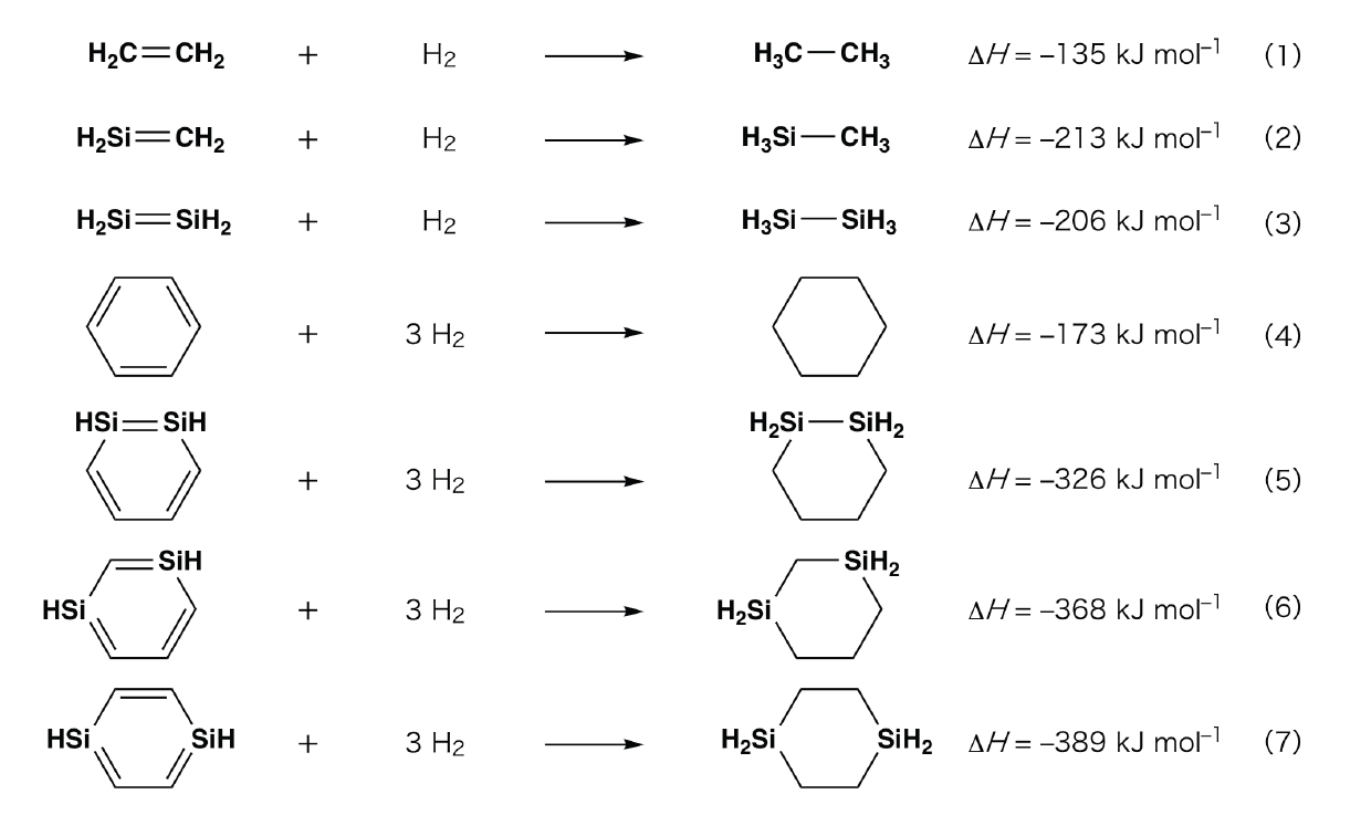
Fig. 1
When a xylene solution of C is heated, it undergoes isomerization to give an equilibrium mixture of compounds D and E. The molar ratio is D : E = 1 : 40.0 at 50.0 °C and D : E = 1 : 20.0 at 120.0 °C.
5.3 Calculate \(\Delta H\) for the transformation of D to E. Assume that \(\Delta H\) does not depend on temperature.
The isomerization from C to D and to E proceeds via transformations of \(\pi\)-bonds into \(\sigma\)-bonds without breaking any \(\sigma\)-bonds. A \(\ce{^{13}C}\) NMR analysis revealed one signal for the \(\ce{Si2C4}\) skeleton of D and two signals for that of E. The skeleton of D does not contain any three-membered rings, while E has two three membered rings that share an edge.
5.4 Draw the structural formulae of D and E using \(\ce{R^{1}}\), \(\ce{R^{2}}\), \(\ce{Si}\), and \(\ce{C}\)
PART B
Silicon is able to form highly coordinated compounds (> four substituents) with electronegative elements such as fluorine. As metal fluorides are often used as fluorination reagents, highly coordinated silicon fluorides also act as fluorination reagents.
The fluorination reaction of \(\ce{CCl4}\) using \(\ce{Na2SiF6}\) was carried out as follows.
Standardization of \(\ce{Na2SiF6}\) solution:
- Preparation
Aqueous solution F: 0.855 g of \(\ce{Na2SiF6}\) (188.053 g mol\(^{-1}\)) dissolved in water (total volume: 200 mL).
Aqueous solution G: 6.86 g of \(\ce{Ce2(SO4)3}\) (568.424 g mol\(^{-1}\)) dissolved in water (total volume: 200 mL).
- Procedure
Precipitation titration of a solution F (50.0 mL) by dropwise adding solution G in the presence of xylenol orange, which coordinates to \(\ce{Ce^{3+}}\), as an indicator. After adding 18.8 mL of solution G, the color of the solution changes from yellow to magenta. The generated precipitate is a binary compound that contains \(\ce{Ce^{3+}}\), and the only resulting silicon compound is \(\ce{Si(OH)4}\).
5.5 Write the balanced equation for the reaction of \(\ce{Na2SiF6}\) with \(\ce{Ce2(SO4)3}\).
- Reaction of \(\ce{CCl4}\) with \(\ce{Na2SiF6}\):
(Substance losses by e.g. evaporation are negligible during the following operations.)
\(\ce{Na2SiF6}\)(\(x\) [g]) was added to \(\ce{CCl4}\) (500.0 g) and heated to 300°C in a sealed pressure-resistant reaction vessel. The unreacted \(\ce{Na2SiF6}\) and generated \(\ce{NaCl}\) were removed by filtration. The filtrate was diluted to a total volume of 1.00 L with \(\ce{CCl4}\) (solution H). The \(\ce{^{29}Si}\) and \(\ce{^{19}F}\) NMR spectra of solution H showed \(\ce{SiF4}\) as the only silicon compound. In the \(\ce{^{19}F}\) NMR spectrum, in addition to \(\ce{SiF4}\), signals corresponding to \(\ce{CFCl3}\), \(\ce{CF2Cl2}\), \(\ce{CF3Cl}\), and \(\ce{CF4}\) were observed (cf. Table 1). The integration ratios in the \(\ce{^{19}F}\) NMR spectrum are proportional to the number of fluorine nuclei.
Table 1
| \(\ce{^{19}F}\) NMR data | \(\ce{CFCl3}\) | \(\ce{CF2Cl2}\) | \(\ce{CF3Cl}\) | \(\ce{CF4}\) |
|---|---|---|---|---|
| Integration ratio | 45.0 | 65.0 | 18.0 | 2.0 |
\(\ce{SiF4}\) is hydrolyzed to form \(\ce{H2SiF6}\) according to the following eq. 8:

Solution H (10 mL) was added to an excess amount of water, which resulted in the complete hydrolysis of \(\ce{SiF4}\). After separation, the \(\ce{H2SiF6}\) generated from the hydrolysis in the aqueous solution was neutralized and completely converted to \(\ce{Na2SiF6}\) (aqueous solution J).
The precipitate of unreacted \(\ce{Na2SiF6}\) and \(\ce{NaCl}\), which was removed by filtration in the initial step (underlined), was completely dissolved in water to give an aqueous solution (solution K; 10.0 L).
Then, additional precipitation titrations using solution G were carried out, and the endpoints of the titrations with G were as follows:
- For solution J (entire amount): 61.6 mL.
- For 100 mL of solution K: 44.4 mL.
It should be noted here that the coexistence of \(\ce{NaCl}\) or \(\ce{SiO2}\) has no effect on the precipitation titration.
5.6 Calculate the mass of the \(\ce{NaCl}\) produced in the reaction vessel (information underlined), and calculate the mass (\(x\) [g]) of the \(\ce{Na2SiF6}\) used as a starting material.
5.7 77.8% of the \(\ce{CCl4}\) used as a starting material was unreacted. Calculate the mass of \(\ce{CF3Cl}\) generated.
Official English text of the problem.
Answers
In the generic SMILES below, each [*:1] represents an \(\ce{R^{1}}\) substituent and each [*:2] an \(\ce{R^{2}}\) substituent. The names identify the parent skeletons. Stereochemical marks in D and E specify their relative cage arrangements; they do not specify stereochemistry within the R groups.
- 5.1
- A: substituted 1,2-disilacyclobuta-1,3-diene,
[*:1][Si]1=[Si]([*:1])C([*:2])=C1[*:2]. - B: substituted 1,2-disilabenzene,
[*:1][Si]1=[Si]([*:1])C([*:2])=C([*:2])C([*:2])=C1[*:2]. -
C: substituted 1,4-disilabenzene,
[*:1][Si]1=C([*:2])C([*:2])=[Si]([*:1])C([*:2])=C1[*:2]. -
5.2 Benzene,
c1ccccc1: \(\boxed{\mathrm{ASE}=232\ \mathrm{kJ\,mol^{-1}}}\).
C, with \(\ce{R^{1}}=\ce{R^{2}}=\ce{H}\): \(\boxed{\mathrm{ASE}=172\ \mathrm{kJ\,mol^{-1}}}\). -
5.3 \(\boxed{\Delta H_{\mathrm{D\rightarrow E}}=-10.5\ \mathrm{kJ\,mol^{-1}}}\).
-
5.4
- D: substituted 1,4-disilabicyclo[2.2.0]hexa-2,5-diene, the disila-Dewar benzene structure,
[*:1][Si@]12C([*:2])=C([*:2])[Si@@]1([*:1])C([*:2])=C2[*:2]. -
E: substituted 2,5-disilabenzvalene,
[*:1][Si@@]12[C@@]3([*:2])[C@]1([*:2])[Si@@]3([*:1])C([*:2])=C2[*:2]. -
5.5 \[ \boxed{\ce{Na2SiF6 + Ce2(SO4)3 + 4H2O -> 2CeF3(s) + Si(OH)4 + Na2SO4 + 2H2SO4}} \]
-
5.6 Sodium chloride,
[Na+].[Cl-]: \(\boxed{65.2\ \mathrm{g}}\).
Starting sodium hexafluorosilicate,[Na+].[Na+].F[Si-2](F)(F)(F)(F)F: \(\boxed{x=155\ \mathrm{g}}\). -
5.7 Chlorotrifluoromethane,
FC(F)(F)Cl: \(\boxed{5.38\ \mathrm{g}}\).
Solution
5.1 — Structures of A, B, and C
The reaction with ethylene shows that cycloaddition consumes one of the two \(\pi\)-bonds of the silicon–silicon triple bond. With an alkyne, one \(\pi\)-bond from each triple bond is consumed, leaving a four-membered ring with opposite \(\ce{Si=Si}\) and \(\ce{C=C}\) bonds.
Thus, to draw A, place two adjacent silicon atoms along one edge of a square and two carbon atoms along the opposite edge. Draw both these edges as double bonds and the other two edges as single bonds. Each silicon carries \(\ce{R^{1}}\), and each carbon carries \(\ce{R^{2}}\).
For the six-membered conjugated products, the possible relative silicon positions give the following carbon environments:
| Silicon positions | Equivalent carbon positions | Number of \(\ce{^{13}C}\) signals |
|---|---|---|
| 1,2 | \(3\equiv6;\ 4\equiv5\) | 2 |
| 1,3 | \(2;\ 5;\ 4\equiv6\) | 3 |
| 1,4 | \(2\equiv3\equiv5\equiv6\) | 1 |
The observed two signals therefore identify B as the 1,2-disilabenzene, while one signal identifies C as the 1,4-disilabenzene.
Precise drawings corresponding to the SMILES in the answers are:
- B: a six-membered ring numbered consecutively, with silicon at positions 1 and 2 and carbon at positions 3–6. Draw double bonds \(1=2\), \(3=4\), and \(5=6\).
- C: a six-membered ring with silicon at positions 1 and 4. Draw double bonds \(1=2\), \(3=4\), and \(5=6\).
Attach \(\ce{R^{1}}\) to every silicon and \(\ce{R^{2}}\) to every carbon. These are individual Kekulé contributors; the NMR equivalence concerns the conjugated molecules.
5.2 — Aromatic stabilization energies
The isolated-double-bond references are ethene, C=C, for \(\ce{C=C}\), and silene, C=[SiH2], for \(\ce{Si=C}\).
The positive stabilization energy is the difference between the actual hydrogenation enthalpy and the sum expected for isolated double bonds:
\[ \mathrm{ASE} =\Delta H_{\mathrm{hyd,actual}} -\sum \Delta H_{\mathrm{hyd,isolated}}. \]
For benzene, the isolated-bond reference contains three \(\ce{C=C}\) bonds:
\[ \Delta H_{\mathrm{hyd,reference}} =3(-135)=-405\ \mathrm{kJ\,mol^{-1}}. \]
Using reaction (4),
\[ \boxed{\mathrm{ASE}_{\mathrm{benzene}} =-173-(-405)=232\ \mathrm{kJ\,mol^{-1}}}. \]
For C with hydrogen substituents, the molecule is 1,4-disilabenzene, [SiH]1=CC=[SiH]C=C1. A Kekulé structure contains two \(\ce{Si=C}\) bonds and one \(\ce{C=C}\) bond:
\[ \Delta H_{\mathrm{hyd,reference}} =2(-213)+(-135) =-561\ \mathrm{kJ\,mol^{-1}}. \]
The opposite silicon positions identify its hydrogenation as reaction (7), with \(\Delta H=-389\ \mathrm{kJ\,mol^{-1}}\). Hence,
\[ \boxed{\mathrm{ASE}_{\mathrm C} =-389-(-561)=172\ \mathrm{kJ\,mol^{-1}}}. \]
5.3 — Enthalpy change for D to E
For the equilibrium \(\mathrm D\rightleftharpoons\mathrm E\),
\[ K=\frac{[\mathrm E]}{[\mathrm D]}. \]
Thus,
\[ K_1=40.0,\quad T_1=323.15\ \mathrm K, \qquad K_2=20.0,\quad T_2=393.15\ \mathrm K. \]
The integrated van ’t Hoff equation is
\[ \ln\frac{K_2}{K_1} =-\frac{\Delta H}{R} \left(\frac1{T_2}-\frac1{T_1}\right). \]
Using \(R=8.314\ \mathrm{J\,mol^{-1}\,K^{-1}}\),
\[ \Delta H =-\frac{8.314\ln(20.0/40.0)} {1/393.15-1/323.15} =-1.046\times10^4\ \mathrm{J\,mol^{-1}}. \]
Therefore,
\[ \boxed{\Delta H_{\mathrm{D\rightarrow E}} =-10.5\ \mathrm{kJ\,mol^{-1}}}. \]
The exothermic sign agrees with the greater proportion of E at the lower temperature.
5.4 — Structures of D and E
Retain the numbering of C:
\[ \ce{Si}_{1}-\ce{C}_{2}-\ce{C}_{3} -\ce{Si}_{4}-\ce{C}_{5}-\ce{C}_{6} -\ce{Si}_{1}. \]
Every edge in this original six-membered ring must remain as a \(\sigma\)-bond. Silicon atoms retain their \(\ce{R^{1}}\) substituents and carbon atoms their \(\ce{R^{2}}\) substituents.
For D, add a single bond between silicon atoms 1 and 4. The remaining double bonds are \(2=3\) and \(5=6\).
This gives two four-membered rings:
\[ (1,2,3,4),\qquad (1,4,5,6), \]
sharing the \(\ce{Si-Si}\) edge. There are no three-membered rings. Symmetry makes all four carbon atoms equivalent, giving the required one carbon signal.
Thus D is the disila-Dewar benzene structure. Draw the two four-membered rings folded about their shared silicon–silicon bond; the molecular framework is not planar.
For E, add single bonds \(1-3\) and \(2-4\), and retain only the double bond \(5=6\).
The resulting three-membered rings are
\[ (1,2,3),\qquad (2,3,4), \]
which share the carbon–carbon edge \(2-3\). The carbon environments are:
- the two equivalent saturated carbons, 2 and 3;
- the two equivalent alkene carbons, 5 and 6.
This gives the required two carbon signals. E is therefore 2,5-disilabenzvalene. Draw the two \(\ce{SiC2}\) triangles sharing their carbon–carbon edge, with the two silicon vertices also connected through the \(\ce{C=C}\)-containing path \(1-6=5-4\). This is a folded cage structure.
Both constructions preserve all six original ring \(\sigma\)-bonds and satisfy the valence of every skeletal atom.
5.5 — Precipitation reaction
The amount of sodium hexafluorosilicate in the titrated portion of F is
\[ n_F =\frac{0.855\ \mathrm g} {188.053\ \mathrm{g\,mol^{-1}}} \frac{50.0}{200} =1.13665\times10^{-3}\ \mathrm{mol}. \]
The amount of cerium(III) supplied at the endpoint is
\[ n_{\mathrm{Ce}} =2\frac{6.86\ \mathrm g} {568.424\ \mathrm{g\,mol^{-1}}} \frac{18.8}{200} =2.26887\times10^{-3}\ \mathrm{mol}. \]
Consequently,
\[ \frac{n_{\mathrm{Ce}}}{n_F}=1.996\approx2. \]
Two cerium(III) ions therefore react per hexafluorosilicate ion. The binary precipitate is cerium(III) fluoride, \(\ce{CeF3}\), containing the six fluorine atoms as two formula units of precipitate.
The net ionic equation is
\[ \ce{SiF6^{2-} + 2Ce^{3+} + 4H2O -> 2CeF3(s) + Si(OH)4 + 4H+}. \]
Restoring the sodium and sulfate ions gives
\[ \boxed{\ce{Na2SiF6 + Ce2(SO4)3 + 4H2O -> 2CeF3(s) + Si(OH)4 + Na2SO4 + 2H2SO4}}. \]
The species used here have the following names and SMILES:
| Name | SMILES |
|---|---|
| Cerium(III) sulfate | [Ce+3].[Ce+3].[O-]S(=O)(=O)[O-].[O-]S(=O)(=O)[O-].[O-]S(=O)(=O)[O-] |
| Cerium(III) fluoride | [Ce+3].[F-].[F-].[F-] |
| Orthosilicic acid | O[Si](O)(O)O |
| Sodium sulfate | [Na+].[Na+].[O-]S(=O)(=O)[O-] |
| Sulfuric acid | OS(=O)(=O)O |
| Water | O |
| Hexafluorosilicate(2−) ion | F[Si-2](F)(F)(F)(F)F |
| Cerium(III) ion | [Ce+3] |
| Hydrogen ion, or proton | [H+] |
The disconnected salt SMILES express composition and charges rather than crystal structures. The hexafluorosilicate ion has octahedral coordination, which these SMILES do not explicitly encode.
5.6 — Sodium chloride produced and starting sodium hexafluorosilicate
From its stated preparation, the formula-unit concentration of G is
\[ c_G =\frac{6.86/568.424}{0.200} =0.0603423\ \mathrm{mol\,L^{-1}}. \]
The balanced titration equation establishes a 1:1 molar ratio between \(\ce{Ce2(SO4)3}\) and \(\ce{Na2SiF6}\).
The hydrolysis species are silicon tetrafluoride, F[Si](F)(F)F, and hexafluorosilicic acid, formally represented in ionic form by [H+].[H+].F[Si-2](F)(F)(F)(F)F. Silicon dioxide is an extended network solid and has no discrete molecular SMILES.
For the entire solution J,
\[ n_J(\ce{Na2SiF6}) =c_G(0.0616\ \mathrm L) =3.71708\times10^{-3}\ \mathrm{mol}. \]
From the given hydrolysis equation,
\[ \ce{3SiF4 + 2H2O -> SiO2 + 2H2SiF6}, \]
the 10 mL aliquot of H originally contained
\[ n_{\text{10 mL}}(\ce{SiF4}) =\frac32 n_J =5.57563\times10^{-3}\ \mathrm{mol}. \]
Therefore the complete 1.00 L solution contained
\[ n_{\text{total}}(\ce{SiF4}) =5.57563\times10^{-3}\frac{1000}{10} =0.557563\ \mathrm{mol}. \]
Every consumed formula unit of \(\ce{Na2SiF6}\) supplies one silicon atom to \(\ce{SiF4}\). Thus,
\[ n_{\mathrm{reacted}}(\ce{Na2SiF6}) =0.557563\ \mathrm{mol}. \]
Its two sodium atoms appear in the sodium chloride removed by filtration:
\[ n(\ce{NaCl})=2(0.557563)=1.11513\ \mathrm{mol}. \]
Using \(M(\ce{NaCl})=58.44\ \mathrm{g\,mol^{-1}}\),
\[ \boxed{m(\ce{NaCl}) =1.11513(58.44)=65.2\ \mathrm g}. \]
The 100 mL aliquot of K contains
\[ n_{\text{100 mL}}(\ce{Na2SiF6}) =c_G(0.0444\ \mathrm L) =2.67920\times10^{-3}\ \mathrm{mol}. \]
Since K has a total volume of 10.0 L,
\[ n_{\mathrm{unreacted}}(\ce{Na2SiF6}) =2.67920\times10^{-3}\frac{10.0}{0.100} =0.267920\ \mathrm{mol}. \]
The initial amount was the sum of reacted and unreacted material:
\[ n_{\mathrm{initial}}=0.557563+0.267920 =0.825482\ \mathrm{mol}. \]
Hence,
\[ \boxed{x =0.825482(188.053) =155.234\ \mathrm g \approx155\ \mathrm g}. \]
5.7 — Mass of chlorotrifluoromethane
The starting reagent is tetrachloromethane, ClC(Cl)(Cl)Cl.
Dividing each NMR integral by the number of fluorine atoms per molecule gives the molecular mole ratios:
| Product | Name and SMILES | Relative amount |
|---|---|---|
| \(\ce{CFCl3}\) | Trichlorofluoromethane, FC(Cl)(Cl)Cl |
\(45.0/1=45.0\) |
| \(\ce{CF2Cl2}\) | Dichlorodifluoromethane, FC(F)(Cl)Cl |
\(65.0/2=32.5\) |
| \(\ce{CF3Cl}\) | Chlorotrifluoromethane, FC(F)(F)Cl |
\(18.0/3=6.0\) |
| \(\ce{CF4}\) | Tetrafluoromethane, FC(F)(F)F |
\(2.0/4=0.5\) |
Thus, the mole fraction of chlorotrifluoromethane among the fluorinated carbon products is
\[ y(\ce{CF3Cl}) =\frac{6.0}{45.0+32.5+6.0+0.5} =\frac1{14}. \]
The mass of starting tetrachloromethane that reacted was
\[ m_{\mathrm{reacted}}(\ce{CCl4}) =500.0(1-0.778)=111.0\ \mathrm g. \]
Using \(M(\ce{CCl4})=153.81\ \mathrm{g\,mol^{-1}}\),
\[ n_{\mathrm{reacted}}(\ce{CCl4}) =\frac{111.0}{153.81} =0.721670\ \mathrm{mol}. \]
Each fluorinated carbon product contains one carbon atom, so their combined amount equals the amount of tetrachloromethane consumed:
\[ n(\ce{CF3Cl}) =\frac{0.721670}{14} =0.0515478\ \mathrm{mol}. \]
With \(M(\ce{CF3Cl})=104.46\ \mathrm{g\,mol^{-1}}\),
\[ \boxed{m(\ce{CF3Cl}) =0.0515478(104.46) =5.38\ \mathrm g}. \]
The solution was checked against the official solution.
IChO 2021 · Theorieaufgabe 5
Geheimnisvolles Silicium
Obwohl Silicium ebenso wie Kohlenstoff ein Element der Gruppe 14 ist, unterscheiden sich ihre Eigenschaften erheblich.
TEIL A
Anders als die Kohlenstoff–Kohlenstoff-Dreifachbindung ist die Silicium–Silicium-Dreifachbindung in einer Verbindung der Formel \(\ce{R^{1}-Si#Si-R^{1}}\) (R: organischer Substituent) äußerst reaktiv. Beispielsweise reagiert sie mit Ethen zu einem cyclischen Produkt, das einen viergliedrigen Ring enthält.
Bei der Umsetzung von \(\ce{R^{1}-Si#Si-R^{1}}\) mit einem Alkin (\(\ce{R^{2}-C#C-R^{2}}\)) entsteht zunächst die Verbindung A mit einem viergliedrigen Ring als Zwischenprodukt. Die weitere Reaktion eines weiteren Moleküls \(\ce{R^{2}-C#C-R^{2}}\) mit A liefert die Isomere B und C, die beide benzolähnliche cyclisch konjugierte Strukturen aufweisen. Diese sogenannten „Disilabenzole“ enthalten einen sechsgliedrigen Ring und lassen sich durch die Formel \(\ce{(R^{1}-Si)2(R^{2}-C)4}\) beschreiben.
Die \(\ce{^{13}C}\)-NMR-Analyse der jeweiligen sechsgliedrigen Ringgerüste \(\ce{Si2C4}\) zeigt zwei Signale für B und ein Signal für C.
5.1 Zeichnen Sie die Strukturformeln von A, B und C unter Verwendung von \(\ce{R^{1}}\), \(\ce{R^{2}}\), \(\ce{Si}\) und \(\ce{C}\) in einer der möglichen mesomeren Grenzstrukturen.
5.2 Berechnen Sie die aromatische Stabilisierungsenergie (ASE) für Benzol und C (für den Fall \(\ce{R^{1}}=\ce{R^{2}}=\ce{H}\)) als positive Werte unter Berücksichtigung der unten dargestellten Enthalpieänderungen einiger Hydrierungsreaktionen ungesättigter Systeme (Abb. 1).
Abb. 1
Beim Erhitzen einer Lösung von C in Xylol erfolgt eine Isomerisierung zu einem Gleichgewichtsgemisch der Verbindungen D und E. Das Stoffmengenverhältnis beträgt D : E = 1 : 40.0 bei 50.0 °C und D : E = 1 : 20.0 bei 120.0 °C.
5.3 Berechnen Sie \(\Delta H\) für die Umwandlung von D in E. Nehmen Sie an, dass \(\Delta H\) nicht von der Temperatur abhängt.
Die Isomerisierung von C zu D und zu E verläuft durch Umwandlungen von \(\pi\)-Bindungen in \(\sigma\)-Bindungen, ohne dass dabei \(\sigma\)-Bindungen gebrochen werden. Eine \(\ce{^{13}C}\)-NMR-Analyse ergab ein Signal für das \(\ce{Si2C4}\)-Gerüst von D und zwei Signale für dasjenige von E. Das Gerüst von D enthält keine dreigliedrigen Ringe, während E zwei dreigliedrige Ringe mit einer gemeinsamen Kante aufweist.
5.4 Zeichnen Sie die Strukturformeln von D und E unter Verwendung von \(\ce{R^{1}}\), \(\ce{R^{2}}\), \(\ce{Si}\) und \(\ce{C}\)
TEIL B
Silicium kann mit elektronegativen Elementen wie Fluor Verbindungen mit hoher Koordinationszahl (> vier Substituenten) bilden. Ebenso wie Metallfluoride häufig als Fluorierungsreagenzien eingesetzt werden, wirken auch Siliciumfluoride mit hoher Koordinationszahl als Fluorierungsreagenzien.
Die Fluorierungsreaktion von \(\ce{CCl4}\) mit \(\ce{Na2SiF6}\) wurde wie folgt durchgeführt.
Gehaltsbestimmung der \(\ce{Na2SiF6}\)-Lösung:
- Herstellung
Wässrige Lösung F: 0.855 g \(\ce{Na2SiF6}\) (188.053 g mol\(^{-1}\)), in Wasser gelöst (Gesamtvolumen: 200 mL).
Wässrige Lösung G: 6.86 g \(\ce{Ce2(SO4)3}\) (568.424 g mol\(^{-1}\)), in Wasser gelöst (Gesamtvolumen: 200 mL).
- Durchführung
Fällungstitration der Lösung F (50.0 mL) durch tropfenweise Zugabe der Lösung G in Gegenwart von Xylenolorange, das an \(\ce{Ce^{3+}}\) koordiniert, als Indikator. Nach Zugabe von 18.8 mL der Lösung G schlägt die Farbe der Lösung von Gelb nach Magenta um. Der gebildete Niederschlag ist eine binäre Verbindung, die \(\ce{Ce^{3+}}\) enthält, und die einzige entstehende Siliciumverbindung ist \(\ce{Si(OH)4}\).
5.5 Geben Sie die ausgeglichene Reaktionsgleichung für die Reaktion von \(\ce{Na2SiF6}\) mit \(\ce{Ce2(SO4)3}\) an.
- Reaktion von \(\ce{CCl4}\) mit \(\ce{Na2SiF6}\):
(Stoffverluste, z. B. durch Verdampfen, sind während der folgenden Arbeitsschritte vernachlässigbar.)
\(\ce{Na2SiF6}\)(\(x\) [g]) wurde zu \(\ce{CCl4}\) (500.0 g) gegeben und in einem verschlossenen druckbeständigen Reaktionsgefäß auf 300°C erhitzt. Das nicht umgesetzte \(\ce{Na2SiF6}\) und das gebildete \(\ce{NaCl}\) wurden durch Filtration entfernt. Das Filtrat wurde mit \(\ce{CCl4}\) auf ein Gesamtvolumen von 1.00 L verdünnt (Lösung H). Die \(\ce{^{29}Si}\)- und \(\ce{^{19}F}\)-NMR-Spektren der Lösung H zeigten \(\ce{SiF4}\) als einzige Siliciumverbindung. Im \(\ce{^{19}F}\)-NMR-Spektrum wurden neben \(\ce{SiF4}\) Signale beobachtet, die \(\ce{CFCl3}\), \(\ce{CF2Cl2}\), \(\ce{CF3Cl}\) und \(\ce{CF4}\) entsprechen (vgl. Tabelle 1). Die Integralverhältnisse im \(\ce{^{19}F}\)-NMR-Spektrum sind proportional zur Anzahl der Fluorkerne.
Tabelle 1
| \(\ce{^{19}F}\)-NMR-Daten | \(\ce{CFCl3}\) | \(\ce{CF2Cl2}\) | \(\ce{CF3Cl}\) | \(\ce{CF4}\) |
|---|---|---|---|---|
| Integralverhältnis | 45.0 | 65.0 | 18.0 | 2.0 |
\(\ce{SiF4}\) wird gemäß der folgenden Gl. 8 unter Bildung von \(\ce{H2SiF6}\) hydrolysiert:
Lösung H (10 mL) wurde zu einem Überschuss an Wasser gegeben, wodurch \(\ce{SiF4}\) vollständig hydrolysiert wurde. Nach der Abtrennung wurde das bei der Hydrolyse gebildete \(\ce{H2SiF6}\) in der wässrigen Lösung neutralisiert und vollständig in \(\ce{Na2SiF6}\) umgewandelt (wässrige Lösung J).
Der Niederschlag aus nicht umgesetztem \(\ce{Na2SiF6}\) und \(\ce{NaCl}\), der im ersten Schritt (unterstrichen) durch Filtration entfernt worden war, wurde vollständig in Wasser gelöst, sodass eine wässrige Lösung entstand (Lösung K; 10.0 L).
Anschließend wurden weitere Fällungstitrationen mit Lösung G durchgeführt. Die Endpunkte der Titrationen mit G wurden bei folgenden Volumina erreicht:
- Für Lösung J (gesamte Menge): 61.6 mL.
- Für 100 mL der Lösung K: 44.4 mL.
Hierbei ist zu beachten, dass die gleichzeitige Anwesenheit von \(\ce{NaCl}\) oder \(\ce{SiO2}\) keinen Einfluss auf die Fällungstitration hat.
5.6 Berechnen Sie die Masse des im Reaktionsgefäß gebildeten \(\ce{NaCl}\) (unterstrichene Angaben) und berechnen Sie die Masse (\(x\) [g]) des als Ausgangsstoff eingesetzten \(\ce{Na2SiF6}\).
5.7 77.8% des als Ausgangsstoff eingesetzten \(\ce{CCl4}\) wurden nicht umgesetzt. Berechnen Sie die Masse des gebildeten \(\ce{CF3Cl}\).
Aufgabentext aus dem offiziellen englischen Text übersetzt.
Antworten
In den nachstehenden generischen SMILES steht jedes [*:1] für einen \(\ce{R^{1}}\)-Substituenten und jedes [*:2] für einen \(\ce{R^{2}}\)-Substituenten. Die Namen bezeichnen die Stammgerüste. Die stereochemischen Kennzeichnungen in D und E geben deren relative Käfiganordnungen an; sie legen keine Stereochemie innerhalb der R-Gruppen fest.
- 5.1
- A: substituiertes 1,2-Disilacyclobuta-1,3-dien,
[*:1][Si]1=[Si]([*:1])C([*:2])=C1[*:2]. - B: substituiertes 1,2-Disilabenzol,
[*:1][Si]1=[Si]([*:1])C([*:2])=C([*:2])C([*:2])=C1[*:2]. -
C: substituiertes 1,4-Disilabenzol,
[*:1][Si]1=C([*:2])C([*:2])=[Si]([*:1])C([*:2])=C1[*:2]. -
5.2 Benzol,
c1ccccc1: \(\boxed{\mathrm{ASE}=232\ \mathrm{kJ\,mol^{-1}}}\).
C, mit \(\ce{R^{1}}=\ce{R^{2}}=\ce{H}\): \(\boxed{\mathrm{ASE}=172\ \mathrm{kJ\,mol^{-1}}}\). -
5.3 \(\boxed{\Delta H_{\mathrm{D\rightarrow E}}=-10.5\ \mathrm{kJ\,mol^{-1}}}\).
-
5.4
- D: substituiertes 1,4-Disilabicyclo[2.2.0]hexa-2,5-dien, die Disila-Dewar-Benzol-Struktur,
[*:1][Si@]12C([*:2])=C([*:2])[Si@@]1([*:1])C([*:2])=C2[*:2]. -
E: substituiertes 2,5-Disilabenzvalen,
[*:1][Si@@]12[C@@]3([*:2])[C@]1([*:2])[Si@@]3([*:1])C([*:2])=C2[*:2]. -
5.5 \[ \boxed{\ce{Na2SiF6 + Ce2(SO4)3 + 4H2O -> 2CeF3(s) + Si(OH)4 + Na2SO4 + 2H2SO4}} \]
-
5.6 Natriumchlorid,
[Na+].[Cl-]: \(\boxed{65.2\ \mathrm{g}}\).
Als Ausgangsstoff eingesetztes Natriumhexafluorosilicat,[Na+].[Na+].F[Si-2](F)(F)(F)(F)F: \(\boxed{x=155\ \mathrm{g}}\). -
5.7 Chlortrifluormethan,
FC(F)(F)Cl: \(\boxed{5.38\ \mathrm{g}}\).
Lösung
5.1 — Strukturen von A, B und C
Die Reaktion mit Ethen zeigt, dass bei der Cycloaddition eine der beiden \(\pi\)-Bindungen der Silicium–Silicium-Dreifachbindung verbraucht wird. Bei einem Alkin wird von jeder Dreifachbindung jeweils eine \(\pi\)-Bindung verbraucht, sodass ein viergliedriger Ring mit gegenüberliegenden \(\ce{Si=Si}\)- und \(\ce{C=C}\)-Bindungen verbleibt.
Um A zu zeichnen, ordnet man daher zwei benachbarte Siliciumatome entlang einer Kante eines Quadrats und zwei Kohlenstoffatome entlang der gegenüberliegenden Kante an. Diese beiden Kanten werden als Doppelbindungen und die anderen beiden Kanten als Einfachbindungen gezeichnet. Jedes Siliciumatom trägt \(\ce{R^{1}}\), und jedes Kohlenstoffatom trägt \(\ce{R^{2}}\).
Für die sechsgliedrigen konjugierten Produkte ergeben sich aus den möglichen relativen Positionen der Siliciumatome folgende Kohlenstoffumgebungen:
| Siliciumpositionen | Äquivalente Kohlenstoffpositionen | Anzahl der \(\ce{^{13}C}\)-Signale |
|---|---|---|
| 1,2 | \(3\equiv6;\ 4\equiv5\) | 2 |
| 1,3 | \(2;\ 5;\ 4\equiv6\) | 3 |
| 1,4 | \(2\equiv3\equiv5\equiv6\) | 1 |
Die zwei beobachteten Signale identifizieren B somit als 1,2-Disilabenzol, während das eine Signal C als 1,4-Disilabenzol identifiziert.
Die den SMILES in den Antworten entsprechenden Zeichnungen lassen sich präzise wie folgt angeben:
- B: ein fortlaufend nummerierter sechsgliedriger Ring mit Silicium an den Positionen 1 und 2 und Kohlenstoff an den Positionen 3–6. Zeichnen Sie Doppelbindungen \(1=2\), \(3=4\) und \(5=6\).
- C: ein sechsgliedriger Ring mit Silicium an den Positionen 1 und 4. Zeichnen Sie Doppelbindungen \(1=2\), \(3=4\) und \(5=6\).
Bringen Sie an jedem Siliciumatom \(\ce{R^{1}}\) und an jedem Kohlenstoffatom \(\ce{R^{2}}\) an. Dies sind einzelne Kekulé-Grenzstrukturen; die NMR-Äquivalenz bezieht sich auf die konjugierten Moleküle.
5.2 — Aromatische Stabilisierungsenergien
Die Referenzverbindungen für isolierte Doppelbindungen sind Ethen, C=C, für \(\ce{C=C}\) und Silen, C=[SiH2], für \(\ce{Si=C}\).
Die positive Stabilisierungsenergie ist die Differenz zwischen der tatsächlichen Hydrierungsenthalpie und der für isolierte Doppelbindungen erwarteten Summe:
\[ \mathrm{ASE} =\Delta H_{\mathrm{hyd,actual}} -\sum \Delta H_{\mathrm{hyd,isolated}}. \]
Für Benzol enthält die Referenz mit isolierten Bindungen drei \(\ce{C=C}\)-Bindungen:
\[ \Delta H_{\mathrm{hyd,reference}} =3(-135)=-405\ \mathrm{kJ\,mol^{-1}}. \]
Mit Reaktion (4) ergibt sich
\[ \boxed{\mathrm{ASE}_{\mathrm{benzene}} =-173-(-405)=232\ \mathrm{kJ\,mol^{-1}}}. \]
Für C mit Wasserstoffsubstituenten handelt es sich um 1,4-Disilabenzol, [SiH]1=CC=[SiH]C=C1. Eine Kekulé-Struktur enthält zwei \(\ce{Si=C}\)-Bindungen und eine \(\ce{C=C}\)-Bindung:
\[ \Delta H_{\mathrm{hyd,reference}} =2(-213)+(-135) =-561\ \mathrm{kJ\,mol^{-1}}. \]
Die gegenüberliegenden Siliciumpositionen ordnen seine Hydrierung der Reaktion (7) mit \(\Delta H=-389\ \mathrm{kJ\,mol^{-1}}\) zu. Somit gilt
\[ \boxed{\mathrm{ASE}_{\mathrm C} =-389-(-561)=172\ \mathrm{kJ\,mol^{-1}}}. \]
5.3 — Enthalpieänderung von D zu E
Für das Gleichgewicht \(\mathrm D\rightleftharpoons\mathrm E\) gilt
\[ K=\frac{[\mathrm E]}{[\mathrm D]}. \]
Somit gilt
\[ K_1=40.0,\quad T_1=323.15\ \mathrm K, \qquad K_2=20.0,\quad T_2=393.15\ \mathrm K. \]
Die integrierte van-’t-Hoff-Gleichung lautet
\[ \ln\frac{K_2}{K_1} =-\frac{\Delta H}{R} \left(\frac1{T_2}-\frac1{T_1}\right). \]
Mit \(R=8.314\ \mathrm{J\,mol^{-1}\,K^{-1}}\) ergibt sich
\[ \Delta H =-\frac{8.314\ln(20.0/40.0)} {1/393.15-1/323.15} =-1.046\times10^4\ \mathrm{J\,mol^{-1}}. \]
Daher gilt
\[ \boxed{\Delta H_{\mathrm{D\rightarrow E}} =-10.5\ \mathrm{kJ\,mol^{-1}}}. \]
Das exotherme Vorzeichen stimmt mit dem höheren Anteil von E bei der niedrigeren Temperatur überein.
5.4 — Strukturen von D und E
Die Nummerierung von C wird beibehalten:
\[ \ce{Si}_{1}-\ce{C}_{2}-\ce{C}_{3} -\ce{Si}_{4}-\ce{C}_{5}-\ce{C}_{6} -\ce{Si}_{1}. \]
Jede Kante dieses ursprünglichen sechsgliedrigen Rings muss als \(\sigma\)-Bindung erhalten bleiben. Die Siliciumatome behalten ihre \(\ce{R^{1}}\)-Substituenten und die Kohlenstoffatome ihre \(\ce{R^{2}}\)-Substituenten.
Für D wird eine Einfachbindung zwischen den Siliciumatomen 1 und 4 hinzugefügt. Die verbleibenden Doppelbindungen sind \(2=3\) und \(5=6\).
Dadurch entstehen zwei viergliedrige Ringe:
\[ (1,2,3,4),\qquad (1,4,5,6), \]
die sich die \(\ce{Si-Si}\)-Kante teilen. Es gibt keine dreigliedrigen Ringe. Aufgrund der Symmetrie sind alle vier Kohlenstoffatome äquivalent, sodass sich das geforderte einzelne Kohlenstoffsignal ergibt.
Somit besitzt D die Disila-Dewar-Benzol-Struktur. Zeichnen Sie die beiden viergliedrigen Ringe entlang ihrer gemeinsamen Silicium–Silicium-Bindung gefaltet; das Molekülgerüst ist nicht planar.
Für E werden die Einfachbindungen \(1-3\) und \(2-4\) hinzugefügt, und nur die Doppelbindung \(5=6\) bleibt erhalten.
Die entstehenden dreigliedrigen Ringe sind
\[ (1,2,3),\qquad (2,3,4), \]
die sich die Kohlenstoff–Kohlenstoff-Kante \(2-3\) teilen. Die Kohlenstoffumgebungen sind:
- die beiden äquivalenten gesättigten Kohlenstoffatome 2 und 3;
- die beiden äquivalenten Alken-Kohlenstoffatome 5 und 6.
Dies ergibt die geforderten zwei Kohlenstoffsignale. E ist daher 2,5-Disilabenzvalen. Zeichnen Sie die beiden \(\ce{SiC2}\)-Dreiecke mit ihrer gemeinsamen Kohlenstoff–Kohlenstoff-Kante, wobei die beiden Siliciumecken zusätzlich über den \(\ce{C=C}\)-haltigen Pfad \(1-6=5-4\) miteinander verbunden sind. Dies ist eine gefaltete Käfigstruktur.
Bei beiden Konstruktionen bleiben alle sechs ursprünglichen \(\sigma\)-Bindungen des Rings erhalten, und die Wertigkeit jedes Gerüstatoms wird erfüllt.
5.5 — Fällungsreaktion
Die Stoffmenge an Natriumhexafluorosilicat im titrierten Anteil von F beträgt
\[ n_F =\frac{0.855\ \mathrm g} {188.053\ \mathrm{g\,mol^{-1}}} \frac{50.0}{200} =1.13665\times10^{-3}\ \mathrm{mol}. \]
Die bis zum Endpunkt zugegebene Stoffmenge an Cer(III) beträgt
\[ n_{\mathrm{Ce}} =2\frac{6.86\ \mathrm g} {568.424\ \mathrm{g\,mol^{-1}}} \frac{18.8}{200} =2.26887\times10^{-3}\ \mathrm{mol}. \]
Folglich gilt
\[ \frac{n_{\mathrm{Ce}}}{n_F}=1.996\approx2. \]
Pro Hexafluorosilicat-Ion reagieren somit zwei Cer(III)-Ionen. Der binäre Niederschlag ist Cer(III)-fluorid, \(\ce{CeF3}\), das die sechs Fluoratome in Form von zwei Formeleinheiten des Niederschlags enthält.
Die Netto-Ionengleichung lautet
\[ \ce{SiF6^{2-} + 2Ce^{3+} + 4H2O -> 2CeF3(s) + Si(OH)4 + 4H+}. \]
Durch Ergänzen der Natrium- und Sulfat-Ionen erhält man
\[ \boxed{\ce{Na2SiF6 + Ce2(SO4)3 + 4H2O -> 2CeF3(s) + Si(OH)4 + Na2SO4 + 2H2SO4}}. \]
Die hier verwendeten Spezies haben folgende Namen und SMILES:
| Name | SMILES |
|---|---|
| Cer(III)-sulfat | [Ce+3].[Ce+3].[O-]S(=O)(=O)[O-].[O-]S(=O)(=O)[O-].[O-]S(=O)(=O)[O-] |
| Cer(III)-fluorid | [Ce+3].[F-].[F-].[F-] |
| Orthokieselsäure | O[Si](O)(O)O |
| Natriumsulfat | [Na+].[Na+].[O-]S(=O)(=O)[O-] |
| Schwefelsäure | OS(=O)(=O)O |
| Wasser | O |
| Hexafluorosilicat(2−)-Ion | F[Si-2](F)(F)(F)(F)F |
| Cer(III)-Ion | [Ce+3] |
| Wasserstoffion oder Proton | [H+] |
Die SMILES der Salze mit getrennten Komponenten geben die Zusammensetzung und die Ladungen statt der Kristallstrukturen wieder. Das Hexafluorosilicat-Ion weist eine oktaedrische Koordination auf, die durch diese SMILES nicht ausdrücklich codiert wird.
5.6 — Gebildetes Natriumchlorid und als Ausgangsstoff eingesetztes Natriumhexafluorosilicat
Aus der angegebenen Herstellung ergibt sich für G die auf Formeleinheiten bezogene Stoffmengenkonzentration
\[ c_G =\frac{6.86/568.424}{0.200} =0.0603423\ \mathrm{mol\,L^{-1}}. \]
Die ausgeglichene Titrationsgleichung ergibt ein Stoffmengenverhältnis von 1:1 zwischen \(\ce{Ce2(SO4)3}\) und \(\ce{Na2SiF6}\).
Die an der Hydrolyse beteiligten Spezies sind Siliciumtetrafluorid, F[Si](F)(F)F, und Hexafluorokieselsäure, formal in ionischer Form durch [H+].[H+].F[Si-2](F)(F)(F)(F)F dargestellt. Siliciumdioxid ist ein Feststoff mit ausgedehnter Netzwerkstruktur und besitzt keine diskreten molekularen SMILES.
Für die gesamte Lösung J gilt
\[ n_J(\ce{Na2SiF6}) =c_G(0.0616\ \mathrm L) =3.71708\times10^{-3}\ \mathrm{mol}. \]
Aus der gegebenen Hydrolysegleichung
\[ \ce{3SiF4 + 2H2O -> SiO2 + 2H2SiF6}, \]
folgt, dass das 10-mL-Aliquot von H ursprünglich folgende Stoffmenge enthielt:
\[ n_{\text{10 mL}}(\ce{SiF4}) =\frac32 n_J =5.57563\times10^{-3}\ \mathrm{mol}. \]
Die gesamte Lösung mit einem Volumen von 1.00 L enthielt daher
\[ n_{\text{gesamt}}(\ce{SiF4}) =5.57563\times10^{-3}\frac{1000}{10} =0.557563\ \mathrm{mol}. \]
Jede verbrauchte Formeleinheit von \(\ce{Na2SiF6}\) liefert ein Siliciumatom für \(\ce{SiF4}\). Somit gilt
\[ n_{\mathrm{reacted}}(\ce{Na2SiF6}) =0.557563\ \mathrm{mol}. \]
Ihre beiden Natriumatome finden sich im durch Filtration entfernten Natriumchlorid wieder:
\[ n(\ce{NaCl})=2(0.557563)=1.11513\ \mathrm{mol}. \]
Mit \(M(\ce{NaCl})=58.44\ \mathrm{g\,mol^{-1}}\) ergibt sich
\[ \boxed{m(\ce{NaCl}) =1.11513(58.44)=65.2\ \mathrm g}. \]
Das 100-mL-Aliquot von K enthält
\[ n_{\text{100 mL}}(\ce{Na2SiF6}) =c_G(0.0444\ \mathrm L) =2.67920\times10^{-3}\ \mathrm{mol}. \]
Da K ein Gesamtvolumen von 10.0 L hat, gilt
\[ n_{\mathrm{unreacted}}(\ce{Na2SiF6}) =2.67920\times10^{-3}\frac{10.0}{0.100} =0.267920\ \mathrm{mol}. \]
Die anfängliche Stoffmenge war die Summe aus umgesetztem und nicht umgesetztem Material:
\[ n_{\mathrm{initial}}=0.557563+0.267920 =0.825482\ \mathrm{mol}. \]
Daraus folgt
\[ \boxed{x =0.825482(188.053) =155.234\ \mathrm g \approx155\ \mathrm g}. \]
5.7 — Masse von Chlortrifluormethan
Das Ausgangsreagenz ist Tetrachlormethan, ClC(Cl)(Cl)Cl.
Durch Division jedes NMR-Integrals durch die Anzahl der Fluoratome pro Molekül erhält man die Stoffmengenverhältnisse der Moleküle:
| Produkt | Name und SMILES | Relative Stoffmenge |
|---|---|---|
| \(\ce{CFCl3}\) | Trichlorfluormethan, FC(Cl)(Cl)Cl |
\(45.0/1=45.0\) |
| \(\ce{CF2Cl2}\) | Dichlordifluormethan, FC(F)(Cl)Cl |
\(65.0/2=32.5\) |
| \(\ce{CF3Cl}\) | Chlortrifluormethan, FC(F)(F)Cl |
\(18.0/3=6.0\) |
| \(\ce{CF4}\) | Tetrafluormethan, FC(F)(F)F |
\(2.0/4=0.5\) |
Der Stoffmengenanteil von Chlortrifluormethan an den fluorierten Kohlenstoffprodukten beträgt somit
\[ y(\ce{CF3Cl}) =\frac{6.0}{45.0+32.5+6.0+0.5} =\frac1{14}. \]
Die Masse des umgesetzten Tetrachlormethans aus dem Ausgangsstoff betrug
\[ m_{\mathrm{reacted}}(\ce{CCl4}) =500.0(1-0.778)=111.0\ \mathrm g. \]
Mit \(M(\ce{CCl4})=153.81\ \mathrm{g\,mol^{-1}}\) ergibt sich
\[ n_{\mathrm{reacted}}(\ce{CCl4}) =\frac{111.0}{153.81} =0.721670\ \mathrm{mol}. \]
Jedes fluorierte Kohlenstoffprodukt enthält ein Kohlenstoffatom, sodass ihre gesamte Stoffmenge der Stoffmenge des verbrauchten Tetrachlormethans entspricht:
\[ n(\ce{CF3Cl}) =\frac{0.721670}{14} =0.0515478\ \mathrm{mol}. \]
Mit \(M(\ce{CF3Cl})=104.46\ \mathrm{g\,mol^{-1}}\) ergibt sich
\[ \boxed{m(\ce{CF3Cl}) =0.0515478(104.46) =5.38\ \mathrm g}. \]
Die Lösung wurde mit der offiziellen Lösung abgeglichen.
IChO 2021 · Teori sorusu 5
Gizemli Silisyum
Silisyum da karbon gibi bir 14. grup elementi olmasına rağmen, özellikleri önemli ölçüde farklıdır.
BÖLÜM A
Karbon–karbon üçlü bağının aksine, \(\ce{R^{1}-Si#Si-R^{1}}\) (R: organik sübstitüent) formülüyle gösterilen bir bileşikteki silisyum–silisyum üçlü bağı son derece reaktiftir. Örneğin, etilenle tepkimeye girerek dört üyeli bir halka içeren halkalı bir ürün oluşturur.
\(\ce{R^{1}-Si#Si-R^{1}}\), bir alkinle (\(\ce{R^{2}-C#C-R^{2}}\)) tepkimeye sokulduğunda, ilk ara ürün olarak dört üyeli halkalı A bileşiği oluşur. Bir başka \(\ce{R^{2}-C#C-R^{2}}\) molekülünün A ile tepkimeye girmesiyle, her ikisi de benzen benzeri halkalı konjuge yapılara sahip olan B ve C izomerleri elde edilir. Altı üyeli bir halka içeren ve \(\ce{(R^{1}-Si)2(R^{2}-C)4}\) formülüyle gösterilebilen bu bileşikler, ‘disilabenzenler’ olarak adlandırılır.
İlgili altı üyeli \(\ce{Si2C4}\) halka iskeletlerinin \(\ce{^{13}C}\) NMR analizi, B için iki sinyal, C için ise bir sinyal gösterir.
5.1 Olası rezonans yapılarından birini kullanarak A, B ve C bileşiklerinin yapı formüllerini \(\ce{R^{1}}\), \(\ce{R^{2}}\), \(\ce{Si}\) ve \(\ce{C}\) ile çiziniz.
5.2 Aşağıda gösterilen doymamış sistemlerin bazı hidrojenasyon tepkimelerindeki entalpi değişimlerini dikkate alarak (Şekil 1), benzen ve C (\(\ce{R^{1}}=\ce{R^{2}}=\ce{H}\) durumu için) için aromatik kararlılık enerjisini (ASE) pozitif değerler olarak hesaplayınız.
Şekil 1
C bileşiğinin ksilendeki çözeltisi ısıtıldığında, izomerleşerek D ve E bileşiklerinin bir denge karışımını oluşturur. Mol oranı 50.0 °C'de D : E = 1 : 40.0 ve 120.0 °C'de D : E = 1 : 20.0'dır.
5.3 D bileşiğinin E bileşiğine dönüşümü için \(\Delta H\) değerini hesaplayınız. \(\Delta H\)'nin sıcaklığa bağlı olmadığını varsayınız.
C bileşiğinin D ve E bileşiklerine izomerleşmesi, herhangi bir \(\sigma\)-bağı kırılmadan \(\pi\)-bağlarının \(\sigma\)-bağlarına dönüşmesiyle gerçekleşir. \(\ce{^{13}C}\) NMR analizi, D bileşiğinin \(\ce{Si2C4}\) iskeleti için bir sinyal, E bileşiğinin iskeleti için ise iki sinyal olduğunu ortaya koymuştur. D bileşiğinin iskeleti üç üyeli halka içermezken, E ortak bir kenarı paylaşan iki üç üyeli halka içerir.
5.4 D ve E bileşiklerinin yapı formüllerini \(\ce{R^{1}}\), \(\ce{R^{2}}\), \(\ce{Si}\) ve \(\ce{C}\) ile çiziniz
BÖLÜM B
Silisyum, flor gibi elektronegatif elementlerle yüksek koordinasyonlu bileşikler (> dört sübstitüent) oluşturabilir. Metal florürlerin sıklıkla florlama reaktifi olarak kullanılması gibi, yüksek koordinasyonlu silisyum florürler de florlama reaktifi olarak işlev görür.
\(\ce{Na2SiF6}\) kullanılarak \(\ce{CCl4}\)'ün florlama tepkimesi aşağıdaki gibi gerçekleştirilmiştir.
\(\ce{Na2SiF6}\) çözeltisinin standardizasyonu:
- Hazırlama
Sulu çözelti F: 0.855 g \(\ce{Na2SiF6}\) (188.053 g mol\(^{-1}\)) suda çözülür (toplam hacim: 200 mL).
Sulu çözelti G: 6.86 g \(\ce{Ce2(SO4)3}\) (568.424 g mol\(^{-1}\)) suda çözülür (toplam hacim: 200 mL).
- İşlem
\(\ce{Ce^{3+}}\)'e koordine olan ksilenol turuncusu indikatör olarak kullanılarak, F çözeltisine (50.0 mL) G çözeltisinin damla damla eklenmesiyle çöktürme titrasyonu yapılır. 18.8 mL G çözeltisi eklendikten sonra çözeltinin rengi sarıdan macentaya döner. Oluşan çökelek, \(\ce{Ce^{3+}}\) içeren ikili bir bileşiktir ve oluşan tek silisyum bileşiği \(\ce{Si(OH)4}\)'tür.
5.5 \(\ce{Na2SiF6}\) ile \(\ce{Ce2(SO4)3}\) arasındaki tepkimenin denkleştirilmiş denklemini yazınız.
- \(\ce{CCl4}\)'ün \(\ce{Na2SiF6}\) ile tepkimesi:
(Aşağıdaki işlemler sırasında örneğin buharlaşma yoluyla gerçekleşen madde kayıpları ihmal edilebilir düzeydedir.)
\(\ce{Na2SiF6}\)(\(x\) [g]), \(\ce{CCl4}\)'e (500.0 g) eklenmiş ve kapalı, basınca dayanıklı bir tepkime kabında 300°C'ye ısıtılmıştır. Tepkimeye girmeyen \(\ce{Na2SiF6}\) ve oluşan \(\ce{NaCl}\) süzülerek uzaklaştırılmıştır. Süzüntü, \(\ce{CCl4}\) ile toplam hacmi 1.00 L olacak şekilde seyreltilmiştir (H çözeltisi). H çözeltisinin \(\ce{^{29}Si}\) ve \(\ce{^{19}F}\) NMR spektrumları, tek silisyum bileşiğinin \(\ce{SiF4}\) olduğunu göstermiştir. \(\ce{^{19}F}\) NMR spektrumunda, \(\ce{SiF4}\)'e ek olarak \(\ce{CFCl3}\), \(\ce{CF2Cl2}\), \(\ce{CF3Cl}\) ve \(\ce{CF4}\)'e karşılık gelen sinyaller gözlenmiştir (bkz. Tablo 1). \(\ce{^{19}F}\) NMR spektrumundaki integral oranları, flor çekirdeklerinin sayısıyla orantılıdır.
Tablo 1
| \(\ce{^{19}F}\) NMR verileri | \(\ce{CFCl3}\) | \(\ce{CF2Cl2}\) | \(\ce{CF3Cl}\) | \(\ce{CF4}\) |
|---|---|---|---|---|
| İntegral oranı | 45.0 | 65.0 | 18.0 | 2.0 |
\(\ce{SiF4}\), aşağıdaki denklem 8'e göre hidroliz olarak \(\ce{H2SiF6}\) oluşturur:
H çözeltisi (10 mL) fazla miktarda suya eklenmiş ve bunun sonucunda \(\ce{SiF4}\) tamamen hidroliz olmuştur. Ayırma işleminden sonra, hidroliz sonucu sulu çözeltide oluşan \(\ce{H2SiF6}\) nötrleştirilmiş ve tamamen \(\ce{Na2SiF6}\)'ya dönüştürülmüştür (sulu çözelti J).
İlk basamakta (altı çizili) süzülerek uzaklaştırılan, tepkimeye girmemiş \(\ce{Na2SiF6}\) ve \(\ce{NaCl}\) çökeleği suda tamamen çözülerek sulu bir çözelti elde edilmiştir (K çözeltisi; 10.0 L).
Daha sonra G çözeltisi kullanılarak ek çöktürme titrasyonları gerçekleştirilmiş ve G ile yapılan titrasyonların dönüm noktaları aşağıdaki gibi bulunmuştur:
- J çözeltisi (tamamı) için: 61.6 mL.
- 100 mL K çözeltisi için: 44.4 mL.
Burada, ortamda \(\ce{NaCl}\) veya \(\ce{SiO2}\)'nin birlikte bulunmasının çöktürme titrasyonunu etkilemediği belirtilmelidir.
5.6 Tepkime kabında oluşan \(\ce{NaCl}\)'ün kütlesini (altı çizili bilgi) ve başlangıç maddesi olarak kullanılan \(\ce{Na2SiF6}\)'nın kütlesini (\(x\) [g]) hesaplayınız.
5.7 Başlangıç maddesi olarak kullanılan \(\ce{CCl4}\)'ün %77.8'i tepkimeye girmemiştir. Oluşan \(\ce{CF3Cl}\)'ün kütlesini hesaplayınız.
Soru metni resmi İngilizce metinden çevrilmiştir.
Cevaplar
Aşağıdaki genel SMILES gösterimlerinde her [*:1] bir \(\ce{R^{1}}\) sübstitüentini, her [*:2] ise bir \(\ce{R^{2}}\) sübstitüentini temsil eder. Adlar, ana iskeletleri belirtir. D ve E'deki stereokimyasal işaretler, kafes yapılarının bağıl düzenlenişlerini belirtir; R grupları içindeki stereokimyayı belirtmez.
- 5.1
- A: sübstitüe 1,2-disilasiklobüta-1,3-dien,
[*:1][Si]1=[Si]([*:1])C([*:2])=C1[*:2]. - B: sübstitüe 1,2-disilabenzen,
[*:1][Si]1=[Si]([*:1])C([*:2])=C([*:2])C([*:2])=C1[*:2]. -
C: sübstitüe 1,4-disilabenzen,
[*:1][Si]1=C([*:2])C([*:2])=[Si]([*:1])C([*:2])=C1[*:2]. -
5.2 Benzen,
c1ccccc1: \(\boxed{\mathrm{ASE}=232\ \mathrm{kJ\,mol^{-1}}}\).
\(\ce{R^{1}}=\ce{R^{2}}=\ce{H}\) olan C: \(\boxed{\mathrm{ASE}=172\ \mathrm{kJ\,mol^{-1}}}\). -
5.3 \(\boxed{\Delta H_{\mathrm{D\rightarrow E}}=-10.5\ \mathrm{kJ\,mol^{-1}}}\).
-
5.4
- D: sübstitüe 1,4-disilabisiklo[2.2.0]heksa-2,5-dien, disila-Dewar benzen yapısı,
[*:1][Si@]12C([*:2])=C([*:2])[Si@@]1([*:1])C([*:2])=C2[*:2]. -
E: sübstitüe 2,5-disilabenzvalen,
[*:1][Si@@]12[C@@]3([*:2])[C@]1([*:2])[Si@@]3([*:1])C([*:2])=C2[*:2]. -
5.5 \[ \boxed{\ce{Na2SiF6 + Ce2(SO4)3 + 4H2O -> 2CeF3(s) + Si(OH)4 + Na2SO4 + 2H2SO4}} \]
-
5.6 Sodyum klorür,
[Na+].[Cl-]: \(\boxed{65.2\ \mathrm{g}}\).
Başlangıçtaki sodyum hekzaflorosilikat,[Na+].[Na+].F[Si-2](F)(F)(F)(F)F: \(\boxed{x=155\ \mathrm{g}}\). -
5.7 Klorotriflorometan,
FC(F)(F)Cl: \(\boxed{5.38\ \mathrm{g}}\).
Çözüm
5.1 — A, B ve C'nin yapıları
Etilenle gerçekleşen tepkime, siklokatılmanın silisyum–silisyum üçlü bağındaki iki \(\pi\)-bağından birini tükettiğini gösterir. Bir alkinle gerçekleşen tepkimede ise her üçlü bağdan bir \(\pi\)-bağı tüketilir ve geriye karşılıklı \(\ce{Si=Si}\) ve \(\ce{C=C}\) bağları içeren dört üyeli bir halka kalır.
Dolayısıyla A'yı çizmek için, bir karenin bir kenarına iki komşu silisyum atomunu, karşı kenarına ise iki karbon atomunu yerleştiriniz. Bu iki kenarı çift bağ, diğer iki kenarı ise tek bağ olarak çiziniz. Her silisyum bir \(\ce{R^{1}}\), her karbon ise bir \(\ce{R^{2}}\) taşır.
Altı üyeli konjuge ürünlerde, silisyum atomlarının olası bağıl konumları aşağıdaki karbon ortamlarını verir:
| Silisyum konumları | Eşdeğer karbon konumları | \(\ce{^{13}C}\) sinyali sayısı |
|---|---|---|
| 1,2 | \(3\equiv6;\ 4\equiv5\) | 2 |
| 1,3 | \(2;\ 5;\ 4\equiv6\) | 3 |
| 1,4 | \(2\equiv3\equiv5\equiv6\) | 1 |
Dolayısıyla, gözlenen iki sinyal B'nin 1,2-disilabenzen olduğunu, tek sinyal ise C'nin 1,4-disilabenzen olduğunu gösterir.
Cevaplardaki SMILES gösterimlerine karşılık gelen çizimlerin ayrıntıları şöyledir:
- B: 1 ve 2 konumlarında silisyum, 3–6 konumlarında karbon bulunan, ardışık olarak numaralandırılmış altı üyeli bir halka. \(1=2\), \(3=4\) ve \(5=6\) çift bağlarını çiziniz.
- C: 1 ve 4 konumlarında silisyum bulunan altı üyeli bir halka. \(1=2\), \(3=4\) ve \(5=6\) çift bağlarını çiziniz.
Her silisyuma \(\ce{R^{1}}\), her karbona \(\ce{R^{2}}\) bağlayınız. Bunlar, rezonansa katkıda bulunan ayrı ayrı Kekulé yapılarıdır; NMR eşdeğerliği konjuge moleküller için geçerlidir.
5.2 — Aromatik kararlılık enerjileri
İzole çift bağ referansları, \(\ce{C=C}\) için eten, C=C, ve \(\ce{Si=C}\) için silen, C=[SiH2], bileşikleridir.
Pozitif kararlılık enerjisi, gerçek hidrojenasyon entalpisi ile izole çift bağlar için beklenen toplam arasındaki farktır:
\[ \mathrm{ASE} =\Delta H_{\mathrm{hyd,actual}} -\sum \Delta H_{\mathrm{hyd,isolated}}. \]
Benzen için izole bağ referansı üç \(\ce{C=C}\) bağı içerir:
\[ \Delta H_{\mathrm{hyd,reference}} =3(-135)=-405\ \mathrm{kJ\,mol^{-1}}. \]
Tepkime (4) kullanılarak,
\[ \boxed{\mathrm{ASE}_{\mathrm{benzene}} =-173-(-405)=232\ \mathrm{kJ\,mol^{-1}}}. \]
Hidrojen sübstitüentleri taşıyan C için molekül 1,4-disilabenzen, [SiH]1=CC=[SiH]C=C1, bileşiğidir. Bir Kekulé yapısı iki \(\ce{Si=C}\) bağı ve bir \(\ce{C=C}\) bağı içerir:
\[ \Delta H_{\mathrm{hyd,reference}} =2(-213)+(-135) =-561\ \mathrm{kJ\,mol^{-1}}. \]
Silisyum atomlarının karşılıklı konumları, bu bileşiğin hidrojenasyonunun \(\Delta H=-389\ \mathrm{kJ\,mol^{-1}}\) olan tepkime (7) olduğunu gösterir. Dolayısıyla,
\[ \boxed{\mathrm{ASE}_{\mathrm C} =-389-(-561)=172\ \mathrm{kJ\,mol^{-1}}}. \]
5.3 — D'den E'ye dönüşümün entalpi değişimi
\(\mathrm D\rightleftharpoons\mathrm E\) dengesi için,
\[ K=\frac{[\mathrm E]}{[\mathrm D]}. \]
Buna göre,
\[ K_1=40.0,\quad T_1=323.15\ \mathrm K, \qquad K_2=20.0,\quad T_2=393.15\ \mathrm K. \]
İntegrali alınmış van ’t Hoff denklemi şöyledir:
\[ \ln\frac{K_2}{K_1} =-\frac{\Delta H}{R} \left(\frac1{T_2}-\frac1{T_1}\right). \]
\(R=8.314\ \mathrm{J\,mol^{-1}\,K^{-1}}\) kullanılarak,
\[ \Delta H =-\frac{8.314\ln(20.0/40.0)} {1/393.15-1/323.15} =-1.046\times10^4\ \mathrm{J\,mol^{-1}}. \]
Bu nedenle,
\[ \boxed{\Delta H_{\mathrm{D\rightarrow E}} =-10.5\ \mathrm{kJ\,mol^{-1}}}. \]
Ekzotermikliği gösteren işaret, daha düşük sıcaklıkta E oranının daha büyük olmasıyla uyumludur.
5.4 — D ve E'nin yapıları
C'nin numaralandırmasını koruyunuz:
\[ \ce{Si}_{1}-\ce{C}_{2}-\ce{C}_{3} -\ce{Si}_{4}-\ce{C}_{5}-\ce{C}_{6} -\ce{Si}_{1}. \]
Başlangıçtaki bu altı üyeli halkanın her kenarı bir \(\sigma\)-bağı olarak korunmalıdır. Silisyum atomları \(\ce{R^{1}}\) sübstitüentlerini, karbon atomları ise \(\ce{R^{2}}\) sübstitüentlerini korur.
D için, 1 ve 4 numaralı silisyum atomları arasına bir tek bağ ekleyiniz. Kalan çift bağlar \(2=3\) ve \(5=6\)'dır.
Böylece iki dört üyeli halka elde edilir:
\[ (1,2,3,4),\qquad (1,4,5,6), \]
Bu halkalar \(\ce{Si-Si}\) kenarını paylaşır. Üç üyeli halka yoktur. Simetri, dört karbon atomunun tümünü eşdeğer kılar ve istenen tek karbon sinyalini verir.
Dolayısıyla D, disila-Dewar benzen yapısıdır. İki dört üyeli halkayı, ortak silisyum–silisyum bağları etrafında katlanmış olarak çiziniz; molekül iskeleti düzlemsel değildir.
E için, \(1-3\) ve \(2-4\) tek bağlarını ekleyiniz ve yalnızca \(5=6\) çift bağını koruyunuz.
Oluşan üç üyeli halkalar şunlardır:
\[ (1,2,3),\qquad (2,3,4), \]
Bu halkalar, \(2-3\) karbon–karbon kenarını paylaşır. Karbon ortamları şöyledir:
- iki eşdeğer doymuş karbon, 2 ve 3;
- iki eşdeğer alken karbonu, 5 ve 6.
Bu, istenen iki karbon sinyalini verir. Dolayısıyla E, 2,5-disilabenzvalen bileşiğidir. İki \(\ce{SiC2}\) üçgenini karbon–karbon kenarlarını paylaşacak şekilde çiziniz; iki silisyum köşesi ayrıca \(\ce{C=C}\) içeren \(1-6=5-4\) yolu üzerinden birbirine bağlıdır. Bu, katlanmış bir kafes yapısıdır.
Her iki yapı da başlangıçtaki altı halka \(\sigma\)-bağının tümünü korur ve iskeletteki her atomun değerliğini sağlar.
5.5 — Çöktürme tepkimesi
F'nin titre edilen kısmındaki sodyum hekzaflorosilikat miktarı şöyledir:
\[ n_F =\frac{0.855\ \mathrm g} {188.053\ \mathrm{g\,mol^{-1}}} \frac{50.0}{200} =1.13665\times10^{-3}\ \mathrm{mol}. \]
Dönüm noktasına kadar eklenen seryum(III) miktarı şöyledir:
\[ n_{\mathrm{Ce}} =2\frac{6.86\ \mathrm g} {568.424\ \mathrm{g\,mol^{-1}}} \frac{18.8}{200} =2.26887\times10^{-3}\ \mathrm{mol}. \]
Sonuç olarak,
\[ \frac{n_{\mathrm{Ce}}}{n_F}=1.996\approx2. \]
Dolayısıyla her hekzaflorosilikat iyonu başına iki seryum(III) iyonu tepkimeye girer. İkili çökelek seryum(III) florür, \(\ce{CeF3}\), bileşiğidir; altı flor atomu, çökeleğin iki formül biriminde bulunur.
Net iyon denklemi şöyledir:
\[ \ce{SiF6^{2-} + 2Ce^{3+} + 4H2O -> 2CeF3(s) + Si(OH)4 + 4H+}. \]
Sodyum ve sülfat iyonları yeniden eklendiğinde,
\[ \boxed{\ce{Na2SiF6 + Ce2(SO4)3 + 4H2O -> 2CeF3(s) + Si(OH)4 + Na2SO4 + 2H2SO4}}. \]
Burada kullanılan türlerin adları ve SMILES gösterimleri şöyledir:
| Ad | SMILES |
|---|---|
| Seryum(III) sülfat | [Ce+3].[Ce+3].[O-]S(=O)(=O)[O-].[O-]S(=O)(=O)[O-].[O-]S(=O)(=O)[O-] |
| Seryum(III) florür | [Ce+3].[F-].[F-].[F-] |
| Ortosilisik asit | O[Si](O)(O)O |
| Sodyum sülfat | [Na+].[Na+].[O-]S(=O)(=O)[O-] |
| Sülfürik asit | OS(=O)(=O)O |
| Su | O |
| Hekzaflorosilikat(2−) iyonu | F[Si-2](F)(F)(F)(F)F |
| Seryum(III) iyonu | [Ce+3] |
| Hidrojen iyonu veya proton | [H+] |
Bağlantısız bileşenlerden oluşan tuz SMILES gösterimleri, kristal yapılarını değil, bileşimi ve yükleri ifade eder. Hekzaflorosilikat iyonu oktahedral koordinasyona sahiptir; bu SMILES gösterimleri bunu açıkça kodlamaz.
5.6 — Oluşan sodyum klorür ve başlangıçtaki sodyum hekzaflorosilikat
Verilen hazırlama bilgilerine göre G'nin formül birimi derişimi şöyledir:
\[ c_G =\frac{6.86/568.424}{0.200} =0.0603423\ \mathrm{mol\,L^{-1}}. \]
Denkleştirilmiş titrasyon denklemi, \(\ce{Ce2(SO4)3}\) ile \(\ce{Na2SiF6}\) arasında 1:1 mol oranı olduğunu gösterir.
Hidrolizde yer alan türler silisyum tetraflorür, F[Si](F)(F)F, ve iyonik biçimde formel olarak [H+].[H+].F[Si-2](F)(F)(F)(F)F ile gösterilen hekzaflorosilisik asittir. Silisyum dioksit, geniş bir ağ yapısına sahip bir katıdır ve ayrı bir moleküle ait SMILES gösterimi yoktur.
J çözeltisinin tamamı için,
\[ n_J(\ce{Na2SiF6}) =c_G(0.0616\ \mathrm L) =3.71708\times10^{-3}\ \mathrm{mol}. \]
Verilen hidroliz denklemine göre,
\[ \ce{3SiF4 + 2H2O -> SiO2 + 2H2SiF6}, \]
H'den alınan 10 mL'lik kısım başlangıçta şu miktarı içeriyordu:
\[ n_{\text{10 mL}}(\ce{SiF4}) =\frac32 n_J =5.57563\times10^{-3}\ \mathrm{mol}. \]
Dolayısıyla 1.00 L çözeltinin tamamı şu miktarı içeriyordu:
\[ n_{\text{toplam}}(\ce{SiF4}) =5.57563\times10^{-3}\frac{1000}{10} =0.557563\ \mathrm{mol}. \]
Tüketilen her \(\ce{Na2SiF6}\) formül birimi, \(\ce{SiF4}\)'e bir silisyum atomu sağlar. Dolayısıyla,
\[ n_{\mathrm{reacted}}(\ce{Na2SiF6}) =0.557563\ \mathrm{mol}. \]
İki sodyum atomu, süzülerek uzaklaştırılan sodyum klorürde yer alır:
\[ n(\ce{NaCl})=2(0.557563)=1.11513\ \mathrm{mol}. \]
\(M(\ce{NaCl})=58.44\ \mathrm{g\,mol^{-1}}\) kullanılarak,
\[ \boxed{m(\ce{NaCl}) =1.11513(58.44)=65.2\ \mathrm g}. \]
K'den alınan 100 mL'lik kısım şu miktarı içerir:
\[ n_{\text{100 mL}}(\ce{Na2SiF6}) =c_G(0.0444\ \mathrm L) =2.67920\times10^{-3}\ \mathrm{mol}. \]
K'nin toplam hacmi 10.0 L olduğundan,
\[ n_{\mathrm{unreacted}}(\ce{Na2SiF6}) =2.67920\times10^{-3}\frac{10.0}{0.100} =0.267920\ \mathrm{mol}. \]
Başlangıçtaki miktar, tepkimeye giren ve girmeyen madde miktarlarının toplamıdır:
\[ n_{\mathrm{initial}}=0.557563+0.267920 =0.825482\ \mathrm{mol}. \]
Dolayısıyla,
\[ \boxed{x =0.825482(188.053) =155.234\ \mathrm g \approx155\ \mathrm g}. \]
5.7 — Klorotriflorometanın kütlesi
Başlangıç reaktifi tetraklorometan, ClC(Cl)(Cl)Cl, bileşiğidir.
Her NMR integralinin molekül başına flor atomu sayısına bölünmesi, moleküllerin mol oranlarını verir:
| Ürün | Ad ve SMILES | Bağıl miktar |
|---|---|---|
| \(\ce{CFCl3}\) | Trikloroflorometan, FC(Cl)(Cl)Cl |
\(45.0/1=45.0\) |
| \(\ce{CF2Cl2}\) | Diklorodiflorometan, FC(F)(Cl)Cl |
\(65.0/2=32.5\) |
| \(\ce{CF3Cl}\) | Klorotriflorometan, FC(F)(F)Cl |
\(18.0/3=6.0\) |
| \(\ce{CF4}\) | Tetraflorometan, FC(F)(F)F |
\(2.0/4=0.5\) |
Dolayısıyla, florlanmış karbon ürünleri arasında klorotriflorometanın mol kesri şöyledir:
\[ y(\ce{CF3Cl}) =\frac{6.0}{45.0+32.5+6.0+0.5} =\frac1{14}. \]
Başlangıçtaki tetraklorometanın tepkimeye giren kütlesi şöyledir:
\[ m_{\mathrm{reacted}}(\ce{CCl4}) =500.0(1-0.778)=111.0\ \mathrm g. \]
\(M(\ce{CCl4})=153.81\ \mathrm{g\,mol^{-1}}\) kullanılarak,
\[ n_{\mathrm{reacted}}(\ce{CCl4}) =\frac{111.0}{153.81} =0.721670\ \mathrm{mol}. \]
Florlanmış karbon ürünlerinin her biri bir karbon atomu içerdiğinden, toplam miktarları tüketilen tetraklorometan miktarına eşittir:
\[ n(\ce{CF3Cl}) =\frac{0.721670}{14} =0.0515478\ \mathrm{mol}. \]
\(M(\ce{CF3Cl})=104.46\ \mathrm{g\,mol^{-1}}\) ile,
\[ \boxed{m(\ce{CF3Cl}) =0.0515478(104.46) =5.38\ \mathrm g}. \]
Çözüm, resmi çözümle karşılaştırılarak kontrol edildi.
IChO 2021 · Problema teórico 5
El misterioso silicio
Aunque el silicio también es un elemento del grupo 14, como el carbono, sus propiedades difieren significativamente.
PARTE A
A diferencia del enlace triple carbono–carbono, el enlace triple silicio–silicio en un compuesto de fórmula \(\ce{R^{1}-Si#Si-R^{1}}\) (R: sustituyente orgánico) es extremadamente reactivo. Por ejemplo, reacciona con etileno para formar un producto cíclico que contiene un anillo de cuatro miembros.
Cuando se trata \(\ce{R^{1}-Si#Si-R^{1}}\) con un alquino (\(\ce{R^{2}-C#C-R^{2}}\)), se forma el compuesto A, con un anillo de cuatro miembros, como intermedio inicial. La reacción posterior de otra molécula de \(\ce{R^{2}-C#C-R^{2}}\) con A da lugar a los isómeros B y C, ambos con estructuras cíclicas conjugadas similares a la del benceno, los llamados «disilabencenos», que contienen un anillo de seis miembros y pueden formularse como \(\ce{(R^{1}-Si)2(R^{2}-C)4}\).
El análisis por RMN de \(\ce{^{13}C}\) de los correspondientes esqueletos anulares de seis miembros \(\ce{Si2C4}\) muestra dos señales para B y una señal para C.
5.1 Dibuje las fórmulas estructurales de A, B y C utilizando \(\ce{R^{1}}\), \(\ce{R^{2}}\), \(\ce{Si}\) y \(\ce{C}\), con una de las posibles estructuras de resonancia.
5.2 Calcule la energía de estabilización aromática (ASE) del benceno y de C (en el caso de \(\ce{R^{1}}=\ce{R^{2}}=\ce{H}\)) como valores positivos, considerando la variación de entalpía de algunas reacciones de hidrogenación de sistemas insaturados que se muestran a continuación (Fig. 1).
Fig. 1
Cuando se calienta una disolución de C en xileno, se produce una isomerización que da lugar a una mezcla en equilibrio de los compuestos D y E. La relación molar es D : E = 1 : 40.0 a 50.0 °C y D : E = 1 : 20.0 a 120.0 °C.
5.3 Calcule \(\Delta H\) para la transformación de D en E. Suponga que \(\Delta H\) no depende de la temperatura.
La isomerización de C a D y a E transcurre mediante transformaciones de enlaces \(\pi\) en enlaces \(\sigma\) sin romper ningún enlace \(\sigma\). Un análisis por RMN de \(\ce{^{13}C}\) reveló una señal para el esqueleto \(\ce{Si2C4}\) de D y dos señales para el de E. El esqueleto de D no contiene ningún anillo de tres miembros, mientras que E tiene dos anillos de tres miembros que comparten una arista.
5.4 Dibuje las fórmulas estructurales de D y E utilizando \(\ce{R^{1}}\), \(\ce{R^{2}}\), \(\ce{Si}\) y \(\ce{C}\)
PARTE B
El silicio puede formar compuestos con un número de coordinación elevado (> cuatro sustituyentes) con elementos electronegativos como el flúor. Al igual que los fluoruros metálicos, que se utilizan a menudo como reactivos de fluoración, los fluoruros de silicio con un número de coordinación elevado también actúan como reactivos de fluoración.
La reacción de fluoración de \(\ce{CCl4}\) utilizando \(\ce{Na2SiF6}\) se llevó a cabo del siguiente modo.
Estandarización de la disolución de \(\ce{Na2SiF6}\):
- Preparación
Disolución acuosa F: 0.855 g de \(\ce{Na2SiF6}\) (188.053 g mol\(^{-1}\)) disueltos en agua (volumen total: 200 mL).
Disolución acuosa G: 6.86 g de \(\ce{Ce2(SO4)3}\) (568.424 g mol\(^{-1}\)) disueltos en agua (volumen total: 200 mL).
- Procedimiento
Valoración por precipitación de una disolución F (50.0 mL) mediante la adición gota a gota de la disolución G en presencia de naranja de xilenol, que se coordina al \(\ce{Ce^{3+}}\), como indicador. Tras añadir 18.8 mL de la disolución G, el color de la disolución cambia de amarillo a magenta. El precipitado generado es un compuesto binario que contiene \(\ce{Ce^{3+}}\), y el único compuesto de silicio resultante es \(\ce{Si(OH)4}\).
5.5 Escriba la ecuación ajustada de la reacción de \(\ce{Na2SiF6}\) con \(\ce{Ce2(SO4)3}\).
- Reacción de \(\ce{CCl4}\) con \(\ce{Na2SiF6}\):
(Las pérdidas de sustancias, por ejemplo, por evaporación, son despreciables durante las siguientes operaciones.)
Se añadió \(\ce{Na2SiF6}\)(\(x\) [g]) a \(\ce{CCl4}\) (500.0 g) y se calentó a 300°C en un recipiente de reacción cerrado resistente a la presión. El \(\ce{Na2SiF6}\) sin reaccionar y el \(\ce{NaCl}\) generado se separaron por filtración. El filtrado se diluyó hasta un volumen total de 1.00 L con \(\ce{CCl4}\) (disolución H). Los espectros de RMN de \(\ce{^{29}Si}\) y \(\ce{^{19}F}\) de la disolución H mostraron \(\ce{SiF4}\) como único compuesto de silicio. En el espectro de RMN de \(\ce{^{19}F}\), además de \(\ce{SiF4}\), se observaron señales correspondientes a \(\ce{CFCl3}\), \(\ce{CF2Cl2}\), \(\ce{CF3Cl}\) y \(\ce{CF4}\) (véase la Tabla 1). Las relaciones de integración en el espectro de RMN de \(\ce{^{19}F}\) son proporcionales al número de núcleos de flúor.
Tabla 1
| Datos de RMN de \(\ce{^{19}F}\) | \(\ce{CFCl3}\) | \(\ce{CF2Cl2}\) | \(\ce{CF3Cl}\) | \(\ce{CF4}\) |
|---|---|---|---|---|
| Relación de integración | 45.0 | 65.0 | 18.0 | 2.0 |
El \(\ce{SiF4}\) se hidroliza para formar \(\ce{H2SiF6}\) según la siguiente ec. 8:
Se añadió la disolución H (10 mL) a una cantidad de agua en exceso, lo que dio lugar a la hidrólisis completa del \(\ce{SiF4}\). Tras la separación, el \(\ce{H2SiF6}\) generado por la hidrólisis en la disolución acuosa se neutralizó y se convirtió por completo en \(\ce{Na2SiF6}\) (disolución acuosa J).
El precipitado de \(\ce{Na2SiF6}\) sin reaccionar y \(\ce{NaCl}\), que se había separado por filtración en la etapa inicial (subrayada), se disolvió por completo en agua para obtener una disolución acuosa (disolución K; 10.0 L).
A continuación, se realizaron valoraciones por precipitación adicionales utilizando la disolución G, y los puntos finales de las valoraciones con G fueron los siguientes:
- Para la disolución J (cantidad total): 61.6 mL.
- Para 100 mL de la disolución K: 44.4 mL.
Cabe señalar que la presencia simultánea de \(\ce{NaCl}\) o \(\ce{SiO2}\) no afecta a la valoración por precipitación.
5.6 Calcule la masa de \(\ce{NaCl}\) producida en el recipiente de reacción (información subrayada) y calcule la masa (\(x\) [g]) de \(\ce{Na2SiF6}\) utilizada como material de partida.
5.7 El 77.8% del \(\ce{CCl4}\) utilizado como material de partida quedó sin reaccionar. Calcule la masa de \(\ce{CF3Cl}\) generada.
Enunciado traducido del texto oficial en inglés.
Respuestas
En los SMILES genéricos que aparecen a continuación, cada [*:1] representa un sustituyente \(\ce{R^{1}}\) y cada [*:2] un sustituyente \(\ce{R^{2}}\). Los nombres identifican los esqueletos principales. Las marcas estereoquímicas de D y E especifican sus disposiciones relativas en forma de jaula; no especifican la estereoquímica dentro de los grupos R.
- 5.1
- A: 1,2-disilaciclobuta-1,3-dieno sustituido,
[*:1][Si]1=[Si]([*:1])C([*:2])=C1[*:2]. - B: 1,2-disilabenceno sustituido,
[*:1][Si]1=[Si]([*:1])C([*:2])=C([*:2])C([*:2])=C1[*:2]. -
C: 1,4-disilabenceno sustituido,
[*:1][Si]1=C([*:2])C([*:2])=[Si]([*:1])C([*:2])=C1[*:2]. -
5.2 Benceno,
c1ccccc1: \(\boxed{\mathrm{ASE}=232\ \mathrm{kJ\,mol^{-1}}}\).
C, con \(\ce{R^{1}}=\ce{R^{2}}=\ce{H}\): \(\boxed{\mathrm{ASE}=172\ \mathrm{kJ\,mol^{-1}}}\). -
5.3 \(\boxed{\Delta H_{\mathrm{D\rightarrow E}}=-10.5\ \mathrm{kJ\,mol^{-1}}}\).
-
5.4
- D: 1,4-disilabiciclo[2.2.0]hexa-2,5-dieno sustituido, la estructura del disilabenceno de Dewar,
[*:1][Si@]12C([*:2])=C([*:2])[Si@@]1([*:1])C([*:2])=C2[*:2]. -
E: 2,5-disilabenzvaleno sustituido,
[*:1][Si@@]12[C@@]3([*:2])[C@]1([*:2])[Si@@]3([*:1])C([*:2])=C2[*:2]. -
5.5 \[ \boxed{\ce{Na2SiF6 + Ce2(SO4)3 + 4H2O -> 2CeF3(s) + Si(OH)4 + Na2SO4 + 2H2SO4}} \]
-
5.6 Cloruro de sodio,
[Na+].[Cl-]: \(\boxed{65.2\ \mathrm{g}}\).
Hexafluorosilicato de sodio de partida,[Na+].[Na+].F[Si-2](F)(F)(F)(F)F: \(\boxed{x=155\ \mathrm{g}}\). -
5.7 Clorotrifluorometano,
FC(F)(F)Cl: \(\boxed{5.38\ \mathrm{g}}\).
Solución
5.1 — Estructuras de A, B y C
La reacción con etileno muestra que la cicloadición consume uno de los dos enlaces \(\pi\) del enlace triple silicio–silicio. Con un alquino, se consume un enlace \(\pi\) de cada enlace triple, lo que deja un anillo de cuatro miembros con enlaces \(\ce{Si=Si}\) y \(\ce{C=C}\) opuestos.
Por tanto, para dibujar A, coloque dos átomos de silicio adyacentes a lo largo de una arista de un cuadrado y dos átomos de carbono a lo largo de la arista opuesta. Dibuje estas dos aristas como enlaces dobles y las otras dos como enlaces simples. Cada silicio lleva \(\ce{R^{1}}\) y cada carbono lleva \(\ce{R^{2}}\).
Para los productos conjugados de seis miembros, las posibles posiciones relativas de los átomos de silicio dan lugar a los siguientes entornos de carbono:
| Posiciones del silicio | Posiciones de carbono equivalentes | Número de señales de \(\ce{^{13}C}\) |
|---|---|---|
| 1,2 | \(3\equiv6;\ 4\equiv5\) | 2 |
| 1,3 | \(2;\ 5;\ 4\equiv6\) | 3 |
| 1,4 | \(2\equiv3\equiv5\equiv6\) | 1 |
Por tanto, las dos señales observadas identifican B como el 1,2-disilabenceno, mientras que una señal identifica C como el 1,4-disilabenceno.
Los dibujos precisos correspondientes a los SMILES de las respuestas son:
- B: un anillo de seis miembros numerado consecutivamente, con silicio en las posiciones 1 y 2 y carbono en las posiciones 3–6. Dibuje enlaces dobles \(1=2\), \(3=4\) y \(5=6\).
- C: un anillo de seis miembros con silicio en las posiciones 1 y 4. Dibuje enlaces dobles \(1=2\), \(3=4\) y \(5=6\).
Una \(\ce{R^{1}}\) a cada silicio y \(\ce{R^{2}}\) a cada carbono. Estas son formas contribuyentes individuales de Kekulé; la equivalencia en RMN se refiere a las moléculas conjugadas.
5.2 — Energías de estabilización aromática
Las referencias de enlaces dobles aislados son el eteno, C=C, para \(\ce{C=C}\), y el sileno, C=[SiH2], para \(\ce{Si=C}\).
La energía de estabilización positiva es la diferencia entre la entalpía de hidrogenación real y la suma esperada para los enlaces dobles aislados:
\[ \mathrm{ASE} =\Delta H_{\mathrm{hyd,actual}} -\sum \Delta H_{\mathrm{hyd,isolated}}. \]
Para el benceno, la referencia de enlaces aislados contiene tres enlaces \(\ce{C=C}\):
\[ \Delta H_{\mathrm{hyd,reference}} =3(-135)=-405\ \mathrm{kJ\,mol^{-1}}. \]
Utilizando la reacción (4),
\[ \boxed{\mathrm{ASE}_{\mathrm{benzene}} =-173-(-405)=232\ \mathrm{kJ\,mol^{-1}}}. \]
Para C con sustituyentes de hidrógeno, la molécula es el 1,4-disilabenceno, [SiH]1=CC=[SiH]C=C1. Una estructura de Kekulé contiene dos enlaces \(\ce{Si=C}\) y un enlace \(\ce{C=C}\):
\[ \Delta H_{\mathrm{hyd,reference}} =2(-213)+(-135) =-561\ \mathrm{kJ\,mol^{-1}}. \]
Las posiciones opuestas de los átomos de silicio permiten identificar su hidrogenación como la reacción (7), con \(\Delta H=-389\ \mathrm{kJ\,mol^{-1}}\). Por tanto,
\[ \boxed{\mathrm{ASE}_{\mathrm C} =-389-(-561)=172\ \mathrm{kJ\,mol^{-1}}}. \]
5.3 — Variación de entalpía de D a E
Para el equilibrio \(\mathrm D\rightleftharpoons\mathrm E\),
\[ K=\frac{[\mathrm E]}{[\mathrm D]}. \]
Así,
\[ K_1=40.0,\quad T_1=323.15\ \mathrm K, \qquad K_2=20.0,\quad T_2=393.15\ \mathrm K. \]
La ecuación integrada de van ’t Hoff es
\[ \ln\frac{K_2}{K_1} =-\frac{\Delta H}{R} \left(\frac1{T_2}-\frac1{T_1}\right). \]
Utilizando \(R=8.314\ \mathrm{J\,mol^{-1}\,K^{-1}}\),
\[ \Delta H =-\frac{8.314\ln(20.0/40.0)} {1/393.15-1/323.15} =-1.046\times10^4\ \mathrm{J\,mol^{-1}}. \]
Por tanto,
\[ \boxed{\Delta H_{\mathrm{D\rightarrow E}} =-10.5\ \mathrm{kJ\,mol^{-1}}}. \]
El signo exotérmico concuerda con la mayor proporción de E a la temperatura más baja.
5.4 — Estructuras de D y E
Mantenga la numeración de C:
\[ \ce{Si}_{1}-\ce{C}_{2}-\ce{C}_{3} -\ce{Si}_{4}-\ce{C}_{5}-\ce{C}_{6} -\ce{Si}_{1}. \]
Cada arista de este anillo original de seis miembros debe conservarse como un enlace \(\sigma\). Los átomos de silicio conservan sus sustituyentes \(\ce{R^{1}}\) y los átomos de carbono, sus sustituyentes \(\ce{R^{2}}\).
Para D, añada un enlace simple entre los átomos de silicio 1 y 4. Los enlaces dobles restantes son \(2=3\) y \(5=6\).
Esto da lugar a dos anillos de cuatro miembros:
\[ (1,2,3,4),\qquad (1,4,5,6), \]
que comparten la arista \(\ce{Si-Si}\). No hay anillos de tres miembros. La simetría hace equivalentes los cuatro átomos de carbono, lo que da la única señal de carbono requerida.
Así, D tiene la estructura del disilabenceno de Dewar. Dibuje los dos anillos de cuatro miembros plegados alrededor del enlace silicio–silicio que comparten; el armazón molecular no es plano.
Para E, añada enlaces simples \(1-3\) y \(2-4\), y conserve únicamente el enlace doble \(5=6\).
Los anillos de tres miembros resultantes son
\[ (1,2,3),\qquad (2,3,4), \]
que comparten la arista carbono–carbono \(2-3\). Los entornos de carbono son:
- los dos carbonos saturados equivalentes, 2 y 3;
- los dos carbonos alquénicos equivalentes, 5 y 6.
Esto da las dos señales de carbono requeridas. Por tanto, E es el 2,5-disilabenzvaleno. Dibuje los dos triángulos \(\ce{SiC2}\) que comparten su arista carbono–carbono, con los dos vértices de silicio conectados también a través del recorrido \(1-6=5-4\), que contiene \(\ce{C=C}\). Se trata de una estructura de jaula plegada.
Ambas construcciones conservan los seis enlaces \(\sigma\) del anillo original y satisfacen la valencia de cada átomo del esqueleto.
5.5 — Reacción de precipitación
La cantidad de hexafluorosilicato de sodio en la porción valorada de F es
\[ n_F =\frac{0.855\ \mathrm g} {188.053\ \mathrm{g\,mol^{-1}}} \frac{50.0}{200} =1.13665\times10^{-3}\ \mathrm{mol}. \]
La cantidad de cerio(III) añadida hasta el punto final es
\[ n_{\mathrm{Ce}} =2\frac{6.86\ \mathrm g} {568.424\ \mathrm{g\,mol^{-1}}} \frac{18.8}{200} =2.26887\times10^{-3}\ \mathrm{mol}. \]
En consecuencia,
\[ \frac{n_{\mathrm{Ce}}}{n_F}=1.996\approx2. \]
Por tanto, reaccionan dos iones cerio(III) por cada ion hexafluorosilicato. El precipitado binario es fluoruro de cerio(III), \(\ce{CeF3}\), que contiene los seis átomos de flúor en forma de dos unidades fórmula del precipitado.
La ecuación iónica neta es
\[ \ce{SiF6^{2-} + 2Ce^{3+} + 4H2O -> 2CeF3(s) + Si(OH)4 + 4H+}. \]
Al reincorporar los iones sodio y sulfato se obtiene
\[ \boxed{\ce{Na2SiF6 + Ce2(SO4)3 + 4H2O -> 2CeF3(s) + Si(OH)4 + Na2SO4 + 2H2SO4}}. \]
Las especies utilizadas aquí tienen los siguientes nombres y SMILES:
| Nombre | SMILES |
|---|---|
| Sulfato de cerio(III) | [Ce+3].[Ce+3].[O-]S(=O)(=O)[O-].[O-]S(=O)(=O)[O-].[O-]S(=O)(=O)[O-] |
| Fluoruro de cerio(III) | [Ce+3].[F-].[F-].[F-] |
| Ácido ortosilícico | O[Si](O)(O)O |
| Sulfato de sodio | [Na+].[Na+].[O-]S(=O)(=O)[O-] |
| Ácido sulfúrico | OS(=O)(=O)O |
| Agua | O |
| Ion hexafluorosilicato(2−) | F[Si-2](F)(F)(F)(F)F |
| Ion cerio(III) | [Ce+3] |
| Ion hidrógeno, o protón | [H+] |
Los SMILES de las sales con componentes desconectados expresan la composición y las cargas, en lugar de las estructuras cristalinas. El ion hexafluorosilicato tiene coordinación octaédrica, que estos SMILES no codifican explícitamente.
5.6 — Cloruro de sodio producido y hexafluorosilicato de sodio de partida
A partir de la preparación indicada, la concentración de unidades fórmula de G es
\[ c_G =\frac{6.86/568.424}{0.200} =0.0603423\ \mathrm{mol\,L^{-1}}. \]
La ecuación ajustada de la valoración establece una relación molar 1:1 entre \(\ce{Ce2(SO4)3}\) y \(\ce{Na2SiF6}\).
Las especies de la hidrólisis son el tetrafluoruro de silicio, F[Si](F)(F)F, y el ácido hexafluorosilícico, representado formalmente en forma iónica por [H+].[H+].F[Si-2](F)(F)(F)(F)F. El dióxido de silicio es un sólido de red extendida y no tiene un SMILES molecular discreto.
Para la totalidad de la disolución J,
\[ n_J(\ce{Na2SiF6}) =c_G(0.0616\ \mathrm L) =3.71708\times10^{-3}\ \mathrm{mol}. \]
A partir de la ecuación de hidrólisis dada,
\[ \ce{3SiF4 + 2H2O -> SiO2 + 2H2SiF6}, \]
la alícuota de 10 mL de H contenía originalmente
\[ n_{\text{10 mL}}(\ce{SiF4}) =\frac32 n_J =5.57563\times10^{-3}\ \mathrm{mol}. \]
Por tanto, la disolución completa de 1.00 L contenía
\[ n_{\text{total}}(\ce{SiF4}) =5.57563\times10^{-3}\frac{1000}{10} =0.557563\ \mathrm{mol}. \]
Cada unidad fórmula consumida de \(\ce{Na2SiF6}\) aporta un átomo de silicio al \(\ce{SiF4}\). Así,
\[ n_{\mathrm{reacted}}(\ce{Na2SiF6}) =0.557563\ \mathrm{mol}. \]
Sus dos átomos de sodio aparecen en el cloruro de sodio separado por filtración:
\[ n(\ce{NaCl})=2(0.557563)=1.11513\ \mathrm{mol}. \]
Utilizando \(M(\ce{NaCl})=58.44\ \mathrm{g\,mol^{-1}}\),
\[ \boxed{m(\ce{NaCl}) =1.11513(58.44)=65.2\ \mathrm g}. \]
La alícuota de 100 mL de K contiene
\[ n_{\text{100 mL}}(\ce{Na2SiF6}) =c_G(0.0444\ \mathrm L) =2.67920\times10^{-3}\ \mathrm{mol}. \]
Puesto que K tiene un volumen total de 10.0 L,
\[ n_{\mathrm{unreacted}}(\ce{Na2SiF6}) =2.67920\times10^{-3}\frac{10.0}{0.100} =0.267920\ \mathrm{mol}. \]
La cantidad inicial era la suma del material que había reaccionado y el que no había reaccionado:
\[ n_{\mathrm{initial}}=0.557563+0.267920 =0.825482\ \mathrm{mol}. \]
Por tanto,
\[ \boxed{x =0.825482(188.053) =155.234\ \mathrm g \approx155\ \mathrm g}. \]
5.7 — Masa de clorotrifluorometano
El reactivo de partida es el tetraclorometano, ClC(Cl)(Cl)Cl.
Al dividir cada integral de RMN entre el número de átomos de flúor por molécula se obtienen las relaciones molares de las moléculas:
| Producto | Nombre y SMILES | Cantidad relativa |
|---|---|---|
| \(\ce{CFCl3}\) | Triclorofluorometano, FC(Cl)(Cl)Cl |
\(45.0/1=45.0\) |
| \(\ce{CF2Cl2}\) | Diclorodifluorometano, FC(F)(Cl)Cl |
\(65.0/2=32.5\) |
| \(\ce{CF3Cl}\) | Clorotrifluorometano, FC(F)(F)Cl |
\(18.0/3=6.0\) |
| \(\ce{CF4}\) | Tetrafluorometano, FC(F)(F)F |
\(2.0/4=0.5\) |
Así, la fracción molar de clorotrifluorometano entre los productos fluorados de carbono es
\[ y(\ce{CF3Cl}) =\frac{6.0}{45.0+32.5+6.0+0.5} =\frac1{14}. \]
La masa de tetraclorometano de partida que reaccionó fue
\[ m_{\mathrm{reacted}}(\ce{CCl4}) =500.0(1-0.778)=111.0\ \mathrm g. \]
Utilizando \(M(\ce{CCl4})=153.81\ \mathrm{g\,mol^{-1}}\),
\[ n_{\mathrm{reacted}}(\ce{CCl4}) =\frac{111.0}{153.81} =0.721670\ \mathrm{mol}. \]
Cada producto fluorado de carbono contiene un átomo de carbono, por lo que su cantidad total es igual a la cantidad de tetraclorometano consumida:
\[ n(\ce{CF3Cl}) =\frac{0.721670}{14} =0.0515478\ \mathrm{mol}. \]
Con \(M(\ce{CF3Cl})=104.46\ \mathrm{g\,mol^{-1}}\),
\[ \boxed{m(\ce{CF3Cl}) =0.0515478(104.46) =5.38\ \mathrm g}. \]
La solución se comprobó con la solución oficial.
IChO 2021 · 理论题 5
神秘的硅
虽然硅和碳一样,也是第14族元素,但它们的性质有显著差异。
部分 A
与碳—碳三键不同,化学式为 \(\ce{R^{1}-Si#Si-R^{1}}\)(R:有机取代基)的化合物中的硅—硅三键具有极高的反应活性。例如,它与乙烯反应,生成含有四元环的环状产物。
当 \(\ce{R^{1}-Si#Si-R^{1}}\) 与炔烃(\(\ce{R^{2}-C#C-R^{2}}\))反应时,首先生成四元环化合物 A 作为中间体。另一分子 \(\ce{R^{2}-C#C-R^{2}}\) 进一步与 A 反应,得到异构体 B 和 C。两者均具有类似苯的环状共轭结构,即所谓的“二硅杂苯”,含有一个六元环,其化学式可表示为 \(\ce{(R^{1}-Si)2(R^{2}-C)4}\)。
对相应六元环骨架 \(\ce{Si2C4}\) 的 \(\ce{^{13}C}\) 核磁共振分析表明,B 有两个信号,C 有一个信号。
5.1 画出 A、B 和 C 的结构式,使用 \(\ce{R^{1}}\)、\(\ce{R^{2}}\)、\(\ce{Si}\) 和 \(\ce{C}\) 表示,并采用其中一种可能的共振结构。
5.2 根据下图(图 1)所示若干不饱和体系的加氢反应焓变,计算苯和 C(当 \(\ce{R^{1}}=\ce{R^{2}}=\ce{H}\) 时)的芳香稳定化能(ASE),以正值表示。
图 1
加热 C 的二甲苯溶液时,C 发生异构化,生成由化合物 D 和 E 组成的平衡混合物。在 50.0 °C 时,摩尔比为 D : E = 1 : 40.0;在 120.0 °C 时,摩尔比为 D : E = 1 : 20.0。
5.3 计算 D 转化为 E 的 \(\Delta H\)。假设 \(\Delta H\) 不随温度变化。
C 异构化为 D 和 E 的过程是通过将 \(\pi\) 键转化为 \(\sigma\) 键实现的,不断裂任何 \(\sigma\) 键。\(\ce{^{13}C}\) 核磁共振分析表明,D 的 \(\ce{Si2C4}\) 骨架产生一个信号,而 E 的骨架产生两个信号。D 的骨架不含任何三元环,而 E 含有两个共用一条边的三元环。
5.4 画出 D 和 E 的结构式,使用 \(\ce{R^{1}}\)、\(\ce{R^{2}}\)、\(\ce{Si}\) 和 \(\ce{C}\) 表示
部分 B
硅能够与氟等电负性元素形成高配位化合物(取代基数目大于四)。金属氟化物常用作氟化试剂,高配位氟化硅化合物同样可以用作氟化试剂。
使用 \(\ce{Na2SiF6}\) 对 \(\ce{CCl4}\) 进行氟化反应,操作如下。
\(\ce{Na2SiF6}\) 溶液的标定:
- 配制
水溶液 F:将 0.855 g \(\ce{Na2SiF6}\)(188.053 g mol\(^{-1}\))溶于水中(总体积:200 mL)。
水溶液 G:将 6.86 g \(\ce{Ce2(SO4)3}\)(568.424 g mol\(^{-1}\))溶于水中(总体积:200 mL)。
- 步骤
以能与 \(\ce{Ce^{3+}}\) 配位的二甲酚橙为指示剂,向溶液 F(50.0 mL)中逐滴加入溶液 G,进行沉淀滴定。加入 18.8 mL 溶液 G 后,溶液颜色由黄色变为品红色。生成的沉淀是含有 \(\ce{Ce^{3+}}\) 的二元化合物,生成的唯一含硅化合物为 \(\ce{Si(OH)4}\)。
5.5 写出 \(\ce{Na2SiF6}\) 与 \(\ce{Ce2(SO4)3}\) 反应的配平化学方程式。
- \(\ce{CCl4}\) 与 \(\ce{Na2SiF6}\) 的反应:
(以下操作中,例如蒸发等原因造成的物质损失可忽略不计。)
将 \(\ce{Na2SiF6}\)(\(x\) [g])加入 \(\ce{CCl4}\)(500.0 g)中,在密闭耐压反应容器内加热至 300°C。通过过滤除去未反应的 \(\ce{Na2SiF6}\) 和生成的 \(\ce{NaCl}\)。用 \(\ce{CCl4}\) 将滤液稀释至总体积为 1.00 L(溶液 H)。溶液 H 的 \(\ce{^{29}Si}\) 和 \(\ce{^{19}F}\) 核磁共振谱表明,\(\ce{SiF4}\) 是唯一的含硅化合物。在 \(\ce{^{19}F}\) 核磁共振谱中,除 \(\ce{SiF4}\) 外,还观察到对应于 \(\ce{CFCl3}\)、\(\ce{CF2Cl2}\)、\(\ce{CF3Cl}\) 和 \(\ce{CF4}\) 的信号(参见表 1)。\(\ce{^{19}F}\) 核磁共振谱中的积分比与氟核数目成正比。
表 1
| \(\ce{^{19}F}\) 核磁共振数据 | \(\ce{CFCl3}\) | \(\ce{CF2Cl2}\) | \(\ce{CF3Cl}\) | \(\ce{CF4}\) |
|---|---|---|---|---|
| 积分比 | 45.0 | 65.0 | 18.0 | 2.0 |
\(\ce{SiF4}\) 按照下列方程式 8 水解生成 \(\ce{H2SiF6}\):
将溶液 H(10 mL)加入过量的水中,使 \(\ce{SiF4}\) 完全水解。分离后,将水溶液中水解生成的 \(\ce{H2SiF6}\) 中和,使其完全转化为 \(\ce{Na2SiF6}\)(水溶液 J)。
将最初步骤(下划线部分)中过滤除去的未反应 \(\ce{Na2SiF6}\) 和 \(\ce{NaCl}\) 沉淀完全溶于水,得到水溶液(溶液 K;10.0 L)。
随后,使用溶液 G 进行进一步的沉淀滴定,以 G 滴定至终点时的用量如下:
- 对于溶液 J(全部):61.6 mL。
- 对于 100 mL 溶液 K:44.4 mL。
这里应注意,\(\ce{NaCl}\) 或 \(\ce{SiO2}\) 的共存不影响沉淀滴定。
5.6 计算反应容器中生成的 \(\ce{NaCl}\) 的质量(下划线部分的信息),并计算用作起始原料的 \(\ce{Na2SiF6}\) 的质量(\(x\) [g])。
5.7 用作起始原料的 \(\ce{CCl4}\) 有 77.8% 未反应。计算生成的 \(\ce{CF3Cl}\) 的质量。
题目译自官方英文原文。
答案
在下列通用 SMILES 中,每个 [*:1] 表示一个 \(\ce{R^{1}}\) 取代基,每个 [*:2] 表示一个 \(\ce{R^{2}}\) 取代基。名称标明其母体骨架。D 和 E 中的立体化学标记规定了它们笼状结构的相对空间排列,并不规定 R 基团内部的立体化学。
- 5.1
- A:取代的 1,2-二硅杂环丁-1,3-二烯,
[*:1][Si]1=[Si]([*:1])C([*:2])=C1[*:2]。 - B:取代的 1,2-二硅杂苯,
[*:1][Si]1=[Si]([*:1])C([*:2])=C([*:2])C([*:2])=C1[*:2]。 -
C:取代的 1,4-二硅杂苯,
[*:1][Si]1=C([*:2])C([*:2])=[Si]([*:1])C([*:2])=C1[*:2]。 -
5.2 苯,
c1ccccc1:\(\boxed{\mathrm{ASE}=232\ \mathrm{kJ\,mol^{-1}}}\)。
C,其中 \(\ce{R^{1}}=\ce{R^{2}}=\ce{H}\):\(\boxed{\mathrm{ASE}=172\ \mathrm{kJ\,mol^{-1}}}\)。 -
5.3 \(\boxed{\Delta H_{\mathrm{D\rightarrow E}}=-10.5\ \mathrm{kJ\,mol^{-1}}}\)。
-
5.4
- D:取代的 1,4-二硅杂双环[2.2.0]己-2,5-二烯,即二硅杂杜瓦苯结构,
[*:1][Si@]12C([*:2])=C([*:2])[Si@@]1([*:1])C([*:2])=C2[*:2]。 -
E:取代的 2,5-二硅杂盆烯,
[*:1][Si@@]12[C@@]3([*:2])[C@]1([*:2])[Si@@]3([*:1])C([*:2])=C2[*:2]。 -
5.5 \[ \boxed{\ce{Na2SiF6 + Ce2(SO4)3 + 4H2O -> 2CeF3(s) + Si(OH)4 + Na2SO4 + 2H2SO4}} \]
-
5.6 氯化钠,
[Na+].[Cl-]:\(\boxed{65.2\ \mathrm{g}}\)。
起始六氟硅酸钠,[Na+].[Na+].F[Si-2](F)(F)(F)(F)F:\(\boxed{x=155\ \mathrm{g}}\)。 -
5.7 三氟一氯甲烷,
FC(F)(F)Cl:\(\boxed{5.38\ \mathrm{g}}\)。
解答
5.1 — A、B 和 C 的结构
与乙烯的反应表明,环加成消耗了硅—硅三键中两个 \(\pi\) 键中的一个。与炔烃反应时,每个三键各消耗一个 \(\pi\) 键,留下一个四元环,其中 \(\ce{Si=Si}\) 键与 \(\ce{C=C}\) 键位于相对的两条边上。
因此,绘制 A 时,在正方形的一条边上放置两个相邻的硅原子,在相对的一条边上放置两个碳原子。将这两条边均画为双键,另外两条边画为单键。每个硅原子连接一个 \(\ce{R^{1}}\),每个碳原子连接一个 \(\ce{R^{2}}\)。
对于六元环共轭产物,硅原子可能的相对位置产生如下碳环境:
| 硅原子的位置 | 等价碳原子的位置 | \(\ce{^{13}C}\) 信号数 |
|---|---|---|
| 1,2 | \(3\equiv6;\ 4\equiv5\) | 2 |
| 1,3 | \(2;\ 5;\ 4\equiv6\) | 3 |
| 1,4 | \(2\equiv3\equiv5\equiv6\) | 1 |
因此,观察到的两个信号确定 B 为 1,2-二硅杂苯,而一个信号确定 C 为 1,4-二硅杂苯。
与答案中 SMILES 对应的精确绘图方式如下:
- B:将六元环依次编号,1、2 位为硅原子,3–6 位为碳原子。画出双键 \(1=2\)、\(3=4\) 和 \(5=6\)。
- C:六元环的 1、4 位为硅原子。画出双键 \(1=2\)、\(3=4\) 和 \(5=6\)。
在每个硅原子上连接 \(\ce{R^{1}}\),在每个碳原子上连接 \(\ce{R^{2}}\)。这些是单个凯库勒共振式;核磁共振中的等价性针对的是共轭分子。
5.2 — 芳香稳定化能
孤立双键的参照物分别是乙烯 C=C,用于 \(\ce{C=C}\),以及硅烯 C=[SiH2],用于 \(\ce{Si=C}\)。
取正值的稳定化能等于实际加氢焓变与按孤立双键预计的焓变总和之差:
\[ \mathrm{ASE} =\Delta H_{\mathrm{hyd,actual}} -\sum \Delta H_{\mathrm{hyd,isolated}}. \]
对于苯,孤立键参照体系含有三个 \(\ce{C=C}\) 键:
\[ \Delta H_{\mathrm{hyd,reference}} =3(-135)=-405\ \mathrm{kJ\,mol^{-1}}. \]
利用反应 (4),
\[ \boxed{\mathrm{ASE}_{\mathrm{benzene}} =-173-(-405)=232\ \mathrm{kJ\,mol^{-1}}}. \]
对于取代基为氢的 C,该分子为 1,4-二硅杂苯,[SiH]1=CC=[SiH]C=C1。一个凯库勒结构含有两个 \(\ce{Si=C}\) 键和一个 \(\ce{C=C}\) 键:
\[ \Delta H_{\mathrm{hyd,reference}} =2(-213)+(-135) =-561\ \mathrm{kJ\,mol^{-1}}. \]
硅原子位于相对位置,因此其加氢反应对应反应 (7),其中 \(\Delta H=-389\ \mathrm{kJ\,mol^{-1}}\)。因此,
\[ \boxed{\mathrm{ASE}_{\mathrm C} =-389-(-561)=172\ \mathrm{kJ\,mol^{-1}}}. \]
5.3 — D 转化为 E 的焓变
对于平衡 \(\mathrm D\rightleftharpoons\mathrm E\),
\[ K=\frac{[\mathrm E]}{[\mathrm D]}. \]
因此,
\[ K_1=40.0,\quad T_1=323.15\ \mathrm K, \qquad K_2=20.0,\quad T_2=393.15\ \mathrm K. \]
范特霍夫方程的积分形式为
\[ \ln\frac{K_2}{K_1} =-\frac{\Delta H}{R} \left(\frac1{T_2}-\frac1{T_1}\right). \]
取 \(R=8.314\ \mathrm{J\,mol^{-1}\,K^{-1}}\),
\[ \Delta H =-\frac{8.314\ln(20.0/40.0)} {1/393.15-1/323.15} =-1.046\times10^4\ \mathrm{J\,mol^{-1}}. \]
因此,
\[ \boxed{\Delta H_{\mathrm{D\rightarrow E}} =-10.5\ \mathrm{kJ\,mol^{-1}}}. \]
负号表明反应放热,与较低温度下 E 的比例较高相符。
5.4 — D 和 E 的结构
保留 C 的编号:
\[ \ce{Si}_{1}-\ce{C}_{2}-\ce{C}_{3} -\ce{Si}_{4}-\ce{C}_{5}-\ce{C}_{6} -\ce{Si}_{1}. \]
这个原始六元环的每条边都必须作为 \(\sigma\) 键保留下来。硅原子保留其 \(\ce{R^{1}}\) 取代基,碳原子保留其 \(\ce{R^{2}}\) 取代基。
对于 D,在硅原子 1 和 4 之间添加一条单键。剩余的双键为 \(2=3\) 和 \(5=6\)。
这样得到两个四元环:
\[ (1,2,3,4),\qquad (1,4,5,6), \]
它们共用 \(\ce{Si-Si}\) 这条边。不含三元环。对称性使四个碳原子全部等价,产生所要求的一个碳信号。
因此,D 具有二硅杂杜瓦苯结构。绘图时,将两个四元环沿共用的硅—硅键折叠;分子骨架并非平面结构。
对于 E,添加单键 \(1-3\) 和 \(2-4\),仅保留双键 \(5=6\)。
所得三元环为
\[ (1,2,3),\qquad (2,3,4), \]
它们共用碳—碳边 \(2-3\)。碳原子的环境为:
- 两个等价的饱和碳原子,2 和 3;
- 两个等价的烯烃碳原子,5 和 6。
这产生了所要求的两个碳信号。因此 E 为 2,5-二硅杂盆烯。绘制两个共用碳—碳边的 \(\ce{SiC2}\) 三角形,两个硅顶点还通过含 \(\ce{C=C}\) 的路径 \(1-6=5-4\) 相连接。这是一个折叠的笼状结构。
这两种构造均保留了原始环中的全部六个 \(\sigma\) 键,并满足每个骨架原子的化合价要求。
5.5 — 沉淀反应
用于滴定的那部分 F 中,六氟硅酸钠的物质的量为
\[ n_F =\frac{0.855\ \mathrm g} {188.053\ \mathrm{g\,mol^{-1}}} \frac{50.0}{200} =1.13665\times10^{-3}\ \mathrm{mol}. \]
滴定终点时加入的铈(III)的物质的量为
\[ n_{\mathrm{Ce}} =2\frac{6.86\ \mathrm g} {568.424\ \mathrm{g\,mol^{-1}}} \frac{18.8}{200} =2.26887\times10^{-3}\ \mathrm{mol}. \]
因此,
\[ \frac{n_{\mathrm{Ce}}}{n_F}=1.996\approx2. \]
因此,每个六氟硅酸根离子与两个铈(III)离子反应。该二元沉淀为氟化铈(III),\(\ce{CeF3}\),六个氟原子以两个沉淀化学式单位的形式存在。
净离子方程式为
\[ \ce{SiF6^{2-} + 2Ce^{3+} + 4H2O -> 2CeF3(s) + Si(OH)4 + 4H+}. \]
补回钠离子和硫酸根离子,得到
\[ \boxed{\ce{Na2SiF6 + Ce2(SO4)3 + 4H2O -> 2CeF3(s) + Si(OH)4 + Na2SO4 + 2H2SO4}}. \]
此处涉及的物种名称和 SMILES 如下:
| 名称 | SMILES |
|---|---|
| 硫酸铈(III) | [Ce+3].[Ce+3].[O-]S(=O)(=O)[O-].[O-]S(=O)(=O)[O-].[O-]S(=O)(=O)[O-] |
| 氟化铈(III) | [Ce+3].[F-].[F-].[F-] |
| 原硅酸 | O[Si](O)(O)O |
| 硫酸钠 | [Na+].[Na+].[O-]S(=O)(=O)[O-] |
| 硫酸 | OS(=O)(=O)O |
| 水 | O |
| 六氟硅酸根(2−)离子 | F[Si-2](F)(F)(F)(F)F |
| 铈(III)离子 | [Ce+3] |
| 氢离子,即质子 | [H+] |
以不相连片段表示的盐类 SMILES 表达的是组成和电荷,而非晶体结构。六氟硅酸根离子具有八面体配位构型,这些 SMILES 并未明确编码这一构型。
5.6 — 生成的氯化钠和起始六氟硅酸钠
根据所述配制方法,G 按化学式单位计的浓度为
\[ c_G =\frac{6.86/568.424}{0.200} =0.0603423\ \mathrm{mol\,L^{-1}}. \]
配平后的滴定方程式确定了 \(\ce{Ce2(SO4)3}\) 与 \(\ce{Na2SiF6}\) 之间的摩尔比为 1:1。
水解涉及的物种为四氟化硅 F[Si](F)(F)F 和六氟硅酸,后者形式上可用离子形式 [H+].[H+].F[Si-2](F)(F)(F)(F)F 表示。二氧化硅是具有延展网络结构的固体,不存在离散分子的 SMILES。
对于全部溶液 J,
\[ n_J(\ce{Na2SiF6}) =c_G(0.0616\ \mathrm L) =3.71708\times10^{-3}\ \mathrm{mol}. \]
根据给定的水解方程式,
\[ \ce{3SiF4 + 2H2O -> SiO2 + 2H2SiF6}, \]
所取的 10 mL 溶液 H 中原先含有
\[ n_{\text{10 mL}}(\ce{SiF4}) =\frac32 n_J =5.57563\times10^{-3}\ \mathrm{mol}. \]
因此,全部 1.00 L 溶液中含有
\[ n_{\text{总量}}(\ce{SiF4}) =5.57563\times10^{-3}\frac{1000}{10} =0.557563\ \mathrm{mol}. \]
每消耗一个 \(\ce{Na2SiF6}\) 化学式单位,就为 \(\ce{SiF4}\) 提供一个硅原子。因此,
\[ n_{\mathrm{reacted}}(\ce{Na2SiF6}) =0.557563\ \mathrm{mol}. \]
其中的两个钠原子进入过滤除去的氯化钠中:
\[ n(\ce{NaCl})=2(0.557563)=1.11513\ \mathrm{mol}. \]
采用 \(M(\ce{NaCl})=58.44\ \mathrm{g\,mol^{-1}}\),
\[ \boxed{m(\ce{NaCl}) =1.11513(58.44)=65.2\ \mathrm g}. \]
所取的 100 mL 溶液 K 中含有
\[ n_{\text{100 mL}}(\ce{Na2SiF6}) =c_G(0.0444\ \mathrm L) =2.67920\times10^{-3}\ \mathrm{mol}. \]
由于 K 的总体积为 10.0 L,
\[ n_{\mathrm{unreacted}}(\ce{Na2SiF6}) =2.67920\times10^{-3}\frac{10.0}{0.100} =0.267920\ \mathrm{mol}. \]
初始物质的量为已反应与未反应部分之和:
\[ n_{\mathrm{initial}}=0.557563+0.267920 =0.825482\ \mathrm{mol}. \]
因此,
\[ \boxed{x =0.825482(188.053) =155.234\ \mathrm g \approx155\ \mathrm g}. \]
5.7 — 三氟一氯甲烷的质量
起始试剂为四氯甲烷,ClC(Cl)(Cl)Cl。
将各核磁共振积分值除以每个分子中的氟原子数,得到各分子的物质的量比:
| 产物 | 名称和 SMILES | 相对物质的量 |
|---|---|---|
| \(\ce{CFCl3}\) | 一氟三氯甲烷,FC(Cl)(Cl)Cl |
\(45.0/1=45.0\) |
| \(\ce{CF2Cl2}\) | 二氟二氯甲烷,FC(F)(Cl)Cl |
\(65.0/2=32.5\) |
| \(\ce{CF3Cl}\) | 三氟一氯甲烷,FC(F)(F)Cl |
\(18.0/3=6.0\) |
| \(\ce{CF4}\) | 四氟甲烷,FC(F)(F)F |
\(2.0/4=0.5\) |
因此,在含氟碳产物中,三氟一氯甲烷的摩尔分数为
\[ y(\ce{CF3Cl}) =\frac{6.0}{45.0+32.5+6.0+0.5} =\frac1{14}. \]
起始四氯甲烷中发生反应的质量为
\[ m_{\mathrm{reacted}}(\ce{CCl4}) =500.0(1-0.778)=111.0\ \mathrm g. \]
采用 \(M(\ce{CCl4})=153.81\ \mathrm{g\,mol^{-1}}\),
\[ n_{\mathrm{reacted}}(\ce{CCl4}) =\frac{111.0}{153.81} =0.721670\ \mathrm{mol}. \]
每种含氟碳产物均含有一个碳原子,因此它们的总物质的量等于消耗的四氯甲烷的物质的量:
\[ n(\ce{CF3Cl}) =\frac{0.721670}{14} =0.0515478\ \mathrm{mol}. \]
取 \(M(\ce{CF3Cl})=104.46\ \mathrm{g\,mol^{-1}}\),
\[ \boxed{m(\ce{CF3Cl}) =0.0515478(104.46) =5.38\ \mathrm g}. \]
解答已与官方解答核对。
IChO 2021 · Теоретическая задача 5
Загадочный кремний
Хотя кремний, как и углерод, является элементом группы 14, их свойства существенно различаются.
ЧАСТЬ A
В отличие от тройной связи углерод–углерод, тройная связь кремний–кремний в соединении с формулой \(\ce{R^{1}-Si#Si-R^{1}}\) (R: органический заместитель) обладает чрезвычайно высокой реакционной способностью. Например, это соединение реагирует с этиленом с образованием циклического продукта, содержащего четырёхчленный цикл.
При обработке \(\ce{R^{1}-Si#Si-R^{1}}\) алкином (\(\ce{R^{2}-C#C-R^{2}}\)) в качестве первичного промежуточного продукта образуется соединение A с четырёхчленным циклом. Последующая реакция ещё одной молекулы \(\ce{R^{2}-C#C-R^{2}}\) с A приводит к изомерам B и C, оба из которых имеют бензолоподобные циклические сопряжённые структуры — так называемые «дисилабензолы», содержащие шестичленный цикл и имеющие формулу \(\ce{(R^{1}-Si)2(R^{2}-C)4}\).
Анализ методом ЯМР \(\ce{^{13}C}\) соответствующих шестичленных циклических скелетов \(\ce{Si2C4}\) показывает два сигнала для B и один сигнал для C.
5.1 Изобразите структурные формулы A, B и C, используя \(\ce{R^{1}}\), \(\ce{R^{2}}\), \(\ce{Si}\) и \(\ce{C}\), в виде одной из возможных резонансных структур.
5.2 Рассчитайте энергию ароматической стабилизации (ASE) бензола и C (для случая \(\ce{R^{1}}=\ce{R^{2}}=\ce{H}\)) в виде положительных величин, используя изменения энтальпии некоторых реакций гидрирования ненасыщенных систем, приведённых ниже (рис. 1).
Рис. 1
При нагревании раствора C в ксилоле происходит изомеризация с образованием равновесной смеси соединений D и E. Молярное соотношение составляет D : E = 1 : 40.0 при 50.0 °C и D : E = 1 : 20.0 при 120.0 °C.
5.3 Рассчитайте \(\Delta H\) превращения D в E. Считайте, что \(\Delta H\) не зависит от температуры.
Изомеризация C в D и в E протекает путём превращения \(\pi\)-связей в \(\sigma\)-связи без разрыва каких-либо \(\sigma\)-связей. Анализ методом ЯМР \(\ce{^{13}C}\) выявил один сигнал для скелета \(\ce{Si2C4}\) соединения D и два сигнала для скелета соединения E. Скелет D не содержит трёхчленных циклов, тогда как E содержит два трёхчленных цикла с общим ребром.
5.4 Изобразите структурные формулы D и E, используя \(\ce{R^{1}}\), \(\ce{R^{2}}\), \(\ce{Si}\) и \(\ce{C}\)
ЧАСТЬ B
Кремний способен образовывать соединения с высоким координационным числом (> четырёх заместителей) с электроотрицательными элементами, такими как фтор. Подобно фторидам металлов, которые часто используют в качестве фторирующих реагентов, фториды кремния с высоким координационным числом также служат фторирующими реагентами.
Реакцию фторирования \(\ce{CCl4}\) с использованием \(\ce{Na2SiF6}\) проводили следующим образом.
Стандартизация раствора \(\ce{Na2SiF6}\):
- Приготовление
Водный раствор F: 0.855 г \(\ce{Na2SiF6}\) (188.053 г моль\(^{-1}\)) растворено в воде (общий объём: 200 мл).
Водный раствор G: 6.86 г \(\ce{Ce2(SO4)3}\) (568.424 г моль\(^{-1}\)) растворено в воде (общий объём: 200 мл).
- Методика
Осадительное титрование раствора F (50.0 мл) проводили, добавляя по каплям раствор G в присутствии индикатора ксиленолового оранжевого, который координируется с \(\ce{Ce^{3+}}\). После добавления 18.8 мл раствора G окраска раствора меняется с жёлтой на пурпурную. Образующийся осадок представляет собой бинарное соединение, содержащее \(\ce{Ce^{3+}}\), а единственным образующимся соединением кремния является \(\ce{Si(OH)4}\).
5.5 Напишите уравнение реакции \(\ce{Na2SiF6}\) с \(\ce{Ce2(SO4)3}\), расставив коэффициенты.
- Реакция \(\ce{CCl4}\) с \(\ce{Na2SiF6}\):
(Потерями веществ, например вследствие испарения, в ходе следующих операций можно пренебречь.)
\(\ce{Na2SiF6}\)(\(x\) [г]) добавили к \(\ce{CCl4}\) (500.0 г) и нагрели до 300°C в герметичном реакционном сосуде, выдерживающем повышенное давление. Непрореагировавший \(\ce{Na2SiF6}\) и образовавшийся \(\ce{NaCl}\) удалили фильтрованием. Фильтрат разбавили \(\ce{CCl4}\) до общего объёма 1.00 л (раствор H). Спектры ЯМР \(\ce{^{29}Si}\) и \(\ce{^{19}F}\) раствора H показали, что единственным соединением кремния является \(\ce{SiF4}\). В спектре ЯМР \(\ce{^{19}F}\), помимо \(\ce{SiF4}\), наблюдались сигналы, соответствующие \(\ce{CFCl3}\), \(\ce{CF2Cl2}\), \(\ce{CF3Cl}\) и \(\ce{CF4}\) (см. таблицу 1). Соотношения интегральных интенсивностей в спектре ЯМР \(\ce{^{19}F}\) пропорциональны числу ядер фтора.
Таблица 1
| Данные ЯМР \(\ce{^{19}F}\) | \(\ce{CFCl3}\) | \(\ce{CF2Cl2}\) | \(\ce{CF3Cl}\) | \(\ce{CF4}\) |
|---|---|---|---|---|
| Соотношение интегральных интенсивностей | 45.0 | 65.0 | 18.0 | 2.0 |
\(\ce{SiF4}\) гидролизуется с образованием \(\ce{H2SiF6}\) согласно следующему уравнению 8:
Раствор H (10 мл) добавили к избытку воды, что привело к полному гидролизу \(\ce{SiF4}\). После разделения фаз образовавшуюся при гидролизе \(\ce{H2SiF6}\) в водном растворе нейтрализовали и полностью превратили в \(\ce{Na2SiF6}\) (водный раствор J).
Осадок непрореагировавшего \(\ce{Na2SiF6}\) и \(\ce{NaCl}\), удалённый фильтрованием на начальном этапе (подчёркнутый текст), полностью растворили в воде, получив водный раствор (раствор K; 10.0 л).
Затем провели дополнительные осадительные титрования раствором G; для достижения конечных точек титрования потребовались следующие объёмы G:
- Для раствора J (весь объём): 61.6 мл.
- Для 100 мл раствора K: 44.4 мл.
Следует отметить, что присутствие \(\ce{NaCl}\) или \(\ce{SiO2}\) не влияет на осадительное титрование.
5.6 Рассчитайте массу \(\ce{NaCl}\), образовавшегося в реакционном сосуде (подчёркнутая информация), и рассчитайте массу (\(x\) [г]) \(\ce{Na2SiF6}\), использованного в качестве исходного вещества.
5.7 77.8% \(\ce{CCl4}\), использованного в качестве исходного вещества, не прореагировало. Рассчитайте массу образовавшегося \(\ce{CF3Cl}\).
Условие переведено с официального английского текста.
Ответы
В приведённых ниже обобщённых записях SMILES каждый [*:1] обозначает заместитель \(\ce{R^{1}}\), а каждый [*:2] — заместитель \(\ce{R^{2}}\). Названия указывают на родоначальные скелеты. Стереохимические обозначения в D и E задают относительное пространственное расположение атомов в их каркасах; они не задают стереохимию внутри групп R.
- 5.1
- A: замещённый 1,2-дисилациклобута-1,3-диен,
[*:1][Si]1=[Si]([*:1])C([*:2])=C1[*:2]. - B: замещённый 1,2-дисилабензол,
[*:1][Si]1=[Si]([*:1])C([*:2])=C([*:2])C([*:2])=C1[*:2]. -
C: замещённый 1,4-дисилабензол,
[*:1][Si]1=C([*:2])C([*:2])=[Si]([*:1])C([*:2])=C1[*:2]. -
5.2 Бензол,
c1ccccc1: \(\boxed{\mathrm{ASE}=232\ \mathrm{kJ\,mol^{-1}}}\).
C, при \(\ce{R^{1}}=\ce{R^{2}}=\ce{H}\): \(\boxed{\mathrm{ASE}=172\ \mathrm{kJ\,mol^{-1}}}\). -
5.3 \(\boxed{\Delta H_{\mathrm{D\rightarrow E}}=-10.5\ \mathrm{kJ\,mol^{-1}}}\).
-
5.4
- D: замещённый 1,4-дисилабицикло[2.2.0]гекса-2,5-диен, структура дисилабензола Дьюара,
[*:1][Si@]12C([*:2])=C([*:2])[Si@@]1([*:1])C([*:2])=C2[*:2]. -
E: замещённый 2,5-дисилабензвален,
[*:1][Si@@]12[C@@]3([*:2])[C@]1([*:2])[Si@@]3([*:1])C([*:2])=C2[*:2]. -
5.5 \[ \boxed{\ce{Na2SiF6 + Ce2(SO4)3 + 4H2O -> 2CeF3(s) + Si(OH)4 + Na2SO4 + 2H2SO4}} \]
-
5.6 Хлорид натрия,
[Na+].[Cl-]: \(\boxed{65.2\ \mathrm{g}}\).
Исходный гексафторосиликат натрия,[Na+].[Na+].F[Si-2](F)(F)(F)(F)F: \(\boxed{x=155\ \mathrm{g}}\). -
5.7 Хлортрифторметан,
FC(F)(F)Cl: \(\boxed{5.38\ \mathrm{g}}\).
Решение
5.1 — Структуры A, B и C
Реакция с этиленом показывает, что при циклоприсоединении расходуется одна из двух \(\pi\)-связей тройной связи кремний–кремний. В реакции с алкином расходуется по одной \(\pi\)-связи каждой тройной связи, и образуется четырёхчленный цикл с противоположно расположенными связями \(\ce{Si=Si}\) и \(\ce{C=C}\).
Таким образом, чтобы изобразить A, расположите два соседних атома кремния вдоль одной стороны квадрата, а два атома углерода — вдоль противоположной стороны. Изобразите обе эти стороны двойными связями, а две другие — одинарными. Каждый атом кремния несёт заместитель \(\ce{R^{1}}\), а каждый атом углерода — заместитель \(\ce{R^{2}}\).
Для шестичленных сопряжённых продуктов возможные взаимные положения атомов кремния приводят к следующим типам окружения атомов углерода:
| Положения атомов кремния | Эквивалентные положения атомов углерода | Число сигналов \(\ce{^{13}C}\) |
|---|---|---|
| 1,2 | \(3\equiv6;\ 4\equiv5\) | 2 |
| 1,3 | \(2;\ 5;\ 4\equiv6\) | 3 |
| 1,4 | \(2\equiv3\equiv5\equiv6\) | 1 |
Следовательно, наблюдаемые два сигнала позволяют идентифицировать B как 1,2-дисилабензол, а один сигнал — C как 1,4-дисилабензол.
Точные изображения, соответствующие SMILES в ответах, строятся следующим образом:
- B: шестичленный цикл с последовательной нумерацией, в котором атомы кремния занимают положения 1 и 2, а атомы углерода — положения 3–6. Изобразите двойные связи \(1=2\), \(3=4\) и \(5=6\).
- C: шестичленный цикл с атомами кремния в положениях 1 и 4. Изобразите двойные связи \(1=2\), \(3=4\) и \(5=6\).
Присоедините \(\ce{R^{1}}\) к каждому атому кремния и \(\ce{R^{2}}\) к каждому атому углерода. Это отдельные резонансные структуры Кекуле; эквивалентность в ЯМР относится к сопряжённым молекулам.
5.2 — Энергии ароматической стабилизации
В качестве эталонов изолированных двойных связей используются этен, C=C, для \(\ce{C=C}\) и силен, C=[SiH2], для \(\ce{Si=C}\).
Положительная энергия стабилизации равна разности между фактической энтальпией гидрирования и суммой, ожидаемой для изолированных двойных связей:
\[ \mathrm{ASE} =\Delta H_{\mathrm{hyd,actual}} -\sum \Delta H_{\mathrm{hyd,isolated}}. \]
Для бензола эталонная система изолированных связей содержит три связи \(\ce{C=C}\):
\[ \Delta H_{\mathrm{hyd,reference}} =3(-135)=-405\ \mathrm{kJ\,mol^{-1}}. \]
Используя реакцию (4), получаем
\[ \boxed{\mathrm{ASE}_{\mathrm{benzene}} =-173-(-405)=232\ \mathrm{kJ\,mol^{-1}}}. \]
Для C с водородными заместителями молекула представляет собой 1,4-дисилабензол, [SiH]1=CC=[SiH]C=C1. Структура Кекуле содержит две связи \(\ce{Si=C}\) и одну связь \(\ce{C=C}\):
\[ \Delta H_{\mathrm{hyd,reference}} =2(-213)+(-135) =-561\ \mathrm{kJ\,mol^{-1}}. \]
Противоположное расположение атомов кремния позволяет определить, что его гидрированию соответствует реакция (7), для которой \(\Delta H=-389\ \mathrm{kJ\,mol^{-1}}\). Следовательно,
\[ \boxed{\mathrm{ASE}_{\mathrm C} =-389-(-561)=172\ \mathrm{kJ\,mol^{-1}}}. \]
5.3 — Изменение энтальпии при превращении D в E
Для равновесия \(\mathrm D\rightleftharpoons\mathrm E\)
\[ K=\frac{[\mathrm E]}{[\mathrm D]}. \]
Таким образом,
\[ K_1=40.0,\quad T_1=323.15\ \mathrm K, \qquad K_2=20.0,\quad T_2=393.15\ \mathrm K. \]
Интегральная форма уравнения Вант-Гоффа имеет вид
\[ \ln\frac{K_2}{K_1} =-\frac{\Delta H}{R} \left(\frac1{T_2}-\frac1{T_1}\right). \]
Используя \(R=8.314\ \mathrm{J\,mol^{-1}\,K^{-1}}\), получаем
\[ \Delta H =-\frac{8.314\ln(20.0/40.0)} {1/393.15-1/323.15} =-1.046\times10^4\ \mathrm{J\,mol^{-1}}. \]
Следовательно,
\[ \boxed{\Delta H_{\mathrm{D\rightarrow E}} =-10.5\ \mathrm{kJ\,mol^{-1}}}. \]
Отрицательный знак, указывающий на экзотермичность, согласуется с большей долей E при более низкой температуре.
5.4 — Структуры D и E
Сохраним нумерацию C:
\[ \ce{Si}_{1}-\ce{C}_{2}-\ce{C}_{3} -\ce{Si}_{4}-\ce{C}_{5}-\ce{C}_{6} -\ce{Si}_{1}. \]
Каждое ребро исходного шестичленного цикла должно сохраниться в виде \(\sigma\)-связи. Атомы кремния сохраняют свои заместители \(\ce{R^{1}}\), а атомы углерода — заместители \(\ce{R^{2}}\).
Для D добавьте одинарную связь между атомами кремния 1 и 4. Оставшиеся двойные связи — \(2=3\) и \(5=6\).
При этом образуются два четырёхчленных цикла:
\[ (1,2,3,4),\qquad (1,4,5,6), \]
с общим ребром \(\ce{Si-Si}\). Трёхчленные циклы отсутствуют. Благодаря симметрии все четыре атома углерода эквивалентны, что даёт требуемый единственный сигнал углерода.
Таким образом, D имеет структуру дисилабензола Дьюара. Изобразите два четырёхчленных цикла, образующих складку вдоль их общей связи кремний–кремний; молекулярный каркас не является плоским.
Для E добавьте одинарные связи \(1-3\) и \(2-4\) и сохраните только двойную связь \(5=6\).
Образующиеся трёхчленные циклы имеют вид
\[ (1,2,3),\qquad (2,3,4), \]
и имеют общее ребро углерод–углерод \(2-3\). Типы окружения атомов углерода:
- два эквивалентных насыщенных атома углерода, 2 и 3;
- два эквивалентных алкеновых атома углерода, 5 и 6.
Это даёт требуемые два сигнала углерода. Следовательно, E представляет собой 2,5-дисилабензвален. Изобразите два треугольника \(\ce{SiC2}\) с общим ребром углерод–углерод, причём две кремниевые вершины также соединены цепочкой \(1-6=5-4\), содержащей \(\ce{C=C}\). Это складчатая каркасная структура.
Обе структуры сохраняют все шесть исходных \(\sigma\)-связей цикла и удовлетворяют валентности каждого атома скелета.
5.5 — Реакция осаждения
Количество гексафторосиликата натрия в титруемой порции F равно
\[ n_F =\frac{0.855\ \mathrm g} {188.053\ \mathrm{g\,mol^{-1}}} \frac{50.0}{200} =1.13665\times10^{-3}\ \mathrm{mol}. \]
Количество церия(III), добавленного к моменту достижения конечной точки титрования, равно
\[ n_{\mathrm{Ce}} =2\frac{6.86\ \mathrm g} {568.424\ \mathrm{g\,mol^{-1}}} \frac{18.8}{200} =2.26887\times10^{-3}\ \mathrm{mol}. \]
Следовательно,
\[ \frac{n_{\mathrm{Ce}}}{n_F}=1.996\approx2. \]
Таким образом, на каждый гексафторосиликат-ион реагируют два иона церия(III). Бинарный осадок — фторид церия(III), \(\ce{CeF3}\); шесть атомов фтора входят в состав двух формульных единиц осадка.
Сокращённое ионное уравнение имеет вид
\[ \ce{SiF6^{2-} + 2Ce^{3+} + 4H2O -> 2CeF3(s) + Si(OH)4 + 4H+}. \]
Возвращая в уравнение ионы натрия и сульфат-ионы, получаем
\[ \boxed{\ce{Na2SiF6 + Ce2(SO4)3 + 4H2O -> 2CeF3(s) + Si(OH)4 + Na2SO4 + 2H2SO4}}. \]
Используемые здесь вещества и ионы имеют следующие названия и SMILES:
| Название | SMILES |
|---|---|
| Сульфат церия(III) | [Ce+3].[Ce+3].[O-]S(=O)(=O)[O-].[O-]S(=O)(=O)[O-].[O-]S(=O)(=O)[O-] |
| Фторид церия(III) | [Ce+3].[F-].[F-].[F-] |
| Ортокремниевая кислота | O[Si](O)(O)O |
| Сульфат натрия | [Na+].[Na+].[O-]S(=O)(=O)[O-] |
| Серная кислота | OS(=O)(=O)O |
| Вода | O |
| Гексафторосиликат(2−)-ион | F[Si-2](F)(F)(F)(F)F |
| Ион церия(III) | [Ce+3] |
| Ион водорода, или протон | [H+] |
Записи SMILES солей с несвязанными фрагментами отражают состав и заряды, а не кристаллические структуры. Гексафторосиликат-ион имеет октаэдрическую координацию, которая явно не закодирована в этих SMILES.
5.6 — Образовавшийся хлорид натрия и исходный гексафторосиликат натрия
Согласно указанному способу приготовления, молярная концентрация формульных единиц в растворе G равна
\[ c_G =\frac{6.86/568.424}{0.200} =0.0603423\ \mathrm{mol\,L^{-1}}. \]
Уравнение реакции титрования с расставленными коэффициентами устанавливает молярное соотношение 1:1 между \(\ce{Ce2(SO4)3}\) и \(\ce{Na2SiF6}\).
В гидролизе участвуют тетрафторид кремния, F[Si](F)(F)F, и гексафторокремниевая кислота, формально представленная в ионной форме записью [H+].[H+].F[Si-2](F)(F)(F)(F)F. Диоксид кремния является твёрдым веществом с протяжённой сетчатой структурой и не имеет SMILES отдельной молекулы.
Для всего раствора J
\[ n_J(\ce{Na2SiF6}) =c_G(0.0616\ \mathrm L) =3.71708\times10^{-3}\ \mathrm{mol}. \]
Согласно приведённому уравнению гидролиза,
\[ \ce{3SiF4 + 2H2O -> SiO2 + 2H2SiF6}, \]
аликвота H объёмом 10 мл первоначально содержала
\[ n_{\text{10 mL}}(\ce{SiF4}) =\frac32 n_J =5.57563\times10^{-3}\ \mathrm{mol}. \]
Следовательно, весь раствор объёмом 1.00 л содержал
\[ n_{\text{всего}}(\ce{SiF4}) =5.57563\times10^{-3}\frac{1000}{10} =0.557563\ \mathrm{mol}. \]
Каждая израсходованная формульная единица \(\ce{Na2SiF6}\) даёт один атом кремния для \(\ce{SiF4}\). Таким образом,
\[ n_{\mathrm{reacted}}(\ce{Na2SiF6}) =0.557563\ \mathrm{mol}. \]
Два её атома натрия входят в состав хлорида натрия, удалённого фильтрованием:
\[ n(\ce{NaCl})=2(0.557563)=1.11513\ \mathrm{mol}. \]
Используя \(M(\ce{NaCl})=58.44\ \mathrm{g\,mol^{-1}}\), получаем
\[ \boxed{m(\ce{NaCl}) =1.11513(58.44)=65.2\ \mathrm g}. \]
Аликвота K объёмом 100 мл содержит
\[ n_{\text{100 mL}}(\ce{Na2SiF6}) =c_G(0.0444\ \mathrm L) =2.67920\times10^{-3}\ \mathrm{mol}. \]
Поскольку общий объём K составляет 10.0 л,
\[ n_{\mathrm{unreacted}}(\ce{Na2SiF6}) =2.67920\times10^{-3}\frac{10.0}{0.100} =0.267920\ \mathrm{mol}. \]
Исходное количество равно сумме прореагировавшего и непрореагировавшего вещества:
\[ n_{\mathrm{initial}}=0.557563+0.267920 =0.825482\ \mathrm{mol}. \]
Следовательно,
\[ \boxed{x =0.825482(188.053) =155.234\ \mathrm g \approx155\ \mathrm g}. \]
5.7 — Масса хлортрифторметана
Исходный реагент — тетрахлорметан, ClC(Cl)(Cl)Cl.
Деление каждого интеграла ЯМР на число атомов фтора в молекуле даёт молярные соотношения молекул:
| Продукт | Название и SMILES | Относительное количество |
|---|---|---|
| \(\ce{CFCl3}\) | Трихлорфторметан, FC(Cl)(Cl)Cl |
\(45.0/1=45.0\) |
| \(\ce{CF2Cl2}\) | Дихлордифторметан, FC(F)(Cl)Cl |
\(65.0/2=32.5\) |
| \(\ce{CF3Cl}\) | Хлортрифторметан, FC(F)(F)Cl |
\(18.0/3=6.0\) |
| \(\ce{CF4}\) | Тетрафторметан, FC(F)(F)F |
\(2.0/4=0.5\) |
Таким образом, мольная доля хлортрифторметана среди фторированных углеродсодержащих продуктов равна
\[ y(\ce{CF3Cl}) =\frac{6.0}{45.0+32.5+6.0+0.5} =\frac1{14}. \]
Масса прореагировавшего исходного тетрахлорметана равна
\[ m_{\mathrm{reacted}}(\ce{CCl4}) =500.0(1-0.778)=111.0\ \mathrm g. \]
Используя \(M(\ce{CCl4})=153.81\ \mathrm{g\,mol^{-1}}\), получаем
\[ n_{\mathrm{reacted}}(\ce{CCl4}) =\frac{111.0}{153.81} =0.721670\ \mathrm{mol}. \]
Каждый фторированный углеродсодержащий продукт содержит один атом углерода, поэтому их суммарное количество равно количеству израсходованного тетрахлорметана:
\[ n(\ce{CF3Cl}) =\frac{0.721670}{14} =0.0515478\ \mathrm{mol}. \]
При \(M(\ce{CF3Cl})=104.46\ \mathrm{g\,mol^{-1}}\)
\[ \boxed{m(\ce{CF3Cl}) =0.0515478(104.46) =5.38\ \mathrm g}. \]
Решение проверено по официальному решению.
IChO 2021 · مسألة نظرية 5
السيليكون الغامض
على الرغم من أن السيليكون عنصر من المجموعة 14 أيضًا، شأنه شأن الكربون، فإن خواصهما تختلف اختلافًا كبيرًا.
الجزء A
بخلاف الرابطة الثلاثية بين ذرتي كربون، فإن الرابطة الثلاثية بين ذرتي سيليكون في مركب صيغته \(\ce{R^{1}-Si#Si-R^{1}}\) (R: مستبدل عضوي) شديدة النشاط التفاعلي. فعلى سبيل المثال، تتفاعل مع الإيثيلين لتكوين ناتج حلقي يحتوي على حلقة رباعية الأعضاء.
عند معالجة \(\ce{R^{1}-Si#Si-R^{1}}\) بألكاين (\(\ce{R^{2}-C#C-R^{2}}\))، يتكوّن المركب ذو الحلقة الرباعية A بوصفه وسيطًا أوليًا. ويؤدي تفاعل جزيء آخر من \(\ce{R^{2}-C#C-R^{2}}\) مع A إلى المتماكبين B وC، ولكليهما بنية حلقية مترافقة شبيهة بالبنزين؛ ويُطلق عليهما اسم «ثنائي سيلا بنزين»، ويحتوي كل منهما على حلقة سداسية الأعضاء ويمكن التعبير عن صيغتهما بـ \(\ce{(R^{1}-Si)2(R^{2}-C)4}\).
يُظهر تحليل الرنين المغناطيسي النووي لـ \(\ce{^{13}C}\) للهيكلين الحلقيين السداسيين الموافقين \(\ce{Si2C4}\) إشارتين للمركب B وإشارة واحدة للمركب C.
5.1 ارسم الصيغ البنائية للمركبات A وB وC باستخدام \(\ce{R^{1}}\) و\(\ce{R^{2}}\) و\(\ce{Si}\) و\(\ce{C}\)، مع تمثيل أحد تراكيب الرنين الممكنة.
5.2 احسب طاقة التثبيت العطري (ASE) للبنزين وللمركب C (في حالة \(\ce{R^{1}}=\ce{R^{2}}=\ce{H}\)) بوصفها قيمًا موجبة، بالاستعانة بتغير الإنثالبي في بعض تفاعلات هدرجة الأنظمة غير المشبعة الموضحة أدناه (الشكل 1).
الشكل 1
عند تسخين محلول من C في الزيلين، يخضع لتماكب ليعطي مزيجًا اتزانيًا من المركبين D وE. وتكون النسبة المولية D : E = 1 : 40.0 عند 50.0 °C، وD : E = 1 : 20.0 عند 120.0 °C.
5.3 احسب \(\Delta H\) لتحول D إلى E. افترض أن \(\Delta H\) لا تعتمد على درجة الحرارة.
يجري التماكب من C إلى D وإلى E عبر تحوّل روابط \(\pi\) إلى روابط \(\sigma\) دون كسر أي من روابط \(\sigma\). وقد أظهر تحليل الرنين المغناطيسي النووي لـ \(\ce{^{13}C}\) إشارة واحدة لهيكل \(\ce{Si2C4}\) في D وإشارتين للهيكل نفسه في E. لا يحتوي هيكل D على أي حلقات ثلاثية الأعضاء، بينما يحتوي E على حلقتين ثلاثيتي الأعضاء تشتركان في ضلع.
5.4 ارسم الصيغ البنائية للمركبين D وE باستخدام \(\ce{R^{1}}\) و\(\ce{R^{2}}\) و\(\ce{Si}\) و\(\ce{C}\)
الجزء B
يستطيع السيليكون تكوين مركبات ذات عدد تناسق مرتفع (> أربعة مستبدلات) مع العناصر الكهروسالبة مثل الفلور. وكما تُستخدم فلوريدات الفلزات غالبًا كواشفَ للفلورة، فإن فلوريدات السيليكون ذات عدد التناسق المرتفع تعمل أيضًا كواشفَ للفلورة.
أُجري تفاعل فلورة \(\ce{CCl4}\) باستخدام \(\ce{Na2SiF6}\) على النحو الآتي.
تقييس محلول \(\ce{Na2SiF6}\):
- التحضير
المحلول المائي F: أُذيب 0.855 g من \(\ce{Na2SiF6}\) (188.053 g mol\(^{-1}\)) في الماء (الحجم الكلي: 200 mL).
المحلول المائي G: أُذيب 6.86 g من \(\ce{Ce2(SO4)3}\) (568.424 g mol\(^{-1}\)) في الماء (الحجم الكلي: 200 mL).
- الإجراء
أُجريت معايرة ترسيبية للمحلول F (50.0 mL) بإضافة المحلول G قطرة قطرة في وجود برتقالي الزيلينول، الذي يتناسق مع \(\ce{Ce^{3+}}\)، بوصفه دليلًا. بعد إضافة 18.8 mL من المحلول G، يتغير لون المحلول من الأصفر إلى الأرجواني. والراسب المتكوّن مركب ثنائي العناصر يحتوي على \(\ce{Ce^{3+}}\)، ومركب السيليكون الوحيد الناتج هو \(\ce{Si(OH)4}\).
5.5 اكتب المعادلة الموزونة لتفاعل \(\ce{Na2SiF6}\) مع \(\ce{Ce2(SO4)3}\).
- تفاعل \(\ce{CCl4}\) مع \(\ce{Na2SiF6}\):
(يُهمل فقد المادة، مثلًا بالتبخر، أثناء العمليات الآتية.)
أُضيف \(\ce{Na2SiF6}\)(\(x\) [g]) إلى \(\ce{CCl4}\) (500.0 g)، وسُخّن إلى 300°C في وعاء تفاعل مغلق مقاوم للضغط. أُزيل \(\ce{Na2SiF6}\) غير المتفاعل و\(\ce{NaCl}\) المتكوّن بالترشيح. خُفّف الراشح باستخدام \(\ce{CCl4}\) إلى حجم كلي مقداره 1.00 L (المحلول H). أظهر طيفا الرنين المغناطيسي النووي لـ \(\ce{^{29}Si}\) و\(\ce{^{19}F}\) للمحلول H أن \(\ce{SiF4}\) هو مركب السيليكون الوحيد. وفي طيف الرنين المغناطيسي النووي لـ \(\ce{^{19}F}\)، لوحظت، بالإضافة إلى \(\ce{SiF4}\)، إشارات توافق \(\ce{CFCl3}\) و\(\ce{CF2Cl2}\) و\(\ce{CF3Cl}\) و\(\ce{CF4}\) (انظر الجدول 1). تتناسب نسب التكامل في طيف الرنين المغناطيسي النووي لـ \(\ce{^{19}F}\) طرديًا مع عدد نوى الفلور.
الجدول 1
| بيانات الرنين المغناطيسي النووي لـ \(\ce{^{19}F}\) | \(\ce{CFCl3}\) | \(\ce{CF2Cl2}\) | \(\ce{CF3Cl}\) | \(\ce{CF4}\) |
|---|---|---|---|---|
| نسبة التكامل | 45.0 | 65.0 | 18.0 | 2.0 |
يتحلل \(\ce{SiF4}\) مائيًا ليكوّن \(\ce{H2SiF6}\) وفق المعادلة 8 الآتية:
أُضيف المحلول H (10 mL) إلى كمية فائضة من الماء، مما أدى إلى التحلل المائي الكامل لـ \(\ce{SiF4}\). بعد الفصل، عُودل \(\ce{H2SiF6}\) الناتج من التحلل المائي في المحلول المائي، وحُوّل بالكامل إلى \(\ce{Na2SiF6}\) (المحلول المائي J).
أُذيب بالكامل في الماء راسب \(\ce{Na2SiF6}\) غير المتفاعل و\(\ce{NaCl}\)، الذي أُزيل بالترشيح في الخطوة الأولى (المسطّر تحتها)، للحصول على محلول مائي (المحلول K؛ 10.0 L).
ثم أُجريت معايرات ترسيبية إضافية باستخدام المحلول G، وكانت نقاط نهاية المعايرات باستخدام G كما يأتي:
- للمحلول J (الكمية كاملة): 61.6 mL.
- لـ 100 mL من المحلول K: 44.4 mL.
تجدر الإشارة هنا إلى أن وجود \(\ce{NaCl}\) أو \(\ce{SiO2}\) مع المواد الأخرى لا يؤثر في المعايرة الترسيبية.
5.6 احسب كتلة \(\ce{NaCl}\) الناتج في وعاء التفاعل (المعلومات المسطّر تحتها)، واحسب كتلة (\(x\) [g]) \(\ce{Na2SiF6}\) المستخدم مادةً ابتدائية.
5.7 بقي 77.8% من \(\ce{CCl4}\) المستخدم مادةً ابتدائية دون تفاعل. احسب كتلة \(\ce{CF3Cl}\) المتكوّن.
نص المسألة مترجم عن النص الإنجليزي الرسمي.
الإجابات
في صيغ SMILES العامة أدناه، يمثّل كل [*:1] مستبدلًا من نوع \(\ce{R^{1}}\)، وكل [*:2] مستبدلًا من نوع \(\ce{R^{2}}\). وتحدد الأسماء الهياكل الأم. تحدد العلامات الكيميائية الفراغية في D وE الترتيبات النسبية لبنيتيهما القفصيتين؛ ولا تحدد الكيمياء الفراغية داخل مجموعات R.
- 5.1
- A: 1,2-ثنائي سيلا سيكلوبوتا-1,3-ديين مستبدَل،
[*:1][Si]1=[Si]([*:1])C([*:2])=C1[*:2]. - B: 1,2-ثنائي سيلا بنزين مستبدَل،
[*:1][Si]1=[Si]([*:1])C([*:2])=C([*:2])C([*:2])=C1[*:2]. -
C: 1,4-ثنائي سيلا بنزين مستبدَل،
[*:1][Si]1=C([*:2])C([*:2])=[Si]([*:1])C([*:2])=C1[*:2]. -
5.2 البنزين،
c1ccccc1: \(\boxed{\mathrm{ASE}=232\ \mathrm{kJ\,mol^{-1}}}\).
C، عندما تكون \(\ce{R^{1}}=\ce{R^{2}}=\ce{H}\): \(\boxed{\mathrm{ASE}=172\ \mathrm{kJ\,mol^{-1}}}\). -
5.3 \(\boxed{\Delta H_{\mathrm{D\rightarrow E}}=-10.5\ \mathrm{kJ\,mol^{-1}}}\).
-
5.4
- D: 1,4-ثنائي سيلا ثنائي سيكلو[2.2.0]هكسا-2,5-ديين مستبدَل، وهو بنية ثنائي سيلا بنزين ديوار،
[*:1][Si@]12C([*:2])=C([*:2])[Si@@]1([*:1])C([*:2])=C2[*:2]. -
E: 2,5-ثنائي سيلا بنزفالين مستبدَل،
[*:1][Si@@]12[C@@]3([*:2])[C@]1([*:2])[Si@@]3([*:1])C([*:2])=C2[*:2]. -
5.5 \[ \boxed{\ce{Na2SiF6 + Ce2(SO4)3 + 4H2O -> 2CeF3(s) + Si(OH)4 + Na2SO4 + 2H2SO4}} \]
-
5.6 كلوريد الصوديوم،
[Na+].[Cl-]: \(\boxed{65.2\ \mathrm{g}}\).
سداسي فلوروسيليكات الصوديوم الابتدائي،[Na+].[Na+].F[Si-2](F)(F)(F)(F)F: \(\boxed{x=155\ \mathrm{g}}\). -
5.7 كلورو ثلاثي فلوروميثان،
FC(F)(F)Cl: \(\boxed{5.38\ \mathrm{g}}\).
الحل
5.1 — بُنى A وB وC
يُظهر التفاعل مع الإيثيلين أن الإضافة الحلقية تستهلك إحدى رابطتي \(\pi\) في الرابطة الثلاثية بين ذرتي السيليكون. وعند التفاعل مع ألكاين، تُستهلك رابطة \(\pi\) واحدة من كل رابطة ثلاثية، فتتبقى حلقة رباعية الأعضاء ذات رابطتي \(\ce{Si=Si}\) و\(\ce{C=C}\) متقابلتين.
وعليه، لرسم A، ضع ذرتي سيليكون متجاورتين على أحد أضلاع مربع، وذرتي كربون على الضلع المقابل. ارسم هذين الضلعين رابطتين مزدوجتين، والضلعين الآخرين رابطتين أحاديتين. تحمل كل ذرة سيليكون \(\ce{R^{1}}\)، وتحمل كل ذرة كربون \(\ce{R^{2}}\).
بالنسبة إلى النواتج المترافقة سداسية الأعضاء، تعطي المواضع النسبية الممكنة لذرتي السيليكون بيئات الكربون الآتية:
| مواضع السيليكون | مواضع الكربون المتكافئة | عدد إشارات \(\ce{^{13}C}\) |
|---|---|---|
| 1,2 | \(3\equiv6;\ 4\equiv5\) | 2 |
| 1,3 | \(2;\ 5;\ 4\equiv6\) | 3 |
| 1,4 | \(2\equiv3\equiv5\equiv6\) | 1 |
وعليه، تحدد الإشارتان المرصودتان B بوصفه 1,2-ثنائي سيلا بنزين، بينما تحدد الإشارة الواحدة C بوصفه 1,4-ثنائي سيلا بنزين.
تكون الرسوم الدقيقة الموافقة لصيغ SMILES في الإجابات كما يأتي:
- B: حلقة سداسية الأعضاء مرقّمة بالتتابع، توجد فيها ذرتا السيليكون في الموضعين 1 و2، وذرات الكربون في المواضع 3–6. ارسم روابط مزدوجة \(1=2\) و\(3=4\) و\(5=6\).
- C: حلقة سداسية الأعضاء توجد فيها ذرتا السيليكون في الموضعين 1 و4. ارسم روابط مزدوجة \(1=2\) و\(3=4\) و\(5=6\).
اربط \(\ce{R^{1}}\) بكل ذرة سيليكون، و\(\ce{R^{2}}\) بكل ذرة كربون. هذه صيغ كيكوله مساهمة منفردة؛ أما التكافؤ في الرنين المغناطيسي النووي فيتعلق بالجزيئات المترافقة.
5.2 — طاقات التثبيت العطري
المركبان المرجعيان للرابطتين المزدوجتين المعزولتين هما الإيثين، C=C، للرابطة \(\ce{C=C}\)، والسيلين، C=[SiH2]، للرابطة \(\ce{Si=C}\).
طاقة التثبيت الموجبة هي الفرق بين إنثالبي الهدرجة الفعلي والمجموع المتوقع للروابط المزدوجة المعزولة:
\[ \mathrm{ASE} =\Delta H_{\mathrm{hyd,actual}} -\sum \Delta H_{\mathrm{hyd,isolated}}. \]
بالنسبة إلى البنزين، يحتوي المرجع ذو الروابط المعزولة على ثلاث روابط \(\ce{C=C}\):
\[ \Delta H_{\mathrm{hyd,reference}} =3(-135)=-405\ \mathrm{kJ\,mol^{-1}}. \]
باستخدام التفاعل (4)،
\[ \boxed{\mathrm{ASE}_{\mathrm{benzene}} =-173-(-405)=232\ \mathrm{kJ\,mol^{-1}}}. \]
بالنسبة إلى C ذي المستبدلات الهيدروجينية، يكون الجزيء 1,4-ثنائي سيلا بنزين، [SiH]1=CC=[SiH]C=C1. يحتوي تركيب كيكوله على رابطتي \(\ce{Si=C}\) ورابطة \(\ce{C=C}\) واحدة:
\[ \Delta H_{\mathrm{hyd,reference}} =2(-213)+(-135) =-561\ \mathrm{kJ\,mol^{-1}}. \]
يحدد وجود ذرتي السيليكون في موضعين متقابلين تفاعل هدرجته بأنه التفاعل (7)، حيث \(\Delta H=-389\ \mathrm{kJ\,mol^{-1}}\). ومن ثم،
\[ \boxed{\mathrm{ASE}_{\mathrm C} =-389-(-561)=172\ \mathrm{kJ\,mol^{-1}}}. \]
5.3 — تغير الإنثالبي لتحول D إلى E
للاتزان \(\mathrm D\rightleftharpoons\mathrm E\)،
\[ K=\frac{[\mathrm E]}{[\mathrm D]}. \]
وعليه،
\[ K_1=40.0,\quad T_1=323.15\ \mathrm K, \qquad K_2=20.0,\quad T_2=393.15\ \mathrm K. \]
الصيغة المتكاملة لمعادلة فان هوف هي
\[ \ln\frac{K_2}{K_1} =-\frac{\Delta H}{R} \left(\frac1{T_2}-\frac1{T_1}\right). \]
باستخدام \(R=8.314\ \mathrm{J\,mol^{-1}\,K^{-1}}\)،
\[ \Delta H =-\frac{8.314\ln(20.0/40.0)} {1/393.15-1/323.15} =-1.046\times10^4\ \mathrm{J\,mol^{-1}}. \]
إذًا،
\[ \boxed{\Delta H_{\mathrm{D\rightarrow E}} =-10.5\ \mathrm{kJ\,mol^{-1}}}. \]
تتفق الإشارة الدالة على انطلاق الحرارة مع ارتفاع نسبة E عند درجة الحرارة الأقل.
5.4 — بُنيتا D وE
احتفظ بترقيم C:
\[ \ce{Si}_{1}-\ce{C}_{2}-\ce{C}_{3} -\ce{Si}_{4}-\ce{C}_{5}-\ce{C}_{6} -\ce{Si}_{1}. \]
يجب أن يبقى كل ضلع في هذه الحلقة السداسية الأصلية رابطةَ \(\sigma\). وتحتفظ ذرات السيليكون بمستبدلاتها \(\ce{R^{1}}\)، وذرات الكربون بمستبدلاتها \(\ce{R^{2}}\).
بالنسبة إلى D، أضف رابطة أحادية بين ذرتي السيليكون 1 و4. والرابطتان المزدوجتان المتبقيتان هما \(2=3\) و\(5=6\).
ينتج عن ذلك حلقتان رباعيتا الأعضاء:
\[ (1,2,3,4),\qquad (1,4,5,6), \]
تشتركان في ضلع \(\ce{Si-Si}\). ولا توجد حلقات ثلاثية الأعضاء. يجعل التناظر ذرات الكربون الأربع جميعها متكافئة، مما يعطي إشارة الكربون الواحدة المطلوبة.
إذًا، D هو بنية ثنائي سيلا بنزين ديوار. ارسم الحلقتين الرباعيتين مطويتين حول رابطة السيليكون–السيليكون المشتركة بينهما؛ فالهيكل الجزيئي غير مستوٍ.
بالنسبة إلى E، أضف رابطتين أحاديتين \(1-3\) و\(2-4\)، واحتفظ بالرابطة المزدوجة \(5=6\) وحدها.
الحلقتان الثلاثيتان الناتجتان هما
\[ (1,2,3),\qquad (2,3,4), \]
وتشتركان في ضلع الكربون–الكربون \(2-3\). وبيئتا الكربون هما:
- ذرتا الكربون المشبعتان المتكافئتان، 2 و3؛
- ذرتا الكربون الألكينيتان المتكافئتان، 5 و6.
يعطي ذلك إشارتي الكربون المطلوبتين. ولذلك فإن E هو 2,5-ثنائي سيلا بنزفالين. ارسم مثلثي \(\ce{SiC2}\) مشتركين في ضلع الكربون–الكربون، مع وصل رأسي السيليكون أيضًا عبر المسار \(1-6=5-4\) المحتوي على \(\ce{C=C}\). وهذه بنية قفصية مطوية.
يحافظ كلا التركيبين على روابط \(\sigma\) الست جميعها في الحلقة الأصلية، ويستوفي تكافؤ كل ذرة في الهيكل.
5.5 — تفاعل الترسيب
كمية سداسي فلوروسيليكات الصوديوم في الجزء المُعايَر من F هي
\[ n_F =\frac{0.855\ \mathrm g} {188.053\ \mathrm{g\,mol^{-1}}} \frac{50.0}{200} =1.13665\times10^{-3}\ \mathrm{mol}. \]
كمية السيريوم(III) المضافة عند نقطة النهاية هي
\[ n_{\mathrm{Ce}} =2\frac{6.86\ \mathrm g} {568.424\ \mathrm{g\,mol^{-1}}} \frac{18.8}{200} =2.26887\times10^{-3}\ \mathrm{mol}. \]
وبناءً على ذلك،
\[ \frac{n_{\mathrm{Ce}}}{n_F}=1.996\approx2. \]
إذًا، يتفاعل أيونان من السيريوم(III) مع كل أيون سداسي فلوروسيليكات. والراسب ثنائي العناصر هو فلوريد السيريوم(III)، \(\ce{CeF3}\)، الذي يحتوي على ذرات الفلور الست في وحدتين صيغيتين من الراسب.
المعادلة الأيونية الصافية هي
\[ \ce{SiF6^{2-} + 2Ce^{3+} + 4H2O -> 2CeF3(s) + Si(OH)4 + 4H+}. \]
بإعادة إدراج أيونات الصوديوم والكبريتات نحصل على
\[ \boxed{\ce{Na2SiF6 + Ce2(SO4)3 + 4H2O -> 2CeF3(s) + Si(OH)4 + Na2SO4 + 2H2SO4}}. \]
للأنواع الكيميائية المستخدمة هنا الأسماء وصيغ SMILES الآتية:
| الاسم | SMILES |
|---|---|
| كبريتات السيريوم(III) | [Ce+3].[Ce+3].[O-]S(=O)(=O)[O-].[O-]S(=O)(=O)[O-].[O-]S(=O)(=O)[O-] |
| فلوريد السيريوم(III) | [Ce+3].[F-].[F-].[F-] |
| حمض الأورثوسيليسيك | O[Si](O)(O)O |
| كبريتات الصوديوم | [Na+].[Na+].[O-]S(=O)(=O)[O-] |
| حمض الكبريتيك | OS(=O)(=O)O |
| الماء | O |
| أيون سداسي فلوروسيليكات(2−) | F[Si-2](F)(F)(F)(F)F |
| أيون السيريوم(III) | [Ce+3] |
| أيون الهيدروجين، أو البروتون | [H+] |
تعبّر صيغ SMILES للأملاح، ذات المكونات غير المتصلة، عن التركيب والشحنات لا عن البنى البلورية. لأيون سداسي فلوروسيليكات تناسق ثماني السطوح، لا ترمّزه صيغ SMILES هذه صراحةً.
5.6 — كلوريد الصوديوم الناتج وسداسي فلوروسيليكات الصوديوم الابتدائي
من طريقة التحضير المذكورة، يكون تركيز الوحدات الصيغية في G هو
\[ c_G =\frac{6.86/568.424}{0.200} =0.0603423\ \mathrm{mol\,L^{-1}}. \]
تثبت معادلة المعايرة الموزونة وجود نسبة مولية 1:1 بين \(\ce{Ce2(SO4)3}\) و\(\ce{Na2SiF6}\).
النوعان الكيميائيان المشاركان في التحلل المائي هما رباعي فلوريد السيليكون، F[Si](F)(F)F، وحمض سداسي فلوروسيليسيك، الذي يُمثَّل شكليًا في صورته الأيونية بـ [H+].[H+].F[Si-2](F)(F)(F)(F)F. وثنائي أكسيد السيليكون مادة صلبة ذات شبكة ممتدة، وليست له صيغة SMILES لجزيء منفصل.
للمحلول J بأكمله،
\[ n_J(\ce{Na2SiF6}) =c_G(0.0616\ \mathrm L) =3.71708\times10^{-3}\ \mathrm{mol}. \]
من معادلة التحلل المائي المعطاة،
\[ \ce{3SiF4 + 2H2O -> SiO2 + 2H2SiF6}, \]
كانت العينة ذات الحجم 10 mL من H تحتوي أصلًا على
\[ n_{\text{10 mL}}(\ce{SiF4}) =\frac32 n_J =5.57563\times10^{-3}\ \mathrm{mol}. \]
لذلك كان المحلول الكامل، البالغ حجمه 1.00 L، يحتوي على
\[ n_{\text{الكلي}}(\ce{SiF4}) =5.57563\times10^{-3}\frac{1000}{10} =0.557563\ \mathrm{mol}. \]
تزود كل وحدة صيغية مستهلكة من \(\ce{Na2SiF6}\) المركب \(\ce{SiF4}\) بذرة سيليكون واحدة. وعليه،
\[ n_{\mathrm{reacted}}(\ce{Na2SiF6}) =0.557563\ \mathrm{mol}. \]
توجد ذرتا الصوديوم فيها ضمن كلوريد الصوديوم المُزال بالترشيح:
\[ n(\ce{NaCl})=2(0.557563)=1.11513\ \mathrm{mol}. \]
باستخدام \(M(\ce{NaCl})=58.44\ \mathrm{g\,mol^{-1}}\)،
\[ \boxed{m(\ce{NaCl}) =1.11513(58.44)=65.2\ \mathrm g}. \]
تحتوي العينة ذات الحجم 100 mL من K على
\[ n_{\text{100 mL}}(\ce{Na2SiF6}) =c_G(0.0444\ \mathrm L) =2.67920\times10^{-3}\ \mathrm{mol}. \]
بما أن الحجم الكلي لـ K هو 10.0 L،
\[ n_{\mathrm{unreacted}}(\ce{Na2SiF6}) =2.67920\times10^{-3}\frac{10.0}{0.100} =0.267920\ \mathrm{mol}. \]
كانت الكمية الابتدائية مجموع كميتي المادة المتفاعلة وغير المتفاعلة:
\[ n_{\mathrm{initial}}=0.557563+0.267920 =0.825482\ \mathrm{mol}. \]
ومن ثم،
\[ \boxed{x =0.825482(188.053) =155.234\ \mathrm g \approx155\ \mathrm g}. \]
5.7 — كتلة كلورو ثلاثي فلوروميثان
الكاشف الابتدائي هو رباعي كلوروميثان، ClC(Cl)(Cl)Cl.
تعطي قسمة تكامل كل إشارة في الرنين المغناطيسي النووي على عدد ذرات الفلور في الجزيء النسب المولية للجزيئات:
| الناتج | الاسم وصيغة SMILES | الكمية النسبية |
|---|---|---|
| \(\ce{CFCl3}\) | ثلاثي كلورو فلوروميثان، FC(Cl)(Cl)Cl |
\(45.0/1=45.0\) |
| \(\ce{CF2Cl2}\) | ثنائي كلورو ثنائي فلوروميثان، FC(F)(Cl)Cl |
\(65.0/2=32.5\) |
| \(\ce{CF3Cl}\) | كلورو ثلاثي فلوروميثان، FC(F)(F)Cl |
\(18.0/3=6.0\) |
| \(\ce{CF4}\) | رباعي فلوروميثان، FC(F)(F)F |
\(2.0/4=0.5\) |
وعليه، فإن الكسر المولي لكلورو ثلاثي فلوروميثان بين النواتج الكربونية المفلورة هو
\[ y(\ce{CF3Cl}) =\frac{6.0}{45.0+32.5+6.0+0.5} =\frac1{14}. \]
كانت كتلة رباعي كلوروميثان الابتدائي التي تفاعلت هي
\[ m_{\mathrm{reacted}}(\ce{CCl4}) =500.0(1-0.778)=111.0\ \mathrm g. \]
باستخدام \(M(\ce{CCl4})=153.81\ \mathrm{g\,mol^{-1}}\)،
\[ n_{\mathrm{reacted}}(\ce{CCl4}) =\frac{111.0}{153.81} =0.721670\ \mathrm{mol}. \]
يحتوي كل ناتج كربوني مفلور على ذرة كربون واحدة، لذا فإن مجموع كمياتها يساوي كمية رباعي كلوروميثان المستهلكة:
\[ n(\ce{CF3Cl}) =\frac{0.721670}{14} =0.0515478\ \mathrm{mol}. \]
عند استخدام \(M(\ce{CF3Cl})=104.46\ \mathrm{g\,mol^{-1}}\)،
\[ \boxed{m(\ce{CF3Cl}) =0.0515478(104.46) =5.38\ \mathrm g}. \]
تمت مراجعة الحل بمقارنته بالحل الرسمي.