IChO 2021 · Theory problem 4
The Redox Chemistry of Zinc
Zinc has long been used as alloys for brass and steel materials. The zinc contained in industrial wastewater is separated by precipitation to detoxify the water, and the obtained precipitate is reduced to recover and reuse it as metallic zinc.
PART A
The dissolution equilibrium of zinc hydroxide \(\ce{Zn(OH)2(s)}\) at 25 °C and the relevant equilibrium constants are given in eq. 1–4.
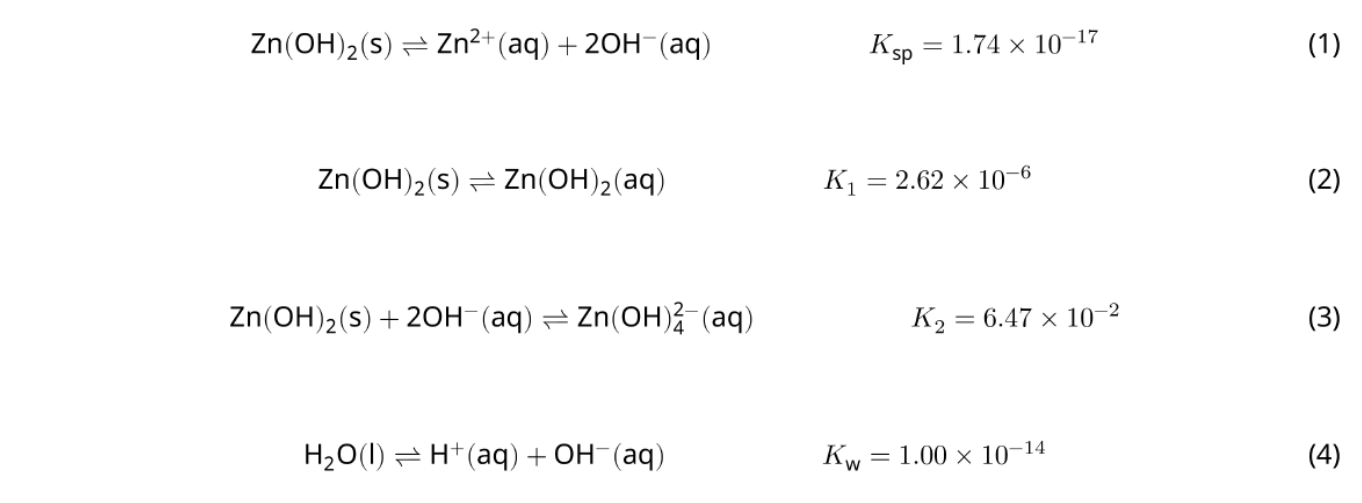
The solubility, \(S\), of zinc (concentration of zinc in a saturated aqueous solution) is given in eq. 5.
\[ S=[\ce{Zn^2+(aq)}]+[\ce{Zn(OH)2(aq)}]+[\ce{Zn(OH)4^2-(aq)}] \tag{5} \]
4.1 When the equilibria in eq. 1–4 are established, calculate the pH range in which \([\ce{Zn(OH)2(aq)}]\) is the greatest among \([\ce{Zn^2+(aq)}]\), \([\ce{Zn(OH)2(aq)}]\) and \([\ce{Zn(OH)4^2-(aq)}]\).
4.2 A saturated aqueous solution of \(\ce{Zn(OH)2(s)}\) with pH = 7.00 was prepared and filtered. NaOH was added to this filtrate to increase its pH to 12.00. Calculate the molar percentage of zinc that precipitates when increasing the pH from 7.00 to 12.00. Ignore the volume and temperature changes.
PART B
Next, the recovered zinc hydroxide is heated to obtain zinc oxide according to the reaction below:

The zinc oxide is then reduced to metallic zinc by reaction with hydrogen:

4.3 In order for reaction (7) to proceed at a hydrogen pressure kept at 1 bar, it is necessary to reduce the partial pressure of the generated water vapor. Calculate the upper limit for the partial pressure of water vapor to allow reaction (7) to proceed at 300 °C. Here, the Gibbs formation energies of zinc oxide and water vapor at 300 °C and 1 bar for all gaseous species are \(\Delta G_{\ce{ZnO}}(300\,^\circ\mathrm{C})=-2.90\times10^2\ \mathrm{kJ\,mol^{-1}}\) and \(\Delta G_{\ce{H2O}}(300\,^\circ\mathrm{C})=-2.20\times10^2\ \mathrm{kJ\,mol^{-1}}\), respectively.
Metallic zinc is used as a negative electrode (anode) material for metal-air batteries. The electrode consists of \(\ce{Zn}\) and \(\ce{ZnO}\). It uses the following redox reaction to generate electricity with the electromotive force (e.m.f.) at 25 °C and pressure of 1 bar, \(E^\circ\).

4.4 A zinc–air battery was discharged at 20 mA for 24 hours. Calculate the change in mass of the negative electrode (anode) of the battery.
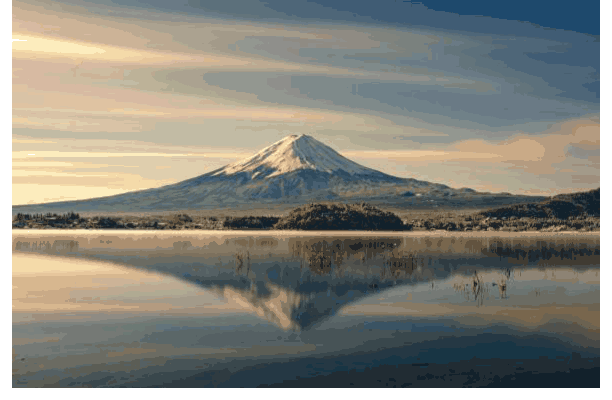
Mt. Fuji
4.5 Consider the change of e.m.f. of a zinc–air battery depending on the environment. Calculate the e.m.f. at the summit of Mt. Fuji, where the temperature and altitude are −38 °C (February) and 3776 m, respectively. The atmospheric pressure is represented by
\[ P\,[\mathrm{bar}] =1.013\times \left(1-\frac{0.0065h}{T+0.0065h+273.15}\right)^{5.257} \tag{9} \]
at altitude \(h\) [m] and temperature \(T\) [°C]. The molar ratio of oxygen in the atmosphere is 21%. The Gibbs energy change of reaction (8) is \(\Delta G_{\ce{ZnO}}(-38\,^\circ\mathrm{C})=-3.26\times10^2\ \mathrm{kJ\,mol^{-1}}\) at −38 °C and 1 bar.
4.6 Calculate the Gibbs energy change for reaction (6) at 25 °C. Note that the standard reduction potentials, \(E^\circ(\ce{Zn^2+/Zn})\) and \(E^\circ(\ce{O2/H2O})\) at 25 °C and 1 bar are given as (10) and (11), respectively.

Official English text of the problem.
Answers
- 4.1: \(\boxed{8.41\leq\mathrm{pH}\leq11.80}\). The dissolved neutral species is strictly most abundant between the boundaries; it ties with another species at each boundary.
- 4.2: \(\boxed{99.48\%}\) of the zinc precipitates.
- 4.3: The limiting water-vapor pressure is \(\boxed{4.2\times10^{-7}\ \mathrm{bar}}\). Forward reduction requires a pressure below this limit.
- 4.4: \(\boxed{\Delta m=+0.143\ \mathrm{g}}\): the anode gains mass.
- 4.5: \(\boxed{E=1.68\ \mathrm{V}}\).
- 4.6: \(\boxed{\Delta_{\mathrm r}G^\circ=+3.38\ \mathrm{kJ\,mol^{-1}}}\).
Solution
Use \(R=8.314\ \mathrm{J\,mol^{-1}\,K^{-1}}\), \(F=96485\ \mathrm{C\,mol^{-1}}\), and \(M(\ce{O})=16.00\ \mathrm{g\,mol^{-1}}\). Pure solids and liquid water have unit activity; gas activities are \(p/p^\circ\), with \(p^\circ=1\ \mathrm{bar}\).
Species names and SMILES used below are zinc(II) ion [Zn+2], hydroxide ion [OH-], hydrogen ion [H+], water O, hydrogen [H][H], oxygen O=O, and sodium hydroxide [Na+].[OH-]. Dissolved zinc hydroxide can be represented by the dative-bond SMILES [OH-]->[Zn+2]<-[OH-], and tetrahydroxozincate(II) by [OH-]->[Zn+2](<-[OH-])(<-[OH-])<-[OH-]. These representations omit solvent coordination and do not encode the tetrahedral coordination geometry of tetrahydroxozincate. The solid phases have extended structures rather than unique molecular SMILES.
4.1
Let \[ x=\frac{[\ce{OH-}]}{c^\circ}, \qquad c^\circ=1\ \mathrm{mol\,L^{-1}}. \]
The three dissolution equilibria give \[ \frac{[\ce{Zn^2+}]}{c^\circ}=\frac{K_{\mathrm{sp}}}{x^2}, \qquad \frac{[\ce{Zn(OH)2}]}{c^\circ}=K_1, \qquad \frac{[\ce{Zn(OH)4^2-}]}{c^\circ}=K_2x^2, \] where \[ K_{\mathrm{sp}}=1.74\times10^{-17},\quad K_1=2.62\times10^{-6},\quad K_2=6.47\times10^{-2}. \]
For the neutral dissolved species to have the greatest concentration, both conditions must hold: \[ K_1\geq\frac{K_{\mathrm{sp}}}{x^2}, \qquad K_1\geq K_2x^2. \]
Therefore, \[ \sqrt{\frac{K_{\mathrm{sp}}}{K_1}} \leq x\leq \sqrt{\frac{K_1}{K_2}}, \] or \[ 2.577\times10^{-6}\leq x\leq6.364\times10^{-3}. \]
Since \(K_{\mathrm w}=1.00\times10^{-14}\), \[ \mathrm{pH}=14.00+\log_{10}x. \]
Thus, \[ \boxed{8.41\leq\mathrm{pH}\leq11.80}. \]
At the lower boundary, \([\ce{Zn(OH)2}]=[\ce{Zn^2+}]\); at the upper boundary, \([\ce{Zn(OH)2}]=[\ce{Zn(OH)4^2-}]\). Strict dominance holds inside the interval.
4.2
The total dissolved zinc concentration at saturation is \[ S=c^\circ\left(\frac{K_{\mathrm{sp}}}{x^2}+K_1+K_2x^2\right). \]
At pH \(7.00\), \(x=10^{-7}\), so \[ \begin{aligned} S_7 &=\left( \frac{1.74\times10^{-17}}{10^{-14}} +2.62\times10^{-6} +(6.47\times10^{-2})(10^{-14}) \right)\mathrm{mol\,L^{-1}}\\ &=1.74262\times10^{-3}\ \mathrm{mol\,L^{-1}}. \end{aligned} \]
At pH \(12.00\), \(x=10^{-2}\), giving \[ \begin{aligned} S_{12} &=\left( \frac{1.74\times10^{-17}}{10^{-4}} +2.62\times10^{-6} +(6.47\times10^{-2})(10^{-4}) \right)\mathrm{mol\,L^{-1}}\\ &=9.09000\times10^{-6}\ \mathrm{mol\,L^{-1}}. \end{aligned} \]
Precipitation occurs principally through \[ \ce{Zn^2+(aq) + 2OH-(aq) -> Zn(OH)2(s)}. \]
Because the volume is unchanged, the fraction precipitated is the decrease in dissolved concentration divided by its initial value: \[ \begin{aligned} \%\text{ precipitated} &=100\left(1-\frac{S_{12}}{S_7}\right)\\ &=100\left(1-\frac{9.09000\times10^{-6}} {1.74262\times10^{-3}}\right)\\ &=\boxed{99.48\%}. \end{aligned} \]
This includes zinc remaining dissolved as tetrahydroxozincate at the final pH.
4.3
For \[ \ce{ZnO(s) + H2(g) -> Zn(s) + H2O(g)}, \] the standard Gibbs energy change at \(300\,^\circ\mathrm C\) is \[ \begin{aligned} \Delta_{\mathrm r}G^\circ &=\Delta_{\mathrm f}G^\circ(\ce{H2O(g)}) -\Delta_{\mathrm f}G^\circ(\ce{ZnO(s)})\\ &=(-220)-(-290)\\ &=+70.0\ \mathrm{kJ\,mol^{-1}}. \end{aligned} \]
The elemental substances have zero standard Gibbs energies of formation. The reaction quotient is \[ Q=\frac{p_{\ce{H2O}}/p^\circ}{p_{\ce{H2}}/p^\circ} =\frac{p_{\ce{H2O}}}{p_{\ce{H2}}}. \]
At the limiting pressure, \(\Delta_{\mathrm r}G=0\): \[ 0=\Delta_{\mathrm r}G^\circ+RT\ln Q. \]
Using \(T=573.15\ \mathrm K\) and \(p_{\ce{H2}}=1\ \mathrm{bar}\), \[ \begin{aligned} p_{\ce{H2O},\mathrm{lim}} &=(1\ \mathrm{bar}) \exp\left(-\frac{70000}{8.314(573.15)}\right)\\ &=4.17\times10^{-7}\ \mathrm{bar}. \end{aligned} \]
Hence forward reduction requires \[ \boxed{p_{\ce{H2O}}<4.2\times10^{-7}\ \mathrm{bar}}. \]
Equality corresponds to equilibrium.
4.4
The overall discharge reaction is \[ \ce{Zn(s) + 1/2 O2(g) -> ZnO(s)}. \]
Zinc changes oxidation state from \(0\) to \(+2\), so each mole of zinc converted transfers two moles of electrons.
The charge passed is \[ Q=It=(0.020\ \mathrm A)(24\times3600\ \mathrm s) =1728\ \mathrm C. \]
Thus, \[ n_{\ce{Zn},\mathrm{converted}} =\frac{Q}{2F} =\frac{1728}{2(96485)} =8.955\times10^{-3}\ \mathrm{mol}. \]
The electrode contains both zinc and zinc oxide. Zinc remains in the electrode, while one oxygen atom is incorporated per zinc atom oxidized. Therefore, \[ \begin{aligned} \Delta m &=n_{\ce{Zn},\mathrm{converted}} \left[M(\ce{ZnO})-M(\ce{Zn})\right]\\ &=n_{\ce{Zn},\mathrm{converted}}M(\ce{O})\\ &=(8.955\times10^{-3})(16.00)\\ &=\boxed{+0.143\ \mathrm g}. \end{aligned} \]
The anode gains mass.
4.5
First calculate the atmospheric pressure: \[ \begin{aligned} P &=1.013\left( 1-\frac{0.0065(3776)} {-38+0.0065(3776)+273.15} \right)^{5.257}\ \mathrm{bar}\\ &=0.6011\ \mathrm{bar}. \end{aligned} \]
The oxygen partial pressure is therefore \[ p_{\ce{O2}}=0.21P=0.1262\ \mathrm{bar}. \]
At \(-38\,^\circ\mathrm C\), \(T=235.15\ \mathrm K\). Obtain the standard e.m.f. at this temperature from the supplied Gibbs energy: \[ E^\circ(T) =-\frac{\Delta_{\mathrm r}G^\circ(T)}{2F} =\frac{326000}{2(96485)} =1.6894\ \mathrm V. \]
For \[ \ce{Zn(s) + 1/2 O2(g) -> ZnO(s)}, \] the reaction quotient is \[ Q=\left(\frac{p_{\ce{O2}}}{p^\circ}\right)^{-1/2}. \]
The Nernst equation consequently gives \[ \begin{aligned} E &=E^\circ(T)-\frac{RT}{2F}\ln Q\\ &=E^\circ(T)+\frac{RT}{4F} \ln\left(\frac{p_{\ce{O2}}}{p^\circ}\right)\\ &=1.6894+ \frac{8.314(235.15)}{4(96485)}\ln(0.1262)\\ &=1.6789\ \mathrm V. \end{aligned} \]
Thus, \[ \boxed{E=1.68\ \mathrm V}. \]
4.6
The target reaction is \[ \ce{Zn(OH)2(s) -> ZnO(s) + H2O(l)}. \]
Construct a Hess cycle at \(25\,^\circ\mathrm C\).
First, combine zinc oxidation with oxygen reduction: \[ \ce{Zn(s) -> Zn^2+(aq) + 2e-}, \] \[ \ce{1/2 O2(g) + 2H+(aq) + 2e- -> H2O(l)}. \]
Their sum is \[ \ce{Zn(s) + 1/2 O2(g) + 2H+(aq) -> Zn^2+(aq) + H2O(l)}. \qquad\text{(A)} \]
The cell potential and corresponding Gibbs energy are \[ E_A^\circ=1.23-(-0.77)=2.00\ \mathrm V, \] \[ \Delta G_A^\circ=-2FE_A^\circ =-385.94\ \mathrm{kJ\,mol^{-1}}. \]
Next, combine dissolution, \[ \ce{Zn(OH)2(s) <=> Zn^2+(aq) + 2OH-(aq)}, \] with neutralization, \[ \ce{2H+(aq) + 2OH-(aq) -> 2H2O(l)}. \]
The resulting reaction is \[ \ce{Zn(OH)2(s) + 2H+(aq) -> Zn^2+(aq) + 2H2O(l)}. \qquad\text{(B)} \]
Its equilibrium constant is \[ K_B=\frac{K_{\mathrm{sp}}}{K_{\mathrm w}^2} =\frac{1.74\times10^{-17}}{(1.00\times10^{-14})^2} =1.74\times10^{11}. \]
Therefore, \[ \begin{aligned} \Delta G_B^\circ &=-RT\ln K_B\\ &=-8.314(298.15)\ln(1.74\times10^{11})\\ &=-64.16\ \mathrm{kJ\,mol^{-1}}. \end{aligned} \]
Finally, reaction (8) is \[ \ce{Zn(s) + 1/2 O2(g) -> ZnO(s)}, \] with \[ \Delta G_8^\circ=-2F(1.65) =-318.40\ \mathrm{kJ\,mol^{-1}}. \]
Adding reaction (B), the reverse of reaction (A), and reaction (8) cancels the ions, oxygen, and metallic zinc, leaving exactly \[ \ce{Zn(OH)2(s) -> ZnO(s) + H2O(l)}. \]
Hence, \[ \begin{aligned} \Delta G_6^\circ &=\Delta G_B^\circ-\Delta G_A^\circ+\Delta G_8^\circ\\ &=-64.16-(-385.94)-318.40\\ &=\boxed{+3.38\ \mathrm{kJ\,mol^{-1}}}. \end{aligned} \]
The solution was checked against the official solution.
IChO 2021 · Theorieaufgabe 4
Die Redoxchemie des Zinks
Zink wird seit Langem in Legierungen für Messing- und Stahlwerkstoffe eingesetzt. Das in industriellem Abwasser enthaltene Zink wird durch Fällung abgetrennt, um das Wasser zu entgiften, und der erhaltene Niederschlag wird reduziert, um das Zink als metallisches Zink zurückzugewinnen und wiederzuverwenden.
TEIL A
Das Lösungsgleichgewicht von Zinkhydroxid \(\ce{Zn(OH)2(s)}\) bei 25 °C und die zugehörigen Gleichgewichtskonstanten sind in Gl. 1–4 angegeben.
Die Löslichkeit \(S\) von Zink (die Zinkkonzentration in einer gesättigten wässrigen Lösung) ist in Gl. 5 angegeben.
\[ S=[\ce{Zn^2+(aq)}]+[\ce{Zn(OH)2(aq)}]+[\ce{Zn(OH)4^2-(aq)}] \tag{5} \]
4.1 Berechnen Sie für den Fall, dass sich die Gleichgewichte in Gl. 1–4 eingestellt haben, den pH-Bereich, in dem \([\ce{Zn(OH)2(aq)}]\) unter den Konzentrationen \([\ce{Zn^2+(aq)}]\), \([\ce{Zn(OH)2(aq)}]\) und \([\ce{Zn(OH)4^2-(aq)}]\) am größten ist.
4.2 Eine gesättigte wässrige Lösung von \(\ce{Zn(OH)2(s)}\) mit pH = 7.00 wurde hergestellt und filtriert. Diesem Filtrat wurde NaOH zugesetzt, um seinen pH-Wert auf 12.00 zu erhöhen. Berechnen Sie den auf die Stoffmenge bezogenen prozentualen Anteil des Zinks, der bei der Erhöhung des pH-Werts von 7.00 auf 12.00 ausfällt. Vernachlässigen Sie die Volumen- und Temperaturänderungen.
TEIL B
Anschließend wird das zurückgewonnene Zinkhydroxid erhitzt, um gemäß der folgenden Reaktion Zinkoxid zu erhalten:
Das Zinkoxid wird dann durch Reaktion mit Wasserstoff zu metallischem Zink reduziert:
4.3 Damit Reaktion (7) bei einem konstant gehaltenen Wasserstoffdruck von 1 bar ablaufen kann, muss der Partialdruck des entstehenden Wasserdampfs gesenkt werden. Berechnen Sie die Obergrenze des Wasserdampfpartialdrucks, bei der Reaktion (7) bei 300 °C ablaufen kann. Dabei betragen die Gibbs-Bildungsenergien von Zinkoxid bzw. Wasserdampf bei 300 °C und einem Druck von 1 bar für alle gasförmigen Spezies \(\Delta G_{\ce{ZnO}}(300\,^\circ\mathrm{C})=-2.90\times10^2\ \mathrm{kJ\,mol^{-1}}\) bzw. \(\Delta G_{\ce{H2O}}(300\,^\circ\mathrm{C})=-2.20\times10^2\ \mathrm{kJ\,mol^{-1}}\).
Metallisches Zink wird als Material für die negative Elektrode (Anode) von Metall-Luft-Batterien verwendet. Die Elektrode besteht aus \(\ce{Zn}\) und \(\ce{ZnO}\). Sie nutzt die folgende Redoxreaktion zur Erzeugung elektrischer Energie mit der elektromotorischen Kraft (EMK) \(E^\circ\) bei 25 °C und einem Druck von 1 bar.
4.4 Eine Zink-Luft-Batterie wurde 24 Stunden lang mit 20 mA entladen. Berechnen Sie die Massenänderung der negativen Elektrode (Anode) der Batterie.
Berg Fuji
4.5 Betrachten Sie die Änderung der EMK einer Zink-Luft-Batterie in Abhängigkeit von den Umgebungsbedingungen. Berechnen Sie die EMK auf dem Gipfel des Berges Fuji, wo die Temperatur −38 °C (im Februar) und die Höhe 3776 m beträgt. Der Luftdruck wird durch
\[ P\,[\mathrm{bar}] =1.013\times \left(1-\frac{0.0065h}{T+0.0065h+273.15}\right)^{5.257} \tag{9} \]
bei einer Höhe \(h\) [m] und einer Temperatur \(T\) [°C] beschrieben. Der Stoffmengenanteil von Sauerstoff in der Atmosphäre beträgt 21%. Die Änderung der Gibbs-Energie bei Reaktion (8) beträgt \(\Delta G_{\ce{ZnO}}(-38\,^\circ\mathrm{C})=-3.26\times10^2\ \mathrm{kJ\,mol^{-1}}\) bei −38 °C und 1 bar.
4.6 Berechnen Sie die Änderung der Gibbs-Energie für Reaktion (6) bei 25 °C. Beachten Sie, dass die Standardreduktionspotentiale \(E^\circ(\ce{Zn^2+/Zn})\) und \(E^\circ(\ce{O2/H2O})\) bei 25 °C und 1 bar in (10) bzw. (11) angegeben sind.
Aufgabentext aus dem offiziellen englischen Text übersetzt.
Antworten
- 4.1: \(\boxed{8.41\leq\mathrm{pH}\leq11.80}\). Die gelöste neutrale Spezies weist zwischen den Grenzen eine strikt höhere Konzentration als die anderen Spezies auf; an jeder Grenze ist ihre Konzentration gleich der einer anderen Spezies.
- 4.2: \(\boxed{99.48\%}\) des Zinks fallen aus.
- 4.3: Der Grenzwert des Wasserdampfdrucks beträgt \(\boxed{4.2\times10^{-7}\ \mathrm{bar}}\). Damit die Reduktion in Vorwärtsrichtung abläuft, muss der Druck unter diesem Grenzwert liegen.
- 4.4: \(\boxed{\Delta m=+0.143\ \mathrm{g}}\): Die Masse der Anode nimmt zu.
- 4.5: \(\boxed{E=1.68\ \mathrm{V}}\).
- 4.6: \(\boxed{\Delta_{\mathrm r}G^\circ=+3.38\ \mathrm{kJ\,mol^{-1}}}\).
Lösung
Verwenden Sie \(R=8.314\ \mathrm{J\,mol^{-1}\,K^{-1}}\), \(F=96485\ \mathrm{C\,mol^{-1}}\) und \(M(\ce{O})=16.00\ \mathrm{g\,mol^{-1}}\). Reine Feststoffe und flüssiges Wasser haben die Aktivität eins; die Aktivitäten der Gase betragen \(p/p^\circ\), wobei \(p^\circ=1\ \mathrm{bar}\).
Die im Folgenden verwendeten Speziesnamen und SMILES sind Zink(II)-Ion [Zn+2], Hydroxid-Ion [OH-], Wasserstoff-Ion [H+], Wasser O, Wasserstoff [H][H], Sauerstoff O=O und Natriumhydroxid [Na+].[OH-]. Gelöstes Zinkhydroxid kann durch den SMILES-Ausdruck mit koordinativen Bindungen [OH-]->[Zn+2]<-[OH-] und Tetrahydroxozinkat(II) durch [OH-]->[Zn+2](<-[OH-])(<-[OH-])<-[OH-] dargestellt werden. Diese Darstellungen lassen die Koordination von Lösungsmittelmolekülen außer Betracht und bilden die tetraedrische Koordinationsgeometrie des Tetrahydroxozinkats nicht ab. Die festen Phasen besitzen ausgedehnte Strukturen und lassen sich daher nicht durch eindeutige molekulare SMILES darstellen.
4.1
Es sei \[ x=\frac{[\ce{OH-}]}{c^\circ}, \qquad c^\circ=1\ \mathrm{mol\,L^{-1}}. \]
Aus den drei Lösungsgleichgewichten folgt \[ \frac{[\ce{Zn^2+}]}{c^\circ}=\frac{K_{\mathrm{sp}}}{x^2}, \qquad \frac{[\ce{Zn(OH)2}]}{c^\circ}=K_1, \qquad \frac{[\ce{Zn(OH)4^2-}]}{c^\circ}=K_2x^2, \] wobei \[ K_{\mathrm{sp}}=1.74\times10^{-17},\quad K_1=2.62\times10^{-6},\quad K_2=6.47\times10^{-2}. \]
Damit die neutrale gelöste Spezies die größte Konzentration aufweist, müssen beide Bedingungen erfüllt sein: \[ K_1\geq\frac{K_{\mathrm{sp}}}{x^2}, \qquad K_1\geq K_2x^2. \]
Daher gilt \[ \sqrt{\frac{K_{\mathrm{sp}}}{K_1}} \leq x\leq \sqrt{\frac{K_1}{K_2}}, \] oder \[ 2.577\times10^{-6}\leq x\leq6.364\times10^{-3}. \]
Da \(K_{\mathrm w}=1.00\times10^{-14}\), gilt \[ \mathrm{pH}=14.00+\log_{10}x. \]
Somit ergibt sich \[ \boxed{8.41\leq\mathrm{pH}\leq11.80}. \]
An der unteren Grenze gilt \([\ce{Zn(OH)2}]=[\ce{Zn^2+}]\); an der oberen Grenze gilt \([\ce{Zn(OH)2}]=[\ce{Zn(OH)4^2-}]\). Im Inneren des Intervalls ist die Konzentration der neutralen Spezies strikt größer als die der anderen Spezies.
4.2
Die Gesamtkonzentration des gelösten Zinks bei Sättigung beträgt \[ S=c^\circ\left(\frac{K_{\mathrm{sp}}}{x^2}+K_1+K_2x^2\right). \]
Bei pH \(7.00\) gilt \(x=10^{-7}\), also \[ \begin{aligned} S_7 &=\left( \frac{1.74\times10^{-17}}{10^{-14}} +2.62\times10^{-6} +(6.47\times10^{-2})(10^{-14}) \right)\mathrm{mol\,L^{-1}}\\ &=1.74262\times10^{-3}\ \mathrm{mol\,L^{-1}}. \end{aligned} \]
Bei pH \(12.00\) gilt \(x=10^{-2}\), woraus sich ergibt: \[ \begin{aligned} S_{12} &=\left( \frac{1.74\times10^{-17}}{10^{-4}} +2.62\times10^{-6} +(6.47\times10^{-2})(10^{-4}) \right)\mathrm{mol\,L^{-1}}\\ &=9.09000\times10^{-6}\ \mathrm{mol\,L^{-1}}. \end{aligned} \]
Die Fällung erfolgt hauptsächlich durch \[ \ce{Zn^2+(aq) + 2OH-(aq) -> Zn(OH)2(s)}. \]
Da das Volumen unverändert bleibt, ergibt sich der ausgefällte Anteil aus der Abnahme der gelösten Konzentration geteilt durch deren Anfangswert: \[ \begin{aligned} \%\text{ ausgefällt} &=100\left(1-\frac{S_{12}}{S_7}\right)\\ &=100\left(1-\frac{9.09000\times10^{-6}} {1.74262\times10^{-3}}\right)\\ &=\boxed{99.48\%}. \end{aligned} \]
Dabei wird das Zink berücksichtigt, das beim endgültigen pH-Wert als Tetrahydroxozinkat gelöst bleibt.
4.3
Für \[ \ce{ZnO(s) + H2(g) -> Zn(s) + H2O(g)}, \] beträgt die Änderung der Standard-Gibbs-Energie bei \(300\,^\circ\mathrm C\) \[ \begin{aligned} \Delta_{\mathrm r}G^\circ &=\Delta_{\mathrm f}G^\circ(\ce{H2O(g)}) -\Delta_{\mathrm f}G^\circ(\ce{ZnO(s)})\\ &=(-220)-(-290)\\ &=+70.0\ \mathrm{kJ\,mol^{-1}}. \end{aligned} \]
Die Standard-Gibbs-Bildungsenergien der elementaren Stoffe sind null. Der Reaktionsquotient lautet \[ Q=\frac{p_{\ce{H2O}}/p^\circ}{p_{\ce{H2}}/p^\circ} =\frac{p_{\ce{H2O}}}{p_{\ce{H2}}}. \]
Beim Grenzdruck gilt \(\Delta_{\mathrm r}G=0\): \[ 0=\Delta_{\mathrm r}G^\circ+RT\ln Q. \]
Mit \(T=573.15\ \mathrm K\) und \(p_{\ce{H2}}=1\ \mathrm{bar}\) erhält man \[ \begin{aligned} p_{\ce{H2O},\mathrm{lim}} &=(1\ \mathrm{bar}) \exp\left(-\frac{70000}{8.314(573.15)}\right)\\ &=4.17\times10^{-7}\ \mathrm{bar}. \end{aligned} \]
Damit die Reduktion in Vorwärtsrichtung abläuft, muss daher gelten: \[ \boxed{p_{\ce{H2O}}<4.2\times10^{-7}\ \mathrm{bar}}. \]
Gleichheit entspricht dem Gleichgewicht.
4.4
Die Gesamtreaktion bei der Entladung lautet \[ \ce{Zn(s) + 1/2 O2(g) -> ZnO(s)}. \]
Die Oxidationszahl des Zinks ändert sich von \(0\) auf \(+2\), sodass pro Mol umgesetztem Zink zwei Mol Elektronen übertragen werden.
Die geflossene Ladung beträgt \[ Q=It=(0.020\ \mathrm A)(24\times3600\ \mathrm s) =1728\ \mathrm C. \]
Somit gilt \[ n_{\ce{Zn},\mathrm{converted}} =\frac{Q}{2F} =\frac{1728}{2(96485)} =8.955\times10^{-3}\ \mathrm{mol}. \]
Die Elektrode enthält sowohl Zink als auch Zinkoxid. Das Zink verbleibt in der Elektrode, während pro oxidiertem Zinkatom ein Sauerstoffatom eingebaut wird. Daher gilt \[ \begin{aligned} \Delta m &=n_{\ce{Zn},\mathrm{converted}} \left[M(\ce{ZnO})-M(\ce{Zn})\right]\\ &=n_{\ce{Zn},\mathrm{converted}}M(\ce{O})\\ &=(8.955\times10^{-3})(16.00)\\ &=\boxed{+0.143\ \mathrm g}. \end{aligned} \]
Die Masse der Anode nimmt zu.
4.5
Zunächst wird der Luftdruck berechnet: \[ \begin{aligned} P &=1.013\left( 1-\frac{0.0065(3776)} {-38+0.0065(3776)+273.15} \right)^{5.257}\ \mathrm{bar}\\ &=0.6011\ \mathrm{bar}. \end{aligned} \]
Der Sauerstoffpartialdruck beträgt daher \[ p_{\ce{O2}}=0.21P=0.1262\ \mathrm{bar}. \]
Bei \(-38\,^\circ\mathrm C\) gilt \(T=235.15\ \mathrm K\). Die Standard-EMK bei dieser Temperatur ergibt sich aus der angegebenen Gibbs-Energie: \[ E^\circ(T) =-\frac{\Delta_{\mathrm r}G^\circ(T)}{2F} =\frac{326000}{2(96485)} =1.6894\ \mathrm V. \]
Für \[ \ce{Zn(s) + 1/2 O2(g) -> ZnO(s)}, \] lautet der Reaktionsquotient \[ Q=\left(\frac{p_{\ce{O2}}}{p^\circ}\right)^{-1/2}. \]
Die Nernst-Gleichung liefert folglich \[ \begin{aligned} E &=E^\circ(T)-\frac{RT}{2F}\ln Q\\ &=E^\circ(T)+\frac{RT}{4F} \ln\left(\frac{p_{\ce{O2}}}{p^\circ}\right)\\ &=1.6894+ \frac{8.314(235.15)}{4(96485)}\ln(0.1262)\\ &=1.6789\ \mathrm V. \end{aligned} \]
Somit ergibt sich \[ \boxed{E=1.68\ \mathrm V}. \]
4.6
Die gesuchte Reaktion lautet \[ \ce{Zn(OH)2(s) -> ZnO(s) + H2O(l)}. \]
Es wird ein Kreisprozess nach dem Satz von Hess bei \(25\,^\circ\mathrm C\) aufgestellt.
Zunächst werden die Oxidation von Zink und die Reduktion von Sauerstoff kombiniert: \[ \ce{Zn(s) -> Zn^2+(aq) + 2e-}, \] \[ \ce{1/2 O2(g) + 2H+(aq) + 2e- -> H2O(l)}. \]
Ihre Summe lautet \[ \ce{Zn(s) + 1/2 O2(g) + 2H+(aq) -> Zn^2+(aq) + H2O(l)}. \qquad\text{(A)} \]
Das Zellpotential und die zugehörige Gibbs-Energie betragen \[ E_A^\circ=1.23-(-0.77)=2.00\ \mathrm V, \] \[ \Delta G_A^\circ=-2FE_A^\circ =-385.94\ \mathrm{kJ\,mol^{-1}}. \]
Anschließend wird der Lösungsvorgang \[ \ce{Zn(OH)2(s) <=> Zn^2+(aq) + 2OH-(aq)}, \] mit der Neutralisation kombiniert: \[ \ce{2H+(aq) + 2OH-(aq) -> 2H2O(l)}. \]
Die resultierende Reaktion lautet \[ \ce{Zn(OH)2(s) + 2H+(aq) -> Zn^2+(aq) + 2H2O(l)}. \qquad\text{(B)} \]
Ihre Gleichgewichtskonstante beträgt \[ K_B=\frac{K_{\mathrm{sp}}}{K_{\mathrm w}^2} =\frac{1.74\times10^{-17}}{(1.00\times10^{-14})^2} =1.74\times10^{11}. \]
Daher gilt \[ \begin{aligned} \Delta G_B^\circ &=-RT\ln K_B\\ &=-8.314(298.15)\ln(1.74\times10^{11})\\ &=-64.16\ \mathrm{kJ\,mol^{-1}}. \end{aligned} \]
Schließlich lautet Reaktion (8) \[ \ce{Zn(s) + 1/2 O2(g) -> ZnO(s)}, \] mit \[ \Delta G_8^\circ=-2F(1.65) =-318.40\ \mathrm{kJ\,mol^{-1}}. \]
Bei der Addition von Reaktion (B), der Umkehrung von Reaktion (A) und Reaktion (8) kürzen sich die Ionen, der Sauerstoff und das metallische Zink heraus, sodass genau folgende Reaktion übrig bleibt: \[ \ce{Zn(OH)2(s) -> ZnO(s) + H2O(l)}. \]
Somit gilt \[ \begin{aligned} \Delta G_6^\circ &=\Delta G_B^\circ-\Delta G_A^\circ+\Delta G_8^\circ\\ &=-64.16-(-385.94)-318.40\\ &=\boxed{+3.38\ \mathrm{kJ\,mol^{-1}}}. \end{aligned} \]
Die Lösung wurde mit der offiziellen Lösung abgeglichen.
IChO 2021 · Teori sorusu 4
Çinkonun Redoks Kimyası
Çinko, pirinç ve çelik malzemelerde uzun zamandır alaşım bileşeni olarak kullanılmaktadır. Endüstriyel atık sularda bulunan çinko, suyu zehirli maddelerden arındırmak için çöktürme yoluyla ayrılır; elde edilen çökelek ise metalik çinko olarak geri kazanılıp yeniden kullanılmak üzere indirgenir.
BÖLÜM A
Çinko hidroksitin \(\ce{Zn(OH)2(s)}\) 25 °C'deki çözünme dengesi ve ilgili denge sabitleri, 1–4 numaralı denklemlerde verilmiştir.
Çinkonun çözünürlüğü \(S\) (doymuş sulu çözeltideki çinko derişimi), 5 numaralı denklemde verilmiştir.
\[ S=[\ce{Zn^2+(aq)}]+[\ce{Zn(OH)2(aq)}]+[\ce{Zn(OH)4^2-(aq)}] \tag{5} \]
4.1 1–4 numaralı denklemlerdeki dengeler kurulduğunda, \([\ce{Zn(OH)2(aq)}]\) derişiminin \([\ce{Zn^2+(aq)}]\), \([\ce{Zn(OH)2(aq)}]\) ve \([\ce{Zn(OH)4^2-(aq)}]\) derişimleri arasında en büyük olduğu pH aralığını hesaplayınız.
4.2 pH = 7.00 olan doymuş bir \(\ce{Zn(OH)2(s)}\) sulu çözeltisi hazırlanmış ve süzülmüştür. Bu süzüntüye, pH değerini 12.00'ye yükseltmek için NaOH eklenmiştir. pH 7.00'den 12.00'ye yükseltilirken çinkonun molce yüzde kaçının çöktüğünü hesaplayınız. Hacim ve sıcaklık değişimlerini ihmal ediniz.
BÖLÜM B
Ardından, geri kazanılan çinko hidroksit, aşağıdaki tepkimeye göre çinko oksit elde etmek üzere ısıtılır:
Çinko oksit daha sonra hidrojenle tepkimeye sokularak metalik çinkoya indirgenir:
4.3 Hidrojen basıncı 1 bar'da sabit tutulurken (7) numaralı tepkimenin ilerleyebilmesi için oluşan su buharının kısmi basıncını düşürmek gerekir. (7) numaralı tepkimenin 300 °C'de ilerlemesine olanak sağlayan su buharı kısmi basıncının üst sınırını hesaplayınız. Burada, 300 °C'de ve tüm gaz türleri için 1 bar basınçta çinko oksit ve su buharının Gibbs oluşum enerjileri sırasıyla \(\Delta G_{\ce{ZnO}}(300\,^\circ\mathrm{C})=-2.90\times10^2\ \mathrm{kJ\,mol^{-1}}\) ve \(\Delta G_{\ce{H2O}}(300\,^\circ\mathrm{C})=-2.20\times10^2\ \mathrm{kJ\,mol^{-1}}\) olarak verilmiştir.
Metalik çinko, metal–hava pillerinde negatif elektrot (anot) malzemesi olarak kullanılır. Elektrot, \(\ce{Zn}\) ve \(\ce{ZnO}\)'dan oluşur. Elektrik üretmek için aşağıdaki redoks tepkimesini kullanır; 25 °C'de ve 1 bar basınçta elektromotor kuvveti (e.m.k.) \(E^\circ\)'dır.
4.4 Bir çinko–hava pili, 24 saat boyunca 20 mA akımla deşarj edilmiştir. Pilin negatif elektrodunun (anot) kütlesindeki değişimi hesaplayınız.
Fuji Dağı
4.5 Bir çinko–hava pilinin e.m.k.'sının çevre koşullarına bağlı değişimini ele alınız. Sıcaklığın ve rakımın sırasıyla −38 °C (şubat) ve 3776 m olduğu Fuji Dağı'nın zirvesindeki e.m.k.'yı hesaplayınız. Atmosfer basıncı,
\[ P\,[\mathrm{bar}] =1.013\times \left(1-\frac{0.0065h}{T+0.0065h+273.15}\right)^{5.257} \tag{9} \]
bağıntısıyla, \(h\) [m] rakımında ve \(T\) [°C] sıcaklığında ifade edilir. Atmosferdeki oksijenin mol oranı %21'dir. (8) numaralı tepkimenin −38 °C ve 1 bar'daki Gibbs enerjisi değişimi \(\Delta G_{\ce{ZnO}}(-38\,^\circ\mathrm{C})=-3.26\times10^2\ \mathrm{kJ\,mol^{-1}}\)'dir.
4.6 (6) numaralı tepkimenin 25 °C'deki Gibbs enerjisi değişimini hesaplayınız. 25 °C ve 1 bar'daki standart indirgenme potansiyelleri \(E^\circ(\ce{Zn^2+/Zn})\) ve \(E^\circ(\ce{O2/H2O})\)'nun sırasıyla (10) ve (11)'de verildiğine dikkat ediniz.
Soru metni resmi İngilizce metinden çevrilmiştir.
Cevaplar
- 4.1: \(\boxed{8.41\leq\mathrm{pH}\leq11.80}\). Çözünmüş nötr türün derişimi, sınırların arasında diğer türlerin her birininkinden kesin olarak daha büyüktür; her bir sınırda başka bir türün derişimine eşittir.
- 4.2: Çinkonun \(\boxed{99.48\%}\)'i çöker.
- 4.3: Su buharı basıncının sınır değeri \(\boxed{4.2\times10^{-7}\ \mathrm{bar}}\)'dır. İleri yöndeki indirgenme için basıncın bu sınırın altında olması gerekir.
- 4.4: \(\boxed{\Delta m=+0.143\ \mathrm{g}}\): anodun kütlesi artar.
- 4.5: \(\boxed{E=1.68\ \mathrm{V}}\).
- 4.6: \(\boxed{\Delta_{\mathrm r}G^\circ=+3.38\ \mathrm{kJ\,mol^{-1}}}\).
Çözüm
\(R=8.314\ \mathrm{J\,mol^{-1}\,K^{-1}}\), \(F=96485\ \mathrm{C\,mol^{-1}}\) ve \(M(\ce{O})=16.00\ \mathrm{g\,mol^{-1}}\) değerlerini kullanınız. Saf katıların ve sıvı suyun aktiviteleri birdir; gaz aktiviteleri, \(p^\circ=1\ \mathrm{bar}\) olmak üzere \(p/p^\circ\)'dır.
Aşağıda kullanılan tür adları ve SMILES gösterimleri şunlardır: çinko(II) iyonu [Zn+2], hidroksit iyonu [OH-], hidrojen iyonu [H+], su O, hidrojen [H][H], oksijen O=O ve sodyum hidroksit [Na+].[OH-]. Çözünmüş çinko hidroksit, koordinatif bağ içeren [OH-]->[Zn+2]<-[OH-] SMILES gösterimiyle; tetrahidroksoçinkat(II) ise [OH-]->[Zn+2](<-[OH-])(<-[OH-])<-[OH-] ile gösterilebilir. Bu gösterimler çözücü koordinasyonunu içermez ve tetrahidroksoçinkatın tetrahedral koordinasyon geometrisini kodlamaz. Katı fazlar, tekil moleküler SMILES gösterimleri yerine uzanımlı yapılara sahiptir.
4.1
Şöyle tanımlayalım: \[ x=\frac{[\ce{OH-}]}{c^\circ}, \qquad c^\circ=1\ \mathrm{mol\,L^{-1}}. \]
Üç çözünme dengesi şu bağıntıları verir: \[ \frac{[\ce{Zn^2+}]}{c^\circ}=\frac{K_{\mathrm{sp}}}{x^2}, \qquad \frac{[\ce{Zn(OH)2}]}{c^\circ}=K_1, \qquad \frac{[\ce{Zn(OH)4^2-}]}{c^\circ}=K_2x^2, \] burada \[ K_{\mathrm{sp}}=1.74\times10^{-17},\quad K_1=2.62\times10^{-6},\quad K_2=6.47\times10^{-2}. \]
Çözünmüş nötr türün en yüksek derişime sahip olması için her iki koşul da sağlanmalıdır: \[ K_1\geq\frac{K_{\mathrm{sp}}}{x^2}, \qquad K_1\geq K_2x^2. \]
Dolayısıyla, \[ \sqrt{\frac{K_{\mathrm{sp}}}{K_1}} \leq x\leq \sqrt{\frac{K_1}{K_2}}, \] veya \[ 2.577\times10^{-6}\leq x\leq6.364\times10^{-3}. \]
\(K_{\mathrm w}=1.00\times10^{-14}\) olduğundan, \[ \mathrm{pH}=14.00+\log_{10}x. \]
Böylece, \[ \boxed{8.41\leq\mathrm{pH}\leq11.80}. \]
Alt sınırda \([\ce{Zn(OH)2}]=[\ce{Zn^2+}]\); üst sınırda ise \([\ce{Zn(OH)2}]=[\ce{Zn(OH)4^2-}]\) olur. Aralığın iç kısmında nötr türün derişimi diğer türlerin her birininkinden kesin olarak daha büyüktür.
4.2
Doygunluktaki toplam çözünmüş çinko derişimi şöyledir: \[ S=c^\circ\left(\frac{K_{\mathrm{sp}}}{x^2}+K_1+K_2x^2\right). \]
pH \(7.00\) iken \(x=10^{-7}\) olduğundan, \[ \begin{aligned} S_7 &=\left( \frac{1.74\times10^{-17}}{10^{-14}} +2.62\times10^{-6} +(6.47\times10^{-2})(10^{-14}) \right)\mathrm{mol\,L^{-1}}\\ &=1.74262\times10^{-3}\ \mathrm{mol\,L^{-1}}. \end{aligned} \]
pH \(12.00\) iken \(x=10^{-2}\) olup şu sonuç elde edilir: \[ \begin{aligned} S_{12} &=\left( \frac{1.74\times10^{-17}}{10^{-4}} +2.62\times10^{-6} +(6.47\times10^{-2})(10^{-4}) \right)\mathrm{mol\,L^{-1}}\\ &=9.09000\times10^{-6}\ \mathrm{mol\,L^{-1}}. \end{aligned} \]
Çökelme esas olarak şu tepkimeyle gerçekleşir: \[ \ce{Zn^2+(aq) + 2OH-(aq) -> Zn(OH)2(s)}. \]
Hacim değişmediği için çöken kesir, çözünmüş derişimdeki azalmanın başlangıç değerine bölünmesiyle bulunur: \[ \begin{aligned} \%\text{ çöken} &=100\left(1-\frac{S_{12}}{S_7}\right)\\ &=100\left(1-\frac{9.09000\times10^{-6}} {1.74262\times10^{-3}}\right)\\ &=\boxed{99.48\%}. \end{aligned} \]
Bu hesaplama, son pH değerinde tetrahidroksoçinkat olarak çözünmüş hâlde kalan çinkoyu da hesaba katar.
4.3
\[ \ce{ZnO(s) + H2(g) -> Zn(s) + H2O(g)}, \] tepkimesi için \(300\,^\circ\mathrm C\)'deki standart Gibbs enerjisi değişimi şöyledir: \[ \begin{aligned} \Delta_{\mathrm r}G^\circ &=\Delta_{\mathrm f}G^\circ(\ce{H2O(g)}) -\Delta_{\mathrm f}G^\circ(\ce{ZnO(s)})\\ &=(-220)-(-290)\\ &=+70.0\ \mathrm{kJ\,mol^{-1}}. \end{aligned} \]
Elementel maddelerin standart Gibbs oluşum enerjileri sıfırdır. Tepkime bölümü şöyledir: \[ Q=\frac{p_{\ce{H2O}}/p^\circ}{p_{\ce{H2}}/p^\circ} =\frac{p_{\ce{H2O}}}{p_{\ce{H2}}}. \]
Sınır basıncında \(\Delta_{\mathrm r}G=0\) olur: \[ 0=\Delta_{\mathrm r}G^\circ+RT\ln Q. \]
\(T=573.15\ \mathrm K\) ve \(p_{\ce{H2}}=1\ \mathrm{bar}\) kullanılarak, \[ \begin{aligned} p_{\ce{H2O},\mathrm{lim}} &=(1\ \mathrm{bar}) \exp\left(-\frac{70000}{8.314(573.15)}\right)\\ &=4.17\times10^{-7}\ \mathrm{bar}. \end{aligned} \]
Dolayısıyla ileri yöndeki indirgenme için şu koşul gerekir: \[ \boxed{p_{\ce{H2O}}<4.2\times10^{-7}\ \mathrm{bar}}. \]
Eşitlik, dengeye karşılık gelir.
4.4
Toplam deşarj tepkimesi şöyledir: \[ \ce{Zn(s) + 1/2 O2(g) -> ZnO(s)}. \]
Çinkonun yükseltgenme basamağı \(0\)'dan \(+2\)'ye değiştiğinden, dönüşen her bir mol çinko için iki mol elektron aktarılır.
Geçen yük şöyledir: \[ Q=It=(0.020\ \mathrm A)(24\times3600\ \mathrm s) =1728\ \mathrm C. \]
Böylece, \[ n_{\ce{Zn},\mathrm{converted}} =\frac{Q}{2F} =\frac{1728}{2(96485)} =8.955\times10^{-3}\ \mathrm{mol}. \]
Elektrot hem çinko hem de çinko oksit içerir. Çinko elektrot içinde kalırken, yükseltgenen her çinko atomu başına bir oksijen atomu elektrota katılır. Dolayısıyla, \[ \begin{aligned} \Delta m &=n_{\ce{Zn},\mathrm{converted}} \left[M(\ce{ZnO})-M(\ce{Zn})\right]\\ &=n_{\ce{Zn},\mathrm{converted}}M(\ce{O})\\ &=(8.955\times10^{-3})(16.00)\\ &=\boxed{+0.143\ \mathrm g}. \end{aligned} \]
Anodun kütlesi artar.
4.5
Önce atmosfer basıncını hesaplayalım: \[ \begin{aligned} P &=1.013\left( 1-\frac{0.0065(3776)} {-38+0.0065(3776)+273.15} \right)^{5.257}\ \mathrm{bar}\\ &=0.6011\ \mathrm{bar}. \end{aligned} \]
Dolayısıyla oksijenin kısmi basıncı şöyledir: \[ p_{\ce{O2}}=0.21P=0.1262\ \mathrm{bar}. \]
\(-38\,^\circ\mathrm C\)'de \(T=235.15\ \mathrm K\)'dir. Bu sıcaklıktaki standart e.m.k.'yı verilen Gibbs enerjisinden elde edelim: \[ E^\circ(T) =-\frac{\Delta_{\mathrm r}G^\circ(T)}{2F} =\frac{326000}{2(96485)} =1.6894\ \mathrm V. \]
\[ \ce{Zn(s) + 1/2 O2(g) -> ZnO(s)}, \] tepkimesi için tepkime bölümü şöyledir: \[ Q=\left(\frac{p_{\ce{O2}}}{p^\circ}\right)^{-1/2}. \]
Buna göre Nernst denklemi şu sonucu verir: \[ \begin{aligned} E &=E^\circ(T)-\frac{RT}{2F}\ln Q\\ &=E^\circ(T)+\frac{RT}{4F} \ln\left(\frac{p_{\ce{O2}}}{p^\circ}\right)\\ &=1.6894+ \frac{8.314(235.15)}{4(96485)}\ln(0.1262)\\ &=1.6789\ \mathrm V. \end{aligned} \]
Böylece, \[ \boxed{E=1.68\ \mathrm V}. \]
4.6
Hedef tepkime şöyledir: \[ \ce{Zn(OH)2(s) -> ZnO(s) + H2O(l)}. \]
\(25\,^\circ\mathrm C\)'de bir Hess çevrimi oluşturalım.
Önce çinkonun yükseltgenmesini oksijenin indirgenmesiyle birleştirelim: \[ \ce{Zn(s) -> Zn^2+(aq) + 2e-}, \] \[ \ce{1/2 O2(g) + 2H+(aq) + 2e- -> H2O(l)}. \]
Bunların toplamı şöyledir: \[ \ce{Zn(s) + 1/2 O2(g) + 2H+(aq) -> Zn^2+(aq) + H2O(l)}. \qquad\text{(A)} \]
Hücre potansiyeli ve buna karşılık gelen Gibbs enerjisi şöyledir: \[ E_A^\circ=1.23-(-0.77)=2.00\ \mathrm V, \] \[ \Delta G_A^\circ=-2FE_A^\circ =-385.94\ \mathrm{kJ\,mol^{-1}}. \]
Ardından çözünme tepkimesini, \[ \ce{Zn(OH)2(s) <=> Zn^2+(aq) + 2OH-(aq)}, \] nötralleşme tepkimesiyle birleştirelim: \[ \ce{2H+(aq) + 2OH-(aq) -> 2H2O(l)}. \]
Elde edilen tepkime şöyledir: \[ \ce{Zn(OH)2(s) + 2H+(aq) -> Zn^2+(aq) + 2H2O(l)}. \qquad\text{(B)} \]
Bu tepkimenin denge sabiti şöyledir: \[ K_B=\frac{K_{\mathrm{sp}}}{K_{\mathrm w}^2} =\frac{1.74\times10^{-17}}{(1.00\times10^{-14})^2} =1.74\times10^{11}. \]
Dolayısıyla, \[ \begin{aligned} \Delta G_B^\circ &=-RT\ln K_B\\ &=-8.314(298.15)\ln(1.74\times10^{11})\\ &=-64.16\ \mathrm{kJ\,mol^{-1}}. \end{aligned} \]
Son olarak, (8) numaralı tepkime şöyledir: \[ \ce{Zn(s) + 1/2 O2(g) -> ZnO(s)}, \] ve bu tepkime için \[ \Delta G_8^\circ=-2F(1.65) =-318.40\ \mathrm{kJ\,mol^{-1}}. \]
(B) tepkimesi, (A) tepkimesinin tersi ve (8) numaralı tepkime toplandığında iyonlar, oksijen ve metalik çinko sadeleşir; geriye tam olarak şu tepkime kalır: \[ \ce{Zn(OH)2(s) -> ZnO(s) + H2O(l)}. \]
Böylece, \[ \begin{aligned} \Delta G_6^\circ &=\Delta G_B^\circ-\Delta G_A^\circ+\Delta G_8^\circ\\ &=-64.16-(-385.94)-318.40\\ &=\boxed{+3.38\ \mathrm{kJ\,mol^{-1}}}. \end{aligned} \]
Çözüm, resmi çözümle karşılaştırılarak kontrol edildi.
IChO 2021 · Problema teórico 4
La química redox del zinc
El zinc se utiliza desde hace mucho tiempo en aleaciones para materiales de latón y acero. El zinc contenido en las aguas residuales industriales se separa por precipitación para eliminar la toxicidad del agua, y el precipitado obtenido se reduce para recuperarlo y reutilizarlo como zinc metálico.
PARTE A
El equilibrio de disolución del hidróxido de zinc \(\ce{Zn(OH)2(s)}\) a 25 °C y las constantes de equilibrio correspondientes se indican en las ec. 1–4.
La solubilidad, \(S\), del zinc (concentración de zinc en una disolución acuosa saturada) viene dada por la ec. 5.
\[ S=[\ce{Zn^2+(aq)}]+[\ce{Zn(OH)2(aq)}]+[\ce{Zn(OH)4^2-(aq)}] \tag{5} \]
4.1 Cuando se establecen los equilibrios de las ec. 1–4, calcule el intervalo de pH en el que \([\ce{Zn(OH)2(aq)}]\) es la mayor de las concentraciones \([\ce{Zn^2+(aq)}]\), \([\ce{Zn(OH)2(aq)}]\) y \([\ce{Zn(OH)4^2-(aq)}]\).
4.2 Se preparó una disolución acuosa saturada de \(\ce{Zn(OH)2(s)}\) con pH = 7.00 y se filtró. Se añadió NaOH al filtrado para aumentar su pH hasta 12.00. Calcule el porcentaje molar de zinc que precipita al aumentar el pH de 7.00 a 12.00. Desprecie los cambios de volumen y temperatura.
PARTE B
A continuación, el hidróxido de zinc recuperado se calienta para obtener óxido de zinc según la siguiente reacción:
Después, el óxido de zinc se reduce a zinc metálico mediante su reacción con hidrógeno:
4.3 Para que la reacción (7) avance manteniendo la presión de hidrógeno en 1 bar, es necesario reducir la presión parcial del vapor de agua generado. Calcule el límite superior de la presión parcial del vapor de agua que permite que la reacción (7) avance a 300 °C. Las energías de Gibbs de formación del óxido de zinc y del vapor de agua a 300 °C y 1 bar para todas las especies gaseosas son \(\Delta G_{\ce{ZnO}}(300\,^\circ\mathrm{C})=-2.90\times10^2\ \mathrm{kJ\,mol^{-1}}\) y \(\Delta G_{\ce{H2O}}(300\,^\circ\mathrm{C})=-2.20\times10^2\ \mathrm{kJ\,mol^{-1}}\), respectivamente.
El zinc metálico se utiliza como material del electrodo negativo (ánodo) en las baterías de metal-aire. El electrodo está compuesto por \(\ce{Zn}\) y \(\ce{ZnO}\). Utiliza la siguiente reacción redox para generar electricidad con una fuerza electromotriz (f.e.m.) a 25 °C y una presión de 1 bar, \(E^\circ\).
4.4 Una batería de zinc–aire se descargó a 20 mA durante 24 horas. Calcule la variación de masa del electrodo negativo (ánodo) de la batería.
Monte Fuji
4.5 Considere la variación de la f.e.m. de una batería de zinc–aire en función de las condiciones ambientales. Calcule la f.e.m. en la cima del monte Fuji, donde la temperatura y la altitud son −38 °C (febrero) y 3776 m, respectivamente. La presión atmosférica se expresa como
\[ P\,[\mathrm{bar}] =1.013\times \left(1-\frac{0.0065h}{T+0.0065h+273.15}\right)^{5.257} \tag{9} \]
a una altitud \(h\) [m] y una temperatura \(T\) [°C]. La fracción molar de oxígeno en la atmósfera es del 21%. La variación de energía de Gibbs de la reacción (8) es \(\Delta G_{\ce{ZnO}}(-38\,^\circ\mathrm{C})=-3.26\times10^2\ \mathrm{kJ\,mol^{-1}}\) a −38 °C y 1 bar.
4.6 Calcule la variación de energía de Gibbs de la reacción (6) a 25 °C. Tenga en cuenta que los potenciales estándar de reducción, \(E^\circ(\ce{Zn^2+/Zn})\) y \(E^\circ(\ce{O2/H2O})\), a 25 °C y 1 bar se indican en (10) y (11), respectivamente.
Enunciado traducido del texto oficial en inglés.
Respuestas
- 4.1: \(\boxed{8.41\leq\mathrm{pH}\leq11.80}\). La especie neutra disuelta es estrictamente la más abundante entre los límites; en cada límite, su concentración es igual a la de otra especie.
- 4.2: Precipita el \(\boxed{99.48\%}\) del zinc.
- 4.3: La presión límite del vapor de agua es \(\boxed{4.2\times10^{-7}\ \mathrm{bar}}\). Para que la reducción avance en el sentido directo, la presión debe ser inferior a este límite.
- 4.4: \(\boxed{\Delta m=+0.143\ \mathrm{g}}\): el ánodo gana masa.
- 4.5: \(\boxed{E=1.68\ \mathrm{V}}\).
- 4.6: \(\boxed{\Delta_{\mathrm r}G^\circ=+3.38\ \mathrm{kJ\,mol^{-1}}}\).
Solución
Utilice \(R=8.314\ \mathrm{J\,mol^{-1}\,K^{-1}}\), \(F=96485\ \mathrm{C\,mol^{-1}}\) y \(M(\ce{O})=16.00\ \mathrm{g\,mol^{-1}}\). Los sólidos puros y el agua líquida tienen actividad unitaria; las actividades de los gases son \(p/p^\circ\), con \(p^\circ=1\ \mathrm{bar}\).
Los nombres de las especies y los SMILES utilizados a continuación son: ion zinc(II) [Zn+2], ion hidróxido [OH-], ion hidrógeno [H+], agua O, hidrógeno [H][H], oxígeno O=O e hidróxido de sodio [Na+].[OH-]. El hidróxido de zinc disuelto puede representarse mediante el SMILES con enlaces dativos [OH-]->[Zn+2]<-[OH-], y el tetrahidroxozincato(II) mediante [OH-]->[Zn+2](<-[OH-])(<-[OH-])<-[OH-]. Estas representaciones omiten la coordinación del disolvente y no codifican la geometría de coordinación tetraédrica del tetrahidroxozincato. Las fases sólidas tienen estructuras extendidas, en lugar de SMILES moleculares únicos.
4.1
Sea \[ x=\frac{[\ce{OH-}]}{c^\circ}, \qquad c^\circ=1\ \mathrm{mol\,L^{-1}}. \]
Los tres equilibrios de disolución dan \[ \frac{[\ce{Zn^2+}]}{c^\circ}=\frac{K_{\mathrm{sp}}}{x^2}, \qquad \frac{[\ce{Zn(OH)2}]}{c^\circ}=K_1, \qquad \frac{[\ce{Zn(OH)4^2-}]}{c^\circ}=K_2x^2, \] donde \[ K_{\mathrm{sp}}=1.74\times10^{-17},\quad K_1=2.62\times10^{-6},\quad K_2=6.47\times10^{-2}. \]
Para que la especie neutra disuelta tenga la mayor concentración, deben cumplirse ambas condiciones: \[ K_1\geq\frac{K_{\mathrm{sp}}}{x^2}, \qquad K_1\geq K_2x^2. \]
Por lo tanto, \[ \sqrt{\frac{K_{\mathrm{sp}}}{K_1}} \leq x\leq \sqrt{\frac{K_1}{K_2}}, \] o bien \[ 2.577\times10^{-6}\leq x\leq6.364\times10^{-3}. \]
Puesto que \(K_{\mathrm w}=1.00\times10^{-14}\), \[ \mathrm{pH}=14.00+\log_{10}x. \]
Así, \[ \boxed{8.41\leq\mathrm{pH}\leq11.80}. \]
En el límite inferior, \([\ce{Zn(OH)2}]=[\ce{Zn^2+}]\); en el límite superior, \([\ce{Zn(OH)2}]=[\ce{Zn(OH)4^2-}]\). El predominio estricto se cumple en el interior del intervalo.
4.2
La concentración total de zinc disuelto en condiciones de saturación es \[ S=c^\circ\left(\frac{K_{\mathrm{sp}}}{x^2}+K_1+K_2x^2\right). \]
A pH \(7.00\), \(x=10^{-7}\), por lo que \[ \begin{aligned} S_7 &=\left( \frac{1.74\times10^{-17}}{10^{-14}} +2.62\times10^{-6} +(6.47\times10^{-2})(10^{-14}) \right)\mathrm{mol\,L^{-1}}\\ &=1.74262\times10^{-3}\ \mathrm{mol\,L^{-1}}. \end{aligned} \]
A pH \(12.00\), \(x=10^{-2}\), lo que da \[ \begin{aligned} S_{12} &=\left( \frac{1.74\times10^{-17}}{10^{-4}} +2.62\times10^{-6} +(6.47\times10^{-2})(10^{-4}) \right)\mathrm{mol\,L^{-1}}\\ &=9.09000\times10^{-6}\ \mathrm{mol\,L^{-1}}. \end{aligned} \]
La precipitación tiene lugar principalmente mediante \[ \ce{Zn^2+(aq) + 2OH-(aq) -> Zn(OH)2(s)}. \]
Como el volumen no cambia, la fracción precipitada es la disminución de la concentración disuelta dividida por su valor inicial: \[ \begin{aligned} \%\text{ precipitado} &=100\left(1-\frac{S_{12}}{S_7}\right)\\ &=100\left(1-\frac{9.09000\times10^{-6}} {1.74262\times10^{-3}}\right)\\ &=\boxed{99.48\%}. \end{aligned} \]
Este cálculo incluye el zinc que permanece disuelto como tetrahidroxozincato al pH final.
4.3
Para \[ \ce{ZnO(s) + H2(g) -> Zn(s) + H2O(g)}, \] la variación estándar de energía de Gibbs a \(300\,^\circ\mathrm C\) es \[ \begin{aligned} \Delta_{\mathrm r}G^\circ &=\Delta_{\mathrm f}G^\circ(\ce{H2O(g)}) -\Delta_{\mathrm f}G^\circ(\ce{ZnO(s)})\\ &=(-220)-(-290)\\ &=+70.0\ \mathrm{kJ\,mol^{-1}}. \end{aligned} \]
Las sustancias elementales tienen energías estándar de Gibbs de formación iguales a cero. El cociente de reacción es \[ Q=\frac{p_{\ce{H2O}}/p^\circ}{p_{\ce{H2}}/p^\circ} =\frac{p_{\ce{H2O}}}{p_{\ce{H2}}}. \]
A la presión límite, \(\Delta_{\mathrm r}G=0\): \[ 0=\Delta_{\mathrm r}G^\circ+RT\ln Q. \]
Utilizando \(T=573.15\ \mathrm K\) y \(p_{\ce{H2}}=1\ \mathrm{bar}\), \[ \begin{aligned} p_{\ce{H2O},\mathrm{lim}} &=(1\ \mathrm{bar}) \exp\left(-\frac{70000}{8.314(573.15)}\right)\\ &=4.17\times10^{-7}\ \mathrm{bar}. \end{aligned} \]
Por tanto, para que la reducción avance en el sentido directo se requiere \[ \boxed{p_{\ce{H2O}}<4.2\times10^{-7}\ \mathrm{bar}}. \]
La igualdad corresponde al equilibrio.
4.4
La reacción global de descarga es \[ \ce{Zn(s) + 1/2 O2(g) -> ZnO(s)}. \]
El estado de oxidación del zinc cambia de \(0\) a \(+2\), de modo que cada mol de zinc convertido transfiere dos moles de electrones.
La carga que circula es \[ Q=It=(0.020\ \mathrm A)(24\times3600\ \mathrm s) =1728\ \mathrm C. \]
Así, \[ n_{\ce{Zn},\mathrm{converted}} =\frac{Q}{2F} =\frac{1728}{2(96485)} =8.955\times10^{-3}\ \mathrm{mol}. \]
El electrodo contiene tanto zinc como óxido de zinc. El zinc permanece en el electrodo, mientras que se incorpora un átomo de oxígeno por cada átomo de zinc oxidado. Por lo tanto, \[ \begin{aligned} \Delta m &=n_{\ce{Zn},\mathrm{converted}} \left[M(\ce{ZnO})-M(\ce{Zn})\right]\\ &=n_{\ce{Zn},\mathrm{converted}}M(\ce{O})\\ &=(8.955\times10^{-3})(16.00)\\ &=\boxed{+0.143\ \mathrm g}. \end{aligned} \]
El ánodo gana masa.
4.5
Primero se calcula la presión atmosférica: \[ \begin{aligned} P &=1.013\left( 1-\frac{0.0065(3776)} {-38+0.0065(3776)+273.15} \right)^{5.257}\ \mathrm{bar}\\ &=0.6011\ \mathrm{bar}. \end{aligned} \]
La presión parcial de oxígeno es, por tanto, \[ p_{\ce{O2}}=0.21P=0.1262\ \mathrm{bar}. \]
A \(-38\,^\circ\mathrm C\), \(T=235.15\ \mathrm K\). Se obtiene la f.e.m. estándar a esta temperatura a partir de la energía de Gibbs proporcionada: \[ E^\circ(T) =-\frac{\Delta_{\mathrm r}G^\circ(T)}{2F} =\frac{326000}{2(96485)} =1.6894\ \mathrm V. \]
Para \[ \ce{Zn(s) + 1/2 O2(g) -> ZnO(s)}, \] el cociente de reacción es \[ Q=\left(\frac{p_{\ce{O2}}}{p^\circ}\right)^{-1/2}. \]
La ecuación de Nernst da, en consecuencia, \[ \begin{aligned} E &=E^\circ(T)-\frac{RT}{2F}\ln Q\\ &=E^\circ(T)+\frac{RT}{4F} \ln\left(\frac{p_{\ce{O2}}}{p^\circ}\right)\\ &=1.6894+ \frac{8.314(235.15)}{4(96485)}\ln(0.1262)\\ &=1.6789\ \mathrm V. \end{aligned} \]
Así, \[ \boxed{E=1.68\ \mathrm V}. \]
4.6
La reacción buscada es \[ \ce{Zn(OH)2(s) -> ZnO(s) + H2O(l)}. \]
Se construye un ciclo de Hess a \(25\,^\circ\mathrm C\).
Primero, se combina la oxidación del zinc con la reducción del oxígeno: \[ \ce{Zn(s) -> Zn^2+(aq) + 2e-}, \] \[ \ce{1/2 O2(g) + 2H+(aq) + 2e- -> H2O(l)}. \]
Su suma es \[ \ce{Zn(s) + 1/2 O2(g) + 2H+(aq) -> Zn^2+(aq) + H2O(l)}. \qquad\text{(A)} \]
El potencial de la celda y la energía de Gibbs correspondiente son \[ E_A^\circ=1.23-(-0.77)=2.00\ \mathrm V, \] \[ \Delta G_A^\circ=-2FE_A^\circ =-385.94\ \mathrm{kJ\,mol^{-1}}. \]
A continuación, se combina la disolución, \[ \ce{Zn(OH)2(s) <=> Zn^2+(aq) + 2OH-(aq)}, \] con la neutralización, \[ \ce{2H+(aq) + 2OH-(aq) -> 2H2O(l)}. \]
La reacción resultante es \[ \ce{Zn(OH)2(s) + 2H+(aq) -> Zn^2+(aq) + 2H2O(l)}. \qquad\text{(B)} \]
Su constante de equilibrio es \[ K_B=\frac{K_{\mathrm{sp}}}{K_{\mathrm w}^2} =\frac{1.74\times10^{-17}}{(1.00\times10^{-14})^2} =1.74\times10^{11}. \]
Por lo tanto, \[ \begin{aligned} \Delta G_B^\circ &=-RT\ln K_B\\ &=-8.314(298.15)\ln(1.74\times10^{11})\\ &=-64.16\ \mathrm{kJ\,mol^{-1}}. \end{aligned} \]
Finalmente, la reacción (8) es \[ \ce{Zn(s) + 1/2 O2(g) -> ZnO(s)}, \] con \[ \Delta G_8^\circ=-2F(1.65) =-318.40\ \mathrm{kJ\,mol^{-1}}. \]
Al sumar la reacción (B), la reacción inversa de (A) y la reacción (8), se cancelan los iones, el oxígeno y el zinc metálico, y queda exactamente \[ \ce{Zn(OH)2(s) -> ZnO(s) + H2O(l)}. \]
Por tanto, \[ \begin{aligned} \Delta G_6^\circ &=\Delta G_B^\circ-\Delta G_A^\circ+\Delta G_8^\circ\\ &=-64.16-(-385.94)-318.40\\ &=\boxed{+3.38\ \mathrm{kJ\,mol^{-1}}}. \end{aligned} \]
La solución se comprobó con la solución oficial.
IChO 2021 · 理论题 4
锌的氧化还原化学
长期以来,锌一直以合金形式用于黄铜和钢材。工业废水中的锌通过沉淀分离,以消除水的毒性;所得沉淀经还原后,以金属锌的形式回收并重新利用。
部分 A
25 °C 时氢氧化锌 \(\ce{Zn(OH)2(s)}\) 的溶解平衡及相关平衡常数见式 1–4。
锌的溶解度 \(S\)(饱和水溶液中锌的浓度)由式 5 给出。
\[ S=[\ce{Zn^2+(aq)}]+[\ce{Zn(OH)2(aq)}]+[\ce{Zn(OH)4^2-(aq)}] \tag{5} \]
4.1 当式 1–4 中的平衡建立时,计算 \([\ce{Zn(OH)2(aq)}]\) 在 \([\ce{Zn^2+(aq)}]\)、\([\ce{Zn(OH)2(aq)}]\) 和 \([\ce{Zn(OH)4^2-(aq)}]\) 中最大的 pH 范围。
4.2 配制 pH = 7.00 的 \(\ce{Zn(OH)2(s)}\) 饱和水溶液并过滤。向滤液中加入 NaOH,使其 pH 升至 12.00。计算 pH 从 7.00 升至 12.00 时沉淀析出的锌的摩尔百分比。忽略体积和温度的变化。
部分 B
接下来,按照下列反应加热回收的氢氧化锌,得到氧化锌:
随后,氧化锌与氢气反应,被还原为金属锌:
4.3 要使反应 (7) 在氢气压力保持为 1 bar 时进行,必须降低所生成水蒸气的分压。计算在 300 °C 时使反应 (7) 能够进行的水蒸气分压上限。已知在 300 °C、所有气态物种的压力均为 1 bar 时,氧化锌和水蒸气的生成吉布斯能分别为 \(\Delta G_{\ce{ZnO}}(300\,^\circ\mathrm{C})=-2.90\times10^2\ \mathrm{kJ\,mol^{-1}}\) 和 \(\Delta G_{\ce{H2O}}(300\,^\circ\mathrm{C})=-2.20\times10^2\ \mathrm{kJ\,mol^{-1}}\)。
金属锌用作金属–空气电池的负极(阳极)材料。该电极由 \(\ce{Zn}\) 和 \(\ce{ZnO}\) 组成。电池利用下列氧化还原反应发电,在 25 °C、压力为 1 bar 时的电动势(e.m.f.)为 \(E^\circ\)。
4.4 一只锌–空气电池以 20 mA 的电流放电 24 小时。计算电池负极(阳极)的质量变化。
富士山
4.5 考虑锌–空气电池的电动势随环境的变化。计算富士山山顶的电动势,该处温度为 −38 °C(2 月),海拔为 3776 m。大气压表示为
\[ P\,[\mathrm{bar}] =1.013\times \left(1-\frac{0.0065h}{T+0.0065h+273.15}\right)^{5.257} \tag{9} \]
其中,海拔为 \(h\) [m],温度为 \(T\) [°C]。大气中氧气的摩尔分数为 21%。在 −38 °C、1 bar 时,反应 (8) 的吉布斯能变为 \(\Delta G_{\ce{ZnO}}(-38\,^\circ\mathrm{C})=-3.26\times10^2\ \mathrm{kJ\,mol^{-1}}\)。
4.6 计算 25 °C 时反应 (6) 的吉布斯能变。注意,25 °C、1 bar 时的标准还原电势 \(E^\circ(\ce{Zn^2+/Zn})\) 和 \(E^\circ(\ce{O2/H2O})\) 分别由 (10) 和 (11) 给出。
题目译自官方英文原文。
答案
- 4.1: \(\boxed{8.41\leq\mathrm{pH}\leq11.80}\)。在两边界之间,溶解态中性物种的浓度严格高于其他物种;在每个边界处,其浓度与另一物种相等。
- 4.2: 有 \(\boxed{99.48\%}\) 的锌沉淀析出。
- 4.3: 水蒸气的极限压力为 \(\boxed{4.2\times10^{-7}\ \mathrm{bar}}\)。还原反应正向进行要求压力低于此极限。
- 4.4: \(\boxed{\Delta m=+0.143\ \mathrm{g}}\):阳极质量增加。
- 4.5: \(\boxed{E=1.68\ \mathrm{V}}\)。
- 4.6: \(\boxed{\Delta_{\mathrm r}G^\circ=+3.38\ \mathrm{kJ\,mol^{-1}}}\)。
解答
取 \(R=8.314\ \mathrm{J\,mol^{-1}\,K^{-1}}\)、\(F=96485\ \mathrm{C\,mol^{-1}}\) 和 \(M(\ce{O})=16.00\ \mathrm{g\,mol^{-1}}\)。纯固体和液态水的活度为 1;气体的活度为 \(p/p^\circ\),其中 \(p^\circ=1\ \mathrm{bar}\)。
下文使用的物种名称及其 SMILES 为:锌(II)离子 [Zn+2]、氢氧根离子 [OH-]、氢离子 [H+]、水 O、氢气 [H][H]、氧气 O=O 和氢氧化钠 [Na+].[OH-]。溶解态氢氧化锌可用含配位键的 SMILES [OH-]->[Zn+2]<-[OH-] 表示,四羟合锌(II)酸根离子可用 [OH-]->[Zn+2](<-[OH-])(<-[OH-])<-[OH-] 表示。这些表示法省略了溶剂配位,也未编码四羟合锌酸根离子的四面体配位构型。固相具有延展结构,无法用唯一的分子 SMILES 表示。
4.1
令 \[ x=\frac{[\ce{OH-}]}{c^\circ}, \qquad c^\circ=1\ \mathrm{mol\,L^{-1}}. \]
由三个溶解平衡可得 \[ \frac{[\ce{Zn^2+}]}{c^\circ}=\frac{K_{\mathrm{sp}}}{x^2}, \qquad \frac{[\ce{Zn(OH)2}]}{c^\circ}=K_1, \qquad \frac{[\ce{Zn(OH)4^2-}]}{c^\circ}=K_2x^2, \] 其中 \[ K_{\mathrm{sp}}=1.74\times10^{-17},\quad K_1=2.62\times10^{-6},\quad K_2=6.47\times10^{-2}. \]
要使溶解态中性物种的浓度最大,必须同时满足以下两个条件: \[ K_1\geq\frac{K_{\mathrm{sp}}}{x^2}, \qquad K_1\geq K_2x^2. \]
因此, \[ \sqrt{\frac{K_{\mathrm{sp}}}{K_1}} \leq x\leq \sqrt{\frac{K_1}{K_2}}, \] 即 \[ 2.577\times10^{-6}\leq x\leq6.364\times10^{-3}. \]
由于 \(K_{\mathrm w}=1.00\times10^{-14}\), \[ \mathrm{pH}=14.00+\log_{10}x. \]
故 \[ \boxed{8.41\leq\mathrm{pH}\leq11.80}. \]
在下边界处,\([\ce{Zn(OH)2}]=[\ce{Zn^2+}]\);在上边界处,\([\ce{Zn(OH)2}]=[\ce{Zn(OH)4^2-}]\)。在区间内部,其浓度严格高于其他物种。
4.2
饱和时溶解态锌的总浓度为 \[ S=c^\circ\left(\frac{K_{\mathrm{sp}}}{x^2}+K_1+K_2x^2\right). \]
当 pH 为 \(7.00\) 时,\(x=10^{-7}\),因此 \[ \begin{aligned} S_7 &=\left( \frac{1.74\times10^{-17}}{10^{-14}} +2.62\times10^{-6} +(6.47\times10^{-2})(10^{-14}) \right)\mathrm{mol\,L^{-1}}\\ &=1.74262\times10^{-3}\ \mathrm{mol\,L^{-1}}. \end{aligned} \]
当 pH 为 \(12.00\) 时,\(x=10^{-2}\),得到 \[ \begin{aligned} S_{12} &=\left( \frac{1.74\times10^{-17}}{10^{-4}} +2.62\times10^{-6} +(6.47\times10^{-2})(10^{-4}) \right)\mathrm{mol\,L^{-1}}\\ &=9.09000\times10^{-6}\ \mathrm{mol\,L^{-1}}. \end{aligned} \]
沉淀主要通过以下反应生成: \[ \ce{Zn^2+(aq) + 2OH-(aq) -> Zn(OH)2(s)}. \]
由于体积不变,沉淀析出的比例等于溶解态锌浓度的减少量除以其初始值: \[ \begin{aligned} \%\text{ 沉淀析出} &=100\left(1-\frac{S_{12}}{S_7}\right)\\ &=100\left(1-\frac{9.09000\times10^{-6}} {1.74262\times10^{-3}}\right)\\ &=\boxed{99.48\%}. \end{aligned} \]
这一计算已计入最终 pH 下仍以四羟合锌酸根离子形式溶解的锌。
4.3
对于反应 \[ \ce{ZnO(s) + H2(g) -> Zn(s) + H2O(g)}, \] 在 \(300\,^\circ\mathrm C\) 时的标准吉布斯能变为 \[ \begin{aligned} \Delta_{\mathrm r}G^\circ &=\Delta_{\mathrm f}G^\circ(\ce{H2O(g)}) -\Delta_{\mathrm f}G^\circ(\ce{ZnO(s)})\\ &=(-220)-(-290)\\ &=+70.0\ \mathrm{kJ\,mol^{-1}}. \end{aligned} \]
单质的标准生成吉布斯能为零。反应商为 \[ Q=\frac{p_{\ce{H2O}}/p^\circ}{p_{\ce{H2}}/p^\circ} =\frac{p_{\ce{H2O}}}{p_{\ce{H2}}}. \]
在极限压力下,\(\Delta_{\mathrm r}G=0\): \[ 0=\Delta_{\mathrm r}G^\circ+RT\ln Q. \]
代入 \(T=573.15\ \mathrm K\) 和 \(p_{\ce{H2}}=1\ \mathrm{bar}\), \[ \begin{aligned} p_{\ce{H2O},\mathrm{lim}} &=(1\ \mathrm{bar}) \exp\left(-\frac{70000}{8.314(573.15)}\right)\\ &=4.17\times10^{-7}\ \mathrm{bar}. \end{aligned} \]
因此,还原反应正向进行要求 \[ \boxed{p_{\ce{H2O}}<4.2\times10^{-7}\ \mathrm{bar}}. \]
等号成立时对应平衡状态。
4.4
放电总反应为 \[ \ce{Zn(s) + 1/2 O2(g) -> ZnO(s)}. \]
锌的氧化态由 \(0\) 变为 \(+2\),因此每转化一摩尔锌就转移两摩尔电子。
通过的电荷量为 \[ Q=It=(0.020\ \mathrm A)(24\times3600\ \mathrm s) =1728\ \mathrm C. \]
因此, \[ n_{\ce{Zn},\mathrm{converted}} =\frac{Q}{2F} =\frac{1728}{2(96485)} =8.955\times10^{-3}\ \mathrm{mol}. \]
电极同时含有锌和氧化锌。锌保留在电极中,而每氧化一个锌原子,就有一个氧原子进入电极。因此, \[ \begin{aligned} \Delta m &=n_{\ce{Zn},\mathrm{converted}} \left[M(\ce{ZnO})-M(\ce{Zn})\right]\\ &=n_{\ce{Zn},\mathrm{converted}}M(\ce{O})\\ &=(8.955\times10^{-3})(16.00)\\ &=\boxed{+0.143\ \mathrm g}. \end{aligned} \]
阳极质量增加。
4.5
首先计算大气压: \[ \begin{aligned} P &=1.013\left( 1-\frac{0.0065(3776)} {-38+0.0065(3776)+273.15} \right)^{5.257}\ \mathrm{bar}\\ &=0.6011\ \mathrm{bar}. \end{aligned} \]
因此,氧气分压为 \[ p_{\ce{O2}}=0.21P=0.1262\ \mathrm{bar}. \]
在 \(-38\,^\circ\mathrm C\) 时,\(T=235.15\ \mathrm K\)。由给定的吉布斯能求得该温度下的标准电动势: \[ E^\circ(T) =-\frac{\Delta_{\mathrm r}G^\circ(T)}{2F} =\frac{326000}{2(96485)} =1.6894\ \mathrm V. \]
对于反应 \[ \ce{Zn(s) + 1/2 O2(g) -> ZnO(s)}, \] 反应商为 \[ Q=\left(\frac{p_{\ce{O2}}}{p^\circ}\right)^{-1/2}. \]
因此,由能斯特方程可得 \[ \begin{aligned} E &=E^\circ(T)-\frac{RT}{2F}\ln Q\\ &=E^\circ(T)+\frac{RT}{4F} \ln\left(\frac{p_{\ce{O2}}}{p^\circ}\right)\\ &=1.6894+ \frac{8.314(235.15)}{4(96485)}\ln(0.1262)\\ &=1.6789\ \mathrm V. \end{aligned} \]
故 \[ \boxed{E=1.68\ \mathrm V}. \]
4.6
目标反应为 \[ \ce{Zn(OH)2(s) -> ZnO(s) + H2O(l)}. \]
在 \(25\,^\circ\mathrm C\) 下构建赫斯循环。
首先,将锌的氧化反应与氧气的还原反应相加: \[ \ce{Zn(s) -> Zn^2+(aq) + 2e-}, \] \[ \ce{1/2 O2(g) + 2H+(aq) + 2e- -> H2O(l)}. \]
两者之和为 \[ \ce{Zn(s) + 1/2 O2(g) + 2H+(aq) -> Zn^2+(aq) + H2O(l)}. \qquad\text{(A)} \]
电池电动势及相应的吉布斯能变为 \[ E_A^\circ=1.23-(-0.77)=2.00\ \mathrm V, \] \[ \Delta G_A^\circ=-2FE_A^\circ =-385.94\ \mathrm{kJ\,mol^{-1}}. \]
接着,将溶解反应 \[ \ce{Zn(OH)2(s) <=> Zn^2+(aq) + 2OH-(aq)}, \] 与中和反应相加, \[ \ce{2H+(aq) + 2OH-(aq) -> 2H2O(l)}. \]
所得反应为 \[ \ce{Zn(OH)2(s) + 2H+(aq) -> Zn^2+(aq) + 2H2O(l)}. \qquad\text{(B)} \]
其平衡常数为 \[ K_B=\frac{K_{\mathrm{sp}}}{K_{\mathrm w}^2} =\frac{1.74\times10^{-17}}{(1.00\times10^{-14})^2} =1.74\times10^{11}. \]
因此, \[ \begin{aligned} \Delta G_B^\circ &=-RT\ln K_B\\ &=-8.314(298.15)\ln(1.74\times10^{11})\\ &=-64.16\ \mathrm{kJ\,mol^{-1}}. \end{aligned} \]
最后,反应 (8) 为 \[ \ce{Zn(s) + 1/2 O2(g) -> ZnO(s)}, \] 其吉布斯能变为 \[ \Delta G_8^\circ=-2F(1.65) =-318.40\ \mathrm{kJ\,mol^{-1}}. \]
将反应 (B)、反应 (A) 的逆反应以及反应 (8) 相加,消去离子、氧气和金属锌后,恰好得到 \[ \ce{Zn(OH)2(s) -> ZnO(s) + H2O(l)}. \]
因此, \[ \begin{aligned} \Delta G_6^\circ &=\Delta G_B^\circ-\Delta G_A^\circ+\Delta G_8^\circ\\ &=-64.16-(-385.94)-318.40\\ &=\boxed{+3.38\ \mathrm{kJ\,mol^{-1}}}. \end{aligned} \]
解答已与官方解答核对。
IChO 2021 · Теоретическая задача 4
Окислительно-восстановительная химия цинка
Цинк издавна используют в сплавах, в частности в латуни, а также при производстве стальных материалов. Для обезвреживания промышленных сточных вод содержащийся в них цинк отделяют осаждением, а полученный осадок восстанавливают, чтобы извлечь цинк в металлическом виде и использовать его повторно.
ЧАСТЬ A
Равновесия растворения гидроксида цинка \(\ce{Zn(OH)2(s)}\) при 25 °C и соответствующие константы равновесия приведены в уравнениях 1–4.
Растворимость цинка \(S\) (концентрация цинка в насыщенном водном растворе) определяется уравнением 5.
\[ S=[\ce{Zn^2+(aq)}]+[\ce{Zn(OH)2(aq)}]+[\ce{Zn(OH)4^2-(aq)}] \tag{5} \]
4.1 Рассчитайте диапазон pH, в котором при установлении равновесий, описанных уравнениями 1–4, концентрация \([\ce{Zn(OH)2(aq)}]\) является наибольшей среди \([\ce{Zn^2+(aq)}]\), \([\ce{Zn(OH)2(aq)}]\) и \([\ce{Zn(OH)4^2-(aq)}]\).
4.2 Приготовили насыщенный водный раствор \(\ce{Zn(OH)2(s)}\) с pH = 7.00 и отфильтровали его. К фильтрату добавили NaOH, чтобы повысить его pH до 12.00. Рассчитайте молярную долю цинка, выпадающего в осадок при повышении pH с 7.00 до 12.00, в процентах. Изменениями объёма и температуры пренебрегите.
ЧАСТЬ B
Далее выделенный гидроксид цинка нагревают для получения оксида цинка по следующей реакции:
Затем оксид цинка восстанавливают до металлического цинка реакцией с водородом:
4.3 Для протекания реакции (7) при постоянном давлении водорода 1 бар необходимо понижать парциальное давление образующегося водяного пара. Рассчитайте верхний предел парциального давления водяного пара, при котором реакция (7) может протекать при 300 °C. Энергии Гиббса образования оксида цинка и водяного пара при 300 °C и давлении всех газообразных веществ 1 бар равны соответственно \(\Delta G_{\ce{ZnO}}(300\,^\circ\mathrm{C})=-2.90\times10^2\ \mathrm{kJ\,mol^{-1}}\) и \(\Delta G_{\ce{H2O}}(300\,^\circ\mathrm{C})=-2.20\times10^2\ \mathrm{kJ\,mol^{-1}}\).
Металлический цинк используют в качестве материала отрицательного электрода (анода) в металл-воздушных батареях. Электрод состоит из \(\ce{Zn}\) и \(\ce{ZnO}\). Для выработки электричества в нём используется следующая окислительно-восстановительная реакция, электродвижущая сила (ЭДС) которой при 25 °C и давлении 1 бар равна \(E^\circ\).
4.4 Цинк-воздушную батарею разряжали током 20 мА в течение 24 часов. Рассчитайте изменение массы отрицательного электрода (анода) батареи.
Гора Фудзи
4.5 Рассмотрите изменение ЭДС цинк-воздушной батареи в зависимости от условий окружающей среды. Рассчитайте ЭДС на вершине горы Фудзи, где температура и высота над уровнем моря составляют соответственно −38 °C (в феврале) и 3776 м. Атмосферное давление описывается выражением
\[ P\,[\mathrm{bar}] =1.013\times \left(1-\frac{0.0065h}{T+0.0065h+273.15}\right)^{5.257} \tag{9} \]
на высоте \(h\) [м] при температуре \(T\) [°C]. Молярная доля кислорода в атмосфере составляет 21%. Изменение энергии Гиббса реакции (8) при −38 °C и 1 бар равно \(\Delta G_{\ce{ZnO}}(-38\,^\circ\mathrm{C})=-3.26\times10^2\ \mathrm{kJ\,mol^{-1}}\).
4.6 Рассчитайте изменение энергии Гиббса реакции (6) при 25 °C. Обратите внимание, что стандартные восстановительные потенциалы \(E^\circ(\ce{Zn^2+/Zn})\) и \(E^\circ(\ce{O2/H2O})\) при 25 °C и 1 бар приведены в (10) и (11) соответственно.
Условие переведено с официального английского текста.
Ответы
- 4.1: \(\boxed{8.41\leq\mathrm{pH}\leq11.80}\). Внутри этого интервала концентрация растворённой нейтральной формы строго превышает концентрации остальных форм; на каждой границе она равна концентрации одной из других форм.
- 4.2: В осадок выпадает \(\boxed{99.48\%}\) цинка.
- 4.3: Предельное давление водяного пара равно \(\boxed{4.2\times10^{-7}\ \mathrm{bar}}\). Для протекания восстановления в прямом направлении давление должно быть ниже этого предела.
- 4.4: \(\boxed{\Delta m=+0.143\ \mathrm{g}}\): масса анода увеличивается.
- 4.5: \(\boxed{E=1.68\ \mathrm{V}}\).
- 4.6: \(\boxed{\Delta_{\mathrm r}G^\circ=+3.38\ \mathrm{kJ\,mol^{-1}}}\).
Решение
Используем \(R=8.314\ \mathrm{J\,mol^{-1}\,K^{-1}}\), \(F=96485\ \mathrm{C\,mol^{-1}}\) и \(M(\ce{O})=16.00\ \mathrm{g\,mol^{-1}}\). Активности чистых твёрдых веществ и жидкой воды равны единице; активности газов равны \(p/p^\circ\), где \(p^\circ=1\ \mathrm{bar}\).
Названия химических частиц и используемые ниже записи SMILES: ион цинка(II) [Zn+2], гидроксид-ион [OH-], ион водорода [H+], вода O, водород [H][H], кислород O=O и гидроксид натрия [Na+].[OH-]. Растворённый гидроксид цинка можно представить записью SMILES с донорно-акцепторными связями [OH-]->[Zn+2]<-[OH-], а тетрагидроксоцинкат(II) — записью [OH-]->[Zn+2](<-[OH-])(<-[OH-])<-[OH-]. Эти представления не учитывают координацию молекул растворителя и не кодируют тетраэдрическую геометрию координационного окружения в тетрагидроксоцинкате. Твёрдые фазы имеют протяжённые структуры, которым нельзя сопоставить единственную молекулярную запись SMILES.
4.1
Пусть \[ x=\frac{[\ce{OH-}]}{c^\circ}, \qquad c^\circ=1\ \mathrm{mol\,L^{-1}}. \]
Из трёх равновесий растворения получаем \[ \frac{[\ce{Zn^2+}]}{c^\circ}=\frac{K_{\mathrm{sp}}}{x^2}, \qquad \frac{[\ce{Zn(OH)2}]}{c^\circ}=K_1, \qquad \frac{[\ce{Zn(OH)4^2-}]}{c^\circ}=K_2x^2, \] где \[ K_{\mathrm{sp}}=1.74\times10^{-17},\quad K_1=2.62\times10^{-6},\quad K_2=6.47\times10^{-2}. \]
Чтобы концентрация нейтральной растворённой формы была наибольшей, должны выполняться оба условия: \[ K_1\geq\frac{K_{\mathrm{sp}}}{x^2}, \qquad K_1\geq K_2x^2. \]
Следовательно, \[ \sqrt{\frac{K_{\mathrm{sp}}}{K_1}} \leq x\leq \sqrt{\frac{K_1}{K_2}}, \] или \[ 2.577\times10^{-6}\leq x\leq6.364\times10^{-3}. \]
Поскольку \(K_{\mathrm w}=1.00\times10^{-14}\), \[ \mathrm{pH}=14.00+\log_{10}x. \]
Таким образом, \[ \boxed{8.41\leq\mathrm{pH}\leq11.80}. \]
На нижней границе \([\ce{Zn(OH)2}]=[\ce{Zn^2+}]\); на верхней границе \([\ce{Zn(OH)2}]=[\ce{Zn(OH)4^2-}]\). Строгое преобладание имеет место внутри интервала.
4.2
Суммарная концентрация растворённого цинка при насыщении равна \[ S=c^\circ\left(\frac{K_{\mathrm{sp}}}{x^2}+K_1+K_2x^2\right). \]
При pH \(7.00\) имеем \(x=10^{-7}\), поэтому \[ \begin{aligned} S_7 &=\left( \frac{1.74\times10^{-17}}{10^{-14}} +2.62\times10^{-6} +(6.47\times10^{-2})(10^{-14}) \right)\mathrm{mol\,L^{-1}}\\ &=1.74262\times10^{-3}\ \mathrm{mol\,L^{-1}}. \end{aligned} \]
При pH \(12.00\) имеем \(x=10^{-2}\), откуда \[ \begin{aligned} S_{12} &=\left( \frac{1.74\times10^{-17}}{10^{-4}} +2.62\times10^{-6} +(6.47\times10^{-2})(10^{-4}) \right)\mathrm{mol\,L^{-1}}\\ &=9.09000\times10^{-6}\ \mathrm{mol\,L^{-1}}. \end{aligned} \]
Осаждение происходит преимущественно по реакции \[ \ce{Zn^2+(aq) + 2OH-(aq) -> Zn(OH)2(s)}. \]
Поскольку объём не изменяется, доля цинка, выпавшего в осадок, равна уменьшению концентрации растворённого цинка, делённому на её начальное значение: \[ \begin{aligned} \%\text{ осаждённого цинка} &=100\left(1-\frac{S_{12}}{S_7}\right)\\ &=100\left(1-\frac{9.09000\times10^{-6}} {1.74262\times10^{-3}}\right)\\ &=\boxed{99.48\%}. \end{aligned} \]
В этом расчёте учтён цинк, остающийся в растворе в виде тетрагидроксоцинката при конечном значении pH.
4.3
Для реакции \[ \ce{ZnO(s) + H2(g) -> Zn(s) + H2O(g)}, \] стандартное изменение энергии Гиббса при \(300\,^\circ\mathrm C\) равно \[ \begin{aligned} \Delta_{\mathrm r}G^\circ &=\Delta_{\mathrm f}G^\circ(\ce{H2O(g)}) -\Delta_{\mathrm f}G^\circ(\ce{ZnO(s)})\\ &=(-220)-(-290)\\ &=+70.0\ \mathrm{kJ\,mol^{-1}}. \end{aligned} \]
Стандартные энергии Гиббса образования простых веществ равны нулю. Реакционное отношение равно \[ Q=\frac{p_{\ce{H2O}}/p^\circ}{p_{\ce{H2}}/p^\circ} =\frac{p_{\ce{H2O}}}{p_{\ce{H2}}}. \]
При предельном давлении \(\Delta_{\mathrm r}G=0\): \[ 0=\Delta_{\mathrm r}G^\circ+RT\ln Q. \]
Используя \(T=573.15\ \mathrm K\) и \(p_{\ce{H2}}=1\ \mathrm{bar}\), получаем \[ \begin{aligned} p_{\ce{H2O},\mathrm{lim}} &=(1\ \mathrm{bar}) \exp\left(-\frac{70000}{8.314(573.15)}\right)\\ &=4.17\times10^{-7}\ \mathrm{bar}. \end{aligned} \]
Следовательно, для протекания восстановления в прямом направлении необходимо \[ \boxed{p_{\ce{H2O}}<4.2\times10^{-7}\ \mathrm{bar}}. \]
Равенство соответствует равновесию.
4.4
Суммарная реакция при разряде имеет вид \[ \ce{Zn(s) + 1/2 O2(g) -> ZnO(s)}. \]
Степень окисления цинка изменяется от \(0\) до \(+2\), поэтому на каждый моль прореагировавшего цинка передаётся два моля электронов.
Прошедший заряд равен \[ Q=It=(0.020\ \mathrm A)(24\times3600\ \mathrm s) =1728\ \mathrm C. \]
Таким образом, \[ n_{\ce{Zn},\mathrm{converted}} =\frac{Q}{2F} =\frac{1728}{2(96485)} =8.955\times10^{-3}\ \mathrm{mol}. \]
Электрод содержит как цинк, так и оксид цинка. Цинк остаётся в электроде, а на каждый окисленный атом цинка в электрод включается один атом кислорода. Поэтому \[ \begin{aligned} \Delta m &=n_{\ce{Zn},\mathrm{converted}} \left[M(\ce{ZnO})-M(\ce{Zn})\right]\\ &=n_{\ce{Zn},\mathrm{converted}}M(\ce{O})\\ &=(8.955\times10^{-3})(16.00)\\ &=\boxed{+0.143\ \mathrm g}. \end{aligned} \]
Масса анода увеличивается.
4.5
Сначала рассчитаем атмосферное давление: \[ \begin{aligned} P &=1.013\left( 1-\frac{0.0065(3776)} {-38+0.0065(3776)+273.15} \right)^{5.257}\ \mathrm{bar}\\ &=0.6011\ \mathrm{bar}. \end{aligned} \]
Следовательно, парциальное давление кислорода равно \[ p_{\ce{O2}}=0.21P=0.1262\ \mathrm{bar}. \]
При \(-38\,^\circ\mathrm C\) имеем \(T=235.15\ \mathrm K\). Найдём стандартную ЭДС при этой температуре по заданному значению энергии Гиббса: \[ E^\circ(T) =-\frac{\Delta_{\mathrm r}G^\circ(T)}{2F} =\frac{326000}{2(96485)} =1.6894\ \mathrm V. \]
Для реакции \[ \ce{Zn(s) + 1/2 O2(g) -> ZnO(s)}, \] реакционное отношение равно \[ Q=\left(\frac{p_{\ce{O2}}}{p^\circ}\right)^{-1/2}. \]
Тогда уравнение Нернста даёт \[ \begin{aligned} E &=E^\circ(T)-\frac{RT}{2F}\ln Q\\ &=E^\circ(T)+\frac{RT}{4F} \ln\left(\frac{p_{\ce{O2}}}{p^\circ}\right)\\ &=1.6894+ \frac{8.314(235.15)}{4(96485)}\ln(0.1262)\\ &=1.6789\ \mathrm V. \end{aligned} \]
Таким образом, \[ \boxed{E=1.68\ \mathrm V}. \]
4.6
Искомая реакция имеет вид \[ \ce{Zn(OH)2(s) -> ZnO(s) + H2O(l)}. \]
Построим цикл Гесса при \(25\,^\circ\mathrm C\).
Сначала объединим окисление цинка с восстановлением кислорода: \[ \ce{Zn(s) -> Zn^2+(aq) + 2e-}, \] \[ \ce{1/2 O2(g) + 2H+(aq) + 2e- -> H2O(l)}. \]
Их сумма равна \[ \ce{Zn(s) + 1/2 O2(g) + 2H+(aq) -> Zn^2+(aq) + H2O(l)}. \qquad\text{(A)} \]
ЭДС элемента и соответствующее изменение энергии Гиббса равны \[ E_A^\circ=1.23-(-0.77)=2.00\ \mathrm V, \] \[ \Delta G_A^\circ=-2FE_A^\circ =-385.94\ \mathrm{kJ\,mol^{-1}}. \]
Затем объединим растворение, \[ \ce{Zn(OH)2(s) <=> Zn^2+(aq) + 2OH-(aq)}, \] с нейтрализацией, \[ \ce{2H+(aq) + 2OH-(aq) -> 2H2O(l)}. \]
В результате получаем реакцию \[ \ce{Zn(OH)2(s) + 2H+(aq) -> Zn^2+(aq) + 2H2O(l)}. \qquad\text{(B)} \]
Её константа равновесия равна \[ K_B=\frac{K_{\mathrm{sp}}}{K_{\mathrm w}^2} =\frac{1.74\times10^{-17}}{(1.00\times10^{-14})^2} =1.74\times10^{11}. \]
Следовательно, \[ \begin{aligned} \Delta G_B^\circ &=-RT\ln K_B\\ &=-8.314(298.15)\ln(1.74\times10^{11})\\ &=-64.16\ \mathrm{kJ\,mol^{-1}}. \end{aligned} \]
Наконец, реакция (8) имеет вид \[ \ce{Zn(s) + 1/2 O2(g) -> ZnO(s)}, \] причём \[ \Delta G_8^\circ=-2F(1.65) =-318.40\ \mathrm{kJ\,mol^{-1}}. \]
При сложении реакции (B), обратной реакции (A) и реакции (8) ионы, кислород и металлический цинк сокращаются, и остаётся в точности \[ \ce{Zn(OH)2(s) -> ZnO(s) + H2O(l)}. \]
Следовательно, \[ \begin{aligned} \Delta G_6^\circ &=\Delta G_B^\circ-\Delta G_A^\circ+\Delta G_8^\circ\\ &=-64.16-(-385.94)-318.40\\ &=\boxed{+3.38\ \mathrm{kJ\,mol^{-1}}}. \end{aligned} \]
Решение проверено по официальному решению.
IChO 2021 · مسألة نظرية 4
كيمياء الأكسدة والاختزال للزنك
استُخدم الزنك منذ زمن طويل في السبائك، مثل النحاس الأصفر والصلب. ويُفصل الزنك الموجود في مياه الصرف الصناعي بالترسيب لإزالة سُمّية المياه، ثم يُختزل الراسب الناتج لاسترجاع الزنك وإعادة استخدامه في صورته الفلزية.
الجزء A
يرد اتزان ذوبان هيدروكسيد الزنك \(\ce{Zn(OH)2(s)}\) عند 25 °C وثوابت الاتزان ذات الصلة في المعادلات 1–4.
تُعطى ذوبانية الزنك، \(S\)، (تركيز الزنك في محلول مائي مشبع) بالمعادلة 5.
\[ S=[\ce{Zn^2+(aq)}]+[\ce{Zn(OH)2(aq)}]+[\ce{Zn(OH)4^2-(aq)}] \tag{5} \]
4.1 عند تحقق الاتزانات في المعادلات 1–4، احسب مجال الأس الهيدروجيني pH الذي يكون فيه \([\ce{Zn(OH)2(aq)}]\) الأكبر بين \([\ce{Zn^2+(aq)}]\) و\([\ce{Zn(OH)2(aq)}]\) و\([\ce{Zn(OH)4^2-(aq)}]\).
4.2 حُضّر محلول مائي مشبع من \(\ce{Zn(OH)2(s)}\) عند pH = 7.00 ثم رُشّح. وأُضيف NaOH إلى الرشاحة لرفع أسّها الهيدروجيني إلى 12.00. احسب النسبة المئوية المولية للزنك الذي يترسّب عند رفع الأس الهيدروجيني من 7.00 إلى 12.00. أهمل التغيرات في الحجم ودرجة الحرارة.
الجزء B
بعد ذلك، يُسخّن هيدروكسيد الزنك المسترجع للحصول على أكسيد الزنك وفقًا للتفاعل الآتي:
ثم يُختزل أكسيد الزنك إلى زنك فلزي بتفاعله مع الهيدروجين:
4.3 لكي يسير التفاعل (7) مع إبقاء ضغط الهيدروجين عند 1 bar، يلزم خفض الضغط الجزئي لبخار الماء المتولّد. احسب الحد الأعلى للضغط الجزئي لبخار الماء الذي يسمح بسير التفاعل (7) عند 300 °C. هنا، طاقتا غيبس لتكوّن أكسيد الزنك وبخار الماء عند 300 °C وضغط 1 bar لجميع الأنواع الغازية هما \(\Delta G_{\ce{ZnO}}(300\,^\circ\mathrm{C})=-2.90\times10^2\ \mathrm{kJ\,mol^{-1}}\) و\(\Delta G_{\ce{H2O}}(300\,^\circ\mathrm{C})=-2.20\times10^2\ \mathrm{kJ\,mol^{-1}}\)، على الترتيب.
يُستخدم الزنك الفلزي مادةً للقطب السالب (المصعد) في بطاريات الفلز–الهواء. ويتكوّن القطب من \(\ce{Zn}\) و\(\ce{ZnO}\). ويستخدم تفاعل الأكسدة والاختزال الآتي لتوليد الكهرباء بقوة دافعة كهربائية (e.m.f.) عند 25 °C وضغط 1 bar مقدارها \(E^\circ\).
4.4 فُرّغت بطارية زنك–هواء بتيار مقداره 20 mA لمدة 24 ساعة. احسب التغير في كتلة القطب السالب (المصعد) للبطارية.
جبل فوجي
4.5 ادرس تغير القوة الدافعة الكهربائية لبطارية زنك–هواء تبعًا للبيئة المحيطة. احسب القوة الدافعة الكهربائية عند قمة جبل فوجي، حيث تبلغ درجة الحرارة والارتفاع −38 °C (فبراير) و3776 m، على الترتيب. ويُمثّل الضغط الجوي بالعلاقة
\[ P\,[\mathrm{bar}] =1.013\times \left(1-\frac{0.0065h}{T+0.0065h+273.15}\right)^{5.257} \tag{9} \]
عند ارتفاع \(h\) [m] ودرجة حرارة \(T\) [°C]. تبلغ النسبة المولية للأكسجين في الغلاف الجوي 21%. ويبلغ تغير طاقة غيبس للتفاعل (8) \(\Delta G_{\ce{ZnO}}(-38\,^\circ\mathrm{C})=-3.26\times10^2\ \mathrm{kJ\,mol^{-1}}\) عند −38 °C وضغط 1 bar.
4.6 احسب تغير طاقة غيبس للتفاعل (6) عند 25 °C. لاحظ أن جهدي الاختزال القياسيين، \(E^\circ(\ce{Zn^2+/Zn})\) و\(E^\circ(\ce{O2/H2O})\)، عند 25 °C وضغط 1 bar معطيان في (10) و(11)، على الترتيب.
نص المسألة مترجم عن النص الإنجليزي الرسمي.
الإجابات
- 4.1: \(\boxed{8.41\leq\mathrm{pH}\leq11.80}\). يكون النوع المتعادل الذائب الأكثر وفرة على نحو صارم بين الحدّين؛ ويتساوى مع نوع آخر عند كل حدّ.
- 4.2: يترسّب \(\boxed{99.48\%}\) من الزنك.
- 4.3: يبلغ الضغط الحدّي لبخار الماء \(\boxed{4.2\times10^{-7}\ \mathrm{bar}}\). ويتطلب الاختزال في الاتجاه الأمامي ضغطًا أدنى من هذا الحدّ.
- 4.4: \(\boxed{\Delta m=+0.143\ \mathrm{g}}\): تزداد كتلة المصعد.
- 4.5: \(\boxed{E=1.68\ \mathrm{V}}\).
- 4.6: \(\boxed{\Delta_{\mathrm r}G^\circ=+3.38\ \mathrm{kJ\,mol^{-1}}}\).
الحل
استخدم \(R=8.314\ \mathrm{J\,mol^{-1}\,K^{-1}}\) و\(F=96485\ \mathrm{C\,mol^{-1}}\) و\(M(\ce{O})=16.00\ \mathrm{g\,mol^{-1}}\). فعالية المواد الصلبة النقية والماء السائل تساوي الواحد؛ وفعاليات الغازات هي \(p/p^\circ\)، حيث \(p^\circ=1\ \mathrm{bar}\).
أسماء الأنواع وصيغ SMILES المستخدمة أدناه هي أيون الزنك(II) [Zn+2]، وأيون الهيدروكسيد [OH-]، وأيون الهيدروجين [H+]، والماء O، والهيدروجين [H][H]، والأكسجين O=O، وهيدروكسيد الصوديوم [Na+].[OH-]. يمكن تمثيل هيدروكسيد الزنك الذائب بصيغة SMILES ذات الروابط التناسقية [OH-]->[Zn+2]<-[OH-]، ورباعي هيدروكسوزنكات(II) بالصيغة [OH-]->[Zn+2](<-[OH-])(<-[OH-])<-[OH-]. تُغفل هذه التمثيلات تناسق المذيب ولا تُرمّز هندسة التناسق رباعية السطوح لرباعي هيدروكسوزنكات. وللأطوار الصلبة بُنى ممتدة بدلًا من صيغ SMILES جزيئية فريدة.
4.1
لتكن \[ x=\frac{[\ce{OH-}]}{c^\circ}, \qquad c^\circ=1\ \mathrm{mol\,L^{-1}}. \]
تعطي اتزانات الذوبان الثلاثة \[ \frac{[\ce{Zn^2+}]}{c^\circ}=\frac{K_{\mathrm{sp}}}{x^2}, \qquad \frac{[\ce{Zn(OH)2}]}{c^\circ}=K_1, \qquad \frac{[\ce{Zn(OH)4^2-}]}{c^\circ}=K_2x^2, \] حيث \[ K_{\mathrm{sp}}=1.74\times10^{-17},\quad K_1=2.62\times10^{-6},\quad K_2=6.47\times10^{-2}. \]
لكي يكون تركيز النوع المتعادل الذائب هو الأكبر، يجب تحقق الشرطين معًا: \[ K_1\geq\frac{K_{\mathrm{sp}}}{x^2}, \qquad K_1\geq K_2x^2. \]
ومن ثم، \[ \sqrt{\frac{K_{\mathrm{sp}}}{K_1}} \leq x\leq \sqrt{\frac{K_1}{K_2}}, \] أو \[ 2.577\times10^{-6}\leq x\leq6.364\times10^{-3}. \]
بما أن \(K_{\mathrm w}=1.00\times10^{-14}\)، فإن \[ \mathrm{pH}=14.00+\log_{10}x. \]
إذن، \[ \boxed{8.41\leq\mathrm{pH}\leq11.80}. \]
عند الحد الأدنى، \([\ce{Zn(OH)2}]=[\ce{Zn^2+}]\)؛ وعند الحد الأعلى، \([\ce{Zn(OH)2}]=[\ce{Zn(OH)4^2-}]\). ويتحقق التفوق الصارم في التركيز داخل المجال.
4.2
التركيز الكلي للزنك الذائب عند الإشباع هو \[ S=c^\circ\left(\frac{K_{\mathrm{sp}}}{x^2}+K_1+K_2x^2\right). \]
عند أس هيدروجيني مقداره \(7.00\)، تكون \(x=10^{-7}\)، لذا \[ \begin{aligned} S_7 &=\left( \frac{1.74\times10^{-17}}{10^{-14}} +2.62\times10^{-6} +(6.47\times10^{-2})(10^{-14}) \right)\mathrm{mol\,L^{-1}}\\ &=1.74262\times10^{-3}\ \mathrm{mol\,L^{-1}}. \end{aligned} \]
عند أس هيدروجيني مقداره \(12.00\)، تكون \(x=10^{-2}\)، فنحصل على \[ \begin{aligned} S_{12} &=\left( \frac{1.74\times10^{-17}}{10^{-4}} +2.62\times10^{-6} +(6.47\times10^{-2})(10^{-4}) \right)\mathrm{mol\,L^{-1}}\\ &=9.09000\times10^{-6}\ \mathrm{mol\,L^{-1}}. \end{aligned} \]
يحدث الترسيب أساسًا وفق التفاعل \[ \ce{Zn^2+(aq) + 2OH-(aq) -> Zn(OH)2(s)}. \]
نظرًا إلى ثبات الحجم، فإن الكسر المترسّب يساوي الانخفاض في التركيز الذائب مقسومًا على قيمته الابتدائية: \[ \begin{aligned} \%\text{ المترسّب} &=100\left(1-\frac{S_{12}}{S_7}\right)\\ &=100\left(1-\frac{9.09000\times10^{-6}} {1.74262\times10^{-3}}\right)\\ &=\boxed{99.48\%}. \end{aligned} \]
يأخذ هذا في الحسبان الزنك الذي يبقى ذائبًا على هيئة رباعي هيدروكسوزنكات عند الأس الهيدروجيني النهائي.
4.3
بالنسبة إلى التفاعل \[ \ce{ZnO(s) + H2(g) -> Zn(s) + H2O(g)}, \] يكون تغير طاقة غيبس القياسي عند \(300\,^\circ\mathrm C\) هو \[ \begin{aligned} \Delta_{\mathrm r}G^\circ &=\Delta_{\mathrm f}G^\circ(\ce{H2O(g)}) -\Delta_{\mathrm f}G^\circ(\ce{ZnO(s)})\\ &=(-220)-(-290)\\ &=+70.0\ \mathrm{kJ\,mol^{-1}}. \end{aligned} \]
طاقات غيبس القياسية لتكوّن المواد العنصرية تساوي صفرًا. وحاصل التفاعل هو \[ Q=\frac{p_{\ce{H2O}}/p^\circ}{p_{\ce{H2}}/p^\circ} =\frac{p_{\ce{H2O}}}{p_{\ce{H2}}}. \]
عند الضغط الحدّي، \(\Delta_{\mathrm r}G=0\): \[ 0=\Delta_{\mathrm r}G^\circ+RT\ln Q. \]
باستخدام \(T=573.15\ \mathrm K\) و\(p_{\ce{H2}}=1\ \mathrm{bar}\)، \[ \begin{aligned} p_{\ce{H2O},\mathrm{lim}} &=(1\ \mathrm{bar}) \exp\left(-\frac{70000}{8.314(573.15)}\right)\\ &=4.17\times10^{-7}\ \mathrm{bar}. \end{aligned} \]
لذلك يتطلب الاختزال في الاتجاه الأمامي \[ \boxed{p_{\ce{H2O}}<4.2\times10^{-7}\ \mathrm{bar}}. \]
وتقابل المساواة حالة الاتزان.
4.4
تفاعل التفريغ الكلي هو \[ \ce{Zn(s) + 1/2 O2(g) -> ZnO(s)}. \]
تتغير حالة أكسدة الزنك من \(0\) إلى \(+2\)، ولذلك ينقل كل مول من الزنك المتحوّل مولين من الإلكترونات.
الشحنة المارّة هي \[ Q=It=(0.020\ \mathrm A)(24\times3600\ \mathrm s) =1728\ \mathrm C. \]
إذن، \[ n_{\ce{Zn},\mathrm{converted}} =\frac{Q}{2F} =\frac{1728}{2(96485)} =8.955\times10^{-3}\ \mathrm{mol}. \]
يحتوي القطب على الزنك وأكسيد الزنك كليهما. يبقى الزنك في القطب، بينما تُدمج ذرة أكسجين واحدة مقابل كل ذرة زنك تتأكسد. ومن ثم، \[ \begin{aligned} \Delta m &=n_{\ce{Zn},\mathrm{converted}} \left[M(\ce{ZnO})-M(\ce{Zn})\right]\\ &=n_{\ce{Zn},\mathrm{converted}}M(\ce{O})\\ &=(8.955\times10^{-3})(16.00)\\ &=\boxed{+0.143\ \mathrm g}. \end{aligned} \]
تزداد كتلة المصعد.
4.5
احسب أولًا الضغط الجوي: \[ \begin{aligned} P &=1.013\left( 1-\frac{0.0065(3776)} {-38+0.0065(3776)+273.15} \right)^{5.257}\ \mathrm{bar}\\ &=0.6011\ \mathrm{bar}. \end{aligned} \]
وبالتالي يكون الضغط الجزئي للأكسجين \[ p_{\ce{O2}}=0.21P=0.1262\ \mathrm{bar}. \]
عند \(-38\,^\circ\mathrm C\)، تكون \(T=235.15\ \mathrm K\). استخرج القوة الدافعة الكهربائية القياسية عند هذه الدرجة من طاقة غيبس المعطاة: \[ E^\circ(T) =-\frac{\Delta_{\mathrm r}G^\circ(T)}{2F} =\frac{326000}{2(96485)} =1.6894\ \mathrm V. \]
بالنسبة إلى التفاعل \[ \ce{Zn(s) + 1/2 O2(g) -> ZnO(s)}, \] يكون حاصل التفاعل \[ Q=\left(\frac{p_{\ce{O2}}}{p^\circ}\right)^{-1/2}. \]
وبناءً عليه تعطي معادلة نرنست \[ \begin{aligned} E &=E^\circ(T)-\frac{RT}{2F}\ln Q\\ &=E^\circ(T)+\frac{RT}{4F} \ln\left(\frac{p_{\ce{O2}}}{p^\circ}\right)\\ &=1.6894+ \frac{8.314(235.15)}{4(96485)}\ln(0.1262)\\ &=1.6789\ \mathrm V. \end{aligned} \]
إذن، \[ \boxed{E=1.68\ \mathrm V}. \]
4.6
التفاعل المطلوب هو \[ \ce{Zn(OH)2(s) -> ZnO(s) + H2O(l)}. \]
أنشئ دورة هس عند \(25\,^\circ\mathrm C\).
أولًا، اجمع أكسدة الزنك مع اختزال الأكسجين: \[ \ce{Zn(s) -> Zn^2+(aq) + 2e-}, \] \[ \ce{1/2 O2(g) + 2H+(aq) + 2e- -> H2O(l)}. \]
مجموعهما هو \[ \ce{Zn(s) + 1/2 O2(g) + 2H+(aq) -> Zn^2+(aq) + H2O(l)}. \qquad\text{(A)} \]
جهد الخلية وطاقة غيبس المقابلة له هما \[ E_A^\circ=1.23-(-0.77)=2.00\ \mathrm V, \] \[ \Delta G_A^\circ=-2FE_A^\circ =-385.94\ \mathrm{kJ\,mol^{-1}}. \]
بعد ذلك، اجمع الذوبان، \[ \ce{Zn(OH)2(s) <=> Zn^2+(aq) + 2OH-(aq)}, \] مع التعادل، \[ \ce{2H+(aq) + 2OH-(aq) -> 2H2O(l)}. \]
التفاعل الناتج هو \[ \ce{Zn(OH)2(s) + 2H+(aq) -> Zn^2+(aq) + 2H2O(l)}. \qquad\text{(B)} \]
ثابت اتزانه هو \[ K_B=\frac{K_{\mathrm{sp}}}{K_{\mathrm w}^2} =\frac{1.74\times10^{-17}}{(1.00\times10^{-14})^2} =1.74\times10^{11}. \]
ومن ثم، \[ \begin{aligned} \Delta G_B^\circ &=-RT\ln K_B\\ &=-8.314(298.15)\ln(1.74\times10^{11})\\ &=-64.16\ \mathrm{kJ\,mol^{-1}}. \end{aligned} \]
أخيرًا، التفاعل (8) هو \[ \ce{Zn(s) + 1/2 O2(g) -> ZnO(s)}, \] وتكون \[ \Delta G_8^\circ=-2F(1.65) =-318.40\ \mathrm{kJ\,mol^{-1}}. \]
بجمع التفاعل (B)، وعكس التفاعل (A)، والتفاعل (8)، تُلغى الأيونات والأكسجين والزنك الفلزي، ولا يتبقى إلا \[ \ce{Zn(OH)2(s) -> ZnO(s) + H2O(l)}. \]
وعليه، \[ \begin{aligned} \Delta G_6^\circ &=\Delta G_B^\circ-\Delta G_A^\circ+\Delta G_8^\circ\\ &=-64.16-(-385.94)-318.40\\ &=\boxed{+3.38\ \mathrm{kJ\,mol^{-1}}}. \end{aligned} \]
تمت مراجعة الحل بمقارنته بالحل الرسمي.