IChO 2021 · Theory problem 3
Lambert–Beer Law?
In this problem, ignore the absorption of the cell and the solvent. The temperatures of all solutions and gases are kept constant at 25 °C.
PART A
An aqueous solution X was prepared using \(\ce{HA}\) and \(\ce{NaA}\). The concentrations \([\ce{A^-}]\), \([\ce{HA}]\), and \([\ce{H+}]\) in solution X are \(1.00 \times 10^{-2}\ \mathrm{mol\,L^{-1}}\), \(1.00 \times 10^{-3}\ \mathrm{mol\,L^{-1}}\), and \(1.00 \times 10^{-4}\ \mathrm{mol\,L^{-1}}\), respectively, which are correlated via the following acid-base equilibrium:

The optical path length is \(l\) in Part A. Ignore the density change upon dilution. Assume that no chemical reactions other than eq 1 occur.
3.1 The absorbance of X was \(A_1\) at a wavelength of \(\lambda_1\). Then, solution X was diluted to twice its initial volume using hydrochloric acid with pH = 2.500. After the dilution, the absorbance was still \(A_1\) at \(\lambda_1\). Determine the ratio \(\varepsilon_{\ce{HA}}/\varepsilon_{\ce{A^-}}\), where \(\varepsilon_{\ce{HA}}\) and \(\varepsilon_{\ce{A^-}}\) represent the absorption coefficients of \(\ce{HA}\) and of \(\ce{A^-}\), respectively, at \(\lambda_1\).
PART B
Let us consider the following equilibrium in the gas phase:

Pure gas \(\ce{D}\) is filled into a cuboid container that has a transparent movable wall with a cross-section of \(S\) (see the figure below) at a pressure \(P\), and equilibrium is established while the total pressure is kept at \(P\). The absorbance of the gas is \(A=\varepsilon(n/V)l\), where \(\varepsilon\), \(n\), \(V\), and \(l\) are the absorption coefficient, amount of the gas in moles, volume of the gas, and optical path length, respectively. Assume that all components of the gas mixture behave as ideal gases.
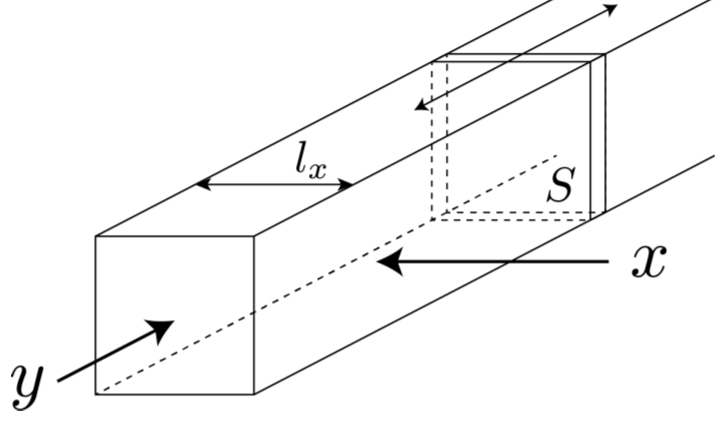
Use the following definitions if necessary.
| Initial state | After equilibrium | |||
|---|---|---|---|---|
| \(\ce{D}\) | \(\ce{M}\) | \(\ce{D}\) | \(\ce{M}\) | |
| Partial pressure | \(P\) | \(0\) | \(p_{\mathrm D}\) | \(p_{\mathrm M}\) |
| Amount in moles | \(n_0\) | \(0\) | \(n_{\mathrm D}\) | \(n_{\mathrm M}\) |
| Volume | \(V_0\) | \(V\) |
3.2 The absorbance of the gas at \(\lambda_{\mathrm{B1}}\) measured from direction \(x\) (\(l=l_x\)) was \(A_{\mathrm{B1}}\) both at the initial state and after the equilibrium. Determine the ratio \(\varepsilon_{\mathrm D}/\varepsilon_{\mathrm M}\) at \(\lambda_{\mathrm{B1}}\), where \(\varepsilon_{\mathrm D}\) and \(\varepsilon_{\mathrm M}\) represent the absorption coefficients of \(\ce{D}\) and of \(\ce{M}\), respectively.
3.3 The absorbance of the gas at \(\lambda_{\mathrm{B2}}\) measured from direction \(y\) was \(A_{\mathrm{B2}}\) both at the initial state (\(l=l_{y0}\)) and after the equilibrium (\(l=l_y\)). Determine the ratio \(\varepsilon_{\mathrm D}/\varepsilon_{\mathrm M}\) at \(\lambda_{\mathrm{B2}}\).
Official English text of the problem.
Answers
- 3.1: \(\displaystyle \boxed{\frac{\varepsilon_{\ce{HA}}}{\varepsilon_{\ce{A^-}}}=8.99}\) at \(\lambda_1\).
- 3.2: \(\displaystyle \boxed{\frac{\varepsilon_{\mathrm D}}{\varepsilon_{\mathrm M}}=1}\) at \(\lambda_{\mathrm{B1}}\).
- 3.3: \(\displaystyle \boxed{\frac{\varepsilon_{\mathrm D}}{\varepsilon_{\mathrm M}}=2}\) at \(\lambda_{\mathrm{B2}}\).
Solution
The letter-labelled chemical species are unspecified, so unique molecular names and SMILES cannot be assigned to them. Hydrogen ion \(\ce{H+}\) is the proton, [H+].
For a mixture of absorbing species, the individual absorbances add:
\[ A=l\sum_i \varepsilon_i c_i. \]
3.1
The acid–base equilibrium is
\[ \ce{HA <=> A^- + H+}. \]
From the initial concentrations,
\[ K=\frac{[\ce{A^-}][\ce{H+}]}{[\ce{HA}]} =\frac{(1.00\times10^{-2})(1.00\times10^{-4})} {1.00\times10^{-3}} =1.00\times10^{-3}\ \mathrm{mol\,L^{-1}}. \]
The temperature remains constant, so this equilibrium constant also applies after mixing.
The hydrogen-ion concentration of the added hydrochloric acid is
\[ [\ce{H+}]_{\mathrm{acid}} =10^{-2.500}\ \mathrm{mol\,L^{-1}} =3.16228\times10^{-3}\ \mathrm{mol\,L^{-1}}, \]
retaining guard digits for calculation. Doubling the volume requires adding an equal volume of this acid. Dilution alone therefore gives the bookkeeping concentrations
\[ \begin{aligned} [\ce{A^-}]_{\mathrm{mix}} &=5.00\times10^{-3}\ \mathrm{mol\,L^{-1}},\\ [\ce{HA}]_{\mathrm{mix}} &=5.00\times10^{-4}\ \mathrm{mol\,L^{-1}},\\ [\ce{H+}]_{\mathrm{mix}} &=\frac{1.00\times10^{-4}+3.16228\times10^{-3}}{2}\\ &=1.63114\times10^{-3}\ \mathrm{mol\,L^{-1}}. \end{aligned} \]
The equilibrium readjusts by protonation:
\[ \ce{A^- + H+ <=> HA}. \]
Let \(u\) be the concentration of \(\ce{A^-}\) protonated. With all concentrations and \(u\) expressed in \(\mathrm{mol\,L^{-1}}\),
\[ \begin{aligned} [\ce{A^-}]_f&=5.00\times10^{-3}-u,\\ [\ce{HA}]_f&=5.00\times10^{-4}+u,\\ [\ce{H+}]_f&=1.63114\times10^{-3}-u. \end{aligned} \]
Substitution into the equilibrium expression gives
\[ \frac{(5.00\times10^{-3}-u)(1.63114\times10^{-3}-u)} {5.00\times10^{-4}+u} =1.00\times10^{-3}. \]
Using the unrounded input values, the physically admissible root is
\[ u=1.188237\times10^{-3}\ \mathrm{mol\,L^{-1}}. \]
Thus, retaining guard digits,
\[ \begin{aligned} [\ce{A^-}]_f&=3.811763\times10^{-3}\ \mathrm{mol\,L^{-1}},\\ [\ce{HA}]_f&=1.688237\times10^{-3}\ \mathrm{mol\,L^{-1}},\\ [\ce{H+}]_f&=4.429019\times10^{-4}\ \mathrm{mol\,L^{-1}}. \end{aligned} \]
Equal absorbance at the same path length requires
\[ \varepsilon_{\ce{HA}}[\ce{HA}]_i +\varepsilon_{\ce{A^-}}[\ce{A^-}]_i = \varepsilon_{\ce{HA}}[\ce{HA}]_f +\varepsilon_{\ce{A^-}}[\ce{A^-}]_f. \]
Consequently,
\[ \begin{aligned} \frac{\varepsilon_{\ce{HA}}}{\varepsilon_{\ce{A^-}}} &=\frac{[\ce{A^-}]_i-[\ce{A^-}]_f} {[\ce{HA}]_f-[\ce{HA}]_i}\\ &=\frac{1.00\times10^{-2}-3.811763\times10^{-3}} {1.688237\times10^{-3}-1.00\times10^{-3}}\\ &=8.99143\ldots\\ &=\boxed{8.99}. \end{aligned} \]
3.2
The gas-phase equilibrium is
\[ \ce{D <=> 2M}. \]
In direction \(x\), the optical path length \(l_x\) is fixed. Initially, the ideal-gas equation gives
\[ \frac{n_0}{V_0}=\frac{P}{RT}, \]
so the initial absorbance is
\[ A_{\mathrm{B1},i} =\varepsilon_{\mathrm D}\frac{P}{RT}l_x. \]
At equilibrium,
\[ A_{\mathrm{B1},f} =\left( \varepsilon_{\mathrm D}\frac{p_{\mathrm D}}{RT} +\varepsilon_{\mathrm M}\frac{p_{\mathrm M}}{RT} \right)l_x. \]
Equating the absorbances and cancelling \(l_x/(RT)\) gives
\[ \varepsilon_{\mathrm D}P =\varepsilon_{\mathrm D}p_{\mathrm D} +\varepsilon_{\mathrm M}p_{\mathrm M}. \]
Since the total pressure remains \(P\),
\[ P=p_{\mathrm D}+p_{\mathrm M}. \]
Hence,
\[ (\varepsilon_{\mathrm D}-\varepsilon_{\mathrm M})p_{\mathrm M}=0. \]
The dissociation produces a nonzero amount of \(\ce{M}\), so
\[ \boxed{\frac{\varepsilon_{\mathrm D}}{\varepsilon_{\mathrm M}}=1}. \]
At constant pressure and temperature, the total molar concentration stays constant. Equal absorption coefficients therefore give unchanged absorbance along the fixed path.
3.3
In direction \(y\), the path length changes as the movable wall moves. The cross-sectional area \(S\) is fixed, giving
\[ V_0=Sl_{y0}, \qquad V=Sl_y. \]
The initial absorbance is therefore
\[ A_{\mathrm{B2},i} =\varepsilon_{\mathrm D}\frac{n_0}{V_0}l_{y0} =\frac{\varepsilon_{\mathrm D}n_0}{S}. \]
At equilibrium,
\[ \begin{aligned} A_{\mathrm{B2},f} &=\left( \varepsilon_{\mathrm D}\frac{n_{\mathrm D}}{V} +\varepsilon_{\mathrm M}\frac{n_{\mathrm M}}{V} \right)l_y\\ &=\frac{\varepsilon_{\mathrm D}n_{\mathrm D} +\varepsilon_{\mathrm M}n_{\mathrm M}}{S}. \end{aligned} \]
Equal absorbance thus requires
\[ \varepsilon_{\mathrm D}n_0 =\varepsilon_{\mathrm D}n_{\mathrm D} +\varepsilon_{\mathrm M}n_{\mathrm M}. \]
From the stoichiometry of \(\ce{D <=> 2M}\),
\[ n_0=n_{\mathrm D}+\frac{n_{\mathrm M}}{2}. \]
Substituting this balance gives
\[ \varepsilon_{\mathrm D} \left(n_{\mathrm D}+\frac{n_{\mathrm M}}{2}\right) = \varepsilon_{\mathrm D}n_{\mathrm D} +\varepsilon_{\mathrm M}n_{\mathrm M}, \]
and therefore
\[ \left(\frac{\varepsilon_{\mathrm D}}{2} -\varepsilon_{\mathrm M}\right)n_{\mathrm M}=0. \]
Since \(n_{\mathrm M}>0\),
\[ \boxed{\frac{\varepsilon_{\mathrm D}}{\varepsilon_{\mathrm M}}=2}. \]
Along this direction, \(l_y/V=1/S\), so each mole of \(\ce{D}\) must absorb as much as the two moles of \(\ce{M}\) formed from it.
The solution was checked against the official solution.
IChO 2021 · Theorieaufgabe 3
Lambert–Beersches Gesetz?
Vernachlässigen Sie in dieser Aufgabe die Absorption der Küvette und des Lösungsmittels. Die Temperaturen aller Lösungen und Gase werden konstant bei 25 °C gehalten.
TEIL A
Eine wässrige Lösung X wurde aus \(\ce{HA}\) und \(\ce{NaA}\) hergestellt. Die Konzentrationen \([\ce{A^-}]\), \([\ce{HA}]\) und \([\ce{H+}]\) in Lösung X betragen \(1.00 \times 10^{-2}\ \mathrm{mol\,L^{-1}}\), \(1.00 \times 10^{-3}\ \mathrm{mol\,L^{-1}}\) bzw. \(1.00 \times 10^{-4}\ \mathrm{mol\,L^{-1}}\) und sind über das folgende Säure-Base-Gleichgewicht miteinander verknüpft:
Die optische Weglänge beträgt in Teil A \(l\). Vernachlässigen Sie die Dichteänderung beim Verdünnen. Nehmen Sie an, dass außer der Reaktion in Gl. 1 keine weiteren chemischen Reaktionen stattfinden.
3.1 Die Extinktion von X betrug bei einer Wellenlänge von \(\lambda_1\) \(A_1\). Anschließend wurde Lösung X mit Salzsäure mit pH = 2.500 auf das Doppelte ihres ursprünglichen Volumens verdünnt. Nach dem Verdünnen betrug die Extinktion bei \(\lambda_1\) weiterhin \(A_1\). Bestimmen Sie das Verhältnis \(\varepsilon_{\ce{HA}}/\varepsilon_{\ce{A^-}}\), wobei \(\varepsilon_{\ce{HA}}\) und \(\varepsilon_{\ce{A^-}}\) die molaren Extinktionskoeffizienten von \(\ce{HA}\) bzw. \(\ce{A^-}\) bei \(\lambda_1\) bezeichnen.
TEIL B
Betrachten wir das folgende Gleichgewicht in der Gasphase:
Reines Gas \(\ce{D}\) wird bei einem Druck \(P\) in einen quaderförmigen Behälter gefüllt, der eine durchsichtige, bewegliche Wand mit einer Querschnittsfläche von \(S\) besitzt (siehe Abbildung unten). Das Gleichgewicht stellt sich ein, während der Gesamtdruck bei \(P\) gehalten wird. Die Extinktion des Gases beträgt \(A=\varepsilon(n/V)l\), wobei \(\varepsilon\), \(n\), \(V\) und \(l\) den molaren Extinktionskoeffizienten, die Stoffmenge des Gases in Mol, das Volumen des Gases bzw. die optische Weglänge bezeichnen. Nehmen Sie an, dass sich alle Komponenten des Gasgemisches wie ideale Gase verhalten.
Verwenden Sie bei Bedarf die folgenden Definitionen.
| Anfangszustand | Nach Einstellung des Gleichgewichts | |||
|---|---|---|---|---|
| \(\ce{D}\) | \(\ce{M}\) | \(\ce{D}\) | \(\ce{M}\) | |
| Partialdruck | \(P\) | \(0\) | \(p_{\mathrm D}\) | \(p_{\mathrm M}\) |
| Stoffmenge in Mol | \(n_0\) | \(0\) | \(n_{\mathrm D}\) | \(n_{\mathrm M}\) |
| Volumen | \(V_0\) | \(V\) |
3.2 Die aus Richtung \(x\) (\(l=l_x\)) gemessene Extinktion des Gases bei \(\lambda_{\mathrm{B1}}\) betrug sowohl im Anfangszustand als auch nach Einstellung des Gleichgewichts \(A_{\mathrm{B1}}\). Bestimmen Sie das Verhältnis \(\varepsilon_{\mathrm D}/\varepsilon_{\mathrm M}\) bei \(\lambda_{\mathrm{B1}}\), wobei \(\varepsilon_{\mathrm D}\) und \(\varepsilon_{\mathrm M}\) die molaren Extinktionskoeffizienten von \(\ce{D}\) bzw. \(\ce{M}\) bezeichnen.
3.3 Die aus Richtung \(y\) gemessene Extinktion des Gases bei \(\lambda_{\mathrm{B2}}\) betrug sowohl im Anfangszustand (\(l=l_{y0}\)) als auch nach Einstellung des Gleichgewichts (\(l=l_y\)) \(A_{\mathrm{B2}}\). Bestimmen Sie das Verhältnis \(\varepsilon_{\mathrm D}/\varepsilon_{\mathrm M}\) bei \(\lambda_{\mathrm{B2}}\).
Aufgabentext aus dem offiziellen englischen Text übersetzt.
Antworten
- 3.1: \(\displaystyle \boxed{\frac{\varepsilon_{\ce{HA}}}{\varepsilon_{\ce{A^-}}}=8.99}\) bei \(\lambda_1\).
- 3.2: \(\displaystyle \boxed{\frac{\varepsilon_{\mathrm D}}{\varepsilon_{\mathrm M}}=1}\) bei \(\lambda_{\mathrm{B1}}\).
- 3.3: \(\displaystyle \boxed{\frac{\varepsilon_{\mathrm D}}{\varepsilon_{\mathrm M}}=2}\) bei \(\lambda_{\mathrm{B2}}\).
Lösung
Die mit Buchstaben bezeichneten chemischen Spezies sind nicht näher spezifiziert, sodass ihnen keine eindeutigen Molekülnamen und SMILES zugeordnet werden können. Das Wasserstoffion \(\ce{H+}\) ist das Proton, [H+].
Bei einem Gemisch absorbierender Spezies addieren sich die einzelnen Extinktionen:
\[ A=l\sum_i \varepsilon_i c_i. \]
3.1
Das Säure-Base-Gleichgewicht lautet
\[ \ce{HA <=> A^- + H+}. \]
Aus den Anfangskonzentrationen ergibt sich
\[ K=\frac{[\ce{A^-}][\ce{H+}]}{[\ce{HA}]} =\frac{(1.00\times10^{-2})(1.00\times10^{-4})} {1.00\times10^{-3}} =1.00\times10^{-3}\ \mathrm{mol\,L^{-1}}. \]
Die Temperatur bleibt konstant, daher gilt diese Gleichgewichtskonstante auch nach dem Mischen.
Die Wasserstoffionenkonzentration der zugesetzten Salzsäure beträgt
\[ [\ce{H+}]_{\mathrm{acid}} =10^{-2.500}\ \mathrm{mol\,L^{-1}} =3.16228\times10^{-3}\ \mathrm{mol\,L^{-1}}, \]
wobei für die Berechnung zusätzliche Stellen beibehalten werden. Um das Volumen zu verdoppeln, muss ein gleich großes Volumen dieser Säure zugesetzt werden. Allein durch die Verdünnung ergeben sich daher rechnerisch die Konzentrationen
\[ \begin{aligned} [\ce{A^-}]_{\mathrm{mix}} &=5.00\times10^{-3}\ \mathrm{mol\,L^{-1}},\\ [\ce{HA}]_{\mathrm{mix}} &=5.00\times10^{-4}\ \mathrm{mol\,L^{-1}},\\ [\ce{H+}]_{\mathrm{mix}} &=\frac{1.00\times10^{-4}+3.16228\times10^{-3}}{2}\\ &=1.63114\times10^{-3}\ \mathrm{mol\,L^{-1}}. \end{aligned} \]
Das Gleichgewicht stellt sich durch Protonierung neu ein:
\[ \ce{A^- + H+ <=> HA}. \]
Sei \(u\) die Konzentration des protonierten \(\ce{A^-}\). Wenn alle Konzentrationen und \(u\) in \(\mathrm{mol\,L^{-1}}\) angegeben werden, gilt
\[ \begin{aligned} [\ce{A^-}]_f&=5.00\times10^{-3}-u,\\ [\ce{HA}]_f&=5.00\times10^{-4}+u,\\ [\ce{H+}]_f&=1.63114\times10^{-3}-u. \end{aligned} \]
Einsetzen in den Ausdruck für die Gleichgewichtskonstante ergibt
\[ \frac{(5.00\times10^{-3}-u)(1.63114\times10^{-3}-u)} {5.00\times10^{-4}+u} =1.00\times10^{-3}. \]
Mit den ungerundeten Ausgangswerten erhält man als physikalisch zulässige Lösung
\[ u=1.188237\times10^{-3}\ \mathrm{mol\,L^{-1}}. \]
Somit ergibt sich unter Beibehaltung zusätzlicher Stellen
\[ \begin{aligned} [\ce{A^-}]_f&=3.811763\times10^{-3}\ \mathrm{mol\,L^{-1}},\\ [\ce{HA}]_f&=1.688237\times10^{-3}\ \mathrm{mol\,L^{-1}},\\ [\ce{H+}]_f&=4.429019\times10^{-4}\ \mathrm{mol\,L^{-1}}. \end{aligned} \]
Gleiche Extinktion bei gleicher optischer Weglänge erfordert
\[ \varepsilon_{\ce{HA}}[\ce{HA}]_i +\varepsilon_{\ce{A^-}}[\ce{A^-}]_i = \varepsilon_{\ce{HA}}[\ce{HA}]_f +\varepsilon_{\ce{A^-}}[\ce{A^-}]_f. \]
Folglich gilt
\[ \begin{aligned} \frac{\varepsilon_{\ce{HA}}}{\varepsilon_{\ce{A^-}}} &=\frac{[\ce{A^-}]_i-[\ce{A^-}]_f} {[\ce{HA}]_f-[\ce{HA}]_i}\\ &=\frac{1.00\times10^{-2}-3.811763\times10^{-3}} {1.688237\times10^{-3}-1.00\times10^{-3}}\\ &=8.99143\ldots\\ &=\boxed{8.99}. \end{aligned} \]
3.2
Das Gasphasengleichgewicht lautet
\[ \ce{D <=> 2M}. \]
In Richtung \(x\) ist die optische Weglänge \(l_x\) konstant. Für den Anfangszustand ergibt sich aus der idealen Gasgleichung
\[ \frac{n_0}{V_0}=\frac{P}{RT}, \]
sodass für die anfängliche Extinktion gilt
\[ A_{\mathrm{B1},i} =\varepsilon_{\mathrm D}\frac{P}{RT}l_x. \]
Im Gleichgewicht gilt
\[ A_{\mathrm{B1},f} =\left( \varepsilon_{\mathrm D}\frac{p_{\mathrm D}}{RT} +\varepsilon_{\mathrm M}\frac{p_{\mathrm M}}{RT} \right)l_x. \]
Gleichsetzen der Extinktionen und Kürzen von \(l_x/(RT)\) ergibt
\[ \varepsilon_{\mathrm D}P =\varepsilon_{\mathrm D}p_{\mathrm D} +\varepsilon_{\mathrm M}p_{\mathrm M}. \]
Da der Gesamtdruck weiterhin \(P\) beträgt, gilt
\[ P=p_{\mathrm D}+p_{\mathrm M}. \]
Daher ist
\[ (\varepsilon_{\mathrm D}-\varepsilon_{\mathrm M})p_{\mathrm M}=0. \]
Durch die Dissoziation entsteht eine von null verschiedene Stoffmenge an \(\ce{M}\), also gilt
\[ \boxed{\frac{\varepsilon_{\mathrm D}}{\varepsilon_{\mathrm M}}=1}. \]
Bei konstantem Druck und konstanter Temperatur bleibt die gesamte Stoffmengenkonzentration konstant. Gleiche molare Extinktionskoeffizienten führen daher entlang der unveränderten optischen Weglänge zu einer unveränderten Extinktion.
3.3
In Richtung \(y\) ändert sich die optische Weglänge, wenn sich die bewegliche Wand verschiebt. Die Querschnittsfläche \(S\) bleibt konstant, sodass gilt
\[ V_0=Sl_{y0}, \qquad V=Sl_y. \]
Für die anfängliche Extinktion gilt daher
\[ A_{\mathrm{B2},i} =\varepsilon_{\mathrm D}\frac{n_0}{V_0}l_{y0} =\frac{\varepsilon_{\mathrm D}n_0}{S}. \]
Im Gleichgewicht gilt
\[ \begin{aligned} A_{\mathrm{B2},f} &=\left( \varepsilon_{\mathrm D}\frac{n_{\mathrm D}}{V} +\varepsilon_{\mathrm M}\frac{n_{\mathrm M}}{V} \right)l_y\\ &=\frac{\varepsilon_{\mathrm D}n_{\mathrm D} +\varepsilon_{\mathrm M}n_{\mathrm M}}{S}. \end{aligned} \]
Gleiche Extinktion erfordert somit
\[ \varepsilon_{\mathrm D}n_0 =\varepsilon_{\mathrm D}n_{\mathrm D} +\varepsilon_{\mathrm M}n_{\mathrm M}. \]
Aus der Stöchiometrie von \(\ce{D <=> 2M}\) folgt
\[ n_0=n_{\mathrm D}+\frac{n_{\mathrm M}}{2}. \]
Einsetzen dieser Bilanz ergibt
\[ \varepsilon_{\mathrm D} \left(n_{\mathrm D}+\frac{n_{\mathrm M}}{2}\right) = \varepsilon_{\mathrm D}n_{\mathrm D} +\varepsilon_{\mathrm M}n_{\mathrm M}, \]
und damit
\[ \left(\frac{\varepsilon_{\mathrm D}}{2} -\varepsilon_{\mathrm M}\right)n_{\mathrm M}=0. \]
Da \(n_{\mathrm M}>0\), gilt
\[ \boxed{\frac{\varepsilon_{\mathrm D}}{\varepsilon_{\mathrm M}}=2}. \]
In dieser Richtung gilt \(l_y/V=1/S\), sodass jedes Mol \(\ce{D}\) ebenso viel absorbieren muss wie die zwei daraus gebildeten Mol \(\ce{M}\).
Die Lösung wurde mit der offiziellen Lösung abgeglichen.
IChO 2021 · Teori sorusu 3
Lambert–Beer Yasası?
Bu soruda, küvetin ve çözücünün ışığı soğurmasını ihmal ediniz. Tüm çözeltilerin ve gazların sıcaklıkları 25 °C'de sabit tutulmaktadır.
BÖLÜM A
\(\ce{HA}\) ve \(\ce{NaA}\) kullanılarak sulu bir X çözeltisi hazırlanmıştır. X çözeltisindeki \([\ce{A^-}]\), \([\ce{HA}]\) ve \([\ce{H+}]\) derişimleri sırasıyla \(1.00 \times 10^{-2}\ \mathrm{mol\,L^{-1}}\), \(1.00 \times 10^{-3}\ \mathrm{mol\,L^{-1}}\) ve \(1.00 \times 10^{-4}\ \mathrm{mol\,L^{-1}}\) olup aşağıdaki asit-baz dengesi aracılığıyla birbiriyle ilişkilidir:
Bölüm A'da optik yol uzunluğu \(l\)'dir. Seyreltme sırasında meydana gelen yoğunluk değişimini ihmal ediniz. Denklem 1 dışında hiçbir kimyasal tepkimenin gerçekleşmediğini varsayınız.
3.1 X çözeltisinin \(\lambda_1\) dalga boyundaki absorbansı \(A_1\) olarak ölçülmüştür. Ardından X çözeltisi, pH = 2.500 olan hidroklorik asit kullanılarak başlangıç hacminin iki katına seyreltilmiştir. Seyreltmeden sonra \(\lambda_1\) dalga boyundaki absorbans yine \(A_1\) olmuştur. \(\varepsilon_{\ce{HA}}\) ve \(\varepsilon_{\ce{A^-}}\), \(\lambda_1\) dalga boyunda sırasıyla \(\ce{HA}\) ve \(\ce{A^-}\) türlerinin soğurma katsayılarını göstermek üzere, \(\varepsilon_{\ce{HA}}/\varepsilon_{\ce{A^-}}\) oranını belirleyiniz.
BÖLÜM B
Gaz fazındaki aşağıdaki dengeyi ele alalım:
Kesit alanı \(S\) olan saydam, hareketli bir duvara sahip dikdörtgenler prizması biçimindeki bir kaba (aşağıdaki şekle bakınız), \(P\) basıncında saf \(\ce{D}\) gazı doldurulur ve toplam basınç \(P\)'de tutulurken dengeye ulaşılır. Gazın absorbansı \(A=\varepsilon(n/V)l\) olup burada \(\varepsilon\), \(n\), \(V\) ve \(l\) sırasıyla soğurma katsayısını, gazın mol cinsinden miktarını, gazın hacmini ve optik yol uzunluğunu gösterir. Gaz karışımının tüm bileşenlerinin ideal gaz gibi davrandığını varsayınız.
Gerekirse aşağıdaki tanımları kullanınız.
| Başlangıç durumu | Dengeye ulaşıldıktan sonra | |||
|---|---|---|---|---|
| \(\ce{D}\) | \(\ce{M}\) | \(\ce{D}\) | \(\ce{M}\) | |
| Kısmi basınç | \(P\) | \(0\) | \(p_{\mathrm D}\) | \(p_{\mathrm M}\) |
| Mol cinsinden miktar | \(n_0\) | \(0\) | \(n_{\mathrm D}\) | \(n_{\mathrm M}\) |
| Hacim | \(V_0\) | \(V\) |
3.2 Gazın \(\lambda_{\mathrm{B1}}\) dalga boyunda \(x\) yönünden (\(l=l_x\)) ölçülen absorbansı, hem başlangıç durumunda hem de dengeye ulaşıldıktan sonra \(A_{\mathrm{B1}}\) olarak bulunmuştur. \(\varepsilon_{\mathrm D}\) ve \(\varepsilon_{\mathrm M}\), sırasıyla \(\ce{D}\) ve \(\ce{M}\) türlerinin soğurma katsayılarını göstermek üzere, \(\lambda_{\mathrm{B1}}\) dalga boyundaki \(\varepsilon_{\mathrm D}/\varepsilon_{\mathrm M}\) oranını belirleyiniz.
3.3 Gazın \(\lambda_{\mathrm{B2}}\) dalga boyunda \(y\) yönünden ölçülen absorbansı, hem başlangıç durumunda (\(l=l_{y0}\)) hem de dengeye ulaşıldıktan sonra (\(l=l_y\)) \(A_{\mathrm{B2}}\) olarak bulunmuştur. \(\lambda_{\mathrm{B2}}\) dalga boyundaki \(\varepsilon_{\mathrm D}/\varepsilon_{\mathrm M}\) oranını belirleyiniz.
Soru metni resmi İngilizce metinden çevrilmiştir.
Cevaplar
- 3.1: \(\lambda_1\) dalga boyunda \(\displaystyle \boxed{\frac{\varepsilon_{\ce{HA}}}{\varepsilon_{\ce{A^-}}}=8.99}\).
- 3.2: \(\lambda_{\mathrm{B1}}\) dalga boyunda \(\displaystyle \boxed{\frac{\varepsilon_{\mathrm D}}{\varepsilon_{\mathrm M}}=1}\).
- 3.3: \(\lambda_{\mathrm{B2}}\) dalga boyunda \(\displaystyle \boxed{\frac{\varepsilon_{\mathrm D}}{\varepsilon_{\mathrm M}}=2}\).
Çözüm
Harflerle gösterilen kimyasal türlerin kimlikleri belirtilmediğinden, bunlara özgül molekül adları ve SMILES gösterimleri atanamaz. Hidrojen iyonu \(\ce{H+}\), protondur: [H+].
Işığı soğuran türlerden oluşan bir karışımda, türlerin ayrı ayrı absorbansları toplanır:
\[ A=l\sum_i \varepsilon_i c_i. \]
3.1
Asit–baz dengesi şöyledir:
\[ \ce{HA <=> A^- + H+}. \]
Başlangıç derişimlerinden,
\[ K=\frac{[\ce{A^-}][\ce{H+}]}{[\ce{HA}]} =\frac{(1.00\times10^{-2})(1.00\times10^{-4})} {1.00\times10^{-3}} =1.00\times10^{-3}\ \mathrm{mol\,L^{-1}}. \]
Sıcaklık sabit kaldığından, bu denge sabiti karıştırmadan sonra da geçerlidir.
Eklenen hidroklorik asidin hidrojen iyonu derişimi, hesaplamada yuvarlama hatalarını önlemek için ek basamaklar korunarak,
\[ [\ce{H+}]_{\mathrm{acid}} =10^{-2.500}\ \mathrm{mol\,L^{-1}} =3.16228\times10^{-3}\ \mathrm{mol\,L^{-1}}, \]
olarak bulunur. Hacmin iki katına çıkarılması, bu asitten başlangıç hacmine eşit hacimde eklenmesini gerektirir. Bu nedenle, yalnızca seyreltme dikkate alındığında hesaplanan derişimler şöyledir:
\[ \begin{aligned} [\ce{A^-}]_{\mathrm{mix}} &=5.00\times10^{-3}\ \mathrm{mol\,L^{-1}},\\ [\ce{HA}]_{\mathrm{mix}} &=5.00\times10^{-4}\ \mathrm{mol\,L^{-1}},\\ [\ce{H+}]_{\mathrm{mix}} &=\frac{1.00\times10^{-4}+3.16228\times10^{-3}}{2}\\ &=1.63114\times10^{-3}\ \mathrm{mol\,L^{-1}}. \end{aligned} \]
Denge, protonlanma yoluyla yeniden kurulur:
\[ \ce{A^- + H+ <=> HA}. \]
Protonlanan \(\ce{A^-}\) türünün derişimi \(u\) olsun. Tüm derişimler ve \(u\), \(\mathrm{mol\,L^{-1}}\) cinsinden ifade edildiğinde,
\[ \begin{aligned} [\ce{A^-}]_f&=5.00\times10^{-3}-u,\\ [\ce{HA}]_f&=5.00\times10^{-4}+u,\\ [\ce{H+}]_f&=1.63114\times10^{-3}-u. \end{aligned} \]
Bu ifadeler denge bağıntısında yerine konulduğunda,
\[ \frac{(5.00\times10^{-3}-u)(1.63114\times10^{-3}-u)} {5.00\times10^{-4}+u} =1.00\times10^{-3}. \]
Yuvarlanmamış girdi değerleri kullanıldığında, fiziksel olarak kabul edilebilir kök şöyledir:
\[ u=1.188237\times10^{-3}\ \mathrm{mol\,L^{-1}}. \]
Böylece, yuvarlama hatalarını önlemek için ek basamaklar korunarak,
\[ \begin{aligned} [\ce{A^-}]_f&=3.811763\times10^{-3}\ \mathrm{mol\,L^{-1}},\\ [\ce{HA}]_f&=1.688237\times10^{-3}\ \mathrm{mol\,L^{-1}},\\ [\ce{H+}]_f&=4.429019\times10^{-4}\ \mathrm{mol\,L^{-1}}. \end{aligned} \]
Aynı optik yol uzunluğunda absorbansların eşit olması şu koşulu gerektirir:
\[ \varepsilon_{\ce{HA}}[\ce{HA}]_i +\varepsilon_{\ce{A^-}}[\ce{A^-}]_i = \varepsilon_{\ce{HA}}[\ce{HA}]_f +\varepsilon_{\ce{A^-}}[\ce{A^-}]_f. \]
Dolayısıyla,
\[ \begin{aligned} \frac{\varepsilon_{\ce{HA}}}{\varepsilon_{\ce{A^-}}} &=\frac{[\ce{A^-}]_i-[\ce{A^-}]_f} {[\ce{HA}]_f-[\ce{HA}]_i}\\ &=\frac{1.00\times10^{-2}-3.811763\times10^{-3}} {1.688237\times10^{-3}-1.00\times10^{-3}}\\ &=8.99143\ldots\\ &=\boxed{8.99}. \end{aligned} \]
3.2
Gaz fazındaki denge şöyledir:
\[ \ce{D <=> 2M}. \]
\(x\) yönünde optik yol uzunluğu \(l_x\) sabittir. Başlangıçta ideal gaz denkleminden,
\[ \frac{n_0}{V_0}=\frac{P}{RT}, \]
dolayısıyla başlangıç absorbansı,
\[ A_{\mathrm{B1},i} =\varepsilon_{\mathrm D}\frac{P}{RT}l_x. \]
Dengede,
\[ A_{\mathrm{B1},f} =\left( \varepsilon_{\mathrm D}\frac{p_{\mathrm D}}{RT} +\varepsilon_{\mathrm M}\frac{p_{\mathrm M}}{RT} \right)l_x. \]
Absorbanslar eşitlenip \(l_x/(RT)\) sadeleştirildiğinde,
\[ \varepsilon_{\mathrm D}P =\varepsilon_{\mathrm D}p_{\mathrm D} +\varepsilon_{\mathrm M}p_{\mathrm M}. \]
Toplam basınç \(P\) olarak kaldığından,
\[ P=p_{\mathrm D}+p_{\mathrm M}. \]
Böylece,
\[ (\varepsilon_{\mathrm D}-\varepsilon_{\mathrm M})p_{\mathrm M}=0. \]
Ayrışma sonucunda sıfırdan farklı miktarda \(\ce{M}\) oluştuğundan,
\[ \boxed{\frac{\varepsilon_{\mathrm D}}{\varepsilon_{\mathrm M}}=1}. \]
Sabit basınç ve sıcaklıkta toplam molar derişim sabit kalır. Bu nedenle, eşit soğurma katsayıları sabit optik yol boyunca absorbansın değişmemesini sağlar.
3.3
\(y\) yönünde, hareketli duvar yer değiştirdikçe optik yol uzunluğu değişir. Kesit alanı \(S\) sabit olduğundan,
\[ V_0=Sl_{y0}, \qquad V=Sl_y. \]
Bu nedenle başlangıç absorbansı şöyledir:
\[ A_{\mathrm{B2},i} =\varepsilon_{\mathrm D}\frac{n_0}{V_0}l_{y0} =\frac{\varepsilon_{\mathrm D}n_0}{S}. \]
Dengede,
\[ \begin{aligned} A_{\mathrm{B2},f} &=\left( \varepsilon_{\mathrm D}\frac{n_{\mathrm D}}{V} +\varepsilon_{\mathrm M}\frac{n_{\mathrm M}}{V} \right)l_y\\ &=\frac{\varepsilon_{\mathrm D}n_{\mathrm D} +\varepsilon_{\mathrm M}n_{\mathrm M}}{S}. \end{aligned} \]
Dolayısıyla absorbansların eşit olması şu koşulu gerektirir:
\[ \varepsilon_{\mathrm D}n_0 =\varepsilon_{\mathrm D}n_{\mathrm D} +\varepsilon_{\mathrm M}n_{\mathrm M}. \]
\(\ce{D <=> 2M}\) tepkimesinin stokiyometrisinden,
\[ n_0=n_{\mathrm D}+\frac{n_{\mathrm M}}{2}. \]
Bu madde denkliği yerine konulduğunda,
\[ \varepsilon_{\mathrm D} \left(n_{\mathrm D}+\frac{n_{\mathrm M}}{2}\right) = \varepsilon_{\mathrm D}n_{\mathrm D} +\varepsilon_{\mathrm M}n_{\mathrm M}, \]
ve dolayısıyla
\[ \left(\frac{\varepsilon_{\mathrm D}}{2} -\varepsilon_{\mathrm M}\right)n_{\mathrm M}=0. \]
\(n_{\mathrm M}>0\) olduğundan,
\[ \boxed{\frac{\varepsilon_{\mathrm D}}{\varepsilon_{\mathrm M}}=2}. \]
Bu yön boyunca \(l_y/V=1/S\) olduğundan, her bir mol \(\ce{D}\), kendisinden oluşan iki mol \(\ce{M}\) kadar ışık soğurmalıdır.
Çözüm, resmi çözümle karşılaştırılarak kontrol edildi.
IChO 2021 · Problema teórico 3
¿Ley de Lambert–Beer?
En este problema, desprecie la absorción de la cubeta y del disolvente. Las temperaturas de todas las disoluciones y de todos los gases se mantienen constantes a 25 °C.
PARTE A
Se preparó una disolución acuosa X utilizando \(\ce{HA}\) y \(\ce{NaA}\). Las concentraciones \([\ce{A^-}]\), \([\ce{HA}]\) y \([\ce{H+}]\) en la disolución X son \(1.00 \times 10^{-2}\ \mathrm{mol\,L^{-1}}\), \(1.00 \times 10^{-3}\ \mathrm{mol\,L^{-1}}\) y \(1.00 \times 10^{-4}\ \mathrm{mol\,L^{-1}}\), respectivamente, y están relacionadas mediante el siguiente equilibrio ácido-base:
La longitud del camino óptico es \(l\) en la Parte A. Desprecie el cambio de densidad al diluir. Suponga que no se produce ninguna reacción química distinta de la indicada en la ec. 1.
3.1 La absorbancia de X era \(A_1\) a una longitud de onda de \(\lambda_1\). A continuación, se diluyó la disolución X hasta el doble de su volumen inicial utilizando ácido clorhídrico de pH = 2.500. Tras la dilución, la absorbancia seguía siendo \(A_1\) a \(\lambda_1\). Determine la relación \(\varepsilon_{\ce{HA}}/\varepsilon_{\ce{A^-}}\), donde \(\varepsilon_{\ce{HA}}\) y \(\varepsilon_{\ce{A^-}}\) representan los coeficientes de absorción de \(\ce{HA}\) y de \(\ce{A^-}\), respectivamente, a \(\lambda_1\).
PARTE B
Consideremos el siguiente equilibrio en fase gaseosa:
Se introduce el gas puro \(\ce{D}\) a una presión \(P\) en un recipiente con forma de paralelepípedo rectangular que tiene una pared móvil transparente de sección transversal \(S\) (véase la figura siguiente), y se establece el equilibrio manteniendo la presión total en \(P\). La absorbancia del gas es \(A=\varepsilon(n/V)l\), donde \(\varepsilon\), \(n\), \(V\) y \(l\) son el coeficiente de absorción, la cantidad de gas en moles, el volumen del gas y la longitud del camino óptico, respectivamente. Suponga que todos los componentes de la mezcla gaseosa se comportan como gases ideales.
Utilice las siguientes definiciones si es necesario.
| Estado inicial | Una vez alcanzado el equilibrio | |||
|---|---|---|---|---|
| \(\ce{D}\) | \(\ce{M}\) | \(\ce{D}\) | \(\ce{M}\) | |
| Presión parcial | \(P\) | \(0\) | \(p_{\mathrm D}\) | \(p_{\mathrm M}\) |
| Cantidad en moles | \(n_0\) | \(0\) | \(n_{\mathrm D}\) | \(n_{\mathrm M}\) |
| Volumen | \(V_0\) | \(V\) |
3.2 La absorbancia del gas a \(\lambda_{\mathrm{B1}}\), medida desde la dirección \(x\) (\(l=l_x\)), era \(A_{\mathrm{B1}}\) tanto en el estado inicial como una vez alcanzado el equilibrio. Determine la relación \(\varepsilon_{\mathrm D}/\varepsilon_{\mathrm M}\) a \(\lambda_{\mathrm{B1}}\), donde \(\varepsilon_{\mathrm D}\) y \(\varepsilon_{\mathrm M}\) representan los coeficientes de absorción de \(\ce{D}\) y de \(\ce{M}\), respectivamente.
3.3 La absorbancia del gas a \(\lambda_{\mathrm{B2}}\), medida desde la dirección \(y\), era \(A_{\mathrm{B2}}\) tanto en el estado inicial (\(l=l_{y0}\)) como una vez alcanzado el equilibrio (\(l=l_y\)). Determine la relación \(\varepsilon_{\mathrm D}/\varepsilon_{\mathrm M}\) a \(\lambda_{\mathrm{B2}}\).
Enunciado traducido del texto oficial en inglés.
Respuestas
- 3.1: \(\displaystyle \boxed{\frac{\varepsilon_{\ce{HA}}}{\varepsilon_{\ce{A^-}}}=8.99}\) a \(\lambda_1\).
- 3.2: \(\displaystyle \boxed{\frac{\varepsilon_{\mathrm D}}{\varepsilon_{\mathrm M}}=1}\) a \(\lambda_{\mathrm{B1}}\).
- 3.3: \(\displaystyle \boxed{\frac{\varepsilon_{\mathrm D}}{\varepsilon_{\mathrm M}}=2}\) a \(\lambda_{\mathrm{B2}}\).
Solución
Las especies químicas designadas con letras no están especificadas, por lo que no se les pueden asignar nombres moleculares ni representaciones SMILES únicos. El ion hidrógeno \(\ce{H+}\) es el protón, [H+].
Para una mezcla de especies absorbentes, las absorbancias individuales se suman:
\[ A=l\sum_i \varepsilon_i c_i. \]
3.1
El equilibrio ácido-base es
\[ \ce{HA <=> A^- + H+}. \]
A partir de las concentraciones iniciales,
\[ K=\frac{[\ce{A^-}][\ce{H+}]}{[\ce{HA}]} =\frac{(1.00\times10^{-2})(1.00\times10^{-4})} {1.00\times10^{-3}} =1.00\times10^{-3}\ \mathrm{mol\,L^{-1}}. \]
La temperatura permanece constante, por lo que esta constante de equilibrio también es válida después de mezclar.
La concentración de iones hidrógeno del ácido clorhídrico añadido es
\[ [\ce{H+}]_{\mathrm{acid}} =10^{-2.500}\ \mathrm{mol\,L^{-1}} =3.16228\times10^{-3}\ \mathrm{mol\,L^{-1}}, \]
conservando cifras adicionales para el cálculo. Duplicar el volumen requiere añadir un volumen igual de este ácido. Por tanto, considerando únicamente la dilución, se obtienen las siguientes concentraciones para el balance:
\[ \begin{aligned} [\ce{A^-}]_{\mathrm{mix}} &=5.00\times10^{-3}\ \mathrm{mol\,L^{-1}},\\ [\ce{HA}]_{\mathrm{mix}} &=5.00\times10^{-4}\ \mathrm{mol\,L^{-1}},\\ [\ce{H+}]_{\mathrm{mix}} &=\frac{1.00\times10^{-4}+3.16228\times10^{-3}}{2}\\ &=1.63114\times10^{-3}\ \mathrm{mol\,L^{-1}}. \end{aligned} \]
El equilibrio se reajusta mediante protonación:
\[ \ce{A^- + H+ <=> HA}. \]
Sea \(u\) la concentración de \(\ce{A^-}\) que se protona. Expresando todas las concentraciones y \(u\) en \(\mathrm{mol\,L^{-1}}\),
\[ \begin{aligned} [\ce{A^-}]_f&=5.00\times10^{-3}-u,\\ [\ce{HA}]_f&=5.00\times10^{-4}+u,\\ [\ce{H+}]_f&=1.63114\times10^{-3}-u. \end{aligned} \]
Al sustituir en la expresión del equilibrio se obtiene
\[ \frac{(5.00\times10^{-3}-u)(1.63114\times10^{-3}-u)} {5.00\times10^{-4}+u} =1.00\times10^{-3}. \]
Utilizando los valores de partida sin redondear, la raíz físicamente admisible es
\[ u=1.188237\times10^{-3}\ \mathrm{mol\,L^{-1}}. \]
Así, conservando cifras adicionales,
\[ \begin{aligned} [\ce{A^-}]_f&=3.811763\times10^{-3}\ \mathrm{mol\,L^{-1}},\\ [\ce{HA}]_f&=1.688237\times10^{-3}\ \mathrm{mol\,L^{-1}},\\ [\ce{H+}]_f&=4.429019\times10^{-4}\ \mathrm{mol\,L^{-1}}. \end{aligned} \]
La igualdad de absorbancias para una misma longitud del camino óptico exige
\[ \varepsilon_{\ce{HA}}[\ce{HA}]_i +\varepsilon_{\ce{A^-}}[\ce{A^-}]_i = \varepsilon_{\ce{HA}}[\ce{HA}]_f +\varepsilon_{\ce{A^-}}[\ce{A^-}]_f. \]
Por consiguiente,
\[ \begin{aligned} \frac{\varepsilon_{\ce{HA}}}{\varepsilon_{\ce{A^-}}} &=\frac{[\ce{A^-}]_i-[\ce{A^-}]_f} {[\ce{HA}]_f-[\ce{HA}]_i}\\ &=\frac{1.00\times10^{-2}-3.811763\times10^{-3}} {1.688237\times10^{-3}-1.00\times10^{-3}}\\ &=8.99143\ldots\\ &=\boxed{8.99}. \end{aligned} \]
3.2
El equilibrio en fase gaseosa es
\[ \ce{D <=> 2M}. \]
En la dirección \(x\), la longitud del camino óptico \(l_x\) es fija. Inicialmente, la ecuación de los gases ideales da
\[ \frac{n_0}{V_0}=\frac{P}{RT}, \]
por lo que la absorbancia inicial es
\[ A_{\mathrm{B1},i} =\varepsilon_{\mathrm D}\frac{P}{RT}l_x. \]
En el equilibrio,
\[ A_{\mathrm{B1},f} =\left( \varepsilon_{\mathrm D}\frac{p_{\mathrm D}}{RT} +\varepsilon_{\mathrm M}\frac{p_{\mathrm M}}{RT} \right)l_x. \]
Al igualar las absorbancias y cancelar \(l_x/(RT)\) se obtiene
\[ \varepsilon_{\mathrm D}P =\varepsilon_{\mathrm D}p_{\mathrm D} +\varepsilon_{\mathrm M}p_{\mathrm M}. \]
Como la presión total se mantiene en \(P\),
\[ P=p_{\mathrm D}+p_{\mathrm M}. \]
Por tanto,
\[ (\varepsilon_{\mathrm D}-\varepsilon_{\mathrm M})p_{\mathrm M}=0. \]
La disociación produce una cantidad no nula de \(\ce{M}\), por lo que
\[ \boxed{\frac{\varepsilon_{\mathrm D}}{\varepsilon_{\mathrm M}}=1}. \]
A presión y temperatura constantes, la concentración molar total permanece constante. Por tanto, unos coeficientes de absorción iguales hacen que la absorbancia a lo largo del camino óptico fijo no cambie.
3.3
En la dirección \(y\), la longitud del camino óptico cambia al desplazarse la pared móvil. El área de la sección transversal \(S\) es fija, por lo que
\[ V_0=Sl_{y0}, \qquad V=Sl_y. \]
Por tanto, la absorbancia inicial es
\[ A_{\mathrm{B2},i} =\varepsilon_{\mathrm D}\frac{n_0}{V_0}l_{y0} =\frac{\varepsilon_{\mathrm D}n_0}{S}. \]
En el equilibrio,
\[ \begin{aligned} A_{\mathrm{B2},f} &=\left( \varepsilon_{\mathrm D}\frac{n_{\mathrm D}}{V} +\varepsilon_{\mathrm M}\frac{n_{\mathrm M}}{V} \right)l_y\\ &=\frac{\varepsilon_{\mathrm D}n_{\mathrm D} +\varepsilon_{\mathrm M}n_{\mathrm M}}{S}. \end{aligned} \]
Así, la igualdad de absorbancias exige
\[ \varepsilon_{\mathrm D}n_0 =\varepsilon_{\mathrm D}n_{\mathrm D} +\varepsilon_{\mathrm M}n_{\mathrm M}. \]
A partir de la estequiometría de \(\ce{D <=> 2M}\),
\[ n_0=n_{\mathrm D}+\frac{n_{\mathrm M}}{2}. \]
Al sustituir este balance se obtiene
\[ \varepsilon_{\mathrm D} \left(n_{\mathrm D}+\frac{n_{\mathrm M}}{2}\right) = \varepsilon_{\mathrm D}n_{\mathrm D} +\varepsilon_{\mathrm M}n_{\mathrm M}, \]
y, por tanto,
\[ \left(\frac{\varepsilon_{\mathrm D}}{2} -\varepsilon_{\mathrm M}\right)n_{\mathrm M}=0. \]
Como \(n_{\mathrm M}>0\),
\[ \boxed{\frac{\varepsilon_{\mathrm D}}{\varepsilon_{\mathrm M}}=2}. \]
En esta dirección, \(l_y/V=1/S\), por lo que cada mol de \(\ce{D}\) debe absorber tanto como los dos moles de \(\ce{M}\) formados a partir de él.
La solución se comprobó con la solución oficial.
IChO 2021 · 理论题 3
朗伯–比尔定律?
本题中,忽略吸收池和溶剂的吸收。所有溶液和气体的温度均保持在 25 °C。
部分 A
用 \(\ce{HA}\) 和 \(\ce{NaA}\) 配制水溶液 X。溶液 X 中的浓度 \([\ce{A^-}]\)、\([\ce{HA}]\) 和 \([\ce{H+}]\) 分别为 \(1.00 \times 10^{-2}\ \mathrm{mol\,L^{-1}}\)、\(1.00 \times 10^{-3}\ \mathrm{mol\,L^{-1}}\) 和 \(1.00 \times 10^{-4}\ \mathrm{mol\,L^{-1}}\),它们通过以下酸碱平衡相互关联:
部分 A 中的光程为 \(l\)。忽略稀释引起的密度变化。假设除式 1 外,不发生其他化学反应。
3.1 在波长 \(\lambda_1\) 处,X 的吸光度为 \(A_1\)。随后,用 pH = 2.500 的盐酸将溶液 X 稀释至初始体积的两倍。稀释后,在 \(\lambda_1\) 处的吸光度仍为 \(A_1\)。求比值 \(\varepsilon_{\ce{HA}}/\varepsilon_{\ce{A^-}}\),其中 \(\varepsilon_{\ce{HA}}\) 和 \(\varepsilon_{\ce{A^-}}\) 分别表示 \(\ce{HA}\) 和 \(\ce{A^-}\) 在 \(\lambda_1\) 处的吸收系数。
部分 B
考虑以下气相平衡:
将纯气体 \(\ce{D}\) 充入一个长方体容器,使压强为 \(P\)。该容器有一面横截面积为 \(S\) 的透明可移动壁(见下图)。在总压强保持为 \(P\) 的条件下,体系达到平衡。气体的吸光度为 \(A=\varepsilon(n/V)l\),其中 \(\varepsilon\)、\(n\)、\(V\) 和 \(l\) 分别为吸收系数、气体的物质的量、气体体积和光程。假设混合气体的所有组分均可视为理想气体。
必要时使用以下定义。
| 初始状态 | 达到平衡后 | |||
|---|---|---|---|---|
| \(\ce{D}\) | \(\ce{M}\) | \(\ce{D}\) | \(\ce{M}\) | |
| 分压 | \(P\) | \(0\) | \(p_{\mathrm D}\) | \(p_{\mathrm M}\) |
| 物质的量 | \(n_0\) | \(0\) | \(n_{\mathrm D}\) | \(n_{\mathrm M}\) |
| 体积 | \(V_0\) | \(V\) |
3.2 沿 \(x\) 方向(\(l=l_x\))测得的气体在 \(\lambda_{\mathrm{B1}}\) 处的吸光度,在初始状态和平衡后均为 \(A_{\mathrm{B1}}\)。求在 \(\lambda_{\mathrm{B1}}\) 处的比值 \(\varepsilon_{\mathrm D}/\varepsilon_{\mathrm M}\),其中 \(\varepsilon_{\mathrm D}\) 和 \(\varepsilon_{\mathrm M}\) 分别表示 \(\ce{D}\) 和 \(\ce{M}\) 的吸收系数。
3.3 沿 \(y\) 方向测得的气体在 \(\lambda_{\mathrm{B2}}\) 处的吸光度,在初始状态(\(l=l_{y0}\))和平衡后(\(l=l_y\))均为 \(A_{\mathrm{B2}}\)。求在 \(\lambda_{\mathrm{B2}}\) 处的比值 \(\varepsilon_{\mathrm D}/\varepsilon_{\mathrm M}\)。
题目译自官方英文原文。
答案
- 3.1: 在 \(\lambda_1\) 处,\(\displaystyle \boxed{\frac{\varepsilon_{\ce{HA}}}{\varepsilon_{\ce{A^-}}}=8.99}\)。
- 3.2: 在 \(\lambda_{\mathrm{B1}}\) 处,\(\displaystyle \boxed{\frac{\varepsilon_{\mathrm D}}{\varepsilon_{\mathrm M}}=1}\)。
- 3.3: 在 \(\lambda_{\mathrm{B2}}\) 处,\(\displaystyle \boxed{\frac{\varepsilon_{\mathrm D}}{\varepsilon_{\mathrm M}}=2}\)。
解答
用字母标记的化学物种未指明具体身份,因此无法为其指定唯一的分子名称和 SMILES。氢离子 \(\ce{H+}\) 即质子,[H+]。
对于含有多种吸光物种的混合物,各物种的吸光度具有加和性:
\[ A=l\sum_i \varepsilon_i c_i. \]
3.1
酸碱平衡为
\[ \ce{HA <=> A^- + H+}. \]
由初始浓度可得,
\[ K=\frac{[\ce{A^-}][\ce{H+}]}{[\ce{HA}]} =\frac{(1.00\times10^{-2})(1.00\times10^{-4})} {1.00\times10^{-3}} =1.00\times10^{-3}\ \mathrm{mol\,L^{-1}}. \]
温度保持不变,因此该平衡常数也适用于混合后的体系。
所加盐酸的氢离子浓度为
\[ [\ce{H+}]_{\mathrm{acid}} =10^{-2.500}\ \mathrm{mol\,L^{-1}} =3.16228\times10^{-3}\ \mathrm{mol\,L^{-1}}, \]
此处保留额外位数以供计算。要使体积加倍,需要加入等体积的这种盐酸。因此,仅考虑稀释而暂不考虑反应时,各物种的浓度为
\[ \begin{aligned} [\ce{A^-}]_{\mathrm{mix}} &=5.00\times10^{-3}\ \mathrm{mol\,L^{-1}},\\ [\ce{HA}]_{\mathrm{mix}} &=5.00\times10^{-4}\ \mathrm{mol\,L^{-1}},\\ [\ce{H+}]_{\mathrm{mix}} &=\frac{1.00\times10^{-4}+3.16228\times10^{-3}}{2}\\ &=1.63114\times10^{-3}\ \mathrm{mol\,L^{-1}}. \end{aligned} \]
平衡通过质子化反应重新建立:
\[ \ce{A^- + H+ <=> HA}. \]
设发生质子化的 \(\ce{A^-}\) 的浓度为 \(u\)。所有浓度和 \(u\) 均以 \(\mathrm{mol\,L^{-1}}\) 为单位,则
\[ \begin{aligned} [\ce{A^-}]_f&=5.00\times10^{-3}-u,\\ [\ce{HA}]_f&=5.00\times10^{-4}+u,\\ [\ce{H+}]_f&=1.63114\times10^{-3}-u. \end{aligned} \]
代入平衡常数表达式,得
\[ \frac{(5.00\times10^{-3}-u)(1.63114\times10^{-3}-u)} {5.00\times10^{-4}+u} =1.00\times10^{-3}. \]
使用未经舍入的输入值,得到符合物理意义的根为
\[ u=1.188237\times10^{-3}\ \mathrm{mol\,L^{-1}}. \]
因此,保留额外位数,可得
\[ \begin{aligned} [\ce{A^-}]_f&=3.811763\times10^{-3}\ \mathrm{mol\,L^{-1}},\\ [\ce{HA}]_f&=1.688237\times10^{-3}\ \mathrm{mol\,L^{-1}},\\ [\ce{H+}]_f&=4.429019\times10^{-4}\ \mathrm{mol\,L^{-1}}. \end{aligned} \]
在相同光程下吸光度相等,要求
\[ \varepsilon_{\ce{HA}}[\ce{HA}]_i +\varepsilon_{\ce{A^-}}[\ce{A^-}]_i = \varepsilon_{\ce{HA}}[\ce{HA}]_f +\varepsilon_{\ce{A^-}}[\ce{A^-}]_f. \]
因此,
\[ \begin{aligned} \frac{\varepsilon_{\ce{HA}}}{\varepsilon_{\ce{A^-}}} &=\frac{[\ce{A^-}]_i-[\ce{A^-}]_f} {[\ce{HA}]_f-[\ce{HA}]_i}\\ &=\frac{1.00\times10^{-2}-3.811763\times10^{-3}} {1.688237\times10^{-3}-1.00\times10^{-3}}\\ &=8.99143\ldots\\ &=\boxed{8.99}. \end{aligned} \]
3.2
气相平衡为
\[ \ce{D <=> 2M}. \]
沿 \(x\) 方向,光程 \(l_x\) 固定。初始时,由理想气体状态方程可得
\[ \frac{n_0}{V_0}=\frac{P}{RT}, \]
因此初始吸光度为
\[ A_{\mathrm{B1},i} =\varepsilon_{\mathrm D}\frac{P}{RT}l_x. \]
平衡时,
\[ A_{\mathrm{B1},f} =\left( \varepsilon_{\mathrm D}\frac{p_{\mathrm D}}{RT} +\varepsilon_{\mathrm M}\frac{p_{\mathrm M}}{RT} \right)l_x. \]
令两者的吸光度相等,并约去 \(l_x/(RT)\),得
\[ \varepsilon_{\mathrm D}P =\varepsilon_{\mathrm D}p_{\mathrm D} +\varepsilon_{\mathrm M}p_{\mathrm M}. \]
由于总压强保持为 \(P\),
\[ P=p_{\mathrm D}+p_{\mathrm M}. \]
因此,
\[ (\varepsilon_{\mathrm D}-\varepsilon_{\mathrm M})p_{\mathrm M}=0. \]
解离产生了非零量的 \(\ce{M}\),所以
\[ \boxed{\frac{\varepsilon_{\mathrm D}}{\varepsilon_{\mathrm M}}=1}. \]
在压强和温度恒定时,总物质的量浓度保持不变。因此,吸收系数相等时,沿固定光程测得的吸光度保持不变。
3.3
沿 \(y\) 方向,光程随可移动壁的移动而改变。横截面积 \(S\) 固定,因此
\[ V_0=Sl_{y0}, \qquad V=Sl_y. \]
因此,初始吸光度为
\[ A_{\mathrm{B2},i} =\varepsilon_{\mathrm D}\frac{n_0}{V_0}l_{y0} =\frac{\varepsilon_{\mathrm D}n_0}{S}. \]
平衡时,
\[ \begin{aligned} A_{\mathrm{B2},f} &=\left( \varepsilon_{\mathrm D}\frac{n_{\mathrm D}}{V} +\varepsilon_{\mathrm M}\frac{n_{\mathrm M}}{V} \right)l_y\\ &=\frac{\varepsilon_{\mathrm D}n_{\mathrm D} +\varepsilon_{\mathrm M}n_{\mathrm M}}{S}. \end{aligned} \]
因此,吸光度相等要求
\[ \varepsilon_{\mathrm D}n_0 =\varepsilon_{\mathrm D}n_{\mathrm D} +\varepsilon_{\mathrm M}n_{\mathrm M}. \]
由 \(\ce{D <=> 2M}\) 的化学计量关系,
\[ n_0=n_{\mathrm D}+\frac{n_{\mathrm M}}{2}. \]
代入这一物料衡算关系,得
\[ \varepsilon_{\mathrm D} \left(n_{\mathrm D}+\frac{n_{\mathrm M}}{2}\right) = \varepsilon_{\mathrm D}n_{\mathrm D} +\varepsilon_{\mathrm M}n_{\mathrm M}, \]
因此,
\[ \left(\frac{\varepsilon_{\mathrm D}}{2} -\varepsilon_{\mathrm M}\right)n_{\mathrm M}=0. \]
由于 \(n_{\mathrm M}>0\),
\[ \boxed{\frac{\varepsilon_{\mathrm D}}{\varepsilon_{\mathrm M}}=2}. \]
沿此方向,\(l_y/V=1/S\),因此每摩尔 \(\ce{D}\) 的吸光量必须等于由其生成的两摩尔 \(\ce{M}\) 的吸光量。
解答已与官方解答核对。
IChO 2021 · Теоретическая задача 3
Закон Ламберта–Бера?
В этой задаче пренебрегайте поглощением кюветы и растворителя. Температура всех растворов и газов поддерживается постоянной и равной 25 °C.
ЧАСТЬ A
Водный раствор X приготовили с использованием \(\ce{HA}\) и \(\ce{NaA}\). Концентрации \([\ce{A^-}]\), \([\ce{HA}]\) и \([\ce{H+}]\) в растворе X равны соответственно \(1.00 \times 10^{-2}\ \mathrm{mol\,L^{-1}}\), \(1.00 \times 10^{-3}\ \mathrm{mol\,L^{-1}}\) и \(1.00 \times 10^{-4}\ \mathrm{mol\,L^{-1}}\) и связаны следующим кислотно-основным равновесием:
В части A длина оптического пути равна \(l\). Пренебрегайте изменением плотности при разбавлении. Считайте, что никаких химических реакций, кроме реакции по уравнению 1, не происходит.
3.1 Оптическая плотность раствора X при длине волны \(\lambda_1\) составляла \(A_1\). Затем раствор X разбавили до удвоенного исходного объёма соляной кислотой с pH = 2.500. После разбавления оптическая плотность при \(\lambda_1\) по-прежнему составляла \(A_1\). Определите отношение \(\varepsilon_{\ce{HA}}/\varepsilon_{\ce{A^-}}\), где \(\varepsilon_{\ce{HA}}\) и \(\varepsilon_{\ce{A^-}}\) — коэффициенты поглощения \(\ce{HA}\) и \(\ce{A^-}\) соответственно при \(\lambda_1\).
ЧАСТЬ B
Рассмотрим следующее равновесие в газовой фазе:
Чистым газом \(\ce{D}\) при давлении \(P\) заполняют сосуд в форме прямоугольного параллелепипеда с прозрачной подвижной стенкой площадью поперечного сечения \(S\) (см. рисунок ниже), после чего устанавливается равновесие при поддержании общего давления равным \(P\). Оптическая плотность газа равна \(A=\varepsilon(n/V)l\), где \(\varepsilon\), \(n\), \(V\) и \(l\) — соответственно коэффициент поглощения, количество газа в молях, объём газа и длина оптического пути. Считайте, что все компоненты газовой смеси ведут себя как идеальные газы.
При необходимости используйте следующие обозначения.
| Начальное состояние | После установления равновесия | |||
|---|---|---|---|---|
| \(\ce{D}\) | \(\ce{M}\) | \(\ce{D}\) | \(\ce{M}\) | |
| Парциальное давление | \(P\) | \(0\) | \(p_{\mathrm D}\) | \(p_{\mathrm M}\) |
| Количество вещества в молях | \(n_0\) | \(0\) | \(n_{\mathrm D}\) | \(n_{\mathrm M}\) |
| Объём | \(V_0\) | \(V\) |
3.2 Оптическая плотность газа при \(\lambda_{\mathrm{B1}}\), измеренная в направлении \(x\) (\(l=l_x\)), составляла \(A_{\mathrm{B1}}\) как в начальном состоянии, так и после установления равновесия. Определите отношение \(\varepsilon_{\mathrm D}/\varepsilon_{\mathrm M}\) при \(\lambda_{\mathrm{B1}}\), где \(\varepsilon_{\mathrm D}\) и \(\varepsilon_{\mathrm M}\) — коэффициенты поглощения \(\ce{D}\) и \(\ce{M}\) соответственно.
3.3 Оптическая плотность газа при \(\lambda_{\mathrm{B2}}\), измеренная в направлении \(y\), составляла \(A_{\mathrm{B2}}\) как в начальном состоянии (\(l=l_{y0}\)), так и после установления равновесия (\(l=l_y\)). Определите отношение \(\varepsilon_{\mathrm D}/\varepsilon_{\mathrm M}\) при \(\lambda_{\mathrm{B2}}\).
Условие переведено с официального английского текста.
Ответы
- 3.1: \(\displaystyle \boxed{\frac{\varepsilon_{\ce{HA}}}{\varepsilon_{\ce{A^-}}}=8.99}\) при \(\lambda_1\).
- 3.2: \(\displaystyle \boxed{\frac{\varepsilon_{\mathrm D}}{\varepsilon_{\mathrm M}}=1}\) при \(\lambda_{\mathrm{B1}}\).
- 3.3: \(\displaystyle \boxed{\frac{\varepsilon_{\mathrm D}}{\varepsilon_{\mathrm M}}=2}\) при \(\lambda_{\mathrm{B2}}\).
Решение
Химические частицы, обозначенные буквами, не конкретизированы, поэтому им нельзя однозначно сопоставить названия молекул и записи SMILES. Ион водорода \(\ce{H+}\) — это протон, [H+].
Для смеси поглощающих частиц их оптические плотности складываются:
\[ A=l\sum_i \varepsilon_i c_i. \]
3.1
Кислотно-основное равновесие имеет вид
\[ \ce{HA <=> A^- + H+}. \]
Из исходных концентраций получаем
\[ K=\frac{[\ce{A^-}][\ce{H+}]}{[\ce{HA}]} =\frac{(1.00\times10^{-2})(1.00\times10^{-4})} {1.00\times10^{-3}} =1.00\times10^{-3}\ \mathrm{mol\,L^{-1}}. \]
Температура остаётся постоянной, поэтому эта константа равновесия применима и после смешивания.
Концентрация ионов водорода в добавляемой соляной кислоте равна
\[ [\ce{H+}]_{\mathrm{acid}} =10^{-2.500}\ \mathrm{mol\,L^{-1}} =3.16228\times10^{-3}\ \mathrm{mol\,L^{-1}}, \]
где для расчётов сохранены дополнительные значащие цифры. Для удвоения объёма необходимо добавить равный объём этой кислоты. Поэтому, учитывая только разбавление, получаем следующие расчётные концентрации:
\[ \begin{aligned} [\ce{A^-}]_{\mathrm{mix}} &=5.00\times10^{-3}\ \mathrm{mol\,L^{-1}},\\ [\ce{HA}]_{\mathrm{mix}} &=5.00\times10^{-4}\ \mathrm{mol\,L^{-1}},\\ [\ce{H+}]_{\mathrm{mix}} &=\frac{1.00\times10^{-4}+3.16228\times10^{-3}}{2}\\ &=1.63114\times10^{-3}\ \mathrm{mol\,L^{-1}}. \end{aligned} \]
Равновесие смещается в результате протонирования:
\[ \ce{A^- + H+ <=> HA}. \]
Пусть \(u\) — концентрация протонированного \(\ce{A^-}\). Если все концентрации и \(u\) выражены в \(\mathrm{mol\,L^{-1}}\), то
\[ \begin{aligned} [\ce{A^-}]_f&=5.00\times10^{-3}-u,\\ [\ce{HA}]_f&=5.00\times10^{-4}+u,\\ [\ce{H+}]_f&=1.63114\times10^{-3}-u. \end{aligned} \]
Подстановка в выражение для константы равновесия даёт
\[ \frac{(5.00\times10^{-3}-u)(1.63114\times10^{-3}-u)} {5.00\times10^{-4}+u} =1.00\times10^{-3}. \]
При использовании неокруглённых исходных значений физически допустимый корень равен
\[ u=1.188237\times10^{-3}\ \mathrm{mol\,L^{-1}}. \]
Таким образом, сохраняя дополнительные значащие цифры, получаем
\[ \begin{aligned} [\ce{A^-}]_f&=3.811763\times10^{-3}\ \mathrm{mol\,L^{-1}},\\ [\ce{HA}]_f&=1.688237\times10^{-3}\ \mathrm{mol\,L^{-1}},\\ [\ce{H+}]_f&=4.429019\times10^{-4}\ \mathrm{mol\,L^{-1}}. \end{aligned} \]
Равенство оптических плотностей при одинаковой длине оптического пути требует выполнения условия
\[ \varepsilon_{\ce{HA}}[\ce{HA}]_i +\varepsilon_{\ce{A^-}}[\ce{A^-}]_i = \varepsilon_{\ce{HA}}[\ce{HA}]_f +\varepsilon_{\ce{A^-}}[\ce{A^-}]_f. \]
Следовательно,
\[ \begin{aligned} \frac{\varepsilon_{\ce{HA}}}{\varepsilon_{\ce{A^-}}} &=\frac{[\ce{A^-}]_i-[\ce{A^-}]_f} {[\ce{HA}]_f-[\ce{HA}]_i}\\ &=\frac{1.00\times10^{-2}-3.811763\times10^{-3}} {1.688237\times10^{-3}-1.00\times10^{-3}}\\ &=8.99143\ldots\\ &=\boxed{8.99}. \end{aligned} \]
3.2
Равновесие в газовой фазе имеет вид
\[ \ce{D <=> 2M}. \]
В направлении \(x\) длина оптического пути \(l_x\) постоянна. Для начального состояния из уравнения идеального газа получаем
\[ \frac{n_0}{V_0}=\frac{P}{RT}, \]
поэтому начальная оптическая плотность равна
\[ A_{\mathrm{B1},i} =\varepsilon_{\mathrm D}\frac{P}{RT}l_x. \]
При равновесии
\[ A_{\mathrm{B1},f} =\left( \varepsilon_{\mathrm D}\frac{p_{\mathrm D}}{RT} +\varepsilon_{\mathrm M}\frac{p_{\mathrm M}}{RT} \right)l_x. \]
Приравнивая оптические плотности и сокращая на \(l_x/(RT)\), получаем
\[ \varepsilon_{\mathrm D}P =\varepsilon_{\mathrm D}p_{\mathrm D} +\varepsilon_{\mathrm M}p_{\mathrm M}. \]
Поскольку общее давление остаётся равным \(P\),
\[ P=p_{\mathrm D}+p_{\mathrm M}. \]
Отсюда
\[ (\varepsilon_{\mathrm D}-\varepsilon_{\mathrm M})p_{\mathrm M}=0. \]
При диссоциации образуется ненулевое количество \(\ce{M}\), поэтому
\[ \boxed{\frac{\varepsilon_{\mathrm D}}{\varepsilon_{\mathrm M}}=1}. \]
При постоянных давлении и температуре суммарная молярная концентрация остаётся постоянной. Поэтому при равных коэффициентах поглощения оптическая плотность вдоль пути постоянной длины не изменяется.
3.3
В направлении \(y\) длина оптического пути меняется при перемещении подвижной стенки. Площадь поперечного сечения \(S\) постоянна, поэтому
\[ V_0=Sl_{y0}, \qquad V=Sl_y. \]
Следовательно, начальная оптическая плотность равна
\[ A_{\mathrm{B2},i} =\varepsilon_{\mathrm D}\frac{n_0}{V_0}l_{y0} =\frac{\varepsilon_{\mathrm D}n_0}{S}. \]
При равновесии
\[ \begin{aligned} A_{\mathrm{B2},f} &=\left( \varepsilon_{\mathrm D}\frac{n_{\mathrm D}}{V} +\varepsilon_{\mathrm M}\frac{n_{\mathrm M}}{V} \right)l_y\\ &=\frac{\varepsilon_{\mathrm D}n_{\mathrm D} +\varepsilon_{\mathrm M}n_{\mathrm M}}{S}. \end{aligned} \]
Таким образом, равенство оптических плотностей требует выполнения условия
\[ \varepsilon_{\mathrm D}n_0 =\varepsilon_{\mathrm D}n_{\mathrm D} +\varepsilon_{\mathrm M}n_{\mathrm M}. \]
Из стехиометрии реакции \(\ce{D <=> 2M}\) следует
\[ n_0=n_{\mathrm D}+\frac{n_{\mathrm M}}{2}. \]
Подставляя это соотношение материального баланса, получаем
\[ \varepsilon_{\mathrm D} \left(n_{\mathrm D}+\frac{n_{\mathrm M}}{2}\right) = \varepsilon_{\mathrm D}n_{\mathrm D} +\varepsilon_{\mathrm M}n_{\mathrm M}, \]
и, следовательно,
\[ \left(\frac{\varepsilon_{\mathrm D}}{2} -\varepsilon_{\mathrm M}\right)n_{\mathrm M}=0. \]
Поскольку \(n_{\mathrm M}>0\),
\[ \boxed{\frac{\varepsilon_{\mathrm D}}{\varepsilon_{\mathrm M}}=2}. \]
В этом направлении \(l_y/V=1/S\), поэтому каждый моль \(\ce{D}\) должен поглощать столько же света, сколько два моля \(\ce{M}\), образовавшиеся из него.
Решение проверено по официальному решению.
IChO 2021 · مسألة نظرية 3
قانون لامبرت–بير؟
في هذه المسألة، أهمل امتصاص الخلية والمذيب. تُحفظ درجات حرارة جميع المحاليل والغازات ثابتة عند 25 °C.
الجزء A
حُضِّر محلول مائي X باستخدام \(\ce{HA}\) و\(\ce{NaA}\). تراكيز \([\ce{A^-}]\) و\([\ce{HA}]\) و\([\ce{H+}]\) في المحلول X هي \(1.00 \times 10^{-2}\ \mathrm{mol\,L^{-1}}\) و\(1.00 \times 10^{-3}\ \mathrm{mol\,L^{-1}}\) و\(1.00 \times 10^{-4}\ \mathrm{mol\,L^{-1}}\)، على الترتيب، وترتبط هذه التراكيز باتزان الحمض–القاعدة الآتي:
طول المسار الضوئي في الجزء A هو \(l\). أهمل تغير الكثافة عند التخفيف. افترض عدم حدوث أي تفاعلات كيميائية غير التفاعل الوارد في المعادلة 1.
3.1 كانت امتصاصية X تساوي \(A_1\) عند طول موجي قدره \(\lambda_1\). ثم خُفِّف المحلول X إلى ضعف حجمه الابتدائي باستخدام حمض الهيدروكلوريك ذي pH = 2.500. بعد التخفيف، ظلت الامتصاصية مساوية لـ\(A_1\) عند \(\lambda_1\). حدد النسبة \(\varepsilon_{\ce{HA}}/\varepsilon_{\ce{A^-}}\)، حيث يمثل \(\varepsilon_{\ce{HA}}\) و\(\varepsilon_{\ce{A^-}}\) معاملي امتصاص \(\ce{HA}\) و\(\ce{A^-}\)، على الترتيب، عند \(\lambda_1\).
الجزء B
لننظر في الاتزان الآتي في الطور الغازي:
يُملأ وعاء على شكل متوازي مستطيلات بالغاز النقي \(\ce{D}\) عند ضغط \(P\). للوعاء جدار شفاف متحرك مساحة مقطعه العرضي \(S\) (انظر الشكل أدناه)، ويُترك الغاز حتى يتحقق الاتزان مع إبقاء الضغط الكلي عند \(P\). امتصاصية الغاز هي \(A=\varepsilon(n/V)l\)، حيث تمثل \(\varepsilon\) و\(n\) و\(V\) و\(l\) معامل الامتصاص وكمية الغاز بالمول وحجم الغاز وطول المسار الضوئي، على الترتيب. افترض أن جميع مكونات المزيج الغازي تسلك سلوك الغازات المثالية.
استخدم التعريفات الآتية عند الحاجة.
| الحالة الابتدائية | بعد تحقق الاتزان | |||
|---|---|---|---|---|
| \(\ce{D}\) | \(\ce{M}\) | \(\ce{D}\) | \(\ce{M}\) | |
| الضغط الجزئي | \(P\) | \(0\) | \(p_{\mathrm D}\) | \(p_{\mathrm M}\) |
| الكمية بالمول | \(n_0\) | \(0\) | \(n_{\mathrm D}\) | \(n_{\mathrm M}\) |
| الحجم | \(V_0\) | \(V\) |
3.2 كانت امتصاصية الغاز عند \(\lambda_{\mathrm{B1}}\)، المقيسة من الاتجاه \(x\) (\(l=l_x\))، تساوي \(A_{\mathrm{B1}}\) في كلٍّ من الحالة الابتدائية وبعد تحقق الاتزان. حدد النسبة \(\varepsilon_{\mathrm D}/\varepsilon_{\mathrm M}\) عند \(\lambda_{\mathrm{B1}}\)، حيث يمثل \(\varepsilon_{\mathrm D}\) و\(\varepsilon_{\mathrm M}\) معاملي امتصاص \(\ce{D}\) و\(\ce{M}\)، على الترتيب.
3.3 كانت امتصاصية الغاز عند \(\lambda_{\mathrm{B2}}\)، المقيسة من الاتجاه \(y\)، تساوي \(A_{\mathrm{B2}}\) في كلٍّ من الحالة الابتدائية (\(l=l_{y0}\)) وبعد تحقق الاتزان (\(l=l_y\)). حدد النسبة \(\varepsilon_{\mathrm D}/\varepsilon_{\mathrm M}\) عند \(\lambda_{\mathrm{B2}}\).
نص المسألة مترجم عن النص الإنجليزي الرسمي.
الإجابات
- 3.1: \(\displaystyle \boxed{\frac{\varepsilon_{\ce{HA}}}{\varepsilon_{\ce{A^-}}}=8.99}\) عند \(\lambda_1\).
- 3.2: \(\displaystyle \boxed{\frac{\varepsilon_{\mathrm D}}{\varepsilon_{\mathrm M}}=1}\) عند \(\lambda_{\mathrm{B1}}\).
- 3.3: \(\displaystyle \boxed{\frac{\varepsilon_{\mathrm D}}{\varepsilon_{\mathrm M}}=2}\) عند \(\lambda_{\mathrm{B2}}\).
الحل
الأنواع الكيميائية المرموز إليها بحروف غير محددة الهوية، ولذلك لا يمكن إسناد أسماء جزيئية وصيغ SMILES محددة لها. أيون الهيدروجين \(\ce{H+}\) هو البروتون، [H+].
في مزيج من الأنواع الممتصة، تُجمع الامتصاصيات الفردية:
\[ A=l\sum_i \varepsilon_i c_i. \]
3.1
اتزان الحمض–القاعدة هو
\[ \ce{HA <=> A^- + H+}. \]
من التراكيز الابتدائية،
\[ K=\frac{[\ce{A^-}][\ce{H+}]}{[\ce{HA}]} =\frac{(1.00\times10^{-2})(1.00\times10^{-4})} {1.00\times10^{-3}} =1.00\times10^{-3}\ \mathrm{mol\,L^{-1}}. \]
تبقى درجة الحرارة ثابتة، لذا ينطبق ثابت الاتزان هذا أيضًا بعد المزج.
تركيز أيون الهيدروجين في حمض الهيدروكلوريك المضاف هو
\[ [\ce{H+}]_{\mathrm{acid}} =10^{-2.500}\ \mathrm{mol\,L^{-1}} =3.16228\times10^{-3}\ \mathrm{mol\,L^{-1}}, \]
مع الاحتفاظ بأرقام إضافية لتجنب أخطاء التقريب في الحساب. تتطلب مضاعفة الحجم إضافة حجم مساوٍ من هذا الحمض. ولذلك يعطي التخفيف وحده التراكيز الحسابية الآتية قبل إعادة تحقق الاتزان:
\[ \begin{aligned} [\ce{A^-}]_{\mathrm{mix}} &=5.00\times10^{-3}\ \mathrm{mol\,L^{-1}},\\ [\ce{HA}]_{\mathrm{mix}} &=5.00\times10^{-4}\ \mathrm{mol\,L^{-1}},\\ [\ce{H+}]_{\mathrm{mix}} &=\frac{1.00\times10^{-4}+3.16228\times10^{-3}}{2}\\ &=1.63114\times10^{-3}\ \mathrm{mol\,L^{-1}}. \end{aligned} \]
يُعاد تحقق الاتزان عن طريق البروتنة:
\[ \ce{A^- + H+ <=> HA}. \]
ليكن \(u\) تركيز \(\ce{A^-}\) الذي خضع للبروتنة. بالتعبير عن جميع التراكيز وعن \(u\) بوحدة \(\mathrm{mol\,L^{-1}}\)،
\[ \begin{aligned} [\ce{A^-}]_f&=5.00\times10^{-3}-u,\\ [\ce{HA}]_f&=5.00\times10^{-4}+u,\\ [\ce{H+}]_f&=1.63114\times10^{-3}-u. \end{aligned} \]
بالتعويض في عبارة ثابت الاتزان نحصل على
\[ \frac{(5.00\times10^{-3}-u)(1.63114\times10^{-3}-u)} {5.00\times10^{-4}+u} =1.00\times10^{-3}. \]
باستخدام قيم المدخلات غير المقربة، يكون الجذر المقبول فيزيائيًا
\[ u=1.188237\times10^{-3}\ \mathrm{mol\,L^{-1}}. \]
إذن، مع الاحتفاظ بأرقام إضافية لتجنب أخطاء التقريب،
\[ \begin{aligned} [\ce{A^-}]_f&=3.811763\times10^{-3}\ \mathrm{mol\,L^{-1}},\\ [\ce{HA}]_f&=1.688237\times10^{-3}\ \mathrm{mol\,L^{-1}},\\ [\ce{H+}]_f&=4.429019\times10^{-4}\ \mathrm{mol\,L^{-1}}. \end{aligned} \]
يتطلب تساوي الامتصاصية عند طول المسار نفسه أن يكون
\[ \varepsilon_{\ce{HA}}[\ce{HA}]_i +\varepsilon_{\ce{A^-}}[\ce{A^-}]_i = \varepsilon_{\ce{HA}}[\ce{HA}]_f +\varepsilon_{\ce{A^-}}[\ce{A^-}]_f. \]
وبناءً عليه،
\[ \begin{aligned} \frac{\varepsilon_{\ce{HA}}}{\varepsilon_{\ce{A^-}}} &=\frac{[\ce{A^-}]_i-[\ce{A^-}]_f} {[\ce{HA}]_f-[\ce{HA}]_i}\\ &=\frac{1.00\times10^{-2}-3.811763\times10^{-3}} {1.688237\times10^{-3}-1.00\times10^{-3}}\\ &=8.99143\ldots\\ &=\boxed{8.99}. \end{aligned} \]
3.2
الاتزان في الطور الغازي هو
\[ \ce{D <=> 2M}. \]
في الاتجاه \(x\)، يكون طول المسار الضوئي \(l_x\) ثابتًا. في البداية، تعطي معادلة الغاز المثالي
\[ \frac{n_0}{V_0}=\frac{P}{RT}, \]
ومن ثم تكون الامتصاصية الابتدائية
\[ A_{\mathrm{B1},i} =\varepsilon_{\mathrm D}\frac{P}{RT}l_x. \]
عند الاتزان،
\[ A_{\mathrm{B1},f} =\left( \varepsilon_{\mathrm D}\frac{p_{\mathrm D}}{RT} +\varepsilon_{\mathrm M}\frac{p_{\mathrm M}}{RT} \right)l_x. \]
بمساواة الامتصاصيتين واختزال \(l_x/(RT)\) نحصل على
\[ \varepsilon_{\mathrm D}P =\varepsilon_{\mathrm D}p_{\mathrm D} +\varepsilon_{\mathrm M}p_{\mathrm M}. \]
بما أن الضغط الكلي يبقى \(P\)،
\[ P=p_{\mathrm D}+p_{\mathrm M}. \]
إذن،
\[ (\varepsilon_{\mathrm D}-\varepsilon_{\mathrm M})p_{\mathrm M}=0. \]
ينتج التفكك كمية غير صفرية من \(\ce{M}\)، لذا
\[ \boxed{\frac{\varepsilon_{\mathrm D}}{\varepsilon_{\mathrm M}}=1}. \]
عند ثبات الضغط ودرجة الحرارة، يبقى التركيز المولي الكلي ثابتًا. ولذلك يؤدي تساوي معاملي الامتصاص إلى بقاء الامتصاصية دون تغير على طول المسار الثابت.
3.3
في الاتجاه \(y\)، يتغير طول المسار مع حركة الجدار المتحرك. مساحة المقطع العرضي \(S\) ثابتة، ومن ثم
\[ V_0=Sl_{y0}, \qquad V=Sl_y. \]
لذلك تكون الامتصاصية الابتدائية
\[ A_{\mathrm{B2},i} =\varepsilon_{\mathrm D}\frac{n_0}{V_0}l_{y0} =\frac{\varepsilon_{\mathrm D}n_0}{S}. \]
عند الاتزان،
\[ \begin{aligned} A_{\mathrm{B2},f} &=\left( \varepsilon_{\mathrm D}\frac{n_{\mathrm D}}{V} +\varepsilon_{\mathrm M}\frac{n_{\mathrm M}}{V} \right)l_y\\ &=\frac{\varepsilon_{\mathrm D}n_{\mathrm D} +\varepsilon_{\mathrm M}n_{\mathrm M}}{S}. \end{aligned} \]
وعليه، يتطلب تساوي الامتصاصية أن يكون
\[ \varepsilon_{\mathrm D}n_0 =\varepsilon_{\mathrm D}n_{\mathrm D} +\varepsilon_{\mathrm M}n_{\mathrm M}. \]
من النسب الستوكيومترية للتفاعل \(\ce{D <=> 2M}\)،
\[ n_0=n_{\mathrm D}+\frac{n_{\mathrm M}}{2}. \]
بالتعويض بهذه الموازنة نحصل على
\[ \varepsilon_{\mathrm D} \left(n_{\mathrm D}+\frac{n_{\mathrm M}}{2}\right) = \varepsilon_{\mathrm D}n_{\mathrm D} +\varepsilon_{\mathrm M}n_{\mathrm M}, \]
وبالتالي
\[ \left(\frac{\varepsilon_{\mathrm D}}{2} -\varepsilon_{\mathrm M}\right)n_{\mathrm M}=0. \]
بما أن \(n_{\mathrm M}>0\)،
\[ \boxed{\frac{\varepsilon_{\mathrm D}}{\varepsilon_{\mathrm M}}=2}. \]
على امتداد هذا الاتجاه، \(l_y/V=1/S\)، لذا يجب أن يمتص كل مول من \(\ce{D}\) بقدر ما يمتص المولان من \(\ce{M}\) المتكونان منه.
تمت مراجعة الحل بمقارنته بالحل الرسمي.