IChO 2021 · Theory problem 9
Likes and Dislikes of Capsule
Good kids don’t do this, but if you unseam a tennis ball, you can disassemble it into two U-shaped pieces.
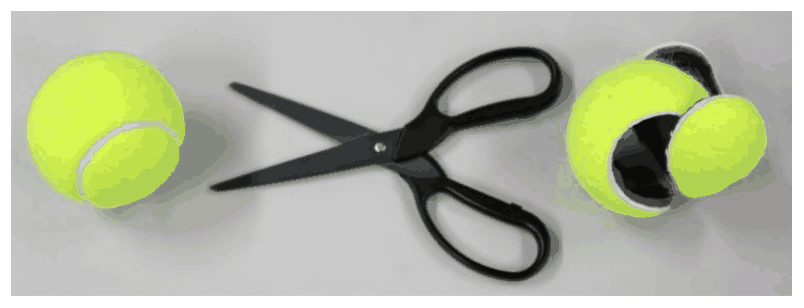
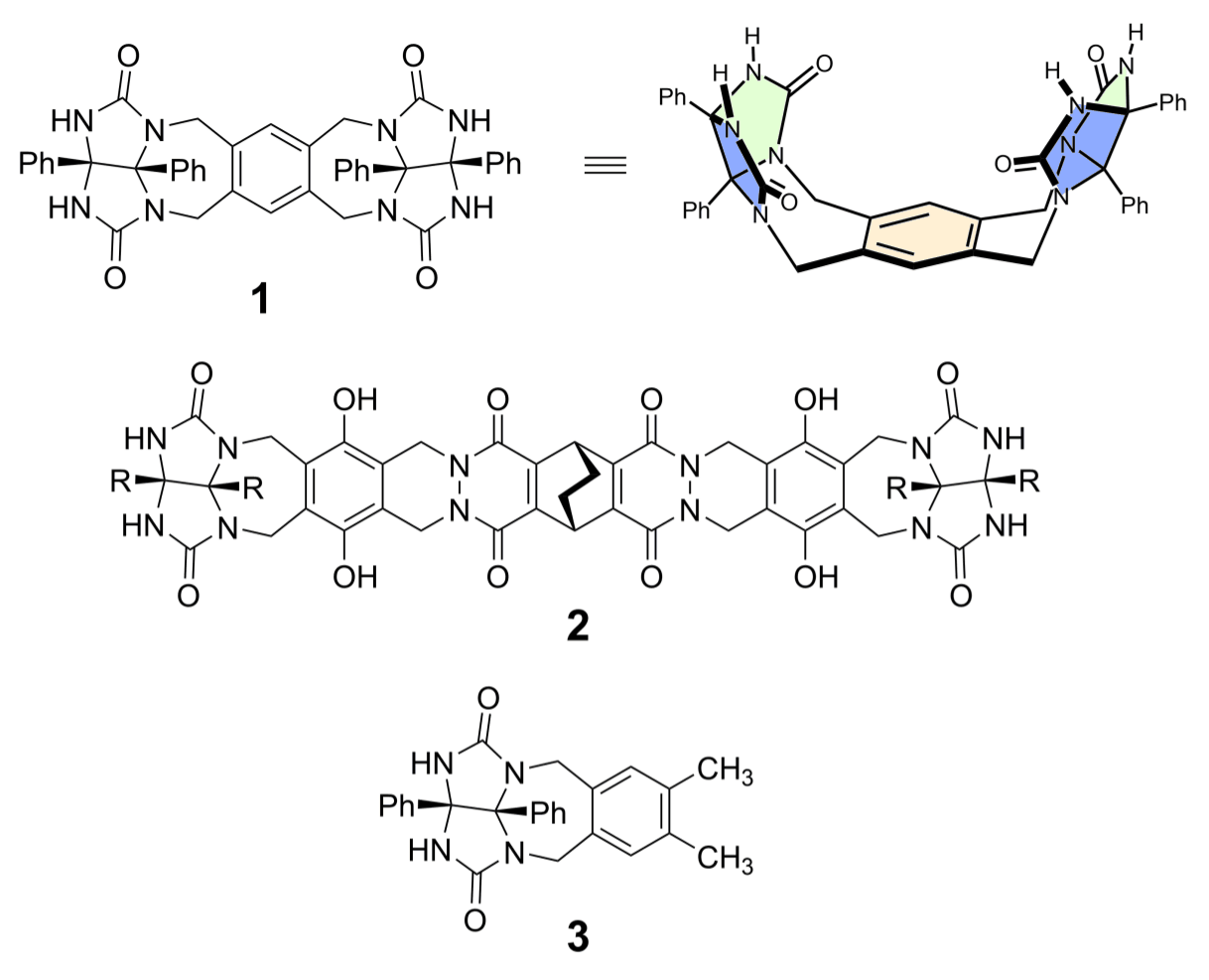
Based on this idea, compounds 1 and 2 were synthesized as U-shaped molecules with different sizes. Compound 3 was prepared as a comparison of 1 and the encapsulation behavior of these compounds was investigated.
The synthetic route to 2 is shown below. The elemental composition of compound 9: C; 40.49%, H; 1.70%, and O; 17.98% by mass.
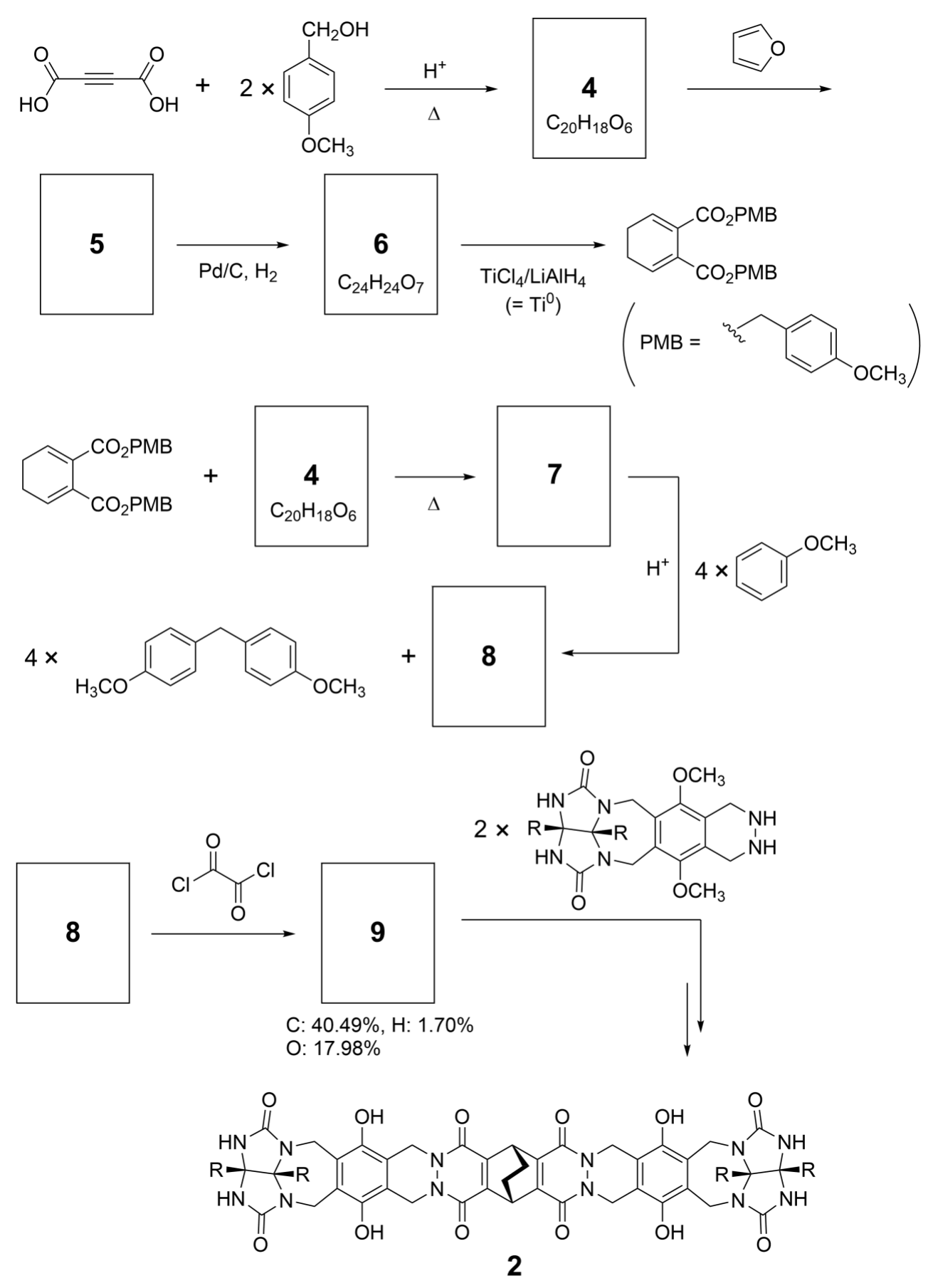
9.1 Draw the structures of 4–9; the stereochemistry can be neglected. Use "PMB" as a substituent instead of drawing the whole structure of p-methoxybenzyl group shown in the scheme above.
In the mass spectrum of 1, the ion peak corresponding to its dimer (\(\mathbf{1}_2\)) was clearly observed, whereas an ion peak for \(\mathbf{3}_2\) was not observed in the spectrum of 3. In the \({}^{1}\ce{H}\) NMR spectra of a solution of \(\mathbf{1}_2\), all the NH protons derived from 1 were observed to be chemically equivalent, and their chemical shift was significantly different from that of the NH protons of 3. These data indicate that hydrogen bonds are formed between the NH moieties of 1 and atoms X of another molecule of 1 to form the dimeric capsule.
9.2 Circle all the appropriate atom(s) X in 1.
9.3 Give the number of the hydrogen bonds in the dimeric capsule (\(\mathbf{1}_2\)).
The dimeric capsule of 1 (\(\mathbf{1}_2\)) has an internal space wherein an appropriate small molecule Z can be encapsulated. This phenomenon is expressed by the following equation:
\[ \ce{Z}+\mathbf{1}_2\ce{->}\ce{Z}@\mathbf{1}_2 \tag{1} \]
The equilibrium constant of the encapsulation of Z into \(\mathbf{1}_2\) is given as below:
\[ K_a=\frac{[\ce{Z}@\mathbf{1}_2]}{[\ce{Z}][\mathbf{1}_2]} \tag{2} \]
Encapsulation of a molecule into a capsule could be monitored by NMR spectroscopy. For example, \(\mathbf{1}_2\) in \(\ce{C6D6}\) gave different signals in the \({}^{1}\ce{H}\) NMR spectra before and after addition of \(\ce{CH4}\).
Compound 2 also forms a rigid and larger dimeric capsule (\(\mathbf{2}_2\)). The \({}^{1}\ce{H}\) NMR spectrum of \(\mathbf{2}_2\) was measured in \(\ce{C6D6}\), \(\ce{C6D5F}\), and a \(\ce{C6D6}/\ce{C6D5F}\) solvent mixture, with all other conditions being kept constant. The chemical shifts for the \(\ce{H}^{a}\) proton of 2 in the above solvents are summarized below, and no other signals from the \(\ce{H}^{a}\) in 2, except for the listed, were observed. Assume that the interior of the capsule is always filled with the largest possible number of solvent molecules and that each signal corresponds to one species of the filled capsule.
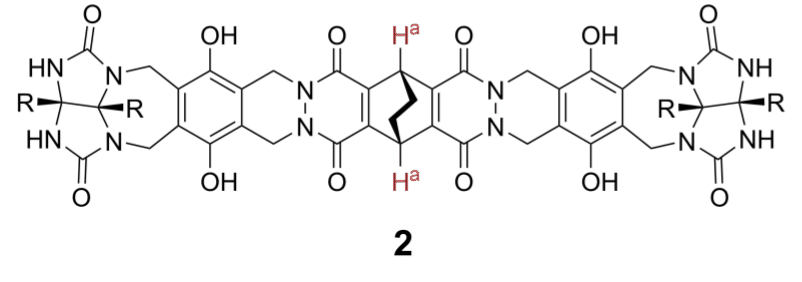
| solvent | \(\delta\) (ppm) of \(\ce{H}^{a}\) |
|---|---|
| \(\ce{C6D6}\) | 4.60 |
| \(\ce{C6D5F}\) | 4.71 |
| \(\ce{C6D6}/\ce{C6D5F}\) | 4.60, 4.71, 4.82 |
9.4 Determine the number of \(\ce{C6D6}\) and \(\ce{C6D5F}\) molecules encapsulated in \(\mathbf{2}_2\) giving each \(\ce{H}^{a}\) signal.
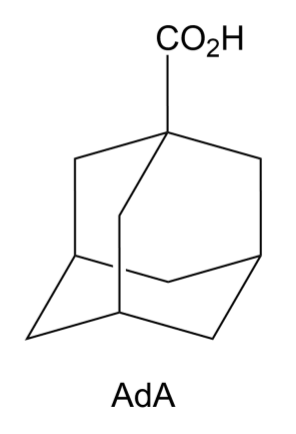
\({}^{1}\ce{H}\) NMR measurements in \(\ce{C6D6}\) revealed that \(\mathbf{2}_2\) can incorporate one molecule of 1-adamantanecarboxylic acid (AdA), and the association constants (\(K_a\)) which are expressed below were determined for various temperatures. \([\mathrm{solvent}@\mathbf{2}_2]\) denotes a species containing one or more solvent molecules.
\[ K_a=\frac{[\ce{Z}@\mathbf{2}_2]} {[\ce{Z}][\mathrm{solvent}@\mathbf{2}_2]} \tag{3} \]
Similarly, the \(K_a\) values of \(\ce{CH4}\) and \(\mathbf{1}_2\) given as eq (2) at various temperatures in \(\ce{C6D6}\) were also determined by \({}^{1}\ce{H}\) NMR measurements. The plots of the two association constants (as \(\ln K_a\) vs \(1/T\)) are shown below.
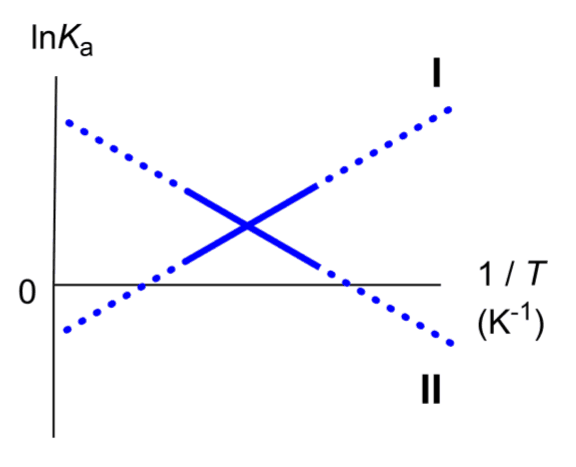
No \(\ce{C6D6}\) molecule is encapsulated in \(\mathbf{1}_2\). In line II, the entropy change (\(\Delta S\)) is ( 1 ) and enthalpy change (\(\Delta H\)) is ( 2 ), indicating that the driving force for the encapsulation in line II is ( 3 ). Therefore, line I corresponds to ( 4 ), and line II corresponds to ( 5 ).
9.5 Choose the correct options in gaps (1)–(5) in the following paragraph from A and B.
| A | B | |
|---|---|---|
| ( 1 ) | positive | negative |
| ( 2 ) | positive | negative |
| ( 3 ) | \(\Delta S\) | \(\Delta H\) |
| ( 4 ) | \(\mathbf{1}_2\) and \(\ce{CH4}\) | \(\mathbf{2}_2\) and AdA |
| ( 5 ) | \(\mathbf{1}_2\) and \(\ce{CH4}\) | \(\mathbf{2}_2\) and AdA |
Official English text of the problem.
Answers
- 9.1: The structures are listed below. In the requested drawings, retain the abbreviation PMB for the p-methoxybenzyl group. The SMILES expand PMB to give complete connectivity; stereochemistry is omitted as permitted.
| Compound | Name | SMILES |
|---|---|---|
| 4 | Bis(4-methoxybenzyl) but-2-ynedioate | COc1ccc(COC(=O)C#CC(=O)OCc2ccc(OC)cc2)cc1 |
| 5 | Bis(4-methoxybenzyl) 7-oxabicyclo[2.2.1]hepta-2,5-diene-2,3-dicarboxylate | C1(C(=O)OCc2ccc(OC)cc2)=C(C(=O)OCc2ccc(OC)cc2)C2C=CC1O2 |
| 6 | Bis(4-methoxybenzyl) 7-oxabicyclo[2.2.1]hept-2-ene-2,3-dicarboxylate | C1(C(=O)OCc2ccc(OC)cc2)=C(C(=O)OCc2ccc(OC)cc2)C2CCC1O2 |
| 7 | Tetrakis(4-methoxybenzyl) bicyclo[2.2.2]octa-2,5-diene-2,3,5,6-tetracarboxylate | C1(C(=O)OCc2ccc(OC)cc2)=C(C(=O)OCc2ccc(OC)cc2)C2CCC1C(C(=O)OCc1ccc(OC)cc1)=C2C(=O)OCc1ccc(OC)cc1 |
| 8 | Bicyclo[2.2.2]octa-2,5-diene-2,3,5,6-tetracarboxylic acid | C1(C(=O)O)=C(C(=O)O)C2CCC1C(C(=O)O)=C2C(=O)O |
| 9 | Bicyclo[2.2.2]octa-2,5-diene-2,3,5,6-tetracarbonyl tetrachloride | C1(C(=O)Cl)=C(C(=O)Cl)C2CCC1C(C(=O)Cl)=C2C(=O)Cl |
-
9.2: Circle all four carbonyl oxygen atoms of 1: the two carbonyl oxygens in each terminal glycoluril unit.
-
9.3: The dimeric capsule contains 8 hydrogen bonds.
-
9.4: Each capsule contains two solvent molecules.
| \(\delta(\ce{H}^{a})\) / ppm | Number of \(\ce{C6D6}\) molecules | Number of \(\ce{C6D5F}\) molecules |
|---|---|---|
| 4.60 | 2 | 0 |
| 4.71 | 0 | 2 |
| 4.82 | 1 | 1 |
The guests are benzene-\(d_6\), [2H]c1c([2H])c([2H])c([2H])c([2H])c1[2H], and fluorobenzene-\(d_5\), Fc1c([2H])c([2H])c([2H])c([2H])c1[2H].
- 9.5: (1) A; (2) A; (3) A; (4) A; (5) B.
Thus line II has \(\Delta S>0\), \(\Delta H>0\), and is entropy-driven. Line I represents methane, C, binding to \(\mathbf{1}_2\). Line II represents adamantane-1-carboxylic acid, O=C(O)C12CC3CC(CC(C3)C1)C2, binding to \(\mathbf{2}_2\).
Solution
9.1 — Identification of compounds 4–9
The PMB group is p-methoxybenzyl, represented as the fragment *Cc1ccc(OC)cc1, where * marks its attachment to the rest of the structure.
Esterification gives 4. The starting materials are but-2-ynedioic acid, also called acetylenedicarboxylic acid, O=C(O)C#CC(=O)O, and 4-methoxybenzyl alcohol, COc1ccc(CO)cc1. Both carboxylic acid groups undergo acid-catalysed esterification:
\[ \ce{C4H2O4 + 2 C8H10O2 ->[H^+,\ \Delta] C20H18O6 + 2 H2O}. \]
Thus 4 is the di-PMB ester of acetylenedicarboxylic acid. Its molecular formula agrees with the supplied \(\ce{C20H18O6}\).
For the drawing, place a triple bond between the two central carbon atoms, with a \(\ce{-C(=O)O-PMB}\) group at each end.
A Diels–Alder reaction with furan gives 5. Furan, c1ccoc1, supplies the four-atom diene, while the activated alkyne of 4 is the dienophile:
\[ \ce{C20H18O6 + C4H4O -> C24H22O7}. \]
The cycloaddition forms two new carbon–carbon \(\sigma\) bonds. One double bond remains between the two alkyne-derived carbon atoms, and another remains between the two internal carbons of the original furan diene. The furan oxygen becomes the one-atom bridge.
Consequently, 5 has a 7-oxabicyclo[2.2.1]hepta-2,5-diene skeleton, with the two ester groups on the same double bond.
Hydrogenation gives 6. The supplied formula changes from \(\ce{C24H22O7}\) to \(\ce{C24H24O7}\), so exactly one equivalent of hydrogen is added:
\[ \ce{C24H22O7 + H2 ->[Pd/C] C24H24O7}. \]
The double bond without ester substituents is hydrogenated. The ester-bearing double bond remains, as required for the subsequent formation of the depicted conjugated diene.
To draw 5 and 6 precisely, connect two bridgehead CH groups by three paths:
- An oxygen bridge, \(\ce{-O-}\).
- An ester-bearing alkene bridge, \(\ce{-C(CO2PMB)=C(CO2PMB)-}\).
- A \(\ce{-CH=CH-}\) bridge in 5, replaced by \(\ce{-CH2-CH2-}\) in 6.
Removal of the oxygen bridge gives the depicted conjugated diene. Reduced titanium removes the bridging oxygen, with rearrangement of the carbon–carbon double bonds. The product is bis(4-methoxybenzyl) cyclohexa-1,3-diene-2,3-dicarboxylate:
C1=C(C(=O)OCc2ccc(OC)cc2)C(C(=O)OCc2ccc(OC)cc2)=CCC1
Its formula is \(\ce{C24H24O6}\). Because the problem does not specify the titanium-containing coproducts, the organic reduction can be balanced formally as the half-reaction
\[ \ce{C24H24O7 + 2 H+ + 2 e- -> C24H24O6 + H2O}. \]
This equation is atom and charge bookkeeping; it does not imply an aqueous acidic reaction medium. In the actual transformation, reduced titanium accepts the oxygen.
A second Diels–Alder reaction gives 7. The conjugated diene reacts with another molecule of alkyne 4:
\[ \ce{C24H24O6 + C20H18O6 ->[\Delta] C44H42O12}. \]
The two saturated carbons of the original six-membered ring become one ethylene bridge of a bicyclo[2.2.2]octadiene framework. The remaining two bridges each contain a double bond, and every carbon of these two double bonds bears an ester group.
Therefore 7 is the tetra-PMB ester of bicyclo[2.2.2]octa-2,5-diene-2,3,5,6-tetracarboxylic acid.
Acidic PMB cleavage gives 8. The four PMB ester groups are removed. Anisole, COc1ccccc1, traps the benzyl electrophile released from each protecting group. The depicted trapping product is bis(4-methoxyphenyl)methane:
COc1ccc(Cc2ccc(OC)cc2)cc1
The balanced overall equation is
\[ \ce{C44H42O12 + 4 C7H8O ->[H^+] C12H10O8 + 4 C15H16O2}. \]
Thus 8 is the tetracarboxylic acid, \(\ce{C12H10O8}\). The bicyclic carbon skeleton and both double bonds remain unchanged.
Oxalyl chloride gives 9. Oxalyl chloride, O=C(Cl)C(=O)Cl, converts each of the four carboxylic acid groups into an acid chloride:
\[ \ce{C12H10O8 + 4 C2Cl2O2 -> C12H6Cl4O4 + 4 CO + 4 CO2 + 4 HCl}. \]
For the drawings of 7–9, connect two bridgehead CH groups by three two-carbon bridges. One is \(\ce{-CH2-CH2-}\); the other two are each \(\ce{-C(Q)=C(Q)-}\), with:
| Compound | \(Q\) |
|---|---|
| 7 | \(\ce{-C(=O)O-PMB}\) |
| 8 | \(\ce{-C(=O)OH}\) |
| 9 | \(\ce{-C(=O)Cl}\) |
This specifies the requested structures without assigning stereochemistry.
The elemental analysis independently confirms 9. The remaining mass percentage is chlorine:
\[ w_{\ce{Cl}}=100.00-40.49-1.70-17.98=39.83\%. \]
For a \(100.00\ \mathrm{g}\) sample, using atomic molar masses \(12.01\), \(1.008\), \(16.00\), and \(35.45\ \mathrm{g\,mol^{-1}}\),
\[ \begin{aligned} n_{\ce C}&=\frac{40.49}{12.01}=3.371\ \mathrm{mol},\\ n_{\ce H}&=\frac{1.70}{1.008}=1.687\ \mathrm{mol},\\ n_{\ce O}&=\frac{17.98}{16.00}=1.124\ \mathrm{mol},\\ n_{\ce{Cl}}&=\frac{39.83}{35.45}=1.124\ \mathrm{mol}. \end{aligned} \]
Hence
\[ n_{\ce C}:n_{\ce H}:n_{\ce O}:n_{\ce{Cl}} \simeq 3:1.5:1:1=6:3:2:2. \]
The empirical formula is \(\ce{C6H3Cl2O2}\). The known twelve-carbon skeleton requires twice this formula:
\[ \boxed{\ce{C12H6Cl4O4}}. \]
Its calculated molar mass is \(355.97\ \mathrm{g\,mol^{-1}}\), giving
\[ w_{\ce C}=40.49\%,\qquad w_{\ce H}=1.70\%,\qquad w_{\ce O}=17.98\%, \]
in agreement with every supplied percentage.
The small molecular species in the equations are water, O; hydrogen, [H][H]; carbon monoxide, [C-]#[O+]; carbon dioxide, O=C=O; and hydrogen chloride, Cl.
9.2 — Hydrogen-bond acceptors
Host 1 is the benzene-linked bis(diphenylglycoluril) host shown in the statement. Its covalent connectivity is:
O=C1NC2(c3ccccc3)NC(=O)N3Cc4cc5c(cc4CN1C23c1ccccc1)CN1C(=O)NC2(c3ccccc3)NC(=O)N(C5)C12c1ccccc1
Its U-shaped geometry is specified by the supplied drawing; a connectivity SMILES does not describe the capsule’s conformation or hydrogen-bond network.
Each glycoluril unit contains two urea carbonyl groups. Their oxygen atoms possess lone pairs that can accept hydrogen bonds from the NH groups of the other monomer:
\[ \ce{N-H}\cdots\ce{O=C}. \]
The urea nitrogen lone pairs are delocalized into the carbonyl groups, so these nitrogens are not the appropriate hydrogen-bond acceptors.
Therefore, circle the four carbonyl oxygen atoms, namely the upper and lower carbonyl oxygens at each end of 1.
9.3 — Number of hydrogen bonds
Each molecule of 1 contains:
- Four NH hydrogen-bond donors.
- Four carbonyl-oxygen hydrogen-bond acceptors.
The dimer therefore has eight NH donors. In the closed capsule, each NH group donates one hydrogen bond to a carbonyl oxygen on the other monomer:
\[ N_{\text{hydrogen bonds}}=2\times4=\boxed{8}. \]
This counts eight distinct donor–acceptor contacts, rather than counting both ends of a hydrogen bond separately. The equivalent hydrogen-bonded environments also account for the equivalent NH signals described in the problem.
9.4 — Solvent occupancy
Host 2 is the larger bis(glycoluril) host drawn in the statement. Its generic connectivity SMILES is given below, with each * representing one unspecified R substituent:
C1(C(=O)N3N(C9=O)Cc4c(O)c5c(c(O)c4C3)CN3C(=O)NC4(*)NC(=O)N(C5)C34*)=C9C2CCC1C(C(=O)N3N(C%10=O)Cc4c(O)c5c(c(O)c4C3)CN3C(=O)NC4(*)NC(=O)N(C5)C34*)=C2%10
Each capsule contains two such host molecules. Their spatial arrangement and the location of guests inside the cavity must be specified in words; ordinary SMILES does not encode encapsulation.
Let \(B\) denote benzene-\(d_6\) and \(F\) fluorobenzene-\(d_5\), whose SMILES are given in the Answers section.
For a capsule filled with \(n\) solvent molecules, the possible guest compositions are
\[ B_n,\ B_{n-1}F,\ B_{n-2}F_2,\ldots,F_n. \]
There are \(n+1\) compositions. Under the problem’s stated signal-counting model, the three observed signals imply
\[ n+1=3\quad\Longrightarrow\quad \boxed{n=2}. \]
The pure-solvent measurements identify the two homogeneous occupancies:
\[ \begin{aligned} 4.60\ \mathrm{ppm}&:\quad B_2@\mathbf{2}_2,\\ 4.71\ \mathrm{ppm}&:\quad F_2@\mathbf{2}_2. \end{aligned} \]
The remaining signal must correspond to the mixed pair:
\[ 4.82\ \mathrm{ppm}:\quad BF@\mathbf{2}_2. \]
Thus the guest counts are respectively \((2,0)\), \((0,2)\), and \((1,1)\). No assumption that the mixed capsule’s chemical shift is an average of the other two shifts is needed.
9.5 — Thermodynamic signs and identification of the lines
Using the fixed standard-state convention implicit in the plotted association constants, the van ’t Hoff relation is
\[ \ln K_a=-\frac{\Delta H}{R}\frac1T+\frac{\Delta S}{R}. \]
Consequently,
\[ \text{slope}=-\frac{\Delta H}{R}, \qquad \text{vertical intercept}=\frac{\Delta S}{R}. \]
For line II, the slope is negative and the vertical intercept is positive. Therefore,
\[ \boxed{\Delta H_{\mathrm{II}}>0}, \qquad \boxed{\Delta S_{\mathrm{II}}>0}. \]
Since
\[ \Delta G=\Delta H-T\Delta S, \]
the positive enthalpy change opposes binding, while the positive entropy change supplies the favorable contribution. Line II is therefore entropy-driven.
The two encapsulation processes explain the assignments.
For methane, the smaller capsule initially contains no benzene-\(d_6\):
\[ \ce{CH4}+\mathbf{1}_2 \ce{<=>} \ce{CH4}@\mathbf{1}_2. \]
Binding restricts the guest’s translational and rotational freedom, without releasing an encapsulated solvent molecule. This is consistent with the negative entropy change of line I, whose negative intercept and positive slope indicate
\[ \Delta S_{\mathrm I}<0,\qquad \Delta H_{\mathrm I}<0. \]
For adamantane-1-carboxylic acid, one guest replaces the two benzene-\(d_6\) molecules inside the larger capsule:
\[ \ce{C11H16O2}+(\ce{C6D6})_2@\mathbf{2}_2 \ce{<=>} \ce{C11H16O2}@\mathbf{2}_2+2\ce{C6D6}. \]
Release of two confined solvent molecules into the bulk solvent provides an entropy gain that can outweigh the entropy loss associated with binding one acid molecule. This explains the entropy-driven process represented by line II.
The completed choices are therefore:
| Gap | Result | Option |
|---|---|---|
| (1) | Positive \(\Delta S\) | A |
| (2) | Positive \(\Delta H\) | A |
| (3) | Entropy, \(\Delta S\), is the driving force | A |
| (4) | \(\mathbf{1}_2\) and methane | A |
| (5) | \(\mathbf{2}_2\) and adamantane-1-carboxylic acid | B |
The solution was checked against the official solution.
IChO 2021 · Theorieaufgabe 9
Vorlieben und Abneigungen einer Kapsel
Brave Kinder tun so etwas nicht, aber wenn man die Naht eines Tennisballs auftrennt, kann man ihn in zwei U-förmige Teile zerlegen.
Ausgehend von dieser Idee wurden die Verbindungen 1 und 2 als U-förmige Moleküle unterschiedlicher Größe synthetisiert. Verbindung 3 wurde zum Vergleich mit 1 hergestellt, und das Einschlussverhalten dieser Verbindungen wurde untersucht.
Der Syntheseweg zu 2 ist unten dargestellt. Die elementare Zusammensetzung der Verbindung 9 beträgt: C; 40.49%, H; 1.70% und O; 17.98% Massenanteil.
9.1 Zeichnen Sie die Strukturen von 4–9; die Stereochemie kann vernachlässigt werden. Verwenden Sie „PMB“ als Substituenten, anstatt die vollständige Struktur der im obigen Schema dargestellten p-Methoxybenzylgruppe zu zeichnen.
Im Massenspektrum von 1 wurde der seinem Dimer (\(\mathbf{1}_2\)) entsprechende Ionenpeak deutlich beobachtet, während im Spektrum von 3 kein Ionenpeak für \(\mathbf{3}_2\) beobachtet wurde. In den \({}^{1}\ce{H}\)-NMR-Spektren einer Lösung von \(\mathbf{1}_2\) erwiesen sich alle von 1 stammenden NH-Protonen als chemisch äquivalent, und ihre chemische Verschiebung unterschied sich deutlich von derjenigen der NH-Protonen von 3. Diese Daten zeigen, dass zwischen den NH-Gruppen von 1 und den Atomen X eines anderen Moleküls von 1 Wasserstoffbrückenbindungen gebildet werden, wodurch die dimere Kapsel entsteht.
9.2 Kreisen Sie alle infrage kommenden Atome X in 1 ein.
9.3 Geben Sie die Anzahl der Wasserstoffbrückenbindungen in der dimeren Kapsel (\(\mathbf{1}_2\)) an.
Die dimere Kapsel von 1 (\(\mathbf{1}_2\)) besitzt einen Innenraum, in dem ein geeignetes kleines Molekül Z eingeschlossen werden kann. Dieses Phänomen wird durch die folgende Gleichung beschrieben:
\[ \ce{Z}+\mathbf{1}_2\ce{->}\ce{Z}@\mathbf{1}_2 \tag{1} \]
Die Gleichgewichtskonstante für den Einschluss von Z in \(\mathbf{1}_2\) ist wie folgt gegeben:
\[ K_a=\frac{[\ce{Z}@\mathbf{1}_2]}{[\ce{Z}][\mathbf{1}_2]} \tag{2} \]
Der Einschluss eines Moleküls in eine Kapsel kann mittels NMR-Spektroskopie verfolgt werden. Beispielsweise lieferte \(\mathbf{1}_2\) in \(\ce{C6D6}\) vor und nach der Zugabe von \(\ce{CH4}\) unterschiedliche Signale in den \({}^{1}\ce{H}\)-NMR-Spektren.
Verbindung 2 bildet ebenfalls eine starre, größere dimere Kapsel (\(\mathbf{2}_2\)). Das \({}^{1}\ce{H}\)-NMR-Spektrum von \(\mathbf{2}_2\) wurde in \(\ce{C6D6}\), \(\ce{C6D5F}\) und einem Lösungsmittelgemisch aus \(\ce{C6D6}/\ce{C6D5F}\) gemessen, wobei alle anderen Bedingungen konstant gehalten wurden. Die chemischen Verschiebungen des \(\ce{H}^{a}\)-Protons von 2 in den genannten Lösungsmitteln sind unten zusammengefasst; außer den aufgeführten wurden keine weiteren Signale von \(\ce{H}^{a}\) in 2 beobachtet. Nehmen Sie an, dass der Innenraum der Kapsel stets mit der größtmöglichen Anzahl an Lösungsmittelmolekülen gefüllt ist und dass jedes Signal einer Spezies der gefüllten Kapsel entspricht.
| Lösungsmittel | \(\delta\) (ppm) von \(\ce{H}^{a}\) |
|---|---|
| \(\ce{C6D6}\) | 4.60 |
| \(\ce{C6D5F}\) | 4.71 |
| \(\ce{C6D6}/\ce{C6D5F}\) | 4.60, 4.71, 4.82 |
9.4 Bestimmen Sie für jedes \(\ce{H}^{a}\)-Signal die Anzahl der in \(\mathbf{2}_2\) eingeschlossenen \(\ce{C6D6}\)- und \(\ce{C6D5F}\)-Moleküle.
\({}^{1}\ce{H}\)-NMR-Messungen in \(\ce{C6D6}\) zeigten, dass \(\mathbf{2}_2\) ein Molekül Adamantan-1-carbonsäure (AdA) aufnehmen kann, und die unten definierten Assoziationskonstanten (\(K_a\)) wurden für verschiedene Temperaturen bestimmt. \([\mathrm{solvent}@\mathbf{2}_2]\) bezeichnet eine Spezies, die ein oder mehrere Lösungsmittelmoleküle enthält.
\[ K_a=\frac{[\ce{Z}@\mathbf{2}_2]} {[\ce{Z}][\mathrm{solvent}@\mathbf{2}_2]} \tag{3} \]
Ebenso wurden die in Gl. (2) definierten \(K_a\)-Werte für \(\ce{CH4}\) und \(\mathbf{1}_2\) bei verschiedenen Temperaturen in \(\ce{C6D6}\) mittels \({}^{1}\ce{H}\)-NMR-Messungen bestimmt. Die Auftragungen der beiden Assoziationskonstanten (als \(\ln K_a\) gegen \(1/T\)) sind unten dargestellt.
In \(\mathbf{1}_2\) ist kein \(\ce{C6D6}\)-Molekül eingeschlossen. Bei Gerade II ist die Entropieänderung (\(\Delta S\)) ( 1 ) und die Enthalpieänderung (\(\Delta H\)) ( 2 ); dies zeigt, dass die Triebkraft für den Einschluss bei Gerade II ( 3 ) ist. Daher entspricht Gerade I ( 4 ) und Gerade II ( 5 ).
9.5 Wählen Sie für die Lücken (1)–(5) im folgenden Absatz jeweils die richtige Option A oder B aus.
| A | B | |
|---|---|---|
| ( 1 ) | positiv | negativ |
| ( 2 ) | positiv | negativ |
| ( 3 ) | \(\Delta S\) | \(\Delta H\) |
| ( 4 ) | \(\mathbf{1}_2\) und \(\ce{CH4}\) | \(\mathbf{2}_2\) und AdA |
| ( 5 ) | \(\mathbf{1}_2\) und \(\ce{CH4}\) | \(\mathbf{2}_2\) und AdA |
Aufgabentext aus dem offiziellen englischen Text übersetzt.
Antworten
- 9.1: Die Strukturen sind unten aufgeführt. Behalten Sie in den geforderten Zeichnungen die Abkürzung PMB für die p-Methoxybenzylgruppe bei. In den SMILES ist PMB ausgeschrieben, um die vollständige Konnektivität anzugeben; die Stereochemie wird wie erlaubt weggelassen.
| Verbindung | Name | SMILES |
|---|---|---|
| 4 | Bis(4-methoxybenzyl)-but-2-indioat | COc1ccc(COC(=O)C#CC(=O)OCc2ccc(OC)cc2)cc1 |
| 5 | Bis(4-methoxybenzyl)-7-oxabicyclo[2.2.1]hepta-2,5-dien-2,3-dicarboxylat | C1(C(=O)OCc2ccc(OC)cc2)=C(C(=O)OCc2ccc(OC)cc2)C2C=CC1O2 |
| 6 | Bis(4-methoxybenzyl)-7-oxabicyclo[2.2.1]hept-2-en-2,3-dicarboxylat | C1(C(=O)OCc2ccc(OC)cc2)=C(C(=O)OCc2ccc(OC)cc2)C2CCC1O2 |
| 7 | Tetrakis(4-methoxybenzyl)-bicyclo[2.2.2]octa-2,5-dien-2,3,5,6-tetracarboxylat | C1(C(=O)OCc2ccc(OC)cc2)=C(C(=O)OCc2ccc(OC)cc2)C2CCC1C(C(=O)OCc1ccc(OC)cc1)=C2C(=O)OCc1ccc(OC)cc1 |
| 8 | Bicyclo[2.2.2]octa-2,5-dien-2,3,5,6-tetracarbonsäure | C1(C(=O)O)=C(C(=O)O)C2CCC1C(C(=O)O)=C2C(=O)O |
| 9 | Bicyclo[2.2.2]octa-2,5-dien-2,3,5,6-tetracarbonsäuretetrachlorid | C1(C(=O)Cl)=C(C(=O)Cl)C2CCC1C(C(=O)Cl)=C2C(=O)Cl |
-
9.2: Kreisen Sie alle vier Carbonylsauerstoffatome von 1 ein: die beiden Carbonylsauerstoffatome in jeder endständigen Glycoluril-Einheit.
-
9.3: Die dimere Kapsel enthält 8 Wasserstoffbrückenbindungen.
-
9.4: Jede Kapsel enthält zwei Lösungsmittelmoleküle.
| \(\delta(\ce{H}^{a})\) / ppm | Anzahl der \(\ce{C6D6}\)-Moleküle | Anzahl der \(\ce{C6D5F}\)-Moleküle |
|---|---|---|
| 4.60 | 2 | 0 |
| 4.71 | 0 | 2 |
| 4.82 | 1 | 1 |
Die Gäste sind Benzol-\(d_6\), [2H]c1c([2H])c([2H])c([2H])c([2H])c1[2H], und Fluorbenzol-\(d_5\), Fc1c([2H])c([2H])c([2H])c([2H])c1[2H].
- 9.5: (1) A; (2) A; (3) A; (4) A; (5) B.
Somit gelten für Gerade II \(\Delta S>0\) und \(\Delta H>0\), und der Prozess ist entropiegetrieben. Gerade I stellt die Bindung von Methan, C, an \(\mathbf{1}_2\) dar. Gerade II stellt die Bindung von Adamantan-1-carbonsäure, O=C(O)C12CC3CC(CC(C3)C1)C2, an \(\mathbf{2}_2\) dar.
Lösung
9.1 — Identifizierung der Verbindungen 4–9
Die PMB-Gruppe ist p-Methoxybenzyl, dargestellt als Fragment *Cc1ccc(OC)cc1, wobei * die Verknüpfungsstelle mit dem Rest der Struktur kennzeichnet.
Die Veresterung ergibt 4. Die Ausgangsstoffe sind But-2-indisäure, auch Acetylendicarbonsäure genannt, O=C(O)C#CC(=O)O, und 4-Methoxybenzylalkohol, COc1ccc(CO)cc1. Beide Carbonsäuregruppen werden säurekatalysiert verestert:
\[ \ce{C4H2O4 + 2 C8H10O2 ->[H^+,\ \Delta] C20H18O6 + 2 H2O}. \]
Somit ist 4 der Di-PMB-Ester der Acetylendicarbonsäure. Seine Summenformel stimmt mit der angegebenen Formel \(\ce{C20H18O6}\) überein.
Zeichnen Sie zwischen den beiden zentralen Kohlenstoffatomen eine Dreifachbindung und an jedem Ende eine \(\ce{-C(=O)O-PMB}\)-Gruppe.
Eine Diels–Alder-Reaktion mit Furan ergibt 5. Furan, c1ccoc1, liefert das aus vier Atomen bestehende Dien, während das aktivierte Alkin von 4 als Dienophil dient:
\[ \ce{C20H18O6 + C4H4O -> C24H22O7}. \]
Bei der Cycloaddition entstehen zwei neue Kohlenstoff–Kohlenstoff-\(\sigma\)-Bindungen. Eine Doppelbindung bleibt zwischen den beiden aus dem Alkin stammenden Kohlenstoffatomen erhalten, eine weitere zwischen den beiden inneren Kohlenstoffatomen des ursprünglichen Furan-Diens. Der Furansauerstoff wird zur einatomigen Brücke.
Folglich besitzt 5 ein 7-Oxabicyclo[2.2.1]hepta-2,5-dien-Gerüst, wobei die beiden Estergruppen an derselben Doppelbindung sitzen.
Die Hydrierung ergibt 6. Die angegebene Formel ändert sich von \(\ce{C24H22O7}\) zu \(\ce{C24H24O7}\), sodass genau ein Äquivalent Wasserstoff addiert wird:
\[ \ce{C24H22O7 + H2 ->[Pd/C] C24H24O7}. \]
Die Doppelbindung ohne Estersubstituenten wird hydriert. Die estertragende Doppelbindung bleibt erhalten, wie es für die anschließende Bildung des dargestellten konjugierten Diens erforderlich ist.
Um 5 und 6 genau zu zeichnen, verbinden Sie zwei Brückenkopf-CH-Gruppen über drei Wege:
- Eine Sauerstoffbrücke, \(\ce{-O-}\).
- Eine estertragende Alkenbrücke, \(\ce{-C(CO2PMB)=C(CO2PMB)-}\).
- Eine \(\ce{-CH=CH-}\)-Brücke in 5, die in 6 durch \(\ce{-CH2-CH2-}\) ersetzt ist.
Die Entfernung der Sauerstoffbrücke ergibt das dargestellte konjugierte Dien. Reduziertes Titan entfernt den Brückensauerstoff unter Umlagerung der Kohlenstoff–Kohlenstoff-Doppelbindungen. Das Produkt ist Bis(4-methoxybenzyl)-cyclohexa-1,3-dien-2,3-dicarboxylat:
C1=C(C(=O)OCc2ccc(OC)cc2)C(C(=O)OCc2ccc(OC)cc2)=CCC1
Seine Formel lautet \(\ce{C24H24O6}\). Da die Aufgabe die titanhaltigen Nebenprodukte nicht angibt, lässt sich die Reduktion der organischen Verbindung formal als Halbreaktion ausgleichen:
\[ \ce{C24H24O7 + 2 H+ + 2 e- -> C24H24O6 + H2O}. \]
Diese Gleichung dient der Atom- und Ladungsbilanz; sie impliziert kein wässriges saures Reaktionsmedium. Bei der tatsächlichen Umsetzung nimmt reduziertes Titan den Sauerstoff auf.
Eine zweite Diels–Alder-Reaktion ergibt 7. Das konjugierte Dien reagiert mit einem weiteren Molekül des Alkins 4:
\[ \ce{C24H24O6 + C20H18O6 ->[\Delta] C44H42O12}. \]
Die beiden gesättigten Kohlenstoffatome des ursprünglichen Sechsrings werden zu einer Ethylenbrücke eines Bicyclo[2.2.2]octadien-Gerüsts. Die beiden übrigen Brücken enthalten jeweils eine Doppelbindung, und jedes Kohlenstoffatom dieser beiden Doppelbindungen trägt eine Estergruppe.
Damit ist 7 der Tetra-PMB-Ester der Bicyclo[2.2.2]octa-2,5-dien-2,3,5,6-tetracarbonsäure.
Die saure PMB-Abspaltung ergibt 8. Die vier PMB-Estergruppen werden abgespalten. Anisol, COc1ccccc1, fängt das aus jeder Schutzgruppe freigesetzte Benzylelektrophil ab. Das dargestellte Abfangprodukt ist Bis(4-methoxyphenyl)methan:
COc1ccc(Cc2ccc(OC)cc2)cc1
Die ausgeglichene Gesamtgleichung lautet
\[ \ce{C44H42O12 + 4 C7H8O ->[H^+] C12H10O8 + 4 C15H16O2}. \]
Somit ist 8 die Tetracarbonsäure, \(\ce{C12H10O8}\). Das bicyclische Kohlenstoffgerüst und beide Doppelbindungen bleiben unverändert.
Oxalylchlorid ergibt 9. Oxalylchlorid, O=C(Cl)C(=O)Cl, wandelt jede der vier Carbonsäuregruppen in ein Säurechlorid um:
\[ \ce{C12H10O8 + 4 C2Cl2O2 -> C12H6Cl4O4 + 4 CO + 4 CO2 + 4 HCl}. \]
Verbinden Sie für die Zeichnungen von 7–9 zwei Brückenkopf-CH-Gruppen durch drei Brücken mit jeweils zwei Kohlenstoffatomen. Eine davon ist \(\ce{-CH2-CH2-}\); die beiden anderen sind jeweils \(\ce{-C(Q)=C(Q)-}\), wobei gilt:
| Verbindung | \(Q\) |
|---|---|
| 7 | \(\ce{-C(=O)O-PMB}\) |
| 8 | \(\ce{-C(=O)OH}\) |
| 9 | \(\ce{-C(=O)Cl}\) |
Damit sind die geforderten Strukturen ohne Festlegung der Stereochemie angegeben.
Die Elementaranalyse bestätigt 9 unabhängig davon. Der verbleibende Massenanteil entfällt auf Chlor:
\[ w_{\ce{Cl}}=100.00-40.49-1.70-17.98=39.83\%. \]
Für eine Probe von \(100.00\ \mathrm{g}\) erhält man mit den molaren Atommassen \(12.01\), \(1.008\), \(16.00\) und \(35.45\ \mathrm{g\,mol^{-1}}\)
\[ \begin{aligned} n_{\ce C}&=\frac{40.49}{12.01}=3.371\ \mathrm{mol},\\ n_{\ce H}&=\frac{1.70}{1.008}=1.687\ \mathrm{mol},\\ n_{\ce O}&=\frac{17.98}{16.00}=1.124\ \mathrm{mol},\\ n_{\ce{Cl}}&=\frac{39.83}{35.45}=1.124\ \mathrm{mol}. \end{aligned} \]
Daraus folgt
\[ n_{\ce C}:n_{\ce H}:n_{\ce O}:n_{\ce{Cl}} \simeq 3:1.5:1:1=6:3:2:2. \]
Die Verhältnisformel lautet \(\ce{C6H3Cl2O2}\). Das bekannte Gerüst mit zwölf Kohlenstoffatomen erfordert das Doppelte dieser Formel:
\[ \boxed{\ce{C12H6Cl4O4}}. \]
Die berechnete molare Masse beträgt \(355.97\ \mathrm{g\,mol^{-1}}\); daraus ergeben sich
\[ w_{\ce C}=40.49\%,\qquad w_{\ce H}=1.70\%,\qquad w_{\ce O}=17.98\%, \]
in Übereinstimmung mit allen angegebenen Prozentwerten.
Die kleinen molekularen Spezies in den Gleichungen sind Wasser, O; Wasserstoff, [H][H]; Kohlenstoffmonoxid, [C-]#[O+]; Kohlenstoffdioxid, O=C=O; und Chlorwasserstoff, Cl.
9.2 — Wasserstoffbrückenakzeptoren
Wirt 1 ist der in der Aufgabenstellung gezeigte, über Benzol verknüpfte Bis(diphenylglycoluril)-Wirt. Seine kovalente Konnektivität lautet:
O=C1NC2(c3ccccc3)NC(=O)N3Cc4cc5c(cc4CN1C23c1ccccc1)CN1C(=O)NC2(c3ccccc3)NC(=O)N(C5)C12c1ccccc1
Seine U-förmige Geometrie ist durch die vorgegebene Zeichnung festgelegt; ein Konnektivitäts-SMILES beschreibt weder die Konformation der Kapsel noch ihr Wasserstoffbrückennetzwerk.
Jede Glycoluril-Einheit enthält zwei Harnstoff-Carbonylgruppen. Ihre Sauerstoffatome besitzen freie Elektronenpaare, die Wasserstoffbrückenbindungen von den NH-Gruppen des jeweils anderen Monomers aufnehmen können:
\[ \ce{N-H}\cdots\ce{O=C}. \]
Die freien Elektronenpaare der Harnstoff-Stickstoffatome sind in die Carbonylgruppen delokalisiert, sodass diese Stickstoffatome nicht die geeigneten Wasserstoffbrückenakzeptoren sind.
Kreisen Sie daher die vier Carbonylsauerstoffatome ein, nämlich das obere und das untere Carbonylsauerstoffatom an jedem Ende von 1.
9.3 — Anzahl der Wasserstoffbrückenbindungen
Jedes Molekül von 1 enthält:
- Vier NH-Wasserstoffbrückendonoren.
- Vier Carbonylsauerstoff-Wasserstoffbrückenakzeptoren.
Das Dimer besitzt somit acht NH-Donoren. In der geschlossenen Kapsel bildet jede NH-Gruppe als Donor eine Wasserstoffbrückenbindung zu einem Carbonylsauerstoffatom des jeweils anderen Monomers:
\[ N_{\text{Wasserstoffbrückenbindungen}}=2\times4=\boxed{8}. \]
Dabei werden acht unterschiedliche Donor–Akzeptor-Kontakte gezählt, anstatt beide Enden einer Wasserstoffbrückenbindung getrennt zu zählen. Die äquivalenten, durch Wasserstoffbrückenbindungen geprägten Umgebungen erklären auch die in der Aufgabe beschriebenen äquivalenten NH-Signale.
9.4 — Belegung mit Lösungsmittelmolekülen
Wirt 2 ist der größere, in der Aufgabenstellung gezeichnete Bis(glycoluril)-Wirt. Sein allgemeiner Konnektivitäts-SMILES ist unten angegeben, wobei jedes * für einen nicht näher bestimmten R-Substituenten steht:
C1(C(=O)N3N(C9=O)Cc4c(O)c5c(c(O)c4C3)CN3C(=O)NC4(*)NC(=O)N(C5)C34*)=C9C2CCC1C(C(=O)N3N(C%10=O)Cc4c(O)c5c(c(O)c4C3)CN3C(=O)NC4(*)NC(=O)N(C5)C34*)=C2%10
Jede Kapsel enthält zwei solche Wirtsmoleküle. Ihre räumliche Anordnung und die Lage der Gäste im Hohlraum müssen mit Worten angegeben werden; gewöhnliche SMILES codieren keinen Einschluss.
Es bezeichne \(B\) Benzol-\(d_6\) und \(F\) Fluorbenzol-\(d_5\), deren SMILES im Abschnitt Antworten angegeben sind.
Für eine mit \(n\) Lösungsmittelmolekülen gefüllte Kapsel sind die möglichen Gastzusammensetzungen
\[ B_n,\ B_{n-1}F,\ B_{n-2}F_2,\ldots,F_n. \]
Es gibt \(n+1\) Zusammensetzungen. Nach dem in der Aufgabe angegebenen Modell zur Signalzählung folgt aus den drei beobachteten Signalen
\[ n+1=3\quad\Longrightarrow\quad \boxed{n=2}. \]
Die Messungen in den reinen Lösungsmitteln identifizieren die beiden homogenen Belegungen:
\[ \begin{aligned} 4.60\ \mathrm{ppm}&:\quad B_2@\mathbf{2}_2,\\ 4.71\ \mathrm{ppm}&:\quad F_2@\mathbf{2}_2. \end{aligned} \]
Das verbleibende Signal muss dem gemischten Paar entsprechen:
\[ 4.82\ \mathrm{ppm}:\quad BF@\mathbf{2}_2. \]
Somit lauten die jeweiligen Gastanzahlen \((2,0)\), \((0,2)\) und \((1,1)\). Es ist nicht erforderlich anzunehmen, dass die chemische Verschiebung der gemischt belegten Kapsel ein Mittelwert der beiden anderen Verschiebungen ist.
9.5 — Thermodynamische Vorzeichen und Zuordnung der Geraden
Unter Verwendung der festen Standardzustandskonvention, die den aufgetragenen Assoziationskonstanten zugrunde liegt, lautet die van-’t-Hoff-Beziehung
\[ \ln K_a=-\frac{\Delta H}{R}\frac1T+\frac{\Delta S}{R}. \]
Folglich gilt
\[ \text{Steigung}=-\frac{\Delta H}{R}, \qquad \text{Ordinatenabschnitt}=\frac{\Delta S}{R}. \]
Für Gerade II ist die Steigung negativ und der Ordinatenabschnitt positiv. Daher gilt
\[ \boxed{\Delta H_{\mathrm{II}}>0}, \qquad \boxed{\Delta S_{\mathrm{II}}>0}. \]
Da
\[ \Delta G=\Delta H-T\Delta S, \]
wirkt die positive Enthalpieänderung der Bindung entgegen, während die positive Entropieänderung den begünstigenden Beitrag liefert. Der durch Gerade II beschriebene Prozess ist daher entropiegetrieben.
Die beiden Einschlussprozesse erklären die Zuordnungen.
Im Fall von Methan enthält die kleinere Kapsel anfangs kein Benzol-\(d_6\):
\[ \ce{CH4}+\mathbf{1}_2 \ce{<=>} \ce{CH4}@\mathbf{1}_2. \]
Die Bindung schränkt die Translations- und Rotationsfreiheit des Gastes ein, ohne ein eingeschlossenes Lösungsmittelmolekül freizusetzen. Dies steht im Einklang mit der negativen Entropieänderung von Gerade I, deren negativer Ordinatenabschnitt und positive Steigung zeigen, dass
\[ \Delta S_{\mathrm I}<0,\qquad \Delta H_{\mathrm I}<0. \]
Bei Adamantan-1-carbonsäure ersetzt ein Gast die beiden Benzol-\(d_6\)-Moleküle im Inneren der größeren Kapsel:
\[ \ce{C11H16O2}+(\ce{C6D6})_2@\mathbf{2}_2 \ce{<=>} \ce{C11H16O2}@\mathbf{2}_2+2\ce{C6D6}. \]
Die Freisetzung zweier räumlich eingeschränkter Lösungsmittelmoleküle in das umgebende Lösungsmittel bewirkt einen Entropiegewinn, der den mit der Bindung eines Säuremoleküls verbundenen Entropieverlust überwiegen kann. Dies erklärt den durch Gerade II dargestellten entropiegetriebenen Prozess.
Die vollständige Auswahl lautet daher:
| Lücke | Ergebnis | Option |
|---|---|---|
| (1) | Positives \(\Delta S\) | A |
| (2) | Positives \(\Delta H\) | A |
| (3) | Die Entropie, \(\Delta S\), ist die Triebkraft | A |
| (4) | \(\mathbf{1}_2\) und Methan | A |
| (5) | \(\mathbf{2}_2\) und Adamantan-1-carbonsäure | B |
Die Lösung wurde mit der offiziellen Lösung abgeglichen.
IChO 2021 · Teori sorusu 9
Kapsülün Sevdikleri ve Sevmedikleri
Uslu çocuklar bunu yapmaz ama bir tenis topunun dikişlerini sökerseniz onu U biçiminde iki parçaya ayırabilirsiniz.
Bu fikirden hareketle, 1 ve 2 bileşikleri farklı boyutlarda U biçimli moleküller olarak sentezlendi. 1 ile karşılaştırmak amacıyla 3 bileşiği hazırlandı ve bu bileşiklerin kapsülleme davranışı incelendi.
2 bileşiğinin sentez yolu aşağıda gösterilmiştir. 9 bileşiğinin element bileşimi kütlece şöyledir: C; %40.49, H; %1.70 ve O; %17.98.
9.1 4–9 bileşiklerinin yapılarını çiziniz; stereokimya ihmal edilebilir. Yukarıdaki şemada gösterilen p-metoksibenzil grubunun yapısının tamamını çizmek yerine sübstitüent olarak "PMB" kullanınız.
1 bileşiğinin kütle spektrumunda dimerine (\(\mathbf{1}_2\)) karşılık gelen iyon piki açıkça gözlenirken, 3 bileşiğinin spektrumunda \(\mathbf{3}_2\) için bir iyon piki gözlenmedi. Bir \(\mathbf{1}_2\) çözeltisinin \({}^{1}\ce{H}\) NMR spektrumlarında, 1 bileşiğinden gelen tüm NH protonlarının kimyasal olarak eşdeğer olduğu ve kimyasal kaymalarının 3 bileşiğinin NH protonlarınınkinden belirgin biçimde farklı olduğu gözlendi. Bu veriler, dimerik kapsülü oluşturmak üzere 1 bileşiğinin NH grupları ile başka bir 1 molekülünün X atomları arasında hidrojen bağları oluştuğunu göstermektedir.
9.2 1 bileşiğindeki uygun X atomlarının tümünü daire içine alınız.
9.3 Dimerik kapsüldeki (\(\mathbf{1}_2\)) hidrojen bağlarının sayısını veriniz.
1 bileşiğinin dimerik kapsülü (\(\mathbf{1}_2\)), uygun bir küçük Z molekülünün kapsüllenebileceği bir iç boşluğa sahiptir. Bu olgu aşağıdaki denklemle ifade edilir:
\[ \ce{Z}+\mathbf{1}_2\ce{->}\ce{Z}@\mathbf{1}_2 \tag{1} \]
Z'nin \(\mathbf{1}_2\) içine kapsüllenmesinin denge sabiti aşağıdaki gibi verilir:
\[ K_a=\frac{[\ce{Z}@\mathbf{1}_2]}{[\ce{Z}][\mathbf{1}_2]} \tag{2} \]
Bir molekülün bir kapsül içine alınması NMR spektroskopisiyle izlenebilir. Örneğin, \(\ce{C6D6}\) içindeki \(\mathbf{1}_2\), \(\ce{CH4}\) eklenmesinden önce ve sonra \({}^{1}\ce{H}\) NMR spektrumlarında farklı sinyaller vermiştir.
2 bileşiği de rijit ve daha büyük bir dimerik kapsül (\(\mathbf{2}_2\)) oluşturur. \(\mathbf{2}_2\) kapsülünün \({}^{1}\ce{H}\) NMR spektrumu, diğer tüm koşullar sabit tutularak \(\ce{C6D6}\), \(\ce{C6D5F}\) ve bir \(\ce{C6D6}/\ce{C6D5F}\) çözücü karışımı içinde ölçüldü. 2 bileşiğinin \(\ce{H}^{a}\) protonunun yukarıdaki çözücülerdeki kimyasal kaymaları aşağıda özetlenmiştir; 2 bileşiğindeki \(\ce{H}^{a}\) protonundan kaynaklanan, listelenenler dışında başka hiçbir sinyal gözlenmemiştir. Kapsülün içinin her zaman mümkün olan en fazla sayıda çözücü molekülüyle dolu olduğunu ve her sinyalin dolu kapsülün bir türüne karşılık geldiğini varsayınız.
| Çözücü | \(\ce{H}^{a}\) protonunun \(\delta\) (ppm) değeri |
|---|---|
| \(\ce{C6D6}\) | 4.60 |
| \(\ce{C6D5F}\) | 4.71 |
| \(\ce{C6D6}/\ce{C6D5F}\) | 4.60, 4.71, 4.82 |
9.4 Her bir \(\ce{H}^{a}\) sinyalini veren \(\mathbf{2}_2\) kapsülünde kapsüllenmiş \(\ce{C6D6}\) ve \(\ce{C6D5F}\) moleküllerinin sayısını belirleyiniz.
\(\ce{C6D6}\) içinde yapılan \({}^{1}\ce{H}\) NMR ölçümleri, \(\mathbf{2}_2\) kapsülünün bir adet 1-adamantankarboksilik asit (AdA) molekülünü içine alabildiğini ortaya koymuş ve aşağıda ifade edilen birleşme sabitleri (\(K_a\)) çeşitli sıcaklıklar için belirlenmiştir. \([\mathrm{solvent}@\mathbf{2}_2]\), bir veya daha fazla çözücü molekülü içeren bir türü belirtir.
\[ K_a=\frac{[\ce{Z}@\mathbf{2}_2]} {[\ce{Z}][\mathrm{solvent}@\mathbf{2}_2]} \tag{3} \]
Benzer şekilde, \(\ce{CH4}\) ile \(\mathbf{1}_2\) için denklem (2)'de verilen \(K_a\) değerleri de \(\ce{C6D6}\) içinde çeşitli sıcaklıklarda \({}^{1}\ce{H}\) NMR ölçümleriyle belirlenmiştir. İki birleşme sabitinin grafikleri (\(1/T\)'ye karşı \(\ln K_a\) olarak) aşağıda gösterilmiştir.
\(\mathbf{1}_2\) içinde hiçbir \(\ce{C6D6}\) molekülü kapsüllenmez. II doğrusunda entropi değişimi (\(\Delta S\)) ( 1 ), entalpi değişimi (\(\Delta H\)) ise ( 2 ) olup bu durum, II doğrusundaki kapsüllenmenin itici gücünün ( 3 ) olduğunu gösterir. Dolayısıyla I doğrusu ( 4 ), II doğrusu ise ( 5 ) ile ilişkilidir.
9.5 Aşağıdaki paragrafta yer alan (1)–(5) boşlukları için A ve B arasından doğru seçenekleri seçiniz.
| A | B | |
|---|---|---|
| ( 1 ) | pozitif | negatif |
| ( 2 ) | pozitif | negatif |
| ( 3 ) | \(\Delta S\) | \(\Delta H\) |
| ( 4 ) | \(\mathbf{1}_2\) ve \(\ce{CH4}\) | \(\mathbf{2}_2\) ve AdA |
| ( 5 ) | \(\mathbf{1}_2\) ve \(\ce{CH4}\) | \(\mathbf{2}_2\) ve AdA |
Soru metni resmi İngilizce metinden çevrilmiştir.
Cevaplar
- 9.1: Yapılar aşağıda listelenmiştir. İstenen çizimlerde p-metoksibenzil grubu için PMB kısaltmasını koruyunuz. SMILES gösterimlerinde, atomlar arasındaki bağlantıları eksiksiz vermek amacıyla PMB açık olarak yazılmıştır; izin verildiği üzere stereokimya belirtilmemiştir.
| Bileşik | Adı | SMILES |
|---|---|---|
| 4 | Bis(4-metoksibenzil) büt-2-indioat | COc1ccc(COC(=O)C#CC(=O)OCc2ccc(OC)cc2)cc1 |
| 5 | Bis(4-metoksibenzil) 7-oksabisiklo[2.2.1]hepta-2,5-dien-2,3-dikarboksilat | C1(C(=O)OCc2ccc(OC)cc2)=C(C(=O)OCc2ccc(OC)cc2)C2C=CC1O2 |
| 6 | Bis(4-metoksibenzil) 7-oksabisiklo[2.2.1]hept-2-en-2,3-dikarboksilat | C1(C(=O)OCc2ccc(OC)cc2)=C(C(=O)OCc2ccc(OC)cc2)C2CCC1O2 |
| 7 | Tetrakis(4-metoksibenzil) bisiklo[2.2.2]okta-2,5-dien-2,3,5,6-tetrakarboksilat | C1(C(=O)OCc2ccc(OC)cc2)=C(C(=O)OCc2ccc(OC)cc2)C2CCC1C(C(=O)OCc1ccc(OC)cc1)=C2C(=O)OCc1ccc(OC)cc1 |
| 8 | Bisiklo[2.2.2]okta-2,5-dien-2,3,5,6-tetrakarboksilik asit | C1(C(=O)O)=C(C(=O)O)C2CCC1C(C(=O)O)=C2C(=O)O |
| 9 | Bisiklo[2.2.2]okta-2,5-dien-2,3,5,6-tetrakarbonil tetraklorür | C1(C(=O)Cl)=C(C(=O)Cl)C2CCC1C(C(=O)Cl)=C2C(=O)Cl |
-
9.2: 1 bileşiğinin dört karbonil oksijen atomunun tümünü daire içine alınız: uçlardaki glikoluril birimlerinin her birinde bulunan iki karbonil oksijenini.
-
9.3: Dimerik kapsül 8 hidrojen bağı içerir.
-
9.4: Her kapsül iki çözücü molekülü içerir.
| \(\delta(\ce{H}^{a})\) / ppm | \(\ce{C6D6}\) moleküllerinin sayısı | \(\ce{C6D5F}\) moleküllerinin sayısı |
|---|---|---|
| 4.60 | 2 | 0 |
| 4.71 | 0 | 2 |
| 4.82 | 1 | 1 |
Konuklar benzen-\(d_6\), [2H]c1c([2H])c([2H])c([2H])c([2H])c1[2H], ve florobenzen-\(d_5\), Fc1c([2H])c([2H])c([2H])c([2H])c1[2H], molekülleridir.
- 9.5: (1) A; (2) A; (3) A; (4) A; (5) B.
Dolayısıyla II doğrusu için \(\Delta S>0\), \(\Delta H>0\) olup sürecin itici gücü entropidir. I doğrusu metanın, C, \(\mathbf{1}_2\) kapsülüne bağlanmasını temsil eder. II doğrusu adamantan-1-karboksilik asidin, O=C(O)C12CC3CC(CC(C3)C1)C2, \(\mathbf{2}_2\) kapsülüne bağlanmasını temsil eder.
Çözüm
9.1 — 4–9 bileşiklerinin belirlenmesi
PMB grubu, *Cc1ccc(OC)cc1 parçasıyla gösterilen p-metoksibenzildir; burada *, grubun yapının geri kalanına bağlandığı yeri belirtir.
Esterleşme sonucunda 4 elde edilir. Başlangıç maddeleri, asetilendikarboksilik asit olarak da adlandırılan büt-2-indioik asit, O=C(O)C#CC(=O)O, ve 4-metoksibenzil alkol, COc1ccc(CO)cc1, bileşikleridir. Her iki karboksilik asit grubu da asit katalizli esterleşmeye uğrar:
\[ \ce{C4H2O4 + 2 C8H10O2 ->[H^+,\ \Delta] C20H18O6 + 2 H2O}. \]
Böylece 4, asetilendikarboksilik asidin di-PMB esteridir. Molekül formülü, verilen \(\ce{C20H18O6}\) formülüyle uyumludur.
Çizim için, merkezdeki iki karbon atomu arasına bir üçlü bağ ve her iki uca birer \(\ce{-C(=O)O-PMB}\) grubu yerleştiriniz.
Furanla Diels–Alder tepkimesi sonucunda 5 elde edilir. Furan, c1ccoc1, dört atomlu dieni sağlarken 4 bileşiğinin etkinleştirilmiş alkin grubu dienofil görevi görür:
\[ \ce{C20H18O6 + C4H4O -> C24H22O7}. \]
Siklokatılma sonucunda iki yeni karbon–karbon \(\sigma\) bağı oluşur. Alkin kökenli iki karbon atomu arasında bir çift bağ, başlangıçtaki furan dieninin içteki iki karbonu arasında da bir diğer çift bağ kalır. Furanın oksijen atomu, tek atomlu köprüyü oluşturur.
Sonuç olarak 5, iki ester grubunun aynı çift bağ üzerinde bulunduğu bir 7-oksabisiklo[2.2.1]hepta-2,5-dien iskeletine sahiptir.
Hidrojenleme sonucunda 6 elde edilir. Verilen formül \(\ce{C24H22O7}\)'den \(\ce{C24H24O7}\)'ye değiştiği için tam olarak bir eşdeğer hidrojen eklenir:
\[ \ce{C24H22O7 + H2 ->[Pd/C] C24H24O7}. \]
Ester sübstitüentleri taşımayan çift bağ hidrojenlenir. Ester gruplarını taşıyan çift bağ, sonraki adımda gösterilen konjuge dienin oluşumu için gerektiği üzere korunur.
5 ve 6 yapılarını tam olarak çizmek için iki köprübaşı CH grubunu üç yoldan bağlayınız:
- Bir oksijen köprüsü, \(\ce{-O-}\).
- Ester grupları taşıyan bir alken köprüsü, \(\ce{-C(CO2PMB)=C(CO2PMB)-}\).
- 5 bileşiğinde bir \(\ce{-CH=CH-}\) köprüsü; bunun yerini 6 bileşiğinde \(\ce{-CH2-CH2-}\) alır.
Oksijen köprüsünün uzaklaştırılmasıyla gösterilen konjuge dien elde edilir. İndirgenmiş titanyum, karbon–karbon çift bağlarının yeniden düzenlenmesiyle birlikte köprü oluşturan oksijeni uzaklaştırır. Ürün bis(4-metoksibenzil) sikloheksa-1,3-dien-2,3-dikarboksilattır:
C1=C(C(=O)OCc2ccc(OC)cc2)C(C(=O)OCc2ccc(OC)cc2)=CCC1
Formülü \(\ce{C24H24O6}\)'dır. Soruda titanyum içeren yan ürünler belirtilmediğinden, organik indirgenme biçimsel olarak şu yarı tepkimeyle denkleştirilebilir:
\[ \ce{C24H24O7 + 2 H+ + 2 e- -> C24H24O6 + H2O}. \]
Bu denklem atom ve yük dengesini gösterir; tepkime ortamının sulu ve asidik olduğu anlamına gelmez. Gerçek dönüşümde oksijeni indirgenmiş titanyum alır.
İkinci bir Diels–Alder tepkimesi sonucunda 7 elde edilir. Konjuge dien, alkin 4'ün bir başka molekülüyle tepkimeye girer:
\[ \ce{C24H24O6 + C20H18O6 ->[\Delta] C44H42O12}. \]
Başlangıçtaki altı üyeli halkanın iki doymuş karbonu, bisiklo[2.2.2]oktadien iskeletinin bir etilen köprüsünü oluşturur. Geriye kalan iki köprünün her biri bir çift bağ içerir ve bu iki çift bağdaki her karbon bir ester grubu taşır.
Dolayısıyla 7, bisiklo[2.2.2]okta-2,5-dien-2,3,5,6-tetrakarboksilik asidin tetra-PMB esteridir.
PMB gruplarının asidik koşullarda koparılmasıyla 8 elde edilir. Dört PMB ester grubu uzaklaştırılır. Anisol, COc1ccccc1, her koruyucu gruptan açığa çıkan benzil elektrofilini yakalar. Gösterilen yakalama ürünü bis(4-metoksifenil)metandır:
COc1ccc(Cc2ccc(OC)cc2)cc1
Denkleştirilmiş toplam tepkime şöyledir:
\[ \ce{C44H42O12 + 4 C7H8O ->[H^+] C12H10O8 + 4 C15H16O2}. \]
Böylece 8, \(\ce{C12H10O8}\) formüllü tetrakarboksilik asittir. Bisiklik karbon iskeleti ve her iki çift bağ değişmeden kalır.
Oksalil klorür ile 9 elde edilir. Oksalil klorür, O=C(Cl)C(=O)Cl, dört karboksilik asit grubunun her birini bir asit klorüre dönüştürür:
\[ \ce{C12H10O8 + 4 C2Cl2O2 -> C12H6Cl4O4 + 4 CO + 4 CO2 + 4 HCl}. \]
7–9 bileşiklerinin çizimleri için iki köprübaşı CH grubunu, ikişer karbonlu üç köprüyle bağlayınız. Bunlardan biri \(\ce{-CH2-CH2-}\), diğer ikisinin her biri ise \(\ce{-C(Q)=C(Q)-}\) olup gruplar şöyledir:
| Bileşik | \(Q\) |
|---|---|
| 7 | \(\ce{-C(=O)O-PMB}\) |
| 8 | \(\ce{-C(=O)OH}\) |
| 9 | \(\ce{-C(=O)Cl}\) |
Bu tarif, stereokimya ataması yapmadan istenen yapıları belirtir.
Element analizi 9 bileşiğini bağımsız olarak doğrular. Geriye kalan kütle yüzdesi klora aittir:
\[ w_{\ce{Cl}}=100.00-40.49-1.70-17.98=39.83\%. \]
\(100.00\ \mathrm{g}\) bir örnek için atomların molar kütleleri \(12.01\), \(1.008\), \(16.00\) ve \(35.45\ \mathrm{g\,mol^{-1}}\) kullanıldığında,
\[ \begin{aligned} n_{\ce C}&=\frac{40.49}{12.01}=3.371\ \mathrm{mol},\\ n_{\ce H}&=\frac{1.70}{1.008}=1.687\ \mathrm{mol},\\ n_{\ce O}&=\frac{17.98}{16.00}=1.124\ \mathrm{mol},\\ n_{\ce{Cl}}&=\frac{39.83}{35.45}=1.124\ \mathrm{mol}. \end{aligned} \]
Dolayısıyla
\[ n_{\ce C}:n_{\ce H}:n_{\ce O}:n_{\ce{Cl}} \simeq 3:1.5:1:1=6:3:2:2. \]
Basit formül \(\ce{C6H3Cl2O2}\)'dir. Bilinen on iki karbonlu iskelet, bu formülün iki katını gerektirir:
\[ \boxed{\ce{C12H6Cl4O4}}. \]
Hesaplanan molar kütlesi \(355.97\ \mathrm{g\,mol^{-1}}\) olup buradan
\[ w_{\ce C}=40.49\%,\qquad w_{\ce H}=1.70\%,\qquad w_{\ce O}=17.98\%, \]
elde edilir; bu değerler verilen yüzdelerin tamamıyla uyumludur.
Denklemlerdeki küçük moleküler türler su, O; hidrojen, [H][H]; karbon monoksit, [C-]#[O+]; karbon dioksit, O=C=O; ve hidrojen klorür, Cl, türleridir.
9.2 — Hidrojen bağı alıcıları
Konak 1, soru metninde gösterilen, benzen üzerinden bağlanmış bis(difenilglikoluril) konağıdır. Kovalent bağ bağlantıları şöyledir:
O=C1NC2(c3ccccc3)NC(=O)N3Cc4cc5c(cc4CN1C23c1ccccc1)CN1C(=O)NC2(c3ccccc3)NC(=O)N(C5)C12c1ccccc1
U biçimli geometrisi verilen çizimle belirtilmiştir; atomlar arasındaki bağlantıları gösteren bir SMILES, kapsülün konformasyonunu veya hidrojen bağı ağını tanımlamaz.
Her glikoluril birimi iki üre karbonil grubu içerir. Bunların oksijen atomları, diğer monomerin NH gruplarından hidrojen bağı kabul edebilen ortaklanmamış elektron çiftlerine sahiptir:
\[ \ce{N-H}\cdots\ce{O=C}. \]
Üre azotlarının ortaklanmamış elektron çiftleri karbonil gruplarına delokalize olduğundan, bu azotlar uygun hidrojen bağı alıcıları değildir.
Bu nedenle dört karbonil oksijen atomunu, yani 1 bileşiğinin her bir ucundaki üst ve alt karbonil oksijenlerini daire içine alınız.
9.3 — Hidrojen bağlarının sayısı
Her 1 molekülü şunları içerir:
- Hidrojen bağı vericisi olan dört NH grubu.
- Hidrojen bağı alıcısı olan dört karbonil oksijeni.
Dolayısıyla dimerde sekiz NH vericisi bulunur. Kapalı kapsülde her NH grubu, diğer monomerdeki bir karbonil oksijenine bir hidrojen bağı verir:
\[ N_{\text{hidrojen bağları}}=2\times4=\boxed{8}. \]
Burada bir hidrojen bağının iki ucu ayrı ayrı sayılmayıp sekiz farklı verici–alıcı teması sayılır. Hidrojen bağı içeren ortamların eşdeğer olması, soruda belirtilen eşdeğer NH sinyallerini de açıklar.
9.4 — Kapsülün çözücü doluluğu
Konak 2, soru metninde çizilen daha büyük bis(glikoluril) konağıdır. Her * işaretinin belirtilmemiş bir R sübstitüentini temsil ettiği genel bağlantı SMILES gösterimi aşağıda verilmiştir:
C1(C(=O)N3N(C9=O)Cc4c(O)c5c(c(O)c4C3)CN3C(=O)NC4(*)NC(=O)N(C5)C34*)=C9C2CCC1C(C(=O)N3N(C%10=O)Cc4c(O)c5c(c(O)c4C3)CN3C(=O)NC4(*)NC(=O)N(C5)C34*)=C2%10
Her kapsül bu konak moleküllerinden iki tane içerir. Bunların uzaysal düzenlenişi ve konukların boşluk içindeki konumu sözcüklerle belirtilmelidir; sıradan SMILES gösterimi kapsüllemeyi kodlamaz.
\(B\), benzen-\(d_6\)'yı; \(F\) ise florobenzen-\(d_5\)'i göstersin. Bunların SMILES gösterimleri Cevaplar bölümünde verilmiştir.
\(n\) çözücü molekülüyle dolu bir kapsül için olası konuk bileşimleri şunlardır:
\[ B_n,\ B_{n-1}F,\ B_{n-2}F_2,\ldots,F_n. \]
\(n+1\) bileşim vardır. Soruda belirtilen sinyal sayma modeline göre, gözlenen üç sinyal şu sonucu verir:
\[ n+1=3\quad\Longrightarrow\quad \boxed{n=2}. \]
Saf çözücülerdeki ölçümler, iki homojen doluluk durumunu belirler:
\[ \begin{aligned} 4.60\ \mathrm{ppm}&:\quad B_2@\mathbf{2}_2,\\ 4.71\ \mathrm{ppm}&:\quad F_2@\mathbf{2}_2. \end{aligned} \]
Geriye kalan sinyal, karışık çifte karşılık gelmelidir:
\[ 4.82\ \mathrm{ppm}:\quad BF@\mathbf{2}_2. \]
Dolayısıyla konuk sayıları sırasıyla \((2,0)\), \((0,2)\) ve \((1,1)\)'dir. Karışık kapsülün kimyasal kaymasının diğer iki kaymanın ortalaması olduğu varsayımına gerek yoktur.
9.5 — Termodinamik işaretler ve doğruların belirlenmesi
Grafiği çizilen birleşme sabitlerinde örtük olarak kullanılan sabit standart hâl kabulüyle van ’t Hoff bağıntısı şöyledir:
\[ \ln K_a=-\frac{\Delta H}{R}\frac1T+\frac{\Delta S}{R}. \]
Buna göre,
\[ \text{eğim}=-\frac{\Delta H}{R}, \qquad \text{düşey eksen kesişimi}=\frac{\Delta S}{R}. \]
II doğrusu için eğim negatif, düşey eksen kesişimi ise pozitiftir. Dolayısıyla,
\[ \boxed{\Delta H_{\mathrm{II}}>0}, \qquad \boxed{\Delta S_{\mathrm{II}}>0}. \]
\[ \Delta G=\Delta H-T\Delta S, \]
olduğundan, pozitif entalpi değişimi bağlanmaya karşı koyarken pozitif entropi değişimi bağlanmayı destekleyen katkıyı sağlar. Dolayısıyla II doğrusundaki sürecin itici gücü entropidir.
İki kapsüllenme süreci, bu eşleştirmeleri açıklar.
Metan için, küçük kapsül başlangıçta benzen-\(d_6\) içermez:
\[ \ce{CH4}+\mathbf{1}_2 \ce{<=>} \ce{CH4}@\mathbf{1}_2. \]
Bağlanma, kapsüllenmiş bir çözücü molekülünü serbest bırakmaksızın konuğun öteleme ve dönme serbestliğini kısıtlar. Bu durum, negatif eksen kesişimi ve pozitif eğimi aşağıdaki işaretleri gösteren I doğrusunun negatif entropi değişimiyle uyumludur:
\[ \Delta S_{\mathrm I}<0,\qquad \Delta H_{\mathrm I}<0. \]
Adamantan-1-karboksilik asit için bir konuk, büyük kapsülün içindeki iki benzen-\(d_6\) molekülünün yerini alır:
\[ \ce{C11H16O2}+(\ce{C6D6})_2@\mathbf{2}_2 \ce{<=>} \ce{C11H16O2}@\mathbf{2}_2+2\ce{C6D6}. \]
Hapsolmuş iki çözücü molekülünün çözücü ortamına serbest bırakılması, bir asit molekülünün bağlanmasına eşlik eden entropi kaybından daha büyük olabilen bir entropi kazancı sağlar. Bu, II doğrusuyla temsil edilen, itici gücü entropi olan süreci açıklar.
Dolayısıyla tamamlanan seçenekler şöyledir:
| Boşluk | Sonuç | Seçenek |
|---|---|---|
| (1) | Pozitif \(\Delta S\) | A |
| (2) | Pozitif \(\Delta H\) | A |
| (3) | İtici güç entropidir, \(\Delta S\) | A |
| (4) | \(\mathbf{1}_2\) ve metan | A |
| (5) | \(\mathbf{2}_2\) ve adamantan-1-karboksilik asit | B |
Çözüm, resmi çözümle karşılaştırılarak kontrol edildi.
IChO 2021 · Problema teórico 9
Lo que le gusta y lo que no le gusta a la cápsula
Los niños buenos no hacen esto, pero, si descose una pelota de tenis, puede desmontarla en dos piezas con forma de U.
A partir de esta idea, se sintetizaron los compuestos 1 y 2 como moléculas con forma de U de distintos tamaños. El compuesto 3 se preparó para compararlo con 1, y se investigó el comportamiento de encapsulación de estos compuestos.
La ruta sintética de 2 se muestra a continuación. La composición elemental del compuesto 9 es: C; 40.49%, H; 1.70% y O; 17.98% en masa.
9.1 Dibuje las estructuras de 4–9; se puede omitir la estereoquímica. Utilice «PMB» como sustituyente en lugar de dibujar la estructura completa del grupo p-metoxibencilo mostrado en el esquema anterior.
En el espectro de masas de 1, se observó claramente el pico iónico correspondiente a su dímero (\(\mathbf{1}_2\)), mientras que en el espectro de 3 no se observó ningún pico iónico de \(\mathbf{3}_2\). En los espectros de RMN de \({}^{1}\ce{H}\) de una disolución de \(\mathbf{1}_2\), se observó que todos los protones NH procedentes de 1 eran químicamente equivalentes, y su desplazamiento químico era significativamente distinto del de los protones NH de 3. Estos datos indican que se forman enlaces de hidrógeno entre los grupos NH de 1 y los átomos X de otra molécula de 1 para formar la cápsula dimérica.
9.2 Rodee con un círculo todos los átomos X adecuados de 1.
9.3 Indique el número de enlaces de hidrógeno de la cápsula dimérica (\(\mathbf{1}_2\)).
La cápsula dimérica de 1 (\(\mathbf{1}_2\)) tiene un espacio interior en el que puede encapsularse una molécula pequeña Z adecuada. Este fenómeno se expresa mediante la siguiente ecuación:
\[ \ce{Z}+\mathbf{1}_2\ce{->}\ce{Z}@\mathbf{1}_2 \tag{1} \]
La constante de equilibrio de la encapsulación de Z en \(\mathbf{1}_2\) viene dada por:
\[ K_a=\frac{[\ce{Z}@\mathbf{1}_2]}{[\ce{Z}][\mathbf{1}_2]} \tag{2} \]
La encapsulación de una molécula en una cápsula puede seguirse mediante espectroscopia de RMN. Por ejemplo, \(\mathbf{1}_2\) en \(\ce{C6D6}\) dio señales diferentes en los espectros de RMN de \({}^{1}\ce{H}\) antes y después de añadir \(\ce{CH4}\).
El compuesto 2 también forma una cápsula dimérica rígida y de mayor tamaño (\(\mathbf{2}_2\)). Se midió el espectro de RMN de \({}^{1}\ce{H}\) de \(\mathbf{2}_2\) en \(\ce{C6D6}\), \(\ce{C6D5F}\) y una mezcla de disolventes \(\ce{C6D6}/\ce{C6D5F}\), manteniendo constantes todas las demás condiciones. Los desplazamientos químicos del protón \(\ce{H}^{a}\) de 2 en los disolventes anteriores se resumen a continuación, y no se observaron otras señales del \(\ce{H}^{a}\) de 2 aparte de las indicadas. Suponga que el interior de la cápsula siempre está lleno con el mayor número posible de moléculas de disolvente y que cada señal corresponde a una especie de cápsula llena.
| Disolvente | \(\delta\) (ppm) de \(\ce{H}^{a}\) |
|---|---|
| \(\ce{C6D6}\) | 4.60 |
| \(\ce{C6D5F}\) | 4.71 |
| \(\ce{C6D6}/\ce{C6D5F}\) | 4.60, 4.71, 4.82 |
9.4 Determine el número de moléculas de \(\ce{C6D6}\) y \(\ce{C6D5F}\) encapsuladas en \(\mathbf{2}_2\) que dan lugar a cada señal de \(\ce{H}^{a}\).
Las medidas de RMN de \({}^{1}\ce{H}\) en \(\ce{C6D6}\) revelaron que \(\mathbf{2}_2\) puede incorporar una molécula de ácido adamantano-1-carboxílico (AdA), y se determinaron a distintas temperaturas las constantes de asociación (\(K_a\)) expresadas a continuación. \([\mathrm{solvent}@\mathbf{2}_2]\) designa una especie que contiene una o más moléculas de disolvente.
\[ K_a=\frac{[\ce{Z}@\mathbf{2}_2]} {[\ce{Z}][\mathrm{solvent}@\mathbf{2}_2]} \tag{3} \]
De forma análoga, también se determinaron mediante medidas de RMN de \({}^{1}\ce{H}\) los valores de \(K_a\) de \(\ce{CH4}\) y \(\mathbf{1}_2\), dados por la ecuación (2), a distintas temperaturas en \(\ce{C6D6}\). A continuación se muestran las gráficas de las dos constantes de asociación (como \(\ln K_a\) frente a \(1/T\)).
No se encapsula ninguna molécula de \(\ce{C6D6}\) en \(\mathbf{1}_2\). En la recta II, la variación de entropía (\(\Delta S\)) es ( 1 ) y la variación de entalpía (\(\Delta H\)) es ( 2 ), lo que indica que la fuerza impulsora de la encapsulación en la recta II es ( 3 ). Por tanto, la recta I corresponde a ( 4 ), y la recta II corresponde a ( 5 ).
9.5 Elija entre A y B las opciones correctas para los huecos (1)–(5) del siguiente párrafo.
| A | B | |
|---|---|---|
| ( 1 ) | positiva | negativa |
| ( 2 ) | positiva | negativa |
| ( 3 ) | \(\Delta S\) | \(\Delta H\) |
| ( 4 ) | \(\mathbf{1}_2\) y \(\ce{CH4}\) | \(\mathbf{2}_2\) y AdA |
| ( 5 ) | \(\mathbf{1}_2\) y \(\ce{CH4}\) | \(\mathbf{2}_2\) y AdA |
Enunciado traducido del texto oficial en inglés.
Respuestas
- 9.1: Las estructuras se enumeran a continuación. En los dibujos solicitados, conserve la abreviatura PMB para el grupo p-metoxibencilo. Los SMILES desarrollan PMB para dar la conectividad completa; se omite la estereoquímica, tal como se permite.
| Compuesto | Nombre | SMILES |
|---|---|---|
| 4 | But-2-inodioato de bis(4-metoxibencilo) | COc1ccc(COC(=O)C#CC(=O)OCc2ccc(OC)cc2)cc1 |
| 5 | 7-Oxabiciclo[2.2.1]hepta-2,5-dieno-2,3-dicarboxilato de bis(4-metoxibencilo) | C1(C(=O)OCc2ccc(OC)cc2)=C(C(=O)OCc2ccc(OC)cc2)C2C=CC1O2 |
| 6 | 7-Oxabiciclo[2.2.1]hept-2-eno-2,3-dicarboxilato de bis(4-metoxibencilo) | C1(C(=O)OCc2ccc(OC)cc2)=C(C(=O)OCc2ccc(OC)cc2)C2CCC1O2 |
| 7 | Biciclo[2.2.2]octa-2,5-dieno-2,3,5,6-tetracarboxilato de tetrakis(4-metoxibencilo) | C1(C(=O)OCc2ccc(OC)cc2)=C(C(=O)OCc2ccc(OC)cc2)C2CCC1C(C(=O)OCc1ccc(OC)cc1)=C2C(=O)OCc1ccc(OC)cc1 |
| 8 | Ácido biciclo[2.2.2]octa-2,5-dieno-2,3,5,6-tetracarboxílico | C1(C(=O)O)=C(C(=O)O)C2CCC1C(C(=O)O)=C2C(=O)O |
| 9 | Tetracloruro de biciclo[2.2.2]octa-2,5-dieno-2,3,5,6-tetracarbonilo | C1(C(=O)Cl)=C(C(=O)Cl)C2CCC1C(C(=O)Cl)=C2C(=O)Cl |
-
9.2: Rodee con un círculo los cuatro átomos de oxígeno carbonílicos de 1: los dos oxígenos carbonílicos de cada unidad terminal de glicolurilo.
-
9.3: La cápsula dimérica contiene 8 enlaces de hidrógeno.
-
9.4: Cada cápsula contiene dos moléculas de disolvente.
| \(\delta(\ce{H}^{a})\) / ppm | Número de moléculas de \(\ce{C6D6}\) | Número de moléculas de \(\ce{C6D5F}\) |
|---|---|---|
| 4.60 | 2 | 0 |
| 4.71 | 0 | 2 |
| 4.82 | 1 | 1 |
Los huéspedes son benceno-\(d_6\), [2H]c1c([2H])c([2H])c([2H])c([2H])c1[2H], y fluorobenceno-\(d_5\), Fc1c([2H])c([2H])c([2H])c([2H])c1[2H].
- 9.5: (1) A; (2) A; (3) A; (4) A; (5) B.
Por tanto, la recta II tiene \(\Delta S>0\), \(\Delta H>0\), y está impulsada por la entropía. La recta I representa la unión del metano, C, a \(\mathbf{1}_2\). La recta II representa la unión del ácido adamantano-1-carboxílico, O=C(O)C12CC3CC(CC(C3)C1)C2, a \(\mathbf{2}_2\).
Solución
9.1 — Identificación de los compuestos 4–9
El grupo PMB es el p-metoxibencilo, representado por el fragmento *Cc1ccc(OC)cc1, donde * indica su unión al resto de la estructura.
La esterificación da 4. Los materiales de partida son el ácido but-2-inodioico, también llamado ácido acetilenodicarboxílico, O=C(O)C#CC(=O)O, y el alcohol 4-metoxibencílico, COc1ccc(CO)cc1. Ambos grupos de ácido carboxílico experimentan una esterificación catalizada por ácido:
\[ \ce{C4H2O4 + 2 C8H10O2 ->[H^+,\ \Delta] C20H18O6 + 2 H2O}. \]
Así, 4 es el éster di-PMB del ácido acetilenodicarboxílico. Su fórmula molecular concuerda con la fórmula proporcionada, \(\ce{C20H18O6}\).
Para el dibujo, coloque un enlace triple entre los dos átomos de carbono centrales, con un grupo \(\ce{-C(=O)O-PMB}\) en cada extremo.
Una reacción de Diels–Alder con furano da 5. El furano, c1ccoc1, aporta el dieno de cuatro átomos, mientras que el alquino activado de 4 es el dienófilo:
\[ \ce{C20H18O6 + C4H4O -> C24H22O7}. \]
La cicloadición forma dos nuevos enlaces \(\sigma\) carbono–carbono. Queda un enlace doble entre los dos átomos de carbono procedentes del alquino, y otro entre los dos carbonos internos del dieno del furano original. El oxígeno del furano se convierte en el puente de un solo átomo.
En consecuencia, 5 tiene un esqueleto de 7-oxabiciclo[2.2.1]hepta-2,5-dieno, con los dos grupos éster en el mismo enlace doble.
La hidrogenación da 6. La fórmula proporcionada cambia de \(\ce{C24H22O7}\) a \(\ce{C24H24O7}\), por lo que se añade exactamente un equivalente de hidrógeno:
\[ \ce{C24H22O7 + H2 ->[Pd/C] C24H24O7}. \]
Se hidrogena el enlace doble sin sustituyentes éster. El enlace doble que lleva los grupos éster se conserva, tal como requiere la formación posterior del dieno conjugado representado.
Para dibujar 5 y 6 con precisión, conecte dos grupos CH cabeza de puente mediante tres caminos:
- Un puente de oxígeno, \(\ce{-O-}\).
- Un puente alquénico que lleva los grupos éster, \(\ce{-C(CO2PMB)=C(CO2PMB)-}\).
- Un puente \(\ce{-CH=CH-}\) en 5, sustituido por \(\ce{-CH2-CH2-}\) en 6.
La eliminación del puente de oxígeno da el dieno conjugado representado. El titanio reducido elimina el oxígeno del puente, con un reordenamiento de los enlaces dobles carbono–carbono. El producto es el ciclohexa-1,3-dieno-2,3-dicarboxilato de bis(4-metoxibencilo):
C1=C(C(=O)OCc2ccc(OC)cc2)C(C(=O)OCc2ccc(OC)cc2)=CCC1
Su fórmula es \(\ce{C24H24O6}\). Como el problema no especifica los coproductos que contienen titanio, la reducción orgánica puede ajustarse formalmente como la semirreacción
\[ \ce{C24H24O7 + 2 H+ + 2 e- -> C24H24O6 + H2O}. \]
Esta ecuación es un balance de átomos y cargas; no implica un medio de reacción acuoso ácido. En la transformación real, el titanio reducido acepta el oxígeno.
Una segunda reacción de Diels–Alder da 7. El dieno conjugado reacciona con otra molécula del alquino 4:
\[ \ce{C24H24O6 + C20H18O6 ->[\Delta] C44H42O12}. \]
Los dos carbonos saturados del anillo original de seis miembros se convierten en un puente de etileno de un esqueleto de biciclo[2.2.2]octadieno. Cada uno de los otros dos puentes contiene un enlace doble, y cada carbono de estos dos enlaces dobles lleva un grupo éster.
Por tanto, 7 es el éster tetra-PMB del ácido biciclo[2.2.2]octa-2,5-dieno-2,3,5,6-tetracarboxílico.
La escisión ácida de los grupos PMB da 8. Se eliminan los cuatro grupos PMB de los ésteres. El anisol, COc1ccccc1, captura el electrófilo bencílico liberado de cada grupo protector. El producto de captura representado es el bis(4-metoxifenil)metano:
COc1ccc(Cc2ccc(OC)cc2)cc1
La ecuación global ajustada es
\[ \ce{C44H42O12 + 4 C7H8O ->[H^+] C12H10O8 + 4 C15H16O2}. \]
Así, 8 es el ácido tetracarboxílico, \(\ce{C12H10O8}\). El esqueleto carbonado bicíclico y ambos enlaces dobles permanecen inalterados.
El cloruro de oxalilo da 9. El cloruro de oxalilo, O=C(Cl)C(=O)Cl, convierte cada uno de los cuatro grupos de ácido carboxílico en un cloruro de ácido:
\[ \ce{C12H10O8 + 4 C2Cl2O2 -> C12H6Cl4O4 + 4 CO + 4 CO2 + 4 HCl}. \]
Para los dibujos de 7–9, conecte dos grupos CH cabeza de puente mediante tres puentes de dos carbonos. Uno es \(\ce{-CH2-CH2-}\); los otros dos son, cada uno, \(\ce{-C(Q)=C(Q)-}\), con:
| Compuesto | \(Q\) |
|---|---|
| 7 | \(\ce{-C(=O)O-PMB}\) |
| 8 | \(\ce{-C(=O)OH}\) |
| 9 | \(\ce{-C(=O)Cl}\) |
Esto especifica las estructuras solicitadas sin asignar estereoquímica.
El análisis elemental confirma 9 de forma independiente. El porcentaje en masa restante corresponde al cloro:
\[ w_{\ce{Cl}}=100.00-40.49-1.70-17.98=39.83\%. \]
Para una muestra de \(100.00\ \mathrm{g}\), utilizando las masas molares atómicas \(12.01\), \(1.008\), \(16.00\) y \(35.45\ \mathrm{g\,mol^{-1}}\),
\[ \begin{aligned} n_{\ce C}&=\frac{40.49}{12.01}=3.371\ \mathrm{mol},\\ n_{\ce H}&=\frac{1.70}{1.008}=1.687\ \mathrm{mol},\\ n_{\ce O}&=\frac{17.98}{16.00}=1.124\ \mathrm{mol},\\ n_{\ce{Cl}}&=\frac{39.83}{35.45}=1.124\ \mathrm{mol}. \end{aligned} \]
Por tanto,
\[ n_{\ce C}:n_{\ce H}:n_{\ce O}:n_{\ce{Cl}} \simeq 3:1.5:1:1=6:3:2:2. \]
La fórmula empírica es \(\ce{C6H3Cl2O2}\). El esqueleto conocido de doce carbonos requiere el doble de esta fórmula:
\[ \boxed{\ce{C12H6Cl4O4}}. \]
Su masa molar calculada es \(355.97\ \mathrm{g\,mol^{-1}}\), lo que da
\[ w_{\ce C}=40.49\%,\qquad w_{\ce H}=1.70\%,\qquad w_{\ce O}=17.98\%, \]
en concordancia con todos los porcentajes proporcionados.
Las especies moleculares pequeñas de las ecuaciones son agua, O; hidrógeno, [H][H]; monóxido de carbono, [C-]#[O+]; dióxido de carbono, O=C=O; y cloruro de hidrógeno, Cl.
9.2 — Aceptores de enlaces de hidrógeno
El anfitrión 1 es el anfitrión bis(difenilglicolurilo) unido mediante un anillo de benceno que se muestra en el enunciado. Su conectividad covalente es:
O=C1NC2(c3ccccc3)NC(=O)N3Cc4cc5c(cc4CN1C23c1ccccc1)CN1C(=O)NC2(c3ccccc3)NC(=O)N(C5)C12c1ccccc1
Su geometría en forma de U está especificada por el dibujo proporcionado; un SMILES de conectividad no describe la conformación de la cápsula ni su red de enlaces de hidrógeno.
Cada unidad de glicolurilo contiene dos grupos carbonilo de urea. Sus átomos de oxígeno poseen pares de electrones no compartidos que pueden aceptar enlaces de hidrógeno de los grupos NH del otro monómero:
\[ \ce{N-H}\cdots\ce{O=C}. \]
Los pares de electrones no compartidos de los nitrógenos de urea están deslocalizados hacia los grupos carbonilo, por lo que estos nitrógenos no son los aceptores de enlaces de hidrógeno adecuados.
Por tanto, rodee con un círculo los cuatro átomos de oxígeno carbonílicos, es decir, los oxígenos carbonílicos superior e inferior de cada extremo de 1.
9.3 — Número de enlaces de hidrógeno
Cada molécula de 1 contiene:
- Cuatro grupos NH donadores de enlaces de hidrógeno.
- Cuatro oxígenos carbonílicos aceptores de enlaces de hidrógeno.
El dímero tiene, por tanto, ocho donadores NH. En la cápsula cerrada, cada grupo NH dona un enlace de hidrógeno a un oxígeno carbonílico del otro monómero:
\[ N_{\text{enlaces de hidrógeno}}=2\times4=\boxed{8}. \]
Así se cuentan ocho contactos donador–aceptor distintos, en lugar de contar por separado ambos extremos de un enlace de hidrógeno. Los entornos equivalentes con enlaces de hidrógeno también explican las señales NH equivalentes descritas en el problema.
9.4 — Ocupación por el disolvente
El anfitrión 2 es el anfitrión bis(glicolurilo) de mayor tamaño dibujado en el enunciado. Su SMILES de conectividad genérico se da a continuación, donde cada * representa un sustituyente R no especificado:
C1(C(=O)N3N(C9=O)Cc4c(O)c5c(c(O)c4C3)CN3C(=O)NC4(*)NC(=O)N(C5)C34*)=C9C2CCC1C(C(=O)N3N(C%10=O)Cc4c(O)c5c(c(O)c4C3)CN3C(=O)NC4(*)NC(=O)N(C5)C34*)=C2%10
Cada cápsula contiene dos de estas moléculas anfitrionas. Su disposición espacial y la ubicación de los huéspedes dentro de la cavidad deben especificarse con palabras; los SMILES ordinarios no codifican la encapsulación.
Sea \(B\) el benceno-\(d_6\) y \(F\) el fluorobenceno-\(d_5\), cuyos SMILES se dan en la sección Respuestas.
Para una cápsula llena con \(n\) moléculas de disolvente, las posibles composiciones de huéspedes son
\[ B_n,\ B_{n-1}F,\ B_{n-2}F_2,\ldots,F_n. \]
Hay \(n+1\) composiciones. Según el modelo de recuento de señales indicado en el problema, las tres señales observadas implican
\[ n+1=3\quad\Longrightarrow\quad \boxed{n=2}. \]
Las medidas en los disolventes puros identifican las dos ocupaciones homogéneas:
\[ \begin{aligned} 4.60\ \mathrm{ppm}&:\quad B_2@\mathbf{2}_2,\\ 4.71\ \mathrm{ppm}&:\quad F_2@\mathbf{2}_2. \end{aligned} \]
La señal restante debe corresponder al par mixto:
\[ 4.82\ \mathrm{ppm}:\quad BF@\mathbf{2}_2. \]
Así, los números de huéspedes son, respectivamente, \((2,0)\), \((0,2)\) y \((1,1)\). No es necesario suponer que el desplazamiento químico de la cápsula mixta sea el promedio de los otros dos desplazamientos.
9.5 — Signos termodinámicos e identificación de las rectas
Utilizando la convención fija de estado estándar implícita en las constantes de asociación representadas, la relación de van ’t Hoff es
\[ \ln K_a=-\frac{\Delta H}{R}\frac1T+\frac{\Delta S}{R}. \]
En consecuencia,
\[ \text{pendiente}=-\frac{\Delta H}{R}, \qquad \text{ordenada en el origen}=\frac{\Delta S}{R}. \]
Para la recta II, la pendiente es negativa y la ordenada en el origen es positiva. Por tanto,
\[ \boxed{\Delta H_{\mathrm{II}}>0}, \qquad \boxed{\Delta S_{\mathrm{II}}>0}. \]
Puesto que
\[ \Delta G=\Delta H-T\Delta S, \]
la variación positiva de entalpía se opone a la unión, mientras que la variación positiva de entropía aporta la contribución favorable. Por tanto, la recta II está impulsada por la entropía.
Los dos procesos de encapsulación explican las asignaciones.
En el caso del metano, la cápsula más pequeña no contiene inicialmente benceno-\(d_6\):
\[ \ce{CH4}+\mathbf{1}_2 \ce{<=>} \ce{CH4}@\mathbf{1}_2. \]
La unión restringe la libertad de traslación y rotación del huésped, sin liberar ninguna molécula de disolvente encapsulada. Esto es coherente con la variación negativa de entropía de la recta I, cuya ordenada en el origen negativa y pendiente positiva indican
\[ \Delta S_{\mathrm I}<0,\qquad \Delta H_{\mathrm I}<0. \]
En el caso del ácido adamantano-1-carboxílico, un huésped sustituye a las dos moléculas de benceno-\(d_6\) del interior de la cápsula más grande:
\[ \ce{C11H16O2}+(\ce{C6D6})_2@\mathbf{2}_2 \ce{<=>} \ce{C11H16O2}@\mathbf{2}_2+2\ce{C6D6}. \]
La liberación de dos moléculas de disolvente confinadas al seno del disolvente proporciona una ganancia de entropía que puede superar la pérdida de entropía asociada a la unión de una molécula de ácido. Esto explica el proceso impulsado por la entropía representado por la recta II.
Por tanto, las opciones que completan los huecos son:
| Hueco | Resultado | Opción |
|---|---|---|
| (1) | \(\Delta S\) positiva | A |
| (2) | \(\Delta H\) positiva | A |
| (3) | La entropía, \(\Delta S\), es la fuerza impulsora | A |
| (4) | \(\mathbf{1}_2\) y metano | A |
| (5) | \(\mathbf{2}_2\) y ácido adamantano-1-carboxílico | B |
La solución se comprobó con la solución oficial.
IChO 2021 · 理论题 9
胶囊的好恶
乖孩子可不会这么做,不过,如果你拆开网球的接缝,就可以把它拆成两个 U 形的部分。
基于这一想法,研究人员合成了化合物 1 和 2,它们是尺寸不同的 U 形分子。研究人员还制备了化合物 3,作为 1 的对照,并研究了这些化合物的包封行为。
2 的合成路线如下所示。化合物 9 的元素组成(质量百分比)为:C,40.49%;H,1.70%;O,17.98%。
9.1 画出 4–9 的结构;可不考虑立体化学。请用“PMB”表示取代基,而不必画出上述反应路线中所示的完整的对甲氧基苄基结构。
在 1 的质谱中,可以清楚地观察到对应于其二聚体(\(\mathbf{1}_2\))的离子峰,而在 3 的质谱中未观察到 \(\mathbf{3}_2\) 的离子峰。在 \(\mathbf{1}_2\) 溶液的 \({}^{1}\ce{H}\) NMR 谱中,观察到来自 1 的所有 NH 质子均为化学等价的,且其化学位移与 3 中 NH 质子的化学位移显著不同。这些数据表明,1 的 NH 基团与另一个 1 分子中的原子 X 之间形成氢键,从而形成二聚体胶囊。
9.2 在 1 中圈出所有符合条件的原子 X。
9.3 给出二聚体胶囊(\(\mathbf{1}_2\))中的氢键数目。
1 的二聚体胶囊(\(\mathbf{1}_2\))具有内部空腔,可以将合适的小分子 Z 包封在其中。这一现象可用下式表示:
\[ \ce{Z}+\mathbf{1}_2\ce{->}\ce{Z}@\mathbf{1}_2 \tag{1} \]
Z 被包封进入 \(\mathbf{1}_2\) 的平衡常数如下:
\[ K_a=\frac{[\ce{Z}@\mathbf{1}_2]}{[\ce{Z}][\mathbf{1}_2]} \tag{2} \]
分子被包封进入胶囊的过程可以通过 NMR 光谱法监测。例如,\(\ce{C6D6}\) 中的 \(\mathbf{1}_2\) 在加入 \(\ce{CH4}\) 前后,其 \({}^{1}\ce{H}\) NMR 谱呈现不同的信号。
化合物 2 也能形成刚性且尺寸更大的二聚体胶囊(\(\mathbf{2}_2\))。在其他所有条件保持不变的情况下,分别在 \(\ce{C6D6}\)、\(\ce{C6D5F}\) 以及 \(\ce{C6D6}/\ce{C6D5F}\) 混合溶剂中测量了 \(\mathbf{2}_2\) 的 \({}^{1}\ce{H}\) NMR 谱。2 的 \(\ce{H}^{a}\) 质子在上述溶剂中的化学位移汇总如下,除所列信号外,未观察到 2 中 \(\ce{H}^{a}\) 的其他信号。假设胶囊内部始终容纳着尽可能多的溶剂分子,且每个信号对应于一种填满的胶囊物种。
| 溶剂 | \(\ce{H}^{a}\) 的 \(\delta\)(ppm) |
|---|---|
| \(\ce{C6D6}\) | 4.60 |
| \(\ce{C6D5F}\) | 4.71 |
| \(\ce{C6D6}/\ce{C6D5F}\) | 4.60, 4.71, 4.82 |
9.4 对于每个 \(\ce{H}^{a}\) 信号,确定产生该信号的 \(\mathbf{2}_2\) 中所包封的 \(\ce{C6D6}\) 和 \(\ce{C6D5F}\) 分子数。
在 \(\ce{C6D6}\) 中进行的 \({}^{1}\ce{H}\) NMR 测量表明,\(\mathbf{2}_2\) 可以容纳一个 1-金刚烷甲酸(AdA)分子,并测定了不同温度下的缔合常数(\(K_a\)),其表达式如下。\([\mathrm{solvent}@\mathbf{2}_2]\) 表示含有一个或多个溶剂分子的物种。
\[ K_a=\frac{[\ce{Z}@\mathbf{2}_2]} {[\ce{Z}][\mathrm{solvent}@\mathbf{2}_2]} \tag{3} \]
类似地,也通过 \({}^{1}\ce{H}\) NMR 测量,确定了 \(\ce{C6D6}\) 中不同温度下 \(\ce{CH4}\) 与 \(\mathbf{1}_2\) 按式 (2) 定义的 \(K_a\) 值。两种缔合常数的图线(以 \(\ln K_a\) 对 \(1/T\) 作图)如下所示。
\(\mathbf{1}_2\) 中没有包封 \(\ce{C6D6}\) 分子。对于直线 II,熵变(\(\Delta S\))为 ( 1 ),焓变(\(\Delta H\))为 ( 2 ),表明直线 II 所对应的包封过程的驱动力是 ( 3 )。因此,直线 I 对应于 ( 4 ),直线 II 对应于 ( 5 )。
9.5 从 A 和 B 中为下述段落的空格 (1)–(5) 选择正确选项。
| A | B | |
|---|---|---|
| ( 1 ) | 正 | 负 |
| ( 2 ) | 正 | 负 |
| ( 3 ) | \(\Delta S\) | \(\Delta H\) |
| ( 4 ) | \(\mathbf{1}_2\) 与 \(\ce{CH4}\) | \(\mathbf{2}_2\) 与 AdA |
| ( 5 ) | \(\mathbf{1}_2\) 与 \(\ce{CH4}\) | \(\mathbf{2}_2\) 与 AdA |
题目译自官方英文原文。
答案
- 9.1: 结构列于下表。在所要求的结构图中,对甲氧基苄基应保留缩写 PMB。SMILES 将 PMB 展开,以给出完整的连接关系;按题目允许,省略立体化学。
| 化合物 | 名称 | SMILES |
|---|---|---|
| 4 | 丁-2-炔二酸二(4-甲氧基苄)酯 | COc1ccc(COC(=O)C#CC(=O)OCc2ccc(OC)cc2)cc1 |
| 5 | 7-氧杂双环[2.2.1]庚-2,5-二烯-2,3-二甲酸二(4-甲氧基苄)酯 | C1(C(=O)OCc2ccc(OC)cc2)=C(C(=O)OCc2ccc(OC)cc2)C2C=CC1O2 |
| 6 | 7-氧杂双环[2.2.1]庚-2-烯-2,3-二甲酸二(4-甲氧基苄)酯 | C1(C(=O)OCc2ccc(OC)cc2)=C(C(=O)OCc2ccc(OC)cc2)C2CCC1O2 |
| 7 | 双环[2.2.2]辛-2,5-二烯-2,3,5,6-四甲酸四(4-甲氧基苄)酯 | C1(C(=O)OCc2ccc(OC)cc2)=C(C(=O)OCc2ccc(OC)cc2)C2CCC1C(C(=O)OCc1ccc(OC)cc1)=C2C(=O)OCc1ccc(OC)cc1 |
| 8 | 双环[2.2.2]辛-2,5-二烯-2,3,5,6-四甲酸 | C1(C(=O)O)=C(C(=O)O)C2CCC1C(C(=O)O)=C2C(=O)O |
| 9 | 双环[2.2.2]辛-2,5-二烯-2,3,5,6-四甲酰氯 | C1(C(=O)Cl)=C(C(=O)Cl)C2CCC1C(C(=O)Cl)=C2C(=O)Cl |
-
9.2: 圈出 1 的全部四个羰基氧原子:每个末端甘脲单元中的两个羰基氧原子。
-
9.3: 二聚体胶囊含有 8 个氢键。
-
9.4: 每个胶囊含有两个溶剂分子。
| \(\delta(\ce{H}^{a})\) / ppm | \(\ce{C6D6}\) 分子数 | \(\ce{C6D5F}\) 分子数 |
|---|---|---|
| 4.60 | 2 | 0 |
| 4.71 | 0 | 2 |
| 4.82 | 1 | 1 |
客体为苯-\(d_6\),[2H]c1c([2H])c([2H])c([2H])c([2H])c1[2H],以及氟苯-\(d_5\),Fc1c([2H])c([2H])c([2H])c([2H])c1[2H]。
- 9.5: (1) A;(2) A;(3) A;(4) A;(5) B。
因此,直线 II 的 \(\Delta S>0\)、\(\Delta H>0\),对应熵驱动过程。直线 I 表示甲烷,C,与 \(\mathbf{1}_2\) 的结合。直线 II 表示金刚烷-1-甲酸,O=C(O)C12CC3CC(CC(C3)C1)C2,与 \(\mathbf{2}_2\) 的结合。
解答
9.1 — 化合物 4–9 的鉴定
PMB 基团是对甲氧基苄基,可用片段 *Cc1ccc(OC)cc1 表示,其中 * 标示其与结构其余部分的连接位置。
酯化得到 4。 起始原料为丁-2-炔二酸,又称乙炔二甲酸,O=C(O)C#CC(=O)O,以及 4-甲氧基苄醇,COc1ccc(CO)cc1。两个羧基均发生酸催化酯化反应:
\[ \ce{C4H2O4 + 2 C8H10O2 ->[H^+,\ \Delta] C20H18O6 + 2 H2O}. \]
因此,4 是乙炔二甲酸的二 PMB 酯。其分子式与所给的 \(\ce{C20H18O6}\) 一致。
绘图时,在中心的两个碳原子之间画一个三键,两端各连接一个 \(\ce{-C(=O)O-PMB}\) 基团。
与呋喃发生 Diels–Alder 反应得到 5。 呋喃,c1ccoc1,提供四原子的二烯部分,而 4 中的活化炔键则充当亲二烯体:
\[ \ce{C20H18O6 + C4H4O -> C24H22O7}. \]
环加成反应形成两个新的碳–碳 \(\sigma\) 键。来自炔键的两个碳原子之间保留一个双键,原呋喃二烯部分的两个内部碳原子之间保留另一个双键。呋喃中的氧原子成为单原子桥。
因此,5 具有 7-氧杂双环[2.2.1]庚-2,5-二烯骨架,两个酯基位于同一个双键上。
氢化得到 6。 所给分子式由 \(\ce{C24H22O7}\) 变为 \(\ce{C24H24O7}\),因此恰好加成一当量的氢:
\[ \ce{C24H22O7 + H2 ->[Pd/C] C24H24O7}. \]
不带酯基取代基的双键被氢化。带酯基的双键保留下来,这是随后形成图示共轭二烯所必需的。
要准确画出 5 和 6,可用三条路径连接两个桥头 CH 基团:
- 一个氧桥,\(\ce{-O-}\)。
- 一个带酯基的烯桥,\(\ce{-C(CO2PMB)=C(CO2PMB)-}\)。
- 5 中的一条 \(\ce{-CH=CH-}\) 桥,在 6 中被替换为 \(\ce{-CH2-CH2-}\)。
脱除氧桥得到图示共轭二烯。 还原态钛脱除桥氧,同时碳–碳双键发生重排。产物为环己-1,3-二烯-2,3-二甲酸二(4-甲氧基苄)酯:
C1=C(C(=O)OCc2ccc(OC)cc2)C(C(=O)OCc2ccc(OC)cc2)=CCC1
其分子式为 \(\ce{C24H24O6}\)。由于题目没有指明含钛副产物,因此可将该有机还原过程形式上配平为以下半反应:
\[ \ce{C24H24O7 + 2 H+ + 2 e- -> C24H24O6 + H2O}. \]
这一方程式仅用于核算原子和电荷,并不意味着反应介质为酸性水溶液。在实际转化中,还原态钛接受氧原子。
第二次 Diels–Alder 反应得到 7。 该共轭二烯与另一分子炔烃 4 反应:
\[ \ce{C24H24O6 + C20H18O6 ->[\Delta] C44H42O12}. \]
原六元环中的两个饱和碳原子成为双环[2.2.2]辛二烯骨架中的一条亚乙基桥。其余两条桥各含一个双键,这两个双键上的每个碳原子都带有一个酯基。
因此,7 是双环[2.2.2]辛-2,5-二烯-2,3,5,6-四甲酸的四 PMB 酯。
酸性条件下脱除 PMB 得到 8。 四个 PMB 酯基均被脱保护。苯甲醚,COc1ccccc1,捕获每个保护基脱除时释放的苄基亲电试剂。图示的捕获产物为二(4-甲氧基苯基)甲烷:
COc1ccc(Cc2ccc(OC)cc2)cc1
配平的总反应方程式为
\[ \ce{C44H42O12 + 4 C7H8O ->[H^+] C12H10O8 + 4 C15H16O2}. \]
因此,8 是四羧酸,\(\ce{C12H10O8}\)。双环碳骨架和两个双键均保持不变。
用草酰氯处理得到 9。 草酰氯,O=C(Cl)C(=O)Cl,将四个羧基各自转化为酰氯基团:
\[ \ce{C12H10O8 + 4 C2Cl2O2 -> C12H6Cl4O4 + 4 CO + 4 CO2 + 4 HCl}. \]
绘制 7–9 时,用三条双碳桥连接两个桥头 CH 基团。其中一条为 \(\ce{-CH2-CH2-}\);另外两条均为 \(\ce{-C(Q)=C(Q)-}\),其中:
| 化合物 | \(Q\) |
|---|---|
| 7 | \(\ce{-C(=O)O-PMB}\) |
| 8 | \(\ce{-C(=O)OH}\) |
| 9 | \(\ce{-C(=O)Cl}\) |
这样便确定了所要求的结构,而不指定立体化学。
元素分析独立证实了 9 的结构。剩余的质量百分比属于氯:
\[ w_{\ce{Cl}}=100.00-40.49-1.70-17.98=39.83\%. \]
对于 \(100.00\ \mathrm{g}\) 样品,采用原子摩尔质量 \(12.01\)、\(1.008\)、\(16.00\) 和 \(35.45\ \mathrm{g\,mol^{-1}}\),
\[ \begin{aligned} n_{\ce C}&=\frac{40.49}{12.01}=3.371\ \mathrm{mol},\\ n_{\ce H}&=\frac{1.70}{1.008}=1.687\ \mathrm{mol},\\ n_{\ce O}&=\frac{17.98}{16.00}=1.124\ \mathrm{mol},\\ n_{\ce{Cl}}&=\frac{39.83}{35.45}=1.124\ \mathrm{mol}. \end{aligned} \]
因此
\[ n_{\ce C}:n_{\ce H}:n_{\ce O}:n_{\ce{Cl}} \simeq 3:1.5:1:1=6:3:2:2. \]
最简式为 \(\ce{C6H3Cl2O2}\)。已知骨架含有十二个碳原子,因此分子式应为该最简式的两倍:
\[ \boxed{\ce{C12H6Cl4O4}}. \]
其计算摩尔质量为 \(355.97\ \mathrm{g\,mol^{-1}}\),得到
\[ w_{\ce C}=40.49\%,\qquad w_{\ce H}=1.70\%,\qquad w_{\ce O}=17.98\%, \]
与所给的每一个百分比均一致。
方程式中的小分子物种为水,O;氢气,[H][H];一氧化碳,[C-]#[O+];二氧化碳,O=C=O;以及氯化氢,Cl。
9.2 — 氢键受体
主体 1 是题干中所示的由苯环连接的双(二苯基甘脲)主体。其共价连接关系为:
O=C1NC2(c3ccccc3)NC(=O)N3Cc4cc5c(cc4CN1C23c1ccccc1)CN1C(=O)NC2(c3ccccc3)NC(=O)N(C5)C12c1ccccc1
其 U 形几何结构由所给图示指定;表示连接关系的 SMILES 并不描述胶囊的构象或氢键网络。
每个甘脲单元含有两个脲羰基。其氧原子具有孤电子对,可以接受来自另一单体 NH 基团的氢键:
\[ \ce{N-H}\cdots\ce{O=C}. \]
脲氮原子上的孤电子对离域至羰基,因此这些氮原子不是合适的氢键受体。
所以,应圈出四个羰基氧原子,即 1 两端各自上方和下方的羰基氧原子。
9.3 — 氢键数目
每个 1 分子含有:
- 四个 NH 氢键供体。
- 四个羰基氧氢键受体。
因此,二聚体具有八个 NH 供体。在闭合的胶囊中,每个 NH 基团都向另一单体上的一个羰基氧提供一个氢键:
\[ N_{\text{氢键}}=2\times4=\boxed{8}. \]
这里计数的是八个不同的供体–受体接触,而不是将一个氢键的两端分别计数。等价的氢键环境也解释了题目中所述的等价 NH 信号。
9.4 — 溶剂占据情况
主体 2 是题干中画出的较大的双(甘脲)主体。其通用连接关系 SMILES 如下,其中每个 * 代表一个未指定的 R 取代基:
C1(C(=O)N3N(C9=O)Cc4c(O)c5c(c(O)c4C3)CN3C(=O)NC4(*)NC(=O)N(C5)C34*)=C9C2CCC1C(C(=O)N3N(C%10=O)Cc4c(O)c5c(c(O)c4C3)CN3C(=O)NC4(*)NC(=O)N(C5)C34*)=C2%10
每个胶囊含有两个这样的主体分子。它们的空间排列以及客体在空腔中的位置必须用文字说明;普通 SMILES 不编码包封关系。
令 \(B\) 表示苯-\(d_6\),\(F\) 表示氟苯-\(d_5\),它们的 SMILES 已在答案部分给出。
对于填满了 \(n\) 个溶剂分子的胶囊,可能的客体组成为
\[ B_n,\ B_{n-1}F,\ B_{n-2}F_2,\ldots,F_n. \]
共有 \(n+1\) 种组成。根据题目所述的信号计数模型,观察到的三个信号意味着
\[ n+1=3\quad\Longrightarrow\quad \boxed{n=2}. \]
纯溶剂中的测量确定了两种同种溶剂占据情况:
\[ \begin{aligned} 4.60\ \mathrm{ppm}&:\quad B_2@\mathbf{2}_2,\\ 4.71\ \mathrm{ppm}&:\quad F_2@\mathbf{2}_2. \end{aligned} \]
剩余信号必然对应于混合分子对:
\[ 4.82\ \mathrm{ppm}:\quad BF@\mathbf{2}_2. \]
因此,客体数目依次为 \((2,0)\)、\((0,2)\) 和 \((1,1)\)。无需假设混合胶囊的化学位移是另外两个化学位移的平均值。
9.5 — 热力学量的正负与直线的归属
采用所绘缔合常数中隐含的固定标准态约定,van ’t Hoff 关系式为
\[ \ln K_a=-\frac{\Delta H}{R}\frac1T+\frac{\Delta S}{R}. \]
因此,
\[ \text{斜率}=-\frac{\Delta H}{R}, \qquad \text{纵轴截距}=\frac{\Delta S}{R}. \]
对于直线 II,斜率为负,纵轴截距为正。因此,
\[ \boxed{\Delta H_{\mathrm{II}}>0}, \qquad \boxed{\Delta S_{\mathrm{II}}>0}. \]
由于
\[ \Delta G=\Delta H-T\Delta S, \]
正的焓变不利于结合,而正的熵变提供有利贡献。因此,直线 II 对应的是熵驱动过程。
这两个包封过程可以解释上述归属。
对于甲烷,较小的胶囊最初不含苯-\(d_6\):
\[ \ce{CH4}+\mathbf{1}_2 \ce{<=>} \ce{CH4}@\mathbf{1}_2. \]
结合限制了客体的平动和转动自由度,同时没有释放被包封的溶剂分子。这与直线 I 的负熵变一致,其负截距和正斜率表明
\[ \Delta S_{\mathrm I}<0,\qquad \Delta H_{\mathrm I}<0. \]
对于金刚烷-1-甲酸,一个客体替换较大胶囊内部的两个苯-\(d_6\) 分子:
\[ \ce{C11H16O2}+(\ce{C6D6})_2@\mathbf{2}_2 \ce{<=>} \ce{C11H16O2}@\mathbf{2}_2+2\ce{C6D6}. \]
两个受限的溶剂分子释放到体相溶剂中所带来的熵增,可以超过结合一个酸分子所伴随的熵损失。这解释了直线 II 所代表的熵驱动过程。
因此,完整的选项为:
| 空格 | 结果 | 选项 |
|---|---|---|
| (1) | 正的 \(\Delta S\) | A |
| (2) | 正的 \(\Delta H\) | A |
| (3) | 熵,\(\Delta S\),是驱动力 | A |
| (4) | \(\mathbf{1}_2\) 与甲烷 | A |
| (5) | \(\mathbf{2}_2\) 与金刚烷-1-甲酸 | B |
解答已与官方解答核对。
IChO 2021 · Теоретическая задача 9
Что нравится и не нравится капсуле
Хорошие дети так не делают, но если распороть теннисный мяч по шву, его можно разобрать на две U-образные части.
На основе этой идеи были синтезированы соединения 1 и 2, представляющие собой U-образные молекулы разных размеров. Соединение 3 было получено для сравнения с 1, и была исследована способность этих соединений к инкапсуляции.
Схема синтеза 2 приведена ниже. Элементный состав соединения 9: массовые доли C — 40.49%, H — 1.70% и O — 17.98%.
9.1 Изобразите структуры 4–9; стереохимией можно пренебречь. Используйте обозначение заместителя «PMB» вместо изображения полной структуры п-метоксибензильной группы, показанной на схеме выше.
В масс-спектре 1 отчётливо наблюдался пик иона, соответствующего его димеру (\(\mathbf{1}_2\)), тогда как в спектре 3 пик иона \(\mathbf{3}_2\) не наблюдался. В спектрах ЯМР \({}^{1}\ce{H}\) раствора \(\mathbf{1}_2\) все протоны NH, принадлежащие 1, были химически эквивалентны, а их химический сдвиг существенно отличался от химического сдвига протонов NH соединения 3. Эти данные указывают на то, что между группами NH молекулы 1 и атомами X другой молекулы 1 образуются водородные связи, приводящие к образованию димерной капсулы.
9.2 Обведите все подходящие атомы X в 1.
9.3 Укажите число водородных связей в димерной капсуле (\(\mathbf{1}_2\)).
Димерная капсула соединения 1 (\(\mathbf{1}_2\)) имеет внутреннюю полость, в которую может быть включена подходящая небольшая молекула Z. Это явление описывается следующим уравнением:
\[ \ce{Z}+\mathbf{1}_2\ce{->}\ce{Z}@\mathbf{1}_2 \tag{1} \]
Константа равновесия инкапсуляции Z в \(\mathbf{1}_2\) задаётся следующим выражением:
\[ K_a=\frac{[\ce{Z}@\mathbf{1}_2]}{[\ce{Z}][\mathbf{1}_2]} \tag{2} \]
За включением молекулы в капсулу можно следить с помощью ЯМР-спектроскопии. Например, \(\mathbf{1}_2\) в \(\ce{C6D6}\) давал разные сигналы в спектрах ЯМР \({}^{1}\ce{H}\) до и после добавления \(\ce{CH4}\).
Соединение 2 также образует жёсткую димерную капсулу большего размера (\(\mathbf{2}_2\)). Спектр ЯМР \({}^{1}\ce{H}\) капсулы \(\mathbf{2}_2\) регистрировали в \(\ce{C6D6}\), \(\ce{C6D5F}\) и смеси растворителей \(\ce{C6D6}/\ce{C6D5F}\), сохраняя все остальные условия неизменными. Химические сдвиги протона \(\ce{H}^{a}\) соединения 2 в указанных растворителях приведены ниже; никаких других сигналов \(\ce{H}^{a}\) соединения 2, кроме перечисленных, не наблюдалось. Считайте, что внутренняя полость капсулы всегда заполнена максимально возможным числом молекул растворителя и что каждый сигнал соответствует одному виду заполненной капсулы.
| Растворитель | \(\delta\) (м.д.) протона \(\ce{H}^{a}\) |
|---|---|
| \(\ce{C6D6}\) | 4.60 |
| \(\ce{C6D5F}\) | 4.71 |
| \(\ce{C6D6}/\ce{C6D5F}\) | 4.60, 4.71, 4.82 |
9.4 Определите число молекул \(\ce{C6D6}\) и \(\ce{C6D5F}\), включённых в \(\mathbf{2}_2\), для каждого сигнала \(\ce{H}^{a}\).
Измерения ЯМР \({}^{1}\ce{H}\) в \(\ce{C6D6}\) показали, что \(\mathbf{2}_2\) может включать одну молекулу адамантан-1-карбоновой кислоты (AdA); при различных температурах были определены константы ассоциации (\(K_a\)), выраженные приведённой ниже формулой. \([\mathrm{solvent}@\mathbf{2}_2]\) обозначает частицу, содержащую одну или несколько молекул растворителя.
\[ K_a=\frac{[\ce{Z}@\mathbf{2}_2]} {[\ce{Z}][\mathrm{solvent}@\mathbf{2}_2]} \tag{3} \]
Аналогично, с помощью измерений ЯМР \({}^{1}\ce{H}\) были определены значения \(K_a\) для \(\ce{CH4}\) и \(\mathbf{1}_2\), задаваемые уравнением (2), при различных температурах в \(\ce{C6D6}\). Ниже приведены графики для двух констант ассоциации (зависимости \(\ln K_a\) от \(1/T\)).
В \(\mathbf{1}_2\) не включается ни одна молекула \(\ce{C6D6}\). Для прямой II изменение энтропии (\(\Delta S\)) ( 1 ), а изменение энтальпии (\(\Delta H\)) ( 2 ), что указывает на то, что движущей силой инкапсуляции для прямой II является ( 3 ). Следовательно, прямая I соответствует ( 4 ), а прямая II соответствует ( 5 ).
9.5 Выберите из A и B правильные варианты для пропусков (1)–(5) в следующем абзаце.
| A | B | |
|---|---|---|
| ( 1 ) | положительно | отрицательно |
| ( 2 ) | положительно | отрицательно |
| ( 3 ) | \(\Delta S\) | \(\Delta H\) |
| ( 4 ) | \(\mathbf{1}_2\) и \(\ce{CH4}\) | \(\mathbf{2}_2\) и AdA |
| ( 5 ) | \(\mathbf{1}_2\) и \(\ce{CH4}\) | \(\mathbf{2}_2\) и AdA |
Условие переведено с официального английского текста.
Ответы
- 9.1: Структуры приведены ниже. В требуемых рисунках сохраните сокращение PMB для п-метоксибензильной группы. В SMILES группа PMB развёрнута, чтобы полностью задать связи между атомами; стереохимия не указана, как и разрешено в условии.
| Соединение | Название | SMILES |
|---|---|---|
| 4 | Бис(4-метоксибензил)бут-2-индиоат | COc1ccc(COC(=O)C#CC(=O)OCc2ccc(OC)cc2)cc1 |
| 5 | Бис(4-метоксибензил)7-оксабицикло[2.2.1]гепта-2,5-диен-2,3-дикарбоксилат | C1(C(=O)OCc2ccc(OC)cc2)=C(C(=O)OCc2ccc(OC)cc2)C2C=CC1O2 |
| 6 | Бис(4-метоксибензил)7-оксабицикло[2.2.1]гепт-2-ен-2,3-дикарбоксилат | C1(C(=O)OCc2ccc(OC)cc2)=C(C(=O)OCc2ccc(OC)cc2)C2CCC1O2 |
| 7 | Тетракис(4-метоксибензил)бицикло[2.2.2]окта-2,5-диен-2,3,5,6-тетракарбоксилат | C1(C(=O)OCc2ccc(OC)cc2)=C(C(=O)OCc2ccc(OC)cc2)C2CCC1C(C(=O)OCc1ccc(OC)cc1)=C2C(=O)OCc1ccc(OC)cc1 |
| 8 | Бицикло[2.2.2]окта-2,5-диен-2,3,5,6-тетракарбоновая кислота | C1(C(=O)O)=C(C(=O)O)C2CCC1C(C(=O)O)=C2C(=O)O |
| 9 | Тетрахлорангидрид бицикло[2.2.2]окта-2,5-диен-2,3,5,6-тетракарбоновой кислоты | C1(C(=O)Cl)=C(C(=O)Cl)C2CCC1C(C(=O)Cl)=C2C(=O)Cl |
-
9.2: Обведите все четыре карбонильных атома кислорода соединения 1: по два карбонильных атома кислорода в каждом концевом гликольурильном фрагменте.
-
9.3: Димерная капсула содержит 8 водородных связей.
-
9.4: Каждая капсула содержит две молекулы растворителя.
| \(\delta(\ce{H}^{a})\) / м.д. | Число молекул \(\ce{C6D6}\) | Число молекул \(\ce{C6D5F}\) |
|---|---|---|
| 4.60 | 2 | 0 |
| 4.71 | 0 | 2 |
| 4.82 | 1 | 1 |
Молекулы-гости — бензол-\(d_6\), [2H]c1c([2H])c([2H])c([2H])c([2H])c1[2H], и фторбензол-\(d_5\), Fc1c([2H])c([2H])c([2H])c([2H])c1[2H].
- 9.5: (1) A; (2) A; (3) A; (4) A; (5) B.
Таким образом, для прямой II \(\Delta S>0\), \(\Delta H>0\), и движущей силой процесса служит энтропийный фактор. Прямая I описывает связывание метана, C, с \(\mathbf{1}_2\). Прямая II описывает связывание адамантан-1-карбоновой кислоты, O=C(O)C12CC3CC(CC(C3)C1)C2, с \(\mathbf{2}_2\).
Решение
9.1 — Установление строения соединений 4–9
Группа PMB — это п-метоксибензильная группа, представленная фрагментом *Cc1ccc(OC)cc1, где * обозначает место её присоединения к остальной структуре.
Этерификация приводит к 4. Исходные вещества — бут-2-индиовая кислота, также называемая ацетилендикарбоновой кислотой, O=C(O)C#CC(=O)O, и 4-метоксибензиловый спирт, COc1ccc(CO)cc1. Обе карбоксильные группы подвергаются этерификации, катализируемой кислотой:
\[ \ce{C4H2O4 + 2 C8H10O2 ->[H^+,\ \Delta] C20H18O6 + 2 H2O}. \]
Таким образом, 4 — ди-PMB-эфир ацетилендикарбоновой кислоты. Его молекулярная формула согласуется с указанной формулой \(\ce{C20H18O6}\).
При изображении структуры поместите тройную связь между двумя центральными атомами углерода, а на каждом конце — группу \(\ce{-C(=O)O-PMB}\).
Реакция Дильса—Альдера с фураном приводит к 5. Фуран, c1ccoc1, выступает в роли четырёхатомного диена, а активированная алкиновая группа соединения 4 — в роли диенофила:
\[ \ce{C20H18O6 + C4H4O -> C24H22O7}. \]
При циклоприсоединении образуются две новые углерод-углеродные \(\sigma\)-связи. Одна двойная связь сохраняется между двумя атомами углерода, происходящими из алкина, а другая — между двумя внутренними атомами углерода исходного диенового фрагмента фурана. Атом кислорода фурана становится одноатомным мостиком.
Следовательно, 5 имеет скелет 7-оксабицикло[2.2.1]гепта-2,5-диена с двумя сложноэфирными группами при одной и той же двойной связи.
Гидрирование приводит к 6. Указанная формула меняется с \(\ce{C24H22O7}\) на \(\ce{C24H24O7}\), поэтому присоединяется ровно один эквивалент водорода:
\[ \ce{C24H22O7 + H2 ->[Pd/C] C24H24O7}. \]
Гидрируется двойная связь без сложноэфирных заместителей. Двойная связь со сложноэфирными группами сохраняется, что необходимо для последующего образования изображённого сопряжённого диена.
Чтобы точно изобразить 5 и 6, соедините две группы CH в узловых положениях тремя мостиками:
- Кислородным мостиком, \(\ce{-O-}\).
- Алкеновым мостиком со сложноэфирными группами, \(\ce{-C(CO2PMB)=C(CO2PMB)-}\).
- Мостиком \(\ce{-CH=CH-}\) в 5, который в 6 заменён на \(\ce{-CH2-CH2-}\).
Удаление кислородного мостика приводит к изображённому сопряжённому диену. Восстановленный титан удаляет мостиковый атом кислорода с перегруппировкой углерод-углеродных двойных связей. Продукт — бис(4-метоксибензил)циклогекса-1,3-диен-2,3-дикарбоксилат:
C1=C(C(=O)OCc2ccc(OC)cc2)C(C(=O)OCc2ccc(OC)cc2)=CCC1
Его формула — \(\ce{C24H24O6}\). Поскольку в условии не указаны титаносодержащие побочные продукты, восстановление органического соединения можно формально представить уравнением полуреакции
\[ \ce{C24H24O7 + 2 H+ + 2 e- -> C24H24O6 + H2O}. \]
Это уравнение отражает баланс атомов и зарядов; оно не подразумевает, что реакция протекает в водной кислой среде. В реальном превращении кислород связывается восстановленным титаном.
Вторая реакция Дильса—Альдера приводит к 7. Сопряжённый диен реагирует с ещё одной молекулой алкина 4:
\[ \ce{C24H24O6 + C20H18O6 ->[\Delta] C44H42O12}. \]
Два насыщенных атома углерода исходного шестичленного кольца становятся одним этиленовым мостиком бицикло[2.2.2]октадиенового скелета. Каждый из двух остальных мостиков содержит двойную связь, и каждый атом углерода этих двух двойных связей несёт сложноэфирную группу.
Следовательно, 7 — тетра-PMB-эфир бицикло[2.2.2]окта-2,5-диен-2,3,5,6-тетракарбоновой кислоты.
Отщепление PMB в кислой среде приводит к 8. Все четыре PMB-группы сложноэфирных фрагментов удаляются. Анизол, COc1ccccc1, связывает бензильный электрофил, высвобождающийся из каждой защитной группы. Изображённый продукт этого связывания — бис(4-метоксифенил)метан:
COc1ccc(Cc2ccc(OC)cc2)cc1
Суммарное уравнение с расставленными коэффициентами имеет вид
\[ \ce{C44H42O12 + 4 C7H8O ->[H^+] C12H10O8 + 4 C15H16O2}. \]
Таким образом, 8 — тетракарбоновая кислота, \(\ce{C12H10O8}\). Бициклический углеродный скелет и обе двойные связи остаются неизменными.
Оксалилхлорид приводит к 9. Оксалилхлорид, O=C(Cl)C(=O)Cl, превращает каждую из четырёх карбоксильных групп в хлорангидридную:
\[ \ce{C12H10O8 + 4 C2Cl2O2 -> C12H6Cl4O4 + 4 CO + 4 CO2 + 4 HCl}. \]
Для изображения 7–9 соедините две группы CH в узловых положениях тремя двухуглеродными мостиками. Один из них — \(\ce{-CH2-CH2-}\); каждый из двух других имеет вид \(\ce{-C(Q)=C(Q)-}\), где:
| Соединение | \(Q\) |
|---|---|
| 7 | \(\ce{-C(=O)O-PMB}\) |
| 8 | \(\ce{-C(=O)OH}\) |
| 9 | \(\ce{-C(=O)Cl}\) |
Это задаёт требуемые структуры без указания стереохимии.
Элементный анализ независимо подтверждает строение 9. Оставшаяся массовая доля приходится на хлор:
\[ w_{\ce{Cl}}=100.00-40.49-1.70-17.98=39.83\%. \]
Для образца массой \(100.00\ \mathrm{g}\), используя атомные молярные массы \(12.01\), \(1.008\), \(16.00\) и \(35.45\ \mathrm{g\,mol^{-1}}\), получаем
\[ \begin{aligned} n_{\ce C}&=\frac{40.49}{12.01}=3.371\ \mathrm{mol},\\ n_{\ce H}&=\frac{1.70}{1.008}=1.687\ \mathrm{mol},\\ n_{\ce O}&=\frac{17.98}{16.00}=1.124\ \mathrm{mol},\\ n_{\ce{Cl}}&=\frac{39.83}{35.45}=1.124\ \mathrm{mol}. \end{aligned} \]
Следовательно,
\[ n_{\ce C}:n_{\ce H}:n_{\ce O}:n_{\ce{Cl}} \simeq 3:1.5:1:1=6:3:2:2. \]
Простейшая формула — \(\ce{C6H3Cl2O2}\). Известный скелет из двенадцати атомов углерода требует удвоения этой формулы:
\[ \boxed{\ce{C12H6Cl4O4}}. \]
Его расчётная молярная масса составляет \(355.97\ \mathrm{g\,mol^{-1}}\), откуда
\[ w_{\ce C}=40.49\%,\qquad w_{\ce H}=1.70\%,\qquad w_{\ce O}=17.98\%, \]
что согласуется со всеми приведёнными массовыми долями.
Небольшие молекулы в уравнениях — вода, O; водород, [H][H]; монооксид углерода, [C-]#[O+]; диоксид углерода, O=C=O; и хлороводород, Cl.
9.2 — Акцепторы водородных связей
Молекула-хозяин 1 — показанное в условии бис(дифенилгликольурильное) соединение с бензольным связующим фрагментом. Система его ковалентных связей задаётся следующим образом:
O=C1NC2(c3ccccc3)NC(=O)N3Cc4cc5c(cc4CN1C23c1ccccc1)CN1C(=O)NC2(c3ccccc3)NC(=O)N(C5)C12c1ccccc1
Его U-образная геометрия задана приведённым рисунком; SMILES, задающий связи между атомами, не описывает конформацию капсулы или сеть водородных связей.
Каждый гликольурильный фрагмент содержит две карбонильные группы мочевинных фрагментов. Их атомы кислорода имеют неподелённые электронные пары и могут выступать акцепторами водородных связей с группами NH другого мономера:
\[ \ce{N-H}\cdots\ce{O=C}. \]
Неподелённые пары атомов азота мочевинных фрагментов делокализованы с участием карбонильных групп, поэтому эти атомы азота не являются подходящими акцепторами водородных связей.
Следовательно, нужно обвести четыре карбонильных атома кислорода, а именно верхний и нижний карбонильные атомы кислорода на каждом конце 1.
9.3 — Число водородных связей
Каждая молекула 1 содержит:
- Четыре группы NH — донора водородных связей.
- Четыре карбонильных атома кислорода — акцептора водородных связей.
Таким образом, в димере имеется восемь донорных групп NH. В замкнутой капсуле каждая группа NH образует одну водородную связь с карбонильным атомом кислорода другого мономера:
\[ N_{\text{водородных связей}}=2\times4=\boxed{8}. \]
При таком подсчёте учитываются восемь отдельных донорно-акцепторных контактов, а не оба конца каждой водородной связи по отдельности. Эквивалентное окружение групп, участвующих в водородных связях, также объясняет эквивалентность сигналов NH, описанную в условии.
9.4 — Заполнение капсулы растворителем
Молекула-хозяин 2 — изображённое в условии более крупное бис(гликольурильное) соединение. Ниже приведён его обобщённый SMILES, задающий связи между атомами; каждый символ * обозначает один неуказанный заместитель R:
C1(C(=O)N3N(C9=O)Cc4c(O)c5c(c(O)c4C3)CN3C(=O)NC4(*)NC(=O)N(C5)C34*)=C9C2CCC1C(C(=O)N3N(C%10=O)Cc4c(O)c5c(c(O)c4C3)CN3C(=O)NC4(*)NC(=O)N(C5)C34*)=C2%10
Каждая капсула содержит две такие молекулы-хозяина. Их пространственное расположение и положение гостей внутри полости необходимо описывать словами; обычный SMILES не кодирует инкапсуляцию.
Пусть \(B\) обозначает бензол-\(d_6\), а \(F\) — фторбензол-\(d_5\), SMILES которых приведены в разделе «Ответы».
Для капсулы, заполненной \(n\) молекулами растворителя, возможны следующие составы гостей:
\[ B_n,\ B_{n-1}F,\ B_{n-2}F_2,\ldots,F_n. \]
Всего имеется \(n+1\) вариантов состава. В рамках указанной в условии модели подсчёта сигналов три наблюдаемых сигнала означают, что
\[ n+1=3\quad\Longrightarrow\quad \boxed{n=2}. \]
Измерения в чистых растворителях позволяют определить два варианта заполнения одинаковыми молекулами:
\[ \begin{aligned} 4.60\ \mathrm{ppm}&:\quad B_2@\mathbf{2}_2,\\ 4.71\ \mathrm{ppm}&:\quad F_2@\mathbf{2}_2. \end{aligned} \]
Оставшийся сигнал должен соответствовать смешанной паре:
\[ 4.82\ \mathrm{ppm}:\quad BF@\mathbf{2}_2. \]
Таким образом, числа молекул-гостей составляют соответственно \((2,0)\), \((0,2)\) и \((1,1)\). Нет необходимости предполагать, что химический сдвиг капсулы со смешанной парой гостей равен среднему двух других химических сдвигов.
9.5 — Знаки термодинамических величин и отнесение прямых
При фиксированном выборе стандартного состояния, подразумеваемом в константах ассоциации на графиках, уравнение Вант-Гоффа имеет вид
\[ \ln K_a=-\frac{\Delta H}{R}\frac1T+\frac{\Delta S}{R}. \]
Следовательно,
\[ \text{угловой коэффициент}=-\frac{\Delta H}{R}, \qquad \text{отрезок на оси ординат}=\frac{\Delta S}{R}. \]
Для прямой II угловой коэффициент отрицателен, а отрезок, отсекаемый на оси ординат, положителен. Поэтому
\[ \boxed{\Delta H_{\mathrm{II}}>0}, \qquad \boxed{\Delta S_{\mathrm{II}}>0}. \]
Поскольку
\[ \Delta G=\Delta H-T\Delta S, \]
положительное изменение энтальпии препятствует связыванию, тогда как положительное изменение энтропии вносит благоприятный вклад. Следовательно, движущая сила процесса, соответствующего прямой II, — энтропийный фактор.
Два процесса инкапсуляции объясняют отнесение прямых.
В случае метана меньшая капсула изначально не содержит бензола-\(d_6\):
\[ \ce{CH4}+\mathbf{1}_2 \ce{<=>} \ce{CH4}@\mathbf{1}_2. \]
Связывание ограничивает свободу поступательного и вращательного движения гостя, не сопровождаясь высвобождением включённой молекулы растворителя. Это согласуется с отрицательным изменением энтропии для прямой I, у которой отрицательный отрезок на оси ординат и положительный угловой коэффициент указывают на то, что
\[ \Delta S_{\mathrm I}<0,\qquad \Delta H_{\mathrm I}<0. \]
В случае адамантан-1-карбоновой кислоты одна молекула-гость замещает две молекулы бензола-\(d_6\) внутри большей капсулы:
\[ \ce{C11H16O2}+(\ce{C6D6})_2@\mathbf{2}_2 \ce{<=>} \ce{C11H16O2}@\mathbf{2}_2+2\ce{C6D6}. \]
Высвобождение двух молекул растворителя из ограниченного пространства капсулы в объём растворителя даёт выигрыш в энтропии, который может перевесить потерю энтропии, связанную со связыванием одной молекулы кислоты. Это объясняет процесс с энтропийной движущей силой, представленный прямой II.
Таким образом, пропуски заполняются следующим образом:
| Пропуск | Результат | Вариант |
|---|---|---|
| (1) | Положительное \(\Delta S\) | A |
| (2) | Положительное \(\Delta H\) | A |
| (3) | Движущая сила — энтропия, \(\Delta S\) | A |
| (4) | \(\mathbf{1}_2\) и метан | A |
| (5) | \(\mathbf{2}_2\) и адамантан-1-карбоновая кислота | B |
Решение проверено по официальному решению.
IChO 2021 · مسألة نظرية 9
ما تحبّه الكبسولة وما تكرهه
لا يفعل الأطفال المهذّبون هذا، ولكن إذا فككت خياطة كرة تنس، أمكنك تفكيكها إلى قطعتين على شكل حرف U.
استنادًا إلى هذه الفكرة، صُنِّع المركّبان 1 و2 على هيئة جزيئات على شكل حرف U ذات حجمين مختلفين. وحُضِّر المركّب 3 للمقارنة مع 1، ودُرِس سلوك الاحتواء داخل هذه المركّبات.
يُبيَّن أدناه مسار اصطناع 2. التركيب العنصري للمركّب 9: C؛ 40.49%، وH؛ 1.70%، وO؛ 17.98% كتليًا.
9.1 ارسم بُنى 4–9؛ يمكن إهمال الكيمياء الفراغية. استخدم "PMB" بوصفه مستبدلًا بدلًا من رسم البنية الكاملة لمجموعة p-ميثوكسي بنزيل المبيَّنة في المخطّط أعلاه.
في طيف الكتلة للمركّب 1، لوحظت بوضوح قمة الأيون الموافق لثنائي وحدته (\(\mathbf{1}_2\))، بينما لم تُلاحَظ قمة أيون لـ \(\mathbf{3}_2\) في طيف 3. وفي أطياف الرنين المغناطيسي النووي لـ \({}^{1}\ce{H}\) لمحلول من \(\mathbf{1}_2\)، لوحظ أن جميع بروتونات NH الآتية من 1 متكافئة كيميائيًا، وأن إزاحتها الكيميائية تختلف اختلافًا ملحوظًا عن إزاحة بروتونات NH في 3. تشير هذه البيانات إلى تكوُّن روابط هيدروجينية بين مجموعات NH في 1 والذرات X في جزيء آخر من 1 لتشكيل الكبسولة ثنائية الوحدات.
9.2 ضع دائرة حول جميع الذرات X المناسبة في 1.
9.3 أعطِ عدد الروابط الهيدروجينية في الكبسولة ثنائية الوحدات (\(\mathbf{1}_2\)).
تحتوي الكبسولة ثنائية الوحدات للمركّب 1 (\(\mathbf{1}_2\)) على حيّز داخلي يمكن احتواء جزيء صغير مناسب Z فيه. ويُعبَّر عن هذه الظاهرة بالمعادلة الآتية:
\[ \ce{Z}+\mathbf{1}_2\ce{->}\ce{Z}@\mathbf{1}_2 \tag{1} \]
يُعطى ثابت اتزان احتواء Z داخل \(\mathbf{1}_2\) كما يأتي:
\[ K_a=\frac{[\ce{Z}@\mathbf{1}_2]}{[\ce{Z}][\mathbf{1}_2]} \tag{2} \]
يمكن تتبُّع احتواء جزيء داخل كبسولة باستخدام مطيافية الرنين المغناطيسي النووي. فعلى سبيل المثال، أعطى \(\mathbf{1}_2\) في \(\ce{C6D6}\) إشارات مختلفة في أطياف الرنين المغناطيسي النووي لـ \({}^{1}\ce{H}\) قبل إضافة \(\ce{CH4}\) وبعدها.
يشكِّل المركّب 2 أيضًا كبسولة ثنائية الوحدات صلبة وأكبر حجمًا (\(\mathbf{2}_2\)). قيس طيف الرنين المغناطيسي النووي لـ \({}^{1}\ce{H}\) للكبسولة \(\mathbf{2}_2\) في \(\ce{C6D6}\)، وفي \(\ce{C6D5F}\)، وفي مزيج المذيبين \(\ce{C6D6}/\ce{C6D5F}\)، مع إبقاء جميع الظروف الأخرى ثابتة. تُلخَّص أدناه الإزاحات الكيميائية لبروتون \(\ce{H}^{a}\) في 2 في المذيبات المذكورة، ولم تُلاحَظ أي إشارات أخرى من \(\ce{H}^{a}\) في 2 سوى الإشارات المدرجة. افترض أن داخل الكبسولة ممتلئ دائمًا بأكبر عدد ممكن من جزيئات المذيب، وأن كل إشارة تقابل نوعًا واحدًا من الكبسولة الممتلئة.
| المذيب | \(\delta\) (ppm) لبروتون \(\ce{H}^{a}\) |
|---|---|
| \(\ce{C6D6}\) | 4.60 |
| \(\ce{C6D5F}\) | 4.71 |
| \(\ce{C6D6}/\ce{C6D5F}\) | 4.60, 4.71, 4.82 |
9.4 حدِّد عدد جزيئات \(\ce{C6D6}\) و\(\ce{C6D5F}\) المحتواة داخل \(\mathbf{2}_2\) التي تعطي كل إشارة من إشارات \(\ce{H}^{a}\).
كشفت قياسات الرنين المغناطيسي النووي لـ \({}^{1}\ce{H}\) في \(\ce{C6D6}\) أن \(\mathbf{2}_2\) يمكن أن يحتضن جزيئًا واحدًا من حمض الأدامانتان-1-كربوكسيليك (AdA)، وحُدِّدت ثوابت الارتباط (\(K_a\))، المعبَّر عنها أدناه، عند درجات حرارة مختلفة. يرمز \([\mathrm{solvent}@\mathbf{2}_2]\) إلى نوع يحتوي على جزيء واحد أو أكثر من المذيب.
\[ K_a=\frac{[\ce{Z}@\mathbf{2}_2]} {[\ce{Z}][\mathrm{solvent}@\mathbf{2}_2]} \tag{3} \]
وبالمثل، حُدِّدت أيضًا قيم \(K_a\) لـ \(\ce{CH4}\) و\(\mathbf{1}_2\)، المعطاة في المعادلة (2)، عند درجات حرارة مختلفة في \(\ce{C6D6}\) باستخدام قياسات الرنين المغناطيسي النووي لـ \({}^{1}\ce{H}\). ويُبيَّن أدناه التمثيل البياني لثابتَي الارتباط (على هيئة \(\ln K_a\) بدلالة \(1/T\)).
لا يُحتوى أي جزيء من \(\ce{C6D6}\) داخل \(\mathbf{1}_2\). في المستقيم II، يكون تغيُّر الإنتروبيا (\(\Delta S\)) ( 1 ) وتغيُّر الإنثالبي (\(\Delta H\)) ( 2 )، مما يشير إلى أن القوة الدافعة للاحتواء في المستقيم II هي ( 3 ). لذلك، يقابل المستقيم I ( 4 )، ويقابل المستقيم II ( 5 ).
9.5 اختر البدائل الصحيحة للفراغات (1)–(5) في الفقرة الآتية من A وB.
| A | B | |
|---|---|---|
| ( 1 ) | موجب | سالب |
| ( 2 ) | موجب | سالب |
| ( 3 ) | \(\Delta S\) | \(\Delta H\) |
| ( 4 ) | \(\mathbf{1}_2\) و\(\ce{CH4}\) | \(\mathbf{2}_2\) وAdA |
| ( 5 ) | \(\mathbf{1}_2\) و\(\ce{CH4}\) | \(\mathbf{2}_2\) وAdA |
نص المسألة مترجم عن النص الإنجليزي الرسمي.
الإجابات
- 9.1: تُدرَج البُنى أدناه. في الرسوم المطلوبة، أبقِ الاختصار PMB لمجموعة p-ميثوكسي بنزيل. تفصِّل صيغ SMILES مجموعة PMB لإظهار الترابط الكامل؛ وقد أُغفلت الكيمياء الفراغية كما هو مسموح.
| المركّب | الاسم | SMILES |
|---|---|---|
| 4 | بوت-2-اين ثنائي الديوات ثنائي(4-ميثوكسي بنزيل) | COc1ccc(COC(=O)C#CC(=O)OCc2ccc(OC)cc2)cc1 |
| 5 | 7-أوكسابيسيكلو[2.2.1]هبتا-2,5-ديين-2,3-ثنائي الكربوكسيلات ثنائي(4-ميثوكسي بنزيل) | C1(C(=O)OCc2ccc(OC)cc2)=C(C(=O)OCc2ccc(OC)cc2)C2C=CC1O2 |
| 6 | 7-أوكسابيسيكلو[2.2.1]هبت-2-ين-2,3-ثنائي الكربوكسيلات ثنائي(4-ميثوكسي بنزيل) | C1(C(=O)OCc2ccc(OC)cc2)=C(C(=O)OCc2ccc(OC)cc2)C2CCC1O2 |
| 7 | بيسيكلو[2.2.2]أوكتا-2,5-ديين-2,3,5,6-رباعي الكربوكسيلات رباعي(4-ميثوكسي بنزيل) | C1(C(=O)OCc2ccc(OC)cc2)=C(C(=O)OCc2ccc(OC)cc2)C2CCC1C(C(=O)OCc1ccc(OC)cc1)=C2C(=O)OCc1ccc(OC)cc1 |
| 8 | حمض بيسيكلو[2.2.2]أوكتا-2,5-ديين-2,3,5,6-رباعي الكربوكسيليك | C1(C(=O)O)=C(C(=O)O)C2CCC1C(C(=O)O)=C2C(=O)O |
| 9 | رباعي كلوريد بيسيكلو[2.2.2]أوكتا-2,5-ديين-2,3,5,6-رباعي الكربونيل | C1(C(=O)Cl)=C(C(=O)Cl)C2CCC1C(C(=O)Cl)=C2C(=O)Cl |
-
9.2: ضع دائرة حول ذرات أكسجين الكربونيل الأربع جميعها في 1: ذرتَي أكسجين الكربونيل في كل وحدة غليكولوريل طرفية.
-
9.3: تحتوي الكبسولة ثنائية الوحدات على 8 روابط هيدروجينية.
-
9.4: تحتوي كل كبسولة على جزيئَين من المذيب.
| \(\delta(\ce{H}^{a})\) / ppm | عدد جزيئات \(\ce{C6D6}\) | عدد جزيئات \(\ce{C6D5F}\) |
|---|---|---|
| 4.60 | 2 | 0 |
| 4.71 | 0 | 2 |
| 4.82 | 1 | 1 |
الجزيئان الضيفان هما البنزين-\(d_6\)، [2H]c1c([2H])c([2H])c([2H])c([2H])c1[2H]، والفلوروبنزين-\(d_5\)، Fc1c([2H])c([2H])c([2H])c([2H])c1[2H].
- 9.5: (1) A; (2) A; (3) A; (4) A; (5) B.
إذن، في المستقيم II يكون \(\Delta S>0\) و\(\Delta H>0\)، وتكون الإنتروبيا هي القوة الدافعة. يمثِّل المستقيم I ارتباط الميثان، C، بـ \(\mathbf{1}_2\). ويمثِّل المستقيم II ارتباط حمض الأدامانتان-1-كربوكسيليك، O=C(O)C12CC3CC(CC(C3)C1)C2، بـ \(\mathbf{2}_2\).
الحل
9.1 — تعيين المركّبات 4–9
مجموعة PMB هي p-ميثوكسي بنزيل، وتُمثَّل بالجزء *Cc1ccc(OC)cc1، حيث تشير * إلى موضع اتصاله ببقية البنية.
تعطي الأسترة المركّب 4. مادتا البدء هما حمض البوت-2-اين ثنائي الديويك، المسمّى أيضًا حمض الأسيتيلين ثنائي الكربوكسيليك، O=C(O)C#CC(=O)O، وكحول 4-ميثوكسي بنزيل، COc1ccc(CO)cc1. تخضع مجموعتا حمض الكربوكسيليك كلتاهما للأسترة المحفَّزة بحمض:
\[ \ce{C4H2O4 + 2 C8H10O2 ->[H^+,\ \Delta] C20H18O6 + 2 H2O}. \]
إذن، 4 هو إستر PMB الثنائي لحمض الأسيتيلين ثنائي الكربوكسيليك. وتتفق صيغته الجزيئية مع الصيغة المعطاة \(\ce{C20H18O6}\).
للرسم، ضع رابطة ثلاثية بين ذرتَي الكربون المركزيتين، مع مجموعة \(\ce{-C(=O)O-PMB}\) عند كل طرف.
يعطي تفاعل ديلز–ألدر مع الفوران المركّب 5. يوفِّر الفوران، c1ccoc1، الديين المكوَّن من أربع ذرات، بينما يمثِّل الألكاين المنشَّط في 4 محبَّ الديين:
\[ \ce{C20H18O6 + C4H4O -> C24H22O7}. \]
تُشكِّل الإضافة الحلقية رابطتَي \(\sigma\) جديدتين بين الكربون والكربون. تبقى رابطة مزدوجة بين ذرتَي الكربون الآتيتين من الألكاين، وتبقى أخرى بين ذرتَي الكربون الداخليتين في ديين الفوران الأصلي. ويصبح أكسجين الفوران الجسر المكوَّن من ذرة واحدة.
وعليه، يمتلك 5 هيكل 7-أوكسابيسيكلو[2.2.1]هبتا-2,5-ديين، مع وجود مجموعتَي الإستر على الرابطة المزدوجة نفسها.
تعطي الهدرجة المركّب 6. تتغيَّر الصيغة المعطاة من \(\ce{C24H22O7}\) إلى \(\ce{C24H24O7}\)، لذا يُضاف مكافئ واحد بالضبط من الهيدروجين:
\[ \ce{C24H22O7 + H2 ->[Pd/C] C24H24O7}. \]
تُهدرَج الرابطة المزدوجة الخالية من مستبدلات الإستر. وتبقى الرابطة المزدوجة الحاملة لمجموعتَي الإستر، كما يلزم لتكوين الديين المترافق المرسوم في الخطوة اللاحقة.
لرسم 5 و6 بدقّة، صِل مجموعتَي CH الواقعتين عند رأسَي الجسر بثلاثة مسارات:
- جسر أكسجيني، \(\ce{-O-}\).
- جسر ألكيني يحمل مجموعتَي إستر، \(\ce{-C(CO2PMB)=C(CO2PMB)-}\).
- جسر \(\ce{-CH=CH-}\) في 5، يُستبدَل به \(\ce{-CH2-CH2-}\) في 6.
تعطي إزالة الجسر الأكسجيني الديين المترافق المرسوم. يزيل التيتانيوم المختزَل الأكسجين الجسري، مع إعادة ترتيب الروابط المزدوجة بين الكربون والكربون. والناتج هو سيكلوهكسا-1,3-ديين-2,3-ثنائي الكربوكسيلات ثنائي(4-ميثوكسي بنزيل):
C1=C(C(=O)OCc2ccc(OC)cc2)C(C(=O)OCc2ccc(OC)cc2)=CCC1
صيغته هي \(\ce{C24H24O6}\). ولأن المسألة لا تحدِّد النواتج المصاحبة المحتوية على التيتانيوم، يمكن موازنة الاختزال العضوي شكليًا في صورة نصف التفاعل
\[ \ce{C24H24O7 + 2 H+ + 2 e- -> C24H24O6 + H2O}. \]
هذه المعادلة وسيلة لحساب توازن الذرات والشحنة؛ ولا تعني أن وسط التفاعل مائي حمضي. ففي التحوُّل الفعلي، يتلقّى التيتانيوم المختزَل الأكسجين.
يعطي تفاعل ديلز–ألدر ثانٍ المركّب 7. يتفاعل الديين المترافق مع جزيء آخر من الألكاين 4:
\[ \ce{C24H24O6 + C20H18O6 ->[\Delta] C44H42O12}. \]
تصبح ذرتا الكربون المشبعتان في الحلقة السداسية الأصلية جسر إيثيلين واحدًا في هيكل بيسيكلو[2.2.2]أوكتاديين. ويحتوي كلٌّ من الجسرين المتبقيين على رابطة مزدوجة، وتحمل كل ذرة كربون في هاتين الرابطتين المزدوجتين مجموعة إستر.
لذلك، 7 هو إستر PMB الرباعي لحمض بيسيكلو[2.2.2]أوكتا-2,5-ديين-2,3,5,6-رباعي الكربوكسيليك.
يعطي شطر PMB في وسط حمضي المركّب 8. تُزال مجموعات إستر PMB الأربع. ويحتجز الأنيسول، COc1ccccc1، النوع البنزيلي الإلكتروفيلي المنطلق من كل مجموعة حماية. وناتج الاحتجاز المرسوم هو ثنائي(4-ميثوكسي فينيل)ميثان:
COc1ccc(Cc2ccc(OC)cc2)cc1
المعادلة الإجمالية الموزونة هي
\[ \ce{C44H42O12 + 4 C7H8O ->[H^+] C12H10O8 + 4 C15H16O2}. \]
إذن، 8 هو حمض رباعي الكربوكسيليك، \(\ce{C12H10O8}\). ويبقى الهيكل الكربوني ثنائي الحلقة وكلتا الرابطتين المزدوجتين دون تغيير.
يعطي كلوريد الأوكساليل المركّب 9. يحوِّل كلوريد الأوكساليل، O=C(Cl)C(=O)Cl، كل مجموعة من مجموعات حمض الكربوكسيليك الأربع إلى كلوريد حمض:
\[ \ce{C12H10O8 + 4 C2Cl2O2 -> C12H6Cl4O4 + 4 CO + 4 CO2 + 4 HCl}. \]
لرسم 7–9، صِل مجموعتَي CH الواقعتين عند رأسَي الجسر بثلاثة جسور، يتكوَّن كلٌّ منها من ذرتَي كربون. أحدها هو \(\ce{-CH2-CH2-}\)؛ والآخران كلٌّ منهما \(\ce{-C(Q)=C(Q)-}\)، حيث:
| المركّب | \(Q\) |
|---|---|
| 7 | \(\ce{-C(=O)O-PMB}\) |
| 8 | \(\ce{-C(=O)OH}\) |
| 9 | \(\ce{-C(=O)Cl}\) |
يحدِّد هذا البُنى المطلوبة دون تعيين الكيمياء الفراغية.
يؤكِّد التحليل العنصري هوية 9 على نحو مستقل. النسبة المئوية الكتلية المتبقية تعود إلى الكلور:
\[ w_{\ce{Cl}}=100.00-40.49-1.70-17.98=39.83\%. \]
لعينة كتلتها \(100.00\ \mathrm{g}\)، وباستخدام الكتل المولية الذرية \(12.01\)، و\(1.008\)، و\(16.00\)، و\(35.45\ \mathrm{g\,mol^{-1}}\)،
\[ \begin{aligned} n_{\ce C}&=\frac{40.49}{12.01}=3.371\ \mathrm{mol},\\ n_{\ce H}&=\frac{1.70}{1.008}=1.687\ \mathrm{mol},\\ n_{\ce O}&=\frac{17.98}{16.00}=1.124\ \mathrm{mol},\\ n_{\ce{Cl}}&=\frac{39.83}{35.45}=1.124\ \mathrm{mol}. \end{aligned} \]
ومن ثمّ
\[ n_{\ce C}:n_{\ce H}:n_{\ce O}:n_{\ce{Cl}} \simeq 3:1.5:1:1=6:3:2:2. \]
الصيغة الأولية هي \(\ce{C6H3Cl2O2}\). ويتطلَّب الهيكل المعروف المكوَّن من اثنتي عشرة ذرة كربون مضاعفة هذه الصيغة:
\[ \boxed{\ce{C12H6Cl4O4}}. \]
كتلته المولية المحسوبة هي \(355.97\ \mathrm{g\,mol^{-1}}\)، مما يعطي
\[ w_{\ce C}=40.49\%,\qquad w_{\ce H}=1.70\%,\qquad w_{\ce O}=17.98\%, \]
بما يتفق مع كل نسبة مئوية معطاة.
الأنواع الجزيئية الصغيرة في المعادلات هي الماء، O؛ والهيدروجين، [H][H]؛ وأحادي أكسيد الكربون، [C-]#[O+]؛ وثنائي أكسيد الكربون، O=C=O؛ وكلوريد الهيدروجين، Cl.
9.2 — مستقبِلات الروابط الهيدروجينية
المضيف 1 هو المضيف ثنائي(ثنائي فينيل غليكولوريل) المرتبط بالبنزين والمبيَّن في نص المسألة. وترابطه التساهمي هو:
O=C1NC2(c3ccccc3)NC(=O)N3Cc4cc5c(cc4CN1C23c1ccccc1)CN1C(=O)NC2(c3ccccc3)NC(=O)N(C5)C12c1ccccc1
يحدِّد الرسم المعطى هندسته على شكل حرف U؛ أما صيغة SMILES التي تبيِّن الترابط فلا تصف التشكيل الفراغي للكبسولة أو شبكة روابطها الهيدروجينية.
تحتوي كل وحدة غليكولوريل على مجموعتَي كربونيل من نمط اليوريا. وتمتلك ذرات الأكسجين فيهما أزواجًا إلكترونية حرة يمكنها استقبال روابط هيدروجينية من مجموعات NH في الوحدة الأحادية الأخرى:
\[ \ce{N-H}\cdots\ce{O=C}. \]
تكون الأزواج الإلكترونية الحرة على نيتروجين اليوريا غير متمركزة وممتدة إلى مجموعات الكربونيل، ولذلك لا تُعَدّ ذرات النيتروجين هذه مستقبِلات مناسبة للروابط الهيدروجينية.
لذلك، ضع دائرة حول ذرات أكسجين الكربونيل الأربع، أي ذرتَي أكسجين الكربونيل العلوية والسفلية عند كل طرف من 1.
9.3 — عدد الروابط الهيدروجينية
يحتوي كل جزيء من 1 على:
- أربع مجموعات NH مانحة للروابط الهيدروجينية.
- أربع ذرات أكسجين كربونيلية مستقبِلة للروابط الهيدروجينية.
إذن، يحتوي ثنائي الوحدات على ثماني مجموعات NH مانحة. في الكبسولة المغلقة، تمنح كل مجموعة NH رابطة هيدروجينية واحدة لذرة أكسجين كربونيلية في الوحدة الأحادية الأخرى:
\[ N_{\text{الروابط الهيدروجينية}}=2\times4=\boxed{8}. \]
يحصي هذا ثمانية اتصالات متميزة بين مانح ومستقبِل، بدلًا من عدّ طرفَي الرابطة الهيدروجينية كلًّا على حدة. كما تفسِّر البيئات المتكافئة المرتبطة بروابط هيدروجينية تكافؤ إشارات NH الموصوف في المسألة.
9.4 — إشغال الكبسولة بالمذيب
المضيف 2 هو مضيف ثنائي(غليكولوريل) الأكبر حجمًا المرسوم في نص المسألة. وتُعطى أدناه صيغة SMILES العامة لترابطه، حيث تمثِّل كل * مستبدل R واحدًا غير محدَّد:
C1(C(=O)N3N(C9=O)Cc4c(O)c5c(c(O)c4C3)CN3C(=O)NC4(*)NC(=O)N(C5)C34*)=C9C2CCC1C(C(=O)N3N(C%10=O)Cc4c(O)c5c(c(O)c4C3)CN3C(=O)NC4(*)NC(=O)N(C5)C34*)=C2%10
تحتوي كل كبسولة على جزيئَين من هذا المضيف. ويجب تحديد ترتيبهما الفراغي وموضع الجزيئات الضيفة داخل التجويف بالكلمات؛ فصيغ SMILES العادية لا ترمِّز الاحتواء.
ليكن \(B\) رمزًا للبنزين-\(d_6\)، و\(F\) رمزًا للفلوروبنزين-\(d_5\)، اللذين أُعطيت صيغتا SMILES لهما في قسم الإجابات.
لكبسولة ممتلئة بـ \(n\) جزيئًا من المذيب، تكون تراكيب الجزيئات الضيفة الممكنة هي
\[ B_n,\ B_{n-1}F,\ B_{n-2}F_2,\ldots,F_n. \]
يوجد \(n+1\) تركيبًا. وفق نموذج عدّ الإشارات المذكور في المسألة، تشير الإشارات الثلاث المرصودة إلى أن
\[ n+1=3\quad\Longrightarrow\quad \boxed{n=2}. \]
تحدِّد قياسات المذيب النقي حالتَي الإشغال المتجانستين:
\[ \begin{aligned} 4.60\ \mathrm{ppm}&:\quad B_2@\mathbf{2}_2,\\ 4.71\ \mathrm{ppm}&:\quad F_2@\mathbf{2}_2. \end{aligned} \]
يجب أن تقابل الإشارة المتبقية الزوج المختلط:
\[ 4.82\ \mathrm{ppm}:\quad BF@\mathbf{2}_2. \]
إذن، أعداد الجزيئات الضيفة هي على الترتيب \((2,0)\)، و\((0,2)\)، و\((1,1)\). ولا يلزم افتراض أن الإزاحة الكيميائية للكبسولة المختلطة هي متوسط الإزاحتين الأخريين.
9.5 — الإشارات الديناميكية الحرارية وتعيين المستقيمين
باستخدام اصطلاح الحالة القياسية الثابت الضمني في ثوابت الارتباط الممثَّلة بيانيًا، تكون علاقة فان ’ت هوف هي
\[ \ln K_a=-\frac{\Delta H}{R}\frac1T+\frac{\Delta S}{R}. \]
وعليه،
\[ \text{الميل}=-\frac{\Delta H}{R}, \qquad \text{المقطع الرأسي}=\frac{\Delta S}{R}. \]
في المستقيم II، يكون الميل سالبًا والمقطع الرأسي موجبًا. لذلك،
\[ \boxed{\Delta H_{\mathrm{II}}>0}, \qquad \boxed{\Delta S_{\mathrm{II}}>0}. \]
وبما أن
\[ \Delta G=\Delta H-T\Delta S, \]
فإن تغيُّر الإنثالبي الموجب يعاكس الارتباط، بينما يوفِّر تغيُّر الإنتروبيا الموجب المساهمة المواتية. لذلك، تكون الإنتروبيا هي القوة الدافعة في المستقيم II.
تفسِّر عمليتا الاحتواء تعيين المستقيمين.
بالنسبة إلى الميثان، لا تحتوي الكبسولة الأصغر في البداية على أي بنزين-\(d_6\):
\[ \ce{CH4}+\mathbf{1}_2 \ce{<=>} \ce{CH4}@\mathbf{1}_2. \]
يقيِّد الارتباط حرية الحركة الانتقالية والدورانية للجزيء الضيف، دون تحرير جزيء مذيب محتوى داخل الكبسولة. وهذا يتفق مع تغيُّر الإنتروبيا السالب للمستقيم I، الذي يشير مقطعه السالب وميله الموجب إلى أن
\[ \Delta S_{\mathrm I}<0,\qquad \Delta H_{\mathrm I}<0. \]
بالنسبة إلى حمض الأدامانتان-1-كربوكسيليك، يحلّ جزيء ضيف واحد محلّ جزيئَي البنزين-\(d_6\) داخل الكبسولة الأكبر:
\[ \ce{C11H16O2}+(\ce{C6D6})_2@\mathbf{2}_2 \ce{<=>} \ce{C11H16O2}@\mathbf{2}_2+2\ce{C6D6}. \]
يوفِّر تحرير جزيئَي مذيب محصورين إلى المذيب السائب زيادة في الإنتروبيا يمكن أن تفوق نقصان الإنتروبيا المصاحب لارتباط جزيء حمض واحد. وهذا يفسِّر العملية المدفوعة بالإنتروبيا التي يمثِّلها المستقيم II.
وعليه، تكون الاختيارات المكتملة:
| الفراغ | النتيجة | الخيار |
|---|---|---|
| (1) | \(\Delta S\) موجب | A |
| (2) | \(\Delta H\) موجب | A |
| (3) | الإنتروبيا، \(\Delta S\)، هي القوة الدافعة | A |
| (4) | \(\mathbf{1}_2\) والميثان | A |
| (5) | \(\mathbf{2}_2\) وحمض الأدامانتان-1-كربوكسيليك | B |
تمت مراجعة الحل بمقارنته بالحل الرسمي.