IChO 2021 · Theory problem 8
Dynamic Organic Molecules and Their Chirality
PART A
Polycyclic aromatic hydrocarbons with successive ortho-connections are called [n]carbohelicenes (here, n represents the number of six-membered rings) (see below). [4]Carbohelicene ([4]C) is efficiently prepared by a route using a photoreaction as shown below, via an intermediate (Int.) that is readily oxidized by iodine.
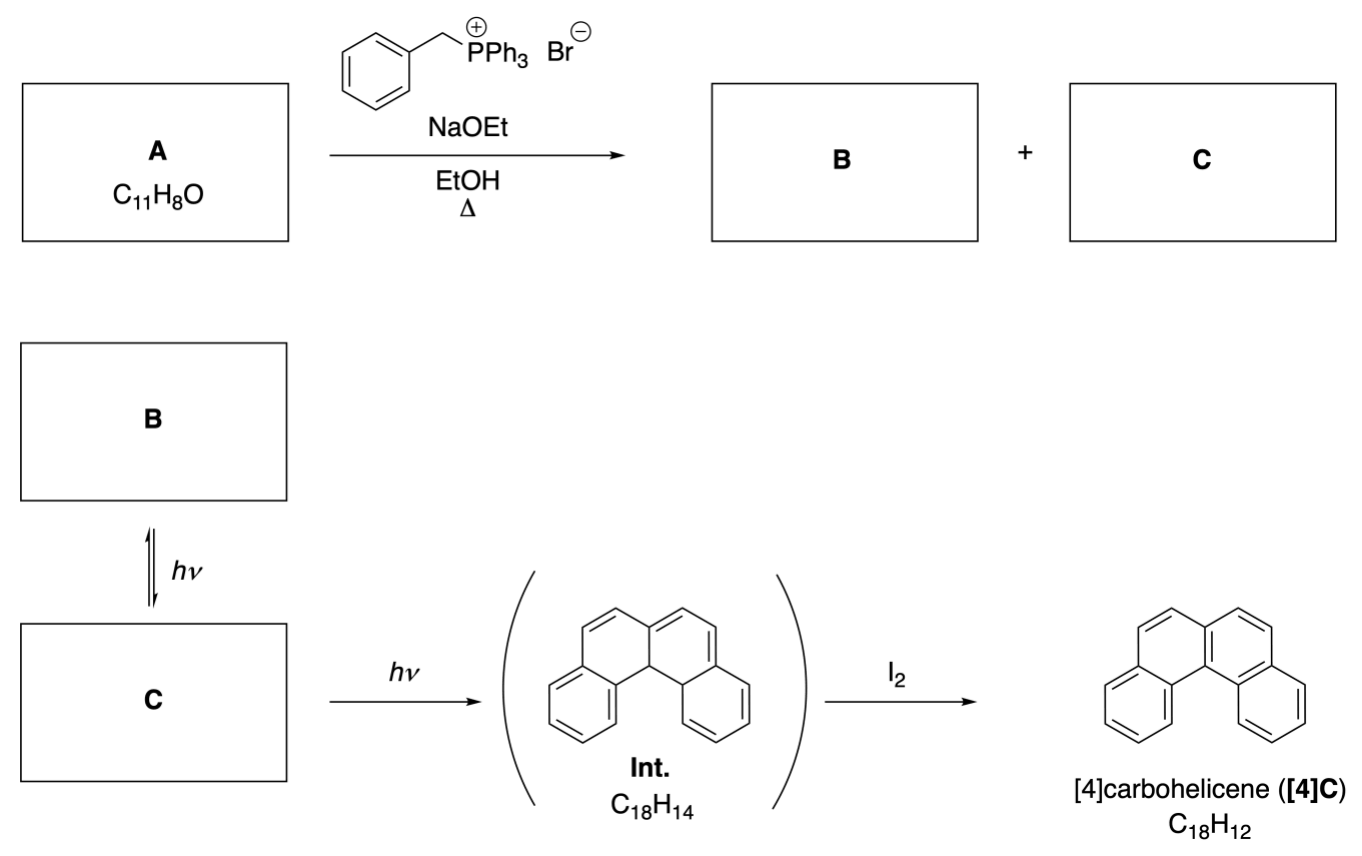
The photoreaction proceeds in a manner similar to the following example.

Note: For all of Question 8, please draw alternating single and double bonds in your answers to the problems as depicted in the examples of carbohelicene. Do not use circles for conjugated \(\pi\) systems.
8.1 Draw the structures of A–C. Stereoisomers should be distinguished.
8.2 Attempts to synthesize [5]carbohelicene from the same phosphonium salt and an appropriate starting compound resulted in the formation of only a trace amount of [5]carbohelicene, instead affording product D whose molecular weight was 2 Da lower than that of [5]carbohelicene. The \({}^{1}\mathrm H\) NMR chemical shifts of D are listed below. Draw the structure of D. [D (\(\delta\), ppm in \(\ce{CS2}\), r.t.), 8.85 (2H), 8.23 (2H), 8.07 (2H), 8.01 (2H), 7.97 (2H), 7.91 (2H)]
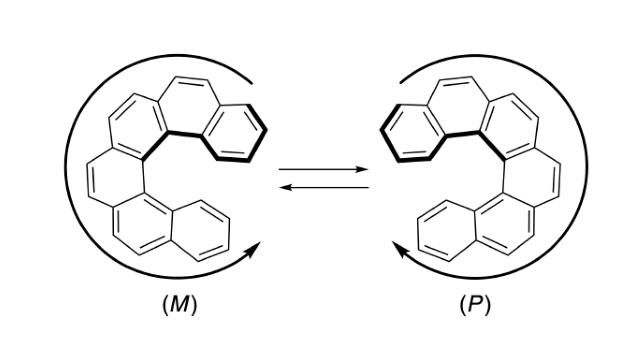
[5]- and larger [n]carbohelicenes have helical chirality and interconversion between enantiomers of these helicenes is significantly slow at room temperature. The chirality of [n]carbohelicenes is defined as \((M)\) or \((P)\) as shown below.
[n]Carbohelicenes with n larger than 4 can be enantiomerically separated by a chiral column chromatography, which was developed by Prof. Yoshio Okamoto.
Photo courtesy: The Japan Prize Foundation
Multiple helicenes are molecules that contain two or more helicene-like structures. If its helical chirality is considered, several stereoisomers exist in a multiple helicene. For example, compound E contains three [5]carbohelicene-like moieties in one molecule. One of the stereoisomers is described as \((P,P,P)\) as shown below.
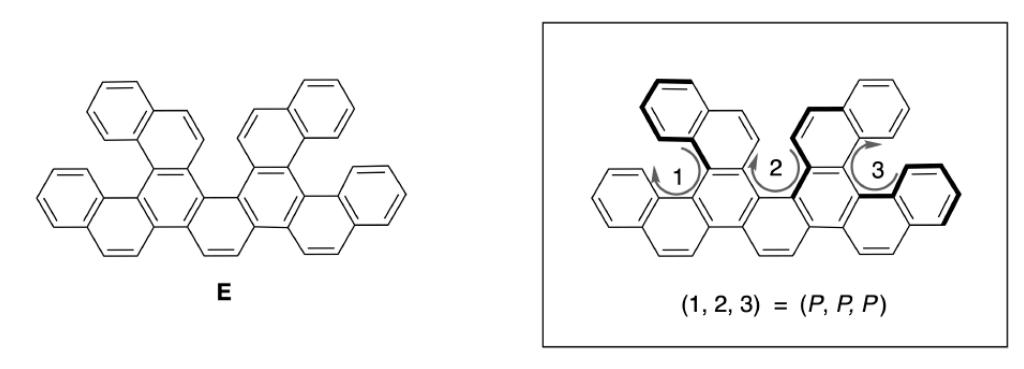
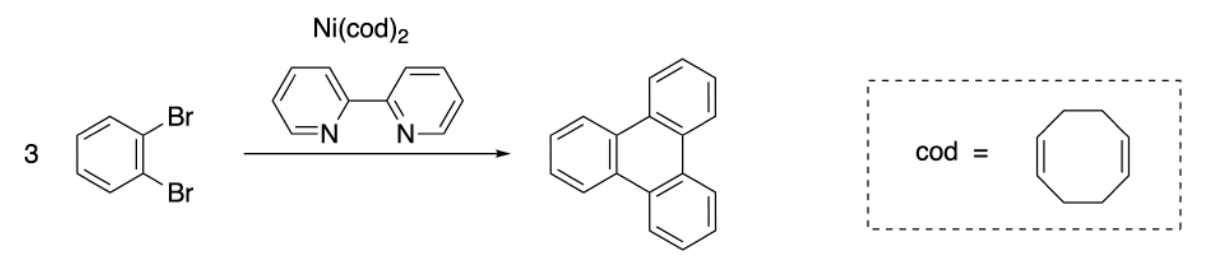
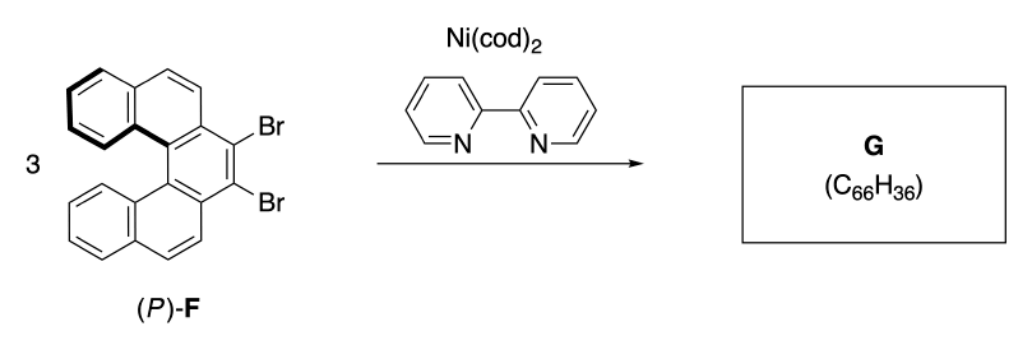
8.3 The nickel-mediated trimerization of 1,2-dibromobenzene generates triphenylene. When the same reaction is applied to an enantiomer of F, \((P)\)-F, multiple helicene G (\(\ce{C66H36}\)) is obtained. Given that interconversion between stereoisomers does not occur during the reaction, identify all the possible stereoisomers of G formed in this process, without duplication. As a reference, one isomer should be drawn completely with the chirality defined as in the example above, with numerical labels; the other stereoisomers should be listed with location numbers and \(M\) and \(P\) labels according to the same numbering. For instance, the other stereoisomers of E should be listed as \((1,2,3)=(P,M,P)\), \((P,M,M)\), \((P,P,M)\), \((M,M,M)\), \((M,M,P)\), \((M,P,P)\), and \((M,P,M)\).
PART B
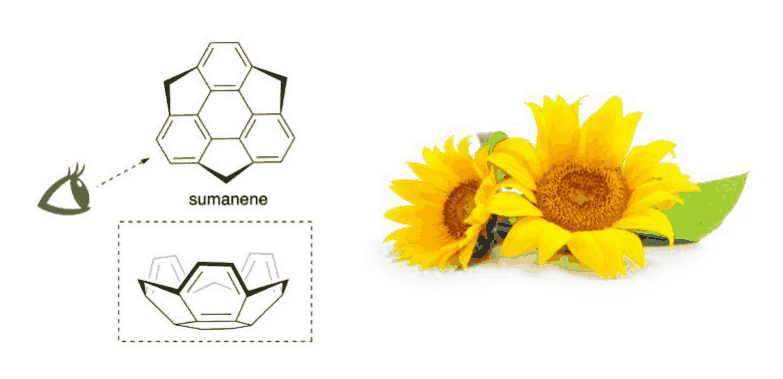
Sumanene is a bowl-shaped hydrocarbon that was first reported in Japan in 2003. The name "sumanene" derives from a Sanskrit-Hindi word "suman" that means sunflower. The synthesis of sumanene was achieved by a reaction sequence that consists of a ring-opening and a ring-closing metathesis.
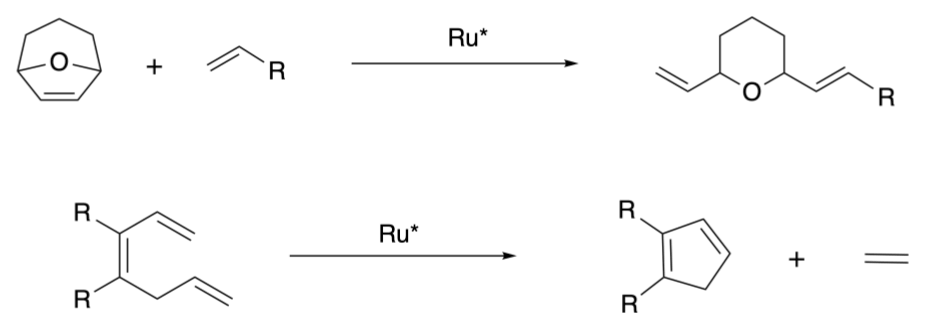
Representative metathesis reactions catalyzed by a ruthenium catalyst (\(\mathrm{Ru^*}\)) are shown below.
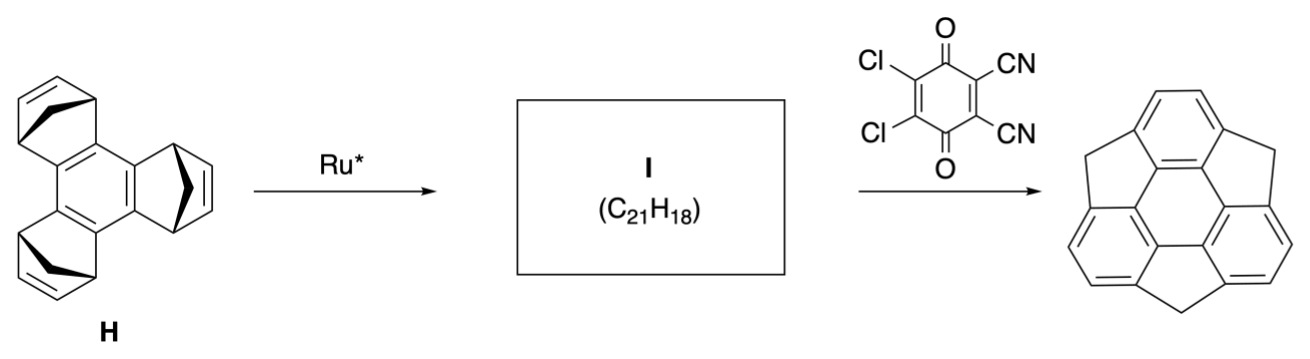
8.4 Draw the structure of intermediate I (its stereochemistry is not required).
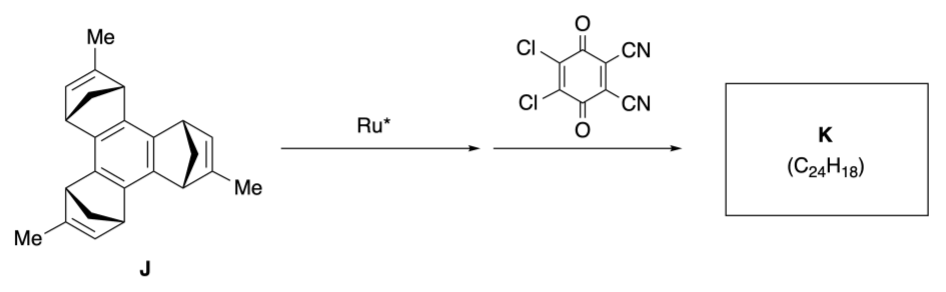
8.5 Starting from the optically active precursor J, the same reaction sequence gives the optically active sumanene derivative K. The stereocenters in J suffer no inversion during the metathesis reaction. Draw the structure of K with the appropriate stereochemistry.
Official English text of the problem.
Answers
All SMILES below use explicit Kekulé single and double bonds. Ordinary SMILES does not encode helicene handedness or bowl chirality; the accompanying spatial descriptions specify those configurations.
- 8.1
A: Naphthalene-2-carbaldehyde, O=CC1=CC2=CC=CC=C2C=C1.
B: \((E)\)-2-Styrylnaphthalene, C1=CC=CC=C1/C=C/C1=CC2=CC=CC=C2C=C1.
C: \((Z)\)-2-Styrylnaphthalene, C1=CC=CC=C1/C=C\C1=CC2=CC=CC=C2C=C1.
-
8.2 D: Benzo[ghi]perylene, \(\ce{C22H12}\),
C1=CC2=CC=C3C=CC4=C5C6=C(C=CC=C6C(=C1)C2=C35)C=C4. -
8.3 G: A hexapole [5]carbohelicene, \(\ce{C66H36}\), with constitutional SMILES
C1=CC=C2C(=C1)C=CC1=C2C2=C3C=CC=CC3=CC=C2C2=C3C4=CC=C5C=CC=CC5=C4C4=C5C=CC=CC5=CC=C4C3=C3C4=CC=C5C=CC=CC5=C4C4=C5C=CC=CC5=CC=C4C3=C12.
Number its helicenes consecutively around the molecule, with 1, 3, 5 inherited from the three molecules of \((P)\)-F, and 2, 4, 6 newly formed between neighboring units. There are four distinct products: \[ \begin{aligned} (1,2,3,4,5,6)={}&(P,P,P,P,P,P),\\ &(P,P,P,P,P,M),\\ &(P,P,P,M,P,M),\\ &(P,M,P,M,P,M). \end{aligned} \]
- 8.4 I: Hexahydrosumanene, \(\ce{C21H18}\),
C1=CC2CC3C=CC4CC5C=CC6CC1C1=C2C3=C4C5=C16.
It has the sumanene carbon skeleton, a central benzene ring, three methylene bridges, six saturated ring-junction \(\ce{CH}\) groups, and one outer \(\ce{C=C}\) bond in each peripheral six-membered ring.
- 8.5 K: The specified bowl enantiomer of \(C_3\)-symmetric trimethylsumanene, \(\ce{C24H18}\), with constitutional SMILES
CC1=CC2=C3C4=C1CC1=C4C4=C(CC5=C4C3=C(C2)C(C)=C5)C(C)=C1.
Precise drawing: Look into the concave face of the bowl, with one peripheral benzene ring at the top. Put a methyl group on that ring’s upper-right outer carbon, and obtain the other two methyl positions by successive \(120^\circ\) rotations. The three methylene rim vertices project toward the viewer relative to the central benzene.
Solution
8.1 — Identifying the aldehyde and the two alkene geometries
The phosphonium salt and sodium ethoxide constitute a Wittig reaction system. They convert an aldehyde group into a phenyl-substituted alkene:
\[ \ce{C11H8O + [Ph3PCH2Ph]Br + NaOEt -> C18H14 + Ph3PO + NaBr + EtOH}. \]
The \(\ce{C18H14}\) product denotes the mixture of B and C, rather than two equivalents of product.
The species in this balance are benzyltriphenylphosphonium bromide, [Br-].[P+](CC1=CC=CC=C1)(C1=CC=CC=C1)(C1=CC=CC=C1)C1=CC=CC=C1; sodium ethoxide, [Na+].CC[O-]; triphenylphosphine oxide, O=P(C1=CC=CC=C1)(C1=CC=CC=C1)C1=CC=CC=C1; sodium bromide, [Na+].[Br-]; and ethanol, CCO.
Working backward from the illustrated four-ring product identifies the aromatic fragment as 2-naphthyl. The newly formed ring joins naphthalene C1 to an ortho carbon of the phenyl ring; the original vinyl substituent is therefore at naphthalene C2. Thus A is naphthalene-2-carbaldehyde.
The two Wittig products differ in alkene geometry:
- In B, the naphthyl and phenyl groups are opposite across the double bond: \(E\).
- In C, they are on the same side: \(Z\).
Light interconverts these geometries. The \(Z\) isomer can adopt the geometry needed for a six-electron electrocyclic closure. The photochemical closure is conrotatory and produces the illustrated dihydro intermediate without changing its formula:
\[ \ce{C18H14 ->[h\nu] C18H14}. \]
Here the reactant is C, and the product is dihydro[4]carbohelicene Int., with constitutional SMILES C1=CC2=CC=C3C=CC4=CC=CC=C4C3C2C=C1.
Oxidation removes the two hydrogens at the newly connected carbons and restores the aromatic system:
\[ \ce{C18H14 + I2 -> C18H12 + 2HI}. \]
Iodine is II; hydrogen iodide is [H]I. The product is [4]carbohelicene, also called benzo[c]phenanthrene, C1=CC=C2C(=C1)C=CC1=C2C2=CC=CC=C2C=C1.
8.2 — Identifying the additional oxidative cyclization product
An unmodified [n]carbohelicene has formula
\[ \ce{C_{4n+2}H_{2n+4}}. \]
Consequently, [5]carbohelicene—pentahelicene, C1=CC=C2C(=C1)C=CC1=C2C2=C(C=CC3=CC=CC=C32)C=C1—has formula \(\ce{C22H14}\).
A product lower in molecular mass by approximately \(2\ \mathrm{Da}\), with the same carbon skeleton, corresponds to loss of two hydrogen atoms:
\[ \ce{C22H14 -> C22H12}. \]
The hydrogen count is independently supported by the NMR integrations:
\[ 6\times 2\mathrm H=12\mathrm H. \]
The degrees of unsaturation are
\[ \operatorname{DBE}(\ce{C22H14}) =\frac{2(22)+2-14}{2}=16, \] \[ \operatorname{DBE}(\ce{C22H12}) =\frac{2(22)+2-12}{2}=17. \]
Thus one additional ring can form through a new carbon–carbon bond between the closely approaching terminal regions of the five-ring helicene, followed by oxidative loss of two hydrogens. This produces benzo[ghi]perylene D, a planar, six-ring aromatic hydrocarbon.
The formal iodine-mediated oxidative balance is
\[ \ce{C22H14 + I2 -> C22H12 + 2HI}. \]
Drawing description: Begin with [5]carbohelicene and connect the two inward-facing terminal carbons that close its remaining central six-membered bay. Remove their hydrogens and draw a valid Kekulé pattern.
The resulting structure has six symmetry-related pairs of proton-bearing carbons, consistent with the six reported resonances, each integrating to two hydrogens. Individual assignment of the six chemical shifts is unnecessary for identifying D.
8.3 — Constructing G and removing duplicate stereoisomers
The nickel-mediated reaction joins the six bromine-bearing carbon atoms of three starting molecules into a central benzene ring. A formal balance, omitting the ligands, is
\[ \ce{3C22H12Br2 + 3Ni -> C66H36 + 3NiBr2}. \]
Nickel(0) is [Ni]; nickel(II) bromide is [Ni+2].[Br-].[Br-].
The starting compound is the depicted dibromo[5]carbohelicene F, with constitutional SMILES BrC1=C(Br)C2=C(C3=CC=CC=C3C=C2)C2=C1C=CC1=CC=CC=C12; its helicity is explicitly \(P\).
The construction parallels formation of triphenylene, C1=CC=C2C(=C1)C1=CC=CC=C1C1=CC=CC=C21, but each of its three outer fused rings now carries the remaining four rings of a starting helicene.
Complete reference-structure description: Draw a central benzene ring. Fuse the middle ring of each of three [5]carbohelicene units to alternate edges of this central ring, using the former bromine-bearing edge of each unit. This gives the connectivity specified by the SMILES for G. The product contains six [5]helicene substructures.
Call the three starting units \(X_1,X_2,X_3\), in clockwise order, and number the helicenes as follows:
| Label | Helical substructure |
|---|---|
| 1 | Original helicene within \(X_1\) |
| 2 | Newly formed helicene between \(X_1\) and \(X_2\) |
| 3 | Original helicene within \(X_2\) |
| 4 | Newly formed helicene between \(X_2\) and \(X_3\) |
| 5 | Original helicene within \(X_3\) |
| 6 | Newly formed helicene between \(X_3\) and \(X_1\) |
For the reference drawing, mark all six helicenes \(P\): each is a right-handed helix.
Because inversion does not occur, helicenes 1, 3, 5 remain \(P\). Each of the three new helicenes may be \(P\) or \(M\), giving \(2^3=8\) labeled possibilities.
However, cyclic rotation of the three identical starting units makes several labeled assignments equivalent. The distinct classes contain:
- No new \(M\) helices.
- One new \(M\) helix.
- Two new \(M\) helices.
- Three new \(M\) helices.
Equivalently, counting configurations under the threefold rotation gives
\[ N=\frac{8+2+2}{3}=\boxed{4}. \]
These are exactly the four configurations listed in Answers.
8.4 — Following the metathesis rearrangement
The ruthenium-catalyzed sequence changes connectivity while conserving the molecular formula:
\[ \underbrace{\ce{C21H18}}_{\mathrm H} \xrightarrow{\mathrm{Ru^*}} \underbrace{\ce{C21H18}}_{\mathrm I}. \]
Each original bicyclic unit contains a methylene bridge and an outer alkene. Ring-opening metathesis breaks the original outer alkene connections; ring-closing metathesis reconnects neighboring units.
More explicitly, label the three original outer double bonds \(p_i=q_i\), with \(i=1,2,3\) in clockwise order. The rearrangement replaces them with \(q_i=p_{i+1}\), taking indices modulo three. The three methylene bridges are retained and become the methylene vertices of the three five-membered rings.
This produces hexahydrosumanene I.
Drawing description: Start with the sumanene skeleton shown in the question. Keep the central benzene ring and all three methylene vertices. In each peripheral six-membered ring:
- Make its two junction carbons adjoining the neighboring pentagons saturated \(\ce{CH}\) groups.
- Retain a double bond between its two outer, nonfused carbon atoms.
A Kekulé drawing can therefore show each peripheral six-membered ring as a substituted cyclohexa-1,4-diene unit.
The hydrogen count verifies the proposed intermediate:
\[ 3(\ce{CH2})+6(\text{saturated }\ce{CH}) +6(\text{alkenic }\ce{CH}) \quad\Rightarrow\quad \ce{C21H18}, \]
including the six hydrogen-free carbons of the central benzene ring.
The oxidant is DDQ, 2,3-dichloro-5,6-dicyano-1,4-benzoquinone, N#CC1=C(C#N)C(=O)C(Cl)=C(Cl)C1=O. Each molecule accepts two hydrogen atoms. Aromatization of all three peripheral rings therefore requires three equivalents:
\[ \ce{C21H18 + 3C8Cl2N2O2 -> C21H12 + 3C8H2Cl2N2O2}. \]
The hydrocarbon product is sumanene, C1=CC2=C3C4=C1CC1=C4C4=C(C=C1)CC1=C4C3=C(C=C1)C2.
The reduced oxidant is 2,3-dichloro-5,6-dicyanobenzene-1,4-diol, N#CC1=C(C#N)C(O)=C(Cl)C(Cl)=C1O.
8.5 — Tracking the methyl groups and bowl handedness
In J, each methyl group is attached to an outer alkene carbon. Consequently, the methyl groups remain attached to carbons that become part of the three peripheral aromatic rings.
For an explicit stereochemical reference, the drawn trimethylated bridged precursor J has isomeric SMILES:
CC1=C[C@@H]2C[C@H]1C1=C2C2=C(C3=C1[C@@H]1C=C(C)[C@H]3C1)[C@@H]1C=C(C)[C@H]2C1.
The formula changes are
\[ \underbrace{\ce{C24H24}}_{\mathrm J} \xrightarrow{\mathrm{Ru^*}} \underbrace{\ce{C24H24}}_{\text{rearranged intermediate}}, \]
followed by
\[ \ce{C24H24 + 3C8Cl2N2O2 -> C24H18 + 3C8H2Cl2N2O2}. \]
The final formula also follows directly from replacing three aromatic hydrogens of sumanene by methyl groups:
\[ \ce{C21H12}+3(\ce{CH3}-\ce{H}) \quad\Rightarrow\quad \ce{C24H18}. \]
To determine the enantiomer, retain the configurations of all six original bridgeheads during the metathesis bond reconnections. In the upper bicyclic unit of the supplied drawing, the methyl-bearing alkene carbon is attached to the upper-right bridgehead. Tracking this carbon through the neighboring-ring closure gives the following equivalent projections of K:
- Viewed from the convex face: with one peripheral benzene at the top, its methyl is at the upper-left outer carbon.
- Viewed into the concave face: the same methyl is at the upper-right outer carbon.
The other two methyl groups follow by \(120^\circ\) rotations. This specifies the bowl enantiomer obtained from the drawn J.
Oxidation converts the six retained bridgehead stereocenters into trigonal aromatic carbons. The final chirality resides in the bowl together with its directional threefold methyl-substitution pattern; it is therefore specified by the spatial description rather than by tetrahedral @ symbols in the SMILES for K.
The answers were checked against the official answers published by the organisers.
IChO 2021 · Theorieaufgabe 8
Dynamische organische Moleküle und ihre Chiralität
TEIL A
Polycyclische aromatische Kohlenwasserstoffe mit aufeinanderfolgenden ortho-Verknüpfungen werden als [n]Carbohelicene bezeichnet (dabei steht n für die Anzahl der Sechsringe) (siehe unten). [4]Carbohelicen ([4]C) lässt sich effizient über einen Syntheseweg herstellen, der wie unten gezeigt eine Photoreaktion nutzt und über ein Zwischenprodukt (Int.) verläuft, das leicht durch Iod oxidiert wird.
Die Photoreaktion verläuft ähnlich wie im folgenden Beispiel.
Hinweis: Zeichnen Sie in Ihren Antworten zu allen Teilaufgaben von Aufgabe 8 alternierende Einfach- und Doppelbindungen, wie in den Beispielen für Carbohelicene dargestellt. Verwenden Sie keine Kreise für konjugierte \(\pi\)-Systeme.
8.1 Zeichnen Sie die Strukturen von A–C. Stereoisomere sind zu unterscheiden.
8.2 Versuche, [5]Carbohelicen aus demselben Phosphoniumsalz und einer geeigneten Ausgangsverbindung zu synthetisieren, führten nur zur Bildung von Spuren von [5]Carbohelicen. Stattdessen entstand das Produkt D, dessen Molekülmasse um 2 Da geringer war als die von [5]Carbohelicen. Die chemischen Verschiebungen im \({}^{1}\mathrm H\)-NMR-Spektrum von D sind unten aufgeführt. Zeichnen Sie die Struktur von D. [D (\(\delta\), ppm in \(\ce{CS2}\), Raumtemp.), 8.85 (2H), 8.23 (2H), 8.07 (2H), 8.01 (2H), 7.97 (2H), 7.91 (2H)]
[5]Carbohelicen und größere [n]Carbohelicene weisen helicale Chiralität auf, und die Umwandlung zwischen den Enantiomeren dieser Helicene verläuft bei Raumtemperatur sehr langsam. Die Chiralität von [n]Carbohelicenen wird wie unten gezeigt als \((M)\) oder \((P)\) bezeichnet.
Die Enantiomere von [n]Carbohelicenen mit n größer als 4 können durch chirale Säulenchromatographie getrennt werden, die von Prof. Yoshio Okamoto entwickelt wurde.
Foto mit freundlicher Genehmigung von: The Japan Prize Foundation
Mehrfachhelicene sind Moleküle, die zwei oder mehr helicenartige Strukturen enthalten. Unter Berücksichtigung ihrer helicalen Chiralität existieren bei einem Mehrfachhelicen mehrere Stereoisomere. Beispielsweise enthält die Verbindung E drei [5]Carbohelicen-artige Struktureinheiten in einem Molekül. Eines der Stereoisomere wird wie unten gezeigt als \((P,P,P)\) beschrieben.
8.3 Die nickelvermittelte Trimerisierung von 1,2-Dibrombenzol ergibt Triphenylen. Wird dieselbe Reaktion auf ein Enantiomer von F, \((P)\)-F, angewendet, erhält man das Mehrfachhelicen G (\(\ce{C66H36}\)). Bestimmen Sie unter der Voraussetzung, dass während der Reaktion keine Umwandlung zwischen Stereoisomeren stattfindet, alle möglichen Stereoisomere von G, die bei diesem Prozess entstehen, ohne Doppelungen. Zeichnen Sie als Referenz ein Isomer vollständig, wobei die Chiralität wie im obigen Beispiel definiert und mit Zahlen gekennzeichnet werden soll; die anderen Stereoisomere sind anhand derselben Nummerierung mit Positionsnummern und den Bezeichnungen \(M\) und \(P\) aufzulisten. Beispielsweise sind die anderen Stereoisomere von E als \((1,2,3)=(P,M,P)\), \((P,M,M)\), \((P,P,M)\), \((M,M,M)\), \((M,M,P)\), \((M,P,P)\) und \((M,P,M)\) aufzulisten.
TEIL B
Sumanen ist ein schüsselförmiger Kohlenwasserstoff, über den erstmals 2003 in Japan berichtet wurde. Der Name „Sumanen“ leitet sich vom Sanskrit-Hindi-Wort „suman“ ab, das Sonnenblume bedeutet. Die Synthese von Sumanen gelang durch eine Reaktionsfolge, die aus einer Ringöffnungs- und einer Ringschlussmetathese besteht.
Typische Metathesereaktionen, die durch einen Rutheniumkatalysator (\(\mathrm{Ru^*}\)) katalysiert werden, sind unten gezeigt.
8.4 Zeichnen Sie die Struktur des Zwischenprodukts I (seine Stereochemie ist nicht erforderlich).
8.5 Ausgehend von der optisch aktiven Vorstufe J ergibt dieselbe Reaktionsfolge das optisch aktive Sumanenderivat K. Die Stereozentren in J erfahren während der Metathesereaktion keine Inversion. Zeichnen Sie die Struktur von K mit der entsprechenden Stereochemie.
Aufgabentext aus dem offiziellen englischen Text übersetzt.
Antworten
Alle nachstehenden SMILES verwenden explizite Einfach- und Doppelbindungen in Kekulé-Darstellung. Gewöhnliche SMILES codieren weder die Händigkeit von Helicenen noch die Schüsselchiralität; die begleitenden räumlichen Beschreibungen legen diese Konfigurationen fest.
- 8.1
A: Naphthalin-2-carbaldehyd, O=CC1=CC2=CC=CC=C2C=C1.
B: \((E)\)-2-Styrylnaphthalin, C1=CC=CC=C1/C=C/C1=CC2=CC=CC=C2C=C1.
C: \((Z)\)-2-Styrylnaphthalin, C1=CC=CC=C1/C=C\C1=CC2=CC=CC=C2C=C1.
-
8.2 D: Benzo[ghi]perylen, \(\ce{C22H12}\),
C1=CC2=CC=C3C=CC4=C5C6=C(C=CC=C6C(=C1)C2=C35)C=C4. -
8.3 G: Ein hexapolares [5]Carbohelicen, \(\ce{C66H36}\), mit dem Konstitutions-SMILES
C1=CC=C2C(=C1)C=CC1=C2C2=C3C=CC=CC3=CC=C2C2=C3C4=CC=C5C=CC=CC5=C4C4=C5C=CC=CC5=CC=C4C3=C3C4=CC=C5C=CC=CC5=C4C4=C5C=CC=CC5=CC=C4C3=C12.
Nummerieren Sie seine Helicene fortlaufend um das Molekül herum, wobei 1, 3, 5 aus den drei Molekülen von \((P)\)-F übernommen werden und 2, 4, 6 zwischen benachbarten Einheiten neu entstehen. Es gibt vier verschiedene Produkte: \[ \begin{aligned} (1,2,3,4,5,6)={}&(P,P,P,P,P,P),\\ &(P,P,P,P,P,M),\\ &(P,P,P,M,P,M),\\ &(P,M,P,M,P,M). \end{aligned} \]
- 8.4 I: Hexahydrosumanen, \(\ce{C21H18}\),
C1=CC2CC3C=CC4CC5C=CC6CC1C1=C2C3=C4C5=C16.
Es besitzt das Kohlenstoffgerüst von Sumanen, einen zentralen Benzolring, drei Methylenbrücken, sechs gesättigte \(\ce{CH}\)-Gruppen an den Ringverknüpfungsstellen und eine äußere \(\ce{C=C}\)-Bindung in jedem peripheren Sechsring.
- 8.5 K: Das angegebene Schüsselenantiomer von \(C_3\)-symmetrischem Trimethylsumanen, \(\ce{C24H18}\), mit dem Konstitutions-SMILES
CC1=CC2=C3C4=C1CC1=C4C4=C(CC5=C4C3=C(C2)C(C)=C5)C(C)=C1.
Präzise Zeichenanleitung: Blicken Sie auf die konkave Seite der Schüssel, wobei sich ein peripherer Benzolring oben befindet. Setzen Sie eine Methylgruppe an das obere rechte äußere Kohlenstoffatom dieses Rings und erhalten Sie die beiden anderen Methylpositionen durch aufeinanderfolgende Drehungen um \(120^\circ\). Die drei Methylen-Eckpunkte am Rand ragen relativ zum zentralen Benzolring zum Betrachter hin.
Lösung
8.1 — Bestimmung des Aldehyds und der beiden Alkengeometrien
Das Phosphoniumsalz und Natriumethanolat bilden ein Wittig-Reaktionssystem. Sie wandeln eine Aldehydgruppe in ein phenylsubstituiertes Alken um:
\[ \ce{C11H8O + [Ph3PCH2Ph]Br + NaOEt -> C18H14 + Ph3PO + NaBr + EtOH}. \]
Das Produkt \(\ce{C18H14}\) bezeichnet das Gemisch aus B und C, nicht zwei Äquivalente des Produkts.
Die Spezies in dieser Bilanz sind Benzyltriphenylphosphoniumbromid, [Br-].[P+](CC1=CC=CC=C1)(C1=CC=CC=C1)(C1=CC=CC=C1)C1=CC=CC=C1; Natriumethanolat, [Na+].CC[O-]; Triphenylphosphinoxid, O=P(C1=CC=CC=C1)(C1=CC=CC=C1)C1=CC=CC=C1; Natriumbromid, [Na+].[Br-]; und Ethanol, CCO.
Ausgehend vom abgebildeten Vierringprodukt lässt sich durch Rückwärtsbetrachtung das aromatische Fragment als 2-Naphthyl identifizieren. Der neu gebildete Ring verbindet C1 des Naphthalins mit einem ortho-Kohlenstoffatom des Phenylrings; der ursprüngliche Vinylsubstituent sitzt daher an C2 des Naphthalins. Somit ist A Naphthalin-2-carbaldehyd.
Die beiden Wittig-Produkte unterscheiden sich in der Alkengeometrie:
- In B liegen die Naphthyl- und Phenylgruppen auf entgegengesetzten Seiten der Doppelbindung: \(E\).
- In C liegen sie auf derselben Seite: \(Z\).
Licht bewirkt die gegenseitige Umwandlung dieser Geometrien. Das \(Z\)-Isomer kann die für einen elektrocyclischen Ringschluss mit sechs Elektronen erforderliche Geometrie einnehmen. Der photochemische Ringschluss verläuft konrotatorisch und erzeugt das abgebildete Dihydrozwischenprodukt, ohne dessen Summenformel zu ändern:
\[ \ce{C18H14 ->[h\nu] C18H14}. \]
Hier ist das Edukt C und das Produkt Dihydro[4]carbohelicen Int. mit dem Konstitutions-SMILES C1=CC2=CC=C3C=CC4=CC=CC=C4C3C2C=C1.
Durch Oxidation werden die beiden Wasserstoffatome an den neu verknüpften Kohlenstoffatomen entfernt und das aromatische System wiederhergestellt:
\[ \ce{C18H14 + I2 -> C18H12 + 2HI}. \]
Iod ist II; Iodwasserstoff ist [H]I. Das Produkt ist [4]Carbohelicen, auch Benzo[c]phenanthren genannt, C1=CC=C2C(=C1)C=CC1=C2C2=CC=CC=C2C=C1.
8.2 — Bestimmung des Produkts der zusätzlichen oxidativen Cyclisierung
Ein unmodifiziertes [n]Carbohelicen hat die Summenformel
\[ \ce{C_{4n+2}H_{2n+4}}. \]
Folglich hat [5]Carbohelicen — Pentahelicen, C1=CC=C2C(=C1)C=CC1=C2C2=C(C=CC3=CC=CC=C32)C=C1 — die Summenformel \(\ce{C22H14}\).
Ein Produkt mit einer um etwa \(2\ \mathrm{Da}\) geringeren Molekülmasse und demselben Kohlenstoffgerüst entspricht dem Verlust zweier Wasserstoffatome:
\[ \ce{C22H14 -> C22H12}. \]
Die Anzahl der Wasserstoffatome wird unabhängig davon durch die NMR-Integrale gestützt:
\[ 6\times 2\mathrm H=12\mathrm H. \]
Die Doppelbindungsäquivalente betragen
\[ \operatorname{DBE}(\ce{C22H14}) =\frac{2(22)+2-14}{2}=16, \] \[ \operatorname{DBE}(\ce{C22H12}) =\frac{2(22)+2-12}{2}=17. \]
Somit kann durch eine neue Kohlenstoff–Kohlenstoff-Bindung zwischen den räumlich eng benachbarten Endbereichen des Fünfringhelicens ein zusätzlicher Ring entstehen, gefolgt vom oxidativen Verlust zweier Wasserstoffatome. Dadurch entsteht Benzo[ghi]perylen D, ein planarer aromatischer Kohlenwasserstoff mit sechs Ringen.
Die formale Bilanz der iodvermittelten Oxidation lautet
\[ \ce{C22H14 + I2 -> C22H12 + 2HI}. \]
Zeichenanleitung: Beginnen Sie mit [5]Carbohelicen und verbinden Sie die beiden nach innen gerichteten endständigen Kohlenstoffatome, durch deren Verknüpfung die verbleibende zentrale Bucht zu einem Sechsring geschlossen wird. Entfernen Sie deren Wasserstoffatome und zeichnen Sie ein gültiges Kekulé-Bindungsmuster.
Die resultierende Struktur besitzt sechs Paare symmetrieäquivalenter protonentragender Kohlenstoffatome, im Einklang mit den sechs angegebenen Resonanzen, deren Integrale jeweils zwei Wasserstoffatomen entsprechen. Eine individuelle Zuordnung der sechs chemischen Verschiebungen ist zur Identifizierung von D nicht erforderlich.
8.3 — Konstruktion von G und Ausschluss doppelter Stereoisomere
Die nickelvermittelte Reaktion verknüpft die sechs bromtragenden Kohlenstoffatome dreier Ausgangsmoleküle zu einem zentralen Benzolring. Eine formale Bilanz unter Weglassung der Liganden lautet
\[ \ce{3C22H12Br2 + 3Ni -> C66H36 + 3NiBr2}. \]
Nickel(0) ist [Ni]; Nickel(II)-bromid ist [Ni+2].[Br-].[Br-].
Die Ausgangsverbindung ist das abgebildete Dibrom[5]carbohelicen F mit dem Konstitutions-SMILES BrC1=C(Br)C2=C(C3=CC=CC=C3C=C2)C2=C1C=CC1=CC=CC=C12; seine Helicität ist ausdrücklich \(P\).
Der Aufbau erfolgt analog zur Bildung von Triphenylen, C1=CC=C2C(=C1)C1=CC=CC=C1C1=CC=CC=C21, doch jeder seiner drei äußeren anellierten Ringe trägt nun die verbleibenden vier Ringe eines Ausgangshelicens.
Vollständige Beschreibung der Referenzstruktur: Zeichnen Sie einen zentralen Benzolring. Anellieren Sie den mittleren Ring jeder der drei [5]Carbohelicen-Einheiten an jede zweite Kante dieses zentralen Rings, wobei Sie jeweils die ehemals bromtragende Kante der Einheit verwenden. Dadurch ergibt sich die durch den SMILES für G angegebene Konnektivität. Das Produkt enthält sechs [5]Helicen-Teilstrukturen.
Bezeichnen Sie die drei Ausgangseinheiten im Uhrzeigersinn als \(X_1,X_2,X_3\) und nummerieren Sie die Helicene wie folgt:
| Kennzeichnung | Helicale Teilstruktur |
|---|---|
| 1 | Ursprüngliches Helicen innerhalb von \(X_1\) |
| 2 | Neu gebildetes Helicen zwischen \(X_1\) und \(X_2\) |
| 3 | Ursprüngliches Helicen innerhalb von \(X_2\) |
| 4 | Neu gebildetes Helicen zwischen \(X_2\) und \(X_3\) |
| 5 | Ursprüngliches Helicen innerhalb von \(X_3\) |
| 6 | Neu gebildetes Helicen zwischen \(X_3\) und \(X_1\) |
Kennzeichnen Sie in der Referenzzeichnung alle sechs Helicene mit \(P\): Jedes ist eine rechtshändige Helix.
Da keine Inversion stattfindet, bleiben die Helicene 1, 3, 5 \(P\). Jedes der drei neuen Helicene kann \(P\) oder \(M\) sein, sodass sich \(2^3=8\) Möglichkeiten mit fester Nummerierung ergeben.
Durch zyklische Rotation der drei identischen Ausgangseinheiten werden jedoch mehrere Zuordnungen bei fester Nummerierung äquivalent. Die verschiedenen Klassen enthalten:
- Keine neue \(M\)-Helix.
- Eine neue \(M\)-Helix.
- Zwei neue \(M\)-Helices.
- Drei neue \(M\)-Helices.
Gleichwertig ergibt die Zählung der Konfigurationen unter Berücksichtigung der dreizähligen Rotation
\[ N=\frac{8+2+2}{3}=\boxed{4}. \]
Dies sind genau die vier unter Antworten aufgeführten Konfigurationen.
8.4 — Nachvollziehen der Metatheseumlagerung
Die rutheniumkatalysierte Reaktionsfolge verändert die Konnektivität unter Erhaltung der Summenformel:
\[ \underbrace{\ce{C21H18}}_{\mathrm H} \xrightarrow{\mathrm{Ru^*}} \underbrace{\ce{C21H18}}_{\mathrm I}. \]
Jede ursprüngliche bicyclische Einheit enthält eine Methylenbrücke und eine äußere Alkendoppelbindung. Die Ringöffnungsmetathese spaltet die ursprünglichen äußeren Alkenverknüpfungen; die Ringschlussmetathese verknüpft benachbarte Einheiten neu.
Genauer gesagt werden die drei ursprünglichen äußeren Doppelbindungen mit \(p_i=q_i\) bezeichnet, wobei \(i=1,2,3\) im Uhrzeigersinn verläuft. Die Umlagerung ersetzt sie durch \(q_i=p_{i+1}\), wobei die Indizes modulo drei genommen werden. Die drei Methylenbrücken bleiben erhalten und werden zu den Methylen-Eckpunkten der drei Fünfringe.
Dadurch entsteht Hexahydrosumanen I.
Zeichenanleitung: Beginnen Sie mit dem in der Aufgabe gezeigten Sumanengerüst. Behalten Sie den zentralen Benzolring und alle drei Methylen-Eckpunkte bei. In jedem peripheren Sechsring:
- Stellen Sie die beiden an die benachbarten Fünfringe angrenzenden Verknüpfungskohlenstoffatome als gesättigte \(\ce{CH}\)-Gruppen dar.
- Behalten Sie eine Doppelbindung zwischen den beiden äußeren, nicht anellierten Kohlenstoffatomen bei.
Eine Kekulé-Zeichnung kann daher jeden peripheren Sechsring als substituierte Cyclohexa-1,4-dien-Einheit darstellen.
Die Anzahl der Wasserstoffatome bestätigt das vorgeschlagene Zwischenprodukt:
\[ 3(\ce{CH2})+6(\text{gesättigte }\ce{CH}) +6(\text{alkenische }\ce{CH}) \quad\Rightarrow\quad \ce{C21H18}, \]
unter Einbeziehung der sechs wasserstofffreien Kohlenstoffatome des zentralen Benzolrings.
Das Oxidationsmittel ist DDQ, 2,3-Dichlor-5,6-dicyano-1,4-benzochinon, N#CC1=C(C#N)C(=O)C(Cl)=C(Cl)C1=O. Jedes Molekül nimmt zwei Wasserstoffatome auf. Die Aromatisierung aller drei peripheren Ringe erfordert daher drei Äquivalente:
\[ \ce{C21H18 + 3C8Cl2N2O2 -> C21H12 + 3C8H2Cl2N2O2}. \]
Das Kohlenwasserstoffprodukt ist Sumanen, C1=CC2=C3C4=C1CC1=C4C4=C(C=C1)CC1=C4C3=C(C=C1)C2.
Das reduzierte Oxidationsmittel ist 2,3-Dichlor-5,6-dicyanbenzol-1,4-diol, N#CC1=C(C#N)C(O)=C(Cl)C(Cl)=C1O.
8.5 — Nachverfolgung der Methylgruppen und der Händigkeit der Schüssel
In J ist jede Methylgruppe an ein äußeres Alkenkohlenstoffatom gebunden. Folglich bleiben die Methylgruppen an Kohlenstoffatome gebunden, die Teil der drei peripheren aromatischen Ringe werden.
Als explizite stereochemische Referenz besitzt die gezeichnete trimethylierte verbrückte Vorstufe J den isomeren SMILES:
CC1=C[C@@H]2C[C@H]1C1=C2C2=C(C3=C1[C@@H]1C=C(C)[C@H]3C1)[C@@H]1C=C(C)[C@H]2C1.
Die Änderungen der Summenformel lauten
\[ \underbrace{\ce{C24H24}}_{\mathrm J} \xrightarrow{\mathrm{Ru^*}} \underbrace{\ce{C24H24}}_{\text{umgelagertes Zwischenprodukt}}, \]
gefolgt von
\[ \ce{C24H24 + 3C8Cl2N2O2 -> C24H18 + 3C8H2Cl2N2O2}. \]
Die endgültige Summenformel ergibt sich auch unmittelbar aus dem Ersatz dreier aromatischer Wasserstoffatome des Sumanens durch Methylgruppen:
\[ \ce{C21H12}+3(\ce{CH3}-\ce{H}) \quad\Rightarrow\quad \ce{C24H18}. \]
Um das Enantiomer zu bestimmen, behalten Sie die Konfigurationen aller sechs ursprünglichen Brückenköpfe während der Neuverknüpfung der Bindungen durch die Metathese bei. In der oberen bicyclischen Einheit der vorgegebenen Zeichnung ist das methyltragende Alkenkohlenstoffatom an den oberen rechten Brückenkopf gebunden. Verfolgt man dieses Kohlenstoffatom durch den Ringschluss mit der benachbarten Einheit, erhält man die folgenden äquivalenten Projektionen von K:
- Von der konvexen Seite aus betrachtet: Befindet sich ein peripherer Benzolring oben, sitzt seine Methylgruppe am oberen linken äußeren Kohlenstoffatom.
- Bei Blick auf die konkave Seite: Dieselbe Methylgruppe sitzt am oberen rechten äußeren Kohlenstoffatom.
Die beiden anderen Methylgruppen ergeben sich durch Drehungen um \(120^\circ\). Damit ist das aus dem gezeichneten J erhaltene Schüsselenantiomer festgelegt.
Die Oxidation wandelt die sechs erhalten gebliebenen Brückenkopf-Stereozentren in trigonale aromatische Kohlenstoffatome um. Die endgültige Chiralität beruht auf der Schüssel zusammen mit ihrem gerichteten dreizähligen Methylsubstitutionsmuster; sie wird daher durch die räumliche Beschreibung und nicht durch tetraedrische @-Symbole im SMILES für K angegeben.
Die Ergebnisse wurden mit den von den Veranstaltern veröffentlichten offiziellen Ergebnissen abgeglichen.
IChO 2021 · Teori sorusu 8
Dinamik Organik Moleküller ve Kiraliteleri
BÖLÜM A
Ardışık orto bağlantılara sahip polisiklik aromatik hidrokarbonlara [n]karbohelisenler denir (burada n, altı üyeli halkaların sayısını belirtir) (aşağıya bakınız). [4]Karbohelisen ([4]C), aşağıda gösterildiği gibi bir fototepkimenin kullanıldığı bir yolla, iyot tarafından kolayca yükseltgenen bir ara ürün (Int.) üzerinden verimli bir şekilde hazırlanır.
Fototepkime, aşağıdaki örneğe benzer şekilde ilerler.
Not: Soru 8'in tamamında, lütfen cevaplarınızda karbohelisen örneklerinde gösterildiği gibi tek ve çift bağları dönüşümlü olarak çiziniz. Konjuge \(\pi\) sistemleri için çember kullanmayınız.
8.1 A–C'nin yapılarını çiziniz. Stereoizomerler birbirinden ayırt edilmelidir.
8.2 Aynı fosfonyum tuzundan ve uygun bir başlangıç bileşiğinden [5]karbohelisen sentezleme girişimleri sonucunda yalnızca eser miktarda [5]karbohelisen oluşmuş, bunun yerine molekül ağırlığı [5]karboheliseninkinden 2 Da daha düşük olan D ürünü elde edilmiştir. D'nin \({}^{1}\mathrm H\) NMR kimyasal kaymaları aşağıda verilmiştir. D'nin yapısını çiziniz. [D (\(\delta\), \(\ce{CS2}\) içinde ppm, oda sıcaklığı), 8.85 (2H), 8.23 (2H), 8.07 (2H), 8.01 (2H), 7.97 (2H), 7.91 (2H)]
[5]karbohelisen ve daha büyük [n]karbohelisenler helisel kiraliteye sahiptir ve bu helisenlerin enantiyomerleri arasındaki dönüşüm oda sıcaklığında oldukça yavaştır. [n]Karbohelisenlerin kiralitesi, aşağıda gösterildiği gibi \((M)\) veya \((P)\) olarak tanımlanır.
n değeri 4'ten büyük olan [n]karbohelisenler, Prof. Yoshio Okamoto tarafından geliştirilen kiral kolon kromatografisi ile enantiyomerlerine ayrılabilir.
Fotoğrafı sağlayan: The Japan Prize Foundation
Çoklu helisenler, iki veya daha fazla helisen benzeri yapı içeren moleküllerdir. Helisel kiralitesi dikkate alındığında, bir çoklu helisenin çeşitli stereoizomerleri vardır. Örneğin E bileşiği, tek bir molekülde [5]karbohelisen benzeri üç yapısal birim içerir. Stereoizomerlerden biri, aşağıda gösterildiği gibi \((P,P,P)\) olarak tanımlanır.
8.3 1,2-Dibromobenzenin nikel aracılı trimerleşmesi trifenilen oluşturur. Aynı tepkime F'nin bir enantiyomeri olan \((P)\)-F'ye uygulandığında, çoklu helisen G (\(\ce{C66H36}\)) elde edilir. Tepkime sırasında stereoizomerler arasında dönüşüm gerçekleşmediği verildiğine göre, bu süreçte oluşabilecek G stereoizomerlerinin tümünü, tekrar olmaksızın belirleyiniz. Referans olarak, bir izomerin yapısı, yukarıdaki örnekte olduğu gibi kiralitesi tanımlanarak ve sayısal etiketler kullanılarak eksiksiz çizilmelidir; diğer stereoizomerler aynı numaralandırmaya göre konum numaraları ve \(M\) ve \(P\) etiketleriyle listelenmelidir. Örneğin E'nin diğer stereoizomerleri \((1,2,3)=(P,M,P)\), \((P,M,M)\), \((P,P,M)\), \((M,M,M)\), \((M,M,P)\), \((M,P,P)\) ve \((M,P,M)\) olarak listelenmelidir.
BÖLÜM B
Sumanen, ilk kez 2003 yılında Japonya'da bildirilen, çanak biçiminde bir hidrokarbondur. "Sumanen" adı, ayçiçeği anlamına gelen Sanskritçe-Hintçe "suman" sözcüğünden türemiştir. Sumanenin sentezi, halka açılma ve halka kapanma metatezinden oluşan bir tepkime dizisiyle gerçekleştirilmiştir.
Bir rutenyum katalizörü (\(\mathrm{Ru^*}\)) tarafından katalizlenen tipik metatez tepkimeleri aşağıda gösterilmiştir.
8.4 I ara ürününün yapısını çiziniz (stereokimyasının gösterilmesi gerekli değildir).
8.5 Optikçe aktif öncül J'den başlandığında, aynı tepkime dizisi optikçe aktif sumanen türevi K'yi verir. J'deki stereomerkezler metatez tepkimesi sırasında inversiyona uğramaz. K'nin yapısını uygun stereokimyasıyla çiziniz.
Soru metni resmi İngilizce metinden çevrilmiştir.
Cevaplar
Aşağıdaki tüm SMILES gösterimlerinde Kekulé tek ve çift bağları açıkça belirtilmiştir. Standart SMILES gösterimi, helisenin sağ veya sol elliliğini ya da çanak kiralitesini kodlamaz; eşlik eden uzamsal açıklamalar bu konfigürasyonları belirtir.
- 8.1
A: Naftalen-2-karbaldehit, O=CC1=CC2=CC=CC=C2C=C1.
B: \((E)\)-2-Stirilnaftalen, C1=CC=CC=C1/C=C/C1=CC2=CC=CC=C2C=C1.
C: \((Z)\)-2-Stirilnaftalen, C1=CC=CC=C1/C=C\C1=CC2=CC=CC=C2C=C1.
-
8.2 D: Benzo[ghi]perilen, \(\ce{C22H12}\),
C1=CC2=CC=C3C=CC4=C5C6=C(C=CC=C6C(=C1)C2=C35)C=C4. -
8.3 G: Yapısal bağlantıları aşağıdaki SMILES gösterimiyle belirtilen bir heksapol [5]karbohelisen, \(\ce{C66H36}\):
C1=CC=C2C(=C1)C=CC1=C2C2=C3C=CC=CC3=CC=C2C2=C3C4=CC=C5C=CC=CC5=C4C4=C5C=CC=CC5=CC=C4C3=C3C4=CC=C5C=CC=CC5=C4C4=C5C=CC=CC5=CC=C4C3=C12.
Helisenlerini molekülün çevresinde ardışık olarak numaralandırınız; 1, 3, 5, üç \((P)\)-F molekülünden gelen helisenler, 2, 4, 6 ise komşu birimler arasında yeni oluşan helisenler olsun. Dört farklı ürün vardır: \[ \begin{aligned} (1,2,3,4,5,6)={}&(P,P,P,P,P,P),\\ &(P,P,P,P,P,M),\\ &(P,P,P,M,P,M),\\ &(P,M,P,M,P,M). \end{aligned} \]
- 8.4 I: Hekzahidrosumanen, \(\ce{C21H18}\),
C1=CC2CC3C=CC4CC5C=CC6CC1C1=C2C3=C4C5=C16.
Sumanenin karbon iskeletine, merkezî bir benzen halkasına, üç metilen köprüsüne, halka birleşme noktalarında altı doymuş \(\ce{CH}\) grubuna ve çevredeki altı üyeli halkaların her birinde bir dış \(\ce{C=C}\) bağına sahiptir.
- 8.5 K: \(C_3\) simetrili trimetilsumanenin belirtilen çanak enantiyomeri, \(\ce{C24H18}\); yapısal bağlantılarını belirten SMILES gösterimi:
CC1=CC2=C3C4=C1CC1=C4C4=C(CC5=C4C3=C(C2)C(C)=C5)C(C)=C1.
Kesin çizim tarifi: Çevredeki benzen halkalarından biri üstte olacak şekilde çanağın içbükey yüzüne bakınız. Bu halkanın sağ üst dış karbonuna bir metil grubu yerleştiriniz ve diğer iki metil konumunu ardışık \(120^\circ\) döndürmelerle elde ediniz. Kenardaki üç metilen köşesi, merkezî benzene göre gözlemciye doğru uzanır.
Çözüm
8.1 — Aldehidin ve iki alken geometrisinin belirlenmesi
Fosfonyum tuzu ve sodyum etoksit bir Wittig tepkime sistemi oluşturur. Bir aldehit grubunu fenil sübstitüentli bir alkene dönüştürürler:
\[ \ce{C11H8O + [Ph3PCH2Ph]Br + NaOEt -> C18H14 + Ph3PO + NaBr + EtOH}. \]
\(\ce{C18H14}\) ürünü, iki eşdeğer ürün yerine B ve C karışımını ifade eder.
Bu denkleştirilmiş tepkimedeki türler benziltrifenilfosfonyum bromür, [Br-].[P+](CC1=CC=CC=C1)(C1=CC=CC=C1)(C1=CC=CC=C1)C1=CC=CC=C1; sodyum etoksit, [Na+].CC[O-]; trifenilfosfin oksit, O=P(C1=CC=CC=C1)(C1=CC=CC=C1)C1=CC=CC=C1; sodyum bromür, [Na+].[Br-]; ve etanol, CCO'dür.
Gösterilen dört halkalı üründen geriye doğru gidildiğinde, aromatik parçanın 2-naftil olduğu belirlenir. Yeni oluşan halka, naftalenin C1 karbonunu fenil halkasının bir orto karbonuna bağlar; dolayısıyla başlangıçtaki vinil sübstitüenti naftalenin C2 konumundadır. Buna göre A, naftalen-2-karbaldehittir.
İki Wittig ürünü alken geometrileri bakımından farklıdır:
- B'de naftil ve fenil grupları çift bağın karşı taraflarındadır: \(E\).
- C'de aynı taraftadırlar: \(Z\).
Işık, bu geometrileri birbirine dönüştürür. \(Z\) izomeri, altı elektronlu bir elektrosiklik kapanma için gerekli geometriyi alabilir. Fotokimyasal kapanma konrotatuvardır ve formülünü değiştirmeden gösterilen dihidro ara ürünü oluşturur:
\[ \ce{C18H14 ->[h\nu] C18H14}. \]
Burada giren madde C, ürün ise yapısal bağlantıları C1=CC2=CC=C3C=CC4=CC=CC=C4C3C2C=C1 SMILES gösterimiyle belirtilen dihidro[4]karbohelisen Int.'dir.
Yükseltgenme, yeni bağlanan karbonlardaki iki hidrojeni uzaklaştırır ve aromatik sistemi yeniden oluşturur:
\[ \ce{C18H14 + I2 -> C18H12 + 2HI}. \]
İyot II, hidrojen iyodür ise [H]I şeklinde gösterilir. Ürün, benzo[c]fenantren olarak da adlandırılan [4]karbohelisendir: C1=CC=C2C(=C1)C=CC1=C2C2=CC=CC=C2C=C1.
8.2 — Ek yükseltgen halkalaşma ürününün belirlenmesi
Modifiye edilmemiş bir [n]karbohelisenin formülü şöyledir:
\[ \ce{C_{4n+2}H_{2n+4}}. \]
Dolayısıyla [5]karbohelisenin —pentahelisen, C1=CC=C2C(=C1)C=CC1=C2C2=C(C=CC3=CC=CC=C32)C=C1— formülü \(\ce{C22H14}\)'tür.
Aynı karbon iskeletine sahip, molekül kütlesi yaklaşık \(2\ \mathrm{Da}\) daha düşük olan bir ürün, iki hidrojen atomunun kaybına karşılık gelir:
\[ \ce{C22H14 -> C22H12}. \]
Hidrojen sayısı, NMR integralleri tarafından bağımsız olarak da desteklenir:
\[ 6\times 2\mathrm H=12\mathrm H. \]
Doymamışlık dereceleri şöyledir:
\[ \operatorname{DBE}(\ce{C22H14}) =\frac{2(22)+2-14}{2}=16, \] \[ \operatorname{DBE}(\ce{C22H12}) =\frac{2(22)+2-12}{2}=17. \]
Böylece beş halkalı helisenin birbirine yaklaşan uç bölgeleri arasında yeni bir karbon–karbon bağının oluşması ve ardından iki hidrojenin yükseltgenmeyle uzaklaşması yoluyla ek bir halka oluşabilir. Bu süreç, düzlemsel, altı halkalı bir aromatik hidrokarbon olan benzo[ghi]perilen D'yi oluşturur.
İyot aracılı yükseltgenmenin biçimsel denkleştirilmiş tepkimesi şöyledir:
\[ \ce{C22H14 + I2 -> C22H12 + 2HI}. \]
Çizim tarifi: [5]Karbohelisenle başlayınız ve merkezde kalan altı üyeli girintiyi kapatan, içe bakan iki uç karbonu birbirine bağlayınız. Bu karbonların hidrojenlerini çıkarınız ve geçerli bir Kekulé bağ düzeni çiziniz.
Ortaya çıkan yapı, simetriyle ilişkili, proton taşıyan altı karbon çifti içerir; bu durum, her birinin integrali iki hidrojene karşılık gelen, bildirilen altı rezonansla uyumludur. D'yi belirlemek için altı kimyasal kaymanın tek tek atanması gerekli değildir.
8.3 — G'nin oluşturulması ve yinelenen stereoizomerlerin elenmesi
Nikel aracılı tepkime, üç başlangıç molekülündeki brom taşıyan altı karbon atomunu merkezî bir benzen halkası oluşturacak şekilde birleştirir. Ligantlar gösterilmeden yazılan biçimsel denkleştirilmiş tepkime şöyledir:
\[ \ce{3C22H12Br2 + 3Ni -> C66H36 + 3NiBr2}. \]
Nikel(0) [Ni], nikel(II) bromür ise [Ni+2].[Br-].[Br-] şeklinde gösterilir.
Başlangıç bileşiği, şekilde gösterilen dibromo[5]karbohelisen F'dir; yapısal bağlantılarını belirten SMILES gösterimi BrC1=C(Br)C2=C(C3=CC=CC=C3C=C2)C2=C1C=CC1=CC=CC=C12 olup heliselliği açıkça \(P\)'dir.
Bu yapının oluşumu, trifenilenin, C1=CC=C2C(=C1)C1=CC=CC=C1C1=CC=CC=C21, oluşumuna paraleldir; ancak artık onun dıştaki üç kaynaşık halkasının her biri, başlangıç helisenlerinden birinin kalan dört halkasını taşır.
Referans yapının eksiksiz tarifi: Merkezî bir benzen halkası çiziniz. Üç [5]karbohelisen biriminin her birinin orta halkasını, önceden brom taşıyan kenarını kullanarak bu merkezî halkanın birer kenar atlayarak seçilen kenarlarına kaynaştırınız. Böylece G için verilen SMILES gösteriminin belirttiği bağlantı düzeni elde edilir. Ürün, altı [5]helisen alt yapısı içerir.
Üç başlangıç birimini saat yönünde \(X_1,X_2,X_3\) olarak adlandırınız ve helisenleri aşağıdaki gibi numaralandırınız:
| Etiket | Helisel alt yapı |
|---|---|
| 1 | \(X_1\) içindeki başlangıç heliseni |
| 2 | \(X_1\) ile \(X_2\) arasında yeni oluşan helisen |
| 3 | \(X_2\) içindeki başlangıç heliseni |
| 4 | \(X_2\) ile \(X_3\) arasında yeni oluşan helisen |
| 5 | \(X_3\) içindeki başlangıç heliseni |
| 6 | \(X_3\) ile \(X_1\) arasında yeni oluşan helisen |
Referans çiziminde altı helisenin tümünü \(P\) olarak işaretleyiniz: her biri sağ elli bir sarmaldır.
İnversiyon gerçekleşmediği için 1, 3, 5 numaralı helisenler \(P\) olarak kalır. Üç yeni helisenin her biri \(P\) veya \(M\) olabilir; bu da etiketlenmiş \(2^3=8\) olasılık verir.
Ancak üç özdeş başlangıç biriminin döngüsel olarak döndürülmesi, bazı etiketli atamaları eşdeğer kılar. Farklı sınıflar şunları içerir:
- Hiç yeni \(M\) sarmalı olmaması.
- Bir yeni \(M\) sarmalı.
- İki yeni \(M\) sarmalı.
- Üç yeni \(M\) sarmalı.
Eşdeğer olarak, üç katlı dönme altında konfigürasyonların sayılması şu sonucu verir:
\[ N=\frac{8+2+2}{3}=\boxed{4}. \]
Bunlar tam olarak Cevaplar bölümünde listelenen dört konfigürasyondur.
8.4 — Metatez yeniden düzenlenmesinin izlenmesi
Rutenyum katalizli tepkime dizisi, molekül formülünü korurken bağlanma düzenini değiştirir:
\[ \underbrace{\ce{C21H18}}_{\mathrm H} \xrightarrow{\mathrm{Ru^*}} \underbrace{\ce{C21H18}}_{\mathrm I}. \]
Başlangıçtaki her bisiklik birim, bir metilen köprüsü ve bir dış alken içerir. Halka açılma metatezi, başlangıçtaki dış alken bağlantılarını koparır; halka kapanma metatezi ise komşu birimleri yeniden bağlar.
Daha açık olarak, başlangıçtaki üç dış çift bağı, saat yönünde \(i=1,2,3\) olacak şekilde \(p_i=q_i\) olarak etiketleyiniz. Yeniden düzenlenme, indisler üçe göre modüler alınarak bunları \(q_i=p_{i+1}\) ile değiştirir. Üç metilen köprüsü korunur ve üç beş üyeli halkanın metilen köşeleri hâline gelir.
Böylece hekzahidrosumanen I oluşur.
Çizim tarifi: Soruda gösterilen sumanen iskeletiyle başlayınız. Merkezî benzen halkasını ve üç metilen köşesinin tümünü koruyunuz. Çevredeki her altı üyeli halkada:
- Komşu beşgenlere bitişik iki birleşme karbonunu doymuş \(\ce{CH}\) grupları hâline getiriniz.
- Dıştaki, kaynaşmaya katılmayan iki karbon atomu arasındaki çift bağı koruyunuz.
Dolayısıyla bir Kekulé çiziminde, çevredeki her altı üyeli halka, sübstitüe bir siklohekza-1,4-dien birimi olarak gösterilebilir.
Hidrojen sayımı, önerilen ara ürünü doğrular:
\[ 3(\ce{CH2})+6(\text{doymuş }\ce{CH}) +6(\text{alkenik }\ce{CH}) \quad\Rightarrow\quad \ce{C21H18}, \]
bu formül, merkezî benzen halkasının hidrojen taşımayan altı karbonunu da içerir.
Yükseltgen, DDQ, yani 2,3-dikloro-5,6-disiyano-1,4-benzokinondur: N#CC1=C(C#N)C(=O)C(Cl)=C(Cl)C1=O. Her molekül iki hidrojen atomu alır. Bu nedenle çevredeki üç halkanın tümünün aromatikleşmesi üç eşdeğer gerektirir:
\[ \ce{C21H18 + 3C8Cl2N2O2 -> C21H12 + 3C8H2Cl2N2O2}. \]
Hidrokarbon ürünü sumanendir: C1=CC2=C3C4=C1CC1=C4C4=C(C=C1)CC1=C4C3=C(C=C1)C2.
İndirgenmiş yükseltgen, 2,3-dikloro-5,6-disiyanobenzen-1,4-dioldür: N#CC1=C(C#N)C(O)=C(Cl)C(Cl)=C1O.
8.5 — Metil gruplarının ve çanağın sağ veya sol elliliğinin izlenmesi
J'de her metil grubu, bir dış alken karbonuna bağlıdır. Dolayısıyla metil grupları, çevredeki üç aromatik halkanın parçası hâline gelen karbonlara bağlı kalır.
Açık bir stereokimyasal referans olarak, çizilen trimetillenmiş köprülü öncül J'nin izomerik SMILES gösterimi şöyledir:
CC1=C[C@@H]2C[C@H]1C1=C2C2=C(C3=C1[C@@H]1C=C(C)[C@H]3C1)[C@@H]1C=C(C)[C@H]2C1.
Formül değişimleri şöyledir:
\[ \underbrace{\ce{C24H24}}_{\mathrm J} \xrightarrow{\mathrm{Ru^*}} \underbrace{\ce{C24H24}}_{\text{yeniden düzenlenmiş ara ürün}}, \]
ardından
\[ \ce{C24H24 + 3C8Cl2N2O2 -> C24H18 + 3C8H2Cl2N2O2}. \]
Son formül, sumanenin üç aromatik hidrojeninin metil gruplarıyla değiştirilmesinden de doğrudan elde edilir:
\[ \ce{C21H12}+3(\ce{CH3}-\ce{H}) \quad\Rightarrow\quad \ce{C24H18}. \]
Enantiyomeri belirlemek için metatez sırasındaki yeniden bağlanmalarda başlangıçtaki altı köprübaşının tümünün konfigürasyonlarını koruyunuz. Verilen çizimin üstteki bisiklik biriminde, metil taşıyan alken karbonu sağ üst köprübaşına bağlıdır. Bu karbonun komşu halkanın kapanması boyunca izlenmesi, K'nin aşağıdaki eşdeğer izdüşümlerini verir:
- Dışbükey yüzden bakıldığında: çevredeki benzen halkalarından biri üstteyken, bu halkanın metili sol üst dış karbondadır.
- İçbükey yüze bakıldığında: aynı metil, sağ üst dış karbondadır.
Diğer iki metil grubunun konumları \(120^\circ\) döndürmelerle elde edilir. Bu, çizilen J'den elde edilen çanak enantiyomerini belirtir.
Yükseltgenme, korunan altı köprübaşı stereomerkezini üçgen düzlemsel aromatik karbonlara dönüştürür. Son üründeki kiralite, çanak yapısı ile onun yönlü, üç katlı metil sübstitüsyon düzeninden kaynaklanır; bu nedenle K'nin SMILES gösterimindeki tetrahedral @ simgeleri yerine uzamsal açıklamayla belirtilir.
Sonuçlar, düzenleyicilerin yayımladığı resmi sonuçlarla karşılaştırılarak kontrol edildi.
IChO 2021 · Problema teórico 8
Moléculas orgánicas dinámicas y su quiralidad
PARTE A
Los hidrocarburos aromáticos policíclicos con uniones orto sucesivas se denominan [n]carbohelicenos (aquí, n representa el número de anillos de seis miembros) (véase más abajo). El [4]carboheliceno ([4]C) se prepara de manera eficiente mediante una ruta que utiliza una fotorreacción, como se muestra a continuación, a través de un intermedio (Int.) que se oxida fácilmente con yodo.
La fotorreacción transcurre de manera similar al siguiente ejemplo.
Nota: En toda la pregunta 8, dibuje enlaces simples y dobles alternados en sus respuestas a los problemas, como se representa en los ejemplos de carboheliceno. No utilice círculos para los sistemas \(\pi\) conjugados.
8.1 Dibuje las estructuras de A–C. Deben distinguirse los estereoisómeros.
8.2 Los intentos de sintetizar [5]carboheliceno a partir de la misma sal de fosfonio y un compuesto de partida adecuado dieron lugar a la formación de tan solo trazas de [5]carboheliceno; en su lugar, se obtuvo el producto D, cuyo peso molecular era 2 Da menor que el del [5]carboheliceno. Los desplazamientos químicos de RMN de \({}^{1}\mathrm H\) de D se indican a continuación. Dibuje la estructura de D. [D (\(\delta\), ppm en \(\ce{CS2}\), t. amb.), 8.85 (2H), 8.23 (2H), 8.07 (2H), 8.01 (2H), 7.97 (2H), 7.91 (2H)]
El [5]carboheliceno y los [n]carbohelicenos de mayor tamaño presentan quiralidad helicoidal, y la interconversión entre los enantiómeros de estos helicenos es considerablemente lenta a temperatura ambiente. La quiralidad de los [n]carbohelicenos se define como \((M)\) o \((P)\), como se muestra a continuación.
Los enantiómeros de los [n]carbohelicenos con n mayor que 4 pueden separarse mediante cromatografía en columna quiral, desarrollada por el Prof. Yoshio Okamoto.
Fotografía cortesía de: The Japan Prize Foundation
Los helicenos múltiples son moléculas que contienen dos o más estructuras de tipo heliceno. Si se considera su quiralidad helicoidal, un heliceno múltiple presenta varios estereoisómeros. Por ejemplo, el compuesto E contiene tres unidades de tipo [5]carboheliceno en una sola molécula. Uno de los estereoisómeros se describe como \((P,P,P)\), como se muestra a continuación.
8.3 La trimerización del 1,2-dibromobenceno mediada por níquel genera trifenileno. Cuando se aplica la misma reacción a un enantiómero de F, \((P)\)-F, se obtiene el heliceno múltiple G (\(\ce{C66H36}\)). Dado que durante la reacción no se produce interconversión entre estereoisómeros, identifique todos los estereoisómeros posibles de G formados en este proceso, sin duplicaciones. Como referencia, debe dibujarse por completo un isómero con la quiralidad definida como en el ejemplo anterior, con etiquetas numéricas; los demás estereoisómeros deben enumerarse mediante números de posición y etiquetas \(M\) y \(P\), siguiendo la misma numeración. Por ejemplo, los demás estereoisómeros de E deben enumerarse como \((1,2,3)=(P,M,P)\), \((P,M,M)\), \((P,P,M)\), \((M,M,M)\), \((M,M,P)\), \((M,P,P)\) y \((M,P,M)\).
PARTE B
El sumaneno es un hidrocarburo con forma de cuenco descrito por primera vez en Japón en 2003. El nombre «sumaneno» deriva de la palabra sánscrita-hindi «suman», que significa girasol. La síntesis del sumaneno se logró mediante una secuencia de reacciones que consta de una metátesis de apertura de anillo y una metátesis de cierre de anillo.
A continuación se muestran reacciones de metátesis representativas catalizadas por un catalizador de rutenio (\(\mathrm{Ru^*}\)).
8.4 Dibuje la estructura del intermedio I (no es necesario indicar su estereoquímica).
8.5 Partiendo del precursor ópticamente activo J, la misma secuencia de reacciones da lugar al derivado de sumaneno ópticamente activo K. Los estereocentros de J no experimentan inversión durante la reacción de metátesis. Dibuje la estructura de K con la estereoquímica adecuada.
Enunciado traducido del texto oficial en inglés.
Respuestas
Todos los SMILES que aparecen a continuación utilizan enlaces simples y dobles explícitos de Kekulé. Los SMILES convencionales no codifican el sentido de giro de los helicenos ni la quiralidad del cuenco; las descripciones espaciales que los acompañan especifican esas configuraciones.
- 8.1
A: Naftaleno-2-carbaldehído, O=CC1=CC2=CC=CC=C2C=C1.
B: \((E)\)-2-Estirilnaftaleno, C1=CC=CC=C1/C=C/C1=CC2=CC=CC=C2C=C1.
C: \((Z)\)-2-Estirilnaftaleno, C1=CC=CC=C1/C=C\C1=CC2=CC=CC=C2C=C1.
-
8.2 D: Benzo[ghi]perileno, \(\ce{C22H12}\),
C1=CC2=CC=C3C=CC4=C5C6=C(C=CC=C6C(=C1)C2=C35)C=C4. -
8.3 G: Un [5]carboheliceno hexapolar, \(\ce{C66H36}\), con el SMILES constitucional
C1=CC=C2C(=C1)C=CC1=C2C2=C3C=CC=CC3=CC=C2C2=C3C4=CC=C5C=CC=CC5=C4C4=C5C=CC=CC5=CC=C4C3=C3C4=CC=C5C=CC=CC5=C4C4=C5C=CC=CC5=CC=C4C3=C12.
Numere sus helicenos consecutivamente alrededor de la molécula, de modo que 1, 3, 5 procedan de las tres moléculas de \((P)\)-F y 2, 4, 6 se hayan formado entre unidades vecinas. Hay cuatro productos distintos: \[ \begin{aligned} (1,2,3,4,5,6)={}&(P,P,P,P,P,P),\\ &(P,P,P,P,P,M),\\ &(P,P,P,M,P,M),\\ &(P,M,P,M,P,M). \end{aligned} \]
- 8.4 I: Hexahidrosumaneno, \(\ce{C21H18}\),
C1=CC2CC3C=CC4CC5C=CC6CC1C1=C2C3=C4C5=C16.
Tiene el esqueleto carbonado del sumaneno, un anillo de benceno central, tres puentes metileno, seis grupos \(\ce{CH}\) saturados en las uniones de los anillos y un enlace \(\ce{C=C}\) externo en cada anillo periférico de seis miembros.
- 8.5 K: El enantiómero de cuenco especificado del trimetilsumaneno con simetría \(C_3\), \(\ce{C24H18}\), con el SMILES constitucional
CC1=CC2=C3C4=C1CC1=C4C4=C(CC5=C4C3=C(C2)C(C)=C5)C(C)=C1.
Dibujo preciso: Mire hacia el interior del cuenco por su cara cóncava, con un anillo de benceno periférico en la parte superior. Coloque un grupo metilo en el carbono externo superior derecho de ese anillo y obtenga las otras dos posiciones de los metilos mediante rotaciones sucesivas de \(120^\circ\). Los tres vértices metilénicos del borde se proyectan hacia el observador con respecto al benceno central.
Solución
8.1 — Identificación del aldehído y de las dos geometrías del alqueno
La sal de fosfonio y el etóxido de sodio constituyen un sistema de reacción de Wittig. Convierten un grupo aldehído en un alqueno sustituido por fenilo:
\[ \ce{C11H8O + [Ph3PCH2Ph]Br + NaOEt -> C18H14 + Ph3PO + NaBr + EtOH}. \]
El producto \(\ce{C18H14}\) representa la mezcla de B y C, no dos equivalentes de producto.
Las especies de este balance son bromuro de benciltrifenilfosfonio, [Br-].[P+](CC1=CC=CC=C1)(C1=CC=CC=C1)(C1=CC=CC=C1)C1=CC=CC=C1; etóxido de sodio, [Na+].CC[O-]; óxido de trifenilfosfina, O=P(C1=CC=CC=C1)(C1=CC=CC=C1)C1=CC=CC=C1; bromuro de sodio, [Na+].[Br-]; y etanol, CCO.
El análisis retrospectivo del producto de cuatro anillos representado permite identificar el fragmento aromático como 2-naftilo. El anillo recién formado une el C1 del naftaleno a un carbono orto del anillo de fenilo; por tanto, el sustituyente vinilo original se encuentra en el C2 del naftaleno. Así pues, A es naftaleno-2-carbaldehído.
Los dos productos de Wittig difieren en la geometría del alqueno:
- En B, los grupos naftilo y fenilo están en lados opuestos del doble enlace: \(E\).
- En C, están en el mismo lado: \(Z\).
La luz provoca la interconversión entre estas geometrías. El isómero \(Z\) puede adoptar la geometría necesaria para un cierre electrocíclico de seis electrones. El cierre fotoquímico es conrotatorio y produce el intermedio dihidrogenado representado sin cambiar su fórmula:
\[ \ce{C18H14 ->[h\nu] C18H14}. \]
Aquí, el reactivo es C y el producto es el dihidro[4]carboheliceno Int., con el SMILES constitucional C1=CC2=CC=C3C=CC4=CC=CC=C4C3C2C=C1.
La oxidación elimina los dos hidrógenos de los carbonos recién conectados y restablece el sistema aromático:
\[ \ce{C18H14 + I2 -> C18H12 + 2HI}. \]
El yodo es II; el yoduro de hidrógeno es [H]I. El producto es [4]carboheliceno, también llamado benzo[c]fenantreno, C1=CC=C2C(=C1)C=CC1=C2C2=CC=CC=C2C=C1.
8.2 — Identificación del producto de ciclación oxidativa adicional
Un [n]carboheliceno sin modificar tiene la fórmula
\[ \ce{C_{4n+2}H_{2n+4}}. \]
Por consiguiente, el [5]carboheliceno —pentaheliceno, C1=CC=C2C(=C1)C=CC1=C2C2=C(C=CC3=CC=CC=C32)C=C1— tiene la fórmula \(\ce{C22H14}\).
Un producto cuya masa molecular es aproximadamente \(2\ \mathrm{Da}\) menor, con el mismo esqueleto carbonado, corresponde a la pérdida de dos átomos de hidrógeno:
\[ \ce{C22H14 -> C22H12}. \]
Las integraciones de RMN corroboran de manera independiente el número de hidrógenos:
\[ 6\times 2\mathrm H=12\mathrm H. \]
Los grados de insaturación son
\[ \operatorname{DBE}(\ce{C22H14}) =\frac{2(22)+2-14}{2}=16, \] \[ \operatorname{DBE}(\ce{C22H12}) =\frac{2(22)+2-12}{2}=17. \]
Por tanto, puede formarse un anillo adicional mediante un nuevo enlace carbono–carbono entre las regiones terminales próximas entre sí del heliceno de cinco anillos, seguido de la pérdida oxidativa de dos hidrógenos. Esto produce benzo[ghi]perileno D, un hidrocarburo aromático plano de seis anillos.
El balance formal de la oxidación mediada por yodo es
\[ \ce{C22H14 + I2 -> C22H12 + 2HI}. \]
Descripción del dibujo: Comience con el [5]carboheliceno y conecte los dos carbonos terminales orientados hacia el interior que cierran la concavidad central restante formando un anillo de seis miembros. Elimine sus hidrógenos y dibuje un patrón de Kekulé válido.
La estructura resultante tiene seis pares de carbonos portadores de protones relacionados por simetría, en consonancia con las seis resonancias indicadas, cada una de las cuales integra para dos hidrógenos. No es necesario asignar individualmente los seis desplazamientos químicos para identificar D.
8.3 — Construcción de G y eliminación de estereoisómeros duplicados
La reacción mediada por níquel une los seis átomos de carbono portadores de bromo de tres moléculas de partida para formar un anillo de benceno central. Un balance formal, omitiendo los ligandos, es
\[ \ce{3C22H12Br2 + 3Ni -> C66H36 + 3NiBr2}. \]
El níquel(0) es [Ni]; el bromuro de níquel(II) es [Ni+2].[Br-].[Br-].
El compuesto de partida es el dibromo[5]carboheliceno F representado, con el SMILES constitucional BrC1=C(Br)C2=C(C3=CC=CC=C3C=C2)C2=C1C=CC1=CC=CC=C12; su helicidad es explícitamente \(P\).
La construcción es análoga a la formación de trifenileno, C1=CC=C2C(=C1)C1=CC=CC=C1C1=CC=CC=C21, pero cada uno de sus tres anillos externos fusionados lleva ahora los cuatro anillos restantes de un heliceno de partida.
Descripción completa de la estructura de referencia: Dibuje un anillo de benceno central. Fusione el anillo intermedio de cada una de tres unidades de [5]carboheliceno con aristas alternas de este anillo central, utilizando la arista de cada unidad que antes portaba los átomos de bromo. Así se obtiene la conectividad especificada por el SMILES de G. El producto contiene seis subestructuras de [5]heliceno.
Denomine las tres unidades de partida \(X_1,X_2,X_3\), en sentido horario, y numere los helicenos del siguiente modo:
| Etiqueta | Subestructura helicoidal |
|---|---|
| 1 | Heliceno original dentro de \(X_1\) |
| 2 | Heliceno recién formado entre \(X_1\) y \(X_2\) |
| 3 | Heliceno original dentro de \(X_2\) |
| 4 | Heliceno recién formado entre \(X_2\) y \(X_3\) |
| 5 | Heliceno original dentro de \(X_3\) |
| 6 | Heliceno recién formado entre \(X_3\) y \(X_1\) |
En el dibujo de referencia, marque los seis helicenos como \(P\): cada uno es una hélice dextrógira.
Como no se produce inversión, los helicenos 1, 3, 5 siguen siendo \(P\). Cada uno de los tres helicenos nuevos puede ser \(P\) o \(M\), lo que da \(2^3=8\) posibilidades etiquetadas.
Sin embargo, la rotación cíclica de las tres unidades de partida idénticas hace que varias asignaciones etiquetadas sean equivalentes. Las clases distintas contienen:
- Ninguna hélice \(M\) nueva.
- Una hélice \(M\) nueva.
- Dos hélices \(M\) nuevas.
- Tres hélices \(M\) nuevas.
De forma equivalente, el recuento de configuraciones bajo la rotación de orden tres da
\[ N=\frac{8+2+2}{3}=\boxed{4}. \]
Estas son exactamente las cuatro configuraciones enumeradas en Respuestas.
8.4 — Seguimiento de la transposición por metátesis
La secuencia catalizada por rutenio cambia la conectividad y conserva la fórmula molecular:
\[ \underbrace{\ce{C21H18}}_{\mathrm H} \xrightarrow{\mathrm{Ru^*}} \underbrace{\ce{C21H18}}_{\mathrm I}. \]
Cada unidad bicíclica original contiene un puente metileno y un alqueno externo. La metátesis de apertura de anillo rompe las conexiones originales de los alquenos externos; la metátesis de cierre de anillo vuelve a conectar unidades vecinas.
Más explícitamente, etiquete los tres dobles enlaces externos originales como \(p_i=q_i\), con \(i=1,2,3\) en sentido horario. La transposición los sustituye por \(q_i=p_{i+1}\), tomando los índices módulo tres. Los tres puentes metileno se conservan y se convierten en los vértices metilénicos de los tres anillos de cinco miembros.
Esto produce hexahidrosumaneno I.
Descripción del dibujo: Parta del esqueleto del sumaneno mostrado en la pregunta. Conserve el anillo de benceno central y los tres vértices metilénicos. En cada anillo periférico de seis miembros:
- Convierta sus dos carbonos de unión contiguos a los pentágonos vecinos en grupos \(\ce{CH}\) saturados.
- Conserve un doble enlace entre sus dos átomos de carbono externos, no fusionados.
Por tanto, un dibujo de Kekulé puede mostrar cada anillo periférico de seis miembros como una unidad de ciclohexa-1,4-dieno sustituida.
El recuento de hidrógenos verifica el intermedio propuesto:
\[ 3(\ce{CH2})+6(\text{saturado }\ce{CH}) +6(\text{alquénico }\ce{CH}) \quad\Rightarrow\quad \ce{C21H18}, \]
incluidos los seis carbonos sin hidrógeno del anillo de benceno central.
El oxidante es DDQ, 2,3-dicloro-5,6-diciano-1,4-benzoquinona, N#CC1=C(C#N)C(=O)C(Cl)=C(Cl)C1=O. Cada molécula acepta dos átomos de hidrógeno. Por tanto, la aromatización de los tres anillos periféricos requiere tres equivalentes:
\[ \ce{C21H18 + 3C8Cl2N2O2 -> C21H12 + 3C8H2Cl2N2O2}. \]
El hidrocarburo obtenido es sumaneno, C1=CC2=C3C4=C1CC1=C4C4=C(C=C1)CC1=C4C3=C(C=C1)C2.
El oxidante reducido es 2,3-dicloro-5,6-dicianobenceno-1,4-diol, N#CC1=C(C#N)C(O)=C(Cl)C(Cl)=C1O.
8.5 — Seguimiento de los grupos metilo y de la quiralidad del cuenco
En J, cada grupo metilo está unido a un carbono de un alqueno externo. Por consiguiente, los grupos metilo permanecen unidos a carbonos que pasan a formar parte de los tres anillos aromáticos periféricos.
Como referencia estereoquímica explícita, el precursor puenteado trimetilado J dibujado tiene el siguiente SMILES isomérico:
CC1=C[C@@H]2C[C@H]1C1=C2C2=C(C3=C1[C@@H]1C=C(C)[C@H]3C1)[C@@H]1C=C(C)[C@H]2C1.
Los cambios de fórmula son
\[ \underbrace{\ce{C24H24}}_{\mathrm J} \xrightarrow{\mathrm{Ru^*}} \underbrace{\ce{C24H24}}_{\text{intermedio transpuesto}}, \]
seguidos de
\[ \ce{C24H24 + 3C8Cl2N2O2 -> C24H18 + 3C8H2Cl2N2O2}. \]
La fórmula final también se deduce directamente de la sustitución de tres hidrógenos aromáticos del sumaneno por grupos metilo:
\[ \ce{C21H12}+3(\ce{CH3}-\ce{H}) \quad\Rightarrow\quad \ce{C24H18}. \]
Para determinar el enantiómero, conserve las configuraciones de las seis cabezas de puente originales durante las reconexiones de enlaces de la metátesis. En la unidad bicíclica superior del dibujo proporcionado, el carbono del alqueno que porta el metilo está unido a la cabeza de puente superior derecha. El seguimiento de este carbono a través del cierre del anillo vecino da las siguientes proyecciones equivalentes de K:
- Visto desde la cara convexa: con un benceno periférico en la parte superior, su metilo se encuentra en el carbono externo superior izquierdo.
- Visto hacia el interior por la cara cóncava: el mismo metilo se encuentra en el carbono externo superior derecho.
Los otros dos grupos metilo se obtienen mediante rotaciones de \(120^\circ\). Esto especifica el enantiómero de cuenco obtenido a partir del J dibujado.
La oxidación convierte los seis estereocentros conservados en las cabezas de puente en carbonos aromáticos trigonales. La quiralidad final reside en el cuenco junto con su patrón direccional de sustitución por tres grupos metilo; por tanto, se especifica mediante la descripción espacial y no mediante símbolos tetraédricos @ en el SMILES de K.
Los resultados se comprobaron con los resultados oficiales publicados por los organizadores.
IChO 2021 · 理论题 8
动态有机分子及其手性
部分 A
具有连续邻位稠合结构的多环芳烃称为 [n]碳螺烯(这里,n 表示六元环的数目)(见下图)。通过下图所示的包含光反应的路线,可以高效制备 [4]碳螺烯([4]C);该路线经过一种易被碘氧化的中间体(Int.)。
该光反应的进行方式与下例类似。
注意:在第 8 题的所有作答中,请按照碳螺烯示例中的画法,画出交替的单键和双键。不要用圆圈表示共轭 \(\pi\) 体系。
8.1 画出 A–C 的结构。应区分立体异构体。
8.2 尝试用相同的鏻盐和适当的起始化合物合成 [5]碳螺烯时,仅生成了痕量的 [5]碳螺烯,而得到了分子量比 [5]碳螺烯低 2 Da 的产物 D。D 的 \({}^{1}\mathrm H\) NMR 化学位移列于下方。画出 D 的结构。[D(\(\delta\),以 \(\ce{CS2}\) 为溶剂,室温,单位为 ppm),8.85 (2H)、8.23 (2H)、8.07 (2H)、8.01 (2H)、7.97 (2H)、7.91 (2H)]
[5]碳螺烯及环数更大的 [n]碳螺烯具有螺旋手性,且这些螺烯的对映异构体之间在室温下的相互转化十分缓慢。[n]碳螺烯的手性按下图定义为 \((M)\) 或 \((P)\)。
n 大于 4 的 [n]碳螺烯可通过 Yoshio Okamoto 教授开发的手性柱色谱法进行对映体分离。
照片提供:日本国际奖基金会
多重螺烯是含有两个或更多类螺烯结构的分子。考虑螺旋手性时,多重螺烯存在若干种立体异构体。例如,化合物 E 的一个分子中含有三个类似 [5]碳螺烯的结构单元。其中一种立体异构体可描述为 \((P,P,P)\),如下图所示。
8.3 镍介导的 1,2-二溴苯三聚反应可生成苯并菲。将同一反应用于 F 的一种对映异构体 \((P)\)-F 时,可得到多重螺烯 G(\(\ce{C66H36}\))。假定反应过程中立体异构体之间不发生相互转化,确定此过程中可能形成的 G 的所有立体异构体,不得重复。应完整画出一种异构体作为参照,并按上述示例定义其手性、标注数字编号;其余立体异构体应按同一编号方式,用位置编号以及 \(M\) 和 \(P\) 标记列出。例如,E 的其余立体异构体应列为 \((1,2,3)=(P,M,P)\)、\((P,M,M)\)、\((P,P,M)\)、\((M,M,M)\)、\((M,M,P)\)、\((M,P,P)\) 和 \((M,P,M)\)。
部分 B
碗烯是一种碗状烃,于 2003 年在日本首次报道。其英文名称“sumanene”源于梵语—印地语词“suman”,意为向日葵。碗烯的合成通过由开环复分解和关环复分解组成的反应序列实现。
由钌催化剂(\(\mathrm{Ru^*}\))催化的典型复分解反应如下所示。
8.4 画出中间体 I 的结构(不要求表示其立体化学)。
8.5 从具有旋光活性的前体 J 出发,经相同的反应序列可得到具有旋光活性的碗烯衍生物 K。J 中的立体中心在复分解反应过程中不发生构型反转。画出 K 的结构,并正确表示其立体化学。
题目译自官方英文原文。
答案
以下所有 SMILES 均采用显式的凯库勒单键和双键表示。普通 SMILES 不编码螺烯的左右手性或碗状手性;随附的空间描述用于指定这些构型。
- 8.1
A: 萘-2-甲醛,O=CC1=CC2=CC=CC=C2C=C1。
B: \((E)\)-2-苯乙烯基萘,C1=CC=CC=C1/C=C/C1=CC2=CC=CC=C2C=C1。
C: \((Z)\)-2-苯乙烯基萘,C1=CC=CC=C1/C=C\C1=CC2=CC=CC=C2C=C1。
-
8.2 D: 苯并[ghi]苝,\(\ce{C22H12}\),
C1=CC2=CC=C3C=CC4=C5C6=C(C=CC=C6C(=C1)C2=C35)C=C4。 -
8.3 G: 一种六重 [5]碳螺烯,\(\ce{C66H36}\),其表示连接关系的 SMILES 为
C1=CC=C2C(=C1)C=CC1=C2C2=C3C=CC=CC3=CC=C2C2=C3C4=CC=C5C=CC=CC5=C4C4=C5C=CC=CC5=CC=C4C3=C3C4=CC=C5C=CC=CC5=C4C4=C5C=CC=CC5=CC=C4C3=C12。
沿分子周围依次为各螺烯编号,其中 1、3、5 来自三个 \((P)\)-F 分子,而 2、4、6 在相邻单元之间新形成。共有四种不同的产物: \[ \begin{aligned} (1,2,3,4,5,6)={}&(P,P,P,P,P,P),\\ &(P,P,P,P,P,M),\\ &(P,P,P,M,P,M),\\ &(P,M,P,M,P,M). \end{aligned} \]
- 8.4 I: 六氢碗烯,\(\ce{C21H18}\),
C1=CC2CC3C=CC4CC5C=CC6CC1C1=C2C3=C4C5=C16。
它具有碗烯的碳骨架,含有一个中心苯环、三个亚甲基桥、六个饱和的环连接处 \(\ce{CH}\) 基团,以及每个外围六元环上的一个外侧 \(\ce{C=C}\) 键。
- 8.5 K: 具有 \(C_3\) 对称性的三甲基碗烯的指定碗状对映异构体,\(\ce{C24H18}\),其表示连接关系的 SMILES 为
CC1=CC2=C3C4=C1CC1=C4C4=C(CC5=C4C3=C(C2)C(C)=C5)C(C)=C1。
精确画法: 朝碗的凹面内看,使一个外围苯环位于上方。在该环的右上方外侧碳原子上放置一个甲基,再依次旋转 \(120^\circ\),得到另外两个甲基的位置。相对于中心苯环,三个亚甲基边缘顶点朝向观察者凸出。
解答
8.1 — 确定醛以及两种烯烃几何构型
鏻盐与乙醇钠构成 Wittig 反应体系。它们将醛基转化为苯基取代的烯烃:
\[ \ce{C11H8O + [Ph3PCH2Ph]Br + NaOEt -> C18H14 + Ph3PO + NaBr + EtOH}. \]
产物 \(\ce{C18H14}\) 表示 B 和 C 的混合物,而不是两当量的产物。
此配平方程式中的物质为溴化苄基三苯基鏻,[Br-].[P+](CC1=CC=CC=C1)(C1=CC=CC=C1)(C1=CC=CC=C1)C1=CC=CC=C1;乙醇钠,[Na+].CC[O-];三苯基氧化膦,O=P(C1=CC=CC=C1)(C1=CC=CC=C1)C1=CC=CC=C1;溴化钠,[Na+].[Br-];以及乙醇,CCO。
从图示的四环产物逆向推导,可确定芳香片段为 2-萘基。新形成的环将萘的 C1 与苯环的一个邻位碳原子连接起来;因此,原来的乙烯基取代基位于萘的 C2。由此可知,A 是萘-2-甲醛。
两种 Wittig 反应产物的区别在于烯烃的几何构型:
- 在 B 中,萘基与苯基位于双键的两侧:\(E\)。
- 在 C 中,二者位于同侧:\(Z\)。
光照使这两种几何构型相互转化。\(Z\) 异构体能够采取六电子电环化闭环所需的几何构型。该光化学闭环以同旋方式进行,生成图示的二氢中间体,分子式不变:
\[ \ce{C18H14 ->[h\nu] C18H14}. \]
这里,反应物为 C,产物为二氢[4]碳螺烯 Int.,其表示连接关系的 SMILES 为 C1=CC2=CC=C3C=CC4=CC=CC=C4C3C2C=C1。
氧化除去新连接的两个碳原子上的两个氢原子,恢复芳香体系:
\[ \ce{C18H14 + I2 -> C18H12 + 2HI}. \]
碘为 II;碘化氢为 [H]I。产物为 [4]碳螺烯,也称为苯并[c]菲,C1=CC=C2C(=C1)C=CC1=C2C2=CC=CC=C2C=C1。
8.2 — 确定进一步氧化环化的产物
未修饰的 [n]碳螺烯的分子式为
\[ \ce{C_{4n+2}H_{2n+4}}. \]
因此,[5]碳螺烯——五螺烯,C1=CC=C2C(=C1)C=CC1=C2C2=C(C=CC3=CC=CC=C32)C=C1——的分子式为 \(\ce{C22H14}\)。
在碳骨架相同的情况下,分子质量低约 \(2\ \mathrm{Da}\) 的产物对应于失去两个氢原子:
\[ \ce{C22H14 -> C22H12}. \]
NMR 积分也独立支持这一氢原子数:
\[ 6\times 2\mathrm H=12\mathrm H. \]
不饱和度为
\[ \operatorname{DBE}(\ce{C22H14}) =\frac{2(22)+2-14}{2}=16, \] \[ \operatorname{DBE}(\ce{C22H12}) =\frac{2(22)+2-12}{2}=17. \]
因此,五环螺烯彼此靠近的两端区域之间可以形成一个新的碳—碳键,随后经氧化失去两个氢原子,从而增加一个环。这就生成了苯并[ghi]苝 D,它是一种平面六环芳烃。
碘介导氧化的形式配平方程式为
\[ \ce{C22H14 + I2 -> C22H12 + 2HI}. \]
绘图说明: 从 [5]碳螺烯出发,连接两个朝向内侧的末端碳原子,使其尚未闭合的中心六元湾区闭环。除去这两个碳原子上的氢,并画出有效的凯库勒结构。
所得结构具有六对由对称性关联的带氢碳原子,与所给出的六个共振信号一致,每个信号的积分对应两个氢原子。确定 D 时,无须对这六个化学位移逐一归属。
8.3 — 构建 G 并去除重复的立体异构体
镍介导的反应将三个起始分子中带溴的六个碳原子连接成一个中心苯环。省略配体后的形式配平方程式为
\[ \ce{3C22H12Br2 + 3Ni -> C66H36 + 3NiBr2}. \]
零价镍为 [Ni];溴化镍(II) 为 [Ni+2].[Br-].[Br-]。
起始化合物为图示的二溴[5]碳螺烯 F,其表示连接关系的 SMILES 为 BrC1=C(Br)C2=C(C3=CC=CC=C3C=C2)C2=C1C=CC1=CC=CC=C12;其螺旋手性明确为 \(P\)。
这一构建方式与苯并菲,C1=CC=C2C(=C1)C1=CC=CC=C1C1=CC=CC=C21,的形成类似,但此时其三个外围稠合环各自还连有一个起始螺烯的其余四个环。
完整参照结构的说明: 画出一个中心苯环。利用三个 [5]碳螺烯单元各自原来带溴的边,将每个单元的中间环稠合到中心苯环的交替边上。这样便得到 G 的 SMILES 所指定的连接关系。产物含有六个 [5]螺烯子结构。
将三个起始单元按顺时针顺序称为 \(X_1,X_2,X_3\),并按如下方式为螺烯编号:
| 标号 | 螺旋子结构 |
|---|---|
| 1 | \(X_1\) 内原有的螺烯 |
| 2 | \(X_1\) 与 \(X_2\) 之间新形成的螺烯 |
| 3 | \(X_2\) 内原有的螺烯 |
| 4 | \(X_2\) 与 \(X_3\) 之间新形成的螺烯 |
| 5 | \(X_3\) 内原有的螺烯 |
| 6 | \(X_3\) 与 \(X_1\) 之间新形成的螺烯 |
在参照图中,将全部六个螺烯标记为 \(P\):每个均为右手螺旋。
由于不发生反转,螺烯 1、3、5 保持为 \(P\)。三个新形成的螺烯各自可以为 \(P\) 或 \(M\),因此有 \(2^3=8\) 种带标号的可能构型。
然而,三个相同起始单元的循环旋转使若干种带标号的构型等价。不同的类别分别包含:
- 没有新形成的 \(M\) 螺旋。
- 一个新形成的 \(M\) 螺旋。
- 两个新形成的 \(M\) 螺旋。
- 三个新形成的 \(M\) 螺旋。
等价地,在三重旋转对称性下计数构型,得到
\[ N=\frac{8+2+2}{3}=\boxed{4}. \]
这些恰好就是答案中列出的四种构型。
8.4 — 追踪复分解重排
钌催化的反应序列改变连接关系,但保持分子式不变:
\[ \underbrace{\ce{C21H18}}_{\mathrm H} \xrightarrow{\mathrm{Ru^*}} \underbrace{\ce{C21H18}}_{\mathrm I}. \]
每个原始双环单元均含有一个亚甲基桥和一个外侧烯键。开环复分解断开原有的外侧烯键连接;关环复分解则将相邻单元重新连接。
更明确地说,将三个原始外侧双键标记为 \(p_i=q_i\),其中 \(i=1,2,3\) 按顺时针顺序排列。重排将它们替换为 \(q_i=p_{i+1}\),下标按模三取值。三个亚甲基桥得以保留,并成为三个五元环的亚甲基顶点。
由此生成六氢碗烯 I。
绘图说明: 从题目所示的碗烯骨架出发。保留中心苯环和全部三个亚甲基顶点。在每个外围六元环中:
- 将其与相邻五元环相接的两个环连接处碳原子变为饱和的 \(\ce{CH}\) 基团。
- 在两个外侧、非稠合的碳原子之间保留一个双键。
因此,在凯库勒结构图中,每个外围六元环均可表示为一个取代的环己-1,4-二烯单元。
氢原子数验证了所提出的中间体:
\[ 3(\ce{CH2})+6(\text{饱和的 }\ce{CH}) +6(\text{烯烃中的 }\ce{CH}) \quad\Rightarrow\quad \ce{C21H18}, \]
其中还计入了中心苯环上六个不带氢的碳原子。
氧化剂为 DDQ,即 2,3-二氯-5,6-二氰基-1,4-苯醌,N#CC1=C(C#N)C(=O)C(Cl)=C(Cl)C1=O。每个分子接受两个氢原子。因此,使全部三个外围环芳构化需要三当量氧化剂:
\[ \ce{C21H18 + 3C8Cl2N2O2 -> C21H12 + 3C8H2Cl2N2O2}. \]
烃产物为碗烯,C1=CC2=C3C4=C1CC1=C4C4=C(C=C1)CC1=C4C3=C(C=C1)C2。
氧化剂的还原产物为 2,3-二氯-5,6-二氰基苯-1,4-二酚,N#CC1=C(C#N)C(O)=C(Cl)C(Cl)=C1O。
8.5 — 追踪甲基与碗状结构的左右手性
在 J 中,每个甲基均连接在一个外侧烯烃碳原子上。因此,甲基仍连接在那些将成为三个外围芳环组成部分的碳原子上。
为提供明确的立体化学参照,图示的三甲基取代桥环前体 J 的异构 SMILES 为:
CC1=C[C@@H]2C[C@H]1C1=C2C2=C(C3=C1[C@@H]1C=C(C)[C@H]3C1)[C@@H]1C=C(C)[C@H]2C1。
分子式的变化为
\[ \underbrace{\ce{C24H24}}_{\mathrm J} \xrightarrow{\mathrm{Ru^*}} \underbrace{\ce{C24H24}}_{\text{重排中间体}}, \]
随后为
\[ \ce{C24H24 + 3C8Cl2N2O2 -> C24H18 + 3C8H2Cl2N2O2}. \]
最终分子式也可由碗烯的三个芳环氢被甲基取代直接得到:
\[ \ce{C21H12}+3(\ce{CH3}-\ce{H}) \quad\Rightarrow\quad \ce{C24H18}. \]
要确定所得对映异构体,应在复分解的键重连过程中保留全部六个原始桥头的构型。在所给图示的上方双环单元中,带甲基的烯烃碳原子与右上方桥头相连。追踪该碳原子在相邻环闭合过程中的位置,可得到 K 的以下等价投影:
- 从凸面观察: 使一个外围苯环位于上方,其甲基位于左上方外侧碳原子上。
- 朝凹面内观察: 同一个甲基位于右上方外侧碳原子上。
另外两个甲基的位置通过 \(120^\circ\) 旋转得到。这就确定了由图示 J 生成的碗状对映异构体。
氧化将六个保留下来的桥头立体中心转化为平面三角形的芳香碳原子。最终的手性源于碗状结构及其具有方向性的三重甲基取代模式;因此,应通过空间描述来指定该手性,而不是在 K 的 SMILES 中使用四面体构型符号 @。
结果已与主办方公布的官方答案核对。
IChO 2021 · Теоретическая задача 8
Динамические органические молекулы и их хиральность
ЧАСТЬ A
Полициклические ароматические углеводороды с последовательным орто-сочленением колец называются [n]карбогелиценами (здесь n обозначает число шестичленных колец) (см. ниже). [4]Карбогелицен ([4]C) эффективно получают по приведённой ниже схеме с использованием фотохимической реакции через промежуточное соединение (Int.), которое легко окисляется иодом.
Фотохимическая реакция протекает аналогично следующему примеру.
Примечание: во всех ответах к задаче 8 изображайте чередующиеся одинарные и двойные связи, как показано в примерах карбогелиценов. Не используйте окружности для обозначения сопряжённых \(\pi\)-систем.
8.1 Изобразите структуры A–C. Стереоизомеры следует различать.
8.2 Попытки синтезировать [5]карбогелицен из той же фосфониевой соли и подходящего исходного соединения привели к образованию лишь следовых количеств [5]карбогелицена; вместо него получался продукт D, молекулярная масса которого была на 2 Да меньше, чем у [5]карбогелицена. Химические сдвиги в спектре ЯМР \({}^{1}\mathrm H\) соединения D приведены ниже. Изобразите структуру D. [D (\(\delta\), м.д. в \(\ce{CS2}\), комнатная температура), 8.85 (2H), 8.23 (2H), 8.07 (2H), 8.01 (2H), 7.97 (2H), 7.91 (2H)]
[5]Карбогелицен и [n]карбогелицены с большим числом колец обладают спиральной хиральностью, и взаимопревращение энантиомеров этих гелиценов при комнатной температуре происходит очень медленно. Хиральность [n]карбогелиценов обозначают как \((M)\) или \((P)\), как показано ниже.
[n]Карбогелицены с n больше 4 можно разделять на энантиомеры методом колоночной хроматографии на хиральной фазе, разработанным профессором Ёсио Окамото.
Фотография предоставлена: The Japan Prize Foundation
Множественные гелицены — это молекулы, содержащие две или более гелиценоподобные структуры. С учётом спиральной хиральности у множественного гелицена существует несколько стереоизомеров. Например, соединение E содержит три фрагмента, подобных [5]карбогелицену, в одной молекуле. Один из стереоизомеров обозначается как \((P,P,P)\), как показано ниже.
8.3 Тримеризация 1,2-дибромбензола под действием никеля приводит к образованию трифенилена. При проведении той же реакции с энантиомером F, \((P)\)-F, получается множественный гелицен G (\(\ce{C66H36}\)). Учитывая, что в ходе реакции взаимопревращение стереоизомеров не происходит, определите все возможные стереоизомеры G, образующиеся в этом процессе, без повторений. В качестве образца один изомер следует изобразить полностью, указав хиральность, как в приведённом выше примере, и проставив числовые метки; остальные стереоизомеры следует перечислить, используя номера позиций и обозначения \(M\) и \(P\) в соответствии с той же нумерацией. Например, остальные стереоизомеры E следует перечислить как \((1,2,3)=(P,M,P)\), \((P,M,M)\), \((P,P,M)\), \((M,M,M)\), \((M,M,P)\), \((M,P,P)\) и \((M,P,M)\).
ЧАСТЬ B
Суманен — чашеобразный углеводород, о котором впервые сообщили в Японии в 2003 году. Название «суманен» происходит от санскритско-хиндийского слова «suman», означающего «подсолнечник». Синтез суманена был осуществлён с помощью последовательности реакций, включающей метатезис с раскрытием и замыканием циклов.
Ниже приведены характерные реакции метатезиса, катализируемые рутениевым катализатором (\(\mathrm{Ru^*}\)).
8.4 Изобразите структуру промежуточного соединения I (указывать его стереохимию не требуется).
8.5 При использовании оптически активного исходного соединения J та же последовательность реакций приводит к оптически активному производному суманена K. В ходе реакции метатезиса конфигурации стереоцентров в J не обращаются. Изобразите структуру K с правильной стереохимией.
Условие переведено с официального английского текста.
Ответы
Во всех приведённых ниже SMILES одинарные и двойные связи указаны явно в форме Кекуле. Обычная запись SMILES не кодирует направление закручивания гелицена или хиральность чаши; эти конфигурации задаются сопроводительными пространственными описаниями.
- 8.1
A: Нафталин-2-карбальдегид, O=CC1=CC2=CC=CC=C2C=C1.
B: \((E)\)-2-Стирилнафталин, C1=CC=CC=C1/C=C/C1=CC2=CC=CC=C2C=C1.
C: \((Z)\)-2-Стирилнафталин, C1=CC=CC=C1/C=C\C1=CC2=CC=CC=C2C=C1.
-
8.2 D: Бензо[ghi]перилен, \(\ce{C22H12}\),
C1=CC2=CC=C3C=CC4=C5C6=C(C=CC=C6C(=C1)C2=C35)C=C4. -
8.3 G: Гексапольный [5]карбогелицен, \(\ce{C66H36}\), с записью SMILES, задающей связность атомов:
C1=CC=C2C(=C1)C=CC1=C2C2=C3C=CC=CC3=CC=C2C2=C3C4=CC=C5C=CC=CC5=C4C4=C5C=CC=CC5=CC=C4C3=C3C4=CC=C5C=CC=CC5=C4C4=C5C=CC=CC5=CC=C4C3=C12.
Пронумеруем его гелиценовые фрагменты последовательно по периметру молекулы: 1, 3, 5 унаследованы от трёх молекул \((P)\)-F, а 2, 4, 6 вновь образованы между соседними фрагментами. Существуют четыре различных продукта: \[ \begin{aligned} (1,2,3,4,5,6)={}&(P,P,P,P,P,P),\\ &(P,P,P,P,P,M),\\ &(P,P,P,M,P,M),\\ &(P,M,P,M,P,M). \end{aligned} \]
- 8.4 I: Гексагидросуманен, \(\ce{C21H18}\),
C1=CC2CC3C=CC4CC5C=CC6CC1C1=C2C3=C4C5=C16.
Он имеет углеродный скелет суманена, центральное бензольное кольцо, три метиленовых мостика, шесть насыщенных групп \(\ce{CH}\) в местах сочленения колец и одну внешнюю связь \(\ce{C=C}\) в каждом периферическом шестичленном кольце.
- 8.5 K: Указанный энантиомер чашеобразного триметилсуманена с симметрией \(C_3\), \(\ce{C24H18}\), с записью SMILES, задающей связность атомов:
CC1=CC2=C3C4=C1CC1=C4C4=C(CC5=C4C3=C(C2)C(C)=C5)C(C)=C1.
Точное построение рисунка: Рассматривайте чашу со стороны её вогнутой поверхности, расположив одно периферическое бензольное кольцо сверху. Поместите метильную группу у верхнего правого внешнего атома углерода этого кольца, а положения двух других метильных групп получите последовательными поворотами на \(120^\circ\). Три метиленовые вершины края чаши выступают в сторону наблюдателя относительно центрального бензольного кольца.
Решение
8.1 — Определение альдегида и двух геометрических изомеров алкена
Фосфониевая соль и этилат натрия образуют систему реагентов для реакции Виттига. Они превращают альдегидную группу в фенилзамещённый алкен:
\[ \ce{C11H8O + [Ph3PCH2Ph]Br + NaOEt -> C18H14 + Ph3PO + NaBr + EtOH}. \]
Продукт \(\ce{C18H14}\) обозначает смесь B и C, а не два эквивалента продукта.
В этом уравнении участвуют бромид бензилтрифенилфосфония, [Br-].[P+](CC1=CC=CC=C1)(C1=CC=CC=C1)(C1=CC=CC=C1)C1=CC=CC=C1; этилат натрия, [Na+].CC[O-]; оксид трифенилфосфина, O=P(C1=CC=CC=C1)(C1=CC=CC=C1)C1=CC=CC=C1; бромид натрия, [Na+].[Br-]; и этанол, CCO.
Рассуждая в обратном направлении от изображённого четырёхкольцевого продукта, определяем ароматический фрагмент как 2-нафтил. Вновь образованное кольцо соединяет атом C1 нафталина с орто-атомом углерода фенильного кольца; следовательно, исходный винильный заместитель находится при атоме C2 нафталина. Таким образом, A — нафталин-2-карбальдегид.
Два продукта реакции Виттига различаются геометрией двойной связи:
- В B нафтильная и фенильная группы находятся по разные стороны двойной связи: \(E\).
- В C они находятся по одну сторону: \(Z\).
Под действием света эти геометрические изомеры взаимопревращаются. \(Z\)-Изомер может принимать геометрию, необходимую для шестиэлектронного электроциклического замыкания. Фотохимическое замыкание протекает конротаторно и приводит к изображённому дигидропроизводному без изменения его формулы:
\[ \ce{C18H14 ->[h\nu] C18H14}. \]
Здесь реагентом является C, а продуктом — дигидро[4]карбогелицен Int. с записью SMILES, задающей связность атомов: C1=CC2=CC=C3C=CC4=CC=CC=C4C3C2C=C1.
Окисление удаляет два атома водорода при атомах углерода, между которыми образовалась новая связь, и восстанавливает ароматическую систему:
\[ \ce{C18H14 + I2 -> C18H12 + 2HI}. \]
Иод обозначается как II; иодоводород — как [H]I. Продуктом является [4]карбогелицен, также называемый бензо[c]фенантреном, C1=CC=C2C(=C1)C=CC1=C2C2=CC=CC=C2C=C1.
8.2 — Определение продукта дополнительной окислительной циклизации
Немодифицированный [n]карбогелицен имеет формулу
\[ \ce{C_{4n+2}H_{2n+4}}. \]
Следовательно, [5]карбогелицен — пентагелицен, C1=CC=C2C(=C1)C=CC1=C2C2=C(C=CC3=CC=CC=C32)C=C1 — имеет формулу \(\ce{C22H14}\).
Продукт с молекулярной массой примерно на \(2\ \mathrm{Da}\) меньше и тем же углеродным скелетом соответствует потере двух атомов водорода:
\[ \ce{C22H14 -> C22H12}. \]
Число атомов водорода независимо подтверждается интегральными интенсивностями сигналов ЯМР:
\[ 6\times 2\mathrm H=12\mathrm H. \]
Степени ненасыщенности равны
\[ \operatorname{DBE}(\ce{C22H14}) =\frac{2(22)+2-14}{2}=16, \] \[ \operatorname{DBE}(\ce{C22H12}) =\frac{2(22)+2-12}{2}=17. \]
Таким образом, одно дополнительное кольцо может образоваться за счёт новой углерод-углеродной связи между сближенными концевыми участками пятикольцевого гелицена с последующей окислительной потерей двух атомов водорода. При этом получается бензо[ghi]перилен D, плоский ароматический углеводород с шестью кольцами.
Формальное уравнение окисления под действием иода:
\[ \ce{C22H14 + I2 -> C22H12 + 2HI}. \]
Описание построения рисунка: Начните с [5]карбогелицена и соедините два направленных внутрь концевых атома углерода, замыкая оставшуюся центральную выемку в шестичленное кольцо. Удалите связанные с ними атомы водорода и изобразите корректное расположение связей по Кекуле.
Полученная структура содержит шесть пар симметрийно эквивалентных атомов углерода, несущих протоны, что согласуется с шестью приведёнными сигналами, каждый из которых соответствует двум атомам водорода по интегральной интенсивности. Для идентификации D не требуется индивидуальное отнесение шести химических сдвигов.
8.3 — Построение G и исключение повторяющихся стереоизомеров
Реакция под действием никеля соединяет шесть несущих бром атомов углерода трёх исходных молекул в центральное бензольное кольцо. Формальное уравнение без указания лигандов:
\[ \ce{3C22H12Br2 + 3Ni -> C66H36 + 3NiBr2}. \]
Никель(0) обозначается как [Ni]; бромид никеля(II) — как [Ni+2].[Br-].[Br-].
Исходным соединением является изображённый дибром[5]карбогелицен F с записью SMILES, задающей связность атомов: BrC1=C(Br)C2=C(C3=CC=CC=C3C=C2)C2=C1C=CC1=CC=CC=C12; его спиральная конфигурация явно задана как \(P\).
Построение аналогично образованию трифенилена, C1=CC=C2C(=C1)C1=CC=CC=C1C1=CC=CC=C21, но теперь каждое из трёх его внешних конденсированных колец несёт остальные четыре кольца исходного гелицена.
Полное описание структуры для образцового рисунка: Изобразите центральное бензольное кольцо. Сконденсируйте среднее кольцо каждого из трёх [5]карбогелиценовых фрагментов с чередующимися рёбрами этого центрального кольца, используя в каждом фрагменте ребро, атомы которого ранее несли бром. Так получается связность, заданная записью SMILES для G. Продукт содержит шесть [5]гелиценовых подструктур.
Обозначим три исходных фрагмента \(X_1,X_2,X_3\) по часовой стрелке и пронумеруем гелицены следующим образом:
| Метка | Спиральная подструктура |
|---|---|
| 1 | Исходный гелицен внутри \(X_1\) |
| 2 | Вновь образованный гелицен между \(X_1\) и \(X_2\) |
| 3 | Исходный гелицен внутри \(X_2\) |
| 4 | Вновь образованный гелицен между \(X_2\) и \(X_3\) |
| 5 | Исходный гелицен внутри \(X_3\) |
| 6 | Вновь образованный гелицен между \(X_3\) и \(X_1\) |
На образцовом рисунке обозначьте все шесть гелиценов как \(P\): каждый представляет собой правую спираль.
Поскольку инверсия не происходит, гелицены 1, 3, 5 сохраняют конфигурацию \(P\). Каждый из трёх новых гелиценов может иметь конфигурацию \(P\) или \(M\), что даёт \(2^3=8\) вариантов с учётом меток.
Однако циклический поворот трёх одинаковых исходных фрагментов делает некоторые варианты расстановки меток эквивалентными. Различные классы содержат:
- Ни одной новой \(M\)-спирали.
- Одну новую \(M\)-спираль.
- Две новые \(M\)-спирали.
- Три новые \(M\)-спирали.
Эквивалентным образом подсчёт конфигураций с учётом вращения третьего порядка даёт
\[ N=\frac{8+2+2}{3}=\boxed{4}. \]
Это именно те четыре конфигурации, которые перечислены в разделе Ответы.
8.4 — Прослеживание метатезисной перегруппировки
Последовательность реакций, катализируемых рутением, изменяет связность атомов, сохраняя молекулярную формулу:
\[ \underbrace{\ce{C21H18}}_{\mathrm H} \xrightarrow{\mathrm{Ru^*}} \underbrace{\ce{C21H18}}_{\mathrm I}. \]
Каждый исходный бициклический фрагмент содержит метиленовый мостик и внешнюю двойную связь. Метатезис с раскрытием цикла разрывает исходные внешние алкеновые связи; метатезис с замыканием цикла заново соединяет соседние фрагменты.
Более подробно: обозначим три исходные внешние двойные связи как \(p_i=q_i\), где \(i=1,2,3\) в порядке по часовой стрелке. Перегруппировка заменяет их на \(q_i=p_{i+1}\), причём индексы берутся по модулю три. Три метиленовых мостика сохраняются и становятся метиленовыми вершинами трёх пятичленных колец.
В результате образуется гексагидросуманен I.
Описание построения рисунка: Начните со скелета суманена, приведённого в условии. Сохраните центральное бензольное кольцо и все три метиленовые вершины. В каждом периферическом шестичленном кольце:
- Превратите два его атома углерода в местах сочленения с соседними пятичленными кольцами в насыщенные группы \(\ce{CH}\).
- Сохраните двойную связь между двумя его внешними атомами углерода, не участвующими в сочленении колец.
Таким образом, на рисунке Кекуле каждое периферическое шестичленное кольцо можно изобразить как замещённый циклогекса-1,4-диеновый фрагмент.
Подсчёт атомов водорода подтверждает предложенную структуру промежуточного соединения:
\[ 3(\ce{CH2})+6(\text{насыщенных }\ce{CH}) +6(\text{алкеновых }\ce{CH}) \quad\Rightarrow\quad \ce{C21H18}, \]
с учётом шести атомов углерода центрального бензольного кольца, не несущих водорода.
Окислителем служит DDQ, 2,3-дихлор-5,6-дициано-1,4-бензохинон, N#CC1=C(C#N)C(=O)C(Cl)=C(Cl)C1=O. Каждая молекула принимает два атома водорода. Поэтому для ароматизации всех трёх периферических колец требуются три эквивалента:
\[ \ce{C21H18 + 3C8Cl2N2O2 -> C21H12 + 3C8H2Cl2N2O2}. \]
Углеводородным продуктом является суманен, C1=CC2=C3C4=C1CC1=C4C4=C(C=C1)CC1=C4C3=C(C=C1)C2.
Восстановленный окислитель — 2,3-дихлор-5,6-дицианобензол-1,4-диол, N#CC1=C(C#N)C(O)=C(Cl)C(Cl)=C1O.
8.5 — Прослеживание метильных групп и хиральности чаши
В J каждая метильная группа присоединена к внешнему атому углерода двойной связи. Следовательно, метильные группы остаются связанными с атомами углерода, которые входят в состав трёх периферических ароматических колец.
Для однозначного задания стереохимии приведём изомерическую запись SMILES изображённого триметилированного мостикового исходного соединения J:
CC1=C[C@@H]2C[C@H]1C1=C2C2=C(C3=C1[C@@H]1C=C(C)[C@H]3C1)[C@@H]1C=C(C)[C@H]2C1.
Изменения формулы имеют вид
\[ \underbrace{\ce{C24H24}}_{\mathrm J} \xrightarrow{\mathrm{Ru^*}} \underbrace{\ce{C24H24}}_{\text{перегруппированное промежуточное соединение}}, \]
после чего
\[ \ce{C24H24 + 3C8Cl2N2O2 -> C24H18 + 3C8H2Cl2N2O2}. \]
Конечная формула также непосредственно следует из замены трёх ароматических атомов водорода суманена на метильные группы:
\[ \ce{C21H12}+3(\ce{CH3}-\ce{H}) \quad\Rightarrow\quad \ce{C24H18}. \]
Чтобы определить энантиомер, сохраняйте конфигурации всех шести исходных узловых атомов мостиков при перестройке связей в ходе метатезиса. В верхнем бициклическом фрагменте приведённого рисунка атом углерода двойной связи, несущий метильную группу, связан с верхним правым узловым атомом мостика. Прослеживание этого атома углерода при замыкании соседнего кольца даёт следующие эквивалентные проекции K:
- Вид со стороны выпуклой поверхности: если одно периферическое бензольное кольцо расположено сверху, его метильная группа находится при верхнем левом внешнем атоме углерода.
- Вид со стороны вогнутой поверхности: та же метильная группа находится при верхнем правом внешнем атоме углерода.
Положения двух остальных метильных групп получаются поворотами на \(120^\circ\). Это задаёт энантиомер чашеобразной молекулы, получаемый из изображённого J.
Окисление превращает шесть сохранившихся стереоцентров на узловых атомах мостиков в тригональные ароматические атомы углерода. Хиральность конечной молекулы обусловлена формой чаши в сочетании с направленным расположением трёх метильных заместителей; поэтому она задаётся пространственным описанием, а не тетраэдрическими символами @ в записи SMILES для K.
Ответы проверены по официальным ответам, опубликованным организаторами.
IChO 2021 · مسألة نظرية 8
الجزيئات العضوية الديناميكية وكيراليتها
الجزء A
تُسمّى الهيدروكربونات العطرية متعددة الحلقات ذات الارتباطات المتتالية في مواضع أورثو كربوهليسينات [n] (حيث يمثّل n عدد الحلقات السداسية) (انظر أدناه). يُحضَّر كربوهليسين [4] ([4]C) بكفاءة بمسار يستخدم تفاعلًا ضوئيًا كما هو موضّح أدناه، مرورًا بمركّب وسيط (Int.) يتأكسد بسهولة باليود.
يجري التفاعل الضوئي بطريقة مشابهة للمثال الآتي.
ملاحظة: في جميع أجزاء السؤال 8، يُرجى رسم الروابط الأحادية والمزدوجة بالتناوب في إجاباتكم عن المسائل، كما هو موضّح في أمثلة الكربوهليسين. لا تستخدموا الدوائر لتمثيل أنظمة \(\pi\) المترافقة.
8.1 ارسم تراكيب A–C. يجب التمييز بين المتماكبات الفراغية.
8.2 أدّت محاولات اصطناع كربوهليسين [5] من ملح الفوسفونيوم نفسه ومركّب ابتدائي مناسب إلى تكوّن كمية ضئيلة جدًا فقط من كربوهليسين [5]، وأعطت بدلًا منه الناتج D الذي كان وزنه الجزيئي أقل بمقدار 2 Da من وزن كربوهليسين [5]. ترد أدناه الإزاحات الكيميائية في طيف الرنين المغناطيسي النووي لـ \({}^{1}\mathrm H\) للمركّب D. ارسم تركيب D. [D (\(\delta\)، بوحدة ppm في \(\ce{CS2}\)، عند درجة حرارة الغرفة)، 8.85 (2H)، 8.23 (2H)، 8.07 (2H)، 8.01 (2H)، 7.97 (2H)، 7.91 (2H)]
تتمتّع كربوهليسينات [5] وكربوهليسينات [n] الأكبر بكيرالية حلزونية، ويكون التحوّل المتبادل بين المتماكبات المرآتية لهذه الهليسينات بطيئًا بدرجة ملحوظة عند درجة حرارة الغرفة. تُحدَّد كيرالية كربوهليسينات [n] بالرمز \((M)\) أو \((P)\) كما هو موضّح أدناه.
يمكن فصل المتماكبات المرآتية لكربوهليسينات [n] التي تكون فيها n أكبر من 4 باستخدام كروماتوغرافيا الأعمدة الكيرالية، التي طوّرها الأستاذ يوشيو أوكاموتو.
الصورة بإذن من: مؤسسة جائزة اليابان
الهليسينات المتعددة هي جزيئات تحتوي على تركيبين أو أكثر شبيهين بالهليسين. وعند أخذ كيراليتها الحلزونية في الحسبان، توجد عدة متماكبات فراغية للهليسين المتعدد. على سبيل المثال، يحتوي المركّب E على ثلاث وحدات شبيهة بكربوهليسين [5] في جزيء واحد. يُوصَف أحد المتماكبات الفراغية بالرمز \((P,P,P)\) كما هو موضّح أدناه.
8.3 يولّد التثليث بوساطة النيكل لـ 1,2-ثنائي بروموبنزين مركّب التريفينيلين. وعند تطبيق التفاعل نفسه على أحد المتماكبين المرآتيين للمركّب F، وهو \((P)\)-F، يُحصَل على الهليسين المتعدد G (\(\ce{C66H36}\)). بافتراض عدم حدوث تحوّل متبادل بين المتماكبات الفراغية أثناء التفاعل، حدّد جميع المتماكبات الفراغية الممكنة للمركّب G المتكوّنة في هذه العملية، دون تكرار. يجب رسم أحد المتماكبات رسمًا كاملًا بوصفه مرجعًا، مع تحديد الكيرالية كما في المثال أعلاه ووضع تسميات رقمية؛ ويجب سرد المتماكبات الفراغية الأخرى بأرقام المواضع والرمزين \(M\) و\(P\) وفق الترقيم نفسه. على سبيل المثال، ينبغي سرد المتماكبات الفراغية الأخرى للمركّب E كما يأتي: \((1,2,3)=(P,M,P)\)، و\((P,M,M)\)، و\((P,P,M)\)، و\((M,M,M)\)، و\((M,M,P)\)، و\((M,P,P)\)، و\((M,P,M)\).
الجزء B
السومانين هيدروكربون ذو شكل وعائي أُعلن عنه لأول مرة في اليابان عام 2003. ويُشتق اسم «سومانين» من الكلمة السنسكريتية الهندية «سومان» التي تعني دوّار الشمس. أُنجز اصطناع السومانين بسلسلة من التفاعلات تتكوّن من تفاعل تبادل أوليفيني لفتح الحلقات وآخر لغلق الحلقات.
ترد أدناه أمثلة نموذجية لتفاعلات التبادل الأوليفيني المحفَّزة بحفّاز من الروثينيوم (\(\mathrm{Ru^*}\)).
8.4 ارسم تركيب المركّب الوسيط I (لا يُشترَط بيان كيميائه الفراغية).
8.5 انطلاقًا من الطليعة الفعّالة ضوئيًا J، تعطي سلسلة التفاعلات نفسها مشتق السومانين الفعّال ضوئيًا K. لا تتعرّض المراكز الفراغية في J لأي انقلاب أثناء تفاعل التبادل الأوليفيني. ارسم تركيب K مع بيان الكيمياء الفراغية المناسبة.
نص المسألة مترجم عن النص الإنجليزي الرسمي.
الإجابات
تستخدم جميع سلاسل SMILES أدناه روابط كيكوليه الأحادية والمزدوجة الصريحة. لا ترمّز صيغة SMILES العادية اتجاه التفاف الهليسين أو كيرالية الشكل الوعائي؛ وتحدّد الأوصاف الفراغية المصاحبة تلك التشكيلات.
- 8.1
A: نفثالين-2-كربالدهيد، O=CC1=CC2=CC=CC=C2C=C1.
B: \((E)\)-2-ستايريل نفثالين، C1=CC=CC=C1/C=C/C1=CC2=CC=CC=C2C=C1.
C: \((Z)\)-2-ستايريل نفثالين، C1=CC=CC=C1/C=C\C1=CC2=CC=CC=C2C=C1.
-
8.2 D: بنزو[ghi]بيريلين، \(\ce{C22H12}\)،
C1=CC2=CC=C3C=CC4=C5C6=C(C=CC=C6C(=C1)C2=C35)C=C4. -
8.3 G: كربوهليسين [5] سداسي الأقطاب، \(\ce{C66H36}\)، وله سلسلة SMILES الآتية التي تحدّد الترابط البنيوي:
C1=CC=C2C(=C1)C=CC1=C2C2=C3C=CC=CC3=CC=C2C2=C3C4=CC=C5C=CC=CC5=C4C4=C5C=CC=CC5=CC=C4C3=C3C4=CC=C5C=CC=CC5=C4C4=C5C=CC=CC5=CC=C4C3=C12.
رقّم هليسيناته بالتتابع حول الجزيء، بحيث تكون 1, 3, 5 موروثة من الجزيئات الثلاثة لـ \((P)\)-F، وتكون 2, 4, 6 متكوّنة حديثًا بين الوحدات المتجاورة. توجد أربعة نواتج متميزة: \[ \begin{aligned} (1,2,3,4,5,6)={}&(P,P,P,P,P,P),\\ &(P,P,P,P,P,M),\\ &(P,P,P,M,P,M),\\ &(P,M,P,M,P,M). \end{aligned} \]
- 8.4 I: سداسي هيدروسومانين، \(\ce{C21H18}\)،
C1=CC2CC3C=CC4CC5C=CC6CC1C1=C2C3=C4C5=C16.
له الهيكل الكربوني للسومانين، وحلقة بنزين مركزية، وثلاثة جسور ميثيلين، وست مجموعات \(\ce{CH}\) مشبعة عند مواضع التحام الحلقات، ورابطة \(\ce{C=C}\) خارجية واحدة في كل حلقة سداسية طرفية.
- 8.5 K: المتماكب المرآتي الوعائي المحدّد لثلاثي ميثيل السومانين ذي التناظر \(C_3\)، \(\ce{C24H18}\)، وله سلسلة SMILES الآتية التي تحدّد الترابط البنيوي:
CC1=CC2=C3C4=C1CC1=C4C4=C(CC5=C4C3=C(C2)C(C)=C5)C(C)=C1.
وصف دقيق للرسم: انظر إلى داخل الوجه المقعّر للوعاء، مع وضع إحدى حلقات البنزين الطرفية في الأعلى. ضع مجموعة ميثيل على ذرة الكربون الخارجية العلوية اليمنى في تلك الحلقة، وحدّد موضعي مجموعتي الميثيل الأخريين بدورانين متتاليين بمقدار \(120^\circ\). تبرز رؤوس الميثيلين الثلاثة على الحافة نحو الناظر بالنسبة إلى حلقة البنزين المركزية.
الحل
8.1 — تعيين الألدهيد والهندستين الفراغيتين للألكين
يشكّل ملح الفوسفونيوم وإيثوكسيد الصوديوم نظام تفاعل فيتيغ. وهما يحوّلان مجموعة ألدهيد إلى ألكين مستبدَل بمجموعة فينيل:
\[ \ce{C11H8O + [Ph3PCH2Ph]Br + NaOEt -> C18H14 + Ph3PO + NaBr + EtOH}. \]
يشير الناتج \(\ce{C18H14}\) إلى مزيج B وC، وليس إلى مكافئين من الناتج.
الأنواع الكيميائية في هذه المعادلة الموزونة هي بروميد البنزيل ثلاثي فينيل الفوسفونيوم، [Br-].[P+](CC1=CC=CC=C1)(C1=CC=CC=C1)(C1=CC=CC=C1)C1=CC=CC=C1؛ وإيثوكسيد الصوديوم، [Na+].CC[O-]؛ وأكسيد ثلاثي فينيل الفوسفين، O=P(C1=CC=CC=C1)(C1=CC=CC=C1)C1=CC=CC=C1؛ وبروميد الصوديوم، [Na+].[Br-]؛ والإيثانول، CCO.
بالاستدلال عكسيًا من الناتج المرسوم ذي الحلقات الأربع، يتبيّن أن الجزء العطري هو 2-نفثيل. تصل الحلقة المتكوّنة حديثًا ذرة C1 في النفثالين بذرة كربون في موضع أورثو من حلقة الفينيل؛ ومن ثم تكون مجموعة الإيثينيل الأصلية عند ذرة C2 في النفثالين. لذلك فإن A هو نفثالين-2-كربالدهيد.
يختلف ناتجا تفاعل فيتيغ في الهندسة الفراغية للألكين:
- في B، تقع مجموعتا النفثيل والفينيل على جانبين متقابلين من الرابطة المزدوجة: \(E\).
- في C، تقعان على الجانب نفسه: \(Z\).
يحوّل الضوء هاتين الهيئتين إحداهما إلى الأخرى. ويمكن للمتماكب \(Z\) أن يتّخذ الهيئة اللازمة لانغلاق حلقي إلكتروني بستة إلكترونات. يحدث الانغلاق الكيميائي الضوئي بدوران الطرفين في الاتجاه نفسه، وينتج المركّب الوسيط ثنائي الهيدرو المرسوم دون تغيير صيغته:
\[ \ce{C18H14 ->[h\nu] C18H14}. \]
المتفاعل هنا هو C، والناتج هو ثنائي هيدروكربوهليسين [4] Int.، وله سلسلة SMILES التي تحدّد الترابط البنيوي C1=CC2=CC=C3C=CC4=CC=CC=C4C3C2C=C1.
تزيل الأكسدة ذرتي الهيدروجين المرتبطتين بذرتي الكربون اللتين اتصلتا حديثًا، وتستعيد النظام العطري:
\[ \ce{C18H14 + I2 -> C18H12 + 2HI}. \]
اليود هو II؛ ويوديد الهيدروجين هو [H]I. والناتج هو كربوهليسين [4]، ويُسمّى أيضًا بنزو[c]فينانثرين، C1=CC=C2C(=C1)C=CC1=C2C2=CC=CC=C2C=C1.
8.2 — تعيين ناتج التحلّق التأكسدي الإضافي
لكربوهليسين [n] غير المعدّل الصيغة
\[ \ce{C_{4n+2}H_{2n+4}}. \]
وبالتالي، فإن كربوهليسين [5] — البنتاهليسين، C1=CC=C2C(=C1)C=CC1=C2C2=C(C=CC3=CC=CC=C32)C=C1 — له الصيغة \(\ce{C22H14}\).
إن ناتجًا تقلّ كتلته الجزيئية بنحو \(2\ \mathrm{Da}\)، مع احتفاظه بالهيكل الكربوني نفسه، يقابل فقدان ذرتي هيدروجين:
\[ \ce{C22H14 -> C22H12}. \]
وتؤكّد تكاملات إشارات الرنين المغناطيسي النووي عدد ذرات الهيدروجين بصورة مستقلة:
\[ 6\times 2\mathrm H=12\mathrm H. \]
درجتا عدم الإشباع هما
\[ \operatorname{DBE}(\ce{C22H14}) =\frac{2(22)+2-14}{2}=16, \] \[ \operatorname{DBE}(\ce{C22H12}) =\frac{2(22)+2-12}{2}=17. \]
إذن يمكن أن تتكوّن حلقة إضافية واحدة عبر رابطة كربون–كربون جديدة بين المنطقتين الطرفيتين المتقاربتين بشدة في الهليسين ذي الحلقات الخمس، يتبعها فقدان تأكسدي لذرتي هيدروجين. وينتج عن ذلك بنزو[ghi]بيريلين D، وهو هيدروكربون عطري مستوٍ ذو ست حلقات.
المعادلة الشكلية الموزونة للأكسدة بوساطة اليود هي
\[ \ce{C22H14 + I2 -> C22H12 + 2HI}. \]
وصف الرسم: ابدأ بكربوهليسين [5]، وصِل ذرتي الكربون الطرفيتين المتجهتين نحو الداخل، اللتين تغلقان الفجوة المركزية السداسية المتبقية فيه. أزل ذرتي الهيدروجين المرتبطتين بهما وارسم نمط كيكوليه صحيحًا.
يحتوي التركيب الناتج على ستة أزواج من ذرات الكربون الحاملة للبروتونات والمتكافئة بالتناظر، بما يتّفق مع إشارات الرنين الست الواردة، التي يقابل تكامل كل منها ذرتي هيدروجين. ولا يلزم إسناد كل إزاحة من الإزاحات الكيميائية الست على حدة لتعيين D.
8.3 — بناء G واستبعاد المتماكبات الفراغية المكرّرة
يربط التفاعل بوساطة النيكل ذرات الكربون الست الحاملة للبروم في ثلاثة جزيئات ابتدائية لتشكيل حلقة بنزين مركزية. والمعادلة الشكلية الموزونة، مع إغفال الربيطات، هي
\[ \ce{3C22H12Br2 + 3Ni -> C66H36 + 3NiBr2}. \]
النيكل(0) هو [Ni]؛ وبروميد النيكل(II) هو [Ni+2].[Br-].[Br-].
المركّب الابتدائي هو ثنائي بروموكربوهليسين [5] F المرسوم، وله سلسلة SMILES التي تحدّد الترابط البنيوي BrC1=C(Br)C2=C(C3=CC=CC=C3C=C2)C2=C1C=CC1=CC=CC=C12؛ واتجاه التفافه الحلزوني هو \(P\) صراحةً.
يماثل هذا البناء تكوّن التريفينيلين، C1=CC=C2C(=C1)C1=CC=CC=C1C1=CC=CC=C21، لكن كلًّا من حلقاته الخارجية الثلاث الملتحمة يحمل الآن الحلقات الأربع المتبقية من أحد الهليسينات الابتدائية.
وصف كامل للتركيب المرجعي: ارسم حلقة بنزين مركزية. ألحِم الحلقة الوسطى لكل وحدة من وحدات كربوهليسين [5] الثلاث بأضلاع متناوبة من هذه الحلقة المركزية، مستخدمًا الضلع الذي كان يحمل البروم في كل وحدة. يعطي ذلك نمط الترابط الذي تحدّده سلسلة SMILES للمركّب G. ويحتوي الناتج على ست بُنى فرعية من هليسين [5].
سمِّ الوحدات الابتدائية الثلاث \(X_1,X_2,X_3\)، بترتيب مع عقارب الساعة، ورقّم الهليسينات كما يأتي:
| التسمية | البنية الفرعية الحلزونية |
|---|---|
| 1 | الهليسين الأصلي داخل \(X_1\) |
| 2 | الهليسين المتكوّن حديثًا بين \(X_1\) و\(X_2\) |
| 3 | الهليسين الأصلي داخل \(X_2\) |
| 4 | الهليسين المتكوّن حديثًا بين \(X_2\) و\(X_3\) |
| 5 | الهليسين الأصلي داخل \(X_3\) |
| 6 | الهليسين المتكوّن حديثًا بين \(X_3\) و\(X_1\) |
في الرسم المرجعي، ضع الرمز \(P\) على الهليسينات الستة جميعًا: فكل منها حلزون يميني الالتفاف.
نظرًا إلى عدم حدوث انقلاب، تبقى الهليسينات 1, 3, 5 من النمط \(P\). وقد يكون كل هليسين من الهليسينات الثلاثة الجديدة من النمط \(P\) أو \(M\)، مما يعطي \(2^3=8\) احتمالات مميّزة بالتسميات.
غير أن الدوران الدوري للوحدات الابتدائية الثلاث المتطابقة يجعل عدة تعيينات ذات تسميات مختلفة متكافئة. وتشمل الفئات المتميزة:
- عدم وجود أي حلزون جديد من النمط \(M\).
- وجود حلزون جديد واحد من النمط \(M\).
- وجود حلزونين جديدين من النمط \(M\).
- وجود ثلاثة حلزونات جديدة من النمط \(M\).
وبصورة مكافئة، فإن عدّ التشكيلات مع أخذ الدوران الثلاثي في الحسبان يعطي
\[ N=\frac{8+2+2}{3}=\boxed{4}. \]
وهذه هي بالضبط التشكيلات الأربعة المدرجة في الإجابات.
8.4 — تتبّع إعادة الترتيب بالتبادل الأوليفيني
تغيّر سلسلة التفاعلات المحفَّزة بالروثينيوم نمط الترابط مع الحفاظ على الصيغة الجزيئية:
\[ \underbrace{\ce{C21H18}}_{\mathrm H} \xrightarrow{\mathrm{Ru^*}} \underbrace{\ce{C21H18}}_{\mathrm I}. \]
تحتوي كل وحدة أصلية ثنائية الحلقة على جسر ميثيلين وألكين خارجي. يفكّ التبادل الأوليفيني لفتح الحلقات ارتباطات الألكين الخارجية الأصلية؛ ويعيد التبادل الأوليفيني لغلق الحلقات وصل الوحدات المتجاورة.
وبصورة أكثر تحديدًا، سمِّ الروابط المزدوجة الخارجية الأصلية الثلاث \(p_i=q_i\)، حيث \(i=1,2,3\) بترتيب مع عقارب الساعة. تستبدل إعادة الترتيب بها الروابط \(q_i=p_{i+1}\)، مع أخذ المؤشرات بترديد ثلاثة. وتُحتفَظ بجسور الميثيلين الثلاثة، وتصبح رؤوس الميثيلين في الحلقات الخماسية الثلاث.
ينتج عن ذلك سداسي هيدروسومانين I.
وصف الرسم: ابدأ بهيكل السومانين الموضّح في السؤال. احتفظ بحلقة البنزين المركزية ورؤوس الميثيلين الثلاثة جميعًا. في كل حلقة سداسية طرفية:
- اجعل ذرتي الكربون عند موضعي الالتحام المجاورين للحلقتين الخماسيتين المجاورتين مجموعتي \(\ce{CH}\) مشبعتين.
- احتفظ برابطة مزدوجة بين ذرتي الكربون الخارجيتين غير المشتركتين في التحام الحلقات.
لذلك يمكن أن يُظهر رسم كيكوليه كل حلقة سداسية طرفية بوصفها وحدة سيكلوهكسا-1,4-ديين مستبدَلة.
يؤكّد عدد ذرات الهيدروجين صحة المركّب الوسيط المقترح:
\[ 3(\ce{CH2})+6(\text{مشبعة }\ce{CH}) +6(\text{ألكينية }\ce{CH}) \quad\Rightarrow\quad \ce{C21H18}, \]
مع تضمين ذرات الكربون الست الخالية من الهيدروجين في حلقة البنزين المركزية.
العامل المؤكسد هو DDQ، أي 2,3-ثنائي كلورو-5,6-ثنائي سيانو-1,4-بنزوكينون، N#CC1=C(C#N)C(=O)C(Cl)=C(Cl)C1=O. يستقبل كل جزيء ذرتي هيدروجين. ولذلك تتطلّب أرمتة الحلقات الطرفية الثلاث جميعًا ثلاثة مكافئات:
\[ \ce{C21H18 + 3C8Cl2N2O2 -> C21H12 + 3C8H2Cl2N2O2}. \]
الناتج الهيدروكربوني هو السومانين، C1=CC2=C3C4=C1CC1=C4C4=C(C=C1)CC1=C4C3=C(C=C1)C2.
العامل المؤكسد المختزَل هو 2,3-ثنائي كلورو-5,6-ثنائي سيانوبنزين-1,4-ديول، N#CC1=C(C#N)C(O)=C(Cl)C(Cl)=C1O.
8.5 — تتبّع مجموعات الميثيل واتجاه كيرالية الشكل الوعائي
في J، ترتبط كل مجموعة ميثيل بذرة كربون في ألكين خارجي. وبالتالي، تبقى مجموعات الميثيل مرتبطة بذرات كربون تصبح جزءًا من الحلقات العطرية الطرفية الثلاث.
لتوفير مرجع فراغي صريح، فإن الطليعة الجسرية ثلاثية المثيلة J المرسومة لها سلسلة SMILES الآتية التي ترمّز التماكب:
CC1=C[C@@H]2C[C@H]1C1=C2C2=C(C3=C1[C@@H]1C=C(C)[C@H]3C1)[C@@H]1C=C(C)[C@H]2C1.
تغيّرات الصيغة هي
\[ \underbrace{\ce{C24H24}}_{\mathrm J} \xrightarrow{\mathrm{Ru^*}} \underbrace{\ce{C24H24}}_{\text{المركّب الوسيط المعاد ترتيبه}}, \]
يتبعها
\[ \ce{C24H24 + 3C8Cl2N2O2 -> C24H18 + 3C8H2Cl2N2O2}. \]
ويمكن أيضًا استنتاج الصيغة النهائية مباشرةً من استبدال مجموعات ميثيل بثلاث ذرات هيدروجين عطرية في السومانين:
\[ \ce{C21H12}+3(\ce{CH3}-\ce{H}) \quad\Rightarrow\quad \ce{C24H18}. \]
لتحديد المتماكب المرآتي، احتفظ بتشكيلات رؤوس الجسور الأصلية الستة جميعًا أثناء إعادة وصل الروابط بالتبادل الأوليفيني. في الوحدة ثنائية الحلقة العلوية من الرسم المعطى، ترتبط ذرة كربون الألكين الحاملة للميثيل برأس الجسر العلوي الأيمن. ويعطي تتبّع ذرة الكربون هذه خلال غلق الحلقة المجاورة الإسقاطين المتكافئين الآتيين للمركّب K:
- عند النظر من الوجه المحدّب: مع وضع إحدى حلقات البنزين الطرفية في الأعلى، تكون مجموعة الميثيل فيها على ذرة الكربون الخارجية العلوية اليسرى.
- عند النظر إلى داخل الوجه المقعّر: تكون مجموعة الميثيل نفسها على ذرة الكربون الخارجية العلوية اليمنى.
يتحدّد موضع مجموعتي الميثيل الأخريين بدورانين بمقدار \(120^\circ\). وهذا يحدّد المتماكب المرآتي الوعائي الناتج من J المرسوم.
تحوّل الأكسدة المراكز الفراغية الستة المحتفَظ بها عند رؤوس الجسور إلى ذرات كربون عطرية مثلثية الهندسة. تكمن الكيرالية النهائية في الشكل الوعائي مع نمط الاستبدال الاتجاهي الثلاثي بمجموعات الميثيل؛ ولذلك تُحدَّد بالوصف الفراغي بدلًا من رموز @ رباعية السطوح في سلسلة SMILES للمركّب K.
تمت مراجعة النتائج بمقارنتها بالنتائج الرسمية التي نشرها المنظمون.