International Chemistry Olympiad
IChO 2020
Istanbul, Turkey (held remotely) · 9 theory problems with complete solutions
Problem 1: Two Beauties of Turkey: the Van Cat and the Ankara Cat
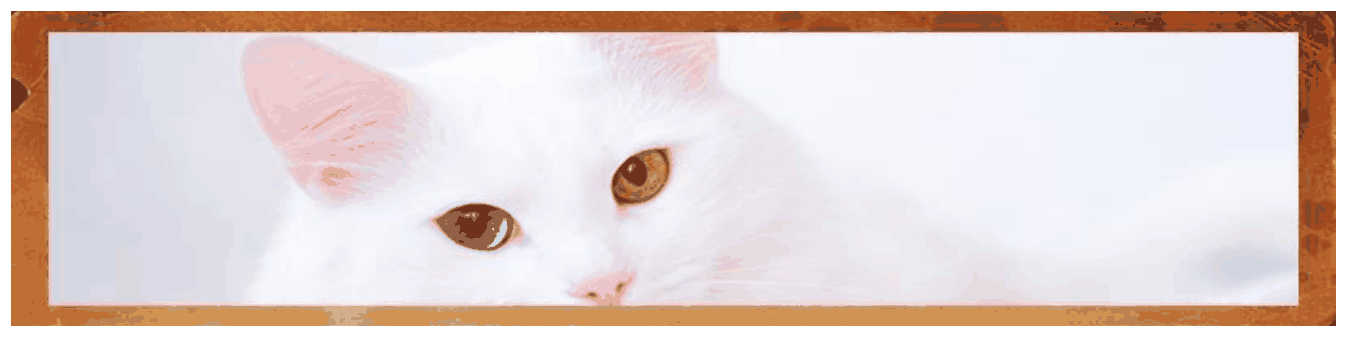
The most beautiful of cats, the Van cat is a pure breed living only in Lake Van basin. Another endemic cat breed is the Ankara cat. They are called Angora cats. Their most important feature is their two different eye colors.
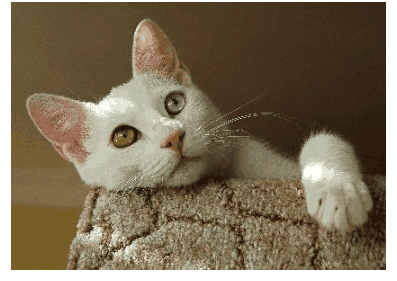
Van cat
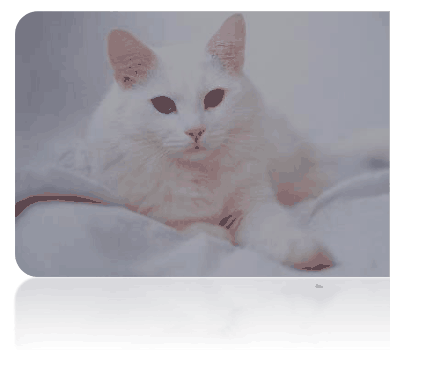
Ankara cat
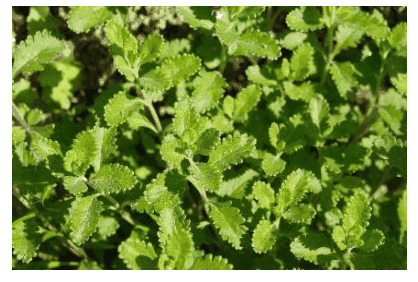
Nepeta cataria (catnip)
Just like people, cats can sometimes be stressed and angry. Just as people are made happy by melatonin, the stress of cats can be reduced and they can be made happy thanks to a natural product. Nepetalactone is an organic compound isolated from the plant catnip (Nepeta cataria), which acts as a cat attractant. Nepetalactone is a ten-carbon bicyclic mono- terpenoid compound derived from isoprene with two fused rings: a cyclopentane and a lactone.
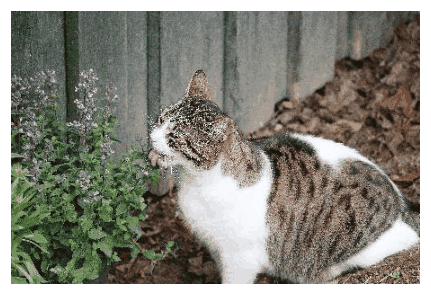
Cat eCat eating catnip in the garden
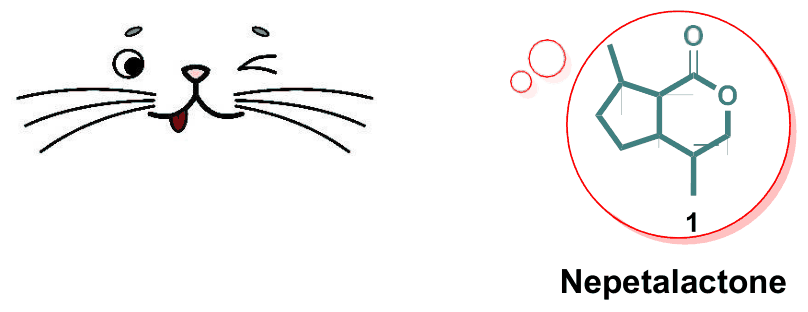
Cat's dream
Total synthesis of nepetalactone:
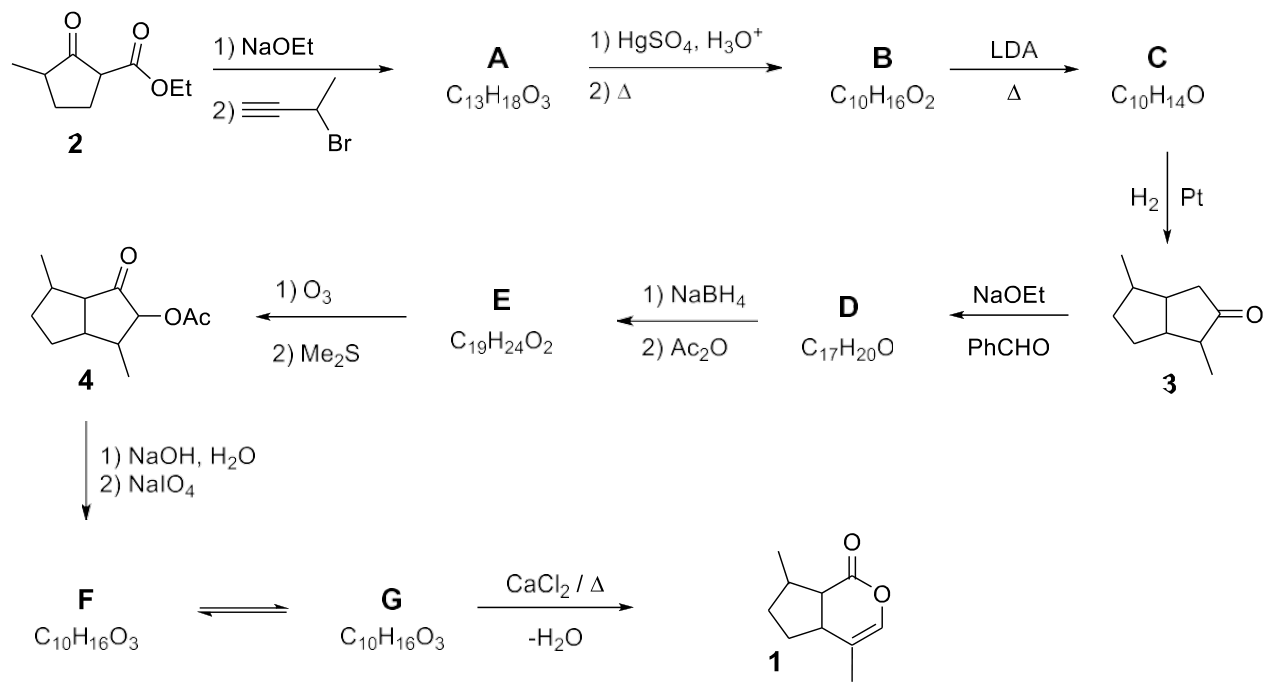
1.1 The above scheme describes the total synthesis of nepetalactone. Draw structures of A–G, without stereochemical details.
Hints:
- Compound A has strong and sharp band at \(3300\ \mathrm{cm^{-1}}\) in the IR spectrum.
- A, B, and F are monocyclic, while C, D, E, and G are bicyclic compounds.
- F has one doublet at ~ \(9.8\ \mathrm{ppm}\) in the \({}^{1}\mathrm{H}\)-NMR spectrum.
Reactions of nepetalactone:
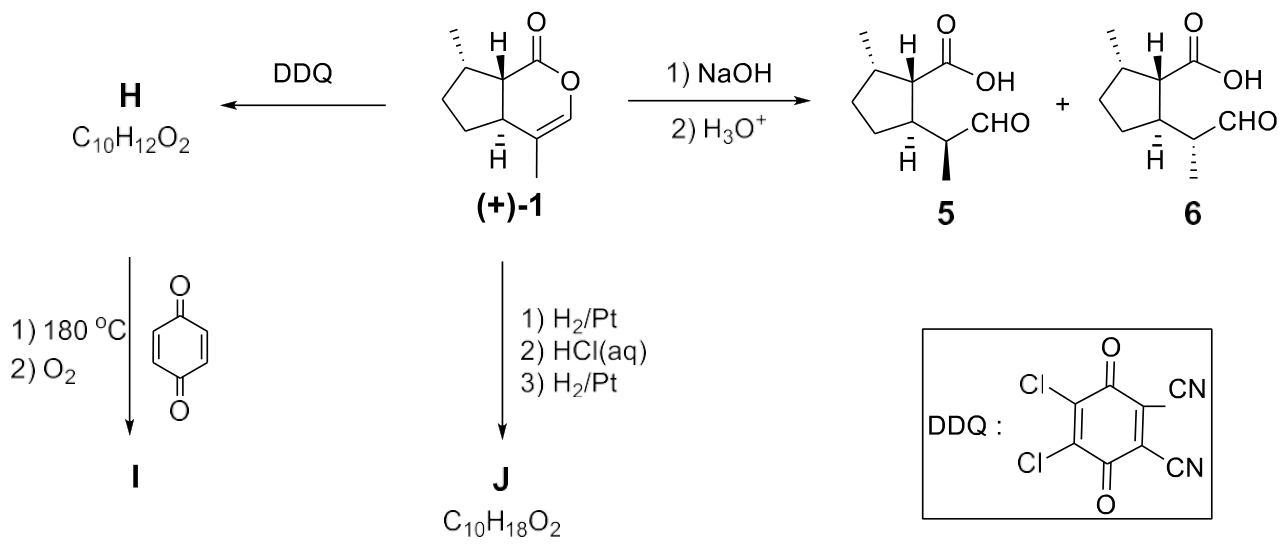
The above scheme includes a few reactions of one of the enantiopure nepetalactone 1 isomers. Three of the reaction products (5, 6, and J) are used as insect repellents in industry.
1.2 For the relationship between 5 and 6, which of the following is/are true? Tick the box next to the correct answer(s) on your answer sheets.
☐ Enantiomers ☐ Diastereomers ☐ Identical ☐ Stereoisomers Reaction of 1 with DDQ gives highly conjugated compound H. Also, thermal reaction of compound H with p-quinone gives I with molar mass of \(226.28\ \mathrm{g/mol}\).
1.3 Draw the structures of H, I, and J indicating stereochemistry.
Hints:
- During the formation of I, sequential pericyclic reactions and an oxidation reaction (due to the presence of \(\ce{O2}\)) take place, and a well-known gas forms during the reaction.
- J has a strong and very broad band between 3300 and \(2500\ \mathrm{cm^{-1}}\) in the IR spectrum.
Official English text of the problem.
Problem 2: A Tale of a Reactive Intermediate
Arynes constitute a special class of reactive intermediates. The first experimental evidence for the structure of an aryne (benzyne) was demonstrated in 1953 via the elegant labeling experiments by John D. Roberts and coworkers.
In one such experiment, chlorobenzene, whose carbon at position 1 was labeled with radioactive \(\ce{^{14}C}\), was reacted with \(\ce{KNH2}\) in liquid \(\ce{NH3}\) to give nearly equal amounts of isotopic isomers A and B along with the inorganic salt C. This reaction proceeds via the formation of aryne intermediate D.
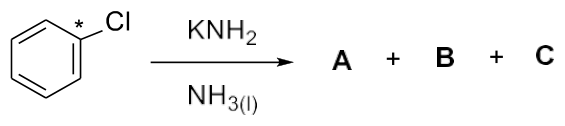
2.1 Draw the structure of A, B and D, and provide the formula of C. Indicate the position(s) of \(\ce{^{14}C}\)-labeled carbon(s) with an asterisk (*) whenever applicable.”
Analysis of the \(\ce{^{14}C}\)-labeled product(s) was achieved via degradation experiments (the \(\ce{^{14}C}\)- labeled carbons are not shown on the structures). Radioactivities of the intermediates and final products were examined.
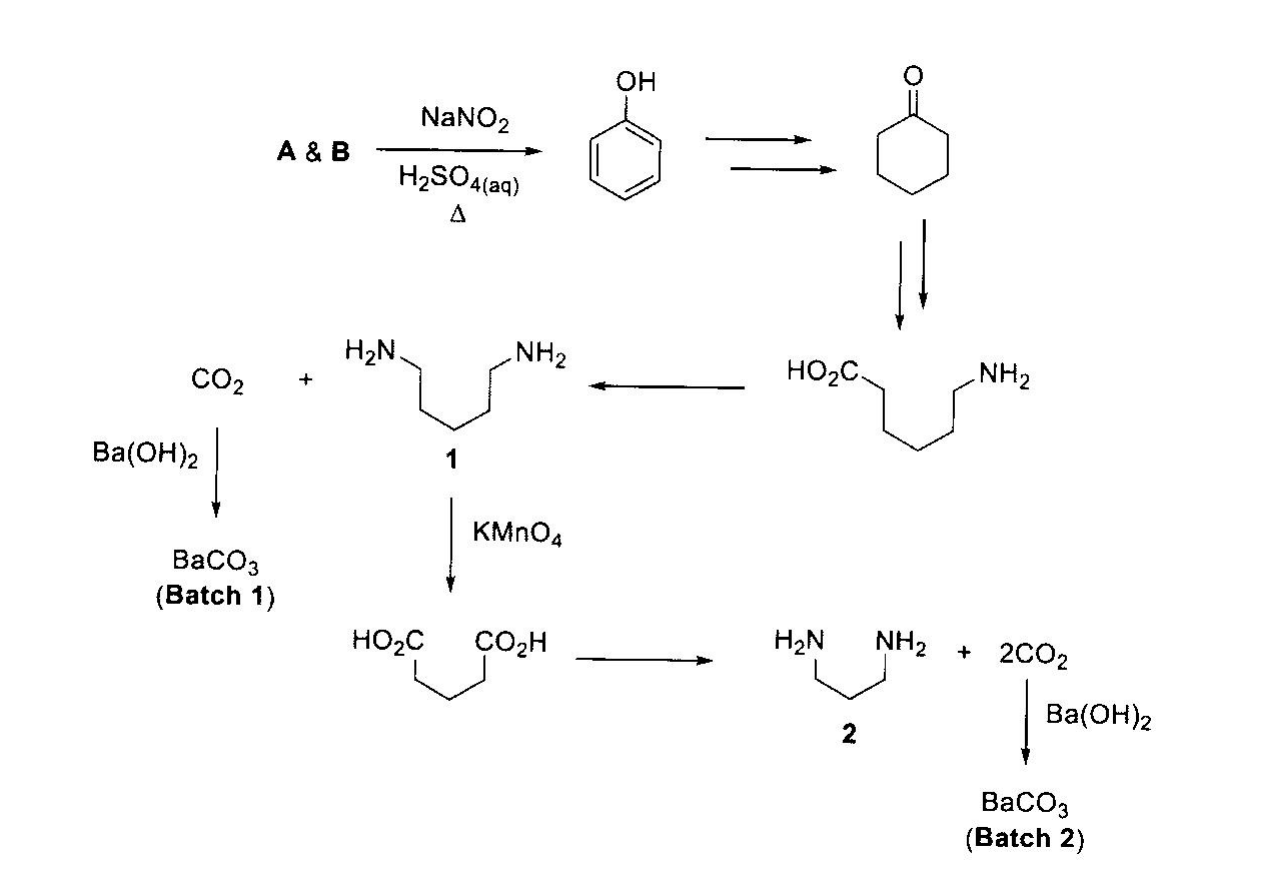
2.2 Tick the appropriate boxes on the answer sheet for the intermediates and products that you expect to exhibit radioactivity.
Considering only A: Considering only B: ☐ Compound 1 ☐ Compound 1 ☐ \(\ce{BaCO3}\) (Batch 1) ☐ \(\ce{BaCO3}\) (Batch 1) ☐ Compound 2 ☐ Compound 2 ☐ \(\ce{BaCO3}\) (Batch 2) ☐ \(\ce{BaCO3}\) (Batch 2) With the aim of facilitating aryne formation, Kobayashi and co-workers developed a fluoride-induced aryne generation protocol. Using this method, benzene derivative 3 is reacted with furan (4) in the presence of \(\ce{CsF}\), resulting in the formation of E, F, and G.

- Combustion analysis of E revealed the following atom content: 75.8 % carbon, 5.8 % hydrogen, and 18.4% oxygen.
- E does not have a proton that is exchangeable with \(\ce{D2O}\) in \(\ce{^1H}\)-NMR spectroscopy.
- F is an ionic compound.
2.3 Determine the structures of E, F, and G (without stereochemical details).
In the absence of a nucleophile or a trapping agent, arynes can undergo [2+2]-type cyclodimerization or [2+2+2]-type cyclotrimerization reactions under suitable conditions. The aryne derivative that is obtained when 3 is treated with one equivalent of \(\ce{CsF}\) in MeCN can give, in principle, four different dimerization and trimerization products (H – K).
- H has two planes of symmetry.
- I is expected to exhibit 21 signals in its \(\ce{^{13}C}\)-NMR spectrum.
- I and J both exhibit an \(m/z\) value of 318.1 in their mass spectra.
2.4 Determine the structures of H – K.
When 5 is reacted with \(\beta\)-ketoester 6 in the presence of 2 equivalents of \(\ce{CsF}\) at 80 °C, L is obtained as the major product. The \(\ce{^1H}\)-NMR and \(\ce{^{13}C}\)-NMR data for L, in \(\ce{CDCl3}\), are as follows:
- \(\ce{^1H}\)-NMR: \(\delta\) 7.79 (dd, \(J=7.6,\ 1.5\ \mathrm{Hz}\), 1H), 7.47–7.33 (m, 2H), 7.25–7.20 (m, 1H), 3.91 (s, 2H), 3.66 (s, 3H), 2.56 (s, 3H) ppm.
- \(\ce{^{13}C}\)-NMR: \(\delta\) 201.3, 172.0, 137.1, 134.4, 132.8, 132.1, 130.1, 127.5, 51.9, 40.2, 28.8 ppm.
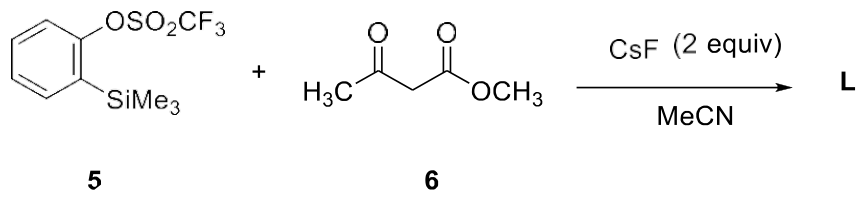
2.5 Determine the structure of L.
2.6 In the reaction shown in task 2.5, which of the following statement(s) describe(s) the function of \(\ce{CsF}\)?
- The \(pK_\mathrm{a}\) values of \(\ce{HF}\) and \(\beta\)-ketoester 6 in dimethyl sulfoxide (DMSO) are about 15 and 14, respectively.
☐ \(\ce{F-}\) hydrolyzes the trifluoromethanesulfonate (\(\ce{O3SCF3}\)) group of 5
☐ \(\ce{F-}\) attacks the \(\ce{-SiMe3}\) group of 5.
☐ \(\ce{F-}\) acts as a base to deprotonate 6.
☐ \(\ce{F-}\) acts as a nucleophile and attacks the ester group of 6.
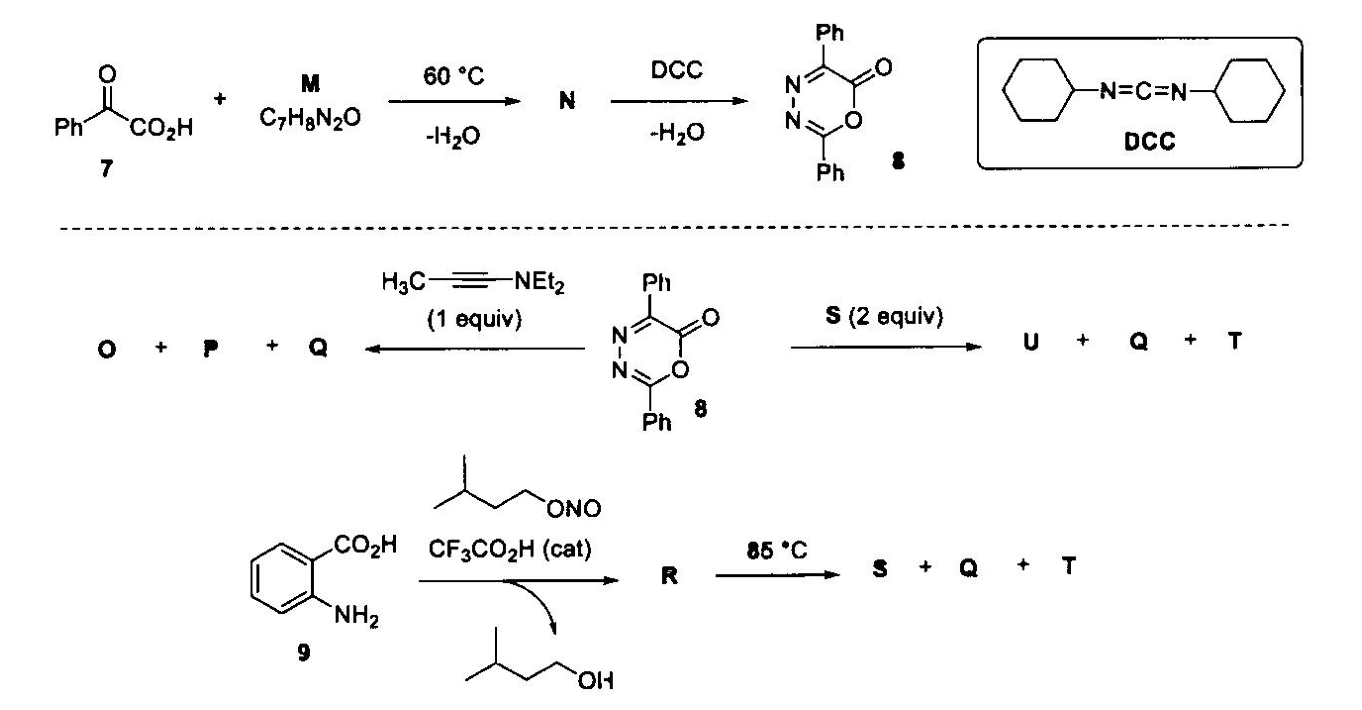
Diazapyrone derivative 8 was shown to be a useful reactant for the construction of a variety of cyclic frameworks. Its preparation from phenylglyoxylic acid (7) and its use in two different reactions are described below.
- Q and T are gases under ambient conditions.
- O and P are constitutional isomers.
- Q does not have any signals in its IR spectrum.
- Heating 1 mol of R at 85 °C generates 1 mol of reactive intermediate S.
- Reaction of 8 with two equivalents of S gives U, Q, and T.
Note:
equiv = equivalent
cat = catalyst
2.7 Determine the structures of M – U.
Official English text of the problem.
Problem 3: (±)-Coerulescine
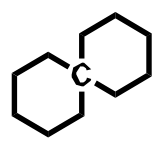
A spiro compound is typically an organic compound containing rings linked together by one common atom (spiroatom) as carbon atom with bold in figure below. The spiro[pyrrolidin-3,3′- oxindole] ring system is a structural framework incorporated in several cytostatic alkaloids and unnatural compounds. Coerulescine (1) and horsfiline are the simplest prototype members of this subfamily that can be synthesized by the route shown below.
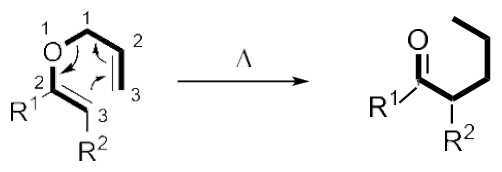
Claisen rearrangement, which is a [3,3]-sigmatropic rearrangement, is a powerful carbon– carbon bond-forming reaction in which an allyl vinyl ether is converted thermally to an unsaturated carbonyl compound as shown in the Scheme below. When compound A is heated, it undergoes Claisen rearrangement to give carbonyl compound B.
For this entire task, your answers can be given without any stereochemical details.
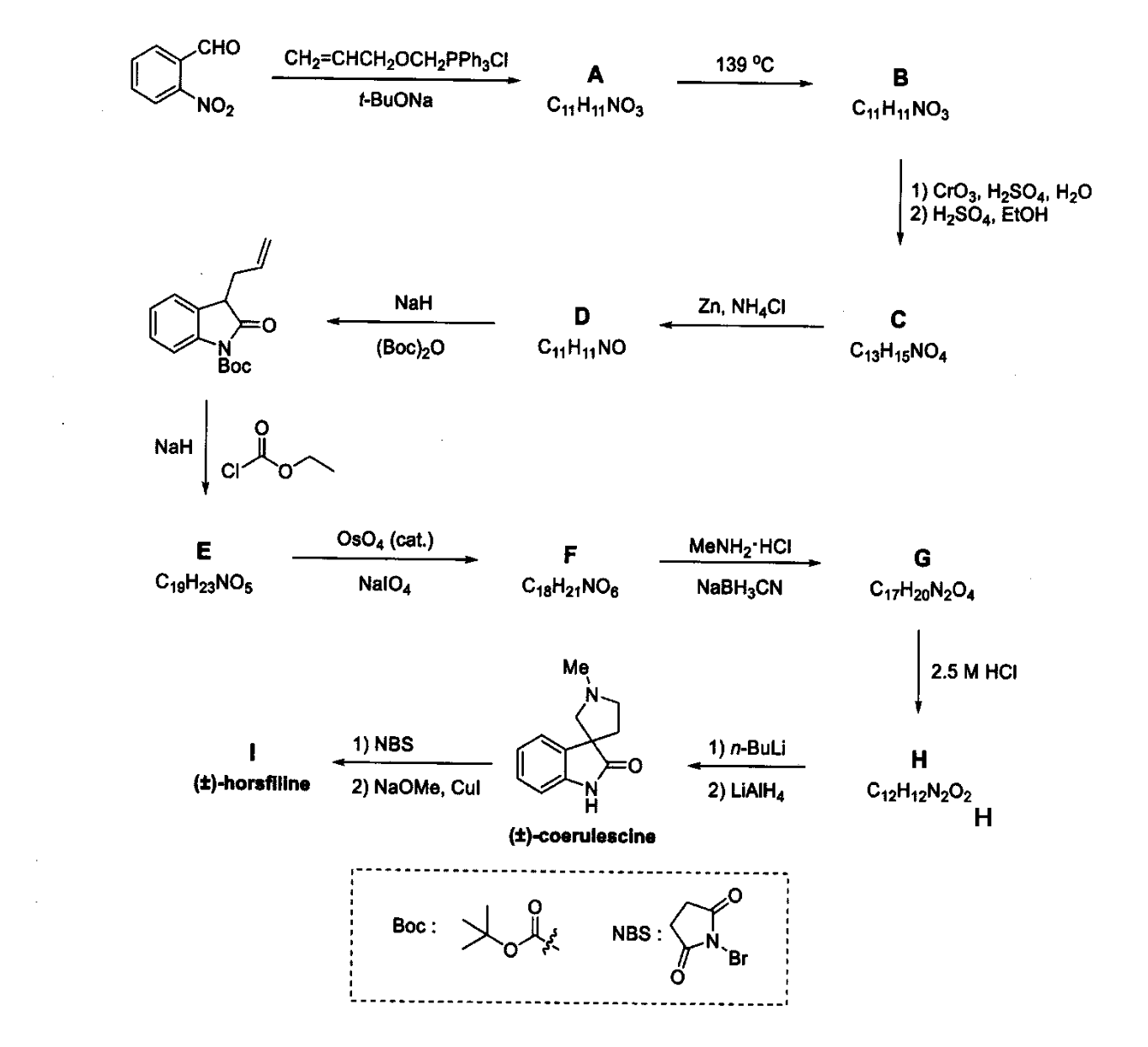
3.1 Draw the structures of A and B.
- A is an inseparable mixture of cis/trans isomers.
- B has IR absorption at \(1726\ \mathrm{cm^{-1}}\).
3.2 Draw structures for C, D, E, and F.
- D–F have a bicyclic structure.
3.3 Choose the correct order of steps for the transformation of F to G.
☐ Imine formation, then reduction, then amidation
☐ Amidation, then imine formation, then reduction
☐ Reduction, then amidation, then imine formation
3.4 Draw the structures for G and H (both spiro compounds).
3.5 Draw the structure of the intermediate produced by treatment with n-BuLi in the step H → coerulescine (1).
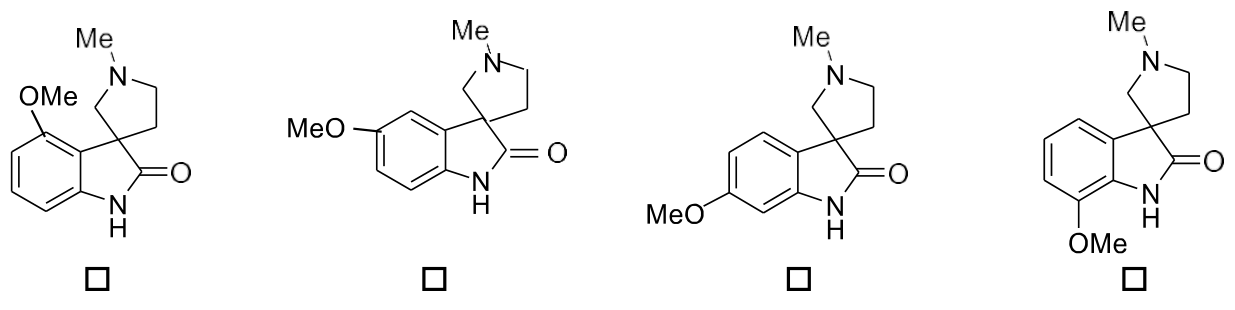
Coerulescine (1), on treatment with N-bromosuccinimide (NBS), gives the bromo derivative, which upon heating with sodium methoxide in the presence of cuprous iodide gives horsfiline (I) in 60% yield.
3.6 Choose the correct structure for compound I consistent with the following selected \(\ce{^1H}\)-NMR data: \(\delta\) 7.05 (d, \(J=1.4\ \mathrm{Hz}\), 1H), 6.78 (d, \(J=8.0\ \mathrm{Hz}\), 1H), 6.72 (dd, \(J=8.0,\ 1.4\ \mathrm{Hz}\), 1H) ppm. Tick the relevant box.
3.7 When the allyl ether of 2-naphthol is heated a sigmatropic rearrangement is initiated. Write the structure of major product isolated from this reaction.
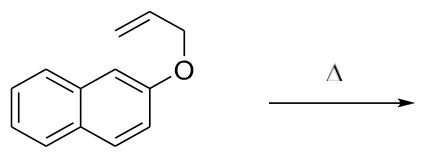
Official English text of the problem.
Problem 4: Symmetry Does Matter!
There are numerous reactions in organic chemistry that proceed through cyclic transition states and these are classified as pericyclic reactions. Woodward–Hoffmann rules, developed by Robert B. Woodward and Roald Hoffmann, are used to rationalize stereochemical aspects and the activation energy of pericyclic reactions.
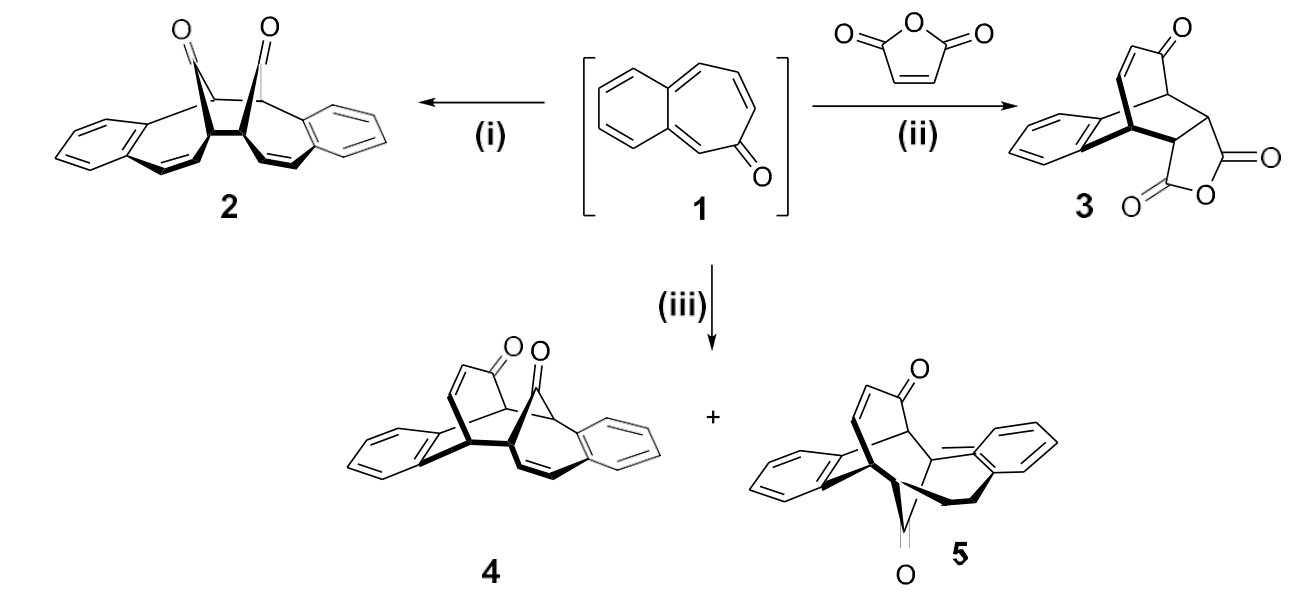
Woodward–Hoffmann rules
Number of electrons Electrocyclic reactions: Thermal \((\Delta)\) Electrocyclic reactions: Photochemical \((h\nu)\) Cycloadditions: Thermal \((\Delta)\) Cycloadditions: Photochemical \((h\nu)\) \(4n\), \((n=1,2,..)\) Conrotatory (con) Disrotatory Disfavored Favored \(4n+2\), \((n=1,2,..)\) Disrotatory (dis) Conrotatory Favored Disfavored 4.1 Fill in the table for reactions (i)–(iii) or products 2–5:
Reaction Product [? + ?] cycloaddition \(\Delta\) or \(h\nu\) i 2 ii 3 iii 4 5 There are three possible benzotropone isomers. Although two of the benzotropone isomers were isolated, 3,4-benzotropone (1) has not been isolated. Its instability is attributed to the o- quinoidal structure of 1 because it has no sextet electron system in the benzene ring.
4.2 Draw the structures of stable benzotropone isomers A (with 6 signals in its \(\ce{^{13}C}\)-NMR) and B (with 11 signals in its \(\ce{^{13}C}\)-NMR).
4.3 When the following tetraene is reacted under photochemical conditions, symmetry-allowed product(s) of three different ring sizes can form according to the Woodward–Hoffmann rules. Tick the correct answer in each row.
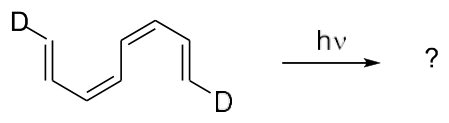
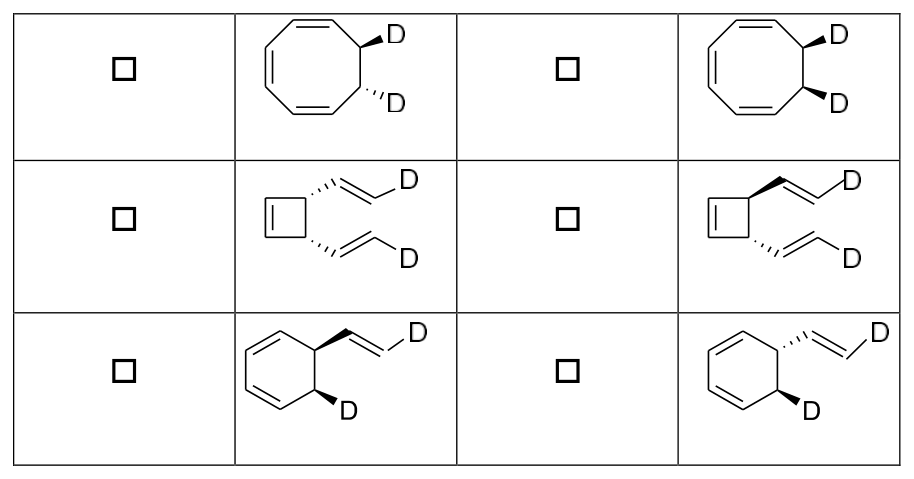
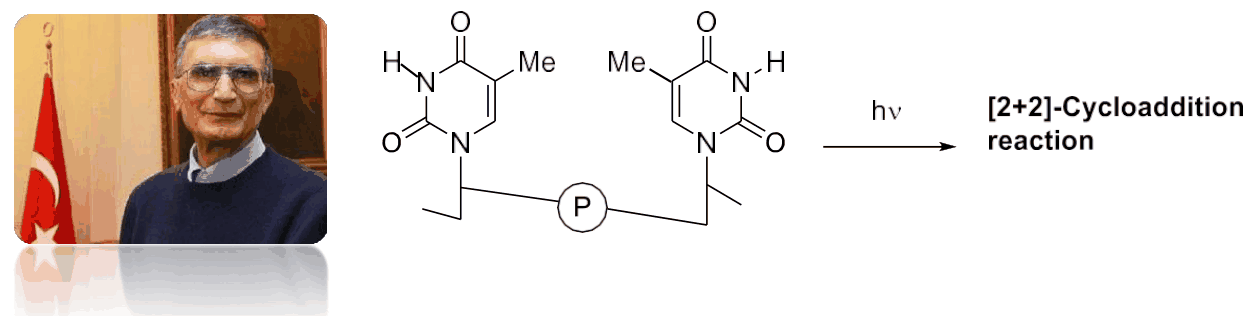
Prof. Dr. Aziz Sancar
The Nobel Prize in Chemistry 2015 was awarded jointly to the Turkish scientist Aziz Sancar, Swedish scientist Tomas Lindahl, and American scientist Paul Modrich for their “mechanistic studies of DNA repair”. Pyrimidine bases found in DNA may undergo a photochemical [2+2]-cycloaddition reaction (see figure above) with UV light that reaches a person’s skin, causing damage to DNA, which may ultimately lead to skin cancer. The research by Professor Aziz Sancar focused on the DNA repair mechanism for this type of damage.
Thymine (T) is one of the nucleobases that can undergo such a photochemical reaction with UV light. Let us assume that we have a solution of free thymine that was subjected to UV irradiation.
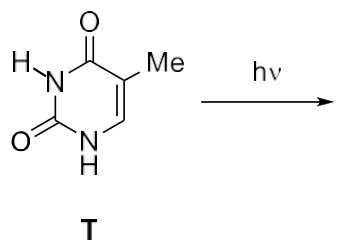
4.4 Considering stereochemistry, draw the structures of all possible products of this reaction between two free thymine (T) molecules. Circle the compound(s) which is/are chiral. A drawing only one enantiomer of an enantiomeric pair is sufficient. Please note that only \(\ce{C=C}\) bonds participate in this reaction.
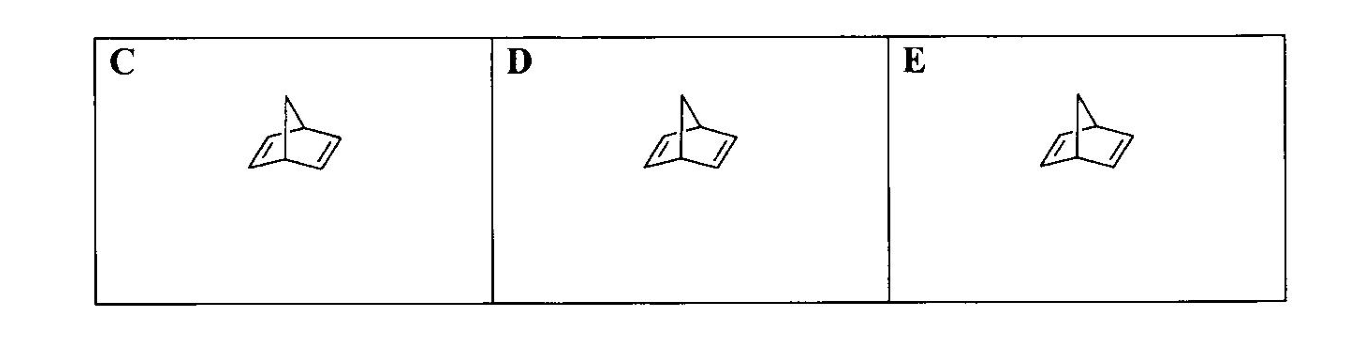
A broad range of halogenated derivatives of norbornadiene (N) are known in the literature. Tribromo-norbornadiene (\(\ce{C7H5Br3}\)) has six achiral (meso) isomers. Three of these isomers (6, 7 and 8) are given below.
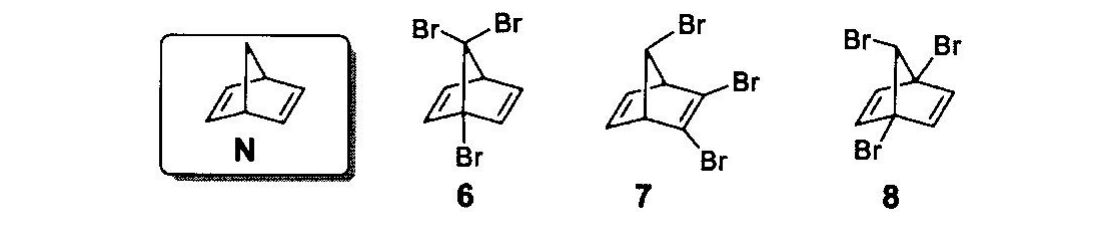
4.5 How many signals do you expect from the \(\ce{^{13}C}\)-NMR spectra of 6, 7, and 8? Fill in the following boxes.
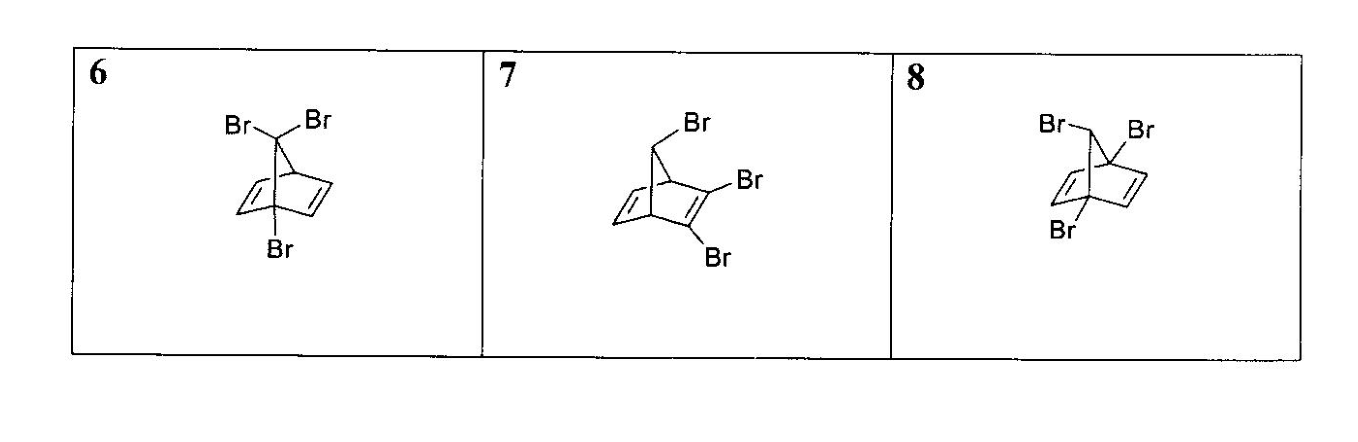
4.6 Draw structures of the remaining achiral (meso) tribromo-norbornadiene (\(\ce{C7H5Br3}\)) isomers (C, D, and E) in addition to 6 – 8 over the given figures in the boxes.
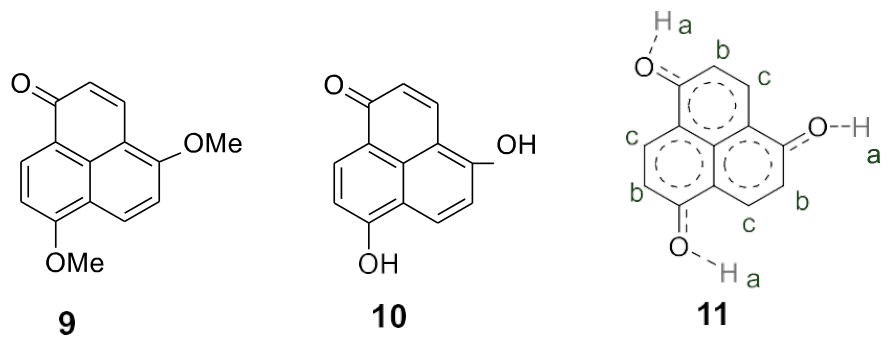
The NMR spectrum of ether 9 is complex. Two \(\ce{MeO-}\) groups are different as are all the hydrogen atoms on the rings. However, diphenol 10 has a very simple NMR spectrum and there are only three types of protons (marked as a, b, and c). A reasonable average structure responsible for all resonance structures and its symmetry is shown as 11.
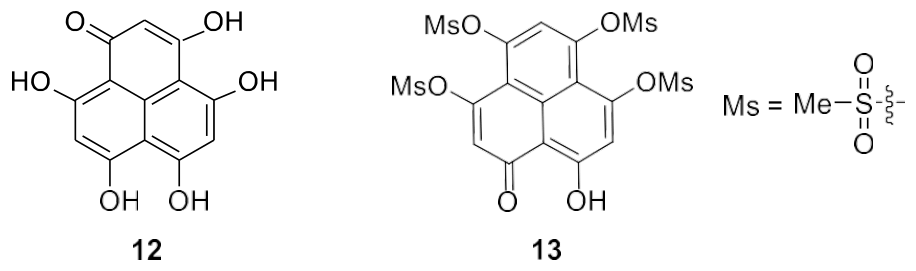
4.7 How many signals do you expect from the \(\ce{^{13}C}\)- and \(\ce{^{1}H}\)-NMR spectra of 12 and 13?
Official English text of the problem.
Problem 5: Konya, Carrot, Beta-Carotene, Vitamin-A, Immune System, Vision
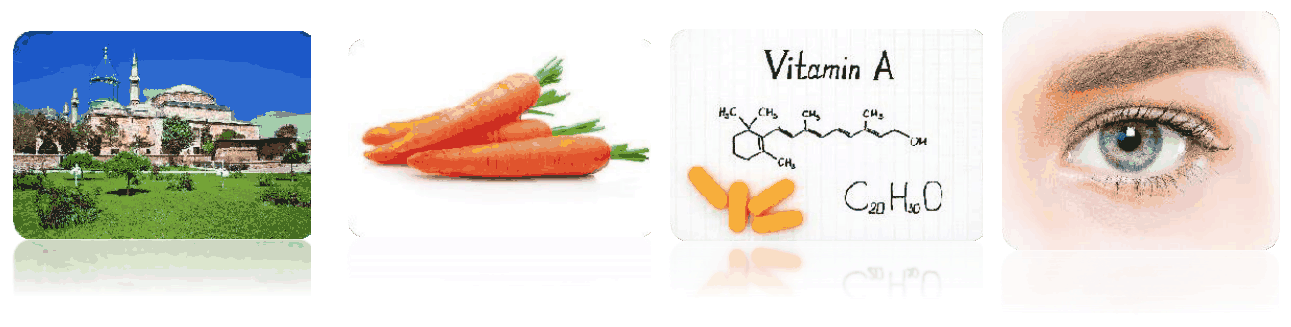
Mevlana (Rumi) was a great mystic and Sufi poet who lived out his days in Konya in the \(13^{\mathrm{th}}\) century. The indirect relevance of Konya to chemistry is that the city provides 65% of the country’s carrot production, from which one of the essential vitamins (vitamin A) is obtained.
Carrot is an important source of β-carotene, which gives the vegetable its orange color. This molecule is a red-orange pigment naturally found in plants and fruits and is a provitamin A carotenoid. It is converted to vitamin A, which is essential for normal growth and development, the immune system, and vision function.
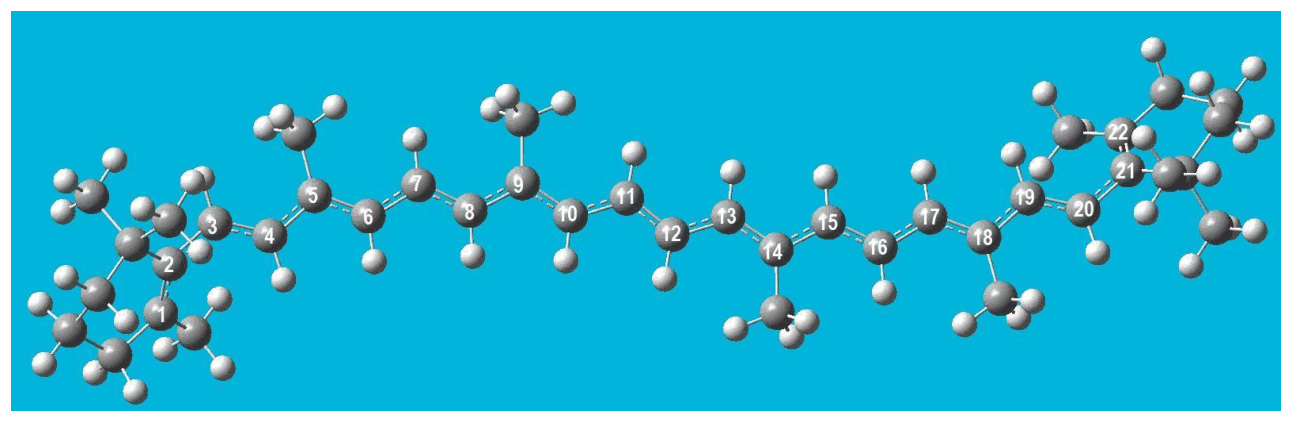
Figure 1. Ball and stick representation of the structure of β-carotene. The gray and white spheres represent the carbon and hydrogen atoms, respectively. The numbered carbon atoms belong to the linear conjugated π-segment of the molecule.
β-Carotene has an extended polyene chain of 22 carbon atoms. It is a conjugated \(\pi\)-system, having alternating single and double bonds. Its experimental maximum absorption wavelength (\(\lambda_{\max}\)) is 455 nm. We assume that all the bonds between \(C_1\) and \(C_{22}\) are conjugated bonds. There are 22 \(\pi\)-electrons in the molecule (Figure 1).
To a crude approximation, the electrons in the \(\ce{C}\text{-}2p_z\) orbitals, which are perpendicular to the molecular plane, are assumed to move along the entire molecule, without interacting with each other. They are like independent particles confined in a molecule moving along the x-axis in one dimension. These characteristics of π-electrons make them eligible for being treated by the simplest model called the particle in one-dimensional box model.
The wave function and the energies of the quantized levels for an electron moving in a one- dimensional box with infinite potential walls are given as follows:
\[ \Psi_n(x)=\sqrt{\frac{2}{L}}\sin\frac{n\pi x}{L} \]
here \(n\) is the quantum number, \(n=1,2,3,4,\ldots\infty\), and \(L\) is the box length.
\[ E_n=\frac{n^2h^2}{8m_eL^2} \]
In two dimension system, within the framework of independent particle approximation, the wavefunction is expressed as a product of one-dimensional wavefunctions, and the energy is expressed as a sum of one-dimensional energies. The energy levels of the two dimensional rectangular box is given as follows:
\[ E_{n_xn_y} = \left[\frac{n_x^2}{L_x^2}+\frac{n_y^2}{L_y^2}\right] \left\{\frac{h^2}{8m_e}\right\} \]
where \(n_x,n_y\) are the quantum numbers and they are positive integers. \(L_x,L_y\) are the dimensions of the box in the 2D model. They are positive numbers.
5.1 The β-carotene molecule is orange in color because:
i) It absorbs in the visible region of the electromagnetic spectrum.
ii) HOMO → LUMO transition occurs by absorption of IR photon.
iii) The spacing between the \(22^{\mathrm{nd}}\) and the \(23^{\mathrm{rd}}\) energy levels is equal to the energy of the IR photon at the orange wavelength.
iv) It absorbs green/blue light and it transmits red/yellow color.
v) It absorbs in the UV-VIS region since the molecule has no net dipole moment.
Choose which pair of the above sentences is correct?
The pairs of sentences are as follows:
☐ a) i and ii ☐ b) i and iii ☐ c) i and iv ☐ d) i and v ☐ e) ii and iii ☐ f) ii and iv ☐ g) ii and v ☐ h) iii and iv ☐ j) iii and v ☐ k) iv and v Although it is highly unrealistic, let us assume that the conjugated segment of the molecule is linear and treated with the particle in a one-dimensional box model as shown in figure 2. In this case, the length of the box can be approximated as \(L=1.40\times n_{\mathrm C}\) (in Å), where \(n_{\mathrm C}\) is the number of carbon atoms in the conjugated segment.
Use this information to answer the questions 5.2–5.6.
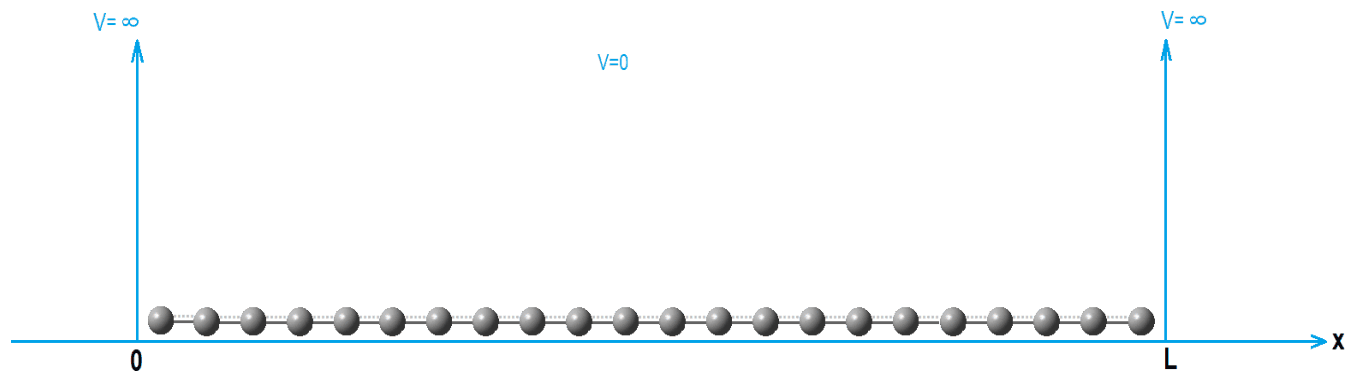
Figure 2. Schematic representation of the conjugated line segment made up carbon atoms of β-carotene in a one-dimensional box of length L.
5.2 Calculate the energies (in J) of the lowest two energy levels.
5.3 Draw the wavefunctions of the lowest two energy levels with proper labelling the x-axis.
5.4 Sketch the energy level diagram up to \(n=4\) showing the relative spacing.
5.5 What is the total \(\pi\)-energy (in J) of the molecule?
5.6 Calculate the wavelength (in nm) at which the transition between the highest occupied and lowest unoccupied energy levels occurs.
Use the particle in a two-dimensional box model to answer questions 5.7 – 5.8.
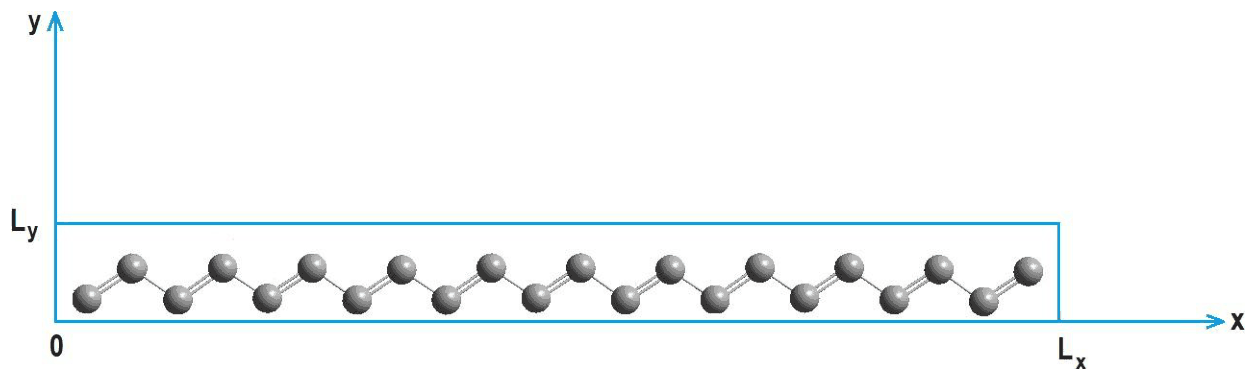
Figure 3. Schematic representation of the conjugated carbon atoms of β-carotene in a two-dimensional box.
Assume that the conjugated segment is made up of conjugated bonds that are all-trans to each other. The motion of the π-electrons is studied in the two-dimensional rectangular box with the dimensions \(L_x=26.0\) Å, \(L_y=3.0\) Å (Figure 3).
5.7 Calculate the energies (in J) of the highest occupied and the lowest unoccupied energy levels and the wavelength (in nm) at which the transition between these energy levels occurs.
5.8 What should be the \(L_x\) value (in Å) in order for the molecule to absorb light at the experimental \(\lambda_{\max}=455\) nm if \(L_y\) is kept constant at 3.0 Å. (Assume that the quantum numbers for homo and lumo are the same as in the question 5.7.)
Official English text of the problem.
Problem 6: Thermodynamics through an Interstellar Journey
Part 1
In a hypothetical universe, an unknown amount of diborane participates in the following reaction:

Assume that in this hypothetical universe, \(\ce{H3BO3(s)}\) obtained from this reaction was completely sublimed at 300 K. The necessary energy for sublimation was obtained through work released by one cycle of an ideal heat engine in which one mole of monoatomic perfect gas flows through the cycle described in the pressure (\(p\)) – volume (\(V\)) diagram below:
- A→B; isothermal reversible expansion receiving 250 J by heat transfer (\(q_H\)) at a temperature of 1000 K (\(T_H\)) from a hot source.
- B→D; reversible adiabatic expansion.
- D→C; isothermal reversible compression at a temperature of 300 K (\(T_C\)) releasing some amount of heat (\(q_C\)) to a cold sink.
- C→A; reversible adiabatic compression.
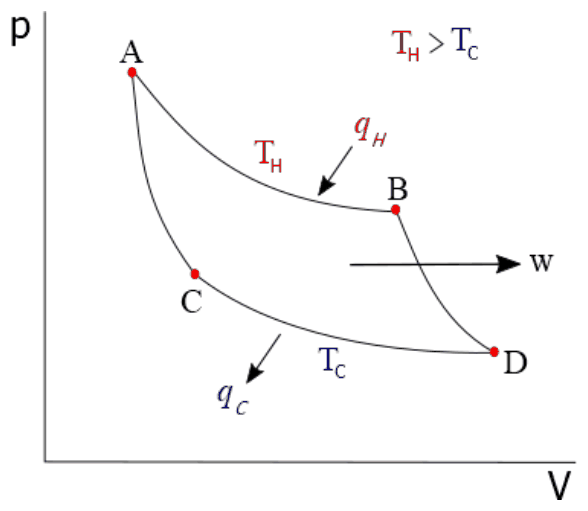
After heat transfers, the remaining energy is released as work (\(w\)). Also, \(q_H\) and \(q_C\) are related to \(T_C\) and \(T_H\) as follows:
\[ \frac{|q_H|}{|q_C|}=\frac{T_H}{T_C} \]
The efficiency of the cycle can be found by work released by cycle (\(w\)) divided by heat absorbed by cycle (\(q_H\)).
You are provided with the change in enthalpies of the following reactions at 300 K.

6.1 Calculate the molar enthalpy of sublimation (in \(\mathrm{kJ\,mol^{-1}}\)) for \(\ce{H3BO3}\) at 300 K.
6.2 Calculate the \(\Delta_r U\) (internal energy) in terms of \(\mathrm{kJ\,mol^{-1}}\) at 300 K for the reactions (2) and (4) given above (assume ideal gas behavior for each gaseous species in each reaction).
6.3 Calculate the amount of overall work produced by a heat engine (\(|w|\)) in terms of J and the amount of overall heat released to the cold sink (\(|q_C|\)) in terms of J.
6.4 Calculate the efficiency of the heat engine described above.
6.5 Calculate the entropy change (\(\Delta S\)) for A→B and D→C processes in the heat engine in terms of \(\mathrm{J\,K^{-1}}\).
6.6 Calculate the Gibbs energy change (\(\Delta G\)) in terms of J for A→B and D→C processes in the heat engine.
6.7 Calculate the ratio of pressure at point A to the pressure at point B in the cycle (standard pressure: 1 bar).
6.8 Calculate the amount of \(\ce{H2(g)}\) (in moles) produced according to the reaction given at the beginning of the task for one cycle of the engine.
Part 2
Interstellar journeys can be done by using diborane as rocket fuel. Combustion of diborane is shown below:

Combustion of diborane is experimented in a closed container (\(100\ \mathrm{dm^3}\)) at different temperatures and the equilibrium amounts were recorded.
Temperature 8930 K 9005 K \(\ce{B2H6(g)}\) 0.38 mol 0.49 mol \(\ce{H2O(g)}\) 0.20 mol 0.20 mol Partial pressure of \(\ce{O2(g)}\) was stabilized to 1 bar and kept constant at all conditions.
Assume that in this hypothetical universe; \(\Delta_r S^\circ\) and \(\Delta_r H^\circ\) are independent of temperature, the standard molar entropy (\(S^\circ\)) of \(\ce{B2O3(s)}\) does not change with pressure, all the gas species behave as an ideal gas, and all species remain in the same phase, without any further decomposition before or after reaction, at all temperatures then:
6.9 Calculate \(K_p\) (pressure based equilibrium constant) at 8930 K and 9005 K.
6.10 Calculate \(\Delta_r G^\circ\) of the reaction in terms of \(\mathrm{kJ\,mol^{-1}}\) at 8930 K and 9005 K. (If you failed to find \(K_p\), please use \(K_p\) (8930 K) = 2, \(K_p\) (9005 K) = 0.5.)
6.11 Calculate \(\Delta_r G^\circ\) (in terms of \(\mathrm{kJ\,mol^{-1}}\)), \(\Delta_r H^\circ\) (in terms of \(\mathrm{kJ\,mol^{-1}}\)), and \(\Delta_r S^\circ\) (in terms of \(\mathrm{J\,mol^{-1}\,K^{-1}}\)) of the combustion reaction at 298 K. (If you failed to find \(K_p\), please use \(K_p\)(8930 K) = 2, \(K_p\)(9005 K) = 0.5)
6.12 Tick the correct answer in the table by determining whether combustion reactions are favored or not at given temperature \(T\) below under standard pressure (1 bar).
Temperature Favored Unfavored 298 K ☐ ☐ 8930 K ☐ ☐ 9005 K ☐ ☐ 9100 K ☐ ☐ 6.13 Calculate the \(\Delta_f H\) (\(\mathrm{kJ\,mol^{-1}}\)) and \(S^\circ\) (\(\mathrm{kJ\,mol^{-1}\,K^{-1}}\)) of \(\ce{H2O(g)}\) using the values given in the table below. (\(\Delta_f H\) = enthalpy of formation, \(S^\circ\) = standard entropy)
(If you fail to find \(\Delta_r H^\circ\) and \(\Delta_r S^\circ\) of the combustion, please use \(\Delta H^\circ=1000\ \mathrm{kJ\,mol^{-1}}\), \(\Delta S^\circ=150\ \mathrm{J\,K^{-1}\,mol^{-1}}\))
Compound \(\Delta H_f\) (298 K) \(S^\circ\) (298 K) \(\ce{B2H6(g)}\) \(36.40\ \mathrm{kJ\,mol^{-1}}\) \(0.23\ \mathrm{kJ\,mol^{-1}\,K^{-1}}\) \(\ce{O2(g)}\) \(0.00\ \mathrm{kJ\,mol^{-1}}\) \(0.16\ \mathrm{kJ\,mol^{-1}\,K^{-1}}\) \(\ce{B2O3(s)}\) \(-1273\ \mathrm{kJ\,mol^{-1}}\) \(0.05\ \mathrm{kJ\,mol^{-1}\,K^{-1}}\) Official English text of the problem.
Problem 7: Phthalocyanines
Emeritus Professor Özer Bekaroğlu
The term phthalocyanine (Pc) takes its origin from the Greek “naphtha”, which means rock oil, and “cyanine”, which means dark blue. Turkish scientist Özer Bekaroğlu can be regarded as the pioneer of Pc chemistry in Turkey.
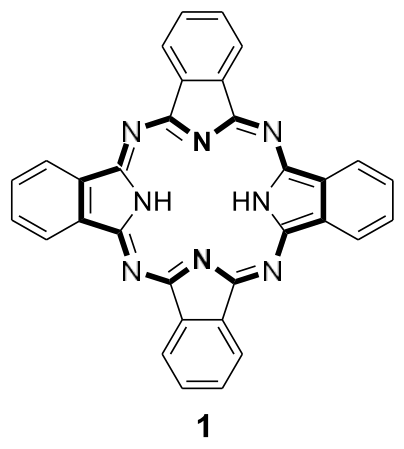
Metal-free phthalocyanine (1, \(\ce{H2Pc}\)) is a large planar macrocyclic compound with the formula \(\ce{(C8H4N2)4H2}\).
7.1 How many π-electrons are there in the bold region of the \(\ce{H2Pc}\) molecule in compound 1 shown above?
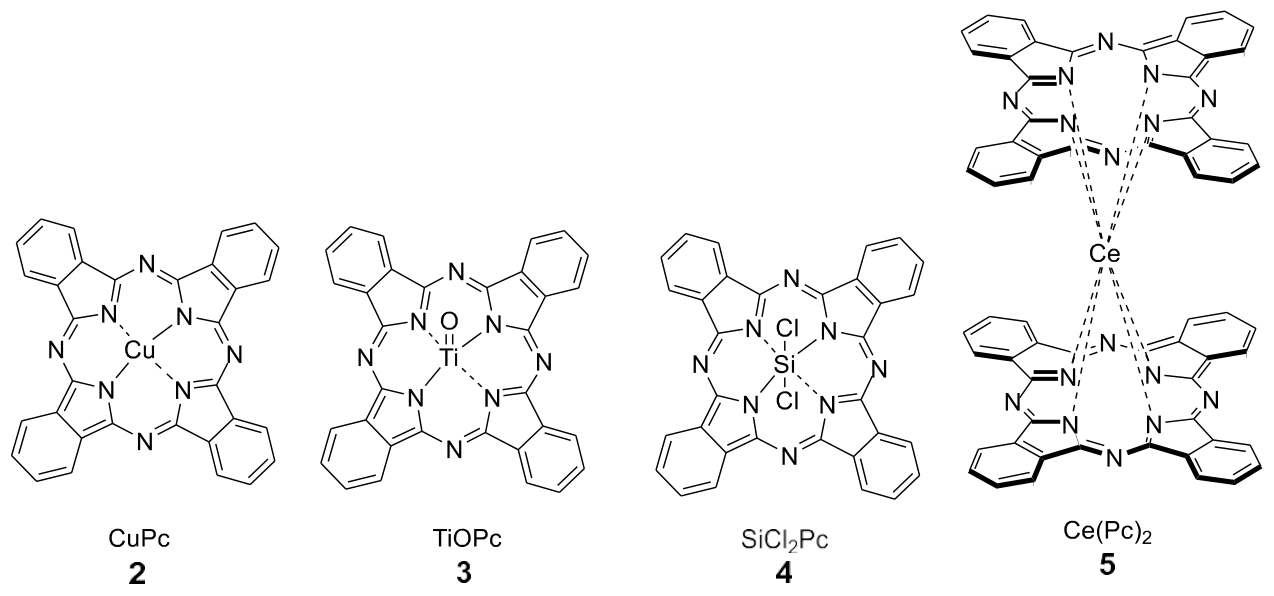
Pcs containing one or two metal ions are called metallo-phthalocyanines (MPcs) and they exhibit different geometries as given above.
7.2 Complete the table in your answer sheet by determining the coordination number of central ions in 2–5.
Central ion Copper ion Titanium ion Silicon ion Cerium ion Coordination number 7.3 Complete the table in your answer sheet by determining the oxidation number of each metal (Cu, Ti, and Ce) in 2, 3, and 5.
Metal in compounds 2 3 5 Oxidation number 7.4 Complete the table in your answer sheet by determining the geometry of compounds 2–5.
Geometry Compound Octahedral Square prism Square pyramidal Square planar 7.5 Complete the table in your answer sheet by determining the magnetic property of compounds 2–5.
- Use the letter "p" for paramagnetic property and letter "d" for a diamagnetic property.
Compound Magnetic property 2 3 4 5 7.6 Write the ground-state electron configuration of the silicon (Si) ion in the compound 4 and find all the quantum numbers for the 2p electrons in its ground state.
Electron configuration: Quantum numbers for 2p electrons: \(n\) \(l\) \(m_l\) \(m_s\) Metal-free phthalocyanine (1, \(\ce{H2Pc}\)) is commonly formed through the cyclotetramerization of phthalonitriles. On the other hand, Pcs having different substituents are called asymmetric, which can be prepared by the statistical cyclization of two different phthalonitriles. This method has no selectivity and the product is a mixture of all possible isomers.
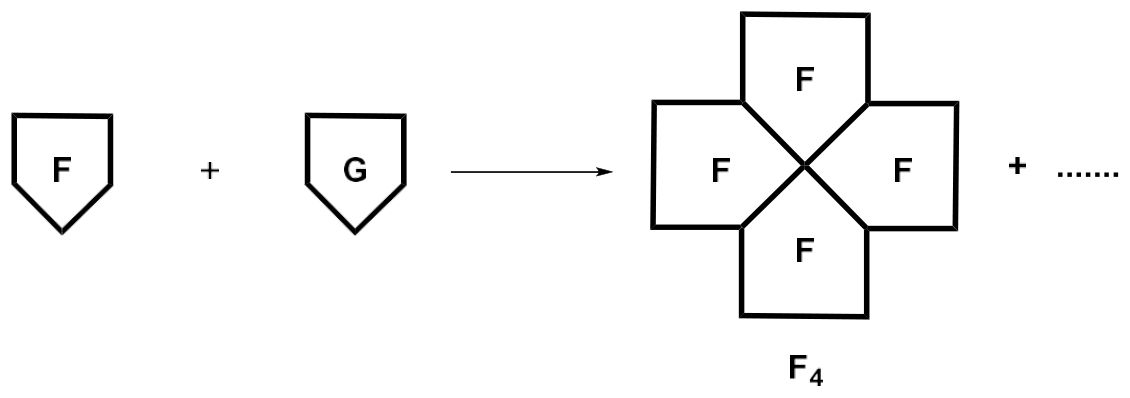
7.7 Draw the possible products that may occur in the statistical cyclization method by using F and G. If there are any stereoisomers label as cis- or trans-.
- F and G represent two different symmetrical phthalonitriles.
- One of the products is \(\mathrm{F}_4\) as given below.
- Draw other products similar to the format of \(\mathrm{F}_4\).
Pcs are used as photosensitizers in the photodynamic therapy (PDT) of cancer due to their strong absorption in the visible spectrum and high molar absorption coefficients. PDT consists of three essential components: photosensitizer, light, and oxygen. None of these is individually toxic, but together they initiate a photochemical reaction resulting in the generation of cytotoxic singlet oxygen (\(\ce{^{1}O2}\)) that can destroy cancer cells.
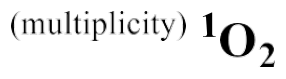
- The multiplicity of an energy level is defined as \(2S+1\)
- If the two spins are parallel (\(\uparrow\uparrow\)), \(S=1\), and if the two spins are antiparallel (\(\uparrow\downarrow\)), \(S=0\).
7.8 Draw the molecule orbital (MO) diagram of the lowest energy singlet state of dioxygen (\(\ce{^{1}O2}\)) and calculate bond order.
- There are no unpaired electrons in that state!
7.9 If the wavelength of the light needed to excite triplet oxygen into singlet oxygen is 1270 nm, calculate the energy (in kJ/mol) needed for this transition process.
Official English text of the problem.
Problem 8: Boron Compounds and Hydrogen Storage
14% of the total
Question 8.1 8.2 8.3 8.4 8.5 8.6 8.7 8.8 Total Points 3 3 4 4 4 4 6 3 58 Question 8.9 8.10 8.11 8.12 8.13 8.14 8.15 8.16 Points 2 3 2 4 4 4 2 2 Question 8.17 Points 4 Problem 8. Boron Compounds and Hydrogen Storage
Sodium borohydride (\(\ce{NaBH4}\)) and ammonia borane (\(\ce{BNH6}\)) are the most studied chemical hydrogen storage materials. In this question, you will explore the chemistry of boron and the use of boron compounds as hydrogen storage materials.
Borax (\(\ce{Na2B4O7 * nH2O}\)) is a boron mineral that is produced by ETI Mining Company in Turkey. \(\ce{NaBH4}\) can be synthesized by the reduction of anhydrous borax with metallic sodium under high-pressure hydrogen gas in the presence of silicon dioxide (silica) at 700 °C, namely the Bayer process. In this process, all hydrogen is stored in \(\ce{NaBH4}\). On the other hand, it has been shown that ammonia borane (\(\ce{BNH6}\)) can be synthesized by the reaction of \(\ce{NaBH4}\) and ammonium sulfate in dry tetrahydrofuran (THF) at 40 °C (Hint: \(\ce{BNH6}\) synthesis must be conducted in a well-ventilated fume-hood because flammable gas is generated as one of the by-products). While \(\ce{NaBH4}\) is an ionic compound, ammonia borane is a Lewis acid–base adduct.
8.1. Write a balanced chemical equation for the synthesis of \(\ce{NaBH4}\) from anhydrous borax.
8.2. Write a balanced chemical equation for the synthesis of ammonia borane from \(\ce{NaBH4}\).
8.3. Draw the molecular geometry of the \(\ce{BH4^-}\) ion and \(\ce{BNH6}\) molecule.
8.4. Calculate the hydrogen content of \(\ce{NaBH4}\) and \(\ce{BNH6}\) as a percentage by mass (wt%).
The hydrogen stored in both compounds can be released via hydrolysis reactions in the presence of a suitable catalyst at room temperature. Upon the hydrolysis reactions, 4 and 3 moles of \(\ce{H2}\) gas are released from the hydrolysis of 1 mole of \(\ce{NaBH4}\) and \(\ce{BNH6}\), respectively, along with metaborate anion including B-O bonds.
8.5. Write the balanced chemical equations for the hydrolysis of \(\ce{NaBH4}\) and \(\ce{BNH6}\).
One of the simplest stable borates is diboron trioxide (\(\ce{B2O3}\)). Higher borates such as \(\ce{B3O6^{3-}}\) having cyclic structures containing B-O-bonds can be formed. Since \(\ce{B2O3}\) is an acidic compound, it is easily reacted with water to produce boric acid (\(\ce{H3BO3}\)). On the other hand, the high temperature and high-pressure reaction of \(\ce{B2O3}\) with ammonia yields two-dimensional boron nitride, which consists of planar graphite-like sheets of alternating B and N atoms.
8.6. Write the balanced chemical equations for the synthesis of boric acid and boron nitride.
8.7. Draw the molecular structures of the \(\ce{B3O6^{3-}}\) ion, boric acid, and a single two-dimensional boron nitride sheet. Hint: show at least 10 B atoms in the boron nitride structure.
Furthermore, B-H compounds, called boranes, are an important class of boron compounds. The simplest stable borane is diborane (\(\ce{B2H6}\)) and many of the higher boranes can be prepared by the pyrolysis of diborane. Diborane can be synthesized via metathesis of a boron halide and a hydride source.
8.8. Write a balanced chemical equation for the synthesis of diborane from the reaction of \(\ce{BF3}\) and \(\ce{LiBH4}\). Hint: both products are boron compounds.
8.9. Draw the molecular geometry of the diborane molecule. Hint: there is no B-B bond in the structure.
\(\ce{BH3}\) (borane) is an unstable and highly reactive molecule. Therefore, it is not possible to isolate it as \(\ce{BH3}\) under ordinary conditions. However, it can be stabilized via its reaction with carbon monoxide to yield borane carbonyl (\(\ce{BH3CO}\)) compound, which is an adduct of borane. The preparation of \(\ce{BH3CO}\) plays an important role in exploring the chemistry of boranes as it indicates the likely existence of the borane molecule.
8.10. Sketch the Lewis dot structure of \(\ce{BH3-CO}\) molecule by showing the formal charges.
8.11. Which of the statements given in your answer sheet is observed in the \(\ce{C-O}\) bond of a \(\ce{CO}\) molecule upon the bond formation between \(\ce{BH3}\) and \(\ce{CO}\)? Tick the correct box.
- ☐ It gets longer because there will be \(\pi\)-back donation from \(\ce{BH3}\) to \(\ce{CO}\).
- ☐ It gets longer because \(\ce{CO}\) donates \(\pi\)-bonding electrons to \(\ce{BH3}\).
- ☐ No or slight change on it because \(\ce{CO}\) donates its mainly non-bonding electrons to \(\ce{BH3}\).
- ☐ It gets shorter because \(\ce{CO}\) donates \(\pi^*\) anti-bonding electrons to \(\ce{BH3}\).
Borazine consists of single and double bonded cyclic \(\ce{B-N}\) units and hydrogen atoms attached to these atoms with the molecular formula \(\ce{B3N3H6}\) and is isostructural to benzene. Borazine can be synthesized by using a two-step procedure including the synthesis of symmetrically trisubstituted chlorine derivatives of borazine (\(\ce{B3N3H3Cl3}\)) from the reaction of ammonium chloride and boron trichloride, and then reduction of \(\ce{B3N3H3Cl3}\) with \(\ce{LiBH4}\) in THF.
8.12. Write the balanced chemical equations for the two-step synthesis of borazine starting from ammonium chloride in THF (tetrahydrofuran). Hint: THF stabilizes one of the products by forming a Lewis acid-base adduct.
8.13. Draw the molecular structures of borazine and its symmetrically trisubstituted chlorine derivative.
Catalysts are substances that accelerate the rate of reactions by allowing them to proceed in a lower energy pathway. The catalytic activity of the catalysts is generally determined by the turnover frequency (TOF), which is calculated by dividing the molar amount of the product to the mole of active catalyst and the time (TOF = mole product/(mole catalyst x time)). A typical hydrolysis of \(\ce{BNH6}\) was carried out in 10.0 mL of water by using 100.0 mM \(\ce{BNH6}\) and 5.0 mg of CuPt/C catalyst (CuPt alloy nanoparticles supported on carbon black containing 8.2 wt% Pt atom). 67.25 mL of hydrogen gas was generated in 5 minutes.
8.14. Assuming the catalytic reaction is performed under standard conditions (1 atm and 273.15 K), calculate the TOF (\(\mathrm{min^{-1}}\)) of the CuPt/C catalyst in terms of only Pt atoms in the hydrolysis of \(\ce{BNH6}\) by considering the volume of the hydrogen gas generated.
As a result of detailed crystal analysis of a synthesized \(\ce{Cu_{x}Pt_{y}}\) alloy nanoparticles (the subscripts indicate molar percentages of the atoms in the alloy structure), it was determined that the face centered cubic (fcc) unit cell was formed by Pt atoms and the Pt atoms on the face of the fcc unit cell are supposed to be replaced with Cu atoms to form \(\ce{Cu_{x}Pt_{y}}\) displacement alloy nanoparticles. According to this information, answer the following questions.
8.15. Determine the composition of the alloy nanoparticles by finding \(x\) and \(y\) in the \(\ce{Cu_{x}Pt_{y}}\).
8.16. Sketch the shape of the described crystal unit cell of \(\ce{Cu_{x}Pt_{y}}\) alloy nanoparticles by showing the position of all atoms on the unit cell.
8.17. Another alloy has a \(\ce{Cu2Pt1}\) composition. Assume that this alloy also has a fcc unit cell with an edge length of 380 pm, but the Cu and Pt atoms are randomly distributed in the atomic positions. Calculate the density of this alloy in \(\mathrm{g/cm^3}\).
Official English text of the problem.
Problem 9: Quantification of Heavy Metal Ions
| 12% of the total | Points | 5 | 5 | 8 | 16 | 5 | 6 | 25 | 30 | 100 |
Problem 9. Quantification of Heavy Metal Ions
For the quantitative analysis of heavy metal ions in a factory’s wastewater pool, the following steps have been applied by an analyzer at 298 K:
Step 1) 10-mL samples of each were obtained from five different regions in a wastewater pool, mixed in a 100-mL beaker, and then stirred for 5 minutes using a magnetic stirrer.
Step 2) 10-mL of sample solution was taken from the 100-mL beaker and 142 mg of \(\ce{Na2SO4}\) was added while stirring, followed by transfer to a three-electrode cell as seen in Figure 1a. In this electrochemical cell, \(\ce{Pt}\) wire, \(\ce{Ag/AgCl}\) (3 M \(\ce{KCl}\)), and \(\ce{Pt}\) foil served as the working, reference, and counter electrodes, respectively.
Step 3) These electrodes were connected to a potentiostat and a constant potential of −0.50 V vs. \(\ce{Ag/AgCl}\) for 14 minutes was applied as seen in Figure 1b (horizontal line). It is assumed that 14 min. is sufficient to complete the expected electrochemical reactions.
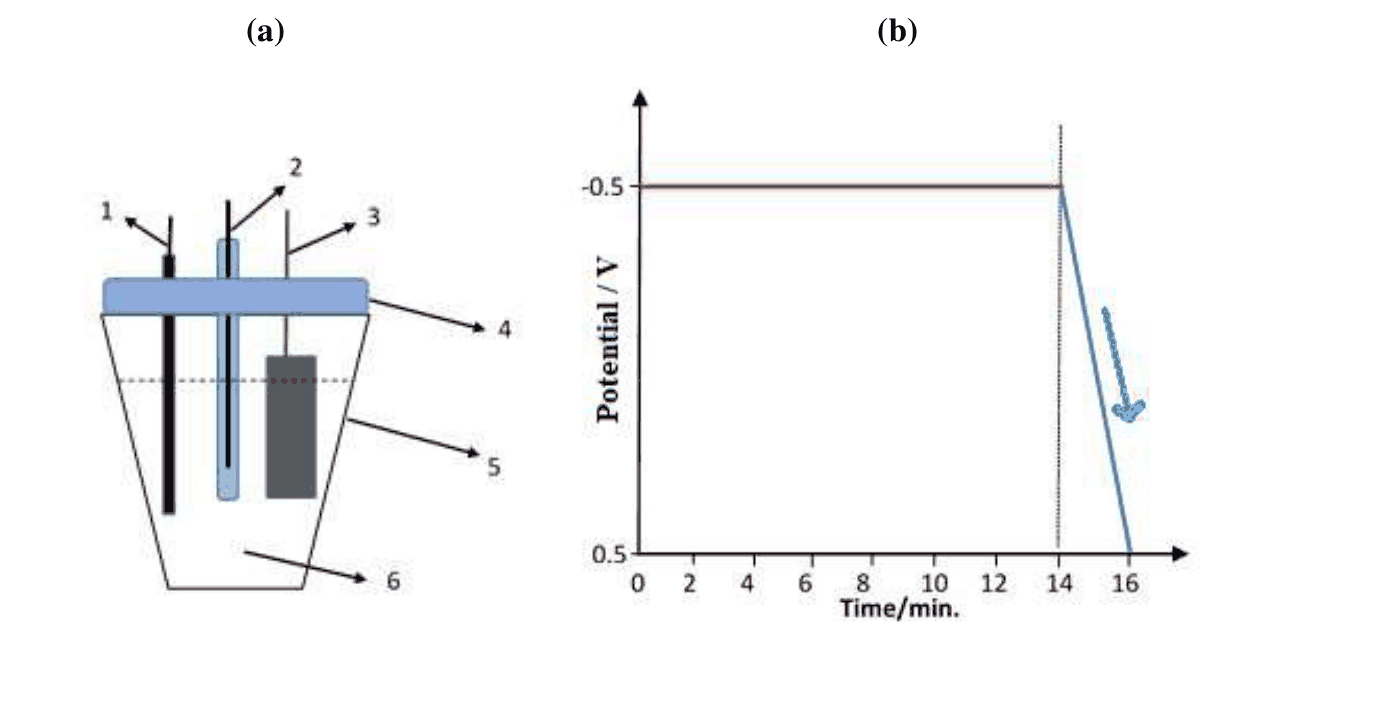
Figure 1. a) Electrochemical cell design; 1) Working electrode (\(\ce{Pt}\) wire), 2) reference electrode (\(\ce{Ag/AgCl}\), 3M \(\ce{KCl}\)), 3) counter electrode (\(\ce{Pt}\) foil), 4) cell tap, 5) electrochemical cell, 6) 10-mL of sample solution. b) Potential change of working electrode as a function of time. y-axis: potential/V vs \(\ce{Ag/AgCl}\), x-axis: time/min.
Step 4) The electrodes were rinsed with distilled water, placed into another electrochemical cell including 10-mL of 0.1 M \(\ce{H2SO4}\) solution, and potential was scanned between −0.50 and +0.50 V as seen in Figure 1b (downward sloping line in 2 min.). Current vs. potential data for this step are presented in Figure 2a, which is like an excellent view of Mount Ararat (Ağrı Dağı), the highest mountain in Turkey (Figure 2b).
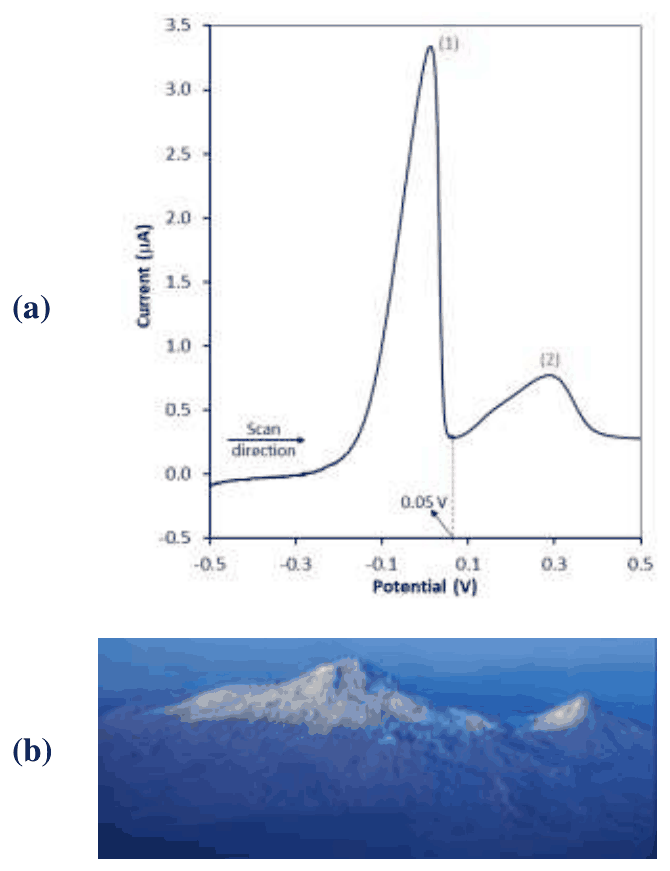
Figure 2. a) Potential scan of the working electrode as a function of current in 0.1 M \(\ce{H2SO4}\) solution after keeping it constant at a potential of −0.50 V in 10-mL of wastewater sample as seen in Figure 1b (horizontal line). y-axis: current/μA, x-axis: potential/V vs \(\ce{Ag/AgCl}\), b) A view of Great and Little Ararat peaks.
Step 5) Another 10-mL of the sample solution prepared in step 1 was taken and the processes explained in steps 2 and 3 were applied in that order. The electrodes were rinsed with distilled water and placed into 10-mL of 0.1 M \(\ce{H2SO4}\) solution. Then the potential of the working electrode was kept constant at +0.05 V for 14 minutes. It is assumed that 14 min. is sufficient to complete the expected electrochemical reactions.
Step 6) After step 5 was performed, the solution in the electrochemical cell was placed in a suitable oven to evaporate at 150 °C until dry solid was obtained.
Step 7) 5-mL of ethylenediaminetetraacetic acid (EDTA, \(\ce{H4Y}\)) (Figure 3) solution was added to the solid obtained in step 6 and it was shaken to dissolve. It is known that 1-mL of EDTA solution is equivalent to 3.85 mg/mL \(\ce{BaCO3}\). Then, pH of the solution was adjusted to 10.0. Excess EDTA was titrated with standard 0.0010 M \(\ce{Ni(NO3)2}\) solution and it was observed that 95.60 mL of \(\ce{Ni(NO3)2}\) solution was consumed up to the endpoint.
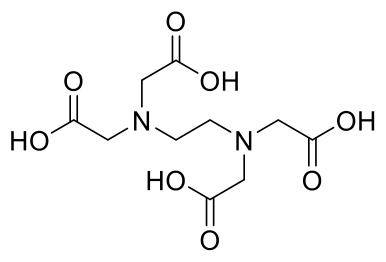
Figure 3. Chemical structure of EDTA (\(\ce{H4Y}\)).
- In water saturated with \(\ce{H2S}\), equilibrium concentration of \([\ce{H2S}]\) is 0.1 M.
- \(K_{\mathrm{sp}}(\ce{NiS})=4.0\times10^{-20}\); \(K_{\mathrm{sp}}(\ce{CuS})=1.0\times10^{-36}\)
- \(K_{\mathrm{a1}}(\ce{H2S})=9.6\times10^{-8}\); \(K_{\mathrm{a2}}(\ce{H2S})=1.3\times10^{-14}\)
Reaction \(E^\circ/\mathrm{V}\) (at 298 K) \(\ce{2H2O(l) + 2e- -> H2(g) + 2OH-(aq)}\) −0.83 \(\ce{Ni^2+(aq) + 2e- -> Ni(s)}\) −0.24 \(\ce{2H+(aq) + 2e- -> H2(g)}\) 0.00 \(\ce{Cu^2+(aq) + 2e- -> Cu(s)}\) +0.34 \(\ce{Ag+(aq) + e- -> Ag(s)}\) +0.80 \(\ce{O2(g) + 4H+(aq) + 4e- -> 2H2O(l)}\) +1.23 9.1. Which of the following can be considered for peak 1 and peak 2 in Figure 2a, respectively? Tick the correct box on the answer sheet.
- ☐ Peak 1: electrochemical reduction of \(\ce{Ni}\) / Peak 2: electrochemical reduction of \(\ce{Cu}\)
- ☐ Peak 1: electrochemical reduction of \(\ce{Cu}\) / Peak 2: electrochemical reduction of \(\ce{Ni}\)
- ☐ Peak 1: electrochemical reduction of \(\ce{Ni}\) / Peak 2: electrochemical oxidation of \(\ce{Cu}\)
- ☐ Peak 1: electrochemical oxidation of \(\ce{Ni}\) / Peak 2: electrochemical oxidation of \(\ce{Cu}\)
- ☐ Peak 1: electrochemical oxidation of \(\ce{Cu}\) / Peak 2: electrochemical oxidation of \(\ce{Ni}\)
9.2. Which of the statement is expected, if the potential is applied as −1.2 V instead of -0.5 V at the first step (horizontal line) in Figure 1b? Tick the correct box on the answer sheet.
- ☐ \(\ce{NO}\) evolution
- ☐ \(\ce{NO2}\) evolution
- ☐ Nitrogen evolution
- ☐ Oxygen evolution
- ☐ Hydrogen evolution
9.3. Calculate the scan rate of data presented in Figure 2a as mV/s at 298 K.
The potential of the following cell is measured as 0.437 V.
\[ \ce{Pt},\ce{H2}(0.92\ \mathrm{bar}) \mid \ce{HCl}(1.50\times10^{-2}\ \mathrm{M}),\ce{AgCl}(sat) \mid\ce{Ag} \]
9.4. Calculate the standard electrode potential value (V) of half-cell of \(\ce{AgCl(s) + e- -> Ag(s) + Cl-(aq)}\) at 298 K. Note: You must show all works.
9.5. Which of the statements is the main purpose of step 5 in this analysis? Tick the correct box on the answer sheet.
- ☐ Modification of \(\ce{Pt}\) wire with \(\ce{Ni}\)–\(\ce{Cu}\) alloy film
- ☐ Modification of \(\ce{Pt}\) wire with \(\ce{Ni}\) film
- ☐ Electrochemical stripping of both \(\ce{Cu}\) and \(\ce{Ni}\) from \(\ce{Cu}\)–\(\ce{Ni}\)-modified \(\ce{Pt}\) wire to the solution
- ☐ Electrochemical stripping of \(\ce{Cu}\) from \(\ce{Cu}\)–\(\ce{Ni}\)-modified \(\ce{Pt}\) wire to the solution
- ☐ Electrochemical stripping of \(\ce{Ni}\) from \(\ce{Cu}\)–\(\ce{Ni}\)-modified \(\ce{Pt}\) wire to the solution
9.6. Write net ionic equations for the complexation and the back titration reaction of step 7 on the answer sheet
9.7. Calculate \(\ce{Ni^2+}\) concentration as mg/L in the wastewater of the factory. Note: You must show all works.
9.8. Calculate the minimum pH value for starting the precipitation of \(\ce{Ni^2+}\) ions in the solution obtained in step 5 by passing \(\ce{H2S}\) gas into the solution until saturation. If you cannot solve question 9.7, use 20 mg/L \(\ce{Ni^2+}\) sample for this question. Note: You must show all works.
Official English text of the problem.
Internationale Chemie-Olympiade
IChO 2020
Istanbul, Türkei (als Fernwettbewerb ausgetragen) · 9 Theorieaufgaben mit vollständigen Lösungen
Aufgabe 1: Zwei Schönheiten der Türkei: die Van-Katze und die Ankara-Katze
Die Van-Katze, die schönste aller Katzen, ist eine reinrassige Katze, die ausschließlich im Einzugsgebiet des Vansees lebt. Eine weitere endemische Katzenrasse ist die Ankara-Katze. Diese Katzen werden Angorakatzen genannt. Ihr wichtigstes Merkmal sind ihre zwei unterschiedlichen Augenfarben.
Van-Katze
Ankara-Katze
Nepeta cataria (Echte Katzenminze)
Genau wie Menschen können Katzen manchmal gestresst und wütend sein. So wie Melatonin Menschen glücklich macht, kann ein Naturstoff den Stress von Katzen verringern und sie glücklich machen. Nepetalacton ist eine organische Verbindung, die aus der Katzenminze (Nepeta cataria) isoliert wird und als Lockstoff für Katzen wirkt. Nepetalacton ist eine von Isopren abgeleitete bicyclische Monoterpenoidverbindung mit zehn Kohlenstoffatomen und zwei anellierten Ringen: einem Cyclopentan- und einem Lactonring.
Katze eCat beim Fressen von Katzenminze im Garten
Traum einer Katze
Totalsynthese von Nepetalacton:
1.1 Das obige Schema beschreibt die Totalsynthese von Nepetalacton. Zeichnen Sie die Strukturen von A–G ohne stereochemische Details.
Hinweise:
- Verbindung A weist im IR-Spektrum eine starke und scharfe Bande bei \(3300\ \mathrm{cm^{-1}}\) auf.
- A, B, und F sind monocyclische, C, D, E, und G hingegen bicyclische Verbindungen.
- F weist im \({}^{1}\mathrm{H}\)-NMR-Spektrum ein Dublett bei ~ \(9.8\ \mathrm{ppm}\) auf.
Reaktionen von Nepetalacton:
Das obige Schema zeigt einige Reaktionen eines der enantiomerenreinen Isomere von Nepetalacton 1. Drei der Reaktionsprodukte (5, 6, und J) werden industriell als Insektenrepellentien verwendet.
1.2 Welche der folgenden Aussagen zur Beziehung zwischen 5 und 6 ist/sind richtig? Kreuzen Sie auf Ihren Antwortbögen das Kästchen neben der/den richtigen Antwort(en) an.
☐ Enantiomere ☐ Diastereomere ☐ Identisch ☐ Stereoisomere Die Reaktion von 1 mit DDQ liefert die stark konjugierte Verbindung H. Die thermische Reaktion von Verbindung H mit p-Chinon liefert außerdem I mit einer molaren Masse von \(226.28\ \mathrm{g/mol}\).
1.3 Zeichnen Sie die Strukturen von H, I, und J unter Angabe der Stereochemie.
Hinweise:
- Bei der Bildung von I finden aufeinanderfolgende pericyclische Reaktionen und eine Oxidationsreaktion (aufgrund der Anwesenheit von \(\ce{O2}\)) statt, und während der Reaktion entsteht ein allgemein bekanntes Gas.
- J weist im IR-Spektrum eine starke und sehr breite Bande zwischen 3300 und \(2500\ \mathrm{cm^{-1}}\) auf.
Aufgabentext aus dem offiziellen englischen Text übersetzt.
Aufgabe 2: Die Geschichte eines reaktiven Zwischenprodukts
Arine bilden eine besondere Klasse reaktiver Zwischenprodukte. Der erste experimentelle Nachweis für die Struktur eines Arins (Benzin) gelang 1953 durch die eleganten Markierungsexperimente von John D. Roberts und Mitarbeitern.
In einem dieser Experimente wurde Chlorbenzol, dessen Kohlenstoffatom an Position 1 mit radioaktivem \(\ce{^{14}C}\) markiert war, mit \(\ce{KNH2}\) in flüssigem \(\ce{NH3}\) umgesetzt. Dabei entstanden nahezu gleiche Mengen der Isotopenisomere A und B sowie das anorganische Salz C. Diese Reaktion verläuft über die Bildung des Arin-Zwischenprodukts D.
2.1 Zeichnen Sie die Strukturen von A, B und D und geben Sie die Formel von C an. Kennzeichnen Sie gegebenenfalls die Position(en) der mit \(\ce{^{14}C}\) markierten Kohlenstoffatome mit einem Sternchen (*).”
Die Analyse der mit \(\ce{^{14}C}\) markierten Produkte erfolgte durch Abbauexperimente (die mit \(\ce{^{14}C}\) markierten Kohlenstoffatome sind in den Strukturen nicht angegeben). Die Radioaktivität der Zwischenprodukte und Endprodukte wurde untersucht.
2.2 Kreuzen Sie auf dem Antwortbogen die entsprechenden Kästchen für die Zwischenprodukte und Produkte an, bei denen Sie Radioaktivität erwarten.
Bei ausschließlicher Betrachtung von A: Bei ausschließlicher Betrachtung von B: ☐ Verbindung 1 ☐ Verbindung 1 ☐ \(\ce{BaCO3}\) (Fraktion 1) ☐ \(\ce{BaCO3}\) (Fraktion 1) ☐ Verbindung 2 ☐ Verbindung 2 ☐ \(\ce{BaCO3}\) (Fraktion 2) ☐ \(\ce{BaCO3}\) (Fraktion 2) Um die Bildung von Arinen zu erleichtern, entwickelten Kobayashi und Mitarbeiter ein Verfahren zur fluoridinduzierten Arin-Erzeugung. Bei Anwendung dieser Methode wird das Benzolderivat 3 in Gegenwart von \(\ce{CsF}\) mit Furan (4) umgesetzt, wobei E, F und G entstehen.
- Die Verbrennungsanalyse von E ergab folgende Elementgehalte: 75.8 % Kohlenstoff, 5.8 % Wasserstoff und 18.4% Sauerstoff.
- E besitzt in der \(\ce{^1H}\)-NMR-Spektroskopie kein mit \(\ce{D2O}\) austauschbares Proton.
- F ist eine ionische Verbindung.
2.3 Bestimmen Sie die Strukturen von E, F und G (ohne stereochemische Angaben).
In Abwesenheit eines Nukleophils oder eines Abfangreagenzes können Arine unter geeigneten Bedingungen Cyclodimerisierungen vom [2+2]-Typ oder Cyclotrimerisierungen vom [2+2+2]-Typ eingehen. Das Arin-Derivat, das bei der Behandlung von 3 mit einem Äquivalent \(\ce{CsF}\) in MeCN entsteht, kann prinzipiell vier verschiedene Dimerisierungs- und Trimerisierungsprodukte (H – K) bilden.
- H besitzt zwei Symmetrieebenen.
- Für I werden 21 Signale im \(\ce{^{13}C}\)-NMR-Spektrum erwartet.
- I und J weisen in ihren Massenspektren beide einen \(m/z\)-Wert von 318.1 auf.
2.4 Bestimmen Sie die Strukturen von H – K.
Wenn 5 mit dem \(\beta\)-Ketoester 6 in Gegenwart von 2 Äquivalenten \(\ce{CsF}\) bei 80 °C umgesetzt wird, entsteht L als Hauptprodukt. Die \(\ce{^1H}\)-NMR- und \(\ce{^{13}C}\)-NMR-Daten für L in \(\ce{CDCl3}\) lauten wie folgt:
- \(\ce{^1H}\)-NMR: \(\delta\) 7.79 (dd, \(J=7.6,\ 1.5\ \mathrm{Hz}\), 1H), 7.47–7.33 (m, 2H), 7.25–7.20 (m, 1H), 3.91 (s, 2H), 3.66 (s, 3H), 2.56 (s, 3H) ppm.
- \(\ce{^{13}C}\)-NMR: \(\delta\) 201.3, 172.0, 137.1, 134.4, 132.8, 132.1, 130.1, 127.5, 51.9, 40.2, 28.8 ppm.
2.5 Bestimmen Sie die Struktur von L.
2.6 Welche der folgenden Aussagen beschreibt bzw. beschreiben die Funktion von \(\ce{CsF}\) in der in Aufgabe 2.5 gezeigten Reaktion?
- Die \(pK_\mathrm{a}\)-Werte von \(\ce{HF}\) und dem \(\beta\)-Ketoester 6 in Dimethylsulfoxid (DMSO) betragen etwa 15 bzw. 14.
☐ \(\ce{F-}\) hydrolysiert die Trifluormethansulfonatgruppe (\(\ce{O3SCF3}\)) von 5.
☐ \(\ce{F-}\) greift die \(\ce{-SiMe3}\)-Gruppe von 5 an.
☐ \(\ce{F-}\) wirkt als Base und deprotoniert 6.
☐ \(\ce{F-}\) wirkt als Nukleophil und greift die Estergruppe von 6 an.
Das Diazapyron-Derivat 8 hat sich als nützliches Reagenz für den Aufbau verschiedener cyclischer Gerüste erwiesen. Seine Herstellung aus Phenylglyoxylsäure (7) und seine Verwendung in zwei verschiedenen Reaktionen werden nachfolgend beschrieben.
- Q und T sind unter Umgebungsbedingungen Gase.
- O und P sind Konstitutionsisomere.
- Q weist keine Signale im IR-Spektrum auf.
- Beim Erhitzen von 1 mol R auf 85 °C entsteht 1 mol des reaktiven Zwischenprodukts S.
- Die Reaktion von 8 mit zwei Äquivalenten S ergibt U, Q und T.
Hinweis:
equiv = Äquivalent
cat = Katalysator
2.7 Bestimmen Sie die Strukturen von M – U.
Aufgabentext aus dem offiziellen englischen Text übersetzt.
Aufgabe 3: (±)-Coerulescin
Eine Spiroverbindung ist typischerweise eine organische Verbindung mit Ringen, die über ein einziges gemeinsames Atom (Spiroatom) miteinander verknüpft sind, wie das in der nachstehenden Abbildung fett hervorgehobene Kohlenstoffatom. Das Spiro[pyrrolidin-3,3′-oxindol]-Ringsystem ist ein Strukturgerüst, das in mehreren zytostatischen Alkaloiden und nicht natürlich vorkommenden Verbindungen enthalten ist. Coerulescin (1) und Horsfilin sind die einfachsten prototypischen Vertreter dieser Untergruppe und können über den nachstehend gezeigten Syntheseweg hergestellt werden.
Die Claisen-Umlagerung, eine [3,3]-sigmatrope Umlagerung, ist eine leistungsfähige Reaktion zur Bildung von Kohlenstoff–Kohlenstoff-Bindungen, bei der ein Allylvinylether thermisch in eine ungesättigte Carbonylverbindung überführt wird, wie im nachstehenden Schema gezeigt. Beim Erhitzen von Verbindung A erfolgt eine Claisen-Umlagerung zur Carbonylverbindung B.
Bei dieser gesamten Aufgabe können Sie Ihre Antworten ohne stereochemische Angaben geben.
3.1 Zeichnen Sie die Strukturen von A und B.
- A ist ein nicht trennbares Gemisch aus cis/trans-Isomeren.
- B weist eine IR-Absorption bei \(1726\ \mathrm{cm^{-1}}\) auf.
3.2 Zeichnen Sie die Strukturen von C, D, E und F.
- D–F haben eine bicyclische Struktur.
3.3 Wählen Sie die richtige Reihenfolge der Schritte für die Umwandlung von F in G.
☐ Iminbildung, dann Reduktion, dann Amidierung
☐ Amidierung, dann Iminbildung, dann Reduktion
☐ Reduktion, dann Amidierung, dann Iminbildung
3.4 Zeichnen Sie die Strukturen von G und H (beides Spiroverbindungen).
3.5 Zeichnen Sie die Struktur des Zwischenprodukts, das bei der Behandlung mit n-BuLi im Schritt H → Coerulescin (1) entsteht.
Coerulescin (1) ergibt bei der Behandlung mit N-Bromsuccinimid (NBS) das Bromderivat, das beim Erhitzen mit Natriummethanolat in Gegenwart von Kupfer(I)-iodid Horsfilin (I) in 60% Ausbeute liefert.
3.6 Wählen Sie die richtige Struktur für Verbindung I, die mit den folgenden ausgewählten \(\ce{^1H}\)-NMR-Daten übereinstimmt: \(\delta\) 7.05 (d, \(J=1.4\ \mathrm{Hz}\), 1H), 6.78 (d, \(J=8.0\ \mathrm{Hz}\), 1H), 6.72 (dd, \(J=8.0,\ 1.4\ \mathrm{Hz}\), 1H) ppm. Kreuzen Sie das entsprechende Kästchen an.
3.7 Beim Erhitzen des Allylethers von 2-Naphthol wird eine sigmatrope Umlagerung ausgelöst. Zeichnen Sie die Struktur des aus dieser Reaktion isolierten Hauptprodukts.
Aufgabentext aus dem offiziellen englischen Text übersetzt.
Aufgabe 4: Auf die Symmetrie kommt es an!
In der organischen Chemie gibt es zahlreiche Reaktionen, die über cyclische Übergangszustände verlaufen und als pericyclische Reaktionen klassifiziert werden. Die von Robert B. Woodward und Roald Hoffmann entwickelten Woodward–Hoffmann-Regeln dienen dazu, stereochemische Aspekte und die Aktivierungsenergie pericyclischer Reaktionen zu erklären.
Woodward–Hoffmann-Regeln
Anzahl der Elektronen Elektrocyclische Reaktionen: thermisch \((\Delta)\) Elektrocyclische Reaktionen: photochemisch \((h\nu)\) Cycloadditionen: thermisch \((\Delta)\) Cycloadditionen: photochemisch \((h\nu)\) \(4n\), \((n=1,2,..)\) Konrotatorisch (con) Disrotatorisch Nicht begünstigt Begünstigt \(4n+2\), \((n=1,2,..)\) Disrotatorisch (dis) Konrotatorisch Begünstigt Nicht begünstigt 4.1 Vervollständigen Sie die Tabelle für die Reaktionen (i)–(iii) bzw. die Produkte 2–5:
Reaktion Produkt [? + ?]-Cycloaddition \(\Delta\) oder \(h\nu\) i 2 ii 3 iii 4 5 Es gibt drei mögliche Benzotropon-Isomere. Obwohl zwei der Benzotropon-Isomere isoliert wurden, ist 3,4-Benzotropon (1) bislang nicht isoliert worden. Seine Instabilität wird auf die o-chinoide Struktur von 1 zurückgeführt, da es im Benzolring kein Elektronensextett aufweist.
4.2 Zeichnen Sie die Strukturen der stabilen Benzotropon-Isomere A (mit 6 Signalen im \(\ce{^{13}C}\)-NMR-Spektrum) und B (mit 11 Signalen im \(\ce{^{13}C}\)-NMR-Spektrum).
4.3 Wenn das folgende Tetraen unter photochemischen Bedingungen umgesetzt wird, können gemäß den Woodward–Hoffmann-Regeln symmetrieerlaubte Produkte mit drei verschiedenen Ringgrößen entstehen. Kreuzen Sie in jeder Zeile die richtige Antwort an.
Prof. Dr. Aziz Sancar
Der Nobelpreis für Chemie 2015 wurde gemeinsam an den türkischen Wissenschaftler Aziz Sancar, den schwedischen Wissenschaftler Tomas Lindahl und den amerikanischen Wissenschaftler Paul Modrich für ihre „mechanistischen Studien zur DNA-Reparatur“ verliehen. Die in der DNA vorkommenden Pyrimidinbasen können durch UV-Licht, das auf die Haut eines Menschen trifft, eine photochemische [2+2]-Cycloadditionsreaktion eingehen (siehe Abbildung oben). Dadurch wird die DNA geschädigt, was letztlich zu Hautkrebs führen kann. Die Forschung von Professor Aziz Sancar konzentrierte sich auf den DNA-Reparaturmechanismus für diese Art von Schädigung.
Thymin (T) ist eine der Nucleobasen, die eine solche photochemische Reaktion unter UV-Licht eingehen können. Nehmen wir an, dass eine Lösung von freiem Thymin mit UV-Licht bestrahlt wurde.
4.4 Zeichnen Sie unter Berücksichtigung der Stereochemie die Strukturen aller möglichen Produkte dieser Reaktion zwischen zwei freien Thyminmolekülen (T). Kreisen Sie die chirale(n) Verbindung(en) ein. Es genügt, nur ein Enantiomer eines Enantiomerenpaars zu zeichnen. Beachten Sie, dass nur \(\ce{C=C}\)-Bindungen an dieser Reaktion teilnehmen.
In der Literatur ist eine große Vielfalt halogenierter Derivate von Norbornadien (N) bekannt. Tribromnorbornadien (\(\ce{C7H5Br3}\)) besitzt sechs achirale (meso-)Isomere. Drei dieser Isomere (6, 7 und 8) sind nachfolgend dargestellt.
4.5 Wie viele Signale erwarten Sie in den \(\ce{^{13}C}\)-NMR-Spektren von 6, 7 und 8? Tragen Sie Ihre Antworten in die folgenden Kästchen ein.
4.6 Zeichnen Sie die Strukturen der neben 6 – 8 verbleibenden achiralen (meso-)Isomere von Tribromnorbornadien (\(\ce{C7H5Br3}\)) (C, D und E) auf den vorgegebenen Gerüsten in den Kästchen ein.
Das NMR-Spektrum des Ethers 9 ist komplex. Die beiden \(\ce{MeO-}\)-Gruppen sind unterschiedlich, ebenso wie alle Wasserstoffatome an den Ringen. Diphenol 10 besitzt hingegen ein sehr einfaches NMR-Spektrum, und es gibt nur drei Arten von Protonen (mit a, b und c gekennzeichnet). Eine plausible gemittelte Struktur, die alle mesomeren Grenzstrukturen und die zugehörige Symmetrie berücksichtigt, ist als 11 dargestellt.
4.7 Wie viele Signale erwarten Sie in den \(\ce{^{13}C}\)- und \(\ce{^{1}H}\)-NMR-Spektren von 12 und 13?
Aufgabentext aus dem offiziellen englischen Text übersetzt.
Aufgabe 5: Konya, Karotte, Beta-Carotin, Vitamin A, Immunsystem, Sehvermögen
Mevlana (Rumi) war ein großer Mystiker und Sufi-Dichter, der im \(13^{\mathrm{th}}\) Jahrhundert in Konya lebte. Die indirekte Bedeutung Konyas für die Chemie besteht darin, dass die Stadt 65% der Karottenproduktion des Landes liefert; aus Karotten wird eines der essenziellen Vitamine (Vitamin A) gewonnen.
Die Karotte ist eine wichtige Quelle für β-Carotin, das dem Gemüse seine orange Farbe verleiht. Dieses Molekül ist ein rotorangefarbenes Pigment, das natürlicherweise in Pflanzen und Früchten vorkommt, und gehört zu den Carotinoiden mit Provitamin-A-Wirkung. Es wird in Vitamin A umgewandelt, das für normales Wachstum und normale Entwicklung, das Immunsystem und die Sehfunktion essenziell ist.
Abbildung 1. Kugel-Stab-Modell der Struktur von β-Carotin. Die grauen und weißen Kugeln stellen die Kohlenstoff- bzw. Wasserstoffatome dar. Die nummerierten Kohlenstoffatome gehören zum linearen konjugierten π-Abschnitt des Moleküls.
β-Carotin besitzt eine ausgedehnte Polyenkette aus 22 Kohlenstoffatomen. Sie bildet ein konjugiertes \(\pi\)-System mit abwechselnden Einfach- und Doppelbindungen. Die experimentell bestimmte Wellenlänge des Absorptionsmaximums (\(\lambda_{\max}\)) beträgt 455 nm. Wir nehmen an, dass alle Bindungen zwischen \(C_1\) und \(C_{22}\) konjugierte Bindungen sind. Das Molekül enthält 22 \(\pi\)-Elektronen (Abbildung 1).
In einer groben Näherung wird angenommen, dass sich die Elektronen in den \(\ce{C}\text{-}2p_z\)-Orbitalen, die senkrecht zur Molekülebene stehen, entlang des gesamten Moleküls bewegen, ohne miteinander wechselzuwirken. Sie verhalten sich wie unabhängige Teilchen, die in einem Molekül eingeschlossen sind und sich in einer Dimension entlang der x-Achse bewegen. Aufgrund dieser Eigenschaften der π-Elektronen lassen sie sich mit dem einfachsten Modell, dem Modell Teilchen im eindimensionalen Kasten, beschreiben.
Die Wellenfunktion und die Energien der quantisierten Niveaus eines Elektrons, das sich in einem eindimensionalen Kasten mit unendlich hohen Potenzialwänden bewegt, sind wie folgt gegeben:
\[ \Psi_n(x)=\sqrt{\frac{2}{L}}\sin\frac{n\pi x}{L} \]
Dabei ist \(n\) die Quantenzahl, \(n=1,2,3,4,\ldots\infty\), und \(L\) die Kastenlänge.
\[ E_n=\frac{n^2h^2}{8m_eL^2} \]
In einem zweidimensionalen System wird im Rahmen der Näherung unabhängiger Teilchen die Wellenfunktion als Produkt eindimensionaler Wellenfunktionen und die Energie als Summe eindimensionaler Energien ausgedrückt. Die Energieniveaus des zweidimensionalen rechteckigen Kastens sind wie folgt gegeben:
\[ E_{n_xn_y} = \left[\frac{n_x^2}{L_x^2}+\frac{n_y^2}{L_y^2}\right] \left\{\frac{h^2}{8m_e}\right\} \]
Dabei sind \(n_x,n_y\) die Quantenzahlen; sie sind positive ganze Zahlen. \(L_x,L_y\) sind die Abmessungen des Kastens im 2D-Modell. Sie sind positive Zahlen.
5.1 Das β-Carotin-Molekül ist orange, weil:
i) Es im sichtbaren Bereich des elektromagnetischen Spektrums absorbiert.
ii) Der HOMO → LUMO-Übergang durch Absorption eines IR-Photons erfolgt.
iii) Der Abstand zwischen dem \(22^{\mathrm{nd}}\) und dem \(23^{\mathrm{rd}}\) Energieniveau gleich der Energie des IR-Photons bei der Wellenlänge von orangefarbenem Licht ist.
iv) Es grünes/blaues Licht absorbiert und rotes/gelbes Licht durchlässt.
v) Es im UV-VIS-Bereich absorbiert, da das Molekül kein resultierendes Dipolmoment besitzt.
Welches Paar der obigen Aussagen ist richtig?
Die Aussagenpaare lauten wie folgt:
☐ a) i und ii ☐ b) i und iii ☐ c) i und iv ☐ d) i und v ☐ e) ii und iii ☐ f) ii und iv ☐ g) ii und v ☐ h) iii und iv ☐ j) iii und v ☐ k) iv und v Obwohl dies höchst unrealistisch ist, nehmen wir an, dass der konjugierte Abschnitt des Moleküls linear ist und mit dem Modell eines Teilchens im eindimensionalen Kasten behandelt wird, wie in Abbildung 2 gezeigt. In diesem Fall lässt sich die Kastenlänge näherungsweise als \(L=1.40\times n_{\mathrm C}\) (in Å) angeben, wobei \(n_{\mathrm C}\) die Anzahl der Kohlenstoffatome im konjugierten Abschnitt ist.
Verwenden Sie diese Angaben zur Beantwortung der Fragen 5.2–5.6.
Abbildung 2. Schematische Darstellung des aus Kohlenstoffatomen des β-Carotins bestehenden geradlinigen konjugierten Abschnitts in einem eindimensionalen Kasten der Länge L.
5.2 Berechnen Sie die Energien (in J) der beiden niedrigsten Energieniveaus.
5.3 Zeichnen Sie die Wellenfunktionen der beiden niedrigsten Energieniveaus und beschriften Sie die x-Achse entsprechend.
5.4 Skizzieren Sie das Energieniveaudiagramm bis \(n=4\) unter Berücksichtigung der relativen Abstände.
5.5 Wie groß ist die gesamte \(\pi\)-Energie (in J) des Moleküls?
5.6 Berechnen Sie die Wellenlänge (in nm), bei der der Übergang zwischen dem höchsten besetzten und dem niedrigsten unbesetzten Energieniveau erfolgt.
Verwenden Sie das Modell eines Teilchens im zweidimensionalen Kasten zur Beantwortung der Fragen 5.7 – 5.8.
Abbildung 3. Schematische Darstellung der konjugierten Kohlenstoffatome des β-Carotins in einem zweidimensionalen Kasten.
Nehmen Sie an, dass der konjugierte Abschnitt aus konjugierten Bindungen besteht, die alle in trans-Anordnung zueinander stehen. Die Bewegung der π-Elektronen wird im zweidimensionalen rechteckigen Kasten mit den Abmessungen \(L_x=26.0\) Å, \(L_y=3.0\) Å untersucht (Abbildung 3).
5.7 Berechnen Sie die Energien (in J) des höchsten besetzten und des niedrigsten unbesetzten Energieniveaus sowie die Wellenlänge (in nm), bei der der Übergang zwischen diesen Energieniveaus erfolgt.
5.8 Welchen Wert muss \(L_x\) (in Å) haben, damit das Molekül Licht bei der experimentellen Wellenlänge \(\lambda_{\max}=455\) nm absorbiert, wenn \(L_y\) konstant bei 3.0 Å gehalten wird? (Nehmen Sie an, dass die Quantenzahlen für HOMO und LUMO dieselben sind wie in Frage 5.7.)
Aufgabentext aus dem offiziellen englischen Text übersetzt.
Aufgabe 6: Thermodynamik auf einer interstellaren Reise
Teil 1
In einem hypothetischen Universum nimmt eine unbekannte Menge Diboran an der folgenden Reaktion teil:
Nehmen Sie an, dass in diesem hypothetischen Universum das bei dieser Reaktion erhaltene \(\ce{H3BO3(s)}\) bei 300 K vollständig sublimiert wurde. Die für die Sublimation erforderliche Energie wurde durch die während eines Kreisprozesses einer idealen Wärmekraftmaschine abgegebene Arbeit bereitgestellt. Dabei durchläuft ein Mol eines einatomigen idealen Gases den im folgenden Druck-\(p\)-Volumen-\(V\)-Diagramm beschriebenen Kreisprozess:
- A→B; isotherme reversible Expansion unter Aufnahme von 250 J durch Wärmeübertragung (\(q_H\)) bei einer Temperatur von 1000 K (\(T_H\)) aus einem heißen Wärmereservoir.
- B→D; reversible adiabatische Expansion.
- D→C; isotherme reversible Kompression bei einer Temperatur von 300 K (\(T_C\)) unter Abgabe einer bestimmten Wärmemenge (\(q_C\)) an ein kaltes Wärmereservoir.
- C→A; reversible adiabatische Kompression.
Nach den Wärmeübertragungen wird die verbleibende Energie als Arbeit (\(w\)) abgegeben. Außerdem hängen \(q_H\) und \(q_C\) wie folgt mit \(T_C\) und \(T_H\) zusammen:
\[ \frac{|q_H|}{|q_C|}=\frac{T_H}{T_C} \]
Der Wirkungsgrad des Kreisprozesses ergibt sich aus der vom Kreisprozess abgegebenen Arbeit (\(w\)), geteilt durch die vom Kreisprozess aufgenommene Wärme (\(q_H\)).
Die Enthalpieänderungen der folgenden Reaktionen bei 300 K sind gegeben.
6.1 Berechnen Sie die molare Sublimationsenthalpie (in \(\mathrm{kJ\,mol^{-1}}\)) von \(\ce{H3BO3}\) bei 300 K.
6.2 Berechnen Sie \(\Delta_r U\) (Änderung der inneren Energie) in \(\mathrm{kJ\,mol^{-1}}\) bei 300 K für die oben angegebenen Reaktionen (2) und (4) (nehmen Sie für jede gasförmige Spezies in jeder Reaktion ideales Gasverhalten an).
6.3 Berechnen Sie die insgesamt von einer Wärmekraftmaschine geleistete Arbeit (\(|w|\)) in J und die insgesamt an das kalte Wärmereservoir abgegebene Wärme (\(|q_C|\)) in J.
6.4 Berechnen Sie den Wirkungsgrad der oben beschriebenen Wärmekraftmaschine.
6.5 Berechnen Sie die Entropieänderung (\(\Delta S\)) für die Prozesse A→B und D→C in der Wärmekraftmaschine in \(\mathrm{J\,K^{-1}}\).
6.6 Berechnen Sie die Änderung der Gibbs-Energie (\(\Delta G\)) in J für die Prozesse A→B und D→C in der Wärmekraftmaschine.
6.7 Berechnen Sie das Verhältnis des Drucks am Punkt A zum Druck am Punkt B des Kreisprozesses (Standarddruck: 1 bar).
6.8 Berechnen Sie die Stoffmenge an \(\ce{H2(g)}\) (in Mol), die gemäß der zu Beginn der Aufgabe angegebenen Reaktion bei einem Kreisprozess der Maschine entsteht.
Teil 2
Interstellare Reisen lassen sich unter Verwendung von Diboran als Raketentreibstoff durchführen. Die Verbrennung von Diboran ist unten dargestellt:
Die Verbrennung von Diboran wird in einem geschlossenen Behälter (\(100\ \mathrm{dm^3}\)) bei verschiedenen Temperaturen experimentell untersucht, und die Stoffmengen im Gleichgewicht werden aufgezeichnet.
Temperatur 8930 K 9005 K \(\ce{B2H6(g)}\) 0.38 mol 0.49 mol \(\ce{H2O(g)}\) 0.20 mol 0.20 mol Der Partialdruck von \(\ce{O2(g)}\) wurde auf 1 bar eingestellt und unter allen Bedingungen konstant gehalten.
Nehmen Sie für dieses hypothetische Universum an, dass \(\Delta_r S^\circ\) und \(\Delta_r H^\circ\) temperaturunabhängig sind, die molare Standardentropie (\(S^\circ\)) von \(\ce{B2O3(s)}\) sich nicht mit dem Druck ändert, alle gasförmigen Spezies sich wie ideale Gase verhalten und alle Spezies bei allen Temperaturen in derselben Phase verbleiben, ohne sich vor oder nach der Reaktion weiter zu zersetzen. Bearbeiten Sie unter diesen Annahmen die folgenden Aufgaben:
6.9 Berechnen Sie \(K_p\) (die auf Drücken beruhende Gleichgewichtskonstante) bei 8930 K und 9005 K.
6.10 Berechnen Sie \(\Delta_r G^\circ\) der Reaktion in \(\mathrm{kJ\,mol^{-1}}\) bei 8930 K und 9005 K. (Falls Sie \(K_p\) nicht bestimmen konnten, verwenden Sie bitte \(K_p\) (8930 K) = 2, \(K_p\) (9005 K) = 0.5.)
6.11 Berechnen Sie \(\Delta_r G^\circ\) (in \(\mathrm{kJ\,mol^{-1}}\)), \(\Delta_r H^\circ\) (in \(\mathrm{kJ\,mol^{-1}}\)) und \(\Delta_r S^\circ\) (in \(\mathrm{J\,mol^{-1}\,K^{-1}}\)) der Verbrennungsreaktion bei 298 K. (Falls Sie \(K_p\) nicht bestimmen konnten, verwenden Sie bitte \(K_p\)(8930 K) = 2, \(K_p\)(9005 K) = 0.5)
6.12 Kreuzen Sie in der Tabelle die richtige Antwort an, indem Sie bestimmen, ob die Verbrennungsreaktionen bei der jeweils unten angegebenen Temperatur \(T\) unter Standarddruck (1 bar) begünstigt sind oder nicht.
Temperatur Begünstigt Nicht begünstigt 298 K ☐ ☐ 8930 K ☐ ☐ 9005 K ☐ ☐ 9100 K ☐ ☐ 6.13 Berechnen Sie \(\Delta_f H\) (\(\mathrm{kJ\,mol^{-1}}\)) und \(S^\circ\) (\(\mathrm{kJ\,mol^{-1}\,K^{-1}}\)) von \(\ce{H2O(g)}\) mithilfe der in der folgenden Tabelle angegebenen Werte. (\(\Delta_f H\) = Bildungsenthalpie, \(S^\circ\) = Standardentropie)
(Falls Sie \(\Delta_r H^\circ\) und \(\Delta_r S^\circ\) der Verbrennung nicht bestimmen können, verwenden Sie bitte \(\Delta H^\circ=1000\ \mathrm{kJ\,mol^{-1}}\), \(\Delta S^\circ=150\ \mathrm{J\,K^{-1}\,mol^{-1}}\))
Verbindung \(\Delta H_f\) (298 K) \(S^\circ\) (298 K) \(\ce{B2H6(g)}\) \(36.40\ \mathrm{kJ\,mol^{-1}}\) \(0.23\ \mathrm{kJ\,mol^{-1}\,K^{-1}}\) \(\ce{O2(g)}\) \(0.00\ \mathrm{kJ\,mol^{-1}}\) \(0.16\ \mathrm{kJ\,mol^{-1}\,K^{-1}}\) \(\ce{B2O3(s)}\) \(-1273\ \mathrm{kJ\,mol^{-1}}\) \(0.05\ \mathrm{kJ\,mol^{-1}\,K^{-1}}\) Aufgabentext aus dem offiziellen englischen Text übersetzt.
Aufgabe 7: Phthalocyanine
Emeritierter Professor Özer Bekaroğlu
Der Begriff Phthalocyanin (Pc) leitet sich von den griechischen Wörtern „naphtha“, das Erdöl bedeutet, und „cyanine“, das dunkelblau bedeutet, ab. Der türkische Wissenschaftler Özer Bekaroğlu kann als Pionier der Pc-Chemie in der Türkei angesehen werden.
Metallfreies Phthalocyanin (1, \(\ce{H2Pc}\)) ist eine große planare makrocyclische Verbindung mit der Formel \(\ce{(C8H4N2)4H2}\).
7.1 Wie viele π-Elektronen befinden sich im fett hervorgehobenen Bereich des oben gezeigten \(\ce{H2Pc}\)-Moleküls in Verbindung 1?
Pcs, die ein oder zwei Metallionen enthalten, werden als Metallophthalocyanine (MPcs) bezeichnet und weisen die oben dargestellten unterschiedlichen Geometrien auf.
7.2 Vervollständigen Sie die Tabelle auf Ihrem Antwortbogen, indem Sie die Koordinationszahl der Zentralionen in 2–5 bestimmen.
Zentralion Kupferion Titanion Siliciumion Cerion Koordinationszahl 7.3 Vervollständigen Sie die Tabelle auf Ihrem Antwortbogen, indem Sie die Oxidationszahl jedes Metalls (Cu, Ti und Ce) in 2, 3 und 5 bestimmen.
Metall in den Verbindungen 2 3 5 Oxidationszahl 7.4 Vervollständigen Sie die Tabelle auf Ihrem Antwortbogen, indem Sie die Geometrie der Verbindungen 2–5 bestimmen.
Geometrie Verbindung Oktaedrisch Quadratisches Prisma Quadratisch-pyramidal Quadratisch-planar 7.5 Vervollständigen Sie die Tabelle auf Ihrem Antwortbogen, indem Sie die magnetische Eigenschaft der Verbindungen 2–5 bestimmen.
- Verwenden Sie den Buchstaben „p“ für paramagnetisches Verhalten und den Buchstaben „d“ für diamagnetisches Verhalten.
Verbindung Magnetische Eigenschaft 2 3 4 5 7.6 Geben Sie die Elektronenkonfiguration des Siliciumions (Si) in Verbindung 4 im Grundzustand an und bestimmen Sie alle Quantenzahlen der 2p-Elektronen in seinem Grundzustand.
Elektronenkonfiguration: Quantenzahlen der 2p-Elektronen: \(n\) \(l\) \(m_l\) \(m_s\) Metallfreies Phthalocyanin (1, \(\ce{H2Pc}\)) wird üblicherweise durch Cyclotetramerisierung von Phthalonitrilen gebildet. Pcs mit unterschiedlichen Substituenten hingegen werden als asymmetrisch bezeichnet und können durch statistische Cyclisierung zweier verschiedener Phthalonitrile hergestellt werden. Diese Methode ist nicht selektiv, und das Produkt ist ein Gemisch aller möglichen Isomere.
7.7 Zeichnen Sie die möglichen Produkte, die bei der statistischen Cyclisierung unter Verwendung von F und G entstehen können. Falls Stereoisomere auftreten, kennzeichnen Sie diese als cis- oder trans-.
- F und G stehen für zwei verschiedene symmetrische Phthalonitrile.
- Eines der Produkte ist \(\mathrm{F}_4\), wie unten dargestellt.
- Zeichnen Sie die anderen Produkte entsprechend der Darstellung von \(\mathrm{F}_4\).
Pcs werden aufgrund ihrer starken Absorption im sichtbaren Spektralbereich und ihrer hohen molaren Absorptionskoeffizienten als Photosensibilisatoren in der photodynamischen Therapie (PDT) von Krebs eingesetzt. Die PDT besteht aus drei wesentlichen Komponenten: Photosensibilisator, Licht und Sauerstoff. Keine dieser Komponenten ist für sich allein toxisch, doch gemeinsam lösen sie eine photochemische Reaktion aus, bei der zytotoxischer Singulett-Sauerstoff (\(\ce{^{1}O2}\)) entsteht, der Krebszellen zerstören kann.
- Die Multiplizität eines Energieniveaus ist als \(2S+1\) definiert.
- Sind die beiden Spins parallel (\(\uparrow\uparrow\)), gilt \(S=1\), und sind die beiden Spins antiparallel (\(\uparrow\downarrow\)), gilt \(S=0\).
7.8 Zeichnen Sie das Molekülorbitaldiagramm (MO-Diagramm) des energetisch niedrigsten Singulett-Zustands von Disauerstoff (\(\ce{^{1}O2}\)) und berechnen Sie die Bindungsordnung.
- In diesem Zustand gibt es keine ungepaarten Elektronen!
7.9 Wenn die Wellenlänge des Lichts, das zur Anregung von Triplett-Sauerstoff zu Singulett-Sauerstoff benötigt wird, 1270 nm beträgt, berechnen Sie die für diesen Übergang benötigte Energie (in kJ/mol).
Aufgabentext aus dem offiziellen englischen Text übersetzt.
Aufgabe 8: Borverbindungen und Wasserstoffspeicherung
14% der Gesamtpunktzahl
Frage 8.1 8.2 8.3 8.4 8.5 8.6 8.7 8.8 Gesamt Punkte 3 3 4 4 4 4 6 3 58 Frage 8.9 8.10 8.11 8.12 8.13 8.14 8.15 8.16 Punkte 2 3 2 4 4 4 2 2 Frage 8.17 Punkte 4 Aufgabe 8. Borverbindungen und Wasserstoffspeicherung
Natriumborhydrid (\(\ce{NaBH4}\)) und Amminboran (\(\ce{BNH6}\)) sind die am intensivsten untersuchten Materialien zur chemischen Wasserstoffspeicherung. In dieser Aufgabe untersuchen Sie die Chemie des Bors und die Verwendung von Borverbindungen als Wasserstoffspeichermaterialien.
Borax (\(\ce{Na2B4O7 * nH2O}\)) ist ein Bormineral, das von der ETI Mining Company in der Türkei gewonnen wird. \(\ce{NaBH4}\) kann durch Reduktion von wasserfreiem Borax mit metallischem Natrium unter Wasserstoffgas bei hohem Druck in Gegenwart von Siliciumdioxid bei 700 °C synthetisiert werden; dieses Verfahren wird als Bayer-Verfahren bezeichnet. Bei diesem Verfahren wird der gesamte Wasserstoff in \(\ce{NaBH4}\) gespeichert. Andererseits wurde gezeigt, dass Amminboran (\(\ce{BNH6}\)) durch die Reaktion von \(\ce{NaBH4}\) und Ammoniumsulfat in trockenem Tetrahydrofuran (THF) bei 40 °C synthetisiert werden kann (Hinweis: Die Synthese von \(\ce{BNH6}\) muss in einem gut belüfteten Abzug durchgeführt werden, da als eines der Nebenprodukte ein brennbares Gas entsteht). Während \(\ce{NaBH4}\) eine ionische Verbindung ist, handelt es sich bei Amminboran um ein Lewis-Säure-Base-Addukt.
8.1. Stellen Sie eine ausgeglichene Reaktionsgleichung für die Synthese von \(\ce{NaBH4}\) aus wasserfreiem Borax auf.
8.2. Stellen Sie eine ausgeglichene Reaktionsgleichung für die Synthese von Amminboran aus \(\ce{NaBH4}\) auf.
8.3. Zeichnen Sie die Molekülgeometrie des \(\ce{BH4^-}\)-Ions und des \(\ce{BNH6}\)-Moleküls.
8.4. Berechnen Sie den Wasserstoffgehalt von \(\ce{NaBH4}\) und \(\ce{BNH6}\) als Massenanteil in Prozent (Gew.-%).
Der in beiden Verbindungen gespeicherte Wasserstoff kann durch Hydrolysereaktionen in Gegenwart eines geeigneten Katalysators bei Raumtemperatur freigesetzt werden. Bei der Hydrolyse von jeweils 1 mol \(\ce{NaBH4}\) bzw. \(\ce{BNH6}\) werden 4 bzw. 3 mol \(\ce{H2}\)-Gas freigesetzt; zugleich entsteht ein Metaborat-Anion mit B-O-Bindungen.
8.5. Stellen Sie die ausgeglichenen Reaktionsgleichungen für die Hydrolyse von \(\ce{NaBH4}\) und \(\ce{BNH6}\) auf.
Eines der einfachsten stabilen Borate ist Dibortrioxid (\(\ce{B2O3}\)). Es können höhere Borate wie \(\ce{B3O6^{3-}}\) mit cyclischen Strukturen gebildet werden, die B-O-Bindungen enthalten. Da \(\ce{B2O3}\) eine saure Verbindung ist, reagiert es leicht mit Wasser zu Borsäure (\(\ce{H3BO3}\)). Dagegen liefert die Reaktion von \(\ce{B2O3}\) mit Ammoniak bei hoher Temperatur und hohem Druck zweidimensionales Bornitrid, das aus ebenen, graphitähnlichen Schichten mit abwechselnden B- und N-Atomen besteht.
8.6. Stellen Sie die ausgeglichenen Reaktionsgleichungen für die Synthese von Borsäure und Bornitrid auf.
8.7. Zeichnen Sie die Molekülstrukturen des \(\ce{B3O6^{3-}}\)-Ions, der Borsäure und einer einzelnen zweidimensionalen Bornitridschicht. Hinweis: Stellen Sie in der Bornitridstruktur mindestens 10 B-Atome dar.
Darüber hinaus bilden B-H-Verbindungen, die als Borane bezeichnet werden, eine wichtige Klasse von Borverbindungen. Das einfachste stabile Boran ist Diboran (\(\ce{B2H6}\)), und viele der höheren Borane können durch Pyrolyse von Diboran hergestellt werden. Diboran kann durch Metathese eines Borhalogenids mit einer Hydridquelle synthetisiert werden.
8.8. Stellen Sie eine ausgeglichene Reaktionsgleichung für die Synthese von Diboran durch die Reaktion von \(\ce{BF3}\) und \(\ce{LiBH4}\) auf. Hinweis: Beide Produkte sind Borverbindungen.
8.9. Zeichnen Sie die Molekülgeometrie des Diboranmoleküls. Hinweis: Die Struktur enthält keine B-B-Bindung.
\(\ce{BH3}\) (Boran) ist ein instabiles und hochreaktives Molekül. Daher lässt es sich unter gewöhnlichen Bedingungen nicht als \(\ce{BH3}\) isolieren. Es kann jedoch durch seine Reaktion mit Kohlenstoffmonoxid stabilisiert werden, wobei die Verbindung Borancarbonyl (\(\ce{BH3CO}\)), ein Addukt des Borans, entsteht. Die Darstellung von \(\ce{BH3CO}\) spielt eine wichtige Rolle bei der Erforschung der Chemie der Borane, da sie auf die wahrscheinliche Existenz des Boranmoleküls hinweist.
8.10. Skizzieren Sie die Lewis-Elektronenformel des \(\ce{BH3-CO}\)-Moleküls unter Angabe der Formalladungen.
8.11. Welche der auf Ihrem Antwortbogen aufgeführten Aussagen beschreibt die Veränderung der \(\ce{C-O}\)-Bindung eines \(\ce{CO}\)-Moleküls bei der Bindungsbildung zwischen \(\ce{BH3}\) und \(\ce{CO}\)? Kreuzen Sie das richtige Kästchen an.
- ☐ Sie wird länger, da eine \(\pi\)-Rückbindung von \(\ce{BH3}\) zu \(\ce{CO}\) auftritt.
- ☐ Sie wird länger, da \(\ce{CO}\) \(\pi\)-Bindungselektronen an \(\ce{BH3}\) abgibt.
- ☐ Sie verändert sich nicht oder nur geringfügig, da \(\ce{CO}\) seine überwiegend nichtbindenden Elektronen an \(\ce{BH3}\) abgibt.
- ☐ Sie wird kürzer, da \(\ce{CO}\) antibindende \(\pi^*\)-Elektronen an \(\ce{BH3}\) abgibt.
Borazin besteht aus ringförmig angeordneten, einfach und doppelt gebundenen \(\ce{B-N}\)-Einheiten sowie Wasserstoffatomen, die an diese Atome gebunden sind. Es hat die Summenformel \(\ce{B3N3H6}\) und ist isostrukturell zu Benzol. Borazin kann in einem zweistufigen Verfahren synthetisiert werden: Zunächst wird durch die Reaktion von Ammoniumchlorid und Bortrichlorid das symmetrisch trisubstituierte Chlorderivat des Borazins (\(\ce{B3N3H3Cl3}\)) hergestellt, anschließend wird \(\ce{B3N3H3Cl3}\) mit \(\ce{LiBH4}\) in THF reduziert.
8.12. Stellen Sie die ausgeglichenen Reaktionsgleichungen für die zweistufige Synthese von Borazin ausgehend von Ammoniumchlorid in THF (Tetrahydrofuran) auf. Hinweis: THF stabilisiert eines der Produkte durch Bildung eines Lewis-Säure-Base-Addukts.
8.13. Zeichnen Sie die Molekülstrukturen von Borazin und seinem symmetrisch trisubstituierten Chlorderivat.
Katalysatoren sind Stoffe, die die Geschwindigkeit von Reaktionen erhöhen, indem sie einen Reaktionsweg mit niedrigerer Energie ermöglichen. Die katalytische Aktivität von Katalysatoren wird im Allgemeinen anhand der Wechselzahl (TOF) bestimmt. Diese wird berechnet, indem die Stoffmenge des Produkts durch die Stoffmenge des aktiven Katalysators und die Zeit dividiert wird (TOF = mol Produkt/(mol Katalysator x Zeit)). Eine typische Hydrolyse von \(\ce{BNH6}\) wurde in 10.0 mL Wasser unter Verwendung von 100.0 mM \(\ce{BNH6}\) und 5.0 mg CuPt/C-Katalysator durchgeführt (auf Ruß geträgerte CuPt-Legierungsnanopartikel mit einem Pt-Anteil von 8.2 Gew.-%). Innerhalb von 5 Minuten entstanden 67.25 mL Wasserstoffgas.
8.14. Nehmen Sie an, dass die katalytische Reaktion unter Normalbedingungen (1 atm und 273.15 K) durchgeführt wird. Berechnen Sie anhand des Volumens des entstandenen Wasserstoffgases die TOF (\(\mathrm{min^{-1}}\)) des CuPt/C-Katalysators bei der Hydrolyse von \(\ce{BNH6}\), bezogen ausschließlich auf die Pt-Atome.
Eine detaillierte Kristallanalyse synthetisierter \(\ce{Cu_{x}Pt_{y}}\)-Legierungsnanopartikel (die Indizes geben die molaren Prozentanteile der Atome in der Legierungsstruktur an) ergab, dass die kubisch flächenzentrierte (fcc) Elementarzelle von Pt-Atomen gebildet wird. Es wird angenommen, dass die Pt-Atome auf den Flächen der fcc-Elementarzelle durch Cu-Atome ersetzt werden, wodurch \(\ce{Cu_{x}Pt_{y}}\)-Nanopartikel einer Substitutionslegierung entstehen. Beantworten Sie anhand dieser Angaben die folgenden Fragen.
8.15. Bestimmen Sie die Zusammensetzung der Legierungsnanopartikel, indem Sie \(x\) und \(y\) in \(\ce{Cu_{x}Pt_{y}}\) ermitteln.
8.16. Skizzieren Sie die Form der beschriebenen kristallinen Elementarzelle der \(\ce{Cu_{x}Pt_{y}}\)-Legierungsnanopartikel und zeigen Sie dabei die Positionen aller Atome auf der Elementarzelle.
8.17. Eine andere Legierung hat die Zusammensetzung \(\ce{Cu2Pt1}\). Nehmen Sie an, dass auch diese Legierung eine fcc-Elementarzelle mit einer Kantenlänge von 380 pm besitzt, die Cu- und Pt-Atome jedoch zufällig auf die Atompositionen verteilt sind. Berechnen Sie die Dichte dieser Legierung in \(\mathrm{g/cm^3}\).
Aufgabentext aus dem offiziellen englischen Text übersetzt.
Aufgabe 9: Quantifizierung von Schwermetallionen
| 12% der Gesamtpunktzahl | Punkte | 5 | 5 | 8 | 16 | 5 | 6 | 25 | 30 | 100 |
Aufgabe 9. Quantifizierung von Schwermetallionen
Zur quantitativen Analyse von Schwermetallionen im Abwasserbecken einer Fabrik wurden von einer analysierenden Person bei 298 K die folgenden Schritte durchgeführt:
Schritt 1) Aus fünf verschiedenen Bereichen eines Abwasserbeckens wurden jeweils 10-mL-Proben entnommen, in einem 100-mL-Becherglas gemischt und anschließend 5 Minuten lang mit einem Magnetrührer gerührt.
Schritt 2) Dem 100-mL-Becherglas wurden 10 mL Probenlösung entnommen und unter Rühren 142 mg \(\ce{Na2SO4}\) zugegeben. Anschließend wurde die Lösung in eine Drei-Elektroden-Zelle überführt, wie in Abbildung 1a gezeigt. In dieser elektrochemischen Zelle dienten ein \(\ce{Pt}\)-Draht, \(\ce{Ag/AgCl}\) (3 M \(\ce{KCl}\)) und eine \(\ce{Pt}\)-Folie als Arbeits-, Referenz- bzw. Gegenelektrode.
Schritt 3) Diese Elektroden wurden an einen Potentiostaten angeschlossen, und es wurde 14 Minuten lang ein konstantes Potential von −0.50 V gegen \(\ce{Ag/AgCl}\) angelegt, wie in Abbildung 1b gezeigt (waagerechte Linie). Es wird angenommen, dass 14 min ausreichen, um die erwarteten elektrochemischen Reaktionen vollständig ablaufen zu lassen.
Abbildung 1. a) Aufbau der elektrochemischen Zelle; 1) Arbeitselektrode (\(\ce{Pt}\)-Draht), 2) Referenzelektrode (\(\ce{Ag/AgCl}\), 3M \(\ce{KCl}\)), 3) Gegenelektrode (\(\ce{Pt}\)-Folie), 4) Zellenhahn, 5) elektrochemische Zelle, 6) 10 mL Probenlösung. b) Änderung des Potentials der Arbeitselektrode als Funktion der Zeit. y-Achse: Potential/V gegen \(\ce{Ag/AgCl}\), x-Achse: Zeit/min.
Schritt 4) Die Elektroden wurden mit destilliertem Wasser gespült und in eine weitere elektrochemische Zelle mit 10 mL einer 0.1 M \(\ce{H2SO4}\)-Lösung eingesetzt. Das Potential wurde zwischen −0.50 und +0.50 V durchfahren, wie in Abbildung 1b gezeigt (abfallende Linie innerhalb von 2 min). Die Strom-Potential-Daten für diesen Schritt sind in Abbildung 2a dargestellt, die einer eindrucksvollen Ansicht des Ararat (Ağrı Dağı), des höchsten Berges der Türkei, ähnelt (Abbildung 2b).
Abbildung 2. a) Potentialdurchlauf der Arbeitselektrode als Funktion des Stroms in einer 0.1 M \(\ce{H2SO4}\)-Lösung, nachdem ihr Potential in 10 mL Abwasserprobe konstant bei −0.50 V gehalten wurde, wie in Abbildung 1b gezeigt (waagerechte Linie). y-Achse: Strom/μA, x-Achse: Potential/V gegen \(\ce{Ag/AgCl}\), b) Ansicht der Gipfel des Großen und Kleinen Ararat.
Schritt 5) Weitere 10 mL der in Schritt 1 hergestellten Probenlösung wurden entnommen und die in den Schritten 2 und 3 erläuterten Verfahren in dieser Reihenfolge durchgeführt. Die Elektroden wurden mit destilliertem Wasser gespült und in 10 mL einer 0.1 M \(\ce{H2SO4}\)-Lösung eingesetzt. Anschließend wurde das Potential der Arbeitselektrode 14 Minuten lang konstant bei +0.05 V gehalten. Es wird angenommen, dass 14 min ausreichen, um die erwarteten elektrochemischen Reaktionen vollständig ablaufen zu lassen.
Schritt 6) Nach Durchführung von Schritt 5 wurde die Lösung aus der elektrochemischen Zelle in einem geeigneten Ofen bei 150 °C eingedampft, bis ein trockener Feststoff erhalten wurde.
Schritt 7) Zum in Schritt 6 erhaltenen Feststoff wurden 5 mL einer Lösung von Ethylendiamintetraessigsäure (EDTA, \(\ce{H4Y}\)) (Abbildung 3) gegeben, und es wurde zum Lösen geschüttelt. Es ist bekannt, dass 1 mL EDTA-Lösung 3.85 mg/mL \(\ce{BaCO3}\) entspricht. Anschließend wurde der pH-Wert der Lösung auf 10.0 eingestellt. Die überschüssige EDTA wurde mit einer 0.0010 M \(\ce{Ni(NO3)2}\)-Maßlösung titriert. Dabei wurde beobachtet, dass bis zum Endpunkt 95.60 mL \(\ce{Ni(NO3)2}\)-Lösung verbraucht wurden.
Abbildung 3. Chemische Struktur von EDTA (\(\ce{H4Y}\)).
- In mit \(\ce{H2S}\) gesättigtem Wasser beträgt die Gleichgewichtskonzentration \([\ce{H2S}]\) 0.1 M.
- \(K_{\mathrm{sp}}(\ce{NiS})=4.0\times10^{-20}\); \(K_{\mathrm{sp}}(\ce{CuS})=1.0\times10^{-36}\)
- \(K_{\mathrm{a1}}(\ce{H2S})=9.6\times10^{-8}\); \(K_{\mathrm{a2}}(\ce{H2S})=1.3\times10^{-14}\)
Reaktion \(E^\circ/\mathrm{V}\) (bei 298 K) \(\ce{2H2O(l) + 2e- -> H2(g) + 2OH-(aq)}\) −0.83 \(\ce{Ni^2+(aq) + 2e- -> Ni(s)}\) −0.24 \(\ce{2H+(aq) + 2e- -> H2(g)}\) 0.00 \(\ce{Cu^2+(aq) + 2e- -> Cu(s)}\) +0.34 \(\ce{Ag+(aq) + e- -> Ag(s)}\) +0.80 \(\ce{O2(g) + 4H+(aq) + 4e- -> 2H2O(l)}\) +1.23 9.1. Welche der folgenden Zuordnungen kommt für Peak 1 bzw. Peak 2 in Abbildung 2a infrage? Kreuzen Sie das richtige Kästchen auf dem Antwortbogen an.
- ☐ Peak 1: elektrochemische Reduktion von \(\ce{Ni}\) / Peak 2: elektrochemische Reduktion von \(\ce{Cu}\)
- ☐ Peak 1: elektrochemische Reduktion von \(\ce{Cu}\) / Peak 2: elektrochemische Reduktion von \(\ce{Ni}\)
- ☐ Peak 1: elektrochemische Reduktion von \(\ce{Ni}\) / Peak 2: elektrochemische Oxidation von \(\ce{Cu}\)
- ☐ Peak 1: elektrochemische Oxidation von \(\ce{Ni}\) / Peak 2: elektrochemische Oxidation von \(\ce{Cu}\)
- ☐ Peak 1: elektrochemische Oxidation von \(\ce{Cu}\) / Peak 2: elektrochemische Oxidation von \(\ce{Ni}\)
9.2. Welcher der folgenden Vorgänge ist zu erwarten, wenn im ersten Schritt (waagerechte Linie) in Abbildung 1b ein Potential von −1.2 V statt -0.5 V angelegt wird? Kreuzen Sie das richtige Kästchen auf dem Antwortbogen an.
- ☐ \(\ce{NO}\)-Entwicklung
- ☐ \(\ce{NO2}\)-Entwicklung
- ☐ Stickstoffentwicklung
- ☐ Sauerstoffentwicklung
- ☐ Wasserstoffentwicklung
9.3. Berechnen Sie die Potentialvorschubgeschwindigkeit für die in Abbildung 2a dargestellten Daten in mV/s bei 298 K.
Das Potential der folgenden Zelle wird mit 0.437 V gemessen.
\[ \ce{Pt},\ce{H2}(0.92\ \mathrm{bar}) \mid \ce{HCl}(1.50\times10^{-2}\ \mathrm{M}),\ce{AgCl}(sat) \mid\ce{Ag} \]
9.4. Berechnen Sie das Standardelektrodenpotential (V) der Halbzelle \(\ce{AgCl(s) + e- -> Ag(s) + Cl-(aq)}\) bei 298 K. Hinweis: Sie müssen den vollständigen Rechenweg angeben.
9.5. Welche der folgenden Aussagen beschreibt den Hauptzweck von Schritt 5 bei dieser Analyse? Kreuzen Sie das richtige Kästchen auf dem Antwortbogen an.
- ☐ Modifizierung des \(\ce{Pt}\)-Drahts mit einem \(\ce{Ni}\)–\(\ce{Cu}\)-Legierungsfilm
- ☐ Modifizierung des \(\ce{Pt}\)-Drahts mit einem \(\ce{Ni}\)-Film
- ☐ Elektrochemische Ablösung sowohl von \(\ce{Cu}\) als auch von \(\ce{Ni}\) vom \(\ce{Cu}\)–\(\ce{Ni}\)-modifizierten \(\ce{Pt}\)-Draht in die Lösung
- ☐ Elektrochemische Ablösung von \(\ce{Cu}\) vom \(\ce{Cu}\)–\(\ce{Ni}\)-modifizierten \(\ce{Pt}\)-Draht in die Lösung
- ☐ Elektrochemische Ablösung von \(\ce{Ni}\) vom \(\ce{Cu}\)–\(\ce{Ni}\)-modifizierten \(\ce{Pt}\)-Draht in die Lösung
9.6. Schreiben Sie die Netto-Ionengleichungen für die Komplexbildungsreaktion und die Rücktitrationsreaktion aus Schritt 7 auf den Antwortbogen
9.7. Berechnen Sie die \(\ce{Ni^2+}\)-Konzentration in mg/L im Abwasser der Fabrik. Hinweis: Sie müssen den vollständigen Rechenweg angeben.
9.8. Berechnen Sie den minimalen pH-Wert, bei dem die Fällung von \(\ce{Ni^2+}\)-Ionen in der in Schritt 5 erhaltenen Lösung beginnt, wenn \(\ce{H2S}\)-Gas bis zur Sättigung in die Lösung eingeleitet wird. Falls Sie Frage 9.7 nicht lösen können, verwenden Sie für diese Frage eine Probe mit 20 mg/L \(\ce{Ni^2+}\). Hinweis: Sie müssen den vollständigen Rechenweg angeben.
Aufgabentext aus dem offiziellen englischen Text übersetzt.
Uluslararası Kimya Olimpiyatı
IChO 2020
İstanbul, Türkiye (uzaktan düzenlendi) · 9 teori sorusu, tam çözümleriyle
Soru 1: Türkiye'nin İki Güzeli: Van Kedisi ve Ankara Kedisi
Kedilerin en güzeli olan Van kedisi, yalnızca Van Gölü havzasında yaşayan saf bir ırktır. Bir başka endemik kedi ırkı da Ankara kedisidir. Bunlara Angora kedileri denir. En önemli özellikleri, gözlerinin iki farklı renkte olmasıdır.
Van kedisi
Ankara kedisi
Nepeta cataria (kedi nanesi)
Tıpkı insanlar gibi kediler de bazen stresli ve öfkeli olabilir. Nasıl melatonin insanları mutlu ediyorsa, doğal bir ürün sayesinde de kedilerin stresi azaltılabilir ve mutlu olmaları sağlanabilir. Nepetalakton, kedileri cezbeden kedi nanesi (Nepeta cataria) bitkisinden izole edilen organik bir bileşiktir. Nepetalakton, izoprenden türeyen, bir siklopentan ve bir lakton olmak üzere iki kaynaşmış halka içeren, on karbonlu bisiklik bir monoterpenoid bileşiğidir.
Bahçede kedi nanesi yiyen kedi eCat
Kedinin rüyası
Nepetalaktonun total sentezi:
1.1 Yukarıdaki şema nepetalaktonun total sentezini göstermektedir. Stereokimyasal ayrıntıları belirtmeden A–G bileşiklerinin yapılarını çiziniz.
İpuçları:
- A bileşiğinin IR spektrumunda \(3300\ \mathrm{cm^{-1}}\) değerinde şiddetli ve keskin bir bant vardır.
- A, B ve F monosiklik, C, D, E ve G ise bisiklik bileşiklerdir.
- F bileşiğinin \({}^{1}\mathrm{H}\)-NMR spektrumunda ~ \(9.8\ \mathrm{ppm}\) değerinde bir dublet vardır.
Nepetalaktonun tepkimeleri:
Yukarıdaki şema, enantiyomerik olarak saf nepetalakton 1 izomerlerinden birinin birkaç tepkimesini içermektedir. Tepkime ürünlerinden üçü (5, 6 ve J) sanayide böcek kovucu olarak kullanılmaktadır.
1.2 5 ile 6 arasındaki ilişki için aşağıdakilerden hangisi/hangileri doğrudur? Cevap kâğıtlarınızda doğru cevabın/cevapların yanındaki kutucuğu işaretleyiniz.
☐ Enantiyomerler ☐ Diastereomerler ☐ Özdeş ☐ Stereoizomerler 1 bileşiğinin DDQ ile tepkimesi, yüksek derecede konjuge H bileşiğini verir. Ayrıca H bileşiğinin p-kinon ile ısıl tepkimesi, molar kütlesi \(226.28\ \mathrm{g/mol}\) olan I bileşiğini verir.
1.3 H, I ve J bileşiklerinin yapılarını stereokimyalarını belirterek çiziniz.
İpuçları:
- I oluşurken ardışık perisiklik tepkimeler ve (\(\ce{O2}\) varlığı nedeniyle) bir yükseltgenme tepkimesi gerçekleşir; tepkime sırasında iyi bilinen bir gaz oluşur.
- J bileşiğinin IR spektrumunda 3300 ile \(2500\ \mathrm{cm^{-1}}\) arasında şiddetli ve çok geniş bir bant vardır.
Soru metni resmi İngilizce metinden çevrilmiştir.
Soru 2: Bir Reaktif Ara Türün Öyküsü
Arinler, reaktif ara türlerin özel bir sınıfını oluşturur. Bir arinin (benzin) yapısına ilişkin ilk deneysel kanıt, 1953 yılında John D. Roberts ve çalışma arkadaşlarının zarif işaretleme deneyleriyle ortaya konmuştur.
Bu deneylerden birinde, 1 konumundaki karbonu radyoaktif \(\ce{^{14}C}\) ile işaretlenmiş klorobenzen, sıvı \(\ce{NH3}\) içinde \(\ce{KNH2}\) ile tepkimeye sokularak, inorganik tuz C ile birlikte yaklaşık eşit miktarlarda A ve B izotopik izomerleri elde edilmiştir. Bu tepkime, arin ara türü D'nin oluşumu üzerinden ilerler.
2.1 A, B ve D'nin yapılarını çiziniz ve C'nin formülünü veriniz. Uygun olan her durumda, \(\ce{^{14}C}\) ile işaretlenmiş karbonun (karbonların) konumunu (konumlarını) bir yıldız (*) ile belirtiniz.”
\(\ce{^{14}C}\) ile işaretlenmiş ürünün (ürünlerin) analizi, bozundurma deneyleriyle gerçekleştirilmiştir (\(\ce{^{14}C}\) ile işaretlenmiş karbonlar yapılarda gösterilmemiştir). Ara türlerin ve son ürünlerin radyoaktiviteleri incelenmiştir.
2.2 Radyoaktivite göstermesini beklediğiniz ara türler ve ürünler için cevap kâğıdındaki uygun kutuları işaretleyiniz.
Yalnızca A dikkate alındığında: Yalnızca B dikkate alındığında: ☐ Bileşik 1 ☐ Bileşik 1 ☐ \(\ce{BaCO3}\) (Parti 1) ☐ \(\ce{BaCO3}\) (Parti 1) ☐ Bileşik 2 ☐ Bileşik 2 ☐ \(\ce{BaCO3}\) (Parti 2) ☐ \(\ce{BaCO3}\) (Parti 2) Arin oluşumunu kolaylaştırmak amacıyla Kobayashi ve çalışma arkadaşları, florürle başlatılan bir arin üretme yöntemi geliştirmiştir. Bu yöntem kullanılarak benzen türevi 3, \(\ce{CsF}\) varlığında furan (4) ile tepkimeye sokulur ve bunun sonucunda E, F ve G oluşur.
- E'nin yanma analizi şu atom içeriğini ortaya koymuştur: %75.8 karbon, %5.8 hidrojen ve %18.4 oksijen.
- E, \(\ce{^1H}\)-NMR spektroskopisinde \(\ce{D2O}\) ile değişebilen bir proton içermez.
- F iyonik bir bileşiktir.
2.3 E, F ve G'nin yapılarını belirleyiniz (stereokimyasal ayrıntıları göstermeden).
Bir nükleofil veya yakalayıcı reaktif bulunmadığında arinler, uygun koşullarda [2+2] tipi siklodimerleşme veya [2+2+2] tipi siklotrimerleşme tepkimeleri verebilir. 3, MeCN içinde bir eşdeğer \(\ce{CsF}\) ile muamele edildiğinde elde edilen arin türevi, ilke olarak dört farklı dimerleşme ve trimerleşme ürünü (H – K) verebilir.
- H'nin iki simetri düzlemi vardır.
- I'nın \(\ce{^{13}C}\)-NMR spektrumunda 21 sinyal göstermesi beklenir.
- I ve J'nin her ikisi de kütle spektrumlarında 318.1 değerinde bir \(m/z\) gösterir.
2.4 H – K'nin yapılarını belirleyiniz.
5, 80 °C'de 2 eşdeğer \(\ce{CsF}\) varlığında \(\beta\)-ketoester 6 ile tepkimeye sokulduğunda ana ürün olarak L elde edilir. L'nin \(\ce{CDCl3}\) içindeki \(\ce{^1H}\)-NMR ve \(\ce{^{13}C}\)-NMR verileri aşağıdaki gibidir:
- \(\ce{^1H}\)-NMR: \(\delta\) 7.79 (dd, \(J=7.6,\ 1.5\ \mathrm{Hz}\), 1H), 7.47–7.33 (m, 2H), 7.25–7.20 (m, 1H), 3.91 (s, 2H), 3.66 (s, 3H), 2.56 (s, 3H) ppm.
- \(\ce{^{13}C}\)-NMR: \(\delta\) 201.3, 172.0, 137.1, 134.4, 132.8, 132.1, 130.1, 127.5, 51.9, 40.2, 28.8 ppm.
2.5 L'nin yapısını belirleyiniz.
2.6 2.5 numaralı soruda gösterilen tepkimede, aşağıdaki ifadelerden hangisi (hangileri) \(\ce{CsF}\)'nin işlevini açıklar?
- \(\ce{HF}\) ve \(\beta\)-ketoester 6'nın dimetil sülfoksit (DMSO) içindeki \(pK_\mathrm{a}\) değerleri sırasıyla yaklaşık 15 ve 14'tür.
☐ \(\ce{F-}\), 5'in triflorometansülfonat (\(\ce{O3SCF3}\)) grubunu hidroliz eder.
☐ \(\ce{F-}\), 5'in \(\ce{-SiMe3}\) grubuna saldırır.
☐ \(\ce{F-}\), 6'dan proton koparmak üzere baz olarak davranır.
☐ \(\ce{F-}\), nükleofil olarak davranır ve 6'nın ester grubuna saldırır.
Diazapiron türevi 8'in, çeşitli halkalı iskeletlerin oluşturulmasında yararlı bir reaktif olduğu gösterilmiştir. Fenilglioksilik asitten (7) hazırlanması ve iki farklı tepkimede kullanılması aşağıda açıklanmıştır.
- Q ve T, ortam koşullarında gazdır.
- O ve P yapı izomerleridir.
- Q'nun IR spektrumunda hiçbir sinyal yoktur.
- 1 mol R'nin 85 °C'de ısıtılması, 1 mol reaktif ara tür S oluşturur.
- 8'in iki eşdeğer S ile tepkimesi U, Q ve T'yi verir.
Not:
equiv = eşdeğer
cat = katalizör
2.7 M – U'nun yapılarını belirleyiniz.
Soru metni resmi İngilizce metinden çevrilmiştir.
Soru 3: (±)-Koerulesin
Bir spiro bileşik, genellikle aşağıdaki şekilde kalın çizgilerle gösterilen karbon atomu gibi tek bir ortak atom (spiro atomu) üzerinden birbirine bağlanan halkalar içeren organik bir bileşiktir. Spiro[pirolidin-3,3′-oksindol] halka sistemi, çeşitli sitostatik alkaloitlerin ve doğal olmayan bileşiklerin yapısında bulunan bir iskelettir. Koerulesin (1) ve horsfilin, bu alt ailenin aşağıda gösterilen yolla sentezlenebilen en basit prototip üyeleridir.
Bir [3,3]-sigmatropik çevrilme olan Claisen çevrilmesi, aşağıdaki şemada gösterildiği gibi bir alil vinil eterin ısı etkisiyle doymamış bir karbonil bileşiğine dönüştüğü, karbon–karbon bağı oluşturan güçlü bir tepkimedir. A bileşiği ısıtıldığında Claisen çevrilmesine uğrayarak B karbonil bileşiğini verir.
Bu sorunun tamamında cevaplarınızı herhangi bir stereokimyasal ayrıntı vermeden yazabilirsiniz.
3.1 A ve B bileşiklerinin yapılarını çiziniz.
- A, cis/trans izomerlerinin birbirinden ayrılamayan bir karışımıdır.
- B, \(1726\ \mathrm{cm^{-1}}\) değerinde IR soğurması gösterir.
3.2 C, D, E ve F bileşiklerinin yapılarını çiziniz.
- D–F bisiklik bir yapıya sahiptir.
3.3 F bileşiğinin G bileşiğine dönüşümü için basamakların doğru sırasını seçiniz.
☐ İmin oluşumu, ardından indirgenme, ardından amidasyon
☐ Amidasyon, ardından imin oluşumu, ardından indirgenme
☐ İndirgenme, ardından amidasyon, ardından imin oluşumu
3.4 G ve H bileşiklerinin (her ikisi de spiro bileşiktir) yapılarını çiziniz.
3.5 H → koerulesin (1) basamağında n-BuLi ile muamele sonucunda oluşan ara ürünün yapısını çiziniz.
Koerulesin (1), N-bromosüksinimit (NBS) ile muamele edildiğinde bromo türevini verir; bu türev, bakır(I) iyodür varlığında sodyum metoksit ile ısıtıldığında %60 verimle horsfilin (I) verir.
3.6 Aşağıdaki seçilmiş \(\ce{^1H}\)-NMR verileriyle uyumlu olan I bileşiğinin doğru yapısını seçiniz: \(\delta\) 7.05 (d, \(J=1.4\ \mathrm{Hz}\), 1H), 6.78 (d, \(J=8.0\ \mathrm{Hz}\), 1H), 6.72 (dd, \(J=8.0,\ 1.4\ \mathrm{Hz}\), 1H) ppm. İlgili kutuyu işaretleyiniz.
3.7 2-Naftolün alil eteri ısıtıldığında sigmatropik bir çevrilme başlar. Bu tepkimeden izole edilen ana ürünün yapısını yazınız.
Soru metni resmi İngilizce metinden çevrilmiştir.
Soru 4: Simetri Gerçekten Önemlidir!
Organik kimyada halkalı geçiş durumları üzerinden ilerleyen çok sayıda tepkime vardır ve bunlar perisiklik tepkimeler olarak sınıflandırılır. Robert B. Woodward ve Roald Hoffmann tarafından geliştirilen Woodward–Hoffmann kuralları, perisiklik tepkimelerin stereokimyasal özelliklerini ve aktivasyon enerjisini açıklamak için kullanılır.
Woodward–Hoffmann kuralları
Elektron sayısı Elektrosiklik tepkimeler: Termal \((\Delta)\) Elektrosiklik tepkimeler: Fotokimyasal \((h\nu)\) Siklokatılmalar: Termal \((\Delta)\) Siklokatılmalar: Fotokimyasal \((h\nu)\) \(4n\), \((n=1,2,..)\) Konrotator (con) Disrotator Elverişsiz Elverişli \(4n+2\), \((n=1,2,..)\) Disrotator (dis) Konrotator Elverişli Elverişsiz 4.1 (i)–(iii) tepkimeleri veya 2–5 ürünleri için tabloyu doldurunuz:
Tepkime Ürün [? + ?] siklokatılması \(\Delta\) veya \(h\nu\) i 2 ii 3 iii 4 5 Olası üç benzotropon izomeri vardır. Benzotropon izomerlerinden ikisi izole edilmiş olsa da 3,4-benzotropon (1) izole edilememiştir. Kararsızlığı, benzen halkasında altı elektronlu bir sistem bulunmadığı için 1'in o-kinoid yapısına bağlanmaktadır.
4.2 Kararlı benzotropon izomerleri A (\(\ce{^{13}C}\)-NMR spektrumunda 6 sinyal veren) ve B'nin (\(\ce{^{13}C}\)-NMR spektrumunda 11 sinyal veren) yapılarını çiziniz.
4.3 Aşağıdaki tetraen fotokimyasal koşullarda tepkimeye sokulduğunda, Woodward–Hoffmann kurallarına göre üç farklı halka büyüklüğüne sahip, simetri bakımından izinli ürün(ler) oluşabilir. Her satırda doğru cevabı işaretleyiniz.
Prof. Dr. Aziz Sancar
2015 Nobel Kimya Ödülü, “DNA onarımı üzerine mekanistik çalışmaları” nedeniyle Türk bilim insanı Aziz Sancar, İsveçli bilim insanı Tomas Lindahl ve Amerikalı bilim insanı Paul Modrich'e ortaklaşa verilmiştir. DNA'da bulunan pirimidin bazları, insan derisine ulaşan UV ışığıyla fotokimyasal bir [2+2]-siklokatılma tepkimesine (yukarıdaki şekle bakınız) girerek DNA'da hasara yol açabilir; bu hasar da sonuçta deri kanserine neden olabilir. Profesör Aziz Sancar'ın araştırmaları, bu tür hasarlar için DNA onarım mekanizmasına odaklanmıştır.
Timin (T), UV ışığıyla böyle bir fotokimyasal tepkimeye girebilen nükleobazlardan biridir. UV ışınlamasına maruz bırakılmış bir serbest timin çözeltimiz olduğunu varsayalım.
4.4 Stereokimyayı dikkate alarak, iki serbest timin (T) molekülü arasındaki bu tepkimenin olası tüm ürünlerinin yapılarını çiziniz. Kiral olan bileşiği/bileşikleri daire içine alınız. Bir enantiyomer çiftinin yalnızca bir enantiyomerinin çizilmesi yeterlidir. Bu tepkimeye yalnızca \(\ce{C=C}\) bağlarının katıldığını unutmayınız.
Literatürde norbornadienin (N) çok çeşitli halojenli türevleri bilinmektedir. Tribromonorbornadienin (\(\ce{C7H5Br3}\)) altı akiral (mezo) izomeri vardır. Bu izomerlerden üçü (6, 7 ve 8) aşağıda verilmiştir.
4.5 6, 7 ve 8'in \(\ce{^{13}C}\)-NMR spektrumlarında kaç sinyal beklersiniz? Aşağıdaki kutuları doldurunuz.
4.6 6 – 8 dışındaki akiral (mezo) tribromonorbornadien (\(\ce{C7H5Br3}\)) izomerlerinin (C, D ve E) yapılarını, kutularda verilen şekillerin üzerine çiziniz.
Eter 9'un NMR spektrumu karmaşıktır. Halkalardaki tüm hidrojen atomları gibi iki \(\ce{MeO-}\) grubu da birbirinden farklıdır. Ancak difenol 10'un NMR spektrumu çok basittir ve yalnızca üç tür proton vardır (a, b ve c ile işaretlenmiştir). Tüm rezonans yapılarını ve simetrisini açıklayan makul bir ortalama yapı 11 olarak gösterilmiştir.
4.7 12 ve 13'ün \(\ce{^{13}C}\)- ve \(\ce{^{1}H}\)-NMR spektrumlarında kaç sinyal beklersiniz?
Soru metni resmi İngilizce metinden çevrilmiştir.
Soru 5: Konya, Havuç, Beta-Karoten, A Vitamini, Bağışıklık Sistemi, Görme
Mevlana (Rumi), \(13^{\mathrm{th}}\) yüzyılda Konya'da yaşamış büyük bir mutasavvıf ve tasavvuf şairiydi. Konya'nın kimyayla dolaylı bağlantısı, temel vitaminlerden birinin (A vitamini) elde edildiği havucun ülke üretiminin %65'inin bu şehirde gerçekleştirilmesidir.
Havuç, sebzeye turuncu rengini veren β-karotenin önemli bir kaynağıdır. Bu molekül, bitki ve meyvelerde doğal olarak bulunan kırmızı-turuncu bir pigmenttir ve provitamin A özelliği taşıyan bir karotenoiddir. Normal büyüme ve gelişme, bağışıklık sistemi ve görme işlevi için gerekli olan A vitaminine dönüştürülür.
Şekil 1. β-karotenin yapısının top-çubuk modeliyle gösterimi. Gri ve beyaz küreler sırasıyla karbon ve hidrojen atomlarını temsil eder. Numaralandırılmış karbon atomları, molekülün doğrusal konjuge π-bölümüne aittir.
β-Karoten, 22 karbon atomundan oluşan uzun bir polien zincirine sahiptir. Dönüşümlü olarak tekli ve çiftli bağlar içeren konjuge bir \(\pi\)-sistemidir. Deneysel maksimum soğurma dalga boyu (\(\lambda_{\max}\)) 455 nm'dir. \(C_1\) ile \(C_{22}\) arasındaki tüm bağların konjuge bağlar olduğunu varsayıyoruz. Molekülde 22 \(\pi\)-elektronu vardır (Şekil 1).
Kaba bir yaklaşımla, molekül düzlemine dik olan \(\ce{C}\text{-}2p_z\) orbitallerindeki elektronların, birbirleriyle etkileşmeden molekülün tamamı boyunca hareket ettikleri varsayılır. Bunlar, bir molekül içinde hapsedilmiş, x-ekseni boyunca tek boyutta hareket eden bağımsız parçacıklar gibidir. π-elektronlarının bu özellikleri, bir boyutlu kutudaki parçacık modeli adı verilen en basit modelle ele alınmalarını mümkün kılar.
Sonsuz potansiyel duvarları olan bir boyutlu bir kutuda hareket eden bir elektronun dalga fonksiyonu ve kuantalanmış düzeylerinin enerjileri aşağıdaki gibi verilir:
\[ \Psi_n(x)=\sqrt{\frac{2}{L}}\sin\frac{n\pi x}{L} \]
Burada \(n\) kuantum sayısıdır, \(n=1,2,3,4,\ldots\infty\) ve \(L\) kutunun uzunluğudur.
\[ E_n=\frac{n^2h^2}{8m_eL^2} \]
İki boyutlu bir sistemde, bağımsız parçacık yaklaşımı çerçevesinde, dalga fonksiyonu bir boyutlu dalga fonksiyonlarının çarpımı olarak, enerji ise bir boyutlu enerjilerin toplamı olarak ifade edilir. İki boyutlu dikdörtgen kutunun enerji düzeyleri aşağıdaki gibi verilir:
\[ E_{n_xn_y} = \left[\frac{n_x^2}{L_x^2}+\frac{n_y^2}{L_y^2}\right] \left\{\frac{h^2}{8m_e}\right\} \]
Burada \(n_x,n_y\) kuantum sayılarıdır ve pozitif tam sayılardır. \(L_x,L_y\), iki boyutlu modelde kutunun boyutlarıdır. Bunlar pozitif sayılardır.
5.1 β-karoten molekülü turuncu renktedir, çünkü:
i) Elektromanyetik spektrumun görünür bölgesinde soğurma yapar.
ii) HOMO → LUMO geçişi bir IR fotonunun soğurulmasıyla gerçekleşir.
iii) \(22^{\mathrm{nd}}\) ve \(23^{\mathrm{rd}}\) enerji düzeyleri arasındaki fark, turuncu dalga boyundaki IR fotonunun enerjisine eşittir.
iv) Yeşil/mavi ışığı soğurur ve kırmızı/sarı rengi geçirir.
v) Molekülün net dipol momenti olmadığından UV-VIS bölgesinde soğurma yapar.
Yukarıdaki ifadelerden hangi ikisinin doğru olduğunu seçiniz.
İfade çiftleri aşağıdaki gibidir:
☐ a) i ve ii ☐ b) i ve iii ☐ c) i ve iv ☐ d) i ve v ☐ e) ii ve iii ☐ f) ii ve iv ☐ g) ii ve v ☐ h) iii ve iv ☐ j) iii ve v ☐ k) iv ve v Gerçekçilikten oldukça uzak olsa da molekülün konjuge bölümünün doğrusal olduğunu ve Şekil 2'de gösterildiği gibi bir boyutlu kutudaki parçacık modeliyle ele alındığını varsayalım. Bu durumda kutunun uzunluğu yaklaşık olarak \(L=1.40\times n_{\mathrm C}\) (Å cinsinden) alınabilir; burada \(n_{\mathrm C}\), konjuge bölümdeki karbon atomlarının sayısıdır.
5.2–5.6 sorularını cevaplamak için bu bilgiyi kullanınız.
Şekil 2. β-karotenin karbon atomlarından oluşan konjuge doğrusal bölümün, L uzunluğundaki bir boyutlu bir kutu içinde şematik gösterimi.
5.2 En düşük iki enerji düzeyinin enerjilerini (J cinsinden) hesaplayınız.
5.3 x-eksenini uygun şekilde etiketleyerek en düşük iki enerji düzeyinin dalga fonksiyonlarını çiziniz.
5.4 Göreli aralıkları göstererek \(n=4\) düzeyine kadar enerji düzeyi diyagramını çiziniz.
5.5 Molekülün toplam \(\pi\)-enerjisi (J cinsinden) nedir?
5.6 En yüksek dolu ve en düşük boş enerji düzeyleri arasındaki geçişin gerçekleştiği dalga boyunu (nm cinsinden) hesaplayınız.
5.7 – 5.8 sorularını cevaplamak için iki boyutlu kutudaki parçacık modelini kullanınız.
Şekil 3. β-karotenin konjuge karbon atomlarının iki boyutlu bir kutu içinde şematik gösterimi.
Konjuge bölümün, birbirlerine göre tümü trans konumunda olan konjuge bağlardan oluştuğunu varsayınız. π-elektronlarının hareketi, boyutları \(L_x=26.0\) Å, \(L_y=3.0\) Å olan iki boyutlu dikdörtgen kutuda incelenmektedir (Şekil 3).
5.7 En yüksek dolu ve en düşük boş enerji düzeylerinin enerjilerini (J cinsinden) ve bu enerji düzeyleri arasındaki geçişin gerçekleştiği dalga boyunu (nm cinsinden) hesaplayınız.
5.8 \(L_y\) 3.0 Å değerinde sabit tutulursa, molekülün deneysel \(\lambda_{\max}=455\) nm dalga boyunda ışık soğurması için \(L_x\) değeri (Å cinsinden) ne olmalıdır? (HOMO ve LUMO kuantum sayılarının 5.7 sorusundakilerle aynı olduğunu varsayınız.)
Soru metni resmi İngilizce metinden çevrilmiştir.
Soru 6: Yıldızlararası Bir Yolculukla Termodinamik
Bölüm 1
Varsayımsal bir evrende, bilinmeyen miktarda diboran aşağıdaki tepkimeye girer:
Bu varsayımsal evrende, bu tepkimeden elde edilen \(\ce{H3BO3(s)}\)'ün 300 K'de tamamen süblimleştiğini varsayın. Süblimleşme için gereken enerji, bir mol tek atomlu ideal gazın aşağıdaki basınç (\(p\)) – hacim (\(V\)) diyagramında gösterilen çevrimi izlediği ideal bir ısı makinesinin bir çevriminde üretilen işten sağlanmıştır:
- A→B; 1000 K (\(T_H\)) sıcaklığındaki sıcak bir kaynaktan ısı aktarımıyla (\(q_H\)) 250 J alınan izotermal tersinir genleşme.
- B→D; tersinir adyabatik genleşme.
- D→C; 300 K (\(T_C\)) sıcaklığında, soğuk bir ısı deposuna bir miktar ısı (\(q_C\)) verilen izotermal tersinir sıkıştırma.
- C→A; tersinir adyabatik sıkıştırma.
Isı aktarımlarından sonra kalan enerji, iş (\(w\)) olarak dışarı verilir. Ayrıca \(q_H\) ve \(q_C\) ile \(T_C\) ve \(T_H\) arasında aşağıdaki ilişki vardır:
\[ \frac{|q_H|}{|q_C|}=\frac{T_H}{T_C} \]
Çevrimin verimi, çevrimde üretilen işin (\(w\)) çevrimde alınan ısıya (\(q_H\)) bölünmesiyle bulunabilir.
Aşağıdaki tepkimelerin 300 K'deki entalpi değişimleri verilmiştir.
6.1 \(\ce{H3BO3}\)'ün 300 K'deki molar süblimleşme entalpisini (\(\mathrm{kJ\,mol^{-1}}\) cinsinden) hesaplayın.
6.2 Yukarıda verilen (2) ve (4) tepkimeleri için 300 K'deki \(\Delta_r U\) (iç enerji) değerini \(\mathrm{kJ\,mol^{-1}}\) cinsinden hesaplayın (her tepkimedeki tüm gaz türlerinin ideal gaz gibi davrandığını varsayın).
6.3 Isı makinesinin ürettiği toplam iş miktarını (\(|w|\)) J cinsinden ve soğuk ısı deposuna verilen toplam ısı miktarını (\(|q_C|\)) J cinsinden hesaplayın.
6.4 Yukarıda tanımlanan ısı makinesinin verimini hesaplayın.
6.5 Isı makinesindeki A→B ve D→C süreçlerinin entropi değişimini (\(\Delta S\)) \(\mathrm{J\,K^{-1}}\) cinsinden hesaplayın.
6.6 Isı makinesindeki A→B ve D→C süreçlerinin Gibbs enerjisi değişimini (\(\Delta G\)) J cinsinden hesaplayın.
6.7 Çevrimde A noktasındaki basıncın B noktasındaki basınca oranını hesaplayın (standart basınç: 1 bar).
6.8 Sorunun başında verilen tepkimeye göre, makinenin bir çevrimi için üretilen \(\ce{H2(g)}\) miktarını (mol cinsinden) hesaplayın.
Bölüm 2
Diboran roket yakıtı olarak kullanılarak yıldızlararası yolculuklar yapılabilir. Diboranın yanması aşağıda gösterilmiştir:
Diboranın yanması, kapalı bir kapta (\(100\ \mathrm{dm^3}\)) farklı sıcaklıklarda deneysel olarak incelenmiş ve denge miktarları kaydedilmiştir.
Sıcaklık 8930 K 9005 K \(\ce{B2H6(g)}\) 0.38 mol 0.49 mol \(\ce{H2O(g)}\) 0.20 mol 0.20 mol \(\ce{O2(g)}\)'nin kısmi basıncı 1 bar'a ayarlanmış ve tüm koşullarda sabit tutulmuştur.
Bu varsayımsal evrende \(\Delta_r S^\circ\) ve \(\Delta_r H^\circ\)'ın sıcaklıktan bağımsız olduğunu, \(\ce{B2O3(s)}\)'ün standart molar entropisinin (\(S^\circ\)) basınçla değişmediğini, tüm gaz türlerinin ideal gaz gibi davrandığını ve tüm türlerin bütün sıcaklıklarda, tepkimeden önce veya sonra herhangi bir ek bozunmaya uğramadan aynı fazda kaldığını varsayarak aşağıdakileri yapın:
6.9 8930 K ve 9005 K'de \(K_p\)'yi (basınca dayalı denge sabiti) hesaplayın.
6.10 Tepkimenin 8930 K ve 9005 K'deki \(\Delta_r G^\circ\) değerlerini \(\mathrm{kJ\,mol^{-1}}\) cinsinden hesaplayın. (\(K_p\)'yi bulamadıysanız lütfen \(K_p\) (8930 K) = 2, \(K_p\) (9005 K) = 0.5 değerlerini kullanın.)
6.11 Yanma tepkimesinin 298 K'deki \(\Delta_r G^\circ\) (\(\mathrm{kJ\,mol^{-1}}\) cinsinden), \(\Delta_r H^\circ\) (\(\mathrm{kJ\,mol^{-1}}\) cinsinden) ve \(\Delta_r S^\circ\) (\(\mathrm{J\,mol^{-1}\,K^{-1}}\) cinsinden) değerlerini hesaplayın. (\(K_p\)'yi bulamadıysanız lütfen \(K_p\)(8930 K) = 2, \(K_p\)(9005 K) = 0.5 değerlerini kullanın.)
6.12 Standart basınç (1 bar) altında, aşağıda verilen \(T\) sıcaklıklarında yanma tepkimelerinin termodinamik olarak elverişli olup olmadığını belirleyerek tablodaki doğru cevabı işaretleyin.
Sıcaklık Elverişli Elverişsiz 298 K ☐ ☐ 8930 K ☐ ☐ 9005 K ☐ ☐ 9100 K ☐ ☐ 6.13 Aşağıdaki tabloda verilen değerleri kullanarak \(\ce{H2O(g)}\)'nun \(\Delta_f H\) (\(\mathrm{kJ\,mol^{-1}}\)) ve \(S^\circ\) (\(\mathrm{kJ\,mol^{-1}\,K^{-1}}\)) değerlerini hesaplayın. (\(\Delta_f H\) = oluşum entalpisi, \(S^\circ\) = standart entropi)
(Yanmanın \(\Delta_r H^\circ\) ve \(\Delta_r S^\circ\) değerlerini bulamadıysanız lütfen \(\Delta H^\circ=1000\ \mathrm{kJ\,mol^{-1}}\), \(\Delta S^\circ=150\ \mathrm{J\,K^{-1}\,mol^{-1}}\) değerlerini kullanın.)
Bileşik \(\Delta H_f\) (298 K) \(S^\circ\) (298 K) \(\ce{B2H6(g)}\) \(36.40\ \mathrm{kJ\,mol^{-1}}\) \(0.23\ \mathrm{kJ\,mol^{-1}\,K^{-1}}\) \(\ce{O2(g)}\) \(0.00\ \mathrm{kJ\,mol^{-1}}\) \(0.16\ \mathrm{kJ\,mol^{-1}\,K^{-1}}\) \(\ce{B2O3(s)}\) \(-1273\ \mathrm{kJ\,mol^{-1}}\) \(0.05\ \mathrm{kJ\,mol^{-1}\,K^{-1}}\) Soru metni resmi İngilizce metinden çevrilmiştir.
Soru 7: Ftalosiyaninler
Emeritus Profesör Özer Bekaroğlu
Ftalosiyanin (Pc) terimi, Yunancada kaya yağı anlamına gelen “naphtha” ve koyu mavi anlamına gelen “cyanine” sözcüklerinden türemiştir. Türk bilim insanı Özer Bekaroğlu, Türkiye'de Pc kimyasının öncüsü olarak kabul edilebilir.
Metalsiz ftalosiyanin (1, \(\ce{H2Pc}\)), formülü \(\ce{(C8H4N2)4H2}\) olan büyük, düzlemsel bir makrosiklik bileşiktir.
7.1 Yukarıda gösterilen 1 bileşiğindeki \(\ce{H2Pc}\) molekülünün kalın çizgilerle belirtilen bölgesinde kaç π-elektronu vardır?
Bir veya iki metal iyonu içeren Pc'ler, metaloftalosiyaninler (MPc'ler) olarak adlandırılır ve yukarıda verilen farklı geometrileri sergiler.
7.2 2–5 bileşiklerindeki merkez iyonlarının koordinasyon sayılarını belirleyerek cevap kâğıdınızdaki tabloyu tamamlayınız.
Merkez iyonu Bakır iyonu Titanyum iyonu Silisyum iyonu Seryum iyonu Koordinasyon sayısı 7.3 2, 3 ve 5 bileşiklerindeki her bir metalin (Cu, Ti ve Ce) yükseltgenme basamağını belirleyerek cevap kâğıdınızdaki tabloyu tamamlayınız.
Bileşiklerdeki metal 2 3 5 Yükseltgenme basamağı 7.4 2–5 bileşiklerinin geometrilerini belirleyerek cevap kâğıdınızdaki tabloyu tamamlayınız.
Geometri Bileşik Oktahedral Kare prizma Kare piramidal Kare düzlemsel 7.5 2–5 bileşiklerinin manyetik özelliklerini belirleyerek cevap kâğıdınızdaki tabloyu tamamlayınız.
- Paramanyetik özellik için "p", diyamanyetik özellik için "d" harfini kullanınız.
Bileşik Manyetik özellik 2 3 4 5 7.6 4 bileşiğindeki silisyum (Si) iyonunun temel hâl elektron dizilimini yazınız ve temel hâlindeki 2p elektronlarının tüm kuantum sayılarını bulunuz.
Elektron dizilimi: 2p elektronlarının kuantum sayıları: \(n\) \(l\) \(m_l\) \(m_s\) Metalsiz ftalosiyanin (1, \(\ce{H2Pc}\)) genellikle ftalonitrillerin siklotetramerleşmesiyle oluşur. Öte yandan, farklı sübstitüentler taşıyan Pc'ler asimetrik olarak adlandırılır ve iki farklı ftalonitrilin istatistiksel halkalaşmasıyla hazırlanabilir. Bu yöntem seçici değildir ve ürün, olası tüm izomerlerin bir karışımıdır.
7.7 F ve G kullanılarak gerçekleştirilen istatistiksel halkalaşma yönteminde oluşabilecek ürünleri çiziniz. Stereoizomerler varsa bunları cis- veya trans- olarak etiketleyiniz.
- F ve G, iki farklı simetrik ftalonitrili temsil eder.
- Ürünlerden biri, aşağıda verilen \(\mathrm{F}_4\) bileşiğidir.
- Diğer ürünleri \(\mathrm{F}_4\) için kullanılan gösterime benzer şekilde çiziniz.
Pc'ler, görünür bölgede güçlü soğurma göstermeleri ve yüksek molar soğurma katsayılarına sahip olmaları nedeniyle kanserin fotodinamik tedavisinde (PDT) ışığa duyarlılaştırıcı olarak kullanılır. PDT üç temel bileşenden oluşur: ışığa duyarlılaştırıcı, ışık ve oksijen. Bunların hiçbiri tek başına toksik değildir; ancak birlikte, kanser hücrelerini yok edebilen sitotoksik singlet oksijenin (\(\ce{^{1}O2}\)) oluşmasıyla sonuçlanan bir fotokimyasal tepkimeyi başlatırlar.
- Bir enerji düzeyinin çokluğu \(2S+1\) olarak tanımlanır.
- İki spin paralelse (\(\uparrow\uparrow\)), \(S=1\); iki spin antiparalelse (\(\uparrow\downarrow\)), \(S=0\) olur.
7.8 Dioksijenin (\(\ce{^{1}O2}\)) en düşük enerjili singlet hâlinin moleküler orbital (MO) diyagramını çiziniz ve bağ mertebesini hesaplayınız.
- Bu hâlde eşleşmemiş elektron yoktur!
7.9 Triplet oksijeni singlet oksijene uyarmak için gereken ışığın dalga boyu 1270 nm ise bu geçiş için gereken enerjiyi (kJ/mol cinsinden) hesaplayınız.
Soru metni resmi İngilizce metinden çevrilmiştir.
Soru 8: Bor Bileşikleri ve Hidrojen Depolama
Toplam puanın %14'ü
Soru 8.1 8.2 8.3 8.4 8.5 8.6 8.7 8.8 Toplam Puan 3 3 4 4 4 4 6 3 58 Soru 8.9 8.10 8.11 8.12 8.13 8.14 8.15 8.16 Puan 2 3 2 4 4 4 2 2 Soru 8.17 Puan 4 Soru 8. Bor Bileşikleri ve Hidrojen Depolama
Sodyum borohidrür (\(\ce{NaBH4}\)) ve amonyak boran (\(\ce{BNH6}\)), üzerinde en çok çalışılan kimyasal hidrojen depolama malzemeleridir. Bu soruda bor kimyasını ve bor bileşiklerinin hidrojen depolama malzemesi olarak kullanımını inceleyeceksiniz.
Boraks (\(\ce{Na2B4O7 * nH2O}\)), Türkiye'de Eti Maden tarafından üretilen bir bor mineralidir. \(\ce{NaBH4}\), susuz boraksın silisyum dioksit (silika) varlığında, yüksek basınçlı hidrojen gazı altında, 700 °C'de metalik sodyumla indirgenmesiyle sentezlenebilir; bu yöntem Bayer prosesi olarak adlandırılır. Bu proseste hidrojenin tamamı \(\ce{NaBH4}\) içinde depolanır. Öte yandan, amonyak boranın (\(\ce{BNH6}\)), \(\ce{NaBH4}\) ile amonyum sülfatın kuru tetrahidrofuran (THF) içinde 40 °C'deki tepkimesiyle sentezlenebildiği gösterilmiştir (İpucu: Yan ürünlerden biri olarak yanıcı gaz oluştuğundan, \(\ce{BNH6}\) sentezi iyi havalandırılan bir çeker ocakta gerçekleştirilmelidir). \(\ce{NaBH4}\) iyonik bir bileşik iken amonyak boran bir Lewis asit–baz katılma bileşiğidir.
8.1. Susuz borakstan \(\ce{NaBH4}\) sentezi için denkleştirilmiş bir kimyasal denklem yazınız.
8.2. \(\ce{NaBH4}\)'ten amonyak boran sentezi için denkleştirilmiş bir kimyasal denklem yazınız.
8.3. \(\ce{BH4^-}\) iyonunun ve \(\ce{BNH6}\) molekülünün molekül geometrilerini çiziniz.
8.4. \(\ce{NaBH4}\) ve \(\ce{BNH6}\)'nın hidrojen içeriğini kütlece yüzde (wt%) olarak hesaplayınız.
Her iki bileşikte depolanan hidrojen, oda sıcaklığında uygun bir katalizör varlığında hidroliz tepkimeleriyle açığa çıkarılabilir. Hidroliz tepkimelerinde, 1 mol \(\ce{NaBH4}\) ve \(\ce{BNH6}\)'nın hidrolizinden sırasıyla 4 ve 3 mol \(\ce{H2}\) gazı açığa çıkar ve B-O bağları içeren metaborat anyonu oluşur.
8.5. \(\ce{NaBH4}\) ve \(\ce{BNH6}\)'nın hidrolizi için denkleştirilmiş kimyasal denklemleri yazınız.
En basit kararlı boratlardan biri dibor trioksittir (\(\ce{B2O3}\)). B-O bağları içeren halkalı yapılara sahip \(\ce{B3O6^{3-}}\) gibi daha büyük boratlar oluşabilir. \(\ce{B2O3}\) asidik bir bileşik olduğundan suyla kolayca tepkimeye girerek borik asit (\(\ce{H3BO3}\)) oluşturur. Öte yandan, \(\ce{B2O3}\)'ün amonyakla yüksek sıcaklık ve yüksek basınçtaki tepkimesi, dönüşümlü olarak sıralanmış B ve N atomlarından oluşan, grafit benzeri düzlemsel tabakalar içeren iki boyutlu bor nitrür verir.
8.6. Borik asit ve bor nitrür sentezi için denkleştirilmiş kimyasal denklemleri yazınız.
8.7. \(\ce{B3O6^{3-}}\) iyonunun, borik asidin ve tek bir iki boyutlu bor nitrür tabakasının molekül yapılarını çiziniz. İpucu: Bor nitrür yapısında en az 10 B atomu gösteriniz.
Ayrıca, boranlar olarak adlandırılan B-H bileşikleri, bor bileşiklerinin önemli bir sınıfını oluşturur. En basit kararlı boran diborandır (\(\ce{B2H6}\)) ve daha büyük boranların birçoğu diboranın piroliziyle hazırlanabilir. Diboran, bir bor halojenür ile bir hidrür kaynağının metatez tepkimesiyle sentezlenebilir.
8.8. \(\ce{BF3}\) ile \(\ce{LiBH4}\)'ün tepkimesinden diboran sentezi için denkleştirilmiş bir kimyasal denklem yazınız. İpucu: Her iki ürün de bor bileşiğidir.
8.9. Diboran molekülünün molekül geometrisini çiziniz. İpucu: Yapıda B-B bağı yoktur.
\(\ce{BH3}\) (boran), kararsız ve çok reaktif bir moleküldür. Bu nedenle, olağan koşullarda \(\ce{BH3}\) olarak izole edilmesi mümkün değildir. Ancak karbon monoksitle tepkimeye girerek boranın bir katılma bileşiği olan boran karbonil (\(\ce{BH3CO}\)) bileşiğini oluşturması yoluyla kararlı hâle getirilebilir. \(\ce{BH3CO}\)'nun hazırlanması, boran molekülünün olası varlığına işaret ettiğinden boranların kimyasının araştırılmasında önemli bir rol oynar.
8.10. \(\ce{BH3-CO}\) molekülünün Lewis nokta yapısını formal yükleri göstererek çiziniz.
8.11. \(\ce{BH3}\) ile \(\ce{CO}\) arasında bağ oluştuğunda, \(\ce{CO}\) molekülünün \(\ce{C-O}\) bağında cevap kâğıdınızda verilen ifadelerden hangisinde belirtilen durum gözlenir? Doğru kutuyu işaretleyiniz.
- ☐ \(\ce{BH3}\)'ten \(\ce{CO}\)'ya \(\pi\) geri bağışı olacağından bağ uzar.
- ☐ \(\ce{CO}\), \(\pi\) bağ elektronlarını \(\ce{BH3}\)'e bağışladığından bağ uzar.
- ☐ \(\ce{CO}\), esas olarak bağ yapmayan elektronlarını \(\ce{BH3}\)'e bağışladığından bağda değişiklik olmaz veya çok az değişiklik olur.
- ☐ \(\ce{CO}\), \(\pi^*\) karşıt bağ elektronlarını \(\ce{BH3}\)'e bağışladığından bağ kısalır.
Borazin, tek ve çift bağlarla bağlanmış halkalı \(\ce{B-N}\) birimleri ile bu atomlara bağlı hidrojen atomlarından oluşur; molekül formülü \(\ce{B3N3H6}\)'dır ve benzenle aynı yapıdadır. Borazin, amonyum klorür ile bor triklorürün tepkimesinden borazinin simetrik olarak üç klorla sübstitüe edilmiş türevlerinin (\(\ce{B3N3H3Cl3}\)) sentezini ve ardından \(\ce{B3N3H3Cl3}\)'ün THF içinde \(\ce{LiBH4}\) ile indirgenmesini içeren iki basamaklı bir yöntemle sentezlenebilir.
8.12. THF (tetrahidrofuran) içinde amonyum klorürden başlayarak iki basamakta borazin sentezi için denkleştirilmiş kimyasal denklemleri yazınız. İpucu: THF, bir Lewis asit–baz katılma bileşiği oluşturarak ürünlerden birini kararlı hâle getirir.
8.13. Borazinin ve simetrik olarak üç klorla sübstitüe edilmiş türevinin molekül yapılarını çiziniz.
Katalizörler, tepkimelerin daha düşük enerjili bir yoldan ilerlemesini sağlayarak tepkime hızını artıran maddelerdir. Katalizörlerin katalitik etkinliği genellikle çevrim frekansı (TOF) ile belirlenir; bu değer, ürünün mol miktarının aktif katalizörün mol miktarına ve zamana bölünmesiyle hesaplanır (TOF = ürünün mol miktarı/(katalizörün mol miktarı x zaman)). Tipik bir \(\ce{BNH6}\) hidrolizi, 10.0 mL su içinde 100.0 mM \(\ce{BNH6}\) ve 5.0 mg CuPt/C katalizörü (karbon siyahı üzerinde desteklenmiş, kütlece %8.2 Pt atomu içeren CuPt alaşım nanoparçacıkları) kullanılarak gerçekleştirildi. 5 dakikada 67.25 mL hidrojen gazı oluştu.
8.14. Katalitik tepkimenin standart koşullarda (1 atm ve 273.15 K) gerçekleştirildiğini varsayarak, oluşan hidrojen gazının hacmini dikkate alıp \(\ce{BNH6}\)'nın hidrolizinde CuPt/C katalizörünün TOF (\(\mathrm{min^{-1}}\)) değerini yalnızca Pt atomları üzerinden hesaplayınız.
Sentezlenen \(\ce{Cu_{x}Pt_{y}}\) alaşım nanoparçacıklarının (alt indisler, alaşım yapısındaki atomların mol yüzdelerini gösterir) ayrıntılı kristal analizi sonucunda, yüzey merkezli kübik (fcc) birim hücrenin Pt atomlarından oluştuğu belirlenmiştir ve \(\ce{Cu_{x}Pt_{y}}\) yer alan alaşım nanoparçacıklarını oluşturmak için fcc birim hücrenin yüzeylerindeki Pt atomlarının yerini Cu atomlarının aldığı varsayılmaktadır. Bu bilgilere göre aşağıdaki soruları cevaplayınız.
8.15. \(\ce{Cu_{x}Pt_{y}}\)'deki \(x\) ve \(y\)'yi bularak alaşım nanoparçacıklarının bileşimini belirleyiniz.
8.16. \(\ce{Cu_{x}Pt_{y}}\) alaşım nanoparçacıklarının tarif edilen kristal birim hücresinin şeklini, birim hücredeki tüm atomların konumlarını göstererek çiziniz.
8.17. Başka bir alaşım \(\ce{Cu2Pt1}\) bileşimine sahiptir. Bu alaşımın da kenar uzunluğu 380 pm olan bir fcc birim hücreye sahip olduğunu, ancak Cu ve Pt atomlarının atom konumlarına rastgele dağıldığını varsayınız. Bu alaşımın yoğunluğunu \(\mathrm{g/cm^3}\) cinsinden hesaplayınız.
Soru metni resmi İngilizce metinden çevrilmiştir.
Soru 9: Ağır Metal İyonlarının Nicel Tayini
| Toplamın %12'si | Puanlar | 5 | 5 | 8 | 16 | 5 | 6 | 25 | 30 | 100 |
Soru 9. Ağır Metal İyonlarının Nicel Tayini
Bir fabrikanın atık su havuzundaki ağır metal iyonlarının nicel analizi için bir analist tarafından 298 K'de aşağıdaki adımlar uygulanmıştır:
Adım 1) Bir atık su havuzunun beş farklı bölgesinin her birinden 10 mL'lik örnekler alınmış, 100 mL'lik bir beherde birleştirilmiş ve ardından manyetik karıştırıcı kullanılarak 5 dakika boyunca karıştırılmıştır.
Adım 2) 100 mL'lik beherden 10 mL örnek çözeltisi alınmış ve karıştırılarak 142 mg \(\ce{Na2SO4}\) eklenmiş, ardından Şekil 1a'da görülen üç elektrotlu hücreye aktarılmıştır. Bu elektrokimyasal hücrede \(\ce{Pt}\) tel, \(\ce{Ag/AgCl}\) (3 M \(\ce{KCl}\)) ve \(\ce{Pt}\) levha sırasıyla çalışma elektrodu, referans elektrot ve karşıt elektrot olarak kullanılmıştır.
Adım 3) Bu elektrotlar bir potansiyostata bağlanmış ve Şekil 1b'de (yatay çizgi) görüldüğü gibi 14 dakika boyunca \(\ce{Ag/AgCl}\)'ye göre −0.50 V sabit potansiyel uygulanmıştır. Beklenen elektrokimyasal tepkimelerin tamamlanması için 14 dakikanın yeterli olduğu varsayılmaktadır.
Şekil 1. a) Elektrokimyasal hücre tasarımı; 1) çalışma elektrodu (\(\ce{Pt}\) tel), 2) referans elektrot (\(\ce{Ag/AgCl}\), 3M \(\ce{KCl}\)), 3) karşıt elektrot (\(\ce{Pt}\) levha), 4) hücre musluğu, 5) elektrokimyasal hücre, 6) 10 mL örnek çözeltisi. b) Çalışma elektrodunun potansiyelinin zamana bağlı değişimi. y ekseni: \(\ce{Ag/AgCl}\)'ye göre potansiyel/V, x ekseni: zaman/dakika.
Adım 4) Elektrotlar damıtık suyla durulanmış, 10 mL 0.1 M \(\ce{H2SO4}\) çözeltisi içeren başka bir elektrokimyasal hücreye yerleştirilmiş ve Şekil 1b'de (2 dakika boyunca aşağı eğimli çizgi) görüldüğü gibi −0.50 ile +0.50 V arasında potansiyel taraması yapılmıştır. Bu adıma ait akım-potansiyel verileri, Türkiye'nin en yüksek dağı olan Ağrı Dağı'nın (Şekil 2b) muhteşem bir görünümüne benzeyen Şekil 2a'da sunulmuştur.
Şekil 2. a) Çalışma elektrodu, Şekil 1b'de (yatay çizgi) görüldüğü gibi 10 mL atık su örneğinde −0.50 V sabit potansiyelde tutulduktan sonra, 0.1 M \(\ce{H2SO4}\) çözeltisinde akımın fonksiyonu olarak potansiyel taraması. y ekseni: akım/μA, x ekseni: \(\ce{Ag/AgCl}\)'ye göre potansiyel/V, b) Büyük ve Küçük Ağrı zirvelerinin bir görünümü.
Adım 5) 1. adımda hazırlanan örnek çözeltisinden 10 mL daha alınmış ve 2. ve 3. adımlarda açıklanan işlemler bu sırayla uygulanmıştır. Elektrotlar damıtık suyla durulanmış ve 10 mL 0.1 M \(\ce{H2SO4}\) çözeltisine yerleştirilmiştir. Ardından çalışma elektrodunun potansiyeli 14 dakika boyunca +0.05 V'de sabit tutulmuştur. Beklenen elektrokimyasal tepkimelerin tamamlanması için 14 dakikanın yeterli olduğu varsayılmaktadır.
Adım 6) 5. adım gerçekleştirildikten sonra elektrokimyasal hücredeki çözelti, kuru katı elde edilene kadar 150 °C'de buharlaştırılmak üzere uygun bir etüve yerleştirilmiştir.
Adım 7) 6. adımda elde edilen katıya 5 mL etilendiamintetraasetik asit (EDTA, \(\ce{H4Y}\)) (Şekil 3) çözeltisi eklenmiş ve çözünmesi için çalkalanmıştır. 1 mL EDTA çözeltisinin 3.85 mg/mL \(\ce{BaCO3}\)'e eşdeğer olduğu bilinmektedir. Ardından çözeltinin pH'sı 10.0'a ayarlanmıştır. EDTA'nın fazlası standart 0.0010 M \(\ce{Ni(NO3)2}\) çözeltisiyle titre edilmiş ve dönüm noktasına kadar 95.60 mL \(\ce{Ni(NO3)2}\) çözeltisi harcandığı gözlenmiştir.
Şekil 3. EDTA'nın (\(\ce{H4Y}\)) kimyasal yapısı.
- \(\ce{H2S}\) ile doymuş suda, \([\ce{H2S}]\) denge derişimi 0.1 M'dır.
- \(K_{\mathrm{sp}}(\ce{NiS})=4.0\times10^{-20}\); \(K_{\mathrm{sp}}(\ce{CuS})=1.0\times10^{-36}\)
- \(K_{\mathrm{a1}}(\ce{H2S})=9.6\times10^{-8}\); \(K_{\mathrm{a2}}(\ce{H2S})=1.3\times10^{-14}\)
Tepkime \(E^\circ/\mathrm{V}\) (298 K'de) \(\ce{2H2O(l) + 2e- -> H2(g) + 2OH-(aq)}\) −0.83 \(\ce{Ni^2+(aq) + 2e- -> Ni(s)}\) −0.24 \(\ce{2H+(aq) + 2e- -> H2(g)}\) 0.00 \(\ce{Cu^2+(aq) + 2e- -> Cu(s)}\) +0.34 \(\ce{Ag+(aq) + e- -> Ag(s)}\) +0.80 \(\ce{O2(g) + 4H+(aq) + 4e- -> 2H2O(l)}\) +1.23 9.1. Şekil 2a'daki pik 1 ve pik 2 için sırasıyla aşağıdakilerden hangisi düşünülebilir? Cevap kâğıdındaki doğru kutucuğu işaretleyiniz.
- ☐ Pik 1: \(\ce{Ni}\)'nin elektrokimyasal indirgenmesi / Pik 2: \(\ce{Cu}\)'ın elektrokimyasal indirgenmesi
- ☐ Pik 1: \(\ce{Cu}\)'ın elektrokimyasal indirgenmesi / Pik 2: \(\ce{Ni}\)'nin elektrokimyasal indirgenmesi
- ☐ Pik 1: \(\ce{Ni}\)'nin elektrokimyasal indirgenmesi / Pik 2: \(\ce{Cu}\)'ın elektrokimyasal yükseltgenmesi
- ☐ Pik 1: \(\ce{Ni}\)'nin elektrokimyasal yükseltgenmesi / Pik 2: \(\ce{Cu}\)'ın elektrokimyasal yükseltgenmesi
- ☐ Pik 1: \(\ce{Cu}\)'ın elektrokimyasal yükseltgenmesi / Pik 2: \(\ce{Ni}\)'nin elektrokimyasal yükseltgenmesi
9.2. Şekil 1b'deki ilk adımda (yatay çizgi) potansiyel -0.5 V yerine −1.2 V olarak uygulanırsa aşağıdakilerden hangisinin gerçekleşmesi beklenir? Cevap kâğıdındaki doğru kutucuğu işaretleyiniz.
- ☐ \(\ce{NO}\) gazı çıkışı
- ☐ \(\ce{NO2}\) gazı çıkışı
- ☐ Azot gazı çıkışı
- ☐ Oksijen gazı çıkışı
- ☐ Hidrojen gazı çıkışı
9.3. Şekil 2a'da sunulan verilerin 298 K'deki tarama hızını mV/s cinsinden hesaplayınız.
Aşağıdaki hücrenin potansiyeli 0.437 V olarak ölçülmüştür.
\[ \ce{Pt},\ce{H2}(0.92\ \mathrm{bar}) \mid \ce{HCl}(1.50\times10^{-2}\ \mathrm{M}),\ce{AgCl}(sat) \mid\ce{Ag} \]
9.4. \(\ce{AgCl(s) + e- -> Ag(s) + Cl-(aq)}\) yarı hücresinin 298 K'deki standart elektrot potansiyelini (V) hesaplayınız. Not: Tüm işlemleri göstermelisiniz.
9.5. Aşağıdakilerden hangisi bu analizdeki 5. adımın temel amacıdır? Cevap kâğıdındaki doğru kutucuğu işaretleyiniz.
- ☐ \(\ce{Pt}\) telin \(\ce{Ni}\)–\(\ce{Cu}\) alaşım filmiyle modifiye edilmesi
- ☐ \(\ce{Pt}\) telin \(\ce{Ni}\) filmiyle modifiye edilmesi
- ☐ Hem \(\ce{Cu}\)'ın hem de \(\ce{Ni}\)'nin \(\ce{Cu}\)–\(\ce{Ni}\) ile modifiye edilmiş \(\ce{Pt}\) telden elektrokimyasal olarak sıyrılarak çözeltiye geçirilmesi
- ☐ \(\ce{Cu}\)'ın \(\ce{Cu}\)–\(\ce{Ni}\) ile modifiye edilmiş \(\ce{Pt}\) telden elektrokimyasal olarak sıyrılarak çözeltiye geçirilmesi
- ☐ \(\ce{Ni}\)'nin \(\ce{Cu}\)–\(\ce{Ni}\) ile modifiye edilmiş \(\ce{Pt}\) telden elektrokimyasal olarak sıyrılarak çözeltiye geçirilmesi
9.6. 7. adımdaki kompleksleşme ve geri titrasyon tepkimelerinin net iyon denklemlerini cevap kâğıdına yazınız
9.7. Fabrikanın atık suyundaki \(\ce{Ni^2+}\) derişimini mg/L cinsinden hesaplayınız. Not: Tüm işlemleri göstermelisiniz.
9.8. 5. adımda elde edilen çözeltiden doygunluğa ulaşıncaya kadar \(\ce{H2S}\) gazı geçirilerek çözeltideki \(\ce{Ni^2+}\) iyonlarının çökelmeye başlaması için gereken en düşük pH değerini hesaplayınız. 9.7 sorusunu çözemediyseniz bu soru için 20 mg/L \(\ce{Ni^2+}\) içeren örneği kullanınız. Not: Tüm işlemleri göstermelisiniz.
Soru metni resmi İngilizce metinden çevrilmiştir.
Olimpiada Internacional de Química
IChO 2020
Estambul, Turquía (celebrada a distancia) · 9 problemas teóricos con soluciones completas
Problema 1: Dos bellezas de Turquía: el gato de Van y el gato de Ankara
El más hermoso de los gatos, el gato de Van, es una raza pura que vive únicamente en la cuenca del lago Van. Otra raza de gato endémica es el gato de Ankara. Se los llama gatos de Angora. Su característica más importante es que tienen los ojos de dos colores diferentes.
Gato de Van
Gato de Ankara
Nepeta cataria (hierba gatera)
Al igual que las personas, los gatos a veces pueden estar estresados y enfadados. Así como la melatonina hace felices a las personas, un producto natural puede reducir el estrés de los gatos y hacerlos felices. La nepetalactona es un compuesto orgánico aislado de la hierba gatera (Nepeta cataria) que actúa como atrayente para los gatos. La nepetalactona es un compuesto monoterpenoide bicíclico de diez carbonos derivado del isopreno, con dos anillos fusionados: un ciclopentano y una lactona.
El gato eCat comiendo hierba gatera en el jardín
El sueño del gato
Síntesis total de la nepetalactona:
1.1 El esquema anterior describe la síntesis total de la nepetalactona. Dibuje las estructuras de A–G, sin detalles estereoquímicos.
Pistas:
- El compuesto A presenta una banda intensa y estrecha a \(3300\ \mathrm{cm^{-1}}\) en el espectro IR.
- A, B, y F son monocíclicos, mientras que C, D, E, y G son compuestos bicíclicos.
- F presenta un doblete a ~ \(9.8\ \mathrm{ppm}\) en el espectro de RMN de \({}^{1}\mathrm{H}\).
Reacciones de la nepetalactona:
El esquema anterior incluye algunas reacciones de uno de los isómeros enantioméricamente puros de la nepetalactona 1. Tres de los productos de reacción (5, 6, y J) se utilizan como repelentes de insectos en la industria.
1.2 En cuanto a la relación entre 5 y 6, ¿cuáles de las siguientes opciones son verdaderas? Marque la casilla situada junto a cada respuesta correcta en sus hojas de respuestas.
☐ Enantiómeros ☐ Diastereómeros ☐ Idénticos ☐ Estereoisómeros La reacción de 1 con DDQ da el compuesto altamente conjugado H. Además, la reacción térmica del compuesto H con p-quinona da I, cuya masa molar es de \(226.28\ \mathrm{g/mol}\).
1.3 Dibuje las estructuras de H, I, y J indicando la estereoquímica.
Pistas:
- Durante la formación de I, tienen lugar reacciones pericíclicas secuenciales y una reacción de oxidación (debida a la presencia de \(\ce{O2}\)), y durante la reacción se forma un gas bien conocido.
- J presenta una banda intensa y muy ancha entre 3300 y \(2500\ \mathrm{cm^{-1}}\) en el espectro IR.
Enunciado traducido del texto oficial en inglés.
Problema 2: La historia de un intermedio reactivo
Los arinos constituyen una clase especial de intermedios reactivos. La primera evidencia experimental de la estructura de un arino (bencino) se obtuvo en 1953 mediante los elegantes experimentos de marcaje de John D. Roberts y sus colaboradores.
En uno de esos experimentos, se hizo reaccionar clorobenceno, cuyo carbono en la posición 1 estaba marcado con \(\ce{^{14}C}\) radiactivo, con \(\ce{KNH2}\) en \(\ce{NH3}\) líquido para obtener cantidades casi iguales de los isómeros isotópicos A y B, junto con la sal inorgánica C. Esta reacción transcurre mediante la formación del intermedio arínico D.
2.1 Dibuje la estructura de A, B y D, e indique la fórmula de C. Indique la posición o posiciones de los carbonos marcados con \(\ce{^{14}C}\) mediante un asterisco (*) cuando corresponda.”
El análisis de los productos marcados con \(\ce{^{14}C}\) se realizó mediante experimentos de degradación (los carbonos marcados con \(\ce{^{14}C}\) no se muestran en las estructuras). Se examinó la radiactividad de los intermedios y de los productos finales.
2.2 Marque las casillas correspondientes en la hoja de respuestas para los intermedios y productos que espera que presenten radiactividad.
Considerando solo A: Considerando solo B: ☐ Compuesto 1 ☐ Compuesto 1 ☐ \(\ce{BaCO3}\) (Lote 1) ☐ \(\ce{BaCO3}\) (Lote 1) ☐ Compuesto 2 ☐ Compuesto 2 ☐ \(\ce{BaCO3}\) (Lote 2) ☐ \(\ce{BaCO3}\) (Lote 2) Con el objetivo de facilitar la formación de arinos, Kobayashi y sus colaboradores desarrollaron un protocolo de generación de arinos inducida por fluoruro. Mediante este método, se hace reaccionar el derivado bencénico 3 con furano (4) en presencia de \(\ce{CsF}\), lo que da lugar a la formación de E, F y G.
- El análisis por combustión de E reveló el siguiente contenido elemental: 75.8 % de carbono, 5.8 % de hidrógeno y 18.4% de oxígeno.
- E no presenta ningún protón intercambiable con \(\ce{D2O}\) en espectroscopía de RMN de \(\ce{^1H}\).
- F es un compuesto iónico.
2.3 Determine las estructuras de E, F y G (sin detalles estereoquímicos).
En ausencia de un nucleófilo o de un agente de captura, los arinos pueden experimentar reacciones de ciclodimerización de tipo [2+2] o de ciclotrimerización de tipo [2+2+2] en condiciones adecuadas. El derivado arínico que se obtiene al tratar 3 con un equivalente de \(\ce{CsF}\) en MeCN puede dar, en principio, cuatro productos diferentes de dimerización y trimerización (H – K).
- H tiene dos planos de simetría.
- Se espera que I presente 21 señales en su espectro de RMN de \(\ce{^{13}C}\).
- Tanto I como J presentan un valor de \(m/z\) de 318.1 en sus espectros de masas.
2.4 Determine las estructuras de H – K.
Cuando se hace reaccionar 5 con el \(\beta\)-cetoéster 6 en presencia de 2 equivalentes de \(\ce{CsF}\) a 80 °C, se obtiene L como producto mayoritario. Los datos de RMN de \(\ce{^1H}\) y de RMN de \(\ce{^{13}C}\) de L, en \(\ce{CDCl3}\), son los siguientes:
- RMN de \(\ce{^1H}\): \(\delta\) 7.79 (dd, \(J=7.6,\ 1.5\ \mathrm{Hz}\), 1H), 7.47–7.33 (m, 2H), 7.25–7.20 (m, 1H), 3.91 (s, 2H), 3.66 (s, 3H), 2.56 (s, 3H) ppm.
- RMN de \(\ce{^{13}C}\): \(\delta\) 201.3, 172.0, 137.1, 134.4, 132.8, 132.1, 130.1, 127.5, 51.9, 40.2, 28.8 ppm.
2.5 Determine la estructura de L.
2.6 En la reacción mostrada en el apartado 2.5, ¿cuál o cuáles de las siguientes afirmaciones describen la función del \(\ce{CsF}\)?
- Los valores de \(pK_\mathrm{a}\) del \(\ce{HF}\) y del \(\beta\)-cetoéster 6 en dimetilsulfóxido (DMSO) son aproximadamente 15 y 14, respectivamente.
☐ El \(\ce{F-}\) hidroliza el grupo trifluorometanosulfonato (\(\ce{O3SCF3}\)) de 5.
☐ El \(\ce{F-}\) ataca el grupo \(\ce{-SiMe3}\) de 5.
☐ El \(\ce{F-}\) actúa como base para desprotonar 6.
☐ El \(\ce{F-}\) actúa como nucleófilo y ataca el grupo éster de 6.
Se ha demostrado que el derivado de diazapirona 8 es un reactivo útil para construir diversas estructuras cíclicas. A continuación se describen su preparación a partir del ácido fenilglioxílico (7) y su uso en dos reacciones diferentes.
- Q y T son gases en condiciones ambientales.
- O y P son isómeros constitucionales.
- Q no presenta ninguna señal en su espectro IR.
- Al calentar 1 mol de R a 85 °C se genera 1 mol del intermedio reactivo S.
- La reacción de 8 con dos equivalentes de S da U, Q y T.
Nota:
equiv = equivalente
cat = catalizador
2.7 Determine las estructuras de M – U.
Enunciado traducido del texto oficial en inglés.
Problema 3: (±)-Coerulescina
Un compuesto espiránico es, por lo general, un compuesto orgánico que contiene anillos unidos por un único átomo común (átomo espiránico), como el átomo de carbono resaltado en negrita en la figura siguiente. El sistema de anillos espiro[pirrolidina-3,3′-oxindol] es un esqueleto estructural presente en varios alcaloides citostáticos y compuestos no naturales. La coerulescina (1) y la horsfilina son los miembros prototípicos más sencillos de esta subfamilia y pueden sintetizarse mediante la ruta que se muestra a continuación.
El reordenamiento de Claisen, que es un reordenamiento sigmatrópico [3,3], es una potente reacción de formación de enlaces carbono–carbono en la que un éter alil vinílico se convierte térmicamente en un compuesto carbonílico insaturado, como se muestra en el esquema siguiente. Al calentar el compuesto A, este experimenta un reordenamiento de Claisen que da lugar al compuesto carbonílico B.
En todo este problema, las respuestas pueden darse sin ningún detalle estereoquímico.
3.1 Dibuje las estructuras de A y B.
- A es una mezcla inseparable de isómeros cis/trans.
- B presenta una absorción en el IR a \(1726\ \mathrm{cm^{-1}}\).
3.2 Dibuje las estructuras de C, D, E y F.
- D–F tienen una estructura bicíclica.
3.3 Elija el orden correcto de las etapas para la transformación de F en G.
☐ Formación de imina, seguida de reducción y después amidación
☐ Amidación, seguida de formación de imina y después reducción
☐ Reducción, seguida de amidación y después formación de imina
3.4 Dibuje las estructuras de G y H (ambos compuestos espiránicos).
3.5 Dibuje la estructura del intermedio producido por el tratamiento con n-BuLi en la etapa H → coerulescina (1).
La coerulescina (1), al tratarse con N-bromosuccinimida (NBS), da el derivado bromado, que, al calentarse con metóxido de sodio en presencia de yoduro cuproso, da horsfilina (I) con un rendimiento del 60%.
3.6 Elija la estructura correcta del compuesto I compatible con los siguientes datos seleccionados de RMN de \(\ce{^1H}\): \(\delta\) 7.05 (d, \(J=1.4\ \mathrm{Hz}\), 1H), 6.78 (d, \(J=8.0\ \mathrm{Hz}\), 1H), 6.72 (dd, \(J=8.0,\ 1.4\ \mathrm{Hz}\), 1H) ppm. Marque la casilla correspondiente.
3.7 Al calentar el éter alílico del 2-naftol, se inicia un reordenamiento sigmatrópico. Escriba la estructura del producto mayoritario aislado de esta reacción.
Enunciado traducido del texto oficial en inglés.
Problema 4: ¡La simetría sí importa!
Existen numerosas reacciones en química orgánica que transcurren a través de estados de transición cíclicos y se clasifican como reacciones pericíclicas. Las reglas de Woodward–Hoffmann, desarrolladas por Robert B. Woodward y Roald Hoffmann, se utilizan para explicar los aspectos estereoquímicos y la energía de activación de las reacciones pericíclicas.
Reglas de Woodward–Hoffmann
Número de electrones Reacciones electrocíclicas: térmicas \((\Delta)\) Reacciones electrocíclicas: fotoquímicas \((h\nu)\) Cicloadiciones: térmicas \((\Delta)\) Cicloadiciones: fotoquímicas \((h\nu)\) \(4n\), \((n=1,2,..)\) Conrotatorias (con) Disrotatorias Desfavorecidas Favorecidas \(4n+2\), \((n=1,2,..)\) Disrotatorias (dis) Conrotatorias Favorecidas Desfavorecidas 4.1 Complete la tabla para las reacciones (i)–(iii) o los productos 2–5:
Reacción Producto Cicloadición [? + ?] \(\Delta\) o \(h\nu\) i 2 ii 3 iii 4 5 Existen tres isómeros posibles de la benzotropona. Aunque se han aislado dos de los isómeros de la benzotropona, la 3,4-benzotropona (1) no se ha aislado. Su inestabilidad se atribuye a la estructura o-quinoide de 1, ya que no posee un sistema de seis electrones en el anillo de benceno.
4.2 Dibuje las estructuras de los isómeros estables de la benzotropona A (con 6 señales en su espectro de RMN de \(\ce{^{13}C}\)) y B (con 11 señales en su espectro de RMN de \(\ce{^{13}C}\)).
4.3 Cuando el siguiente tetraeno reacciona en condiciones fotoquímicas, pueden formarse productos permitidos por la simetría con tres tamaños de anillo diferentes, de acuerdo con las reglas de Woodward–Hoffmann. Marque la respuesta correcta en cada fila.
Prof. Dr. Aziz Sancar
El Premio Nobel de Química de 2015 se concedió conjuntamente al científico turco Aziz Sancar, al científico sueco Tomas Lindahl y al científico estadounidense Paul Modrich por sus «estudios mecanísticos de la reparación del ADN». Las bases pirimidínicas presentes en el ADN pueden experimentar una reacción de cicloadición [2+2] fotoquímica (véase la figura anterior) con la luz UV que alcanza la piel de una persona, lo que provoca daños en el ADN que, en última instancia, pueden causar cáncer de piel. La investigación del profesor Aziz Sancar se centró en el mecanismo de reparación del ADN para este tipo de daño.
La timina (T) es una de las nucleobases que pueden experimentar una reacción fotoquímica de este tipo con luz UV. Supongamos que tenemos una disolución de timina libre que se ha sometido a irradiación UV.
4.4 Teniendo en cuenta la estereoquímica, dibuje las estructuras de todos los productos posibles de esta reacción entre dos moléculas de timina (T) libre. Rodee con un círculo los compuestos que sean quirales. Basta con dibujar un solo enantiómero de cada par enantiomérico. Tenga en cuenta que en esta reacción solo participan los enlaces \(\ce{C=C}\).
En la bibliografía se conoce una amplia variedad de derivados halogenados del norbornadieno (N). El tribromonorbornadieno (\(\ce{C7H5Br3}\)) tiene seis isómeros aquirales (meso). A continuación se muestran tres de estos isómeros (6, 7 y 8).
4.5 ¿Cuántas señales espera observar en los espectros de RMN de \(\ce{^{13}C}\) de 6, 7 y 8? Complete las siguientes casillas.
4.6 Dibuje las estructuras de los restantes isómeros aquirales (meso) del tribromonorbornadieno (\(\ce{C7H5Br3}\)) (C, D y E), además de 6 – 8, sobre las figuras proporcionadas en los recuadros.
El espectro de RMN del éter 9 es complejo. Los dos grupos \(\ce{MeO-}\) son diferentes, al igual que todos los átomos de hidrógeno de los anillos. Sin embargo, el difenol 10 tiene un espectro de RMN muy sencillo y solo hay tres tipos de protones (marcados como a, b y c). En 11 se muestra una estructura promedio razonable que da cuenta de todas las estructuras de resonancia y de su simetría.
4.7 ¿Cuántas señales espera observar en los espectros de RMN de \(\ce{^{13}C}\) y de \(\ce{^{1}H}\) de 12 y 13?
Enunciado traducido del texto oficial en inglés.
Problema 5: Konya, zanahoria, betacaroteno, vitamina A, sistema inmunitario, visión
Mevlana (Rumi) fue un gran místico y poeta sufí que vivió hasta el final de sus días en Konya en el siglo \(13^{\mathrm{th}}\). La relación indirecta de Konya con la química radica en que la ciudad aporta el 65% de la producción de zanahorias del país, de las cuales se obtiene una de las vitaminas esenciales (la vitamina A).
La zanahoria es una fuente importante de β-caroteno, que confiere a esta hortaliza su color naranja. Esta molécula es un pigmento rojo anaranjado que se encuentra de forma natural en plantas y frutos y es un carotenoide con actividad de provitamina A. Se convierte en vitamina A, que es esencial para el crecimiento y el desarrollo normales, el sistema inmunitario y la función visual.
Figura 1. Representación de la estructura del β-caroteno mediante un modelo de bolas y varillas. Las esferas grises y blancas representan los átomos de carbono e hidrógeno, respectivamente. Los átomos de carbono numerados pertenecen al segmento π conjugado lineal de la molécula.
El β-caroteno tiene una cadena poliénica extendida de 22 átomos de carbono. Es un sistema \(\pi\) conjugado, con enlaces simples y dobles alternados. Su longitud de onda experimental de máxima absorción (\(\lambda_{\max}\)) es de 455 nm. Suponemos que todos los enlaces entre \(C_1\) y \(C_{22}\) son enlaces conjugados. Hay 22 electrones \(\pi\) en la molécula (Figura 1).
En una aproximación muy simplificada, se supone que los electrones de los orbitales \(\ce{C}\text{-}2p_z\), que son perpendiculares al plano molecular, se mueven a lo largo de toda la molécula sin interactuar entre sí. Se comportan como partículas independientes confinadas en una molécula que se mueven a lo largo del eje x en una dimensión. Estas características de los electrones π permiten describirlos mediante el modelo más sencillo, denominado modelo de la partícula en una caja unidimensional.
La función de onda y las energías de los niveles cuantizados de un electrón que se mueve en una caja unidimensional con paredes de potencial infinito vienen dadas por las siguientes expresiones:
\[ \Psi_n(x)=\sqrt{\frac{2}{L}}\sin\frac{n\pi x}{L} \]
aquí \(n\) es el número cuántico, \(n=1,2,3,4,\ldots\infty\), y \(L\) es la longitud de la caja.
\[ E_n=\frac{n^2h^2}{8m_eL^2} \]
En un sistema bidimensional, dentro de la aproximación de partículas independientes, la función de onda se expresa como un producto de funciones de onda unidimensionales, y la energía se expresa como una suma de energías unidimensionales. Los niveles de energía de la caja rectangular bidimensional vienen dados por la siguiente expresión:
\[ E_{n_xn_y} = \left[\frac{n_x^2}{L_x^2}+\frac{n_y^2}{L_y^2}\right] \left\{\frac{h^2}{8m_e}\right\} \]
donde \(n_x,n_y\) son los números cuánticos y son enteros positivos. \(L_x,L_y\) son las dimensiones de la caja en el modelo 2D. Son números positivos.
5.1 La molécula de β-caroteno es de color naranja porque:
i) Absorbe en la región visible del espectro electromagnético.
ii) La transición HOMO → LUMO se produce por absorción de un fotón IR.
iii) La separación entre los niveles de energía \(22^{\mathrm{nd}}\) y \(23^{\mathrm{rd}}\) es igual a la energía del fotón IR a la longitud de onda del naranja.
iv) Absorbe luz verde/azul y transmite los colores rojo/amarillo.
v) Absorbe en la región UV-VIS porque la molécula no tiene momento dipolar neto.
¿Qué par de las afirmaciones anteriores es correcto?
Los pares de afirmaciones son los siguientes:
☐ a) i y ii ☐ b) i y iii ☐ c) i y iv ☐ d) i y v ☐ e) ii y iii ☐ f) ii y iv ☐ g) ii y v ☐ h) iii y iv ☐ j) iii y v ☐ k) iv y v Aunque es muy poco realista, supongamos que el segmento conjugado de la molécula es lineal y se describe mediante el modelo de la partícula en una caja unidimensional, como se muestra en la figura 2. En este caso, la longitud de la caja puede aproximarse como \(L=1.40\times n_{\mathrm C}\) (en Å), donde \(n_{\mathrm C}\) es el número de átomos de carbono del segmento conjugado.
Utilice esta información para responder a las preguntas 5.2–5.6.
Figura 2. Representación esquemática del segmento lineal conjugado formado por átomos de carbono del β-caroteno en una caja unidimensional de longitud L.
5.2 Calcule las energías (en J) de los dos niveles de energía más bajos.
5.3 Dibuje las funciones de onda de los dos niveles de energía más bajos, rotulando adecuadamente el eje x.
5.4 Esboce el diagrama de niveles de energía hasta \(n=4\), mostrando la separación relativa.
5.5 ¿Cuál es la energía \(\pi\) total (en J) de la molécula?
5.6 Calcule la longitud de onda (en nm) a la que se produce la transición entre el nivel de energía ocupado más alto y el nivel de energía desocupado más bajo.
Utilice el modelo de la partícula en una caja bidimensional para responder a las preguntas 5.7 – 5.8.
Figura 3. Representación esquemática de los átomos de carbono conjugados del β-caroteno en una caja bidimensional.
Suponga que el segmento conjugado está formado por enlaces conjugados dispuestos todos en configuración trans entre sí. El movimiento de los electrones π se estudia en una caja rectangular bidimensional con dimensiones \(L_x=26.0\) Å, \(L_y=3.0\) Å (Figura 3).
5.7 Calcule las energías (en J) del nivel de energía ocupado más alto y del nivel de energía desocupado más bajo, así como la longitud de onda (en nm) a la que se produce la transición entre estos niveles de energía.
5.8 ¿Cuál debería ser el valor de \(L_x\) (en Å) para que la molécula absorbiera luz a la \(\lambda_{\max}=455\) nm experimental si \(L_y\) se mantiene constante en 3.0 Å? (Suponga que los números cuánticos del HOMO y del LUMO son los mismos que en la pregunta 5.7.)
Enunciado traducido del texto oficial en inglés.
Problema 6: Termodinámica a través de un viaje interestelar
Parte 1
En un universo hipotético, una cantidad desconocida de diborano participa en la siguiente reacción:
Suponga que, en este universo hipotético, el \(\ce{H3BO3(s)}\) obtenido en esta reacción se sublimó por completo a 300 K. La energía necesaria para la sublimación se obtuvo del trabajo producido durante un ciclo de una máquina térmica ideal en la que un mol de gas ideal monoatómico recorre el ciclo descrito en el siguiente diagrama de presión (\(p\)) – volumen (\(V\)):
- A→B; expansión isotérmica reversible que recibe 250 J mediante transferencia de calor (\(q_H\)) a una temperatura de 1000 K (\(T_H\)) de un foco caliente.
- B→D; expansión adiabática reversible.
- D→C; compresión isotérmica reversible a una temperatura de 300 K (\(T_C\)) que cede cierta cantidad de calor (\(q_C\)) a un foco frío.
- C→A; compresión adiabática reversible.
Tras las transferencias de calor, la energía restante se libera en forma de trabajo (\(w\)). Además, \(q_H\) y \(q_C\) se relacionan con \(T_C\) y \(T_H\) de la siguiente manera:
\[ \frac{|q_H|}{|q_C|}=\frac{T_H}{T_C} \]
El rendimiento del ciclo se puede calcular dividiendo el trabajo producido por el ciclo (\(w\)) entre el calor absorbido por el ciclo (\(q_H\)).
Se proporcionan las variaciones de entalpía de las siguientes reacciones a 300 K.
6.1 Calcule la entalpía molar de sublimación (en \(\mathrm{kJ\,mol^{-1}}\)) del \(\ce{H3BO3}\) a 300 K.
6.2 Calcule la \(\Delta_r U\) (energía interna), expresada en \(\mathrm{kJ\,mol^{-1}}\), a 300 K para las reacciones (2) y (4) indicadas anteriormente (suponga un comportamiento de gas ideal para cada especie gaseosa en cada reacción).
6.3 Calcule la cantidad total de trabajo producido por una máquina térmica (\(|w|\)), expresada en J, y la cantidad total de calor cedido al foco frío (\(|q_C|\)), expresada en J.
6.4 Calcule el rendimiento de la máquina térmica descrita anteriormente.
6.5 Calcule la variación de entropía (\(\Delta S\)) de los procesos A→B y D→C de la máquina térmica, expresada en \(\mathrm{J\,K^{-1}}\).
6.6 Calcule la variación de energía de Gibbs (\(\Delta G\)), expresada en J, de los procesos A→B y D→C de la máquina térmica.
6.7 Calcule la razón entre la presión en el punto A y la presión en el punto B del ciclo (presión estándar: 1 bar).
6.8 Calcule la cantidad de \(\ce{H2(g)}\) (en moles) producida según la reacción indicada al principio del problema para un ciclo de la máquina.
Parte 2
Los viajes interestelares pueden realizarse utilizando diborano como combustible para cohetes. La combustión del diborano se muestra a continuación:
Se estudió experimentalmente la combustión del diborano en un recipiente cerrado (\(100\ \mathrm{dm^3}\)) a diferentes temperaturas y se registraron las cantidades en el equilibrio.
Temperatura 8930 K 9005 K \(\ce{B2H6(g)}\) 0.38 mol 0.49 mol \(\ce{H2O(g)}\) 0.20 mol 0.20 mol La presión parcial del \(\ce{O2(g)}\) se estabilizó en 1 bar y se mantuvo constante en todas las condiciones.
Suponga que, en este universo hipotético, \(\Delta_r S^\circ\) y \(\Delta_r H^\circ\) son independientes de la temperatura, la entropía molar estándar (\(S^\circ\)) del \(\ce{B2O3(s)}\) no cambia con la presión, todas las especies gaseosas se comportan como gases ideales y todas las especies permanecen en la misma fase, sin ninguna descomposición adicional antes o después de la reacción, a todas las temperaturas. Entonces:
6.9 Calcule \(K_p\) (constante de equilibrio basada en las presiones) a 8930 K y 9005 K.
6.10 Calcule la \(\Delta_r G^\circ\) de la reacción, expresada en \(\mathrm{kJ\,mol^{-1}}\), a 8930 K y 9005 K. (Si no ha logrado obtener \(K_p\), utilice \(K_p\) (8930 K) = 2, \(K_p\) (9005 K) = 0.5.)
6.11 Calcule \(\Delta_r G^\circ\) (expresada en \(\mathrm{kJ\,mol^{-1}}\)), \(\Delta_r H^\circ\) (expresada en \(\mathrm{kJ\,mol^{-1}}\)) y \(\Delta_r S^\circ\) (expresada en \(\mathrm{J\,mol^{-1}\,K^{-1}}\)) de la reacción de combustión a 298 K. (Si no ha logrado obtener \(K_p\), utilice \(K_p\)(8930 K) = 2, \(K_p\)(9005 K) = 0.5)
6.12 Marque la respuesta correcta en la tabla determinando si las reacciones de combustión están favorecidas o no a cada temperatura \(T\) indicada a continuación, a la presión estándar (1 bar).
Temperatura Favorecida No favorecida 298 K ☐ ☐ 8930 K ☐ ☐ 9005 K ☐ ☐ 9100 K ☐ ☐ 6.13 Calcule la \(\Delta_f H\) (\(\mathrm{kJ\,mol^{-1}}\)) y la \(S^\circ\) (\(\mathrm{kJ\,mol^{-1}\,K^{-1}}\)) del \(\ce{H2O(g)}\) utilizando los valores de la tabla siguiente. (\(\Delta_f H\) = entalpía de formación, \(S^\circ\) = entropía estándar)
(Si no logra obtener \(\Delta_r H^\circ\) y \(\Delta_r S^\circ\) de la combustión, utilice \(\Delta H^\circ=1000\ \mathrm{kJ\,mol^{-1}}\), \(\Delta S^\circ=150\ \mathrm{J\,K^{-1}\,mol^{-1}}\))
Compuesto \(\Delta H_f\) (298 K) \(S^\circ\) (298 K) \(\ce{B2H6(g)}\) \(36.40\ \mathrm{kJ\,mol^{-1}}\) \(0.23\ \mathrm{kJ\,mol^{-1}\,K^{-1}}\) \(\ce{O2(g)}\) \(0.00\ \mathrm{kJ\,mol^{-1}}\) \(0.16\ \mathrm{kJ\,mol^{-1}\,K^{-1}}\) \(\ce{B2O3(s)}\) \(-1273\ \mathrm{kJ\,mol^{-1}}\) \(0.05\ \mathrm{kJ\,mol^{-1}\,K^{-1}}\) Enunciado traducido del texto oficial en inglés.
Problema 7: Ftalocianinas
Profesor emérito Özer Bekaroğlu
El término ftalocianina (Pc) tiene su origen en las palabras griegas «naphtha», que significa aceite de roca, y «cyanine», que significa azul oscuro. El científico turco Özer Bekaroğlu puede considerarse el pionero de la química de las Pc en Turquía.
La ftalocianina libre de metal (1, \(\ce{H2Pc}\)) es un compuesto macrocíclico plano de gran tamaño cuya fórmula es \(\ce{(C8H4N2)4H2}\).
7.1 ¿Cuántos electrones π hay en la región resaltada con trazo grueso de la molécula de \(\ce{H2Pc}\) del compuesto 1 que se muestra arriba?
Las Pc que contienen uno o dos iones metálicos se denominan metaloftalocianinas (MPc) y presentan distintas geometrías, como se muestra arriba.
7.2 Complete la tabla de su hoja de respuestas determinando el número de coordinación de los iones centrales en 2–5.
Ion central Ion cobre Ion titanio Ion silicio Ion cerio Número de coordinación 7.3 Complete la tabla de su hoja de respuestas determinando el número de oxidación de cada metal (Cu, Ti y Ce) en 2, 3 y 5.
Metal en los compuestos 2 3 5 Número de oxidación 7.4 Complete la tabla de su hoja de respuestas determinando la geometría de los compuestos 2–5.
Geometría Compuesto Octaédrica Prisma cuadrado Piramidal cuadrada Plana cuadrada 7.5 Complete la tabla de su hoja de respuestas determinando la propiedad magnética de los compuestos 2–5.
- Utilice la letra «p» para la propiedad paramagnética y la letra «d» para la propiedad diamagnética.
Compuesto Propiedad magnética 2 3 4 5 7.6 Escriba la configuración electrónica del estado fundamental del ion silicio (Si) en el compuesto 4 y determine todos los números cuánticos de los electrones 2p en su estado fundamental.
Configuración electrónica: Números cuánticos de los electrones 2p: \(n\) \(l\) \(m_l\) \(m_s\) La ftalocianina libre de metal (1, \(\ce{H2Pc}\)) se forma habitualmente mediante la ciclotetramerización de ftalonitrilos. Por otra parte, las Pc que tienen distintos sustituyentes se denominan asimétricas y pueden prepararse mediante la ciclación estadística de dos ftalonitrilos diferentes. Este método no presenta selectividad y el producto es una mezcla de todos los isómeros posibles.
7.7 Dibuje los posibles productos que pueden formarse mediante el método de ciclación estadística utilizando F y G. Si hay estereoisómeros, identifíquelos como cis- o trans-.
- F y G representan dos ftalonitrilos simétricos diferentes.
- Uno de los productos es \(\mathrm{F}_4\), como se muestra a continuación.
- Dibuje los demás productos siguiendo el formato de \(\mathrm{F}_4\).
Las Pc se utilizan como fotosensibilizadores en la terapia fotodinámica (PDT) del cáncer debido a su intensa absorción en el espectro visible y a sus elevados coeficientes de absorción molar. La PDT consta de tres componentes esenciales: fotosensibilizador, luz y oxígeno. Ninguno de ellos es tóxico por separado, pero juntos desencadenan una reacción fotoquímica que genera oxígeno singlete citotóxico (\(\ce{^{1}O2}\)), capaz de destruir las células cancerosas.
- La multiplicidad de un nivel de energía se define como \(2S+1\)
- Si los dos espines son paralelos (\(\uparrow\uparrow\)), \(S=1\), y si los dos espines son antiparalelos (\(\uparrow\downarrow\)), \(S=0\).
7.8 Dibuje el diagrama de orbitales moleculares (OM) del estado singlete de menor energía del dioxígeno (\(\ce{^{1}O2}\)) y calcule el orden de enlace.
- ¡No hay electrones desapareados en ese estado!
7.9 Si la longitud de onda de la luz necesaria para excitar el oxígeno triplete a oxígeno singlete es de 1270 nm, calcule la energía (en kJ/mol) necesaria para este proceso de transición.
Enunciado traducido del texto oficial en inglés.
Problema 8: Compuestos de boro y almacenamiento de hidrógeno
14% del total
Pregunta 8.1 8.2 8.3 8.4 8.5 8.6 8.7 8.8 Total Puntos 3 3 4 4 4 4 6 3 58 Pregunta 8.9 8.10 8.11 8.12 8.13 8.14 8.15 8.16 Puntos 2 3 2 4 4 4 2 2 Pregunta 8.17 Puntos 4 Problema 8. Compuestos de boro y almacenamiento de hidrógeno
El borohidruro de sodio (\(\ce{NaBH4}\)) y el amoniaco borano (\(\ce{BNH6}\)) son los materiales más estudiados para el almacenamiento químico de hidrógeno. En este problema, explorará la química del boro y el uso de sus compuestos como materiales para el almacenamiento de hidrógeno.
El bórax (\(\ce{Na2B4O7 * nH2O}\)) es un mineral de boro producido por ETI Mining Company en Turquía. El \(\ce{NaBH4}\) puede sintetizarse mediante la reducción de bórax anhidro con sodio metálico bajo hidrógeno gaseoso a alta presión, en presencia de dióxido de silicio (sílice) a 700 °C, en el denominado proceso Bayer. En este proceso, todo el hidrógeno se almacena en el \(\ce{NaBH4}\). Por otra parte, se ha demostrado que el amoniaco borano (\(\ce{BNH6}\)) puede sintetizarse mediante la reacción de \(\ce{NaBH4}\) y sulfato de amonio en tetrahidrofurano (THF) seco a 40 °C (Pista: la síntesis de \(\ce{BNH6}\) debe realizarse en una campana extractora bien ventilada, porque uno de los subproductos generados es un gas inflamable). Mientras que el \(\ce{NaBH4}\) es un compuesto iónico, el amoniaco borano es un aducto ácido–base de Lewis.
8.1. Escriba una ecuación química ajustada para la síntesis de \(\ce{NaBH4}\) a partir de bórax anhidro.
8.2. Escriba una ecuación química ajustada para la síntesis de amoniaco borano a partir de \(\ce{NaBH4}\).
8.3. Dibuje la geometría molecular del ion \(\ce{BH4^-}\) y de la molécula de \(\ce{BNH6}\).
8.4. Calcule el contenido de hidrógeno del \(\ce{NaBH4}\) y del \(\ce{BNH6}\) como porcentaje en masa (% en masa).
El hidrógeno almacenado en ambos compuestos puede liberarse mediante reacciones de hidrólisis en presencia de un catalizador adecuado a temperatura ambiente. En estas reacciones, la hidrólisis de 1 mol de \(\ce{NaBH4}\) y de \(\ce{BNH6}\) libera 4 y 3 moles de \(\ce{H2}\) gaseoso, respectivamente, y forma además el anión metaborato, que contiene enlaces B-O.
8.5. Escriba las ecuaciones químicas ajustadas de la hidrólisis del \(\ce{NaBH4}\) y del \(\ce{BNH6}\).
Uno de los boratos estables más sencillos es el trióxido de diboro (\(\ce{B2O3}\)). Pueden formarse boratos superiores, como el \(\ce{B3O6^{3-}}\), con estructuras cíclicas que contienen enlaces B-O. Como el \(\ce{B2O3}\) es un compuesto ácido, reacciona fácilmente con agua para producir ácido bórico (\(\ce{H3BO3}\)). Por otra parte, la reacción del \(\ce{B2O3}\) con amoniaco a alta temperatura y alta presión produce nitruro de boro bidimensional, que consiste en láminas planas semejantes a las del grafito, con átomos alternos de B y N.
8.6. Escriba las ecuaciones químicas ajustadas para la síntesis de ácido bórico y nitruro de boro.
8.7. Dibuje las estructuras moleculares del ion \(\ce{B3O6^{3-}}\), del ácido bórico y de una sola lámina bidimensional de nitruro de boro. Pista: muestre al menos 10 átomos de B en la estructura del nitruro de boro.
Además, los compuestos B-H, denominados boranos, constituyen una clase importante de compuestos de boro. El borano estable más sencillo es el diborano (\(\ce{B2H6}\)), y muchos de los boranos superiores pueden prepararse mediante la pirólisis del diborano. El diborano puede sintetizarse por metátesis entre un haluro de boro y una fuente de hidruro.
8.8. Escriba una ecuación química ajustada para la síntesis de diborano mediante la reacción de \(\ce{BF3}\) y \(\ce{LiBH4}\). Pista: ambos productos son compuestos de boro.
8.9. Dibuje la geometría molecular de la molécula de diborano. Pista: no hay ningún enlace B-B en la estructura.
El \(\ce{BH3}\) (borano) es una molécula inestable y muy reactiva. Por ello, no es posible aislarlo como \(\ce{BH3}\) en condiciones ordinarias. Sin embargo, puede estabilizarse mediante su reacción con monóxido de carbono para dar el compuesto borano carbonilo (\(\ce{BH3CO}\)), que es un aducto del borano. La preparación de \(\ce{BH3CO}\) desempeña un papel importante en el estudio de la química de los boranos, ya que indica la probable existencia de la molécula de borano.
8.10. Esboce la estructura de Lewis de puntos de la molécula de \(\ce{BH3-CO}\), indicando las cargas formales.
8.11. ¿Cuál de las afirmaciones de su hoja de respuestas describe lo que se observa en el enlace \(\ce{C-O}\) de una molécula de \(\ce{CO}\) al formarse el enlace entre \(\ce{BH3}\) y \(\ce{CO}\)? Marque la casilla correcta.
- ☐ Se alarga porque habrá retrodonación \(\pi\) del \(\ce{BH3}\) al \(\ce{CO}\).
- ☐ Se alarga porque el \(\ce{CO}\) dona electrones enlazantes \(\pi\) al \(\ce{BH3}\).
- ☐ No cambia o cambia ligeramente porque el \(\ce{CO}\) dona sus electrones de carácter principalmente no enlazante al \(\ce{BH3}\).
- ☐ Se acorta porque el \(\ce{CO}\) dona electrones antienlazantes \(\pi^*\) al \(\ce{BH3}\).
La borazina está formada por unidades \(\ce{B-N}\) dispuestas en un ciclo con enlaces simples y dobles, y por átomos de hidrógeno unidos a estos átomos; su fórmula molecular es \(\ce{B3N3H6}\) y es isoestructural con el benceno. La borazina puede sintetizarse mediante un procedimiento de dos etapas que comprende la síntesis de derivados de la borazina trisustituidos simétricamente con cloro (\(\ce{B3N3H3Cl3}\)) mediante la reacción de cloruro de amonio y tricloruro de boro, seguida de la reducción de \(\ce{B3N3H3Cl3}\) con \(\ce{LiBH4}\) en THF.
8.12. Escriba las ecuaciones químicas ajustadas para la síntesis de borazina en dos etapas a partir de cloruro de amonio en THF (tetrahidrofurano). Pista: el THF estabiliza uno de los productos formando un aducto ácido–base de Lewis.
8.13. Dibuje las estructuras moleculares de la borazina y de su derivado trisustituido simétricamente con cloro.
Los catalizadores son sustancias que aumentan la velocidad de las reacciones al permitir que transcurran por una vía de menor energía. La actividad catalítica de los catalizadores se determina generalmente mediante la frecuencia de recambio (TOF), que se calcula dividiendo la cantidad molar del producto entre los moles de catalizador activo y el tiempo (TOF = moles de producto/(moles de catalizador x tiempo)). Se realizó una hidrólisis típica de \(\ce{BNH6}\) en 10.0 mL de agua, utilizando \(\ce{BNH6}\) 100.0 mM y 5.0 mg de catalizador CuPt/C (nanopartículas de aleación de CuPt soportadas sobre negro de carbono, con un contenido de átomos de Pt del 8.2% en masa). Se generaron 67.25 mL de hidrógeno gaseoso en 5 minutos.
8.14. Suponiendo que la reacción catalítica se realiza en condiciones estándar (1 atm y 273.15 K), calcule la TOF (\(\mathrm{min^{-1}}\)) del catalizador CuPt/C en la hidrólisis de \(\ce{BNH6}\), considerando únicamente los átomos de Pt y el volumen de hidrógeno gaseoso generado.
Como resultado de un análisis cristalográfico detallado de unas nanopartículas sintetizadas de aleación de \(\ce{Cu_{x}Pt_{y}}\) (los subíndices indican los porcentajes molares de los átomos en la estructura de la aleación), se determinó que la celda unidad cúbica centrada en las caras (fcc) estaba formada por átomos de Pt, y se supone que los átomos de Pt de las caras de la celda unidad fcc se sustituyen por átomos de Cu para formar nanopartículas de aleación de sustitución de \(\ce{Cu_{x}Pt_{y}}\). A partir de esta información, responda a las siguientes preguntas.
8.15. Determine la composición de las nanopartículas de aleación hallando \(x\) e \(y\) en \(\ce{Cu_{x}Pt_{y}}\).
8.16. Esboce la forma de la celda unidad cristalina descrita de las nanopartículas de aleación de \(\ce{Cu_{x}Pt_{y}}\), mostrando la posición de todos los átomos en la celda unidad.
8.17. Otra aleación tiene una composición \(\ce{Cu2Pt1}\). Suponga que esta aleación también tiene una celda unidad fcc con una longitud de arista de 380 pm, pero que los átomos de Cu y Pt están distribuidos aleatoriamente en las posiciones atómicas. Calcule la densidad de esta aleación en \(\mathrm{g/cm^3}\).
Enunciado traducido del texto oficial en inglés.
Problema 9: Cuantificación de iones de metales pesados
| 12% del total | Puntos | 5 | 5 | 8 | 16 | 5 | 6 | 25 | 30 | 100 |
Problema 9. Cuantificación de iones de metales pesados
Para el análisis cuantitativo de iones de metales pesados en una balsa de aguas residuales de una fábrica, un analista llevó a cabo los siguientes pasos a 298 K:
Paso 1) Se tomaron muestras de 10 mL de cada una de cinco zonas diferentes de una balsa de aguas residuales, se mezclaron en un vaso de precipitados de 100 mL y, a continuación, se agitaron durante 5 minutos con un agitador magnético.
Paso 2) Se tomaron 10 mL de la disolución de muestra del vaso de precipitados de 100 mL y se añadieron 142 mg de \(\ce{Na2SO4}\) mientras se agitaba; a continuación, se transfirió la disolución a una celda de tres electrodos, como se muestra en la Figura 1a. En esta celda electroquímica, un hilo de \(\ce{Pt}\), un electrodo de \(\ce{Ag/AgCl}\) (\(\ce{KCl}\) 3 M) y una lámina de \(\ce{Pt}\) actuaron como electrodo de trabajo, electrodo de referencia y contraelectrodo, respectivamente.
Paso 3) Estos electrodos se conectaron a un potenciostato y se aplicó un potencial constante de −0.50 V respecto a \(\ce{Ag/AgCl}\) durante 14 minutos, como se muestra en la Figura 1b (línea horizontal). Se supone que 14 min son suficientes para completar las reacciones electroquímicas previstas.
Figura 1. a) Diseño de la celda electroquímica; 1) electrodo de trabajo (hilo de \(\ce{Pt}\)), 2) electrodo de referencia (\(\ce{Ag/AgCl}\), \(\ce{KCl}\) 3M), 3) contraelectrodo (lámina de \(\ce{Pt}\)), 4) llave de la celda, 5) celda electroquímica, 6) 10 mL de la disolución de muestra. b) Variación del potencial del electrodo de trabajo en función del tiempo. Eje y: potencial/V respecto a \(\ce{Ag/AgCl}\), eje x: tiempo/min.
Paso 4) Los electrodos se enjuagaron con agua destilada, se colocaron en otra celda electroquímica que contenía 10 mL de una disolución de \(\ce{H2SO4}\) 0.1 M y se realizó un barrido de potencial entre −0.50 y +0.50 V, como se muestra en la Figura 1b (línea de pendiente descendente en 2 min). Los datos de corriente frente al potencial de este paso se presentan en la Figura 2a, que se asemeja a una magnífica vista del monte Ararat (Ağrı Dağı), la montaña más alta de Turquía (Figura 2b).
Figura 2. a) Barrido del potencial del electrodo de trabajo en función de la corriente en una disolución de \(\ce{H2SO4}\) 0.1 M, después de mantenerlo constante a un potencial de −0.50 V en 10 mL de muestra de aguas residuales, como se muestra en la Figura 1b (línea horizontal). Eje y: corriente/μA, eje x: potencial/V respecto a \(\ce{Ag/AgCl}\), b) Vista de las cumbres del Gran Ararat y el Pequeño Ararat.
Paso 5) Se tomaron otros 10 mL de la disolución de muestra preparada en el paso 1 y se aplicaron los procedimientos descritos en los pasos 2 y 3, en ese orden. Los electrodos se enjuagaron con agua destilada y se colocaron en 10 mL de una disolución de \(\ce{H2SO4}\) 0.1 M. A continuación, el potencial del electrodo de trabajo se mantuvo constante a +0.05 V durante 14 minutos. Se supone que 14 min son suficientes para completar las reacciones electroquímicas previstas.
Paso 6) Una vez realizado el paso 5, la disolución de la celda electroquímica se introdujo en una estufa adecuada para evaporarla a 150 °C hasta obtener un sólido seco.
Paso 7) Se añadieron 5 mL de una disolución de ácido etilendiaminotetraacético (EDTA, \(\ce{H4Y}\)) (Figura 3) al sólido obtenido en el paso 6 y se agitó para disolverlo. Se sabe que 1 mL de la disolución de EDTA equivale a 3.85 mg/mL de \(\ce{BaCO3}\). A continuación, se ajustó el pH de la disolución a 10.0. El exceso de EDTA se valoró con una disolución patrón de \(\ce{Ni(NO3)2}\) 0.0010 M y se observó que se consumieron 95.60 mL de la disolución de \(\ce{Ni(NO3)2}\) hasta el punto final.
Figura 3. Estructura química del EDTA (\(\ce{H4Y}\)).
- En agua saturada con \(\ce{H2S}\), la concentración de equilibrio de \([\ce{H2S}]\) es 0.1 M.
- \(K_{\mathrm{sp}}(\ce{NiS})=4.0\times10^{-20}\); \(K_{\mathrm{sp}}(\ce{CuS})=1.0\times10^{-36}\)
- \(K_{\mathrm{a1}}(\ce{H2S})=9.6\times10^{-8}\); \(K_{\mathrm{a2}}(\ce{H2S})=1.3\times10^{-14}\)
Reacción \(E^\circ/\mathrm{V}\) (a 298 K) \(\ce{2H2O(l) + 2e- -> H2(g) + 2OH-(aq)}\) −0.83 \(\ce{Ni^2+(aq) + 2e- -> Ni(s)}\) −0.24 \(\ce{2H+(aq) + 2e- -> H2(g)}\) 0.00 \(\ce{Cu^2+(aq) + 2e- -> Cu(s)}\) +0.34 \(\ce{Ag+(aq) + e- -> Ag(s)}\) +0.80 \(\ce{O2(g) + 4H+(aq) + 4e- -> 2H2O(l)}\) +1.23 9.1. ¿Cuál de las siguientes opciones corresponde a los picos 1 y 2 de la Figura 2a, respectivamente? Marque la casilla correcta en la hoja de respuestas.
- ☐ Pico 1: reducción electroquímica de \(\ce{Ni}\) / Pico 2: reducción electroquímica de \(\ce{Cu}\)
- ☐ Pico 1: reducción electroquímica de \(\ce{Cu}\) / Pico 2: reducción electroquímica de \(\ce{Ni}\)
- ☐ Pico 1: reducción electroquímica de \(\ce{Ni}\) / Pico 2: oxidación electroquímica de \(\ce{Cu}\)
- ☐ Pico 1: oxidación electroquímica de \(\ce{Ni}\) / Pico 2: oxidación electroquímica de \(\ce{Cu}\)
- ☐ Pico 1: oxidación electroquímica de \(\ce{Cu}\) / Pico 2: oxidación electroquímica de \(\ce{Ni}\)
9.2. ¿Cuál de los siguientes fenómenos se espera si se aplica un potencial de −1.2 V en lugar de -0.5 V en la primera etapa (línea horizontal) de la Figura 1b? Marque la casilla correcta en la hoja de respuestas.
- ☐ Desprendimiento de \(\ce{NO}\)
- ☐ Desprendimiento de \(\ce{NO2}\)
- ☐ Desprendimiento de nitrógeno
- ☐ Desprendimiento de oxígeno
- ☐ Desprendimiento de hidrógeno
9.3. Calcule la velocidad de barrido de los datos presentados en la Figura 2a, en mV/s, a 298 K.
El potencial medido de la siguiente celda es 0.437 V.
\[ \ce{Pt},\ce{H2}(0.92\ \mathrm{bar}) \mid \ce{HCl}(1.50\times10^{-2}\ \mathrm{M}),\ce{AgCl}(sat) \mid\ce{Ag} \]
9.4. Calcule el valor del potencial estándar de electrodo (V) de la semicelda \(\ce{AgCl(s) + e- -> Ag(s) + Cl-(aq)}\) a 298 K. Nota: Debe mostrar todos los cálculos.
9.5. ¿Cuál de las siguientes opciones describe el objetivo principal del paso 5 en este análisis? Marque la casilla correcta en la hoja de respuestas.
- ☐ Modificación del hilo de \(\ce{Pt}\) con una película de aleación de \(\ce{Ni}\)–\(\ce{Cu}\)
- ☐ Modificación del hilo de \(\ce{Pt}\) con una película de \(\ce{Ni}\)
- ☐ Redisolución electroquímica tanto del \(\ce{Cu}\) como del \(\ce{Ni}\) desde el hilo de \(\ce{Pt}\) modificado con \(\ce{Cu}\)–\(\ce{Ni}\) hacia la disolución
- ☐ Redisolución electroquímica del \(\ce{Cu}\) desde el hilo de \(\ce{Pt}\) modificado con \(\ce{Cu}\)–\(\ce{Ni}\) hacia la disolución
- ☐ Redisolución electroquímica del \(\ce{Ni}\) desde el hilo de \(\ce{Pt}\) modificado con \(\ce{Cu}\)–\(\ce{Ni}\) hacia la disolución
9.6. Escriba en la hoja de respuestas las ecuaciones iónicas netas de la complejación y de la reacción de valoración por retroceso del paso 7
9.7. Calcule la concentración de \(\ce{Ni^2+}\) en mg/L en las aguas residuales de la fábrica. Nota: Debe mostrar todos los cálculos.
9.8. Calcule el valor mínimo del pH para que comience la precipitación de los iones \(\ce{Ni^2+}\) en la disolución obtenida en el paso 5, haciendo pasar \(\ce{H2S}\) gaseoso por la disolución hasta saturarla. Si no puede resolver la pregunta 9.7, utilice para esta pregunta una muestra de \(\ce{Ni^2+}\) de 20 mg/L. Nota: Debe mostrar todos los cálculos.
Enunciado traducido del texto oficial en inglés.
国际化学奥林匹克
IChO 2020
土耳其伊斯坦布尔(远程举办) · 9 道理论题及完整解答
题目 1:土耳其的两种美丽猫咪:凡猫和安卡拉猫
凡猫是最美丽的猫,属于仅生活在凡湖流域的纯种猫。另一种当地特有的猫品种是安卡拉猫。它们被称为安哥拉猫。它们最显著的特征是两只眼睛的颜色不同。
凡猫
安卡拉猫
Nepeta cataria(猫薄荷)
就像人一样,猫有时也会感到紧张和愤怒。正如褪黑素能使人感到愉快一样,一种天然产物能够减轻猫的压力,使它们感到愉快。荆芥内酯是从猫薄荷(Nepeta cataria)中分离得到的一种有机化合物,具有吸引猫的作用。荆芥内酯是一种由异戊二烯衍生而来的含十个碳原子的双环单萜类化合物,具有两个稠合的环:一个环戊烷环和一个内酯环。
猫咪 eCat 在花园里吃猫薄荷
猫的梦
荆芥内酯的全合成:
1.1 上述反应路线描述了荆芥内酯的全合成。画出 A–G 的结构,无须表示立体化学细节。
提示:
- 化合物 A 的红外光谱在 \(3300\ \mathrm{cm^{-1}}\) 处有一个强而尖锐的吸收带。
- A、B 和 F 是单环化合物,而 C、D、E 和 G 是双环化合物。
- F 的 \({}^{1}\mathrm{H}\)-NMR 谱在约 \(9.8\ \mathrm{ppm}\) 处有一个二重峰。
荆芥内酯的反应:
上述反应路线包含一种对映体纯的荆芥内酯 1 异构体的若干反应。其中三种反应产物(5、6 和 J)在工业上用作驱虫剂。
1.2 关于 5 和 6 的关系,下列哪些说法正确?在答题纸上正确答案旁的方框内打勾。
☐ 对映异构体 ☐ 非对映异构体 ☐ 相同化合物 ☐ 立体异构体 1 与 DDQ 反应生成高度共轭的化合物 H。此外,化合物 H 与对苯醌在加热条件下反应,生成摩尔质量为 \(226.28\ \mathrm{g/mol}\) 的 I。
1.3 画出 H、I 和 J 的结构,并标明立体化学。
提示:
- 在 I 的生成过程中,依次发生周环反应和氧化反应(由于存在 \(\ce{O2}\)),并且反应过程中会生成一种常见气体。
- J 的红外光谱在 3300 至 \(2500\ \mathrm{cm^{-1}}\) 之间有一个强而非常宽的吸收带。
题目译自官方英文原文。
题目 2:一个活性中间体的故事
芳炔是一类特殊的活性中间体。1953 年,John D. Roberts 及其同事通过巧妙的标记实验,首次提供了证明芳炔(苯炔)结构的实验证据。
在其中一个实验中,使 1 位碳被放射性 \(\ce{^{14}C}\) 标记的氯苯与液态 \(\ce{NH3}\) 中的 \(\ce{KNH2}\) 反应,得到近乎等量的同位素异构体 A 和 B,同时生成无机盐 C。该反应经由芳炔中间体 D 的形成而进行。
2.1 画出 A、B 和 D 的结构,并写出 C 的化学式。在适用的情况下,用星号 (*) 标出被 \(\ce{^{14}C}\) 标记的碳的位置。”
通过降解实验分析了 \(\ce{^{14}C}\) 标记的产物(结构中未标出被 \(\ce{^{14}C}\) 标记的碳)。检测了各中间体及最终产物的放射性。
2.2 在答题纸上勾选你预计具有放射性的中间体和产物所对应的方框。
仅考虑 A: 仅考虑 B: ☐ 化合物 1 ☐ 化合物 1 ☐ \(\ce{BaCO3}\)(第 1 批) ☐ \(\ce{BaCO3}\)(第 1 批) ☐ 化合物 2 ☐ 化合物 2 ☐ \(\ce{BaCO3}\)(第 2 批) ☐ \(\ce{BaCO3}\)(第 2 批) 为了促进芳炔的形成,Kobayashi 及其同事开发了一种由氟离子诱导生成芳炔的方法。采用该方法,使苯衍生物 3 与呋喃(4)在 \(\ce{CsF}\) 存在下反应,生成 E、F 和 G。
- E 的燃烧分析显示各元素含量如下:碳 75.8 %、氢 5.8 %、氧 18.4%。
- 在 \(\ce{^1H}\)-NMR 光谱分析中,E 不含可与 \(\ce{D2O}\) 交换的质子。
- F 是离子化合物。
2.3 确定 E、F 和 G 的结构(无需给出立体化学细节)。
在没有亲核试剂或捕获剂的情况下,芳炔在适当条件下可发生 [2+2] 型环二聚反应或 [2+2+2] 型环三聚反应。在 MeCN 中,用一当量 \(\ce{CsF}\) 处理 3 所得到的芳炔衍生物,原则上可生成四种不同的二聚和三聚产物(H – K)。
- H 具有两个对称面。
- 预计 I 的 \(\ce{^{13}C}\)-NMR 谱中会出现 21 个信号。
- I 和 J 的质谱中均出现 \(m/z\) 值为 318.1 的峰。
2.4 确定 H – K 的结构。
当 5 与 \(\beta\)-酮酸酯 6 在 2 当量 \(\ce{CsF}\) 存在下于 80 °C 反应时,得到主要产物 L。L 在 \(\ce{CDCl3}\) 中的 \(\ce{^1H}\)-NMR 和 \(\ce{^{13}C}\)-NMR 数据如下:
- \(\ce{^1H}\)-NMR:\(\delta\) 7.79 (dd, \(J=7.6,\ 1.5\ \mathrm{Hz}\), 1H), 7.47–7.33 (m, 2H), 7.25–7.20 (m, 1H), 3.91 (s, 2H), 3.66 (s, 3H), 2.56 (s, 3H) ppm。
- \(\ce{^{13}C}\)-NMR:\(\delta\) 201.3, 172.0, 137.1, 134.4, 132.8, 132.1, 130.1, 127.5, 51.9, 40.2, 28.8 ppm。
2.5 确定 L 的结构。
2.6 在任务 2.5 所示的反应中,以下哪些陈述描述了 \(\ce{CsF}\) 的作用?
- \(\ce{HF}\) 和 \(\beta\)-酮酸酯 6 在二甲基亚砜(DMSO)中的 \(pK_\mathrm{a}\) 值分别约为 15 和 14。
☐ \(\ce{F-}\) 使 5 的三氟甲磺酸酯(\(\ce{O3SCF3}\))基团水解。
☐ \(\ce{F-}\) 进攻 5 的 \(\ce{-SiMe3}\) 基团。
☐ \(\ce{F-}\) 作为碱,使 6 去质子化。
☐ \(\ce{F-}\) 作为亲核试剂,进攻 6 的酯基。
已证明,二氮杂吡喃酮衍生物 8 是构建多种环状骨架的有用反应物。下图给出了由苯乙醛酸(7)制备 8 的方法,以及 8 在两种不同反应中的应用。
- Q 和 T 在常温常压下为气体。
- O 和 P 是构造异构体。
- Q 的红外光谱中没有任何信号。
- 将 1 mol R 加热至 85 °C,会生成 1 mol 活性中间体 S。
- 8 与两当量 S 反应,生成 U、Q 和 T。
注:
equiv = 当量
cat = 催化剂
2.7 确定 M – U 的结构。
题目译自官方英文原文。
题目 3:(±)-Coerulescine
螺环化合物通常是指各环通过一个共用原子(螺原子)相连的有机化合物,例如下图中以粗体标出的碳原子。螺[吡咯烷-3,3′-羟吲哚]环系是多种抑制细胞增殖的生物碱及非天然化合物所具有的结构骨架。Coerulescine (1) 和 horsfiline 是这一亚类中最简单的代表性成员,可通过下列路线合成。
Claisen 重排是一种 [3,3]-σ 迁移重排,是构建碳—碳键的有效反应;在该反应中,烯丙基乙烯基醚受热转化为不饱和羰基化合物,如下列反应式所示。化合物 A 加热时发生 Claisen 重排,生成羰基化合物 B。
本题所有答案均可不标明任何立体化学细节。
3.1 画出 A 和 B 的结构。
- A 是不可分离的顺式/反式异构体混合物。
- B 在 \(1726\ \mathrm{cm^{-1}}\) 处有红外吸收。
3.2 画出 C、D、E 和 F 的结构。
- D–F 具有双环结构。
3.3 选择 F 转化为 G 的正确步骤顺序。
☐ 形成亚胺,然后还原,然后酰胺化
☐ 酰胺化,然后形成亚胺,然后还原
☐ 还原,然后酰胺化,然后形成亚胺
3.4 画出 G 和 H 的结构(两者均为螺环化合物)。
3.5 画出 H → coerulescine (1) 这一步中用 n-BuLi 处理后生成的中间体的结构。
Coerulescine (1) 经 N-溴代丁二酰亚胺(NBS)处理,生成溴代衍生物;该衍生物在碘化亚铜存在下与甲醇钠一起加热,以 60% 的收率生成 horsfiline (I)。
3.6 根据下列选取的 \(\ce{^1H}\)-NMR 数据,选择化合物 I 的正确结构:\(\delta\) 7.05 (d, \(J=1.4\ \mathrm{Hz}\), 1H), 6.78 (d, \(J=8.0\ \mathrm{Hz}\), 1H), 6.72 (dd, \(J=8.0,\ 1.4\ \mathrm{Hz}\), 1H) ppm。在相应方框内打勾。
3.7 2-萘酚的烯丙基醚受热时会发生 σ 迁移重排。写出从该反应中分离得到的主要产物的结构。
题目译自官方英文原文。
题目 4:对称性确实很重要!
有机化学中有许多反应经过环状过渡态进行,这类反应称为周环反应。Robert B. Woodward 和 Roald Hoffmann 提出的 Woodward–Hoffmann 规则用于解释周环反应的立体化学特征和活化能。
Woodward–Hoffmann 规则
电子数 电环化反应:热反应 \((\Delta)\) 电环化反应:光化学反应 \((h\nu)\) 环加成反应:热反应 \((\Delta)\) 环加成反应:光化学反应 \((h\nu)\) \(4n\), \((n=1,2,..)\) 顺旋(con) 对旋 不利 有利 \(4n+2\), \((n=1,2,..)\) 对旋(dis) 顺旋 有利 不利 4.1 针对反应 (i)–(iii) 或产物 2–5 填写下表:
反应 产物 [? + ?] 环加成 \(\Delta\) 或 \(h\nu\) i 2 ii 3 iii 4 5 苯并䓬酮有三种可能的异构体。虽然其中两种苯并䓬酮异构体已被分离得到,但 3,4-苯并䓬酮(1)尚未被分离得到。其不稳定性归因于 1 的邻醌式结构,因为其苯环中不存在六电子体系。
4.2 画出稳定的苯并䓬酮异构体 A(其 \(\ce{^{13}C}\)-NMR 谱有 6 个信号)和 B(其 \(\ce{^{13}C}\)-NMR 谱有 11 个信号)的结构。
4.3 当下列四烯在光化学条件下反应时,根据 Woodward–Hoffmann 规则,可形成三种不同环大小的对称性允许产物。在每一行中勾选正确答案。
Aziz Sancar 教授、博士
2015 年诺贝尔化学奖共同授予土耳其科学家 Aziz Sancar、瑞典科学家 Tomas Lindahl 和美国科学家 Paul Modrich,以表彰他们对“DNA 修复机制的研究”。DNA 中的嘧啶碱基在照射到人体皮肤的紫外光作用下,可能发生光化学 [2+2]-环加成反应(见上图),从而造成 DNA 损伤,最终可能导致皮肤癌。Aziz Sancar 教授的研究聚焦于这类损伤的 DNA 修复机制。
胸腺嘧啶(T)是能够在紫外光作用下发生此类光化学反应的核碱基之一。假设我们有一份游离胸腺嘧啶溶液,并对其进行紫外光照射。
4.4 考虑立体化学,画出两个游离胸腺嘧啶(T)分子之间发生该反应时所有可能产物的结构。圈出具有手性的化合物。对于一对对映异构体,只需画出其中一个。请注意,只有 \(\ce{C=C}\) 键参与此反应。
文献中已报道了多种降冰片二烯(N)的卤代衍生物。三溴降冰片二烯(\(\ce{C7H5Br3}\))有六种非手性(内消旋)异构体。其中三种异构体(6、7 和 8)如下所示。
4.5 预计 6、7 和 8 的 \(\ce{^{13}C}\)-NMR 谱各有多少个信号?填写下列方框。
4.6 在方框内给定的图形上,画出除 6 – 8 外其余非手性(内消旋)三溴降冰片二烯(\(\ce{C7H5Br3}\))异构体(C、D 和 E)的结构。
醚 9 的 NMR 谱很复杂。两个 \(\ce{MeO-}\) 基团不等价,环上所有氢原子也各不相同。然而,二酚 10 的 NMR 谱非常简单,仅有三类质子(标记为 a、b 和 c)。能够合理反映所有共振结构及其对称性的平均结构如 11 所示。
4.7 预计 12 和 13 的 \(\ce{^{13}C}\)- 和 \(\ce{^{1}H}\)-NMR 谱各有多少个信号?
题目译自官方英文原文。
题目 5:科尼亚、胡萝卜、β-胡萝卜素、维生素 A、免疫系统、视觉
Mevlana(Rumi)是一位伟大的神秘主义者和苏菲派诗人,他于 \(13^{\mathrm{th}}\) 世纪在科尼亚度过了余生。科尼亚与化学的间接联系在于,该市的胡萝卜产量占全国的 65%,而胡萝卜是获取一种必需维生素(维生素 A)的来源。
胡萝卜是 β-胡萝卜素的重要来源,后者赋予这种蔬菜橙色。这种分子是一种天然存在于植物和水果中的橙红色色素,也是一种具有维生素 A 原活性的类胡萝卜素。它可转化为维生素 A,维生素 A 对正常生长发育、免疫系统和视觉功能至关重要。
图 1. β-胡萝卜素结构的球棍模型。灰色球和白色球分别表示碳原子和氢原子。带编号的碳原子属于该分子的线性共轭 π 链段。
β-胡萝卜素具有一条由 22 个碳原子组成的延伸多烯链。它是一个单键和双键交替排列的共轭 \(\pi\) 体系。其实验测得的最大吸收波长(\(\lambda_{\max}\))为 455 nm。我们假设 \(C_1\) 与 \(C_{22}\) 之间的所有键均参与共轭。该分子中共有 22 个 \(\pi\) 电子(图 1)。
作为一种粗略近似,假设处于垂直于分子平面的 \(\ce{C}\text{-}2p_z\) 轨道中的电子能够沿整个分子运动,且彼此之间没有相互作用。它们就像被限制在分子中、沿 x 轴作一维运动的独立粒子。π 电子的这些特征使我们可以用最简单的模型,即一维箱中粒子模型来处理它们。
电子在势垒无限高的一维箱中运动时,其波函数及量子化能级的能量如下:
\[ \Psi_n(x)=\sqrt{\frac{2}{L}}\sin\frac{n\pi x}{L} \]
其中,\(n\) 为量子数,\(n=1,2,3,4,\ldots\infty\),\(L\) 为箱长。
\[ E_n=\frac{n^2h^2}{8m_eL^2} \]
对于二维体系,在独立粒子近似下,波函数表示为一维波函数的乘积,能量表示为一维能量之和。二维矩形箱的能级如下:
\[ E_{n_xn_y} = \left[\frac{n_x^2}{L_x^2}+\frac{n_y^2}{L_y^2}\right] \left\{\frac{h^2}{8m_e}\right\} \]
其中,\(n_x,n_y\) 为量子数,均为正整数。\(L_x,L_y\) 为二维模型中箱的尺寸,均为正数。
5.1 β-胡萝卜素分子呈橙色的原因是:
i) 它在电磁波谱的可见光区域有吸收。
ii) 吸收红外光子时发生 HOMO → LUMO 跃迁。
iii) 第 \(22^{\mathrm{nd}}\) 与第 \(23^{\mathrm{rd}}\) 能级之间的能量间隔等于橙色波长处红外光子的能量。
iv) 它吸收绿光/蓝光,并透过红光/黄光。
v) 由于分子没有净偶极矩,因此它在紫外–可见光区域有吸收。
请选择上述说法中正确的一对。
各组说法如下:
☐ a) i 和 ii ☐ b) i 和 iii ☐ c) i 和 iv ☐ d) i 和 v ☐ e) ii 和 iii ☐ f) ii 和 iv ☐ g) ii 和 v ☐ h) iii 和 iv ☐ j) iii 和 v ☐ k) iv 和 v 尽管这与实际情况相差很大,我们仍假设分子的共轭链段呈直线形,并用图 2 所示的一维箱中粒子模型处理。在这种情况下,箱长可近似为 \(L=1.40\times n_{\mathrm C}\)(单位为 Å),其中 \(n_{\mathrm C}\) 为共轭链段中的碳原子数。
利用这些信息回答问题 5.2–5.6。
图 2. β-胡萝卜素的碳原子所构成的共轭直线链段在长度为 L 的一维箱中的示意图。
5.2 计算最低两个能级的能量(单位为 J)。
5.3 画出最低两个能级的波函数,并正确标注 x 轴。
5.4 画出直至 \(n=4\) 的能级示意图,体现各能级的相对间隔。
5.5 该分子的总 \(\pi\) 电子能量(单位为 J)是多少?
5.6 计算最高占据能级与最低未占据能级之间跃迁所对应的波长(单位为 nm)。
利用二维箱中粒子模型回答问题 5.7 – 5.8。
图 3. β-胡萝卜素的共轭碳原子在二维箱中的示意图。
假设共轭链段由彼此呈全反式排列的共轭键组成。在尺寸为 \(L_x=26.0\) Å、\(L_y=3.0\) Å 的二维矩形箱中研究 π 电子的运动(图 3)。
5.7 计算最高占据能级和最低未占据能级的能量(单位为 J),以及这两个能级之间跃迁所对应的波长(单位为 nm)。
5.8 若 \(L_y\) 保持为 3.0 Å,为使分子在实验测得的 \(\lambda_{\max}=455\) nm 处吸收光,\(L_x\) 的值(单位为 Å)应为多少?(假设 homo 和 lumo 的量子数与问题 5.7 中相同。)
题目译自官方英文原文。
题目 6:星际旅行中的热力学
第 1 部分
在一个假想宇宙中,未知量的乙硼烷参与下列反应:
假设在这个假想宇宙中,该反应生成的 \(\ce{H3BO3(s)}\) 在 300 K 下完全升华。升华所需的能量来自一台理想热机在一个循环中对外做的功,其中一摩尔单原子理想气体经历下方压力(\(p\))–体积(\(V\))图所示的循环:
- A→B;等温可逆膨胀,在 1000 K(\(T_H\))下通过热传递从高温热源吸收 250 J 的热量(\(q_H\))。
- B→D;可逆绝热膨胀。
- D→C;等温可逆压缩,在 300 K(\(T_C\))下向低温热源放出一定量的热(\(q_C\))。
- C→A;可逆绝热压缩。
热传递后,剩余能量以功(\(w\))的形式输出。此外,\(q_H\) 和 \(q_C\) 与 \(T_C\) 和 \(T_H\) 之间存在如下关系:
\[ \frac{|q_H|}{|q_C|}=\frac{T_H}{T_C} \]
循环效率可由循环对外做的功(\(w\))除以循环吸收的热量(\(q_H\))求得。
现给出下列反应在 300 K 下的焓变。
6.1 计算 \(\ce{H3BO3}\) 在 300 K 下的摩尔升华焓(单位为 \(\mathrm{kJ\,mol^{-1}}\))。
6.2 计算上述反应 (2) 和 (4) 在 300 K 下的 \(\Delta_r U\)(内能变化),以 \(\mathrm{kJ\,mol^{-1}}\) 为单位(假设各反应中的所有气体物种均具有理想气体行为)。
6.3 计算热机对外做的总功(\(|w|\))及向低温热源放出的总热量(\(|q_C|\)),均以 J 为单位。
6.4 计算上述热机的效率。
6.5 计算热机中 A→B 和 D→C 过程的熵变(\(\Delta S\)),以 \(\mathrm{J\,K^{-1}}\) 为单位。
6.6 计算热机中 A→B 和 D→C 过程的吉布斯能变化(\(\Delta G\)),以 J 为单位。
6.7 计算循环中 A 点压力与 B 点压力之比(标准压力:1 bar)。
6.8 根据本题开头给出的反应,计算热机运行一个循环所对应生成的 \(\ce{H2(g)}\) 的物质的量(以摩尔为单位)。
第 2 部分
使用乙硼烷作为火箭燃料可以实现星际旅行。乙硼烷的燃烧反应如下:
在一个密闭容器(\(100\ \mathrm{dm^3}\))中,于不同温度下进行乙硼烷的燃烧实验,并记录平衡时各物质的物质的量。
温度 8930 K 9005 K \(\ce{B2H6(g)}\) 0.38 mol 0.49 mol \(\ce{H2O(g)}\) 0.20 mol 0.20 mol \(\ce{O2(g)}\) 的分压稳定在 1 bar,并在所有条件下保持不变。
假设在这个假想宇宙中,\(\Delta_r S^\circ\) 和 \(\Delta_r H^\circ\) 均与温度无关,\(\ce{B2O3(s)}\) 的标准摩尔熵(\(S^\circ\))不随压力变化,所有气体物种均具有理想气体行为,而且在所有温度下,各物种均保持相态不变,在反应前后均不发生进一步分解。在这些假设下:
6.9 计算 8930 K 和 9005 K 下的 \(K_p\)(以压力表示的平衡常数)。
6.10 计算该反应在 8930 K 和 9005 K 下的 \(\Delta_r G^\circ\),以 \(\mathrm{kJ\,mol^{-1}}\) 为单位。(如果你未能求出 \(K_p\),请使用 \(K_p\) (8930 K) = 2,\(K_p\) (9005 K) = 0.5。)
6.11 计算该燃烧反应在 298 K 下的 \(\Delta_r G^\circ\)(单位为 \(\mathrm{kJ\,mol^{-1}}\))、\(\Delta_r H^\circ\)(单位为 \(\mathrm{kJ\,mol^{-1}}\))和 \(\Delta_r S^\circ\)(单位为 \(\mathrm{J\,mol^{-1}\,K^{-1}}\))。(如果你未能求出 \(K_p\),请使用 \(K_p\)(8930 K) = 2,\(K_p\)(9005 K) = 0.5)
6.12 判断在标准压力(1 bar)下,下列给定温度 \(T\) 是否有利于燃烧反应进行,并在表格中勾选正确答案。
温度 有利 不利 298 K ☐ ☐ 8930 K ☐ ☐ 9005 K ☐ ☐ 9100 K ☐ ☐ 6.13 利用下表给出的数值,计算 \(\ce{H2O(g)}\) 的 \(\Delta_f H\)(\(\mathrm{kJ\,mol^{-1}}\))和 \(S^\circ\)(\(\mathrm{kJ\,mol^{-1}\,K^{-1}}\))。(\(\Delta_f H\) = 生成焓,\(S^\circ\) = 标准熵)
(如果你未能求出该燃烧反应的 \(\Delta_r H^\circ\) 和 \(\Delta_r S^\circ\),请使用 \(\Delta H^\circ=1000\ \mathrm{kJ\,mol^{-1}}\),\(\Delta S^\circ=150\ \mathrm{J\,K^{-1}\,mol^{-1}}\))
化合物 \(\Delta H_f\) (298 K) \(S^\circ\) (298 K) \(\ce{B2H6(g)}\) \(36.40\ \mathrm{kJ\,mol^{-1}}\) \(0.23\ \mathrm{kJ\,mol^{-1}\,K^{-1}}\) \(\ce{O2(g)}\) \(0.00\ \mathrm{kJ\,mol^{-1}}\) \(0.16\ \mathrm{kJ\,mol^{-1}\,K^{-1}}\) \(\ce{B2O3(s)}\) \(-1273\ \mathrm{kJ\,mol^{-1}}\) \(0.05\ \mathrm{kJ\,mol^{-1}\,K^{-1}}\) 题目译自官方英文原文。
题目 7:酞菁
荣休教授 Özer Bekaroğlu
酞菁(Pc)一词源自希腊语“naphtha”(意为石油)和“cyanine”(意为深蓝色)。土耳其科学家 Özer Bekaroğlu 可被视为土耳其酞菁化学的先驱。
无金属酞菁(1,\(\ce{H2Pc}\))是一种大型平面大环化合物,其化学式为 \(\ce{(C8H4N2)4H2}\)。
7.1 上图化合物 1 中,\(\ce{H2Pc}\) 分子加粗区域内有多少个 π 电子?
含有一个或两个金属离子的酞菁称为金属酞菁(MPcs),它们具有上图所示的不同几何构型。
7.2 确定 2–5 中中心离子的配位数,完成答题纸上的表格。
中心离子 铜离子 钛离子 硅离子 铈离子 配位数 7.3 确定 2、3 和 5 中各金属(Cu、Ti 和 Ce)的氧化数,完成答题纸上的表格。
化合物中的金属 2 3 5 氧化数 7.4 确定化合物 2–5 的几何构型,完成答题纸上的表格。
几何构型 化合物 八面体 四方柱 四方锥 平面正方形 7.5 确定化合物 2–5 的磁性,完成答题纸上的表格。
- 用字母“p”表示顺磁性,用字母“d”表示抗磁性。
化合物 磁性 2 3 4 5 7.6 写出化合物 4 中硅(Si)离子的基态电子组态,并求出其基态中各 2p 电子的全部量子数。
电子组态: 2p 电子的量子数: \(n\) \(l\) \(m_l\) \(m_s\) 无金属酞菁(1,\(\ce{H2Pc}\))通常通过邻苯二甲腈的环四聚反应生成。而具有不同取代基的酞菁称为不对称酞菁,可通过两种不同邻苯二甲腈的统计环化反应制备。该方法没有选择性,产物是所有可能异构体的混合物。
7.7 用 F 和 G 画出统计环化法中可能生成的产物。若存在立体异构体,请标注为 cis- 或 trans-。
- F 和 G 代表两种不同的对称邻苯二甲腈。
- 其中一种产物是下图所示的 \(\mathrm{F}_4\)。
- 参照 \(\mathrm{F}_4\) 的形式画出其他产物。
酞菁在可见光区有强吸收,且摩尔吸光系数高,因此被用作癌症光动力疗法(PDT)中的光敏剂。PDT 包含三个必要组分:光敏剂、光和氧。它们单独均无毒性,但共同作用时会引发光化学反应,生成具有细胞毒性、能够破坏癌细胞的单重态氧(\(\ce{^{1}O2}\))。
- 能级的多重度定义为 \(2S+1\)
- 若两个自旋平行(\(\uparrow\uparrow\)),则 \(S=1\);若两个自旋反平行(\(\uparrow\downarrow\)),则 \(S=0\)。
7.8 画出氧分子最低能量单重态(\(\ce{^{1}O2}\))的分子轨道(MO)图,并计算键级。
- 该状态中没有未成对电子!
7.9 若将三重态氧激发为单重态氧所需的光波长为 1270 nm,计算这一跃迁过程所需的能量(单位为 kJ/mol)。
题目译自官方英文原文。
题目 8:硼化合物与储氢
占总分的 14%
问题 8.1 8.2 8.3 8.4 8.5 8.6 8.7 8.8 总计 分值 3 3 4 4 4 4 6 3 58 问题 8.9 8.10 8.11 8.12 8.13 8.14 8.15 8.16 分值 2 3 2 4 4 4 2 2 问题 8.17 分值 4 题目 8. 硼化合物与储氢
硼氢化钠(\(\ce{NaBH4}\))和氨硼烷(\(\ce{BNH6}\))是研究最多的化学储氢材料。在本题中,你将探索硼的化学性质以及硼化合物作为储氢材料的应用。
硼砂(\(\ce{Na2B4O7 * nH2O}\))是土耳其 ETI 矿业公司生产的一种含硼矿物。在二氧化硅(硅石)存在下,于 700 °C、高压氢气气氛中,用金属钠还原无水硼砂可合成 \(\ce{NaBH4}\),此法称为拜耳法。在这一过程中,所有氢均储存在 \(\ce{NaBH4}\) 中。另一方面,研究表明,在 40 °C 下,使 \(\ce{NaBH4}\) 与硫酸铵在无水四氢呋喃(THF)中反应,可合成氨硼烷(\(\ce{BNH6}\))(提示:合成 \(\ce{BNH6}\) 必须在通风良好的通风橱中进行,因为生成的副产物之一是易燃气体)。\(\ce{NaBH4}\) 是离子化合物,而氨硼烷是路易斯酸碱加合物。
8.1. 写出由无水硼砂合成 \(\ce{NaBH4}\) 的配平化学方程式。
8.2. 写出由 \(\ce{NaBH4}\) 合成氨硼烷的配平化学方程式。
8.3. 画出 \(\ce{BH4^-}\) 离子和 \(\ce{BNH6}\) 分子的空间构型。
8.4. 计算 \(\ce{NaBH4}\) 和 \(\ce{BNH6}\) 的氢质量百分含量(wt%)。
在室温下,借助适当的催化剂,这两种化合物储存的氢均可通过水解反应释放。1 摩尔 \(\ce{NaBH4}\) 和 \(\ce{BNH6}\) 水解时,分别释放 4 摩尔和 3 摩尔 \(\ce{H2}\) 气体,同时生成含有 B-O 键的偏硼酸根阴离子。
8.5. 写出 \(\ce{NaBH4}\) 和 \(\ce{BNH6}\) 水解反应的配平化学方程式。
最简单的稳定硼酸盐之一是三氧化二硼(\(\ce{B2O3}\))。还可以形成更高级的硼酸根,例如具有含 B-O 键环状结构的 \(\ce{B3O6^{3-}}\)。由于 \(\ce{B2O3}\) 是酸性化合物,它很容易与水反应生成硼酸(\(\ce{H3BO3}\))。另一方面,\(\ce{B2O3}\) 与氨在高温高压下反应生成二维氮化硼,其结构由 B 和 N 原子交替排列形成的类石墨平面片层组成。
8.6. 写出合成硼酸和氮化硼的配平化学方程式。
8.7. 画出 \(\ce{B3O6^{3-}}\) 离子、硼酸以及单层二维氮化硼的分子结构。提示:氮化硼结构中至少要画出 10 个 B 原子。
此外,称为硼烷的 B-H 化合物是一类重要的硼化合物。最简单的稳定硼烷是乙硼烷(\(\ce{B2H6}\)),许多高级硼烷可通过乙硼烷热解制得。乙硼烷可通过卤化硼与氢化物源之间的复分解反应合成。
8.8. 写出 \(\ce{BF3}\) 与 \(\ce{LiBH4}\) 反应合成乙硼烷的配平化学方程式。提示:两种产物均为硼化合物。
8.9. 画出乙硼烷分子的空间构型。提示:该结构中不存在 B-B 键。
\(\ce{BH3}\)(甲硼烷)是一种不稳定且反应活性很高的分子。因此,在通常条件下无法将其以 \(\ce{BH3}\) 的形式分离出来。然而,它可通过与一氧化碳反应生成羰基硼烷(\(\ce{BH3CO}\))化合物而得到稳定,该化合物是甲硼烷的一种加合物。\(\ce{BH3CO}\) 的制备在探索硼烷化学方面具有重要作用,因为它表明甲硼烷分子很可能存在。
8.10. 画出 \(\ce{BH3-CO}\) 分子的路易斯电子点式,并标出形式电荷。
8.11. 当 \(\ce{BH3}\) 与 \(\ce{CO}\) 成键时,答题纸所列的哪项描述符合 \(\ce{CO}\) 分子中 \(\ce{C-O}\) 键的变化?在正确的方框中打勾。
- ☐ 键长变长,因为会发生从 \(\ce{BH3}\) 到 \(\ce{CO}\) 的 \(\pi\) 反馈给电子作用。
- ☐ 键长变长,因为 \(\ce{CO}\) 将 \(\pi\) 成键电子给予 \(\ce{BH3}\)。
- ☐ 键长不变或仅略有变化,因为 \(\ce{CO}\) 给予 \(\ce{BH3}\) 的电子主要是非键电子。
- ☐ 键长变短,因为 \(\ce{CO}\) 将 \(\pi^*\) 反键电子给予 \(\ce{BH3}\)。
环硼氮烷由以单键和双键连接成环的 \(\ce{B-N}\) 单元及连接在这些原子上的氢原子组成,分子式为 \(\ce{B3N3H6}\),与苯具有相同的结构类型。环硼氮烷可通过两步法合成:首先使氯化铵与三氯化硼反应,合成环硼氮烷的对称三氯取代衍生物(\(\ce{B3N3H3Cl3}\)),然后在 THF 中用 \(\ce{LiBH4}\) 还原 \(\ce{B3N3H3Cl3}\)。
8.12. 写出从氯化铵出发、在 THF(四氢呋喃)中经两步合成环硼氮烷的配平化学方程式。提示:THF 通过形成路易斯酸碱加合物使其中一种产物稳定。
8.13. 画出环硼氮烷及其对称三氯取代衍生物的分子结构。
催化剂是使反应沿能量较低的途径进行、从而加快反应速率的物质。催化剂的催化活性通常用转换频率(TOF)衡量,其计算方法是将产物的物质的量除以活性催化剂的物质的量与时间的乘积(TOF = 产物的物质的量/(催化剂的物质的量 x 时间))。一次典型的 \(\ce{BNH6}\) 水解实验在 10.0 mL 水中进行,使用 100.0 mM 的 \(\ce{BNH6}\) 和 5.0 mg CuPt/C 催化剂(负载于炭黑上的 CuPt 合金纳米颗粒,其中 Pt 原子的质量百分含量为 8.2 wt%)。5 分钟内生成了 67.25 mL 氢气。
8.14. 假设催化反应在标准状况(1 atm 和 273.15 K)下进行,根据生成的氢气体积,计算 CuPt/C 催化剂在 \(\ce{BNH6}\) 水解反应中仅以 Pt 原子计的 TOF(\(\mathrm{min^{-1}}\))。
对合成的 \(\ce{Cu_{x}Pt_{y}}\) 合金纳米颗粒(下标表示合金结构中各原子的摩尔百分数)进行详细晶体分析后,确定其面心立方(fcc)晶胞由 Pt 原子构成,并认为面心立方晶胞面上的 Pt 原子被 Cu 原子取代,从而形成 \(\ce{Cu_{x}Pt_{y}}\) 置换合金纳米颗粒。根据上述信息,回答以下问题。
8.15. 求出 \(\ce{Cu_{x}Pt_{y}}\) 中的 \(x\) 和 \(y\),确定合金纳米颗粒的组成。
8.16. 画出上述 \(\ce{Cu_{x}Pt_{y}}\) 合金纳米颗粒的晶胞形状,并标明晶胞上所有原子的位置。
8.17. 另一种合金的组成为 \(\ce{Cu2Pt1}\)。假设该合金也具有面心立方晶胞,晶胞边长为 380 pm,但 Cu 和 Pt 原子随机分布于原子位置上。计算该合金的密度,以 \(\mathrm{g/cm^3}\) 为单位。
题目译自官方英文原文。
题目 9:重金属离子的定量测定
| 占总分的 12% | 分值 | 5 | 5 | 8 | 16 | 5 | 6 | 25 | 30 | 100 |
题目 9. 重金属离子的定量测定
为对某工厂废水池中的重金属离子进行定量分析,一位分析人员在 298 K 下进行了以下操作:
步骤 1) 从废水池的五个不同区域各取 10 mL 样品,在一个 100 mL 烧杯中混合,然后用磁力搅拌器搅拌 5 分钟。
步骤 2) 从该 100 mL 烧杯中取出 10 mL 样品溶液,在搅拌的同时加入 142 mg \(\ce{Na2SO4}\),然后转移至图 1a 所示的三电极电解池中。在该电化学池中,\(\ce{Pt}\) 丝、\(\ce{Ag/AgCl}\)(3 M \(\ce{KCl}\))和 \(\ce{Pt}\) 箔分别用作工作电极、参比电极和对电极。
步骤 3) 将这些电极连接至恒电位仪,以 \(\ce{Ag/AgCl}\) 为参比,施加 −0.50 V 的恒定电位,持续 14 分钟,如图 1b 所示(水平线)。假定 14 分钟足以使预期的电化学反应完全进行。
图 1. a) 电化学池的结构;1) 工作电极(\(\ce{Pt}\) 丝),2) 参比电极(\(\ce{Ag/AgCl}\),3M \(\ce{KCl}\)),3) 对电极(\(\ce{Pt}\) 箔),4) 池体活塞,5) 电化学池,6) 10 mL 样品溶液。b) 工作电极电位随时间的变化。y 轴:电位/V(相对于 \(\ce{Ag/AgCl}\)),x 轴:时间/min。
步骤 4) 用蒸馏水冲洗电极,将其放入另一个含有 10 mL 0.1 M \(\ce{H2SO4}\) 溶液的电化学池中,在 −0.50 至 +0.50 V 之间扫描电位,如图 1b 所示(2 分钟内向下倾斜的线)。本步骤的电流–电位数据如图 2a 所示,其形状宛如土耳其最高山峰——阿拉拉特山(Ağrı Dağı)的壮丽景色(图 2b)。
图 2. a) 将工作电极在 10 mL 废水样品中保持于 −0.50 V 的恒定电位(如图 1b 中的水平线所示)后,在 0.1 M \(\ce{H2SO4}\) 溶液中进行电位扫描所得的电位与电流关系。y 轴:电流/μA,x 轴:电位/V(相对于 \(\ce{Ag/AgCl}\)),b) 大阿拉拉特山和小阿拉拉特山山峰的景色。
步骤 5) 另取 10 mL 在步骤 1 中制备的样品溶液,依次进行步骤 2 和 3 中所述的操作。用蒸馏水冲洗电极,并将其放入 10 mL 0.1 M \(\ce{H2SO4}\) 溶液中。随后将工作电极的电位恒定在 +0.05 V,持续 14 分钟。假定 14 分钟足以使预期的电化学反应完全进行。
步骤 6) 完成步骤 5 后,将电化学池中的溶液置于适当的烘箱中,在 150 °C 下蒸发,直至得到干燥固体。
步骤 7) 向步骤 6 中得到的固体加入 5 mL 乙二胺四乙酸(EDTA,\(\ce{H4Y}\))(图 3)溶液,振荡使其溶解。已知 1 mL EDTA 溶液相当于 3.85 mg/mL 的 \(\ce{BaCO3}\)。然后将溶液的 pH 调至 10.0。用标准 0.0010 M \(\ce{Ni(NO3)2}\) 溶液滴定过量的 EDTA,观察到达到终点时消耗了 95.60 mL \(\ce{Ni(NO3)2}\) 溶液。
图 3. EDTA(\(\ce{H4Y}\))的化学结构。
- 在 \(\ce{H2S}\) 饱和的水中,\([\ce{H2S}]\) 的平衡浓度为 0.1 M。
- \(K_{\mathrm{sp}}(\ce{NiS})=4.0\times10^{-20}\); \(K_{\mathrm{sp}}(\ce{CuS})=1.0\times10^{-36}\)
- \(K_{\mathrm{a1}}(\ce{H2S})=9.6\times10^{-8}\); \(K_{\mathrm{a2}}(\ce{H2S})=1.3\times10^{-14}\)
反应 \(E^\circ/\mathrm{V}\)(298 K 时) \(\ce{2H2O(l) + 2e- -> H2(g) + 2OH-(aq)}\) −0.83 \(\ce{Ni^2+(aq) + 2e- -> Ni(s)}\) −0.24 \(\ce{2H+(aq) + 2e- -> H2(g)}\) 0.00 \(\ce{Cu^2+(aq) + 2e- -> Cu(s)}\) +0.34 \(\ce{Ag+(aq) + e- -> Ag(s)}\) +0.80 \(\ce{O2(g) + 4H+(aq) + 4e- -> 2H2O(l)}\) +1.23 9.1. 图 2a 中的峰 1 和峰 2 分别对应以下哪一项?在答题纸的正确方框中打勾。
- ☐ 峰 1:\(\ce{Ni}\) 的电化学还原 / 峰 2:\(\ce{Cu}\) 的电化学还原
- ☐ 峰 1:\(\ce{Cu}\) 的电化学还原 / 峰 2:\(\ce{Ni}\) 的电化学还原
- ☐ 峰 1:\(\ce{Ni}\) 的电化学还原 / 峰 2:\(\ce{Cu}\) 的电化学氧化
- ☐ 峰 1:\(\ce{Ni}\) 的电化学氧化 / 峰 2:\(\ce{Cu}\) 的电化学氧化
- ☐ 峰 1:\(\ce{Cu}\) 的电化学氧化 / 峰 2:\(\ce{Ni}\) 的电化学氧化
9.2. 如果在图 1b 的第一阶段(水平线)施加的电位为 −1.2 V 而非 -0.5 V,预期会发生以下哪种情况?在答题纸的正确方框中打勾。
- ☐ 析出 \(\ce{NO}\)
- ☐ 析出 \(\ce{NO2}\)
- ☐ 析出氮气
- ☐ 析出氧气
- ☐ 析出氢气
9.3. 计算图 2a 所示数据在 298 K 下的扫描速率,以 mV/s 为单位。
测得下列电池的电动势为 0.437 V。
\[ \ce{Pt},\ce{H2}(0.92\ \mathrm{bar}) \mid \ce{HCl}(1.50\times10^{-2}\ \mathrm{M}),\ce{AgCl}(sat) \mid\ce{Ag} \]
9.4. 计算半电池 \(\ce{AgCl(s) + e- -> Ag(s) + Cl-(aq)}\) 在 298 K 下的标准电极电位值(V)。注意:必须写出全部计算过程。
9.5. 下列哪一项是本分析中步骤 5 的主要目的?在答题纸的正确方框中打勾。
- ☐ 用 \(\ce{Ni}\)–\(\ce{Cu}\) 合金膜修饰 \(\ce{Pt}\) 丝
- ☐ 用 \(\ce{Ni}\) 膜修饰 \(\ce{Pt}\) 丝
- ☐ 将 \(\ce{Cu}\) 和 \(\ce{Ni}\) 从 \(\ce{Cu}\)–\(\ce{Ni}\) 修饰的 \(\ce{Pt}\) 丝上电化学溶出至溶液中
- ☐ 将 \(\ce{Cu}\) 从 \(\ce{Cu}\)–\(\ce{Ni}\) 修饰的 \(\ce{Pt}\) 丝上电化学溶出至溶液中
- ☐ 将 \(\ce{Ni}\) 从 \(\ce{Cu}\)–\(\ce{Ni}\) 修饰的 \(\ce{Pt}\) 丝上电化学溶出至溶液中
9.6. 在答题纸上写出步骤 7 中配位反应和返滴定反应的净离子方程式。
9.7. 计算该工厂废水中 \(\ce{Ni^2+}\) 的浓度,以 mg/L 为单位。注意:必须写出全部计算过程。
9.8. 向步骤 5 所得溶液中通入 \(\ce{H2S}\) 气体直至饱和,计算溶液中 \(\ce{Ni^2+}\) 离子开始沉淀所需的最低 pH 值。如果你无法解答 9.7,本题可使用 20 mg/L 的 \(\ce{Ni^2+}\) 样品进行计算。注意:必须写出全部计算过程。
题目译自官方英文原文。
Международная химическая олимпиада
IChO 2020
Стамбул, Турция (в дистанционном формате) · 9 теоретических задач с полными решениями
Задача 1: Две красавицы Турции: ванская кошка и анкарская кошка
Ванская кошка, самая красивая из кошек, — чистопородная кошка, обитающая только в бассейне озера Ван. Другая эндемичная порода кошек — анкарская кошка. Их называют ангорскими кошками. Их главная особенность — глаза двух разных цветов.
Ванская кошка
Анкарская кошка
Nepeta cataria (котовник кошачий)
Как и люди, кошки иногда испытывают стресс и злятся. Подобно тому как мелатонин делает людей счастливыми, природное вещество может уменьшить стресс у кошек и сделать их счастливыми. Непеталактон — органическое соединение, выделенное из котовника кошачьего (Nepeta cataria), которое привлекает кошек. Непеталактон представляет собой бициклический монотерпеноид, содержащий десять атомов углерода, образованный из изопрена и имеющий два конденсированных кольца: циклопентановое и лактонное.
Кошка eCat ест котовник в саду
Кошачья мечта
Полный синтез непеталактона:
1.1 Приведённая выше схема описывает полный синтез непеталактона. Изобразите структуры A–G, не указывая стереохимию.
Подсказки:
- В ИК-спектре соединения A имеется интенсивная узкая полоса при \(3300\ \mathrm{cm^{-1}}\).
- A, B, и F — моноциклические, а C, D, E, и G — бициклические соединения.
- В спектре ЯМР \({}^{1}\mathrm{H}\) соединения F имеется один дублет при ~ \(9.8\ \mathrm{ppm}\).
Реакции непеталактона:
Приведённая выше схема включает несколько реакций одного из энантиомерно чистых изомеров непеталактона 1. Три продукта реакций (5, 6, и J) используются в промышленности в качестве репеллентов от насекомых.
1.2 Какие из следующих утверждений о соотношении между 5 и 6 верны? Отметьте ячейки рядом с правильными ответами на листах ответов.
☐ Энантиомеры ☐ Диастереомеры ☐ Идентичны ☐ Стереоизомеры При реакции 1 с DDQ образуется соединение H с протяжённой системой сопряжения. Кроме того, термическая реакция соединения H с п-хиноном даёт I с молярной массой \(226.28\ \mathrm{g/mol}\).
1.3 Изобразите структуры H, I, и J, указав стереохимию.
Подсказки:
- При образовании I последовательно протекают перициклические реакции и реакция окисления (вследствие присутствия \(\ce{O2}\)); в ходе реакции образуется хорошо известный газ.
- В ИК-спектре J имеется интенсивная и очень широкая полоса в интервале от 3300 до \(2500\ \mathrm{cm^{-1}}\).
Условие переведено с официального английского текста.
Задача 2: История одного реакционноспособного интермедиата
Арины представляют собой особый класс реакционноспособных интермедиатов. Первое экспериментальное подтверждение структуры арина (бензина) было получено в 1953 году в изящных экспериментах с изотопными метками, выполненных Джоном Д. Робертсом и его сотрудниками.
В одном из таких экспериментов хлорбензол, атом углерода которого в положении 1 был мечен радиоактивным изотопом \(\ce{^{14}C}\), вводили в реакцию с \(\ce{KNH2}\) в жидком \(\ce{NH3}\), получая почти равные количества изотопных изомеров A и B, а также неорганическую соль C. Эта реакция протекает через образование аринового интермедиата D.
2.1 Изобразите структуры A, B и D и приведите формулу C. В соответствующих случаях обозначьте положение(я) атома(ов) углерода, меченных \(\ce{^{14}C}\), звёздочкой (*).»
Анализ продукта(ов), меченных \(\ce{^{14}C}\), проводили с помощью экспериментов по расщеплению (меченные \(\ce{^{14}C}\) атомы углерода на структурах не показаны). Исследовали радиоактивность промежуточных соединений и конечных продуктов.
2.2 Отметьте соответствующие клетки в листе ответов для промежуточных соединений и продуктов, которые, по вашему мнению, должны проявлять радиоактивность.
Если рассматривать только A: Если рассматривать только B: ☐ Соединение 1 ☐ Соединение 1 ☐ \(\ce{BaCO3}\) (порция 1) ☐ \(\ce{BaCO3}\) (порция 1) ☐ Соединение 2 ☐ Соединение 2 ☐ \(\ce{BaCO3}\) (порция 2) ☐ \(\ce{BaCO3}\) (порция 2) Чтобы облегчить образование аринов, Кобаяси и его сотрудники разработали метод их генерирования под действием фторид-иона. В этом методе производное бензола 3 вводят в реакцию с фураном (4) в присутствии \(\ce{CsF}\), в результате чего образуются E, F и G.
- Анализ E методом сжигания показал следующее содержание элементов: 75.8 % углерода, 5.8 % водорода и 18.4% кислорода.
- По данным спектроскопии ЯМР \(\ce{^1H}\), в E отсутствует протон, способный к обмену с \(\ce{D2O}\).
- F — ионное соединение.
2.3 Определите структуры E, F и G (без указания стереохимии).
В отсутствие нуклеофила или реагента-ловушки арины в подходящих условиях могут вступать в реакции циклодимеризации типа [2+2] или циклотримеризации типа [2+2+2]. Производное арина, получаемое при обработке 3 одним эквивалентом \(\ce{CsF}\) в MeCN, в принципе может давать четыре различных продукта димеризации и тримеризации (H – K).
- H имеет две плоскости симметрии.
- Ожидается, что в спектре ЯМР \(\ce{^{13}C}\) соединения I будет наблюдаться 21 сигнал.
- В масс-спектрах как I, так и J наблюдается значение \(m/z\), равное 318.1.
2.4 Определите структуры H – K.
При взаимодействии 5 с \(\beta\)-кетоэфиром 6 в присутствии 2 эквивалентов \(\ce{CsF}\) при 80 °C основным продуктом является L. Данные ЯМР \(\ce{^1H}\) и ЯМР \(\ce{^{13}C}\) для L в \(\ce{CDCl3}\) приведены ниже:
- ЯМР \(\ce{^1H}\): \(\delta\) 7.79 (дд, \(J=7.6,\ 1.5\ \mathrm{Hz}\), 1H), 7.47–7.33 (м, 2H), 7.25–7.20 (м, 1H), 3.91 (с, 2H), 3.66 (с, 3H), 2.56 (с, 3H) м. д.
- ЯМР \(\ce{^{13}C}\): \(\delta\) 201.3, 172.0, 137.1, 134.4, 132.8, 132.1, 130.1, 127.5, 51.9, 40.2, 28.8 м. д.
2.5 Определите структуру L.
2.6 Какие из следующих утверждений описывают функцию \(\ce{CsF}\) в реакции, показанной в задании 2.5?
- Значения \(pK_\mathrm{a}\) для \(\ce{HF}\) и \(\beta\)-кетоэфира 6 в диметилсульфоксиде (ДМСО) составляют около 15 и 14 соответственно.
☐ \(\ce{F-}\) гидролизует трифторметансульфонатную (\(\ce{O3SCF3}\)) группу соединения 5.
☐ \(\ce{F-}\) атакует группу \(\ce{-SiMe3}\) соединения 5.
☐ \(\ce{F-}\) действует как основание, депротонируя 6.
☐ \(\ce{F-}\) действует как нуклеофил и атакует сложноэфирную группу соединения 6.
Было показано, что производное диазапирона 8 является полезным реагентом для построения разнообразных циклических структур. Ниже описаны его получение из фенилглиоксиловой кислоты (7) и применение в двух различных реакциях.
- Q и T — газы при обычных условиях.
- O и P — структурные изомеры.
- В ИК-спектре Q отсутствуют какие-либо сигналы.
- При нагревании 1 моль R при 85 °C образуется 1 моль реакционноспособного интермедиата S.
- Реакция 8 с двумя эквивалентами S даёт U, Q и T.
Примечание:
equiv = эквивалент
cat = катализатор
2.7 Определите структуры M – U.
Условие переведено с официального английского текста.
Задача 3: (±)-Церулесцин
Спиросоединение — это, как правило, органическое соединение, содержащее циклы, связанные одним общим атомом (спироатомом), например атомом углерода, выделенным жирным шрифтом на рисунке ниже. Система циклов спиро[пирролидин-3,3′-оксиндола] представляет собой структурный фрагмент ряда цитостатических алкалоидов и соединений, не встречающихся в природе. Церулесцин (1) и хорсфилин — простейшие типичные представители этой подгруппы, которые можно синтезировать по приведённой ниже схеме.
Перегруппировка Кляйзена, являющаяся [3,3]-сигматропной перегруппировкой, — эффективная реакция образования связи углерод–углерод, в которой аллилвиниловый эфир при нагревании превращается в ненасыщенное карбонильное соединение, как показано на схеме ниже. При нагревании соединение A претерпевает перегруппировку Кляйзена с образованием карбонильного соединения B.
Во всей этой задаче ответы можно приводить без указания стереохимических деталей.
3.1 Изобразите структуры A и B.
- A представляет собой неразделимую смесь цис/транс-изомеров.
- B имеет полосу поглощения в ИК-спектре при \(1726\ \mathrm{cm^{-1}}\).
3.2 Изобразите структуры C, D, E и F.
- D–F имеют бициклическую структуру.
3.3 Выберите правильную последовательность стадий превращения F в G.
☐ Образование имина, затем восстановление, затем амидирование
☐ Амидирование, затем образование имина, затем восстановление
☐ Восстановление, затем амидирование, затем образование имина
3.4 Изобразите структуры G и H (оба являются спиросоединениями).
3.5 Изобразите структуру промежуточного соединения, образующегося при обработке н-BuLi на стадии H → церулесцин (1).
При обработке церулесцина (1) N-бромсукцинимидом (NBS) образуется бромпроизводное, которое при нагревании с метоксидом натрия в присутствии иодида меди(I) даёт хорсфилин (I) с выходом 60%.
3.6 Выберите правильную структуру соединения I, согласующуюся со следующими выбранными данными спектра ЯМР \(\ce{^1H}\): \(\delta\) 7.05 (д, \(J=1.4\ \mathrm{Hz}\), 1H), 6.78 (д, \(J=8.0\ \mathrm{Hz}\), 1H), 6.72 (дд, \(J=8.0,\ 1.4\ \mathrm{Hz}\), 1H) м. д. Отметьте соответствующее поле.
3.7 При нагревании аллилового эфира 2-нафтола начинается сигматропная перегруппировка. Изобразите структуру основного продукта, выделяемого в этой реакции.
Условие переведено с официального английского текста.
Задача 4: Симметрия имеет значение!
В органической химии существует множество реакций, протекающих через циклические переходные состояния; их относят к перициклическим реакциям. Правила Вудворда–Хоффмана, разработанные Робертом Б. Вудвордом и Роалдом Хоффманом, используются для объяснения стереохимических особенностей и энергии активации перициклических реакций.
Правила Вудворда–Хоффмана
Число электронов Электроциклические реакции: термические \((\Delta)\) Электроциклические реакции: фотохимические \((h\nu)\) Циклоприсоединение: термическое \((\Delta)\) Циклоприсоединение: фотохимическое \((h\nu)\) \(4n\), \((n=1,2,..)\) Конротаторное (con) Дисротаторное Неблагоприятно Благоприятно \(4n+2\), \((n=1,2,..)\) Дисротаторное (dis) Конротаторное Благоприятно Неблагоприятно 4.1 Заполните таблицу для реакций (i)–(iii) или продуктов 2–5:
Реакция Продукт [? + ?]-циклоприсоединение \(\Delta\) или \(h\nu\) i 2 ii 3 iii 4 5 Возможны три изомера бензотропона. Хотя два изомера бензотропона были выделены, 3,4-бензотропон (1) выделить не удалось. Его неустойчивость объясняется о-хиноидной структурой 1, поскольку в его бензольном кольце отсутствует электронный секстет.
4.2 Изобразите структуры устойчивых изомеров бензотропона A (с 6 сигналами в спектре ЯМР \(\ce{^{13}C}\)) и B (с 11 сигналами в спектре ЯМР \(\ce{^{13}C}\)).
4.3 При проведении реакции приведённого ниже тетраена в фотохимических условиях согласно правилам Вудворда–Хоффмана могут образоваться разрешённые по симметрии продукты с тремя различными размерами цикла. Отметьте правильный ответ в каждой строке.
Профессор, доктор Азиз Санджар
Нобелевская премия по химии 2015 года была совместно присуждена турецкому учёному Азизу Санджару, шведскому учёному Томасу Линдалю и американскому учёному Полу Модричу за «исследования механизмов репарации ДНК». Пиримидиновые основания, входящие в состав ДНК, могут вступать в фотохимическую реакцию [2+2]-циклоприсоединения (см. рисунок выше) под действием УФ-излучения, достигающего кожи человека, что вызывает повреждение ДНК и в конечном счёте может привести к раку кожи. Исследования профессора Азиза Санджара были посвящены механизму репарации ДНК при повреждениях этого типа.
Тимин (T) — одно из азотистых оснований, способных вступать в такую фотохимическую реакцию под действием УФ-излучения. Предположим, что у нас есть раствор свободного тимина, подвергнутый УФ-облучению.
4.4 С учётом стереохимии изобразите структуры всех возможных продуктов этой реакции между двумя молекулами свободного тимина (T). Обведите хиральные соединения. Для каждой пары энантиомеров достаточно изобразить только один энантиомер. Обратите внимание, что в этой реакции участвуют только связи \(\ce{C=C}\).
В литературе известен широкий ряд галогенпроизводных норборнадиена (N). Трибромнорборнадиен (\(\ce{C7H5Br3}\)) имеет шесть ахиральных (мезо) изомеров. Три из этих изомеров (6, 7 и 8) приведены ниже.
4.5 Сколько сигналов вы ожидаете увидеть в спектрах ЯМР \(\ce{^{13}C}\) соединений 6, 7 и 8? Заполните следующие поля.
4.6 Изобразите структуры остальных ахиральных (мезо) изомеров трибромнорборнадиена (\(\ce{C7H5Br3}\)) (C, D и E), помимо 6 – 8, на приведённых в рамках рисунках.
Спектр ЯМР простого эфира 9 сложен. Две группы \(\ce{MeO-}\) неэквивалентны, как и все атомы водорода в кольцах. Однако дифенол 10 имеет очень простой спектр ЯМР, в котором присутствуют лишь три типа протонов (обозначены a, b и c). Разумная усреднённая структура, учитывающая все резонансные структуры, и её симметрия показаны на рисунке 11.
4.7 Сколько сигналов вы ожидаете увидеть в спектрах ЯМР \(\ce{^{13}C}\) и \(\ce{^{1}H}\) соединений 12 и 13?
Условие переведено с официального английского текста.
Задача 5: Конья, морковь, бета-каротин, витамин A, иммунная система, зрение
Мевляна (Руми) был великим мистиком и суфийским поэтом, прожившим последние годы своей жизни в Конье в \(13^{\mathrm{th}}\) веке. Косвенная связь Коньи с химией состоит в том, что на этот город приходится 65% производства моркови в стране, из которой получают один из жизненно необходимых витаминов — витамин A.
Морковь — важный источник β-каротина, придающего этому овощу оранжевую окраску. Это вещество представляет собой красно-оранжевый пигмент, встречающийся в природе в растениях и плодах, и относится к каротиноидам — провитаминам A. Он превращается в витамин A, необходимый для нормального роста и развития, работы иммунной системы и зрения.
Рисунок 1. Шаростержневая модель структуры β-каротина. Серые и белые сферы обозначают соответственно атомы углерода и водорода. Пронумерованные атомы углерода принадлежат линейному сопряжённому π-фрагменту молекулы.
β-Каротин имеет протяжённую полиеновую цепь из 22 атомов углерода. Это сопряжённая \(\pi\)-система с чередующимися одинарными и двойными связями. Экспериментально определённая длина волны максимума поглощения (\(\lambda_{\max}\)) составляет 455 нм. Будем считать, что все связи между \(C_1\) и \(C_{22}\) являются сопряжёнными. В молекуле имеется 22 \(\pi\)-электрона (рисунок 1).
В грубом приближении предполагается, что электроны на орбиталях \(\ce{C}\text{-}2p_z\), перпендикулярных плоскости молекулы, движутся вдоль всей молекулы, не взаимодействуя друг с другом. Они подобны независимым частицам, ограниченным пределами молекулы и движущимся вдоль оси x в одном измерении. Эти особенности π-электронов позволяют описывать их с помощью простейшей модели, называемой моделью частицы в одномерном ящике.
Волновая функция и энергии квантованных уровней электрона, движущегося в одномерном ящике с бесконечно высокими потенциальными стенками, задаются следующим образом:
\[ \Psi_n(x)=\sqrt{\frac{2}{L}}\sin\frac{n\pi x}{L} \]
здесь \(n\) — квантовое число, \(n=1,2,3,4,\ldots\infty\), а \(L\) — длина ящика.
\[ E_n=\frac{n^2h^2}{8m_eL^2} \]
Для двумерной системы в рамках приближения независимых частиц волновая функция выражается как произведение одномерных волновых функций, а энергия — как сумма одномерных энергий. Энергетические уровни двумерного прямоугольного ящика задаются следующим образом:
\[ E_{n_xn_y} = \left[\frac{n_x^2}{L_x^2}+\frac{n_y^2}{L_y^2}\right] \left\{\frac{h^2}{8m_e}\right\} \]
где \(n_x,n_y\) — квантовые числа, принимающие положительные целые значения. \(L_x,L_y\) — размеры ящика в двумерной модели. Это положительные числа.
5.1 Молекула β-каротина имеет оранжевую окраску, потому что:
i) Она поглощает в видимой области электромагнитного спектра.
ii) Переход HOMO → LUMO происходит при поглощении ИК-фотона.
iii) Разность энергий \(22^{\mathrm{nd}}\) и \(23^{\mathrm{rd}}\) энергетических уровней равна энергии ИК-фотона с длиной волны, соответствующей оранжевому цвету.
iv) Она поглощает зелёный/синий свет и пропускает красный/жёлтый свет.
v) Она поглощает в УФ-видимой области, поскольку молекула не имеет суммарного дипольного момента.
Выберите пару верных утверждений из приведённых выше.
Предлагаются следующие пары утверждений:
☐ a) i и ii ☐ b) i и iii ☐ c) i и iv ☐ d) i и v ☐ e) ii и iii ☐ f) ii и iv ☐ g) ii и v ☐ h) iii и iv ☐ j) iii и v ☐ k) iv и v Хотя это крайне нереалистично, предположим, что сопряжённый фрагмент молекулы является прямолинейным и описывается моделью частицы в одномерном ящике, как показано на рисунке 2. В этом случае длину ящика можно приближённо принять равной \(L=1.40\times n_{\mathrm C}\) (в Å), где \(n_{\mathrm C}\) — число атомов углерода в сопряжённом фрагменте.
Используйте эту информацию для ответа на вопросы 5.2–5.6.
Рисунок 2. Схематическое изображение прямолинейного сопряжённого фрагмента, образованного атомами углерода β-каротина, в одномерном ящике длиной L.
5.2 Рассчитайте энергии (в Дж) двух самых низких энергетических уровней.
5.3 Изобразите волновые функции двух самых низких энергетических уровней, правильно обозначив ось x.
5.4 Схематически изобразите диаграмму энергетических уровней до \(n=4\), показав относительные расстояния между ними.
5.5 Чему равна полная \(\pi\)-энергия (в Дж) молекулы?
5.6 Рассчитайте длину волны (в нм), при которой происходит переход между высшим занятым и низшим свободным энергетическими уровнями.
Для ответа на вопросы 5.7 – 5.8 используйте модель частицы в двумерном ящике.
Рисунок 3. Схематическое изображение атомов углерода сопряжённого фрагмента β-каротина в двумерном ящике.
Предположим, что сопряжённый фрагмент состоит из сопряжённых связей, находящихся во взаимном полностью транс-расположении. Движение π-электронов рассматривается в двумерном прямоугольном ящике с размерами \(L_x=26.0\) Å, \(L_y=3.0\) Å (рисунок 3).
5.7 Рассчитайте энергии (в Дж) высшего занятого и низшего свободного энергетических уровней и длину волны (в нм), при которой происходит переход между этими энергетическими уровнями.
5.8 Каким должно быть значение \(L_x\) (в Å), чтобы молекула поглощала свет при экспериментальном значении \(\lambda_{\max}=455\) нм, если \(L_y\) остаётся постоянным и равным 3.0 Å? (Предположите, что квантовые числа для homo и lumo такие же, как в вопросе 5.7.)
Условие переведено с официального английского текста.
Задача 6: Термодинамика в межзвёздном путешествии
Часть 1
В гипотетической вселенной неизвестное количество диборана участвует в следующей реакции:
Предположим, что в этой гипотетической вселенной полученная в результате этой реакции \(\ce{H3BO3(s)}\) была полностью сублимирована при 300 K. Необходимая для сублимации энергия была получена за счёт работы, совершённой за один цикл идеальной тепловой машины, в которой один моль одноатомного идеального газа проходит цикл, изображённый ниже на диаграмме давление (\(p\)) — объём (\(V\)):
- A→B; изотермическое обратимое расширение с получением 250 Дж теплоты (\(q_H\)) от нагревателя при температуре 1000 K (\(T_H\)).
- B→D; обратимое адиабатическое расширение.
- D→C; изотермическое обратимое сжатие при температуре 300 K (\(T_C\)) с передачей некоторого количества теплоты (\(q_C\)) холодильнику.
- C→A; обратимое адиабатическое сжатие.
После теплообмена оставшаяся энергия отдаётся в виде работы (\(w\)). Кроме того, \(q_H\) и \(q_C\) связаны с \(T_C\) и \(T_H\) следующим соотношением:
\[ \frac{|q_H|}{|q_C|}=\frac{T_H}{T_C} \]
Коэффициент полезного действия цикла можно найти, разделив работу, совершённую за цикл (\(w\)), на теплоту, поглощённую за цикл (\(q_H\)).
Даны изменения энтальпии следующих реакций при 300 K.
6.1 Рассчитайте молярную энтальпию сублимации (в \(\mathrm{kJ\,mol^{-1}}\)) для \(\ce{H3BO3}\) при 300 K.
6.2 Рассчитайте \(\Delta_r U\) (изменение внутренней энергии) в \(\mathrm{kJ\,mol^{-1}}\) при 300 K для приведённых выше реакций (2) и (4) (считайте, что каждый газообразный компонент в каждой реакции ведёт себя как идеальный газ).
6.3 Рассчитайте суммарную работу, совершённую тепловой машиной (\(|w|\)), в Дж и суммарное количество теплоты, переданное холодильнику (\(|q_C|\)), в Дж.
6.4 Рассчитайте коэффициент полезного действия описанной выше тепловой машины.
6.5 Рассчитайте изменение энтропии (\(\Delta S\)) для процессов A→B и D→C в тепловой машине в \(\mathrm{J\,K^{-1}}\).
6.6 Рассчитайте изменение энергии Гиббса (\(\Delta G\)) в Дж для процессов A→B и D→C в тепловой машине.
6.7 Рассчитайте отношение давления в точке A к давлению в точке B цикла (стандартное давление: 1 бар).
6.8 Рассчитайте количество \(\ce{H2(g)}\) (в молях), образующегося согласно реакции, приведённой в начале задачи, за один цикл машины.
Часть 2
Межзвёздные путешествия можно осуществлять, используя диборан в качестве ракетного топлива. Реакция горения диборана показана ниже:
Горение диборана исследовали в закрытом сосуде (\(100\ \mathrm{dm^3}\)) при различных температурах и регистрировали равновесные количества веществ.
Температура 8930 K 9005 K \(\ce{B2H6(g)}\) 0.38 моль 0.49 моль \(\ce{H2O(g)}\) 0.20 моль 0.20 моль Парциальное давление \(\ce{O2(g)}\) было установлено равным 1 бар и поддерживалось постоянным при всех условиях.
Предположим, что в этой гипотетической вселенной \(\Delta_r S^\circ\) и \(\Delta_r H^\circ\) не зависят от температуры, стандартная молярная энтропия (\(S^\circ\)) \(\ce{B2O3(s)}\) не изменяется с давлением, все газообразные компоненты ведут себя как идеальные газы, а все вещества при любых температурах остаются в одной и той же фазе, не подвергаясь дополнительному разложению ни до, ни после реакции. Тогда:
6.9 Рассчитайте \(K_p\) (константу равновесия, выраженную через давления) при 8930 K и 9005 K.
6.10 Рассчитайте \(\Delta_r G^\circ\) реакции в \(\mathrm{kJ\,mol^{-1}}\) при 8930 K и 9005 K. (Если вам не удалось найти \(K_p\), используйте \(K_p\) (8930 K) = 2, \(K_p\) (9005 K) = 0.5.)
6.11 Рассчитайте \(\Delta_r G^\circ\) (в \(\mathrm{kJ\,mol^{-1}}\)), \(\Delta_r H^\circ\) (в \(\mathrm{kJ\,mol^{-1}}\)) и \(\Delta_r S^\circ\) (в \(\mathrm{J\,mol^{-1}\,K^{-1}}\)) реакции горения при 298 K. (Если вам не удалось найти \(K_p\), используйте \(K_p\)(8930 K) = 2, \(K_p\)(9005 K) = 0.5)
6.12 Отметьте правильный ответ в таблице, определив, является ли реакция горения термодинамически выгодной при приведённых ниже температурах \(T\) и стандартном давлении (1 бар).
Температура Выгодна Невыгодна 298 K ☐ ☐ 8930 K ☐ ☐ 9005 K ☐ ☐ 9100 K ☐ ☐ 6.13 Рассчитайте \(\Delta_f H\) (\(\mathrm{kJ\,mol^{-1}}\)) и \(S^\circ\) (\(\mathrm{kJ\,mol^{-1}\,K^{-1}}\)) для \(\ce{H2O(g)}\), используя значения, приведённые в таблице ниже. (\(\Delta_f H\) = энтальпия образования, \(S^\circ\) = стандартная энтропия)
(Если вам не удалось найти \(\Delta_r H^\circ\) и \(\Delta_r S^\circ\) реакции горения, используйте \(\Delta H^\circ=1000\ \mathrm{kJ\,mol^{-1}}\), \(\Delta S^\circ=150\ \mathrm{J\,K^{-1}\,mol^{-1}}\))
Соединение \(\Delta H_f\) (298 K) \(S^\circ\) (298 K) \(\ce{B2H6(g)}\) \(36.40\ \mathrm{kJ\,mol^{-1}}\) \(0.23\ \mathrm{kJ\,mol^{-1}\,K^{-1}}\) \(\ce{O2(g)}\) \(0.00\ \mathrm{kJ\,mol^{-1}}\) \(0.16\ \mathrm{kJ\,mol^{-1}\,K^{-1}}\) \(\ce{B2O3(s)}\) \(-1273\ \mathrm{kJ\,mol^{-1}}\) \(0.05\ \mathrm{kJ\,mol^{-1}\,K^{-1}}\) Условие переведено с официального английского текста.
Задача 7: Фталоцианины
Почётный профессор Özer Bekaroğlu
Термин «фталоцианин» (Pc) происходит от греческих слов «naphtha», означающего «каменное масло», и «cyanine», означающего «тёмно-синий». Турецкого учёного Özer Bekaroğlu можно считать основоположником химии Pc в Турции.
Безметальный фталоцианин (1, \(\ce{H2Pc}\)) представляет собой большое плоское макроциклическое соединение с формулой \(\ce{(C8H4N2)4H2}\).
7.1 Сколько π-электронов содержится в выделенной жирными линиями области молекулы \(\ce{H2Pc}\) в соединении 1, показанном выше?
Pc, содержащие один или два иона металла, называются металлофталоцианинами (MPc) и имеют различное геометрическое строение, как показано выше.
7.2 Заполните таблицу в листе ответов, определив координационные числа центральных ионов в 2–5.
Центральный ион Ион меди Ион титана Ион кремния Ион церия Координационное число 7.3 Заполните таблицу в листе ответов, определив степень окисления каждого металла (Cu, Ti и Ce) в 2, 3 и 5.
Металл в соединениях 2 3 5 Степень окисления 7.4 Заполните таблицу в листе ответов, определив геометрическое строение соединений 2–5.
Геометрическое строение Соединение Октаэдрическое Квадратная призма Квадратная пирамида Плоский квадрат 7.5 Заполните таблицу в листе ответов, определив магнитные свойства соединений 2–5.
- Используйте букву «p» для обозначения парамагнитных свойств и букву «d» для обозначения диамагнитных свойств.
Соединение Магнитные свойства 2 3 4 5 7.6 Запишите электронную конфигурацию иона кремния (Si) в соединении 4 в основном состоянии и найдите все квантовые числа для его 2p-электронов в основном состоянии.
Электронная конфигурация: Квантовые числа 2p-электронов: \(n\) \(l\) \(m_l\) \(m_s\) Безметальный фталоцианин (1, \(\ce{H2Pc}\)) обычно образуется при циклотетрамеризации фталонитрилов. В свою очередь, Pc с различными заместителями называются несимметричными; их можно получить статистической циклизацией двух различных фталонитрилов. Этот метод не обладает селективностью, и продукт представляет собой смесь всех возможных изомеров.
7.7 Изобразите возможные продукты, которые могут образоваться при статистической циклизации с использованием F и G. Если имеются стереоизомеры, обозначьте их как цис- или транс-.
- F и G обозначают два различных симметричных фталонитрила.
- Одним из продуктов является \(\mathrm{F}_4\), показанный ниже.
- Изобразите другие продукты в том же формате, что и \(\mathrm{F}_4\).
Pc используют в качестве фотосенсибилизаторов при фотодинамической терапии (ФДТ) рака благодаря их сильному поглощению в видимой области спектра и высоким молярным коэффициентам поглощения. ФДТ включает три необходимых компонента: фотосенсибилизатор, свет и кислород. Ни один из них по отдельности не токсичен, однако вместе они инициируют фотохимическую реакцию, приводящую к образованию цитотоксичного синглетного кислорода (\(\ce{^{1}O2}\)), способного уничтожать раковые клетки.
- Мультиплетность энергетического уровня определяется как \(2S+1\)
- Если два спина параллельны (\(\uparrow\uparrow\)), то \(S=1\), а если два спина антипараллельны (\(\uparrow\downarrow\)), то \(S=0\).
7.8 Изобразите диаграмму молекулярных орбиталей (МО) молекулярного кислорода в синглетном состоянии с наименьшей энергией (\(\ce{^{1}O2}\)) и вычислите порядок связи.
- В этом состоянии нет неспаренных электронов!
7.9 Если длина волны света, необходимого для возбуждения триплетного кислорода в синглетное состояние, составляет 1270 nm, вычислите энергию (в kJ/mol), необходимую для этого перехода.
Условие переведено с официального английского текста.
Задача 8: Соединения бора и хранение водорода
14% от общего числа баллов
Вопрос 8.1 8.2 8.3 8.4 8.5 8.6 8.7 8.8 Всего Баллы 3 3 4 4 4 4 6 3 58 Вопрос 8.9 8.10 8.11 8.12 8.13 8.14 8.15 8.16 Баллы 2 3 2 4 4 4 2 2 Вопрос 8.17 Баллы 4 Задача 8. Соединения бора и хранение водорода
Борогидрид натрия (\(\ce{NaBH4}\)) и аммиак-боран (\(\ce{BNH6}\)) — наиболее изученные материалы для химического хранения водорода. В этой задаче вы познакомитесь с химией бора и использованием соединений бора в качестве материалов для хранения водорода.
Бура (\(\ce{Na2B4O7 * nH2O}\)) — борсодержащий минерал, добываемый компанией ETI Mining Company в Турции. \(\ce{NaBH4}\) можно синтезировать восстановлением безводной буры металлическим натрием в атмосфере водорода под высоким давлением в присутствии диоксида кремния (кремнезёма) при 700 °C; этот способ называется процессом Байера. В этом процессе весь водород запасается в \(\ce{NaBH4}\). С другой стороны, было показано, что аммиак-боран (\(\ce{BNH6}\)) можно синтезировать реакцией \(\ce{NaBH4}\) с сульфатом аммония в сухом тетрагидрофуране (THF) при 40 °C (Подсказка: синтез \(\ce{BNH6}\) необходимо проводить в вытяжном шкафу с хорошей вентиляцией, поскольку одним из побочных продуктов является горючий газ). В то время как \(\ce{NaBH4}\) является ионным соединением, аммиак-боран представляет собой аддукт кислоты и основания Льюиса.
8.1. Напишите уравнение реакции синтеза \(\ce{NaBH4}\) из безводной буры и расставьте коэффициенты.
8.2. Напишите уравнение реакции синтеза аммиак-борана из \(\ce{NaBH4}\) и расставьте коэффициенты.
8.3. Изобразите пространственное строение иона \(\ce{BH4^-}\) и молекулы \(\ce{BNH6}\).
8.4. Рассчитайте массовое содержание водорода в \(\ce{NaBH4}\) и \(\ce{BNH6}\) в процентах (мас.%).
Водород, запасённый в обоих соединениях, можно высвободить посредством реакций гидролиза в присутствии подходящего катализатора при комнатной температуре. При гидролизе 1 моль \(\ce{NaBH4}\) и \(\ce{BNH6}\) выделяются соответственно 4 и 3 моль газообразного \(\ce{H2}\), а также образуется метаборат-анион, содержащий связи B-O.
8.5. Напишите уравнения реакций гидролиза \(\ce{NaBH4}\) и \(\ce{BNH6}\) и расставьте коэффициенты.
Одним из простейших устойчивых боратов является оксид бора(III) (\(\ce{B2O3}\)). Возможно образование высших боратов, таких как \(\ce{B3O6^{3-}}\), имеющих циклические структуры со связями B-O. Поскольку \(\ce{B2O3}\) является кислотным соединением, он легко реагирует с водой с образованием борной кислоты (\(\ce{H3BO3}\)). С другой стороны, при реакции \(\ce{B2O3}\) с аммиаком при высокой температуре и высоком давлении образуется двумерный нитрид бора, состоящий из плоских графитоподобных слоёв с чередующимися атомами B и N.
8.6. Напишите уравнения реакций синтеза борной кислоты и нитрида бора и расставьте коэффициенты.
8.7. Изобразите структуры иона \(\ce{B3O6^{3-}}\), борной кислоты и отдельного двумерного слоя нитрида бора. Подсказка: изобразите в структуре нитрида бора не менее 10 атомов B.
Кроме того, важным классом соединений бора являются соединения B-H, называемые боранами. Простейший устойчивый боран — диборан (\(\ce{B2H6}\)), и многие высшие бораны можно получить пиролизом диборана. Диборан можно синтезировать обменной реакцией галогенида бора с источником гидрид-иона.
8.8. Напишите уравнение реакции синтеза диборана из \(\ce{BF3}\) и \(\ce{LiBH4}\) и расставьте коэффициенты. Подсказка: оба продукта являются соединениями бора.
8.9. Изобразите пространственное строение молекулы диборана. Подсказка: в структуре отсутствует связь B-B.
\(\ce{BH3}\) (боран) — неустойчивая и высокореакционноспособная молекула. Поэтому при обычных условиях его невозможно выделить в виде \(\ce{BH3}\). Однако его можно стабилизировать реакцией с монооксидом углерода с образованием карбонила борана (\(\ce{BH3CO}\)), представляющего собой аддукт борана. Получение \(\ce{BH3CO}\) играет важную роль в изучении химии боранов, поскольку указывает на вероятное существование молекулы борана.
8.10. Изобразите электронную структуру Льюиса молекулы \(\ce{BH3-CO}\), указав формальные заряды.
8.11. Какое из утверждений, приведённых в вашем листе ответов, описывает изменение связи \(\ce{C-O}\) в молекуле \(\ce{CO}\) при образовании связи между \(\ce{BH3}\) и \(\ce{CO}\)? Отметьте правильный вариант.
- ☐ Она удлиняется, поскольку происходит обратное \(\pi\)-донирование от \(\ce{BH3}\) к \(\ce{CO}\).
- ☐ Она удлиняется, поскольку \(\ce{CO}\) передаёт \(\pi\)-связывающие электроны \(\ce{BH3}\).
- ☐ Она не изменяется или изменяется незначительно, поскольку \(\ce{CO}\) передаёт \(\ce{BH3}\) свои преимущественно несвязывающие электроны.
- ☐ Она укорачивается, поскольку \(\ce{CO}\) передаёт \(\pi^*\)-разрыхляющие электроны \(\ce{BH3}\).
Боразин состоит из образующих цикл звеньев \(\ce{B-N}\) с одинарными и двойными связями и атомов водорода, присоединённых к этим атомам; он имеет молекулярную формулу \(\ce{B3N3H6}\) и изоструктурен бензолу. Боразин можно синтезировать в две стадии: сначала получить симметрично тризамещённое хлорпроизводное боразина (\(\ce{B3N3H3Cl3}\)) реакцией хлорида аммония с трихлоридом бора, а затем восстановить \(\ce{B3N3H3Cl3}\) с помощью \(\ce{LiBH4}\) в THF.
8.12. Напишите уравнения реакций двухстадийного синтеза боразина из хлорида аммония в THF (тетрагидрофуране) и расставьте коэффициенты. Подсказка: THF стабилизирует один из продуктов, образуя аддукт кислоты и основания Льюиса.
8.13. Изобразите молекулярные структуры боразина и его симметрично тризамещённого хлорпроизводного.
Катализаторы — вещества, ускоряющие реакции за счёт того, что они позволяют реакциям протекать по пути с более низким энергетическим барьером. Каталитическую активность катализаторов обычно характеризуют частотой оборотов (TOF), которую рассчитывают делением количества продукта в молях на количество активного катализатора в молях и время (TOF = количество продукта в молях/(количество катализатора в молях x время)). Типичный гидролиз \(\ce{BNH6}\) проводили в 10.0 мл воды с использованием 100.0 мМ \(\ce{BNH6}\) и 5.0 мг катализатора CuPt/C (наночастицы сплава CuPt на носителе из технического углерода, содержащие 8.2 мас.% атомов Pt). За 5 минут выделилось 67.25 мл газообразного водорода.
8.14. Считая, что каталитическая реакция протекает при стандартных условиях (1 атм и 273.15 K), рассчитайте TOF (\(\mathrm{min^{-1}}\)) катализатора CuPt/C в реакции гидролиза \(\ce{BNH6}\) в расчёте только на атомы Pt, используя объём выделившегося газообразного водорода.
В результате подробного кристаллографического анализа синтезированных наночастиц сплава \(\ce{Cu_{x}Pt_{y}}\) (индексы обозначают молярные проценты атомов в структуре сплава) было установлено, что гранецентрированная кубическая (ГЦК) элементарная ячейка образована атомами Pt; предполагается, что атомы Pt на гранях ГЦК-ячейки замещаются атомами Cu с образованием наночастиц сплава замещения \(\ce{Cu_{x}Pt_{y}}\). Используя эту информацию, ответьте на следующие вопросы.
8.15. Определите состав наночастиц сплава, найдя \(x\) и \(y\) в \(\ce{Cu_{x}Pt_{y}}\).
8.16. Изобразите описанную кристаллическую элементарную ячейку наночастиц сплава \(\ce{Cu_{x}Pt_{y}}\), указав положения всех атомов в ячейке.
8.17. Другой сплав имеет состав \(\ce{Cu2Pt1}\). Предположите, что этот сплав также имеет ГЦК-ячейку с длиной ребра 380 пм, но атомы Cu и Pt случайным образом распределены по атомным позициям. Рассчитайте плотность этого сплава в \(\mathrm{g/cm^3}\).
Условие переведено с официального английского текста.
Задача 9: Количественное определение ионов тяжёлых металлов
| 12% от общего количества баллов | Баллы | 5 | 5 | 8 | 16 | 5 | 6 | 25 | 30 | 100 |
Задача 9. Количественное определение ионов тяжёлых металлов
Для количественного анализа ионов тяжёлых металлов в бассейне сточных вод предприятия аналитик выполнил следующие этапы при 298 K:
Этап 1) Из пяти различных участков бассейна сточных вод отобрали по 10 мл пробы, смешали их в стакане вместимостью 100 мл и затем перемешивали в течение 5 минут с помощью магнитной мешалки.
Этап 2) Из стакана вместимостью 100 мл отобрали 10 мл раствора пробы и при перемешивании добавили 142 мг \(\ce{Na2SO4}\), после чего перенесли раствор в трёхэлектродную ячейку, показанную на рисунке 1a. В этой электрохимической ячейке проволока из \(\ce{Pt}\), электрод \(\ce{Ag/AgCl}\) (3 М \(\ce{KCl}\)) и фольга из \(\ce{Pt}\) служили соответственно рабочим электродом, электродом сравнения и вспомогательным электродом.
Этап 3) Эти электроды подключили к потенциостату и в течение 14 минут поддерживали постоянный потенциал −0.50 В относительно \(\ce{Ag/AgCl}\), как показано на рисунке 1b (горизонтальная линия). Предполагается, что 14 минут достаточно для полного протекания ожидаемых электрохимических реакций.
Рисунок 1. a) Устройство электрохимической ячейки; 1) рабочий электрод (проволока из \(\ce{Pt}\)), 2) электрод сравнения (\(\ce{Ag/AgCl}\), 3 М \(\ce{KCl}\)), 3) вспомогательный электрод (фольга из \(\ce{Pt}\)), 4) кран ячейки, 5) электрохимическая ячейка, 6) 10 мл раствора пробы. b) Изменение потенциала рабочего электрода во времени. Ось y: потенциал/В относительно \(\ce{Ag/AgCl}\), ось x: время/мин.
Этап 4) Электроды промыли дистиллированной водой, поместили в другую электрохимическую ячейку, содержащую 10 мл 0.1 М раствора \(\ce{H2SO4}\), и провели развёртку потенциала от −0.50 до +0.50 В, как показано на рисунке 1b (наклонная нисходящая линия за 2 минуты). Данные о зависимости тока от потенциала на этом этапе представлены на рисунке 2a; этот график напоминает прекрасный вид горы Арарат (Ağrı Dağı), самой высокой горы Турции (рисунок 2b).
Рисунок 2. a) Развёртка потенциала рабочего электрода в зависимости от тока в 0.1 М растворе \(\ce{H2SO4}\) после выдерживания электрода при постоянном потенциале −0.50 В в 10 мл пробы сточной воды, как показано на рисунке 1b (горизонтальная линия). Ось y: ток/мкА, ось x: потенциал/В относительно \(\ce{Ag/AgCl}\), b) Вид вершин Большого и Малого Арарата.
Этап 5) Отобрали ещё 10 мл раствора пробы, приготовленного на этапе 1, и последовательно выполнили операции, описанные на этапах 2 и 3. Электроды промыли дистиллированной водой и поместили в 10 мл 0.1 М раствора \(\ce{H2SO4}\). Затем потенциал рабочего электрода поддерживали постоянным на уровне +0.05 В в течение 14 минут. Предполагается, что 14 минут достаточно для полного протекания ожидаемых электрохимических реакций.
Этап 6) После выполнения этапа 5 раствор из электрохимической ячейки поместили в подходящий сушильный шкаф и выпаривали при 150 °C до получения сухого твёрдого остатка.
Этап 7) К твёрдому остатку, полученному на этапе 6, добавили 5 мл раствора этилендиаминтетрауксусной кислоты (ЭДТА, \(\ce{H4Y}\)) (рисунок 3) и встряхивали до растворения. Известно, что 1 мл раствора ЭДТА эквивалентен 3.85 мг/мл \(\ce{BaCO3}\). Затем pH раствора довели до 10.0. Избыток ЭДТА оттитровали стандартным 0.0010 М раствором \(\ce{Ni(NO3)2}\); было установлено, что до конечной точки титрования израсходовали 95.60 мл раствора \(\ce{Ni(NO3)2}\).
Рисунок 3. Химическая структура ЭДТА (\(\ce{H4Y}\)).
- В воде, насыщенной \(\ce{H2S}\), равновесная концентрация \([\ce{H2S}]\) составляет 0.1 М.
- \(K_{\mathrm{sp}}(\ce{NiS})=4.0\times10^{-20}\); \(K_{\mathrm{sp}}(\ce{CuS})=1.0\times10^{-36}\)
- \(K_{\mathrm{a1}}(\ce{H2S})=9.6\times10^{-8}\); \(K_{\mathrm{a2}}(\ce{H2S})=1.3\times10^{-14}\)
Реакция \(E^\circ/\mathrm{V}\) (при 298 K) \(\ce{2H2O(l) + 2e- -> H2(g) + 2OH-(aq)}\) −0.83 \(\ce{Ni^2+(aq) + 2e- -> Ni(s)}\) −0.24 \(\ce{2H+(aq) + 2e- -> H2(g)}\) 0.00 \(\ce{Cu^2+(aq) + 2e- -> Cu(s)}\) +0.34 \(\ce{Ag+(aq) + e- -> Ag(s)}\) +0.80 \(\ce{O2(g) + 4H+(aq) + 4e- -> 2H2O(l)}\) +1.23 9.1. Какой из следующих вариантов соответствует пику 1 и пику 2 на рисунке 2a соответственно? Отметьте правильный вариант в листе ответов.
- ☐ Пик 1: электрохимическое восстановление \(\ce{Ni}\) / Пик 2: электрохимическое восстановление \(\ce{Cu}\)
- ☐ Пик 1: электрохимическое восстановление \(\ce{Cu}\) / Пик 2: электрохимическое восстановление \(\ce{Ni}\)
- ☐ Пик 1: электрохимическое восстановление \(\ce{Ni}\) / Пик 2: электрохимическое окисление \(\ce{Cu}\)
- ☐ Пик 1: электрохимическое окисление \(\ce{Ni}\) / Пик 2: электрохимическое окисление \(\ce{Cu}\)
- ☐ Пик 1: электрохимическое окисление \(\ce{Cu}\) / Пик 2: электрохимическое окисление \(\ce{Ni}\)
9.2. Какое из следующих явлений ожидается, если на первом этапе (горизонтальная линия) на рисунке 1b приложить потенциал −1.2 В вместо -0.5 В? Отметьте правильный вариант в листе ответов.
- ☐ Выделение \(\ce{NO}\)
- ☐ Выделение \(\ce{NO2}\)
- ☐ Выделение азота
- ☐ Выделение кислорода
- ☐ Выделение водорода
9.3. Рассчитайте скорость развёртки потенциала для данных, представленных на рисунке 2a, в мВ/с при 298 K.
Измеренная ЭДС следующего элемента составляет 0.437 В.
\[ \ce{Pt},\ce{H2}(0.92\ \mathrm{bar}) \mid \ce{HCl}(1.50\times10^{-2}\ \mathrm{M}),\ce{AgCl}(sat) \mid\ce{Ag} \]
9.4. Рассчитайте стандартный электродный потенциал (В) полуэлемента \(\ce{AgCl(s) + e- -> Ag(s) + Cl-(aq)}\) при 298 K. Примечание: Необходимо привести все вычисления.
9.5. Какой из следующих вариантов описывает основную цель этапа 5 в данном анализе? Отметьте правильный вариант в листе ответов.
- ☐ Модифицирование проволоки из \(\ce{Pt}\) плёнкой сплава \(\ce{Ni}\)–\(\ce{Cu}\)
- ☐ Модифицирование проволоки из \(\ce{Pt}\) плёнкой \(\ce{Ni}\)
- ☐ Электрохимическое растворение как \(\ce{Cu}\), так и \(\ce{Ni}\) с проволоки из \(\ce{Pt}\), модифицированной \(\ce{Cu}\)–\(\ce{Ni}\), с переходом в раствор
- ☐ Электрохимическое растворение \(\ce{Cu}\) с проволоки из \(\ce{Pt}\), модифицированной \(\ce{Cu}\)–\(\ce{Ni}\), с переходом в раствор
- ☐ Электрохимическое растворение \(\ce{Ni}\) с проволоки из \(\ce{Pt}\), модифицированной \(\ce{Cu}\)–\(\ce{Ni}\), с переходом в раствор
9.6. Запишите в листе ответов сокращённые ионные уравнения реакций комплексообразования и обратного титрования на этапе 7
9.7. Рассчитайте концентрацию \(\ce{Ni^2+}\) в сточных водах предприятия в мг/л. Примечание: Необходимо привести все вычисления.
9.8. Рассчитайте минимальное значение pH, при котором начинается осаждение ионов \(\ce{Ni^2+}\) из раствора, полученного на этапе 5, при пропускании через него газа \(\ce{H2S}\) до насыщения. Если вы не смогли решить задание 9.7, используйте для этого задания пробу с концентрацией \(\ce{Ni^2+}\) 20 мг/л. Примечание: Необходимо привести все вычисления.
Условие переведено с официального английского текста.
الأولمبياد الدولي للكيمياء
IChO 2020
إسطنبول، تركيا (عُقد عن بُعد) · 9 مسائل نظرية مع حلول كاملة
المسألة 1: جميلتان من تركيا: قطة فان وقطة أنقرة
قطة فان، أجمل القطط، سلالة نقية لا تعيش إلا في حوض بحيرة فان. ومن سلالات القطط المتوطنة أيضًا قطة أنقرة. وتُسمّى هذه القطط قطط الأنغورا. وأبرز سماتها اختلاف لونَي عينيها.
قطة فان
قطة أنقرة
Nepeta cataria (النعناع البري)
قد تشعر القطط أحيانًا بالتوتر والغضب، تمامًا مثل البشر. وكما يُسعد الميلاتونين البشر، يمكن تخفيف توتر القطط وإسعادها بفضل منتج طبيعي. النيبيتالاكتون مركب عضوي يُعزل من نبات النعناع البري (Nepeta cataria)، وهو نبات يجذب القطط. والنيبيتالاكتون مركب تربينويدي أحادي ثنائي الحلقة، يحتوي على عشر ذرات كربون، ومشتق من الأيزوبرين، وله حلقتان مندمجتان: حلقة سيكلوبنتان وحلقة لاكتون.
القطة eCat تأكل النعناع البري في الحديقة
حلم قطة
الاصطناع الكلي للنيبيتالاكتون:
1.1 يصف المخطط أعلاه الاصطناع الكلي للنيبيتالاكتون. ارسم بُنى A–G، دون تفاصيل الكيمياء الفراغية.
تلميحات:
- للمركب A حزمة قوية وحادة عند \(3300\ \mathrm{cm^{-1}}\) في طيف الأشعة تحت الحمراء.
- المركبات A, B, وF أحادية الحلقة، بينما المركبات C, D, E, وG ثنائية الحلقة.
- للمركب F إشارة مزدوجة واحدة عند نحو \(9.8\ \mathrm{ppm}\) في طيف الرنين المغناطيسي النووي لـ \({}^{1}\mathrm{H}\).
تفاعلات النيبيتالاكتون:
يتضمن المخطط أعلاه بعض تفاعلات أحد متماكبات النيبيتالاكتون 1 النقية إنانتيومريًا. وتُستخدم ثلاثة من نواتج التفاعل (5, 6, وJ) صناعيًا بوصفها مواد طاردة للحشرات.
1.2 فيما يتعلق بالعلاقة بين 5 و6، أيّ مما يأتي صحيح؟ ضع علامة في المربع بجوار الإجابة الصحيحة أو الإجابات الصحيحة في أوراق إجابتك.
☐ متماكبان مرآتيان ☐ متماكبان فراغيان غير مرآتيين ☐ متطابقان ☐ متماكبان فراغيان يؤدي تفاعل 1 مع DDQ إلى إعطاء المركب H ذي الترافق الممتد. كما يؤدي التفاعل الحراري للمركب H مع p-كينون إلى إعطاء I ذي الكتلة المولية \(226.28\ \mathrm{g/mol}\).
1.3 ارسم بُنى H, I, وJ مع توضيح الكيمياء الفراغية.
تلميحات:
- أثناء تكوّن I، تحدث تفاعلات حول حلقية متتابعة وتفاعل أكسدة (بسبب وجود \(\ce{O2}\))، ويتكوّن غاز معروف جيدًا أثناء التفاعل.
- للمركب J حزمة قوية وعريضة جدًا بين 3300 و\(2500\ \mathrm{cm^{-1}}\) في طيف الأشعة تحت الحمراء.
نص المسألة مترجم عن النص الإنجليزي الرسمي.
المسألة 2: حكاية وسيط تفاعلي
تشكّل الأراينات فئة خاصة من الوسائط التفاعلية. وقد قدّم John D. Roberts وزملاؤه أول دليل تجريبي على بنية أراين (البنزاين) في عام 1953، من خلال تجارب وسم بارعة.
في إحدى هذه التجارب، جرى تفاعل كلوروبنزين، وُسمت فيه ذرة الكربون في الموضع 1 بالنظير المشع \(\ce{^{14}C}\)، مع \(\ce{KNH2}\) في \(\ce{NH3}\) السائلة، فأعطى كميتين متساويتين تقريبًا من المتماكبين النظائريين A وB، إلى جانب الملح غير العضوي C. يسير هذا التفاعل عبر تكوّن وسيط الأراين D.
2.1 ارسم بنى A, B وD، وأعطِ صيغة C. حدّد موضع (مواضع) ذرة (ذرات) الكربون الموسومة بـ\(\ce{^{14}C}\) بنجمة (*) حيثما ينطبق ذلك.»
أُجري تحليل الناتج (النواتج) الموسوم بـ\(\ce{^{14}C}\) بواسطة تجارب التفكيك (ذرات الكربون الموسومة بـ\(\ce{^{14}C}\) غير مبيّنة على البنى). وفُحص النشاط الإشعاعي للوسائط والنواتج النهائية.
2.2 ضع علامة في المربعات المناسبة في ورقة الإجابة للوسائط والنواتج التي تتوقع أن تُظهر نشاطًا إشعاعيًا.
بالنظر إلى A وحده: بالنظر إلى B وحده: ☐ المركب 1 ☐ المركب 1 ☐ \(\ce{BaCO3}\) (الدفعة 1) ☐ \(\ce{BaCO3}\) (الدفعة 1) ☐ المركب 2 ☐ المركب 2 ☐ \(\ce{BaCO3}\) (الدفعة 2) ☐ \(\ce{BaCO3}\) (الدفعة 2) بهدف تسهيل تكوّن الأراينات، طوّر Kobayashi وزملاؤه طريقة لتوليد الأراينات بتحفيز من الفلوريد. باستخدام هذه الطريقة، يتفاعل مشتق البنزين 3 مع الفوران (4) في وجود \(\ce{CsF}\)، مما يؤدي إلى تكوّن E, F وG.
- كشف التحليل بالاحتراق للمركب E عن المحتوى العنصري الآتي: 75.8 % كربون، و5.8 % هيدروجين، و18.4% أكسجين.
- لا يحتوي E على بروتون قابل للتبادل مع \(\ce{D2O}\) في مطيافية الرنين المغناطيسي النووي لـ\(\ce{^1H}\).
- F مركب أيوني.
2.3 حدّد بنى E, F وG (من دون تفاصيل الكيمياء الفراغية).
في غياب نيوكليوفيل أو عامل اصطياد، يمكن أن تخضع الأراينات لتفاعلات تثنٍّ حلقي من النمط [2+2] أو تثلّث حلقي من النمط [2+2+2] في ظروف مناسبة. ويمكن لمشتق الأراين الناتج من معالجة 3 بمكافئ واحد من \(\ce{CsF}\) في MeCN أن يعطي، من حيث المبدأ، أربعة نواتج مختلفة للتثنّي والتثلّث (H – K).
- يمتلك H مستويَي تناظر.
- يُتوقع أن يُظهر I عددًا قدره 21 إشارة في طيف الرنين المغناطيسي النووي لـ\(\ce{^{13}C}\).
- يُظهر كل من I وJ قيمة \(m/z\) تساوي 318.1 في طيف الكتلة الخاص به.
2.4 حدّد بنى H – K.
عندما يتفاعل 5 مع إستر \(\beta\)-كيتوني 6 في وجود مكافئين من \(\ce{CsF}\) عند 80 °C، يُحصل على L بوصفه الناتج الرئيس. وفيما يأتي بيانات الرنين المغناطيسي النووي لـ\(\ce{^1H}\) ولـ\(\ce{^{13}C}\) للمركب L، في \(\ce{CDCl3}\):
- الرنين المغناطيسي النووي لـ\(\ce{^1H}\): \(\delta\) 7.79 (dd, \(J=7.6,\ 1.5\ \mathrm{Hz}\), 1H), 7.47–7.33 (m, 2H), 7.25–7.20 (m, 1H), 3.91 (s, 2H), 3.66 (s, 3H), 2.56 (s, 3H) ppm.
- الرنين المغناطيسي النووي لـ\(\ce{^{13}C}\): \(\delta\) 201.3, 172.0, 137.1, 134.4, 132.8, 132.1, 130.1, 127.5, 51.9, 40.2, 28.8 ppm.
2.5 حدّد بنية L.
2.6 في التفاعل المبيّن في المهمة 2.5، أيّ العبارات الآتية تصف وظيفة \(\ce{CsF}\)؟
- تبلغ قيمتا \(pK_\mathrm{a}\) لكل من \(\ce{HF}\) وإستر \(\beta\)-كيتوني 6 في ثنائي ميثيل السلفوكسيد (DMSO) نحو 15 و14، على الترتيب.
☐ يُحلّل \(\ce{F-}\) مجموعة ثلاثي فلوروميثان سلفونات (\(\ce{O3SCF3}\)) في 5 مائيًا
☐ يهاجم \(\ce{F-}\) مجموعة \(\ce{-SiMe3}\) في 5.
☐ يعمل \(\ce{F-}\) بوصفه قاعدة لنزع بروتون من 6.
☐ يعمل \(\ce{F-}\) بوصفه نيوكليوفيلًا ويهاجم مجموعة الإستر في 6.
ثبت أن مشتق الديازابيرون 8 متفاعل مفيد لبناء مجموعة متنوعة من الهياكل الحلقية. وفيما يأتي وصف لتحضيره من حمض فينيل غليوكسيليك (7) واستخدامه في تفاعلين مختلفين.
- Q وT غازان في الظروف المحيطة.
- O وP متماكبان بنيويان.
- لا يُظهر Q أي إشارات في طيف الأشعة تحت الحمراء الخاص به.
- يؤدي تسخين 1 mol من R عند 85 °C إلى توليد 1 mol من الوسيط التفاعلي S.
- يعطي تفاعل 8 مع مكافئين من S كلًا من U, Q وT.
ملاحظة:
equiv = مكافئ
cat = حفّاز
2.7 حدّد بنى M – U.
نص المسألة مترجم عن النص الإنجليزي الرسمي.
المسألة 3: (±)-الكويروليسين
المركّب السبيراني هو عادةً مركّب عضوي يحتوي على حلقات ترتبط بعضها ببعض بذرة مشتركة واحدة (ذرة سبيرانية)، مثل ذرة الكربون المبيّنة بخط عريض في الشكل أدناه. ويُعدّ النظام الحلقي سبيرو[بيروليدين-3,3′-أوكسيندول] إطارًا بنيويًا يدخل في تركيب عدد من القلويدات المثبّطة لتكاثر الخلايا والمركّبات غير الطبيعية. ويُعدّ الكويروليسين (1) والهورسفيلين أبسط الأعضاء النموذجية لهذه الفئة الفرعية، ويمكن اصطناعهما بالمسار الموضّح أدناه.
إعادة ترتيب كلايزن، وهي إعادة ترتيب سيغماتروبية من النمط [3,3]، تفاعل فعّال لتكوين رابطة كربون–كربون، يتحوّل فيه إيثر الأليل والفينيل حراريًا إلى مركّب كربونيل غير مشبع، كما هو موضّح في المخطّط أدناه. عند تسخين المركّب A، يخضع لإعادة ترتيب كلايزن ليعطي مركّب الكربونيل B.
يمكن تقديم إجاباتكم في هذه المسألة بأكملها دون أي تفاصيل تتعلّق بالكيمياء الفراغية.
3.1 ارسم بنيتي A وB.
- A مزيج غير قابل للفصل من المتماكبات مقرون/مفروق.
- يُظهر B امتصاصًا في طيف الأشعة تحت الحمراء عند \(1726\ \mathrm{cm^{-1}}\).
3.2 ارسم بُنى C وD وE وF.
- تمتلك المركّبات D–F بنية ثنائية الحلقة.
3.3 اختر الترتيب الصحيح للخطوات اللازمة لتحويل F إلى G.
☐ تكوين الإيمين، ثم الاختزال، ثم تكوين الأميد
☐ تكوين الأميد، ثم تكوين الإيمين، ثم الاختزال
☐ الاختزال، ثم تكوين الأميد، ثم تكوين الإيمين
3.4 ارسم بنيتي G وH (كلاهما مركّب سبيراني).
3.5 ارسم بنية الوسيط الناتج عن المعالجة بـ n-BuLi في الخطوة H → الكويروليسين (1).
عند معالجة الكويروليسين (1) بـ N-بروموسكسينيميد (NBS)، يعطي المشتق البرومي الذي يعطي، عند تسخينه مع ميثوكسيد الصوديوم بوجود يوديد النحاس الأحادي، الهورسفيلين (I) بمردود 60%.
3.6 اختر البنية الصحيحة للمركّب I المتوافقة مع بيانات الرنين المغناطيسي النووي لـ \(\ce{^1H}\) المختارة الآتية: \(\delta\) 7.05 (d, \(J=1.4\ \mathrm{Hz}\)، 1H)، 6.78 (d, \(J=8.0\ \mathrm{Hz}\)، 1H)، 6.72 (dd, \(J=8.0,\ 1.4\ \mathrm{Hz}\)، 1H) ppm. ضع علامة في المربّع المناسب.
3.7 عند تسخين إيثر الأليل لـ 2-نفثول، تبدأ إعادة ترتيب سيغماتروبية. اكتب بنية الناتج الرئيسي المعزول من هذا التفاعل.
نص المسألة مترجم عن النص الإنجليزي الرسمي.
المسألة 4: التناظر مهمّ حقًّا!
توجد تفاعلات عديدة في الكيمياء العضوية تجري عبر حالات انتقالية حلقية، وتُصنَّف هذه التفاعلات ضمن التفاعلات الحول حلقية. وتُستخدم قواعد وودوارد–هوفمان، التي وضعها روبرت ب. وودوارد ورولد هوفمان، لتفسير الجوانب الكيميائية الفراغية وطاقة التنشيط للتفاعلات الحول حلقية.
قواعد وودوارد–هوفمان
عدد الإلكترونات التفاعلات الكهروحلقية: حرارية \((\Delta)\) التفاعلات الكهروحلقية: ضوئية كيميائية \((h\nu)\) الإضافات الحلقية: حرارية \((\Delta)\) الإضافات الحلقية: ضوئية كيميائية \((h\nu)\) \(4n\), \((n=1,2,..)\) دوران في الاتجاه نفسه (con) دوران في اتجاهين متعاكسين غير مفضَّلة مفضَّلة \(4n+2\), \((n=1,2,..)\) دوران في اتجاهين متعاكسين (dis) دوران في الاتجاه نفسه مفضَّلة غير مفضَّلة 4.1 أكمل الجدول للتفاعلات (i)–(iii) أو النواتج 2–5:
التفاعل الناتج إضافة حلقية [? + ?] \(\Delta\) أو \(h\nu\) i 2 ii 3 iii 4 5 توجد ثلاثة متماكبات ممكنة للبنزوتروبون. وعلى الرغم من عزل اثنين من متماكبات البنزوتروبون، لم يُعزل 3,4-بنزوتروبون (1). ويُعزى عدم استقراره إلى البنية الكينونويدية من النمط o للمركب 1، إذ لا تحتوي حلقة البنزين فيه على منظومة سداسية الإلكترونات.
4.2 ارسم بنيتي متماكبي البنزوتروبون المستقرين A (الذي يعطي 6 إشارات في طيف الرنين المغناطيسي النووي \(\ce{^{13}C}\)-NMR) وB (الذي يعطي 11 إشارة في طيف الرنين المغناطيسي النووي \(\ce{^{13}C}\)-NMR).
4.3 عند إخضاع التترايين الآتي للتفاعل في ظروف ضوئية كيميائية، يمكن أن تتكوَّن نواتج مسموح بها تناظريًّا، ذات ثلاثة أحجام حلقية مختلفة، وفقًا لقواعد وودوارد–هوفمان. ضع علامة على الإجابة الصحيحة في كل صف.
الأستاذ الدكتور عزيز سنجار
مُنحت جائزة نوبل في الكيمياء لعام 2015 بالاشتراك للعالِم التركي عزيز سنجار، والعالِم السويدي توماس ليندال، والعالِم الأمريكي بول مودريتش، عن «دراساتهم لآليات إصلاح الحمض النووي DNA». قد تخضع القواعد البيريميدينية الموجودة في DNA لتفاعل إضافة حلقية ضوئي كيميائي [2+2] (انظر الشكل أعلاه) بفعل الأشعة فوق البنفسجية التي تصل إلى جلد الإنسان، مما يتسبَّب في تلف DNA، وهو ما قد يؤدي في نهاية المطاف إلى سرطان الجلد. وقد ركَّزت أبحاث الأستاذ عزيز سنجار على آلية إصلاح DNA من هذا النوع من التلف.
الثايمين (T) إحدى القواعد النووية التي يمكن أن تخضع لمثل هذا التفاعل الضوئي الكيميائي بفعل الأشعة فوق البنفسجية. لنفترض أن لدينا محلولًا من الثايمين الحر عُرِّض للأشعة فوق البنفسجية.
4.4 مع مراعاة الكيمياء الفراغية، ارسم بُنى جميع النواتج الممكنة لهذا التفاعل بين جزيئين من الثايمين الحر (T). ضع دائرة حول المركب أو المركبات الكيرالية. يكفي رسم أحد المتقابلين الضوئيين من كل زوج. يُرجى ملاحظة أن روابط \(\ce{C=C}\) وحدها تشارك في هذا التفاعل.
تُعرف في الأدبيات العلمية مجموعة واسعة من المشتقات المهلجنة للنوربورناديين (N). ولثلاثي برومو نوربورناديين (\(\ce{C7H5Br3}\)) ستة متماكبات غير كيرالية (ميزو). وترد أدناه ثلاثة من هذه المتماكبات (6 و7 و8).
4.5 كم إشارة تتوقع في أطياف \(\ce{^{13}C}\)-NMR للمركبات 6 و7 و8؟ املأ المربعات الآتية.
4.6 ارسم بُنى متماكبات ثلاثي برومو نوربورناديين (\(\ce{C7H5Br3}\)) غير الكيرالية (ميزو) المتبقية (C وD وE)، إضافةً إلى 6 – 8، على الأشكال المعطاة داخل المربعات.
طيف الرنين المغناطيسي النووي للإيثر 9 معقَّد. فمجموعتا \(\ce{MeO-}\) مختلفتان، وكذلك جميع ذرات الهيدروجين على الحلقات. لكن ثنائي الفينول 10 له طيف رنين مغناطيسي نووي بسيط جدًّا، ولا توجد فيه سوى ثلاثة أنواع من البروتونات (موسومة بالرموز a وb وc). وتُعرض في 11 بنية متوسطة معقولة تراعي جميع بُنى الرنين وتناظرها.
4.7 كم إشارة تتوقع في أطياف \(\ce{^{13}C}\)- و\(\ce{^{1}H}\)-NMR للمركبين 12 و13؟
نص المسألة مترجم عن النص الإنجليزي الرسمي.
المسألة 5: قونية، الجزر، بيتا-كاروتين، فيتامين A، الجهاز المناعي، الإبصار
كان مولانا (الرومي) متصوفًا وشاعرًا صوفيًا عظيمًا عاش في قونية حتى نهاية حياته في القرن \(13^{\mathrm{th}}\). وتتمثل الصلة غير المباشرة بين قونية والكيمياء في أن المدينة توفر 65% من إنتاج البلاد من الجزر، الذي يُستخلص منه أحد الفيتامينات الأساسية (فيتامين A).
يُعدّ الجزر مصدرًا مهمًا لبيتا-كاروتين، الذي يمنح هذه الخضراوات لونها البرتقالي. وهذا الجزيء صبغة حمراء برتقالية توجد طبيعيًا في النباتات والثمار، وهو كاروتينويد طليعة لفيتامين A. ويتحول إلى فيتامين A الضروري للنمو والتطور الطبيعيين، وللجهاز المناعي، ولوظيفة الإبصار.
الشكل 1. تمثيل بنية بيتا-كاروتين بنموذج الكرات والعصي. تمثل الكرات الرمادية والبيضاء ذرات الكربون والهيدروجين، على الترتيب. وتنتمي ذرات الكربون المرقّمة إلى الجزء الخطي المترافق π من الجزيء.
يحتوي بيتا-كاروتين على سلسلة ممتدة متعددة الروابط المزدوجة تتألف من 22 ذرة كربون. وهي نظام \(\pi\) مترافق تتناوب فيه الروابط الأحادية والمزدوجة. ويبلغ الطول الموجي لأقصى امتصاص له تجريبيًا (\(\lambda_{\max}\)) 455 nm. نفترض أن جميع الروابط بين \(C_1\) و\(C_{22}\) روابط مترافقة. ويوجد في الجزيء 22 إلكترونًا من إلكترونات \(\pi\) (الشكل 1).
في تقريب أولي مبسّط، يُفترض أن الإلكترونات الموجودة في مدارات \(\ce{C}\text{-}2p_z\)، العمودية على مستوى الجزيء، تتحرك على امتداد الجزيء كله دون أن تتفاعل بعضها مع بعض. وهي تشبه جسيمات مستقلة محصورة في جزيء، تتحرك على طول المحور x في بُعد واحد. وتتيح هذه الخصائص لإلكترونات π معالجتها بأبسط نموذج يُسمى نموذج الجسيم في صندوق أحادي البُعد.
تُعطى الدالة الموجية وطاقات المستويات المكمّاة لإلكترون يتحرك في صندوق أحادي البُعد ذي جدران ذات جهد لا نهائي كما يأتي:
\[ \Psi_n(x)=\sqrt{\frac{2}{L}}\sin\frac{n\pi x}{L} \]
حيث \(n\) هو العدد الكمّي، و\(n=1,2,3,4,\ldots\infty\)، و\(L\) هو طول الصندوق.
\[ E_n=\frac{n^2h^2}{8m_eL^2} \]
في نظام ثنائي البُعد، وفي إطار تقريب الجسيمات المستقلة، تُعبَّر الدالة الموجية بحاصل ضرب دوال موجية أحادية البُعد، وتُعبَّر الطاقة بمجموع الطاقات أحادية البُعد. وتُعطى مستويات الطاقة في الصندوق المستطيل ثنائي البُعد كما يأتي:
\[ E_{n_xn_y} = \left[\frac{n_x^2}{L_x^2}+\frac{n_y^2}{L_y^2}\right] \left\{\frac{h^2}{8m_e}\right\} \]
حيث \(n_x,n_y\) هما العددان الكمّيان، وهما عددان صحيحان موجبان. و\(L_x,L_y\) هما بُعدا الصندوق في النموذج ثنائي البُعد، وهما عددان موجبان.
5.1 يكون جزيء بيتا-كاروتين برتقالي اللون لأنه:
i) يمتص في المنطقة المرئية من الطيف الكهرومغناطيسي.
ii) يحدث الانتقال HOMO → LUMO بامتصاص فوتون من الأشعة تحت الحمراء.
iii) يساوي الفرق بين مستويَي الطاقة \(22^{\mathrm{nd}}\) و\(23^{\mathrm{rd}}\) طاقة فوتون الأشعة تحت الحمراء عند الطول الموجي للون البرتقالي.
iv) يمتص الضوء الأخضر/الأزرق ويسمح بنفاذ اللون الأحمر/الأصفر.
v) يمتص في منطقة الأشعة فوق البنفسجية والمرئية لأن الجزيء ليس له عزم ثنائي قطب صافٍ.
اختر زوج العبارات الصحيحة من العبارات السابقة.
أزواج العبارات هي كما يأتي:
☐ a) i وii ☐ b) i وiii ☐ c) i وiv ☐ d) i وv ☐ e) ii وiii ☐ f) ii وiv ☐ g) ii وv ☐ h) iii وiv ☐ j) iii وv ☐ k) iv وv على الرغم من أن هذا الافتراض بعيد جدًا عن الواقع، لنفترض أن الجزء المترافق من الجزيء خطي، وأنه يُعالَج بنموذج الجسيم في صندوق أحادي البُعد، كما هو موضح في الشكل 2. في هذه الحالة، يمكن تقريب طول الصندوق بالعلاقة \(L=1.40\times n_{\mathrm C}\) (بوحدة Å)، حيث \(n_{\mathrm C}\) هو عدد ذرات الكربون في الجزء المترافق.
استخدم هذه المعلومات للإجابة عن الأسئلة 5.2–5.6.
الشكل 2. تمثيل تخطيطي للجزء الخطي المترافق المكوَّن من ذرات الكربون في بيتا-كاروتين داخل صندوق أحادي البُعد طوله L.
5.2 احسب طاقتي أدنى مستويين للطاقة (بوحدة J).
5.3 ارسم الدالتين الموجيتين لأدنى مستويين للطاقة، مع وضع العلامات المناسبة على المحور x.
5.4 ارسم مخططًا لمستويات الطاقة حتى \(n=4\)، موضحًا التباعد النسبي بينها.
5.5 ما طاقة \(\pi\) الكلية للجزيء (بوحدة J)؟
5.6 احسب الطول الموجي (بوحدة nm) الذي يحدث عنده الانتقال بين أعلى مستويات الطاقة المشغولة وأدنى مستويات الطاقة غير المشغولة.
استخدم نموذج الجسيم في صندوق ثنائي البُعد للإجابة عن السؤالين 5.7 – 5.8.
الشكل 3. تمثيل تخطيطي لذرات الكربون المترافقة في بيتا-كاروتين داخل صندوق ثنائي البُعد.
افترض أن الجزء المترافق يتكون من روابط مترافقة جميعها في الوضعية المتقابلة (ترانس) بعضها بالنسبة إلى بعض. تُدرس حركة إلكترونات π في الصندوق المستطيل ثنائي البُعد الذي أبعاده \(L_x=26.0\) Å و\(L_y=3.0\) Å (الشكل 3).
5.7 احسب طاقتي أعلى مستويات الطاقة المشغولة وأدنى مستويات الطاقة غير المشغولة (بوحدة J)، والطول الموجي (بوحدة nm) الذي يحدث عنده الانتقال بين هذين المستويين.
5.8 ما قيمة \(L_x\) المطلوبة (بوحدة Å) لكي يمتص الجزيء الضوء عند القيمة التجريبية \(\lambda_{\max}=455\) nm إذا أُبقي \(L_y\) ثابتًا عند 3.0 Å؟ (افترض أن الأعداد الكمّية لكلٍّ من homo وlumo هي نفسها في السؤال 5.7.)
نص المسألة مترجم عن النص الإنجليزي الرسمي.
المسألة 6: الديناميكا الحرارية عبر رحلة بين النجوم
الجزء 1
في كون افتراضي، تشارك كمية مجهولة من ثنائي البوران في التفاعل الآتي:
افترض أنه في هذا الكون الافتراضي، جرى تسامي كامل كمية \(\ce{H3BO3(s)}\) الناتجة من هذا التفاعل عند 300 K. وقد وُفّرت الطاقة اللازمة للتسامي من الشغل الناتج عن دورة واحدة لمحرك حراري مثالي، يمر فيه مول واحد من غاز مثالي أحادي الذرة بالدورة الموضحة في مخطط الضغط (\(p\)) – الحجم (\(V\)) أدناه:
- A→B؛ تمدد عكوس متساوي درجة الحرارة، يتلقى 250 J عن طريق انتقال الحرارة (\(q_H\)) عند درجة حرارة 1000 K (\(T_H\)) من مصدر ساخن.
- B→D؛ تمدد عكوس كظومي.
- D→C؛ انضغاط عكوس متساوي درجة الحرارة عند درجة حرارة 300 K (\(T_C\))، يطرح كمية من الحرارة (\(q_C\)) إلى مستودع بارد.
- C→A؛ انضغاط عكوس كظومي.
بعد انتقالات الحرارة، تتحرر الطاقة المتبقية على هيئة شغل (\(w\)). كذلك، ترتبط \(q_H\) و\(q_C\) بكل من \(T_C\) و\(T_H\) كما يأتي:
\[ \frac{|q_H|}{|q_C|}=\frac{T_H}{T_C} \]
يمكن إيجاد كفاءة الدورة بقسمة الشغل الناتج عنها (\(w\)) على الحرارة التي تمتصها (\(q_H\)).
أُعطيت لك تغيرات الإنثالبي للتفاعلات الآتية عند 300 K.
6.1 احسب إنثالبي التسامي المولي (بوحدة \(\mathrm{kJ\,mol^{-1}}\)) للمادة \(\ce{H3BO3}\) عند 300 K.
6.2 احسب \(\Delta_r U\) (الطاقة الداخلية) بوحدة \(\mathrm{kJ\,mol^{-1}}\) عند 300 K للتفاعلين (2) و(4) المعطيين أعلاه (افترض سلوك الغاز المثالي لكل نوع غازي في كل تفاعل).
6.3 احسب مقدار الشغل الكلي الذي ينتجه المحرك الحراري (\(|w|\)) بوحدة J، ومقدار الحرارة الكلية المطروحة إلى المستودع البارد (\(|q_C|\)) بوحدة J.
6.4 احسب كفاءة المحرك الحراري الموصوف أعلاه.
6.5 احسب تغير الإنتروبيا (\(\Delta S\)) للعمليتين A→B وD→C في المحرك الحراري بوحدة \(\mathrm{J\,K^{-1}}\).
6.6 احسب تغير طاقة غيبس (\(\Delta G\)) بوحدة J للعمليتين A→B وD→C في المحرك الحراري.
6.7 احسب نسبة الضغط عند النقطة A إلى الضغط عند النقطة B في الدورة (الضغط القياسي: 1 bar).
6.8 احسب كمية \(\ce{H2(g)}\) (بالمول) الناتجة وفقًا للتفاعل المعطى في بداية المسألة لدورة واحدة من المحرك.
الجزء 2
يمكن القيام برحلات بين النجوم باستخدام ثنائي البوران وقودًا للصواريخ. ويُبيَّن احتراق ثنائي البوران أدناه:
أُجريت تجربة احتراق ثنائي البوران في وعاء مغلق (\(100\ \mathrm{dm^3}\)) عند درجات حرارة مختلفة، وسُجِّلت الكميات عند الاتزان.
درجة الحرارة 8930 K 9005 K \(\ce{B2H6(g)}\) 0.38 mol 0.49 mol \(\ce{H2O(g)}\) 0.20 mol 0.20 mol ضُبط الضغط الجزئي للمادة \(\ce{O2(g)}\) عند 1 bar، وأُبقي ثابتًا في جميع الظروف.
افترض أنه في هذا الكون الافتراضي، لا تعتمد \(\Delta_r S^\circ\) و\(\Delta_r H^\circ\) على درجة الحرارة، ولا تتغير الإنتروبيا المولية القياسية (\(S^\circ\)) للمادة \(\ce{B2O3(s)}\) بتغير الضغط، وأن جميع الأنواع الغازية تسلك سلوك الغاز المثالي، وأن جميع الأنواع تبقى في الطور نفسه، من دون أي تفكك إضافي قبل التفاعل أو بعده، عند جميع درجات الحرارة؛ عندئذٍ:
6.9 احسب \(K_p\) (ثابت الاتزان المعتمد على الضغط) عند 8930 K و9005 K.
6.10 احسب \(\Delta_r G^\circ\) للتفاعل بوحدة \(\mathrm{kJ\,mol^{-1}}\) عند 8930 K و9005 K. (إذا لم تتمكن من إيجاد \(K_p\)، فاستخدم \(K_p\) (8930 K) = 2، و\(K_p\) (9005 K) = 0.5.)
6.11 احسب \(\Delta_r G^\circ\) (بوحدة \(\mathrm{kJ\,mol^{-1}}\))، و\(\Delta_r H^\circ\) (بوحدة \(\mathrm{kJ\,mol^{-1}}\))، و\(\Delta_r S^\circ\) (بوحدة \(\mathrm{J\,mol^{-1}\,K^{-1}}\)) لتفاعل الاحتراق عند 298 K. (إذا لم تتمكن من إيجاد \(K_p\)، فاستخدم \(K_p\)(8930 K) = 2، و\(K_p\)(9005 K) = 0.5)
6.12 ضع علامة في خانة الإجابة الصحيحة في الجدول بتحديد ما إذا كانت تفاعلات الاحتراق مفضلة أم غير مفضلة عند درجة الحرارة \(T\) المعطاة أدناه وتحت الضغط القياسي (1 bar).
درجة الحرارة مفضلة غير مفضلة 298 K ☐ ☐ 8930 K ☐ ☐ 9005 K ☐ ☐ 9100 K ☐ ☐ 6.13 احسب \(\Delta_f H\) (\(\mathrm{kJ\,mol^{-1}}\)) و\(S^\circ\) (\(\mathrm{kJ\,mol^{-1}\,K^{-1}}\)) للمادة \(\ce{H2O(g)}\) باستخدام القيم المعطاة في الجدول أدناه. (\(\Delta_f H\) = إنثالبي التكوين، \(S^\circ\) = الإنتروبيا القياسية)
(إذا لم تتمكن من إيجاد \(\Delta_r H^\circ\) و\(\Delta_r S^\circ\) للاحتراق، فاستخدم \(\Delta H^\circ=1000\ \mathrm{kJ\,mol^{-1}}\)، و\(\Delta S^\circ=150\ \mathrm{J\,K^{-1}\,mol^{-1}}\))
المركب \(\Delta H_f\) (298 K) \(S^\circ\) (298 K) \(\ce{B2H6(g)}\) \(36.40\ \mathrm{kJ\,mol^{-1}}\) \(0.23\ \mathrm{kJ\,mol^{-1}\,K^{-1}}\) \(\ce{O2(g)}\) \(0.00\ \mathrm{kJ\,mol^{-1}}\) \(0.16\ \mathrm{kJ\,mol^{-1}\,K^{-1}}\) \(\ce{B2O3(s)}\) \(-1273\ \mathrm{kJ\,mol^{-1}}\) \(0.05\ \mathrm{kJ\,mol^{-1}\,K^{-1}}\) نص المسألة مترجم عن النص الإنجليزي الرسمي.
المسألة 7: الفثالوسيانينات
الأستاذ الفخري Özer Bekaroğlu
يعود أصل مصطلح الفثالوسيانين (Pc) إلى الكلمتين اليونانيتين «naphtha»، التي تعني زيت الصخر، و«cyanine»، التي تعني الأزرق الداكن. ويمكن اعتبار العالم التركي Özer Bekaroğlu رائد كيمياء الفثالوسيانينات في تركيا.
الفثالوسيانين الخالي من الفلز (1، \(\ce{H2Pc}\)) مركب حلقي كبير مستوٍ، صيغته \(\ce{(C8H4N2)4H2}\).
7.1 كم عدد إلكترونات π في المنطقة المرسومة بخط غليظ من جزيء \(\ce{H2Pc}\) في المركب 1 الموضح أعلاه؟
تُسمّى الفثالوسيانينات التي تحتوي على أيون فلزي واحد أو أيونين فلزيين بالفثالوسيانينات الفلزية (MPcs)، ولها أشكال هندسية مختلفة كما هو موضح أعلاه.
7.2 أكمل الجدول في ورقة إجابتك بتحديد عدد التناسق للأيونات المركزية في 2–5.
الأيون المركزي أيون النحاس أيون التيتانيوم أيون السيليكون أيون السيريوم عدد التناسق 7.3 أكمل الجدول في ورقة إجابتك بتحديد عدد التأكسد لكل فلز (Cu وTi وCe) في 2 و3 و5.
الفلز في المركبات 2 3 5 عدد التأكسد 7.4 أكمل الجدول في ورقة إجابتك بتحديد الشكل الهندسي للمركبات 2–5.
الشكل الهندسي المركب ثماني السطوح منشور مربع هرمي مربع مربع مستوٍ 7.5 أكمل الجدول في ورقة إجابتك بتحديد الخاصية المغناطيسية للمركبات 2–5.
- استخدم الحرف «p» للخاصية البارامغناطيسية والحرف «d» للخاصية الديامغناطيسية.
المركب الخاصية المغناطيسية 2 3 4 5 7.6 اكتب التوزيع الإلكتروني في الحالة الأرضية لأيون السيليكون (Si) في المركب 4، وأوجد جميع أعداد الكم لإلكترونات 2p في حالته الأرضية.
التوزيع الإلكتروني: أعداد الكم لإلكترونات 2p: \(n\) \(l\) \(m_l\) \(m_s\) يتكوّن الفثالوسيانين الخالي من الفلز (1، \(\ce{H2Pc}\)) عادةً عن طريق البلمرة الرباعية الحلقية للفثالونتريلات. ومن ناحية أخرى، تُسمّى الفثالوسيانينات ذات المستبدلات المختلفة غير متناظرة، ويمكن تحضيرها بالتحلّق الإحصائي لفثالونتريلين مختلفين. وهذه الطريقة غير انتقائية، ويكون الناتج مزيجًا من جميع المتماكبات الممكنة.
7.7 ارسم النواتج الممكنة التي قد تتكوّن بطريقة التحلّق الإحصائي باستخدام F وG. وإذا وُجدت متماكبات فراغية، فسمِّها cis- أو trans-.
- يمثّل F وG فثالونتريلين متناظرين مختلفين.
- أحد النواتج هو \(\mathrm{F}_4\) كما هو موضح أدناه.
- ارسم النواتج الأخرى بتنسيق مشابه لتنسيق \(\mathrm{F}_4\).
تُستخدم الفثالوسيانينات بوصفها محسِّسات ضوئية في العلاج الديناميكي الضوئي (PDT) للسرطان، بسبب امتصاصها القوي في الطيف المرئي وارتفاع معاملات امتصاصها المولية. ويتألف العلاج الديناميكي الضوئي من ثلاثة مكونات أساسية: المحسِّس الضوئي والضوء والأكسجين. ولا يكون أيٌّ منها سامًّا بمفرده، لكنها تُطلِق مجتمعةً تفاعلًا كيميائيًّا ضوئيًّا يؤدي إلى توليد الأكسجين الأحادي السام للخلايا (\(\ce{^{1}O2}\))، الذي يمكنه تدمير الخلايا السرطانية.
- تُعرَّف تعددية مستوى الطاقة بأنها \(2S+1\)
- إذا كان اللفّان المغزليان متوازيين (\(\uparrow\uparrow\))، فإن \(S=1\)، وإذا كان اللفّان المغزليان متعاكسين (\(\uparrow\downarrow\))، فإن \(S=0\).
7.8 ارسم مخطط المدارات الجزيئية (MO) للحالة الأحادية الأدنى طاقةً لجزيء الأكسجين (\(\ce{^{1}O2}\))، واحسب رتبة الرابطة.
- لا توجد إلكترونات منفردة في تلك الحالة!
7.9 إذا كان الطول الموجي للضوء اللازم لإثارة الأكسجين الثلاثي إلى الأكسجين الأحادي هو 1270 nm، فاحسب الطاقة (بوحدة kJ/mol) اللازمة لعملية الانتقال هذه.
نص المسألة مترجم عن النص الإنجليزي الرسمي.
المسألة 8: مركبات البورون وتخزين الهيدروجين
14% من المجموع
السؤال 8.1 8.2 8.3 8.4 8.5 8.6 8.7 8.8 المجموع النقاط 3 3 4 4 4 4 6 3 58 السؤال 8.9 8.10 8.11 8.12 8.13 8.14 8.15 8.16 النقاط 2 3 2 4 4 4 2 2 السؤال 8.17 النقاط 4 المسألة 8. مركبات البورون وتخزين الهيدروجين
يُعدّ بوروهيدريد الصوديوم (\(\ce{NaBH4}\)) وبوران الأمونيا (\(\ce{BNH6}\)) أكثر مواد التخزين الكيميائي للهيدروجين دراسةً. ستستكشف في هذا السؤال كيمياء البورون واستخدام مركبات البورون موادَّ لتخزين الهيدروجين.
البوراكس (\(\ce{Na2B4O7 * nH2O}\)) معدن من معادن البورون تنتجه شركة ETI للتعدين في تركيا. يمكن تحضير \(\ce{NaBH4}\) باختزال البوراكس اللامائي بالصوديوم الفلزي تحت غاز الهيدروجين ذي الضغط المرتفع، بوجود ثنائي أكسيد السيليكون (السيليكا) عند 700 °C، وتُسمّى هذه العملية عملية باير. في هذه العملية، يُخزَّن الهيدروجين كله في \(\ce{NaBH4}\). ومن جهة أخرى، تبيّن أنه يمكن تحضير بوران الأمونيا (\(\ce{BNH6}\)) بتفاعل \(\ce{NaBH4}\) وكبريتات الأمونيوم في رباعي هيدرو الفوران (THF) الجاف عند 40 °C (تلميح: يجب إجراء تحضير \(\ce{BNH6}\) داخل خزانة شفط أبخرة جيدة التهوية، لأن غازًا قابلًا للاشتعال يتولّد بوصفه أحد النواتج الثانوية). وبينما يُعدّ \(\ce{NaBH4}\) مركبًا أيونيًا، فإن بوران الأمونيا ناتج إضافة حمض–قاعدة لويس.
8.1. اكتب معادلة كيميائية موزونة لتحضير \(\ce{NaBH4}\) من البوراكس اللامائي.
8.2. اكتب معادلة كيميائية موزونة لتحضير بوران الأمونيا من \(\ce{NaBH4}\).
8.3. ارسم الهندسة الجزيئية لأيون \(\ce{BH4^-}\) وجزيء \(\ce{BNH6}\).
8.4. احسب محتوى الهيدروجين في \(\ce{NaBH4}\) و\(\ce{BNH6}\) كنسبة مئوية كتلية (wt%).
يمكن تحرير الهيدروجين المخزَّن في كلا المركبين بتفاعلات التحلل المائي بوجود حفّاز مناسب عند درجة حرارة الغرفة. وعند إجراء تفاعلات التحلل المائي، تتحرر 4 و3 مولات من غاز \(\ce{H2}\) من التحلل المائي لمول واحد من \(\ce{NaBH4}\) و\(\ce{BNH6}\)، على الترتيب، إلى جانب أنيون الميتابورات الذي يتضمن روابط B-O.
8.5. اكتب المعادلات الكيميائية الموزونة للتحلل المائي لكلٍّ من \(\ce{NaBH4}\) و\(\ce{BNH6}\).
من أبسط البورات المستقرة ثلاثي أكسيد ثنائي البورون (\(\ce{B2O3}\)). ويمكن تكوين بورات أعلى مثل \(\ce{B3O6^{3-}}\)، ذات بُنى حلقية تتضمن روابط B-O. ولأن \(\ce{B2O3}\) مركب حمضي، فإنه يتفاعل بسهولة مع الماء ليُنتج حمض البوريك (\(\ce{H3BO3}\)). ومن جهة أخرى، يُنتج تفاعل \(\ce{B2O3}\) مع الأمونيا عند درجة حرارة وضغط مرتفعين نتريد البورون ثنائي الأبعاد، الذي يتكون من صفائح مستوية شبيهة بالغرافيت، تتعاقب فيها ذرات B وN.
8.6. اكتب المعادلات الكيميائية الموزونة لتحضير حمض البوريك ونتريد البورون.
8.7. ارسم البُنى الجزيئية لأيون \(\ce{B3O6^{3-}}\) وحمض البوريك وصفيحة واحدة ثنائية الأبعاد من نتريد البورون. تلميح: أظهر 10 ذرات B على الأقل في بنية نتريد البورون.
كذلك تُعدّ مركبات B-H، التي تُسمّى البورانات، فئة مهمة من مركبات البورون. وأبسط بوران مستقر هو ثنائي البوران (\(\ce{B2H6}\))، ويمكن تحضير العديد من البورانات الأعلى بالتحلل الحراري لثنائي البوران. ويمكن تحضير ثنائي البوران بتفاعل تبادل مزدوج بين هاليد بورون ومصدر للهيدريد.
8.8. اكتب معادلة كيميائية موزونة لتحضير ثنائي البوران من تفاعل \(\ce{BF3}\) و\(\ce{LiBH4}\). تلميح: كلا الناتجين من مركبات البورون.
8.9. ارسم الهندسة الجزيئية لجزيء ثنائي البوران. تلميح: لا توجد رابطة B-B في البنية.
إن \(\ce{BH3}\) (البوران) جزيء غير مستقر وشديد التفاعل. لذلك لا يمكن عزله على هيئة \(\ce{BH3}\) في الظروف العادية. لكن يمكن تثبيته بتفاعله مع أحادي أكسيد الكربون ليُنتج مركب كربونيل البوران (\(\ce{BH3CO}\))، وهو ناتج إضافة للبوران. ويؤدي تحضير \(\ce{BH3CO}\) دورًا مهمًا في استكشاف كيمياء البورانات، إذ يشير إلى احتمال وجود جزيء البوران.
8.10. ارسم بنية لويس النقطية لجزيء \(\ce{BH3-CO}\)، مع إظهار الشحنات الصورية.
8.11. أيّ العبارات الواردة في ورقة إجابتك يُلاحَظ على رابطة \(\ce{C-O}\) في جزيء \(\ce{CO}\) عند تكوّن الرابطة بين \(\ce{BH3}\) و\(\ce{CO}\)؟ ضع علامة في المربع الصحيح.
- ☐ تصبح أطول، لأنه سيحدث منح خلفي من نوع \(\pi\) من \(\ce{BH3}\) إلى \(\ce{CO}\).
- ☐ تصبح أطول، لأن \(\ce{CO}\) يمنح إلكترونات رابطة \(\pi\) إلى \(\ce{BH3}\).
- ☐ لا تتغير أو تتغير قليلًا، لأن \(\ce{CO}\) يمنح إلكتروناته ذات الطبيعة غير الرابطة أساسًا إلى \(\ce{BH3}\).
- ☐ تصبح أقصر، لأن \(\ce{CO}\) يمنح إلكترونات \(\pi^*\) المضادة للترابط إلى \(\ce{BH3}\).
يتكون البورازين من وحدات \(\ce{B-N}\) حلقية مرتبطة بروابط أحادية ومزدوجة، ومن ذرات هيدروجين متصلة بهذه الذرات، وصيغته الجزيئية \(\ce{B3N3H6}\)، وهو مماثل للبنزين بنيويًا. يمكن تحضير البورازين بإجراء من خطوتين يتضمن تحضير مشتقات البورازين الكلورية ثلاثية الاستبدال المتناظرة (\(\ce{B3N3H3Cl3}\)) من تفاعل كلوريد الأمونيوم وثلاثي كلوريد البورون، ثم اختزال \(\ce{B3N3H3Cl3}\) باستخدام \(\ce{LiBH4}\) في THF.
8.12. اكتب المعادلات الكيميائية الموزونة لتحضير البورازين في خطوتين انطلاقًا من كلوريد الأمونيوم في THF (رباعي هيدرو الفوران). تلميح: يثبّت THF أحد النواتج بتكوين ناتج إضافة حمض–قاعدة لويس.
8.13. ارسم البُنى الجزيئية للبورازين ومشتقه الكلوري ثلاثي الاستبدال المتناظر.
الحفّازات مواد تزيد سرعة التفاعلات بإتاحة حدوثها عبر مسار أقل طاقة. وتُحدَّد الفعالية الحفزية للحفّازات عمومًا بواسطة تواتر الدوران الحفزي (TOF)، الذي يُحسب بقسمة كمية الناتج بالمولات على عدد مولات الحفّاز الفعّال والزمن (TOF = مولات الناتج/(مولات الحفّاز x الزمن)). أُجري تحلل مائي نموذجي لـ\(\ce{BNH6}\) في 10.0 mL من الماء باستخدام \(\ce{BNH6}\) بتركيز 100.0 mM و5.0 mg من حفّاز CuPt/C (جسيمات نانوية من سبيكة CuPt محمولة على أسود الكربون وتحتوي على ذرات Pt بنسبة كتلية 8.2 wt%). تولّد 67.25 mL من غاز الهيدروجين خلال 5 دقائق.
8.14. بافتراض أن التفاعل الحفزي يُجرى في الظروف القياسية (1 atm و273.15 K)، احسب TOF (\(\mathrm{min^{-1}}\)) لحفّاز CuPt/C بدلالة ذرات Pt فقط في التحلل المائي لـ\(\ce{BNH6}\)، مع الأخذ في الحسبان حجم غاز الهيدروجين المتولّد.
نتيجة تحليل بلوري مفصّل لجسيمات نانوية مُحضَّرة من سبيكة \(\ce{Cu_{x}Pt_{y}}\) (تشير الأدلة السفلية إلى النسب المئوية المولية للذرات في بنية السبيكة)، تبيّن أن خلية الوحدة المكعبة متمركزة الوجوه (fcc) تتكون من ذرات Pt، ويُفترض أن تُستبدَل ذرات Pt الموجودة على وجوه خلية الوحدة fcc بذرات Cu لتكوين جسيمات نانوية من سبيكة إحلالية \(\ce{Cu_{x}Pt_{y}}\). أجب عن الأسئلة الآتية وفقًا لهذه المعلومات.
8.15. حدّد تركيب الجسيمات النانوية للسبيكة بإيجاد \(x\) و\(y\) في \(\ce{Cu_{x}Pt_{y}}\).
8.16. ارسم شكل خلية الوحدة البلورية الموصوفة للجسيمات النانوية لسبيكة \(\ce{Cu_{x}Pt_{y}}\)، مع إظهار مواضع جميع الذرات على خلية الوحدة.
8.17. لسبيكة أخرى تركيب \(\ce{Cu2Pt1}\). افترض أن لهذه السبيكة أيضًا خلية وحدة fcc بطول حرف 380 pm، لكن ذرات Cu وPt موزعة عشوائيًا على المواقع الذرية. احسب كثافة هذه السبيكة بوحدة \(\mathrm{g/cm^3}\).
نص المسألة مترجم عن النص الإنجليزي الرسمي.
المسألة 9: التقدير الكمي لأيونات الفلزات الثقيلة
| 12% من المجموع الكلي | النقاط | 5 | 5 | 8 | 16 | 5 | 6 | 25 | 30 | 100 |
المسألة 9. التقدير الكمي لأيونات الفلزات الثقيلة
لإجراء التحليل الكمي لأيونات الفلزات الثقيلة في حوض مياه الصرف لأحد المصانع، نفّذ محلّل الخطوات الآتية عند 298 K:
الخطوة 1) أُخذت عينات حجم كل منها 10 mL من خمس مناطق مختلفة في حوض مياه الصرف، ومُزجت في كأس سعتها 100 mL، ثم حُرّكت لمدة 5 دقائق باستخدام محرّك مغناطيسي.
الخطوة 2) أُخذ 10 mL من محلول العينة من الكأس ذات السعة 100 mL، وأُضيف إليه 142 mg من \(\ce{Na2SO4}\) مع التحريك، ثم نُقل إلى خلية ذات ثلاثة أقطاب كما يظهر في الشكل 1a. في هذه الخلية الكهروكيميائية، استُخدم سلك من \(\ce{Pt}\)، وقطب \(\ce{Ag/AgCl}\) (3 M \(\ce{KCl}\))، ورقيقة من \(\ce{Pt}\) بوصفها قطب العمل والقطب المرجعي والقطب المقابل، على الترتيب.
الخطوة 3) وُصلت هذه الأقطاب بجهاز تثبيت الجهد، وطُبّق جهد ثابت مقداره −0.50 V بالنسبة إلى \(\ce{Ag/AgCl}\) لمدة 14 دقيقة، كما يظهر في الشكل 1b (الخط الأفقي). يُفترض أن 14 دقيقة كافية لإتمام التفاعلات الكهروكيميائية المتوقعة.
الشكل 1. a) تصميم الخلية الكهروكيميائية؛ 1) قطب العمل (سلك \(\ce{Pt}\))، 2) القطب المرجعي (\(\ce{Ag/AgCl}\)، 3M \(\ce{KCl}\))، 3) القطب المقابل (رقيقة \(\ce{Pt}\))، 4) صنبور الخلية، 5) الخلية الكهروكيميائية، 6) 10 mL من محلول العينة. b) تغيّر جهد قطب العمل بدلالة الزمن. المحور y: الجهد/V بالنسبة إلى \(\ce{Ag/AgCl}\)، المحور x: الزمن/min.
الخطوة 4) شُطفت الأقطاب بالماء المقطر، ووُضعت في خلية كهروكيميائية أخرى تحتوي على 10 mL من محلول \(\ce{H2SO4}\) بتركيز 0.1 M، وأُجري مسح للجهد بين −0.50 و+0.50 V كما يظهر في الشكل 1b (الخط المنحدر إلى أسفل خلال دقيقتين). تُعرض بيانات التيار مقابل الجهد لهذه الخطوة في الشكل 2a، الذي يشبه منظرًا رائعًا لـجبل أرارات (Ağrı Dağı)، أعلى جبل في تركيا (الشكل 2b).
الشكل 2. a) مسح جهد قطب العمل بدلالة التيار في محلول \(\ce{H2SO4}\) بتركيز 0.1 M بعد تثبيته عند جهد −0.50 V في 10 mL من عينة مياه الصرف كما يظهر في الشكل 1b (الخط الأفقي). المحور y: التيار/μA، المحور x: الجهد/V بالنسبة إلى \(\ce{Ag/AgCl}\)، b) منظر لقمتي أرارات الكبرى والصغرى.
الخطوة 5) أُخذ 10 mL أخرى من محلول العينة المحضّر في الخطوة 1، وطُبّقت العمليات الموضّحة في الخطوتين 2 و3 بهذا الترتيب. شُطفت الأقطاب بالماء المقطر ووُضعت في 10 mL من محلول \(\ce{H2SO4}\) بتركيز 0.1 M. ثم ثُبّت جهد قطب العمل عند +0.05 V لمدة 14 دقيقة. يُفترض أن 14 دقيقة كافية لإتمام التفاعلات الكهروكيميائية المتوقعة.
الخطوة 6) بعد تنفيذ الخطوة 5، وُضع المحلول الموجود في الخلية الكهروكيميائية في فرن مناسب لتبخيره عند 150 °C حتى الحصول على مادة صلبة جافة.
الخطوة 7) أُضيف 5 mL من محلول حمض الإيثيلين ثنائي الأمين رباعي الأسيتيك (EDTA، \(\ce{H4Y}\)) (الشكل 3) إلى المادة الصلبة الناتجة في الخطوة 6، ورُجّ المزيج لإذابتها. من المعلوم أن 1 mL من محلول EDTA يكافئ 3.85 mg/mL من \(\ce{BaCO3}\). ثم ضُبط الأس الهيدروجيني للمحلول عند 10.0. عُويِر فائض EDTA بمحلول قياسي من \(\ce{Ni(NO3)2}\) بتركيز 0.0010 M، ولوحظ استهلاك 95.60 mL من محلول \(\ce{Ni(NO3)2}\) حتى نقطة النهاية.
الشكل 3. البنية الكيميائية لـ EDTA (\(\ce{H4Y}\)).
- في الماء المشبع بـ \(\ce{H2S}\)، يكون تركيز الاتزان \([\ce{H2S}]\) مساويًا لـ 0.1 M.
- \(K_{\mathrm{sp}}(\ce{NiS})=4.0\times10^{-20}\); \(K_{\mathrm{sp}}(\ce{CuS})=1.0\times10^{-36}\)
- \(K_{\mathrm{a1}}(\ce{H2S})=9.6\times10^{-8}\); \(K_{\mathrm{a2}}(\ce{H2S})=1.3\times10^{-14}\)
التفاعل \(E^\circ/\mathrm{V}\) (عند 298 K) \(\ce{2H2O(l) + 2e- -> H2(g) + 2OH-(aq)}\) −0.83 \(\ce{Ni^2+(aq) + 2e- -> Ni(s)}\) −0.24 \(\ce{2H+(aq) + 2e- -> H2(g)}\) 0.00 \(\ce{Cu^2+(aq) + 2e- -> Cu(s)}\) +0.34 \(\ce{Ag+(aq) + e- -> Ag(s)}\) +0.80 \(\ce{O2(g) + 4H+(aq) + 4e- -> 2H2O(l)}\) +1.23 9.1. أيّ مما يأتي يمكن أن يمثّل القمة 1 والقمة 2 في الشكل 2a، على الترتيب؟ ضع علامة في المربع الصحيح في ورقة الإجابة.
- ☐ القمة 1: الاختزال الكهروكيميائي لـ \(\ce{Ni}\) / القمة 2: الاختزال الكهروكيميائي لـ \(\ce{Cu}\)
- ☐ القمة 1: الاختزال الكهروكيميائي لـ \(\ce{Cu}\) / القمة 2: الاختزال الكهروكيميائي لـ \(\ce{Ni}\)
- ☐ القمة 1: الاختزال الكهروكيميائي لـ \(\ce{Ni}\) / القمة 2: الأكسدة الكهروكيميائية لـ \(\ce{Cu}\)
- ☐ القمة 1: الأكسدة الكهروكيميائية لـ \(\ce{Ni}\) / القمة 2: الأكسدة الكهروكيميائية لـ \(\ce{Cu}\)
- ☐ القمة 1: الأكسدة الكهروكيميائية لـ \(\ce{Cu}\) / القمة 2: الأكسدة الكهروكيميائية لـ \(\ce{Ni}\)
9.2. أيّ مما يأتي يُتوقع حدوثه إذا طُبّق جهد −1.2 V بدلًا من -0.5 V في الخطوة الأولى (الخط الأفقي) في الشكل 1b؟ ضع علامة في المربع الصحيح في ورقة الإجابة.
- ☐ تصاعد \(\ce{NO}\)
- ☐ تصاعد \(\ce{NO2}\)
- ☐ تصاعد النيتروجين
- ☐ تصاعد الأكسجين
- ☐ تصاعد الهيدروجين
9.3. احسب معدل المسح للبيانات المعروضة في الشكل 2a بوحدة mV/s عند 298 K.
قِيس جهد الخلية الآتية فكان 0.437 V.
\[ \ce{Pt},\ce{H2}(0.92\ \mathrm{bar}) \mid \ce{HCl}(1.50\times10^{-2}\ \mathrm{M}),\ce{AgCl}(sat) \mid\ce{Ag} \]
9.4. احسب قيمة جهد القطب القياسي (V) لنصف الخلية \(\ce{AgCl(s) + e- -> Ag(s) + Cl-(aq)}\) عند 298 K. ملاحظة: يجب إظهار جميع خطوات الحساب.
9.5. أيّ مما يأتي يمثّل الغرض الرئيسي من الخطوة 5 في هذا التحليل؟ ضع علامة في المربع الصحيح في ورقة الإجابة.
- ☐ تعديل سلك \(\ce{Pt}\) بغشاء من سبيكة \(\ce{Ni}\)–\(\ce{Cu}\)
- ☐ تعديل سلك \(\ce{Pt}\) بغشاء من \(\ce{Ni}\)
- ☐ التجريد الكهروكيميائي لكلٍّ من \(\ce{Cu}\) و\(\ce{Ni}\) من سلك \(\ce{Pt}\) المعدّل بـ \(\ce{Cu}\)–\(\ce{Ni}\) إلى المحلول
- ☐ التجريد الكهروكيميائي لـ \(\ce{Cu}\) من سلك \(\ce{Pt}\) المعدّل بـ \(\ce{Cu}\)–\(\ce{Ni}\) إلى المحلول
- ☐ التجريد الكهروكيميائي لـ \(\ce{Ni}\) من سلك \(\ce{Pt}\) المعدّل بـ \(\ce{Cu}\)–\(\ce{Ni}\) إلى المحلول
9.6. اكتب المعادلات الأيونية الصافية لتفاعل تكوين المعقّد وتفاعل المعايرة الراجعة في الخطوة 7 في ورقة الإجابة
9.7. احسب تركيز \(\ce{Ni^2+}\) بوحدة mg/L في مياه صرف المصنع. ملاحظة: يجب إظهار جميع خطوات الحساب.
9.8. احسب أدنى قيمة للأس الهيدروجيني يبدأ عندها ترسيب أيونات \(\ce{Ni^2+}\) في المحلول الناتج في الخطوة 5، عند تمرير غاز \(\ce{H2S}\) في المحلول حتى الإشباع. إذا لم تتمكن من حل السؤال 9.7، فاستخدم عينة بتركيز 20 mg/L من \(\ce{Ni^2+}\) لهذا السؤال. ملاحظة: يجب إظهار جميع خطوات الحساب.
نص المسألة مترجم عن النص الإنجليزي الرسمي.