IChO 2020 · Theory problem 5
Konya, Carrot, Beta-Carotene, Vitamin-A, Immune System, Vision
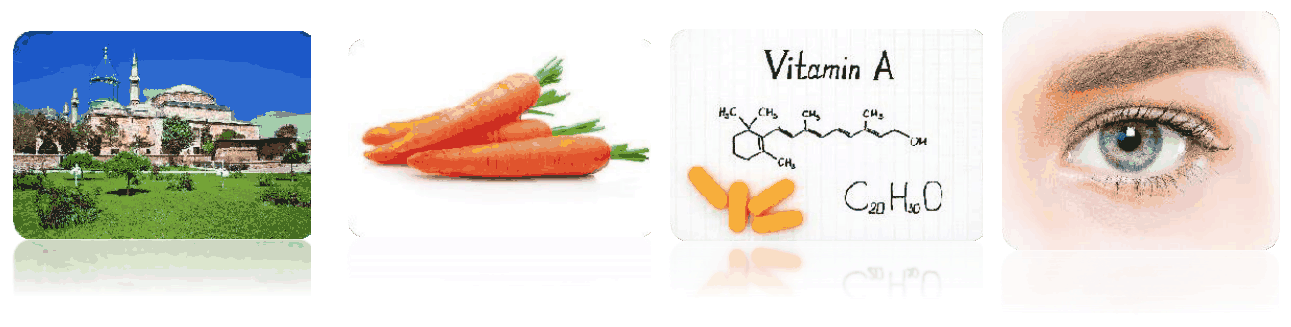
Mevlana (Rumi) was a great mystic and Sufi poet who lived out his days in Konya in the \(13^{\mathrm{th}}\) century. The indirect relevance of Konya to chemistry is that the city provides 65% of the country’s carrot production, from which one of the essential vitamins (vitamin A) is obtained.
Carrot is an important source of β-carotene, which gives the vegetable its orange color. This molecule is a red-orange pigment naturally found in plants and fruits and is a provitamin A carotenoid. It is converted to vitamin A, which is essential for normal growth and development, the immune system, and vision function.
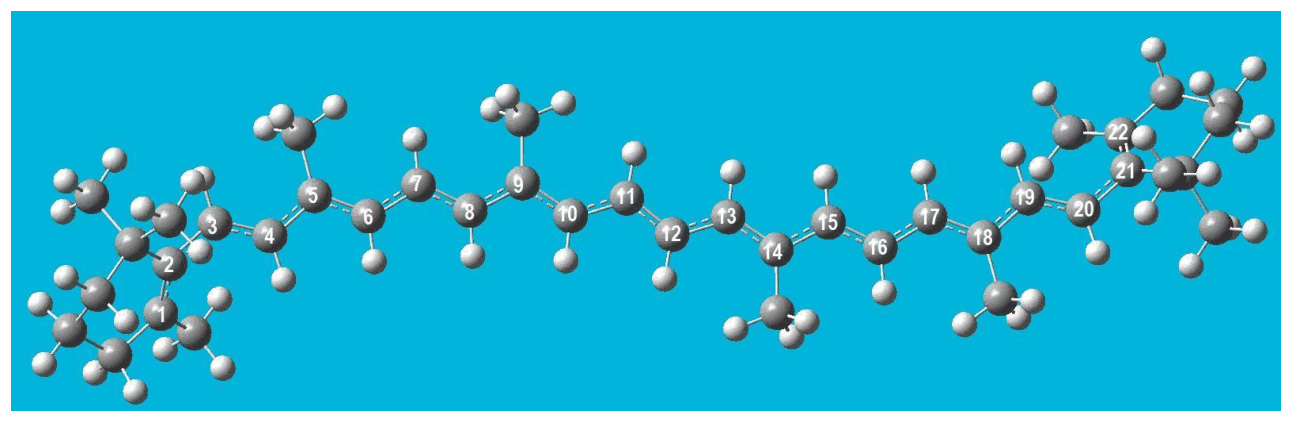
Figure 1. Ball and stick representation of the structure of β-carotene. The gray and white spheres represent the carbon and hydrogen atoms, respectively. The numbered carbon atoms belong to the linear conjugated π-segment of the molecule.
β-Carotene has an extended polyene chain of 22 carbon atoms. It is a conjugated \(\pi\)-system, having alternating single and double bonds. Its experimental maximum absorption wavelength (\(\lambda_{\max}\)) is 455 nm. We assume that all the bonds between \(C_1\) and \(C_{22}\) are conjugated bonds. There are 22 \(\pi\)-electrons in the molecule (Figure 1).
To a crude approximation, the electrons in the \(\ce{C}\text{-}2p_z\) orbitals, which are perpendicular to the molecular plane, are assumed to move along the entire molecule, without interacting with each other. They are like independent particles confined in a molecule moving along the x-axis in one dimension. These characteristics of π-electrons make them eligible for being treated by the simplest model called the particle in one-dimensional box model.
The wave function and the energies of the quantized levels for an electron moving in a one- dimensional box with infinite potential walls are given as follows:
\[ \Psi_n(x)=\sqrt{\frac{2}{L}}\sin\frac{n\pi x}{L} \]
here \(n\) is the quantum number, \(n=1,2,3,4,\ldots\infty\), and \(L\) is the box length.
\[ E_n=\frac{n^2h^2}{8m_eL^2} \]
In two dimension system, within the framework of independent particle approximation, the wavefunction is expressed as a product of one-dimensional wavefunctions, and the energy is expressed as a sum of one-dimensional energies. The energy levels of the two dimensional rectangular box is given as follows:
\[ E_{n_xn_y} = \left[\frac{n_x^2}{L_x^2}+\frac{n_y^2}{L_y^2}\right] \left\{\frac{h^2}{8m_e}\right\} \]
where \(n_x,n_y\) are the quantum numbers and they are positive integers. \(L_x,L_y\) are the dimensions of the box in the 2D model. They are positive numbers.
5.1 The β-carotene molecule is orange in color because:
i) It absorbs in the visible region of the electromagnetic spectrum.
ii) HOMO → LUMO transition occurs by absorption of IR photon.
iii) The spacing between the \(22^{\mathrm{nd}}\) and the \(23^{\mathrm{rd}}\) energy levels is equal to the energy of the IR photon at the orange wavelength.
iv) It absorbs green/blue light and it transmits red/yellow color.
v) It absorbs in the UV-VIS region since the molecule has no net dipole moment.
Choose which pair of the above sentences is correct?
The pairs of sentences are as follows:
| ☐ a) i and ii | ☐ b) i and iii | ☐ c) i and iv | ☐ d) i and v |
| ☐ e) ii and iii | ☐ f) ii and iv | ☐ g) ii and v | ☐ h) iii and iv |
| ☐ j) iii and v | ☐ k) iv and v |
Although it is highly unrealistic, let us assume that the conjugated segment of the molecule is linear and treated with the particle in a one-dimensional box model as shown in figure 2. In this case, the length of the box can be approximated as \(L=1.40\times n_{\mathrm C}\) (in Å), where \(n_{\mathrm C}\) is the number of carbon atoms in the conjugated segment.
Use this information to answer the questions 5.2–5.6.
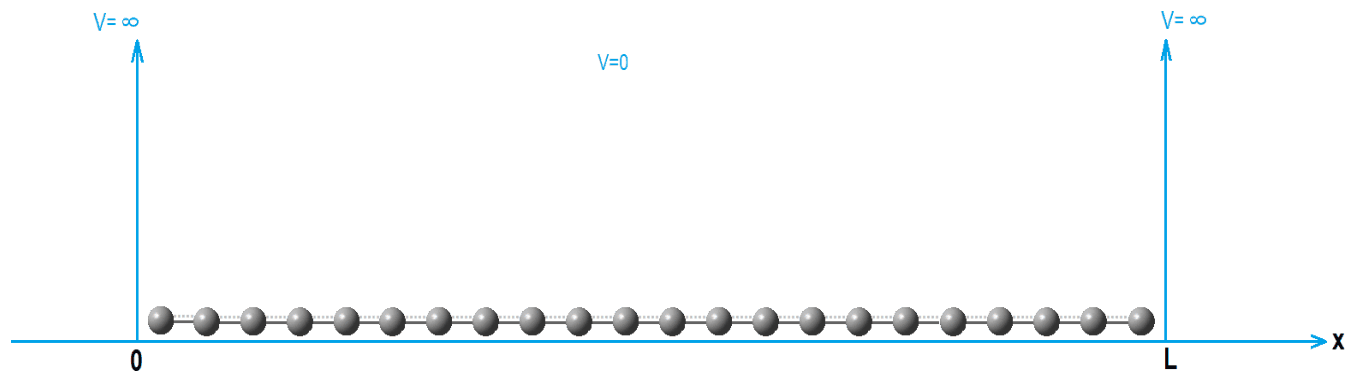
Figure 2. Schematic representation of the conjugated line segment made up carbon atoms of β-carotene in a one-dimensional box of length L.
5.2 Calculate the energies (in J) of the lowest two energy levels.
5.3 Draw the wavefunctions of the lowest two energy levels with proper labelling the x-axis.
5.4 Sketch the energy level diagram up to \(n=4\) showing the relative spacing.
5.5 What is the total \(\pi\)-energy (in J) of the molecule?
5.6 Calculate the wavelength (in nm) at which the transition between the highest occupied and lowest unoccupied energy levels occurs.
Use the particle in a two-dimensional box model to answer questions 5.7 – 5.8.
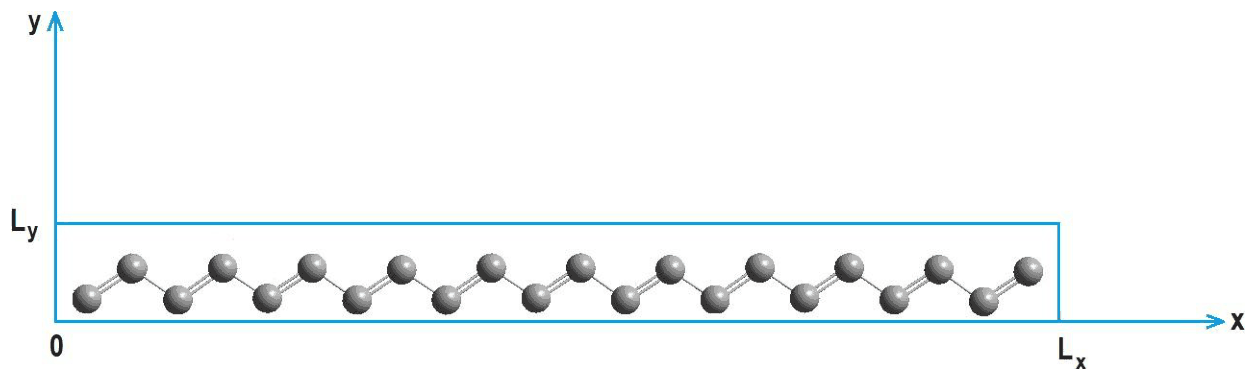
Figure 3. Schematic representation of the conjugated carbon atoms of β-carotene in a two-dimensional box.
Assume that the conjugated segment is made up of conjugated bonds that are all-trans to each other. The motion of the π-electrons is studied in the two-dimensional rectangular box with the dimensions \(L_x=26.0\) Å, \(L_y=3.0\) Å (Figure 3).
5.7 Calculate the energies (in J) of the highest occupied and the lowest unoccupied energy levels and the wavelength (in nm) at which the transition between these energy levels occurs.
5.8 What should be the \(L_x\) value (in Å) in order for the molecule to absorb light at the experimental \(\lambda_{\max}=455\) nm if \(L_y\) is kept constant at 3.0 Å. (Assume that the quantum numbers for homo and lumo are the same as in the question 5.7.)
Official English text of the problem.
Answers
- 5.1: c) i and iv.
- 5.2: \(E_1=\boxed{6.35\times10^{-21}\ \mathrm J}\); \(E_2=\boxed{2.54\times10^{-20}\ \mathrm J}\).
- 5.3: For \(0\leq x\leq L\), with \(L=30.8\) Å, \[ \boxed{\Psi_1(x)=\sqrt{\frac2L}\sin\frac{\pi x}{L}}, \qquad \boxed{\Psi_2(x)=\sqrt{\frac2L}\sin\frac{2\pi x}{L}}. \] The first is one positive half-wave; the second has a positive lobe followed by a negative lobe, with an internal node at \(x=L/2=15.4\) Å.
- 5.4: Draw horizontal levels at \(E/E_1=\boxed{1,4,9,16}\), labelled \(n=1,2,3,4\). Successive gaps are in the ratio \(\boxed{3:5:7}\).
- 5.5: \(E_{\pi,\mathrm{total}}=\boxed{6.43\times10^{-18}\ \mathrm J}\) per molecule.
- 5.6: HOMO \(n=11\), LUMO \(n=12\); \(\boxed{\lambda=1.36\times10^3\ \mathrm{nm}}\).
- 5.7: HOMO \((n_x,n_y)=(11,1)\), with \(\boxed{E_{\mathrm H}=1.75\times10^{-18}\ \mathrm J}\); LUMO \((12,1)\), with \(\boxed{E_{\mathrm L}=1.95\times10^{-18}\ \mathrm J}\); \(\boxed{\lambda=969\ \mathrm{nm}}\).
- 5.8: Under the stipulated unchanged quantum numbers, \(\boxed{L_x=17.8\ \text{Å}}\).
Solution
The molecule is all-trans-β-carotene, \(\ce{C40H56}\), with SMILES CC1=C(/C=C/C(C)=C/C=C/C(C)=C/C=C/C=C(C)/C=C/C=C(C)/C=C/C2=C(C)CCCC2(C)C)C(C)(C)CCC1. This specifies the acyclic double-bond stereochemistry; it does not specify the three-dimensional conformation or the imposed box geometry.
The problem does not print the physical constants. We use
\[ h=6.62607015\times10^{-34}\ \mathrm{J\,s},\qquad m_e=9.1093837\times10^{-31}\ \mathrm{kg},\qquad c=2.99792458\times10^8\ \mathrm{m\,s^{-1}}. \]
Each spatial orbital accommodates two electrons with opposite spins. Consequently, the 22 \(\pi\)-electrons occupy the eleven lowest spatial orbitals in the ground state.
5.1 — Origin of the orange color
The measured absorption maximum, 455 nm, lies in the blue part of the visible spectrum. Absorption of blue/green light leaves the transmitted or reflected light enriched in red/yellow wavelengths, giving the orange appearance. Therefore i and iv are correct, corresponding to c.
The other statements are incorrect:
- ii: The observed transition involves a visible photon, rather than an infrared photon.
- iii: With two electrons per level, the one-dimensional HOMO and LUMO are levels 11 and 12. Moreover, orange light belongs to the visible spectrum, not the infrared.
- v: Having no permanent dipole moment does not establish that a molecule absorbs in the UV-visible region. Electronic absorption depends on the transition energy and transition dipole moment.
5.2 — Lowest two one-dimensional energy levels
The prescribed box length is
\[ L=(1.40\ \text{Å})(22)=30.8\ \text{Å} =3.08\times10^{-9}\ \mathrm m. \]
Thus,
\[ E_1=\frac{h^2}{8m_eL^2} = \frac{(6.62607015\times10^{-34}\ \mathrm{J\,s})^2} {8(9.1093837\times10^{-31}\ \mathrm{kg}) (3.08\times10^{-9}\ \mathrm m)^2} = \boxed{6.35\times10^{-21}\ \mathrm J}. \]
Since \(E_n=n^2E_1\),
\[ E_2=4E_1=\boxed{2.54\times10^{-20}\ \mathrm J}. \]
5.3 — Wavefunction sketches
Let \(A=\sqrt{2/L}\). Inside the box,
\[ \Psi_1(x)=A\sin\frac{\pi x}{L}, \qquad \Psi_2(x)=A\sin\frac{2\pi x}{L}. \]
Both wavefunctions vanish at the walls and outside the box. Label the horizontal axis \(x\), using these positions:
| \(x\) | \(0\) | \(L/4\) | \(L/2\) | \(3L/4\) | \(L\) |
|---|---|---|---|---|---|
| \(x\), in Å | 0 | 7.70 | 15.4 | 23.1 | 30.8 |
| \(\Psi_1/A\) | 0 | \(1/\sqrt2\) | 1 | \(1/\sqrt2\) | 0 |
| \(\Psi_2/A\) | 0 | 1 | 0 | \(-1\) | 0 |
For \(n=1\), draw a smooth positive half-sine wave from \(x=0\) to \(x=L\), with its maximum \(+A\) at \(L/2\). It has no internal node.
For \(n=2\), draw one full sine wave: a positive maximum \(+A\) at \(L/4\), a node at \(L/2\), and a negative minimum \(-A\) at \(3L/4\).
The overall sign of either wavefunction may be reversed without changing its physical meaning.
5.4 — Energy-level diagram
The levels obey \(E_n=n^2E_1\):
| \(n\) | \(E_n/E_1\) | \(E_n\), in J |
|---|---|---|
| 1 | 1 | \(6.35\times10^{-21}\) |
| 2 | 4 | \(2.54\times10^{-20}\) |
| 3 | 9 | \(5.72\times10^{-20}\) |
| 4 | 16 | \(1.02\times10^{-19}\) |
Draw an upward-pointing energy axis with horizontal lines at these heights. The separations increase upwards:
\[ E_2-E_1=3E_1,\qquad E_3-E_2=5E_1,\qquad E_4-E_3=7E_1. \]
Hence the successive gaps have the ratio \(\boxed{3:5:7}\).
5.5 — Total \(\pi\)-electron energy
The 22 electrons fill levels \(n=1,\ldots,11\), two electrons per level. Under the independent-electron approximation,
\[ E_{\pi,\mathrm{total}} =2\sum_{n=1}^{11}E_n =2E_1\sum_{n=1}^{11}n^2. \]
Using
\[ \sum_{n=1}^{11}n^2 =\frac{11(12)(23)}6=506, \]
we obtain
\[ E_{\pi,\mathrm{total}} =1012E_1 =1012(6.3508469\times10^{-21}\ \mathrm J) =\boxed{6.43\times10^{-18}\ \mathrm J}. \]
This is the total energy per molecule relative to the zero potential inside the box.
5.6 — One-dimensional HOMO–LUMO wavelength
The highest occupied level is \(n=11\), and the lowest unoccupied level is \(n=12\). Therefore,
\[ \Delta E=E_{12}-E_{11} =(12^2-11^2)E_1 =23E_1 =1.4606948\times10^{-19}\ \mathrm J. \]
Equating this gap to the photon energy gives
\[ \lambda=\frac{hc}{\Delta E} = \frac{(6.62607015\times10^{-34}\ \mathrm{J\,s}) (2.99792458\times10^8\ \mathrm{m\,s^{-1}})} {1.4606948\times10^{-19}\ \mathrm J}. \]
Thus,
\[ \lambda=1.35993\times10^{-6}\ \mathrm m =\boxed{1.36\times10^3\ \mathrm{nm}}. \]
This infrared prediction differs substantially from the experimental 455 nm, reflecting the limitations of the prescribed one-dimensional model.
5.7 — Two-dimensional HOMO, LUMO, and wavelength
Write the energy as
\[ E_{n_x,n_y}=A_xn_x^2+A_yn_y^2, \]
where
\[ A_x=\frac{h^2}{8m_eL_x^2} =8.91223\times10^{-21}\ \mathrm J, \qquad A_y=\frac{h^2}{8m_eL_y^2} =6.69407\times10^{-19}\ \mathrm J. \]
Here \(L_x=2.60\times10^{-9}\ \mathrm m\) and \(L_y=3.0\times10^{-10}\ \mathrm m\).
We must check the ordering of the two-dimensional states. The lowest state with \(n_y\geq2\) is \((1,2)\):
\[ E_{1,2}=A_x+4A_y =2.68654\times10^{-18}\ \mathrm J. \]
In comparison,
\[ E_{12,1}=144A_x+A_y =1.95277\times10^{-18}\ \mathrm J <E_{1,2}. \]
Therefore the first twelve spatial orbitals all have \(n_y=1\), with \(n_x=1,\ldots,12\). Filling eleven orbitals gives
\[ \boxed{\text{HOMO}=(11,1)},\qquad \boxed{\text{LUMO}=(12,1)}. \]
Their energies are
\[ E_{\mathrm H}=121A_x+A_y =1.7477873\times10^{-18}\ \mathrm J \approx\boxed{1.75\times10^{-18}\ \mathrm J}, \]
\[ E_{\mathrm L}=144A_x+A_y =1.9527686\times10^{-18}\ \mathrm J \approx\boxed{1.95\times10^{-18}\ \mathrm J}. \]
The identical \(y\)-direction contributions cancel in the gap:
\[ \Delta E=E_{\mathrm L}-E_{\mathrm H} =23A_x =2.0498129\times10^{-19}\ \mathrm J. \]
Using this unrounded gap,
\[ \lambda=\frac{hc}{\Delta E} =9.69086\times10^{-7}\ \mathrm m =\boxed{969\ \mathrm{nm}}. \]
5.8 — Length required for absorption at 455 nm
As stipulated, keep the HOMO and LUMO quantum numbers equal to \((11,1)\) and \((12,1)\). Their common \(y\)-direction energy again cancels:
\[ \Delta E=\frac{23h^2}{8m_eL_x^2}. \]
For absorption at \(\lambda=455\times10^{-9}\ \mathrm m\),
\[ \frac{hc}{\lambda}=\frac{23h^2}{8m_eL_x^2}. \]
Solving for the positive length,
\[ L_x=\sqrt{\frac{23h\lambda}{8m_ec}} = \sqrt{ \frac{23(6.62607015\times10^{-34}\ \mathrm{J\,s}) (455\times10^{-9}\ \mathrm m)} {8(9.1093837\times10^{-31}\ \mathrm{kg}) (2.99792458\times10^8\ \mathrm{m\,s^{-1}})} }. \]
Hence,
\[ L_x=1.78155\times10^{-9}\ \mathrm m =\boxed{17.8\ \text{Å}}. \]
This result uses the question’s explicit fixed-quantum-number assumption. If all two-dimensional levels were reordered and refilled at this shorter length, states with \(n_y=2\) would enter the occupied set.
The solution was checked against the official solution.
IChO 2020 · Theorieaufgabe 5
Konya, Karotte, Beta-Carotin, Vitamin A, Immunsystem, Sehvermögen
Mevlana (Rumi) war ein großer Mystiker und Sufi-Dichter, der im \(13^{\mathrm{th}}\) Jahrhundert in Konya lebte. Die indirekte Bedeutung Konyas für die Chemie besteht darin, dass die Stadt 65% der Karottenproduktion des Landes liefert; aus Karotten wird eines der essenziellen Vitamine (Vitamin A) gewonnen.
Die Karotte ist eine wichtige Quelle für β-Carotin, das dem Gemüse seine orange Farbe verleiht. Dieses Molekül ist ein rotorangefarbenes Pigment, das natürlicherweise in Pflanzen und Früchten vorkommt, und gehört zu den Carotinoiden mit Provitamin-A-Wirkung. Es wird in Vitamin A umgewandelt, das für normales Wachstum und normale Entwicklung, das Immunsystem und die Sehfunktion essenziell ist.
Abbildung 1. Kugel-Stab-Modell der Struktur von β-Carotin. Die grauen und weißen Kugeln stellen die Kohlenstoff- bzw. Wasserstoffatome dar. Die nummerierten Kohlenstoffatome gehören zum linearen konjugierten π-Abschnitt des Moleküls.
β-Carotin besitzt eine ausgedehnte Polyenkette aus 22 Kohlenstoffatomen. Sie bildet ein konjugiertes \(\pi\)-System mit abwechselnden Einfach- und Doppelbindungen. Die experimentell bestimmte Wellenlänge des Absorptionsmaximums (\(\lambda_{\max}\)) beträgt 455 nm. Wir nehmen an, dass alle Bindungen zwischen \(C_1\) und \(C_{22}\) konjugierte Bindungen sind. Das Molekül enthält 22 \(\pi\)-Elektronen (Abbildung 1).
In einer groben Näherung wird angenommen, dass sich die Elektronen in den \(\ce{C}\text{-}2p_z\)-Orbitalen, die senkrecht zur Molekülebene stehen, entlang des gesamten Moleküls bewegen, ohne miteinander wechselzuwirken. Sie verhalten sich wie unabhängige Teilchen, die in einem Molekül eingeschlossen sind und sich in einer Dimension entlang der x-Achse bewegen. Aufgrund dieser Eigenschaften der π-Elektronen lassen sie sich mit dem einfachsten Modell, dem Modell Teilchen im eindimensionalen Kasten, beschreiben.
Die Wellenfunktion und die Energien der quantisierten Niveaus eines Elektrons, das sich in einem eindimensionalen Kasten mit unendlich hohen Potenzialwänden bewegt, sind wie folgt gegeben:
\[ \Psi_n(x)=\sqrt{\frac{2}{L}}\sin\frac{n\pi x}{L} \]
Dabei ist \(n\) die Quantenzahl, \(n=1,2,3,4,\ldots\infty\), und \(L\) die Kastenlänge.
\[ E_n=\frac{n^2h^2}{8m_eL^2} \]
In einem zweidimensionalen System wird im Rahmen der Näherung unabhängiger Teilchen die Wellenfunktion als Produkt eindimensionaler Wellenfunktionen und die Energie als Summe eindimensionaler Energien ausgedrückt. Die Energieniveaus des zweidimensionalen rechteckigen Kastens sind wie folgt gegeben:
\[ E_{n_xn_y} = \left[\frac{n_x^2}{L_x^2}+\frac{n_y^2}{L_y^2}\right] \left\{\frac{h^2}{8m_e}\right\} \]
Dabei sind \(n_x,n_y\) die Quantenzahlen; sie sind positive ganze Zahlen. \(L_x,L_y\) sind die Abmessungen des Kastens im 2D-Modell. Sie sind positive Zahlen.
5.1 Das β-Carotin-Molekül ist orange, weil:
i) Es im sichtbaren Bereich des elektromagnetischen Spektrums absorbiert.
ii) Der HOMO → LUMO-Übergang durch Absorption eines IR-Photons erfolgt.
iii) Der Abstand zwischen dem \(22^{\mathrm{nd}}\) und dem \(23^{\mathrm{rd}}\) Energieniveau gleich der Energie des IR-Photons bei der Wellenlänge von orangefarbenem Licht ist.
iv) Es grünes/blaues Licht absorbiert und rotes/gelbes Licht durchlässt.
v) Es im UV-VIS-Bereich absorbiert, da das Molekül kein resultierendes Dipolmoment besitzt.
Welches Paar der obigen Aussagen ist richtig?
Die Aussagenpaare lauten wie folgt:
| ☐ a) i und ii | ☐ b) i und iii | ☐ c) i und iv | ☐ d) i und v |
| ☐ e) ii und iii | ☐ f) ii und iv | ☐ g) ii und v | ☐ h) iii und iv |
| ☐ j) iii und v | ☐ k) iv und v |
Obwohl dies höchst unrealistisch ist, nehmen wir an, dass der konjugierte Abschnitt des Moleküls linear ist und mit dem Modell eines Teilchens im eindimensionalen Kasten behandelt wird, wie in Abbildung 2 gezeigt. In diesem Fall lässt sich die Kastenlänge näherungsweise als \(L=1.40\times n_{\mathrm C}\) (in Å) angeben, wobei \(n_{\mathrm C}\) die Anzahl der Kohlenstoffatome im konjugierten Abschnitt ist.
Verwenden Sie diese Angaben zur Beantwortung der Fragen 5.2–5.6.
Abbildung 2. Schematische Darstellung des aus Kohlenstoffatomen des β-Carotins bestehenden geradlinigen konjugierten Abschnitts in einem eindimensionalen Kasten der Länge L.
5.2 Berechnen Sie die Energien (in J) der beiden niedrigsten Energieniveaus.
5.3 Zeichnen Sie die Wellenfunktionen der beiden niedrigsten Energieniveaus und beschriften Sie die x-Achse entsprechend.
5.4 Skizzieren Sie das Energieniveaudiagramm bis \(n=4\) unter Berücksichtigung der relativen Abstände.
5.5 Wie groß ist die gesamte \(\pi\)-Energie (in J) des Moleküls?
5.6 Berechnen Sie die Wellenlänge (in nm), bei der der Übergang zwischen dem höchsten besetzten und dem niedrigsten unbesetzten Energieniveau erfolgt.
Verwenden Sie das Modell eines Teilchens im zweidimensionalen Kasten zur Beantwortung der Fragen 5.7 – 5.8.
Abbildung 3. Schematische Darstellung der konjugierten Kohlenstoffatome des β-Carotins in einem zweidimensionalen Kasten.
Nehmen Sie an, dass der konjugierte Abschnitt aus konjugierten Bindungen besteht, die alle in trans-Anordnung zueinander stehen. Die Bewegung der π-Elektronen wird im zweidimensionalen rechteckigen Kasten mit den Abmessungen \(L_x=26.0\) Å, \(L_y=3.0\) Å untersucht (Abbildung 3).
5.7 Berechnen Sie die Energien (in J) des höchsten besetzten und des niedrigsten unbesetzten Energieniveaus sowie die Wellenlänge (in nm), bei der der Übergang zwischen diesen Energieniveaus erfolgt.
5.8 Welchen Wert muss \(L_x\) (in Å) haben, damit das Molekül Licht bei der experimentellen Wellenlänge \(\lambda_{\max}=455\) nm absorbiert, wenn \(L_y\) konstant bei 3.0 Å gehalten wird? (Nehmen Sie an, dass die Quantenzahlen für HOMO und LUMO dieselben sind wie in Frage 5.7.)
Aufgabentext aus dem offiziellen englischen Text übersetzt.
Antworten
- 5.1: c) i und iv.
- 5.2: \(E_1=\boxed{6.35\times10^{-21}\ \mathrm J}\); \(E_2=\boxed{2.54\times10^{-20}\ \mathrm J}\).
- 5.3: Für \(0\leq x\leq L\), mit \(L=30.8\) Å, \[ \boxed{\Psi_1(x)=\sqrt{\frac2L}\sin\frac{\pi x}{L}}, \qquad \boxed{\Psi_2(x)=\sqrt{\frac2L}\sin\frac{2\pi x}{L}}. \] Die erste ist eine positive Halbwelle; die zweite besitzt einen positiven Wellenbauch, gefolgt von einem negativen Wellenbauch, mit einem inneren Knoten bei \(x=L/2=15.4\) Å.
- 5.4: Zeichnen Sie horizontale Niveaus bei \(E/E_1=\boxed{1,4,9,16}\), beschriftet mit \(n=1,2,3,4\). Aufeinanderfolgende Abstände stehen im Verhältnis \(\boxed{3:5:7}\).
- 5.5: \(E_{\pi,\mathrm{total}}=\boxed{6.43\times10^{-18}\ \mathrm J}\) pro Molekül.
- 5.6: HOMO \(n=11\), LUMO \(n=12\); \(\boxed{\lambda=1.36\times10^3\ \mathrm{nm}}\).
- 5.7: HOMO \((n_x,n_y)=(11,1)\), mit \(\boxed{E_{\mathrm H}=1.75\times10^{-18}\ \mathrm J}\); LUMO \((12,1)\), mit \(\boxed{E_{\mathrm L}=1.95\times10^{-18}\ \mathrm J}\); \(\boxed{\lambda=969\ \mathrm{nm}}\).
- 5.8: Unter der vorgegebenen Annahme unveränderter Quantenzahlen gilt \(\boxed{L_x=17.8\ \text{Å}}\).
Lösung
Das Molekül ist all-trans-β-Carotin, \(\ce{C40H56}\), mit dem SMILES-Code CC1=C(/C=C/C(C)=C/C=C/C(C)=C/C=C/C=C(C)/C=C/C=C(C)/C=C/C2=C(C)CCCC2(C)C)C(C)(C)CCC1. Dieser legt die Stereochemie der acyclischen Doppelbindungen fest; er legt weder die dreidimensionale Konformation noch die vorgegebene Kastengeometrie fest.
Die Aufgabenstellung enthält keine Angaben zu den physikalischen Konstanten. Wir verwenden
\[ h=6.62607015\times10^{-34}\ \mathrm{J\,s},\qquad m_e=9.1093837\times10^{-31}\ \mathrm{kg},\qquad c=2.99792458\times10^8\ \mathrm{m\,s^{-1}}. \]
Jedes räumliche Orbital kann zwei Elektronen mit entgegengesetztem Spin aufnehmen. Folglich besetzen die 22 \(\pi\)-Elektronen im Grundzustand die elf niedrigsten räumlichen Orbitale.
5.1 — Ursprung der orangefarbenen Erscheinung
Das gemessene Absorptionsmaximum bei 455 nm liegt im blauen Bereich des sichtbaren Spektrums. Durch die Absorption von blauem/grünem Licht wird das durchgelassene oder reflektierte Licht mit roten/gelben Wellenlängen angereichert, wodurch die orangefarbene Erscheinung entsteht. Daher sind i und iv richtig, was c entspricht.
Die übrigen Aussagen sind falsch:
- ii: Der beobachtete Übergang erfolgt unter Beteiligung eines Photons des sichtbaren Lichts, nicht eines Infrarotphotons.
- iii: Bei zwei Elektronen pro Niveau sind HOMO und LUMO im eindimensionalen Modell die Niveaus 11 und 12. Außerdem gehört orangefarbenes Licht zum sichtbaren Spektrum, nicht zum Infrarotbereich.
- v: Das Fehlen eines permanenten Dipolmoments begründet nicht, dass ein Molekül im UV- und sichtbaren Bereich absorbiert. Die elektronische Absorption hängt von der Übergangsenergie und dem Übergangsdipolmoment ab.
5.2 — Die beiden niedrigsten eindimensionalen Energieniveaus
Die vorgegebene Kastenlänge beträgt
\[ L=(1.40\ \text{Å})(22)=30.8\ \text{Å} =3.08\times10^{-9}\ \mathrm m. \]
Damit gilt
\[ E_1=\frac{h^2}{8m_eL^2} = \frac{(6.62607015\times10^{-34}\ \mathrm{J\,s})^2} {8(9.1093837\times10^{-31}\ \mathrm{kg}) (3.08\times10^{-9}\ \mathrm m)^2} = \boxed{6.35\times10^{-21}\ \mathrm J}. \]
Da \(E_n=n^2E_1\), gilt
\[ E_2=4E_1=\boxed{2.54\times10^{-20}\ \mathrm J}. \]
5.3 — Skizzen der Wellenfunktionen
Sei \(A=\sqrt{2/L}\). Innerhalb des Kastens gilt
\[ \Psi_1(x)=A\sin\frac{\pi x}{L}, \qquad \Psi_2(x)=A\sin\frac{2\pi x}{L}. \]
Beide Wellenfunktionen verschwinden an den Wänden und außerhalb des Kastens. Beschriften Sie die horizontale Achse mit \(x\) und verwenden Sie dabei diese Positionen:
| \(x\) | \(0\) | \(L/4\) | \(L/2\) | \(3L/4\) | \(L\) |
|---|---|---|---|---|---|
| \(x\), in Å | 0 | 7.70 | 15.4 | 23.1 | 30.8 |
| \(\Psi_1/A\) | 0 | \(1/\sqrt2\) | 1 | \(1/\sqrt2\) | 0 |
| \(\Psi_2/A\) | 0 | 1 | 0 | \(-1\) | 0 |
Zeichnen Sie für \(n=1\) eine glatte positive Sinushalbwelle von \(x=0\) bis \(x=L\), deren Maximum \(+A\) bei \(L/2\) liegt. Sie hat keinen inneren Knoten.
Zeichnen Sie für \(n=2\) eine vollständige Sinuswelle: ein positives Maximum \(+A\) bei \(L/4\), einen Knoten bei \(L/2\) und ein negatives Minimum \(-A\) bei \(3L/4\).
Das Gesamtvorzeichen jeder der beiden Wellenfunktionen kann umgekehrt werden, ohne ihre physikalische Bedeutung zu ändern.
5.4 — Energieniveaudiagramm
Die Niveaus gehorchen der Beziehung \(E_n=n^2E_1\):
| \(n\) | \(E_n/E_1\) | \(E_n\), in J |
|---|---|---|
| 1 | 1 | \(6.35\times10^{-21}\) |
| 2 | 4 | \(2.54\times10^{-20}\) |
| 3 | 9 | \(5.72\times10^{-20}\) |
| 4 | 16 | \(1.02\times10^{-19}\) |
Zeichnen Sie eine nach oben gerichtete Energieachse mit horizontalen Linien auf diesen Höhen. Die Abstände nehmen nach oben hin zu:
\[ E_2-E_1=3E_1,\qquad E_3-E_2=5E_1,\qquad E_4-E_3=7E_1. \]
Somit stehen die aufeinanderfolgenden Abstände im Verhältnis \(\boxed{3:5:7}\).
5.5 — Gesamtenergie der \(\pi\)-Elektronen
Die 22 Elektronen besetzen die Niveaus \(n=1,\ldots,11\) mit jeweils zwei Elektronen pro Niveau. In der Näherung unabhängiger Elektronen gilt
\[ E_{\pi,\mathrm{total}} =2\sum_{n=1}^{11}E_n =2E_1\sum_{n=1}^{11}n^2. \]
Mit
\[ \sum_{n=1}^{11}n^2 =\frac{11(12)(23)}6=506, \]
erhalten wir
\[ E_{\pi,\mathrm{total}} =1012E_1 =1012(6.3508469\times10^{-21}\ \mathrm J) =\boxed{6.43\times10^{-18}\ \mathrm J}. \]
Dies ist die Gesamtenergie pro Molekül, bezogen auf das Nullpotenzial innerhalb des Kastens.
5.6 — HOMO–LUMO-Wellenlänge im eindimensionalen Modell
Das höchste besetzte Niveau ist \(n=11\), und das niedrigste unbesetzte Niveau ist \(n=12\). Daher gilt
\[ \Delta E=E_{12}-E_{11} =(12^2-11^2)E_1 =23E_1 =1.4606948\times10^{-19}\ \mathrm J. \]
Das Gleichsetzen dieser Energiedifferenz mit der Photonenenergie ergibt
\[ \lambda=\frac{hc}{\Delta E} = \frac{(6.62607015\times10^{-34}\ \mathrm{J\,s}) (2.99792458\times10^8\ \mathrm{m\,s^{-1}})} {1.4606948\times10^{-19}\ \mathrm J}. \]
Damit gilt
\[ \lambda=1.35993\times10^{-6}\ \mathrm m =\boxed{1.36\times10^3\ \mathrm{nm}}. \]
Diese Vorhersage einer Wellenlänge im Infrarotbereich weicht erheblich vom experimentellen Wert von 455 nm ab und verdeutlicht die Grenzen des vorgegebenen eindimensionalen Modells.
5.7 — HOMO, LUMO und Wellenlänge im zweidimensionalen Modell
Wir schreiben die Energie als
\[ E_{n_x,n_y}=A_xn_x^2+A_yn_y^2, \]
wobei
\[ A_x=\frac{h^2}{8m_eL_x^2} =8.91223\times10^{-21}\ \mathrm J, \qquad A_y=\frac{h^2}{8m_eL_y^2} =6.69407\times10^{-19}\ \mathrm J. \]
Hier sind \(L_x=2.60\times10^{-9}\ \mathrm m\) und \(L_y=3.0\times10^{-10}\ \mathrm m\).
Wir müssen die energetische Reihenfolge der zweidimensionalen Zustände überprüfen. Der niedrigste Zustand mit \(n_y\geq2\) ist \((1,2)\):
\[ E_{1,2}=A_x+4A_y =2.68654\times10^{-18}\ \mathrm J. \]
Im Vergleich dazu gilt
\[ E_{12,1}=144A_x+A_y =1.95277\times10^{-18}\ \mathrm J <E_{1,2}. \]
Daher haben die ersten zwölf räumlichen Orbitale alle \(n_y=1\), mit \(n_x=1,\ldots,12\). Die Besetzung von elf Orbitalen ergibt
\[ \boxed{\text{HOMO}=(11,1)},\qquad \boxed{\text{LUMO}=(12,1)}. \]
Ihre Energien sind
\[ E_{\mathrm H}=121A_x+A_y =1.7477873\times10^{-18}\ \mathrm J \approx\boxed{1.75\times10^{-18}\ \mathrm J}, \]
\[ E_{\mathrm L}=144A_x+A_y =1.9527686\times10^{-18}\ \mathrm J \approx\boxed{1.95\times10^{-18}\ \mathrm J}. \]
Die identischen Beiträge der \(y\)-Richtung heben sich in der Energiedifferenz auf:
\[ \Delta E=E_{\mathrm L}-E_{\mathrm H} =23A_x =2.0498129\times10^{-19}\ \mathrm J. \]
Mit dieser ungerundeten Energiedifferenz ergibt sich
\[ \lambda=\frac{hc}{\Delta E} =9.69086\times10^{-7}\ \mathrm m =\boxed{969\ \mathrm{nm}}. \]
5.8 — Für die Absorption bei 455 nm erforderliche Länge
Wie vorgegeben bleiben die Quantenzahlen von HOMO und LUMO gleich \((11,1)\) bzw. \((12,1)\). Ihr gemeinsamer Energiebeitrag der \(y\)-Richtung hebt sich erneut auf:
\[ \Delta E=\frac{23h^2}{8m_eL_x^2}. \]
Für die Absorption bei \(\lambda=455\times10^{-9}\ \mathrm m\) gilt
\[ \frac{hc}{\lambda}=\frac{23h^2}{8m_eL_x^2}. \]
Auflösen nach der positiven Länge ergibt
\[ L_x=\sqrt{\frac{23h\lambda}{8m_ec}} = \sqrt{ \frac{23(6.62607015\times10^{-34}\ \mathrm{J\,s}) (455\times10^{-9}\ \mathrm m)} {8(9.1093837\times10^{-31}\ \mathrm{kg}) (2.99792458\times10^8\ \mathrm{m\,s^{-1}})} }. \]
Somit gilt
\[ L_x=1.78155\times10^{-9}\ \mathrm m =\boxed{17.8\ \text{Å}}. \]
Dieses Ergebnis beruht auf der in der Frage ausdrücklich vorgegebenen Annahme unveränderter Quantenzahlen. Würden alle zweidimensionalen Niveaus bei dieser kürzeren Länge neu geordnet und besetzt, würden Zustände mit \(n_y=2\) zu den besetzten Zuständen gehören.
Die Lösung wurde mit der offiziellen Lösung abgeglichen.
IChO 2020 · Teori sorusu 5
Konya, Havuç, Beta-Karoten, A Vitamini, Bağışıklık Sistemi, Görme
Mevlana (Rumi), \(13^{\mathrm{th}}\) yüzyılda Konya'da yaşamış büyük bir mutasavvıf ve tasavvuf şairiydi. Konya'nın kimyayla dolaylı bağlantısı, temel vitaminlerden birinin (A vitamini) elde edildiği havucun ülke üretiminin %65'inin bu şehirde gerçekleştirilmesidir.
Havuç, sebzeye turuncu rengini veren β-karotenin önemli bir kaynağıdır. Bu molekül, bitki ve meyvelerde doğal olarak bulunan kırmızı-turuncu bir pigmenttir ve provitamin A özelliği taşıyan bir karotenoiddir. Normal büyüme ve gelişme, bağışıklık sistemi ve görme işlevi için gerekli olan A vitaminine dönüştürülür.
Şekil 1. β-karotenin yapısının top-çubuk modeliyle gösterimi. Gri ve beyaz küreler sırasıyla karbon ve hidrojen atomlarını temsil eder. Numaralandırılmış karbon atomları, molekülün doğrusal konjuge π-bölümüne aittir.
β-Karoten, 22 karbon atomundan oluşan uzun bir polien zincirine sahiptir. Dönüşümlü olarak tekli ve çiftli bağlar içeren konjuge bir \(\pi\)-sistemidir. Deneysel maksimum soğurma dalga boyu (\(\lambda_{\max}\)) 455 nm'dir. \(C_1\) ile \(C_{22}\) arasındaki tüm bağların konjuge bağlar olduğunu varsayıyoruz. Molekülde 22 \(\pi\)-elektronu vardır (Şekil 1).
Kaba bir yaklaşımla, molekül düzlemine dik olan \(\ce{C}\text{-}2p_z\) orbitallerindeki elektronların, birbirleriyle etkileşmeden molekülün tamamı boyunca hareket ettikleri varsayılır. Bunlar, bir molekül içinde hapsedilmiş, x-ekseni boyunca tek boyutta hareket eden bağımsız parçacıklar gibidir. π-elektronlarının bu özellikleri, bir boyutlu kutudaki parçacık modeli adı verilen en basit modelle ele alınmalarını mümkün kılar.
Sonsuz potansiyel duvarları olan bir boyutlu bir kutuda hareket eden bir elektronun dalga fonksiyonu ve kuantalanmış düzeylerinin enerjileri aşağıdaki gibi verilir:
\[ \Psi_n(x)=\sqrt{\frac{2}{L}}\sin\frac{n\pi x}{L} \]
Burada \(n\) kuantum sayısıdır, \(n=1,2,3,4,\ldots\infty\) ve \(L\) kutunun uzunluğudur.
\[ E_n=\frac{n^2h^2}{8m_eL^2} \]
İki boyutlu bir sistemde, bağımsız parçacık yaklaşımı çerçevesinde, dalga fonksiyonu bir boyutlu dalga fonksiyonlarının çarpımı olarak, enerji ise bir boyutlu enerjilerin toplamı olarak ifade edilir. İki boyutlu dikdörtgen kutunun enerji düzeyleri aşağıdaki gibi verilir:
\[ E_{n_xn_y} = \left[\frac{n_x^2}{L_x^2}+\frac{n_y^2}{L_y^2}\right] \left\{\frac{h^2}{8m_e}\right\} \]
Burada \(n_x,n_y\) kuantum sayılarıdır ve pozitif tam sayılardır. \(L_x,L_y\), iki boyutlu modelde kutunun boyutlarıdır. Bunlar pozitif sayılardır.
5.1 β-karoten molekülü turuncu renktedir, çünkü:
i) Elektromanyetik spektrumun görünür bölgesinde soğurma yapar.
ii) HOMO → LUMO geçişi bir IR fotonunun soğurulmasıyla gerçekleşir.
iii) \(22^{\mathrm{nd}}\) ve \(23^{\mathrm{rd}}\) enerji düzeyleri arasındaki fark, turuncu dalga boyundaki IR fotonunun enerjisine eşittir.
iv) Yeşil/mavi ışığı soğurur ve kırmızı/sarı rengi geçirir.
v) Molekülün net dipol momenti olmadığından UV-VIS bölgesinde soğurma yapar.
Yukarıdaki ifadelerden hangi ikisinin doğru olduğunu seçiniz.
İfade çiftleri aşağıdaki gibidir:
| ☐ a) i ve ii | ☐ b) i ve iii | ☐ c) i ve iv | ☐ d) i ve v |
| ☐ e) ii ve iii | ☐ f) ii ve iv | ☐ g) ii ve v | ☐ h) iii ve iv |
| ☐ j) iii ve v | ☐ k) iv ve v |
Gerçekçilikten oldukça uzak olsa da molekülün konjuge bölümünün doğrusal olduğunu ve Şekil 2'de gösterildiği gibi bir boyutlu kutudaki parçacık modeliyle ele alındığını varsayalım. Bu durumda kutunun uzunluğu yaklaşık olarak \(L=1.40\times n_{\mathrm C}\) (Å cinsinden) alınabilir; burada \(n_{\mathrm C}\), konjuge bölümdeki karbon atomlarının sayısıdır.
5.2–5.6 sorularını cevaplamak için bu bilgiyi kullanınız.
Şekil 2. β-karotenin karbon atomlarından oluşan konjuge doğrusal bölümün, L uzunluğundaki bir boyutlu bir kutu içinde şematik gösterimi.
5.2 En düşük iki enerji düzeyinin enerjilerini (J cinsinden) hesaplayınız.
5.3 x-eksenini uygun şekilde etiketleyerek en düşük iki enerji düzeyinin dalga fonksiyonlarını çiziniz.
5.4 Göreli aralıkları göstererek \(n=4\) düzeyine kadar enerji düzeyi diyagramını çiziniz.
5.5 Molekülün toplam \(\pi\)-enerjisi (J cinsinden) nedir?
5.6 En yüksek dolu ve en düşük boş enerji düzeyleri arasındaki geçişin gerçekleştiği dalga boyunu (nm cinsinden) hesaplayınız.
5.7 – 5.8 sorularını cevaplamak için iki boyutlu kutudaki parçacık modelini kullanınız.
Şekil 3. β-karotenin konjuge karbon atomlarının iki boyutlu bir kutu içinde şematik gösterimi.
Konjuge bölümün, birbirlerine göre tümü trans konumunda olan konjuge bağlardan oluştuğunu varsayınız. π-elektronlarının hareketi, boyutları \(L_x=26.0\) Å, \(L_y=3.0\) Å olan iki boyutlu dikdörtgen kutuda incelenmektedir (Şekil 3).
5.7 En yüksek dolu ve en düşük boş enerji düzeylerinin enerjilerini (J cinsinden) ve bu enerji düzeyleri arasındaki geçişin gerçekleştiği dalga boyunu (nm cinsinden) hesaplayınız.
5.8 \(L_y\) 3.0 Å değerinde sabit tutulursa, molekülün deneysel \(\lambda_{\max}=455\) nm dalga boyunda ışık soğurması için \(L_x\) değeri (Å cinsinden) ne olmalıdır? (HOMO ve LUMO kuantum sayılarının 5.7 sorusundakilerle aynı olduğunu varsayınız.)
Soru metni resmi İngilizce metinden çevrilmiştir.
Cevaplar
- 5.1: c) i ve iv.
- 5.2: \(E_1=\boxed{6.35\times10^{-21}\ \mathrm J}\); \(E_2=\boxed{2.54\times10^{-20}\ \mathrm J}\).
- 5.3: \(L=30.8\) Å olmak üzere, \(0\leq x\leq L\) için, \[ \boxed{\Psi_1(x)=\sqrt{\frac2L}\sin\frac{\pi x}{L}}, \qquad \boxed{\Psi_2(x)=\sqrt{\frac2L}\sin\frac{2\pi x}{L}}. \] Birincisi pozitif bir yarım dalgadır; ikincisinde pozitif bir lobu negatif bir lob izler ve \(x=L/2=15.4\) Å konumunda bir iç düğüm bulunur.
- 5.4: \(E/E_1=\boxed{1,4,9,16}\) değerlerinde, \(n=1,2,3,4\) olarak etiketlenmiş yatay düzeyler çiziniz. Ardışık aralıkların oranı \(\boxed{3:5:7}\) olur.
- 5.5: Molekül başına \(E_{\pi,\mathrm{total}}=\boxed{6.43\times10^{-18}\ \mathrm J}\).
- 5.6: HOMO \(n=11\), LUMO \(n=12\); \(\boxed{\lambda=1.36\times10^3\ \mathrm{nm}}\).
- 5.7: HOMO \((n_x,n_y)=(11,1)\), enerjisi \(\boxed{E_{\mathrm H}=1.75\times10^{-18}\ \mathrm J}\); LUMO \((12,1)\), enerjisi \(\boxed{E_{\mathrm L}=1.95\times10^{-18}\ \mathrm J}\); \(\boxed{\lambda=969\ \mathrm{nm}}\).
- 5.8: Kuantum sayılarının değişmediği yönündeki koşul altında, \(\boxed{L_x=17.8\ \text{Å}}\).
Çözüm
Molekül, SMILES gösterimi CC1=C(/C=C/C(C)=C/C=C/C(C)=C/C=C/C=C(C)/C=C/C=C(C)/C=C/C2=C(C)CCCC2(C)C)C(C)(C)CCC1 olan tümü-trans-β-karoten, \(\ce{C40H56}\), molekülüdür. Bu gösterim, halkasız bölümdeki çift bağların stereokimyasını belirtir; üç boyutlu konformasyonu veya dayatılan kutu geometrisini belirtmez.
Soruda fiziksel sabitler verilmemiştir. Şu değerleri kullanıyoruz:
\[ h=6.62607015\times10^{-34}\ \mathrm{J\,s},\qquad m_e=9.1093837\times10^{-31}\ \mathrm{kg},\qquad c=2.99792458\times10^8\ \mathrm{m\,s^{-1}}. \]
Her uzaysal orbital, zıt spinli iki elektron barındırır. Dolayısıyla 22 \(\pi\)-elektronu, temel hâlde en düşük enerjili on bir uzaysal orbitali doldurur.
5.1 — Turuncu rengin kökeni
Ölçülen soğurma maksimumu olan 455 nm, görünür spektrumun mavi bölgesinde yer alır. Mavi/yeşil ışığın soğurulması, geçen veya yansıyan ışığı kırmızı/sarı dalga boyları bakımından zenginleştirerek turuncu görünümü oluşturur. Bu nedenle i ve iv doğrudur; bu da c seçeneğine karşılık gelir.
Diğer ifadeler yanlıştır:
- ii: Gözlenen geçiş, kızılötesi bir foton yerine görünür bölgede bir foton içerir.
- iii: Her düzeyde iki elektron bulunduğundan, bir boyutlu modelde HOMO ve LUMO, 11. ve 12. düzeylerdir. Ayrıca turuncu ışık, kızılötesine değil görünür spektruma aittir.
- v: Kalıcı dipol momentinin bulunmaması, bir molekülün UV-görünür bölgede soğurma yaptığını göstermez. Elektronik soğurma, geçiş enerjisine ve geçiş dipol momentine bağlıdır.
5.2 — Bir boyutlu modelde en düşük iki enerji düzeyi
Verilen kutu uzunluğu şöyledir:
\[ L=(1.40\ \text{Å})(22)=30.8\ \text{Å} =3.08\times10^{-9}\ \mathrm m. \]
Böylece,
\[ E_1=\frac{h^2}{8m_eL^2} = \frac{(6.62607015\times10^{-34}\ \mathrm{J\,s})^2} {8(9.1093837\times10^{-31}\ \mathrm{kg}) (3.08\times10^{-9}\ \mathrm m)^2} = \boxed{6.35\times10^{-21}\ \mathrm J}. \]
\(E_n=n^2E_1\) olduğundan,
\[ E_2=4E_1=\boxed{2.54\times10^{-20}\ \mathrm J}. \]
5.3 — Dalga fonksiyonlarının çizimleri
\(A=\sqrt{2/L}\) olsun. Kutunun içinde,
\[ \Psi_1(x)=A\sin\frac{\pi x}{L}, \qquad \Psi_2(x)=A\sin\frac{2\pi x}{L}. \]
Her iki dalga fonksiyonu da duvarlarda ve kutunun dışında sıfırdır. Yatay ekseni \(x\) olarak etiketleyiniz ve şu konumları kullanınız:
| \(x\) | \(0\) | \(L/4\) | \(L/2\) | \(3L/4\) | \(L\) |
|---|---|---|---|---|---|
| \(x\), Å cinsinden | 0 | 7.70 | 15.4 | 23.1 | 30.8 |
| \(\Psi_1/A\) | 0 | \(1/\sqrt2\) | 1 | \(1/\sqrt2\) | 0 |
| \(\Psi_2/A\) | 0 | 1 | 0 | \(-1\) | 0 |
\(n=1\) için, \(x=0\) ile \(x=L\) arasında, \(L/2\) konumunda \(+A\) maksimumuna ulaşan düzgün bir pozitif yarım sinüs dalgası çiziniz. İç düğümü yoktur.
\(n=2\) için, bir tam sinüs dalgası çiziniz: \(L/4\) konumunda pozitif bir \(+A\) maksimumu, \(L/2\) konumunda bir düğüm ve \(3L/4\) konumunda negatif bir \(-A\) minimumu bulunur.
Her iki dalga fonksiyonunun da genel işareti, fiziksel anlamı değişmeden tersine çevrilebilir.
5.4 — Enerji düzeyi diyagramı
Düzeyler \(E_n=n^2E_1\) bağıntısına uyar:
| \(n\) | \(E_n/E_1\) | \(E_n\), J cinsinden |
|---|---|---|
| 1 | 1 | \(6.35\times10^{-21}\) |
| 2 | 4 | \(2.54\times10^{-20}\) |
| 3 | 9 | \(5.72\times10^{-20}\) |
| 4 | 16 | \(1.02\times10^{-19}\) |
Yukarı yönlü bir enerji ekseni çizerek bu yüksekliklere yatay çizgiler yerleştiriniz. Düzeyler arasındaki aralıklar yukarıya doğru artar:
\[ E_2-E_1=3E_1,\qquad E_3-E_2=5E_1,\qquad E_4-E_3=7E_1. \]
Dolayısıyla ardışık aralıkların oranı \(\boxed{3:5:7}\) olur.
5.5 — Toplam \(\pi\)-elektron enerjisi
22 elektron, her düzeyde iki elektron olacak şekilde \(n=1,\ldots,11\) düzeylerini doldurur. Bağımsız elektron yaklaşımı altında,
\[ E_{\pi,\mathrm{total}} =2\sum_{n=1}^{11}E_n =2E_1\sum_{n=1}^{11}n^2. \]
Şu bağıntıyı kullanarak
\[ \sum_{n=1}^{11}n^2 =\frac{11(12)(23)}6=506, \]
şunu elde ederiz:
\[ E_{\pi,\mathrm{total}} =1012E_1 =1012(6.3508469\times10^{-21}\ \mathrm J) =\boxed{6.43\times10^{-18}\ \mathrm J}. \]
Bu, kutunun içindeki sıfır potansiyele göre molekül başına toplam enerjidir.
5.6 — Bir boyutlu modelde HOMO–LUMO dalga boyu
En yüksek dolu düzey \(n=11\), en düşük boş düzey ise \(n=12\) düzeyidir. Dolayısıyla,
\[ \Delta E=E_{12}-E_{11} =(12^2-11^2)E_1 =23E_1 =1.4606948\times10^{-19}\ \mathrm J. \]
Bu farkı foton enerjisine eşitlemek şu sonucu verir:
\[ \lambda=\frac{hc}{\Delta E} = \frac{(6.62607015\times10^{-34}\ \mathrm{J\,s}) (2.99792458\times10^8\ \mathrm{m\,s^{-1}})} {1.4606948\times10^{-19}\ \mathrm J}. \]
Böylece,
\[ \lambda=1.35993\times10^{-6}\ \mathrm m =\boxed{1.36\times10^3\ \mathrm{nm}}. \]
Kızılötesi bölgeye düşen bu tahmin, deneysel 455 nm değerinden önemli ölçüde farklıdır ve verilen bir boyutlu modelin sınırlılıklarını yansıtır.
5.7 — İki boyutlu modelde HOMO, LUMO ve dalga boyu
Enerjiyi şu şekilde yazalım:
\[ E_{n_x,n_y}=A_xn_x^2+A_yn_y^2, \]
burada
\[ A_x=\frac{h^2}{8m_eL_x^2} =8.91223\times10^{-21}\ \mathrm J, \qquad A_y=\frac{h^2}{8m_eL_y^2} =6.69407\times10^{-19}\ \mathrm J. \]
Burada \(L_x=2.60\times10^{-9}\ \mathrm m\) ve \(L_y=3.0\times10^{-10}\ \mathrm m\) olur.
İki boyutlu durumların sıralamasını kontrol etmeliyiz. \(n_y\geq2\) koşulunu sağlayan en düşük enerjili durum \((1,2)\) durumudur:
\[ E_{1,2}=A_x+4A_y =2.68654\times10^{-18}\ \mathrm J. \]
Karşılaştırma yaparsak,
\[ E_{12,1}=144A_x+A_y =1.95277\times10^{-18}\ \mathrm J <E_{1,2}. \]
Dolayısıyla ilk on iki uzaysal orbitalin tümünde \(n_y=1\) ve \(n_x=1,\ldots,12\) olur. On bir orbitalin doldurulması şu sonucu verir:
\[ \boxed{\text{HOMO}=(11,1)},\qquad \boxed{\text{LUMO}=(12,1)}. \]
Bunların enerjileri şöyledir:
\[ E_{\mathrm H}=121A_x+A_y =1.7477873\times10^{-18}\ \mathrm J \approx\boxed{1.75\times10^{-18}\ \mathrm J}, \]
\[ E_{\mathrm L}=144A_x+A_y =1.9527686\times10^{-18}\ \mathrm J \approx\boxed{1.95\times10^{-18}\ \mathrm J}. \]
\(y\) yönündeki özdeş katkılar, enerji farkında birbirini götürür:
\[ \Delta E=E_{\mathrm L}-E_{\mathrm H} =23A_x =2.0498129\times10^{-19}\ \mathrm J. \]
Bu yuvarlanmamış farkı kullanarak,
\[ \lambda=\frac{hc}{\Delta E} =9.69086\times10^{-7}\ \mathrm m =\boxed{969\ \mathrm{nm}}. \]
5.8 — 455 nm'de soğurma için gerekli uzunluk
Koşulda belirtildiği gibi, HOMO ve LUMO kuantum sayılarını \((11,1)\) ve \((12,1)\) olarak sabit tutalım. Ortak \(y\) yönü enerjileri yine birbirini götürür:
\[ \Delta E=\frac{23h^2}{8m_eL_x^2}. \]
\(\lambda=455\times10^{-9}\ \mathrm m\) dalga boyunda soğurma için,
\[ \frac{hc}{\lambda}=\frac{23h^2}{8m_eL_x^2}. \]
Pozitif uzunluk için çözersek,
\[ L_x=\sqrt{\frac{23h\lambda}{8m_ec}} = \sqrt{ \frac{23(6.62607015\times10^{-34}\ \mathrm{J\,s}) (455\times10^{-9}\ \mathrm m)} {8(9.1093837\times10^{-31}\ \mathrm{kg}) (2.99792458\times10^8\ \mathrm{m\,s^{-1}})} }. \]
Dolayısıyla,
\[ L_x=1.78155\times10^{-9}\ \mathrm m =\boxed{17.8\ \text{Å}}. \]
Bu sonuç, soruda açıkça belirtilen sabit kuantum sayısı varsayımını kullanır. Bu daha kısa uzunlukta tüm iki boyutlu düzeyler yeniden sıralanıp doldurulsaydı, \(n_y=2\) olan durumlar dolu durumlar kümesine girerdi.
Çözüm, resmi çözümle karşılaştırılarak kontrol edildi.
IChO 2020 · Problema teórico 5
Konya, zanahoria, betacaroteno, vitamina A, sistema inmunitario, visión
Mevlana (Rumi) fue un gran místico y poeta sufí que vivió hasta el final de sus días en Konya en el siglo \(13^{\mathrm{th}}\). La relación indirecta de Konya con la química radica en que la ciudad aporta el 65% de la producción de zanahorias del país, de las cuales se obtiene una de las vitaminas esenciales (la vitamina A).
La zanahoria es una fuente importante de β-caroteno, que confiere a esta hortaliza su color naranja. Esta molécula es un pigmento rojo anaranjado que se encuentra de forma natural en plantas y frutos y es un carotenoide con actividad de provitamina A. Se convierte en vitamina A, que es esencial para el crecimiento y el desarrollo normales, el sistema inmunitario y la función visual.
Figura 1. Representación de la estructura del β-caroteno mediante un modelo de bolas y varillas. Las esferas grises y blancas representan los átomos de carbono e hidrógeno, respectivamente. Los átomos de carbono numerados pertenecen al segmento π conjugado lineal de la molécula.
El β-caroteno tiene una cadena poliénica extendida de 22 átomos de carbono. Es un sistema \(\pi\) conjugado, con enlaces simples y dobles alternados. Su longitud de onda experimental de máxima absorción (\(\lambda_{\max}\)) es de 455 nm. Suponemos que todos los enlaces entre \(C_1\) y \(C_{22}\) son enlaces conjugados. Hay 22 electrones \(\pi\) en la molécula (Figura 1).
En una aproximación muy simplificada, se supone que los electrones de los orbitales \(\ce{C}\text{-}2p_z\), que son perpendiculares al plano molecular, se mueven a lo largo de toda la molécula sin interactuar entre sí. Se comportan como partículas independientes confinadas en una molécula que se mueven a lo largo del eje x en una dimensión. Estas características de los electrones π permiten describirlos mediante el modelo más sencillo, denominado modelo de la partícula en una caja unidimensional.
La función de onda y las energías de los niveles cuantizados de un electrón que se mueve en una caja unidimensional con paredes de potencial infinito vienen dadas por las siguientes expresiones:
\[ \Psi_n(x)=\sqrt{\frac{2}{L}}\sin\frac{n\pi x}{L} \]
aquí \(n\) es el número cuántico, \(n=1,2,3,4,\ldots\infty\), y \(L\) es la longitud de la caja.
\[ E_n=\frac{n^2h^2}{8m_eL^2} \]
En un sistema bidimensional, dentro de la aproximación de partículas independientes, la función de onda se expresa como un producto de funciones de onda unidimensionales, y la energía se expresa como una suma de energías unidimensionales. Los niveles de energía de la caja rectangular bidimensional vienen dados por la siguiente expresión:
\[ E_{n_xn_y} = \left[\frac{n_x^2}{L_x^2}+\frac{n_y^2}{L_y^2}\right] \left\{\frac{h^2}{8m_e}\right\} \]
donde \(n_x,n_y\) son los números cuánticos y son enteros positivos. \(L_x,L_y\) son las dimensiones de la caja en el modelo 2D. Son números positivos.
5.1 La molécula de β-caroteno es de color naranja porque:
i) Absorbe en la región visible del espectro electromagnético.
ii) La transición HOMO → LUMO se produce por absorción de un fotón IR.
iii) La separación entre los niveles de energía \(22^{\mathrm{nd}}\) y \(23^{\mathrm{rd}}\) es igual a la energía del fotón IR a la longitud de onda del naranja.
iv) Absorbe luz verde/azul y transmite los colores rojo/amarillo.
v) Absorbe en la región UV-VIS porque la molécula no tiene momento dipolar neto.
¿Qué par de las afirmaciones anteriores es correcto?
Los pares de afirmaciones son los siguientes:
| ☐ a) i y ii | ☐ b) i y iii | ☐ c) i y iv | ☐ d) i y v |
| ☐ e) ii y iii | ☐ f) ii y iv | ☐ g) ii y v | ☐ h) iii y iv |
| ☐ j) iii y v | ☐ k) iv y v |
Aunque es muy poco realista, supongamos que el segmento conjugado de la molécula es lineal y se describe mediante el modelo de la partícula en una caja unidimensional, como se muestra en la figura 2. En este caso, la longitud de la caja puede aproximarse como \(L=1.40\times n_{\mathrm C}\) (en Å), donde \(n_{\mathrm C}\) es el número de átomos de carbono del segmento conjugado.
Utilice esta información para responder a las preguntas 5.2–5.6.
Figura 2. Representación esquemática del segmento lineal conjugado formado por átomos de carbono del β-caroteno en una caja unidimensional de longitud L.
5.2 Calcule las energías (en J) de los dos niveles de energía más bajos.
5.3 Dibuje las funciones de onda de los dos niveles de energía más bajos, rotulando adecuadamente el eje x.
5.4 Esboce el diagrama de niveles de energía hasta \(n=4\), mostrando la separación relativa.
5.5 ¿Cuál es la energía \(\pi\) total (en J) de la molécula?
5.6 Calcule la longitud de onda (en nm) a la que se produce la transición entre el nivel de energía ocupado más alto y el nivel de energía desocupado más bajo.
Utilice el modelo de la partícula en una caja bidimensional para responder a las preguntas 5.7 – 5.8.
Figura 3. Representación esquemática de los átomos de carbono conjugados del β-caroteno en una caja bidimensional.
Suponga que el segmento conjugado está formado por enlaces conjugados dispuestos todos en configuración trans entre sí. El movimiento de los electrones π se estudia en una caja rectangular bidimensional con dimensiones \(L_x=26.0\) Å, \(L_y=3.0\) Å (Figura 3).
5.7 Calcule las energías (en J) del nivel de energía ocupado más alto y del nivel de energía desocupado más bajo, así como la longitud de onda (en nm) a la que se produce la transición entre estos niveles de energía.
5.8 ¿Cuál debería ser el valor de \(L_x\) (en Å) para que la molécula absorbiera luz a la \(\lambda_{\max}=455\) nm experimental si \(L_y\) se mantiene constante en 3.0 Å? (Suponga que los números cuánticos del HOMO y del LUMO son los mismos que en la pregunta 5.7.)
Enunciado traducido del texto oficial en inglés.
Respuestas
- 5.1: c) i y iv.
- 5.2: \(E_1=\boxed{6.35\times10^{-21}\ \mathrm J}\); \(E_2=\boxed{2.54\times10^{-20}\ \mathrm J}\).
- 5.3: Para \(0\leq x\leq L\), con \(L=30.8\) Å, \[ \boxed{\Psi_1(x)=\sqrt{\frac2L}\sin\frac{\pi x}{L}}, \qquad \boxed{\Psi_2(x)=\sqrt{\frac2L}\sin\frac{2\pi x}{L}}. \] La primera es una semionda positiva; la segunda tiene un lóbulo positivo seguido de un lóbulo negativo, con un nodo interno en \(x=L/2=15.4\) Å.
- 5.4: Dibuje niveles horizontales en \(E/E_1=\boxed{1,4,9,16}\), rotulados \(n=1,2,3,4\). Las separaciones sucesivas están en la proporción \(\boxed{3:5:7}\).
- 5.5: \(E_{\pi,\mathrm{total}}=\boxed{6.43\times10^{-18}\ \mathrm J}\) por molécula.
- 5.6: HOMO \(n=11\), LUMO \(n=12\); \(\boxed{\lambda=1.36\times10^3\ \mathrm{nm}}\).
- 5.7: HOMO \((n_x,n_y)=(11,1)\), con \(\boxed{E_{\mathrm H}=1.75\times10^{-18}\ \mathrm J}\); LUMO \((12,1)\), con \(\boxed{E_{\mathrm L}=1.95\times10^{-18}\ \mathrm J}\); \(\boxed{\lambda=969\ \mathrm{nm}}\).
- 5.8: Bajo la condición estipulada de mantener los números cuánticos sin cambios, \(\boxed{L_x=17.8\ \text{Å}}\).
Solución
La molécula es β-caroteno todo-trans, \(\ce{C40H56}\), con SMILES CC1=C(/C=C/C(C)=C/C=C/C(C)=C/C=C/C=C(C)/C=C/C=C(C)/C=C/C2=C(C)CCCC2(C)C)C(C)(C)CCC1. Esto especifica la estereoquímica de los dobles enlaces acíclicos; no especifica la conformación tridimensional ni la geometría impuesta de la caja.
El enunciado no incluye las constantes físicas. Utilizamos
\[ h=6.62607015\times10^{-34}\ \mathrm{J\,s},\qquad m_e=9.1093837\times10^{-31}\ \mathrm{kg},\qquad c=2.99792458\times10^8\ \mathrm{m\,s^{-1}}. \]
Cada orbital espacial admite dos electrones con espines opuestos. Por consiguiente, los 22 electrones \(\pi\) ocupan los once orbitales espaciales de menor energía en el estado fundamental.
5.1 — Origen del color naranja
El máximo de absorción medido, 455 nm, se encuentra en la parte azul del espectro visible. La absorción de luz azul/verde hace que la luz transmitida o reflejada quede enriquecida en longitudes de onda rojas/amarillas, lo que da lugar al aspecto naranja. Por tanto, i y iv son correctas, lo que corresponde a c.
Las demás afirmaciones son incorrectas:
- ii: La transición observada implica un fotón visible, en lugar de un fotón infrarrojo.
- iii: Con dos electrones por nivel, el HOMO y el LUMO unidimensionales son los niveles 11 y 12. Además, la luz naranja pertenece al espectro visible, no al infrarrojo.
- v: La ausencia de un momento dipolar permanente no permite establecer que una molécula absorba en la región UV-visible. La absorción electrónica depende de la energía de transición y del momento dipolar de transición.
5.2 — Los dos niveles de energía unidimensionales más bajos
La longitud de la caja prescrita es
\[ L=(1.40\ \text{Å})(22)=30.8\ \text{Å} =3.08\times10^{-9}\ \mathrm m. \]
Por tanto,
\[ E_1=\frac{h^2}{8m_eL^2} = \frac{(6.62607015\times10^{-34}\ \mathrm{J\,s})^2} {8(9.1093837\times10^{-31}\ \mathrm{kg}) (3.08\times10^{-9}\ \mathrm m)^2} = \boxed{6.35\times10^{-21}\ \mathrm J}. \]
Como \(E_n=n^2E_1\),
\[ E_2=4E_1=\boxed{2.54\times10^{-20}\ \mathrm J}. \]
5.3 — Esbozos de las funciones de onda
Sea \(A=\sqrt{2/L}\). Dentro de la caja,
\[ \Psi_1(x)=A\sin\frac{\pi x}{L}, \qquad \Psi_2(x)=A\sin\frac{2\pi x}{L}. \]
Ambas funciones de onda se anulan en las paredes y fuera de la caja. Rotule el eje horizontal como \(x\), utilizando estas posiciones:
| \(x\) | \(0\) | \(L/4\) | \(L/2\) | \(3L/4\) | \(L\) |
|---|---|---|---|---|---|
| \(x\), en Å | 0 | 7.70 | 15.4 | 23.1 | 30.8 |
| \(\Psi_1/A\) | 0 | \(1/\sqrt2\) | 1 | \(1/\sqrt2\) | 0 |
| \(\Psi_2/A\) | 0 | 1 | 0 | \(-1\) | 0 |
Para \(n=1\), dibuje una semionda sinusoidal positiva y suave desde \(x=0\) hasta \(x=L\), con su máximo \(+A\) en \(L/2\). No tiene ningún nodo interno.
Para \(n=2\), dibuje una onda sinusoidal completa: un máximo positivo \(+A\) en \(L/4\), un nodo en \(L/2\) y un mínimo negativo \(-A\) en \(3L/4\).
El signo global de cualquiera de las funciones de onda puede invertirse sin cambiar su significado físico.
5.4 — Diagrama de niveles de energía
Los niveles cumplen \(E_n=n^2E_1\):
| \(n\) | \(E_n/E_1\) | \(E_n\), en J |
|---|---|---|
| 1 | 1 | \(6.35\times10^{-21}\) |
| 2 | 4 | \(2.54\times10^{-20}\) |
| 3 | 9 | \(5.72\times10^{-20}\) |
| 4 | 16 | \(1.02\times10^{-19}\) |
Dibuje un eje de energía orientado hacia arriba con líneas horizontales a estas alturas. Las separaciones aumentan hacia arriba:
\[ E_2-E_1=3E_1,\qquad E_3-E_2=5E_1,\qquad E_4-E_3=7E_1. \]
Por tanto, las separaciones sucesivas están en la proporción \(\boxed{3:5:7}\).
5.5 — Energía total de los electrones \(\pi\)
Los 22 electrones llenan los niveles \(n=1,\ldots,11\), con dos electrones por nivel. Bajo la aproximación de electrones independientes,
\[ E_{\pi,\mathrm{total}} =2\sum_{n=1}^{11}E_n =2E_1\sum_{n=1}^{11}n^2. \]
Utilizando
\[ \sum_{n=1}^{11}n^2 =\frac{11(12)(23)}6=506, \]
obtenemos
\[ E_{\pi,\mathrm{total}} =1012E_1 =1012(6.3508469\times10^{-21}\ \mathrm J) =\boxed{6.43\times10^{-18}\ \mathrm J}. \]
Esta es la energía total por molécula con respecto al potencial nulo dentro de la caja.
5.6 — Longitud de onda HOMO–LUMO unidimensional
El nivel ocupado más alto es \(n=11\), y el nivel desocupado más bajo es \(n=12\). Por tanto,
\[ \Delta E=E_{12}-E_{11} =(12^2-11^2)E_1 =23E_1 =1.4606948\times10^{-19}\ \mathrm J. \]
Al igualar esta diferencia a la energía del fotón se obtiene
\[ \lambda=\frac{hc}{\Delta E} = \frac{(6.62607015\times10^{-34}\ \mathrm{J\,s}) (2.99792458\times10^8\ \mathrm{m\,s^{-1}})} {1.4606948\times10^{-19}\ \mathrm J}. \]
Por tanto,
\[ \lambda=1.35993\times10^{-6}\ \mathrm m =\boxed{1.36\times10^3\ \mathrm{nm}}. \]
Esta predicción en el infrarrojo difiere considerablemente del valor experimental de 455 nm, lo que refleja las limitaciones del modelo unidimensional prescrito.
5.7 — HOMO, LUMO y longitud de onda bidimensionales
Escribimos la energía como
\[ E_{n_x,n_y}=A_xn_x^2+A_yn_y^2, \]
donde
\[ A_x=\frac{h^2}{8m_eL_x^2} =8.91223\times10^{-21}\ \mathrm J, \qquad A_y=\frac{h^2}{8m_eL_y^2} =6.69407\times10^{-19}\ \mathrm J. \]
Aquí \(L_x=2.60\times10^{-9}\ \mathrm m\) y \(L_y=3.0\times10^{-10}\ \mathrm m\).
Debemos comprobar el orden de los estados bidimensionales. El estado de menor energía con \(n_y\geq2\) es \((1,2)\):
\[ E_{1,2}=A_x+4A_y =2.68654\times10^{-18}\ \mathrm J. \]
En comparación,
\[ E_{12,1}=144A_x+A_y =1.95277\times10^{-18}\ \mathrm J <E_{1,2}. \]
Por tanto, los primeros doce orbitales espaciales tienen todos \(n_y=1\), con \(n_x=1,\ldots,12\). Al llenar once orbitales se obtiene
\[ \boxed{\text{HOMO}=(11,1)},\qquad \boxed{\text{LUMO}=(12,1)}. \]
Sus energías son
\[ E_{\mathrm H}=121A_x+A_y =1.7477873\times10^{-18}\ \mathrm J \approx\boxed{1.75\times10^{-18}\ \mathrm J}, \]
\[ E_{\mathrm L}=144A_x+A_y =1.9527686\times10^{-18}\ \mathrm J \approx\boxed{1.95\times10^{-18}\ \mathrm J}. \]
Las contribuciones idénticas en la dirección \(y\) se cancelan en la diferencia:
\[ \Delta E=E_{\mathrm L}-E_{\mathrm H} =23A_x =2.0498129\times10^{-19}\ \mathrm J. \]
Utilizando esta diferencia sin redondear,
\[ \lambda=\frac{hc}{\Delta E} =9.69086\times10^{-7}\ \mathrm m =\boxed{969\ \mathrm{nm}}. \]
5.8 — Longitud necesaria para la absorción a 455 nm
Tal como se estipula, mantenemos los números cuánticos del HOMO y del LUMO iguales a \((11,1)\) y \((12,1)\). Su energía común en la dirección \(y\) vuelve a cancelarse:
\[ \Delta E=\frac{23h^2}{8m_eL_x^2}. \]
Para la absorción a \(\lambda=455\times10^{-9}\ \mathrm m\),
\[ \frac{hc}{\lambda}=\frac{23h^2}{8m_eL_x^2}. \]
Al despejar la longitud positiva,
\[ L_x=\sqrt{\frac{23h\lambda}{8m_ec}} = \sqrt{ \frac{23(6.62607015\times10^{-34}\ \mathrm{J\,s}) (455\times10^{-9}\ \mathrm m)} {8(9.1093837\times10^{-31}\ \mathrm{kg}) (2.99792458\times10^8\ \mathrm{m\,s^{-1}})} }. \]
Por tanto,
\[ L_x=1.78155\times10^{-9}\ \mathrm m =\boxed{17.8\ \text{Å}}. \]
Este resultado utiliza la suposición explícita del enunciado de mantener fijos los números cuánticos. Si se reordenaran todos los niveles bidimensionales y se volvieran a llenar para esta longitud menor, estados con \(n_y=2\) pasarían a formar parte del conjunto de estados ocupados.
La solución se comprobó con la solución oficial.
IChO 2020 · 理论题 5
科尼亚、胡萝卜、β-胡萝卜素、维生素 A、免疫系统、视觉
Mevlana(Rumi)是一位伟大的神秘主义者和苏菲派诗人,他于 \(13^{\mathrm{th}}\) 世纪在科尼亚度过了余生。科尼亚与化学的间接联系在于,该市的胡萝卜产量占全国的 65%,而胡萝卜是获取一种必需维生素(维生素 A)的来源。
胡萝卜是 β-胡萝卜素的重要来源,后者赋予这种蔬菜橙色。这种分子是一种天然存在于植物和水果中的橙红色色素,也是一种具有维生素 A 原活性的类胡萝卜素。它可转化为维生素 A,维生素 A 对正常生长发育、免疫系统和视觉功能至关重要。
图 1. β-胡萝卜素结构的球棍模型。灰色球和白色球分别表示碳原子和氢原子。带编号的碳原子属于该分子的线性共轭 π 链段。
β-胡萝卜素具有一条由 22 个碳原子组成的延伸多烯链。它是一个单键和双键交替排列的共轭 \(\pi\) 体系。其实验测得的最大吸收波长(\(\lambda_{\max}\))为 455 nm。我们假设 \(C_1\) 与 \(C_{22}\) 之间的所有键均参与共轭。该分子中共有 22 个 \(\pi\) 电子(图 1)。
作为一种粗略近似,假设处于垂直于分子平面的 \(\ce{C}\text{-}2p_z\) 轨道中的电子能够沿整个分子运动,且彼此之间没有相互作用。它们就像被限制在分子中、沿 x 轴作一维运动的独立粒子。π 电子的这些特征使我们可以用最简单的模型,即一维箱中粒子模型来处理它们。
电子在势垒无限高的一维箱中运动时,其波函数及量子化能级的能量如下:
\[ \Psi_n(x)=\sqrt{\frac{2}{L}}\sin\frac{n\pi x}{L} \]
其中,\(n\) 为量子数,\(n=1,2,3,4,\ldots\infty\),\(L\) 为箱长。
\[ E_n=\frac{n^2h^2}{8m_eL^2} \]
对于二维体系,在独立粒子近似下,波函数表示为一维波函数的乘积,能量表示为一维能量之和。二维矩形箱的能级如下:
\[ E_{n_xn_y} = \left[\frac{n_x^2}{L_x^2}+\frac{n_y^2}{L_y^2}\right] \left\{\frac{h^2}{8m_e}\right\} \]
其中,\(n_x,n_y\) 为量子数,均为正整数。\(L_x,L_y\) 为二维模型中箱的尺寸,均为正数。
5.1 β-胡萝卜素分子呈橙色的原因是:
i) 它在电磁波谱的可见光区域有吸收。
ii) 吸收红外光子时发生 HOMO → LUMO 跃迁。
iii) 第 \(22^{\mathrm{nd}}\) 与第 \(23^{\mathrm{rd}}\) 能级之间的能量间隔等于橙色波长处红外光子的能量。
iv) 它吸收绿光/蓝光,并透过红光/黄光。
v) 由于分子没有净偶极矩,因此它在紫外–可见光区域有吸收。
请选择上述说法中正确的一对。
各组说法如下:
| ☐ a) i 和 ii | ☐ b) i 和 iii | ☐ c) i 和 iv | ☐ d) i 和 v |
| ☐ e) ii 和 iii | ☐ f) ii 和 iv | ☐ g) ii 和 v | ☐ h) iii 和 iv |
| ☐ j) iii 和 v | ☐ k) iv 和 v |
尽管这与实际情况相差很大,我们仍假设分子的共轭链段呈直线形,并用图 2 所示的一维箱中粒子模型处理。在这种情况下,箱长可近似为 \(L=1.40\times n_{\mathrm C}\)(单位为 Å),其中 \(n_{\mathrm C}\) 为共轭链段中的碳原子数。
利用这些信息回答问题 5.2–5.6。
图 2. β-胡萝卜素的碳原子所构成的共轭直线链段在长度为 L 的一维箱中的示意图。
5.2 计算最低两个能级的能量(单位为 J)。
5.3 画出最低两个能级的波函数,并正确标注 x 轴。
5.4 画出直至 \(n=4\) 的能级示意图,体现各能级的相对间隔。
5.5 该分子的总 \(\pi\) 电子能量(单位为 J)是多少?
5.6 计算最高占据能级与最低未占据能级之间跃迁所对应的波长(单位为 nm)。
利用二维箱中粒子模型回答问题 5.7 – 5.8。
图 3. β-胡萝卜素的共轭碳原子在二维箱中的示意图。
假设共轭链段由彼此呈全反式排列的共轭键组成。在尺寸为 \(L_x=26.0\) Å、\(L_y=3.0\) Å 的二维矩形箱中研究 π 电子的运动(图 3)。
5.7 计算最高占据能级和最低未占据能级的能量(单位为 J),以及这两个能级之间跃迁所对应的波长(单位为 nm)。
5.8 若 \(L_y\) 保持为 3.0 Å,为使分子在实验测得的 \(\lambda_{\max}=455\) nm 处吸收光,\(L_x\) 的值(单位为 Å)应为多少?(假设 homo 和 lumo 的量子数与问题 5.7 中相同。)
题目译自官方英文原文。
答案
- 5.1: c) i 和 iv。
- 5.2: \(E_1=\boxed{6.35\times10^{-21}\ \mathrm J}\);\(E_2=\boxed{2.54\times10^{-20}\ \mathrm J}\)。
- 5.3: 对于 \(0\leq x\leq L\),其中 \(L=30.8\) Å, \[ \boxed{\Psi_1(x)=\sqrt{\frac2L}\sin\frac{\pi x}{L}}, \qquad \boxed{\Psi_2(x)=\sqrt{\frac2L}\sin\frac{2\pi x}{L}}. \] 第一个波函数为一个正半波;第二个波函数先有一个正波瓣,再有一个负波瓣,在 \(x=L/2=15.4\) Å 处有一个内部节点。
- 5.4: 在 \(E/E_1=\boxed{1,4,9,16}\) 处画出水平能级线,分别标注 \(n=1,2,3,4\)。相邻能级间隔之比为 \(\boxed{3:5:7}\)。
- 5.5: 每个分子的 \(E_{\pi,\mathrm{total}}=\boxed{6.43\times10^{-18}\ \mathrm J}\)。
- 5.6: HOMO 为 \(n=11\),LUMO 为 \(n=12\);\(\boxed{\lambda=1.36\times10^3\ \mathrm{nm}}\)。
- 5.7: HOMO 为 \((n_x,n_y)=(11,1)\),其能量为 \(\boxed{E_{\mathrm H}=1.75\times10^{-18}\ \mathrm J}\);LUMO 为 \((12,1)\),其能量为 \(\boxed{E_{\mathrm L}=1.95\times10^{-18}\ \mathrm J}\);\(\boxed{\lambda=969\ \mathrm{nm}}\)。
- 5.8: 在规定的量子数保持不变的条件下,\(\boxed{L_x=17.8\ \text{Å}}\)。
解答
该分子为全反式-β-胡萝卜素,\(\ce{C40H56}\),其 SMILES 为 CC1=C(/C=C/C(C)=C/C=C/C(C)=C/C=C/C=C(C)/C=C/C=C(C)/C=C/C2=C(C)CCCC2(C)C)C(C)(C)CCC1。该表示指定了非环状双键的立体化学,但并未指定三维构象,也未指定模型所设定的箱形几何结构。
题目未列出物理常数。我们采用
\[ h=6.62607015\times10^{-34}\ \mathrm{J\,s},\qquad m_e=9.1093837\times10^{-31}\ \mathrm{kg},\qquad c=2.99792458\times10^8\ \mathrm{m\,s^{-1}}. \]
每个空间轨道可容纳两个自旋相反的电子。因此,在基态下,22 个 \(\pi\) 电子占据能量最低的十一个空间轨道。
5.1 — 橙色的成因
实验测得的最大吸收波长为 455 nm,位于可见光谱的蓝光区域。吸收蓝光/绿光后,透射光或反射光中红光/黄光波段的相对比例增大,从而呈现橙色。因此,i 和 iv 正确,对应选项 c。
其余说法均不正确:
- ii: 实验观察到的跃迁涉及的是可见光光子,而非红外光子。
- iii: 每个能级容纳两个电子,因此一维模型中的 HOMO 和 LUMO 分别为第 11 和第 12 能级。此外,橙光属于可见光,而非红外光。
- v: 没有永久偶极矩并不能说明分子会在紫外–可见光区域产生吸收。电子吸收取决于跃迁能量和跃迁偶极矩。
5.2 — 一维模型中最低的两个能级
题目规定的箱长为
\[ L=(1.40\ \text{Å})(22)=30.8\ \text{Å} =3.08\times10^{-9}\ \mathrm m. \]
因此,
\[ E_1=\frac{h^2}{8m_eL^2} = \frac{(6.62607015\times10^{-34}\ \mathrm{J\,s})^2} {8(9.1093837\times10^{-31}\ \mathrm{kg}) (3.08\times10^{-9}\ \mathrm m)^2} = \boxed{6.35\times10^{-21}\ \mathrm J}. \]
由于 \(E_n=n^2E_1\),
\[ E_2=4E_1=\boxed{2.54\times10^{-20}\ \mathrm J}. \]
5.3 — 波函数示意图
令 \(A=\sqrt{2/L}\)。在箱内,
\[ \Psi_1(x)=A\sin\frac{\pi x}{L}, \qquad \Psi_2(x)=A\sin\frac{2\pi x}{L}. \]
两个波函数在箱壁处及箱外均为零。将横轴标为 \(x\),并标注以下位置:
| \(x\) | \(0\) | \(L/4\) | \(L/2\) | \(3L/4\) | \(L\) |
|---|---|---|---|---|---|
| \(x\),单位为 Å | 0 | 7.70 | 15.4 | 23.1 | 30.8 |
| \(\Psi_1/A\) | 0 | \(1/\sqrt2\) | 1 | \(1/\sqrt2\) | 0 |
| \(\Psi_2/A\) | 0 | 1 | 0 | \(-1\) | 0 |
对于 \(n=1\),从 \(x=0\) 到 \(x=L\) 画出一条光滑的正半正弦波,在 \(L/2\) 处达到最大值 \(+A\)。它没有内部节点。
对于 \(n=2\),画出一个完整的正弦波:在 \(L/4\) 处达到正的最大值 \(+A\),在 \(L/2\) 处有一个节点,在 \(3L/4\) 处达到负的最小值 \(-A\)。
任一波函数的整体符号均可反转,而不改变其物理意义。
5.4 — 能级图
各能级满足 \(E_n=n^2E_1\):
| \(n\) | \(E_n/E_1\) | \(E_n\),单位为 J |
|---|---|---|
| 1 | 1 | \(6.35\times10^{-21}\) |
| 2 | 4 | \(2.54\times10^{-20}\) |
| 3 | 9 | \(5.72\times10^{-20}\) |
| 4 | 16 | \(1.02\times10^{-19}\) |
画一条指向上方的能量轴,并在这些高度处画出水平线。能级间隔向上逐渐增大:
\[ E_2-E_1=3E_1,\qquad E_3-E_2=5E_1,\qquad E_4-E_3=7E_1. \]
因此,相邻能级间隔之比为 \(\boxed{3:5:7}\)。
5.5 — 总 \(\pi\) 电子能量
22 个电子填充 \(n=1,\ldots,11\) 的各能级,每个能级有两个电子。在独立电子近似下,
\[ E_{\pi,\mathrm{total}} =2\sum_{n=1}^{11}E_n =2E_1\sum_{n=1}^{11}n^2. \]
利用
\[ \sum_{n=1}^{11}n^2 =\frac{11(12)(23)}6=506, \]
可得
\[ E_{\pi,\mathrm{total}} =1012E_1 =1012(6.3508469\times10^{-21}\ \mathrm J) =\boxed{6.43\times10^{-18}\ \mathrm J}. \]
这是以箱内势能为零点时,每个分子的总能量。
5.6 — 一维模型中 HOMO–LUMO 跃迁的波长
最高占据能级为 \(n=11\),最低未占据能级为 \(n=12\)。因此,
\[ \Delta E=E_{12}-E_{11} =(12^2-11^2)E_1 =23E_1 =1.4606948\times10^{-19}\ \mathrm J. \]
令此能隙等于光子能量,可得
\[ \lambda=\frac{hc}{\Delta E} = \frac{(6.62607015\times10^{-34}\ \mathrm{J\,s}) (2.99792458\times10^8\ \mathrm{m\,s^{-1}})} {1.4606948\times10^{-19}\ \mathrm J}. \]
因此,
\[ \lambda=1.35993\times10^{-6}\ \mathrm m =\boxed{1.36\times10^3\ \mathrm{nm}}. \]
预测得到的这一红外波长与实验值 455 nm 相差很大,反映了题目所规定的一维模型的局限性。
5.7 — 二维模型中的 HOMO、LUMO 及跃迁波长
将能量写为
\[ E_{n_x,n_y}=A_xn_x^2+A_yn_y^2, \]
其中
\[ A_x=\frac{h^2}{8m_eL_x^2} =8.91223\times10^{-21}\ \mathrm J, \qquad A_y=\frac{h^2}{8m_eL_y^2} =6.69407\times10^{-19}\ \mathrm J. \]
这里,\(L_x=2.60\times10^{-9}\ \mathrm m\),\(L_y=3.0\times10^{-10}\ \mathrm m\)。
我们必须检查二维量子态的能量排序。满足 \(n_y\geq2\) 的最低能态为 \((1,2)\):
\[ E_{1,2}=A_x+4A_y =2.68654\times10^{-18}\ \mathrm J. \]
相比之下,
\[ E_{12,1}=144A_x+A_y =1.95277\times10^{-18}\ \mathrm J <E_{1,2}. \]
因此,能量最低的十二个空间轨道均满足 \(n_y=1\),其中 \(n_x=1,\ldots,12\)。填充十一个轨道后,得到
\[ \boxed{\text{HOMO}=(11,1)},\qquad \boxed{\text{LUMO}=(12,1)}. \]
它们的能量为
\[ E_{\mathrm H}=121A_x+A_y =1.7477873\times10^{-18}\ \mathrm J \approx\boxed{1.75\times10^{-18}\ \mathrm J}, \]
\[ E_{\mathrm L}=144A_x+A_y =1.9527686\times10^{-18}\ \mathrm J \approx\boxed{1.95\times10^{-18}\ \mathrm J}. \]
在计算能隙时,相同的 \(y\) 方向能量贡献相互抵消:
\[ \Delta E=E_{\mathrm L}-E_{\mathrm H} =23A_x =2.0498129\times10^{-19}\ \mathrm J. \]
使用这一未经舍入的能隙,
\[ \lambda=\frac{hc}{\Delta E} =9.69086\times10^{-7}\ \mathrm m =\boxed{969\ \mathrm{nm}}. \]
5.8 — 在 455 nm 处吸收所需的长度
按照题目规定,保持 HOMO 和 LUMO 的量子数分别为 \((11,1)\) 和 \((12,1)\)。它们相同的 \(y\) 方向能量再次抵消:
\[ \Delta E=\frac{23h^2}{8m_eL_x^2}. \]
若要在 \(\lambda=455\times10^{-9}\ \mathrm m\) 处产生吸收,则
\[ \frac{hc}{\lambda}=\frac{23h^2}{8m_eL_x^2}. \]
解出正的长度值,
\[ L_x=\sqrt{\frac{23h\lambda}{8m_ec}} = \sqrt{ \frac{23(6.62607015\times10^{-34}\ \mathrm{J\,s}) (455\times10^{-9}\ \mathrm m)} {8(9.1093837\times10^{-31}\ \mathrm{kg}) (2.99792458\times10^8\ \mathrm{m\,s^{-1}})} }. \]
因此,
\[ L_x=1.78155\times10^{-9}\ \mathrm m =\boxed{17.8\ \text{Å}}. \]
这一结果采用了题目明确规定的量子数固定不变的假设。若在这一较短的长度下对所有二维能级重新排序并重新填充,满足 \(n_y=2\) 的量子态将进入被占据的态之列。
解答已与官方解答核对。
IChO 2020 · Теоретическая задача 5
Конья, морковь, бета-каротин, витамин A, иммунная система, зрение
Мевляна (Руми) был великим мистиком и суфийским поэтом, прожившим последние годы своей жизни в Конье в \(13^{\mathrm{th}}\) веке. Косвенная связь Коньи с химией состоит в том, что на этот город приходится 65% производства моркови в стране, из которой получают один из жизненно необходимых витаминов — витамин A.
Морковь — важный источник β-каротина, придающего этому овощу оранжевую окраску. Это вещество представляет собой красно-оранжевый пигмент, встречающийся в природе в растениях и плодах, и относится к каротиноидам — провитаминам A. Он превращается в витамин A, необходимый для нормального роста и развития, работы иммунной системы и зрения.
Рисунок 1. Шаростержневая модель структуры β-каротина. Серые и белые сферы обозначают соответственно атомы углерода и водорода. Пронумерованные атомы углерода принадлежат линейному сопряжённому π-фрагменту молекулы.
β-Каротин имеет протяжённую полиеновую цепь из 22 атомов углерода. Это сопряжённая \(\pi\)-система с чередующимися одинарными и двойными связями. Экспериментально определённая длина волны максимума поглощения (\(\lambda_{\max}\)) составляет 455 нм. Будем считать, что все связи между \(C_1\) и \(C_{22}\) являются сопряжёнными. В молекуле имеется 22 \(\pi\)-электрона (рисунок 1).
В грубом приближении предполагается, что электроны на орбиталях \(\ce{C}\text{-}2p_z\), перпендикулярных плоскости молекулы, движутся вдоль всей молекулы, не взаимодействуя друг с другом. Они подобны независимым частицам, ограниченным пределами молекулы и движущимся вдоль оси x в одном измерении. Эти особенности π-электронов позволяют описывать их с помощью простейшей модели, называемой моделью частицы в одномерном ящике.
Волновая функция и энергии квантованных уровней электрона, движущегося в одномерном ящике с бесконечно высокими потенциальными стенками, задаются следующим образом:
\[ \Psi_n(x)=\sqrt{\frac{2}{L}}\sin\frac{n\pi x}{L} \]
здесь \(n\) — квантовое число, \(n=1,2,3,4,\ldots\infty\), а \(L\) — длина ящика.
\[ E_n=\frac{n^2h^2}{8m_eL^2} \]
Для двумерной системы в рамках приближения независимых частиц волновая функция выражается как произведение одномерных волновых функций, а энергия — как сумма одномерных энергий. Энергетические уровни двумерного прямоугольного ящика задаются следующим образом:
\[ E_{n_xn_y} = \left[\frac{n_x^2}{L_x^2}+\frac{n_y^2}{L_y^2}\right] \left\{\frac{h^2}{8m_e}\right\} \]
где \(n_x,n_y\) — квантовые числа, принимающие положительные целые значения. \(L_x,L_y\) — размеры ящика в двумерной модели. Это положительные числа.
5.1 Молекула β-каротина имеет оранжевую окраску, потому что:
i) Она поглощает в видимой области электромагнитного спектра.
ii) Переход HOMO → LUMO происходит при поглощении ИК-фотона.
iii) Разность энергий \(22^{\mathrm{nd}}\) и \(23^{\mathrm{rd}}\) энергетических уровней равна энергии ИК-фотона с длиной волны, соответствующей оранжевому цвету.
iv) Она поглощает зелёный/синий свет и пропускает красный/жёлтый свет.
v) Она поглощает в УФ-видимой области, поскольку молекула не имеет суммарного дипольного момента.
Выберите пару верных утверждений из приведённых выше.
Предлагаются следующие пары утверждений:
| ☐ a) i и ii | ☐ b) i и iii | ☐ c) i и iv | ☐ d) i и v |
| ☐ e) ii и iii | ☐ f) ii и iv | ☐ g) ii и v | ☐ h) iii и iv |
| ☐ j) iii и v | ☐ k) iv и v |
Хотя это крайне нереалистично, предположим, что сопряжённый фрагмент молекулы является прямолинейным и описывается моделью частицы в одномерном ящике, как показано на рисунке 2. В этом случае длину ящика можно приближённо принять равной \(L=1.40\times n_{\mathrm C}\) (в Å), где \(n_{\mathrm C}\) — число атомов углерода в сопряжённом фрагменте.
Используйте эту информацию для ответа на вопросы 5.2–5.6.
Рисунок 2. Схематическое изображение прямолинейного сопряжённого фрагмента, образованного атомами углерода β-каротина, в одномерном ящике длиной L.
5.2 Рассчитайте энергии (в Дж) двух самых низких энергетических уровней.
5.3 Изобразите волновые функции двух самых низких энергетических уровней, правильно обозначив ось x.
5.4 Схематически изобразите диаграмму энергетических уровней до \(n=4\), показав относительные расстояния между ними.
5.5 Чему равна полная \(\pi\)-энергия (в Дж) молекулы?
5.6 Рассчитайте длину волны (в нм), при которой происходит переход между высшим занятым и низшим свободным энергетическими уровнями.
Для ответа на вопросы 5.7 – 5.8 используйте модель частицы в двумерном ящике.
Рисунок 3. Схематическое изображение атомов углерода сопряжённого фрагмента β-каротина в двумерном ящике.
Предположим, что сопряжённый фрагмент состоит из сопряжённых связей, находящихся во взаимном полностью транс-расположении. Движение π-электронов рассматривается в двумерном прямоугольном ящике с размерами \(L_x=26.0\) Å, \(L_y=3.0\) Å (рисунок 3).
5.7 Рассчитайте энергии (в Дж) высшего занятого и низшего свободного энергетических уровней и длину волны (в нм), при которой происходит переход между этими энергетическими уровнями.
5.8 Каким должно быть значение \(L_x\) (в Å), чтобы молекула поглощала свет при экспериментальном значении \(\lambda_{\max}=455\) нм, если \(L_y\) остаётся постоянным и равным 3.0 Å? (Предположите, что квантовые числа для homo и lumo такие же, как в вопросе 5.7.)
Условие переведено с официального английского текста.
Ответы
- 5.1: c) i и iv.
- 5.2: \(E_1=\boxed{6.35\times10^{-21}\ \mathrm J}\); \(E_2=\boxed{2.54\times10^{-20}\ \mathrm J}\).
- 5.3: При \(0\leq x\leq L\), где \(L=30.8\) Å, \[ \boxed{\Psi_1(x)=\sqrt{\frac2L}\sin\frac{\pi x}{L}}, \qquad \boxed{\Psi_2(x)=\sqrt{\frac2L}\sin\frac{2\pi x}{L}}. \] Первая представляет собой одну положительную полуволну; у второй за положительной полуволной следует отрицательная, а внутренний узел расположен при \(x=L/2=15.4\) Å.
- 5.4: Изобразите горизонтальные уровни при \(E/E_1=\boxed{1,4,9,16}\), обозначив их \(n=1,2,3,4\). Последовательные промежутки между уровнями находятся в отношении \(\boxed{3:5:7}\).
- 5.5: \(E_{\pi,\mathrm{total}}=\boxed{6.43\times10^{-18}\ \mathrm J}\) на молекулу.
- 5.6: HOMO \(n=11\), LUMO \(n=12\); \(\boxed{\lambda=1.36\times10^3\ \mathrm{nm}}\).
- 5.7: HOMO \((n_x,n_y)=(11,1)\), с энергией \(\boxed{E_{\mathrm H}=1.75\times10^{-18}\ \mathrm J}\); LUMO \((12,1)\), с энергией \(\boxed{E_{\mathrm L}=1.95\times10^{-18}\ \mathrm J}\); \(\boxed{\lambda=969\ \mathrm{nm}}\).
- 5.8: При заданном условии неизменности квантовых чисел \(\boxed{L_x=17.8\ \text{Å}}\).
Решение
Рассматриваемая молекула — полностью транс-β-каротин, \(\ce{C40H56}\), со строкой SMILES CC1=C(/C=C/C(C)=C/C=C/C(C)=C/C=C/C=C(C)/C=C/C=C(C)/C=C/C2=C(C)CCCC2(C)C)C(C)(C)CCC1. Эта запись задаёт стереохимию ациклических двойных связей; она не задаёт трёхмерную конформацию или принятую геометрию ящика.
В условии задачи физические константы не приведены. Используем
\[ h=6.62607015\times10^{-34}\ \mathrm{J\,s},\qquad m_e=9.1093837\times10^{-31}\ \mathrm{kg},\qquad c=2.99792458\times10^8\ \mathrm{m\,s^{-1}}. \]
Каждая пространственная орбиталь вмещает два электрона с противоположными спинами. Следовательно, в основном состоянии 22 \(\pi\)-электрона занимают одиннадцать самых низких пространственных орбиталей.
5.1 — Причина оранжевой окраски
Измеренный максимум поглощения, 455 нм, находится в синей части видимого спектра. В результате поглощения синего/зелёного света в прошедшем или отражённом свете возрастает доля красных/жёлтых длин волн, что и обусловливает оранжевую окраску. Поэтому верны i и iv, что соответствует варианту c.
Остальные утверждения неверны:
- ii: Наблюдаемый переход связан с поглощением фотона видимого света, а не инфракрасного фотона.
- iii: При двух электронах на каждом уровне в одномерной модели HOMO и LUMO соответствуют уровням 11 и 12. Кроме того, оранжевый свет относится к видимому спектру, а не к инфракрасному.
- v: Отсутствие постоянного дипольного момента не означает, что молекула поглощает в УФ-видимой области. Электронное поглощение зависит от энергии перехода и дипольного момента перехода.
5.2 — Два самых низких одномерных энергетических уровня
Заданная длина ящика равна
\[ L=(1.40\ \text{Å})(22)=30.8\ \text{Å} =3.08\times10^{-9}\ \mathrm m. \]
Таким образом,
\[ E_1=\frac{h^2}{8m_eL^2} = \frac{(6.62607015\times10^{-34}\ \mathrm{J\,s})^2} {8(9.1093837\times10^{-31}\ \mathrm{kg}) (3.08\times10^{-9}\ \mathrm m)^2} = \boxed{6.35\times10^{-21}\ \mathrm J}. \]
Поскольку \(E_n=n^2E_1\),
\[ E_2=4E_1=\boxed{2.54\times10^{-20}\ \mathrm J}. \]
5.3 — Эскизы волновых функций
Пусть \(A=\sqrt{2/L}\). Внутри ящика
\[ \Psi_1(x)=A\sin\frac{\pi x}{L}, \qquad \Psi_2(x)=A\sin\frac{2\pi x}{L}. \]
Обе волновые функции равны нулю на стенках и вне ящика. Обозначьте горизонтальную ось \(x\), отметив следующие положения:
| \(x\) | \(0\) | \(L/4\) | \(L/2\) | \(3L/4\) | \(L\) |
|---|---|---|---|---|---|
| \(x\), в Å | 0 | 7.70 | 15.4 | 23.1 | 30.8 |
| \(\Psi_1/A\) | 0 | \(1/\sqrt2\) | 1 | \(1/\sqrt2\) | 0 |
| \(\Psi_2/A\) | 0 | 1 | 0 | \(-1\) | 0 |
Для \(n=1\) изобразите плавную положительную полуволну синусоиды от \(x=0\) до \(x=L\) с максимумом \(+A\) при \(L/2\). У неё нет внутренних узлов.
Для \(n=2\) изобразите один полный период синусоиды: положительный максимум \(+A\) при \(L/4\), узел при \(L/2\) и отрицательный минимум \(-A\) при \(3L/4\).
Общий знак любой из волновых функций можно изменить на противоположный без изменения её физического смысла.
5.4 — Диаграмма энергетических уровней
Уровни подчиняются соотношению \(E_n=n^2E_1\):
| \(n\) | \(E_n/E_1\) | \(E_n\), в Дж |
|---|---|---|
| 1 | 1 | \(6.35\times10^{-21}\) |
| 2 | 4 | \(2.54\times10^{-20}\) |
| 3 | 9 | \(5.72\times10^{-20}\) |
| 4 | 16 | \(1.02\times10^{-19}\) |
Изобразите направленную вверх ось энергии с горизонтальными линиями на указанных высотах. Расстояния между уровнями увеличиваются снизу вверх:
\[ E_2-E_1=3E_1,\qquad E_3-E_2=5E_1,\qquad E_4-E_3=7E_1. \]
Следовательно, последовательные промежутки между уровнями находятся в отношении \(\boxed{3:5:7}\).
5.5 — Полная энергия \(\pi\)-электронов
22 электрона заполняют уровни \(n=1,\ldots,11\), по два электрона на уровень. В приближении независимых электронов
\[ E_{\pi,\mathrm{total}} =2\sum_{n=1}^{11}E_n =2E_1\sum_{n=1}^{11}n^2. \]
Используя
\[ \sum_{n=1}^{11}n^2 =\frac{11(12)(23)}6=506, \]
получаем
\[ E_{\pi,\mathrm{total}} =1012E_1 =1012(6.3508469\times10^{-21}\ \mathrm J) =\boxed{6.43\times10^{-18}\ \mathrm J}. \]
Это полная энергия на молекулу, отсчитанная относительно нулевой потенциальной энергии внутри ящика.
5.6 — Длина волны перехода HOMO–LUMO в одномерной модели
Высший занятый уровень — \(n=11\), а низший свободный — \(n=12\). Поэтому
\[ \Delta E=E_{12}-E_{11} =(12^2-11^2)E_1 =23E_1 =1.4606948\times10^{-19}\ \mathrm J. \]
Приравнивая эту разность энергий энергии фотона, получаем
\[ \lambda=\frac{hc}{\Delta E} = \frac{(6.62607015\times10^{-34}\ \mathrm{J\,s}) (2.99792458\times10^8\ \mathrm{m\,s^{-1}})} {1.4606948\times10^{-19}\ \mathrm J}. \]
Таким образом,
\[ \lambda=1.35993\times10^{-6}\ \mathrm m =\boxed{1.36\times10^3\ \mathrm{nm}}. \]
Это предсказанное значение в инфракрасной области существенно отличается от экспериментальных 455 нм, что отражает ограничения заданной одномерной модели.
5.7 — HOMO, LUMO и длина волны в двумерной модели
Запишем энергию в виде
\[ E_{n_x,n_y}=A_xn_x^2+A_yn_y^2, \]
где
\[ A_x=\frac{h^2}{8m_eL_x^2} =8.91223\times10^{-21}\ \mathrm J, \qquad A_y=\frac{h^2}{8m_eL_y^2} =6.69407\times10^{-19}\ \mathrm J. \]
Здесь \(L_x=2.60\times10^{-9}\ \mathrm m\) и \(L_y=3.0\times10^{-10}\ \mathrm m\).
Необходимо проверить порядок расположения двумерных состояний по энергии. Самое низкое состояние с \(n_y\geq2\) — это \((1,2)\):
\[ E_{1,2}=A_x+4A_y =2.68654\times10^{-18}\ \mathrm J. \]
Для сравнения,
\[ E_{12,1}=144A_x+A_y =1.95277\times10^{-18}\ \mathrm J <E_{1,2}. \]
Следовательно, все первые двенадцать пространственных орбиталей имеют \(n_y=1\), при этом \(n_x=1,\ldots,12\). При заполнении одиннадцати орбиталей получаем
\[ \boxed{\text{HOMO}=(11,1)},\qquad \boxed{\text{LUMO}=(12,1)}. \]
Их энергии равны
\[ E_{\mathrm H}=121A_x+A_y =1.7477873\times10^{-18}\ \mathrm J \approx\boxed{1.75\times10^{-18}\ \mathrm J}, \]
\[ E_{\mathrm L}=144A_x+A_y =1.9527686\times10^{-18}\ \mathrm J \approx\boxed{1.95\times10^{-18}\ \mathrm J}. \]
Одинаковые вклады, соответствующие направлению \(y\), сокращаются в разности энергий:
\[ \Delta E=E_{\mathrm L}-E_{\mathrm H} =23A_x =2.0498129\times10^{-19}\ \mathrm J. \]
Используя эту неокруглённую разность энергий,
\[ \lambda=\frac{hc}{\Delta E} =9.69086\times10^{-7}\ \mathrm m =\boxed{969\ \mathrm{nm}}. \]
5.8 — Длина, необходимая для поглощения при 455 нм
В соответствии с условием оставим квантовые числа HOMO и LUMO равными \((11,1)\) и \((12,1)\). Их одинаковый вклад в энергию, соответствующий направлению \(y\), снова сокращается:
\[ \Delta E=\frac{23h^2}{8m_eL_x^2}. \]
Для поглощения при \(\lambda=455\times10^{-9}\ \mathrm m\)
\[ \frac{hc}{\lambda}=\frac{23h^2}{8m_eL_x^2}. \]
Выражая положительную длину, получаем
\[ L_x=\sqrt{\frac{23h\lambda}{8m_ec}} = \sqrt{ \frac{23(6.62607015\times10^{-34}\ \mathrm{J\,s}) (455\times10^{-9}\ \mathrm m)} {8(9.1093837\times10^{-31}\ \mathrm{kg}) (2.99792458\times10^8\ \mathrm{m\,s^{-1}})} }. \]
Следовательно,
\[ L_x=1.78155\times10^{-9}\ \mathrm m =\boxed{17.8\ \text{Å}}. \]
Этот результат получен с использованием явно заданного в вопросе предположения о неизменности квантовых чисел. Если бы при этой меньшей длине все двумерные уровни были заново упорядочены по энергии и заполнены, состояния с \(n_y=2\) вошли бы в число занятых.
Решение проверено по официальному решению.
IChO 2020 · مسألة نظرية 5
قونية، الجزر، بيتا-كاروتين، فيتامين A، الجهاز المناعي، الإبصار
كان مولانا (الرومي) متصوفًا وشاعرًا صوفيًا عظيمًا عاش في قونية حتى نهاية حياته في القرن \(13^{\mathrm{th}}\). وتتمثل الصلة غير المباشرة بين قونية والكيمياء في أن المدينة توفر 65% من إنتاج البلاد من الجزر، الذي يُستخلص منه أحد الفيتامينات الأساسية (فيتامين A).
يُعدّ الجزر مصدرًا مهمًا لبيتا-كاروتين، الذي يمنح هذه الخضراوات لونها البرتقالي. وهذا الجزيء صبغة حمراء برتقالية توجد طبيعيًا في النباتات والثمار، وهو كاروتينويد طليعة لفيتامين A. ويتحول إلى فيتامين A الضروري للنمو والتطور الطبيعيين، وللجهاز المناعي، ولوظيفة الإبصار.
الشكل 1. تمثيل بنية بيتا-كاروتين بنموذج الكرات والعصي. تمثل الكرات الرمادية والبيضاء ذرات الكربون والهيدروجين، على الترتيب. وتنتمي ذرات الكربون المرقّمة إلى الجزء الخطي المترافق π من الجزيء.
يحتوي بيتا-كاروتين على سلسلة ممتدة متعددة الروابط المزدوجة تتألف من 22 ذرة كربون. وهي نظام \(\pi\) مترافق تتناوب فيه الروابط الأحادية والمزدوجة. ويبلغ الطول الموجي لأقصى امتصاص له تجريبيًا (\(\lambda_{\max}\)) 455 nm. نفترض أن جميع الروابط بين \(C_1\) و\(C_{22}\) روابط مترافقة. ويوجد في الجزيء 22 إلكترونًا من إلكترونات \(\pi\) (الشكل 1).
في تقريب أولي مبسّط، يُفترض أن الإلكترونات الموجودة في مدارات \(\ce{C}\text{-}2p_z\)، العمودية على مستوى الجزيء، تتحرك على امتداد الجزيء كله دون أن تتفاعل بعضها مع بعض. وهي تشبه جسيمات مستقلة محصورة في جزيء، تتحرك على طول المحور x في بُعد واحد. وتتيح هذه الخصائص لإلكترونات π معالجتها بأبسط نموذج يُسمى نموذج الجسيم في صندوق أحادي البُعد.
تُعطى الدالة الموجية وطاقات المستويات المكمّاة لإلكترون يتحرك في صندوق أحادي البُعد ذي جدران ذات جهد لا نهائي كما يأتي:
\[ \Psi_n(x)=\sqrt{\frac{2}{L}}\sin\frac{n\pi x}{L} \]
حيث \(n\) هو العدد الكمّي، و\(n=1,2,3,4,\ldots\infty\)، و\(L\) هو طول الصندوق.
\[ E_n=\frac{n^2h^2}{8m_eL^2} \]
في نظام ثنائي البُعد، وفي إطار تقريب الجسيمات المستقلة، تُعبَّر الدالة الموجية بحاصل ضرب دوال موجية أحادية البُعد، وتُعبَّر الطاقة بمجموع الطاقات أحادية البُعد. وتُعطى مستويات الطاقة في الصندوق المستطيل ثنائي البُعد كما يأتي:
\[ E_{n_xn_y} = \left[\frac{n_x^2}{L_x^2}+\frac{n_y^2}{L_y^2}\right] \left\{\frac{h^2}{8m_e}\right\} \]
حيث \(n_x,n_y\) هما العددان الكمّيان، وهما عددان صحيحان موجبان. و\(L_x,L_y\) هما بُعدا الصندوق في النموذج ثنائي البُعد، وهما عددان موجبان.
5.1 يكون جزيء بيتا-كاروتين برتقالي اللون لأنه:
i) يمتص في المنطقة المرئية من الطيف الكهرومغناطيسي.
ii) يحدث الانتقال HOMO → LUMO بامتصاص فوتون من الأشعة تحت الحمراء.
iii) يساوي الفرق بين مستويَي الطاقة \(22^{\mathrm{nd}}\) و\(23^{\mathrm{rd}}\) طاقة فوتون الأشعة تحت الحمراء عند الطول الموجي للون البرتقالي.
iv) يمتص الضوء الأخضر/الأزرق ويسمح بنفاذ اللون الأحمر/الأصفر.
v) يمتص في منطقة الأشعة فوق البنفسجية والمرئية لأن الجزيء ليس له عزم ثنائي قطب صافٍ.
اختر زوج العبارات الصحيحة من العبارات السابقة.
أزواج العبارات هي كما يأتي:
| ☐ a) i وii | ☐ b) i وiii | ☐ c) i وiv | ☐ d) i وv |
| ☐ e) ii وiii | ☐ f) ii وiv | ☐ g) ii وv | ☐ h) iii وiv |
| ☐ j) iii وv | ☐ k) iv وv |
على الرغم من أن هذا الافتراض بعيد جدًا عن الواقع، لنفترض أن الجزء المترافق من الجزيء خطي، وأنه يُعالَج بنموذج الجسيم في صندوق أحادي البُعد، كما هو موضح في الشكل 2. في هذه الحالة، يمكن تقريب طول الصندوق بالعلاقة \(L=1.40\times n_{\mathrm C}\) (بوحدة Å)، حيث \(n_{\mathrm C}\) هو عدد ذرات الكربون في الجزء المترافق.
استخدم هذه المعلومات للإجابة عن الأسئلة 5.2–5.6.
الشكل 2. تمثيل تخطيطي للجزء الخطي المترافق المكوَّن من ذرات الكربون في بيتا-كاروتين داخل صندوق أحادي البُعد طوله L.
5.2 احسب طاقتي أدنى مستويين للطاقة (بوحدة J).
5.3 ارسم الدالتين الموجيتين لأدنى مستويين للطاقة، مع وضع العلامات المناسبة على المحور x.
5.4 ارسم مخططًا لمستويات الطاقة حتى \(n=4\)، موضحًا التباعد النسبي بينها.
5.5 ما طاقة \(\pi\) الكلية للجزيء (بوحدة J)؟
5.6 احسب الطول الموجي (بوحدة nm) الذي يحدث عنده الانتقال بين أعلى مستويات الطاقة المشغولة وأدنى مستويات الطاقة غير المشغولة.
استخدم نموذج الجسيم في صندوق ثنائي البُعد للإجابة عن السؤالين 5.7 – 5.8.
الشكل 3. تمثيل تخطيطي لذرات الكربون المترافقة في بيتا-كاروتين داخل صندوق ثنائي البُعد.
افترض أن الجزء المترافق يتكون من روابط مترافقة جميعها في الوضعية المتقابلة (ترانس) بعضها بالنسبة إلى بعض. تُدرس حركة إلكترونات π في الصندوق المستطيل ثنائي البُعد الذي أبعاده \(L_x=26.0\) Å و\(L_y=3.0\) Å (الشكل 3).
5.7 احسب طاقتي أعلى مستويات الطاقة المشغولة وأدنى مستويات الطاقة غير المشغولة (بوحدة J)، والطول الموجي (بوحدة nm) الذي يحدث عنده الانتقال بين هذين المستويين.
5.8 ما قيمة \(L_x\) المطلوبة (بوحدة Å) لكي يمتص الجزيء الضوء عند القيمة التجريبية \(\lambda_{\max}=455\) nm إذا أُبقي \(L_y\) ثابتًا عند 3.0 Å؟ (افترض أن الأعداد الكمّية لكلٍّ من homo وlumo هي نفسها في السؤال 5.7.)
نص المسألة مترجم عن النص الإنجليزي الرسمي.
الإجابات
- 5.1: c) i وiv.
- 5.2: \(E_1=\boxed{6.35\times10^{-21}\ \mathrm J}\)؛ \(E_2=\boxed{2.54\times10^{-20}\ \mathrm J}\).
- 5.3: عندما \(0\leq x\leq L\)، مع \(L=30.8\) Å، \[ \boxed{\Psi_1(x)=\sqrt{\frac2L}\sin\frac{\pi x}{L}}, \qquad \boxed{\Psi_2(x)=\sqrt{\frac2L}\sin\frac{2\pi x}{L}}. \] الأولى نصف موجة موجب واحد؛ أما الثانية فلها فص موجب يليه فص سالب، مع عقدة داخلية عند \(x=L/2=15.4\) Å.
- 5.4: ارسم مستويات أفقية عند \(E/E_1=\boxed{1,4,9,16}\)، وضع عليها التسميات \(n=1,2,3,4\). وتكون نسبة الفروق المتتالية \(\boxed{3:5:7}\).
- 5.5: \(E_{\pi,\mathrm{total}}=\boxed{6.43\times10^{-18}\ \mathrm J}\) لكل جزيء.
- 5.6: HOMO عند \(n=11\)، وLUMO عند \(n=12\)؛ \(\boxed{\lambda=1.36\times10^3\ \mathrm{nm}}\).
- 5.7: HOMO عند \((n_x,n_y)=(11,1)\)، وطاقته \(\boxed{E_{\mathrm H}=1.75\times10^{-18}\ \mathrm J}\)؛ وLUMO عند \((12,1)\)، وطاقته \(\boxed{E_{\mathrm L}=1.95\times10^{-18}\ \mathrm J}\)؛ \(\boxed{\lambda=969\ \mathrm{nm}}\).
- 5.8: وفقًا لشرط بقاء الأعداد الكمّية دون تغيير، \(\boxed{L_x=17.8\ \text{Å}}\).
الحل
الجزيء هو بيتا-كاروتين ذو التشكيل ترانس عند جميع الروابط المزدوجة، \(\ce{C40H56}\)، وتمثيله بصيغة SMILES هو CC1=C(/C=C/C(C)=C/C=C/C(C)=C/C=C/C=C(C)/C=C/C=C(C)/C=C/C2=C(C)CCCC2(C)C)C(C)(C)CCC1. يحدد هذا التمثيل الكيمياء الفراغية للروابط المزدوجة غير الحلقية؛ لكنه لا يحدد الهيئة الفراغية ثلاثية الأبعاد أو هندسة الصندوق المفروضة.
لا يورد نص المسألة الثوابت الفيزيائية. نستخدم
\[ h=6.62607015\times10^{-34}\ \mathrm{J\,s},\qquad m_e=9.1093837\times10^{-31}\ \mathrm{kg},\qquad c=2.99792458\times10^8\ \mathrm{m\,s^{-1}}. \]
يتسع كل مدار مكاني لإلكترونين متعاكسي اللف المغزلي. ولذلك، تشغل إلكترونات \(\pi\) البالغ عددها 22 أدنى أحد عشر مدارًا مكانيًا في الحالة القاعية.
5.1 — منشأ اللون البرتقالي
تقع قمة الامتصاص المقاسة، 455 nm، في الجزء الأزرق من الطيف المرئي. ويؤدي امتصاص الضوء الأزرق/الأخضر إلى زيادة النسبة النسبية للأطوال الموجية الحمراء/الصفراء في الضوء النافذ أو المنعكس، مما يعطي المظهر البرتقالي. ولذلك فإن i وiv صحيحتان، وهو ما يقابل c.
العبارات الأخرى غير صحيحة:
- ii: يتضمن الانتقال المرصود فوتونًا مرئيًا، وليس فوتونًا من الأشعة تحت الحمراء.
- iii: مع وجود إلكترونين في كل مستوى، يكون HOMO وLUMO في النموذج أحادي البُعد هما المستويين 11 و12. وعلاوة على ذلك، ينتمي الضوء البرتقالي إلى الطيف المرئي، وليس إلى الأشعة تحت الحمراء.
- v: لا يثبت انعدام عزم ثنائي القطب الدائم أن الجزيء يمتص في منطقة الأشعة فوق البنفسجية والمرئية. فالامتصاص الإلكتروني يعتمد على طاقة الانتقال وعزم ثنائي القطب الانتقالي.
5.2 — أدنى مستويين للطاقة في بُعد واحد
طول الصندوق المحدد هو
\[ L=(1.40\ \text{Å})(22)=30.8\ \text{Å} =3.08\times10^{-9}\ \mathrm m. \]
إذن،
\[ E_1=\frac{h^2}{8m_eL^2} = \frac{(6.62607015\times10^{-34}\ \mathrm{J\,s})^2} {8(9.1093837\times10^{-31}\ \mathrm{kg}) (3.08\times10^{-9}\ \mathrm m)^2} = \boxed{6.35\times10^{-21}\ \mathrm J}. \]
بما أن \(E_n=n^2E_1\)،
\[ E_2=4E_1=\boxed{2.54\times10^{-20}\ \mathrm J}. \]
5.3 — الرسوم التخطيطية للدالتين الموجيتين
لتكن \(A=\sqrt{2/L}\). داخل الصندوق،
\[ \Psi_1(x)=A\sin\frac{\pi x}{L}, \qquad \Psi_2(x)=A\sin\frac{2\pi x}{L}. \]
تنعدم كلتا الدالتين الموجيتين عند الجدران وخارج الصندوق. سمِّ المحور الأفقي \(x\)، مستخدمًا المواضع الآتية:
| \(x\) | \(0\) | \(L/4\) | \(L/2\) | \(3L/4\) | \(L\) |
|---|---|---|---|---|---|
| \(x\)، بوحدة Å | 0 | 7.70 | 15.4 | 23.1 | 30.8 |
| \(\Psi_1/A\) | 0 | \(1/\sqrt2\) | 1 | \(1/\sqrt2\) | 0 |
| \(\Psi_2/A\) | 0 | 1 | 0 | \(-1\) | 0 |
عند \(n=1\)، ارسم نصف موجة جيبية موجبًا أملس من \(x=0\) إلى \(x=L\)، تبلغ قيمته العظمى \(+A\) عند \(L/2\). وليس له أي عقدة داخلية.
عند \(n=2\)، ارسم موجة جيبية كاملة: قيمة عظمى موجبة \(+A\) عند \(L/4\)، وعقدة عند \(L/2\)، وقيمة صغرى سالبة \(-A\) عند \(3L/4\).
يمكن عكس الإشارة الكلية لأيٍّ من الدالتين الموجيتين دون تغيير معناها الفيزيائي.
5.4 — مخطط مستويات الطاقة
تخضع المستويات للعلاقة \(E_n=n^2E_1\):
| \(n\) | \(E_n/E_1\) | \(E_n\)، بوحدة J |
|---|---|---|
| 1 | 1 | \(6.35\times10^{-21}\) |
| 2 | 4 | \(2.54\times10^{-20}\) |
| 3 | 9 | \(5.72\times10^{-20}\) |
| 4 | 16 | \(1.02\times10^{-19}\) |
ارسم محورًا للطاقة يشير إلى الأعلى، مع خطوط أفقية عند هذه الارتفاعات. تزداد الفواصل صعودًا:
\[ E_2-E_1=3E_1,\qquad E_3-E_2=5E_1,\qquad E_4-E_3=7E_1. \]
ومن ثم تكون نسبة الفروق المتتالية \(\boxed{3:5:7}\).
5.5 — الطاقة الكلية لإلكترونات \(\pi\)
تملأ الإلكترونات البالغ عددها 22 المستويات \(n=1,\ldots,11\)، بإلكترونين لكل مستوى. وفق تقريب الإلكترونات المستقلة،
\[ E_{\pi,\mathrm{total}} =2\sum_{n=1}^{11}E_n =2E_1\sum_{n=1}^{11}n^2. \]
باستخدام
\[ \sum_{n=1}^{11}n^2 =\frac{11(12)(23)}6=506, \]
نحصل على
\[ E_{\pi,\mathrm{total}} =1012E_1 =1012(6.3508469\times10^{-21}\ \mathrm J) =\boxed{6.43\times10^{-18}\ \mathrm J}. \]
هذه هي الطاقة الكلية لكل جزيء بالنسبة إلى الجهد الصفري داخل الصندوق.
5.6 — الطول الموجي للانتقال HOMO–LUMO في بُعد واحد
أعلى مستوى مشغول هو \(n=11\)، وأدنى مستوى غير مشغول هو \(n=12\). لذلك،
\[ \Delta E=E_{12}-E_{11} =(12^2-11^2)E_1 =23E_1 =1.4606948\times10^{-19}\ \mathrm J. \]
بمساواة هذا الفرق بطاقة الفوتون نحصل على
\[ \lambda=\frac{hc}{\Delta E} = \frac{(6.62607015\times10^{-34}\ \mathrm{J\,s}) (2.99792458\times10^8\ \mathrm{m\,s^{-1}})} {1.4606948\times10^{-19}\ \mathrm J}. \]
إذن،
\[ \lambda=1.35993\times10^{-6}\ \mathrm m =\boxed{1.36\times10^3\ \mathrm{nm}}. \]
تختلف هذه القيمة المتنبأ بها، الواقعة في نطاق الأشعة تحت الحمراء، اختلافًا كبيرًا عن القيمة التجريبية 455 nm، مما يعكس محدودية النموذج أحادي البُعد المحدد.
5.7 — HOMO وLUMO والطول الموجي في بُعدين
نكتب الطاقة على الصورة
\[ E_{n_x,n_y}=A_xn_x^2+A_yn_y^2, \]
حيث
\[ A_x=\frac{h^2}{8m_eL_x^2} =8.91223\times10^{-21}\ \mathrm J, \qquad A_y=\frac{h^2}{8m_eL_y^2} =6.69407\times10^{-19}\ \mathrm J. \]
هنا \(L_x=2.60\times10^{-9}\ \mathrm m\) و\(L_y=3.0\times10^{-10}\ \mathrm m\).
يجب أن نتحقق من ترتيب الحالات ثنائية البُعد. أدنى حالة تحقق \(n_y\geq2\) هي \((1,2)\):
\[ E_{1,2}=A_x+4A_y =2.68654\times10^{-18}\ \mathrm J. \]
وبالمقارنة،
\[ E_{12,1}=144A_x+A_y =1.95277\times10^{-18}\ \mathrm J <E_{1,2}. \]
لذلك، فإن المدارات المكانية الاثني عشر الأولى جميعها لها \(n_y=1\)، مع \(n_x=1,\ldots,12\). وبملء أحد عشر مدارًا نحصل على
\[ \boxed{\text{HOMO}=(11,1)},\qquad \boxed{\text{LUMO}=(12,1)}. \]
وطاقتاهما هما
\[ E_{\mathrm H}=121A_x+A_y =1.7477873\times10^{-18}\ \mathrm J \approx\boxed{1.75\times10^{-18}\ \mathrm J}, \]
\[ E_{\mathrm L}=144A_x+A_y =1.9527686\times10^{-18}\ \mathrm J \approx\boxed{1.95\times10^{-18}\ \mathrm J}. \]
تُلغى مساهمتا الاتجاه \(y\) المتطابقتان عند حساب الفرق:
\[ \Delta E=E_{\mathrm L}-E_{\mathrm H} =23A_x =2.0498129\times10^{-19}\ \mathrm J. \]
باستخدام هذا الفرق دون تقريب،
\[ \lambda=\frac{hc}{\Delta E} =9.69086\times10^{-7}\ \mathrm m =\boxed{969\ \mathrm{nm}}. \]
5.8 — الطول المطلوب للامتصاص عند 455 nm
وفقًا للشرط المحدد، نُبقي الأعداد الكمّية لكلٍّ من HOMO وLUMO مساوية لـ\((11,1)\) و\((12,1)\). وتُلغى مجددًا طاقتهما المشتركة في الاتجاه \(y\):
\[ \Delta E=\frac{23h^2}{8m_eL_x^2}. \]
للامتصاص عند \(\lambda=455\times10^{-9}\ \mathrm m\)،
\[ \frac{hc}{\lambda}=\frac{23h^2}{8m_eL_x^2}. \]
بحل المعادلة لإيجاد الطول الموجب،
\[ L_x=\sqrt{\frac{23h\lambda}{8m_ec}} = \sqrt{ \frac{23(6.62607015\times10^{-34}\ \mathrm{J\,s}) (455\times10^{-9}\ \mathrm m)} {8(9.1093837\times10^{-31}\ \mathrm{kg}) (2.99792458\times10^8\ \mathrm{m\,s^{-1}})} }. \]
ومن ثم،
\[ L_x=1.78155\times10^{-9}\ \mathrm m =\boxed{17.8\ \text{Å}}. \]
تستند هذه النتيجة إلى افتراض ثبات الأعداد الكمّية المنصوص عليه صراحةً في السؤال. وإذا أُعيد ترتيب جميع المستويات ثنائية البُعد وملؤها عند هذا الطول الأقصر، فستدخل حالات لها \(n_y=2\) ضمن مجموعة الحالات المشغولة.
تمت مراجعة الحل بمقارنته بالحل الرسمي.