IChO 2020 · Theory problem 6
Thermodynamics through an Interstellar Journey
Part 1
In a hypothetical universe, an unknown amount of diborane participates in the following reaction:

Assume that in this hypothetical universe, \(\ce{H3BO3(s)}\) obtained from this reaction was completely sublimed at 300 K. The necessary energy for sublimation was obtained through work released by one cycle of an ideal heat engine in which one mole of monoatomic perfect gas flows through the cycle described in the pressure (\(p\)) – volume (\(V\)) diagram below:
- A→B; isothermal reversible expansion receiving 250 J by heat transfer (\(q_H\)) at a temperature of 1000 K (\(T_H\)) from a hot source.
- B→D; reversible adiabatic expansion.
- D→C; isothermal reversible compression at a temperature of 300 K (\(T_C\)) releasing some amount of heat (\(q_C\)) to a cold sink.
- C→A; reversible adiabatic compression.
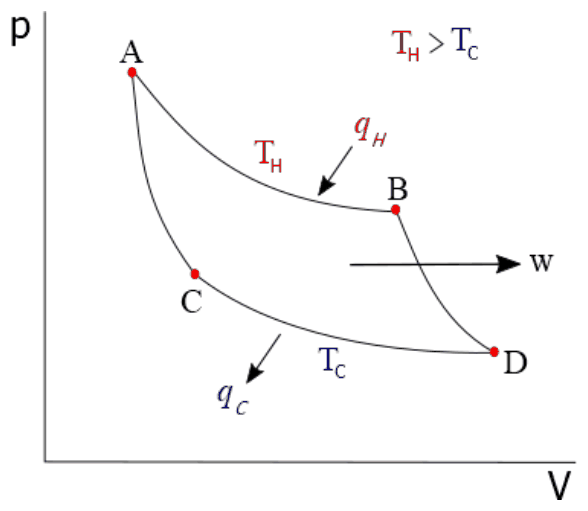
After heat transfers, the remaining energy is released as work (\(w\)). Also, \(q_H\) and \(q_C\) are related to \(T_C\) and \(T_H\) as follows:
\[ \frac{|q_H|}{|q_C|}=\frac{T_H}{T_C} \]
The efficiency of the cycle can be found by work released by cycle (\(w\)) divided by heat absorbed by cycle (\(q_H\)).
You are provided with the change in enthalpies of the following reactions at 300 K.

6.1 Calculate the molar enthalpy of sublimation (in \(\mathrm{kJ\,mol^{-1}}\)) for \(\ce{H3BO3}\) at 300 K.
6.2 Calculate the \(\Delta_r U\) (internal energy) in terms of \(\mathrm{kJ\,mol^{-1}}\) at 300 K for the reactions (2) and (4) given above (assume ideal gas behavior for each gaseous species in each reaction).
6.3 Calculate the amount of overall work produced by a heat engine (\(|w|\)) in terms of J and the amount of overall heat released to the cold sink (\(|q_C|\)) in terms of J.
6.4 Calculate the efficiency of the heat engine described above.
6.5 Calculate the entropy change (\(\Delta S\)) for A→B and D→C processes in the heat engine in terms of \(\mathrm{J\,K^{-1}}\).
6.6 Calculate the Gibbs energy change (\(\Delta G\)) in terms of J for A→B and D→C processes in the heat engine.
6.7 Calculate the ratio of pressure at point A to the pressure at point B in the cycle (standard pressure: 1 bar).
6.8 Calculate the amount of \(\ce{H2(g)}\) (in moles) produced according to the reaction given at the beginning of the task for one cycle of the engine.
Part 2
Interstellar journeys can be done by using diborane as rocket fuel. Combustion of diborane is shown below:

Combustion of diborane is experimented in a closed container (\(100\ \mathrm{dm^3}\)) at different temperatures and the equilibrium amounts were recorded.
| Temperature | 8930 K | 9005 K |
|---|---|---|
| \(\ce{B2H6(g)}\) | 0.38 mol | 0.49 mol |
| \(\ce{H2O(g)}\) | 0.20 mol | 0.20 mol |
Partial pressure of \(\ce{O2(g)}\) was stabilized to 1 bar and kept constant at all conditions.
Assume that in this hypothetical universe; \(\Delta_r S^\circ\) and \(\Delta_r H^\circ\) are independent of temperature, the standard molar entropy (\(S^\circ\)) of \(\ce{B2O3(s)}\) does not change with pressure, all the gas species behave as an ideal gas, and all species remain in the same phase, without any further decomposition before or after reaction, at all temperatures then:
6.9 Calculate \(K_p\) (pressure based equilibrium constant) at 8930 K and 9005 K.
6.10 Calculate \(\Delta_r G^\circ\) of the reaction in terms of \(\mathrm{kJ\,mol^{-1}}\) at 8930 K and 9005 K. (If you failed to find \(K_p\), please use \(K_p\) (8930 K) = 2, \(K_p\) (9005 K) = 0.5.)
6.11 Calculate \(\Delta_r G^\circ\) (in terms of \(\mathrm{kJ\,mol^{-1}}\)), \(\Delta_r H^\circ\) (in terms of \(\mathrm{kJ\,mol^{-1}}\)), and \(\Delta_r S^\circ\) (in terms of \(\mathrm{J\,mol^{-1}\,K^{-1}}\)) of the combustion reaction at 298 K. (If you failed to find \(K_p\), please use \(K_p\)(8930 K) = 2, \(K_p\)(9005 K) = 0.5)
6.12 Tick the correct answer in the table by determining whether combustion reactions are favored or not at given temperature \(T\) below under standard pressure (1 bar).
| Temperature | Favored | Unfavored |
|---|---|---|
| 298 K | ☐ | ☐ |
| 8930 K | ☐ | ☐ |
| 9005 K | ☐ | ☐ |
| 9100 K | ☐ | ☐ |
6.13 Calculate the \(\Delta_f H\) (\(\mathrm{kJ\,mol^{-1}}\)) and \(S^\circ\) (\(\mathrm{kJ\,mol^{-1}\,K^{-1}}\)) of \(\ce{H2O(g)}\) using the values given in the table below. (\(\Delta_f H\) = enthalpy of formation, \(S^\circ\) = standard entropy)
(If you fail to find \(\Delta_r H^\circ\) and \(\Delta_r S^\circ\) of the combustion, please use \(\Delta H^\circ=1000\ \mathrm{kJ\,mol^{-1}}\), \(\Delta S^\circ=150\ \mathrm{J\,K^{-1}\,mol^{-1}}\))
| Compound | \(\Delta H_f\) (298 K) | \(S^\circ\) (298 K) |
|---|---|---|
| \(\ce{B2H6(g)}\) | \(36.40\ \mathrm{kJ\,mol^{-1}}\) | \(0.23\ \mathrm{kJ\,mol^{-1}\,K^{-1}}\) |
| \(\ce{O2(g)}\) | \(0.00\ \mathrm{kJ\,mol^{-1}}\) | \(0.16\ \mathrm{kJ\,mol^{-1}\,K^{-1}}\) |
| \(\ce{B2O3(s)}\) | \(-1273\ \mathrm{kJ\,mol^{-1}}\) | \(0.05\ \mathrm{kJ\,mol^{-1}\,K^{-1}}\) |
Official English text of the problem.
Answers
- 6.1: Boric acid, \(\ce{H3BO3}\), SMILES
OB(O)O: \(\boxed{\Delta_{\mathrm{sub}}H=+25.0\ \mathrm{kJ\,mol^{-1}}}\). - 6.2: \(\boxed{\Delta_r U(2)=-120.0\ \mathrm{kJ\,mol^{-1}}}\); \(\boxed{\Delta_r U(4)=-92.3\ \mathrm{kJ\,mol^{-1}}}\).
- 6.3: \(\boxed{|w|=175\ \mathrm J}\); \(\boxed{|q_C|=75\ \mathrm J}\).
- 6.4: \(\boxed{\eta=0.700=70.0\%}\).
- 6.5: \(\boxed{\Delta S_{\mathrm{A\to B}}=+0.250\ \mathrm{J\,K^{-1}}}\); \(\boxed{\Delta S_{\mathrm{D\to C}}=-0.250\ \mathrm{J\,K^{-1}}}\).
- 6.6: \(\boxed{\Delta G_{\mathrm{A\to B}}=-250\ \mathrm J}\); \(\boxed{\Delta G_{\mathrm{D\to C}}=+75\ \mathrm J}\).
- 6.7: \(\boxed{p_A/p_B=1.0305\approx1.031}\).
- 6.8: Hydrogen, \(\ce{H2}\), SMILES
[H][H]: \(\boxed{n=2.10\times10^{-2}\ \mathrm{mol}}\). - 6.9: \(\boxed{K_p(8930\ \mathrm K)=1.16}\); \(\boxed{K_p(9005\ \mathrm K)=0.915}\), using dimensionless standard-state-normalized constants.
- 6.10: \(\boxed{\Delta_r G^\circ(8930\ \mathrm K)\approx-11.0\ \mathrm{kJ\,mol^{-1}}}\); \(\boxed{\Delta_r G^\circ(9005\ \mathrm K)\approx+6.64\ \mathrm{kJ\,mol^{-1}}}\).
- 6.11: At 298 K, \(\boxed{\Delta_r G^\circ\approx-2.05\times10^3\ \mathrm{kJ\,mol^{-1}}}\), \(\boxed{\Delta_r H^\circ\approx-2.12\times10^3\ \mathrm{kJ\,mol^{-1}}}\), and \(\boxed{\Delta_r S^\circ\approx-236\ \mathrm{J\,mol^{-1}\,K^{-1}}}\).
- 6.12: Favored: 298 K and 8930 K. Unfavored: 9005 K and 9100 K.
- 6.13: Water vapor, \(\ce{H2O(g)}\), SMILES
O: \(\boxed{\Delta_f H^\circ\approx-269\ \mathrm{kJ\,mol^{-1}}}\), \(\boxed{S^\circ\approx0.141\ \mathrm{kJ\,mol^{-1}\,K^{-1}}}\).
Solution
Use the gas constant \[ R=8.314\ \mathrm{J\,mol^{-1}\,K^{-1}} =0.08314\ \mathrm{bar\,dm^3\,mol^{-1}\,K^{-1}}. \] For the working gas, heat entering is positive, and \(w\) denotes work done on the gas, so \(\Delta U=q+w\). The engine’s work output is \(|w|\). Extra digits are retained in intermediate calculations.
6.1
The required sublimation of boric acid is \[ \ce{H3BO3(s) -> H3BO3(g)}. \]
Combine the supplied reactions as \[ (1)+2(2)-12(4). \] The chlorine, boron trichloride, and hydrogen chloride cancel, giving \[ \ce{B2H6(g) + 6H2O(l) -> 2H3BO3(g) + 6H2(g)}. \] Its reaction enthalpy is \[ \begin{aligned} \Delta_r H_{\mathrm{gas}} &=-1326+2(-112.5)-12(-92.3)\\ &=-443.4\ \mathrm{kJ\,mol^{-1}}. \end{aligned} \]
Subtract reaction (3), \[ \ce{B2H6(g) + 6H2O(l) -> 2H3BO3(s) + 6H2(g)}, \] whose enthalpy is \(-493.4\ \mathrm{kJ\,mol^{-1}}\). The net process is \[ \ce{2H3BO3(s) -> 2H3BO3(g)}, \] with enthalpy change \[ -443.4-(-493.4)=+50.0\ \mathrm{kJ} \] for subliming two moles. Hence \[ \boxed{\Delta_{\mathrm{sub}}H(300\ \mathrm K)=+25.0\ \mathrm{kJ\,mol^{-1}}}. \]
6.2
For ideal gases, neglecting the small \(pV\) contributions of condensed phases, \[ \Delta_r H=\Delta_r U+\Delta n_gRT, \] where \(\Delta n_g\) is gaseous product stoichiometry minus gaseous reactant stoichiometry.
For reaction (2), \[ \ce{BCl3(g) + 3H2O(l) -> H3BO3(g) + 3HCl(g)}, \] the liquid water does not contribute to \(\Delta n_g\), so \[ \Delta n_g=(1+3)-1=3. \] Therefore \[ \begin{aligned} \Delta_r U(2) &=-112.5-\frac{3(8.314)(300)}{1000}\\ &=-119.9826\ \mathrm{kJ\,mol^{-1}}\\ &\boxed{\approx-120.0\ \mathrm{kJ\,mol^{-1}}}. \end{aligned} \]
For reaction (4), \[ \ce{1/2 H2(g) + 1/2 Cl2(g) -> HCl(g)}, \] \[ \Delta n_g=1-\frac12-\frac12=0. \] Thus \[ \boxed{\Delta_r U(4)=\Delta_r H(4)=-92.3\ \mathrm{kJ\,mol^{-1}}}. \]
6.3
The given reversible-engine relation gives \[ |q_C|=|q_H|\frac{T_C}{T_H} =250\frac{300}{1000} =\boxed{75\ \mathrm J}. \]
The gas returns to its initial state after a cycle, so \(\Delta U_{\mathrm{cycle}}=0\). Its net heat input is \[ q_{\mathrm{net}}=250-75=175\ \mathrm J. \] Consequently, \(w=-175\ \mathrm J\), and the work produced is \[ \boxed{|w|=175\ \mathrm J}. \]
6.4
\[ \eta=\frac{|w|}{q_H} =\frac{175}{250} =1-\frac{300}{1000} =\boxed{0.700=70.0\%}. \]
6.5
For a reversible isothermal process, \[ \Delta S=\frac{q_{\mathrm{rev}}}{T}. \]
During A→B, the gas absorbs heat: \[ \boxed{\Delta S_{\mathrm{A\to B}} =\frac{250}{1000} =+0.250\ \mathrm{J\,K^{-1}}}. \]
During D→C, it releases heat: \[ \boxed{\Delta S_{\mathrm{D\to C}} =\frac{-75}{300} =-0.250\ \mathrm{J\,K^{-1}}}. \]
The two reversible adiabatic steps have zero entropy change, so the total entropy change of the working gas over the cycle is zero.
6.6
An ideal gas’s enthalpy depends only on temperature. Therefore, for each isothermal step, \(\Delta H=0\), and \[ \Delta G=\Delta H-T\Delta S=-T\Delta S. \]
Thus \[ \boxed{\Delta G_{\mathrm{A\to B}} =-1000(0.250)=-250\ \mathrm J}, \] and \[ \boxed{\Delta G_{\mathrm{D\to C}} =-300(-0.250)=+75\ \mathrm J}. \]
6.7
For the reversible isothermal expansion of one mole, \[ q_H=nRT_H\ln\!\left(\frac{V_B}{V_A}\right). \] Because \(p_AV_A=p_BV_B\), \[ \frac{V_B}{V_A}=\frac{p_A}{p_B}. \] Therefore \[ \ln\!\left(\frac{p_A}{p_B}\right) =\frac{250}{(1)(8.314)(1000)}, \] and \[ \boxed{\frac{p_A}{p_B} =\exp\!\left(\frac{250}{8314}\right) =1.030526\approx1.031}. \]
The standard pressure cancels from this pressure ratio.
6.8
The balanced reaction, consistent with reaction (3), is \[ \ce{B2H6(g) + 6H2O(l) -> 2H3BO3(s) + 6H2(g)}. \]
All \(175\ \mathrm J\) of work output supplies the sublimation energy. Thus \[ n\!\left(\ce{H3BO3}\right) =\frac{175\ \mathrm J}{25.0\times10^3\ \mathrm{J\,mol^{-1}}} =7.00\times10^{-3}\ \mathrm{mol}. \]
The reaction produces six moles of hydrogen for every two moles of boric acid: \[ \begin{aligned} n\!\left(\ce{H2}\right) &=\frac62\,n\!\left(\ce{H3BO3}\right)\\ &=3(7.00\times10^{-3})\\ &=\boxed{2.10\times10^{-2}\ \mathrm{mol}}. \end{aligned} \]
6.9
The balanced combustion reaction is \[ \ce{B2H6(g) + 3O2(g) -> B2O3(s) + 3H2O(g)}. \]
Taking the activity of pure solid \(\ce{B2O3}\) as unity, \[ K_p= \frac{(p_{\ce{H2O}}/p^\circ)^3} {(p_{\ce{B2H6}}/p^\circ)(p_{\ce{O2}}/p^\circ)^3}, \qquad p^\circ=1\ \mathrm{bar}. \] Since \(p_{\ce{O2}}=p^\circ\), its factor equals one.
Using \(p_i=n_iRT/V\) with \(V=100\ \mathrm{dm^3}\):
| Temperature | \(p_{\ce{B2H6}}\) / bar | \(p_{\ce{H2O}}\) / bar |
|---|---|---|
| 8930 K | \(\dfrac{0.38(0.08314)(8930)}{100}=2.82127276\) | \(\dfrac{0.20(0.08314)(8930)}{100}=1.48488040\) |
| 9005 K | \(\dfrac{0.49(0.08314)(9005)}{100}=3.66851093\) | \(\dfrac{0.20(0.08314)(9005)}{100}=1.49735140\) |
The pressure ratios are dimensionless, giving \[ K_p(8930\ \mathrm K) =\frac{(1.48488040)^3}{2.82127276} =1.16045779 \boxed{\approx1.16}, \] and \[ K_p(9005\ \mathrm K) =\frac{(1.49735140)^3}{3.66851093} =0.91512703 \boxed{\approx0.915}. \]
6.10
The standard reaction Gibbs energy is \[ \Delta_r G^\circ=-RT\ln K_p. \]
At 8930 K, \[ \begin{aligned} \Delta_r G^\circ &=-\frac{(8.314)(8930)\ln(1.16045779)}{1000}\\ &=-11.04859\ \mathrm{kJ\,mol^{-1}}\\ &\boxed{\approx-11.0\ \mathrm{kJ\,mol^{-1}}}. \end{aligned} \]
At 9005 K, \[ \begin{aligned} \Delta_r G^\circ &=-\frac{(8.314)(9005)\ln(0.91512703)}{1000}\\ &=+6.64018\ \mathrm{kJ\,mol^{-1}}\\ &\boxed{\approx+6.64\ \mathrm{kJ\,mol^{-1}}}. \end{aligned} \]
These are standard reaction Gibbs energies. The actual reaction Gibbs energy at each equilibrium composition is zero.
6.11
By assumption, \(\Delta_r H^\circ\) and \(\Delta_r S^\circ\) are temperature-independent. Therefore \[ \Delta_r G^\circ(T)=\Delta_r H^\circ-T\Delta_r S^\circ. \]
Subtracting this equation at the two temperatures, \[ \Delta_r S^\circ =-\frac{\Delta_r G^\circ(9005)-\Delta_r G^\circ(8930)} {9005-8930}. \] Using the unrounded values, \[ \begin{aligned} \Delta_r S^\circ &=-\frac{6.640184-(-11.048592)}{75}\\ &=-0.23585035\ \mathrm{kJ\,mol^{-1}\,K^{-1}}\\ &=\boxed{-235.85035\ \mathrm{J\,mol^{-1}\,K^{-1}} \approx-236\ \mathrm{J\,mol^{-1}\,K^{-1}}}. \end{aligned} \]
Then \[ \begin{aligned} \Delta_r H^\circ &=\Delta_r G^\circ(8930)+8930\Delta_r S^\circ\\ &=-11.048592+8930(-0.23585035)\\ &=-2117.19224\ \mathrm{kJ\,mol^{-1}}\\ &\boxed{\approx-2.12\times10^3\ \mathrm{kJ\,mol^{-1}}}. \end{aligned} \]
These enthalpy and entropy values also apply at 298 K. Hence \[ \begin{aligned} \Delta_r G^\circ(298) &=-2117.19224-298(-0.23585035)\\ &=-2046.90884\ \mathrm{kJ\,mol^{-1}}\\ &\boxed{\approx-2.05\times10^3\ \mathrm{kJ\,mol^{-1}}}. \end{aligned} \]
As an independent check, the integrated van ’t Hoff equation, \[ \ln\!\left(\frac{K_{p,2}}{K_{p,1}}\right) =-\frac{\Delta_r H^\circ}{R} \left(\frac1{T_2}-\frac1{T_1}\right), \] gives the same reaction enthalpy.
6.12
Under standard-state conditions, combustion is favored when \(\Delta_r G^\circ<0\).
Here, \[ \Delta_r G^\circ(T) =-2117.19224+0.23585035T \quad\mathrm{kJ\,mol^{-1}}, \] with \(T\) in kelvin. Thus:
| Temperature | \(\Delta_r G^\circ\) / \(\mathrm{kJ\,mol^{-1}}\) | Favored | Unfavored |
|---|---|---|---|
| 298 K | \(-2046.91\) | ✓ | |
| 8930 K | \(-11.05\) | ✓ | |
| 9005 K | \(+6.64\) | ✓ | |
| 9100 K | \(+29.05\) | ✓ |
The crossover temperature is \[ T_*=\frac{\Delta_r H^\circ}{\Delta_r S^\circ} =\frac{-2117.19224}{-0.23585035} \approx8977\ \mathrm K. \] Because both \(\Delta_r H^\circ\) and \(\Delta_r S^\circ\) are negative, combustion is favored below this temperature.
6.13
The standard formation reaction for water vapor is \[ \ce{H2(g) + 1/2 O2(g) -> H2O(g)}. \]
Let \[ h=\Delta_f H^\circ\!\left(\ce{H2O(g)}\right). \] For the combustion reaction, the sum of product formation enthalpies minus the sum for reactants gives \[ \Delta_r H^\circ =\left[-1273+3h\right]-\left[36.40+3(0.00)\right]. \] Therefore \[ -2117.19224=3h-1309.40, \] so \[ \boxed{ h=\frac{-2117.19224+1309.40}{3} =-269.26408 \approx-269\ \mathrm{kJ\,mol^{-1}} }. \]
Similarly, let \[ s=S^\circ\!\left(\ce{H2O(g)}\right) \] in \(\mathrm{kJ\,mol^{-1}\,K^{-1}}\). Then \[ \begin{aligned} \Delta_r S^\circ &=\left[0.05+3s\right]-\left[0.23+3(0.16)\right]\\ &=3s-0.66. \end{aligned} \] Using \(\Delta_r S^\circ=-0.23585035\ \mathrm{kJ\,mol^{-1}\,K^{-1}}\), \[ \boxed{ s=\frac{-0.23585035+0.66}{3} =0.14138322 \approx0.141\ \mathrm{kJ\,mol^{-1}\,K^{-1}} }. \]
These values follow from the stipulated hypothetical-universe data.
The solution was checked against the official solution. Where this solution differs from the official solution, the official solution contains an error or a misprint.
IChO 2020 · Theorieaufgabe 6
Thermodynamik auf einer interstellaren Reise
Teil 1
In einem hypothetischen Universum nimmt eine unbekannte Menge Diboran an der folgenden Reaktion teil:
Nehmen Sie an, dass in diesem hypothetischen Universum das bei dieser Reaktion erhaltene \(\ce{H3BO3(s)}\) bei 300 K vollständig sublimiert wurde. Die für die Sublimation erforderliche Energie wurde durch die während eines Kreisprozesses einer idealen Wärmekraftmaschine abgegebene Arbeit bereitgestellt. Dabei durchläuft ein Mol eines einatomigen idealen Gases den im folgenden Druck-\(p\)-Volumen-\(V\)-Diagramm beschriebenen Kreisprozess:
- A→B; isotherme reversible Expansion unter Aufnahme von 250 J durch Wärmeübertragung (\(q_H\)) bei einer Temperatur von 1000 K (\(T_H\)) aus einem heißen Wärmereservoir.
- B→D; reversible adiabatische Expansion.
- D→C; isotherme reversible Kompression bei einer Temperatur von 300 K (\(T_C\)) unter Abgabe einer bestimmten Wärmemenge (\(q_C\)) an ein kaltes Wärmereservoir.
- C→A; reversible adiabatische Kompression.
Nach den Wärmeübertragungen wird die verbleibende Energie als Arbeit (\(w\)) abgegeben. Außerdem hängen \(q_H\) und \(q_C\) wie folgt mit \(T_C\) und \(T_H\) zusammen:
\[ \frac{|q_H|}{|q_C|}=\frac{T_H}{T_C} \]
Der Wirkungsgrad des Kreisprozesses ergibt sich aus der vom Kreisprozess abgegebenen Arbeit (\(w\)), geteilt durch die vom Kreisprozess aufgenommene Wärme (\(q_H\)).
Die Enthalpieänderungen der folgenden Reaktionen bei 300 K sind gegeben.
6.1 Berechnen Sie die molare Sublimationsenthalpie (in \(\mathrm{kJ\,mol^{-1}}\)) von \(\ce{H3BO3}\) bei 300 K.
6.2 Berechnen Sie \(\Delta_r U\) (Änderung der inneren Energie) in \(\mathrm{kJ\,mol^{-1}}\) bei 300 K für die oben angegebenen Reaktionen (2) und (4) (nehmen Sie für jede gasförmige Spezies in jeder Reaktion ideales Gasverhalten an).
6.3 Berechnen Sie die insgesamt von einer Wärmekraftmaschine geleistete Arbeit (\(|w|\)) in J und die insgesamt an das kalte Wärmereservoir abgegebene Wärme (\(|q_C|\)) in J.
6.4 Berechnen Sie den Wirkungsgrad der oben beschriebenen Wärmekraftmaschine.
6.5 Berechnen Sie die Entropieänderung (\(\Delta S\)) für die Prozesse A→B und D→C in der Wärmekraftmaschine in \(\mathrm{J\,K^{-1}}\).
6.6 Berechnen Sie die Änderung der Gibbs-Energie (\(\Delta G\)) in J für die Prozesse A→B und D→C in der Wärmekraftmaschine.
6.7 Berechnen Sie das Verhältnis des Drucks am Punkt A zum Druck am Punkt B des Kreisprozesses (Standarddruck: 1 bar).
6.8 Berechnen Sie die Stoffmenge an \(\ce{H2(g)}\) (in Mol), die gemäß der zu Beginn der Aufgabe angegebenen Reaktion bei einem Kreisprozess der Maschine entsteht.
Teil 2
Interstellare Reisen lassen sich unter Verwendung von Diboran als Raketentreibstoff durchführen. Die Verbrennung von Diboran ist unten dargestellt:
Die Verbrennung von Diboran wird in einem geschlossenen Behälter (\(100\ \mathrm{dm^3}\)) bei verschiedenen Temperaturen experimentell untersucht, und die Stoffmengen im Gleichgewicht werden aufgezeichnet.
| Temperatur | 8930 K | 9005 K |
|---|---|---|
| \(\ce{B2H6(g)}\) | 0.38 mol | 0.49 mol |
| \(\ce{H2O(g)}\) | 0.20 mol | 0.20 mol |
Der Partialdruck von \(\ce{O2(g)}\) wurde auf 1 bar eingestellt und unter allen Bedingungen konstant gehalten.
Nehmen Sie für dieses hypothetische Universum an, dass \(\Delta_r S^\circ\) und \(\Delta_r H^\circ\) temperaturunabhängig sind, die molare Standardentropie (\(S^\circ\)) von \(\ce{B2O3(s)}\) sich nicht mit dem Druck ändert, alle gasförmigen Spezies sich wie ideale Gase verhalten und alle Spezies bei allen Temperaturen in derselben Phase verbleiben, ohne sich vor oder nach der Reaktion weiter zu zersetzen. Bearbeiten Sie unter diesen Annahmen die folgenden Aufgaben:
6.9 Berechnen Sie \(K_p\) (die auf Drücken beruhende Gleichgewichtskonstante) bei 8930 K und 9005 K.
6.10 Berechnen Sie \(\Delta_r G^\circ\) der Reaktion in \(\mathrm{kJ\,mol^{-1}}\) bei 8930 K und 9005 K. (Falls Sie \(K_p\) nicht bestimmen konnten, verwenden Sie bitte \(K_p\) (8930 K) = 2, \(K_p\) (9005 K) = 0.5.)
6.11 Berechnen Sie \(\Delta_r G^\circ\) (in \(\mathrm{kJ\,mol^{-1}}\)), \(\Delta_r H^\circ\) (in \(\mathrm{kJ\,mol^{-1}}\)) und \(\Delta_r S^\circ\) (in \(\mathrm{J\,mol^{-1}\,K^{-1}}\)) der Verbrennungsreaktion bei 298 K. (Falls Sie \(K_p\) nicht bestimmen konnten, verwenden Sie bitte \(K_p\)(8930 K) = 2, \(K_p\)(9005 K) = 0.5)
6.12 Kreuzen Sie in der Tabelle die richtige Antwort an, indem Sie bestimmen, ob die Verbrennungsreaktionen bei der jeweils unten angegebenen Temperatur \(T\) unter Standarddruck (1 bar) begünstigt sind oder nicht.
| Temperatur | Begünstigt | Nicht begünstigt |
|---|---|---|
| 298 K | ☐ | ☐ |
| 8930 K | ☐ | ☐ |
| 9005 K | ☐ | ☐ |
| 9100 K | ☐ | ☐ |
6.13 Berechnen Sie \(\Delta_f H\) (\(\mathrm{kJ\,mol^{-1}}\)) und \(S^\circ\) (\(\mathrm{kJ\,mol^{-1}\,K^{-1}}\)) von \(\ce{H2O(g)}\) mithilfe der in der folgenden Tabelle angegebenen Werte. (\(\Delta_f H\) = Bildungsenthalpie, \(S^\circ\) = Standardentropie)
(Falls Sie \(\Delta_r H^\circ\) und \(\Delta_r S^\circ\) der Verbrennung nicht bestimmen können, verwenden Sie bitte \(\Delta H^\circ=1000\ \mathrm{kJ\,mol^{-1}}\), \(\Delta S^\circ=150\ \mathrm{J\,K^{-1}\,mol^{-1}}\))
| Verbindung | \(\Delta H_f\) (298 K) | \(S^\circ\) (298 K) |
|---|---|---|
| \(\ce{B2H6(g)}\) | \(36.40\ \mathrm{kJ\,mol^{-1}}\) | \(0.23\ \mathrm{kJ\,mol^{-1}\,K^{-1}}\) |
| \(\ce{O2(g)}\) | \(0.00\ \mathrm{kJ\,mol^{-1}}\) | \(0.16\ \mathrm{kJ\,mol^{-1}\,K^{-1}}\) |
| \(\ce{B2O3(s)}\) | \(-1273\ \mathrm{kJ\,mol^{-1}}\) | \(0.05\ \mathrm{kJ\,mol^{-1}\,K^{-1}}\) |
Aufgabentext aus dem offiziellen englischen Text übersetzt.
Antworten
- 6.1: Borsäure, \(\ce{H3BO3}\), SMILES
OB(O)O: \(\boxed{\Delta_{\mathrm{sub}}H=+25.0\ \mathrm{kJ\,mol^{-1}}}\). - 6.2: \(\boxed{\Delta_r U(2)=-120.0\ \mathrm{kJ\,mol^{-1}}}\); \(\boxed{\Delta_r U(4)=-92.3\ \mathrm{kJ\,mol^{-1}}}\).
- 6.3: \(\boxed{|w|=175\ \mathrm J}\); \(\boxed{|q_C|=75\ \mathrm J}\).
- 6.4: \(\boxed{\eta=0.700=70.0\%}\).
- 6.5: \(\boxed{\Delta S_{\mathrm{A\to B}}=+0.250\ \mathrm{J\,K^{-1}}}\); \(\boxed{\Delta S_{\mathrm{D\to C}}=-0.250\ \mathrm{J\,K^{-1}}}\).
- 6.6: \(\boxed{\Delta G_{\mathrm{A\to B}}=-250\ \mathrm J}\); \(\boxed{\Delta G_{\mathrm{D\to C}}=+75\ \mathrm J}\).
- 6.7: \(\boxed{p_A/p_B=1.0305\approx1.031}\).
- 6.8: Wasserstoff, \(\ce{H2}\), SMILES
[H][H]: \(\boxed{n=2.10\times10^{-2}\ \mathrm{mol}}\). - 6.9: \(\boxed{K_p(8930\ \mathrm K)=1.16}\); \(\boxed{K_p(9005\ \mathrm K)=0.915}\), unter Verwendung dimensionsloser, auf den Standardzustand normierter Konstanten.
- 6.10: \(\boxed{\Delta_r G^\circ(8930\ \mathrm K)\approx-11.0\ \mathrm{kJ\,mol^{-1}}}\); \(\boxed{\Delta_r G^\circ(9005\ \mathrm K)\approx+6.64\ \mathrm{kJ\,mol^{-1}}}\).
- 6.11: Bei 298 K: \(\boxed{\Delta_r G^\circ\approx-2.05\times10^3\ \mathrm{kJ\,mol^{-1}}}\), \(\boxed{\Delta_r H^\circ\approx-2.12\times10^3\ \mathrm{kJ\,mol^{-1}}}\) und \(\boxed{\Delta_r S^\circ\approx-236\ \mathrm{J\,mol^{-1}\,K^{-1}}}\).
- 6.12: Begünstigt: 298 K und 8930 K. Nicht begünstigt: 9005 K und 9100 K.
- 6.13: Wasserdampf, \(\ce{H2O(g)}\), SMILES
O: \(\boxed{\Delta_f H^\circ\approx-269\ \mathrm{kJ\,mol^{-1}}}\), \(\boxed{S^\circ\approx0.141\ \mathrm{kJ\,mol^{-1}\,K^{-1}}}\).
Lösung
Wir verwenden die Gaskonstante \[ R=8.314\ \mathrm{J\,mol^{-1}\,K^{-1}} =0.08314\ \mathrm{bar\,dm^3\,mol^{-1}\,K^{-1}}. \] Für das Arbeitsgas ist zugeführte Wärme positiv, und \(w\) bezeichnet die am Gas verrichtete Arbeit, sodass \(\Delta U=q+w\) gilt. Die von der Maschine abgegebene Arbeit beträgt \(|w|\). In den Zwischenrechnungen werden zusätzliche Stellen beibehalten.
6.1
Die gesuchte Sublimation der Borsäure lautet \[ \ce{H3BO3(s) -> H3BO3(g)}. \]
Wir kombinieren die angegebenen Reaktionen gemäß \[ (1)+2(2)-12(4). \] Chlor, Bortrichlorid und Chlorwasserstoff kürzen sich heraus, und es ergibt sich \[ \ce{B2H6(g) + 6H2O(l) -> 2H3BO3(g) + 6H2(g)}. \] Die Reaktionsenthalpie beträgt \[ \begin{aligned} \Delta_r H_{\mathrm{gas}} &=-1326+2(-112.5)-12(-92.3)\\ &=-443.4\ \mathrm{kJ\,mol^{-1}}. \end{aligned} \]
Wir subtrahieren Reaktion (3), \[ \ce{B2H6(g) + 6H2O(l) -> 2H3BO3(s) + 6H2(g)}, \] deren Enthalpie \(-493.4\ \mathrm{kJ\,mol^{-1}}\) beträgt. Der resultierende Prozess ist \[ \ce{2H3BO3(s) -> 2H3BO3(g)}, \] mit der Enthalpieänderung \[ -443.4-(-493.4)=+50.0\ \mathrm{kJ} \] für die Sublimation von zwei Mol. Somit gilt \[ \boxed{\Delta_{\mathrm{sub}}H(300\ \mathrm K)=+25.0\ \mathrm{kJ\,mol^{-1}}}. \]
6.2
Für ideale Gase gilt unter Vernachlässigung der kleinen \(pV\)-Beiträge kondensierter Phasen \[ \Delta_r H=\Delta_r U+\Delta n_gRT, \] wobei \(\Delta n_g\) die Summe der stöchiometrischen Koeffizienten der gasförmigen Produkte abzüglich derjenigen der gasförmigen Edukte ist.
Für Reaktion (2), \[ \ce{BCl3(g) + 3H2O(l) -> H3BO3(g) + 3HCl(g)}, \] trägt das flüssige Wasser nicht zu \(\Delta n_g\) bei, sodass \[ \Delta n_g=(1+3)-1=3. \] Daher gilt \[ \begin{aligned} \Delta_r U(2) &=-112.5-\frac{3(8.314)(300)}{1000}\\ &=-119.9826\ \mathrm{kJ\,mol^{-1}}\\ &\boxed{\approx-120.0\ \mathrm{kJ\,mol^{-1}}}. \end{aligned} \]
Für Reaktion (4), \[ \ce{1/2 H2(g) + 1/2 Cl2(g) -> HCl(g)}, \] \[ \Delta n_g=1-\frac12-\frac12=0. \] Somit gilt \[ \boxed{\Delta_r U(4)=\Delta_r H(4)=-92.3\ \mathrm{kJ\,mol^{-1}}}. \]
6.3
Aus der angegebenen Beziehung für eine reversible Wärmekraftmaschine folgt \[ |q_C|=|q_H|\frac{T_C}{T_H} =250\frac{300}{1000} =\boxed{75\ \mathrm J}. \]
Das Gas kehrt nach einem Kreisprozess in seinen Ausgangszustand zurück, sodass \(\Delta U_{\mathrm{cycle}}=0\) gilt. Seine netto zugeführte Wärme beträgt \[ q_{\mathrm{net}}=250-75=175\ \mathrm J. \] Folglich ist \(w=-175\ \mathrm J\), und die abgegebene Arbeit beträgt \[ \boxed{|w|=175\ \mathrm J}. \]
6.4
\[ \eta=\frac{|w|}{q_H} =\frac{175}{250} =1-\frac{300}{1000} =\boxed{0.700=70.0\%}. \]
6.5
Für einen reversiblen isothermen Prozess gilt \[ \Delta S=\frac{q_{\mathrm{rev}}}{T}. \]
Während A→B nimmt das Gas Wärme auf: \[ \boxed{\Delta S_{\mathrm{A\to B}} =\frac{250}{1000} =+0.250\ \mathrm{J\,K^{-1}}}. \]
Während D→C gibt es Wärme ab: \[ \boxed{\Delta S_{\mathrm{D\to C}} =\frac{-75}{300} =-0.250\ \mathrm{J\,K^{-1}}}. \]
Bei den beiden reversiblen adiabatischen Schritten ist die Entropieänderung null, sodass die gesamte Entropieänderung des Arbeitsgases über den Kreisprozess null beträgt.
6.6
Die Enthalpie eines idealen Gases hängt nur von der Temperatur ab. Daher gilt für jeden isothermen Schritt \(\Delta H=0\), und \[ \Delta G=\Delta H-T\Delta S=-T\Delta S. \]
Somit gilt \[ \boxed{\Delta G_{\mathrm{A\to B}} =-1000(0.250)=-250\ \mathrm J}, \] und \[ \boxed{\Delta G_{\mathrm{D\to C}} =-300(-0.250)=+75\ \mathrm J}. \]
6.7
Für die reversible isotherme Expansion eines Mols gilt \[ q_H=nRT_H\ln\!\left(\frac{V_B}{V_A}\right). \] Da \(p_AV_A=p_BV_B\) gilt, \[ \frac{V_B}{V_A}=\frac{p_A}{p_B}. \] Daher gilt \[ \ln\!\left(\frac{p_A}{p_B}\right) =\frac{250}{(1)(8.314)(1000)}, \] und \[ \boxed{\frac{p_A}{p_B} =\exp\!\left(\frac{250}{8314}\right) =1.030526\approx1.031}. \]
Der Standarddruck kürzt sich in diesem Druckverhältnis heraus.
6.8
Die ausgeglichene Reaktionsgleichung lautet in Übereinstimmung mit Reaktion (3) \[ \ce{B2H6(g) + 6H2O(l) -> 2H3BO3(s) + 6H2(g)}. \]
Die gesamte abgegebene Arbeit von \(175\ \mathrm J\) liefert die Sublimationsenergie. Somit gilt \[ n\!\left(\ce{H3BO3}\right) =\frac{175\ \mathrm J}{25.0\times10^3\ \mathrm{J\,mol^{-1}}} =7.00\times10^{-3}\ \mathrm{mol}. \]
Bei der Reaktion entstehen auf je zwei Mol Borsäure sechs Mol Wasserstoff: \[ \begin{aligned} n\!\left(\ce{H2}\right) &=\frac62\,n\!\left(\ce{H3BO3}\right)\\ &=3(7.00\times10^{-3})\\ &=\boxed{2.10\times10^{-2}\ \mathrm{mol}}. \end{aligned} \]
6.9
Die ausgeglichene Verbrennungsreaktion lautet \[ \ce{B2H6(g) + 3O2(g) -> B2O3(s) + 3H2O(g)}. \]
Setzt man die Aktivität von reinem festem \(\ce{B2O3}\) gleich eins, so gilt \[ K_p= \frac{(p_{\ce{H2O}}/p^\circ)^3} {(p_{\ce{B2H6}}/p^\circ)(p_{\ce{O2}}/p^\circ)^3}, \qquad p^\circ=1\ \mathrm{bar}. \] Da \(p_{\ce{O2}}=p^\circ\) gilt, ist der zugehörige Faktor gleich eins.
Mit \(p_i=n_iRT/V\) und \(V=100\ \mathrm{dm^3}\) ergibt sich:
| Temperatur | \(p_{\ce{B2H6}}\) / bar | \(p_{\ce{H2O}}\) / bar |
|---|---|---|
| 8930 K | \(\dfrac{0.38(0.08314)(8930)}{100}=2.82127276\) | \(\dfrac{0.20(0.08314)(8930)}{100}=1.48488040\) |
| 9005 K | \(\dfrac{0.49(0.08314)(9005)}{100}=3.66851093\) | \(\dfrac{0.20(0.08314)(9005)}{100}=1.49735140\) |
Die Druckverhältnisse sind dimensionslos, und es ergibt sich \[ K_p(8930\ \mathrm K) =\frac{(1.48488040)^3}{2.82127276} =1.16045779 \boxed{\approx1.16}, \] und \[ K_p(9005\ \mathrm K) =\frac{(1.49735140)^3}{3.66851093} =0.91512703 \boxed{\approx0.915}. \]
6.10
Die Standardreaktions-Gibbs-Energie ist \[ \Delta_r G^\circ=-RT\ln K_p. \]
Bei 8930 K gilt \[ \begin{aligned} \Delta_r G^\circ &=-\frac{(8.314)(8930)\ln(1.16045779)}{1000}\\ &=-11.04859\ \mathrm{kJ\,mol^{-1}}\\ &\boxed{\approx-11.0\ \mathrm{kJ\,mol^{-1}}}. \end{aligned} \]
Bei 9005 K gilt \[ \begin{aligned} \Delta_r G^\circ &=-\frac{(8.314)(9005)\ln(0.91512703)}{1000}\\ &=+6.64018\ \mathrm{kJ\,mol^{-1}}\\ &\boxed{\approx+6.64\ \mathrm{kJ\,mol^{-1}}}. \end{aligned} \]
Dies sind Standardreaktions-Gibbs-Energien. Die tatsächliche Reaktions-Gibbs-Energie ist bei der jeweiligen Gleichgewichtszusammensetzung null.
6.11
Nach Voraussetzung sind \(\Delta_r H^\circ\) und \(\Delta_r S^\circ\) temperaturunabhängig. Daher gilt \[ \Delta_r G^\circ(T)=\Delta_r H^\circ-T\Delta_r S^\circ. \]
Durch Subtraktion dieser Gleichung für die beiden Temperaturen erhält man \[ \Delta_r S^\circ =-\frac{\Delta_r G^\circ(9005)-\Delta_r G^\circ(8930)} {9005-8930}. \] Mit den ungerundeten Werten ergibt sich \[ \begin{aligned} \Delta_r S^\circ &=-\frac{6.640184-(-11.048592)}{75}\\ &=-0.23585035\ \mathrm{kJ\,mol^{-1}\,K^{-1}}\\ &=\boxed{-235.85035\ \mathrm{J\,mol^{-1}\,K^{-1}} \approx-236\ \mathrm{J\,mol^{-1}\,K^{-1}}}. \end{aligned} \]
Dann gilt \[ \begin{aligned} \Delta_r H^\circ &=\Delta_r G^\circ(8930)+8930\Delta_r S^\circ\\ &=-11.048592+8930(-0.23585035)\\ &=-2117.19224\ \mathrm{kJ\,mol^{-1}}\\ &\boxed{\approx-2.12\times10^3\ \mathrm{kJ\,mol^{-1}}}. \end{aligned} \]
Diese Enthalpie- und Entropiewerte gelten auch bei 298 K. Somit folgt \[ \begin{aligned} \Delta_r G^\circ(298) &=-2117.19224-298(-0.23585035)\\ &=-2046.90884\ \mathrm{kJ\,mol^{-1}}\\ &\boxed{\approx-2.05\times10^3\ \mathrm{kJ\,mol^{-1}}}. \end{aligned} \]
Als unabhängige Kontrolle liefert die integrierte van-’t-Hoff-Gleichung, \[ \ln\!\left(\frac{K_{p,2}}{K_{p,1}}\right) =-\frac{\Delta_r H^\circ}{R} \left(\frac1{T_2}-\frac1{T_1}\right), \] dieselbe Reaktionsenthalpie.
6.12
Unter Standardzustandsbedingungen ist die Verbrennung begünstigt, wenn \(\Delta_r G^\circ<0\) gilt.
Hier gilt \[ \Delta_r G^\circ(T) =-2117.19224+0.23585035T \quad\mathrm{kJ\,mol^{-1}}, \] mit \(T\) in Kelvin. Somit ergibt sich:
| Temperatur | \(\Delta_r G^\circ\) / \(\mathrm{kJ\,mol^{-1}}\) | Begünstigt | Nicht begünstigt |
|---|---|---|---|
| 298 K | \(-2046.91\) | ✓ | |
| 8930 K | \(-11.05\) | ✓ | |
| 9005 K | \(+6.64\) | ✓ | |
| 9100 K | \(+29.05\) | ✓ |
Die Temperatur des Vorzeichenwechsels beträgt \[ T_*=\frac{\Delta_r H^\circ}{\Delta_r S^\circ} =\frac{-2117.19224}{-0.23585035} \approx8977\ \mathrm K. \] Da sowohl \(\Delta_r H^\circ\) als auch \(\Delta_r S^\circ\) negativ sind, ist die Verbrennung unterhalb dieser Temperatur begünstigt.
6.13
Die Standardbildungsreaktion von Wasserdampf lautet \[ \ce{H2(g) + 1/2 O2(g) -> H2O(g)}. \]
Es sei \[ h=\Delta_f H^\circ\!\left(\ce{H2O(g)}\right). \] Für die Verbrennungsreaktion ergibt die Summe der Bildungsenthalpien der Produkte abzüglich der Summe für die Edukte \[ \Delta_r H^\circ =\left[-1273+3h\right]-\left[36.40+3(0.00)\right]. \] Daher gilt \[ -2117.19224=3h-1309.40, \] also \[ \boxed{ h=\frac{-2117.19224+1309.40}{3} =-269.26408 \approx-269\ \mathrm{kJ\,mol^{-1}} }. \]
Entsprechend sei \[ s=S^\circ\!\left(\ce{H2O(g)}\right) \] in \(\mathrm{kJ\,mol^{-1}\,K^{-1}}\). Dann gilt \[ \begin{aligned} \Delta_r S^\circ &=\left[0.05+3s\right]-\left[0.23+3(0.16)\right]\\ &=3s-0.66. \end{aligned} \] Mit \(\Delta_r S^\circ=-0.23585035\ \mathrm{kJ\,mol^{-1}\,K^{-1}}\) ergibt sich \[ \boxed{ s=\frac{-0.23585035+0.66}{3} =0.14138322 \approx0.141\ \mathrm{kJ\,mol^{-1}\,K^{-1}} }. \]
Diese Werte ergeben sich aus den vorgegebenen Daten des hypothetischen Universums.
Die Lösung wurde mit der offiziellen Lösung abgeglichen. Wo diese Lösung von der offiziellen Lösung abweicht, enthält die offizielle Lösung einen Fehler oder Druckfehler.
IChO 2020 · Teori sorusu 6
Yıldızlararası Bir Yolculukla Termodinamik
Bölüm 1
Varsayımsal bir evrende, bilinmeyen miktarda diboran aşağıdaki tepkimeye girer:
Bu varsayımsal evrende, bu tepkimeden elde edilen \(\ce{H3BO3(s)}\)'ün 300 K'de tamamen süblimleştiğini varsayın. Süblimleşme için gereken enerji, bir mol tek atomlu ideal gazın aşağıdaki basınç (\(p\)) – hacim (\(V\)) diyagramında gösterilen çevrimi izlediği ideal bir ısı makinesinin bir çevriminde üretilen işten sağlanmıştır:
- A→B; 1000 K (\(T_H\)) sıcaklığındaki sıcak bir kaynaktan ısı aktarımıyla (\(q_H\)) 250 J alınan izotermal tersinir genleşme.
- B→D; tersinir adyabatik genleşme.
- D→C; 300 K (\(T_C\)) sıcaklığında, soğuk bir ısı deposuna bir miktar ısı (\(q_C\)) verilen izotermal tersinir sıkıştırma.
- C→A; tersinir adyabatik sıkıştırma.
Isı aktarımlarından sonra kalan enerji, iş (\(w\)) olarak dışarı verilir. Ayrıca \(q_H\) ve \(q_C\) ile \(T_C\) ve \(T_H\) arasında aşağıdaki ilişki vardır:
\[ \frac{|q_H|}{|q_C|}=\frac{T_H}{T_C} \]
Çevrimin verimi, çevrimde üretilen işin (\(w\)) çevrimde alınan ısıya (\(q_H\)) bölünmesiyle bulunabilir.
Aşağıdaki tepkimelerin 300 K'deki entalpi değişimleri verilmiştir.
6.1 \(\ce{H3BO3}\)'ün 300 K'deki molar süblimleşme entalpisini (\(\mathrm{kJ\,mol^{-1}}\) cinsinden) hesaplayın.
6.2 Yukarıda verilen (2) ve (4) tepkimeleri için 300 K'deki \(\Delta_r U\) (iç enerji) değerini \(\mathrm{kJ\,mol^{-1}}\) cinsinden hesaplayın (her tepkimedeki tüm gaz türlerinin ideal gaz gibi davrandığını varsayın).
6.3 Isı makinesinin ürettiği toplam iş miktarını (\(|w|\)) J cinsinden ve soğuk ısı deposuna verilen toplam ısı miktarını (\(|q_C|\)) J cinsinden hesaplayın.
6.4 Yukarıda tanımlanan ısı makinesinin verimini hesaplayın.
6.5 Isı makinesindeki A→B ve D→C süreçlerinin entropi değişimini (\(\Delta S\)) \(\mathrm{J\,K^{-1}}\) cinsinden hesaplayın.
6.6 Isı makinesindeki A→B ve D→C süreçlerinin Gibbs enerjisi değişimini (\(\Delta G\)) J cinsinden hesaplayın.
6.7 Çevrimde A noktasındaki basıncın B noktasındaki basınca oranını hesaplayın (standart basınç: 1 bar).
6.8 Sorunun başında verilen tepkimeye göre, makinenin bir çevrimi için üretilen \(\ce{H2(g)}\) miktarını (mol cinsinden) hesaplayın.
Bölüm 2
Diboran roket yakıtı olarak kullanılarak yıldızlararası yolculuklar yapılabilir. Diboranın yanması aşağıda gösterilmiştir:
Diboranın yanması, kapalı bir kapta (\(100\ \mathrm{dm^3}\)) farklı sıcaklıklarda deneysel olarak incelenmiş ve denge miktarları kaydedilmiştir.
| Sıcaklık | 8930 K | 9005 K |
|---|---|---|
| \(\ce{B2H6(g)}\) | 0.38 mol | 0.49 mol |
| \(\ce{H2O(g)}\) | 0.20 mol | 0.20 mol |
\(\ce{O2(g)}\)'nin kısmi basıncı 1 bar'a ayarlanmış ve tüm koşullarda sabit tutulmuştur.
Bu varsayımsal evrende \(\Delta_r S^\circ\) ve \(\Delta_r H^\circ\)'ın sıcaklıktan bağımsız olduğunu, \(\ce{B2O3(s)}\)'ün standart molar entropisinin (\(S^\circ\)) basınçla değişmediğini, tüm gaz türlerinin ideal gaz gibi davrandığını ve tüm türlerin bütün sıcaklıklarda, tepkimeden önce veya sonra herhangi bir ek bozunmaya uğramadan aynı fazda kaldığını varsayarak aşağıdakileri yapın:
6.9 8930 K ve 9005 K'de \(K_p\)'yi (basınca dayalı denge sabiti) hesaplayın.
6.10 Tepkimenin 8930 K ve 9005 K'deki \(\Delta_r G^\circ\) değerlerini \(\mathrm{kJ\,mol^{-1}}\) cinsinden hesaplayın. (\(K_p\)'yi bulamadıysanız lütfen \(K_p\) (8930 K) = 2, \(K_p\) (9005 K) = 0.5 değerlerini kullanın.)
6.11 Yanma tepkimesinin 298 K'deki \(\Delta_r G^\circ\) (\(\mathrm{kJ\,mol^{-1}}\) cinsinden), \(\Delta_r H^\circ\) (\(\mathrm{kJ\,mol^{-1}}\) cinsinden) ve \(\Delta_r S^\circ\) (\(\mathrm{J\,mol^{-1}\,K^{-1}}\) cinsinden) değerlerini hesaplayın. (\(K_p\)'yi bulamadıysanız lütfen \(K_p\)(8930 K) = 2, \(K_p\)(9005 K) = 0.5 değerlerini kullanın.)
6.12 Standart basınç (1 bar) altında, aşağıda verilen \(T\) sıcaklıklarında yanma tepkimelerinin termodinamik olarak elverişli olup olmadığını belirleyerek tablodaki doğru cevabı işaretleyin.
| Sıcaklık | Elverişli | Elverişsiz |
|---|---|---|
| 298 K | ☐ | ☐ |
| 8930 K | ☐ | ☐ |
| 9005 K | ☐ | ☐ |
| 9100 K | ☐ | ☐ |
6.13 Aşağıdaki tabloda verilen değerleri kullanarak \(\ce{H2O(g)}\)'nun \(\Delta_f H\) (\(\mathrm{kJ\,mol^{-1}}\)) ve \(S^\circ\) (\(\mathrm{kJ\,mol^{-1}\,K^{-1}}\)) değerlerini hesaplayın. (\(\Delta_f H\) = oluşum entalpisi, \(S^\circ\) = standart entropi)
(Yanmanın \(\Delta_r H^\circ\) ve \(\Delta_r S^\circ\) değerlerini bulamadıysanız lütfen \(\Delta H^\circ=1000\ \mathrm{kJ\,mol^{-1}}\), \(\Delta S^\circ=150\ \mathrm{J\,K^{-1}\,mol^{-1}}\) değerlerini kullanın.)
| Bileşik | \(\Delta H_f\) (298 K) | \(S^\circ\) (298 K) |
|---|---|---|
| \(\ce{B2H6(g)}\) | \(36.40\ \mathrm{kJ\,mol^{-1}}\) | \(0.23\ \mathrm{kJ\,mol^{-1}\,K^{-1}}\) |
| \(\ce{O2(g)}\) | \(0.00\ \mathrm{kJ\,mol^{-1}}\) | \(0.16\ \mathrm{kJ\,mol^{-1}\,K^{-1}}\) |
| \(\ce{B2O3(s)}\) | \(-1273\ \mathrm{kJ\,mol^{-1}}\) | \(0.05\ \mathrm{kJ\,mol^{-1}\,K^{-1}}\) |
Soru metni resmi İngilizce metinden çevrilmiştir.
Cevaplar
- 6.1: Borik asit, \(\ce{H3BO3}\), SMILES
OB(O)O: \(\boxed{\Delta_{\mathrm{sub}}H=+25.0\ \mathrm{kJ\,mol^{-1}}}\). - 6.2: \(\boxed{\Delta_r U(2)=-120.0\ \mathrm{kJ\,mol^{-1}}}\); \(\boxed{\Delta_r U(4)=-92.3\ \mathrm{kJ\,mol^{-1}}}\).
- 6.3: \(\boxed{|w|=175\ \mathrm J}\); \(\boxed{|q_C|=75\ \mathrm J}\).
- 6.4: \(\boxed{\eta=0.700=70.0\%}\).
- 6.5: \(\boxed{\Delta S_{\mathrm{A\to B}}=+0.250\ \mathrm{J\,K^{-1}}}\); \(\boxed{\Delta S_{\mathrm{D\to C}}=-0.250\ \mathrm{J\,K^{-1}}}\).
- 6.6: \(\boxed{\Delta G_{\mathrm{A\to B}}=-250\ \mathrm J}\); \(\boxed{\Delta G_{\mathrm{D\to C}}=+75\ \mathrm J}\).
- 6.7: \(\boxed{p_A/p_B=1.0305\approx1.031}\).
- 6.8: Hidrojen, \(\ce{H2}\), SMILES
[H][H]: \(\boxed{n=2.10\times10^{-2}\ \mathrm{mol}}\). - 6.9: \(\boxed{K_p(8930\ \mathrm K)=1.16}\); \(\boxed{K_p(9005\ \mathrm K)=0.915}\), standart hâle göre normalize edilmiş boyutsuz sabitler kullanılarak.
- 6.10: \(\boxed{\Delta_r G^\circ(8930\ \mathrm K)\approx-11.0\ \mathrm{kJ\,mol^{-1}}}\); \(\boxed{\Delta_r G^\circ(9005\ \mathrm K)\approx+6.64\ \mathrm{kJ\,mol^{-1}}}\).
- 6.11: 298 K'de, \(\boxed{\Delta_r G^\circ\approx-2.05\times10^3\ \mathrm{kJ\,mol^{-1}}}\), \(\boxed{\Delta_r H^\circ\approx-2.12\times10^3\ \mathrm{kJ\,mol^{-1}}}\) ve \(\boxed{\Delta_r S^\circ\approx-236\ \mathrm{J\,mol^{-1}\,K^{-1}}}\).
- 6.12: Elverişli: 298 K ve 8930 K. Elverişsiz: 9005 K ve 9100 K.
- 6.13: Su buharı, \(\ce{H2O(g)}\), SMILES
O: \(\boxed{\Delta_f H^\circ\approx-269\ \mathrm{kJ\,mol^{-1}}}\), \(\boxed{S^\circ\approx0.141\ \mathrm{kJ\,mol^{-1}\,K^{-1}}}\).
Çözüm
Gaz sabitini aşağıdaki değerlerle kullanın: \[ R=8.314\ \mathrm{J\,mol^{-1}\,K^{-1}} =0.08314\ \mathrm{bar\,dm^3\,mol^{-1}\,K^{-1}}. \] Çalışma gazına giren ısı pozitiftir ve \(w\), gaz üzerine yapılan işi gösterir; dolayısıyla \(\Delta U=q+w\). Makinenin ürettiği iş \(|w|\)'dir. Ara hesaplamalarda ek basamaklar korunmuştur.
6.1
Borik asidin istenen süblimleşmesi şöyledir: \[ \ce{H3BO3(s) -> H3BO3(g)}. \]
Verilen tepkimeleri şu şekilde birleştirin: \[ (1)+2(2)-12(4). \] Klor, bor triklorür ve hidrojen klorür sadeleşir ve şu tepkime elde edilir: \[ \ce{B2H6(g) + 6H2O(l) -> 2H3BO3(g) + 6H2(g)}. \] Bu tepkimenin entalpisi şöyledir: \[ \begin{aligned} \Delta_r H_{\mathrm{gas}} &=-1326+2(-112.5)-12(-92.3)\\ &=-443.4\ \mathrm{kJ\,mol^{-1}}. \end{aligned} \]
(3) tepkimesini çıkarın: \[ \ce{B2H6(g) + 6H2O(l) -> 2H3BO3(s) + 6H2(g)}, \] Bu tepkimenin entalpisi \(-493.4\ \mathrm{kJ\,mol^{-1}}\)'dür. Net süreç şöyledir: \[ \ce{2H3BO3(s) -> 2H3BO3(g)}, \] iki molün süblimleşmesi için entalpi değişimi ise \[ -443.4-(-493.4)=+50.0\ \mathrm{kJ} \] olur. Dolayısıyla \[ \boxed{\Delta_{\mathrm{sub}}H(300\ \mathrm K)=+25.0\ \mathrm{kJ\,mol^{-1}}}. \]
6.2
İdeal gazlar için, yoğun fazların küçük \(pV\) katkıları ihmal edildiğinde, \[ \Delta_r H=\Delta_r U+\Delta n_gRT, \] burada \(\Delta n_g\), gaz ürünlerin stokiyometrik katsayıları toplamından gaz girenlerin stokiyometrik katsayıları toplamının çıkarılmasıyla bulunur.
(2) tepkimesi için, \[ \ce{BCl3(g) + 3H2O(l) -> H3BO3(g) + 3HCl(g)}, \] sıvı su \(\Delta n_g\)'ye katkıda bulunmaz; dolayısıyla \[ \Delta n_g=(1+3)-1=3. \] Böylece \[ \begin{aligned} \Delta_r U(2) &=-112.5-\frac{3(8.314)(300)}{1000}\\ &=-119.9826\ \mathrm{kJ\,mol^{-1}}\\ &\boxed{\approx-120.0\ \mathrm{kJ\,mol^{-1}}}. \end{aligned} \]
(4) tepkimesi için, \[ \ce{1/2 H2(g) + 1/2 Cl2(g) -> HCl(g)}, \] \[ \Delta n_g=1-\frac12-\frac12=0. \] Dolayısıyla \[ \boxed{\Delta_r U(4)=\Delta_r H(4)=-92.3\ \mathrm{kJ\,mol^{-1}}}. \]
6.3
Tersinir makine için verilen bağıntıdan \[ |q_C|=|q_H|\frac{T_C}{T_H} =250\frac{300}{1000} =\boxed{75\ \mathrm J}. \] elde edilir.
Gaz bir çevrim sonunda başlangıç hâline döner; dolayısıyla \(\Delta U_{\mathrm{cycle}}=0\). Gazın aldığı net ısı şöyledir: \[ q_{\mathrm{net}}=250-75=175\ \mathrm J. \] Bunun sonucunda \(w=-175\ \mathrm J\) olur ve üretilen iş \[ \boxed{|w|=175\ \mathrm J}. \] olarak bulunur.
6.4
\[ \eta=\frac{|w|}{q_H} =\frac{175}{250} =1-\frac{300}{1000} =\boxed{0.700=70.0\%}. \]
6.5
Tersinir izotermal bir süreç için, \[ \Delta S=\frac{q_{\mathrm{rev}}}{T}. \]
A→B sırasında gaz ısı alır: \[ \boxed{\Delta S_{\mathrm{A\to B}} =\frac{250}{1000} =+0.250\ \mathrm{J\,K^{-1}}}. \]
D→C sırasında gaz ısı verir: \[ \boxed{\Delta S_{\mathrm{D\to C}} =\frac{-75}{300} =-0.250\ \mathrm{J\,K^{-1}}}. \]
İki tersinir adyabatik adımın entropi değişimi sıfırdır; dolayısıyla çalışma gazının çevrim boyunca toplam entropi değişimi sıfırdır.
6.6
İdeal bir gazın entalpisi yalnızca sıcaklığa bağlıdır. Bu nedenle her izotermal adım için \(\Delta H=0\) olur ve \[ \Delta G=\Delta H-T\Delta S=-T\Delta S. \]
Dolayısıyla \[ \boxed{\Delta G_{\mathrm{A\to B}} =-1000(0.250)=-250\ \mathrm J}, \] ve \[ \boxed{\Delta G_{\mathrm{D\to C}} =-300(-0.250)=+75\ \mathrm J}. \]
6.7
Bir mol gazın tersinir izotermal genleşmesi için, \[ q_H=nRT_H\ln\!\left(\frac{V_B}{V_A}\right). \] \(p_AV_A=p_BV_B\) olduğundan, \[ \frac{V_B}{V_A}=\frac{p_A}{p_B}. \] Böylece \[ \ln\!\left(\frac{p_A}{p_B}\right) =\frac{250}{(1)(8.314)(1000)}, \] ve \[ \boxed{\frac{p_A}{p_B} =\exp\!\left(\frac{250}{8314}\right) =1.030526\approx1.031}. \]
Standart basınç, bu basınç oranında sadeleşir.
6.8
(3) tepkimesiyle uyumlu olan denkleştirilmiş tepkime şöyledir: \[ \ce{B2H6(g) + 6H2O(l) -> 2H3BO3(s) + 6H2(g)}. \]
Üretilen \(175\ \mathrm J\)'lük işin tamamı süblimleşme enerjisini sağlar. Dolayısıyla \[ n\!\left(\ce{H3BO3}\right) =\frac{175\ \mathrm J}{25.0\times10^3\ \mathrm{J\,mol^{-1}}} =7.00\times10^{-3}\ \mathrm{mol}. \]
Tepkime, her iki mol borik asit için altı mol hidrojen üretir: \[ \begin{aligned} n\!\left(\ce{H2}\right) &=\frac62\,n\!\left(\ce{H3BO3}\right)\\ &=3(7.00\times10^{-3})\\ &=\boxed{2.10\times10^{-2}\ \mathrm{mol}}. \end{aligned} \]
6.9
Denkleştirilmiş yanma tepkimesi şöyledir: \[ \ce{B2H6(g) + 3O2(g) -> B2O3(s) + 3H2O(g)}. \]
Saf katı \(\ce{B2O3}\)'ün aktivitesi bir alınırsa, \[ K_p= \frac{(p_{\ce{H2O}}/p^\circ)^3} {(p_{\ce{B2H6}}/p^\circ)(p_{\ce{O2}}/p^\circ)^3}, \qquad p^\circ=1\ \mathrm{bar}. \] \(p_{\ce{O2}}=p^\circ\) olduğundan, buna karşılık gelen çarpan bire eşittir.
\(V=100\ \mathrm{dm^3}\) için \(p_i=n_iRT/V\) kullanıldığında:
| Sıcaklık | \(p_{\ce{B2H6}}\) / bar | \(p_{\ce{H2O}}\) / bar |
|---|---|---|
| 8930 K | \(\dfrac{0.38(0.08314)(8930)}{100}=2.82127276\) | \(\dfrac{0.20(0.08314)(8930)}{100}=1.48488040\) |
| 9005 K | \(\dfrac{0.49(0.08314)(9005)}{100}=3.66851093\) | \(\dfrac{0.20(0.08314)(9005)}{100}=1.49735140\) |
Basınç oranları boyutsuzdur ve buradan \[ K_p(8930\ \mathrm K) =\frac{(1.48488040)^3}{2.82127276} =1.16045779 \boxed{\approx1.16}, \] ve \[ K_p(9005\ \mathrm K) =\frac{(1.49735140)^3}{3.66851093} =0.91512703 \boxed{\approx0.915}. \] elde edilir.
6.10
Standart tepkime Gibbs enerjisi şöyledir: \[ \Delta_r G^\circ=-RT\ln K_p. \]
8930 K'de, \[ \begin{aligned} \Delta_r G^\circ &=-\frac{(8.314)(8930)\ln(1.16045779)}{1000}\\ &=-11.04859\ \mathrm{kJ\,mol^{-1}}\\ &\boxed{\approx-11.0\ \mathrm{kJ\,mol^{-1}}}. \end{aligned} \]
9005 K'de, \[ \begin{aligned} \Delta_r G^\circ &=-\frac{(8.314)(9005)\ln(0.91512703)}{1000}\\ &=+6.64018\ \mathrm{kJ\,mol^{-1}}\\ &\boxed{\approx+6.64\ \mathrm{kJ\,mol^{-1}}}. \end{aligned} \]
Bunlar standart tepkime Gibbs enerjileridir. Her bir denge bileşimindeki gerçek tepkime Gibbs enerjisi sıfırdır.
6.11
Varsayım gereği, \(\Delta_r H^\circ\) ve \(\Delta_r S^\circ\) sıcaklıktan bağımsızdır. Dolayısıyla \[ \Delta_r G^\circ(T)=\Delta_r H^\circ-T\Delta_r S^\circ. \]
Bu denklemin iki sıcaklıktaki ifadeleri birbirinden çıkarıldığında, \[ \Delta_r S^\circ =-\frac{\Delta_r G^\circ(9005)-\Delta_r G^\circ(8930)} {9005-8930}. \] Yuvarlanmamış değerler kullanıldığında, \[ \begin{aligned} \Delta_r S^\circ &=-\frac{6.640184-(-11.048592)}{75}\\ &=-0.23585035\ \mathrm{kJ\,mol^{-1}\,K^{-1}}\\ &=\boxed{-235.85035\ \mathrm{J\,mol^{-1}\,K^{-1}} \approx-236\ \mathrm{J\,mol^{-1}\,K^{-1}}}. \end{aligned} \]
Ardından \[ \begin{aligned} \Delta_r H^\circ &=\Delta_r G^\circ(8930)+8930\Delta_r S^\circ\\ &=-11.048592+8930(-0.23585035)\\ &=-2117.19224\ \mathrm{kJ\,mol^{-1}}\\ &\boxed{\approx-2.12\times10^3\ \mathrm{kJ\,mol^{-1}}}. \end{aligned} \]
Bu entalpi ve entropi değerleri 298 K'de de geçerlidir. Dolayısıyla \[ \begin{aligned} \Delta_r G^\circ(298) &=-2117.19224-298(-0.23585035)\\ &=-2046.90884\ \mathrm{kJ\,mol^{-1}}\\ &\boxed{\approx-2.05\times10^3\ \mathrm{kJ\,mol^{-1}}}. \end{aligned} \]
Bağımsız bir kontrol olarak, van ’t Hoff denkleminin integre edilmiş biçimi, \[ \ln\!\left(\frac{K_{p,2}}{K_{p,1}}\right) =-\frac{\Delta_r H^\circ}{R} \left(\frac1{T_2}-\frac1{T_1}\right), \] aynı tepkime entalpisini verir.
6.12
Standart hâl koşullarında yanma, \(\Delta_r G^\circ<0\) olduğunda termodinamik olarak elverişlidir.
Burada, \[ \Delta_r G^\circ(T) =-2117.19224+0.23585035T \quad\mathrm{kJ\,mol^{-1}}, \] olup \(T\) kelvin cinsindendir. Dolayısıyla:
| Sıcaklık | \(\Delta_r G^\circ\) / \(\mathrm{kJ\,mol^{-1}}\) | Elverişli | Elverişsiz |
|---|---|---|---|
| 298 K | \(-2046.91\) | ✓ | |
| 8930 K | \(-11.05\) | ✓ | |
| 9005 K | \(+6.64\) | ✓ | |
| 9100 K | \(+29.05\) | ✓ |
İşaretin değiştiği sıcaklık şöyledir: \[ T_*=\frac{\Delta_r H^\circ}{\Delta_r S^\circ} =\frac{-2117.19224}{-0.23585035} \approx8977\ \mathrm K. \] Hem \(\Delta_r H^\circ\) hem de \(\Delta_r S^\circ\) negatif olduğundan, yanma bu sıcaklığın altında termodinamik olarak elverişlidir.
6.13
Su buharının standart oluşum tepkimesi şöyledir: \[ \ce{H2(g) + 1/2 O2(g) -> H2O(g)}. \]
Şu tanımı yapalım: \[ h=\Delta_f H^\circ\!\left(\ce{H2O(g)}\right). \] Yanma tepkimesi için, ürünlerin oluşum entalpileri toplamından girenlerin oluşum entalpileri toplamı çıkarıldığında \[ \Delta_r H^\circ =\left[-1273+3h\right]-\left[36.40+3(0.00)\right]. \] elde edilir. Dolayısıyla \[ -2117.19224=3h-1309.40, \] ve buradan \[ \boxed{ h=\frac{-2117.19224+1309.40}{3} =-269.26408 \approx-269\ \mathrm{kJ\,mol^{-1}} }. \]
Benzer şekilde, \[ s=S^\circ\!\left(\ce{H2O(g)}\right) \] değerini \(\mathrm{kJ\,mol^{-1}\,K^{-1}}\) cinsinden tanımlayalım. O hâlde \[ \begin{aligned} \Delta_r S^\circ &=\left[0.05+3s\right]-\left[0.23+3(0.16)\right]\\ &=3s-0.66. \end{aligned} \] \(\Delta_r S^\circ=-0.23585035\ \mathrm{kJ\,mol^{-1}\,K^{-1}}\) kullanıldığında, \[ \boxed{ s=\frac{-0.23585035+0.66}{3} =0.14138322 \approx0.141\ \mathrm{kJ\,mol^{-1}\,K^{-1}} }. \]
Bu değerler, belirtilen varsayımsal evren verilerinden elde edilir.
Çözüm, resmi çözümle karşılaştırılarak kontrol edildi. Bu çözümün resmi çözümden ayrıldığı yerlerde resmi çözümde bir hata ya da baskı hatası vardır.
IChO 2020 · Problema teórico 6
Termodinámica a través de un viaje interestelar
Parte 1
En un universo hipotético, una cantidad desconocida de diborano participa en la siguiente reacción:
Suponga que, en este universo hipotético, el \(\ce{H3BO3(s)}\) obtenido en esta reacción se sublimó por completo a 300 K. La energía necesaria para la sublimación se obtuvo del trabajo producido durante un ciclo de una máquina térmica ideal en la que un mol de gas ideal monoatómico recorre el ciclo descrito en el siguiente diagrama de presión (\(p\)) – volumen (\(V\)):
- A→B; expansión isotérmica reversible que recibe 250 J mediante transferencia de calor (\(q_H\)) a una temperatura de 1000 K (\(T_H\)) de un foco caliente.
- B→D; expansión adiabática reversible.
- D→C; compresión isotérmica reversible a una temperatura de 300 K (\(T_C\)) que cede cierta cantidad de calor (\(q_C\)) a un foco frío.
- C→A; compresión adiabática reversible.
Tras las transferencias de calor, la energía restante se libera en forma de trabajo (\(w\)). Además, \(q_H\) y \(q_C\) se relacionan con \(T_C\) y \(T_H\) de la siguiente manera:
\[ \frac{|q_H|}{|q_C|}=\frac{T_H}{T_C} \]
El rendimiento del ciclo se puede calcular dividiendo el trabajo producido por el ciclo (\(w\)) entre el calor absorbido por el ciclo (\(q_H\)).
Se proporcionan las variaciones de entalpía de las siguientes reacciones a 300 K.
6.1 Calcule la entalpía molar de sublimación (en \(\mathrm{kJ\,mol^{-1}}\)) del \(\ce{H3BO3}\) a 300 K.
6.2 Calcule la \(\Delta_r U\) (energía interna), expresada en \(\mathrm{kJ\,mol^{-1}}\), a 300 K para las reacciones (2) y (4) indicadas anteriormente (suponga un comportamiento de gas ideal para cada especie gaseosa en cada reacción).
6.3 Calcule la cantidad total de trabajo producido por una máquina térmica (\(|w|\)), expresada en J, y la cantidad total de calor cedido al foco frío (\(|q_C|\)), expresada en J.
6.4 Calcule el rendimiento de la máquina térmica descrita anteriormente.
6.5 Calcule la variación de entropía (\(\Delta S\)) de los procesos A→B y D→C de la máquina térmica, expresada en \(\mathrm{J\,K^{-1}}\).
6.6 Calcule la variación de energía de Gibbs (\(\Delta G\)), expresada en J, de los procesos A→B y D→C de la máquina térmica.
6.7 Calcule la razón entre la presión en el punto A y la presión en el punto B del ciclo (presión estándar: 1 bar).
6.8 Calcule la cantidad de \(\ce{H2(g)}\) (en moles) producida según la reacción indicada al principio del problema para un ciclo de la máquina.
Parte 2
Los viajes interestelares pueden realizarse utilizando diborano como combustible para cohetes. La combustión del diborano se muestra a continuación:
Se estudió experimentalmente la combustión del diborano en un recipiente cerrado (\(100\ \mathrm{dm^3}\)) a diferentes temperaturas y se registraron las cantidades en el equilibrio.
| Temperatura | 8930 K | 9005 K |
|---|---|---|
| \(\ce{B2H6(g)}\) | 0.38 mol | 0.49 mol |
| \(\ce{H2O(g)}\) | 0.20 mol | 0.20 mol |
La presión parcial del \(\ce{O2(g)}\) se estabilizó en 1 bar y se mantuvo constante en todas las condiciones.
Suponga que, en este universo hipotético, \(\Delta_r S^\circ\) y \(\Delta_r H^\circ\) son independientes de la temperatura, la entropía molar estándar (\(S^\circ\)) del \(\ce{B2O3(s)}\) no cambia con la presión, todas las especies gaseosas se comportan como gases ideales y todas las especies permanecen en la misma fase, sin ninguna descomposición adicional antes o después de la reacción, a todas las temperaturas. Entonces:
6.9 Calcule \(K_p\) (constante de equilibrio basada en las presiones) a 8930 K y 9005 K.
6.10 Calcule la \(\Delta_r G^\circ\) de la reacción, expresada en \(\mathrm{kJ\,mol^{-1}}\), a 8930 K y 9005 K. (Si no ha logrado obtener \(K_p\), utilice \(K_p\) (8930 K) = 2, \(K_p\) (9005 K) = 0.5.)
6.11 Calcule \(\Delta_r G^\circ\) (expresada en \(\mathrm{kJ\,mol^{-1}}\)), \(\Delta_r H^\circ\) (expresada en \(\mathrm{kJ\,mol^{-1}}\)) y \(\Delta_r S^\circ\) (expresada en \(\mathrm{J\,mol^{-1}\,K^{-1}}\)) de la reacción de combustión a 298 K. (Si no ha logrado obtener \(K_p\), utilice \(K_p\)(8930 K) = 2, \(K_p\)(9005 K) = 0.5)
6.12 Marque la respuesta correcta en la tabla determinando si las reacciones de combustión están favorecidas o no a cada temperatura \(T\) indicada a continuación, a la presión estándar (1 bar).
| Temperatura | Favorecida | No favorecida |
|---|---|---|
| 298 K | ☐ | ☐ |
| 8930 K | ☐ | ☐ |
| 9005 K | ☐ | ☐ |
| 9100 K | ☐ | ☐ |
6.13 Calcule la \(\Delta_f H\) (\(\mathrm{kJ\,mol^{-1}}\)) y la \(S^\circ\) (\(\mathrm{kJ\,mol^{-1}\,K^{-1}}\)) del \(\ce{H2O(g)}\) utilizando los valores de la tabla siguiente. (\(\Delta_f H\) = entalpía de formación, \(S^\circ\) = entropía estándar)
(Si no logra obtener \(\Delta_r H^\circ\) y \(\Delta_r S^\circ\) de la combustión, utilice \(\Delta H^\circ=1000\ \mathrm{kJ\,mol^{-1}}\), \(\Delta S^\circ=150\ \mathrm{J\,K^{-1}\,mol^{-1}}\))
| Compuesto | \(\Delta H_f\) (298 K) | \(S^\circ\) (298 K) |
|---|---|---|
| \(\ce{B2H6(g)}\) | \(36.40\ \mathrm{kJ\,mol^{-1}}\) | \(0.23\ \mathrm{kJ\,mol^{-1}\,K^{-1}}\) |
| \(\ce{O2(g)}\) | \(0.00\ \mathrm{kJ\,mol^{-1}}\) | \(0.16\ \mathrm{kJ\,mol^{-1}\,K^{-1}}\) |
| \(\ce{B2O3(s)}\) | \(-1273\ \mathrm{kJ\,mol^{-1}}\) | \(0.05\ \mathrm{kJ\,mol^{-1}\,K^{-1}}\) |
Enunciado traducido del texto oficial en inglés.
Respuestas
- 6.1: Ácido bórico, \(\ce{H3BO3}\), SMILES
OB(O)O: \(\boxed{\Delta_{\mathrm{sub}}H=+25.0\ \mathrm{kJ\,mol^{-1}}}\). - 6.2: \(\boxed{\Delta_r U(2)=-120.0\ \mathrm{kJ\,mol^{-1}}}\); \(\boxed{\Delta_r U(4)=-92.3\ \mathrm{kJ\,mol^{-1}}}\).
- 6.3: \(\boxed{|w|=175\ \mathrm J}\); \(\boxed{|q_C|=75\ \mathrm J}\).
- 6.4: \(\boxed{\eta=0.700=70.0\%}\).
- 6.5: \(\boxed{\Delta S_{\mathrm{A\to B}}=+0.250\ \mathrm{J\,K^{-1}}}\); \(\boxed{\Delta S_{\mathrm{D\to C}}=-0.250\ \mathrm{J\,K^{-1}}}\).
- 6.6: \(\boxed{\Delta G_{\mathrm{A\to B}}=-250\ \mathrm J}\); \(\boxed{\Delta G_{\mathrm{D\to C}}=+75\ \mathrm J}\).
- 6.7: \(\boxed{p_A/p_B=1.0305\approx1.031}\).
- 6.8: Hidrógeno, \(\ce{H2}\), SMILES
[H][H]: \(\boxed{n=2.10\times10^{-2}\ \mathrm{mol}}\). - 6.9: \(\boxed{K_p(8930\ \mathrm K)=1.16}\); \(\boxed{K_p(9005\ \mathrm K)=0.915}\), utilizando constantes adimensionales normalizadas respecto al estado estándar.
- 6.10: \(\boxed{\Delta_r G^\circ(8930\ \mathrm K)\approx-11.0\ \mathrm{kJ\,mol^{-1}}}\); \(\boxed{\Delta_r G^\circ(9005\ \mathrm K)\approx+6.64\ \mathrm{kJ\,mol^{-1}}}\).
- 6.11: A 298 K, \(\boxed{\Delta_r G^\circ\approx-2.05\times10^3\ \mathrm{kJ\,mol^{-1}}}\), \(\boxed{\Delta_r H^\circ\approx-2.12\times10^3\ \mathrm{kJ\,mol^{-1}}}\) y \(\boxed{\Delta_r S^\circ\approx-236\ \mathrm{J\,mol^{-1}\,K^{-1}}}\).
- 6.12: Favorecida: 298 K y 8930 K. No favorecida: 9005 K y 9100 K.
- 6.13: Vapor de agua, \(\ce{H2O(g)}\), SMILES
O: \(\boxed{\Delta_f H^\circ\approx-269\ \mathrm{kJ\,mol^{-1}}}\), \(\boxed{S^\circ\approx0.141\ \mathrm{kJ\,mol^{-1}\,K^{-1}}}\).
Solución
Se utiliza la constante de los gases \[ R=8.314\ \mathrm{J\,mol^{-1}\,K^{-1}} =0.08314\ \mathrm{bar\,dm^3\,mol^{-1}\,K^{-1}}. \] Para el gas de trabajo, el calor que entra es positivo y \(w\) representa el trabajo realizado sobre el gas, de modo que \(\Delta U=q+w\). El trabajo producido por la máquina es \(|w|\). Se conservan cifras adicionales en los cálculos intermedios.
6.1
La sublimación del ácido bórico que se requiere es \[ \ce{H3BO3(s) -> H3BO3(g)}. \]
Se combinan las reacciones proporcionadas de la siguiente forma: \[ (1)+2(2)-12(4). \] El cloro, el tricloruro de boro y el cloruro de hidrógeno se cancelan, lo que da \[ \ce{B2H6(g) + 6H2O(l) -> 2H3BO3(g) + 6H2(g)}. \] Su entalpía de reacción es \[ \begin{aligned} \Delta_r H_{\mathrm{gas}} &=-1326+2(-112.5)-12(-92.3)\\ &=-443.4\ \mathrm{kJ\,mol^{-1}}. \end{aligned} \]
Se resta la reacción (3), \[ \ce{B2H6(g) + 6H2O(l) -> 2H3BO3(s) + 6H2(g)}, \] cuya entalpía es \(-493.4\ \mathrm{kJ\,mol^{-1}}\). El proceso neto es \[ \ce{2H3BO3(s) -> 2H3BO3(g)}, \] con una variación de entalpía de \[ -443.4-(-493.4)=+50.0\ \mathrm{kJ} \] para sublimar dos moles. Por tanto, \[ \boxed{\Delta_{\mathrm{sub}}H(300\ \mathrm K)=+25.0\ \mathrm{kJ\,mol^{-1}}}. \]
6.2
Para gases ideales, despreciando las pequeñas contribuciones de \(pV\) de las fases condensadas, \[ \Delta_r H=\Delta_r U+\Delta n_gRT, \] donde \(\Delta n_g\) es la suma de los coeficientes estequiométricos de los productos gaseosos menos la suma de los de los reactivos gaseosos.
Para la reacción (2), \[ \ce{BCl3(g) + 3H2O(l) -> H3BO3(g) + 3HCl(g)}, \] el agua líquida no contribuye a \(\Delta n_g\), por lo que \[ \Delta n_g=(1+3)-1=3. \] Por tanto, \[ \begin{aligned} \Delta_r U(2) &=-112.5-\frac{3(8.314)(300)}{1000}\\ &=-119.9826\ \mathrm{kJ\,mol^{-1}}\\ &\boxed{\approx-120.0\ \mathrm{kJ\,mol^{-1}}}. \end{aligned} \]
Para la reacción (4), \[ \ce{1/2 H2(g) + 1/2 Cl2(g) -> HCl(g)}, \] \[ \Delta n_g=1-\frac12-\frac12=0. \] Así, \[ \boxed{\Delta_r U(4)=\Delta_r H(4)=-92.3\ \mathrm{kJ\,mol^{-1}}}. \]
6.3
La relación dada para la máquina reversible permite obtener \[ |q_C|=|q_H|\frac{T_C}{T_H} =250\frac{300}{1000} =\boxed{75\ \mathrm J}. \]
El gas vuelve a su estado inicial después de un ciclo, por lo que \(\Delta U_{\mathrm{cycle}}=0\). El calor neto que recibe es \[ q_{\mathrm{net}}=250-75=175\ \mathrm J. \] En consecuencia, \(w=-175\ \mathrm J\), y el trabajo producido es \[ \boxed{|w|=175\ \mathrm J}. \]
6.4
\[ \eta=\frac{|w|}{q_H} =\frac{175}{250} =1-\frac{300}{1000} =\boxed{0.700=70.0\%}. \]
6.5
Para un proceso isotérmico reversible, \[ \Delta S=\frac{q_{\mathrm{rev}}}{T}. \]
Durante A→B, el gas absorbe calor: \[ \boxed{\Delta S_{\mathrm{A\to B}} =\frac{250}{1000} =+0.250\ \mathrm{J\,K^{-1}}}. \]
Durante D→C, cede calor: \[ \boxed{\Delta S_{\mathrm{D\to C}} =\frac{-75}{300} =-0.250\ \mathrm{J\,K^{-1}}}. \]
Las dos etapas adiabáticas reversibles tienen una variación de entropía nula, por lo que la variación total de entropía del gas de trabajo a lo largo del ciclo es cero.
6.6
La entalpía de un gas ideal depende únicamente de la temperatura. Por tanto, para cada etapa isotérmica, \(\Delta H=0\), y \[ \Delta G=\Delta H-T\Delta S=-T\Delta S. \]
Así, \[ \boxed{\Delta G_{\mathrm{A\to B}} =-1000(0.250)=-250\ \mathrm J}, \] y \[ \boxed{\Delta G_{\mathrm{D\to C}} =-300(-0.250)=+75\ \mathrm J}. \]
6.7
Para la expansión isotérmica reversible de un mol, \[ q_H=nRT_H\ln\!\left(\frac{V_B}{V_A}\right). \] Como \(p_AV_A=p_BV_B\), \[ \frac{V_B}{V_A}=\frac{p_A}{p_B}. \] Por tanto, \[ \ln\!\left(\frac{p_A}{p_B}\right) =\frac{250}{(1)(8.314)(1000)}, \] y \[ \boxed{\frac{p_A}{p_B} =\exp\!\left(\frac{250}{8314}\right) =1.030526\approx1.031}. \]
La presión estándar se cancela en esta razón de presiones.
6.8
La reacción ajustada, coherente con la reacción (3), es \[ \ce{B2H6(g) + 6H2O(l) -> 2H3BO3(s) + 6H2(g)}. \]
Los \(175\ \mathrm J\) de trabajo producido se destinan íntegramente a suministrar la energía de sublimación. Así, \[ n\!\left(\ce{H3BO3}\right) =\frac{175\ \mathrm J}{25.0\times10^3\ \mathrm{J\,mol^{-1}}} =7.00\times10^{-3}\ \mathrm{mol}. \]
La reacción produce seis moles de hidrógeno por cada dos moles de ácido bórico: \[ \begin{aligned} n\!\left(\ce{H2}\right) &=\frac62\,n\!\left(\ce{H3BO3}\right)\\ &=3(7.00\times10^{-3})\\ &=\boxed{2.10\times10^{-2}\ \mathrm{mol}}. \end{aligned} \]
6.9
La reacción de combustión ajustada es \[ \ce{B2H6(g) + 3O2(g) -> B2O3(s) + 3H2O(g)}. \]
Tomando como unidad la actividad del sólido puro \(\ce{B2O3}\), \[ K_p= \frac{(p_{\ce{H2O}}/p^\circ)^3} {(p_{\ce{B2H6}}/p^\circ)(p_{\ce{O2}}/p^\circ)^3}, \qquad p^\circ=1\ \mathrm{bar}. \] Como \(p_{\ce{O2}}=p^\circ\), su factor es igual a uno.
Utilizando \(p_i=n_iRT/V\) con \(V=100\ \mathrm{dm^3}\):
| Temperatura | \(p_{\ce{B2H6}}\) / bar | \(p_{\ce{H2O}}\) / bar |
|---|---|---|
| 8930 K | \(\dfrac{0.38(0.08314)(8930)}{100}=2.82127276\) | \(\dfrac{0.20(0.08314)(8930)}{100}=1.48488040\) |
| 9005 K | \(\dfrac{0.49(0.08314)(9005)}{100}=3.66851093\) | \(\dfrac{0.20(0.08314)(9005)}{100}=1.49735140\) |
Las razones de presiones son adimensionales, lo que da \[ K_p(8930\ \mathrm K) =\frac{(1.48488040)^3}{2.82127276} =1.16045779 \boxed{\approx1.16}, \] y \[ K_p(9005\ \mathrm K) =\frac{(1.49735140)^3}{3.66851093} =0.91512703 \boxed{\approx0.915}. \]
6.10
La energía de Gibbs estándar de reacción es \[ \Delta_r G^\circ=-RT\ln K_p. \]
A 8930 K, \[ \begin{aligned} \Delta_r G^\circ &=-\frac{(8.314)(8930)\ln(1.16045779)}{1000}\\ &=-11.04859\ \mathrm{kJ\,mol^{-1}}\\ &\boxed{\approx-11.0\ \mathrm{kJ\,mol^{-1}}}. \end{aligned} \]
A 9005 K, \[ \begin{aligned} \Delta_r G^\circ &=-\frac{(8.314)(9005)\ln(0.91512703)}{1000}\\ &=+6.64018\ \mathrm{kJ\,mol^{-1}}\\ &\boxed{\approx+6.64\ \mathrm{kJ\,mol^{-1}}}. \end{aligned} \]
Estas son energías de Gibbs estándar de reacción. La energía de Gibbs de reacción real en cada composición de equilibrio es cero.
6.11
Por hipótesis, \(\Delta_r H^\circ\) y \(\Delta_r S^\circ\) son independientes de la temperatura. Por tanto, \[ \Delta_r G^\circ(T)=\Delta_r H^\circ-T\Delta_r S^\circ. \]
Restando esta ecuación a las dos temperaturas, \[ \Delta_r S^\circ =-\frac{\Delta_r G^\circ(9005)-\Delta_r G^\circ(8930)} {9005-8930}. \] Utilizando los valores sin redondear, \[ \begin{aligned} \Delta_r S^\circ &=-\frac{6.640184-(-11.048592)}{75}\\ &=-0.23585035\ \mathrm{kJ\,mol^{-1}\,K^{-1}}\\ &=\boxed{-235.85035\ \mathrm{J\,mol^{-1}\,K^{-1}} \approx-236\ \mathrm{J\,mol^{-1}\,K^{-1}}}. \end{aligned} \]
Entonces, \[ \begin{aligned} \Delta_r H^\circ &=\Delta_r G^\circ(8930)+8930\Delta_r S^\circ\\ &=-11.048592+8930(-0.23585035)\\ &=-2117.19224\ \mathrm{kJ\,mol^{-1}}\\ &\boxed{\approx-2.12\times10^3\ \mathrm{kJ\,mol^{-1}}}. \end{aligned} \]
Estos valores de entalpía y entropía también son válidos a 298 K. Por tanto, \[ \begin{aligned} \Delta_r G^\circ(298) &=-2117.19224-298(-0.23585035)\\ &=-2046.90884\ \mathrm{kJ\,mol^{-1}}\\ &\boxed{\approx-2.05\times10^3\ \mathrm{kJ\,mol^{-1}}}. \end{aligned} \]
Como comprobación independiente, la ecuación integrada de van ’t Hoff, \[ \ln\!\left(\frac{K_{p,2}}{K_{p,1}}\right) =-\frac{\Delta_r H^\circ}{R} \left(\frac1{T_2}-\frac1{T_1}\right), \] da la misma entalpía de reacción.
6.12
En condiciones de estado estándar, la combustión está favorecida cuando \(\Delta_r G^\circ<0\).
En este caso, \[ \Delta_r G^\circ(T) =-2117.19224+0.23585035T \quad\mathrm{kJ\,mol^{-1}}, \] con \(T\) en kelvin. Por tanto:
| Temperatura | \(\Delta_r G^\circ\) / \(\mathrm{kJ\,mol^{-1}}\) | Favorecida | No favorecida |
|---|---|---|---|
| 298 K | \(-2046.91\) | ✓ | |
| 8930 K | \(-11.05\) | ✓ | |
| 9005 K | \(+6.64\) | ✓ | |
| 9100 K | \(+29.05\) | ✓ |
La temperatura de cambio de signo es \[ T_*=\frac{\Delta_r H^\circ}{\Delta_r S^\circ} =\frac{-2117.19224}{-0.23585035} \approx8977\ \mathrm K. \] Como tanto \(\Delta_r H^\circ\) como \(\Delta_r S^\circ\) son negativas, la combustión está favorecida por debajo de esta temperatura.
6.13
La reacción de formación estándar del vapor de agua es \[ \ce{H2(g) + 1/2 O2(g) -> H2O(g)}. \]
Sea \[ h=\Delta_f H^\circ\!\left(\ce{H2O(g)}\right). \] Para la reacción de combustión, la suma de las entalpías de formación de los productos menos la suma correspondiente a los reactivos da \[ \Delta_r H^\circ =\left[-1273+3h\right]-\left[36.40+3(0.00)\right]. \] Por tanto, \[ -2117.19224=3h-1309.40, \] de modo que \[ \boxed{ h=\frac{-2117.19224+1309.40}{3} =-269.26408 \approx-269\ \mathrm{kJ\,mol^{-1}} }. \]
Análogamente, sea \[ s=S^\circ\!\left(\ce{H2O(g)}\right) \] en \(\mathrm{kJ\,mol^{-1}\,K^{-1}}\). Entonces, \[ \begin{aligned} \Delta_r S^\circ &=\left[0.05+3s\right]-\left[0.23+3(0.16)\right]\\ &=3s-0.66. \end{aligned} \] Utilizando \(\Delta_r S^\circ=-0.23585035\ \mathrm{kJ\,mol^{-1}\,K^{-1}}\), \[ \boxed{ s=\frac{-0.23585035+0.66}{3} =0.14138322 \approx0.141\ \mathrm{kJ\,mol^{-1}\,K^{-1}} }. \]
Estos valores se deducen de los datos estipulados para el universo hipotético.
La solución se comprobó con la solución oficial. Donde esta solución difiere de la solución oficial, la solución oficial contiene un error o una errata.
IChO 2020 · 理论题 6
星际旅行中的热力学
第 1 部分
在一个假想宇宙中,未知量的乙硼烷参与下列反应:
假设在这个假想宇宙中,该反应生成的 \(\ce{H3BO3(s)}\) 在 300 K 下完全升华。升华所需的能量来自一台理想热机在一个循环中对外做的功,其中一摩尔单原子理想气体经历下方压力(\(p\))–体积(\(V\))图所示的循环:
- A→B;等温可逆膨胀,在 1000 K(\(T_H\))下通过热传递从高温热源吸收 250 J 的热量(\(q_H\))。
- B→D;可逆绝热膨胀。
- D→C;等温可逆压缩,在 300 K(\(T_C\))下向低温热源放出一定量的热(\(q_C\))。
- C→A;可逆绝热压缩。
热传递后,剩余能量以功(\(w\))的形式输出。此外,\(q_H\) 和 \(q_C\) 与 \(T_C\) 和 \(T_H\) 之间存在如下关系:
\[ \frac{|q_H|}{|q_C|}=\frac{T_H}{T_C} \]
循环效率可由循环对外做的功(\(w\))除以循环吸收的热量(\(q_H\))求得。
现给出下列反应在 300 K 下的焓变。
6.1 计算 \(\ce{H3BO3}\) 在 300 K 下的摩尔升华焓(单位为 \(\mathrm{kJ\,mol^{-1}}\))。
6.2 计算上述反应 (2) 和 (4) 在 300 K 下的 \(\Delta_r U\)(内能变化),以 \(\mathrm{kJ\,mol^{-1}}\) 为单位(假设各反应中的所有气体物种均具有理想气体行为)。
6.3 计算热机对外做的总功(\(|w|\))及向低温热源放出的总热量(\(|q_C|\)),均以 J 为单位。
6.4 计算上述热机的效率。
6.5 计算热机中 A→B 和 D→C 过程的熵变(\(\Delta S\)),以 \(\mathrm{J\,K^{-1}}\) 为单位。
6.6 计算热机中 A→B 和 D→C 过程的吉布斯能变化(\(\Delta G\)),以 J 为单位。
6.7 计算循环中 A 点压力与 B 点压力之比(标准压力:1 bar)。
6.8 根据本题开头给出的反应,计算热机运行一个循环所对应生成的 \(\ce{H2(g)}\) 的物质的量(以摩尔为单位)。
第 2 部分
使用乙硼烷作为火箭燃料可以实现星际旅行。乙硼烷的燃烧反应如下:
在一个密闭容器(\(100\ \mathrm{dm^3}\))中,于不同温度下进行乙硼烷的燃烧实验,并记录平衡时各物质的物质的量。
| 温度 | 8930 K | 9005 K |
|---|---|---|
| \(\ce{B2H6(g)}\) | 0.38 mol | 0.49 mol |
| \(\ce{H2O(g)}\) | 0.20 mol | 0.20 mol |
\(\ce{O2(g)}\) 的分压稳定在 1 bar,并在所有条件下保持不变。
假设在这个假想宇宙中,\(\Delta_r S^\circ\) 和 \(\Delta_r H^\circ\) 均与温度无关,\(\ce{B2O3(s)}\) 的标准摩尔熵(\(S^\circ\))不随压力变化,所有气体物种均具有理想气体行为,而且在所有温度下,各物种均保持相态不变,在反应前后均不发生进一步分解。在这些假设下:
6.9 计算 8930 K 和 9005 K 下的 \(K_p\)(以压力表示的平衡常数)。
6.10 计算该反应在 8930 K 和 9005 K 下的 \(\Delta_r G^\circ\),以 \(\mathrm{kJ\,mol^{-1}}\) 为单位。(如果你未能求出 \(K_p\),请使用 \(K_p\) (8930 K) = 2,\(K_p\) (9005 K) = 0.5。)
6.11 计算该燃烧反应在 298 K 下的 \(\Delta_r G^\circ\)(单位为 \(\mathrm{kJ\,mol^{-1}}\))、\(\Delta_r H^\circ\)(单位为 \(\mathrm{kJ\,mol^{-1}}\))和 \(\Delta_r S^\circ\)(单位为 \(\mathrm{J\,mol^{-1}\,K^{-1}}\))。(如果你未能求出 \(K_p\),请使用 \(K_p\)(8930 K) = 2,\(K_p\)(9005 K) = 0.5)
6.12 判断在标准压力(1 bar)下,下列给定温度 \(T\) 是否有利于燃烧反应进行,并在表格中勾选正确答案。
| 温度 | 有利 | 不利 |
|---|---|---|
| 298 K | ☐ | ☐ |
| 8930 K | ☐ | ☐ |
| 9005 K | ☐ | ☐ |
| 9100 K | ☐ | ☐ |
6.13 利用下表给出的数值,计算 \(\ce{H2O(g)}\) 的 \(\Delta_f H\)(\(\mathrm{kJ\,mol^{-1}}\))和 \(S^\circ\)(\(\mathrm{kJ\,mol^{-1}\,K^{-1}}\))。(\(\Delta_f H\) = 生成焓,\(S^\circ\) = 标准熵)
(如果你未能求出该燃烧反应的 \(\Delta_r H^\circ\) 和 \(\Delta_r S^\circ\),请使用 \(\Delta H^\circ=1000\ \mathrm{kJ\,mol^{-1}}\),\(\Delta S^\circ=150\ \mathrm{J\,K^{-1}\,mol^{-1}}\))
| 化合物 | \(\Delta H_f\) (298 K) | \(S^\circ\) (298 K) |
|---|---|---|
| \(\ce{B2H6(g)}\) | \(36.40\ \mathrm{kJ\,mol^{-1}}\) | \(0.23\ \mathrm{kJ\,mol^{-1}\,K^{-1}}\) |
| \(\ce{O2(g)}\) | \(0.00\ \mathrm{kJ\,mol^{-1}}\) | \(0.16\ \mathrm{kJ\,mol^{-1}\,K^{-1}}\) |
| \(\ce{B2O3(s)}\) | \(-1273\ \mathrm{kJ\,mol^{-1}}\) | \(0.05\ \mathrm{kJ\,mol^{-1}\,K^{-1}}\) |
题目译自官方英文原文。
答案
- 6.1: 硼酸,\(\ce{H3BO3}\),SMILES
OB(O)O:\(\boxed{\Delta_{\mathrm{sub}}H=+25.0\ \mathrm{kJ\,mol^{-1}}}\)。 - 6.2: \(\boxed{\Delta_r U(2)=-120.0\ \mathrm{kJ\,mol^{-1}}}\);\(\boxed{\Delta_r U(4)=-92.3\ \mathrm{kJ\,mol^{-1}}}\)。
- 6.3: \(\boxed{|w|=175\ \mathrm J}\);\(\boxed{|q_C|=75\ \mathrm J}\)。
- 6.4: \(\boxed{\eta=0.700=70.0\%}\)。
- 6.5: \(\boxed{\Delta S_{\mathrm{A\to B}}=+0.250\ \mathrm{J\,K^{-1}}}\);\(\boxed{\Delta S_{\mathrm{D\to C}}=-0.250\ \mathrm{J\,K^{-1}}}\)。
- 6.6: \(\boxed{\Delta G_{\mathrm{A\to B}}=-250\ \mathrm J}\);\(\boxed{\Delta G_{\mathrm{D\to C}}=+75\ \mathrm J}\)。
- 6.7: \(\boxed{p_A/p_B=1.0305\approx1.031}\)。
- 6.8: 氢气,\(\ce{H2}\),SMILES
[H][H]:\(\boxed{n=2.10\times10^{-2}\ \mathrm{mol}}\)。 - 6.9: \(\boxed{K_p(8930\ \mathrm K)=1.16}\);\(\boxed{K_p(9005\ \mathrm K)=0.915}\),采用经标准态归一化的无量纲常数。
- 6.10: \(\boxed{\Delta_r G^\circ(8930\ \mathrm K)\approx-11.0\ \mathrm{kJ\,mol^{-1}}}\);\(\boxed{\Delta_r G^\circ(9005\ \mathrm K)\approx+6.64\ \mathrm{kJ\,mol^{-1}}}\)。
- 6.11: 在 298 K 下,\(\boxed{\Delta_r G^\circ\approx-2.05\times10^3\ \mathrm{kJ\,mol^{-1}}}\),\(\boxed{\Delta_r H^\circ\approx-2.12\times10^3\ \mathrm{kJ\,mol^{-1}}}\),且 \(\boxed{\Delta_r S^\circ\approx-236\ \mathrm{J\,mol^{-1}\,K^{-1}}}\)。
- 6.12: 有利:298 K 和 8930 K。不利:9005 K 和 9100 K。
- 6.13: 水蒸气,\(\ce{H2O(g)}\),SMILES
O:\(\boxed{\Delta_f H^\circ\approx-269\ \mathrm{kJ\,mol^{-1}}}\),\(\boxed{S^\circ\approx0.141\ \mathrm{kJ\,mol^{-1}\,K^{-1}}}\)。
解答
采用气体常数 \[ R=8.314\ \mathrm{J\,mol^{-1}\,K^{-1}} =0.08314\ \mathrm{bar\,dm^3\,mol^{-1}\,K^{-1}}. \] 对于作为工质的气体,吸热为正,\(w\) 表示外界对气体所做的功,因此 \(\Delta U=q+w\)。热机输出的功为 \(|w|\)。中间计算保留额外的位数。
6.1
所求的硼酸升华过程为 \[ \ce{H3BO3(s) -> H3BO3(g)}. \]
将给定反应按下式组合: \[ (1)+2(2)-12(4). \] 氯气、三氯化硼和氯化氢相互抵消,得到 \[ \ce{B2H6(g) + 6H2O(l) -> 2H3BO3(g) + 6H2(g)}. \] 其反应焓为 \[ \begin{aligned} \Delta_r H_{\mathrm{gas}} &=-1326+2(-112.5)-12(-92.3)\\ &=-443.4\ \mathrm{kJ\,mol^{-1}}. \end{aligned} \]
减去反应 (3), \[ \ce{B2H6(g) + 6H2O(l) -> 2H3BO3(s) + 6H2(g)}, \] 其焓变为 \(-493.4\ \mathrm{kJ\,mol^{-1}}\)。所得净过程为 \[ \ce{2H3BO3(s) -> 2H3BO3(g)}, \] 两摩尔硼酸升华的焓变为 \[ -443.4-(-493.4)=+50.0\ \mathrm{kJ} \] 因此 \[ \boxed{\Delta_{\mathrm{sub}}H(300\ \mathrm K)=+25.0\ \mathrm{kJ\,mol^{-1}}}. \]
6.2
对于理想气体,忽略凝聚相较小的 \(pV\) 贡献,有 \[ \Delta_r H=\Delta_r U+\Delta n_gRT, \] 其中 \(\Delta n_g\) 为气态产物的化学计量数之和减去气态反应物的化学计量数之和。
对于反应 (2), \[ \ce{BCl3(g) + 3H2O(l) -> H3BO3(g) + 3HCl(g)}, \] 液态水对 \(\Delta n_g\) 没有贡献,因此 \[ \Delta n_g=(1+3)-1=3. \] 所以 \[ \begin{aligned} \Delta_r U(2) &=-112.5-\frac{3(8.314)(300)}{1000}\\ &=-119.9826\ \mathrm{kJ\,mol^{-1}}\\ &\boxed{\approx-120.0\ \mathrm{kJ\,mol^{-1}}}. \end{aligned} \]
对于反应 (4), \[ \ce{1/2 H2(g) + 1/2 Cl2(g) -> HCl(g)}, \] \[ \Delta n_g=1-\frac12-\frac12=0. \] 因此 \[ \boxed{\Delta_r U(4)=\Delta_r H(4)=-92.3\ \mathrm{kJ\,mol^{-1}}}. \]
6.3
由给定的可逆热机关系式可得 \[ |q_C|=|q_H|\frac{T_C}{T_H} =250\frac{300}{1000} =\boxed{75\ \mathrm J}. \]
气体在一个循环后回到初始状态,因此 \(\Delta U_{\mathrm{cycle}}=0\)。其净吸热量为 \[ q_{\mathrm{net}}=250-75=175\ \mathrm J. \] 因此,\(w=-175\ \mathrm J\),对外做的功为 \[ \boxed{|w|=175\ \mathrm J}. \]
6.4
\[ \eta=\frac{|w|}{q_H} =\frac{175}{250} =1-\frac{300}{1000} =\boxed{0.700=70.0\%}. \]
6.5
对于可逆等温过程, \[ \Delta S=\frac{q_{\mathrm{rev}}}{T}. \]
在 A→B 过程中,气体吸热: \[ \boxed{\Delta S_{\mathrm{A\to B}} =\frac{250}{1000} =+0.250\ \mathrm{J\,K^{-1}}}. \]
在 D→C 过程中,气体放热: \[ \boxed{\Delta S_{\mathrm{D\to C}} =\frac{-75}{300} =-0.250\ \mathrm{J\,K^{-1}}}. \]
两个可逆绝热步骤的熵变均为零,因此作为工质的气体在整个循环中的总熵变为零。
6.6
理想气体的焓仅取决于温度。因此,对于每个等温步骤,\(\Delta H=0\),且 \[ \Delta G=\Delta H-T\Delta S=-T\Delta S. \]
于是 \[ \boxed{\Delta G_{\mathrm{A\to B}} =-1000(0.250)=-250\ \mathrm J}, \] 且 \[ \boxed{\Delta G_{\mathrm{D\to C}} =-300(-0.250)=+75\ \mathrm J}. \]
6.7
对于一摩尔气体的可逆等温膨胀, \[ q_H=nRT_H\ln\!\left(\frac{V_B}{V_A}\right). \] 由于 \(p_AV_A=p_BV_B\), \[ \frac{V_B}{V_A}=\frac{p_A}{p_B}. \] 因此 \[ \ln\!\left(\frac{p_A}{p_B}\right) =\frac{250}{(1)(8.314)(1000)}, \] 且 \[ \boxed{\frac{p_A}{p_B} =\exp\!\left(\frac{250}{8314}\right) =1.030526\approx1.031}. \]
标准压力在该压力比中约去。
6.8
与反应 (3) 一致的配平反应式为 \[ \ce{B2H6(g) + 6H2O(l) -> 2H3BO3(s) + 6H2(g)}. \]
输出的 \(175\ \mathrm J\) 功全部用于提供升华能量。因此 \[ n\!\left(\ce{H3BO3}\right) =\frac{175\ \mathrm J}{25.0\times10^3\ \mathrm{J\,mol^{-1}}} =7.00\times10^{-3}\ \mathrm{mol}. \]
该反应每生成两摩尔硼酸,同时生成六摩尔氢气: \[ \begin{aligned} n\!\left(\ce{H2}\right) &=\frac62\,n\!\left(\ce{H3BO3}\right)\\ &=3(7.00\times10^{-3})\\ &=\boxed{2.10\times10^{-2}\ \mathrm{mol}}. \end{aligned} \]
6.9
配平的燃烧反应式为 \[ \ce{B2H6(g) + 3O2(g) -> B2O3(s) + 3H2O(g)}. \]
取纯固体 \(\ce{B2O3}\) 的活度为一, \[ K_p= \frac{(p_{\ce{H2O}}/p^\circ)^3} {(p_{\ce{B2H6}}/p^\circ)(p_{\ce{O2}}/p^\circ)^3}, \qquad p^\circ=1\ \mathrm{bar}. \] 由于 \(p_{\ce{O2}}=p^\circ\),其对应因子等于一。
使用 \(p_i=n_iRT/V\),其中 \(V=100\ \mathrm{dm^3}\):
| 温度 | \(p_{\ce{B2H6}}\) / bar | \(p_{\ce{H2O}}\) / bar |
|---|---|---|
| 8930 K | \(\dfrac{0.38(0.08314)(8930)}{100}=2.82127276\) | \(\dfrac{0.20(0.08314)(8930)}{100}=1.48488040\) |
| 9005 K | \(\dfrac{0.49(0.08314)(9005)}{100}=3.66851093\) | \(\dfrac{0.20(0.08314)(9005)}{100}=1.49735140\) |
压力比为无量纲量,由此得到 \[ K_p(8930\ \mathrm K) =\frac{(1.48488040)^3}{2.82127276} =1.16045779 \boxed{\approx1.16}, \] 且 \[ K_p(9005\ \mathrm K) =\frac{(1.49735140)^3}{3.66851093} =0.91512703 \boxed{\approx0.915}. \]
6.10
标准反应吉布斯能为 \[ \Delta_r G^\circ=-RT\ln K_p. \]
在 8930 K 下, \[ \begin{aligned} \Delta_r G^\circ &=-\frac{(8.314)(8930)\ln(1.16045779)}{1000}\\ &=-11.04859\ \mathrm{kJ\,mol^{-1}}\\ &\boxed{\approx-11.0\ \mathrm{kJ\,mol^{-1}}}. \end{aligned} \]
在 9005 K 下, \[ \begin{aligned} \Delta_r G^\circ &=-\frac{(8.314)(9005)\ln(0.91512703)}{1000}\\ &=+6.64018\ \mathrm{kJ\,mol^{-1}}\\ &\boxed{\approx+6.64\ \mathrm{kJ\,mol^{-1}}}. \end{aligned} \]
这些数值为标准反应吉布斯能。在各平衡组成下,实际反应吉布斯能均为零。
6.11
根据假设,\(\Delta_r H^\circ\) 和 \(\Delta_r S^\circ\) 均与温度无关。因此 \[ \Delta_r G^\circ(T)=\Delta_r H^\circ-T\Delta_r S^\circ. \]
将该式在两个温度下的表达式相减,得 \[ \Delta_r S^\circ =-\frac{\Delta_r G^\circ(9005)-\Delta_r G^\circ(8930)} {9005-8930}. \] 使用未舍入的数值, \[ \begin{aligned} \Delta_r S^\circ &=-\frac{6.640184-(-11.048592)}{75}\\ &=-0.23585035\ \mathrm{kJ\,mol^{-1}\,K^{-1}}\\ &=\boxed{-235.85035\ \mathrm{J\,mol^{-1}\,K^{-1}} \approx-236\ \mathrm{J\,mol^{-1}\,K^{-1}}}. \end{aligned} \]
于是 \[ \begin{aligned} \Delta_r H^\circ &=\Delta_r G^\circ(8930)+8930\Delta_r S^\circ\\ &=-11.048592+8930(-0.23585035)\\ &=-2117.19224\ \mathrm{kJ\,mol^{-1}}\\ &\boxed{\approx-2.12\times10^3\ \mathrm{kJ\,mol^{-1}}}. \end{aligned} \]
这些焓和熵的数值也适用于 298 K。因此 \[ \begin{aligned} \Delta_r G^\circ(298) &=-2117.19224-298(-0.23585035)\\ &=-2046.90884\ \mathrm{kJ\,mol^{-1}}\\ &\boxed{\approx-2.05\times10^3\ \mathrm{kJ\,mol^{-1}}}. \end{aligned} \]
作为独立核验,利用积分形式的范特霍夫方程, \[ \ln\!\left(\frac{K_{p,2}}{K_{p,1}}\right) =-\frac{\Delta_r H^\circ}{R} \left(\frac1{T_2}-\frac1{T_1}\right), \] 可得到相同的反应焓。
6.12
在标准态条件下,当 \(\Delta_r G^\circ<0\) 时,燃烧反应有利于进行。
这里, \[ \Delta_r G^\circ(T) =-2117.19224+0.23585035T \quad\mathrm{kJ\,mol^{-1}}, \] 其中 \(T\) 以开尔文为单位。因此:
| 温度 | \(\Delta_r G^\circ\) / \(\mathrm{kJ\,mol^{-1}}\) | 有利 | 不利 |
|---|---|---|---|
| 298 K | \(-2046.91\) | ✓ | |
| 8930 K | \(-11.05\) | ✓ | |
| 9005 K | \(+6.64\) | ✓ | |
| 9100 K | \(+29.05\) | ✓ |
有利与不利的转变温度为 \[ T_*=\frac{\Delta_r H^\circ}{\Delta_r S^\circ} =\frac{-2117.19224}{-0.23585035} \approx8977\ \mathrm K. \] 由于 \(\Delta_r H^\circ\) 和 \(\Delta_r S^\circ\) 均为负值,低于该温度时有利于燃烧反应进行。
6.13
水蒸气的标准生成反应为 \[ \ce{H2(g) + 1/2 O2(g) -> H2O(g)}. \]
令 \[ h=\Delta_f H^\circ\!\left(\ce{H2O(g)}\right). \] 对于燃烧反应,将产物生成焓之和减去反应物生成焓之和,得到 \[ \Delta_r H^\circ =\left[-1273+3h\right]-\left[36.40+3(0.00)\right]. \] 因此 \[ -2117.19224=3h-1309.40, \] 所以 \[ \boxed{ h=\frac{-2117.19224+1309.40}{3} =-269.26408 \approx-269\ \mathrm{kJ\,mol^{-1}} }. \]
类似地,令 \[ s=S^\circ\!\left(\ce{H2O(g)}\right) \] 其单位为 \(\mathrm{kJ\,mol^{-1}\,K^{-1}}\)。则 \[ \begin{aligned} \Delta_r S^\circ &=\left[0.05+3s\right]-\left[0.23+3(0.16)\right]\\ &=3s-0.66. \end{aligned} \] 使用 \(\Delta_r S^\circ=-0.23585035\ \mathrm{kJ\,mol^{-1}\,K^{-1}}\), \[ \boxed{ s=\frac{-0.23585035+0.66}{3} =0.14138322 \approx0.141\ \mathrm{kJ\,mol^{-1}\,K^{-1}} }. \]
这些数值由题目设定的假想宇宙数据得出。
解答已与官方解答核对。本解答与官方解答不同之处,均为官方解答中的错误或印刷错误。
IChO 2020 · Теоретическая задача 6
Термодинамика в межзвёздном путешествии
Часть 1
В гипотетической вселенной неизвестное количество диборана участвует в следующей реакции:
Предположим, что в этой гипотетической вселенной полученная в результате этой реакции \(\ce{H3BO3(s)}\) была полностью сублимирована при 300 K. Необходимая для сублимации энергия была получена за счёт работы, совершённой за один цикл идеальной тепловой машины, в которой один моль одноатомного идеального газа проходит цикл, изображённый ниже на диаграмме давление (\(p\)) — объём (\(V\)):
- A→B; изотермическое обратимое расширение с получением 250 Дж теплоты (\(q_H\)) от нагревателя при температуре 1000 K (\(T_H\)).
- B→D; обратимое адиабатическое расширение.
- D→C; изотермическое обратимое сжатие при температуре 300 K (\(T_C\)) с передачей некоторого количества теплоты (\(q_C\)) холодильнику.
- C→A; обратимое адиабатическое сжатие.
После теплообмена оставшаяся энергия отдаётся в виде работы (\(w\)). Кроме того, \(q_H\) и \(q_C\) связаны с \(T_C\) и \(T_H\) следующим соотношением:
\[ \frac{|q_H|}{|q_C|}=\frac{T_H}{T_C} \]
Коэффициент полезного действия цикла можно найти, разделив работу, совершённую за цикл (\(w\)), на теплоту, поглощённую за цикл (\(q_H\)).
Даны изменения энтальпии следующих реакций при 300 K.
6.1 Рассчитайте молярную энтальпию сублимации (в \(\mathrm{kJ\,mol^{-1}}\)) для \(\ce{H3BO3}\) при 300 K.
6.2 Рассчитайте \(\Delta_r U\) (изменение внутренней энергии) в \(\mathrm{kJ\,mol^{-1}}\) при 300 K для приведённых выше реакций (2) и (4) (считайте, что каждый газообразный компонент в каждой реакции ведёт себя как идеальный газ).
6.3 Рассчитайте суммарную работу, совершённую тепловой машиной (\(|w|\)), в Дж и суммарное количество теплоты, переданное холодильнику (\(|q_C|\)), в Дж.
6.4 Рассчитайте коэффициент полезного действия описанной выше тепловой машины.
6.5 Рассчитайте изменение энтропии (\(\Delta S\)) для процессов A→B и D→C в тепловой машине в \(\mathrm{J\,K^{-1}}\).
6.6 Рассчитайте изменение энергии Гиббса (\(\Delta G\)) в Дж для процессов A→B и D→C в тепловой машине.
6.7 Рассчитайте отношение давления в точке A к давлению в точке B цикла (стандартное давление: 1 бар).
6.8 Рассчитайте количество \(\ce{H2(g)}\) (в молях), образующегося согласно реакции, приведённой в начале задачи, за один цикл машины.
Часть 2
Межзвёздные путешествия можно осуществлять, используя диборан в качестве ракетного топлива. Реакция горения диборана показана ниже:
Горение диборана исследовали в закрытом сосуде (\(100\ \mathrm{dm^3}\)) при различных температурах и регистрировали равновесные количества веществ.
| Температура | 8930 K | 9005 K |
|---|---|---|
| \(\ce{B2H6(g)}\) | 0.38 моль | 0.49 моль |
| \(\ce{H2O(g)}\) | 0.20 моль | 0.20 моль |
Парциальное давление \(\ce{O2(g)}\) было установлено равным 1 бар и поддерживалось постоянным при всех условиях.
Предположим, что в этой гипотетической вселенной \(\Delta_r S^\circ\) и \(\Delta_r H^\circ\) не зависят от температуры, стандартная молярная энтропия (\(S^\circ\)) \(\ce{B2O3(s)}\) не изменяется с давлением, все газообразные компоненты ведут себя как идеальные газы, а все вещества при любых температурах остаются в одной и той же фазе, не подвергаясь дополнительному разложению ни до, ни после реакции. Тогда:
6.9 Рассчитайте \(K_p\) (константу равновесия, выраженную через давления) при 8930 K и 9005 K.
6.10 Рассчитайте \(\Delta_r G^\circ\) реакции в \(\mathrm{kJ\,mol^{-1}}\) при 8930 K и 9005 K. (Если вам не удалось найти \(K_p\), используйте \(K_p\) (8930 K) = 2, \(K_p\) (9005 K) = 0.5.)
6.11 Рассчитайте \(\Delta_r G^\circ\) (в \(\mathrm{kJ\,mol^{-1}}\)), \(\Delta_r H^\circ\) (в \(\mathrm{kJ\,mol^{-1}}\)) и \(\Delta_r S^\circ\) (в \(\mathrm{J\,mol^{-1}\,K^{-1}}\)) реакции горения при 298 K. (Если вам не удалось найти \(K_p\), используйте \(K_p\)(8930 K) = 2, \(K_p\)(9005 K) = 0.5)
6.12 Отметьте правильный ответ в таблице, определив, является ли реакция горения термодинамически выгодной при приведённых ниже температурах \(T\) и стандартном давлении (1 бар).
| Температура | Выгодна | Невыгодна |
|---|---|---|
| 298 K | ☐ | ☐ |
| 8930 K | ☐ | ☐ |
| 9005 K | ☐ | ☐ |
| 9100 K | ☐ | ☐ |
6.13 Рассчитайте \(\Delta_f H\) (\(\mathrm{kJ\,mol^{-1}}\)) и \(S^\circ\) (\(\mathrm{kJ\,mol^{-1}\,K^{-1}}\)) для \(\ce{H2O(g)}\), используя значения, приведённые в таблице ниже. (\(\Delta_f H\) = энтальпия образования, \(S^\circ\) = стандартная энтропия)
(Если вам не удалось найти \(\Delta_r H^\circ\) и \(\Delta_r S^\circ\) реакции горения, используйте \(\Delta H^\circ=1000\ \mathrm{kJ\,mol^{-1}}\), \(\Delta S^\circ=150\ \mathrm{J\,K^{-1}\,mol^{-1}}\))
| Соединение | \(\Delta H_f\) (298 K) | \(S^\circ\) (298 K) |
|---|---|---|
| \(\ce{B2H6(g)}\) | \(36.40\ \mathrm{kJ\,mol^{-1}}\) | \(0.23\ \mathrm{kJ\,mol^{-1}\,K^{-1}}\) |
| \(\ce{O2(g)}\) | \(0.00\ \mathrm{kJ\,mol^{-1}}\) | \(0.16\ \mathrm{kJ\,mol^{-1}\,K^{-1}}\) |
| \(\ce{B2O3(s)}\) | \(-1273\ \mathrm{kJ\,mol^{-1}}\) | \(0.05\ \mathrm{kJ\,mol^{-1}\,K^{-1}}\) |
Условие переведено с официального английского текста.
Ответы
- 6.1: Борная кислота, \(\ce{H3BO3}\), SMILES
OB(O)O: \(\boxed{\Delta_{\mathrm{sub}}H=+25.0\ \mathrm{kJ\,mol^{-1}}}\). - 6.2: \(\boxed{\Delta_r U(2)=-120.0\ \mathrm{kJ\,mol^{-1}}}\); \(\boxed{\Delta_r U(4)=-92.3\ \mathrm{kJ\,mol^{-1}}}\).
- 6.3: \(\boxed{|w|=175\ \mathrm J}\); \(\boxed{|q_C|=75\ \mathrm J}\).
- 6.4: \(\boxed{\eta=0.700=70.0\%}\).
- 6.5: \(\boxed{\Delta S_{\mathrm{A\to B}}=+0.250\ \mathrm{J\,K^{-1}}}\); \(\boxed{\Delta S_{\mathrm{D\to C}}=-0.250\ \mathrm{J\,K^{-1}}}\).
- 6.6: \(\boxed{\Delta G_{\mathrm{A\to B}}=-250\ \mathrm J}\); \(\boxed{\Delta G_{\mathrm{D\to C}}=+75\ \mathrm J}\).
- 6.7: \(\boxed{p_A/p_B=1.0305\approx1.031}\).
- 6.8: Водород, \(\ce{H2}\), SMILES
[H][H]: \(\boxed{n=2.10\times10^{-2}\ \mathrm{mol}}\). - 6.9: \(\boxed{K_p(8930\ \mathrm K)=1.16}\); \(\boxed{K_p(9005\ \mathrm K)=0.915}\), с использованием безразмерных констант, нормированных на стандартное состояние.
- 6.10: \(\boxed{\Delta_r G^\circ(8930\ \mathrm K)\approx-11.0\ \mathrm{kJ\,mol^{-1}}}\); \(\boxed{\Delta_r G^\circ(9005\ \mathrm K)\approx+6.64\ \mathrm{kJ\,mol^{-1}}}\).
- 6.11: При 298 K \(\boxed{\Delta_r G^\circ\approx-2.05\times10^3\ \mathrm{kJ\,mol^{-1}}}\), \(\boxed{\Delta_r H^\circ\approx-2.12\times10^3\ \mathrm{kJ\,mol^{-1}}}\) и \(\boxed{\Delta_r S^\circ\approx-236\ \mathrm{J\,mol^{-1}\,K^{-1}}}\).
- 6.12: Выгодна: 298 K и 8930 K. Невыгодна: 9005 K и 9100 K.
- 6.13: Водяной пар, \(\ce{H2O(g)}\), SMILES
O: \(\boxed{\Delta_f H^\circ\approx-269\ \mathrm{kJ\,mol^{-1}}}\), \(\boxed{S^\circ\approx0.141\ \mathrm{kJ\,mol^{-1}\,K^{-1}}}\).
Решение
Используем газовую постоянную \[ R=8.314\ \mathrm{J\,mol^{-1}\,K^{-1}} =0.08314\ \mathrm{bar\,dm^3\,mol^{-1}\,K^{-1}}. \] Для рабочего газа подводимая теплота положительна, а \(w\) обозначает работу, совершённую над газом, поэтому \(\Delta U=q+w\). Работа, отдаваемая машиной, равна \(|w|\). В промежуточных вычислениях сохраняются дополнительные значащие цифры.
6.1
Искомый процесс сублимации борной кислоты имеет вид \[ \ce{H3BO3(s) -> H3BO3(g)}. \]
Скомбинируем данные реакции следующим образом: \[ (1)+2(2)-12(4). \] Хлор, трихлорид бора и хлороводород сокращаются, и получается \[ \ce{B2H6(g) + 6H2O(l) -> 2H3BO3(g) + 6H2(g)}. \] Энтальпия этой реакции равна \[ \begin{aligned} \Delta_r H_{\mathrm{gas}} &=-1326+2(-112.5)-12(-92.3)\\ &=-443.4\ \mathrm{kJ\,mol^{-1}}. \end{aligned} \]
Вычтем реакцию (3), \[ \ce{B2H6(g) + 6H2O(l) -> 2H3BO3(s) + 6H2(g)}, \] энтальпия которой равна \(-493.4\ \mathrm{kJ\,mol^{-1}}\). Суммарный процесс имеет вид \[ \ce{2H3BO3(s) -> 2H3BO3(g)}, \] с изменением энтальпии \[ -443.4-(-493.4)=+50.0\ \mathrm{kJ} \] при сублимации двух молей. Следовательно, \[ \boxed{\Delta_{\mathrm{sub}}H(300\ \mathrm K)=+25.0\ \mathrm{kJ\,mol^{-1}}}. \]
6.2
Для идеальных газов, пренебрегая малыми вкладами \(pV\) конденсированных фаз, \[ \Delta_r H=\Delta_r U+\Delta n_gRT, \] где \(\Delta n_g\) — разность сумм стехиометрических коэффициентов газообразных продуктов и газообразных реагентов.
Для реакции (2), \[ \ce{BCl3(g) + 3H2O(l) -> H3BO3(g) + 3HCl(g)}, \] жидкая вода не вносит вклада в \(\Delta n_g\), поэтому \[ \Delta n_g=(1+3)-1=3. \] Следовательно, \[ \begin{aligned} \Delta_r U(2) &=-112.5-\frac{3(8.314)(300)}{1000}\\ &=-119.9826\ \mathrm{kJ\,mol^{-1}}\\ &\boxed{\approx-120.0\ \mathrm{kJ\,mol^{-1}}}. \end{aligned} \]
Для реакции (4), \[ \ce{1/2 H2(g) + 1/2 Cl2(g) -> HCl(g)}, \] \[ \Delta n_g=1-\frac12-\frac12=0. \] Таким образом, \[ \boxed{\Delta_r U(4)=\Delta_r H(4)=-92.3\ \mathrm{kJ\,mol^{-1}}}. \]
6.3
Из данного соотношения для обратимой тепловой машины получаем \[ |q_C|=|q_H|\frac{T_C}{T_H} =250\frac{300}{1000} =\boxed{75\ \mathrm J}. \]
После цикла газ возвращается в исходное состояние, поэтому \(\Delta U_{\mathrm{cycle}}=0\). Суммарная подведённая к нему теплота равна \[ q_{\mathrm{net}}=250-75=175\ \mathrm J. \] Следовательно, \(w=-175\ \mathrm J\), а совершённая машиной работа равна \[ \boxed{|w|=175\ \mathrm J}. \]
6.4
\[ \eta=\frac{|w|}{q_H} =\frac{175}{250} =1-\frac{300}{1000} =\boxed{0.700=70.0\%}. \]
6.5
Для обратимого изотермического процесса \[ \Delta S=\frac{q_{\mathrm{rev}}}{T}. \]
В процессе A→B газ поглощает теплоту: \[ \boxed{\Delta S_{\mathrm{A\to B}} =\frac{250}{1000} =+0.250\ \mathrm{J\,K^{-1}}}. \]
В процессе D→C он отдаёт теплоту: \[ \boxed{\Delta S_{\mathrm{D\to C}} =\frac{-75}{300} =-0.250\ \mathrm{J\,K^{-1}}}. \]
На обоих обратимых адиабатических этапах изменение энтропии равно нулю, поэтому суммарное изменение энтропии рабочего газа за цикл равно нулю.
6.6
Энтальпия идеального газа зависит только от температуры. Поэтому для каждого изотермического этапа \(\Delta H=0\) и \[ \Delta G=\Delta H-T\Delta S=-T\Delta S. \]
Таким образом, \[ \boxed{\Delta G_{\mathrm{A\to B}} =-1000(0.250)=-250\ \mathrm J}, \] а \[ \boxed{\Delta G_{\mathrm{D\to C}} =-300(-0.250)=+75\ \mathrm J}. \]
6.7
Для обратимого изотермического расширения одного моля \[ q_H=nRT_H\ln\!\left(\frac{V_B}{V_A}\right). \] Поскольку \(p_AV_A=p_BV_B\), \[ \frac{V_B}{V_A}=\frac{p_A}{p_B}. \] Следовательно, \[ \ln\!\left(\frac{p_A}{p_B}\right) =\frac{250}{(1)(8.314)(1000)}, \] и \[ \boxed{\frac{p_A}{p_B} =\exp\!\left(\frac{250}{8314}\right) =1.030526\approx1.031}. \]
Стандартное давление в этом отношении давлений сокращается.
6.8
Уравнение реакции с расставленными коэффициентами, согласующееся с реакцией (3), имеет вид \[ \ce{B2H6(g) + 6H2O(l) -> 2H3BO3(s) + 6H2(g)}. \]
Вся совершённая работа, равная \(175\ \mathrm J\), обеспечивает энергию сублимации. Поэтому \[ n\!\left(\ce{H3BO3}\right) =\frac{175\ \mathrm J}{25.0\times10^3\ \mathrm{J\,mol^{-1}}} =7.00\times10^{-3}\ \mathrm{mol}. \]
В реакции на каждые два моля борной кислоты образуются шесть молей водорода: \[ \begin{aligned} n\!\left(\ce{H2}\right) &=\frac62\,n\!\left(\ce{H3BO3}\right)\\ &=3(7.00\times10^{-3})\\ &=\boxed{2.10\times10^{-2}\ \mathrm{mol}}. \end{aligned} \]
6.9
Уравнение реакции горения с расставленными коэффициентами имеет вид \[ \ce{B2H6(g) + 3O2(g) -> B2O3(s) + 3H2O(g)}. \]
Принимая активность чистого твёрдого \(\ce{B2O3}\) равной единице, \[ K_p= \frac{(p_{\ce{H2O}}/p^\circ)^3} {(p_{\ce{B2H6}}/p^\circ)(p_{\ce{O2}}/p^\circ)^3}, \qquad p^\circ=1\ \mathrm{bar}. \] Поскольку \(p_{\ce{O2}}=p^\circ\), соответствующий множитель равен единице.
Используем \(p_i=n_iRT/V\) при \(V=100\ \mathrm{dm^3}\):
| Температура | \(p_{\ce{B2H6}}\) / бар | \(p_{\ce{H2O}}\) / бар |
|---|---|---|
| 8930 K | \(\dfrac{0.38(0.08314)(8930)}{100}=2.82127276\) | \(\dfrac{0.20(0.08314)(8930)}{100}=1.48488040\) |
| 9005 K | \(\dfrac{0.49(0.08314)(9005)}{100}=3.66851093\) | \(\dfrac{0.20(0.08314)(9005)}{100}=1.49735140\) |
Отношения давлений безразмерны, откуда \[ K_p(8930\ \mathrm K) =\frac{(1.48488040)^3}{2.82127276} =1.16045779 \boxed{\approx1.16}, \] и \[ K_p(9005\ \mathrm K) =\frac{(1.49735140)^3}{3.66851093} =0.91512703 \boxed{\approx0.915}. \]
6.10
Стандартное изменение энергии Гиббса реакции равно \[ \Delta_r G^\circ=-RT\ln K_p. \]
При 8930 K \[ \begin{aligned} \Delta_r G^\circ &=-\frac{(8.314)(8930)\ln(1.16045779)}{1000}\\ &=-11.04859\ \mathrm{kJ\,mol^{-1}}\\ &\boxed{\approx-11.0\ \mathrm{kJ\,mol^{-1}}}. \end{aligned} \]
При 9005 K \[ \begin{aligned} \Delta_r G^\circ &=-\frac{(8.314)(9005)\ln(0.91512703)}{1000}\\ &=+6.64018\ \mathrm{kJ\,mol^{-1}}\\ &\boxed{\approx+6.64\ \mathrm{kJ\,mol^{-1}}}. \end{aligned} \]
Это стандартные изменения энергии Гиббса реакции. Фактическое изменение энергии Гиббса реакции при каждом равновесном составе равно нулю.
6.11
По условию \(\Delta_r H^\circ\) и \(\Delta_r S^\circ\) не зависят от температуры. Следовательно, \[ \Delta_r G^\circ(T)=\Delta_r H^\circ-T\Delta_r S^\circ. \]
Вычитая это уравнение, записанное для двух температур, получаем \[ \Delta_r S^\circ =-\frac{\Delta_r G^\circ(9005)-\Delta_r G^\circ(8930)} {9005-8930}. \] Используя неокруглённые значения, \[ \begin{aligned} \Delta_r S^\circ &=-\frac{6.640184-(-11.048592)}{75}\\ &=-0.23585035\ \mathrm{kJ\,mol^{-1}\,K^{-1}}\\ &=\boxed{-235.85035\ \mathrm{J\,mol^{-1}\,K^{-1}} \approx-236\ \mathrm{J\,mol^{-1}\,K^{-1}}}. \end{aligned} \]
Тогда \[ \begin{aligned} \Delta_r H^\circ &=\Delta_r G^\circ(8930)+8930\Delta_r S^\circ\\ &=-11.048592+8930(-0.23585035)\\ &=-2117.19224\ \mathrm{kJ\,mol^{-1}}\\ &\boxed{\approx-2.12\times10^3\ \mathrm{kJ\,mol^{-1}}}. \end{aligned} \]
Эти значения энтальпии и энтропии справедливы и при 298 K. Следовательно, \[ \begin{aligned} \Delta_r G^\circ(298) &=-2117.19224-298(-0.23585035)\\ &=-2046.90884\ \mathrm{kJ\,mol^{-1}}\\ &\boxed{\approx-2.05\times10^3\ \mathrm{kJ\,mol^{-1}}}. \end{aligned} \]
Для независимой проверки можно воспользоваться интегральной формой уравнения Вант-Гоффа, \[ \ln\!\left(\frac{K_{p,2}}{K_{p,1}}\right) =-\frac{\Delta_r H^\circ}{R} \left(\frac1{T_2}-\frac1{T_1}\right), \] которая даёт ту же энтальпию реакции.
6.12
В стандартном состоянии горение термодинамически выгодно, когда \(\Delta_r G^\circ<0\).
В данном случае \[ \Delta_r G^\circ(T) =-2117.19224+0.23585035T \quad\mathrm{kJ\,mol^{-1}}, \] где \(T\) выражена в кельвинах. Таким образом:
| Температура | \(\Delta_r G^\circ\) / \(\mathrm{kJ\,mol^{-1}}\) | Выгодно | Невыгодно |
|---|---|---|---|
| 298 K | \(-2046.91\) | ✓ | |
| 8930 K | \(-11.05\) | ✓ | |
| 9005 K | \(+6.64\) | ✓ | |
| 9100 K | \(+29.05\) | ✓ |
Температура смены знака равна \[ T_*=\frac{\Delta_r H^\circ}{\Delta_r S^\circ} =\frac{-2117.19224}{-0.23585035} \approx8977\ \mathrm K. \] Поскольку и \(\Delta_r H^\circ\), и \(\Delta_r S^\circ\) отрицательны, горение термодинамически выгодно ниже этой температуры.
6.13
Стандартная реакция образования водяного пара имеет вид \[ \ce{H2(g) + 1/2 O2(g) -> H2O(g)}. \]
Пусть \[ h=\Delta_f H^\circ\!\left(\ce{H2O(g)}\right). \] Для реакции горения разность сумм энтальпий образования продуктов и реагентов даёт \[ \Delta_r H^\circ =\left[-1273+3h\right]-\left[36.40+3(0.00)\right]. \] Следовательно, \[ -2117.19224=3h-1309.40, \] откуда \[ \boxed{ h=\frac{-2117.19224+1309.40}{3} =-269.26408 \approx-269\ \mathrm{kJ\,mol^{-1}} }. \]
Аналогично, пусть \[ s=S^\circ\!\left(\ce{H2O(g)}\right) \] в \(\mathrm{kJ\,mol^{-1}\,K^{-1}}\). Тогда \[ \begin{aligned} \Delta_r S^\circ &=\left[0.05+3s\right]-\left[0.23+3(0.16)\right]\\ &=3s-0.66. \end{aligned} \] Используя \(\Delta_r S^\circ=-0.23585035\ \mathrm{kJ\,mol^{-1}\,K^{-1}}\), \[ \boxed{ s=\frac{-0.23585035+0.66}{3} =0.14138322 \approx0.141\ \mathrm{kJ\,mol^{-1}\,K^{-1}} }. \]
Эти значения следуют из заданных данных для гипотетической вселенной.
Решение проверено по официальному решению. Там, где это решение расходится с официальным, в официальном решении есть ошибка или опечатка.
IChO 2020 · مسألة نظرية 6
الديناميكا الحرارية عبر رحلة بين النجوم
الجزء 1
في كون افتراضي، تشارك كمية مجهولة من ثنائي البوران في التفاعل الآتي:
افترض أنه في هذا الكون الافتراضي، جرى تسامي كامل كمية \(\ce{H3BO3(s)}\) الناتجة من هذا التفاعل عند 300 K. وقد وُفّرت الطاقة اللازمة للتسامي من الشغل الناتج عن دورة واحدة لمحرك حراري مثالي، يمر فيه مول واحد من غاز مثالي أحادي الذرة بالدورة الموضحة في مخطط الضغط (\(p\)) – الحجم (\(V\)) أدناه:
- A→B؛ تمدد عكوس متساوي درجة الحرارة، يتلقى 250 J عن طريق انتقال الحرارة (\(q_H\)) عند درجة حرارة 1000 K (\(T_H\)) من مصدر ساخن.
- B→D؛ تمدد عكوس كظومي.
- D→C؛ انضغاط عكوس متساوي درجة الحرارة عند درجة حرارة 300 K (\(T_C\))، يطرح كمية من الحرارة (\(q_C\)) إلى مستودع بارد.
- C→A؛ انضغاط عكوس كظومي.
بعد انتقالات الحرارة، تتحرر الطاقة المتبقية على هيئة شغل (\(w\)). كذلك، ترتبط \(q_H\) و\(q_C\) بكل من \(T_C\) و\(T_H\) كما يأتي:
\[ \frac{|q_H|}{|q_C|}=\frac{T_H}{T_C} \]
يمكن إيجاد كفاءة الدورة بقسمة الشغل الناتج عنها (\(w\)) على الحرارة التي تمتصها (\(q_H\)).
أُعطيت لك تغيرات الإنثالبي للتفاعلات الآتية عند 300 K.
6.1 احسب إنثالبي التسامي المولي (بوحدة \(\mathrm{kJ\,mol^{-1}}\)) للمادة \(\ce{H3BO3}\) عند 300 K.
6.2 احسب \(\Delta_r U\) (الطاقة الداخلية) بوحدة \(\mathrm{kJ\,mol^{-1}}\) عند 300 K للتفاعلين (2) و(4) المعطيين أعلاه (افترض سلوك الغاز المثالي لكل نوع غازي في كل تفاعل).
6.3 احسب مقدار الشغل الكلي الذي ينتجه المحرك الحراري (\(|w|\)) بوحدة J، ومقدار الحرارة الكلية المطروحة إلى المستودع البارد (\(|q_C|\)) بوحدة J.
6.4 احسب كفاءة المحرك الحراري الموصوف أعلاه.
6.5 احسب تغير الإنتروبيا (\(\Delta S\)) للعمليتين A→B وD→C في المحرك الحراري بوحدة \(\mathrm{J\,K^{-1}}\).
6.6 احسب تغير طاقة غيبس (\(\Delta G\)) بوحدة J للعمليتين A→B وD→C في المحرك الحراري.
6.7 احسب نسبة الضغط عند النقطة A إلى الضغط عند النقطة B في الدورة (الضغط القياسي: 1 bar).
6.8 احسب كمية \(\ce{H2(g)}\) (بالمول) الناتجة وفقًا للتفاعل المعطى في بداية المسألة لدورة واحدة من المحرك.
الجزء 2
يمكن القيام برحلات بين النجوم باستخدام ثنائي البوران وقودًا للصواريخ. ويُبيَّن احتراق ثنائي البوران أدناه:
أُجريت تجربة احتراق ثنائي البوران في وعاء مغلق (\(100\ \mathrm{dm^3}\)) عند درجات حرارة مختلفة، وسُجِّلت الكميات عند الاتزان.
| درجة الحرارة | 8930 K | 9005 K |
|---|---|---|
| \(\ce{B2H6(g)}\) | 0.38 mol | 0.49 mol |
| \(\ce{H2O(g)}\) | 0.20 mol | 0.20 mol |
ضُبط الضغط الجزئي للمادة \(\ce{O2(g)}\) عند 1 bar، وأُبقي ثابتًا في جميع الظروف.
افترض أنه في هذا الكون الافتراضي، لا تعتمد \(\Delta_r S^\circ\) و\(\Delta_r H^\circ\) على درجة الحرارة، ولا تتغير الإنتروبيا المولية القياسية (\(S^\circ\)) للمادة \(\ce{B2O3(s)}\) بتغير الضغط، وأن جميع الأنواع الغازية تسلك سلوك الغاز المثالي، وأن جميع الأنواع تبقى في الطور نفسه، من دون أي تفكك إضافي قبل التفاعل أو بعده، عند جميع درجات الحرارة؛ عندئذٍ:
6.9 احسب \(K_p\) (ثابت الاتزان المعتمد على الضغط) عند 8930 K و9005 K.
6.10 احسب \(\Delta_r G^\circ\) للتفاعل بوحدة \(\mathrm{kJ\,mol^{-1}}\) عند 8930 K و9005 K. (إذا لم تتمكن من إيجاد \(K_p\)، فاستخدم \(K_p\) (8930 K) = 2، و\(K_p\) (9005 K) = 0.5.)
6.11 احسب \(\Delta_r G^\circ\) (بوحدة \(\mathrm{kJ\,mol^{-1}}\))، و\(\Delta_r H^\circ\) (بوحدة \(\mathrm{kJ\,mol^{-1}}\))، و\(\Delta_r S^\circ\) (بوحدة \(\mathrm{J\,mol^{-1}\,K^{-1}}\)) لتفاعل الاحتراق عند 298 K. (إذا لم تتمكن من إيجاد \(K_p\)، فاستخدم \(K_p\)(8930 K) = 2، و\(K_p\)(9005 K) = 0.5)
6.12 ضع علامة في خانة الإجابة الصحيحة في الجدول بتحديد ما إذا كانت تفاعلات الاحتراق مفضلة أم غير مفضلة عند درجة الحرارة \(T\) المعطاة أدناه وتحت الضغط القياسي (1 bar).
| درجة الحرارة | مفضلة | غير مفضلة |
|---|---|---|
| 298 K | ☐ | ☐ |
| 8930 K | ☐ | ☐ |
| 9005 K | ☐ | ☐ |
| 9100 K | ☐ | ☐ |
6.13 احسب \(\Delta_f H\) (\(\mathrm{kJ\,mol^{-1}}\)) و\(S^\circ\) (\(\mathrm{kJ\,mol^{-1}\,K^{-1}}\)) للمادة \(\ce{H2O(g)}\) باستخدام القيم المعطاة في الجدول أدناه. (\(\Delta_f H\) = إنثالبي التكوين، \(S^\circ\) = الإنتروبيا القياسية)
(إذا لم تتمكن من إيجاد \(\Delta_r H^\circ\) و\(\Delta_r S^\circ\) للاحتراق، فاستخدم \(\Delta H^\circ=1000\ \mathrm{kJ\,mol^{-1}}\)، و\(\Delta S^\circ=150\ \mathrm{J\,K^{-1}\,mol^{-1}}\))
| المركب | \(\Delta H_f\) (298 K) | \(S^\circ\) (298 K) |
|---|---|---|
| \(\ce{B2H6(g)}\) | \(36.40\ \mathrm{kJ\,mol^{-1}}\) | \(0.23\ \mathrm{kJ\,mol^{-1}\,K^{-1}}\) |
| \(\ce{O2(g)}\) | \(0.00\ \mathrm{kJ\,mol^{-1}}\) | \(0.16\ \mathrm{kJ\,mol^{-1}\,K^{-1}}\) |
| \(\ce{B2O3(s)}\) | \(-1273\ \mathrm{kJ\,mol^{-1}}\) | \(0.05\ \mathrm{kJ\,mol^{-1}\,K^{-1}}\) |
نص المسألة مترجم عن النص الإنجليزي الرسمي.
الإجابات
- 6.1: حمض البوريك، \(\ce{H3BO3}\)، SMILES
OB(O)O: \(\boxed{\Delta_{\mathrm{sub}}H=+25.0\ \mathrm{kJ\,mol^{-1}}}\). - 6.2: \(\boxed{\Delta_r U(2)=-120.0\ \mathrm{kJ\,mol^{-1}}}\)؛ \(\boxed{\Delta_r U(4)=-92.3\ \mathrm{kJ\,mol^{-1}}}\).
- 6.3: \(\boxed{|w|=175\ \mathrm J}\)؛ \(\boxed{|q_C|=75\ \mathrm J}\).
- 6.4: \(\boxed{\eta=0.700=70.0\%}\).
- 6.5: \(\boxed{\Delta S_{\mathrm{A\to B}}=+0.250\ \mathrm{J\,K^{-1}}}\)؛ \(\boxed{\Delta S_{\mathrm{D\to C}}=-0.250\ \mathrm{J\,K^{-1}}}\).
- 6.6: \(\boxed{\Delta G_{\mathrm{A\to B}}=-250\ \mathrm J}\)؛ \(\boxed{\Delta G_{\mathrm{D\to C}}=+75\ \mathrm J}\).
- 6.7: \(\boxed{p_A/p_B=1.0305\approx1.031}\).
- 6.8: الهيدروجين، \(\ce{H2}\)، SMILES
[H][H]: \(\boxed{n=2.10\times10^{-2}\ \mathrm{mol}}\). - 6.9: \(\boxed{K_p(8930\ \mathrm K)=1.16}\)؛ \(\boxed{K_p(9005\ \mathrm K)=0.915}\)، باستخدام ثوابت عديمة الأبعاد مُطبَّعة بالنسبة إلى الحالة القياسية.
- 6.10: \(\boxed{\Delta_r G^\circ(8930\ \mathrm K)\approx-11.0\ \mathrm{kJ\,mol^{-1}}}\)؛ \(\boxed{\Delta_r G^\circ(9005\ \mathrm K)\approx+6.64\ \mathrm{kJ\,mol^{-1}}}\).
- 6.11: عند 298 K، \(\boxed{\Delta_r G^\circ\approx-2.05\times10^3\ \mathrm{kJ\,mol^{-1}}}\)، و\(\boxed{\Delta_r H^\circ\approx-2.12\times10^3\ \mathrm{kJ\,mol^{-1}}}\)، و\(\boxed{\Delta_r S^\circ\approx-236\ \mathrm{J\,mol^{-1}\,K^{-1}}}\).
- 6.12: مفضلة: 298 K و8930 K. غير مفضلة: 9005 K و9100 K.
- 6.13: بخار الماء، \(\ce{H2O(g)}\)، SMILES
O: \(\boxed{\Delta_f H^\circ\approx-269\ \mathrm{kJ\,mol^{-1}}}\)، و\(\boxed{S^\circ\approx0.141\ \mathrm{kJ\,mol^{-1}\,K^{-1}}}\).
الحل
نستخدم ثابت الغاز \[ R=8.314\ \mathrm{J\,mol^{-1}\,K^{-1}} =0.08314\ \mathrm{bar\,dm^3\,mol^{-1}\,K^{-1}}. \] بالنسبة إلى الغاز العامل، تكون الحرارة الداخلة موجبة، ويرمز \(w\) إلى الشغل المبذول على الغاز، لذا فإن \(\Delta U=q+w\). والشغل الناتج من المحرك هو \(|w|\). نحتفظ بأرقام إضافية في الحسابات الوسيطة.
6.1
عملية تسامي حمض البوريك المطلوبة هي \[ \ce{H3BO3(s) -> H3BO3(g)}. \]
نجمع التفاعلات المعطاة على النحو الآتي: \[ (1)+2(2)-12(4). \] تُختزل حدود الكلور وثلاثي كلوريد البورون وكلوريد الهيدروجين، فنحصل على \[ \ce{B2H6(g) + 6H2O(l) -> 2H3BO3(g) + 6H2(g)}. \] إنثالبي هذا التفاعل هو \[ \begin{aligned} \Delta_r H_{\mathrm{gas}} &=-1326+2(-112.5)-12(-92.3)\\ &=-443.4\ \mathrm{kJ\,mol^{-1}}. \end{aligned} \]
نطرح التفاعل (3)، \[ \ce{B2H6(g) + 6H2O(l) -> 2H3BO3(s) + 6H2(g)}, \] الذي يبلغ إنثالبيه \(-493.4\ \mathrm{kJ\,mol^{-1}}\). فتكون العملية الصافية \[ \ce{2H3BO3(s) -> 2H3BO3(g)}, \] بتغير في الإنثالبي قدره \[ -443.4-(-493.4)=+50.0\ \mathrm{kJ} \] لتسامي مولين. ومن ثم \[ \boxed{\Delta_{\mathrm{sub}}H(300\ \mathrm K)=+25.0\ \mathrm{kJ\,mol^{-1}}}. \]
6.2
بالنسبة إلى الغازات المثالية، مع إهمال مساهمات \(pV\) الصغيرة للأطوار المكثفة، \[ \Delta_r H=\Delta_r U+\Delta n_gRT, \] حيث تمثل \(\Delta n_g\) مجموع المعاملات الستوكيومترية للنواتج الغازية مطروحًا منه مجموع المعاملات الستوكيومترية للمتفاعلات الغازية.
بالنسبة إلى التفاعل (2)، \[ \ce{BCl3(g) + 3H2O(l) -> H3BO3(g) + 3HCl(g)}, \] لا يساهم الماء السائل في \(\Delta n_g\)، لذا \[ \Delta n_g=(1+3)-1=3. \] وعليه \[ \begin{aligned} \Delta_r U(2) &=-112.5-\frac{3(8.314)(300)}{1000}\\ &=-119.9826\ \mathrm{kJ\,mol^{-1}}\\ &\boxed{\approx-120.0\ \mathrm{kJ\,mol^{-1}}}. \end{aligned} \]
بالنسبة إلى التفاعل (4)، \[ \ce{1/2 H2(g) + 1/2 Cl2(g) -> HCl(g)}, \] \[ \Delta n_g=1-\frac12-\frac12=0. \] إذن \[ \boxed{\Delta_r U(4)=\Delta_r H(4)=-92.3\ \mathrm{kJ\,mol^{-1}}}. \]
6.3
تعطي العلاقة المعطاة للمحرك العكوس \[ |q_C|=|q_H|\frac{T_C}{T_H} =250\frac{300}{1000} =\boxed{75\ \mathrm J}. \]
يعود الغاز إلى حالته الابتدائية بعد دورة، لذا فإن \(\Delta U_{\mathrm{cycle}}=0\). وصافي الحرارة الداخلة إليه هو \[ q_{\mathrm{net}}=250-75=175\ \mathrm J. \] وبالتالي، \(w=-175\ \mathrm J\)، ويكون الشغل الناتج \[ \boxed{|w|=175\ \mathrm J}. \]
6.4
\[ \eta=\frac{|w|}{q_H} =\frac{175}{250} =1-\frac{300}{1000} =\boxed{0.700=70.0\%}. \]
6.5
لعملية عكوسة متساوية درجة الحرارة، \[ \Delta S=\frac{q_{\mathrm{rev}}}{T}. \]
خلال A→B، يمتص الغاز حرارة: \[ \boxed{\Delta S_{\mathrm{A\to B}} =\frac{250}{1000} =+0.250\ \mathrm{J\,K^{-1}}}. \]
خلال D→C، يطرح الغاز حرارة: \[ \boxed{\Delta S_{\mathrm{D\to C}} =\frac{-75}{300} =-0.250\ \mathrm{J\,K^{-1}}}. \]
يكون تغير الإنتروبيا في كل من الخطوتين العكوستين الكظوميتين صفرًا، لذا فإن التغير الكلي في إنتروبيا الغاز العامل على امتداد الدورة يساوي صفرًا.
6.6
يعتمد إنثالبي الغاز المثالي على درجة الحرارة فقط. لذلك، في كل خطوة متساوية درجة الحرارة، تكون \(\Delta H=0\)، و \[ \Delta G=\Delta H-T\Delta S=-T\Delta S. \]
إذن \[ \boxed{\Delta G_{\mathrm{A\to B}} =-1000(0.250)=-250\ \mathrm J}, \] و \[ \boxed{\Delta G_{\mathrm{D\to C}} =-300(-0.250)=+75\ \mathrm J}. \]
6.7
للتمدد العكوس المتساوي درجة الحرارة لمول واحد، \[ q_H=nRT_H\ln\!\left(\frac{V_B}{V_A}\right). \] وبما أن \(p_AV_A=p_BV_B\)، فإن \[ \frac{V_B}{V_A}=\frac{p_A}{p_B}. \] وعليه \[ \ln\!\left(\frac{p_A}{p_B}\right) =\frac{250}{(1)(8.314)(1000)}, \] و \[ \boxed{\frac{p_A}{p_B} =\exp\!\left(\frac{250}{8314}\right) =1.030526\approx1.031}. \]
يُختزل الضغط القياسي من نسبة الضغط هذه.
6.8
التفاعل الموزون، المتوافق مع التفاعل (3)، هو \[ \ce{B2H6(g) + 6H2O(l) -> 2H3BO3(s) + 6H2(g)}. \]
يُستخدم كامل الشغل الناتج، البالغ \(175\ \mathrm J\)، لتوفير طاقة التسامي. ومن ثم \[ n\!\left(\ce{H3BO3}\right) =\frac{175\ \mathrm J}{25.0\times10^3\ \mathrm{J\,mol^{-1}}} =7.00\times10^{-3}\ \mathrm{mol}. \]
ينتج التفاعل ستة مولات من الهيدروجين مقابل كل مولين من حمض البوريك: \[ \begin{aligned} n\!\left(\ce{H2}\right) &=\frac62\,n\!\left(\ce{H3BO3}\right)\\ &=3(7.00\times10^{-3})\\ &=\boxed{2.10\times10^{-2}\ \mathrm{mol}}. \end{aligned} \]
6.9
تفاعل الاحتراق الموزون هو \[ \ce{B2H6(g) + 3O2(g) -> B2O3(s) + 3H2O(g)}. \]
باعتبار نشاط المادة الصلبة النقية \(\ce{B2O3}\) مساويًا للواحد، \[ K_p= \frac{(p_{\ce{H2O}}/p^\circ)^3} {(p_{\ce{B2H6}}/p^\circ)(p_{\ce{O2}}/p^\circ)^3}, \qquad p^\circ=1\ \mathrm{bar}. \] وبما أن \(p_{\ce{O2}}=p^\circ\)، فإن العامل الخاص به يساوي واحدًا.
باستخدام \(p_i=n_iRT/V\) مع \(V=100\ \mathrm{dm^3}\):
| درجة الحرارة | \(p_{\ce{B2H6}}\) / bar | \(p_{\ce{H2O}}\) / bar |
|---|---|---|
| 8930 K | \(\dfrac{0.38(0.08314)(8930)}{100}=2.82127276\) | \(\dfrac{0.20(0.08314)(8930)}{100}=1.48488040\) |
| 9005 K | \(\dfrac{0.49(0.08314)(9005)}{100}=3.66851093\) | \(\dfrac{0.20(0.08314)(9005)}{100}=1.49735140\) |
نسب الضغط عديمة الأبعاد، فنحصل على \[ K_p(8930\ \mathrm K) =\frac{(1.48488040)^3}{2.82127276} =1.16045779 \boxed{\approx1.16}, \] و \[ K_p(9005\ \mathrm K) =\frac{(1.49735140)^3}{3.66851093} =0.91512703 \boxed{\approx0.915}. \]
6.10
طاقة غيبس القياسية للتفاعل هي \[ \Delta_r G^\circ=-RT\ln K_p. \]
عند 8930 K، \[ \begin{aligned} \Delta_r G^\circ &=-\frac{(8.314)(8930)\ln(1.16045779)}{1000}\\ &=-11.04859\ \mathrm{kJ\,mol^{-1}}\\ &\boxed{\approx-11.0\ \mathrm{kJ\,mol^{-1}}}. \end{aligned} \]
عند 9005 K، \[ \begin{aligned} \Delta_r G^\circ &=-\frac{(8.314)(9005)\ln(0.91512703)}{1000}\\ &=+6.64018\ \mathrm{kJ\,mol^{-1}}\\ &\boxed{\approx+6.64\ \mathrm{kJ\,mol^{-1}}}. \end{aligned} \]
هذه قيم طاقة غيبس القياسية للتفاعل. أما طاقة غيبس الفعلية للتفاعل عند كل تركيب اتزاني فتساوي صفرًا.
6.11
وفقًا للافتراض، لا تعتمد \(\Delta_r H^\circ\) و\(\Delta_r S^\circ\) على درجة الحرارة. لذلك \[ \Delta_r G^\circ(T)=\Delta_r H^\circ-T\Delta_r S^\circ. \]
بطرح هذه المعادلة عند درجتي الحرارة، \[ \Delta_r S^\circ =-\frac{\Delta_r G^\circ(9005)-\Delta_r G^\circ(8930)} {9005-8930}. \] وباستخدام القيم غير المدوَّرة، \[ \begin{aligned} \Delta_r S^\circ &=-\frac{6.640184-(-11.048592)}{75}\\ &=-0.23585035\ \mathrm{kJ\,mol^{-1}\,K^{-1}}\\ &=\boxed{-235.85035\ \mathrm{J\,mol^{-1}\,K^{-1}} \approx-236\ \mathrm{J\,mol^{-1}\,K^{-1}}}. \end{aligned} \]
ثم \[ \begin{aligned} \Delta_r H^\circ &=\Delta_r G^\circ(8930)+8930\Delta_r S^\circ\\ &=-11.048592+8930(-0.23585035)\\ &=-2117.19224\ \mathrm{kJ\,mol^{-1}}\\ &\boxed{\approx-2.12\times10^3\ \mathrm{kJ\,mol^{-1}}}. \end{aligned} \]
تنطبق قيمتا الإنثالبي والإنتروبيا هاتان أيضًا عند 298 K. ومن ثم \[ \begin{aligned} \Delta_r G^\circ(298) &=-2117.19224-298(-0.23585035)\\ &=-2046.90884\ \mathrm{kJ\,mol^{-1}}\\ &\boxed{\approx-2.05\times10^3\ \mathrm{kJ\,mol^{-1}}}. \end{aligned} \]
للتحقق بصورة مستقلة، تعطي معادلة فانت هوف في صورتها المتكاملة، \[ \ln\!\left(\frac{K_{p,2}}{K_{p,1}}\right) =-\frac{\Delta_r H^\circ}{R} \left(\frac1{T_2}-\frac1{T_1}\right), \] القيمة نفسها لإنثالبي التفاعل.
6.12
في ظروف الحالة القياسية، يكون الاحتراق مفضلًا عندما تكون \(\Delta_r G^\circ<0\).
هنا، \[ \Delta_r G^\circ(T) =-2117.19224+0.23585035T \quad\mathrm{kJ\,mol^{-1}}, \] حيث \(T\) بالكلفن. وعليه:
| درجة الحرارة | \(\Delta_r G^\circ\) / \(\mathrm{kJ\,mol^{-1}}\) | مفضل | غير مفضل |
|---|---|---|---|
| 298 K | \(-2046.91\) | ✓ | |
| 8930 K | \(-11.05\) | ✓ | |
| 9005 K | \(+6.64\) | ✓ | |
| 9100 K | \(+29.05\) | ✓ |
درجة الحرارة الفاصلة هي \[ T_*=\frac{\Delta_r H^\circ}{\Delta_r S^\circ} =\frac{-2117.19224}{-0.23585035} \approx8977\ \mathrm K. \] بما أن كلًّا من \(\Delta_r H^\circ\) و\(\Delta_r S^\circ\) سالب، فإن الاحتراق يكون مفضلًا دون درجة الحرارة هذه.
6.13
تفاعل التكوين القياسي لبخار الماء هو \[ \ce{H2(g) + 1/2 O2(g) -> H2O(g)}. \]
لنضع \[ h=\Delta_f H^\circ\!\left(\ce{H2O(g)}\right). \] بالنسبة إلى تفاعل الاحتراق، يعطي مجموع إنثالبيات تكوين النواتج مطروحًا منه مجموع إنثالبيات تكوين المتفاعلات \[ \Delta_r H^\circ =\left[-1273+3h\right]-\left[36.40+3(0.00)\right]. \] وعليه \[ -2117.19224=3h-1309.40, \] ومن ثم \[ \boxed{ h=\frac{-2117.19224+1309.40}{3} =-269.26408 \approx-269\ \mathrm{kJ\,mol^{-1}} }. \]
وبالمثل، لنضع \[ s=S^\circ\!\left(\ce{H2O(g)}\right) \] بوحدة \(\mathrm{kJ\,mol^{-1}\,K^{-1}}\). عندئذٍ \[ \begin{aligned} \Delta_r S^\circ &=\left[0.05+3s\right]-\left[0.23+3(0.16)\right]\\ &=3s-0.66. \end{aligned} \] وباستخدام \(\Delta_r S^\circ=-0.23585035\ \mathrm{kJ\,mol^{-1}\,K^{-1}}\)، \[ \boxed{ s=\frac{-0.23585035+0.66}{3} =0.14138322 \approx0.141\ \mathrm{kJ\,mol^{-1}\,K^{-1}} }. \]
تنتج هذه القيم من المعطيات المفترضة لهذا الكون الافتراضي.
تمت مراجعة الحل بمقارنته بالحل الرسمي. حيثما يختلف هذا الحل عن الحل الرسمي، يحتوي الحل الرسمي على خطأ أو خطأ مطبعي.