IChO 2020 · Theory problem 7
Phthalocyanines
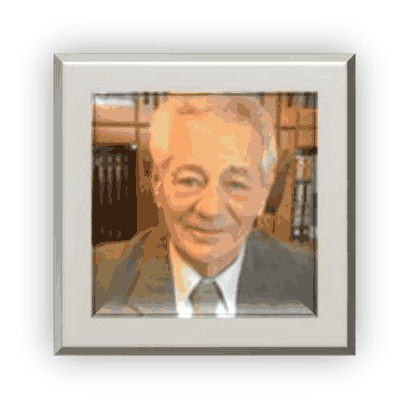
Emeritus Professor Özer Bekaroğlu
The term phthalocyanine (Pc) takes its origin from the Greek “naphtha”, which means rock oil, and “cyanine”, which means dark blue. Turkish scientist Özer Bekaroğlu can be regarded as the pioneer of Pc chemistry in Turkey.
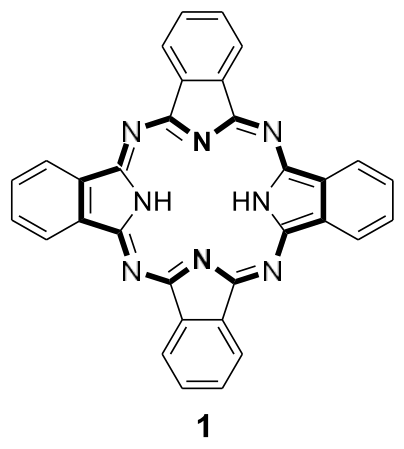
Metal-free phthalocyanine (1, \(\ce{H2Pc}\)) is a large planar macrocyclic compound with the formula \(\ce{(C8H4N2)4H2}\).
7.1 How many π-electrons are there in the bold region of the \(\ce{H2Pc}\) molecule in compound 1 shown above?
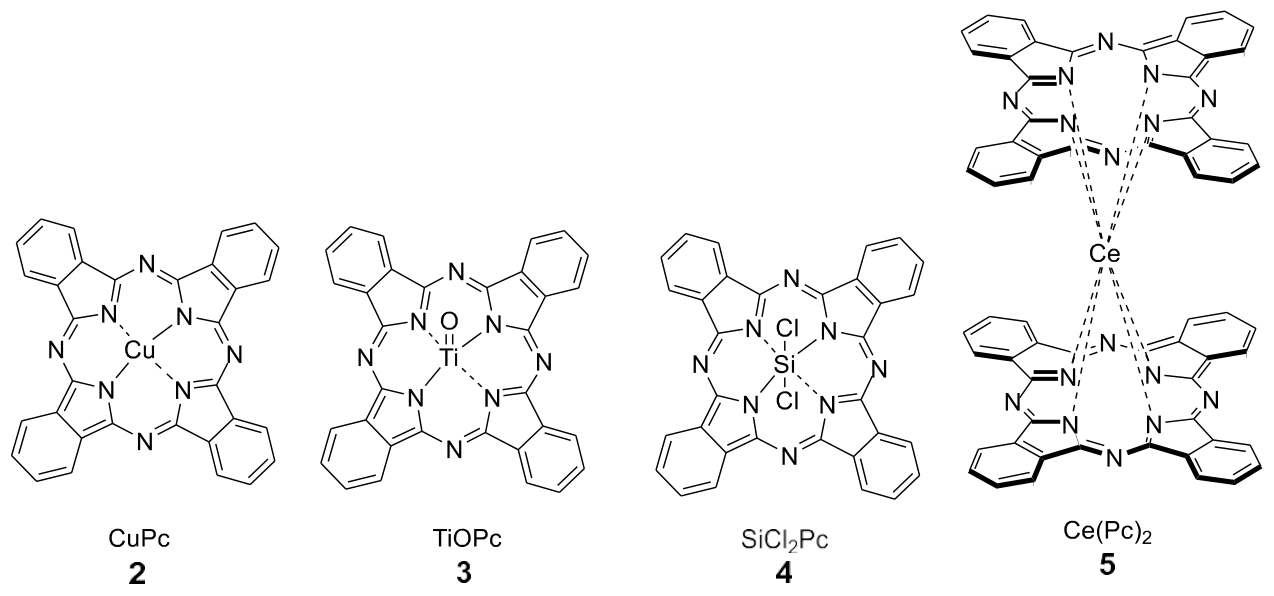
Pcs containing one or two metal ions are called metallo-phthalocyanines (MPcs) and they exhibit different geometries as given above.
7.2 Complete the table in your answer sheet by determining the coordination number of central ions in 2–5.
| Central ion | Copper ion | Titanium ion | Silicon ion | Cerium ion |
|---|---|---|---|---|
| Coordination number |
7.3 Complete the table in your answer sheet by determining the oxidation number of each metal (Cu, Ti, and Ce) in 2, 3, and 5.
| Metal in compounds | 2 | 3 | 5 |
|---|---|---|---|
| Oxidation number |
7.4 Complete the table in your answer sheet by determining the geometry of compounds 2–5.
| Geometry | Compound |
|---|---|
| Octahedral | |
| Square prism | |
| Square pyramidal | |
| Square planar |
7.5 Complete the table in your answer sheet by determining the magnetic property of compounds 2–5.
- Use the letter "p" for paramagnetic property and letter "d" for a diamagnetic property.
| Compound | Magnetic property |
|---|---|
| 2 | |
| 3 | |
| 4 | |
| 5 |
7.6 Write the ground-state electron configuration of the silicon (Si) ion in the compound 4 and find all the quantum numbers for the 2p electrons in its ground state.
| Electron configuration: | ||||
|---|---|---|---|---|
| Quantum numbers for 2p electrons: | \(n\) | \(l\) | \(m_l\) | \(m_s\) |
Metal-free phthalocyanine (1, \(\ce{H2Pc}\)) is commonly formed through the cyclotetramerization of phthalonitriles. On the other hand, Pcs having different substituents are called asymmetric, which can be prepared by the statistical cyclization of two different phthalonitriles. This method has no selectivity and the product is a mixture of all possible isomers.
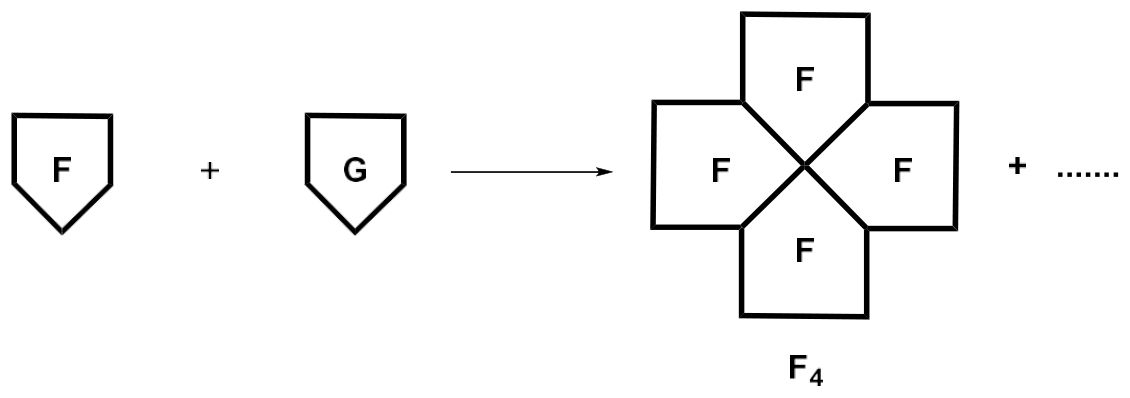
7.7 Draw the possible products that may occur in the statistical cyclization method by using F and G. If there are any stereoisomers label as cis- or trans-.
- F and G represent two different symmetrical phthalonitriles.
- One of the products is \(\mathrm{F}_4\) as given below.
- Draw other products similar to the format of \(\mathrm{F}_4\).
Pcs are used as photosensitizers in the photodynamic therapy (PDT) of cancer due to their strong absorption in the visible spectrum and high molar absorption coefficients. PDT consists of three essential components: photosensitizer, light, and oxygen. None of these is individually toxic, but together they initiate a photochemical reaction resulting in the generation of cytotoxic singlet oxygen (\(\ce{^{1}O2}\)) that can destroy cancer cells.
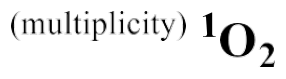
- The multiplicity of an energy level is defined as \(2S+1\)
- If the two spins are parallel (\(\uparrow\uparrow\)), \(S=1\), and if the two spins are antiparallel (\(\uparrow\downarrow\)), \(S=0\).
7.8 Draw the molecule orbital (MO) diagram of the lowest energy singlet state of dioxygen (\(\ce{^{1}O2}\)) and calculate bond order.
- There are no unpaired electrons in that state!
7.9 If the wavelength of the light needed to excite triplet oxygen into singlet oxygen is 1270 nm, calculate the energy (in kJ/mol) needed for this transition process.
Official English text of the problem.
Answers
- 7.1: \(18\) \(\pi\)-electrons.
- 7.2: Coordination numbers: copper 4, titanium 5, silicon 6, cerium 8.
- 7.3: Oxidation numbers: 2: \(+2\); 3: \(+4\); 5: \(+4\).
- 7.4: Octahedral: 4; square prism: 5; square pyramidal: 3; square planar: 2.
- 7.5: 2: p; 3: d; 4: d; 5: d.
- 7.6: \(\ce{Si^{4+}}\): \(1s^2\,2s^2\,2p^6\). The six quantum-number sets are \((2,1,-1,\pm\frac12)\), \((2,1,0,\pm\frac12)\), and \((2,1,+1,\pm\frac12)\), taking both signs in each case.
- 7.7: Six products including the supplied example: \(\mathrm{F}_4\), \(\mathrm{F}_3\mathrm{G}\), cis-\(\mathrm{F}_2\mathrm{G}_2\), trans-\(\mathrm{F}_2\mathrm{G}_2\), \(\mathrm{F}\mathrm{G}_3\), and \(\mathrm{G}_4\).
- 7.8: Pair the two highest occupied electrons in one of the degenerate \(\pi^\ast\) orbitals; leave the other empty. Bond order: 2.
- 7.9: \(\boxed{94.2\ \mathrm{kJ\,mol^{-1}}}\).
Solution
7.1 — Electrons in the highlighted circuit
Compound 1 is metal-free phthalocyanine, \(\ce{H2Pc}\), with molecular formula \(\ce{C32H18N8}\).
SMILES: c12[nH]c(c3ccccc32)nc2nc(c3ccccc32)nc2[nH]c(c3ccccc32)nc2nc(c3ccccc32)n1
The bold conjugated circuit contains nine double bonds. Each contributes two \(\pi\)-electrons:
\[ N_\pi=9(2)=\boxed{18}. \]
This also satisfies Hückel’s \(4n+2\) count with \(n=4\). The count concerns the highlighted circuit, so the remaining benzenoid bonds are not added.
7.2 — Coordination numbers
Each phthalocyanine ligand coordinates through its four inward-facing nitrogen atoms. Coordination number counts directly attached donor atoms; a multiple bond to one donor atom still contributes only one.
| Compound | Donor atoms surrounding the central atom | Coordination number |
|---|---|---|
| 2, copper(II) phthalocyanine | Four nitrogen atoms | 4 |
| 3, oxotitanium(IV) phthalocyanine | Four nitrogen atoms and one oxygen atom | 5 |
| 4, dichloridosilicon(IV) phthalocyanine | Four nitrogen atoms and two chlorine atoms | 6 |
| 5, bis(phthalocyaninato)cerium(IV) | Four nitrogen atoms from each of two ligands | 8 |
The following SMILES specify the structures and their coordination connectivity. The arrows -> denote donor-to-central-atom coordinate bonds. Their spatial geometries are specified in 7.4.
-
2 — Copper(II) phthalocyanine, \(\ce{CuPc}\):
[Cu+2]1234.c56[n-]->1c(c7ccccc75)nc5n->2c(c7ccccc75)nc5[n-]->3c(c7ccccc75)nc5n->4c(c7ccccc75)n6 -
3 — Oxotitanium(IV) phthalocyanine (titanyl phthalocyanine), \(\ce{TiOPc}\):
[O-2]->[Ti+4]1234.c56[n-]->1c(c7ccccc75)nc5n->2c(c7ccccc75)nc5[n-]->3c(c7ccccc75)nc5n->4c(c7ccccc75)n6 -
4 — Dichloridosilicon(IV) phthalocyanine, \(\ce{SiCl2Pc}\):
Cl[Si-2]1234(Cl).c56n1c(c7ccccc75)nc5[n+]2c(c7ccccc75)nc5n3c(c7ccccc75)nc5[n+]4c(c7ccccc75)n6 -
5 — Bis(phthalocyaninato)cerium(IV), \(\ce{Ce(Pc)2}\):
[Ce+4]12345678.c9%10[n-]->1c(c%11ccccc%119)nc9n->2c(c%11ccccc%119)nc9[n-]->3c(c%11ccccc%119)nc9n->4c(c%11ccccc%119)n%10.c9%10[n-]->5c(c%11ccccc%119)nc9n->6c(c%11ccccc%119)nc9[n-]->7c(c%11ccccc%119)nc9n->8c(c%11ccccc%119)n%10
For 4, the ordinary-bond SMILES uses formal charge separation to represent six-coordinate silicon. The Si-2 and two [n+] formal charges are distinct from oxidation numbers; silicon’s oxidation number is \(+4\). For 3, the ionic dative representation specifies the terminal oxo connectivity without attempting to express the full titanium–oxygen multiple-bond character.
7.3 — Oxidation numbers
Removal of the two inner N–H protons from metal-free phthalocyanine gives the phthalocyaninate(2−) ligand, \(\ce{Pc^{2-}}\), with formula \(\ce{C32H16N8^{2-}}\).
SMILES: c12[n-]c(c3ccccc32)nc2nc(c3ccccc32)nc2[n-]c(c3ccccc32)nc2nc(c3ccccc32)n1
The terminal oxygen in 3 is an oxide ligand, \(\ce{O^{2-}}\), SMILES [O-2]. All three complexes are neutral, so their charges give:
| Compound | Charge balance | Central ion and its SMILES | Oxidation number |
|---|---|---|---|
| 2 | \(x-2=0\) | Copper(II), \(\ce{Cu^{2+}}\), [Cu+2] |
+2 |
| 3 | \(x-2-2=0\) | Titanium(IV), \(\ce{Ti^{4+}}\), [Ti+4] |
+4 |
| 5 | \(x+2(-2)=0\) | Cerium(IV), \(\ce{Ce^{4+}}\), [Ce+4] |
+4 |
7.4 — Coordination geometries
| Geometry | Compound | Description of the required drawing |
|---|---|---|
| Octahedral | 4 | Four nitrogen donors form the equatorial square; the two chloride ligands occupy opposite axial positions. |
| Square prism | 5 | The eight nitrogen donors form two parallel, aligned squares, with cerium between the two phthalocyanine ligands. |
| Square pyramidal | 3 | Four nitrogen donors form the square base, and the terminal oxygen occupies the apical position. |
| Square planar | 2 | Copper and its four nitrogen donors lie in one plane, with the donors surrounding copper approximately at the corners of a square. |
The two axial chloride ligands in 4 are therefore trans. These spatial arrangements are not specified by the SMILES strings alone.
7.5 — Magnetic properties
A species with an unpaired electron is paramagnetic; a species with all electrons paired is diamagnetic. The phthalocyaninate ligands here are closed-shell dianions.
| Compound | Central-ion electron configuration | Number of unpaired electrons | Magnetic property |
|---|---|---|---|
| 2 | \(\ce{Cu^{2+}}:\ [\mathrm{Ar}]\,3d^9\) | 1 | p |
| 3 | \(\ce{Ti^{4+}}:\ [\mathrm{Ar}]\), \(3d^0\) | 0 | d |
| 4 | \(\ce{Si^{4+}}:\ [\mathrm{Ne}]\) | 0 | d |
| 5 | \(\ce{Ce^{4+}}:\ [\mathrm{Xe}]\), \(4f^0\) | 0 | d |
For copper(II), nine electrons distributed among five \(d\) orbitals necessarily leave one unpaired electron.
7.6 — Silicon electron configuration and quantum numbers
In 4, the phthalocyaninate ligand has charge \(-2\), and each chloride ion, \(\ce{Cl-}\), SMILES [Cl-], has charge \(-1\). Therefore,
\[ x-2-1-1=0 \quad\Longrightarrow\quad x=+4. \]
The central ion is silicon(IV), \(\ce{Si^{4+}}\), SMILES [Si+4]. Silicon has atomic number 14, so this ion has \(14-4=10\) electrons:
\[ \boxed{1s^2\,2s^2\,2p^6=[\mathrm{Ne}]}. \]
For every \(2p\) electron, \(n=2\) and \(l=1\). The three possible orbital magnetic quantum numbers are \(m_l=-1,0,+1\). Each orbital contains two electrons with opposite spins:
| Electron | \(n\) | \(l\) | \(m_l\) | \(m_s\) |
|---|---|---|---|---|
| 1 | 2 | 1 | \(-1\) | \(+\tfrac12\) |
| 2 | 2 | 1 | \(-1\) | \(-\tfrac12\) |
| 3 | 2 | 1 | \(0\) | \(+\tfrac12\) |
| 4 | 2 | 1 | \(0\) | \(-\tfrac12\) |
| 5 | 2 | 1 | \(+1\) | \(+\tfrac12\) |
| 6 | 2 | 1 | \(+1\) | \(-\tfrac12\) |
7.7 — Statistical cyclization products
The four building blocks occupy four successive positions around the macrocycle. Since F and G are each symmetrical, their individual orientations introduce no additional possibilities.
Draw each product using the four-armed outline in the question, filling its top, right, bottom, and left sectors as follows:
| Product | Top | Right | Bottom | Left | Description |
|---|---|---|---|---|---|
| \(\mathrm{F}_4\), supplied | F | F | F | F | Four F units |
| \(\mathrm{F}_3\mathrm{G}\) | F | F | F | G | Three F units and one G unit |
| cis-\(\mathrm{F}_2\mathrm{G}_2\) | F | F | G | G | Identical units occupy adjacent sectors |
| trans-\(\mathrm{F}_2\mathrm{G}_2\) | F | G | F | G | Identical units occupy opposite sectors |
| \(\mathrm{F}\mathrm{G}_3\) | F | G | G | G | One F unit and three G units |
| \(\mathrm{G}_4\) | G | G | G | G | Four G units |
Thus, five additional products must be drawn alongside the supplied \(\mathrm{F}_4\).
To establish completeness, classify products by the number of G units:
- Zero or four G units gives one arrangement each.
- One or three G units gives one arrangement each, because rotations identify all placements.
- Two G units gives two arrangements: adjacent or opposite.
Hence,
\[ N_{\text{distinct products}}=1+1+2+1+1=\boxed{6}. \]
The cis/trans labels above follow the question’s terminology. The actual substituents defining F and G are unspecified, so these abstract products do not have unique molecular names or chemical SMILES beyond their building-block descriptions.
7.8 — Singlet-oxygen MO diagram and bond order
The molecule is singlet dioxygen, \(\ce{^{1}O2}\), with connectivity SMILES O=O. Ordinary SMILES does not specify its spin multiplicity or orbital occupation; those must be stated separately.
There are 12 valence electrons. Following the question’s paired-electron representation, fill the orbitals as shown below. Energy increases upward; the two boxes in each \(\pi\) row denote degenerate orbitals.
| MO level, highest first | Occupation |
|---|---|
| \(\sigma^\ast(2p_z)\) | \([\,]\) |
| \(\pi^\ast(2p)\), two degenerate orbitals | \([\uparrow\downarrow]\quad[\,]\) |
| \(\pi(2p)\), two degenerate orbitals | \([\uparrow\downarrow]\quad[\uparrow\downarrow]\) |
| \(\sigma(2p_z)\) | \([\uparrow\downarrow]\) |
| \(\sigma^\ast(2s)\) | \([\uparrow\downarrow]\) |
| \(\sigma(2s)\) | \([\uparrow\downarrow]\) |
Either of the degenerate \(\pi^\ast\) boxes may be shown occupied. The filled core orbitals, \(\sigma(1s)^2\sigma^\ast(1s)^2\), are omitted from the table; their bonding and antibonding contributions cancel.
All electrons are paired in the requested diagram, giving
\[ S=0,\qquad 2S+1=1. \]
The valence bonding and antibonding electron counts are
\[ N_{\mathrm b}=2+2+4=8, \qquad N_{\mathrm{ab}}=2+2=4. \]
Therefore,
\[ \boxed{\text{Bond order} =\frac{N_{\mathrm b}-N_{\mathrm{ab}}}{2} =\frac{8-4}{2}=2}. \]
7.9 — Energy of the triplet-to-singlet excitation
Triplet dioxygen, \(\ce{^{3}O2}\), has the same connectivity SMILES O=O; its triplet electronic state must be specified separately. The excitation is
\[ \ce{^{3}O2 ->[h\nu] ^{1}O2}. \]
For one absorbed photon per molecule,
\[ E_{\text{photon}}=\frac{hc}{\lambda}, \qquad E_{\text{molar}}=\frac{N_{\mathrm A}hc}{\lambda}. \]
Using the standard SI constants
\[ \begin{aligned} h&=6.62607015\times10^{-34}\ \mathrm{J\,s},\\ c&=2.99792458\times10^8\ \mathrm{m\,s^{-1}},\\ N_{\mathrm A}&=6.02214076\times10^{23}\ \mathrm{mol^{-1}}, \end{aligned} \]
and
\[ \lambda=1270\ \mathrm{nm}=1.270\times10^{-6}\ \mathrm m, \]
gives
\[ E_{\text{photon}} =\frac{(6.62607015\times10^{-34})(2.99792458\times10^8)} {1.270\times10^{-6}} =1.56413\times10^{-19}\ \mathrm J. \]
Thus,
\[ E_{\text{molar}} =(1.56413\times10^{-19})(6.02214076\times10^{23}) =9.41941\times10^4\ \mathrm{J\,mol^{-1}}, \]
or
\[ \boxed{E_{\text{molar}}=94.2\ \mathrm{kJ\,mol^{-1}}}. \]
The solution was checked against the official solution.
IChO 2020 · Theorieaufgabe 7
Phthalocyanine
Emeritierter Professor Özer Bekaroğlu
Der Begriff Phthalocyanin (Pc) leitet sich von den griechischen Wörtern „naphtha“, das Erdöl bedeutet, und „cyanine“, das dunkelblau bedeutet, ab. Der türkische Wissenschaftler Özer Bekaroğlu kann als Pionier der Pc-Chemie in der Türkei angesehen werden.
Metallfreies Phthalocyanin (1, \(\ce{H2Pc}\)) ist eine große planare makrocyclische Verbindung mit der Formel \(\ce{(C8H4N2)4H2}\).
7.1 Wie viele π-Elektronen befinden sich im fett hervorgehobenen Bereich des oben gezeigten \(\ce{H2Pc}\)-Moleküls in Verbindung 1?
Pcs, die ein oder zwei Metallionen enthalten, werden als Metallophthalocyanine (MPcs) bezeichnet und weisen die oben dargestellten unterschiedlichen Geometrien auf.
7.2 Vervollständigen Sie die Tabelle auf Ihrem Antwortbogen, indem Sie die Koordinationszahl der Zentralionen in 2–5 bestimmen.
| Zentralion | Kupferion | Titanion | Siliciumion | Cerion |
|---|---|---|---|---|
| Koordinationszahl |
7.3 Vervollständigen Sie die Tabelle auf Ihrem Antwortbogen, indem Sie die Oxidationszahl jedes Metalls (Cu, Ti und Ce) in 2, 3 und 5 bestimmen.
| Metall in den Verbindungen | 2 | 3 | 5 |
|---|---|---|---|
| Oxidationszahl |
7.4 Vervollständigen Sie die Tabelle auf Ihrem Antwortbogen, indem Sie die Geometrie der Verbindungen 2–5 bestimmen.
| Geometrie | Verbindung |
|---|---|
| Oktaedrisch | |
| Quadratisches Prisma | |
| Quadratisch-pyramidal | |
| Quadratisch-planar |
7.5 Vervollständigen Sie die Tabelle auf Ihrem Antwortbogen, indem Sie die magnetische Eigenschaft der Verbindungen 2–5 bestimmen.
- Verwenden Sie den Buchstaben „p“ für paramagnetisches Verhalten und den Buchstaben „d“ für diamagnetisches Verhalten.
| Verbindung | Magnetische Eigenschaft |
|---|---|
| 2 | |
| 3 | |
| 4 | |
| 5 |
7.6 Geben Sie die Elektronenkonfiguration des Siliciumions (Si) in Verbindung 4 im Grundzustand an und bestimmen Sie alle Quantenzahlen der 2p-Elektronen in seinem Grundzustand.
| Elektronenkonfiguration: | ||||
|---|---|---|---|---|
| Quantenzahlen der 2p-Elektronen: | \(n\) | \(l\) | \(m_l\) | \(m_s\) |
Metallfreies Phthalocyanin (1, \(\ce{H2Pc}\)) wird üblicherweise durch Cyclotetramerisierung von Phthalonitrilen gebildet. Pcs mit unterschiedlichen Substituenten hingegen werden als asymmetrisch bezeichnet und können durch statistische Cyclisierung zweier verschiedener Phthalonitrile hergestellt werden. Diese Methode ist nicht selektiv, und das Produkt ist ein Gemisch aller möglichen Isomere.
7.7 Zeichnen Sie die möglichen Produkte, die bei der statistischen Cyclisierung unter Verwendung von F und G entstehen können. Falls Stereoisomere auftreten, kennzeichnen Sie diese als cis- oder trans-.
- F und G stehen für zwei verschiedene symmetrische Phthalonitrile.
- Eines der Produkte ist \(\mathrm{F}_4\), wie unten dargestellt.
- Zeichnen Sie die anderen Produkte entsprechend der Darstellung von \(\mathrm{F}_4\).
Pcs werden aufgrund ihrer starken Absorption im sichtbaren Spektralbereich und ihrer hohen molaren Absorptionskoeffizienten als Photosensibilisatoren in der photodynamischen Therapie (PDT) von Krebs eingesetzt. Die PDT besteht aus drei wesentlichen Komponenten: Photosensibilisator, Licht und Sauerstoff. Keine dieser Komponenten ist für sich allein toxisch, doch gemeinsam lösen sie eine photochemische Reaktion aus, bei der zytotoxischer Singulett-Sauerstoff (\(\ce{^{1}O2}\)) entsteht, der Krebszellen zerstören kann.
- Die Multiplizität eines Energieniveaus ist als \(2S+1\) definiert.
- Sind die beiden Spins parallel (\(\uparrow\uparrow\)), gilt \(S=1\), und sind die beiden Spins antiparallel (\(\uparrow\downarrow\)), gilt \(S=0\).
7.8 Zeichnen Sie das Molekülorbitaldiagramm (MO-Diagramm) des energetisch niedrigsten Singulett-Zustands von Disauerstoff (\(\ce{^{1}O2}\)) und berechnen Sie die Bindungsordnung.
- In diesem Zustand gibt es keine ungepaarten Elektronen!
7.9 Wenn die Wellenlänge des Lichts, das zur Anregung von Triplett-Sauerstoff zu Singulett-Sauerstoff benötigt wird, 1270 nm beträgt, berechnen Sie die für diesen Übergang benötigte Energie (in kJ/mol).
Aufgabentext aus dem offiziellen englischen Text übersetzt.
Antworten
- 7.1: \(18\) \(\pi\)-Elektronen.
- 7.2: Koordinationszahlen: Kupfer 4, Titan 5, Silicium 6, Cer 8.
- 7.3: Oxidationszahlen: 2: \(+2\); 3: \(+4\); 5: \(+4\).
- 7.4: Oktaedrisch: 4; quadratisches Prisma: 5; quadratisch-pyramidal: 3; quadratisch-planar: 2.
- 7.5: 2: p; 3: d; 4: d; 5: d.
- 7.6: \(\ce{Si^{4+}}\): \(1s^2\,2s^2\,2p^6\). Die sechs Quantenzahlensätze sind \((2,1,-1,\pm\frac12)\), \((2,1,0,\pm\frac12)\) und \((2,1,+1,\pm\frac12)\), wobei jeweils beide Vorzeichen zu berücksichtigen sind.
- 7.7: Sechs Produkte einschließlich des vorgegebenen Beispiels: \(\mathrm{F}_4\), \(\mathrm{F}_3\mathrm{G}\), cis-\(\mathrm{F}_2\mathrm{G}_2\), trans-\(\mathrm{F}_2\mathrm{G}_2\), \(\mathrm{F}\mathrm{G}_3\) und \(\mathrm{G}_4\).
- 7.8: Paaren Sie die beiden Elektronen mit der höchsten Energie in einem der entarteten \(\pi^\ast\)-Orbitale; lassen Sie das andere leer. Bindungsordnung: 2.
- 7.9: \(\boxed{94.2\ \mathrm{kJ\,mol^{-1}}}\).
Lösung
7.1 — Elektronen im hervorgehobenen Ringzug
Verbindung 1 ist metallfreies Phthalocyanin, \(\ce{H2Pc}\), mit der Summenformel \(\ce{C32H18N8}\).
SMILES: c12[nH]c(c3ccccc32)nc2nc(c3ccccc32)nc2[nH]c(c3ccccc32)nc2nc(c3ccccc32)n1
Der fett hervorgehobene konjugierte Ringzug enthält neun Doppelbindungen. Jede trägt zwei \(\pi\)-Elektronen bei:
\[ N_\pi=9(2)=\boxed{18}. \]
Dies erfüllt auch die Hückel-Regel \(4n+2\) mit \(n=4\). Die Zählung bezieht sich auf den hervorgehobenen Ringzug; die übrigen benzoiden Bindungen werden daher nicht mitgezählt.
7.2 — Koordinationszahlen
Jeder Phthalocyaninligand koordiniert über seine vier nach innen gerichteten Stickstoffatome. Die Koordinationszahl zählt die unmittelbar gebundenen Donoratome; eine Mehrfachbindung zu einem Donoratom trägt weiterhin nur eins bei.
| Verbindung | Donoratome um das Zentralatom | Koordinationszahl |
|---|---|---|
| 2, Kupfer(II)-phthalocyanin | Vier Stickstoffatome | 4 |
| 3, Oxotitan(IV)-phthalocyanin | Vier Stickstoffatome und ein Sauerstoffatom | 5 |
| 4, Dichloridosilicium(IV)-phthalocyanin | Vier Stickstoffatome und zwei Chloratome | 6 |
| 5, Bis(phthalocyaninato)cer(IV) | Je vier Stickstoffatome von zwei Liganden | 8 |
Die folgenden SMILES geben die Strukturen und ihre koordinative Verknüpfung an. Die Pfeile -> kennzeichnen koordinative Bindungen vom Donor zum Zentralatom. Ihre räumlichen Geometrien werden in 7.4 angegeben.
-
2 — Kupfer(II)-phthalocyanin, \(\ce{CuPc}\):
[Cu+2]1234.c56[n-]->1c(c7ccccc75)nc5n->2c(c7ccccc75)nc5[n-]->3c(c7ccccc75)nc5n->4c(c7ccccc75)n6 -
3 — Oxotitan(IV)-phthalocyanin (Titanylphthalocyanin), \(\ce{TiOPc}\):
[O-2]->[Ti+4]1234.c56[n-]->1c(c7ccccc75)nc5n->2c(c7ccccc75)nc5[n-]->3c(c7ccccc75)nc5n->4c(c7ccccc75)n6 -
4 — Dichloridosilicium(IV)-phthalocyanin, \(\ce{SiCl2Pc}\):
Cl[Si-2]1234(Cl).c56n1c(c7ccccc75)nc5[n+]2c(c7ccccc75)nc5n3c(c7ccccc75)nc5[n+]4c(c7ccccc75)n6 -
5 — Bis(phthalocyaninato)cer(IV), \(\ce{Ce(Pc)2}\):
[Ce+4]12345678.c9%10[n-]->1c(c%11ccccc%119)nc9n->2c(c%11ccccc%119)nc9[n-]->3c(c%11ccccc%119)nc9n->4c(c%11ccccc%119)n%10.c9%10[n-]->5c(c%11ccccc%119)nc9n->6c(c%11ccccc%119)nc9[n-]->7c(c%11ccccc%119)nc9n->8c(c%11ccccc%119)n%10
Für 4 verwendet die SMILES-Darstellung mit gewöhnlichen Bindungen eine formale Ladungstrennung, um sechsfach koordiniertes Silicium darzustellen. Die formalen Ladungen von Si-2 und den beiden [n+] sind von Oxidationszahlen zu unterscheiden; die Oxidationszahl des Siliciums beträgt \(+4\). Für 3 gibt die ionische Darstellung mit dativer Bindung die terminale Oxo-Verknüpfung an, ohne zu versuchen, den vollständigen Mehrfachbindungscharakter der Titan–Sauerstoff-Bindung auszudrücken.
7.3 — Oxidationszahlen
Die Abspaltung der beiden inneren N–H-Protonen aus metallfreiem Phthalocyanin ergibt den Phthalocyaninat(2−)-Liganden, \(\ce{Pc^{2-}}\), mit der Formel \(\ce{C32H16N8^{2-}}\).
SMILES: c12[n-]c(c3ccccc32)nc2nc(c3ccccc32)nc2[n-]c(c3ccccc32)nc2nc(c3ccccc32)n1
Der terminale Sauerstoff in 3 ist ein Oxidligand, \(\ce{O^{2-}}\), SMILES [O-2]. Alle drei Komplexe sind neutral, sodass sich aus ihren Ladungen ergibt:
| Verbindung | Ladungsbilanz | Zentralion und seine SMILES-Darstellung | Oxidationszahl |
|---|---|---|---|
| 2 | \(x-2=0\) | Kupfer(II), \(\ce{Cu^{2+}}\), [Cu+2] |
+2 |
| 3 | \(x-2-2=0\) | Titan(IV), \(\ce{Ti^{4+}}\), [Ti+4] |
+4 |
| 5 | \(x+2(-2)=0\) | Cer(IV), \(\ce{Ce^{4+}}\), [Ce+4] |
+4 |
7.4 — Koordinationsgeometrien
| Geometrie | Verbindung | Beschreibung der geforderten Zeichnung |
|---|---|---|
| Oktaedrisch | 4 | Vier Stickstoffdonoratome bilden das äquatoriale Quadrat; die beiden Chloridliganden besetzen gegenüberliegende axiale Positionen. |
| Quadratisches Prisma | 5 | Die acht Stickstoffdonoratome bilden zwei parallele, deckungsgleich ausgerichtete Quadrate, wobei sich Cer zwischen den beiden Phthalocyaninliganden befindet. |
| Quadratisch-pyramidal | 3 | Vier Stickstoffdonoratome bilden die quadratische Grundfläche, und der terminale Sauerstoff besetzt die apikale Position. |
| Quadratisch-planar | 2 | Kupfer und seine vier Stickstoffdonoratome liegen in einer Ebene, wobei die Donoratome das Kupfer annähernd an den Ecken eines Quadrats umgeben. |
Die beiden axialen Chloridliganden in 4 stehen somit trans zueinander. Diese räumlichen Anordnungen sind durch die SMILES-Zeichenfolgen allein nicht festgelegt.
7.5 — Magnetische Eigenschaften
Eine Spezies mit einem ungepaarten Elektron ist paramagnetisch; eine Spezies, bei der alle Elektronen gepaart sind, ist diamagnetisch. Die Phthalocyaninatliganden sind hier Dianionen mit abgeschlossenen Elektronenschalen.
| Verbindung | Elektronenkonfiguration des Zentralions | Anzahl ungepaarter Elektronen | Magnetische Eigenschaft |
|---|---|---|---|
| 2 | \(\ce{Cu^{2+}}:\ [\mathrm{Ar}]\,3d^9\) | 1 | p |
| 3 | \(\ce{Ti^{4+}}:\ [\mathrm{Ar}]\), \(3d^0\) | 0 | d |
| 4 | \(\ce{Si^{4+}}:\ [\mathrm{Ne}]\) | 0 | d |
| 5 | \(\ce{Ce^{4+}}:\ [\mathrm{Xe}]\), \(4f^0\) | 0 | d |
Bei Kupfer(II) bleibt bei der Verteilung von neun Elektronen auf fünf \(d\)-Orbitale zwangsläufig ein Elektron ungepaart.
7.6 — Elektronenkonfiguration und Quantenzahlen des Siliciums
In 4 hat der Phthalocyaninatligand die Ladung \(-2\), und jedes Chloridion, \(\ce{Cl-}\), SMILES [Cl-], hat die Ladung \(-1\). Daher gilt:
\[ x-2-1-1=0 \quad\Longrightarrow\quad x=+4. \]
Das Zentralion ist Silicium(IV), \(\ce{Si^{4+}}\), SMILES [Si+4]. Silicium hat die Ordnungszahl 14, sodass dieses Ion \(14-4=10\) Elektronen besitzt:
\[ \boxed{1s^2\,2s^2\,2p^6=[\mathrm{Ne}]}. \]
Für jedes \(2p\)-Elektron gelten \(n=2\) und \(l=1\). Die drei möglichen magnetischen Orbitalquantenzahlen sind \(m_l=-1,0,+1\). Jedes Orbital enthält zwei Elektronen mit entgegengesetzten Spins:
| Elektron | \(n\) | \(l\) | \(m_l\) | \(m_s\) |
|---|---|---|---|---|
| 1 | 2 | 1 | \(-1\) | \(+\tfrac12\) |
| 2 | 2 | 1 | \(-1\) | \(-\tfrac12\) |
| 3 | 2 | 1 | \(0\) | \(+\tfrac12\) |
| 4 | 2 | 1 | \(0\) | \(-\tfrac12\) |
| 5 | 2 | 1 | \(+1\) | \(+\tfrac12\) |
| 6 | 2 | 1 | \(+1\) | \(-\tfrac12\) |
7.7 — Produkte der statistischen Cyclisierung
Die vier Bausteine besetzen vier aufeinanderfolgende Positionen entlang des Makrocyclus. Da F und G jeweils symmetrisch sind, ergeben sich aus ihren individuellen Orientierungen keine zusätzlichen Möglichkeiten.
Zeichnen Sie jedes Produkt unter Verwendung des vierarmigen Umrisses aus der Aufgabenstellung und füllen Sie dessen Sektoren oben, rechts, unten und links wie folgt aus:
| Produkt | Oben | Rechts | Unten | Links | Beschreibung |
|---|---|---|---|---|---|
| \(\mathrm{F}_4\), vorgegeben | F | F | F | F | Vier F-Einheiten |
| \(\mathrm{F}_3\mathrm{G}\) | F | F | F | G | Drei F-Einheiten und eine G-Einheit |
| cis-\(\mathrm{F}_2\mathrm{G}_2\) | F | F | G | G | Gleiche Einheiten besetzen benachbarte Sektoren |
| trans-\(\mathrm{F}_2\mathrm{G}_2\) | F | G | F | G | Gleiche Einheiten besetzen gegenüberliegende Sektoren |
| \(\mathrm{F}\mathrm{G}_3\) | F | G | G | G | Eine F-Einheit und drei G-Einheiten |
| \(\mathrm{G}_4\) | G | G | G | G | Vier G-Einheiten |
Somit müssen neben dem vorgegebenen \(\mathrm{F}_4\) fünf zusätzliche Produkte gezeichnet werden.
Um die Vollständigkeit zu zeigen, werden die Produkte nach der Anzahl der G-Einheiten eingeteilt:
- Bei null oder vier G-Einheiten ergibt sich jeweils eine Anordnung.
- Bei einer oder drei G-Einheiten ergibt sich jeweils eine Anordnung, da alle Platzierungen durch Drehung ineinander überführt werden können.
- Bei zwei G-Einheiten ergeben sich zwei Anordnungen: benachbart oder gegenüberliegend.
Somit gilt:
\[ N_{\text{verschiedene Produkte}}=1+1+2+1+1=\boxed{6}. \]
Die obigen cis/trans-Bezeichnungen folgen der Terminologie der Aufgabenstellung. Die tatsächlichen Substituenten, die F und G definieren, sind nicht angegeben, sodass diese abstrakten Produkte über ihre Beschreibung durch Bausteine hinaus keine eindeutigen Molekülnamen oder chemischen SMILES-Darstellungen besitzen.
7.8 — MO-Diagramm und Bindungsordnung von Singulett-Sauerstoff
Das Molekül ist Singulett-Disauerstoff, \(\ce{^{1}O2}\), mit der Konnektivitäts-SMILES O=O. Gewöhnliche SMILES geben weder seine Spinmultiplizität noch seine Orbitalbesetzung an; diese müssen gesondert angegeben werden.
Es gibt 12 Valenzelektronen. Gemäß der in der Aufgabenstellung vorgegebenen Darstellung mit gepaarten Elektronen werden die Orbitale wie unten gezeigt besetzt. Die Energie nimmt nach oben zu; die beiden Kästchen in jeder \(\pi\)-Zeile stellen entartete Orbitale dar.
| MO-Niveau, höchstes zuerst | Besetzung |
|---|---|
| \(\sigma^\ast(2p_z)\) | \([\,]\) |
| \(\pi^\ast(2p)\), zwei entartete Orbitale | \([\uparrow\downarrow]\quad[\,]\) |
| \(\pi(2p)\), zwei entartete Orbitale | \([\uparrow\downarrow]\quad[\uparrow\downarrow]\) |
| \(\sigma(2p_z)\) | \([\uparrow\downarrow]\) |
| \(\sigma^\ast(2s)\) | \([\uparrow\downarrow]\) |
| \(\sigma(2s)\) | \([\uparrow\downarrow]\) |
Jedes der beiden entarteten \(\pi^\ast\)-Kästchen kann als besetzt dargestellt werden. Die vollständig besetzten Rumpforbitale, \(\sigma(1s)^2\sigma^\ast(1s)^2\), sind in der Tabelle weggelassen; ihre bindenden und antibindenden Beiträge heben sich auf.
Im geforderten Diagramm sind alle Elektronen gepaart, sodass gilt:
\[ S=0,\qquad 2S+1=1. \]
Die Anzahlen der bindenden und antibindenden Valenzelektronen betragen:
\[ N_{\mathrm b}=2+2+4=8, \qquad N_{\mathrm{ab}}=2+2=4. \]
Daher gilt:
\[ \boxed{\text{Bindungsordnung} =\frac{N_{\mathrm b}-N_{\mathrm{ab}}}{2} =\frac{8-4}{2}=2}. \]
7.9 — Energie der Triplett-Singulett-Anregung
Triplett-Disauerstoff, \(\ce{^{3}O2}\), hat dieselbe Konnektivitäts-SMILES O=O; sein elektronischer Triplett-Zustand muss gesondert angegeben werden. Die Anregung lautet:
\[ \ce{^{3}O2 ->[h\nu] ^{1}O2}. \]
Für ein absorbiertes Photon pro Molekül gilt:
\[ E_{\text{Photon}}=\frac{hc}{\lambda}, \qquad E_{\text{molar}}=\frac{N_{\mathrm A}hc}{\lambda}. \]
Mit den Standard-SI-Konstanten
\[ \begin{aligned} h&=6.62607015\times10^{-34}\ \mathrm{J\,s},\\ c&=2.99792458\times10^8\ \mathrm{m\,s^{-1}},\\ N_{\mathrm A}&=6.02214076\times10^{23}\ \mathrm{mol^{-1}}, \end{aligned} \]
und
\[ \lambda=1270\ \mathrm{nm}=1.270\times10^{-6}\ \mathrm m, \]
ergibt sich
\[ E_{\text{Photon}} =\frac{(6.62607015\times10^{-34})(2.99792458\times10^8)} {1.270\times10^{-6}} =1.56413\times10^{-19}\ \mathrm J. \]
Somit gilt:
\[ E_{\text{molar}} =(1.56413\times10^{-19})(6.02214076\times10^{23}) =9.41941\times10^4\ \mathrm{J\,mol^{-1}}, \]
oder
\[ \boxed{E_{\text{molar}}=94.2\ \mathrm{kJ\,mol^{-1}}}. \]
Die Lösung wurde mit der offiziellen Lösung abgeglichen.
IChO 2020 · Teori sorusu 7
Ftalosiyaninler
Emeritus Profesör Özer Bekaroğlu
Ftalosiyanin (Pc) terimi, Yunancada kaya yağı anlamına gelen “naphtha” ve koyu mavi anlamına gelen “cyanine” sözcüklerinden türemiştir. Türk bilim insanı Özer Bekaroğlu, Türkiye'de Pc kimyasının öncüsü olarak kabul edilebilir.
Metalsiz ftalosiyanin (1, \(\ce{H2Pc}\)), formülü \(\ce{(C8H4N2)4H2}\) olan büyük, düzlemsel bir makrosiklik bileşiktir.
7.1 Yukarıda gösterilen 1 bileşiğindeki \(\ce{H2Pc}\) molekülünün kalın çizgilerle belirtilen bölgesinde kaç π-elektronu vardır?
Bir veya iki metal iyonu içeren Pc'ler, metaloftalosiyaninler (MPc'ler) olarak adlandırılır ve yukarıda verilen farklı geometrileri sergiler.
7.2 2–5 bileşiklerindeki merkez iyonlarının koordinasyon sayılarını belirleyerek cevap kâğıdınızdaki tabloyu tamamlayınız.
| Merkez iyonu | Bakır iyonu | Titanyum iyonu | Silisyum iyonu | Seryum iyonu |
|---|---|---|---|---|
| Koordinasyon sayısı |
7.3 2, 3 ve 5 bileşiklerindeki her bir metalin (Cu, Ti ve Ce) yükseltgenme basamağını belirleyerek cevap kâğıdınızdaki tabloyu tamamlayınız.
| Bileşiklerdeki metal | 2 | 3 | 5 |
|---|---|---|---|
| Yükseltgenme basamağı |
7.4 2–5 bileşiklerinin geometrilerini belirleyerek cevap kâğıdınızdaki tabloyu tamamlayınız.
| Geometri | Bileşik |
|---|---|
| Oktahedral | |
| Kare prizma | |
| Kare piramidal | |
| Kare düzlemsel |
7.5 2–5 bileşiklerinin manyetik özelliklerini belirleyerek cevap kâğıdınızdaki tabloyu tamamlayınız.
- Paramanyetik özellik için "p", diyamanyetik özellik için "d" harfini kullanınız.
| Bileşik | Manyetik özellik |
|---|---|
| 2 | |
| 3 | |
| 4 | |
| 5 |
7.6 4 bileşiğindeki silisyum (Si) iyonunun temel hâl elektron dizilimini yazınız ve temel hâlindeki 2p elektronlarının tüm kuantum sayılarını bulunuz.
| Elektron dizilimi: | ||||
|---|---|---|---|---|
| 2p elektronlarının kuantum sayıları: | \(n\) | \(l\) | \(m_l\) | \(m_s\) |
Metalsiz ftalosiyanin (1, \(\ce{H2Pc}\)) genellikle ftalonitrillerin siklotetramerleşmesiyle oluşur. Öte yandan, farklı sübstitüentler taşıyan Pc'ler asimetrik olarak adlandırılır ve iki farklı ftalonitrilin istatistiksel halkalaşmasıyla hazırlanabilir. Bu yöntem seçici değildir ve ürün, olası tüm izomerlerin bir karışımıdır.
7.7 F ve G kullanılarak gerçekleştirilen istatistiksel halkalaşma yönteminde oluşabilecek ürünleri çiziniz. Stereoizomerler varsa bunları cis- veya trans- olarak etiketleyiniz.
- F ve G, iki farklı simetrik ftalonitrili temsil eder.
- Ürünlerden biri, aşağıda verilen \(\mathrm{F}_4\) bileşiğidir.
- Diğer ürünleri \(\mathrm{F}_4\) için kullanılan gösterime benzer şekilde çiziniz.
Pc'ler, görünür bölgede güçlü soğurma göstermeleri ve yüksek molar soğurma katsayılarına sahip olmaları nedeniyle kanserin fotodinamik tedavisinde (PDT) ışığa duyarlılaştırıcı olarak kullanılır. PDT üç temel bileşenden oluşur: ışığa duyarlılaştırıcı, ışık ve oksijen. Bunların hiçbiri tek başına toksik değildir; ancak birlikte, kanser hücrelerini yok edebilen sitotoksik singlet oksijenin (\(\ce{^{1}O2}\)) oluşmasıyla sonuçlanan bir fotokimyasal tepkimeyi başlatırlar.
- Bir enerji düzeyinin çokluğu \(2S+1\) olarak tanımlanır.
- İki spin paralelse (\(\uparrow\uparrow\)), \(S=1\); iki spin antiparalelse (\(\uparrow\downarrow\)), \(S=0\) olur.
7.8 Dioksijenin (\(\ce{^{1}O2}\)) en düşük enerjili singlet hâlinin moleküler orbital (MO) diyagramını çiziniz ve bağ mertebesini hesaplayınız.
- Bu hâlde eşleşmemiş elektron yoktur!
7.9 Triplet oksijeni singlet oksijene uyarmak için gereken ışığın dalga boyu 1270 nm ise bu geçiş için gereken enerjiyi (kJ/mol cinsinden) hesaplayınız.
Soru metni resmi İngilizce metinden çevrilmiştir.
Cevaplar
- 7.1: \(18\) \(\pi\)-elektronu.
- 7.2: Koordinasyon sayıları: bakır 4, titanyum 5, silisyum 6, seryum 8.
- 7.3: Yükseltgenme basamakları: 2: \(+2\); 3: \(+4\); 5: \(+4\).
- 7.4: Oktahedral: 4; kare prizma: 5; kare piramidal: 3; kare düzlemsel: 2.
- 7.5: 2: p; 3: d; 4: d; 5: d.
- 7.6: \(\ce{Si^{4+}}\): \(1s^2\,2s^2\,2p^6\). Altı kuantum sayısı kümesi, her durumda her iki işaret de alınmak üzere, \((2,1,-1,\pm\frac12)\), \((2,1,0,\pm\frac12)\) ve \((2,1,+1,\pm\frac12)\) şeklindedir.
- 7.7: Verilen örnek dâhil altı ürün: \(\mathrm{F}_4\), \(\mathrm{F}_3\mathrm{G}\), cis-\(\mathrm{F}_2\mathrm{G}_2\), trans-\(\mathrm{F}_2\mathrm{G}_2\), \(\mathrm{F}\mathrm{G}_3\) ve \(\mathrm{G}_4\).
- 7.8: Dolu orbitallerdeki en yüksek enerjili iki elektronu, eş enerjili \(\pi^\ast\) orbitallerinden birinde eşleştiriniz; diğerini boş bırakınız. Bağ mertebesi: 2.
- 7.9: \(\boxed{94.2\ \mathrm{kJ\,mol^{-1}}}\).
Çözüm
7.1 — Vurgulanan çevrimdeki elektronlar
1 bileşiği, molekül formülü \(\ce{C32H18N8}\) olan metalsiz ftalosiyanindir, \(\ce{H2Pc}\).
SMILES: c12[nH]c(c3ccccc32)nc2nc(c3ccccc32)nc2[nH]c(c3ccccc32)nc2nc(c3ccccc32)n1
Kalın çizgilerle belirtilen konjuge çevrim dokuz çift bağ içerir. Her biri iki \(\pi\)-elektronu katkısı yapar:
\[ N_\pi=9(2)=\boxed{18}. \]
Bu sayı, \(n=4\) için Hückel'in \(4n+2\) kuralını da sağlar. Sayım, vurgulanan çevrimle ilgili olduğundan geriye kalan benzenoid bağlar hesaba katılmaz.
7.2 — Koordinasyon sayıları
Her ftalosiyanin ligandı, içe dönük dört azot atomu üzerinden koordine olur. Koordinasyon sayısı, doğrudan bağlı donör atomların sayısıdır; tek bir donör atomuna olan çoklu bağ da yalnızca bir katkı yapar.
| Bileşik | Merkez atomunu çevreleyen donör atomlar | Koordinasyon sayısı |
|---|---|---|
| 2, bakır(II) ftalosiyanin | Dört azot atomu | 4 |
| 3, oksotitanyum(IV) ftalosiyanin | Dört azot atomu ve bir oksijen atomu | 5 |
| 4, dikloridosilisyum(IV) ftalosiyanin | Dört azot atomu ve iki klor atomu | 6 |
| 5, bis(ftalosiyaninato)seryum(IV) | İki ligandın her birinden dört azot atomu | 8 |
Aşağıdaki SMILES gösterimleri, yapıları ve koordinasyon bağlanmalarını belirtir. -> okları, donörden merkez atomuna yönelen koordinatif bağları gösterir. Uzaysal geometrileri 7.4'te belirtilmiştir.
-
2 — Bakır(II) ftalosiyanin, \(\ce{CuPc}\):
[Cu+2]1234.c56[n-]->1c(c7ccccc75)nc5n->2c(c7ccccc75)nc5[n-]->3c(c7ccccc75)nc5n->4c(c7ccccc75)n6 -
3 — Oksotitanyum(IV) ftalosiyanin (titanil ftalosiyanin), \(\ce{TiOPc}\):
[O-2]->[Ti+4]1234.c56[n-]->1c(c7ccccc75)nc5n->2c(c7ccccc75)nc5[n-]->3c(c7ccccc75)nc5n->4c(c7ccccc75)n6 -
4 — Dikloridosilisyum(IV) ftalosiyanin, \(\ce{SiCl2Pc}\):
Cl[Si-2]1234(Cl).c56n1c(c7ccccc75)nc5[n+]2c(c7ccccc75)nc5n3c(c7ccccc75)nc5[n+]4c(c7ccccc75)n6 -
5 — Bis(ftalosiyaninato)seryum(IV), \(\ce{Ce(Pc)2}\):
[Ce+4]12345678.c9%10[n-]->1c(c%11ccccc%119)nc9n->2c(c%11ccccc%119)nc9[n-]->3c(c%11ccccc%119)nc9n->4c(c%11ccccc%119)n%10.c9%10[n-]->5c(c%11ccccc%119)nc9n->6c(c%11ccccc%119)nc9[n-]->7c(c%11ccccc%119)nc9n->8c(c%11ccccc%119)n%10
4 için normal bağlarla yazılan SMILES gösterimi, altı koordinasyonlu silisyumu temsil etmek üzere formal yük ayrımını kullanır. Si-2 ve iki [n+] formal yükü, yükseltgenme basamaklarından farklıdır; silisyumun yükseltgenme basamağı \(+4\)'tür. 3 için iyonik koordinatif bağ gösterimi, titanyum–oksijen bağının çoklu bağ karakterini bütünüyle ifade etmeye çalışmadan uç okso grubunun bağlanmasını belirtir.
7.3 — Yükseltgenme basamakları
Metalsiz ftalosiyaninden içteki iki N–H protonunun uzaklaştırılması, formülü \(\ce{C32H16N8^{2-}}\) olan ftalosiyaninat(2−) ligandını, \(\ce{Pc^{2-}}\), verir.
SMILES: c12[n-]c(c3ccccc32)nc2nc(c3ccccc32)nc2[n-]c(c3ccccc32)nc2nc(c3ccccc32)n1
3'teki uç oksijen, SMILES gösterimi [O-2] olan bir oksit ligandıdır, \(\ce{O^{2-}}\). Üç kompleks de nötr olduğundan yüklerinden şu sonuçlar elde edilir:
| Bileşik | Yük dengesi | Merkez iyonu ve SMILES gösterimi | Yükseltgenme basamağı |
|---|---|---|---|
| 2 | \(x-2=0\) | Bakır(II), \(\ce{Cu^{2+}}\), [Cu+2] |
+2 |
| 3 | \(x-2-2=0\) | Titanyum(IV), \(\ce{Ti^{4+}}\), [Ti+4] |
+4 |
| 5 | \(x+2(-2)=0\) | Seryum(IV), \(\ce{Ce^{4+}}\), [Ce+4] |
+4 |
7.4 — Koordinasyon geometrileri
| Geometri | Bileşik | İstenen çizimin açıklaması |
|---|---|---|
| Oktahedral | 4 | Dört azot donörü ekvatoryal kareyi oluşturur; iki klorür ligandı birbirine zıt eksenel konumlarda bulunur. |
| Kare prizma | 5 | Sekiz azot donörü, birbiriyle hizalı iki paralel kare oluşturur; seryum iki ftalosiyanin ligandının arasında bulunur. |
| Kare piramidal | 3 | Dört azot donörü kare tabanı oluşturur ve uç oksijen tepe konumunda bulunur. |
| Kare düzlemsel | 2 | Bakır ve dört azot donörü aynı düzlemde bulunur; donörler bakırı yaklaşık olarak bir karenin köşelerinde çevreler. |
Dolayısıyla 4'teki iki eksenel klorür ligandı trans konumundadır. Bu uzaysal düzenlenmeler yalnızca SMILES dizgeleriyle belirtilmez.
7.5 — Manyetik özellikler
Eşleşmemiş elektronu olan bir tür paramanyetiktir; tüm elektronları eşleşmiş olan bir tür ise diyamanyetiktir. Buradaki ftalosiyaninat ligandları kapalı kabuklu dianyonlardır.
| Bileşik | Merkez iyonunun elektron dizilimi | Eşleşmemiş elektron sayısı | Manyetik özellik |
|---|---|---|---|
| 2 | \(\ce{Cu^{2+}}:\ [\mathrm{Ar}]\,3d^9\) | 1 | p |
| 3 | \(\ce{Ti^{4+}}:\ [\mathrm{Ar}]\), \(3d^0\) | 0 | d |
| 4 | \(\ce{Si^{4+}}:\ [\mathrm{Ne}]\) | 0 | d |
| 5 | \(\ce{Ce^{4+}}:\ [\mathrm{Xe}]\), \(4f^0\) | 0 | d |
Bakır(II) için beş \(d\) orbitaline dağılan dokuz elektron, zorunlu olarak bir elektronu eşleşmemiş bırakır.
7.6 — Silisyumun elektron dizilimi ve kuantum sayıları
4'te ftalosiyaninat ligandının yükü \(-2\), SMILES gösterimi [Cl-] olan her bir klorür iyonunun, \(\ce{Cl-}\), yükü ise \(-1\)'dir. Dolayısıyla,
\[ x-2-1-1=0 \quad\Longrightarrow\quad x=+4. \]
Merkez iyonu, SMILES gösterimi [Si+4] olan silisyum(IV) iyonudur, \(\ce{Si^{4+}}\). Silisyumun atom numarası 14 olduğundan bu iyonun \(14-4=10\) elektronu vardır:
\[ \boxed{1s^2\,2s^2\,2p^6=[\mathrm{Ne}]}. \]
Her \(2p\) elektronu için \(n=2\) ve \(l=1\)'dir. Olası üç orbital manyetik kuantum sayısı \(m_l=-1,0,+1\)'dir. Her orbital, zıt spinli iki elektron içerir:
| Elektron | \(n\) | \(l\) | \(m_l\) | \(m_s\) |
|---|---|---|---|---|
| 1 | 2 | 1 | \(-1\) | \(+\tfrac12\) |
| 2 | 2 | 1 | \(-1\) | \(-\tfrac12\) |
| 3 | 2 | 1 | \(0\) | \(+\tfrac12\) |
| 4 | 2 | 1 | \(0\) | \(-\tfrac12\) |
| 5 | 2 | 1 | \(+1\) | \(+\tfrac12\) |
| 6 | 2 | 1 | \(+1\) | \(-\tfrac12\) |
7.7 — İstatistiksel halkalaşma ürünleri
Dört yapı birimi, makrohalkanın çevresinde ardışık dört konumu işgal eder. F ve G'nin her biri simetrik olduğundan bunların kendi yönelimleri ek olasılıklar doğurmaz.
Her ürünü sorudaki dört kollu şemayı kullanarak çiziniz ve üst, sağ, alt ve sol bölümlerini aşağıdaki gibi doldurunuz:
| Ürün | Üst | Sağ | Alt | Sol | Açıklama |
|---|---|---|---|---|---|
| \(\mathrm{F}_4\), verilen | F | F | F | F | Dört F birimi |
| \(\mathrm{F}_3\mathrm{G}\) | F | F | F | G | Üç F birimi ve bir G birimi |
| cis-\(\mathrm{F}_2\mathrm{G}_2\) | F | F | G | G | Özdeş birimler komşu bölümlerde bulunur |
| trans-\(\mathrm{F}_2\mathrm{G}_2\) | F | G | F | G | Özdeş birimler karşılıklı bölümlerde bulunur |
| \(\mathrm{F}\mathrm{G}_3\) | F | G | G | G | Bir F birimi ve üç G birimi |
| \(\mathrm{G}_4\) | G | G | G | G | Dört G birimi |
Böylece, verilen \(\mathrm{F}_4\)'ün yanında beş ek ürün çizilmelidir.
Listenin eksiksiz olduğunu göstermek için ürünleri G birimlerinin sayısına göre sınıflandıralım:
- Sıfır veya dört G birimi, her biri için tek bir düzenlenme verir.
- Bir veya üç G birimi, her biri için tek bir düzenlenme verir; çünkü tüm yerleşimler döndürmeyle birbirine eşdeğer olur.
- İki G birimi, komşu veya karşılıklı olmak üzere iki düzenlenme verir.
Dolayısıyla,
\[ N_{\text{farklı ürünler}}=1+1+2+1+1=\boxed{6}. \]
Yukarıdaki cis/trans etiketleri, sorunun terminolojisine uygundur. F ve G'yi tanımlayan gerçek sübstitüentler belirtilmediğinden bu soyut ürünlerin, yapı birimleriyle yapılan betimlemelerinin ötesinde, tek bir moleküler adı veya kimyasal SMILES gösterimi yoktur.
7.8 — Singlet oksijenin MO diyagramı ve bağ mertebesi
Molekül, bağlanmayı gösteren SMILES dizgesi O=O olan singlet dioksijendir, \(\ce{^{1}O2}\). Normal SMILES gösterimi, spin çokluğunu veya orbital doluluğunu belirtmez; bunlar ayrıca belirtilmelidir.
12 değerlik elektronu vardır. Sorudaki eşleşmiş elektron gösterimine uygun olarak orbitalleri aşağıdaki gibi doldurunuz. Enerji yukarı doğru artar; her \(\pi\) satırındaki iki kutu eş enerjili orbitalleri gösterir.
| MO düzeyi, en yüksekten başlayarak | Doluluk |
|---|---|
| \(\sigma^\ast(2p_z)\) | \([\,]\) |
| \(\pi^\ast(2p)\), eş enerjili iki orbital | \([\uparrow\downarrow]\quad[\,]\) |
| \(\pi(2p)\), eş enerjili iki orbital | \([\uparrow\downarrow]\quad[\uparrow\downarrow]\) |
| \(\sigma(2p_z)\) | \([\uparrow\downarrow]\) |
| \(\sigma^\ast(2s)\) | \([\uparrow\downarrow]\) |
| \(\sigma(2s)\) | \([\uparrow\downarrow]\) |
Eş enerjili \(\pi^\ast\) kutularından herhangi biri dolu gösterilebilir. Dolu iç kabuk orbitalleri, \(\sigma(1s)^2\sigma^\ast(1s)^2\), tabloda gösterilmemiştir; bunların bağlayıcı ve karşı bağlayıcı katkıları birbirini götürür.
İstenen diyagramda tüm elektronlar eşleşmiştir; dolayısıyla
\[ S=0,\qquad 2S+1=1. \]
Bağlayıcı ve karşı bağlayıcı değerlik elektronlarının sayıları şöyledir:
\[ N_{\mathrm b}=2+2+4=8, \qquad N_{\mathrm{ab}}=2+2=4. \]
Dolayısıyla,
\[ \boxed{\text{Bağ mertebesi} =\frac{N_{\mathrm b}-N_{\mathrm{ab}}}{2} =\frac{8-4}{2}=2}. \]
7.9 — Tripletten singlete uyarılma enerjisi
Triplet dioksijenin, \(\ce{^{3}O2}\), bağlanmayı gösteren SMILES dizgesi de aynıdır: O=O; triplet elektronik hâli ayrıca belirtilmelidir. Uyarılma şöyledir:
\[ \ce{^{3}O2 ->[h\nu] ^{1}O2}. \]
Molekül başına bir foton soğurulduğunda,
\[ E_{\text{foton}}=\frac{hc}{\lambda}, \qquad E_{\text{molar}}=\frac{N_{\mathrm A}hc}{\lambda}. \]
Standart SI sabitleri
\[ \begin{aligned} h&=6.62607015\times10^{-34}\ \mathrm{J\,s},\\ c&=2.99792458\times10^8\ \mathrm{m\,s^{-1}},\\ N_{\mathrm A}&=6.02214076\times10^{23}\ \mathrm{mol^{-1}}, \end{aligned} \]
ve
\[ \lambda=1270\ \mathrm{nm}=1.270\times10^{-6}\ \mathrm m, \]
kullanılarak
\[ E_{\text{foton}} =\frac{(6.62607015\times10^{-34})(2.99792458\times10^8)} {1.270\times10^{-6}} =1.56413\times10^{-19}\ \mathrm J. \]
elde edilir. Böylece,
\[ E_{\text{molar}} =(1.56413\times10^{-19})(6.02214076\times10^{23}) =9.41941\times10^4\ \mathrm{J\,mol^{-1}}, \]
ya da
\[ \boxed{E_{\text{molar}}=94.2\ \mathrm{kJ\,mol^{-1}}}. \]
Çözüm, resmi çözümle karşılaştırılarak kontrol edildi.
IChO 2020 · Problema teórico 7
Ftalocianinas
Profesor emérito Özer Bekaroğlu
El término ftalocianina (Pc) tiene su origen en las palabras griegas «naphtha», que significa aceite de roca, y «cyanine», que significa azul oscuro. El científico turco Özer Bekaroğlu puede considerarse el pionero de la química de las Pc en Turquía.
La ftalocianina libre de metal (1, \(\ce{H2Pc}\)) es un compuesto macrocíclico plano de gran tamaño cuya fórmula es \(\ce{(C8H4N2)4H2}\).
7.1 ¿Cuántos electrones π hay en la región resaltada con trazo grueso de la molécula de \(\ce{H2Pc}\) del compuesto 1 que se muestra arriba?
Las Pc que contienen uno o dos iones metálicos se denominan metaloftalocianinas (MPc) y presentan distintas geometrías, como se muestra arriba.
7.2 Complete la tabla de su hoja de respuestas determinando el número de coordinación de los iones centrales en 2–5.
| Ion central | Ion cobre | Ion titanio | Ion silicio | Ion cerio |
|---|---|---|---|---|
| Número de coordinación |
7.3 Complete la tabla de su hoja de respuestas determinando el número de oxidación de cada metal (Cu, Ti y Ce) en 2, 3 y 5.
| Metal en los compuestos | 2 | 3 | 5 |
|---|---|---|---|
| Número de oxidación |
7.4 Complete la tabla de su hoja de respuestas determinando la geometría de los compuestos 2–5.
| Geometría | Compuesto |
|---|---|
| Octaédrica | |
| Prisma cuadrado | |
| Piramidal cuadrada | |
| Plana cuadrada |
7.5 Complete la tabla de su hoja de respuestas determinando la propiedad magnética de los compuestos 2–5.
- Utilice la letra «p» para la propiedad paramagnética y la letra «d» para la propiedad diamagnética.
| Compuesto | Propiedad magnética |
|---|---|
| 2 | |
| 3 | |
| 4 | |
| 5 |
7.6 Escriba la configuración electrónica del estado fundamental del ion silicio (Si) en el compuesto 4 y determine todos los números cuánticos de los electrones 2p en su estado fundamental.
| Configuración electrónica: | ||||
|---|---|---|---|---|
| Números cuánticos de los electrones 2p: | \(n\) | \(l\) | \(m_l\) | \(m_s\) |
La ftalocianina libre de metal (1, \(\ce{H2Pc}\)) se forma habitualmente mediante la ciclotetramerización de ftalonitrilos. Por otra parte, las Pc que tienen distintos sustituyentes se denominan asimétricas y pueden prepararse mediante la ciclación estadística de dos ftalonitrilos diferentes. Este método no presenta selectividad y el producto es una mezcla de todos los isómeros posibles.
7.7 Dibuje los posibles productos que pueden formarse mediante el método de ciclación estadística utilizando F y G. Si hay estereoisómeros, identifíquelos como cis- o trans-.
- F y G representan dos ftalonitrilos simétricos diferentes.
- Uno de los productos es \(\mathrm{F}_4\), como se muestra a continuación.
- Dibuje los demás productos siguiendo el formato de \(\mathrm{F}_4\).
Las Pc se utilizan como fotosensibilizadores en la terapia fotodinámica (PDT) del cáncer debido a su intensa absorción en el espectro visible y a sus elevados coeficientes de absorción molar. La PDT consta de tres componentes esenciales: fotosensibilizador, luz y oxígeno. Ninguno de ellos es tóxico por separado, pero juntos desencadenan una reacción fotoquímica que genera oxígeno singlete citotóxico (\(\ce{^{1}O2}\)), capaz de destruir las células cancerosas.
- La multiplicidad de un nivel de energía se define como \(2S+1\)
- Si los dos espines son paralelos (\(\uparrow\uparrow\)), \(S=1\), y si los dos espines son antiparalelos (\(\uparrow\downarrow\)), \(S=0\).
7.8 Dibuje el diagrama de orbitales moleculares (OM) del estado singlete de menor energía del dioxígeno (\(\ce{^{1}O2}\)) y calcule el orden de enlace.
- ¡No hay electrones desapareados en ese estado!
7.9 Si la longitud de onda de la luz necesaria para excitar el oxígeno triplete a oxígeno singlete es de 1270 nm, calcule la energía (en kJ/mol) necesaria para este proceso de transición.
Enunciado traducido del texto oficial en inglés.
Respuestas
- 7.1: \(18\) electrones \(\pi\).
- 7.2: Números de coordinación: cobre 4, titanio 5, silicio 6, cerio 8.
- 7.3: Números de oxidación: 2: \(+2\); 3: \(+4\); 5: \(+4\).
- 7.4: Octaédrica: 4; prisma cuadrado: 5; piramidal cuadrada: 3; plana cuadrada: 2.
- 7.5: 2: p; 3: d; 4: d; 5: d.
- 7.6: \(\ce{Si^{4+}}\): \(1s^2\,2s^2\,2p^6\). Los seis conjuntos de números cuánticos son \((2,1,-1,\pm\frac12)\), \((2,1,0,\pm\frac12)\) y \((2,1,+1,\pm\frac12)\), tomando ambos signos en cada caso.
- 7.7: Seis productos, incluido el ejemplo proporcionado: \(\mathrm{F}_4\), \(\mathrm{F}_3\mathrm{G}\), cis-\(\mathrm{F}_2\mathrm{G}_2\), trans-\(\mathrm{F}_2\mathrm{G}_2\), \(\mathrm{F}\mathrm{G}_3\) y \(\mathrm{G}_4\).
- 7.8: Aparee los dos electrones de mayor energía en uno de los orbitales degenerados \(\pi^\ast\); deje el otro vacío. Orden de enlace: 2.
- 7.9: \(\boxed{94.2\ \mathrm{kJ\,mol^{-1}}}\).
Solución
7.1 — Electrones en el circuito resaltado
El compuesto 1 es la ftalocianina libre de metal, \(\ce{H2Pc}\), cuya fórmula molecular es \(\ce{C32H18N8}\).
SMILES: c12[nH]c(c3ccccc32)nc2nc(c3ccccc32)nc2[nH]c(c3ccccc32)nc2nc(c3ccccc32)n1
El circuito conjugado resaltado con trazo grueso contiene nueve dobles enlaces. Cada uno aporta dos electrones \(\pi\):
\[ N_\pi=9(2)=\boxed{18}. \]
Esto también satisface el recuento de Hückel de \(4n+2\) con \(n=4\). El recuento corresponde al circuito resaltado, por lo que no se añaden los demás enlaces bencenoides.
7.2 — Números de coordinación
Cada ligando ftalocianina se coordina mediante sus cuatro átomos de nitrógeno orientados hacia el interior. El número de coordinación cuenta los átomos donadores unidos directamente; un enlace múltiple con un solo átomo donador sigue aportando únicamente uno.
| Compuesto | Átomos donadores que rodean al átomo central | Número de coordinación |
|---|---|---|
| 2, ftalocianina de cobre(II) | Cuatro átomos de nitrógeno | 4 |
| 3, ftalocianina de oxotitanio(IV) | Cuatro átomos de nitrógeno y un átomo de oxígeno | 5 |
| 4, ftalocianina de dicloridosilicio(IV) | Cuatro átomos de nitrógeno y dos átomos de cloro | 6 |
| 5, bis(ftalocianinato)cerio(IV) | Cuatro átomos de nitrógeno de cada uno de los dos ligandos | 8 |
Los siguientes SMILES especifican las estructuras y su conectividad de coordinación. Las flechas -> representan enlaces coordinados del donador al átomo central. Sus geometrías espaciales se especifican en 7.4.
-
2 — Ftalocianina de cobre(II), \(\ce{CuPc}\):
[Cu+2]1234.c56[n-]->1c(c7ccccc75)nc5n->2c(c7ccccc75)nc5[n-]->3c(c7ccccc75)nc5n->4c(c7ccccc75)n6 -
3 — Ftalocianina de oxotitanio(IV) (ftalocianina de titanilo), \(\ce{TiOPc}\):
[O-2]->[Ti+4]1234.c56[n-]->1c(c7ccccc75)nc5n->2c(c7ccccc75)nc5[n-]->3c(c7ccccc75)nc5n->4c(c7ccccc75)n6 -
4 — Ftalocianina de dicloridosilicio(IV), \(\ce{SiCl2Pc}\):
Cl[Si-2]1234(Cl).c56n1c(c7ccccc75)nc5[n+]2c(c7ccccc75)nc5n3c(c7ccccc75)nc5[n+]4c(c7ccccc75)n6 -
5 — Bis(ftalocianinato)cerio(IV), \(\ce{Ce(Pc)2}\):
[Ce+4]12345678.c9%10[n-]->1c(c%11ccccc%119)nc9n->2c(c%11ccccc%119)nc9[n-]->3c(c%11ccccc%119)nc9n->4c(c%11ccccc%119)n%10.c9%10[n-]->5c(c%11ccccc%119)nc9n->6c(c%11ccccc%119)nc9[n-]->7c(c%11ccccc%119)nc9n->8c(c%11ccccc%119)n%10
Para 4, el SMILES con enlaces ordinarios utiliza una separación de cargas formales para representar el silicio hexacoordinado. Las cargas formales Si-2 y las dos [n+] son distintas de los números de oxidación; el número de oxidación del silicio es \(+4\). Para 3, la representación iónica con enlace dativo especifica la conectividad del grupo oxo terminal sin intentar expresar todo el carácter de enlace múltiple del enlace titanio–oxígeno.
7.3 — Números de oxidación
La eliminación de los dos protones N–H internos de la ftalocianina libre de metal da lugar al ligando ftalocianinato(2−), \(\ce{Pc^{2-}}\), cuya fórmula es \(\ce{C32H16N8^{2-}}\).
SMILES: c12[n-]c(c3ccccc32)nc2nc(c3ccccc32)nc2[n-]c(c3ccccc32)nc2nc(c3ccccc32)n1
El oxígeno terminal de 3 es un ligando óxido, \(\ce{O^{2-}}\), SMILES [O-2]. Los tres complejos son neutros, por lo que sus cargas dan:
| Compuesto | Balance de cargas | Ion central y su SMILES | Número de oxidación |
|---|---|---|---|
| 2 | \(x-2=0\) | Cobre(II), \(\ce{Cu^{2+}}\), [Cu+2] |
+2 |
| 3 | \(x-2-2=0\) | Titanio(IV), \(\ce{Ti^{4+}}\), [Ti+4] |
+4 |
| 5 | \(x+2(-2)=0\) | Cerio(IV), \(\ce{Ce^{4+}}\), [Ce+4] |
+4 |
7.4 — Geometrías de coordinación
| Geometría | Compuesto | Descripción del dibujo solicitado |
|---|---|---|
| Octaédrica | 4 | Cuatro átomos donadores de nitrógeno forman el cuadrado ecuatorial; los dos ligandos cloruro ocupan posiciones axiales opuestas. |
| Prisma cuadrado | 5 | Los ocho átomos donadores de nitrógeno forman dos cuadrados paralelos y alineados, con el cerio entre los dos ligandos ftalocianina. |
| Piramidal cuadrada | 3 | Cuatro átomos donadores de nitrógeno forman la base cuadrada y el oxígeno terminal ocupa la posición apical. |
| Plana cuadrada | 2 | El cobre y sus cuatro átomos donadores de nitrógeno se encuentran en un mismo plano, con los donadores rodeando al cobre aproximadamente en los vértices de un cuadrado. |
Por tanto, los dos ligandos cloruro axiales de 4 están en disposición trans. Estas disposiciones espaciales no quedan especificadas únicamente mediante las cadenas SMILES.
7.5 — Propiedades magnéticas
Una especie con un electrón desapareado es paramagnética; una especie con todos sus electrones apareados es diamagnética. Los ligandos ftalocianinato presentes aquí son dianiones de capa cerrada.
| Compuesto | Configuración electrónica del ion central | Número de electrones desapareados | Propiedad magnética |
|---|---|---|---|
| 2 | \(\ce{Cu^{2+}}:\ [\mathrm{Ar}]\,3d^9\) | 1 | p |
| 3 | \(\ce{Ti^{4+}}:\ [\mathrm{Ar}]\), \(3d^0\) | 0 | d |
| 4 | \(\ce{Si^{4+}}:\ [\mathrm{Ne}]\) | 0 | d |
| 5 | \(\ce{Ce^{4+}}:\ [\mathrm{Xe}]\), \(4f^0\) | 0 | d |
Para el cobre(II), nueve electrones distribuidos entre cinco orbitales \(d\) dejan necesariamente un electrón desapareado.
7.6 — Configuración electrónica del silicio y números cuánticos
En 4, el ligando ftalocianinato tiene carga \(-2\) y cada ion cloruro, \(\ce{Cl-}\), SMILES [Cl-], tiene carga \(-1\). Por tanto,
\[ x-2-1-1=0 \quad\Longrightarrow\quad x=+4. \]
El ion central es silicio(IV), \(\ce{Si^{4+}}\), SMILES [Si+4]. El silicio tiene número atómico 14, por lo que este ion tiene \(14-4=10\) electrones:
\[ \boxed{1s^2\,2s^2\,2p^6=[\mathrm{Ne}]}. \]
Para cada electrón \(2p\), \(n=2\) y \(l=1\). Los tres números cuánticos magnéticos orbitales posibles son \(m_l=-1,0,+1\). Cada orbital contiene dos electrones con espines opuestos:
| Electrón | \(n\) | \(l\) | \(m_l\) | \(m_s\) |
|---|---|---|---|---|
| 1 | 2 | 1 | \(-1\) | \(+\tfrac12\) |
| 2 | 2 | 1 | \(-1\) | \(-\tfrac12\) |
| 3 | 2 | 1 | \(0\) | \(+\tfrac12\) |
| 4 | 2 | 1 | \(0\) | \(-\tfrac12\) |
| 5 | 2 | 1 | \(+1\) | \(+\tfrac12\) |
| 6 | 2 | 1 | \(+1\) | \(-\tfrac12\) |
7.7 — Productos de la ciclación estadística
Las cuatro unidades constitutivas ocupan cuatro posiciones sucesivas alrededor del macrociclo. Como tanto F como G son simétricos, sus orientaciones individuales no introducen posibilidades adicionales.
Dibuje cada producto utilizando el contorno de cuatro brazos del enunciado y rellene sus sectores superior, derecho, inferior e izquierdo de la siguiente manera:
| Producto | Superior | Derecho | Inferior | Izquierdo | Descripción |
|---|---|---|---|---|---|
| \(\mathrm{F}_4\), proporcionado | F | F | F | F | Cuatro unidades F |
| \(\mathrm{F}_3\mathrm{G}\) | F | F | F | G | Tres unidades F y una unidad G |
| cis-\(\mathrm{F}_2\mathrm{G}_2\) | F | F | G | G | Las unidades idénticas ocupan sectores adyacentes |
| trans-\(\mathrm{F}_2\mathrm{G}_2\) | F | G | F | G | Las unidades idénticas ocupan sectores opuestos |
| \(\mathrm{F}\mathrm{G}_3\) | F | G | G | G | Una unidad F y tres unidades G |
| \(\mathrm{G}_4\) | G | G | G | G | Cuatro unidades G |
Por tanto, deben dibujarse cinco productos adicionales junto al \(\mathrm{F}_4\) proporcionado.
Para demostrar que la lista es completa, se clasifican los productos según el número de unidades G:
- Cero o cuatro unidades G dan una disposición en cada caso.
- Una o tres unidades G dan una disposición en cada caso, porque todas las posiciones son equivalentes por rotación.
- Dos unidades G dan dos disposiciones: adyacentes u opuestas.
Por consiguiente,
\[ N_{\text{productos distintos}}=1+1+2+1+1=\boxed{6}. \]
Las denominaciones cis/trans anteriores siguen la terminología del enunciado. No se especifican los sustituyentes concretos que definen F y G, por lo que estos productos abstractos no tienen nombres moleculares ni SMILES químicos únicos más allá de las descripciones de sus unidades constitutivas.
7.8 — Diagrama de OM del oxígeno singlete y orden de enlace
La molécula es dioxígeno singlete, \(\ce{^{1}O2}\), con el SMILES de conectividad O=O. Un SMILES ordinario no especifica su multiplicidad de espín ni la ocupación de sus orbitales; estas deben indicarse por separado.
Hay 12 electrones de valencia. Siguiendo la representación con electrones apareados del enunciado, se llenan los orbitales como se muestra a continuación. La energía aumenta hacia arriba; las dos casillas de cada fila \(\pi\) representan orbitales degenerados.
| Nivel de OM, de mayor a menor energía | Ocupación |
|---|---|
| \(\sigma^\ast(2p_z)\) | \([\,]\) |
| \(\pi^\ast(2p)\), dos orbitales degenerados | \([\uparrow\downarrow]\quad[\,]\) |
| \(\pi(2p)\), dos orbitales degenerados | \([\uparrow\downarrow]\quad[\uparrow\downarrow]\) |
| \(\sigma(2p_z)\) | \([\uparrow\downarrow]\) |
| \(\sigma^\ast(2s)\) | \([\uparrow\downarrow]\) |
| \(\sigma(2s)\) | \([\uparrow\downarrow]\) |
Puede representarse ocupada cualquiera de las dos casillas degeneradas \(\pi^\ast\). Los orbitales internos llenos, \(\sigma(1s)^2\sigma^\ast(1s)^2\), se omiten de la tabla; sus contribuciones enlazantes y antienlazantes se cancelan.
Todos los electrones están apareados en el diagrama solicitado, lo que da
\[ S=0,\qquad 2S+1=1. \]
Los números de electrones de valencia enlazantes y antienlazantes son
\[ N_{\mathrm b}=2+2+4=8, \qquad N_{\mathrm{ab}}=2+2=4. \]
Por tanto,
\[ \boxed{\text{Orden de enlace} =\frac{N_{\mathrm b}-N_{\mathrm{ab}}}{2} =\frac{8-4}{2}=2}. \]
7.9 — Energía de la excitación de triplete a singlete
El dioxígeno triplete, \(\ce{^{3}O2}\), tiene el mismo SMILES de conectividad O=O; su estado electrónico triplete debe especificarse por separado. La excitación es
\[ \ce{^{3}O2 ->[h\nu] ^{1}O2}. \]
Para un fotón absorbido por molécula,
\[ E_{\text{fotón}}=\frac{hc}{\lambda}, \qquad E_{\text{molar}}=\frac{N_{\mathrm A}hc}{\lambda}. \]
Utilizando las constantes estándar del SI
\[ \begin{aligned} h&=6.62607015\times10^{-34}\ \mathrm{J\,s},\\ c&=2.99792458\times10^8\ \mathrm{m\,s^{-1}},\\ N_{\mathrm A}&=6.02214076\times10^{23}\ \mathrm{mol^{-1}}, \end{aligned} \]
y
\[ \lambda=1270\ \mathrm{nm}=1.270\times10^{-6}\ \mathrm m, \]
se obtiene
\[ E_{\text{fotón}} =\frac{(6.62607015\times10^{-34})(2.99792458\times10^8)} {1.270\times10^{-6}} =1.56413\times10^{-19}\ \mathrm J. \]
Así,
\[ E_{\text{molar}} =(1.56413\times10^{-19})(6.02214076\times10^{23}) =9.41941\times10^4\ \mathrm{J\,mol^{-1}}, \]
o bien
\[ \boxed{E_{\text{molar}}=94.2\ \mathrm{kJ\,mol^{-1}}}. \]
La solución se comprobó con la solución oficial.
IChO 2020 · 理论题 7
酞菁
荣休教授 Özer Bekaroğlu
酞菁(Pc)一词源自希腊语“naphtha”(意为石油)和“cyanine”(意为深蓝色)。土耳其科学家 Özer Bekaroğlu 可被视为土耳其酞菁化学的先驱。
无金属酞菁(1,\(\ce{H2Pc}\))是一种大型平面大环化合物,其化学式为 \(\ce{(C8H4N2)4H2}\)。
7.1 上图化合物 1 中,\(\ce{H2Pc}\) 分子加粗区域内有多少个 π 电子?
含有一个或两个金属离子的酞菁称为金属酞菁(MPcs),它们具有上图所示的不同几何构型。
7.2 确定 2–5 中中心离子的配位数,完成答题纸上的表格。
| 中心离子 | 铜离子 | 钛离子 | 硅离子 | 铈离子 |
|---|---|---|---|---|
| 配位数 |
7.3 确定 2、3 和 5 中各金属(Cu、Ti 和 Ce)的氧化数,完成答题纸上的表格。
| 化合物中的金属 | 2 | 3 | 5 |
|---|---|---|---|
| 氧化数 |
7.4 确定化合物 2–5 的几何构型,完成答题纸上的表格。
| 几何构型 | 化合物 |
|---|---|
| 八面体 | |
| 四方柱 | |
| 四方锥 | |
| 平面正方形 |
7.5 确定化合物 2–5 的磁性,完成答题纸上的表格。
- 用字母“p”表示顺磁性,用字母“d”表示抗磁性。
| 化合物 | 磁性 |
|---|---|
| 2 | |
| 3 | |
| 4 | |
| 5 |
7.6 写出化合物 4 中硅(Si)离子的基态电子组态,并求出其基态中各 2p 电子的全部量子数。
| 电子组态: | ||||
|---|---|---|---|---|
| 2p 电子的量子数: | \(n\) | \(l\) | \(m_l\) | \(m_s\) |
无金属酞菁(1,\(\ce{H2Pc}\))通常通过邻苯二甲腈的环四聚反应生成。而具有不同取代基的酞菁称为不对称酞菁,可通过两种不同邻苯二甲腈的统计环化反应制备。该方法没有选择性,产物是所有可能异构体的混合物。
7.7 用 F 和 G 画出统计环化法中可能生成的产物。若存在立体异构体,请标注为 cis- 或 trans-。
- F 和 G 代表两种不同的对称邻苯二甲腈。
- 其中一种产物是下图所示的 \(\mathrm{F}_4\)。
- 参照 \(\mathrm{F}_4\) 的形式画出其他产物。
酞菁在可见光区有强吸收,且摩尔吸光系数高,因此被用作癌症光动力疗法(PDT)中的光敏剂。PDT 包含三个必要组分:光敏剂、光和氧。它们单独均无毒性,但共同作用时会引发光化学反应,生成具有细胞毒性、能够破坏癌细胞的单重态氧(\(\ce{^{1}O2}\))。
- 能级的多重度定义为 \(2S+1\)
- 若两个自旋平行(\(\uparrow\uparrow\)),则 \(S=1\);若两个自旋反平行(\(\uparrow\downarrow\)),则 \(S=0\)。
7.8 画出氧分子最低能量单重态(\(\ce{^{1}O2}\))的分子轨道(MO)图,并计算键级。
- 该状态中没有未成对电子!
7.9 若将三重态氧激发为单重态氧所需的光波长为 1270 nm,计算这一跃迁过程所需的能量(单位为 kJ/mol)。
题目译自官方英文原文。
答案
- 7.1: \(18\) 个 \(\pi\) 电子。
- 7.2: 配位数:铜 4,钛 5,硅 6,铈 8。
- 7.3: 氧化数:2: \(+2\);3: \(+4\);5: \(+4\)。
- 7.4: 八面体:4;四方柱:5;四方锥:3;平面正方形:2。
- 7.5: 2: p;3: d;4: d;5: d。
- 7.6: \(\ce{Si^{4+}}\):\(1s^2\,2s^2\,2p^6\)。六组量子数为 \((2,1,-1,\pm\frac12)\)、\((2,1,0,\pm\frac12)\) 和 \((2,1,+1,\pm\frac12)\),每种情况下均分别取正、负两种符号。
- 7.7: 包括所给示例在内共有六种产物:\(\mathrm{F}_4\)、\(\mathrm{F}_3\mathrm{G}\)、cis-\(\mathrm{F}_2\mathrm{G}_2\)、trans-\(\mathrm{F}_2\mathrm{G}_2\)、\(\mathrm{F}\mathrm{G}_3\) 和 \(\mathrm{G}_4\)。
- 7.8: 将能量最高的两个占据电子成对填入其中一个简并的 \(\pi^\ast\) 轨道,另一个保持空置。键级:2。
- 7.9: \(\boxed{94.2\ \mathrm{kJ\,mol^{-1}}}\)。
解答
7.1 — 加粗环路中的电子
化合物 1 是无金属酞菁 \(\ce{H2Pc}\),分子式为 \(\ce{C32H18N8}\)。
SMILES:c12[nH]c(c3ccccc32)nc2nc(c3ccccc32)nc2[nH]c(c3ccccc32)nc2nc(c3ccccc32)n1
加粗的共轭环路包含九个双键。每个双键贡献两个 \(\pi\) 电子:
\[ N_\pi=9(2)=\boxed{18}. \]
这也符合休克尔 \(4n+2\) 规则,其中 \(n=4\)。这里统计的是加粗环路中的电子,因此不计入其余苯环中的键。
7.2 — 配位数
每个酞菁配体通过其四个朝向环内的氮原子配位。配位数统计的是直接连接的配位原子数;与一个配位原子形成多重键仍只计为一个。
| 化合物 | 中心原子周围的配位原子 | 配位数 |
|---|---|---|
| 2,酞菁铜(II) | 四个氮原子 | 4 |
| 3,酞菁氧钛(IV) | 四个氮原子和一个氧原子 | 5 |
| 4,酞菁二氯合硅(IV) | 四个氮原子和两个氯原子 | 6 |
| 5,双(酞菁)合铈(IV) | 两个配体各提供四个氮原子 | 8 |
以下 SMILES 表示这些结构及其配位连接关系。箭头 -> 表示由配位原子指向中心原子的配位键。其空间几何构型见 7.4。
-
2 — 酞菁铜(II),\(\ce{CuPc}\):
[Cu+2]1234.c56[n-]->1c(c7ccccc75)nc5n->2c(c7ccccc75)nc5[n-]->3c(c7ccccc75)nc5n->4c(c7ccccc75)n6 -
3 — 酞菁氧钛(IV)(氧钛酞菁),\(\ce{TiOPc}\):
[O-2]->[Ti+4]1234.c56[n-]->1c(c7ccccc75)nc5n->2c(c7ccccc75)nc5[n-]->3c(c7ccccc75)nc5n->4c(c7ccccc75)n6 -
4 — 酞菁二氯合硅(IV),\(\ce{SiCl2Pc}\):
Cl[Si-2]1234(Cl).c56n1c(c7ccccc75)nc5[n+]2c(c7ccccc75)nc5n3c(c7ccccc75)nc5[n+]4c(c7ccccc75)n6 -
5 — 双(酞菁)合铈(IV),\(\ce{Ce(Pc)2}\):
[Ce+4]12345678.c9%10[n-]->1c(c%11ccccc%119)nc9n->2c(c%11ccccc%119)nc9[n-]->3c(c%11ccccc%119)nc9n->4c(c%11ccccc%119)n%10.c9%10[n-]->5c(c%11ccccc%119)nc9n->6c(c%11ccccc%119)nc9[n-]->7c(c%11ccccc%119)nc9n->8c(c%11ccccc%119)n%10
对于 4,采用普通键的 SMILES 通过形式电荷分离来表示六配位硅。Si-2 和两个 [n+] 的形式电荷与氧化数不同;硅的氧化数为 \(+4\)。对于 3,离子型配位键表示法给出了端位氧的连接关系,而未尝试完整表达钛—氧多重键的性质。
7.3 — 氧化数
从无金属酞菁中移去两个内侧 N–H 上的质子,得到酞菁(2−)配体 \(\ce{Pc^{2-}}\),其化学式为 \(\ce{C32H16N8^{2-}}\)。
SMILES:c12[n-]c(c3ccccc32)nc2nc(c3ccccc32)nc2[n-]c(c3ccccc32)nc2nc(c3ccccc32)n1
3 中的端位氧是氧离子配体 \(\ce{O^{2-}}\),其 SMILES 为 [O-2]。三个配合物均为中性,因此由电荷可得:
| 化合物 | 电荷平衡 | 中心离子及其 SMILES | 氧化数 |
|---|---|---|---|
| 2 | \(x-2=0\) | 铜(II),\(\ce{Cu^{2+}}\),[Cu+2] |
+2 |
| 3 | \(x-2-2=0\) | 钛(IV),\(\ce{Ti^{4+}}\),[Ti+4] |
+4 |
| 5 | \(x+2(-2)=0\) | 铈(IV),\(\ce{Ce^{4+}}\),[Ce+4] |
+4 |
7.4 — 配位几何构型
| 几何构型 | 化合物 | 所需图示的说明 |
|---|---|---|
| 八面体 | 4 | 四个配位氮原子构成赤道平面上的正方形;两个氯离子配体占据相对的轴向位置。 |
| 四方柱 | 5 | 八个配位氮原子构成两个平行且相互对齐的正方形,铈位于两个酞菁配体之间。 |
| 四方锥 | 3 | 四个配位氮原子构成正方形底面,端位氧占据锥顶位置。 |
| 平面正方形 | 2 | 铜及其四个配位氮原子位于同一平面,配位原子围绕铜,大致位于正方形的四个顶点。 |
因此,4 中两个轴向氯离子配体呈反式(trans)排列。仅凭 SMILES 字符串无法确定这些空间排列。
7.5 — 磁性
具有未成对电子的物种呈顺磁性;所有电子均成对的物种呈抗磁性。这里的酞菁配体是闭壳层二价阴离子。
| 化合物 | 中心离子的电子组态 | 未成对电子数 | 磁性 |
|---|---|---|---|
| 2 | \(\ce{Cu^{2+}}:\ [\mathrm{Ar}]\,3d^9\) | 1 | p |
| 3 | \(\ce{Ti^{4+}}:\ [\mathrm{Ar}]\), \(3d^0\) | 0 | d |
| 4 | \(\ce{Si^{4+}}:\ [\mathrm{Ne}]\) | 0 | d |
| 5 | \(\ce{Ce^{4+}}:\ [\mathrm{Xe}]\), \(4f^0\) | 0 | d |
对于铜(II),九个电子分布在五个 \(d\) 轨道中,必然留下一个未成对电子。
7.6 — 硅的电子组态和量子数
在 4 中,酞菁配体的电荷为 \(-2\),每个氯离子 \(\ce{Cl-}\)(SMILES 为 [Cl-])的电荷为 \(-1\)。因此,
\[ x-2-1-1=0 \quad\Longrightarrow\quad x=+4. \]
中心离子为硅(IV),\(\ce{Si^{4+}}\),其 SMILES 为 [Si+4]。硅的原子序数为 14,因此该离子有 \(14-4=10\) 个电子:
\[ \boxed{1s^2\,2s^2\,2p^6=[\mathrm{Ne}]}. \]
对于每个 \(2p\) 电子,\(n=2\),\(l=1\)。轨道磁量子数的三个可能取值为 \(m_l=-1,0,+1\)。每个轨道容纳两个自旋相反的电子:
| 电子 | \(n\) | \(l\) | \(m_l\) | \(m_s\) |
|---|---|---|---|---|
| 1 | 2 | 1 | \(-1\) | \(+\tfrac12\) |
| 2 | 2 | 1 | \(-1\) | \(-\tfrac12\) |
| 3 | 2 | 1 | \(0\) | \(+\tfrac12\) |
| 4 | 2 | 1 | \(0\) | \(-\tfrac12\) |
| 5 | 2 | 1 | \(+1\) | \(+\tfrac12\) |
| 6 | 2 | 1 | \(+1\) | \(-\tfrac12\) |
7.7 — 统计环化产物
四个构筑单元依次占据大环周围的四个位置。由于 F 和 G 各自均为对称结构,它们自身的取向不会引入额外的可能情况。
使用题目中的四臂轮廓画出各产物,并按下表在其上、右、下、左四个区域填入相应单元:
| 产物 | 上 | 右 | 下 | 左 | 说明 |
|---|---|---|---|---|---|
| \(\mathrm{F}_4\),已给出 | F | F | F | F | 四个 F 单元 |
| \(\mathrm{F}_3\mathrm{G}\) | F | F | F | G | 三个 F 单元和一个 G 单元 |
| cis-\(\mathrm{F}_2\mathrm{G}_2\) | F | F | G | G | 相同单元占据相邻区域 |
| trans-\(\mathrm{F}_2\mathrm{G}_2\) | F | G | F | G | 相同单元占据相对区域 |
| \(\mathrm{F}\mathrm{G}_3\) | F | G | G | G | 一个 F 单元和三个 G 单元 |
| \(\mathrm{G}_4\) | G | G | G | G | 四个 G 单元 |
因此,除已给出的 \(\mathrm{F}_4\) 外,还须画出另外五种产物。
为证明没有遗漏,按 G 单元的数量对产物分类:
- 零个或四个 G 单元时,各有一种排列。
- 一个或三个 G 单元时,各有一种排列,因为所有放置方式都可通过旋转相互重合。
- 两个 G 单元时,有两种排列:相邻或相对。
因此,
\[ N_{\text{不同产物}}=1+1+2+1+1=\boxed{6}. \]
上述 cis/trans 标记沿用题目的术语。界定 F 和 G 的实际取代基并未给出,因此,除构筑单元的描述外,这些抽象产物没有唯一的分子名称或化学 SMILES。
7.8 — 单重态氧的分子轨道图和键级
该分子为单重态氧分子 \(\ce{^{1}O2}\),表示其连接关系的 SMILES 为 O=O。普通 SMILES 不指定其自旋多重度或轨道占据情况;这些必须另行说明。
共有 12 个价电子。按照题目要求的电子成对表示法,如下填充轨道。能量向上升高;每个 \(\pi\) 能级行中的两个方框表示简并轨道。
| 分子轨道能级,最高能级在前 | 占据情况 |
|---|---|
| \(\sigma^\ast(2p_z)\) | \([\,]\) |
| \(\pi^\ast(2p)\),两个简并轨道 | \([\uparrow\downarrow]\quad[\,]\) |
| \(\pi(2p)\),两个简并轨道 | \([\uparrow\downarrow]\quad[\uparrow\downarrow]\) |
| \(\sigma(2p_z)\) | \([\uparrow\downarrow]\) |
| \(\sigma^\ast(2s)\) | \([\uparrow\downarrow]\) |
| \(\sigma(2s)\) | \([\uparrow\downarrow]\) |
两个简并的 \(\pi^\ast\) 方框中,任意一个均可画为被占据。表中省略了已填满的内层轨道 \(\sigma(1s)^2\sigma^\ast(1s)^2\);它们的成键与反键贡献相互抵消。
在所要求的轨道图中,所有电子均成对,因此
\[ S=0,\qquad 2S+1=1. \]
价层成键电子数和反键电子数为
\[ N_{\mathrm b}=2+2+4=8, \qquad N_{\mathrm{ab}}=2+2=4. \]
因此,
\[ \boxed{\text{键级} =\frac{N_{\mathrm b}-N_{\mathrm{ab}}}{2} =\frac{8-4}{2}=2}. \]
7.9 — 三重态到单重态激发的能量
三重态氧分子 \(\ce{^{3}O2}\) 具有相同的连接关系 SMILES O=O;其三重态电子态必须另行指定。激发过程为
\[ \ce{^{3}O2 ->[h\nu] ^{1}O2}. \]
每个分子吸收一个光子时,
\[ E_{\text{光子}}=\frac{hc}{\lambda}, \qquad E_{\text{摩尔}}=\frac{N_{\mathrm A}hc}{\lambda}. \]
采用标准 SI 常数
\[ \begin{aligned} h&=6.62607015\times10^{-34}\ \mathrm{J\,s},\\ c&=2.99792458\times10^8\ \mathrm{m\,s^{-1}},\\ N_{\mathrm A}&=6.02214076\times10^{23}\ \mathrm{mol^{-1}}, \end{aligned} \]
以及
\[ \lambda=1270\ \mathrm{nm}=1.270\times10^{-6}\ \mathrm m, \]
可得
\[ E_{\text{光子}} =\frac{(6.62607015\times10^{-34})(2.99792458\times10^8)} {1.270\times10^{-6}} =1.56413\times10^{-19}\ \mathrm J. \]
因此,
\[ E_{\text{摩尔}} =(1.56413\times10^{-19})(6.02214076\times10^{23}) =9.41941\times10^4\ \mathrm{J\,mol^{-1}}, \]
即
\[ \boxed{E_{\text{摩尔}}=94.2\ \mathrm{kJ\,mol^{-1}}}. \]
解答已与官方解答核对。
IChO 2020 · Теоретическая задача 7
Фталоцианины
Почётный профессор Özer Bekaroğlu
Термин «фталоцианин» (Pc) происходит от греческих слов «naphtha», означающего «каменное масло», и «cyanine», означающего «тёмно-синий». Турецкого учёного Özer Bekaroğlu можно считать основоположником химии Pc в Турции.
Безметальный фталоцианин (1, \(\ce{H2Pc}\)) представляет собой большое плоское макроциклическое соединение с формулой \(\ce{(C8H4N2)4H2}\).
7.1 Сколько π-электронов содержится в выделенной жирными линиями области молекулы \(\ce{H2Pc}\) в соединении 1, показанном выше?
Pc, содержащие один или два иона металла, называются металлофталоцианинами (MPc) и имеют различное геометрическое строение, как показано выше.
7.2 Заполните таблицу в листе ответов, определив координационные числа центральных ионов в 2–5.
| Центральный ион | Ион меди | Ион титана | Ион кремния | Ион церия |
|---|---|---|---|---|
| Координационное число |
7.3 Заполните таблицу в листе ответов, определив степень окисления каждого металла (Cu, Ti и Ce) в 2, 3 и 5.
| Металл в соединениях | 2 | 3 | 5 |
|---|---|---|---|
| Степень окисления |
7.4 Заполните таблицу в листе ответов, определив геометрическое строение соединений 2–5.
| Геометрическое строение | Соединение |
|---|---|
| Октаэдрическое | |
| Квадратная призма | |
| Квадратная пирамида | |
| Плоский квадрат |
7.5 Заполните таблицу в листе ответов, определив магнитные свойства соединений 2–5.
- Используйте букву «p» для обозначения парамагнитных свойств и букву «d» для обозначения диамагнитных свойств.
| Соединение | Магнитные свойства |
|---|---|
| 2 | |
| 3 | |
| 4 | |
| 5 |
7.6 Запишите электронную конфигурацию иона кремния (Si) в соединении 4 в основном состоянии и найдите все квантовые числа для его 2p-электронов в основном состоянии.
| Электронная конфигурация: | ||||
|---|---|---|---|---|
| Квантовые числа 2p-электронов: | \(n\) | \(l\) | \(m_l\) | \(m_s\) |
Безметальный фталоцианин (1, \(\ce{H2Pc}\)) обычно образуется при циклотетрамеризации фталонитрилов. В свою очередь, Pc с различными заместителями называются несимметричными; их можно получить статистической циклизацией двух различных фталонитрилов. Этот метод не обладает селективностью, и продукт представляет собой смесь всех возможных изомеров.
7.7 Изобразите возможные продукты, которые могут образоваться при статистической циклизации с использованием F и G. Если имеются стереоизомеры, обозначьте их как цис- или транс-.
- F и G обозначают два различных симметричных фталонитрила.
- Одним из продуктов является \(\mathrm{F}_4\), показанный ниже.
- Изобразите другие продукты в том же формате, что и \(\mathrm{F}_4\).
Pc используют в качестве фотосенсибилизаторов при фотодинамической терапии (ФДТ) рака благодаря их сильному поглощению в видимой области спектра и высоким молярным коэффициентам поглощения. ФДТ включает три необходимых компонента: фотосенсибилизатор, свет и кислород. Ни один из них по отдельности не токсичен, однако вместе они инициируют фотохимическую реакцию, приводящую к образованию цитотоксичного синглетного кислорода (\(\ce{^{1}O2}\)), способного уничтожать раковые клетки.
- Мультиплетность энергетического уровня определяется как \(2S+1\)
- Если два спина параллельны (\(\uparrow\uparrow\)), то \(S=1\), а если два спина антипараллельны (\(\uparrow\downarrow\)), то \(S=0\).
7.8 Изобразите диаграмму молекулярных орбиталей (МО) молекулярного кислорода в синглетном состоянии с наименьшей энергией (\(\ce{^{1}O2}\)) и вычислите порядок связи.
- В этом состоянии нет неспаренных электронов!
7.9 Если длина волны света, необходимого для возбуждения триплетного кислорода в синглетное состояние, составляет 1270 nm, вычислите энергию (в kJ/mol), необходимую для этого перехода.
Условие переведено с официального английского текста.
Ответы
- 7.1: \(18\) \(\pi\)-электронов.
- 7.2: Координационные числа: медь 4, титан 5, кремний 6, церий 8.
- 7.3: Степени окисления: 2: \(+2\); 3: \(+4\); 5: \(+4\).
- 7.4: Октаэдрическое: 4; квадратная призма: 5; квадратная пирамида: 3; плоский квадрат: 2.
- 7.5: 2: p; 3: d; 4: d; 5: d.
- 7.6: \(\ce{Si^{4+}}\): \(1s^2\,2s^2\,2p^6\). Шесть наборов квантовых чисел: \((2,1,-1,\pm\frac12)\), \((2,1,0,\pm\frac12)\) и \((2,1,+1,\pm\frac12)\), причём в каждом случае учитываются оба знака.
- 7.7: Шесть продуктов, включая приведённый пример: \(\mathrm{F}_4\), \(\mathrm{F}_3\mathrm{G}\), цис-\(\mathrm{F}_2\mathrm{G}_2\), транс-\(\mathrm{F}_2\mathrm{G}_2\), \(\mathrm{F}\mathrm{G}_3\) и \(\mathrm{G}_4\).
- 7.8: Разместите два электрона, занимающие самые высокие по энергии заполненные уровни, в виде пары на одной из вырожденных \(\pi^\ast\)-орбиталей; другую оставьте пустой. Порядок связи: 2.
- 7.9: \(\boxed{94.2\ \mathrm{kJ\,mol^{-1}}}\).
Решение
7.1 — Электроны в выделенном контуре
Соединение 1 — безметальный фталоцианин, \(\ce{H2Pc}\), с молекулярной формулой \(\ce{C32H18N8}\).
SMILES: c12[nH]c(c3ccccc32)nc2nc(c3ccccc32)nc2[nH]c(c3ccccc32)nc2nc(c3ccccc32)n1
Выделенный жирными линиями сопряжённый контур содержит девять двойных связей. Каждая вносит два \(\pi\)-электрона:
\[ N_\pi=9(2)=\boxed{18}. \]
Это также соответствует правилу Хюккеля \(4n+2\) при \(n=4\). Подсчёт относится к выделенному контуру, поэтому остальные связи бензольных фрагментов не учитываются.
7.2 — Координационные числа
Каждый фталоцианиновый лиганд координируется через четыре направленных внутрь атома азота. Координационное число равно числу непосредственно связанных с центральным атомом донорных атомов; кратная связь с одним донорным атомом по-прежнему даёт вклад, равный единице.
| Соединение | Донорные атомы, окружающие центральный атом | Координационное число |
|---|---|---|
| 2, фталоцианин меди(II) | Четыре атома азота | 4 |
| 3, фталоцианин оксотитана(IV) | Четыре атома азота и один атом кислорода | 5 |
| 4, фталоцианин дихлоридокремния(IV) | Четыре атома азота и два атома хлора | 6 |
| 5, бис(фталоцианинато)церий(IV) | По четыре атома азота от каждого из двух лигандов | 8 |
Следующие записи SMILES задают структуры и координационные связи в них. Стрелки -> обозначают координационные связи, направленные от донора к центральному атому. Пространственное строение этих соединений указано в 7.4.
-
2 — Фталоцианин меди(II), \(\ce{CuPc}\):
[Cu+2]1234.c56[n-]->1c(c7ccccc75)nc5n->2c(c7ccccc75)nc5[n-]->3c(c7ccccc75)nc5n->4c(c7ccccc75)n6 -
3 — Фталоцианин оксотитана(IV) (фталоцианин титанила), \(\ce{TiOPc}\):
[O-2]->[Ti+4]1234.c56[n-]->1c(c7ccccc75)nc5n->2c(c7ccccc75)nc5[n-]->3c(c7ccccc75)nc5n->4c(c7ccccc75)n6 -
4 — Фталоцианин дихлоридокремния(IV), \(\ce{SiCl2Pc}\):
Cl[Si-2]1234(Cl).c56n1c(c7ccccc75)nc5[n+]2c(c7ccccc75)nc5n3c(c7ccccc75)nc5[n+]4c(c7ccccc75)n6 -
5 — Бис(фталоцианинато)церий(IV), \(\ce{Ce(Pc)2}\):
[Ce+4]12345678.c9%10[n-]->1c(c%11ccccc%119)nc9n->2c(c%11ccccc%119)nc9[n-]->3c(c%11ccccc%119)nc9n->4c(c%11ccccc%119)n%10.c9%10[n-]->5c(c%11ccccc%119)nc9n->6c(c%11ccccc%119)nc9[n-]->7c(c%11ccccc%119)nc9n->8c(c%11ccccc%119)n%10
Для 4 запись SMILES с обычными связями использует разделение формальных зарядов для представления шестикоординационного кремния. Формальные заряды Si-2 и двух [n+] отличаются от степеней окисления; степень окисления кремния равна \(+4\). Для 3 ионное представление с донорно-акцепторной связью задаёт присоединение концевого оксолиганда, не пытаясь полностью отразить кратный характер связи титан–кислород.
7.3 — Степени окисления
Отщепление двух протонов внутренних групп N–H от безметального фталоцианина даёт фталоцианинат(2−)-лиганд, \(\ce{Pc^{2-}}\), с формулой \(\ce{C32H16N8^{2-}}\).
SMILES: c12[n-]c(c3ccccc32)nc2nc(c3ccccc32)nc2[n-]c(c3ccccc32)nc2nc(c3ccccc32)n1
Концевой атом кислорода в 3 представляет собой оксидный лиганд, \(\ce{O^{2-}}\), SMILES [O-2]. Все три комплекса нейтральны, поэтому баланс зарядов даёт:
| Соединение | Баланс зарядов | Центральный ион и его SMILES | Степень окисления |
|---|---|---|---|
| 2 | \(x-2=0\) | Медь(II), \(\ce{Cu^{2+}}\), [Cu+2] |
+2 |
| 3 | \(x-2-2=0\) | Титан(IV), \(\ce{Ti^{4+}}\), [Ti+4] |
+4 |
| 5 | \(x+2(-2)=0\) | Церий(IV), \(\ce{Ce^{4+}}\), [Ce+4] |
+4 |
7.4 — Геометрия координационного окружения
| Геометрическое строение | Соединение | Описание требуемого рисунка |
|---|---|---|
| Октаэдрическое | 4 | Четыре донорных атома азота образуют экваториальный квадрат; два хлоридных лиганда занимают противоположные аксиальные положения. |
| Квадратная призма | 5 | Восемь донорных атомов азота образуют два параллельных квадрата, расположенных точно один над другим, а церий находится между двумя фталоцианиновыми лигандами. |
| Квадратная пирамида | 3 | Четыре донорных атома азота образуют квадратное основание, а концевой атом кислорода занимает апикальное положение. |
| Плоский квадрат | 2 | Медь и четыре донорных атома азота лежат в одной плоскости, причём донорные атомы окружают медь, располагаясь приблизительно в вершинах квадрата. |
Таким образом, два аксиальных хлоридных лиганда в 4 находятся в транс-положении. Одни лишь строки SMILES не задают эти пространственные расположения.
7.5 — Магнитные свойства
Частица с неспаренным электроном парамагнитна; частица, у которой все электроны спарены, диамагнитна. Фталоцианинатные лиганды здесь представляют собой дианионы с замкнутой электронной оболочкой.
| Соединение | Электронная конфигурация центрального иона | Число неспаренных электронов | Магнитные свойства |
|---|---|---|---|
| 2 | \(\ce{Cu^{2+}}:\ [\mathrm{Ar}]\,3d^9\) | 1 | p |
| 3 | \(\ce{Ti^{4+}}:\ [\mathrm{Ar}]\), \(3d^0\) | 0 | d |
| 4 | \(\ce{Si^{4+}}:\ [\mathrm{Ne}]\) | 0 | d |
| 5 | \(\ce{Ce^{4+}}:\ [\mathrm{Xe}]\), \(4f^0\) | 0 | d |
У меди(II) при распределении девяти электронов по пяти \(d\)-орбиталям неизбежно остаётся один неспаренный электрон.
7.6 — Электронная конфигурация кремния и квантовые числа
В 4 фталоцианинатный лиганд имеет заряд \(-2\), а каждый хлорид-ион, \(\ce{Cl-}\), SMILES [Cl-], имеет заряд \(-1\). Следовательно,
\[ x-2-1-1=0 \quad\Longrightarrow\quad x=+4. \]
Центральный ион — кремний(IV), \(\ce{Si^{4+}}\), SMILES [Si+4]. Атомный номер кремния равен 14, поэтому этот ион содержит \(14-4=10\) электронов:
\[ \boxed{1s^2\,2s^2\,2p^6=[\mathrm{Ne}]}. \]
Для каждого \(2p\)-электрона \(n=2\) и \(l=1\). Три возможных значения орбитального магнитного квантового числа: \(m_l=-1,0,+1\). Каждая орбиталь содержит два электрона с противоположными спинами:
| Электрон | \(n\) | \(l\) | \(m_l\) | \(m_s\) |
|---|---|---|---|---|
| 1 | 2 | 1 | \(-1\) | \(+\tfrac12\) |
| 2 | 2 | 1 | \(-1\) | \(-\tfrac12\) |
| 3 | 2 | 1 | \(0\) | \(+\tfrac12\) |
| 4 | 2 | 1 | \(0\) | \(-\tfrac12\) |
| 5 | 2 | 1 | \(+1\) | \(+\tfrac12\) |
| 6 | 2 | 1 | \(+1\) | \(-\tfrac12\) |
7.7 — Продукты статистической циклизации
Четыре структурных блока занимают четыре последовательных положения по периметру макроцикла. Поскольку F и G по отдельности симметричны, ориентация каждого из них не создаёт дополнительных вариантов.
Изобразите каждый продукт с помощью приведённой в условии схемы с четырьмя лучами, заполняя её верхний, правый, нижний и левый секторы следующим образом:
| Продукт | Верхний | Правый | Нижний | Левый | Описание |
|---|---|---|---|---|---|
| \(\mathrm{F}_4\), приведён в условии | F | F | F | F | Четыре звена F |
| \(\mathrm{F}_3\mathrm{G}\) | F | F | F | G | Три звена F и одно звено G |
| цис-\(\mathrm{F}_2\mathrm{G}_2\) | F | F | G | G | Одинаковые звенья занимают соседние секторы |
| транс-\(\mathrm{F}_2\mathrm{G}_2\) | F | G | F | G | Одинаковые звенья занимают противоположные секторы |
| \(\mathrm{F}\mathrm{G}_3\) | F | G | G | G | Одно звено F и три звена G |
| \(\mathrm{G}_4\) | G | G | G | G | Четыре звена G |
Таким образом, помимо приведённого \(\mathrm{F}_4\), необходимо изобразить ещё пять продуктов.
Чтобы установить полноту перечня, классифицируем продукты по числу звеньев G:
- Ноль или четыре звена G дают по одному варианту расположения.
- Одно или три звена G дают по одному варианту расположения, поскольку все положения совмещаются поворотами.
- Два звена G дают два варианта расположения: соседнее или противоположное.
Следовательно,
\[ N_{\text{различных продуктов}}=1+1+2+1+1=\boxed{6}. \]
Обозначения цис/транс выше соответствуют терминологии условия. Конкретные заместители, определяющие F и G, не указаны, поэтому для этих абстрактных продуктов нельзя задать однозначные названия молекул или химические записи SMILES, выходящие за рамки описания их структурных блоков.
7.8 — Диаграмма МО синглетного кислорода и порядок связи
Рассматриваемая молекула — синглетный молекулярный кислород, \(\ce{^{1}O2}\), связность которого задаётся SMILES O=O. Обычная запись SMILES не задаёт его спиновую мультиплетность или заселённость орбиталей; их необходимо указывать отдельно.
Имеется 12 валентных электронов. Следуя заданному в условии представлению со спаренными электронами, заполним орбитали, как показано ниже. Энергия возрастает снизу вверх; две ячейки в каждой строке \(\pi\) обозначают вырожденные орбитали.
| Уровень МО, начиная с самого высокого | Заселённость |
|---|---|
| \(\sigma^\ast(2p_z)\) | \([\,]\) |
| \(\pi^\ast(2p)\), две вырожденные орбитали | \([\uparrow\downarrow]\quad[\,]\) |
| \(\pi(2p)\), две вырожденные орбитали | \([\uparrow\downarrow]\quad[\uparrow\downarrow]\) |
| \(\sigma(2p_z)\) | \([\uparrow\downarrow]\) |
| \(\sigma^\ast(2s)\) | \([\uparrow\downarrow]\) |
| \(\sigma(2s)\) | \([\uparrow\downarrow]\) |
Заполненной можно показать любую из двух ячеек вырожденных \(\pi^\ast\)-орбиталей. Заполненные орбитали внутренней оболочки, \(\sigma(1s)^2\sigma^\ast(1s)^2\), в таблице опущены; их связывающий и разрыхляющий вклады взаимно компенсируются.
На требуемой диаграмме все электроны спарены, что даёт
\[ S=0,\qquad 2S+1=1. \]
Числа валентных электронов на связывающих и разрыхляющих орбиталях равны
\[ N_{\mathrm b}=2+2+4=8, \qquad N_{\mathrm{ab}}=2+2=4. \]
Следовательно,
\[ \boxed{\text{Порядок связи} =\frac{N_{\mathrm b}-N_{\mathrm{ab}}}{2} =\frac{8-4}{2}=2}. \]
7.9 — Энергия возбуждения из триплетного состояния в синглетное
Триплетный молекулярный кислород, \(\ce{^{3}O2}\), имеет ту же запись связности SMILES O=O; его триплетное электронное состояние необходимо указывать отдельно. Возбуждение описывается переходом
\[ \ce{^{3}O2 ->[h\nu] ^{1}O2}. \]
При поглощении одного фотона на молекулу
\[ E_{\text{фотона}}=\frac{hc}{\lambda}, \qquad E_{\text{молярная}}=\frac{N_{\mathrm A}hc}{\lambda}. \]
Используя стандартные значения постоянных в СИ
\[ \begin{aligned} h&=6.62607015\times10^{-34}\ \mathrm{J\,s},\\ c&=2.99792458\times10^8\ \mathrm{m\,s^{-1}},\\ N_{\mathrm A}&=6.02214076\times10^{23}\ \mathrm{mol^{-1}}, \end{aligned} \]
и
\[ \lambda=1270\ \mathrm{nm}=1.270\times10^{-6}\ \mathrm m, \]
получаем
\[ E_{\text{фотона}} =\frac{(6.62607015\times10^{-34})(2.99792458\times10^8)} {1.270\times10^{-6}} =1.56413\times10^{-19}\ \mathrm J. \]
Таким образом,
\[ E_{\text{молярная}} =(1.56413\times10^{-19})(6.02214076\times10^{23}) =9.41941\times10^4\ \mathrm{J\,mol^{-1}}, \]
или
\[ \boxed{E_{\text{молярная}}=94.2\ \mathrm{kJ\,mol^{-1}}}. \]
Решение проверено по официальному решению.
IChO 2020 · مسألة نظرية 7
الفثالوسيانينات
الأستاذ الفخري Özer Bekaroğlu
يعود أصل مصطلح الفثالوسيانين (Pc) إلى الكلمتين اليونانيتين «naphtha»، التي تعني زيت الصخر، و«cyanine»، التي تعني الأزرق الداكن. ويمكن اعتبار العالم التركي Özer Bekaroğlu رائد كيمياء الفثالوسيانينات في تركيا.
الفثالوسيانين الخالي من الفلز (1، \(\ce{H2Pc}\)) مركب حلقي كبير مستوٍ، صيغته \(\ce{(C8H4N2)4H2}\).
7.1 كم عدد إلكترونات π في المنطقة المرسومة بخط غليظ من جزيء \(\ce{H2Pc}\) في المركب 1 الموضح أعلاه؟
تُسمّى الفثالوسيانينات التي تحتوي على أيون فلزي واحد أو أيونين فلزيين بالفثالوسيانينات الفلزية (MPcs)، ولها أشكال هندسية مختلفة كما هو موضح أعلاه.
7.2 أكمل الجدول في ورقة إجابتك بتحديد عدد التناسق للأيونات المركزية في 2–5.
| الأيون المركزي | أيون النحاس | أيون التيتانيوم | أيون السيليكون | أيون السيريوم |
|---|---|---|---|---|
| عدد التناسق |
7.3 أكمل الجدول في ورقة إجابتك بتحديد عدد التأكسد لكل فلز (Cu وTi وCe) في 2 و3 و5.
| الفلز في المركبات | 2 | 3 | 5 |
|---|---|---|---|
| عدد التأكسد |
7.4 أكمل الجدول في ورقة إجابتك بتحديد الشكل الهندسي للمركبات 2–5.
| الشكل الهندسي | المركب |
|---|---|
| ثماني السطوح | |
| منشور مربع | |
| هرمي مربع | |
| مربع مستوٍ |
7.5 أكمل الجدول في ورقة إجابتك بتحديد الخاصية المغناطيسية للمركبات 2–5.
- استخدم الحرف «p» للخاصية البارامغناطيسية والحرف «d» للخاصية الديامغناطيسية.
| المركب | الخاصية المغناطيسية |
|---|---|
| 2 | |
| 3 | |
| 4 | |
| 5 |
7.6 اكتب التوزيع الإلكتروني في الحالة الأرضية لأيون السيليكون (Si) في المركب 4، وأوجد جميع أعداد الكم لإلكترونات 2p في حالته الأرضية.
| التوزيع الإلكتروني: | ||||
|---|---|---|---|---|
| أعداد الكم لإلكترونات 2p: | \(n\) | \(l\) | \(m_l\) | \(m_s\) |
يتكوّن الفثالوسيانين الخالي من الفلز (1، \(\ce{H2Pc}\)) عادةً عن طريق البلمرة الرباعية الحلقية للفثالونتريلات. ومن ناحية أخرى، تُسمّى الفثالوسيانينات ذات المستبدلات المختلفة غير متناظرة، ويمكن تحضيرها بالتحلّق الإحصائي لفثالونتريلين مختلفين. وهذه الطريقة غير انتقائية، ويكون الناتج مزيجًا من جميع المتماكبات الممكنة.
7.7 ارسم النواتج الممكنة التي قد تتكوّن بطريقة التحلّق الإحصائي باستخدام F وG. وإذا وُجدت متماكبات فراغية، فسمِّها cis- أو trans-.
- يمثّل F وG فثالونتريلين متناظرين مختلفين.
- أحد النواتج هو \(\mathrm{F}_4\) كما هو موضح أدناه.
- ارسم النواتج الأخرى بتنسيق مشابه لتنسيق \(\mathrm{F}_4\).
تُستخدم الفثالوسيانينات بوصفها محسِّسات ضوئية في العلاج الديناميكي الضوئي (PDT) للسرطان، بسبب امتصاصها القوي في الطيف المرئي وارتفاع معاملات امتصاصها المولية. ويتألف العلاج الديناميكي الضوئي من ثلاثة مكونات أساسية: المحسِّس الضوئي والضوء والأكسجين. ولا يكون أيٌّ منها سامًّا بمفرده، لكنها تُطلِق مجتمعةً تفاعلًا كيميائيًّا ضوئيًّا يؤدي إلى توليد الأكسجين الأحادي السام للخلايا (\(\ce{^{1}O2}\))، الذي يمكنه تدمير الخلايا السرطانية.
- تُعرَّف تعددية مستوى الطاقة بأنها \(2S+1\)
- إذا كان اللفّان المغزليان متوازيين (\(\uparrow\uparrow\))، فإن \(S=1\)، وإذا كان اللفّان المغزليان متعاكسين (\(\uparrow\downarrow\))، فإن \(S=0\).
7.8 ارسم مخطط المدارات الجزيئية (MO) للحالة الأحادية الأدنى طاقةً لجزيء الأكسجين (\(\ce{^{1}O2}\))، واحسب رتبة الرابطة.
- لا توجد إلكترونات منفردة في تلك الحالة!
7.9 إذا كان الطول الموجي للضوء اللازم لإثارة الأكسجين الثلاثي إلى الأكسجين الأحادي هو 1270 nm، فاحسب الطاقة (بوحدة kJ/mol) اللازمة لعملية الانتقال هذه.
نص المسألة مترجم عن النص الإنجليزي الرسمي.
الإجابات
- 7.1: \(18\) إلكترونًا من إلكترونات \(\pi\).
- 7.2: أعداد التناسق: النحاس 4، التيتانيوم 5، السيليكون 6، السيريوم 8.
- 7.3: أعداد التأكسد: 2: \(+2\)؛ 3: \(+4\)؛ 5: \(+4\).
- 7.4: ثماني السطوح: 4؛ منشور مربع: 5؛ هرمي مربع: 3؛ مربع مستوٍ: 2.
- 7.5: 2: p؛ 3: d؛ 4: d؛ 5: d.
- 7.6: \(\ce{Si^{4+}}\): \(1s^2\,2s^2\,2p^6\). مجموعات أعداد الكم الست هي \((2,1,-1,\pm\frac12)\) و\((2,1,0,\pm\frac12)\) و\((2,1,+1,\pm\frac12)\)، مع أخذ كلتا الإشارتين في كل حالة.
- 7.7: ستة نواتج، بما فيها المثال المعطى: \(\mathrm{F}_4\) و\(\mathrm{F}_3\mathrm{G}\) وcis-\(\mathrm{F}_2\mathrm{G}_2\) وtrans-\(\mathrm{F}_2\mathrm{G}_2\) و\(\mathrm{F}\mathrm{G}_3\) و\(\mathrm{G}_4\).
- 7.8: زاوج الإلكترونين الأعلى طاقةً بين الإلكترونات الشاغلة للمدارات في أحد مداري \(\pi^\ast\) المتساويين في الطاقة، واترك الآخر فارغًا. رتبة الرابطة: 2.
- 7.9: \(\boxed{94.2\ \mathrm{kJ\,mol^{-1}}}\).
الحل
7.1 — الإلكترونات في المسار الحلقي المبرَز
المركب 1 هو الفثالوسيانين الخالي من الفلز، \(\ce{H2Pc}\)، وصيغته الجزيئية \(\ce{C32H18N8}\).
SMILES: c12[nH]c(c3ccccc32)nc2nc(c3ccccc32)nc2[nH]c(c3ccccc32)nc2nc(c3ccccc32)n1
يحتوي المسار الحلقي المترافق المرسوم بخط غليظ على تسع روابط مزدوجة. وتساهم كل منها بإلكترونين من إلكترونات \(\pi\):
\[ N_\pi=9(2)=\boxed{18}. \]
وهذا يحقق أيضًا عدد هوكل \(4n+2\) عند \(n=4\). ويتعلق العدّ بالمسار الحلقي المبرَز، لذا لا تُضاف الروابط البنزينويدية المتبقية.
7.2 — أعداد التناسق
تتناسق كل ربيطة فثالوسيانين عبر ذرات النيتروجين الأربع المتجهة نحو الداخل. ويحصي عدد التناسق الذرات المانحة المرتبطة مباشرةً؛ أما الرابطة المتعددة مع ذرة مانحة واحدة فلا تزال تُحسب مساهمةً واحدة فقط.
| المركب | الذرات المانحة المحيطة بالذرة المركزية | عدد التناسق |
|---|---|---|
| 2، فثالوسيانين النحاس(II) | أربع ذرات نيتروجين | 4 |
| 3، فثالوسيانين أوكسو التيتانيوم(IV) | أربع ذرات نيتروجين وذرة أكسجين واحدة | 5 |
| 4، فثالوسيانين ثنائي كلوريدو السيليكون(IV) | أربع ذرات نيتروجين وذرتا كلور | 6 |
| 5، بيس(فثالوسيانيناتو) السيريوم(IV) | أربع ذرات نيتروجين من كل واحدة من ربيطتين | 8 |
تحدّد سلاسل SMILES التالية البنى وكيفية اتصالها التناسقي. وتشير الأسهم -> إلى روابط تناسقية من الذرة المانحة إلى الذرة المركزية. وتُحدَّد أشكالها الهندسية الفراغية في 7.4.
-
2 — فثالوسيانين النحاس(II)، \(\ce{CuPc}\):
[Cu+2]1234.c56[n-]->1c(c7ccccc75)nc5n->2c(c7ccccc75)nc5[n-]->3c(c7ccccc75)nc5n->4c(c7ccccc75)n6 -
3 — فثالوسيانين أوكسو التيتانيوم(IV) (فثالوسيانين التيتانيل)، \(\ce{TiOPc}\):
[O-2]->[Ti+4]1234.c56[n-]->1c(c7ccccc75)nc5n->2c(c7ccccc75)nc5[n-]->3c(c7ccccc75)nc5n->4c(c7ccccc75)n6 -
4 — فثالوسيانين ثنائي كلوريدو السيليكون(IV)، \(\ce{SiCl2Pc}\):
Cl[Si-2]1234(Cl).c56n1c(c7ccccc75)nc5[n+]2c(c7ccccc75)nc5n3c(c7ccccc75)nc5[n+]4c(c7ccccc75)n6 -
5 — بيس(فثالوسيانيناتو) السيريوم(IV)، \(\ce{Ce(Pc)2}\):
[Ce+4]12345678.c9%10[n-]->1c(c%11ccccc%119)nc9n->2c(c%11ccccc%119)nc9[n-]->3c(c%11ccccc%119)nc9n->4c(c%11ccccc%119)n%10.c9%10[n-]->5c(c%11ccccc%119)nc9n->6c(c%11ccccc%119)nc9[n-]->7c(c%11ccccc%119)nc9n->8c(c%11ccccc%119)n%10
بالنسبة إلى 4، تستخدم سلسلة SMILES ذات الروابط العادية فصل الشحنات الشكلية لتمثيل السيليكون سداسي التناسق. وتختلف الشحنات الشكلية Si-2 وشحنتا [n+] عن أعداد التأكسد؛ فعدد تأكسد السيليكون هو \(+4\). وبالنسبة إلى 3، يحدّد التمثيل الأيوني بالروابط التناسقية اتصال مجموعة الأوكسو الطرفية دون محاولة التعبير عن كامل طابع الرابطة المتعددة بين التيتانيوم والأكسجين.
7.3 — أعداد التأكسد
تؤدي إزالة بروتوني N–H الداخليين من الفثالوسيانين الخالي من الفلز إلى إعطاء ربيطة الفثالوسيانينات(2−)، \(\ce{Pc^{2-}}\)، ذات الصيغة \(\ce{C32H16N8^{2-}}\).
SMILES: c12[n-]c(c3ccccc32)nc2nc(c3ccccc32)nc2[n-]c(c3ccccc32)nc2nc(c3ccccc32)n1
الأكسجين الطرفي في 3 ربيطة أكسيد، \(\ce{O^{2-}}\)، وتمثيلها بصيغة SMILES هو [O-2]. والمعقّدات الثلاثة جميعها متعادلة، لذا تعطي شحناتها ما يلي:
| المركب | موازنة الشحنة | الأيون المركزي وتمثيله بصيغة SMILES | عدد التأكسد |
|---|---|---|---|
| 2 | \(x-2=0\) | النحاس(II)، \(\ce{Cu^{2+}}\)، [Cu+2] |
+2 |
| 3 | \(x-2-2=0\) | التيتانيوم(IV)، \(\ce{Ti^{4+}}\)، [Ti+4] |
+4 |
| 5 | \(x+2(-2)=0\) | السيريوم(IV)، \(\ce{Ce^{4+}}\)، [Ce+4] |
+4 |
7.4 — الأشكال الهندسية التناسقية
| الشكل الهندسي | المركب | وصف الرسم المطلوب |
|---|---|---|
| ثماني السطوح | 4 | تشكّل ذرات النيتروجين المانحة الأربع المربع الاستوائي؛ وتشغل ربيطتا الكلوريد موضعين محوريين متقابلين. |
| منشور مربع | 5 | تشكّل ذرات النيتروجين المانحة الثماني مربعين متوازيين ومتراصفين، ويقع السيريوم بين ربيطتي الفثالوسيانين. |
| هرمي مربع | 3 | تشكّل ذرات النيتروجين المانحة الأربع القاعدة المربعة، ويشغل الأكسجين الطرفي موضع القمة. |
| مربع مستوٍ | 2 | يقع النحاس وذرات النيتروجين المانحة الأربع في مستوى واحد، وتحيط الذرات المانحة بالنحاس عند رؤوس مربع تقريبًا. |
وعليه، فإن ربيطتي الكلوريد المحوريتين في 4 في وضع trans. ولا تحدّد سلاسل SMILES وحدها هذه الترتيبات الفراغية.
7.5 — الخواص المغناطيسية
النوع الكيميائي الذي يحتوي على إلكترون منفرد يكون بارامغناطيسيًّا؛ أما النوع الذي تكون جميع إلكتروناته مزدوجة فيكون ديامغناطيسيًّا. وربيطات الفثالوسيانينات هنا أنيونات ثنائية الشحنة ذات أغلفة إلكترونية مغلقة.
| المركب | التوزيع الإلكتروني للأيون المركزي | عدد الإلكترونات المنفردة | الخاصية المغناطيسية |
|---|---|---|---|
| 2 | \(\ce{Cu^{2+}}:\ [\mathrm{Ar}]\,3d^9\) | 1 | p |
| 3 | \(\ce{Ti^{4+}}:\ [\mathrm{Ar}]\)، \(3d^0\) | 0 | d |
| 4 | \(\ce{Si^{4+}}:\ [\mathrm{Ne}]\) | 0 | d |
| 5 | \(\ce{Ce^{4+}}:\ [\mathrm{Xe}]\)، \(4f^0\) | 0 | d |
بالنسبة إلى النحاس(II)، فإن توزيع تسعة إلكترونات على خمسة مدارات \(d\) يترك بالضرورة إلكترونًا منفردًا واحدًا.
7.6 — التوزيع الإلكتروني للسيليكون وأعداد الكم
في 4، تحمل ربيطة الفثالوسيانينات شحنة \(-2\)، ويحمل كل أيون كلوريد، \(\ce{Cl-}\)، وتمثيله بصيغة SMILES هو [Cl-]، شحنة \(-1\). ولذلك،
\[ x-2-1-1=0 \quad\Longrightarrow\quad x=+4. \]
الأيون المركزي هو السيليكون(IV)، \(\ce{Si^{4+}}\)، وتمثيله بصيغة SMILES هو [Si+4]. العدد الذري للسيليكون هو 14، لذا يحتوي هذا الأيون على \(14-4=10\) إلكترونات:
\[ \boxed{1s^2\,2s^2\,2p^6=[\mathrm{Ne}]}. \]
لكل إلكترون \(2p\)، يكون \(n=2\) و\(l=1\). والقيم الثلاث الممكنة لعدد الكم المغناطيسي المداري هي \(m_l=-1,0,+1\). ويحتوي كل مدار على إلكترونين بلفّين مغزليين متعاكسين:
| الإلكترون | \(n\) | \(l\) | \(m_l\) | \(m_s\) |
|---|---|---|---|---|
| 1 | 2 | 1 | \(-1\) | \(+\tfrac12\) |
| 2 | 2 | 1 | \(-1\) | \(-\tfrac12\) |
| 3 | 2 | 1 | \(0\) | \(+\tfrac12\) |
| 4 | 2 | 1 | \(0\) | \(-\tfrac12\) |
| 5 | 2 | 1 | \(+1\) | \(+\tfrac12\) |
| 6 | 2 | 1 | \(+1\) | \(-\tfrac12\) |
7.7 — نواتج التحلّق الإحصائي
تشغل وحدات البناء الأربع أربعة مواضع متتالية حول الحلقة الكبيرة. ولأن كلًّا من F وG متناظر، فإن اتجاهاتهما الفردية لا تُدخِل احتمالات إضافية.
ارسم كل ناتج باستخدام المخطط ذي الأذرع الأربعة الوارد في السؤال، مع ملء قطاعاته العلوية واليمنى والسفلية واليسرى على النحو التالي:
| الناتج | أعلى | يمين | أسفل | يسار | الوصف |
|---|---|---|---|---|---|
| \(\mathrm{F}_4\)، المعطى | F | F | F | F | أربع وحدات F |
| \(\mathrm{F}_3\mathrm{G}\) | F | F | F | G | ثلاث وحدات F ووحدة G واحدة |
| cis-\(\mathrm{F}_2\mathrm{G}_2\) | F | F | G | G | تشغل الوحدات المتطابقة قطاعات متجاورة |
| trans-\(\mathrm{F}_2\mathrm{G}_2\) | F | G | F | G | تشغل الوحدات المتطابقة قطاعات متقابلة |
| \(\mathrm{F}\mathrm{G}_3\) | F | G | G | G | وحدة F واحدة وثلاث وحدات G |
| \(\mathrm{G}_4\) | G | G | G | G | أربع وحدات G |
وبذلك، يجب رسم خمسة نواتج إضافية إلى جانب \(\mathrm{F}_4\) المعطى.
لإثبات اكتمال الحصر، نصنّف النواتج بحسب عدد وحدات G:
- انعدام وحدات G أو وجود أربع وحدات منها يعطي ترتيبًا واحدًا لكل حالة.
- وجود وحدة G واحدة أو ثلاث وحدات منها يعطي ترتيبًا واحدًا لكل حالة، لأن الدورانات تجعل جميع المواضع متكافئة.
- وجود وحدتي G يعطي ترتيبين: متجاورتين أو متقابلتين.
ومن ثم،
\[ N_{\text{النواتج المتميزة}}=1+1+2+1+1=\boxed{6}. \]
تتبع التسميتان cis/trans أعلاه مصطلحات السؤال. والمستبدلات الفعلية التي تعرّف F وG غير محدّدة، لذا ليس لهذه النواتج المجرّدة أسماء جزيئية فريدة أو سلاسل SMILES كيميائية تتجاوز أوصاف وحدات بنائها.
7.8 — مخطط المدارات الجزيئية للأكسجين الأحادي ورتبة الرابطة
الجزيء هو الأكسجين الثنائي الذرة الأحادي، \(\ce{^{1}O2}\)، وتمثيل اتصاله بصيغة SMILES هو O=O. ولا تحدّد صيغة SMILES العادية تعدديته المغزلية أو إشغال مداراته؛ بل يجب بيان ذلك على نحو منفصل.
يوجد 12 إلكترون تكافؤ. ووفقًا لتمثيل الإلكترونات المزدوجة الوارد في السؤال، املأ المدارات كما هو موضح أدناه. تزداد الطاقة نحو الأعلى؛ ويمثّل المربعان في كل صف \(\pi\) مدارين متساويين في الطاقة.
| مستوى المدار الجزيئي، بدءًا بالأعلى | الإشغال |
|---|---|
| \(\sigma^\ast(2p_z)\) | \([\,]\) |
| \(\pi^\ast(2p)\)، مداران متساويان في الطاقة | \([\uparrow\downarrow]\quad[\,]\) |
| \(\pi(2p)\)، مداران متساويان في الطاقة | \([\uparrow\downarrow]\quad[\uparrow\downarrow]\) |
| \(\sigma(2p_z)\) | \([\uparrow\downarrow]\) |
| \(\sigma^\ast(2s)\) | \([\uparrow\downarrow]\) |
| \(\sigma(2s)\) | \([\uparrow\downarrow]\) |
يمكن إظهار أيٍّ من مربعي \(\pi^\ast\) المتساويين في الطاقة مشغولًا. وقد حُذفت المدارات الداخلية الممتلئة، \(\sigma(1s)^2\sigma^\ast(1s)^2\)، من الجدول؛ إذ تتلاشى مساهماتها الرابطة والمضادة للترابط بعضها مع بعض.
جميع الإلكترونات مزدوجة في المخطط المطلوب، مما يعطي
\[ S=0,\qquad 2S+1=1. \]
عددا إلكترونات التكافؤ الرابطة والمضادة للترابط هما
\[ N_{\mathrm b}=2+2+4=8, \qquad N_{\mathrm{ab}}=2+2=4. \]
لذلك،
\[ \boxed{\text{رتبة الرابطة} =\frac{N_{\mathrm b}-N_{\mathrm{ab}}}{2} =\frac{8-4}{2}=2}. \]
7.9 — طاقة الإثارة من الحالة الثلاثية إلى الحالة الأحادية
للأكسجين الثنائي الذرة الثلاثي، \(\ce{^{3}O2}\)، تمثيل الاتصال نفسه بصيغة SMILES، وهو O=O؛ ويجب تحديد حالته الإلكترونية الثلاثية على نحو منفصل. وتكون الإثارة كما يلي
\[ \ce{^{3}O2 ->[h\nu] ^{1}O2}. \]
عند امتصاص فوتون واحد لكل جزيء،
\[ E_{\text{الفوتون}}=\frac{hc}{\lambda}, \qquad E_{\text{المولية}}=\frac{N_{\mathrm A}hc}{\lambda}. \]
باستخدام الثوابت القياسية في النظام الدولي للوحدات
\[ \begin{aligned} h&=6.62607015\times10^{-34}\ \mathrm{J\,s},\\ c&=2.99792458\times10^8\ \mathrm{m\,s^{-1}},\\ N_{\mathrm A}&=6.02214076\times10^{23}\ \mathrm{mol^{-1}}, \end{aligned} \]
و
\[ \lambda=1270\ \mathrm{nm}=1.270\times10^{-6}\ \mathrm m, \]
نحصل على
\[ E_{\text{الفوتون}} =\frac{(6.62607015\times10^{-34})(2.99792458\times10^8)} {1.270\times10^{-6}} =1.56413\times10^{-19}\ \mathrm J. \]
وعليه،
\[ E_{\text{المولية}} =(1.56413\times10^{-19})(6.02214076\times10^{23}) =9.41941\times10^4\ \mathrm{J\,mol^{-1}}, \]
أو
\[ \boxed{E_{\text{المولية}}=94.2\ \mathrm{kJ\,mol^{-1}}}. \]
تمت مراجعة الحل بمقارنته بالحل الرسمي.