IChO 2020 · Theory problem 4
Symmetry Does Matter!
There are numerous reactions in organic chemistry that proceed through cyclic transition states and these are classified as pericyclic reactions. Woodward–Hoffmann rules, developed by Robert B. Woodward and Roald Hoffmann, are used to rationalize stereochemical aspects and the activation energy of pericyclic reactions.
Woodward–Hoffmann rules
| Number of electrons | Electrocyclic reactions: Thermal \((\Delta)\) | Electrocyclic reactions: Photochemical \((h\nu)\) | Cycloadditions: Thermal \((\Delta)\) | Cycloadditions: Photochemical \((h\nu)\) |
|---|---|---|---|---|
| \(4n\), \((n=1,2,..)\) | Conrotatory (con) | Disrotatory | Disfavored | Favored |
| \(4n+2\), \((n=1,2,..)\) | Disrotatory (dis) | Conrotatory | Favored | Disfavored |
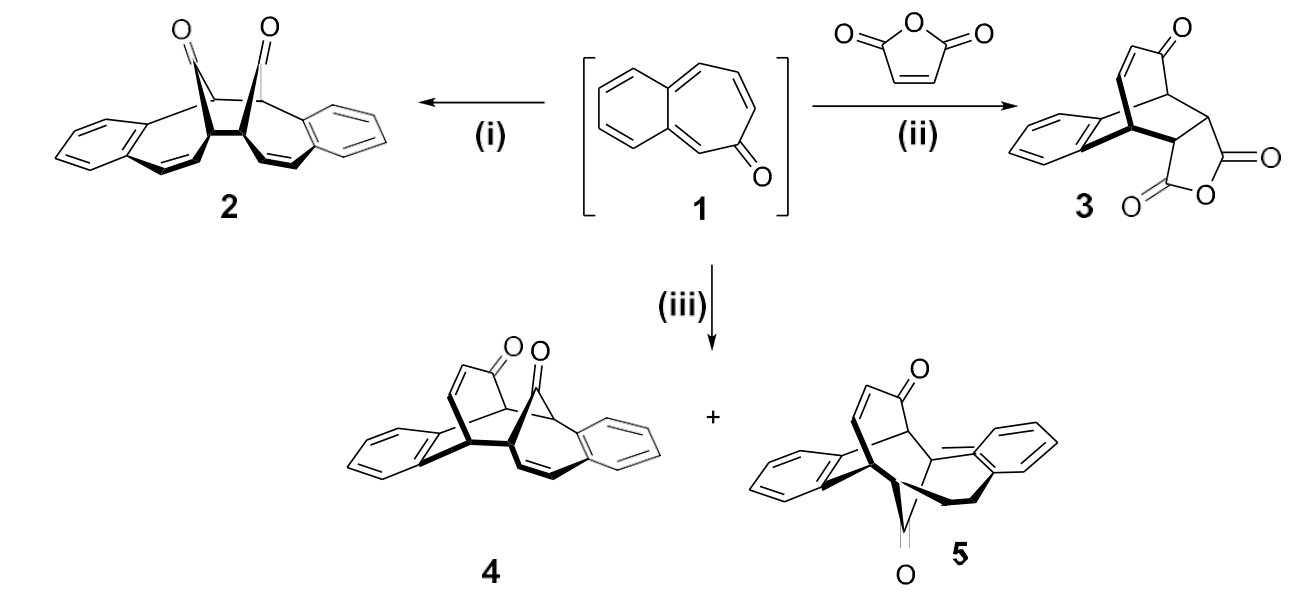
4.1 Fill in the table for reactions (i)–(iii) or products 2–5:
| Reaction | Product | [? + ?] cycloaddition | \(\Delta\) or \(h\nu\) |
|---|---|---|---|
| i | 2 | ||
| ii | 3 | ||
| iii | 4 | ||
| 5 |
There are three possible benzotropone isomers. Although two of the benzotropone isomers were isolated, 3,4-benzotropone (1) has not been isolated. Its instability is attributed to the o- quinoidal structure of 1 because it has no sextet electron system in the benzene ring.
4.2 Draw the structures of stable benzotropone isomers A (with 6 signals in its \(\ce{^{13}C}\)-NMR) and B (with 11 signals in its \(\ce{^{13}C}\)-NMR).
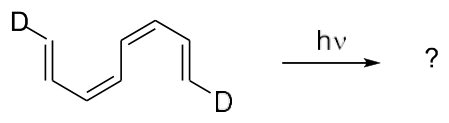
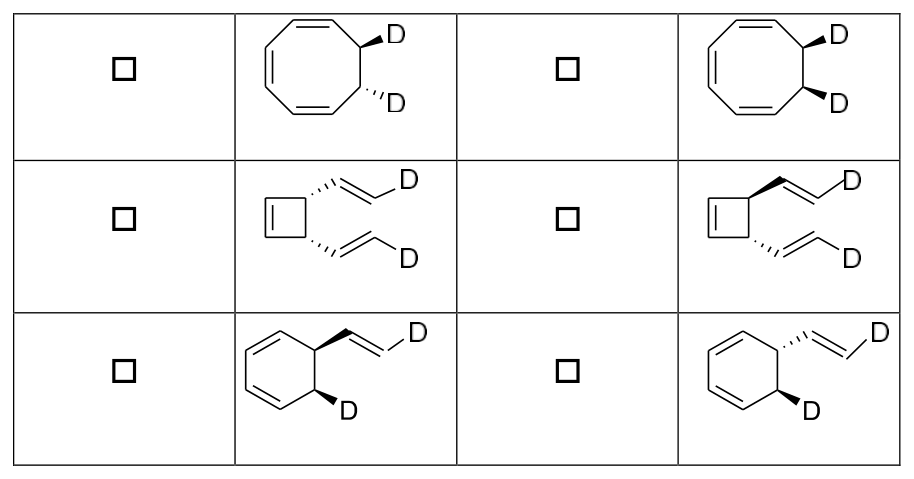
4.3 When the following tetraene is reacted under photochemical conditions, symmetry-allowed product(s) of three different ring sizes can form according to the Woodward–Hoffmann rules. Tick the correct answer in each row.
Prof. Dr. Aziz Sancar
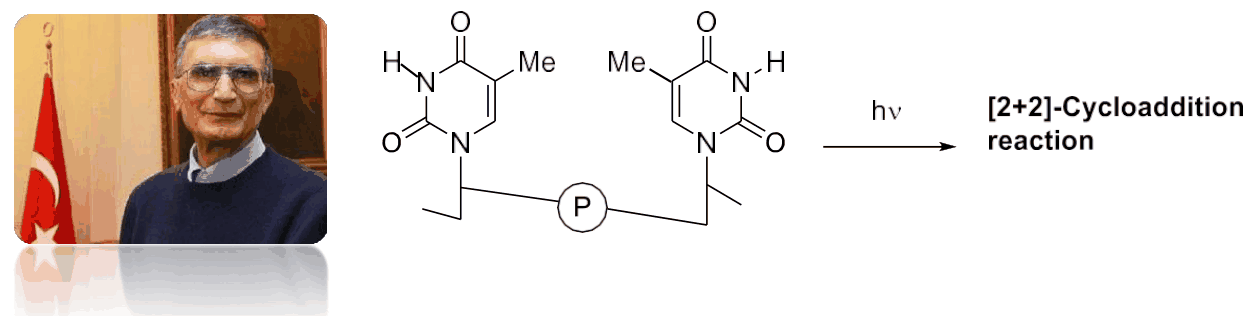
The Nobel Prize in Chemistry 2015 was awarded jointly to the Turkish scientist Aziz Sancar, Swedish scientist Tomas Lindahl, and American scientist Paul Modrich for their “mechanistic studies of DNA repair”. Pyrimidine bases found in DNA may undergo a photochemical [2+2]-cycloaddition reaction (see figure above) with UV light that reaches a person’s skin, causing damage to DNA, which may ultimately lead to skin cancer. The research by Professor Aziz Sancar focused on the DNA repair mechanism for this type of damage.
Thymine (T) is one of the nucleobases that can undergo such a photochemical reaction with UV light. Let us assume that we have a solution of free thymine that was subjected to UV irradiation.
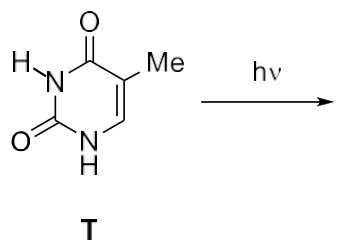
4.4 Considering stereochemistry, draw the structures of all possible products of this reaction between two free thymine (T) molecules. Circle the compound(s) which is/are chiral. A drawing only one enantiomer of an enantiomeric pair is sufficient. Please note that only \(\ce{C=C}\) bonds participate in this reaction.
A broad range of halogenated derivatives of norbornadiene (N) are known in the literature. Tribromo-norbornadiene (\(\ce{C7H5Br3}\)) has six achiral (meso) isomers. Three of these isomers (6, 7 and 8) are given below.
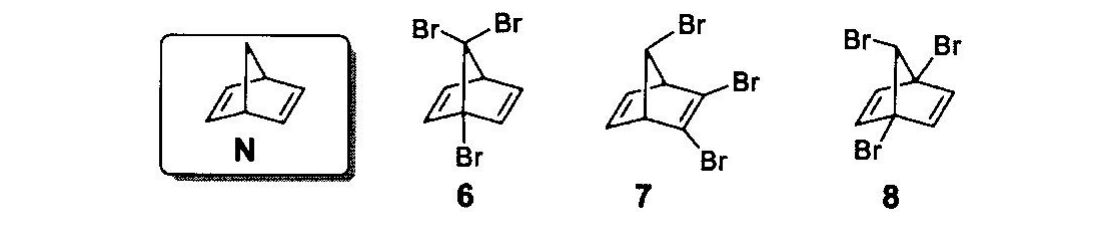
4.5 How many signals do you expect from the \(\ce{^{13}C}\)-NMR spectra of 6, 7, and 8? Fill in the following boxes.
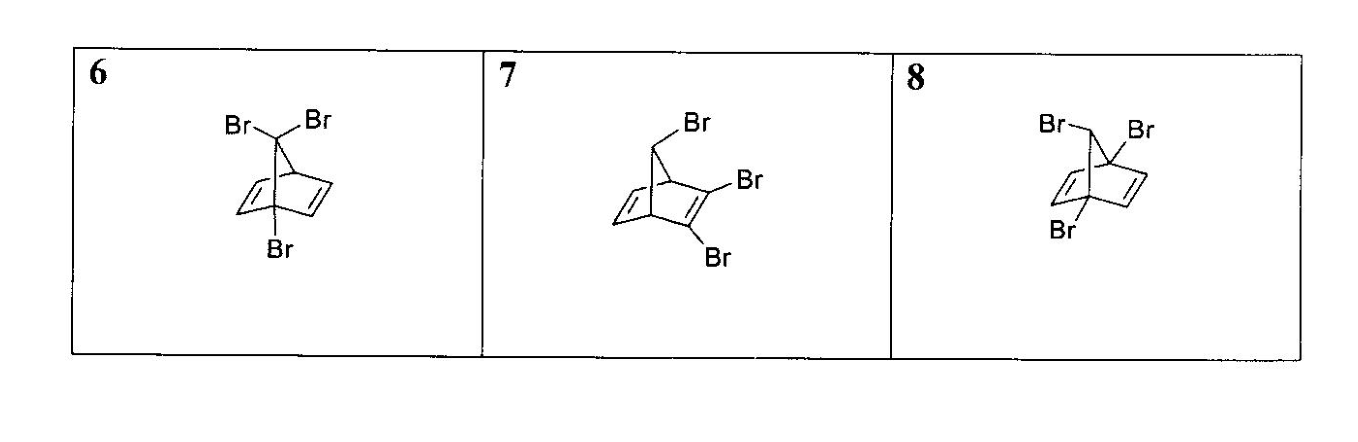
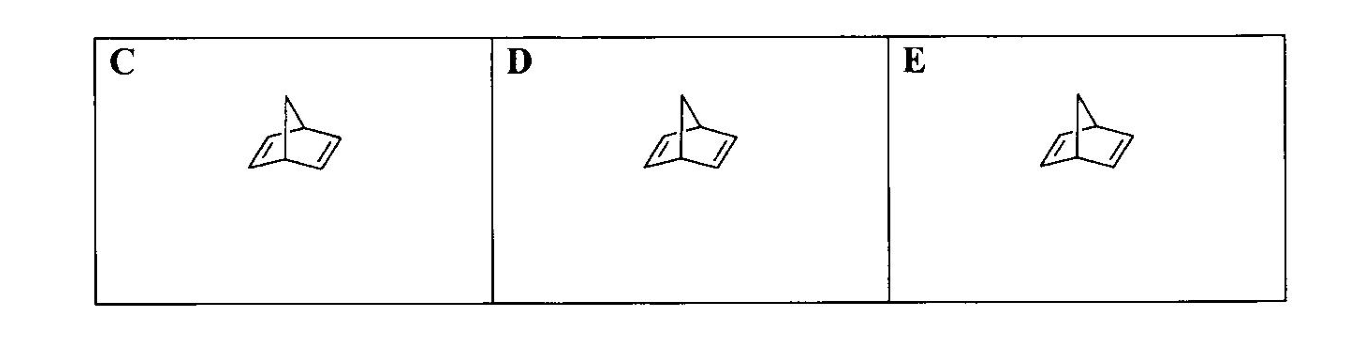
4.6 Draw structures of the remaining achiral (meso) tribromo-norbornadiene (\(\ce{C7H5Br3}\)) isomers (C, D, and E) in addition to 6 – 8 over the given figures in the boxes.
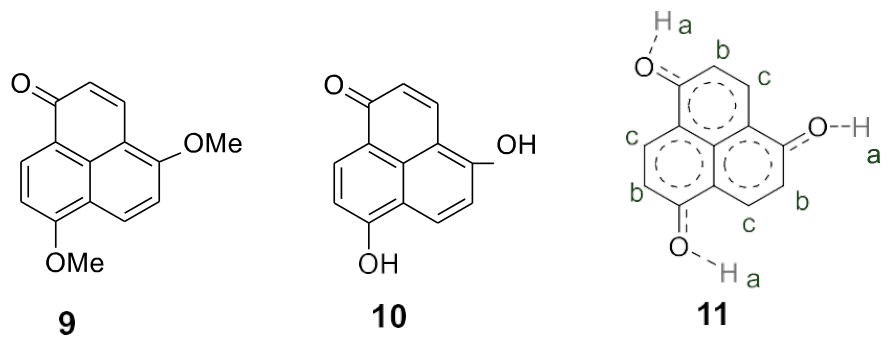
The NMR spectrum of ether 9 is complex. Two \(\ce{MeO-}\) groups are different as are all the hydrogen atoms on the rings. However, diphenol 10 has a very simple NMR spectrum and there are only three types of protons (marked as a, b, and c). A reasonable average structure responsible for all resonance structures and its symmetry is shown as 11.
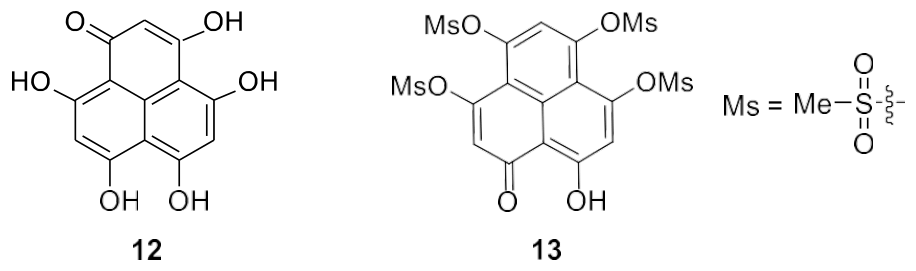
4.7 How many signals do you expect from the \(\ce{^{13}C}\)- and \(\ce{^{1}H}\)-NMR spectra of 12 and 13?
Official English text of the problem.
Answers
- 4.1
| Reaction | Product | Cycloaddition | Condition |
|---|---|---|---|
| i | 2 | \([6+6]\) | \(h\nu\) |
| ii | 3 | \([4+2]\) | \(\Delta\) |
| iii | 4 | \([6+4]\) | \(\Delta\) |
| iii | 5 | \([6+4]\) | \(\Delta\) |
-
4.2
A: 4,5-benzotropone —O=C1C=Cc2ccccc2C=C1
B: 2,3-benzotropone —O=C1c2ccccc2C=CC=C1 -
4.3 Tick right, left, left, from top to bottom. The indicated substituents are cis in all three selected structures. Their stereochemical SMILES are given below.
-
4.4 Four drawings are required: cis-syn, trans-syn, cis-anti, and trans-anti thymine dimers. Circle trans-syn and cis-anti. Including both members of each enantiomeric pair, there are six stereoisomers.
-
4.5 6: 5 signals; 7: 4 signals; 8: 4 signals.
-
4.6 One valid assignment is C = 1,2,6-tribromonorbornadiene, D = 1,3,5-tribromonorbornadiene, and E = the other 7-configuration of 2,3,7-tribromonorbornadiene. Precise structures and stereochemical SMILES appear below.
-
4.7
| Compound | \(\ce{^{13}C}\)-NMR signals | \(\ce{^{1}H}\)-NMR signals |
|---|---|---|
| 12 | 4 | 2 |
| 13 | 10 | 5 |
Solution
4.1
Number the tropone ring with its carbonyl carbon as C1. The starting material, 3,4-benzotropone (1), is O=C1C=C2C(=CC=C1)C=CC=C2.
Its relevant conjugated segments are:
\[ \underbrace{\mathrm{C2=C3-C4=C5}}_{\text{diene: }4\pi\text{ electrons}}, \qquad \underbrace{\mathrm{C2=C3-C4=C5-C6=C7}}_{\text{triene: }6\pi\text{ electrons}}. \]
The carbonyl group remains intact in these cycloadditions.
- Product 2: Both molecules react through their six-electron triene segments. Consequently, this is a \([6+6]\) cycloaddition involving \(12=4(3)\) electrons, favored photochemically.
- Product 3: The four-electron diene segment reacts with the two-electron alkene of maleic anhydride,
O=C1OC(=O)C=C1. This is a thermal \([4+2]\) cycloaddition because \(6=4(1)+2\). - Products 4 and 5: Each combines the four-electron diene segment of one molecule with the six-electron triene segment of another. Both are therefore thermal \([6+4]\) cycloadducts, involving \(10=4(2)+2\) electrons.
The bridging ketone is particularly diagnostic for the six-electron component: closure at C2 and C7 leaves C1, the carbonyl carbon, as a one-carbon bridge between these termini. Products 4 and 5 have different stereochemical arrangements but the same cycloaddition electron count.
The balanced molecular equations for the individual channels are:
\[ \ce{2 C11H8O -> C22H16O2} \qquad(h\nu;\ \text{product }\mathbf{2}), \]
\[ \ce{C11H8O + C4H2O3 -> C15H10O4} \qquad(\Delta;\ \text{product }\mathbf{3}), \]
\[ \ce{2 C11H8O -> C22H16O2} \qquad(\Delta;\ \text{product }\mathbf{4}\text{ or }\mathbf{5}). \]
Each dimerization equation describes one product channel; forming a mixture does not change the stoichiometry.
4.2
The three possible fusion positions, after accounting for equivalent numbering directions, are 2,3-, 3,4-, and 4,5-. The question identifies 3,4-benzotropone as the unstable isomer, leaving the other two.
For A, 4,5-benzotropone, draw the benzene ring fused to the tropone bond opposite the carbonyl group. A symmetry operation exchanges the two sides of the molecule:
- The carbonyl carbon is unique.
- The remaining ten carbons form five equivalent pairs.
Thus,
\[ N_{\ce{^{13}C}}(\mathbf A)=1+5=\boxed{6}. \]
For B, 2,3-benzotropone, draw the benzene ring fused to the bond adjacent to the carbonyl carbon. No symmetry operation exchanges distinct carbon positions while preserving the complete structure, so
\[ N_{\ce{^{13}C}}(\mathbf B)=\boxed{11}. \]
Their names and SMILES are given in the Answers section. Both structures retain a benzenoid aromatic sextet.
4.3
The starting material is (1E,3Z,5Z,7E)-1,8-dideuterioocta-1,3,5,7-tetraene, [2H]/C=C/C=C\C=C/C=C/[2H].
Number its conjugated carbons C1–C8 from left to right. For the pathways depicted in the answer choices:
| Row | Reacting segment | Electrons | Required photochemical motion | Selected stereochemistry |
|---|---|---|---|---|
| Eight-membered ring | C1–C8 | 8 | Disrotatory | The two D atoms are cis: right |
| Four-membered ring | C3–C6 | 4 | Disrotatory | The two vinyl substituents are cis: left |
| Six-membered ring | C1–C6, or the equivalent opposite end | 6 | Conrotatory | D and the vinyl substituent are cis: left |
The terminal double-bond configurations explain these outcomes:
- The full eight-electron segment has E/E terminal configurations; disrotation gives cis D atoms.
- The middle four-electron segment has Z/Z terminal configurations; disrotation gives cis vinyl substituents.
- The six-electron segment has E/Z terminal configurations; conrotation gives cis D and vinyl substituents.
The selected structures are:
| Product | Name | Stereochemical SMILES |
|---|---|---|
| Eight-membered ring | cis-7,8-Dideuteriocycloocta-1,3,5-triene | [2H][C@H]1/C=C\C=C/C=C\[C@H]1[2H] |
| Four-membered ring | cis-3,4-Bis[(E)-2-deuteriovinyl]cyclobut-1-ene | [2H]/C=C/[C@H]1C=C[C@H]1/C=C/[2H] |
| Six-membered ring | cis-6-Deuterio-5-[(E)-2-deuteriovinyl]cyclohexa-1,3-diene | [2H][C@H]1C=CC=C[C@H]1/C=C/[2H] |
Where a product is chiral, the SMILES specifies one member of the enantiomeric pair. Simultaneously reversing all wedges and dashes gives the equally allowed mirror image.
Each electrocyclization forms a terminal \(\sigma\) bond while shifting the remaining \(\pi\) bonds. No atoms are gained or lost:
\[ \ce{C8H8D2 -> C8H8D2}\qquad(h\nu). \]
4.4
Thymine, or 5-methylpyrimidine-2,4(1H,3H)-dione, has SMILES CC1=CNC(=O)NC1=O.
Only its C5=C6 bond reacts. Two such bonds undergo photochemical \([2+2]\) cycloaddition, producing a cyclobutane ring:
\[ \ce{2 C5H6N2O2 -> C10H12N4O4}\qquad(h\nu). \]
There are two ways to connect the two molecules:
- Syn: Form C5–C5′ and C6–C6′ bonds. The methyl-bearing carbons are adjacent in the cyclobutane.
- Anti: Form C5–C6′ and C6–C5′ bonds. The methyl-bearing carbons are opposite in the cyclobutane.
For either connectivity, the two methyl groups can be cis, on the same face of the cyclobutane framework, or trans, on opposite faces. The original pyrimidine-ring connections are retained.
| Dimer name | Stereochemical SMILES | Chirality |
|---|---|---|
| cis-syn Thymine cyclobutane dimer | C[C@]12[C@H](NC(=O)NC1=O)[C@H]1[C@]2(C)C(=O)NC(=O)N1 |
Achiral |
| trans-syn Thymine cyclobutane dimer | C[C@]12[C@H](NC(=O)NC1=O)[C@@H]1[C@@]2(C)C(=O)NC(=O)N1 |
Chiral—circle |
| cis-anti Thymine cyclobutane dimer | C[C@]12[C@H](NC(=O)NC1=O)[C@@]1(C)[C@@H]2NC(=O)NC1=O |
Chiral—circle |
| trans-anti Thymine cyclobutane dimer | C[C@]12[C@H](NC(=O)NC1=O)[C@]1(C)[C@H]2NC(=O)NC1=O |
Achiral |
The cis-syn arrangement has an internal reflection symmetry exchanging the two thymine units. The trans-anti arrangement has an inversion symmetry in an idealized symmetric conformation. Both are achiral.
The trans-syn and cis-anti arrangements have no improper symmetry operation that superposes them on their mirror images. Each therefore occurs as an enantiomeric pair.
Consequently, the four required drawings represent
\[ 1+2+2+1=\boxed{6} \]
individual stereoisomers.
4.5
Use the standard numbering of norbornadiene, bicyclo[2.2.1]hepta-2,5-diene, C1=CC2C=CC1C2:
- C1 and C4 are the bridgeheads.
- The double bonds are C2=C3 and C5=C6.
- C7 is the one-carbon bridge.
The given structures can be specified as follows. For 7, “syn” means that the C7–Br bond points toward the dibrominated alkene bridge.
| Compound | Name | Stereochemical SMILES |
|---|---|---|
| 6 | 1,7,7-Tribromobicyclo[2.2.1]hepta-2,5-diene | [C@]12(Br)C=C[C@H](C=C1)C2(Br)Br |
| 7 | 7-syn-2,3,7-Tribromobicyclo[2.2.1]hepta-2,5-diene | [C@H]12C(Br)=C(Br)[C@H](C=C1)[C@H]2Br |
| 8 | 1,4,7-Tribromobicyclo[2.2.1]hepta-2,5-diene | [C@]12(Br)C=C[C@](Br)(C=C1)[C@H]2Br |
Their carbon equivalence classes are:
| Compound | Equivalent carbon sets | Number of signals |
|---|---|---|
| 6 | \(\{1\},\{4\},\{7\},\{2,6\},\{3,5\}\) | 5 |
| 7 | \(\{1,4\},\{2,3\},\{5,6\},\{7\}\) | 4 |
| 8 | \(\{1,4\},\{2,3\},\{5,6\},\{7\}\) | 4 |
In 6, the mirror plane through C1, C4, and C7 exchanges the two alkene bridges, but the two bridgeheads remain different.
In 7 and 8, a different mirror plane exchanges the bridgeheads and the two ends of each alkene. C7 remains unique.
4.6
The following assignment of C, D, and E is valid; the letters may be permuted.
| Label | Name | Stereochemical SMILES |
|---|---|---|
| C | 1,2,6-Tribromobicyclo[2.2.1]hepta-2,5-diene | [C@]12(Br)C(Br)=C[C@H](C=C1Br)C2 |
| D | 1,3,5-Tribromobicyclo[2.2.1]hepta-2,5-diene | [C@]12(Br)C=C(Br)[C@H](C(Br)=C1)C2 |
| E | 7-anti-2,3,7-Tribromobicyclo[2.2.1]hepta-2,5-diene | [C@H]12C(Br)=C(Br)[C@H](C=C1)[C@@H]2Br |
To draw these on the supplied frameworks:
- C: Put Br on one bridgehead and on both alkene carbons directly bonded to that bridgehead.
- D: Put Br on one bridgehead and on both alkene carbons directly bonded to the other bridgehead.
- E: Retain the two Br atoms on the same double bond as in 7, but reverse the C7 substituent orientation. Its C7–Br bond points away from the dibrominated alkene bridge.
Both C and D retain the mirror plane through C1, C4, and C7, which exchanges the two alkene bridges. E retains the plane that exchanges C1 with C4, C2 with C3, and C5 with C6.
These patterns complete the six achiral isomers:
- One with two Br atoms at C7: 6.
- Two with no Br at C7: C and D.
- Three with one Br at C7: 7, 8, and E.
4.7
The averaging illustrated by 10/11 must be included. Movement of a hydrogen nucleus between oxygens is prototropic tautomerism, rather than resonance alone; rapid exchange makes symmetry-related positions equivalent on the NMR timescale.
The reference compound 10 is 4,7-dihydroxyphenalen-1-one, O=C1C=CC2=C(O)C=CC3=C(O)C=CC1=C23.
The following SMILES represent individual keto–enol tautomers of 12 and 13. Ordinary SMILES cannot encode their time-averaged fractional bond orders or hydrogen occupancies.
| Compound | Name of the represented tautomer | SMILES |
|---|---|---|
| 12 | 3,4,6,7,9-Pentahydroxyphenalen-1-one | O=C1C=C(O)C2=C(O)C=C(O)C3=C(O)C=C(O)C1=C23 |
| 13 | 9-Hydroxy-3,4,6,7-tetrakis(methanesulfonyloxy)phenalen-1-one | O=C1C=C(OS(=O)(=O)C)C2=C(OS(=O)(=O)C)C=C(OS(=O)(=O)C)C3=C(OS(=O)(=O)C)C=C(O)C1=C23 |
For 12, tautomeric averaging makes all six oxygen-bearing peripheral carbons equivalent. Threefold rotation and reflection give four carbon classes:
| Carbon class | Number of carbons in the class |
|---|---|
| Central carbon shared by the three rings | 1 |
| Other ring-junction carbons | 3 |
| Oxygen-bearing peripheral carbons | 6 |
| Peripheral CH carbons | 3 |
Therefore,
\[ N_{\ce{^{13}C}}(\mathbf{12})=\boxed{4}. \]
Its protons form two classes:
- Three equivalent ring CH protons.
- Five equivalent, exchanging OH protons.
The five OH protons are distributed over six oxygen positions in the averaged description; the average drawing does not imply six OH protons. Thus,
\[ N_{\ce{^{1}H}}(\mathbf{12})=\boxed{2}. \]
For 13, the mesylated oxygens prevent the full threefold equivalence. Exchange between the remaining carbonyl and hydroxyl positions restores a left–right reflection symmetry.
The 13-carbon ring framework contains three individually fixed carbons and five equivalent pairs:
\[ N_{\text{ring carbon environments}} =3+\frac{13-3}{2} =8. \]
The four mesyl methyl carbons form two equivalent pairs, adding two signals:
\[ N_{\ce{^{13}C}}(\mathbf{13})=8+2=\boxed{10}. \]
Its proton classes are:
| Proton class | Total integration |
|---|---|
| Ring CH on the reflection axis | 1 H |
| Other two ring CH positions | 2 H |
| Exchanging OH proton | 1 H |
| First equivalent pair of mesyl methyl groups | 6 H |
| Second equivalent pair of mesyl methyl groups | 6 H |
Hence,
\[ N_{\ce{^{1}H}}(\mathbf{13})=\boxed{5}. \]
These counts include OH resonances and count distinct chemical shifts, rather than individual multiplet lines.
The answers were checked against the official answers published by the organisers.
IChO 2020 · Theorieaufgabe 4
Auf die Symmetrie kommt es an!
In der organischen Chemie gibt es zahlreiche Reaktionen, die über cyclische Übergangszustände verlaufen und als pericyclische Reaktionen klassifiziert werden. Die von Robert B. Woodward und Roald Hoffmann entwickelten Woodward–Hoffmann-Regeln dienen dazu, stereochemische Aspekte und die Aktivierungsenergie pericyclischer Reaktionen zu erklären.
Woodward–Hoffmann-Regeln
| Anzahl der Elektronen | Elektrocyclische Reaktionen: thermisch \((\Delta)\) | Elektrocyclische Reaktionen: photochemisch \((h\nu)\) | Cycloadditionen: thermisch \((\Delta)\) | Cycloadditionen: photochemisch \((h\nu)\) |
|---|---|---|---|---|
| \(4n\), \((n=1,2,..)\) | Konrotatorisch (con) | Disrotatorisch | Nicht begünstigt | Begünstigt |
| \(4n+2\), \((n=1,2,..)\) | Disrotatorisch (dis) | Konrotatorisch | Begünstigt | Nicht begünstigt |
4.1 Vervollständigen Sie die Tabelle für die Reaktionen (i)–(iii) bzw. die Produkte 2–5:
| Reaktion | Produkt | [? + ?]-Cycloaddition | \(\Delta\) oder \(h\nu\) |
|---|---|---|---|
| i | 2 | ||
| ii | 3 | ||
| iii | 4 | ||
| 5 |
Es gibt drei mögliche Benzotropon-Isomere. Obwohl zwei der Benzotropon-Isomere isoliert wurden, ist 3,4-Benzotropon (1) bislang nicht isoliert worden. Seine Instabilität wird auf die o-chinoide Struktur von 1 zurückgeführt, da es im Benzolring kein Elektronensextett aufweist.
4.2 Zeichnen Sie die Strukturen der stabilen Benzotropon-Isomere A (mit 6 Signalen im \(\ce{^{13}C}\)-NMR-Spektrum) und B (mit 11 Signalen im \(\ce{^{13}C}\)-NMR-Spektrum).
4.3 Wenn das folgende Tetraen unter photochemischen Bedingungen umgesetzt wird, können gemäß den Woodward–Hoffmann-Regeln symmetrieerlaubte Produkte mit drei verschiedenen Ringgrößen entstehen. Kreuzen Sie in jeder Zeile die richtige Antwort an.
Prof. Dr. Aziz Sancar
Der Nobelpreis für Chemie 2015 wurde gemeinsam an den türkischen Wissenschaftler Aziz Sancar, den schwedischen Wissenschaftler Tomas Lindahl und den amerikanischen Wissenschaftler Paul Modrich für ihre „mechanistischen Studien zur DNA-Reparatur“ verliehen. Die in der DNA vorkommenden Pyrimidinbasen können durch UV-Licht, das auf die Haut eines Menschen trifft, eine photochemische [2+2]-Cycloadditionsreaktion eingehen (siehe Abbildung oben). Dadurch wird die DNA geschädigt, was letztlich zu Hautkrebs führen kann. Die Forschung von Professor Aziz Sancar konzentrierte sich auf den DNA-Reparaturmechanismus für diese Art von Schädigung.
Thymin (T) ist eine der Nucleobasen, die eine solche photochemische Reaktion unter UV-Licht eingehen können. Nehmen wir an, dass eine Lösung von freiem Thymin mit UV-Licht bestrahlt wurde.
4.4 Zeichnen Sie unter Berücksichtigung der Stereochemie die Strukturen aller möglichen Produkte dieser Reaktion zwischen zwei freien Thyminmolekülen (T). Kreisen Sie die chirale(n) Verbindung(en) ein. Es genügt, nur ein Enantiomer eines Enantiomerenpaars zu zeichnen. Beachten Sie, dass nur \(\ce{C=C}\)-Bindungen an dieser Reaktion teilnehmen.
In der Literatur ist eine große Vielfalt halogenierter Derivate von Norbornadien (N) bekannt. Tribromnorbornadien (\(\ce{C7H5Br3}\)) besitzt sechs achirale (meso-)Isomere. Drei dieser Isomere (6, 7 und 8) sind nachfolgend dargestellt.
4.5 Wie viele Signale erwarten Sie in den \(\ce{^{13}C}\)-NMR-Spektren von 6, 7 und 8? Tragen Sie Ihre Antworten in die folgenden Kästchen ein.
4.6 Zeichnen Sie die Strukturen der neben 6 – 8 verbleibenden achiralen (meso-)Isomere von Tribromnorbornadien (\(\ce{C7H5Br3}\)) (C, D und E) auf den vorgegebenen Gerüsten in den Kästchen ein.
Das NMR-Spektrum des Ethers 9 ist komplex. Die beiden \(\ce{MeO-}\)-Gruppen sind unterschiedlich, ebenso wie alle Wasserstoffatome an den Ringen. Diphenol 10 besitzt hingegen ein sehr einfaches NMR-Spektrum, und es gibt nur drei Arten von Protonen (mit a, b und c gekennzeichnet). Eine plausible gemittelte Struktur, die alle mesomeren Grenzstrukturen und die zugehörige Symmetrie berücksichtigt, ist als 11 dargestellt.
4.7 Wie viele Signale erwarten Sie in den \(\ce{^{13}C}\)- und \(\ce{^{1}H}\)-NMR-Spektren von 12 und 13?
Aufgabentext aus dem offiziellen englischen Text übersetzt.
Antworten
- 4.1
| Reaktion | Produkt | Cycloaddition | Bedingung |
|---|---|---|---|
| i | 2 | \([6+6]\) | \(h\nu\) |
| ii | 3 | \([4+2]\) | \(\Delta\) |
| iii | 4 | \([6+4]\) | \(\Delta\) |
| iii | 5 | \([6+4]\) | \(\Delta\) |
-
4.2
A: 4,5-Benzotropon —O=C1C=Cc2ccccc2C=C1
B: 2,3-Benzotropon —O=C1c2ccccc2C=CC=C1 -
4.3 Kreuzen Sie von oben nach unten rechts, links, links an. Die angegebenen Substituenten stehen in allen drei ausgewählten Strukturen cis zueinander. Ihre stereochemischen SMILES sind unten angegeben.
-
4.4 Vier Zeichnungen sind erforderlich: cis-syn-, trans-syn-, cis-anti- und trans-anti-Thymindimere. Kreisen Sie trans-syn und cis-anti ein. Unter Einbeziehung beider Mitglieder jedes Enantiomerenpaars gibt es sechs Stereoisomere.
-
4.5 6: 5 Signale; 7: 4 Signale; 8: 4 Signale.
-
4.6 Eine gültige Zuordnung ist C = 1,2,6-Tribromnorbornadien, D = 1,3,5-Tribromnorbornadien und E = die andere 7-Konfiguration von 2,3,7-Tribromnorbornadien. Die genauen Strukturen und stereochemischen SMILES folgen unten.
-
4.7
| Verbindung | \(\ce{^{13}C}\)-NMR-Signale | \(\ce{^{1}H}\)-NMR-Signale |
|---|---|---|
| 12 | 4 | 2 |
| 13 | 10 | 5 |
Lösung
4.1
Nummerieren Sie den Troponring so, dass sein Carbonylkohlenstoff C1 ist. Der Ausgangsstoff, 3,4-Benzotropon (1), ist O=C1C=C2C(=CC=C1)C=CC=C2.
Seine relevanten konjugierten Abschnitte sind:
\[ \underbrace{\mathrm{C2=C3-C4=C5}}_{\text{Dien: }4\pi\text{ Elektronen}}, \qquad \underbrace{\mathrm{C2=C3-C4=C5-C6=C7}}_{\text{Trien: }6\pi\text{ Elektronen}}. \]
Die Carbonylgruppe bleibt bei diesen Cycloadditionen unverändert erhalten.
- Produkt 2: Beide Moleküle reagieren über ihre Trienabschnitte mit jeweils sechs Elektronen. Folglich handelt es sich um eine \([6+6]\)-Cycloaddition mit \(12=4(3)\) Elektronen, die photochemisch begünstigt ist.
- Produkt 3: Der Dienabschnitt mit vier Elektronen reagiert mit der Alkeneinheit mit zwei Elektronen des Maleinsäureanhydrids,
O=C1OC(=O)C=C1. Dies ist eine thermische \([4+2]\)-Cycloaddition, da \(6=4(1)+2\). - Produkte 4 und 5: Bei beiden verbindet sich der Dienabschnitt mit vier Elektronen eines Moleküls mit dem Trienabschnitt mit sechs Elektronen eines anderen. Beide sind daher thermische \([6+4]\)-Cycloaddukte, an deren Bildung \(10=4(2)+2\) Elektronen beteiligt sind.
Die verbrückende Ketongruppe ist besonders kennzeichnend für die Sechselektronenkomponente: Beim Ringschluss an C2 und C7 verbleibt C1, der Carbonylkohlenstoff, als Einkohlenstoffbrücke zwischen diesen Enden. Die Produkte 4 und 5 weisen unterschiedliche stereochemische Anordnungen auf, aber dieselbe Elektronenzahl der Cycloaddition.
Die ausgeglichenen molekularen Reaktionsgleichungen für die einzelnen Reaktionswege lauten:
\[ \ce{2 C11H8O -> C22H16O2} \qquad(h\nu;\ \text{Produkt }\mathbf{2}), \]
\[ \ce{C11H8O + C4H2O3 -> C15H10O4} \qquad(\Delta;\ \text{Produkt }\mathbf{3}), \]
\[ \ce{2 C11H8O -> C22H16O2} \qquad(\Delta;\ \text{Produkt }\mathbf{4}\text{ oder }\mathbf{5}). \]
Jede Dimerisierungsgleichung beschreibt einen Reaktionsweg zu einem Produkt; die Bildung eines Gemisches ändert die Stöchiometrie nicht.
4.2
Unter Berücksichtigung äquivalenter Nummerierungsrichtungen sind die drei möglichen Anellierungspositionen 2,3-, 3,4- und 4,5-. Die Aufgabenstellung benennt 3,4-Benzotropon als das instabile Isomer, sodass die beiden anderen verbleiben.
Zeichnen Sie für A, 4,5-Benzotropon, den Benzolring an die der Carbonylgruppe gegenüberliegende Troponbindung anelliert. Eine Symmetrieoperation vertauscht die beiden Seiten des Moleküls:
- Der Carbonylkohlenstoff ist einzigartig.
- Die übrigen zehn Kohlenstoffatome bilden fünf äquivalente Paare.
Somit gilt:
\[ N_{\ce{^{13}C}}(\mathbf A)=1+5=\boxed{6}. \]
Zeichnen Sie für B, 2,3-Benzotropon, den Benzolring an die dem Carbonylkohlenstoff benachbarte Bindung anelliert. Keine Symmetrieoperation vertauscht verschiedene Kohlenstoffpositionen unter Erhaltung der vollständigen Struktur, daher gilt:
\[ N_{\ce{^{13}C}}(\mathbf B)=\boxed{11}. \]
Ihre Namen und SMILES sind im Abschnitt Antworten angegeben. Beide Strukturen behalten ein benzoides aromatisches Sextett bei.
4.3
Der Ausgangsstoff ist (1E,3Z,5Z,7E)-1,8-Dideuterioocta-1,3,5,7-tetraen, [2H]/C=C/C=C\C=C/C=C/[2H].
Nummerieren Sie seine konjugierten Kohlenstoffatome von links nach rechts als C1–C8. Für die in den Antwortmöglichkeiten dargestellten Reaktionswege gilt:
| Zeile | Reagierender Abschnitt | Elektronen | Erforderliche photochemische Drehbewegung | Ausgewählte Stereochemie |
|---|---|---|---|---|
| Achtgliedriger Ring | C1–C8 | 8 | Disrotatorisch | Die beiden D-Atome stehen cis zueinander: rechts |
| Viergliedriger Ring | C3–C6 | 4 | Disrotatorisch | Die beiden Vinylsubstituenten stehen cis zueinander: links |
| Sechsgliedriger Ring | C1–C6 oder das äquivalente gegenüberliegende Ende | 6 | Konrotatorisch | D und der Vinylsubstituent stehen cis zueinander: links |
Die Konfigurationen der endständigen Doppelbindungen erklären diese Ergebnisse:
- Der vollständige Achtelektronenabschnitt hat endständige E/E-Konfigurationen; eine disrotatorische Drehbewegung ergibt cis zueinander stehende D-Atome.
- Der mittlere Vierelektronenabschnitt hat endständige Z/Z-Konfigurationen; eine disrotatorische Drehbewegung ergibt cis zueinander stehende Vinylsubstituenten.
- Der Sechselektronenabschnitt hat endständige E/Z-Konfigurationen; eine konrotatorische Drehbewegung ergibt cis zueinander stehende D- und Vinylsubstituenten.
Die ausgewählten Strukturen sind:
| Produkt | Name | Stereochemische SMILES |
|---|---|---|
| Achtgliedriger Ring | cis-7,8-Dideuteriocycloocta-1,3,5-trien | [2H][C@H]1/C=C\C=C/C=C\[C@H]1[2H] |
| Viergliedriger Ring | cis-3,4-Bis[(E)-2-deuteriovinyl]cyclobut-1-en | [2H]/C=C/[C@H]1C=C[C@H]1/C=C/[2H] |
| Sechsgliedriger Ring | cis-6-Deuterio-5-[(E)-2-deuteriovinyl]cyclohexa-1,3-dien | [2H][C@H]1C=CC=C[C@H]1/C=C/[2H] |
Ist ein Produkt chiral, gibt die SMILES eines der beiden Enantiomere an. Durch gleichzeitiges Umkehren aller ausgefüllten und gestrichelten Keile erhält man das ebenfalls erlaubte Spiegelbild.
Bei jeder Elektrocyclisierung entsteht eine endständige \(\sigma\)-Bindung, während die verbleibenden \(\pi\)-Bindungen verschoben werden. Es kommen keine Atome hinzu, und es gehen keine verloren:
\[ \ce{C8H8D2 -> C8H8D2}\qquad(h\nu). \]
4.4
Thymin, auch 5-Methylpyrimidin-2,4(1H,3H)-dion, hat die SMILES CC1=CNC(=O)NC1=O.
Nur seine C5=C6-Bindung reagiert. Zwei solche Bindungen gehen eine photochemische \([2+2]\)-Cycloaddition ein, wobei ein Cyclobutanring entsteht:
\[ \ce{2 C5H6N2O2 -> C10H12N4O4}\qquad(h\nu). \]
Es gibt zwei Möglichkeiten, die beiden Moleküle miteinander zu verknüpfen:
- Syn: Es entstehen C5–C5′- und C6–C6′-Bindungen. Die methylgruppentragenden Kohlenstoffatome sind im Cyclobutan benachbart.
- Anti: Es entstehen C5–C6′- und C6–C5′-Bindungen. Die methylgruppentragenden Kohlenstoffatome liegen sich im Cyclobutan gegenüber.
Bei beiden Verknüpfungsmustern können die beiden Methylgruppen cis, auf derselben Seite des Cyclobutangerüsts, oder trans, auf gegenüberliegenden Seiten, angeordnet sein. Die ursprünglichen Verknüpfungen der Pyrimidinringe bleiben erhalten.
| Name des Dimers | Stereochemische SMILES | Chiralität |
|---|---|---|
| cis-syn-Thymin-Cyclobutandimer | C[C@]12[C@H](NC(=O)NC1=O)[C@H]1[C@]2(C)C(=O)NC(=O)N1 |
Achiral |
| trans-syn-Thymin-Cyclobutandimer | C[C@]12[C@H](NC(=O)NC1=O)[C@@H]1[C@@]2(C)C(=O)NC(=O)N1 |
Chiral—einkreisen |
| cis-anti-Thymin-Cyclobutandimer | C[C@]12[C@H](NC(=O)NC1=O)[C@@]1(C)[C@@H]2NC(=O)NC1=O |
Chiral—einkreisen |
| trans-anti-Thymin-Cyclobutandimer | C[C@]12[C@H](NC(=O)NC1=O)[C@]1(C)[C@H]2NC(=O)NC1=O |
Achiral |
Die cis-syn-Anordnung besitzt eine innere Spiegelsymmetrie, die die beiden Thymineinheiten vertauscht. Die trans-anti-Anordnung besitzt in einer idealisierten symmetrischen Konformation eine Inversionssymmetrie. Beide sind achiral.
Die trans-syn- und cis-anti-Anordnungen besitzen keine uneigentliche Symmetrieoperation, die sie mit ihren Spiegelbildern zur Deckung bringt. Daher tritt jede als Enantiomerenpaar auf.
Folglich stellen die vier geforderten Zeichnungen
\[ 1+2+2+1=\boxed{6} \]
einzelne Stereoisomere dar.
4.5
Verwenden Sie die Standardnummerierung von Norbornadien, Bicyclo[2.2.1]hepta-2,5-dien, C1=CC2C=CC1C2:
- C1 und C4 sind die Brückenköpfe.
- Die Doppelbindungen sind C2=C3 und C5=C6.
- C7 ist die Einkohlenstoffbrücke.
Die vorgegebenen Strukturen lassen sich wie folgt angeben. Bei 7 bedeutet „syn“, dass die C7–Br-Bindung zur dibromierten Alkenbrücke hin gerichtet ist.
| Verbindung | Name | Stereochemische SMILES |
|---|---|---|
| 6 | 1,7,7-Tribrombicyclo[2.2.1]hepta-2,5-dien | [C@]12(Br)C=C[C@H](C=C1)C2(Br)Br |
| 7 | 7-syn-2,3,7-Tribrombicyclo[2.2.1]hepta-2,5-dien | [C@H]12C(Br)=C(Br)[C@H](C=C1)[C@H]2Br |
| 8 | 1,4,7-Tribrombicyclo[2.2.1]hepta-2,5-dien | [C@]12(Br)C=C[C@](Br)(C=C1)[C@H]2Br |
Die Äquivalenzklassen ihrer Kohlenstoffatome sind:
| Verbindung | Gruppen äquivalenter Kohlenstoffatome | Anzahl der Signale |
|---|---|---|
| 6 | \(\{1\},\{4\},\{7\},\{2,6\},\{3,5\}\) | 5 |
| 7 | \(\{1,4\},\{2,3\},\{5,6\},\{7\}\) | 4 |
| 8 | \(\{1,4\},\{2,3\},\{5,6\},\{7\}\) | 4 |
In 6 vertauscht die Spiegelebene durch C1, C4 und C7 die beiden Alkenbrücken, die beiden Brückenköpfe bleiben jedoch unterschiedlich.
In 7 und 8 vertauscht eine andere Spiegelebene die Brückenköpfe und die beiden Enden jedes Alkens. C7 bleibt einzigartig.
4.6
Die folgende Zuordnung von C, D und E ist gültig; die Buchstaben können vertauscht werden.
| Kennzeichnung | Name | Stereochemische SMILES |
|---|---|---|
| C | 1,2,6-Tribrombicyclo[2.2.1]hepta-2,5-dien | [C@]12(Br)C(Br)=C[C@H](C=C1Br)C2 |
| D | 1,3,5-Tribrombicyclo[2.2.1]hepta-2,5-dien | [C@]12(Br)C=C(Br)[C@H](C(Br)=C1)C2 |
| E | 7-anti-2,3,7-Tribrombicyclo[2.2.1]hepta-2,5-dien | [C@H]12C(Br)=C(Br)[C@H](C=C1)[C@@H]2Br |
Zeichnen Sie diese wie folgt in die vorgegebenen Gerüste ein:
- C: Bringen Sie Br an einem Brückenkopf und an beiden direkt mit diesem Brückenkopf verbundenen Alkenkohlenstoffatomen an.
- D: Bringen Sie Br an einem Brückenkopf und an beiden direkt mit dem anderen Brückenkopf verbundenen Alkenkohlenstoffatomen an.
- E: Belassen Sie die beiden Br-Atome an derselben Doppelbindung wie in 7, kehren Sie jedoch die Orientierung des C7-Substituenten um. Die C7–Br-Bindung ist von der dibromierten Alkenbrücke weg gerichtet.
Sowohl C als auch D behalten die Spiegelebene durch C1, C4 und C7 bei, die die beiden Alkenbrücken vertauscht. E behält die Ebene bei, die C1 mit C4, C2 mit C3 und C5 mit C6 vertauscht.
Diese Substitutionsmuster vervollständigen die sechs achiralen Isomere:
- Eines mit zwei Br-Atomen an C7: 6.
- Zwei ohne Br an C7: C und D.
- Drei mit einem Br an C7: 7, 8 und E.
4.7
Die durch 10/11 veranschaulichte Mittelung muss berücksichtigt werden. Die Bewegung eines Wasserstoffkerns zwischen Sauerstoffatomen ist prototrope Tautomerie, nicht lediglich Mesomerie; ein schneller Austausch macht symmetrieverwandte Positionen auf der NMR-Zeitskala äquivalent.
Die Referenzverbindung 10 ist 4,7-Dihydroxyphenalen-1-on, O=C1C=CC2=C(O)C=CC3=C(O)C=CC1=C23.
Die folgenden SMILES stellen einzelne Keto–Enol-Tautomere von 12 und 13 dar. Gewöhnliche SMILES können deren zeitlich gemittelte gebrochene Bindungsordnungen oder Wasserstoffbesetzungen nicht codieren.
| Verbindung | Name des dargestellten Tautomers | SMILES |
|---|---|---|
| 12 | 3,4,6,7,9-Pentahydroxyphenalen-1-on | O=C1C=C(O)C2=C(O)C=C(O)C3=C(O)C=C(O)C1=C23 |
| 13 | 9-Hydroxy-3,4,6,7-tetrakis(methansulfonyloxy)phenalen-1-on | O=C1C=C(OS(=O)(=O)C)C2=C(OS(=O)(=O)C)C=C(OS(=O)(=O)C)C3=C(OS(=O)(=O)C)C=C(O)C1=C23 |
Bei 12 macht die tautomere Mittelung alle sechs sauerstofftragenden peripheren Kohlenstoffatome äquivalent. Dreizählige Rotation und Spiegelung ergeben vier Kohlenstoffklassen:
| Kohlenstoffklasse | Anzahl der Kohlenstoffatome in der Klasse |
|---|---|
| Zentrales, den drei Ringen gemeinsames Kohlenstoffatom | 1 |
| Übrige Kohlenstoffatome an den Ringverknüpfungen | 3 |
| Sauerstofftragende periphere Kohlenstoffatome | 6 |
| Periphere CH-Kohlenstoffatome | 3 |
Daher gilt:
\[ N_{\ce{^{13}C}}(\mathbf{12})=\boxed{4}. \]
Die Protonen bilden zwei Klassen:
- Drei äquivalente CH-Protonen der Ringe.
- Fünf äquivalente, austauschende OH-Protonen.
Die fünf OH-Protonen sind in der gemittelten Beschreibung auf sechs Sauerstoffpositionen verteilt; die gemittelte Zeichnung bedeutet nicht, dass sechs OH-Protonen vorliegen. Somit gilt:
\[ N_{\ce{^{1}H}}(\mathbf{12})=\boxed{2}. \]
Bei 13 verhindern die mesylierten Sauerstoffatome die vollständige dreizählige Äquivalenz. Der Austausch zwischen den verbleibenden Carbonyl- und Hydroxylpositionen stellt eine Links-rechts-Spiegelsymmetrie wieder her.
Das Ringgerüst aus 13 Kohlenstoffatomen enthält drei einzeln auf sich selbst abgebildete Kohlenstoffatome und fünf äquivalente Paare:
\[ N_{\text{Ringkohlenstoffumgebungen}} =3+\frac{13-3}{2} =8. \]
Die vier Methylkohlenstoffatome der Mesylgruppen bilden zwei äquivalente Paare, wodurch zwei Signale hinzukommen:
\[ N_{\ce{^{13}C}}(\mathbf{13})=8+2=\boxed{10}. \]
Die Protonenklassen sind:
| Protonenklasse | Gesamtintegral |
|---|---|
| Ring-CH auf der Spiegelachse | 1 H |
| Die beiden anderen Ring-CH-Positionen | 2 H |
| Austauschendes OH-Proton | 1 H |
| Erstes äquivalentes Paar von Mesyl-Methylgruppen | 6 H |
| Zweites äquivalentes Paar von Mesyl-Methylgruppen | 6 H |
Damit gilt:
\[ N_{\ce{^{1}H}}(\mathbf{13})=\boxed{5}. \]
Diese Anzahlen schließen OH-Resonanzen ein und zählen unterschiedliche chemische Verschiebungen, nicht einzelne Multiplettlinien.
Die Ergebnisse wurden mit den von den Veranstaltern veröffentlichten offiziellen Ergebnissen abgeglichen.
IChO 2020 · Teori sorusu 4
Simetri Gerçekten Önemlidir!
Organik kimyada halkalı geçiş durumları üzerinden ilerleyen çok sayıda tepkime vardır ve bunlar perisiklik tepkimeler olarak sınıflandırılır. Robert B. Woodward ve Roald Hoffmann tarafından geliştirilen Woodward–Hoffmann kuralları, perisiklik tepkimelerin stereokimyasal özelliklerini ve aktivasyon enerjisini açıklamak için kullanılır.
Woodward–Hoffmann kuralları
| Elektron sayısı | Elektrosiklik tepkimeler: Termal \((\Delta)\) | Elektrosiklik tepkimeler: Fotokimyasal \((h\nu)\) | Siklokatılmalar: Termal \((\Delta)\) | Siklokatılmalar: Fotokimyasal \((h\nu)\) |
|---|---|---|---|---|
| \(4n\), \((n=1,2,..)\) | Konrotator (con) | Disrotator | Elverişsiz | Elverişli |
| \(4n+2\), \((n=1,2,..)\) | Disrotator (dis) | Konrotator | Elverişli | Elverişsiz |
4.1 (i)–(iii) tepkimeleri veya 2–5 ürünleri için tabloyu doldurunuz:
| Tepkime | Ürün | [? + ?] siklokatılması | \(\Delta\) veya \(h\nu\) |
|---|---|---|---|
| i | 2 | ||
| ii | 3 | ||
| iii | 4 | ||
| 5 |
Olası üç benzotropon izomeri vardır. Benzotropon izomerlerinden ikisi izole edilmiş olsa da 3,4-benzotropon (1) izole edilememiştir. Kararsızlığı, benzen halkasında altı elektronlu bir sistem bulunmadığı için 1'in o-kinoid yapısına bağlanmaktadır.
4.2 Kararlı benzotropon izomerleri A (\(\ce{^{13}C}\)-NMR spektrumunda 6 sinyal veren) ve B'nin (\(\ce{^{13}C}\)-NMR spektrumunda 11 sinyal veren) yapılarını çiziniz.
4.3 Aşağıdaki tetraen fotokimyasal koşullarda tepkimeye sokulduğunda, Woodward–Hoffmann kurallarına göre üç farklı halka büyüklüğüne sahip, simetri bakımından izinli ürün(ler) oluşabilir. Her satırda doğru cevabı işaretleyiniz.
Prof. Dr. Aziz Sancar
2015 Nobel Kimya Ödülü, “DNA onarımı üzerine mekanistik çalışmaları” nedeniyle Türk bilim insanı Aziz Sancar, İsveçli bilim insanı Tomas Lindahl ve Amerikalı bilim insanı Paul Modrich'e ortaklaşa verilmiştir. DNA'da bulunan pirimidin bazları, insan derisine ulaşan UV ışığıyla fotokimyasal bir [2+2]-siklokatılma tepkimesine (yukarıdaki şekle bakınız) girerek DNA'da hasara yol açabilir; bu hasar da sonuçta deri kanserine neden olabilir. Profesör Aziz Sancar'ın araştırmaları, bu tür hasarlar için DNA onarım mekanizmasına odaklanmıştır.
Timin (T), UV ışığıyla böyle bir fotokimyasal tepkimeye girebilen nükleobazlardan biridir. UV ışınlamasına maruz bırakılmış bir serbest timin çözeltimiz olduğunu varsayalım.
4.4 Stereokimyayı dikkate alarak, iki serbest timin (T) molekülü arasındaki bu tepkimenin olası tüm ürünlerinin yapılarını çiziniz. Kiral olan bileşiği/bileşikleri daire içine alınız. Bir enantiyomer çiftinin yalnızca bir enantiyomerinin çizilmesi yeterlidir. Bu tepkimeye yalnızca \(\ce{C=C}\) bağlarının katıldığını unutmayınız.
Literatürde norbornadienin (N) çok çeşitli halojenli türevleri bilinmektedir. Tribromonorbornadienin (\(\ce{C7H5Br3}\)) altı akiral (mezo) izomeri vardır. Bu izomerlerden üçü (6, 7 ve 8) aşağıda verilmiştir.
4.5 6, 7 ve 8'in \(\ce{^{13}C}\)-NMR spektrumlarında kaç sinyal beklersiniz? Aşağıdaki kutuları doldurunuz.
4.6 6 – 8 dışındaki akiral (mezo) tribromonorbornadien (\(\ce{C7H5Br3}\)) izomerlerinin (C, D ve E) yapılarını, kutularda verilen şekillerin üzerine çiziniz.
Eter 9'un NMR spektrumu karmaşıktır. Halkalardaki tüm hidrojen atomları gibi iki \(\ce{MeO-}\) grubu da birbirinden farklıdır. Ancak difenol 10'un NMR spektrumu çok basittir ve yalnızca üç tür proton vardır (a, b ve c ile işaretlenmiştir). Tüm rezonans yapılarını ve simetrisini açıklayan makul bir ortalama yapı 11 olarak gösterilmiştir.
4.7 12 ve 13'ün \(\ce{^{13}C}\)- ve \(\ce{^{1}H}\)-NMR spektrumlarında kaç sinyal beklersiniz?
Soru metni resmi İngilizce metinden çevrilmiştir.
Cevaplar
- 4.1
| Tepkime | Ürün | Siklokatılma | Koşul |
|---|---|---|---|
| i | 2 | \([6+6]\) | \(h\nu\) |
| ii | 3 | \([4+2]\) | \(\Delta\) |
| iii | 4 | \([6+4]\) | \(\Delta\) |
| iii | 5 | \([6+4]\) | \(\Delta\) |
-
4.2
A: 4,5-benzotropon —O=C1C=Cc2ccccc2C=C1
B: 2,3-benzotropon —O=C1c2ccccc2C=CC=C1 -
4.3 Yukarıdan aşağıya sağ, sol, sol seçeneklerini işaretleyiniz. Seçilen üç yapının tümünde belirtilen sübstitüentler cis konumundadır. Stereokimyasal SMILES gösterimleri aşağıda verilmiştir.
-
4.4 Dört çizim gereklidir: cis-syn, trans-syn, cis-anti ve trans-anti timin dimerleri. trans-syn ve cis-anti yapılarını daire içine alınız. Her enantiyomer çiftinin iki üyesi de dahil edildiğinde altı stereoizomer vardır.
-
4.5 6: 5 sinyal; 7: 4 sinyal; 8: 4 sinyal.
-
4.6 Geçerli bir eşleştirme şöyledir: C = 1,2,6-tribromonorbornadien, D = 1,3,5-tribromonorbornadien ve E = 2,3,7-tribromonorbornadienin 7 konumundaki diğer konfigürasyonu. Kesin yapılar ve stereokimyasal SMILES gösterimleri aşağıda yer almaktadır.
-
4.7
| Bileşik | \(\ce{^{13}C}\)-NMR sinyalleri | \(\ce{^{1}H}\)-NMR sinyalleri |
|---|---|---|
| 12 | 4 | 2 |
| 13 | 10 | 5 |
Çözüm
4.1
Tropon halkasını, karbonil karbonu C1 olacak şekilde numaralandırınız. Başlangıç maddesi 3,4-benzotropon (1), O=C1C=C2C(=CC=C1)C=CC=C2 yapısındadır.
İlgili konjuge bölümleri şunlardır:
\[ \underbrace{\mathrm{C2=C3-C4=C5}}_{\text{dien: }4\pi\text{ elektron}}, \qquad \underbrace{\mathrm{C2=C3-C4=C5-C6=C7}}_{\text{trien: }6\pi\text{ elektron}}. \]
Bu siklokatılmalarda karbonil grubu değişmeden kalır.
- Ürün 2: Her iki molekül de altı elektronlu trien bölümleri üzerinden tepkimeye girer. Dolayısıyla bu, \(12=4(3)\) elektronun katıldığı ve fotokimyasal olarak elverişli olan bir \([6+6]\) siklokatılmasıdır.
- Ürün 3: Dört elektronlu dien bölümü, maleik anhidridin,
O=C1OC(=O)C=C1, iki elektronlu alkeniyle tepkimeye girer. \(6=4(1)+2\) olduğundan bu, termal bir \([4+2]\) siklokatılmasıdır. - Ürünler 4 ve 5: Her biri, bir molekülün dört elektronlu dien bölümünü başka bir molekülün altı elektronlu trien bölümüyle birleştirir. Dolayısıyla her ikisi de \(10=4(2)+2\) elektronun katıldığı termal \([6+4]\) siklokatılma ürünleridir.
Köprü oluşturan keton, altı elektronlu bileşeni ayırt etmek için özellikle belirleyicidir: C2 ve C7'de halkanın kapanması, karbonil karbonu C1'i bu uçlar arasında tek karbonlu bir köprü olarak bırakır. 4 ve 5 ürünlerinin stereokimyasal düzenlenişleri farklıdır, ancak siklokatılmaya katılan elektron sayıları aynıdır.
Her bir tepkime yolu için denkleştirilmiş moleküler denklemler şöyledir:
\[ \ce{2 C11H8O -> C22H16O2} \qquad(h\nu;\ \text{ürün }\mathbf{2}), \]
\[ \ce{C11H8O + C4H2O3 -> C15H10O4} \qquad(\Delta;\ \text{ürün }\mathbf{3}), \]
\[ \ce{2 C11H8O -> C22H16O2} \qquad(\Delta;\ \text{ürün }\mathbf{4}\text{ veya }\mathbf{5}). \]
Her dimerleşme denklemi tek bir ürünün oluşum yolunu ifade eder; bir karışım oluşması stokiyometriyi değiştirmez.
4.2
Eşdeğer numaralandırma yönleri dikkate alındığında, olası üç kaynaşma konumu 2,3-, 3,4- ve 4,5-'tir. Soruda 3,4-benzotroponun kararsız izomer olduğu belirtildiğinden geriye diğer ikisi kalır.
A, 4,5-benzotropon için benzen halkasını, karbonil grubunun karşısındaki tropon bağına kaynaşmış olarak çiziniz. Bir simetri işlemi molekülün iki tarafını birbiriyle yer değiştirir:
- Karbonil karbonu tek başına bir sınıf oluşturur.
- Geriye kalan on karbon, beş eşdeğer çift oluşturur.
Dolayısıyla,
\[ N_{\ce{^{13}C}}(\mathbf A)=1+5=\boxed{6}. \]
B, 2,3-benzotropon için benzen halkasını, karbonil karbonuna komşu bağa kaynaşmış olarak çiziniz. Yapının tamamını korurken farklı karbon konumlarını birbiriyle yer değiştiren hiçbir simetri işlemi yoktur; dolayısıyla
\[ N_{\ce{^{13}C}}(\mathbf B)=\boxed{11}. \]
Adları ve SMILES gösterimleri Cevaplar bölümünde verilmiştir. Her iki yapı da benzenoid aromatik seksteti korur.
4.3
Başlangıç maddesi (1E,3Z,5Z,7E)-1,8-didöteriyookta-1,3,5,7-tetraen, [2H]/C=C/C=C\C=C/C=C/[2H], bileşiğidir.
Konjuge karbonlarını soldan sağa C1–C8 olarak numaralandırınız. Cevap seçeneklerinde gösterilen yollar için:
| Satır | Tepkimeye giren bölüm | Elektronlar | Gerekli fotokimyasal hareket | Seçilen stereokimya |
|---|---|---|---|---|
| Sekiz üyeli halka | C1–C8 | 8 | Disrotator | İki D atomu cis konumundadır: sağ |
| Dört üyeli halka | C3–C6 | 4 | Disrotator | İki vinil sübstitüenti cis konumundadır: sol |
| Altı üyeli halka | C1–C6 veya eşdeğer karşı uç | 6 | Konrotator | D ve vinil sübstitüenti cis konumundadır: sol |
Uçlardaki çift bağların konfigürasyonları bu sonuçları açıklar:
- Sekiz elektronlu bölümün tamamının uç konfigürasyonları E/E'dir; disrotasyon, cis konumundaki D atomlarını verir.
- Ortadaki dört elektronlu bölümün uç konfigürasyonları Z/Z'dir; disrotasyon, cis konumundaki vinil sübstitüentlerini verir.
- Altı elektronlu bölümün uç konfigürasyonları E/Z'dir; konrotasyon, cis konumundaki D ve vinil sübstitüentlerini verir.
Seçilen yapılar şunlardır:
| Ürün | Adı | Stereokimyasal SMILES |
|---|---|---|
| Sekiz üyeli halka | cis-7,8-Didöteriyosiklookta-1,3,5-trien | [2H][C@H]1/C=C\C=C/C=C\[C@H]1[2H] |
| Dört üyeli halka | cis-3,4-Bis[(E)-2-döteriyovinil]siklobut-1-en | [2H]/C=C/[C@H]1C=C[C@H]1/C=C/[2H] |
| Altı üyeli halka | cis-6-Döteriyo-5-[(E)-2-döteriyovinil]siklohekza-1,3-dien | [2H][C@H]1C=CC=C[C@H]1/C=C/[2H] |
Ürünün kiral olduğu durumlarda SMILES, enantiyomer çiftinin bir üyesini belirtir. Tüm dolu ve kesikli kamaların aynı anda tersine çevrilmesi, aynı ölçüde izinli olan ayna görüntüsünü verir.
Her elektrosiklizasyon, kalan \(\pi\) bağlarını kaydırırken uçlar arasında bir \(\sigma\) bağı oluşturur. Hiçbir atom eklenmez veya kaybolmaz:
\[ \ce{C8H8D2 -> C8H8D2}\qquad(h\nu). \]
4.4
Timin veya 5-metilpirimidin-2,4(1H,3H)-dion bileşiğinin SMILES gösterimi CC1=CNC(=O)NC1=O şeklindedir.
Yalnızca C5=C6 bağı tepkimeye girer. Bu tür iki bağ, fotokimyasal \([2+2]\) siklokatılmasına girerek bir siklobütan halkası oluşturur:
\[ \ce{2 C5H6N2O2 -> C10H12N4O4}\qquad(h\nu). \]
İki molekülü birbirine bağlamanın iki yolu vardır:
- Syn: C5–C5′ ve C6–C6′ bağlarını oluşturunuz. Metil taşıyan karbonlar siklobütanda komşudur.
- Anti: C5–C6′ ve C6–C5′ bağlarını oluşturunuz. Metil taşıyan karbonlar siklobütanda karşılıklı konumdadır.
Her iki bağlanma biçiminde de iki metil grubu, siklobütan iskeletinin aynı yüzünde olacak şekilde cis veya karşıt yüzlerinde olacak şekilde trans konumunda olabilir. Başlangıçtaki pirimidin halkası bağlantıları korunur.
| Dimerin adı | Stereokimyasal SMILES | Kiralite |
|---|---|---|
| cis-syn Timin siklobütan dimeri | C[C@]12[C@H](NC(=O)NC1=O)[C@H]1[C@]2(C)C(=O)NC(=O)N1 |
Akiral |
| trans-syn Timin siklobütan dimeri | C[C@]12[C@H](NC(=O)NC1=O)[C@@H]1[C@@]2(C)C(=O)NC(=O)N1 |
Kiral—daire içine alınız |
| cis-anti Timin siklobütan dimeri | C[C@]12[C@H](NC(=O)NC1=O)[C@@]1(C)[C@@H]2NC(=O)NC1=O |
Kiral—daire içine alınız |
| trans-anti Timin siklobütan dimeri | C[C@]12[C@H](NC(=O)NC1=O)[C@]1(C)[C@H]2NC(=O)NC1=O |
Akiral |
cis-syn düzenlenişi, iki timin birimini birbiriyle yer değiştiren bir iç yansıma simetrisine sahiptir. trans-anti düzenlenişi, idealleştirilmiş simetrik bir konformasyonda inversiyon simetrisine sahiptir. Her ikisi de akiraldir.
trans-syn ve cis-anti düzenlenişlerini ayna görüntüleriyle çakıştıran hiçbir uygunsuz simetri işlemi yoktur. Bu nedenle her biri bir enantiyomer çifti olarak bulunur.
Sonuç olarak, istenen dört çizim
\[ 1+2+2+1=\boxed{6} \]
ayrı stereoizomeri temsil eder.
4.5
Norbornadien, bisiklo[2.2.1]hepta-2,5-dien, C1=CC2C=CC1C2, için standart numaralandırmayı kullanınız:
- C1 ve C4 köprü başlarıdır.
- Çift bağlar C2=C3 ve C5=C6'dır.
- C7, tek karbonlu köprüdür.
Verilen yapılar aşağıdaki gibi belirtilebilir. 7 için “syn”, C7–Br bağının dibromlanmış alken köprüsüne doğru yöneldiği anlamına gelir.
| Bileşik | Adı | Stereokimyasal SMILES |
|---|---|---|
| 6 | 1,7,7-Tribromobisiklo[2.2.1]hepta-2,5-dien | [C@]12(Br)C=C[C@H](C=C1)C2(Br)Br |
| 7 | 7-syn-2,3,7-Tribromobisiklo[2.2.1]hepta-2,5-dien | [C@H]12C(Br)=C(Br)[C@H](C=C1)[C@H]2Br |
| 8 | 1,4,7-Tribromobisiklo[2.2.1]hepta-2,5-dien | [C@]12(Br)C=C[C@](Br)(C=C1)[C@H]2Br |
Karbon eşdeğerlik sınıfları şunlardır:
| Bileşik | Eşdeğer karbon kümeleri | Sinyal sayısı |
|---|---|---|
| 6 | \(\{1\},\{4\},\{7\},\{2,6\},\{3,5\}\) | 5 |
| 7 | \(\{1,4\},\{2,3\},\{5,6\},\{7\}\) | 4 |
| 8 | \(\{1,4\},\{2,3\},\{5,6\},\{7\}\) | 4 |
6'da C1, C4 ve C7'den geçen ayna düzlemi iki alken köprüsünü birbiriyle yer değiştirir, ancak iki köprü başı farklı kalır.
7 ve 8'de farklı bir ayna düzlemi, köprü başlarını ve her alkenin iki ucunu birbiriyle yer değiştirir. C7 tek başına bir sınıf olarak kalır.
4.6
C, D ve E için aşağıdaki eşleştirme geçerlidir; harflerin yerleri değiştirilebilir.
| Etiket | Adı | Stereokimyasal SMILES |
|---|---|---|
| C | 1,2,6-Tribromobisiklo[2.2.1]hepta-2,5-dien | [C@]12(Br)C(Br)=C[C@H](C=C1Br)C2 |
| D | 1,3,5-Tribromobisiklo[2.2.1]hepta-2,5-dien | [C@]12(Br)C=C(Br)[C@H](C(Br)=C1)C2 |
| E | 7-anti-2,3,7-Tribromobisiklo[2.2.1]hepta-2,5-dien | [C@H]12C(Br)=C(Br)[C@H](C=C1)[C@@H]2Br |
Bunları verilen iskeletler üzerine çizmek için:
- C: Bir köprü başına ve bu köprü başına doğrudan bağlı olan her iki alken karbonuna Br yerleştiriniz.
- D: Bir köprü başına ve diğer köprü başına doğrudan bağlı olan her iki alken karbonuna Br yerleştiriniz.
- E: İki Br atomunu 7'deki gibi aynı çift bağ üzerinde tutunuz, ancak C7 sübstitüentinin yönelimini tersine çeviriniz. C7–Br bağı, dibromlanmış alken köprüsünden uzağa doğru yönelir.
Hem C hem de D, C1, C4 ve C7'den geçen ve iki alken köprüsünü birbiriyle yer değiştiren ayna düzlemini korur. E, C1 ile C4'ü, C2 ile C3'ü ve C5 ile C6'yı birbiriyle yer değiştiren düzlemi korur.
Bu düzenlenişler altı akiral izomeri tamamlar:
- C7'de iki Br atomu bulunan bir izomer: 6.
- C7'de Br bulunmayan iki izomer: C ve D.
- C7'de bir Br atomu bulunan üç izomer: 7, 8 ve E.
4.7
10/11 ile gösterilen ortalamalaşma dikkate alınmalıdır. Bir hidrojen çekirdeğinin oksijenler arasında hareket etmesi, yalnızca rezonans değil, prototropik tautomerliktir; hızlı değişim, simetriyle ilişkili konumları NMR zaman ölçeğinde eşdeğer hâle getirir.
Referans bileşik 10, 4,7-dihidroksifenalen-1-on, O=C1C=CC2=C(O)C=CC3=C(O)C=CC1=C23, bileşiğidir.
Aşağıdaki SMILES gösterimleri, 12 ve 13'ün ayrı ayrı keto–enol tautomerlerini temsil eder. Standart SMILES gösterimleri, bunların zaman ortalaması alınmış kesirli bağ mertebelerini veya hidrojen doluluklarını kodlayamaz.
| Bileşik | Temsil edilen tautomerin adı | SMILES |
|---|---|---|
| 12 | 3,4,6,7,9-Pentahidroksifenalen-1-on | O=C1C=C(O)C2=C(O)C=C(O)C3=C(O)C=C(O)C1=C23 |
| 13 | 9-Hidroksi-3,4,6,7-tetrakis(metansülfoniloksi)fenalen-1-on | O=C1C=C(OS(=O)(=O)C)C2=C(OS(=O)(=O)C)C=C(OS(=O)(=O)C)C3=C(OS(=O)(=O)C)C=C(O)C1=C23 |
12 için tautomerik ortalamalaşma, oksijen taşıyan altı çevresel karbonun tümünü eşdeğer hâle getirir. Üç katlı dönme ve yansıma, dört karbon sınıfı verir:
| Karbon sınıfı | Sınıftaki karbon sayısı |
|---|---|
| Üç halkanın ortak merkezî karbonu | 1 |
| Diğer halka birleşme karbonları | 3 |
| Oksijen taşıyan çevresel karbonlar | 6 |
| Çevresel CH karbonları | 3 |
Bu nedenle,
\[ N_{\ce{^{13}C}}(\mathbf{12})=\boxed{4}. \]
Protonları iki sınıf oluşturur:
- Üç eşdeğer halka CH protonu.
- Değişime uğrayan beş eşdeğer OH protonu.
Ortalama gösterimde beş OH protonu altı oksijen konumuna dağılmıştır; ortalama çizim, altı OH protonu olduğu anlamına gelmez. Dolayısıyla,
\[ N_{\ce{^{1}H}}(\mathbf{12})=\boxed{2}. \]
13 için mesillenmiş oksijenler, tam üç katlı eşdeğerliği engeller. Geriye kalan karbonil ve hidroksil konumları arasındaki değişim, sağ–sol yansıma simetrisini yeniden sağlar.
13 karbonlu halka iskeleti, her biri kendi konumunda sabit kalan üç karbon ve beş eşdeğer çift içerir:
\[ N_{\text{halka karbonu ortamları}} =3+\frac{13-3}{2} =8. \]
Dört mesil metil karbonu, iki eşdeğer çift oluşturarak iki sinyal daha ekler:
\[ N_{\ce{^{13}C}}(\mathbf{13})=8+2=\boxed{10}. \]
Proton sınıfları şunlardır:
| Proton sınıfı | Toplam integral |
|---|---|
| Yansıma ekseni üzerindeki halka CH protonu | 1 H |
| Diğer iki halka CH konumu | 2 H |
| Değişime uğrayan OH protonu | 1 H |
| Mesil metil gruplarının ilk eşdeğer çifti | 6 H |
| Mesil metil gruplarının ikinci eşdeğer çifti | 6 H |
Böylece,
\[ N_{\ce{^{1}H}}(\mathbf{13})=\boxed{5}. \]
Bu sayılara OH rezonansları dahildir ve tek tek multiplet çizgileri değil, farklı kimyasal kaymalar sayılmıştır.
Sonuçlar, düzenleyicilerin yayımladığı resmi sonuçlarla karşılaştırılarak kontrol edildi.
IChO 2020 · Problema teórico 4
¡La simetría sí importa!
Existen numerosas reacciones en química orgánica que transcurren a través de estados de transición cíclicos y se clasifican como reacciones pericíclicas. Las reglas de Woodward–Hoffmann, desarrolladas por Robert B. Woodward y Roald Hoffmann, se utilizan para explicar los aspectos estereoquímicos y la energía de activación de las reacciones pericíclicas.
Reglas de Woodward–Hoffmann
| Número de electrones | Reacciones electrocíclicas: térmicas \((\Delta)\) | Reacciones electrocíclicas: fotoquímicas \((h\nu)\) | Cicloadiciones: térmicas \((\Delta)\) | Cicloadiciones: fotoquímicas \((h\nu)\) |
|---|---|---|---|---|
| \(4n\), \((n=1,2,..)\) | Conrotatorias (con) | Disrotatorias | Desfavorecidas | Favorecidas |
| \(4n+2\), \((n=1,2,..)\) | Disrotatorias (dis) | Conrotatorias | Favorecidas | Desfavorecidas |
4.1 Complete la tabla para las reacciones (i)–(iii) o los productos 2–5:
| Reacción | Producto | Cicloadición [? + ?] | \(\Delta\) o \(h\nu\) |
|---|---|---|---|
| i | 2 | ||
| ii | 3 | ||
| iii | 4 | ||
| 5 |
Existen tres isómeros posibles de la benzotropona. Aunque se han aislado dos de los isómeros de la benzotropona, la 3,4-benzotropona (1) no se ha aislado. Su inestabilidad se atribuye a la estructura o-quinoide de 1, ya que no posee un sistema de seis electrones en el anillo de benceno.
4.2 Dibuje las estructuras de los isómeros estables de la benzotropona A (con 6 señales en su espectro de RMN de \(\ce{^{13}C}\)) y B (con 11 señales en su espectro de RMN de \(\ce{^{13}C}\)).
4.3 Cuando el siguiente tetraeno reacciona en condiciones fotoquímicas, pueden formarse productos permitidos por la simetría con tres tamaños de anillo diferentes, de acuerdo con las reglas de Woodward–Hoffmann. Marque la respuesta correcta en cada fila.
Prof. Dr. Aziz Sancar
El Premio Nobel de Química de 2015 se concedió conjuntamente al científico turco Aziz Sancar, al científico sueco Tomas Lindahl y al científico estadounidense Paul Modrich por sus «estudios mecanísticos de la reparación del ADN». Las bases pirimidínicas presentes en el ADN pueden experimentar una reacción de cicloadición [2+2] fotoquímica (véase la figura anterior) con la luz UV que alcanza la piel de una persona, lo que provoca daños en el ADN que, en última instancia, pueden causar cáncer de piel. La investigación del profesor Aziz Sancar se centró en el mecanismo de reparación del ADN para este tipo de daño.
La timina (T) es una de las nucleobases que pueden experimentar una reacción fotoquímica de este tipo con luz UV. Supongamos que tenemos una disolución de timina libre que se ha sometido a irradiación UV.
4.4 Teniendo en cuenta la estereoquímica, dibuje las estructuras de todos los productos posibles de esta reacción entre dos moléculas de timina (T) libre. Rodee con un círculo los compuestos que sean quirales. Basta con dibujar un solo enantiómero de cada par enantiomérico. Tenga en cuenta que en esta reacción solo participan los enlaces \(\ce{C=C}\).
En la bibliografía se conoce una amplia variedad de derivados halogenados del norbornadieno (N). El tribromonorbornadieno (\(\ce{C7H5Br3}\)) tiene seis isómeros aquirales (meso). A continuación se muestran tres de estos isómeros (6, 7 y 8).
4.5 ¿Cuántas señales espera observar en los espectros de RMN de \(\ce{^{13}C}\) de 6, 7 y 8? Complete las siguientes casillas.
4.6 Dibuje las estructuras de los restantes isómeros aquirales (meso) del tribromonorbornadieno (\(\ce{C7H5Br3}\)) (C, D y E), además de 6 – 8, sobre las figuras proporcionadas en los recuadros.
El espectro de RMN del éter 9 es complejo. Los dos grupos \(\ce{MeO-}\) son diferentes, al igual que todos los átomos de hidrógeno de los anillos. Sin embargo, el difenol 10 tiene un espectro de RMN muy sencillo y solo hay tres tipos de protones (marcados como a, b y c). En 11 se muestra una estructura promedio razonable que da cuenta de todas las estructuras de resonancia y de su simetría.
4.7 ¿Cuántas señales espera observar en los espectros de RMN de \(\ce{^{13}C}\) y de \(\ce{^{1}H}\) de 12 y 13?
Enunciado traducido del texto oficial en inglés.
Respuestas
- 4.1
| Reacción | Producto | Cicloadición | Condición |
|---|---|---|---|
| i | 2 | \([6+6]\) | \(h\nu\) |
| ii | 3 | \([4+2]\) | \(\Delta\) |
| iii | 4 | \([6+4]\) | \(\Delta\) |
| iii | 5 | \([6+4]\) | \(\Delta\) |
-
4.2
A: 4,5-benzotropona —O=C1C=Cc2ccccc2C=C1
B: 2,3-benzotropona —O=C1c2ccccc2C=CC=C1 -
4.3 Marque derecha, izquierda, izquierda, de arriba abajo. Los sustituyentes indicados están en disposición cis en las tres estructuras seleccionadas. Sus SMILES estereoquímicos se indican más adelante.
-
4.4 Se requieren cuatro dibujos: los dímeros de timina cis-syn, trans-syn, cis-anti y trans-anti. Rodee con un círculo trans-syn y cis-anti. Si se incluyen ambos miembros de cada par enantiomérico, hay seis estereoisómeros.
-
4.5 6: 5 señales; 7: 4 señales; 8: 4 señales.
-
4.6 Una asignación válida es C = 1,2,6-tribromonorbornadieno, D = 1,3,5-tribromonorbornadieno y E = la otra configuración en la posición 7 del 2,3,7-tribromonorbornadieno. Las estructuras precisas y los SMILES estereoquímicos aparecen más adelante.
-
4.7
| Compuesto | Señales de RMN de \(\ce{^{13}C}\) | Señales de RMN de \(\ce{^{1}H}\) |
|---|---|---|
| 12 | 4 | 2 |
| 13 | 10 | 5 |
Solución
4.1
Numeramos el anillo de tropona asignando C1 a su carbono carbonílico. El material de partida, la 3,4-benzotropona (1), es O=C1C=C2C(=CC=C1)C=CC=C2.
Sus segmentos conjugados relevantes son:
\[ \underbrace{\mathrm{C2=C3-C4=C5}}_{\text{dieno: }4\pi\text{ electrones}}, \qquad \underbrace{\mathrm{C2=C3-C4=C5-C6=C7}}_{\text{trieno: }6\pi\text{ electrones}}. \]
El grupo carbonilo permanece intacto en estas cicloadiciones.
- Producto 2: Ambas moléculas reaccionan a través de sus segmentos de trieno de seis electrones. Por consiguiente, se trata de una cicloadición \([6+6]\) en la que participan \(12=4(3)\) electrones, favorecida fotoquímicamente.
- Producto 3: El segmento de dieno de cuatro electrones reacciona con el alqueno de dos electrones del anhídrido maleico,
O=C1OC(=O)C=C1. Se trata de una cicloadición \([4+2]\) térmica porque \(6=4(1)+2\). - Productos 4 y 5: Cada uno combina el segmento de dieno de cuatro electrones de una molécula con el segmento de trieno de seis electrones de otra. Por tanto, ambos son cicloaductos \([6+4]\) térmicos, en cuya formación participan \(10=4(2)+2\) electrones.
La cetona del puente es especialmente indicativa del componente de seis electrones: el cierre en C2 y C7 deja a C1, el carbono carbonílico, como un puente de un carbono entre estos extremos. Los productos 4 y 5 tienen disposiciones estereoquímicas diferentes, pero el mismo número de electrones participantes en la cicloadición.
Las ecuaciones moleculares ajustadas para las distintas vías son:
\[ \ce{2 C11H8O -> C22H16O2} \qquad(h\nu;\ \text{producto }\mathbf{2}), \]
\[ \ce{C11H8O + C4H2O3 -> C15H10O4} \qquad(\Delta;\ \text{producto }\mathbf{3}), \]
\[ \ce{2 C11H8O -> C22H16O2} \qquad(\Delta;\ \text{producto }\mathbf{4}\text{ o }\mathbf{5}). \]
Cada ecuación de dimerización describe una vía de formación de un producto; la formación de una mezcla no cambia la estequiometría.
4.2
Las tres posiciones de fusión posibles, una vez tenidos en cuenta los sentidos de numeración equivalentes, son 2,3-, 3,4- y 4,5-. El enunciado identifica la 3,4-benzotropona como el isómero inestable, por lo que quedan los otros dos.
Para A, la 4,5-benzotropona, dibujamos el anillo de benceno fusionado al enlace de la tropona opuesto al grupo carbonilo. Una operación de simetría intercambia los dos lados de la molécula:
- El carbono carbonílico es único.
- Los diez carbonos restantes forman cinco pares equivalentes.
Por tanto,
\[ N_{\ce{^{13}C}}(\mathbf A)=1+5=\boxed{6}. \]
Para B, la 2,3-benzotropona, dibujamos el anillo de benceno fusionado al enlace adyacente al carbono carbonílico. Ninguna operación de simetría intercambia posiciones de carbono distintas conservando la estructura completa, por lo que
\[ N_{\ce{^{13}C}}(\mathbf B)=\boxed{11}. \]
Sus nombres y SMILES se indican en la sección Respuestas. Ambas estructuras conservan un sexteto aromático bencenoide.
4.3
El material de partida es el (1E,3Z,5Z,7E)-1,8-dideuterioocta-1,3,5,7-tetraeno, [2H]/C=C/C=C\C=C/C=C/[2H].
Numeramos sus carbonos conjugados C1–C8 de izquierda a derecha. Para las vías representadas en las opciones de respuesta:
| Fila | Segmento que reacciona | Electrones | Movimiento fotoquímico requerido | Estereoquímica seleccionada |
|---|---|---|---|---|
| Anillo de ocho miembros | C1–C8 | 8 | Disrotatorio | Los dos átomos de D están en cis: derecha |
| Anillo de cuatro miembros | C3–C6 | 4 | Disrotatorio | Los dos sustituyentes vinilo están en cis: izquierda |
| Anillo de seis miembros | C1–C6, o el extremo opuesto equivalente | 6 | Conrotatorio | D y el sustituyente vinilo están en cis: izquierda |
Las configuraciones de los dobles enlaces terminales explican estos resultados:
- El segmento completo de ocho electrones tiene configuraciones terminales E/E; la disrotación produce átomos de D en cis.
- El segmento central de cuatro electrones tiene configuraciones terminales Z/Z; la disrotación produce sustituyentes vinilo en cis.
- El segmento de seis electrones tiene configuraciones terminales E/Z; la conrotación produce D y el sustituyente vinilo en cis.
Las estructuras seleccionadas son:
| Producto | Nombre | SMILES estereoquímico |
|---|---|---|
| Anillo de ocho miembros | cis-7,8-Dideuteriocicloocta-1,3,5-trieno | [2H][C@H]1/C=C\C=C/C=C\[C@H]1[2H] |
| Anillo de cuatro miembros | cis-3,4-Bis[(E)-2-deuteriovinil]ciclobut-1-eno | [2H]/C=C/[C@H]1C=C[C@H]1/C=C/[2H] |
| Anillo de seis miembros | cis-6-Deuterio-5-[(E)-2-deuteriovinil]ciclohexa-1,3-dieno | [2H][C@H]1C=CC=C[C@H]1/C=C/[2H] |
Cuando un producto es quiral, el SMILES especifica un miembro del par enantiomérico. La inversión simultánea de todas las cuñas sólidas y discontinuas da la imagen especular, igualmente permitida.
Cada electrociclación forma un enlace \(\sigma\) entre los extremos mientras desplaza los enlaces \(\pi\) restantes. No se ganan ni se pierden átomos:
\[ \ce{C8H8D2 -> C8H8D2}\qquad(h\nu). \]
4.4
La timina, o 5-metilpirimidina-2,4(1H,3H)-diona, tiene el SMILES CC1=CNC(=O)NC1=O.
Solo reacciona su enlace C5=C6. Dos enlaces de este tipo experimentan una cicloadición \([2+2]\) fotoquímica que produce un anillo de ciclobutano:
\[ \ce{2 C5H6N2O2 -> C10H12N4O4}\qquad(h\nu). \]
Hay dos maneras de conectar las dos moléculas:
- Syn: Se forman enlaces C5–C5′ y C6–C6′. Los carbonos que llevan los grupos metilo son adyacentes en el ciclobutano.
- Anti: Se forman enlaces C5–C6′ y C6–C5′. Los carbonos que llevan los grupos metilo ocupan posiciones opuestas en el ciclobutano.
Para cualquiera de las dos conectividades, los dos grupos metilo pueden estar en cis, en la misma cara del esqueleto de ciclobutano, o en trans, en caras opuestas. Se conservan las conexiones originales de los anillos de pirimidina.
| Nombre del dímero | SMILES estereoquímico | Quiralidad |
|---|---|---|
| Dímero ciclobutánico cis-syn de timina | C[C@]12[C@H](NC(=O)NC1=O)[C@H]1[C@]2(C)C(=O)NC(=O)N1 |
Aquiral |
| Dímero ciclobutánico trans-syn de timina | C[C@]12[C@H](NC(=O)NC1=O)[C@@H]1[C@@]2(C)C(=O)NC(=O)N1 |
Quiral—rodear con un círculo |
| Dímero ciclobutánico cis-anti de timina | C[C@]12[C@H](NC(=O)NC1=O)[C@@]1(C)[C@@H]2NC(=O)NC1=O |
Quiral—rodear con un círculo |
| Dímero ciclobutánico trans-anti de timina | C[C@]12[C@H](NC(=O)NC1=O)[C@]1(C)[C@H]2NC(=O)NC1=O |
Aquiral |
La disposición cis-syn tiene una simetría de reflexión interna que intercambia las dos unidades de timina. La disposición trans-anti tiene simetría de inversión en una conformación simétrica idealizada. Ambas son aquirales.
Las disposiciones trans-syn y cis-anti no poseen ninguna operación de simetría impropia que las superponga a sus imágenes especulares. Por tanto, cada una existe como un par enantiomérico.
En consecuencia, los cuatro dibujos requeridos representan
\[ 1+2+2+1=\boxed{6} \]
estereoisómeros individuales.
4.5
Utilizamos la numeración estándar del norbornadieno, biciclo[2.2.1]hepta-2,5-dieno, C1=CC2C=CC1C2:
- C1 y C4 son las cabezas de puente.
- Los dobles enlaces son C2=C3 y C5=C6.
- C7 es el puente de un carbono.
Las estructuras dadas pueden especificarse de la siguiente manera. Para 7, «syn» significa que el enlace C7–Br apunta hacia el puente alquénico dibromado.
| Compuesto | Nombre | SMILES estereoquímico |
|---|---|---|
| 6 | 1,7,7-Tribromobiciclo[2.2.1]hepta-2,5-dieno | [C@]12(Br)C=C[C@H](C=C1)C2(Br)Br |
| 7 | 7-syn-2,3,7-Tribromobiciclo[2.2.1]hepta-2,5-dieno | [C@H]12C(Br)=C(Br)[C@H](C=C1)[C@H]2Br |
| 8 | 1,4,7-Tribromobiciclo[2.2.1]hepta-2,5-dieno | [C@]12(Br)C=C[C@](Br)(C=C1)[C@H]2Br |
Sus clases de equivalencia de carbonos son:
| Compuesto | Conjuntos de carbonos equivalentes | Número de señales |
|---|---|---|
| 6 | \(\{1\},\{4\},\{7\},\{2,6\},\{3,5\}\) | 5 |
| 7 | \(\{1,4\},\{2,3\},\{5,6\},\{7\}\) | 4 |
| 8 | \(\{1,4\},\{2,3\},\{5,6\},\{7\}\) | 4 |
En 6, el plano de simetría que pasa por C1, C4 y C7 intercambia los dos puentes alquénicos, pero las dos cabezas de puente siguen siendo diferentes.
En 7 y 8, un plano de simetría diferente intercambia las cabezas de puente y los dos extremos de cada alqueno. C7 sigue siendo único.
4.6
La siguiente asignación de C, D y E es válida; las letras pueden permutarse.
| Etiqueta | Nombre | SMILES estereoquímico |
|---|---|---|
| C | 1,2,6-Tribromobiciclo[2.2.1]hepta-2,5-dieno | [C@]12(Br)C(Br)=C[C@H](C=C1Br)C2 |
| D | 1,3,5-Tribromobiciclo[2.2.1]hepta-2,5-dieno | [C@]12(Br)C=C(Br)[C@H](C(Br)=C1)C2 |
| E | 7-anti-2,3,7-Tribromobiciclo[2.2.1]hepta-2,5-dieno | [C@H]12C(Br)=C(Br)[C@H](C=C1)[C@@H]2Br |
Para dibujarlos sobre los esqueletos proporcionados:
- C: Colocamos Br en una cabeza de puente y en los dos carbonos alquénicos unidos directamente a esa cabeza de puente.
- D: Colocamos Br en una cabeza de puente y en los dos carbonos alquénicos unidos directamente a la otra cabeza de puente.
- E: Conservamos los dos átomos de Br en el mismo doble enlace que en 7, pero invertimos la orientación del sustituyente de C7. Su enlace C7–Br apunta en sentido opuesto al puente alquénico dibromado.
Tanto C como D conservan el plano de simetría que pasa por C1, C4 y C7, que intercambia los dos puentes alquénicos. E conserva el plano que intercambia C1 con C4, C2 con C3 y C5 con C6.
Estos patrones completan los seis isómeros aquirales:
- Uno con dos átomos de Br en C7: 6.
- Dos sin Br en C7: C y D.
- Tres con un Br en C7: 7, 8 y E.
4.7
Debe tenerse en cuenta el promediado ilustrado por 10/11. El desplazamiento de un núcleo de hidrógeno entre oxígenos es tautomería prototrópica, y no solo resonancia; el intercambio rápido hace que las posiciones relacionadas por simetría sean equivalentes en la escala temporal de la RMN.
El compuesto de referencia 10 es la 4,7-dihidroxifenalen-1-ona, O=C1C=CC2=C(O)C=CC3=C(O)C=CC1=C23.
Los siguientes SMILES representan tautómeros ceto–enólicos individuales de 12 y 13. Los SMILES ordinarios no pueden codificar sus órdenes de enlace fraccionarios ni sus ocupaciones de hidrógeno promediados en el tiempo.
| Compuesto | Nombre del tautómero representado | SMILES |
|---|---|---|
| 12 | 3,4,6,7,9-Pentahidroxifenalen-1-ona | O=C1C=C(O)C2=C(O)C=C(O)C3=C(O)C=C(O)C1=C23 |
| 13 | 9-Hidroxi-3,4,6,7-tetrakis(metanosulfoniloxi)fenalen-1-ona | O=C1C=C(OS(=O)(=O)C)C2=C(OS(=O)(=O)C)C=C(OS(=O)(=O)C)C3=C(OS(=O)(=O)C)C=C(O)C1=C23 |
Para 12, el promediado tautomérico hace equivalentes los seis carbonos periféricos unidos a oxígeno. La rotación de orden tres y la reflexión dan cuatro clases de carbonos:
| Clase de carbonos | Número de carbonos de la clase |
|---|---|
| Carbono central compartido por los tres anillos | 1 |
| Otros carbonos de unión entre anillos | 3 |
| Carbonos periféricos unidos a oxígeno | 6 |
| Carbonos CH periféricos | 3 |
Por tanto,
\[ N_{\ce{^{13}C}}(\mathbf{12})=\boxed{4}. \]
Sus protones forman dos clases:
- Tres protones CH equivalentes de los anillos.
- Cinco protones OH equivalentes que experimentan intercambio.
Los cinco protones OH se distribuyen entre seis posiciones de oxígeno en la descripción promediada; el dibujo promedio no implica que haya seis protones OH. Así,
\[ N_{\ce{^{1}H}}(\mathbf{12})=\boxed{2}. \]
Para 13, los oxígenos mesilados impiden la equivalencia completa de orden tres. El intercambio entre las posiciones carbonílica e hidroxílica restantes restablece una simetría de reflexión entre izquierda y derecha.
El esqueleto anular de 13 carbonos contiene tres carbonos que permanecen fijos individualmente y cinco pares equivalentes:
\[ N_{\text{entornos de los carbonos anulares}} =3+\frac{13-3}{2} =8. \]
Los cuatro carbonos metílicos de los grupos mesilo forman dos pares equivalentes, lo que añade dos señales:
\[ N_{\ce{^{13}C}}(\mathbf{13})=8+2=\boxed{10}. \]
Sus clases de protones son:
| Clase de protones | Integración total |
|---|---|
| CH anular en el eje de reflexión | 1 H |
| Otras dos posiciones CH anulares | 2 H |
| Protón OH que experimenta intercambio | 1 H |
| Primer par equivalente de grupos metilo de los grupos mesilo | 6 H |
| Segundo par equivalente de grupos metilo de los grupos mesilo | 6 H |
Por consiguiente,
\[ N_{\ce{^{1}H}}(\mathbf{13})=\boxed{5}. \]
Estos recuentos incluyen las resonancias de OH y cuentan desplazamientos químicos distintos, en lugar de las líneas individuales de los multipletes.
Los resultados se comprobaron con los resultados oficiales publicados por los organizadores.
IChO 2020 · 理论题 4
对称性确实很重要!
有机化学中有许多反应经过环状过渡态进行,这类反应称为周环反应。Robert B. Woodward 和 Roald Hoffmann 提出的 Woodward–Hoffmann 规则用于解释周环反应的立体化学特征和活化能。
Woodward–Hoffmann 规则
| 电子数 | 电环化反应:热反应 \((\Delta)\) | 电环化反应:光化学反应 \((h\nu)\) | 环加成反应:热反应 \((\Delta)\) | 环加成反应:光化学反应 \((h\nu)\) |
|---|---|---|---|---|
| \(4n\), \((n=1,2,..)\) | 顺旋(con) | 对旋 | 不利 | 有利 |
| \(4n+2\), \((n=1,2,..)\) | 对旋(dis) | 顺旋 | 有利 | 不利 |
4.1 针对反应 (i)–(iii) 或产物 2–5 填写下表:
| 反应 | 产物 | [? + ?] 环加成 | \(\Delta\) 或 \(h\nu\) |
|---|---|---|---|
| i | 2 | ||
| ii | 3 | ||
| iii | 4 | ||
| 5 |
苯并䓬酮有三种可能的异构体。虽然其中两种苯并䓬酮异构体已被分离得到,但 3,4-苯并䓬酮(1)尚未被分离得到。其不稳定性归因于 1 的邻醌式结构,因为其苯环中不存在六电子体系。
4.2 画出稳定的苯并䓬酮异构体 A(其 \(\ce{^{13}C}\)-NMR 谱有 6 个信号)和 B(其 \(\ce{^{13}C}\)-NMR 谱有 11 个信号)的结构。
4.3 当下列四烯在光化学条件下反应时,根据 Woodward–Hoffmann 规则,可形成三种不同环大小的对称性允许产物。在每一行中勾选正确答案。
Aziz Sancar 教授、博士
2015 年诺贝尔化学奖共同授予土耳其科学家 Aziz Sancar、瑞典科学家 Tomas Lindahl 和美国科学家 Paul Modrich,以表彰他们对“DNA 修复机制的研究”。DNA 中的嘧啶碱基在照射到人体皮肤的紫外光作用下,可能发生光化学 [2+2]-环加成反应(见上图),从而造成 DNA 损伤,最终可能导致皮肤癌。Aziz Sancar 教授的研究聚焦于这类损伤的 DNA 修复机制。
胸腺嘧啶(T)是能够在紫外光作用下发生此类光化学反应的核碱基之一。假设我们有一份游离胸腺嘧啶溶液,并对其进行紫外光照射。
4.4 考虑立体化学,画出两个游离胸腺嘧啶(T)分子之间发生该反应时所有可能产物的结构。圈出具有手性的化合物。对于一对对映异构体,只需画出其中一个。请注意,只有 \(\ce{C=C}\) 键参与此反应。
文献中已报道了多种降冰片二烯(N)的卤代衍生物。三溴降冰片二烯(\(\ce{C7H5Br3}\))有六种非手性(内消旋)异构体。其中三种异构体(6、7 和 8)如下所示。
4.5 预计 6、7 和 8 的 \(\ce{^{13}C}\)-NMR 谱各有多少个信号?填写下列方框。
4.6 在方框内给定的图形上,画出除 6 – 8 外其余非手性(内消旋)三溴降冰片二烯(\(\ce{C7H5Br3}\))异构体(C、D 和 E)的结构。
醚 9 的 NMR 谱很复杂。两个 \(\ce{MeO-}\) 基团不等价,环上所有氢原子也各不相同。然而,二酚 10 的 NMR 谱非常简单,仅有三类质子(标记为 a、b 和 c)。能够合理反映所有共振结构及其对称性的平均结构如 11 所示。
4.7 预计 12 和 13 的 \(\ce{^{13}C}\)- 和 \(\ce{^{1}H}\)-NMR 谱各有多少个信号?
题目译自官方英文原文。
答案
- 4.1
| 反应 | 产物 | 环加成 | 条件 |
|---|---|---|---|
| i | 2 | \([6+6]\) | \(h\nu\) |
| ii | 3 | \([4+2]\) | \(\Delta\) |
| iii | 4 | \([6+4]\) | \(\Delta\) |
| iii | 5 | \([6+4]\) | \(\Delta\) |
-
4.2
A: 4,5-苯并䓬酮 —O=C1C=Cc2ccccc2C=C1
B: 2,3-苯并䓬酮 —O=C1c2ccccc2C=CC=C1 -
4.3 从上到下依次勾选右、左、左。所选的三个结构中,标出的取代基均为顺式。它们的立体化学 SMILES 见下文。
-
4.4 需要画出四个结构:顺式-同向、反式-同向、顺式-反向和反式-反向胸腺嘧啶二聚体。圈出反式-同向和顺式-反向二聚体。若计入每对对映异构体的两个成员,则共有六种立体异构体。
-
4.5 6:5 个信号;7:4 个信号;8:4 个信号。
-
4.6 一种可行的指定方式为 C = 1,2,6-三溴降冰片二烯、D = 1,3,5-三溴降冰片二烯、E = 2,3,7-三溴降冰片二烯的另一种 7 位构型。确切结构及立体化学 SMILES 见下文。
-
4.7
| 化合物 | \(\ce{^{13}C}\)-NMR 信号数 | \(\ce{^{1}H}\)-NMR 信号数 |
|---|---|---|
| 12 | 4 | 2 |
| 13 | 10 | 5 |
解答
4.1
对䓬酮环进行编号,将羰基碳定为 C1。起始原料 3,4-苯并䓬酮 (1) 的 SMILES 为 O=C1C=C2C(=CC=C1)C=CC=C2。
其中与反应有关的共轭片段为:
\[ \underbrace{\mathrm{C2=C3-C4=C5}}_{\text{二烯:}4\pi\text{ 电子}}, \qquad \underbrace{\mathrm{C2=C3-C4=C5-C6=C7}}_{\text{三烯:}6\pi\text{ 电子}}. \]
在这些环加成反应中,羰基保持不变。
- 产物 2:两个分子均通过各自的六电子三烯片段参与反应。因此,这是一个涉及 \(12=4(3)\) 个电子的 \([6+6]\) 环加成反应,在光化学条件下有利。
- 产物 3:四电子二烯片段与马来酸酐
O=C1OC(=O)C=C1的二电子烯键反应。由于 \(6=4(1)+2\),这是热 \([4+2]\) 环加成反应。 - 产物 4 和 5:二者均由一个分子的四电子二烯片段与另一个分子的六电子三烯片段结合而成。因此,两者都是热 \([6+4]\) 环加成产物,涉及 \(10=4(2)+2\) 个电子。
桥连酮基是识别六电子组分的一个特别鲜明的特征:在 C2 和 C7 处闭环后,羰基碳 C1 成为连接这两个端点的单碳桥。产物 4 和 5 的立体化学排列不同,但环加成所涉及的电子数相同。
各反应途径的配平分子方程式为:
\[ \ce{2 C11H8O -> C22H16O2} \qquad(h\nu;\ \text{产物 }\mathbf{2}), \]
\[ \ce{C11H8O + C4H2O3 -> C15H10O4} \qquad(\Delta;\ \text{产物 }\mathbf{3}), \]
\[ \ce{2 C11H8O -> C22H16O2} \qquad(\Delta;\ \text{产物 }\mathbf{4}\text{ 或 }\mathbf{5}). \]
每个二聚反应方程式描述一种产物的生成途径;形成混合物并不改变化学计量关系。
4.2
考虑编号方向的等价性后,三种可能的稠合位置为 2,3-、3,4- 和 4,5-。题目已指出 3,4-苯并䓬酮是不稳定的异构体,因此剩下另外两种。
对于 A,即 4,5-苯并䓬酮,将苯环画在䓬酮环中与羰基相对的那条键上,与之稠合。存在一个可交换分子两侧的对称操作:
- 羰基碳独自构成一类。
- 其余十个碳构成五对等价碳。
因此,
\[ N_{\ce{^{13}C}}(\mathbf A)=1+5=\boxed{6}. \]
对于 B,即 2,3-苯并䓬酮,将苯环画在邻近羰基碳的那条键上,与之稠合。不存在能在保持完整结构不变的同时交换不同碳位置的对称操作,因此
\[ N_{\ce{^{13}C}}(\mathbf B)=\boxed{11}. \]
它们的名称和 SMILES 已列于答案部分。两个结构均保留了苯型芳香六电子体系。
4.3
起始原料为 (1E,3Z,5Z,7E)-1,8-二氘代辛-1,3,5,7-四烯,[2H]/C=C/C=C\C=C/C=C/[2H]。
将其共轭碳原子从左至右编号为 C1–C8。对于备选答案中所示的反应途径:
| 行 | 反应片段 | 电子数 | 光化学反应所要求的旋转方式 | 所选结构的立体化学 |
|---|---|---|---|---|
| 八元环 | C1–C8 | 8 | 对旋 | 两个 D 原子为顺式:右 |
| 四元环 | C3–C6 | 4 | 对旋 | 两个乙烯基取代基为顺式:左 |
| 六元环 | C1–C6,或等价的另一端片段 | 6 | 顺旋 | D 与乙烯基取代基为顺式:左 |
末端双键的构型解释了这些结果:
- 完整的八电子片段具有 E/E 末端构型;对旋使 D 原子呈顺式。
- 中间的四电子片段具有 Z/Z 末端构型;对旋使乙烯基取代基呈顺式。
- 六电子片段具有 E/Z 末端构型;顺旋使 D 与乙烯基取代基呈顺式。
所选结构为:
| 产物 | 名称 | 立体化学 SMILES |
|---|---|---|
| 八元环 | 顺式-7,8-二氘代环辛-1,3,5-三烯 | [2H][C@H]1/C=C\C=C/C=C\[C@H]1[2H] |
| 四元环 | 顺式-3,4-双[(E)-2-氘代乙烯基]环丁-1-烯 | [2H]/C=C/[C@H]1C=C[C@H]1/C=C/[2H] |
| 六元环 | 顺式-6-氘代-5-[(E)-2-氘代乙烯基]环己-1,3-二烯 | [2H][C@H]1C=CC=C[C@H]1/C=C/[2H] |
若产物具有手性,SMILES 指定的是该对对映异构体中的一个。同时反转所有实楔键和虚楔键,即可得到同样允许形成的镜像异构体。
每次电环化都会在两端形成一个 \(\sigma\) 键,同时使其余 \(\pi\) 键的位置发生移动。没有原子的增加或损失:
\[ \ce{C8H8D2 -> C8H8D2}\qquad(h\nu). \]
4.4
胸腺嘧啶,即 5-甲基嘧啶-2,4(1H,3H)-二酮,其 SMILES 为 CC1=CNC(=O)NC1=O。
只有它的 C5=C6 键参与反应。两个这样的键发生光化学 \([2+2]\) 环加成,生成一个环丁烷环:
\[ \ce{2 C5H6N2O2 -> C10H12N4O4}\qquad(h\nu). \]
两个分子有两种连接方式:
- 同向:形成 C5–C5′ 和 C6–C6′ 键。连有甲基的两个碳在环丁烷环中相邻。
- 反向:形成 C5–C6′ 和 C6–C5′ 键。连有甲基的两个碳在环丁烷环中处于相对位置。
对于任一种连接方式,两个甲基都可以呈顺式,位于环丁烷骨架的同一面,或呈反式,位于相反的两面。原有的嘧啶环连接关系保持不变。
| 二聚体名称 | 立体化学 SMILES | 手性 |
|---|---|---|
| 顺式-同向胸腺嘧啶环丁烷二聚体 | C[C@]12[C@H](NC(=O)NC1=O)[C@H]1[C@]2(C)C(=O)NC(=O)N1 |
非手性 |
| 反式-同向胸腺嘧啶环丁烷二聚体 | C[C@]12[C@H](NC(=O)NC1=O)[C@@H]1[C@@]2(C)C(=O)NC(=O)N1 |
有手性——圈出 |
| 顺式-反向胸腺嘧啶环丁烷二聚体 | C[C@]12[C@H](NC(=O)NC1=O)[C@@]1(C)[C@@H]2NC(=O)NC1=O |
有手性——圈出 |
| 反式-反向胸腺嘧啶环丁烷二聚体 | C[C@]12[C@H](NC(=O)NC1=O)[C@]1(C)[C@H]2NC(=O)NC1=O |
非手性 |
顺式-同向排列具有可交换两个胸腺嘧啶单元的内部镜面对称性。反式-反向排列在理想化的对称构象中具有反演对称性。二者均为非手性。
反式-同向和顺式-反向排列均不存在能使其与镜像重合的非正对称操作。因此,它们各自以一对对映异构体的形式存在。
因此,所要求的四幅结构图代表
\[ 1+2+2+1=\boxed{6} \]
种不同的立体异构体。
4.5
采用降冰片二烯,即双环[2.2.1]庚-2,5-二烯 C1=CC2C=CC1C2 的标准编号:
- C1 和 C4 是桥头碳。
- 双键为 C2=C3 和 C5=C6。
- C7 是单碳桥。
给定结构可按下表明确表示。对于 7,“同向”表示 C7–Br 键指向二溴取代的烯桥。
| 化合物 | 名称 | 立体化学 SMILES |
|---|---|---|
| 6 | 1,7,7-三溴双环[2.2.1]庚-2,5-二烯 | [C@]12(Br)C=C[C@H](C=C1)C2(Br)Br |
| 7 | 7-同向-2,3,7-三溴双环[2.2.1]庚-2,5-二烯 | [C@H]12C(Br)=C(Br)[C@H](C=C1)[C@H]2Br |
| 8 | 1,4,7-三溴双环[2.2.1]庚-2,5-二烯 | [C@]12(Br)C=C[C@](Br)(C=C1)[C@H]2Br |
它们的碳原子等价类为:
| 化合物 | 等价碳原子集合 | 信号数 |
|---|---|---|
| 6 | \(\{1\},\{4\},\{7\},\{2,6\},\{3,5\}\) | 5 |
| 7 | \(\{1,4\},\{2,3\},\{5,6\},\{7\}\) | 4 |
| 8 | \(\{1,4\},\{2,3\},\{5,6\},\{7\}\) | 4 |
在 6 中,经过 C1、C4 和 C7 的镜面交换两个烯桥,但两个桥头碳仍不等价。
在 7 和 8 中,另一个镜面交换两个桥头碳以及每个烯键的两端。C7 仍独自构成一类。
4.6
以下对 C、D 和 E 的指定是可行的;字母可以互换。
| 标号 | 名称 | 立体化学 SMILES |
|---|---|---|
| C | 1,2,6-三溴双环[2.2.1]庚-2,5-二烯 | [C@]12(Br)C(Br)=C[C@H](C=C1Br)C2 |
| D | 1,3,5-三溴双环[2.2.1]庚-2,5-二烯 | [C@]12(Br)C=C(Br)[C@H](C(Br)=C1)C2 |
| E | 7-反向-2,3,7-三溴双环[2.2.1]庚-2,5-二烯 | [C@H]12C(Br)=C(Br)[C@H](C=C1)[C@@H]2Br |
在给定骨架上绘制这些结构的方法如下:
- C:在一个桥头碳上以及与该桥头碳直接相连的两个烯碳上各放置一个 Br。
- D:在一个桥头碳上以及与另一个桥头碳直接相连的两个烯碳上各放置一个 Br。
- E:保留 7 中位于同一双键上的两个 Br 原子,但反转 C7 上取代基的取向。其 C7–Br 键背向二溴取代的烯桥。
C 和 D 均保留了经过 C1、C4 和 C7 的镜面,该镜面交换两个烯桥。E 保留的镜面使 C1 与 C4、C2 与 C3、C5 与 C6 分别交换。
这些取代方式补全了六种非手性异构体:
- C7 上有两个 Br 原子的异构体有一种:6。
- C7 上没有 Br 的异构体有两种:C 和 D。
- C7 上有一个 Br 的异构体有三种:7、8 和 E。
4.7
必须考虑 10/11 所展示的平均化效应。氢核在氧原子之间的迁移属于质子转移互变异构,而非单纯的共振;快速交换使对称性相关的位置在 NMR 时间尺度上等价。
参照化合物 10 为 4,7-二羟基非那烯-1-酮,O=C1C=CC2=C(O)C=CC3=C(O)C=CC1=C23。
下列 SMILES 表示 12 和 13 各自的一种酮–烯醇互变异构体。普通 SMILES 无法编码其时间平均的分数键级或氢占有率。
| 化合物 | 所表示的互变异构体的名称 | SMILES |
|---|---|---|
| 12 | 3,4,6,7,9-五羟基非那烯-1-酮 | O=C1C=C(O)C2=C(O)C=C(O)C3=C(O)C=C(O)C1=C23 |
| 13 | 9-羟基-3,4,6,7-四(甲磺酰氧基)非那烯-1-酮 | O=C1C=C(OS(=O)(=O)C)C2=C(OS(=O)(=O)C)C=C(OS(=O)(=O)C)C3=C(OS(=O)(=O)C)C=C(O)C1=C23 |
对于 12,互变异构的平均化使六个连有氧的外围碳全部等价。三重旋转对称性和镜面对称性给出四类碳:
| 碳原子类别 | 该类中的碳原子数 |
|---|---|
| 三个环共用的中心碳 | 1 |
| 其他环稠合处的碳 | 3 |
| 连有氧的外围碳 | 6 |
| 外围 CH 碳 | 3 |
因此,
\[ N_{\ce{^{13}C}}(\mathbf{12})=\boxed{4}. \]
其质子分为两类:
- 三个等价的环上 CH 质子。
- 五个等价且发生交换的 OH 质子。
在平均化的描述中,五个 OH 质子分布在六个氧位置上;平均结构图并不意味着存在六个 OH 质子。因此,
\[ N_{\ce{^{1}H}}(\mathbf{12})=\boxed{2}. \]
对于 13,氧原子的甲磺酰化阻止了完全的三重等价性。剩余羰基与羟基位置之间的交换恢复了左右镜面对称性。
含 13 个碳的环骨架中,有三个在该对称操作下各自保持原位的碳,以及五对等价碳:
\[ N_{\text{环碳环境数}} =3+\frac{13-3}{2} =8. \]
四个甲磺酰基中的甲基碳构成两对等价碳,增加两个信号:
\[ N_{\ce{^{13}C}}(\mathbf{13})=8+2=\boxed{10}. \]
其质子类别为:
| 质子类别 | 总积分 |
|---|---|
| 位于镜面对称轴上的环上 CH | 1 H |
| 其余两个环上 CH 位置 | 2 H |
| 发生交换的 OH 质子 | 1 H |
| 第一对等价的甲磺酰基甲基 | 6 H |
| 第二对等价的甲磺酰基甲基 | 6 H |
因此,
\[ N_{\ce{^{1}H}}(\mathbf{13})=\boxed{5}. \]
上述计数包括 OH 共振信号,统计的是不同的化学位移,而不是多重峰中的各条谱线。
结果已与主办方公布的官方答案核对。
IChO 2020 · Теоретическая задача 4
Симметрия имеет значение!
В органической химии существует множество реакций, протекающих через циклические переходные состояния; их относят к перициклическим реакциям. Правила Вудворда–Хоффмана, разработанные Робертом Б. Вудвордом и Роалдом Хоффманом, используются для объяснения стереохимических особенностей и энергии активации перициклических реакций.
Правила Вудворда–Хоффмана
| Число электронов | Электроциклические реакции: термические \((\Delta)\) | Электроциклические реакции: фотохимические \((h\nu)\) | Циклоприсоединение: термическое \((\Delta)\) | Циклоприсоединение: фотохимическое \((h\nu)\) |
|---|---|---|---|---|
| \(4n\), \((n=1,2,..)\) | Конротаторное (con) | Дисротаторное | Неблагоприятно | Благоприятно |
| \(4n+2\), \((n=1,2,..)\) | Дисротаторное (dis) | Конротаторное | Благоприятно | Неблагоприятно |
4.1 Заполните таблицу для реакций (i)–(iii) или продуктов 2–5:
| Реакция | Продукт | [? + ?]-циклоприсоединение | \(\Delta\) или \(h\nu\) |
|---|---|---|---|
| i | 2 | ||
| ii | 3 | ||
| iii | 4 | ||
| 5 |
Возможны три изомера бензотропона. Хотя два изомера бензотропона были выделены, 3,4-бензотропон (1) выделить не удалось. Его неустойчивость объясняется о-хиноидной структурой 1, поскольку в его бензольном кольце отсутствует электронный секстет.
4.2 Изобразите структуры устойчивых изомеров бензотропона A (с 6 сигналами в спектре ЯМР \(\ce{^{13}C}\)) и B (с 11 сигналами в спектре ЯМР \(\ce{^{13}C}\)).
4.3 При проведении реакции приведённого ниже тетраена в фотохимических условиях согласно правилам Вудворда–Хоффмана могут образоваться разрешённые по симметрии продукты с тремя различными размерами цикла. Отметьте правильный ответ в каждой строке.
Профессор, доктор Азиз Санджар
Нобелевская премия по химии 2015 года была совместно присуждена турецкому учёному Азизу Санджару, шведскому учёному Томасу Линдалю и американскому учёному Полу Модричу за «исследования механизмов репарации ДНК». Пиримидиновые основания, входящие в состав ДНК, могут вступать в фотохимическую реакцию [2+2]-циклоприсоединения (см. рисунок выше) под действием УФ-излучения, достигающего кожи человека, что вызывает повреждение ДНК и в конечном счёте может привести к раку кожи. Исследования профессора Азиза Санджара были посвящены механизму репарации ДНК при повреждениях этого типа.
Тимин (T) — одно из азотистых оснований, способных вступать в такую фотохимическую реакцию под действием УФ-излучения. Предположим, что у нас есть раствор свободного тимина, подвергнутый УФ-облучению.
4.4 С учётом стереохимии изобразите структуры всех возможных продуктов этой реакции между двумя молекулами свободного тимина (T). Обведите хиральные соединения. Для каждой пары энантиомеров достаточно изобразить только один энантиомер. Обратите внимание, что в этой реакции участвуют только связи \(\ce{C=C}\).
В литературе известен широкий ряд галогенпроизводных норборнадиена (N). Трибромнорборнадиен (\(\ce{C7H5Br3}\)) имеет шесть ахиральных (мезо) изомеров. Три из этих изомеров (6, 7 и 8) приведены ниже.
4.5 Сколько сигналов вы ожидаете увидеть в спектрах ЯМР \(\ce{^{13}C}\) соединений 6, 7 и 8? Заполните следующие поля.
4.6 Изобразите структуры остальных ахиральных (мезо) изомеров трибромнорборнадиена (\(\ce{C7H5Br3}\)) (C, D и E), помимо 6 – 8, на приведённых в рамках рисунках.
Спектр ЯМР простого эфира 9 сложен. Две группы \(\ce{MeO-}\) неэквивалентны, как и все атомы водорода в кольцах. Однако дифенол 10 имеет очень простой спектр ЯМР, в котором присутствуют лишь три типа протонов (обозначены a, b и c). Разумная усреднённая структура, учитывающая все резонансные структуры, и её симметрия показаны на рисунке 11.
4.7 Сколько сигналов вы ожидаете увидеть в спектрах ЯМР \(\ce{^{13}C}\) и \(\ce{^{1}H}\) соединений 12 и 13?
Условие переведено с официального английского текста.
Ответы
- 4.1
| Реакция | Продукт | Циклоприсоединение | Условие |
|---|---|---|---|
| i | 2 | \([6+6]\) | \(h\nu\) |
| ii | 3 | \([4+2]\) | \(\Delta\) |
| iii | 4 | \([6+4]\) | \(\Delta\) |
| iii | 5 | \([6+4]\) | \(\Delta\) |
-
4.2
A: 4,5-бензотропон —O=C1C=Cc2ccccc2C=C1
B: 2,3-бензотропон —O=C1c2ccccc2C=CC=C1 -
4.3 Отметьте справа, слева, слева, сверху вниз. Во всех трёх выбранных структурах указанные заместители находятся в цис-положении. Их стереохимические SMILES приведены ниже.
-
4.4 Необходимо изобразить четыре структуры: цис-син, транс-син, цис-анти и транс-анти димеры тимина. Обведите транс-син и цис-анти. С учётом обоих представителей каждой пары энантиомеров имеется шесть стереоизомеров.
-
4.5 6: 5 сигналов; 7: 4 сигнала; 8: 4 сигнала.
-
4.6 Один из допустимых вариантов обозначений: C = 1,2,6-трибромнорборнадиен, D = 1,3,5-трибромнорборнадиен и E = другая конфигурация при атоме 7 у 2,3,7-трибромнорборнадиена. Точные структуры и стереохимические SMILES приведены ниже.
-
4.7
| Соединение | Сигналы ЯМР \(\ce{^{13}C}\) | Сигналы ЯМР \(\ce{^{1}H}\) |
|---|---|---|
| 12 | 4 | 2 |
| 13 | 10 | 5 |
Решение
4.1
Пронумеруем тропоновое кольцо, обозначив карбонильный атом углерода как C1. Исходное вещество, 3,4-бензотропон (1), имеет SMILES O=C1C=C2C(=CC=C1)C=CC=C2.
Его сопряжённые фрагменты, участвующие в реакциях:
\[ \underbrace{\mathrm{C2=C3-C4=C5}}_{\text{диен: }4\pi\text{ электрона}}, \qquad \underbrace{\mathrm{C2=C3-C4=C5-C6=C7}}_{\text{триен: }6\pi\text{ электронов}}. \]
Карбонильная группа в этих реакциях циклоприсоединения остаётся неизменной.
- Продукт 2: Обе молекулы реагируют своими шестиэлектронными триеновыми фрагментами. Следовательно, это \([6+6]\)-циклоприсоединение с участием \(12=4(3)\) электронов, благоприятное в фотохимических условиях.
- Продукт 3: Четырёхэлектронный диеновый фрагмент реагирует с двухэлектронной алкеновой связью малеинового ангидрида,
O=C1OC(=O)C=C1. Это термическое \([4+2]\)-циклоприсоединение, поскольку \(6=4(1)+2\). - Продукты 4 и 5: В каждом из них четырёхэлектронный диеновый фрагмент одной молекулы соединяется с шестиэлектронным триеновым фрагментом другой. Поэтому оба являются термическими \([6+4]\)-циклоаддуктами, образующимися с участием \(10=4(2)+2\) электронов.
Особенно характерным признаком шестиэлектронного компонента является кетонная группа в мостике: замыкание по атомам C2 и C7 оставляет C1, карбонильный атом углерода, в качестве одноуглеродного мостика между этими концами. Продукты 4 и 5 различаются стереохимическим расположением групп, но число электронов, участвующих в циклоприсоединении, одинаково.
Сбалансированные молекулярные уравнения отдельных направлений реакции:
\[ \ce{2 C11H8O -> C22H16O2} \qquad(h\nu;\ \text{продукт }\mathbf{2}), \]
\[ \ce{C11H8O + C4H2O3 -> C15H10O4} \qquad(\Delta;\ \text{продукт }\mathbf{3}), \]
\[ \ce{2 C11H8O -> C22H16O2} \qquad(\Delta;\ \text{продукт }\mathbf{4}\text{ или }\mathbf{5}). \]
Каждое уравнение димеризации описывает одно направление образования продукта; образование смеси не изменяет стехиометрию.
4.2
С учётом эквивалентных направлений нумерации возможны три положения конденсации колец: 2,3-, 3,4- и 4,5-. В условии 3,4-бензотропон указан как неустойчивый изомер, поэтому остаются два других.
Для A, 4,5-бензотропона, изобразите бензольное кольцо, конденсированное по связи тропона, противоположной карбонильной группе. Операция симметрии меняет местами две стороны молекулы:
- Карбонильный атом углерода уникален.
- Остальные десять атомов углерода образуют пять эквивалентных пар.
Таким образом,
\[ N_{\ce{^{13}C}}(\mathbf A)=1+5=\boxed{6}. \]
Для B, 2,3-бензотропона, изобразите бензольное кольцо, конденсированное по связи, соседней с карбонильным атомом углерода. Ни одна операция симметрии не меняет местами различные углеродные позиции с сохранением всей структуры, поэтому
\[ N_{\ce{^{13}C}}(\mathbf B)=\boxed{11}. \]
Их названия и SMILES приведены в разделе «Ответы». Обе структуры сохраняют бензоидный ароматический секстет.
4.3
Исходное вещество — (1E,3Z,5Z,7E)-1,8-дидейтериоокта-1,3,5,7-тетраен, [2H]/C=C/C=C\C=C/C=C/[2H].
Пронумеруем его сопряжённые атомы углерода C1–C8 слева направо. Для путей реакции, изображённых в вариантах ответа:
| Строка | Реагирующий фрагмент | Электроны | Требуемое вращение в фотохимических условиях | Выбранная стереохимия |
|---|---|---|---|---|
| Восьмичленный цикл | C1–C8 | 8 | Дисротаторное | Два атома D находятся в цис-положении: справа |
| Четырёхчленный цикл | C3–C6 | 4 | Дисротаторное | Два винильных заместителя находятся в цис-положении: слева |
| Шестичленный цикл | C1–C6 или эквивалентный фрагмент с противоположного конца | 6 | Конротаторное | D и винильный заместитель находятся в цис-положении: слева |
Конфигурации концевых двойных связей объясняют эти результаты:
- Полный восьмиэлектронный фрагмент имеет концевые конфигурации E/E; дисротаторное вращение приводит к цис-расположению атомов D.
- Средний четырёхэлектронный фрагмент имеет концевые конфигурации Z/Z; дисротаторное вращение приводит к цис-расположению винильных заместителей.
- Шестиэлектронный фрагмент имеет концевые конфигурации E/Z; конротаторное вращение приводит к цис-расположению D и винильного заместителя.
Выбранные структуры:
| Продукт | Название | Стереохимический SMILES |
|---|---|---|
| Восьмичленный цикл | цис-7,8-Дидейтериоциклоокта-1,3,5-триен | [2H][C@H]1/C=C\C=C/C=C\[C@H]1[2H] |
| Четырёхчленный цикл | цис-3,4-Бис[(E)-2-дейтериовинил]циклобут-1-ен | [2H]/C=C/[C@H]1C=C[C@H]1/C=C/[2H] |
| Шестичленный цикл | цис-6-Дейтерио-5-[(E)-2-дейтериовинил]циклогекса-1,3-диен | [2H][C@H]1C=CC=C[C@H]1/C=C/[2H] |
Если продукт хирален, SMILES задаёт один из представителей пары энантиомеров. Одновременная замена всех сплошных клиновидных связей на штриховые и наоборот даёт столь же разрешённое зеркальное изображение.
При каждой электроциклизации образуется концевая \(\sigma\)-связь с одновременным смещением остальных \(\pi\)-связей. Ни один атом не присоединяется и не отщепляется:
\[ \ce{C8H8D2 -> C8H8D2}\qquad(h\nu). \]
4.4
Тимин, или 5-метилпиримидин-2,4(1H,3H)-дион, имеет SMILES CC1=CNC(=O)NC1=O.
Реагирует только его связь C5=C6. Две такие связи вступают в фотохимическое \([2+2]\)-циклоприсоединение с образованием циклобутанового кольца:
\[ \ce{2 C5H6N2O2 -> C10H12N4O4}\qquad(h\nu). \]
Существуют два способа соединения двух молекул:
- Син: Образуются связи C5–C5′ и C6–C6′. Атомы углерода, несущие метильные группы, занимают соседние положения в циклобутане.
- Анти: Образуются связи C5–C6′ и C6–C5′. Атомы углерода, несущие метильные группы, занимают противоположные положения в циклобутане.
При любом из этих способов соединения две метильные группы могут находиться в цис-положении, по одну сторону циклобутанового каркаса, или в транс-положении, по разные стороны. Исходные связи пиримидиновых колец сохраняются.
| Название димера | Стереохимический SMILES | Хиральность |
|---|---|---|
| цис-син Циклобутановый димер тимина | C[C@]12[C@H](NC(=O)NC1=O)[C@H]1[C@]2(C)C(=O)NC(=O)N1 |
Ахирален |
| транс-син Циклобутановый димер тимина | C[C@]12[C@H](NC(=O)NC1=O)[C@@H]1[C@@]2(C)C(=O)NC(=O)N1 |
Хирален — обвести |
| цис-анти Циклобутановый димер тимина | C[C@]12[C@H](NC(=O)NC1=O)[C@@]1(C)[C@@H]2NC(=O)NC1=O |
Хирален — обвести |
| транс-анти Циклобутановый димер тимина | C[C@]12[C@H](NC(=O)NC1=O)[C@]1(C)[C@H]2NC(=O)NC1=O |
Ахирален |
Цис-син-структура обладает внутренней зеркальной симметрией, меняющей местами два тиминовых фрагмента. Транс-анти-структура в идеализированной симметричной конформации обладает центром инверсии. Обе ахиральны.
Для транс-син- и цис-анти-структур отсутствуют несобственные операции симметрии, совмещающие их с зеркальными изображениями. Поэтому каждая существует в виде пары энантиомеров.
Следовательно, четыре требуемых рисунка представляют
\[ 1+2+2+1=\boxed{6} \]
отдельных стереоизомеров.
4.5
Используем стандартную нумерацию норборнадиена, бицикло[2.2.1]гепта-2,5-диена, C1=CC2C=CC1C2:
- C1 и C4 — узловые атомы.
- Двойные связи — C2=C3 и C5=C6.
- C7 — одноуглеродный мостик.
Данные структуры можно задать следующим образом. Для 7 «син» означает, что связь C7–Br направлена к алкеновому мостику с двумя атомами брома.
| Соединение | Название | Стереохимический SMILES |
|---|---|---|
| 6 | 1,7,7-Трибромбицикло[2.2.1]гепта-2,5-диен | [C@]12(Br)C=C[C@H](C=C1)C2(Br)Br |
| 7 | 7-син-2,3,7-Трибромбицикло[2.2.1]гепта-2,5-диен | [C@H]12C(Br)=C(Br)[C@H](C=C1)[C@H]2Br |
| 8 | 1,4,7-Трибромбицикло[2.2.1]гепта-2,5-диен | [C@]12(Br)C=C[C@](Br)(C=C1)[C@H]2Br |
Классы эквивалентности их атомов углерода:
| Соединение | Наборы эквивалентных атомов углерода | Число сигналов |
|---|---|---|
| 6 | \(\{1\},\{4\},\{7\},\{2,6\},\{3,5\}\) | 5 |
| 7 | \(\{1,4\},\{2,3\},\{5,6\},\{7\}\) | 4 |
| 8 | \(\{1,4\},\{2,3\},\{5,6\},\{7\}\) | 4 |
В 6 плоскость симметрии, проходящая через C1, C4 и C7, меняет местами два алкеновых мостика, но два узловых атома остаются неэквивалентными.
В 7 и 8 другая плоскость симметрии меняет местами узловые атомы и два конца каждой алкеновой связи. C7 остаётся уникальным.
4.6
Следующее присвоение обозначений C, D и E допустимо; буквы можно переставлять.
| Обозначение | Название | Стереохимический SMILES |
|---|---|---|
| C | 1,2,6-Трибромбицикло[2.2.1]гепта-2,5-диен | [C@]12(Br)C(Br)=C[C@H](C=C1Br)C2 |
| D | 1,3,5-Трибромбицикло[2.2.1]гепта-2,5-диен | [C@]12(Br)C=C(Br)[C@H](C(Br)=C1)C2 |
| E | 7-анти-2,3,7-Трибромбицикло[2.2.1]гепта-2,5-диен | [C@H]12C(Br)=C(Br)[C@H](C=C1)[C@@H]2Br |
Чтобы изобразить их на приведённых каркасах:
- C: Поместите Br на один узловой атом и на оба алкеновых атома углерода, непосредственно связанных с этим узловым атомом.
- D: Поместите Br на один узловой атом и на оба алкеновых атома углерода, непосредственно связанных с другим узловым атомом.
- E: Сохраните два атома Br при той же двойной связи, что и в 7, но измените ориентацию заместителя при C7 на противоположную. Связь C7–Br направлена в сторону от алкенового мостика с двумя атомами брома.
И C, и D сохраняют плоскость симметрии, проходящую через C1, C4 и C7 и меняющую местами два алкеновых мостика. E сохраняет плоскость, меняющую местами C1 и C4, C2 и C3, а также C5 и C6.
Эти варианты дополняют набор до шести ахиральных изомеров:
- Один с двумя атомами Br при C7: 6.
- Два без Br при C7: C и D.
- Три с одним атомом Br при C7: 7, 8 и E.
4.7
Необходимо учитывать усреднение, показанное на примере 10/11. Перемещение ядра водорода между атомами кислорода представляет собой прототропную таутомерию, а не только резонанс; быстрый обмен делает связанные симметрией положения эквивалентными в шкале времени ЯМР.
Соединение 10, используемое в качестве примера, — 4,7-дигидроксифенален-1-он, O=C1C=CC2=C(O)C=CC3=C(O)C=CC1=C23.
Следующие SMILES представляют отдельные кето-енольные таутомеры 12 и 13. Обычные SMILES не позволяют закодировать усреднённые во времени дробные порядки связей или заселённости позиций водорода.
| Соединение | Название представленного таутомера | SMILES |
|---|---|---|
| 12 | 3,4,6,7,9-Пентагидроксифенален-1-он | O=C1C=C(O)C2=C(O)C=C(O)C3=C(O)C=C(O)C1=C23 |
| 13 | 9-Гидрокси-3,4,6,7-тетракис(метансульфонилокси)фенален-1-он | O=C1C=C(OS(=O)(=O)C)C2=C(OS(=O)(=O)C)C=C(OS(=O)(=O)C)C3=C(OS(=O)(=O)C)C=C(O)C1=C23 |
Для 12 таутомерное усреднение делает все шесть периферических атомов углерода, связанных с кислородом, эквивалентными. Вращение вокруг оси третьего порядка и отражение дают четыре класса атомов углерода:
| Класс атомов углерода | Число атомов углерода в классе |
|---|---|
| Центральный атом углерода, общий для трёх колец | 1 |
| Остальные атомы углерода в местах сочленения колец | 3 |
| Периферические атомы углерода, связанные с кислородом | 6 |
| Периферические атомы углерода CH | 3 |
Следовательно,
\[ N_{\ce{^{13}C}}(\mathbf{12})=\boxed{4}. \]
Его протоны образуют два класса:
- Три эквивалентных протона кольцевых групп CH.
- Пять эквивалентных протонов OH, участвующих в обмене.
В усреднённом описании пять протонов OH распределены по шести кислородным позициям; усреднённый рисунок не подразумевает наличия шести протонов OH. Таким образом,
\[ N_{\ce{^{1}H}}(\mathbf{12})=\boxed{2}. \]
Для 13 мезилированные атомы кислорода препятствуют полной эквивалентности, обусловленной осью третьего порядка. Обмен между оставшимися карбонильной и гидроксильной позициями восстанавливает зеркальную симметрию между левой и правой сторонами.
Кольцевой каркас из 13 атомов углерода содержит три атома углерода, каждый из которых при отражении остаётся на месте, и пять эквивалентных пар:
\[ N_{\text{окружения атомов углерода колец}} =3+\frac{13-3}{2} =8. \]
Четыре метильных атома углерода мезильных групп образуют две эквивалентные пары, добавляя два сигнала:
\[ N_{\ce{^{13}C}}(\mathbf{13})=8+2=\boxed{10}. \]
Классы его протонов:
| Класс протонов | Суммарная интегральная интенсивность |
|---|---|
| Кольцевая группа CH на оси отражения | 1 H |
| Две остальные кольцевые позиции CH | 2 H |
| Протон OH, участвующий в обмене | 1 H |
| Первая эквивалентная пара метильных групп мезильных заместителей | 6 H |
| Вторая эквивалентная пара метильных групп мезильных заместителей | 6 H |
Следовательно,
\[ N_{\ce{^{1}H}}(\mathbf{13})=\boxed{5}. \]
При этом подсчёте учитываются резонансы OH и считаются различные химические сдвиги, а не отдельные линии мультиплетов.
Ответы проверены по официальным ответам, опубликованным организаторами.
IChO 2020 · مسألة نظرية 4
التناظر مهمّ حقًّا!
توجد تفاعلات عديدة في الكيمياء العضوية تجري عبر حالات انتقالية حلقية، وتُصنَّف هذه التفاعلات ضمن التفاعلات الحول حلقية. وتُستخدم قواعد وودوارد–هوفمان، التي وضعها روبرت ب. وودوارد ورولد هوفمان، لتفسير الجوانب الكيميائية الفراغية وطاقة التنشيط للتفاعلات الحول حلقية.
قواعد وودوارد–هوفمان
| عدد الإلكترونات | التفاعلات الكهروحلقية: حرارية \((\Delta)\) | التفاعلات الكهروحلقية: ضوئية كيميائية \((h\nu)\) | الإضافات الحلقية: حرارية \((\Delta)\) | الإضافات الحلقية: ضوئية كيميائية \((h\nu)\) |
|---|---|---|---|---|
| \(4n\), \((n=1,2,..)\) | دوران في الاتجاه نفسه (con) | دوران في اتجاهين متعاكسين | غير مفضَّلة | مفضَّلة |
| \(4n+2\), \((n=1,2,..)\) | دوران في اتجاهين متعاكسين (dis) | دوران في الاتجاه نفسه | مفضَّلة | غير مفضَّلة |
4.1 أكمل الجدول للتفاعلات (i)–(iii) أو النواتج 2–5:
| التفاعل | الناتج | إضافة حلقية [? + ?] | \(\Delta\) أو \(h\nu\) |
|---|---|---|---|
| i | 2 | ||
| ii | 3 | ||
| iii | 4 | ||
| 5 |
توجد ثلاثة متماكبات ممكنة للبنزوتروبون. وعلى الرغم من عزل اثنين من متماكبات البنزوتروبون، لم يُعزل 3,4-بنزوتروبون (1). ويُعزى عدم استقراره إلى البنية الكينونويدية من النمط o للمركب 1، إذ لا تحتوي حلقة البنزين فيه على منظومة سداسية الإلكترونات.
4.2 ارسم بنيتي متماكبي البنزوتروبون المستقرين A (الذي يعطي 6 إشارات في طيف الرنين المغناطيسي النووي \(\ce{^{13}C}\)-NMR) وB (الذي يعطي 11 إشارة في طيف الرنين المغناطيسي النووي \(\ce{^{13}C}\)-NMR).
4.3 عند إخضاع التترايين الآتي للتفاعل في ظروف ضوئية كيميائية، يمكن أن تتكوَّن نواتج مسموح بها تناظريًّا، ذات ثلاثة أحجام حلقية مختلفة، وفقًا لقواعد وودوارد–هوفمان. ضع علامة على الإجابة الصحيحة في كل صف.
الأستاذ الدكتور عزيز سنجار
مُنحت جائزة نوبل في الكيمياء لعام 2015 بالاشتراك للعالِم التركي عزيز سنجار، والعالِم السويدي توماس ليندال، والعالِم الأمريكي بول مودريتش، عن «دراساتهم لآليات إصلاح الحمض النووي DNA». قد تخضع القواعد البيريميدينية الموجودة في DNA لتفاعل إضافة حلقية ضوئي كيميائي [2+2] (انظر الشكل أعلاه) بفعل الأشعة فوق البنفسجية التي تصل إلى جلد الإنسان، مما يتسبَّب في تلف DNA، وهو ما قد يؤدي في نهاية المطاف إلى سرطان الجلد. وقد ركَّزت أبحاث الأستاذ عزيز سنجار على آلية إصلاح DNA من هذا النوع من التلف.
الثايمين (T) إحدى القواعد النووية التي يمكن أن تخضع لمثل هذا التفاعل الضوئي الكيميائي بفعل الأشعة فوق البنفسجية. لنفترض أن لدينا محلولًا من الثايمين الحر عُرِّض للأشعة فوق البنفسجية.
4.4 مع مراعاة الكيمياء الفراغية، ارسم بُنى جميع النواتج الممكنة لهذا التفاعل بين جزيئين من الثايمين الحر (T). ضع دائرة حول المركب أو المركبات الكيرالية. يكفي رسم أحد المتقابلين الضوئيين من كل زوج. يُرجى ملاحظة أن روابط \(\ce{C=C}\) وحدها تشارك في هذا التفاعل.
تُعرف في الأدبيات العلمية مجموعة واسعة من المشتقات المهلجنة للنوربورناديين (N). ولثلاثي برومو نوربورناديين (\(\ce{C7H5Br3}\)) ستة متماكبات غير كيرالية (ميزو). وترد أدناه ثلاثة من هذه المتماكبات (6 و7 و8).
4.5 كم إشارة تتوقع في أطياف \(\ce{^{13}C}\)-NMR للمركبات 6 و7 و8؟ املأ المربعات الآتية.
4.6 ارسم بُنى متماكبات ثلاثي برومو نوربورناديين (\(\ce{C7H5Br3}\)) غير الكيرالية (ميزو) المتبقية (C وD وE)، إضافةً إلى 6 – 8، على الأشكال المعطاة داخل المربعات.
طيف الرنين المغناطيسي النووي للإيثر 9 معقَّد. فمجموعتا \(\ce{MeO-}\) مختلفتان، وكذلك جميع ذرات الهيدروجين على الحلقات. لكن ثنائي الفينول 10 له طيف رنين مغناطيسي نووي بسيط جدًّا، ولا توجد فيه سوى ثلاثة أنواع من البروتونات (موسومة بالرموز a وb وc). وتُعرض في 11 بنية متوسطة معقولة تراعي جميع بُنى الرنين وتناظرها.
4.7 كم إشارة تتوقع في أطياف \(\ce{^{13}C}\)- و\(\ce{^{1}H}\)-NMR للمركبين 12 و13؟
نص المسألة مترجم عن النص الإنجليزي الرسمي.
الإجابات
- 4.1
| التفاعل | الناتج | الإضافة الحلقية | الشرط |
|---|---|---|---|
| i | 2 | \([6+6]\) | \(h\nu\) |
| ii | 3 | \([4+2]\) | \(\Delta\) |
| iii | 4 | \([6+4]\) | \(\Delta\) |
| iii | 5 | \([6+4]\) | \(\Delta\) |
-
4.2
A: 4,5-بنزوتروبون —O=C1C=Cc2ccccc2C=C1
B: 2,3-بنزوتروبون —O=C1c2ccccc2C=CC=C1 -
4.3 ضع علامة على اليمين، اليسار، اليسار، من الأعلى إلى الأسفل. المستبدلات المشار إليها في وضع مقرون (cis) في البُنى الثلاث المختارة جميعها. وترد أدناه سلاسل SMILES التي تحدِّد كيمياءها الفراغية.
-
4.4 يلزم رسم أربعة ثنائيات للثايمين: cis-syn وtrans-syn وcis-anti وtrans-anti. ضع دائرة حول trans-syn وcis-anti. وباحتساب كلا المتقابلين الضوئيين في كل زوج، يوجد ستة متماكبات فراغية.
-
4.5 6: 5 إشارات؛ 7: 4 إشارات؛ 8: 4 إشارات.
-
4.6 أحد التعيينات الصحيحة هو C = 1,2,6-ثلاثي برومو نوربورناديين، وD = 1,3,5-ثلاثي برومو نوربورناديين، وE = التشكيل الفراغي الآخر عند الموضع 7 في 2,3,7-ثلاثي برومو نوربورناديين. وترد أدناه البُنى الدقيقة وسلاسل SMILES التي تحدِّد كيمياءها الفراغية.
-
4.7
| المركب | إشارات \(\ce{^{13}C}\)-NMR | إشارات \(\ce{^{1}H}\)-NMR |
|---|---|---|
| 12 | 4 | 2 |
| 13 | 10 | 5 |
الحل
4.1
رقِّم حلقة التروبون بحيث تكون ذرة كربون الكربونيل هي C1. المادة الابتدائية، 3,4-بنزوتروبون (1)، هي O=C1C=C2C(=CC=C1)C=CC=C2.
مقاطعها المترافقة ذات الصلة هي:
\[ \underbrace{\mathrm{C2=C3-C4=C5}}_{\text{دايين: }4\pi\text{ إلكترونات}}, \qquad \underbrace{\mathrm{C2=C3-C4=C5-C6=C7}}_{\text{ترايين: }6\pi\text{ إلكترونات}}. \]
تبقى مجموعة الكربونيل دون تغيير في هذه الإضافات الحلقية.
- الناتج 2: يتفاعل كلا الجزيئين عبر مقطعي الترايين ذوي الإلكترونات الستة فيهما. ولذلك، فهذه إضافة حلقية \([6+6]\) يشارك فيها \(12=4(3)\) إلكترونًا، وهي مفضَّلة ضوئيًّا كيميائيًّا.
- الناتج 3: يتفاعل مقطع الدايين ذي الإلكترونات الأربعة مع الألكين ذي الإلكترونين في أنهيدريد المالييك،
O=C1OC(=O)C=C1. وهذه إضافة حلقية حرارية \([4+2]\)، لأن \(6=4(1)+2\). - الناتجان 4 و5: يجمع كل منهما مقطع الدايين ذي الإلكترونات الأربعة في أحد الجزيئين مع مقطع الترايين ذي الإلكترونات الستة في جزيء آخر. ولذلك، فكلاهما ناتج إضافة حلقية حرارية \([6+4]\)، يشارك فيها \(10=4(2)+2\) إلكترونات.
تُعد مجموعة الكيتون الجسرية علامة مميِّزة بوجه خاص للمكوِّن ذي الإلكترونات الستة: إذ يترك انغلاق الحلقة عند C2 وC7 ذرة C1، وهي كربون الكربونيل، جسرًا من ذرة كربون واحدة بين هذين الطرفين. وللناتجين 4 و5 ترتيبان فراغيان مختلفان، لكن عدد الإلكترونات المشاركة في الإضافة الحلقية واحد.
المعادلات الجزيئية الموزونة للمسارات المنفردة هي:
\[ \ce{2 C11H8O -> C22H16O2} \qquad(h\nu;\ \text{الناتج }\mathbf{2}), \]
\[ \ce{C11H8O + C4H2O3 -> C15H10O4} \qquad(\Delta;\ \text{الناتج }\mathbf{3}), \]
\[ \ce{2 C11H8O -> C22H16O2} \qquad(\Delta;\ \text{الناتج }\mathbf{4}\text{ أو }\mathbf{5}). \]
تصف كل معادلة لتكوين الثنائي مسار تكوُّن ناتج واحد؛ ولا يغيِّر تكوُّن مزيجٍ النسبَ الستوكيومترية.
4.2
مواضع الاندماج الثلاثة الممكنة، بعد أخذ اتجاهات الترقيم المتكافئة في الحسبان، هي 2,3- و3,4- و4,5-. ويحدِّد السؤال 3,4-بنزوتروبون بوصفه المتماكب غير المستقر، فيتبقى المتماكبان الآخران.
بالنسبة إلى A، وهو 4,5-بنزوتروبون، ارسم حلقة البنزين مندمجةً مع رابطة التروبون المقابلة لمجموعة الكربونيل. وتبادل إحدى عمليات التناظر بين جانبي الجزيء:
- ذرة كربون الكربونيل فريدة.
- تشكِّل ذرات الكربون العشر المتبقية خمسة أزواج متكافئة.
ومن ثم،
\[ N_{\ce{^{13}C}}(\mathbf A)=1+5=\boxed{6}. \]
بالنسبة إلى B، وهو 2,3-بنزوتروبون، ارسم حلقة البنزين مندمجةً مع الرابطة المجاورة لذرة كربون الكربونيل. لا توجد عملية تناظر تبادل بين مواضع كربونية متميزة مع الحفاظ على البنية الكاملة، ولذلك
\[ N_{\ce{^{13}C}}(\mathbf B)=\boxed{11}. \]
ورد اسماهما وسلسلتا SMILES لهما في قسم الإجابات. وتحتفظ كلتا البنيتين بسداسية إلكترونية عطرية بنزينويدية.
4.3
المادة الابتدائية هي (1E,3Z,5Z,7E)-1,8-ثنائي ديوتيريو أوكتا-1,3,5,7-تترايين، [2H]/C=C/C=C\C=C/C=C/[2H].
رقِّم ذرات الكربون المترافقة فيها من C1 إلى C8 من اليسار إلى اليمين. بالنسبة إلى المسارات المبيَّنة في خيارات الإجابة:
| الصف | المقطع المتفاعل | الإلكترونات | الحركة المطلوبة ضوئيًّا كيميائيًّا | الكيمياء الفراغية المختارة |
|---|---|---|---|---|
| الحلقة الثمانية الأعضاء | C1–C8 | 8 | دوران في اتجاهين متعاكسين | ذرتا D في وضع مقرون (cis): اليمين |
| الحلقة الرباعية الأعضاء | C3–C6 | 4 | دوران في اتجاهين متعاكسين | مستبدلا الفينيل في وضع مقرون (cis): اليسار |
| الحلقة السداسية الأعضاء | C1–C6، أو الطرف المقابل المكافئ | 6 | دوران في الاتجاه نفسه | D ومستبدل الفينيل في وضع مقرون (cis): اليسار |
تفسِّر التشكيلات الفراغية للروابط المزدوجة الطرفية هذه النتائج:
- للمقطع الكامل ذي الإلكترونات الثمانية تشكيلان طرفيان E/E؛ ويؤدي الدوران في اتجاهين متعاكسين إلى ذرتي D في وضع مقرون.
- للمقطع الأوسط ذي الإلكترونات الأربعة تشكيلان طرفيان Z/Z؛ ويؤدي الدوران في اتجاهين متعاكسين إلى مستبدلي فينيل في وضع مقرون.
- للمقطع ذي الإلكترونات الستة تشكيلان طرفيان E/Z؛ ويؤدي الدوران في الاتجاه نفسه إلى D ومستبدل فينيل في وضع مقرون.
البُنى المختارة هي:
| الناتج | الاسم | سلسلة SMILES المحدِّدة للكيمياء الفراغية |
|---|---|---|
| الحلقة الثمانية الأعضاء | cis-7,8-ثنائي ديوتيريو سيكلوأوكتا-1,3,5-ترايين | [2H][C@H]1/C=C\C=C/C=C\[C@H]1[2H] |
| الحلقة الرباعية الأعضاء | cis-3,4-بيس[(E)-2-ديوتيريو فينيل]سيكلوبوت-1-ين | [2H]/C=C/[C@H]1C=C[C@H]1/C=C/[2H] |
| الحلقة السداسية الأعضاء | cis-6-ديوتيريو-5-[(E)-2-ديوتيريو فينيل]سيكلوهكسا-1,3-دايين | [2H][C@H]1C=CC=C[C@H]1/C=C/[2H] |
عندما يكون الناتج كيراليًّا، تحدِّد سلسلة SMILES أحد فردي زوج المتقابلات الضوئية. ويؤدي عكس جميع الروابط الإسفينية والمتقطعة في آن واحد إلى الصورة المرآتية المسموح بها بالقدر نفسه.
يُنشئ كل تحلُّق كهروحلقي رابطة \(\sigma\) بين الطرفين، مع إزاحة روابط \(\pi\) المتبقية. ولا تُكتسب أي ذرات أو تُفقد:
\[ \ce{C8H8D2 -> C8H8D2}\qquad(h\nu). \]
4.4
الثايمين، أو 5-ميثيل بيريميدين-2,4(1H,3H)-ديون، له سلسلة SMILES الآتية: CC1=CNC(=O)NC1=O.
تتفاعل رابطة C5=C6 فيه وحدها. وتخضع رابطتان من هذا النوع لإضافة حلقية ضوئية كيميائية \([2+2]\)، فتنتج حلقة سيكلوبوتان:
\[ \ce{2 C5H6N2O2 -> C10H12N4O4}\qquad(h\nu). \]
توجد طريقتان لوصل الجزيئين:
- Syn (متوافق): تتكوَّن رابطتا C5–C5′ وC6–C6′. وتكون ذرتا الكربون الحاملتان لمجموعتي الميثيل متجاورتين في حلقة السيكلوبوتان.
- Anti (متعاكس): تتكوَّن رابطتا C5–C6′ وC6–C5′. وتكون ذرتا الكربون الحاملتان لمجموعتي الميثيل متقابلتين في حلقة السيكلوبوتان.
في كلتا طريقتي الاتصال، يمكن أن تكون مجموعتا الميثيل في وضع مقرون (cis)، على الوجه نفسه من هيكل السيكلوبوتان، أو مفروق (trans)، على وجهين متقابلين. وتُحفَظ الاتصالات الأصلية لحلقتي البيريميدين.
| اسم الثنائي | سلسلة SMILES المحدِّدة للكيمياء الفراغية | الكيرالية |
|---|---|---|
| ثنائي الثايمين السيكلوبوتاني cis-syn | C[C@]12[C@H](NC(=O)NC1=O)[C@H]1[C@]2(C)C(=O)NC(=O)N1 |
غير كيرالي |
| ثنائي الثايمين السيكلوبوتاني trans-syn | C[C@]12[C@H](NC(=O)NC1=O)[C@@H]1[C@@]2(C)C(=O)NC(=O)N1 |
كيرالي — ضع دائرة حوله |
| ثنائي الثايمين السيكلوبوتاني cis-anti | C[C@]12[C@H](NC(=O)NC1=O)[C@@]1(C)[C@@H]2NC(=O)NC1=O |
كيرالي — ضع دائرة حوله |
| ثنائي الثايمين السيكلوبوتاني trans-anti | C[C@]12[C@H](NC(=O)NC1=O)[C@]1(C)[C@H]2NC(=O)NC1=O |
غير كيرالي |
يمتلك ترتيب cis-syn تناظرًا انعكاسيًّا داخليًّا يبادل بين وحدتي الثايمين. ويمتلك ترتيب trans-anti تناظر انقلاب في هيئة فراغية متناظرة مثالية. وكلاهما غير كيرالي.
لا يمتلك ترتيبا trans-syn وcis-anti أي عملية تناظر غير صحيحة تجعلهما منطبقين على صورتيهما المرآتيتين. ولذلك يوجد كل منهما على هيئة زوج من المتقابلات الضوئية.
وعليه، تمثِّل الرسومات الأربعة المطلوبة
\[ 1+2+2+1=\boxed{6} \]
متماكبات فراغية منفردة.
4.5
استخدم الترقيم القياسي للنوربورناديين، ثنائي سيكلو[2.2.1]هبتا-2,5-دايين، C1=CC2C=CC1C2:
- C1 وC4 هما رأسا الجسر.
- الرابطتان المزدوجتان هما C2=C3 وC5=C6.
- C7 هو الجسر المكوَّن من ذرة كربون واحدة.
يمكن تحديد البُنى المعطاة على النحو الآتي. بالنسبة إلى 7، تعني «syn» أن رابطة C7–Br تتجه نحو الجسر الألكيني المستبدَل بذرتي بروم.
| المركب | الاسم | سلسلة SMILES المحدِّدة للكيمياء الفراغية |
|---|---|---|
| 6 | 1,7,7-ثلاثي برومو ثنائي سيكلو[2.2.1]هبتا-2,5-دايين | [C@]12(Br)C=C[C@H](C=C1)C2(Br)Br |
| 7 | 7-syn-2,3,7-ثلاثي برومو ثنائي سيكلو[2.2.1]هبتا-2,5-دايين | [C@H]12C(Br)=C(Br)[C@H](C=C1)[C@H]2Br |
| 8 | 1,4,7-ثلاثي برومو ثنائي سيكلو[2.2.1]هبتا-2,5-دايين | [C@]12(Br)C=C[C@](Br)(C=C1)[C@H]2Br |
فئات تكافؤ ذرات الكربون فيها هي:
| المركب | مجموعات ذرات الكربون المتكافئة | عدد الإشارات |
|---|---|---|
| 6 | \(\{1\},\{4\},\{7\},\{2,6\},\{3,5\}\) | 5 |
| 7 | \(\{1,4\},\{2,3\},\{5,6\},\{7\}\) | 4 |
| 8 | \(\{1,4\},\{2,3\},\{5,6\},\{7\}\) | 4 |
في 6، يبادل مستوى المرآة المار عبر C1 وC4 وC7 بين الجسرين الألكينيين، لكن رأسي الجسر يظلان مختلفين.
في 7 و8، يبادل مستوى مرآة مختلف بين رأسي الجسر وبين طرفي كل ألكين. وتبقى C7 فريدة.
4.6
التعيين الآتي للحروف C وD وE صحيح؛ ويمكن تبديل الحروف فيما بينها.
| الرمز | الاسم | سلسلة SMILES المحدِّدة للكيمياء الفراغية |
|---|---|---|
| C | 1,2,6-ثلاثي برومو ثنائي سيكلو[2.2.1]هبتا-2,5-دايين | [C@]12(Br)C(Br)=C[C@H](C=C1Br)C2 |
| D | 1,3,5-ثلاثي برومو ثنائي سيكلو[2.2.1]هبتا-2,5-دايين | [C@]12(Br)C=C(Br)[C@H](C(Br)=C1)C2 |
| E | 7-anti-2,3,7-ثلاثي برومو ثنائي سيكلو[2.2.1]هبتا-2,5-دايين | [C@H]12C(Br)=C(Br)[C@H](C=C1)[C@@H]2Br |
لرسم هذه البُنى على الهياكل المعطاة:
- C: ضع Br على أحد رأسي الجسر، وعلى كلتا ذرتي الكربون الألكينيتين المرتبطتين مباشرةً بذلك الرأس.
- D: ضع Br على أحد رأسي الجسر، وعلى كلتا ذرتي الكربون الألكينيتين المرتبطتين مباشرةً برأس الجسر الآخر.
- E: أبقِ ذرتي Br على الرابطة المزدوجة نفسها كما في 7، لكن اعكس اتجاه المستبدل عند C7. وتتجه رابطة C7–Br فيه بعيدًا عن الجسر الألكيني المستبدَل بذرتي بروم.
يحتفظ كلٌّ من C وD بمستوى المرآة المار عبر C1 وC4 وC7، الذي يبادل بين الجسرين الألكينيين. ويحتفظ E بالمستوى الذي يبادل C1 مع C4، وC2 مع C3، وC5 مع C6.
تُكمل هذه الأنماط المتماكبات الستة غير الكيرالية:
- متماكب واحد يحمل ذرتي Br عند C7: 6.
- متماكبان لا يحملان Br عند C7: C وD.
- ثلاثة متماكبات تحمل ذرة Br واحدة عند C7: 7 و8 وE.
4.7
يجب أخذ التوسيط الموضَّح في 10/11 في الحسبان. إن انتقال نواة هيدروجين بين ذرات الأكسجين هو توتومرية بروتونية، وليس رنينًا وحده؛ فالتبادل السريع يجعل المواضع المرتبطة بالتناظر متكافئة على المقياس الزمني للرنين المغناطيسي النووي.
المركب المرجعي 10 هو 4,7-ثنائي هيدروكسي فينالين-1-ون، O=C1C=CC2=C(O)C=CC3=C(O)C=CC1=C23.
تمثِّل سلاسل SMILES الآتية توتومرات كيتو–إينول منفردة للمركبين 12 و13. ولا تستطيع سلاسل SMILES العادية ترميز رتب الروابط الكسرية أو إشغالات الهيدروجين المتوسطة زمنيًّا فيهما.
| المركب | اسم التوتومر الممثَّل | SMILES |
|---|---|---|
| 12 | 3,4,6,7,9-خماسي هيدروكسي فينالين-1-ون | O=C1C=C(O)C2=C(O)C=C(O)C3=C(O)C=C(O)C1=C23 |
| 13 | 9-هيدروكسي-3,4,6,7-تتراكيس(ميثان سلفونيل أوكسي)فينالين-1-ون | O=C1C=C(OS(=O)(=O)C)C2=C(OS(=O)(=O)C)C=C(OS(=O)(=O)C)C3=C(OS(=O)(=O)C)C=C(O)C1=C23 |
بالنسبة إلى 12، يجعل التوسيط الناتج عن التوتومرية ذرات الكربون المحيطية الست الحاملة للأكسجين متكافئة جميعًا. ويؤدي الدوران الثلاثي والانعكاس إلى أربع فئات من ذرات الكربون:
| فئة ذرات الكربون | عدد ذرات الكربون في الفئة |
|---|---|
| ذرة الكربون المركزية المشتركة بين الحلقات الثلاث | 1 |
| ذرات الكربون الأخرى عند مواضع التقاء الحلقات | 3 |
| ذرات الكربون المحيطية الحاملة للأكسجين | 6 |
| ذرات كربون CH المحيطية | 3 |
لذلك،
\[ N_{\ce{^{13}C}}(\mathbf{12})=\boxed{4}. \]
وتشكِّل بروتوناته فئتين:
- ثلاثة بروتونات CH حلقية متكافئة.
- خمسة بروتونات OH متكافئة ومتبادلة.
تتوزع بروتونات OH الخمسة على ستة مواضع أكسجينية في الوصف المتوسط؛ ولا يعني الرسم المتوسط وجود ستة بروتونات OH. ومن ثم،
\[ N_{\ce{^{1}H}}(\mathbf{12})=\boxed{2}. \]
بالنسبة إلى 13، تمنع ذرات الأكسجين المرتبطة بمجموعات الميسيل تحقُّق التكافؤ الثلاثي الكامل. ويعيد التبادل بين موضعي الكربونيل والهيدروكسيل المتبقيين تناظر الانعكاس بين اليمين واليسار.
يحتوي الهيكل الحلقي المكوَّن من 13 ذرة كربون على ثلاث ذرات كربون يبقى كلٌّ منها ثابتًا على حدة، وخمسة أزواج متكافئة:
\[ N_{\text{بيئات كربون الحلقة}} =3+\frac{13-3}{2} =8. \]
تشكِّل ذرات كربون الميثيل الأربع في مجموعات الميسيل زوجين متكافئين، فتضيف إشارتين:
\[ N_{\ce{^{13}C}}(\mathbf{13})=8+2=\boxed{10}. \]
فئات بروتوناته هي:
| فئة البروتونات | التكامل الكلي |
|---|---|
| CH الحلقية الواقعة على محور الانعكاس | 1 H |
| موضعا CH الحلقيان الآخران | 2 H |
| بروتون OH المتبادل | 1 H |
| الزوج المتكافئ الأول من مجموعات ميثيل الميسيل | 6 H |
| الزوج المتكافئ الثاني من مجموعات ميثيل الميسيل | 6 H |
وعليه،
\[ N_{\ce{^{1}H}}(\mathbf{13})=\boxed{5}. \]
تشمل هذه الأعداد إشارات رنين OH، وتحسب الإزاحات الكيميائية المتميزة، لا الخطوط المنفردة للإشارات متعددة الخطوط.
تمت مراجعة النتائج بمقارنتها بالنتائج الرسمية التي نشرها المنظمون.