IChO 2020 · Theory problem 3
(±)-Coerulescine
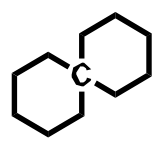
A spiro compound is typically an organic compound containing rings linked together by one common atom (spiroatom) as carbon atom with bold in figure below. The spiro[pyrrolidin-3,3′- oxindole] ring system is a structural framework incorporated in several cytostatic alkaloids and unnatural compounds. Coerulescine (1) and horsfiline are the simplest prototype members of this subfamily that can be synthesized by the route shown below.
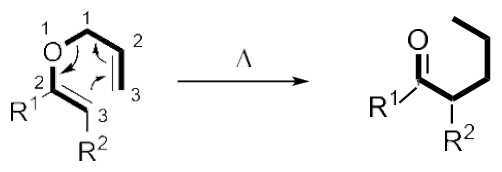
Claisen rearrangement, which is a [3,3]-sigmatropic rearrangement, is a powerful carbon– carbon bond-forming reaction in which an allyl vinyl ether is converted thermally to an unsaturated carbonyl compound as shown in the Scheme below. When compound A is heated, it undergoes Claisen rearrangement to give carbonyl compound B.
For this entire task, your answers can be given without any stereochemical details.
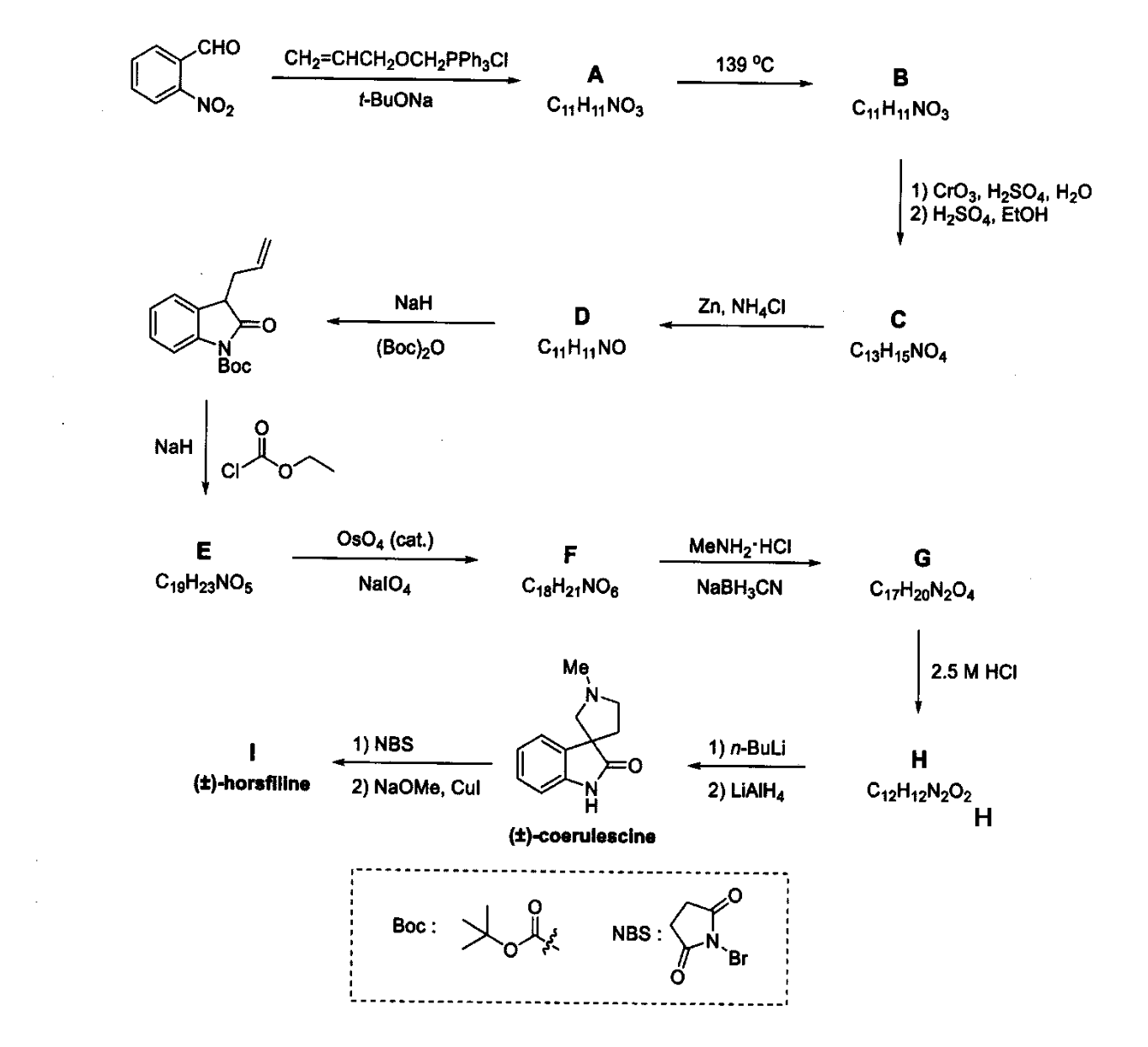
3.1 Draw the structures of A and B.
- A is an inseparable mixture of cis/trans isomers.
- B has IR absorption at \(1726\ \mathrm{cm^{-1}}\).
3.2 Draw structures for C, D, E, and F.
- D–F have a bicyclic structure.
3.3 Choose the correct order of steps for the transformation of F to G.
☐ Imine formation, then reduction, then amidation
☐ Amidation, then imine formation, then reduction
☐ Reduction, then amidation, then imine formation
3.4 Draw the structures for G and H (both spiro compounds).
3.5 Draw the structure of the intermediate produced by treatment with n-BuLi in the step H → coerulescine (1).
Coerulescine (1), on treatment with N-bromosuccinimide (NBS), gives the bromo derivative, which upon heating with sodium methoxide in the presence of cuprous iodide gives horsfiline (I) in 60% yield.
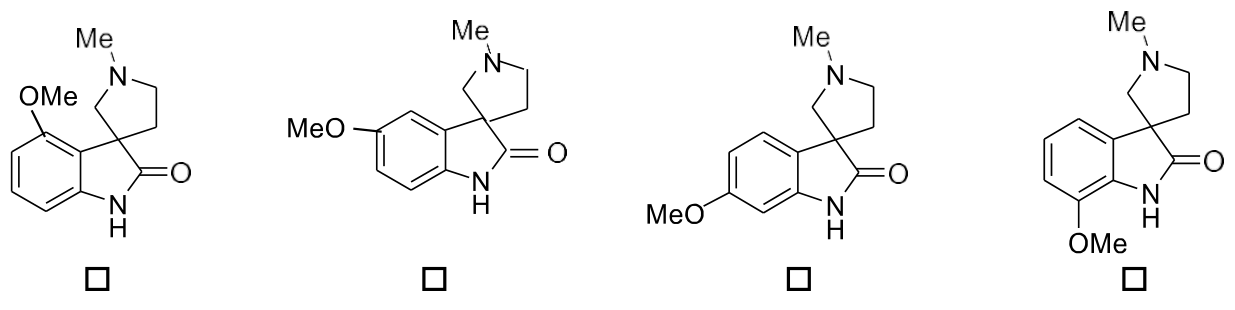
3.6 Choose the correct structure for compound I consistent with the following selected \(\ce{^1H}\)-NMR data: \(\delta\) 7.05 (d, \(J=1.4\ \mathrm{Hz}\), 1H), 6.78 (d, \(J=8.0\ \mathrm{Hz}\), 1H), 6.72 (dd, \(J=8.0,\ 1.4\ \mathrm{Hz}\), 1H) ppm. Tick the relevant box.
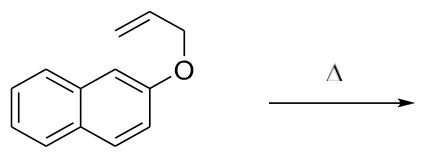
3.7 When the allyl ether of 2-naphthol is heated a sigmatropic rearrangement is initiated. Write the structure of major product isolated from this reaction.
Official English text of the problem.
Answers
Unprimed positions below belong to the oxindole ring; primed positions belong to the second nitrogen-containing ring. Stereochemistry is omitted where permitted by the problem.
- 3.1
- A: Allyl 2-(2-nitrophenyl)vinyl ether, an \(E/Z\) mixture.
\(E\):C=CCO/C=C/c1ccccc1[N+](=O)[O-]
\(Z\):C=CCO/C=C\c1ccccc1[N+](=O)[O-] -
B: 2-(2-Nitrophenyl)pent-4-enal.
O=CC(CC=C)c1ccccc1[N+](=O)[O-] -
3.2
- C: Ethyl 2-(2-nitrophenyl)pent-4-enoate.
CCOC(=O)C(CC=C)c1ccccc1[N+](=O)[O-] - D: 3-Allylindolin-2-one.
O=C1Nc2ccccc2C1CC=C - E: 1-tert-Butyl 3-ethyl 2-oxo-3-(prop-2-en-1-yl)indoline-1,3-dicarboxylate.
CCOC(=O)C1(CC=C)C(=O)N(C(=O)OC(C)(C)C)c2ccccc21 -
F: 1-tert-Butyl 3-ethyl 2-oxo-3-(2-oxoethyl)indoline-1,3-dicarboxylate.
CCOC(=O)C1(CC=O)C(=O)N(C(=O)OC(C)(C)C)c2ccccc21 -
3.3 Tick the first box: imine formation, then reduction, then amidation.
-
3.4
- G: The oxindole-\(N\)-Boc derivative of 1′-methylspiro[indoline-3,3′-pyrrolidine]-2,2′-dione.
CN1CCC2(C1=O)c1ccccc1N(C(=O)OC(C)(C)C)C2=O -
H: 1′-Methylspiro[indoline-3,3′-pyrrolidine]-2,2′-dione.
CN1CCC2(C1=O)c1ccccc1NC2=O -
3.5 The lithium salt of H formed by deprotonation of its oxindole nitrogen.
CN1CCC2(C1=O)c1ccccc1[N-]C2=O.[Li+] -
3.6 Tick the second structure from the left: horsfiline, the 5-methoxy derivative of coerulescine.
CN1CCC2(C1)c1cc(OC)ccc1NC2=O -
3.7 1-Allylnaphthalen-2-ol, also called 1-allyl-2-naphthol.
C=CCc1c(O)ccc2ccccc12
Solution
Throughout the solution, \(\mathrm{Ar}\) denotes the 2-nitrophenyl group. In reduction equations, \(\ce{[H]}\) denotes one formal reducing hydrogen equivalent supplied by the stated reagents.
3.1 — Wittig reaction and Claisen rearrangement
Sodium tert-butoxide removes a proton from the carbon adjacent to phosphorus in the phosphonium salt. This gives the allyloxymethylene triphenylphosphorus ylide, represented by the charge-separated SMILES:
C=CCO[CH-][P+](c1ccccc1)(c1ccccc1)c1ccccc1
The activation and Wittig reactions can be written as:
\[ \ce{[Ph3PCH2OCH2CH=CH2]Cl + NaOC(CH3)3 -> Ph3P=CH-O-CH2-CH=CH2 + HOC(CH3)3 + NaCl} \]
\[ \ce{ArCHO + Ph3P=CH-O-CH2-CH=CH2 -> A + Ph3PO} \]
The aldehyde carbon becomes the aryl-bearing carbon of the new double bond. The ylide carbon becomes the oxygen-bearing carbon. Thus A has the connectivity
\[ \ce{Ar-CH=CH-O-CH2-CH=CH2}. \]
Each alkene carbon bears two different substituents, so \(E\) and \(Z\) forms are possible, explaining the stated inseparable cis/trans mixture.
At \(139\,^\circ\mathrm{C}\), A undergoes a concerted Claisen rearrangement:
\[ \ce{Ar-CH=CH-O-CH2-CH=CH2 ->[\Delta] OHC-CH(Ar)-CH2-CH=CH2}. \]
The six-membered transition-state arrangement produces three simultaneous changes:
- The oxygen–allyl carbon bond breaks.
- A new carbon–carbon bond forms between the terminal allyl carbon and the aryl-bearing vinyl carbon.
- The vinyl ether becomes a carbonyl group, while the allyl double bond shifts.
The oxygen-bearing vinyl carbon originally carries hydrogen, so the carbonyl product is the aldehyde B, rather than a ketone. Its aldehyde carbonyl is consistent with the absorption at \(1726\ \mathrm{cm^{-1}}\).
Both A and B have formula \(\ce{C11H11NO3}\), as required for an isomerization.
3.2 — Identification of C, D, E, and F
Formation of C. Jones oxidation converts the aldehyde of B into 2-(2-nitrophenyl)pent-4-enoic acid:
O=C(O)C(CC=C)c1ccccc1[N+](=O)[O-]
A balanced oxidation equation is
\[ \ce{3B + 2CrO3 + 3H2SO4 -> 3ArCH(CH2CH=CH2)COOH + Cr2(SO4)3 + 3H2O}. \]
Acid-catalysed esterification with ethanol then gives C:
\[ \ce{ArCH(CH2CH=CH2)COOH + C2H5OH <=>[H+] C + H2O}. \]
The ethyl ester has formula \(\ce{C13H15NO4}\), matching the scheme.
Formation of D. Zinc/ammonium chloride reduces the ortho nitro group to an amino group. The resulting amino group attacks the ester carbonyl intramolecularly. Loss of ethanol closes the five-membered lactam ring, giving 3-allylindolin-2-one, D.
The balanced net ionic equation, combining reduction and cyclization, is
\[ \ce{C + 3Zn + 6H+ -> D + C2H5OH + 3Zn^2+ + 2H2O}. \]
The benzene ring and newly formed lactam ring constitute the required bicyclic structure. The product formula is \(\ce{C11H11NO}\).
Formation of E. First, the oxindole nitrogen is Boc-protected. Call the explicitly drawn protected intermediate P, tert-butyl 3-allyl-2-oxoindoline-1-carboxylate:
CC(C)(C)OC(=O)N1C(=O)C(CC=C)c2ccccc21
A balanced net equation for protection under the stated sodium hydride conditions is
\[ \ce{D + NaH + (Boc)2O -> P + H2 + CO2 + NaOC(CH3)3}. \]
A second treatment with sodium hydride removes the remaining hydrogen at oxindole C3. The resulting enolate attacks ethyl chloroformate, CCOC(=O)Cl, installing an ethoxycarbonyl group at C3:
\[ \ce{P + NaH + ClC(=O)OC2H5 -> E + H2 + NaCl}. \]
Thus E has both an allyl group and an ethoxycarbonyl group attached to C3, while its nitrogen carries Boc. Its formula is \(\ce{C19H23NO5}\).
Formation of F. Catalytic osmium tetroxide and sodium periodate cleave the terminal alkene:
\[ \ce{-CH2-CH=CH2 -> -CH2-CHO} \]
on the retained molecular fragment. The terminal alkene carbon becomes methanal (formaldehyde), C=O.
The balanced net oxidation is
\[ \ce{E + 2NaIO4 ->[OsO4\ (cat.)] F + HCHO + 2NaIO3}. \]
Consequently, the allyl substituent of E becomes a 2-oxoethyl substituent in F. The formula changes from \(\ce{C19H23NO5}\) to \(\ce{C18H21NO6}\), exactly as printed.
3.3 — Order of the steps from F to G
The correct sequence is imine formation → reduction → amidation.
- Imine formation. Methylamine reacts with the aldehyde group of F, eliminating water. The N-methyl imine of F is:
CCOC(=O)C1(CC=NC)C(=O)N(C(=O)OC(C)(C)C)c2ccccc21
For the aldehyde-containing fragment, the balanced condensation is
\[ \ce{R-CHO + CH3NH2 <=> R-CH=N-CH3 + H2O}. \]
- Reduction. Sodium cyanoborohydride reduces the imine/iminium functionality to a secondary amine:
\[ \ce{R-CH=N-CH3 + 2[H] -> R-CH2-NH-CH3}. \]
The resulting 2-(methylamino)ethyl derivative of F is:
CCOC(=O)C1(CCNC)C(=O)N(C(=O)OC(C)(C)C)c2ccccc21
- Amidation. The secondary amine attacks the ethyl ester carbonyl intramolecularly. Ethanol is eliminated, and a five-membered \(N\)-methyl lactam forms.
The complete atom-balanced net transformation is
\[ \ce{F + CH3NH2 + 2[H] -> G + H2O + C2H5OH}. \]
The aldehyde readily undergoes condensation with methylamine. Amidation first would instead produce a much less nucleophilic amide nitrogen, making the proposed subsequent imine formation unfavourable.
3.4 — Structures of G and H
The ring formed during amidation follows this sequence:
\[ \text{spiro carbon} -\ce{C(=O)} -\ce{N(CH3)} -\ce{CH2} -\ce{CH2} -\text{the same spiro carbon}. \]
It shares only the original oxindole C3 atom with the oxindole ring, so G is a spiro compound. It contains:
- the original oxindole carbonyl;
- the newly formed \(N\)-methyl lactam carbonyl;
- a Boc group on the oxindole nitrogen.
Its formula is \(\ce{C17H20N2O4}\).
Treatment with \(2.5\ \mathrm{M}\) hydrochloric acid removes Boc and gives the oxindole N–H compound H. Net Boc fragmentation can be written as
\[ \ce{G ->[H+] H + CO2 + (CH3)2C=CH2}. \]
Here the hydrocarbon coproduct is 2-methylpropene, C=C(C)C. The molecular formula changes by loss of \(\ce{C5H8O2}\):
\[ \ce{C17H20N2O4 -> C12H12N2O2 + CO2 + C4H8}. \]
Both lactam carbonyls are present in H.
3.5 — Intermediate formed with n-BuLi
The oxindole nitrogen of H bears an acidic hydrogen. n-Butyllithium removes this hydrogen, producing the lithium amidate of H and butane:
\[ \ce{C12H12N2O2 + C4H9Li -> Li[C12H11N2O2] + C4H10}. \]
To draw the intermediate, replace the oxindole N–H in H with \(\ce{N^-}\) and an associated \(\ce{Li+}\). Both carbonyl groups remain present.
The ionic SMILES in the Answers section records this formal N-deprotonated structure. The amidate charge is delocalized over the nitrogen–carbonyl unit; that SMILES does not specify lithium coordination or aggregation.
Deprotonation makes the oxindole carbonyl less electrophilic. Lithium aluminium hydride then reduces the other, \(N\)-methyl lactam carbonyl to a methylene group. Work-up restores the oxindole N–H, giving coerulescine, 1′-methylspiro[indoline-3,3′-pyrrolidin]-2-one:
CN1CCC2(C1)c1ccccc1NC2=O
The overall reduction, including work-up, has the formal balance
\[ \ce{C12H12N2O2 + 4[H] -> C12H14N2O + H2O}. \]
3.6 — Identification of horsfiline
The answer is the second structure from the left, with methoxy at oxindole C5.
Its three aromatic protons are H4, H6, and H7:
| Proton | Given signal | Coupling assignment |
|---|---|---|
| H4 | \(\delta 7.05\), d, \(J=1.4\ \mathrm{Hz}\) | Meta coupling to H6 |
| H7 | \(\delta 6.78\), d, \(J=8.0\ \mathrm{Hz}\) | Ortho coupling to H6 |
| H6 | \(\delta 6.72\), dd, \(J=8.0,\ 1.4\ \mathrm{Hz}\) | Ortho coupling to H7 and meta coupling to H4 |
The large coupling identifies one adjacent proton pair, H6–H7. The small coupling identifies the meta pair H4–H6.
The 4- and 7-methoxy alternatives each leave three consecutive aromatic protons and therefore require two substantial ortho couplings. They do not fit the observed pattern.
The coupling topology alone also permits a 6-methoxy arrangement. The chemical-shift assignments and reaction regiochemistry select C5: the lactam nitrogen directs aromatic bromination preferentially to the para position, C5. Copper-assisted methoxylation then replaces bromine at that same carbon.
The intermediate is 5-bromocoerulescine:
CN1CCC2(C1)c1cc(Br)ccc1NC2=O
The balanced bromination is
\[ \ce{C12H14N2O + C4H4BrNO2 -> C12H13BrN2O + C4H5NO2}, \]
where the brominating reagent is N-bromosuccinimide, O=C1CCC(=O)N1Br, and its coproduct is succinimide, O=C1CCC(=O)N1.
Methoxylation gives horsfiline:
\[ \ce{C12H13BrN2O + NaOCH3 ->[CuI,\ \Delta] C13H16N2O2 + NaBr}. \]
The stated 60% yield is the isolated yield; it does not change the structural assignment.
3.7 — Claisen rearrangement of the allyl ether of 2-naphthol
The starting material is 2-(allyloxy)naphthalene:
C=CCOc1ccc2ccccc2c1
Its preferred aromatic Claisen rearrangement forms the new carbon–carbon bond at naphthalene C1, adjacent to the oxygen-bearing C2. This pathway preserves a benzenoid ring during rearrangement.
The immediate keto intermediate is 1-allylnaphthalen-2(1H)-one:
O=C1C=Cc2ccccc2C1CC=C
Proton transfer and keto–enol tautomerization restore aromaticity, furnishing 1-allylnaphthalen-2-ol:
C=CCc1c(O)ccc2ccccc12
Thus the product to draw is a naphthalene ring with OH at C2 and \(\ce{-CH2-CH=CH2}\) at C1. The double bond remains terminal.
The overall reaction is an atom-conserving isomerization:
\[ \underbrace{\ce{C13H12O}}_{\text{2-(allyloxy)naphthalene}} \xrightarrow{\Delta} \underbrace{\ce{C13H12O}}_{\text{1-allylnaphthalen-2-ol}}. \]
The answers were checked against the official answers published by the organisers.
IChO 2020 · Theorieaufgabe 3
(±)-Coerulescin
Eine Spiroverbindung ist typischerweise eine organische Verbindung mit Ringen, die über ein einziges gemeinsames Atom (Spiroatom) miteinander verknüpft sind, wie das in der nachstehenden Abbildung fett hervorgehobene Kohlenstoffatom. Das Spiro[pyrrolidin-3,3′-oxindol]-Ringsystem ist ein Strukturgerüst, das in mehreren zytostatischen Alkaloiden und nicht natürlich vorkommenden Verbindungen enthalten ist. Coerulescin (1) und Horsfilin sind die einfachsten prototypischen Vertreter dieser Untergruppe und können über den nachstehend gezeigten Syntheseweg hergestellt werden.
Die Claisen-Umlagerung, eine [3,3]-sigmatrope Umlagerung, ist eine leistungsfähige Reaktion zur Bildung von Kohlenstoff–Kohlenstoff-Bindungen, bei der ein Allylvinylether thermisch in eine ungesättigte Carbonylverbindung überführt wird, wie im nachstehenden Schema gezeigt. Beim Erhitzen von Verbindung A erfolgt eine Claisen-Umlagerung zur Carbonylverbindung B.
Bei dieser gesamten Aufgabe können Sie Ihre Antworten ohne stereochemische Angaben geben.
3.1 Zeichnen Sie die Strukturen von A und B.
- A ist ein nicht trennbares Gemisch aus cis/trans-Isomeren.
- B weist eine IR-Absorption bei \(1726\ \mathrm{cm^{-1}}\) auf.
3.2 Zeichnen Sie die Strukturen von C, D, E und F.
- D–F haben eine bicyclische Struktur.
3.3 Wählen Sie die richtige Reihenfolge der Schritte für die Umwandlung von F in G.
☐ Iminbildung, dann Reduktion, dann Amidierung
☐ Amidierung, dann Iminbildung, dann Reduktion
☐ Reduktion, dann Amidierung, dann Iminbildung
3.4 Zeichnen Sie die Strukturen von G und H (beides Spiroverbindungen).
3.5 Zeichnen Sie die Struktur des Zwischenprodukts, das bei der Behandlung mit n-BuLi im Schritt H → Coerulescin (1) entsteht.
Coerulescin (1) ergibt bei der Behandlung mit N-Bromsuccinimid (NBS) das Bromderivat, das beim Erhitzen mit Natriummethanolat in Gegenwart von Kupfer(I)-iodid Horsfilin (I) in 60% Ausbeute liefert.
3.6 Wählen Sie die richtige Struktur für Verbindung I, die mit den folgenden ausgewählten \(\ce{^1H}\)-NMR-Daten übereinstimmt: \(\delta\) 7.05 (d, \(J=1.4\ \mathrm{Hz}\), 1H), 6.78 (d, \(J=8.0\ \mathrm{Hz}\), 1H), 6.72 (dd, \(J=8.0,\ 1.4\ \mathrm{Hz}\), 1H) ppm. Kreuzen Sie das entsprechende Kästchen an.
3.7 Beim Erhitzen des Allylethers von 2-Naphthol wird eine sigmatrope Umlagerung ausgelöst. Zeichnen Sie die Struktur des aus dieser Reaktion isolierten Hauptprodukts.
Aufgabentext aus dem offiziellen englischen Text übersetzt.
Antworten
Die nachstehend angegebenen Positionen ohne Strich gehören zum Oxindolring; Positionen mit Strich gehören zum zweiten stickstoffhaltigen Ring. Stereochemische Angaben werden weggelassen, soweit die Aufgabenstellung dies erlaubt.
- 3.1
- A: Allyl-2-(2-nitrophenyl)vinylether, ein \(E/Z\)-Gemisch.
\(E\):C=CCO/C=C/c1ccccc1[N+](=O)[O-]
\(Z\):C=CCO/C=C\c1ccccc1[N+](=O)[O-] -
B: 2-(2-Nitrophenyl)pent-4-enal.
O=CC(CC=C)c1ccccc1[N+](=O)[O-] -
3.2
- C: Ethyl-2-(2-nitrophenyl)pent-4-enoat.
CCOC(=O)C(CC=C)c1ccccc1[N+](=O)[O-] - D: 3-Allylindolin-2-on.
O=C1Nc2ccccc2C1CC=C - E: 1-tert-Butyl-3-ethyl-2-oxo-3-(prop-2-en-1-yl)indolin-1,3-dicarboxylat.
CCOC(=O)C1(CC=C)C(=O)N(C(=O)OC(C)(C)C)c2ccccc21 -
F: 1-tert-Butyl-3-ethyl-2-oxo-3-(2-oxoethyl)indolin-1,3-dicarboxylat.
CCOC(=O)C1(CC=O)C(=O)N(C(=O)OC(C)(C)C)c2ccccc21 -
3.3 Kreuzen Sie das erste Kästchen an: Iminbildung, dann Reduktion, dann Amidierung.
-
3.4
- G: Das am Oxindol-\(N\) Boc-geschützte Derivat von 1′-Methylspiro[indolin-3,3′-pyrrolidin]-2,2′-dion.
CN1CCC2(C1=O)c1ccccc1N(C(=O)OC(C)(C)C)C2=O -
H: 1′-Methylspiro[indolin-3,3′-pyrrolidin]-2,2′-dion.
CN1CCC2(C1=O)c1ccccc1NC2=O -
3.5 Das Lithiumsalz von H, das durch Deprotonierung seines Oxindolstickstoffs entsteht.
CN1CCC2(C1=O)c1ccccc1[N-]C2=O.[Li+] -
3.6 Kreuzen Sie die zweite Struktur von links an: Horsfilin, das 5-Methoxyderivat von Coerulescin.
CN1CCC2(C1)c1cc(OC)ccc1NC2=O -
3.7 1-Allylnaphthalin-2-ol, auch 1-Allyl-2-naphthol genannt.
C=CCc1c(O)ccc2ccccc12
Lösung
In der gesamten Lösung bezeichnet \(\mathrm{Ar}\) die 2-Nitrophenylgruppe. In Reduktionsgleichungen bezeichnet \(\ce{[H]}\) ein formales reduzierendes Wasserstoffäquivalent, das von den angegebenen Reagenzien bereitgestellt wird.
3.1 — Wittig-Reaktion und Claisen-Umlagerung
Natrium-tert-butanolat entfernt ein Proton vom Kohlenstoffatom neben dem Phosphor im Phosphoniumsalz. Dabei entsteht das Allyloxymethylen-triphenylphosphor-Ylid, dargestellt durch die SMILES-Schreibweise mit getrennten Ladungen:
C=CCO[CH-][P+](c1ccccc1)(c1ccccc1)c1ccccc1
Die Aktivierung und die Wittig-Reaktion lassen sich wie folgt formulieren:
\[ \ce{[Ph3PCH2OCH2CH=CH2]Cl + NaOC(CH3)3 -> Ph3P=CH-O-CH2-CH=CH2 + HOC(CH3)3 + NaCl} \]
\[ \ce{ArCHO + Ph3P=CH-O-CH2-CH=CH2 -> A + Ph3PO} \]
Der Aldehydkohlenstoff wird zum arylsubstituierten Kohlenstoffatom der neuen Doppelbindung. Der Ylidkohlenstoff wird zum sauerstoffgebundenen Kohlenstoffatom. A weist somit die folgende Verknüpfung auf:
\[ \ce{Ar-CH=CH-O-CH2-CH=CH2}. \]
Jedes Alkenkohlenstoffatom trägt zwei verschiedene Substituenten, sodass \(E\)- und \(Z\)-Formen möglich sind. Dies erklärt das angegebene nicht trennbare cis/trans-Gemisch.
Bei \(139\,^\circ\mathrm{C}\) durchläuft A eine konzertierte Claisen-Umlagerung:
\[ \ce{Ar-CH=CH-O-CH2-CH=CH2 ->[\Delta] OHC-CH(Ar)-CH2-CH=CH2}. \]
Die sechsgliedrige Anordnung im Übergangszustand bewirkt drei gleichzeitige Veränderungen:
- Die Bindung zwischen dem Sauerstoff und dem Allylkohlenstoff wird gespalten.
- Zwischen dem endständigen Allylkohlenstoff und dem arylsubstituierten Vinylkohlenstoff entsteht eine neue Kohlenstoff–Kohlenstoff-Bindung.
- Der Vinylether wird zu einer Carbonylgruppe, während sich die Allyldoppelbindung verschiebt.
Der sauerstoffgebundene Vinylkohlenstoff trägt ursprünglich Wasserstoff, sodass das Carbonylprodukt der Aldehyd B und kein Keton ist. Seine Aldehydcarbonylgruppe steht mit der Absorption bei \(1726\ \mathrm{cm^{-1}}\) im Einklang.
Sowohl A als auch B haben die Summenformel \(\ce{C11H11NO3}\), wie es für eine Isomerisierung erforderlich ist.
3.2 — Identifizierung von C, D, E und F
Bildung von C. Die Jones-Oxidation überführt die Aldehydgruppe von B in 2-(2-Nitrophenyl)pent-4-ensäure:
O=C(O)C(CC=C)c1ccccc1[N+](=O)[O-]
Eine ausgeglichene Oxidationsgleichung lautet
\[ \ce{3B + 2CrO3 + 3H2SO4 -> 3ArCH(CH2CH=CH2)COOH + Cr2(SO4)3 + 3H2O}. \]
Die säurekatalysierte Veresterung mit Ethanol liefert anschließend C:
\[ \ce{ArCH(CH2CH=CH2)COOH + C2H5OH <=>[H+] C + H2O}. \]
Der Ethylester hat die Summenformel \(\ce{C13H15NO4}\), in Übereinstimmung mit dem Schema.
Bildung von D. Zink/Ammoniumchlorid reduziert die ortho-Nitrogruppe zu einer Aminogruppe. Die entstandene Aminogruppe greift die Estercarbonylgruppe intramolekular an. Unter Abspaltung von Ethanol schließt sich der fünfgliedrige Lactamring, wobei 3-Allylindolin-2-on, D, entsteht.
Die ausgeglichene Nettoionengleichung, die Reduktion und Cyclisierung zusammenfasst, lautet
\[ \ce{C + 3Zn + 6H+ -> D + C2H5OH + 3Zn^2+ + 2H2O}. \]
Der Benzolring und der neu gebildete Lactamring bilden die geforderte bicyclische Struktur. Die Summenformel des Produkts lautet \(\ce{C11H11NO}\).
Bildung von E. Zunächst wird der Oxindolstickstoff mit Boc geschützt. Das explizit gezeichnete geschützte Zwischenprodukt tert-Butyl-3-allyl-2-oxoindolin-1-carboxylat sei P genannt:
CC(C)(C)OC(=O)N1C(=O)C(CC=C)c2ccccc21
Eine ausgeglichene Nettogleichung für die Einführung der Schutzgruppe unter den angegebenen Bedingungen mit Natriumhydrid lautet
\[ \ce{D + NaH + (Boc)2O -> P + H2 + CO2 + NaOC(CH3)3}. \]
Eine zweite Behandlung mit Natriumhydrid entfernt den verbleibenden Wasserstoff am Oxindol-C3. Das entstandene Enolat greift Chlorameisensäureethylester, CCOC(=O)Cl, an, wodurch eine Ethoxycarbonylgruppe an C3 eingeführt wird:
\[ \ce{P + NaH + ClC(=O)OC2H5 -> E + H2 + NaCl}. \]
Somit trägt E sowohl eine Allylgruppe als auch eine Ethoxycarbonylgruppe an C3, während sein Stickstoff Boc trägt. Seine Summenformel lautet \(\ce{C19H23NO5}\).
Bildung von F. Osmiumtetroxid in katalytischer Menge und Natriumperiodat spalten das endständige Alken:
\[ \ce{-CH2-CH=CH2 -> -CH2-CHO} \]
am erhalten bleibenden Molekülfragment. Das endständige Alkenkohlenstoffatom wird zu Methanal (Formaldehyd), C=O.
Die ausgeglichene Nettooxidation lautet
\[ \ce{E + 2NaIO4 ->[OsO4\ (cat.)] F + HCHO + 2NaIO3}. \]
Folglich wird der Allylsubstituent von E zu einem 2-Oxoethylsubstituenten in F. Die Summenformel ändert sich von \(\ce{C19H23NO5}\) zu \(\ce{C18H21NO6}\), genau wie angegeben.
3.3 — Reihenfolge der Schritte von F zu G
Die richtige Reihenfolge lautet Iminbildung → Reduktion → Amidierung.
- Iminbildung. Methylamin reagiert unter Wasserabspaltung mit der Aldehydgruppe von F. Das N-Methylimin von F ist:
CCOC(=O)C1(CC=NC)C(=O)N(C(=O)OC(C)(C)C)c2ccccc21
Für das aldehydhaltige Fragment lautet die ausgeglichene Kondensationsgleichung
\[ \ce{R-CHO + CH3NH2 <=> R-CH=N-CH3 + H2O}. \]
- Reduktion. Natriumcyanoborhydrid reduziert die Imin-/Iminiumfunktion zu einem sekundären Amin:
\[ \ce{R-CH=N-CH3 + 2[H] -> R-CH2-NH-CH3}. \]
Das entstandene 2-(Methylamino)ethylderivat von F ist:
CCOC(=O)C1(CCNC)C(=O)N(C(=O)OC(C)(C)C)c2ccccc21
- Amidierung. Das sekundäre Amin greift die Carbonylgruppe des Ethylesters intramolekular an. Ethanol wird abgespalten, und ein fünfgliedriges \(N\)-Methyllactam entsteht.
Die vollständige, hinsichtlich aller Atome ausgeglichene Nettoumwandlung lautet
\[ \ce{F + CH3NH2 + 2[H] -> G + H2O + C2H5OH}. \]
Der Aldehyd kondensiert leicht mit Methylamin. Eine zuerst erfolgende Amidierung würde dagegen einen wesentlich weniger nucleophilen Amidstickstoff erzeugen, wodurch die vorgeschlagene anschließende Iminbildung ungünstig wäre.
3.4 — Strukturen von G und H
Der bei der Amidierung gebildete Ring weist die folgende Abfolge auf:
\[ \text{Spirokohlenstoff} -\ce{C(=O)} -\ce{N(CH3)} -\ce{CH2} -\ce{CH2} -\text{derselbe Spirokohlenstoff}. \]
Er hat mit dem Oxindolring nur das ursprüngliche Oxindol-C3-Atom gemeinsam, sodass G eine Spiroverbindung ist. Sie enthält:
- die ursprüngliche Oxindolcarbonylgruppe;
- die neu gebildete \(N\)-Methyllactamcarbonylgruppe;
- eine Boc-Gruppe am Oxindolstickstoff.
Ihre Summenformel lautet \(\ce{C17H20N2O4}\).
Die Behandlung mit \(2.5\ \mathrm{M}\) Salzsäure entfernt Boc und liefert die Oxindol-N–H-Verbindung H. Die Nettofragmentierung der Boc-Gruppe lässt sich wie folgt formulieren:
\[ \ce{G ->[H+] H + CO2 + (CH3)2C=CH2}. \]
Das Kohlenwasserstoff-Nebenprodukt ist hier 2-Methylpropen, C=C(C)C. Die Summenformel ändert sich durch den Verlust von \(\ce{C5H8O2}\):
\[ \ce{C17H20N2O4 -> C12H12N2O2 + CO2 + C4H8}. \]
Beide Lactamcarbonylgruppen sind in H vorhanden.
3.5 — Mit n-BuLi gebildetes Zwischenprodukt
Der Oxindolstickstoff von H trägt ein saures Wasserstoffatom. n-Butyllithium entfernt dieses Wasserstoffatom, wobei das Lithiumamidat von H und Butan entstehen:
\[ \ce{C12H12N2O2 + C4H9Li -> Li[C12H11N2O2] + C4H10}. \]
Um das Zwischenprodukt zu zeichnen, ersetzen Sie das Oxindol-N–H in H durch \(\ce{N^-}\) und ein zugehöriges \(\ce{Li+}\). Beide Carbonylgruppen bleiben erhalten.
Die ionische SMILES-Schreibweise im Abschnitt Antworten gibt diese formal N-deprotonierte Struktur wieder. Die Ladung des Amidats ist über die Stickstoff–Carbonyl-Einheit delokalisiert; diese SMILES-Schreibweise legt weder die Koordination des Lithiums noch die Aggregation fest.
Die Deprotonierung macht die Oxindolcarbonylgruppe weniger elektrophil. Lithiumaluminiumhydrid reduziert anschließend die andere, zum \(N\)-Methyllactam gehörende Carbonylgruppe zu einer Methylengruppe. Bei der Aufarbeitung wird die Oxindol-N–H-Gruppe wiederhergestellt, wodurch Coerulescin, 1′-Methylspiro[indolin-3,3′-pyrrolidin]-2-on, entsteht:
CN1CCC2(C1)c1ccccc1NC2=O
Die gesamte Reduktion einschließlich der Aufarbeitung hat die formale Bilanz
\[ \ce{C12H12N2O2 + 4[H] -> C12H14N2O + H2O}. \]
3.6 — Identifizierung von Horsfilin
Die Antwort ist die zweite Struktur von links, mit einer Methoxygruppe an Oxindol-C5.
Ihre drei aromatischen Protonen sind H4, H6 und H7:
| Proton | Angegebenes Signal | Zuordnung der Kopplung |
|---|---|---|
| H4 | \(\delta 7.05\), d, \(J=1.4\ \mathrm{Hz}\) | Meta-Kopplung mit H6 |
| H7 | \(\delta 6.78\), d, \(J=8.0\ \mathrm{Hz}\) | Ortho-Kopplung mit H6 |
| H6 | \(\delta 6.72\), dd, \(J=8.0,\ 1.4\ \mathrm{Hz}\) | Ortho-Kopplung mit H7 und Meta-Kopplung mit H4 |
Die große Kopplung kennzeichnet ein benachbartes Protonenpaar, H6–H7. Die kleine Kopplung kennzeichnet das meta-ständige Paar H4–H6.
Bei den alternativen 4- und 7-Methoxystrukturen bleiben jeweils drei aufeinanderfolgende aromatische Protonen erhalten, weshalb zwei deutliche Ortho-Kopplungen erforderlich wären. Sie passen nicht zum beobachteten Muster.
Die Kopplungstopologie allein erlaubt auch eine 6-Methoxyanordnung. Die Zuordnungen der chemischen Verschiebungen und die Regiochemie der Reaktion sprechen für C5: Der Lactamstickstoff dirigiert die aromatische Bromierung bevorzugt in die para-Position C5. Die kupfervermittelte Methoxylierung ersetzt anschließend das Brom am selben Kohlenstoffatom.
Das Zwischenprodukt ist 5-Bromcoerulescin:
CN1CCC2(C1)c1cc(Br)ccc1NC2=O
Die ausgeglichene Bromierung lautet
\[ \ce{C12H14N2O + C4H4BrNO2 -> C12H13BrN2O + C4H5NO2}, \]
wobei das Bromierungsreagenz N-Bromsuccinimid, O=C1CCC(=O)N1Br, und sein Nebenprodukt Succinimid, O=C1CCC(=O)N1, ist.
Die Methoxylierung liefert Horsfilin:
\[ \ce{C12H13BrN2O + NaOCH3 ->[CuI,\ \Delta] C13H16N2O2 + NaBr}. \]
Die angegebene Ausbeute von 60% ist die isolierte Ausbeute; sie ändert nichts an der Strukturzuordnung.
3.7 — Claisen-Umlagerung des Allylethers von 2-Naphthol
Die Ausgangsverbindung ist 2-(Allyloxy)naphthalin:
C=CCOc1ccc2ccccc2c1
Bei ihrer bevorzugten aromatischen Claisen-Umlagerung entsteht die neue Kohlenstoff–Kohlenstoff-Bindung an Naphthalin-C1, benachbart zum sauerstoffgebundenen C2. Bei diesem Reaktionsweg bleibt während der Umlagerung ein benzoider Ring erhalten.
Das unmittelbar gebildete Keto-Zwischenprodukt ist 1-Allylnaphthalin-2(1H)-on:
O=C1C=Cc2ccccc2C1CC=C
Protonenübertragung und Keto–Enol-Tautomerisierung stellen die Aromatizität wieder her und liefern 1-Allylnaphthalin-2-ol:
C=CCc1c(O)ccc2ccccc12
Das zu zeichnende Produkt ist somit ein Naphthalinring mit OH an C2 und \(\ce{-CH2-CH=CH2}\) an C1. Die Doppelbindung bleibt endständig.
Die Gesamtreaktion ist eine Isomerisierung, bei der alle Atome erhalten bleiben:
\[ \underbrace{\ce{C13H12O}}_{\text{2-(Allyloxy)naphthalin}} \xrightarrow{\Delta} \underbrace{\ce{C13H12O}}_{\text{1-Allylnaphthalin-2-ol}}. \]
Die Ergebnisse wurden mit den von den Veranstaltern veröffentlichten offiziellen Ergebnissen abgeglichen.
IChO 2020 · Teori sorusu 3
(±)-Koerulesin
Bir spiro bileşik, genellikle aşağıdaki şekilde kalın çizgilerle gösterilen karbon atomu gibi tek bir ortak atom (spiro atomu) üzerinden birbirine bağlanan halkalar içeren organik bir bileşiktir. Spiro[pirolidin-3,3′-oksindol] halka sistemi, çeşitli sitostatik alkaloitlerin ve doğal olmayan bileşiklerin yapısında bulunan bir iskelettir. Koerulesin (1) ve horsfilin, bu alt ailenin aşağıda gösterilen yolla sentezlenebilen en basit prototip üyeleridir.
Bir [3,3]-sigmatropik çevrilme olan Claisen çevrilmesi, aşağıdaki şemada gösterildiği gibi bir alil vinil eterin ısı etkisiyle doymamış bir karbonil bileşiğine dönüştüğü, karbon–karbon bağı oluşturan güçlü bir tepkimedir. A bileşiği ısıtıldığında Claisen çevrilmesine uğrayarak B karbonil bileşiğini verir.
Bu sorunun tamamında cevaplarınızı herhangi bir stereokimyasal ayrıntı vermeden yazabilirsiniz.
3.1 A ve B bileşiklerinin yapılarını çiziniz.
- A, cis/trans izomerlerinin birbirinden ayrılamayan bir karışımıdır.
- B, \(1726\ \mathrm{cm^{-1}}\) değerinde IR soğurması gösterir.
3.2 C, D, E ve F bileşiklerinin yapılarını çiziniz.
- D–F bisiklik bir yapıya sahiptir.
3.3 F bileşiğinin G bileşiğine dönüşümü için basamakların doğru sırasını seçiniz.
☐ İmin oluşumu, ardından indirgenme, ardından amidasyon
☐ Amidasyon, ardından imin oluşumu, ardından indirgenme
☐ İndirgenme, ardından amidasyon, ardından imin oluşumu
3.4 G ve H bileşiklerinin (her ikisi de spiro bileşiktir) yapılarını çiziniz.
3.5 H → koerulesin (1) basamağında n-BuLi ile muamele sonucunda oluşan ara ürünün yapısını çiziniz.
Koerulesin (1), N-bromosüksinimit (NBS) ile muamele edildiğinde bromo türevini verir; bu türev, bakır(I) iyodür varlığında sodyum metoksit ile ısıtıldığında %60 verimle horsfilin (I) verir.
3.6 Aşağıdaki seçilmiş \(\ce{^1H}\)-NMR verileriyle uyumlu olan I bileşiğinin doğru yapısını seçiniz: \(\delta\) 7.05 (d, \(J=1.4\ \mathrm{Hz}\), 1H), 6.78 (d, \(J=8.0\ \mathrm{Hz}\), 1H), 6.72 (dd, \(J=8.0,\ 1.4\ \mathrm{Hz}\), 1H) ppm. İlgili kutuyu işaretleyiniz.
3.7 2-Naftolün alil eteri ısıtıldığında sigmatropik bir çevrilme başlar. Bu tepkimeden izole edilen ana ürünün yapısını yazınız.
Soru metni resmi İngilizce metinden çevrilmiştir.
Cevaplar
Aşağıdaki üssüz konum numaraları oksindol halkasına, üslü konum numaraları ise azot içeren ikinci halkaya aittir. Sorunun izin verdiği yerlerde stereokimya gösterilmemiştir.
- 3.1
- A: Alil 2-(2-nitrofenil)vinil eter, bir \(E/Z\) karışımı.
\(E\):C=CCO/C=C/c1ccccc1[N+](=O)[O-]
\(Z\):C=CCO/C=C\c1ccccc1[N+](=O)[O-] -
B: 2-(2-Nitrofenil)pent-4-enal.
O=CC(CC=C)c1ccccc1[N+](=O)[O-] -
3.2
- C: Etil 2-(2-nitrofenil)pent-4-enoat.
CCOC(=O)C(CC=C)c1ccccc1[N+](=O)[O-] - D: 3-Alilindolin-2-on.
O=C1Nc2ccccc2C1CC=C - E: 1-tert-Bütil 3-etil 2-okso-3-(prop-2-en-1-il)indolin-1,3-dikarboksilat.
CCOC(=O)C1(CC=C)C(=O)N(C(=O)OC(C)(C)C)c2ccccc21 -
F: 1-tert-Bütil 3-etil 2-okso-3-(2-oksoetil)indolin-1,3-dikarboksilat.
CCOC(=O)C1(CC=O)C(=O)N(C(=O)OC(C)(C)C)c2ccccc21 -
3.3 İlk kutuyu: imin oluşumu, ardından indirgenme, ardından amidasyon seçeneğini işaretleyiniz.
-
3.4
- G: 1′-Metilspiro[indolin-3,3′-pirolidin]-2,2′-dionun oksindol-\(N\)-Boc türevi.
CN1CCC2(C1=O)c1ccccc1N(C(=O)OC(C)(C)C)C2=O -
H: 1′-Metilspiro[indolin-3,3′-pirolidin]-2,2′-dion.
CN1CCC2(C1=O)c1ccccc1NC2=O -
3.5 H bileşiğinin oksindol azotundan proton uzaklaştırılmasıyla oluşan lityum tuzu.
CN1CCC2(C1=O)c1ccccc1[N-]C2=O.[Li+] -
3.6 Soldan ikinci yapıyı işaretleyiniz: koerulesinin 5-metoksi türevi olan horsfilin.
CN1CCC2(C1)c1cc(OC)ccc1NC2=O -
3.7 1-Alilnaftalen-2-ol, diğer adıyla 1-alil-2-naftol.
C=CCc1c(O)ccc2ccccc12
Çözüm
Çözüm boyunca \(\mathrm{Ar}\), 2-nitrofenil grubunu ifade eder. İndirgenme denklemlerinde \(\ce{[H]}\), belirtilen reaktiflerin sağladığı bir formal indirgen hidrojen eşdeğerini ifade eder.
3.1 — Wittig tepkimesi ve Claisen çevrilmesi
Sodyum tert-bütoksit, fosfonyum tuzunda fosfora komşu karbondan bir proton uzaklaştırır. Böylece, yükleri ayrı olarak gösteren aşağıdaki SMILES ile temsil edilen aliloksimetilen trifenilfosfor ilidi oluşur:
C=CCO[CH-][P+](c1ccccc1)(c1ccccc1)c1ccccc1
Aktivasyon ve Wittig tepkimeleri şöyle yazılabilir:
\[ \ce{[Ph3PCH2OCH2CH=CH2]Cl + NaOC(CH3)3 -> Ph3P=CH-O-CH2-CH=CH2 + HOC(CH3)3 + NaCl} \]
\[ \ce{ArCHO + Ph3P=CH-O-CH2-CH=CH2 -> A + Ph3PO} \]
Aldehit karbonu, yeni çift bağın aril grubu taşıyan karbonu hâline gelir. İlit karbonu ise oksijene bağlı karbon hâline gelir. Dolayısıyla A bileşiğinde atomların bağlanma düzeni şöyledir:
\[ \ce{Ar-CH=CH-O-CH2-CH=CH2}. \]
Her alken karbonu iki farklı sübstitüent taşıdığından \(E\) ve \(Z\) biçimleri mümkündür; bu durum, belirtilen ve birbirinden ayrılamayan cis/trans karışımını açıklar.
\(139\,^\circ\mathrm{C}\) sıcaklıkta A, eş zamanlı bir Claisen çevrilmesine uğrar:
\[ \ce{Ar-CH=CH-O-CH2-CH=CH2 ->[\Delta] OHC-CH(Ar)-CH2-CH=CH2}. \]
Altı üyeli geçiş durumu düzeni, eş zamanlı üç değişim meydana getirir:
- Oksijen–alil karbonu bağı kırılır.
- Uçtaki alil karbonu ile aril grubu taşıyan vinil karbonu arasında yeni bir karbon–karbon bağı oluşur.
- Vinil eter bir karbonil grubuna dönüşürken alil çift bağı yer değiştirir.
Oksijene bağlı vinil karbonu başlangıçta bir hidrojen taşıdığından karbonil ürünü bir keton değil, B aldehididir. Aldehit karbonili, \(1726\ \mathrm{cm^{-1}}\) değerindeki soğurmayla uyumludur.
Hem A hem de B, bir izomerleşmede gerektiği gibi \(\ce{C11H11NO3}\) formülüne sahiptir.
3.2 — C, D, E ve F bileşiklerinin belirlenmesi
C bileşiğinin oluşumu. Jones yükseltgemesi, B bileşiğinin aldehit grubunu yükseltgeyerek 2-(2-nitrofenil)pent-4-enoik aside dönüştürür:
O=C(O)C(CC=C)c1ccccc1[N+](=O)[O-]
Denkleştirilmiş yükseltgenme denklemi şöyledir:
\[ \ce{3B + 2CrO3 + 3H2SO4 -> 3ArCH(CH2CH=CH2)COOH + Cr2(SO4)3 + 3H2O}. \]
Ardından etanol ile asit katalizli esterleşme C bileşiğini verir:
\[ \ce{ArCH(CH2CH=CH2)COOH + C2H5OH <=>[H+] C + H2O}. \]
Etil esterin formülü \(\ce{C13H15NO4}\) olup şemayla uyumludur.
D bileşiğinin oluşumu. Çinko/amonyum klorür, orto konumundaki nitro grubunu amino grubuna indirger. Oluşan amino grubu, ester karboniline molekül içi nükleofilik saldırıda bulunur. Etanol ayrılmasıyla beş üyeli laktam halkası kapanır ve 3-alilindolin-2-on, D oluşur.
İndirgenme ve halkalaşmayı birleştiren denkleştirilmiş net iyon denklemi şöyledir:
\[ \ce{C + 3Zn + 6H+ -> D + C2H5OH + 3Zn^2+ + 2H2O}. \]
Benzen halkası ile yeni oluşan laktam halkası, istenen bisiklik yapıyı oluşturur. Ürünün formülü \(\ce{C11H11NO}\) olur.
E bileşiğinin oluşumu. Önce oksindol azotu Boc ile korunur. Yapısı açıkça çizilen korunmuş ara ürün tert-bütil 3-alil-2-oksoindolin-1-karboksilatı, P olarak adlandıralım:
CC(C)(C)OC(=O)N1C(=O)C(CC=C)c2ccccc21
Belirtilen sodyum hidrür koşullarında koruma işleminin denkleştirilmiş net denklemi şöyledir:
\[ \ce{D + NaH + (Boc)2O -> P + H2 + CO2 + NaOC(CH3)3}. \]
Sodyum hidrür ile ikinci muamele, oksindolün C3 konumunda kalan hidrojeni uzaklaştırır. Oluşan enolat, etil kloroformata, CCOC(=O)Cl, nükleofilik saldırıda bulunarak C3 konumuna bir etoksikarbonil grubu bağlar:
\[ \ce{P + NaH + ClC(=O)OC2H5 -> E + H2 + NaCl}. \]
Böylece E bileşiğinde C3 konumuna hem bir alil grubu hem de bir etoksikarbonil grubu bağlıdır; azotu ise Boc taşır. Formülü \(\ce{C19H23NO5}\) olur.
F bileşiğinin oluşumu. Katalitik miktarda osmiyum tetroksit ve sodyum periyodat, uç alkeni parçalar:
\[ \ce{-CH2-CH=CH2 -> -CH2-CHO} \]
Bu dönüşüm, molekülün korunan parçasında gerçekleşir. Uçtaki alken karbonu metanale (formaldehite), C=O, dönüşür.
Denkleştirilmiş net yükseltgenme şöyledir:
\[ \ce{E + 2NaIO4 ->[OsO4\ (cat.)] F + HCHO + 2NaIO3}. \]
Sonuç olarak E bileşiğinin alil sübstitüenti, F bileşiğinde bir 2-oksoetil sübstitüentine dönüşür. Formül, tam olarak verildiği gibi \(\ce{C19H23NO5}\) formülünden \(\ce{C18H21NO6}\) formülüne değişir.
3.3 — F bileşiğinden G bileşiğine geçişte basamakların sırası
Doğru sıra imin oluşumu → indirgenme → amidasyon şeklindedir.
- İmin oluşumu. Metilamin, F bileşiğinin aldehit grubuyla tepkimeye girerek su ayrılmasını sağlar. F bileşiğinin N-metil imini şöyledir:
CCOC(=O)C1(CC=NC)C(=O)N(C(=O)OC(C)(C)C)c2ccccc21
Aldehit içeren parça için denkleştirilmiş kondenzasyon şöyledir:
\[ \ce{R-CHO + CH3NH2 <=> R-CH=N-CH3 + H2O}. \]
- İndirgenme. Sodyum siyanoborohidrür, imin/iminyum fonksiyonel grubunu ikincil bir amine indirger:
\[ \ce{R-CH=N-CH3 + 2[H] -> R-CH2-NH-CH3}. \]
Oluşan F bileşiğinin 2-(metilamino)etil türevi şöyledir:
CCOC(=O)C1(CCNC)C(=O)N(C(=O)OC(C)(C)C)c2ccccc21
- Amidasyon. İkincil amin, etil ester karboniline molekül içi nükleofilik saldırıda bulunur. Etanol ayrılır ve beş üyeli bir \(N\)-metil laktam oluşur.
Atom sayıları bakımından tam olarak denkleştirilmiş net dönüşüm şöyledir:
\[ \ce{F + CH3NH2 + 2[H] -> G + H2O + C2H5OH}. \]
Aldehit, metilamin ile kolayca kondenzasyona uğrar. Önce amidasyon gerçekleşseydi çok daha az nükleofilik bir amit azotu oluşurdu; bu da önerilen sonraki imin oluşumunu elverişsiz hâle getirirdi.
3.4 — G ve H bileşiklerinin yapıları
Amidasyon sırasında oluşan halkada atomlar şu sırayla bağlanır:
\[ \text{spiro karbonu} -\ce{C(=O)} -\ce{N(CH3)} -\ce{CH2} -\ce{CH2} -\text{aynı spiro karbonu}. \]
Bu halka, oksindol halkasıyla yalnızca başlangıçtaki oksindol C3 atomunu ortak kullandığından G bir spiro bileşiktir. Şunları içerir:
- başlangıçtaki oksindol karbonili;
- yeni oluşan \(N\)-metil laktam karbonili;
- oksindol azotu üzerinde bir Boc grubu.
Formülü \(\ce{C17H20N2O4}\) olur.
\(2.5\ \mathrm{M}\) hidroklorik asitle muamele Boc grubunu uzaklaştırır ve oksindol N–H bileşiği H elde edilir. Boc grubunun net parçalanması şöyle yazılabilir:
\[ \ce{G ->[H+] H + CO2 + (CH3)2C=CH2}. \]
Buradaki hidrokarbon yan ürünü 2-metilpropen, C=C(C)C, olur. Molekül formülü, \(\ce{C5H8O2}\) kaybıyla değişir:
\[ \ce{C17H20N2O4 -> C12H12N2O2 + CO2 + C4H8}. \]
H bileşiğinde her iki laktam karbonili de bulunur.
3.5 — n-BuLi ile oluşan ara ürün
H bileşiğinin oksindol azotu asidik bir hidrojen taşır. n-Bütillityum bu hidrojeni uzaklaştırarak H bileşiğinin lityum amidatını ve bütanı oluşturur:
\[ \ce{C12H12N2O2 + C4H9Li -> Li[C12H11N2O2] + C4H10}. \]
Ara ürünü çizmek için H bileşiğindeki oksindol N–H grubunu \(\ce{N^-}\) ve ona eşlik eden bir \(\ce{Li+}\) ile değiştiriniz. Her iki karbonil grubu da korunur.
Cevaplar bölümündeki iyonik SMILES, azotundan proton uzaklaştırılmış bu formal yapıyı gösterir. Amidat yükü, azot–karbonil birimi üzerinde delokalizedir; söz konusu SMILES, lityumun koordinasyonunu veya agregasyonunu belirtmez.
Proton uzaklaştırılması, oksindol karbonilinin elektrofilikliğini azaltır. Ardından lityum alüminyum hidrür, diğer karbonili, yani \(N\)-metil laktam karbonilini bir metilen grubuna indirger. Tepkime sonrası işlemler oksindol N–H grubunu yeniden oluşturarak koerulesini, 1′-metilspiro[indolin-3,3′-pirolidin]-2-onu verir:
CN1CCC2(C1)c1ccccc1NC2=O
Tepkime sonrası işlemler de dâhil olmak üzere toplam indirgenmenin formal olarak denkleştirilmiş hâli şöyledir:
\[ \ce{C12H12N2O2 + 4[H] -> C12H14N2O + H2O}. \]
3.6 — Horsfilinin belirlenmesi
Cevap, metoksi grubu oksindolün C5 konumunda bulunan soldan ikinci yapıdır.
Üç aromatik protonu H4, H6 ve H7'dir:
| Proton | Verilen sinyal | Eşleşme ataması |
|---|---|---|
| H4 | \(\delta 7.05\), d, \(J=1.4\ \mathrm{Hz}\) | H6 ile meta eşleşme |
| H7 | \(\delta 6.78\), d, \(J=8.0\ \mathrm{Hz}\) | H6 ile orto eşleşme |
| H6 | \(\delta 6.72\), dd, \(J=8.0,\ 1.4\ \mathrm{Hz}\) | H7 ile orto ve H4 ile meta eşleşme |
Büyük eşleşme sabiti, komşu bir proton çifti olan H6–H7'yi belirler. Küçük eşleşme sabiti, meta konumlarındaki H4–H6 çiftini belirler.
4- ve 7-metoksi seçeneklerinin her birinde art arda üç aromatik proton kalır; dolayısıyla bunlar iki belirgin orto eşleşme gerektirir. Gözlenen örüntüyle uyumlu değildirler.
Yalnızca eşleşme topolojisi dikkate alındığında 6-metoksi düzeni de mümkündür. Kimyasal kayma atamaları ve tepkimenin bölge seçiciliği, C5 konumunu belirler: laktam azotu, aromatik bromlanmayı tercihen para konumu olan C5'e yönlendirir. Ardından bakır destekli metoksilasyon, aynı karbondaki bromun yerini alır.
Ara ürün 5-bromokoerulesindir:
CN1CCC2(C1)c1cc(Br)ccc1NC2=O
Denkleştirilmiş bromlanma şöyledir:
\[ \ce{C12H14N2O + C4H4BrNO2 -> C12H13BrN2O + C4H5NO2}, \]
burada bromlama reaktifi N-bromosüksinimit, O=C1CCC(=O)N1Br, yan ürünü ise süksinimit, O=C1CCC(=O)N1, olur.
Metoksilasyon horsfilini verir:
\[ \ce{C12H13BrN2O + NaOCH3 ->[CuI,\ \Delta] C13H16N2O2 + NaBr}. \]
Belirtilen %60 verim, izole edilen ürünün verimidir; yapının belirlenmesini değiştirmez.
3.7 — 2-Naftolün alil eterinin Claisen çevrilmesi
Başlangıç maddesi 2-(aliloksi)naftalendir:
C=CCOc1ccc2ccccc2c1
Tercih edilen aromatik Claisen çevrilmesinde yeni karbon–karbon bağı, oksijene bağlı C2'ye komşu olan naftalenin C1 konumunda oluşur. Bu yol, çevrilme sırasında bir benzenoid halkayı korur.
İlk oluşan keto ara ürünü 1-alilnaftalen-2(1H)-ondur:
O=C1C=Cc2ccccc2C1CC=C
Proton aktarımı ve keto–enol tautomerleşmesi aromatikliği yeniden sağlayarak 1-alilnaftalen-2-olü verir:
C=CCc1c(O)ccc2ccccc12
Dolayısıyla çizilecek ürün, C2 konumunda OH ve C1 konumunda \(\ce{-CH2-CH=CH2}\) bulunan bir naftalen halkasıdır. Çift bağ uçta kalır.
Toplam tepkime, atomların korunduğu bir izomerleşmedir:
\[ \underbrace{\ce{C13H12O}}_{\text{2-(aliloksi)naftalen}} \xrightarrow{\Delta} \underbrace{\ce{C13H12O}}_{\text{1-alilnaftalen-2-ol}}. \]
Sonuçlar, düzenleyicilerin yayımladığı resmi sonuçlarla karşılaştırılarak kontrol edildi.
IChO 2020 · Problema teórico 3
(±)-Coerulescina
Un compuesto espiránico es, por lo general, un compuesto orgánico que contiene anillos unidos por un único átomo común (átomo espiránico), como el átomo de carbono resaltado en negrita en la figura siguiente. El sistema de anillos espiro[pirrolidina-3,3′-oxindol] es un esqueleto estructural presente en varios alcaloides citostáticos y compuestos no naturales. La coerulescina (1) y la horsfilina son los miembros prototípicos más sencillos de esta subfamilia y pueden sintetizarse mediante la ruta que se muestra a continuación.
El reordenamiento de Claisen, que es un reordenamiento sigmatrópico [3,3], es una potente reacción de formación de enlaces carbono–carbono en la que un éter alil vinílico se convierte térmicamente en un compuesto carbonílico insaturado, como se muestra en el esquema siguiente. Al calentar el compuesto A, este experimenta un reordenamiento de Claisen que da lugar al compuesto carbonílico B.
En todo este problema, las respuestas pueden darse sin ningún detalle estereoquímico.
3.1 Dibuje las estructuras de A y B.
- A es una mezcla inseparable de isómeros cis/trans.
- B presenta una absorción en el IR a \(1726\ \mathrm{cm^{-1}}\).
3.2 Dibuje las estructuras de C, D, E y F.
- D–F tienen una estructura bicíclica.
3.3 Elija el orden correcto de las etapas para la transformación de F en G.
☐ Formación de imina, seguida de reducción y después amidación
☐ Amidación, seguida de formación de imina y después reducción
☐ Reducción, seguida de amidación y después formación de imina
3.4 Dibuje las estructuras de G y H (ambos compuestos espiránicos).
3.5 Dibuje la estructura del intermedio producido por el tratamiento con n-BuLi en la etapa H → coerulescina (1).
La coerulescina (1), al tratarse con N-bromosuccinimida (NBS), da el derivado bromado, que, al calentarse con metóxido de sodio en presencia de yoduro cuproso, da horsfilina (I) con un rendimiento del 60%.
3.6 Elija la estructura correcta del compuesto I compatible con los siguientes datos seleccionados de RMN de \(\ce{^1H}\): \(\delta\) 7.05 (d, \(J=1.4\ \mathrm{Hz}\), 1H), 6.78 (d, \(J=8.0\ \mathrm{Hz}\), 1H), 6.72 (dd, \(J=8.0,\ 1.4\ \mathrm{Hz}\), 1H) ppm. Marque la casilla correspondiente.
3.7 Al calentar el éter alílico del 2-naftol, se inicia un reordenamiento sigmatrópico. Escriba la estructura del producto mayoritario aislado de esta reacción.
Enunciado traducido del texto oficial en inglés.
Respuestas
Las posiciones sin prima que se indican a continuación pertenecen al anillo de oxindol; las posiciones con prima pertenecen al segundo anillo nitrogenado. Se omite la estereoquímica cuando el problema lo permite.
- 3.1
- A: Éter alil 2-(2-nitrofenil)vinílico, una mezcla \(E/Z\).
\(E\):C=CCO/C=C/c1ccccc1[N+](=O)[O-]
\(Z\):C=CCO/C=C\c1ccccc1[N+](=O)[O-] -
B: 2-(2-Nitrofenil)pent-4-enal.
O=CC(CC=C)c1ccccc1[N+](=O)[O-] -
3.2
- C: 2-(2-Nitrofenil)pent-4-enoato de etilo.
CCOC(=O)C(CC=C)c1ccccc1[N+](=O)[O-] - D: 3-Alilindolin-2-ona.
O=C1Nc2ccccc2C1CC=C - E: 2-Oxo-3-(prop-2-en-1-il)indolina-1,3-dicarboxilato de 1-terc-butilo y 3-etilo.
CCOC(=O)C1(CC=C)C(=O)N(C(=O)OC(C)(C)C)c2ccccc21 -
F: 2-Oxo-3-(2-oxoetil)indolina-1,3-dicarboxilato de 1-terc-butilo y 3-etilo.
CCOC(=O)C1(CC=O)C(=O)N(C(=O)OC(C)(C)C)c2ccccc21 -
3.3 Marque la primera casilla: formación de imina, seguida de reducción y después amidación.
-
3.4
- G: El derivado protegido con Boc en el \(N\) del oxindol de la 1′-metilespiro[indolina-3,3′-pirrolidina]-2,2′-diona.
CN1CCC2(C1=O)c1ccccc1N(C(=O)OC(C)(C)C)C2=O -
H: 1′-Metilespiro[indolina-3,3′-pirrolidina]-2,2′-diona.
CN1CCC2(C1=O)c1ccccc1NC2=O -
3.5 La sal de litio de H formada por desprotonación de su nitrógeno del oxindol.
CN1CCC2(C1=O)c1ccccc1[N-]C2=O.[Li+] -
3.6 Marque la segunda estructura por la izquierda: horsfilina, el derivado 5-metoxi de la coerulescina.
CN1CCC2(C1)c1cc(OC)ccc1NC2=O -
3.7 1-Alilnaftalen-2-ol, también llamado 1-alil-2-naftol.
C=CCc1c(O)ccc2ccccc12
Solución
A lo largo de la solución, \(\mathrm{Ar}\) representa el grupo 2-nitrofenilo. En las ecuaciones de reducción, \(\ce{[H]}\) representa un equivalente formal de hidrógeno reductor aportado por los reactivos indicados.
3.1 — Reacción de Wittig y reordenamiento de Claisen
El terc-butóxido de sodio arranca un protón del carbono adyacente al fósforo en la sal de fosfonio. Así se obtiene el iluro de aliloximetilentrifenilfosforano, representado por el SMILES con separación de cargas:
C=CCO[CH-][P+](c1ccccc1)(c1ccccc1)c1ccccc1
Las reacciones de activación y de Wittig pueden escribirse como:
\[ \ce{[Ph3PCH2OCH2CH=CH2]Cl + NaOC(CH3)3 -> Ph3P=CH-O-CH2-CH=CH2 + HOC(CH3)3 + NaCl} \]
\[ \ce{ArCHO + Ph3P=CH-O-CH2-CH=CH2 -> A + Ph3PO} \]
El carbono del aldehído pasa a ser el carbono del nuevo doble enlace unido al grupo arilo. El carbono del iluro pasa a ser el carbono unido al oxígeno. Por tanto, A presenta la conectividad
\[ \ce{Ar-CH=CH-O-CH2-CH=CH2}. \]
Cada carbono del alqueno tiene dos sustituyentes diferentes, por lo que son posibles las formas \(E\) y \(Z\), lo que explica la mezcla inseparable cis/trans indicada.
A \(139\,^\circ\mathrm{C}\), A experimenta un reordenamiento de Claisen concertado:
\[ \ce{Ar-CH=CH-O-CH2-CH=CH2 ->[\Delta] OHC-CH(Ar)-CH2-CH=CH2}. \]
La disposición de seis miembros del estado de transición produce tres cambios simultáneos:
- Se rompe el enlace entre el oxígeno y el carbono alílico.
- Se forma un nuevo enlace carbono–carbono entre el carbono terminal del grupo alilo y el carbono vinílico unido al grupo arilo.
- El éter vinílico se convierte en un grupo carbonilo, mientras que el doble enlace alílico se desplaza.
El carbono vinílico unido al oxígeno lleva inicialmente un hidrógeno, por lo que el producto carbonílico es el aldehído B, en lugar de una cetona. Su carbonilo aldehídico es compatible con la absorción a \(1726\ \mathrm{cm^{-1}}\).
Tanto A como B tienen la fórmula \(\ce{C11H11NO3}\), como corresponde a una isomerización.
3.2 — Identificación de C, D, E y F
Formación de C. La oxidación de Jones convierte el aldehído de B en ácido 2-(2-nitrofenil)pent-4-enoico:
O=C(O)C(CC=C)c1ccccc1[N+](=O)[O-]
Una ecuación ajustada de la oxidación es
\[ \ce{3B + 2CrO3 + 3H2SO4 -> 3ArCH(CH2CH=CH2)COOH + Cr2(SO4)3 + 3H2O}. \]
La esterificación con etanol catalizada por ácido da entonces C:
\[ \ce{ArCH(CH2CH=CH2)COOH + C2H5OH <=>[H+] C + H2O}. \]
El éster etílico tiene la fórmula \(\ce{C13H15NO4}\), que coincide con la del esquema.
Formación de D. El zinc/cloruro de amonio reduce el grupo nitro en posición orto a un grupo amino. El grupo amino resultante ataca intramolecularmente al carbonilo del éster. La pérdida de etanol cierra el anillo lactámico de cinco miembros y da 3-alilindolin-2-ona, D.
La ecuación iónica neta ajustada, que combina la reducción y la ciclación, es
\[ \ce{C + 3Zn + 6H+ -> D + C2H5OH + 3Zn^2+ + 2H2O}. \]
El anillo de benceno y el anillo lactámico recién formado constituyen la estructura bicíclica requerida. La fórmula del producto es \(\ce{C11H11NO}\).
Formación de E. Primero, se protege el nitrógeno del oxindol con Boc. Denominemos P al intermedio protegido dibujado explícitamente, el 3-alil-2-oxoindolina-1-carboxilato de terc-butilo:
CC(C)(C)OC(=O)N1C(=O)C(CC=C)c2ccccc21
Una ecuación neta ajustada para la protección en las condiciones indicadas con hidruro de sodio es
\[ \ce{D + NaH + (Boc)2O -> P + H2 + CO2 + NaOC(CH3)3}. \]
Un segundo tratamiento con hidruro de sodio elimina el hidrógeno restante en C3 del oxindol. El enolato resultante ataca al cloroformiato de etilo, CCOC(=O)Cl, e introduce un grupo etoxicarbonilo en C3:
\[ \ce{P + NaH + ClC(=O)OC2H5 -> E + H2 + NaCl}. \]
Así, E tiene tanto un grupo alilo como un grupo etoxicarbonilo unidos a C3, mientras que su nitrógeno lleva Boc. Su fórmula es \(\ce{C19H23NO5}\).
Formación de F. El tetróxido de osmio en cantidad catalítica y el peryodato de sodio escinden el alqueno terminal:
\[ \ce{-CH2-CH=CH2 -> -CH2-CHO} \]
en el fragmento molecular que se conserva. El carbono terminal del alqueno se convierte en metanal (formaldehído), C=O.
La ecuación neta ajustada de la oxidación es
\[ \ce{E + 2NaIO4 ->[OsO4\ (cat.)] F + HCHO + 2NaIO3}. \]
En consecuencia, el sustituyente alilo de E se convierte en un sustituyente 2-oxoetilo en F. La fórmula cambia de \(\ce{C19H23NO5}\) a \(\ce{C18H21NO6}\), exactamente como se indica en el enunciado.
3.3 — Orden de las etapas de F a G
La secuencia correcta es formación de imina → reducción → amidación.
- Formación de imina. La metilamina reacciona con el grupo aldehído de F, eliminando agua. La N-metilimina de F es:
CCOC(=O)C1(CC=NC)C(=O)N(C(=O)OC(C)(C)C)c2ccccc21
Para el fragmento que contiene el aldehído, la ecuación ajustada de la condensación es
\[ \ce{R-CHO + CH3NH2 <=> R-CH=N-CH3 + H2O}. \]
- Reducción. El cianoborohidruro de sodio reduce la función imina/iminio a una amina secundaria:
\[ \ce{R-CH=N-CH3 + 2[H] -> R-CH2-NH-CH3}. \]
El derivado 2-(metilamino)etilo de F resultante es:
CCOC(=O)C1(CCNC)C(=O)N(C(=O)OC(C)(C)C)c2ccccc21
- Amidación. La amina secundaria ataca intramolecularmente al carbonilo del éster etílico. Se elimina etanol y se forma una \(N\)-metillactama de cinco miembros.
La transformación neta completa, ajustada en cuanto a átomos, es
\[ \ce{F + CH3NH2 + 2[H] -> G + H2O + C2H5OH}. \]
El aldehído experimenta fácilmente una condensación con la metilamina. Si la amidación tuviera lugar primero, se produciría en cambio un nitrógeno amídico mucho menos nucleófilo, lo que haría desfavorable la posterior formación de imina propuesta.
3.4 — Estructuras de G y H
El anillo formado durante la amidación sigue esta secuencia:
\[ \text{carbono espiránico} -\ce{C(=O)} -\ce{N(CH3)} -\ce{CH2} -\ce{CH2} -\text{el mismo carbono espiránico}. \]
Solo comparte con el anillo de oxindol el átomo C3 original del oxindol, por lo que G es un compuesto espiránico. Contiene:
- el carbonilo original del oxindol;
- el carbonilo de la \(N\)-metillactama recién formada;
- un grupo Boc en el nitrógeno del oxindol.
Su fórmula es \(\ce{C17H20N2O4}\).
El tratamiento con ácido clorhídrico \(2.5\ \mathrm{M}\) elimina el Boc y da el compuesto H, con un grupo N–H en el oxindol. La fragmentación neta del Boc puede escribirse como
\[ \ce{G ->[H+] H + CO2 + (CH3)2C=CH2}. \]
Aquí, el coproducto hidrocarbonado es 2-metilpropeno, C=C(C)C. La fórmula molecular cambia por la pérdida de \(\ce{C5H8O2}\):
\[ \ce{C17H20N2O4 -> C12H12N2O2 + CO2 + C4H8}. \]
Ambos carbonilos lactámicos están presentes en H.
3.5 — Intermedio formado con n-BuLi
El nitrógeno del oxindol de H lleva un hidrógeno ácido. El n-butillitio elimina este hidrógeno y produce el amidato de litio de H y butano:
\[ \ce{C12H12N2O2 + C4H9Li -> Li[C12H11N2O2] + C4H10}. \]
Para dibujar el intermedio, sustituya el N–H del oxindol en H por \(\ce{N^-}\) y un \(\ce{Li+}\) asociado. Ambos grupos carbonilo permanecen presentes.
El SMILES iónico de la sección Respuestas representa esta estructura formal desprotonada en N. La carga del amidato está deslocalizada sobre la unidad nitrógeno–carbonilo; ese SMILES no especifica la coordinación ni la agregación del litio.
La desprotonación hace que el carbonilo del oxindol sea menos electrófilo. A continuación, el hidruro de litio y aluminio reduce el otro carbonilo, el de la \(N\)-metillactama, a un grupo metileno. El tratamiento final restablece el N–H del oxindol y da coerulescina, 1′-metilespiro[indolina-3,3′-pirrolidin]-2-ona:
CN1CCC2(C1)c1ccccc1NC2=O
La reducción global, incluido el tratamiento final, tiene el balance formal
\[ \ce{C12H12N2O2 + 4[H] -> C12H14N2O + H2O}. \]
3.6 — Identificación de la horsfilina
La respuesta es la segunda estructura por la izquierda, con un grupo metoxi en C5 del oxindol.
Sus tres protones aromáticos son H4, H6 y H7:
| Protón | Señal indicada | Asignación del acoplamiento |
|---|---|---|
| H4 | \(\delta 7.05\), d, \(J=1.4\ \mathrm{Hz}\) | Acoplamiento meta con H6 |
| H7 | \(\delta 6.78\), d, \(J=8.0\ \mathrm{Hz}\) | Acoplamiento orto con H6 |
| H6 | \(\delta 6.72\), dd, \(J=8.0,\ 1.4\ \mathrm{Hz}\) | Acoplamiento orto con H7 y acoplamiento meta con H4 |
El acoplamiento grande identifica un par de protones adyacentes, H6–H7. El acoplamiento pequeño identifica el par en meta H4–H6.
Las alternativas 4-metoxi y 7-metoxi dejan, cada una, tres protones aromáticos consecutivos y, por tanto, requieren dos acoplamientos orto de magnitud considerable. No se ajustan al patrón observado.
La topología de acoplamiento por sí sola también permite una disposición 6-metoxi. Las asignaciones de los desplazamientos químicos y la regioquímica de la reacción permiten seleccionar C5: el nitrógeno lactámico dirige la bromación aromática preferentemente a la posición para, C5. La metoxilación asistida por cobre sustituye después el bromo en ese mismo carbono.
El intermedio es 5-bromocoerulescina:
CN1CCC2(C1)c1cc(Br)ccc1NC2=O
La ecuación ajustada de la bromación es
\[ \ce{C12H14N2O + C4H4BrNO2 -> C12H13BrN2O + C4H5NO2}, \]
donde el reactivo bromante es N-bromosuccinimida, O=C1CCC(=O)N1Br, y su coproducto es succinimida, O=C1CCC(=O)N1.
La metoxilación da horsfilina:
\[ \ce{C12H13BrN2O + NaOCH3 ->[CuI,\ \Delta] C13H16N2O2 + NaBr}. \]
El rendimiento del 60% indicado es el rendimiento aislado; no modifica la asignación estructural.
3.7 — Reordenamiento de Claisen del éter alílico del 2-naftol
El material de partida es 2-(aliloxi)naftaleno:
C=CCOc1ccc2ccccc2c1
Su reordenamiento aromático de Claisen preferente forma el nuevo enlace carbono–carbono en C1 del naftaleno, adyacente a C2, que está unido al oxígeno. Esta vía conserva un anillo bencenoide durante el reordenamiento.
El intermedio cetónico inmediato es 1-alilnaftalen-2(1H)-ona:
O=C1C=Cc2ccccc2C1CC=C
La transferencia de un protón y la tautomerización ceto–enólica restablecen la aromaticidad y dan 1-alilnaftalen-2-ol:
C=CCc1c(O)ccc2ccccc12
Por tanto, el producto que debe dibujarse es un anillo de naftaleno con OH en C2 y \(\ce{-CH2-CH=CH2}\) en C1. El doble enlace sigue siendo terminal.
La reacción global es una isomerización que conserva todos los átomos:
\[ \underbrace{\ce{C13H12O}}_{\text{2-(aliloxi)naftaleno}} \xrightarrow{\Delta} \underbrace{\ce{C13H12O}}_{\text{1-alilnaftalen-2-ol}}. \]
Los resultados se comprobaron con los resultados oficiales publicados por los organizadores.
IChO 2020 · 理论题 3
(±)-Coerulescine
螺环化合物通常是指各环通过一个共用原子(螺原子)相连的有机化合物,例如下图中以粗体标出的碳原子。螺[吡咯烷-3,3′-羟吲哚]环系是多种抑制细胞增殖的生物碱及非天然化合物所具有的结构骨架。Coerulescine (1) 和 horsfiline 是这一亚类中最简单的代表性成员,可通过下列路线合成。
Claisen 重排是一种 [3,3]-σ 迁移重排,是构建碳—碳键的有效反应;在该反应中,烯丙基乙烯基醚受热转化为不饱和羰基化合物,如下列反应式所示。化合物 A 加热时发生 Claisen 重排,生成羰基化合物 B。
本题所有答案均可不标明任何立体化学细节。
3.1 画出 A 和 B 的结构。
- A 是不可分离的顺式/反式异构体混合物。
- B 在 \(1726\ \mathrm{cm^{-1}}\) 处有红外吸收。
3.2 画出 C、D、E 和 F 的结构。
- D–F 具有双环结构。
3.3 选择 F 转化为 G 的正确步骤顺序。
☐ 形成亚胺,然后还原,然后酰胺化
☐ 酰胺化,然后形成亚胺,然后还原
☐ 还原,然后酰胺化,然后形成亚胺
3.4 画出 G 和 H 的结构(两者均为螺环化合物)。
3.5 画出 H → coerulescine (1) 这一步中用 n-BuLi 处理后生成的中间体的结构。
Coerulescine (1) 经 N-溴代丁二酰亚胺(NBS)处理,生成溴代衍生物;该衍生物在碘化亚铜存在下与甲醇钠一起加热,以 60% 的收率生成 horsfiline (I)。
3.6 根据下列选取的 \(\ce{^1H}\)-NMR 数据,选择化合物 I 的正确结构:\(\delta\) 7.05 (d, \(J=1.4\ \mathrm{Hz}\), 1H), 6.78 (d, \(J=8.0\ \mathrm{Hz}\), 1H), 6.72 (dd, \(J=8.0,\ 1.4\ \mathrm{Hz}\), 1H) ppm。在相应方框内打勾。
3.7 2-萘酚的烯丙基醚受热时会发生 σ 迁移重排。写出从该反应中分离得到的主要产物的结构。
题目译自官方英文原文。
答案
下文不带撇号的位次属于羟吲哚环;带撇号的位次属于第二个含氮环。在题目允许的情况下省略立体化学信息。
- 3.1
- A: 烯丙基 2-(2-硝基苯基)乙烯基醚,为 \(E/Z\) 混合物。
\(E\):C=CCO/C=C/c1ccccc1[N+](=O)[O-]
\(Z\):C=CCO/C=C\c1ccccc1[N+](=O)[O-] -
B: 2-(2-硝基苯基)戊-4-烯醛。
O=CC(CC=C)c1ccccc1[N+](=O)[O-] -
3.2
- C: 2-(2-硝基苯基)戊-4-烯酸乙酯。
CCOC(=O)C(CC=C)c1ccccc1[N+](=O)[O-] - D: 3-烯丙基吲哚啉-2-酮。
O=C1Nc2ccccc2C1CC=C - E: 2-氧代-3-(丙-2-烯-1-基)吲哚啉-1,3-二羧酸 1-叔丁酯 3-乙酯。
CCOC(=O)C1(CC=C)C(=O)N(C(=O)OC(C)(C)C)c2ccccc21 -
F: 2-氧代-3-(2-氧代乙基)吲哚啉-1,3-二羧酸 1-叔丁酯 3-乙酯。
CCOC(=O)C1(CC=O)C(=O)N(C(=O)OC(C)(C)C)c2ccccc21 -
3.3 勾选第一个方框:形成亚胺,然后还原,然后酰胺化。
-
3.4
- G: 1′-甲基螺[吲哚啉-3,3′-吡咯烷]-2,2′-二酮的羟吲哚-\(N\)-Boc 衍生物。
CN1CCC2(C1=O)c1ccccc1N(C(=O)OC(C)(C)C)C2=O -
H: 1′-甲基螺[吲哚啉-3,3′-吡咯烷]-2,2′-二酮。
CN1CCC2(C1=O)c1ccccc1NC2=O -
3.5 H 的羟吲哚氮原子去质子化后形成的锂盐。
CN1CCC2(C1=O)c1ccccc1[N-]C2=O.[Li+] -
3.6 勾选从左起第二个结构:horsfiline,即 coerulescine 的 5-甲氧基衍生物。
CN1CCC2(C1)c1cc(OC)ccc1NC2=O -
3.7 1-烯丙基萘-2-酚,也称为 1-烯丙基-2-萘酚。
C=CCc1c(O)ccc2ccccc12
解答
在整个解答中,\(\mathrm{Ar}\) 表示 2-硝基苯基。在还原反应方程式中,\(\ce{[H]}\) 表示由所列试剂提供的一个形式上的还原氢当量。
3.1 — Wittig 反应与 Claisen 重排
叔丁醇钠从鏻盐中与磷相邻的碳原子上夺取一个质子,生成烯丙氧基亚甲基三苯基磷叶立德,其电荷分离式的 SMILES 表示如下:
C=CCO[CH-][P+](c1ccccc1)(c1ccccc1)c1ccccc1
活化反应和 Wittig 反应可写为:
\[ \ce{[Ph3PCH2OCH2CH=CH2]Cl + NaOC(CH3)3 -> Ph3P=CH-O-CH2-CH=CH2 + HOC(CH3)3 + NaCl} \]
\[ \ce{ArCHO + Ph3P=CH-O-CH2-CH=CH2 -> A + Ph3PO} \]
醛基碳成为新双键中连接芳基的碳原子。叶立德碳成为连接氧的碳原子。因此,A 的连接方式为
\[ \ce{Ar-CH=CH-O-CH2-CH=CH2}. \]
每个烯键碳原子均连接两个不同的取代基,因此可能存在 \(E\) 和 \(Z\) 两种构型,这解释了题目所述的不可分离的顺式/反式混合物。
在 \(139\,^\circ\mathrm{C}\) 下,A 发生协同的 Claisen 重排:
\[ \ce{Ar-CH=CH-O-CH2-CH=CH2 ->[\Delta] OHC-CH(Ar)-CH2-CH=CH2}. \]
六元环过渡态中的原子排列使以下三种变化同时发生:
- 氧与烯丙基碳之间的键断裂。
- 烯丙基末端碳与连接芳基的乙烯基碳之间形成新的碳—碳键。
- 乙烯基醚转化为羰基,同时烯丙基的双键发生迁移。
连接氧的乙烯基碳原本带有氢,因此羰基产物是醛 B,而不是酮。其醛羰基与 \(1726\ \mathrm{cm^{-1}}\) 处的吸收一致。
A 和 B 的分子式均为 \(\ce{C11H11NO3}\),符合异构化反应的要求。
3.2 — C、D、E 和 F 的确定
C 的生成。 Jones 氧化将 B 的醛基氧化,生成 2-(2-硝基苯基)戊-4-烯酸:
O=C(O)C(CC=C)c1ccccc1[N+](=O)[O-]
配平的氧化反应方程式为
\[ \ce{3B + 2CrO3 + 3H2SO4 -> 3ArCH(CH2CH=CH2)COOH + Cr2(SO4)3 + 3H2O}. \]
随后在酸催化下与乙醇发生酯化反应,生成 C:
\[ \ce{ArCH(CH2CH=CH2)COOH + C2H5OH <=>[H+] C + H2O}. \]
该乙酯的分子式为 \(\ce{C13H15NO4}\),与反应路线图相符。
D 的生成。 锌/氯化铵将邻位硝基还原为氨基。生成的氨基在分子内进攻酯羰基。脱去乙醇后,五元内酰胺环闭合,生成 3-烯丙基吲哚啉-2-酮 D。
将还原和环化合并后,配平的净离子方程式为
\[ \ce{C + 3Zn + 6H+ -> D + C2H5OH + 3Zn^2+ + 2H2O}. \]
苯环与新形成的内酰胺环构成题目要求的双环结构。产物的分子式为 \(\ce{C11H11NO}\)。
E 的生成。 首先,用 Boc 保护羟吲哚的氮原子。将明确画出的保护后中间体记作 P,即 3-烯丙基-2-氧代吲哚啉-1-羧酸叔丁酯:
CC(C)(C)OC(=O)N1C(=O)C(CC=C)c2ccccc21
在所给氢化钠条件下,保护反应的配平净反应方程式为
\[ \ce{D + NaH + (Boc)2O -> P + H2 + CO2 + NaOC(CH3)3}. \]
再次用氢化钠处理,脱去羟吲哚 C3 上剩余的氢。生成的烯醇负离子进攻氯甲酸乙酯 CCOC(=O)Cl,在 C3 上引入乙氧羰基:
\[ \ce{P + NaH + ClC(=O)OC2H5 -> E + H2 + NaCl}. \]
因此,E 的 C3 上同时连接烯丙基和乙氧羰基,而氮原子上连接 Boc。其分子式为 \(\ce{C19H23NO5}\)。
F 的生成。 催化量的四氧化锇与高碘酸钠使末端烯键断裂:
\[ \ce{-CH2-CH=CH2 -> -CH2-CHO} \]
上式表示保留下来的分子片段中的变化。末端烯键碳转化为甲醛(蚁醛) C=O。
配平的氧化净反应为
\[ \ce{E + 2NaIO4 ->[OsO4\ (cat.)] F + HCHO + 2NaIO3}. \]
因此,E 的烯丙基取代基在 F 中转化为 2-氧代乙基取代基。分子式由 \(\ce{C19H23NO5}\) 变为 \(\ce{C18H21NO6}\),与题中所示完全一致。
3.3 — F 到 G 的步骤顺序
正确顺序为形成亚胺 → 还原 → 酰胺化。
- 形成亚胺。 甲胺与 F 的醛基反应,脱去水。F 的 N-甲基亚胺为:
CCOC(=O)C1(CC=NC)C(=O)N(C(=O)OC(C)(C)C)c2ccccc21
对于含醛基的片段,配平的缩合反应为
\[ \ce{R-CHO + CH3NH2 <=> R-CH=N-CH3 + H2O}. \]
- 还原。 氰基硼氢化钠将亚胺/亚胺鎓官能团还原为仲胺:
\[ \ce{R-CH=N-CH3 + 2[H] -> R-CH2-NH-CH3}. \]
所得 F 的 2-(甲氨基)乙基衍生物为:
CCOC(=O)C1(CCNC)C(=O)N(C(=O)OC(C)(C)C)c2ccccc21
- 酰胺化。 仲胺在分子内进攻乙酯的羰基。脱去乙醇,形成五元 \(N\)-甲基内酰胺。
完整且原子配平的净转化为
\[ \ce{F + CH3NH2 + 2[H] -> G + H2O + C2H5OH}. \]
醛基容易与甲胺发生缩合。若先发生酰胺化,则会生成亲核性弱得多的酰胺氮,使所设想的后续亚胺形成步骤不利于进行。
3.4 — G 和 H 的结构
酰胺化过程中形成的环按以下顺序连接:
\[ \text{螺碳原子} -\ce{C(=O)} -\ce{N(CH3)} -\ce{CH2} -\ce{CH2} -\text{同一个螺碳原子}. \]
该环与羟吲哚环仅共用原来的羟吲哚 C3 原子,因此 G 是螺环化合物。它含有:
- 原有的羟吲哚羰基;
- 新形成的 \(N\)-甲基内酰胺羰基;
- 羟吲哚氮原子上的 Boc 基团。
其分子式为 \(\ce{C17H20N2O4}\)。
用 \(2.5\ \mathrm{M}\) 盐酸处理,脱去 Boc,得到羟吲哚氮原子带有 N–H 的化合物 H。Boc 裂解的净反应可写为
\[ \ce{G ->[H+] H + CO2 + (CH3)2C=CH2}. \]
这里的烃类副产物是 2-甲基丙烯 C=C(C)C。分子式的变化相当于失去 \(\ce{C5H8O2}\):
\[ \ce{C17H20N2O4 -> C12H12N2O2 + CO2 + C4H8}. \]
H 中仍保留两个内酰胺羰基。
3.5 — 与 n-BuLi 反应形成的中间体
H 的羟吲哚氮原子带有一个酸性氢。正丁基锂夺取该氢,生成 H 的酰胺锂盐和丁烷:
\[ \ce{C12H12N2O2 + C4H9Li -> Li[C12H11N2O2] + C4H10}. \]
画中间体时,将 H 中羟吲哚部分的 N–H 替换为 \(\ce{N^-}\) 及与之相伴的 \(\ce{Li+}\)。两个羰基均保留。
答案部分的离子 SMILES 表示这一形式上的氮去质子化结构。酰胺负离子的电荷在氮—羰基单元上离域;该 SMILES 并未指定锂的配位方式或聚集状态。
去质子化降低了羟吲哚羰基的亲电性。随后,氢化铝锂将另一个羰基,即 \(N\)-甲基内酰胺羰基,还原为亚甲基。后处理恢复羟吲哚的 N–H,得到 coerulescine,即 1′-甲基螺[吲哚啉-3,3′-吡咯烷]-2-酮:
CN1CCC2(C1)c1ccccc1NC2=O
包括后处理在内的总还原反应,其形式上的配平方程式为
\[ \ce{C12H12N2O2 + 4[H] -> C12H14N2O + H2O}. \]
3.6 — horsfiline 的确定
答案为从左起第二个结构,甲氧基位于羟吲哚 C5。
它的三个芳香氢为 H4、H6 和 H7:
| 质子 | 给定信号 | 偶合归属 |
|---|---|---|
| H4 | \(\delta 7.05\), d, \(J=1.4\ \mathrm{Hz}\) | 与 H6 发生间位偶合 |
| H7 | \(\delta 6.78\), d, \(J=8.0\ \mathrm{Hz}\) | 与 H6 发生邻位偶合 |
| H6 | \(\delta 6.72\), dd, \(J=8.0,\ 1.4\ \mathrm{Hz}\) | 与 H7 发生邻位偶合,并与 H4 发生间位偶合 |
较大的偶合常数表明存在一对相邻质子 H6–H7。较小的偶合常数表明存在一对间位质子 H4–H6。
4-甲氧基和 7-甲氧基的备选结构都保留了三个连续的芳香氢,因此都应有两个较大的邻位偶合常数。它们不符合观察到的信号模式。
仅凭偶合连接关系,也允许甲氧基位于 6 位。化学位移归属和反应的区域选择性确定了 C5:内酰胺氮使芳环溴化优先发生在其对位,即 C5。随后,铜辅助的甲氧基化在同一个碳原子上以甲氧基取代溴。
中间体是 5-溴代 coerulescine:
CN1CCC2(C1)c1cc(Br)ccc1NC2=O
配平的溴化反应为
\[ \ce{C12H14N2O + C4H4BrNO2 -> C12H13BrN2O + C4H5NO2}, \]
其中溴化试剂为 N-溴代丁二酰亚胺 O=C1CCC(=O)N1Br,其副产物为丁二酰亚胺 O=C1CCC(=O)N1。
甲氧基化生成 horsfiline:
\[ \ce{C12H13BrN2O + NaOCH3 ->[CuI,\ \Delta] C13H16N2O2 + NaBr}. \]
题目给出的 60% 收率是分离收率,不影响结构的确定。
3.7 — 2-萘酚烯丙基醚的 Claisen 重排
起始原料是 2-(烯丙氧基)萘:
C=CCOc1ccc2ccccc2c1
它优先发生的芳香族 Claisen 重排在萘的 C1 处形成新的碳—碳键,该位置与连接氧的 C2 相邻。这一路径在重排过程中保留一个苯型芳香环。
直接生成的酮式中间体为 1-烯丙基萘-2(1H)-酮:
O=C1C=Cc2ccccc2C1CC=C
质子转移和酮—烯醇互变异构恢复芳香性,生成 1-烯丙基萘-2-酚:
C=CCc1c(O)ccc2ccccc12
因此,应画出的产物是一个 C2 上连有 OH、C1 上连有 \(\ce{-CH2-CH=CH2}\) 的萘环。双键仍位于末端。
总反应是一个原子守恒的异构化反应:
\[ \underbrace{\ce{C13H12O}}_{\text{2-(烯丙氧基)萘}} \xrightarrow{\Delta} \underbrace{\ce{C13H12O}}_{\text{1-烯丙基萘-2-酚}}. \]
结果已与主办方公布的官方答案核对。
IChO 2020 · Теоретическая задача 3
(±)-Церулесцин
Спиросоединение — это, как правило, органическое соединение, содержащее циклы, связанные одним общим атомом (спироатомом), например атомом углерода, выделенным жирным шрифтом на рисунке ниже. Система циклов спиро[пирролидин-3,3′-оксиндола] представляет собой структурный фрагмент ряда цитостатических алкалоидов и соединений, не встречающихся в природе. Церулесцин (1) и хорсфилин — простейшие типичные представители этой подгруппы, которые можно синтезировать по приведённой ниже схеме.
Перегруппировка Кляйзена, являющаяся [3,3]-сигматропной перегруппировкой, — эффективная реакция образования связи углерод–углерод, в которой аллилвиниловый эфир при нагревании превращается в ненасыщенное карбонильное соединение, как показано на схеме ниже. При нагревании соединение A претерпевает перегруппировку Кляйзена с образованием карбонильного соединения B.
Во всей этой задаче ответы можно приводить без указания стереохимических деталей.
3.1 Изобразите структуры A и B.
- A представляет собой неразделимую смесь цис/транс-изомеров.
- B имеет полосу поглощения в ИК-спектре при \(1726\ \mathrm{cm^{-1}}\).
3.2 Изобразите структуры C, D, E и F.
- D–F имеют бициклическую структуру.
3.3 Выберите правильную последовательность стадий превращения F в G.
☐ Образование имина, затем восстановление, затем амидирование
☐ Амидирование, затем образование имина, затем восстановление
☐ Восстановление, затем амидирование, затем образование имина
3.4 Изобразите структуры G и H (оба являются спиросоединениями).
3.5 Изобразите структуру промежуточного соединения, образующегося при обработке н-BuLi на стадии H → церулесцин (1).
При обработке церулесцина (1) N-бромсукцинимидом (NBS) образуется бромпроизводное, которое при нагревании с метоксидом натрия в присутствии иодида меди(I) даёт хорсфилин (I) с выходом 60%.
3.6 Выберите правильную структуру соединения I, согласующуюся со следующими выбранными данными спектра ЯМР \(\ce{^1H}\): \(\delta\) 7.05 (д, \(J=1.4\ \mathrm{Hz}\), 1H), 6.78 (д, \(J=8.0\ \mathrm{Hz}\), 1H), 6.72 (дд, \(J=8.0,\ 1.4\ \mathrm{Hz}\), 1H) м. д. Отметьте соответствующее поле.
3.7 При нагревании аллилового эфира 2-нафтола начинается сигматропная перегруппировка. Изобразите структуру основного продукта, выделяемого в этой реакции.
Условие переведено с официального английского текста.
Ответы
Ниже положения без штриха относятся к оксиндольному циклу, а положения со штрихом — ко второму азотсодержащему циклу. Стереохимия не указана там, где это допускается условием задачи.
- 3.1
- A: Аллил-2-(2-нитрофенил)виниловый эфир, смесь \(E/Z\)-изомеров.
\(E\):C=CCO/C=C/c1ccccc1[N+](=O)[O-]
\(Z\):C=CCO/C=C\c1ccccc1[N+](=O)[O-] -
B: 2-(2-Нитрофенил)пент-4-еналь.
O=CC(CC=C)c1ccccc1[N+](=O)[O-] -
3.2
- C: Этил-2-(2-нитрофенил)пент-4-еноат.
CCOC(=O)C(CC=C)c1ccccc1[N+](=O)[O-] - D: 3-Аллилиндолин-2-он.
O=C1Nc2ccccc2C1CC=C - E: 1-трет-Бутил-3-этил-2-оксо-3-(проп-2-ен-1-ил)индолин-1,3-дикарбоксилат.
CCOC(=O)C1(CC=C)C(=O)N(C(=O)OC(C)(C)C)c2ccccc21 -
F: 1-трет-Бутил-3-этил-2-оксо-3-(2-оксоэтил)индолин-1,3-дикарбоксилат.
CCOC(=O)C1(CC=O)C(=O)N(C(=O)OC(C)(C)C)c2ccccc21 -
3.3 Отметьте первое поле: образование имина, затем восстановление, затем амидирование.
-
3.4
- G: Производное 1′-метилспиро[индолин-3,3′-пирролидин]-2,2′-диона с Boc-группой при оксиндольном \(N\).
CN1CCC2(C1=O)c1ccccc1N(C(=O)OC(C)(C)C)C2=O -
H: 1′-Метилспиро[индолин-3,3′-пирролидин]-2,2′-дион.
CN1CCC2(C1=O)c1ccccc1NC2=O -
3.5 Литиевая соль H, образующаяся при депротонировании оксиндольного атома азота.
CN1CCC2(C1=O)c1ccccc1[N-]C2=O.[Li+] -
3.6 Отметьте вторую структуру слева: хорсфилин, 5-метоксипроизводное церулесцина.
CN1CCC2(C1)c1cc(OC)ccc1NC2=O -
3.7 1-Аллилнафталин-2-ол, также называемый 1-аллил-2-нафтолом.
C=CCc1c(O)ccc2ccccc12
Решение
Во всём решении \(\mathrm{Ar}\) обозначает 2-нитрофенильную группу. В уравнениях восстановления \(\ce{[H]}\) обозначает один формальный восстановительный эквивалент водорода, поступающий от указанных реагентов.
3.1 — Реакция Виттига и перегруппировка Кляйзена
трет-Бутоксид натрия отщепляет протон от атома углерода, соседнего с фосфором, в фосфониевой соли. При этом образуется аллилоксиметилентрифенилфосфоран (илид фосфора), представленный следующей записью SMILES с разделёнными зарядами:
C=CCO[CH-][P+](c1ccccc1)(c1ccccc1)c1ccccc1
Реакцию активации и реакцию Виттига можно записать следующим образом:
\[ \ce{[Ph3PCH2OCH2CH=CH2]Cl + NaOC(CH3)3 -> Ph3P=CH-O-CH2-CH=CH2 + HOC(CH3)3 + NaCl} \]
\[ \ce{ArCHO + Ph3P=CH-O-CH2-CH=CH2 -> A + Ph3PO} \]
Альдегидный атом углерода становится атомом углерода новой двойной связи, несущим арильную группу. Илидный атом углерода становится атомом углерода, связанным с кислородом. Таким образом, в A атомы соединены следующим образом:
\[ \ce{Ar-CH=CH-O-CH2-CH=CH2}. \]
Каждый атом углерода этой алкеновой группы несёт два разных заместителя, поэтому возможны \(E\)- и \(Z\)-формы, что объясняет указанную неразделимую смесь цис/транс-изомеров.
При \(139\,^\circ\mathrm{C}\) A претерпевает согласованную перегруппировку Кляйзена:
\[ \ce{Ar-CH=CH-O-CH2-CH=CH2 ->[\Delta] OHC-CH(Ar)-CH2-CH=CH2}. \]
В шестичленном переходном состоянии одновременно происходят три изменения:
- Разрывается связь между кислородом и аллильным атомом углерода.
- Образуется новая связь углерод–углерод между концевым атомом углерода аллильной группы и атомом углерода винильной группы, несущим арильный заместитель.
- Виниловый эфир превращается в карбонильную группу, а двойная связь аллильной группы смещается.
Связанный с кислородом винильный атом углерода изначально несёт водород, поэтому карбонильным продуктом является альдегид B, а не кетон. Его альдегидная карбонильная группа согласуется с полосой поглощения при \(1726\ \mathrm{cm^{-1}}\).
И A, и B имеют формулу \(\ce{C11H11NO3}\), как и должно быть при изомеризации.
3.2 — Определение C, D, E и F
Образование C. Окисление по Джонсу превращает альдегидную группу B в карбоксильную с образованием 2-(2-нитрофенил)пент-4-еновой кислоты:
O=C(O)C(CC=C)c1ccccc1[N+](=O)[O-]
Уравнение окисления с расставленными коэффициентами имеет вид
\[ \ce{3B + 2CrO3 + 3H2SO4 -> 3ArCH(CH2CH=CH2)COOH + Cr2(SO4)3 + 3H2O}. \]
Последующая этерификация этанолом при кислотном катализе даёт C:
\[ \ce{ArCH(CH2CH=CH2)COOH + C2H5OH <=>[H+] C + H2O}. \]
Этиловый эфир имеет формулу \(\ce{C13H15NO4}\), что соответствует схеме.
Образование D. Цинк в присутствии хлорида аммония восстанавливает нитрогруппу в орто-положении до аминогруппы. Образующаяся аминогруппа внутримолекулярно атакует карбонильную группу сложного эфира. Отщепление этанола приводит к замыканию пятичленного лактамного цикла с образованием 3-аллилиндолин-2-она, D.
Суммарное сокращённое ионное уравнение с расставленными коэффициентами, объединяющее восстановление и циклизацию, имеет вид
\[ \ce{C + 3Zn + 6H+ -> D + C2H5OH + 3Zn^2+ + 2H2O}. \]
Бензольное кольцо и вновь образовавшийся лактамный цикл составляют требуемую бициклическую структуру. Формула продукта — \(\ce{C11H11NO}\).
Образование E. Сначала оксиндольный атом азота защищают Boc-группой. Обозначим явно изображённое защищённое промежуточное соединение P; это трет-бутил-3-аллил-2-оксоиндолин-1-карбоксилат:
CC(C)(C)OC(=O)N1C(=O)C(CC=C)c2ccccc21
Суммарное уравнение введения защитной группы в указанных условиях с гидридом натрия, с расставленными коэффициентами, имеет вид
\[ \ce{D + NaH + (Boc)2O -> P + H2 + CO2 + NaOC(CH3)3}. \]
При повторной обработке гидридом натрия отщепляется оставшийся водород при C3 оксиндола. Образующийся енолят атакует этилхлорформиат, CCOC(=O)Cl, в результате чего при C3 вводится этоксикарбонильная группа:
\[ \ce{P + NaH + ClC(=O)OC2H5 -> E + H2 + NaCl}. \]
Таким образом, в E к C3 присоединены и аллильная, и этоксикарбонильная группы, а атом азота несёт Boc-группу. Его формула — \(\ce{C19H23NO5}\).
Образование F. Каталитическое количество тетраоксида осмия и периодат натрия расщепляют концевую алкеновую группу:
\[ \ce{-CH2-CH=CH2 -> -CH2-CHO} \]
в сохраняющемся фрагменте молекулы. Концевой атом углерода алкена превращается в метаналь (формальдегид), C=O.
Суммарное уравнение окисления с расставленными коэффициентами имеет вид
\[ \ce{E + 2NaIO4 ->[OsO4\ (cat.)] F + HCHO + 2NaIO3}. \]
Следовательно, аллильный заместитель E превращается в 2-оксоэтильный заместитель в F. Формула изменяется с \(\ce{C19H23NO5}\) на \(\ce{C18H21NO6}\), в точности как указано на схеме.
3.3 — Последовательность стадий превращения F в G
Правильная последовательность: образование имина → восстановление → амидирование.
- Образование имина. Метиламин реагирует с альдегидной группой F с отщеплением воды. N-Метилимин F имеет следующую структуру:
CCOC(=O)C1(CC=NC)C(=O)N(C(=O)OC(C)(C)C)c2ccccc21
Для альдегидсодержащего фрагмента уравнение конденсации с расставленными коэффициентами имеет вид
\[ \ce{R-CHO + CH3NH2 <=> R-CH=N-CH3 + H2O}. \]
- Восстановление. Цианоборогидрид натрия восстанавливает иминную/иминиевую группу до вторичного амина:
\[ \ce{R-CH=N-CH3 + 2[H] -> R-CH2-NH-CH3}. \]
Образующееся 2-(метиламино)этильное производное F имеет следующую структуру:
CCOC(=O)C1(CCNC)C(=O)N(C(=O)OC(C)(C)C)c2ccccc21
- Амидирование. Вторичный амин внутримолекулярно атакует карбонильную группу этилового эфира. Отщепляется этанол и образуется пятичленный \(N\)-метиллактам.
Полное суммарное превращение с соблюдением баланса атомов имеет вид
\[ \ce{F + CH3NH2 + 2[H] -> G + H2O + C2H5OH}. \]
Альдегид легко вступает в конденсацию с метиламином. Если бы сначала происходило амидирование, образовался бы значительно менее нуклеофильный амидный атом азота, что сделало бы предполагаемое последующее образование имина неблагоприятным.
3.4 — Структуры G и H
В цикле, образующемся при амидировании, атомы следуют в такой последовательности:
\[ \text{спироатом углерода} -\ce{C(=O)} -\ce{N(CH3)} -\ce{CH2} -\ce{CH2} -\text{тот же спироатом углерода}. \]
С оксиндольным циклом у него общий только исходный атом C3 оксиндола, поэтому G является спиросоединением. Оно содержит:
- исходную оксиндольную карбонильную группу;
- вновь образовавшуюся карбонильную группу \(N\)-метиллактама;
- Boc-группу при оксиндольном атоме азота.
Его формула — \(\ce{C17H20N2O4}\).
Обработка соляной кислотой с концентрацией \(2.5\ \mathrm{M}\) удаляет Boc-группу и даёт соединение H с оксиндольной группой N–H. Суммарный распад Boc-группы можно записать как
\[ \ce{G ->[H+] H + CO2 + (CH3)2C=CH2}. \]
Здесь углеводородным побочным продуктом является 2-метилпропен, C=C(C)C. Молекулярная формула изменяется за счёт потери \(\ce{C5H8O2}\):
\[ \ce{C17H20N2O4 -> C12H12N2O2 + CO2 + C4H8}. \]
В H присутствуют обе лактамные карбонильные группы.
3.5 — Промежуточное соединение, образующееся при действии n-BuLi
Оксиндольный атом азота в H несёт кислотный атом водорода. н-Бутиллитий отщепляет этот водород с образованием амидата лития соединения H и бутана:
\[ \ce{C12H12N2O2 + C4H9Li -> Li[C12H11N2O2] + C4H10}. \]
Чтобы изобразить промежуточное соединение, замените оксиндольную группу N–H в H на \(\ce{N^-}\) и связанный с ней ион \(\ce{Li+}\). Обе карбонильные группы сохраняются.
Ионная запись SMILES в разделе «Ответы» отражает эту формальную структуру, депротонированную по атому N. Заряд амидат-аниона делокализован по фрагменту азот–карбонильная группа; эта запись SMILES не задаёт координацию лития или агрегацию.
Депротонирование уменьшает электрофильность оксиндольной карбонильной группы. Затем алюмогидрид лития восстанавливает другую карбонильную группу, принадлежащую \(N\)-метиллактаму, до метиленовой группы. При последующей обработке реакционной смеси восстанавливается оксиндольная группа N–H и образуется церулесцин, 1′-метилспиро[индолин-3,3′-пирролидин]-2-он:
CN1CCC2(C1)c1ccccc1NC2=O
Суммарное восстановление, включая обработку реакционной смеси, имеет следующий формальный баланс:
\[ \ce{C12H12N2O2 + 4[H] -> C12H14N2O + H2O}. \]
3.6 — Определение структуры хорсфилина
Ответ — вторая структура слева, с метоксигруппой при C5 оксиндола.
Три её ароматических протона — H4, H6 и H7:
| Протон | Данный сигнал | Отнесение спин-спинового взаимодействия |
|---|---|---|
| H4 | \(\delta 7.05\), д, \(J=1.4\ \mathrm{Hz}\) | Мета-взаимодействие с H6 |
| H7 | \(\delta 6.78\), д, \(J=8.0\ \mathrm{Hz}\) | Орто-взаимодействие с H6 |
| H6 | \(\delta 6.72\), дд, \(J=8.0,\ 1.4\ \mathrm{Hz}\) | Орто-взаимодействие с H7 и мета-взаимодействие с H4 |
Большая константа взаимодействия указывает на одну пару соседних протонов, H6–H7. Малая константа взаимодействия указывает на мета-пару H4–H6.
В вариантах с метоксигруппой в положениях 4 и 7 остаются три последовательных ароматических протона, поэтому каждый из этих вариантов требует двух значительных орто-взаимодействий. Они не соответствуют наблюдаемой картине.
Сама по себе топология спин-спиновых взаимодействий допускает также расположение метоксигруппы в положении 6. Отнесение химических сдвигов и региохимия реакции позволяют выбрать C5: лактамный атом азота направляет бромирование ароматического кольца преимущественно в пара-положение, C5. Последующее метоксилирование при участии меди замещает бром при том же атоме углерода.
Промежуточное соединение — 5-бромцерулесцин:
CN1CCC2(C1)c1cc(Br)ccc1NC2=O
Уравнение бромирования с расставленными коэффициентами имеет вид
\[ \ce{C12H14N2O + C4H4BrNO2 -> C12H13BrN2O + C4H5NO2}, \]
где бромирующим реагентом является N-бромсукцинимид, O=C1CCC(=O)N1Br, а побочным продуктом — сукцинимид, O=C1CCC(=O)N1.
Метоксилирование даёт хорсфилин:
\[ \ce{C12H13BrN2O + NaOCH3 ->[CuI,\ \Delta] C13H16N2O2 + NaBr}. \]
Указанный выход 60% — это выход выделенного продукта; он не влияет на определение структуры.
3.7 — Перегруппировка Кляйзена аллилового эфира 2-нафтола
Исходное вещество — 2-(аллилокси)нафталин:
C=CCOc1ccc2ccccc2c1
Преимущественное направление его ароматической перегруппировки Кляйзена приводит к образованию новой связи углерод–углерод при C1 нафталина, соседнем с несущим кислород атомом C2. При таком пути в ходе перегруппировки сохраняется одно бензоидное кольцо.
Непосредственно образующееся промежуточное кетосоединение — 1-аллилнафталин-2(1H)-он:
O=C1C=Cc2ccccc2C1CC=C
Перенос протона и кето-енольная таутомеризация восстанавливают ароматичность с образованием 1-аллилнафталин-2-ола:
C=CCc1c(O)ccc2ccccc12
Таким образом, следует изобразить нафталиновую систему циклов с OH при C2 и \(\ce{-CH2-CH=CH2}\) при C1. Двойная связь остаётся концевой.
Суммарная реакция представляет собой изомеризацию с сохранением всех атомов:
\[ \underbrace{\ce{C13H12O}}_{\text{2-(аллилокси)нафталин}} \xrightarrow{\Delta} \underbrace{\ce{C13H12O}}_{\text{1-аллилнафталин-2-ол}}. \]
Ответы проверены по официальным ответам, опубликованным организаторами.
IChO 2020 · مسألة نظرية 3
(±)-الكويروليسين
المركّب السبيراني هو عادةً مركّب عضوي يحتوي على حلقات ترتبط بعضها ببعض بذرة مشتركة واحدة (ذرة سبيرانية)، مثل ذرة الكربون المبيّنة بخط عريض في الشكل أدناه. ويُعدّ النظام الحلقي سبيرو[بيروليدين-3,3′-أوكسيندول] إطارًا بنيويًا يدخل في تركيب عدد من القلويدات المثبّطة لتكاثر الخلايا والمركّبات غير الطبيعية. ويُعدّ الكويروليسين (1) والهورسفيلين أبسط الأعضاء النموذجية لهذه الفئة الفرعية، ويمكن اصطناعهما بالمسار الموضّح أدناه.
إعادة ترتيب كلايزن، وهي إعادة ترتيب سيغماتروبية من النمط [3,3]، تفاعل فعّال لتكوين رابطة كربون–كربون، يتحوّل فيه إيثر الأليل والفينيل حراريًا إلى مركّب كربونيل غير مشبع، كما هو موضّح في المخطّط أدناه. عند تسخين المركّب A، يخضع لإعادة ترتيب كلايزن ليعطي مركّب الكربونيل B.
يمكن تقديم إجاباتكم في هذه المسألة بأكملها دون أي تفاصيل تتعلّق بالكيمياء الفراغية.
3.1 ارسم بنيتي A وB.
- A مزيج غير قابل للفصل من المتماكبات مقرون/مفروق.
- يُظهر B امتصاصًا في طيف الأشعة تحت الحمراء عند \(1726\ \mathrm{cm^{-1}}\).
3.2 ارسم بُنى C وD وE وF.
- تمتلك المركّبات D–F بنية ثنائية الحلقة.
3.3 اختر الترتيب الصحيح للخطوات اللازمة لتحويل F إلى G.
☐ تكوين الإيمين، ثم الاختزال، ثم تكوين الأميد
☐ تكوين الأميد، ثم تكوين الإيمين، ثم الاختزال
☐ الاختزال، ثم تكوين الأميد، ثم تكوين الإيمين
3.4 ارسم بنيتي G وH (كلاهما مركّب سبيراني).
3.5 ارسم بنية الوسيط الناتج عن المعالجة بـ n-BuLi في الخطوة H → الكويروليسين (1).
عند معالجة الكويروليسين (1) بـ N-بروموسكسينيميد (NBS)، يعطي المشتق البرومي الذي يعطي، عند تسخينه مع ميثوكسيد الصوديوم بوجود يوديد النحاس الأحادي، الهورسفيلين (I) بمردود 60%.
3.6 اختر البنية الصحيحة للمركّب I المتوافقة مع بيانات الرنين المغناطيسي النووي لـ \(\ce{^1H}\) المختارة الآتية: \(\delta\) 7.05 (d, \(J=1.4\ \mathrm{Hz}\)، 1H)، 6.78 (d, \(J=8.0\ \mathrm{Hz}\)، 1H)، 6.72 (dd, \(J=8.0,\ 1.4\ \mathrm{Hz}\)، 1H) ppm. ضع علامة في المربّع المناسب.
3.7 عند تسخين إيثر الأليل لـ 2-نفثول، تبدأ إعادة ترتيب سيغماتروبية. اكتب بنية الناتج الرئيسي المعزول من هذا التفاعل.
نص المسألة مترجم عن النص الإنجليزي الرسمي.
الإجابات
تنتمي المواضع غير الموسومة بشرطة علوية أدناه إلى حلقة الأوكسيندول؛ وتنتمي المواضع الموسومة بشرطة علوية إلى الحلقة الثانية المحتوية على النيتروجين. تُحذف تفاصيل الكيمياء الفراغية حيثما تسمح المسألة بذلك.
- 3.1
- A: إيثر الأليل و2-(2-نيتروفينيل)فينيل، وهو مزيج \(E/Z\).
\(E\):C=CCO/C=C/c1ccccc1[N+](=O)[O-]
\(Z\):C=CCO/C=C\c1ccccc1[N+](=O)[O-] -
B: 2-(2-نيتروفينيل)بنت-4-ينال.
O=CC(CC=C)c1ccccc1[N+](=O)[O-] -
3.2
- C: 2-(2-نيتروفينيل)بنت-4-ينوات الإيثيل.
CCOC(=O)C(CC=C)c1ccccc1[N+](=O)[O-] - D: 3-أليل إندولين-2-ون.
O=C1Nc2ccccc2C1CC=C - E: 2-أوكسو-3-(بروب-2-ين-1-يل)إندولين-1,3-ثنائي كربوكسيلات 1-ثالثي بيوتيل و3-إيثيل.
CCOC(=O)C1(CC=C)C(=O)N(C(=O)OC(C)(C)C)c2ccccc21 -
F: 2-أوكسو-3-(2-أوكسوإيثيل)إندولين-1,3-ثنائي كربوكسيلات 1-ثالثي بيوتيل و3-إيثيل.
CCOC(=O)C1(CC=O)C(=O)N(C(=O)OC(C)(C)C)c2ccccc21 -
3.3 ضع علامة في المربّع الأول: تكوين الإيمين، ثم الاختزال، ثم تكوين الأميد.
-
3.4
- G: مشتق الأوكسيندول-\(N\)-Boc للمركّب 1′-ميثيل سبيرو[إندولين-3,3′-بيروليدين]-2,2′-ديون.
CN1CCC2(C1=O)c1ccccc1N(C(=O)OC(C)(C)C)C2=O -
H: 1′-ميثيل سبيرو[إندولين-3,3′-بيروليدين]-2,2′-ديون.
CN1CCC2(C1=O)c1ccccc1NC2=O -
3.5 ملح الليثيوم للمركّب H الناتج عن نزع بروتون من نيتروجين الأوكسيندول فيه.
CN1CCC2(C1=O)c1ccccc1[N-]C2=O.[Li+] -
3.6 ضع علامة عند البنية الثانية من اليسار: الهورسفيلين، وهو مشتق 5-ميثوكسي للكويروليسين.
CN1CCC2(C1)c1cc(OC)ccc1NC2=O -
3.7 1-أليل نفثالين-2-ول، ويُسمّى أيضًا 1-أليل-2-نفثول.
C=CCc1c(O)ccc2ccccc12
الحل
يرمز \(\mathrm{Ar}\) في جميع أجزاء الحل إلى مجموعة 2-نيتروفينيل. وفي معادلات الاختزال، يرمز \(\ce{[H]}\) إلى مكافئ صوري واحد من الهيدروجين المختزِل توفّره الكواشف المذكورة.
3.1 — تفاعل فيتيغ وإعادة ترتيب كلايزن
ينزع ثالثي بيوتوكسيد الصوديوم بروتونًا من ذرة الكربون المجاورة للفوسفور في ملح الفوسفونيوم. وينتج عن ذلك إيليد أليلوكسي ميثيلين ثلاثي فينيل الفوسفور، الممثّل بصيغة SMILES ذات الشحنات المنفصلة:
C=CCO[CH-][P+](c1ccccc1)(c1ccccc1)c1ccccc1
يمكن كتابة تفاعلي التنشيط وفيتيغ كما يأتي:
\[ \ce{[Ph3PCH2OCH2CH=CH2]Cl + NaOC(CH3)3 -> Ph3P=CH-O-CH2-CH=CH2 + HOC(CH3)3 + NaCl} \]
\[ \ce{ArCHO + Ph3P=CH-O-CH2-CH=CH2 -> A + Ph3PO} \]
تصبح ذرة كربون الألدهيد ذرة الكربون الحاملة لمجموعة الأريل في الرابطة المزدوجة الجديدة. وتصبح ذرة كربون الإيليد ذرة الكربون المرتبطة بالأكسجين. ومن ثم يكون ترابط الذرات في A كما يأتي:
\[ \ce{Ar-CH=CH-O-CH2-CH=CH2}. \]
تحمل كل ذرة كربون في الألكين مستبدلين مختلفين، لذا يمكن وجود الشكلين \(E\) و\(Z\)، وهو ما يفسّر مزيج المقرون/المفروق غير القابل للفصل المذكور في نص المسألة.
عند \(139\,^\circ\mathrm{C}\)، يخضع A لإعادة ترتيب كلايزن المتزامنة:
\[ \ce{Ar-CH=CH-O-CH2-CH=CH2 ->[\Delta] OHC-CH(Ar)-CH2-CH=CH2}. \]
ينتج عن ترتيب الحالة الانتقالية السداسي الأعضاء ثلاثة تغيّرات متزامنة:
- تنكسر الرابطة بين الأكسجين وكربون الأليل.
- تتكوّن رابطة كربون–كربون جديدة بين كربون الأليل الطرفي وكربون الفينيل الحامل لمجموعة الأريل.
- يتحوّل إيثر الفينيل إلى مجموعة كربونيل، مع انتقال الرابطة المزدوجة في مجموعة الأليل.
تحمل ذرة كربون الفينيل المرتبطة بالأكسجين هيدروجينًا في الأصل، لذا يكون ناتج الكربونيل هو الألدهيد B، وليس كيتونًا. وتتوافق مجموعة الكربونيل الألدهيدية فيه مع الامتصاص عند \(1726\ \mathrm{cm^{-1}}\).
لكل من A وB الصيغة \(\ce{C11H11NO3}\)، كما يقتضي تفاعل التماكب.
3.2 — تحديد C وD وE وF
تكوين C. تحوّل أكسدة جونز مجموعة الألدهيد في B إلى حمض 2-(2-نيتروفينيل)بنت-4-ينويك:
O=C(O)C(CC=C)c1ccccc1[N+](=O)[O-]
معادلة الأكسدة الموزونة هي:
\[ \ce{3B + 2CrO3 + 3H2SO4 -> 3ArCH(CH2CH=CH2)COOH + Cr2(SO4)3 + 3H2O}. \]
ثم تعطي الأسترة بالإيثانول، المحفَّزة بالحمض، المركّب C:
\[ \ce{ArCH(CH2CH=CH2)COOH + C2H5OH <=>[H+] C + H2O}. \]
الصيغة الجزيئية لإستر الإيثيل هي \(\ce{C13H15NO4}\)، وهي مطابقة لما في المخطّط.
تكوين D. يختزل الزنك/كلوريد الأمونيوم مجموعة النيترو في الموضع أورثو إلى مجموعة أمينية. وتهاجم المجموعة الأمينية الناتجة كربونيل الإستر داخل الجزيء. ويؤدّي فقدان الإيثانول إلى إغلاق حلقة اللاكتام الخماسية الأعضاء، معطيًا 3-أليل إندولين-2-ون، D.
المعادلة الأيونية الصافية الموزونة، التي تجمع بين الاختزال والتحلّق، هي:
\[ \ce{C + 3Zn + 6H+ -> D + C2H5OH + 3Zn^2+ + 2H2O}. \]
تشكّل حلقة البنزين وحلقة اللاكتام المتكوّنة حديثًا البنية ثنائية الحلقة المطلوبة. والصيغة الجزيئية للناتج هي \(\ce{C11H11NO}\).
تكوين E. أولًا، تُحمى ذرة نيتروجين الأوكسيندول بمجموعة Boc. ولنسمِّ الوسيط المحمي المرسوم صراحةً P، وهو 3-أليل-2-أوكسوإندولين-1-كربوكسيلات ثالثي البيوتيل:
CC(C)(C)OC(=O)N1C(=O)C(CC=C)c2ccccc21
المعادلة الصافية الموزونة للحماية في شروط هيدريد الصوديوم المذكورة هي:
\[ \ce{D + NaH + (Boc)2O -> P + H2 + CO2 + NaOC(CH3)3}. \]
تنزع معالجة ثانية بهيدريد الصوديوم الهيدروجين المتبقّي عند C3 في الأوكسيندول. وتهاجم الإينولات الناتجة كلوروفورمات الإيثيل، CCOC(=O)Cl، فتُدخل مجموعة إيثوكسي كربونيل عند C3:
\[ \ce{P + NaH + ClC(=O)OC2H5 -> E + H2 + NaCl}. \]
وهكذا يحمل E مجموعة أليل ومجموعة إيثوكسي كربونيل، كلتاهما مرتبطة بـ C3، بينما يحمل نيتروجينه مجموعة Boc. وصيغته الجزيئية هي \(\ce{C19H23NO5}\).
تكوين F. يشطر رباعي أكسيد الأوزميوم بكمية حفزية وبيريودات الصوديوم الألكين الطرفي:
\[ \ce{-CH2-CH=CH2 -> -CH2-CHO} \]
في الجزء الجزيئي المحتفَظ به. وتتحوّل ذرة الكربون الطرفية للألكين إلى ميثانال (فورمالدهيد)، C=O.
معادلة الأكسدة الصافية الموزونة هي:
\[ \ce{E + 2NaIO4 ->[OsO4\ (cat.)] F + HCHO + 2NaIO3}. \]
وبناءً على ذلك، يتحوّل مستبدل الأليل في E إلى مستبدل 2-أوكسوإيثيل في F. وتتغيّر الصيغة من \(\ce{C19H23NO5}\) إلى \(\ce{C18H21NO6}\)، تمامًا كما ورد في النص المطبوع.
3.3 — ترتيب الخطوات من F إلى G
التسلسل الصحيح هو تكوين الإيمين → الاختزال → تكوين الأميد.
- تكوين الإيمين. يتفاعل ميثيل أمين مع مجموعة الألدهيد في F، مع خروج الماء. ويكون إيمين F المستبدل بمجموعة ميثيل على N كما يأتي:
CCOC(=O)C1(CC=NC)C(=O)N(C(=O)OC(C)(C)C)c2ccccc21
بالنسبة إلى الجزء المحتوي على الألدهيد، تكون معادلة التكاثف الموزونة:
\[ \ce{R-CHO + CH3NH2 <=> R-CH=N-CH3 + H2O}. \]
- الاختزال. يختزل سيانوبوروهيدريد الصوديوم المجموعة الوظيفية الإيمينية/الإيمينيومية إلى أمين ثانوي:
\[ \ce{R-CH=N-CH3 + 2[H] -> R-CH2-NH-CH3}. \]
ويكون مشتق 2-(ميثيل أمينو)إيثيل الناتج من F كما يأتي:
CCOC(=O)C1(CCNC)C(=O)N(C(=O)OC(C)(C)C)c2ccccc21
- تكوين الأميد. يهاجم الأمين الثانوي كربونيل إستر الإيثيل داخل الجزيء. ويُطرَد الإيثانول، ويتكوّن لاكتام خماسي الأعضاء مستبدل بمجموعة ميثيل على \(N\).
التحوّل الصافي الكامل الموزون من حيث الذرات هو:
\[ \ce{F + CH3NH2 + 2[H] -> G + H2O + C2H5OH}. \]
يتكاثف الألدهيد بسهولة مع ميثيل أمين. أمّا تكوين الأميد أولًا فينتج عنه نيتروجين أميدي أضعف بكثير في محبّته للنواة، ممّا يجعل تكوين الإيمين المقترح في الخطوة اللاحقة غير ملائم.
3.4 — بنيتا G وH
تتّبع الحلقة المتكوّنة أثناء تكوين الأميد التسلسل الآتي:
\[ \text{الكربون السبيراني} -\ce{C(=O)} -\ce{N(CH3)} -\ce{CH2} -\ce{CH2} -\text{الكربون السبيراني نفسه}. \]
ولا تشترك مع حلقة الأوكسيندول إلا في ذرة C3 الأصلية للأوكسيندول، لذا يُعدّ G مركّبًا سبيرانيًا. وهو يحتوي على:
- مجموعة كربونيل الأوكسيندول الأصلية؛
- مجموعة كربونيل اللاكتام المتكوّن حديثًا والمستبدل بمجموعة ميثيل على \(N\)؛
- مجموعة Boc على نيتروجين الأوكسيندول.
وصيغته الجزيئية هي \(\ce{C17H20N2O4}\).
تزيل المعالجة بحمض الهيدروكلوريك بتركيز \(2.5\ \mathrm{M}\) مجموعة Boc، وتعطي مركّب الأوكسيندول H المحتوي على N–H. ويمكن كتابة التفكّك الصافي لمجموعة Boc كما يأتي:
\[ \ce{G ->[H+] H + CO2 + (CH3)2C=CH2}. \]
الناتج الهيدروكربوني المرافق هنا هو 2-ميثيل بروبين، C=C(C)C. وتتغيّر الصيغة الجزيئية بفقدان \(\ce{C5H8O2}\):
\[ \ce{C17H20N2O4 -> C12H12N2O2 + CO2 + C4H8}. \]
توجد مجموعتا كربونيل اللاكتام كلتاهما في H.
3.5 — الوسيط المتكوّن باستخدام n-BuLi
يحمل نيتروجين الأوكسيندول في H هيدروجينًا حمضيًا. وينزع n-بيوتيل الليثيوم هذا الهيدروجين، منتجًا أميدات الليثيوم للمركّب H والبيوتان:
\[ \ce{C12H12N2O2 + C4H9Li -> Li[C12H11N2O2] + C4H10}. \]
لرسم الوسيط، استبدل N–H في جزء الأوكسيندول من H بـ \(\ce{N^-}\) وأيون \(\ce{Li+}\) المصاحب له. وتبقى مجموعتا الكربونيل كلتاهما موجودتين.
تُسجّل صيغة SMILES الأيونية في قسم الإجابات هذه البنية الصورية المنزوعة البروتون من N. وتتوزّع شحنة الأميدات على وحدة النيتروجين–الكربونيل؛ ولا تحدّد صيغة SMILES تلك تناسق الليثيوم أو تجمّعه.
يجعل نزع البروتون كربونيل الأوكسيندول أقل محبّةً للإلكترونات. ثم يختزل هيدريد ألومنيوم الليثيوم مجموعة الكربونيل الأخرى، أي كربونيل اللاكتام المستبدل بمجموعة ميثيل على \(N\)، إلى مجموعة ميثيلين. وتُعيد المعالجة النهائية N–H في الأوكسيندول، لتعطي الكويروليسين، وهو 1′-ميثيل سبيرو[إندولين-3,3′-بيروليدين]-2-ون:
CN1CCC2(C1)c1ccccc1NC2=O
يكون التوازن الصوري للاختزال الكلّي، بما فيه المعالجة النهائية، كما يأتي:
\[ \ce{C12H12N2O2 + 4[H] -> C12H14N2O + H2O}. \]
3.6 — تحديد الهورسفيلين
الإجابة هي البنية الثانية من اليسار، التي تحمل مجموعة ميثوكسي عند C5 في الأوكسيندول.
بروتوناته العطرية الثلاثة هي H4 وH6 وH7:
| البروتون | الإشارة المعطاة | تعيين الاقتران |
|---|---|---|
| H4 | \(\delta 7.05\)، d، \(J=1.4\ \mathrm{Hz}\) | اقتران ميتا مع H6 |
| H7 | \(\delta 6.78\)، d، \(J=8.0\ \mathrm{Hz}\) | اقتران أورثو مع H6 |
| H6 | \(\delta 6.72\)، dd، \(J=8.0,\ 1.4\ \mathrm{Hz}\) | اقتران أورثو مع H7 واقتران ميتا مع H4 |
يحدّد الاقتران الكبير زوجًا واحدًا من البروتونات المتجاورة، H6–H7. ويحدّد الاقتران الصغير الزوج الواقع في وضع ميتا، H4–H6.
يترك كل من البديلين 4-ميثوكسي و7-ميثوكسي ثلاثة بروتونات عطرية متتالية، ومن ثم يتطلّب اقترانين كبيرين من نوع أورثو. وهما لا يتوافقان مع النمط المرصود.
يسمح نمط ترابط الاقترانات وحده أيضًا بترتيب 6-ميثوكسي. وتحدّد تعيينات الإزاحات الكيميائية والانتقائية الموضعية للتفاعل الموضع C5: إذ يوجّه نيتروجين اللاكتام البرومة العطرية تفضيليًا إلى موضع بارا، أي C5. ثم تحلّ مجموعة الميثوكسي محل البروم عند ذرة الكربون نفسها، بمساعدة النحاس.
الوسيط هو 5-بروموكويروليسين:
CN1CCC2(C1)c1cc(Br)ccc1NC2=O
معادلة البرومة الموزونة هي:
\[ \ce{C12H14N2O + C4H4BrNO2 -> C12H13BrN2O + C4H5NO2}, \]
حيث كاشف البرومة هو N-بروموسكسينيميد، O=C1CCC(=O)N1Br، وناتجه المرافق هو السكسينيميد، O=C1CCC(=O)N1.
يعطي إدخال مجموعة الميثوكسي الهورسفيلين:
\[ \ce{C12H13BrN2O + NaOCH3 ->[CuI,\ \Delta] C13H16N2O2 + NaBr}. \]
المردود المذكور، 60%، هو مردود الناتج المعزول؛ ولا يغيّر تعيين البنية.
3.7 — إعادة ترتيب كلايزن لإيثر الأليل لـ 2-نفثول
المادة الابتدائية هي 2-(أليلوكسي)نفثالين:
C=CCOc1ccc2ccccc2c1
تُنشئ إعادة ترتيب كلايزن العطرية المفضّلة لها رابطة كربون–كربون جديدة عند C1 في النفثالين، المجاورة لـ C2 المرتبطة بالأكسجين. ويحافظ هذا المسار على حلقة بنزينويدية أثناء إعادة الترتيب.
الوسيط الكيتوني المتكوّن مباشرةً هو 1-أليل نفثالين-2(1H)-ون:
O=C1C=Cc2ccccc2C1CC=C
يُعيد انتقال البروتون والتوتومرية الكيتونية–الإينولية العطرية، معطيين 1-أليل نفثالين-2-ول:
C=CCc1c(O)ccc2ccccc12
إذن فالناتج المطلوب رسمه هو حلقة نفثالين تحمل OH عند C2 و\(\ce{-CH2-CH=CH2}\) عند C1. وتبقى الرابطة المزدوجة طرفية.
التفاعل الكلّي هو تماكب يحافظ على الذرات:
\[ \underbrace{\ce{C13H12O}}_{\text{2-(أليلوكسي)نفثالين}} \xrightarrow{\Delta} \underbrace{\ce{C13H12O}}_{\text{1-أليل نفثالين-2-ول}}. \]
تمت مراجعة النتائج بمقارنتها بالنتائج الرسمية التي نشرها المنظمون.