IChO 2020 · Theory problem 2
A Tale of a Reactive Intermediate
Arynes constitute a special class of reactive intermediates. The first experimental evidence for the structure of an aryne (benzyne) was demonstrated in 1953 via the elegant labeling experiments by John D. Roberts and coworkers.
In one such experiment, chlorobenzene, whose carbon at position 1 was labeled with radioactive \(\ce{^{14}C}\), was reacted with \(\ce{KNH2}\) in liquid \(\ce{NH3}\) to give nearly equal amounts of isotopic isomers A and B along with the inorganic salt C. This reaction proceeds via the formation of aryne intermediate D.
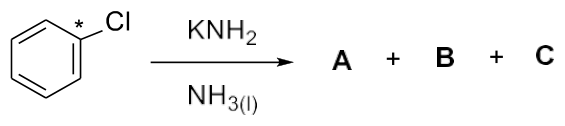
2.1 Draw the structure of A, B and D, and provide the formula of C. Indicate the position(s) of \(\ce{^{14}C}\)-labeled carbon(s) with an asterisk (*) whenever applicable.”
Analysis of the \(\ce{^{14}C}\)-labeled product(s) was achieved via degradation experiments (the \(\ce{^{14}C}\)- labeled carbons are not shown on the structures). Radioactivities of the intermediates and final products were examined.
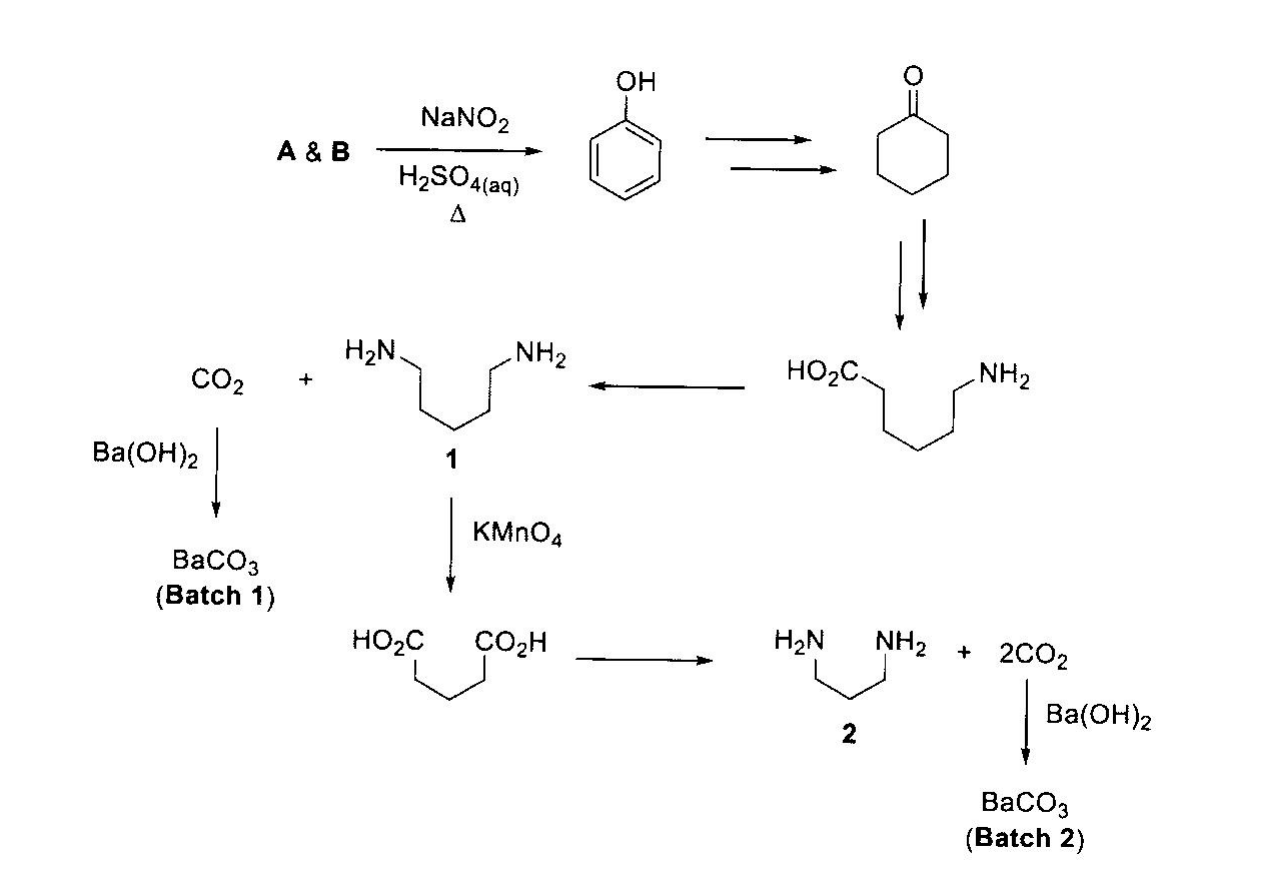
2.2 Tick the appropriate boxes on the answer sheet for the intermediates and products that you expect to exhibit radioactivity.
| Considering only A: | Considering only B: |
|---|---|
| ☐ Compound 1 | ☐ Compound 1 |
| ☐ \(\ce{BaCO3}\) (Batch 1) | ☐ \(\ce{BaCO3}\) (Batch 1) |
| ☐ Compound 2 | ☐ Compound 2 |
| ☐ \(\ce{BaCO3}\) (Batch 2) | ☐ \(\ce{BaCO3}\) (Batch 2) |
With the aim of facilitating aryne formation, Kobayashi and co-workers developed a fluoride-induced aryne generation protocol. Using this method, benzene derivative 3 is reacted with furan (4) in the presence of \(\ce{CsF}\), resulting in the formation of E, F, and G.

- Combustion analysis of E revealed the following atom content: 75.8 % carbon, 5.8 % hydrogen, and 18.4% oxygen.
- E does not have a proton that is exchangeable with \(\ce{D2O}\) in \(\ce{^1H}\)-NMR spectroscopy.
- F is an ionic compound.
2.3 Determine the structures of E, F, and G (without stereochemical details).
In the absence of a nucleophile or a trapping agent, arynes can undergo [2+2]-type cyclodimerization or [2+2+2]-type cyclotrimerization reactions under suitable conditions. The aryne derivative that is obtained when 3 is treated with one equivalent of \(\ce{CsF}\) in MeCN can give, in principle, four different dimerization and trimerization products (H – K).
- H has two planes of symmetry.
- I is expected to exhibit 21 signals in its \(\ce{^{13}C}\)-NMR spectrum.
- I and J both exhibit an \(m/z\) value of 318.1 in their mass spectra.
2.4 Determine the structures of H – K.
When 5 is reacted with \(\beta\)-ketoester 6 in the presence of 2 equivalents of \(\ce{CsF}\) at 80 °C, L is obtained as the major product. The \(\ce{^1H}\)-NMR and \(\ce{^{13}C}\)-NMR data for L, in \(\ce{CDCl3}\), are as follows:
- \(\ce{^1H}\)-NMR: \(\delta\) 7.79 (dd, \(J=7.6,\ 1.5\ \mathrm{Hz}\), 1H), 7.47–7.33 (m, 2H), 7.25–7.20 (m, 1H), 3.91 (s, 2H), 3.66 (s, 3H), 2.56 (s, 3H) ppm.
- \(\ce{^{13}C}\)-NMR: \(\delta\) 201.3, 172.0, 137.1, 134.4, 132.8, 132.1, 130.1, 127.5, 51.9, 40.2, 28.8 ppm.
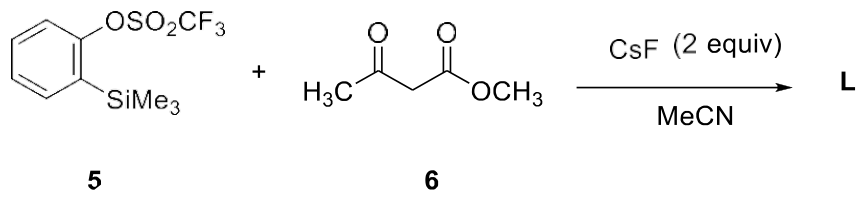
2.5 Determine the structure of L.
2.6 In the reaction shown in task 2.5, which of the following statement(s) describe(s) the function of \(\ce{CsF}\)?
- The \(pK_\mathrm{a}\) values of \(\ce{HF}\) and \(\beta\)-ketoester 6 in dimethyl sulfoxide (DMSO) are about 15 and 14, respectively.
☐ \(\ce{F-}\) hydrolyzes the trifluoromethanesulfonate (\(\ce{O3SCF3}\)) group of 5
☐ \(\ce{F-}\) attacks the \(\ce{-SiMe3}\) group of 5.
☐ \(\ce{F-}\) acts as a base to deprotonate 6.
☐ \(\ce{F-}\) acts as a nucleophile and attacks the ester group of 6.
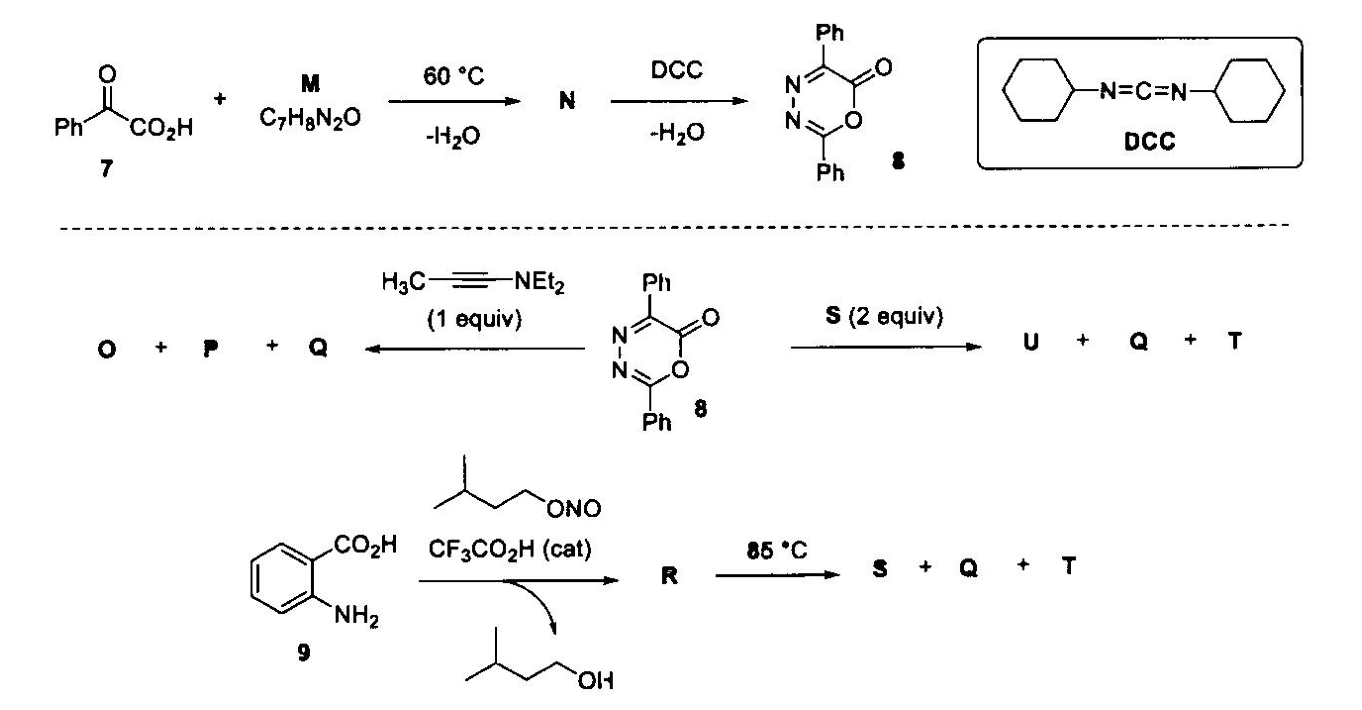
Diazapyrone derivative 8 was shown to be a useful reactant for the construction of a variety of cyclic frameworks. Its preparation from phenylglyoxylic acid (7) and its use in two different reactions are described below.
- Q and T are gases under ambient conditions.
- O and P are constitutional isomers.
- Q does not have any signals in its IR spectrum.
- Heating 1 mol of R at 85 °C generates 1 mol of reactive intermediate S.
- Reaction of 8 with two equivalents of S gives U, Q, and T.
Note:
equiv = equivalent
cat = catalyst
2.7 Determine the structures of M – U.
Official English text of the problem.
Answers
- 2.1
The following convention defines A and B throughout this solution.
| Species | Identification and position of the asterisk | SMILES |
|---|---|---|
| A | Aniline-1-\(\ce{^{14}C}\): put * on the carbon bearing \(\ce{NH2}\). | N[14c]1ccccc1 |
| B | Aniline-2-\(\ce{^{14}C}\): put * on a carbon immediately adjacent to the carbon bearing \(\ce{NH2}\). | Nc1[14cH]cccc1 |
| C | Potassium chloride, \(\ce{KCl}\). | [K+].[Cl-] |
| D | Benzyne with one \(\ce{^{14}C}\) atom at an endpoint of its formal triple bond; put * on that endpoint. | [14C]1#CC=CC=C1 |
Each labeled molecule contains one radioactive carbon. Interchanging the names A and B is equally valid if their columns in 2.2 are also interchanged.
- 2.2
| Intermediate or product | Starting from A | Starting from B |
|---|---|---|
| Compound 1 | ☐ | ☑ |
| \(\ce{BaCO3}\), Batch 1 | ☑ | ☐ |
| Compound 2 | ☐ | ☐ |
| \(\ce{BaCO3}\), Batch 2 | ☐ | ☑ |
1 is pentane-1,5-diamine, NCCCCCN; 2 is propane-1,3-diamine, NCCCN. Barium carbonate is [Ba+2].[O-]C(=O)[O-].
- 2.3
| Species | Name | SMILES |
|---|---|---|
| E | 6-Methoxy-1,4-epoxy-1,4-dihydronaphthalene, the oxygen-bridged benzyne–furan cycloadduct | COc1ccc2c(c1)C1C=CC2O1 |
| F | Cesium trifluoromethanesulfonate, \(\ce{CsCF3SO3}\) | [Cs+].[O-]S(=O)(=O)C(F)(F)F |
| G | Fluorotrimethylsilane, \(\ce{Me3SiF}\) | C[Si](C)(C)F |
For E, the oxygen bridge connects positions 1 and 4; the remaining nonaromatic double bond connects positions 2 and 3. Stereochemistry is omitted as requested.
- 2.4
| Species | Name | SMILES |
|---|---|---|
| H | 2,7-Dimethoxybiphenylene | COc1ccc2c(c1)-c1cc(OC)ccc1-2 |
| I | 2,6,11-Trimethoxytriphenylene | COc1ccc2c(c1)c1cc(OC)ccc1c1ccc(OC)cc21 |
| J | 2,6,10-Trimethoxytriphenylene | COc1ccc2c(c1)c1ccc(OC)cc1c1ccc(OC)cc21 |
| K | 2,6-Dimethoxybiphenylene | COc1ccc2c(c1)-c1ccc(OC)cc1-2 |
- 2.5
L is methyl 2-(2-acetylphenyl)acetate, COC(=O)Cc1ccccc1C(C)=O. The acetyl and \(\ce{CH2CO2Me}\) groups occupy adjacent positions on the benzene ring.
- 2.6
Tick statements 2 and 3:
- \(\ce{F-}\) attacks the \(\ce{-SiMe3}\) group of 5.
- \(\ce{F-}\) acts as a base to deprotonate 6.
Fluoride ion has SMILES [F-].
- 2.7
O and P may be interchanged.
| Species | Name or precise identification | SMILES |
|---|---|---|
| M | Benzohydrazide | NNC(=O)c1ccccc1 |
| N | Phenylglyoxylic acid benzoylhydrazone; shown in the cyclizing \(Z\) geometry | O=C(O)/C(=N\NC(=O)c1ccccc1)c1ccccc1 |
| O | 4-(Diethylamino)-5-methyl-3,6-diphenyl-2H-pyran-2-one | O=C1OC(c2ccccc2)=C(C)C(N(CC)CC)=C1c1ccccc1 |
| P | 5-(Diethylamino)-4-methyl-3,6-diphenyl-2H-pyran-2-one | O=C1OC(c2ccccc2)=C(N(CC)CC)C(C)=C1c1ccccc1 |
| Q | Dinitrogen, \(\ce{N2}\) | N#N |
| R | Benzenediazonium-2-carboxylate, an internal diazonium–carboxylate salt | O=C([O-])c1ccccc1[N+]#N |
| S | Benzyne | C1#CC=CC=C1 |
| T | Carbon dioxide, \(\ce{CO2}\) | O=C=O |
| U | 9,10-Diphenylanthracene | c1ccc2c(c1)c(-c1ccccc1)c1ccccc1c2-c1ccccc1 |
Solution
2.1 — Formation and trapping of labeled benzyne
The starting material is chlorobenzene-1-\(\ce{^{14}C}\), Cl[14c]1ccccc1. Potassium amide, [K+].[NH2-], removes an ortho hydrogen. Elimination of chloride then produces D, with the original chlorine-bearing carbon as one endpoint of the aryne bond.
The balanced elimination is
\[ \ce{C6H5Cl + KNH2 -> C6H4 + KCl + NH3}. \]
Here, \(\ce{C6H4}\) denotes labeled benzyne D. Amide ion can attack either endpoint of its aryne bond. The resulting carbon anion takes a proton from ammonia, N:
\[ \ce{C6H4 + NH2- -> C6H6N-}, \]
\[ \ce{C6H6N- + NH3 -> C6H7N + NH2-}. \]
Thus the overall substitution is
\[ \boxed{\ce{C6H5Cl + KNH2 -> C6H5NH2 + KCl}}. \]
Attack at the labeled endpoint gives A, with the label on the amino-bearing carbon. Attack at the other endpoint gives B, with the label adjacent to that carbon. The two aryne endpoints are equivalent apart from the isotope, explaining the nearly equal amounts.
The formal triple bond in the SMILES represents a strained, bent aryne bond constrained within a six-membered ring; it does not imply the linear geometry of an ordinary acyclic alkyne.
2.2 — Following the radioactive carbon through degradation
Number the aniline ring so that \(C_1\) bears the amino group, with \(C_2\) and \(C_6\) adjacent to it. Under our convention:
- A is labeled at \(C_1\).
- B is labeled at \(C_2\), equivalently \(C_6\) by reflection.
The relevant structures in the degradation sequence are:
| Structure | Name | SMILES |
|---|---|---|
| Aromatic hydrolysis product | Phenol | Oc1ccccc1 |
| Cyclic ketone | Cyclohexanone | O=C1CCCCC1 |
| Amino acid | 6-Aminohexanoic acid | NCCCCCC(=O)O |
| Oxidation product of 1 | Glutaric acid, or pentanedioic acid | O=C(O)CCCC(=O)O |
Diazotization and hydrolysis replace the amino group with hydroxyl without removing its ring carbon. A balanced overall equation using the stated reagents is
\[ \ce{2 C6H5NH2 + 2 NaNO2 + H2SO4 -> 2 C6H5OH + 2 N2 + Na2SO4 + 2 H2O}. \]
The phenolic carbon becomes the carbonyl carbon of cyclohexanone. Oxime formation, Beckmann rearrangement, and hydrolysis retain that carbon as the carboxyl carbon of 6-aminohexanoic acid.
One orientation of the opened carbon chain is therefore
\[ \ce{HO2C}_{(C_1)} -\ce{CH2}_{(C_2)} -\ce{CH2}_{(C_3)} -\ce{CH2}_{(C_4)} -\ce{CH2}_{(C_5)} -\ce{CH2NH2}_{(C_6)}. \]
Opening in the opposite direction interchanges \(C_2\) with \(C_6\) and \(C_3\) with \(C_5\), without changing the conclusions.
The first chain-shortening degradation removes the carboxyl carbon \(C_1\) as carbon dioxide and gives 1. Oxidation of the two terminal amino-bearing carbons of 1 gives the two carboxyl carbons of glutaric acid. Its subsequent degradation removes those carbons, \(C_2\) and \(C_6\), and gives 2.
| Stage | Original ring carbons retained or collected |
|---|---|
| \(\ce{CO2}\), subsequently Batch 1 | \(C_1\) |
| Compound 1 | \(C_2,C_3,C_4,C_5,C_6\) |
| \(\ce{CO2}\), subsequently Batch 2 | \(C_2,C_6\) |
| Compound 2 | \(C_3,C_4,C_5\) |
Consequently, A labels only Batch 1. B labels compound 1 and Batch 2. Neither starting isotopomer labels compound 2.
For completeness, the unspecified multistep arrows admit the following balanced overall bookkeeping equations. Here \(\ce{[O]}\) represents an oxygen-atom oxidizing equivalent; these equations do not specify the omitted experimental reagents. Hydroxylamine is NO.
\[ \ce{C6H6O + 2 H2 -> C6H10O}, \]
\[ \ce{C6H10O + NH2OH -> C6H13NO2}, \]
\[ \ce{C6H13NO2 + NH3 + [O] -> C5H14N2 + CO2 + H2O}, \]
\[ \ce{C5H14N2 + 4 [O] -> C5H8O4 + 2 NH3}, \]
\[ \ce{C5H8O4 + 2 NH3 + 2 [O] -> C3H10N2 + 2 CO2 + 2 H2O}. \]
Each carbonate collection follows
\[ \ce{CO2 + Ba(OH)2 -> BaCO3 + H2O}. \]
Starting from pure B, one radioactive carbon is distributed among the two carbon dioxide molecules released in the second degradation. The collected batch therefore exhibits radioactivity even though not every carbonate ion is labeled.
2.3 — Fluoride-induced aryne generation and furan trapping
Compound 3 is 4-methoxy-2-(trimethylsilyl)phenyl triflate:
COc1ccc(OS(=O)(=O)C(F)(F)F)c([Si](C)(C)C)c1.
Fluoride attacks silicon. Cleavage of the aryl–silicon bond, followed by elimination of the adjacent triflate group, generates 4-methoxybenzyne:
C1#CC=C(OC)C=C1.
The silicon-containing product is G, fluorotrimethylsilane. The departing triflate combines with cesium to give ionic F.
The balanced aryne-generation equation is
\[ \ce{C11H15F3O4SSi + CsF -> C7H6O + CsCF3SO3 + C3H9FSi}. \]
Furan, c1ccoc1, traps the aryne in a [4+2] cycloaddition:
\[ \ce{C7H6O + C4H4O -> C11H10O2}. \]
To check the composition, take a \(100.0\ \mathrm{g}\) sample of E. Using conventional atomic molar masses,
\[ n_{\mathrm C}=\frac{75.8}{12.01}=6.31\ \mathrm{mol}, \qquad n_{\mathrm H}=\frac{5.8}{1.008}=5.75\ \mathrm{mol}, \qquad n_{\mathrm O}=\frac{18.4}{16.00}=1.15\ \mathrm{mol}. \]
Normalizing to two oxygen atoms gives
\[ \mathrm{C:H:O}=10.98:10.01:2.00\approx11:10:2. \]
Thus the composition supports \(\ce{C11H10O2}\), exactly the formula obtained by adding furan to methoxybenzyne. Its calculated composition is
\[ 75.84\%~\mathrm C,\qquad 5.79\%~\mathrm H,\qquad 18.37\%~\mathrm O, \]
consistent with all three reported percentages.
The product contains a methoxy oxygen and a bridging ether oxygen, with no hydroxyl group, explaining the absence of a proton exchangeable with \(\ce{D2O}\).
The complete balanced reaction is
\[ \boxed{\ce{C11H15F3O4SSi + C4H4O + CsF -> C11H10O2 + CsCF3SO3 + C3H9FSi}}. \]
2.4 — The two dimers and two trimers
The methoxyaryne has formula \(\ce{C7H6O}\). Its two possible dimer connectivities are biphenylene derivatives:
\[ \ce{2 C7H6O -> C14H12O2}. \]
Its two possible trimer connectivities are triphenylene derivatives:
\[ \ce{3 C7H6O -> C21H18O3}. \]
The calculated monoisotopic mass of \(\ce{C21H18O3}\) is approximately \(318.126\ \mathrm{Da}\), consistent with the reported molecular-ion \(m/z=318.1\). Therefore, I and J are the trimers, while H and K are the dimers.
For the dimers, draw a biphenylene framework with a central four-membered ring and one benzenoid ring on each side:
- In H, the two methoxy groups lie on the same side of the framework’s long axis. This is 2,7-dimethoxybiphenylene. Its skeletal structure has the molecular mirror plane and a second plane perpendicular to it that interchanges the two benzenoid halves.
- In K, the methoxy groups occupy diagonally opposed positions. This is 2,6-dimethoxybiphenylene. It lacks that second mirror plane.
For the trimers, the three aryne-derived units can all have the same cyclic orientation, or one can be reversed:
- J, 2,6,10-trimethoxytriphenylene, has threefold rotational symmetry. Its 21 carbons form seven sets of three equivalent carbons, predicting 7 \(\ce{^{13}C}\)-NMR signals.
- I, 2,6,11-trimethoxytriphenylene, lacks any symmetry operation that interchanges its carbon atoms. It therefore has 21 distinct carbon environments, as required.
2.5 — Identification of L from its NMR spectra
Compound 5 is 2-(trimethylsilyl)phenyl triflate:
C[Si](C)(C)c1ccccc1OS(=O)(=O)C(F)(F)F.
Compound 6 is methyl acetoacetate, or methyl 3-oxobutanoate:
COC(=O)CC(C)=O.
Their reaction gives L, methyl 2-(2-acetylphenyl)acetate.
| Observed signal | Assignment in L |
|---|---|
| Four aromatic protons, \(\delta_{\mathrm H}=7.79\) to \(7.20\ \mathrm{ppm}\) | Disubstituted benzene ring |
| \(\delta_{\mathrm H}=3.91\ \mathrm{ppm}\), s, 2H; \(\delta_{\mathrm C}=40.2\ \mathrm{ppm}\) | Benzylic \(\ce{CH2CO2Me}\) |
| \(\delta_{\mathrm H}=3.66\ \mathrm{ppm}\), s, 3H; \(\delta_{\mathrm C}=51.9\ \mathrm{ppm}\) | Ester methoxy group |
| \(\delta_{\mathrm H}=2.56\ \mathrm{ppm}\), s, 3H; \(\delta_{\mathrm C}=28.8\ \mathrm{ppm}\) | Acetyl methyl group |
| \(\delta_{\mathrm C}=201.3\ \mathrm{ppm}\) | Ketone carbonyl |
| \(\delta_{\mathrm C}=172.0\ \mathrm{ppm}\) | Ester carbonyl |
| Six resonances from \(127.5\) to \(137.1\ \mathrm{ppm}\) | Six inequivalent aromatic carbons |
The structure accounts for all eleven carbon resonances and all twelve hydrogens.
The mechanism explains the adjacent substituents:
- Fluoride generates benzyne from 5 and forms the enolate of 6.
- The enolate carbon attacks one aryne carbon, producing a carbanion at the adjacent aromatic carbon.
- That carbanion attacks the ketone carbonyl intramolecularly, forming a four-membered alkoxide intermediate.
- Re-formation of the carbonyl breaks the original bond between the ketone carbonyl carbon and the ester-bearing carbon.
- Protonation gives L.
Thus benzyne is formally inserted into the ketone–methylene carbon–carbon bond of methyl acetoacetate:
\[ \ce{C6H4 + C5H8O3 -> C11H12O3}. \]
Including aryne generation, the balanced net reaction is
\[ \boxed{\ce{C10H13F3O3SSi + C5H8O3 + CsF -> C11H12O3 + CsCF3SO3 + C3H9FSi}}. \]
Two equivalents of \(\ce{CsF}\) are used experimentally. One is consumed in aryne generation; the fluoride involved in deprotonation is regenerated in the formal proton-transfer cycle and therefore cancels from the net equation.
2.6 — The two functions of fluoride
The first function is nucleophilic attack on silicon, generating the aryne through desilylation and triflate elimination.
The second function is deprotonation of methyl acetoacetate. Its carbon-centered enolate can be represented as
COC(=O)[CH-]C(C)=O.
The balanced acid–base equilibrium is
\[ \ce{F- + CH3COCH2CO2CH3 <=> HF + [CH3COCHCO2CH3]-}. \]
Using the supplied \(pK_\mathrm a\) values,
\[ K\approx 10^{pK_\mathrm a(\ce{HF})-pK_\mathrm a(\mathbf6)} = 10^{15-14} \approx10. \]
On the quoted DMSO scale, this favors enolate formation. The numerical value is not an independently established equilibrium constant for the reaction solvent, MeCN, but it supports the intended basic role of fluoride.
Neither triflate hydrolysis nor attack on the ester carbonyl is needed to account for the observed reaction. Therefore, only statements 2 and 3 are correct.
2.7 — Preparation and reactions of the diazapyrone
Formation of M and N. Phenylglyoxylic acid 7, O=C(O)C(=O)c1ccccc1, contains a ketone that can condense with a hydrazide.
The reagent must provide the second phenyl group, both adjacent nitrogen atoms, and the carbon–oxygen unit needed for the heterocycle. Benzohydrazide M does exactly this and has the required formula \(\ce{C7H8N2O}\).
Its terminal amino group condenses with the ketone of 7, giving hydrazone N:
\[ \boxed{\ce{C8H6O3 + C7H8N2O -> C15H12N2O3 + H2O}}. \]
The hydrazone connectivity is
O=C(O)C(=NNC(=O)c1ccccc1)c1ccccc1.
Ring closure requires the carboxyl group and the nitrogen-linked benzoyl group to be on the same side of the hydrazone double bond. The corresponding cyclizing \(Z\) geometry is the stereochemical SMILES given in the Answers.
Cyclodehydration to 8. Compound 8 is 2,5-diphenyl-6H-1,3,4-oxadiazin-6-one:
O=C1OC(=NN=C1c1ccccc1)c1ccccc1.
Cyclization joins the benzoyl-derived oxygen to the carboxyl carbon, with formal loss of water:
\[ \ce{C15H12N2O3 -> C15H10N2O2 + H2O}. \]
DCC is \(N,N'\)-dicyclohexylcarbodiimide,
C1CCC(N=C=NC2CCCCC2)CC1.
It accepts the elements of water to form \(N,N'\)-dicyclohexylurea,
O=C(NC1CCCCC1)NC1CCCCC1.
The balanced equation including the dehydrating reagent is therefore
\[ \boxed{\ce{C15H12N2O3 + C13H22N2 -> C15H10N2O2 + C13H24N2O}}. \]
Formation of O, P, and Q. The alkyne is \(N,N\)-diethylprop-1-yn-1-amine,
CC#CN(CC)CC.
The \(\ce{C=N-N=C}\) segment of 8 undergoes cycloaddition with this unsymmetrical alkyne. Extrusion of the adjacent nitrogen atoms as Q, \(\ce{N2}\), gives an \(\alpha\)-pyrone.
The two alkyne carbons become positions 4 and 5 of the pyrone. Their two possible orientations give:
- O: diethylamino at position 4 and methyl at position 5;
- P: methyl at position 4 and diethylamino at position 5.
Both retain phenyl groups at positions 3 and 6. The balanced equation applies separately to either regioisomer:
\[ \boxed{\ce{C15H10N2O2 + C7H13N -> C22H23NO2 + N2}}. \]
The scheme’s O + P denotes a mixture of alternative products, rather than one molecule of each being formed from one molecule of 8.
Dinitrogen fits the IR observation: stretching a homonuclear \(\ce{N2}\) molecule does not change its dipole moment, so its fundamental vibration is IR-inactive.
Formation and decomposition of R. Compound 9 is anthranilic acid, or 2-aminobenzoic acid,
Nc1ccccc1C(=O)O.
The alkyl nitrite is 3-methylbutyl nitrite,
CC(C)CCON=O.
It diazotizes the amino group, producing the internal salt R. The alcohol shown is 3-methylbutan-1-ol,
CC(C)CCO.
Including the water required by atom balance,
\[ \boxed{\ce{C7H7NO2 + C5H11NO2 -> C7H4N2O2 + C5H12O + H2O}}. \]
On heating, R loses both its diazonium group and its carboxylate carbon:
\[ \boxed{\ce{C7H4N2O2 ->[85\,^\circ C] C6H4 + N2 + CO2}}. \]
Thus S is benzyne, Q is dinitrogen, and T is carbon dioxide. The equation gives exactly one mole of S per mole of R, as stated.
Formation of U. Reaction with two benzyne molecules constructs the anthracene framework through successive cycloadditions and loss of \(\ce{N2}\) and \(\ce{CO2}\).
Each benzyne contributes one outer benzenoid ring. The two phenyl-bearing carbons of 8 become positions 9 and 10 of the central anthracene ring. Consequently, U is 9,10-diphenylanthracene.
The complete balanced equation is
\[ \boxed{\ce{C15H10N2O2 + 2 C6H4 -> C26H18 + N2 + CO2}}. \]
The carbon balance is particularly diagnostic: \(15+2(6)-1=26\) carbons remain in U, while all eighteen hydrogens remain in the organic product.
The answers were checked against the official answers published by the organisers.
IChO 2020 · Theorieaufgabe 2
Die Geschichte eines reaktiven Zwischenprodukts
Arine bilden eine besondere Klasse reaktiver Zwischenprodukte. Der erste experimentelle Nachweis für die Struktur eines Arins (Benzin) gelang 1953 durch die eleganten Markierungsexperimente von John D. Roberts und Mitarbeitern.
In einem dieser Experimente wurde Chlorbenzol, dessen Kohlenstoffatom an Position 1 mit radioaktivem \(\ce{^{14}C}\) markiert war, mit \(\ce{KNH2}\) in flüssigem \(\ce{NH3}\) umgesetzt. Dabei entstanden nahezu gleiche Mengen der Isotopenisomere A und B sowie das anorganische Salz C. Diese Reaktion verläuft über die Bildung des Arin-Zwischenprodukts D.
2.1 Zeichnen Sie die Strukturen von A, B und D und geben Sie die Formel von C an. Kennzeichnen Sie gegebenenfalls die Position(en) der mit \(\ce{^{14}C}\) markierten Kohlenstoffatome mit einem Sternchen (*).”
Die Analyse der mit \(\ce{^{14}C}\) markierten Produkte erfolgte durch Abbauexperimente (die mit \(\ce{^{14}C}\) markierten Kohlenstoffatome sind in den Strukturen nicht angegeben). Die Radioaktivität der Zwischenprodukte und Endprodukte wurde untersucht.
2.2 Kreuzen Sie auf dem Antwortbogen die entsprechenden Kästchen für die Zwischenprodukte und Produkte an, bei denen Sie Radioaktivität erwarten.
| Bei ausschließlicher Betrachtung von A: | Bei ausschließlicher Betrachtung von B: |
|---|---|
| ☐ Verbindung 1 | ☐ Verbindung 1 |
| ☐ \(\ce{BaCO3}\) (Fraktion 1) | ☐ \(\ce{BaCO3}\) (Fraktion 1) |
| ☐ Verbindung 2 | ☐ Verbindung 2 |
| ☐ \(\ce{BaCO3}\) (Fraktion 2) | ☐ \(\ce{BaCO3}\) (Fraktion 2) |
Um die Bildung von Arinen zu erleichtern, entwickelten Kobayashi und Mitarbeiter ein Verfahren zur fluoridinduzierten Arin-Erzeugung. Bei Anwendung dieser Methode wird das Benzolderivat 3 in Gegenwart von \(\ce{CsF}\) mit Furan (4) umgesetzt, wobei E, F und G entstehen.
- Die Verbrennungsanalyse von E ergab folgende Elementgehalte: 75.8 % Kohlenstoff, 5.8 % Wasserstoff und 18.4% Sauerstoff.
- E besitzt in der \(\ce{^1H}\)-NMR-Spektroskopie kein mit \(\ce{D2O}\) austauschbares Proton.
- F ist eine ionische Verbindung.
2.3 Bestimmen Sie die Strukturen von E, F und G (ohne stereochemische Angaben).
In Abwesenheit eines Nukleophils oder eines Abfangreagenzes können Arine unter geeigneten Bedingungen Cyclodimerisierungen vom [2+2]-Typ oder Cyclotrimerisierungen vom [2+2+2]-Typ eingehen. Das Arin-Derivat, das bei der Behandlung von 3 mit einem Äquivalent \(\ce{CsF}\) in MeCN entsteht, kann prinzipiell vier verschiedene Dimerisierungs- und Trimerisierungsprodukte (H – K) bilden.
- H besitzt zwei Symmetrieebenen.
- Für I werden 21 Signale im \(\ce{^{13}C}\)-NMR-Spektrum erwartet.
- I und J weisen in ihren Massenspektren beide einen \(m/z\)-Wert von 318.1 auf.
2.4 Bestimmen Sie die Strukturen von H – K.
Wenn 5 mit dem \(\beta\)-Ketoester 6 in Gegenwart von 2 Äquivalenten \(\ce{CsF}\) bei 80 °C umgesetzt wird, entsteht L als Hauptprodukt. Die \(\ce{^1H}\)-NMR- und \(\ce{^{13}C}\)-NMR-Daten für L in \(\ce{CDCl3}\) lauten wie folgt:
- \(\ce{^1H}\)-NMR: \(\delta\) 7.79 (dd, \(J=7.6,\ 1.5\ \mathrm{Hz}\), 1H), 7.47–7.33 (m, 2H), 7.25–7.20 (m, 1H), 3.91 (s, 2H), 3.66 (s, 3H), 2.56 (s, 3H) ppm.
- \(\ce{^{13}C}\)-NMR: \(\delta\) 201.3, 172.0, 137.1, 134.4, 132.8, 132.1, 130.1, 127.5, 51.9, 40.2, 28.8 ppm.
2.5 Bestimmen Sie die Struktur von L.
2.6 Welche der folgenden Aussagen beschreibt bzw. beschreiben die Funktion von \(\ce{CsF}\) in der in Aufgabe 2.5 gezeigten Reaktion?
- Die \(pK_\mathrm{a}\)-Werte von \(\ce{HF}\) und dem \(\beta\)-Ketoester 6 in Dimethylsulfoxid (DMSO) betragen etwa 15 bzw. 14.
☐ \(\ce{F-}\) hydrolysiert die Trifluormethansulfonatgruppe (\(\ce{O3SCF3}\)) von 5.
☐ \(\ce{F-}\) greift die \(\ce{-SiMe3}\)-Gruppe von 5 an.
☐ \(\ce{F-}\) wirkt als Base und deprotoniert 6.
☐ \(\ce{F-}\) wirkt als Nukleophil und greift die Estergruppe von 6 an.
Das Diazapyron-Derivat 8 hat sich als nützliches Reagenz für den Aufbau verschiedener cyclischer Gerüste erwiesen. Seine Herstellung aus Phenylglyoxylsäure (7) und seine Verwendung in zwei verschiedenen Reaktionen werden nachfolgend beschrieben.
- Q und T sind unter Umgebungsbedingungen Gase.
- O und P sind Konstitutionsisomere.
- Q weist keine Signale im IR-Spektrum auf.
- Beim Erhitzen von 1 mol R auf 85 °C entsteht 1 mol des reaktiven Zwischenprodukts S.
- Die Reaktion von 8 mit zwei Äquivalenten S ergibt U, Q und T.
Hinweis:
equiv = Äquivalent
cat = Katalysator
2.7 Bestimmen Sie die Strukturen von M – U.
Aufgabentext aus dem offiziellen englischen Text übersetzt.
Antworten
- 2.1
Die folgende Konvention legt die Bezeichnungen A und B für die gesamte Lösung fest.
| Spezies | Identifizierung und Position des Sternchens | SMILES |
|---|---|---|
| A | Anilin-1-\(\ce{^{14}C}\): Setzen Sie * an das Kohlenstoffatom, das \(\ce{NH2}\) trägt. | N[14c]1ccccc1 |
| B | Anilin-2-\(\ce{^{14}C}\): Setzen Sie * an ein Kohlenstoffatom unmittelbar neben dem Kohlenstoffatom, das \(\ce{NH2}\) trägt. | Nc1[14cH]cccc1 |
| C | Kaliumchlorid, \(\ce{KCl}\). | [K+].[Cl-] |
| D | Benzin mit einem \(\ce{^{14}C}\)-Atom an einem Ende seiner formalen Dreifachbindung; setzen Sie * an dieses Ende. | [14C]1#CC=CC=C1 |
Jedes markierte Molekül enthält ein radioaktives Kohlenstoffatom. Die Bezeichnungen A und B können ebenso gültig vertauscht werden, wenn ihre Spalten in 2.2 ebenfalls vertauscht werden.
- 2.2
| Zwischenprodukt oder Produkt | Ausgehend von A | Ausgehend von B |
|---|---|---|
| Verbindung 1 | ☐ | ☑ |
| \(\ce{BaCO3}\), Fraktion 1 | ☑ | ☐ |
| Verbindung 2 | ☐ | ☐ |
| \(\ce{BaCO3}\), Fraktion 2 | ☐ | ☑ |
1 ist Pentan-1,5-diamin, NCCCCCN; 2 ist Propan-1,3-diamin, NCCCN. Bariumcarbonat ist [Ba+2].[O-]C(=O)[O-].
- 2.3
| Spezies | Name | SMILES |
|---|---|---|
| E | 6-Methoxy-1,4-epoxy-1,4-dihydronaphthalin, das sauerstoffverbrückte Benzin–Furan-Cycloaddukt | COc1ccc2c(c1)C1C=CC2O1 |
| F | Caesiumtrifluormethansulfonat, \(\ce{CsCF3SO3}\) | [Cs+].[O-]S(=O)(=O)C(F)(F)F |
| G | Fluortrimethylsilan, \(\ce{Me3SiF}\) | C[Si](C)(C)F |
Bei E verbindet die Sauerstoffbrücke die Positionen 1 und 4; die verbleibende nichtaromatische Doppelbindung verbindet die Positionen 2 und 3. Die Stereochemie wird wie verlangt weggelassen.
- 2.4
| Spezies | Name | SMILES |
|---|---|---|
| H | 2,7-Dimethoxybiphenylen | COc1ccc2c(c1)-c1cc(OC)ccc1-2 |
| I | 2,6,11-Trimethoxytriphenylen | COc1ccc2c(c1)c1cc(OC)ccc1c1ccc(OC)cc21 |
| J | 2,6,10-Trimethoxytriphenylen | COc1ccc2c(c1)c1ccc(OC)cc1c1ccc(OC)cc21 |
| K | 2,6-Dimethoxybiphenylen | COc1ccc2c(c1)-c1ccc(OC)cc1-2 |
- 2.5
L ist 2-(2-Acetylphenyl)essigsäuremethylester, COC(=O)Cc1ccccc1C(C)=O. Die Acetyl- und die \(\ce{CH2CO2Me}\)-Gruppe befinden sich an benachbarten Positionen des Benzolrings.
- 2.6
Kreuzen Sie Aussagen 2 und 3 an:
- \(\ce{F-}\) greift die \(\ce{-SiMe3}\)-Gruppe von 5 an.
- \(\ce{F-}\) wirkt als Base und deprotoniert 6.
Das Fluoridion hat den SMILES [F-].
- 2.7
O und P können vertauscht werden.
| Spezies | Name oder genaue Identifizierung | SMILES |
|---|---|---|
| M | Benzohydrazid | NNC(=O)c1ccccc1 |
| N | Phenylglyoxylsäurebenzoylhydrazon; dargestellt in der zur Cyclisierung befähigten \(Z\)-Geometrie | O=C(O)/C(=N\NC(=O)c1ccccc1)c1ccccc1 |
| O | 4-(Diethylamino)-5-methyl-3,6-diphenyl-2H-pyran-2-on | O=C1OC(c2ccccc2)=C(C)C(N(CC)CC)=C1c1ccccc1 |
| P | 5-(Diethylamino)-4-methyl-3,6-diphenyl-2H-pyran-2-on | O=C1OC(c2ccccc2)=C(N(CC)CC)C(C)=C1c1ccccc1 |
| Q | Distickstoff, \(\ce{N2}\) | N#N |
| R | Benzoldiazonium-2-carboxylat, ein inneres Diazonium–Carboxylat-Salz | O=C([O-])c1ccccc1[N+]#N |
| S | Benzin | C1#CC=CC=C1 |
| T | Kohlenstoffdioxid, \(\ce{CO2}\) | O=C=O |
| U | 9,10-Diphenylanthracen | c1ccc2c(c1)c(-c1ccccc1)c1ccccc1c2-c1ccccc1 |
Lösung
2.1 — Bildung und Abfangen von markiertem Benzin
Das Ausgangsmaterial ist Chlorbenzol-1-\(\ce{^{14}C}\), Cl[14c]1ccccc1. Kaliumamid, [K+].[NH2-], abstrahiert ein ortho-Wasserstoffatom. Die anschließende Eliminierung von Chlorid liefert D, wobei das ursprünglich chlortragende Kohlenstoffatom eines der beiden Enden der Arin-Bindung bildet.
Die ausgeglichene Eliminierung lautet
\[ \ce{C6H5Cl + KNH2 -> C6H4 + KCl + NH3}. \]
Dabei bezeichnet \(\ce{C6H4}\) das markierte Benzin D. Das Amidion kann an beiden Enden seiner Arin-Bindung angreifen. Das entstehende Carbanion nimmt ein Proton von Ammoniak, N, auf:
\[ \ce{C6H4 + NH2- -> C6H6N-}, \]
\[ \ce{C6H6N- + NH3 -> C6H7N + NH2-}. \]
Damit lautet die gesamte Substitution
\[ \boxed{\ce{C6H5Cl + KNH2 -> C6H5NH2 + KCl}}. \]
Der Angriff am markierten Ende ergibt A, bei dem die Markierung am aminogruppentragenden Kohlenstoffatom sitzt. Der Angriff am anderen Ende ergibt B, bei dem die Markierung neben diesem Kohlenstoffatom sitzt. Die beiden Enden der Arin-Bindung sind bis auf das Isotop gleichwertig, was die nahezu gleichen Mengen erklärt.
Die formale Dreifachbindung im SMILES stellt eine gespannte, gewinkelte Arin-Bindung dar, deren Geometrie durch den sechsgliedrigen Ring eingeschränkt ist; sie impliziert nicht die lineare Geometrie eines gewöhnlichen acyclischen Alkins.
2.2 — Verfolgung des radioaktiven Kohlenstoffatoms beim Abbau
Nummerieren Sie den Anilinring so, dass \(C_1\) die Aminogruppe trägt und \(C_2\) sowie \(C_6\) dazu benachbart sind. Nach unserer Konvention gilt:
- A ist an \(C_1\) markiert.
- B ist an \(C_2\) markiert, durch Spiegelung gleichwertig an \(C_6\).
Die relevanten Strukturen in der Abbaufolge sind:
| Struktur | Name | SMILES |
|---|---|---|
| Aromatisches Hydrolyseprodukt | Phenol | Oc1ccccc1 |
| Cyclisches Keton | Cyclohexanon | O=C1CCCCC1 |
| Aminosäure | 6-Aminohexansäure | NCCCCCC(=O)O |
| Oxidationsprodukt von 1 | Glutarsäure oder Pentandisäure | O=C(O)CCCC(=O)O |
Diazotierung und Hydrolyse ersetzen die Aminogruppe durch eine Hydroxygruppe, ohne das zugehörige Ringkohlenstoffatom zu entfernen. Eine ausgeglichene Gesamtgleichung mit den angegebenen Reagenzien lautet
\[ \ce{2 C6H5NH2 + 2 NaNO2 + H2SO4 -> 2 C6H5OH + 2 N2 + Na2SO4 + 2 H2O}. \]
Das phenolische Kohlenstoffatom wird zum Carbonylkohlenstoffatom des Cyclohexanons. Bei der Oximbildung, der Beckmann-Umlagerung und der Hydrolyse bleibt dieses Kohlenstoffatom als Carboxylkohlenstoffatom der 6-Aminohexansäure erhalten.
Eine mögliche Orientierung der geöffneten Kohlenstoffkette ist daher
\[ \ce{HO2C}_{(C_1)} -\ce{CH2}_{(C_2)} -\ce{CH2}_{(C_3)} -\ce{CH2}_{(C_4)} -\ce{CH2}_{(C_5)} -\ce{CH2NH2}_{(C_6)}. \]
Bei einer Öffnung in der entgegengesetzten Richtung werden \(C_2\) mit \(C_6\) und \(C_3\) mit \(C_5\) vertauscht, ohne dass sich die Schlussfolgerungen ändern.
Der erste kettenverkürzende Abbau entfernt das Carboxylkohlenstoffatom \(C_1\) als Kohlenstoffdioxid und liefert 1. Durch Oxidation der beiden endständigen aminogruppentragenden Kohlenstoffatome von 1 entstehen die beiden Carboxylkohlenstoffatome der Glutarsäure. Deren anschließender Abbau entfernt diese Kohlenstoffatome, \(C_2\) und \(C_6\), und liefert 2.
| Stufe | Erhaltene oder aufgefangene ursprüngliche Ringkohlenstoffatome |
|---|---|
| \(\ce{CO2}\), anschließend Fraktion 1 | \(C_1\) |
| Verbindung 1 | \(C_2,C_3,C_4,C_5,C_6\) |
| \(\ce{CO2}\), anschließend Fraktion 2 | \(C_2,C_6\) |
| Verbindung 2 | \(C_3,C_4,C_5\) |
Folglich führt A nur zu einer Markierung in Fraktion 1. B führt zu einer Markierung in Verbindung 1 und Fraktion 2. Keines der beiden Ausgangsisotopomere führt zu einer Markierung in Verbindung 2.
Der Vollständigkeit halber lassen sich die nicht näher angegebenen mehrstufigen Reaktionspfeile durch die folgenden ausgeglichenen Gesamtbilanzgleichungen beschreiben. Dabei steht \(\ce{[O]}\) für ein Oxidationsäquivalent in Form eines Sauerstoffatoms; diese Gleichungen legen die weggelassenen experimentellen Reagenzien nicht fest. Hydroxylamin ist NO.
\[ \ce{C6H6O + 2 H2 -> C6H10O}, \]
\[ \ce{C6H10O + NH2OH -> C6H13NO2}, \]
\[ \ce{C6H13NO2 + NH3 + [O] -> C5H14N2 + CO2 + H2O}, \]
\[ \ce{C5H14N2 + 4 [O] -> C5H8O4 + 2 NH3}, \]
\[ \ce{C5H8O4 + 2 NH3 + 2 [O] -> C3H10N2 + 2 CO2 + 2 H2O}. \]
Bei jeder Abscheidung als Carbonat gilt
\[ \ce{CO2 + Ba(OH)2 -> BaCO3 + H2O}. \]
Ausgehend von reinem B verteilt sich ein radioaktives Kohlenstoffatom auf die beiden beim zweiten Abbau freigesetzten Kohlenstoffdioxidmoleküle. Die aufgefangene Fraktion ist daher radioaktiv, obwohl nicht jedes Carbonation markiert ist.
2.3 — Fluoridinduzierte Arin-Erzeugung und Abfangen mit Furan
Verbindung 3 ist 4-Methoxy-2-(trimethylsilyl)phenyltriflat:
COc1ccc(OS(=O)(=O)C(F)(F)F)c([Si](C)(C)C)c1.
Fluorid greift am Silicium an. Die Spaltung der Aryl–Silicium-Bindung und die anschließende Eliminierung der benachbarten Triflatgruppe erzeugen 4-Methoxybenzin:
C1#CC=C(OC)C=C1.
Das siliciumhaltige Produkt ist G, Fluortrimethylsilan. Das abgehende Triflat bildet mit Caesium das ionische F.
Die ausgeglichene Gleichung der Arin-Erzeugung lautet
\[ \ce{C11H15F3O4SSi + CsF -> C7H6O + CsCF3SO3 + C3H9FSi}. \]
Furan, c1ccoc1, fängt das Arin in einer [4+2]-Cycloaddition ab:
\[ \ce{C7H6O + C4H4O -> C11H10O2}. \]
Zur Überprüfung der Zusammensetzung betrachten wir eine Probe von E mit einer Masse von \(100.0\ \mathrm{g}\). Mit den üblichen molaren Atommassen ergibt sich
\[ n_{\mathrm C}=\frac{75.8}{12.01}=6.31\ \mathrm{mol}, \qquad n_{\mathrm H}=\frac{5.8}{1.008}=5.75\ \mathrm{mol}, \qquad n_{\mathrm O}=\frac{18.4}{16.00}=1.15\ \mathrm{mol}. \]
Die Normierung auf zwei Sauerstoffatome ergibt
\[ \mathrm{C:H:O}=10.98:10.01:2.00\approx11:10:2. \]
Somit bestätigt die Zusammensetzung \(\ce{C11H10O2}\), genau die Formel, die sich durch Addition von Furan an Methoxybenzin ergibt. Die berechnete Zusammensetzung beträgt
\[ 75.84\%~\mathrm C,\qquad 5.79\%~\mathrm H,\qquad 18.37\%~\mathrm O, \]
in Übereinstimmung mit allen drei angegebenen Prozentwerten.
Das Produkt enthält einen Methoxysauerstoff und einen verbrückenden Ethersauerstoff, aber keine Hydroxygruppe, was das Fehlen eines mit \(\ce{D2O}\) austauschbaren Protons erklärt.
Die vollständig ausgeglichene Reaktion lautet
\[ \boxed{\ce{C11H15F3O4SSi + C4H4O + CsF -> C11H10O2 + CsCF3SO3 + C3H9FSi}}. \]
2.4 — Die beiden Dimere und die beiden Trimere
Das Methoxyarin hat die Formel \(\ce{C7H6O}\). Seine beiden möglichen Dimer-Verknüpfungsmuster ergeben Biphenylen-Derivate:
\[ \ce{2 C7H6O -> C14H12O2}. \]
Seine beiden möglichen Trimer-Verknüpfungsmuster ergeben Triphenylen-Derivate:
\[ \ce{3 C7H6O -> C21H18O3}. \]
Die berechnete monoisotopische Masse von \(\ce{C21H18O3}\) beträgt ungefähr \(318.126\ \mathrm{Da}\), in Übereinstimmung mit dem angegebenen Molekülion bei \(m/z=318.1\). Daher sind I und J die Trimere, während H und K die Dimere sind.
Zeichnen Sie für die Dimere ein Biphenylen-Gerüst mit einem zentralen viergliedrigen Ring und je einem benzenoiden Ring auf beiden Seiten:
- In H liegen die beiden Methoxygruppen auf derselben Seite der Längsachse des Gerüsts. Es handelt sich um 2,7-Dimethoxybiphenylen. Seine Gerüststruktur besitzt die Molekülebene als Spiegelebene sowie eine zweite, dazu senkrechte Ebene, die die beiden benzenoiden Hälften ineinander überführt.
- In K nehmen die Methoxygruppen diagonal gegenüberliegende Positionen ein. Es handelt sich um 2,6-Dimethoxybiphenylen. Ihm fehlt diese zweite Spiegelebene.
Bei den Trimeren können die drei aus dem Arin hervorgegangenen Einheiten alle dieselbe Orientierung im Umlaufsinn haben, oder eine davon kann umgekehrt sein:
- J, 2,6,10-Trimethoxytriphenylen, besitzt eine dreizählige Rotationssymmetrie. Seine 21 Kohlenstoffatome bilden sieben Gruppen aus jeweils drei äquivalenten Kohlenstoffatomen, sodass 7 \(\ce{^{13}C}\)-NMR-Signale vorhergesagt werden.
- I, 2,6,11-Trimethoxytriphenylen, besitzt keine Symmetrieoperation, die seine Kohlenstoffatome ineinander überführt. Es weist daher wie gefordert 21 unterschiedliche Kohlenstoffumgebungen auf.
2.5 — Identifizierung von L anhand seiner NMR-Spektren
Verbindung 5 ist 2-(Trimethylsilyl)phenyltriflat:
C[Si](C)(C)c1ccccc1OS(=O)(=O)C(F)(F)F.
Verbindung 6 ist Acetessigsäuremethylester oder 3-Oxobutansäuremethylester:
COC(=O)CC(C)=O.
Ihre Reaktion ergibt L, 2-(2-Acetylphenyl)essigsäuremethylester.
| Beobachtetes Signal | Zuordnung in L |
|---|---|
| Vier aromatische Protonen, \(\delta_{\mathrm H}=7.79\) bis \(7.20\ \mathrm{ppm}\) | Disubstituierter Benzolring |
| \(\delta_{\mathrm H}=3.91\ \mathrm{ppm}\), s, 2H; \(\delta_{\mathrm C}=40.2\ \mathrm{ppm}\) | Benzylische \(\ce{CH2CO2Me}\)-Gruppe |
| \(\delta_{\mathrm H}=3.66\ \mathrm{ppm}\), s, 3H; \(\delta_{\mathrm C}=51.9\ \mathrm{ppm}\) | Methoxygruppe des Esters |
| \(\delta_{\mathrm H}=2.56\ \mathrm{ppm}\), s, 3H; \(\delta_{\mathrm C}=28.8\ \mathrm{ppm}\) | Methylgruppe der Acetylgruppe |
| \(\delta_{\mathrm C}=201.3\ \mathrm{ppm}\) | Ketoncarbonylgruppe |
| \(\delta_{\mathrm C}=172.0\ \mathrm{ppm}\) | Estercarbonylgruppe |
| Sechs Resonanzen von \(127.5\) bis \(137.1\ \mathrm{ppm}\) | Sechs nichtäquivalente aromatische Kohlenstoffatome |
Die Struktur erklärt alle elf Kohlenstoffresonanzen und alle zwölf Wasserstoffatome.
Der Mechanismus erklärt die benachbarten Substituenten:
- Fluorid erzeugt Benzin aus 5 und bildet das Enolat von 6.
- Das Enolat-Kohlenstoffatom greift ein Arin-Kohlenstoffatom an, wodurch am benachbarten aromatischen Kohlenstoffatom ein Carbanion entsteht.
- Dieses Carbanion greift intramolekular die Ketoncarbonylgruppe an, wobei ein viergliedriges Alkoxid-Zwischenprodukt entsteht.
- Bei der Rückbildung der Carbonylgruppe wird die ursprüngliche Bindung zwischen dem Ketoncarbonylkohlenstoffatom und dem estergruppentragenden Kohlenstoffatom gespalten.
- Die Protonierung ergibt L.
Somit wird Benzin formal in die Kohlenstoff–Kohlenstoff-Bindung zwischen Ketongruppe und Methylengruppe des Acetessigsäuremethylesters eingeschoben:
\[ \ce{C6H4 + C5H8O3 -> C11H12O3}. \]
Unter Einbeziehung der Arin-Erzeugung lautet die ausgeglichene Nettoreaktion
\[ \boxed{\ce{C10H13F3O3SSi + C5H8O3 + CsF -> C11H12O3 + CsCF3SO3 + C3H9FSi}}. \]
Experimentell werden zwei Äquivalente \(\ce{CsF}\) eingesetzt. Eines wird bei der Arin-Erzeugung verbraucht; das an der Deprotonierung beteiligte Fluorid wird im formalen Protonenübertragungszyklus regeneriert und fällt daher aus der Nettogleichung heraus.
2.6 — Die beiden Funktionen von Fluorid
Die erste Funktion ist der nukleophile Angriff am Silicium, der durch Desilylierung und Triflat-Eliminierung das Arin erzeugt.
Die zweite Funktion ist die Deprotonierung von Acetessigsäuremethylester. Sein kohlenstoffzentriertes Enolat lässt sich darstellen als
COC(=O)[CH-]C(C)=O.
Das ausgeglichene Säure–Base-Gleichgewicht lautet
\[ \ce{F- + CH3COCH2CO2CH3 <=> HF + [CH3COCHCO2CH3]-}. \]
Mit den angegebenen \(pK_\mathrm a\)-Werten ergibt sich
\[ K\approx 10^{pK_\mathrm a(\ce{HF})-pK_\mathrm a(\mathbf6)} = 10^{15-14} \approx10. \]
Auf der angegebenen DMSO-Skala begünstigt dies die Enolatbildung. Der Zahlenwert ist keine unabhängig bestimmte Gleichgewichtskonstante für das Reaktionslösungsmittel MeCN, stützt aber die vorgesehene Funktion von Fluorid als Base.
Weder eine Triflat-Hydrolyse noch ein Angriff auf die Estercarbonylgruppe ist erforderlich, um die beobachtete Reaktion zu erklären. Daher sind nur die Aussagen 2 und 3 richtig.
2.7 — Herstellung und Reaktionen des Diazapyrons
Bildung von M und N. Phenylglyoxylsäure 7, O=C(O)C(=O)c1ccccc1, enthält eine Ketongruppe, die mit einem Hydrazid kondensieren kann.
Das Reagenz muss die zweite Phenylgruppe, beide benachbarten Stickstoffatome und die für den Heterocyclus benötigte Kohlenstoff–Sauerstoff-Einheit liefern. Benzohydrazid M erfüllt genau diese Anforderungen und besitzt die erforderliche Formel \(\ce{C7H8N2O}\).
Seine endständige Aminogruppe kondensiert mit der Ketongruppe von 7 zum Hydrazon N:
\[ \boxed{\ce{C8H6O3 + C7H8N2O -> C15H12N2O3 + H2O}}. \]
Die Konnektivität des Hydrazons lautet
O=C(O)C(=NNC(=O)c1ccccc1)c1ccccc1.
Für den Ringschluss müssen sich die Carboxylgruppe und die über Stickstoff gebundene Benzoylgruppe auf derselben Seite der Hydrazon-Doppelbindung befinden. Die entsprechende, zur Cyclisierung befähigte \(Z\)-Geometrie ist durch den stereochemischen SMILES im Abschnitt Antworten angegeben.
Cyclodehydratisierung zu 8. Verbindung 8 ist 2,5-Diphenyl-6H-1,3,4-oxadiazin-6-on:
O=C1OC(=NN=C1c1ccccc1)c1ccccc1.
Bei der Cyclisierung wird der aus der Benzoylgruppe stammende Sauerstoff unter formaler Wasserabspaltung mit dem Carboxylkohlenstoffatom verbunden:
\[ \ce{C15H12N2O3 -> C15H10N2O2 + H2O}. \]
DCC ist \(N,N'\)-Dicyclohexylcarbodiimid,
C1CCC(N=C=NC2CCCCC2)CC1.
Es nimmt die Bestandteile von Wasser auf und bildet \(N,N'\)-Dicyclohexylharnstoff,
O=C(NC1CCCCC1)NC1CCCCC1.
Die ausgeglichene Gleichung unter Einbeziehung des Dehydratisierungsreagenzes lautet daher
\[ \boxed{\ce{C15H12N2O3 + C13H22N2 -> C15H10N2O2 + C13H24N2O}}. \]
Bildung von O, P und Q. Das Alkin ist \(N,N\)-Diethylprop-1-in-1-amin,
CC#CN(CC)CC.
Der \(\ce{C=N-N=C}\)-Abschnitt von 8 geht mit diesem unsymmetrischen Alkin eine Cycloaddition ein. Die Abspaltung der benachbarten Stickstoffatome als Q, \(\ce{N2}\), liefert ein \(\alpha\)-Pyron.
Die beiden Alkin-Kohlenstoffatome werden zu den Positionen 4 und 5 des Pyrons. Ihre beiden möglichen Orientierungen ergeben:
- O: Diethylamino an Position 4 und Methyl an Position 5;
- P: Methyl an Position 4 und Diethylamino an Position 5.
Beide behalten die Phenylgruppen an den Positionen 3 und 6. Die ausgeglichene Gleichung gilt für jedes der beiden Regioisomere einzeln:
\[ \boxed{\ce{C15H10N2O2 + C7H13N -> C22H23NO2 + N2}}. \]
Die Angabe O + P im Schema bezeichnet ein Gemisch alternativer Produkte und bedeutet nicht, dass aus einem Molekül 8 jeweils ein Molekül beider Produkte entsteht.
Distickstoff passt zum IR-Befund: Die Streckschwingung eines homonuklearen \(\ce{N2}\)-Moleküls verändert dessen Dipolmoment nicht, sodass seine Grundschwingung IR-inaktiv ist.
Bildung und Zersetzung von R. Verbindung 9 ist Anthranilsäure oder 2-Aminobenzoesäure,
Nc1ccccc1C(=O)O.
Das Alkylnitrit ist 3-Methylbutylnitrit,
CC(C)CCON=O.
Es diazotiert die Aminogruppe und erzeugt das innere Salz R. Der gezeigte Alkohol ist 3-Methylbutan-1-ol,
CC(C)CCO.
Unter Einbeziehung des für die Atombilanz erforderlichen Wassers ergibt sich
\[ \boxed{\ce{C7H7NO2 + C5H11NO2 -> C7H4N2O2 + C5H12O + H2O}}. \]
Beim Erhitzen verliert R sowohl seine Diazoniumgruppe als auch sein Carboxylat-Kohlenstoffatom:
\[ \boxed{\ce{C7H4N2O2 ->[85\,^\circ C] C6H4 + N2 + CO2}}. \]
Somit ist S Benzin, Q Distickstoff und T Kohlenstoffdioxid. Die Gleichung liefert wie angegeben genau ein Mol S pro Mol R.
Bildung von U. Die Reaktion mit zwei Benzinmolekülen baut durch aufeinanderfolgende Cycloadditionen und Abspaltung von \(\ce{N2}\) und \(\ce{CO2}\) das Anthracen-Gerüst auf.
Jedes Benzin steuert einen äußeren benzenoiden Ring bei. Die beiden phenylgruppentragenden Kohlenstoffatome von 8 werden zu den Positionen 9 und 10 des zentralen Anthracenrings. Folglich ist U 9,10-Diphenylanthracen.
Die vollständig ausgeglichene Gleichung lautet
\[ \boxed{\ce{C15H10N2O2 + 2 C6H4 -> C26H18 + N2 + CO2}}. \]
Die Kohlenstoffbilanz ist besonders aussagekräftig: \(15+2(6)-1=26\) Kohlenstoffatome verbleiben in U, während alle achtzehn Wasserstoffatome im organischen Produkt verbleiben.
Die Ergebnisse wurden mit den von den Veranstaltern veröffentlichten offiziellen Ergebnissen abgeglichen.
IChO 2020 · Teori sorusu 2
Bir Reaktif Ara Türün Öyküsü
Arinler, reaktif ara türlerin özel bir sınıfını oluşturur. Bir arinin (benzin) yapısına ilişkin ilk deneysel kanıt, 1953 yılında John D. Roberts ve çalışma arkadaşlarının zarif işaretleme deneyleriyle ortaya konmuştur.
Bu deneylerden birinde, 1 konumundaki karbonu radyoaktif \(\ce{^{14}C}\) ile işaretlenmiş klorobenzen, sıvı \(\ce{NH3}\) içinde \(\ce{KNH2}\) ile tepkimeye sokularak, inorganik tuz C ile birlikte yaklaşık eşit miktarlarda A ve B izotopik izomerleri elde edilmiştir. Bu tepkime, arin ara türü D'nin oluşumu üzerinden ilerler.
2.1 A, B ve D'nin yapılarını çiziniz ve C'nin formülünü veriniz. Uygun olan her durumda, \(\ce{^{14}C}\) ile işaretlenmiş karbonun (karbonların) konumunu (konumlarını) bir yıldız (*) ile belirtiniz.”
\(\ce{^{14}C}\) ile işaretlenmiş ürünün (ürünlerin) analizi, bozundurma deneyleriyle gerçekleştirilmiştir (\(\ce{^{14}C}\) ile işaretlenmiş karbonlar yapılarda gösterilmemiştir). Ara türlerin ve son ürünlerin radyoaktiviteleri incelenmiştir.
2.2 Radyoaktivite göstermesini beklediğiniz ara türler ve ürünler için cevap kâğıdındaki uygun kutuları işaretleyiniz.
| Yalnızca A dikkate alındığında: | Yalnızca B dikkate alındığında: |
|---|---|
| ☐ Bileşik 1 | ☐ Bileşik 1 |
| ☐ \(\ce{BaCO3}\) (Parti 1) | ☐ \(\ce{BaCO3}\) (Parti 1) |
| ☐ Bileşik 2 | ☐ Bileşik 2 |
| ☐ \(\ce{BaCO3}\) (Parti 2) | ☐ \(\ce{BaCO3}\) (Parti 2) |
Arin oluşumunu kolaylaştırmak amacıyla Kobayashi ve çalışma arkadaşları, florürle başlatılan bir arin üretme yöntemi geliştirmiştir. Bu yöntem kullanılarak benzen türevi 3, \(\ce{CsF}\) varlığında furan (4) ile tepkimeye sokulur ve bunun sonucunda E, F ve G oluşur.
- E'nin yanma analizi şu atom içeriğini ortaya koymuştur: %75.8 karbon, %5.8 hidrojen ve %18.4 oksijen.
- E, \(\ce{^1H}\)-NMR spektroskopisinde \(\ce{D2O}\) ile değişebilen bir proton içermez.
- F iyonik bir bileşiktir.
2.3 E, F ve G'nin yapılarını belirleyiniz (stereokimyasal ayrıntıları göstermeden).
Bir nükleofil veya yakalayıcı reaktif bulunmadığında arinler, uygun koşullarda [2+2] tipi siklodimerleşme veya [2+2+2] tipi siklotrimerleşme tepkimeleri verebilir. 3, MeCN içinde bir eşdeğer \(\ce{CsF}\) ile muamele edildiğinde elde edilen arin türevi, ilke olarak dört farklı dimerleşme ve trimerleşme ürünü (H – K) verebilir.
- H'nin iki simetri düzlemi vardır.
- I'nın \(\ce{^{13}C}\)-NMR spektrumunda 21 sinyal göstermesi beklenir.
- I ve J'nin her ikisi de kütle spektrumlarında 318.1 değerinde bir \(m/z\) gösterir.
2.4 H – K'nin yapılarını belirleyiniz.
5, 80 °C'de 2 eşdeğer \(\ce{CsF}\) varlığında \(\beta\)-ketoester 6 ile tepkimeye sokulduğunda ana ürün olarak L elde edilir. L'nin \(\ce{CDCl3}\) içindeki \(\ce{^1H}\)-NMR ve \(\ce{^{13}C}\)-NMR verileri aşağıdaki gibidir:
- \(\ce{^1H}\)-NMR: \(\delta\) 7.79 (dd, \(J=7.6,\ 1.5\ \mathrm{Hz}\), 1H), 7.47–7.33 (m, 2H), 7.25–7.20 (m, 1H), 3.91 (s, 2H), 3.66 (s, 3H), 2.56 (s, 3H) ppm.
- \(\ce{^{13}C}\)-NMR: \(\delta\) 201.3, 172.0, 137.1, 134.4, 132.8, 132.1, 130.1, 127.5, 51.9, 40.2, 28.8 ppm.
2.5 L'nin yapısını belirleyiniz.
2.6 2.5 numaralı soruda gösterilen tepkimede, aşağıdaki ifadelerden hangisi (hangileri) \(\ce{CsF}\)'nin işlevini açıklar?
- \(\ce{HF}\) ve \(\beta\)-ketoester 6'nın dimetil sülfoksit (DMSO) içindeki \(pK_\mathrm{a}\) değerleri sırasıyla yaklaşık 15 ve 14'tür.
☐ \(\ce{F-}\), 5'in triflorometansülfonat (\(\ce{O3SCF3}\)) grubunu hidroliz eder.
☐ \(\ce{F-}\), 5'in \(\ce{-SiMe3}\) grubuna saldırır.
☐ \(\ce{F-}\), 6'dan proton koparmak üzere baz olarak davranır.
☐ \(\ce{F-}\), nükleofil olarak davranır ve 6'nın ester grubuna saldırır.
Diazapiron türevi 8'in, çeşitli halkalı iskeletlerin oluşturulmasında yararlı bir reaktif olduğu gösterilmiştir. Fenilglioksilik asitten (7) hazırlanması ve iki farklı tepkimede kullanılması aşağıda açıklanmıştır.
- Q ve T, ortam koşullarında gazdır.
- O ve P yapı izomerleridir.
- Q'nun IR spektrumunda hiçbir sinyal yoktur.
- 1 mol R'nin 85 °C'de ısıtılması, 1 mol reaktif ara tür S oluşturur.
- 8'in iki eşdeğer S ile tepkimesi U, Q ve T'yi verir.
Not:
equiv = eşdeğer
cat = katalizör
2.7 M – U'nun yapılarını belirleyiniz.
Soru metni resmi İngilizce metinden çevrilmiştir.
Cevaplar
- 2.1
Bu çözüm boyunca A ve B aşağıdaki kabule göre tanımlanmıştır.
| Tür | Tanımı ve yıldızın konumu | SMILES |
|---|---|---|
| A | Anilin-1-\(\ce{^{14}C}\): * işaretini \(\ce{NH2}\) taşıyan karbona koyunuz. | N[14c]1ccccc1 |
| B | Anilin-2-\(\ce{^{14}C}\): * işaretini \(\ce{NH2}\) taşıyan karbonun hemen yanındaki bir karbona koyunuz. | Nc1[14cH]cccc1 |
| C | Potasyum klorür, \(\ce{KCl}\). | [K+].[Cl-] |
| D | Biçimsel üçlü bağının bir ucunda bir \(\ce{^{14}C}\) atomu bulunan benzin; * işaretini bu uca koyunuz. | [14C]1#CC=CC=C1 |
İşaretlenmiş her molekül bir radyoaktif karbon içerir. 2.2'deki sütunları da yer değiştirmek koşuluyla, A ve B adlarının yer değiştirmesi de aynı ölçüde geçerlidir.
- 2.2
| Ara tür veya ürün | A'dan başlayarak | B'den başlayarak |
|---|---|---|
| Bileşik 1 | ☐ | ☑ |
| \(\ce{BaCO3}\), Parti 1 | ☑ | ☐ |
| Bileşik 2 | ☐ | ☐ |
| \(\ce{BaCO3}\), Parti 2 | ☐ | ☑ |
1, pentan-1,5-diamin, NCCCCCN; 2 ise propan-1,3-diamindir, NCCCN. Baryum karbonatın SMILES gösterimi [Ba+2].[O-]C(=O)[O-] şeklindedir.
- 2.3
| Tür | Adı | SMILES |
|---|---|---|
| E | 6-Metoksi-1,4-epoksi-1,4-dihidronaftalen, oksijen köprülü benzin–furan siklokatılma ürünü | COc1ccc2c(c1)C1C=CC2O1 |
| F | Sezyum triflorometansülfonat, \(\ce{CsCF3SO3}\) | [Cs+].[O-]S(=O)(=O)C(F)(F)F |
| G | Florotrimetilsilan, \(\ce{Me3SiF}\) | C[Si](C)(C)F |
E'de oksijen köprüsü 1 ve 4 konumlarını birbirine bağlar; geriye kalan aromatik olmayan çift bağ ise 2 ve 3 konumlarını birbirine bağlar. İstendiği üzere stereokimya gösterilmemiştir.
- 2.4
| Tür | Adı | SMILES |
|---|---|---|
| H | 2,7-Dimetoksibifenilen | COc1ccc2c(c1)-c1cc(OC)ccc1-2 |
| I | 2,6,11-Trimetoksitrifenilen | COc1ccc2c(c1)c1cc(OC)ccc1c1ccc(OC)cc21 |
| J | 2,6,10-Trimetoksitrifenilen | COc1ccc2c(c1)c1ccc(OC)cc1c1ccc(OC)cc21 |
| K | 2,6-Dimetoksibifenilen | COc1ccc2c(c1)-c1ccc(OC)cc1-2 |
- 2.5
L, metil 2-(2-asetilfenil)asetattır, COC(=O)Cc1ccccc1C(C)=O. Asetil ve \(\ce{CH2CO2Me}\) grupları benzen halkasında komşu konumlarda bulunur.
- 2.6
2 ve 3 numaralı ifadeleri işaretleyiniz:
- \(\ce{F-}\), 5'in \(\ce{-SiMe3}\) grubuna saldırır.
- \(\ce{F-}\), 6'dan proton koparmak üzere baz olarak davranır.
Florür iyonunun SMILES gösterimi [F-] şeklindedir.
- 2.7
O ve P yer değiştirebilir.
| Tür | Adı veya kesin tanımı | SMILES |
|---|---|---|
| M | Benzohidrazit | NNC(=O)c1ccccc1 |
| N | Fenilglioksilik asit benzoilhidrazonu; halkalaşmayı sağlayan \(Z\) geometrisinde gösterilmiştir | O=C(O)/C(=N\NC(=O)c1ccccc1)c1ccccc1 |
| O | 4-(Dietilamino)-5-metil-3,6-difenil-2H-piran-2-on | O=C1OC(c2ccccc2)=C(C)C(N(CC)CC)=C1c1ccccc1 |
| P | 5-(Dietilamino)-4-metil-3,6-difenil-2H-piran-2-on | O=C1OC(c2ccccc2)=C(N(CC)CC)C(C)=C1c1ccccc1 |
| Q | Diazot, \(\ce{N2}\) | N#N |
| R | Benzendiazonyum-2-karboksilat, bir iç diazonyum–karboksilat tuzu | O=C([O-])c1ccccc1[N+]#N |
| S | Benzin | C1#CC=CC=C1 |
| T | Karbondioksit, \(\ce{CO2}\) | O=C=O |
| U | 9,10-Difenilantrasen | c1ccc2c(c1)c(-c1ccccc1)c1ccccc1c2-c1ccccc1 |
Çözüm
2.1 — İşaretlenmiş benzinin oluşumu ve yakalanması
Başlangıç maddesi klorobenzen-1-\(\ce{^{14}C}\), Cl[14c]1ccccc1 bileşiğidir. Potasyum amit, [K+].[NH2-], bir orto hidrojeni koparır. Ardından klorürün ayrılmasıyla D oluşur; başlangıçta klor taşıyan karbon, arin bağının bir ucunu oluşturur.
Denkleştirilmiş eliminasyon tepkimesi şöyledir:
\[ \ce{C6H5Cl + KNH2 -> C6H4 + KCl + NH3}. \]
Burada \(\ce{C6H4}\), işaretlenmiş benzin D'yi gösterir. Amit iyonu, arin bağının her iki ucundan birine saldırabilir. Oluşan karbon anyonu, amonyaktan, N, bir proton alır:
\[ \ce{C6H4 + NH2- -> C6H6N-}, \]
\[ \ce{C6H6N- + NH3 -> C6H7N + NH2-}. \]
Böylece toplam yer değiştirme tepkimesi şöyledir:
\[ \boxed{\ce{C6H5Cl + KNH2 -> C6H5NH2 + KCl}}. \]
İşaretlenmiş uca saldırı, işaretin amino grubu taşıyan karbonda bulunduğu A'yı verir. Diğer uca saldırı ise işaretin bu karbona komşu olduğu B'yi verir. Arinin iki ucu izotop dışında eşdeğerdir; bu da miktarların yaklaşık eşit olmasını açıklar.
SMILES gösterimindeki biçimsel üçlü bağ, altı üyeli bir halka içinde kısıtlanmış gerilimli, bükülmüş bir arin bağını temsil eder; sıradan bir açık zincirli alkinin doğrusal geometrisini ima etmez.
2.2 — Bozundurma boyunca radyoaktif karbonun izlenmesi
Anilin halkasını, \(C_1\) amino grubunu taşıyacak ve \(C_2\) ile \(C_6\) ona komşu olacak şekilde numaralandıralım. Kullandığımız kabule göre:
- A, \(C_1\) konumunda işaretlidir.
- B, \(C_2\) konumunda veya yansıma yoluyla ona eşdeğer olan \(C_6\) konumunda işaretlidir.
Bozundurma dizisindeki ilgili yapılar şunlardır:
| Yapı | Adı | SMILES |
|---|---|---|
| Aromatik hidroliz ürünü | Fenol | Oc1ccccc1 |
| Halkalı keton | Sikloheksanon | O=C1CCCCC1 |
| Amino asit | 6-Aminoheksanoik asit | NCCCCCC(=O)O |
| 1'in yükseltgenme ürünü | Glutarik asit veya pentandioik asit | O=C(O)CCCC(=O)O |
Diazolama ve hidroliz, amino grubunun bağlı olduğu halka karbonunu uzaklaştırmadan amino grubunu hidroksille değiştirir. Belirtilen reaktifleri kullanan denkleştirilmiş toplam denklem şöyledir:
\[ \ce{2 C6H5NH2 + 2 NaNO2 + H2SO4 -> 2 C6H5OH + 2 N2 + Na2SO4 + 2 H2O}. \]
Fenolik karbon, sikloheksanonun karbonil karbonuna dönüşür. Oksim oluşumu, Beckmann çevrilmesi ve hidroliz sonucunda bu karbon, 6-aminoheksanoik asidin karboksil karbonu olarak korunur.
Dolayısıyla açılmış karbon zincirinin yönelimlerinden biri şöyledir:
\[ \ce{HO2C}_{(C_1)} -\ce{CH2}_{(C_2)} -\ce{CH2}_{(C_3)} -\ce{CH2}_{(C_4)} -\ce{CH2}_{(C_5)} -\ce{CH2NH2}_{(C_6)}. \]
Ters yönde açılma, sonuçları değiştirmeden \(C_2\) ile \(C_6\)'nın ve \(C_3\) ile \(C_5\)'in yerlerini değiştirir.
İlk zincir kısaltıcı bozundurma, karboksil karbonu \(C_1\)'i karbondioksit olarak uzaklaştırır ve 1'i verir. 1'in amino grubu taşıyan iki uç karbonunun yükseltgenmesi, glutarik asidin iki karboksil karbonunu oluşturur. Ardından gerçekleşen bozundurma, bu karbonları, yani \(C_2\) ve \(C_6\)'yı uzaklaştırır ve 2'yi verir.
| Aşama | Başlangıç halkasından korunan veya toplanan karbonlar |
|---|---|
| \(\ce{CO2}\), ardından Parti 1 | \(C_1\) |
| Bileşik 1 | \(C_2,C_3,C_4,C_5,C_6\) |
| \(\ce{CO2}\), ardından Parti 2 | \(C_2,C_6\) |
| Bileşik 2 | \(C_3,C_4,C_5\) |
Sonuç olarak A, yalnızca Parti 1'i işaretler. B, bileşik 1'i ve Parti 2'yi işaretler. Başlangıçtaki izotopomerlerin hiçbiri bileşik 2'yi işaretlemez.
Eksiksiz olması için, ayrıntıları belirtilmemiş çok basamaklı oklar aşağıdaki denkleştirilmiş toplam madde bilançosu denklemleriyle ifade edilebilir. Burada \(\ce{[O]}\), bir oksijen atomuna karşılık gelen yükseltgen eşdeğerini temsil eder; bu denklemler, belirtilmemiş deneysel reaktiflerin neler olduğunu göstermez. Hidroksilaminin SMILES gösterimi NO şeklindedir.
\[ \ce{C6H6O + 2 H2 -> C6H10O}, \]
\[ \ce{C6H10O + NH2OH -> C6H13NO2}, \]
\[ \ce{C6H13NO2 + NH3 + [O] -> C5H14N2 + CO2 + H2O}, \]
\[ \ce{C5H14N2 + 4 [O] -> C5H8O4 + 2 NH3}, \]
\[ \ce{C5H8O4 + 2 NH3 + 2 [O] -> C3H10N2 + 2 CO2 + 2 H2O}. \]
Her bir karbonat toplama işlemi şu tepkimeye göre gerçekleşir:
\[ \ce{CO2 + Ba(OH)2 -> BaCO3 + H2O}. \]
Saf B'den başlandığında, bir radyoaktif karbon ikinci bozundurmada açığa çıkan iki karbondioksit molekülü arasında dağılır. Bu nedenle, her karbonat iyonu işaretli olmasa da toplanan parti radyoaktivite gösterir.
2.3 — Florürle başlatılan arin üretimi ve furanla yakalama
Bileşik 3, 4-metoksi-2-(trimetilsilil)fenil triflattır:
COc1ccc(OS(=O)(=O)C(F)(F)F)c([Si](C)(C)C)c1.
Florür, silisyuma saldırır. Aril–silisyum bağının kopmasını izleyen komşu triflat grubunun eliminasyonu, 4-metoksibenzini oluşturur:
C1#CC=C(OC)C=C1.
Silisyum içeren ürün, florotrimetilsilan olan G'dir. Ayrılan triflat, sezyumla birleşerek iyonik F'yi verir.
Denkleştirilmiş arin üretim denklemi şöyledir:
\[ \ce{C11H15F3O4SSi + CsF -> C7H6O + CsCF3SO3 + C3H9FSi}. \]
Furan, c1ccoc1, arini bir [4+2] siklokatılma tepkimesiyle yakalar:
\[ \ce{C7H6O + C4H4O -> C11H10O2}. \]
Bileşimi kontrol etmek için E'den \(100.0\ \mathrm{g}\)'lık bir örnek alalım. Yaygın olarak kullanılan atomik molar kütlelerle,
\[ n_{\mathrm C}=\frac{75.8}{12.01}=6.31\ \mathrm{mol}, \qquad n_{\mathrm H}=\frac{5.8}{1.008}=5.75\ \mathrm{mol}, \qquad n_{\mathrm O}=\frac{18.4}{16.00}=1.15\ \mathrm{mol}. \]
İki oksijen atomuna göre normalize edildiğinde şu sonuç elde edilir:
\[ \mathrm{C:H:O}=10.98:10.01:2.00\approx11:10:2. \]
Dolayısıyla bileşim, furanın metoksibenzine katılmasıyla elde edilen formülün tam olarak aynısı olan \(\ce{C11H10O2}\)'yi destekler. Hesaplanan bileşimi şöyledir:
\[ 75.84\%~\mathrm C,\qquad 5.79\%~\mathrm H,\qquad 18.37\%~\mathrm O, \]
ve bu bileşim bildirilen üç yüzdeyle de uyumludur.
Ürün, bir metoksi oksijeni ve köprü oluşturan bir eter oksijeni içerir; hidroksil grubu içermez. Bu durum, \(\ce{D2O}\) ile değişebilen bir proton bulunmamasını açıklar.
Tam denkleştirilmiş tepkime şöyledir:
\[ \boxed{\ce{C11H15F3O4SSi + C4H4O + CsF -> C11H10O2 + CsCF3SO3 + C3H9FSi}}. \]
2.4 — İki dimer ve iki trimer
Metoksiarinin formülü \(\ce{C7H6O}\)'dur. Olası iki dimer bağlanma düzeni, bifenilen türevlerini oluşturur:
\[ \ce{2 C7H6O -> C14H12O2}. \]
Olası iki trimer bağlanma düzeni ise trifenilen türevlerini oluşturur:
\[ \ce{3 C7H6O -> C21H18O3}. \]
\(\ce{C21H18O3}\)'ün hesaplanan monoizotopik kütlesi yaklaşık \(318.126\ \mathrm{Da}\)'dır ve bildirilen moleküler iyon \(m/z=318.1\) değeriyle uyumludur. Dolayısıyla I ve J trimerler, H ve K ise dimerlerdir.
Dimerler için, merkezinde dört üyeli bir halka ve her iki yanında birer benzenoid halka bulunan bir bifenilen iskeleti çiziniz:
- H'de iki metoksi grubu, iskeletin uzun ekseninin aynı tarafında bulunur. Bu, 2,7-dimetoksibifenilendir. İskelet yapısı, moleküler ayna düzlemine ve ona dik olup iki benzenoid yarıyı birbiriyle değiştiren ikinci bir düzleme sahiptir.
- K'de metoksi grupları çapraz olarak karşılıklı konumlarda bulunur. Bu, 2,6-dimetoksibifenilendir. Bu yapıda söz konusu ikinci ayna düzlemi yoktur.
Trimerlerde, arinden türeyen üç birimin tümü aynı çevrimsel yönelime sahip olabilir veya bunlardan biri ters yönde olabilir:
- 2,6,10-Trimetoksitrifenilen olan J, üç katlı dönme simetrisine sahiptir. 21 karbonu, her biri üç eşdeğer karbondan oluşan yedi küme oluşturur; bu da 7 \(\ce{^{13}C}\)-NMR sinyali öngörülmesini sağlar.
- 2,6,11-Trimetoksitrifenilen olan I, karbon atomlarını birbiriyle değiştiren herhangi bir simetri işlemine sahip değildir. Bu nedenle, istendiği gibi 21 farklı karbon ortamı vardır.
2.5 — L'nin NMR spektrumlarından belirlenmesi
Bileşik 5, 2-(trimetilsilil)fenil triflattır:
C[Si](C)(C)c1ccccc1OS(=O)(=O)C(F)(F)F.
Bileşik 6, metil asetoasetat veya metil 3-oksobütanoattır:
COC(=O)CC(C)=O.
Bunların tepkimesi, metil 2-(2-asetilfenil)asetat olan L'yi verir.
| Gözlenen sinyal | L'deki ataması |
|---|---|
| Dört aromatik proton, \(\delta_{\mathrm H}=7.79\) ile \(7.20\ \mathrm{ppm}\) arasında | İki sübstitüentli benzen halkası |
| \(\delta_{\mathrm H}=3.91\ \mathrm{ppm}\), s, 2H; \(\delta_{\mathrm C}=40.2\ \mathrm{ppm}\) | Benzilik \(\ce{CH2CO2Me}\) |
| \(\delta_{\mathrm H}=3.66\ \mathrm{ppm}\), s, 3H; \(\delta_{\mathrm C}=51.9\ \mathrm{ppm}\) | Ester metoksi grubu |
| \(\delta_{\mathrm H}=2.56\ \mathrm{ppm}\), s, 3H; \(\delta_{\mathrm C}=28.8\ \mathrm{ppm}\) | Asetil metil grubu |
| \(\delta_{\mathrm C}=201.3\ \mathrm{ppm}\) | Keton karbonili |
| \(\delta_{\mathrm C}=172.0\ \mathrm{ppm}\) | Ester karbonili |
| \(127.5\) ile \(137.1\ \mathrm{ppm}\) arasında altı rezonans | Eşdeğer olmayan altı aromatik karbon |
Bu yapı, on bir karbon rezonansının tamamını ve on iki hidrojenin tamamını açıklar.
Mekanizma, sübstitüentlerin komşu konumlarda olmasını açıklar:
- Florür, 5'ten benzin üretir ve 6'nın enolatını oluşturur.
- Enolat karbonu, arin karbonlarından birine saldırarak komşu aromatik karbonda bir karbanyon oluşturur.
- Bu karbanyon, molekül içi olarak keton karboniline saldırır ve dört üyeli bir alkoksit ara türü oluşturur.
- Karbonilin yeniden oluşması, keton karbonil karbonu ile ester taşıyan karbon arasındaki başlangıç bağını koparır.
- Protonlanma L'yi verir.
Böylece benzin, biçimsel olarak metil asetoasetatın keton–metilen karbon–karbon bağına araya girerek katılır:
\[ \ce{C6H4 + C5H8O3 -> C11H12O3}. \]
Arin üretimi de dâhil edildiğinde, denkleştirilmiş net tepkime şöyledir:
\[ \boxed{\ce{C10H13F3O3SSi + C5H8O3 + CsF -> C11H12O3 + CsCF3SO3 + C3H9FSi}}. \]
Deneyde iki eşdeğer \(\ce{CsF}\) kullanılır. Bunlardan biri arin üretiminde tüketilir; proton koparmada görev alan florür ise biçimsel proton aktarımı döngüsünde yeniden oluşur ve bu nedenle net denklemde sadeleşir.
2.6 — Florürün iki işlevi
İlk işlev, silisyuma nükleofilik saldırıdır; bu saldırı, silil grubunun uzaklaştırılması ve triflat eliminasyonu yoluyla arini oluşturur.
İkinci işlev, metil asetoasetattan proton koparılmasıdır. Karbon merkezli enolatı şu şekilde gösterilebilir:
COC(=O)[CH-]C(C)=O.
Denkleştirilmiş asit–baz dengesi şöyledir:
\[ \ce{F- + CH3COCH2CO2CH3 <=> HF + [CH3COCHCO2CH3]-}. \]
Verilen \(pK_\mathrm a\) değerleri kullanıldığında,
\[ K\approx 10^{pK_\mathrm a(\ce{HF})-pK_\mathrm a(\mathbf6)} = 10^{15-14} \approx10. \]
Verilen DMSO ölçeğinde bu sonuç, enolat oluşumunun tercih edildiğini gösterir. Sayısal değer, tepkime çözücüsü MeCN için bağımsız olarak belirlenmiş bir denge sabiti değildir; ancak florürün öngörülen baz rolünü destekler.
Gözlenen tepkimeyi açıklamak için ne triflat hidrolizi ne de ester karboniline saldırı gereklidir. Dolayısıyla yalnızca 2 ve 3 numaralı ifadeler doğrudur.
2.7 — Diazapironun hazırlanması ve tepkimeleri
M ve N'nin oluşumu. Fenilglioksilik asit 7, O=C(O)C(=O)c1ccccc1, bir hidrazitle kondenzasyon verebilen bir keton içerir.
Reaktif; ikinci fenil grubunu, komşu iki azot atomunu ve heterohalka için gerekli karbon–oksijen birimini sağlamalıdır. Benzohidrazit M, tam olarak bunu sağlar ve gerekli \(\ce{C7H8N2O}\) formülüne sahiptir.
Uç amino grubu, 7'nin ketonuyla kondenzasyona girerek hidrazon N'yi verir:
\[ \boxed{\ce{C8H6O3 + C7H8N2O -> C15H12N2O3 + H2O}}. \]
Hidrazonun bağlanma düzeni şöyledir:
O=C(O)C(=NNC(=O)c1ccccc1)c1ccccc1.
Halka kapanması, karboksil grubunun ve azota bağlı benzoil grubunun hidrazon çift bağının aynı tarafında bulunmasını gerektirir. Halkalaşmayı sağlayan ilgili \(Z\) geometrisi, Cevaplar bölümünde verilen stereokimyasal SMILES gösterimidir.
8'e siklodehidrasyon. Bileşik 8, 2,5-difenil-6H-1,3,4-oksadiazin-6-ondur:
O=C1OC(=NN=C1c1ccccc1)c1ccccc1.
Halkalaşma, biçimsel olarak su kaybıyla, benzoilden gelen oksijeni karboksil karbonuna bağlar:
\[ \ce{C15H12N2O3 -> C15H10N2O2 + H2O}. \]
DCC, \(N,N'\)-disikloheksilkarbodiimittir,
C1CCC(N=C=NC2CCCCC2)CC1.
Suyu oluşturan atomları alarak \(N,N'\)-disikloheksilüre oluşturur,
O=C(NC1CCCCC1)NC1CCCCC1.
Dolayısıyla su uzaklaştırıcı reaktifi de içeren denkleştirilmiş denklem şöyledir:
\[ \boxed{\ce{C15H12N2O3 + C13H22N2 -> C15H10N2O2 + C13H24N2O}}. \]
O, P ve Q'nun oluşumu. Alkin, \(N,N\)-dietilprop-1-in-1-amindir,
CC#CN(CC)CC.
8'in \(\ce{C=N-N=C}\) bölümü, bu simetrik olmayan alkinle siklokatılma tepkimesine girer. Komşu azot atomlarının Q, yani \(\ce{N2}\), olarak ayrılması bir \(\alpha\)-piron verir.
Alkinin iki karbonu, pironun 4 ve 5 konumlarına dönüşür. Olası iki yönelimleri şu ürünleri verir:
- O: 4 konumunda dietilamino ve 5 konumunda metil;
- P: 4 konumunda metil ve 5 konumunda dietilamino.
Her ikisinde de 3 ve 6 konumlarındaki fenil grupları korunur. Denkleştirilmiş denklem, her bir rejiyoizomer için ayrı ayrı geçerlidir:
\[ \boxed{\ce{C15H10N2O2 + C7H13N -> C22H23NO2 + N2}}. \]
Şemadaki O + P, bir 8 molekülünden her birinden birer molekül oluşmasını değil, alternatif ürünlerin bir karışımını ifade eder.
Diazot, IR gözlemiyle uyumludur: eş çekirdekli bir \(\ce{N2}\) molekülünün gerilmesi dipol momentini değiştirmez; dolayısıyla temel titreşimi IR açısından etkin değildir.
R'nin oluşumu ve bozunması. Bileşik 9, antranilik asit veya 2-aminobenzoik asittir,
Nc1ccccc1C(=O)O.
Alkil nitrit, 3-metilbütil nitrittir,
CC(C)CCON=O.
Amino grubunu diazolayarak iç tuz R'yi oluşturur. Gösterilen alkol, 3-metilbütan-1-oldür,
CC(C)CCO.
Atom denkliğinin gerektirdiği su da dâhil edildiğinde,
\[ \boxed{\ce{C7H7NO2 + C5H11NO2 -> C7H4N2O2 + C5H12O + H2O}}. \]
Isıtıldığında R, hem diazonyum grubunu hem de karboksilat karbonunu kaybeder:
\[ \boxed{\ce{C7H4N2O2 ->[85\,^\circ C] C6H4 + N2 + CO2}}. \]
Dolayısıyla S benzin, Q diazot ve T karbondioksittir. Denklem, belirtildiği gibi, her bir mol R başına tam olarak bir mol S verir.
U'nun oluşumu. İki benzin molekülüyle tepkime, ardışık siklokatılmalar ve \(\ce{N2}\) ile \(\ce{CO2}\) kaybı yoluyla antrasen iskeletini oluşturur.
Her benzin, dıştaki benzenoid halkalardan birini sağlar. 8'in fenil taşıyan iki karbonu, merkezî antrasen halkasının 9 ve 10 konumlarına dönüşür. Sonuç olarak U, 9,10-difenilantrasendir.
Tam denkleştirilmiş denklem şöyledir:
\[ \boxed{\ce{C15H10N2O2 + 2 C6H4 -> C26H18 + N2 + CO2}}. \]
Karbon bilançosu özellikle ayırt edicidir: U'da \(15+2(6)-1=26\) karbon kalırken, on sekiz hidrojenin tamamı organik üründe kalır.
Sonuçlar, düzenleyicilerin yayımladığı resmi sonuçlarla karşılaştırılarak kontrol edildi.
IChO 2020 · Problema teórico 2
La historia de un intermedio reactivo
Los arinos constituyen una clase especial de intermedios reactivos. La primera evidencia experimental de la estructura de un arino (bencino) se obtuvo en 1953 mediante los elegantes experimentos de marcaje de John D. Roberts y sus colaboradores.
En uno de esos experimentos, se hizo reaccionar clorobenceno, cuyo carbono en la posición 1 estaba marcado con \(\ce{^{14}C}\) radiactivo, con \(\ce{KNH2}\) en \(\ce{NH3}\) líquido para obtener cantidades casi iguales de los isómeros isotópicos A y B, junto con la sal inorgánica C. Esta reacción transcurre mediante la formación del intermedio arínico D.
2.1 Dibuje la estructura de A, B y D, e indique la fórmula de C. Indique la posición o posiciones de los carbonos marcados con \(\ce{^{14}C}\) mediante un asterisco (*) cuando corresponda.”
El análisis de los productos marcados con \(\ce{^{14}C}\) se realizó mediante experimentos de degradación (los carbonos marcados con \(\ce{^{14}C}\) no se muestran en las estructuras). Se examinó la radiactividad de los intermedios y de los productos finales.
2.2 Marque las casillas correspondientes en la hoja de respuestas para los intermedios y productos que espera que presenten radiactividad.
| Considerando solo A: | Considerando solo B: |
|---|---|
| ☐ Compuesto 1 | ☐ Compuesto 1 |
| ☐ \(\ce{BaCO3}\) (Lote 1) | ☐ \(\ce{BaCO3}\) (Lote 1) |
| ☐ Compuesto 2 | ☐ Compuesto 2 |
| ☐ \(\ce{BaCO3}\) (Lote 2) | ☐ \(\ce{BaCO3}\) (Lote 2) |
Con el objetivo de facilitar la formación de arinos, Kobayashi y sus colaboradores desarrollaron un protocolo de generación de arinos inducida por fluoruro. Mediante este método, se hace reaccionar el derivado bencénico 3 con furano (4) en presencia de \(\ce{CsF}\), lo que da lugar a la formación de E, F y G.
- El análisis por combustión de E reveló el siguiente contenido elemental: 75.8 % de carbono, 5.8 % de hidrógeno y 18.4% de oxígeno.
- E no presenta ningún protón intercambiable con \(\ce{D2O}\) en espectroscopía de RMN de \(\ce{^1H}\).
- F es un compuesto iónico.
2.3 Determine las estructuras de E, F y G (sin detalles estereoquímicos).
En ausencia de un nucleófilo o de un agente de captura, los arinos pueden experimentar reacciones de ciclodimerización de tipo [2+2] o de ciclotrimerización de tipo [2+2+2] en condiciones adecuadas. El derivado arínico que se obtiene al tratar 3 con un equivalente de \(\ce{CsF}\) en MeCN puede dar, en principio, cuatro productos diferentes de dimerización y trimerización (H – K).
- H tiene dos planos de simetría.
- Se espera que I presente 21 señales en su espectro de RMN de \(\ce{^{13}C}\).
- Tanto I como J presentan un valor de \(m/z\) de 318.1 en sus espectros de masas.
2.4 Determine las estructuras de H – K.
Cuando se hace reaccionar 5 con el \(\beta\)-cetoéster 6 en presencia de 2 equivalentes de \(\ce{CsF}\) a 80 °C, se obtiene L como producto mayoritario. Los datos de RMN de \(\ce{^1H}\) y de RMN de \(\ce{^{13}C}\) de L, en \(\ce{CDCl3}\), son los siguientes:
- RMN de \(\ce{^1H}\): \(\delta\) 7.79 (dd, \(J=7.6,\ 1.5\ \mathrm{Hz}\), 1H), 7.47–7.33 (m, 2H), 7.25–7.20 (m, 1H), 3.91 (s, 2H), 3.66 (s, 3H), 2.56 (s, 3H) ppm.
- RMN de \(\ce{^{13}C}\): \(\delta\) 201.3, 172.0, 137.1, 134.4, 132.8, 132.1, 130.1, 127.5, 51.9, 40.2, 28.8 ppm.
2.5 Determine la estructura de L.
2.6 En la reacción mostrada en el apartado 2.5, ¿cuál o cuáles de las siguientes afirmaciones describen la función del \(\ce{CsF}\)?
- Los valores de \(pK_\mathrm{a}\) del \(\ce{HF}\) y del \(\beta\)-cetoéster 6 en dimetilsulfóxido (DMSO) son aproximadamente 15 y 14, respectivamente.
☐ El \(\ce{F-}\) hidroliza el grupo trifluorometanosulfonato (\(\ce{O3SCF3}\)) de 5.
☐ El \(\ce{F-}\) ataca el grupo \(\ce{-SiMe3}\) de 5.
☐ El \(\ce{F-}\) actúa como base para desprotonar 6.
☐ El \(\ce{F-}\) actúa como nucleófilo y ataca el grupo éster de 6.
Se ha demostrado que el derivado de diazapirona 8 es un reactivo útil para construir diversas estructuras cíclicas. A continuación se describen su preparación a partir del ácido fenilglioxílico (7) y su uso en dos reacciones diferentes.
- Q y T son gases en condiciones ambientales.
- O y P son isómeros constitucionales.
- Q no presenta ninguna señal en su espectro IR.
- Al calentar 1 mol de R a 85 °C se genera 1 mol del intermedio reactivo S.
- La reacción de 8 con dos equivalentes de S da U, Q y T.
Nota:
equiv = equivalente
cat = catalizador
2.7 Determine las estructuras de M – U.
Enunciado traducido del texto oficial en inglés.
Respuestas
- 2.1
La siguiente convención define A y B a lo largo de esta solución.
| Especie | Identificación y posición del asterisco | SMILES |
|---|---|---|
| A | Anilina-1-\(\ce{^{14}C}\): coloque * en el carbono que lleva el grupo \(\ce{NH2}\). | N[14c]1ccccc1 |
| B | Anilina-2-\(\ce{^{14}C}\): coloque * en un carbono inmediatamente adyacente al carbono que lleva el grupo \(\ce{NH2}\). | Nc1[14cH]cccc1 |
| C | Cloruro de potasio, \(\ce{KCl}\). | [K+].[Cl-] |
| D | Bencino con un átomo de \(\ce{^{14}C}\) en uno de los extremos de su triple enlace formal; coloque * en ese extremo. | [14C]1#CC=CC=C1 |
Cada molécula marcada contiene un carbono radiactivo. Intercambiar los nombres A y B es igualmente válido si también se intercambian sus columnas en 2.2.
- 2.2
| Intermedio o producto | Partiendo de A | Partiendo de B |
|---|---|---|
| Compuesto 1 | ☐ | ☑ |
| \(\ce{BaCO3}\), Lote 1 | ☑ | ☐ |
| Compuesto 2 | ☐ | ☐ |
| \(\ce{BaCO3}\), Lote 2 | ☐ | ☑ |
1 es pentano-1,5-diamina, NCCCCCN; 2 es propano-1,3-diamina, NCCCN. El carbonato de bario es [Ba+2].[O-]C(=O)[O-].
- 2.3
| Especie | Nombre | SMILES |
|---|---|---|
| E | 6-Metoxi-1,4-epoxi-1,4-dihidronaftaleno, el cicloaducto bencino–furano con puente de oxígeno | COc1ccc2c(c1)C1C=CC2O1 |
| F | Trifluorometanosulfonato de cesio, \(\ce{CsCF3SO3}\) | [Cs+].[O-]S(=O)(=O)C(F)(F)F |
| G | Fluorotrimetilsilano, \(\ce{Me3SiF}\) | C[Si](C)(C)F |
En E, el puente de oxígeno conecta las posiciones 1 y 4; el doble enlace no aromático restante conecta las posiciones 2 y 3. Se omite la estereoquímica, tal como se solicita.
- 2.4
| Especie | Nombre | SMILES |
|---|---|---|
| H | 2,7-Dimetoxibifenileno | COc1ccc2c(c1)-c1cc(OC)ccc1-2 |
| I | 2,6,11-Trimetoxitrifenileno | COc1ccc2c(c1)c1cc(OC)ccc1c1ccc(OC)cc21 |
| J | 2,6,10-Trimetoxitrifenileno | COc1ccc2c(c1)c1ccc(OC)cc1c1ccc(OC)cc21 |
| K | 2,6-Dimetoxibifenileno | COc1ccc2c(c1)-c1ccc(OC)cc1-2 |
- 2.5
L es 2-(2-acetilfenil)acetato de metilo, COC(=O)Cc1ccccc1C(C)=O. Los grupos acetilo y \(\ce{CH2CO2Me}\) ocupan posiciones adyacentes en el anillo bencénico.
- 2.6
Marque las afirmaciones 2 y 3:
- El \(\ce{F-}\) ataca el grupo \(\ce{-SiMe3}\) de 5.
- El \(\ce{F-}\) actúa como base para desprotonar 6.
El ion fluoruro tiene el SMILES [F-].
- 2.7
O y P pueden intercambiarse.
| Especie | Nombre o identificación precisa | SMILES |
|---|---|---|
| M | Benzohidrazida | NNC(=O)c1ccccc1 |
| N | Benzoilhidrazona del ácido fenilglioxílico; se muestra en la geometría \(Z\) que permite la ciclación | O=C(O)/C(=N\NC(=O)c1ccccc1)c1ccccc1 |
| O | 4-(Dietilamino)-5-metil-3,6-difenil-2H-piran-2-ona | O=C1OC(c2ccccc2)=C(C)C(N(CC)CC)=C1c1ccccc1 |
| P | 5-(Dietilamino)-4-metil-3,6-difenil-2H-piran-2-ona | O=C1OC(c2ccccc2)=C(N(CC)CC)C(C)=C1c1ccccc1 |
| Q | Dinitrógeno, \(\ce{N2}\) | N#N |
| R | Bencenodiazonio-2-carboxilato, una sal interna de diazonio–carboxilato | O=C([O-])c1ccccc1[N+]#N |
| S | Bencino | C1#CC=CC=C1 |
| T | Dióxido de carbono, \(\ce{CO2}\) | O=C=O |
| U | 9,10-Difenilantraceno | c1ccc2c(c1)c(-c1ccccc1)c1ccccc1c2-c1ccccc1 |
Solución
2.1 — Formación y captura del bencino marcado
El material de partida es clorobenceno-1-\(\ce{^{14}C}\), Cl[14c]1ccccc1. El amiduro de potasio, [K+].[NH2-], abstrae un hidrógeno en posición orto. La posterior eliminación de cloruro produce D, en el que el carbono que originalmente llevaba el cloro constituye uno de los extremos del enlace arínico.
La ecuación ajustada de la eliminación es
\[ \ce{C6H5Cl + KNH2 -> C6H4 + KCl + NH3}. \]
Aquí, \(\ce{C6H4}\) representa el bencino marcado D. El ion amiduro puede atacar cualquiera de los extremos de su enlace arínico. El anión carbonado resultante toma un protón del amoníaco, N:
\[ \ce{C6H4 + NH2- -> C6H6N-}, \]
\[ \ce{C6H6N- + NH3 -> C6H7N + NH2-}. \]
Por tanto, la sustitución global es
\[ \boxed{\ce{C6H5Cl + KNH2 -> C6H5NH2 + KCl}}. \]
El ataque al extremo marcado da A, con la marca en el carbono que lleva el grupo amino. El ataque al otro extremo da B, con la marca adyacente a ese carbono. Los dos extremos del arino son equivalentes salvo por el isótopo, lo que explica las cantidades casi iguales.
El triple enlace formal del SMILES representa un enlace arínico tensionado y doblado, restringido dentro de un anillo de seis miembros; no implica la geometría lineal de un alquino acíclico ordinario.
2.2 — Seguimiento del carbono radiactivo durante la degradación
Numere el anillo de anilina de modo que \(C_1\) lleve el grupo amino, con \(C_2\) y \(C_6\) adyacentes a él. Según nuestra convención:
- A está marcado en \(C_1\).
- B está marcado en \(C_2\), equivalente a \(C_6\) por reflexión.
Las estructuras relevantes de la secuencia de degradación son:
| Estructura | Nombre | SMILES |
|---|---|---|
| Producto aromático de hidrólisis | Fenol | Oc1ccccc1 |
| Cetona cíclica | Ciclohexanona | O=C1CCCCC1 |
| Aminoácido | Ácido 6-aminohexanoico | NCCCCCC(=O)O |
| Producto de oxidación de 1 | Ácido glutárico o ácido pentanodioico | O=C(O)CCCC(=O)O |
La diazotación y la hidrólisis sustituyen el grupo amino por un hidroxilo sin eliminar el carbono del anillo al que está unido. Una ecuación global ajustada que utiliza los reactivos indicados es
\[ \ce{2 C6H5NH2 + 2 NaNO2 + H2SO4 -> 2 C6H5OH + 2 N2 + Na2SO4 + 2 H2O}. \]
El carbono fenólico se convierte en el carbono carbonílico de la ciclohexanona. La formación de la oxima, la transposición de Beckmann y la hidrólisis conservan ese carbono como carbono carboxílico del ácido 6-aminohexanoico.
Por tanto, una orientación de la cadena carbonada abierta es
\[ \ce{HO2C}_{(C_1)} -\ce{CH2}_{(C_2)} -\ce{CH2}_{(C_3)} -\ce{CH2}_{(C_4)} -\ce{CH2}_{(C_5)} -\ce{CH2NH2}_{(C_6)}. \]
La apertura en la dirección opuesta intercambia \(C_2\) con \(C_6\) y \(C_3\) con \(C_5\), sin modificar las conclusiones.
La primera degradación que acorta la cadena elimina el carbono carboxílico \(C_1\) como dióxido de carbono y da 1. La oxidación de los dos carbonos terminales de 1 que llevan grupos amino da los dos carbonos carboxílicos del ácido glutárico. Su degradación posterior elimina esos carbonos, \(C_2\) y \(C_6\), y da 2.
| Etapa | Carbonos del anillo original conservados o recogidos |
|---|---|
| \(\ce{CO2}\), posteriormente Lote 1 | \(C_1\) |
| Compuesto 1 | \(C_2,C_3,C_4,C_5,C_6\) |
| \(\ce{CO2}\), posteriormente Lote 2 | \(C_2,C_6\) |
| Compuesto 2 | \(C_3,C_4,C_5\) |
En consecuencia, A marca únicamente el Lote 1. B marca el compuesto 1 y el Lote 2. Ninguno de los isotopómeros de partida marca el compuesto 2.
Para completar la descripción, las flechas que representan varias etapas no especificadas admiten las siguientes ecuaciones globales ajustadas de balance de materia. Aquí, \(\ce{[O]}\) representa un equivalente oxidante de un átomo de oxígeno; estas ecuaciones no especifican los reactivos experimentales omitidos. La hidroxilamina es NO.
\[ \ce{C6H6O + 2 H2 -> C6H10O}, \]
\[ \ce{C6H10O + NH2OH -> C6H13NO2}, \]
\[ \ce{C6H13NO2 + NH3 + [O] -> C5H14N2 + CO2 + H2O}, \]
\[ \ce{C5H14N2 + 4 [O] -> C5H8O4 + 2 NH3}, \]
\[ \ce{C5H8O4 + 2 NH3 + 2 [O] -> C3H10N2 + 2 CO2 + 2 H2O}. \]
Cada recogida en forma de carbonato sigue la reacción
\[ \ce{CO2 + Ba(OH)2 -> BaCO3 + H2O}. \]
Partiendo de B puro, un carbono radiactivo se distribuye entre las dos moléculas de dióxido de carbono liberadas en la segunda degradación. Por tanto, el lote recogido presenta radiactividad, aunque no todos los iones carbonato estén marcados.
2.3 — Generación de arinos inducida por fluoruro y captura con furano
El compuesto 3 es triflato de 4-metoxi-2-(trimetilsilil)fenilo:
COc1ccc(OS(=O)(=O)C(F)(F)F)c([Si](C)(C)C)c1.
El fluoruro ataca al silicio. La ruptura del enlace arilo–silicio, seguida de la eliminación del grupo triflato adyacente, genera 4-metoxibencino:
C1#CC=C(OC)C=C1.
El producto que contiene silicio es G, fluorotrimetilsilano. El triflato saliente se combina con el cesio para dar el compuesto iónico F.
La ecuación ajustada de generación del arino es
\[ \ce{C11H15F3O4SSi + CsF -> C7H6O + CsCF3SO3 + C3H9FSi}. \]
El furano, c1ccoc1, captura el arino mediante una cicloadición [4+2]:
\[ \ce{C7H6O + C4H4O -> C11H10O2}. \]
Para comprobar la composición, se toma una muestra de \(100.0\ \mathrm{g}\) de E. Utilizando masas molares atómicas convencionales,
\[ n_{\mathrm C}=\frac{75.8}{12.01}=6.31\ \mathrm{mol}, \qquad n_{\mathrm H}=\frac{5.8}{1.008}=5.75\ \mathrm{mol}, \qquad n_{\mathrm O}=\frac{18.4}{16.00}=1.15\ \mathrm{mol}. \]
Al normalizar a dos átomos de oxígeno se obtiene
\[ \mathrm{C:H:O}=10.98:10.01:2.00\approx11:10:2. \]
Por tanto, la composición respalda \(\ce{C11H10O2}\), exactamente la fórmula obtenida al añadir furano al metoxibencino. Su composición calculada es
\[ 75.84\%~\mathrm C,\qquad 5.79\%~\mathrm H,\qquad 18.37\%~\mathrm O, \]
en concordancia con los tres porcentajes indicados.
El producto contiene un oxígeno de metoxi y un oxígeno etéreo en puente, sin ningún grupo hidroxilo, lo que explica la ausencia de un protón intercambiable con \(\ce{D2O}\).
La reacción completa ajustada es
\[ \boxed{\ce{C11H15F3O4SSi + C4H4O + CsF -> C11H10O2 + CsCF3SO3 + C3H9FSi}}. \]
2.4 — Los dos dímeros y los dos trímeros
El metoxiarino tiene la fórmula \(\ce{C7H6O}\). Las dos conectividades posibles de sus dímeros corresponden a derivados del bifenileno:
\[ \ce{2 C7H6O -> C14H12O2}. \]
Las dos conectividades posibles de sus trímeros corresponden a derivados del trifenileno:
\[ \ce{3 C7H6O -> C21H18O3}. \]
La masa monoisotópica calculada de \(\ce{C21H18O3}\) es aproximadamente \(318.126\ \mathrm{Da}\), en concordancia con el valor indicado para el ion molecular, \(m/z=318.1\). Por tanto, I y J son los trímeros, mientras que H y K son los dímeros.
Para los dímeros, dibuje un esqueleto de bifenileno con un anillo central de cuatro miembros y un anillo bencenoide a cada lado:
- En H, los dos grupos metoxi se sitúan en el mismo lado del eje longitudinal del esqueleto. Se trata del 2,7-dimetoxibifenileno. Su estructura esquelética tiene el plano de simetría molecular y un segundo plano perpendicular a él que intercambia las dos mitades bencenoides.
- En K, los grupos metoxi ocupan posiciones diagonalmente opuestas. Se trata del 2,6-dimetoxibifenileno. Carece de ese segundo plano de simetría.
Para los trímeros, las tres unidades derivadas del arino pueden tener todas la misma orientación cíclica, o una de ellas puede estar invertida:
- J, 2,6,10-trimetoxitrifenileno, tiene simetría de rotación de orden tres. Sus 21 carbonos forman siete conjuntos de tres carbonos equivalentes, por lo que se predicen 7 señales de RMN de \(\ce{^{13}C}\).
- I, 2,6,11-trimetoxitrifenileno, carece de cualquier operación de simetría que intercambie sus átomos de carbono. Por ello tiene 21 entornos de carbono distintos, como se requiere.
2.5 — Identificación de L a partir de sus espectros de RMN
El compuesto 5 es triflato de 2-(trimetilsilil)fenilo:
C[Si](C)(C)c1ccccc1OS(=O)(=O)C(F)(F)F.
El compuesto 6 es acetoacetato de metilo o 3-oxobutanoato de metilo:
COC(=O)CC(C)=O.
Su reacción da L, 2-(2-acetilfenil)acetato de metilo.
| Señal observada | Asignación en L |
|---|---|
| Cuatro protones aromáticos, de \(\delta_{\mathrm H}=7.79\) a \(7.20\ \mathrm{ppm}\) | Anillo bencénico disustituido |
| \(\delta_{\mathrm H}=3.91\ \mathrm{ppm}\), s, 2H; \(\delta_{\mathrm C}=40.2\ \mathrm{ppm}\) | \(\ce{CH2CO2Me}\) bencílico |
| \(\delta_{\mathrm H}=3.66\ \mathrm{ppm}\), s, 3H; \(\delta_{\mathrm C}=51.9\ \mathrm{ppm}\) | Grupo metoxi del éster |
| \(\delta_{\mathrm H}=2.56\ \mathrm{ppm}\), s, 3H; \(\delta_{\mathrm C}=28.8\ \mathrm{ppm}\) | Grupo metilo del acetilo |
| \(\delta_{\mathrm C}=201.3\ \mathrm{ppm}\) | Carbonilo de cetona |
| \(\delta_{\mathrm C}=172.0\ \mathrm{ppm}\) | Carbonilo de éster |
| Seis resonancias de \(127.5\) a \(137.1\ \mathrm{ppm}\) | Seis carbonos aromáticos no equivalentes |
La estructura explica las once resonancias de carbono y los doce hidrógenos.
El mecanismo explica la adyacencia de los sustituyentes:
- El fluoruro genera bencino a partir de 5 y forma el enolato de 6.
- El carbono del enolato ataca a uno de los carbonos del arino, produciendo un carbanión en el carbono aromático adyacente.
- Ese carbanión ataca intramolecularmente al carbonilo de la cetona, formando un intermedio alcóxido de cuatro miembros.
- La nueva formación del carbonilo rompe el enlace original entre el carbono carbonílico de la cetona y el carbono que lleva el grupo éster.
- La protonación da L.
Así, el bencino se inserta formalmente en el enlace carbono–carbono entre la cetona y el metileno del acetoacetato de metilo:
\[ \ce{C6H4 + C5H8O3 -> C11H12O3}. \]
Incluyendo la generación del arino, la reacción neta ajustada es
\[ \boxed{\ce{C10H13F3O3SSi + C5H8O3 + CsF -> C11H12O3 + CsCF3SO3 + C3H9FSi}}. \]
Experimentalmente se utilizan dos equivalentes de \(\ce{CsF}\). Uno se consume en la generación del arino; el fluoruro que interviene en la desprotonación se regenera en el ciclo formal de transferencia de protones y, por tanto, se cancela en la ecuación neta.
2.6 — Las dos funciones del fluoruro
La primera función es el ataque nucleófilo al silicio, que genera el arino mediante desililación y eliminación de triflato.
La segunda función es la desprotonación del acetoacetato de metilo. Su enolato con la carga centrada en el carbono puede representarse como
COC(=O)[CH-]C(C)=O.
El equilibrio ácido–base ajustado es
\[ \ce{F- + CH3COCH2CO2CH3 <=> HF + [CH3COCHCO2CH3]-}. \]
Utilizando los valores de \(pK_\mathrm a\) proporcionados,
\[ K\approx 10^{pK_\mathrm a(\ce{HF})-pK_\mathrm a(\mathbf6)} = 10^{15-14} \approx10. \]
En la escala citada para DMSO, esto favorece la formación del enolato. El valor numérico no es una constante de equilibrio determinada de forma independiente para el disolvente de la reacción, MeCN, pero respalda la función básica que se atribuye al fluoruro.
Ni la hidrólisis del triflato ni el ataque al carbonilo del éster son necesarios para explicar la reacción observada. Por tanto, solo las afirmaciones 2 y 3 son correctas.
2.7 — Preparación y reacciones de la diazapirona
Formación de M y N. El ácido fenilglioxílico 7, O=C(O)C(=O)c1ccccc1, contiene una cetona que puede condensarse con una hidrazida.
El reactivo debe aportar el segundo grupo fenilo, los dos átomos de nitrógeno adyacentes y la unidad carbono–oxígeno necesaria para el heterociclo. La benzohidrazida M aporta exactamente estos elementos y tiene la fórmula requerida, \(\ce{C7H8N2O}\).
Su grupo amino terminal se condensa con la cetona de 7, dando la hidrazona N:
\[ \boxed{\ce{C8H6O3 + C7H8N2O -> C15H12N2O3 + H2O}}. \]
La conectividad de la hidrazona es
O=C(O)C(=NNC(=O)c1ccccc1)c1ccccc1.
El cierre del anillo requiere que el grupo carboxilo y el grupo benzoilo unido al nitrógeno estén en el mismo lado del doble enlace de la hidrazona. La correspondiente geometría \(Z\) que permite la ciclación es la del SMILES estereoquímico indicado en las Respuestas.
Ciclodeshidratación para dar 8. El compuesto 8 es 2,5-difenil-6H-1,3,4-oxadiazin-6-ona:
O=C1OC(=NN=C1c1ccccc1)c1ccccc1.
La ciclación une el oxígeno procedente del benzoilo al carbono carboxílico, con pérdida formal de agua:
\[ \ce{C15H12N2O3 -> C15H10N2O2 + H2O}. \]
La DCC es \(N,N'\)-diciclohexilcarbodiimida,
C1CCC(N=C=NC2CCCCC2)CC1.
Acepta los elementos del agua para formar \(N,N'\)-diciclohexilurea,
O=C(NC1CCCCC1)NC1CCCCC1.
Por tanto, la ecuación ajustada que incluye el reactivo deshidratante es
\[ \boxed{\ce{C15H12N2O3 + C13H22N2 -> C15H10N2O2 + C13H24N2O}}. \]
Formación de O, P y Q. El alquino es \(N,N\)-dietilprop-1-in-1-amina,
CC#CN(CC)CC.
El segmento \(\ce{C=N-N=C}\) de 8 experimenta una cicloadición con este alquino asimétrico. La extrusión de los átomos de nitrógeno adyacentes como Q, \(\ce{N2}\), da una \(\alpha\)-pirona.
Los dos carbonos del alquino se convierten en las posiciones 4 y 5 de la pirona. Sus dos orientaciones posibles dan:
- O: dietilamino en la posición 4 y metilo en la posición 5;
- P: metilo en la posición 4 y dietilamino en la posición 5.
Ambos conservan los grupos fenilo en las posiciones 3 y 6. La ecuación ajustada se aplica por separado a cualquiera de los regioisómeros:
\[ \boxed{\ce{C15H10N2O2 + C7H13N -> C22H23NO2 + N2}}. \]
La expresión O + P del esquema denota una mezcla de productos alternativos, no la formación de una molécula de cada uno a partir de una molécula de 8.
El dinitrógeno concuerda con la observación de IR: el estiramiento de una molécula homonuclear de \(\ce{N2}\) no cambia su momento dipolar, por lo que su vibración fundamental es inactiva en IR.
Formación y descomposición de R. El compuesto 9 es ácido antranílico o ácido 2-aminobenzoico,
Nc1ccccc1C(=O)O.
El nitrito de alquilo es nitrito de 3-metilbutilo,
CC(C)CCON=O.
Diazota el grupo amino, produciendo la sal interna R. El alcohol mostrado es 3-metilbutan-1-ol,
CC(C)CCO.
Incluyendo el agua que exige el balance atómico,
\[ \boxed{\ce{C7H7NO2 + C5H11NO2 -> C7H4N2O2 + C5H12O + H2O}}. \]
Al calentarse, R pierde tanto su grupo diazonio como su carbono carboxilato:
\[ \boxed{\ce{C7H4N2O2 ->[85\,^\circ C] C6H4 + N2 + CO2}}. \]
Por tanto, S es bencino, Q es dinitrógeno y T es dióxido de carbono. La ecuación da exactamente un mol de S por mol de R, como se indica.
Formación de U. La reacción con dos moléculas de bencino construye el esqueleto de antraceno mediante cicloadiciones sucesivas y pérdida de \(\ce{N2}\) y \(\ce{CO2}\).
Cada bencino aporta un anillo bencenoide externo. Los dos carbonos de 8 que llevan grupos fenilo se convierten en las posiciones 9 y 10 del anillo central del antraceno. En consecuencia, U es 9,10-difenilantraceno.
La ecuación completa ajustada es
\[ \boxed{\ce{C15H10N2O2 + 2 C6H4 -> C26H18 + N2 + CO2}}. \]
El balance de carbono es particularmente revelador: en U permanecen \(15+2(6)-1=26\) carbonos, mientras que los dieciocho hidrógenos permanecen en el producto orgánico.
Los resultados se comprobaron con los resultados oficiales publicados por los organizadores.
IChO 2020 · 理论题 2
一个活性中间体的故事
芳炔是一类特殊的活性中间体。1953 年,John D. Roberts 及其同事通过巧妙的标记实验,首次提供了证明芳炔(苯炔)结构的实验证据。
在其中一个实验中,使 1 位碳被放射性 \(\ce{^{14}C}\) 标记的氯苯与液态 \(\ce{NH3}\) 中的 \(\ce{KNH2}\) 反应,得到近乎等量的同位素异构体 A 和 B,同时生成无机盐 C。该反应经由芳炔中间体 D 的形成而进行。
2.1 画出 A、B 和 D 的结构,并写出 C 的化学式。在适用的情况下,用星号 (*) 标出被 \(\ce{^{14}C}\) 标记的碳的位置。”
通过降解实验分析了 \(\ce{^{14}C}\) 标记的产物(结构中未标出被 \(\ce{^{14}C}\) 标记的碳)。检测了各中间体及最终产物的放射性。
2.2 在答题纸上勾选你预计具有放射性的中间体和产物所对应的方框。
| 仅考虑 A: | 仅考虑 B: |
|---|---|
| ☐ 化合物 1 | ☐ 化合物 1 |
| ☐ \(\ce{BaCO3}\)(第 1 批) | ☐ \(\ce{BaCO3}\)(第 1 批) |
| ☐ 化合物 2 | ☐ 化合物 2 |
| ☐ \(\ce{BaCO3}\)(第 2 批) | ☐ \(\ce{BaCO3}\)(第 2 批) |
为了促进芳炔的形成,Kobayashi 及其同事开发了一种由氟离子诱导生成芳炔的方法。采用该方法,使苯衍生物 3 与呋喃(4)在 \(\ce{CsF}\) 存在下反应,生成 E、F 和 G。
- E 的燃烧分析显示各元素含量如下:碳 75.8 %、氢 5.8 %、氧 18.4%。
- 在 \(\ce{^1H}\)-NMR 光谱分析中,E 不含可与 \(\ce{D2O}\) 交换的质子。
- F 是离子化合物。
2.3 确定 E、F 和 G 的结构(无需给出立体化学细节)。
在没有亲核试剂或捕获剂的情况下,芳炔在适当条件下可发生 [2+2] 型环二聚反应或 [2+2+2] 型环三聚反应。在 MeCN 中,用一当量 \(\ce{CsF}\) 处理 3 所得到的芳炔衍生物,原则上可生成四种不同的二聚和三聚产物(H – K)。
- H 具有两个对称面。
- 预计 I 的 \(\ce{^{13}C}\)-NMR 谱中会出现 21 个信号。
- I 和 J 的质谱中均出现 \(m/z\) 值为 318.1 的峰。
2.4 确定 H – K 的结构。
当 5 与 \(\beta\)-酮酸酯 6 在 2 当量 \(\ce{CsF}\) 存在下于 80 °C 反应时,得到主要产物 L。L 在 \(\ce{CDCl3}\) 中的 \(\ce{^1H}\)-NMR 和 \(\ce{^{13}C}\)-NMR 数据如下:
- \(\ce{^1H}\)-NMR:\(\delta\) 7.79 (dd, \(J=7.6,\ 1.5\ \mathrm{Hz}\), 1H), 7.47–7.33 (m, 2H), 7.25–7.20 (m, 1H), 3.91 (s, 2H), 3.66 (s, 3H), 2.56 (s, 3H) ppm。
- \(\ce{^{13}C}\)-NMR:\(\delta\) 201.3, 172.0, 137.1, 134.4, 132.8, 132.1, 130.1, 127.5, 51.9, 40.2, 28.8 ppm。
2.5 确定 L 的结构。
2.6 在任务 2.5 所示的反应中,以下哪些陈述描述了 \(\ce{CsF}\) 的作用?
- \(\ce{HF}\) 和 \(\beta\)-酮酸酯 6 在二甲基亚砜(DMSO)中的 \(pK_\mathrm{a}\) 值分别约为 15 和 14。
☐ \(\ce{F-}\) 使 5 的三氟甲磺酸酯(\(\ce{O3SCF3}\))基团水解。
☐ \(\ce{F-}\) 进攻 5 的 \(\ce{-SiMe3}\) 基团。
☐ \(\ce{F-}\) 作为碱,使 6 去质子化。
☐ \(\ce{F-}\) 作为亲核试剂,进攻 6 的酯基。
已证明,二氮杂吡喃酮衍生物 8 是构建多种环状骨架的有用反应物。下图给出了由苯乙醛酸(7)制备 8 的方法,以及 8 在两种不同反应中的应用。
- Q 和 T 在常温常压下为气体。
- O 和 P 是构造异构体。
- Q 的红外光谱中没有任何信号。
- 将 1 mol R 加热至 85 °C,会生成 1 mol 活性中间体 S。
- 8 与两当量 S 反应,生成 U、Q 和 T。
注:
equiv = 当量
cat = 催化剂
2.7 确定 M – U 的结构。
题目译自官方英文原文。
答案
- 2.1
本解答全文按以下约定定义 A 和 B。
| 物种 | 物种说明及星号位置 | SMILES |
|---|---|---|
| A | 苯胺-1-\(\ce{^{14}C}\):在连接 \(\ce{NH2}\) 的碳上标 *。 | N[14c]1ccccc1 |
| B | 苯胺-2-\(\ce{^{14}C}\):在与连接 \(\ce{NH2}\) 的碳直接相邻的一个碳上标 *。 | Nc1[14cH]cccc1 |
| C | 氯化钾,\(\ce{KCl}\)。 | [K+].[Cl-] |
| D | 在形式三键的一个端点含有一个 \(\ce{^{14}C}\) 原子的苯炔;在该端点标 *。 | [14C]1#CC=CC=C1 |
每个标记分子含有一个放射性碳。若同时互换 2.2 中相应的两列,则互换 A 和 B 的名称也同样正确。
- 2.2
| 中间体或产物 | 从 A 出发 | 从 B 出发 |
|---|---|---|
| 化合物 1 | ☐ | ☑ |
| \(\ce{BaCO3}\),第 1 批 | ☑ | ☐ |
| 化合物 2 | ☐ | ☐ |
| \(\ce{BaCO3}\),第 2 批 | ☐ | ☑ |
1 是戊烷-1,5-二胺,NCCCCCN;2 是丙烷-1,3-二胺,NCCCN。碳酸钡为 [Ba+2].[O-]C(=O)[O-]。
- 2.3
| 物种 | 名称 | SMILES |
|---|---|---|
| E | 6-甲氧基-1,4-环氧-1,4-二氢萘,即氧桥连的苯炔–呋喃环加成产物 | COc1ccc2c(c1)C1C=CC2O1 |
| F | 三氟甲磺酸铯,\(\ce{CsCF3SO3}\) | [Cs+].[O-]S(=O)(=O)C(F)(F)F |
| G | 氟三甲基硅烷,\(\ce{Me3SiF}\) | C[Si](C)(C)F |
在 E 中,氧桥连接 1 位和 4 位;剩余的非芳香性双键连接 2 位和 3 位。按要求省略立体化学信息。
- 2.4
| 物种 | 名称 | SMILES |
|---|---|---|
| H | 2,7-二甲氧基联苯撑 | COc1ccc2c(c1)-c1cc(OC)ccc1-2 |
| I | 2,6,11-三甲氧基苯并菲 | COc1ccc2c(c1)c1cc(OC)ccc1c1ccc(OC)cc21 |
| J | 2,6,10-三甲氧基苯并菲 | COc1ccc2c(c1)c1ccc(OC)cc1c1ccc(OC)cc21 |
| K | 2,6-二甲氧基联苯撑 | COc1ccc2c(c1)-c1ccc(OC)cc1-2 |
- 2.5
L 是 2-(2-乙酰基苯基)乙酸甲酯,COC(=O)Cc1ccccc1C(C)=O。乙酰基和 \(\ce{CH2CO2Me}\) 基团位于苯环上相邻的位置。
- 2.6
勾选陈述 2 和 3:
- \(\ce{F-}\) 进攻 5 的 \(\ce{-SiMe3}\) 基团。
- \(\ce{F-}\) 作为碱,使 6 去质子化。
氟离子的 SMILES 为 [F-]。
- 2.7
O 和 P 可以互换。
| 物种 | 名称或准确说明 | SMILES |
|---|---|---|
| M | 苯甲酰肼 | NNC(=O)c1ccccc1 |
| N | 苯乙醛酸苯甲酰腙;所示为可环化的 \(Z\) 构型 | O=C(O)/C(=N\NC(=O)c1ccccc1)c1ccccc1 |
| O | 4-(二乙氨基)-5-甲基-3,6-二苯基-2H-吡喃-2-酮 | O=C1OC(c2ccccc2)=C(C)C(N(CC)CC)=C1c1ccccc1 |
| P | 5-(二乙氨基)-4-甲基-3,6-二苯基-2H-吡喃-2-酮 | O=C1OC(c2ccccc2)=C(N(CC)CC)C(C)=C1c1ccccc1 |
| Q | 氮气,\(\ce{N2}\) | N#N |
| R | 苯重氮-2-羧酸内盐,一种重氮基–羧酸根内盐 | O=C([O-])c1ccccc1[N+]#N |
| S | 苯炔 | C1#CC=CC=C1 |
| T | 二氧化碳,\(\ce{CO2}\) | O=C=O |
| U | 9,10-二苯基蒽 | c1ccc2c(c1)c(-c1ccccc1)c1ccccc1c2-c1ccccc1 |
解答
2.1 — 标记苯炔的生成与捕获
起始原料为氯苯-1-\(\ce{^{14}C}\),Cl[14c]1ccccc1。氨基钾 [K+].[NH2-] 脱去一个邻位氢。随后消去氯离子,生成 D,原先连接氯的碳成为芳炔键的一个端点。
配平后的消去反应为
\[ \ce{C6H5Cl + KNH2 -> C6H4 + KCl + NH3}. \]
这里,\(\ce{C6H4}\) 表示标记的苯炔 D。氨基负离子可以进攻其芳炔键的任一端点。所生成的碳负离子从氨 N 中夺取一个质子:
\[ \ce{C6H4 + NH2- -> C6H6N-}, \]
\[ \ce{C6H6N- + NH3 -> C6H7N + NH2-}. \]
因此,总取代反应为
\[ \boxed{\ce{C6H5Cl + KNH2 -> C6H5NH2 + KCl}}. \]
进攻被标记的端点得到 A,标记位于连接氨基的碳上。进攻另一端点得到 B,标记位于与该碳相邻的碳上。除同位素差异外,芳炔的两个端点是等价的,这解释了两种产物的量近乎相等。
SMILES 中的形式三键表示受六元环约束的具有张力的弯曲芳炔键;它并不意味着具有普通无环炔烃的直线形几何构型。
2.2 — 追踪降解过程中放射性碳的去向
对苯胺环进行编号,使 \(C_1\) 连接氨基,\(C_2\) 和 \(C_6\) 与其相邻。按照本解答的约定:
- A 在 \(C_1\) 处被标记。
- B 在 \(C_2\) 处被标记;由镜面对称可知,标记在 \(C_6\) 处与之等价。
降解序列中的相关结构为:
| 结构 | 名称 | SMILES |
|---|---|---|
| 芳香族水解产物 | 苯酚 | Oc1ccccc1 |
| 环酮 | 环己酮 | O=C1CCCCC1 |
| 氨基酸 | 6-氨基己酸 | NCCCCCC(=O)O |
| 1 的氧化产物 | 戊二酸,即戊烷二酸 | O=C(O)CCCC(=O)O |
重氮化和水解将氨基替换为羟基,而不移除其所连接的环碳。使用所给试剂的配平总反应方程式为
\[ \ce{2 C6H5NH2 + 2 NaNO2 + H2SO4 -> 2 C6H5OH + 2 N2 + Na2SO4 + 2 H2O}. \]
苯酚中连接羟基的碳成为环己酮的羰基碳。经成肟、Beckmann 重排和水解后,该碳被保留为 6-氨基己酸的羧基碳。
因此,开环后碳链的一种排列方向为
\[ \ce{HO2C}_{(C_1)} -\ce{CH2}_{(C_2)} -\ce{CH2}_{(C_3)} -\ce{CH2}_{(C_4)} -\ce{CH2}_{(C_5)} -\ce{CH2NH2}_{(C_6)}. \]
沿相反方向开环会使 \(C_2\) 与 \(C_6\)、\(C_3\) 与 \(C_5\) 互换,但不会改变结论。
第一次缩链降解将羧基碳 \(C_1\) 以二氧化碳的形式除去,得到 1。1 中两个末端连接氨基的碳经氧化后,成为戊二酸的两个羧基碳。随后的降解除去这两个碳,即 \(C_2\) 和 \(C_6\),得到 2。
| 阶段 | 保留或收集到的原环碳 |
|---|---|
| \(\ce{CO2}\),随后形成第 1 批 | \(C_1\) |
| 化合物 1 | \(C_2,C_3,C_4,C_5,C_6\) |
| \(\ce{CO2}\),随后形成第 2 批 | \(C_2,C_6\) |
| 化合物 2 | \(C_3,C_4,C_5\) |
因此,A 的标记仅进入第 1 批。B 的标记进入化合物 1 和第 2 批。两种起始同位素异构体的标记均不会进入化合物 2。
为完整起见,图中未具体说明的多步反应箭头可以用以下配平的总反应方程式进行物料衡算。这里,\(\ce{[O]}\) 表示一个氧原子氧化当量;这些方程式并未指明图中省略的实验试剂。羟胺为 NO。
\[ \ce{C6H6O + 2 H2 -> C6H10O}, \]
\[ \ce{C6H10O + NH2OH -> C6H13NO2}, \]
\[ \ce{C6H13NO2 + NH3 + [O] -> C5H14N2 + CO2 + H2O}, \]
\[ \ce{C5H14N2 + 4 [O] -> C5H8O4 + 2 NH3}, \]
\[ \ce{C5H8O4 + 2 NH3 + 2 [O] -> C3H10N2 + 2 CO2 + 2 H2O}. \]
每次以碳酸盐形式收集二氧化碳时,均发生
\[ \ce{CO2 + Ba(OH)2 -> BaCO3 + H2O}. \]
从纯 B 出发时,一个放射性碳分布在第二次降解释放的两个二氧化碳分子之中。因此,即使并非每个碳酸根离子都被标记,收集到的这一批仍具有放射性。
2.3 — 氟离子诱导生成芳炔及呋喃捕获
化合物 3 是三氟甲磺酸 4-甲氧基-2-(三甲基硅基)苯酯:
COc1ccc(OS(=O)(=O)C(F)(F)F)c([Si](C)(C)C)c1。
氟离子进攻硅。芳基–硅键断裂后,相邻的三氟甲磺酸酯基团消去,生成 4-甲氧基苯炔:
C1#CC=C(OC)C=C1。
含硅产物为 G,即氟三甲基硅烷。离去的三氟甲磺酸根与铯结合,生成离子化合物 F。
配平后的芳炔生成反应方程式为
\[ \ce{C11H15F3O4SSi + CsF -> C7H6O + CsCF3SO3 + C3H9FSi}. \]
呋喃 c1ccoc1 通过 [4+2] 环加成反应捕获芳炔:
\[ \ce{C7H6O + C4H4O -> C11H10O2}. \]
为核对组成,取 \(100.0\ \mathrm{g}\) 的 E 样品。使用常规原子摩尔质量,
\[ n_{\mathrm C}=\frac{75.8}{12.01}=6.31\ \mathrm{mol}, \qquad n_{\mathrm H}=\frac{5.8}{1.008}=5.75\ \mathrm{mol}, \qquad n_{\mathrm O}=\frac{18.4}{16.00}=1.15\ \mathrm{mol}. \]
以两个氧原子为基准归一化,得到
\[ \mathrm{C:H:O}=10.98:10.01:2.00\approx11:10:2. \]
因此,该组成支持分子式 \(\ce{C11H10O2}\),这恰好是呋喃与甲氧基苯炔加成所得的分子式。其计算组成为
\[ 75.84\%~\mathrm C,\qquad 5.79\%~\mathrm H,\qquad 18.37\%~\mathrm O, \]
与所给的三个百分含量均一致。
产物含有一个甲氧基氧和一个桥连醚氧,不含羟基,这解释了为何不存在可与 \(\ce{D2O}\) 交换的质子。
完整的配平反应为
\[ \boxed{\ce{C11H15F3O4SSi + C4H4O + CsF -> C11H10O2 + CsCF3SO3 + C3H9FSi}}. \]
2.4 — 两种二聚体与两种三聚体
该甲氧基芳炔的分子式为 \(\ce{C7H6O}\)。其两种可能的二聚连接方式对应联苯撑衍生物:
\[ \ce{2 C7H6O -> C14H12O2}. \]
其两种可能的三聚连接方式对应苯并菲衍生物:
\[ \ce{3 C7H6O -> C21H18O3}. \]
\(\ce{C21H18O3}\) 的计算单同位素质量约为 \(318.126\ \mathrm{Da}\),与所给的分子离子 \(m/z=318.1\) 一致。因此,I 和 J 是三聚体,而 H 和 K 是二聚体。
对于二聚体,画出一个中央为四元环、两侧各有一个苯型环的联苯撑骨架:
- 在 H 中,两个甲氧基位于骨架长轴的同一侧。这就是 2,7-二甲氧基联苯撑。其骨架结构具有分子平面这一镜面,以及与之垂直、可使两半苯型结构互换的第二个对称面。
- 在 K 中,甲氧基占据对角相对的位置。这就是 2,6-二甲氧基联苯撑。它不具有上述第二个镜面。
对于三聚体,三个源自芳炔的单元可以全部沿环向同向排列,也可以有一个单元反向排列:
- J,即 2,6,10-三甲氧基苯并菲,具有三重旋转对称性。其 21 个碳分成七组,每组三个等价碳,因此预计出现 7 个 \(\ce{^{13}C}\)-NMR 信号。
- I,即 2,6,11-三甲氧基苯并菲,不具有任何可使其碳原子互换的对称操作。因此,它具有 21 种不同的碳环境,符合题意。
2.5 — 根据 NMR 谱确定 L 的结构
化合物 5 是三氟甲磺酸 2-(三甲基硅基)苯酯:
C[Si](C)(C)c1ccccc1OS(=O)(=O)C(F)(F)F。
化合物 6 是乙酰乙酸甲酯,即 3-氧代丁酸甲酯:
COC(=O)CC(C)=O。
两者反应得到 L,即 2-(2-乙酰基苯基)乙酸甲酯。
| 观测到的信号 | 在 L 中的归属 |
|---|---|
| 四个芳香质子,\(\delta_{\mathrm H}=7.79\) 至 \(7.20\ \mathrm{ppm}\) | 二取代苯环 |
| \(\delta_{\mathrm H}=3.91\ \mathrm{ppm}\),s,2H;\(\delta_{\mathrm C}=40.2\ \mathrm{ppm}\) | 苄位 \(\ce{CH2CO2Me}\) |
| \(\delta_{\mathrm H}=3.66\ \mathrm{ppm}\),s,3H;\(\delta_{\mathrm C}=51.9\ \mathrm{ppm}\) | 酯的甲氧基 |
| \(\delta_{\mathrm H}=2.56\ \mathrm{ppm}\),s,3H;\(\delta_{\mathrm C}=28.8\ \mathrm{ppm}\) | 乙酰基中的甲基 |
| \(\delta_{\mathrm C}=201.3\ \mathrm{ppm}\) | 酮羰基 |
| \(\delta_{\mathrm C}=172.0\ \mathrm{ppm}\) | 酯羰基 |
| 从 \(127.5\) 至 \(137.1\ \mathrm{ppm}\) 的六个共振信号 | 六个不等价的芳香碳 |
该结构可以解释全部十一个碳共振信号和全部十二个氢。
反应机理解释了两个取代基为何相邻:
- 氟离子使 5 生成苯炔,并使 6 形成烯醇负离子。
- 烯醇负离子的碳进攻一个芳炔碳,在相邻的芳香碳上产生碳负离子。
- 该碳负离子在分子内进攻酮羰基,形成四元环醇盐中间体。
- 羰基重新形成,使酮羰基碳与连接酯基的碳之间的原有键断裂。
- 质子化得到 L。
因此,苯炔在形式上插入乙酰乙酸甲酯的酮羰基碳–亚甲基碳之间的碳–碳键:
\[ \ce{C6H4 + C5H8O3 -> C11H12O3}. \]
计入芳炔生成过程后,配平的净反应为
\[ \boxed{\ce{C10H13F3O3SSi + C5H8O3 + CsF -> C11H12O3 + CsCF3SO3 + C3H9FSi}}. \]
实验中使用两当量 \(\ce{CsF}\)。其中一当量消耗于芳炔的生成;参与去质子化的氟离子在形式上的质子转移循环中再生,因此在净反应方程式中消去。
2.6 — 氟离子的两种作用
第一种作用是对硅进行亲核进攻,通过脱硅基和消去三氟甲磺酸根生成芳炔。
第二种作用是使乙酰乙酸甲酯去质子化。其负电荷位于碳上的烯醇负离子可表示为
COC(=O)[CH-]C(C)=O。
配平的酸碱平衡为
\[ \ce{F- + CH3COCH2CO2CH3 <=> HF + [CH3COCHCO2CH3]-}. \]
利用所给的 \(pK_\mathrm a\) 值,
\[ K\approx 10^{pK_\mathrm a(\ce{HF})-pK_\mathrm a(\mathbf6)} = 10^{15-14} \approx10. \]
按所引的 DMSO 标度,这有利于烯醇负离子的形成。该数值并非针对反应溶剂 MeCN 独立测定的平衡常数,但它支持题目所指的氟离子的碱性作用。
解释所观察到的反应既不需要三氟甲磺酸酯水解,也不需要对酯羰基的进攻。因此,只有陈述 2 和 3 正确。
2.7 — 二氮杂吡喃酮的制备与反应
M 和 N 的生成。 苯乙醛酸 7,O=C(O)C(=O)c1ccccc1,含有可与酰肼缩合的酮基。
该试剂必须提供第二个苯基、两个相邻的氮原子,以及构建杂环所需的碳–氧单元。苯甲酰肼 M 恰好满足这些条件,并具有所要求的分子式 \(\ce{C7H8N2O}\)。
其末端氨基与 7 的酮基缩合,生成腙 N:
\[ \boxed{\ce{C8H6O3 + C7H8N2O -> C15H12N2O3 + H2O}}. \]
该腙的连接方式为
O=C(O)C(=NNC(=O)c1ccccc1)c1ccccc1。
关环要求羧基与连接在氮上的苯甲酰基位于腙双键的同一侧。相应的可环化 \(Z\) 构型即为答案中给出的立体化学 SMILES。
环化脱水生成 8。 化合物 8 是 2,5-二苯基-6H-1,3,4-噁二嗪-6-酮:
O=C1OC(=NN=C1c1ccccc1)c1ccccc1。
环化使苯甲酰基来源的氧与羧基碳相连,并在形式上失去一分子水:
\[ \ce{C15H12N2O3 -> C15H10N2O2 + H2O}. \]
DCC 是 \(N,N'\)-二环己基碳二亚胺,
C1CCC(N=C=NC2CCCCC2)CC1。
它接受构成水的原子,形成 \(N,N'\)-二环己基脲,
O=C(NC1CCCCC1)NC1CCCCC1。
因此,包含脱水试剂的配平反应方程式为
\[ \boxed{\ce{C15H12N2O3 + C13H22N2 -> C15H10N2O2 + C13H24N2O}}. \]
O、P 和 Q 的生成。 该炔烃为 \(N,N\)-二乙基丙-1-炔-1-胺,
CC#CN(CC)CC。
8 的 \(\ce{C=N-N=C}\) 片段与这一不对称炔烃发生环加成。相邻的两个氮原子以 Q,即 \(\ce{N2}\) 的形式脱出,生成 \(\alpha\)-吡喃酮。
炔烃的两个碳成为吡喃酮的 4 位和 5 位。它们的两种可能取向分别得到:
- O:4 位为二乙氨基,5 位为甲基;
- P:4 位为甲基,5 位为二乙氨基。
两者均在 3 位和 6 位保留苯基。下列配平反应方程式分别适用于任一区域异构体:
\[ \boxed{\ce{C15H10N2O2 + C7H13N -> C22H23NO2 + N2}}. \]
反应图中的 O + P 表示两种可能产物的混合物,而不是由一个 8 分子各生成一个 O 和 P 分子。
氮气符合红外观测结果:同核 \(\ce{N2}\) 分子的伸缩振动不改变其偶极矩,因此其基频振动不具有红外活性。
R 的生成与分解。 化合物 9 是邻氨基苯甲酸,即 2-氨基苯甲酸,
Nc1ccccc1C(=O)O。
所用亚硝酸烷基酯为亚硝酸 3-甲基丁酯,
CC(C)CCON=O。
它使氨基重氮化,生成内盐 R。图中所示的醇为 3-甲基丁-1-醇,
CC(C)CCO。
计入原子守恒所要求的水,
\[ \boxed{\ce{C7H7NO2 + C5H11NO2 -> C7H4N2O2 + C5H12O + H2O}}. \]
加热时,R 同时失去其重氮基和羧酸根中的碳:
\[ \boxed{\ce{C7H4N2O2 ->[85\,^\circ C] C6H4 + N2 + CO2}}. \]
因此,S 是苯炔,Q 是氮气,T 是二氧化碳。该方程式表明,每摩尔 R 恰好生成一摩尔 S,与题述一致。
U 的生成。 与两个苯炔分子反应,经连续环加成并失去 \(\ce{N2}\) 和 \(\ce{CO2}\),构建出蒽骨架。
每个苯炔贡献一个外侧苯型环。8 中两个连接苯基的碳成为蒽中央环的 9 位和 10 位。因此,U 是 9,10-二苯基蒽。
完整的配平反应方程式为
\[ \boxed{\ce{C15H10N2O2 + 2 C6H4 -> C26H18 + N2 + CO2}}. \]
碳原子衡算尤其具有判别意义:U 中保留了 \(15+2(6)-1=26\) 个碳,而全部十八个氢均保留在有机产物中。
结果已与主办方公布的官方答案核对。
IChO 2020 · Теоретическая задача 2
История одного реакционноспособного интермедиата
Арины представляют собой особый класс реакционноспособных интермедиатов. Первое экспериментальное подтверждение структуры арина (бензина) было получено в 1953 году в изящных экспериментах с изотопными метками, выполненных Джоном Д. Робертсом и его сотрудниками.
В одном из таких экспериментов хлорбензол, атом углерода которого в положении 1 был мечен радиоактивным изотопом \(\ce{^{14}C}\), вводили в реакцию с \(\ce{KNH2}\) в жидком \(\ce{NH3}\), получая почти равные количества изотопных изомеров A и B, а также неорганическую соль C. Эта реакция протекает через образование аринового интермедиата D.
2.1 Изобразите структуры A, B и D и приведите формулу C. В соответствующих случаях обозначьте положение(я) атома(ов) углерода, меченных \(\ce{^{14}C}\), звёздочкой (*).»
Анализ продукта(ов), меченных \(\ce{^{14}C}\), проводили с помощью экспериментов по расщеплению (меченные \(\ce{^{14}C}\) атомы углерода на структурах не показаны). Исследовали радиоактивность промежуточных соединений и конечных продуктов.
2.2 Отметьте соответствующие клетки в листе ответов для промежуточных соединений и продуктов, которые, по вашему мнению, должны проявлять радиоактивность.
| Если рассматривать только A: | Если рассматривать только B: |
|---|---|
| ☐ Соединение 1 | ☐ Соединение 1 |
| ☐ \(\ce{BaCO3}\) (порция 1) | ☐ \(\ce{BaCO3}\) (порция 1) |
| ☐ Соединение 2 | ☐ Соединение 2 |
| ☐ \(\ce{BaCO3}\) (порция 2) | ☐ \(\ce{BaCO3}\) (порция 2) |
Чтобы облегчить образование аринов, Кобаяси и его сотрудники разработали метод их генерирования под действием фторид-иона. В этом методе производное бензола 3 вводят в реакцию с фураном (4) в присутствии \(\ce{CsF}\), в результате чего образуются E, F и G.
- Анализ E методом сжигания показал следующее содержание элементов: 75.8 % углерода, 5.8 % водорода и 18.4% кислорода.
- По данным спектроскопии ЯМР \(\ce{^1H}\), в E отсутствует протон, способный к обмену с \(\ce{D2O}\).
- F — ионное соединение.
2.3 Определите структуры E, F и G (без указания стереохимии).
В отсутствие нуклеофила или реагента-ловушки арины в подходящих условиях могут вступать в реакции циклодимеризации типа [2+2] или циклотримеризации типа [2+2+2]. Производное арина, получаемое при обработке 3 одним эквивалентом \(\ce{CsF}\) в MeCN, в принципе может давать четыре различных продукта димеризации и тримеризации (H – K).
- H имеет две плоскости симметрии.
- Ожидается, что в спектре ЯМР \(\ce{^{13}C}\) соединения I будет наблюдаться 21 сигнал.
- В масс-спектрах как I, так и J наблюдается значение \(m/z\), равное 318.1.
2.4 Определите структуры H – K.
При взаимодействии 5 с \(\beta\)-кетоэфиром 6 в присутствии 2 эквивалентов \(\ce{CsF}\) при 80 °C основным продуктом является L. Данные ЯМР \(\ce{^1H}\) и ЯМР \(\ce{^{13}C}\) для L в \(\ce{CDCl3}\) приведены ниже:
- ЯМР \(\ce{^1H}\): \(\delta\) 7.79 (дд, \(J=7.6,\ 1.5\ \mathrm{Hz}\), 1H), 7.47–7.33 (м, 2H), 7.25–7.20 (м, 1H), 3.91 (с, 2H), 3.66 (с, 3H), 2.56 (с, 3H) м. д.
- ЯМР \(\ce{^{13}C}\): \(\delta\) 201.3, 172.0, 137.1, 134.4, 132.8, 132.1, 130.1, 127.5, 51.9, 40.2, 28.8 м. д.
2.5 Определите структуру L.
2.6 Какие из следующих утверждений описывают функцию \(\ce{CsF}\) в реакции, показанной в задании 2.5?
- Значения \(pK_\mathrm{a}\) для \(\ce{HF}\) и \(\beta\)-кетоэфира 6 в диметилсульфоксиде (ДМСО) составляют около 15 и 14 соответственно.
☐ \(\ce{F-}\) гидролизует трифторметансульфонатную (\(\ce{O3SCF3}\)) группу соединения 5.
☐ \(\ce{F-}\) атакует группу \(\ce{-SiMe3}\) соединения 5.
☐ \(\ce{F-}\) действует как основание, депротонируя 6.
☐ \(\ce{F-}\) действует как нуклеофил и атакует сложноэфирную группу соединения 6.
Было показано, что производное диазапирона 8 является полезным реагентом для построения разнообразных циклических структур. Ниже описаны его получение из фенилглиоксиловой кислоты (7) и применение в двух различных реакциях.
- Q и T — газы при обычных условиях.
- O и P — структурные изомеры.
- В ИК-спектре Q отсутствуют какие-либо сигналы.
- При нагревании 1 моль R при 85 °C образуется 1 моль реакционноспособного интермедиата S.
- Реакция 8 с двумя эквивалентами S даёт U, Q и T.
Примечание:
equiv = эквивалент
cat = катализатор
2.7 Определите структуры M – U.
Условие переведено с официального английского текста.
Ответы
- 2.1
Во всём решении обозначения A и B используются в соответствии со следующим соглашением.
| Частица | Название и положение звёздочки | SMILES |
|---|---|---|
| A | Анилин-1-\(\ce{^{14}C}\): поставьте * у атома углерода, несущего \(\ce{NH2}\). | N[14c]1ccccc1 |
| B | Анилин-2-\(\ce{^{14}C}\): поставьте * у атома углерода, непосредственно соседнего с атомом углерода, несущим \(\ce{NH2}\). | Nc1[14cH]cccc1 |
| C | Хлорид калия, \(\ce{KCl}\). | [K+].[Cl-] |
| D | Бензин с одним атомом \(\ce{^{14}C}\) на одном из концов формальной тройной связи; поставьте * у этого атома. | [14C]1#CC=CC=C1 |
Каждая меченая молекула содержит один радиоактивный атом углерода. Обозначения A и B можно с тем же основанием поменять местами, если также поменять местами соответствующие столбцы в 2.2.
- 2.2
| Промежуточное соединение или продукт | При исходном A | При исходном B |
|---|---|---|
| Соединение 1 | ☐ | ☑ |
| \(\ce{BaCO3}\), порция 1 | ☑ | ☐ |
| Соединение 2 | ☐ | ☐ |
| \(\ce{BaCO3}\), порция 2 | ☐ | ☑ |
1 — пентан-1,5-диамин, NCCCCCN; 2 — пропан-1,3-диамин, NCCCN. Карбонат бария — [Ba+2].[O-]C(=O)[O-].
- 2.3
| Частица | Название | SMILES |
|---|---|---|
| E | 6-Метокси-1,4-эпокси-1,4-дигидронафталин, циклоаддукт бензина и фурана с кислородным мостиком | COc1ccc2c(c1)C1C=CC2O1 |
| F | Трифторметансульфонат цезия, \(\ce{CsCF3SO3}\) | [Cs+].[O-]S(=O)(=O)C(F)(F)F |
| G | Фтортриметилсилан, \(\ce{Me3SiF}\) | C[Si](C)(C)F |
В E кислородный мостик соединяет положения 1 и 4; оставшаяся неароматическая двойная связь соединяет положения 2 и 3. Стереохимия не указана в соответствии с условием.
- 2.4
| Частица | Название | SMILES |
|---|---|---|
| H | 2,7-Диметоксибифенилен | COc1ccc2c(c1)-c1cc(OC)ccc1-2 |
| I | 2,6,11-Триметокситрифенилен | COc1ccc2c(c1)c1cc(OC)ccc1c1ccc(OC)cc21 |
| J | 2,6,10-Триметокситрифенилен | COc1ccc2c(c1)c1ccc(OC)cc1c1ccc(OC)cc21 |
| K | 2,6-Диметоксибифенилен | COc1ccc2c(c1)-c1ccc(OC)cc1-2 |
- 2.5
L — метил-2-(2-ацетилфенил)ацетат, COC(=O)Cc1ccccc1C(C)=O. Ацетильная группа и группа \(\ce{CH2CO2Me}\) занимают соседние положения в бензольном кольце.
- 2.6
Отметьте утверждения 2 и 3:
- \(\ce{F-}\) атакует группу \(\ce{-SiMe3}\) соединения 5.
- \(\ce{F-}\) действует как основание, депротонируя 6.
SMILES фторид-иона — [F-].
- 2.7
O и P можно поменять местами.
| Частица | Название или точное описание | SMILES |
|---|---|---|
| M | Бензогидразид | NNC(=O)c1ccccc1 |
| N | Бензоилгидразон фенилглиоксиловой кислоты; показана \(Z\)-конфигурация, допускающая циклизацию | O=C(O)/C(=N\NC(=O)c1ccccc1)c1ccccc1 |
| O | 4-(Диэтиламино)-5-метил-3,6-дифенил-2H-пиран-2-он | O=C1OC(c2ccccc2)=C(C)C(N(CC)CC)=C1c1ccccc1 |
| P | 5-(Диэтиламино)-4-метил-3,6-дифенил-2H-пиран-2-он | O=C1OC(c2ccccc2)=C(N(CC)CC)C(C)=C1c1ccccc1 |
| Q | Молекулярный азот, \(\ce{N2}\) | N#N |
| R | Бензолдиазоний-2-карбоксилат, внутренняя диазоний-карбоксилатная соль | O=C([O-])c1ccccc1[N+]#N |
| S | Бензин | C1#CC=CC=C1 |
| T | Диоксид углерода, \(\ce{CO2}\) | O=C=O |
| U | 9,10-Дифенилантрацен | c1ccc2c(c1)c(-c1ccccc1)c1ccccc1c2-c1ccccc1 |
Решение
2.1 — Образование и улавливание меченого бензина
Исходное вещество — хлорбензол-1-\(\ce{^{14}C}\), Cl[14c]1ccccc1. Амид калия, [K+].[NH2-], отщепляет атом водорода в орто-положении. Последующее отщепление хлорид-иона приводит к образованию D, в котором атом углерода, первоначально связанный с хлором, оказывается на одном из концов ариновой связи.
Уравнение элиминирования с расставленными коэффициентами имеет вид
\[ \ce{C6H5Cl + KNH2 -> C6H4 + KCl + NH3}. \]
Здесь \(\ce{C6H4}\) обозначает меченый бензин D. Амид-ион может атаковать любой из двух атомов на концах ариновой связи. Образующийся карбанион отнимает протон у аммиака, N:
\[ \ce{C6H4 + NH2- -> C6H6N-}, \]
\[ \ce{C6H6N- + NH3 -> C6H7N + NH2-}. \]
Таким образом, суммарное уравнение замещения имеет вид
\[ \boxed{\ce{C6H5Cl + KNH2 -> C6H5NH2 + KCl}}. \]
Атака по меченому атому даёт A, в котором метка находится на атоме углерода, несущем аминогруппу. Атака по другому атому даёт B, в котором метка находится рядом с этим атомом углерода. Два атома на концах ариновой связи эквивалентны, если не учитывать изотопную метку, что объясняет почти равные количества продуктов.
Формальная тройная связь в SMILES обозначает напряжённую, изогнутую ариновую связь, геометрия которой ограничена шестичленным кольцом; она не подразумевает линейную геометрию обычного ациклического алкина.
2.2 — Прослеживание радиоактивного атома углерода при расщеплении
Пронумеруем кольцо анилина так, чтобы \(C_1\) нёс аминогруппу, а \(C_2\) и \(C_6\) были соседними с ним атомами. Согласно принятому нами соглашению:
- A мечен по \(C_1\).
- B мечен по \(C_2\), который эквивалентен \(C_6\) при отражении.
В последовательности расщепления участвуют следующие структуры:
| Структура | Название | SMILES |
|---|---|---|
| Ароматический продукт гидролиза | Фенол | Oc1ccccc1 |
| Циклический кетон | Циклогексанон | O=C1CCCCC1 |
| Аминокислота | 6-Аминогексановая кислота | NCCCCCC(=O)O |
| Продукт окисления 1 | Глутаровая, или пентандиовая, кислота | O=C(O)CCCC(=O)O |
Диазотирование и гидролиз заменяют аминогруппу гидроксильной группой без удаления соответствующего атома углерода кольца. Суммарное уравнение с расставленными коэффициентами для указанных реагентов имеет вид
\[ \ce{2 C6H5NH2 + 2 NaNO2 + H2SO4 -> 2 C6H5OH + 2 N2 + Na2SO4 + 2 H2O}. \]
Атом углерода, несущий гидроксильную группу фенола, становится карбонильным атомом углерода циклогексанона. При образовании оксима, перегруппировке Бекмана и гидролизе этот атом сохраняется в качестве карбоксильного атома углерода 6-аминогексановой кислоты.
Следовательно, одна из ориентаций разомкнутой углеродной цепи имеет вид
\[ \ce{HO2C}_{(C_1)} -\ce{CH2}_{(C_2)} -\ce{CH2}_{(C_3)} -\ce{CH2}_{(C_4)} -\ce{CH2}_{(C_5)} -\ce{CH2NH2}_{(C_6)}. \]
Раскрытие в противоположном направлении меняет местами \(C_2\) и \(C_6\), а также \(C_3\) и \(C_5\), не изменяя выводов.
При первом расщеплении с укорочением цепи карбоксильный атом углерода \(C_1\) удаляется в виде диоксида углерода и образуется 1. Окисление двух концевых атомов углерода 1, несущих аминогруппы, превращает их в два карбоксильных атома углерода глутаровой кислоты. При её последующем расщеплении эти атомы, \(C_2\) и \(C_6\), удаляются и образуется 2.
| Стадия | Сохранившиеся или собранные исходные атомы углерода кольца |
|---|---|
| \(\ce{CO2}\), затем порция 1 | \(C_1\) |
| Соединение 1 | \(C_2,C_3,C_4,C_5,C_6\) |
| \(\ce{CO2}\), затем порция 2 | \(C_2,C_6\) |
| Соединение 2 | \(C_3,C_4,C_5\) |
Следовательно, из A метка попадает только в порцию 1. Из B метка попадает в соединение 1 и порцию 2. Ни один из исходных изотопомеров не даёт меченого соединения 2.
Для полноты приведём следующие суммарные уравнения с расставленными коэффициентами, описывающие материальный баланс многостадийных превращений, обозначенных стрелками без подробностей. Здесь \(\ce{[O]}\) обозначает окислительный эквивалент, соответствующий одному атому кислорода; эти уравнения не определяют неуказанные экспериментальные реагенты. Гидроксиламин — NO.
\[ \ce{C6H6O + 2 H2 -> C6H10O}, \]
\[ \ce{C6H10O + NH2OH -> C6H13NO2}, \]
\[ \ce{C6H13NO2 + NH3 + [O] -> C5H14N2 + CO2 + H2O}, \]
\[ \ce{C5H14N2 + 4 [O] -> C5H8O4 + 2 NH3}, \]
\[ \ce{C5H8O4 + 2 NH3 + 2 [O] -> C3H10N2 + 2 CO2 + 2 H2O}. \]
Каждое улавливание в виде карбоната протекает согласно уравнению
\[ \ce{CO2 + Ba(OH)2 -> BaCO3 + H2O}. \]
Если исходить из чистого B, один радиоактивный атом углерода распределяется между двумя молекулами диоксида углерода, выделяющимися при втором расщеплении. Поэтому собранная порция проявляет радиоактивность, хотя не каждый карбонат-ион содержит метку.
2.3 — Генерирование арина под действием фторид-иона и улавливание фураном
Соединение 3 — 4-метокси-2-(триметилсилил)фенилтрифлат:
COc1ccc(OS(=O)(=O)C(F)(F)F)c([Si](C)(C)C)c1.
Фторид-ион атакует кремний. Разрыв связи арил–кремний с последующим отщеплением соседней трифлатной группы приводит к образованию 4-метоксибензина:
C1#CC=C(OC)C=C1.
Кремнийсодержащий продукт — G, фтортриметилсилан. Уходящий трифлат-ион соединяется с ионом цезия, образуя ионное соединение F.
Уравнение генерирования арина с расставленными коэффициентами имеет вид
\[ \ce{C11H15F3O4SSi + CsF -> C7H6O + CsCF3SO3 + C3H9FSi}. \]
Фуран, c1ccoc1, улавливает арин в реакции [4+2]-циклоприсоединения:
\[ \ce{C7H6O + C4H4O -> C11H10O2}. \]
Чтобы проверить состав, возьмём образец E массой \(100.0\ \mathrm{g}\). Используя стандартные молярные массы атомов, получаем
\[ n_{\mathrm C}=\frac{75.8}{12.01}=6.31\ \mathrm{mol}, \qquad n_{\mathrm H}=\frac{5.8}{1.008}=5.75\ \mathrm{mol}, \qquad n_{\mathrm O}=\frac{18.4}{16.00}=1.15\ \mathrm{mol}. \]
Нормировка на два атома кислорода даёт
\[ \mathrm{C:H:O}=10.98:10.01:2.00\approx11:10:2. \]
Таким образом, состав подтверждает формулу \(\ce{C11H10O2}\), в точности совпадающую с формулой, получаемой при присоединении фурана к метоксибензину. Рассчитанный состав составляет
\[ 75.84\%~\mathrm C,\qquad 5.79\%~\mathrm H,\qquad 18.37\%~\mathrm O, \]
что согласуется со всеми тремя приведёнными процентными содержаниями.
Продукт содержит атом кислорода метоксигруппы и мостиковый атом кислорода простой эфирной группы, но не содержит гидроксильной группы, что объясняет отсутствие протона, способного к обмену с \(\ce{D2O}\).
Полное уравнение реакции с расставленными коэффициентами имеет вид
\[ \boxed{\ce{C11H15F3O4SSi + C4H4O + CsF -> C11H10O2 + CsCF3SO3 + C3H9FSi}}. \]
2.4 — Два димера и два тримера
Метоксиарин имеет формулу \(\ce{C7H6O}\). Два возможных варианта соединения звеньев в димере дают производные бифенилена:
\[ \ce{2 C7H6O -> C14H12O2}. \]
Два возможных варианта соединения звеньев в тримере дают производные трифенилена:
\[ \ce{3 C7H6O -> C21H18O3}. \]
Рассчитанная моноизотопная масса \(\ce{C21H18O3}\) составляет приблизительно \(318.126\ \mathrm{Da}\), что согласуется с указанным значением \(m/z=318.1\) для молекулярного иона. Следовательно, I и J — тримеры, а H и K — димеры.
Для димеров изобразим бифениленовый скелет с центральным четырёхчленным кольцом и одним бензоидным кольцом с каждой стороны:
- В H две метоксигруппы находятся по одну сторону от длинной оси скелета. Это 2,7-диметоксибифенилен. Его скелетная структура имеет плоскость симметрии, совпадающую с плоскостью молекулы, и вторую, перпендикулярную ей плоскость, которая меняет местами две бензоидные половины.
- В K метоксигруппы занимают диагонально противоположные положения. Это 2,6-диметоксибифенилен. У него отсутствует указанная вторая плоскость симметрии.
В тримерах все три звена, происходящие из арина, могут иметь одинаковую ориентацию по кругу, либо одно из них может быть развёрнуто:
- J, 2,6,10-триметокситрифенилен, обладает вращательной симметрией третьего порядка. Его 21 атом углерода образует семь наборов по три эквивалентных атома углерода, поэтому ожидается 7 сигналов ЯМР \(\ce{^{13}C}\).
- I, 2,6,11-триметокситрифенилен, не имеет ни одной операции симметрии, переставляющей его атомы углерода. Поэтому он имеет 21 различное окружение атомов углерода, как и требуется.
2.5 — Установление структуры L по спектрам ЯМР
Соединение 5 — 2-(триметилсилил)фенилтрифлат:
C[Si](C)(C)c1ccccc1OS(=O)(=O)C(F)(F)F.
Соединение 6 — метилацетоацетат, или метил-3-оксобутаноат:
COC(=O)CC(C)=O.
В результате их реакции образуется L, метил-2-(2-ацетилфенил)ацетат.
| Наблюдаемый сигнал | Отнесение в L |
|---|---|
| Четыре ароматических протона, от \(\delta_{\mathrm H}=7.79\) до \(7.20\ \mathrm{ppm}\) | Дизамещённое бензольное кольцо |
| \(\delta_{\mathrm H}=3.91\ \mathrm{ppm}\), с, 2H; \(\delta_{\mathrm C}=40.2\ \mathrm{ppm}\) | Бензильная группа \(\ce{CH2CO2Me}\) |
| \(\delta_{\mathrm H}=3.66\ \mathrm{ppm}\), с, 3H; \(\delta_{\mathrm C}=51.9\ \mathrm{ppm}\) | Метоксигруппа сложного эфира |
| \(\delta_{\mathrm H}=2.56\ \mathrm{ppm}\), с, 3H; \(\delta_{\mathrm C}=28.8\ \mathrm{ppm}\) | Метильная группа ацетильного фрагмента |
| \(\delta_{\mathrm C}=201.3\ \mathrm{ppm}\) | Кетонная карбонильная группа |
| \(\delta_{\mathrm C}=172.0\ \mathrm{ppm}\) | Сложноэфирная карбонильная группа |
| Шесть сигналов от \(127.5\) до \(137.1\ \mathrm{ppm}\) | Шесть неэквивалентных ароматических атомов углерода |
Структура объясняет все одиннадцать углеродных сигналов и все двенадцать атомов водорода.
Механизм объясняет соседнее расположение заместителей:
- Фторид-ион генерирует бензин из 5 и образует енолят 6.
- Атом углерода енолята атакует один из ариновых атомов углерода, образуя карбанион на соседнем ароматическом атоме углерода.
- Этот карбанион внутримолекулярно атакует кетонную карбонильную группу, образуя четырёхчленный алкоксидный интермедиат.
- При восстановлении карбонильной группы разрывается исходная связь между кетонным карбонильным атомом углерода и атомом углерода, несущим сложноэфирную группу.
- Протонирование даёт L.
Таким образом, бензин формально внедряется в углерод-углеродную связь между кетонной карбонильной группой и метиленовой группой метилацетоацетата:
\[ \ce{C6H4 + C5H8O3 -> C11H12O3}. \]
С учётом генерирования арина суммарное уравнение с расставленными коэффициентами имеет вид
\[ \boxed{\ce{C10H13F3O3SSi + C5H8O3 + CsF -> C11H12O3 + CsCF3SO3 + C3H9FSi}}. \]
В эксперименте используют два эквивалента \(\ce{CsF}\). Один расходуется на генерирование арина; фторид-ион, участвующий в депротонировании, регенерируется в формальном цикле переноса протона и поэтому сокращается в суммарном уравнении.
2.6 — Две функции фторид-иона
Первая функция — нуклеофильная атака по кремнию, приводящая к генерированию арина путём десилилирования и отщепления трифлата.
Вторая функция — депротонирование метилацетоацетата. Его енолят с зарядом на атоме углерода можно представить как
COC(=O)[CH-]C(C)=O.
Уравнение кислотно-основного равновесия с расставленными коэффициентами имеет вид
\[ \ce{F- + CH3COCH2CO2CH3 <=> HF + [CH3COCHCO2CH3]-}. \]
Используя приведённые значения \(pK_\mathrm a\), получаем
\[ K\approx 10^{pK_\mathrm a(\ce{HF})-pK_\mathrm a(\mathbf6)} = 10^{15-14} \approx10. \]
Согласно приведённой шкале для ДМСО, равновесие благоприятствует образованию енолята. Это численное значение не является независимо установленной константой равновесия для растворителя реакции, MeCN, но подтверждает предполагаемую роль фторид-иона как основания.
Для объяснения наблюдаемой реакции не требуются ни гидролиз трифлата, ни атака по сложноэфирной карбонильной группе. Следовательно, верны только утверждения 2 и 3.
2.7 — Получение и реакции диазапирона
Образование M и N. Фенилглиоксиловая кислота 7, O=C(O)C(=O)c1ccccc1, содержит кетонную группу, способную конденсироваться с гидразидом.
Реагент должен вносить вторую фенильную группу, оба соседних атома азота и углерод-кислородный фрагмент, необходимый для гетероцикла. Бензогидразид M отвечает именно этим требованиям и имеет нужную формулу \(\ce{C7H8N2O}\).
Его концевая аминогруппа конденсируется с кетонной группой 7, образуя гидразон N:
\[ \boxed{\ce{C8H6O3 + C7H8N2O -> C15H12N2O3 + H2O}}. \]
Порядок соединения атомов в гидразоне имеет вид
O=C(O)C(=NNC(=O)c1ccccc1)c1ccccc1.
Для замыкания кольца необходимо, чтобы карбоксильная группа и бензоильная группа, связанная с атомом азота, находились по одну сторону двойной связи гидразона. Соответствующая \(Z\)-конфигурация, допускающая циклизацию, представлена стереохимической записью SMILES в разделе «Ответы».
Циклодегидратация с образованием 8. Соединение 8 — 2,5-дифенил-6H-1,3,4-оксадиазин-6-он:
O=C1OC(=NN=C1c1ccccc1)c1ccccc1.
При циклизации атом кислорода бензоильного фрагмента соединяется с карбоксильным атомом углерода с формальным отщеплением воды:
\[ \ce{C15H12N2O3 -> C15H10N2O2 + H2O}. \]
DCC — это \(N,N'\)-дициклогексилкарбодиимид,
C1CCC(N=C=NC2CCCCC2)CC1.
Он присоединяет элементы воды, образуя \(N,N'\)-дициклогексилмочевину,
O=C(NC1CCCCC1)NC1CCCCC1.
Таким образом, уравнение с расставленными коэффициентами, включающее водоотнимающий реагент, имеет вид
\[ \boxed{\ce{C15H12N2O3 + C13H22N2 -> C15H10N2O2 + C13H24N2O}}. \]
Образование O, P и Q. Алкин — это \(N,N\)-диэтилпроп-1-ин-1-амин,
CC#CN(CC)CC.
Фрагмент \(\ce{C=N-N=C}\) соединения 8 вступает в циклоприсоединение с этим несимметричным алкином. Отщепление соседних атомов азота в виде Q, \(\ce{N2}\), даёт \(\alpha\)-пирон.
Два атома углерода алкина занимают положения 4 и 5 пирона. Две их возможные ориентации дают:
- O: диэтиламиногруппа в положении 4 и метильная группа в положении 5;
- P: метильная группа в положении 4 и диэтиламиногруппа в положении 5.
В обоих продуктах фенильные группы сохраняются в положениях 3 и 6. Уравнение с расставленными коэффициентами применимо отдельно к каждому региоизомеру:
\[ \boxed{\ce{C15H10N2O2 + C7H13N -> C22H23NO2 + N2}}. \]
Обозначение O + P на схеме означает смесь альтернативных продуктов, а не образование по одной молекуле каждого из них из одной молекулы 8.
Молекулярный азот согласуется с данными ИК-спектроскопии: растяжение гомоядерной молекулы \(\ce{N2}\) не изменяет её дипольный момент, поэтому её основное колебание неактивно в ИК-спектре.
Образование и разложение R. Соединение 9 — антраниловая, или 2-аминобензойная, кислота,
Nc1ccccc1C(=O)O.
Алкилнитрит — это 3-метилбутилнитрит,
CC(C)CCON=O.
Он диазотирует аминогруппу, образуя внутреннюю соль R. Показанный спирт — 3-метилбутан-1-ол,
CC(C)CCO.
С учётом воды, необходимой для соблюдения баланса атомов,
\[ \boxed{\ce{C7H7NO2 + C5H11NO2 -> C7H4N2O2 + C5H12O + H2O}}. \]
При нагревании R теряет как диазониевую группу, так и карбоксилатный атом углерода:
\[ \boxed{\ce{C7H4N2O2 ->[85\,^\circ C] C6H4 + N2 + CO2}}. \]
Таким образом, S — бензин, Q — молекулярный азот, а T — диоксид углерода. Согласно уравнению, на каждый моль R образуется ровно один моль S, как и указано в условии.
Образование U. При реакции с двумя молекулами бензина антраценовый скелет строится путём последовательных циклоприсоединений и отщепления \(\ce{N2}\) и \(\ce{CO2}\).
Каждая молекула бензина вносит одно внешнее бензоидное кольцо. Два атома углерода 8, несущие фенильные группы, занимают положения 9 и 10 центрального кольца антрацена. Следовательно, U — 9,10-дифенилантрацен.
Полное уравнение с расставленными коэффициентами имеет вид
\[ \boxed{\ce{C15H10N2O2 + 2 C6H4 -> C26H18 + N2 + CO2}}. \]
Баланс углерода особенно показателен: в U остаётся \(15+2(6)-1=26\) атомов углерода, тогда как все восемнадцать атомов водорода сохраняются в органическом продукте.
Ответы проверены по официальным ответам, опубликованным организаторами.
IChO 2020 · مسألة نظرية 2
حكاية وسيط تفاعلي
تشكّل الأراينات فئة خاصة من الوسائط التفاعلية. وقد قدّم John D. Roberts وزملاؤه أول دليل تجريبي على بنية أراين (البنزاين) في عام 1953، من خلال تجارب وسم بارعة.
في إحدى هذه التجارب، جرى تفاعل كلوروبنزين، وُسمت فيه ذرة الكربون في الموضع 1 بالنظير المشع \(\ce{^{14}C}\)، مع \(\ce{KNH2}\) في \(\ce{NH3}\) السائلة، فأعطى كميتين متساويتين تقريبًا من المتماكبين النظائريين A وB، إلى جانب الملح غير العضوي C. يسير هذا التفاعل عبر تكوّن وسيط الأراين D.
2.1 ارسم بنى A, B وD، وأعطِ صيغة C. حدّد موضع (مواضع) ذرة (ذرات) الكربون الموسومة بـ\(\ce{^{14}C}\) بنجمة (*) حيثما ينطبق ذلك.»
أُجري تحليل الناتج (النواتج) الموسوم بـ\(\ce{^{14}C}\) بواسطة تجارب التفكيك (ذرات الكربون الموسومة بـ\(\ce{^{14}C}\) غير مبيّنة على البنى). وفُحص النشاط الإشعاعي للوسائط والنواتج النهائية.
2.2 ضع علامة في المربعات المناسبة في ورقة الإجابة للوسائط والنواتج التي تتوقع أن تُظهر نشاطًا إشعاعيًا.
| بالنظر إلى A وحده: | بالنظر إلى B وحده: |
|---|---|
| ☐ المركب 1 | ☐ المركب 1 |
| ☐ \(\ce{BaCO3}\) (الدفعة 1) | ☐ \(\ce{BaCO3}\) (الدفعة 1) |
| ☐ المركب 2 | ☐ المركب 2 |
| ☐ \(\ce{BaCO3}\) (الدفعة 2) | ☐ \(\ce{BaCO3}\) (الدفعة 2) |
بهدف تسهيل تكوّن الأراينات، طوّر Kobayashi وزملاؤه طريقة لتوليد الأراينات بتحفيز من الفلوريد. باستخدام هذه الطريقة، يتفاعل مشتق البنزين 3 مع الفوران (4) في وجود \(\ce{CsF}\)، مما يؤدي إلى تكوّن E, F وG.
- كشف التحليل بالاحتراق للمركب E عن المحتوى العنصري الآتي: 75.8 % كربون، و5.8 % هيدروجين، و18.4% أكسجين.
- لا يحتوي E على بروتون قابل للتبادل مع \(\ce{D2O}\) في مطيافية الرنين المغناطيسي النووي لـ\(\ce{^1H}\).
- F مركب أيوني.
2.3 حدّد بنى E, F وG (من دون تفاصيل الكيمياء الفراغية).
في غياب نيوكليوفيل أو عامل اصطياد، يمكن أن تخضع الأراينات لتفاعلات تثنٍّ حلقي من النمط [2+2] أو تثلّث حلقي من النمط [2+2+2] في ظروف مناسبة. ويمكن لمشتق الأراين الناتج من معالجة 3 بمكافئ واحد من \(\ce{CsF}\) في MeCN أن يعطي، من حيث المبدأ، أربعة نواتج مختلفة للتثنّي والتثلّث (H – K).
- يمتلك H مستويَي تناظر.
- يُتوقع أن يُظهر I عددًا قدره 21 إشارة في طيف الرنين المغناطيسي النووي لـ\(\ce{^{13}C}\).
- يُظهر كل من I وJ قيمة \(m/z\) تساوي 318.1 في طيف الكتلة الخاص به.
2.4 حدّد بنى H – K.
عندما يتفاعل 5 مع إستر \(\beta\)-كيتوني 6 في وجود مكافئين من \(\ce{CsF}\) عند 80 °C، يُحصل على L بوصفه الناتج الرئيس. وفيما يأتي بيانات الرنين المغناطيسي النووي لـ\(\ce{^1H}\) ولـ\(\ce{^{13}C}\) للمركب L، في \(\ce{CDCl3}\):
- الرنين المغناطيسي النووي لـ\(\ce{^1H}\): \(\delta\) 7.79 (dd, \(J=7.6,\ 1.5\ \mathrm{Hz}\), 1H), 7.47–7.33 (m, 2H), 7.25–7.20 (m, 1H), 3.91 (s, 2H), 3.66 (s, 3H), 2.56 (s, 3H) ppm.
- الرنين المغناطيسي النووي لـ\(\ce{^{13}C}\): \(\delta\) 201.3, 172.0, 137.1, 134.4, 132.8, 132.1, 130.1, 127.5, 51.9, 40.2, 28.8 ppm.
2.5 حدّد بنية L.
2.6 في التفاعل المبيّن في المهمة 2.5، أيّ العبارات الآتية تصف وظيفة \(\ce{CsF}\)؟
- تبلغ قيمتا \(pK_\mathrm{a}\) لكل من \(\ce{HF}\) وإستر \(\beta\)-كيتوني 6 في ثنائي ميثيل السلفوكسيد (DMSO) نحو 15 و14، على الترتيب.
☐ يُحلّل \(\ce{F-}\) مجموعة ثلاثي فلوروميثان سلفونات (\(\ce{O3SCF3}\)) في 5 مائيًا
☐ يهاجم \(\ce{F-}\) مجموعة \(\ce{-SiMe3}\) في 5.
☐ يعمل \(\ce{F-}\) بوصفه قاعدة لنزع بروتون من 6.
☐ يعمل \(\ce{F-}\) بوصفه نيوكليوفيلًا ويهاجم مجموعة الإستر في 6.
ثبت أن مشتق الديازابيرون 8 متفاعل مفيد لبناء مجموعة متنوعة من الهياكل الحلقية. وفيما يأتي وصف لتحضيره من حمض فينيل غليوكسيليك (7) واستخدامه في تفاعلين مختلفين.
- Q وT غازان في الظروف المحيطة.
- O وP متماكبان بنيويان.
- لا يُظهر Q أي إشارات في طيف الأشعة تحت الحمراء الخاص به.
- يؤدي تسخين 1 mol من R عند 85 °C إلى توليد 1 mol من الوسيط التفاعلي S.
- يعطي تفاعل 8 مع مكافئين من S كلًا من U, Q وT.
ملاحظة:
equiv = مكافئ
cat = حفّاز
2.7 حدّد بنى M – U.
نص المسألة مترجم عن النص الإنجليزي الرسمي.
الإجابات
- 2.1
يحدّد الاصطلاح الآتي A وB في جميع أجزاء هذا الحل.
| النوع الكيميائي | التعريف وموضع النجمة | SMILES |
|---|---|---|
| A | أنيلين-1-\(\ce{^{14}C}\): ضع * على ذرة الكربون الحاملة لـ\(\ce{NH2}\). | N[14c]1ccccc1 |
| B | أنيلين-2-\(\ce{^{14}C}\): ضع * على ذرة كربون مجاورة مباشرة لذرة الكربون الحاملة لـ\(\ce{NH2}\). | Nc1[14cH]cccc1 |
| C | كلوريد البوتاسيوم، \(\ce{KCl}\). | [K+].[Cl-] |
| D | بنزاين يحتوي على ذرة \(\ce{^{14}C}\) واحدة عند أحد طرفَي رابطته الثلاثية الصورية؛ ضع * على ذلك الطرف. | [14C]1#CC=CC=C1 |
يحتوي كل جزيء موسوم على ذرة كربون مشعة واحدة. ويصح أيضًا تبادل الاسمين A وB إذا جرى كذلك تبادل عموديهما في 2.2.
- 2.2
| الوسيط أو الناتج | انطلاقًا من A | انطلاقًا من B |
|---|---|---|
| المركب 1 | ☐ | ☑ |
| \(\ce{BaCO3}\)، الدفعة 1 | ☑ | ☐ |
| المركب 2 | ☐ | ☐ |
| \(\ce{BaCO3}\)، الدفعة 2 | ☐ | ☑ |
1 هو بنتان-1,5-ثنائي الأمين، NCCCCCN؛ و2 هو بروبان-1,3-ثنائي الأمين، NCCCN. وصيغة SMILES لكربونات الباريوم هي [Ba+2].[O-]C(=O)[O-].
- 2.3
| النوع الكيميائي | الاسم | SMILES |
|---|---|---|
| E | 6-ميثوكسي-1,4-إيبوكسي-1,4-ثنائي هيدرونفثالين، ناتج الإضافة الحلقية بين البنزاين والفوران ذو الجسر الأكسجيني | COc1ccc2c(c1)C1C=CC2O1 |
| F | ثلاثي فلوروميثان سلفونات السيزيوم، \(\ce{CsCF3SO3}\) | [Cs+].[O-]S(=O)(=O)C(F)(F)F |
| G | فلوروتريميثيل سيلان، \(\ce{Me3SiF}\) | C[Si](C)(C)F |
في E، يصل الجسر الأكسجيني بين الموضعين 1 و4؛ وتصل الرابطة المزدوجة غير العطرية المتبقية بين الموضعين 2 و3. أُغفلت الكيمياء الفراغية وفقًا للمطلوب.
- 2.4
| النوع الكيميائي | الاسم | SMILES |
|---|---|---|
| H | 2,7-ثنائي ميثوكسي بيفينيلين | COc1ccc2c(c1)-c1cc(OC)ccc1-2 |
| I | 2,6,11-ثلاثي ميثوكسي تريفينيلين | COc1ccc2c(c1)c1cc(OC)ccc1c1ccc(OC)cc21 |
| J | 2,6,10-ثلاثي ميثوكسي تريفينيلين | COc1ccc2c(c1)c1ccc(OC)cc1c1ccc(OC)cc21 |
| K | 2,6-ثنائي ميثوكسي بيفينيلين | COc1ccc2c(c1)-c1ccc(OC)cc1-2 |
- 2.5
L هو 2-(2-أسيتيل فينيل)أسيتات الميثيل، COC(=O)Cc1ccccc1C(C)=O. تشغل مجموعتا الأسيتيل و\(\ce{CH2CO2Me}\) موضعين متجاورين على حلقة البنزين.
- 2.6
ضع علامة أمام العبارتين 2 و3:
- يهاجم \(\ce{F-}\) مجموعة \(\ce{-SiMe3}\) في 5.
- يعمل \(\ce{F-}\) بوصفه قاعدة لنزع بروتون من 6.
صيغة SMILES لأيون الفلوريد هي [F-].
- 2.7
يجوز تبادل O وP.
| النوع الكيميائي | الاسم أو التعريف الدقيق | SMILES |
|---|---|---|
| M | بنزوهيدرازيد | NNC(=O)c1ccccc1 |
| N | بنزويل هيدرازون حمض فينيل غليوكسيليك؛ مبيّن بالهيئة الهندسية \(Z\) التي تتيح التحلّق | O=C(O)/C(=N\NC(=O)c1ccccc1)c1ccccc1 |
| O | 4-(ثنائي إيثيل أمينو)-5-ميثيل-3,6-ثنائي فينيل-2H-بيران-2-ون | O=C1OC(c2ccccc2)=C(C)C(N(CC)CC)=C1c1ccccc1 |
| P | 5-(ثنائي إيثيل أمينو)-4-ميثيل-3,6-ثنائي فينيل-2H-بيران-2-ون | O=C1OC(c2ccccc2)=C(N(CC)CC)C(C)=C1c1ccccc1 |
| Q | ثنائي النيتروجين، \(\ce{N2}\) | N#N |
| R | بنزين ديازونيوم-2-كربوكسيلات، ملح داخلي من الديازونيوم والكربوكسيلات | O=C([O-])c1ccccc1[N+]#N |
| S | بنزاين | C1#CC=CC=C1 |
| T | ثنائي أكسيد الكربون، \(\ce{CO2}\) | O=C=O |
| U | 9,10-ثنائي فينيل أنثراسين | c1ccc2c(c1)c(-c1ccccc1)c1ccccc1c2-c1ccccc1 |
الحل
2.1 — تكوّن البنزاين الموسوم واصطياده
المادة الابتدائية هي كلوروبنزين-1-\(\ce{^{14}C}\)، Cl[14c]1ccccc1. ينتزع أميد البوتاسيوم، [K+].[NH2-]، ذرة هيدروجين في الموضع أورثو. ثم يؤدي حذف الكلوريد إلى تكوّن D، بحيث تكون ذرة الكربون التي كانت تحمل الكلور أحد طرفَي رابطة الأراين.
معادلة الحذف الموزونة هي
\[ \ce{C6H5Cl + KNH2 -> C6H4 + KCl + NH3}. \]
هنا، تشير \(\ce{C6H4}\) إلى البنزاين الموسوم D. ويمكن لأيون الأميد أن يهاجم أيًا من طرفَي رابطة الأراين. ويأخذ الأنيون الكربوني الناتج بروتونًا من الأمونيا، N:
\[ \ce{C6H4 + NH2- -> C6H6N-}, \]
\[ \ce{C6H6N- + NH3 -> C6H7N + NH2-}. \]
ومن ثم فإن تفاعل الاستبدال الكلي هو
\[ \boxed{\ce{C6H5Cl + KNH2 -> C6H5NH2 + KCl}}. \]
يعطي الهجوم عند الطرف الموسوم A، حيث يكون الوسم على ذرة الكربون الحاملة لمجموعة الأمينو. ويعطي الهجوم عند الطرف الآخر B، حيث يكون الوسم مجاورًا لتلك الذرة. ويتكافأ طرفا الأراين باستثناء الاختلاف النظائري، مما يفسّر الكميتين المتساويتين تقريبًا.
تمثّل الرابطة الثلاثية الصورية في SMILES رابطة أراين منحنية ومجهدة مقيّدة داخل حلقة سداسية الأعضاء؛ ولا تعني الهيئة الهندسية الخطية لألكاين عادي غير حلقي.
2.2 — تتبّع الكربون المشع خلال التفكيك
رقّم حلقة الأنيلين بحيث تحمل \(C_1\) مجموعة الأمينو، وتجاورها \(C_2\) و\(C_6\). وفقًا للاصطلاح الذي اعتمدناه:
- يُوسم A عند \(C_1\).
- يُوسم B عند \(C_2\)، أو عند \(C_6\) المكافئة لها بالانعكاس.
البنى ذات الصلة في تسلسل التفكيك هي:
| البنية | الاسم | SMILES |
|---|---|---|
| ناتج التحلّل المائي العطري | فينول | Oc1ccccc1 |
| الكيتون الحلقي | سيكلوهكسانون | O=C1CCCCC1 |
| الحمض الأميني | حمض 6-أمينوهكسانويك | NCCCCCC(=O)O |
| ناتج أكسدة 1 | حمض الغلوتاريك، أو حمض البنتانديويك | O=C(O)CCCC(=O)O |
تستبدل الديازتة والتحلّل المائي مجموعة الأمينو بمجموعة هيدروكسيل من دون إزالة ذرة الكربون الحلقية التي تحملها. والمعادلة الكلية الموزونة باستخدام الكواشف المذكورة هي
\[ \ce{2 C6H5NH2 + 2 NaNO2 + H2SO4 -> 2 C6H5OH + 2 N2 + Na2SO4 + 2 H2O}. \]
تصبح ذرة الكربون الفينولية ذرة كربون الكربونيل في السيكلوهكسانون. ويحافظ تكوّن الأوكسيم، وإعادة ترتيب بكمان، والتحلّل المائي على تلك الذرة بوصفها ذرة كربون الكربوكسيل في حمض 6-أمينوهكسانويك.
وعليه، فإن أحد اتجاهَي السلسلة الكربونية المفتوحة هو
\[ \ce{HO2C}_{(C_1)} -\ce{CH2}_{(C_2)} -\ce{CH2}_{(C_3)} -\ce{CH2}_{(C_4)} -\ce{CH2}_{(C_5)} -\ce{CH2NH2}_{(C_6)}. \]
يؤدي الفتح في الاتجاه المعاكس إلى تبادل \(C_2\) مع \(C_6\)، و\(C_3\) مع \(C_5\)، من دون تغيير الاستنتاجات.
تزيل عملية التفكيك الأولى المقصّرة للسلسلة ذرة كربون الكربوكسيل \(C_1\) على هيئة ثنائي أكسيد الكربون، وتعطي 1. وتؤدي أكسدة ذرتَي الكربون الطرفيتين الحاملتين لمجموعتَي الأمينو في 1 إلى ذرتَي كربون الكربوكسيل في حمض الغلوتاريك. ثم يزيل تفكيكه اللاحق هاتين الذرتين، \(C_2\) و\(C_6\)، ويعطي 2.
| المرحلة | ذرات كربون الحلقة الأصلية المحتفَظ بها أو المجمَّعة |
|---|---|
| \(\ce{CO2}\)، ثم الدفعة 1 | \(C_1\) |
| المركب 1 | \(C_2,C_3,C_4,C_5,C_6\) |
| \(\ce{CO2}\)، ثم الدفعة 2 | \(C_2,C_6\) |
| المركب 2 | \(C_3,C_4,C_5\) |
وبناءً على ذلك، يجعل A الدفعة 1 وحدها موسومة. ويجعل B المركب 1 والدفعة 2 موسومين. ولا يجعل أيّ من المتماكبين النظائريين الابتدائيين المركب 2 موسومًا.
استكمالًا للعرض، يمكن تمثيل الأسهم متعددة الخطوات غير المفصّلة بمعادلات الموازنة الكلية الموزونة الآتية. هنا، تمثّل \(\ce{[O]}\) مكافئًا مؤكسدًا مقداره ذرة أكسجين؛ ولا تحدّد هذه المعادلات الكواشف التجريبية المحذوفة. وصيغة SMILES للهيدروكسيل أمين هي NO.
\[ \ce{C6H6O + 2 H2 -> C6H10O}, \]
\[ \ce{C6H10O + NH2OH -> C6H13NO2}, \]
\[ \ce{C6H13NO2 + NH3 + [O] -> C5H14N2 + CO2 + H2O}, \]
\[ \ce{C5H14N2 + 4 [O] -> C5H8O4 + 2 NH3}, \]
\[ \ce{C5H8O4 + 2 NH3 + 2 [O] -> C3H10N2 + 2 CO2 + 2 H2O}. \]
تتبع كل عملية جمع على هيئة كربونات المعادلة
\[ \ce{CO2 + Ba(OH)2 -> BaCO3 + H2O}. \]
عند البدء بـB النقي، تتوزع ذرة كربون مشعة واحدة بين جزيئَي ثنائي أكسيد الكربون المنطلقين في التفكيك الثاني. لذلك تُظهر الدفعة المجمَّعة نشاطًا إشعاعيًا، رغم أن أيونات الكربونات ليست جميعها موسومة.
2.3 — توليد الأراين بفعل الفلوريد واصطياده بالفوران
المركب 3 هو تريفلات 4-ميثوكسي-2-(ثلاثي ميثيل سيليل)فينيل:
COc1ccc(OS(=O)(=O)C(F)(F)F)c([Si](C)(C)C)c1.
يهاجم الفلوريد السيليكون. ويؤدي انشطار رابطة الأريل–السيليكون، ثم حذف مجموعة التريفلات المجاورة، إلى توليد 4-ميثوكسي بنزاين:
C1#CC=C(OC)C=C1.
الناتج المحتوي على السيليكون هو G، فلوروتريميثيل سيلان. وتتحد التريفلات المغادِرة مع السيزيوم لتعطي F الأيوني.
معادلة توليد الأراين الموزونة هي
\[ \ce{C11H15F3O4SSi + CsF -> C7H6O + CsCF3SO3 + C3H9FSi}. \]
يصطاد الفوران، c1ccoc1، الأراين في إضافة حلقية [4+2]:
\[ \ce{C7H6O + C4H4O -> C11H10O2}. \]
للتحقق من التركيب، نأخذ عينة مقدارها \(100.0\ \mathrm{g}\) من E. باستخدام الكتل المولية الذرية المعتادة،
\[ n_{\mathrm C}=\frac{75.8}{12.01}=6.31\ \mathrm{mol}, \qquad n_{\mathrm H}=\frac{5.8}{1.008}=5.75\ \mathrm{mol}, \qquad n_{\mathrm O}=\frac{18.4}{16.00}=1.15\ \mathrm{mol}. \]
يعطي تطبيع النسب إلى ذرتَي أكسجين
\[ \mathrm{C:H:O}=10.98:10.01:2.00\approx11:10:2. \]
إذن يدعم التركيب الصيغة \(\ce{C11H10O2}\)، وهي تمامًا الصيغة الناتجة من إضافة الفوران إلى ميثوكسي بنزاين. وتركيبه المحسوب هو
\[ 75.84\%~\mathrm C,\qquad 5.79\%~\mathrm H,\qquad 18.37\%~\mathrm O, \]
وهو متوافق مع النسب المئوية الثلاث الواردة.
يحتوي الناتج على ذرة أكسجين ميثوكسية وذرة أكسجين إيثرية جسرية، ولا يحتوي على مجموعة هيدروكسيل، مما يفسّر غياب بروتون قابل للتبادل مع \(\ce{D2O}\).
التفاعل الكامل الموزون هو
\[ \boxed{\ce{C11H15F3O4SSi + C4H4O + CsF -> C11H10O2 + CsCF3SO3 + C3H9FSi}}. \]
2.4 — الثنائيان والثلاثيان
صيغة الميثوكسي أراين هي \(\ce{C7H6O}\). والبنيتان الممكنتان لترابط وحداته في الثنائي هما مشتقان من البيفينيلين:
\[ \ce{2 C7H6O -> C14H12O2}. \]
والبنيتان الممكنتان لترابط وحداته في الثلاثي هما مشتقان من التريفينيلين:
\[ \ce{3 C7H6O -> C21H18O3}. \]
تبلغ الكتلة أحادية النظير المحسوبة لـ\(\ce{C21H18O3}\) نحو \(318.126\ \mathrm{Da}\)، بما يتوافق مع قيمة الأيون الجزيئي المذكورة \(m/z=318.1\). لذلك فإن I وJ هما الثلاثيان، بينما H وK هما الثنائيان.
بالنسبة إلى الثنائيين، ارسم هيكل بيفينيلين ذا حلقة مركزية رباعية الأعضاء وحلقة بنزينية على كل جانب:
- في H، تقع مجموعتا الميثوكسي على الجانب نفسه من المحور الطويل للهيكل. وهذا هو 2,7-ثنائي ميثوكسي بيفينيلين. وتمتلك بنيته الهيكلية مستوى المرآة الجزيئي ومستوى ثانيًا عموديًا عليه يبادل بين النصفين البنزيينيين.
- في K، تشغل مجموعتا الميثوكسي موضعين متقابلين قطريًا. وهذا هو 2,6-ثنائي ميثوكسي بيفينيلين. وهو يفتقر إلى مستوى المرآة الثاني ذاك.
بالنسبة إلى الثلاثيين، يمكن أن تتخذ الوحدات الثلاث المشتقة من الأراين الاتجاه الدوري نفسه، أو أن ينعكس اتجاه إحداها:
- يمتلك J، وهو 2,6,10-ثلاثي ميثوكسي تريفينيلين، تناظرًا دورانيًا ثلاثيًا. وتشكّل ذرات الكربون البالغ عددها 21 سبع مجموعات، تضم كل منها ثلاث ذرات كربون متكافئة، مما يتنبأ بظهور 7 إشارات في طيف الرنين المغناطيسي النووي لـ\(\ce{^{13}C}\).
- يفتقر I، وهو 2,6,11-ثلاثي ميثوكسي تريفينيلين، إلى أي عملية تناظر تبادل بين ذرات كربونه. ولذلك يمتلك 21 بيئة كربونية متميزة، كما هو مطلوب.
2.5 — تعيين هوية L من أطياف الرنين المغناطيسي النووي الخاصة به
المركب 5 هو تريفلات 2-(ثلاثي ميثيل سيليل)فينيل:
C[Si](C)(C)c1ccccc1OS(=O)(=O)C(F)(F)F.
المركب 6 هو أسيتوأسيتات الميثيل، أو 3-أوكسوبوتانوات الميثيل:
COC(=O)CC(C)=O.
يعطي تفاعلهما L، وهو 2-(2-أسيتيل فينيل)أسيتات الميثيل.
| الإشارة المرصودة | تعيينها في L |
|---|---|
| أربعة بروتونات عطرية، من \(\delta_{\mathrm H}=7.79\) إلى \(7.20\ \mathrm{ppm}\) | حلقة بنزين ثنائية الاستبدال |
| \(\delta_{\mathrm H}=3.91\ \mathrm{ppm}\)، s، 2H؛ \(\delta_{\mathrm C}=40.2\ \mathrm{ppm}\) | مجموعة \(\ce{CH2CO2Me}\) البنزيلية |
| \(\delta_{\mathrm H}=3.66\ \mathrm{ppm}\)، s، 3H؛ \(\delta_{\mathrm C}=51.9\ \mathrm{ppm}\) | مجموعة الميثوكسي في الإستر |
| \(\delta_{\mathrm H}=2.56\ \mathrm{ppm}\)، s، 3H؛ \(\delta_{\mathrm C}=28.8\ \mathrm{ppm}\) | مجموعة الميثيل في الأسيتيل |
| \(\delta_{\mathrm C}=201.3\ \mathrm{ppm}\) | كربونيل الكيتون |
| \(\delta_{\mathrm C}=172.0\ \mathrm{ppm}\) | كربونيل الإستر |
| ستة رنينات من \(127.5\) إلى \(137.1\ \mathrm{ppm}\) | ست ذرات كربون عطرية غير متكافئة |
تفسّر البنية رنينات الكربون الإحدى عشرة جميعها وذرات الهيدروجين الاثنتي عشرة جميعها.
تفسّر الآلية تجاور المستبدَلين:
- يولّد الفلوريد البنزاين من 5، ويكوّن إينولات 6.
- تهاجم ذرة كربون الإينولات إحدى ذرتَي كربون الأراين، مما ينتج أنيونًا كربونيًا عند ذرة الكربون العطرية المجاورة.
- يهاجم ذلك الأنيون الكربوني كربونيل الكيتون داخل الجزيء، مكوّنًا وسيط ألكوكسيد رباعي الأعضاء.
- تؤدي إعادة تكوين الكربونيل إلى كسر الرابطة الأصلية بين ذرة كربون كربونيل الكيتون وذرة الكربون الحاملة للإستر.
- تعطي البروتنة L.
وهكذا يُدرَج البنزاين صوريًا في رابطة الكربون–الكربون بين الكيتون والميثيلين في أسيتوأسيتات الميثيل:
\[ \ce{C6H4 + C5H8O3 -> C11H12O3}. \]
بإدراج توليد الأراين، يكون التفاعل الصافي الموزون
\[ \boxed{\ce{C10H13F3O3SSi + C5H8O3 + CsF -> C11H12O3 + CsCF3SO3 + C3H9FSi}}. \]
يُستخدم مكافئان من \(\ce{CsF}\) تجريبيًا. يُستهلك أحدهما في توليد الأراين؛ أما الفلوريد المشارك في نزع البروتون فيتجدد في دورة انتقال البروتون الصورية، ولذلك يُحذف من المعادلة الصافية.
2.6 — وظيفتا الفلوريد
الوظيفة الأولى هي الهجوم النيوكليوفيلي على السيليكون، مما يولّد الأراين من خلال نزع مجموعة السيليل وحذف التريفلات.
الوظيفة الثانية هي نزع بروتون من أسيتوأسيتات الميثيل. ويمكن تمثيل إينولاته ذات الشحنة المتمركزة على الكربون بالصيغة
COC(=O)[CH-]C(C)=O.
اتزان الحمض–القاعدة الموزون هو
\[ \ce{F- + CH3COCH2CO2CH3 <=> HF + [CH3COCHCO2CH3]-}. \]
باستخدام قيم \(pK_\mathrm a\) المعطاة،
\[ K\approx 10^{pK_\mathrm a(\ce{HF})-pK_\mathrm a(\mathbf6)} = 10^{15-14} \approx10. \]
على مقياس DMSO المذكور، يرجّح هذا تكوّن الإينولات. وليست هذه القيمة العددية ثابت اتزان مثبتًا بصورة مستقلة في مذيب التفاعل، MeCN، لكنها تدعم الدور القاعدي المقصود للفلوريد.
لا يلزم التحلّل المائي للتريفلات ولا الهجوم على كربونيل الإستر لتفسير التفاعل المرصود. لذلك فإن العبارتين 2 و3 وحدهما صحيحتان.
2.7 — تحضير الديازابيرون وتفاعلاته
تكوّن M وN. يحتوي حمض فينيل غليوكسيليك 7، O=C(O)C(=O)c1ccccc1، على مجموعة كيتون يمكن أن تتكاثف مع هيدرازيد.
يجب أن يوفّر الكاشف مجموعة الفينيل الثانية، وذرتَي النيتروجين المتجاورتين كلتيهما، ووحدة الكربون–الأكسجين اللازمة للحلقة غير المتجانسة. ويؤدي بنزوهيدرازيد M هذا الدور تمامًا، وله الصيغة المطلوبة \(\ce{C7H8N2O}\).
تتكاثف مجموعة الأمينو الطرفية فيه مع كيتون 7، فتعطي الهيدرازون N:
\[ \boxed{\ce{C8H6O3 + C7H8N2O -> C15H12N2O3 + H2O}}. \]
بنية ترابط ذرات الهيدرازون هي
O=C(O)C(=NNC(=O)c1ccccc1)c1ccccc1.
يتطلب انغلاق الحلقة وجود مجموعة الكربوكسيل ومجموعة البنزويل المرتبطة بالنيتروجين على الجانب نفسه من الرابطة المزدوجة للهيدرازون. والهيئة الهندسية \(Z\) المقابلة التي تتيح التحلّق ممثّلة بصيغة SMILES الفراغية الواردة في الإجابات.
نزع الماء التحلّقي لتكوين 8. المركب 8 هو 2,5-ثنائي فينيل-6H-1,3,4-أوكساديازين-6-ون:
O=C1OC(=NN=C1c1ccccc1)c1ccccc1.
يصل التحلّق الأكسجين المشتق من البنزويل بذرة كربون الكربوكسيل، مع فقدان صوري للماء:
\[ \ce{C15H12N2O3 -> C15H10N2O2 + H2O}. \]
DCC هو \(N,N'\)-ثنائي سيكلوهكسيل كربودييميد،
C1CCC(N=C=NC2CCCCC2)CC1.
وهو يستقبل العناصر المكوِّنة للماء ليكوّن \(N,N'\)-ثنائي سيكلوهكسيل يوريا،
O=C(NC1CCCCC1)NC1CCCCC1.
لذلك تكون المعادلة الموزونة، مع إدراج الكاشف النازع للماء،
\[ \boxed{\ce{C15H12N2O3 + C13H22N2 -> C15H10N2O2 + C13H24N2O}}. \]
تكوّن O وP وQ. الألكاين هو \(N,N\)-ثنائي إيثيل بروب-1-اين-1-أمين،
CC#CN(CC)CC.
يخضع الجزء \(\ce{C=N-N=C}\) من 8 لإضافة حلقية مع هذا الألكاين غير المتناظر. ويؤدي طرد ذرتَي النيتروجين المتجاورتين على هيئة Q، \(\ce{N2}\)، إلى إعطاء \(\alpha\)-بيرون.
تصبح ذرتا كربون الألكاين الموضعين 4 و5 في البيرون. ويعطي اتجاهاهما الممكنان:
- O: ثنائي إيثيل أمينو في الموضع 4 وميثيل في الموضع 5؛
- P: ميثيل في الموضع 4 وثنائي إيثيل أمينو في الموضع 5.
يحتفظ كلاهما بمجموعتَي الفينيل في الموضعين 3 و6. وتنطبق المعادلة الموزونة على كل متماكب موضعي على حدة:
\[ \boxed{\ce{C15H10N2O2 + C7H13N -> C22H23NO2 + N2}}. \]
يشير الرمز O + P في المخطط إلى مزيج من نواتج بديلة، لا إلى تكوّن جزيء من كل منهما من جزيء واحد من 8.
يتوافق ثنائي النيتروجين مع ملاحظة الأشعة تحت الحمراء: فتمدد جزيء \(\ce{N2}\) المتجانس النواتين لا يغيّر عزمه ثنائي القطب، ولذلك يكون اهتزازه الأساسي غير فعّال في الأشعة تحت الحمراء.
تكوّن R وتفكّكه. المركب 9 هو حمض الأنثرانيليك، أو حمض 2-أمينوبنزويك،
Nc1ccccc1C(=O)O.
نتريت الألكيل هو نتريت 3-ميثيل بيوتيل،
CC(C)CCON=O.
وهو يُحدث ديازتة لمجموعة الأمينو، منتجًا الملح الداخلي R. والكحول المبيّن هو 3-ميثيل بوتان-1-ول،
CC(C)CCO.
بإدراج الماء الذي تقتضيه موازنة الذرات،
\[ \boxed{\ce{C7H7NO2 + C5H11NO2 -> C7H4N2O2 + C5H12O + H2O}}. \]
عند التسخين، يفقد R مجموعة الديازونيوم وذرة كربون الكربوكسيلات كلتيهما:
\[ \boxed{\ce{C7H4N2O2 ->[85\,^\circ C] C6H4 + N2 + CO2}}. \]
إذن S هو البنزاين، وQ هو ثنائي النيتروجين، وT هو ثنائي أكسيد الكربون. وتعطي المعادلة مولًا واحدًا بالضبط من S لكل مول من R، كما ورد.
تكوّن U. يبني التفاعل مع جزيئين من البنزاين هيكل الأنثراسين من خلال إضافات حلقية متعاقبة وفقدان \(\ce{N2}\) و\(\ce{CO2}\).
يسهم كل بنزاين بحلقة بنزينية خارجية واحدة. وتصبح ذرتا الكربون الحاملتان للفينيل في 8 الموضعين 9 و10 في حلقة الأنثراسين المركزية. وبناءً على ذلك، فإن U هو 9,10-ثنائي فينيل أنثراسين.
المعادلة الكاملة الموزونة هي
\[ \boxed{\ce{C15H10N2O2 + 2 C6H4 -> C26H18 + N2 + CO2}}. \]
تكتسب موازنة الكربون أهمية تشخيصية خاصة: تبقى \(15+2(6)-1=26\) ذرة كربون في U، بينما تبقى ذرات الهيدروجين الثماني عشرة جميعها في الناتج العضوي.
تمت مراجعة النتائج بمقارنتها بالنتائج الرسمية التي نشرها المنظمون.