IChO 2020 · Theory problem 1
Two Beauties of Turkey: the Van Cat and the Ankara Cat
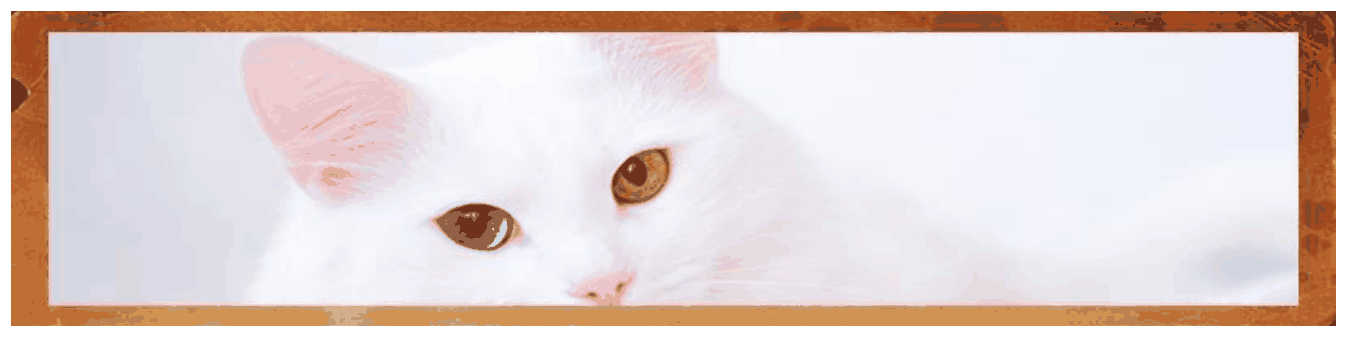
The most beautiful of cats, the Van cat is a pure breed living only in Lake Van basin. Another endemic cat breed is the Ankara cat. They are called Angora cats. Their most important feature is their two different eye colors.
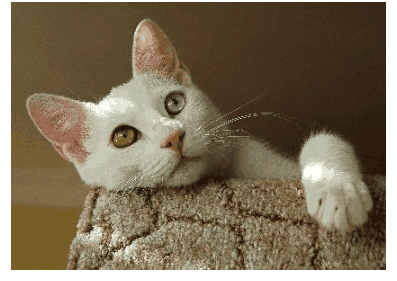
Van cat
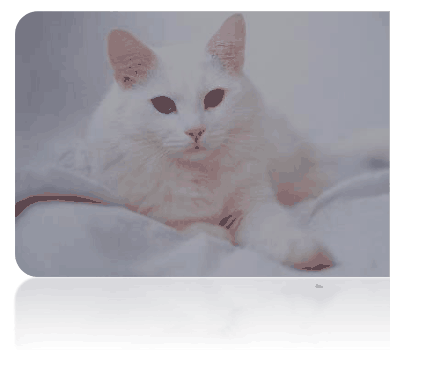
Ankara cat
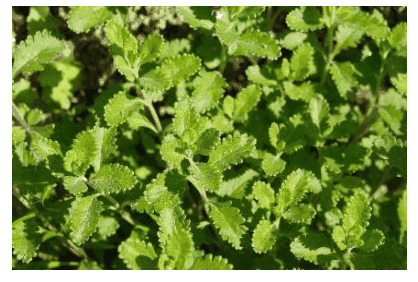
Nepeta cataria (catnip)
Just like people, cats can sometimes be stressed and angry. Just as people are made happy by melatonin, the stress of cats can be reduced and they can be made happy thanks to a natural product. Nepetalactone is an organic compound isolated from the plant catnip (Nepeta cataria), which acts as a cat attractant. Nepetalactone is a ten-carbon bicyclic mono- terpenoid compound derived from isoprene with two fused rings: a cyclopentane and a lactone.
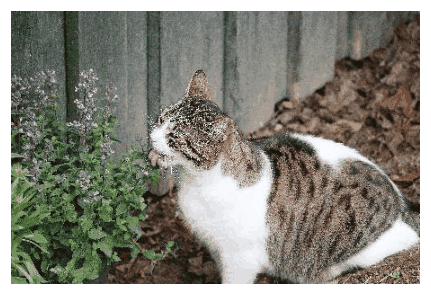
Cat eCat eating catnip in the garden
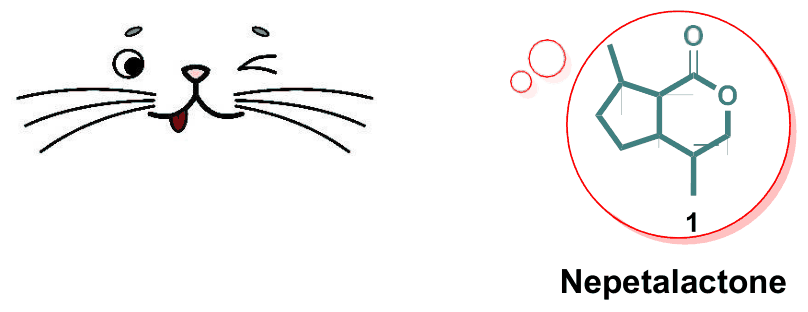
Cat's dream
Total synthesis of nepetalactone:
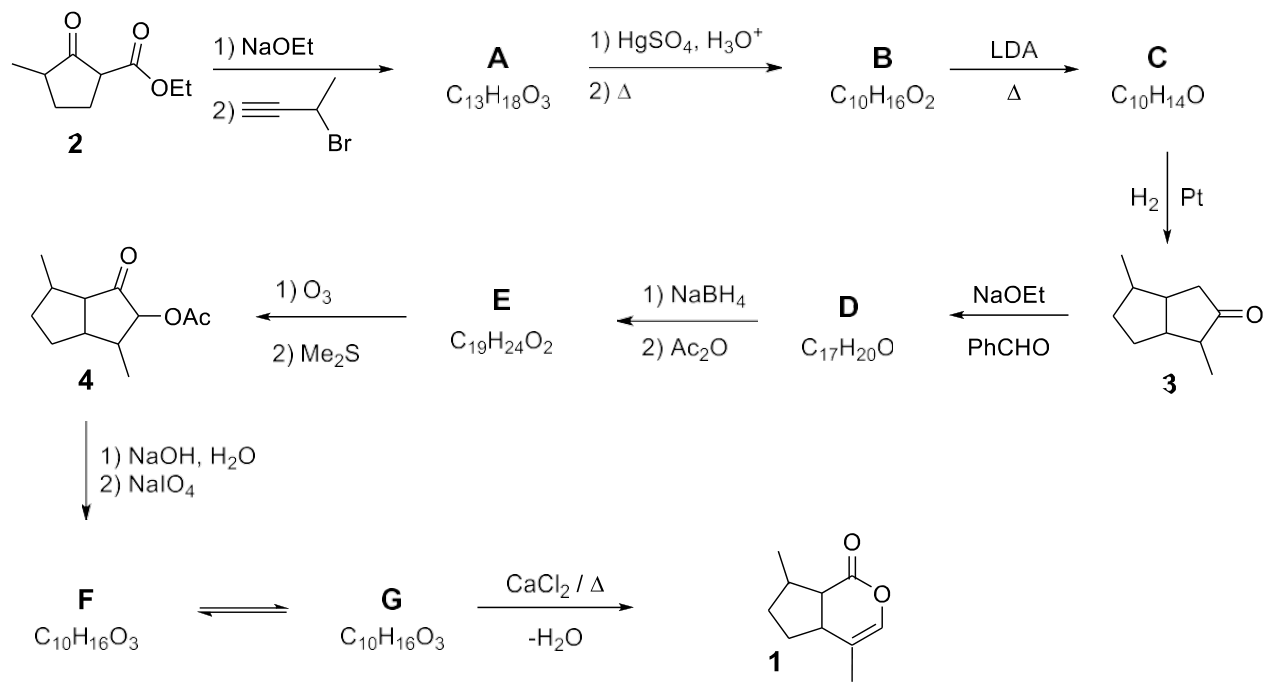
1.1 The above scheme describes the total synthesis of nepetalactone. Draw structures of A–G, without stereochemical details.
Hints:
- Compound A has strong and sharp band at \(3300\ \mathrm{cm^{-1}}\) in the IR spectrum.
- A, B, and F are monocyclic, while C, D, E, and G are bicyclic compounds.
- F has one doublet at ~ \(9.8\ \mathrm{ppm}\) in the \({}^{1}\mathrm{H}\)-NMR spectrum.
Reactions of nepetalactone:
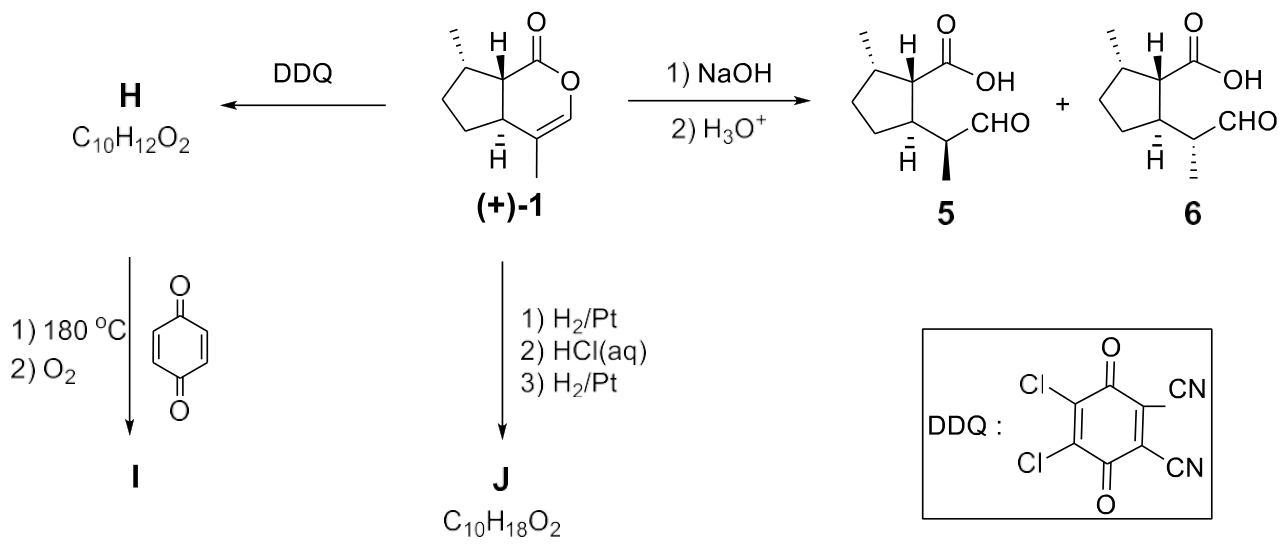
The above scheme includes a few reactions of one of the enantiopure nepetalactone 1 isomers. Three of the reaction products (5, 6, and J) are used as insect repellents in industry.
1.2 For the relationship between 5 and 6, which of the following is/are true? Tick the box next to the correct answer(s) on your answer sheets.
| ☐ | Enantiomers |
| ☐ | Diastereomers |
| ☐ | Identical |
| ☐ | Stereoisomers |
Reaction of 1 with DDQ gives highly conjugated compound H. Also, thermal reaction of compound H with p-quinone gives I with molar mass of \(226.28\ \mathrm{g/mol}\).
1.3 Draw the structures of H, I, and J indicating stereochemistry.
Hints:
- During the formation of I, sequential pericyclic reactions and an oxidation reaction (due to the presence of \(\ce{O2}\)) take place, and a well-known gas forms during the reaction.
- J has a strong and very broad band between 3300 and \(2500\ \mathrm{cm^{-1}}\) in the IR spectrum.
Official English text of the problem.
Answers
- 1.1
Stereochemistry is intentionally unspecified.
| Compound | Name | SMILES |
|---|---|---|
| A | Ethyl 1-(but-3-yn-2-yl)-3-methyl-2-oxocyclopentane-1-carboxylate | CCOC(=O)C1(C(C)C#C)CCC(C)C1=O |
| B | 2-Methyl-5-(3-oxobutan-2-yl)cyclopentan-1-one | CC(=O)C(C)C1CCC(C)C1=O |
| C | 4,8-Dimethylbicyclo[3.3.0]oct-1-en-3-one | CC1CCC2C(C)C(=O)C=C12 |
| D | 4-Benzylidene-2,6-dimethylbicyclo[3.3.0]octan-3-one | CC1CCC2C(C)C(=O)C(=Cc3ccccc3)C12 |
| E | 4-Benzylidene-2,6-dimethylbicyclo[3.3.0]octan-3-yl acetate | CC1CCC2C(C)C(OC(C)=O)C(=Cc3ccccc3)C12 |
| F | 2-(1-Formylethyl)-5-methylcyclopentane-1-carboxylic acid | CC1CCC(C(C)C=O)C1C(=O)O |
| G | 4-Hydroxy-5,9-dimethyl-3-oxabicyclo[4.3.0]nonan-2-one | CC1CCC2C(C)C(O)OC(=O)C12 |
- 1.2
Tick Diastereomers and Stereoisomers. Compounds 5 and 6 are epimers at the side-chain carbon adjacent to the aldehyde group.
- 1.3
| Compound | Name | Stereochemical SMILES |
|---|---|---|
| H | (9S)-5,9-Dimethyl-3-oxabicyclo[4.3.0]nona-1(6),4-dien-2-one, the conjugated α-pyrone | C[C@H]1CCC2=C1C(=O)OC=C2C |
| I | (3S)-3,7-Dimethyltricyclo[7.4.0.0\(^{2,6}\)]trideca-1(9),2(6),7,11-tetraene-10,13-dione, a cyclopenta-fused 1,4-naphthoquinone | C[C@H]1CCc2c1c1C(=O)C=CC(=O)c1cc2C |
| J | (1S,2S,5R)-2-Methyl-5-(propan-2-yl)cyclopentane-1-carboxylic acid | C[C@H]1CC[C@H](C(C)C)[C@H]1C(=O)O |
In drawings of H and I, retain the dashed methyl bond at the surviving stereocentre of the cyclopentane ring. In J, the carboxyl group and ring methyl group are cis, and the isopropyl group is trans to both.
Solution
The names and SMILES of A–J are given above. Small molecules appearing in the balances include water O, hydrogen [H][H], oxygen O=O, carbon dioxide O=C=O, and ethanol CCO. Spectator ions are omitted where appropriate.
1.1 — Identification of A–G
Formation of A: alkylation of a β-keto ester.
Starting compound 2 is ethyl 3-methyl-2-oxocyclopentane-1-carboxylate, CCOC(=O)C1CCC(C)C1=O.
Ethoxide, CC[O-], removes the proton from the ring carbon between the ketone and ester carbonyl groups. The resulting carbon nucleophile attacks the bromine-bearing carbon of 3-bromobut-1-yne, C#CC(C)Br, displacing bromide, [Br-].
Consequently, that ring carbon acquires a but-3-yn-2-yl substituent:
\[ \ce{C9H14O3 + C4H5Br + C2H5O- -> C13H18O3 + C2H5OH + Br-}. \]
The terminal alkyne remains intact. Its \(\ce{C#C-H}\) stretching vibration accounts for the strong, sharp absorption near \(3300\ \mathrm{cm^{-1}}\). The product is monocyclic, as required.
A → B: alkyne hydration, ester hydrolysis, and decarboxylation.
Mercury(II)-catalyzed hydration of the terminal alkyne gives the Markovnikov enol, which tautomerizes to a methyl ketone. Thus the side chain changes from a but-3-yn-2-yl group to a 3-oxobutan-2-yl group.
Acidic ester hydrolysis gives a β-keto acid, which loses carbon dioxide on heating. The overall balance is
\[ \ce{C13H18O3 + 2H2O -> C10H16O2 + C2H5OH + CO2}. \]
The product B therefore has a cyclopentanone ring with one methyl substituent and one \(\ce{-CH(CH3)COCH3}\) side chain. It remains monocyclic.
B → C: intramolecular aldol condensation.
LDA—lithium diisopropylamide, [Li+].CC(C)[N-]C(C)C—forms the enolate at the terminal methyl group of the side-chain ketone. That enolate carbon attacks the cyclopentanone carbonyl carbon, forming a new five-membered ring.
Dehydration produces the fused α,β-unsaturated ketone C:
\[ \ce{C10H16O2 -> C10H14O + H2O}. \]
For the drawing, place the new double bond between the former cyclopentanone carbonyl carbon, now a ring-junction carbon, and the adjacent carbon derived from the terminal methyl group.
Hydrogenation then gives compound 3, 2,6-dimethylbicyclo[3.3.0]octan-3-one, CC1CCC2C(C)C(=O)CC12:
\[ \ce{C10H14O + H2 -> C10H16O}. \]
3 → D: condensation with benzaldehyde.
The α-methylene carbon of 3 undergoes aldol condensation with benzaldehyde, O=Cc1ccccc1. Loss of water gives the exocyclic benzylidene group in D:
\[ \ce{C10H16O + C7H6O -> C17H20O + H2O}. \]
Thus the double bond is between the original α-methylene carbon and the former aldehyde carbon. The ketone carbonyl remains intact.
D → E: carbonyl reduction and acetylation.
Sodium borohydride reduces the ketone carbonyl while retaining the benzylidene double bond. The intermediate is 4-benzylidene-2,6-dimethylbicyclo[3.3.0]octan-3-ol, CC1CCC2C(C)C(O)C(=Cc3ccccc3)C12.
A balanced representation with aqueous work-up is
\[ \ce{4C17H20O + BH4- + 4H2O -> 4C17H22O + B(OH)4-}. \]
Here borohydride is [BH4-] and tetrahydroxyborate is [B-](O)(O)(O)O.
The alcohol is then acetylated by acetic anhydride, CC(=O)OC(C)=O, giving E and acetic acid, CC(=O)O:
\[ \ce{C17H22O + (CH3CO)2O -> C19H24O2 + CH3COOH}. \]
E → 4: reductive ozonolysis.
Ozonolysis cleaves the exocyclic benzylidene double bond. Its ring carbon becomes a ketone carbonyl, while its phenyl-bearing carbon gives benzaldehyde.
Compound 4 is 2,6-dimethyl-4-oxobicyclo[3.3.0]octan-3-yl acetate, CC1CCC2C(C)C(OC(C)=O)C(=O)C12.
With ozone, [O-][O+]=O, and dimethyl sulfide, CSC, the balanced reaction is
\[ \ce{C19H24O2 + O3 + (CH3)2S -> C12H18O3 + C7H6O + (CH3)2SO}. \]
The sulfur-containing product is dimethyl sulfoxide, CS(C)=O.
4 → F: deacetylation and periodate cleavage.
Hydroxide, [OH-], hydrolyzes the acetate ester:
\[ \ce{C12H18O3 + OH- -> C10H16O2 + CH3COO-}. \]
The products are 3-hydroxy-4,8-dimethylbicyclo[3.3.0]octan-2-one, CC1CCC2C(C)C(O)C(=O)C12, and acetate, CC(=O)[O-].
Periodate then cleaves the bond between the adjacent ketone and alcohol carbons. The ketone carbon becomes a carboxyl carbon; the alcohol carbon, which bears hydrogen, becomes an aldehyde carbon. This opens the second five-membered ring:
\[ \ce{C10H16O2 + IO4- -> C10H16O3 + IO3-}. \]
Periodate is [O-]I(=O)(=O)=O; iodate is [O-]I(=O)=O.
The resulting F is therefore a monocyclic aldehyde–carboxylic acid. Its aldehyde proton couples to the single proton on the adjacent \(\ce{CH(CH3)}\) carbon, explaining the doublet near \(9.8\ \mathrm{ppm}\).
F ⇌ G → 1: ring closure and dehydration.
The carboxyl hydroxyl oxygen of F attacks its aldehyde carbon intramolecularly. Proton transfer gives the six-membered hydroxy-lactone G, without changing the molecular formula:
\[ \underbrace{\ce{C10H16O3}}_{\mathbf F} \rightleftharpoons \underbrace{\ce{C10H16O3}}_{\mathbf G}. \]
For the drawing of G, the newly formed ring contains, in order:
- the carboxyl-bearing cyclopentane carbon;
- the ester carbonyl carbon;
- the ring oxygen;
- the former aldehyde carbon, now bearing hydroxyl;
- the methyl-bearing side-chain carbon;
- the adjacent cyclopentane carbon.
Heating with calcium chloride promotes dehydration between the hydroxyl-bearing carbon and its methyl-bearing neighbour:
\[ \ce{C10H16O3 -> C10H14O2 + H2O}. \]
This gives nepetalactone 1, with unspecified stereochemistry for this part: CC1CCC2C(C)=COC(=O)C12.
The formula and ring-count checks are:
| Compound | Formula | Number of rings |
|---|---|---|
| A | \(\ce{C13H18O3}\) | 1 |
| B | \(\ce{C10H16O2}\) | 1 |
| C | \(\ce{C10H14O}\) | 2 |
| D | \(\ce{C17H20O}\) | 2 |
| E | \(\ce{C19H24O2}\) | 2 |
| F | \(\ce{C10H16O3}\) | 1 |
| G | \(\ce{C10H16O3}\) | 2 |
1.2 — Relationship between 5 and 6
Hydrolysis opens the enol-lactone ring. The resulting enol tautomerizes to an aldehyde, creating a stereocentre at the side-chain carbon bearing methyl. Either configuration can form there, while the three pre-existing cyclopentane stereocentres retain their spatial configurations.
The neutral overall hydrolysis balance, for either product, is
\[ \ce{C10H14O2 + H2O -> C10H16O3}. \]
The two structures are:
| Compound | Name | Stereochemical SMILES |
|---|---|---|
| 5 | (1S,2R,5S)-2-[(1S)-1-Formylethyl]-5-methylcyclopentane-1-carboxylic acid | C[C@H]1CC[C@H]([C@H](C)C=O)[C@H]1C(=O)O |
| 6 | (1S,2R,5S)-2-[(1R)-1-Formylethyl]-5-methylcyclopentane-1-carboxylic acid | C[C@H]1CC[C@H]([C@@H](C)C=O)[C@H]1C(=O)O |
They have identical connectivity and differ at exactly one of four stereocentres. They are therefore epimers, hence diastereomers and stereoisomers. They are neither identical nor enantiomers.
1.3 — Identification and stereochemistry of H, I, and J
The stereochemical starting structure shown in the question is (+)-nepetalactone 1:
C[C@H]1CC[C@@H]2C(C)=COC(=O)[C@@H]12
Formation of H.
DDQ removes the two ring-junction hydrogens, introducing a double bond along the shared edge of the five- and six-membered rings. Together with the existing alkene and lactone carbonyl, this gives the conjugated α-pyrone H.
DDQ is 2,3-dichloro-5,6-dicyano-1,4-benzoquinone, N#CC1=C(C#N)C(=O)C(Cl)=C(Cl)C1=O. Its reduced product is 2,3-dichloro-5,6-dicyanohydroquinone, N#Cc1c(C#N)c(O)c(Cl)c(Cl)c1O.
The balanced dehydrogenation is
\[ \ce{C10H14O2 + C8Cl2N2O2 -> C10H12O2 + C8H2Cl2N2O2}. \]
Both ring-junction atoms become trigonal and cease to be stereocentres. The methyl-bearing cyclopentane stereocentre retains its \(S\) configuration.
Thus H is:
C[C@H]1CCC2=C1C(=O)OC=C2C
Formation of I.
The other reactant is 1,4-benzoquinone, O=C1C=CC(=O)C=C1.
The sequence is:
- Diels–Alder cycloaddition. The four-carbon conjugated diene of the α-pyrone reacts with one double bond of benzoquinone.
- Retro-Diels–Alder fragmentation. The bridged lactone unit is expelled as carbon dioxide,
O=C=O. Its carbon atom is the original lactone carbonyl carbon, and its oxygen atoms are both original lactone oxygens. - Oxidative aromatization. Oxygen removes two hydrogen atoms from the newly formed six-membered ring, giving the fused aromatic ring of I.
The overall balanced equation is
\[ \ce{2C10H12O2 + 2C6H4O2 + O2 -> 2C15H14O2 + 2CO2 + 2H2O}. \]
The formula can also be followed directly:
\[ \ce{C10H12O2 + C6H4O2} \quad\xrightarrow{-\ce{CO2},\,-2\ce{H}}\quad \ce{C15H14O2}. \]
Using conventional atomic molar masses,
\[ \begin{aligned} M(\mathbf I) &=15(12.011)+14(1.008)+2(15.999)\\ &=226.275\ \mathrm{g\,mol^{-1}}\\ &\approx \boxed{226.28\ \mathrm{g\,mol^{-1}}}, \end{aligned} \]
matching the given value.
For the drawing, retain the cyclopentane ring and its stereogenic methyl-bearing carbon. The four diene carbons of H and the two reacting alkene carbons of benzoquinone form the new aromatic ring. The two quinone carbonyl groups and its other alkene remain intact.
The precise structure is:
C[C@H]1CCc2c1c1C(=O)C=CC(=O)c1cc2C
The original \(S\) stereocentre survives; the transient stereocentres introduced during cycloaddition disappear during fragmentation and aromatization.
Formation of J.
The first hydrogenation saturates the enol-lactone double bond:
\[ \ce{C10H14O2 + H2 -> C10H16O2}. \]
The intermediate is dihydronepetalactone:
C[C@H]1CC[C@@H]2C(C)COC(=O)[C@@H]12
The newly created methyl-bearing stereocentre is left unspecified here because its configuration does not affect the final product.
Acid-promoted opening and the final hydrogenolysis cleave the lactone’s alkyl carbon–oxygen linkage overall. The ester carbonyl becomes a carboxyl group, and the terminal oxygen-bearing carbon becomes a methyl group. Consequently, the side chain becomes isopropyl.
The combined balance for these last operations is
\[ \ce{C10H16O2 + H2 -> C10H18O2}, \]
and the complete sequence has the net balance
\[ \boxed{\ce{C10H14O2 + 2H2 -> C10H18O2}}. \]
The very broad \(3300\text{–}2500\ \mathrm{cm^{-1}}\) band identifies the hydrogen-bonded hydroxyl group of a carboxylic acid. The formula gives
\[ \mathrm{DBE}=\frac{2(10)+2-18}{2}=2, \]
accounted for by the cyclopentane ring and the carboxyl carbonyl.
Thus J is (1S,2S,5R)-2-methyl-5-(propan-2-yl)cyclopentane-1-carboxylic acid:
C[C@H]1CC[C@H](C(C)C)[C@H]1C(=O)O
All three cyclopentane stereocentres retain their spatial configurations. The side-chain carbon is no longer stereogenic because it now bears two identical methyl groups.
The answers were checked against the official answers published by the organisers.
IChO 2020 · Theorieaufgabe 1
Zwei Schönheiten der Türkei: die Van-Katze und die Ankara-Katze
Die Van-Katze, die schönste aller Katzen, ist eine reinrassige Katze, die ausschließlich im Einzugsgebiet des Vansees lebt. Eine weitere endemische Katzenrasse ist die Ankara-Katze. Diese Katzen werden Angorakatzen genannt. Ihr wichtigstes Merkmal sind ihre zwei unterschiedlichen Augenfarben.
Van-Katze
Ankara-Katze
Nepeta cataria (Echte Katzenminze)
Genau wie Menschen können Katzen manchmal gestresst und wütend sein. So wie Melatonin Menschen glücklich macht, kann ein Naturstoff den Stress von Katzen verringern und sie glücklich machen. Nepetalacton ist eine organische Verbindung, die aus der Katzenminze (Nepeta cataria) isoliert wird und als Lockstoff für Katzen wirkt. Nepetalacton ist eine von Isopren abgeleitete bicyclische Monoterpenoidverbindung mit zehn Kohlenstoffatomen und zwei anellierten Ringen: einem Cyclopentan- und einem Lactonring.
Katze eCat beim Fressen von Katzenminze im Garten
Traum einer Katze
Totalsynthese von Nepetalacton:
1.1 Das obige Schema beschreibt die Totalsynthese von Nepetalacton. Zeichnen Sie die Strukturen von A–G ohne stereochemische Details.
Hinweise:
- Verbindung A weist im IR-Spektrum eine starke und scharfe Bande bei \(3300\ \mathrm{cm^{-1}}\) auf.
- A, B, und F sind monocyclische, C, D, E, und G hingegen bicyclische Verbindungen.
- F weist im \({}^{1}\mathrm{H}\)-NMR-Spektrum ein Dublett bei ~ \(9.8\ \mathrm{ppm}\) auf.
Reaktionen von Nepetalacton:
Das obige Schema zeigt einige Reaktionen eines der enantiomerenreinen Isomere von Nepetalacton 1. Drei der Reaktionsprodukte (5, 6, und J) werden industriell als Insektenrepellentien verwendet.
1.2 Welche der folgenden Aussagen zur Beziehung zwischen 5 und 6 ist/sind richtig? Kreuzen Sie auf Ihren Antwortbögen das Kästchen neben der/den richtigen Antwort(en) an.
| ☐ | Enantiomere |
| ☐ | Diastereomere |
| ☐ | Identisch |
| ☐ | Stereoisomere |
Die Reaktion von 1 mit DDQ liefert die stark konjugierte Verbindung H. Die thermische Reaktion von Verbindung H mit p-Chinon liefert außerdem I mit einer molaren Masse von \(226.28\ \mathrm{g/mol}\).
1.3 Zeichnen Sie die Strukturen von H, I, und J unter Angabe der Stereochemie.
Hinweise:
- Bei der Bildung von I finden aufeinanderfolgende pericyclische Reaktionen und eine Oxidationsreaktion (aufgrund der Anwesenheit von \(\ce{O2}\)) statt, und während der Reaktion entsteht ein allgemein bekanntes Gas.
- J weist im IR-Spektrum eine starke und sehr breite Bande zwischen 3300 und \(2500\ \mathrm{cm^{-1}}\) auf.
Aufgabentext aus dem offiziellen englischen Text übersetzt.
Antworten
- 1.1
Die Stereochemie ist absichtlich nicht angegeben.
| Verbindung | Name | SMILES |
|---|---|---|
| A | Ethyl-1-(but-3-in-2-yl)-3-methyl-2-oxocyclopentan-1-carboxylat | CCOC(=O)C1(C(C)C#C)CCC(C)C1=O |
| B | 2-Methyl-5-(3-oxobutan-2-yl)cyclopentan-1-on | CC(=O)C(C)C1CCC(C)C1=O |
| C | 4,8-Dimethylbicyclo[3.3.0]oct-1-en-3-on | CC1CCC2C(C)C(=O)C=C12 |
| D | 4-Benzyliden-2,6-dimethylbicyclo[3.3.0]octan-3-on | CC1CCC2C(C)C(=O)C(=Cc3ccccc3)C12 |
| E | 4-Benzyliden-2,6-dimethylbicyclo[3.3.0]octan-3-ylacetat | CC1CCC2C(C)C(OC(C)=O)C(=Cc3ccccc3)C12 |
| F | 2-(1-Formylethyl)-5-methylcyclopentan-1-carbonsäure | CC1CCC(C(C)C=O)C1C(=O)O |
| G | 4-Hydroxy-5,9-dimethyl-3-oxabicyclo[4.3.0]nonan-2-on | CC1CCC2C(C)C(O)OC(=O)C12 |
- 1.2
Kreuzen Sie Diastereomere und Stereoisomere an. Die Verbindungen 5 und 6 sind Epimere am Kohlenstoffatom der Seitenkette, das der Aldehydgruppe benachbart ist.
- 1.3
| Verbindung | Name | Stereochemische SMILES |
|---|---|---|
| H | (9S)-5,9-Dimethyl-3-oxabicyclo[4.3.0]nona-1(6),4-dien-2-on, das konjugierte α-Pyron | C[C@H]1CCC2=C1C(=O)OC=C2C |
| I | (3S)-3,7-Dimethyltricyclo[7.4.0.0\(^{2,6}\)]trideca-1(9),2(6),7,11-tetraen-10,13-dion, ein cyclopenta-anelliertes 1,4-Naphthochinon | C[C@H]1CCc2c1c1C(=O)C=CC(=O)c1cc2C |
| J | (1S,2S,5R)-2-Methyl-5-(propan-2-yl)cyclopentan-1-carbonsäure | C[C@H]1CC[C@H](C(C)C)[C@H]1C(=O)O |
Behalten Sie in den Zeichnungen von H und I die gestrichelte Bindung zur Methylgruppe am erhalten bleibenden Stereozentrum des Cyclopentanrings bei. In J stehen die Carboxylgruppe und die Methylgruppe am Ring cis zueinander, und die Isopropylgruppe steht zu beiden trans.
Lösung
Die Namen und SMILES von A–J sind oben angegeben. Zu den kleinen Molekülen, die in den Bilanzgleichungen auftreten, gehören Wasser O, Wasserstoff [H][H], Sauerstoff O=O, Kohlenstoffdioxid O=C=O und Ethanol CCO. Zuschauerionen werden gegebenenfalls weggelassen.
1.1 — Identifizierung von A–G
Bildung von A: Alkylierung eines β-Ketoesters.
Die Ausgangsverbindung 2 ist Ethyl-3-methyl-2-oxocyclopentan-1-carboxylat, CCOC(=O)C1CCC(C)C1=O.
Ethanolat, CC[O-], entfernt das Proton vom Ringkohlenstoffatom zwischen der Keton- und der Estercarbonylgruppe. Das entstehende Kohlenstoffnucleophil greift das bromtragende Kohlenstoffatom von 3-Brombut-1-in, C#CC(C)Br, an und verdrängt dabei Bromid, [Br-].
Dadurch erhält dieses Ringkohlenstoffatom einen But-3-in-2-yl-Substituenten:
\[ \ce{C9H14O3 + C4H5Br + C2H5O- -> C13H18O3 + C2H5OH + Br-}. \]
Das terminale Alkin bleibt erhalten. Seine \(\ce{C#C-H}\)-Valenzschwingung erklärt die starke, scharfe Absorption bei etwa \(3300\ \mathrm{cm^{-1}}\). Das Produkt ist wie gefordert monocyclisch.
A → B: Alkinhydratisierung, Esterhydrolyse und Decarboxylierung.
Die quecksilber(II)-katalysierte Hydratisierung des terminalen Alkins liefert das Markownikow-Enol, das zu einem Methylketon tautomerisiert. Die Seitenkette wird somit von einer But-3-in-2-yl-Gruppe in eine 3-Oxobutan-2-yl-Gruppe umgewandelt.
Die saure Esterhydrolyse liefert eine β-Ketosäure, die beim Erhitzen Kohlenstoffdioxid abspaltet. Die Gesamtbilanz lautet
\[ \ce{C13H18O3 + 2H2O -> C10H16O2 + C2H5OH + CO2}. \]
Das Produkt B besitzt daher einen Cyclopentanonring mit einem Methylsubstituenten und einer \(\ce{-CH(CH3)COCH3}\)-Seitenkette. Es bleibt monocyclisch.
B → C: intramolekulare Aldolkondensation.
LDA — Lithiumdiisopropylamid, [Li+].CC(C)[N-]C(C)C — bildet das Enolat an der terminalen Methylgruppe des Seitenkettenketons. Dieses Enolatkohlenstoffatom greift das Carbonylkohlenstoffatom des Cyclopentanons an, wodurch ein neuer fünfgliedriger Ring entsteht.
Die Dehydratisierung liefert das anellierte α,β-ungesättigte Keton C:
\[ \ce{C10H16O2 -> C10H14O + H2O}. \]
Zeichnen Sie die neue Doppelbindung zwischen dem ehemaligen Carbonylkohlenstoffatom des Cyclopentanons, das nun ein Ringverknüpfungsatom ist, und dem benachbarten Kohlenstoffatom, das aus der terminalen Methylgruppe stammt.
Die anschließende Hydrierung liefert Verbindung 3, 2,6-Dimethylbicyclo[3.3.0]octan-3-on, CC1CCC2C(C)C(=O)CC12:
\[ \ce{C10H14O + H2 -> C10H16O}. \]
3 → D: Kondensation mit Benzaldehyd.
Das α-Methylenkohlenstoffatom von 3 geht eine Aldolkondensation mit Benzaldehyd, O=Cc1ccccc1, ein. Durch Wasserabspaltung entsteht die exocyclische Benzylidengruppe in D:
\[ \ce{C10H16O + C7H6O -> C17H20O + H2O}. \]
Die Doppelbindung liegt somit zwischen dem ursprünglichen α-Methylenkohlenstoffatom und dem ehemaligen Aldehydkohlenstoffatom. Die Ketoncarbonylgruppe bleibt erhalten.
D → E: Carbonylreduktion und Acetylierung.
Natriumborhydrid reduziert die Ketoncarbonylgruppe unter Erhaltung der Benzyliden-Doppelbindung. Das Zwischenprodukt ist 4-Benzyliden-2,6-dimethylbicyclo[3.3.0]octan-3-ol, CC1CCC2C(C)C(O)C(=Cc3ccccc3)C12.
Eine ausgeglichene Darstellung unter Einbeziehung der wässrigen Aufarbeitung lautet
\[ \ce{4C17H20O + BH4- + 4H2O -> 4C17H22O + B(OH)4-}. \]
Dabei ist Borhydrid [BH4-] und Tetrahydroxyborat [B-](O)(O)(O)O.
Der Alkohol wird anschließend mit Essigsäureanhydrid, CC(=O)OC(C)=O, acetyliert, wobei E und Essigsäure, CC(=O)O, entstehen:
\[ \ce{C17H22O + (CH3CO)2O -> C19H24O2 + CH3COOH}. \]
E → 4: reduktive Ozonolyse.
Die Ozonolyse spaltet die exocyclische Benzyliden-Doppelbindung. Ihr Ringkohlenstoffatom wird zum Kohlenstoffatom einer Ketoncarbonylgruppe, während ihr phenyltragendes Kohlenstoffatom Benzaldehyd liefert.
Verbindung 4 ist 2,6-Dimethyl-4-oxobicyclo[3.3.0]octan-3-ylacetat, CC1CCC2C(C)C(OC(C)=O)C(=O)C12.
Mit Ozon, [O-][O+]=O, und Dimethylsulfid, CSC, lautet die ausgeglichene Reaktionsgleichung
\[ \ce{C19H24O2 + O3 + (CH3)2S -> C12H18O3 + C7H6O + (CH3)2SO}. \]
Das schwefelhaltige Produkt ist Dimethylsulfoxid, CS(C)=O.
4 → F: Deacetylierung und Periodatspaltung.
Hydroxid, [OH-], hydrolysiert den Acetatester:
\[ \ce{C12H18O3 + OH- -> C10H16O2 + CH3COO-}. \]
Die Produkte sind 3-Hydroxy-4,8-dimethylbicyclo[3.3.0]octan-2-on, CC1CCC2C(C)C(O)C(=O)C12, und Acetat, CC(=O)[O-].
Periodat spaltet anschließend die Bindung zwischen den benachbarten Keton- und Alkoholkohlenstoffatomen. Das Ketonkohlenstoffatom wird zu einem Carboxylkohlenstoffatom; das Alkoholkohlenstoffatom, das ein Wasserstoffatom trägt, wird zu einem Aldehydkohlenstoffatom. Dadurch wird der zweite fünfgliedrige Ring geöffnet:
\[ \ce{C10H16O2 + IO4- -> C10H16O3 + IO3-}. \]
Periodat ist [O-]I(=O)(=O)=O; Iodat ist [O-]I(=O)=O.
Das entstehende F ist somit eine monocyclische Aldehydcarbonsäure. Ihr Aldehydproton koppelt mit dem einzigen Proton am benachbarten \(\ce{CH(CH3)}\)-Kohlenstoffatom, was das Dublett bei etwa \(9.8\ \mathrm{ppm}\) erklärt.
F ⇌ G → 1: Ringschluss und Dehydratisierung.
Das Hydroxylsauerstoffatom der Carboxylgruppe von F greift intramolekular dessen Aldehydkohlenstoffatom an. Durch Protonenübertragung entsteht das sechsgliedrige Hydroxylacton G, ohne dass sich die Summenformel ändert:
\[ \underbrace{\ce{C10H16O3}}_{\mathbf F} \rightleftharpoons \underbrace{\ce{C10H16O3}}_{\mathbf G}. \]
Für die Zeichnung von G enthält der neu gebildete Ring in dieser Reihenfolge:
- das carboxyltragende Cyclopentankohlenstoffatom;
- das Estercarbonylkohlenstoffatom;
- das Ringsauerstoffatom;
- das ehemalige Aldehydkohlenstoffatom, das nun eine Hydroxylgruppe trägt;
- das methyltragende Seitenkettenkohlenstoffatom;
- das benachbarte Cyclopentankohlenstoffatom.
Erhitzen mit Calciumchlorid begünstigt die Dehydratisierung zwischen dem hydroxyltragenden Kohlenstoffatom und seinem methyltragenden Nachbarn:
\[ \ce{C10H16O3 -> C10H14O2 + H2O}. \]
Dadurch entsteht Nepetalacton 1, dessen Stereochemie in diesem Teil nicht angegeben ist: CC1CCC2C(C)=COC(=O)C12.
Die Überprüfung der Summenformeln und Ringanzahlen ergibt:
| Verbindung | Summenformel | Anzahl der Ringe |
|---|---|---|
| A | \(\ce{C13H18O3}\) | 1 |
| B | \(\ce{C10H16O2}\) | 1 |
| C | \(\ce{C10H14O}\) | 2 |
| D | \(\ce{C17H20O}\) | 2 |
| E | \(\ce{C19H24O2}\) | 2 |
| F | \(\ce{C10H16O3}\) | 1 |
| G | \(\ce{C10H16O3}\) | 2 |
1.2 — Beziehung zwischen 5 und 6
Durch Hydrolyse wird der Enollactonring geöffnet. Das entstehende Enol tautomerisiert zu einem Aldehyd, wobei am methyltragenden Kohlenstoffatom der Seitenkette ein Stereozentrum entsteht. Dort können beide Konfigurationen entstehen, während die drei bereits vorhandenen Stereozentren des Cyclopentanrings ihre räumlichen Konfigurationen beibehalten.
Die neutrale Gesamtbilanz der Hydrolyse lautet für jedes der beiden Produkte
\[ \ce{C10H14O2 + H2O -> C10H16O3}. \]
Die beiden Strukturen sind:
| Verbindung | Name | Stereochemische SMILES |
|---|---|---|
| 5 | (1S,2R,5S)-2-[(1S)-1-Formylethyl]-5-methylcyclopentan-1-carbonsäure | C[C@H]1CC[C@H]([C@H](C)C=O)[C@H]1C(=O)O |
| 6 | (1S,2R,5S)-2-[(1R)-1-Formylethyl]-5-methylcyclopentan-1-carbonsäure | C[C@H]1CC[C@H]([C@@H](C)C=O)[C@H]1C(=O)O |
Sie besitzen die gleiche Konnektivität und unterscheiden sich an genau einem von vier Stereozentren. Sie sind daher Epimere, also Diastereomere und Stereoisomere. Sie sind weder identisch noch Enantiomere.
1.3 — Identifizierung und Stereochemie von H, I und J
Die in der Aufgabenstellung gezeigte stereochemische Ausgangsstruktur ist (+)-Nepetalacton 1:
C[C@H]1CC[C@@H]2C(C)=COC(=O)[C@@H]12
Bildung von H.
DDQ entfernt die beiden Wasserstoffatome an den Ringverknüpfungsatomen und führt dadurch eine Doppelbindung entlang der gemeinsamen Kante des fünf- und des sechsgliedrigen Rings ein. Zusammen mit der vorhandenen Alkenbindung und der Lactoncarbonylgruppe entsteht so das konjugierte α-Pyron H.
DDQ ist 2,3-Dichlor-5,6-dicyan-1,4-benzochinon, N#CC1=C(C#N)C(=O)C(Cl)=C(Cl)C1=O. Sein reduziertes Produkt ist 2,3-Dichlor-5,6-dicyanhydrochinon, N#Cc1c(C#N)c(O)c(Cl)c(Cl)c1O.
Die ausgeglichene Dehydrierungsgleichung lautet
\[ \ce{C10H14O2 + C8Cl2N2O2 -> C10H12O2 + C8H2Cl2N2O2}. \]
Beide Ringverknüpfungsatome werden trigonal und sind keine Stereozentren mehr. Das methyltragende Stereozentrum des Cyclopentanrings behält seine \(S\)-Konfiguration bei.
Somit ist H:
C[C@H]1CCC2=C1C(=O)OC=C2C
Bildung von I.
Der andere Reaktionspartner ist 1,4-Benzochinon, O=C1C=CC(=O)C=C1.
Die Reaktionsfolge ist:
- Diels–Alder-Cycloaddition. Das aus vier Kohlenstoffatomen bestehende konjugierte Dien des α-Pyrons reagiert mit einer Doppelbindung des Benzochinons.
- Retro-Diels–Alder-Fragmentierung. Die verbrückende Lactoneinheit wird als Kohlenstoffdioxid,
O=C=O, abgespalten. Sein Kohlenstoffatom ist das ursprüngliche Lactoncarbonylkohlenstoffatom, und seine Sauerstoffatome sind die beiden ursprünglichen Lactonsauerstoffatome. - Oxidative Aromatisierung. Sauerstoff entfernt zwei Wasserstoffatome aus dem neu gebildeten sechsgliedrigen Ring, wodurch der anellierte aromatische Ring von I entsteht.
Die ausgeglichene Gesamtgleichung lautet
\[ \ce{2C10H12O2 + 2C6H4O2 + O2 -> 2C15H14O2 + 2CO2 + 2H2O}. \]
Die Summenformel lässt sich auch direkt nachvollziehen:
\[ \ce{C10H12O2 + C6H4O2} \quad\xrightarrow{-\ce{CO2},\,-2\ce{H}}\quad \ce{C15H14O2}. \]
Mit den üblichen molaren Atommassen ergibt sich
\[ \begin{aligned} M(\mathbf I) &=15(12.011)+14(1.008)+2(15.999)\\ &=226.275\ \mathrm{g\,mol^{-1}}\\ &\approx \boxed{226.28\ \mathrm{g\,mol^{-1}}}, \end{aligned} \]
in Übereinstimmung mit dem angegebenen Wert.
Behalten Sie in der Zeichnung den Cyclopentanring und sein stereogenes methyltragendes Kohlenstoffatom bei. Die vier Dienkohlenstoffatome von H und die beiden reagierenden Alkenkohlenstoffatome des Benzochinons bilden den neuen aromatischen Ring. Die beiden Chinoncarbonylgruppen und die andere Alkenbindung des Benzochinons bleiben erhalten.
Die genaue Struktur lautet:
C[C@H]1CCc2c1c1C(=O)C=CC(=O)c1cc2C
Das ursprüngliche \(S\)-Stereozentrum bleibt erhalten; die bei der Cycloaddition vorübergehend eingeführten Stereozentren verschwinden bei der Fragmentierung und Aromatisierung.
Bildung von J.
Die erste Hydrierung sättigt die Enollacton-Doppelbindung:
\[ \ce{C10H14O2 + H2 -> C10H16O2}. \]
Das Zwischenprodukt ist Dihydronepetalacton:
C[C@H]1CC[C@@H]2C(C)COC(=O)[C@@H]12
Die Konfiguration des neu entstandenen methyltragenden Stereozentrums wird hier nicht angegeben, da sie das Endprodukt nicht beeinflusst.
Die säuregeförderte Ringöffnung und die abschließende Hydrogenolyse spalten insgesamt die Bindung zwischen dem Alkylkohlenstoffatom und dem Sauerstoffatom des Lactons. Die Estercarbonylgruppe wird zu einer Carboxylgruppe, und das terminale sauerstofftragende Kohlenstoffatom wird zu einer Methylgruppe. Dadurch wird die Seitenkette zu einer Isopropylgruppe.
Die zusammengefasste Bilanz dieser letzten Schritte lautet
\[ \ce{C10H16O2 + H2 -> C10H18O2}, \]
und für die gesamte Reaktionsfolge ergibt sich die Nettobilanz
\[ \boxed{\ce{C10H14O2 + 2H2 -> C10H18O2}}. \]
Die sehr breite Bande bei \(3300\text{–}2500\ \mathrm{cm^{-1}}\) kennzeichnet die über Wasserstoffbrücken gebundene Hydroxylgruppe einer Carbonsäure. Aus der Summenformel ergibt sich
\[ \mathrm{DBE}=\frac{2(10)+2-18}{2}=2, \]
was durch den Cyclopentanring und die Carboxylcarbonylgruppe erklärt wird.
Somit ist J (1S,2S,5R)-2-Methyl-5-(propan-2-yl)cyclopentan-1-carbonsäure:
C[C@H]1CC[C@H](C(C)C)[C@H]1C(=O)O
Alle drei Stereozentren des Cyclopentanrings behalten ihre räumlichen Konfigurationen bei. Das Seitenkettenkohlenstoffatom ist nicht mehr stereogen, da es nun zwei identische Methylgruppen trägt.
Die Ergebnisse wurden mit den von den Veranstaltern veröffentlichten offiziellen Ergebnissen abgeglichen.
IChO 2020 · Teori sorusu 1
Türkiye'nin İki Güzeli: Van Kedisi ve Ankara Kedisi
Kedilerin en güzeli olan Van kedisi, yalnızca Van Gölü havzasında yaşayan saf bir ırktır. Bir başka endemik kedi ırkı da Ankara kedisidir. Bunlara Angora kedileri denir. En önemli özellikleri, gözlerinin iki farklı renkte olmasıdır.
Van kedisi
Ankara kedisi
Nepeta cataria (kedi nanesi)
Tıpkı insanlar gibi kediler de bazen stresli ve öfkeli olabilir. Nasıl melatonin insanları mutlu ediyorsa, doğal bir ürün sayesinde de kedilerin stresi azaltılabilir ve mutlu olmaları sağlanabilir. Nepetalakton, kedileri cezbeden kedi nanesi (Nepeta cataria) bitkisinden izole edilen organik bir bileşiktir. Nepetalakton, izoprenden türeyen, bir siklopentan ve bir lakton olmak üzere iki kaynaşmış halka içeren, on karbonlu bisiklik bir monoterpenoid bileşiğidir.
Bahçede kedi nanesi yiyen kedi eCat
Kedinin rüyası
Nepetalaktonun total sentezi:
1.1 Yukarıdaki şema nepetalaktonun total sentezini göstermektedir. Stereokimyasal ayrıntıları belirtmeden A–G bileşiklerinin yapılarını çiziniz.
İpuçları:
- A bileşiğinin IR spektrumunda \(3300\ \mathrm{cm^{-1}}\) değerinde şiddetli ve keskin bir bant vardır.
- A, B ve F monosiklik, C, D, E ve G ise bisiklik bileşiklerdir.
- F bileşiğinin \({}^{1}\mathrm{H}\)-NMR spektrumunda ~ \(9.8\ \mathrm{ppm}\) değerinde bir dublet vardır.
Nepetalaktonun tepkimeleri:
Yukarıdaki şema, enantiyomerik olarak saf nepetalakton 1 izomerlerinden birinin birkaç tepkimesini içermektedir. Tepkime ürünlerinden üçü (5, 6 ve J) sanayide böcek kovucu olarak kullanılmaktadır.
1.2 5 ile 6 arasındaki ilişki için aşağıdakilerden hangisi/hangileri doğrudur? Cevap kâğıtlarınızda doğru cevabın/cevapların yanındaki kutucuğu işaretleyiniz.
| ☐ | Enantiyomerler |
| ☐ | Diastereomerler |
| ☐ | Özdeş |
| ☐ | Stereoizomerler |
1 bileşiğinin DDQ ile tepkimesi, yüksek derecede konjuge H bileşiğini verir. Ayrıca H bileşiğinin p-kinon ile ısıl tepkimesi, molar kütlesi \(226.28\ \mathrm{g/mol}\) olan I bileşiğini verir.
1.3 H, I ve J bileşiklerinin yapılarını stereokimyalarını belirterek çiziniz.
İpuçları:
- I oluşurken ardışık perisiklik tepkimeler ve (\(\ce{O2}\) varlığı nedeniyle) bir yükseltgenme tepkimesi gerçekleşir; tepkime sırasında iyi bilinen bir gaz oluşur.
- J bileşiğinin IR spektrumunda 3300 ile \(2500\ \mathrm{cm^{-1}}\) arasında şiddetli ve çok geniş bir bant vardır.
Soru metni resmi İngilizce metinden çevrilmiştir.
Cevaplar
- 1.1
Stereokimya bilinçli olarak belirtilmemiştir.
| Bileşik | Adı | SMILES |
|---|---|---|
| A | Etil 1-(büt-3-in-2-il)-3-metil-2-oksosiklopentan-1-karboksilat | CCOC(=O)C1(C(C)C#C)CCC(C)C1=O |
| B | 2-Metil-5-(3-oksobütan-2-il)siklopentan-1-on | CC(=O)C(C)C1CCC(C)C1=O |
| C | 4,8-Dimetilbisiklo[3.3.0]okt-1-en-3-on | CC1CCC2C(C)C(=O)C=C12 |
| D | 4-Benziliden-2,6-dimetilbisiklo[3.3.0]oktan-3-on | CC1CCC2C(C)C(=O)C(=Cc3ccccc3)C12 |
| E | 4-Benziliden-2,6-dimetilbisiklo[3.3.0]oktan-3-il asetat | CC1CCC2C(C)C(OC(C)=O)C(=Cc3ccccc3)C12 |
| F | 2-(1-Formiletil)-5-metilsiklopentan-1-karboksilik asit | CC1CCC(C(C)C=O)C1C(=O)O |
| G | 4-Hidroksi-5,9-dimetil-3-oksabisiklo[4.3.0]nonan-2-on | CC1CCC2C(C)C(O)OC(=O)C12 |
- 1.2
Diastereomerler ve Stereoizomerler seçeneklerini işaretleyiniz. 5 ve 6 bileşikleri, aldehit grubuna komşu yan zincir karbonunda birbirlerinin epimeridir.
- 1.3
| Bileşik | Adı | Stereokimyasal SMILES |
|---|---|---|
| H | (9S)-5,9-Dimetil-3-oksabisiklo[4.3.0]nona-1(6),4-dien-2-on, konjuge α-piron | C[C@H]1CCC2=C1C(=O)OC=C2C |
| I | (3S)-3,7-Dimetiltrisiklo[7.4.0.0\(^{2,6}\)]trideka-1(9),2(6),7,11-tetraen-10,13-dion, siklopenta halkasıyla kaynaşmış bir 1,4-naftokinon | C[C@H]1CCc2c1c1C(=O)C=CC(=O)c1cc2C |
| J | (1S,2S,5R)-2-Metil-5-(propan-2-il)siklopentan-1-karboksilik asit | C[C@H]1CC[C@H](C(C)C)[C@H]1C(=O)O |
H ve I çizimlerinde, siklopentan halkasının korunan stereomerkezindeki kesikli metil bağını koruyunuz. J bileşiğinde karboksil grubu ile halkadaki metil grubu cis, izopropil grubu ise her ikisine göre trans konumdadır.
Çözüm
A–J bileşiklerinin adları ve SMILES gösterimleri yukarıda verilmiştir. Denkleştirilmiş tepkimelerde yer alan küçük moleküller arasında su O, hidrojen [H][H], oksijen O=O, karbon dioksit O=C=O ve etanol CCO bulunur. Uygun durumlarda seyirci iyonlar gösterilmemiştir.
1.1 — A–G bileşiklerinin belirlenmesi
A'nın oluşumu: bir β-keto esterin alkillenmesi.
Başlangıç bileşiği 2, etil 3-metil-2-oksosiklopentan-1-karboksilattır, CCOC(=O)C1CCC(C)C1=O.
Etoksit, CC[O-], keton ve ester karbonil grupları arasındaki halka karbonundan protonu uzaklaştırır. Oluşan karbon nükleofili, 3-bromobüt-1-inin, C#CC(C)Br, brom taşıyan karbonuna saldırarak bromürün, [Br-], ayrılmasını sağlar.
Böylece bu halka karbonuna bir büt-3-in-2-il sübstitüenti bağlanır:
\[ \ce{C9H14O3 + C4H5Br + C2H5O- -> C13H18O3 + C2H5OH + Br-}. \]
Uç alkin değişmeden kalır. Bu grubun \(\ce{C#C-H}\) gerilme titreşimi, \(3300\ \mathrm{cm^{-1}}\) yakınındaki şiddetli, keskin soğurmayı açıklar. Ürün, beklendiği gibi monosikliktir.
A → B: alkinin hidratasyonu, esterin hidrolizi ve dekarboksilasyon.
Uç alkinin cıva(II) katalizli hidratasyonu, bir metil ketona tautomerleşen Markovnikov enolünü verir. Böylece yan zincir, büt-3-in-2-il grubundan 3-oksobütan-2-il grubuna dönüşür.
Asidik ester hidrolizi, ısıtıldığında karbon dioksit kaybeden bir β-keto asit verir. Toplam denkleştirilmiş tepkime şöyledir:
\[ \ce{C13H18O3 + 2H2O -> C10H16O2 + C2H5OH + CO2}. \]
Dolayısıyla B ürünü, bir metil sübstitüenti ve bir \(\ce{-CH(CH3)COCH3}\) yan zinciri taşıyan bir siklopentanon halkasına sahiptir. Monosiklik yapısını korur.
B → C: molekül içi aldol kondenzasyonu.
LDA—lityum diizopropilamit, [Li+].CC(C)[N-]C(C)C—yan zincirdeki ketonun uç metil grubunda enolat oluşturur. Bu enolatın karbonu, siklopentanonun karbonil karbonuna saldırarak yeni bir beş üyeli halka oluşturur.
Dehidrasyon, kaynaşmış halkalı α,β-doymamış keton C'yi oluşturur:
\[ \ce{C10H16O2 -> C10H14O + H2O}. \]
Çizimde yeni çift bağı, artık halka birleşim karbonu olan eski siklopentanon karbonil karbonu ile uç metil grubundan türeyen komşu karbon arasına yerleştiriniz.
Ardından hidrojenasyon, 3 bileşiğini, 2,6-dimetilbisiklo[3.3.0]oktan-3-onu, CC1CCC2C(C)C(=O)CC12, verir:
\[ \ce{C10H14O + H2 -> C10H16O}. \]
3 → D: benzaldehit ile kondenzasyon.
3 bileşiğinin α-metilen karbonu, benzaldehit, O=Cc1ccccc1, ile aldol kondenzasyonuna girer. Su kaybı, D'deki halka dışı benziliden grubunu verir:
\[ \ce{C10H16O + C7H6O -> C17H20O + H2O}. \]
Böylece çift bağ, başlangıçtaki α-metilen karbonu ile eski aldehit karbonu arasında bulunur. Keton karbonili değişmeden kalır.
D → E: karbonilin indirgenmesi ve asetilleme.
Sodyum borohidrür, benziliden çift bağını koruyarak keton karbonilini indirger. Ara ürün, 4-benziliden-2,6-dimetilbisiklo[3.3.0]oktan-3-oldür, CC1CCC2C(C)C(O)C(=Cc3ccccc3)C12.
Sulu ortamda son işlemi de içeren denkleştirilmiş bir gösterim şöyledir:
\[ \ce{4C17H20O + BH4- + 4H2O -> 4C17H22O + B(OH)4-}. \]
Burada borohidrür [BH4-], tetrahidroksiborat ise [B-](O)(O)(O)O şeklindedir.
Ardından alkol, asetik anhidrit, CC(=O)OC(C)=O, ile asetillenerek E ve asetik asit, CC(=O)O, verir:
\[ \ce{C17H22O + (CH3CO)2O -> C19H24O2 + CH3COOH}. \]
E → 4: indirgen ozonoliz.
Ozonoliz, halka dışı benziliden çift bağını parçalar. Bu bağın halka karbonu bir keton karboniline dönüşürken, fenil taşıyan karbonu benzaldehit verir.
4 bileşiği, 2,6-dimetil-4-oksobisiklo[3.3.0]oktan-3-il asetattır, CC1CCC2C(C)C(OC(C)=O)C(=O)C12.
Ozon, [O-][O+]=O, ve dimetil sülfür, CSC, ile denkleştirilmiş tepkime şöyledir:
\[ \ce{C19H24O2 + O3 + (CH3)2S -> C12H18O3 + C7H6O + (CH3)2SO}. \]
Kükürt içeren ürün dimetil sülfoksittir, CS(C)=O.
4 → F: deasetilleme ve periyodatla parçalanma.
Hidroksit, [OH-], asetat esterini hidroliz eder:
\[ \ce{C12H18O3 + OH- -> C10H16O2 + CH3COO-}. \]
Ürünler, 3-hidroksi-4,8-dimetilbisiklo[3.3.0]oktan-2-on, CC1CCC2C(C)C(O)C(=O)C12, ve asetattır, CC(=O)[O-].
Ardından periyodat, komşu keton ve alkol karbonları arasındaki bağı koparır. Keton karbonu bir karboksil karbonuna; hidrojen taşıyan alkol karbonu ise bir aldehit karbonuna dönüşür. Böylece ikinci beş üyeli halka açılır:
\[ \ce{C10H16O2 + IO4- -> C10H16O3 + IO3-}. \]
Periyodat [O-]I(=O)(=O)=O; iyodat ise [O-]I(=O)=O şeklindedir.
Dolayısıyla oluşan F, monosiklik bir aldehit–karboksilik asittir. Aldehit protonu, komşu \(\ce{CH(CH3)}\) karbonundaki tek protonla eşleşir; bu da \(9.8\ \mathrm{ppm}\) yakınındaki dubleti açıklar.
F ⇌ G → 1: halka kapanması ve dehidrasyon.
F'nin karboksil hidroksil oksijeni, molekül içi olarak aldehit karbonuna saldırır. Proton aktarımı, molekül formülünü değiştirmeden altı üyeli hidroksi-lakton G'yi verir:
\[ \underbrace{\ce{C10H16O3}}_{\mathbf F} \rightleftharpoons \underbrace{\ce{C10H16O3}}_{\mathbf G}. \]
G'nin çizimi için, yeni oluşan halka sırasıyla şunları içerir:
- karboksil taşıyan siklopentan karbonu;
- ester karbonil karbonu;
- halka oksijeni;
- artık hidroksil taşıyan eski aldehit karbonu;
- metil taşıyan yan zincir karbonu;
- komşu siklopentan karbonu.
Kalsiyum klorür ile ısıtma, hidroksil taşıyan karbon ile metil taşıyan komşusu arasında dehidrasyonu kolaylaştırır:
\[ \ce{C10H16O3 -> C10H14O2 + H2O}. \]
Bu, bu kısımda stereokimyası belirtilmeyen nepetalakton 1'i verir: CC1CCC2C(C)=COC(=O)C12.
Formül ve halka sayısı kontrolleri şöyledir:
| Bileşik | Formül | Halka sayısı |
|---|---|---|
| A | \(\ce{C13H18O3}\) | 1 |
| B | \(\ce{C10H16O2}\) | 1 |
| C | \(\ce{C10H14O}\) | 2 |
| D | \(\ce{C17H20O}\) | 2 |
| E | \(\ce{C19H24O2}\) | 2 |
| F | \(\ce{C10H16O3}\) | 1 |
| G | \(\ce{C10H16O3}\) | 2 |
1.2 — 5 ile 6 arasındaki ilişki
Hidroliz, enol-lakton halkasını açar. Oluşan enol bir aldehide tautomerleşerek metil taşıyan yan zincir karbonunda bir stereomerkez oluşturur. Burada iki konfigürasyondan herhangi biri oluşabilirken, önceden var olan üç siklopentan stereomerkezi uzaysal konfigürasyonlarını korur.
Her iki ürün için de yüksüz türlerle yazılan toplam denkleştirilmiş hidroliz tepkimesi şöyledir:
\[ \ce{C10H14O2 + H2O -> C10H16O3}. \]
İki yapı şöyledir:
| Bileşik | Adı | Stereokimyasal SMILES |
|---|---|---|
| 5 | (1S,2R,5S)-2-[(1S)-1-Formiletil]-5-metilsiklopentan-1-karboksilik asit | C[C@H]1CC[C@H]([C@H](C)C=O)[C@H]1C(=O)O |
| 6 | (1S,2R,5S)-2-[(1R)-1-Formiletil]-5-metilsiklopentan-1-karboksilik asit | C[C@H]1CC[C@H]([C@@H](C)C=O)[C@H]1C(=O)O |
Atomlarının bağlanma düzenleri aynıdır ve dört stereomerkezden yalnızca birinde farklılık gösterirler. Bu nedenle epimer, dolayısıyla diastereomer ve stereoizomerdirler. Ne özdeştirler ne de enantiyomerdirler.
1.3 — H, I ve J'nin belirlenmesi ve stereokimyaları
Soruda gösterilen stereokimyasal başlangıç yapısı (+)-nepetalakton 1'dir:
C[C@H]1CC[C@@H]2C(C)=COC(=O)[C@@H]12
H'nin oluşumu.
DDQ, halka birleşimindeki iki hidrojeni uzaklaştırarak beş ve altı üyeli halkaların ortak kenarı boyunca bir çift bağ oluşturur. Bu bağ, mevcut alken ve lakton karboniliyle birlikte konjuge α-piron H'yi verir.
DDQ, 2,3-dikloro-5,6-disiyano-1,4-benzokinondur, N#CC1=C(C#N)C(=O)C(Cl)=C(Cl)C1=O. İndirgenmiş ürünü 2,3-dikloro-5,6-disiyanohidrokinondur, N#Cc1c(C#N)c(O)c(Cl)c(Cl)c1O.
Denkleştirilmiş dehidrojenasyon tepkimesi şöyledir:
\[ \ce{C10H14O2 + C8Cl2N2O2 -> C10H12O2 + C8H2Cl2N2O2}. \]
Halka birleşimindeki her iki atom da üçgen düzlemsel geometriye geçer ve stereomerkez olma özelliğini kaybeder. Metil taşıyan siklopentan stereomerkezi, \(S\) konfigürasyonunu korur.
Dolayısıyla H şöyledir:
C[C@H]1CCC2=C1C(=O)OC=C2C
I'nın oluşumu.
Diğer reaktan 1,4-benzokinondur, O=C1C=CC(=O)C=C1.
Tepkime dizisi şöyledir:
- Diels–Alder siklokatılması. α-Pironun dört karbonlu konjuge dieni, benzokinonun bir çift bağıyla tepkimeye girer.
- Retro-Diels–Alder parçalanması. Köprülü lakton birimi, karbon dioksit,
O=C=O, olarak ayrılır. Karbon atomu, başlangıçtaki lakton karbonil karbonudur; oksijen atomlarının her ikisi de başlangıçtaki lakton oksijenleridir. - Yükseltgen aromatikleşme. Oksijen, yeni oluşan altı üyeli halkadan iki hidrojen atomunu uzaklaştırarak I'nın kaynaşmış aromatik halkasını verir.
Toplam denkleştirilmiş tepkime şöyledir:
\[ \ce{2C10H12O2 + 2C6H4O2 + O2 -> 2C15H14O2 + 2CO2 + 2H2O}. \]
Formül doğrudan da izlenebilir:
\[ \ce{C10H12O2 + C6H4O2} \quad\xrightarrow{-\ce{CO2},\,-2\ce{H}}\quad \ce{C15H14O2}. \]
Yaygın olarak kullanılan atomik molar kütlelerle,
\[ \begin{aligned} M(\mathbf I) &=15(12.011)+14(1.008)+2(15.999)\\ &=226.275\ \mathrm{g\,mol^{-1}}\\ &\approx \boxed{226.28\ \mathrm{g\,mol^{-1}}}, \end{aligned} \]
bulunur ve bu sonuç verilen değerle örtüşür.
Çizimde siklopentan halkasını ve bu halkanın metil taşıyan stereojenik karbonunu koruyunuz. H'nin dört dien karbonu ile benzokinonun tepkimeye giren iki alken karbonu yeni aromatik halkayı oluşturur. Kinonun iki karbonil grubu ve diğer alkeni değişmeden kalır.
Kesin yapı şöyledir:
C[C@H]1CCc2c1c1C(=O)C=CC(=O)c1cc2C
Başlangıçtaki \(S\) stereomerkezi korunur; siklokatılma sırasında oluşan geçici stereomerkezler ise parçalanma ve aromatikleşme sırasında ortadan kalkar.
J'nin oluşumu.
İlk hidrojenasyon, enol-lakton çift bağını doyurur:
\[ \ce{C10H14O2 + H2 -> C10H16O2}. \]
Ara ürün dihidronepetalaktondur:
C[C@H]1CC[C@@H]2C(C)COC(=O)[C@@H]12
Yeni oluşan, metil taşıyan stereomerkezin konfigürasyonu son ürünü etkilemediği için burada belirtilmemiştir.
Asitle kolaylaştırılan açılma ve son hidrojenoliz, toplamda laktonun alkil karbon–oksijen bağını koparır. Ester karbonili bir karboksil grubuna, oksijen taşıyan uç karbon ise bir metil grubuna dönüşür. Sonuç olarak yan zincir izopropile dönüşür.
Bu son işlemlerin birleşik denkleştirilmiş tepkimesi
\[ \ce{C10H16O2 + H2 -> C10H18O2}, \]
ve tüm tepkime dizisinin net denkleştirilmiş tepkimesi şöyledir:
\[ \boxed{\ce{C10H14O2 + 2H2 -> C10H18O2}}. \]
Çok geniş \(3300\text{–}2500\ \mathrm{cm^{-1}}\) bandı, bir karboksilik asidin hidrojen bağı yapmış hidroksil grubunu gösterir. Formülden
\[ \mathrm{DBE}=\frac{2(10)+2-18}{2}=2, \]
elde edilir; bu değer, siklopentan halkası ve karboksil karboniliyle açıklanır.
Dolayısıyla J, (1S,2S,5R)-2-metil-5-(propan-2-il)siklopentan-1-karboksilik asittir:
C[C@H]1CC[C@H](C(C)C)[C@H]1C(=O)O
Siklopantanın üç stereomerkezinin tümü uzaysal konfigürasyonlarını korur. Yan zincir karbonu, artık iki özdeş metil grubu taşıdığı için stereojenik değildir.
Sonuçlar, düzenleyicilerin yayımladığı resmi sonuçlarla karşılaştırılarak kontrol edildi.
IChO 2020 · Problema teórico 1
Dos bellezas de Turquía: el gato de Van y el gato de Ankara
El más hermoso de los gatos, el gato de Van, es una raza pura que vive únicamente en la cuenca del lago Van. Otra raza de gato endémica es el gato de Ankara. Se los llama gatos de Angora. Su característica más importante es que tienen los ojos de dos colores diferentes.
Gato de Van
Gato de Ankara
Nepeta cataria (hierba gatera)
Al igual que las personas, los gatos a veces pueden estar estresados y enfadados. Así como la melatonina hace felices a las personas, un producto natural puede reducir el estrés de los gatos y hacerlos felices. La nepetalactona es un compuesto orgánico aislado de la hierba gatera (Nepeta cataria) que actúa como atrayente para los gatos. La nepetalactona es un compuesto monoterpenoide bicíclico de diez carbonos derivado del isopreno, con dos anillos fusionados: un ciclopentano y una lactona.
El gato eCat comiendo hierba gatera en el jardín
El sueño del gato
Síntesis total de la nepetalactona:
1.1 El esquema anterior describe la síntesis total de la nepetalactona. Dibuje las estructuras de A–G, sin detalles estereoquímicos.
Pistas:
- El compuesto A presenta una banda intensa y estrecha a \(3300\ \mathrm{cm^{-1}}\) en el espectro IR.
- A, B, y F son monocíclicos, mientras que C, D, E, y G son compuestos bicíclicos.
- F presenta un doblete a ~ \(9.8\ \mathrm{ppm}\) en el espectro de RMN de \({}^{1}\mathrm{H}\).
Reacciones de la nepetalactona:
El esquema anterior incluye algunas reacciones de uno de los isómeros enantioméricamente puros de la nepetalactona 1. Tres de los productos de reacción (5, 6, y J) se utilizan como repelentes de insectos en la industria.
1.2 En cuanto a la relación entre 5 y 6, ¿cuáles de las siguientes opciones son verdaderas? Marque la casilla situada junto a cada respuesta correcta en sus hojas de respuestas.
| ☐ | Enantiómeros |
| ☐ | Diastereómeros |
| ☐ | Idénticos |
| ☐ | Estereoisómeros |
La reacción de 1 con DDQ da el compuesto altamente conjugado H. Además, la reacción térmica del compuesto H con p-quinona da I, cuya masa molar es de \(226.28\ \mathrm{g/mol}\).
1.3 Dibuje las estructuras de H, I, y J indicando la estereoquímica.
Pistas:
- Durante la formación de I, tienen lugar reacciones pericíclicas secuenciales y una reacción de oxidación (debida a la presencia de \(\ce{O2}\)), y durante la reacción se forma un gas bien conocido.
- J presenta una banda intensa y muy ancha entre 3300 y \(2500\ \mathrm{cm^{-1}}\) en el espectro IR.
Enunciado traducido del texto oficial en inglés.
Respuestas
- 1.1
La estereoquímica se deja sin especificar intencionadamente.
| Compuesto | Nombre | SMILES |
|---|---|---|
| A | 1-(But-3-in-2-il)-3-metil-2-oxociclopentano-1-carboxilato de etilo | CCOC(=O)C1(C(C)C#C)CCC(C)C1=O |
| B | 2-Metil-5-(3-oxobutan-2-il)ciclopentan-1-ona | CC(=O)C(C)C1CCC(C)C1=O |
| C | 4,8-Dimetilbiciclo[3.3.0]oct-1-en-3-ona | CC1CCC2C(C)C(=O)C=C12 |
| D | 4-Bencilideno-2,6-dimetilbiciclo[3.3.0]octan-3-ona | CC1CCC2C(C)C(=O)C(=Cc3ccccc3)C12 |
| E | Acetato de 4-bencilideno-2,6-dimetilbiciclo[3.3.0]octan-3-ilo | CC1CCC2C(C)C(OC(C)=O)C(=Cc3ccccc3)C12 |
| F | Ácido 2-(1-formiletil)-5-metilciclopentano-1-carboxílico | CC1CCC(C(C)C=O)C1C(=O)O |
| G | 4-Hidroxi-5,9-dimetil-3-oxabiciclo[4.3.0]nonan-2-ona | CC1CCC2C(C)C(O)OC(=O)C12 |
- 1.2
Marque Diastereómeros y Estereoisómeros. Los compuestos 5 y 6 son epímeros en el carbono de la cadena lateral adyacente al grupo aldehído.
- 1.3
| Compuesto | Nombre | SMILES estereoquímico |
|---|---|---|
| H | (9S)-5,9-Dimetil-3-oxabiciclo[4.3.0]nona-1(6),4-dien-2-ona, la α-pirona conjugada | C[C@H]1CCC2=C1C(=O)OC=C2C |
| I | (3S)-3,7-Dimetiltriciclo[7.4.0.0\(^{2,6}\)]trideca-1(9),2(6),7,11-tetraeno-10,13-diona, una 1,4-naftoquinona fusionada con un anillo de ciclopentano | C[C@H]1CCc2c1c1C(=O)C=CC(=O)c1cc2C |
| J | Ácido (1S,2S,5R)-2-metil-5-(propan-2-il)ciclopentano-1-carboxílico | C[C@H]1CC[C@H](C(C)C)[C@H]1C(=O)O |
En los dibujos de H e I, conserve el enlace discontinuo del metilo en el estereocentro que subsiste en el anillo de ciclopentano. En J, el grupo carboxilo y el grupo metilo del anillo son cis, y el grupo isopropilo es trans con respecto a ambos.
Solución
Los nombres y los SMILES de A–J se indican arriba. Las moléculas pequeñas que aparecen en los balances incluyen agua O, hidrógeno [H][H], oxígeno O=O, dióxido de carbono O=C=O y etanol CCO. Los iones espectadores se omiten cuando corresponde.
1.1 — Identificación de A–G
Formación de A: alquilación de un β-cetoéster.
El compuesto de partida 2 es el 3-metil-2-oxociclopentano-1-carboxilato de etilo, CCOC(=O)C1CCC(C)C1=O.
El etóxido, CC[O-], extrae el protón del carbono del anillo situado entre los grupos carbonilo de la cetona y del éster. El nucleófilo carbonado resultante ataca al carbono que lleva el bromo del 3-bromobut-1-ino, C#CC(C)Br, desplazando al bromuro, [Br-].
En consecuencia, ese carbono del anillo adquiere un sustituyente but-3-in-2-ilo:
\[ \ce{C9H14O3 + C4H5Br + C2H5O- -> C13H18O3 + C2H5OH + Br-}. \]
El alquino terminal permanece intacto. Su vibración de tensión \(\ce{C#C-H}\) explica la absorción intensa y estrecha cerca de \(3300\ \mathrm{cm^{-1}}\). El producto es monocíclico, tal como se requiere.
A → B: hidratación del alquino, hidrólisis del éster y descarboxilación.
La hidratación del alquino terminal catalizada por mercurio(II) da el enol de Markovnikov, que se tautomeriza a una metilcetona. Así, la cadena lateral pasa de ser un grupo but-3-in-2-ilo a un grupo 3-oxobutan-2-ilo.
La hidrólisis ácida del éster da un β-cetoácido, que pierde dióxido de carbono al calentarse. El balance global es
\[ \ce{C13H18O3 + 2H2O -> C10H16O2 + C2H5OH + CO2}. \]
Por tanto, el producto B tiene un anillo de ciclopentanona con un sustituyente metilo y una cadena lateral \(\ce{-CH(CH3)COCH3}\). Sigue siendo monocíclico.
B → C: condensación aldólica intramolecular.
La LDA —diisopropilamida de litio, [Li+].CC(C)[N-]C(C)C— forma el enolato en el grupo metilo terminal de la cetona de la cadena lateral. Ese carbono del enolato ataca al carbono carbonílico de la ciclopentanona, formando un nuevo anillo de cinco miembros.
La deshidratación produce la cetona α,β-insaturada de anillos fusionados C:
\[ \ce{C10H16O2 -> C10H14O + H2O}. \]
Para el dibujo, sitúe el nuevo doble enlace entre el antiguo carbono carbonílico de la ciclopentanona, que ahora es un carbono de unión de los anillos, y el carbono adyacente procedente del grupo metilo terminal.
La hidrogenación da entonces el compuesto 3, 2,6-dimetilbiciclo[3.3.0]octan-3-ona, CC1CCC2C(C)C(=O)CC12:
\[ \ce{C10H14O + H2 -> C10H16O}. \]
3 → D: condensación con benzaldehído.
El carbono del grupo α-metileno de 3 experimenta una condensación aldólica con benzaldehído, O=Cc1ccccc1. La pérdida de agua da el grupo bencilideno exocíclico de D:
\[ \ce{C10H16O + C7H6O -> C17H20O + H2O}. \]
Así, el doble enlace se encuentra entre el carbono del grupo α-metileno original y el antiguo carbono aldehídico. El carbonilo de la cetona permanece intacto.
D → E: reducción del carbonilo y acetilación.
El borohidruro de sodio reduce el carbonilo de la cetona y conserva el doble enlace del bencilideno. El intermedio es 4-bencilideno-2,6-dimetilbiciclo[3.3.0]octan-3-ol, CC1CCC2C(C)C(O)C(=Cc3ccccc3)C12.
Una representación ajustada que incluye el tratamiento acuoso posterior es
\[ \ce{4C17H20O + BH4- + 4H2O -> 4C17H22O + B(OH)4-}. \]
Aquí, el borohidruro es [BH4-] y el tetrahidroxiborato es [B-](O)(O)(O)O.
A continuación, el alcohol se acetila con anhídrido acético, CC(=O)OC(C)=O, dando E y ácido acético, CC(=O)O:
\[ \ce{C17H22O + (CH3CO)2O -> C19H24O2 + CH3COOH}. \]
E → 4: ozonólisis reductora.
La ozonólisis rompe el doble enlace exocíclico del bencilideno. Su carbono perteneciente al anillo se convierte en un carbonilo cetónico, mientras que el carbono que lleva el fenilo da benzaldehído.
El compuesto 4 es acetato de 2,6-dimetil-4-oxobiciclo[3.3.0]octan-3-ilo, CC1CCC2C(C)C(OC(C)=O)C(=O)C12.
Con ozono, [O-][O+]=O, y sulfuro de dimetilo, CSC, la reacción ajustada es
\[ \ce{C19H24O2 + O3 + (CH3)2S -> C12H18O3 + C7H6O + (CH3)2SO}. \]
El producto que contiene azufre es dimetilsulfóxido, CS(C)=O.
4 → F: desacetilación y escisión con peryodato.
El hidróxido, [OH-], hidroliza el éster acetato:
\[ \ce{C12H18O3 + OH- -> C10H16O2 + CH3COO-}. \]
Los productos son 3-hidroxi-4,8-dimetilbiciclo[3.3.0]octan-2-ona, CC1CCC2C(C)C(O)C(=O)C12, y acetato, CC(=O)[O-].
El peryodato rompe entonces el enlace entre los carbonos adyacentes de la cetona y del alcohol. El carbono cetónico se convierte en un carbono carboxílico; el carbono del alcohol, que lleva un hidrógeno, se convierte en un carbono aldehídico. Esto abre el segundo anillo de cinco miembros:
\[ \ce{C10H16O2 + IO4- -> C10H16O3 + IO3-}. \]
El peryodato es [O-]I(=O)(=O)=O; el yodato es [O-]I(=O)=O.
Por tanto, el compuesto F resultante es un ácido carboxílico monocíclico con un grupo aldehído. Su protón aldehídico se acopla con el único protón del carbono \(\ce{CH(CH3)}\) adyacente, lo que explica el doblete cerca de \(9.8\ \mathrm{ppm}\).
F ⇌ G → 1: cierre del anillo y deshidratación.
El oxígeno del hidroxilo carboxílico de F ataca intramolecularmente a su carbono aldehídico. La transferencia de un protón da la hidroxilactona de seis miembros G, sin modificar la fórmula molecular:
\[ \underbrace{\ce{C10H16O3}}_{\mathbf F} \rightleftharpoons \underbrace{\ce{C10H16O3}}_{\mathbf G}. \]
Para el dibujo de G, el anillo recién formado contiene, en este orden:
- el carbono del ciclopentano que lleva el carboxilo;
- el carbono carbonílico del éster;
- el oxígeno del anillo;
- el antiguo carbono aldehídico, que ahora lleva un hidroxilo;
- el carbono de la cadena lateral que lleva el metilo;
- el carbono adyacente del ciclopentano.
El calentamiento con cloruro de calcio favorece la deshidratación entre el carbono que lleva el hidroxilo y su vecino que lleva el metilo:
\[ \ce{C10H16O3 -> C10H14O2 + H2O}. \]
Esto da la nepetalactona 1, cuya estereoquímica no se especifica en esta parte: CC1CCC2C(C)=COC(=O)C12.
Las comprobaciones de las fórmulas y del número de anillos son:
| Compuesto | Fórmula | Número de anillos |
|---|---|---|
| A | \(\ce{C13H18O3}\) | 1 |
| B | \(\ce{C10H16O2}\) | 1 |
| C | \(\ce{C10H14O}\) | 2 |
| D | \(\ce{C17H20O}\) | 2 |
| E | \(\ce{C19H24O2}\) | 2 |
| F | \(\ce{C10H16O3}\) | 1 |
| G | \(\ce{C10H16O3}\) | 2 |
1.2 — Relación entre 5 y 6
La hidrólisis abre el anillo de la enol-lactona. El enol resultante se tautomeriza a un aldehído, creando un estereocentro en el carbono de la cadena lateral que lleva el metilo. En esa posición puede formarse cualquiera de las dos configuraciones, mientras que los tres estereocentros preexistentes del ciclopentano conservan sus configuraciones espaciales.
El balance global de la hidrólisis en forma neutra, para cualquiera de los dos productos, es
\[ \ce{C10H14O2 + H2O -> C10H16O3}. \]
Las dos estructuras son:
| Compuesto | Nombre | SMILES estereoquímico |
|---|---|---|
| 5 | Ácido (1S,2R,5S)-2-[(1S)-1-formiletil]-5-metilciclopentano-1-carboxílico | C[C@H]1CC[C@H]([C@H](C)C=O)[C@H]1C(=O)O |
| 6 | Ácido (1S,2R,5S)-2-[(1R)-1-formiletil]-5-metilciclopentano-1-carboxílico | C[C@H]1CC[C@H]([C@@H](C)C=O)[C@H]1C(=O)O |
Tienen la misma conectividad y difieren en exactamente uno de los cuatro estereocentros. Por tanto, son epímeros y, en consecuencia, diastereómeros y estereoisómeros. No son idénticos ni enantiómeros.
1.3 — Identificación y estereoquímica de H, I y J
La estructura estereoquímica de partida mostrada en el enunciado es la (+)-nepetalactona 1:
C[C@H]1CC[C@@H]2C(C)=COC(=O)[C@@H]12
Formación de H.
La DDQ elimina los dos hidrógenos de los carbonos de unión de los anillos e introduce un doble enlace a lo largo de la arista compartida por los anillos de cinco y seis miembros. Junto con el alqueno existente y el carbonilo de la lactona, esto da la α-pirona conjugada H.
La DDQ es 2,3-dicloro-5,6-diciano-1,4-benzoquinona, N#CC1=C(C#N)C(=O)C(Cl)=C(Cl)C1=O. Su producto reducido es 2,3-dicloro-5,6-dicianohidroquinona, N#Cc1c(C#N)c(O)c(Cl)c(Cl)c1O.
La deshidrogenación ajustada es
\[ \ce{C10H14O2 + C8Cl2N2O2 -> C10H12O2 + C8H2Cl2N2O2}. \]
Ambos átomos de unión de los anillos pasan a tener geometría trigonal y dejan de ser estereocentros. El estereocentro del ciclopentano que lleva el metilo conserva su configuración \(S\).
Así, H es:
C[C@H]1CCC2=C1C(=O)OC=C2C
Formación de I.
El otro reactivo es 1,4-benzoquinona, O=C1C=CC(=O)C=C1.
La secuencia es:
- Cicloadición de Diels–Alder. El dieno conjugado de cuatro carbonos de la α-pirona reacciona con un doble enlace de la benzoquinona.
- Fragmentación retro-Diels–Alder. La unidad de lactona puenteada se expulsa como dióxido de carbono,
O=C=O. Su átomo de carbono es el carbono carbonílico original de la lactona, y sus átomos de oxígeno son los dos oxígenos originales de la lactona. - Aromatización oxidativa. El oxígeno elimina dos átomos de hidrógeno del anillo de seis miembros recién formado, dando el anillo aromático fusionado de I.
La ecuación global ajustada es
\[ \ce{2C10H12O2 + 2C6H4O2 + O2 -> 2C15H14O2 + 2CO2 + 2H2O}. \]
También se puede seguir directamente la evolución de la fórmula:
\[ \ce{C10H12O2 + C6H4O2} \quad\xrightarrow{-\ce{CO2},\,-2\ce{H}}\quad \ce{C15H14O2}. \]
Utilizando las masas molares atómicas convencionales,
\[ \begin{aligned} M(\mathbf I) &=15(12.011)+14(1.008)+2(15.999)\\ &=226.275\ \mathrm{g\,mol^{-1}}\\ &\approx \boxed{226.28\ \mathrm{g\,mol^{-1}}}, \end{aligned} \]
lo que coincide con el valor dado.
Para el dibujo, conserve el anillo de ciclopentano y su carbono estereogénico que lleva el metilo. Los cuatro carbonos del dieno de H y los dos carbonos del alqueno de la benzoquinona que reaccionan forman el nuevo anillo aromático. Los dos grupos carbonilo de la quinona y su otro alqueno permanecen intactos.
La estructura exacta es:
C[C@H]1CCc2c1c1C(=O)C=CC(=O)c1cc2C
El estereocentro \(S\) original subsiste; los estereocentros transitorios introducidos durante la cicloadición desaparecen durante la fragmentación y la aromatización.
Formación de J.
La primera hidrogenación satura el doble enlace de la enol-lactona:
\[ \ce{C10H14O2 + H2 -> C10H16O2}. \]
El intermedio es la dihidronepetalactona:
C[C@H]1CC[C@@H]2C(C)COC(=O)[C@@H]12
El estereocentro recién creado que lleva el metilo se deja aquí sin especificar porque su configuración no afecta al producto final.
La apertura promovida por ácido y la hidrogenólisis final rompen, en conjunto, el enlace entre el carbono alquílico y el oxígeno de la lactona. El carbonilo del éster se convierte en un grupo carboxilo, y el carbono terminal que lleva el oxígeno se convierte en un grupo metilo. En consecuencia, la cadena lateral se convierte en isopropilo.
El balance combinado de estas últimas operaciones es
\[ \ce{C10H16O2 + H2 -> C10H18O2}, \]
y la secuencia completa tiene el balance neto
\[ \boxed{\ce{C10H14O2 + 2H2 -> C10H18O2}}. \]
La banda muy ancha a \(3300\text{–}2500\ \mathrm{cm^{-1}}\) identifica el grupo hidroxilo de un ácido carboxílico, asociado mediante enlaces de hidrógeno. La fórmula da
\[ \mathrm{DBE}=\frac{2(10)+2-18}{2}=2, \]
lo que corresponde al anillo de ciclopentano y al carbonilo del carboxilo.
Así, J es el ácido (1S,2S,5R)-2-metil-5-(propan-2-il)ciclopentano-1-carboxílico:
C[C@H]1CC[C@H](C(C)C)[C@H]1C(=O)O
Los tres estereocentros del ciclopentano conservan sus configuraciones espaciales. El carbono de la cadena lateral deja de ser estereogénico porque ahora lleva dos grupos metilo idénticos.
Los resultados se comprobaron con los resultados oficiales publicados por los organizadores.
IChO 2020 · 理论题 1
土耳其的两种美丽猫咪:凡猫和安卡拉猫
凡猫是最美丽的猫,属于仅生活在凡湖流域的纯种猫。另一种当地特有的猫品种是安卡拉猫。它们被称为安哥拉猫。它们最显著的特征是两只眼睛的颜色不同。
凡猫
安卡拉猫
Nepeta cataria(猫薄荷)
就像人一样,猫有时也会感到紧张和愤怒。正如褪黑素能使人感到愉快一样,一种天然产物能够减轻猫的压力,使它们感到愉快。荆芥内酯是从猫薄荷(Nepeta cataria)中分离得到的一种有机化合物,具有吸引猫的作用。荆芥内酯是一种由异戊二烯衍生而来的含十个碳原子的双环单萜类化合物,具有两个稠合的环:一个环戊烷环和一个内酯环。
猫咪 eCat 在花园里吃猫薄荷
猫的梦
荆芥内酯的全合成:
1.1 上述反应路线描述了荆芥内酯的全合成。画出 A–G 的结构,无须表示立体化学细节。
提示:
- 化合物 A 的红外光谱在 \(3300\ \mathrm{cm^{-1}}\) 处有一个强而尖锐的吸收带。
- A、B 和 F 是单环化合物,而 C、D、E 和 G 是双环化合物。
- F 的 \({}^{1}\mathrm{H}\)-NMR 谱在约 \(9.8\ \mathrm{ppm}\) 处有一个二重峰。
荆芥内酯的反应:
上述反应路线包含一种对映体纯的荆芥内酯 1 异构体的若干反应。其中三种反应产物(5、6 和 J)在工业上用作驱虫剂。
1.2 关于 5 和 6 的关系,下列哪些说法正确?在答题纸上正确答案旁的方框内打勾。
| ☐ | 对映异构体 |
| ☐ | 非对映异构体 |
| ☐ | 相同化合物 |
| ☐ | 立体异构体 |
1 与 DDQ 反应生成高度共轭的化合物 H。此外,化合物 H 与对苯醌在加热条件下反应,生成摩尔质量为 \(226.28\ \mathrm{g/mol}\) 的 I。
1.3 画出 H、I 和 J 的结构,并标明立体化学。
提示:
- 在 I 的生成过程中,依次发生周环反应和氧化反应(由于存在 \(\ce{O2}\)),并且反应过程中会生成一种常见气体。
- J 的红外光谱在 3300 至 \(2500\ \mathrm{cm^{-1}}\) 之间有一个强而非常宽的吸收带。
题目译自官方英文原文。
答案
- 1.1
此处有意不指定立体化学。
| 化合物 | 名称 | SMILES |
|---|---|---|
| A | 1-(丁-3-炔-2-基)-3-甲基-2-氧代环戊烷-1-甲酸乙酯 | CCOC(=O)C1(C(C)C#C)CCC(C)C1=O |
| B | 2-甲基-5-(3-氧代丁-2-基)环戊烷-1-酮 | CC(=O)C(C)C1CCC(C)C1=O |
| C | 4,8-二甲基双环[3.3.0]辛-1-烯-3-酮 | CC1CCC2C(C)C(=O)C=C12 |
| D | 4-苄叉基-2,6-二甲基双环[3.3.0]辛烷-3-酮 | CC1CCC2C(C)C(=O)C(=Cc3ccccc3)C12 |
| E | 乙酸4-苄叉基-2,6-二甲基双环[3.3.0]辛烷-3-基酯 | CC1CCC2C(C)C(OC(C)=O)C(=Cc3ccccc3)C12 |
| F | 2-(1-甲酰基乙基)-5-甲基环戊烷-1-甲酸 | CC1CCC(C(C)C=O)C1C(=O)O |
| G | 4-羟基-5,9-二甲基-3-氧杂双环[4.3.0]壬烷-2-酮 | CC1CCC2C(C)C(O)OC(=O)C12 |
- 1.2
勾选非对映异构体和立体异构体。化合物 5 和 6 是在与醛基相邻的侧链碳原子处构型不同的差向异构体。
- 1.3
| 化合物 | 名称 | 立体化学 SMILES |
|---|---|---|
| H | (9S)-5,9-二甲基-3-氧杂双环[4.3.0]壬-1(6),4-二烯-2-酮,即共轭的 α-吡喃酮 | C[C@H]1CCC2=C1C(=O)OC=C2C |
| I | (3S)-3,7-二甲基三环[7.4.0.0\(^{2,6}\)]十三碳-1(9),2(6),7,11-四烯-10,13-二酮,一种与环戊烷环稠合的 1,4-萘醌 | C[C@H]1CCc2c1c1C(=O)C=CC(=O)c1cc2C |
| J | (1S,2S,5R)-2-甲基-5-(丙-2-基)环戊烷-1-甲酸 | C[C@H]1CC[C@H](C(C)C)[C@H]1C(=O)O |
绘制 H 和 I 时,应保留环戊烷环上剩余立体中心处连接甲基的虚线键。在 J 中,羧基与环上甲基呈顺式关系,异丙基与这两个基团均呈反式关系。
解答
A–J 的名称和 SMILES 已在上文给出。配平式中出现的小分子包括水 O、氢气 [H][H]、氧气 O=O、二氧化碳 O=C=O 和乙醇 CCO。在适当情况下省略旁观离子。
1.1 — A–G 的鉴定
A 的生成:β-酮酸酯的烷基化。
起始化合物 2 是 3-甲基-2-氧代环戊烷-1-甲酸乙酯,CCOC(=O)C1CCC(C)C1=O。
乙醇负离子 CC[O-] 脱去酮羰基与酯羰基之间环碳原子上的质子。生成的碳亲核试剂进攻 3-溴丁-1-炔 C#CC(C)Br 中与溴相连的碳原子,取代溴离子 [Br-]。
因此,该环碳原子上引入了一个丁-3-炔-2-基取代基:
\[ \ce{C9H14O3 + C4H5Br + C2H5O- -> C13H18O3 + C2H5OH + Br-}. \]
末端炔基保持不变。其 \(\ce{C#C-H}\) 伸缩振动产生了 \(3300\ \mathrm{cm^{-1}}\) 附近强而尖锐的吸收峰。产物为单环化合物,符合要求。
A → B:炔烃水合、酯水解及脱羧。
末端炔烃在汞(II)催化下水合,生成符合马尔科夫尼科夫规则的烯醇,随后互变异构为甲基酮。因此,侧链由丁-3-炔-2-基转变为 3-氧代丁-2-基。
酯在酸性条件下水解生成 β-酮酸,后者受热脱去二氧化碳。总配平式为
\[ \ce{C13H18O3 + 2H2O -> C10H16O2 + C2H5OH + CO2}. \]
因此,产物 B 具有一个环戊酮环,其上连有一个甲基取代基和一条 \(\ce{-CH(CH3)COCH3}\) 侧链。它仍然是单环化合物。
B → C:分子内羟醛缩合。
LDA——二异丙基氨基锂,[Li+].CC(C)[N-]C(C)C——使侧链酮的末端甲基处形成烯醇负离子。该烯醇负离子的碳原子进攻环戊酮的羰基碳,形成一个新的五元环。
脱水生成稠环 α,β-不饱和酮 C:
\[ \ce{C10H16O2 -> C10H14O + H2O}. \]
绘图时,将新双键画在原环戊酮羰基碳(现为稠合处的碳原子)与相邻的、由末端甲基转变而来的碳原子之间。
随后加氢生成化合物 3,即 2,6-二甲基双环[3.3.0]辛烷-3-酮,CC1CCC2C(C)C(=O)CC12:
\[ \ce{C10H14O + H2 -> C10H16O}. \]
3 → D:与苯甲醛缩合。
3 的 α-亚甲基碳与苯甲醛 O=Cc1ccccc1 发生羟醛缩合。脱水后形成 D 中环外的苄叉基:
\[ \ce{C10H16O + C7H6O -> C17H20O + H2O}. \]
因此,双键位于原 α-亚甲基碳与原醛基碳之间。酮羰基保持不变。
D → E:羰基还原及乙酰化。
硼氢化钠还原酮羰基,同时保留苄叉基双键。中间体为 4-苄叉基-2,6-二甲基双环[3.3.0]辛烷-3-醇,CC1CCC2C(C)C(O)C(=Cc3ccccc3)C12。
包含水相后处理过程的配平式为
\[ \ce{4C17H20O + BH4- + 4H2O -> 4C17H22O + B(OH)4-}. \]
其中,硼氢根为 [BH4-],四羟基合硼酸根为 [B-](O)(O)(O)O。
随后,该醇被乙酸酐 CC(=O)OC(C)=O 乙酰化,生成 E 和乙酸 CC(=O)O:
\[ \ce{C17H22O + (CH3CO)2O -> C19H24O2 + CH3COOH}. \]
E → 4:还原性臭氧化分解。
臭氧化分解使环外苄叉基双键断裂。其中的环碳原子转变为酮羰基碳,而连接苯基的碳原子生成苯甲醛。
化合物 4 是乙酸2,6-二甲基-4-氧代双环[3.3.0]辛烷-3-基酯,CC1CCC2C(C)C(OC(C)=O)C(=O)C12。
使用臭氧 [O-][O+]=O 和二甲硫醚 CSC 时,配平的反应式为
\[ \ce{C19H24O2 + O3 + (CH3)2S -> C12H18O3 + C7H6O + (CH3)2SO}. \]
含硫产物为二甲基亚砜,CS(C)=O。
4 → F:脱乙酰基及高碘酸盐氧化断裂。
氢氧根离子 [OH-] 使乙酸酯水解:
\[ \ce{C12H18O3 + OH- -> C10H16O2 + CH3COO-}. \]
产物为 3-羟基-4,8-二甲基双环[3.3.0]辛烷-2-酮 CC1CCC2C(C)C(O)C(=O)C12 和乙酸根 CC(=O)[O-]。
随后,高碘酸根使相邻的酮羰基碳与醇羟基所连碳之间的键断裂。酮羰基碳转变为羧基碳;连有氢原子的醇羟基所连碳转变为醛基碳。由此,第二个五元环开环:
\[ \ce{C10H16O2 + IO4- -> C10H16O3 + IO3-}. \]
高碘酸根为 [O-]I(=O)(=O)=O;碘酸根为 [O-]I(=O)=O。
因此,所得 F 是一种同时含有醛基和羧基的单环化合物。其醛基质子与相邻 \(\ce{CH(CH3)}\) 碳原子上的唯一质子发生偶合,这解释了 \(9.8\ \mathrm{ppm}\) 附近的二重峰。
F ⇌ G → 1:关环及脱水。
F 的羧基羟基氧在分子内进攻其醛基碳。经质子转移生成六元羟基内酯 G,分子式不变:
\[ \underbrace{\ce{C10H16O3}}_{\mathbf F} \rightleftharpoons \underbrace{\ce{C10H16O3}}_{\mathbf G}. \]
绘制 G 时,新形成的环依次包含:
- 连接羧基的环戊烷碳原子;
- 酯羰基碳原子;
- 环氧原子;
- 原醛基碳原子,现连有羟基;
- 连接甲基的侧链碳原子;
- 相邻的环戊烷碳原子。
与氯化钙一起加热,促进连接羟基的碳原子与其相邻的连接甲基的碳原子之间脱水:
\[ \ce{C10H16O3 -> C10H14O2 + H2O}. \]
由此生成荆芥内酯 1,本部分不指定其立体化学:CC1CCC2C(C)=COC(=O)C12。
分子式与环数核对如下:
| 化合物 | 分子式 | 环数 |
|---|---|---|
| A | \(\ce{C13H18O3}\) | 1 |
| B | \(\ce{C10H16O2}\) | 1 |
| C | \(\ce{C10H14O}\) | 2 |
| D | \(\ce{C17H20O}\) | 2 |
| E | \(\ce{C19H24O2}\) | 2 |
| F | \(\ce{C10H16O3}\) | 1 |
| G | \(\ce{C10H16O3}\) | 2 |
1.2 — 5 与 6 的关系
水解使烯醇内酯环开环。生成的烯醇互变异构为醛,在连接甲基的侧链碳原子上形成一个立体中心。该处可形成两种构型,而环戊烷上原有的三个立体中心均保留其空间构型。
对于任一产物,以中性形式表示的总水解配平式均为
\[ \ce{C10H14O2 + H2O -> C10H16O3}. \]
这两种结构为:
| 化合物 | 名称 | 立体化学 SMILES |
|---|---|---|
| 5 | (1S,2R,5S)-2-[(1S)-1-甲酰基乙基]-5-甲基环戊烷-1-甲酸 | C[C@H]1CC[C@H]([C@H](C)C=O)[C@H]1C(=O)O |
| 6 | (1S,2R,5S)-2-[(1R)-1-甲酰基乙基]-5-甲基环戊烷-1-甲酸 | C[C@H]1CC[C@H]([C@@H](C)C=O)[C@H]1C(=O)O |
它们的原子连接方式相同,四个立体中心中恰有一个的构型不同。因此,它们是差向异构体,也就是非对映异构体和立体异构体。它们既不是相同化合物,也不是对映异构体。
1.3 — H、I 和 J 的鉴定及立体化学
题目所示具有确定立体化学的起始结构为 (+)-荆芥内酯 1:
C[C@H]1CC[C@@H]2C(C)=COC(=O)[C@@H]12
H 的生成。
DDQ 脱去稠合处的两个氢原子,在五元环与六元环的共用边上引入一个双键。该双键与原有的烯键及内酯羰基共同构成共轭的 α-吡喃酮 H。
DDQ 为 2,3-二氯-5,6-二氰基-1,4-苯醌,N#CC1=C(C#N)C(=O)C(Cl)=C(Cl)C1=O。其还原产物为 2,3-二氯-5,6-二氰基对苯二酚,N#Cc1c(C#N)c(O)c(Cl)c(Cl)c1O。
配平的脱氢反应式为
\[ \ce{C10H14O2 + C8Cl2N2O2 -> C10H12O2 + C8H2Cl2N2O2}. \]
稠合处的两个原子均变为平面三角形构型,不再是立体中心。环戊烷上连接甲基的立体中心保留其 \(S\) 构型。
因此,H 为:
C[C@H]1CCC2=C1C(=O)OC=C2C
I 的生成。
另一种反应物为 1,4-苯醌,O=C1C=CC(=O)C=C1。
反应依次进行如下:
- 狄尔斯–阿尔德环加成。 α-吡喃酮中由四个碳原子组成的共轭二烯与苯醌的一个双键反应。
- 逆狄尔斯–阿尔德裂解。 桥连的内酯单元以二氧化碳
O=C=O的形式脱去。其碳原子来自原内酯羰基碳,两个氧原子均来自原内酯中的氧原子。 - 氧化芳构化。 氧气从新形成的六元环上脱去两个氢原子,生成 I 中的稠合芳环。
总配平反应式为
\[ \ce{2C10H12O2 + 2C6H4O2 + O2 -> 2C15H14O2 + 2CO2 + 2H2O}. \]
也可以直接追踪分子式的变化:
\[ \ce{C10H12O2 + C6H4O2} \quad\xrightarrow{-\ce{CO2},\,-2\ce{H}}\quad \ce{C15H14O2}. \]
采用常用的原子摩尔质量,
\[ \begin{aligned} M(\mathbf I) &=15(12.011)+14(1.008)+2(15.999)\\ &=226.275\ \mathrm{g\,mol^{-1}}\\ &\approx \boxed{226.28\ \mathrm{g\,mol^{-1}}}, \end{aligned} \]
与给定值一致。
绘图时,保留环戊烷环及其连接甲基的手性碳原子。H 的四个二烯碳原子与苯醌中参与反应的两个烯键碳原子构成新的芳环。醌的两个羰基及其另一个烯键均保持不变。
确切结构为:
C[C@H]1CCc2c1c1C(=O)C=CC(=O)c1cc2C
原有的 \(S\) 立体中心保留;环加成过程中暂时形成的立体中心在裂解和芳构化过程中消失。
J 的生成。
第一次加氢使烯醇内酯双键饱和:
\[ \ce{C10H14O2 + H2 -> C10H16O2}. \]
中间体为二氢荆芥内酯:
C[C@H]1CC[C@@H]2C(C)COC(=O)[C@@H]12
此处未指定新形成的连接甲基的立体中心的构型,因为其构型不影响最终产物。
酸促进的开环及最后的氢解,总体上使内酯中烷基碳与氧之间的键断裂。酯羰基转变为羧基,末端连接氧的碳原子转变为甲基。因此,侧链转变为异丙基。
这些最后步骤的合并配平式为
\[ \ce{C10H16O2 + H2 -> C10H18O2}, \]
而整个反应序列的净配平式为
\[ \boxed{\ce{C10H14O2 + 2H2 -> C10H18O2}}. \]
非常宽的 \(3300\text{–}2500\ \mathrm{cm^{-1}}\) 吸收带表明存在形成氢键的羧酸羟基。由分子式可得
\[ \mathrm{DBE}=\frac{2(10)+2-18}{2}=2, \]
这两个不饱和度分别对应环戊烷环和羧基中的羰基。
因此,J 为 (1S,2S,5R)-2-甲基-5-(丙-2-基)环戊烷-1-甲酸:
C[C@H]1CC[C@H](C(C)C)[C@H]1C(=O)O
环戊烷上的三个立体中心均保留其空间构型。侧链碳原子不再具有手性,因为它现在连接着两个相同的甲基。
结果已与主办方公布的官方答案核对。
IChO 2020 · Теоретическая задача 1
Две красавицы Турции: ванская кошка и анкарская кошка
Ванская кошка, самая красивая из кошек, — чистопородная кошка, обитающая только в бассейне озера Ван. Другая эндемичная порода кошек — анкарская кошка. Их называют ангорскими кошками. Их главная особенность — глаза двух разных цветов.
Ванская кошка
Анкарская кошка
Nepeta cataria (котовник кошачий)
Как и люди, кошки иногда испытывают стресс и злятся. Подобно тому как мелатонин делает людей счастливыми, природное вещество может уменьшить стресс у кошек и сделать их счастливыми. Непеталактон — органическое соединение, выделенное из котовника кошачьего (Nepeta cataria), которое привлекает кошек. Непеталактон представляет собой бициклический монотерпеноид, содержащий десять атомов углерода, образованный из изопрена и имеющий два конденсированных кольца: циклопентановое и лактонное.
Кошка eCat ест котовник в саду
Кошачья мечта
Полный синтез непеталактона:
1.1 Приведённая выше схема описывает полный синтез непеталактона. Изобразите структуры A–G, не указывая стереохимию.
Подсказки:
- В ИК-спектре соединения A имеется интенсивная узкая полоса при \(3300\ \mathrm{cm^{-1}}\).
- A, B, и F — моноциклические, а C, D, E, и G — бициклические соединения.
- В спектре ЯМР \({}^{1}\mathrm{H}\) соединения F имеется один дублет при ~ \(9.8\ \mathrm{ppm}\).
Реакции непеталактона:
Приведённая выше схема включает несколько реакций одного из энантиомерно чистых изомеров непеталактона 1. Три продукта реакций (5, 6, и J) используются в промышленности в качестве репеллентов от насекомых.
1.2 Какие из следующих утверждений о соотношении между 5 и 6 верны? Отметьте ячейки рядом с правильными ответами на листах ответов.
| ☐ | Энантиомеры |
| ☐ | Диастереомеры |
| ☐ | Идентичны |
| ☐ | Стереоизомеры |
При реакции 1 с DDQ образуется соединение H с протяжённой системой сопряжения. Кроме того, термическая реакция соединения H с п-хиноном даёт I с молярной массой \(226.28\ \mathrm{g/mol}\).
1.3 Изобразите структуры H, I, и J, указав стереохимию.
Подсказки:
- При образовании I последовательно протекают перициклические реакции и реакция окисления (вследствие присутствия \(\ce{O2}\)); в ходе реакции образуется хорошо известный газ.
- В ИК-спектре J имеется интенсивная и очень широкая полоса в интервале от 3300 до \(2500\ \mathrm{cm^{-1}}\).
Условие переведено с официального английского текста.
Ответы
- 1.1
Стереохимия намеренно не указана.
| Соединение | Название | SMILES |
|---|---|---|
| A | Этил-1-(бут-3-ин-2-ил)-3-метил-2-оксоциклопентан-1-карбоксилат | CCOC(=O)C1(C(C)C#C)CCC(C)C1=O |
| B | 2-Метил-5-(3-оксобутан-2-ил)циклопентан-1-он | CC(=O)C(C)C1CCC(C)C1=O |
| C | 4,8-Диметилбицикло[3.3.0]окт-1-ен-3-он | CC1CCC2C(C)C(=O)C=C12 |
| D | 4-Бензилиден-2,6-диметилбицикло[3.3.0]октан-3-он | CC1CCC2C(C)C(=O)C(=Cc3ccccc3)C12 |
| E | Ацетат 4-бензилиден-2,6-диметилбицикло[3.3.0]октан-3-ила | CC1CCC2C(C)C(OC(C)=O)C(=Cc3ccccc3)C12 |
| F | 2-(1-Формилэтил)-5-метилциклопентан-1-карбоновая кислота | CC1CCC(C(C)C=O)C1C(=O)O |
| G | 4-Гидрокси-5,9-диметил-3-оксабицикло[4.3.0]нонан-2-он | CC1CCC2C(C)C(O)OC(=O)C12 |
- 1.2
Отметьте Диастереомеры и Стереоизомеры. Соединения 5 и 6 — эпимеры по атому углерода боковой цепи, соседнему с альдегидной группой.
- 1.3
| Соединение | Название | Стереохимическая запись SMILES |
|---|---|---|
| H | (9S)-5,9-Диметил-3-оксабицикло[4.3.0]нона-1(6),4-диен-2-он, сопряжённый α-пирон | C[C@H]1CCC2=C1C(=O)OC=C2C |
| I | (3S)-3,7-Диметилтрицикло[7.4.0.0\(^{2,6}\)]тридека-1(9),2(6),7,11-тетраен-10,13-дион, 1,4-нафтохинон с конденсированным циклопентановым кольцом | C[C@H]1CCc2c1c1C(=O)C=CC(=O)c1cc2C |
| J | (1S,2S,5R)-2-Метил-5-(пропан-2-ил)циклопентан-1-карбоновая кислота | C[C@H]1CC[C@H](C(C)C)[C@H]1C(=O)O |
При изображении H и I сохраните штриховую связь с метильной группой при сохранившемся стереоцентре циклопентанового кольца. В J карбоксильная группа и метильная группа кольца находятся в цис-положении, а изопропильная группа — в транс-положении к обеим.
Решение
Названия и SMILES соединений A–J приведены выше. Малые молекулы, встречающиеся в уравнениях материального баланса, включают воду O, водород [H][H], кислород O=O, углекислый газ O=C=O и этанол CCO. Ионы, не участвующие в реакции, опущены там, где это уместно.
1.1 — Определение A–G
Образование A: алкилирование β-кетоэфира.
Исходное соединение 2 — этил-3-метил-2-оксоциклопентан-1-карбоксилат, CCOC(=O)C1CCC(C)C1=O.
Этоксид-ион, CC[O-], отщепляет протон от атома углерода кольца, расположенного между кетонной и сложноэфирной карбонильными группами. Образующийся углеродный нуклеофил атакует связанный с бромом атом углерода 3-бромбут-1-ина, C#CC(C)Br, вытесняя бромид-ион, [Br-].
В результате у этого атома углерода кольца появляется бут-3-ин-2-ильный заместитель:
\[ \ce{C9H14O3 + C4H5Br + C2H5O- -> C13H18O3 + C2H5OH + Br-}. \]
Терминальная алкиновая группа остаётся неизменной. Её валентное колебание \(\ce{C#C-H}\) обусловливает интенсивную узкую полосу поглощения около \(3300\ \mathrm{cm^{-1}}\). Продукт является моноциклическим, как и требуется.
A → B: гидратация алкина, гидролиз сложного эфира и декарбоксилирование.
Гидратация терминального алкина, катализируемая ртутью(II), даёт енол в соответствии с правилом Марковникова; этот енол таутомеризуется в метилкетон. Таким образом, боковая цепь превращается из бут-3-ин-2-ильной группы в 3-оксобутан-2-ильную группу.
Кислотный гидролиз сложного эфира даёт β-кетокислоту, которая при нагревании теряет углекислый газ. Суммарное уравнение имеет вид
\[ \ce{C13H18O3 + 2H2O -> C10H16O2 + C2H5OH + CO2}. \]
Таким образом, продукт B содержит циклопентаноновое кольцо с одним метильным заместителем и одной боковой цепью \(\ce{-CH(CH3)COCH3}\). Он остаётся моноциклическим.
B → C: внутримолекулярная альдольная конденсация.
LDA — диизопропиламид лития, [Li+].CC(C)[N-]C(C)C, — образует енолят по концевой метильной группе кетона боковой цепи. Этот углеродный атом енолята атакует карбонильный атом углерода циклопентанона, образуя новое пятичленное кольцо.
Дегидратация приводит к α,β-ненасыщенному кетону C с конденсированными кольцами:
\[ \ce{C10H16O2 -> C10H14O + H2O}. \]
При изображении структуры расположите новую двойную связь между бывшим карбонильным атомом углерода циклопентанона, который теперь является атомом углерода в узле сочленения колец, и соседним атомом углерода, происходящим из концевой метильной группы.
Последующее гидрирование даёт соединение 3, 2,6-диметилбицикло[3.3.0]октан-3-он, CC1CCC2C(C)C(=O)CC12:
\[ \ce{C10H14O + H2 -> C10H16O}. \]
3 → D: конденсация с бензальдегидом.
α-Метиленовый атом углерода 3 вступает в альдольную конденсацию с бензальдегидом, O=Cc1ccccc1. Отщепление воды приводит к образованию экзоциклической бензилиденовой группы в D:
\[ \ce{C10H16O + C7H6O -> C17H20O + H2O}. \]
Таким образом, двойная связь находится между исходным α-метиленовым атомом углерода и бывшим альдегидным атомом углерода. Кетонная карбонильная группа остаётся неизменной.
D → E: восстановление карбонильной группы и ацетилирование.
Борогидрид натрия восстанавливает кетонную карбонильную группу с сохранением бензилиденовой двойной связи. Промежуточный продукт — 4-бензилиден-2,6-диметилбицикло[3.3.0]октан-3-ол, CC1CCC2C(C)C(O)C(=Cc3ccccc3)C12.
Уравнение с расставленными коэффициентами, учитывающее последующую обработку водой, имеет вид
\[ \ce{4C17H20O + BH4- + 4H2O -> 4C17H22O + B(OH)4-}. \]
Здесь борогидрид-ион — [BH4-], а тетрагидроксоборат-ион — [B-](O)(O)(O)O.
Затем спирт ацетилируется уксусным ангидридом, CC(=O)OC(C)=O, с образованием E и уксусной кислоты, CC(=O)O:
\[ \ce{C17H22O + (CH3CO)2O -> C19H24O2 + CH3COOH}. \]
E → 4: восстановительный озонолиз.
Озонолиз расщепляет экзоциклическую бензилиденовую двойную связь. Её атом углерода, входящий в кольцо, превращается в кетонный карбонильный атом углерода, а атом углерода, несущий фенильную группу, даёт бензальдегид.
Соединение 4 — ацетат 2,6-диметил-4-оксобицикло[3.3.0]октан-3-ила, CC1CCC2C(C)C(OC(C)=O)C(=O)C12.
При использовании озона, [O-][O+]=O, и диметилсульфида, CSC, уравнение реакции с расставленными коэффициентами имеет вид
\[ \ce{C19H24O2 + O3 + (CH3)2S -> C12H18O3 + C7H6O + (CH3)2SO}. \]
Серосодержащий продукт — диметилсульфоксид, CS(C)=O.
4 → F: деацетилирование и периодатное расщепление.
Гидроксид-ион, [OH-], гидролизует ацетатный сложный эфир:
\[ \ce{C12H18O3 + OH- -> C10H16O2 + CH3COO-}. \]
Продуктами являются 3-гидрокси-4,8-диметилбицикло[3.3.0]октан-2-он, CC1CCC2C(C)C(O)C(=O)C12, и ацетат-ион, CC(=O)[O-].
Затем периодат расщепляет связь между соседними атомами углерода кетонной и спиртовой групп. Кетонный атом углерода становится карбоксильным; спиртовой атом углерода, несущий водород, становится альдегидным. При этом раскрывается второе пятичленное кольцо:
\[ \ce{C10H16O2 + IO4- -> C10H16O3 + IO3-}. \]
Периодат-ион — [O-]I(=O)(=O)=O; иодат-ион — [O-]I(=O)=O.
Таким образом, образующийся F представляет собой моноциклическую карбоновую кислоту с альдегидной группой. Её альдегидный протон испытывает спин-спиновое взаимодействие с единственным протоном при соседнем атоме углерода \(\ce{CH(CH3)}\), что объясняет дублет около \(9.8\ \mathrm{ppm}\).
F ⇌ G → 1: замыкание кольца и дегидратация.
Атом кислорода карбоксильной гидроксильной группы F внутримолекулярно атакует альдегидный атом углерода. Перенос протона даёт шестичленный гидроксилактон G без изменения молекулярной формулы:
\[ \underbrace{\ce{C10H16O3}}_{\mathbf F} \rightleftharpoons \underbrace{\ce{C10H16O3}}_{\mathbf G}. \]
При изображении G вновь образованное кольцо содержит в указанном порядке:
- атом углерода циклопентана, несущий карбоксильную группу;
- карбонильный атом углерода сложноэфирной группы;
- атом кислорода кольца;
- бывший альдегидный атом углерода, теперь несущий гидроксильную группу;
- атом углерода боковой цепи, несущий метильную группу;
- соседний атом углерода циклопентана.
Нагревание с хлоридом кальция способствует дегидратации между атомом углерода, несущим гидроксильную группу, и соседним атомом углерода, несущим метильную группу:
\[ \ce{C10H16O3 -> C10H14O2 + H2O}. \]
При этом образуется непеталактон 1, стереохимия которого в этой части не указывается: CC1CCC2C(C)=COC(=O)C12.
Проверка формул и числа колец:
| Соединение | Формула | Число колец |
|---|---|---|
| A | \(\ce{C13H18O3}\) | 1 |
| B | \(\ce{C10H16O2}\) | 1 |
| C | \(\ce{C10H14O}\) | 2 |
| D | \(\ce{C17H20O}\) | 2 |
| E | \(\ce{C19H24O2}\) | 2 |
| F | \(\ce{C10H16O3}\) | 1 |
| G | \(\ce{C10H16O3}\) | 2 |
1.2 — Соотношение между 5 и 6
Гидролиз раскрывает енол-лактонное кольцо. Образующийся енол таутомеризуется в альдегид, в результате чего на атоме углерода боковой цепи, несущем метильную группу, возникает стереоцентр. В этом положении может образоваться любая из двух конфигураций, тогда как три ранее существовавших стереоцентра циклопентана сохраняют свои пространственные конфигурации.
Суммарное уравнение гидролиза в нейтральной форме для любого из продуктов имеет вид
\[ \ce{C10H14O2 + H2O -> C10H16O3}. \]
Эти две структуры:
| Соединение | Название | Стереохимическая запись SMILES |
|---|---|---|
| 5 | (1S,2R,5S)-2-[(1S)-1-Формилэтил]-5-метилциклопентан-1-карбоновая кислота | C[C@H]1CC[C@H]([C@H](C)C=O)[C@H]1C(=O)O |
| 6 | (1S,2R,5S)-2-[(1R)-1-Формилэтил]-5-метилциклопентан-1-карбоновая кислота | C[C@H]1CC[C@H]([C@@H](C)C=O)[C@H]1C(=O)O |
Они имеют одинаковый порядок соединения атомов и различаются конфигурацией ровно одного из четырёх стереоцентров. Следовательно, они являются эпимерами, а значит, диастереомерами и стереоизомерами. Они не идентичны и не являются энантиомерами.
1.3 — Определение и стереохимия H, I и J
Исходная структура с указанной стереохимией, изображённая в условии, — (+)-непеталактон 1:
C[C@H]1CC[C@@H]2C(C)=COC(=O)[C@@H]12
Образование H.
DDQ отщепляет два атома водорода при атомах сочленения колец, создавая двойную связь вдоль общего ребра пяти- и шестичленного колец. Вместе с уже имеющейся алкеновой связью и лактонной карбонильной группой это даёт сопряжённый α-пирон H.
DDQ — 2,3-дихлор-5,6-дициано-1,4-бензохинон, N#CC1=C(C#N)C(=O)C(Cl)=C(Cl)C1=O. Продукт его восстановления — 2,3-дихлор-5,6-дицианогидрохинон, N#Cc1c(C#N)c(O)c(Cl)c(Cl)c1O.
Уравнение дегидрирования с расставленными коэффициентами имеет вид
\[ \ce{C10H14O2 + C8Cl2N2O2 -> C10H12O2 + C8H2Cl2N2O2}. \]
Оба атома сочленения колец приобретают тригональную геометрию и перестают быть стереоцентрами. Стереоцентр циклопентана, несущий метильную группу, сохраняет свою \(S\)-конфигурацию.
Таким образом, H имеет структуру:
C[C@H]1CCC2=C1C(=O)OC=C2C
Образование I.
Второй реагент — 1,4-бензохинон, O=C1C=CC(=O)C=C1.
Последовательность превращений:
- Циклоприсоединение Дильса–Альдера. Четырёхуглеродный сопряжённый диеновый фрагмент α-пирона реагирует с одной двойной связью бензохинона.
- Фрагментация по ретрореакции Дильса–Альдера. Мостиковый лактонный фрагмент отщепляется в виде углекислого газа,
O=C=O. Его атом углерода — исходный карбонильный атом углерода лактона, а оба атома кислорода — исходные атомы кислорода лактона. - Окислительная ароматизация. Кислород отщепляет два атома водорода от вновь образованного шестичленного кольца, давая конденсированное ароматическое кольцо I.
Суммарное уравнение с расставленными коэффициентами имеет вид
\[ \ce{2C10H12O2 + 2C6H4O2 + O2 -> 2C15H14O2 + 2CO2 + 2H2O}. \]
Изменение формулы можно также проследить непосредственно:
\[ \ce{C10H12O2 + C6H4O2} \quad\xrightarrow{-\ce{CO2},\,-2\ce{H}}\quad \ce{C15H14O2}. \]
Используя общепринятые атомные молярные массы, получаем
\[ \begin{aligned} M(\mathbf I) &=15(12.011)+14(1.008)+2(15.999)\\ &=226.275\ \mathrm{g\,mol^{-1}}\\ &\approx \boxed{226.28\ \mathrm{g\,mol^{-1}}}, \end{aligned} \]
что совпадает с данным значением.
При изображении структуры сохраните циклопентановое кольцо и его стереогенный атом углерода, несущий метильную группу. Четыре диеновых атома углерода H и два реагирующих алкеновых атома углерода бензохинона образуют новое ароматическое кольцо. Две хинонные карбонильные группы и другая алкеновая связь бензохинона остаются неизменными.
Точная структура:
C[C@H]1CCc2c1c1C(=O)C=CC(=O)c1cc2C
Исходный \(S\)-стереоцентр сохраняется; временные стереоцентры, возникающие при циклоприсоединении, исчезают в ходе фрагментации и ароматизации.
Образование J.
Первое гидрирование насыщает енол-лактонную двойную связь:
\[ \ce{C10H14O2 + H2 -> C10H16O2}. \]
Промежуточный продукт — дигидронепеталактон:
C[C@H]1CC[C@@H]2C(C)COC(=O)[C@@H]12
Конфигурация вновь образованного стереоцентра, несущего метильную группу, здесь не указана, поскольку она не влияет на конечный продукт.
Раскрытие кольца под действием кислоты и заключительный гидрогенолиз в совокупности расщепляют связь между алкильным атомом углерода и кислородом лактона. Сложноэфирная карбонильная группа превращается в карбоксильную группу, а концевой атом углерода, связанный с кислородом, — в метильную группу. Следовательно, боковая цепь становится изопропильной.
Суммарное уравнение этих последних превращений имеет вид
\[ \ce{C10H16O2 + H2 -> C10H18O2}, \]
а суммарное уравнение всей последовательности —
\[ \boxed{\ce{C10H14O2 + 2H2 -> C10H18O2}}. \]
Очень широкая полоса \(3300\text{–}2500\ \mathrm{cm^{-1}}\) указывает на участвующую в водородных связях гидроксильную группу карбоновой кислоты. Из формулы получаем
\[ \mathrm{DBE}=\frac{2(10)+2-18}{2}=2, \]
что соответствует циклопентановому кольцу и карбоксильной карбонильной группе.
Таким образом, J — (1S,2S,5R)-2-метил-5-(пропан-2-ил)циклопентан-1-карбоновая кислота:
C[C@H]1CC[C@H](C(C)C)[C@H]1C(=O)O
Все три стереоцентра циклопентана сохраняют свои пространственные конфигурации. Атом углерода боковой цепи больше не является стереогенным, поскольку теперь он несёт две одинаковые метильные группы.
Ответы проверены по официальным ответам, опубликованным организаторами.
IChO 2020 · مسألة نظرية 1
جميلتان من تركيا: قطة فان وقطة أنقرة
قطة فان، أجمل القطط، سلالة نقية لا تعيش إلا في حوض بحيرة فان. ومن سلالات القطط المتوطنة أيضًا قطة أنقرة. وتُسمّى هذه القطط قطط الأنغورا. وأبرز سماتها اختلاف لونَي عينيها.
قطة فان
قطة أنقرة
Nepeta cataria (النعناع البري)
قد تشعر القطط أحيانًا بالتوتر والغضب، تمامًا مثل البشر. وكما يُسعد الميلاتونين البشر، يمكن تخفيف توتر القطط وإسعادها بفضل منتج طبيعي. النيبيتالاكتون مركب عضوي يُعزل من نبات النعناع البري (Nepeta cataria)، وهو نبات يجذب القطط. والنيبيتالاكتون مركب تربينويدي أحادي ثنائي الحلقة، يحتوي على عشر ذرات كربون، ومشتق من الأيزوبرين، وله حلقتان مندمجتان: حلقة سيكلوبنتان وحلقة لاكتون.
القطة eCat تأكل النعناع البري في الحديقة
حلم قطة
الاصطناع الكلي للنيبيتالاكتون:
1.1 يصف المخطط أعلاه الاصطناع الكلي للنيبيتالاكتون. ارسم بُنى A–G، دون تفاصيل الكيمياء الفراغية.
تلميحات:
- للمركب A حزمة قوية وحادة عند \(3300\ \mathrm{cm^{-1}}\) في طيف الأشعة تحت الحمراء.
- المركبات A, B, وF أحادية الحلقة، بينما المركبات C, D, E, وG ثنائية الحلقة.
- للمركب F إشارة مزدوجة واحدة عند نحو \(9.8\ \mathrm{ppm}\) في طيف الرنين المغناطيسي النووي لـ \({}^{1}\mathrm{H}\).
تفاعلات النيبيتالاكتون:
يتضمن المخطط أعلاه بعض تفاعلات أحد متماكبات النيبيتالاكتون 1 النقية إنانتيومريًا. وتُستخدم ثلاثة من نواتج التفاعل (5, 6, وJ) صناعيًا بوصفها مواد طاردة للحشرات.
1.2 فيما يتعلق بالعلاقة بين 5 و6، أيّ مما يأتي صحيح؟ ضع علامة في المربع بجوار الإجابة الصحيحة أو الإجابات الصحيحة في أوراق إجابتك.
| ☐ | متماكبان مرآتيان |
| ☐ | متماكبان فراغيان غير مرآتيين |
| ☐ | متطابقان |
| ☐ | متماكبان فراغيان |
يؤدي تفاعل 1 مع DDQ إلى إعطاء المركب H ذي الترافق الممتد. كما يؤدي التفاعل الحراري للمركب H مع p-كينون إلى إعطاء I ذي الكتلة المولية \(226.28\ \mathrm{g/mol}\).
1.3 ارسم بُنى H, I, وJ مع توضيح الكيمياء الفراغية.
تلميحات:
- أثناء تكوّن I، تحدث تفاعلات حول حلقية متتابعة وتفاعل أكسدة (بسبب وجود \(\ce{O2}\))، ويتكوّن غاز معروف جيدًا أثناء التفاعل.
- للمركب J حزمة قوية وعريضة جدًا بين 3300 و\(2500\ \mathrm{cm^{-1}}\) في طيف الأشعة تحت الحمراء.
نص المسألة مترجم عن النص الإنجليزي الرسمي.
الإجابات
- 1.1
تُركت الكيمياء الفراغية دون تحديد عمدًا.
| المركب | الاسم | SMILES |
|---|---|---|
| A | 1-(بيوت-3-اين-2-يل)-3-ميثيل-2-أوكسوسيكلوبنتان-1-كربوكسيلات الإيثيل | CCOC(=O)C1(C(C)C#C)CCC(C)C1=O |
| B | 2-ميثيل-5-(3-أوكسوبيوتان-2-يل)سيكلوبنتان-1-ون | CC(=O)C(C)C1CCC(C)C1=O |
| C | 4,8-ثنائي ميثيل ثنائي سيكلو[3.3.0]أوكت-1-ين-3-ون | CC1CCC2C(C)C(=O)C=C12 |
| D | 4-بنزيليدين-2,6-ثنائي ميثيل ثنائي سيكلو[3.3.0]أوكتان-3-ون | CC1CCC2C(C)C(=O)C(=Cc3ccccc3)C12 |
| E | أسيتات 4-بنزيليدين-2,6-ثنائي ميثيل ثنائي سيكلو[3.3.0]أوكتان-3-يل | CC1CCC2C(C)C(OC(C)=O)C(=Cc3ccccc3)C12 |
| F | حمض 2-(1-فورميل إيثيل)-5-ميثيل سيكلوبنتان-1-كربوكسيليك | CC1CCC(C(C)C=O)C1C(=O)O |
| G | 4-هيدروكسي-5,9-ثنائي ميثيل-3-أوكسا ثنائي سيكلو[4.3.0]نونان-2-ون | CC1CCC2C(C)C(O)OC(=O)C12 |
- 1.2
ضع علامة أمام متماكبان فراغيان غير مرآتيين ومتماكبان فراغيان. المركبان 5 و6 إبيمران عند ذرة كربون السلسلة الجانبية المجاورة لمجموعة الألدهيد.
- 1.3
| المركب | الاسم | SMILES مع تحديد الكيمياء الفراغية |
|---|---|---|
| H | (9S)-5,9-ثنائي ميثيل-3-أوكسا ثنائي سيكلو[4.3.0]نونا-1(6),4-ديين-2-ون، وهو α-بيرون المترافق | C[C@H]1CCC2=C1C(=O)OC=C2C |
| I | (3S)-3,7-ثنائي ميثيل ثلاثي سيكلو[7.4.0.0\(^{2,6}\)]تريديكا-1(9),2(6),7,11-تترايين-10,13-ديون، وهو 1,4-نفثوكينون مندمج مع حلقة سيكلوبنتان | C[C@H]1CCc2c1c1C(=O)C=CC(=O)c1cc2C |
| J | حمض (1S,2S,5R)-2-ميثيل-5-(بروبان-2-يل)سيكلوبنتان-1-كربوكسيليك | C[C@H]1CC[C@H](C(C)C)[C@H]1C(=O)O |
في رسمَي H وI، أبقِ رابطة الميثيل المتقطعة عند المركز الفراغي المتبقي في حلقة السيكلوبنتان. في J، تكون مجموعة الكربوكسيل ومجموعة الميثيل على الحلقة في وضع مقرون (cis)، وتكون مجموعة الأيزوبروبيل في وضع مفروق (trans) بالنسبة إلى كلتيهما.
الحل
وردت أسماء A–J وصيغ SMILES الخاصة بها أعلاه. تشمل الجزيئات الصغيرة الواردة في المعادلات الموزونة الماء O، والهيدروجين [H][H]، والأكسجين O=O، وثاني أكسيد الكربون O=C=O، والإيثانول CCO. تُحذف الأيونات المتفرجة حيثما كان ذلك مناسبًا.
1.1 — تعيين A–G
تكوّن A: ألكلة إستر β-كيتوني.
المركب الابتدائي 2 هو 3-ميثيل-2-أوكسوسيكلوبنتان-1-كربوكسيلات الإيثيل، CCOC(=O)C1CCC(C)C1=O.
ينزع الإيثوكسيد، CC[O-]، البروتون من ذرة كربون الحلقة الواقعة بين مجموعتَي كربونيل الكيتون والإستر. ويهاجم النيوكليوفيل الكربوني الناتج ذرة الكربون الحاملة للبروم في 3-بروموبيوت-1-اين، C#CC(C)Br، مع إزاحة البروميد، [Br-].
وبذلك تكتسب ذرة كربون الحلقة تلك مستبدل بيوت-3-اين-2-يل:
\[ \ce{C9H14O3 + C4H5Br + C2H5O- -> C13H18O3 + C2H5OH + Br-}. \]
يبقى الألكاين الطرفي دون تغيير. ويُفسّر اهتزاز التمدد للرابطة \(\ce{C#C-H}\) فيه الامتصاص القوي والحاد قرب \(3300\ \mathrm{cm^{-1}}\). والناتج أحادي الحلقة، كما هو مطلوب.
A → B: إماهة الألكاين، والتحلل المائي للإستر، ونزع الكربوكسيل.
تعطي إماهة الألكاين الطرفي المحفَّزة بالزئبق(II) الإينول الموافق لقاعدة ماركوفنيكوف، الذي يتحول توتومريًا إلى كيتون ميثيلي. وهكذا تتحول السلسلة الجانبية من مجموعة بيوت-3-اين-2-يل إلى مجموعة 3-أوكسوبيوتان-2-يل.
يعطي التحلل المائي الحمضي للإستر حمضًا β-كيتونيًا، يفقد ثاني أكسيد الكربون عند التسخين. والمعادلة الإجمالية الموزونة هي
\[ \ce{C13H18O3 + 2H2O -> C10H16O2 + C2H5OH + CO2}. \]
لذلك يحتوي الناتج B على حلقة سيكلوبنتانون تحمل مستبدل ميثيل واحدًا وسلسلة جانبية واحدة من نوع \(\ce{-CH(CH3)COCH3}\). ويظل أحادي الحلقة.
B → C: تكاثف ألدولي داخل الجزيء.
يُكوِّن LDA، أي ثنائي أيزوبروبيل أميد الليثيوم، [Li+].CC(C)[N-]C(C)C، الإينولات عند مجموعة الميثيل الطرفية لكيتون السلسلة الجانبية. وتهاجم ذرة كربون الإينولات هذه ذرة كربون كربونيل السيكلوبنتانون، فتتكوّن حلقة خماسية جديدة.
ينتج عن نزع الماء الكيتون C ذو الحلقتين المندمجتين وغير المشبع في الموضعين α,β:
\[ \ce{C10H16O2 -> C10H14O + H2O}. \]
عند الرسم، ضع الرابطة المزدوجة الجديدة بين ذرة الكربون التي كانت ذرة كربون كربونيل السيكلوبنتانون، وأصبحت الآن ذرة كربون عند ملتقى الحلقتين، وذرة الكربون المجاورة المشتقة من مجموعة الميثيل الطرفية.
تعطي الهدرجة بعد ذلك المركب 3، 2,6-ثنائي ميثيل ثنائي سيكلو[3.3.0]أوكتان-3-ون، CC1CCC2C(C)C(=O)CC12:
\[ \ce{C10H14O + H2 -> C10H16O}. \]
3 → D: التكاثف مع البنزالدهيد.
تخضع ذرة كربون مجموعة الميثيلين في الموضع α في 3 لتكاثف ألدولي مع البنزالدهيد، O=Cc1ccccc1. ويؤدي فقدان الماء إلى إعطاء مجموعة البنزيليدين ذات الرابطة المزدوجة خارج الحلقة في D:
\[ \ce{C10H16O + C7H6O -> C17H20O + H2O}. \]
إذًا، تقع الرابطة المزدوجة بين ذرة كربون مجموعة الميثيلين الأصلية في الموضع α وذرة الكربون التي كانت في مجموعة الألدهيد. وتبقى مجموعة كربونيل الكيتون دون تغيير.
D → E: اختزال الكربونيل والأستلة.
يختزل بوروهيدريد الصوديوم مجموعة كربونيل الكيتون مع الإبقاء على الرابطة المزدوجة للبنزيليدين. والمركب الوسيط هو 4-بنزيليدين-2,6-ثنائي ميثيل ثنائي سيكلو[3.3.0]أوكتان-3-ول، CC1CCC2C(C)C(O)C(=Cc3ccccc3)C12.
التمثيل الموزون مع المعالجة النهائية المائية هو
\[ \ce{4C17H20O + BH4- + 4H2O -> 4C17H22O + B(OH)4-}. \]
هنا يكون البوروهيدريد هو [BH4-]، ورباعي هيدروكسي بورات هو [B-](O)(O)(O)O.
ثم يُؤستَل الكحول بواسطة أنهيدريد الأسيتيك، CC(=O)OC(C)=O، فيعطي E وحمض الأسيتيك، CC(=O)O:
\[ \ce{C17H22O + (CH3CO)2O -> C19H24O2 + CH3COOH}. \]
E → 4: التحلل الأوزوني الاختزالي.
يشطر التحلل الأوزوني الرابطة المزدوجة للبنزيليدين الواقعة خارج الحلقة. وتتحول ذرة الكربون الحلقية فيها إلى مجموعة كربونيل كيتونية، بينما تعطي ذرة الكربون الحاملة للفينيل البنزالدهيد.
المركب 4 هو أسيتات 2,6-ثنائي ميثيل-4-أوكسو ثنائي سيكلو[3.3.0]أوكتان-3-يل، CC1CCC2C(C)C(OC(C)=O)C(=O)C12.
باستخدام الأوزون، [O-][O+]=O، وكبريتيد ثنائي الميثيل، CSC، يكون التفاعل الموزون
\[ \ce{C19H24O2 + O3 + (CH3)2S -> C12H18O3 + C7H6O + (CH3)2SO}. \]
الناتج المحتوي على الكبريت هو ثنائي ميثيل سلفوكسيد، CS(C)=O.
4 → F: نزع الأسيتيل والشطر بالبيريودات.
يُحلِّل الهيدروكسيد، [OH-]، إستر الأسيتات مائيًا:
\[ \ce{C12H18O3 + OH- -> C10H16O2 + CH3COO-}. \]
الناتجان هما 3-هيدروكسي-4,8-ثنائي ميثيل ثنائي سيكلو[3.3.0]أوكتان-2-ون، CC1CCC2C(C)C(O)C(=O)C12، والأسيتات، CC(=O)[O-].
تشطر البيريودات بعد ذلك الرابطة بين ذرتَي الكربون المتجاورتين في مجموعتَي الكيتون والكحول. وتتحول ذرة كربون الكيتون إلى ذرة كربون كربوكسيلية؛ وتتحول ذرة كربون الكحول، التي تحمل هيدروجينًا، إلى ذرة كربون ألدهيدية. ويؤدي ذلك إلى فتح الحلقة الخماسية الثانية:
\[ \ce{C10H16O2 + IO4- -> C10H16O3 + IO3-}. \]
البيريودات هي [O-]I(=O)(=O)=O؛ واليودات هي [O-]I(=O)=O.
لذلك يكون المركب F الناتج حمضًا كربوكسيليًا ألدهيديًا أحادي الحلقة. ويقترن بروتون الألدهيد فيه بالبروتون الوحيد على ذرة كربون \(\ce{CH(CH3)}\) المجاورة، مما يفسّر الإشارة المزدوجة قرب \(9.8\ \mathrm{ppm}\).
F ⇌ G → 1: إغلاق الحلقة ونزع الماء.
تهاجم ذرة أكسجين هيدروكسيل الكربوكسيل في F ذرة كربون الألدهيد في الجزيء نفسه. ويؤدي انتقال البروتون إلى إعطاء الهيدروكسي لاكتون G ذي الحلقة السداسية، دون تغيير الصيغة الجزيئية:
\[ \underbrace{\ce{C10H16O3}}_{\mathbf F} \rightleftharpoons \underbrace{\ce{C10H16O3}}_{\mathbf G}. \]
عند رسم G، تحتوي الحلقة المتكوّنة حديثًا، بالترتيب، على:
- ذرة كربون السيكلوبنتان الحاملة للكربوكسيل؛
- ذرة كربون كربونيل الإستر؛
- ذرة أكسجين الحلقة؛
- ذرة الكربون التي كانت ألدهيدية، وأصبحت الآن تحمل الهيدروكسيل؛
- ذرة كربون السلسلة الجانبية الحاملة للميثيل؛
- ذرة كربون السيكلوبنتان المجاورة.
يعزز التسخين مع كلوريد الكالسيوم نزع الماء بين ذرة الكربون الحاملة للهيدروكسيل وجارتها الحاملة للميثيل:
\[ \ce{C10H16O3 -> C10H14O2 + H2O}. \]
يعطي ذلك النيبيتالاكتون 1، مع ترك الكيمياء الفراغية دون تحديد في هذا الجزء: CC1CCC2C(C)=COC(=O)C12.
نتائج التحقق من الصيغ وعدد الحلقات هي:
| المركب | الصيغة | عدد الحلقات |
|---|---|---|
| A | \(\ce{C13H18O3}\) | 1 |
| B | \(\ce{C10H16O2}\) | 1 |
| C | \(\ce{C10H14O}\) | 2 |
| D | \(\ce{C17H20O}\) | 2 |
| E | \(\ce{C19H24O2}\) | 2 |
| F | \(\ce{C10H16O3}\) | 1 |
| G | \(\ce{C10H16O3}\) | 2 |
1.2 — العلاقة بين 5 و6
يفتح التحلل المائي حلقة الإينول-لاكتون. ويتحول الإينول الناتج توتومريًا إلى ألدهيد، مما يُنشئ مركزًا فراغيًا عند ذرة كربون السلسلة الجانبية الحاملة للميثيل. ويمكن أن يتكوّن أيّ من التشكيلين هناك، بينما تحتفظ المراكز الفراغية الثلاثة الموجودة مسبقًا في السيكلوبنتان بتشكيلاتها الفراغية.
المعادلة الإجمالية الموزونة للتحلل المائي بصيغ متعادلة، لأيّ من الناتجين، هي
\[ \ce{C10H14O2 + H2O -> C10H16O3}. \]
البنيتان هما:
| المركب | الاسم | SMILES مع تحديد الكيمياء الفراغية |
|---|---|---|
| 5 | حمض (1S,2R,5S)-2-[(1S)-1-فورميل إيثيل]-5-ميثيل سيكلوبنتان-1-كربوكسيليك | C[C@H]1CC[C@H]([C@H](C)C=O)[C@H]1C(=O)O |
| 6 | حمض (1S,2R,5S)-2-[(1R)-1-فورميل إيثيل]-5-ميثيل سيكلوبنتان-1-كربوكسيليك | C[C@H]1CC[C@H]([C@@H](C)C=O)[C@H]1C(=O)O |
لهما الترابط الذري نفسه، ويختلفان عند مركز واحد فقط من المراكز الفراغية الأربعة. لذلك فهما إبيمران، ومن ثم متماكبان فراغيان غير مرآتيين ومتماكبان فراغيان. وهما ليسا متطابقين ولا متماكبين مرآتيين.
1.3 — تعيين H وI وJ وكيميائها الفراغية
البنية الابتدائية المحددة فراغيًا والموضحة في السؤال هي (+)-نيبيتالاكتون 1:
C[C@H]1CC[C@@H]2C(C)=COC(=O)[C@@H]12
تكوّن H.
ينزع DDQ ذرتَي الهيدروجين عند ملتقى الحلقتين، مُدخلًا رابطة مزدوجة على الحافة المشتركة بين الحلقتين الخماسية والسداسية. وتعطي هذه الرابطة، مع الألكين الموجود وكربونيل اللاكتون، α-بيرون H المترافق.
DDQ هو 2,3-ثنائي كلورو-5,6-ثنائي سيانو-1,4-بنزوكينون، N#CC1=C(C#N)C(=O)C(Cl)=C(Cl)C1=O. وناتج اختزاله هو 2,3-ثنائي كلورو-5,6-ثنائي سيانوهيدروكينون، N#Cc1c(C#N)c(O)c(Cl)c(Cl)c1O.
معادلة نزع الهيدروجين الموزونة هي
\[ \ce{C10H14O2 + C8Cl2N2O2 -> C10H12O2 + C8H2Cl2N2O2}. \]
تصبح كلتا الذرتين عند ملتقى الحلقتين ذواتَي هندسة مثلثية، ولا تعودان مركزين فراغيين. ويحتفظ المركز الفراغي الحامل للميثيل في السيكلوبنتان بتشكيله \(S\).
إذًا، يكون H:
C[C@H]1CCC2=C1C(=O)OC=C2C
تكوّن I.
المتفاعل الآخر هو 1,4-بنزوكينون، O=C1C=CC(=O)C=C1.
التسلسل هو:
- إضافة ديلز–ألدر الحلقية. يتفاعل الديين المترافق المكوّن من أربع ذرات كربون في α-بيرون مع إحدى الرابطتين المزدوجتين للبنزوكينون.
- التفكك بتفاعل ديلز–ألدر العكسي. تُطرَد وحدة اللاكتون الجسرية على هيئة ثاني أكسيد الكربون،
O=C=O. وذرة الكربون فيه هي ذرة كربون كربونيل اللاكتون الأصلية، وذرتا الأكسجين فيه هما ذرتا أكسجين اللاكتون الأصليتان. - الأرمتة التأكسدية. ينزع الأكسجين ذرتَي هيدروجين من الحلقة السداسية المتكوّنة حديثًا، فيعطي الحلقة العطرية المندمجة في I.
المعادلة الإجمالية الموزونة هي
\[ \ce{2C10H12O2 + 2C6H4O2 + O2 -> 2C15H14O2 + 2CO2 + 2H2O}. \]
يمكن أيضًا تتبّع الصيغة مباشرةً:
\[ \ce{C10H12O2 + C6H4O2} \quad\xrightarrow{-\ce{CO2},\,-2\ce{H}}\quad \ce{C15H14O2}. \]
باستخدام الكتل المولية الذرية المتعارف عليها،
\[ \begin{aligned} M(\mathbf I) &=15(12.011)+14(1.008)+2(15.999)\\ &=226.275\ \mathrm{g\,mol^{-1}}\\ &\approx \boxed{226.28\ \mathrm{g\,mol^{-1}}}, \end{aligned} \]
وهو ما يطابق القيمة المعطاة.
عند الرسم، أبقِ حلقة السيكلوبنتان وذرة الكربون المولّدة للتصاوغ الفراغي والحاملة للميثيل فيها. وتُشكِّل ذرات كربون الديين الأربع في H وذرتا كربون الألكين المتفاعلتان في البنزوكينون الحلقة العطرية الجديدة. وتبقى مجموعتا كربونيل الكينون ورابطته الألكينية الأخرى دون تغيير.
البنية الدقيقة هي:
C[C@H]1CCc2c1c1C(=O)C=CC(=O)c1cc2C
يبقى المركز الفراغي الأصلي ذو التشكيل \(S\)؛ وتختفي المراكز الفراغية المؤقتة التي أُنشئت أثناء الإضافة الحلقية خلال التفكك والأرمتة.
تكوّن J.
تُشبِع الهدرجة الأولى الرابطة المزدوجة للإينول-لاكتون:
\[ \ce{C10H14O2 + H2 -> C10H16O2}. \]
المركب الوسيط هو ثنائي هيدرو نيبيتالاكتون:
C[C@H]1CC[C@@H]2C(C)COC(=O)[C@@H]12
يُترك المركز الفراغي الحامل للميثيل والمتكوّن حديثًا دون تحديد هنا، لأن تشكيله لا يؤثر في الناتج النهائي.
يؤدي فتح الحلقة المعزَّز بالحمض والتحلل الهيدروجيني النهائي، في المحصلة، إلى شطر رابطة كربون الألكيل–الأكسجين في اللاكتون. وتتحول مجموعة كربونيل الإستر إلى مجموعة كربوكسيل، وتتحول ذرة الكربون الطرفية الحاملة للأكسجين إلى مجموعة ميثيل. وبذلك تصبح السلسلة الجانبية مجموعة أيزوبروبيل.
المعادلة الموزونة المجمَّعة لهذه العمليات الأخيرة هي
\[ \ce{C10H16O2 + H2 -> C10H18O2}, \]
وللتسلسل الكامل المعادلة الصافية الموزونة
\[ \boxed{\ce{C10H14O2 + 2H2 -> C10H18O2}}. \]
تدل الحزمة العريضة جدًا عند \(3300\text{–}2500\ \mathrm{cm^{-1}}\) على مجموعة الهيدروكسيل المشاركة في روابط هيدروجينية في حمض كربوكسيلي. وتعطي الصيغة
\[ \mathrm{DBE}=\frac{2(10)+2-18}{2}=2, \]
وتُعزى هاتان الدرجتان إلى حلقة السيكلوبنتان وكربونيل الكربوكسيل.
إذًا، J هو حمض (1S,2S,5R)-2-ميثيل-5-(بروبان-2-يل)سيكلوبنتان-1-كربوكسيليك:
C[C@H]1CC[C@H](C(C)C)[C@H]1C(=O)O
تحتفظ المراكز الفراغية الثلاثة جميعها في السيكلوبنتان بتشكيلاتها الفراغية. ولا تعود ذرة كربون السلسلة الجانبية مولّدة للتصاوغ الفراغي، لأنها أصبحت تحمل مجموعتَي ميثيل متطابقتين.
تمت مراجعة النتائج بمقارنتها بالنتائج الرسمية التي نشرها المنظمون.