International Chemistry Olympiad
IChO 2019
Paris, France · 9 theory problems with complete solutions
Problem 1: Infinite well and butadiene
The buta-1,3-diene molecule is often written \(\ce{CH2=CH-CH=CH2}\), with alternating single and double bonds. Nevertheless, its chemical reactivity is not consistent with this description and the \(\pi\) electrons are better described by a distribution along the three bonds:
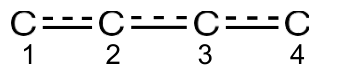
This system can be modeled as a 1D box (i.e. infinite well) where the electrons are free. The energy of an electron in an infinite well of length \(L\) is:
\[ E_n=\frac{n^2h^2}{8m_eL^2} \]
where \(n\) is a non-zero positive integer.
1.1 Two different models are studied. Sketch at least the three lowest-energy levels \(E_n\) for each model in the respective diagrams, showing how the relative energy levels differ within and between models.
1.2 Place the \(\pi\) electrons for model 1 in the previous diagrams and express the total energy of the \(\pi\) system in model 1, as a function of \(h\), \(m_e\) and \(d\).
1.3 Place the \(\pi\) electrons for model 2 in the previous diagrams and express the total energy of the \(\pi\) system in model 2, as a function of \(h\), \(m_e\) and \(d\).
The conjugation energy is the total energy of the actual \(\pi\) system, minus the sum of the energies of ethylene molecules involving the same number of electrons.
1.4 Express the conjugation energy \(\Delta E_{\mathrm c}\) of butadiene, as a function of \(h\), \(m_e\) and \(d\).
Models 1 and 2 are too simplistic. A newä=ú§model will be detailed in the following.
1.5 Draw three other resonance structures of butadiene using Lewis notation.
To take into account the size of carbon atoms, model 2 is now modified into model 3, as follows:
- the new length of the well is \(L\) and is located between the abscissa 0 and \(L\);
- the carbon atoms are located at the abscissas \(L/8\); \(3L/8\); \(5L/8\) and \(7L/8\).
For each level \(n\), the \(\pi\) wavefunction is:
\[ \Psi_n(x)=\sqrt{\frac{2}{L}}\sin\left(\frac{n\pi x}{L}\right) \]
and the \(\pi\) electron density for a system with \(N\) \(\pi\)-electrons is:
\[ \rho(x)=2\sum_{i=1}^{N/2}|\Psi_i(x)|^2 \]
The four \(\pi\) wavefunctions, which correspond to the molecular orbitals of the \(\pi\) system, are depicted below (arbitrary order).
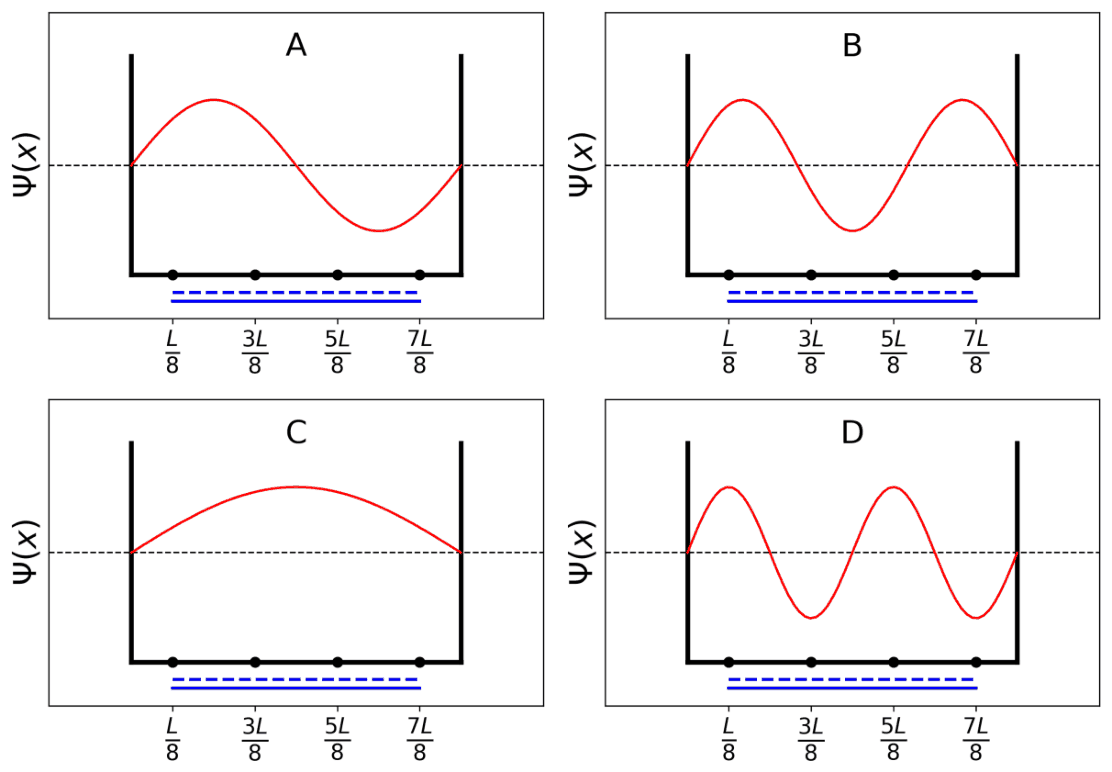
1.6 Sort the energies of the four \(\pi\) wavefunctions (\(E_A\), \(E_B\), \(E_C\) and \(E_D\)).
1.7 Give the labels (A, B, C or D) of the orbitals that are filled with electrons in butadiene.
1.8 Within model 3, give the values of the \(\pi\) wavefunctions \(\psi_n\) for occupied levels at positions 0, \(L/4\) and \(L/2\), for \(n=1\) and \(n=2\), as a function of \(L\).
1.9 Within model 3, give the value of the \(\pi\) electron density at positions 0, \(L/4\) and \(L/2\).
1.10 Draw the \(\pi\) electron density between 0 and \(L\).
1.11 Sort the following CC bonds (B1, B2, …, B5) by increasing length, using the symbols = or <:
B1: C1–C2 in the butadiene molecule
B2: C2–C3 in the butadiene molecule
B3: C3–C4 in the butadiene molecule
B4: C–C in the ethane molecule
B5: C–C in the ethene molecule
Official English text of the problem.
Problem 2: Hydrogen production by water-splitting
Data:
Compound \(\ce{H2(g)}\) \(\ce{H2O(l)}\) \(\ce{H2O(g)}\) \(\ce{O2(g)}\) \(\Delta_\mathrm{f}H^\circ\) (\(\mathrm{kJ\,mol^{-1}}\)) 0 −285.8 −241.8 0 \(S_\mathrm{m}^\circ\) (\(\mathrm{J\,mol^{-1}\,K^{-1}}\)) 130.6 69.9 188.7 205.2 Molecular hydrogen (\(\ce{H2}\)) can be used as an alternative to carbon dioxide-emitting fuels. Hence, lowering the cost and the environmental impact of its production is a major challenge. In this field, water-splitting is a promising candidate technology.
2.1 Write down the balanced equation of liquid water splitting reaction using a stoichiometric coefficient of 1 for water.
2.2 Using only the provided thermodynamic data, this justify numerically whether reaction is thermodynamically favorable at 298 K.
Water splitting can be performed electrochemically using two electrodes in an acidic water bath, connected by a generator (Fig. 1). Gas bubbles are formed at both electrodes.
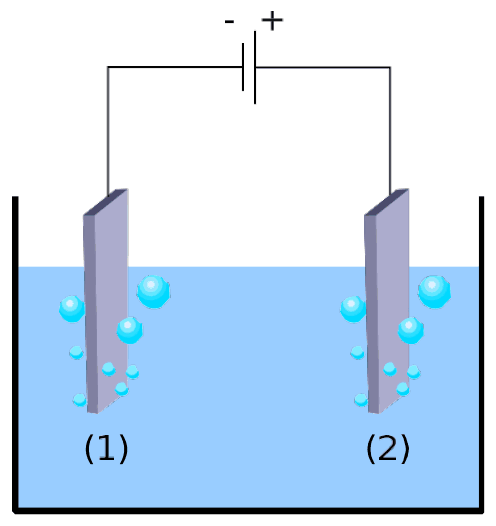
Fig. 1. Water-splitting electrochemical cell.
2.3 Write down the balanced net electrochemical half reactions occurring at each electrode.
2.4 Using only the provided thermodynamic data (or question 2), derive the condition on the applied voltage \(\Delta E_\mathrm{applied}\) between electrodes, compared to value \(\Delta E_\mathrm{th}\) (to determine), for the process to be thermodynamically favorable at 298 K, when all reactants and products are in their standard state. Tick the right condition and give the numerical value with 3 decimal places.
Experimentally, a higher voltage is needed to observe water splitting. For a given \(\ce{Pt}\) cathode, the minimum voltage necessary to observe water splitting, \(\Delta E_\mathrm{min}\), depends on the nature of the anode, as displayed in the table below:
Anode \(\Delta E_\mathrm{min}\) (V) \(\ce{IrO_x}\) 1.6 \(\ce{NiO_x}\) 1.7 \(\ce{CoO_x}\) 1.7 \(\ce{Fe2O3}\) 1.9 The difference between \(\Delta E_\mathrm{min}\) and \(\Delta E_\mathrm{th}\) is responsible for losses in the device.
2.5 Give the expression of the device power efficiency \(\eta_\mathrm{elec}\) (fraction of the power used for water splitting) as a function of \(\Delta E_\mathrm{th}\) and \(\Delta E_\mathrm{min}\). Assuming an identical current value \(I\), calculate the water electrolysis power efficiency when a \(\ce{Pt}\) cathode and a \(\ce{Fe2O3}\) anode are used. Give the most efficient anode.
An alternative to water electrolysis is direct photocatalytic water-splitting. It uses a semiconductor that can be activated by absorbing light.
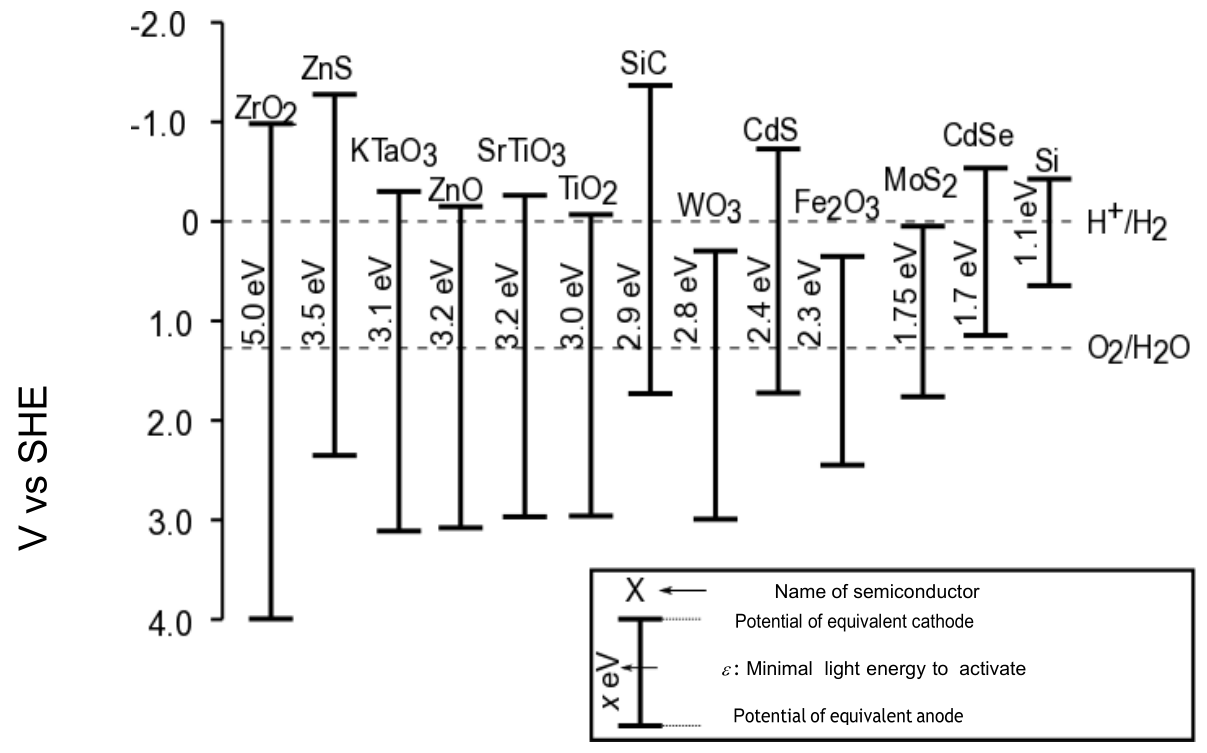
Fig. 2: Activation condition and equivalent electrode potentials of different semiconductors. Dashed lines correspond to water oxidation and reduction potentials. SHE = Standard Hydrogen Electrode
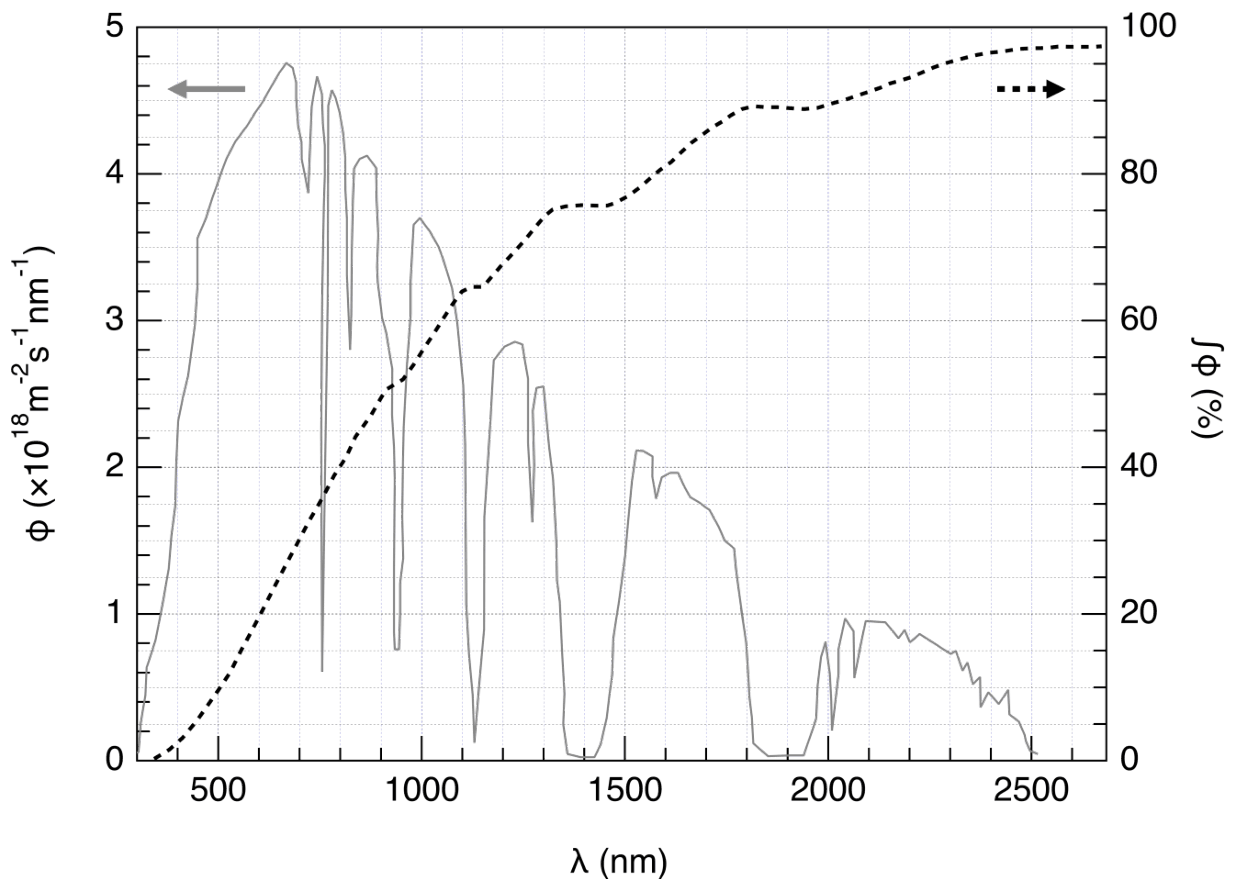
Fig. 3 – Left axis: Spectral distribution of the solar photon flux \(\Phi\). The photon flux is the number of photons per unit area per unit time arriving on the semiconductor. Right axis and dashed line: cumulative photon flux (i.e. fraction of the photon flux with smaller wavelength).
2.6 Estimate the fraction of the solar photon flux that can activate the following semiconductors: \(\ce{TiO2}\), \(\ce{CdS}\), \(\ce{Si}\). State explicitly the equations and units used for the computation.
The activation of the semi-conductor results in a modification of the surface potentials, so that it can be seen as two electrodes of different potentials.
2.7 Using the data in Fig 2, choose the semiconductor(s) in the following list that, once activated, can play both roles of anode and cathode for water-splitting reaction.
2.8 Give the semiconductor that, used as both cathode and anode, is expected to be the most efficient for water splitting upon a given solar shining.
The evolution of \(\ce{H2}\) and \(\ce{O2}\) when a semiconductor is irradiated by simulated solar light at \(T=25\,^\circ\mathrm{C}\) at \(p_\mathrm{atm}\) was recently studied. Using an incident power light of \(P=1.0\,\mathrm{kW\,m^{-2}}\) and a photoelectrode with a \(S=16\,\mathrm{mm^2}\) surface, the production of \(V=0.37\,\mathrm{cm^3}\) of \(\ce{H2(g)}\) was measured after \(\Delta t=1\) hour of reaction.
2.9 Calculate the power efficiency \(\eta_\mathrm{direct}\) of the conversion.
Two modes of converting solar energy to hydrogen can thus be compared: direct photocatalysis, and indirect photo-electrolysis combining a photovoltaic panel with an electrolyzer. The efficiency of photovoltaic panels on the market is around \(\eta_\mathrm{panels}=20\%\).
2.10 Compare the power efficiencies of the two modes, \(\eta_\mathrm{direct}\) and \(\eta_\mathrm{indirect}\), using \(\ce{Fe2O3}\) and \(\ce{Pt}\) electrodes for the electrolysis.
Official English text of the problem.
Problem 3: About silver chloride
Data at 298 K:
\[ pK_{\mathrm{s}1}(\ce{AgCl})=9.7 \ ;\qquad pK_{\mathrm{s}2}(\ce{Ag2CrO4})=12 \]
Formation constant of the complex \(\ce{[Ag(NH3)_{n}]+}\): \(\beta_n=10^{7.2}\)
Potentials against the standard hydrogen electrode:
Standard potential of \(\ce{Ag+}/\ce{Ag(s)}\): \(E^\circ(\ce{Ag+}/\ce{Ag(s)})=0.80\ \mathrm{V}\)
Apparent potential of \(\ce{O2(aq)}/\ce{HO-(aq)}\) (in seawater): \(E'(\ce{O2(aq)}/\ce{HO-(aq)})=0.75\ \mathrm{V}\)
Part A: Quotes from a chemistry lesson by Louis Joseph Gay-Lussac
The following quotes from a chemistry lesson by Louis Joseph Gay-Lussac (French chemist and physicist, 1778–1850) deal with some properties of silver chloride.
Quote A: “I will now talk about silver chloride, a milk-white solid. It is easily obtained by pouring hydrochloric acid into an aqueous solution of silver nitrate.”
Quote B: “This salt has no taste since it is insoluble.”
Quote C: “This compound is completely insoluble in alcohol and even in acids, except in concentrated hydrochloric acid which dissolves it readily.”
Quote D: “On the other hand, silver chloride is highly soluble in aqueous solution of ammonia.”
Quote E: “Then, we can make silver chloride appear again by adding an acid which reacts with ammonia.”
Quote F: “If you take a bowl made of silver to evaporate salty seawater, you will get impure sodium chloride, mixed with a milk-white solid.”
3.1 Quote A: Write the balanced chemical equation of \(\ce{AgCl(s)}\) synthesis.
3.2 Quote B: Calculate the solubility \(s\) of \(\ce{AgCl(s)}\) in water at 298 K in \(\mathrm{mol\,dm^{-3}}\).
3.3 Quote C: In a highly concentrated solution of chloride ions, a well-defined complex of stoichiometry 1:2 is formed. On the following qualitative axis (with pCl increasing from left to right), place in each domain the silver-containing species that is predominant (or exists, for solids). pCl values at frontiers are not expected.
Quote D: When ammonia is added to silver chloride, a well-defined complex of stoichiometry \(n\) is formed.
3.4 Write the balanced equation corresponding to the synthesis of the complex \(\ce{[Ag(NH3)_{n}]+}\) from silver chloride and calculate the corresponding equilibrium constant.
3.5 Ammonia is added to 0.1 mol of silver chloride in \(1\ \mathrm{dm^3}\) of water until the last grain of solid disappears. At this moment, \([\ce{NH3}]=1.78\ \mathrm{mol\,dm^{-3}}\). Determine the stoichiometry of the complex neglecting dilution effects.
3.6 Write the balanced chemical equation corresponding to quote E.
3.7 Assuming that seawater is slightly basic and rich in dioxygen, and that silver metal can reduce dioxygen in such conditions, write a balanced chemical equation corresponding to the formation of the solid mentioned in quote F. A stoichiometric coefficient of 1 will be chosen for dioxygen. Calculate its equilibrium constant at 298 K.
Part B: The Mohr method
The Mohr method is based on the colorimetric titration of \(\ce{Cl-}\) by \(\ce{Ag+}\) in the presence of potassium chromate (\(\ce{2K+}\), \(\ce{CrO4^2-}\)). Three drops (~ \(0.5\ \mathrm{cm^3}\)) of a \(\ce{K2CrO4}\) solution at about \(c=7.76\times10^{-3}\ \mathrm{mol\,dm^{-3}}\) are added to \(V_0=20.00\ \mathrm{cm^3}\) of a sodium chloride solution of unknown concentration \(c_{\mathrm{Cl}}\). This solution is then titrated by silver nitrate (\(\ce{Ag+}\), \(\ce{NO3-}\)) at \(c=0.050\ \mathrm{mol\,dm^{-3}}\), which immediately leads to the formation of solid A. A red precipitate (solid B) appears at \(V_{\mathrm{Ag}}=4.30\ \mathrm{cm^3}\).
3.8 Write the balanced equations of the two reactions occurring during the experiment. Calculate the corresponding equilibrium constants.
3.9 Identify the solids.
3.10 Calculate the unknown concentration \(c(\ce{Cl-})\) of chloride ions in the sodium chloride solution.
3.11 Calculate the minimal volume \(V_{\mathrm{Ag}}(\min)\) for which \(\ce{AgCl(s)}\) precipitates.
3.12 Calculate the residual concentration \([\ce{Cl-}]_{\mathrm{res}}\) of chloride ions when silver chromate begins to precipitate. Justify why \(\ce{CrO4^2-}\) is a good titration endpoint indicator by comparing two values.
Official English text of the problem.
Problem 4: From gunpowder to the discovery of iodine
In the 19th century, the French entrepreneur B. Courtois specialized in the production of nitrate A (\(\ce{M_A(NO3)_m}\)), used for gunpowder. Initially imported from Asia, A was later produced from nitrate B (\(\ce{M_B(NO3)_n}\)) using exchange reaction with compound C, obtained from algae.
4.1 Find the formulas of nitrates A and B knowing that they are anhydrous salts of alkaline or alkaline-earth metal (\(\ce{M_A}\) and \(\ce{M_B}\)). One of the nitrates contains no more than 1 w% of non-metallic impurities while the other contains \(9 \pm 3\) w% of impurities. The content of metals \(\ce{M_A}\) and \(\ce{M_B}\) in the samples is 38.4 w% and 22.4 w%, respectively. Support your answer with calculations.
To obtain A, 262.2 g of solid compound C were added to the solution containing 442.8 g of B. B is known to be in excess. As a result, 190.0 g of white precipitate D were formed and removed by filtration. The filtrate was evaporated, and the obtained solid mixture E was heated until the mass of the sample (containing only nitrites, \(\ce{NO2-}\)) was constant. The only gaseous product was dioxygen: 60.48 dm³ at 0 °C and 1 atm (dioxygen can be considered as an ideal gas).
4.2 Calculate the composition (in w%) of mixture E considering that it contained only compounds A and B and no other impurities, and that C was taken in pure anhydrous state.
4.3 Determine the formulas of compounds C and D and write the balanced reaction equation between B and C.
In 1811, when working with algae ashes, Courtois observed that copper vessels were worn out faster than usual. While he was studying this phenomenon, his cat entered the laboratory and spilled the solution of concentrated sulfuric acid on the dry algae ashes: violet vapors instantly came out of the vessel (1, sulfuric acid is the oxidizing agent): iodine (\(\ce{I2}\)) had just been discovered! Iodine was the cause of the copper corrosion (2). However, because of the medicinal applications of iodine, Courtois opened a new manufacture to produce it by reaction of algae with chlorine (3). Nowadays, the iodine is prepared from the set of reactants (\(\ce{NO3-}\), \(\ce{I-}\), \(\ce{H+}\)) (4) or (\(\ce{IO3-}\), \(\ce{I-}\), \(\ce{H+}\)) (5).
4.4 Write balanced equations for reactions 1 – 5.
The solubility of iodine is very low in water but significantly increases when iodide ions are added. Together they form ions such as triiodide, \(\ce{I3-}\):
\[ \ce{I-(aq) + I2(aq)} = \ce{I3-(aq)} \qquad (6) \]
Equilibrium (6) can be studied through the extraction of \(\ce{I2}\) with dichloromethane. Indeed, \(\ce{I-}\) and \(\ce{I3-}\) do not dissolve in organic solvents but \(\ce{I2}\) does and, when extracted, it is 15 times more concentrated in dichloromethane than in water.
The following experiment was performed. To prepare the initial solution, a few crystals of solid iodine were dissolved in 50.0 cm³ of an aqueous solution of potassium iodide (0.1112 g). Then, 50.0 cm³ of dichloromethane were added, and the mixture was vigorously shaken until equilibration. After phase separation, each phase was titrated by 16.20 cm³ (organic phase) and by 8.00 cm³ (aqueous phase) of the standard aqueous solution of sodium thiosulphate pentahydrate (14.9080 g in 1.000 dm³ of solution) in the presence of starch. The process is schematically represented below:
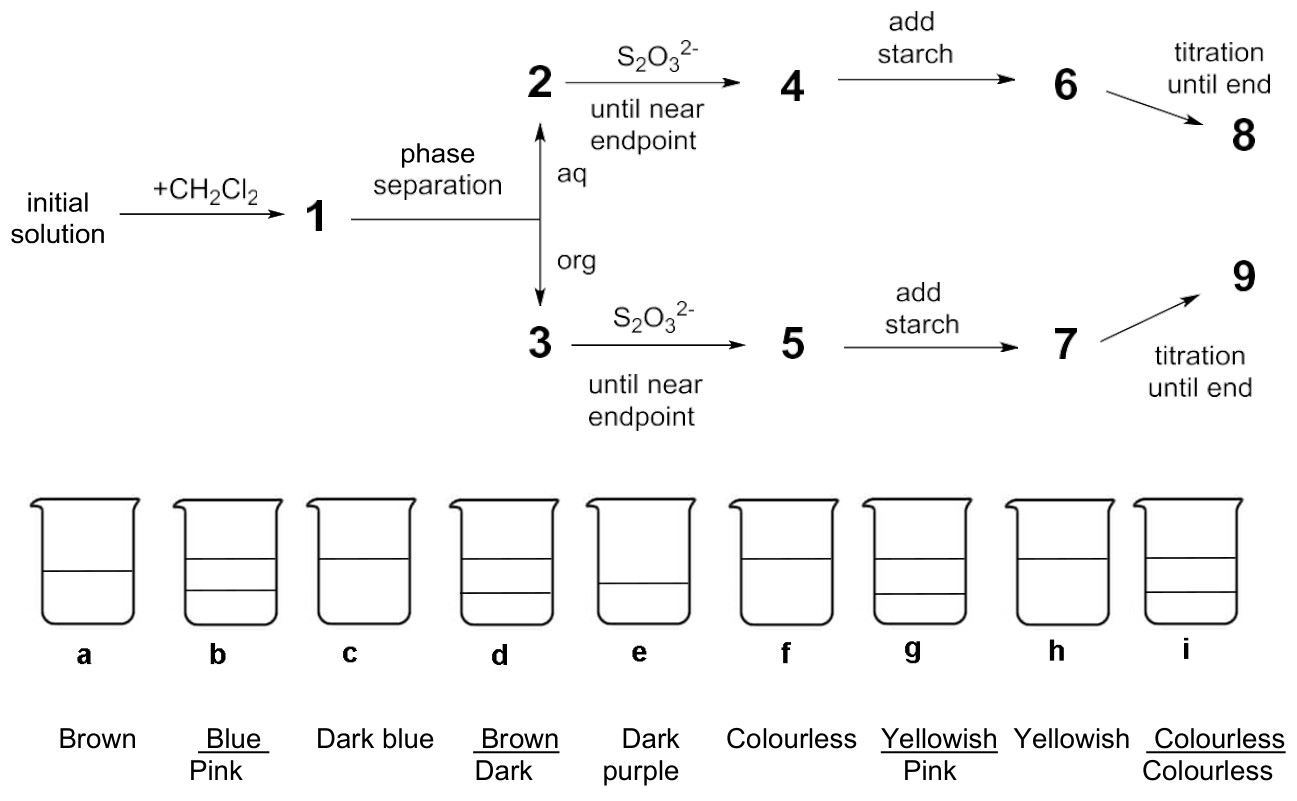
4.5 Find the correspondence between the stages on the scheme (1–9) and the schematic pictures representing them (a–i).
Stages Picture 1 2 3 4 5 6 7 8 9 4.6 Write balanced equations for the two possible chemical reactions in the aqueous phase during the titration involving iodine species and sodium thiosulphate.
4.7 Calculate the mass of iodine used to prepare the initial solution.
4.8 Calculate the equilibrium constant \(K^\circ\) for equilibrium of reaction (6).
Official English text of the problem.
Problem 5: Azobenzene–β-cyclodextrin complexes for the formation of nanomachines
Nanomachines are molecular assemblies that enable the transformation of an energy source into a nano-movement for applications such as drug delivery. Numerous nanomachines make use of the isomerization of azo compounds (\(\ce{R-N=N-R'}\)) upon irradiation.
5.1 Draw the stereoisomers of azobenzene (\(\ce{H5C6-N=N-C6H5}\)) and draw a line between the two carbon atoms that are the furthest apart. Compare these two distances (\(d_{\mathrm{trans}}\) and \(d_{\mathrm{cis}}\)).
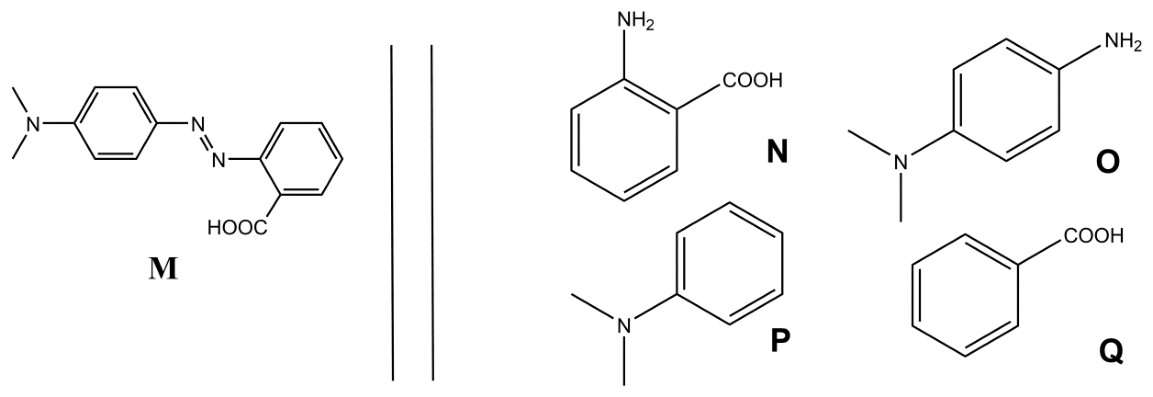
Fig. 1. Possible reactants for the synthesis of M.
5.2 M can be synthesized in two steps from simple reactants (Fig 1). Choose among the suggested reactants (N to Q) the ones that can provide M with very high regioselectivity. Sodium nitrite (\(\ce{NaNO2}\)) in cold aqueous hydrochloric acid is used as reagent for the first step of the synthesis.
Determination of the association constant \(K_t\)
β-cyclodextrin (C, Fig. 2) is a cyclic heptamer of glucose, which can form inclusion complexes with azo compounds. In tasks 3 to 6, we will determine by spectroscopy the association constant \(K_t\), corresponding to the formation of the inclusion complex \(\mathbf{CM}_{\mathrm{trans}}\) as depicted in Fig. 2.
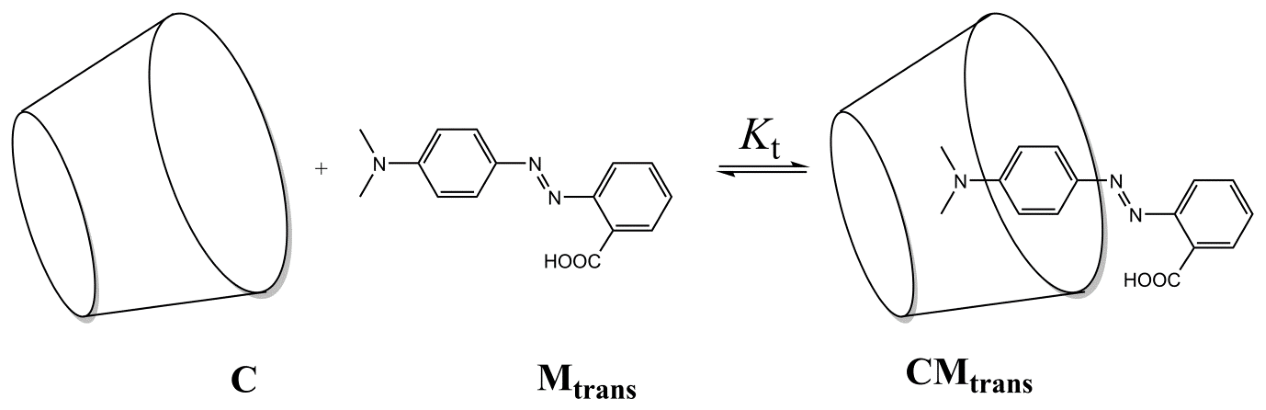
Fig. 2 – Formation of the \(\mathbf{CM}_{\mathrm{trans}}\) inclusion complex.
Several solutions are prepared by mixing C and \(\mathbf{M}_{\mathrm{trans}}\) in different proportions to reach initial concentrations \([\mathbf C]_0\) and \([\mathbf M_{\mathrm{trans}}]_0\). While \([\mathbf M_{\mathrm{trans}}]_0\) is identical for all solutions, \([\mathbf C]_0\) varies. We follow, at a fixed wavelength, the evolution of the difference in absorbance \(\Delta A\) between the absorbance of each solution and the pure \(\mathbf M_{\mathrm{trans}}\) solution. We note the molar absorption coefficients of \(\mathbf{CM}_{\mathrm{trans}}\) and \(\mathbf M_{\mathrm{trans}}\), \(\varepsilon_{\mathrm{CM}_{\mathrm{trans}}}\) and \(\varepsilon_{\mathrm M_{\mathrm{trans}}}\), respectively. \(L\) is the path length of the beam through the sample. The absorbance of C (\(\varepsilon_{\mathrm C}\)) is negligible.
5.3 Demonstrate that \(\Delta A=\alpha[\mathbf{CM}_{\mathrm{trans}}]\) and express \(\alpha\) in terms of known constant(s).
5.4 Demonstrate that in case when C is in large excess with respect to \(\mathbf M_{\mathrm{trans}}\) (i.e. \([\mathbf C]_0\gg[\mathbf M_{\mathrm{trans}}]_0\)), the concentration of C may be considered as constant, \([\mathbf C]\simeq[\mathbf C]_0\).
5.5 Demonstrate that in case when C is in a large excess with respect to \(\mathbf M_{\mathrm{trans}}\), (i.e. \([\mathbf C]_0\gg[\mathbf M_{\mathrm{trans}}]_0\)),
\[ \Delta A=\alpha\frac{\beta[\mathbf C]_0}{1+K_t[\mathbf C]_0} \]
and express \(\beta\) in terms of constant(s) and initial concentration(s).
5.6 Determine \(K_t\) using the following experimental curve (Fig. 3).
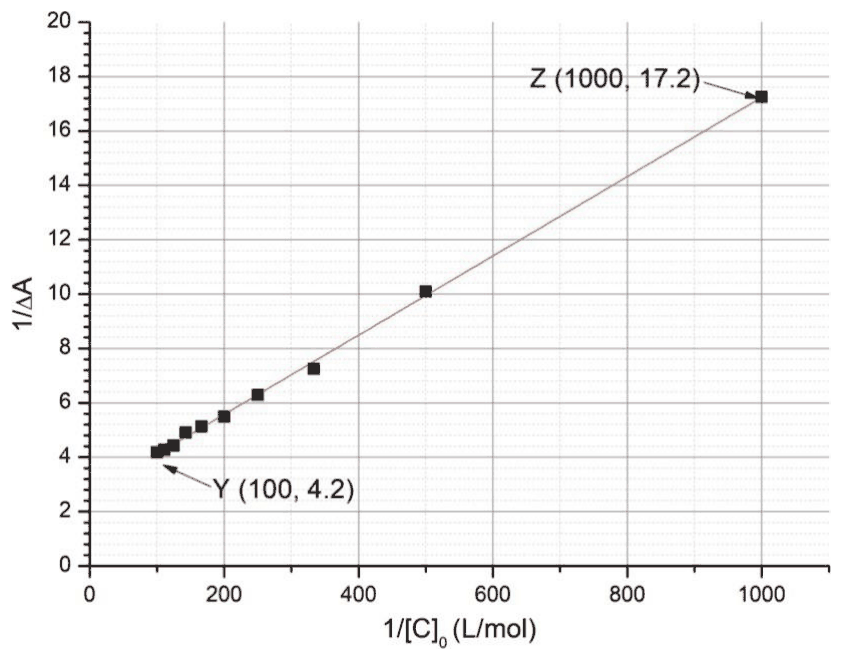
Fig. 3 – Evolution of \(1/\Delta A\) as a function of \(1/[\mathbf C]_0\).
Determination of the association constant \(K_c\)
In tasks 7 to 9, we will determine by kinetic studies the association constant \(K_c\), corresponding to the formation of the inclusion complex with \(\mathbf M_{\mathrm{cis}}\), \(\mathbf{CM}_{\mathrm{cis}}\). A sample containing only \(\mathbf M_{\mathrm{trans}}\) is irradiated, thus producing a known amount of \(\mathbf M_{\mathrm{cis}}\), \([\mathbf M_{\mathrm{cis}}]_0\). \(\mathbf M_{\mathrm{cis}}\) (free or within the inclusion complex) then thermally isomerizes into \(\mathbf M_{\mathrm{trans}}\). In the absence of C, the isomerization follows a first order kinetics with a rate constant \(k_1\). All complexation equilibria are faster than the isomerization processes. The kinetic scheme corresponding to this experiment is provided in Fig. 4.
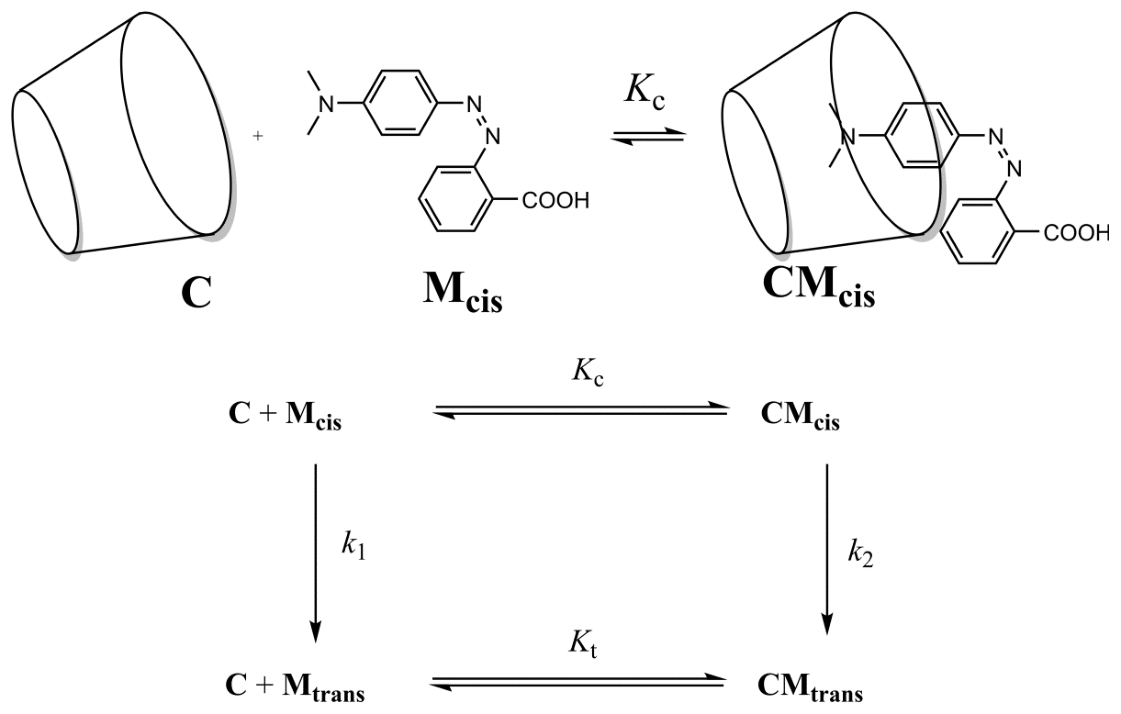
Fig. 4 – Kinetic scheme for the isomerization of \(\mathbf M_{\mathrm{cis}}\) in the presence of C.
The rate of disappearance \(r\) for the total amount of \(\mathbf M_{\mathrm{cis}}\) (free and complexed) is defined as
\[ r=k_1[\mathbf M_{\mathrm{cis}}]+k_2[\mathbf{CM}_{\mathrm{cis}}]. \]
Experimentally, \(r\) follows an apparent first order kinetic law with an apparent rate constant \(k_{\mathrm{obs}}\):
\[ r=k_{\mathrm{obs}}\bigl([\mathbf M_{\mathrm{cis}}]+[\mathbf{CM}_{\mathrm{cis}}]\bigr). \]
5.7 Demonstrate that
\[ k_{\mathrm{obs}}= \frac{\gamma+\delta k_2[\mathbf C]}{1+K_c[\mathbf C]} \]
and express \(\gamma\) and \(\delta\) in terms of known constant(s).
5.8 Choose in which condition(s) the half-life \(t_{1/2}\) corresponding to \(k_{\mathrm{obs}}\) can be expressed as \(t_{1/2}=\ln(2/\gamma)(1+K_c[\mathbf C]_0)\) given that \([\mathbf C]_0\gg[\mathbf M_{\mathrm{cis}}]_0\). Mathematically justify your answer.
5.9 Assuming the condition(s) in task 8 satisfied, determine \(K_c\) by a linear regression using the data below. You may use a calculator or plot a graph.
\([\mathbf C]_0\) (\(\mathrm{mol\,dm^{-3}}\)) \(t_{1/2}\) (s) \([\mathbf C]_0\) (\(\mathrm{mol\,dm^{-3}}\)) \(t_{1/2}\) (s) 0 3.0 \(3.0\cdot10^{-3}\) 5.9 \(1.0\cdot10^{-4}\) 3.2 \(5.0\cdot10^{-3}\) 7.7 \(5.0\cdot10^{-4}\) 3.6 \(7.5\cdot10^{-3}\) 9.9 \(1.0\cdot10^{-3}\) 4.1 \(1.0\cdot10^{-2}\) 12.6 Formation of nanomachines
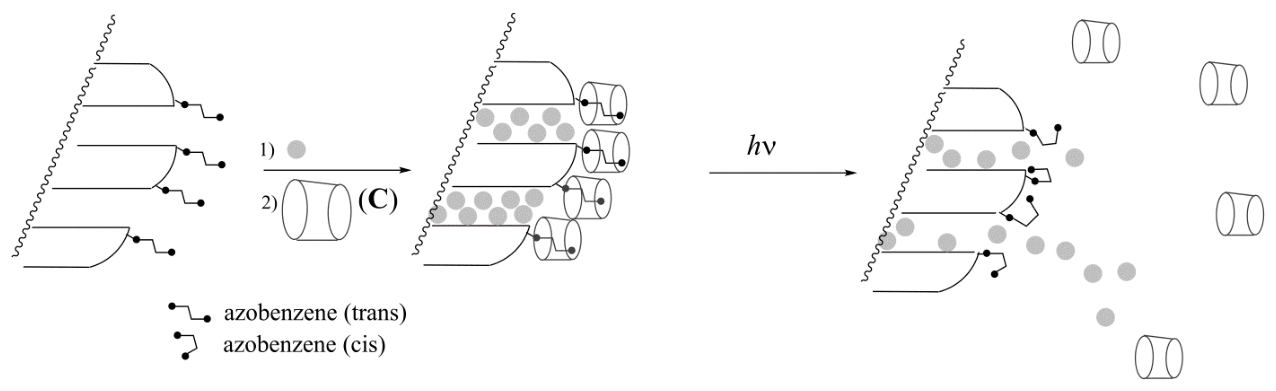
Fig. 5 – Cleavage of an azobenzene–cyclodextrin inclusion complex induced by a light-triggered isomerization, which allows delivery of a dye (grey circles).
Another azobenzene compound (for which \(K_c\ll K_t\)), initially in the trans form, is covalently grafted on silica (Fig. 5). The silica pores are filled with a dye (rhodamine B, grey circles in Fig. 5). Upon addition of C, an inclusion complex is formed, which blocks the pores and prevents the release of the dye.
5.10 Choose the most appropriate condition (one choice only) so that the pores are initially blocked in the presence of C, and the dye can be released upon irradiation.
This azobenzene-silica powder loaded with a dye is placed in the corner of a cuvette (Fig. 6) so that the powder cannot move into solution. The powder is irradiated at a wavelength \(\lambda_1\) to trigger the release of the dye from the pores (Fig. 5). To monitor this release by absorbance spectroscopy we measure the absorbance of the solution at wavelength \(\lambda_2\).
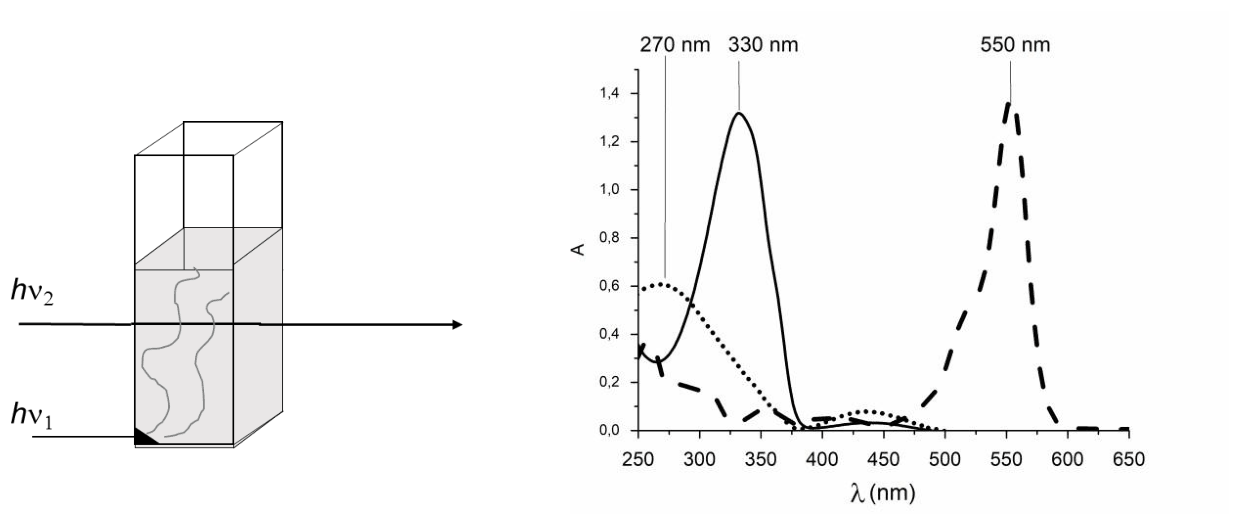
Fig. 6 – Left: experimental setup used to monitor the release of the dye; right: absorption spectra of trans-azobenzene (full line), cis-azobenzene (dotted line) and rhodamine B (dashed line).
5.11 Determine \(\lambda_1\).
5.12 Determine \(\lambda_2\).
Official English text of the problem.
Problem 6: Characterization of a block-copolymer
Block-copolymers, obtained by linking different polymers (blocks), have unique properties, such as the ability to self-assemble. In this problem, the synthesis and characterization of such macromolecules are studied.
Study of the first block
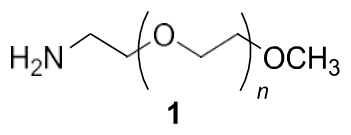
In this first part, we will study the water soluble homopolymer 1 (α-methoxy-ω-aminopolyethyleneglycol). The \({}^{1}\ce{H}\) NMR spectrum of 1 (DMSO-\(d_6\), 60 °C, 500 MHz) includes the following signals:
Index δ (ppm) Peak Area a 2.7* 0.6 b 3.3 0.9 c 3.4 0.6 d \(\sim 3.5\) 133.7 Table 1, *in the presence of \(\ce{D2O}\), the signal at 2.7 ppm disappears.
6.1 Match the \({}^{1}\ce{H}\) NMR signals (a, b, c, d) from Table 1 with each of the corresponding protons.
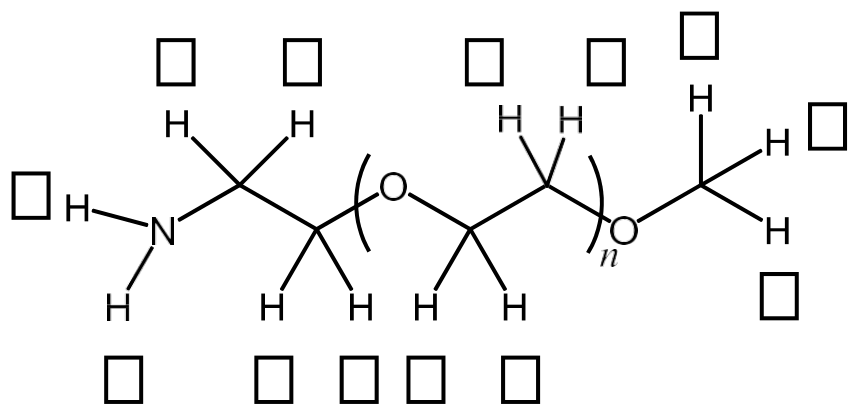
6.2 Express the average degree of polymerization \(n\) as a function of the area \(A_{\ce{OC2H4}}\) of the NMR peak of the repeating unit and the area \(A_{\ce{OCH3}}\) of the NMR peak of the methyl end group. Calculate \(n\).
Study of a diblock-copolymer
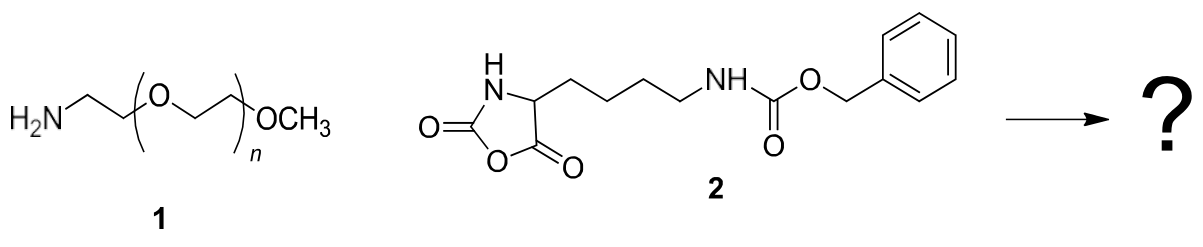
The synthesis of the second block of the copolymer is performed through the reaction of 1 with 2 (ε- (benzyloxycarbonyl)-lysine N-carboxyanhydride).
This yields the block-copolymer 3.
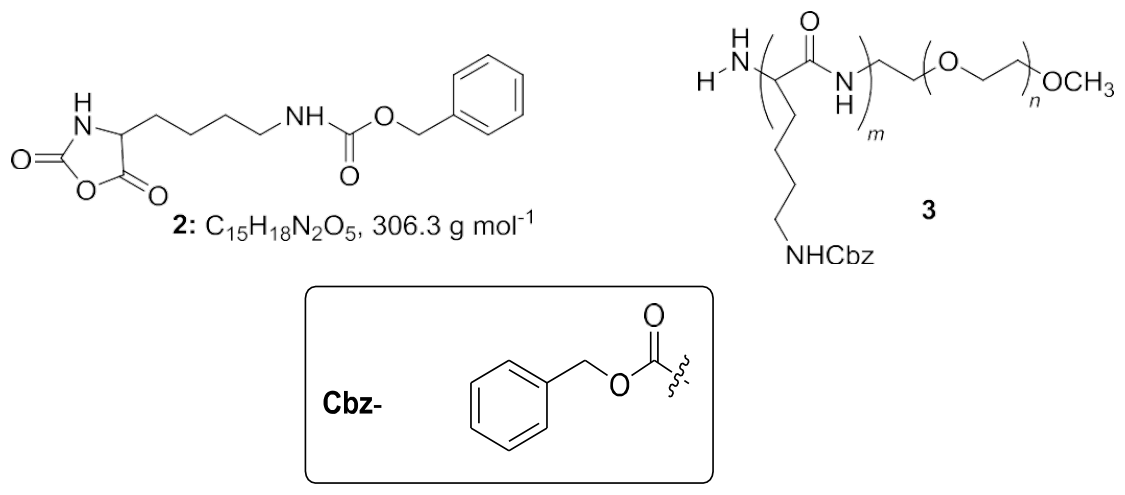
6.3 Draw the reaction intermediate that is formed in the first step of the addition of 1 to 2. The second step of the mechanism leads to the formation of a gas molecule, G. Draw its structure.
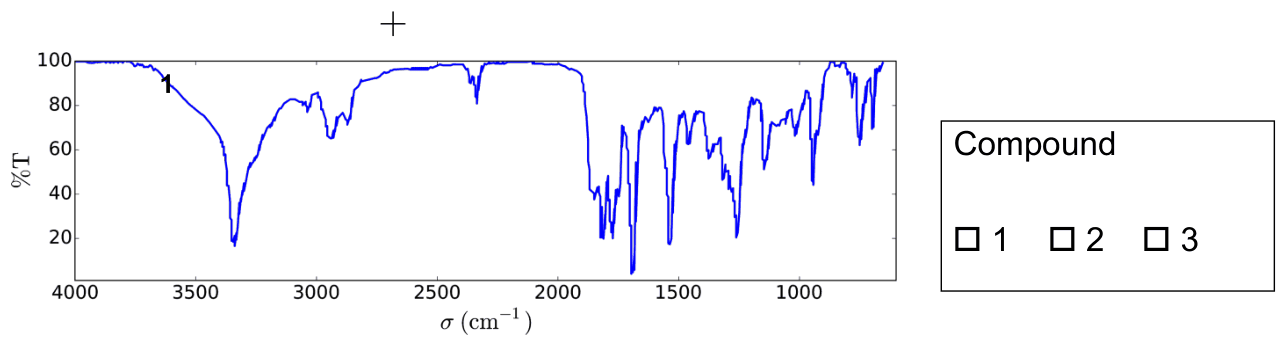
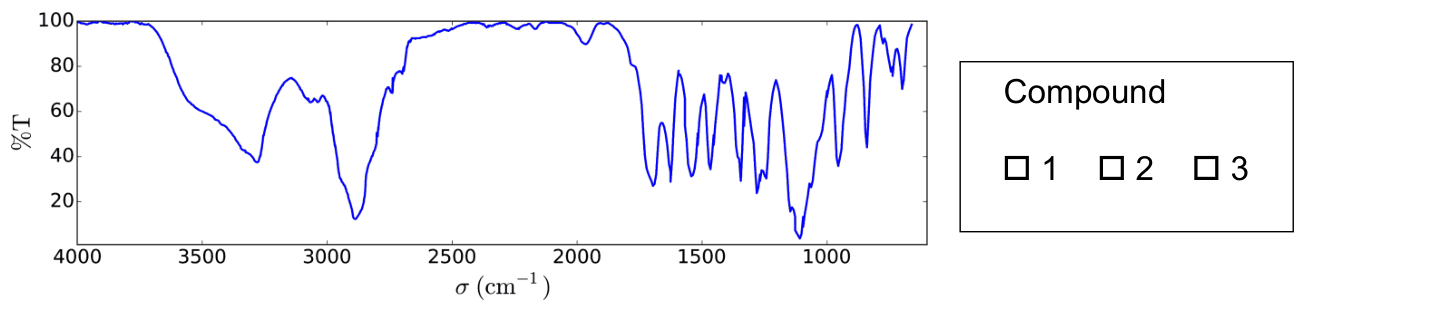
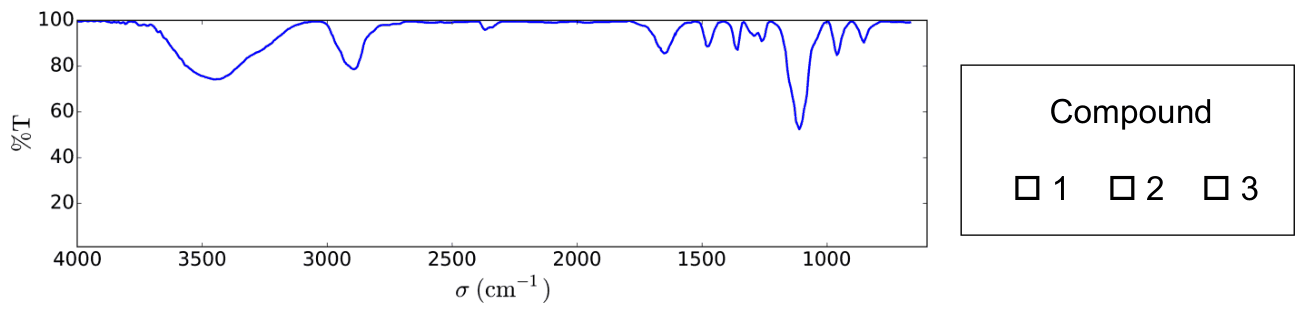
6.4 Infrared (IR) measurements are performed to characterize the compounds. Match the three IR spectra with compounds 1, 2 and 3.
6.5 The \({}^{1}\ce{H}\) NMR spectrum of copolymer 3 (in DMSO-\(d_6\), at 60 °C, 500 MHz) is reported in Fig. 1. Using some or all of the NMR signals, the areas of which are reported in Table 2, calculate its number average molar mass \(M_n\), considering \(n\) from question 2. For your calculations, draw a circle around the group(s) of atoms you used and give their corresponding symbol(s) (α, β…).
Table 2
Peak Area α 22.4 β 119 γ 23.8 δ 47.6 ε 622 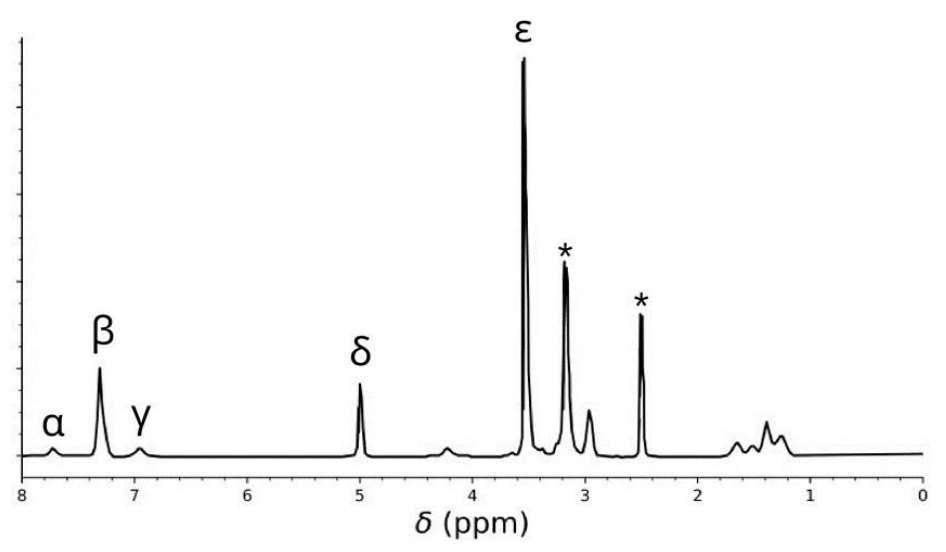
Fig. 1 – signals marked with * correspond to the solvent and water.
This reaction of 1 with 2 yielded the copolymers 3a after 20 h, 3b after 25 h and 3c after 30 h of reaction at 40 °C. Results of size-exclusion chromatography (SEC) experiments are presented in Fig. 2.
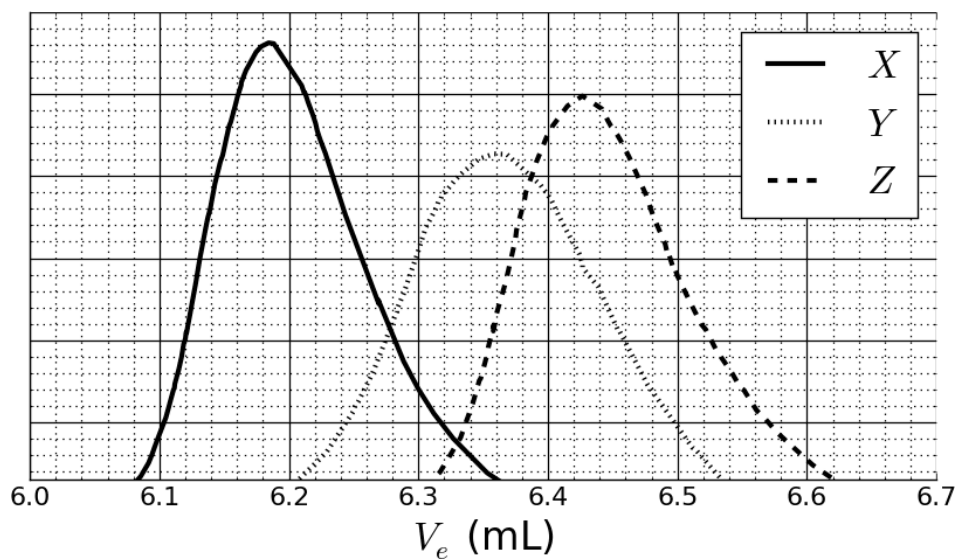
Fig. 2 – SEC chromatograms of 3a, 3b and 3c as a function of the elution volume, \(V_e\).
6.6 Match the signals in Fig. 2 with the copolymers 3a, 3b and 3c.
3a: ☐ X ☐ Y ☐ Z
3b: ☐ X ☐ Y ☐ Z
3c: ☐ X ☐ Y ☐ ZIn order to calibrate the chromatogram, a mixture of standard polymers of known masses (3, 30, 130, 700 and 7000 kg mol\(^{-1}\)) has been studied (Fig. 3).
The log value of the molar mass is a linear function of the elution volume, \(V_e\).
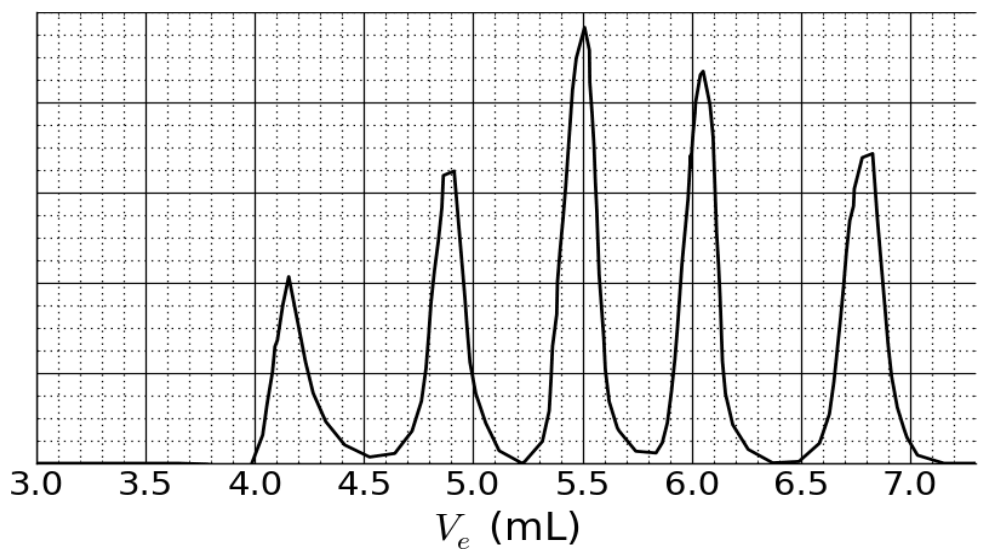
Fig. 3 – SEC chromatogram of the mixture of standards.
6.7 Based on the SEC curves in Fig. 2 and 3, determine \(V_e\) of the polymer that corresponds to curve X and use it to estimate the degree of polymerization \(m\) of its second block. Detail your calculation; you may use a calculator or plot a graph.
Triblock copolymer synthesis
For biological applications, involving the formation of micelles, a triblock copolymer 9 can be synthesized through the introduction of a middle block, B, using monomer 5.
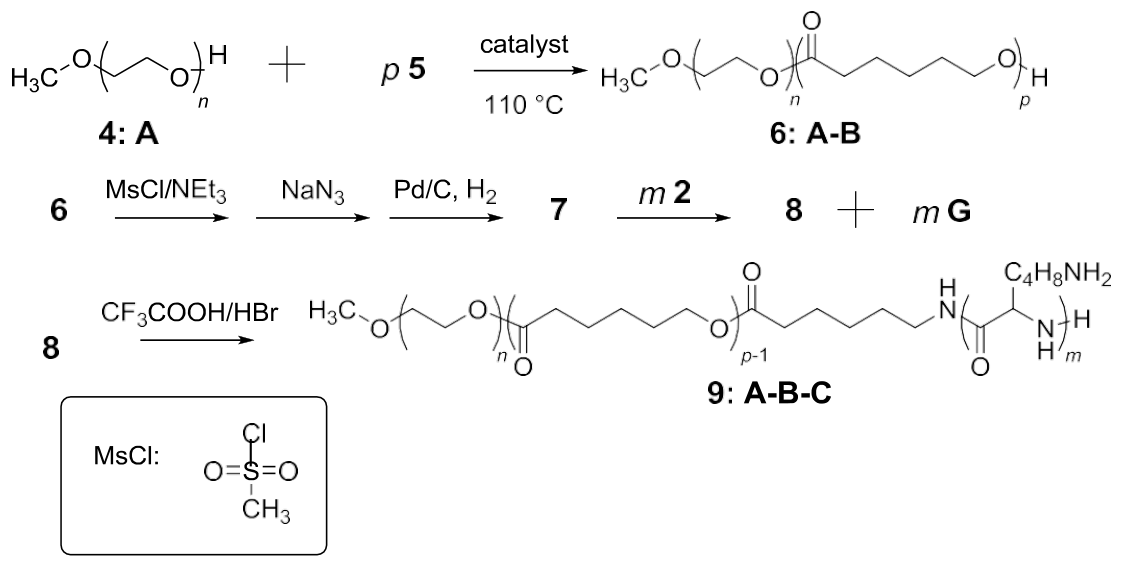
6.8 Draw the structures of 5, 7 and 8.
6.9 Amphiphilic block copolymers, such as 9: A-B-C, can be used for medical applications, as they self-assemble into micelles in water (pH = 7), which can be used as drug carriers. Assign each block of the copolymer to a property. Draw a scheme of the micelle with only 4 polymer chains.
Official English text of the problem.
Problem 7: Ring motion in a [2]catenane
In 2016, the Nobel Prize in Chemistry was awarded to J.-P. Sauvage, Sir J. F. Stoddart and B. L. Feringa “for the design and synthesis of molecular machines”. An example of these is [2]catenane, a molecule consisting of two interlocked rings. In this system, one macrocycle contains a single phenanthroline (bidentate) ligand and the second contains two ligands: a phenanthroline and a terpyridine (tridentate) ligand. A copper ion is coordinated by one ligand from each macrocycle. Depending on the oxidation state of the copper (+I or +II), two configurations are obtained (Fig. 1).
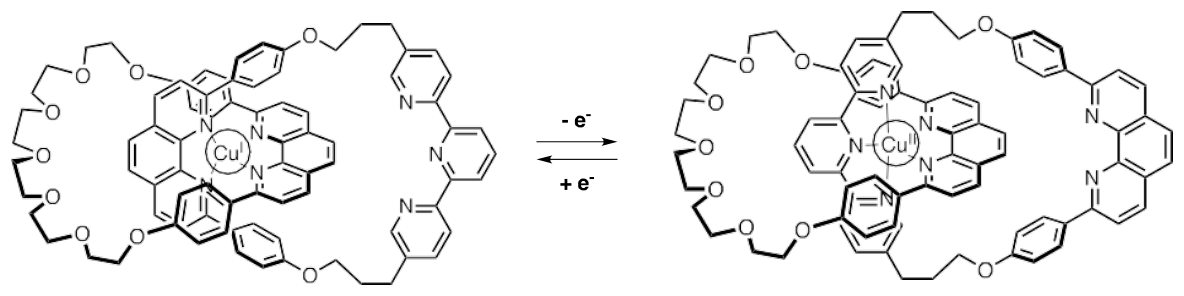
Fig. 1 – Multi-stability of a ring in a [2]catenane.
The synthesis of the macrocycle is the following:
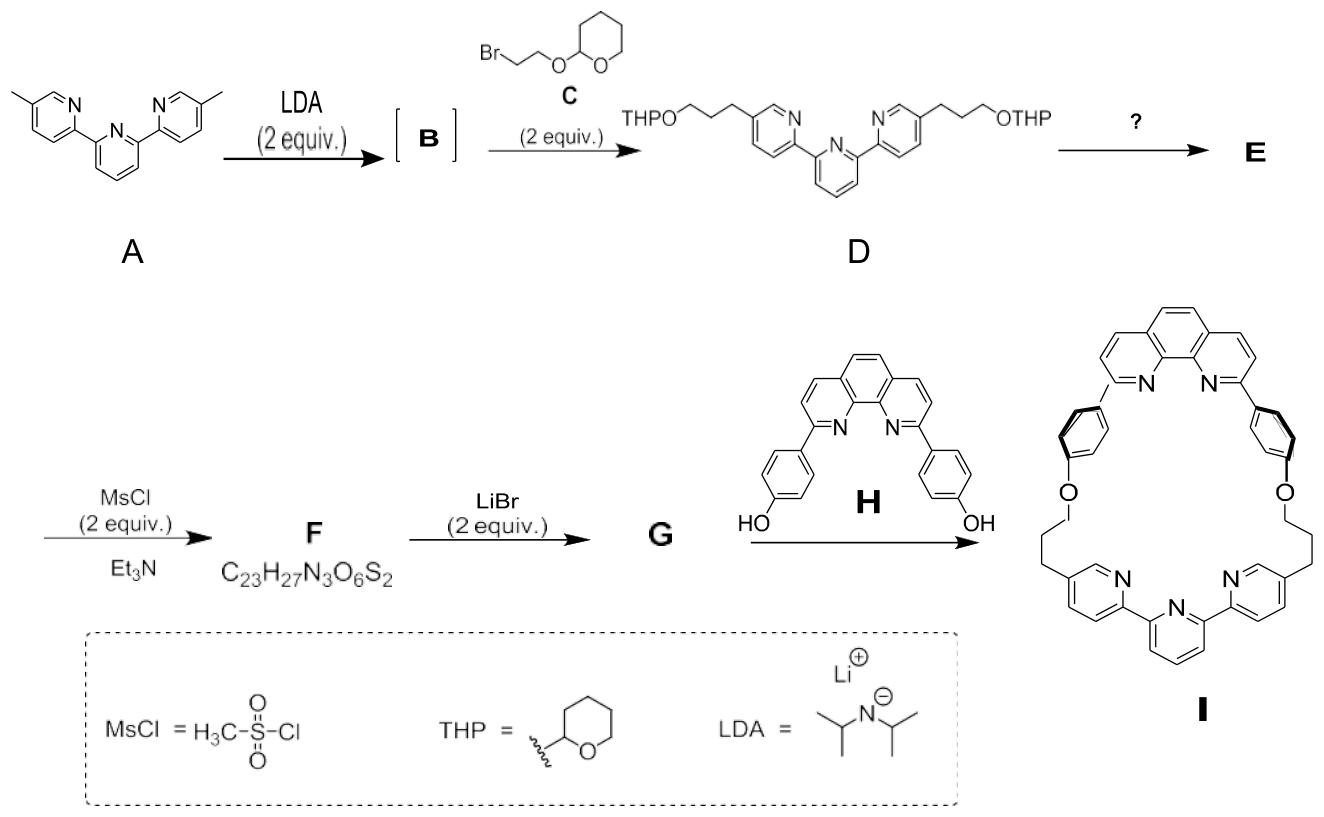
7.1 Draw the structure of B.
7.2 Draw the structures of E, F and G.
7.3 Out of the following reaction conditions, choose which one(s) can produce E from D.
- ☐ \(\ce{H+, H2O}\)
- ☐ \(\ce{OH-, H2O}\)
- ☐ \(\ce{NaBH4, CH3OH}\)
- ☐ \(\ce{H2}\), Pd/C, THF
Tick the relevant box.
7.4 In the synthetic strategy, MsCl is used to obtain:
- ☐ a leaving group
- ☐ a protecting group
- ☐ a deactivated group
- ☐ a directing group
Tick the relevant box.
7.5 G is obtained by the reaction between F and LiBr in acetone. This reaction is:
- ☐ electrophilic aromatic substitution,
- ☐ nucleophilic aromatic substitution,
- ☐ \(\mathrm{S_N1}\)
- ☐ \(\mathrm{S_N2}\)
Tick the relevant boxes.
7.6 Draw the transition state of the rate-determining step of the reaction F → G, showing the 3D geometry. Depict only one reaction center. The main carbon chain can be represented as an R group.
The synthesis of [2]catenane L uses the template effect of a copper complex:
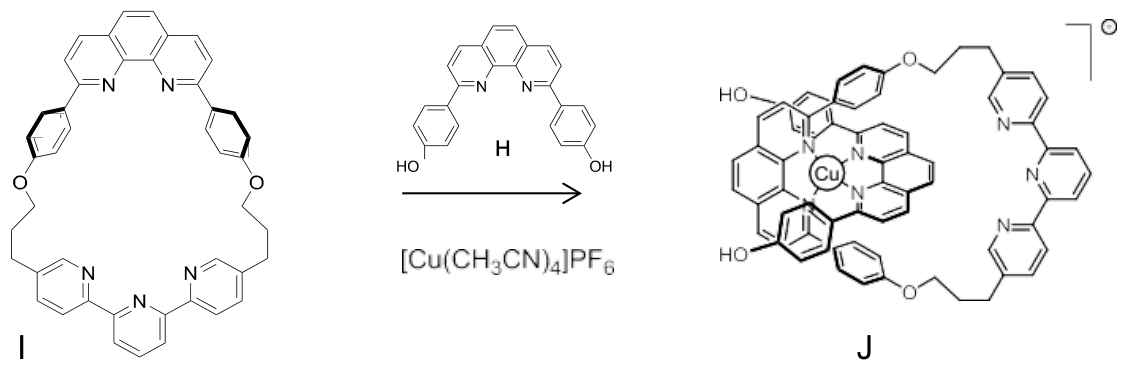
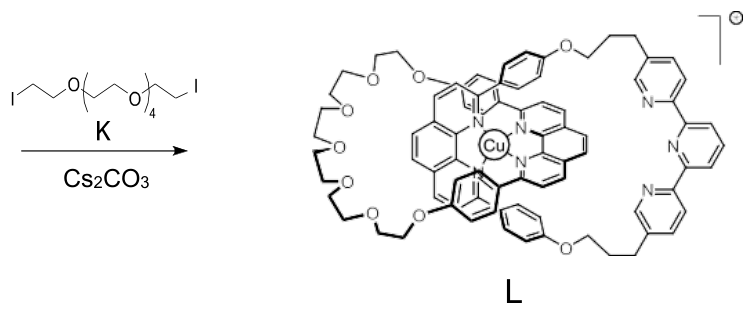
7.7 Write the full electronic configuration of Cu(0) in its ground state. Give the oxidation state of Cu in complex J and write the electronic configuration of Cu in the free ion corresponding to J.
7.8 Select the geometry of the copper ion in L. Assuming an ideal geometry of the ligands around the copper center, draw the electronic levels of the d-orbitals in accord with the crystal field theory. Fill the orbital diagram. Give the maximum value of the spin (\(S\)) for this complex. The geometry of the Cu in L is:
- ☐ octahedral,
- ☐ tetrahedral,
- ☐ square planar,
- ☐ trigonal bipyramidal.
7.9 Out of the following compounds, choose the one(s) that can remove the copper ion in L to obtain the free [2]catenane (tick relevant boxes):
- ☐ \(\ce{CH3CN}\)
- ☐ \(\ce{NH4PF6}\)
- ☐ \(\ce{KCN}\)
- ☐ tren
In [2]catenane L, the copper ion can exist in two oxidation states (+I) or (+II), and each of them exhibits a different coordination sphere (tetra- or penta-coordinated, respectively).
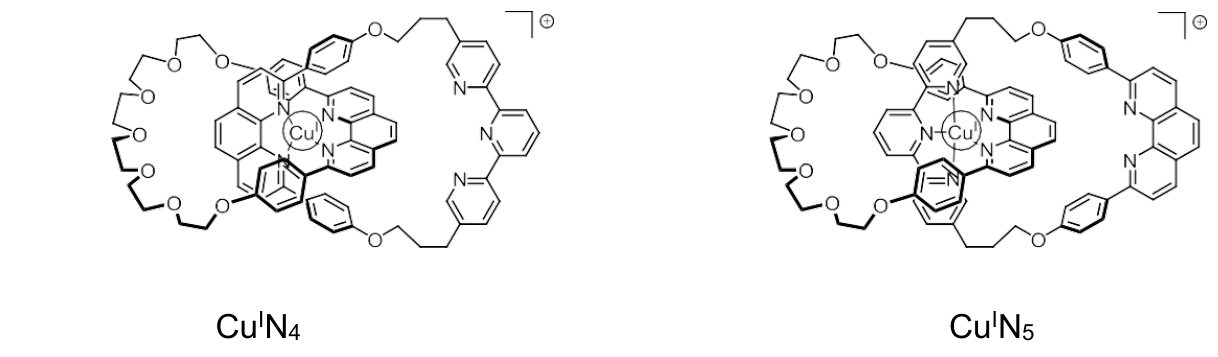
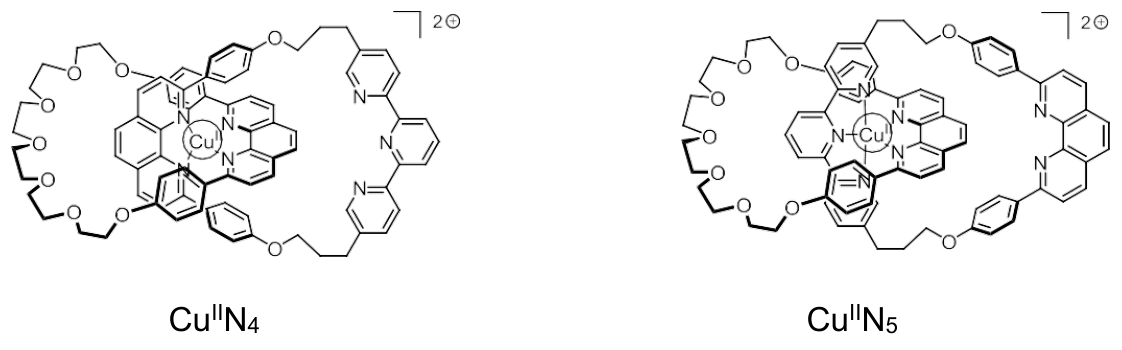
Fig. 2 – [2] catenate L states
The stability of Cu(I) complexes can be inferred by comparing their electronic structures to that of a noble gas.
7.10 Fill in the blanks with a number or a tick:
- The \(\ce{Cu^{I}N4}\) complex has ☐ (number) electrons in the coordination sphere of the metal.
- The \(\ce{Cu^{I}N5}\) complex has ☐ (number) electrons in the coordination sphere of the metal.
- The \(\ce{Cu^{I}N4}\) complex is (tick):
☐ more stable than the \(\ce{Cu^{I}N5}\) complex or
☐ less stable than the \(\ce{Cu^{I}N5}\) complex.7.11 Fill in the solid boxes with the designation of the involved complexes in Fig. 2 and complete the sequence to achieve electrochemical control of the system using the following notation for the dashed boxes:

(rotation) ; \(+\ce{e-}\) ; \(−\ce{e-}\).
Official English text of the problem.
Problem 8: Identification and synthesis of inositols
In this problem, we define “3D structure” and “perspective formula” as indicated for β-glucose in the following figure.
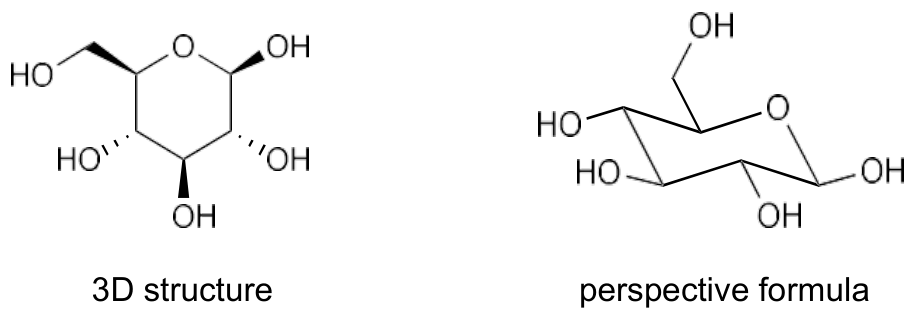
Inositols are cyclohexane-1,2,3,4,5,6-hexols. Some of these 6-membered carbocycles, in particular myo-inositol, are involved in a number of biological processes.
Structure of myo-inositol
8.1 Draw the structural formula of inositols, without stereochemical details.
This family of molecules contains 9 different stereoisomers, including enantiomers.
8.2 Draw all 3D structures of the stereoisomers that are optically active.
The structure of a specific inositol, called myo-inositol, is studied here. Only one of its chair conformers is predominant and its structure can be deduced from its \({}^{1}\mathrm{H}\) NMR spectrum. The spectrum below (next page) was obtained at 600 MHz in \(\ce{D2O}\). No other signal from that compound was observed in the spectrum. The integration is indicated on the spectrum below each signal.
8.3 Give the molecular formula of the predominant compound derived from myo-inositol in this sample that is consistent with the number of protons observed in the \({}^{1}\mathrm{H}\) NMR spectrum.
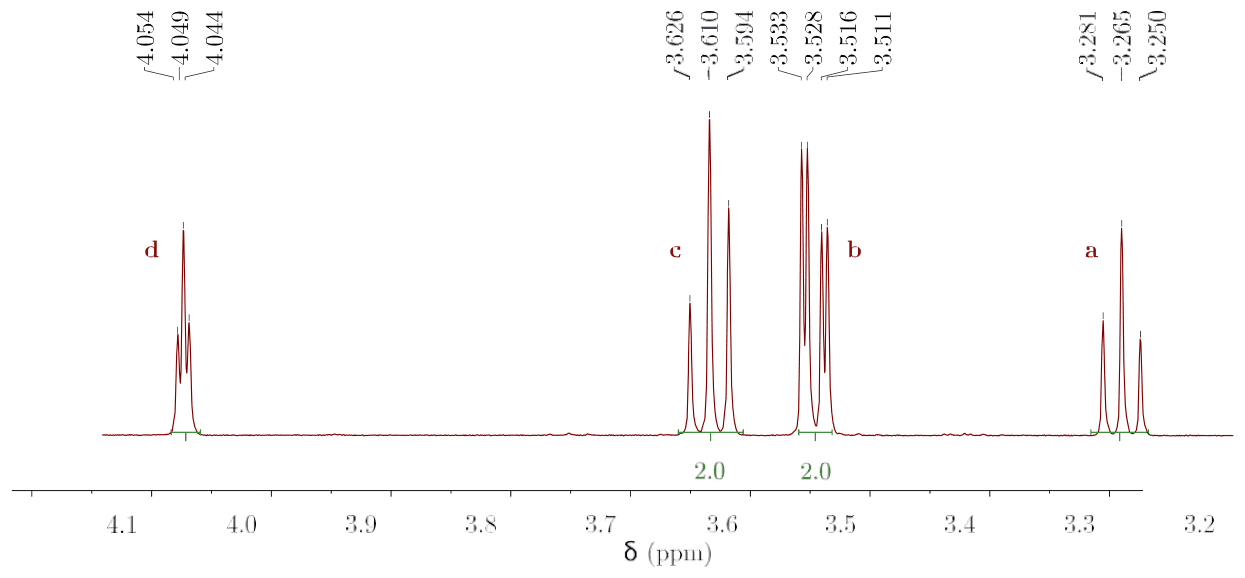
8.4 Based on the number and integrations of the proton signals, give the number of symmetry plane(s) that exist(s) in this molecule.
8.5 Complete the following perspective drawing of the most stable conformation of myo-inositol. Then label each hydrogen with the corresponding letter (a, b, c or d) according to the NMR spectrum above. Proton a must be on carbon a on the following representation. Draw its 3D structure.
Synthesis of inositols
For medicinal applications, it is useful to synthesize some inositol phosphates on a large scale. We will study the synthesis of inositol 2 from bromodiol 1.
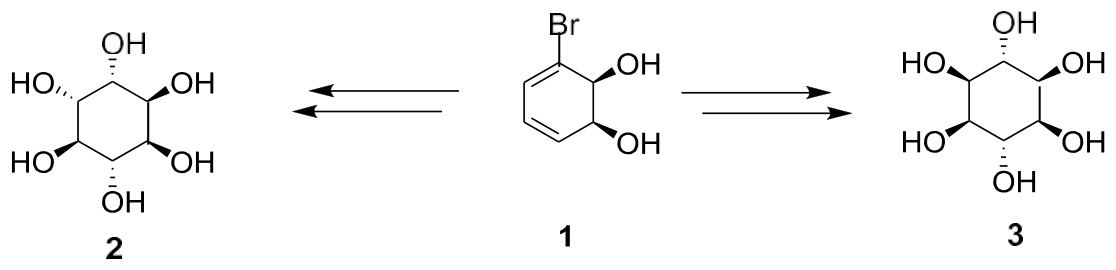
8.6 Choose the correct structural relationship(s) between 2 and 3. Tick relevant boxes.
- ☐ enantiomers
- ☐ epimers
- ☐ diastereomers
- ☐ atropoisomers
Inositol 2 can be obtained from compound 1 in 7 steps.
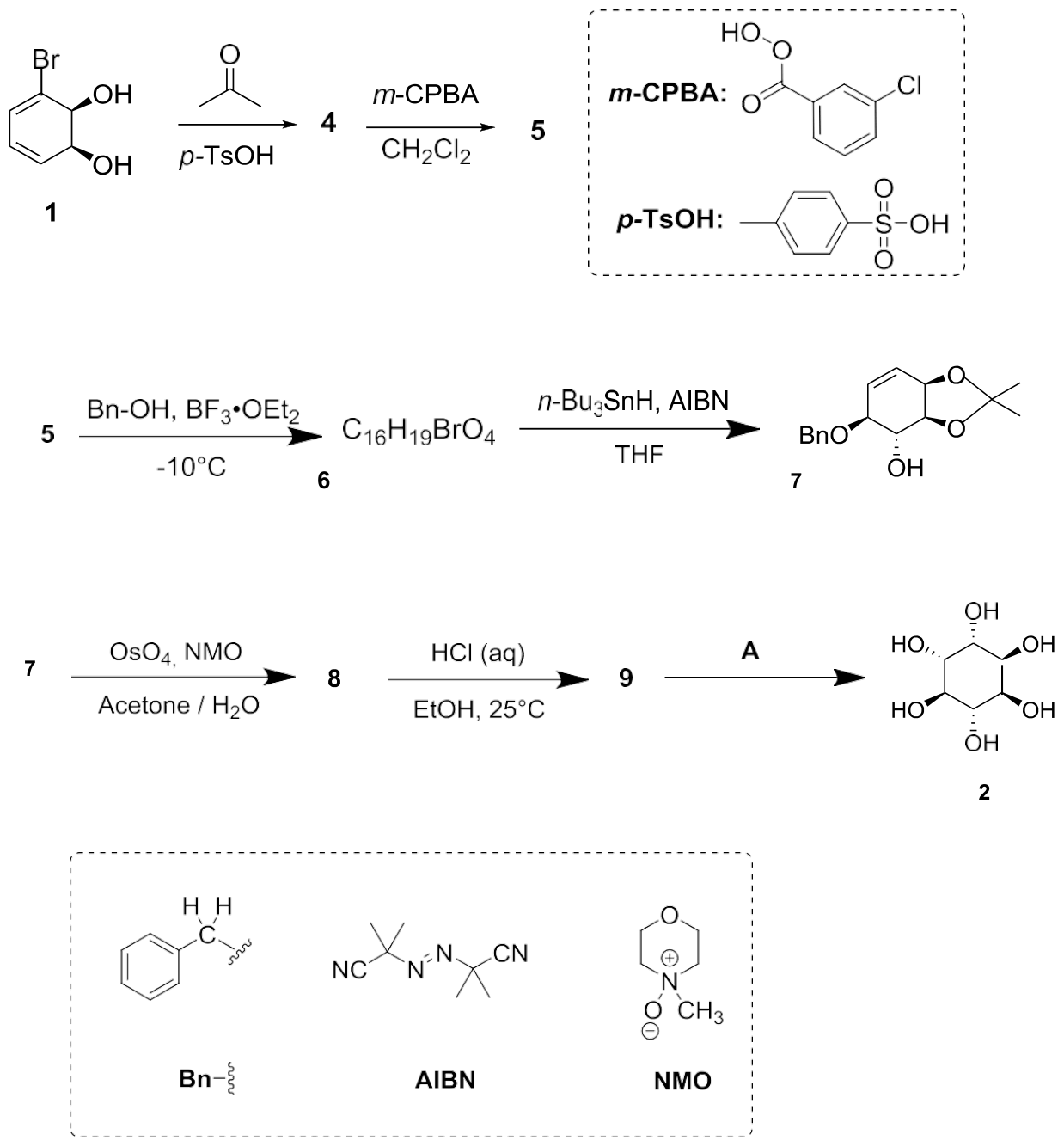
8.7 Draw the 3D structure of 4.
8.8 The reaction leading to 5 occurs on the double bond with the highest electron density. Consider the structure of 1-bromo-1,3-cyclo hexadiene below which is a substructure of 4. Circle the double bond with the highest electron density. Represent all the electronic effects due to the bromine.
8.9 Draw the 3D structure of the major diastereoisomer 5.
8.10 Give the total number of stereoisomers of 5 possibly obtained by this synthesis starting from enantiopure compound 1.
8.11 For the step 5 → 6, another product with the same molecular formula, denoted 6′, can be produced. Draw the 3D structures of 6 and 6′.
8.12 Draw the 3D structures of major diastereomers 8 and 9.
8.13 Select the right set(s) of conditions A to obtain 2. Tick relevant boxes.
- ☐ \(\ce{H2}\), \(\ce{Pd/C}\)
- ☐ \(\ce{K2CO3}\), \(\ce{HF}\)
- ☐ \(\ce{HCOOH}\), \(\ce{H2O}\)
- ☐ \(\ce{BF3.OEt2}\)
8.14 If the bromine is not present in compound 1, in addition to 2, another stereoisomer would be obtained. Considering that stereoselectivity of the reactions that take place in the synthesis remains unchanged and that the following steps involve the same number of equivalents as for 2, draw the 3D structure of this stereoisomer and give its relationship with 2 (tick relevant boxes).
- ☐ enantiomers
- ☐ epimers
- ☐ diastereoisomers
- ☐ atropoisomers
8.15 During the synthesis of 2 from 1 choose the removal step(s) of protecting or directing groups.
☐ 1 → 4 ☐ 7 → 8 ☐ 4 → 5 ☐ 8 → 9 ☐ 5 → 6 ☐ 9 → 2 ☐ 6 → 7 Official English text of the problem.
Problem 9: Synthesis of levobupivacaine
Part I.
The local anesthetic bupivacaine (marketed as Marcaine) is on the World Health Organization List of Essential Medicines. Although the drug is currently used as a racemic mixture, it was demonstrated that one enantiomer of bupivacaine, levobupivacaine, is less cardiotoxic and, therefore, safer than the racemate. Levobupivacaine can be synthesized from the natural amino acid L-lysine.
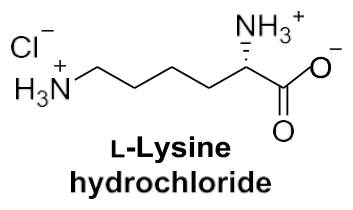
L-Lysine hydrochloride
9.1 Assign the absolute configuration of the stereogenic center in L-lysine hydrochloride and justify your answer by classifying the substituents in order of their priority.
Configuration: ☐ \(R\) ☐ \(S\)
Priority \(1 > 2 > 3 > 4\):

9.2 The prefix L in L-lysine refers to relative configuration. Choose all correct statements:
- ☐ Natural L-amino acids are levorotatory.
- ☐ Natural L-amino acids can be levorotatory or dextrorotatory.
- ☐ All natural L-amino acids are \((S)\).
- ☐ All natural L-amino acids are \((R)\).
Often, we want only one of the amino groups in L-lysine to react. A \(\ce{Cu^2+}\) salt with excess aqueous hydroxide can selectively mask the reactivity of one of the amino groups. After the complex is formed, only the non-complexed \(\ce{NH2}\) group is available to react.
9.3 Considering that L-lysine acts as a bidentate ligand and that two L-lysines coordinate to one \(\ce{Cu^2+}\) ion in the presence of aqueous hydroxide, draw the structure of the intermediate complex.
Fortunately, in the synthesis of levobupivacaine shown below, the same amino group reacts even without \(\ce{Cu^2+}\) salt.
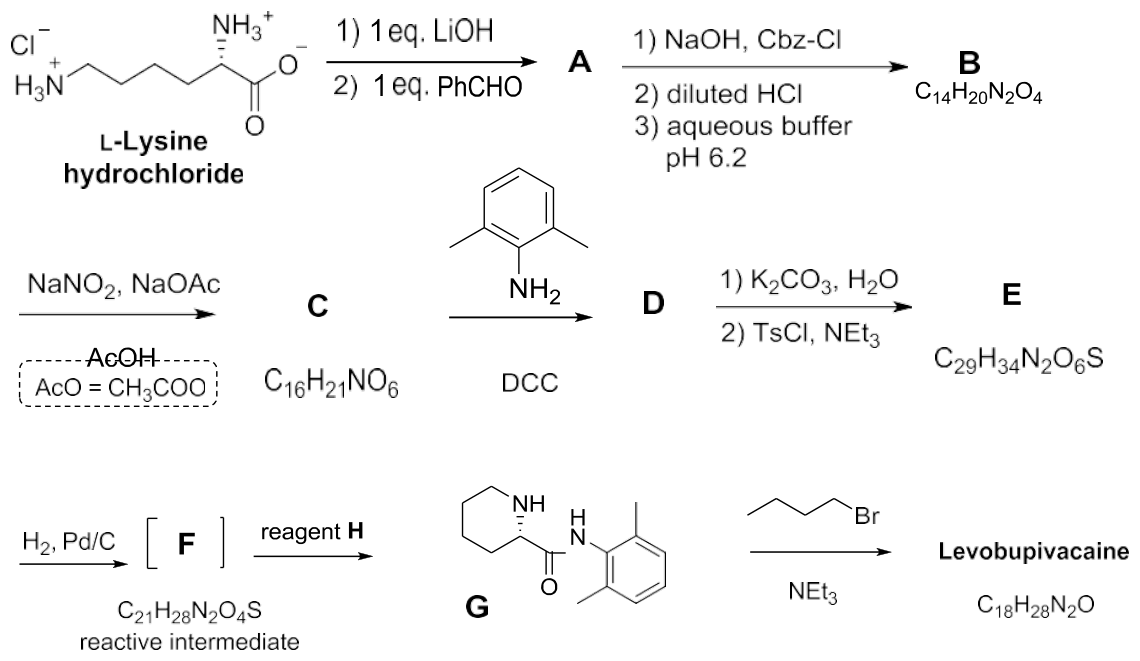

From this point on, you can use the abbreviations proposed in the scheme above.
9.4 Draw the structure of compound A, including the appropriate stereochemistry.
9.5 Transformation of L-lysine into A is (choose proper answer(s)):
- ☐ an enantioselective reaction
- ☐ an enantiospecific reaction
- ☐ a regioselective reaction
9.6 Draw the structures of compounds B – F, including the appropriate stereochemistry.
9.7 What is the role of DCC in the transformation C → D? Tick relevant boxes.
- ☐ Protecting group for the amino group.
- ☐ Protecting group for the hydroxy group.
- ☐ Activating agent for the amide bond formation.
9.8 TsCl is used in the synthesis to enable (tick relevant boxes):
- ☐ Nucleophilic substitution of an amino group.
- ☐ Electrophilic substitution of an amino group.
- ☐ Nucleophilic substitution of a hydroxy group.
- ☐ Electrophilic substitution of a hydroxy group.
9.9 Mark all possible reagents which could be used as reagent H:
☐ diluted \(\ce{HCl}\) ☐ \(\ce{Zn/HCl}\) ☐ \(\ce{K2CO3}\) ☐ \(\ce{H2SO4}\) ☐ diluted \(\ce{KMnO4}\) ☐ diluted \(\ce{NaOH}\) ☐ \(\ce{SOCl2}\) ☐ \(\ce{PCl5}\) 9.10 Draw the structure of levobupivacaine, including the appropriate stereochemistry.
Part II.
The synthesis of levobupivacaine requires the use of enantiomerically pure L-lysine. A common method to confirm the enantiomeric purity of aminoacids is their transformation into amide using Mosher's acid (see the structure of the \((S)\) isomer below).
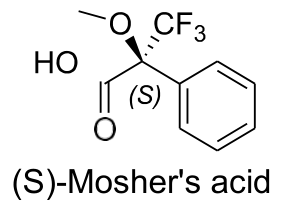
\((S)\)-Mosher's acid
9.11 Draw the structure of the amide formed when the \(\alpha\)-amino group of L-lysine is derivatized with \((S)\)-Mosher's acid. Clearly show the stereochemistry of each chiral center.
9.12 How many products will be formed from racemic lysine and \((S)\)-Mosher's acid (consider that only the \(\alpha\)-amino group of lysine is derivatized)? Tick relevant boxes.
- ☐ Two diastereoisomers.
- ☐ Four diastereoisomers.
- ☐ A racemic mixture of two enantiomers.
- ☐ Four compounds: two enantiomers and two diastereoisomers.
9.13 Choose the method(s) which can be used to quantitatively determine the enantiomeric purity of lysine after its derivatization with \((S)\)-Mosher's acid. Tick the relevant boxes:
- ☐ NMR spectroscopy
- ☐ Liquid chromatography
- ☐ NMR spectroscopy
- ☐ Liquid chromatography
Official English text of the problem.
Internationale Chemie-Olympiade
IChO 2019
Paris, Frankreich · 9 Theorieaufgaben mit vollständigen Lösungen
Aufgabe 1: Unendlich tiefer Potentialtopf und Butadien
Das Buta-1,3-dien-Molekül wird häufig als \(\ce{CH2=CH-CH=CH2}\) mit alternierenden Einfach- und Doppelbindungen geschrieben. Seine chemische Reaktivität stimmt jedoch nicht mit dieser Beschreibung überein, und die \(\pi\)-Elektronen werden besser durch eine Verteilung entlang der drei Bindungen beschrieben:
Dieses System kann als eindimensionaler Kasten (d. h. als unendlich tiefer Potentialtopf) modelliert werden, in dem sich die Elektronen frei bewegen können. Die Energie eines Elektrons in einem unendlich tiefen Potentialtopf der Länge \(L\) beträgt:
\[ E_n=\frac{n^2h^2}{8m_eL^2} \]
wobei \(n\) eine positive ganze Zahl ungleich null ist.
1.1 Zwei verschiedene Modelle werden untersucht. Skizzieren Sie für jedes Modell mindestens die drei niedrigsten Energieniveaus \(E_n\) in den jeweiligen Diagrammen und zeigen Sie dabei, wie sich die relativen Energieniveaus innerhalb der Modelle und zwischen ihnen unterscheiden.
1.2 Tragen Sie die \(\pi\)-Elektronen für Modell 1 in die vorangehenden Diagramme ein und geben Sie die Gesamtenergie des \(\pi\)-Systems in Modell 1 als Funktion von \(h\), \(m_e\) und \(d\) an.
1.3 Tragen Sie die \(\pi\)-Elektronen für Modell 2 in die vorangehenden Diagramme ein und geben Sie die Gesamtenergie des \(\pi\)-Systems in Modell 2 als Funktion von \(h\), \(m_e\) und \(d\) an.
Die Konjugationsenergie ist die Gesamtenergie des tatsächlichen \(\pi\)-Systems abzüglich der Summe der Energien von Ethylenmolekülen mit insgesamt derselben Anzahl an Elektronen.
1.4 Geben Sie die Konjugationsenergie \(\Delta E_{\mathrm c}\) von Butadien als Funktion von \(h\), \(m_e\) und \(d\) an.
Die Modelle 1 und 2 sind zu stark vereinfacht. Im Folgenden wird ein neues Modell ausführlich beschrieben.
1.5 Zeichnen Sie drei weitere mesomere Grenzstrukturen von Butadien in Lewis-Schreibweise.
Um die Größe der Kohlenstoffatome zu berücksichtigen, wird Modell 2 nun wie folgt zu Modell 3 abgeändert:
- Die neue Länge des Potentialtopfs beträgt \(L\), und er erstreckt sich zwischen den Abszissen 0 und \(L\);
- die Kohlenstoffatome befinden sich bei den Abszissen \(L/8\); \(3L/8\); \(5L/8\) und \(7L/8\).
Für jedes Niveau \(n\) lautet die \(\pi\)-Wellenfunktion:
\[ \Psi_n(x)=\sqrt{\frac{2}{L}}\sin\left(\frac{n\pi x}{L}\right) \]
und die \(\pi\)-Elektronendichte für ein System mit \(N\) \(\pi\)-Elektronen beträgt:
\[ \rho(x)=2\sum_{i=1}^{N/2}|\Psi_i(x)|^2 \]
Die vier \(\pi\)-Wellenfunktionen, die den Molekülorbitalen des \(\pi\)-Systems entsprechen, sind unten in beliebiger Reihenfolge dargestellt.
1.6 Ordnen Sie die Energien der vier \(\pi\)-Wellenfunktionen (\(E_A\), \(E_B\), \(E_C\) und \(E_D\)).
1.7 Geben Sie die Bezeichnungen (A, B, C oder D) der Orbitale an, die in Butadien mit Elektronen besetzt sind.
1.8 Geben Sie im Rahmen von Modell 3 die Werte der \(\pi\)-Wellenfunktionen \(\psi_n\) für die besetzten Niveaus an den Positionen 0, \(L/4\) und \(L/2\) für \(n=1\) und \(n=2\) als Funktion von \(L\) an.
1.9 Geben Sie im Rahmen von Modell 3 den Wert der \(\pi\)-Elektronendichte an den Positionen 0, \(L/4\) und \(L/2\) an.
1.10 Zeichnen Sie die \(\pi\)-Elektronendichte zwischen 0 und \(L\).
1.11 Ordnen Sie die folgenden CC-Bindungen (B1, B2, …, B5) nach zunehmender Länge und verwenden Sie dabei die Symbole = oder <:
B1: C1–C2 im Butadienmolekül
B2: C2–C3 im Butadienmolekül
B3: C3–C4 im Butadienmolekül
B4: C–C im Ethanmolekül
B5: C–C im Ethenmolekül
Aufgabentext aus dem offiziellen englischen Text übersetzt.
Aufgabe 2: Wasserstoffgewinnung durch Wasserspaltung
Daten:
Verbindung \(\ce{H2(g)}\) \(\ce{H2O(l)}\) \(\ce{H2O(g)}\) \(\ce{O2(g)}\) \(\Delta_\mathrm{f}H^\circ\) (\(\mathrm{kJ\,mol^{-1}}\)) 0 −285.8 −241.8 0 \(S_\mathrm{m}^\circ\) (\(\mathrm{J\,mol^{-1}\,K^{-1}}\)) 130.6 69.9 188.7 205.2 Molekularer Wasserstoff (\(\ce{H2}\)) kann als Alternative zu Brennstoffen eingesetzt werden, bei deren Verbrennung Kohlenstoffdioxid freigesetzt wird. Daher ist die Verringerung der Kosten und der Umweltauswirkungen seiner Herstellung eine große Herausforderung. Die Wasserspaltung ist hierfür eine vielversprechende Technologie.
2.1 Stellen Sie die ausgeglichene Reaktionsgleichung für die Spaltung von flüssigem Wasser auf und verwenden Sie dabei für Wasser den stöchiometrischen Koeffizienten 1.
2.2 Begründen Sie anhand einer Rechnung ausschließlich mit den angegebenen thermodynamischen Daten, ob diese Reaktion bei 298 K thermodynamisch begünstigt ist.
Die Wasserspaltung kann elektrochemisch mithilfe von zwei Elektroden in einem sauren Wasserbad durchgeführt werden, die über eine Spannungsquelle miteinander verbunden sind (Abb. 1). An beiden Elektroden entstehen Gasblasen.
Abb. 1. Elektrochemische Zelle zur Wasserspaltung.
2.3 Stellen Sie die ausgeglichenen elektrochemischen Teilreaktionsgleichungen für die an jeder Elektrode ablaufenden Nettoreaktionen auf.
2.4 Leiten Sie ausschließlich mithilfe der angegebenen thermodynamischen Daten (oder von Frage 2) die Bedingung für die zwischen den Elektroden angelegte Spannung \(\Delta E_\mathrm{applied}\) im Vergleich zum (zu bestimmenden) Wert \(\Delta E_\mathrm{th}\) her, damit der Prozess bei 298 K thermodynamisch begünstigt ist, wenn sich alle Edukte und Produkte in ihrem Standardzustand befinden. Kreuzen Sie die richtige Bedingung an und geben Sie den Zahlenwert mit 3 Nachkommastellen an.
Experimentell ist eine höhere Spannung erforderlich, um Wasserspaltung zu beobachten. Für eine gegebene \(\ce{Pt}\)-Kathode hängt die zur Beobachtung der Wasserspaltung erforderliche Mindestspannung \(\Delta E_\mathrm{min}\) vom Anodenmaterial ab, wie die folgende Tabelle zeigt:
Anode \(\Delta E_\mathrm{min}\) (V) \(\ce{IrO_x}\) 1.6 \(\ce{NiO_x}\) 1.7 \(\ce{CoO_x}\) 1.7 \(\ce{Fe2O3}\) 1.9 Die Differenz zwischen \(\Delta E_\mathrm{min}\) und \(\Delta E_\mathrm{th}\) ist für Verluste in der Vorrichtung verantwortlich.
2.5 Geben Sie den Ausdruck für den Leistungswirkungsgrad \(\eta_\mathrm{elec}\) der Vorrichtung (den zur Wasserspaltung genutzten Anteil der Leistung) als Funktion von \(\Delta E_\mathrm{th}\) und \(\Delta E_\mathrm{min}\) an. Berechnen Sie unter Annahme einer identischen Stromstärke \(I\) den Leistungswirkungsgrad der Wasserelektrolyse bei Verwendung einer \(\ce{Pt}\)-Kathode und einer \(\ce{Fe2O3}\)-Anode. Geben Sie die effizienteste Anode an.
Eine Alternative zur Wasserelektrolyse ist die direkte photokatalytische Wasserspaltung. Dabei wird ein Halbleiter verwendet, der durch Lichtabsorption aktiviert werden kann.
Abb. 2: Aktivierungsbedingung und äquivalente Elektrodenpotentiale verschiedener Halbleiter. Die gestrichelten Linien entsprechen den Oxidations- und Reduktionspotentialen von Wasser. SHE = Standard-Wasserstoffelektrode
Abb. 3 – Linke Achse: Spektrale Verteilung des solaren Photonenflusses \(\Phi\). Der Photonenfluss ist die Anzahl der Photonen, die pro Flächeneinheit und Zeiteinheit auf dem Halbleiter eintreffen. Rechte Achse und gestrichelte Linie: kumulierter Photonenfluss (d. h. der Anteil des Photonenflusses mit kleinerer Wellenlänge).
2.6 Schätzen Sie den Anteil des solaren Photonenflusses ab, der die folgenden Halbleiter aktivieren kann: \(\ce{TiO2}\), \(\ce{CdS}\), \(\ce{Si}\). Geben Sie die für die Berechnung verwendeten Gleichungen und Einheiten ausdrücklich an.
Die Aktivierung des Halbleiters führt zu einer Änderung der Oberflächenpotentiale, sodass er als zwei Elektroden mit unterschiedlichen Potentialen betrachtet werden kann.
2.7 Wählen Sie anhand der Daten in Abb. 2 aus der folgenden Liste den Halbleiter bzw. die Halbleiter aus, die nach ihrer Aktivierung bei der Wasserspaltungsreaktion sowohl die Rolle der Anode als auch die der Kathode übernehmen können.
2.8 Geben Sie den Halbleiter an, der bei Verwendung sowohl als Kathode als auch als Anode bei einer gegebenen Sonneneinstrahlung voraussichtlich die höchste Effizienz für die Wasserspaltung aufweist.
Kürzlich wurde die Entwicklung von \(\ce{H2}\) und \(\ce{O2}\) bei der Bestrahlung eines Halbleiters mit simuliertem Sonnenlicht bei \(T=25\,^\circ\mathrm{C}\) und \(p_\mathrm{atm}\) untersucht. Bei einer einfallenden Bestrahlungsstärke von \(P=1.0\,\mathrm{kW\,m^{-2}}\) und einer Photoelektrode mit einer Fläche von \(S=16\,\mathrm{mm^2}\) wurde nach einer Reaktionszeit von \(\Delta t=1\) Stunde die Bildung von \(V=0.37\,\mathrm{cm^3}\) \(\ce{H2(g)}\) gemessen.
2.9 Berechnen Sie den Leistungswirkungsgrad \(\eta_\mathrm{direct}\) der Umwandlung.
Somit lassen sich zwei Verfahren zur Umwandlung von Sonnenenergie in Wasserstoff vergleichen: die direkte Photokatalyse und die indirekte Photoelektrolyse, bei der ein Photovoltaikmodul mit einem Elektrolyseur kombiniert wird. Der Wirkungsgrad marktüblicher Photovoltaikmodule liegt bei etwa \(\eta_\mathrm{panels}=20\%\).
2.10 Vergleichen Sie die Leistungswirkungsgrade der beiden Verfahren, \(\eta_\mathrm{direct}\) und \(\eta_\mathrm{indirect}\), bei Verwendung von \(\ce{Fe2O3}\)- und \(\ce{Pt}\)-Elektroden für die Elektrolyse.
Aufgabentext aus dem offiziellen englischen Text übersetzt.
Aufgabe 3: Über Silberchlorid
Daten bei 298 K:
\[ pK_{\mathrm{s}1}(\ce{AgCl})=9.7 \ ;\qquad pK_{\mathrm{s}2}(\ce{Ag2CrO4})=12 \]
Bildungskonstante des Komplexes \(\ce{[Ag(NH3)_{n}]+}\): \(\beta_n=10^{7.2}\)
Potentiale gegen die Standardwasserstoffelektrode:
Standardpotential von \(\ce{Ag+}/\ce{Ag(s)}\): \(E^\circ(\ce{Ag+}/\ce{Ag(s)})=0.80\ \mathrm{V}\)
Formalpotential von \(\ce{O2(aq)}/\ce{HO-(aq)}\) (in Meerwasser): \(E'(\ce{O2(aq)}/\ce{HO-(aq)})=0.75\ \mathrm{V}\)
Teil A: Zitate aus einer Chemievorlesung von Louis Joseph Gay-Lussac
Die folgenden Zitate aus einer Chemievorlesung von Louis Joseph Gay-Lussac (französischer Chemiker und Physiker, 1778–1850) behandeln einige Eigenschaften von Silberchlorid.
Zitat A: „Ich werde nun über Silberchlorid sprechen, einen milchweißen Feststoff. Man erhält es leicht, indem man Salzsäure in eine wässrige Silbernitratlösung gießt.“
Zitat B: „Dieses Salz hat keinen Geschmack, da es unlöslich ist.“
Zitat C: „Diese Verbindung ist in Alkohol und sogar in Säuren vollständig unlöslich, mit Ausnahme von konzentrierter Salzsäure, in der sie sich leicht löst.“
Zitat D: „Dagegen ist Silberchlorid in wässriger Ammoniaklösung sehr gut löslich.“
Zitat E: „Anschließend können wir Silberchlorid wieder zum Vorschein bringen, indem wir eine Säure hinzufügen, die mit Ammoniak reagiert.“
Zitat F: „Wenn Sie eine Schale aus Silber verwenden, um salziges Meerwasser einzudampfen, erhalten Sie unreines Natriumchlorid, das mit einem milchweißen Feststoff vermischt ist.“
3.1 Zitat A: Stellen Sie die ausgeglichene chemische Reaktionsgleichung für die Synthese von \(\ce{AgCl(s)}\) auf.
3.2 Zitat B: Berechnen Sie die Löslichkeit \(s\) von \(\ce{AgCl(s)}\) in Wasser bei 298 K in \(\mathrm{mol\,dm^{-3}}\).
3.3 Zitat C: In einer hochkonzentrierten Chloridionenlösung bildet sich ein wohldefinierter Komplex mit der Stöchiometrie 1:2. Tragen Sie auf der folgenden qualitativen Achse (auf der pCl von links nach rechts zunimmt) in jeden Bereich die silberhaltige Spezies ein, die dort vorherrscht (bzw. bei Feststoffen vorhanden ist). pCl-Werte an den Bereichsgrenzen sind nicht erforderlich.
Zitat D: Wenn Ammoniak zu Silberchlorid gegeben wird, bildet sich ein wohldefinierter Komplex mit der Stöchiometrie \(n\).
3.4 Stellen Sie die ausgeglichene Reaktionsgleichung für die Synthese des Komplexes \(\ce{[Ag(NH3)_{n}]+}\) aus Silberchlorid auf und berechnen Sie die zugehörige Gleichgewichtskonstante.
3.5 Zu 0.1 mol Silberchlorid in \(1\ \mathrm{dm^3}\) Wasser wird Ammoniak gegeben, bis das letzte Feststoffkörnchen verschwindet. In diesem Moment gilt \([\ce{NH3}]=1.78\ \mathrm{mol\,dm^{-3}}\). Bestimmen Sie die Stöchiometrie des Komplexes unter Vernachlässigung von Verdünnungseffekten.
3.6 Stellen Sie die ausgeglichene chemische Reaktionsgleichung zu Zitat E auf.
3.7 Nehmen Sie an, dass Meerwasser leicht basisch und reich an molekularem Sauerstoff ist und dass metallisches Silber unter diesen Bedingungen molekularen Sauerstoff reduzieren kann. Stellen Sie eine ausgeglichene chemische Reaktionsgleichung für die Bildung des in Zitat F erwähnten Feststoffs auf. Wählen Sie für molekularen Sauerstoff einen stöchiometrischen Koeffizienten von 1. Berechnen Sie die Gleichgewichtskonstante bei 298 K.
Teil B: Die Mohr-Methode
Die Mohr-Methode beruht auf der kolorimetrischen Titration von \(\ce{Cl-}\) mit \(\ce{Ag+}\) in Gegenwart von Kaliumchromat (\(\ce{2K+}\), \(\ce{CrO4^2-}\)). Drei Tropfen (~ \(0.5\ \mathrm{cm^3}\)) einer \(\ce{K2CrO4}\)-Lösung mit etwa \(c=7.76\times10^{-3}\ \mathrm{mol\,dm^{-3}}\) werden zu \(V_0=20.00\ \mathrm{cm^3}\) einer Natriumchloridlösung unbekannter Konzentration \(c_{\mathrm{Cl}}\) gegeben. Diese Lösung wird anschließend mit Silbernitrat (\(\ce{Ag+}\), \(\ce{NO3-}\)) der Konzentration \(c=0.050\ \mathrm{mol\,dm^{-3}}\) titriert, was sofort zur Bildung des Feststoffs A führt. Bei \(V_{\mathrm{Ag}}=4.30\ \mathrm{cm^3}\) erscheint ein roter Niederschlag (Feststoff B).
3.8 Stellen Sie die ausgeglichenen Gleichungen der beiden während des Experiments ablaufenden Reaktionen auf. Berechnen Sie die zugehörigen Gleichgewichtskonstanten.
3.9 Identifizieren Sie die Feststoffe.
3.10 Berechnen Sie die unbekannte Konzentration \(c(\ce{Cl-})\) der Chloridionen in der Natriumchloridlösung.
3.11 Berechnen Sie das minimale Volumen \(V_{\mathrm{Ag}}(\min)\), bei dem \(\ce{AgCl(s)}\) ausfällt.
3.12 Berechnen Sie die Restkonzentration \([\ce{Cl-}]_{\mathrm{res}}\) der Chloridionen, wenn Silberchromat auszufallen beginnt. Begründen Sie durch den Vergleich zweier Werte, weshalb \(\ce{CrO4^2-}\) ein guter Indikator für den Titrationsendpunkt ist.
Aufgabentext aus dem offiziellen englischen Text übersetzt.
Aufgabe 4: Vom Schießpulver zur Entdeckung des Iods
Im 19. Jahrhundert spezialisierte sich der französische Unternehmer B. Courtois auf die Herstellung des Nitrats A (\(\ce{M_A(NO3)_m}\)), das für Schießpulver verwendet wurde. A wurde zunächst aus Asien importiert und später aus dem Nitrat B (\(\ce{M_B(NO3)_n}\)) durch eine Austauschreaktion mit der aus Algen gewonnenen Verbindung C hergestellt.
4.1 Bestimmen Sie die Formeln der Nitrate A und B, wenn bekannt ist, dass es sich um wasserfreie Salze von Alkali- oder Erdalkalimetallen (\(\ce{M_A}\) und \(\ce{M_B}\)) handelt. Eines der Nitrate enthält höchstens 1 Massen-% nichtmetallische Verunreinigungen, während das andere \(9 \pm 3\) Massen-% Verunreinigungen enthält. Der Gehalt der Metalle \(\ce{M_A}\) und \(\ce{M_B}\) in den Proben beträgt 38.4 bzw. 22.4 Massen-%. Belegen Sie Ihre Antwort durch Berechnungen.
Zur Gewinnung von A wurden 262.2 g der festen Verbindung C zu einer Lösung gegeben, die 442.8 g B enthielt. Es ist bekannt, dass B im Überschuss vorliegt. Dabei entstanden 190.0 g eines weißen Niederschlags D, der durch Filtration abgetrennt wurde. Das Filtrat wurde eingedampft und das erhaltene feste Gemisch E erhitzt, bis die Masse der Probe (die nur Nitrite, \(\ce{NO2-}\), enthielt) konstant war. Das einzige gasförmige Produkt war molekularer Sauerstoff: 60.48 dm³ bei 0 °C und 1 atm (molekularer Sauerstoff kann als ideales Gas betrachtet werden).
4.2 Berechnen Sie die Zusammensetzung (in Massen-%) des Gemischs E unter der Annahme, dass es ausschließlich die Verbindungen A und B und keine weiteren Verunreinigungen enthielt und dass C in reinem, wasserfreiem Zustand eingesetzt wurde.
4.3 Bestimmen Sie die Formeln der Verbindungen C und D und stellen Sie die ausgeglichene Reaktionsgleichung für die Reaktion zwischen B und C auf.
Bei der Arbeit mit Algenasche beobachtete Courtois 1811, dass Kupfergefäße schneller als üblich angegriffen wurden. Während er dieses Phänomen untersuchte, betrat seine Katze das Labor und verschüttete die konzentrierte Schwefelsäurelösung auf die trockene Algenasche: Sofort stiegen violette Dämpfe aus dem Gefäß auf (1, Schwefelsäure ist das Oxidationsmittel): Iod (\(\ce{I2}\)) war soeben entdeckt worden! Iod war die Ursache der Kupferkorrosion (2). Aufgrund der medizinischen Anwendungen des Iods eröffnete Courtois jedoch einen neuen Betrieb, um es durch die Reaktion von Algen mit Chlor herzustellen (3). Heute wird Iod aus den Reaktanten (\(\ce{NO3-}\), \(\ce{I-}\), \(\ce{H+}\)) (4) oder (\(\ce{IO3-}\), \(\ce{I-}\), \(\ce{H+}\)) (5) hergestellt.
4.4 Stellen Sie ausgeglichene Gleichungen für die Reaktionen 1 – 5 auf.
Die Löslichkeit von Iod in Wasser ist sehr gering, steigt jedoch bei Zugabe von Iodidionen deutlich an. Gemeinsam bilden sie Ionen wie Triiodid, \(\ce{I3-}\):
\[ \ce{I-(aq) + I2(aq)} = \ce{I3-(aq)} \qquad (6) \]
Das Gleichgewicht (6) lässt sich durch Extraktion von \(\ce{I2}\) mit Dichlormethan untersuchen. Tatsächlich lösen sich \(\ce{I-}\) und \(\ce{I3-}\) nicht in organischen Lösungsmitteln, \(\ce{I2}\) hingegen schon; nach der Extraktion ist seine Konzentration in Dichlormethan 15-mal so hoch wie in Wasser.
Der folgende Versuch wurde durchgeführt. Zur Herstellung der Ausgangslösung wurden einige Kristalle festen Iods in 50.0 cm³ einer wässrigen Kaliumiodidlösung (0.1112 g) gelöst. Anschließend wurden 50.0 cm³ Dichlormethan zugegeben und das Gemisch bis zur Einstellung des Gleichgewichts kräftig geschüttelt. Nach der Phasentrennung wurden die beiden Phasen in Gegenwart von Stärke mit 16.20 cm³ (organische Phase) bzw. 8.00 cm³ (wässrige Phase) einer wässrigen Maßlösung von Natriumthiosulfat-Pentahydrat (14.9080 g in 1.000 dm³ Lösung) titriert. Der Ablauf ist nachfolgend schematisch dargestellt:
4.5 Ordnen Sie den Schritten im Schema (1–9) die zugehörigen schematischen Abbildungen (a–i) zu.
Schritte Abbildung 1 2 3 4 5 6 7 8 9 4.6 Stellen Sie ausgeglichene Gleichungen für die beiden möglichen chemischen Reaktionen zwischen Iodspezies und Natriumthiosulfat auf, die während der Titration in der wässrigen Phase ablaufen.
4.7 Berechnen Sie die Masse des Iods, das zur Herstellung der Ausgangslösung verwendet wurde.
4.8 Berechnen Sie die Gleichgewichtskonstante \(K^\circ\) für das Gleichgewicht der Reaktion (6).
Aufgabentext aus dem offiziellen englischen Text übersetzt.
Aufgabe 5: Azobenzol–β-Cyclodextrin-Komplexe zur Bildung von Nanomaschinen
Nanomaschinen sind molekulare Anordnungen, die die Umwandlung der Energie einer Energiequelle in eine Bewegung auf der Nanoskala für Anwendungen wie die Wirkstofffreisetzung ermöglichen. Zahlreiche Nanomaschinen nutzen die Isomerisierung von Azoverbindungen (\(\ce{R-N=N-R'}\)) bei Bestrahlung.
5.1 Zeichnen Sie die Stereoisomere von Azobenzol (\(\ce{H5C6-N=N-C6H5}\)) und zeichnen Sie eine Verbindungslinie zwischen den beiden Kohlenstoffatomen mit dem größten Abstand. Vergleichen Sie diese beiden Abstände (\(d_{\mathrm{trans}}\) und \(d_{\mathrm{cis}}\)).
Abb. 1. Mögliche Edukte für die Synthese von M.
5.2 M kann in zwei Schritten aus einfachen Edukten synthetisiert werden (Abb. 1). Wählen Sie unter den vorgeschlagenen Edukten (N bis Q) diejenigen aus, mit denen M mit sehr hoher Regioselektivität erhalten werden kann. Natriumnitrit (\(\ce{NaNO2}\)) in kalter wässriger Salzsäure wird als Reagenz für den ersten Syntheseschritt verwendet.
Bestimmung der Assoziationskonstante \(K_t\)
β-Cyclodextrin (C, Abb. 2) ist ein cyclisches Heptamer der Glucose, das mit Azoverbindungen Einschlusskomplexe bilden kann. In den Aufgaben 3 bis 6 bestimmen wir spektroskopisch die Assoziationskonstante \(K_t\), die der Bildung des Einschlusskomplexes \(\mathbf{CM}_{\mathrm{trans}}\) entspricht, wie in Abb. 2 dargestellt.
Abb. 2 – Bildung des Einschlusskomplexes \(\mathbf{CM}_{\mathrm{trans}}\).
Mehrere Lösungen werden durch Mischen von C und \(\mathbf{M}_{\mathrm{trans}}\) in unterschiedlichen Verhältnissen hergestellt, um die Anfangskonzentrationen \([\mathbf C]_0\) und \([\mathbf M_{\mathrm{trans}}]_0\) zu erreichen. Während \([\mathbf M_{\mathrm{trans}}]_0\) für alle Lösungen gleich ist, variiert \([\mathbf C]_0\). Bei einer festen Wellenlänge verfolgen wir die Änderung der Extinktionsdifferenz \(\Delta A\) zwischen der Extinktion der jeweiligen Lösung und derjenigen der reinen \(\mathbf M_{\mathrm{trans}}\)-Lösung. Die molaren Extinktionskoeffizienten von \(\mathbf{CM}_{\mathrm{trans}}\) und \(\mathbf M_{\mathrm{trans}}\) bezeichnen wir mit \(\varepsilon_{\mathrm{CM}_{\mathrm{trans}}}\) beziehungsweise \(\varepsilon_{\mathrm M_{\mathrm{trans}}}\). \(L\) ist die Weglänge des Lichtstrahls durch die Probe. Die Extinktion von C (\(\varepsilon_{\mathrm C}\)) ist vernachlässigbar.
5.3 Zeigen Sie, dass \(\Delta A=\alpha[\mathbf{CM}_{\mathrm{trans}}]\) gilt, und drücken Sie \(\alpha\) durch bekannte Konstanten aus.
5.4 Zeigen Sie, dass die Konzentration von C als konstant betrachtet werden kann, \([\mathbf C]\simeq[\mathbf C]_0\), wenn C in großem Überschuss gegenüber \(\mathbf M_{\mathrm{trans}}\) vorliegt (d. h. \([\mathbf C]_0\gg[\mathbf M_{\mathrm{trans}}]_0\)).
5.5 Zeigen Sie, dass im Fall eines großen Überschusses von C gegenüber \(\mathbf M_{\mathrm{trans}}\) (d. h. \([\mathbf C]_0\gg[\mathbf M_{\mathrm{trans}}]_0\)) gilt:
\[ \Delta A=\alpha\frac{\beta[\mathbf C]_0}{1+K_t[\mathbf C]_0} \]
Drücken Sie \(\beta\) durch Konstanten und Anfangskonzentrationen aus.
5.6 Bestimmen Sie \(K_t\) anhand der folgenden experimentellen Kurve (Abb. 3).
Abb. 3 – Verlauf von \(1/\Delta A\) als Funktion von \(1/[\mathbf C]_0\).
Bestimmung der Assoziationskonstante \(K_c\)
In den Aufgaben 7 bis 9 bestimmen wir durch kinetische Untersuchungen die Assoziationskonstante \(K_c\), die der Bildung des Einschlusskomplexes mit \(\mathbf M_{\mathrm{cis}}\), \(\mathbf{CM}_{\mathrm{cis}}\), entspricht. Eine Probe, die ausschließlich \(\mathbf M_{\mathrm{trans}}\) enthält, wird bestrahlt, wodurch eine bekannte Menge an \(\mathbf M_{\mathrm{cis}}\), \([\mathbf M_{\mathrm{cis}}]_0\), erzeugt wird. Anschließend isomerisiert \(\mathbf M_{\mathrm{cis}}\) (frei oder im Einschlusskomplex) thermisch zu \(\mathbf M_{\mathrm{trans}}\). In Abwesenheit von C folgt die Isomerisierung einer Kinetik erster Ordnung mit der Geschwindigkeitskonstante \(k_1\). Alle Komplexierungsgleichgewichte stellen sich schneller ein als die Isomerisierungsprozesse ablaufen. Das kinetische Schema dieses Experiments ist in Abb. 4 dargestellt.
Abb. 4 – Kinetisches Schema der Isomerisierung von \(\mathbf M_{\mathrm{cis}}\) in Gegenwart von C.
Die Abnahmegeschwindigkeit \(r\) der Gesamtmenge an \(\mathbf M_{\mathrm{cis}}\) (frei und komplexiert) ist definiert als
\[ r=k_1[\mathbf M_{\mathrm{cis}}]+k_2[\mathbf{CM}_{\mathrm{cis}}]. \]
Experimentell folgt \(r\) einem scheinbaren Geschwindigkeitsgesetz erster Ordnung mit einer scheinbaren Geschwindigkeitskonstante \(k_{\mathrm{obs}}\):
\[ r=k_{\mathrm{obs}}\bigl([\mathbf M_{\mathrm{cis}}]+[\mathbf{CM}_{\mathrm{cis}}]\bigr). \]
5.7 Zeigen Sie, dass
\[ k_{\mathrm{obs}}= \frac{\gamma+\delta k_2[\mathbf C]}{1+K_c[\mathbf C]} \]
gilt, und drücken Sie \(\gamma\) und \(\delta\) durch bekannte Konstanten aus.
5.8 Wählen Sie die Bedingung(en), unter der bzw. denen die zu \(k_{\mathrm{obs}}\) gehörende Halbwertszeit \(t_{1/2}\) durch \(t_{1/2}=\ln(2/\gamma)(1+K_c[\mathbf C]_0)\) ausgedrückt werden kann, wenn \([\mathbf C]_0\gg[\mathbf M_{\mathrm{cis}}]_0\) gilt. Begründen Sie Ihre Antwort mathematisch.
5.9 Bestimmen Sie unter der Annahme, dass die Bedingung(en) aus Aufgabe 8 erfüllt ist bzw. sind, \(K_c\) durch eine lineare Regression anhand der folgenden Daten. Sie dürfen einen Taschenrechner verwenden oder ein Diagramm zeichnen.
\([\mathbf C]_0\) (\(\mathrm{mol\,dm^{-3}}\)) \(t_{1/2}\) (s) \([\mathbf C]_0\) (\(\mathrm{mol\,dm^{-3}}\)) \(t_{1/2}\) (s) 0 3.0 \(3.0\cdot10^{-3}\) 5.9 \(1.0\cdot10^{-4}\) 3.2 \(5.0\cdot10^{-3}\) 7.7 \(5.0\cdot10^{-4}\) 3.6 \(7.5\cdot10^{-3}\) 9.9 \(1.0\cdot10^{-3}\) 4.1 \(1.0\cdot10^{-2}\) 12.6 Bildung von Nanomaschinen
Abb. 5 – Auflösung eines Azobenzol–Cyclodextrin-Einschlusskomplexes durch eine lichtinduzierte Isomerisierung, die die Freisetzung eines Farbstoffs (graue Kreise) ermöglicht.
Eine andere Azobenzolverbindung (für die \(K_c\ll K_t\) gilt), die anfangs in der trans-Form vorliegt, wird kovalent an Siliciumdioxid gebunden (Abb. 5). Die Poren des Siliciumdioxids sind mit einem Farbstoff gefüllt (Rhodamin B, graue Kreise in Abb. 5). Bei Zugabe von C bildet sich ein Einschlusskomplex, der die Poren verschließt und die Freisetzung des Farbstoffs verhindert.
5.10 Wählen Sie die am besten geeignete Bedingung (nur eine Auswahl), damit die Poren in Gegenwart von C zunächst verschlossen sind und der Farbstoff bei Bestrahlung freigesetzt werden kann.
Dieses mit einem Farbstoff beladene Azobenzol-Siliciumdioxid-Pulver wird so in einer Ecke einer Küvette platziert (Abb. 6), dass das Pulver nicht in die Lösung gelangen kann. Das Pulver wird bei einer Wellenlänge \(\lambda_1\) bestrahlt, um die Freisetzung des Farbstoffs aus den Poren auszulösen (Abb. 5). Um diese Freisetzung absorptionsspektroskopisch zu verfolgen, messen wir die Extinktion der Lösung bei der Wellenlänge \(\lambda_2\).
Abb. 6 – Links: Versuchsaufbau zur Verfolgung der Farbstofffreisetzung; rechts: Absorptionsspektren von trans-Azobenzol (durchgezogene Linie), cis-Azobenzol (gepunktete Linie) und Rhodamin B (gestrichelte Linie).
5.11 Bestimmen Sie \(\lambda_1\).
5.12 Bestimmen Sie \(\lambda_2\).
Aufgabentext aus dem offiziellen englischen Text übersetzt.
Aufgabe 6: Charakterisierung eines Blockcopolymers
Blockcopolymere, die durch die Verknüpfung verschiedener Polymere (Blöcke) erhalten werden, besitzen besondere Eigenschaften, beispielsweise die Fähigkeit zur Selbstorganisation. In dieser Aufgabe werden die Synthese und Charakterisierung solcher Makromoleküle untersucht.
Untersuchung des ersten Blocks
In diesem ersten Teil untersuchen wir das wasserlösliche Homopolymer 1 (α-Methoxy-ω-aminopolyethylenglykol). Das \({}^{1}\ce{H}\)-NMR-Spektrum von 1 (DMSO-\(d_6\), 60 °C, 500 MHz) enthält die folgenden Signale:
Index δ (ppm) Peakfläche a 2.7* 0.6 b 3.3 0.9 c 3.4 0.6 d \(\sim 3.5\) 133.7 Tabelle 1, *in Gegenwart von \(\ce{D2O}\) verschwindet das Signal bei 2.7 ppm.
6.1 Ordnen Sie die \({}^{1}\ce{H}\)-NMR-Signale (a, b, c, d) aus Tabelle 1 den jeweils entsprechenden Protonen zu.
6.2 Drücken Sie den mittleren Polymerisationsgrad \(n\) als Funktion der Fläche \(A_{\ce{OC2H4}}\) des NMR-Peaks der Wiederholungseinheit und der Fläche \(A_{\ce{OCH3}}\) des NMR-Peaks der Methylendgruppe aus. Berechnen Sie \(n\).
Untersuchung eines Diblockcopolymers
Die Synthese des zweiten Blocks des Copolymers erfolgt durch die Reaktion von 1 mit 2 (ε-(Benzyloxycarbonyl)-lysin-N-carboxyanhydrid).
Dabei entsteht das Blockcopolymer 3.
6.3 Zeichnen Sie das Reaktionsintermediat, das im ersten Schritt der Addition von 1 an 2 gebildet wird. Der zweite Schritt des Mechanismus führt zur Bildung eines Gasmoleküls, G. Zeichnen Sie dessen Struktur.
6.4 Zur Charakterisierung der Verbindungen werden Infrarotmessungen (IR) durchgeführt. Ordnen Sie die drei IR-Spektren den Verbindungen 1, 2 und 3 zu.
6.5 Das \({}^{1}\ce{H}\)-NMR-Spektrum des Copolymers 3 (in DMSO-\(d_6\), bei 60 °C, 500 MHz) ist in Abb. 1 dargestellt. Berechnen Sie mithilfe einiger oder aller NMR-Signale, deren Flächen in Tabelle 2 angegeben sind, seine zahlenmittlere molare Masse \(M_n\). Verwenden Sie dabei \(n\) aus Frage 2. Kreisen Sie die Atomgruppe(n) ein, die Sie für Ihre Berechnungen verwendet haben, und geben Sie die zugehörigen Symbole (α, β…) an.
Tabelle 2
Peak Fläche α 22.4 β 119 γ 23.8 δ 47.6 ε 622 Abb. 1 – Die mit * gekennzeichneten Signale stammen vom Lösungsmittel und von Wasser.
Diese Reaktion von 1 mit 2 lieferte bei 40 °C die Copolymere 3a nach 20 h, 3b nach 25 h und 3c nach 30 h Reaktionszeit. Die Ergebnisse von Untersuchungen mittels Größenausschlusschromatographie (SEC) sind in Abb. 2 dargestellt.
Abb. 2 – SEC-Chromatogramme von 3a, 3b und 3c als Funktion des Elutionsvolumens \(V_e\).
6.6 Ordnen Sie die Signale in Abb. 2 den Copolymeren 3a, 3b und 3c zu.
3a: ☐ X ☐ Y ☐ Z
3b: ☐ X ☐ Y ☐ Z
3c: ☐ X ☐ Y ☐ ZZur Kalibrierung des Chromatogramms wurde eine Mischung von Standardpolymeren mit bekannten molaren Massen (3, 30, 130, 700 und 7000 kg mol\(^{-1}\)) untersucht (Abb. 3).
Der Logarithmus der molaren Masse ist eine lineare Funktion des Elutionsvolumens \(V_e\).
Abb. 3 – SEC-Chromatogramm der Mischung der Standards.
6.7 Bestimmen Sie anhand der SEC-Kurven in Abb. 2 und 3 das \(V_e\) des Polymers, das Kurve X entspricht, und schätzen Sie damit den Polymerisationsgrad \(m\) seines zweiten Blocks ab. Erläutern Sie Ihre Berechnung ausführlich; Sie dürfen einen Taschenrechner verwenden oder ein Diagramm zeichnen.
Synthese eines Triblockcopolymers
Für biologische Anwendungen, bei denen Mizellen gebildet werden, kann ein Triblockcopolymer 9 durch Einführen eines mittleren Blocks B unter Verwendung des Monomers 5 synthetisiert werden.
6.8 Zeichnen Sie die Strukturen von 5, 7 und 8.
6.9 Amphiphile Blockcopolymere wie 9: A-B-C können für medizinische Anwendungen eingesetzt werden, da sie sich in Wasser (pH = 7) selbst zu Mizellen organisieren, die als Wirkstoffträger dienen können. Ordnen Sie jedem Block des Copolymers eine Eigenschaft zu. Zeichnen Sie ein Schema der Mizelle mit nur 4 Polymerketten.
Aufgabentext aus dem offiziellen englischen Text übersetzt.
Aufgabe 7: Ringbewegung in einem [2]Catenan
Im Jahr 2016 wurde der Nobelpreis für Chemie an J.-P. Sauvage, Sir J. F. Stoddart und B. L. Feringa „für den Entwurf und die Synthese molekularer Maschinen“ verliehen. Ein Beispiel dafür ist ein [2]Catenan, ein Molekül, das aus zwei ineinander verschlungenen Ringen besteht. In diesem System enthält ein Makrocyclus einen einzelnen Phenanthrolinliganden (zweizähnig), und der zweite enthält zwei Liganden: einen Phenanthrolin- und einen Terpyridinliganden (dreizähnig). Ein Kupferion wird von je einem Liganden aus jedem Makrocyclus koordiniert. Je nach Oxidationsstufe des Kupfers (+I oder +II) ergeben sich zwei Konfigurationen (Abb. 1).
Abb. 1 – Multistabilität eines Rings in einem [2]Catenan.
Die Synthese des Makrocyclus erfolgt wie folgt:
7.1 Zeichnen Sie die Struktur von B.
7.2 Zeichnen Sie die Strukturen von E, F und G.
7.3 Wählen Sie aus den folgenden Reaktionsbedingungen diejenigen aus, unter denen E aus D hergestellt werden kann.
- ☐ \(\ce{H+, H2O}\)
- ☐ \(\ce{OH-, H2O}\)
- ☐ \(\ce{NaBH4, CH3OH}\)
- ☐ \(\ce{H2}\), Pd/C, THF
Kreuzen Sie das zutreffende Kästchen an.
7.4 In der Synthesestrategie wird MsCl verwendet, um Folgendes zu erhalten:
- ☐ eine Abgangsgruppe
- ☐ eine Schutzgruppe
- ☐ eine deaktivierte Gruppe
- ☐ eine dirigierende Gruppe
Kreuzen Sie das zutreffende Kästchen an.
7.5 G wird durch die Reaktion von F mit LiBr in Aceton erhalten. Bei dieser Reaktion handelt es sich um:
- ☐ eine elektrophile aromatische Substitution,
- ☐ eine nucleophile aromatische Substitution,
- ☐ \(\mathrm{S_N1}\)
- ☐ \(\mathrm{S_N2}\)
Kreuzen Sie die zutreffenden Kästchen an.
7.6 Zeichnen Sie den Übergangszustand des geschwindigkeitsbestimmenden Schritts der Reaktion F → G unter Darstellung der räumlichen Geometrie. Stellen Sie nur ein Reaktionszentrum dar. Die Hauptkohlenstoffkette kann als Rest R dargestellt werden.
Die Synthese des [2]Catenans L nutzt den Templateffekt eines Kupferkomplexes:
7.7 Geben Sie die vollständige Elektronenkonfiguration von Cu(0) im Grundzustand an. Geben Sie die Oxidationsstufe von Cu im Komplex J an und schreiben Sie die Elektronenkonfiguration von Cu im freien Ion auf, das J entspricht.
7.8 Wählen Sie die Geometrie des Kupferions in L aus. Zeichnen Sie unter Annahme einer idealen Geometrie der Liganden um das Kupferzentrum die Energieniveaus der d-Orbitale gemäß der Kristallfeldtheorie. Tragen Sie die Elektronen in das Orbitaldiagramm ein. Geben Sie den maximalen Wert des Spins (\(S\)) für diesen Komplex an. Die Geometrie des Cu in L ist:
- ☐ oktaedrisch,
- ☐ tetraedrisch,
- ☐ quadratisch-planar,
- ☐ trigonal-bipyramidal.
7.9 Wählen Sie aus den folgenden Verbindungen diejenigen aus, die das Kupferion aus L entfernen können, um das freie [2]Catenan zu erhalten (kreuzen Sie die zutreffenden Kästchen an):
- ☐ \(\ce{CH3CN}\)
- ☐ \(\ce{NH4PF6}\)
- ☐ \(\ce{KCN}\)
- ☐ tren
Im [2]Catenan L kann das Kupferion in zwei Oxidationsstufen (+I) oder (+II) vorliegen, die jeweils eine unterschiedliche Koordinationssphäre aufweisen (vierfach bzw. fünffach koordiniert).
Abb. 2 – Zustände des [2]Catenats L
Die Stabilität von Cu(I)-Komplexen lässt sich durch einen Vergleich ihrer elektronischen Strukturen mit der eines Edelgases abschätzen.
7.10 Tragen Sie in die Kästchen eine Zahl oder ein Kreuz ein:
- Der \(\ce{Cu^{I}N4}\)-Komplex hat ☐ (Zahl) Elektronen in der Koordinationssphäre des Metalls.
- Der \(\ce{Cu^{I}N5}\)-Komplex hat ☐ (Zahl) Elektronen in der Koordinationssphäre des Metalls.
- Der \(\ce{Cu^{I}N4}\)-Komplex ist (ankreuzen):
☐ stabiler als der \(\ce{Cu^{I}N5}\)-Komplex oder
☐ weniger stabil als der \(\ce{Cu^{I}N5}\)-Komplex.7.11 Tragen Sie in die durchgezogen umrandeten Kästchen die Bezeichnungen der beteiligten Komplexe aus Abb. 2 ein und vervollständigen Sie die Abfolge zur elektrochemischen Steuerung des Systems. Verwenden Sie für die gestrichelt umrandeten Kästchen die folgende Notation:
(Rotation) ; \(+\ce{e-}\) ; \(−\ce{e-}\).
Aufgabentext aus dem offiziellen englischen Text übersetzt.
Aufgabe 8: Identifizierung und Synthese von Inositolen
In dieser Aufgabe werden die Begriffe „3D-Struktur“ und „perspektivische Formel“ so verwendet, wie es in der folgenden Abbildung für β-Glucose gezeigt ist.
Inositole sind Cyclohexan-1,2,3,4,5,6-hexole. Einige dieser sechsgliedrigen Carbocyclen, insbesondere myo-Inositol, sind an einer Reihe biologischer Prozesse beteiligt.
Struktur von myo-Inositol
8.1 Zeichnen Sie die Strukturformel der Inositole ohne stereochemische Angaben.
Diese Molekülfamilie umfasst 9 verschiedene Stereoisomere einschließlich der Enantiomere.
8.2 Zeichnen Sie alle 3D-Strukturen der optisch aktiven Stereoisomere.
Hier wird die Struktur eines bestimmten Inositols, des sogenannten myo-Inositols, untersucht. Nur eines seiner Sesselkonformere überwiegt, und dessen Struktur lässt sich aus seinem \({}^{1}\mathrm{H}\)-NMR-Spektrum ableiten. Das unten stehende Spektrum (nächste Seite) wurde bei 600 MHz in \(\ce{D2O}\) aufgenommen. Im Spektrum wurde kein weiteres Signal dieser Verbindung beobachtet. Die Integration ist im folgenden Spektrum unter jedem Signal angegeben.
8.3 Geben Sie die Summenformel der in dieser Probe vorherrschenden, von myo-Inositol abgeleiteten Verbindung an, die mit der Anzahl der im \({}^{1}\mathrm{H}\)-NMR-Spektrum beobachteten Protonen vereinbar ist.
8.4 Geben Sie anhand der Anzahl und der Integrale der Protonensignale an, wie viele Symmetrieebenen dieses Molekül besitzt.
8.5 Vervollständigen Sie die folgende perspektivische Zeichnung der stabilsten Konformation von myo-Inositol. Kennzeichnen Sie anschließend jedes Wasserstoffatom mit dem entsprechenden Buchstaben (a, b, c oder d) gemäß dem obigen NMR-Spektrum. Proton a muss in der folgenden Darstellung am Kohlenstoffatom a sitzen. Zeichnen Sie die zugehörige 3D-Struktur.
Synthese von Inositolen
Für medizinische Anwendungen ist es nützlich, einige Inositolphosphate in großem Maßstab zu synthetisieren. Wir betrachten die Synthese von Inositol 2 aus Bromdiol 1.
8.6 Wählen Sie die zutreffende(n) strukturelle(n) Beziehung(en) zwischen 2 und 3 aus. Kreuzen Sie die entsprechenden Kästchen an.
- ☐ Enantiomere
- ☐ Epimere
- ☐ Diastereomere
- ☐ Atropisomere
Inositol 2 lässt sich in 7 Schritten aus Verbindung 1 erhalten.
8.7 Zeichnen Sie die 3D-Struktur von 4.
8.8 Die Reaktion, die zu 5 führt, findet an der Doppelbindung mit der höchsten Elektronendichte statt. Betrachten Sie die unten dargestellte Struktur von 1-Bromcyclohexa-1,3-dien, die eine Teilstruktur von 4 ist. Kreisen Sie die Doppelbindung mit der höchsten Elektronendichte ein. Stellen Sie alle vom Brom ausgehenden elektronischen Effekte dar.
8.9 Zeichnen Sie die 3D-Struktur des Hauptdiastereomers 5.
8.10 Geben Sie die Gesamtzahl der Stereoisomere von 5 an, die bei dieser Synthese ausgehend von enantiomerenreiner Verbindung 1 erhalten werden können.
8.11 Beim Schritt 5 → 6 kann ein weiteres Produkt mit derselben Summenformel entstehen, das als 6′ bezeichnet wird. Zeichnen Sie die 3D-Strukturen von 6 und 6′.
8.12 Zeichnen Sie die 3D-Strukturen der Hauptdiastereomere 8 und 9.
8.13 Wählen Sie die geeigneten Reaktionsbedingungen A aus, um 2 zu erhalten. Kreuzen Sie die entsprechenden Kästchen an.
- ☐ \(\ce{H2}\), \(\ce{Pd/C}\)
- ☐ \(\ce{K2CO3}\), \(\ce{HF}\)
- ☐ \(\ce{HCOOH}\), \(\ce{H2O}\)
- ☐ \(\ce{BF3.OEt2}\)
8.14 Wenn Verbindung 1 kein Brom enthält, würde neben 2 ein weiteres Stereoisomer erhalten werden. Nehmen Sie an, dass die Stereoselektivität der während der Synthese ablaufenden Reaktionen unverändert bleibt und in den nachfolgenden Schritten dieselbe Anzahl an Äquivalenten wie für 2 eingesetzt wird. Zeichnen Sie die 3D-Struktur dieses Stereoisomers und geben Sie seine Beziehung zu 2 an (kreuzen Sie die entsprechenden Kästchen an).
- ☐ Enantiomere
- ☐ Epimere
- ☐ Diastereomere
- ☐ Atropisomere
8.15 Wählen Sie die Schritte der Synthese von 2 aus 1 aus, in denen Schutzgruppen oder dirigierende Gruppen entfernt werden.
☐ 1 → 4 ☐ 7 → 8 ☐ 4 → 5 ☐ 8 → 9 ☐ 5 → 6 ☐ 9 → 2 ☐ 6 → 7 Aufgabentext aus dem offiziellen englischen Text übersetzt.
Aufgabe 9: Synthese von Levobupivacain
Teil I.
Das Lokalanästhetikum Bupivacain (unter dem Handelsnamen Marcaine erhältlich) steht auf der Liste der unentbehrlichen Arzneimittel der Weltgesundheitsorganisation. Obwohl der Wirkstoff derzeit als racemisches Gemisch verwendet wird, wurde gezeigt, dass ein Enantiomer von Bupivacain, Levobupivacain, weniger kardiotoxisch und damit sicherer als das Racemat ist. Levobupivacain kann aus der natürlichen Aminosäure L-Lysin synthetisiert werden.
L-Lysinhydrochlorid
9.1 Bestimmen Sie die absolute Konfiguration des stereogenen Zentrums in L-Lysinhydrochlorid und begründen Sie Ihre Antwort, indem Sie die Substituenten nach ihrer Priorität ordnen.
Konfiguration: ☐ \(R\) ☐ \(S\)
Priorität \(1 > 2 > 3 > 4\):
9.2 Das Präfix L in L-Lysin bezeichnet die relative Konfiguration. Wählen Sie alle richtigen Aussagen aus:
- ☐ Natürliche L-Aminosäuren sind linksdrehend.
- ☐ Natürliche L-Aminosäuren können linksdrehend oder rechtsdrehend sein.
- ☐ Alle natürlichen L-Aminosäuren sind \((S)\).
- ☐ Alle natürlichen L-Aminosäuren sind \((R)\).
Häufig soll nur eine der Aminogruppen in L-Lysin reagieren. Ein \(\ce{Cu^2+}\)-Salz mit überschüssigem Hydroxid in wässriger Lösung kann die Reaktivität einer der Aminogruppen selektiv maskieren. Nach der Komplexbildung steht nur die nicht komplexierte \(\ce{NH2}\)-Gruppe für eine Reaktion zur Verfügung.
9.3 Zeichnen Sie die Struktur des intermediären Komplexes unter Berücksichtigung der Tatsache, dass L-Lysin als zweizähniger Ligand wirkt und dass in Gegenwart von wässriger Hydroxidlösung zwei L-Lysin-Moleküle an ein \(\ce{Cu^2+}\)-Ion koordinieren.
Glücklicherweise reagiert bei der unten dargestellten Synthese von Levobupivacain dieselbe Aminogruppe auch ohne \(\ce{Cu^2+}\)-Salz.
Ab hier können Sie die im obigen Schema vorgeschlagenen Abkürzungen verwenden.
9.4 Zeichnen Sie die Struktur der Verbindung A mit der entsprechenden Stereochemie.
9.5 Die Umwandlung von L-Lysin in A ist (wählen Sie die richtige(n) Antwort(en) aus):
- ☐ eine enantioselektive Reaktion
- ☐ eine enantiospezifische Reaktion
- ☐ eine regioselektive Reaktion
9.6 Zeichnen Sie die Strukturen der Verbindungen B – F mit der entsprechenden Stereochemie.
9.7 Welche Rolle spielt DCC bei der Umwandlung C → D? Kreuzen Sie die zutreffenden Kästchen an.
- ☐ Schutzgruppe für die Aminogruppe.
- ☐ Schutzgruppe für die Hydroxygruppe.
- ☐ Aktivierungsreagenz für die Bildung der Amidbindung.
9.8 TsCl wird in der Synthese verwendet, um Folgendes zu ermöglichen (kreuzen Sie die zutreffenden Kästchen an):
- ☐ Nukleophile Substitution einer Aminogruppe.
- ☐ Elektrophile Substitution einer Aminogruppe.
- ☐ Nukleophile Substitution einer Hydroxygruppe.
- ☐ Elektrophile Substitution einer Hydroxygruppe.
9.9 Markieren Sie alle möglichen Reagenzien, die als Reagenz H verwendet werden könnten:
☐ verdünnte \(\ce{HCl}\) ☐ \(\ce{Zn/HCl}\) ☐ \(\ce{K2CO3}\) ☐ \(\ce{H2SO4}\) ☐ verdünnte \(\ce{KMnO4}\)-Lösung ☐ verdünnte \(\ce{NaOH}\)-Lösung ☐ \(\ce{SOCl2}\) ☐ \(\ce{PCl5}\) 9.10 Zeichnen Sie die Struktur von Levobupivacain mit der entsprechenden Stereochemie.
Teil II.
Die Synthese von Levobupivacain erfordert die Verwendung von enantiomerenreinem L-Lysin. Eine gängige Methode zur Bestätigung der Enantiomerenreinheit von Aminosäuren ist ihre Umwandlung in ein Amid mithilfe der Mosher-Säure (siehe unten die Struktur des \((S)\)-Isomers).
\((S)\)-Mosher-Säure
9.11 Zeichnen Sie die Struktur des Amids, das entsteht, wenn die \(\alpha\)-Aminogruppe von L-Lysin mit \((S)\)-Mosher-Säure derivatisiert wird. Stellen Sie die Stereochemie jedes chiralen Zentrums eindeutig dar.
9.12 Wie viele Produkte entstehen aus racemischem Lysin und \((S)\)-Mosher-Säure (gehen Sie davon aus, dass nur die \(\alpha\)-Aminogruppe des Lysins derivatisiert wird)? Kreuzen Sie die zutreffenden Kästchen an.
- ☐ Zwei Diastereomere.
- ☐ Vier Diastereomere.
- ☐ Ein racemisches Gemisch aus zwei Enantiomeren.
- ☐ Vier Verbindungen: zwei Enantiomere und zwei Diastereomere.
9.13 Wählen Sie die Methode(n) aus, mit denen sich die Enantiomerenreinheit von Lysin nach seiner Derivatisierung mit \((S)\)-Mosher-Säure quantitativ bestimmen lässt. Kreuzen Sie die zutreffenden Kästchen an:
- ☐ NMR-Spektroskopie
- ☐ Flüssigkeitschromatographie
- ☐ NMR-Spektroskopie
- ☐ Flüssigkeitschromatographie
Aufgabentext aus dem offiziellen englischen Text übersetzt.
Uluslararası Kimya Olimpiyatı
IChO 2019
Paris, Fransa · 9 teori sorusu, tam çözümleriyle
Soru 1: Sonsuz kuyu ve bütadien
Büta-1,3-dien molekülü genellikle, tek ve çift bağların dönüşümlü olarak yer aldığı \(\ce{CH2=CH-CH=CH2}\) biçiminde yazılır. Ancak kimyasal tepkime verme özelliği bu betimlemeyle uyumlu değildir ve \(\pi\) elektronları, üç bağ boyunca bir dağılımla daha iyi betimlenir:
Bu sistem, elektronların serbest olduğu bir boyutlu bir kutu (yani sonsuz kuyu) olarak modellenebilir. Uzunluğu \(L\) olan sonsuz bir kuyudaki bir elektronun enerjisi şöyledir:
\[ E_n=\frac{n^2h^2}{8m_eL^2} \]
Burada \(n\), sıfırdan farklı pozitif bir tam sayıdır.
1.1 İki farklı model incelenmektedir. Her model için en düşük enerjili en az üç \(E_n\) düzeyini ilgili diyagramlara çizerek, bağıl enerji düzeylerinin her bir modelin kendi içinde ve modeller arasında nasıl farklılık gösterdiğini belirtiniz.
1.2 Model 1 için \(\pi\) elektronlarını önceki diyagramlara yerleştiriniz ve model 1'deki \(\pi\) sisteminin toplam enerjisini \(h\), \(m_e\) ve \(d\)'nin bir fonksiyonu olarak ifade ediniz.
1.3 Model 2 için \(\pi\) elektronlarını önceki diyagramlara yerleştiriniz ve model 2'deki \(\pi\) sisteminin toplam enerjisini \(h\), \(m_e\) ve \(d\)'nin bir fonksiyonu olarak ifade ediniz.
Konjugasyon enerjisi, gerçek \(\pi\) sisteminin toplam enerjisinden, aynı sayıda elektron içeren etilen moleküllerinin enerjileri toplamının çıkarılmasıyla elde edilir.
1.4 Bütadienin konjugasyon enerjisini, \(\Delta E_{\mathrm c}\), \(h\), \(m_e\) ve \(d\)'nin bir fonksiyonu olarak ifade ediniz.
Model 1 ve 2 aşırı basitleştirilmiştir. Aşağıda yeni bir model ayrıntılı olarak açıklanacaktır.
1.5 Lewis gösterimini kullanarak bütadienin diğer üç rezonans yapısını çiziniz.
Karbon atomlarının boyutunu hesaba katmak için model 2, aşağıdaki şekilde değiştirilerek model 3 elde edilmektedir:
- kuyunun yeni uzunluğu \(L\)'dir ve kuyu, apsisleri 0 ve \(L\) olan noktalar arasında yer alır;
- karbon atomları \(L/8\); \(3L/8\); \(5L/8\) ve \(7L/8\) apsislerinde bulunur.
Her \(n\) düzeyi için \(\pi\) dalga fonksiyonu şöyledir:
\[ \Psi_n(x)=\sqrt{\frac{2}{L}}\sin\left(\frac{n\pi x}{L}\right) \]
\(N\) adet \(\pi\) elektronu içeren bir sistemin \(\pi\) elektron yoğunluğu ise şöyledir:
\[ \rho(x)=2\sum_{i=1}^{N/2}|\Psi_i(x)|^2 \]
\(\pi\) sisteminin molekül orbitallerine karşılık gelen dört \(\pi\) dalga fonksiyonu aşağıda gösterilmiştir (rastgele sırada).
1.6 Dört \(\pi\) dalga fonksiyonunun enerjilerini (\(E_A\), \(E_B\), \(E_C\) ve \(E_D\)) sıralayınız.
1.7 Bütadiende elektronlarla dolu olan orbitallerin etiketlerini (A, B, C veya D) belirtiniz.
1.8 Model 3 kapsamında, dolu düzeyler için \(\pi\) dalga fonksiyonlarının \(\psi_n\), 0, \(L/4\) ve \(L/2\) konumlarındaki değerlerini, \(n=1\) ve \(n=2\) için \(L\)'nin bir fonksiyonu olarak veriniz.
1.9 Model 3 kapsamında, 0, \(L/4\) ve \(L/2\) konumlarındaki \(\pi\) elektron yoğunluğunun değerini veriniz.
1.10 0 ile \(L\) arasındaki \(\pi\) elektron yoğunluğunu çiziniz.
1.11 Aşağıdaki CC bağlarını (B1, B2, …, B5), = veya < simgelerini kullanarak artan uzunluklarına göre sıralayınız:
B1: Bütadien molekülündeki C1–C2
B2: Bütadien molekülündeki C2–C3
B3: Bütadien molekülündeki C3–C4
B4: Etan molekülündeki C–C
B5: Eten molekülündeki C–C
Soru metni resmi İngilizce metinden çevrilmiştir.
Soru 2: Suyun ayrıştırılmasıyla hidrojen üretimi
Veriler:
Bileşik \(\ce{H2(g)}\) \(\ce{H2O(l)}\) \(\ce{H2O(g)}\) \(\ce{O2(g)}\) \(\Delta_\mathrm{f}H^\circ\) (\(\mathrm{kJ\,mol^{-1}}\)) 0 −285.8 −241.8 0 \(S_\mathrm{m}^\circ\) (\(\mathrm{J\,mol^{-1}\,K^{-1}}\)) 130.6 69.9 188.7 205.2 Moleküler hidrojen (\(\ce{H2}\)), karbondioksit salan yakıtlara alternatif olarak kullanılabilir. Bu nedenle, üretiminin maliyetini ve çevresel etkisini azaltmak önemli bir sorundur. Bu alanda suyun ayrıştırılması, umut vadeden bir teknoloji adayıdır.
2.1 Suyun stokiyometrik katsayısını 1 alarak sıvı suyun ayrışma tepkimesinin denkleştirilmiş denklemini yazınız.
2.2 Yalnızca verilen termodinamik verileri kullanarak bu tepkimenin 298 K'de termodinamik açıdan elverişli olup olmadığını sayısal olarak gerekçelendiriniz.
Suyun ayrıştırılması, asidik bir su banyosuna daldırılmış ve bir güç kaynağına bağlanmış iki elektrot kullanılarak elektrokimyasal yolla gerçekleştirilebilir (Şekil 1). Her iki elektrotta da gaz kabarcıkları oluşur.
Şekil 1. Suyun ayrıştırıldığı elektrokimyasal hücre.
2.3 Her bir elektrotta gerçekleşen denkleştirilmiş net elektrokimyasal yarı tepkimeleri yazınız.
2.4 Yalnızca verilen termodinamik verileri (veya 2. soruyu) kullanarak, tüm girenler ve ürünler standart hâllerindeyken işlemin 298 K'de termodinamik açıdan elverişli olması için elektrotlar arasına uygulanan gerilimin, \(\Delta E_\mathrm{applied}\), belirleyeceğiniz \(\Delta E_\mathrm{th}\) değerine göre sağlaması gereken koşulu türetiniz. Doğru koşulu işaretleyiniz ve sayısal değeri virgülden sonra 3 basamakla veriniz.
Deneysel olarak, suyun ayrışmasını gözlemlemek için daha yüksek bir gerilim gerekir. Belirli bir \(\ce{Pt}\) katot için, suyun ayrışmasını gözlemlemek üzere gerekli en düşük gerilim olan \(\Delta E_\mathrm{min}\), aşağıdaki tabloda gösterildiği gibi anodun türüne bağlıdır:
Anot \(\Delta E_\mathrm{min}\) (V) \(\ce{IrO_x}\) 1.6 \(\ce{NiO_x}\) 1.7 \(\ce{CoO_x}\) 1.7 \(\ce{Fe2O3}\) 1.9 \(\Delta E_\mathrm{min}\) ile \(\Delta E_\mathrm{th}\) arasındaki fark, cihazdaki kayıplara neden olur.
2.5 Cihazın güç veriminin \(\eta_\mathrm{elec}\) (gücün suyun ayrıştırılmasında kullanılan kısmı), \(\Delta E_\mathrm{th}\) ve \(\Delta E_\mathrm{min}\) cinsinden ifadesini veriniz. Akım değerinin \(I\) aynı olduğunu varsayarak, bir \(\ce{Pt}\) katot ve bir \(\ce{Fe2O3}\) anot kullanıldığında su elektrolizinin güç verimini hesaplayınız. En verimli anodu belirtiniz.
Suyun elektrolizine bir alternatif, suyun doğrudan fotokatalitik olarak ayrıştırılmasıdır. Bu yöntemde ışık soğurarak etkinleşebilen bir yarı iletken kullanılır.
Şekil 2: Farklı yarı iletkenlerin etkinleşme koşulu ve eşdeğer elektrot potansiyelleri. Kesikli çizgiler suyun yükseltgenme ve indirgenme potansiyellerine karşılık gelir. SHE = Standart Hidrojen Elektrodu
Şekil 3 – Sol eksen: Güneş foton akısının \(\Phi\) spektral dağılımı. Foton akısı, yarı iletkenin birim alanına birim zamanda ulaşan foton sayısıdır. Sağ eksen ve kesikli çizgi: kümülatif foton akısı (yani foton akısının daha kısa dalga boyuna sahip kısmı).
2.6 Güneş foton akısının şu yarı iletkenleri etkinleştirebilen kısmını tahmin ediniz: \(\ce{TiO2}\), \(\ce{CdS}\), \(\ce{Si}\). Hesaplamada kullanılan denklemleri ve birimleri açıkça belirtiniz.
Yarı iletkenin etkinleşmesi, yüzey potansiyellerinin değişmesine yol açar; böylece yarı iletken, farklı potansiyellere sahip iki elektrot olarak düşünülebilir.
2.7 Şekil 2'deki verileri kullanarak, etkinleştirildiğinde suyun ayrışma tepkimesi için hem anot hem de katot görevini üstlenebilen yarı iletkeni (veya yarı iletkenleri) aşağıdaki listeden seçiniz.
2.8 Hem katot hem de anot olarak kullanıldığında, belirli bir güneş ışınımı altında suyun ayrıştırılması için en verimli olması beklenen yarı iletkeni belirtiniz.
Bir yarı iletkenin \(T=25\,^\circ\mathrm{C}\) sıcaklıkta ve \(p_\mathrm{atm}\) basıncında benzetilmiş güneş ışığıyla ışınlanması sırasında \(\ce{H2}\) ve \(\ce{O2}\) açığa çıkışı yakın zamanda incelenmiştir. \(P=1.0\,\mathrm{kW\,m^{-2}}\) gelen ışık gücü ve yüzey alanı \(S=16\,\mathrm{mm^2}\) olan bir fotoelektrot kullanılarak, \(\Delta t=1\) saatlik tepkime sonunda \(V=0.37\,\mathrm{cm^3}\) hacminde \(\ce{H2(g)}\) üretildiği ölçülmüştür.
2.9 Dönüşümün güç verimini \(\eta_\mathrm{direct}\) hesaplayınız.
Böylece güneş enerjisini hidrojene dönüştürmenin iki yolu karşılaştırılabilir: doğrudan fotokataliz ve bir fotovoltaik paneli bir elektrolizörle birleştiren dolaylı fotoelektroliz. Piyasadaki fotovoltaik panellerin verimi yaklaşık \(\eta_\mathrm{panels}=20\%\) düzeyindedir.
2.10 Elektrolizde \(\ce{Fe2O3}\) ve \(\ce{Pt}\) elektrotlar kullanıldığında, iki yöntemin güç verimlerini, \(\eta_\mathrm{direct}\) ve \(\eta_\mathrm{indirect}\), karşılaştırınız.
Soru metni resmi İngilizce metinden çevrilmiştir.
Soru 3: Gümüş klorür hakkında
298 K'deki veriler:
\[ pK_{\mathrm{s}1}(\ce{AgCl})=9.7 \ ;\qquad pK_{\mathrm{s}2}(\ce{Ag2CrO4})=12 \]
\(\ce{[Ag(NH3)_{n}]+}\) kompleksinin oluşum sabiti: \(\beta_n=10^{7.2}\)
Standart hidrojen elektroduna göre potansiyeller:
\(\ce{Ag+}/\ce{Ag(s)}\) çiftinin standart potansiyeli: \(E^\circ(\ce{Ag+}/\ce{Ag(s)})=0.80\ \mathrm{V}\)
\(\ce{O2(aq)}/\ce{HO-(aq)}\) çiftinin görünür potansiyeli (deniz suyunda): \(E'(\ce{O2(aq)}/\ce{HO-(aq)})=0.75\ \mathrm{V}\)
Bölüm A: Louis Joseph Gay-Lussac'ın bir kimya dersinden alıntılar
Louis Joseph Gay-Lussac'ın (Fransız kimyager ve fizikçi, 1778–1850) bir kimya dersinden alınan aşağıdaki alıntılar, gümüş klorürün bazı özellikleriyle ilgilidir.
Alıntı A: “Şimdi süt beyazı bir katı olan gümüş klorürden söz edeceğim. Gümüş nitratın sulu çözeltisine hidroklorik asit dökülerek kolayca elde edilir.”
Alıntı B: “Bu tuz, çözünmediği için tatsızdır.”
Alıntı C: “Bu bileşik, kendisini kolayca çözen derişik hidroklorik asit dışında, alkolde ve hatta asitlerde tamamen çözünmez.”
Alıntı D: “Öte yandan gümüş klorür, amonyağın sulu çözeltisinde oldukça iyi çözünür.”
Alıntı E: “Ardından, amonyakla tepkimeye giren bir asit ekleyerek gümüş klorürün yeniden ortaya çıkmasını sağlayabiliriz.”
Alıntı F: “Tuzlu deniz suyunu buharlaştırmak için gümüşten yapılmış bir kap kullanırsanız, süt beyazı bir katıyla karışmış, saf olmayan sodyum klorür elde edersiniz.”
3.1 Alıntı A: \(\ce{AgCl(s)}\) sentezinin denkleştirilmiş kimyasal denklemini yazınız.
3.2 Alıntı B: \(\ce{AgCl(s)}\)'nin 298 K'de sudaki çözünürlüğünü \(s\), \(\mathrm{mol\,dm^{-3}}\) cinsinden hesaplayınız.
3.3 Alıntı C: Klorür iyonlarının çok derişik bir çözeltisinde, stokiyometrisi 1:2 olan belirli bir kompleks oluşur. Aşağıdaki nitel eksende (pCl soldan sağa doğru artmaktadır), her bölgeye gümüş içeren baskın türü (katılar için ise mevcut olan türü) yerleştiriniz. Sınırlardaki pCl değerleri istenmemektedir.
Alıntı D: Gümüş klorüre amonyak eklendiğinde, stokiyometrisi \(n\) olan belirli bir kompleks oluşur.
3.4 Gümüş klorürden \(\ce{[Ag(NH3)_{n}]+}\) kompleksinin sentezine karşılık gelen denkleştirilmiş denklemi yazınız ve ilgili denge sabitini hesaplayınız.
3.5 \(1\ \mathrm{dm^3}\) su içindeki 0.1 mol gümüş klorüre, son katı tanesi kaybolana kadar amonyak eklenir. Bu anda \([\ce{NH3}]=1.78\ \mathrm{mol\,dm^{-3}}\)'tür. Seyrelme etkilerini ihmal ederek kompleksin stokiyometrisini belirleyiniz.
3.6 Alıntı E'ye karşılık gelen denkleştirilmiş kimyasal denklemi yazınız.
3.7 Deniz suyunun hafif bazik ve dioksijen bakımından zengin olduğunu ve gümüş metalinin bu koşullarda dioksijeni indirgeyebildiğini varsayarak, alıntı F'de belirtilen katının oluşumuna karşılık gelen denkleştirilmiş bir kimyasal denklem yazınız. Dioksijenin stokiyometrik katsayısı 1 seçilecektir. Tepkimenin 298 K'deki denge sabitini hesaplayınız.
Bölüm B: Mohr yöntemi
Mohr yöntemi, potasyum kromat (\(\ce{2K+}\), \(\ce{CrO4^2-}\)) varlığında \(\ce{Cl-}\)'nin \(\ce{Ag+}\) ile kolorimetrik titrasyonuna dayanır. Derişimi yaklaşık \(c=7.76\times10^{-3}\ \mathrm{mol\,dm^{-3}}\) olan bir \(\ce{K2CrO4}\) çözeltisinden üç damla (~ \(0.5\ \mathrm{cm^3}\)), derişimi \(c_{\mathrm{Cl}}\) bilinmeyen bir sodyum klorür çözeltisinin \(V_0=20.00\ \mathrm{cm^3}\)'üne eklenir. Daha sonra bu çözelti, derişimi \(c=0.050\ \mathrm{mol\,dm^{-3}}\) olan gümüş nitrat (\(\ce{Ag+}\), \(\ce{NO3-}\)) ile titre edilir; bu işlem hemen A katısının oluşmasına yol açar. \(V_{\mathrm{Ag}}=4.30\ \mathrm{cm^3}\) olduğunda kırmızı bir çökelek (B katısı) ortaya çıkar.
3.8 Deney sırasında gerçekleşen iki tepkimenin denkleştirilmiş denklemlerini yazınız. İlgili denge sabitlerini hesaplayınız.
3.9 Katıları tanımlayınız.
3.10 Sodyum klorür çözeltisindeki klorür iyonlarının bilinmeyen derişimini \(c(\ce{Cl-})\) hesaplayınız.
3.11 \(\ce{AgCl(s)}\)'nin çökelmesi için gereken en küçük hacmi \(V_{\mathrm{Ag}}(\min)\) hesaplayınız.
3.12 Gümüş kromat çökelmeye başladığında klorür iyonlarının çözeltide kalan derişimini \([\ce{Cl-}]_{\mathrm{res}}\) hesaplayınız. İki değeri karşılaştırarak \(\ce{CrO4^2-}\)'nin neden iyi bir titrasyon dönüm noktası indikatörü olduğunu gerekçelendiriniz.
Soru metni resmi İngilizce metinden çevrilmiştir.
Soru 4: Baruttan iyodun keşfine
- yüzyılda Fransız girişimci B. Courtois, barut yapımında kullanılan A nitratının (\(\ce{M_A(NO3)_m}\)) üretiminde uzmanlaşmıştı. Başlangıçta Asya'dan ithal edilen A, daha sonra B nitratının (\(\ce{M_B(NO3)_n}\)) alglerden elde edilen C bileşiğiyle yer değiştirme tepkimesi yoluyla üretilmeye başlandı.
4.1 Alkali veya toprak alkali metalin (\(\ce{M_A}\) ve \(\ce{M_B}\)) susuz tuzları olduklarını bilerek A ve B nitratlarının formüllerini bulun. Nitratlardan biri kütlece en fazla %1 metal içermeyen safsızlık içerirken diğeri kütlece %\(9 \pm 3\) safsızlık içerir. Numunelerdeki \(\ce{M_A}\) ve \(\ce{M_B}\) metallerinin kütlece yüzdeleri sırasıyla %38.4 ve %22.4'tür. Yanıtınızı hesaplamalarla destekleyin.
A'yı elde etmek için 442.8 g B içeren çözeltiye 262.2 g katı C bileşiği eklendi. B'nin fazlalıkta olduğu bilinmektedir. Sonuçta 190.0 g beyaz D çökeltisi oluştu ve süzülerek uzaklaştırıldı. Süzüntü buharlaştırıldı ve elde edilen katı E karışımı, numunenin (yalnızca nitritler, \(\ce{NO2-}\), içeren) kütlesi sabit kalıncaya kadar ısıtıldı. Tek gaz ürünü dioksijendi: 0 °C ve 1 atm'de 60.48 dm³ (dioksijen ideal gaz olarak kabul edilebilir).
4.2 E karışımının yalnızca A ve B bileşiklerini içerdiğini ve başka safsızlık içermediğini, C'nin ise saf ve susuz hâlde alındığını göz önünde bulundurarak E karışımının bileşimini (kütlece %) hesaplayın.
4.3 C ve D bileşiklerinin formüllerini belirleyin ve B ile C arasındaki denkleştirilmiş tepkime denklemini yazın.
Courtois, 1811 yılında alg külleriyle çalışırken bakır kapların normalden daha hızlı aşındığını gözlemledi. Bu olayı incelerken kedisi laboratuvara girdi ve derişik sülfürik asit çözeltisini kuru alg küllerinin üzerine döktü: kaptan anında mor buharlar yükseldi (1, yükseltgen madde sülfürik asittir): iyot (\(\ce{I2}\)) keşfedilmişti! Bakırın korozyonuna iyot neden oluyordu (2). Bununla birlikte, iyodun tıbbi uygulamaları nedeniyle Courtois, alglerin klorla tepkimesi yoluyla iyot üretmek için yeni bir imalathane açtı (3). Günümüzde iyot, (\(\ce{NO3-}\), \(\ce{I-}\), \(\ce{H+}\)) (4) veya (\(\ce{IO3-}\), \(\ce{I-}\), \(\ce{H+}\)) (5) tepken gruplarından hazırlanır.
4.4 1 – 5 tepkimelerinin denkleştirilmiş denklemlerini yazın.
İyodun sudaki çözünürlüğü çok düşüktür, ancak iyodür iyonları eklendiğinde belirgin biçimde artar. Birlikte triiyodür, \(\ce{I3-}\), gibi iyonlar oluştururlar:
\[ \ce{I-(aq) + I2(aq)} = \ce{I3-(aq)} \qquad (6) \]
(6) dengesi, \(\ce{I2}\)'nin diklorometanla ekstraksiyonu yoluyla incelenebilir. Nitekim \(\ce{I-}\) ve \(\ce{I3-}\) organik çözücülerde çözünmezken \(\ce{I2}\) çözünür ve ekstrakte edildiğinde diklorometandaki derişimi sudakinin 15 katıdır.
Aşağıdaki deney gerçekleştirildi. Başlangıç çözeltisini hazırlamak için birkaç katı iyot kristali, 50.0 cm³ sulu potasyum iyodür (0.1112 g) çözeltisinde çözüldü. Ardından 50.0 cm³ diklorometan eklendi ve karışım dengeye ulaşıncaya kadar kuvvetlice çalkalandı. Fazlar ayrıldıktan sonra, nişasta varlığında standart sulu sodyum tiyosülfat pentahidrat çözeltisi (1.000 dm³ çözeltide 14.9080 g) kullanılarak organik faz 16.20 cm³, sulu faz ise 8.00 cm³ ile titre edildi. İşlem aşağıda şematik olarak gösterilmiştir:
4.5 Şemadaki aşamaları (1–9), bunları temsil eden şematik resimlerle (a–i) eşleştirin.
Aşamalar Resim 1 2 3 4 5 6 7 8 9 4.6 Titrasyon sırasında sulu fazda iyot türleri ile sodyum tiyosülfat arasında gerçekleşebilecek iki kimyasal tepkimenin denkleştirilmiş denklemlerini yazın.
4.7 Başlangıç çözeltisini hazırlamak için kullanılan iyodun kütlesini hesaplayın.
4.8 (6) tepkimesinin dengesi için denge sabiti \(K^\circ\)'ı hesaplayın.
Soru metni resmi İngilizce metinden çevrilmiştir.
Soru 5: Nanomakinelerin oluşturulması için azobenzen–β-siklodekstrin kompleksleri
Nanomakineler, ilaç taşınması gibi uygulamalarda bir enerji kaynağının nano ölçekte bir harekete dönüştürülmesini sağlayan moleküler topluluklardır. Çok sayıda nanomakine, azo bileşiklerinin (\(\ce{R-N=N-R'}\)) ışınlama sonucunda izomerleşmesinden yararlanır.
5.1 Azobenzenin (\(\ce{H5C6-N=N-C6H5}\)) stereoizomerlerini çiziniz ve birbirinden en uzakta bulunan iki karbon atomu arasına bir çizgi çiziniz. Bu iki uzaklığı (\(d_{\mathrm{trans}}\) ve \(d_{\mathrm{cis}}\)) karşılaştırınız.
Şekil 1. M'nin sentezi için olası reaktanlar.
5.2 M, basit reaktanlardan iki basamakta sentezlenebilir (Şekil 1). Önerilen reaktanlar (N–Q) arasından M'yi çok yüksek bölge seçiciliğiyle verebilecek olanları seçiniz. Sentezin ilk basamağında reaktif olarak soğuk sulu hidroklorik asit içinde sodyum nitrit (\(\ce{NaNO2}\)) kullanılır.
Birleşme sabiti \(K_t\)'nin belirlenmesi
β-siklodekstrin (C, Şekil 2), azo bileşikleriyle inklüzyon kompleksleri oluşturabilen halkalı bir glikoz heptameridir. 3–6. sorularda, Şekil 2'de gösterildiği gibi \(\mathbf{CM}_{\mathrm{trans}}\) inklüzyon kompleksinin oluşumuna karşılık gelen birleşme sabiti \(K_t\)'yi spektroskopi yoluyla belirleyeceğiz.
Şekil 2 – \(\mathbf{CM}_{\mathrm{trans}}\) inklüzyon kompleksinin oluşumu.
Başlangıç derişimleri \([\mathbf C]_0\) ve \([\mathbf M_{\mathrm{trans}}]_0\) olacak şekilde C ve \(\mathbf{M}_{\mathrm{trans}}\) farklı oranlarda karıştırılarak çeşitli çözeltiler hazırlanır. \([\mathbf M_{\mathrm{trans}}]_0\) tüm çözeltilerde aynı iken \([\mathbf C]_0\) değişir. Sabit bir dalga boyunda, her bir çözeltinin absorbansı ile yalnızca \(\mathbf M_{\mathrm{trans}}\) içeren çözeltinin absorbansı arasındaki farkın, \(\Delta A\)'nın, değişimini izleriz. \(\mathbf{CM}_{\mathrm{trans}}\) ve \(\mathbf M_{\mathrm{trans}}\)'ın molar soğurma katsayılarını sırasıyla \(\varepsilon_{\mathrm{CM}_{\mathrm{trans}}}\) ve \(\varepsilon_{\mathrm M_{\mathrm{trans}}}\) ile gösteririz. \(L\), ışının numune içinde aldığı yolun uzunluğudur. C'nin soğurması (\(\varepsilon_{\mathrm C}\)) ihmal edilebilir.
5.3 \(\Delta A=\alpha[\mathbf{CM}_{\mathrm{trans}}]\) olduğunu gösteriniz ve \(\alpha\)'yı bilinen sabit(ler) cinsinden ifade ediniz.
5.4 C'nin \(\mathbf M_{\mathrm{trans}}\)'a göre büyük fazlalıkta olduğu durumda (yani \([\mathbf C]_0\gg[\mathbf M_{\mathrm{trans}}]_0\)), C derişiminin sabit kabul edilebileceğini, \([\mathbf C]\simeq[\mathbf C]_0\), gösteriniz.
5.5 C'nin \(\mathbf M_{\mathrm{trans}}\)'a göre büyük fazlalıkta olduğu durumda (yani \([\mathbf C]_0\gg[\mathbf M_{\mathrm{trans}}]_0\)),
\[ \Delta A=\alpha\frac{\beta[\mathbf C]_0}{1+K_t[\mathbf C]_0} \]
olduğunu gösteriniz ve \(\beta\)'yı sabit(ler) ve başlangıç derişim(ler)i cinsinden ifade ediniz.
5.6 Aşağıdaki deneysel eğriyi (Şekil 3) kullanarak \(K_t\)'yi belirleyiniz.
Şekil 3 – \(1/\Delta A\)'nın \(1/[\mathbf C]_0\)'ın fonksiyonu olarak değişimi.
Birleşme sabiti \(K_c\)'nin belirlenmesi
7–9. sorularda, \(\mathbf M_{\mathrm{cis}}\) ile oluşan \(\mathbf{CM}_{\mathrm{cis}}\) inklüzyon kompleksinin oluşumuna karşılık gelen birleşme sabiti \(K_c\)'yi kinetik çalışmalar yoluyla belirleyeceğiz. Yalnızca \(\mathbf M_{\mathrm{trans}}\) içeren bir numune ışınlanır ve böylece bilinen miktarda \(\mathbf M_{\mathrm{cis}}\), \([\mathbf M_{\mathrm{cis}}]_0\), üretilir. Ardından \(\mathbf M_{\mathrm{cis}}\) (serbest hâlde veya inklüzyon kompleksi içinde), ısıl olarak \(\mathbf M_{\mathrm{trans}}\)'a izomerleşir. C yokluğunda izomerleşme, \(k_1\) hız sabitiyle birinci dereceden kinetiğe uyar. Tüm kompleksleşme dengeleri izomerleşme süreçlerinden daha hızlıdır. Bu deneye karşılık gelen kinetik şema Şekil 4'te verilmiştir.
Şekil 4 – C varlığında \(\mathbf M_{\mathrm{cis}}\)'in izomerleşmesinin kinetik şeması.
Toplam \(\mathbf M_{\mathrm{cis}}\) miktarının (serbest ve kompleksleşmiş) kaybolma hızı \(r\) şöyle tanımlanır:
\[ r=k_1[\mathbf M_{\mathrm{cis}}]+k_2[\mathbf{CM}_{\mathrm{cis}}]. \]
Deneysel olarak \(r\), görünür hız sabiti \(k_{\mathrm{obs}}\) olan görünür birinci dereceden bir hız yasasına uyar:
\[ r=k_{\mathrm{obs}}\bigl([\mathbf M_{\mathrm{cis}}]+[\mathbf{CM}_{\mathrm{cis}}]\bigr). \]
5.7
\[ k_{\mathrm{obs}}= \frac{\gamma+\delta k_2[\mathbf C]}{1+K_c[\mathbf C]} \]
olduğunu gösteriniz ve \(\gamma\) ile \(\delta\)'yı bilinen sabit(ler) cinsinden ifade ediniz.
5.8 \([\mathbf C]_0\gg[\mathbf M_{\mathrm{cis}}]_0\) olduğu verildiğine göre, \(k_{\mathrm{obs}}\)'a karşılık gelen yarı ömür \(t_{1/2}\)'nin hangi koşul(lar) altında \(t_{1/2}=\ln(2/\gamma)(1+K_c[\mathbf C]_0)\) olarak ifade edilebileceğini seçiniz. Cevabınızı matematiksel olarak gerekçelendiriniz.
5.9 8. sorudaki koşul(lar)ın sağlandığını varsayarak, aşağıdaki verilerle doğrusal regresyon yapıp \(K_c\)'yi belirleyiniz. Hesap makinesi kullanabilir veya grafik çizebilirsiniz.
\([\mathbf C]_0\) (\(\mathrm{mol\,dm^{-3}}\)) \(t_{1/2}\) (s) \([\mathbf C]_0\) (\(\mathrm{mol\,dm^{-3}}\)) \(t_{1/2}\) (s) 0 3.0 \(3.0\cdot10^{-3}\) 5.9 \(1.0\cdot10^{-4}\) 3.2 \(5.0\cdot10^{-3}\) 7.7 \(5.0\cdot10^{-4}\) 3.6 \(7.5\cdot10^{-3}\) 9.9 \(1.0\cdot10^{-3}\) 4.1 \(1.0\cdot10^{-2}\) 12.6 Nanomakinelerin oluşturulması
Şekil 5 – Işıkla tetiklenen izomerleşmenin bir azobenzen–siklodekstrin inklüzyon kompleksini ayrıştırması ve böylece bir boyanın (gri daireler) salınmasını sağlaması.
Başlangıçta trans biçiminde olan başka bir azobenzen bileşiği (\(K_c\ll K_t\) olan), silikaya kovalent olarak bağlanır (Şekil 5). Silikanın gözenekleri bir boyayla (rodamin B, Şekil 5'teki gri daireler) doldurulur. C eklendiğinde gözenekleri tıkayan ve boyanın salınmasını önleyen bir inklüzyon kompleksi oluşur.
5.10 C varlığında gözeneklerin başlangıçta tıkalı olması ve ışınlama sonucunda boyanın salınabilmesi için en uygun koşulu seçiniz (yalnızca bir seçim).
Boya yüklenmiş bu azobenzen-silika tozu, çözeltiye geçemeyecek şekilde bir küvetin köşesine yerleştirilir (Şekil 6). Boyanın gözeneklerden salınmasını tetiklemek için toz \(\lambda_1\) dalga boyunda ışınlanır (Şekil 5). Bu salınmayı absorbans spektroskopisiyle izlemek için çözeltinin \(\lambda_2\) dalga boyundaki absorbansını ölçeriz.
Şekil 6 – Sol: boyanın salınmasını izlemek için kullanılan deney düzeneği; sağ: trans-azobenzen (kesintisiz çizgi), cis-azobenzen (noktalı çizgi) ve rodamin B'nin (kesikli çizgi) soğurma spektrumları.
5.11 \(\lambda_1\)'i belirleyiniz.
5.12 \(\lambda_2\)'yi belirleyiniz.
Soru metni resmi İngilizce metinden çevrilmiştir.
Soru 6: Bir blok kopolimerin karakterizasyonu
Farklı polimerlerin (blokların) birbirine bağlanmasıyla elde edilen blok kopolimerler, kendiliğinden bir araya gelme yeteneği gibi benzersiz özelliklere sahiptir. Bu soruda, bu tür makromoleküllerin sentezi ve karakterizasyonu incelenmektedir.
Birinci bloğun incelenmesi
Bu ilk bölümde, suda çözünen homopolimer 1'i (α-metoksi-ω-aminopolietilen glikol) inceleyeceğiz. 1'in \({}^{1}\ce{H}\) NMR spektrumu (DMSO-\(d_6\), 60 °C, 500 MHz) aşağıdaki sinyalleri içerir:
İndeks δ (ppm) Pik Alanı a 2.7* 0.6 b 3.3 0.9 c 3.4 0.6 d \(\sim 3.5\) 133.7 Tablo 1, *\(\ce{D2O}\) varlığında 2.7 ppm'deki sinyal kaybolur.
6.1 Tablo 1'deki \({}^{1}\ce{H}\) NMR sinyallerini (a, b, c, d) karşılık geldikleri protonların her biriyle eşleştirin.
6.2 Ortalama polimerleşme derecesi \(n\)'yi, tekrarlanan birimin NMR pikinin alanı \(A_{\ce{OC2H4}}\) ve metil uç grubunun NMR pikinin alanı \(A_{\ce{OCH3}}\) cinsinden ifade edin. \(n\)'yi hesaplayın.
Bir diblok kopolimerin incelenmesi
Kopolimerin ikinci bloğunun sentezi, 1'in 2 (ε-(benziloksikarbonil)-lizin N-karboksianhidrit) ile tepkimesi yoluyla gerçekleştirilir.
Bu tepkime sonucunda blok kopolimer 3 elde edilir.
6.3 1'in 2'ye katılmasının ilk basamağında oluşan tepkime ara ürününü çizin. Mekanizmanın ikinci basamağı bir gaz molekülü olan G'nin oluşumuna yol açar. Bu molekülün yapısını çizin.
6.4 Bileşikleri karakterize etmek için kızılötesi (IR) ölçümleri yapılır. Üç IR spektrumunu 1, 2 ve 3 bileşikleriyle eşleştirin.
6.5 Kopolimer 3'ün \({}^{1}\ce{H}\) NMR spektrumu (DMSO-\(d_6\) içinde, 60 °C'de, 500 MHz) Şekil 1'de verilmiştir. Alanları Tablo 2'de verilen NMR sinyallerinin bir kısmını veya tümünü kullanarak ve 2. sorudaki \(n\) değerini dikkate alarak kopolimerin sayıca ortalama molar kütlesini \(M_n\) hesaplayın. Hesaplamalarınızda kullandığınız atom grubunun (gruplarının) etrafına bir çember çizin ve bunlara karşılık gelen sembolleri (α, β…) belirtin.
Tablo 2
Pik Alan α 22.4 β 119 γ 23.8 δ 47.6 ε 622 Şekil 1 – * ile işaretlenmiş sinyaller çözücüye ve suya karşılık gelir.
1'in 2 ile bu tepkimesi, 40 °C'de 20 saat sonunda kopolimer 3a'yı, 25 saat sonunda 3b'yi ve 30 saat sonunda 3c'yi vermiştir. Boyut dışlama kromatografisi (SEC) deneylerinin sonuçları Şekil 2'de sunulmuştur.
Şekil 2 – Elüsyon hacmi \(V_e\)'nin fonksiyonu olarak 3a, 3b ve 3c'nin SEC kromatogramları.
6.6 Şekil 2'deki sinyalleri 3a, 3b ve 3c kopolimerleriyle eşleştirin.
3a: ☐ X ☐ Y ☐ Z
3b: ☐ X ☐ Y ☐ Z
3c: ☐ X ☐ Y ☐ ZKromatogramı kalibre etmek amacıyla, kütleleri bilinen standart polimerlerin (3, 30, 130, 700 ve 7000 kg mol\(^{-1}\)) bir karışımı incelenmiştir (Şekil 3).
Molar kütlenin log değeri, elüsyon hacmi \(V_e\)'nin doğrusal bir fonksiyonudur.
Şekil 3 – Standart karışımının SEC kromatogramı.
6.7 Şekil 2 ve 3'teki SEC eğrilerine dayanarak X eğrisine karşılık gelen polimerin \(V_e\) değerini belirleyin ve bu değeri kullanarak ikinci bloğunun polimerleşme derecesini \(m\) tahmin edin. Hesaplamanızı ayrıntılı olarak gösterin; hesap makinesi kullanabilir veya grafik çizebilirsiniz.
Triblok kopolimer sentezi
Misel oluşumunu içeren biyolojik uygulamalar için, monomer 5 kullanılarak bir orta blok B'nin eklenmesi yoluyla triblok kopolimer 9 sentezlenebilir.
6.8 5, 7 ve 8'in yapılarını çizin.
6.9 9: A-B-C gibi amfifilik blok kopolimerler, suda (pH = 7) kendiliğinden bir araya gelerek ilaç taşıyıcısı olarak kullanılabilen miseller oluşturduklarından tıbbi uygulamalarda kullanılabilir. Kopolimerin her bloğunu bir özellikle eşleştirin. Yalnızca 4 polimer zinciri içeren bir misel şeması çizin.
Soru metni resmi İngilizce metinden çevrilmiştir.
Soru 7: Bir [2]katenanda halka hareketi
2016 yılında Nobel Kimya Ödülü, “moleküler makinelerin tasarımı ve sentezi” için J.-P. Sauvage, Sir J. F. Stoddart ve B. L. Feringa'ya verildi. Birbirine kenetlenmiş iki halkadan oluşan bir molekül olan [2]katenan, bunlara bir örnektir. Bu sistemde, makrohalkalardan biri tek bir fenantrolin (iki dişli) ligandı, diğeri ise iki ligand içerir: bir fenantrolin ve bir terpiridin (üç dişli) ligandı. Bir bakır iyonu, her makrohalkadan bir ligand tarafından koordine edilir. Bakırın yükseltgenme basamağına (+I veya +II) bağlı olarak iki konfigürasyon elde edilir (Şek. 1).
Şek. 1 – Bir [2]katenandaki bir halkanın çoklu kararlılığı.
Makrohalkanın sentezi aşağıdaki gibidir:
7.1 B'nin yapısını çiziniz.
7.2 E, F ve G'nin yapılarını çiziniz.
7.3 Aşağıdaki tepkime koşullarından hangisinin veya hangilerinin D'den E elde edilmesini sağlayabileceğini seçiniz.
- ☐ \(\ce{H+, H2O}\)
- ☐ \(\ce{OH-, H2O}\)
- ☐ \(\ce{NaBH4, CH3OH}\)
- ☐ \(\ce{H2}\), Pd/C, THF
İlgili kutuyu işaretleyiniz.
7.4 Sentez stratejisinde MsCl, aşağıdakilerden hangisini elde etmek için kullanılır?
- ☐ bir ayrılan grup
- ☐ bir koruyucu grup
- ☐ bir deaktive edilmiş grup
- ☐ bir yönlendirici grup
İlgili kutuyu işaretleyiniz.
7.5 G, F ile LiBr'nin aseton içindeki tepkimesinden elde edilir. Bu tepkime:
- ☐ elektrofilik aromatik yer değiştirme,
- ☐ nükleofilik aromatik yer değiştirme,
- ☐ \(\mathrm{S_N1}\)
- ☐ \(\mathrm{S_N2}\)
İlgili kutuları işaretleyiniz.
7.6 F → G tepkimesinin hız belirleyici basamağının geçiş durumunu, üç boyutlu geometrisini göstererek çiziniz. Yalnızca bir tepkime merkezini gösteriniz. Ana karbon zinciri bir R grubu olarak gösterilebilir.
[2]katenan L'nin sentezinde bir bakır kompleksinin şablon etkisinden yararlanılır:
7.7 Cu(0)'ın temel hâlde tam elektron dizilimini yazınız. J kompleksindeki Cu'nun yükseltgenme basamağını belirtiniz ve J'ye karşılık gelen serbest iyondaki Cu'nun elektron dizilimini yazınız.
7.8 L'deki bakır iyonunun geometrisini seçiniz. Bakır merkezi çevresindeki ligandların ideal bir geometriye sahip olduğunu varsayarak, kristal alan kuramına göre d orbitallerinin elektronik enerji düzeylerini çiziniz. Orbital diyagramını doldurunuz. Bu kompleks için spinin (\(S\)) en büyük değerini belirtiniz. L'deki Cu'nun geometrisi:
- ☐ oktahedral,
- ☐ tetrahedral,
- ☐ kare düzlemsel,
- ☐ üçgen çift piramidal.
7.9 Aşağıdaki bileşiklerden, serbest [2]katenanı elde etmek için L'deki bakır iyonunu uzaklaştırabilenleri seçiniz (ilgili kutuları işaretleyiniz):
- ☐ \(\ce{CH3CN}\)
- ☐ \(\ce{NH4PF6}\)
- ☐ \(\ce{KCN}\)
- ☐ tren
[2]katenan L'de bakır iyonu, (+I) veya (+II) olmak üzere iki yükseltgenme basamağında bulunabilir ve bunların her biri farklı bir koordinasyon küresine sahiptir (sırasıyla dört veya beş koordinasyonlu).
Şek. 2 – [2]katenat L'nin durumları
Cu(I) komplekslerinin kararlılığı, elektronik yapıları bir soy gazınkiyle karşılaştırılarak değerlendirilebilir.
7.10 Boşlukları bir sayı yazarak veya işaret koyarak doldurunuz:
- \(\ce{Cu^{I}N4}\) kompleksinde metalin koordinasyon küresinde ☐ (sayı) elektron bulunur.
- \(\ce{Cu^{I}N5}\) kompleksinde metalin koordinasyon küresinde ☐ (sayı) elektron bulunur.
- \(\ce{Cu^{I}N4}\) kompleksi (işaretleyiniz):
☐ \(\ce{Cu^{I}N5}\) kompleksinden daha kararlıdır veya
☐ \(\ce{Cu^{I}N5}\) kompleksinden daha az kararlıdır.7.11 Düz çizgili kutuları Şek. 2'deki ilgili komplekslerin gösterimleriyle doldurunuz ve kesikli çizgili kutular için aşağıdaki gösterimleri kullanarak sistemin elektrokimyasal kontrolünü sağlayacak diziyi tamamlayınız:
(dönme) ; \(+\ce{e-}\) ; \(−\ce{e-}\).
Soru metni resmi İngilizce metinden çevrilmiştir.
Soru 8: İnositollerin tanımlanması ve sentezi
Bu soruda, “3B yapı” ve “perspektif formül” terimlerini aşağıdaki şekilde β-glikoz için gösterildiği biçimde tanımlıyoruz.
İnositoller, sikloheksan-1,2,3,4,5,6-hekzollerdir. Bu 6 üyeli karbosiklik bileşiklerin bazıları, özellikle myo-inositol, çeşitli biyolojik süreçlerde rol oynar.
myo-İnositolün yapısı
8.1 İnositollerin yapı formülünü stereokimyasal ayrıntıları göstermeden çiziniz.
Bu molekül ailesi, enantiyomerler de dahil olmak üzere 9 farklı stereoizomer içerir.
8.2 Optikçe aktif olan stereoizomerlerin tüm 3B yapılarını çiziniz.
Burada, myo-inositol adı verilen belirli bir inositolün yapısı incelenmektedir. Sandalye konformerlerinden yalnızca biri baskındır ve yapısı \({}^{1}\mathrm{H}\) NMR spektrumundan çıkarılabilir. Aşağıdaki spektrum (sonraki sayfa), \(\ce{D2O}\) içinde 600 MHz'de elde edilmiştir. Spektrumda bu bileşiğe ait başka bir sinyal gözlenmemiştir. İntegral değerleri, aşağıdaki spektrumda her sinyalin altında belirtilmiştir.
8.3 Bu örnekte myo-inositolden türeyen ve \({}^{1}\mathrm{H}\) NMR spektrumunda gözlenen proton sayısıyla uyumlu olan baskın bileşiğin molekül formülünü veriniz.
8.4 Proton sinyallerinin sayısına ve integral değerlerine dayanarak bu molekülde bulunan simetri düzlemlerinin sayısını veriniz.
8.5 myo-İnositolün en kararlı konformasyonunun aşağıdaki perspektif çizimini tamamlayınız. Ardından, yukarıdaki NMR spektrumuna göre her hidrojeni karşılık gelen harfle (a, b, c veya d) etiketleyiniz. Aşağıdaki gösterimde a protonu, a karbonu üzerinde olmalıdır. 3B yapısını çiziniz.
İnositollerin sentezi
Tıbbi uygulamalar için bazı inositol fosfatların büyük ölçekte sentezlenmesi yararlıdır. Bromodiol 1'den inositol 2'nin sentezini inceleyeceğiz.
8.6 2 ile 3 arasındaki doğru yapısal ilişkiyi veya ilişkileri seçiniz. İlgili kutuları işaretleyiniz.
- ☐ enantiyomerler
- ☐ epimerler
- ☐ diastereomerler
- ☐ atropizomerler
İnositol 2, 1 bileşiğinden 7 basamakta elde edilebilir.
8.7 4'ün 3B yapısını çiziniz.
8.8 5'i oluşturan tepkime, elektron yoğunluğu en yüksek olan çift bağda gerçekleşir. 4'ün bir alt yapısı olan ve aşağıda verilen 1-bromo-1,3-sikloheksadien yapısını göz önüne alınız. Elektron yoğunluğu en yüksek olan çift bağı daire içine alınız. Bromdan kaynaklanan tüm elektronik etkileri gösteriniz.
8.9 Ana diastereoizomer 5'in 3B yapısını çiziniz.
8.10 Enantiyomerik olarak saf 1 bileşiğinden başlayarak bu sentezle elde edilmesi mümkün olan 5 stereoizomerlerinin toplam sayısını veriniz.
8.11 5 → 6 basamağında, aynı molekül formülüne sahip, 6′ ile gösterilen başka bir ürün oluşabilir. 6 ve 6′'nün 3B yapılarını çiziniz.
8.12 Ana diastereomerler 8 ve 9'un 3B yapılarını çiziniz.
8.13 2'yi elde etmek için doğru A koşullarını seçiniz. İlgili kutuları işaretleyiniz.
- ☐ \(\ce{H2}\), \(\ce{Pd/C}\)
- ☐ \(\ce{K2CO3}\), \(\ce{HF}\)
- ☐ \(\ce{HCOOH}\), \(\ce{H2O}\)
- ☐ \(\ce{BF3.OEt2}\)
8.14 1 bileşiğinde brom bulunmasaydı, 2'ye ek olarak başka bir stereoizomer elde edilirdi. Sentezde gerçekleşen tepkimelerin stereoseçiciliğinin değişmediğini ve sonraki basamaklarda 2 için kullanılanla aynı sayıda eşdeğer kullanıldığını göz önüne alarak bu stereoizomerin 3B yapısını çiziniz ve 2 ile ilişkisini belirtiniz (ilgili kutuları işaretleyiniz).
- ☐ enantiyomerler
- ☐ epimerler
- ☐ diastereoizomerler
- ☐ atropizomerler
8.15 1'den 2'nin sentezi sırasında koruyucu veya yönlendirici grupların uzaklaştırıldığı basamakları seçiniz.
☐ 1 → 4 ☐ 7 → 8 ☐ 4 → 5 ☐ 8 → 9 ☐ 5 → 6 ☐ 9 → 2 ☐ 6 → 7 Soru metni resmi İngilizce metinden çevrilmiştir.
Soru 9: Levobupivakain sentezi
Bölüm I.
Lokal anestezik bupivakain (Marcaine adıyla pazarlanmaktadır), Dünya Sağlık Örgütünün Temel İlaçlar Listesi'nde yer almaktadır. İlaç günümüzde rasemik karışım olarak kullanılsa da bupivakainin enantiyomerlerinden biri olan levobupivakainin rasemattan daha az kardiyotoksik olduğu ve dolayısıyla daha güvenli olduğu gösterilmiştir. Levobupivakain, doğal bir amino asit olan L-lizinden sentezlenebilir.
L-Lizin hidroklorür
9.1 L-lizin hidroklorürdeki stereojenik merkezin mutlak konfigürasyonunu belirleyin ve sübstitüentleri öncelik sırasına göre sıralayarak cevabınızı gerekçelendirin.
Konfigürasyon: ☐ \(R\) ☐ \(S\)
Öncelik \(1 > 2 > 3 > 4\):
9.2 L-lizindeki L ön eki bağıl konfigürasyonu belirtir. Doğru olan tüm ifadeleri seçin:
- ☐ Doğal L-amino asitler sola çevirendir.
- ☐ Doğal L-amino asitler sola çeviren veya sağa çeviren olabilir.
- ☐ Doğal L-amino asitlerin tümü \((S)\) konfigürasyonundadır.
- ☐ Doğal L-amino asitlerin tümü \((R)\) konfigürasyonundadır.
Çoğu zaman L-lizindeki amino gruplarından yalnızca birinin tepkimeye girmesini isteriz. Fazla miktarda sulu hidroksit ile birlikte kullanılan bir \(\ce{Cu^2+}\) tuzu, amino gruplarından birinin reaktivitesini seçici olarak maskeleyebilir. Kompleks oluştuktan sonra yalnızca kompleksleşmemiş \(\ce{NH2}\) grubu tepkimeye girebilir.
9.3 L-lizinin iki dişli bir ligand olarak davrandığını ve sulu hidroksit varlığında iki L-lizinin bir \(\ce{Cu^2+}\) iyonuna koordine olduğunu göz önünde bulundurarak ara kompleksin yapısını çizin.
Neyse ki aşağıda gösterilen levobupivakain sentezinde, \(\ce{Cu^2+}\) tuzu olmadan da aynı amino grubu tepkimeye girer.
Bu noktadan itibaren yukarıdaki şemada önerilen kısaltmaları kullanabilirsiniz.
9.4 Uygun stereokimyayı da göstererek A bileşiğinin yapısını çizin.
9.5 L-lizinin A'ya dönüşümü (uygun cevapları seçin):
- ☐ enantiyoseçici bir tepkimedir
- ☐ enantiyoözgül bir tepkimedir
- ☐ bölge seçici bir tepkimedir
9.6 Uygun stereokimyayı da göstererek B – F bileşiklerinin yapılarını çizin.
9.7 C → D dönüşümünde DCC'nin rolü nedir? İlgili kutuları işaretleyin.
- ☐ Amino grubu için koruyucu grup.
- ☐ Hidroksi grubu için koruyucu grup.
- ☐ Amit bağı oluşumu için etkinleştirici reaktif.
9.8 Sentezde TsCl, aşağıdakilerden hangilerini mümkün kılmak için kullanılır (ilgili kutuları işaretleyin):
- ☐ Bir amino grubunun nükleofilik yer değiştirmesi.
- ☐ Bir amino grubunun elektrofilik yer değiştirmesi.
- ☐ Bir hidroksi grubunun nükleofilik yer değiştirmesi.
- ☐ Bir hidroksi grubunun elektrofilik yer değiştirmesi.
9.9 H reaktifi olarak kullanılabilecek tüm reaktifleri işaretleyin:
☐ seyreltik \(\ce{HCl}\) ☐ \(\ce{Zn/HCl}\) ☐ \(\ce{K2CO3}\) ☐ \(\ce{H2SO4}\) ☐ seyreltik \(\ce{KMnO4}\) ☐ seyreltik \(\ce{NaOH}\) ☐ \(\ce{SOCl2}\) ☐ \(\ce{PCl5}\) 9.10 Uygun stereokimyayı da göstererek levobupivakainin yapısını çizin.
Bölüm II.
Levobupivakain sentezi, enantiyomerik olarak saf L-lizin kullanılmasını gerektirir. Amino asitlerin enantiyomerik saflığını doğrulamak için yaygın olarak kullanılan bir yöntem, Mosher asidi kullanılarak amide dönüştürülmeleridir (\((S)\) izomerinin aşağıdaki yapısına bakın).
\((S)\)-Mosher asidi
9.11 L-lizinin \(\alpha\)-amino grubu \((S)\)-Mosher asidi ile türevlendirildiğinde oluşan amidin yapısını çizin. Her bir kiral merkezin stereokimyasını açıkça gösterin.
9.12 Rasemik lizin ve \((S)\)-Mosher asidinden kaç ürün oluşur (lizinin yalnızca \(\alpha\)-amino grubunun türevlendirildiğini kabul edin)? İlgili kutuları işaretleyin.
- ☐ İki diastereoizomer.
- ☐ Dört diastereoizomer.
- ☐ İki enantiyomerin rasemik karışımı.
- ☐ Dört bileşik: iki enantiyomer ve iki diastereoizomer.
9.13 Lizinin \((S)\)-Mosher asidi ile türevlendirilmesinden sonra enantiyomerik saflığını nicel olarak belirlemek için kullanılabilecek yöntemleri seçin. İlgili kutuları işaretleyin:
- ☐ NMR spektroskopisi
- ☐ Sıvı kromatografisi
- ☐ NMR spektroskopisi
- ☐ Sıvı kromatografisi
Soru metni resmi İngilizce metinden çevrilmiştir.
Olimpiada Internacional de Química
IChO 2019
París, Francia · 9 problemas teóricos con soluciones completas
Problema 1: Pozo infinito y butadieno
La molécula de buta-1,3-dieno suele escribirse como \(\ce{CH2=CH-CH=CH2}\), con enlaces simples y dobles alternados. Sin embargo, su reactividad química no concuerda con esta descripción, y los electrones \(\pi\) se describen mejor mediante una distribución a lo largo de los tres enlaces:
Este sistema puede modelizarse como una caja unidimensional (es decir, un pozo infinito) en la que los electrones se mueven libremente. La energía de un electrón en un pozo infinito de longitud \(L\) es:
\[ E_n=\frac{n^2h^2}{8m_eL^2} \]
donde \(n\) es un número entero positivo distinto de cero.
1.1 Se estudian dos modelos diferentes. Represente al menos los tres niveles de menor energía \(E_n\) de cada modelo en los diagramas respectivos, mostrando cómo difieren los niveles relativos de energía dentro de cada modelo y entre ambos modelos.
1.2 Sitúe los electrones \(\pi\) del modelo 1 en los diagramas anteriores y exprese la energía total del sistema \(\pi\) en el modelo 1 en función de \(h\), \(m_e\) y \(d\).
1.3 Sitúe los electrones \(\pi\) del modelo 2 en los diagramas anteriores y exprese la energía total del sistema \(\pi\) en el modelo 2 en función de \(h\), \(m_e\) y \(d\).
La energía de conjugación es la energía total del sistema \(\pi\) real menos la suma de las energías de las moléculas de etileno que contienen el mismo número de electrones.
1.4 Exprese la energía de conjugación \(\Delta E_{\mathrm c}\) del butadieno en función de \(h\), \(m_e\) y \(d\).
Los modelos 1 y 2 son demasiado simplistas. A continuación se detallará un nuevoä=ú§modelo.
1.5 Dibuje otras tres estructuras de resonancia del butadieno utilizando la notación de Lewis.
Para tener en cuenta el tamaño de los átomos de carbono, el modelo 2 se modifica ahora para obtener el modelo 3, de la siguiente manera:
- la nueva longitud del pozo es \(L\), y este se sitúa entre las abscisas 0 y \(L\);
- los átomos de carbono se sitúan en las abscisas \(L/8\); \(3L/8\); \(5L/8\) y \(7L/8\).
Para cada nivel \(n\), la función de onda \(\pi\) es:
\[ \Psi_n(x)=\sqrt{\frac{2}{L}}\sin\left(\frac{n\pi x}{L}\right) \]
y la densidad de electrones \(\pi\) de un sistema con \(N\) electrones \(\pi\) es:
\[ \rho(x)=2\sum_{i=1}^{N/2}|\Psi_i(x)|^2 \]
Las cuatro funciones de onda \(\pi\), que corresponden a los orbitales moleculares del sistema \(\pi\), se representan a continuación (en orden arbitrario).
1.6 Ordene las energías de las cuatro funciones de onda \(\pi\) (\(E_A\), \(E_B\), \(E_C\) y \(E_D\)).
1.7 Indique las etiquetas (A, B, C o D) de los orbitales que están ocupados por electrones en el butadieno.
1.8 En el modelo 3, indique los valores de las funciones de onda \(\pi\) \(\psi_n\) de los niveles ocupados en las posiciones 0, \(L/4\) y \(L/2\), para \(n=1\) y \(n=2\), en función de \(L\).
1.9 En el modelo 3, indique el valor de la densidad de electrones \(\pi\) en las posiciones 0, \(L/4\) y \(L/2\).
1.10 Represente la densidad de electrones \(\pi\) entre 0 y \(L\).
1.11 Ordene los siguientes enlaces CC (B1, B2, …, B5) por longitud creciente, utilizando los símbolos = o <:
B1: C1–C2 en la molécula de butadieno
B2: C2–C3 en la molécula de butadieno
B3: C3–C4 en la molécula de butadieno
B4: C–C en la molécula de etano
B5: C–C en la molécula de eteno
Enunciado traducido del texto oficial en inglés.
Problema 2: Producción de hidrógeno mediante la descomposición del agua
Datos:
Compuesto \(\ce{H2(g)}\) \(\ce{H2O(l)}\) \(\ce{H2O(g)}\) \(\ce{O2(g)}\) \(\Delta_\mathrm{f}H^\circ\) (\(\mathrm{kJ\,mol^{-1}}\)) 0 −285.8 −241.8 0 \(S_\mathrm{m}^\circ\) (\(\mathrm{J\,mol^{-1}\,K^{-1}}\)) 130.6 69.9 188.7 205.2 El hidrógeno molecular (\(\ce{H2}\)) puede utilizarse como alternativa a los combustibles que emiten dióxido de carbono. Por ello, reducir el coste y el impacto ambiental de su producción constituye un reto importante. En este ámbito, la descomposición del agua es una tecnología prometedora.
2.1 Escriba la ecuación ajustada de la reacción de descomposición del agua líquida utilizando un coeficiente estequiométrico de 1 para el agua.
2.2 Utilizando únicamente los datos termodinámicos proporcionados, justifique numéricamente si esta reacción es termodinámicamente favorable a 298 K.
La descomposición del agua puede llevarse a cabo electroquímicamente utilizando dos electrodos en un baño acuoso ácido, conectados mediante un generador (Fig. 1). En ambos electrodos se forman burbujas de gas.
Fig. 1. Celda electroquímica para la descomposición del agua.
2.3 Escriba las semirreacciones electroquímicas netas ajustadas que tienen lugar en cada electrodo.
2.4 Utilizando únicamente los datos termodinámicos proporcionados (o la pregunta 2), deduzca la condición que debe cumplir la tensión aplicada \(\Delta E_\mathrm{applied}\) entre los electrodos, en comparación con el valor \(\Delta E_\mathrm{th}\) (que debe determinar), para que el proceso sea termodinámicamente favorable a 298 K cuando todos los reactivos y productos se encuentren en su estado estándar. Marque la condición correcta e indique el valor numérico con 3 decimales.
Experimentalmente, se necesita una tensión mayor para observar la descomposición del agua. Para un cátodo dado de \(\ce{Pt}\), la tensión mínima necesaria para observar la descomposición del agua, \(\Delta E_\mathrm{min}\), depende de la naturaleza del ánodo, como se muestra en la siguiente tabla:
Ánodo \(\Delta E_\mathrm{min}\) (V) \(\ce{IrO_x}\) 1.6 \(\ce{NiO_x}\) 1.7 \(\ce{CoO_x}\) 1.7 \(\ce{Fe2O3}\) 1.9 La diferencia entre \(\Delta E_\mathrm{min}\) y \(\Delta E_\mathrm{th}\) es responsable de las pérdidas en el dispositivo.
2.5 Indique la expresión de la eficiencia energética del dispositivo \(\eta_\mathrm{elec}\) (fracción de la potencia utilizada para la descomposición del agua) en función de \(\Delta E_\mathrm{th}\) y \(\Delta E_\mathrm{min}\). Suponiendo un mismo valor de corriente \(I\), calcule la eficiencia energética de la electrólisis del agua cuando se utilizan un cátodo de \(\ce{Pt}\) y un ánodo de \(\ce{Fe2O3}\). Indique cuál es el ánodo más eficiente.
Una alternativa a la electrólisis del agua es la descomposición fotocatalítica directa del agua. Esta utiliza un semiconductor que puede activarse mediante la absorción de luz.
Fig. 2: Condición de activación y potenciales de electrodo equivalentes de distintos semiconductores. Las líneas discontinuas corresponden a los potenciales de oxidación y reducción del agua. SHE = electrodo estándar de hidrógeno
Fig. 3 – Eje izquierdo: Distribución espectral del flujo de fotones solares \(\Phi\). El flujo de fotones es el número de fotones por unidad de superficie y por unidad de tiempo que llegan al semiconductor. Eje derecho y línea discontinua: flujo de fotones acumulado (es decir, fracción del flujo de fotones con una longitud de onda menor).
2.6 Estime la fracción del flujo de fotones solares que puede activar los siguientes semiconductores: \(\ce{TiO2}\), \(\ce{CdS}\), \(\ce{Si}\). Indique explícitamente las ecuaciones y las unidades utilizadas en el cálculo.
La activación del semiconductor provoca una modificación de los potenciales superficiales, de modo que puede considerarse como dos electrodos de distintos potenciales.
2.7 Utilizando los datos de la Fig. 2, elija de la siguiente lista el semiconductor o los semiconductores que, una vez activados, puedan desempeñar tanto la función de ánodo como la de cátodo en la reacción de descomposición del agua.
2.8 Indique el semiconductor que, utilizado tanto como cátodo como ánodo, se espera que sea el más eficiente para la descomposición del agua bajo una irradiación solar dada.
Recientemente se estudió el desprendimiento de \(\ce{H2}\) y \(\ce{O2}\) cuando un semiconductor se irradia con luz solar simulada a \(T=25\,^\circ\mathrm{C}\) y a \(p_\mathrm{atm}\). Utilizando una potencia luminosa incidente por unidad de superficie de \(P=1.0\,\mathrm{kW\,m^{-2}}\) y un fotoelectrodo con una superficie de \(S=16\,\mathrm{mm^2}\), se midió una producción de \(V=0.37\,\mathrm{cm^3}\) de \(\ce{H2(g)}\) después de \(\Delta t=1\) hora de reacción.
2.9 Calcule la eficiencia energética \(\eta_\mathrm{direct}\) de la conversión.
Así, pueden compararse dos modos de conversión de la energía solar en hidrógeno: la fotocatálisis directa y la fotoelectrólisis indirecta, que combina un panel fotovoltaico con un electrolizador. La eficiencia de los paneles fotovoltaicos disponibles en el mercado es de aproximadamente \(\eta_\mathrm{panels}=20\%\).
2.10 Compare las eficiencias energéticas de los dos modos, \(\eta_\mathrm{direct}\) y \(\eta_\mathrm{indirect}\), utilizando electrodos de \(\ce{Fe2O3}\) y \(\ce{Pt}\) para la electrólisis.
Enunciado traducido del texto oficial en inglés.
Problema 3: Sobre el cloruro de plata
Datos a 298 K:
\[ pK_{\mathrm{s}1}(\ce{AgCl})=9.7 \ ;\qquad pK_{\mathrm{s}2}(\ce{Ag2CrO4})=12 \]
Constante de formación del complejo \(\ce{[Ag(NH3)_{n}]+}\): \(\beta_n=10^{7.2}\)
Potenciales respecto al electrodo estándar de hidrógeno:
Potencial estándar de \(\ce{Ag+}/\ce{Ag(s)}\): \(E^\circ(\ce{Ag+}/\ce{Ag(s)})=0.80\ \mathrm{V}\)
Potencial aparente de \(\ce{O2(aq)}/\ce{HO-(aq)}\) (en agua de mar): \(E'(\ce{O2(aq)}/\ce{HO-(aq)})=0.75\ \mathrm{V}\)
Parte A: Citas de una lección de química de Louis Joseph Gay-Lussac
Las siguientes citas de una lección de química de Louis Joseph Gay-Lussac (químico y físico francés, 1778–1850) tratan sobre algunas propiedades del cloruro de plata.
Cita A: «Ahora hablaré del cloruro de plata, un sólido de color blanco lechoso. Se obtiene fácilmente vertiendo ácido clorhídrico en una disolución acuosa de nitrato de plata».
Cita B: «Esta sal no tiene sabor, puesto que es insoluble».
Cita C: «Este compuesto es completamente insoluble en alcohol e incluso en ácidos, excepto en ácido clorhídrico concentrado, que lo disuelve fácilmente».
Cita D: «Por otra parte, el cloruro de plata es muy soluble en una disolución acuosa de amoníaco».
Cita E: «Entonces podemos hacer que el cloruro de plata vuelva a aparecer añadiendo un ácido que reaccione con el amoníaco».
Cita F: «Si se utiliza un recipiente de plata para evaporar agua salada de mar, se obtendrá cloruro de sodio impuro, mezclado con un sólido de color blanco lechoso».
3.1 Cita A: Escriba la ecuación química ajustada de la síntesis de \(\ce{AgCl(s)}\).
3.2 Cita B: Calcule la solubilidad \(s\) del \(\ce{AgCl(s)}\) en agua a 298 K en \(\mathrm{mol\,dm^{-3}}\).
3.3 Cita C: En una disolución muy concentrada de iones cloruro se forma un complejo bien definido de estequiometría 1:2. En el siguiente eje cualitativo (con pCl creciente de izquierda a derecha), sitúe en cada dominio la especie que contiene plata que predomina (o que existe, en el caso de los sólidos). No se requieren los valores de pCl en los límites.
Cita D: Cuando se añade amoníaco al cloruro de plata, se forma un complejo bien definido de estequiometría \(n\).
3.4 Escriba la ecuación ajustada correspondiente a la síntesis del complejo \(\ce{[Ag(NH3)_{n}]+}\) a partir de cloruro de plata y calcule la constante de equilibrio correspondiente.
3.5 Se añade amoníaco a 0.1 mol de cloruro de plata en \(1\ \mathrm{dm^3}\) de agua hasta que desaparece el último grano de sólido. En ese momento, \([\ce{NH3}]=1.78\ \mathrm{mol\,dm^{-3}}\). Determine la estequiometría del complejo despreciando los efectos de dilución.
3.6 Escriba la ecuación química ajustada correspondiente a la cita E.
3.7 Suponiendo que el agua de mar es ligeramente básica y rica en dioxígeno, y que la plata metálica puede reducir el dioxígeno en esas condiciones, escriba una ecuación química ajustada correspondiente a la formación del sólido mencionado en la cita F. Se elegirá un coeficiente estequiométrico de 1 para el dioxígeno. Calcule su constante de equilibrio a 298 K.
Parte B: El método de Mohr
El método de Mohr se basa en la valoración colorimétrica de \(\ce{Cl-}\) con \(\ce{Ag+}\) en presencia de cromato de potasio (\(\ce{2K+}\), \(\ce{CrO4^2-}\)). Se añaden tres gotas (~ \(0.5\ \mathrm{cm^3}\)) de una disolución de \(\ce{K2CrO4}\) de concentración aproximada \(c=7.76\times10^{-3}\ \mathrm{mol\,dm^{-3}}\) a \(V_0=20.00\ \mathrm{cm^3}\) de una disolución de cloruro de sodio de concentración desconocida \(c_{\mathrm{Cl}}\). A continuación, esta disolución se valora con nitrato de plata (\(\ce{Ag+}\), \(\ce{NO3-}\)) de concentración \(c=0.050\ \mathrm{mol\,dm^{-3}}\), lo que provoca inmediatamente la formación del sólido A. Aparece un precipitado rojo (sólido B) cuando \(V_{\mathrm{Ag}}=4.30\ \mathrm{cm^3}\).
3.8 Escriba las ecuaciones ajustadas de las dos reacciones que tienen lugar durante el experimento. Calcule las constantes de equilibrio correspondientes.
3.9 Identifique los sólidos.
3.10 Calcule la concentración desconocida \(c(\ce{Cl-})\) de iones cloruro en la disolución de cloruro de sodio.
3.11 Calcule el volumen mínimo \(V_{\mathrm{Ag}}(\min)\) para el que precipita el \(\ce{AgCl(s)}\).
3.12 Calcule la concentración residual \([\ce{Cl-}]_{\mathrm{res}}\) de iones cloruro cuando comienza a precipitar el cromato de plata. Justifique por qué el \(\ce{CrO4^2-}\) es un buen indicador del punto final de la valoración comparando dos valores.
Enunciado traducido del texto oficial en inglés.
Problema 4: De la pólvora al descubrimiento del yodo
En el siglo XIX, el empresario francés B. Courtois se especializó en la producción del nitrato A (\(\ce{M_A(NO3)_m}\)), utilizado para fabricar pólvora. Inicialmente importado de Asia, A se produjo más tarde a partir del nitrato B (\(\ce{M_B(NO3)_n}\)) mediante una reacción de intercambio con el compuesto C, obtenido de algas.
4.1 Determine las fórmulas de los nitratos A y B, sabiendo que son sales anhidras de metales alcalinos o alcalinotérreos (\(\ce{M_A}\) y \(\ce{M_B}\)). Uno de los nitratos contiene como máximo un 1 % en masa de impurezas no metálicas, mientras que el otro contiene \(9 \pm 3\) % en masa de impurezas. El contenido de los metales \(\ce{M_A}\) y \(\ce{M_B}\) en las muestras es del 38.4 % y del 22.4 % en masa, respectivamente. Justifique su respuesta mediante cálculos.
Para obtener A, se añadieron 262.2 g del compuesto sólido C a una disolución que contenía 442.8 g de B. Se sabe que B está en exceso. Como resultado, se formaron 190.0 g de un precipitado blanco D, que se separó por filtración. Se evaporó el filtrado y se calentó la mezcla sólida E obtenida hasta que la masa de la muestra (que contenía únicamente nitritos, \(\ce{NO2-}\)) permaneció constante. El único producto gaseoso fue dioxígeno: 60.48 dm³ a 0 °C y 1 atm (el dioxígeno puede considerarse un gas ideal).
4.2 Calcule la composición (en % en masa) de la mezcla E, considerando que contenía únicamente los compuestos A y B, sin otras impurezas, y que C se utilizó en estado anhidro puro.
4.3 Determine las fórmulas de los compuestos C y D y escriba la ecuación ajustada de la reacción entre B y C.
En 1811, mientras trabajaba con cenizas de algas, Courtois observó que los recipientes de cobre se deterioraban más rápidamente de lo habitual. Mientras estudiaba este fenómeno, su gato entró en el laboratorio y derramó la disolución de ácido sulfúrico concentrado sobre las cenizas secas de algas: al instante salieron vapores violetas del recipiente (1, el ácido sulfúrico es el agente oxidante): ¡se acababa de descubrir el yodo (\(\ce{I2}\))! El yodo era la causa de la corrosión del cobre (2). Sin embargo, debido a las aplicaciones medicinales del yodo, Courtois abrió una nueva fábrica para producirlo mediante la reacción de algas con cloro (3). Actualmente, el yodo se prepara a partir del conjunto de reactivos (\(\ce{NO3-}\), \(\ce{I-}\), \(\ce{H+}\)) (4) o (\(\ce{IO3-}\), \(\ce{I-}\), \(\ce{H+}\)) (5).
4.4 Escriba las ecuaciones ajustadas de las reacciones 1 – 5.
La solubilidad del yodo en agua es muy baja, pero aumenta considerablemente cuando se añaden iones yoduro. Juntos forman iones como el triyoduro, \(\ce{I3-}\):
\[ \ce{I-(aq) + I2(aq)} = \ce{I3-(aq)} \qquad (6) \]
El equilibrio (6) puede estudiarse mediante la extracción de \(\ce{I2}\) con diclorometano. En efecto, \(\ce{I-}\) y \(\ce{I3-}\) no se disuelven en disolventes orgánicos, pero \(\ce{I2}\) sí, y, al extraerlo, su concentración en diclorometano es 15 veces mayor que en agua.
Se realizó el siguiente experimento. Para preparar la disolución inicial, se disolvieron unos pocos cristales de yodo sólido en 50.0 cm³ de una disolución acuosa de yoduro de potasio (0.1112 g). A continuación, se añadieron 50.0 cm³ de diclorometano y se agitó vigorosamente la mezcla hasta alcanzar el equilibrio. Tras separar las fases, se valoró cada una con 16.20 cm³ (fase orgánica) y 8.00 cm³ (fase acuosa) de una disolución acuosa patrón de tiosulfato de sodio pentahidratado (14.9080 g en 1.000 dm³ de disolución), en presencia de almidón. El proceso se representa esquemáticamente a continuación:
4.5 Establezca la correspondencia entre las etapas del esquema (1–9) y los dibujos esquemáticos que las representan (a–i).
Etapas Dibujo 1 2 3 4 5 6 7 8 9 4.6 Escriba las ecuaciones ajustadas de las dos posibles reacciones químicas que tienen lugar en la fase acuosa durante la valoración entre las especies de yodo y el tiosulfato de sodio.
4.7 Calcule la masa de yodo utilizada para preparar la disolución inicial.
4.8 Calcule la constante de equilibrio \(K^\circ\) de la reacción (6).
Enunciado traducido del texto oficial en inglés.
Problema 5: Complejos de azobenceno–β-ciclodextrina para la formación de nanomáquinas
Las nanomáquinas son ensamblajes moleculares que permiten transformar una fuente de energía en un movimiento a escala nanométrica para aplicaciones como la liberación de fármacos. Numerosas nanomáquinas utilizan la isomerización de compuestos azoicos (\(\ce{R-N=N-R'}\)) al ser irradiados.
5.1 Dibuje los estereoisómeros del azobenceno (\(\ce{H5C6-N=N-C6H5}\)) y trace una línea entre los dos átomos de carbono más alejados entre sí. Compare estas dos distancias (\(d_{\mathrm{trans}}\) y \(d_{\mathrm{cis}}\)).
Fig. 1. Posibles reactivos para la síntesis de M.
5.2 M puede sintetizarse en dos etapas a partir de reactivos sencillos (Fig. 1). Elija, entre los reactivos propuestos (N a Q), aquellos que permitan obtener M con una regioselectividad muy elevada. En la primera etapa de la síntesis se utiliza nitrito de sodio (\(\ce{NaNO2}\)) en ácido clorhídrico acuoso frío como reactivo.
Determinación de la constante de asociación \(K_t\)
La β-ciclodextrina (C, Fig. 2) es un heptámero cíclico de glucosa que puede formar complejos de inclusión con compuestos azoicos. En los apartados 3 a 6, determinaremos mediante espectroscopia la constante de asociación \(K_t\), correspondiente a la formación del complejo de inclusión \(\mathbf{CM}_{\mathrm{trans}}\), tal como se representa en la Fig. 2.
Fig. 2 – Formación del complejo de inclusión \(\mathbf{CM}_{\mathrm{trans}}\).
Se preparan varias disoluciones mezclando C y \(\mathbf{M}_{\mathrm{trans}}\) en diferentes proporciones para alcanzar las concentraciones iniciales \([\mathbf C]_0\) y \([\mathbf M_{\mathrm{trans}}]_0\). Mientras que \([\mathbf M_{\mathrm{trans}}]_0\) es idéntica en todas las disoluciones, \([\mathbf C]_0\) varía. A una longitud de onda fija, seguimos la evolución de la diferencia de absorbancia \(\Delta A\) entre la absorbancia de cada disolución y la de la disolución de \(\mathbf M_{\mathrm{trans}}\) puro. Denotamos los coeficientes de absorción molar de \(\mathbf{CM}_{\mathrm{trans}}\) y \(\mathbf M_{\mathrm{trans}}\) por \(\varepsilon_{\mathrm{CM}_{\mathrm{trans}}}\) y \(\varepsilon_{\mathrm M_{\mathrm{trans}}}\), respectivamente. \(L\) es la longitud del trayecto del haz a través de la muestra. La absorbancia de C (\(\varepsilon_{\mathrm C}\)) es despreciable.
5.3 Demuestre que \(\Delta A=\alpha[\mathbf{CM}_{\mathrm{trans}}]\) y exprese \(\alpha\) en función de la(s) constante(s) conocida(s).
5.4 Demuestre que, cuando C está en gran exceso respecto de \(\mathbf M_{\mathrm{trans}}\) (es decir, \([\mathbf C]_0\gg[\mathbf M_{\mathrm{trans}}]_0\)), la concentración de C puede considerarse constante, \([\mathbf C]\simeq[\mathbf C]_0\).
5.5 Demuestre que, cuando C está en gran exceso respecto de \(\mathbf M_{\mathrm{trans}}\) (es decir, \([\mathbf C]_0\gg[\mathbf M_{\mathrm{trans}}]_0\)),
\[ \Delta A=\alpha\frac{\beta[\mathbf C]_0}{1+K_t[\mathbf C]_0} \]
y exprese \(\beta\) en función de la(s) constante(s) y la(s) concentración(es) inicial(es).
5.6 Determine \(K_t\) utilizando la siguiente curva experimental (Fig. 3).
Fig. 3 – Evolución de \(1/\Delta A\) en función de \(1/[\mathbf C]_0\).
Determinación de la constante de asociación \(K_c\)
En los apartados 7 a 9, determinaremos mediante estudios cinéticos la constante de asociación \(K_c\), correspondiente a la formación del complejo de inclusión con \(\mathbf M_{\mathrm{cis}}\), \(\mathbf{CM}_{\mathrm{cis}}\). Se irradia una muestra que contiene únicamente \(\mathbf M_{\mathrm{trans}}\), produciendo así una cantidad conocida de \(\mathbf M_{\mathrm{cis}}\), \([\mathbf M_{\mathrm{cis}}]_0\). A continuación, \(\mathbf M_{\mathrm{cis}}\) (libre o dentro del complejo de inclusión) se isomeriza térmicamente a \(\mathbf M_{\mathrm{trans}}\). En ausencia de C, la isomerización sigue una cinética de primer orden con una constante de velocidad \(k_1\). Todos los equilibrios de complejación son más rápidos que los procesos de isomerización. El esquema cinético correspondiente a este experimento se presenta en la Fig. 4.
Fig. 4 – Esquema cinético de la isomerización de \(\mathbf M_{\mathrm{cis}}\) en presencia de C.
La velocidad de desaparición \(r\) de la cantidad total de \(\mathbf M_{\mathrm{cis}}\) (libre y complejado) se define como
\[ r=k_1[\mathbf M_{\mathrm{cis}}]+k_2[\mathbf{CM}_{\mathrm{cis}}]. \]
Experimentalmente, \(r\) sigue una ley cinética aparente de primer orden con una constante de velocidad aparente \(k_{\mathrm{obs}}\):
\[ r=k_{\mathrm{obs}}\bigl([\mathbf M_{\mathrm{cis}}]+[\mathbf{CM}_{\mathrm{cis}}]\bigr). \]
5.7 Demuestre que
\[ k_{\mathrm{obs}}= \frac{\gamma+\delta k_2[\mathbf C]}{1+K_c[\mathbf C]} \]
y exprese \(\gamma\) y \(\delta\) en función de la(s) constante(s) conocida(s).
5.8 Elija en qué condición(es) el tiempo de semirreacción \(t_{1/2}\) correspondiente a \(k_{\mathrm{obs}}\) puede expresarse como \(t_{1/2}=\ln(2/\gamma)(1+K_c[\mathbf C]_0)\) dado que \([\mathbf C]_0\gg[\mathbf M_{\mathrm{cis}}]_0\). Justifique matemáticamente su respuesta.
5.9 Suponiendo que se cumplen las condiciones del apartado 8, determine \(K_c\) mediante una regresión lineal utilizando los datos siguientes. Puede utilizar una calculadora o trazar una gráfica.
\([\mathbf C]_0\) (\(\mathrm{mol\,dm^{-3}}\)) \(t_{1/2}\) (s) \([\mathbf C]_0\) (\(\mathrm{mol\,dm^{-3}}\)) \(t_{1/2}\) (s) 0 3.0 \(3.0\cdot10^{-3}\) 5.9 \(1.0\cdot10^{-4}\) 3.2 \(5.0\cdot10^{-3}\) 7.7 \(5.0\cdot10^{-4}\) 3.6 \(7.5\cdot10^{-3}\) 9.9 \(1.0\cdot10^{-3}\) 4.1 \(1.0\cdot10^{-2}\) 12.6 Formación de nanomáquinas
Fig. 5 – Disociación de un complejo de inclusión de azobenceno–ciclodextrina inducida por una isomerización desencadenada por la luz, que permite liberar un colorante (círculos grises).
Otro compuesto de azobenceno (para el cual \(K_c\ll K_t\)), inicialmente en la forma trans, se injerta covalentemente sobre sílice (Fig. 5). Los poros de la sílice se llenan con un colorante (rodamina B, círculos grises en la Fig. 5). Al añadir C, se forma un complejo de inclusión que bloquea los poros e impide la liberación del colorante.
5.10 Elija la condición más adecuada (una sola opción) para que los poros estén inicialmente bloqueados en presencia de C y el colorante pueda liberarse al irradiar.
Este polvo de azobenceno-sílice cargado con un colorante se coloca en una esquina de una cubeta (Fig. 6), de modo que el polvo no pueda pasar a la disolución. El polvo se irradia a una longitud de onda \(\lambda_1\) para desencadenar la liberación del colorante de los poros (Fig. 5). Para seguir esta liberación mediante espectroscopia de absorción, medimos la absorbancia de la disolución a la longitud de onda \(\lambda_2\).
Fig. 6 – Izquierda: montaje experimental utilizado para seguir la liberación del colorante; derecha: espectros de absorción del trans-azobenceno (línea continua), del cis-azobenceno (línea de puntos) y de la rodamina B (línea discontinua).
5.11 Determine \(\lambda_1\).
5.12 Determine \(\lambda_2\).
Enunciado traducido del texto oficial en inglés.
Problema 6: Caracterización de un copolímero de bloques
Los copolímeros de bloques, obtenidos al unir diferentes polímeros (bloques), presentan propiedades únicas, como la capacidad de autoensamblarse. En este problema se estudian la síntesis y la caracterización de estas macromoléculas.
Estudio del primer bloque
En esta primera parte estudiaremos el homopolímero 1 (α-metoxi-ω-aminopolietilenglicol), soluble en agua. El espectro de RMN de \({}^{1}\ce{H}\) de 1 (DMSO-\(d_6\), 60 °C, 500 MHz) incluye las siguientes señales:
Índice δ (ppm) Área del pico a 2.7* 0.6 b 3.3 0.9 c 3.4 0.6 d \(\sim 3.5\) 133.7 Tabla 1, *en presencia de \(\ce{D2O}\), la señal a 2.7 ppm desaparece.
6.1 Asigne las señales de RMN de \({}^{1}\ce{H}\) (a, b, c, d) de la Tabla 1 a cada uno de los protones correspondientes.
6.2 Exprese el grado medio de polimerización \(n\) en función del área \(A_{\ce{OC2H4}}\) del pico de RMN de la unidad repetitiva y del área \(A_{\ce{OCH3}}\) del pico de RMN del grupo metilo terminal. Calcule \(n\).
Estudio de un copolímero de dos bloques
La síntesis del segundo bloque del copolímero se lleva a cabo mediante la reacción de 1 con 2 (N-carboxianhídrido de ε-(benciloxicarbonil)lisina).
Así se obtiene el copolímero de bloques 3.
6.3 Dibuje el intermedio de reacción que se forma en la primera etapa de la adición de 1 a 2. La segunda etapa del mecanismo conduce a la formación de una molécula de gas, G. Dibuje su estructura.
6.4 Se realizan medidas de infrarrojo (IR) para caracterizar los compuestos. Asigne los tres espectros IR a los compuestos 1, 2 y 3.
6.5 El espectro de RMN de \({}^{1}\ce{H}\) del copolímero 3 (en DMSO-\(d_6\), a 60 °C, 500 MHz) se presenta en la Fig. 1. Utilizando algunas o todas las señales de RMN, cuyas áreas se indican en la Tabla 2, calcule su masa molar media en número \(M_n\), teniendo en cuenta el valor de \(n\) de la pregunta 2. Para sus cálculos, rodee con un círculo el grupo o los grupos de átomos que haya utilizado e indique sus símbolos correspondientes (α, β…).
Tabla 2
Pico Área α 22.4 β 119 γ 23.8 δ 47.6 ε 622 Fig. 1 – Las señales marcadas con * corresponden al disolvente y al agua.
Esta reacción de 1 con 2 produjo los copolímeros 3a tras 20 h, 3b tras 25 h y 3c tras 30 h de reacción a 40 °C. Los resultados de los experimentos de cromatografía de exclusión por tamaño (SEC) se presentan en la Fig. 2.
Fig. 2 – Cromatogramas SEC de 3a, 3b y 3c en función del volumen de elución, \(V_e\).
6.6 Asigne las señales de la Fig. 2 a los copolímeros 3a, 3b y 3c.
3a: ☐ X ☐ Y ☐ Z
3b: ☐ X ☐ Y ☐ Z
3c: ☐ X ☐ Y ☐ ZPara calibrar el cromatograma, se ha estudiado una mezcla de polímeros patrón de masas conocidas (3, 30, 130, 700 y 7000 kg mol\(^{-1}\)) (Fig. 3).
El logaritmo de la masa molar es una función lineal del volumen de elución, \(V_e\).
Fig. 3 – Cromatograma SEC de la mezcla de patrones.
6.7 A partir de las curvas SEC de las Fig. 2 y 3, determine \(V_e\) del polímero que corresponde a la curva X y utilícelo para estimar el grado de polimerización \(m\) de su segundo bloque. Detalle el cálculo; puede utilizar una calculadora o trazar una gráfica.
Síntesis de un copolímero de tres bloques
Para aplicaciones biológicas que implican la formación de micelas, se puede sintetizar un copolímero de tres bloques 9 mediante la introducción de un bloque central, B, utilizando el monómero 5.
6.8 Dibuje las estructuras de 5, 7 y 8.
6.9 Los copolímeros de bloques anfifílicos, como 9: A-B-C, pueden utilizarse en aplicaciones médicas, ya que se autoensamblan en agua (pH = 7) formando micelas que pueden emplearse como vehículos de fármacos. Asigne una propiedad a cada bloque del copolímero. Dibuje un esquema de la micela con solo 4 cadenas poliméricas.
Enunciado traducido del texto oficial en inglés.
Problema 7: Movimiento de los anillos en un [2]catenano
En 2016, el Premio Nobel de Química fue otorgado a J.-P. Sauvage, Sir J. F. Stoddart y B. L. Feringa «por el diseño y la síntesis de máquinas moleculares». Un ejemplo de estas es el [2]catenano, una molécula formada por dos anillos entrelazados. En este sistema, un macrociclo contiene un único ligando de fenantrolina (bidentado) y el segundo contiene dos ligandos: uno de fenantrolina y otro de terpiridina (tridentado). Un ion de cobre está coordinado por un ligando de cada macrociclo. Según el estado de oxidación del cobre (+I o +II), se obtienen dos configuraciones (Fig. 1).
Fig. 1 – Multiestabilidad de un anillo en un [2]catenano.
La síntesis del macrociclo es la siguiente:
7.1 Dibuje la estructura de B.
7.2 Dibuje las estructuras de E, F y G.
7.3 Entre las siguientes condiciones de reacción, elija la(s) que permite(n) obtener E a partir de D.
- ☐ \(\ce{H+, H2O}\)
- ☐ \(\ce{OH-, H2O}\)
- ☐ \(\ce{NaBH4, CH3OH}\)
- ☐ \(\ce{H2}\), Pd/C, THF
Marque la casilla correspondiente.
7.4 En la estrategia sintética, se utiliza MsCl para obtener:
- ☐ un grupo saliente
- ☐ un grupo protector
- ☐ un grupo desactivado
- ☐ un grupo director
Marque la casilla correspondiente.
7.5 G se obtiene mediante la reacción entre F y LiBr en acetona. Esta reacción es:
- ☐ una sustitución electrófila aromática,
- ☐ una sustitución nucleófila aromática,
- ☐ \(\mathrm{S_N1}\)
- ☐ \(\mathrm{S_N2}\)
Marque las casillas correspondientes.
7.6 Dibuje el estado de transición de la etapa determinante de la velocidad de la reacción F → G, mostrando la geometría tridimensional. Represente solo un centro de reacción. La cadena carbonada principal puede representarse como un grupo R.
La síntesis del [2]catenano L utiliza el efecto plantilla de un complejo de cobre:
7.7 Escriba la configuración electrónica completa del Cu(0) en su estado fundamental. Indique el estado de oxidación del Cu en el complejo J y escriba la configuración electrónica del Cu en el ion libre correspondiente a J.
7.8 Seleccione la geometría del ion de cobre en L. Suponiendo una geometría ideal de los ligandos alrededor del centro de cobre, dibuje los niveles electrónicos de los orbitales d de acuerdo con la teoría del campo cristalino. Complete el diagrama de orbitales. Indique el valor máximo del espín (\(S\)) de este complejo. La geometría del Cu en L es:
- ☐ octaédrica,
- ☐ tetraédrica,
- ☐ plana cuadrada,
- ☐ bipiramidal trigonal.
7.9 Entre los siguientes compuestos, elija el(los) que puede(n) eliminar el ion de cobre de L para obtener el [2]catenano libre (marque las casillas correspondientes):
- ☐ \(\ce{CH3CN}\)
- ☐ \(\ce{NH4PF6}\)
- ☐ \(\ce{KCN}\)
- ☐ tren
En el [2]catenano L, el ion de cobre puede existir en dos estados de oxidación, (+I) o (+II), y cada uno de ellos presenta una esfera de coordinación diferente (tetracoordinada o pentacoordinada, respectivamente).
Fig. 2 – Estados del [2]catenato L
La estabilidad de los complejos de Cu(I) puede deducirse comparando sus estructuras electrónicas con la de un gas noble.
7.10 Complete los espacios en blanco con un número o una marca:
- El complejo \(\ce{Cu^{I}N4}\) tiene ☐ (número) electrones en la esfera de coordinación del metal.
- El complejo \(\ce{Cu^{I}N5}\) tiene ☐ (número) electrones en la esfera de coordinación del metal.
- El complejo \(\ce{Cu^{I}N4}\) es (marque):
☐ más estable que el complejo \(\ce{Cu^{I}N5}\) o
☐ menos estable que el complejo \(\ce{Cu^{I}N5}\).7.11 Rellene los recuadros de línea continua con la designación de los complejos implicados en la Fig. 2 y complete la secuencia para lograr el control electroquímico del sistema utilizando la siguiente notación en los recuadros de línea discontinua:
(rotación) ; \(+\ce{e-}\) ; \(−\ce{e-}\).
Enunciado traducido del texto oficial en inglés.
Problema 8: Identificación y síntesis de inositoles
En este problema, definimos «estructura 3D» y «fórmula en perspectiva» tal como se indica para la β-glucosa en la siguiente figura.
Los inositoles son ciclohexano-1,2,3,4,5,6-hexoles. Algunos de estos carbociclos de 6 miembros, en particular el myo-inositol, intervienen en diversos procesos biológicos.
Estructura del myo-inositol
8.1 Dibuje la fórmula estructural de los inositoles, sin detalles estereoquímicos.
Esta familia de moléculas contiene 9 estereoisómeros diferentes, incluidos los enantiómeros.
8.2 Dibuje todas las estructuras 3D de los estereoisómeros ópticamente activos.
Aquí se estudia la estructura de un inositol específico, llamado myo-inositol. Solo uno de sus confórmeros de silla es predominante y su estructura se puede deducir de su espectro de RMN de \({}^{1}\mathrm{H}\). El espectro que se muestra a continuación (página siguiente) se obtuvo a 600 MHz en \(\ce{D2O}\). No se observó ninguna otra señal de ese compuesto en el espectro. La integración se indica en el espectro debajo de cada señal.
8.3 Indique la fórmula molecular del compuesto predominante derivado del myo-inositol en esta muestra que sea compatible con el número de protones observados en el espectro de RMN de \({}^{1}\mathrm{H}\).
8.4 A partir del número de señales de protones y de sus integraciones, indique el número de planos de simetría que existen en esta molécula.
8.5 Complete el siguiente dibujo en perspectiva de la conformación más estable del myo-inositol. Después, etiquete cada hidrógeno con la letra correspondiente (a, b, c o d) según el espectro de RMN anterior. El protón a debe estar en el carbono a de la siguiente representación. Dibuje su estructura 3D.
Síntesis de inositoles
Para aplicaciones medicinales, resulta útil sintetizar algunos fosfatos de inositol a gran escala. Estudiaremos la síntesis del inositol 2 a partir del bromodiol 1.
8.6 Elija la relación o relaciones estructurales correctas entre 2 y 3. Marque las casillas pertinentes.
- ☐ enantiómeros
- ☐ epímeros
- ☐ diastereómeros
- ☐ atropisómeros
El inositol 2 se puede obtener a partir del compuesto 1 en 7 etapas.
8.7 Dibuje la estructura 3D de 4.
8.8 La reacción que conduce a 5 tiene lugar en el doble enlace con mayor densidad electrónica. Considere la estructura del 1-bromociclohexa-1,3-dieno que se muestra a continuación, que es una subestructura de 4. Rodee con un círculo el doble enlace con mayor densidad electrónica. Represente todos los efectos electrónicos debidos al bromo.
8.9 Dibuje la estructura 3D del diastereoisómero mayoritario 5.
8.10 Indique el número total de estereoisómeros de 5 que pueden obtenerse mediante esta síntesis a partir del compuesto enantiopuro 1.
8.11 En la etapa 5 → 6, puede producirse otro producto con la misma fórmula molecular, denominado 6′. Dibuje las estructuras 3D de 6 y 6′.
8.12 Dibuje las estructuras 3D de los diastereómeros mayoritarios 8 y 9.
8.13 Seleccione el conjunto o conjuntos correctos de condiciones A para obtener 2. Marque las casillas pertinentes.
- ☐ \(\ce{H2}\), \(\ce{Pd/C}\)
- ☐ \(\ce{K2CO3}\), \(\ce{HF}\)
- ☐ \(\ce{HCOOH}\), \(\ce{H2O}\)
- ☐ \(\ce{BF3.OEt2}\)
8.14 Si el bromo no estuviera presente en el compuesto 1, además de 2, se obtendría otro estereoisómero. Considerando que la estereoselectividad de las reacciones que tienen lugar en la síntesis permanece inalterada y que las etapas siguientes emplean el mismo número de equivalentes que para 2, dibuje la estructura 3D de este estereoisómero e indique su relación con 2 (marque las casillas pertinentes).
- ☐ enantiómeros
- ☐ epímeros
- ☐ diastereoisómeros
- ☐ atropisómeros
8.15 Durante la síntesis de 2 a partir de 1, elija las etapas de eliminación de grupos protectores o directores.
☐ 1 → 4 ☐ 7 → 8 ☐ 4 → 5 ☐ 8 → 9 ☐ 5 → 6 ☐ 9 → 2 ☐ 6 → 7 Enunciado traducido del texto oficial en inglés.
Problema 9: Síntesis de levobupivacaína
Parte I.
El anestésico local bupivacaína (comercializado como Marcaine) figura en la Lista de Medicamentos Esenciales de la Organización Mundial de la Salud. Aunque el fármaco se utiliza actualmente como mezcla racémica, se ha demostrado que uno de los enantiómeros de la bupivacaína, la levobupivacaína, es menos cardiotóxico y, por tanto, más seguro que el racemato. La levobupivacaína puede sintetizarse a partir del aminoácido natural L-lisina.
Clorhidrato de L-lisina
9.1 Asigne la configuración absoluta del centro estereogénico del clorhidrato de L-lisina y justifique su respuesta ordenando los sustituyentes según su prioridad.
Configuración: ☐ \(R\) ☐ \(S\)
Prioridad \(1 > 2 > 3 > 4\):
9.2 El prefijo L de L-lisina se refiere a la configuración relativa. Seleccione todas las afirmaciones correctas:
- ☐ Los L-aminoácidos naturales son levógiros.
- ☐ Los L-aminoácidos naturales pueden ser levógiros o dextrógiros.
- ☐ Todos los L-aminoácidos naturales son \((S)\).
- ☐ Todos los L-aminoácidos naturales son \((R)\).
A menudo, se desea que reaccione solo uno de los grupos amino de la L-lisina. Una sal de \(\ce{Cu^2+}\) con un exceso de hidróxido en disolución acuosa puede enmascarar selectivamente la reactividad de uno de los grupos amino. Una vez formado el complejo, solo el grupo \(\ce{NH2}\) no complejado está disponible para reaccionar.
9.3 Teniendo en cuenta que la L-lisina actúa como ligando bidentado y que dos moléculas de L-lisina se coordinan a un ion \(\ce{Cu^2+}\) en presencia de hidróxido en disolución acuosa, dibuje la estructura del complejo intermedio.
Afortunadamente, en la síntesis de levobupivacaína que se muestra a continuación, reacciona el mismo grupo amino incluso en ausencia de una sal de \(\ce{Cu^2+}\).
A partir de este punto, puede utilizar las abreviaturas propuestas en el esquema anterior.
9.4 Dibuje la estructura del compuesto A, incluida la estereoquímica adecuada.
9.5 La transformación de L-lisina en A es (seleccione la respuesta o las respuestas correctas):
- ☐ una reacción enantioselectiva
- ☐ una reacción enantioespecífica
- ☐ una reacción regioselectiva
9.6 Dibuje las estructuras de los compuestos B – F, incluida la estereoquímica adecuada.
9.7 ¿Cuál es la función de la DCC en la transformación C → D? Marque las casillas correspondientes.
- ☐ Grupo protector del grupo amino.
- ☐ Grupo protector del grupo hidroxilo.
- ☐ Agente activante para la formación del enlace amida.
9.8 El TsCl se utiliza en la síntesis para permitir (marque las casillas correspondientes):
- ☐ La sustitución nucleófila de un grupo amino.
- ☐ La sustitución electrófila de un grupo amino.
- ☐ La sustitución nucleófila de un grupo hidroxilo.
- ☐ La sustitución electrófila de un grupo hidroxilo.
9.9 Marque todos los reactivos posibles que podrían utilizarse como reactivo H:
☐ \(\ce{HCl}\) diluido ☐ \(\ce{Zn/HCl}\) ☐ \(\ce{K2CO3}\) ☐ \(\ce{H2SO4}\) ☐ \(\ce{KMnO4}\) diluido ☐ \(\ce{NaOH}\) diluido ☐ \(\ce{SOCl2}\) ☐ \(\ce{PCl5}\) 9.10 Dibuje la estructura de la levobupivacaína, incluida la estereoquímica adecuada.
Parte II.
La síntesis de levobupivacaína requiere el uso de L-lisina enantioméricamente pura. Un método habitual para confirmar la pureza enantiomérica de los aminoácidos es su transformación en amida utilizando el ácido de Mosher (véase a continuación la estructura del isómero \((S)\)).
Ácido de Mosher \((S)\)
9.11 Dibuje la estructura de la amida formada cuando el grupo \(\alpha\)-amino de la L-lisina se derivatiza con ácido de Mosher \((S)\). Muestre claramente la estereoquímica de cada centro quiral.
9.12 ¿Cuántos productos se formarán a partir de lisina racémica y ácido de Mosher \((S)\) (considere que solo se derivatiza el grupo \(\alpha\)-amino de la lisina)? Marque las casillas correspondientes.
- ☐ Dos diastereoisómeros.
- ☐ Cuatro diastereoisómeros.
- ☐ Una mezcla racémica de dos enantiómeros.
- ☐ Cuatro compuestos: dos enantiómeros y dos diastereoisómeros.
9.13 Seleccione el método o los métodos que pueden utilizarse para determinar cuantitativamente la pureza enantiomérica de la lisina tras su derivatización con ácido de Mosher \((S)\). Marque las casillas correspondientes:
- ☐ Espectroscopia de RMN
- ☐ Cromatografía líquida
- ☐ Espectroscopia de RMN
- ☐ Cromatografía líquida
Enunciado traducido del texto oficial en inglés.
国际化学奥林匹克
IChO 2019
法国巴黎 · 9 道理论题及完整解答
题目 1:无限深势阱与丁二烯
1,3-丁二烯分子通常写作 \(\ce{CH2=CH-CH=CH2}\),其中单键和双键交替排列。然而,其化学反应性与这种描述并不相符,更合适的描述是 \(\pi\) 电子沿着这三个键分布:
这个体系可以用一个一维箱(即无限深势阱)来模拟,电子可在其中自由运动。长度为 \(L\) 的无限深势阱中,电子的能量为:
\[ E_n=\frac{n^2h^2}{8m_eL^2} \]
其中 \(n\) 为非零正整数。
1.1 研究两种不同的模型。请在各自对应的图中,至少画出每种模型能量最低的三个能级 \(E_n\),体现各模型内部以及两种模型之间相对能级的差异。
1.2 在前面的图中填入模型 1 的 \(\pi\) 电子,并将模型 1 中 \(\pi\) 体系的总能量表示为 \(h\)、\(m_e\) 和 \(d\) 的函数。
1.3 在前面的图中填入模型 2 的 \(\pi\) 电子,并将模型 2 中 \(\pi\) 体系的总能量表示为 \(h\)、\(m_e\) 和 \(d\) 的函数。
共轭能是实际 \(\pi\) 体系的总能量减去包含相同电子数的乙烯分子的能量总和。
1.4 将丁二烯的共轭能 \(\Delta E_{\mathrm c}\) 表示为 \(h\)、\(m_e\) 和 \(d\) 的函数。
模型 1 和模型 2 过于简单。下面将详细介绍一种新模型。
1.5 用路易斯表示法画出丁二烯的另外三个共振结构。
为考虑碳原子的大小,现将模型 2 修改为模型 3,具体如下:
- 势阱的新长度为 \(L\),其范围为横坐标 0 到 \(L\);
- 碳原子的横坐标分别为 \(L/8\)、\(3L/8\)、\(5L/8\) 和 \(7L/8\)。
对于每个能级 \(n\),\(\pi\) 波函数为:
\[ \Psi_n(x)=\sqrt{\frac{2}{L}}\sin\left(\frac{n\pi x}{L}\right) \]
含有 \(N\) 个 \(\pi\) 电子的体系,其 \(\pi\) 电子密度为:
\[ \rho(x)=2\sum_{i=1}^{N/2}|\Psi_i(x)|^2 \]
与 \(\pi\) 体系分子轨道对应的四个 \(\pi\) 波函数如下图所示(排列顺序任意)。
1.6 将这四个 \(\pi\) 波函数的能量(\(E_A\)、\(E_B\)、\(E_C\) 和 \(E_D\))排序。
1.7 给出丁二烯中被电子占据的轨道的标号(A、B、C 或 D)。
1.8 在模型 3 中,对于 \(n=1\) 和 \(n=2\),给出已占据能级的 \(\pi\) 波函数 \(\psi_n\) 在位置 0、\(L/4\) 和 \(L/2\) 处的值,并将其表示为 \(L\) 的函数。
1.9 在模型 3 中,给出位置 0、\(L/4\) 和 \(L/2\) 处的 \(\pi\) 电子密度值。
1.10 画出 0 到 \(L\) 之间的 \(\pi\) 电子密度曲线。
1.11 用符号 = 或 < 将下列 CC 键(B1、B2、…、B5)按键长递增的顺序排列:
B1:丁二烯分子中的 C1–C2
B2:丁二烯分子中的 C2–C3
B3:丁二烯分子中的 C3–C4
B4:乙烷分子中的 C–C
B5:乙烯分子中的 C–C
题目译自官方英文原文。
题目 2:分解水制氢
数据:
化合物 \(\ce{H2(g)}\) \(\ce{H2O(l)}\) \(\ce{H2O(g)}\) \(\ce{O2(g)}\) \(\Delta_\mathrm{f}H^\circ\) (\(\mathrm{kJ\,mol^{-1}}\)) 0 −285.8 −241.8 0 \(S_\mathrm{m}^\circ\) (\(\mathrm{J\,mol^{-1}\,K^{-1}}\)) 130.6 69.9 188.7 205.2 氢气(\(\ce{H2}\))可用来替代会排放二氧化碳的燃料。因此,降低制氢成本及其对环境的影响是一项重大挑战。在这一领域,分解水是一种很有前景的候选技术。
2.1 写出液态水分解反应的配平化学方程式,其中水的化学计量系数取 1。
2.2 仅利用所给的热力学数据,通过数值计算说明该反应在 298 K 时在热力学上是否有利。
可通过电化学方法分解水:将两个电极置于酸性水溶液中,并连接到电源(图 1)。两个电极上均有气泡生成。
图 1. 分解水的电解池。
2.3 写出各电极上发生的配平电化学半反应的净反应式。
2.4 仅利用所给的热力学数据(或第 2 问),推导当所有反应物和产物均处于标准态时,要使该过程在 298 K 时在热力学上有利,电极间外加电压 \(\Delta E_\mathrm{applied}\) 相对于数值 \(\Delta E_\mathrm{th}\)(待求)应满足的条件。勾选正确条件,并给出保留 3 位小数的数值。
实验中,需要更高的电压才能观察到水的分解。对于给定的 \(\ce{Pt}\) 阴极,观察到水分解所需的最低电压 \(\Delta E_\mathrm{min}\) 取决于阳极材料,如下表所示:
阳极 \(\Delta E_\mathrm{min}\) (V) \(\ce{IrO_x}\) 1.6 \(\ce{NiO_x}\) 1.7 \(\ce{CoO_x}\) 1.7 \(\ce{Fe2O3}\) 1.9 \(\Delta E_\mathrm{min}\) 与 \(\Delta E_\mathrm{th}\) 之间的差值导致了装置中的能量损耗。
2.5 给出装置功率效率 \(\eta_\mathrm{elec}\)(用于分解水的功率所占的比例)关于 \(\Delta E_\mathrm{th}\) 和 \(\Delta E_\mathrm{min}\) 的表达式。假设电流值 \(I\) 相同,计算使用 \(\ce{Pt}\) 阴极和 \(\ce{Fe2O3}\) 阳极时电解水的功率效率。指出效率最高的阳极。
除电解水外,还可采用直接光催化分解水。该方法使用能够通过吸收光而被激发的半导体。
图 2:不同半导体的激发条件和等效电极电势。虚线对应于水的氧化电势和还原电势。SHE = 标准氢电极
图 3 – 左轴:太阳光子通量 \(\Phi\) 的光谱分布。光子通量是单位时间内到达半导体单位面积上的光子数。右轴和虚线:累积光子通量(即波长小于给定波长的光子通量所占的比例)。
2.6 估算太阳光子通量中能够激发下列半导体的比例:\(\ce{TiO2}\)、\(\ce{CdS}\)、\(\ce{Si}\)。明确写出计算所用的方程和单位。
半导体被激发后,其表面电势发生变化,因此可将其视为两个电势不同的电极。
2.7 利用图 2 中的数据,从以下列表中选出被激发后能够在水分解反应中同时起阳极和阴极作用的半导体。
2.8 指出在给定太阳光照下,同时用作阴极和阳极时,预计分解水效率最高的半导体。
最近有人研究了在 \(T=25\,^\circ\mathrm{C}\)、\(p_\mathrm{atm}\) 下,用模拟太阳光照射半导体时 \(\ce{H2}\) 和 \(\ce{O2}\) 的析出情况。采用入射光功率密度 \(P=1.0\,\mathrm{kW\,m^{-2}}\) 和表面积为 \(S=16\,\mathrm{mm^2}\) 的光电极,反应 \(\Delta t=1\) 小时后,测得生成了 \(V=0.37\,\mathrm{cm^3}\) 的 \(\ce{H2(g)}\)。
2.9 计算该转化过程的功率效率 \(\eta_\mathrm{direct}\)。
由此可比较两种将太阳能转化为氢能的方式:直接光催化,以及将光伏板与电解槽结合的间接光电解。市售光伏板的效率约为 \(\eta_\mathrm{panels}=20\%\)。
2.10 比较这两种方式的功率效率 \(\eta_\mathrm{direct}\) 和 \(\eta_\mathrm{indirect}\),其中电解采用 \(\ce{Fe2O3}\) 和 \(\ce{Pt}\) 电极。
题目译自官方英文原文。
题目 3:关于氯化银
298 K 时的数据:
\[ pK_{\mathrm{s}1}(\ce{AgCl})=9.7 \ ;\qquad pK_{\mathrm{s}2}(\ce{Ag2CrO4})=12 \]
配合物 \(\ce{[Ag(NH3)_{n}]+}\) 的生成常数:\(\beta_n=10^{7.2}\)
相对于标准氢电极的电势:
\(\ce{Ag+}/\ce{Ag(s)}\) 的标准电势:\(E^\circ(\ce{Ag+}/\ce{Ag(s)})=0.80\ \mathrm{V}\)
\(\ce{O2(aq)}/\ce{HO-(aq)}\) 的表观电势(在海水中):\(E'(\ce{O2(aq)}/\ce{HO-(aq)})=0.75\ \mathrm{V}\)
部分 A: Louis Joseph Gay-Lussac 化学课中的引文
以下引文摘自 Louis Joseph Gay-Lussac(法国化学家、物理学家,1778–1850)的一堂化学课,涉及氯化银的一些性质。
引文 A:“现在我要讲讲氯化银,它是一种乳白色固体。将盐酸倒入硝酸银水溶液中,就很容易得到它。”
引文 B:“这种盐没有味道,因为它不溶于水。”
引文 C:“这种化合物完全不溶于酒精,甚至不溶于酸,但浓盐酸除外,它很容易溶于浓盐酸。”
引文 D:“另一方面,氯化银极易溶于氨水。”
引文 E:“随后,加入能与氨反应的酸,就可以使氯化银再次出现。”
引文 F:“如果用银碗蒸发含盐的海水,就会得到不纯的氯化钠,其中混有一种乳白色固体。”
3.1 引文 A:写出合成 \(\ce{AgCl(s)}\) 的配平化学方程式。
3.2 引文 B:计算 298 K 时 \(\ce{AgCl(s)}\) 在水中的溶解度 \(s\),以 \(\mathrm{mol\,dm^{-3}}\) 为单位。
3.3 引文 C:在氯离子浓度很高的溶液中,会形成一种化学计量比确定为 1:2 的配合物。在下列定性坐标轴上(pCl 从左向右增大),在每个区域标出占优势的含银物种(对于固体,则标出存在的物种)。无需给出分界处的 pCl 值。
引文 D:向氯化银中加入氨时,会形成一种化学计量数确定为 \(n\) 的配合物。
3.4 写出由氯化银合成配合物 \(\ce{[Ag(NH3)_{n}]+}\) 的配平方程式,并计算相应的平衡常数。
3.5 向 \(1\ \mathrm{dm^3}\) 水中的 0.1 mol 氯化银加入氨,直到最后一粒固体消失。此时,\([\ce{NH3}]=1.78\ \mathrm{mol\,dm^{-3}}\)。忽略稀释效应,确定该配合物的化学计量数。
3.6 写出与引文 E 对应的配平化学方程式。
3.7 假设海水呈弱碱性且富含氧气,并且金属银在这些条件下能够还原氧气,写出引文 F 中所述固体生成过程的配平化学方程式。氧气的化学计量系数取 1。计算该反应在 298 K 时的平衡常数。
部分 B: 莫尔法
莫尔法是在铬酸钾(\(\ce{2K+}\)、\(\ce{CrO4^2-}\))存在下,通过颜色变化指示用 \(\ce{Ag+}\) 滴定 \(\ce{Cl-}\) 的方法。向 \(V_0=20.00\ \mathrm{cm^3}\)、浓度 \(c_{\mathrm{Cl}}\) 未知的氯化钠溶液中,加入三滴(约 \(0.5\ \mathrm{cm^3}\))浓度约为 \(c=7.76\times10^{-3}\ \mathrm{mol\,dm^{-3}}\) 的 \(\ce{K2CrO4}\) 溶液。随后用浓度为 \(c=0.050\ \mathrm{mol\,dm^{-3}}\) 的硝酸银(\(\ce{Ag+}\)、\(\ce{NO3-}\))溶液滴定,立即生成固体 A。当 \(V_{\mathrm{Ag}}=4.30\ \mathrm{cm^3}\) 时,出现红色沉淀(固体 B)。
3.8 写出实验过程中发生的两个反应的配平方程式。计算相应的平衡常数。
3.9 确定这两种固体。
3.10 计算氯化钠溶液中氯离子的未知浓度 \(c(\ce{Cl-})\)。
3.11 计算使 \(\ce{AgCl(s)}\) 开始沉淀所需的最小体积 \(V_{\mathrm{Ag}}(\min)\)。
3.12 计算铬酸银开始沉淀时氯离子的残余浓度 \([\ce{Cl-}]_{\mathrm{res}}\)。通过比较两个数值,说明为什么 \(\ce{CrO4^2-}\) 是良好的滴定终点指示剂。
题目译自官方英文原文。
题目 4:从火药到碘的发现
19 世纪,法国企业家 B. Courtois 专门生产用于制造火药的硝酸盐 A(\(\ce{M_A(NO3)_m}\))。A 最初从亚洲进口,后来通过硝酸盐 B(\(\ce{M_B(NO3)_n}\))与从海藻中提取的化合物 C 发生复分解反应来制取。
4.1 已知硝酸盐 A 和 B 均为碱金属或碱土金属(\(\ce{M_A}\) 和 \(\ce{M_B}\))的无水盐,求它们的化学式。其中一种硝酸盐所含非金属杂质不超过 1 w%,另一种所含杂质为 \(9 \pm 3\) w%。样品中金属 \(\ce{M_A}\) 和 \(\ce{M_B}\) 的含量分别为 38.4 w% 和 22.4 w%。通过计算说明你的答案。
为了制取 A,向含有 442.8 g B 的溶液中加入 262.2 g 固体化合物 C。已知 B 过量。反应生成了 190.0 g 白色沉淀 D,经过滤除去。将滤液蒸干,再加热所得固体混合物 E,直至样品(仅含亚硝酸盐,\(\ce{NO2-}\))的质量恒定。唯一的气态产物为氧气:在 0 °C、1 atm 下体积为 60.48 dm³(可将氧气视为理想气体)。
4.2 已知混合物 E 仅含化合物 A 和 B,不含其他杂质,且所用 C 为纯净的无水物,计算混合物 E 的组成(以 w% 表示)。
4.3 确定化合物 C 和 D 的化学式,并写出 B 与 C 之间配平的反应方程式。
1811 年,Courtois 在处理海藻灰时发现,铜制容器的损耗比平时更快。当他研究这一现象时,他的猫进入实验室,将浓硫酸溶液打翻在干燥的海藻灰上:容器中立即冒出紫色蒸气(1,硫酸为氧化剂):碘(\(\ce{I2}\))就这样被发现了!碘正是铜被腐蚀的原因(2)。不过,由于碘具有医药用途,Courtois 开办了一家新工厂,通过海藻与氯气反应来生产碘(3)。如今,碘由反应物组合(\(\ce{NO3-}\)、\(\ce{I-}\)、\(\ce{H+}\))(4)或(\(\ce{IO3-}\)、\(\ce{I-}\)、\(\ce{H+}\))(5)制得。
4.4 写出反应 1 – 5 的配平反应方程式。
碘在水中的溶解度很低,但加入碘离子后,其溶解度显著增大。二者共同形成三碘离子 \(\ce{I3-}\) 等离子:
\[ \ce{I-(aq) + I2(aq)} = \ce{I3-(aq)} \qquad (6) \]
可以通过用二氯甲烷萃取 \(\ce{I2}\) 来研究平衡(6)。事实上,\(\ce{I-}\) 和 \(\ce{I3-}\) 不溶于有机溶剂,而 \(\ce{I2}\) 可以溶解,并且萃取后它在二氯甲烷中的浓度为水中浓度的 15 倍。
进行了如下实验。为配制初始溶液,将几粒固体碘晶体溶于 50.0 cm³ 碘化钾水溶液(含碘化钾 0.1112 g)中。随后加入 50.0 cm³ 二氯甲烷,剧烈振荡混合物直至达到平衡。分离两相后,以淀粉为指示剂,用五水合硫代硫酸钠标准水溶液(1.000 dm³ 溶液中含 14.9080 g)分别滴定各相,有机相消耗 16.20 cm³,水相消耗 8.00 cm³。实验过程示意图如下:
4.5 找出流程图中的各阶段(1–9)与表示这些阶段的示意图(a–i)之间的对应关系。
阶段 图示 1 2 3 4 5 6 7 8 9 4.6 写出滴定过程中水相中含碘物种与硫代硫酸钠之间可能发生的两个化学反应的配平方程式。
4.7 计算配制初始溶液所用碘的质量。
4.8 计算反应(6)的平衡常数 \(K^\circ\)。
题目译自官方英文原文。
题目 5:用于构建纳米机器的偶氮苯–β-环糊精配合物
纳米机器是能够将某种能量来源转化为纳米尺度运动的分子组装体,可用于药物递送等领域。许多纳米机器利用偶氮化合物(\(\ce{R-N=N-R'}\))在光照下发生的异构化反应。
5.1 画出偶氮苯(\(\ce{H5C6-N=N-C6H5}\))的立体异构体,并用线段连接其中相距最远的两个碳原子。比较这两个距离(\(d_{\mathrm{trans}}\) 和 \(d_{\mathrm{cis}}\))。
图 1. 可用于合成 M 的反应物。
5.2 M 可由简单的反应物经两步反应合成(图 1)。从给出的反应物(N 至 Q)中选择能够以很高的区域选择性生成 M 的反应物。合成第一步所用的试剂为冷盐酸水溶液中的亚硝酸钠(\(\ce{NaNO2}\))。
缔合常数 \(K_t\) 的测定
β-环糊精(C,图 2)是葡萄糖的环状七聚体,能与偶氮化合物形成包合物。在第 3 至第 6 小题中,我们将通过光谱法测定缔合常数 \(K_t\),它对应于图 2 所示包合物 \(\mathbf{CM}_{\mathrm{trans}}\) 的形成过程。
图 2 – 包合物 \(\mathbf{CM}_{\mathrm{trans}}\) 的形成。
将 C 和 \(\mathbf{M}_{\mathrm{trans}}\) 按不同比例混合,配制一系列初始浓度为 \([\mathbf C]_0\) 和 \([\mathbf M_{\mathrm{trans}}]_0\) 的溶液。所有溶液的 \([\mathbf M_{\mathrm{trans}}]_0\) 均相同,而 \([\mathbf C]_0\) 各不相同。在固定波长下,跟踪各溶液与纯 \(\mathbf M_{\mathrm{trans}}\) 溶液之间的吸光度差 \(\Delta A\) 的变化。将 \(\mathbf{CM}_{\mathrm{trans}}\) 和 \(\mathbf M_{\mathrm{trans}}\) 的摩尔吸光系数分别记为 \(\varepsilon_{\mathrm{CM}_{\mathrm{trans}}}\) 和 \(\varepsilon_{\mathrm M_{\mathrm{trans}}}\)。\(L\) 为光束穿过样品的光程。C 的吸收(\(\varepsilon_{\mathrm C}\))可忽略不计。
5.3 证明 \(\Delta A=\alpha[\mathbf{CM}_{\mathrm{trans}}]\),并用已知常数表示 \(\alpha\)。
5.4 证明,当 C 相对于 \(\mathbf M_{\mathrm{trans}}\) 大大过量时(即 \([\mathbf C]_0\gg[\mathbf M_{\mathrm{trans}}]_0\)),可认为 C 的浓度保持不变,即 \([\mathbf C]\simeq[\mathbf C]_0\)。
5.5 证明,当 C 相对于 \(\mathbf M_{\mathrm{trans}}\) 大大过量时(即 \([\mathbf C]_0\gg[\mathbf M_{\mathrm{trans}}]_0\)),有
\[ \Delta A=\alpha\frac{\beta[\mathbf C]_0}{1+K_t[\mathbf C]_0} \]
并用常数和初始浓度表示 \(\beta\)。
5.6 利用下列实验曲线(图 3)确定 \(K_t\)。
图 3 – \(1/\Delta A\) 随 \(1/[\mathbf C]_0\) 的变化。
缔合常数 \(K_c\) 的测定
在第 7 至第 9 小题中,我们将通过动力学研究测定缔合常数 \(K_c\),它对应于 \(\mathbf M_{\mathrm{cis}}\) 形成包合物 \(\mathbf{CM}_{\mathrm{cis}}\) 的过程。对仅含 \(\mathbf M_{\mathrm{trans}}\) 的样品进行光照,从而生成已知量的 \(\mathbf M_{\mathrm{cis}}\),其浓度为 \([\mathbf M_{\mathrm{cis}}]_0\)。随后,\(\mathbf M_{\mathrm{cis}}\)(游离态或包合物中的形态)通过热异构化转变为 \(\mathbf M_{\mathrm{trans}}\)。不存在 C 时,异构化遵循一级反应动力学,速率常数为 \(k_1\)。所有配合平衡的建立均快于异构化过程。图 4 给出了该实验对应的动力学示意图。
图 4 – 存在 C 时 \(\mathbf M_{\mathrm{cis}}\) 异构化的动力学示意图。
\(\mathbf M_{\mathrm{cis}}\) 总量(游离态与配合态)的消失速率 \(r\) 定义为
\[ r=k_1[\mathbf M_{\mathrm{cis}}]+k_2[\mathbf{CM}_{\mathrm{cis}}]. \]
实验表明,\(r\) 遵循表观一级反应速率定律,其表观速率常数为 \(k_{\mathrm{obs}}\):
\[ r=k_{\mathrm{obs}}\bigl([\mathbf M_{\mathrm{cis}}]+[\mathbf{CM}_{\mathrm{cis}}]\bigr). \]
5.7 证明
\[ k_{\mathrm{obs}}= \frac{\gamma+\delta k_2[\mathbf C]}{1+K_c[\mathbf C]} \]
并用已知常数表示 \(\gamma\) 和 \(\delta\)。
5.8 已知 \([\mathbf C]_0\gg[\mathbf M_{\mathrm{cis}}]_0\),选择在何种条件下,与 \(k_{\mathrm{obs}}\) 对应的半衰期 \(t_{1/2}\) 可以表示为 \(t_{1/2}=\ln(2/\gamma)(1+K_c[\mathbf C]_0)\)。 用数学推导说明你的答案。
5.9 假设第 8 小题中的条件得到满足,利用以下数据,通过线性回归确定 \(K_c\)。可以使用计算器或作图。
\([\mathbf C]_0\) (\(\mathrm{mol\,dm^{-3}}\)) \(t_{1/2}\) (s) \([\mathbf C]_0\) (\(\mathrm{mol\,dm^{-3}}\)) \(t_{1/2}\) (s) 0 3.0 \(3.0\cdot10^{-3}\) 5.9 \(1.0\cdot10^{-4}\) 3.2 \(5.0\cdot10^{-3}\) 7.7 \(5.0\cdot10^{-4}\) 3.6 \(7.5\cdot10^{-3}\) 9.9 \(1.0\cdot10^{-3}\) 4.1 \(1.0\cdot10^{-2}\) 12.6 纳米机器的构建
图 5 – 光触发的异构化使偶氮苯–环糊精包合物解离,从而实现染料(灰色圆圈)的递送。
另一种偶氮苯化合物(满足 \(K_c\ll K_t\))最初为反式,通过共价键接枝在二氧化硅上(图 5)。二氧化硅的孔道内填充有染料(罗丹明 B,图 5 中的灰色圆圈)。加入 C 后,形成包合物,堵住孔道并阻止染料释放。
5.10 选择最合适的条件(仅选一项),使孔道在存在 C 时起初被堵住,而在光照后染料能够释放。
将这种负载染料的偶氮苯–二氧化硅粉末放在比色皿的一角(图 6),使粉末无法进入溶液。用波长为 \(\lambda_1\) 的光照射粉末,以触发染料从孔道中释放(图 5)。为了通过吸收光谱法监测这一释放过程,在波长 \(\lambda_2\) 处测量溶液的吸光度。
图 6 – 左:用于监测染料释放的实验装置;右:反式偶氮苯(实线)、顺式偶氮苯(点线)和罗丹明 B(虚线)的吸收光谱。
5.11 确定 \(\lambda_1\)。
5.12 确定 \(\lambda_2\)。
题目译自官方英文原文。
题目 6:嵌段共聚物的表征
将不同的聚合物(嵌段)连接起来得到的嵌段共聚物具有独特的性质,例如自组装能力。本题研究这类大分子的合成与表征。
第一嵌段的研究
在第一部分中,我们将研究水溶性均聚物 1(α-甲氧基-ω-氨基聚乙二醇)。1 的 \({}^{1}\ce{H}\) NMR 谱(DMSO-\(d_6\),60 °C,500 MHz)包含以下信号:
编号 δ (ppm) 峰面积 a 2.7* 0.6 b 3.3 0.9 c 3.4 0.6 d \(\sim 3.5\) 133.7 表 1,*存在 \(\ce{D2O}\) 时,2.7 ppm 处的信号消失。
6.1 将表 1 中的 \({}^{1}\ce{H}\) NMR 信号(a、b、c、d)与各相应质子匹配。
6.2 将平均聚合度 \(n\) 表示为重复单元的 NMR 峰面积 \(A_{\ce{OC2H4}}\) 与甲基端基的 NMR 峰面积 \(A_{\ce{OCH3}}\) 的函数。计算 \(n\)。
二嵌段共聚物的研究
通过 1 与 2(ε-(苄氧羰基)赖氨酸 N-羧酸酐)的反应合成共聚物的第二嵌段。
该反应生成嵌段共聚物 3。
6.3 画出 1 向 2 加成的第一步中形成的反应中间体。该机理的第二步生成一个气体分子 G。画出其结构。
6.4 通过红外(IR)测量对这些化合物进行表征。将三张红外光谱与化合物 1、2 和 3 匹配。
6.5 共聚物 3 的 \({}^{1}\ce{H}\) NMR 谱(在 DMSO-\(d_6\) 中,60 °C,500 MHz)见图 1。利用部分或全部 NMR 信号(其面积列于表 2),结合第 2 问中的 \(n\),计算其数均摩尔质量 \(M_n\)。请将计算中使用的原子团圈出,并给出它们对应的符号(α、β……)。
表 2
峰 面积 α 22.4 β 119 γ 23.8 δ 47.6 ε 622 图 1 – 标有 * 的信号对应于溶剂和水。
1 与 2 在 40 °C 下反应,分别在反应 20 h 后得到共聚物 3a、25 h 后得到 3b、30 h 后得到 3c。尺寸排阻色谱(SEC)实验结果见图 2。
图 2 – 3a、3b 和 3c 的 SEC 色谱图,横坐标为洗脱体积 \(V_e\)。
6.6 将图 2 中的信号与共聚物 3a、3b 和 3c 匹配。
3a: ☐ X ☐ Y ☐ Z
3b: ☐ X ☐ Y ☐ Z
3c: ☐ X ☐ Y ☐ Z为了对色谱图进行校准,研究了由已知摩尔质量(3、30、130、700 和 7000 kg mol\(^{-1}\))的标准聚合物组成的混合物(图 3)。
摩尔质量的对数值是洗脱体积 \(V_e\) 的线性函数。
图 3 – 标准物混合物的 SEC 色谱图。
6.7 根据图 2 和图 3 中的 SEC 曲线,确定曲线 X 对应的聚合物的 \(V_e\),并用它估算该聚合物第二嵌段的聚合度 \(m\)。详细写出计算过程;可以使用计算器或绘制图线。
三嵌段共聚物的合成
对于涉及胶束形成的生物学应用,可以利用单体 5 引入中间嵌段 B,从而合成三嵌段共聚物 9。
6.8 画出 5、7 和 8 的结构。
6.9 两亲性嵌段共聚物(如 9:A-B-C)可以用于医学领域,因为它们在水中(pH = 7)可自组装成胶束,用作药物载体。为共聚物的每个嵌段指定相应的性质。画出仅含 4 条聚合物链的胶束示意图。
题目译自官方英文原文。
题目 7:[2]索烃中的环运动
2016 年,诺贝尔化学奖授予了 J.-P. Sauvage、J. F. Stoddart 爵士和 B. L. Feringa,以表彰他们“在分子机器的设计与合成方面的贡献”。[2]索烃就是其中的一个例子,它是由两个相互套锁的环组成的分子。在这一体系中,一个大环含有一个邻菲罗啉(二齿)配体,另一个大环含有两个配体:一个邻菲罗啉配体和一个三联吡啶(三齿)配体。铜离子分别与来自每个大环的一个配体配位。根据铜的氧化态(+I 或 +II),可得到两种构型(图 1)。
图 1 – [2]索烃中一个环的多稳态性。
该大环的合成路线如下:
7.1 画出 B 的结构。
7.2 画出 E、F 和 G 的结构。
7.3 从下列反应条件中,选出能够使 D 转化为 E 的条件。
- ☐ \(\ce{H+, H2O}\)
- ☐ \(\ce{OH-, H2O}\)
- ☐ \(\ce{NaBH4, CH3OH}\)
- ☐ \(\ce{H2}\),Pd/C,THF
在相应的方框内打勾。
7.4 在这一合成策略中,使用 MsCl 是为了得到:
- ☐ 离去基团
- ☐ 保护基团
- ☐ 钝化基团
- ☐ 定向基团
在相应的方框内打勾。
7.5 G 由 F 与 LiBr 在丙酮中反应得到。该反应属于:
- ☐ 芳香亲电取代,
- ☐ 芳香亲核取代,
- ☐ \(\mathrm{S_N1}\)
- ☐ \(\mathrm{S_N2}\)
在相应的方框内打勾。
7.6 画出反应 F → G 的决速步骤的过渡态,并显示其三维几何构型。只需画出一个反应中心。主碳链可用 R 基团表示。
[2]索烃 L 的合成利用了铜配合物的模板效应:
7.7 写出 Cu(0) 基态的完整电子排布。给出配合物 J 中 Cu 的氧化态,并写出与 J 对应的游离铜离子的电子排布。
7.8 选择 L 中铜离子的几何构型。假定铜中心周围的配体呈理想几何构型,根据晶体场理论画出 d 轨道的能级图。在轨道图中填入电子。给出该配合物的自旋(\(S\))的最大值。L 中 Cu 的几何构型为:
- ☐ 八面体,
- ☐ 四面体,
- ☐ 平面正方形,
- ☐ 三角双锥。
7.9 从下列化合物中,选出能够除去 L 中的铜离子、得到游离 [2]索烃的化合物(在相应的方框内打勾):
- ☐ \(\ce{CH3CN}\)
- ☐ \(\ce{NH4PF6}\)
- ☐ \(\ce{KCN}\)
- ☐ tren
在 [2]索烃 L 中,铜离子可以处于两种氧化态(+I)或(+II),且各自具有不同的配位层(分别为四配位或五配位)。
图 2 – [2]索烃配合物 L 的各状态
通过将 Cu(I) 配合物的电子结构与稀有气体的电子结构比较,可以推断其稳定性。
7.10 在空白处填入数字或打勾:
- \(\ce{Cu^{I}N4}\) 配合物的金属配位层中有 ☐(数字)个电子。
- \(\ce{Cu^{I}N5}\) 配合物的金属配位层中有 ☐(数字)个电子。
- \(\ce{Cu^{I}N4}\) 配合物(打勾):
☐ 比 \(\ce{Cu^{I}N5}\) 配合物更稳定,或
☐ 比 \(\ce{Cu^{I}N5}\) 配合物更不稳定。7.11 在实线框内填入图 2 中所涉及配合物的标记,并在虚线框内使用下列符号,补全实现该体系电化学控制的步骤序列:
(旋转);\(+\ce{e-}\);\(−\ce{e-}\)。
题目译自官方英文原文。
题目 8:肌醇的鉴定与合成
本题中,“三维结构”和“透视式”的定义如下图中的 β-葡萄糖所示。
肌醇是环己烷-1,2,3,4,5,6-六醇。这类六元碳环化合物中的一些,尤其是 myo-肌醇,参与多种生物过程。
肌醇(myo 型)的结构
8.1 画出肌醇的结构式,不必表示立体化学细节。
这类分子共有 9 种不同的立体异构体,其中包括对映异构体。
8.2 画出所有具有旋光性的立体异构体的三维结构。
这里研究一种称为 myo-肌醇的特定肌醇的结构。它的椅式构象中只有一种占优势,其结构可以从 \({}^{1}\mathrm{H}\) NMR 谱推断。下方(下一页)的谱图是在 \(\ce{D2O}\) 中以 600 MHz 测得的。谱图中未观察到该化合物的其他信号。各信号的积分值标注在下方谱图中相应信号的下方。
8.3 给出此样品中由 myo-肌醇衍生的主要化合物的分子式,使其与 \({}^{1}\mathrm{H}\) NMR 谱中观察到的质子数相符。
8.4 根据质子信号的数目和积分值,给出此分子中存在的对称面数目。
8.5 补全下列 myo-肌醇最稳定构象的透视图。然后根据上述 NMR 谱,用相应的字母(a、b、c 或 d)标注每个氢。质子 a 必须位于下图中的碳 a 上。画出其三维结构。
肌醇的合成
对于医药应用而言,大规模合成某些肌醇磷酸酯很有价值。我们将研究由溴代二醇 1 合成肌醇 2 的过程。
8.6 选择 2 和 3 之间正确的结构关系。在相应方框内打勾。
- ☐ 对映异构体
- ☐ 差向异构体
- ☐ 非对映异构体
- ☐ 阻转异构体
肌醇 2 可以由化合物 1 经 7 步反应制得。
8.7 画出 4 的三维结构。
8.8 生成 5 的反应发生在电子密度最高的双键上。考察下方的 1-溴环己-1,3-二烯结构,它是 4 的一个子结构。圈出电子密度最高的双键。表示出溴所产生的所有电子效应。
8.9 画出主要非对映异构体 5 的三维结构。
8.10 给出以对映体纯的化合物 1 为原料,通过该合成路线可能得到的 5 的立体异构体总数。
8.11 在 5 → 6 这一步中,还可能生成另一种具有相同分子式的产物,记作 6′。画出 6 和 6′ 的三维结构。
8.12 画出主要非对映异构体 8 和 9 的三维结构。
8.13 选择能得到 2 的正确条件组 A。在相应方框内打勾。
- ☐ \(\ce{H2}\),\(\ce{Pd/C}\)
- ☐ \(\ce{K2CO3}\),\(\ce{HF}\)
- ☐ \(\ce{HCOOH}\),\(\ce{H2O}\)
- ☐ \(\ce{BF3.OEt2}\)
8.14 如果化合物 1 中没有溴,除 2 外还会得到另一种立体异构体。假设合成过程中各反应的立体选择性保持不变,且后续各步所用试剂的当量数与合成 2 时相同,画出这种立体异构体的三维结构,并给出它与 2 的关系(在相应方框内打勾)。
- ☐ 对映异构体
- ☐ 差向异构体
- ☐ 非对映异构体
- ☐ 阻转异构体
8.15 在由 1 合成 2 的过程中,选出脱除保护基或导向基的步骤。
☐ 1 → 4 ☐ 7 → 8 ☐ 4 → 5 ☐ 8 → 9 ☐ 5 → 6 ☐ 9 → 2 ☐ 6 → 7 题目译自官方英文原文。
题目 9:左布比卡因的合成
第 I 部分。
局部麻醉药布比卡因(商品名为 Marcaine)被列入世界卫生组织基本药物标准清单。虽然目前该药以外消旋混合物的形式使用,但研究表明,布比卡因的一种对映异构体——左布比卡因——的心脏毒性较低,因此比外消旋体更安全。左布比卡因可由天然氨基酸 L-赖氨酸合成。
L-赖氨酸盐酸盐
9.1 确定 L-赖氨酸盐酸盐中立体中心的绝对构型,并通过将取代基按优先次序排序来说明理由。
构型:☐ \(R\) ☐ \(S\)
优先次序 \(1 > 2 > 3 > 4\):
9.2 L-赖氨酸中的前缀 L 表示相对构型。选出所有正确的陈述:
- ☐ 天然 L-氨基酸都是左旋的。
- ☐ 天然 L-氨基酸可以是左旋的,也可以是右旋的。
- ☐ 所有天然 L-氨基酸都是 \((S)\) 构型。
- ☐ 所有天然 L-氨基酸都是 \((R)\) 构型。
我们常常希望 L-赖氨酸中只有一个氨基参与反应。在含有过量氢氧根离子的水溶液中,\(\ce{Cu^2+}\) 盐可选择性地掩蔽其中一个氨基的反应性。形成配合物后,只有未配位的 \(\ce{NH2}\) 基团能够参与反应。
9.3 已知 L-赖氨酸作为双齿配体,在氢氧根离子的水溶液中,两个 L-赖氨酸分子与一个 \(\ce{Cu^2+}\) 离子配位,画出该中间配合物的结构。
幸运的是,在下示左布比卡因的合成中,即使没有 \(\ce{Cu^2+}\) 盐,也仍是同一个氨基发生反应。
从此处开始,可以使用上述合成路线中给出的缩写。
9.4 画出化合物 A 的结构,并正确表示其立体化学。
9.5 L-赖氨酸转化为 A 的反应是(选择正确答案,可多选):
- ☐ 对映选择性反应
- ☐ 对映专一性反应
- ☐ 区域选择性反应
9.6 画出化合物 B – F 的结构,并正确表示其立体化学。
9.7 DCC 在 C → D 的转化中起什么作用?勾选相应选项。
- ☐ 氨基的保护基。
- ☐ 羟基的保护基。
- ☐ 形成酰胺键的活化剂。
9.8 合成中使用 TsCl 是为了使以下反应能够进行(勾选相应选项):
- ☐ 氨基的亲核取代。
- ☐ 氨基的亲电取代。
- ☐ 羟基的亲核取代。
- ☐ 羟基的亲电取代。
9.9 勾选所有可用作试剂 H 的试剂:
☐ 稀 \(\ce{HCl}\) ☐ \(\ce{Zn/HCl}\) ☐ \(\ce{K2CO3}\) ☐ \(\ce{H2SO4}\) ☐ 稀 \(\ce{KMnO4}\) ☐ 稀 \(\ce{NaOH}\) ☐ \(\ce{SOCl2}\) ☐ \(\ce{PCl5}\) 9.10 画出左布比卡因的结构,并正确表示其立体化学。
第 II 部分。
合成左布比卡因需要使用对映体纯的 L-赖氨酸。确认氨基酸对映体纯度的一种常用方法,是用 Mosher 酸将其转化为酰胺(\((S)\) 异构体的结构见下图)。
\((S)\)-Mosher 酸
9.11 画出 L-赖氨酸的 \(\alpha\)-氨基与 \((S)\)-Mosher 酸发生衍生化反应后形成的酰胺结构。清楚表示每个手性中心的立体化学。
9.12 外消旋赖氨酸与 \((S)\)-Mosher 酸反应会形成多少种产物(假定只有赖氨酸的 \(\alpha\)-氨基发生衍生化反应)?勾选相应选项。
- ☐ 两种非对映异构体。
- ☐ 四种非对映异构体。
- ☐ 由两种对映异构体组成的外消旋混合物。
- ☐ 四种化合物:两种对映异构体和两种非对映异构体。
9.13 选择在赖氨酸与 \((S)\)-Mosher 酸发生衍生化反应后,可用于定量测定赖氨酸对映体纯度的方法。勾选相应选项:
- ☐ 核磁共振波谱法
- ☐ 液相色谱法
- ☐ 核磁共振波谱法
- ☐ 液相色谱法
题目译自官方英文原文。
Международная химическая олимпиада
IChO 2019
Париж, Франция · 9 теоретических задач с полными решениями
Задача 1: Бесконечно глубокая потенциальная яма и бутадиен
Молекулу бута-1,3-диена часто записывают как \(\ce{CH2=CH-CH=CH2}\), с чередующимися одинарными и двойными связями. Однако её химическая реакционная способность не согласуется с таким описанием, и \(\pi\)-электроны лучше описывать как распределённые вдоль трёх связей:
Эту систему можно моделировать как одномерный ящик (т. е. бесконечно глубокую потенциальную яму), внутри которого электроны свободны. Энергия электрона в бесконечно глубокой потенциальной яме длиной \(L\) равна:
\[ E_n=\frac{n^2h^2}{8m_eL^2} \]
где \(n\) — ненулевое положительное целое число.
1.1 Рассматриваются две различные модели. Изобразите на соответствующих диаграммах не менее трёх самых низких энергетических уровней \(E_n\) для каждой модели, показав различия в относительном расположении энергетических уровней как внутри каждой модели, так и между моделями.
1.2 Разместите \(\pi\)-электроны для модели 1 на предыдущих диаграммах и выразите полную энергию \(\pi\)-системы в модели 1 через \(h\), \(m_e\) и \(d\).
1.3 Разместите \(\pi\)-электроны для модели 2 на предыдущих диаграммах и выразите полную энергию \(\pi\)-системы в модели 2 через \(h\), \(m_e\) и \(d\).
Энергия сопряжения — это полная энергия реальной \(\pi\)-системы за вычетом суммы энергий молекул этилена, содержащих в совокупности такое же число электронов.
1.4 Выразите энергию сопряжения \(\Delta E_{\mathrm c}\) бутадиена через \(h\), \(m_e\) и \(d\).
Модели 1 и 2 слишком упрощены. Далее будет подробно рассмотрена новая модель.
1.5 Изобразите три другие резонансные структуры бутадиена, используя обозначения Льюиса.
Чтобы учесть размеры атомов углерода, модифицируем модель 2, получив модель 3 следующим образом:
- новая длина ямы равна \(L\), и яма расположена между абсциссами 0 и \(L\);
- атомы углерода расположены в точках с абсциссами \(L/8\); \(3L/8\); \(5L/8\) и \(7L/8\).
Для каждого уровня \(n\) волновая функция \(\pi\)-электрона имеет вид:
\[ \Psi_n(x)=\sqrt{\frac{2}{L}}\sin\left(\frac{n\pi x}{L}\right) \]
а плотность \(\pi\)-электронов для системы с \(N\) \(\pi\)-электронами равна:
\[ \rho(x)=2\sum_{i=1}^{N/2}|\Psi_i(x)|^2 \]
Четыре волновые функции \(\pi\)-электронов, соответствующие молекулярным орбиталям \(\pi\)-системы, изображены ниже (в произвольном порядке).
1.6 Расположите по возрастанию энергии четырёх волновых функций \(\pi\)-электронов (\(E_A\), \(E_B\), \(E_C\) и \(E_D\)).
1.7 Укажите обозначения (A, B, C или D) орбиталей, заполненных электронами в бутадиене.
1.8 В рамках модели 3 укажите значения волновых функций \(\pi\)-электронов \(\psi_n\) для занятых уровней в точках 0, \(L/4\) и \(L/2\) при \(n=1\) и \(n=2\), выразив их через \(L\).
1.9 В рамках модели 3 укажите значения плотности \(\pi\)-электронов в точках 0, \(L/4\) и \(L/2\).
1.10 Изобразите плотность \(\pi\)-электронов на участке от 0 до \(L\).
1.11 Расположите следующие связи CC (B1, B2, …, B5) в порядке увеличения длины, используя символы = или <:
B1: C1–C2 в молекуле бутадиена
B2: C2–C3 в молекуле бутадиена
B3: C3–C4 в молекуле бутадиена
B4: C–C в молекуле этана
B5: C–C в молекуле этена
Условие переведено с официального английского текста.
Задача 2: Получение водорода расщеплением воды
Данные:
Соединение \(\ce{H2(g)}\) \(\ce{H2O(l)}\) \(\ce{H2O(g)}\) \(\ce{O2(g)}\) \(\Delta_\mathrm{f}H^\circ\) (\(\mathrm{kJ\,mol^{-1}}\)) 0 −285.8 −241.8 0 \(S_\mathrm{m}^\circ\) (\(\mathrm{J\,mol^{-1}\,K^{-1}}\)) 130.6 69.9 188.7 205.2 Молекулярный водород (\(\ce{H2}\)) можно использовать в качестве альтернативы видам топлива, при сгорании которых выделяется углекислый газ. Поэтому снижение стоимости его производства и воздействия этого процесса на окружающую среду представляет собой важную задачу. Одной из перспективных технологий в этой области является расщепление воды.
2.1 Запишите уравнение реакции расщепления жидкой воды, расставив стехиометрические коэффициенты так, чтобы коэффициент перед водой был равен 1.
2.2 Используя только приведённые термодинамические данные, обоснуйте расчётом, является ли эта реакция термодинамически выгодной при 298 K.
Расщепление воды можно осуществить электрохимически с помощью двух электродов, погружённых в ванну с подкисленной водой и подключённых к источнику тока (рис. 1). На обоих электродах образуются пузырьки газа.
Рис. 1. Электрохимическая ячейка для расщепления воды.
2.3 Запишите суммарные уравнения электрохимических полуреакций, протекающих на каждом электроде, расставив коэффициенты.
2.4 Используя только приведённые термодинамические данные (или результат вопроса 2), выведите условие для приложенного между электродами напряжения \(\Delta E_\mathrm{applied}\) относительно величины \(\Delta E_\mathrm{th}\) (которую необходимо определить), при котором процесс термодинамически выгоден при 298 K, если все реагенты и продукты находятся в стандартных состояниях. Отметьте правильное условие и приведите численное значение с 3 знаками после десятичной точки.
На практике для наблюдения расщепления воды требуется более высокое напряжение. Для заданного катода из \(\ce{Pt}\) минимальное напряжение, необходимое для наблюдения расщепления воды, \(\Delta E_\mathrm{min}\), зависит от материала анода, как показано в таблице ниже:
Анод \(\Delta E_\mathrm{min}\) (V) \(\ce{IrO_x}\) 1.6 \(\ce{NiO_x}\) 1.7 \(\ce{CoO_x}\) 1.7 \(\ce{Fe2O3}\) 1.9 Разность между \(\Delta E_\mathrm{min}\) и \(\Delta E_\mathrm{th}\) обусловливает потери в устройстве.
2.5 Приведите выражение для энергетического КПД устройства \(\eta_\mathrm{elec}\) (доли мощности, используемой для расщепления воды) как функции \(\Delta E_\mathrm{th}\) и \(\Delta E_\mathrm{min}\). Считая силу тока \(I\) одинаковой, рассчитайте энергетический КПД электролиза воды при использовании катода из \(\ce{Pt}\) и анода из \(\ce{Fe2O3}\). Укажите наиболее эффективный анод.
Альтернативой электролизу воды является прямое фотокаталитическое расщепление воды. В нём используется полупроводник, который может активироваться при поглощении света.
Рис. 2: Условие активации и эквивалентные электродные потенциалы различных полупроводников. Пунктирные линии соответствуют потенциалам окисления и восстановления воды. SHE = стандартный водородный электрод
Рис. 3 – Левая ось: спектральное распределение потока солнечных фотонов \(\Phi\). Поток фотонов — это число фотонов, падающих на полупроводник за единицу времени на единицу площади. Правая ось и пунктирная линия: накопленный поток фотонов (то есть доля потока фотонов с меньшей длиной волны).
2.6 Оцените долю потока солнечных фотонов, способную активировать следующие полупроводники: \(\ce{TiO2}\), \(\ce{CdS}\), \(\ce{Si}\). Явно укажите уравнения и единицы измерения, используемые в расчёте.
Активация полупроводника приводит к изменению поверхностных потенциалов, поэтому его можно рассматривать как два электрода с различными потенциалами.
2.7 Используя данные рис. 2, выберите из следующего списка полупроводник(и), которые после активации могут выполнять обе роли — анода и катода — в реакции расщепления воды.
2.8 Укажите полупроводник, который при использовании одновременно в качестве катода и анода, как ожидается, будет наиболее эффективен для расщепления воды при заданном солнечном освещении.
Недавно было изучено выделение \(\ce{H2}\) и \(\ce{O2}\) при облучении полупроводника имитированным солнечным светом при \(T=25\,^\circ\mathrm{C}\) и давлении \(p_\mathrm{atm}\). При плотности мощности падающего света \(P=1.0\,\mathrm{kW\,m^{-2}}\) и площади поверхности фотоэлектрода \(S=16\,\mathrm{mm^2}\) было измерено образование \(V=0.37\,\mathrm{cm^3}\) газа \(\ce{H2(g)}\) за \(\Delta t=1\) час реакции.
2.9 Рассчитайте энергетический КПД \(\eta_\mathrm{direct}\) этого преобразования.
Таким образом, можно сравнить два способа преобразования солнечной энергии в водород: прямой фотокатализ и косвенный фотоэлектролиз, сочетающий фотоэлектрическую панель с электролизёром. КПД имеющихся в продаже фотоэлектрических панелей составляет около \(\eta_\mathrm{panels}=20\%\).
2.10 Сравните энергетические КПД двух способов, \(\eta_\mathrm{direct}\) и \(\eta_\mathrm{indirect}\), при использовании электродов из \(\ce{Fe2O3}\) и \(\ce{Pt}\) для электролиза.
Условие переведено с официального английского текста.
Задача 3: О хлориде серебра
Данные при 298 K:
\[ pK_{\mathrm{s}1}(\ce{AgCl})=9.7 \ ;\qquad pK_{\mathrm{s}2}(\ce{Ag2CrO4})=12 \]
Константа образования комплекса \(\ce{[Ag(NH3)_{n}]+}\): \(\beta_n=10^{7.2}\)
Потенциалы относительно стандартного водородного электрода:
Стандартный потенциал \(\ce{Ag+}/\ce{Ag(s)}\): \(E^\circ(\ce{Ag+}/\ce{Ag(s)})=0.80\ \mathrm{V}\)
Формальный потенциал \(\ce{O2(aq)}/\ce{HO-(aq)}\) (в морской воде): \(E'(\ce{O2(aq)}/\ce{HO-(aq)})=0.75\ \mathrm{V}\)
Часть A: Цитаты из лекции по химии Луи Жозефа Гей-Люссака
Следующие цитаты из лекции по химии Луи Жозефа Гей-Люссака (французского химика и физика, 1778–1850) посвящены некоторым свойствам хлорида серебра.
Цитата A: «Сейчас я расскажу о хлориде серебра — твёрдом веществе молочно-белого цвета. Его легко получить, приливая соляную кислоту к водному раствору нитрата серебра».
Цитата B: «Эта соль не имеет вкуса, поскольку она нерастворима».
Цитата C: «Это соединение совершенно нерастворимо в спирте и даже в кислотах, за исключением концентрированной соляной кислоты, которая легко его растворяет».
Цитата D: «С другой стороны, хлорид серебра хорошо растворяется в водном растворе аммиака».
Цитата E: «Затем мы можем вновь получить хлорид серебра, добавив кислоту, которая реагирует с аммиаком».
Цитата F: «Если для выпаривания солёной морской воды взять серебряную чашу, получится загрязнённый хлорид натрия, смешанный с твёрдым веществом молочно-белого цвета».
3.1 Цитата A: Напишите уравнение реакции получения \(\ce{AgCl(s)}\), расставив коэффициенты.
3.2 Цитата B: Рассчитайте растворимость \(s\) \(\ce{AgCl(s)}\) в воде при 298 K в \(\mathrm{mol\,dm^{-3}}\).
3.3 Цитата C: В очень концентрированном растворе хлорид-ионов образуется комплекс определённого состава со стехиометрией 1:2. На приведённой ниже качественной оси (pCl возрастает слева направо) укажите в каждой области преобладающую (или существующую, если речь идёт о твёрдых веществах) серебросодержащую частицу или фазу. Значения pCl на границах областей указывать не требуется.
Цитата D: При добавлении аммиака к хлориду серебра образуется комплекс определённого состава со стехиометрией \(n\).
3.4 Напишите уравнение реакции образования комплекса \(\ce{[Ag(NH3)_{n}]+}\) из хлорида серебра, расставив коэффициенты, и рассчитайте соответствующую константу равновесия.
3.5 Аммиак добавляют к 0.1 моль хлорида серебра в \(1\ \mathrm{dm^3}\) воды до исчезновения последней крупинки твёрдого вещества. В этот момент \([\ce{NH3}]=1.78\ \mathrm{mol\,dm^{-3}}\). Определите стехиометрию комплекса, пренебрегая разбавлением.
3.6 Напишите уравнение химической реакции, соответствующей цитате E, расставив коэффициенты.
3.7 Считая, что морская вода имеет слабощелочную реакцию и богата кислородом и что металлическое серебро в таких условиях способно восстанавливать кислород, напишите уравнение реакции образования твёрдого вещества, упомянутого в цитате F, расставив коэффициенты. Стехиометрический коэффициент перед кислородом примите равным 1. Рассчитайте константу равновесия этой реакции при 298 K.
Часть B: Метод Мора
Метод Мора основан на титровании \(\ce{Cl-}\) ионами \(\ce{Ag+}\) с цветовой индикацией в присутствии хромата калия (\(\ce{2K+}\), \(\ce{CrO4^2-}\)). К \(V_0=20.00\ \mathrm{cm^3}\) раствора хлорида натрия с неизвестной концентрацией \(c_{\mathrm{Cl}}\) добавляют три капли (~ \(0.5\ \mathrm{cm^3}\)) раствора \(\ce{K2CrO4}\) с концентрацией около \(c=7.76\times10^{-3}\ \mathrm{mol\,dm^{-3}}\). Затем этот раствор титруют раствором нитрата серебра (\(\ce{Ag+}\), \(\ce{NO3-}\)) с концентрацией \(c=0.050\ \mathrm{mol\,dm^{-3}}\), что сразу приводит к образованию твёрдого вещества A. При \(V_{\mathrm{Ag}}=4.30\ \mathrm{cm^3}\) появляется красный осадок (твёрдое вещество B).
3.8 Напишите уравнения двух реакций, протекающих в ходе опыта, расставив коэффициенты. Рассчитайте соответствующие константы равновесия.
3.9 Определите твёрдые вещества.
3.10 Рассчитайте неизвестную концентрацию \(c(\ce{Cl-})\) хлорид-ионов в растворе хлорида натрия.
3.11 Рассчитайте минимальный объём \(V_{\mathrm{Ag}}(\min)\), при котором выпадает осадок \(\ce{AgCl(s)}\).
3.12 Рассчитайте остаточную концентрацию \([\ce{Cl-}]_{\mathrm{res}}\) хлорид-ионов в момент начала осаждения хромата серебра. Сравнив два значения, обоснуйте, почему \(\ce{CrO4^2-}\) служит хорошим индикатором конечной точки титрования.
Условие переведено с официального английского текста.
Задача 4: От пороха к открытию иода
В XIX веке французский предприниматель Б. Куртуа специализировался на производстве нитрата A (\(\ce{M_A(NO3)_m}\)), используемого для изготовления пороха. Первоначально A ввозили из Азии, а позднее стали получать из нитрата B (\(\ce{M_B(NO3)_n}\)) по реакции обмена с соединением C, получаемым из водорослей.
4.1 Установите формулы нитратов A и B, зная, что они являются безводными солями щелочного или щелочноземельного металла (\(\ce{M_A}\) и \(\ce{M_B}\)). Один из нитратов содержит не более 1 масс.% примесей, не содержащих металлов, а другой — \(9 \pm 3\) масс.% примесей. Содержание металлов \(\ce{M_A}\) и \(\ce{M_B}\) в образцах составляет 38.4 масс.% и 22.4 масс.% соответственно. Подтвердите ответ расчётами.
Для получения A к раствору, содержащему 442.8 г B, добавили 262.2 г твёрдого соединения C. Известно, что B находится в избытке. В результате образовалось 190.0 г белого осадка D, который отделили фильтрованием. Фильтрат выпарили, а полученную твёрдую смесь E нагревали до постоянной массы образца (содержащего только нитриты, \(\ce{NO2-}\)). Единственным газообразным продуктом был кислород: 60.48 дм³ при 0 °C и 1 атм (кислород можно считать идеальным газом).
4.2 Рассчитайте состав (в масс.%) смеси E, считая, что она содержала только соединения A и B без каких-либо других примесей, а C было взято в чистом безводном состоянии.
4.3 Определите формулы соединений C и D и запишите уравнение реакции между B и C, расставив коэффициенты.
В 1811 году, работая с золой водорослей, Куртуа заметил, что медные сосуды разрушаются быстрее обычного. Пока он изучал это явление, его кошка вошла в лабораторию и пролила раствор концентрированной серной кислоты на сухую золу водорослей: из сосуда мгновенно выделились фиолетовые пары (1, серная кислота является окислителем) — так был открыт иод (\(\ce{I2}\))! Именно иод вызывал коррозию меди (2). Однако благодаря применению иода в медицине Куртуа открыл новое производство для его получения действием хлора на водоросли (3). В настоящее время иод получают из набора реагентов (\(\ce{NO3-}\), \(\ce{I-}\), \(\ce{H+}\)) (4) или (\(\ce{IO3-}\), \(\ce{I-}\), \(\ce{H+}\)) (5).
4.4 Запишите уравнения реакций 1–5, расставив коэффициенты.
Растворимость иода в воде очень мала, но значительно возрастает при добавлении иодид-ионов. Вместе они образуют такие ионы, как трииодид, \(\ce{I3-}\):
\[ \ce{I-(aq) + I2(aq)} = \ce{I3-(aq)} \qquad (6) \]
Равновесие (6) можно изучить с помощью экстракции \(\ce{I2}\) дихлорметаном. Действительно, \(\ce{I-}\) и \(\ce{I3-}\) не растворяются в органических растворителях, тогда как \(\ce{I2}\) растворяется, и после экстракции его концентрация в дихлорметане в 15 раз выше, чем в воде.
Был проведён следующий эксперимент. Для приготовления исходного раствора несколько кристаллов твёрдого иода растворили в 50.0 см³ водного раствора иодида калия (0.1112 г). Затем добавили 50.0 см³ дихлорметана и энергично встряхивали смесь до установления равновесия. После разделения фаз каждую из них титровали стандартным водным раствором пентагидрата тиосульфата натрия (14.9080 г в 1.000 дм³ раствора) в присутствии крахмала; на титрование органической фазы израсходовали 16.20 см³, а водной — 8.00 см³. Схема процесса приведена ниже:
4.5 Установите соответствие между стадиями на схеме (1–9) и изображающими их схематическими рисунками (a–i).
Стадии Рисунок 1 2 3 4 5 6 7 8 9 4.6 Запишите уравнения двух возможных химических реакций, протекающих в водной фазе при титровании с участием иодсодержащих частиц и тиосульфата натрия, расставив коэффициенты.
4.7 Рассчитайте массу иода, использованного для приготовления исходного раствора.
4.8 Рассчитайте константу равновесия \(K^\circ\) реакции (6).
Условие переведено с официального английского текста.
Задача 5: Комплексы азобензена с β-циклодекстрином для создания наномашин
Наномашины — это молекулярные ансамбли, позволяющие преобразовывать энергию источника в движение на наноуровне для таких применений, как доставка лекарственных средств. Во многих наномашинах используется изомеризация азосоединений (\(\ce{R-N=N-R'}\)) под действием облучения.
5.1 Изобразите стереоизомеры азобензена (\(\ce{H5C6-N=N-C6H5}\)) и соедините линией два наиболее удалённых друг от друга атома углерода. Сравните эти два расстояния (\(d_{\mathrm{trans}}\) и \(d_{\mathrm{cis}}\)).
Рис. 1. Возможные исходные вещества для синтеза M.
5.2 M можно синтезировать в две стадии из простых исходных веществ (рис. 1). Выберите среди предложенных веществ (от N до Q) те, которые позволяют получить M с очень высокой региоселективностью. В качестве реагента на первой стадии синтеза используют нитрит натрия (\(\ce{NaNO2}\)) в холодном водном растворе соляной кислоты.
Определение константы ассоциации \(K_t\)
β-Циклодекстрин (C, рис. 2) — циклический гептамер глюкозы, способный образовывать комплексы включения с азосоединениями. В заданиях 3–6 мы определим спектроскопическим методом константу ассоциации \(K_t\), соответствующую образованию комплекса включения \(\mathbf{CM}_{\mathrm{trans}}\), как показано на рис. 2.
Рис. 2 — Образование комплекса включения \(\mathbf{CM}_{\mathrm{trans}}\).
Готовят несколько растворов, смешивая C и \(\mathbf{M}_{\mathrm{trans}}\) в разных соотношениях для получения начальных концентраций \([\mathbf C]_0\) и \([\mathbf M_{\mathrm{trans}}]_0\). При этом \([\mathbf M_{\mathrm{trans}}]_0\) одинакова во всех растворах, а \([\mathbf C]_0\) изменяется. При фиксированной длине волны отслеживают изменение разности оптических плотностей \(\Delta A\) между каждым раствором и раствором чистого \(\mathbf M_{\mathrm{trans}}\). Обозначим молярные коэффициенты поглощения \(\mathbf{CM}_{\mathrm{trans}}\) и \(\mathbf M_{\mathrm{trans}}\) через \(\varepsilon_{\mathrm{CM}_{\mathrm{trans}}}\) и \(\varepsilon_{\mathrm M_{\mathrm{trans}}}\) соответственно. \(L\) — длина оптического пути луча в образце. Поглощением C (\(\varepsilon_{\mathrm C}\)) можно пренебречь.
5.3 Докажите, что \(\Delta A=\alpha[\mathbf{CM}_{\mathrm{trans}}]\), и выразите \(\alpha\) через известные константы.
5.4 Докажите, что в случае большого избытка C по отношению к \(\mathbf M_{\mathrm{trans}}\) (т. е. \([\mathbf C]_0\gg[\mathbf M_{\mathrm{trans}}]_0\)) концентрацию C можно считать постоянной: \([\mathbf C]\simeq[\mathbf C]_0\).
5.5 Докажите, что в случае большого избытка C по отношению к \(\mathbf M_{\mathrm{trans}}\) (т. е. \([\mathbf C]_0\gg[\mathbf M_{\mathrm{trans}}]_0\))
\[ \Delta A=\alpha\frac{\beta[\mathbf C]_0}{1+K_t[\mathbf C]_0} \]
и выразите \(\beta\) через константы и начальные концентрации.
5.6 Определите \(K_t\), используя приведённую экспериментальную зависимость (рис. 3).
Рис. 3 — Зависимость \(1/\Delta A\) от \(1/[\mathbf C]_0\).
Определение константы ассоциации \(K_c\)
В заданиях 7–9 мы определим с помощью кинетических исследований константу ассоциации \(K_c\), соответствующую образованию комплекса включения с \(\mathbf M_{\mathrm{cis}}\), \(\mathbf{CM}_{\mathrm{cis}}\). Образец, содержащий только \(\mathbf M_{\mathrm{trans}}\), облучают, получая тем самым известное количество \(\mathbf M_{\mathrm{cis}}\), \([\mathbf M_{\mathrm{cis}}]_0\). Затем \(\mathbf M_{\mathrm{cis}}\) (свободный или находящийся в комплексе включения) термически изомеризуется в \(\mathbf M_{\mathrm{trans}}\). В отсутствие C изомеризация подчиняется кинетике первого порядка с константой скорости \(k_1\). Все равновесия комплексообразования устанавливаются быстрее, чем протекают процессы изомеризации. Кинетическая схема этого эксперимента приведена на рис. 4.
Рис. 4 — Кинетическая схема изомеризации \(\mathbf M_{\mathrm{cis}}\) в присутствии C.
Скорость исчезновения \(r\) общего количества \(\mathbf M_{\mathrm{cis}}\) (свободного и связанного в комплекс) определяется как
\[ r=k_1[\mathbf M_{\mathrm{cis}}]+k_2[\mathbf{CM}_{\mathrm{cis}}]. \]
Экспериментально \(r\) подчиняется кажущемуся кинетическому закону первого порядка с кажущейся константой скорости \(k_{\mathrm{obs}}\):
\[ r=k_{\mathrm{obs}}\bigl([\mathbf M_{\mathrm{cis}}]+[\mathbf{CM}_{\mathrm{cis}}]\bigr). \]
5.7 Докажите, что
\[ k_{\mathrm{obs}}= \frac{\gamma+\delta k_2[\mathbf C]}{1+K_c[\mathbf C]} \]
и выразите \(\gamma\) и \(\delta\) через известные константы.
5.8 Выберите условия, при которых период полупревращения \(t_{1/2}\), соответствующий \(k_{\mathrm{obs}}\), можно выразить как \(t_{1/2}=\ln(2/\gamma)(1+K_c[\mathbf C]_0)\), если \([\mathbf C]_0\gg[\mathbf M_{\mathrm{cis}}]_0\). Математически обоснуйте свой ответ.
5.9 Считая условия задания 8 выполненными, определите \(K_c\) с помощью линейной регрессии по приведённым ниже данным. Можно воспользоваться калькулятором или построить график.
\([\mathbf C]_0\) (\(\mathrm{mol\,dm^{-3}}\)) \(t_{1/2}\) (с) \([\mathbf C]_0\) (\(\mathrm{mol\,dm^{-3}}\)) \(t_{1/2}\) (с) 0 3.0 \(3.0\cdot10^{-3}\) 5.9 \(1.0\cdot10^{-4}\) 3.2 \(5.0\cdot10^{-3}\) 7.7 \(5.0\cdot10^{-4}\) 3.6 \(7.5\cdot10^{-3}\) 9.9 \(1.0\cdot10^{-3}\) 4.1 \(1.0\cdot10^{-2}\) 12.6 Создание наномашин
Рис. 5 — Диссоциация комплекса включения азобензена с циклодекстрином, вызванная фотоиндуцированной изомеризацией и обеспечивающая высвобождение красителя (серые кружки).
Другое азобензольное соединение (для которого \(K_c\ll K_t\)), изначально находящееся в транс-форме, ковалентно прививают к поверхности кремнезёма (рис. 5). Поры кремнезёма заполнены красителем (родамин B, серые кружки на рис. 5). При добавлении C образуется комплекс включения, который блокирует поры и предотвращает высвобождение красителя.
5.10 Выберите наиболее подходящее условие (только один вариант), при котором в присутствии C поры изначально заблокированы, а при облучении краситель может высвобождаться.
Этот порошок кремнезёма с привитым азобензолом, содержащий краситель, помещают в угол кюветы (рис. 6) так, чтобы порошок не мог попасть в раствор. Порошок облучают при длине волны \(\lambda_1\), чтобы вызвать высвобождение красителя из пор (рис. 5). Для наблюдения за этим высвобождением методом абсорбционной спектроскопии измеряют оптическую плотность раствора при длине волны \(\lambda_2\).
Рис. 6 — Слева: экспериментальная установка для наблюдения за высвобождением красителя; справа: спектры поглощения транс-азобензена (сплошная линия), цис-азобензена (пунктирная линия из точек) и родамина B (штриховая линия).
5.11 Определите \(\lambda_1\).
5.12 Определите \(\lambda_2\).
Условие переведено с официального английского текста.
Задача 6: Исследование блок-сополимера
Блок-сополимеры, получаемые соединением различных полимеров (блоков), обладают уникальными свойствами, такими как способность к самосборке. В этой задаче рассматриваются синтез и исследование таких макромолекул.
Исследование первого блока
В этой первой части мы исследуем водорастворимый гомополимер 1 (α-метокси-ω-аминополиэтиленгликоль). Спектр ЯМР \({}^{1}\ce{H}\) соединения 1 (ДМСО-\(d_6\), 60 °C, 500 МГц) содержит следующие сигналы:
Обозначение δ (м. д.) Площадь пика a 2.7* 0.6 b 3.3 0.9 c 3.4 0.6 d \(\sim 3.5\) 133.7 Таблица 1, *в присутствии \(\ce{D2O}\) сигнал при 2.7 м. д. исчезает.
6.1 Соотнесите сигналы ЯМР \({}^{1}\ce{H}\) (a, b, c, d) из таблицы 1 с каждым из соответствующих протонов.
6.2 Выразите среднюю степень полимеризации \(n\) через площадь \(A_{\ce{OC2H4}}\) пика ЯМР повторяющегося звена и площадь \(A_{\ce{OCH3}}\) пика ЯМР концевой метильной группы. Рассчитайте \(n\).
Исследование диблок-сополимера
Синтез второго блока сополимера проводят посредством реакции 1 с 2 (N-карбоксиангидридом ε-(бензилоксикарбонил)лизина).
При этом образуется блок-сополимер 3.
6.3 Изобразите промежуточное соединение, образующееся на первой стадии присоединения 1 к 2. Вторая стадия механизма приводит к образованию молекулы газа G. Изобразите её структуру.
6.4 Для характеристики соединений регистрируют инфракрасные (ИК) спектры. Соотнесите три ИК-спектра с соединениями 1, 2 и 3.
6.5 Спектр ЯМР \({}^{1}\ce{H}\) сополимера 3 (в ДМСО-\(d_6\), при 60 °C, 500 МГц) приведён на рис. 1. Используя некоторые или все сигналы ЯМР, площади которых приведены в таблице 2, рассчитайте его среднечисленную молярную массу \(M_n\), взяв значение \(n\) из вопроса 2. Обведите кружком группу (группы) атомов, использованную (использованные) в расчётах, и укажите соответствующее обозначение (обозначения) (α, β…).
Таблица 2
Пик Площадь α 22.4 β 119 γ 23.8 δ 47.6 ε 622 Рис. 1 — сигналы, отмеченные *, соответствуют растворителю и воде.
В результате этой реакции 1 с 2 при 40 °C были получены сополимеры 3a через 20 ч, 3b через 25 ч и 3c через 30 ч. Результаты экспериментов по эксклюзионной хроматографии (SEC) представлены на рис. 2.
Рис. 2 — SEC-хроматограммы 3a, 3b и 3c в зависимости от объёма элюирования \(V_e\).
6.6 Соотнесите сигналы на рис. 2 с сополимерами 3a, 3b и 3c.
3a: ☐ X ☐ Y ☐ Z
3b: ☐ X ☐ Y ☐ Z
3c: ☐ X ☐ Y ☐ ZДля калибровки хроматограммы была исследована смесь стандартных полимеров с известными молярными массами (3, 30, 130, 700 и 7000 кг моль\(^{-1}\)) (рис. 3).
Логарифм молярной массы является линейной функцией объёма элюирования \(V_e\).
Рис. 3 — SEC-хроматограмма смеси стандартов.
6.7 На основании SEC-кривых на рис. 2 и 3 определите \(V_e\) полимера, соответствующего кривой X, и используйте это значение для оценки степени полимеризации \(m\) его второго блока. Подробно приведите расчёт; можно использовать калькулятор или построить график.
Синтез триблок-сополимера
Для биологических применений, предполагающих образование мицелл, можно синтезировать триблок-сополимер 9 путём введения среднего блока B с использованием мономера 5.
6.8 Изобразите структуры 5, 7 и 8.
6.9 Амфифильные блок-сополимеры, такие как 9: A-B-C, могут применяться в медицине, поскольку в воде (pH = 7) они самособираются в мицеллы, которые можно использовать в качестве носителей лекарственных веществ. Укажите свойство каждого блока сополимера. Нарисуйте схему мицеллы, состоящей всего из 4 полимерных цепей.
Условие переведено с официального английского текста.
Задача 7: Движение колец в [2]катенане
В 2016 году Нобелевская премия по химии была присуждена Ж.-П. Соважу, сэру Дж. Ф. Стоддарту и Б. Л. Феринге «за проектирование и синтез молекулярных машин». Одним из примеров таких машин служит [2]катенан — молекула, состоящая из двух зацепленных колец. В этой системе один макроцикл содержит один фенантролиновый (бидентатный) лиганд, а второй — два лиганда: фенантролиновый и терпиридиновый (тридентатный). Ион меди координируется одним лигандом от каждого макроцикла. В зависимости от степени окисления меди (+I или +II) образуются две конфигурации (рис. 1).
Рис. 1 — Мультистабильность кольца в [2]катенане.
Синтез макроцикла осуществляется по следующей схеме:
7.1 Изобразите структуру B.
7.2 Изобразите структуры E, F и G.
7.3 Из приведённых ниже условий реакции выберите те, которые позволяют получить E из D.
- ☐ \(\ce{H+, H2O}\)
- ☐ \(\ce{OH-, H2O}\)
- ☐ \(\ce{NaBH4, CH3OH}\)
- ☐ \(\ce{H2}\), Pd/C, THF
Отметьте соответствующий вариант.
7.4 В данной стратегии синтеза MsCl используется для получения:
- ☐ уходящей группы
- ☐ защитной группы
- ☐ дезактивированной группы
- ☐ направляющей группы
Отметьте соответствующий вариант.
7.5 G получают реакцией F с LiBr в ацетоне. Эта реакция представляет собой:
- ☐ электрофильное ароматическое замещение,
- ☐ нуклеофильное ароматическое замещение,
- ☐ \(\mathrm{S_N1}\)
- ☐ \(\mathrm{S_N2}\)
Отметьте соответствующие варианты.
7.6 Изобразите переходное состояние стадии, определяющей скорость реакции F → G, показав его пространственную геометрию. Изобразите только один реакционный центр. Основную углеродную цепь можно обозначить группой R.
При синтезе [2]катенана L используется темплатный эффект комплекса меди:
7.7 Запишите полную электронную конфигурацию Cu(0) в основном состоянии. Укажите степень окисления Cu в комплексе J и запишите электронную конфигурацию Cu в свободном ионе, соответствующем J.
7.8 Выберите геометрию координационного окружения иона меди в L. Предполагая идеальное расположение лигандов вокруг центра меди, изобразите энергетические уровни d-орбиталей в соответствии с теорией кристаллического поля. Заполните орбитальную диаграмму. Укажите максимальное значение спина (\(S\)) для этого комплекса. Геометрия координационного окружения Cu в L:
- ☐ октаэдрическая,
- ☐ тетраэдрическая,
- ☐ плоская квадратная,
- ☐ тригонально-бипирамидальная.
7.9 Из приведённых ниже соединений выберите те, которые позволяют удалить ион меди из L и получить свободный [2]катенан (отметьте соответствующие варианты):
- ☐ \(\ce{CH3CN}\)
- ☐ \(\ce{NH4PF6}\)
- ☐ \(\ce{KCN}\)
- ☐ tren
В [2]катенане L ион меди может находиться в двух степенях окисления: (+I) или (+II), причём каждой из них соответствует своя координационная сфера (с координационным числом четыре или пять соответственно).
Рис. 2 — Состояния [2]катената L
Об устойчивости комплексов Cu(I) можно судить, сравнивая их электронное строение с электронным строением благородного газа.
7.10 Заполните пропуски числом или отметьте нужный вариант:
- Комплекс \(\ce{Cu^{I}N4}\) имеет ☐ (число) электронов в координационной сфере металла.
- Комплекс \(\ce{Cu^{I}N5}\) имеет ☐ (число) электронов в координационной сфере металла.
- Комплекс \(\ce{Cu^{I}N4}\) (отметьте):
☐ более устойчив, чем комплекс \(\ce{Cu^{I}N5}\), или
☐ менее устойчив, чем комплекс \(\ce{Cu^{I}N5}\).7.11 Впишите в рамки со сплошными границами обозначения соответствующих комплексов с рис. 2 и завершите последовательность, позволяющую осуществлять электрохимическое управление системой, используя для рамок с пунктирными границами следующие обозначения:
(вращение) ; \(+\ce{e-}\) ; \(−\ce{e-}\).
Условие переведено с официального английского текста.
Задача 8: Идентификация и синтез инозитов
В этой задаче понятия «трёхмерная структура» и «перспективная формула» используются в том смысле, который показан для β-глюкозы на следующем рисунке.
Инозиты — это циклогексан-1,2,3,4,5,6-гексолы. Некоторые из этих шестичленных карбоциклических соединений, в частности мио-инозит, участвуют в ряде биологических процессов.
Структура мио-инозита
8.1 Изобразите структурную формулу инозитов без указания стереохимии.
Это семейство молекул включает 9 различных стереоизомеров, считая энантиомеры.
8.2 Изобразите трёхмерные структуры всех оптически активных стереоизомеров.
Здесь изучается структура конкретного инозита, называемого мио-инозитом. Из его конформеров типа «кресло» преобладает только один, и его структуру можно установить по спектру ЯМР \({}^{1}\mathrm{H}\). Приведённый ниже спектр (на следующей странице) получен при 600 МГц в \(\ce{D2O}\). Других сигналов этого соединения в спектре не наблюдалось. Под каждым сигналом в приведённом ниже спектре указана его интегральная интенсивность.
8.3 Укажите молекулярную формулу преобладающего в этом образце соединения, образующегося из мио-инозита, которая согласуется с числом протонов, наблюдаемых в спектре ЯМР \({}^{1}\mathrm{H}\).
8.4 На основании числа протонных сигналов и их интегральных интенсивностей укажите число плоскостей симметрии в этой молекуле.
8.5 Дополните следующий перспективный рисунок наиболее устойчивой конформации мио-инозита. Затем обозначьте каждый атом водорода соответствующей буквой (a, b, c или d) согласно приведённому выше спектру ЯМР. На следующем изображении протон a должен находиться при атоме углерода a. Изобразите трёхмерную структуру этой конформации.
Синтез инозитов
Для медицинского применения полезно синтезировать некоторые фосфаты инозита в больших масштабах. Мы рассмотрим синтез инозита 2 из бромдиола 1.
8.6 Выберите правильные типы структурных отношений между 2 и 3. Отметьте соответствующие поля.
- ☐ энантиомеры
- ☐ эпимеры
- ☐ диастереомеры
- ☐ атропоизомеры
Инозит 2 можно получить из соединения 1 в 7 стадий.
8.7 Изобразите трёхмерную структуру 4.
8.8 Реакция, приводящая к 5, протекает по двойной связи с наибольшей электронной плотностью. Рассмотрите приведённую ниже структуру 1-бромциклогекса-1,3-диена, которая является фрагментом 4. Обведите двойную связь с наибольшей электронной плотностью. Покажите все электронные эффекты брома.
8.9 Изобразите трёхмерную структуру основного диастереомера 5.
8.10 Укажите общее число стереоизомеров 5, которые могут быть получены в этом синтезе из энантиомерно чистого соединения 1.
8.11 На стадии 5 → 6 может образоваться другой продукт с той же молекулярной формулой, обозначенный 6′. Изобразите трёхмерные структуры 6 и 6′.
8.12 Изобразите трёхмерные структуры основных диастереомеров 8 и 9.
8.13 Выберите подходящие условия A для получения 2. Отметьте соответствующие поля.
- ☐ \(\ce{H2}\), \(\ce{Pd/C}\)
- ☐ \(\ce{K2CO3}\), \(\ce{HF}\)
- ☐ \(\ce{HCOOH}\), \(\ce{H2O}\)
- ☐ \(\ce{BF3.OEt2}\)
8.14 Если в соединении 1 отсутствует бром, то помимо 2 будет получен ещё один стереоизомер. Считая, что стереоселективность реакций, протекающих в ходе синтеза, остаётся неизменной и что на последующих стадиях используется такое же число эквивалентов реагентов, как для 2, изобразите трёхмерную структуру этого стереоизомера и укажите его отношение к 2 (отметьте соответствующие поля).
- ☐ энантиомеры
- ☐ эпимеры
- ☐ диастереомеры
- ☐ атропоизомеры
8.15 Выберите стадии синтеза 2 из 1, на которых удаляются защитные или направляющие группы.
☐ 1 → 4 ☐ 7 → 8 ☐ 4 → 5 ☐ 8 → 9 ☐ 5 → 6 ☐ 9 → 2 ☐ 6 → 7 Условие переведено с официального английского текста.
Задача 9: Синтез левобупивакаина
Часть I.
Местный анестетик бупивакаин (продаваемый под торговым названием Marcaine) включён в Перечень основных лекарственных средств Всемирной организации здравоохранения. Хотя в настоящее время этот препарат используется в виде рацемической смеси, было показано, что один из энантиомеров бупивакаина, левобупивакаин, обладает меньшей кардиотоксичностью и, следовательно, более безопасен, чем рацемат. Левобупивакаин можно синтезировать из природной аминокислоты L-лизина.
Гидрохлорид L-лизина
9.1 Определите абсолютную конфигурацию стереогенного центра в гидрохлориде L-лизина и обоснуйте ответ, расположив заместители в порядке старшинства.
Конфигурация: ☐ \(R\) ☐ \(S\)
Старшинство \(1 > 2 > 3 > 4\):
9.2 Префикс L в названии L-лизина относится к относительной конфигурации. Выберите все верные утверждения:
- ☐ Природные L-аминокислоты являются левовращающими.
- ☐ Природные L-аминокислоты могут быть левовращающими или правовращающими.
- ☐ Все природные L-аминокислоты имеют конфигурацию \((S)\).
- ☐ Все природные L-аминокислоты имеют конфигурацию \((R)\).
Часто требуется, чтобы в реакцию вступала только одна из аминогрупп L-лизина. Соль \(\ce{Cu^2+}\) в присутствии избытка гидроксид-ионов в водном растворе позволяет селективно блокировать реакционную способность одной из аминогрупп. После образования комплекса в реакцию может вступать только не участвующая в комплексообразовании группа \(\ce{NH2}\).
9.3 Учитывая, что L-лизин выступает в качестве бидентатного лиганда и что в присутствии гидроксид-ионов в водном растворе две молекулы L-лизина координируются с одним ионом \(\ce{Cu^2+}\), изобразите структуру промежуточного комплекса.
К счастью, в приведённом ниже синтезе левобупивакаина та же аминогруппа реагирует и без соли \(\ce{Cu^2+}\).
Начиная с этого момента можно использовать сокращения, предложенные на схеме выше.
9.4 Изобразите структуру соединения A, указав соответствующую стереохимию.
9.5 Превращение L-лизина в A представляет собой (выберите правильный ответ или ответы):
- ☐ энантиоселективную реакцию
- ☐ энантиоспецифическую реакцию
- ☐ региоселективную реакцию
9.6 Изобразите структуры соединений B – F, указав соответствующую стереохимию.
9.7 Какова роль DCC в превращении C → D? Отметьте соответствующие варианты.
- ☐ Защитная группа для аминогруппы.
- ☐ Защитная группа для гидроксильной группы.
- ☐ Активирующий реагент для образования амидной связи.
9.8 TsCl используется в синтезе для обеспечения (отметьте соответствующие варианты):
- ☐ Нуклеофильного замещения аминогруппы.
- ☐ Электрофильного замещения аминогруппы.
- ☐ Нуклеофильного замещения гидроксильной группы.
- ☐ Электрофильного замещения гидроксильной группы.
9.9 Отметьте все возможные реагенты, которые можно использовать в качестве реагента H:
☐ разбавленная \(\ce{HCl}\) ☐ \(\ce{Zn/HCl}\) ☐ \(\ce{K2CO3}\) ☐ \(\ce{H2SO4}\) ☐ разбавленный раствор \(\ce{KMnO4}\) ☐ разбавленный раствор \(\ce{NaOH}\) ☐ \(\ce{SOCl2}\) ☐ \(\ce{PCl5}\) 9.10 Изобразите структуру левобупивакаина, указав соответствующую стереохимию.
Часть II.
Для синтеза левобупивакаина требуется энантиомерно чистый L-лизин. Распространённый метод подтверждения энантиомерной чистоты аминокислот заключается в их превращении в амиды с помощью кислоты Мошера (структура \((S)\)-изомера приведена ниже).
\((S)\)-Кислота Мошера
9.11 Изобразите структуру амида, образующегося при дериватизации \(\alpha\)-аминогруппы L-лизина \((S)\)-кислотой Мошера. Чётко укажите стереохимию каждого хирального центра.
9.12 Сколько продуктов образуется из рацемического лизина и \((S)\)-кислоты Мошера (считайте, что дериватизации подвергается только \(\alpha\)-аминогруппа лизина)? Отметьте соответствующие варианты.
- ☐ Два диастереоизомера.
- ☐ Четыре диастереоизомера.
- ☐ Рацемическая смесь двух энантиомеров.
- ☐ Четыре соединения: два энантиомера и два диастереоизомера.
9.13 Выберите метод или методы, которые можно использовать для количественного определения энантиомерной чистоты лизина после его дериватизации \((S)\)-кислотой Мошера. Отметьте соответствующие варианты:
- ☐ ЯМР-спектроскопия
- ☐ Жидкостная хроматография
- ☐ ЯМР-спектроскопия
- ☐ Жидкостная хроматография
Условие переведено с официального английского текста.
الأولمبياد الدولي للكيمياء
IChO 2019
باريس، فرنسا · 9 مسائل نظرية مع حلول كاملة
المسألة 1: البئر اللانهائية والبوتاديين
غالبًا ما يُكتب جزيء بوتا-1،3-ديين على الصورة \(\ce{CH2=CH-CH=CH2}\)، بروابط أحادية ومزدوجة متناوبة. ومع ذلك، فإن تفاعليته الكيميائية لا تتفق مع هذا الوصف، ويكون وصف إلكترونات \(\pi\) أدقّ باعتبارها موزعة على امتداد الروابط الثلاث:
يمكن نمذجة هذا النظام بصندوق أحادي البعد (أي بئر لانهائية) تكون فيه الإلكترونات حرة. طاقة إلكترون في بئر لانهائية طولها \(L\) هي:
\[ E_n=\frac{n^2h^2}{8m_eL^2} \]
حيث \(n\) عدد صحيح موجب غير صفري.
1.1 يُدرَس نموذجان مختلفان. ارسم تخطيطيًا مستويات الطاقة \(E_n\) الثلاثة الأدنى على الأقل لكل نموذج في المخططات المقابلة، موضحًا كيف تختلف مستويات الطاقة النسبية داخل كل نموذج وبين النموذجين.
1.2 وزّع إلكترونات \(\pi\) للنموذج 1 في المخططات السابقة، وعبّر عن الطاقة الكلية لنظام \(\pi\) في النموذج 1 بدلالة \(h\) و\(m_e\) و\(d\).
1.3 وزّع إلكترونات \(\pi\) للنموذج 2 في المخططات السابقة، وعبّر عن الطاقة الكلية لنظام \(\pi\) في النموذج 2 بدلالة \(h\) و\(m_e\) و\(d\).
طاقة الترافق هي الطاقة الكلية لنظام \(\pi\) الفعلي مطروحًا منها مجموع طاقات جزيئات الإيثيلين التي تضم العدد نفسه من الإلكترونات.
1.4 عبّر عن طاقة الترافق \(\Delta E_{\mathrm c}\) للبوتاديين بدلالة \(h\) و\(m_e\) و\(d\).
النموذجان 1 و2 مفرطان في التبسيط. سيُعرض نموذج جديد بالتفصيل فيما يلي.
1.5 ارسم ثلاث صيغ رنين أخرى للبوتاديين باستخدام ترميز لويس.
لمراعاة حجم ذرات الكربون، يُعدَّل النموذج 2 الآن ليصبح النموذج 3، على النحو الآتي:
- طول البئر الجديد هو \(L\)، وهي تمتد بين الإحداثيين السينيين 0 و\(L\)؛
- تقع ذرات الكربون عند الإحداثيات السينية \(L/8\)؛ \(3L/8\)؛ \(5L/8\) و\(7L/8\).
لكل مستوى \(n\)، تكون الدالة الموجية \(\pi\):
\[ \Psi_n(x)=\sqrt{\frac{2}{L}}\sin\left(\frac{n\pi x}{L}\right) \]
وتكون كثافة إلكترونات \(\pi\) لنظام يحوي \(N\) من إلكترونات \(\pi\):
\[ \rho(x)=2\sum_{i=1}^{N/2}|\Psi_i(x)|^2 \]
تُعرض أدناه الدوال الموجية الأربع \(\pi\)، التي تقابل المدارات الجزيئية لنظام \(\pi\)، بترتيب اعتباطي.
1.6 رتّب طاقات الدوال الموجية الأربع \(\pi\) (\(E_A\) و\(E_B\) و\(E_C\) و\(E_D\)).
1.7 أعطِ رموز المدارات (A أو B أو C أو D) الممتلئة بالإلكترونات في البوتاديين.
1.8 ضمن النموذج 3، أعطِ قيم الدوال الموجية \(\pi\)، أي \(\psi_n\)، للمستويات المشغولة عند المواضع 0 و\(L/4\) و\(L/2\)، من أجل \(n=1\) و\(n=2\)، بدلالة \(L\).
1.9 ضمن النموذج 3، أعطِ قيمة كثافة إلكترونات \(\pi\) عند المواضع 0 و\(L/4\) و\(L/2\).
1.10 ارسم كثافة إلكترونات \(\pi\) بين 0 و\(L\).
1.11 رتّب روابط CC الآتية (B1، B2، …، B5) تصاعديًا حسب الطول، باستخدام الرمزين = أو <:
B1: C1–C2 في جزيء البوتاديين
B2: C2–C3 في جزيء البوتاديين
B3: C3–C4 في جزيء البوتاديين
B4: C–C في جزيء الإيثان
B5: C–C في جزيء الإيثين
نص المسألة مترجم عن النص الإنجليزي الرسمي.
المسألة 2: إنتاج الهيدروجين بشطر الماء
المعطيات:
المركب \(\ce{H2(g)}\) \(\ce{H2O(l)}\) \(\ce{H2O(g)}\) \(\ce{O2(g)}\) \(\Delta_\mathrm{f}H^\circ\) (\(\mathrm{kJ\,mol^{-1}}\)) 0 −285.8 −241.8 0 \(S_\mathrm{m}^\circ\) (\(\mathrm{J\,mol^{-1}\,K^{-1}}\)) 130.6 69.9 188.7 205.2 يمكن استخدام الهيدروجين الجزيئي (\(\ce{H2}\)) بديلًا لأنواع الوقود التي تُطلق ثاني أكسيد الكربون. ومن ثم، فإن خفض تكلفة إنتاجه وأثره البيئي يُعدّ تحديًا رئيسيًا. وفي هذا المجال، يُعدّ شطر الماء تقنيةً واعدة.
2.1 اكتب المعادلة الموزونة لتفاعل شطر الماء السائل، مستخدمًا معاملًا ستوكيومتريًا مقداره 1 للماء.
2.2 باستخدام المعطيات الديناميكية الحرارية المقدَّمة فقط، بيّن حسابيًا ما إذا كان هذا التفاعل مفضّلًا من الناحية الديناميكية الحرارية عند 298 K.
يمكن إجراء شطر الماء كهروكيميائيًا باستخدام قطبين في حمّام مائي حمضي، موصولين بمولّد (الشكل 1). وتتشكّل فقاعات غازية عند كلا القطبين.
الشكل 1. خلية كهروكيميائية لشطر الماء.
2.3 اكتب المعادلتين الموزونتين الصافيتين لنصفي التفاعل الكهروكيميائي اللذين يحدثان عند كل قطب.
2.4 باستخدام المعطيات الديناميكية الحرارية المقدَّمة فقط (أو السؤال 2)، استنتج الشرط الذي يجب أن يحققه فرق الجهد المطبَّق \(\Delta E_\mathrm{applied}\) بين القطبين، مقارنةً بالقيمة \(\Delta E_\mathrm{th}\) (المطلوب تحديدها)، لكي تكون العملية مفضّلة من الناحية الديناميكية الحرارية عند 298 K، عندما تكون جميع المتفاعلات والنواتج في حالاتها القياسية. ضع علامة على الشرط الصحيح، وأعطِ القيمة العددية بثلاث منازل عشرية.
تجريبيًا، يلزم فرق جهد أعلى لملاحظة شطر الماء. وعند استخدام مهبط معيّن من \(\ce{Pt}\)، يعتمد أدنى فرق جهد لازم لملاحظة شطر الماء، \(\Delta E_\mathrm{min}\)، على طبيعة المصعد، كما يبيّن الجدول أدناه:
المصعد \(\Delta E_\mathrm{min}\) (V) \(\ce{IrO_x}\) 1.6 \(\ce{NiO_x}\) 1.7 \(\ce{CoO_x}\) 1.7 \(\ce{Fe2O3}\) 1.9 الفرق بين \(\Delta E_\mathrm{min}\) و\(\Delta E_\mathrm{th}\) هو المسؤول عن الفواقد في الجهاز.
2.5 أعطِ تعبير كفاءة القدرة للجهاز \(\eta_\mathrm{elec}\) (نسبة القدرة المستخدمة في شطر الماء) بدلالة \(\Delta E_\mathrm{th}\) و\(\Delta E_\mathrm{min}\). بافتراض تساوي قيمة التيار \(I\)، احسب كفاءة القدرة للتحليل الكهربائي للماء عند استخدام مهبط من \(\ce{Pt}\) ومصعد من \(\ce{Fe2O3}\). وحدّد المصعد الأعلى كفاءة.
من البدائل للتحليل الكهربائي للماء شطرُ الماء المباشر بالتحفيز الضوئي. وتستخدم هذه الطريقة شبه موصل يمكن تنشيطه بامتصاص الضوء.
الشكل 2: شرط التنشيط وجهود الأقطاب المكافئة لأشباه موصلات مختلفة. تمثّل الخطوط المتقطعة جهدي أكسدة الماء واختزاله. SHE = قطب الهيدروجين القياسي
الشكل 3 – المحور الأيسر: التوزيع الطيفي لتدفق الفوتونات الشمسية \(\Phi\). تدفق الفوتونات هو عدد الفوتونات التي تصل إلى شبه الموصل لكل وحدة مساحة في وحدة الزمن. المحور الأيمن والخط المتقطع: تدفق الفوتونات التراكمي (أي نسبة تدفق الفوتونات ذات الأطوال الموجية الأقصر).
2.6 قدّر نسبة تدفق الفوتونات الشمسية التي يمكنها تنشيط أشباه الموصلات الآتية: \(\ce{TiO2}\)، \(\ce{CdS}\)، \(\ce{Si}\). اذكر صراحةً المعادلات والوحدات المستخدمة في الحساب.
يؤدي تنشيط شبه الموصل إلى تغيّر جهود السطح، بحيث يمكن اعتباره قطبين ذوي جهدين مختلفين.
2.7 باستخدام المعطيات في الشكل 2، اختر من القائمة الآتية شبه الموصل أو أشباه الموصلات التي يمكنها، بعد تنشيطها، أن تؤدي دورَي المصعد والمهبط في تفاعل شطر الماء.
2.8 حدّد شبه الموصل الذي يُتوقَّع أن يكون الأعلى كفاءةً في شطر الماء عند تعرّضه لإشعاع شمسي معيّن، إذا استُخدم مهبطًا ومصعدًا معًا.
دُرس مؤخرًا تصاعد \(\ce{H2}\) و\(\ce{O2}\) عند تعريض شبه موصل لضوء يحاكي ضوء الشمس عند \(T=25\,^\circ\mathrm{C}\) وتحت ضغط \(p_\mathrm{atm}\). وباستخدام قدرة ضوئية ساقطة لكل وحدة مساحة مقدارها \(P=1.0\,\mathrm{kW\,m^{-2}}\) وقطب ضوئي مساحة سطحه \(S=16\,\mathrm{mm^2}\)، قيس إنتاج حجم \(V=0.37\,\mathrm{cm^3}\) من \(\ce{H2(g)}\) بعد زمن تفاعل \(\Delta t=1\) ساعة.
2.9 احسب كفاءة القدرة للتحويل \(\eta_\mathrm{direct}\).
يمكن بذلك مقارنة طريقتين لتحويل الطاقة الشمسية إلى هيدروجين: التحفيز الضوئي المباشر، والتحليل الكهربائي الضوئي غير المباشر الذي يجمع بين لوح كهروضوئي ومحلِّل كهربائي. وتبلغ كفاءة الألواح الكهروضوئية المتاحة في السوق نحو \(\eta_\mathrm{panels}=20\%\).
2.10 قارن كفاءتَي القدرة للطريقتين، \(\eta_\mathrm{direct}\) و\(\eta_\mathrm{indirect}\)، باستخدام قطبين من \(\ce{Fe2O3}\) و\(\ce{Pt}\) للتحليل الكهربائي.
نص المسألة مترجم عن النص الإنجليزي الرسمي.
المسألة 3: حول كلوريد الفضة
المعطيات عند 298 K:
\[ pK_{\mathrm{s}1}(\ce{AgCl})=9.7 \ ;\qquad pK_{\mathrm{s}2}(\ce{Ag2CrO4})=12 \]
ثابت تكوّن المعقّد \(\ce{[Ag(NH3)_{n}]+}\): \(\beta_n=10^{7.2}\)
الجهود بالنسبة إلى قطب الهيدروجين القياسي:
الجهد القياسي للزوج \(\ce{Ag+}/\ce{Ag(s)}\): \(E^\circ(\ce{Ag+}/\ce{Ag(s)})=0.80\ \mathrm{V}\)
الجهد الظاهري للزوج \(\ce{O2(aq)}/\ce{HO-(aq)}\) (في ماء البحر): \(E'(\ce{O2(aq)}/\ce{HO-(aq)})=0.75\ \mathrm{V}\)
الجزء A: اقتباسات من درس في الكيمياء ألقاه لويس جوزيف غاي-لوساك
تتناول الاقتباسات الآتية من درس في الكيمياء ألقاه لويس جوزيف غاي-لوساك (كيميائي وفيزيائي فرنسي، 1778–1850) بعض خواص كلوريد الفضة.
الاقتباس A: «سأتحدث الآن عن كلوريد الفضة، وهو مادة صلبة بيضاء حليبية. ويمكن الحصول عليه بسهولة بصب حمض الهيدروكلوريك في محلول مائي من نترات الفضة».
الاقتباس B: «ليس لهذا الملح طعم لأنه غير قابل للذوبان».
الاقتباس C: «هذا المركّب غير قابل للذوبان إطلاقًا في الكحول، بل حتى في الأحماض، باستثناء حمض الهيدروكلوريك المركّز الذي يذيبه بسهولة».
الاقتباس D: «من ناحية أخرى، يذوب كلوريد الفضة بدرجة كبيرة في محلول مائي من الأمونيا».
الاقتباس E: «يمكننا بعد ذلك إظهار كلوريد الفضة من جديد بإضافة حمض يتفاعل مع الأمونيا».
الاقتباس F: «إذا أخذت وعاءً مصنوعًا من الفضة لتبخير ماء البحر المالح، فستحصل على كلوريد صوديوم غير نقي، مختلط بمادة صلبة بيضاء حليبية».
3.1 الاقتباس A: اكتب المعادلة الكيميائية الموزونة لتحضير \(\ce{AgCl(s)}\).
3.2 الاقتباس B: احسب ذوبانية \(s\) لكلوريد الفضة \(\ce{AgCl(s)}\) في الماء عند 298 K بوحدة \(\mathrm{mol\,dm^{-3}}\).
3.3 الاقتباس C: في محلول شديد التركيز من أيونات الكلوريد، يتكوّن معقّد محدّد ذو نسبة ستوكيومترية 1:2. على المحور النوعي الآتي (حيث تزداد pCl من اليسار إلى اليمين)، ضع في كل مجال النوع الكيميائي المحتوي على الفضة الذي يكون سائدًا (أو موجودًا، في حالة المواد الصلبة). لا يُطلب تحديد قيم pCl عند الحدود الفاصلة.
الاقتباس D: عند إضافة الأمونيا إلى كلوريد الفضة، يتكوّن معقّد محدّد ذو معامل ستوكيومتري \(n\).
3.4 اكتب المعادلة الموزونة الموافقة لتحضير المعقّد \(\ce{[Ag(NH3)_{n}]+}\) من كلوريد الفضة، واحسب ثابت الاتزان الموافق.
3.5 تُضاف الأمونيا إلى 0.1 mol من كلوريد الفضة في \(1\ \mathrm{dm^3}\) من الماء حتى تختفي آخر حبيبة من المادة الصلبة. في هذه اللحظة، يكون \([\ce{NH3}]=1.78\ \mathrm{mol\,dm^{-3}}\). حدّد المعامل الستوكيومتري للمعقّد مع إهمال آثار التخفيف.
3.6 اكتب المعادلة الكيميائية الموزونة الموافقة للاقتباس E.
3.7 بافتراض أن ماء البحر قاعدي قليلًا وغني بثنائي الأكسجين، وأن فلز الفضة يستطيع اختزال ثنائي الأكسجين في هذه الظروف، اكتب معادلة كيميائية موزونة لتكوّن المادة الصلبة المذكورة في الاقتباس F. اختر معاملًا ستوكيومتريًا مقداره 1 لثنائي الأكسجين. احسب ثابت اتزانها عند 298 K.
الجزء B: طريقة موهر
تعتمد طريقة موهر على المعايرة اللونية لأيونات \(\ce{Cl-}\) بأيونات \(\ce{Ag+}\) بوجود كرومات البوتاسيوم (\(\ce{2K+}\)، \(\ce{CrO4^2-}\)). تُضاف ثلاث قطرات (~ \(0.5\ \mathrm{cm^3}\)) من محلول \(\ce{K2CrO4}\) تركيزه نحو \(c=7.76\times10^{-3}\ \mathrm{mol\,dm^{-3}}\) إلى \(V_0=20.00\ \mathrm{cm^3}\) من محلول كلوريد الصوديوم ذي التركيز المجهول \(c_{\mathrm{Cl}}\). ثم يُعايَر هذا المحلول بنترات الفضة (\(\ce{Ag+}\)، \(\ce{NO3-}\)) بتركيز \(c=0.050\ \mathrm{mol\,dm^{-3}}\)، مما يؤدي فورًا إلى تكوّن المادة الصلبة A. ويظهر راسب أحمر (المادة الصلبة B) عند \(V_{\mathrm{Ag}}=4.30\ \mathrm{cm^3}\).
3.8 اكتب المعادلتين الموزونتين للتفاعلين اللذين يحدثان خلال التجربة. احسب ثابتي الاتزان الموافقين.
3.9 حدّد المادتين الصلبتين.
3.10 احسب التركيز المجهول \(c(\ce{Cl-})\) لأيونات الكلوريد في محلول كلوريد الصوديوم.
3.11 احسب الحجم الأدنى \(V_{\mathrm{Ag}}(\min)\) الذي يترسّب عنده \(\ce{AgCl(s)}\).
3.12 احسب التركيز المتبقي \([\ce{Cl-}]_{\mathrm{res}}\) لأيونات الكلوريد عندما تبدأ كرومات الفضة بالترسّب. علّل، بمقارنة قيمتين، لماذا يُعدّ \(\ce{CrO4^2-}\) دليلًا جيدًا لنقطة نهاية المعايرة.
نص المسألة مترجم عن النص الإنجليزي الرسمي.
المسألة 4: من البارود إلى اكتشاف اليود
في القرن التاسع عشر، تخصص رائد الأعمال الفرنسي B. Courtois في إنتاج النترات A (\(\ce{M_A(NO3)_m}\))، المستخدمة في صناعة البارود. كانت A تُستورد في البداية من آسيا، ثم أُنتجت لاحقًا من النترات B (\(\ce{M_B(NO3)_n}\)) باستخدام تفاعل تبادل مع المركب C، المستخلص من الطحالب.
4.1 أوجد صيغتي النترات A وB، علمًا بأنهما ملحان لامائيان لفلز قلوي أو قلوي ترابي (\(\ce{M_A}\) و\(\ce{M_B}\)). تحتوي إحدى النترات على شوائب غير فلزية لا تتجاوز نسبتها 1% كتليًا، بينما تحتوي الأخرى على \(9 \pm 3\) % كتليًا من الشوائب. تبلغ النسبتان الكتليتان للفلزين \(\ce{M_A}\) و\(\ce{M_B}\) في العينتين 38.4% و22.4%، على الترتيب. ادعم إجابتك بالحسابات.
للحصول على A، أُضيف 262.2 g من المركب الصلب C إلى المحلول المحتوي على 442.8 g من B. ومن المعلوم أن B موجود بكمية فائضة. ونتيجة لذلك، تكوّن 190.0 g من راسب أبيض D، وأُزيل بالترشيح. بُخِّرت الرشاحة، وسُخِّن المزيج الصلب الناتج E حتى ثبتت كتلة العينة (التي لا تحتوي إلا على النتريت، \(\ce{NO2-}\)). وكان الناتج الغازي الوحيد هو ثنائي الأكسجين: 60.48 dm³ عند 0 °C و1 atm (يمكن اعتبار ثنائي الأكسجين غازًا مثاليًا).
4.2 احسب تركيب المزيج E (بالنسبة المئوية الكتلية)، باعتبار أنه لا يحتوي إلا على المركبين A وB دون أي شوائب أخرى، وأن C استُخدم في حالة نقية لامائية.
4.3 حدد صيغتي المركبين C وD، واكتب معادلة التفاعل الموزونة بين B وC.
في عام 1811، لاحظ كورتوا، أثناء عمله على رماد الطحالب، أن الأوعية النحاسية كانت تتآكل أسرع من المعتاد. وبينما كان يدرس هذه الظاهرة، دخلت قطته المختبر وسكبت محلول حمض الكبريتيك المركز على رماد الطحالب الجاف: فانبعثت على الفور أبخرة بنفسجية من الوعاء (1، حمض الكبريتيك هو العامل المؤكسد): وهكذا اكتُشف اليود (\(\ce{I2}\))! وكان اليود سبب تآكل النحاس (2). غير أن التطبيقات الطبية لليود دفعت كورتوا إلى افتتاح مصنع جديد لإنتاجه بتفاعل الطحالب مع الكلور (3). وفي الوقت الحاضر، يُحضَّر اليود من مجموعة المتفاعلات (\(\ce{NO3-}\)، \(\ce{I-}\)، \(\ce{H+}\)) (4) أو (\(\ce{IO3-}\)، \(\ce{I-}\)، \(\ce{H+}\)) (5).
4.4 اكتب معادلات موزونة للتفاعلات 1 – 5.
ذوبانية اليود في الماء منخفضة جدًا، لكنها تزداد زيادة ملحوظة عند إضافة أيونات اليوديد. ويكوِّنان معًا أيونات مثل ثلاثي اليوديد، \(\ce{I3-}\):
\[ \ce{I-(aq) + I2(aq)} = \ce{I3-(aq)} \qquad (6) \]
يمكن دراسة الاتزان (6) باستخلاص \(\ce{I2}\) باستخدام ثنائي كلورو الميثان. فالأيونان \(\ce{I-}\) و\(\ce{I3-}\) لا يذوبان في المذيبات العضوية، بينما يذوب فيها \(\ce{I2}\)، ويكون تركيزه عند استخلاصه في ثنائي كلورو الميثان أكبر من تركيزه في الماء بمقدار 15 مرة.
أُجريت التجربة الآتية. لتحضير المحلول الابتدائي، أُذيبت بضع بلورات من اليود الصلب في 50.0 cm³ من محلول مائي ليوديد البوتاسيوم (0.1112 g). ثم أُضيف 50.0 cm³ من ثنائي كلورو الميثان، ورُجَّ المزيج بقوة حتى بلوغ الاتزان. وبعد فصل الطورين، عُويِر كل طور باستخدام 16.20 cm³ (للطور العضوي) و8.00 cm³ (للطور المائي) من محلول مائي قياسي لثيوكبريتات الصوديوم خماسية الماء (14.9080 g في 1.000 dm³ من المحلول) بوجود النشا. ويُمثَّل الإجراء تخطيطيًا فيما يأتي:
4.5 أوجد المطابقة بين المراحل في المخطط (1–9) والصور التخطيطية التي تمثلها (a–i).
المراحل الصورة 1 2 3 4 5 6 7 8 9 4.6 اكتب معادلتين موزونتين للتفاعلين الكيميائيين الممكنين في الطور المائي أثناء المعايرة، اللذين تشارك فيهما الأنواع الكيميائية لليود وثيوكبريتات الصوديوم.
4.7 احسب كتلة اليود المستخدمة لتحضير المحلول الابتدائي.
4.8 احسب ثابت الاتزان \(K^\circ\) لاتزان التفاعل (6).
نص المسألة مترجم عن النص الإنجليزي الرسمي.
المسألة 5: معقّدات الآزوبنزين–β-سيكلودكسترين لتكوين آلات نانوية
الآلات النانوية تجمّعات جزيئية تتيح تحويل الطاقة من مصدر ما إلى حركة نانوية لاستخدامها في تطبيقات مثل إيصال الأدوية. وتستفيد آلات نانوية عديدة من تصاوغ مركّبات الآزو (\(\ce{R-N=N-R'}\)) عند تعريضها للإشعاع.
5.1 ارسم المتصاوغات الفراغية للآزوبنزين (\(\ce{H5C6-N=N-C6H5}\))، وارسم خطًا يصل بين ذرّتَي الكربون الأبعد إحداهما عن الأخرى. قارن بين هاتين المسافتين (\(d_{\mathrm{trans}}\) و\(d_{\mathrm{cis}}\)).
الشكل 1. المتفاعلات الممكنة لتحضير M.
5.2 يمكن تحضير M في خطوتين انطلاقًا من متفاعلات بسيطة (الشكل 1). اختر من بين المتفاعلات المقترحة (من N إلى Q) تلك التي تتيح الحصول على M بانتقائية موضعية عالية جدًا. يُستخدم نتريت الصوديوم (\(\ce{NaNO2}\)) في حمض الهيدروكلوريك المائي البارد كاشفًا للخطوة الأولى من التحضير.
تعيين ثابت الارتباط \(K_t\)
β-سيكلودكسترين (C، الشكل 2) جزيء حلقي مكوّن من سبع وحدات غلوكوز، ويمكنه تكوين معقّدات احتواء مع مركّبات الآزو. في المهام من 3 إلى 6، سنعيّن بالتحليل الطيفي ثابت الارتباط \(K_t\)، الموافق لتكوّن معقّد الاحتواء \(\mathbf{CM}_{\mathrm{trans}}\) كما هو موضّح في الشكل 2.
الشكل 2 – تكوّن معقّد الاحتواء \(\mathbf{CM}_{\mathrm{trans}}\).
تُحضّر عدة محاليل بمزج C و\(\mathbf{M}_{\mathrm{trans}}\) بنسب مختلفة للوصول إلى التركيزين الابتدائيين \([\mathbf C]_0\) و\([\mathbf M_{\mathrm{trans}}]_0\). وبينما يكون \([\mathbf M_{\mathrm{trans}}]_0\) متماثلًا في جميع المحاليل، يتغيّر \([\mathbf C]_0\). نتابع، عند طول موجي ثابت، تغيّر فرق الامتصاصية \(\Delta A\) بين امتصاصية كل محلول وامتصاصية محلول \(\mathbf M_{\mathrm{trans}}\) النقي. نرمز إلى معاملَي الامتصاص الموليين لكلٍّ من \(\mathbf{CM}_{\mathrm{trans}}\) و\(\mathbf M_{\mathrm{trans}}\) بالرمزين \(\varepsilon_{\mathrm{CM}_{\mathrm{trans}}}\) و\(\varepsilon_{\mathrm M_{\mathrm{trans}}}\)، على الترتيب. و\(L\) هو طول مسار الحزمة الضوئية عبر العيّنة. وامتصاصية C (\(\varepsilon_{\mathrm C}\)) مهملة.
5.3 أثبت أن \(\Delta A=\alpha[\mathbf{CM}_{\mathrm{trans}}]\)، وعبّر عن \(\alpha\) بدلالة الثابت أو الثوابت المعروفة.
5.4 أثبت أنه عندما يكون C بوفرة كبيرة بالنسبة إلى \(\mathbf M_{\mathrm{trans}}\) (أي \([\mathbf C]_0\gg[\mathbf M_{\mathrm{trans}}]_0\))، يمكن اعتبار تركيز C ثابتًا، \([\mathbf C]\simeq[\mathbf C]_0\).
5.5 أثبت أنه عندما يكون C بوفرة كبيرة بالنسبة إلى \(\mathbf M_{\mathrm{trans}}\)، (أي \([\mathbf C]_0\gg[\mathbf M_{\mathrm{trans}}]_0\))، فإن
\[ \Delta A=\alpha\frac{\beta[\mathbf C]_0}{1+K_t[\mathbf C]_0} \]
وعبّر عن \(\beta\) بدلالة الثابت أو الثوابت والتركيز أو التراكيز الابتدائية.
5.6 عيّن \(K_t\) باستخدام المنحنى التجريبي الآتي (الشكل 3).
الشكل 3 – تغيّر \(1/\Delta A\) بدلالة \(1/[\mathbf C]_0\).
تعيين ثابت الارتباط \(K_c\)
في المهام من 7 إلى 9، سنعيّن من خلال دراسات حركية ثابت الارتباط \(K_c\)، الموافق لتكوّن معقّد الاحتواء مع \(\mathbf M_{\mathrm{cis}}\)، وهو \(\mathbf{CM}_{\mathrm{cis}}\). تُعرّض عيّنة لا تحتوي إلا على \(\mathbf M_{\mathrm{trans}}\) للإشعاع، فتنتج كمية معلومة من \(\mathbf M_{\mathrm{cis}}\)، وهي \([\mathbf M_{\mathrm{cis}}]_0\). ثم يتصاوغ \(\mathbf M_{\mathrm{cis}}\) (حرًا أو ضمن معقّد الاحتواء) حراريًا إلى \(\mathbf M_{\mathrm{trans}}\). في غياب C، يتبع التصاوغ حركية من الرتبة الأولى بثابت سرعة \(k_1\). وجميع اتزانات تكوين المعقّدات أسرع من عمليات التصاوغ. ويرد المخطّط الحركي الموافق لهذه التجربة في الشكل 4.
الشكل 4 – المخطّط الحركي لتصاوغ \(\mathbf M_{\mathrm{cis}}\) في وجود C.
تُعرّف سرعة الاختفاء \(r\) للكمية الكلية من \(\mathbf M_{\mathrm{cis}}\) (الحر والمعقّد) بالعلاقة
\[ r=k_1[\mathbf M_{\mathrm{cis}}]+k_2[\mathbf{CM}_{\mathrm{cis}}]. \]
تجريبيًا، تتبع \(r\) قانون سرعة ظاهريًا من الرتبة الأولى، بثابت سرعة ظاهري \(k_{\mathrm{obs}}\):
\[ r=k_{\mathrm{obs}}\bigl([\mathbf M_{\mathrm{cis}}]+[\mathbf{CM}_{\mathrm{cis}}]\bigr). \]
5.7 أثبت أن
\[ k_{\mathrm{obs}}= \frac{\gamma+\delta k_2[\mathbf C]}{1+K_c[\mathbf C]} \]
وعبّر عن \(\gamma\) و\(\delta\) بدلالة الثابت أو الثوابت المعروفة.
5.8 اختر الشرط أو الشروط التي يمكن عند تحققها التعبير عن عمر النصف \(t_{1/2}\) الموافق لـ\(k_{\mathrm{obs}}\) بالعلاقة \(t_{1/2}=\ln(2/\gamma)(1+K_c[\mathbf C]_0)\) علمًا بأن \([\mathbf C]_0\gg[\mathbf M_{\mathrm{cis}}]_0\). برّر إجابتك رياضيًا.
5.9 بافتراض تحقق الشرط أو الشروط الواردة في المهمة 8، عيّن \(K_c\) بإجراء انحدار خطي باستخدام البيانات أدناه. يمكنك استخدام آلة حاسبة أو رسم مخطّط بياني.
\([\mathbf C]_0\) (\(\mathrm{mol\,dm^{-3}}\)) \(t_{1/2}\) (s) \([\mathbf C]_0\) (\(\mathrm{mol\,dm^{-3}}\)) \(t_{1/2}\) (s) 0 3.0 \(3.0\cdot10^{-3}\) 5.9 \(1.0\cdot10^{-4}\) 3.2 \(5.0\cdot10^{-3}\) 7.7 \(5.0\cdot10^{-4}\) 3.6 \(7.5\cdot10^{-3}\) 9.9 \(1.0\cdot10^{-3}\) 4.1 \(1.0\cdot10^{-2}\) 12.6 تكوين الآلات النانوية
الشكل 5 – تفكّك معقّد احتواء من الآزوبنزين–السيكلودكسترين بفعل تصاوغ محفَّز بالضوء، مما يتيح إطلاق صبغة (الدوائر الرمادية).
يُطعَّم مركّب آخر من الآزوبنزين (يكون فيه \(K_c\ll K_t\))، موجود في البداية بالشكل ترانس، على السيليكا بروابط تساهمية (الشكل 5). وتُملأ مسام السيليكا بصبغة (رودامين B، الدوائر الرمادية في الشكل 5). وعند إضافة C، يتكوّن معقّد احتواء يسدّ المسام ويمنع تحرّر الصبغة.
5.10 اختر الشرط الأنسب (اختيار واحد فقط) بحيث تكون المسام مسدودة في البداية في وجود C، ويمكن أن تتحرّر الصبغة عند التعريض للإشعاع.
يوضع مسحوق الآزوبنزين–السيليكا المحمّل بصبغة في زاوية خلية قياس طيفي (الشكل 6)، بحيث لا يتمكّن المسحوق من الانتقال إلى المحلول. ويُعرّض المسحوق للإشعاع عند طول موجي \(\lambda_1\) لتحفيز تحرّر الصبغة من المسام (الشكل 5). ولمتابعة هذا التحرّر بمطيافية الامتصاص، نقيس امتصاصية المحلول عند الطول الموجي \(\lambda_2\).
الشكل 6 – يسارًا: التجهيز التجريبي المستخدم لمتابعة تحرّر الصبغة؛ يمينًا: أطياف امتصاص ترانس-آزوبنزين (الخط المتصل)، وسيس-آزوبنزين (الخط المنقّط)، ورودامين B (الخط المتقطّع).
5.11 عيّن \(\lambda_1\).
5.12 عيّن \(\lambda_2\).
نص المسألة مترجم عن النص الإنجليزي الرسمي.
المسألة 6: توصيف بوليمر مشترك كتلي
تتمتع البوليمرات المشتركة الكتلية، التي تُحضَّر بربط بوليمرات مختلفة (كتل)، بخواص فريدة، مثل القدرة على التجمع الذاتي. تُدرس في هذه المسألة عملية اصطناع هذه الجزيئات الضخمة وتوصيفها.
دراسة الكتلة الأولى
في هذا الجزء الأول، سندرس البوليمر المتجانس 1 القابل للذوبان في الماء (α-ميثوكسي-ω-أمينو بولي إيثيلين غليكول). يتضمن طيف الرنين المغناطيسي النووي لـ \({}^{1}\ce{H}\) للمركب 1 (DMSO-\(d_6\)، 60 °C، 500 MHz) الإشارات الآتية:
الرمز δ (ppm) مساحة القمة a 2.7* 0.6 b 3.3 0.9 c 3.4 0.6 d \(\sim 3.5\) 133.7 الجدول 1، *بوجود \(\ce{D2O}\)، تختفي الإشارة عند 2.7 ppm.
6.1 طابِق إشارات الرنين المغناطيسي النووي لـ \({}^{1}\ce{H}\) (a، b، c، d) الواردة في الجدول 1 مع كل بروتون من البروتونات المقابلة لها.
6.2 عبِّر عن متوسط درجة البلمرة \(n\) بدلالة مساحة \(A_{\ce{OC2H4}}\) قمة الرنين المغناطيسي النووي لوحدة التكرار ومساحة \(A_{\ce{OCH3}}\) قمة الرنين المغناطيسي النووي لمجموعة الميثيل الطرفية. احسب \(n\).
دراسة بوليمر مشترك ثنائي الكتل
تُصطنع الكتلة الثانية من البوليمر المشترك بتفاعل 1 مع 2 (أنهيدريد N-كربوكسي لليسين المحمي بمجموعة ε-(بنزيل أوكسي كربونيل)).
ينتج عن ذلك البوليمر المشترك الكتلي 3.
6.3 ارسم الوسيط التفاعلي المتكوّن في الخطوة الأولى من إضافة 1 إلى 2. تؤدي الخطوة الثانية من الآلية إلى تكوّن جزيء غازي، G. ارسم بنيته.
6.4 تُجرى قياسات بالأشعة تحت الحمراء (IR) لتوصيف المركبات. طابِق أطياف الأشعة تحت الحمراء الثلاثة مع المركبات 1 و2 و3.
6.5 يُعرض طيف الرنين المغناطيسي النووي لـ \({}^{1}\ce{H}\) للبوليمر المشترك 3 (في DMSO-\(d_6\)، عند 60 °C، و500 MHz) في الشكل 1. باستخدام بعض إشارات الرنين المغناطيسي النووي أو جميعها، التي ترد مساحاتها في الجدول 2، احسب متوسط كتلته المولية العددي \(M_n\)، مع اعتماد \(n\) من السؤال 2. لأغراض حساباتك، ارسم دائرة حول مجموعة (مجموعات) الذرات التي استخدمتها، وأعطِ رمزها (رموزها) المقابل (α، β…).
الجدول 2
القمة المساحة α 22.4 β 119 γ 23.8 δ 47.6 ε 622 الشكل 1 – تعود الإشارات المعلَّمة بالرمز * إلى المذيب والماء.
أنتج تفاعل 1 مع 2 البوليمرات المشتركة 3a بعد 20 h، و3b بعد 25 h، و3c بعد 30 h من التفاعل عند 40 °C. تُعرض نتائج تجارب كروماتوغرافيا الاستبعاد الحجمي (SEC) في الشكل 2.
الشكل 2 – مخططات كروماتوغرافيا الاستبعاد الحجمي للبوليمرات 3a و3b و3c بدلالة حجم الإزاحة، \(V_e\).
6.6 طابِق الإشارات في الشكل 2 مع البوليمرات المشتركة 3a و3b و3c.
3a: ☐ X ☐ Y ☐ Z
3b: ☐ X ☐ Y ☐ Z
3c: ☐ X ☐ Y ☐ Zلمعايرة المخطط الكروماتوغرافي، دُرس مزيج من بوليمرات معيارية ذات كتل معلومة (3، 30، 130، 700 و7000 kg mol\(^{-1}\)) (الشكل 3).
القيمة اللوغاريتمية للكتلة المولية دالة خطية في حجم الإزاحة، \(V_e\).
الشكل 3 – مخطط كروماتوغرافيا الاستبعاد الحجمي لمزيج المواد المعيارية.
6.7 استنادًا إلى منحنيات كروماتوغرافيا الاستبعاد الحجمي في الشكلين 2 و3، حدِّد \(V_e\) للبوليمر المقابل للمنحنى X، واستخدمه لتقدير درجة البلمرة \(m\) لكتلته الثانية. فصِّل حساباتك؛ يمكنك استخدام آلة حاسبة أو رسم منحنى بياني.
اصطناع بوليمر مشترك ثلاثي الكتل
للتطبيقات البيولوجية التي تتضمن تكوّن المذيلات، يمكن اصطناع بوليمر مشترك ثلاثي الكتل 9 بإدخال كتلة وسطى، B، باستخدام المونومر 5.
6.8 ارسم بُنى 5 و7 و8.
6.9 يمكن استخدام البوليمرات المشتركة الكتلية مزدوجة الألفة، مثل 9: A-B-C، في التطبيقات الطبية، إذ تتجمع ذاتيًا في الماء (pH = 7) لتشكّل مذيلات يمكن استخدامها حوامل للأدوية. عيِّن خاصية لكل كتلة من البوليمر المشترك. ارسم مخططًا للمذيلة يتضمن 4 سلاسل بوليمرية فقط.
نص المسألة مترجم عن النص الإنجليزي الرسمي.
المسألة 7: حركة الحلقات في [2]كاتينان
في عام 2016، مُنحت جائزة نوبل في الكيمياء إلى J.-P. Sauvage وSir J. F. Stoddart وB. L. Feringa «لتصميم الآلات الجزيئية واصطناعها». ومن أمثلتها [2]كاتينان، وهو جزيء يتكوّن من حلقتين متشابكتين. في هذا النظام، تحتوي إحدى الحلقتين الكبيرتين على ربيطة فينانثرولين واحدة (ثنائية السن)، وتحتوي الثانية على ربيطتين: ربيطة فينانثرولين وربيطة تيربيريدين (ثلاثية السن). يتناسق أيون نحاس مع ربيطة واحدة من كل حلقة كبيرة. وبحسب حالة أكسدة النحاس (+I أو +II)، يُحصل على ترتيبين (الشكل 1).
الشكل 1 – تعدّد حالات الاستقرار لحلقة في [2]كاتينان.
يُجرى اصطناع الحلقة الكبيرة كما يأتي:
7.1 ارسم بنية B.
7.2 ارسم بُنى E وF وG.
7.3 اختر من شروط التفاعل الآتية الشرط أو الشروط التي يمكن أن تُنتج E من D.
- ☐ \(\ce{H+, H2O}\)
- ☐ \(\ce{OH-, H2O}\)
- ☐ \(\ce{NaBH4, CH3OH}\)
- ☐ \(\ce{H2}\)، Pd/C، THF
ضع علامة في المربع المناسب.
7.4 في استراتيجية الاصطناع، يُستخدم MsCl للحصول على:
- ☐ مجموعة مغادرة
- ☐ مجموعة حماية
- ☐ مجموعة معطَّلة
- ☐ مجموعة موجِّهة
ضع علامة في المربع المناسب.
7.5 يُحصل على G بتفاعل F مع LiBr في الأسيتون. هذا التفاعل هو:
- ☐ استبدال عطري إلكتروفيلي،
- ☐ استبدال عطري نوكليوفيلي،
- ☐ \(\mathrm{S_N1}\)
- ☐ \(\mathrm{S_N2}\)
ضع علامة في المربعات المناسبة.
7.6 ارسم الحالة الانتقالية للخطوة المحدِّدة لسرعة التفاعل F → G، موضحًا هندستها ثلاثية الأبعاد. مثّل مركز تفاعل واحدًا فقط. يمكن تمثيل السلسلة الكربونية الرئيسية بمجموعة R.
يعتمد اصطناع [2]كاتينان L على تأثير القالب لمعقّد نحاس:
7.7 اكتب التوزيع الإلكتروني الكامل لـ Cu(0) في حالته الأرضية. حدّد حالة أكسدة Cu في المعقّد J، واكتب التوزيع الإلكتروني لـ Cu في الأيون الحر الموافق لـ J.
7.8 اختر هندسة أيون النحاس في L. بافتراض هندسة مثالية للربيطات حول مركز النحاس، ارسم مستويات الطاقة الإلكترونية للمدارات d وفقًا لنظرية المجال البلوري. املأ مخطط المدارات. حدّد القيمة القصوى للّف المغزلي (\(S\)) لهذا المعقّد. هندسة Cu في L هي:
- ☐ ثمانية السطوح،
- ☐ رباعية السطوح،
- ☐ مربعة مستوية،
- ☐ ثنائية الهرم ثلاثية القاعدة.
7.9 اختر من المركّبات الآتية المركّب أو المركّبات التي يمكن أن تزيل أيون النحاس من L للحصول على [2]كاتينان الحر (ضع علامة في المربعات المناسبة):
- ☐ \(\ce{CH3CN}\)
- ☐ \(\ce{NH4PF6}\)
- ☐ \(\ce{KCN}\)
- ☐ tren
في [2]كاتينان L، يمكن أن يوجد أيون النحاس في حالتي أكسدة (+I) أو (+II)، ولكلٍّ منهما كرة تناسق مختلفة (رباعية التناسق أو خماسية التناسق، على الترتيب).
الشكل 2 – حالات [2]كاتينات L
يمكن الاستدلال على استقرار معقّدات Cu(I) بمقارنة بُناها الإلكترونية ببنية غاز نبيل.
7.10 املأ الفراغات بعدد أو بعلامة:
- يحتوي معقّد \(\ce{Cu^{I}N4}\) على ☐ (عدد) إلكترونًا في كرة تناسق الفلز.
- يحتوي معقّد \(\ce{Cu^{I}N5}\) على ☐ (عدد) إلكترونًا في كرة تناسق الفلز.
- معقّد \(\ce{Cu^{I}N4}\) هو (ضع علامة):
☐ أكثر استقرارًا من معقّد \(\ce{Cu^{I}N5}\) أو
☐ أقل استقرارًا من معقّد \(\ce{Cu^{I}N5}\).7.11 املأ المربعات ذات الحدود المتصلة بتسميات المعقّدات المعنية في الشكل 2، وأكمل التسلسل لتحقيق التحكّم الكهروكيميائي في النظام باستخدام الترميز الآتي للمربعات ذات الحدود المتقطعة:
(دوران) ؛ \(+\ce{e-}\) ؛ \(−\ce{e-}\).
نص المسألة مترجم عن النص الإنجليزي الرسمي.
المسألة 8: تحديد هوية الإينوزيتولات واصطناعها
في هذه المسألة، نعرّف «البنية ثلاثية الأبعاد» و«الصيغة المنظورية» كما هو موضح للغلوكوز β في الشكل الآتي.
الإينوزيتولات هي سيكلوهكسان-1,2,3,4,5,6-هكسولات. وتشارك بعض هذه المركبات ذات الحلقات الكربونية السداسية، ولا سيما ميو-إينوزيتول، في عدد من العمليات الحيوية.
بنية ميو-إينوزيتول
8.1 ارسم الصيغة البنائية للإينوزيتولات، دون تفاصيل الكيمياء الفراغية.
تحتوي هذه العائلة من الجزيئات على 9 متماكبات فراغية مختلفة، بما فيها المتماكبات المرآتية.
8.2 ارسم جميع البنى ثلاثية الأبعاد للمتماكبات الفراغية النشطة ضوئيًا.
ندرس هنا بنية إينوزيتول معين يُسمّى ميو-إينوزيتول. يسود واحد فقط من متوافقاته الكرسيّة، ويمكن استنتاج بنيته من طيف الرنين المغناطيسي النووي لـ \({}^{1}\mathrm{H}\). سُجّل الطيف أدناه (في الصفحة التالية) عند 600 MHz في \(\ce{D2O}\). ولم تُرصد في الطيف أي إشارة أخرى من ذلك المركب. ويُبيَّن التكامل في الطيف أسفل كل إشارة.
8.3 أعطِ الصيغة الجزيئية للمركب السائد المشتق من ميو-إينوزيتول في هذه العينة، والمتوافقة مع عدد البروتونات المرصودة في طيف الرنين المغناطيسي النووي لـ \({}^{1}\mathrm{H}\).
8.4 استنادًا إلى عدد إشارات البروتونات وتكاملاتها، أعطِ عدد مستويات التناظر الموجودة في هذا الجزيء.
8.5 أكمل الرسم المنظوري الآتي للتوافق الأكثر استقرارًا لـ ميو-إينوزيتول. ثم ضع على كل هيدروجين الحرف الموافق (a أو b أو c أو d) وفقًا لطيف الرنين المغناطيسي النووي أعلاه. يجب أن يكون البروتون a على الكربون a في التمثيل الآتي. ارسم بنيته ثلاثية الأبعاد.
اصطناع الإينوزيتولات
للتطبيقات الدوائية، من المفيد اصطناع بعض فوسفات الإينوزيتول على نطاق واسع. سندرس اصطناع الإينوزيتول 2 انطلاقًا من البروموديول 1.
8.6 اختر العلاقة أو العلاقات البنيوية الصحيحة بين 2 و3. ضع علامة في المربعات المناسبة.
- ☐ متماكبان مرآتيان
- ☐ إبيمران
- ☐ متماكبان فراغيان غير مرآتيان
- ☐ متماكبان أتروبيان
يمكن الحصول على الإينوزيتول 2 من المركب 1 في 7 خطوات.
8.7 ارسم البنية ثلاثية الأبعاد لـ 4.
8.8 يحدث التفاعل المؤدي إلى 5 على الرابطة المزدوجة ذات الكثافة الإلكترونية الأعلى. تأمّل بنية 1-برومو-1,3-سيكلوهكساديين أدناه، وهي بنية جزئية من 4. ضع دائرة حول الرابطة المزدوجة ذات الكثافة الإلكترونية الأعلى. مثّل جميع التأثيرات الإلكترونية الناجمة عن البروم.
8.9 ارسم البنية ثلاثية الأبعاد للمتماكب الفراغي غير المرآتي الرئيس 5.
8.10 أعطِ العدد الكلي للمتماكبات الفراغية لـ 5 التي يمكن الحصول عليها بهذا الاصطناع انطلاقًا من المركب 1 النقي مرآتيًا.
8.11 في الخطوة 5 → 6، يمكن أن يتكوّن ناتج آخر له الصيغة الجزيئية نفسها، يُرمز إليه بـ 6′. ارسم البنيتين ثلاثيتي الأبعاد لـ 6 و6′.
8.12 ارسم البنيتين ثلاثيتي الأبعاد للمتماكبين الفراغيين غير المرآتيين الرئيسين 8 و9.
8.13 اختر مجموعة أو مجموعات الشروط الصحيحة A للحصول على 2. ضع علامة في المربعات المناسبة.
- ☐ \(\ce{H2}\)، \(\ce{Pd/C}\)
- ☐ \(\ce{K2CO3}\)، \(\ce{HF}\)
- ☐ \(\ce{HCOOH}\)، \(\ce{H2O}\)
- ☐ \(\ce{BF3.OEt2}\)
8.14 إذا لم يكن البروم موجودًا في المركب 1، فسيُحصل على متماكب فراغي آخر بالإضافة إلى 2. باعتبار أن الانتقائية الفراغية للتفاعلات التي تجري في الاصطناع تبقى دون تغيير، وأن الخطوات التالية تستخدم عدد المكافئات نفسه المستخدم للحصول على 2، ارسم البنية ثلاثية الأبعاد لهذا المتماكب الفراغي وأعطِ علاقته بـ 2 (ضع علامة في المربعات المناسبة).
- ☐ متماكبان مرآتيان
- ☐ إبيمران
- ☐ متماكبان فراغيان غير مرآتيان
- ☐ متماكبان أتروبيان
8.15 اختر خطوات إزالة مجموعات الحماية أو التوجيه أثناء اصطناع 2 من 1.
☐ 1 → 4 ☐ 7 → 8 ☐ 4 → 5 ☐ 8 → 9 ☐ 5 → 6 ☐ 9 → 2 ☐ 6 → 7 نص المسألة مترجم عن النص الإنجليزي الرسمي.
المسألة 9: اصطناع الليفوبوبيفاكايين
الجزء I.
يُدرَج المخدّر الموضعي بوبيفاكايين (المسوّق باسم Marcaine) في قائمة منظمة الصحة العالمية للأدوية الأساسية. وعلى الرغم من أن الدواء يُستخدم حاليًا على هيئة مزيج راسيمي، فقد ثبت أن أحد المتماكبين المرآتيين للبوبيفاكايين، وهو الليفوبوبيفاكايين، أقل سمّية للقلب، ومن ثم أكثر أمانًا من المزيج الراسيمي. ويمكن اصطناع الليفوبوبيفاكايين انطلاقًا من الحمض الأميني الطبيعي L-ليسين.
هيدروكلوريد L-ليسين
9.1 عيّن التشكيل المطلق للمركز المولّد للتصاوغ الفراغي في هيدروكلوريد L-ليسين، وعلّل إجابتك بترتيب المستبدلات بحسب أولويتها.
التشكيل: ☐ \(R\) ☐ \(S\)
الأولوية \(1 > 2 > 3 > 4\):
9.2 تشير السابقة L في L-ليسين إلى التشكيل النسبي. اختر جميع العبارات الصحيحة:
- ☐ الأحماض الأمينية الطبيعية من النمط L يسارية التدوير.
- ☐ يمكن أن تكون الأحماض الأمينية الطبيعية من النمط L يسارية التدوير أو يمينية التدوير.
- ☐ جميع الأحماض الأمينية الطبيعية من النمط L ذات تشكيل \((S)\).
- ☐ جميع الأحماض الأمينية الطبيعية من النمط L ذات تشكيل \((R)\).
نرغب غالبًا في أن تتفاعل واحدة فقط من مجموعتي الأمين في L-ليسين. ويمكن لملح \(\ce{Cu^2+}\) بوجود فائض من الهيدروكسيد في محلول مائي أن يحجب تفاعلية إحدى مجموعتي الأمين بصورة انتقائية. وبعد تشكّل المعقّد، لا تكون متاحة للتفاعل إلا مجموعة \(\ce{NH2}\) غير المتناسقة.
9.3 بالنظر إلى أن L-ليسين يعمل ربيطةً ثنائية السن، وأن جزيئين من L-ليسين يتناسقان مع أيون واحد من \(\ce{Cu^2+}\) بوجود الهيدروكسيد المائي، ارسم بنية المعقّد الوسيط.
لحسن الحظ، تتفاعل مجموعة الأمين نفسها في اصطناع الليفوبوبيفاكايين الموضّح أدناه حتى في غياب ملح \(\ce{Cu^2+}\).
اعتبارًا من هذه النقطة، يمكنك استخدام الاختصارات المقترحة في المخطط أعلاه.
9.4 ارسم بنية المركّب A، مع إظهار الكيمياء الفراغية المناسبة.
9.5 تحوّل L-ليسين إلى A هو (اختر الإجابة أو الإجابات المناسبة):
- ☐ تفاعل انتقائي مرآتيًا
- ☐ تفاعل نوعي مرآتيًا
- ☐ تفاعل انتقائي موضعيًا
9.6 ارسم بُنى المركّبات B – F، مع إظهار الكيمياء الفراغية المناسبة.
9.7 ما دور DCC في التحوّل C → D؟ ضع علامة في المربعات المناسبة.
- ☐ مجموعة حماية لمجموعة الأمين.
- ☐ مجموعة حماية لمجموعة الهيدروكسيل.
- ☐ عامل تنشيط لتكوين الرابطة الأميدية.
9.8 يُستخدم TsCl في الاصطناع لتمكين (ضع علامة في المربعات المناسبة):
- ☐ الاستبدال النوكليوفيلي لمجموعة أمين.
- ☐ الاستبدال الإلكتروفيلي لمجموعة أمين.
- ☐ الاستبدال النوكليوفيلي لمجموعة هيدروكسيل.
- ☐ الاستبدال الإلكتروفيلي لمجموعة هيدروكسيل.
9.9 حدّد جميع الكواشف الممكن استخدامها بوصفها الكاشف H:
☐ \(\ce{HCl}\) المخفّف ☐ \(\ce{Zn/HCl}\) ☐ \(\ce{K2CO3}\) ☐ \(\ce{H2SO4}\) ☐ \(\ce{KMnO4}\) المخفّف ☐ \(\ce{NaOH}\) المخفّف ☐ \(\ce{SOCl2}\) ☐ \(\ce{PCl5}\) 9.10 ارسم بنية الليفوبوبيفاكايين، مع إظهار الكيمياء الفراغية المناسبة.
الجزء II.
يتطلّب اصطناع الليفوبوبيفاكايين استخدام L-ليسين نقي مرآتيًا. ومن الطرق الشائعة للتحقّق من النقاوة المرآتية للأحماض الأمينية تحويلها إلى أميد باستخدام حمض موشر (انظر بنية المتماكب \((S)\) أدناه).
حمض موشر-\((S)\)
9.11 ارسم بنية الأميد المتشكّل عند اشتقاق مجموعة الأمين \(\alpha\) في L-ليسين بحمض موشر-\((S)\). أظهر بوضوح الكيمياء الفراغية لكل مركز كيرالي.
9.12 كم عدد النواتج التي ستتشكّل من الليسين الراسيمي وحمض موشر-\((S)\) (افترض أن الاشتقاق يقتصر على مجموعة الأمين \(\alpha\) في الليسين)؟ ضع علامة في المربعات المناسبة.
- ☐ متماكبان فراغيان غير مرآتيين.
- ☐ أربعة متماكبات فراغية غير مرآتية.
- ☐ مزيج راسيمي من متماكبين مرآتيين.
- ☐ أربعة مركّبات: متماكبان مرآتيان ومتماكبان فراغيان غير مرآتيين.
9.13 اختر الطريقة أو الطرق التي يمكن استخدامها لتحديد النقاوة المرآتية لليسين كمّيًا بعد اشتقاقه بحمض موشر-\((S)\). ضع علامة في المربعات المناسبة:
- ☐ مطيافية الرنين المغناطيسي النووي
- ☐ الاستشراب السائل
- ☐ مطيافية الرنين المغناطيسي النووي
- ☐ الاستشراب السائل
نص المسألة مترجم عن النص الإنجليزي الرسمي.