IChO 2019 · Theory problem 5
Azobenzene–β-cyclodextrin complexes for the formation of nanomachines
Nanomachines are molecular assemblies that enable the transformation of an energy source into a nano-movement for applications such as drug delivery. Numerous nanomachines make use of the isomerization of azo compounds (\(\ce{R-N=N-R'}\)) upon irradiation.
5.1 Draw the stereoisomers of azobenzene (\(\ce{H5C6-N=N-C6H5}\)) and draw a line between the two carbon atoms that are the furthest apart. Compare these two distances (\(d_{\mathrm{trans}}\) and \(d_{\mathrm{cis}}\)).
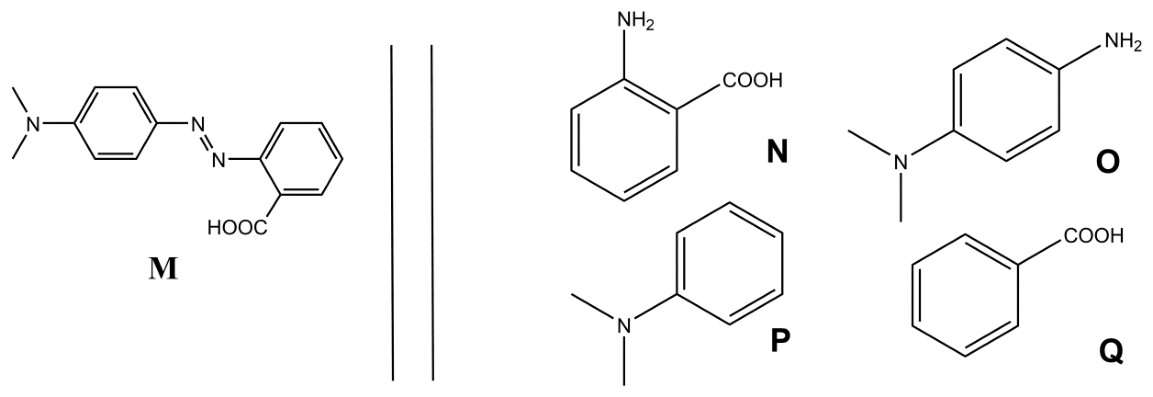
Fig. 1. Possible reactants for the synthesis of M.
5.2 M can be synthesized in two steps from simple reactants (Fig 1). Choose among the suggested reactants (N to Q) the ones that can provide M with very high regioselectivity. Sodium nitrite (\(\ce{NaNO2}\)) in cold aqueous hydrochloric acid is used as reagent for the first step of the synthesis.
Determination of the association constant \(K_t\)
β-cyclodextrin (C, Fig. 2) is a cyclic heptamer of glucose, which can form inclusion complexes with azo compounds. In tasks 3 to 6, we will determine by spectroscopy the association constant \(K_t\), corresponding to the formation of the inclusion complex \(\mathbf{CM}_{\mathrm{trans}}\) as depicted in Fig. 2.
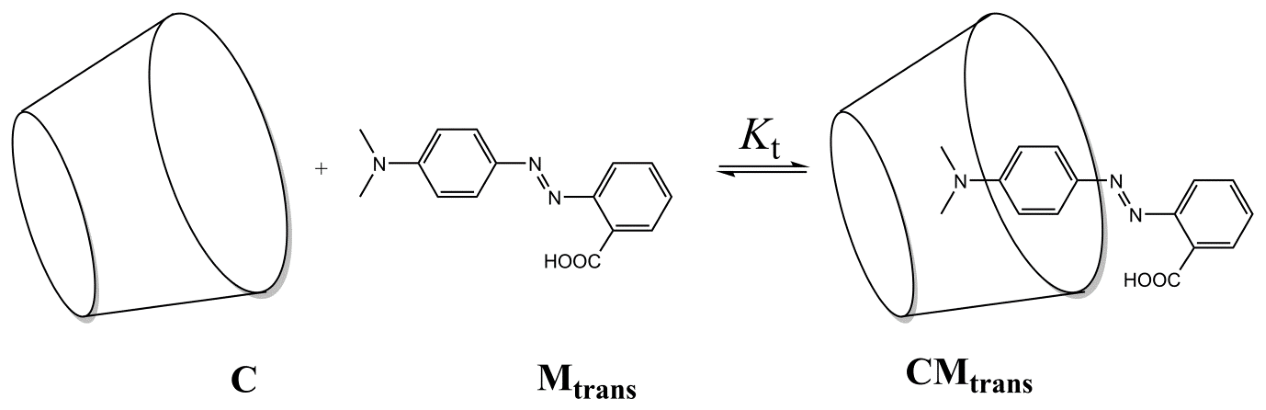
Fig. 2 – Formation of the \(\mathbf{CM}_{\mathrm{trans}}\) inclusion complex.
Several solutions are prepared by mixing C and \(\mathbf{M}_{\mathrm{trans}}\) in different proportions to reach initial concentrations \([\mathbf C]_0\) and \([\mathbf M_{\mathrm{trans}}]_0\). While \([\mathbf M_{\mathrm{trans}}]_0\) is identical for all solutions, \([\mathbf C]_0\) varies. We follow, at a fixed wavelength, the evolution of the difference in absorbance \(\Delta A\) between the absorbance of each solution and the pure \(\mathbf M_{\mathrm{trans}}\) solution. We note the molar absorption coefficients of \(\mathbf{CM}_{\mathrm{trans}}\) and \(\mathbf M_{\mathrm{trans}}\), \(\varepsilon_{\mathrm{CM}_{\mathrm{trans}}}\) and \(\varepsilon_{\mathrm M_{\mathrm{trans}}}\), respectively. \(L\) is the path length of the beam through the sample. The absorbance of C (\(\varepsilon_{\mathrm C}\)) is negligible.
5.3 Demonstrate that \(\Delta A=\alpha[\mathbf{CM}_{\mathrm{trans}}]\) and express \(\alpha\) in terms of known constant(s).
5.4 Demonstrate that in case when C is in large excess with respect to \(\mathbf M_{\mathrm{trans}}\) (i.e. \([\mathbf C]_0\gg[\mathbf M_{\mathrm{trans}}]_0\)), the concentration of C may be considered as constant, \([\mathbf C]\simeq[\mathbf C]_0\).
5.5 Demonstrate that in case when C is in a large excess with respect to \(\mathbf M_{\mathrm{trans}}\), (i.e. \([\mathbf C]_0\gg[\mathbf M_{\mathrm{trans}}]_0\)),
\[ \Delta A=\alpha\frac{\beta[\mathbf C]_0}{1+K_t[\mathbf C]_0} \]
and express \(\beta\) in terms of constant(s) and initial concentration(s).
5.6 Determine \(K_t\) using the following experimental curve (Fig. 3).
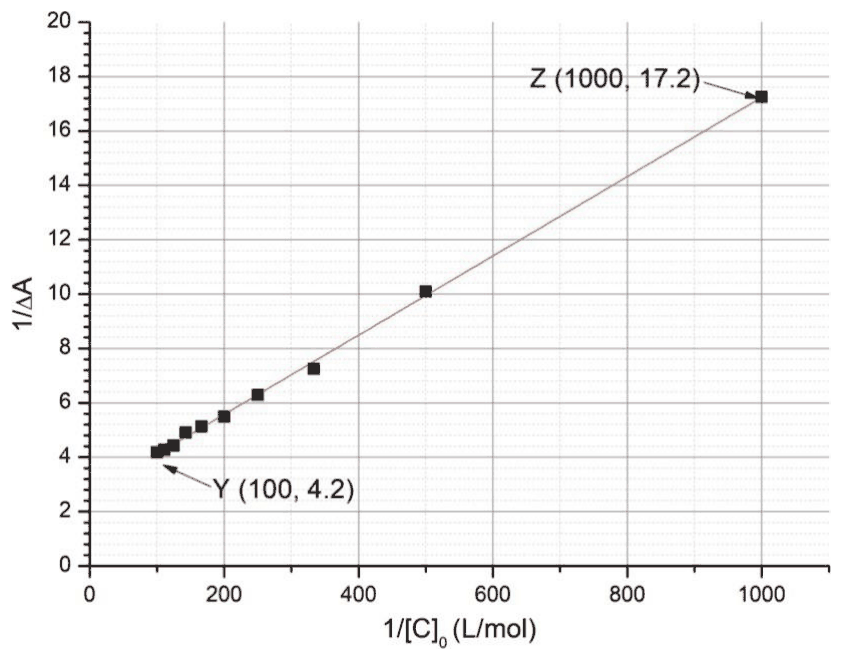
Fig. 3 – Evolution of \(1/\Delta A\) as a function of \(1/[\mathbf C]_0\).
Determination of the association constant \(K_c\)
In tasks 7 to 9, we will determine by kinetic studies the association constant \(K_c\), corresponding to the formation of the inclusion complex with \(\mathbf M_{\mathrm{cis}}\), \(\mathbf{CM}_{\mathrm{cis}}\). A sample containing only \(\mathbf M_{\mathrm{trans}}\) is irradiated, thus producing a known amount of \(\mathbf M_{\mathrm{cis}}\), \([\mathbf M_{\mathrm{cis}}]_0\). \(\mathbf M_{\mathrm{cis}}\) (free or within the inclusion complex) then thermally isomerizes into \(\mathbf M_{\mathrm{trans}}\). In the absence of C, the isomerization follows a first order kinetics with a rate constant \(k_1\). All complexation equilibria are faster than the isomerization processes. The kinetic scheme corresponding to this experiment is provided in Fig. 4.
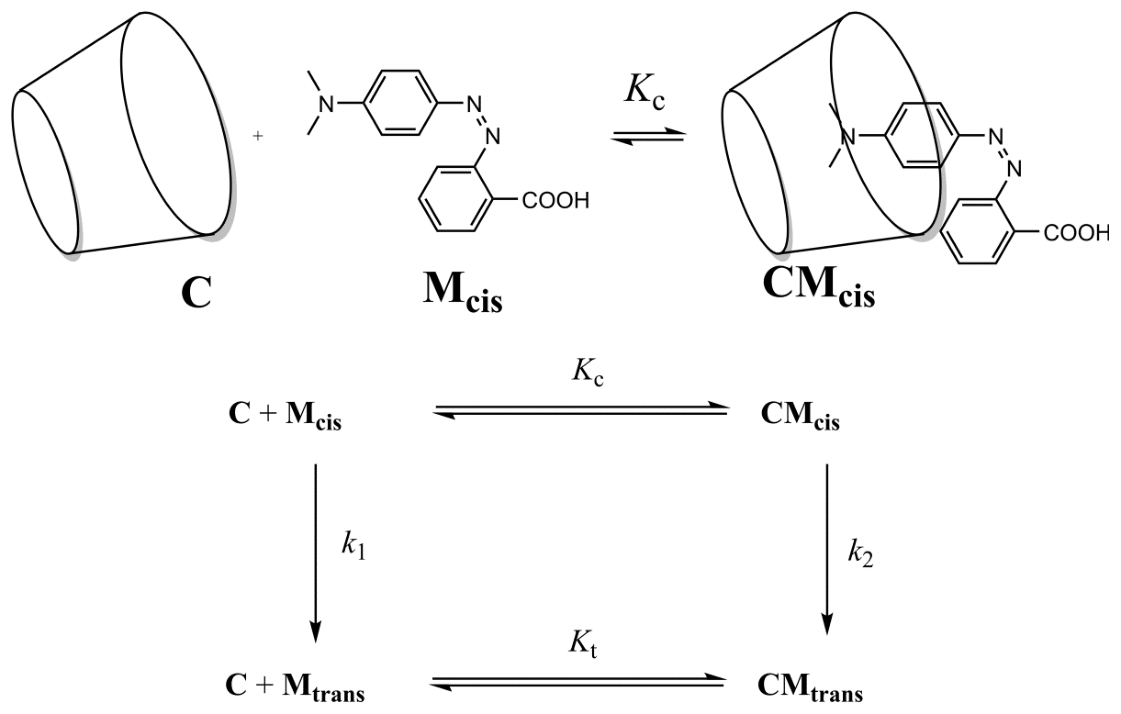
Fig. 4 – Kinetic scheme for the isomerization of \(\mathbf M_{\mathrm{cis}}\) in the presence of C.
The rate of disappearance \(r\) for the total amount of \(\mathbf M_{\mathrm{cis}}\) (free and complexed) is defined as
\[ r=k_1[\mathbf M_{\mathrm{cis}}]+k_2[\mathbf{CM}_{\mathrm{cis}}]. \]
Experimentally, \(r\) follows an apparent first order kinetic law with an apparent rate constant \(k_{\mathrm{obs}}\):
\[ r=k_{\mathrm{obs}}\bigl([\mathbf M_{\mathrm{cis}}]+[\mathbf{CM}_{\mathrm{cis}}]\bigr). \]
5.7 Demonstrate that
\[ k_{\mathrm{obs}}= \frac{\gamma+\delta k_2[\mathbf C]}{1+K_c[\mathbf C]} \]
and express \(\gamma\) and \(\delta\) in terms of known constant(s).
5.8 Choose in which condition(s) the half-life \(t_{1/2}\) corresponding to \(k_{\mathrm{obs}}\) can be expressed as \(t_{1/2}=\ln(2/\gamma)(1+K_c[\mathbf C]_0)\) given that \([\mathbf C]_0\gg[\mathbf M_{\mathrm{cis}}]_0\). Mathematically justify your answer.
5.9 Assuming the condition(s) in task 8 satisfied, determine \(K_c\) by a linear regression using the data below. You may use a calculator or plot a graph.
| \([\mathbf C]_0\) (\(\mathrm{mol\,dm^{-3}}\)) | \(t_{1/2}\) (s) | \([\mathbf C]_0\) (\(\mathrm{mol\,dm^{-3}}\)) | \(t_{1/2}\) (s) |
|---|---|---|---|
| 0 | 3.0 | \(3.0\cdot10^{-3}\) | 5.9 |
| \(1.0\cdot10^{-4}\) | 3.2 | \(5.0\cdot10^{-3}\) | 7.7 |
| \(5.0\cdot10^{-4}\) | 3.6 | \(7.5\cdot10^{-3}\) | 9.9 |
| \(1.0\cdot10^{-3}\) | 4.1 | \(1.0\cdot10^{-2}\) | 12.6 |
Formation of nanomachines
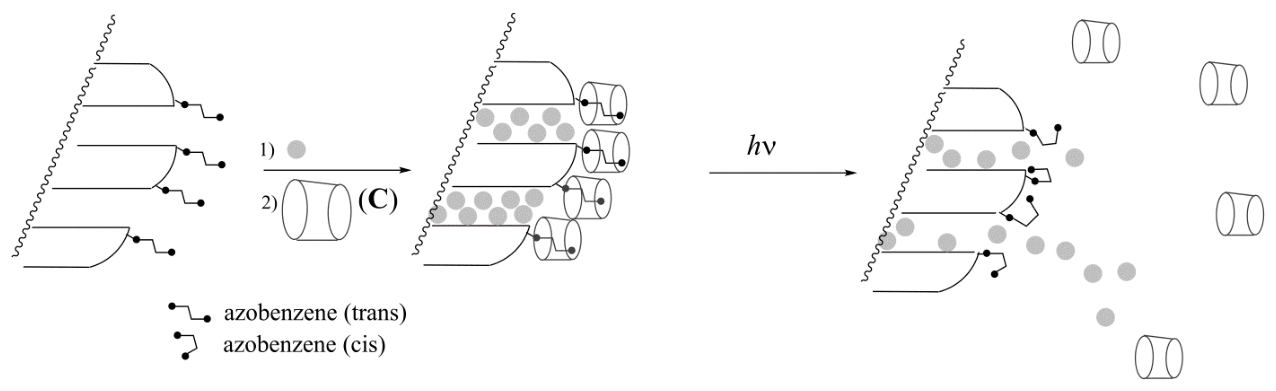
Fig. 5 – Cleavage of an azobenzene–cyclodextrin inclusion complex induced by a light-triggered isomerization, which allows delivery of a dye (grey circles).
Another azobenzene compound (for which \(K_c\ll K_t\)), initially in the trans form, is covalently grafted on silica (Fig. 5). The silica pores are filled with a dye (rhodamine B, grey circles in Fig. 5). Upon addition of C, an inclusion complex is formed, which blocks the pores and prevents the release of the dye.
5.10 Choose the most appropriate condition (one choice only) so that the pores are initially blocked in the presence of C, and the dye can be released upon irradiation.
This azobenzene-silica powder loaded with a dye is placed in the corner of a cuvette (Fig. 6) so that the powder cannot move into solution. The powder is irradiated at a wavelength \(\lambda_1\) to trigger the release of the dye from the pores (Fig. 5). To monitor this release by absorbance spectroscopy we measure the absorbance of the solution at wavelength \(\lambda_2\).
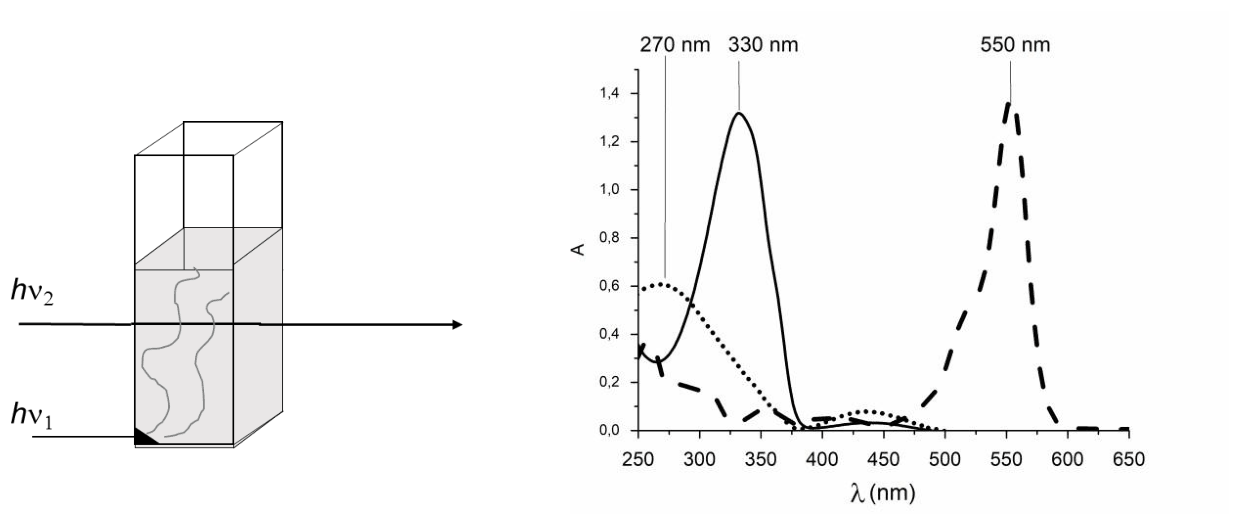
Fig. 6 – Left: experimental setup used to monitor the release of the dye; right: absorption spectra of trans-azobenzene (full line), cis-azobenzene (dotted line) and rhodamine B (dashed line).
5.11 Determine \(\lambda_1\).
5.12 Determine \(\lambda_2\).
Official English text of the problem.
Answers
- 5.1: trans-\((E)\)-azobenzene,
c1ccc(/N=N/c2ccccc2)cc1, and cis-\((Z)\)-azobenzene,c1ccc(/N=N\c2ccccc2)cc1. Their maximum carbon-to-carbon distances satisfy \(\boxed{d_{\mathrm{trans}}>d_{\mathrm{cis}}}\). - 5.2: Choose N, anthranilic acid,
Nc1ccccc1C(=O)O, and P, \(N,N\)-dimethylaniline,CN(C)c1ccccc1. Diazotize N, then couple with P at its para position. - 5.3: \(\boxed{\alpha=L(\varepsilon_{\mathrm{CM}_{\mathrm{trans}}}-\varepsilon_{\mathrm M_{\mathrm{trans}}})}\).
- 5.4: \(0\le[\mathbf C]_0-[\mathbf C]\le[\mathbf M_{\mathrm{trans}}]_0\ll[\mathbf C]_0\), hence \(\boxed{[\mathbf C]\simeq[\mathbf C]_0}\).
- 5.5: \(\boxed{\beta=K_t[\mathbf M_{\mathrm{trans}}]_0}\).
- 5.6: \(\boxed{K_t\approx1.9\times10^2\ \mathrm{L\,mol^{-1}}}\).
- 5.7: \(\boxed{\gamma=k_1,\qquad\delta=K_c}\).
- 5.8: With constant free host concentration, require \(\boxed{k_2K_c[\mathbf C]_0\ll k_1}\), including the limiting case \(k_2=0\). The corrected expression is \(\boxed{t_{1/2}\simeq\frac{\ln2}{\gamma}(1+K_c[\mathbf C]_0)}\).
- 5.9: The regression gives \(t_{1/2}=(3.0804\ \mathrm s)+(935.675\ \mathrm{s\,L\,mol^{-1}})[\mathbf C]_0\), hence \(\boxed{K_c\approx3.0\times10^2\ \mathrm{L\,mol^{-1}}}\).
- 5.10: \(\boxed{K_c[\mathbf C]\ll1\ll K_t[\mathbf C]}\), equivalently \(\boxed{1/K_t\ll[\mathbf C]\ll1/K_c}\). Under host excess, use \([\mathbf C]\simeq[\mathbf C]_0\).
- 5.11: \(\boxed{\lambda_1=330\ \mathrm{nm}}\).
- 5.12: \(\boxed{\lambda_2=550\ \mathrm{nm}}\).
Solution
5.1 — Azobenzene stereoisomers and distances
Azobenzene has two geometrical isomers about its \(\ce{N=N}\) double bond:
| Isomer | Name | Isomeric SMILES |
|---|---|---|
| trans | \((E)\)-Azobenzene, or \((E)\)-diphenyldiazene | c1ccc(/N=N/c2ccccc2)cc1 |
| cis | \((Z)\)-Azobenzene, or \((Z)\)-diphenyldiazene | c1ccc(/N=N\c2ccccc2)cc1 |
For the requested drawings, place the \(\ce{N=N}\) bond horizontally:
- In the trans drawing, put one phenyl ring above-left and the other below-right. Join the two distal para carbon atoms, one on each ring, and label the segment \(d_{\mathrm{trans}}\).
- In the cis drawing, put both phenyl rings on the same side, above-left and above-right. For the usual planar schematic with approximately \(120^\circ\) bond angles at nitrogen, join the leftmost carbon of the left ring to the rightmost carbon of the right ring—the outward-facing meta positions—and label the segment \(d_{\mathrm{cis}}\).
The trans form is extended, whereas the cis form is folded:
\[ \boxed{d_{\mathrm{trans}}>d_{\mathrm{cis}}}. \]
These are schematic drawings. Actual cis-azobenzene is nonplanar; the SMILES specifies the double-bond stereochemistry but does not specify phenyl-ring torsions or numerical interatomic distances.
5.2 — Synthesis of M
The proposed reactants are:
| Label | Name | SMILES |
|---|---|---|
| N | Anthranilic acid, or 2-aminobenzoic acid | Nc1ccccc1C(=O)O |
| O | 4-Amino-\(N,N\)-dimethylaniline | CN(C)c1ccc(N)cc1 |
| P | \(N,N\)-Dimethylaniline | CN(C)c1ccccc1 |
| Q | Benzoic acid | O=C(O)c1ccccc1 |
Choose N and P.
First, diazotize the primary aromatic amino group of N using cold sodium nitrite, [Na+].[O-]N=O, in aqueous hydrochloric acid. This gives the 2-carboxybenzenediazonium ion, O=C(O)c1ccccc1[N+]#N.
The balanced net ionic equation is
\[ \ce{H2N-C6H4-COOH + NO2- + 2H+ -> HOOC-C6H4-N2+ + 2H2O}. \]
The amino/diazonium group and carboxyl group occupy adjacent positions throughout. Here nitrite is [O-]N=O, the hydrogen ion is [H+], and water is O; sodium ion, [Na+], and chloride ion, [Cl-], are spectators.
Next, carry out azo coupling with P:
\[ \ce{HOOC-C6H4-N2+ + C6H5-N(CH3)2 -> HOOC-C6H4-N=N-C6H4-N(CH3)2 + H+}. \]
The resulting product is M, methyl red, shown as \((E)\)-2-[(4-(dimethylamino)phenyl)diazenyl]benzoic acid:
CN(C)c1ccc(/N=N/c2ccccc2C(=O)O)cc1
The regioselectivity follows from two features:
- N already fixes the carboxyl group ortho to the future azo linkage.
- P’s dimethylamino group strongly activates its aromatic ring toward electrophilic azo coupling. Its less hindered para position is preferred over its ortho positions.
Mechanistically, the activated aromatic ring of P attacks the terminal nitrogen of the diazonium group; loss of the proton from the attacked carbon restores aromaticity.
The alternative O/Q pairing is unsuitable: Q’s carboxyl group deactivates its ring and directs electrophilic substitution meta, whereas M would require coupling ortho to that group.
5.3 — Absorbance change
Let
\[ m_0=[\mathbf M_{\mathrm{trans}}]_0, \qquad x=[\mathbf{CM}_{\mathrm{trans}}]. \]
Because complexation is 1:1,
\[ [\mathbf M_{\mathrm{trans}}]=m_0-x. \]
By the Beer–Lambert law, neglecting the host’s absorption,
\[ A=L\left[ \varepsilon_{\mathrm M_{\mathrm{trans}}}(m_0-x) +\varepsilon_{\mathrm{CM}_{\mathrm{trans}}}x \right]. \]
For the reference solution containing the same total concentration of uncomplexed guest,
\[ A_0=L\varepsilon_{\mathrm M_{\mathrm{trans}}}m_0. \]
Consequently,
\[ \Delta A=A-A_0 =L\left( \varepsilon_{\mathrm{CM}_{\mathrm{trans}}} -\varepsilon_{\mathrm M_{\mathrm{trans}}} \right)x. \]
Thus
\[ \boxed{ \Delta A=\alpha[\mathbf{CM}_{\mathrm{trans}}], \qquad \alpha=L\left( \varepsilon_{\mathrm{CM}_{\mathrm{trans}}} -\varepsilon_{\mathrm M_{\mathrm{trans}}} \right) }. \]
With concentrations in \(\mathrm{mol\,L^{-1}}\), \(\alpha\) has units \(\mathrm{L\,mol^{-1}}\).
5.4 — Host concentration in large excess
The host balance is
\[ [\mathbf C]_0=[\mathbf C]+[\mathbf{CM}_{\mathrm{trans}}]. \]
At most all the guest can be complexed, so
\[ 0\le[\mathbf{CM}_{\mathrm{trans}}] \le[\mathbf M_{\mathrm{trans}}]_0. \]
Therefore,
\[ 0\le \frac{[\mathbf C]_0-[\mathbf C]}{[\mathbf C]_0} \le \frac{[\mathbf M_{\mathrm{trans}}]_0}{[\mathbf C]_0} \ll1. \]
The fractional depletion of free host is negligible:
\[ \boxed{[\mathbf C]\simeq[\mathbf C]_0}. \]
5.5 — Dependence of absorbance on host concentration
The association constant is
\[ K_t= \frac{[\mathbf{CM}_{\mathrm{trans}}]} {[\mathbf C][\mathbf M_{\mathrm{trans}}]}. \]
Writing \(c_0=[\mathbf C]_0\), and using the approximation established above,
\[ K_t=\frac{x}{c_0(m_0-x)}. \]
Rearranging,
\[ x=K_tc_0(m_0-x), \]
\[ x(1+K_tc_0)=K_tc_0m_0, \]
\[ x=\frac{K_tm_0c_0}{1+K_tc_0}. \]
Substitution into \(\Delta A=\alpha x\) gives
\[ \boxed{ \Delta A= \alpha\frac{K_t[\mathbf M_{\mathrm{trans}}]_0[\mathbf C]_0} {1+K_t[\mathbf C]_0} }. \]
Comparison with the requested expression yields
\[ \boxed{\beta=K_t[\mathbf M_{\mathrm{trans}}]_0}. \]
Since \(K_t\) has units of inverse concentration, \(\beta\) is dimensionless.
5.6 — Determination of \(K_t\)
Taking the reciprocal of the expression in 5.5,
\[ \frac1{\Delta A} = \frac1{\alpha\beta}\frac1{[\mathbf C]_0} +\frac{K_t}{\alpha\beta}. \]
Thus, for a plot of \(y=1/\Delta A\) against \(X=1/[\mathbf C]_0\),
\[ \text{slope }s=\frac1{\alpha\beta}, \qquad \text{intercept }b=\frac{K_t}{\alpha\beta}, \]
and therefore
\[ \boxed{K_t=\frac bs}. \]
Using the labelled points \(Y=(100,4.2)\) and \(Z=(1000,17.2)\),
\[ s= \frac{17.2-4.2} {(1000-100)\ \mathrm{L\,mol^{-1}}} = 0.014444\ \mathrm{mol\,L^{-1}}. \]
The intercept is
\[ b=4.2- (0.014444\ \mathrm{mol\,L^{-1}}) (100\ \mathrm{L\,mol^{-1}}) =2.7556. \]
Hence
\[ K_t= \frac{2.7556}{0.014444\ \mathrm{mol\,L^{-1}}} =190.77\ \mathrm{L\,mol^{-1}}, \]
or, to sensible precision,
\[ \boxed{K_t\approx1.9\times10^2\ \mathrm{L\,mol^{-1}}}. \]
5.7 — Apparent isomerization rate constant
The cis guest is \((Z)\)-methyl red, or \((Z)\)-2-[(4-(dimethylamino)phenyl)diazenyl]benzoic acid:
CN(C)c1ccc(/N=N\c2ccccc2C(=O)O)cc1
Its inclusion complex contains this guest noncovalently inside β-cyclodextrin. The guest’s SMILES does not encode its placement within the host cavity.
Fast complexation equilibrium gives
\[ K_c= \frac{[\mathbf{CM}_{\mathrm{cis}}]} {[\mathbf C][\mathbf M_{\mathrm{cis}}]}, \]
so
\[ [\mathbf{CM}_{\mathrm{cis}}] =K_c[\mathbf C][\mathbf M_{\mathrm{cis}}]. \]
The disappearance rate is therefore
\[ r= \left(k_1+k_2K_c[\mathbf C]\right) [\mathbf M_{\mathrm{cis}}]. \]
The total concentration of cis guest is
\[ [\mathbf M_{\mathrm{cis}}]+[\mathbf{CM}_{\mathrm{cis}}] = \left(1+K_c[\mathbf C]\right)[\mathbf M_{\mathrm{cis}}]. \]
Dividing rate by total cis concentration,
\[ \boxed{ k_{\mathrm{obs}} = \frac{k_1+k_2K_c[\mathbf C]} {1+K_c[\mathbf C]} }. \]
Comparison with the stated expression gives
\[ \boxed{\gamma=k_1,\qquad\delta=K_c}. \]
The dimensions are consistent: \(\gamma\) is in \(\mathrm{s^{-1}}\), while \(\delta\) is in \(\mathrm{L\,mol^{-1}}\).
5.8 — Conditions for the half-life expression
First, the printed factor \(\ln(2/\gamma)\) must be corrected to \((\ln2)/\gamma\). A logarithm cannot have a dimensional argument, and \(\gamma=k_1\) has units \(\mathrm{s^{-1}}\).
Let the total cis concentration be
\[ u=[\mathbf M_{\mathrm{cis}}]+[\mathbf{CM}_{\mathrm{cis}}]. \]
When free host concentration remains constant,
\[ -\frac{du}{dt}=k_{\mathrm{obs}}u, \]
and integration gives
\[ u(t)=u(0)e^{-k_{\mathrm{obs}}t}. \]
Thus
\[ t_{1/2}=\frac{\ln2}{k_{\mathrm{obs}}}. \]
With \([\mathbf C]\simeq[\mathbf C]_0\), the expression from 5.7 becomes
\[ t_{1/2} = \frac{\ln2\left(1+K_c[\mathbf C]_0\right)} {k_1+k_2K_c[\mathbf C]_0}. \]
To obtain the requested linear dependence on host concentration, the second term in the denominator must be negligible:
\[ \boxed{k_2K_c[\mathbf C]_0\ll k_1}. \]
Equivalently, isomerization through the complexed population must contribute negligibly to the total rate:
\[ k_2[\mathbf{CM}_{\mathrm{cis}}] \ll k_1[\mathbf M_{\mathrm{cis}}]. \]
Then
\[ \boxed{ t_{1/2}\simeq \frac{\ln2}{k_1}\left(1+K_c[\mathbf C]_0\right) = \frac{\ln2}{\gamma}\left(1+K_c[\mathbf C]_0\right) }. \]
The expression is exact within the constant-host model when \(k_2=0\). Merely requiring \(k_2\ll k_1\) is insufficient if \(K_c[\mathbf C]_0\) is very large.
The host-excess approximation must also cover binding by the trans product. If appreciable unconverted trans guest remains after irradiation, host excess must apply to the total binding guest, including that residual trans population.
5.9 — Linear regression and \(K_c\)
Under the conditions above,
\[ t_{1/2} = \frac{\ln2}{k_1} + \frac{\ln2}{k_1}K_c[\mathbf C]_0. \]
Writing
\[ t_{1/2}=a+b[\mathbf C]_0, \]
we identify
\[ a=\frac{\ln2}{k_1}, \qquad b=aK_c, \]
so
\[ \boxed{K_c=\frac ba}. \]
For the eight tabulated points, let \(x_i=[\mathbf C]_{0,i}\) and \(y_i=t_{1/2,i}\). Ordinary least squares gives
\[ b= \frac{n\sum x_iy_i-(\sum x_i)(\sum y_i)} {n\sum x_i^2-(\sum x_i)^2}, \qquad a=\frac{\sum y_i-b\sum x_i}{n}. \]
Using the supplied data,
\[ a=3.0804004\ \mathrm s, \qquad b=935.67515\ \mathrm{s\,L\,mol^{-1}}. \]
Thus the required plot is an increasing straight line of \(t_{1/2}\) against \([\mathbf C]_0\), with this intercept and slope. Its \(R^2\) is approximately \(0.9990\).
The association constant is
\[ K_c= \frac{935.67515\ \mathrm{s\,L\,mol^{-1}}} {3.0804004\ \mathrm s} = 303.75\ \mathrm{L\,mol^{-1}}. \]
Therefore,
\[ \boxed{K_c\approx3.0\times10^2\ \mathrm{L\,mol^{-1}}}. \]
Using the graph’s rounded coefficients, \(a=3.1\ \mathrm s\) and \(b=936\ \mathrm{s\,L\,mol^{-1}}\), gives \(302\ \mathrm{L\,mol^{-1}}\), consistent with this result.
5.10 — Conditions for light-triggered pore opening
For a guest with association constant \(K\), the fraction complexed at free host concentration \([\mathbf C]\) is
\[ f_{\mathrm{bound}}=\frac{K[\mathbf C]}{1+K[\mathbf C]}. \]
To block the pores initially, the trans guest should be predominantly complexed:
\[ f_{\mathrm{trans}}\simeq1 \quad\Longrightarrow\quad K_t[\mathbf C]\gg1. \]
After irradiation, the cis guest should be predominantly uncomplexed:
\[ f_{\mathrm{cis}}\simeq0 \quad\Longrightarrow\quad K_c[\mathbf C]\ll1. \]
The appropriate condition is therefore
\[ \boxed{K_c[\mathbf C]\ll1\ll K_t[\mathbf C]}, \]
or equivalently,
\[ \boxed{\frac1{K_t}\ll[\mathbf C]\ll\frac1{K_c}}. \]
If host depletion is negligible, this can be expressed using \([\mathbf C]_0\).
This part explicitly concerns another azobenzene compound, with \(K_c\ll K_t\). The numerical constants determined for M in 5.6 and 5.9 do not apply to this grafted compound.
5.11 — Irradiation wavelength
The solid absorption curve for trans-azobenzene has its strong maximum at \(330\ \mathrm{nm}\). At that wavelength, cis-azobenzene absorbs less strongly.
Therefore, preferential excitation of the initially trans guest is achieved with
\[ \boxed{\lambda_1=330\ \mathrm{nm}}. \]
The resulting trans-to-cis isomerization weakens host binding, removes the cyclodextrin caps, and allows dye release.
5.12 — Monitoring wavelength
Rhodamine B has its strong absorption maximum at \(550\ \mathrm{nm}\), where both azobenzene isomers have negligible absorption.
Thus
\[ \boxed{\lambda_2=550\ \mathrm{nm}}. \]
At this wavelength, the solution absorbance tracks the concentration of released dye through the Beer–Lambert law:
\[ A_{550} = \varepsilon_{\mathrm{RhB},550}\,L\, [\mathrm{RhB}]_{\mathrm{solution}}. \]
The solution was checked against the official solution.
IChO 2019 · Theorieaufgabe 5
Azobenzol–β-Cyclodextrin-Komplexe zur Bildung von Nanomaschinen
Nanomaschinen sind molekulare Anordnungen, die die Umwandlung der Energie einer Energiequelle in eine Bewegung auf der Nanoskala für Anwendungen wie die Wirkstofffreisetzung ermöglichen. Zahlreiche Nanomaschinen nutzen die Isomerisierung von Azoverbindungen (\(\ce{R-N=N-R'}\)) bei Bestrahlung.
5.1 Zeichnen Sie die Stereoisomere von Azobenzol (\(\ce{H5C6-N=N-C6H5}\)) und zeichnen Sie eine Verbindungslinie zwischen den beiden Kohlenstoffatomen mit dem größten Abstand. Vergleichen Sie diese beiden Abstände (\(d_{\mathrm{trans}}\) und \(d_{\mathrm{cis}}\)).
Abb. 1. Mögliche Edukte für die Synthese von M.
5.2 M kann in zwei Schritten aus einfachen Edukten synthetisiert werden (Abb. 1). Wählen Sie unter den vorgeschlagenen Edukten (N bis Q) diejenigen aus, mit denen M mit sehr hoher Regioselektivität erhalten werden kann. Natriumnitrit (\(\ce{NaNO2}\)) in kalter wässriger Salzsäure wird als Reagenz für den ersten Syntheseschritt verwendet.
Bestimmung der Assoziationskonstante \(K_t\)
β-Cyclodextrin (C, Abb. 2) ist ein cyclisches Heptamer der Glucose, das mit Azoverbindungen Einschlusskomplexe bilden kann. In den Aufgaben 3 bis 6 bestimmen wir spektroskopisch die Assoziationskonstante \(K_t\), die der Bildung des Einschlusskomplexes \(\mathbf{CM}_{\mathrm{trans}}\) entspricht, wie in Abb. 2 dargestellt.
Abb. 2 – Bildung des Einschlusskomplexes \(\mathbf{CM}_{\mathrm{trans}}\).
Mehrere Lösungen werden durch Mischen von C und \(\mathbf{M}_{\mathrm{trans}}\) in unterschiedlichen Verhältnissen hergestellt, um die Anfangskonzentrationen \([\mathbf C]_0\) und \([\mathbf M_{\mathrm{trans}}]_0\) zu erreichen. Während \([\mathbf M_{\mathrm{trans}}]_0\) für alle Lösungen gleich ist, variiert \([\mathbf C]_0\). Bei einer festen Wellenlänge verfolgen wir die Änderung der Extinktionsdifferenz \(\Delta A\) zwischen der Extinktion der jeweiligen Lösung und derjenigen der reinen \(\mathbf M_{\mathrm{trans}}\)-Lösung. Die molaren Extinktionskoeffizienten von \(\mathbf{CM}_{\mathrm{trans}}\) und \(\mathbf M_{\mathrm{trans}}\) bezeichnen wir mit \(\varepsilon_{\mathrm{CM}_{\mathrm{trans}}}\) beziehungsweise \(\varepsilon_{\mathrm M_{\mathrm{trans}}}\). \(L\) ist die Weglänge des Lichtstrahls durch die Probe. Die Extinktion von C (\(\varepsilon_{\mathrm C}\)) ist vernachlässigbar.
5.3 Zeigen Sie, dass \(\Delta A=\alpha[\mathbf{CM}_{\mathrm{trans}}]\) gilt, und drücken Sie \(\alpha\) durch bekannte Konstanten aus.
5.4 Zeigen Sie, dass die Konzentration von C als konstant betrachtet werden kann, \([\mathbf C]\simeq[\mathbf C]_0\), wenn C in großem Überschuss gegenüber \(\mathbf M_{\mathrm{trans}}\) vorliegt (d. h. \([\mathbf C]_0\gg[\mathbf M_{\mathrm{trans}}]_0\)).
5.5 Zeigen Sie, dass im Fall eines großen Überschusses von C gegenüber \(\mathbf M_{\mathrm{trans}}\) (d. h. \([\mathbf C]_0\gg[\mathbf M_{\mathrm{trans}}]_0\)) gilt:
\[ \Delta A=\alpha\frac{\beta[\mathbf C]_0}{1+K_t[\mathbf C]_0} \]
Drücken Sie \(\beta\) durch Konstanten und Anfangskonzentrationen aus.
5.6 Bestimmen Sie \(K_t\) anhand der folgenden experimentellen Kurve (Abb. 3).
Abb. 3 – Verlauf von \(1/\Delta A\) als Funktion von \(1/[\mathbf C]_0\).
Bestimmung der Assoziationskonstante \(K_c\)
In den Aufgaben 7 bis 9 bestimmen wir durch kinetische Untersuchungen die Assoziationskonstante \(K_c\), die der Bildung des Einschlusskomplexes mit \(\mathbf M_{\mathrm{cis}}\), \(\mathbf{CM}_{\mathrm{cis}}\), entspricht. Eine Probe, die ausschließlich \(\mathbf M_{\mathrm{trans}}\) enthält, wird bestrahlt, wodurch eine bekannte Menge an \(\mathbf M_{\mathrm{cis}}\), \([\mathbf M_{\mathrm{cis}}]_0\), erzeugt wird. Anschließend isomerisiert \(\mathbf M_{\mathrm{cis}}\) (frei oder im Einschlusskomplex) thermisch zu \(\mathbf M_{\mathrm{trans}}\). In Abwesenheit von C folgt die Isomerisierung einer Kinetik erster Ordnung mit der Geschwindigkeitskonstante \(k_1\). Alle Komplexierungsgleichgewichte stellen sich schneller ein als die Isomerisierungsprozesse ablaufen. Das kinetische Schema dieses Experiments ist in Abb. 4 dargestellt.
Abb. 4 – Kinetisches Schema der Isomerisierung von \(\mathbf M_{\mathrm{cis}}\) in Gegenwart von C.
Die Abnahmegeschwindigkeit \(r\) der Gesamtmenge an \(\mathbf M_{\mathrm{cis}}\) (frei und komplexiert) ist definiert als
\[ r=k_1[\mathbf M_{\mathrm{cis}}]+k_2[\mathbf{CM}_{\mathrm{cis}}]. \]
Experimentell folgt \(r\) einem scheinbaren Geschwindigkeitsgesetz erster Ordnung mit einer scheinbaren Geschwindigkeitskonstante \(k_{\mathrm{obs}}\):
\[ r=k_{\mathrm{obs}}\bigl([\mathbf M_{\mathrm{cis}}]+[\mathbf{CM}_{\mathrm{cis}}]\bigr). \]
5.7 Zeigen Sie, dass
\[ k_{\mathrm{obs}}= \frac{\gamma+\delta k_2[\mathbf C]}{1+K_c[\mathbf C]} \]
gilt, und drücken Sie \(\gamma\) und \(\delta\) durch bekannte Konstanten aus.
5.8 Wählen Sie die Bedingung(en), unter der bzw. denen die zu \(k_{\mathrm{obs}}\) gehörende Halbwertszeit \(t_{1/2}\) durch \(t_{1/2}=\ln(2/\gamma)(1+K_c[\mathbf C]_0)\) ausgedrückt werden kann, wenn \([\mathbf C]_0\gg[\mathbf M_{\mathrm{cis}}]_0\) gilt. Begründen Sie Ihre Antwort mathematisch.
5.9 Bestimmen Sie unter der Annahme, dass die Bedingung(en) aus Aufgabe 8 erfüllt ist bzw. sind, \(K_c\) durch eine lineare Regression anhand der folgenden Daten. Sie dürfen einen Taschenrechner verwenden oder ein Diagramm zeichnen.
| \([\mathbf C]_0\) (\(\mathrm{mol\,dm^{-3}}\)) | \(t_{1/2}\) (s) | \([\mathbf C]_0\) (\(\mathrm{mol\,dm^{-3}}\)) | \(t_{1/2}\) (s) |
|---|---|---|---|
| 0 | 3.0 | \(3.0\cdot10^{-3}\) | 5.9 |
| \(1.0\cdot10^{-4}\) | 3.2 | \(5.0\cdot10^{-3}\) | 7.7 |
| \(5.0\cdot10^{-4}\) | 3.6 | \(7.5\cdot10^{-3}\) | 9.9 |
| \(1.0\cdot10^{-3}\) | 4.1 | \(1.0\cdot10^{-2}\) | 12.6 |
Bildung von Nanomaschinen
Abb. 5 – Auflösung eines Azobenzol–Cyclodextrin-Einschlusskomplexes durch eine lichtinduzierte Isomerisierung, die die Freisetzung eines Farbstoffs (graue Kreise) ermöglicht.
Eine andere Azobenzolverbindung (für die \(K_c\ll K_t\) gilt), die anfangs in der trans-Form vorliegt, wird kovalent an Siliciumdioxid gebunden (Abb. 5). Die Poren des Siliciumdioxids sind mit einem Farbstoff gefüllt (Rhodamin B, graue Kreise in Abb. 5). Bei Zugabe von C bildet sich ein Einschlusskomplex, der die Poren verschließt und die Freisetzung des Farbstoffs verhindert.
5.10 Wählen Sie die am besten geeignete Bedingung (nur eine Auswahl), damit die Poren in Gegenwart von C zunächst verschlossen sind und der Farbstoff bei Bestrahlung freigesetzt werden kann.
Dieses mit einem Farbstoff beladene Azobenzol-Siliciumdioxid-Pulver wird so in einer Ecke einer Küvette platziert (Abb. 6), dass das Pulver nicht in die Lösung gelangen kann. Das Pulver wird bei einer Wellenlänge \(\lambda_1\) bestrahlt, um die Freisetzung des Farbstoffs aus den Poren auszulösen (Abb. 5). Um diese Freisetzung absorptionsspektroskopisch zu verfolgen, messen wir die Extinktion der Lösung bei der Wellenlänge \(\lambda_2\).
Abb. 6 – Links: Versuchsaufbau zur Verfolgung der Farbstofffreisetzung; rechts: Absorptionsspektren von trans-Azobenzol (durchgezogene Linie), cis-Azobenzol (gepunktete Linie) und Rhodamin B (gestrichelte Linie).
5.11 Bestimmen Sie \(\lambda_1\).
5.12 Bestimmen Sie \(\lambda_2\).
Aufgabentext aus dem offiziellen englischen Text übersetzt.
Antworten
- 5.1: trans-\((E)\)-Azobenzol,
c1ccc(/N=N/c2ccccc2)cc1, und cis-\((Z)\)-Azobenzol,c1ccc(/N=N\c2ccccc2)cc1. Für ihre maximalen Kohlenstoff-Kohlenstoff-Abstände gilt \(\boxed{d_{\mathrm{trans}}>d_{\mathrm{cis}}}\). - 5.2: Wählen Sie N, Anthranilsäure,
Nc1ccccc1C(=O)O, und P, \(N,N\)-Dimethylanilin,CN(C)c1ccccc1. Diazotieren Sie N und kuppeln Sie anschließend mit P an dessen para-Position. - 5.3: \(\boxed{\alpha=L(\varepsilon_{\mathrm{CM}_{\mathrm{trans}}}-\varepsilon_{\mathrm M_{\mathrm{trans}}})}\).
- 5.4: \(0\le[\mathbf C]_0-[\mathbf C]\le[\mathbf M_{\mathrm{trans}}]_0\ll[\mathbf C]_0\), daher \(\boxed{[\mathbf C]\simeq[\mathbf C]_0}\).
- 5.5: \(\boxed{\beta=K_t[\mathbf M_{\mathrm{trans}}]_0}\).
- 5.6: \(\boxed{K_t\approx1.9\times10^2\ \mathrm{L\,mol^{-1}}}\).
- 5.7: \(\boxed{\gamma=k_1,\qquad\delta=K_c}\).
- 5.8: Bei konstanter Konzentration des freien Wirts muss \(\boxed{k_2K_c[\mathbf C]_0\ll k_1}\) gelten, einschließlich des Grenzfalls \(k_2=0\). Der korrigierte Ausdruck lautet \(\boxed{t_{1/2}\simeq\frac{\ln2}{\gamma}(1+K_c[\mathbf C]_0)}\).
- 5.9: Die Regression ergibt \(t_{1/2}=(3.0804\ \mathrm s)+(935.675\ \mathrm{s\,L\,mol^{-1}})[\mathbf C]_0\), daher \(\boxed{K_c\approx3.0\times10^2\ \mathrm{L\,mol^{-1}}}\).
- 5.10: \(\boxed{K_c[\mathbf C]\ll1\ll K_t[\mathbf C]}\), äquivalent dazu \(\boxed{1/K_t\ll[\mathbf C]\ll1/K_c}\). Bei einem Überschuss des Wirts gilt \([\mathbf C]\simeq[\mathbf C]_0\).
- 5.11: \(\boxed{\lambda_1=330\ \mathrm{nm}}\).
- 5.12: \(\boxed{\lambda_2=550\ \mathrm{nm}}\).
Lösung
5.1 — Stereoisomere von Azobenzol und Abstände
Azobenzol besitzt zwei geometrische Isomere bezüglich seiner \(\ce{N=N}\)-Doppelbindung:
| Isomer | Name | Isomerischer SMILES |
|---|---|---|
| trans | \((E)\)-Azobenzol oder \((E)\)-Diphenyldiazen | c1ccc(/N=N/c2ccccc2)cc1 |
| cis | \((Z)\)-Azobenzol oder \((Z)\)-Diphenyldiazen | c1ccc(/N=N\c2ccccc2)cc1 |
Zeichnen Sie für die geforderten Darstellungen die \(\ce{N=N}\)-Bindung waagerecht:
- Platzieren Sie in der trans-Darstellung einen Phenylring links oben und den anderen rechts unten. Verbinden Sie die beiden entfernten para-Kohlenstoffatome, eines an jedem Ring, und beschriften Sie die Strecke mit \(d_{\mathrm{trans}}\).
- Platzieren Sie in der cis-Darstellung beide Phenylringe auf derselben Seite, links oben und rechts oben. Verbinden Sie in der üblichen ebenen schematischen Darstellung mit Bindungswinkeln von ungefähr \(120^\circ\) am Stickstoff das am weitesten links liegende Kohlenstoffatom des linken Rings mit dem am weitesten rechts liegenden Kohlenstoffatom des rechten Rings – den nach außen gerichteten meta-Positionen – und beschriften Sie die Strecke mit \(d_{\mathrm{cis}}\).
Die trans-Form ist gestreckt, während die cis-Form gefaltet ist:
\[ \boxed{d_{\mathrm{trans}}>d_{\mathrm{cis}}}. \]
Dies sind schematische Darstellungen. Tatsächlich ist cis-Azobenzol nicht planar; der SMILES legt die Stereochemie der Doppelbindung fest, jedoch weder die Torsionswinkel der Phenylringe noch numerische Abstände zwischen den Atomen.
5.2 — Synthese von M
Die vorgeschlagenen Edukte sind:
| Bezeichnung | Name | SMILES |
|---|---|---|
| N | Anthranilsäure oder 2-Aminobenzoesäure | Nc1ccccc1C(=O)O |
| O | 4-Amino-\(N,N\)-dimethylanilin | CN(C)c1ccc(N)cc1 |
| P | \(N,N\)-Dimethylanilin | CN(C)c1ccccc1 |
| Q | Benzoesäure | O=C(O)c1ccccc1 |
Wählen Sie N und P.
Diazotieren Sie zunächst die primäre aromatische Aminogruppe von N mit kaltem Natriumnitrit, [Na+].[O-]N=O, in wässriger Salzsäure. Dabei entsteht das 2-Carboxybenzoldiazonium-Ion, O=C(O)c1ccccc1[N+]#N.
Die ausgeglichene Netto-Ionengleichung lautet
\[ \ce{H2N-C6H4-COOH + NO2- + 2H+ -> HOOC-C6H4-N2+ + 2H2O}. \]
Die Amino-/Diazoniumgruppe und die Carboxygruppe nehmen dabei durchgehend benachbarte Positionen ein. Hier ist Nitrit [O-]N=O, das Wasserstoffion [H+] und Wasser O; das Natriumion, [Na+], und das Chloridion, [Cl-], sind Zuschauerionen.
Führen Sie anschließend die Azokupplung mit P durch:
\[ \ce{HOOC-C6H4-N2+ + C6H5-N(CH3)2 -> HOOC-C6H4-N=N-C6H4-N(CH3)2 + H+}. \]
Das entstandene Produkt ist M, Methylrot, dargestellt als \((E)\)-2-[(4-(Dimethylamino)phenyl)diazenyl]benzoesäure:
CN(C)c1ccc(/N=N/c2ccccc2C(=O)O)cc1
Die Regioselektivität ergibt sich aus zwei Merkmalen:
- In N ist die Carboxygruppe bereits ortho zur späteren Azobrücke angeordnet.
- Die Dimethylaminogruppe von P aktiviert dessen aromatischen Ring stark für die elektrophile Azokupplung. Seine weniger sterisch gehinderte para-Position wird gegenüber den ortho-Positionen bevorzugt.
Mechanistisch greift der aktivierte aromatische Ring von P das endständige Stickstoffatom der Diazoniumgruppe an; die Abspaltung des Protons am angegriffenen Kohlenstoffatom stellt die Aromatizität wieder her.
Die alternative Kombination O/Q ist ungeeignet: Die Carboxygruppe von Q deaktiviert dessen Ring und dirigiert die elektrophile Substitution in die meta-Position, während für M eine Kupplung ortho zu dieser Gruppe erforderlich wäre.
5.3 — Extinktionsänderung
Es sei
\[ m_0=[\mathbf M_{\mathrm{trans}}]_0, \qquad x=[\mathbf{CM}_{\mathrm{trans}}]. \]
Da die Komplexierung im Verhältnis 1:1 erfolgt, gilt
\[ [\mathbf M_{\mathrm{trans}}]=m_0-x. \]
Nach dem Lambert-Beerschen Gesetz gilt unter Vernachlässigung der Absorption des Wirts
\[ A=L\left[ \varepsilon_{\mathrm M_{\mathrm{trans}}}(m_0-x) +\varepsilon_{\mathrm{CM}_{\mathrm{trans}}}x \right]. \]
Für die Referenzlösung, die dieselbe Gesamtkonzentration an unkomplexiertem Gast enthält, gilt
\[ A_0=L\varepsilon_{\mathrm M_{\mathrm{trans}}}m_0. \]
Folglich ist
\[ \Delta A=A-A_0 =L\left( \varepsilon_{\mathrm{CM}_{\mathrm{trans}}} -\varepsilon_{\mathrm M_{\mathrm{trans}}} \right)x. \]
Damit gilt
\[ \boxed{ \Delta A=\alpha[\mathbf{CM}_{\mathrm{trans}}], \qquad \alpha=L\left( \varepsilon_{\mathrm{CM}_{\mathrm{trans}}} -\varepsilon_{\mathrm M_{\mathrm{trans}}} \right) }. \]
Bei Konzentrationen in \(\mathrm{mol\,L^{-1}}\) hat \(\alpha\) die Einheit \(\mathrm{L\,mol^{-1}}\).
5.4 — Wirtkonzentration bei großem Überschuss
Die Stoffbilanz für den Wirt lautet
\[ [\mathbf C]_0=[\mathbf C]+[\mathbf{CM}_{\mathrm{trans}}]. \]
Höchstens der gesamte Gast kann komplexiert sein, also gilt
\[ 0\le[\mathbf{CM}_{\mathrm{trans}}] \le[\mathbf M_{\mathrm{trans}}]_0. \]
Daher ist
\[ 0\le \frac{[\mathbf C]_0-[\mathbf C]}{[\mathbf C]_0} \le \frac{[\mathbf M_{\mathrm{trans}}]_0}{[\mathbf C]_0} \ll1. \]
Die relative Abnahme der Konzentration des freien Wirts ist vernachlässigbar:
\[ \boxed{[\mathbf C]\simeq[\mathbf C]_0}. \]
5.5 — Abhängigkeit der Extinktion von der Wirtkonzentration
Die Assoziationskonstante ist
\[ K_t= \frac{[\mathbf{CM}_{\mathrm{trans}}]} {[\mathbf C][\mathbf M_{\mathrm{trans}}]}. \]
Mit \(c_0=[\mathbf C]_0\) und der oben hergeleiteten Näherung gilt
\[ K_t=\frac{x}{c_0(m_0-x)}. \]
Umformen ergibt
\[ x=K_tc_0(m_0-x), \]
\[ x(1+K_tc_0)=K_tc_0m_0, \]
\[ x=\frac{K_tm_0c_0}{1+K_tc_0}. \]
Einsetzen in \(\Delta A=\alpha x\) ergibt
\[ \boxed{ \Delta A= \alpha\frac{K_t[\mathbf M_{\mathrm{trans}}]_0[\mathbf C]_0} {1+K_t[\mathbf C]_0} }. \]
Der Vergleich mit dem gesuchten Ausdruck liefert
\[ \boxed{\beta=K_t[\mathbf M_{\mathrm{trans}}]_0}. \]
Da \(K_t\) die Einheit einer inversen Konzentration hat, ist \(\beta\) dimensionslos.
5.6 — Bestimmung von \(K_t\)
Die Kehrwertbildung des Ausdrucks aus 5.5 ergibt
\[ \frac1{\Delta A} = \frac1{\alpha\beta}\frac1{[\mathbf C]_0} +\frac{K_t}{\alpha\beta}. \]
Für eine Auftragung von \(y=1/\Delta A\) gegen \(X=1/[\mathbf C]_0\) gilt somit
\[ \text{Steigung }s=\frac1{\alpha\beta}, \qquad \text{Achsenabschnitt }b=\frac{K_t}{\alpha\beta}, \]
und daher
\[ \boxed{K_t=\frac bs}. \]
Mit den markierten Punkten \(Y=(100,4.2)\) und \(Z=(1000,17.2)\) ergibt sich
\[ s= \frac{17.2-4.2} {(1000-100)\ \mathrm{L\,mol^{-1}}} = 0.014444\ \mathrm{mol\,L^{-1}}. \]
Der Achsenabschnitt ist
\[ b=4.2- (0.014444\ \mathrm{mol\,L^{-1}}) (100\ \mathrm{L\,mol^{-1}}) =2.7556. \]
Damit gilt
\[ K_t= \frac{2.7556}{0.014444\ \mathrm{mol\,L^{-1}}} =190.77\ \mathrm{L\,mol^{-1}}, \]
oder mit sinnvoller Genauigkeit
\[ \boxed{K_t\approx1.9\times10^2\ \mathrm{L\,mol^{-1}}}. \]
5.7 — Scheinbare Geschwindigkeitskonstante der Isomerisierung
Der cis-Gast ist \((Z)\)-Methylrot oder \((Z)\)-2-[(4-(Dimethylamino)phenyl)diazenyl]benzoesäure:
CN(C)c1ccc(/N=N\c2ccccc2C(=O)O)cc1
Sein Einschlusskomplex enthält diesen Gast nichtkovalent im Inneren von β-Cyclodextrin. Der SMILES des Gasts codiert nicht dessen Lage im Hohlraum des Wirts.
Das schnelle Komplexierungsgleichgewicht liefert
\[ K_c= \frac{[\mathbf{CM}_{\mathrm{cis}}]} {[\mathbf C][\mathbf M_{\mathrm{cis}}]}, \]
also gilt
\[ [\mathbf{CM}_{\mathrm{cis}}] =K_c[\mathbf C][\mathbf M_{\mathrm{cis}}]. \]
Die Abnahmegeschwindigkeit ist daher
\[ r= \left(k_1+k_2K_c[\mathbf C]\right) [\mathbf M_{\mathrm{cis}}]. \]
Die Gesamtkonzentration des cis-Gasts beträgt
\[ [\mathbf M_{\mathrm{cis}}]+[\mathbf{CM}_{\mathrm{cis}}] = \left(1+K_c[\mathbf C]\right)[\mathbf M_{\mathrm{cis}}]. \]
Division der Geschwindigkeit durch die gesamte cis-Konzentration ergibt
\[ \boxed{ k_{\mathrm{obs}} = \frac{k_1+k_2K_c[\mathbf C]} {1+K_c[\mathbf C]} }. \]
Der Vergleich mit dem angegebenen Ausdruck ergibt
\[ \boxed{\gamma=k_1,\qquad\delta=K_c}. \]
Die Dimensionen sind konsistent: \(\gamma\) hat die Einheit \(\mathrm{s^{-1}}\), während \(\delta\) die Einheit \(\mathrm{L\,mol^{-1}}\) hat.
5.8 — Bedingungen für den Ausdruck der Halbwertszeit
Zunächst muss der gedruckte Faktor \(\ln(2/\gamma)\) zu \((\ln2)/\gamma\) korrigiert werden. Das Argument eines Logarithmus darf nicht dimensionsbehaftet sein, und \(\gamma=k_1\) hat die Einheit \(\mathrm{s^{-1}}\).
Die gesamte cis-Konzentration sei
\[ u=[\mathbf M_{\mathrm{cis}}]+[\mathbf{CM}_{\mathrm{cis}}]. \]
Wenn die Konzentration des freien Wirts konstant bleibt, gilt
\[ -\frac{du}{dt}=k_{\mathrm{obs}}u, \]
und Integration ergibt
\[ u(t)=u(0)e^{-k_{\mathrm{obs}}t}. \]
Somit gilt
\[ t_{1/2}=\frac{\ln2}{k_{\mathrm{obs}}}. \]
Mit \([\mathbf C]\simeq[\mathbf C]_0\) wird der Ausdruck aus 5.7 zu
\[ t_{1/2} = \frac{\ln2\left(1+K_c[\mathbf C]_0\right)} {k_1+k_2K_c[\mathbf C]_0}. \]
Um die gesuchte lineare Abhängigkeit von der Wirtkonzentration zu erhalten, muss der zweite Term im Nenner vernachlässigbar sein:
\[ \boxed{k_2K_c[\mathbf C]_0\ll k_1}. \]
Gleichbedeutend damit muss die Isomerisierung des komplexierten Anteils einen vernachlässigbaren Beitrag zur Gesamtgeschwindigkeit leisten:
\[ k_2[\mathbf{CM}_{\mathrm{cis}}] \ll k_1[\mathbf M_{\mathrm{cis}}]. \]
Dann gilt
\[ \boxed{ t_{1/2}\simeq \frac{\ln2}{k_1}\left(1+K_c[\mathbf C]_0\right) = \frac{\ln2}{\gamma}\left(1+K_c[\mathbf C]_0\right) }. \]
Für \(k_2=0\) ist der Ausdruck innerhalb des Modells mit konstanter Wirtkonzentration exakt. Die bloße Forderung \(k_2\ll k_1\) reicht nicht aus, wenn \(K_c[\mathbf C]_0\) sehr groß ist.
Die Näherung eines Wirtüberschusses muss auch die Bindung durch das trans-Produkt berücksichtigen. Wenn nach der Bestrahlung eine erhebliche Menge an nicht umgewandeltem trans-Gast verbleibt, muss der Wirtüberschuss gegenüber der gesamten bindenden Gastmenge gelten, einschließlich dieses verbleibenden trans-Anteils.
5.9 — Lineare Regression und \(K_c\)
Unter den obigen Bedingungen gilt
\[ t_{1/2} = \frac{\ln2}{k_1} + \frac{\ln2}{k_1}K_c[\mathbf C]_0. \]
Mit dem Ansatz
\[ t_{1/2}=a+b[\mathbf C]_0, \]
erhalten wir
\[ a=\frac{\ln2}{k_1}, \qquad b=aK_c, \]
also
\[ \boxed{K_c=\frac ba}. \]
Für die acht tabellierten Punkte seien \(x_i=[\mathbf C]_{0,i}\) und \(y_i=t_{1/2,i}\). Die gewöhnliche Methode der kleinsten Quadrate ergibt
\[ b= \frac{n\sum x_iy_i-(\sum x_i)(\sum y_i)} {n\sum x_i^2-(\sum x_i)^2}, \qquad a=\frac{\sum y_i-b\sum x_i}{n}. \]
Mit den angegebenen Daten ergibt sich
\[ a=3.0804004\ \mathrm s, \qquad b=935.67515\ \mathrm{s\,L\,mol^{-1}}. \]
Die gesuchte Auftragung von \(t_{1/2}\) gegen \([\mathbf C]_0\) ist somit eine ansteigende Gerade mit diesem Achsenabschnitt und dieser Steigung. Ihr \(R^2\) beträgt ungefähr \(0.9990\).
Die Assoziationskonstante ist
\[ K_c= \frac{935.67515\ \mathrm{s\,L\,mol^{-1}}} {3.0804004\ \mathrm s} = 303.75\ \mathrm{L\,mol^{-1}}. \]
Daher gilt
\[ \boxed{K_c\approx3.0\times10^2\ \mathrm{L\,mol^{-1}}}. \]
Die Verwendung der gerundeten Koeffizienten des Diagramms, \(a=3.1\ \mathrm s\) und \(b=936\ \mathrm{s\,L\,mol^{-1}}\), ergibt \(302\ \mathrm{L\,mol^{-1}}\), in Übereinstimmung mit diesem Ergebnis.
5.10 — Bedingungen für die lichtinduzierte Porenöffnung
Für einen Gast mit der Assoziationskonstante \(K\) beträgt der komplexierte Anteil bei einer Konzentration des freien Wirts von \([\mathbf C]\)
\[ f_{\mathrm{bound}}=\frac{K[\mathbf C]}{1+K[\mathbf C]}. \]
Um die Poren anfangs zu verschließen, sollte der trans-Gast überwiegend komplexiert sein:
\[ f_{\mathrm{trans}}\simeq1 \quad\Longrightarrow\quad K_t[\mathbf C]\gg1. \]
Nach der Bestrahlung sollte der cis-Gast überwiegend unkomplexiert sein:
\[ f_{\mathrm{cis}}\simeq0 \quad\Longrightarrow\quad K_c[\mathbf C]\ll1. \]
Die geeignete Bedingung lautet daher
\[ \boxed{K_c[\mathbf C]\ll1\ll K_t[\mathbf C]}, \]
oder äquivalent
\[ \boxed{\frac1{K_t}\ll[\mathbf C]\ll\frac1{K_c}}. \]
Wenn die Abnahme der Konzentration des freien Wirts vernachlässigbar ist, kann dies mithilfe von \([\mathbf C]_0\) ausgedrückt werden.
Dieser Teil betrifft ausdrücklich eine andere Azobenzolverbindung, für die \(K_c\ll K_t\) gilt. Die in 5.6 und 5.9 für M bestimmten Zahlenwerte der Konstanten gelten nicht für diese kovalent angebundene Verbindung.
5.11 — Bestrahlungswellenlänge
Die durchgezogene Absorptionskurve von trans-Azobenzol besitzt ihr starkes Maximum bei \(330\ \mathrm{nm}\). Bei dieser Wellenlänge absorbiert cis-Azobenzol weniger stark.
Daher wird eine bevorzugte Anregung des anfangs in der trans-Form vorliegenden Gasts erreicht mit
\[ \boxed{\lambda_1=330\ \mathrm{nm}}. \]
Die resultierende trans-cis-Isomerisierung schwächt die Bindung an den Wirt, entfernt die Cyclodextrin-Verschlüsse und ermöglicht die Farbstofffreisetzung.
5.12 — Beobachtungswellenlänge
Rhodamin B besitzt sein starkes Absorptionsmaximum bei \(550\ \mathrm{nm}\), wo beide Azobenzolisomere eine vernachlässigbare Absorption aufweisen.
Somit gilt
\[ \boxed{\lambda_2=550\ \mathrm{nm}}. \]
Bei dieser Wellenlänge folgt die Extinktion der Lösung gemäß dem Lambert-Beerschen Gesetz der Konzentration des freigesetzten Farbstoffs:
\[ A_{550} = \varepsilon_{\mathrm{RhB},550}\,L\, [\mathrm{RhB}]_{\mathrm{solution}}. \]
Die Lösung wurde mit der offiziellen Lösung abgeglichen.
IChO 2019 · Teori sorusu 5
Nanomakinelerin oluşturulması için azobenzen–β-siklodekstrin kompleksleri
Nanomakineler, ilaç taşınması gibi uygulamalarda bir enerji kaynağının nano ölçekte bir harekete dönüştürülmesini sağlayan moleküler topluluklardır. Çok sayıda nanomakine, azo bileşiklerinin (\(\ce{R-N=N-R'}\)) ışınlama sonucunda izomerleşmesinden yararlanır.
5.1 Azobenzenin (\(\ce{H5C6-N=N-C6H5}\)) stereoizomerlerini çiziniz ve birbirinden en uzakta bulunan iki karbon atomu arasına bir çizgi çiziniz. Bu iki uzaklığı (\(d_{\mathrm{trans}}\) ve \(d_{\mathrm{cis}}\)) karşılaştırınız.
Şekil 1. M'nin sentezi için olası reaktanlar.
5.2 M, basit reaktanlardan iki basamakta sentezlenebilir (Şekil 1). Önerilen reaktanlar (N–Q) arasından M'yi çok yüksek bölge seçiciliğiyle verebilecek olanları seçiniz. Sentezin ilk basamağında reaktif olarak soğuk sulu hidroklorik asit içinde sodyum nitrit (\(\ce{NaNO2}\)) kullanılır.
Birleşme sabiti \(K_t\)'nin belirlenmesi
β-siklodekstrin (C, Şekil 2), azo bileşikleriyle inklüzyon kompleksleri oluşturabilen halkalı bir glikoz heptameridir. 3–6. sorularda, Şekil 2'de gösterildiği gibi \(\mathbf{CM}_{\mathrm{trans}}\) inklüzyon kompleksinin oluşumuna karşılık gelen birleşme sabiti \(K_t\)'yi spektroskopi yoluyla belirleyeceğiz.
Şekil 2 – \(\mathbf{CM}_{\mathrm{trans}}\) inklüzyon kompleksinin oluşumu.
Başlangıç derişimleri \([\mathbf C]_0\) ve \([\mathbf M_{\mathrm{trans}}]_0\) olacak şekilde C ve \(\mathbf{M}_{\mathrm{trans}}\) farklı oranlarda karıştırılarak çeşitli çözeltiler hazırlanır. \([\mathbf M_{\mathrm{trans}}]_0\) tüm çözeltilerde aynı iken \([\mathbf C]_0\) değişir. Sabit bir dalga boyunda, her bir çözeltinin absorbansı ile yalnızca \(\mathbf M_{\mathrm{trans}}\) içeren çözeltinin absorbansı arasındaki farkın, \(\Delta A\)'nın, değişimini izleriz. \(\mathbf{CM}_{\mathrm{trans}}\) ve \(\mathbf M_{\mathrm{trans}}\)'ın molar soğurma katsayılarını sırasıyla \(\varepsilon_{\mathrm{CM}_{\mathrm{trans}}}\) ve \(\varepsilon_{\mathrm M_{\mathrm{trans}}}\) ile gösteririz. \(L\), ışının numune içinde aldığı yolun uzunluğudur. C'nin soğurması (\(\varepsilon_{\mathrm C}\)) ihmal edilebilir.
5.3 \(\Delta A=\alpha[\mathbf{CM}_{\mathrm{trans}}]\) olduğunu gösteriniz ve \(\alpha\)'yı bilinen sabit(ler) cinsinden ifade ediniz.
5.4 C'nin \(\mathbf M_{\mathrm{trans}}\)'a göre büyük fazlalıkta olduğu durumda (yani \([\mathbf C]_0\gg[\mathbf M_{\mathrm{trans}}]_0\)), C derişiminin sabit kabul edilebileceğini, \([\mathbf C]\simeq[\mathbf C]_0\), gösteriniz.
5.5 C'nin \(\mathbf M_{\mathrm{trans}}\)'a göre büyük fazlalıkta olduğu durumda (yani \([\mathbf C]_0\gg[\mathbf M_{\mathrm{trans}}]_0\)),
\[ \Delta A=\alpha\frac{\beta[\mathbf C]_0}{1+K_t[\mathbf C]_0} \]
olduğunu gösteriniz ve \(\beta\)'yı sabit(ler) ve başlangıç derişim(ler)i cinsinden ifade ediniz.
5.6 Aşağıdaki deneysel eğriyi (Şekil 3) kullanarak \(K_t\)'yi belirleyiniz.
Şekil 3 – \(1/\Delta A\)'nın \(1/[\mathbf C]_0\)'ın fonksiyonu olarak değişimi.
Birleşme sabiti \(K_c\)'nin belirlenmesi
7–9. sorularda, \(\mathbf M_{\mathrm{cis}}\) ile oluşan \(\mathbf{CM}_{\mathrm{cis}}\) inklüzyon kompleksinin oluşumuna karşılık gelen birleşme sabiti \(K_c\)'yi kinetik çalışmalar yoluyla belirleyeceğiz. Yalnızca \(\mathbf M_{\mathrm{trans}}\) içeren bir numune ışınlanır ve böylece bilinen miktarda \(\mathbf M_{\mathrm{cis}}\), \([\mathbf M_{\mathrm{cis}}]_0\), üretilir. Ardından \(\mathbf M_{\mathrm{cis}}\) (serbest hâlde veya inklüzyon kompleksi içinde), ısıl olarak \(\mathbf M_{\mathrm{trans}}\)'a izomerleşir. C yokluğunda izomerleşme, \(k_1\) hız sabitiyle birinci dereceden kinetiğe uyar. Tüm kompleksleşme dengeleri izomerleşme süreçlerinden daha hızlıdır. Bu deneye karşılık gelen kinetik şema Şekil 4'te verilmiştir.
Şekil 4 – C varlığında \(\mathbf M_{\mathrm{cis}}\)'in izomerleşmesinin kinetik şeması.
Toplam \(\mathbf M_{\mathrm{cis}}\) miktarının (serbest ve kompleksleşmiş) kaybolma hızı \(r\) şöyle tanımlanır:
\[ r=k_1[\mathbf M_{\mathrm{cis}}]+k_2[\mathbf{CM}_{\mathrm{cis}}]. \]
Deneysel olarak \(r\), görünür hız sabiti \(k_{\mathrm{obs}}\) olan görünür birinci dereceden bir hız yasasına uyar:
\[ r=k_{\mathrm{obs}}\bigl([\mathbf M_{\mathrm{cis}}]+[\mathbf{CM}_{\mathrm{cis}}]\bigr). \]
5.7
\[ k_{\mathrm{obs}}= \frac{\gamma+\delta k_2[\mathbf C]}{1+K_c[\mathbf C]} \]
olduğunu gösteriniz ve \(\gamma\) ile \(\delta\)'yı bilinen sabit(ler) cinsinden ifade ediniz.
5.8 \([\mathbf C]_0\gg[\mathbf M_{\mathrm{cis}}]_0\) olduğu verildiğine göre, \(k_{\mathrm{obs}}\)'a karşılık gelen yarı ömür \(t_{1/2}\)'nin hangi koşul(lar) altında \(t_{1/2}=\ln(2/\gamma)(1+K_c[\mathbf C]_0)\) olarak ifade edilebileceğini seçiniz. Cevabınızı matematiksel olarak gerekçelendiriniz.
5.9 8. sorudaki koşul(lar)ın sağlandığını varsayarak, aşağıdaki verilerle doğrusal regresyon yapıp \(K_c\)'yi belirleyiniz. Hesap makinesi kullanabilir veya grafik çizebilirsiniz.
| \([\mathbf C]_0\) (\(\mathrm{mol\,dm^{-3}}\)) | \(t_{1/2}\) (s) | \([\mathbf C]_0\) (\(\mathrm{mol\,dm^{-3}}\)) | \(t_{1/2}\) (s) |
|---|---|---|---|
| 0 | 3.0 | \(3.0\cdot10^{-3}\) | 5.9 |
| \(1.0\cdot10^{-4}\) | 3.2 | \(5.0\cdot10^{-3}\) | 7.7 |
| \(5.0\cdot10^{-4}\) | 3.6 | \(7.5\cdot10^{-3}\) | 9.9 |
| \(1.0\cdot10^{-3}\) | 4.1 | \(1.0\cdot10^{-2}\) | 12.6 |
Nanomakinelerin oluşturulması
Şekil 5 – Işıkla tetiklenen izomerleşmenin bir azobenzen–siklodekstrin inklüzyon kompleksini ayrıştırması ve böylece bir boyanın (gri daireler) salınmasını sağlaması.
Başlangıçta trans biçiminde olan başka bir azobenzen bileşiği (\(K_c\ll K_t\) olan), silikaya kovalent olarak bağlanır (Şekil 5). Silikanın gözenekleri bir boyayla (rodamin B, Şekil 5'teki gri daireler) doldurulur. C eklendiğinde gözenekleri tıkayan ve boyanın salınmasını önleyen bir inklüzyon kompleksi oluşur.
5.10 C varlığında gözeneklerin başlangıçta tıkalı olması ve ışınlama sonucunda boyanın salınabilmesi için en uygun koşulu seçiniz (yalnızca bir seçim).
Boya yüklenmiş bu azobenzen-silika tozu, çözeltiye geçemeyecek şekilde bir küvetin köşesine yerleştirilir (Şekil 6). Boyanın gözeneklerden salınmasını tetiklemek için toz \(\lambda_1\) dalga boyunda ışınlanır (Şekil 5). Bu salınmayı absorbans spektroskopisiyle izlemek için çözeltinin \(\lambda_2\) dalga boyundaki absorbansını ölçeriz.
Şekil 6 – Sol: boyanın salınmasını izlemek için kullanılan deney düzeneği; sağ: trans-azobenzen (kesintisiz çizgi), cis-azobenzen (noktalı çizgi) ve rodamin B'nin (kesikli çizgi) soğurma spektrumları.
5.11 \(\lambda_1\)'i belirleyiniz.
5.12 \(\lambda_2\)'yi belirleyiniz.
Soru metni resmi İngilizce metinden çevrilmiştir.
Cevaplar
- 5.1: trans-\((E)\)-azobenzen,
c1ccc(/N=N/c2ccccc2)cc1, ve cis-\((Z)\)-azobenzen,c1ccc(/N=N\c2ccccc2)cc1. Karbon atomları arasındaki en büyük uzaklıklar \(\boxed{d_{\mathrm{trans}}>d_{\mathrm{cis}}}\) eşitsizliğini sağlar. - 5.2: N, antranilik asit,
Nc1ccccc1C(=O)O, ve P, \(N,N\)-dimetilanilin,CN(C)c1ccccc1, seçilir. N diazolanır, ardından P ile para konumundan kenetlenir. - 5.3: \(\boxed{\alpha=L(\varepsilon_{\mathrm{CM}_{\mathrm{trans}}}-\varepsilon_{\mathrm M_{\mathrm{trans}}})}\).
- 5.4: \(0\le[\mathbf C]_0-[\mathbf C]\le[\mathbf M_{\mathrm{trans}}]_0\ll[\mathbf C]_0\), dolayısıyla \(\boxed{[\mathbf C]\simeq[\mathbf C]_0}\).
- 5.5: \(\boxed{\beta=K_t[\mathbf M_{\mathrm{trans}}]_0}\).
- 5.6: \(\boxed{K_t\approx1.9\times10^2\ \mathrm{L\,mol^{-1}}}\).
- 5.7: \(\boxed{\gamma=k_1,\qquad\delta=K_c}\).
- 5.8: Serbest konak derişimi sabitken, \(k_2=0\) sınır durumu da dâhil olmak üzere \(\boxed{k_2K_c[\mathbf C]_0\ll k_1}\) koşulu gerekir. Düzeltilmiş ifade \(\boxed{t_{1/2}\simeq\frac{\ln2}{\gamma}(1+K_c[\mathbf C]_0)}\) şeklindedir.
- 5.9: Regresyon \(t_{1/2}=(3.0804\ \mathrm s)+(935.675\ \mathrm{s\,L\,mol^{-1}})[\mathbf C]_0\) sonucunu verir; dolayısıyla \(\boxed{K_c\approx3.0\times10^2\ \mathrm{L\,mol^{-1}}}\).
- 5.10: \(\boxed{K_c[\mathbf C]\ll1\ll K_t[\mathbf C]}\), eşdeğer olarak \(\boxed{1/K_t\ll[\mathbf C]\ll1/K_c}\). Konak fazlalığında \([\mathbf C]\simeq[\mathbf C]_0\) kullanılır.
- 5.11: \(\boxed{\lambda_1=330\ \mathrm{nm}}\).
- 5.12: \(\boxed{\lambda_2=550\ \mathrm{nm}}\).
Çözüm
5.1 — Azobenzen stereoizomerleri ve uzaklıklar
Azobenzenin \(\ce{N=N}\) çift bağı çevresinde iki geometrik izomeri vardır:
| İzomer | Adı | İzomerik SMILES |
|---|---|---|
| trans | \((E)\)-Azobenzen veya \((E)\)-difenildiazen | c1ccc(/N=N/c2ccccc2)cc1 |
| cis | \((Z)\)-Azobenzen veya \((Z)\)-difenildiazen | c1ccc(/N=N\c2ccccc2)cc1 |
İstenen çizimler için \(\ce{N=N}\) bağını yatay yerleştiriniz:
- trans çiziminde bir fenil halkasını sol üste, diğerini sağ alta yerleştiriniz. Her halkadan birer tane olmak üzere, uzaktaki iki para karbon atomunu birleştiriniz ve doğru parçasını \(d_{\mathrm{trans}}\) olarak işaretleyiniz.
- cis çiziminde iki fenil halkasını da aynı tarafa, sol üste ve sağ üste yerleştiriniz. Azot atomlarındaki bağ açılarının yaklaşık \(120^\circ\) olduğu alışılmış düzlemsel şemada, sol halkadaki en soldaki karbonu sağ halkadaki en sağdaki karbona, yani dışa bakan meta konumlarını birbirine bağlayınız ve doğru parçasını \(d_{\mathrm{cis}}\) olarak işaretleyiniz.
Trans biçimi uzanmış, cis biçimi ise katlanmış durumdadır:
\[ \boxed{d_{\mathrm{trans}}>d_{\mathrm{cis}}}. \]
Bunlar şematik çizimlerdir. Gerçek cis-azobenzen düzlemsel değildir; SMILES çift bağın stereokimyasını belirtir, ancak fenil halkalarının burulma açılarını veya atomlar arası uzaklıkların sayısal değerlerini belirtmez.
5.2 — M'nin sentezi
Önerilen reaktanlar şunlardır:
| Etiket | Adı | SMILES |
|---|---|---|
| N | Antranilik asit veya 2-aminobenzoik asit | Nc1ccccc1C(=O)O |
| O | 4-Amino-\(N,N\)-dimetilanilin | CN(C)c1ccc(N)cc1 |
| P | \(N,N\)-Dimetilanilin | CN(C)c1ccccc1 |
| Q | Benzoik asit | O=C(O)c1ccccc1 |
N ve P seçilir.
İlk olarak N'nin birincil aromatik amino grubu, sulu hidroklorik asit içinde soğukta sodyum nitrit, [Na+].[O-]N=O, kullanılarak diazolanır. Böylece 2-karboksibenzendiazonyum iyonu, O=C(O)c1ccccc1[N+]#N, elde edilir.
Denkleştirilmiş net iyon denklemi şöyledir:
\[ \ce{H2N-C6H4-COOH + NO2- + 2H+ -> HOOC-C6H4-N2+ + 2H2O}. \]
Amino/diazonyum grubu ile karboksil grubu süreç boyunca komşu konumlarda bulunur. Burada nitrit [O-]N=O, hidrojen iyonu [H+] ve su O şeklindedir; sodyum iyonu, [Na+], ve klorür iyonu, [Cl-], seyirci iyonlardır.
Ardından P ile azo kenetlenmesi gerçekleştirilir:
\[ \ce{HOOC-C6H4-N2+ + C6H5-N(CH3)2 -> HOOC-C6H4-N=N-C6H4-N(CH3)2 + H+}. \]
Oluşan ürün M, metil kırmızısı olup \((E)\)-2-[(4-(dimetilamino)fenil)diazenil]benzoik asit olarak gösterilmiştir:
CN(C)c1ccc(/N=N/c2ccccc2C(=O)O)cc1
Bölge seçiciliği iki özellikten kaynaklanır:
- N, karboksil grubunu zaten oluşacak azo bağına göre orto konumunda sabitler.
- P'nin dimetilamino grubu, aromatik halkasını elektrofilik azo kenetlenmesine karşı kuvvetle etkinleştirir. Sterik engeli daha az olan para konumu, orto konumlarına tercih edilir.
Mekanizma açısından, P'nin etkinleşmiş aromatik halkası diazonyum grubunun uç azotuna saldırır; saldırıya uğrayan karbondan proton ayrılması aromatikliği yeniden sağlar.
Alternatif O/Q eşleşmesi uygun değildir: Q'nun karboksil grubu halkayı deaktivasyona uğratır ve elektrofilik yer değiştirmeyi meta konumuna yönlendirir; oysa M'nin oluşması için bu gruba göre orto konumunda kenetlenme gerekir.
5.3 — Absorbans değişimi
Şöyle tanımlayalım:
\[ m_0=[\mathbf M_{\mathrm{trans}}]_0, \qquad x=[\mathbf{CM}_{\mathrm{trans}}]. \]
Kompleksleşme 1:1 oranında olduğundan,
\[ [\mathbf M_{\mathrm{trans}}]=m_0-x. \]
Konağın soğurması ihmal edildiğinde Beer–Lambert yasasına göre,
\[ A=L\left[ \varepsilon_{\mathrm M_{\mathrm{trans}}}(m_0-x) +\varepsilon_{\mathrm{CM}_{\mathrm{trans}}}x \right]. \]
Aynı toplam derişimde kompleksleşmemiş konuk içeren referans çözeltisi için,
\[ A_0=L\varepsilon_{\mathrm M_{\mathrm{trans}}}m_0. \]
Bunun sonucunda,
\[ \Delta A=A-A_0 =L\left( \varepsilon_{\mathrm{CM}_{\mathrm{trans}}} -\varepsilon_{\mathrm M_{\mathrm{trans}}} \right)x. \]
Böylece
\[ \boxed{ \Delta A=\alpha[\mathbf{CM}_{\mathrm{trans}}], \qquad \alpha=L\left( \varepsilon_{\mathrm{CM}_{\mathrm{trans}}} -\varepsilon_{\mathrm M_{\mathrm{trans}}} \right) }. \]
Derişimler \(\mathrm{mol\,L^{-1}}\) cinsinden ifade edildiğinde \(\alpha\)'nın birimi \(\mathrm{L\,mol^{-1}}\) olur.
5.4 — Büyük fazlalıkta konak derişimi
Konak için madde denkliği şöyledir:
\[ [\mathbf C]_0=[\mathbf C]+[\mathbf{CM}_{\mathrm{trans}}]. \]
En fazla konuğun tamamı kompleksleşebilir; dolayısıyla
\[ 0\le[\mathbf{CM}_{\mathrm{trans}}] \le[\mathbf M_{\mathrm{trans}}]_0. \]
Bu nedenle,
\[ 0\le \frac{[\mathbf C]_0-[\mathbf C]}{[\mathbf C]_0} \le \frac{[\mathbf M_{\mathrm{trans}}]_0}{[\mathbf C]_0} \ll1. \]
Serbest konak derişimindeki bağıl azalma ihmal edilebilir:
\[ \boxed{[\mathbf C]\simeq[\mathbf C]_0}. \]
5.5 — Absorbansın konak derişimine bağımlılığı
Birleşme sabiti şöyledir:
\[ K_t= \frac{[\mathbf{CM}_{\mathrm{trans}}]} {[\mathbf C][\mathbf M_{\mathrm{trans}}]}. \]
\(c_0=[\mathbf C]_0\) yazıp yukarıda elde edilen yaklaşımı kullanırsak,
\[ K_t=\frac{x}{c_0(m_0-x)}. \]
Yeniden düzenlersek,
\[ x=K_tc_0(m_0-x), \]
\[ x(1+K_tc_0)=K_tc_0m_0, \]
\[ x=\frac{K_tm_0c_0}{1+K_tc_0}. \]
\(\Delta A=\alpha x\) ifadesinde yerine koyunca
\[ \boxed{ \Delta A= \alpha\frac{K_t[\mathbf M_{\mathrm{trans}}]_0[\mathbf C]_0} {1+K_t[\mathbf C]_0} }. \]
İstenen ifadeyle karşılaştırma sonucunda
\[ \boxed{\beta=K_t[\mathbf M_{\mathrm{trans}}]_0}. \]
\(K_t\)'nin birimi derişimin tersi olduğundan \(\beta\) boyutsuzdur.
5.6 — \(K_t\)'nin belirlenmesi
5.5'teki ifadenin çarpmaya göre tersini alırsak,
\[ \frac1{\Delta A} = \frac1{\alpha\beta}\frac1{[\mathbf C]_0} +\frac{K_t}{\alpha\beta}. \]
Böylece \(y=1/\Delta A\)'nın \(X=1/[\mathbf C]_0\)'a karşı çizilen grafiği için,
\[ \text{eğim }s=\frac1{\alpha\beta}, \qquad \text{düşey ekseni kesim noktası }b=\frac{K_t}{\alpha\beta}, \]
ve dolayısıyla
\[ \boxed{K_t=\frac bs}. \]
İşaretlenmiş \(Y=(100,4.2)\) ve \(Z=(1000,17.2)\) noktalarını kullanırsak,
\[ s= \frac{17.2-4.2} {(1000-100)\ \mathrm{L\,mol^{-1}}} = 0.014444\ \mathrm{mol\,L^{-1}}. \]
Düşey ekseni kesim noktası şöyledir:
\[ b=4.2- (0.014444\ \mathrm{mol\,L^{-1}}) (100\ \mathrm{L\,mol^{-1}}) =2.7556. \]
Buradan
\[ K_t= \frac{2.7556}{0.014444\ \mathrm{mol\,L^{-1}}} =190.77\ \mathrm{L\,mol^{-1}}, \]
veya uygun bir hassasiyetle,
\[ \boxed{K_t\approx1.9\times10^2\ \mathrm{L\,mol^{-1}}}. \]
5.7 — Görünür izomerleşme hız sabiti
Cis konuk, \((Z)\)-metil kırmızısı veya \((Z)\)-2-[(4-(dimetilamino)fenil)diazenil]benzoik asittir:
CN(C)c1ccc(/N=N\c2ccccc2C(=O)O)cc1
İnklüzyon kompleksinde bu konuk, β-siklodekstrinin içinde kovalent olmayan etkileşimlerle tutulur. Konuğun SMILES gösterimi, onun konak boşluğu içindeki yerleşimini kodlamaz.
Hızlı kompleksleşme dengesi şu bağıntıyı verir:
\[ K_c= \frac{[\mathbf{CM}_{\mathrm{cis}}]} {[\mathbf C][\mathbf M_{\mathrm{cis}}]}, \]
dolayısıyla
\[ [\mathbf{CM}_{\mathrm{cis}}] =K_c[\mathbf C][\mathbf M_{\mathrm{cis}}]. \]
Bu nedenle kaybolma hızı şöyledir:
\[ r= \left(k_1+k_2K_c[\mathbf C]\right) [\mathbf M_{\mathrm{cis}}]. \]
Cis konuğun toplam derişimi şöyledir:
\[ [\mathbf M_{\mathrm{cis}}]+[\mathbf{CM}_{\mathrm{cis}}] = \left(1+K_c[\mathbf C]\right)[\mathbf M_{\mathrm{cis}}]. \]
Hızı toplam cis derişimine bölersek,
\[ \boxed{ k_{\mathrm{obs}} = \frac{k_1+k_2K_c[\mathbf C]} {1+K_c[\mathbf C]} }. \]
Verilen ifadeyle karşılaştırma sonucunda
\[ \boxed{\gamma=k_1,\qquad\delta=K_c}. \]
Boyutlar tutarlıdır: \(\gamma\)'nın birimi \(\mathrm{s^{-1}}\), \(\delta\)'nın birimi ise \(\mathrm{L\,mol^{-1}}\)'dir.
5.8 — Yarı ömür ifadesinin geçerli olduğu koşullar
Öncelikle, basılı metindeki \(\ln(2/\gamma)\) çarpanı \((\ln2)/\gamma\) olarak düzeltilmelidir. Logaritmanın argümanı boyutlu olamaz ve \(\gamma=k_1\)'in birimi \(\mathrm{s^{-1}}\)'dir.
Toplam cis derişimini şöyle tanımlayalım:
\[ u=[\mathbf M_{\mathrm{cis}}]+[\mathbf{CM}_{\mathrm{cis}}]. \]
Serbest konak derişimi sabit kaldığında,
\[ -\frac{du}{dt}=k_{\mathrm{obs}}u, \]
ve integral alınmasıyla
\[ u(t)=u(0)e^{-k_{\mathrm{obs}}t}. \]
Böylece
\[ t_{1/2}=\frac{\ln2}{k_{\mathrm{obs}}}. \]
\([\mathbf C]\simeq[\mathbf C]_0\) alındığında 5.7'deki ifade şu hâle gelir:
\[ t_{1/2} = \frac{\ln2\left(1+K_c[\mathbf C]_0\right)} {k_1+k_2K_c[\mathbf C]_0}. \]
Konak derişimine göre istenen doğrusal bağımlılığı elde etmek için paydadaki ikinci terim ihmal edilebilir olmalıdır:
\[ \boxed{k_2K_c[\mathbf C]_0\ll k_1}. \]
Eşdeğer olarak, kompleksleşmiş türlerin izomerleşmesinin toplam hıza katkısı ihmal edilebilir olmalıdır:
\[ k_2[\mathbf{CM}_{\mathrm{cis}}] \ll k_1[\mathbf M_{\mathrm{cis}}]. \]
Bu durumda
\[ \boxed{ t_{1/2}\simeq \frac{\ln2}{k_1}\left(1+K_c[\mathbf C]_0\right) = \frac{\ln2}{\gamma}\left(1+K_c[\mathbf C]_0\right) }. \]
\(k_2=0\) olduğunda ifade, konak derişiminin sabit kabul edildiği model kapsamında tam olarak geçerlidir. \(K_c[\mathbf C]_0\) çok büyükse yalnızca \(k_2\ll k_1\) koşulunu istemek yeterli değildir.
Konak fazlalığı yaklaşımı, trans ürünün bağlanmasını da kapsamalıdır. Işınlamadan sonra kayda değer miktarda dönüşmemiş trans konuk kalıyorsa konak fazlalığı, geriye kalan bu trans türleri de içeren toplam bağlanabilen konuk miktarına göre sağlanmalıdır.
5.9 — Doğrusal regresyon ve \(K_c\)
Yukarıdaki koşullar altında,
\[ t_{1/2} = \frac{\ln2}{k_1} + \frac{\ln2}{k_1}K_c[\mathbf C]_0. \]
Şöyle yazarsak,
\[ t_{1/2}=a+b[\mathbf C]_0, \]
şu eşitlikleri elde ederiz:
\[ a=\frac{\ln2}{k_1}, \qquad b=aK_c, \]
dolayısıyla
\[ \boxed{K_c=\frac ba}. \]
Tablodaki sekiz nokta için \(x_i=[\mathbf C]_{0,i}\) ve \(y_i=t_{1/2,i}\) olsun. Olağan en küçük kareler yöntemi şu sonucu verir:
\[ b= \frac{n\sum x_iy_i-(\sum x_i)(\sum y_i)} {n\sum x_i^2-(\sum x_i)^2}, \qquad a=\frac{\sum y_i-b\sum x_i}{n}. \]
Verilen veriler kullanıldığında,
\[ a=3.0804004\ \mathrm s, \qquad b=935.67515\ \mathrm{s\,L\,mol^{-1}}. \]
Dolayısıyla istenen grafik, \(t_{1/2}\)'nin \([\mathbf C]_0\)'a karşı çizildiği, bu düşey eksen kesim noktasına ve eğime sahip artan bir doğrudur. \(R^2\) değeri yaklaşık \(0.9990\)'dır.
Birleşme sabiti şöyledir:
\[ K_c= \frac{935.67515\ \mathrm{s\,L\,mol^{-1}}} {3.0804004\ \mathrm s} = 303.75\ \mathrm{L\,mol^{-1}}. \]
Bu nedenle,
\[ \boxed{K_c\approx3.0\times10^2\ \mathrm{L\,mol^{-1}}}. \]
Grafikteki yuvarlatılmış katsayılar, \(a=3.1\ \mathrm s\) ve \(b=936\ \mathrm{s\,L\,mol^{-1}}\), kullanıldığında bu sonuçla tutarlı olan \(302\ \mathrm{L\,mol^{-1}}\) değeri elde edilir.
5.10 — Işıkla tetiklenen gözenek açılması için koşullar
Birleşme sabiti \(K\) olan bir konuğun, serbest konak derişimi \([\mathbf C]\) iken kompleksleşmiş kesri şöyledir:
\[ f_{\mathrm{bound}}=\frac{K[\mathbf C]}{1+K[\mathbf C]}. \]
Gözeneklerin başlangıçta tıkanması için trans konuğun büyük ölçüde kompleksleşmiş olması gerekir:
\[ f_{\mathrm{trans}}\simeq1 \quad\Longrightarrow\quad K_t[\mathbf C]\gg1. \]
Işınlamadan sonra cis konuğun büyük ölçüde kompleksleşmemiş olması gerekir:
\[ f_{\mathrm{cis}}\simeq0 \quad\Longrightarrow\quad K_c[\mathbf C]\ll1. \]
Bu nedenle uygun koşul şöyledir:
\[ \boxed{K_c[\mathbf C]\ll1\ll K_t[\mathbf C]}, \]
veya eşdeğer olarak,
\[ \boxed{\frac1{K_t}\ll[\mathbf C]\ll\frac1{K_c}}. \]
Konak derişimindeki azalma ihmal edilebiliyorsa bu koşul \([\mathbf C]_0\) kullanılarak ifade edilebilir.
Bu kısım açıkça \(K_c\ll K_t\) olan başka bir azobenzen bileşiği ile ilgilidir. 5.6 ve 5.9'da M için belirlenen sayısal sabitler, yüzeye bağlanmış bu bileşik için geçerli değildir.
5.11 — Işınlama dalga boyu
Trans-azobenzene ait kesintisiz soğurma eğrisinin güçlü maksimumu \(330\ \mathrm{nm}\)'dedir. Bu dalga boyunda cis-azobenzen daha zayıf soğurur.
Bu nedenle başlangıçta trans biçiminde olan konuğun seçici olarak uyarılması şu dalga boyuyla sağlanır:
\[ \boxed{\lambda_1=330\ \mathrm{nm}}. \]
Bunun sonucunda gerçekleşen trans–cis izomerleşmesi konağa bağlanmayı zayıflatır, siklodekstrin kapaklarını uzaklaştırır ve boyanın salınmasını sağlar.
5.12 — İzleme dalga boyu
Rodamin B'nin güçlü soğurma maksimumu \(550\ \mathrm{nm}\)'dedir; bu dalga boyunda her iki azobenzen izomerinin soğurması da ihmal edilebilir.
Böylece
\[ \boxed{\lambda_2=550\ \mathrm{nm}}. \]
Bu dalga boyunda çözeltinin absorbansı, Beer–Lambert yasası uyarınca salınan boyanın derişimini izler:
\[ A_{550} = \varepsilon_{\mathrm{RhB},550}\,L\, [\mathrm{RhB}]_{\mathrm{solution}}. \]
Çözüm, resmi çözümle karşılaştırılarak kontrol edildi.
IChO 2019 · Problema teórico 5
Complejos de azobenceno–β-ciclodextrina para la formación de nanomáquinas
Las nanomáquinas son ensamblajes moleculares que permiten transformar una fuente de energía en un movimiento a escala nanométrica para aplicaciones como la liberación de fármacos. Numerosas nanomáquinas utilizan la isomerización de compuestos azoicos (\(\ce{R-N=N-R'}\)) al ser irradiados.
5.1 Dibuje los estereoisómeros del azobenceno (\(\ce{H5C6-N=N-C6H5}\)) y trace una línea entre los dos átomos de carbono más alejados entre sí. Compare estas dos distancias (\(d_{\mathrm{trans}}\) y \(d_{\mathrm{cis}}\)).
Fig. 1. Posibles reactivos para la síntesis de M.
5.2 M puede sintetizarse en dos etapas a partir de reactivos sencillos (Fig. 1). Elija, entre los reactivos propuestos (N a Q), aquellos que permitan obtener M con una regioselectividad muy elevada. En la primera etapa de la síntesis se utiliza nitrito de sodio (\(\ce{NaNO2}\)) en ácido clorhídrico acuoso frío como reactivo.
Determinación de la constante de asociación \(K_t\)
La β-ciclodextrina (C, Fig. 2) es un heptámero cíclico de glucosa que puede formar complejos de inclusión con compuestos azoicos. En los apartados 3 a 6, determinaremos mediante espectroscopia la constante de asociación \(K_t\), correspondiente a la formación del complejo de inclusión \(\mathbf{CM}_{\mathrm{trans}}\), tal como se representa en la Fig. 2.
Fig. 2 – Formación del complejo de inclusión \(\mathbf{CM}_{\mathrm{trans}}\).
Se preparan varias disoluciones mezclando C y \(\mathbf{M}_{\mathrm{trans}}\) en diferentes proporciones para alcanzar las concentraciones iniciales \([\mathbf C]_0\) y \([\mathbf M_{\mathrm{trans}}]_0\). Mientras que \([\mathbf M_{\mathrm{trans}}]_0\) es idéntica en todas las disoluciones, \([\mathbf C]_0\) varía. A una longitud de onda fija, seguimos la evolución de la diferencia de absorbancia \(\Delta A\) entre la absorbancia de cada disolución y la de la disolución de \(\mathbf M_{\mathrm{trans}}\) puro. Denotamos los coeficientes de absorción molar de \(\mathbf{CM}_{\mathrm{trans}}\) y \(\mathbf M_{\mathrm{trans}}\) por \(\varepsilon_{\mathrm{CM}_{\mathrm{trans}}}\) y \(\varepsilon_{\mathrm M_{\mathrm{trans}}}\), respectivamente. \(L\) es la longitud del trayecto del haz a través de la muestra. La absorbancia de C (\(\varepsilon_{\mathrm C}\)) es despreciable.
5.3 Demuestre que \(\Delta A=\alpha[\mathbf{CM}_{\mathrm{trans}}]\) y exprese \(\alpha\) en función de la(s) constante(s) conocida(s).
5.4 Demuestre que, cuando C está en gran exceso respecto de \(\mathbf M_{\mathrm{trans}}\) (es decir, \([\mathbf C]_0\gg[\mathbf M_{\mathrm{trans}}]_0\)), la concentración de C puede considerarse constante, \([\mathbf C]\simeq[\mathbf C]_0\).
5.5 Demuestre que, cuando C está en gran exceso respecto de \(\mathbf M_{\mathrm{trans}}\) (es decir, \([\mathbf C]_0\gg[\mathbf M_{\mathrm{trans}}]_0\)),
\[ \Delta A=\alpha\frac{\beta[\mathbf C]_0}{1+K_t[\mathbf C]_0} \]
y exprese \(\beta\) en función de la(s) constante(s) y la(s) concentración(es) inicial(es).
5.6 Determine \(K_t\) utilizando la siguiente curva experimental (Fig. 3).
Fig. 3 – Evolución de \(1/\Delta A\) en función de \(1/[\mathbf C]_0\).
Determinación de la constante de asociación \(K_c\)
En los apartados 7 a 9, determinaremos mediante estudios cinéticos la constante de asociación \(K_c\), correspondiente a la formación del complejo de inclusión con \(\mathbf M_{\mathrm{cis}}\), \(\mathbf{CM}_{\mathrm{cis}}\). Se irradia una muestra que contiene únicamente \(\mathbf M_{\mathrm{trans}}\), produciendo así una cantidad conocida de \(\mathbf M_{\mathrm{cis}}\), \([\mathbf M_{\mathrm{cis}}]_0\). A continuación, \(\mathbf M_{\mathrm{cis}}\) (libre o dentro del complejo de inclusión) se isomeriza térmicamente a \(\mathbf M_{\mathrm{trans}}\). En ausencia de C, la isomerización sigue una cinética de primer orden con una constante de velocidad \(k_1\). Todos los equilibrios de complejación son más rápidos que los procesos de isomerización. El esquema cinético correspondiente a este experimento se presenta en la Fig. 4.
Fig. 4 – Esquema cinético de la isomerización de \(\mathbf M_{\mathrm{cis}}\) en presencia de C.
La velocidad de desaparición \(r\) de la cantidad total de \(\mathbf M_{\mathrm{cis}}\) (libre y complejado) se define como
\[ r=k_1[\mathbf M_{\mathrm{cis}}]+k_2[\mathbf{CM}_{\mathrm{cis}}]. \]
Experimentalmente, \(r\) sigue una ley cinética aparente de primer orden con una constante de velocidad aparente \(k_{\mathrm{obs}}\):
\[ r=k_{\mathrm{obs}}\bigl([\mathbf M_{\mathrm{cis}}]+[\mathbf{CM}_{\mathrm{cis}}]\bigr). \]
5.7 Demuestre que
\[ k_{\mathrm{obs}}= \frac{\gamma+\delta k_2[\mathbf C]}{1+K_c[\mathbf C]} \]
y exprese \(\gamma\) y \(\delta\) en función de la(s) constante(s) conocida(s).
5.8 Elija en qué condición(es) el tiempo de semirreacción \(t_{1/2}\) correspondiente a \(k_{\mathrm{obs}}\) puede expresarse como \(t_{1/2}=\ln(2/\gamma)(1+K_c[\mathbf C]_0)\) dado que \([\mathbf C]_0\gg[\mathbf M_{\mathrm{cis}}]_0\). Justifique matemáticamente su respuesta.
5.9 Suponiendo que se cumplen las condiciones del apartado 8, determine \(K_c\) mediante una regresión lineal utilizando los datos siguientes. Puede utilizar una calculadora o trazar una gráfica.
| \([\mathbf C]_0\) (\(\mathrm{mol\,dm^{-3}}\)) | \(t_{1/2}\) (s) | \([\mathbf C]_0\) (\(\mathrm{mol\,dm^{-3}}\)) | \(t_{1/2}\) (s) |
|---|---|---|---|
| 0 | 3.0 | \(3.0\cdot10^{-3}\) | 5.9 |
| \(1.0\cdot10^{-4}\) | 3.2 | \(5.0\cdot10^{-3}\) | 7.7 |
| \(5.0\cdot10^{-4}\) | 3.6 | \(7.5\cdot10^{-3}\) | 9.9 |
| \(1.0\cdot10^{-3}\) | 4.1 | \(1.0\cdot10^{-2}\) | 12.6 |
Formación de nanomáquinas
Fig. 5 – Disociación de un complejo de inclusión de azobenceno–ciclodextrina inducida por una isomerización desencadenada por la luz, que permite liberar un colorante (círculos grises).
Otro compuesto de azobenceno (para el cual \(K_c\ll K_t\)), inicialmente en la forma trans, se injerta covalentemente sobre sílice (Fig. 5). Los poros de la sílice se llenan con un colorante (rodamina B, círculos grises en la Fig. 5). Al añadir C, se forma un complejo de inclusión que bloquea los poros e impide la liberación del colorante.
5.10 Elija la condición más adecuada (una sola opción) para que los poros estén inicialmente bloqueados en presencia de C y el colorante pueda liberarse al irradiar.
Este polvo de azobenceno-sílice cargado con un colorante se coloca en una esquina de una cubeta (Fig. 6), de modo que el polvo no pueda pasar a la disolución. El polvo se irradia a una longitud de onda \(\lambda_1\) para desencadenar la liberación del colorante de los poros (Fig. 5). Para seguir esta liberación mediante espectroscopia de absorción, medimos la absorbancia de la disolución a la longitud de onda \(\lambda_2\).
Fig. 6 – Izquierda: montaje experimental utilizado para seguir la liberación del colorante; derecha: espectros de absorción del trans-azobenceno (línea continua), del cis-azobenceno (línea de puntos) y de la rodamina B (línea discontinua).
5.11 Determine \(\lambda_1\).
5.12 Determine \(\lambda_2\).
Enunciado traducido del texto oficial en inglés.
Respuestas
- 5.1: trans-\((E)\)-azobenceno,
c1ccc(/N=N/c2ccccc2)cc1, y cis-\((Z)\)-azobenceno,c1ccc(/N=N\c2ccccc2)cc1. Sus distancias máximas entre átomos de carbono satisfacen \(\boxed{d_{\mathrm{trans}}>d_{\mathrm{cis}}}\). - 5.2: Elija N, ácido antranílico,
Nc1ccccc1C(=O)O, y P, \(N,N\)-dimetilanilina,CN(C)c1ccccc1. Diazote N y, a continuación, realice el acoplamiento con P en su posición para. - 5.3: \(\boxed{\alpha=L(\varepsilon_{\mathrm{CM}_{\mathrm{trans}}}-\varepsilon_{\mathrm M_{\mathrm{trans}}})}\).
- 5.4: \(0\le[\mathbf C]_0-[\mathbf C]\le[\mathbf M_{\mathrm{trans}}]_0\ll[\mathbf C]_0\), por lo tanto \(\boxed{[\mathbf C]\simeq[\mathbf C]_0}\).
- 5.5: \(\boxed{\beta=K_t[\mathbf M_{\mathrm{trans}}]_0}\).
- 5.6: \(\boxed{K_t\approx1.9\times10^2\ \mathrm{L\,mol^{-1}}}\).
- 5.7: \(\boxed{\gamma=k_1,\qquad\delta=K_c}\).
- 5.8: Con una concentración constante de anfitrión libre, se requiere \(\boxed{k_2K_c[\mathbf C]_0\ll k_1}\), incluido el caso límite \(k_2=0\). La expresión corregida es \(\boxed{t_{1/2}\simeq\frac{\ln2}{\gamma}(1+K_c[\mathbf C]_0)}\).
- 5.9: La regresión da \(t_{1/2}=(3.0804\ \mathrm s)+(935.675\ \mathrm{s\,L\,mol^{-1}})[\mathbf C]_0\), por lo tanto \(\boxed{K_c\approx3.0\times10^2\ \mathrm{L\,mol^{-1}}}\).
- 5.10: \(\boxed{K_c[\mathbf C]\ll1\ll K_t[\mathbf C]}\), equivalentemente \(\boxed{1/K_t\ll[\mathbf C]\ll1/K_c}\). En condiciones de exceso de anfitrión, utilice \([\mathbf C]\simeq[\mathbf C]_0\).
- 5.11: \(\boxed{\lambda_1=330\ \mathrm{nm}}\).
- 5.12: \(\boxed{\lambda_2=550\ \mathrm{nm}}\).
Solución
5.1 — Estereoisómeros del azobenceno y distancias
El azobenceno presenta dos isómeros geométricos en torno a su doble enlace \(\ce{N=N}\):
| Isómero | Nombre | SMILES isomérico |
|---|---|---|
| trans | \((E)\)-Azobenceno, o \((E)\)-difenildiazeno | c1ccc(/N=N/c2ccccc2)cc1 |
| cis | \((Z)\)-Azobenceno, o \((Z)\)-difenildiazeno | c1ccc(/N=N\c2ccccc2)cc1 |
Para los dibujos solicitados, coloque el enlace \(\ce{N=N}\) horizontalmente:
- En el dibujo trans, coloque un anillo fenilo arriba a la izquierda y el otro abajo a la derecha. Una los dos átomos de carbono distales en posición para, uno en cada anillo, y etiquete el segmento como \(d_{\mathrm{trans}}\).
- En el dibujo cis, coloque ambos anillos fenilo en el mismo lado, arriba a la izquierda y arriba a la derecha. En el esquema plano habitual, con ángulos de enlace de aproximadamente \(120^\circ\) en el nitrógeno, una el carbono situado más a la izquierda del anillo izquierdo con el carbono situado más a la derecha del anillo derecho —las posiciones meta orientadas hacia fuera— y etiquete el segmento como \(d_{\mathrm{cis}}\).
La forma trans está extendida, mientras que la forma cis está plegada:
\[ \boxed{d_{\mathrm{trans}}>d_{\mathrm{cis}}}. \]
Estos dibujos son esquemáticos. El cis-azobenceno real no es plano; el SMILES especifica la estereoquímica del doble enlace, pero no las torsiones de los anillos fenilo ni los valores numéricos de las distancias interatómicas.
5.2 — Síntesis de M
Los reactivos propuestos son:
| Etiqueta | Nombre | SMILES |
|---|---|---|
| N | Ácido antranílico, o ácido 2-aminobenzoico | Nc1ccccc1C(=O)O |
| O | 4-Amino-\(N,N\)-dimetilanilina | CN(C)c1ccc(N)cc1 |
| P | \(N,N\)-Dimetilanilina | CN(C)c1ccccc1 |
| Q | Ácido benzoico | O=C(O)c1ccccc1 |
Elija N y P.
Primero, diazote el grupo amino aromático primario de N utilizando nitrito de sodio frío, [Na+].[O-]N=O, en ácido clorhídrico acuoso. Así se obtiene el ion 2-carboxibencenodiazonio, O=C(O)c1ccccc1[N+]#N.
La ecuación iónica neta ajustada es
\[ \ce{H2N-C6H4-COOH + NO2- + 2H+ -> HOOC-C6H4-N2+ + 2H2O}. \]
El grupo amino/diazonio y el grupo carboxilo ocupan posiciones adyacentes durante todo el proceso. Aquí, el nitrito es [O-]N=O, el ion hidrógeno es [H+] y el agua es O; el ion sodio, [Na+], y el ion cloruro, [Cl-], son espectadores.
A continuación, lleve a cabo el acoplamiento azoico con P:
\[ \ce{HOOC-C6H4-N2+ + C6H5-N(CH3)2 -> HOOC-C6H4-N=N-C6H4-N(CH3)2 + H+}. \]
El producto resultante es M, rojo de metilo, representado como ácido \((E)\)-2-[(4-(dimetilamino)fenil)diazenil]benzoico:
CN(C)c1ccc(/N=N/c2ccccc2C(=O)O)cc1
La regioselectividad se debe a dos características:
- N ya fija el grupo carboxilo en posición orto respecto al futuro enlace azoico.
- El grupo dimetilamino de P activa fuertemente su anillo aromático frente al acoplamiento azoico electrófilo. Su posición para, menos impedida estéricamente, resulta preferida frente a sus posiciones orto.
Desde el punto de vista mecanístico, el anillo aromático activado de P ataca al nitrógeno terminal del grupo diazonio; la pérdida del protón del carbono atacado restablece la aromaticidad.
La combinación alternativa O/Q no es adecuada: el grupo carboxilo de Q desactiva su anillo y orienta la sustitución electrófila hacia la posición meta, mientras que M requeriría un acoplamiento en orto respecto a dicho grupo.
5.3 — Variación de la absorbancia
Sean
\[ m_0=[\mathbf M_{\mathrm{trans}}]_0, \qquad x=[\mathbf{CM}_{\mathrm{trans}}]. \]
Como la complejación es 1:1,
\[ [\mathbf M_{\mathrm{trans}}]=m_0-x. \]
Según la ley de Beer–Lambert, despreciando la absorción del anfitrión,
\[ A=L\left[ \varepsilon_{\mathrm M_{\mathrm{trans}}}(m_0-x) +\varepsilon_{\mathrm{CM}_{\mathrm{trans}}}x \right]. \]
Para la disolución de referencia que contiene la misma concentración total de huésped sin complejar,
\[ A_0=L\varepsilon_{\mathrm M_{\mathrm{trans}}}m_0. \]
En consecuencia,
\[ \Delta A=A-A_0 =L\left( \varepsilon_{\mathrm{CM}_{\mathrm{trans}}} -\varepsilon_{\mathrm M_{\mathrm{trans}}} \right)x. \]
Por tanto,
\[ \boxed{ \Delta A=\alpha[\mathbf{CM}_{\mathrm{trans}}], \qquad \alpha=L\left( \varepsilon_{\mathrm{CM}_{\mathrm{trans}}} -\varepsilon_{\mathrm M_{\mathrm{trans}}} \right) }. \]
Con las concentraciones expresadas en \(\mathrm{mol\,L^{-1}}\), \(\alpha\) tiene unidades de \(\mathrm{L\,mol^{-1}}\).
5.4 — Concentración del anfitrión en gran exceso
El balance del anfitrión es
\[ [\mathbf C]_0=[\mathbf C]+[\mathbf{CM}_{\mathrm{trans}}]. \]
Como máximo, puede estar complejado todo el huésped, de modo que
\[ 0\le[\mathbf{CM}_{\mathrm{trans}}] \le[\mathbf M_{\mathrm{trans}}]_0. \]
Por lo tanto,
\[ 0\le \frac{[\mathbf C]_0-[\mathbf C]}{[\mathbf C]_0} \le \frac{[\mathbf M_{\mathrm{trans}}]_0}{[\mathbf C]_0} \ll1. \]
La disminución relativa de la concentración de anfitrión libre es despreciable:
\[ \boxed{[\mathbf C]\simeq[\mathbf C]_0}. \]
5.5 — Dependencia de la absorbancia con la concentración del anfitrión
La constante de asociación es
\[ K_t= \frac{[\mathbf{CM}_{\mathrm{trans}}]} {[\mathbf C][\mathbf M_{\mathrm{trans}}]}. \]
Escribiendo \(c_0=[\mathbf C]_0\) y utilizando la aproximación establecida anteriormente,
\[ K_t=\frac{x}{c_0(m_0-x)}. \]
Reordenando,
\[ x=K_tc_0(m_0-x), \]
\[ x(1+K_tc_0)=K_tc_0m_0, \]
\[ x=\frac{K_tm_0c_0}{1+K_tc_0}. \]
La sustitución en \(\Delta A=\alpha x\) da
\[ \boxed{ \Delta A= \alpha\frac{K_t[\mathbf M_{\mathrm{trans}}]_0[\mathbf C]_0} {1+K_t[\mathbf C]_0} }. \]
La comparación con la expresión solicitada proporciona
\[ \boxed{\beta=K_t[\mathbf M_{\mathrm{trans}}]_0}. \]
Como \(K_t\) tiene unidades de inversa de concentración, \(\beta\) es adimensional.
5.6 — Determinación de \(K_t\)
Tomando el inverso de la expresión de 5.5,
\[ \frac1{\Delta A} = \frac1{\alpha\beta}\frac1{[\mathbf C]_0} +\frac{K_t}{\alpha\beta}. \]
Por tanto, para una gráfica de \(y=1/\Delta A\) frente a \(X=1/[\mathbf C]_0\),
\[ \text{pendiente }s=\frac1{\alpha\beta}, \qquad \text{ordenada en el origen }b=\frac{K_t}{\alpha\beta}, \]
y, por lo tanto,
\[ \boxed{K_t=\frac bs}. \]
Utilizando los puntos señalados \(Y=(100,4.2)\) y \(Z=(1000,17.2)\),
\[ s= \frac{17.2-4.2} {(1000-100)\ \mathrm{L\,mol^{-1}}} = 0.014444\ \mathrm{mol\,L^{-1}}. \]
La ordenada en el origen es
\[ b=4.2- (0.014444\ \mathrm{mol\,L^{-1}}) (100\ \mathrm{L\,mol^{-1}}) =2.7556. \]
Por consiguiente,
\[ K_t= \frac{2.7556}{0.014444\ \mathrm{mol\,L^{-1}}} =190.77\ \mathrm{L\,mol^{-1}}, \]
o, con una precisión razonable,
\[ \boxed{K_t\approx1.9\times10^2\ \mathrm{L\,mol^{-1}}}. \]
5.7 — Constante de velocidad aparente de isomerización
El huésped cis es el rojo de metilo \((Z)\), o ácido \((Z)\)-2-[(4-(dimetilamino)fenil)diazenil]benzoico:
CN(C)c1ccc(/N=N\c2ccccc2C(=O)O)cc1
Su complejo de inclusión contiene este huésped de forma no covalente en el interior de la β-ciclodextrina. El SMILES del huésped no codifica su ubicación dentro de la cavidad del anfitrión.
El equilibrio rápido de complejación da
\[ K_c= \frac{[\mathbf{CM}_{\mathrm{cis}}]} {[\mathbf C][\mathbf M_{\mathrm{cis}}]}, \]
de modo que
\[ [\mathbf{CM}_{\mathrm{cis}}] =K_c[\mathbf C][\mathbf M_{\mathrm{cis}}]. \]
La velocidad de desaparición es, por tanto,
\[ r= \left(k_1+k_2K_c[\mathbf C]\right) [\mathbf M_{\mathrm{cis}}]. \]
La concentración total de huésped cis es
\[ [\mathbf M_{\mathrm{cis}}]+[\mathbf{CM}_{\mathrm{cis}}] = \left(1+K_c[\mathbf C]\right)[\mathbf M_{\mathrm{cis}}]. \]
Dividiendo la velocidad entre la concentración total de cis,
\[ \boxed{ k_{\mathrm{obs}} = \frac{k_1+k_2K_c[\mathbf C]} {1+K_c[\mathbf C]} }. \]
La comparación con la expresión indicada da
\[ \boxed{\gamma=k_1,\qquad\delta=K_c}. \]
Las dimensiones son coherentes: \(\gamma\) se expresa en \(\mathrm{s^{-1}}\), mientras que \(\delta\) se expresa en \(\mathrm{L\,mol^{-1}}\).
5.8 — Condiciones para la expresión del tiempo de semirreacción
En primer lugar, el factor impreso \(\ln(2/\gamma)\) debe corregirse a \((\ln2)/\gamma\). Un logaritmo no puede tener un argumento con dimensiones, y \(\gamma=k_1\) tiene unidades de \(\mathrm{s^{-1}}\).
Sea la concentración total de cis
\[ u=[\mathbf M_{\mathrm{cis}}]+[\mathbf{CM}_{\mathrm{cis}}]. \]
Cuando la concentración de anfitrión libre permanece constante,
\[ -\frac{du}{dt}=k_{\mathrm{obs}}u, \]
y la integración da
\[ u(t)=u(0)e^{-k_{\mathrm{obs}}t}. \]
Por tanto,
\[ t_{1/2}=\frac{\ln2}{k_{\mathrm{obs}}}. \]
Con \([\mathbf C]\simeq[\mathbf C]_0\), la expresión de 5.7 se convierte en
\[ t_{1/2} = \frac{\ln2\left(1+K_c[\mathbf C]_0\right)} {k_1+k_2K_c[\mathbf C]_0}. \]
Para obtener la dependencia lineal solicitada con la concentración del anfitrión, el segundo término del denominador debe ser despreciable:
\[ \boxed{k_2K_c[\mathbf C]_0\ll k_1}. \]
Equivalentemente, la contribución de la isomerización de la población complejada a la velocidad total debe ser despreciable:
\[ k_2[\mathbf{CM}_{\mathrm{cis}}] \ll k_1[\mathbf M_{\mathrm{cis}}]. \]
Entonces,
\[ \boxed{ t_{1/2}\simeq \frac{\ln2}{k_1}\left(1+K_c[\mathbf C]_0\right) = \frac{\ln2}{\gamma}\left(1+K_c[\mathbf C]_0\right) }. \]
La expresión es exacta dentro del modelo de concentración constante del anfitrión cuando \(k_2=0\). Exigir únicamente \(k_2\ll k_1\) es insuficiente si \(K_c[\mathbf C]_0\) es muy grande.
La aproximación de exceso de anfitrión debe abarcar también la unión del producto trans. Si tras la irradiación queda una cantidad apreciable de huésped trans sin convertir, el exceso de anfitrión debe referirse a la cantidad total de huésped capaz de unirse, incluida esa población trans residual.
5.9 — Regresión lineal y \(K_c\)
En las condiciones anteriores,
\[ t_{1/2} = \frac{\ln2}{k_1} + \frac{\ln2}{k_1}K_c[\mathbf C]_0. \]
Escribiendo
\[ t_{1/2}=a+b[\mathbf C]_0, \]
identificamos
\[ a=\frac{\ln2}{k_1}, \qquad b=aK_c, \]
de modo que
\[ \boxed{K_c=\frac ba}. \]
Para los ocho puntos tabulados, sean \(x_i=[\mathbf C]_{0,i}\) e \(y_i=t_{1/2,i}\). El método de mínimos cuadrados ordinarios da
\[ b= \frac{n\sum x_iy_i-(\sum x_i)(\sum y_i)} {n\sum x_i^2-(\sum x_i)^2}, \qquad a=\frac{\sum y_i-b\sum x_i}{n}. \]
Utilizando los datos proporcionados,
\[ a=3.0804004\ \mathrm s, \qquad b=935.67515\ \mathrm{s\,L\,mol^{-1}}. \]
Por tanto, la gráfica requerida es una recta creciente de \(t_{1/2}\) frente a \([\mathbf C]_0\), con esta ordenada en el origen y esta pendiente. Su \(R^2\) es aproximadamente \(0.9990\).
La constante de asociación es
\[ K_c= \frac{935.67515\ \mathrm{s\,L\,mol^{-1}}} {3.0804004\ \mathrm s} = 303.75\ \mathrm{L\,mol^{-1}}. \]
Por lo tanto,
\[ \boxed{K_c\approx3.0\times10^2\ \mathrm{L\,mol^{-1}}}. \]
Utilizando los coeficientes redondeados de la gráfica, \(a=3.1\ \mathrm s\) y \(b=936\ \mathrm{s\,L\,mol^{-1}}\), se obtiene \(302\ \mathrm{L\,mol^{-1}}\), coherente con este resultado.
5.10 — Condiciones para la apertura de los poros desencadenada por la luz
Para un huésped con constante de asociación \(K\), la fracción complejada a una concentración de anfitrión libre \([\mathbf C]\) es
\[ f_{\mathrm{bound}}=\frac{K[\mathbf C]}{1+K[\mathbf C]}. \]
Para bloquear los poros inicialmente, el huésped trans debe estar mayoritariamente complejado:
\[ f_{\mathrm{trans}}\simeq1 \quad\Longrightarrow\quad K_t[\mathbf C]\gg1. \]
Tras la irradiación, el huésped cis debe estar mayoritariamente sin complejar:
\[ f_{\mathrm{cis}}\simeq0 \quad\Longrightarrow\quad K_c[\mathbf C]\ll1. \]
La condición adecuada es, por tanto,
\[ \boxed{K_c[\mathbf C]\ll1\ll K_t[\mathbf C]}, \]
o, equivalentemente,
\[ \boxed{\frac1{K_t}\ll[\mathbf C]\ll\frac1{K_c}}. \]
Si la disminución de la concentración de anfitrión es despreciable, esto puede expresarse utilizando \([\mathbf C]_0\).
Este apartado se refiere explícitamente a otro compuesto de azobenceno, con \(K_c\ll K_t\). Las constantes numéricas determinadas para M en 5.6 y 5.9 no se aplican a este compuesto injertado.
5.11 — Longitud de onda de irradiación
La curva continua de absorción del trans-azobenceno presenta su máximo intenso a \(330\ \mathrm{nm}\). A esa longitud de onda, el cis-azobenceno absorbe con menor intensidad.
Por lo tanto, la excitación preferente del huésped inicialmente trans se consigue con
\[ \boxed{\lambda_1=330\ \mathrm{nm}}. \]
La isomerización resultante de trans a cis debilita la unión con el anfitrión, retira los tapones de ciclodextrina y permite la liberación del colorante.
5.12 — Longitud de onda de seguimiento
La rodamina B presenta su máximo intenso de absorción a \(550\ \mathrm{nm}\), donde la absorción de ambos isómeros del azobenceno es despreciable.
Por tanto,
\[ \boxed{\lambda_2=550\ \mathrm{nm}}. \]
A esta longitud de onda, la absorbancia de la disolución permite seguir la concentración del colorante liberado mediante la ley de Beer–Lambert:
\[ A_{550} = \varepsilon_{\mathrm{RhB},550}\,L\, [\mathrm{RhB}]_{\mathrm{solution}}. \]
La solución se comprobó con la solución oficial.
IChO 2019 · 理论题 5
用于构建纳米机器的偶氮苯–β-环糊精配合物
纳米机器是能够将某种能量来源转化为纳米尺度运动的分子组装体,可用于药物递送等领域。许多纳米机器利用偶氮化合物(\(\ce{R-N=N-R'}\))在光照下发生的异构化反应。
5.1 画出偶氮苯(\(\ce{H5C6-N=N-C6H5}\))的立体异构体,并用线段连接其中相距最远的两个碳原子。比较这两个距离(\(d_{\mathrm{trans}}\) 和 \(d_{\mathrm{cis}}\))。
图 1. 可用于合成 M 的反应物。
5.2 M 可由简单的反应物经两步反应合成(图 1)。从给出的反应物(N 至 Q)中选择能够以很高的区域选择性生成 M 的反应物。合成第一步所用的试剂为冷盐酸水溶液中的亚硝酸钠(\(\ce{NaNO2}\))。
缔合常数 \(K_t\) 的测定
β-环糊精(C,图 2)是葡萄糖的环状七聚体,能与偶氮化合物形成包合物。在第 3 至第 6 小题中,我们将通过光谱法测定缔合常数 \(K_t\),它对应于图 2 所示包合物 \(\mathbf{CM}_{\mathrm{trans}}\) 的形成过程。
图 2 – 包合物 \(\mathbf{CM}_{\mathrm{trans}}\) 的形成。
将 C 和 \(\mathbf{M}_{\mathrm{trans}}\) 按不同比例混合,配制一系列初始浓度为 \([\mathbf C]_0\) 和 \([\mathbf M_{\mathrm{trans}}]_0\) 的溶液。所有溶液的 \([\mathbf M_{\mathrm{trans}}]_0\) 均相同,而 \([\mathbf C]_0\) 各不相同。在固定波长下,跟踪各溶液与纯 \(\mathbf M_{\mathrm{trans}}\) 溶液之间的吸光度差 \(\Delta A\) 的变化。将 \(\mathbf{CM}_{\mathrm{trans}}\) 和 \(\mathbf M_{\mathrm{trans}}\) 的摩尔吸光系数分别记为 \(\varepsilon_{\mathrm{CM}_{\mathrm{trans}}}\) 和 \(\varepsilon_{\mathrm M_{\mathrm{trans}}}\)。\(L\) 为光束穿过样品的光程。C 的吸收(\(\varepsilon_{\mathrm C}\))可忽略不计。
5.3 证明 \(\Delta A=\alpha[\mathbf{CM}_{\mathrm{trans}}]\),并用已知常数表示 \(\alpha\)。
5.4 证明,当 C 相对于 \(\mathbf M_{\mathrm{trans}}\) 大大过量时(即 \([\mathbf C]_0\gg[\mathbf M_{\mathrm{trans}}]_0\)),可认为 C 的浓度保持不变,即 \([\mathbf C]\simeq[\mathbf C]_0\)。
5.5 证明,当 C 相对于 \(\mathbf M_{\mathrm{trans}}\) 大大过量时(即 \([\mathbf C]_0\gg[\mathbf M_{\mathrm{trans}}]_0\)),有
\[ \Delta A=\alpha\frac{\beta[\mathbf C]_0}{1+K_t[\mathbf C]_0} \]
并用常数和初始浓度表示 \(\beta\)。
5.6 利用下列实验曲线(图 3)确定 \(K_t\)。
图 3 – \(1/\Delta A\) 随 \(1/[\mathbf C]_0\) 的变化。
缔合常数 \(K_c\) 的测定
在第 7 至第 9 小题中,我们将通过动力学研究测定缔合常数 \(K_c\),它对应于 \(\mathbf M_{\mathrm{cis}}\) 形成包合物 \(\mathbf{CM}_{\mathrm{cis}}\) 的过程。对仅含 \(\mathbf M_{\mathrm{trans}}\) 的样品进行光照,从而生成已知量的 \(\mathbf M_{\mathrm{cis}}\),其浓度为 \([\mathbf M_{\mathrm{cis}}]_0\)。随后,\(\mathbf M_{\mathrm{cis}}\)(游离态或包合物中的形态)通过热异构化转变为 \(\mathbf M_{\mathrm{trans}}\)。不存在 C 时,异构化遵循一级反应动力学,速率常数为 \(k_1\)。所有配合平衡的建立均快于异构化过程。图 4 给出了该实验对应的动力学示意图。
图 4 – 存在 C 时 \(\mathbf M_{\mathrm{cis}}\) 异构化的动力学示意图。
\(\mathbf M_{\mathrm{cis}}\) 总量(游离态与配合态)的消失速率 \(r\) 定义为
\[ r=k_1[\mathbf M_{\mathrm{cis}}]+k_2[\mathbf{CM}_{\mathrm{cis}}]. \]
实验表明,\(r\) 遵循表观一级反应速率定律,其表观速率常数为 \(k_{\mathrm{obs}}\):
\[ r=k_{\mathrm{obs}}\bigl([\mathbf M_{\mathrm{cis}}]+[\mathbf{CM}_{\mathrm{cis}}]\bigr). \]
5.7 证明
\[ k_{\mathrm{obs}}= \frac{\gamma+\delta k_2[\mathbf C]}{1+K_c[\mathbf C]} \]
并用已知常数表示 \(\gamma\) 和 \(\delta\)。
5.8 已知 \([\mathbf C]_0\gg[\mathbf M_{\mathrm{cis}}]_0\),选择在何种条件下,与 \(k_{\mathrm{obs}}\) 对应的半衰期 \(t_{1/2}\) 可以表示为 \(t_{1/2}=\ln(2/\gamma)(1+K_c[\mathbf C]_0)\)。 用数学推导说明你的答案。
5.9 假设第 8 小题中的条件得到满足,利用以下数据,通过线性回归确定 \(K_c\)。可以使用计算器或作图。
| \([\mathbf C]_0\) (\(\mathrm{mol\,dm^{-3}}\)) | \(t_{1/2}\) (s) | \([\mathbf C]_0\) (\(\mathrm{mol\,dm^{-3}}\)) | \(t_{1/2}\) (s) |
|---|---|---|---|
| 0 | 3.0 | \(3.0\cdot10^{-3}\) | 5.9 |
| \(1.0\cdot10^{-4}\) | 3.2 | \(5.0\cdot10^{-3}\) | 7.7 |
| \(5.0\cdot10^{-4}\) | 3.6 | \(7.5\cdot10^{-3}\) | 9.9 |
| \(1.0\cdot10^{-3}\) | 4.1 | \(1.0\cdot10^{-2}\) | 12.6 |
纳米机器的构建
图 5 – 光触发的异构化使偶氮苯–环糊精包合物解离,从而实现染料(灰色圆圈)的递送。
另一种偶氮苯化合物(满足 \(K_c\ll K_t\))最初为反式,通过共价键接枝在二氧化硅上(图 5)。二氧化硅的孔道内填充有染料(罗丹明 B,图 5 中的灰色圆圈)。加入 C 后,形成包合物,堵住孔道并阻止染料释放。
5.10 选择最合适的条件(仅选一项),使孔道在存在 C 时起初被堵住,而在光照后染料能够释放。
将这种负载染料的偶氮苯–二氧化硅粉末放在比色皿的一角(图 6),使粉末无法进入溶液。用波长为 \(\lambda_1\) 的光照射粉末,以触发染料从孔道中释放(图 5)。为了通过吸收光谱法监测这一释放过程,在波长 \(\lambda_2\) 处测量溶液的吸光度。
图 6 – 左:用于监测染料释放的实验装置;右:反式偶氮苯(实线)、顺式偶氮苯(点线)和罗丹明 B(虚线)的吸收光谱。
5.11 确定 \(\lambda_1\)。
5.12 确定 \(\lambda_2\)。
题目译自官方英文原文。
答案
- 5.1: 反式-\((E)\)-偶氮苯,
c1ccc(/N=N/c2ccccc2)cc1,以及顺式-\((Z)\)-偶氮苯,c1ccc(/N=N\c2ccccc2)cc1。它们各自最大的碳原子间距离满足 \(\boxed{d_{\mathrm{trans}}>d_{\mathrm{cis}}}\)。 - 5.2: 选择 N,邻氨基苯甲酸,
Nc1ccccc1C(=O)O,以及 P,\(N,N\)-二甲基苯胺,CN(C)c1ccccc1。先将 N 重氮化,再与 P 在其对位发生偶联。 - 5.3: \(\boxed{\alpha=L(\varepsilon_{\mathrm{CM}_{\mathrm{trans}}}-\varepsilon_{\mathrm M_{\mathrm{trans}}})}\)。
- 5.4: \(0\le[\mathbf C]_0-[\mathbf C]\le[\mathbf M_{\mathrm{trans}}]_0\ll[\mathbf C]_0\),因此 \(\boxed{[\mathbf C]\simeq[\mathbf C]_0}\)。
- 5.5: \(\boxed{\beta=K_t[\mathbf M_{\mathrm{trans}}]_0}\)。
- 5.6: \(\boxed{K_t\approx1.9\times10^2\ \mathrm{L\,mol^{-1}}}\)。
- 5.7: \(\boxed{\gamma=k_1,\qquad\delta=K_c}\)。
- 5.8: 在游离主体浓度恒定时,要求 \(\boxed{k_2K_c[\mathbf C]_0\ll k_1}\),其中包括极限情况 \(k_2=0\)。修正后的表达式为 \(\boxed{t_{1/2}\simeq\frac{\ln2}{\gamma}(1+K_c[\mathbf C]_0)}\)。
- 5.9: 回归得到 \(t_{1/2}=(3.0804\ \mathrm s)+(935.675\ \mathrm{s\,L\,mol^{-1}})[\mathbf C]_0\),因此 \(\boxed{K_c\approx3.0\times10^2\ \mathrm{L\,mol^{-1}}}\)。
- 5.10: \(\boxed{K_c[\mathbf C]\ll1\ll K_t[\mathbf C]}\),等价地,\(\boxed{1/K_t\ll[\mathbf C]\ll1/K_c}\)。主体过量时,使用 \([\mathbf C]\simeq[\mathbf C]_0\)。
- 5.11: \(\boxed{\lambda_1=330\ \mathrm{nm}}\)。
- 5.12: \(\boxed{\lambda_2=550\ \mathrm{nm}}\)。
解答
5.1 — 偶氮苯的立体异构体与距离
偶氮苯围绕其 \(\ce{N=N}\) 双键具有两种几何异构体:
| 异构体 | 名称 | 异构 SMILES |
|---|---|---|
| 反式 | \((E)\)-偶氮苯,或 \((E)\)-二苯基二氮烯 | c1ccc(/N=N/c2ccccc2)cc1 |
| 顺式 | \((Z)\)-偶氮苯,或 \((Z)\)-二苯基二氮烯 | c1ccc(/N=N\c2ccccc2)cc1 |
绘制所要求的结构时,将 \(\ce{N=N}\) 键水平放置:
- 在反式结构图中,将一个苯环置于左上方,另一个置于右下方。连接两个苯环上远端的对位碳原子,并将该线段标记为 \(d_{\mathrm{trans}}\)。
- 在顺式结构图中,将两个苯环置于同一侧,分别位于左上方和右上方。在通常采用的氮原子处键角约为 \(120^\circ\) 的平面示意图中,连接左侧苯环最左端的碳原子与右侧苯环最右端的碳原子,即朝外的间位碳原子,并将该线段标记为 \(d_{\mathrm{cis}}\)。
反式构型呈伸展状,而顺式构型呈折叠状:
\[ \boxed{d_{\mathrm{trans}}>d_{\mathrm{cis}}}. \]
这些图仅为示意图。实际的顺式偶氮苯并非平面结构;SMILES 指定了双键的立体化学,但未指定苯环的扭转角或原子间距离的数值。
5.2 — M 的合成
给出的反应物为:
| 标号 | 名称 | SMILES |
|---|---|---|
| N | 邻氨基苯甲酸,或 2-氨基苯甲酸 | Nc1ccccc1C(=O)O |
| O | 4-氨基-\(N,N\)-二甲基苯胺 | CN(C)c1ccc(N)cc1 |
| P | \(N,N\)-二甲基苯胺 | CN(C)c1ccccc1 |
| Q | 苯甲酸 | O=C(O)c1ccccc1 |
选择 N 和 P。
首先,在冷盐酸水溶液中用亚硝酸钠 [Na+].[O-]N=O 将 N 的芳香伯氨基重氮化。这会生成 2-羧基苯重氮离子,O=C(O)c1ccccc1[N+]#N。
配平后的净离子方程式为
\[ \ce{H2N-C6H4-COOH + NO2- + 2H+ -> HOOC-C6H4-N2+ + 2H2O}. \]
氨基或重氮基与羧基始终处于相邻位置。这里,亚硝酸根离子为 [O-]N=O,氢离子为 [H+],水为 O;钠离子 [Na+] 和氯离子 [Cl-] 为旁观离子。
接下来,与 P 进行偶氮偶联反应:
\[ \ce{HOOC-C6H4-N2+ + C6H5-N(CH3)2 -> HOOC-C6H4-N=N-C6H4-N(CH3)2 + H+}. \]
所得产物为 M,即甲基红,所示结构为 \((E)\)-2-[(4-(二甲氨基)苯基)偶氮基]苯甲酸:
CN(C)c1ccc(/N=N/c2ccccc2C(=O)O)cc1
区域选择性源于以下两个特点:
- N 已经将羧基固定在将要形成的偶氮连接基的邻位。
- P 的二甲氨基强烈活化其芳环,使其易于发生亲电偶氮偶联。位阻较小的对位比邻位更有利。
从反应机理来看,P 的活化芳环进攻重氮基末端的氮原子;随后,受到进攻的碳原子失去质子,恢复芳香性。
另一种 O/Q 组合不适用:Q 的羧基使其芳环钝化,并使亲电取代定位于间位,而生成 M 则要求在该基团的邻位发生偶联。
5.3 — 吸光度的变化
令
\[ m_0=[\mathbf M_{\mathrm{trans}}]_0, \qquad x=[\mathbf{CM}_{\mathrm{trans}}]. \]
由于配合比为 1:1,
\[ [\mathbf M_{\mathrm{trans}}]=m_0-x. \]
根据比尔–朗伯定律,忽略主体的吸收,有
\[ A=L\left[ \varepsilon_{\mathrm M_{\mathrm{trans}}}(m_0-x) +\varepsilon_{\mathrm{CM}_{\mathrm{trans}}}x \right]. \]
对于含有相同总浓度的未配合客体的参比溶液,
\[ A_0=L\varepsilon_{\mathrm M_{\mathrm{trans}}}m_0. \]
因此,
\[ \Delta A=A-A_0 =L\left( \varepsilon_{\mathrm{CM}_{\mathrm{trans}}} -\varepsilon_{\mathrm M_{\mathrm{trans}}} \right)x. \]
于是
\[ \boxed{ \Delta A=\alpha[\mathbf{CM}_{\mathrm{trans}}], \qquad \alpha=L\left( \varepsilon_{\mathrm{CM}_{\mathrm{trans}}} -\varepsilon_{\mathrm M_{\mathrm{trans}}} \right) }. \]
浓度以 \(\mathrm{mol\,L^{-1}}\) 表示时,\(\alpha\) 的单位为 \(\mathrm{L\,mol^{-1}}\)。
5.4 — 主体大大过量时的浓度
主体的物料衡算式为
\[ [\mathbf C]_0=[\mathbf C]+[\mathbf{CM}_{\mathrm{trans}}]. \]
客体最多全部形成配合物,因此
\[ 0\le[\mathbf{CM}_{\mathrm{trans}}] \le[\mathbf M_{\mathrm{trans}}]_0. \]
所以,
\[ 0\le \frac{[\mathbf C]_0-[\mathbf C]}{[\mathbf C]_0} \le \frac{[\mathbf M_{\mathrm{trans}}]_0}{[\mathbf C]_0} \ll1. \]
游离主体的相对消耗量可忽略不计:
\[ \boxed{[\mathbf C]\simeq[\mathbf C]_0}. \]
5.5 — 吸光度对主体浓度的依赖关系
缔合常数为
\[ K_t= \frac{[\mathbf{CM}_{\mathrm{trans}}]} {[\mathbf C][\mathbf M_{\mathrm{trans}}]}. \]
记 \(c_0=[\mathbf C]_0\),并利用上面得到的近似关系,
\[ K_t=\frac{x}{c_0(m_0-x)}. \]
整理得,
\[ x=K_tc_0(m_0-x), \]
\[ x(1+K_tc_0)=K_tc_0m_0, \]
\[ x=\frac{K_tm_0c_0}{1+K_tc_0}. \]
代入 \(\Delta A=\alpha x\),得
\[ \boxed{ \Delta A= \alpha\frac{K_t[\mathbf M_{\mathrm{trans}}]_0[\mathbf C]_0} {1+K_t[\mathbf C]_0} }. \]
与题目要求的表达式比较,得到
\[ \boxed{\beta=K_t[\mathbf M_{\mathrm{trans}}]_0}. \]
由于 \(K_t\) 的单位为浓度的倒数,\(\beta\) 为无量纲量。
5.6 — \(K_t\) 的测定
对 5.5 中的表达式取倒数,
\[ \frac1{\Delta A} = \frac1{\alpha\beta}\frac1{[\mathbf C]_0} +\frac{K_t}{\alpha\beta}. \]
因此,以 \(y=1/\Delta A\) 对 \(X=1/[\mathbf C]_0\) 作图,有
\[ \text{斜率 }s=\frac1{\alpha\beta}, \qquad \text{截距 }b=\frac{K_t}{\alpha\beta}, \]
所以
\[ \boxed{K_t=\frac bs}. \]
利用标出的点 \(Y=(100,4.2)\) 和 \(Z=(1000,17.2)\),
\[ s= \frac{17.2-4.2} {(1000-100)\ \mathrm{L\,mol^{-1}}} = 0.014444\ \mathrm{mol\,L^{-1}}. \]
截距为
\[ b=4.2- (0.014444\ \mathrm{mol\,L^{-1}}) (100\ \mathrm{L\,mol^{-1}}) =2.7556. \]
因此
\[ K_t= \frac{2.7556}{0.014444\ \mathrm{mol\,L^{-1}}} =190.77\ \mathrm{L\,mol^{-1}}, \]
或按合理精度表示为,
\[ \boxed{K_t\approx1.9\times10^2\ \mathrm{L\,mol^{-1}}}. \]
5.7 — 表观异构化速率常数
顺式客体为 \((Z)\)-甲基红,或 \((Z)\)-2-[(4-(二甲氨基)苯基)偶氮基]苯甲酸:
CN(C)c1ccc(/N=N\c2ccccc2C(=O)O)cc1
在其包合物中,该客体通过非共价作用位于 β-环糊精内部。客体的 SMILES 不包含其在主体空腔内位置的信息。
快速配合平衡给出
\[ K_c= \frac{[\mathbf{CM}_{\mathrm{cis}}]} {[\mathbf C][\mathbf M_{\mathrm{cis}}]}, \]
因此
\[ [\mathbf{CM}_{\mathrm{cis}}] =K_c[\mathbf C][\mathbf M_{\mathrm{cis}}]. \]
于是消失速率为
\[ r= \left(k_1+k_2K_c[\mathbf C]\right) [\mathbf M_{\mathrm{cis}}]. \]
顺式客体的总浓度为
\[ [\mathbf M_{\mathrm{cis}}]+[\mathbf{CM}_{\mathrm{cis}}] = \left(1+K_c[\mathbf C]\right)[\mathbf M_{\mathrm{cis}}]. \]
将速率除以顺式客体的总浓度,得
\[ \boxed{ k_{\mathrm{obs}} = \frac{k_1+k_2K_c[\mathbf C]} {1+K_c[\mathbf C]} }. \]
与题给表达式比较,得
\[ \boxed{\gamma=k_1,\qquad\delta=K_c}. \]
量纲一致:\(\gamma\) 的单位为 \(\mathrm{s^{-1}}\),而 \(\delta\) 的单位为 \(\mathrm{L\,mol^{-1}}\)。
5.8 — 半衰期表达式成立的条件
首先,题面中印出的因子 \(\ln(2/\gamma)\) 必须修正为 \((\ln2)/\gamma\)。对数的真数不能具有量纲,而 \(\gamma=k_1\) 的单位为 \(\mathrm{s^{-1}}\)。
令顺式客体的总浓度为
\[ u=[\mathbf M_{\mathrm{cis}}]+[\mathbf{CM}_{\mathrm{cis}}]. \]
当游离主体浓度保持恒定时,
\[ -\frac{du}{dt}=k_{\mathrm{obs}}u, \]
积分得
\[ u(t)=u(0)e^{-k_{\mathrm{obs}}t}. \]
因此
\[ t_{1/2}=\frac{\ln2}{k_{\mathrm{obs}}}. \]
利用 \([\mathbf C]\simeq[\mathbf C]_0\),5.7 中的表达式变为
\[ t_{1/2} = \frac{\ln2\left(1+K_c[\mathbf C]_0\right)} {k_1+k_2K_c[\mathbf C]_0}. \]
要得到题目要求的对主体浓度的线性依赖关系,分母中的第二项必须可以忽略:
\[ \boxed{k_2K_c[\mathbf C]_0\ll k_1}. \]
等价地,配合态客体的异构化对总速率的贡献必须可以忽略:
\[ k_2[\mathbf{CM}_{\mathrm{cis}}] \ll k_1[\mathbf M_{\mathrm{cis}}]. \]
于是
\[ \boxed{ t_{1/2}\simeq \frac{\ln2}{k_1}\left(1+K_c[\mathbf C]_0\right) = \frac{\ln2}{\gamma}\left(1+K_c[\mathbf C]_0\right) }. \]
当 \(k_2=0\) 时,在主体浓度恒定的模型内,该表达式严格成立。如果 \(K_c[\mathbf C]_0\) 很大,仅要求 \(k_2\ll k_1\) 并不足够。
主体过量近似还必须考虑反式产物的结合。如果光照后仍残留相当数量的未转化反式客体,则主体必须相对于可结合客体的总量过量,其中包括这些残留的反式客体。
5.9 — 线性回归与 \(K_c\)
在上述条件下,
\[ t_{1/2} = \frac{\ln2}{k_1} + \frac{\ln2}{k_1}K_c[\mathbf C]_0. \]
写成
\[ t_{1/2}=a+b[\mathbf C]_0, \]
可得
\[ a=\frac{\ln2}{k_1}, \qquad b=aK_c, \]
因此
\[ \boxed{K_c=\frac ba}. \]
对于表中的八个数据点,令 \(x_i=[\mathbf C]_{0,i}\),\(y_i=t_{1/2,i}\)。普通最小二乘法给出
\[ b= \frac{n\sum x_iy_i-(\sum x_i)(\sum y_i)} {n\sum x_i^2-(\sum x_i)^2}, \qquad a=\frac{\sum y_i-b\sum x_i}{n}. \]
利用给定数据,
\[ a=3.0804004\ \mathrm s, \qquad b=935.67515\ \mathrm{s\,L\,mol^{-1}}. \]
因此,所要求的 \(t_{1/2}\) 对 \([\mathbf C]_0\) 的图像是一条具有上述截距和斜率的递增直线。其 \(R^2\) 约为 \(0.9990\)。
缔合常数为
\[ K_c= \frac{935.67515\ \mathrm{s\,L\,mol^{-1}}} {3.0804004\ \mathrm s} = 303.75\ \mathrm{L\,mol^{-1}}. \]
因此,
\[ \boxed{K_c\approx3.0\times10^2\ \mathrm{L\,mol^{-1}}}. \]
采用图中经舍入的系数 \(a=3.1\ \mathrm s\) 和 \(b=936\ \mathrm{s\,L\,mol^{-1}}\),可得 \(302\ \mathrm{L\,mol^{-1}}\),与上述结果一致。
5.10 — 光触发孔道开启的条件
对于缔合常数为 \(K\) 的客体,在游离主体浓度为 \([\mathbf C]\) 时,形成配合物的客体所占比例为
\[ f_{\mathrm{bound}}=\frac{K[\mathbf C]}{1+K[\mathbf C]}. \]
要使孔道起初被堵住,反式客体应主要处于配合态:
\[ f_{\mathrm{trans}}\simeq1 \quad\Longrightarrow\quad K_t[\mathbf C]\gg1. \]
光照后,顺式客体应主要处于未配合态:
\[ f_{\mathrm{cis}}\simeq0 \quad\Longrightarrow\quad K_c[\mathbf C]\ll1. \]
因此,合适的条件为
\[ \boxed{K_c[\mathbf C]\ll1\ll K_t[\mathbf C]}, \]
或等价地,
\[ \boxed{\frac1{K_t}\ll[\mathbf C]\ll\frac1{K_c}}. \]
如果主体的消耗可忽略不计,则可用 \([\mathbf C]_0\) 表示这一条件。
本小题明确讨论的是另一种偶氮苯化合物,其满足 \(K_c\ll K_t\)。5.6 和 5.9 中测得的 M 的常数数值不适用于这种接枝化合物。
5.11 — 照射波长
反式偶氮苯的实线吸收曲线在 \(330\ \mathrm{nm}\) 处有强吸收峰。在该波长下,顺式偶氮苯的吸收较弱。
因此,采用以下波长可优先激发最初处于反式的客体:
\[ \boxed{\lambda_1=330\ \mathrm{nm}}. \]
由此发生的反式到顺式异构化削弱了客体与主体的结合,使环糊精盖帽脱离,从而使染料得以释放。
5.12 — 监测波长
罗丹明 B 在 \(550\ \mathrm{nm}\) 处有强吸收峰,而两种偶氮苯异构体在此处的吸收均可忽略不计。
因此
\[ \boxed{\lambda_2=550\ \mathrm{nm}}. \]
在此波长下,溶液吸光度通过比尔–朗伯定律反映已释放染料的浓度:
\[ A_{550} = \varepsilon_{\mathrm{RhB},550}\,L\, [\mathrm{RhB}]_{\mathrm{solution}}. \]
解答已与官方解答核对。
IChO 2019 · Теоретическая задача 5
Комплексы азобензена с β-циклодекстрином для создания наномашин
Наномашины — это молекулярные ансамбли, позволяющие преобразовывать энергию источника в движение на наноуровне для таких применений, как доставка лекарственных средств. Во многих наномашинах используется изомеризация азосоединений (\(\ce{R-N=N-R'}\)) под действием облучения.
5.1 Изобразите стереоизомеры азобензена (\(\ce{H5C6-N=N-C6H5}\)) и соедините линией два наиболее удалённых друг от друга атома углерода. Сравните эти два расстояния (\(d_{\mathrm{trans}}\) и \(d_{\mathrm{cis}}\)).
Рис. 1. Возможные исходные вещества для синтеза M.
5.2 M можно синтезировать в две стадии из простых исходных веществ (рис. 1). Выберите среди предложенных веществ (от N до Q) те, которые позволяют получить M с очень высокой региоселективностью. В качестве реагента на первой стадии синтеза используют нитрит натрия (\(\ce{NaNO2}\)) в холодном водном растворе соляной кислоты.
Определение константы ассоциации \(K_t\)
β-Циклодекстрин (C, рис. 2) — циклический гептамер глюкозы, способный образовывать комплексы включения с азосоединениями. В заданиях 3–6 мы определим спектроскопическим методом константу ассоциации \(K_t\), соответствующую образованию комплекса включения \(\mathbf{CM}_{\mathrm{trans}}\), как показано на рис. 2.
Рис. 2 — Образование комплекса включения \(\mathbf{CM}_{\mathrm{trans}}\).
Готовят несколько растворов, смешивая C и \(\mathbf{M}_{\mathrm{trans}}\) в разных соотношениях для получения начальных концентраций \([\mathbf C]_0\) и \([\mathbf M_{\mathrm{trans}}]_0\). При этом \([\mathbf M_{\mathrm{trans}}]_0\) одинакова во всех растворах, а \([\mathbf C]_0\) изменяется. При фиксированной длине волны отслеживают изменение разности оптических плотностей \(\Delta A\) между каждым раствором и раствором чистого \(\mathbf M_{\mathrm{trans}}\). Обозначим молярные коэффициенты поглощения \(\mathbf{CM}_{\mathrm{trans}}\) и \(\mathbf M_{\mathrm{trans}}\) через \(\varepsilon_{\mathrm{CM}_{\mathrm{trans}}}\) и \(\varepsilon_{\mathrm M_{\mathrm{trans}}}\) соответственно. \(L\) — длина оптического пути луча в образце. Поглощением C (\(\varepsilon_{\mathrm C}\)) можно пренебречь.
5.3 Докажите, что \(\Delta A=\alpha[\mathbf{CM}_{\mathrm{trans}}]\), и выразите \(\alpha\) через известные константы.
5.4 Докажите, что в случае большого избытка C по отношению к \(\mathbf M_{\mathrm{trans}}\) (т. е. \([\mathbf C]_0\gg[\mathbf M_{\mathrm{trans}}]_0\)) концентрацию C можно считать постоянной: \([\mathbf C]\simeq[\mathbf C]_0\).
5.5 Докажите, что в случае большого избытка C по отношению к \(\mathbf M_{\mathrm{trans}}\) (т. е. \([\mathbf C]_0\gg[\mathbf M_{\mathrm{trans}}]_0\))
\[ \Delta A=\alpha\frac{\beta[\mathbf C]_0}{1+K_t[\mathbf C]_0} \]
и выразите \(\beta\) через константы и начальные концентрации.
5.6 Определите \(K_t\), используя приведённую экспериментальную зависимость (рис. 3).
Рис. 3 — Зависимость \(1/\Delta A\) от \(1/[\mathbf C]_0\).
Определение константы ассоциации \(K_c\)
В заданиях 7–9 мы определим с помощью кинетических исследований константу ассоциации \(K_c\), соответствующую образованию комплекса включения с \(\mathbf M_{\mathrm{cis}}\), \(\mathbf{CM}_{\mathrm{cis}}\). Образец, содержащий только \(\mathbf M_{\mathrm{trans}}\), облучают, получая тем самым известное количество \(\mathbf M_{\mathrm{cis}}\), \([\mathbf M_{\mathrm{cis}}]_0\). Затем \(\mathbf M_{\mathrm{cis}}\) (свободный или находящийся в комплексе включения) термически изомеризуется в \(\mathbf M_{\mathrm{trans}}\). В отсутствие C изомеризация подчиняется кинетике первого порядка с константой скорости \(k_1\). Все равновесия комплексообразования устанавливаются быстрее, чем протекают процессы изомеризации. Кинетическая схема этого эксперимента приведена на рис. 4.
Рис. 4 — Кинетическая схема изомеризации \(\mathbf M_{\mathrm{cis}}\) в присутствии C.
Скорость исчезновения \(r\) общего количества \(\mathbf M_{\mathrm{cis}}\) (свободного и связанного в комплекс) определяется как
\[ r=k_1[\mathbf M_{\mathrm{cis}}]+k_2[\mathbf{CM}_{\mathrm{cis}}]. \]
Экспериментально \(r\) подчиняется кажущемуся кинетическому закону первого порядка с кажущейся константой скорости \(k_{\mathrm{obs}}\):
\[ r=k_{\mathrm{obs}}\bigl([\mathbf M_{\mathrm{cis}}]+[\mathbf{CM}_{\mathrm{cis}}]\bigr). \]
5.7 Докажите, что
\[ k_{\mathrm{obs}}= \frac{\gamma+\delta k_2[\mathbf C]}{1+K_c[\mathbf C]} \]
и выразите \(\gamma\) и \(\delta\) через известные константы.
5.8 Выберите условия, при которых период полупревращения \(t_{1/2}\), соответствующий \(k_{\mathrm{obs}}\), можно выразить как \(t_{1/2}=\ln(2/\gamma)(1+K_c[\mathbf C]_0)\), если \([\mathbf C]_0\gg[\mathbf M_{\mathrm{cis}}]_0\). Математически обоснуйте свой ответ.
5.9 Считая условия задания 8 выполненными, определите \(K_c\) с помощью линейной регрессии по приведённым ниже данным. Можно воспользоваться калькулятором или построить график.
| \([\mathbf C]_0\) (\(\mathrm{mol\,dm^{-3}}\)) | \(t_{1/2}\) (с) | \([\mathbf C]_0\) (\(\mathrm{mol\,dm^{-3}}\)) | \(t_{1/2}\) (с) |
|---|---|---|---|
| 0 | 3.0 | \(3.0\cdot10^{-3}\) | 5.9 |
| \(1.0\cdot10^{-4}\) | 3.2 | \(5.0\cdot10^{-3}\) | 7.7 |
| \(5.0\cdot10^{-4}\) | 3.6 | \(7.5\cdot10^{-3}\) | 9.9 |
| \(1.0\cdot10^{-3}\) | 4.1 | \(1.0\cdot10^{-2}\) | 12.6 |
Создание наномашин
Рис. 5 — Диссоциация комплекса включения азобензена с циклодекстрином, вызванная фотоиндуцированной изомеризацией и обеспечивающая высвобождение красителя (серые кружки).
Другое азобензольное соединение (для которого \(K_c\ll K_t\)), изначально находящееся в транс-форме, ковалентно прививают к поверхности кремнезёма (рис. 5). Поры кремнезёма заполнены красителем (родамин B, серые кружки на рис. 5). При добавлении C образуется комплекс включения, который блокирует поры и предотвращает высвобождение красителя.
5.10 Выберите наиболее подходящее условие (только один вариант), при котором в присутствии C поры изначально заблокированы, а при облучении краситель может высвобождаться.
Этот порошок кремнезёма с привитым азобензолом, содержащий краситель, помещают в угол кюветы (рис. 6) так, чтобы порошок не мог попасть в раствор. Порошок облучают при длине волны \(\lambda_1\), чтобы вызвать высвобождение красителя из пор (рис. 5). Для наблюдения за этим высвобождением методом абсорбционной спектроскопии измеряют оптическую плотность раствора при длине волны \(\lambda_2\).
Рис. 6 — Слева: экспериментальная установка для наблюдения за высвобождением красителя; справа: спектры поглощения транс-азобензена (сплошная линия), цис-азобензена (пунктирная линия из точек) и родамина B (штриховая линия).
5.11 Определите \(\lambda_1\).
5.12 Определите \(\lambda_2\).
Условие переведено с официального английского текста.
Ответы
- 5.1: транс-\((E)\)-азобензол,
c1ccc(/N=N/c2ccccc2)cc1, и цис-\((Z)\)-азобензол,c1ccc(/N=N\c2ccccc2)cc1. Их максимальные расстояния между атомами углерода удовлетворяют неравенству \(\boxed{d_{\mathrm{trans}}>d_{\mathrm{cis}}}\). - 5.2: Выберите N, антраниловую кислоту,
Nc1ccccc1C(=O)O, и P, \(N,N\)-диметиланилин,CN(C)c1ccccc1. Диазотируйте N, затем проведите азосочетание с P по его пара-положению. - 5.3: \(\boxed{\alpha=L(\varepsilon_{\mathrm{CM}_{\mathrm{trans}}}-\varepsilon_{\mathrm M_{\mathrm{trans}}})}\).
- 5.4: \(0\le[\mathbf C]_0-[\mathbf C]\le[\mathbf M_{\mathrm{trans}}]_0\ll[\mathbf C]_0\), следовательно, \(\boxed{[\mathbf C]\simeq[\mathbf C]_0}\).
- 5.5: \(\boxed{\beta=K_t[\mathbf M_{\mathrm{trans}}]_0}\).
- 5.6: \(\boxed{K_t\approx1.9\times10^2\ \mathrm{L\,mol^{-1}}}\).
- 5.7: \(\boxed{\gamma=k_1,\qquad\delta=K_c}\).
- 5.8: При постоянной концентрации свободного хозяина необходимо условие \(\boxed{k_2K_c[\mathbf C]_0\ll k_1}\), включая предельный случай \(k_2=0\). Исправленное выражение имеет вид \(\boxed{t_{1/2}\simeq\frac{\ln2}{\gamma}(1+K_c[\mathbf C]_0)}\).
- 5.9: Регрессия даёт \(t_{1/2}=(3.0804\ \mathrm s)+(935.675\ \mathrm{s\,L\,mol^{-1}})[\mathbf C]_0\), откуда \(\boxed{K_c\approx3.0\times10^2\ \mathrm{L\,mol^{-1}}}\).
- 5.10: \(\boxed{K_c[\mathbf C]\ll1\ll K_t[\mathbf C]}\), или, что эквивалентно, \(\boxed{1/K_t\ll[\mathbf C]\ll1/K_c}\). При избытке хозяина используйте \([\mathbf C]\simeq[\mathbf C]_0\).
- 5.11: \(\boxed{\lambda_1=330\ \mathrm{nm}}\).
- 5.12: \(\boxed{\lambda_2=550\ \mathrm{nm}}\).
Решение
5.1 — Стереоизомеры азобензена и расстояния
Азобензол имеет два геометрических изомера относительно двойной связи \(\ce{N=N}\):
| Изомер | Название | Изомерический SMILES |
|---|---|---|
| транс | \((E)\)-Азобензол, или \((E)\)-дифенилдиазен | c1ccc(/N=N/c2ccccc2)cc1 |
| цис | \((Z)\)-Азобензол, или \((Z)\)-дифенилдиазен | c1ccc(/N=N\c2ccccc2)cc1 |
Для требуемых рисунков расположите связь \(\ce{N=N}\) горизонтально:
- На рисунке транс-изомера расположите одно фенильное кольцо слева вверху, а другое — справа внизу. Соедините два наиболее удалённых атома углерода в пара-положениях, по одному в каждом кольце, и обозначьте отрезок \(d_{\mathrm{trans}}\).
- На рисунке цис-изомера расположите оба фенильных кольца по одну сторону: слева вверху и справа вверху. На обычной плоской схеме с валентными углами при атомах азота приблизительно \(120^\circ\) соедините крайний левый атом углерода левого кольца с крайним правым атомом углерода правого кольца — обращёнными наружу мета-положениями — и обозначьте отрезок \(d_{\mathrm{cis}}\).
Транс-форма вытянута, тогда как цис-форма согнута:
\[ \boxed{d_{\mathrm{trans}}>d_{\mathrm{cis}}}. \]
Эти рисунки схематичны. В действительности цис-азобензол неплоский; SMILES задаёт стереохимию двойной связи, но не задаёт торсионные углы фенильных колец или численные значения межатомных расстояний.
5.2 — Синтез M
Предложены следующие исходные вещества:
| Обозначение | Название | SMILES |
|---|---|---|
| N | Антраниловая кислота, или 2-аминобензойная кислота | Nc1ccccc1C(=O)O |
| O | 4-Амино-\(N,N\)-диметиланилин | CN(C)c1ccc(N)cc1 |
| P | \(N,N\)-Диметиланилин | CN(C)c1ccccc1 |
| Q | Бензойная кислота | O=C(O)c1ccccc1 |
Выбираем N и P.
Сначала диазотируем первичную ароматическую аминогруппу N нитритом натрия, [Na+].[O-]N=O, в холодном водном растворе соляной кислоты. При этом образуется ион 2-карбоксибензолдиазония, O=C(O)c1ccccc1[N+]#N.
Уравненное сокращённое ионное уравнение имеет вид
\[ \ce{H2N-C6H4-COOH + NO2- + 2H+ -> HOOC-C6H4-N2+ + 2H2O}. \]
Аминогруппа, а затем диазониевая группа и карбоксильная группа на всех стадиях занимают соседние положения. Здесь нитрит-ион — [O-]N=O, ион водорода — [H+], а вода — O; ион натрия, [Na+], и хлорид-ион, [Cl-], являются ионами-наблюдателями.
Затем проводим азосочетание с P:
\[ \ce{HOOC-C6H4-N2+ + C6H5-N(CH3)2 -> HOOC-C6H4-N=N-C6H4-N(CH3)2 + H+}. \]
Полученный продукт — M, метиловый красный, представленный в виде \((E)\)-2-[(4-(диметиламино)фенил)диазенил]бензойной кислоты:
CN(C)c1ccc(/N=N/c2ccccc2C(=O)O)cc1
Региоселективность обусловлена двумя особенностями:
- В N положение карбоксильной группы уже фиксировано в орто-положении к будущей азогруппе.
- Диметиламиногруппа P сильно активирует ароматическое кольцо по отношению к электрофильному азосочетанию. Его менее стерически затруднённое пара-положение предпочтительнее орто-положений.
Механизм включает атаку активированного ароматического кольца P на концевой атом азота диазониевой группы; отщепление протона от атакующего атома углерода восстанавливает ароматичность.
Альтернативная пара O/Q не подходит: карбоксильная группа Q дезактивирует кольцо и направляет электрофильное замещение в мета-положение, тогда как для получения M требовалось бы сочетание в орто-положении к этой группе.
5.3 — Изменение оптической плотности
Пусть
\[ m_0=[\mathbf M_{\mathrm{trans}}]_0, \qquad x=[\mathbf{CM}_{\mathrm{trans}}]. \]
Поскольку стехиометрия комплексообразования составляет 1:1,
\[ [\mathbf M_{\mathrm{trans}}]=m_0-x. \]
По закону Бугера — Ламберта — Бера, пренебрегая поглощением хозяина,
\[ A=L\left[ \varepsilon_{\mathrm M_{\mathrm{trans}}}(m_0-x) +\varepsilon_{\mathrm{CM}_{\mathrm{trans}}}x \right]. \]
Для раствора сравнения, содержащего ту же общую концентрацию гостя, не связанного в комплекс,
\[ A_0=L\varepsilon_{\mathrm M_{\mathrm{trans}}}m_0. \]
Следовательно,
\[ \Delta A=A-A_0 =L\left( \varepsilon_{\mathrm{CM}_{\mathrm{trans}}} -\varepsilon_{\mathrm M_{\mathrm{trans}}} \right)x. \]
Таким образом,
\[ \boxed{ \Delta A=\alpha[\mathbf{CM}_{\mathrm{trans}}], \qquad \alpha=L\left( \varepsilon_{\mathrm{CM}_{\mathrm{trans}}} -\varepsilon_{\mathrm M_{\mathrm{trans}}} \right) }. \]
Если концентрации выражены в \(\mathrm{mol\,L^{-1}}\), единицы измерения \(\alpha\) — \(\mathrm{L\,mol^{-1}}\).
5.4 — Концентрация хозяина при большом избытке
Материальный баланс по хозяину имеет вид
\[ [\mathbf C]_0=[\mathbf C]+[\mathbf{CM}_{\mathrm{trans}}]. \]
В комплекс может быть связано не более всего имеющегося количества гостя, поэтому
\[ 0\le[\mathbf{CM}_{\mathrm{trans}}] \le[\mathbf M_{\mathrm{trans}}]_0. \]
Следовательно,
\[ 0\le \frac{[\mathbf C]_0-[\mathbf C]}{[\mathbf C]_0} \le \frac{[\mathbf M_{\mathrm{trans}}]_0}{[\mathbf C]_0} \ll1. \]
Относительным уменьшением концентрации свободного хозяина можно пренебречь:
\[ \boxed{[\mathbf C]\simeq[\mathbf C]_0}. \]
5.5 — Зависимость оптической плотности от концентрации хозяина
Константа ассоциации равна
\[ K_t= \frac{[\mathbf{CM}_{\mathrm{trans}}]} {[\mathbf C][\mathbf M_{\mathrm{trans}}]}. \]
Обозначая \(c_0=[\mathbf C]_0\) и используя установленное выше приближение, получаем
\[ K_t=\frac{x}{c_0(m_0-x)}. \]
Преобразуя выражение, находим
\[ x=K_tc_0(m_0-x), \]
\[ x(1+K_tc_0)=K_tc_0m_0, \]
\[ x=\frac{K_tm_0c_0}{1+K_tc_0}. \]
Подстановка в \(\Delta A=\alpha x\) даёт
\[ \boxed{ \Delta A= \alpha\frac{K_t[\mathbf M_{\mathrm{trans}}]_0[\mathbf C]_0} {1+K_t[\mathbf C]_0} }. \]
Сравнение с требуемым выражением даёт
\[ \boxed{\beta=K_t[\mathbf M_{\mathrm{trans}}]_0}. \]
Поскольку \(K_t\) имеет размерность обратной концентрации, \(\beta\) безразмерна.
5.6 — Определение \(K_t\)
Переходя к обратной величине выражения из 5.5, получаем
\[ \frac1{\Delta A} = \frac1{\alpha\beta}\frac1{[\mathbf C]_0} +\frac{K_t}{\alpha\beta}. \]
Таким образом, для графика зависимости \(y=1/\Delta A\) от \(X=1/[\mathbf C]_0\)
\[ \text{наклон }s=\frac1{\alpha\beta}, \qquad \text{отрезок на оси ординат }b=\frac{K_t}{\alpha\beta}, \]
и, следовательно,
\[ \boxed{K_t=\frac bs}. \]
Используя отмеченные точки \(Y=(100,4.2)\) и \(Z=(1000,17.2)\), получаем
\[ s= \frac{17.2-4.2} {(1000-100)\ \mathrm{L\,mol^{-1}}} = 0.014444\ \mathrm{mol\,L^{-1}}. \]
Отрезок, отсекаемый на оси ординат, равен
\[ b=4.2- (0.014444\ \mathrm{mol\,L^{-1}}) (100\ \mathrm{L\,mol^{-1}}) =2.7556. \]
Отсюда
\[ K_t= \frac{2.7556}{0.014444\ \mathrm{mol\,L^{-1}}} =190.77\ \mathrm{L\,mol^{-1}}, \]
или, с разумной точностью,
\[ \boxed{K_t\approx1.9\times10^2\ \mathrm{L\,mol^{-1}}}. \]
5.7 — Кажущаяся константа скорости изомеризации
Гость в цис-форме — это \((Z)\)-метиловый красный, или \((Z)\)-2-[(4-(диметиламино)фенил)диазенил]бензойная кислота:
CN(C)c1ccc(/N=N\c2ccccc2C(=O)O)cc1
Его комплекс включения содержит этого гостя внутри β-циклодекстрина без образования ковалентных связей. SMILES гостя не кодирует его расположение в полости хозяина.
Быстро устанавливающееся равновесие комплексообразования даёт
\[ K_c= \frac{[\mathbf{CM}_{\mathrm{cis}}]} {[\mathbf C][\mathbf M_{\mathrm{cis}}]}, \]
поэтому
\[ [\mathbf{CM}_{\mathrm{cis}}] =K_c[\mathbf C][\mathbf M_{\mathrm{cis}}]. \]
Следовательно, скорость исчезновения равна
\[ r= \left(k_1+k_2K_c[\mathbf C]\right) [\mathbf M_{\mathrm{cis}}]. \]
Общая концентрация гостя в цис-форме равна
\[ [\mathbf M_{\mathrm{cis}}]+[\mathbf{CM}_{\mathrm{cis}}] = \left(1+K_c[\mathbf C]\right)[\mathbf M_{\mathrm{cis}}]. \]
Деля скорость на общую концентрацию цис-формы, получаем
\[ \boxed{ k_{\mathrm{obs}} = \frac{k_1+k_2K_c[\mathbf C]} {1+K_c[\mathbf C]} }. \]
Сравнение с заданным выражением даёт
\[ \boxed{\gamma=k_1,\qquad\delta=K_c}. \]
Размерности согласованы: \(\gamma\) выражается в \(\mathrm{s^{-1}}\), а \(\delta\) — в \(\mathrm{L\,mol^{-1}}\).
5.8 — Условия применимости выражения для периода полупревращения
Прежде всего, напечатанный множитель \(\ln(2/\gamma)\) необходимо исправить на \((\ln2)/\gamma\). Аргумент логарифма не может быть размерной величиной, а \(\gamma=k_1\) имеет единицы измерения \(\mathrm{s^{-1}}\).
Обозначим общую концентрацию цис-формы через
\[ u=[\mathbf M_{\mathrm{cis}}]+[\mathbf{CM}_{\mathrm{cis}}]. \]
Если концентрация свободного хозяина остаётся постоянной,
\[ -\frac{du}{dt}=k_{\mathrm{obs}}u, \]
и интегрирование даёт
\[ u(t)=u(0)e^{-k_{\mathrm{obs}}t}. \]
Таким образом,
\[ t_{1/2}=\frac{\ln2}{k_{\mathrm{obs}}}. \]
При \([\mathbf C]\simeq[\mathbf C]_0\) выражение из 5.7 принимает вид
\[ t_{1/2} = \frac{\ln2\left(1+K_c[\mathbf C]_0\right)} {k_1+k_2K_c[\mathbf C]_0}. \]
Чтобы получить требуемую линейную зависимость от концентрации хозяина, вторым слагаемым в знаменателе должно быть можно пренебречь:
\[ \boxed{k_2K_c[\mathbf C]_0\ll k_1}. \]
Эквивалентно, вклад изомеризации молекул, связанных в комплекс, в общую скорость должен быть пренебрежимо мал:
\[ k_2[\mathbf{CM}_{\mathrm{cis}}] \ll k_1[\mathbf M_{\mathrm{cis}}]. \]
Тогда
\[ \boxed{ t_{1/2}\simeq \frac{\ln2}{k_1}\left(1+K_c[\mathbf C]_0\right) = \frac{\ln2}{\gamma}\left(1+K_c[\mathbf C]_0\right) }. \]
При \(k_2=0\) это выражение точно в рамках модели с постоянной концентрацией хозяина. Одного лишь требования \(k_2\ll k_1\) недостаточно, если \(K_c[\mathbf C]_0\) очень велико.
Приближение избытка хозяина должно также учитывать связывание транс-продукта. Если после облучения остаётся значительное количество непревращённого гостя в транс-форме, избыток хозяина должен обеспечиваться по отношению к общему количеству связывающегося гостя, включая эту остаточную транс-форму.
5.9 — Линейная регрессия и \(K_c\)
При выполнении указанных выше условий
\[ t_{1/2} = \frac{\ln2}{k_1} + \frac{\ln2}{k_1}K_c[\mathbf C]_0. \]
Записывая
\[ t_{1/2}=a+b[\mathbf C]_0, \]
получаем
\[ a=\frac{\ln2}{k_1}, \qquad b=aK_c, \]
откуда
\[ \boxed{K_c=\frac ba}. \]
Для восьми точек из таблицы положим \(x_i=[\mathbf C]_{0,i}\) и \(y_i=t_{1/2,i}\). Обычный метод наименьших квадратов даёт
\[ b= \frac{n\sum x_iy_i-(\sum x_i)(\sum y_i)} {n\sum x_i^2-(\sum x_i)^2}, \qquad a=\frac{\sum y_i-b\sum x_i}{n}. \]
Используя приведённые данные, получаем
\[ a=3.0804004\ \mathrm s, \qquad b=935.67515\ \mathrm{s\,L\,mol^{-1}}. \]
Таким образом, требуемый график зависимости \(t_{1/2}\) от \([\mathbf C]_0\) представляет собой возрастающую прямую с указанными отрезком на оси ординат и наклоном. Значение \(R^2\) составляет приблизительно \(0.9990\).
Константа ассоциации равна
\[ K_c= \frac{935.67515\ \mathrm{s\,L\,mol^{-1}}} {3.0804004\ \mathrm s} = 303.75\ \mathrm{L\,mol^{-1}}. \]
Следовательно,
\[ \boxed{K_c\approx3.0\times10^2\ \mathrm{L\,mol^{-1}}}. \]
Использование округлённых коэффициентов графика, \(a=3.1\ \mathrm s\) и \(b=936\ \mathrm{s\,L\,mol^{-1}}\), даёт \(302\ \mathrm{L\,mol^{-1}}\), что согласуется с этим результатом.
5.10 — Условия фотоиндуцированного открывания пор
Для гостя с константой ассоциации \(K\) доля молекул, связанных в комплекс при концентрации свободного хозяина \([\mathbf C]\), равна
\[ f_{\mathrm{bound}}=\frac{K[\mathbf C]}{1+K[\mathbf C]}. \]
Чтобы поры изначально были заблокированы, гость в транс-форме должен находиться преимущественно в комплексе:
\[ f_{\mathrm{trans}}\simeq1 \quad\Longrightarrow\quad K_t[\mathbf C]\gg1. \]
После облучения гость в цис-форме должен быть преимущественно свободным:
\[ f_{\mathrm{cis}}\simeq0 \quad\Longrightarrow\quad K_c[\mathbf C]\ll1. \]
Поэтому подходящее условие имеет вид
\[ \boxed{K_c[\mathbf C]\ll1\ll K_t[\mathbf C]}, \]
или, что эквивалентно,
\[ \boxed{\frac1{K_t}\ll[\mathbf C]\ll\frac1{K_c}}. \]
Если уменьшением концентрации свободного хозяина можно пренебречь, это условие можно выразить через \([\mathbf C]_0\).
В этой части явно рассматривается другое азобензольное соединение, для которого \(K_c\ll K_t\). Численные значения констант, определённые для M в 5.6 и 5.9, неприменимы к этому привитому соединению.
5.11 — Длина волны облучения
Сплошная кривая поглощения транс-азобензена имеет интенсивный максимум при \(330\ \mathrm{nm}\). При этой длине волны цис-азобензол поглощает слабее.
Следовательно, преимущественное возбуждение гостя, изначально находящегося в транс-форме, достигается при
\[ \boxed{\lambda_1=330\ \mathrm{nm}}. \]
Вызванная этим изомеризация транс-формы в цис-форму ослабляет связывание с хозяином, удаляет циклодекстриновые крышки и обеспечивает высвобождение красителя.
5.12 — Длина волны для наблюдения
Родамин B имеет интенсивный максимум поглощения при \(550\ \mathrm{nm}\), где поглощение обоих изомеров азобензена пренебрежимо мало.
Таким образом,
\[ \boxed{\lambda_2=550\ \mathrm{nm}}. \]
При этой длине волны оптическая плотность раствора отражает концентрацию высвободившегося красителя согласно закону Бугера — Ламберта — Бера:
\[ A_{550} = \varepsilon_{\mathrm{RhB},550}\,L\, [\mathrm{RhB}]_{\mathrm{solution}}. \]
Решение проверено по официальному решению.
IChO 2019 · مسألة نظرية 5
معقّدات الآزوبنزين–β-سيكلودكسترين لتكوين آلات نانوية
الآلات النانوية تجمّعات جزيئية تتيح تحويل الطاقة من مصدر ما إلى حركة نانوية لاستخدامها في تطبيقات مثل إيصال الأدوية. وتستفيد آلات نانوية عديدة من تصاوغ مركّبات الآزو (\(\ce{R-N=N-R'}\)) عند تعريضها للإشعاع.
5.1 ارسم المتصاوغات الفراغية للآزوبنزين (\(\ce{H5C6-N=N-C6H5}\))، وارسم خطًا يصل بين ذرّتَي الكربون الأبعد إحداهما عن الأخرى. قارن بين هاتين المسافتين (\(d_{\mathrm{trans}}\) و\(d_{\mathrm{cis}}\)).
الشكل 1. المتفاعلات الممكنة لتحضير M.
5.2 يمكن تحضير M في خطوتين انطلاقًا من متفاعلات بسيطة (الشكل 1). اختر من بين المتفاعلات المقترحة (من N إلى Q) تلك التي تتيح الحصول على M بانتقائية موضعية عالية جدًا. يُستخدم نتريت الصوديوم (\(\ce{NaNO2}\)) في حمض الهيدروكلوريك المائي البارد كاشفًا للخطوة الأولى من التحضير.
تعيين ثابت الارتباط \(K_t\)
β-سيكلودكسترين (C، الشكل 2) جزيء حلقي مكوّن من سبع وحدات غلوكوز، ويمكنه تكوين معقّدات احتواء مع مركّبات الآزو. في المهام من 3 إلى 6، سنعيّن بالتحليل الطيفي ثابت الارتباط \(K_t\)، الموافق لتكوّن معقّد الاحتواء \(\mathbf{CM}_{\mathrm{trans}}\) كما هو موضّح في الشكل 2.
الشكل 2 – تكوّن معقّد الاحتواء \(\mathbf{CM}_{\mathrm{trans}}\).
تُحضّر عدة محاليل بمزج C و\(\mathbf{M}_{\mathrm{trans}}\) بنسب مختلفة للوصول إلى التركيزين الابتدائيين \([\mathbf C]_0\) و\([\mathbf M_{\mathrm{trans}}]_0\). وبينما يكون \([\mathbf M_{\mathrm{trans}}]_0\) متماثلًا في جميع المحاليل، يتغيّر \([\mathbf C]_0\). نتابع، عند طول موجي ثابت، تغيّر فرق الامتصاصية \(\Delta A\) بين امتصاصية كل محلول وامتصاصية محلول \(\mathbf M_{\mathrm{trans}}\) النقي. نرمز إلى معاملَي الامتصاص الموليين لكلٍّ من \(\mathbf{CM}_{\mathrm{trans}}\) و\(\mathbf M_{\mathrm{trans}}\) بالرمزين \(\varepsilon_{\mathrm{CM}_{\mathrm{trans}}}\) و\(\varepsilon_{\mathrm M_{\mathrm{trans}}}\)، على الترتيب. و\(L\) هو طول مسار الحزمة الضوئية عبر العيّنة. وامتصاصية C (\(\varepsilon_{\mathrm C}\)) مهملة.
5.3 أثبت أن \(\Delta A=\alpha[\mathbf{CM}_{\mathrm{trans}}]\)، وعبّر عن \(\alpha\) بدلالة الثابت أو الثوابت المعروفة.
5.4 أثبت أنه عندما يكون C بوفرة كبيرة بالنسبة إلى \(\mathbf M_{\mathrm{trans}}\) (أي \([\mathbf C]_0\gg[\mathbf M_{\mathrm{trans}}]_0\))، يمكن اعتبار تركيز C ثابتًا، \([\mathbf C]\simeq[\mathbf C]_0\).
5.5 أثبت أنه عندما يكون C بوفرة كبيرة بالنسبة إلى \(\mathbf M_{\mathrm{trans}}\)، (أي \([\mathbf C]_0\gg[\mathbf M_{\mathrm{trans}}]_0\))، فإن
\[ \Delta A=\alpha\frac{\beta[\mathbf C]_0}{1+K_t[\mathbf C]_0} \]
وعبّر عن \(\beta\) بدلالة الثابت أو الثوابت والتركيز أو التراكيز الابتدائية.
5.6 عيّن \(K_t\) باستخدام المنحنى التجريبي الآتي (الشكل 3).
الشكل 3 – تغيّر \(1/\Delta A\) بدلالة \(1/[\mathbf C]_0\).
تعيين ثابت الارتباط \(K_c\)
في المهام من 7 إلى 9، سنعيّن من خلال دراسات حركية ثابت الارتباط \(K_c\)، الموافق لتكوّن معقّد الاحتواء مع \(\mathbf M_{\mathrm{cis}}\)، وهو \(\mathbf{CM}_{\mathrm{cis}}\). تُعرّض عيّنة لا تحتوي إلا على \(\mathbf M_{\mathrm{trans}}\) للإشعاع، فتنتج كمية معلومة من \(\mathbf M_{\mathrm{cis}}\)، وهي \([\mathbf M_{\mathrm{cis}}]_0\). ثم يتصاوغ \(\mathbf M_{\mathrm{cis}}\) (حرًا أو ضمن معقّد الاحتواء) حراريًا إلى \(\mathbf M_{\mathrm{trans}}\). في غياب C، يتبع التصاوغ حركية من الرتبة الأولى بثابت سرعة \(k_1\). وجميع اتزانات تكوين المعقّدات أسرع من عمليات التصاوغ. ويرد المخطّط الحركي الموافق لهذه التجربة في الشكل 4.
الشكل 4 – المخطّط الحركي لتصاوغ \(\mathbf M_{\mathrm{cis}}\) في وجود C.
تُعرّف سرعة الاختفاء \(r\) للكمية الكلية من \(\mathbf M_{\mathrm{cis}}\) (الحر والمعقّد) بالعلاقة
\[ r=k_1[\mathbf M_{\mathrm{cis}}]+k_2[\mathbf{CM}_{\mathrm{cis}}]. \]
تجريبيًا، تتبع \(r\) قانون سرعة ظاهريًا من الرتبة الأولى، بثابت سرعة ظاهري \(k_{\mathrm{obs}}\):
\[ r=k_{\mathrm{obs}}\bigl([\mathbf M_{\mathrm{cis}}]+[\mathbf{CM}_{\mathrm{cis}}]\bigr). \]
5.7 أثبت أن
\[ k_{\mathrm{obs}}= \frac{\gamma+\delta k_2[\mathbf C]}{1+K_c[\mathbf C]} \]
وعبّر عن \(\gamma\) و\(\delta\) بدلالة الثابت أو الثوابت المعروفة.
5.8 اختر الشرط أو الشروط التي يمكن عند تحققها التعبير عن عمر النصف \(t_{1/2}\) الموافق لـ\(k_{\mathrm{obs}}\) بالعلاقة \(t_{1/2}=\ln(2/\gamma)(1+K_c[\mathbf C]_0)\) علمًا بأن \([\mathbf C]_0\gg[\mathbf M_{\mathrm{cis}}]_0\). برّر إجابتك رياضيًا.
5.9 بافتراض تحقق الشرط أو الشروط الواردة في المهمة 8، عيّن \(K_c\) بإجراء انحدار خطي باستخدام البيانات أدناه. يمكنك استخدام آلة حاسبة أو رسم مخطّط بياني.
| \([\mathbf C]_0\) (\(\mathrm{mol\,dm^{-3}}\)) | \(t_{1/2}\) (s) | \([\mathbf C]_0\) (\(\mathrm{mol\,dm^{-3}}\)) | \(t_{1/2}\) (s) |
|---|---|---|---|
| 0 | 3.0 | \(3.0\cdot10^{-3}\) | 5.9 |
| \(1.0\cdot10^{-4}\) | 3.2 | \(5.0\cdot10^{-3}\) | 7.7 |
| \(5.0\cdot10^{-4}\) | 3.6 | \(7.5\cdot10^{-3}\) | 9.9 |
| \(1.0\cdot10^{-3}\) | 4.1 | \(1.0\cdot10^{-2}\) | 12.6 |
تكوين الآلات النانوية
الشكل 5 – تفكّك معقّد احتواء من الآزوبنزين–السيكلودكسترين بفعل تصاوغ محفَّز بالضوء، مما يتيح إطلاق صبغة (الدوائر الرمادية).
يُطعَّم مركّب آخر من الآزوبنزين (يكون فيه \(K_c\ll K_t\))، موجود في البداية بالشكل ترانس، على السيليكا بروابط تساهمية (الشكل 5). وتُملأ مسام السيليكا بصبغة (رودامين B، الدوائر الرمادية في الشكل 5). وعند إضافة C، يتكوّن معقّد احتواء يسدّ المسام ويمنع تحرّر الصبغة.
5.10 اختر الشرط الأنسب (اختيار واحد فقط) بحيث تكون المسام مسدودة في البداية في وجود C، ويمكن أن تتحرّر الصبغة عند التعريض للإشعاع.
يوضع مسحوق الآزوبنزين–السيليكا المحمّل بصبغة في زاوية خلية قياس طيفي (الشكل 6)، بحيث لا يتمكّن المسحوق من الانتقال إلى المحلول. ويُعرّض المسحوق للإشعاع عند طول موجي \(\lambda_1\) لتحفيز تحرّر الصبغة من المسام (الشكل 5). ولمتابعة هذا التحرّر بمطيافية الامتصاص، نقيس امتصاصية المحلول عند الطول الموجي \(\lambda_2\).
الشكل 6 – يسارًا: التجهيز التجريبي المستخدم لمتابعة تحرّر الصبغة؛ يمينًا: أطياف امتصاص ترانس-آزوبنزين (الخط المتصل)، وسيس-آزوبنزين (الخط المنقّط)، ورودامين B (الخط المتقطّع).
5.11 عيّن \(\lambda_1\).
5.12 عيّن \(\lambda_2\).
نص المسألة مترجم عن النص الإنجليزي الرسمي.
الإجابات
- 5.1: ترانس-\((E)\)-آزوبنزين،
c1ccc(/N=N/c2ccccc2)cc1، وسيس-\((Z)\)-آزوبنزين،c1ccc(/N=N\c2ccccc2)cc1. وتحقّق المسافتان القصويان بين ذرّات الكربون فيهما العلاقة \(\boxed{d_{\mathrm{trans}}>d_{\mathrm{cis}}}\). - 5.2: نختار N، حمض الأنثرانيليك،
Nc1ccccc1C(=O)O، وP، \(N,N\)-ثنائي ميثيل الأنيلين،CN(C)c1ccccc1. نُجري ديازتة N، ثم نُجري ازدواجه مع P في موضع بارا فيه. - 5.3: \(\boxed{\alpha=L(\varepsilon_{\mathrm{CM}_{\mathrm{trans}}}-\varepsilon_{\mathrm M_{\mathrm{trans}}})}\).
- 5.4: \(0\le[\mathbf C]_0-[\mathbf C]\le[\mathbf M_{\mathrm{trans}}]_0\ll[\mathbf C]_0\)، ومن ثم \(\boxed{[\mathbf C]\simeq[\mathbf C]_0}\).
- 5.5: \(\boxed{\beta=K_t[\mathbf M_{\mathrm{trans}}]_0}\).
- 5.6: \(\boxed{K_t\approx1.9\times10^2\ \mathrm{L\,mol^{-1}}}\).
- 5.7: \(\boxed{\gamma=k_1,\qquad\delta=K_c}\).
- 5.8: مع ثبات تركيز المضيف الحر، يلزم تحقق \(\boxed{k_2K_c[\mathbf C]_0\ll k_1}\)، بما في ذلك الحالة الحدّية \(k_2=0\). والتعبير المصحّح هو \(\boxed{t_{1/2}\simeq\frac{\ln2}{\gamma}(1+K_c[\mathbf C]_0)}\).
- 5.9: يعطي الانحدار \(t_{1/2}=(3.0804\ \mathrm s)+(935.675\ \mathrm{s\,L\,mol^{-1}})[\mathbf C]_0\)، ومن ثم \(\boxed{K_c\approx3.0\times10^2\ \mathrm{L\,mol^{-1}}}\).
- 5.10: \(\boxed{K_c[\mathbf C]\ll1\ll K_t[\mathbf C]}\)، أو بصورة مكافئة \(\boxed{1/K_t\ll[\mathbf C]\ll1/K_c}\). وعند وجود المضيف بوفرة، نستخدم \([\mathbf C]\simeq[\mathbf C]_0\).
- 5.11: \(\boxed{\lambda_1=330\ \mathrm{nm}}\).
- 5.12: \(\boxed{\lambda_2=550\ \mathrm{nm}}\).
الحل
5.1 — المتصاوغات الفراغية للآزوبنزين والمسافات
للآزوبنزين متصاوغان هندسيان حول رابطته المزدوجة \(\ce{N=N}\):
| المتصاوغ | الاسم | تمثيل SMILES المتصاوغي |
|---|---|---|
| ترانس | \((E)\)-آزوبنزين، أو \((E)\)-ثنائي فينيل ديازين | c1ccc(/N=N/c2ccccc2)cc1 |
| سيس | \((Z)\)-آزوبنزين، أو \((Z)\)-ثنائي فينيل ديازين | c1ccc(/N=N\c2ccccc2)cc1 |
لإعداد الرسمين المطلوبين، ضع الرابطة \(\ce{N=N}\) أفقيًا:
- في رسم ترانس، ضع إحدى حلقتَي الفينيل أعلى اليسار والأخرى أسفل اليمين. صِل بين ذرّتَي الكربون البعيدتين في موضعَي بارا، واحدة في كل حلقة، وسمِّ القطعة المستقيمة \(d_{\mathrm{trans}}\).
- في رسم سيس، ضع حلقتَي الفينيل على الجانب نفسه، أعلى اليسار وأعلى اليمين. في الرسم التخطيطي المستوي المعتاد، حيث تبلغ زوايا الروابط عند النيتروجين نحو \(120^\circ\)، صِل ذرّة الكربون الواقعة أقصى يسار الحلقة اليسرى بذرّة الكربون الواقعة أقصى يمين الحلقة اليمنى — وهما موضعا ميتا المتجهان إلى الخارج — وسمِّ القطعة المستقيمة \(d_{\mathrm{cis}}\).
يكون الشكل ترانس ممتدًا، بينما يكون الشكل سيس مطويًا:
\[ \boxed{d_{\mathrm{trans}}>d_{\mathrm{cis}}}. \]
هذه رسوم تخطيطية. أما سيس-آزوبنزين الفعلي فغير مستوٍ؛ ويحدّد تمثيل SMILES الكيمياء الفراغية للرابطة المزدوجة، لكنه لا يحدّد زوايا التواء حلقتَي الفينيل ولا القيم العددية للمسافات بين الذرّات.
5.2 — تحضير M
المتفاعلات المقترحة هي:
| الرمز | الاسم | SMILES |
|---|---|---|
| N | حمض الأنثرانيليك، أو حمض 2-أمينوبنزويك | Nc1ccccc1C(=O)O |
| O | 4-أمينو-\(N,N\)-ثنائي ميثيل الأنيلين | CN(C)c1ccc(N)cc1 |
| P | \(N,N\)-ثنائي ميثيل الأنيلين | CN(C)c1ccccc1 |
| Q | حمض البنزويك | O=C(O)c1ccccc1 |
نختار N وP.
أولًا، نُجري ديازتة مجموعة الأمينو العطرية الأولية في N باستخدام نتريت الصوديوم البارد، [Na+].[O-]N=O، في حمض الهيدروكلوريك المائي. وينتج عن ذلك أيون 2-كربوكسي بنزين ديازونيوم، O=C(O)c1ccccc1[N+]#N.
المعادلة الأيونية الصافية الموزونة هي
\[ \ce{H2N-C6H4-COOH + NO2- + 2H+ -> HOOC-C6H4-N2+ + 2H2O}. \]
تظل مجموعة الأمينو/الديازونيوم ومجموعة الكربوكسيل في موضعين متجاورين طوال العملية. وهنا يمثّل [O-]N=O أيون النتريت، ويمثّل [H+] أيون الهيدروجين، ويمثّل O الماء؛ أما أيون الصوديوم، [Na+]، وأيون الكلوريد، [Cl-]، فهما أيونان متفرّجان.
بعد ذلك، نُجري ازدواج الآزو مع P:
\[ \ce{HOOC-C6H4-N2+ + C6H5-N(CH3)2 -> HOOC-C6H4-N=N-C6H4-N(CH3)2 + H+}. \]
الناتج هو M، أحمر الميثيل، والمبيّن على هيئة حمض \((E)\)-2-[(4-(ثنائي ميثيل أمينو)فينيل)ديازينيل]بنزويك:
CN(C)c1ccc(/N=N/c2ccccc2C(=O)O)cc1
تنشأ الانتقائية الموضعية من خاصيّتين:
- يحدّد N مسبقًا موضع مجموعة الكربوكسيل أورثو بالنسبة إلى رابطة الآزو التي ستتكوّن.
- تُنشّط مجموعة ثنائي ميثيل الأمينو في P حلقته العطرية بقوة تجاه ازدواج الآزو الإلكتروفيلي. ويُفضَّل موضع بارا الأقل إعاقة فراغية على موضعَي أورثو.
من حيث الآلية، تهاجم الحلقة العطرية المنشّطة في P ذرّة النيتروجين الطرفية لمجموعة الديازونيوم؛ ويؤدّي فقدان البروتون من ذرّة الكربون المهاجِمة إلى استعادة العطرية.
الاقتران البديل O/Q غير مناسب: إذ تُثبّط مجموعة الكربوكسيل في Q حلقته وتوجّه الاستبدال الإلكتروفيلي إلى موضع ميتا، بينما يتطلّب M حدوث الازدواج في موضع أورثو بالنسبة إلى تلك المجموعة.
5.3 — تغيّر الامتصاصية
لنضع
\[ m_0=[\mathbf M_{\mathrm{trans}}]_0, \qquad x=[\mathbf{CM}_{\mathrm{trans}}]. \]
بما أن تكوين المعقّد يتم بنسبة 1:1، فإن
\[ [\mathbf M_{\mathrm{trans}}]=m_0-x. \]
وفق قانون بير–لامبرت، وبإهمال امتصاص المضيف،
\[ A=L\left[ \varepsilon_{\mathrm M_{\mathrm{trans}}}(m_0-x) +\varepsilon_{\mathrm{CM}_{\mathrm{trans}}}x \right]. \]
بالنسبة إلى المحلول المرجعي الذي يحتوي على التركيز الكلي نفسه من الضيف غير المعقّد،
\[ A_0=L\varepsilon_{\mathrm M_{\mathrm{trans}}}m_0. \]
وبناءً عليه،
\[ \Delta A=A-A_0 =L\left( \varepsilon_{\mathrm{CM}_{\mathrm{trans}}} -\varepsilon_{\mathrm M_{\mathrm{trans}}} \right)x. \]
إذن
\[ \boxed{ \Delta A=\alpha[\mathbf{CM}_{\mathrm{trans}}], \qquad \alpha=L\left( \varepsilon_{\mathrm{CM}_{\mathrm{trans}}} -\varepsilon_{\mathrm M_{\mathrm{trans}}} \right) }. \]
عند التعبير عن التراكيز بوحدة \(\mathrm{mol\,L^{-1}}\)، تكون وحدة \(\alpha\) هي \(\mathrm{L\,mol^{-1}}\).
5.4 — تركيز المضيف عند وجوده بوفرة كبيرة
ميزان مادة المضيف هو
\[ [\mathbf C]_0=[\mathbf C]+[\mathbf{CM}_{\mathrm{trans}}]. \]
يمكن، في أقصى الحالات، أن يتحوّل الضيف كله إلى معقّد، ولذلك
\[ 0\le[\mathbf{CM}_{\mathrm{trans}}] \le[\mathbf M_{\mathrm{trans}}]_0. \]
ومن ثم،
\[ 0\le \frac{[\mathbf C]_0-[\mathbf C]}{[\mathbf C]_0} \le \frac{[\mathbf M_{\mathrm{trans}}]_0}{[\mathbf C]_0} \ll1. \]
يكون النقص النسبي في تركيز المضيف الحر مهملًا:
\[ \boxed{[\mathbf C]\simeq[\mathbf C]_0}. \]
5.5 — اعتماد الامتصاصية على تركيز المضيف
ثابت الارتباط هو
\[ K_t= \frac{[\mathbf{CM}_{\mathrm{trans}}]} {[\mathbf C][\mathbf M_{\mathrm{trans}}]}. \]
بوضع \(c_0=[\mathbf C]_0\)، واستخدام التقريب المثبت أعلاه،
\[ K_t=\frac{x}{c_0(m_0-x)}. \]
بإعادة الترتيب،
\[ x=K_tc_0(m_0-x), \]
\[ x(1+K_tc_0)=K_tc_0m_0, \]
\[ x=\frac{K_tm_0c_0}{1+K_tc_0}. \]
بالتعويض في \(\Delta A=\alpha x\) نحصل على
\[ \boxed{ \Delta A= \alpha\frac{K_t[\mathbf M_{\mathrm{trans}}]_0[\mathbf C]_0} {1+K_t[\mathbf C]_0} }. \]
وبالمقارنة مع التعبير المطلوب نحصل على
\[ \boxed{\beta=K_t[\mathbf M_{\mathrm{trans}}]_0}. \]
بما أن وحدة \(K_t\) هي مقلوب وحدة التركيز، فإن \(\beta\) بلا أبعاد.
5.6 — تعيين \(K_t\)
بأخذ مقلوب التعبير الوارد في 5.5،
\[ \frac1{\Delta A} = \frac1{\alpha\beta}\frac1{[\mathbf C]_0} +\frac{K_t}{\alpha\beta}. \]
إذن، عند رسم \(y=1/\Delta A\) مقابل \(X=1/[\mathbf C]_0\)،
\[ \text{الميل }s=\frac1{\alpha\beta}, \qquad \text{المقطع }b=\frac{K_t}{\alpha\beta}, \]
ومن ثم
\[ \boxed{K_t=\frac bs}. \]
باستخدام النقطتين المعلّمتين \(Y=(100,4.2)\) و\(Z=(1000,17.2)\)،
\[ s= \frac{17.2-4.2} {(1000-100)\ \mathrm{L\,mol^{-1}}} = 0.014444\ \mathrm{mol\,L^{-1}}. \]
المقطع هو
\[ b=4.2- (0.014444\ \mathrm{mol\,L^{-1}}) (100\ \mathrm{L\,mol^{-1}}) =2.7556. \]
وعليه
\[ K_t= \frac{2.7556}{0.014444\ \mathrm{mol\,L^{-1}}} =190.77\ \mathrm{L\,mol^{-1}}, \]
أو، بدقة ملائمة،
\[ \boxed{K_t\approx1.9\times10^2\ \mathrm{L\,mol^{-1}}}. \]
5.7 — ثابت سرعة التصاوغ الظاهري
الضيف سيس هو \((Z)\)-أحمر الميثيل، أو حمض \((Z)\)-2-[(4-(ثنائي ميثيل أمينو)فينيل)ديازينيل]بنزويك:
CN(C)c1ccc(/N=N\c2ccccc2C(=O)O)cc1
يحتوي معقّد احتوائه على هذا الضيف داخل β-سيكلودكسترين دون ارتباط تساهمي. ولا يرمّز تمثيل SMILES للضيف موضعه داخل تجويف المضيف.
يعطي اتزان تكوين المعقّد السريع
\[ K_c= \frac{[\mathbf{CM}_{\mathrm{cis}}]} {[\mathbf C][\mathbf M_{\mathrm{cis}}]}, \]
ومن ثم
\[ [\mathbf{CM}_{\mathrm{cis}}] =K_c[\mathbf C][\mathbf M_{\mathrm{cis}}]. \]
وعليه تكون سرعة الاختفاء
\[ r= \left(k_1+k_2K_c[\mathbf C]\right) [\mathbf M_{\mathrm{cis}}]. \]
التركيز الكلي للضيف سيس هو
\[ [\mathbf M_{\mathrm{cis}}]+[\mathbf{CM}_{\mathrm{cis}}] = \left(1+K_c[\mathbf C]\right)[\mathbf M_{\mathrm{cis}}]. \]
بقسمة السرعة على التركيز الكلي لسيس،
\[ \boxed{ k_{\mathrm{obs}} = \frac{k_1+k_2K_c[\mathbf C]} {1+K_c[\mathbf C]} }. \]
بالمقارنة مع التعبير المعطى نحصل على
\[ \boxed{\gamma=k_1,\qquad\delta=K_c}. \]
الأبعاد متّسقة: وحدة \(\gamma\) هي \(\mathrm{s^{-1}}\)، بينما وحدة \(\delta\) هي \(\mathrm{L\,mol^{-1}}\).
5.8 — شروط تعبير عمر النصف
أولًا، يجب تصحيح العامل المطبوع \(\ln(2/\gamma)\) إلى \((\ln2)/\gamma\). فلا يجوز أن تكون حُجّة اللوغاريتم ذات أبعاد، و\(\gamma=k_1\) له وحدة \(\mathrm{s^{-1}}\).
ليكن التركيز الكلي لسيس
\[ u=[\mathbf M_{\mathrm{cis}}]+[\mathbf{CM}_{\mathrm{cis}}]. \]
عندما يظل تركيز المضيف الحر ثابتًا،
\[ -\frac{du}{dt}=k_{\mathrm{obs}}u, \]
وبالتكامل نحصل على
\[ u(t)=u(0)e^{-k_{\mathrm{obs}}t}. \]
إذن
\[ t_{1/2}=\frac{\ln2}{k_{\mathrm{obs}}}. \]
مع \([\mathbf C]\simeq[\mathbf C]_0\)، يصبح التعبير الوارد في 5.7
\[ t_{1/2} = \frac{\ln2\left(1+K_c[\mathbf C]_0\right)} {k_1+k_2K_c[\mathbf C]_0}. \]
للحصول على الاعتماد الخطي المطلوب على تركيز المضيف، يجب أن يكون الحد الثاني في المقام مهملًا:
\[ \boxed{k_2K_c[\mathbf C]_0\ll k_1}. \]
وبصورة مكافئة، يجب أن تكون مساهمة تصاوغ الجزيئات المعقّدة في السرعة الكلية مهملة:
\[ k_2[\mathbf{CM}_{\mathrm{cis}}] \ll k_1[\mathbf M_{\mathrm{cis}}]. \]
عندئذٍ
\[ \boxed{ t_{1/2}\simeq \frac{\ln2}{k_1}\left(1+K_c[\mathbf C]_0\right) = \frac{\ln2}{\gamma}\left(1+K_c[\mathbf C]_0\right) }. \]
يكون التعبير دقيقًا ضمن نموذج ثبات تركيز المضيف عندما يكون \(k_2=0\). ولا يكفي مجرد اشتراط \(k_2\ll k_1\) إذا كان \(K_c[\mathbf C]_0\) كبيرًا جدًا.
يجب أيضًا أن يشمل تقريب وفرة المضيف الارتباطَ بالناتج ترانس. فإذا بقيت كمية معتبرة من الضيف ترانس غير المتحوّل بعد التعريض للإشعاع، فيجب أن تتحقق وفرة المضيف بالنسبة إلى مجموع الضيف القادر على الارتباط، بما في ذلك جزيئات ترانس المتبقية.
5.9 — الانحدار الخطي و\(K_c\)
في ظل الشروط السابقة،
\[ t_{1/2} = \frac{\ln2}{k_1} + \frac{\ln2}{k_1}K_c[\mathbf C]_0. \]
بكتابة
\[ t_{1/2}=a+b[\mathbf C]_0, \]
نجد أن
\[ a=\frac{\ln2}{k_1}, \qquad b=aK_c, \]
ومن ثم
\[ \boxed{K_c=\frac ba}. \]
بالنسبة إلى النقاط الثماني المدرجة في الجدول، لنضع \(x_i=[\mathbf C]_{0,i}\) و\(y_i=t_{1/2,i}\). تعطي طريقة المربعات الصغرى العادية
\[ b= \frac{n\sum x_iy_i-(\sum x_i)(\sum y_i)} {n\sum x_i^2-(\sum x_i)^2}, \qquad a=\frac{\sum y_i-b\sum x_i}{n}. \]
باستخدام البيانات المعطاة،
\[ a=3.0804004\ \mathrm s, \qquad b=935.67515\ \mathrm{s\,L\,mol^{-1}}. \]
إذن الرسم المطلوب هو خط مستقيم متزايد لـ\(t_{1/2}\) مقابل \([\mathbf C]_0\)، بهذا المقطع وهذا الميل. وتبلغ قيمة \(R^2\) له نحو \(0.9990\).
ثابت الارتباط هو
\[ K_c= \frac{935.67515\ \mathrm{s\,L\,mol^{-1}}} {3.0804004\ \mathrm s} = 303.75\ \mathrm{L\,mol^{-1}}. \]
ومن ثم،
\[ \boxed{K_c\approx3.0\times10^2\ \mathrm{L\,mol^{-1}}}. \]
باستخدام المعاملين المقرّبين من الرسم، \(a=3.1\ \mathrm s\) و\(b=936\ \mathrm{s\,L\,mol^{-1}}\)، نحصل على \(302\ \mathrm{L\,mol^{-1}}\)، وهو ما يتّفق مع هذه النتيجة.
5.10 — شروط فتح المسام المحفَّز بالضوء
لضيف ثابت ارتباطه \(K\)، يكون الكسر الموجود في صورة معقّدة عند تركيز للمضيف الحر \([\mathbf C]\) هو
\[ f_{\mathrm{bound}}=\frac{K[\mathbf C]}{1+K[\mathbf C]}. \]
لسدّ المسام في البداية، ينبغي أن تكون معظم جزيئات الضيف ترانس معقّدة:
\[ f_{\mathrm{trans}}\simeq1 \quad\Longrightarrow\quad K_t[\mathbf C]\gg1. \]
بعد التعريض للإشعاع، ينبغي أن تكون معظم جزيئات الضيف سيس غير معقّدة:
\[ f_{\mathrm{cis}}\simeq0 \quad\Longrightarrow\quad K_c[\mathbf C]\ll1. \]
وعليه فالشرط المناسب هو
\[ \boxed{K_c[\mathbf C]\ll1\ll K_t[\mathbf C]}, \]
أو بصورة مكافئة،
\[ \boxed{\frac1{K_t}\ll[\mathbf C]\ll\frac1{K_c}}. \]
إذا كان استنزاف المضيف مهملًا، أمكن التعبير عن ذلك باستخدام \([\mathbf C]_0\).
يتناول هذا الجزء صراحةً مركّبًا آخر من الآزوبنزين، يتحقق فيه \(K_c\ll K_t\). ولا تنطبق الثوابت العددية المعيّنة لـM في 5.6 و5.9 على هذا المركّب المطعَّم.
5.11 — الطول الموجي للتشعيع
تكون قمة الامتصاص الشديدة لمنحنى ترانس-آزوبنزين المرسوم بخط متصل عند \(330\ \mathrm{nm}\). وعند هذا الطول الموجي، يكون امتصاص سيس-آزوبنزين أقل شدة.
لذلك تتحقق الإثارة التفضيلية للضيف الموجود في البداية بالشكل ترانس باستخدام
\[ \boxed{\lambda_1=330\ \mathrm{nm}}. \]
يُضعف التصاوغ الناتج من ترانس إلى سيس الارتباطَ بالمضيف، ويزيل أغطية السيكلودكسترين، ويسمح بتحرّر الصبغة.
5.12 — الطول الموجي للمتابعة
تكون قمة الامتصاص الشديدة للرودامين B عند \(550\ \mathrm{nm}\)، حيث يكون امتصاص كلا متصاوغَي الآزوبنزين مهملًا.
إذن
\[ \boxed{\lambda_2=550\ \mathrm{nm}}. \]
عند هذا الطول الموجي، تتبع امتصاصية المحلول تركيز الصبغة المتحرّرة وفق قانون بير–لامبرت:
\[ A_{550} = \varepsilon_{\mathrm{RhB},550}\,L\, [\mathrm{RhB}]_{\mathrm{solution}}. \]
تمت مراجعة الحل بمقارنته بالحل الرسمي.