IChO 2019 · Theory problem 4
From gunpowder to the discovery of iodine
In the 19th century, the French entrepreneur B. Courtois specialized in the production of nitrate A (\(\ce{M_A(NO3)_m}\)), used for gunpowder. Initially imported from Asia, A was later produced from nitrate B (\(\ce{M_B(NO3)_n}\)) using exchange reaction with compound C, obtained from algae.
4.1 Find the formulas of nitrates A and B knowing that they are anhydrous salts of alkaline or alkaline-earth metal (\(\ce{M_A}\) and \(\ce{M_B}\)). One of the nitrates contains no more than 1 w% of non-metallic impurities while the other contains \(9 \pm 3\) w% of impurities. The content of metals \(\ce{M_A}\) and \(\ce{M_B}\) in the samples is 38.4 w% and 22.4 w%, respectively. Support your answer with calculations.
To obtain A, 262.2 g of solid compound C were added to the solution containing 442.8 g of B. B is known to be in excess. As a result, 190.0 g of white precipitate D were formed and removed by filtration. The filtrate was evaporated, and the obtained solid mixture E was heated until the mass of the sample (containing only nitrites, \(\ce{NO2-}\)) was constant. The only gaseous product was dioxygen: 60.48 dm³ at 0 °C and 1 atm (dioxygen can be considered as an ideal gas).
4.2 Calculate the composition (in w%) of mixture E considering that it contained only compounds A and B and no other impurities, and that C was taken in pure anhydrous state.
4.3 Determine the formulas of compounds C and D and write the balanced reaction equation between B and C.
In 1811, when working with algae ashes, Courtois observed that copper vessels were worn out faster than usual. While he was studying this phenomenon, his cat entered the laboratory and spilled the solution of concentrated sulfuric acid on the dry algae ashes: violet vapors instantly came out of the vessel (1, sulfuric acid is the oxidizing agent): iodine (\(\ce{I2}\)) had just been discovered! Iodine was the cause of the copper corrosion (2). However, because of the medicinal applications of iodine, Courtois opened a new manufacture to produce it by reaction of algae with chlorine (3). Nowadays, the iodine is prepared from the set of reactants (\(\ce{NO3-}\), \(\ce{I-}\), \(\ce{H+}\)) (4) or (\(\ce{IO3-}\), \(\ce{I-}\), \(\ce{H+}\)) (5).
4.4 Write balanced equations for reactions 1 – 5.
The solubility of iodine is very low in water but significantly increases when iodide ions are added. Together they form ions such as triiodide, \(\ce{I3-}\):
\[ \ce{I-(aq) + I2(aq)} = \ce{I3-(aq)} \qquad (6) \]
Equilibrium (6) can be studied through the extraction of \(\ce{I2}\) with dichloromethane. Indeed, \(\ce{I-}\) and \(\ce{I3-}\) do not dissolve in organic solvents but \(\ce{I2}\) does and, when extracted, it is 15 times more concentrated in dichloromethane than in water.
The following experiment was performed. To prepare the initial solution, a few crystals of solid iodine were dissolved in 50.0 cm³ of an aqueous solution of potassium iodide (0.1112 g). Then, 50.0 cm³ of dichloromethane were added, and the mixture was vigorously shaken until equilibration. After phase separation, each phase was titrated by 16.20 cm³ (organic phase) and by 8.00 cm³ (aqueous phase) of the standard aqueous solution of sodium thiosulphate pentahydrate (14.9080 g in 1.000 dm³ of solution) in the presence of starch. The process is schematically represented below:
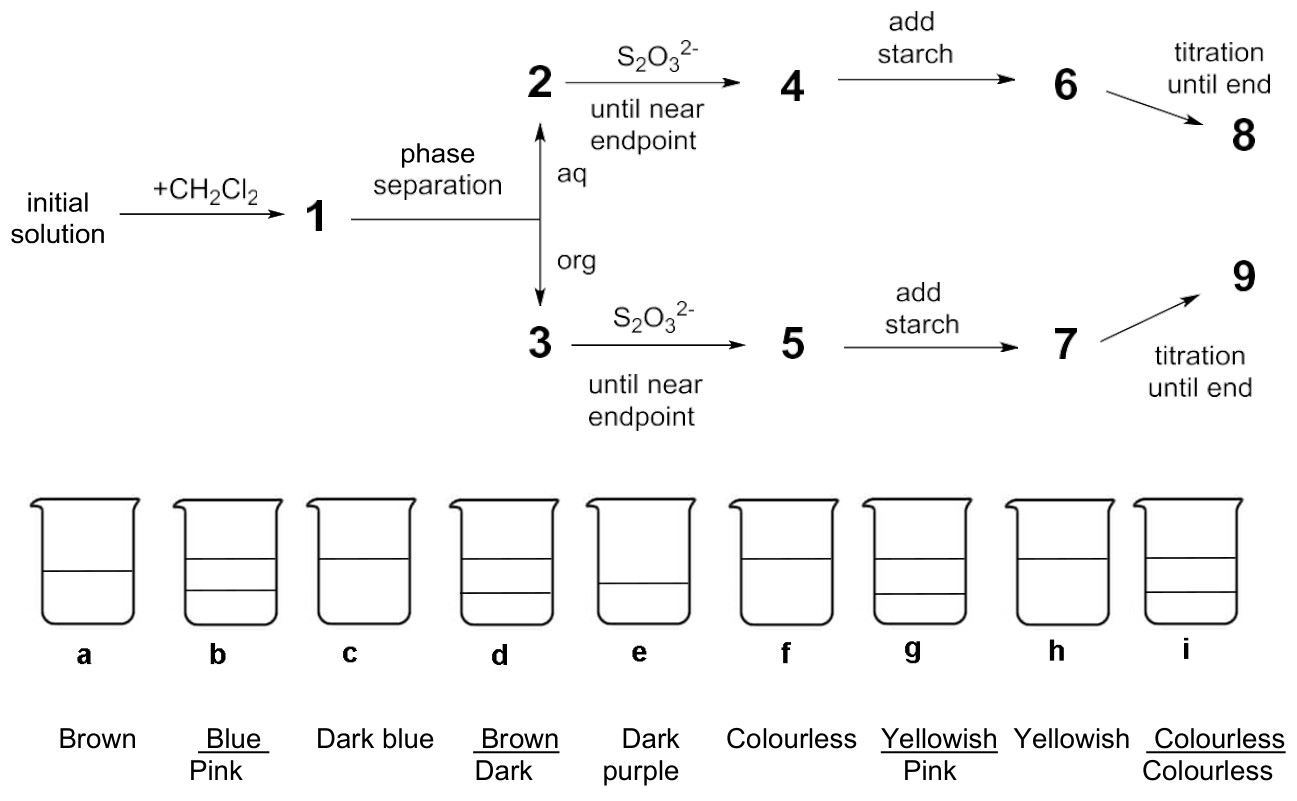
4.5 Find the correspondence between the stages on the scheme (1–9) and the schematic pictures representing them (a–i).
| Stages | Picture |
|---|---|
| 1 | |
| 2 | |
| 3 | |
| 4 | |
| 5 | |
| 6 | |
| 7 | |
| 8 | |
| 9 |
4.6 Write balanced equations for the two possible chemical reactions in the aqueous phase during the titration involving iodine species and sodium thiosulphate.
4.7 Calculate the mass of iodine used to prepare the initial solution.
4.8 Calculate the equilibrium constant \(K^\circ\) for equilibrium of reaction (6).
Official English text of the problem.
Answers
-
4.1 A is potassium nitrate, \(\ce{KNO3}\), SMILES
[K+].[O-][N+](=O)[O-]. B is calcium nitrate, \(\ce{Ca(NO3)2}\), SMILES[Ca+2].[O-][N+](=O)[O-].[O-][N+](=O)[O-]. Their calculated impurity contents are approximately \(0.70\%\) and \(8.29\%\), respectively. -
4.2 Using standard atomic masses and the ideal-gas law, \[ \boxed{w(\mathbf A)=74.4\%,\qquad w(\mathbf B)=25.6\%.} \] The integer molar-mass convention, with \(V_m=22.4\ \mathrm{dm^3\,mol^{-1}}\), gives \(74.5\%\) and \(25.5\%\); see the calculation below.
-
4.3 C is potassium carbonate, \(\ce{K2CO3}\), SMILES
[K+].[K+].[O-]C(=O)[O-]. D is calcium carbonate, \(\ce{CaCO3}\), SMILES[Ca+2].[O-]C(=O)[O-]. \[ \boxed{\ce{Ca(NO3)2(aq) + K2CO3(aq) -> 2KNO3(aq) + CaCO3(s)}} \] -
4.4 One balanced set, taking sulfuric acid to be reduced to hydrogen sulfide in reaction (1), is \[ \begin{aligned} (1)\quad&\ce{H2SO4 + 8H+ + 8I- -> H2S + 4I2 + 4H2O}\\ (2)\quad&\ce{2Cu + I2 -> 2CuI}\\ (3)\quad&\ce{Cl2 + 2I- -> I2 + 2Cl-}\\ (4)\quad&\ce{2NO3- + 6I- + 8H+ -> 3I2 + 2NO + 4H2O}\\ (5)\quad&\ce{IO3- + 5I- + 6H+ -> 3I2 + 3H2O}. \end{aligned} \] Alternative sulfur reduction products for (1), and the alternative nitrogen dioxide equation for (4), are given in the solution.
-
4.5 \[ \boxed{1\to d,\quad2\to a,\quad3\to e,\quad4\to h,\quad5\to g,\quad 6\to c,\quad7\to b,\quad8\to f,\quad9\to i.} \]
-
4.6 \[ \boxed{\ce{I2 + 2S2O3^2- -> 2I- + S4O6^2-}} \] \[ \boxed{\ce{I3- + 2S2O3^2- -> 3I- + S4O6^2-}} \]
-
4.7 \[ \boxed{m(\ce{I2})=0.1845\ \mathrm{g}.} \]
-
4.8 Under the dilute-solution activity approximation, \[ \boxed{K^\circ\approx6.9\times10^2} \] dimensionless; the unrounded calculation gives approximately \(693\).
Solution
SMILES for ionic salts below give their constituent ions, not their crystal structures. Ordinary SMILES also do not fully describe resonance delocalization, electronic spin, or coordination and molecular geometry.
4.1 — Identification of the nitrates
Let \(z\) be the metal charge, \(M\) its atomic molar mass, and \(p\) the mass fraction of pure nitrate in a sample. The nitrate ion, \(\ce{NO3-}\), has SMILES [O-][N+](=O)[O-] and molar mass \(62.01\ \mathrm{g\,mol^{-1}}\).
Because the impurities contribute no metal, the measured metal mass fraction is
\[ w=p\frac{M}{M+62.01z}. \]
Therefore,
\[ \frac{M}{z}=\frac{62.01w}{p-w}. \]
The two permitted purity intervals are \(0.99\leq p\leq1\) and \(0.88\leq p\leq0.94\).
| Sample and assumed purity | Required \(M/z\), \(\mathrm{g\,mol^{-1}}\) | Conclusion |
|---|---|---|
| B, \(0.99\leq p\leq1\) | \(17.90\)–\(18.13\) | No alkali or alkaline-earth metal fits |
| B, \(0.88\leq p\leq0.94\) | \(19.40\)–\(21.17\) | Calcium fits: \(40.08/2=20.04\) |
| A, consequently \(0.99\leq p\leq1\) | \(38.66\)–\(39.29\) | Potassium fits: \(39.10/1=39.10\) |
Thus the cations are potassium, \(\ce{K+}\), SMILES [K+], and calcium, \(\ce{Ca^2+}\), SMILES [Ca+2], giving
\[ \boxed{\mathbf A=\ce{KNO3},\qquad \mathbf B=\ce{Ca(NO3)2}.} \]
The impurity contents independently check this assignment:
\[ 100(1-p_A) = 100\left(1-\frac{0.384}{39.10/101.11}\right) =0.700\%, \]
\[ 100(1-p_B) = 100\left(1-\frac{0.224}{40.08/164.10}\right) =8.29\%. \]
These satisfy the stated limits.
4.2 — Composition of mixture E
Under the stated purity assumptions, the mass of the dry nitrate mixture is
\[ m_E=442.8+262.2-190.0 =\boxed{515.0\ \mathrm{g}}. \]
Using the stipulated nitrite-only decomposition,
\[ \ce{2KNO3 -> 2KNO2 + O2}, \]
\[ \ce{Ca(NO3)2 -> Ca(NO2)2 + O2}. \]
The products are potassium nitrite, \(\ce{KNO2}\), SMILES [K+].[O-]N=O; calcium nitrite, \(\ce{Ca(NO2)2}\), SMILES [Ca+2].[O-]N=O.[O-]N=O; and dioxygen, \(\ce{O2}\), SMILES O=O. The nitrite ion itself is [O-]N=O.
At \(273.15\ \mathrm K\) and \(101325\ \mathrm{Pa}\),
\[ n(\ce{O2}) =\frac{PV}{RT} =\frac{101325(60.48\times10^{-3})} {8.3144626(273.15)} =2.69832\ \mathrm{mol}. \]
Let \(a=n(\ce{KNO3})\) and \(b=n(\ce{Ca(NO3)2})\) in E. The oxygen and mass balances give
\[ \frac a2+b=2.69832, \]
\[ 101.11a+164.10b=515.0. \]
Solving without rounding intermediate values,
\[ a=3.78836\ \mathrm{mol},\qquad b=0.804137\ \mathrm{mol}. \]
Consequently,
\[ m_A=383.041\ \mathrm{g},\qquad m_B=131.959\ \mathrm{g}, \]
and
\[ \boxed{w_A=74.4\%,\qquad w_B=25.6\%.} \]
The numerical data also warrant stating the rounding convention explicitly. With rounded molar masses \(M_A=101\) and \(M_B=164\ \mathrm{g\,mol^{-1}}\), and \(V_m=22.4\ \mathrm{dm^3\,mol^{-1}}\), the equations instead become
\[ a+2b=5.400,\qquad101a+164b=515.0. \]
They give exactly
\[ a=3.800,\qquad b=0.8000\ \mathrm{mol}, \]
hence
\[ w_A=\frac{383.8}{515.0}(100)=74.5\%,\qquad w_B=\frac{131.2}{515.0}(100)=25.5\%. \]
This rounded convention also reproduces the carbonate masses in 4.3 exactly.
4.3 — Identification of C and D
Initially,
\[ n_{B,0}=\frac{442.8}{164.10} =2.69835\ \mathrm{mol}. \]
The amount of calcium removed into D is therefore
\[ n_{\mathrm{Ca,\ precipitated}} =2.69835-0.804137 =1.89422\ \mathrm{mol}. \]
The precipitate mass per mole of calcium is
\[ \frac{190.0}{1.89422} \approx100.3\ \mathrm{g\,mol^{-1}}. \]
Subtracting the calcium contribution leaves approximately
\[ 100.3-40.08\approx60.2\ \mathrm{g} \]
of anion per mole of calcium. This identifies carbonate, \(\ce{CO3^2-}\), SMILES [O-]C(=O)[O-], whose molar mass is approximately \(60.01\ \mathrm{g\,mol^{-1}}\). Calcium carbonate is a white, sparingly soluble precipitate.
The corresponding potassium salt is potassium carbonate. Its inferred molar mass is
\[ M_C=\frac{262.2}{a/2} =\frac{262.2}{3.78836/2} \approx138.4\ \mathrm{g\,mol^{-1}}, \]
consistent with \(\ce{K2CO3}\), \(M=138.21\ \mathrm{g\,mol^{-1}}\), within the numerical convention discussed above.
With integer molar masses, the identification is exact:
\[ n_C=n_D=1.900\ \mathrm{mol}, \]
\[ M_C=\frac{262.2}{1.900}=138.0\ \mathrm{g\,mol^{-1}}, \qquad M_D=\frac{190.0}{1.900}=100.0\ \mathrm{g\,mol^{-1}}. \]
Thus
\[ \boxed{\mathbf C=\ce{K2CO3},\qquad \mathbf D=\ce{CaCO3}} \]
and
\[ \boxed{\ce{Ca(NO3)2(aq) + K2CO3(aq) -> 2KNO3(aq) + CaCO3(s)}}. \]
4.4 — Reactions producing iodine and corroding copper
The additional species used in these equations are identified below.
| Name | Formula | SMILES |
|---|---|---|
| Sulfuric acid | \(\ce{H2SO4}\) | OS(=O)(=O)O |
| Hydrogen ion | \(\ce{H+}\) | [H+] |
| Iodide ion | \(\ce{I-}\) | [I-] |
| Iodine | \(\ce{I2}\) | II |
| Hydrogen sulfide | \(\ce{H2S}\) | S |
| Water | \(\ce{H2O}\) | O |
| Sulfur dioxide | \(\ce{SO2}\) | O=S=O |
| Elemental sulfur, cyclic molecular form | \(\ce{S8}\) | S1SSSSSSS1 |
| Copper | \(\ce{Cu}\) | [Cu] |
| Copper(I) iodide | \(\ce{CuI}\) | [Cu+].[I-] |
| Chlorine | \(\ce{Cl2}\) | ClCl |
| Chloride ion | \(\ce{Cl-}\) | [Cl-] |
| Nitric oxide | \(\ce{NO}\) | [N]=O |
| Nitrogen dioxide | \(\ce{NO2}\) | O=[N+][O-] |
| Iodate ion | \(\ce{IO3-}\) | [O-]I(=O)=O |
The copper SMILES represents an atom, not the metallic lattice. The sulfur-ring SMILES does not specify its crown conformation; elemental sulfur is written as \(\ce{S}\) for stoichiometric bookkeeping below.
Reaction (1). Iodide is oxidized from \(-1\) to \(0\). If sulfur is reduced from \(+6\) to \(-2\), eight iodide ions supply the eight electrons required:
\[ \boxed{\ce{H2SO4 + 8H+ + 8I- -> H2S + 4I2 + 4H2O}}. \]
The statement does not specify the sulfur reduction product. Concentrated sulfuric acid and iodide can also give sulfur dioxide or elemental sulfur; their balanced equations are
\[ \boxed{\ce{H2SO4 + 2H+ + 2I- -> SO2 + I2 + 2H2O}}, \]
\[ \boxed{\ce{H2SO4 + 6H+ + 6I- -> S + 3I2 + 4H2O}}. \]
Reaction (2). Copper is oxidized to copper(I), while iodine is reduced to iodide:
\[ \boxed{\ce{2Cu(s) + I2 -> 2CuI(s)}}. \]
Reaction (3). Chlorine oxidizes iodide to iodine and is itself reduced to chloride:
\[ \boxed{\ce{Cl2 + 2I- -> I2 + 2Cl-}}. \]
Reaction (4). Taking the nitrate reduction product to be nitric oxide, nitrogen changes from \(+5\) to \(+2\), accepting three electrons per nitrogen atom:
\[ \boxed{\ce{2NO3- + 6I- + 8H+ -> 3I2 + 2NO + 4H2O}}. \]
If nitrogen dioxide is instead the reduction product, the corresponding balanced equation is
\[ \ce{2NO3- + 2I- + 4H+ -> I2 + 2NO2 + 2H2O}. \]
Reaction (5). Iodate iodine changes from \(+5\) to \(0\); five iodide ions supply the five electrons. The six iodine atoms form three iodine molecules:
\[ \boxed{\ce{IO3- + 5I- + 6H+ -> 3I2 + 3H2O}}. \]
4.5 — Correspondence between stages and pictures
Dichloromethane, \(\ce{CH2Cl2}\), SMILES ClCCl, is denser than water, so the organic phase is the lower layer. Adding aqueous thiosulfate to the separated organic phase creates a new upper aqueous layer.
| Stage | Picture | Description |
|---|---|---|
| 1 | d | Two layers: brown aqueous phase above the dark organic phase |
| 2 | a | Separated aqueous phase, brown |
| 3 | e | Separated organic phase, dark purple |
| 4 | h | Aqueous phase near the endpoint, yellowish |
| 5 | g | Organic-phase titration near the endpoint: yellowish upper aqueous layer and pink lower organic layer |
| 6 | c | Starch added to the aqueous sample: dark blue |
| 7 | b | Starch added during organic-phase titration: blue upper aqueous layer and pink lower organic layer |
| 8 | f | Aqueous titration completed: colourless |
| 9 | i | Organic-phase titration completed: both layers colourless |
The blue colour arises from iodine/polyiodide associated with helical starch chains. Starch and its indicator complex do not have a single, definite molecular composition and therefore have no unique molecular SMILES.
4.6 — Titration reactions
The relevant ions are:
| Name | Formula | SMILES |
|---|---|---|
| Triiodide | \(\ce{I3-}\) | I[I-]I |
| Thiosulfate | \(\ce{S2O3^2-}\) | [O-]S(=O)(=O)[S-] |
| Tetrathionate | \(\ce{S4O6^2-}\) | [O-]S(=O)(=O)SSS(=O)(=O)[O-] |
Triiodide is linear and has three-centre, four-electron bonding. Its SMILES is a formal connectivity representation and does not encode that bonding description or geometry.
Thiosulfate is oxidized to tetrathionate:
\[ \ce{2S2O3^2- -> S4O6^2- + 2e-}. \]
Combining this with the reduction of dissolved iodine gives
\[ \boxed{\ce{I2 + 2S2O3^2- -> 2I- + S4O6^2-}}. \]
For triiodide,
\[ \boxed{\ce{I3- + 2S2O3^2- -> 3I- + S4O6^2-}}. \]
Thus one mole of either \(\ce{I2}\) or \(\ce{I3-}\) consumes two moles of thiosulfate. Each triiodide ion contains one titratable iodine-molecule equivalent.
4.7 — Mass of iodine initially added
Sodium thiosulfate pentahydrate, \(\ce{Na2S2O3*5H2O}\), has SMILES [Na+].[Na+].[O-]S(=O)(=O)[S-].O.O.O.O.O and molar mass approximately \(248.18\ \mathrm{g\,mol^{-1}}\).
The titrant concentration is
\[ c_T=\frac{14.9080\ \mathrm g} {(248.18\ \mathrm{g\,mol^{-1}})(1.000\ \mathrm{dm^3})} =0.0600693\ \mathrm{mol\,dm^{-3}}. \]
Both phase titrations together measure all the initially added molecular iodine, including the portion converted into triiodide:
\[ n_0(\ce{I2}) =\frac{c_T}{2}(V_{\mathrm{org}}+V_{\mathrm{aq}}). \]
Therefore,
\[ n_0(\ce{I2}) =\frac{0.0600693}{2}(0.01620+0.00800) =7.26839\times10^{-4}\ \mathrm{mol}. \]
Using \(M(\ce{I2})=253.80\ \mathrm{g\,mol^{-1}}\),
\[ m_0(\ce{I2}) =(7.26839\times10^{-4})(253.80) =\boxed{0.1845\ \mathrm g}. \]
The iodide originally supplied by potassium iodide is not counted as added molecular iodine and does not itself consume thiosulfate.
4.8 — Equilibrium constant
Potassium iodide, \(\ce{KI}\), has SMILES [K+].[I-] and molar mass \(166.00\ \mathrm{g\,mol^{-1}}\).
First determine the species present after extraction but before titration.
The organic phase contains only molecular iodine among the iodine species. Hence
\[ n_{\ce{I2},\mathrm{org}} =\frac{c_TV_{\mathrm{org,titrant}}}{2} =\frac{(0.0600693)(0.01620)}{2} =4.86561\times10^{-4}\ \mathrm{mol}. \]
Its concentration in the \(0.0500\ \mathrm{dm^3}\) organic phase is
\[ [\ce{I2}]_{\mathrm{org}} =\frac{4.86561\times10^{-4}}{0.0500} =9.73123\times10^{-3}\ \mathrm{mol\,dm^{-3}}. \]
The partition ratio applies to free molecular iodine:
\[ \frac{[\ce{I2}]_{\mathrm{org}}}{[\ce{I2}]_{\mathrm{aq}}}=15. \]
Thus
\[ \boxed{[\ce{I2}]_{\mathrm{aq}} =6.48748\times10^{-4}\ \mathrm{mol\,dm^{-3}}}. \]
The aqueous titration measures the sum of molecular iodine and triiodide:
\[ n_{\ce{I2},\mathrm{aq}}+n_{\ce{I3-},\mathrm{aq}} =\frac{(0.0600693)(0.00800)}{2} =2.40277\times10^{-4}\ \mathrm{mol}. \]
Consequently,
\[ [\ce{I3-}] =\frac{2.40277\times10^{-4}}{0.0500} -6.48748\times10^{-4} =\boxed{4.15680\times10^{-3}\ \mathrm{mol\,dm^{-3}}}. \]
The initial amount of potassium iodide is
\[ n_{\ce{KI}}=\frac{0.1112}{166.00} =6.69880\times10^{-4}\ \mathrm{mol}. \]
Formation of each triiodide ion consumes one iodide ion. Because neither ionic species enters the organic phase,
\[ [\ce{I-}]+[\ce{I3-}] =\frac{6.69880\times10^{-4}}{0.0500} =0.0133976\ \mathrm{mol\,dm^{-3}}. \]
Therefore,
\[ \boxed{[\ce{I-}] =0.0133976-0.00415680 =9.24079\times10^{-3}\ \mathrm{mol\,dm^{-3}}}. \]
The thermodynamic equilibrium constant is
\[ K^\circ =\frac{a_{\ce{I3-}}} {a_{\ce{I-}}a_{\ce{I2}}}. \]
Taking \(a_i\simeq[i]/c^\circ\), with \(c^\circ=1\ \mathrm{mol\,dm^{-3}}\),
\[ K^\circ\simeq \frac{[\ce{I3-}]c^\circ} {[\ce{I-}][\ce{I2}]_{\mathrm{aq}}}. \]
Substitution gives
\[ K^\circ\simeq \frac{(4.15680\times10^{-3})(1)} {(9.24079\times10^{-3})(6.48748\times10^{-4})} =693.4. \]
Hence
\[ \boxed{K^\circ\approx6.9\times10^2} \]
with no units.
The solution was checked against the official solution.
IChO 2019 · Theorieaufgabe 4
Vom Schießpulver zur Entdeckung des Iods
Im 19. Jahrhundert spezialisierte sich der französische Unternehmer B. Courtois auf die Herstellung des Nitrats A (\(\ce{M_A(NO3)_m}\)), das für Schießpulver verwendet wurde. A wurde zunächst aus Asien importiert und später aus dem Nitrat B (\(\ce{M_B(NO3)_n}\)) durch eine Austauschreaktion mit der aus Algen gewonnenen Verbindung C hergestellt.
4.1 Bestimmen Sie die Formeln der Nitrate A und B, wenn bekannt ist, dass es sich um wasserfreie Salze von Alkali- oder Erdalkalimetallen (\(\ce{M_A}\) und \(\ce{M_B}\)) handelt. Eines der Nitrate enthält höchstens 1 Massen-% nichtmetallische Verunreinigungen, während das andere \(9 \pm 3\) Massen-% Verunreinigungen enthält. Der Gehalt der Metalle \(\ce{M_A}\) und \(\ce{M_B}\) in den Proben beträgt 38.4 bzw. 22.4 Massen-%. Belegen Sie Ihre Antwort durch Berechnungen.
Zur Gewinnung von A wurden 262.2 g der festen Verbindung C zu einer Lösung gegeben, die 442.8 g B enthielt. Es ist bekannt, dass B im Überschuss vorliegt. Dabei entstanden 190.0 g eines weißen Niederschlags D, der durch Filtration abgetrennt wurde. Das Filtrat wurde eingedampft und das erhaltene feste Gemisch E erhitzt, bis die Masse der Probe (die nur Nitrite, \(\ce{NO2-}\), enthielt) konstant war. Das einzige gasförmige Produkt war molekularer Sauerstoff: 60.48 dm³ bei 0 °C und 1 atm (molekularer Sauerstoff kann als ideales Gas betrachtet werden).
4.2 Berechnen Sie die Zusammensetzung (in Massen-%) des Gemischs E unter der Annahme, dass es ausschließlich die Verbindungen A und B und keine weiteren Verunreinigungen enthielt und dass C in reinem, wasserfreiem Zustand eingesetzt wurde.
4.3 Bestimmen Sie die Formeln der Verbindungen C und D und stellen Sie die ausgeglichene Reaktionsgleichung für die Reaktion zwischen B und C auf.
Bei der Arbeit mit Algenasche beobachtete Courtois 1811, dass Kupfergefäße schneller als üblich angegriffen wurden. Während er dieses Phänomen untersuchte, betrat seine Katze das Labor und verschüttete die konzentrierte Schwefelsäurelösung auf die trockene Algenasche: Sofort stiegen violette Dämpfe aus dem Gefäß auf (1, Schwefelsäure ist das Oxidationsmittel): Iod (\(\ce{I2}\)) war soeben entdeckt worden! Iod war die Ursache der Kupferkorrosion (2). Aufgrund der medizinischen Anwendungen des Iods eröffnete Courtois jedoch einen neuen Betrieb, um es durch die Reaktion von Algen mit Chlor herzustellen (3). Heute wird Iod aus den Reaktanten (\(\ce{NO3-}\), \(\ce{I-}\), \(\ce{H+}\)) (4) oder (\(\ce{IO3-}\), \(\ce{I-}\), \(\ce{H+}\)) (5) hergestellt.
4.4 Stellen Sie ausgeglichene Gleichungen für die Reaktionen 1 – 5 auf.
Die Löslichkeit von Iod in Wasser ist sehr gering, steigt jedoch bei Zugabe von Iodidionen deutlich an. Gemeinsam bilden sie Ionen wie Triiodid, \(\ce{I3-}\):
\[ \ce{I-(aq) + I2(aq)} = \ce{I3-(aq)} \qquad (6) \]
Das Gleichgewicht (6) lässt sich durch Extraktion von \(\ce{I2}\) mit Dichlormethan untersuchen. Tatsächlich lösen sich \(\ce{I-}\) und \(\ce{I3-}\) nicht in organischen Lösungsmitteln, \(\ce{I2}\) hingegen schon; nach der Extraktion ist seine Konzentration in Dichlormethan 15-mal so hoch wie in Wasser.
Der folgende Versuch wurde durchgeführt. Zur Herstellung der Ausgangslösung wurden einige Kristalle festen Iods in 50.0 cm³ einer wässrigen Kaliumiodidlösung (0.1112 g) gelöst. Anschließend wurden 50.0 cm³ Dichlormethan zugegeben und das Gemisch bis zur Einstellung des Gleichgewichts kräftig geschüttelt. Nach der Phasentrennung wurden die beiden Phasen in Gegenwart von Stärke mit 16.20 cm³ (organische Phase) bzw. 8.00 cm³ (wässrige Phase) einer wässrigen Maßlösung von Natriumthiosulfat-Pentahydrat (14.9080 g in 1.000 dm³ Lösung) titriert. Der Ablauf ist nachfolgend schematisch dargestellt:
4.5 Ordnen Sie den Schritten im Schema (1–9) die zugehörigen schematischen Abbildungen (a–i) zu.
| Schritte | Abbildung |
|---|---|
| 1 | |
| 2 | |
| 3 | |
| 4 | |
| 5 | |
| 6 | |
| 7 | |
| 8 | |
| 9 |
4.6 Stellen Sie ausgeglichene Gleichungen für die beiden möglichen chemischen Reaktionen zwischen Iodspezies und Natriumthiosulfat auf, die während der Titration in der wässrigen Phase ablaufen.
4.7 Berechnen Sie die Masse des Iods, das zur Herstellung der Ausgangslösung verwendet wurde.
4.8 Berechnen Sie die Gleichgewichtskonstante \(K^\circ\) für das Gleichgewicht der Reaktion (6).
Aufgabentext aus dem offiziellen englischen Text übersetzt.
Antworten
-
4.1 A ist Kaliumnitrat, \(\ce{KNO3}\), SMILES
[K+].[O-][N+](=O)[O-]. B ist Calciumnitrat, \(\ce{Ca(NO3)2}\), SMILES[Ca+2].[O-][N+](=O)[O-].[O-][N+](=O)[O-]. Ihre berechneten Verunreinigungsgehalte betragen etwa \(0.70\%\) bzw. \(8.29\%\). -
4.2 Unter Verwendung der Standardatommassen und des idealen Gasgesetzes ergibt sich \[ \boxed{w(\mathbf A)=74.4\%,\qquad w(\mathbf B)=25.6\%.} \] Die Konvention ganzzahliger molarer Massen mit \(V_m=22.4\ \mathrm{dm^3\,mol^{-1}}\) liefert \(74.5\%\) und \(25.5\%\); siehe die nachfolgende Berechnung.
-
4.3 C ist Kaliumcarbonat, \(\ce{K2CO3}\), SMILES
[K+].[K+].[O-]C(=O)[O-]. D ist Calciumcarbonat, \(\ce{CaCO3}\), SMILES[Ca+2].[O-]C(=O)[O-]. \[ \boxed{\ce{Ca(NO3)2(aq) + K2CO3(aq) -> 2KNO3(aq) + CaCO3(s)}} \] -
4.4 Ein Satz ausgeglichener Gleichungen unter der Annahme, dass Schwefelsäure in Reaktion (1) zu Schwefelwasserstoff reduziert wird, lautet \[ \begin{aligned} (1)\quad&\ce{H2SO4 + 8H+ + 8I- -> H2S + 4I2 + 4H2O}\\ (2)\quad&\ce{2Cu + I2 -> 2CuI}\\ (3)\quad&\ce{Cl2 + 2I- -> I2 + 2Cl-}\\ (4)\quad&\ce{2NO3- + 6I- + 8H+ -> 3I2 + 2NO + 4H2O}\\ (5)\quad&\ce{IO3- + 5I- + 6H+ -> 3I2 + 3H2O}. \end{aligned} \] Alternative Reduktionsprodukte des Schwefels für (1) sowie die alternative Gleichung mit Stickstoffdioxid für (4) sind in der Lösung angegeben.
-
4.5 \[ \boxed{1\to d,\quad2\to a,\quad3\to e,\quad4\to h,\quad5\to g,\quad 6\to c,\quad7\to b,\quad8\to f,\quad9\to i.} \]
-
4.6 \[ \boxed{\ce{I2 + 2S2O3^2- -> 2I- + S4O6^2-}} \] \[ \boxed{\ce{I3- + 2S2O3^2- -> 3I- + S4O6^2-}} \]
-
4.7 \[ \boxed{m(\ce{I2})=0.1845\ \mathrm{g}.} \]
-
4.8 Mit der Aktivitätsnäherung für verdünnte Lösungen ergibt sich \[ \boxed{K^\circ\approx6.9\times10^2} \] als dimensionslose Größe; die ungerundete Berechnung liefert ungefähr \(693\).
Lösung
Die nachfolgenden SMILES für ionische Salze geben deren einzelne Ionen wieder, nicht ihre Kristallstrukturen. Gewöhnliche SMILES beschreiben außerdem weder die mesomere Delokalisierung noch den Elektronenspin, die Koordinationsgeometrie oder die Molekülgeometrie vollständig.
4.1 — Identifizierung der Nitrate
Es seien \(z\) die Ladungszahl des Metalls, \(M\) seine atomare molare Masse und \(p\) der Massenanteil des reinen Nitrats in einer Probe. Das Nitration, \(\ce{NO3-}\), hat die SMILES [O-][N+](=O)[O-] und die molare Masse \(62.01\ \mathrm{g\,mol^{-1}}\).
Da die Verunreinigungen keinen Beitrag zum Metallgehalt leisten, beträgt der gemessene Massenanteil des Metalls
\[ w=p\frac{M}{M+62.01z}. \]
Daraus folgt
\[ \frac{M}{z}=\frac{62.01w}{p-w}. \]
Die beiden zulässigen Reinheitsintervalle sind \(0.99\leq p\leq1\) und \(0.88\leq p\leq0.94\).
| Probe und angenommene Reinheit | Erforderliches \(M/z\), \(\mathrm{g\,mol^{-1}}\) | Schlussfolgerung |
|---|---|---|
| B, \(0.99\leq p\leq1\) | \(17.90\)–\(18.13\) | Kein Alkali- oder Erdalkalimetall passt |
| B, \(0.88\leq p\leq0.94\) | \(19.40\)–\(21.17\) | Calcium passt: \(40.08/2=20.04\) |
| A, folglich \(0.99\leq p\leq1\) | \(38.66\)–\(39.29\) | Kalium passt: \(39.10/1=39.10\) |
Die Kationen sind somit Kalium, \(\ce{K+}\), SMILES [K+], und Calcium, \(\ce{Ca^2+}\), SMILES [Ca+2], woraus sich ergibt:
\[ \boxed{\mathbf A=\ce{KNO3},\qquad \mathbf B=\ce{Ca(NO3)2}.} \]
Die Verunreinigungsgehalte bestätigen diese Zuordnung unabhängig davon:
\[ 100(1-p_A) = 100\left(1-\frac{0.384}{39.10/101.11}\right) =0.700\%, \]
\[ 100(1-p_B) = 100\left(1-\frac{0.224}{40.08/164.10}\right) =8.29\%. \]
Diese Werte erfüllen die angegebenen Grenzen.
4.2 — Zusammensetzung des Gemischs E
Unter den angegebenen Reinheitsannahmen beträgt die Masse des trockenen Nitratgemischs
\[ m_E=442.8+262.2-190.0 =\boxed{515.0\ \mathrm{g}}. \]
Für die vorgegebene Zersetzung ausschließlich zu Nitriten gilt
\[ \ce{2KNO3 -> 2KNO2 + O2}, \]
\[ \ce{Ca(NO3)2 -> Ca(NO2)2 + O2}. \]
Die Produkte sind Kaliumnitrit, \(\ce{KNO2}\), SMILES [K+].[O-]N=O; Calciumnitrit, \(\ce{Ca(NO2)2}\), SMILES [Ca+2].[O-]N=O.[O-]N=O; und molekularer Sauerstoff, \(\ce{O2}\), SMILES O=O. Das Nitrition selbst hat die SMILES [O-]N=O.
Bei \(273.15\ \mathrm K\) und \(101325\ \mathrm{Pa}\) gilt
\[ n(\ce{O2}) =\frac{PV}{RT} =\frac{101325(60.48\times10^{-3})} {8.3144626(273.15)} =2.69832\ \mathrm{mol}. \]
Es seien \(a=n(\ce{KNO3})\) und \(b=n(\ce{Ca(NO3)2})\) in E. Aus der Sauerstoff- und der Massenbilanz folgt
\[ \frac a2+b=2.69832, \]
\[ 101.11a+164.10b=515.0. \]
Löst man das Gleichungssystem ohne Rundung der Zwischenwerte, erhält man
\[ a=3.78836\ \mathrm{mol},\qquad b=0.804137\ \mathrm{mol}. \]
Folglich gilt
\[ m_A=383.041\ \mathrm{g},\qquad m_B=131.959\ \mathrm{g}, \]
und
\[ \boxed{w_A=74.4\%,\qquad w_B=25.6\%.} \]
Die Zahlenangaben machen es außerdem sinnvoll, die Rundungskonvention ausdrücklich anzugeben. Mit den gerundeten molaren Massen \(M_A=101\) und \(M_B=164\ \mathrm{g\,mol^{-1}}\) sowie \(V_m=22.4\ \mathrm{dm^3\,mol^{-1}}\) lauten die Gleichungen stattdessen
\[ a+2b=5.400,\qquad101a+164b=515.0. \]
Sie liefern exakt
\[ a=3.800,\qquad b=0.8000\ \mathrm{mol}, \]
also
\[ w_A=\frac{383.8}{515.0}(100)=74.5\%,\qquad w_B=\frac{131.2}{515.0}(100)=25.5\%. \]
Mit dieser Rundungskonvention werden auch die Carbonatmassen in 4.3 exakt wiedergegeben.
4.3 — Identifizierung von C und D
Zu Beginn gilt
\[ n_{B,0}=\frac{442.8}{164.10} =2.69835\ \mathrm{mol}. \]
Die als D abgetrennte Stoffmenge an Calcium beträgt daher
\[ n_{\mathrm{Ca,\ precipitated}} =2.69835-0.804137 =1.89422\ \mathrm{mol}. \]
Die Niederschlagsmasse pro Mol Calcium beträgt
\[ \frac{190.0}{1.89422} \approx100.3\ \mathrm{g\,mol^{-1}}. \]
Nach Abzug des Calciumanteils verbleiben ungefähr
\[ 100.3-40.08\approx60.2\ \mathrm{g} \]
Anion pro Mol Calcium. Damit lässt sich das Anion als Carbonat, \(\ce{CO3^2-}\), SMILES [O-]C(=O)[O-], identifizieren, dessen molare Masse ungefähr \(60.01\ \mathrm{g\,mol^{-1}}\) beträgt. Calciumcarbonat ist ein weißer, schwer löslicher Niederschlag.
Das entsprechende Kaliumsalz ist Kaliumcarbonat. Seine daraus abgeleitete molare Masse beträgt
\[ M_C=\frac{262.2}{a/2} =\frac{262.2}{3.78836/2} \approx138.4\ \mathrm{g\,mol^{-1}}, \]
was im Rahmen der oben erläuterten numerischen Konvention mit \(\ce{K2CO3}\), \(M=138.21\ \mathrm{g\,mol^{-1}}\), übereinstimmt.
Mit ganzzahligen molaren Massen ist die Identifizierung exakt:
\[ n_C=n_D=1.900\ \mathrm{mol}, \]
\[ M_C=\frac{262.2}{1.900}=138.0\ \mathrm{g\,mol^{-1}}, \qquad M_D=\frac{190.0}{1.900}=100.0\ \mathrm{g\,mol^{-1}}. \]
Somit gilt
\[ \boxed{\mathbf C=\ce{K2CO3},\qquad \mathbf D=\ce{CaCO3}} \]
und
\[ \boxed{\ce{Ca(NO3)2(aq) + K2CO3(aq) -> 2KNO3(aq) + CaCO3(s)}}. \]
4.4 — Reaktionen zur Iodbildung und zur Korrosion von Kupfer
Die zusätzlichen Spezies, die in diesen Gleichungen verwendet werden, sind nachfolgend aufgeführt.
| Name | Formel | SMILES |
|---|---|---|
| Schwefelsäure | \(\ce{H2SO4}\) | OS(=O)(=O)O |
| Wasserstoffion | \(\ce{H+}\) | [H+] |
| Iodidion | \(\ce{I-}\) | [I-] |
| Iod | \(\ce{I2}\) | II |
| Schwefelwasserstoff | \(\ce{H2S}\) | S |
| Wasser | \(\ce{H2O}\) | O |
| Schwefeldioxid | \(\ce{SO2}\) | O=S=O |
| Elementarer Schwefel, cyclische Molekülform | \(\ce{S8}\) | S1SSSSSSS1 |
| Kupfer | \(\ce{Cu}\) | [Cu] |
| Kupfer(I)-iodid | \(\ce{CuI}\) | [Cu+].[I-] |
| Chlor | \(\ce{Cl2}\) | ClCl |
| Chloridion | \(\ce{Cl-}\) | [Cl-] |
| Stickstoffmonoxid | \(\ce{NO}\) | [N]=O |
| Stickstoffdioxid | \(\ce{NO2}\) | O=[N+][O-] |
| Iodation | \(\ce{IO3-}\) | [O-]I(=O)=O |
Die SMILES für Kupfer stellt ein Atom dar, nicht das Metallgitter. Die SMILES des Schwefelrings legt dessen Kronenkonformation nicht fest; für die stöchiometrische Bilanzierung wird elementarer Schwefel im Folgenden als \(\ce{S}\) geschrieben.
Reaktion (1). Iodid wird von \(-1\) auf \(0\) oxidiert. Wird Schwefel von \(+6\) auf \(-2\) reduziert, liefern acht Iodidionen die acht benötigten Elektronen:
\[ \boxed{\ce{H2SO4 + 8H+ + 8I- -> H2S + 4I2 + 4H2O}}. \]
Die Aufgabenstellung legt das Reduktionsprodukt des Schwefels nicht fest. Aus konzentrierter Schwefelsäure und Iodid können auch Schwefeldioxid oder elementarer Schwefel entstehen; die ausgeglichenen Gleichungen lauten
\[ \boxed{\ce{H2SO4 + 2H+ + 2I- -> SO2 + I2 + 2H2O}}, \]
\[ \boxed{\ce{H2SO4 + 6H+ + 6I- -> S + 3I2 + 4H2O}}. \]
Reaktion (2). Kupfer wird zu Kupfer(I) oxidiert, während Iod zu Iodid reduziert wird:
\[ \boxed{\ce{2Cu(s) + I2 -> 2CuI(s)}}. \]
Reaktion (3). Chlor oxidiert Iodid zu Iod und wird dabei selbst zu Chlorid reduziert:
\[ \boxed{\ce{Cl2 + 2I- -> I2 + 2Cl-}}. \]
Reaktion (4). Nimmt man Stickstoffmonoxid als Reduktionsprodukt des Nitrats an, ändert sich die Oxidationszahl des Stickstoffs von \(+5\) auf \(+2\), wobei jedes Stickstoffatom drei Elektronen aufnimmt:
\[ \boxed{\ce{2NO3- + 6I- + 8H+ -> 3I2 + 2NO + 4H2O}}. \]
Ist stattdessen Stickstoffdioxid das Reduktionsprodukt, lautet die entsprechende ausgeglichene Gleichung
\[ \ce{2NO3- + 2I- + 4H+ -> I2 + 2NO2 + 2H2O}. \]
Reaktion (5). Die Oxidationszahl des Iods im Iodat ändert sich von \(+5\) auf \(0\); fünf Iodidionen liefern die fünf Elektronen. Die sechs Iodatome bilden drei Iodmoleküle:
\[ \boxed{\ce{IO3- + 5I- + 6H+ -> 3I2 + 3H2O}}. \]
4.5 — Zuordnung der Schritte zu den Abbildungen
Dichlormethan, \(\ce{CH2Cl2}\), SMILES ClCCl, hat eine höhere Dichte als Wasser, sodass die organische Phase die untere Schicht bildet. Durch Zugabe einer wässrigen Thiosulfatlösung zur abgetrennten organischen Phase entsteht eine neue obere wässrige Schicht.
| Schritt | Abbildung | Beschreibung |
|---|---|---|
| 1 | d | Zwei Schichten: braune wässrige Phase über der dunklen organischen Phase |
| 2 | a | Abgetrennte wässrige Phase, braun |
| 3 | e | Abgetrennte organische Phase, dunkelviolett |
| 4 | h | Wässrige Phase nahe dem Endpunkt, gelblich |
| 5 | g | Titration der organischen Phase nahe dem Endpunkt: gelbliche obere wässrige Schicht und rosafarbene untere organische Schicht |
| 6 | c | Stärke zur wässrigen Probe gegeben: dunkelblau |
| 7 | b | Stärke während der Titration der organischen Phase zugegeben: blaue obere wässrige Schicht und rosafarbene untere organische Schicht |
| 8 | f | Titration der wässrigen Phase abgeschlossen: farblos |
| 9 | i | Titration der organischen Phase abgeschlossen: beide Schichten farblos |
Die blaue Farbe entsteht durch Iod/Polyiodid, das mit helikalen Stärkeketten assoziiert ist. Stärke und ihr Indikatorkomplex haben keine einzelne, festgelegte molekulare Zusammensetzung und daher keine eindeutige molekulare SMILES.
4.6 — Titrationsreaktionen
Die relevanten Ionen sind:
| Name | Formel | SMILES |
|---|---|---|
| Triiodid | \(\ce{I3-}\) | I[I-]I |
| Thiosulfat | \(\ce{S2O3^2-}\) | [O-]S(=O)(=O)[S-] |
| Tetrathionat | \(\ce{S4O6^2-}\) | [O-]S(=O)(=O)SSS(=O)(=O)[O-] |
Triiodid ist linear und besitzt eine Dreizentren-Vierelektronen-Bindung. Seine SMILES ist eine formale Darstellung der Verknüpfung der Atome und codiert weder diese Bindungsbeschreibung noch die Geometrie.
Thiosulfat wird zu Tetrathionat oxidiert:
\[ \ce{2S2O3^2- -> S4O6^2- + 2e-}. \]
Die Kombination mit der Reduktion des gelösten Iods ergibt
\[ \boxed{\ce{I2 + 2S2O3^2- -> 2I- + S4O6^2-}}. \]
Für Triiodid gilt
\[ \boxed{\ce{I3- + 2S2O3^2- -> 3I- + S4O6^2-}}. \]
Somit verbraucht ein Mol \(\ce{I2}\) oder \(\ce{I3-}\) jeweils zwei Mol Thiosulfat. Jedes Triiodidion enthält ein titrierbares Iodmolekül-Äquivalent.
4.7 — Masse des ursprünglich zugesetzten Iods
Natriumthiosulfat-Pentahydrat, \(\ce{Na2S2O3*5H2O}\), hat die SMILES [Na+].[Na+].[O-]S(=O)(=O)[S-].O.O.O.O.O und eine molare Masse von ungefähr \(248.18\ \mathrm{g\,mol^{-1}}\).
Die Konzentration der Maßlösung beträgt
\[ c_T=\frac{14.9080\ \mathrm g} {(248.18\ \mathrm{g\,mol^{-1}})(1.000\ \mathrm{dm^3})} =0.0600693\ \mathrm{mol\,dm^{-3}}. \]
Die Titrationen beider Phasen erfassen zusammen das gesamte ursprünglich zugesetzte molekulare Iod, einschließlich des Anteils, der in Triiodid umgewandelt wurde:
\[ n_0(\ce{I2}) =\frac{c_T}{2}(V_{\mathrm{org}}+V_{\mathrm{aq}}). \]
Daher gilt
\[ n_0(\ce{I2}) =\frac{0.0600693}{2}(0.01620+0.00800) =7.26839\times10^{-4}\ \mathrm{mol}. \]
Mit \(M(\ce{I2})=253.80\ \mathrm{g\,mol^{-1}}\) ergibt sich
\[ m_0(\ce{I2}) =(7.26839\times10^{-4})(253.80) =\boxed{0.1845\ \mathrm g}. \]
Das ursprünglich durch Kaliumiodid eingebrachte Iodid wird nicht als zugesetztes molekulares Iod mitgezählt und verbraucht selbst kein Thiosulfat.
4.8 — Gleichgewichtskonstante
Kaliumiodid, \(\ce{KI}\), hat die SMILES [K+].[I-] und die molare Masse \(166.00\ \mathrm{g\,mol^{-1}}\).
Zunächst werden die nach der Extraktion, aber vor der Titration vorhandenen Spezies bestimmt.
Von den Iodspezies enthält die organische Phase nur molekulares Iod. Daher gilt
\[ n_{\ce{I2},\mathrm{org}} =\frac{c_TV_{\mathrm{org,titrant}}}{2} =\frac{(0.0600693)(0.01620)}{2} =4.86561\times10^{-4}\ \mathrm{mol}. \]
Seine Konzentration in der \(0.0500\ \mathrm{dm^3}\) großen organischen Phase beträgt
\[ [\ce{I2}]_{\mathrm{org}} =\frac{4.86561\times10^{-4}}{0.0500} =9.73123\times10^{-3}\ \mathrm{mol\,dm^{-3}}. \]
Das Verteilungsverhältnis gilt für freies molekulares Iod:
\[ \frac{[\ce{I2}]_{\mathrm{org}}}{[\ce{I2}]_{\mathrm{aq}}}=15. \]
Somit gilt
\[ \boxed{[\ce{I2}]_{\mathrm{aq}} =6.48748\times10^{-4}\ \mathrm{mol\,dm^{-3}}}. \]
Die Titration der wässrigen Phase erfasst die Summe aus molekularem Iod und Triiodid:
\[ n_{\ce{I2},\mathrm{aq}}+n_{\ce{I3-},\mathrm{aq}} =\frac{(0.0600693)(0.00800)}{2} =2.40277\times10^{-4}\ \mathrm{mol}. \]
Folglich gilt
\[ [\ce{I3-}] =\frac{2.40277\times10^{-4}}{0.0500} -6.48748\times10^{-4} =\boxed{4.15680\times10^{-3}\ \mathrm{mol\,dm^{-3}}}. \]
Die anfängliche Stoffmenge an Kaliumiodid beträgt
\[ n_{\ce{KI}}=\frac{0.1112}{166.00} =6.69880\times10^{-4}\ \mathrm{mol}. \]
Bei der Bildung jedes Triiodidions wird ein Iodidion verbraucht. Da keine der beiden ionischen Spezies in die organische Phase übergeht, gilt
\[ [\ce{I-}]+[\ce{I3-}] =\frac{6.69880\times10^{-4}}{0.0500} =0.0133976\ \mathrm{mol\,dm^{-3}}. \]
Daraus folgt
\[ \boxed{[\ce{I-}] =0.0133976-0.00415680 =9.24079\times10^{-3}\ \mathrm{mol\,dm^{-3}}}. \]
Die thermodynamische Gleichgewichtskonstante lautet
\[ K^\circ =\frac{a_{\ce{I3-}}} {a_{\ce{I-}}a_{\ce{I2}}}. \]
Mit der Näherung \(a_i\simeq[i]/c^\circ\) und \(c^\circ=1\ \mathrm{mol\,dm^{-3}}\) gilt
\[ K^\circ\simeq \frac{[\ce{I3-}]c^\circ} {[\ce{I-}][\ce{I2}]_{\mathrm{aq}}}. \]
Einsetzen ergibt
\[ K^\circ\simeq \frac{(4.15680\times10^{-3})(1)} {(9.24079\times10^{-3})(6.48748\times10^{-4})} =693.4. \]
Somit ist
\[ \boxed{K^\circ\approx6.9\times10^2} \]
ohne Einheit.
Die Lösung wurde mit der offiziellen Lösung abgeglichen.
IChO 2019 · Teori sorusu 4
Baruttan iyodun keşfine
- yüzyılda Fransız girişimci B. Courtois, barut yapımında kullanılan A nitratının (\(\ce{M_A(NO3)_m}\)) üretiminde uzmanlaşmıştı. Başlangıçta Asya'dan ithal edilen A, daha sonra B nitratının (\(\ce{M_B(NO3)_n}\)) alglerden elde edilen C bileşiğiyle yer değiştirme tepkimesi yoluyla üretilmeye başlandı.
4.1 Alkali veya toprak alkali metalin (\(\ce{M_A}\) ve \(\ce{M_B}\)) susuz tuzları olduklarını bilerek A ve B nitratlarının formüllerini bulun. Nitratlardan biri kütlece en fazla %1 metal içermeyen safsızlık içerirken diğeri kütlece %\(9 \pm 3\) safsızlık içerir. Numunelerdeki \(\ce{M_A}\) ve \(\ce{M_B}\) metallerinin kütlece yüzdeleri sırasıyla %38.4 ve %22.4'tür. Yanıtınızı hesaplamalarla destekleyin.
A'yı elde etmek için 442.8 g B içeren çözeltiye 262.2 g katı C bileşiği eklendi. B'nin fazlalıkta olduğu bilinmektedir. Sonuçta 190.0 g beyaz D çökeltisi oluştu ve süzülerek uzaklaştırıldı. Süzüntü buharlaştırıldı ve elde edilen katı E karışımı, numunenin (yalnızca nitritler, \(\ce{NO2-}\), içeren) kütlesi sabit kalıncaya kadar ısıtıldı. Tek gaz ürünü dioksijendi: 0 °C ve 1 atm'de 60.48 dm³ (dioksijen ideal gaz olarak kabul edilebilir).
4.2 E karışımının yalnızca A ve B bileşiklerini içerdiğini ve başka safsızlık içermediğini, C'nin ise saf ve susuz hâlde alındığını göz önünde bulundurarak E karışımının bileşimini (kütlece %) hesaplayın.
4.3 C ve D bileşiklerinin formüllerini belirleyin ve B ile C arasındaki denkleştirilmiş tepkime denklemini yazın.
Courtois, 1811 yılında alg külleriyle çalışırken bakır kapların normalden daha hızlı aşındığını gözlemledi. Bu olayı incelerken kedisi laboratuvara girdi ve derişik sülfürik asit çözeltisini kuru alg küllerinin üzerine döktü: kaptan anında mor buharlar yükseldi (1, yükseltgen madde sülfürik asittir): iyot (\(\ce{I2}\)) keşfedilmişti! Bakırın korozyonuna iyot neden oluyordu (2). Bununla birlikte, iyodun tıbbi uygulamaları nedeniyle Courtois, alglerin klorla tepkimesi yoluyla iyot üretmek için yeni bir imalathane açtı (3). Günümüzde iyot, (\(\ce{NO3-}\), \(\ce{I-}\), \(\ce{H+}\)) (4) veya (\(\ce{IO3-}\), \(\ce{I-}\), \(\ce{H+}\)) (5) tepken gruplarından hazırlanır.
4.4 1 – 5 tepkimelerinin denkleştirilmiş denklemlerini yazın.
İyodun sudaki çözünürlüğü çok düşüktür, ancak iyodür iyonları eklendiğinde belirgin biçimde artar. Birlikte triiyodür, \(\ce{I3-}\), gibi iyonlar oluştururlar:
\[ \ce{I-(aq) + I2(aq)} = \ce{I3-(aq)} \qquad (6) \]
(6) dengesi, \(\ce{I2}\)'nin diklorometanla ekstraksiyonu yoluyla incelenebilir. Nitekim \(\ce{I-}\) ve \(\ce{I3-}\) organik çözücülerde çözünmezken \(\ce{I2}\) çözünür ve ekstrakte edildiğinde diklorometandaki derişimi sudakinin 15 katıdır.
Aşağıdaki deney gerçekleştirildi. Başlangıç çözeltisini hazırlamak için birkaç katı iyot kristali, 50.0 cm³ sulu potasyum iyodür (0.1112 g) çözeltisinde çözüldü. Ardından 50.0 cm³ diklorometan eklendi ve karışım dengeye ulaşıncaya kadar kuvvetlice çalkalandı. Fazlar ayrıldıktan sonra, nişasta varlığında standart sulu sodyum tiyosülfat pentahidrat çözeltisi (1.000 dm³ çözeltide 14.9080 g) kullanılarak organik faz 16.20 cm³, sulu faz ise 8.00 cm³ ile titre edildi. İşlem aşağıda şematik olarak gösterilmiştir:
4.5 Şemadaki aşamaları (1–9), bunları temsil eden şematik resimlerle (a–i) eşleştirin.
| Aşamalar | Resim |
|---|---|
| 1 | |
| 2 | |
| 3 | |
| 4 | |
| 5 | |
| 6 | |
| 7 | |
| 8 | |
| 9 |
4.6 Titrasyon sırasında sulu fazda iyot türleri ile sodyum tiyosülfat arasında gerçekleşebilecek iki kimyasal tepkimenin denkleştirilmiş denklemlerini yazın.
4.7 Başlangıç çözeltisini hazırlamak için kullanılan iyodun kütlesini hesaplayın.
4.8 (6) tepkimesinin dengesi için denge sabiti \(K^\circ\)'ı hesaplayın.
Soru metni resmi İngilizce metinden çevrilmiştir.
Cevaplar
-
4.1 A, potasyum nitrattır, \(\ce{KNO3}\), SMILES
[K+].[O-][N+](=O)[O-]. B, kalsiyum nitrattır, \(\ce{Ca(NO3)2}\), SMILES[Ca+2].[O-][N+](=O)[O-].[O-][N+](=O)[O-]. Hesaplanan safsızlık içerikleri sırasıyla yaklaşık \(0.70\%\) ve \(8.29\%\)'tir. -
4.2 Standart atom kütleleri ve ideal gaz yasası kullanıldığında, \[ \boxed{w(\mathbf A)=74.4\%,\qquad w(\mathbf B)=25.6\%.} \] Mol kütlelerinin tam sayı alındığı yaklaşım, \(V_m=22.4\ \mathrm{dm^3\,mol^{-1}}\) ile \(74.5\%\) ve \(25.5\%\) verir; aşağıdaki hesaplamaya bakın.
-
4.3 C, potasyum karbonattır, \(\ce{K2CO3}\), SMILES
[K+].[K+].[O-]C(=O)[O-]. D, kalsiyum karbonattır, \(\ce{CaCO3}\), SMILES[Ca+2].[O-]C(=O)[O-]. \[ \boxed{\ce{Ca(NO3)2(aq) + K2CO3(aq) -> 2KNO3(aq) + CaCO3(s)}} \] -
4.4 (1) tepkimesinde sülfürik asidin hidrojen sülfüre indirgendiği kabul edildiğinde, denkleştirilmiş bir denklem kümesi şöyledir: \[ \begin{aligned} (1)\quad&\ce{H2SO4 + 8H+ + 8I- -> H2S + 4I2 + 4H2O}\\ (2)\quad&\ce{2Cu + I2 -> 2CuI}\\ (3)\quad&\ce{Cl2 + 2I- -> I2 + 2Cl-}\\ (4)\quad&\ce{2NO3- + 6I- + 8H+ -> 3I2 + 2NO + 4H2O}\\ (5)\quad&\ce{IO3- + 5I- + 6H+ -> 3I2 + 3H2O}. \end{aligned} \] (1) için kükürdün alternatif indirgenme ürünleri ve (4) için alternatif azot dioksit denklemi çözümde verilmiştir.
-
4.5 \[ \boxed{1\to d,\quad2\to a,\quad3\to e,\quad4\to h,\quad5\to g,\quad 6\to c,\quad7\to b,\quad8\to f,\quad9\to i.} \]
-
4.6 \[ \boxed{\ce{I2 + 2S2O3^2- -> 2I- + S4O6^2-}} \] \[ \boxed{\ce{I3- + 2S2O3^2- -> 3I- + S4O6^2-}} \]
-
4.7 \[ \boxed{m(\ce{I2})=0.1845\ \mathrm{g}.} \]
-
4.8 Seyreltik çözelti aktivitesi yaklaşımı altında, \[ \boxed{K^\circ\approx6.9\times10^2} \] boyutsuzdur; yuvarlama yapılmadan gerçekleştirilen hesaplama yaklaşık \(693\) verir.
Çözüm
Aşağıdaki iyonik tuzların SMILES gösterimleri, kristal yapılarını değil, onları oluşturan iyonları verir. Sıradan SMILES gösterimleri ayrıca rezonans delokalizasyonunu, elektron spinini veya koordinasyon ve molekül geometrisini tam olarak betimlemez.
4.1 — Nitratların belirlenmesi
Metalin yükü \(z\), atomik mol kütlesi \(M\) ve bir numunedeki saf nitratın kütle kesri \(p\) olsun. Nitrat iyonunun, \(\ce{NO3-}\), SMILES gösterimi [O-][N+](=O)[O-], mol kütlesi ise \(62.01\ \mathrm{g\,mol^{-1}}\)'dir.
Safsızlıklar metal içermediğinden, ölçülen metal kütle kesri şöyledir:
\[ w=p\frac{M}{M+62.01z}. \]
Dolayısıyla,
\[ \frac{M}{z}=\frac{62.01w}{p-w}. \]
İzin verilen iki saflık aralığı \(0.99\leq p\leq1\) ve \(0.88\leq p\leq0.94\)'tür.
| Numune ve varsayılan saflık | Gerekli \(M/z\), \(\mathrm{g\,mol^{-1}}\) | Sonuç |
|---|---|---|
| B, \(0.99\leq p\leq1\) | \(17.90\)–\(18.13\) | Hiçbir alkali veya toprak alkali metal uymaz |
| B, \(0.88\leq p\leq0.94\) | \(19.40\)–\(21.17\) | Kalsiyum uyar: \(40.08/2=20.04\) |
| A, dolayısıyla \(0.99\leq p\leq1\) | \(38.66\)–\(39.29\) | Potasyum uyar: \(39.10/1=39.10\) |
Böylece katyonlar potasyum, \(\ce{K+}\), SMILES [K+], ve kalsiyum, \(\ce{Ca^2+}\), SMILES [Ca+2], olup şu sonuç elde edilir:
\[ \boxed{\mathbf A=\ce{KNO3},\qquad \mathbf B=\ce{Ca(NO3)2}.} \]
Safsızlık içerikleri bu belirlemeyi bağımsız olarak doğrular:
\[ 100(1-p_A) = 100\left(1-\frac{0.384}{39.10/101.11}\right) =0.700\%, \]
\[ 100(1-p_B) = 100\left(1-\frac{0.224}{40.08/164.10}\right) =8.29\%. \]
Bunlar belirtilen sınırları sağlar.
4.2 — E karışımının bileşimi
Belirtilen saflık varsayımları altında, kuru nitrat karışımının kütlesi şöyledir:
\[ m_E=442.8+262.2-190.0 =\boxed{515.0\ \mathrm{g}}. \]
Belirtildiği gibi yalnızca nitrit oluşan bozunma kullanıldığında,
\[ \ce{2KNO3 -> 2KNO2 + O2}, \]
\[ \ce{Ca(NO3)2 -> Ca(NO2)2 + O2}. \]
Ürünler potasyum nitrit, \(\ce{KNO2}\), SMILES [K+].[O-]N=O; kalsiyum nitrit, \(\ce{Ca(NO2)2}\), SMILES [Ca+2].[O-]N=O.[O-]N=O; ve dioksijen, \(\ce{O2}\), SMILES O=O'dur. Nitrit iyonunun kendisi [O-]N=O ile gösterilir.
\(273.15\ \mathrm K\) ve \(101325\ \mathrm{Pa}\)'da,
\[ n(\ce{O2}) =\frac{PV}{RT} =\frac{101325(60.48\times10^{-3})} {8.3144626(273.15)} =2.69832\ \mathrm{mol}. \]
E içindeki miktarlar \(a=n(\ce{KNO3})\) ve \(b=n(\ce{Ca(NO3)2})\) olsun. Oksijen ve kütle denklikleri şu denklemleri verir:
\[ \frac a2+b=2.69832, \]
\[ 101.11a+164.10b=515.0. \]
Ara değerler yuvarlanmadan çözüldüğünde,
\[ a=3.78836\ \mathrm{mol},\qquad b=0.804137\ \mathrm{mol}. \]
Buna göre,
\[ m_A=383.041\ \mathrm{g},\qquad m_B=131.959\ \mathrm{g}, \]
ve
\[ \boxed{w_A=74.4\%,\qquad w_B=25.6\%.} \]
Sayısal veriler, kullanılan yuvarlama yaklaşımının da açıkça belirtilmesini gerektirir. Yuvarlanmış mol kütleleri \(M_A=101\) ve \(M_B=164\ \mathrm{g\,mol^{-1}}\) ile \(V_m=22.4\ \mathrm{dm^3\,mol^{-1}}\) kullanıldığında denklemler bunun yerine şöyle olur:
\[ a+2b=5.400,\qquad101a+164b=515.0. \]
Bunlar tam olarak şu değerleri verir:
\[ a=3.800,\qquad b=0.8000\ \mathrm{mol}, \]
dolayısıyla
\[ w_A=\frac{383.8}{515.0}(100)=74.5\%,\qquad w_B=\frac{131.2}{515.0}(100)=25.5\%. \]
Bu yuvarlama yaklaşımı, 4.3'teki karbonat kütlelerini de tam olarak verir.
4.3 — C ve D'nin belirlenmesi
Başlangıçta,
\[ n_{B,0}=\frac{442.8}{164.10} =2.69835\ \mathrm{mol}. \]
Dolayısıyla D'ye geçerek uzaklaştırılan kalsiyum miktarı şöyledir:
\[ n_{\mathrm{Ca,\ precipitated}} =2.69835-0.804137 =1.89422\ \mathrm{mol}. \]
Bir mol kalsiyum başına çökelti kütlesi şöyledir:
\[ \frac{190.0}{1.89422} \approx100.3\ \mathrm{g\,mol^{-1}}. \]
Kalsiyumun katkısı çıkarıldığında, bir mol kalsiyum başına yaklaşık
\[ 100.3-40.08\approx60.2\ \mathrm{g} \]
anyon kalır. Bu, mol kütlesi yaklaşık \(60.01\ \mathrm{g\,mol^{-1}}\) olan karbonatı, \(\ce{CO3^2-}\), SMILES [O-]C(=O)[O-], belirler. Kalsiyum karbonat beyaz, az çözünen bir çökeltidir.
Karşılık gelen potasyum tuzu potasyum karbonattır. Çıkarılan mol kütlesi şöyledir:
\[ M_C=\frac{262.2}{a/2} =\frac{262.2}{3.78836/2} \approx138.4\ \mathrm{g\,mol^{-1}}, \]
bu değer, yukarıda ele alınan sayısal yaklaşım çerçevesinde \(\ce{K2CO3}\), \(M=138.21\ \mathrm{g\,mol^{-1}}\), ile uyumludur.
Tam sayı mol kütleleriyle belirleme kesindir:
\[ n_C=n_D=1.900\ \mathrm{mol}, \]
\[ M_C=\frac{262.2}{1.900}=138.0\ \mathrm{g\,mol^{-1}}, \qquad M_D=\frac{190.0}{1.900}=100.0\ \mathrm{g\,mol^{-1}}. \]
Böylece
\[ \boxed{\mathbf C=\ce{K2CO3},\qquad \mathbf D=\ce{CaCO3}} \]
ve
\[ \boxed{\ce{Ca(NO3)2(aq) + K2CO3(aq) -> 2KNO3(aq) + CaCO3(s)}}. \]
4.4 — İyot üreten ve bakırı korozyona uğratan tepkimeler
Bu denklemlerde kullanılan ek türler aşağıda tanımlanmıştır.
| Adı | Formül | SMILES |
|---|---|---|
| Sülfürik asit | \(\ce{H2SO4}\) | OS(=O)(=O)O |
| Hidrojen iyonu | \(\ce{H+}\) | [H+] |
| İyodür iyonu | \(\ce{I-}\) | [I-] |
| İyot | \(\ce{I2}\) | II |
| Hidrojen sülfür | \(\ce{H2S}\) | S |
| Su | \(\ce{H2O}\) | O |
| Kükürt dioksit | \(\ce{SO2}\) | O=S=O |
| Elementel kükürt, halkalı moleküler biçim | \(\ce{S8}\) | S1SSSSSSS1 |
| Bakır | \(\ce{Cu}\) | [Cu] |
| Bakır(I) iyodür | \(\ce{CuI}\) | [Cu+].[I-] |
| Klor | \(\ce{Cl2}\) | ClCl |
| Klorür iyonu | \(\ce{Cl-}\) | [Cl-] |
| Azot monoksit | \(\ce{NO}\) | [N]=O |
| Azot dioksit | \(\ce{NO2}\) | O=[N+][O-] |
| İyodat iyonu | \(\ce{IO3-}\) | [O-]I(=O)=O |
Bakırın SMILES gösterimi metalik örgüyü değil, bir atomu temsil eder. Kükürt halkasının SMILES gösterimi taç konformasyonunu belirtmez; aşağıda stokiyometrik hesaplar için elementel kükürt \(\ce{S}\) olarak yazılmıştır.
Tepkime (1). İyodür \(-1\)'den \(0\)'a yükseltgenir. Kükürt \(+6\)'dan \(-2\)'ye indirgenirse sekiz iyodür iyonu, gerekli sekiz elektronu sağlar:
\[ \boxed{\ce{H2SO4 + 8H+ + 8I- -> H2S + 4I2 + 4H2O}}. \]
Soru metni kükürdün indirgenme ürününü belirtmemektedir. Derişik sülfürik asit ve iyodür, kükürt dioksit veya elementel kükürt de oluşturabilir; bunların denkleştirilmiş denklemleri şöyledir:
\[ \boxed{\ce{H2SO4 + 2H+ + 2I- -> SO2 + I2 + 2H2O}}, \]
\[ \boxed{\ce{H2SO4 + 6H+ + 6I- -> S + 3I2 + 4H2O}}. \]
Tepkime (2). Bakır, bakır(I)'e yükseltgenirken iyot iyodüre indirgenir:
\[ \boxed{\ce{2Cu(s) + I2 -> 2CuI(s)}}. \]
Tepkime (3). Klor, iyodürü iyoda yükseltgerken kendisi klorüre indirgenir:
\[ \boxed{\ce{Cl2 + 2I- -> I2 + 2Cl-}}. \]
Tepkime (4). Nitratın indirgenme ürününün azot monoksit olduğu kabul edildiğinde, azot her bir azot atomu başına üç elektron alarak \(+5\)'ten \(+2\)'ye geçer:
\[ \boxed{\ce{2NO3- + 6I- + 8H+ -> 3I2 + 2NO + 4H2O}}. \]
İndirgenme ürünü bunun yerine azot dioksit olursa karşılık gelen denkleştirilmiş denklem şöyledir:
\[ \ce{2NO3- + 2I- + 4H+ -> I2 + 2NO2 + 2H2O}. \]
Tepkime (5). İyodattaki iyot \(+5\)'ten \(0\)'a geçer; beş iyodür iyonu beş elektronu sağlar. Altı iyot atomu üç iyot molekülü oluşturur:
\[ \boxed{\ce{IO3- + 5I- + 6H+ -> 3I2 + 3H2O}}. \]
4.5 — Aşamalar ile resimlerin eşleştirilmesi
Diklorometan, \(\ce{CH2Cl2}\), SMILES ClCCl, sudan daha yoğundur; dolayısıyla organik faz alttaki tabakadır. Ayrılmış organik faza sulu tiyosülfat eklenmesi, üstte yeni bir sulu tabaka oluşturur.
| Aşama | Resim | Açıklama |
|---|---|---|
| 1 | d | İki tabaka: koyu renkli organik fazın üzerinde kahverengi sulu faz |
| 2 | a | Ayrılmış sulu faz, kahverengi |
| 3 | e | Ayrılmış organik faz, koyu mor |
| 4 | h | Dönüm noktasına yakın sulu faz, sarımsı |
| 5 | g | Dönüm noktasına yakın organik faz titrasyonu: üstte sarımsı sulu tabaka ve altta pembe organik tabaka |
| 6 | c | Sulu numuneye nişasta eklenmiş: koyu mavi |
| 7 | b | Organik faz titrasyonu sırasında nişasta eklenmiş: üstte mavi sulu tabaka ve altta pembe organik tabaka |
| 8 | f | Sulu faz titrasyonu tamamlanmış: renksiz |
| 9 | i | Organik faz titrasyonu tamamlanmış: her iki tabaka da renksiz |
Mavi renk, sarmal nişasta zincirleriyle etkileşen iyot/poliiyodürden kaynaklanır. Nişasta ve indikatör kompleksi tek ve belirli bir moleküler bileşime sahip değildir; bu nedenle bunlara özgü tek bir moleküler SMILES gösterimi yoktur.
4.6 — Titrasyon tepkimeleri
İlgili iyonlar şunlardır:
| Adı | Formül | SMILES |
|---|---|---|
| Triiyodür | \(\ce{I3-}\) | I[I-]I |
| Tiyosülfat | \(\ce{S2O3^2-}\) | [O-]S(=O)(=O)[S-] |
| Tetratiyonat | \(\ce{S4O6^2-}\) | [O-]S(=O)(=O)SSS(=O)(=O)[O-] |
Triiyodür doğrusaldır ve üç merkezli, dört elektronlu bağlanmaya sahiptir. SMILES gösterimi, atomların birbirine bağlanışının biçimsel bir gösterimidir ve bu bağlanma betimlemesini veya geometriyi kodlamaz.
Tiyosülfat tetratiyonata yükseltgenir:
\[ \ce{2S2O3^2- -> S4O6^2- + 2e-}. \]
Bu, çözünmüş iyodun indirgenmesiyle birleştirildiğinde şu denklem elde edilir:
\[ \boxed{\ce{I2 + 2S2O3^2- -> 2I- + S4O6^2-}}. \]
Triiyodür için,
\[ \boxed{\ce{I3- + 2S2O3^2- -> 3I- + S4O6^2-}}. \]
Dolayısıyla gerek \(\ce{I2}\)'nin gerekse \(\ce{I3-}\)'ün bir molü iki mol tiyosülfat tüketir. Her triiyodür iyonu, titre edilebilir bir iyot molekülü eşdeğeri içerir.
4.7 — Başlangıçta eklenen iyodun kütlesi
Sodyum tiyosülfat pentahidratın, \(\ce{Na2S2O3*5H2O}\), SMILES gösterimi [Na+].[Na+].[O-]S(=O)(=O)[S-].O.O.O.O.O, mol kütlesi ise yaklaşık \(248.18\ \mathrm{g\,mol^{-1}}\)'dir.
Titrant derişimi şöyledir:
\[ c_T=\frac{14.9080\ \mathrm g} {(248.18\ \mathrm{g\,mol^{-1}})(1.000\ \mathrm{dm^3})} =0.0600693\ \mathrm{mol\,dm^{-3}}. \]
Her iki fazın titrasyonları birlikte, triiyodüre dönüşen kısım da dâhil olmak üzere başlangıçta eklenen moleküler iyodun tamamını ölçer:
\[ n_0(\ce{I2}) =\frac{c_T}{2}(V_{\mathrm{org}}+V_{\mathrm{aq}}). \]
Dolayısıyla,
\[ n_0(\ce{I2}) =\frac{0.0600693}{2}(0.01620+0.00800) =7.26839\times10^{-4}\ \mathrm{mol}. \]
\(M(\ce{I2})=253.80\ \mathrm{g\,mol^{-1}}\) kullanıldığında,
\[ m_0(\ce{I2}) =(7.26839\times10^{-4})(253.80) =\boxed{0.1845\ \mathrm g}. \]
Başlangıçta potasyum iyodürle sağlanan iyodür, eklenen moleküler iyot olarak sayılmaz ve kendisi tiyosülfat tüketmez.
4.8 — Denge sabiti
Potasyum iyodürün, \(\ce{KI}\), SMILES gösterimi [K+].[I-], mol kütlesi ise \(166.00\ \mathrm{g\,mol^{-1}}\)'dir.
Önce ekstraksiyondan sonra, ancak titrasyondan önce bulunan türleri belirleyelim.
Organik faz, iyot türleri arasında yalnızca moleküler iyot içerir. Dolayısıyla
\[ n_{\ce{I2},\mathrm{org}} =\frac{c_TV_{\mathrm{org,titrant}}}{2} =\frac{(0.0600693)(0.01620)}{2} =4.86561\times10^{-4}\ \mathrm{mol}. \]
\(0.0500\ \mathrm{dm^3}\) hacmindeki organik fazda derişimi şöyledir:
\[ [\ce{I2}]_{\mathrm{org}} =\frac{4.86561\times10^{-4}}{0.0500} =9.73123\times10^{-3}\ \mathrm{mol\,dm^{-3}}. \]
Dağılma oranı serbest moleküler iyot için geçerlidir:
\[ \frac{[\ce{I2}]_{\mathrm{org}}}{[\ce{I2}]_{\mathrm{aq}}}=15. \]
Böylece
\[ \boxed{[\ce{I2}]_{\mathrm{aq}} =6.48748\times10^{-4}\ \mathrm{mol\,dm^{-3}}}. \]
Sulu fazın titrasyonu, moleküler iyot ile triiyodürün toplamını ölçer:
\[ n_{\ce{I2},\mathrm{aq}}+n_{\ce{I3-},\mathrm{aq}} =\frac{(0.0600693)(0.00800)}{2} =2.40277\times10^{-4}\ \mathrm{mol}. \]
Buna göre,
\[ [\ce{I3-}] =\frac{2.40277\times10^{-4}}{0.0500} -6.48748\times10^{-4} =\boxed{4.15680\times10^{-3}\ \mathrm{mol\,dm^{-3}}}. \]
Başlangıçtaki potasyum iyodür miktarı şöyledir:
\[ n_{\ce{KI}}=\frac{0.1112}{166.00} =6.69880\times10^{-4}\ \mathrm{mol}. \]
Her triiyodür iyonunun oluşumu bir iyodür iyonu tüketir. İyonik türlerin hiçbiri organik faza geçmediğinden,
\[ [\ce{I-}]+[\ce{I3-}] =\frac{6.69880\times10^{-4}}{0.0500} =0.0133976\ \mathrm{mol\,dm^{-3}}. \]
Dolayısıyla,
\[ \boxed{[\ce{I-}] =0.0133976-0.00415680 =9.24079\times10^{-3}\ \mathrm{mol\,dm^{-3}}}. \]
Termodinamik denge sabiti şöyledir:
\[ K^\circ =\frac{a_{\ce{I3-}}} {a_{\ce{I-}}a_{\ce{I2}}}. \]
\(c^\circ=1\ \mathrm{mol\,dm^{-3}}\) olmak üzere \(a_i\simeq[i]/c^\circ\) alındığında,
\[ K^\circ\simeq \frac{[\ce{I3-}]c^\circ} {[\ce{I-}][\ce{I2}]_{\mathrm{aq}}}. \]
Değerler yerine konulduğunda,
\[ K^\circ\simeq \frac{(4.15680\times10^{-3})(1)} {(9.24079\times10^{-3})(6.48748\times10^{-4})} =693.4. \]
Dolayısıyla
\[ \boxed{K^\circ\approx6.9\times10^2} \]
olup birimi yoktur.
Çözüm, resmi çözümle karşılaştırılarak kontrol edildi.
IChO 2019 · Problema teórico 4
De la pólvora al descubrimiento del yodo
En el siglo XIX, el empresario francés B. Courtois se especializó en la producción del nitrato A (\(\ce{M_A(NO3)_m}\)), utilizado para fabricar pólvora. Inicialmente importado de Asia, A se produjo más tarde a partir del nitrato B (\(\ce{M_B(NO3)_n}\)) mediante una reacción de intercambio con el compuesto C, obtenido de algas.
4.1 Determine las fórmulas de los nitratos A y B, sabiendo que son sales anhidras de metales alcalinos o alcalinotérreos (\(\ce{M_A}\) y \(\ce{M_B}\)). Uno de los nitratos contiene como máximo un 1 % en masa de impurezas no metálicas, mientras que el otro contiene \(9 \pm 3\) % en masa de impurezas. El contenido de los metales \(\ce{M_A}\) y \(\ce{M_B}\) en las muestras es del 38.4 % y del 22.4 % en masa, respectivamente. Justifique su respuesta mediante cálculos.
Para obtener A, se añadieron 262.2 g del compuesto sólido C a una disolución que contenía 442.8 g de B. Se sabe que B está en exceso. Como resultado, se formaron 190.0 g de un precipitado blanco D, que se separó por filtración. Se evaporó el filtrado y se calentó la mezcla sólida E obtenida hasta que la masa de la muestra (que contenía únicamente nitritos, \(\ce{NO2-}\)) permaneció constante. El único producto gaseoso fue dioxígeno: 60.48 dm³ a 0 °C y 1 atm (el dioxígeno puede considerarse un gas ideal).
4.2 Calcule la composición (en % en masa) de la mezcla E, considerando que contenía únicamente los compuestos A y B, sin otras impurezas, y que C se utilizó en estado anhidro puro.
4.3 Determine las fórmulas de los compuestos C y D y escriba la ecuación ajustada de la reacción entre B y C.
En 1811, mientras trabajaba con cenizas de algas, Courtois observó que los recipientes de cobre se deterioraban más rápidamente de lo habitual. Mientras estudiaba este fenómeno, su gato entró en el laboratorio y derramó la disolución de ácido sulfúrico concentrado sobre las cenizas secas de algas: al instante salieron vapores violetas del recipiente (1, el ácido sulfúrico es el agente oxidante): ¡se acababa de descubrir el yodo (\(\ce{I2}\))! El yodo era la causa de la corrosión del cobre (2). Sin embargo, debido a las aplicaciones medicinales del yodo, Courtois abrió una nueva fábrica para producirlo mediante la reacción de algas con cloro (3). Actualmente, el yodo se prepara a partir del conjunto de reactivos (\(\ce{NO3-}\), \(\ce{I-}\), \(\ce{H+}\)) (4) o (\(\ce{IO3-}\), \(\ce{I-}\), \(\ce{H+}\)) (5).
4.4 Escriba las ecuaciones ajustadas de las reacciones 1 – 5.
La solubilidad del yodo en agua es muy baja, pero aumenta considerablemente cuando se añaden iones yoduro. Juntos forman iones como el triyoduro, \(\ce{I3-}\):
\[ \ce{I-(aq) + I2(aq)} = \ce{I3-(aq)} \qquad (6) \]
El equilibrio (6) puede estudiarse mediante la extracción de \(\ce{I2}\) con diclorometano. En efecto, \(\ce{I-}\) y \(\ce{I3-}\) no se disuelven en disolventes orgánicos, pero \(\ce{I2}\) sí, y, al extraerlo, su concentración en diclorometano es 15 veces mayor que en agua.
Se realizó el siguiente experimento. Para preparar la disolución inicial, se disolvieron unos pocos cristales de yodo sólido en 50.0 cm³ de una disolución acuosa de yoduro de potasio (0.1112 g). A continuación, se añadieron 50.0 cm³ de diclorometano y se agitó vigorosamente la mezcla hasta alcanzar el equilibrio. Tras separar las fases, se valoró cada una con 16.20 cm³ (fase orgánica) y 8.00 cm³ (fase acuosa) de una disolución acuosa patrón de tiosulfato de sodio pentahidratado (14.9080 g en 1.000 dm³ de disolución), en presencia de almidón. El proceso se representa esquemáticamente a continuación:
4.5 Establezca la correspondencia entre las etapas del esquema (1–9) y los dibujos esquemáticos que las representan (a–i).
| Etapas | Dibujo |
|---|---|
| 1 | |
| 2 | |
| 3 | |
| 4 | |
| 5 | |
| 6 | |
| 7 | |
| 8 | |
| 9 |
4.6 Escriba las ecuaciones ajustadas de las dos posibles reacciones químicas que tienen lugar en la fase acuosa durante la valoración entre las especies de yodo y el tiosulfato de sodio.
4.7 Calcule la masa de yodo utilizada para preparar la disolución inicial.
4.8 Calcule la constante de equilibrio \(K^\circ\) de la reacción (6).
Enunciado traducido del texto oficial en inglés.
Respuestas
-
4.1 A es nitrato de potasio, \(\ce{KNO3}\), SMILES
[K+].[O-][N+](=O)[O-]. B es nitrato de calcio, \(\ce{Ca(NO3)2}\), SMILES[Ca+2].[O-][N+](=O)[O-].[O-][N+](=O)[O-]. Sus contenidos de impurezas calculados son aproximadamente \(0.70\%\) y \(8.29\%\), respectivamente. -
4.2 Utilizando las masas atómicas estándar y la ley de los gases ideales, \[ \boxed{w(\mathbf A)=74.4\%,\qquad w(\mathbf B)=25.6\%.} \] La convención de utilizar masas molares enteras, con \(V_m=22.4\ \mathrm{dm^3\,mol^{-1}}\), da \(74.5\%\) y \(25.5\%\); véase el cálculo más adelante.
-
4.3 C es carbonato de potasio, \(\ce{K2CO3}\), SMILES
[K+].[K+].[O-]C(=O)[O-]. D es carbonato de calcio, \(\ce{CaCO3}\), SMILES[Ca+2].[O-]C(=O)[O-]. \[ \boxed{\ce{Ca(NO3)2(aq) + K2CO3(aq) -> 2KNO3(aq) + CaCO3(s)}} \] -
4.4 Un conjunto de ecuaciones ajustadas, suponiendo que el ácido sulfúrico se reduce a sulfuro de hidrógeno en la reacción (1), es \[ \begin{aligned} (1)\quad&\ce{H2SO4 + 8H+ + 8I- -> H2S + 4I2 + 4H2O}\\ (2)\quad&\ce{2Cu + I2 -> 2CuI}\\ (3)\quad&\ce{Cl2 + 2I- -> I2 + 2Cl-}\\ (4)\quad&\ce{2NO3- + 6I- + 8H+ -> 3I2 + 2NO + 4H2O}\\ (5)\quad&\ce{IO3- + 5I- + 6H+ -> 3I2 + 3H2O}. \end{aligned} \] En la solución se indican otros posibles productos de reducción del azufre para (1), así como la ecuación alternativa con dióxido de nitrógeno para (4).
-
4.5 \[ \boxed{1\to d,\quad2\to a,\quad3\to e,\quad4\to h,\quad5\to g,\quad 6\to c,\quad7\to b,\quad8\to f,\quad9\to i.} \]
-
4.6 \[ \boxed{\ce{I2 + 2S2O3^2- -> 2I- + S4O6^2-}} \] \[ \boxed{\ce{I3- + 2S2O3^2- -> 3I- + S4O6^2-}} \]
-
4.7 \[ \boxed{m(\ce{I2})=0.1845\ \mathrm{g}.} \]
-
4.8 Con la aproximación de las actividades para disoluciones diluidas, \[ \boxed{K^\circ\approx6.9\times10^2} \] adimensional; el cálculo sin redondear da aproximadamente \(693\).
Solución
Los SMILES de las sales iónicas que se presentan a continuación indican sus iones constituyentes, no sus estructuras cristalinas. Los SMILES ordinarios tampoco describen por completo la deslocalización por resonancia, el espín electrónico ni la geometría de coordinación y molecular.
4.1 — Identificación de los nitratos
Sean \(z\) la carga del metal, \(M\) su masa molar atómica y \(p\) la fracción en masa de nitrato puro en una muestra. El ion nitrato, \(\ce{NO3-}\), tiene el SMILES [O-][N+](=O)[O-] y una masa molar de \(62.01\ \mathrm{g\,mol^{-1}}\).
Como las impurezas no aportan metal, la fracción en masa de metal medida es
\[ w=p\frac{M}{M+62.01z}. \]
Por tanto,
\[ \frac{M}{z}=\frac{62.01w}{p-w}. \]
Los dos intervalos de pureza permitidos son \(0.99\leq p\leq1\) y \(0.88\leq p\leq0.94\).
| Muestra y pureza supuesta | \(M/z\) requerido, \(\mathrm{g\,mol^{-1}}\) | Conclusión |
|---|---|---|
| B, \(0.99\leq p\leq1\) | \(17.90\)–\(18.13\) | Ningún metal alcalino o alcalinotérreo cumple esta condición |
| B, \(0.88\leq p\leq0.94\) | \(19.40\)–\(21.17\) | El calcio cumple la condición: \(40.08/2=20.04\) |
| A, por consiguiente \(0.99\leq p\leq1\) | \(38.66\)–\(39.29\) | El potasio cumple la condición: \(39.10/1=39.10\) |
Así, los cationes son potasio, \(\ce{K+}\), SMILES [K+], y calcio, \(\ce{Ca^2+}\), SMILES [Ca+2], lo que da
\[ \boxed{\mathbf A=\ce{KNO3},\qquad \mathbf B=\ce{Ca(NO3)2}.} \]
Los contenidos de impurezas permiten comprobar de forma independiente esta asignación:
\[ 100(1-p_A) = 100\left(1-\frac{0.384}{39.10/101.11}\right) =0.700\%, \]
\[ 100(1-p_B) = 100\left(1-\frac{0.224}{40.08/164.10}\right) =8.29\%. \]
Estos valores cumplen los límites indicados.
4.2 — Composición de la mezcla E
Con las hipótesis de pureza indicadas, la masa de la mezcla seca de nitratos es
\[ m_E=442.8+262.2-190.0 =\boxed{515.0\ \mathrm{g}}. \]
Utilizando la descomposición estipulada que produce únicamente nitritos,
\[ \ce{2KNO3 -> 2KNO2 + O2}, \]
\[ \ce{Ca(NO3)2 -> Ca(NO2)2 + O2}. \]
Los productos son nitrito de potasio, \(\ce{KNO2}\), SMILES [K+].[O-]N=O; nitrito de calcio, \(\ce{Ca(NO2)2}\), SMILES [Ca+2].[O-]N=O.[O-]N=O; y dioxígeno, \(\ce{O2}\), SMILES O=O. El propio ion nitrito es [O-]N=O.
A \(273.15\ \mathrm K\) y \(101325\ \mathrm{Pa}\),
\[ n(\ce{O2}) =\frac{PV}{RT} =\frac{101325(60.48\times10^{-3})} {8.3144626(273.15)} =2.69832\ \mathrm{mol}. \]
Sean \(a=n(\ce{KNO3})\) y \(b=n(\ce{Ca(NO3)2})\) en E. Los balances de oxígeno y de masa dan
\[ \frac a2+b=2.69832, \]
\[ 101.11a+164.10b=515.0. \]
Al resolver sin redondear los valores intermedios,
\[ a=3.78836\ \mathrm{mol},\qquad b=0.804137\ \mathrm{mol}. \]
Por consiguiente,
\[ m_A=383.041\ \mathrm{g},\qquad m_B=131.959\ \mathrm{g}, \]
y
\[ \boxed{w_A=74.4\%,\qquad w_B=25.6\%.} \]
Los datos numéricos también justifican indicar explícitamente la convención de redondeo. Con las masas molares redondeadas \(M_A=101\) y \(M_B=164\ \mathrm{g\,mol^{-1}}\), y \(V_m=22.4\ \mathrm{dm^3\,mol^{-1}}\), las ecuaciones pasan a ser
\[ a+2b=5.400,\qquad101a+164b=515.0. \]
Estas dan exactamente
\[ a=3.800,\qquad b=0.8000\ \mathrm{mol}, \]
por lo que
\[ w_A=\frac{383.8}{515.0}(100)=74.5\%,\qquad w_B=\frac{131.2}{515.0}(100)=25.5\%. \]
Esta convención de redondeo también reproduce exactamente las masas de los carbonatos en 4.3.
4.3 — Identificación de C y D
Inicialmente,
\[ n_{B,0}=\frac{442.8}{164.10} =2.69835\ \mathrm{mol}. \]
La cantidad de calcio que se separa formando D es, por tanto,
\[ n_{\mathrm{Ca,\ precipitated}} =2.69835-0.804137 =1.89422\ \mathrm{mol}. \]
La masa de precipitado por mol de calcio es
\[ \frac{190.0}{1.89422} \approx100.3\ \mathrm{g\,mol^{-1}}. \]
Al restar la contribución del calcio quedan aproximadamente
\[ 100.3-40.08\approx60.2\ \mathrm{g} \]
de anión por mol de calcio. Esto permite identificar el carbonato, \(\ce{CO3^2-}\), SMILES [O-]C(=O)[O-], cuya masa molar es aproximadamente \(60.01\ \mathrm{g\,mol^{-1}}\). El carbonato de calcio es un precipitado blanco poco soluble.
La sal de potasio correspondiente es el carbonato de potasio. Su masa molar inferida es
\[ M_C=\frac{262.2}{a/2} =\frac{262.2}{3.78836/2} \approx138.4\ \mathrm{g\,mol^{-1}}, \]
compatible con \(\ce{K2CO3}\), \(M=138.21\ \mathrm{g\,mol^{-1}}\), dentro de la convención numérica comentada anteriormente.
Con masas molares enteras, la identificación es exacta:
\[ n_C=n_D=1.900\ \mathrm{mol}, \]
\[ M_C=\frac{262.2}{1.900}=138.0\ \mathrm{g\,mol^{-1}}, \qquad M_D=\frac{190.0}{1.900}=100.0\ \mathrm{g\,mol^{-1}}. \]
Así,
\[ \boxed{\mathbf C=\ce{K2CO3},\qquad \mathbf D=\ce{CaCO3}} \]
y
\[ \boxed{\ce{Ca(NO3)2(aq) + K2CO3(aq) -> 2KNO3(aq) + CaCO3(s)}}. \]
4.4 — Reacciones que producen yodo y corroen el cobre
Las especies adicionales utilizadas en estas ecuaciones se identifican a continuación.
| Nombre | Fórmula | SMILES |
|---|---|---|
| Ácido sulfúrico | \(\ce{H2SO4}\) | OS(=O)(=O)O |
| Ion hidrógeno | \(\ce{H+}\) | [H+] |
| Ion yoduro | \(\ce{I-}\) | [I-] |
| Yodo | \(\ce{I2}\) | II |
| Sulfuro de hidrógeno | \(\ce{H2S}\) | S |
| Agua | \(\ce{H2O}\) | O |
| Dióxido de azufre | \(\ce{SO2}\) | O=S=O |
| Azufre elemental, forma molecular cíclica | \(\ce{S8}\) | S1SSSSSSS1 |
| Cobre | \(\ce{Cu}\) | [Cu] |
| Yoduro de cobre(I) | \(\ce{CuI}\) | [Cu+].[I-] |
| Cloro | \(\ce{Cl2}\) | ClCl |
| Ion cloruro | \(\ce{Cl-}\) | [Cl-] |
| Óxido nítrico | \(\ce{NO}\) | [N]=O |
| Dióxido de nitrógeno | \(\ce{NO2}\) | O=[N+][O-] |
| Ion yodato | \(\ce{IO3-}\) | [O-]I(=O)=O |
El SMILES del cobre representa un átomo, no la red metálica. El SMILES del anillo de azufre no especifica su conformación de corona; a continuación, el azufre elemental se escribe como \(\ce{S}\) para llevar la contabilidad estequiométrica.
Reacción (1). El yoduro se oxida de \(-1\) a \(0\). Si el azufre se reduce de \(+6\) a \(-2\), ocho iones yoduro aportan los ocho electrones necesarios:
\[ \boxed{\ce{H2SO4 + 8H+ + 8I- -> H2S + 4I2 + 4H2O}}. \]
El enunciado no especifica el producto de reducción del azufre. El ácido sulfúrico concentrado y el yoduro también pueden dar dióxido de azufre o azufre elemental; sus ecuaciones ajustadas son
\[ \boxed{\ce{H2SO4 + 2H+ + 2I- -> SO2 + I2 + 2H2O}}, \]
\[ \boxed{\ce{H2SO4 + 6H+ + 6I- -> S + 3I2 + 4H2O}}. \]
Reacción (2). El cobre se oxida a cobre(I), mientras que el yodo se reduce a yoduro:
\[ \boxed{\ce{2Cu(s) + I2 -> 2CuI(s)}}. \]
Reacción (3). El cloro oxida el yoduro a yodo y se reduce a cloruro:
\[ \boxed{\ce{Cl2 + 2I- -> I2 + 2Cl-}}. \]
Reacción (4). Suponiendo que el producto de reducción del nitrato es óxido nítrico, el nitrógeno pasa de \(+5\) a \(+2\), aceptando tres electrones por átomo de nitrógeno:
\[ \boxed{\ce{2NO3- + 6I- + 8H+ -> 3I2 + 2NO + 4H2O}}. \]
Si, en cambio, el producto de reducción es dióxido de nitrógeno, la ecuación ajustada correspondiente es
\[ \ce{2NO3- + 2I- + 4H+ -> I2 + 2NO2 + 2H2O}. \]
Reacción (5). El yodo del yodato pasa de \(+5\) a \(0\); cinco iones yoduro aportan los cinco electrones. Los seis átomos de yodo forman tres moléculas de yodo:
\[ \boxed{\ce{IO3- + 5I- + 6H+ -> 3I2 + 3H2O}}. \]
4.5 — Correspondencia entre etapas y dibujos
El diclorometano, \(\ce{CH2Cl2}\), SMILES ClCCl, es más denso que el agua, por lo que la fase orgánica constituye la capa inferior. Al añadir tiosulfato acuoso a la fase orgánica separada se crea una nueva capa acuosa superior.
| Etapa | Dibujo | Descripción |
|---|---|---|
| 1 | d | Dos capas: fase acuosa marrón sobre la fase orgánica oscura |
| 2 | a | Fase acuosa separada, marrón |
| 3 | e | Fase orgánica separada, violeta oscuro |
| 4 | h | Fase acuosa cerca del punto final, amarillenta |
| 5 | g | Valoración de la fase orgánica cerca del punto final: capa acuosa superior amarillenta y capa orgánica inferior rosa |
| 6 | c | Almidón añadido a la muestra acuosa: azul oscuro |
| 7 | b | Almidón añadido durante la valoración de la fase orgánica: capa acuosa superior azul y capa orgánica inferior rosa |
| 8 | f | Valoración acuosa finalizada: incolora |
| 9 | i | Valoración de la fase orgánica finalizada: ambas capas incoloras |
El color azul se debe al yodo/poliyoduro asociado a las cadenas helicoidales del almidón. El almidón y su complejo indicador no tienen una composición molecular única y definida y, por tanto, no poseen un SMILES molecular único.
4.6 — Reacciones de valoración
Los iones relevantes son:
| Nombre | Fórmula | SMILES |
|---|---|---|
| Triyoduro | \(\ce{I3-}\) | I[I-]I |
| Tiosulfato | \(\ce{S2O3^2-}\) | [O-]S(=O)(=O)[S-] |
| Tetrationato | \(\ce{S4O6^2-}\) | [O-]S(=O)(=O)SSS(=O)(=O)[O-] |
El triyoduro es lineal y presenta un enlace de tres centros y cuatro electrones. Su SMILES es una representación formal de la conectividad y no codifica esa descripción del enlace ni su geometría.
El tiosulfato se oxida a tetrationato:
\[ \ce{2S2O3^2- -> S4O6^2- + 2e-}. \]
Al combinar esta semirreacción con la reducción del yodo disuelto se obtiene
\[ \boxed{\ce{I2 + 2S2O3^2- -> 2I- + S4O6^2-}}. \]
Para el triyoduro,
\[ \boxed{\ce{I3- + 2S2O3^2- -> 3I- + S4O6^2-}}. \]
Así, un mol de \(\ce{I2}\) o de \(\ce{I3-}\) consume dos moles de tiosulfato. Cada ion triyoduro contiene el equivalente de una molécula de yodo valorable.
4.7 — Masa de yodo añadida inicialmente
El tiosulfato de sodio pentahidratado, \(\ce{Na2S2O3*5H2O}\), tiene el SMILES [Na+].[Na+].[O-]S(=O)(=O)[S-].O.O.O.O.O y una masa molar de aproximadamente \(248.18\ \mathrm{g\,mol^{-1}}\).
La concentración del valorante es
\[ c_T=\frac{14.9080\ \mathrm g} {(248.18\ \mathrm{g\,mol^{-1}})(1.000\ \mathrm{dm^3})} =0.0600693\ \mathrm{mol\,dm^{-3}}. \]
Las valoraciones de ambas fases, en conjunto, miden todo el yodo molecular añadido inicialmente, incluida la parte convertida en triyoduro:
\[ n_0(\ce{I2}) =\frac{c_T}{2}(V_{\mathrm{org}}+V_{\mathrm{aq}}). \]
Por tanto,
\[ n_0(\ce{I2}) =\frac{0.0600693}{2}(0.01620+0.00800) =7.26839\times10^{-4}\ \mathrm{mol}. \]
Utilizando \(M(\ce{I2})=253.80\ \mathrm{g\,mol^{-1}}\),
\[ m_0(\ce{I2}) =(7.26839\times10^{-4})(253.80) =\boxed{0.1845\ \mathrm g}. \]
El yoduro aportado originalmente por el yoduro de potasio no se cuenta como yodo molecular añadido y no consume tiosulfato por sí mismo.
4.8 — Constante de equilibrio
El yoduro de potasio, \(\ce{KI}\), tiene el SMILES [K+].[I-] y una masa molar de \(166.00\ \mathrm{g\,mol^{-1}}\).
Primero se determinan las especies presentes después de la extracción, pero antes de la valoración.
De las especies de yodo, la fase orgánica contiene únicamente yodo molecular. Por ello,
\[ n_{\ce{I2},\mathrm{org}} =\frac{c_TV_{\mathrm{org,titrant}}}{2} =\frac{(0.0600693)(0.01620)}{2} =4.86561\times10^{-4}\ \mathrm{mol}. \]
Su concentración en la fase orgánica de \(0.0500\ \mathrm{dm^3}\) es
\[ [\ce{I2}]_{\mathrm{org}} =\frac{4.86561\times10^{-4}}{0.0500} =9.73123\times10^{-3}\ \mathrm{mol\,dm^{-3}}. \]
La relación de reparto se aplica al yodo molecular libre:
\[ \frac{[\ce{I2}]_{\mathrm{org}}}{[\ce{I2}]_{\mathrm{aq}}}=15. \]
Así,
\[ \boxed{[\ce{I2}]_{\mathrm{aq}} =6.48748\times10^{-4}\ \mathrm{mol\,dm^{-3}}}. \]
La valoración acuosa mide la suma del yodo molecular y el triyoduro:
\[ n_{\ce{I2},\mathrm{aq}}+n_{\ce{I3-},\mathrm{aq}} =\frac{(0.0600693)(0.00800)}{2} =2.40277\times10^{-4}\ \mathrm{mol}. \]
Por consiguiente,
\[ [\ce{I3-}] =\frac{2.40277\times10^{-4}}{0.0500} -6.48748\times10^{-4} =\boxed{4.15680\times10^{-3}\ \mathrm{mol\,dm^{-3}}}. \]
La cantidad inicial de yoduro de potasio es
\[ n_{\ce{KI}}=\frac{0.1112}{166.00} =6.69880\times10^{-4}\ \mathrm{mol}. \]
La formación de cada ion triyoduro consume un ion yoduro. Como ninguna de las dos especies iónicas pasa a la fase orgánica,
\[ [\ce{I-}]+[\ce{I3-}] =\frac{6.69880\times10^{-4}}{0.0500} =0.0133976\ \mathrm{mol\,dm^{-3}}. \]
Por tanto,
\[ \boxed{[\ce{I-}] =0.0133976-0.00415680 =9.24079\times10^{-3}\ \mathrm{mol\,dm^{-3}}}. \]
La constante termodinámica de equilibrio es
\[ K^\circ =\frac{a_{\ce{I3-}}} {a_{\ce{I-}}a_{\ce{I2}}}. \]
Tomando \(a_i\simeq[i]/c^\circ\), con \(c^\circ=1\ \mathrm{mol\,dm^{-3}}\),
\[ K^\circ\simeq \frac{[\ce{I3-}]c^\circ} {[\ce{I-}][\ce{I2}]_{\mathrm{aq}}}. \]
Al sustituir se obtiene
\[ K^\circ\simeq \frac{(4.15680\times10^{-3})(1)} {(9.24079\times10^{-3})(6.48748\times10^{-4})} =693.4. \]
Por tanto,
\[ \boxed{K^\circ\approx6.9\times10^2} \]
sin unidades.
La solución se comprobó con la solución oficial.
IChO 2019 · 理论题 4
从火药到碘的发现
19 世纪,法国企业家 B. Courtois 专门生产用于制造火药的硝酸盐 A(\(\ce{M_A(NO3)_m}\))。A 最初从亚洲进口,后来通过硝酸盐 B(\(\ce{M_B(NO3)_n}\))与从海藻中提取的化合物 C 发生复分解反应来制取。
4.1 已知硝酸盐 A 和 B 均为碱金属或碱土金属(\(\ce{M_A}\) 和 \(\ce{M_B}\))的无水盐,求它们的化学式。其中一种硝酸盐所含非金属杂质不超过 1 w%,另一种所含杂质为 \(9 \pm 3\) w%。样品中金属 \(\ce{M_A}\) 和 \(\ce{M_B}\) 的含量分别为 38.4 w% 和 22.4 w%。通过计算说明你的答案。
为了制取 A,向含有 442.8 g B 的溶液中加入 262.2 g 固体化合物 C。已知 B 过量。反应生成了 190.0 g 白色沉淀 D,经过滤除去。将滤液蒸干,再加热所得固体混合物 E,直至样品(仅含亚硝酸盐,\(\ce{NO2-}\))的质量恒定。唯一的气态产物为氧气:在 0 °C、1 atm 下体积为 60.48 dm³(可将氧气视为理想气体)。
4.2 已知混合物 E 仅含化合物 A 和 B,不含其他杂质,且所用 C 为纯净的无水物,计算混合物 E 的组成(以 w% 表示)。
4.3 确定化合物 C 和 D 的化学式,并写出 B 与 C 之间配平的反应方程式。
1811 年,Courtois 在处理海藻灰时发现,铜制容器的损耗比平时更快。当他研究这一现象时,他的猫进入实验室,将浓硫酸溶液打翻在干燥的海藻灰上:容器中立即冒出紫色蒸气(1,硫酸为氧化剂):碘(\(\ce{I2}\))就这样被发现了!碘正是铜被腐蚀的原因(2)。不过,由于碘具有医药用途,Courtois 开办了一家新工厂,通过海藻与氯气反应来生产碘(3)。如今,碘由反应物组合(\(\ce{NO3-}\)、\(\ce{I-}\)、\(\ce{H+}\))(4)或(\(\ce{IO3-}\)、\(\ce{I-}\)、\(\ce{H+}\))(5)制得。
4.4 写出反应 1 – 5 的配平反应方程式。
碘在水中的溶解度很低,但加入碘离子后,其溶解度显著增大。二者共同形成三碘离子 \(\ce{I3-}\) 等离子:
\[ \ce{I-(aq) + I2(aq)} = \ce{I3-(aq)} \qquad (6) \]
可以通过用二氯甲烷萃取 \(\ce{I2}\) 来研究平衡(6)。事实上,\(\ce{I-}\) 和 \(\ce{I3-}\) 不溶于有机溶剂,而 \(\ce{I2}\) 可以溶解,并且萃取后它在二氯甲烷中的浓度为水中浓度的 15 倍。
进行了如下实验。为配制初始溶液,将几粒固体碘晶体溶于 50.0 cm³ 碘化钾水溶液(含碘化钾 0.1112 g)中。随后加入 50.0 cm³ 二氯甲烷,剧烈振荡混合物直至达到平衡。分离两相后,以淀粉为指示剂,用五水合硫代硫酸钠标准水溶液(1.000 dm³ 溶液中含 14.9080 g)分别滴定各相,有机相消耗 16.20 cm³,水相消耗 8.00 cm³。实验过程示意图如下:
4.5 找出流程图中的各阶段(1–9)与表示这些阶段的示意图(a–i)之间的对应关系。
| 阶段 | 图示 |
|---|---|
| 1 | |
| 2 | |
| 3 | |
| 4 | |
| 5 | |
| 6 | |
| 7 | |
| 8 | |
| 9 |
4.6 写出滴定过程中水相中含碘物种与硫代硫酸钠之间可能发生的两个化学反应的配平方程式。
4.7 计算配制初始溶液所用碘的质量。
4.8 计算反应(6)的平衡常数 \(K^\circ\)。
题目译自官方英文原文。
答案
-
4.1 A 为硝酸钾,\(\ce{KNO3}\),SMILES 为
[K+].[O-][N+](=O)[O-]。B 为硝酸钙,\(\ce{Ca(NO3)2}\),SMILES 为[Ca+2].[O-][N+](=O)[O-].[O-][N+](=O)[O-]。计算得到二者的杂质含量分别约为 \(0.70\%\) 和 \(8.29\%\)。 -
4.2 使用标准原子质量和理想气体状态方程,得到 \[ \boxed{w(\mathbf A)=74.4\%,\qquad w(\mathbf B)=25.6\%.} \] 采用整数摩尔质量,并取 \(V_m=22.4\ \mathrm{dm^3\,mol^{-1}}\),则得到 \(74.5\%\) 和 \(25.5\%\);详见下文计算。
-
4.3 C 为碳酸钾,\(\ce{K2CO3}\),SMILES 为
[K+].[K+].[O-]C(=O)[O-]。D 为碳酸钙,\(\ce{CaCO3}\),SMILES 为[Ca+2].[O-]C(=O)[O-]。 \[ \boxed{\ce{Ca(NO3)2(aq) + K2CO3(aq) -> 2KNO3(aq) + CaCO3(s)}} \] -
4.4 假定反应(1)中硫酸被还原为硫化氢,则一组配平的方程式为 \[ \begin{aligned} (1)\quad&\ce{H2SO4 + 8H+ + 8I- -> H2S + 4I2 + 4H2O}\\ (2)\quad&\ce{2Cu + I2 -> 2CuI}\\ (3)\quad&\ce{Cl2 + 2I- -> I2 + 2Cl-}\\ (4)\quad&\ce{2NO3- + 6I- + 8H+ -> 3I2 + 2NO + 4H2O}\\ (5)\quad&\ce{IO3- + 5I- + 6H+ -> 3I2 + 3H2O}. \end{aligned} \] 解答中给出了反应(1)中硫的其他还原产物所对应的方程式,以及反应(4)中生成二氧化氮的另一种方程式。
-
4.5 \[ \boxed{1\to d,\quad2\to a,\quad3\to e,\quad4\to h,\quad5\to g,\quad 6\to c,\quad7\to b,\quad8\to f,\quad9\to i.} \]
-
4.6 \[ \boxed{\ce{I2 + 2S2O3^2- -> 2I- + S4O6^2-}} \] \[ \boxed{\ce{I3- + 2S2O3^2- -> 3I- + S4O6^2-}} \]
-
4.7 \[ \boxed{m(\ce{I2})=0.1845\ \mathrm{g}.} \]
-
4.8 在稀溶液活度近似下, \[ \boxed{K^\circ\approx6.9\times10^2} \] 为无量纲量;未经舍入的计算结果约为 \(693\)。
解答
下文中离子盐的 SMILES 表示其组成离子,而非其晶体结构。普通 SMILES 也不能完整描述共振离域、电子自旋、配位几何构型和分子几何构型。
4.1 — 硝酸盐的鉴定
设 \(z\) 为金属离子的电荷数,\(M\) 为金属原子的摩尔质量,\(p\) 为样品中纯硝酸盐的质量分数。硝酸根离子 \(\ce{NO3-}\) 的 SMILES 为 [O-][N+](=O)[O-],摩尔质量为 \(62.01\ \mathrm{g\,mol^{-1}}\)。
由于杂质不含金属,测得的金属质量分数为
\[ w=p\frac{M}{M+62.01z}. \]
因此,
\[ \frac{M}{z}=\frac{62.01w}{p-w}. \]
允许的两个纯度区间为 \(0.99\leq p\leq1\) 和 \(0.88\leq p\leq0.94\)。
| 样品及假定纯度 | 所需的 \(M/z\),\(\mathrm{g\,mol^{-1}}\) | 结论 |
|---|---|---|
| B,\(0.99\leq p\leq1\) | \(17.90\)–\(18.13\) | 没有符合条件的碱金属或碱土金属 |
| B,\(0.88\leq p\leq0.94\) | \(19.40\)–\(21.17\) | 钙符合条件:\(40.08/2=20.04\) |
| A,因此为 \(0.99\leq p\leq1\) | \(38.66\)–\(39.29\) | 钾符合条件:\(39.10/1=39.10\) |
因此,阳离子分别为钾离子 \(\ce{K+}\),SMILES 为 [K+],以及钙离子 \(\ce{Ca^2+}\),SMILES 为 [Ca+2],由此得到
\[ \boxed{\mathbf A=\ce{KNO3},\qquad \mathbf B=\ce{Ca(NO3)2}.} \]
杂质含量可独立验证这一判定:
\[ 100(1-p_A) = 100\left(1-\frac{0.384}{39.10/101.11}\right) =0.700\%, \]
\[ 100(1-p_B) = 100\left(1-\frac{0.224}{40.08/164.10}\right) =8.29\%. \]
这些数值均满足题目给定的范围。
4.2 — 混合物 E 的组成
在题目给定的纯度假设下,干燥硝酸盐混合物的质量为
\[ m_E=442.8+262.2-190.0 =\boxed{515.0\ \mathrm{g}}. \]
按照题目规定的仅生成亚硝酸盐的分解过程,
\[ \ce{2KNO3 -> 2KNO2 + O2}, \]
\[ \ce{Ca(NO3)2 -> Ca(NO2)2 + O2}. \]
产物为亚硝酸钾 \(\ce{KNO2}\),SMILES 为 [K+].[O-]N=O;亚硝酸钙 \(\ce{Ca(NO2)2}\),SMILES 为 [Ca+2].[O-]N=O.[O-]N=O;以及氧气 \(\ce{O2}\),SMILES 为 O=O。亚硝酸根离子本身的 SMILES 为 [O-]N=O。
在 \(273.15\ \mathrm K\) 和 \(101325\ \mathrm{Pa}\) 下,
\[ n(\ce{O2}) =\frac{PV}{RT} =\frac{101325(60.48\times10^{-3})} {8.3144626(273.15)} =2.69832\ \mathrm{mol}. \]
设 E 中 \(a=n(\ce{KNO3})\),\(b=n(\ce{Ca(NO3)2})\)。由氧气的物质的量关系和质量守恒可得
\[ \frac a2+b=2.69832, \]
\[ 101.11a+164.10b=515.0. \]
求解时不对中间值进行舍入,得到
\[ a=3.78836\ \mathrm{mol},\qquad b=0.804137\ \mathrm{mol}. \]
因此,
\[ m_A=383.041\ \mathrm{g},\qquad m_B=131.959\ \mathrm{g}, \]
且
\[ \boxed{w_A=74.4\%,\qquad w_B=25.6\%.} \]
这些数值数据也有必要明确说明所用的舍入约定。若采用舍入后的摩尔质量 \(M_A=101\) 和 \(M_B=164\ \mathrm{g\,mol^{-1}}\),并取 \(V_m=22.4\ \mathrm{dm^3\,mol^{-1}}\),则方程变为
\[ a+2b=5.400,\qquad101a+164b=515.0. \]
由此恰好得到
\[ a=3.800,\qquad b=0.8000\ \mathrm{mol}, \]
因此
\[ w_A=\frac{383.8}{515.0}(100)=74.5\%,\qquad w_B=\frac{131.2}{515.0}(100)=25.5\%. \]
采用这一舍入约定,也能准确重现 4.3 中碳酸盐的质量。
4.3 — C 和 D 的鉴定
初始时,
\[ n_{B,0}=\frac{442.8}{164.10} =2.69835\ \mathrm{mol}. \]
因此,转移到 D 中而被除去的钙的物质的量为
\[ n_{\mathrm{Ca,\ precipitated}} =2.69835-0.804137 =1.89422\ \mathrm{mol}. \]
每摩尔钙所对应的沉淀质量为
\[ \frac{190.0}{1.89422} \approx100.3\ \mathrm{g\,mol^{-1}}. \]
扣除钙的质量贡献后,每摩尔钙还对应约
\[ 100.3-40.08\approx60.2\ \mathrm{g} \]
的阴离子。由此可确定阴离子为碳酸根离子 \(\ce{CO3^2-}\),SMILES 为 [O-]C(=O)[O-],其摩尔质量约为 \(60.01\ \mathrm{g\,mol^{-1}}\)。碳酸钙是白色难溶沉淀。
相应的钾盐为碳酸钾。推得其摩尔质量为
\[ M_C=\frac{262.2}{a/2} =\frac{262.2}{3.78836/2} \approx138.4\ \mathrm{g\,mol^{-1}}, \]
在上述数值取值约定下,这与 \(\ce{K2CO3}\) 的 \(M=138.21\ \mathrm{g\,mol^{-1}}\) 一致。
采用整数摩尔质量时,鉴定结果完全吻合:
\[ n_C=n_D=1.900\ \mathrm{mol}, \]
\[ M_C=\frac{262.2}{1.900}=138.0\ \mathrm{g\,mol^{-1}}, \qquad M_D=\frac{190.0}{1.900}=100.0\ \mathrm{g\,mol^{-1}}. \]
因此
\[ \boxed{\mathbf C=\ce{K2CO3},\qquad \mathbf D=\ce{CaCO3}} \]
且
\[ \boxed{\ce{Ca(NO3)2(aq) + K2CO3(aq) -> 2KNO3(aq) + CaCO3(s)}}. \]
4.4 — 生成碘及腐蚀铜的反应
这些方程式中用到的其他物种列于下表。
| 名称 | 化学式 | SMILES |
|---|---|---|
| 硫酸 | \(\ce{H2SO4}\) | OS(=O)(=O)O |
| 氢离子 | \(\ce{H+}\) | [H+] |
| 碘离子 | \(\ce{I-}\) | [I-] |
| 碘 | \(\ce{I2}\) | II |
| 硫化氢 | \(\ce{H2S}\) | S |
| 水 | \(\ce{H2O}\) | O |
| 二氧化硫 | \(\ce{SO2}\) | O=S=O |
| 单质硫,环状分子形式 | \(\ce{S8}\) | S1SSSSSSS1 |
| 铜 | \(\ce{Cu}\) | [Cu] |
| 碘化亚铜 | \(\ce{CuI}\) | [Cu+].[I-] |
| 氯气 | \(\ce{Cl2}\) | ClCl |
| 氯离子 | \(\ce{Cl-}\) | [Cl-] |
| 一氧化氮 | \(\ce{NO}\) | [N]=O |
| 二氧化氮 | \(\ce{NO2}\) | O=[N+][O-] |
| 碘酸根离子 | \(\ce{IO3-}\) | [O-]I(=O)=O |
铜的 SMILES 表示一个原子,而非金属晶格。硫环的 SMILES 未指定其冠式构象;为便于化学计量计算,下文将单质硫写为 \(\ce{S}\)。
反应(1)。 碘离子的氧化数由 \(-1\) 升高至 \(0\)。若硫的氧化数由 \(+6\) 降低至 \(-2\),则八个碘离子提供所需的八个电子:
\[ \boxed{\ce{H2SO4 + 8H+ + 8I- -> H2S + 4I2 + 4H2O}}. \]
题目未指定硫的还原产物。浓硫酸与碘离子也可以生成二氧化硫或单质硫;相应的配平方程式为
\[ \boxed{\ce{H2SO4 + 2H+ + 2I- -> SO2 + I2 + 2H2O}}, \]
\[ \boxed{\ce{H2SO4 + 6H+ + 6I- -> S + 3I2 + 4H2O}}. \]
反应(2)。 铜被氧化为一价铜,而碘被还原为碘离子:
\[ \boxed{\ce{2Cu(s) + I2 -> 2CuI(s)}}. \]
反应(3)。 氯气将碘离子氧化为碘,自身被还原为氯离子:
\[ \boxed{\ce{Cl2 + 2I- -> I2 + 2Cl-}}. \]
反应(4)。 若硝酸根的还原产物为一氧化氮,则氮的氧化数由 \(+5\) 降低至 \(+2\),每个氮原子接受三个电子:
\[ \boxed{\ce{2NO3- + 6I- + 8H+ -> 3I2 + 2NO + 4H2O}}. \]
若还原产物为二氧化氮,则相应的配平方程式为
\[ \ce{2NO3- + 2I- + 4H+ -> I2 + 2NO2 + 2H2O}. \]
反应(5)。 碘酸根中碘的氧化数由 \(+5\) 降低至 \(0\);五个碘离子提供五个电子。六个碘原子形成三个碘分子:
\[ \boxed{\ce{IO3- + 5I- + 6H+ -> 3I2 + 3H2O}}. \]
4.5 — 阶段与图示的对应关系
二氯甲烷 \(\ce{CH2Cl2}\) 的 SMILES 为 ClCCl,其密度大于水,因此有机相位于下层。向分离出的有机相中加入硫代硫酸盐水溶液,会形成一个新的上层水相。
| 阶段 | 图示 | 描述 |
|---|---|---|
| 1 | d | 两层:棕色水相位于深色有机相之上 |
| 2 | a | 分离出的水相,呈棕色 |
| 3 | e | 分离出的有机相,呈深紫色 |
| 4 | h | 接近滴定终点的水相,呈淡黄色 |
| 5 | g | 有机相滴定接近终点:上层水相呈淡黄色,下层有机相呈粉红色 |
| 6 | c | 向水相样品中加入淀粉:呈深蓝色 |
| 7 | b | 在有机相滴定过程中加入淀粉:上层水相呈蓝色,下层有机相呈粉红色 |
| 8 | f | 水相滴定完成:无色 |
| 9 | i | 有机相滴定完成:两层均无色 |
蓝色源于碘/多碘离子与螺旋状淀粉链的缔合。淀粉及其作为指示剂时形成的复合物并不具有单一、确定的分子组成,因此没有唯一的分子 SMILES。
4.6 — 滴定反应
相关离子如下:
| 名称 | 化学式 | SMILES |
|---|---|---|
| 三碘离子 | \(\ce{I3-}\) | I[I-]I |
| 硫代硫酸根离子 | \(\ce{S2O3^2-}\) | [O-]S(=O)(=O)[S-] |
| 连四硫酸根离子 | \(\ce{S4O6^2-}\) | [O-]S(=O)(=O)SSS(=O)(=O)[O-] |
三碘离子呈直线形,具有三中心四电子键。其 SMILES 仅形式化地表示连接关系,并未编码这种成键描述或几何构型。
硫代硫酸根被氧化为连四硫酸根:
\[ \ce{2S2O3^2- -> S4O6^2- + 2e-}. \]
将其与溶解态碘的还原反应结合,得到
\[ \boxed{\ce{I2 + 2S2O3^2- -> 2I- + S4O6^2-}}. \]
对于三碘离子,
\[ \boxed{\ce{I3- + 2S2O3^2- -> 3I- + S4O6^2-}}. \]
因此,一摩尔 \(\ce{I2}\) 或 \(\ce{I3-}\) 均消耗两摩尔硫代硫酸根。每个三碘离子含有相当于一个碘分子的可滴定部分。
4.7 — 最初加入的碘的质量
五水合硫代硫酸钠 \(\ce{Na2S2O3*5H2O}\) 的 SMILES 为 [Na+].[Na+].[O-]S(=O)(=O)[S-].O.O.O.O.O,摩尔质量约为 \(248.18\ \mathrm{g\,mol^{-1}}\)。
滴定剂浓度为
\[ c_T=\frac{14.9080\ \mathrm g} {(248.18\ \mathrm{g\,mol^{-1}})(1.000\ \mathrm{dm^3})} =0.0600693\ \mathrm{mol\,dm^{-3}}. \]
两相的滴定结果合起来测得最初加入的全部分子态碘,包括转化为三碘离子的部分:
\[ n_0(\ce{I2}) =\frac{c_T}{2}(V_{\mathrm{org}}+V_{\mathrm{aq}}). \]
因此,
\[ n_0(\ce{I2}) =\frac{0.0600693}{2}(0.01620+0.00800) =7.26839\times10^{-4}\ \mathrm{mol}. \]
使用 \(M(\ce{I2})=253.80\ \mathrm{g\,mol^{-1}}\),得到
\[ m_0(\ce{I2}) =(7.26839\times10^{-4})(253.80) =\boxed{0.1845\ \mathrm g}. \]
最初由碘化钾提供的碘离子不计入所加入的分子态碘中,其本身也不消耗硫代硫酸根。
4.8 — 平衡常数
碘化钾 \(\ce{KI}\) 的 SMILES 为 [K+].[I-],摩尔质量为 \(166.00\ \mathrm{g\,mol^{-1}}\)。
首先确定萃取后、滴定前存在的物种。
有机相中的含碘物种只有分子态碘。因此
\[ n_{\ce{I2},\mathrm{org}} =\frac{c_TV_{\mathrm{org,titrant}}}{2} =\frac{(0.0600693)(0.01620)}{2} =4.86561\times10^{-4}\ \mathrm{mol}. \]
它在 \(0.0500\ \mathrm{dm^3}\) 有机相中的浓度为
\[ [\ce{I2}]_{\mathrm{org}} =\frac{4.86561\times10^{-4}}{0.0500} =9.73123\times10^{-3}\ \mathrm{mol\,dm^{-3}}. \]
分配比适用于游离的分子态碘:
\[ \frac{[\ce{I2}]_{\mathrm{org}}}{[\ce{I2}]_{\mathrm{aq}}}=15. \]
因此
\[ \boxed{[\ce{I2}]_{\mathrm{aq}} =6.48748\times10^{-4}\ \mathrm{mol\,dm^{-3}}}. \]
水相滴定测得的是分子态碘与三碘离子的总量:
\[ n_{\ce{I2},\mathrm{aq}}+n_{\ce{I3-},\mathrm{aq}} =\frac{(0.0600693)(0.00800)}{2} =2.40277\times10^{-4}\ \mathrm{mol}. \]
因此,
\[ [\ce{I3-}] =\frac{2.40277\times10^{-4}}{0.0500} -6.48748\times10^{-4} =\boxed{4.15680\times10^{-3}\ \mathrm{mol\,dm^{-3}}}. \]
碘化钾的初始物质的量为
\[ n_{\ce{KI}}=\frac{0.1112}{166.00} =6.69880\times10^{-4}\ \mathrm{mol}. \]
每形成一个三碘离子就消耗一个碘离子。由于这两种离子均不进入有机相,
\[ [\ce{I-}]+[\ce{I3-}] =\frac{6.69880\times10^{-4}}{0.0500} =0.0133976\ \mathrm{mol\,dm^{-3}}. \]
因此,
\[ \boxed{[\ce{I-}] =0.0133976-0.00415680 =9.24079\times10^{-3}\ \mathrm{mol\,dm^{-3}}}. \]
热力学平衡常数为
\[ K^\circ =\frac{a_{\ce{I3-}}} {a_{\ce{I-}}a_{\ce{I2}}}. \]
取 \(a_i\simeq[i]/c^\circ\),其中 \(c^\circ=1\ \mathrm{mol\,dm^{-3}}\),则
\[ K^\circ\simeq \frac{[\ce{I3-}]c^\circ} {[\ce{I-}][\ce{I2}]_{\mathrm{aq}}}. \]
代入得到
\[ K^\circ\simeq \frac{(4.15680\times10^{-3})(1)} {(9.24079\times10^{-3})(6.48748\times10^{-4})} =693.4. \]
因此
\[ \boxed{K^\circ\approx6.9\times10^2} \]
无单位。
解答已与官方解答核对。
IChO 2019 · Теоретическая задача 4
От пороха к открытию иода
В XIX веке французский предприниматель Б. Куртуа специализировался на производстве нитрата A (\(\ce{M_A(NO3)_m}\)), используемого для изготовления пороха. Первоначально A ввозили из Азии, а позднее стали получать из нитрата B (\(\ce{M_B(NO3)_n}\)) по реакции обмена с соединением C, получаемым из водорослей.
4.1 Установите формулы нитратов A и B, зная, что они являются безводными солями щелочного или щелочноземельного металла (\(\ce{M_A}\) и \(\ce{M_B}\)). Один из нитратов содержит не более 1 масс.% примесей, не содержащих металлов, а другой — \(9 \pm 3\) масс.% примесей. Содержание металлов \(\ce{M_A}\) и \(\ce{M_B}\) в образцах составляет 38.4 масс.% и 22.4 масс.% соответственно. Подтвердите ответ расчётами.
Для получения A к раствору, содержащему 442.8 г B, добавили 262.2 г твёрдого соединения C. Известно, что B находится в избытке. В результате образовалось 190.0 г белого осадка D, который отделили фильтрованием. Фильтрат выпарили, а полученную твёрдую смесь E нагревали до постоянной массы образца (содержащего только нитриты, \(\ce{NO2-}\)). Единственным газообразным продуктом был кислород: 60.48 дм³ при 0 °C и 1 атм (кислород можно считать идеальным газом).
4.2 Рассчитайте состав (в масс.%) смеси E, считая, что она содержала только соединения A и B без каких-либо других примесей, а C было взято в чистом безводном состоянии.
4.3 Определите формулы соединений C и D и запишите уравнение реакции между B и C, расставив коэффициенты.
В 1811 году, работая с золой водорослей, Куртуа заметил, что медные сосуды разрушаются быстрее обычного. Пока он изучал это явление, его кошка вошла в лабораторию и пролила раствор концентрированной серной кислоты на сухую золу водорослей: из сосуда мгновенно выделились фиолетовые пары (1, серная кислота является окислителем) — так был открыт иод (\(\ce{I2}\))! Именно иод вызывал коррозию меди (2). Однако благодаря применению иода в медицине Куртуа открыл новое производство для его получения действием хлора на водоросли (3). В настоящее время иод получают из набора реагентов (\(\ce{NO3-}\), \(\ce{I-}\), \(\ce{H+}\)) (4) или (\(\ce{IO3-}\), \(\ce{I-}\), \(\ce{H+}\)) (5).
4.4 Запишите уравнения реакций 1–5, расставив коэффициенты.
Растворимость иода в воде очень мала, но значительно возрастает при добавлении иодид-ионов. Вместе они образуют такие ионы, как трииодид, \(\ce{I3-}\):
\[ \ce{I-(aq) + I2(aq)} = \ce{I3-(aq)} \qquad (6) \]
Равновесие (6) можно изучить с помощью экстракции \(\ce{I2}\) дихлорметаном. Действительно, \(\ce{I-}\) и \(\ce{I3-}\) не растворяются в органических растворителях, тогда как \(\ce{I2}\) растворяется, и после экстракции его концентрация в дихлорметане в 15 раз выше, чем в воде.
Был проведён следующий эксперимент. Для приготовления исходного раствора несколько кристаллов твёрдого иода растворили в 50.0 см³ водного раствора иодида калия (0.1112 г). Затем добавили 50.0 см³ дихлорметана и энергично встряхивали смесь до установления равновесия. После разделения фаз каждую из них титровали стандартным водным раствором пентагидрата тиосульфата натрия (14.9080 г в 1.000 дм³ раствора) в присутствии крахмала; на титрование органической фазы израсходовали 16.20 см³, а водной — 8.00 см³. Схема процесса приведена ниже:
4.5 Установите соответствие между стадиями на схеме (1–9) и изображающими их схематическими рисунками (a–i).
| Стадии | Рисунок |
|---|---|
| 1 | |
| 2 | |
| 3 | |
| 4 | |
| 5 | |
| 6 | |
| 7 | |
| 8 | |
| 9 |
4.6 Запишите уравнения двух возможных химических реакций, протекающих в водной фазе при титровании с участием иодсодержащих частиц и тиосульфата натрия, расставив коэффициенты.
4.7 Рассчитайте массу иода, использованного для приготовления исходного раствора.
4.8 Рассчитайте константу равновесия \(K^\circ\) реакции (6).
Условие переведено с официального английского текста.
Ответы
-
4.1 A — нитрат калия, \(\ce{KNO3}\), SMILES
[K+].[O-][N+](=O)[O-]. B — нитрат кальция, \(\ce{Ca(NO3)2}\), SMILES[Ca+2].[O-][N+](=O)[O-].[O-][N+](=O)[O-]. Рассчитанное содержание примесей в них составляет приблизительно \(0.70\%\) и \(8.29\%\) соответственно. -
4.2 При использовании стандартных атомных масс и уравнения состояния идеального газа \[ \boxed{w(\mathbf A)=74.4\%,\qquad w(\mathbf B)=25.6\%.} \] Использование целочисленных молярных масс и \(V_m=22.4\ \mathrm{dm^3\,mol^{-1}}\) даёт \(74.5\%\) и \(25.5\%\); см. расчёт ниже.
-
4.3 C — карбонат калия, \(\ce{K2CO3}\), SMILES
[K+].[K+].[O-]C(=O)[O-]. D — карбонат кальция, \(\ce{CaCO3}\), SMILES[Ca+2].[O-]C(=O)[O-]. \[ \boxed{\ce{Ca(NO3)2(aq) + K2CO3(aq) -> 2KNO3(aq) + CaCO3(s)}} \] -
4.4 Один из наборов уравнений с расставленными коэффициентами, в котором предполагается восстановление серной кислоты до сероводорода в реакции (1): \[ \begin{aligned} (1)\quad&\ce{H2SO4 + 8H+ + 8I- -> H2S + 4I2 + 4H2O}\\ (2)\quad&\ce{2Cu + I2 -> 2CuI}\\ (3)\quad&\ce{Cl2 + 2I- -> I2 + 2Cl-}\\ (4)\quad&\ce{2NO3- + 6I- + 8H+ -> 3I2 + 2NO + 4H2O}\\ (5)\quad&\ce{IO3- + 5I- + 6H+ -> 3I2 + 3H2O}. \end{aligned} \] Другие возможные продукты восстановления серы в (1), а также альтернативное уравнение с образованием диоксида азота для (4) приведены в решении.
-
4.5 \[ \boxed{1\to d,\quad2\to a,\quad3\to e,\quad4\to h,\quad5\to g,\quad 6\to c,\quad7\to b,\quad8\to f,\quad9\to i.} \]
-
4.6 \[ \boxed{\ce{I2 + 2S2O3^2- -> 2I- + S4O6^2-}} \] \[ \boxed{\ce{I3- + 2S2O3^2- -> 3I- + S4O6^2-}} \]
-
4.7 \[ \boxed{m(\ce{I2})=0.1845\ \mathrm{g}.} \]
-
4.8 В приближении активностей для разбавленного раствора \[ \boxed{K^\circ\approx6.9\times10^2} \] — безразмерная величина; расчёт без округления даёт приблизительно \(693\).
Решение
Приведённые ниже SMILES ионных солей описывают составляющие их ионы, а не кристаллические структуры. Обычные SMILES также не описывают в полной мере резонансную делокализацию, электронный спин, координационную и молекулярную геометрию.
4.1 — Определение нитратов
Пусть \(z\) — заряд иона металла, \(M\) — молярная масса его атомов, а \(p\) — массовая доля чистого нитрата в образце. Нитрат-ион \(\ce{NO3-}\) имеет SMILES [O-][N+](=O)[O-] и молярную массу \(62.01\ \mathrm{g\,mol^{-1}}\).
Поскольку примеси не содержат металла, измеренная массовая доля металла равна
\[ w=p\frac{M}{M+62.01z}. \]
Следовательно,
\[ \frac{M}{z}=\frac{62.01w}{p-w}. \]
Два допустимых диапазона чистоты: \(0.99\leq p\leq1\) и \(0.88\leq p\leq0.94\).
| Образец и предполагаемая чистота | Требуемое \(M/z\), \(\mathrm{g\,mol^{-1}}\) | Вывод |
|---|---|---|
| B, \(0.99\leq p\leq1\) | \(17.90\)–\(18.13\) | Ни один щелочной или щелочноземельный металл не подходит |
| B, \(0.88\leq p\leq0.94\) | \(19.40\)–\(21.17\) | Подходит кальций: \(40.08/2=20.04\) |
| A, следовательно, \(0.99\leq p\leq1\) | \(38.66\)–\(39.29\) | Подходит калий: \(39.10/1=39.10\) |
Таким образом, катионами являются ионы калия, \(\ce{K+}\), SMILES [K+], и кальция, \(\ce{Ca^2+}\), SMILES [Ca+2], откуда
\[ \boxed{\mathbf A=\ce{KNO3},\qquad \mathbf B=\ce{Ca(NO3)2}.} \]
Содержание примесей служит независимой проверкой этого вывода:
\[ 100(1-p_A) = 100\left(1-\frac{0.384}{39.10/101.11}\right) =0.700\%, \]
\[ 100(1-p_B) = 100\left(1-\frac{0.224}{40.08/164.10}\right) =8.29\%. \]
Эти значения удовлетворяют указанным ограничениям.
4.2 — Состав смеси E
При указанных предположениях о чистоте масса сухой смеси нитратов равна
\[ m_E=442.8+262.2-190.0 =\boxed{515.0\ \mathrm{g}}. \]
Согласно условию, при разложении образуются только нитриты:
\[ \ce{2KNO3 -> 2KNO2 + O2}, \]
\[ \ce{Ca(NO3)2 -> Ca(NO2)2 + O2}. \]
Продуктами являются нитрит калия, \(\ce{KNO2}\), SMILES [K+].[O-]N=O; нитрит кальция, \(\ce{Ca(NO2)2}\), SMILES [Ca+2].[O-]N=O.[O-]N=O; и кислород, \(\ce{O2}\), SMILES O=O. Сам нитрит-ион имеет SMILES [O-]N=O.
При \(273.15\ \mathrm K\) и \(101325\ \mathrm{Pa}\)
\[ n(\ce{O2}) =\frac{PV}{RT} =\frac{101325(60.48\times10^{-3})} {8.3144626(273.15)} =2.69832\ \mathrm{mol}. \]
Пусть \(a=n(\ce{KNO3})\) и \(b=n(\ce{Ca(NO3)2})\) в E. Баланс выделившегося кислорода и баланс массы дают
\[ \frac a2+b=2.69832, \]
\[ 101.11a+164.10b=515.0. \]
Решая без округления промежуточных значений, получаем
\[ a=3.78836\ \mathrm{mol},\qquad b=0.804137\ \mathrm{mol}. \]
Следовательно,
\[ m_A=383.041\ \mathrm{g},\qquad m_B=131.959\ \mathrm{g}, \]
и
\[ \boxed{w_A=74.4\%,\qquad w_B=25.6\%.} \]
Численные данные также требуют явного указания принятого способа округления. При округлённых молярных массах \(M_A=101\) и \(M_B=164\ \mathrm{g\,mol^{-1}}\) и \(V_m=22.4\ \mathrm{dm^3\,mol^{-1}}\) уравнения принимают вид
\[ a+2b=5.400,\qquad101a+164b=515.0. \]
Они дают в точности
\[ a=3.800,\qquad b=0.8000\ \mathrm{mol}, \]
откуда
\[ w_A=\frac{383.8}{515.0}(100)=74.5\%,\qquad w_B=\frac{131.2}{515.0}(100)=25.5\%. \]
При таком округлении также точно воспроизводятся массы карбонатов в 4.3.
4.3 — Определение C и D
Первоначально
\[ n_{B,0}=\frac{442.8}{164.10} =2.69835\ \mathrm{mol}. \]
Следовательно, количество кальция, перешедшего в D, равно
\[ n_{\mathrm{Ca,\ precipitated}} =2.69835-0.804137 =1.89422\ \mathrm{mol}. \]
Масса осадка в расчёте на один моль кальция составляет
\[ \frac{190.0}{1.89422} \approx100.3\ \mathrm{g\,mol^{-1}}. \]
После вычитания вклада кальция остаётся приблизительно
\[ 100.3-40.08\approx60.2\ \mathrm{g} \]
аниона на один моль кальция. Это позволяет определить карбонат-ион, \(\ce{CO3^2-}\), SMILES [O-]C(=O)[O-], молярная масса которого составляет приблизительно \(60.01\ \mathrm{g\,mol^{-1}}\). Карбонат кальция — белый малорастворимый осадок.
Соответствующая соль калия — карбонат калия. Рассчитанная для неё молярная масса равна
\[ M_C=\frac{262.2}{a/2} =\frac{262.2}{3.78836/2} \approx138.4\ \mathrm{g\,mol^{-1}}, \]
что согласуется с \(\ce{K2CO3}\), \(M=138.21\ \mathrm{g\,mol^{-1}}\), с учётом рассмотренного выше способа округления численных значений.
При использовании целочисленных молярных масс соответствие получается точным:
\[ n_C=n_D=1.900\ \mathrm{mol}, \]
\[ M_C=\frac{262.2}{1.900}=138.0\ \mathrm{g\,mol^{-1}}, \qquad M_D=\frac{190.0}{1.900}=100.0\ \mathrm{g\,mol^{-1}}. \]
Таким образом,
\[ \boxed{\mathbf C=\ce{K2CO3},\qquad \mathbf D=\ce{CaCO3}} \]
и
\[ \boxed{\ce{Ca(NO3)2(aq) + K2CO3(aq) -> 2KNO3(aq) + CaCO3(s)}}. \]
4.4 — Реакции получения иода и коррозии меди
Дополнительные химические частицы, участвующие в этих уравнениях, приведены ниже.
| Название | Формула | SMILES |
|---|---|---|
| Серная кислота | \(\ce{H2SO4}\) | OS(=O)(=O)O |
| Ион водорода | \(\ce{H+}\) | [H+] |
| Иодид-ион | \(\ce{I-}\) | [I-] |
| Иод | \(\ce{I2}\) | II |
| Сероводород | \(\ce{H2S}\) | S |
| Вода | \(\ce{H2O}\) | O |
| Диоксид серы | \(\ce{SO2}\) | O=S=O |
| Простое вещество сера, циклическая молекулярная форма | \(\ce{S8}\) | S1SSSSSSS1 |
| Медь | \(\ce{Cu}\) | [Cu] |
| Иодид меди(I) | \(\ce{CuI}\) | [Cu+].[I-] |
| Хлор | \(\ce{Cl2}\) | ClCl |
| Хлорид-ион | \(\ce{Cl-}\) | [Cl-] |
| Оксид азота(II) | \(\ce{NO}\) | [N]=O |
| Диоксид азота | \(\ce{NO2}\) | O=[N+][O-] |
| Иодат-ион | \(\ce{IO3-}\) | [O-]I(=O)=O |
SMILES меди представляет атом, а не металлическую решётку. SMILES кольца серы не задаёт его конформацию «корона»; ниже для стехиометрического учёта простое вещество сера записано как \(\ce{S}\).
Реакция (1). Иодид окисляется от \(-1\) до \(0\). Если сера восстанавливается от \(+6\) до \(-2\), восемь иодид-ионов отдают необходимые восемь электронов:
\[ \boxed{\ce{H2SO4 + 8H+ + 8I- -> H2S + 4I2 + 4H2O}}. \]
В условии не указан продукт восстановления серы. При взаимодействии концентрированной серной кислоты с иодидом также могут образоваться диоксид серы или простое вещество сера; соответствующие уравнения с расставленными коэффициентами имеют вид
\[ \boxed{\ce{H2SO4 + 2H+ + 2I- -> SO2 + I2 + 2H2O}}, \]
\[ \boxed{\ce{H2SO4 + 6H+ + 6I- -> S + 3I2 + 4H2O}}. \]
Реакция (2). Медь окисляется до меди(I), а иод восстанавливается до иодида:
\[ \boxed{\ce{2Cu(s) + I2 -> 2CuI(s)}}. \]
Реакция (3). Хлор окисляет иодид до иода и сам восстанавливается до хлорида:
\[ \boxed{\ce{Cl2 + 2I- -> I2 + 2Cl-}}. \]
Реакция (4). Если принять, что продуктом восстановления нитрата является оксид азота(II), степень окисления азота изменяется от \(+5\) до \(+2\), при этом каждый атом азота принимает три электрона:
\[ \boxed{\ce{2NO3- + 6I- + 8H+ -> 3I2 + 2NO + 4H2O}}. \]
Если же продуктом восстановления является диоксид азота, соответствующее уравнение с расставленными коэффициентами имеет вид
\[ \ce{2NO3- + 2I- + 4H+ -> I2 + 2NO2 + 2H2O}. \]
Реакция (5). Степень окисления иода в иодате изменяется от \(+5\) до \(0\); пять иодид-ионов отдают пять электронов. Шесть атомов иода образуют три молекулы иода:
\[ \boxed{\ce{IO3- + 5I- + 6H+ -> 3I2 + 3H2O}}. \]
4.5 — Соответствие между стадиями и рисунками
Дихлорметан, \(\ce{CH2Cl2}\), SMILES ClCCl, имеет большую плотность, чем вода, поэтому органическая фаза образует нижний слой. Добавление водного раствора тиосульфата к отделённой органической фазе приводит к образованию нового верхнего водного слоя.
| Стадия | Рисунок | Описание |
|---|---|---|
| 1 | d | Два слоя: коричневая водная фаза над тёмной органической фазой |
| 2 | a | Отделённая водная фаза, коричневая |
| 3 | e | Отделённая органическая фаза, тёмно-фиолетовая |
| 4 | h | Водная фаза вблизи конечной точки титрования, желтоватая |
| 5 | g | Титрование органической фазы вблизи конечной точки: желтоватый верхний водный слой и розовый нижний органический слой |
| 6 | c | В водную пробу добавлен крахмал: тёмно-синяя окраска |
| 7 | b | Крахмал добавлен при титровании органической фазы: синий верхний водный слой и розовый нижний органический слой |
| 8 | f | Титрование водной фазы завершено: бесцветная |
| 9 | i | Титрование органической фазы завершено: оба слоя бесцветны |
Синяя окраска возникает благодаря иоду/полииодиду, связанному со спиральными цепями крахмала. Крахмал и его индикаторный комплекс не имеют единого определённого молекулярного состава, поэтому для них не существует единственной молекулярной записи SMILES.
4.6 — Реакции титрования
Соответствующие ионы:
| Название | Формула | SMILES |
|---|---|---|
| Трииодид | \(\ce{I3-}\) | I[I-]I |
| Тиосульфат | \(\ce{S2O3^2-}\) | [O-]S(=O)(=O)[S-] |
| Тетратионат | \(\ce{S4O6^2-}\) | [O-]S(=O)(=O)SSS(=O)(=O)[O-] |
Трииодид имеет линейное строение и трёхцентровую четырёхэлектронную связь. Его SMILES формально описывает связность атомов и не кодирует указанное описание связи или геометрию.
Тиосульфат окисляется до тетратионата:
\[ \ce{2S2O3^2- -> S4O6^2- + 2e-}. \]
Объединяя это уравнение с восстановлением растворённого иода, получаем
\[ \boxed{\ce{I2 + 2S2O3^2- -> 2I- + S4O6^2-}}. \]
Для трииодида
\[ \boxed{\ce{I3- + 2S2O3^2- -> 3I- + S4O6^2-}}. \]
Таким образом, на один моль как \(\ce{I2}\), так и \(\ce{I3-}\) расходуются два моля тиосульфата. Каждый трииодид-ион содержит одну молекулу иода, доступную для титрования.
4.7 — Масса первоначально добавленного иода
Пентагидрат тиосульфата натрия, \(\ce{Na2S2O3*5H2O}\), имеет SMILES [Na+].[Na+].[O-]S(=O)(=O)[S-].O.O.O.O.O и молярную массу приблизительно \(248.18\ \mathrm{g\,mol^{-1}}\).
Концентрация титранта равна
\[ c_T=\frac{14.9080\ \mathrm g} {(248.18\ \mathrm{g\,mol^{-1}})(1.000\ \mathrm{dm^3})} =0.0600693\ \mathrm{mol\,dm^{-3}}. \]
Титрование обеих фаз в совокупности позволяет определить весь первоначально добавленный молекулярный иод, включая долю, превратившуюся в трииодид:
\[ n_0(\ce{I2}) =\frac{c_T}{2}(V_{\mathrm{org}}+V_{\mathrm{aq}}). \]
Следовательно,
\[ n_0(\ce{I2}) =\frac{0.0600693}{2}(0.01620+0.00800) =7.26839\times10^{-4}\ \mathrm{mol}. \]
Используя \(M(\ce{I2})=253.80\ \mathrm{g\,mol^{-1}}\), получаем
\[ m_0(\ce{I2}) =(7.26839\times10^{-4})(253.80) =\boxed{0.1845\ \mathrm g}. \]
Иодид, первоначально внесённый с иодидом калия, не учитывается как добавленный молекулярный иод и сам по себе не расходует тиосульфат.
4.8 — Константа равновесия
Иодид калия, \(\ce{KI}\), имеет SMILES [K+].[I-] и молярную массу \(166.00\ \mathrm{g\,mol^{-1}}\).
Сначала определим частицы, присутствующие после экстракции, но до титрования.
Из всех иодсодержащих частиц органическая фаза содержит только молекулярный иод. Поэтому
\[ n_{\ce{I2},\mathrm{org}} =\frac{c_TV_{\mathrm{org,titrant}}}{2} =\frac{(0.0600693)(0.01620)}{2} =4.86561\times10^{-4}\ \mathrm{mol}. \]
Его концентрация в органической фазе объёмом \(0.0500\ \mathrm{dm^3}\) равна
\[ [\ce{I2}]_{\mathrm{org}} =\frac{4.86561\times10^{-4}}{0.0500} =9.73123\times10^{-3}\ \mathrm{mol\,dm^{-3}}. \]
Отношение распределения относится к свободному молекулярному иоду:
\[ \frac{[\ce{I2}]_{\mathrm{org}}}{[\ce{I2}]_{\mathrm{aq}}}=15. \]
Таким образом,
\[ \boxed{[\ce{I2}]_{\mathrm{aq}} =6.48748\times10^{-4}\ \mathrm{mol\,dm^{-3}}}. \]
Титрование водной фазы определяет сумму количеств молекулярного иода и трииодида:
\[ n_{\ce{I2},\mathrm{aq}}+n_{\ce{I3-},\mathrm{aq}} =\frac{(0.0600693)(0.00800)}{2} =2.40277\times10^{-4}\ \mathrm{mol}. \]
Следовательно,
\[ [\ce{I3-}] =\frac{2.40277\times10^{-4}}{0.0500} -6.48748\times10^{-4} =\boxed{4.15680\times10^{-3}\ \mathrm{mol\,dm^{-3}}}. \]
Начальное количество иодида калия равно
\[ n_{\ce{KI}}=\frac{0.1112}{166.00} =6.69880\times10^{-4}\ \mathrm{mol}. \]
На образование каждого трииодид-иона расходуется один иодид-ион. Поскольку ни один из этих ионов не переходит в органическую фазу,
\[ [\ce{I-}]+[\ce{I3-}] =\frac{6.69880\times10^{-4}}{0.0500} =0.0133976\ \mathrm{mol\,dm^{-3}}. \]
Следовательно,
\[ \boxed{[\ce{I-}] =0.0133976-0.00415680 =9.24079\times10^{-3}\ \mathrm{mol\,dm^{-3}}}. \]
Термодинамическая константа равновесия равна
\[ K^\circ =\frac{a_{\ce{I3-}}} {a_{\ce{I-}}a_{\ce{I2}}}. \]
Принимая \(a_i\simeq[i]/c^\circ\), где \(c^\circ=1\ \mathrm{mol\,dm^{-3}}\), получаем
\[ K^\circ\simeq \frac{[\ce{I3-}]c^\circ} {[\ce{I-}][\ce{I2}]_{\mathrm{aq}}}. \]
Подстановка даёт
\[ K^\circ\simeq \frac{(4.15680\times10^{-3})(1)} {(9.24079\times10^{-3})(6.48748\times10^{-4})} =693.4. \]
Отсюда
\[ \boxed{K^\circ\approx6.9\times10^2} \]
— безразмерная величина.
Решение проверено по официальному решению.
IChO 2019 · مسألة نظرية 4
من البارود إلى اكتشاف اليود
في القرن التاسع عشر، تخصص رائد الأعمال الفرنسي B. Courtois في إنتاج النترات A (\(\ce{M_A(NO3)_m}\))، المستخدمة في صناعة البارود. كانت A تُستورد في البداية من آسيا، ثم أُنتجت لاحقًا من النترات B (\(\ce{M_B(NO3)_n}\)) باستخدام تفاعل تبادل مع المركب C، المستخلص من الطحالب.
4.1 أوجد صيغتي النترات A وB، علمًا بأنهما ملحان لامائيان لفلز قلوي أو قلوي ترابي (\(\ce{M_A}\) و\(\ce{M_B}\)). تحتوي إحدى النترات على شوائب غير فلزية لا تتجاوز نسبتها 1% كتليًا، بينما تحتوي الأخرى على \(9 \pm 3\) % كتليًا من الشوائب. تبلغ النسبتان الكتليتان للفلزين \(\ce{M_A}\) و\(\ce{M_B}\) في العينتين 38.4% و22.4%، على الترتيب. ادعم إجابتك بالحسابات.
للحصول على A، أُضيف 262.2 g من المركب الصلب C إلى المحلول المحتوي على 442.8 g من B. ومن المعلوم أن B موجود بكمية فائضة. ونتيجة لذلك، تكوّن 190.0 g من راسب أبيض D، وأُزيل بالترشيح. بُخِّرت الرشاحة، وسُخِّن المزيج الصلب الناتج E حتى ثبتت كتلة العينة (التي لا تحتوي إلا على النتريت، \(\ce{NO2-}\)). وكان الناتج الغازي الوحيد هو ثنائي الأكسجين: 60.48 dm³ عند 0 °C و1 atm (يمكن اعتبار ثنائي الأكسجين غازًا مثاليًا).
4.2 احسب تركيب المزيج E (بالنسبة المئوية الكتلية)، باعتبار أنه لا يحتوي إلا على المركبين A وB دون أي شوائب أخرى، وأن C استُخدم في حالة نقية لامائية.
4.3 حدد صيغتي المركبين C وD، واكتب معادلة التفاعل الموزونة بين B وC.
في عام 1811، لاحظ كورتوا، أثناء عمله على رماد الطحالب، أن الأوعية النحاسية كانت تتآكل أسرع من المعتاد. وبينما كان يدرس هذه الظاهرة، دخلت قطته المختبر وسكبت محلول حمض الكبريتيك المركز على رماد الطحالب الجاف: فانبعثت على الفور أبخرة بنفسجية من الوعاء (1، حمض الكبريتيك هو العامل المؤكسد): وهكذا اكتُشف اليود (\(\ce{I2}\))! وكان اليود سبب تآكل النحاس (2). غير أن التطبيقات الطبية لليود دفعت كورتوا إلى افتتاح مصنع جديد لإنتاجه بتفاعل الطحالب مع الكلور (3). وفي الوقت الحاضر، يُحضَّر اليود من مجموعة المتفاعلات (\(\ce{NO3-}\)، \(\ce{I-}\)، \(\ce{H+}\)) (4) أو (\(\ce{IO3-}\)، \(\ce{I-}\)، \(\ce{H+}\)) (5).
4.4 اكتب معادلات موزونة للتفاعلات 1 – 5.
ذوبانية اليود في الماء منخفضة جدًا، لكنها تزداد زيادة ملحوظة عند إضافة أيونات اليوديد. ويكوِّنان معًا أيونات مثل ثلاثي اليوديد، \(\ce{I3-}\):
\[ \ce{I-(aq) + I2(aq)} = \ce{I3-(aq)} \qquad (6) \]
يمكن دراسة الاتزان (6) باستخلاص \(\ce{I2}\) باستخدام ثنائي كلورو الميثان. فالأيونان \(\ce{I-}\) و\(\ce{I3-}\) لا يذوبان في المذيبات العضوية، بينما يذوب فيها \(\ce{I2}\)، ويكون تركيزه عند استخلاصه في ثنائي كلورو الميثان أكبر من تركيزه في الماء بمقدار 15 مرة.
أُجريت التجربة الآتية. لتحضير المحلول الابتدائي، أُذيبت بضع بلورات من اليود الصلب في 50.0 cm³ من محلول مائي ليوديد البوتاسيوم (0.1112 g). ثم أُضيف 50.0 cm³ من ثنائي كلورو الميثان، ورُجَّ المزيج بقوة حتى بلوغ الاتزان. وبعد فصل الطورين، عُويِر كل طور باستخدام 16.20 cm³ (للطور العضوي) و8.00 cm³ (للطور المائي) من محلول مائي قياسي لثيوكبريتات الصوديوم خماسية الماء (14.9080 g في 1.000 dm³ من المحلول) بوجود النشا. ويُمثَّل الإجراء تخطيطيًا فيما يأتي:
4.5 أوجد المطابقة بين المراحل في المخطط (1–9) والصور التخطيطية التي تمثلها (a–i).
| المراحل | الصورة |
|---|---|
| 1 | |
| 2 | |
| 3 | |
| 4 | |
| 5 | |
| 6 | |
| 7 | |
| 8 | |
| 9 |
4.6 اكتب معادلتين موزونتين للتفاعلين الكيميائيين الممكنين في الطور المائي أثناء المعايرة، اللذين تشارك فيهما الأنواع الكيميائية لليود وثيوكبريتات الصوديوم.
4.7 احسب كتلة اليود المستخدمة لتحضير المحلول الابتدائي.
4.8 احسب ثابت الاتزان \(K^\circ\) لاتزان التفاعل (6).
نص المسألة مترجم عن النص الإنجليزي الرسمي.
الإجابات
-
4.1 A هي نترات البوتاسيوم، \(\ce{KNO3}\)، وتمثيلها بصيغة SMILES هو
[K+].[O-][N+](=O)[O-]. B هي نترات الكالسيوم، \(\ce{Ca(NO3)2}\)، وتمثيلها بصيغة SMILES هو[Ca+2].[O-][N+](=O)[O-].[O-][N+](=O)[O-]. تبلغ نسبتا الشوائب المحسوبتان فيهما نحو \(0.70\%\) و\(8.29\%\)، على الترتيب. -
4.2 باستخدام الكتل الذرية القياسية وقانون الغاز المثالي، \[ \boxed{w(\mathbf A)=74.4\%,\qquad w(\mathbf B)=25.6\%.} \] أما اعتماد كتل مولية بأعداد صحيحة، مع \(V_m=22.4\ \mathrm{dm^3\,mol^{-1}}\)، فيعطي \(74.5\%\) و\(25.5\%\)؛ انظر الحساب أدناه.
-
4.3 C هي كربونات البوتاسيوم، \(\ce{K2CO3}\)، وتمثيلها بصيغة SMILES هو
[K+].[K+].[O-]C(=O)[O-]. D هي كربونات الكالسيوم، \(\ce{CaCO3}\)، وتمثيلها بصيغة SMILES هو[Ca+2].[O-]C(=O)[O-]. \[ \boxed{\ce{Ca(NO3)2(aq) + K2CO3(aq) -> 2KNO3(aq) + CaCO3(s)}} \] -
4.4 إحدى مجموعات المعادلات الموزونة، بافتراض اختزال حمض الكبريتيك إلى كبريتيد الهيدروجين في التفاعل (1)، هي \[ \begin{aligned} (1)\quad&\ce{H2SO4 + 8H+ + 8I- -> H2S + 4I2 + 4H2O}\\ (2)\quad&\ce{2Cu + I2 -> 2CuI}\\ (3)\quad&\ce{Cl2 + 2I- -> I2 + 2Cl-}\\ (4)\quad&\ce{2NO3- + 6I- + 8H+ -> 3I2 + 2NO + 4H2O}\\ (5)\quad&\ce{IO3- + 5I- + 6H+ -> 3I2 + 3H2O}. \end{aligned} \] تَرِد في الحل النواتج البديلة لاختزال الكبريت في (1)، والمعادلة البديلة التي ينتج فيها ثنائي أكسيد النيتروجين في (4).
-
4.5 \[ \boxed{1\to d,\quad2\to a,\quad3\to e,\quad4\to h,\quad5\to g,\quad 6\to c,\quad7\to b,\quad8\to f,\quad9\to i.} \]
-
4.6 \[ \boxed{\ce{I2 + 2S2O3^2- -> 2I- + S4O6^2-}} \] \[ \boxed{\ce{I3- + 2S2O3^2- -> 3I- + S4O6^2-}} \]
-
4.7 \[ \boxed{m(\ce{I2})=0.1845\ \mathrm{g}.} \]
-
4.8 وفق تقريب الفعالية للمحاليل المخففة، \[ \boxed{K^\circ\approx6.9\times10^2} \] وهو مقدار بلا أبعاد؛ ويعطي الحساب دون تقريب قيمة تقارب \(693\).
الحل
تعطي صيغ SMILES للأملاح الأيونية أدناه الأيونات المكوِّنة لها، لا بُناها البلورية. كذلك لا تصف صيغ SMILES المعتادة وصفًا كاملًا عدم تمركز الإلكترونات الناتج عن الرنين، أو اللف المغزلي الإلكتروني، أو هندسة التناسق والهندسة الجزيئية.
4.1 — تحديد هوية النترات
لتكن \(z\) شحنة الفلز، و\(M\) كتلته المولية الذرية، و\(p\) الكسر الكتلي للنترات النقية في العينة. لأيون النترات، \(\ce{NO3-}\)، صيغة SMILES هي [O-][N+](=O)[O-]، وكتلة مولية مقدارها \(62.01\ \mathrm{g\,mol^{-1}}\).
بما أن الشوائب لا تسهم بأي فلز، فإن الكسر الكتلي المقاس للفلز هو
\[ w=p\frac{M}{M+62.01z}. \]
وعليه،
\[ \frac{M}{z}=\frac{62.01w}{p-w}. \]
مجالا النقاوة المسموح بهما هما \(0.99\leq p\leq1\) و\(0.88\leq p\leq0.94\).
| العينة والنقاوة المفترضة | قيمة \(M/z\) المطلوبة، \(\mathrm{g\,mol^{-1}}\) | الاستنتاج |
|---|---|---|
| B، \(0.99\leq p\leq1\) | \(17.90\)–\(18.13\) | لا ينطبق ذلك على أي فلز قلوي أو قلوي ترابي |
| B، \(0.88\leq p\leq0.94\) | \(19.40\)–\(21.17\) | ينطبق ذلك على الكالسيوم: \(40.08/2=20.04\) |
| A، ومن ثم \(0.99\leq p\leq1\) | \(38.66\)–\(39.29\) | ينطبق ذلك على البوتاسيوم: \(39.10/1=39.10\) |
إذن الكاتيونان هما البوتاسيوم، \(\ce{K+}\)، وصيغته SMILES هي [K+]، والكالسيوم، \(\ce{Ca^2+}\)، وصيغته SMILES هي [Ca+2]، فنحصل على
\[ \boxed{\mathbf A=\ce{KNO3},\qquad \mathbf B=\ce{Ca(NO3)2}.} \]
وتؤكد نسبتا الشوائب هذا التحديد بصورة مستقلة:
\[ 100(1-p_A) = 100\left(1-\frac{0.384}{39.10/101.11}\right) =0.700\%, \]
\[ 100(1-p_B) = 100\left(1-\frac{0.224}{40.08/164.10}\right) =8.29\%. \]
وهاتان القيمتان تحققان الحدود المذكورة.
4.2 — تركيب المزيج E
وفق افتراضات النقاوة المذكورة، تكون كتلة مزيج النترات الجاف
\[ m_E=442.8+262.2-190.0 =\boxed{515.0\ \mathrm{g}}. \]
باستخدام التحلل المشروط بإنتاج النتريت فقط،
\[ \ce{2KNO3 -> 2KNO2 + O2}, \]
\[ \ce{Ca(NO3)2 -> Ca(NO2)2 + O2}. \]
النواتج هي نتريت البوتاسيوم، \(\ce{KNO2}\)، وصيغته SMILES هي [K+].[O-]N=O؛ ونتريت الكالسيوم، \(\ce{Ca(NO2)2}\)، وصيغته SMILES هي [Ca+2].[O-]N=O.[O-]N=O؛ وثنائي الأكسجين، \(\ce{O2}\)، وصيغته SMILES هي O=O. أما أيون النتريت نفسه فصيغته [O-]N=O.
عند \(273.15\ \mathrm K\) و\(101325\ \mathrm{Pa}\)،
\[ n(\ce{O2}) =\frac{PV}{RT} =\frac{101325(60.48\times10^{-3})} {8.3144626(273.15)} =2.69832\ \mathrm{mol}. \]
لتكن \(a=n(\ce{KNO3})\) و\(b=n(\ce{Ca(NO3)2})\) في E. تعطي موازنتا الأكسجين والكتلة
\[ \frac a2+b=2.69832, \]
\[ 101.11a+164.10b=515.0. \]
بالحل دون تقريب القيم الوسيطة،
\[ a=3.78836\ \mathrm{mol},\qquad b=0.804137\ \mathrm{mol}. \]
وبالتالي،
\[ m_A=383.041\ \mathrm{g},\qquad m_B=131.959\ \mathrm{g}, \]
و
\[ \boxed{w_A=74.4\%,\qquad w_B=25.6\%.} \]
تستدعي المعطيات العددية أيضًا التصريح باتفاقية التقريب المستخدمة. فعند استخدام الكتلتين الموليتين المقربتين \(M_A=101\) و\(M_B=164\ \mathrm{g\,mol^{-1}}\)، و\(V_m=22.4\ \mathrm{dm^3\,mol^{-1}}\)، تصبح المعادلتان بدلًا من ذلك
\[ a+2b=5.400,\qquad101a+164b=515.0. \]
وتعطيان بالضبط
\[ a=3.800,\qquad b=0.8000\ \mathrm{mol}, \]
ومن ثم
\[ w_A=\frac{383.8}{515.0}(100)=74.5\%,\qquad w_B=\frac{131.2}{515.0}(100)=25.5\%. \]
ويؤدي اعتماد هذه القيم المقربة أيضًا إلى الحصول على كتل الكربونات في 4.3 بالضبط.
4.3 — تحديد هوية C وD
في البداية،
\[ n_{B,0}=\frac{442.8}{164.10} =2.69835\ \mathrm{mol}. \]
وعليه فإن كمية الكالسيوم التي أُزيلت على هيئة D هي
\[ n_{\mathrm{Ca,\ precipitated}} =2.69835-0.804137 =1.89422\ \mathrm{mol}. \]
كتلة الراسب لكل مول من الكالسيوم هي
\[ \frac{190.0}{1.89422} \approx100.3\ \mathrm{g\,mol^{-1}}. \]
بطرح مساهمة الكالسيوم، يتبقى نحو
\[ 100.3-40.08\approx60.2\ \mathrm{g} \]
من الأنيون لكل مول من الكالسيوم. وهذا يحدد الأنيون بأنه الكربونات، \(\ce{CO3^2-}\)، وصيغته SMILES هي [O-]C(=O)[O-]، وتبلغ كتلته المولية نحو \(60.01\ \mathrm{g\,mol^{-1}}\). وكربونات الكالسيوم راسب أبيض شحيح الذوبان.
ملح البوتاسيوم المقابل هو كربونات البوتاسيوم. وكتلته المولية المستنتجة هي
\[ M_C=\frac{262.2}{a/2} =\frac{262.2}{3.78836/2} \approx138.4\ \mathrm{g\,mol^{-1}}, \]
وهي متوافقة مع \(\ce{K2CO3}\)، ذي الكتلة المولية \(M=138.21\ \mathrm{g\,mol^{-1}}\)، ضمن الاتفاقية العددية التي نوقشت أعلاه.
عند استخدام كتل مولية بأعداد صحيحة، يكون التحديد دقيقًا تمامًا:
\[ n_C=n_D=1.900\ \mathrm{mol}, \]
\[ M_C=\frac{262.2}{1.900}=138.0\ \mathrm{g\,mol^{-1}}, \qquad M_D=\frac{190.0}{1.900}=100.0\ \mathrm{g\,mol^{-1}}. \]
إذن
\[ \boxed{\mathbf C=\ce{K2CO3},\qquad \mathbf D=\ce{CaCO3}} \]
و
\[ \boxed{\ce{Ca(NO3)2(aq) + K2CO3(aq) -> 2KNO3(aq) + CaCO3(s)}}. \]
4.4 — التفاعلات المنتجة لليود والمسببة لتآكل النحاس
تُعرَّف الأنواع الكيميائية الإضافية المستخدمة في هذه المعادلات أدناه.
| الاسم | الصيغة | SMILES |
|---|---|---|
| حمض الكبريتيك | \(\ce{H2SO4}\) | OS(=O)(=O)O |
| أيون الهيدروجين | \(\ce{H+}\) | [H+] |
| أيون اليوديد | \(\ce{I-}\) | [I-] |
| اليود | \(\ce{I2}\) | II |
| كبريتيد الهيدروجين | \(\ce{H2S}\) | S |
| الماء | \(\ce{H2O}\) | O |
| ثنائي أكسيد الكبريت | \(\ce{SO2}\) | O=S=O |
| الكبريت العنصري، في صورته الجزيئية الحلقية | \(\ce{S8}\) | S1SSSSSSS1 |
| النحاس | \(\ce{Cu}\) | [Cu] |
| يوديد النحاس(I) | \(\ce{CuI}\) | [Cu+].[I-] |
| الكلور | \(\ce{Cl2}\) | ClCl |
| أيون الكلوريد | \(\ce{Cl-}\) | [Cl-] |
| أحادي أكسيد النيتروجين | \(\ce{NO}\) | [N]=O |
| ثنائي أكسيد النيتروجين | \(\ce{NO2}\) | O=[N+][O-] |
| أيون اليودات | \(\ce{IO3-}\) | [O-]I(=O)=O |
تمثل صيغة SMILES للنحاس ذرة، لا الشبكة الفلزية. ولا تحدد صيغة SMILES لحلقة الكبريت هيئتها التاجية؛ ويُكتب الكبريت العنصري بصيغة \(\ce{S}\) لأغراض الحساب الستوكيومتري أدناه.
التفاعل (1). يتأكسد اليوديد من \(-1\) إلى \(0\). وإذا اختُزل الكبريت من \(+6\) إلى \(-2\)، فإن ثمانية أيونات يوديد توفر الإلكترونات الثمانية اللازمة:
\[ \boxed{\ce{H2SO4 + 8H+ + 8I- -> H2S + 4I2 + 4H2O}}. \]
لا يحدد نص المسألة ناتج اختزال الكبريت. ويمكن أن ينتج عن تفاعل حمض الكبريتيك المركز مع اليوديد أيضًا ثنائي أكسيد الكبريت أو الكبريت العنصري؛ ومعادلتا التفاعل الموزونتان هما
\[ \boxed{\ce{H2SO4 + 2H+ + 2I- -> SO2 + I2 + 2H2O}}, \]
\[ \boxed{\ce{H2SO4 + 6H+ + 6I- -> S + 3I2 + 4H2O}}. \]
التفاعل (2). يتأكسد النحاس إلى النحاس(I)، بينما يُختزل اليود إلى اليوديد:
\[ \boxed{\ce{2Cu(s) + I2 -> 2CuI(s)}}. \]
التفاعل (3). يؤكسد الكلور اليوديد إلى اليود، ويُختزل هو نفسه إلى الكلوريد:
\[ \boxed{\ce{Cl2 + 2I- -> I2 + 2Cl-}}. \]
التفاعل (4). بافتراض أن ناتج اختزال النترات هو أحادي أكسيد النيتروجين، تتغير حالة تأكسد النيتروجين من \(+5\) إلى \(+2\)، مع اكتساب ثلاثة إلكترونات لكل ذرة نيتروجين:
\[ \boxed{\ce{2NO3- + 6I- + 8H+ -> 3I2 + 2NO + 4H2O}}. \]
أما إذا كان ناتج الاختزال هو ثنائي أكسيد النيتروجين، فإن المعادلة الموزونة المقابلة هي
\[ \ce{2NO3- + 2I- + 4H+ -> I2 + 2NO2 + 2H2O}. \]
التفاعل (5). تتغير حالة تأكسد اليود في اليودات من \(+5\) إلى \(0\)؛ وتوفر خمسة أيونات يوديد الإلكترونات الخمسة. وتكوِّن ذرات اليود الست ثلاثة جزيئات يود:
\[ \boxed{\ce{IO3- + 5I- + 6H+ -> 3I2 + 3H2O}}. \]
4.5 — المطابقة بين المراحل والصور
ثنائي كلورو الميثان، \(\ce{CH2Cl2}\)، وصيغته SMILES هي ClCCl، أعلى كثافة من الماء، ولذلك يكون الطور العضوي هو الطبقة السفلى. وتؤدي إضافة محلول الثيوكبريتات المائي إلى الطور العضوي المفصول إلى تكوين طبقة مائية علوية جديدة.
| المرحلة | الصورة | الوصف |
|---|---|---|
| 1 | d | طبقتان: طور مائي بني فوق الطور العضوي الداكن |
| 2 | a | الطور المائي المفصول، بني اللون |
| 3 | e | الطور العضوي المفصول، أرجواني داكن |
| 4 | h | الطور المائي قرب نقطة النهاية، مائل إلى الصفرة |
| 5 | g | معايرة الطور العضوي قرب نقطة النهاية: طبقة مائية علوية مائلة إلى الصفرة وطبقة عضوية سفلية وردية |
| 6 | c | إضافة النشا إلى العينة المائية: أزرق داكن |
| 7 | b | إضافة النشا أثناء معايرة الطور العضوي: طبقة مائية علوية زرقاء وطبقة عضوية سفلية وردية |
| 8 | f | اكتمال معايرة الطور المائي: عديم اللون |
| 9 | i | اكتمال معايرة الطور العضوي: كلتا الطبقتين عديمتا اللون |
ينشأ اللون الأزرق من اليود/متعدد اليوديد المرتبط بسلاسل النشا الحلزونية. وليس للنشا ولا لمعقده المستخدم دليلًا تركيب جزيئي واحد محدد، ولذلك لا توجد لهما صيغة SMILES جزيئية وحيدة.
4.6 — تفاعلات المعايرة
الأيونات المعنية هي:
| الاسم | الصيغة | SMILES |
|---|---|---|
| ثلاثي اليوديد | \(\ce{I3-}\) | I[I-]I |
| الثيوكبريتات | \(\ce{S2O3^2-}\) | [O-]S(=O)(=O)[S-] |
| رباعي الثيونات | \(\ce{S4O6^2-}\) | [O-]S(=O)(=O)SSS(=O)(=O)[O-] |
ثلاثي اليوديد خطي، وله ترابط ثلاثي المراكز رباعي الإلكترونات. وصيغته SMILES تمثيل صوري لاتصال الذرات، ولا ترمز إلى وصف الترابط هذا أو إلى هندسته.
تتأكسد الثيوكبريتات إلى رباعي الثيونات:
\[ \ce{2S2O3^2- -> S4O6^2- + 2e-}. \]
بدمج ذلك مع اختزال اليود المذاب نحصل على
\[ \boxed{\ce{I2 + 2S2O3^2- -> 2I- + S4O6^2-}}. \]
أما لثلاثي اليوديد،
\[ \boxed{\ce{I3- + 2S2O3^2- -> 3I- + S4O6^2-}}. \]
إذن يستهلك مول واحد من أيٍّ من \(\ce{I2}\) أو \(\ce{I3-}\) مولين من الثيوكبريتات. ويحتوي كل أيون ثلاثي يوديد على ما يكافئ جزيء يود واحد قابل للمعايرة.
4.7 — كتلة اليود المضافة في البداية
لثيوكبريتات الصوديوم خماسية الماء، \(\ce{Na2S2O3*5H2O}\)، صيغة SMILES هي [Na+].[Na+].[O-]S(=O)(=O)[S-].O.O.O.O.O، وكتلة مولية تقارب \(248.18\ \mathrm{g\,mol^{-1}}\).
تركيز محلول المعايرة هو
\[ c_T=\frac{14.9080\ \mathrm g} {(248.18\ \mathrm{g\,mol^{-1}})(1.000\ \mathrm{dm^3})} =0.0600693\ \mathrm{mol\,dm^{-3}}. \]
تقيس معايرتا الطورين معًا كامل كمية اليود الجزيئي المضافة في البداية، بما فيها الجزء المتحول إلى ثلاثي اليوديد:
\[ n_0(\ce{I2}) =\frac{c_T}{2}(V_{\mathrm{org}}+V_{\mathrm{aq}}). \]
وعليه،
\[ n_0(\ce{I2}) =\frac{0.0600693}{2}(0.01620+0.00800) =7.26839\times10^{-4}\ \mathrm{mol}. \]
باستخدام \(M(\ce{I2})=253.80\ \mathrm{g\,mol^{-1}}\)،
\[ m_0(\ce{I2}) =(7.26839\times10^{-4})(253.80) =\boxed{0.1845\ \mathrm g}. \]
لا يُحسب اليوديد الذي وفره يوديد البوتاسيوم أصلًا ضمن اليود الجزيئي المضاف، ولا يستهلك الثيوكبريتات بنفسه.
4.8 — ثابت الاتزان
ليوديد البوتاسيوم، \(\ce{KI}\)، صيغة SMILES هي [K+].[I-]، وكتلة مولية مقدارها \(166.00\ \mathrm{g\,mol^{-1}}\).
نحدد أولًا الأنواع الكيميائية الموجودة بعد الاستخلاص وقبل المعايرة.
لا يحتوي الطور العضوي، من بين الأنواع الكيميائية لليود، إلا على اليود الجزيئي. ومن ثم
\[ n_{\ce{I2},\mathrm{org}} =\frac{c_TV_{\mathrm{org,titrant}}}{2} =\frac{(0.0600693)(0.01620)}{2} =4.86561\times10^{-4}\ \mathrm{mol}. \]
تركيزه في الطور العضوي ذي الحجم \(0.0500\ \mathrm{dm^3}\) هو
\[ [\ce{I2}]_{\mathrm{org}} =\frac{4.86561\times10^{-4}}{0.0500} =9.73123\times10^{-3}\ \mathrm{mol\,dm^{-3}}. \]
تنطبق نسبة التوزع على اليود الجزيئي الحر:
\[ \frac{[\ce{I2}]_{\mathrm{org}}}{[\ce{I2}]_{\mathrm{aq}}}=15. \]
إذن
\[ \boxed{[\ce{I2}]_{\mathrm{aq}} =6.48748\times10^{-4}\ \mathrm{mol\,dm^{-3}}}. \]
تقيس معايرة الطور المائي مجموع اليود الجزيئي وثلاثي اليوديد:
\[ n_{\ce{I2},\mathrm{aq}}+n_{\ce{I3-},\mathrm{aq}} =\frac{(0.0600693)(0.00800)}{2} =2.40277\times10^{-4}\ \mathrm{mol}. \]
وبالتالي،
\[ [\ce{I3-}] =\frac{2.40277\times10^{-4}}{0.0500} -6.48748\times10^{-4} =\boxed{4.15680\times10^{-3}\ \mathrm{mol\,dm^{-3}}}. \]
الكمية الابتدائية من يوديد البوتاسيوم هي
\[ n_{\ce{KI}}=\frac{0.1112}{166.00} =6.69880\times10^{-4}\ \mathrm{mol}. \]
يستهلك تكوُّن كل أيون ثلاثي يوديد أيون يوديد واحدًا. وبما أن أيًّا من النوعين الأيونيين لا يدخل الطور العضوي،
\[ [\ce{I-}]+[\ce{I3-}] =\frac{6.69880\times10^{-4}}{0.0500} =0.0133976\ \mathrm{mol\,dm^{-3}}. \]
وعليه،
\[ \boxed{[\ce{I-}] =0.0133976-0.00415680 =9.24079\times10^{-3}\ \mathrm{mol\,dm^{-3}}}. \]
ثابت الاتزان الديناميكي الحراري هو
\[ K^\circ =\frac{a_{\ce{I3-}}} {a_{\ce{I-}}a_{\ce{I2}}}. \]
بأخذ \(a_i\simeq[i]/c^\circ\)، حيث \(c^\circ=1\ \mathrm{mol\,dm^{-3}}\)،
\[ K^\circ\simeq \frac{[\ce{I3-}]c^\circ} {[\ce{I-}][\ce{I2}]_{\mathrm{aq}}}. \]
بالتعويض نحصل على
\[ K^\circ\simeq \frac{(4.15680\times10^{-3})(1)} {(9.24079\times10^{-3})(6.48748\times10^{-4})} =693.4. \]
ومن ثم
\[ \boxed{K^\circ\approx6.9\times10^2} \]
بلا وحدات.
تمت مراجعة الحل بمقارنته بالحل الرسمي.