IChO 2019 · Theory problem 6
Characterization of a block-copolymer
Block-copolymers, obtained by linking different polymers (blocks), have unique properties, such as the ability to self-assemble. In this problem, the synthesis and characterization of such macromolecules are studied.
Study of the first block
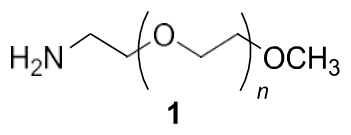
In this first part, we will study the water soluble homopolymer 1 (α-methoxy-ω-aminopolyethyleneglycol). The \({}^{1}\ce{H}\) NMR spectrum of 1 (DMSO-\(d_6\), 60 °C, 500 MHz) includes the following signals:
| Index | δ (ppm) | Peak Area |
|---|---|---|
| a | 2.7* | 0.6 |
| b | 3.3 | 0.9 |
| c | 3.4 | 0.6 |
| d | \(\sim 3.5\) | 133.7 |
Table 1, *in the presence of \(\ce{D2O}\), the signal at 2.7 ppm disappears.
6.1 Match the \({}^{1}\ce{H}\) NMR signals (a, b, c, d) from Table 1 with each of the corresponding protons.
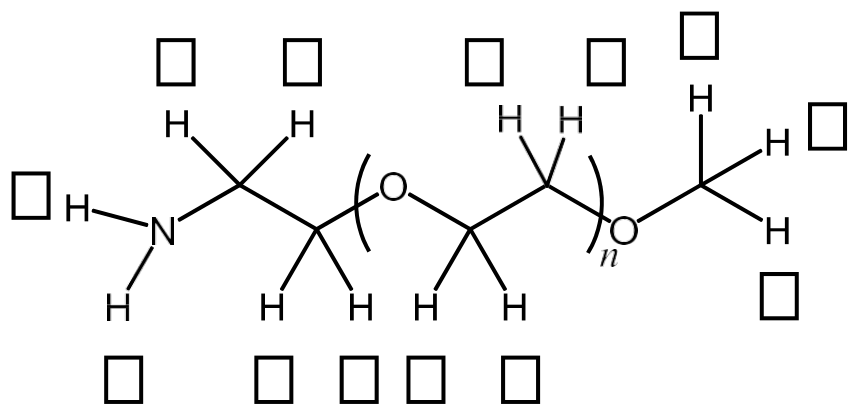
6.2 Express the average degree of polymerization \(n\) as a function of the area \(A_{\ce{OC2H4}}\) of the NMR peak of the repeating unit and the area \(A_{\ce{OCH3}}\) of the NMR peak of the methyl end group. Calculate \(n\).
Study of a diblock-copolymer
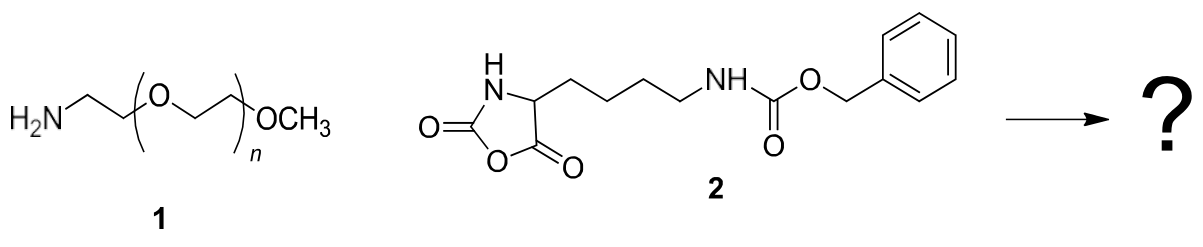
The synthesis of the second block of the copolymer is performed through the reaction of 1 with 2 (ε- (benzyloxycarbonyl)-lysine N-carboxyanhydride).
This yields the block-copolymer 3.
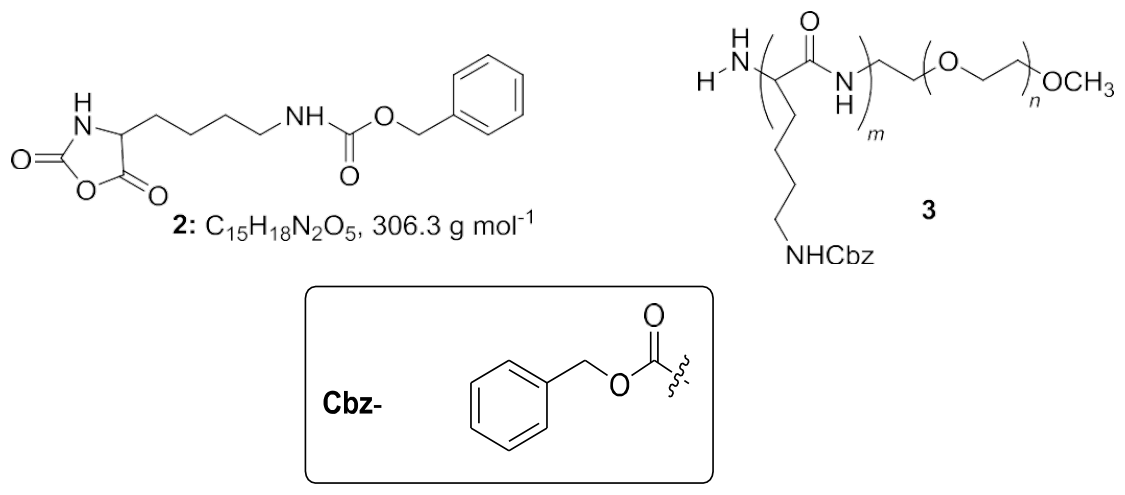
6.3 Draw the reaction intermediate that is formed in the first step of the addition of 1 to 2. The second step of the mechanism leads to the formation of a gas molecule, G. Draw its structure.
6.4 Infrared (IR) measurements are performed to characterize the compounds. Match the three IR spectra with compounds 1, 2 and 3.
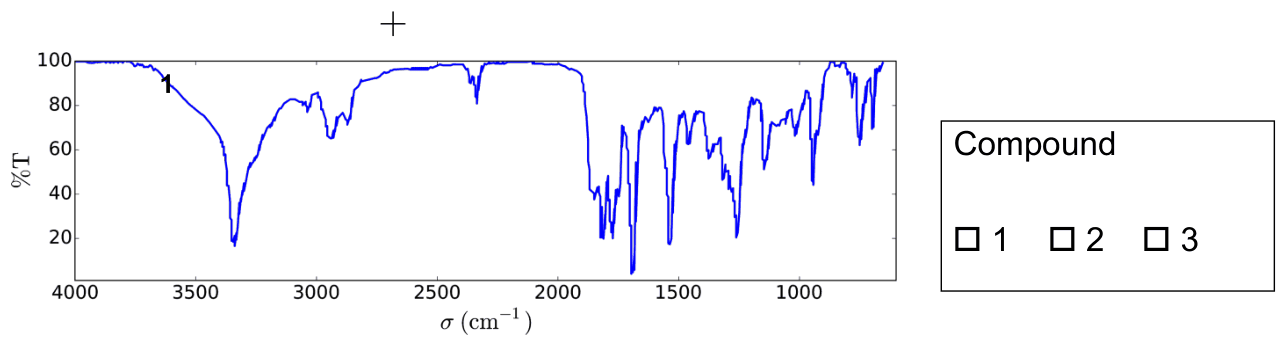
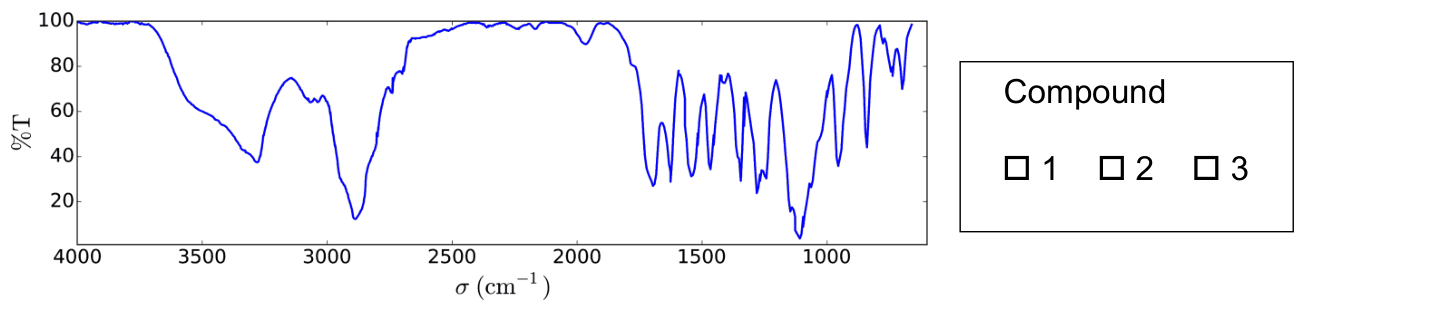
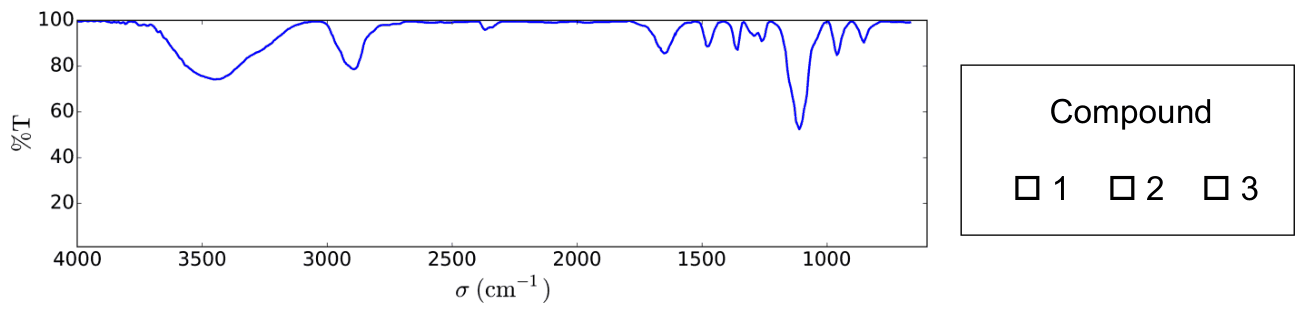
6.5 The \({}^{1}\ce{H}\) NMR spectrum of copolymer 3 (in DMSO-\(d_6\), at 60 °C, 500 MHz) is reported in Fig. 1. Using some or all of the NMR signals, the areas of which are reported in Table 2, calculate its number average molar mass \(M_n\), considering \(n\) from question 2. For your calculations, draw a circle around the group(s) of atoms you used and give their corresponding symbol(s) (α, β…).
Table 2
| Peak | Area |
|---|---|
| α | 22.4 |
| β | 119 |
| γ | 23.8 |
| δ | 47.6 |
| ε | 622 |
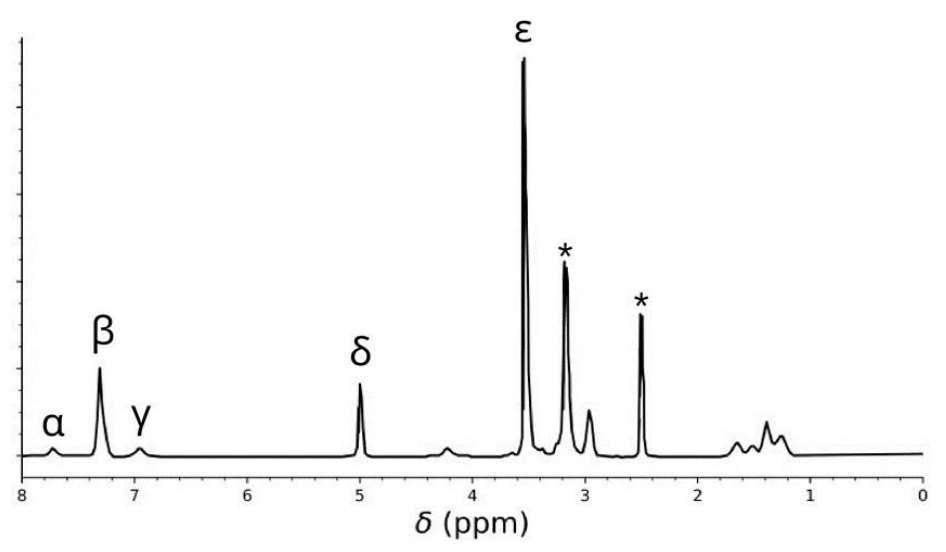
Fig. 1 – signals marked with * correspond to the solvent and water.
This reaction of 1 with 2 yielded the copolymers 3a after 20 h, 3b after 25 h and 3c after 30 h of reaction at 40 °C. Results of size-exclusion chromatography (SEC) experiments are presented in Fig. 2.
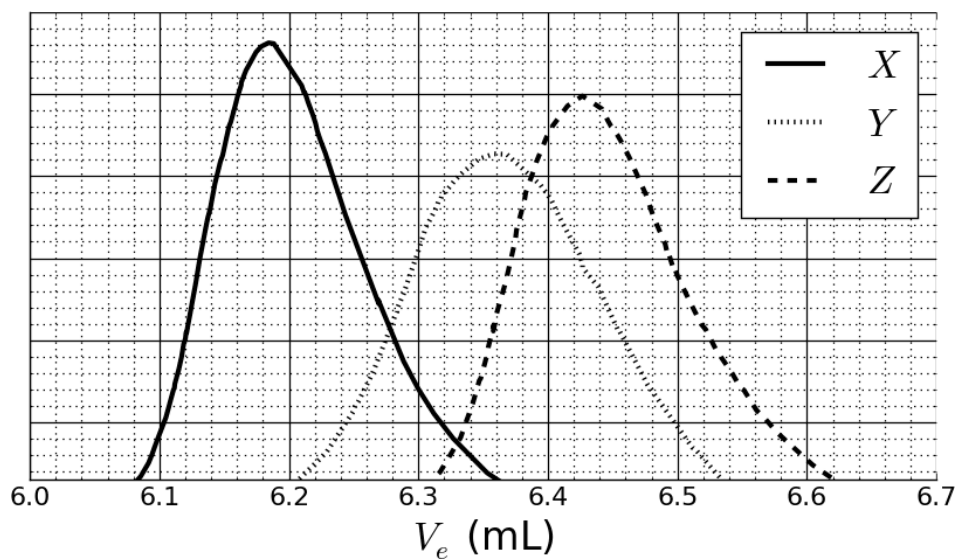
Fig. 2 – SEC chromatograms of 3a, 3b and 3c as a function of the elution volume, \(V_e\).
6.6 Match the signals in Fig. 2 with the copolymers 3a, 3b and 3c.
3a: ☐ X ☐ Y ☐ Z
3b: ☐ X ☐ Y ☐ Z
3c: ☐ X ☐ Y ☐ Z
In order to calibrate the chromatogram, a mixture of standard polymers of known masses (3, 30, 130, 700 and 7000 kg mol\(^{-1}\)) has been studied (Fig. 3).
The log value of the molar mass is a linear function of the elution volume, \(V_e\).
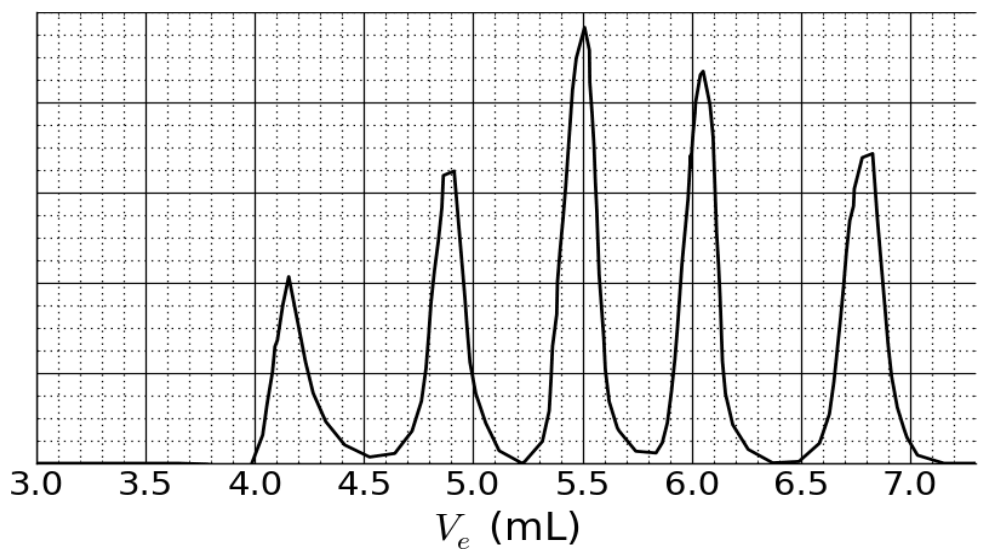
Fig. 3 – SEC chromatogram of the mixture of standards.
6.7 Based on the SEC curves in Fig. 2 and 3, determine \(V_e\) of the polymer that corresponds to curve X and use it to estimate the degree of polymerization \(m\) of its second block. Detail your calculation; you may use a calculator or plot a graph.
Triblock copolymer synthesis
For biological applications, involving the formation of micelles, a triblock copolymer 9 can be synthesized through the introduction of a middle block, B, using monomer 5.
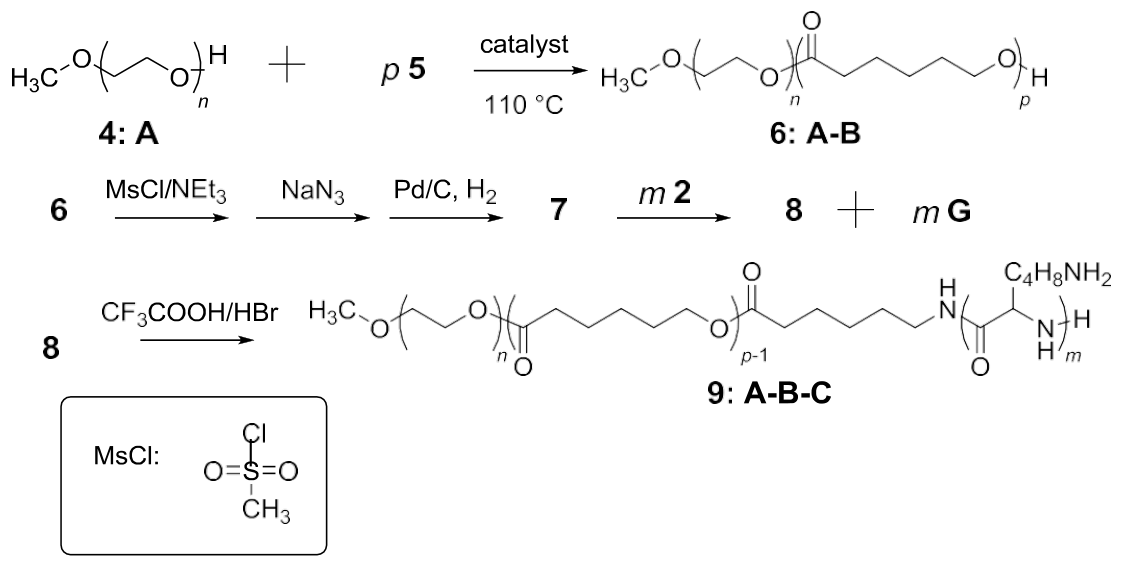
6.8 Draw the structures of 5, 7 and 8.
6.9 Amphiphilic block copolymers, such as 9: A-B-C, can be used for medical applications, as they self-assemble into micelles in water (pH = 7), which can be used as drug carriers. Assign each block of the copolymer to a property. Draw a scheme of the micelle with only 4 polymer chains.
Official English text of the problem.
Answers
In the structural fragments below, [*] denotes the remainder of the chain, defined explicitly in the solution.
- 6.1: a: both amino protons; b: the three methoxy protons; c: the two protons on the carbon directly bonded to the amino nitrogen; d: all remaining methylene protons.
- 6.2: Using the entire observed peak d, \[ \boxed{n=\frac{3A_{\ce{OC2H4}}}{4A_{\ce{OCH3}}}-\frac12 =110.9\approx111.} \]
- 6.3: The ring-opened intermediate is the \(N^\alpha\)-carbamic acid adduct,
O=C(O)NC(CCCCNC(=O)OCc1ccccc1)C(=O)N[*]. It loses carbon dioxide, \(G=\ce{CO2}\),O=C=O. - 6.4: The three spectra, in reading order, correspond to \[ \boxed{2,\quad3,\quad1.} \]
- 6.5: The protected lysine block contains approximately \(17\) residues: \[ \boxed{M_n(3)\approx9.4\times10^3\ \mathrm{g\,mol^{-1}}.} \] Use β, the Cbz phenyl protons, and ε, the PEG methylene protons; δ, the Cbz benzylic methylene, gives the same result.
- 6.6: \(\boxed{\mathbf{3a}=Z,\quad\mathbf{3b}=Y,\quad\mathbf{3c}=X.}\)
- 6.7: \(\boxed{V_e(X)\approx6.18\ \mathrm{mL}}\), giving \(M_X\approx1.9\times10^4\ \mathrm{g\,mol^{-1}}\) and \(\boxed{m\approx52}\), approximately.
- 6.8: 5: ε-caprolactone,
O=C1OCCCCC1. 7: amino-terminated PEG–poly(ε-caprolactone), ending in[*]C(=O)CCCCCN. 8: PEG–poly(ε-caprolactone)–poly(\(N^\varepsilon\)-Cbz-lysine), formed by adding \(m\) protected lysine residues to the terminal nitrogen of 7; its peptide repeat is[*]C(=O)C(CCCCNC(=O)OCc1ccccc1)N[*]. - 6.9: A: neutral hydrophilic PEG. B: hydrophobic poly(ε-caprolactone). C: hydrophilic, positively charged polylysine. Draw four B segments gathered into the micelle core, with four A arms and four C arms extending into water.
Solution
For variable-length polymers, a single ordinary SMILES cannot specify the whole distribution. Below, a SMILES construction means concatenating the stated strings, repeating a fragment the specified integer number of times. The accompanying formulas define the connectivity and average repeat counts.
The supplied structures do not specify absolute stereochemistry at the lysine α-carbons. Accordingly, the SMILES leave these stereocentres unspecified; the reactions shown retain their configuration.
6.1 — Assignment of the proton signals
Compound 1, α-methoxy-ω-aminopolyethyleneglycol, has the connectivity
\[ \ce{H2N-CH2-CH2-(OCH2CH2)_n-OCH3}. \]
Its SMILES construction is CO + \(n\) copies of CCO + CCN, reading from the methoxy end.
| Signal | Assignment | Number of protons per chain | Reason |
|---|---|---|---|
| a, 2.7 ppm | Terminal \(\ce{NH2}\) | 2 | These exchangeable protons disappear after addition of deuterium oxide. |
| b, 3.3 ppm | Terminal \(\ce{OCH3}\) | 3 | Its integral is \(3/2\) times either two-proton end-group integral. |
| c, 3.4 ppm | \(\ce{NH2-CH2}\) | 2 | This is the remaining distinct two-proton terminal methylene. |
| d, approximately 3.5 ppm | All other methylenes | \(4n+2\) | These are the oxygen-adjacent methylene protons of the PEG chain. |
For the requested drawing, put a in both boxes beside nitrogen-bound hydrogens, b in all three boxes beside the terminal methyl hydrogens, c in both boxes on the methylene directly bonded to nitrogen, and d in every other methylene-proton box.
Deuterium oxide is heavy water, SMILES [2H]O[2H]; replacement of amino hydrogen by deuterium removes those nuclei from the proton NMR spectrum.
6.2 — Degree of polymerization of the first block
Let \(q\) be the integral corresponding to one proton per chain. The methoxy group gives
\[ A_{\ce{OCH3}}=3q. \]
The drawn structure contains one oxygen-adjacent terminal methylene outside the brackets, in addition to the \(n\) oxyethylene units. Therefore, the complete peak d has
\[ A_d=(4n+2)q. \]
Consequently,
\[ \frac{A_d}{A_{\ce{OCH3}}}=\frac{4n+2}{3}, \]
and
\[ \boxed{ n=\frac14\left(\frac{3A_d}{A_{\ce{OCH3}}}-2\right) }. \]
Numerically,
\[ n=\frac14\left(\frac{3(133.7)}{0.9}-2\right) =110.9167\approx111. \]
If \(A_{\ce{OC2H4}}\) means an integral already corrected to contain only the bracketed repeats, then
\[ A_{\ce{OC2H4}}^{\mathrm{repeat}} =A_d-\frac23A_{\ce{OCH3}}, \qquad n=\frac{3A_{\ce{OC2H4}}^{\mathrm{repeat}}} {4A_{\ce{OCH3}}}. \]
Thus the familiar repeat-to-end-group ratio and the end-corrected expression are consistent.
6.3 — Ring opening and release of gas
Define
\[ P=\ce{CH2CH2(OCH2CH2)_nOCH3}, \qquad R=\ce{(CH2)4NH-C(=O)-O-CH2-C6H5}. \]
The initiating amine is therefore \(\ce{P-NH2}\). The benzyloxycarbonyl, or Cbz, protecting group has attachment-fragment SMILES [*]C(=O)OCc1ccccc1.
Compound 2, \(N^\varepsilon\)-Cbz-lysine \(N\)-carboxyanhydride, has SMILES:
O=C1OC(=O)C(CCCCNC(=O)OCc2ccccc2)N1
The amine attacks the carbonyl derived from the amino acid’s carboxyl group—the ring carbonyl adjacent to the α-carbon. The carbonyl π electrons move to oxygen.
At elementary-step resolution, the immediate zwitterionic tetrahedral addition intermediate is:
O=C1OC([O-])([NH2+][*])C(CCCCNC(=O)OCc2ccccc2)N1
Here [*] is \(P\). To draw it, retain the five-membered ring, replace the attacked carbonyl by a tetrahedral carbon bearing \(\ce{O-}\), and attach the attacking \(\ce{NH2^{+}-P}\) group to that carbon.
Collapse of this intermediate breaks the ring’s acyl–oxygen bond. Proton transfer gives the ring-opened \(N^\alpha\)-carbamic acid adduct:
\[ \ce{P-NH-C(=O)-CH(R)-NH-C(=O)-OH}. \]
Its SMILES is:
O=C(O)NC(CCCCNC(=O)OCc1ccccc1)C(=O)N[*]
This is the intermediate immediately preceding the gas-producing step. Its formation and decomposition can be written as
\[ \ce{P-NH2 + NCA(R) -> P-NH-C(=O)-CH(R)-NH-C(=O)-OH}, \]
\[ \ce{P-NH-C(=O)-CH(R)-NH-C(=O)-OH -> P-NH-C(=O)-CH(R)-NH2 + CO2}, \]
where \(\ce{NCA(R)}\) denotes monomer 2.
The first insertion product, the PEG amide of \(N^\varepsilon\)-Cbz-lysine, has SMILES:
NC(CCCCNC(=O)OCc1ccccc1)C(=O)N[*]
Its newly formed amino group can attack another monomer, propagating the peptide block. One molecule of gas is released per incorporated monomer.
Thus G is carbon dioxide, \(\ce{CO2}\), SMILES O=C=O. Draw it as a linear molecule with an \(\ce{O-C-O}\) angle of \(180^\circ\).
The overall polymerization is
\[ \ce{P-NH2 + m NCA(R) -> H2N-[CH(R)-C(=O)-NH]_m-P + m CO2}. \]
6.4 — Identification of the IR spectra
| Spectrum in reading order | Compound | Diagnostic features |
|---|---|---|
| First spectrum | 2 | Strong high-frequency carbonyl bands of the cyclic anhydride, approximately in the \(1850\)–\(1780\ \mathrm{cm^{-1}}\) region, together with the Cbz carbamate carbonyl. |
| Second spectrum | 3 | Peptide/carbamate carbonyl and amide bands, together with strong PEG ether absorption near \(1100\ \mathrm{cm^{-1}}\). |
| Third spectrum | 1 | Strong ether absorption and amino-group absorption, but no strong carbonyl band. |
Ring opening consumes the cyclic anhydride functionality of 2 and creates peptide amide linkages in 3. Compound 1 contains no carbonyl groups.
6.5 — Number-average molar mass from NMR
Compound 3 is PEG–block–poly(\(N^\varepsilon\)-Cbz-lysine). Its SMILES is obtained by appending \(m\) copies of
C(=O)C(CCCCNC(=O)OCc1ccccc1)N
to the SMILES construction for compound 1.
The following nonexchangeable signals are sufficient:
| Signal | Group | Proton count per chain |
|---|---|---|
| β, approximately 7.3 ppm | Cbz phenyl groups | \(5m\) |
| δ, approximately 5.0 ppm | Cbz benzylic \(\ce{OCH2C6H5}\) groups | \(2m\) |
| ε, approximately 3.5 ppm | PEG oxygen-adjacent methylenes | \(4n+2\) |
The two Cbz signals agree exactly after normalization:
\[ \frac{A_\beta}{5}=\frac{119}{5}=23.8, \qquad \frac{A_\delta}{2}=\frac{47.6}{2}=23.8. \]
Using \(n\approx111\),
\[ m= \frac{A_\beta/5}{A_\epsilon/(4n+2)} = \frac{119/5}{622/446} =17.07\approx17. \]
Using only the bracketed PEG repeats and neglecting the two terminal methylene protons would give \(m=16.99\), with the same reported result.
For the requested circles, mark the Cbz phenyl rings and their five aromatic hydrogens as β and the PEG methylene groups contributing to the 3.5 ppm signal as ε. The Cbz benzylic methylene groups may additionally be circled and labelled δ.
The molecular formula of initiator 1 is
\[ \ce{C_{2n+3}H_{4n+9}NO_{n+1}}, \]
so its molar mass is
\[ M(1)=nM(\ce{C2H4O})+M(\ce{C3H9NO}) \approx44.05n+75.11. \]
At \(n=111\),
\[ M(1)\approx4965\ \mathrm{g\,mol^{-1}}. \]
Each incorporated monomer loses one carbon dioxide molecule. The protected lysine residue therefore has formula \(\ce{C14H18N2O3}\) and molar mass
\[ M_{\mathrm{residue}} =M(2)-M(\ce{CO2}) =306.3-44.0 =262.3\ \mathrm{g\,mol^{-1}}. \]
Hence
\[ M_n(3)=M(1)+mM_{\mathrm{residue}}, \]
\[ M_n(3)\approx4965+17.07(262.3) \approx9.44\times10^3\ \mathrm{g\,mol^{-1}}. \]
To an appropriate precision,
\[ \boxed{M_n(3)\approx9.4\ \mathrm{kg\,mol^{-1}}.} \]
6.6 — Assignment of the SEC curves
In size-exclusion chromatography, larger polymer coils enter fewer pores and elute at smaller volumes.
As polymerization proceeds, the second block grows. Thus, under the stated comparison,
\[ M(\mathbf{3c})>M(\mathbf{3b})>M(\mathbf{3a}), \]
and the elution volumes have the reverse order.
Since X elutes first, Y next and Z last,
\[ \boxed{ \mathbf{3a}=Z,\qquad \mathbf{3b}=Y,\qquad \mathbf{3c}=X. } \]
6.7 — SEC estimate of the second-block length
The maximum of curve X is approximately
\[ \boxed{V_e(X)\approx6.18\ \mathrm{mL}.} \]
Assign the standards from largest mass at the smallest elution volume to smallest mass at the largest volume. Approximate readings from Fig. 3 are:
| \(V_e\) / mL | \(M\) / \(\mathrm{kg\,mol^{-1}}\) |
|---|---|
| 4.15 | 7000 |
| 4.90 | 700 |
| 5.50 | 130 |
| 6.05 | 30 |
| 6.80 | 3 |
A linear fit to these five points gives
\[ \log_{10}\!\left( \frac{M}{\mathrm{kg\,mol^{-1}}} \right) \approx 9.046-1.258\frac{V_e}{\mathrm{mL}}. \]
At \(V_e=6.18\ \mathrm{mL}\),
\[ M_X\approx10^{9.046-1.258(6.18)} \approx18.7\ \mathrm{kg\,mol^{-1}}. \]
Subtracting the PEG initiator contribution and dividing by the protected lysine residue mass gives
\[ m_X= \frac{M_X-M(1)}{M_{\mathrm{residue}}}, \]
\[ m_X\approx \frac{18\,700-4965}{262.3} \approx52. \]
Thus
\[ \boxed{m_X\approx5.2\times10^1.} \]
This is a graph-based estimate associated with the SEC peak. Its precision is lower than the displayed intermediate calculation digits suggest.
6.8 — Structures of 5, 7 and 8
Compound 5 is ε-caprolactone, also called oxepan-2-one:
O=C1OCCCCC1
Draw a seven-membered cyclic ester containing one carbonyl carbon, one ring oxygen and five methylene carbons. Its ring-opening polymerization gives the polyester block
\[ \ce{[-C(=O)-(CH2)5-O-]_p}. \]
The lactone is incorporated without loss of a small molecule:
\[ \ce{CH3O(CH2CH2O)_nH + p C6H10O2 -> CH3O(CH2CH2O)_n[C(=O)(CH2)5O]_pH}. \]
This is the reaction of 4 with \(p\) molecules of 5 to form 6.
For concise structural formulas, define
\[ T= \ce{CH3O(CH2CH2O)_n [C(=O)(CH2)5O]_{p-1} C(=O)(CH2)5}. \]
Then compound 6 is \(\ce{T-OH}\).
Compound 7 is the corresponding amino-terminated PEG–poly(ε-caprolactone):
\[ \boxed{ \ce{CH3O(CH2CH2O)_n [C(=O)(CH2)5O]_{p-1} C(=O)(CH2)5NH2} }. \]
Its SMILES construction is:
CO;- followed by \(n\) copies of
CCO; - followed by \(p-1\) copies of
C(=O)CCCCCO; - followed by
C(=O)CCCCCN.
The three transformations replace the terminal hydroxyl group by an amino group.
First, mesylation activates the alcohol:
\[ \ce{T-OH + CH3SO2Cl + N(C2H5)3 -> T-O-S(=O)2-CH3 + [HN(C2H5)3]+ + Cl-}. \]
Then azide displaces methanesulfonate:
\[ \ce{T-O-S(=O)2-CH3 + NaN3 -> T-N3 + NaO-S(=O)2-CH3}. \]
Finally, catalytic hydrogenation reduces the organic azide:
\[ \ce{T-N3 + H2 ->[Pd/C] T-NH2 + N2}. \]
The relevant species and their SMILES are:
| Species | SMILES |
|---|---|
| Methanesulfonyl chloride | CS(=O)(=O)Cl |
| Triethylamine | CCN(CC)CC |
| Triethylammonium chloride | CC[NH+](CC)CC.[Cl-] |
Polymer methanesulfonate, with [*] = \(T\) |
[*]OS(=O)(=O)C |
| Sodium azide | [Na+].[N-]=[N+]=[N-] |
Polymer azide, with [*] = \(T\) |
[*]N=[N+]=[N-] |
| Sodium methanesulfonate | [Na+].CS(=O)(=O)[O-] |
| Hydrogen | [H][H] |
| Nitrogen | N#N |
Compound 8 is PEG–poly(ε-caprolactone)–poly(\(N^\varepsilon\)-Cbz-lysine):
\[ \boxed{ \ce{T-NH-[C(=O)-CH(R)-NH]_m-H} }, \qquad R=\ce{(CH2)4NH-C(=O)-O-CH2-C6H5}. \]
Its SMILES construction is the complete construction for 7 followed by \(m\) copies of
C(=O)C(CCCCNC(=O)OCc1ccccc1)N
Thus the terminal nitrogen of 7 becomes the amide nitrogen joining blocks B and C. The far end of the peptide block remains an amino group.
The balanced propagation reaction is
\[ \ce{T-NH2 + m NCA(R) -> T-NH-[C(=O)-CH(R)-NH]_m-H + m CO2}. \]
To draw 8, take structure 9 from the question and replace every lysine side-chain \(\ce{NH2}\) by
\[ \ce{NH-C(=O)-O-CH2-C6H5}. \]
The final acid treatment removes these Cbz groups. Written for the neutral amine groups shown in structure 9, the protecting-group cleavage balance is
\[ \ce{R'-NH-C(=O)-O-CH2-C6H5 + HBr -> R'-NH2 + CO2 + C6H5CH2Br}. \]
Hydrogen bromide has SMILES Br; the acidic solvent, trifluoroacetic acid, is O=C(O)C(F)(F)F; the benzyl bromide by-product is BrCc1ccccc1. In the acidic reaction mixture, the liberated amines are protonated by additional acid.
The neutral connectivity of 9, PEG–poly(ε-caprolactone)–polylysine, is obtained by appending \(m\) copies of
C(=O)C(CCCCN)N
to the construction for 7.
6.9 — Block properties and the four-chain micelle
| Block | Chemical identity | Representative repeat SMILES | Property at pH 7 |
|---|---|---|---|
| A | Polyethylene glycol | [*]CCO[*] |
Hydrophilic and electrically neutral |
| B | Poly(ε-caprolactone) | [*]C(=O)CCCCCO[*] |
Hydrophobic and electrically neutral |
| C | Polylysine | [*]C(=O)C(CCCC[NH3+])N[*] |
Hydrophilic and positively charged |
PEG is hydrated through its ether oxygens. The caprolactone block contains long methylene sequences and favors the hydrophobic micelle core. The lysine side-chain amino groups are predominantly protonated at pH 7, giving \(\ce{-NH3+}\) groups and a hydrated, cationic block. The free terminal amino group can also be protonated.
For the requested four-chain micelle, draw the following arrangement:
- Draw a circle representing the hydrophobic core.
- Place exactly four folded B segments inside it, labelled \(B_1\) through \(B_4\).
- For each chain \(i\), place both its A–B and B–C junctions near the core surface.
- Extend one hydrated \(A_i\) arm and one positively charged \(C_i\) arm outward into water.
Each continuous chain therefore runs from an external A arm, through a buried B segment, and back out through an external C arm. The drawing contains four B segments in the core and eight hydrophilic exterior arms: four A and four C. Mark positive charges along the C arms.
SMILES describes each chain’s covalent connectivity; it does not represent this folded conformation or the noncovalent micelle assembly.
The solution was checked against the official solution. Where this solution differs from the official solution, the official solution contains an error or a misprint.
IChO 2019 · Theorieaufgabe 6
Charakterisierung eines Blockcopolymers
Blockcopolymere, die durch die Verknüpfung verschiedener Polymere (Blöcke) erhalten werden, besitzen besondere Eigenschaften, beispielsweise die Fähigkeit zur Selbstorganisation. In dieser Aufgabe werden die Synthese und Charakterisierung solcher Makromoleküle untersucht.
Untersuchung des ersten Blocks
In diesem ersten Teil untersuchen wir das wasserlösliche Homopolymer 1 (α-Methoxy-ω-aminopolyethylenglykol). Das \({}^{1}\ce{H}\)-NMR-Spektrum von 1 (DMSO-\(d_6\), 60 °C, 500 MHz) enthält die folgenden Signale:
| Index | δ (ppm) | Peakfläche |
|---|---|---|
| a | 2.7* | 0.6 |
| b | 3.3 | 0.9 |
| c | 3.4 | 0.6 |
| d | \(\sim 3.5\) | 133.7 |
Tabelle 1, *in Gegenwart von \(\ce{D2O}\) verschwindet das Signal bei 2.7 ppm.
6.1 Ordnen Sie die \({}^{1}\ce{H}\)-NMR-Signale (a, b, c, d) aus Tabelle 1 den jeweils entsprechenden Protonen zu.
6.2 Drücken Sie den mittleren Polymerisationsgrad \(n\) als Funktion der Fläche \(A_{\ce{OC2H4}}\) des NMR-Peaks der Wiederholungseinheit und der Fläche \(A_{\ce{OCH3}}\) des NMR-Peaks der Methylendgruppe aus. Berechnen Sie \(n\).
Untersuchung eines Diblockcopolymers
Die Synthese des zweiten Blocks des Copolymers erfolgt durch die Reaktion von 1 mit 2 (ε-(Benzyloxycarbonyl)-lysin-N-carboxyanhydrid).
Dabei entsteht das Blockcopolymer 3.
6.3 Zeichnen Sie das Reaktionsintermediat, das im ersten Schritt der Addition von 1 an 2 gebildet wird. Der zweite Schritt des Mechanismus führt zur Bildung eines Gasmoleküls, G. Zeichnen Sie dessen Struktur.
6.4 Zur Charakterisierung der Verbindungen werden Infrarotmessungen (IR) durchgeführt. Ordnen Sie die drei IR-Spektren den Verbindungen 1, 2 und 3 zu.
6.5 Das \({}^{1}\ce{H}\)-NMR-Spektrum des Copolymers 3 (in DMSO-\(d_6\), bei 60 °C, 500 MHz) ist in Abb. 1 dargestellt. Berechnen Sie mithilfe einiger oder aller NMR-Signale, deren Flächen in Tabelle 2 angegeben sind, seine zahlenmittlere molare Masse \(M_n\). Verwenden Sie dabei \(n\) aus Frage 2. Kreisen Sie die Atomgruppe(n) ein, die Sie für Ihre Berechnungen verwendet haben, und geben Sie die zugehörigen Symbole (α, β…) an.
Tabelle 2
| Peak | Fläche |
|---|---|
| α | 22.4 |
| β | 119 |
| γ | 23.8 |
| δ | 47.6 |
| ε | 622 |
Abb. 1 – Die mit * gekennzeichneten Signale stammen vom Lösungsmittel und von Wasser.
Diese Reaktion von 1 mit 2 lieferte bei 40 °C die Copolymere 3a nach 20 h, 3b nach 25 h und 3c nach 30 h Reaktionszeit. Die Ergebnisse von Untersuchungen mittels Größenausschlusschromatographie (SEC) sind in Abb. 2 dargestellt.
Abb. 2 – SEC-Chromatogramme von 3a, 3b und 3c als Funktion des Elutionsvolumens \(V_e\).
6.6 Ordnen Sie die Signale in Abb. 2 den Copolymeren 3a, 3b und 3c zu.
3a: ☐ X ☐ Y ☐ Z
3b: ☐ X ☐ Y ☐ Z
3c: ☐ X ☐ Y ☐ Z
Zur Kalibrierung des Chromatogramms wurde eine Mischung von Standardpolymeren mit bekannten molaren Massen (3, 30, 130, 700 und 7000 kg mol\(^{-1}\)) untersucht (Abb. 3).
Der Logarithmus der molaren Masse ist eine lineare Funktion des Elutionsvolumens \(V_e\).
Abb. 3 – SEC-Chromatogramm der Mischung der Standards.
6.7 Bestimmen Sie anhand der SEC-Kurven in Abb. 2 und 3 das \(V_e\) des Polymers, das Kurve X entspricht, und schätzen Sie damit den Polymerisationsgrad \(m\) seines zweiten Blocks ab. Erläutern Sie Ihre Berechnung ausführlich; Sie dürfen einen Taschenrechner verwenden oder ein Diagramm zeichnen.
Synthese eines Triblockcopolymers
Für biologische Anwendungen, bei denen Mizellen gebildet werden, kann ein Triblockcopolymer 9 durch Einführen eines mittleren Blocks B unter Verwendung des Monomers 5 synthetisiert werden.
6.8 Zeichnen Sie die Strukturen von 5, 7 und 8.
6.9 Amphiphile Blockcopolymere wie 9: A-B-C können für medizinische Anwendungen eingesetzt werden, da sie sich in Wasser (pH = 7) selbst zu Mizellen organisieren, die als Wirkstoffträger dienen können. Ordnen Sie jedem Block des Copolymers eine Eigenschaft zu. Zeichnen Sie ein Schema der Mizelle mit nur 4 Polymerketten.
Aufgabentext aus dem offiziellen englischen Text übersetzt.
Antworten
In den folgenden Strukturfragmenten bezeichnet [*] den Rest der Kette, der in der Lösung ausdrücklich definiert wird.
- 6.1: a: beide Aminoprotonen; b: die drei Methoxyprotonen; c: die beiden Protonen am Kohlenstoffatom, das direkt an den Aminostickstoff gebunden ist; d: alle übrigen Methylenprotonen.
- 6.2: Unter Verwendung des gesamten beobachteten Peaks d: \[ \boxed{n=\frac{3A_{\ce{OC2H4}}}{4A_{\ce{OCH3}}}-\frac12 =110.9\approx111.} \]
- 6.3: Das ringgeöffnete Intermediat ist das \(N^\alpha\)-Carbaminsäureaddukt,
O=C(O)NC(CCCCNC(=O)OCc1ccccc1)C(=O)N[*]. Es spaltet Kohlenstoffdioxid, \(G=\ce{CO2}\),O=C=O, ab. - 6.4: Die drei Spektren entsprechen in Leserichtung \[ \boxed{2,\quad3,\quad1.} \]
- 6.5: Der geschützte Lysinblock enthält ungefähr \(17\) Reste: \[ \boxed{M_n(3)\approx9.4\times10^3\ \mathrm{g\,mol^{-1}}.} \] Verwenden Sie β, die Cbz-Phenylprotonen, und ε, die PEG-Methylenprotonen; δ, die benzylische Cbz-Methylengruppe, liefert dasselbe Ergebnis.
- 6.6: \(\boxed{\mathbf{3a}=Z,\quad\mathbf{3b}=Y,\quad\mathbf{3c}=X.}\)
- 6.7: \(\boxed{V_e(X)\approx6.18\ \mathrm{mL}}\); daraus ergeben sich näherungsweise \(M_X\approx1.9\times10^4\ \mathrm{g\,mol^{-1}}\) und \(\boxed{m\approx52}\).
- 6.8: 5: ε-Caprolacton,
O=C1OCCCCC1. 7: aminoterminiertes PEG–Poly(ε-caprolacton), das auf[*]C(=O)CCCCCNendet. 8: PEG–Poly(ε-caprolacton)–Poly(\(N^\varepsilon\)-Cbz-lysin), das durch Anlagerung von \(m\) geschützten Lysinresten an den terminalen Stickstoff von 7 gebildet wird; seine Peptid-Wiederholungseinheit ist[*]C(=O)C(CCCCNC(=O)OCc1ccccc1)N[*]. - 6.9: A: neutrales hydrophiles PEG. B: hydrophobes Poly(ε-caprolacton). C: hydrophiles, positiv geladenes Polylysin. Zeichnen Sie vier B-Segmente, die im Mizellkern zusammenliegen, mit vier A-Armen und vier C-Armen, die in das Wasser hineinragen.
Lösung
Bei Polymeren mit variabler Kettenlänge kann ein einzelner gewöhnlicher SMILES-Ausdruck nicht die gesamte Verteilung angeben. Im Folgenden bedeutet eine SMILES-Konstruktion, dass die angegebenen Zeichenketten aneinandergefügt werden, wobei ein Fragment so oft wiederholt wird, wie es die angegebene ganze Zahl vorgibt. Die begleitenden Formeln definieren die Verknüpfung und die mittleren Anzahlen der Wiederholungseinheiten.
Die vorgegebenen Strukturen legen die absolute Stereochemie an den α-Kohlenstoffatomen des Lysins nicht fest. Dementsprechend bleibt die Konfiguration dieser Stereozentren in den SMILES-Ausdrücken unspezifiziert; bei den dargestellten Reaktionen bleibt ihre Konfiguration erhalten.
6.1 — Zuordnung der Protonensignale
Verbindung 1, α-Methoxy-ω-aminopolyethylenglykol, besitzt die Verknüpfung
\[ \ce{H2N-CH2-CH2-(OCH2CH2)_n-OCH3}. \]
Ihre SMILES-Konstruktion lautet, vom Methoxyende aus gelesen, CO + \(n\) Kopien von CCO + CCN.
| Signal | Zuordnung | Anzahl der Protonen pro Kette | Begründung |
|---|---|---|---|
| a, 2.7 ppm | Terminale \(\ce{NH2}\)-Gruppe | 2 | Diese austauschbaren Protonen verschwinden nach Zugabe von Deuteriumoxid. |
| b, 3.3 ppm | Terminale \(\ce{OCH3}\)-Gruppe | 3 | Ihr Integral beträgt das \(3/2\)-Fache jedes der beiden Endgruppenintegrale für jeweils zwei Protonen. |
| c, 3.4 ppm | \(\ce{NH2-CH2}\) | 2 | Dies ist die verbleibende unterscheidbare terminale Methylengruppe mit zwei Protonen. |
| d, ungefähr 3.5 ppm | Alle anderen Methylengruppen | \(4n+2\) | Dies sind die Protonen der an Sauerstoff angrenzenden Methylengruppen der PEG-Kette. |
Tragen Sie für die verlangte Zeichnung a in beide Kästchen neben den an Stickstoff gebundenen Wasserstoffatomen ein, b in alle drei Kästchen neben den Wasserstoffatomen der terminalen Methylgruppe, c in beide Kästchen an der direkt an Stickstoff gebundenen Methylengruppe und d in alle übrigen Kästchen für Methylenprotonen.
Deuteriumoxid ist schweres Wasser, SMILES [2H]O[2H]; durch den Austausch der Aminowasserstoffatome gegen Deuterium verschwinden diese Kerne aus dem Protonen-NMR-Spektrum.
6.2 — Polymerisationsgrad des ersten Blocks
Sei \(q\) das Integral, das einem Proton pro Kette entspricht. Für die Methoxygruppe gilt
\[ A_{\ce{OCH3}}=3q. \]
Die gezeichnete Struktur enthält zusätzlich zu den \(n\) Oxyethyleneinheiten eine an Sauerstoff angrenzende terminale Methylengruppe außerhalb der Klammern. Daher gilt für den vollständigen Peak d
\[ A_d=(4n+2)q. \]
Folglich gilt
\[ \frac{A_d}{A_{\ce{OCH3}}}=\frac{4n+2}{3}, \]
und
\[ \boxed{ n=\frac14\left(\frac{3A_d}{A_{\ce{OCH3}}}-2\right) }. \]
Numerisch ergibt sich
\[ n=\frac14\left(\frac{3(133.7)}{0.9}-2\right) =110.9167\approx111. \]
Wenn \(A_{\ce{OC2H4}}\) ein bereits korrigiertes Integral bezeichnet, das nur die Wiederholungseinheiten innerhalb der Klammern umfasst, dann gilt
\[ A_{\ce{OC2H4}}^{\mathrm{repeat}} =A_d-\frac23A_{\ce{OCH3}}, \qquad n=\frac{3A_{\ce{OC2H4}}^{\mathrm{repeat}}} {4A_{\ce{OCH3}}}. \]
Damit sind das bekannte Verhältnis von Wiederholungseinheiten zu Endgruppen und der um den Endgruppenbeitrag korrigierte Ausdruck miteinander vereinbar.
6.3 — Ringöffnung und Gasfreisetzung
Wir definieren
\[ P=\ce{CH2CH2(OCH2CH2)_nOCH3}, \qquad R=\ce{(CH2)4NH-C(=O)-O-CH2-C6H5}. \]
Das initiierende Amin ist somit \(\ce{P-NH2}\). Die Benzyloxycarbonyl-Schutzgruppe, auch Cbz genannt, besitzt als angehängtes Fragment den SMILES-Ausdruck [*]C(=O)OCc1ccccc1.
Verbindung 2, \(N^\varepsilon\)-Cbz-lysin-\(N\)-carboxyanhydrid, besitzt den SMILES-Ausdruck:
O=C1OC(=O)C(CCCCNC(=O)OCc2ccccc2)N1
Das Amin greift die Carbonylgruppe an, die von der Carboxylgruppe der Aminosäure stammt – die Ringcarbonylgruppe neben dem α-Kohlenstoffatom. Die π-Elektronen der Carbonylgruppe werden zum Sauerstoff verschoben.
Bei Betrachtung der einzelnen Elementarschritte ist das unmittelbar entstehende zwitterionische tetraedrische Additionsintermediat:
O=C1OC([O-])([NH2+][*])C(CCCCNC(=O)OCc2ccccc2)N1
Hier steht [*] für \(P\). Behalten Sie beim Zeichnen den fünfgliedrigen Ring bei, ersetzen Sie die angegriffene Carbonylgruppe durch ein tetraedrisches Kohlenstoffatom mit einer \(\ce{O-}\)-Gruppe und binden Sie die angreifende \(\ce{NH2^{+}-P}\)-Gruppe an dieses Kohlenstoffatom.
Beim Zerfall dieses Intermediats wird die Acyl–Sauerstoff-Bindung des Rings gespalten. Durch Protonenübertragung entsteht das ringgeöffnete \(N^\alpha\)-Carbaminsäureaddukt:
\[ \ce{P-NH-C(=O)-CH(R)-NH-C(=O)-OH}. \]
Sein SMILES-Ausdruck lautet:
O=C(O)NC(CCCCNC(=O)OCc1ccccc1)C(=O)N[*]
Dies ist das Intermediat unmittelbar vor dem gasbildenden Schritt. Seine Bildung und Zersetzung lassen sich schreiben als
\[ \ce{P-NH2 + NCA(R) -> P-NH-C(=O)-CH(R)-NH-C(=O)-OH}, \]
\[ \ce{P-NH-C(=O)-CH(R)-NH-C(=O)-OH -> P-NH-C(=O)-CH(R)-NH2 + CO2}, \]
wobei \(\ce{NCA(R)}\) das Monomer 2 bezeichnet.
Das erste Insertionsprodukt, das PEG-Amid von \(N^\varepsilon\)-Cbz-lysin, besitzt den SMILES-Ausdruck:
NC(CCCCNC(=O)OCc1ccccc1)C(=O)N[*]
Seine neu gebildete Aminogruppe kann ein weiteres Monomer angreifen, wodurch der Peptidblock weiterwächst. Pro eingebautem Monomer wird ein Gasmolekül freigesetzt.
Somit ist G Kohlenstoffdioxid, \(\ce{CO2}\), SMILES O=C=O. Zeichnen Sie es als lineares Molekül mit einem \(\ce{O-C-O}\)-Winkel von \(180^\circ\).
Die gesamte Polymerisation lautet
\[ \ce{P-NH2 + m NCA(R) -> H2N-[CH(R)-C(=O)-NH]_m-P + m CO2}. \]
6.4 — Identifizierung der IR-Spektren
| Spektrum in Leserichtung | Verbindung | Charakteristische Merkmale |
|---|---|---|
| Erstes Spektrum | 2 | Starke Carbonylbanden des cyclischen Anhydrids bei hohen Wellenzahlen, ungefähr im Bereich \(1850\)–\(1780\ \mathrm{cm^{-1}}\), zusammen mit der Cbz-Carbamatcarbonylbande. |
| Zweites Spektrum | 3 | Peptid-/Carbamatcarbonyl- und Amidbanden zusammen mit einer starken PEG-Etherabsorption bei etwa \(1100\ \mathrm{cm^{-1}}\). |
| Drittes Spektrum | 1 | Starke Etherabsorption und Aminogruppenabsorption, jedoch keine starke Carbonylbande. |
Durch die Ringöffnung wird die cyclische Anhydridfunktion von 2 verbraucht, und es entstehen Peptidamidbindungen in 3. Verbindung 1 enthält keine Carbonylgruppen.
6.5 — Zahlenmittlere molare Masse aus NMR-Daten
Verbindung 3 ist PEG–block–Poly(\(N^\varepsilon\)-Cbz-lysin). Ihr SMILES-Ausdruck wird erhalten, indem \(m\) Kopien von
C(=O)C(CCCCNC(=O)OCc1ccccc1)N
an die SMILES-Konstruktion für Verbindung 1 angehängt werden.
Die folgenden Signale nicht austauschbarer Protonen sind ausreichend:
| Signal | Gruppe | Protonenzahl pro Kette |
|---|---|---|
| β, ungefähr 7.3 ppm | Cbz-Phenylgruppen | \(5m\) |
| δ, ungefähr 5.0 ppm | Benzylische Cbz-\(\ce{OCH2C6H5}\)-Gruppen | \(2m\) |
| ε, ungefähr 3.5 ppm | An Sauerstoff angrenzende PEG-Methylengruppen | \(4n+2\) |
Die beiden Cbz-Signale stimmen nach Normierung exakt überein:
\[ \frac{A_\beta}{5}=\frac{119}{5}=23.8, \qquad \frac{A_\delta}{2}=\frac{47.6}{2}=23.8. \]
Mit \(n\approx111\) ergibt sich
\[ m= \frac{A_\beta/5}{A_\epsilon/(4n+2)} = \frac{119/5}{622/446} =17.07\approx17. \]
Wenn nur die PEG-Wiederholungseinheiten innerhalb der Klammern verwendet und die beiden terminalen Methylenprotonen vernachlässigt würden, ergäbe sich \(m=16.99\), also dasselbe angegebene Ergebnis.
Kreisen Sie wie verlangt die Cbz-Phenylringe mit ihren fünf aromatischen Wasserstoffatomen ein und kennzeichnen Sie diese mit β; kennzeichnen Sie die PEG-Methylengruppen, die zum Signal bei 3.5 ppm beitragen, mit ε. Die benzylischen Cbz-Methylengruppen können zusätzlich eingekreist und mit δ gekennzeichnet werden.
Die Summenformel des Initiators 1 lautet
\[ \ce{C_{2n+3}H_{4n+9}NO_{n+1}}, \]
sodass für seine molare Masse gilt:
\[ M(1)=nM(\ce{C2H4O})+M(\ce{C3H9NO}) \approx44.05n+75.11. \]
Für \(n=111\) gilt
\[ M(1)\approx4965\ \mathrm{g\,mol^{-1}}. \]
Jedes eingebaute Monomer verliert ein Kohlenstoffdioxidmolekül. Der geschützte Lysinrest besitzt daher die Formel \(\ce{C14H18N2O3}\) und die molare Masse
\[ M_{\mathrm{residue}} =M(2)-M(\ce{CO2}) =306.3-44.0 =262.3\ \mathrm{g\,mol^{-1}}. \]
Damit gilt
\[ M_n(3)=M(1)+mM_{\mathrm{residue}}, \]
\[ M_n(3)\approx4965+17.07(262.3) \approx9.44\times10^3\ \mathrm{g\,mol^{-1}}. \]
Mit angemessener Genauigkeit ergibt sich
\[ \boxed{M_n(3)\approx9.4\ \mathrm{kg\,mol^{-1}}.} \]
6.6 — Zuordnung der SEC-Kurven
Bei der Größenausschlusschromatographie dringen größere Polymerknäuel in weniger Poren ein und eluieren bei kleineren Volumina.
Mit fortschreitender Polymerisation wächst der zweite Block. Unter den angegebenen Vergleichsbedingungen gilt daher
\[ M(\mathbf{3c})>M(\mathbf{3b})>M(\mathbf{3a}), \]
und für die Elutionsvolumina gilt die umgekehrte Reihenfolge.
Da X zuerst, Y danach und Z zuletzt eluiert, gilt
\[ \boxed{ \mathbf{3a}=Z,\qquad \mathbf{3b}=Y,\qquad \mathbf{3c}=X. } \]
6.7 — Abschätzung der Länge des zweiten Blocks mittels SEC
Das Maximum der Kurve X liegt ungefähr bei
\[ \boxed{V_e(X)\approx6.18\ \mathrm{mL}.} \]
Ordnen Sie die Standards von der größten molaren Masse beim kleinsten Elutionsvolumen bis zur kleinsten molaren Masse beim größten Volumen zu. Aus Abb. 3 lassen sich näherungsweise folgende Werte ablesen:
| \(V_e\) / mL | \(M\) / \(\mathrm{kg\,mol^{-1}}\) |
|---|---|
| 4.15 | 7000 |
| 4.90 | 700 |
| 5.50 | 130 |
| 6.05 | 30 |
| 6.80 | 3 |
Eine lineare Anpassung an diese fünf Punkte ergibt
\[ \log_{10}\!\left( \frac{M}{\mathrm{kg\,mol^{-1}}} \right) \approx 9.046-1.258\frac{V_e}{\mathrm{mL}}. \]
Bei \(V_e=6.18\ \mathrm{mL}\) gilt
\[ M_X\approx10^{9.046-1.258(6.18)} \approx18.7\ \mathrm{kg\,mol^{-1}}. \]
Subtraktion des Beitrags des PEG-Initiators und Division durch die molare Masse des geschützten Lysinrests ergeben
\[ m_X= \frac{M_X-M(1)}{M_{\mathrm{residue}}}, \]
\[ m_X\approx \frac{18\,700-4965}{262.3} \approx52. \]
Somit gilt
\[ \boxed{m_X\approx5.2\times10^1.} \]
Dies ist eine auf dem Diagramm beruhende Abschätzung für den SEC-Peak. Ihre Genauigkeit ist geringer, als die angegebenen Ziffern der Zwischenrechnungen vermuten lassen.
6.8 — Strukturen von 5, 7 und 8
Verbindung 5 ist ε-Caprolacton, auch Oxepan-2-on genannt:
O=C1OCCCCC1
Zeichnen Sie einen siebengliedrigen cyclischen Ester mit einem Carbonylkohlenstoffatom, einem Ringsauerstoffatom und fünf Methylenkohlenstoffatomen. Seine ringöffnende Polymerisation ergibt den Polyesterblock
\[ \ce{[-C(=O)-(CH2)5-O-]_p}. \]
Das Lacton wird ohne Abspaltung eines kleinen Moleküls eingebaut:
\[ \ce{CH3O(CH2CH2O)_nH + p C6H10O2 -> CH3O(CH2CH2O)_n[C(=O)(CH2)5O]_pH}. \]
Dies ist die Reaktion von 4 mit \(p\) Molekülen von 5 unter Bildung von 6.
Für eine kompakte Darstellung der Strukturformeln definieren wir
\[ T= \ce{CH3O(CH2CH2O)_n [C(=O)(CH2)5O]_{p-1} C(=O)(CH2)5}. \]
Dann ist Verbindung 6 gleich \(\ce{T-OH}\).
Verbindung 7 ist das entsprechende aminoterminierte PEG–Poly(ε-caprolacton):
\[ \boxed{ \ce{CH3O(CH2CH2O)_n [C(=O)(CH2)5O]_{p-1} C(=O)(CH2)5NH2} }. \]
Ihre SMILES-Konstruktion lautet:
CO;- gefolgt von \(n\) Kopien von
CCO; - gefolgt von \(p-1\) Kopien von
C(=O)CCCCCO; - gefolgt von
C(=O)CCCCCN.
Die drei Umwandlungen ersetzen die terminale Hydroxygruppe durch eine Aminogruppe.
Zunächst aktiviert die Mesylierung den Alkohol:
\[ \ce{T-OH + CH3SO2Cl + N(C2H5)3 -> T-O-S(=O)2-CH3 + [HN(C2H5)3]+ + Cl-}. \]
Anschließend verdrängt Azid das Methansulfonat:
\[ \ce{T-O-S(=O)2-CH3 + NaN3 -> T-N3 + NaO-S(=O)2-CH3}. \]
Schließlich wird das organische Azid durch katalytische Hydrierung reduziert:
\[ \ce{T-N3 + H2 ->[Pd/C] T-NH2 + N2}. \]
Die relevanten Spezies und ihre SMILES-Ausdrücke sind:
| Spezies | SMILES |
|---|---|
| Methansulfonylchlorid | CS(=O)(=O)Cl |
| Triethylamin | CCN(CC)CC |
| Triethylammoniumchlorid | CC[NH+](CC)CC.[Cl-] |
Polymer-Methansulfonat, mit [*] = \(T\) |
[*]OS(=O)(=O)C |
| Natriumazid | [Na+].[N-]=[N+]=[N-] |
Polymer-Azid, mit [*] = \(T\) |
[*]N=[N+]=[N-] |
| Natriummethansulfonat | [Na+].CS(=O)(=O)[O-] |
| Wasserstoff | [H][H] |
| Stickstoff | N#N |
Verbindung 8 ist PEG–Poly(ε-caprolacton)–Poly(\(N^\varepsilon\)-Cbz-lysin):
\[ \boxed{ \ce{T-NH-[C(=O)-CH(R)-NH]_m-H} }, \qquad R=\ce{(CH2)4NH-C(=O)-O-CH2-C6H5}. \]
Ihre SMILES-Konstruktion besteht aus der vollständigen Konstruktion für 7, gefolgt von \(m\) Kopien von
C(=O)C(CCCCNC(=O)OCc1ccccc1)N
Somit wird der terminale Stickstoff von 7 zum Amidstickstoff, der die Blöcke B und C verbindet. Am anderen Ende des Peptidblocks bleibt eine Aminogruppe erhalten.
Die ausgeglichene Reaktionsgleichung für das Kettenwachstum lautet
\[ \ce{T-NH2 + m NCA(R) -> T-NH-[C(=O)-CH(R)-NH]_m-H + m CO2}. \]
Um 8 zu zeichnen, nehmen Sie Struktur 9 aus der Aufgabenstellung und ersetzen Sie jede \(\ce{NH2}\)-Gruppe einer Lysin-Seitenkette durch
\[ \ce{NH-C(=O)-O-CH2-C6H5}. \]
Die abschließende Säurebehandlung entfernt diese Cbz-Gruppen. Für die in Struktur 9 gezeigten neutralen Aminogruppen lautet die Bilanz der Schutzgruppenabspaltung
\[ \ce{R'-NH-C(=O)-O-CH2-C6H5 + HBr -> R'-NH2 + CO2 + C6H5CH2Br}. \]
Bromwasserstoff besitzt den SMILES-Ausdruck Br; das saure Lösungsmittel Trifluoressigsäure hat den Ausdruck O=C(O)C(F)(F)F; das Nebenprodukt Benzylbromid hat den Ausdruck BrCc1ccccc1. Im sauren Reaktionsgemisch werden die freigesetzten Amine durch zusätzliche Säure protoniert.
Die neutrale Verknüpfung von 9, PEG–Poly(ε-caprolacton)–Polylysin, erhält man, indem \(m\) Kopien von
C(=O)C(CCCCN)N
an die Konstruktion für 7 angehängt werden.
6.9 — Eigenschaften der Blöcke und Mizelle aus vier Ketten
| Block | Chemische Identität | Repräsentativer SMILES-Ausdruck der Wiederholungseinheit | Eigenschaft bei pH 7 |
|---|---|---|---|
| A | Polyethylenglykol | [*]CCO[*] |
Hydrophil und elektrisch neutral |
| B | Poly(ε-caprolacton) | [*]C(=O)CCCCCO[*] |
Hydrophob und elektrisch neutral |
| C | Polylysin | [*]C(=O)C(CCCC[NH3+])N[*] |
Hydrophil und positiv geladen |
PEG wird über seine Ethersauerstoffatome hydratisiert. Der Caprolactonblock enthält lange Methylensequenzen und lagert sich bevorzugt im hydrophoben Mizellkern ein. Die Aminogruppen der Lysin-Seitenketten sind bei pH 7 überwiegend protoniert, wodurch \(\ce{-NH3+}\)-Gruppen und ein hydratisierter, kationischer Block entstehen. Die freie terminale Aminogruppe kann ebenfalls protoniert werden.
Zeichnen Sie für die verlangte Mizelle aus vier Ketten die folgende Anordnung:
- Zeichnen Sie einen Kreis, der den hydrophoben Kern darstellt.
- Platzieren Sie genau vier gefaltete B-Segmente darin und beschriften Sie sie mit \(B_1\) bis \(B_4\).
- Platzieren Sie für jede Kette \(i\) sowohl ihre A–B- als auch ihre B–C-Verknüpfungsstelle nahe der Kernoberfläche.
- Lassen Sie einen hydratisierten \(A_i\)-Arm und einen positiv geladenen \(C_i\)-Arm nach außen in das Wasser hineinragen.
Jede durchgehende Kette verläuft somit von einem außen liegenden A-Arm durch ein im Kern verborgenes B-Segment und durch einen außen liegenden C-Arm wieder nach außen. Die Zeichnung enthält vier B-Segmente im Kern und acht hydrophile äußere Arme: vier A und vier C. Markieren Sie positive Ladungen entlang der C-Arme.
SMILES beschreibt die kovalente Verknüpfung jeder Kette; es stellt weder diese gefaltete Konformation noch den nichtkovalenten Mizellverband dar.
Die Lösung wurde mit der offiziellen Lösung abgeglichen. Wo diese Lösung von der offiziellen Lösung abweicht, enthält die offizielle Lösung einen Fehler oder Druckfehler.
IChO 2019 · Teori sorusu 6
Bir blok kopolimerin karakterizasyonu
Farklı polimerlerin (blokların) birbirine bağlanmasıyla elde edilen blok kopolimerler, kendiliğinden bir araya gelme yeteneği gibi benzersiz özelliklere sahiptir. Bu soruda, bu tür makromoleküllerin sentezi ve karakterizasyonu incelenmektedir.
Birinci bloğun incelenmesi
Bu ilk bölümde, suda çözünen homopolimer 1'i (α-metoksi-ω-aminopolietilen glikol) inceleyeceğiz. 1'in \({}^{1}\ce{H}\) NMR spektrumu (DMSO-\(d_6\), 60 °C, 500 MHz) aşağıdaki sinyalleri içerir:
| İndeks | δ (ppm) | Pik Alanı |
|---|---|---|
| a | 2.7* | 0.6 |
| b | 3.3 | 0.9 |
| c | 3.4 | 0.6 |
| d | \(\sim 3.5\) | 133.7 |
Tablo 1, *\(\ce{D2O}\) varlığında 2.7 ppm'deki sinyal kaybolur.
6.1 Tablo 1'deki \({}^{1}\ce{H}\) NMR sinyallerini (a, b, c, d) karşılık geldikleri protonların her biriyle eşleştirin.
6.2 Ortalama polimerleşme derecesi \(n\)'yi, tekrarlanan birimin NMR pikinin alanı \(A_{\ce{OC2H4}}\) ve metil uç grubunun NMR pikinin alanı \(A_{\ce{OCH3}}\) cinsinden ifade edin. \(n\)'yi hesaplayın.
Bir diblok kopolimerin incelenmesi
Kopolimerin ikinci bloğunun sentezi, 1'in 2 (ε-(benziloksikarbonil)-lizin N-karboksianhidrit) ile tepkimesi yoluyla gerçekleştirilir.
Bu tepkime sonucunda blok kopolimer 3 elde edilir.
6.3 1'in 2'ye katılmasının ilk basamağında oluşan tepkime ara ürününü çizin. Mekanizmanın ikinci basamağı bir gaz molekülü olan G'nin oluşumuna yol açar. Bu molekülün yapısını çizin.
6.4 Bileşikleri karakterize etmek için kızılötesi (IR) ölçümleri yapılır. Üç IR spektrumunu 1, 2 ve 3 bileşikleriyle eşleştirin.
6.5 Kopolimer 3'ün \({}^{1}\ce{H}\) NMR spektrumu (DMSO-\(d_6\) içinde, 60 °C'de, 500 MHz) Şekil 1'de verilmiştir. Alanları Tablo 2'de verilen NMR sinyallerinin bir kısmını veya tümünü kullanarak ve 2. sorudaki \(n\) değerini dikkate alarak kopolimerin sayıca ortalama molar kütlesini \(M_n\) hesaplayın. Hesaplamalarınızda kullandığınız atom grubunun (gruplarının) etrafına bir çember çizin ve bunlara karşılık gelen sembolleri (α, β…) belirtin.
Tablo 2
| Pik | Alan |
|---|---|
| α | 22.4 |
| β | 119 |
| γ | 23.8 |
| δ | 47.6 |
| ε | 622 |
Şekil 1 – * ile işaretlenmiş sinyaller çözücüye ve suya karşılık gelir.
1'in 2 ile bu tepkimesi, 40 °C'de 20 saat sonunda kopolimer 3a'yı, 25 saat sonunda 3b'yi ve 30 saat sonunda 3c'yi vermiştir. Boyut dışlama kromatografisi (SEC) deneylerinin sonuçları Şekil 2'de sunulmuştur.
Şekil 2 – Elüsyon hacmi \(V_e\)'nin fonksiyonu olarak 3a, 3b ve 3c'nin SEC kromatogramları.
6.6 Şekil 2'deki sinyalleri 3a, 3b ve 3c kopolimerleriyle eşleştirin.
3a: ☐ X ☐ Y ☐ Z
3b: ☐ X ☐ Y ☐ Z
3c: ☐ X ☐ Y ☐ Z
Kromatogramı kalibre etmek amacıyla, kütleleri bilinen standart polimerlerin (3, 30, 130, 700 ve 7000 kg mol\(^{-1}\)) bir karışımı incelenmiştir (Şekil 3).
Molar kütlenin log değeri, elüsyon hacmi \(V_e\)'nin doğrusal bir fonksiyonudur.
Şekil 3 – Standart karışımının SEC kromatogramı.
6.7 Şekil 2 ve 3'teki SEC eğrilerine dayanarak X eğrisine karşılık gelen polimerin \(V_e\) değerini belirleyin ve bu değeri kullanarak ikinci bloğunun polimerleşme derecesini \(m\) tahmin edin. Hesaplamanızı ayrıntılı olarak gösterin; hesap makinesi kullanabilir veya grafik çizebilirsiniz.
Triblok kopolimer sentezi
Misel oluşumunu içeren biyolojik uygulamalar için, monomer 5 kullanılarak bir orta blok B'nin eklenmesi yoluyla triblok kopolimer 9 sentezlenebilir.
6.8 5, 7 ve 8'in yapılarını çizin.
6.9 9: A-B-C gibi amfifilik blok kopolimerler, suda (pH = 7) kendiliğinden bir araya gelerek ilaç taşıyıcısı olarak kullanılabilen miseller oluşturduklarından tıbbi uygulamalarda kullanılabilir. Kopolimerin her bloğunu bir özellikle eşleştirin. Yalnızca 4 polimer zinciri içeren bir misel şeması çizin.
Soru metni resmi İngilizce metinden çevrilmiştir.
Cevaplar
Aşağıdaki yapı parçalarında [*], çözümde açıkça tanımlanan zincirin geri kalanını gösterir.
- 6.1: a: her iki amino protonu; b: üç metoksi protonu; c: amino azotuna doğrudan bağlı karbondaki iki proton; d: geriye kalan tüm metilen protonları.
- 6.2: Gözlenen d pikinin tamamı kullanıldığında, \[ \boxed{n=\frac{3A_{\ce{OC2H4}}}{4A_{\ce{OCH3}}}-\frac12 =110.9\approx111.} \]
- 6.3: Halkası açılmış ara ürün, \(N^\alpha\)-karbamik asit katılma ürünü,
O=C(O)NC(CCCCNC(=O)OCc1ccccc1)C(=O)N[*]yapısındadır. Karbondioksit, \(G=\ce{CO2}\),O=C=Okaybeder. - 6.4: Üç spektrum, okuma sırasıyla şu bileşiklere karşılık gelir: \[ \boxed{2,\quad3,\quad1.} \]
- 6.5: Korunmuş lizin bloğu yaklaşık \(17\) kalıntı içerir: \[ \boxed{M_n(3)\approx9.4\times10^3\ \mathrm{g\,mol^{-1}}.} \] Cbz fenil protonları olan β'yı ve PEG metilen protonları olan ε'u kullanın; Cbz benzilik metileni olan δ da aynı sonucu verir.
- 6.6: \(\boxed{\mathbf{3a}=Z,\quad\mathbf{3b}=Y,\quad\mathbf{3c}=X.}\)
- 6.7: \(\boxed{V_e(X)\approx6.18\ \mathrm{mL}}\); bu değer yaklaşık olarak \(M_X\approx1.9\times10^4\ \mathrm{g\,mol^{-1}}\) ve \(\boxed{m\approx52}\) verir.
- 6.8: 5: ε-kaprolakton,
O=C1OCCCCC1. 7:[*]C(=O)CCCCCNile sonlanan, amino uçlu PEG–poli(ε-kaprolakton). 8: 7'nin uç azotuna \(m\) korunmuş lizin kalıntısının eklenmesiyle oluşan PEG–poli(ε-kaprolakton)–poli(\(N^\varepsilon\)-Cbz-lizin); peptit tekrar birimi[*]C(=O)C(CCCCNC(=O)OCc1ccccc1)N[*]şeklindedir. - 6.9: A: nötr hidrofilik PEG. B: hidrofobik poli(ε-kaprolakton). C: hidrofilik, pozitif yüklü polilizin. Dört B segmentini misel çekirdeğinde bir araya gelmiş, dört A kolu ve dört C kolunu ise suya doğru uzanmış olarak çizin.
Çözüm
Değişken uzunluktaki polimerlerde tek bir sıradan SMILES, dağılımın tamamını belirtemez. Aşağıda SMILES oluşturma, belirtilen dizelerin, bir parça belirtilen tam sayı kadar tekrarlanarak birleştirilmesi anlamına gelir. Eşlik eden formüller bağlanma düzenini ve ortalama tekrar sayılarını tanımlar.
Verilen yapılar, lizin α-karbonlarındaki mutlak stereokimyayı belirtmemektedir. Bu nedenle SMILES dizelerinde bu stereomerkezler belirtilmemiştir; gösterilen tepkimeler bunların konfigürasyonunu korur.
6.1 — Proton sinyallerinin atanması
1 bileşiği olan α-metoksi-ω-aminopolietilen glikolün bağlanma düzeni şöyledir:
\[ \ce{H2N-CH2-CH2-(OCH2CH2)_n-OCH3}. \]
SMILES dizesi, metoksi ucundan okunarak CO + \(n\) adet CCO + CCN şeklinde oluşturulur.
| Sinyal | Atama | Zincir başına proton sayısı | Gerekçe |
|---|---|---|---|
| a, 2.7 ppm | Uç \(\ce{NH2}\) | 2 | Bu değişebilir protonlar, döteryum oksit eklenmesinden sonra kaybolur. |
| b, 3.3 ppm | Uç \(\ce{OCH3}\) | 3 | İntegrali, iki protonlu uç gruplardan herhangi birinin integralinin \(3/2\) katıdır. |
| c, 3.4 ppm | \(\ce{NH2-CH2}\) | 2 | Bu, geriye kalan, ayrı sinyal veren iki protonlu uç metilen grubudur. |
| d, yaklaşık 3.5 ppm | Diğer tüm metilenler | \(4n+2\) | Bunlar, PEG zincirindeki oksijene komşu metilen protonlarıdır. |
İstenen çizim için, azota bağlı hidrojenlerin yanındaki her iki kutuya a, uç metil hidrojenlerinin yanındaki üç kutunun tümüne b, azota doğrudan bağlı metilendeki her iki kutuya c ve diğer tüm metilen protonlarının kutularına d yazın.
Döteryum oksit ağır sudur; SMILES dizesi [2H]O[2H] şeklindedir. Amino hidrojeninin döteryumla yer değiştirmesi, bu çekirdekleri proton NMR spektrumundan kaldırır.
6.2 — Birinci bloğun polimerleşme derecesi
Zincir başına bir protona karşılık gelen integral \(q\) olsun. Metoksi grubu için
\[ A_{\ce{OCH3}}=3q. \]
Çizilen yapı, \(n\) oksietilen biriminin yanı sıra parantezlerin dışında oksijene komşu bir uç metilen grubu içerir. Bu nedenle d pikinin tamamı için
\[ A_d=(4n+2)q. \]
Dolayısıyla,
\[ \frac{A_d}{A_{\ce{OCH3}}}=\frac{4n+2}{3}, \]
ve
\[ \boxed{ n=\frac14\left(\frac{3A_d}{A_{\ce{OCH3}}}-2\right) }. \]
Sayısal olarak,
\[ n=\frac14\left(\frac{3(133.7)}{0.9}-2\right) =110.9167\approx111. \]
Eğer \(A_{\ce{OC2H4}}\), yalnızca parantez içindeki tekrar birimlerini içerecek şekilde önceden düzeltilmiş bir integrali ifade ediyorsa,
\[ A_{\ce{OC2H4}}^{\mathrm{repeat}} =A_d-\frac23A_{\ce{OCH3}}, \qquad n=\frac{3A_{\ce{OC2H4}}^{\mathrm{repeat}}} {4A_{\ce{OCH3}}}. \]
Böylece, bilinen tekrar birimi/uç grup oranı ile uç grup düzeltmesi yapılmış ifade birbiriyle tutarlıdır.
6.3 — Halka açılması ve gaz çıkışı
Şu tanımları yapalım:
\[ P=\ce{CH2CH2(OCH2CH2)_nOCH3}, \qquad R=\ce{(CH2)4NH-C(=O)-O-CH2-C6H5}. \]
Buna göre başlatıcı amin \(\ce{P-NH2}\) şeklindedir. Benziloksikarbonil, yani Cbz, koruyucu grubunun bağlanma parçasını gösteren SMILES dizesi [*]C(=O)OCc1ccccc1 şeklindedir.
2 bileşiği olan \(N^\varepsilon\)-Cbz-lizin \(N\)-karboksianhidridin SMILES dizesi şöyledir:
O=C1OC(=O)C(CCCCNC(=O)OCc2ccccc2)N1
Amin, amino asidin karboksil grubundan türeyen karbonile, yani α-karbonuna komşu halka karboniline saldırır. Karbonilin π elektronları oksijene kayar.
Elementer basamak düzeyinde, ilk oluşan zwitteriyonik tetrahedral katılma ara ürünü şöyledir:
O=C1OC([O-])([NH2+][*])C(CCCCNC(=O)OCc2ccccc2)N1
Burada [*], \(P\)'dir. Bunu çizmek için beş üyeli halkayı koruyun, saldırıya uğrayan karbonili \(\ce{O-}\) taşıyan tetrahedral bir karbonla değiştirin ve saldıran \(\ce{NH2^{+}-P}\) grubunu bu karbona bağlayın.
Bu ara ürünün çökmesi, halkanın açil–oksijen bağını kırar. Proton aktarımı, halkası açılmış \(N^\alpha\)-karbamik asit katılma ürününü verir:
\[ \ce{P-NH-C(=O)-CH(R)-NH-C(=O)-OH}. \]
SMILES dizesi şöyledir:
O=C(O)NC(CCCCNC(=O)OCc1ccccc1)C(=O)N[*]
Bu, gaz oluşturan basamağın hemen öncesindeki ara üründür. Oluşumu ve bozunması şöyle yazılabilir:
\[ \ce{P-NH2 + NCA(R) -> P-NH-C(=O)-CH(R)-NH-C(=O)-OH}, \]
\[ \ce{P-NH-C(=O)-CH(R)-NH-C(=O)-OH -> P-NH-C(=O)-CH(R)-NH2 + CO2}, \]
burada \(\ce{NCA(R)}\), monomer 2'yi gösterir.
İlk eklenme ürünü olan \(N^\varepsilon\)-Cbz-lizinin PEG amidi şu SMILES dizesine sahiptir:
NC(CCCCNC(=O)OCc1ccccc1)C(=O)N[*]
Yeni oluşan amino grubu başka bir monomere saldırarak peptit bloğunu uzatabilir. Zincire katılan her monomer başına bir gaz molekülü açığa çıkar.
Dolayısıyla G, karbondioksittir, \(\ce{CO2}\); SMILES dizesi O=C=O şeklindedir. Bunu, \(\ce{O-C-O}\) açısı \(180^\circ\) olan doğrusal bir molekül olarak çizin.
Toplam polimerleşme tepkimesi şöyledir:
\[ \ce{P-NH2 + m NCA(R) -> H2N-[CH(R)-C(=O)-NH]_m-P + m CO2}. \]
6.4 — IR spektrumlarının belirlenmesi
| Okuma sırasına göre spektrum | Bileşik | Ayırt edici özellikler |
|---|---|---|
| Birinci spektrum | 2 | Cbz karbamat karboniliyle birlikte, yaklaşık \(1850\)–\(1780\ \mathrm{cm^{-1}}\) bölgesinde halkalı anhidridin güçlü, yüksek frekanslı karbonil bantları. |
| İkinci spektrum | 3 | \(1100\ \mathrm{cm^{-1}}\) yakınındaki güçlü PEG eter soğurmasıyla birlikte peptit/karbamat karbonil ve amit bantları. |
| Üçüncü spektrum | 1 | Güçlü eter soğurması ve amino grubu soğurması; ancak güçlü bir karbonil bandı yoktur. |
Halka açılması, 2'nin halkalı anhidrit fonksiyonel grubunu tüketir ve 3'te peptit amit bağları oluşturur. Bileşik 1 karbonil grubu içermez.
6.5 — NMR'den sayıca ortalama molar kütle
3 bileşiği PEG–blok–poli(\(N^\varepsilon\)-Cbz-lizin) yapısındadır. SMILES dizesi, bileşik 1 için oluşturulan SMILES dizesine aşağıdaki parçanın \(m\) kopyasının eklenmesiyle elde edilir:
C(=O)C(CCCCNC(=O)OCc1ccccc1)N
Aşağıdaki değişmeyen proton sinyalleri yeterlidir:
| Sinyal | Grup | Zincir başına proton sayısı |
|---|---|---|
| β, yaklaşık 7.3 ppm | Cbz fenil grupları | \(5m\) |
| δ, yaklaşık 5.0 ppm | Cbz benzilik \(\ce{OCH2C6H5}\) grupları | \(2m\) |
| ε, yaklaşık 3.5 ppm | PEG'in oksijene komşu metilenleri | \(4n+2\) |
İki Cbz sinyali normalleştirmeden sonra tam olarak uyuşur:
\[ \frac{A_\beta}{5}=\frac{119}{5}=23.8, \qquad \frac{A_\delta}{2}=\frac{47.6}{2}=23.8. \]
\(n\approx111\) kullanıldığında,
\[ m= \frac{A_\beta/5}{A_\epsilon/(4n+2)} = \frac{119/5}{622/446} =17.07\approx17. \]
Yalnızca parantez içindeki PEG tekrar birimlerinin kullanılması ve uç metilenin iki protonunun ihmal edilmesi \(m=16.99\) verir; raporlanan sonuç yine aynıdır.
İstenen çemberler için Cbz fenil halkalarını ve bunların beş aromatik hidrojenini β, 3.5 ppm sinyaline katkıda bulunan PEG metilen gruplarını ise ε olarak işaretleyin. Cbz benzilik metilen grupları da ayrıca çember içine alınarak δ ile etiketlenebilir.
Başlatıcı 1'in molekül formülü
\[ \ce{C_{2n+3}H_{4n+9}NO_{n+1}}, \]
olduğundan molar kütlesi
\[ M(1)=nM(\ce{C2H4O})+M(\ce{C3H9NO}) \approx44.05n+75.11. \]
\(n=111\) için,
\[ M(1)\approx4965\ \mathrm{g\,mol^{-1}}. \]
Zincire katılan her monomer bir karbondioksit molekülü kaybeder. Bu nedenle korunmuş lizin kalıntısının formülü \(\ce{C14H18N2O3}\), molar kütlesi ise
\[ M_{\mathrm{residue}} =M(2)-M(\ce{CO2}) =306.3-44.0 =262.3\ \mathrm{g\,mol^{-1}}. \]
Böylece
\[ M_n(3)=M(1)+mM_{\mathrm{residue}}, \]
\[ M_n(3)\approx4965+17.07(262.3) \approx9.44\times10^3\ \mathrm{g\,mol^{-1}}. \]
Uygun hassasiyetle,
\[ \boxed{M_n(3)\approx9.4\ \mathrm{kg\,mol^{-1}}.} \]
6.6 — SEC eğrilerinin atanması
Boyut dışlama kromatografisinde, daha büyük polimer yumakları daha az sayıda gözenek içine girer ve daha küçük hacimlerde elüe olur.
Polimerleşme ilerledikçe ikinci blok büyür. Dolayısıyla, belirtilen karşılaştırma koşullarında,
\[ M(\mathbf{3c})>M(\mathbf{3b})>M(\mathbf{3a}), \]
ve elüsyon hacimleri ters sıradadır.
Önce X, ardından Y ve son olarak Z elüe olduğundan,
\[ \boxed{ \mathbf{3a}=Z,\qquad \mathbf{3b}=Y,\qquad \mathbf{3c}=X. } \]
6.7 — İkinci bloğun uzunluğunun SEC ile tahmini
X eğrisinin maksimumu yaklaşık olarak
\[ \boxed{V_e(X)\approx6.18\ \mathrm{mL}.} \]
Standartları, en küçük elüsyon hacmindeki en büyük kütleden en büyük hacimdeki en küçük kütleye doğru atayın. Şekil 3'ten okunan yaklaşık değerler şöyledir:
| \(V_e\) / mL | \(M\) / \(\mathrm{kg\,mol^{-1}}\) |
|---|---|
| 4.15 | 7000 |
| 4.90 | 700 |
| 5.50 | 130 |
| 6.05 | 30 |
| 6.80 | 3 |
Bu beş noktaya doğrusal uyum uygulanması şu sonucu verir:
\[ \log_{10}\!\left( \frac{M}{\mathrm{kg\,mol^{-1}}} \right) \approx 9.046-1.258\frac{V_e}{\mathrm{mL}}. \]
\(V_e=6.18\ \mathrm{mL}\) için,
\[ M_X\approx10^{9.046-1.258(6.18)} \approx18.7\ \mathrm{kg\,mol^{-1}}. \]
PEG başlatıcısının katkısı çıkarılıp korunmuş lizin kalıntısının kütlesine bölündüğünde
\[ m_X= \frac{M_X-M(1)}{M_{\mathrm{residue}}}, \]
\[ m_X\approx \frac{18\,700-4965}{262.3} \approx52. \]
Böylece
\[ \boxed{m_X\approx5.2\times10^1.} \]
Bu, SEC pikiyle ilişkili, grafiğe dayalı bir tahmindir. Hassasiyeti, ara hesaplamalarda gösterilen basamakların düşündürdüğünden daha düşüktür.
6.8 — 5, 7 ve 8'in yapıları
Bileşik 5, ε-kaprolaktondur; oksepan-2-on olarak da adlandırılır:
O=C1OCCCCC1
Bir karbonil karbonu, bir halka oksijeni ve beş metilen karbonu içeren yedi üyeli bir halkalı ester çizin. Bunun halka açılma polimerleşmesi şu poliester bloğunu verir:
\[ \ce{[-C(=O)-(CH2)5-O-]_p}. \]
Lakton, küçük bir molekül kaybı olmadan zincire katılır:
\[ \ce{CH3O(CH2CH2O)_nH + p C6H10O2 -> CH3O(CH2CH2O)_n[C(=O)(CH2)5O]_pH}. \]
Bu, 4'ün \(p\) adet 5 molekülüyle tepkimeye girerek 6'yı oluşturmasıdır.
Kısa yapı formülleri için şu tanımı yapalım:
\[ T= \ce{CH3O(CH2CH2O)_n [C(=O)(CH2)5O]_{p-1} C(=O)(CH2)5}. \]
Bu durumda bileşik 6, \(\ce{T-OH}\) şeklindedir.
Bileşik 7, buna karşılık gelen amino uçlu PEG–poli(ε-kaprolakton)dur:
\[ \boxed{ \ce{CH3O(CH2CH2O)_n [C(=O)(CH2)5O]_{p-1} C(=O)(CH2)5NH2} }. \]
SMILES dizesi şu şekilde oluşturulur:
CO;- ardından \(n\) adet
CCO; - ardından \(p-1\) adet
C(=O)CCCCCO; - ardından
C(=O)CCCCCN.
Üç dönüşüm, uç hidroksil grubunun yerine bir amino grubu getirir.
İlk olarak mesilleme, alkolü etkinleştirir:
\[ \ce{T-OH + CH3SO2Cl + N(C2H5)3 -> T-O-S(=O)2-CH3 + [HN(C2H5)3]+ + Cl-}. \]
Ardından azit, metansülfonatın yerini alır:
\[ \ce{T-O-S(=O)2-CH3 + NaN3 -> T-N3 + NaO-S(=O)2-CH3}. \]
Son olarak katalitik hidrojenleme, organik azidi indirger:
\[ \ce{T-N3 + H2 ->[Pd/C] T-NH2 + N2}. \]
İlgili türler ve SMILES dizeleri şöyledir:
| Tür | SMILES |
|---|---|
| Metansülfonil klorür | CS(=O)(=O)Cl |
| Trietilamin | CCN(CC)CC |
| Trietilamonyum klorür | CC[NH+](CC)CC.[Cl-] |
Polimer metansülfonat, [*] = \(T\) |
[*]OS(=O)(=O)C |
| Sodyum azit | [Na+].[N-]=[N+]=[N-] |
Polimer azit, [*] = \(T\) |
[*]N=[N+]=[N-] |
| Sodyum metansülfonat | [Na+].CS(=O)(=O)[O-] |
| Hidrojen | [H][H] |
| Azot | N#N |
Bileşik 8, PEG–poli(ε-kaprolakton)–poli(\(N^\varepsilon\)-Cbz-lizin)dir:
\[ \boxed{ \ce{T-NH-[C(=O)-CH(R)-NH]_m-H} }, \qquad R=\ce{(CH2)4NH-C(=O)-O-CH2-C6H5}. \]
SMILES dizesi, 7 için oluşturulan tam dizeye aşağıdaki parçanın \(m\) kopyasının eklenmesiyle oluşturulur:
C(=O)C(CCCCNC(=O)OCc1ccccc1)N
Böylece 7'nin uç azotu, B ve C bloklarını birleştiren amit azotu hâline gelir. Peptit bloğunun diğer ucu amino grubu olarak kalır.
Denkleştirilmiş zincir uzama tepkimesi şöyledir:
\[ \ce{T-NH2 + m NCA(R) -> T-NH-[C(=O)-CH(R)-NH]_m-H + m CO2}. \]
8'i çizmek için sorudaki 9 yapısını alın ve lizin yan zincirlerindeki her \(\ce{NH2}\) grubunu şu grupla değiştirin:
\[ \ce{NH-C(=O)-O-CH2-C6H5}. \]
Son asit işlemi bu Cbz gruplarını uzaklaştırır. 9 yapısında gösterilen nötr amin grupları için yazıldığında, koruyucu grubun ayrılmasının denkliği şöyledir:
\[ \ce{R'-NH-C(=O)-O-CH2-C6H5 + HBr -> R'-NH2 + CO2 + C6H5CH2Br}. \]
Hidrojen bromürün SMILES dizesi Br; asidik çözücü olan trifloroasetik asidinki O=C(O)C(F)(F)F; yan ürün benzil bromürünki ise BrCc1ccccc1 şeklindedir. Asidik tepkime karışımında, açığa çıkan aminler ilave asit tarafından protonlanır.
PEG–poli(ε-kaprolakton)–polilizin olan 9'un nötr bağlanma düzeni, aşağıdaki parçanın \(m\) kopyasının
C(=O)C(CCCCN)N
7 için oluşturulan dizeye eklenmesiyle elde edilir.
6.9 — Blok özellikleri ve dört zincirli misel
| Blok | Kimyasal kimliği | Temsilî tekrar birimi SMILES dizesi | pH 7'deki özelliği |
|---|---|---|---|
| A | Polietilen glikol | [*]CCO[*] |
Hidrofilik ve elektriksel olarak nötr |
| B | Poli(ε-kaprolakton) | [*]C(=O)CCCCCO[*] |
Hidrofobik ve elektriksel olarak nötr |
| C | Polilizin | [*]C(=O)C(CCCC[NH3+])N[*] |
Hidrofilik ve pozitif yüklü |
PEG, eter oksijenleri üzerinden hidratlanır. Kaprolakton bloğu uzun metilen dizileri içerir ve hidrofobik misel çekirdeğinde bulunmayı tercih eder. Lizin yan zincirlerinin amino grupları pH 7'de büyük ölçüde protonlanarak \(\ce{-NH3+}\) grupları ve hidratlanmış, katyonik bir blok oluşturur. Serbest uç amino grubu da protonlanabilir.
İstenen dört zincirli misel için aşağıdaki düzenlemeyi çizin:
- Hidrofobik çekirdeği temsil eden bir çember çizin.
- İçine, \(B_1\)'den \(B_4\)'e kadar etiketlenmiş, tam olarak dört katlanmış B segmenti yerleştirin.
- Her \(i\) zinciri için hem A–B hem de B–C birleşme noktalarını çekirdek yüzeyinin yakınına yerleştirin.
- Bir hidratlanmış \(A_i\) kolunu ve bir pozitif yüklü \(C_i\) kolunu dışarıya, suya doğru uzatın.
Böylece her kesintisiz zincir dışarıdaki bir A kolundan, içeride gömülü bir B segmentinden geçerek dışarıdaki bir C koluna uzanır. Çizim çekirdekte dört B segmenti ve dışarıda sekiz hidrofilik kol içerir: dört A ve dört C. C kolları boyunca pozitif yükleri işaretleyin.
SMILES, her zincirin kovalent bağlanma düzenini tanımlar; bu katlanmış konformasyonu veya kovalent olmayan misel oluşumunu temsil etmez.
Çözüm, resmi çözümle karşılaştırılarak kontrol edildi. Bu çözümün resmi çözümden ayrıldığı yerlerde resmi çözümde bir hata ya da baskı hatası vardır.
IChO 2019 · Problema teórico 6
Caracterización de un copolímero de bloques
Los copolímeros de bloques, obtenidos al unir diferentes polímeros (bloques), presentan propiedades únicas, como la capacidad de autoensamblarse. En este problema se estudian la síntesis y la caracterización de estas macromoléculas.
Estudio del primer bloque
En esta primera parte estudiaremos el homopolímero 1 (α-metoxi-ω-aminopolietilenglicol), soluble en agua. El espectro de RMN de \({}^{1}\ce{H}\) de 1 (DMSO-\(d_6\), 60 °C, 500 MHz) incluye las siguientes señales:
| Índice | δ (ppm) | Área del pico |
|---|---|---|
| a | 2.7* | 0.6 |
| b | 3.3 | 0.9 |
| c | 3.4 | 0.6 |
| d | \(\sim 3.5\) | 133.7 |
Tabla 1, *en presencia de \(\ce{D2O}\), la señal a 2.7 ppm desaparece.
6.1 Asigne las señales de RMN de \({}^{1}\ce{H}\) (a, b, c, d) de la Tabla 1 a cada uno de los protones correspondientes.
6.2 Exprese el grado medio de polimerización \(n\) en función del área \(A_{\ce{OC2H4}}\) del pico de RMN de la unidad repetitiva y del área \(A_{\ce{OCH3}}\) del pico de RMN del grupo metilo terminal. Calcule \(n\).
Estudio de un copolímero de dos bloques
La síntesis del segundo bloque del copolímero se lleva a cabo mediante la reacción de 1 con 2 (N-carboxianhídrido de ε-(benciloxicarbonil)lisina).
Así se obtiene el copolímero de bloques 3.
6.3 Dibuje el intermedio de reacción que se forma en la primera etapa de la adición de 1 a 2. La segunda etapa del mecanismo conduce a la formación de una molécula de gas, G. Dibuje su estructura.
6.4 Se realizan medidas de infrarrojo (IR) para caracterizar los compuestos. Asigne los tres espectros IR a los compuestos 1, 2 y 3.
6.5 El espectro de RMN de \({}^{1}\ce{H}\) del copolímero 3 (en DMSO-\(d_6\), a 60 °C, 500 MHz) se presenta en la Fig. 1. Utilizando algunas o todas las señales de RMN, cuyas áreas se indican en la Tabla 2, calcule su masa molar media en número \(M_n\), teniendo en cuenta el valor de \(n\) de la pregunta 2. Para sus cálculos, rodee con un círculo el grupo o los grupos de átomos que haya utilizado e indique sus símbolos correspondientes (α, β…).
Tabla 2
| Pico | Área |
|---|---|
| α | 22.4 |
| β | 119 |
| γ | 23.8 |
| δ | 47.6 |
| ε | 622 |
Fig. 1 – Las señales marcadas con * corresponden al disolvente y al agua.
Esta reacción de 1 con 2 produjo los copolímeros 3a tras 20 h, 3b tras 25 h y 3c tras 30 h de reacción a 40 °C. Los resultados de los experimentos de cromatografía de exclusión por tamaño (SEC) se presentan en la Fig. 2.
Fig. 2 – Cromatogramas SEC de 3a, 3b y 3c en función del volumen de elución, \(V_e\).
6.6 Asigne las señales de la Fig. 2 a los copolímeros 3a, 3b y 3c.
3a: ☐ X ☐ Y ☐ Z
3b: ☐ X ☐ Y ☐ Z
3c: ☐ X ☐ Y ☐ Z
Para calibrar el cromatograma, se ha estudiado una mezcla de polímeros patrón de masas conocidas (3, 30, 130, 700 y 7000 kg mol\(^{-1}\)) (Fig. 3).
El logaritmo de la masa molar es una función lineal del volumen de elución, \(V_e\).
Fig. 3 – Cromatograma SEC de la mezcla de patrones.
6.7 A partir de las curvas SEC de las Fig. 2 y 3, determine \(V_e\) del polímero que corresponde a la curva X y utilícelo para estimar el grado de polimerización \(m\) de su segundo bloque. Detalle el cálculo; puede utilizar una calculadora o trazar una gráfica.
Síntesis de un copolímero de tres bloques
Para aplicaciones biológicas que implican la formación de micelas, se puede sintetizar un copolímero de tres bloques 9 mediante la introducción de un bloque central, B, utilizando el monómero 5.
6.8 Dibuje las estructuras de 5, 7 y 8.
6.9 Los copolímeros de bloques anfifílicos, como 9: A-B-C, pueden utilizarse en aplicaciones médicas, ya que se autoensamblan en agua (pH = 7) formando micelas que pueden emplearse como vehículos de fármacos. Asigne una propiedad a cada bloque del copolímero. Dibuje un esquema de la micela con solo 4 cadenas poliméricas.
Enunciado traducido del texto oficial en inglés.
Respuestas
En los fragmentos estructurales que aparecen a continuación, [*] representa el resto de la cadena, definido explícitamente en la solución.
- 6.1: a: ambos protones del grupo amino; b: los tres protones del grupo metoxi; c: los dos protones del carbono unido directamente al nitrógeno del grupo amino; d: todos los demás protones metilénicos.
- 6.2: Utilizando todo el pico d observado, \[ \boxed{n=\frac{3A_{\ce{OC2H4}}}{4A_{\ce{OCH3}}}-\frac12 =110.9\approx111.} \]
- 6.3: El intermedio de apertura del anillo es el aducto de ácido \(N^\alpha\)-carbámico,
O=C(O)NC(CCCCNC(=O)OCc1ccccc1)C(=O)N[*]. Pierde dióxido de carbono, \(G=\ce{CO2}\),O=C=O. - 6.4: Los tres espectros, en orden de lectura, corresponden a \[ \boxed{2,\quad3,\quad1.} \]
- 6.5: El bloque de lisina protegida contiene aproximadamente \(17\) residuos: \[ \boxed{M_n(3)\approx9.4\times10^3\ \mathrm{g\,mol^{-1}}.} \] Utilice β, los protones de los grupos fenilo de Cbz, y ε, los protones metilénicos del PEG; δ, el metileno bencílico de Cbz, da el mismo resultado.
- 6.6: \(\boxed{\mathbf{3a}=Z,\quad\mathbf{3b}=Y,\quad\mathbf{3c}=X.}\)
- 6.7: \(\boxed{V_e(X)\approx6.18\ \mathrm{mL}}\), que da \(M_X\approx1.9\times10^4\ \mathrm{g\,mol^{-1}}\) y \(\boxed{m\approx52}\), aproximadamente.
- 6.8: 5: ε-caprolactona,
O=C1OCCCCC1. 7: PEG–poli(ε-caprolactona) con un grupo amino terminal, que termina en[*]C(=O)CCCCCN. 8: PEG–poli(ε-caprolactona)–poli(\(N^\varepsilon\)-Cbz-lisina), formado al añadir \(m\) residuos de lisina protegida al nitrógeno terminal de 7; su unidad repetitiva peptídica es[*]C(=O)C(CCCCNC(=O)OCc1ccccc1)N[*]. - 6.9: A: PEG hidrófilo neutro. B: Poli(ε-caprolactona) hidrófoba. C: Polilisina hidrófila con carga positiva. Dibuje cuatro segmentos B agrupados en el núcleo de la micela, con cuatro brazos A y cuatro brazos C que se extienden hacia el agua.
Solución
Para polímeros de longitud variable, un único SMILES ordinario no puede especificar toda la distribución. A continuación, una construcción SMILES consiste en concatenar las cadenas de caracteres indicadas, repitiendo un fragmento el número entero de veces especificado. Las fórmulas que las acompañan definen la conectividad y los números medios de unidades repetitivas.
Las estructuras proporcionadas no especifican la estereoquímica absoluta de los carbonos α de la lisina. Por ello, los SMILES dejan estos estereocentros sin especificar; las reacciones mostradas conservan su configuración.
6.1 — Asignación de las señales de protones
El compuesto 1, α-metoxi-ω-aminopolietilenglicol, tiene la conectividad
\[ \ce{H2N-CH2-CH2-(OCH2CH2)_n-OCH3}. \]
Su construcción SMILES es CO + \(n\) copias de CCO + CCN, leyendo desde el extremo metoxi.
| Señal | Asignación | Número de protones por cadena | Justificación |
|---|---|---|---|
| a, 2.7 ppm | \(\ce{NH2}\) terminal | 2 | Estos protones intercambiables desaparecen tras la adición de óxido de deuterio. |
| b, 3.3 ppm | \(\ce{OCH3}\) terminal | 3 | Su integral es \(3/2\) veces la integral de cualquiera de los grupos terminales de dos protones. |
| c, 3.4 ppm | \(\ce{NH2-CH2}\) | 2 | Este es el metileno terminal de dos protones que presenta la otra señal diferenciada. |
| d, aproximadamente 3.5 ppm | Todos los demás metilenos | \(4n+2\) | Son los protones metilénicos adyacentes a oxígenos de la cadena de PEG. |
Para el dibujo solicitado, coloque a en las dos casillas junto a los hidrógenos unidos al nitrógeno, b en las tres casillas junto a los hidrógenos del metilo terminal, c en las dos casillas del metileno unido directamente al nitrógeno y d en todas las demás casillas de protones metilénicos.
El óxido de deuterio es agua pesada, SMILES [2H]O[2H]; la sustitución del hidrógeno del grupo amino por deuterio elimina esos núcleos del espectro de RMN de protones.
6.2 — Grado de polimerización del primer bloque
Sea \(q\) la integral correspondiente a un protón por cadena. El grupo metoxi da
\[ A_{\ce{OCH3}}=3q. \]
La estructura dibujada contiene un metileno terminal adyacente a un oxígeno fuera de los corchetes, además de las \(n\) unidades de oxietileno. Por tanto, el pico d completo tiene
\[ A_d=(4n+2)q. \]
En consecuencia,
\[ \frac{A_d}{A_{\ce{OCH3}}}=\frac{4n+2}{3}, \]
y
\[ \boxed{ n=\frac14\left(\frac{3A_d}{A_{\ce{OCH3}}}-2\right) }. \]
Numéricamente,
\[ n=\frac14\left(\frac{3(133.7)}{0.9}-2\right) =110.9167\approx111. \]
Si \(A_{\ce{OC2H4}}\) representa una integral ya corregida para contener solo las unidades repetitivas entre corchetes, entonces
\[ A_{\ce{OC2H4}}^{\mathrm{repeat}} =A_d-\frac23A_{\ce{OCH3}}, \qquad n=\frac{3A_{\ce{OC2H4}}^{\mathrm{repeat}}} {4A_{\ce{OCH3}}}. \]
Así, la conocida relación entre unidades repetitivas y grupos terminales y la expresión corregida por los grupos terminales son coherentes.
6.3 — Apertura del anillo y desprendimiento de gas
Definimos
\[ P=\ce{CH2CH2(OCH2CH2)_nOCH3}, \qquad R=\ce{(CH2)4NH-C(=O)-O-CH2-C6H5}. \]
La amina iniciadora es, por tanto, \(\ce{P-NH2}\). El grupo protector benciloxicarbonilo, o Cbz, tiene como SMILES del fragmento de unión [*]C(=O)OCc1ccccc1.
El compuesto 2, \(N\)-carboxianhídrido de \(N^\varepsilon\)-Cbz-lisina, tiene el SMILES:
O=C1OC(=O)C(CCCCNC(=O)OCc2ccccc2)N1
La amina ataca al carbonilo derivado del grupo carboxilo del aminoácido: el carbonilo del anillo adyacente al carbono α. Los electrones π del carbonilo se desplazan hacia el oxígeno.
A nivel de etapas elementales, el intermedio tetraédrico zwitteriónico de adición inmediato es:
O=C1OC([O-])([NH2+][*])C(CCCCNC(=O)OCc2ccccc2)N1
Aquí [*] es \(P\). Para dibujarlo, conserve el anillo de cinco miembros, sustituya el carbonilo atacado por un carbono tetraédrico que porta \(\ce{O-}\) y una el grupo atacante \(\ce{NH2^{+}-P}\) a ese carbono.
El colapso de este intermedio rompe el enlace acilo–oxígeno del anillo. La transferencia de un protón da el aducto de ácido \(N^\alpha\)-carbámico con el anillo abierto:
\[ \ce{P-NH-C(=O)-CH(R)-NH-C(=O)-OH}. \]
Su SMILES es:
O=C(O)NC(CCCCNC(=O)OCc1ccccc1)C(=O)N[*]
Este es el intermedio inmediatamente anterior a la etapa que produce el gas. Su formación y descomposición pueden escribirse como
\[ \ce{P-NH2 + NCA(R) -> P-NH-C(=O)-CH(R)-NH-C(=O)-OH}, \]
\[ \ce{P-NH-C(=O)-CH(R)-NH-C(=O)-OH -> P-NH-C(=O)-CH(R)-NH2 + CO2}, \]
donde \(\ce{NCA(R)}\) representa el monómero 2.
El primer producto de inserción, la amida de PEG de \(N^\varepsilon\)-Cbz-lisina, tiene el SMILES:
NC(CCCCNC(=O)OCc1ccccc1)C(=O)N[*]
Su grupo amino recién formado puede atacar a otro monómero, propagando el bloque peptídico. Se libera una molécula de gas por cada monómero incorporado.
Por tanto, G es dióxido de carbono, \(\ce{CO2}\), SMILES O=C=O. Dibújelo como una molécula lineal con un ángulo \(\ce{O-C-O}\) de \(180^\circ\).
La polimerización global es
\[ \ce{P-NH2 + m NCA(R) -> H2N-[CH(R)-C(=O)-NH]_m-P + m CO2}. \]
6.4 — Identificación de los espectros IR
| Espectro en orden de lectura | Compuesto | Rasgos característicos |
|---|---|---|
| Primer espectro | 2 | Bandas intensas de carbonilo a alta frecuencia correspondientes al anhídrido cíclico, aproximadamente en la región de \(1850\)–\(1780\ \mathrm{cm^{-1}}\), junto con el carbonilo del carbamato Cbz. |
| Segundo espectro | 3 | Bandas de carbonilo peptídico/de carbamato y de amida, junto con una absorción intensa del éter del PEG cerca de \(1100\ \mathrm{cm^{-1}}\). |
| Tercer espectro | 1 | Absorción intensa de éter y absorción del grupo amino, pero sin una banda intensa de carbonilo. |
La apertura del anillo consume la función anhídrido cíclico de 2 y crea enlaces amida peptídicos en 3. El compuesto 1 no contiene grupos carbonilo.
6.5 — Masa molar media en número a partir de RMN
El compuesto 3 es PEG–bloque–poli(\(N^\varepsilon\)-Cbz-lisina). Su SMILES se obtiene añadiendo \(m\) copias de
C(=O)C(CCCCNC(=O)OCc1ccccc1)N
a la construcción SMILES del compuesto 1.
Bastan las siguientes señales de protones no intercambiables:
| Señal | Grupo | Número de protones por cadena |
|---|---|---|
| β, aproximadamente 7.3 ppm | Grupos fenilo de Cbz | \(5m\) |
| δ, aproximadamente 5.0 ppm | Grupos bencílicos \(\ce{OCH2C6H5}\) de Cbz | \(2m\) |
| ε, aproximadamente 3.5 ppm | Metilenos del PEG adyacentes a oxígenos | \(4n+2\) |
Las dos señales de Cbz coinciden exactamente tras la normalización:
\[ \frac{A_\beta}{5}=\frac{119}{5}=23.8, \qquad \frac{A_\delta}{2}=\frac{47.6}{2}=23.8. \]
Utilizando \(n\approx111\),
\[ m= \frac{A_\beta/5}{A_\epsilon/(4n+2)} = \frac{119/5}{622/446} =17.07\approx17. \]
Utilizar únicamente las unidades repetitivas de PEG entre corchetes y despreciar los dos protones del metileno terminal daría \(m=16.99\), con el mismo resultado final indicado.
Para los círculos solicitados, marque los anillos fenilo de Cbz y sus cinco hidrógenos aromáticos como β y los grupos metileno del PEG que contribuyen a la señal de 3.5 ppm como ε. También pueden rodearse los grupos metileno bencílicos de Cbz y etiquetarse como δ.
La fórmula molecular del iniciador 1 es
\[ \ce{C_{2n+3}H_{4n+9}NO_{n+1}}, \]
por lo que su masa molar es
\[ M(1)=nM(\ce{C2H4O})+M(\ce{C3H9NO}) \approx44.05n+75.11. \]
Para \(n=111\),
\[ M(1)\approx4965\ \mathrm{g\,mol^{-1}}. \]
Cada monómero incorporado pierde una molécula de dióxido de carbono. Por tanto, el residuo de lisina protegida tiene la fórmula \(\ce{C14H18N2O3}\) y la masa molar
\[ M_{\mathrm{residue}} =M(2)-M(\ce{CO2}) =306.3-44.0 =262.3\ \mathrm{g\,mol^{-1}}. \]
Por consiguiente,
\[ M_n(3)=M(1)+mM_{\mathrm{residue}}, \]
\[ M_n(3)\approx4965+17.07(262.3) \approx9.44\times10^3\ \mathrm{g\,mol^{-1}}. \]
Con una precisión adecuada,
\[ \boxed{M_n(3)\approx9.4\ \mathrm{kg\,mol^{-1}}.} \]
6.6 — Asignación de las curvas SEC
En la cromatografía de exclusión por tamaño, los ovillos poliméricos de mayor tamaño acceden a menos poros y eluyen a volúmenes menores.
A medida que avanza la polimerización, el segundo bloque crece. Por tanto, en las condiciones de comparación indicadas,
\[ M(\mathbf{3c})>M(\mathbf{3b})>M(\mathbf{3a}), \]
y los volúmenes de elución siguen el orden inverso.
Como X eluye primero, después Y y finalmente Z,
\[ \boxed{ \mathbf{3a}=Z,\qquad \mathbf{3b}=Y,\qquad \mathbf{3c}=X. } \]
6.7 — Estimación de la longitud del segundo bloque mediante SEC
El máximo de la curva X se encuentra aproximadamente en
\[ \boxed{V_e(X)\approx6.18\ \mathrm{mL}.} \]
Asigne los patrones desde la mayor masa al menor volumen de elución hasta la menor masa al mayor volumen. Las lecturas aproximadas de la Fig. 3 son:
| \(V_e\) / mL | \(M\) / \(\mathrm{kg\,mol^{-1}}\) |
|---|---|
| 4.15 | 7000 |
| 4.90 | 700 |
| 5.50 | 130 |
| 6.05 | 30 |
| 6.80 | 3 |
Un ajuste lineal a estos cinco puntos da
\[ \log_{10}\!\left( \frac{M}{\mathrm{kg\,mol^{-1}}} \right) \approx 9.046-1.258\frac{V_e}{\mathrm{mL}}. \]
Para \(V_e=6.18\ \mathrm{mL}\),
\[ M_X\approx10^{9.046-1.258(6.18)} \approx18.7\ \mathrm{kg\,mol^{-1}}. \]
Restando la contribución del iniciador de PEG y dividiendo por la masa del residuo de lisina protegida se obtiene
\[ m_X= \frac{M_X-M(1)}{M_{\mathrm{residue}}}, \]
\[ m_X\approx \frac{18\,700-4965}{262.3} \approx52. \]
Así,
\[ \boxed{m_X\approx5.2\times10^1.} \]
Esta es una estimación basada en la gráfica y asociada al pico SEC. Su precisión es menor de lo que sugieren las cifras mostradas en los cálculos intermedios.
6.8 — Estructuras de 5, 7 y 8
El compuesto 5 es ε-caprolactona, también llamada oxepan-2-ona:
O=C1OCCCCC1
Dibuje un éster cíclico de siete miembros que contenga un carbono carbonílico, un oxígeno en el anillo y cinco carbonos metilénicos. Su polimerización por apertura de anillo da el bloque de poliéster
\[ \ce{[-C(=O)-(CH2)5-O-]_p}. \]
La lactona se incorpora sin pérdida de una molécula pequeña:
\[ \ce{CH3O(CH2CH2O)_nH + p C6H10O2 -> CH3O(CH2CH2O)_n[C(=O)(CH2)5O]_pH}. \]
Esta es la reacción de 4 con \(p\) moléculas de 5 para formar 6.
Para expresar las fórmulas estructurales de forma concisa, definimos
\[ T= \ce{CH3O(CH2CH2O)_n [C(=O)(CH2)5O]_{p-1} C(=O)(CH2)5}. \]
Entonces, el compuesto 6 es \(\ce{T-OH}\).
El compuesto 7 es el correspondiente PEG–poli(ε-caprolactona) con un grupo amino terminal:
\[ \boxed{ \ce{CH3O(CH2CH2O)_n [C(=O)(CH2)5O]_{p-1} C(=O)(CH2)5NH2} }. \]
Su construcción SMILES es:
CO;- seguido de \(n\) copias de
CCO; - seguido de \(p-1\) copias de
C(=O)CCCCCO; - seguido de
C(=O)CCCCCN.
Las tres transformaciones sustituyen el grupo hidroxilo terminal por un grupo amino.
Primero, la mesilación activa el alcohol:
\[ \ce{T-OH + CH3SO2Cl + N(C2H5)3 -> T-O-S(=O)2-CH3 + [HN(C2H5)3]+ + Cl-}. \]
Después, el ion azida desplaza al metanosulfonato:
\[ \ce{T-O-S(=O)2-CH3 + NaN3 -> T-N3 + NaO-S(=O)2-CH3}. \]
Finalmente, la hidrogenación catalítica reduce la azida orgánica:
\[ \ce{T-N3 + H2 ->[Pd/C] T-NH2 + N2}. \]
Las especies pertinentes y sus SMILES son:
| Especie | SMILES |
|---|---|
| Cloruro de metanosulfonilo | CS(=O)(=O)Cl |
| Trietilamina | CCN(CC)CC |
| Cloruro de trietilamonio | CC[NH+](CC)CC.[Cl-] |
Metanosulfonato del polímero, con [*] = \(T\) |
[*]OS(=O)(=O)C |
| Azida de sodio | [Na+].[N-]=[N+]=[N-] |
Azida del polímero, con [*] = \(T\) |
[*]N=[N+]=[N-] |
| Metanosulfonato de sodio | [Na+].CS(=O)(=O)[O-] |
| Hidrógeno | [H][H] |
| Nitrógeno | N#N |
El compuesto 8 es PEG–poli(ε-caprolactona)–poli(\(N^\varepsilon\)-Cbz-lisina):
\[ \boxed{ \ce{T-NH-[C(=O)-CH(R)-NH]_m-H} }, \qquad R=\ce{(CH2)4NH-C(=O)-O-CH2-C6H5}. \]
Su construcción SMILES es la construcción completa de 7 seguida de \(m\) copias de
C(=O)C(CCCCNC(=O)OCc1ccccc1)N
Así, el nitrógeno terminal de 7 se convierte en el nitrógeno de la amida que une los bloques B y C. El extremo opuesto del bloque peptídico sigue siendo un grupo amino.
La reacción de propagación ajustada es
\[ \ce{T-NH2 + m NCA(R) -> T-NH-[C(=O)-CH(R)-NH]_m-H + m CO2}. \]
Para dibujar 8, tome la estructura 9 del enunciado y sustituya cada \(\ce{NH2}\) de las cadenas laterales de lisina por
\[ \ce{NH-C(=O)-O-CH2-C6H5}. \]
El tratamiento ácido final elimina estos grupos Cbz. Escrita para los grupos amino neutros mostrados en la estructura 9, la ecuación ajustada de la eliminación del grupo protector es
\[ \ce{R'-NH-C(=O)-O-CH2-C6H5 + HBr -> R'-NH2 + CO2 + C6H5CH2Br}. \]
El bromuro de hidrógeno tiene el SMILES Br; el disolvente ácido, ácido trifluoroacético, es O=C(O)C(F)(F)F; el subproducto bromuro de bencilo es BrCc1ccccc1. En la mezcla de reacción ácida, las aminas liberadas se protonan con ácido adicional.
La conectividad neutra de 9, PEG–poli(ε-caprolactona)–polilisina, se obtiene añadiendo \(m\) copias de
C(=O)C(CCCCN)N
a la construcción de 7.
6.9 — Propiedades de los bloques y micela de cuatro cadenas
| Bloque | Identidad química | SMILES representativo de la unidad repetitiva | Propiedad a pH 7 |
|---|---|---|---|
| A | Polietilenglicol | [*]CCO[*] |
Hidrófilo y eléctricamente neutro |
| B | Poli(ε-caprolactona) | [*]C(=O)CCCCCO[*] |
Hidrófobo y eléctricamente neutro |
| C | Polilisina | [*]C(=O)C(CCCC[NH3+])N[*] |
Hidrófila y con carga positiva |
El PEG se hidrata a través de sus oxígenos de éter. El bloque de caprolactona contiene largas secuencias de metilenos y se sitúa preferentemente en el núcleo hidrófobo de la micela. Los grupos amino de las cadenas laterales de lisina están mayoritariamente protonados a pH 7, dando grupos \(\ce{-NH3+}\) y un bloque catiónico hidratado. El grupo amino terminal libre también puede protonarse.
Para la micela de cuatro cadenas solicitada, dibuje la siguiente disposición:
- Dibuje un círculo que represente el núcleo hidrófobo.
- Coloque exactamente cuatro segmentos B plegados en su interior, etiquetados de \(B_1\) a \(B_4\).
- Para cada cadena \(i\), sitúe sus uniones A–B y B–C cerca de la superficie del núcleo.
- Extienda un brazo \(A_i\) hidratado y un brazo \(C_i\) con carga positiva hacia el exterior, hacia el agua.
Por tanto, cada cadena continua parte de un brazo A externo, atraviesa un segmento B enterrado y vuelve a salir a través de un brazo C externo. El dibujo contiene cuatro segmentos B en el núcleo y ocho brazos hidrófilos externos: cuatro A y cuatro C. Marque cargas positivas a lo largo de los brazos C.
SMILES describe la conectividad covalente de cada cadena; no representa esta conformación plegada ni el ensamblaje no covalente de la micela.
La solución se comprobó con la solución oficial. Donde esta solución difiere de la solución oficial, la solución oficial contiene un error o una errata.
IChO 2019 · 理论题 6
嵌段共聚物的表征
将不同的聚合物(嵌段)连接起来得到的嵌段共聚物具有独特的性质,例如自组装能力。本题研究这类大分子的合成与表征。
第一嵌段的研究
在第一部分中,我们将研究水溶性均聚物 1(α-甲氧基-ω-氨基聚乙二醇)。1 的 \({}^{1}\ce{H}\) NMR 谱(DMSO-\(d_6\),60 °C,500 MHz)包含以下信号:
| 编号 | δ (ppm) | 峰面积 |
|---|---|---|
| a | 2.7* | 0.6 |
| b | 3.3 | 0.9 |
| c | 3.4 | 0.6 |
| d | \(\sim 3.5\) | 133.7 |
表 1,*存在 \(\ce{D2O}\) 时,2.7 ppm 处的信号消失。
6.1 将表 1 中的 \({}^{1}\ce{H}\) NMR 信号(a、b、c、d)与各相应质子匹配。
6.2 将平均聚合度 \(n\) 表示为重复单元的 NMR 峰面积 \(A_{\ce{OC2H4}}\) 与甲基端基的 NMR 峰面积 \(A_{\ce{OCH3}}\) 的函数。计算 \(n\)。
二嵌段共聚物的研究
通过 1 与 2(ε-(苄氧羰基)赖氨酸 N-羧酸酐)的反应合成共聚物的第二嵌段。
该反应生成嵌段共聚物 3。
6.3 画出 1 向 2 加成的第一步中形成的反应中间体。该机理的第二步生成一个气体分子 G。画出其结构。
6.4 通过红外(IR)测量对这些化合物进行表征。将三张红外光谱与化合物 1、2 和 3 匹配。
6.5 共聚物 3 的 \({}^{1}\ce{H}\) NMR 谱(在 DMSO-\(d_6\) 中,60 °C,500 MHz)见图 1。利用部分或全部 NMR 信号(其面积列于表 2),结合第 2 问中的 \(n\),计算其数均摩尔质量 \(M_n\)。请将计算中使用的原子团圈出,并给出它们对应的符号(α、β……)。
表 2
| 峰 | 面积 |
|---|---|
| α | 22.4 |
| β | 119 |
| γ | 23.8 |
| δ | 47.6 |
| ε | 622 |
图 1 – 标有 * 的信号对应于溶剂和水。
1 与 2 在 40 °C 下反应,分别在反应 20 h 后得到共聚物 3a、25 h 后得到 3b、30 h 后得到 3c。尺寸排阻色谱(SEC)实验结果见图 2。
图 2 – 3a、3b 和 3c 的 SEC 色谱图,横坐标为洗脱体积 \(V_e\)。
6.6 将图 2 中的信号与共聚物 3a、3b 和 3c 匹配。
3a: ☐ X ☐ Y ☐ Z
3b: ☐ X ☐ Y ☐ Z
3c: ☐ X ☐ Y ☐ Z
为了对色谱图进行校准,研究了由已知摩尔质量(3、30、130、700 和 7000 kg mol\(^{-1}\))的标准聚合物组成的混合物(图 3)。
摩尔质量的对数值是洗脱体积 \(V_e\) 的线性函数。
图 3 – 标准物混合物的 SEC 色谱图。
6.7 根据图 2 和图 3 中的 SEC 曲线,确定曲线 X 对应的聚合物的 \(V_e\),并用它估算该聚合物第二嵌段的聚合度 \(m\)。详细写出计算过程;可以使用计算器或绘制图线。
三嵌段共聚物的合成
对于涉及胶束形成的生物学应用,可以利用单体 5 引入中间嵌段 B,从而合成三嵌段共聚物 9。
6.8 画出 5、7 和 8 的结构。
6.9 两亲性嵌段共聚物(如 9:A-B-C)可以用于医学领域,因为它们在水中(pH = 7)可自组装成胶束,用作药物载体。为共聚物的每个嵌段指定相应的性质。画出仅含 4 条聚合物链的胶束示意图。
题目译自官方英文原文。
答案
在下列结构片段中,[*] 表示链的其余部分,其具体定义见解答。
- 6.1: a:氨基上的两个质子;b:甲氧基上的三个质子;c:与氨基氮直接相连的碳上的两个质子;d:其余所有亚甲基质子。
- 6.2: 使用观测到的整个峰 d, \[ \boxed{n=\frac{3A_{\ce{OC2H4}}}{4A_{\ce{OCH3}}}-\frac12 =110.9\approx111.} \]
- 6.3: 开环中间体为 \(N^\alpha\)-氨基甲酸加合物,
O=C(O)NC(CCCCNC(=O)OCc1ccccc1)C(=O)N[*]。它脱去二氧化碳,\(G=\ce{CO2}\),O=C=O。 - 6.4: 三张光谱按阅读顺序依次对应于 \[ \boxed{2,\quad3,\quad1.} \]
- 6.5: 受保护的赖氨酸嵌段约含 \(17\) 个残基: \[ \boxed{M_n(3)\approx9.4\times10^3\ \mathrm{g\,mol^{-1}}.} \] 使用 β(Cbz 的苯基质子)和 ε(PEG 的亚甲基质子);使用 δ(Cbz 的苄位亚甲基)可得到相同结果。
- 6.6: \(\boxed{\mathbf{3a}=Z,\quad\mathbf{3b}=Y,\quad\mathbf{3c}=X.}\)
- 6.7: \(\boxed{V_e(X)\approx6.18\ \mathrm{mL}}\),由此得到 \(M_X\approx1.9\times10^4\ \mathrm{g\,mol^{-1}}\),并估算得 \(\boxed{m\approx52}\)。
- 6.8: 5:ε-己内酯,
O=C1OCCCCC1。7:氨基封端的 PEG–聚(ε-己内酯),其末端为[*]C(=O)CCCCCN。8:PEG–聚(ε-己内酯)–聚(\(N^\varepsilon\)-Cbz-赖氨酸),由 \(m\) 个受保护的赖氨酸残基加到 7 的末端氮上形成;其肽链重复单元为[*]C(=O)C(CCCCNC(=O)OCc1ccccc1)N[*]。 - 6.9: A:中性亲水的 PEG。B:疏水的聚(ε-己内酯)。C:亲水、带正电荷的聚赖氨酸。画出四个 B 链段聚集形成胶束核心,四条 A 臂和四条 C 臂伸入水中的结构。
解答
对于链长可变的聚合物,单个普通 SMILES 无法描述整个分布。下文中的 SMILES 构建方式指将给定字符串依次拼接,并将片段重复指定的整数次数。配套的化学式定义了连接关系和平均重复次数。
题目所给结构未指定赖氨酸 α-碳的绝对立体化学。因此,SMILES 中不指定这些立体中心的构型;所示反应均保留其构型。
6.1 — 质子信号的归属
化合物 1,即 α-甲氧基-ω-氨基聚乙二醇,具有以下连接关系:
\[ \ce{H2N-CH2-CH2-(OCH2CH2)_n-OCH3}. \]
从甲氧基端开始读,其 SMILES 构建方式为 CO + \(n\) 个 CCO + CCN。
| 信号 | 归属 | 每条链的质子数 | 理由 |
|---|---|---|---|
| a,2.7 ppm | 末端 \(\ce{NH2}\) | 2 | 这些可交换质子在加入氧化氘后消失。 |
| b,3.3 ppm | 末端 \(\ce{OCH3}\) | 3 | 其积分为任一含两个质子的端基积分的 \(3/2\) 倍。 |
| c,3.4 ppm | \(\ce{NH2-CH2}\) | 2 | 这是剩余的、具有独立信号的含两个质子的末端亚甲基。 |
| d,约 3.5 ppm | 所有其他亚甲基 | \(4n+2\) | 这些是 PEG 链上与氧相邻的亚甲基质子。 |
按题目要求标注时,在与氮相连的氢旁的两个方框中均填入 a,在末端甲基氢旁的三个方框中均填入 b,在与氮直接相连的亚甲基上的两个方框中均填入 c,在所有其他亚甲基质子的方框中填入 d。
氧化氘即重水,SMILES 为 [2H]O[2H];用氘替换氨基氢后,这些核便不再出现在氢核 NMR 谱中。
6.2 — 第一嵌段的聚合度
令 \(q\) 为每条链中一个质子所对应的积分。由甲氧基可得
\[ A_{\ce{OCH3}}=3q. \]
所画结构除了 \(n\) 个氧乙烯单元外,在括号之外还含有一个与氧相邻的末端亚甲基。因此,完整峰 d 的积分为
\[ A_d=(4n+2)q. \]
由此,
\[ \frac{A_d}{A_{\ce{OCH3}}}=\frac{4n+2}{3}, \]
且
\[ \boxed{ n=\frac14\left(\frac{3A_d}{A_{\ce{OCH3}}}-2\right) }. \]
代入数值得
\[ n=\frac14\left(\frac{3(133.7)}{0.9}-2\right) =110.9167\approx111. \]
如果 \(A_{\ce{OC2H4}}\) 指已校正为仅包含括号内重复单元的积分,则
\[ A_{\ce{OC2H4}}^{\mathrm{repeat}} =A_d-\frac23A_{\ce{OCH3}}, \qquad n=\frac{3A_{\ce{OC2H4}}^{\mathrm{repeat}}} {4A_{\ce{OCH3}}}. \]
因此,常见的重复单元与端基的积分比表达式,与经端基校正的表达式是一致的。
6.3 — 开环与气体释放
定义
\[ P=\ce{CH2CH2(OCH2CH2)_nOCH3}, \qquad R=\ce{(CH2)4NH-C(=O)-O-CH2-C6H5}. \]
因此,引发聚合的胺为 \(\ce{P-NH2}\)。苄氧羰基(即 Cbz)保护基的连接片段 SMILES 为 [*]C(=O)OCc1ccccc1。
化合物 2,即 \(N^\varepsilon\)-Cbz-赖氨酸 \(N\)-羧酸酐,其 SMILES 为:
O=C1OC(=O)C(CCCCNC(=O)OCc2ccccc2)N1
胺进攻源自氨基酸羧基的羰基,即环上与 α-碳相邻的羰基。羰基的 π 电子移向氧。
若细分至基元反应步骤,直接形成的两性离子型四面体加成中间体为:
O=C1OC([O-])([NH2+][*])C(CCCCNC(=O)OCc2ccccc2)N1
这里的 [*] 为 \(P\)。画图时,保留五元环,将受进攻的羰基改画为带有 \(\ce{O-}\) 的四面体碳,并将进攻的 \(\ce{NH2^{+}-P}\) 基团连接到该碳上。
该中间体塌陷时,环上的酰基–氧键断裂。质子转移后得到开环的 \(N^\alpha\)-氨基甲酸加合物:
\[ \ce{P-NH-C(=O)-CH(R)-NH-C(=O)-OH}. \]
其 SMILES 为:
O=C(O)NC(CCCCNC(=O)OCc1ccccc1)C(=O)N[*]
这是紧邻产气步骤之前的中间体。它的形成与分解可写为
\[ \ce{P-NH2 + NCA(R) -> P-NH-C(=O)-CH(R)-NH-C(=O)-OH}, \]
\[ \ce{P-NH-C(=O)-CH(R)-NH-C(=O)-OH -> P-NH-C(=O)-CH(R)-NH2 + CO2}, \]
其中 \(\ce{NCA(R)}\) 表示单体 2。
第一个插入产物,即 \(N^\varepsilon\)-Cbz-赖氨酸的 PEG 酰胺,其 SMILES 为:
NC(CCCCNC(=O)OCc1ccccc1)C(=O)N[*]
其新生成的氨基可以进攻另一个单体,使肽嵌段增长。每引入一个单体就释放一个气体分子。
因此,G 为二氧化碳,\(\ce{CO2}\),SMILES 为 O=C=O。应将其画为直线形分子,\(\ce{O-C-O}\) 键角为 \(180^\circ\)。
总聚合反应为
\[ \ce{P-NH2 + m NCA(R) -> H2N-[CH(R)-C(=O)-NH]_m-P + m CO2}. \]
6.4 — 红外光谱的鉴别
| 按阅读顺序排列的光谱 | 化合物 | 特征 |
|---|---|---|
| 第一张光谱 | 2 | 环状酸酐的强高频羰基吸收带,约在 \(1850\)–\(1780\ \mathrm{cm^{-1}}\) 区域,同时存在 Cbz 氨基甲酸酯的羰基吸收。 |
| 第二张光谱 | 3 | 肽键/氨基甲酸酯的羰基吸收带及酰胺吸收带,同时在 \(1100\ \mathrm{cm^{-1}}\) 附近有强 PEG 醚吸收。 |
| 第三张光谱 | 1 | 有强醚吸收和氨基吸收,但没有强羰基吸收带。 |
开环反应消耗了 2 的环状酸酐官能团,并在 3 中形成肽酰胺键。化合物 1 不含羰基。
6.5 — 由 NMR 求数均摩尔质量
化合物 3 为 PEG–嵌段–聚(\(N^\varepsilon\)-Cbz-赖氨酸)。其 SMILES 可通过在化合物 1 的 SMILES 构建序列之后追加 \(m\) 个
C(=O)C(CCCCNC(=O)OCc1ccccc1)N
得到。
使用以下非交换性质子信号即可:
| 信号 | 基团 | 每条链的质子数 |
|---|---|---|
| β,约 7.3 ppm | Cbz 苯基 | \(5m\) |
| δ,约 5.0 ppm | Cbz 苄位 \(\ce{OCH2C6H5}\) 基团 | \(2m\) |
| ε,约 3.5 ppm | PEG 中与氧相邻的亚甲基 | \(4n+2\) |
两个 Cbz 信号经归一化后完全一致:
\[ \frac{A_\beta}{5}=\frac{119}{5}=23.8, \qquad \frac{A_\delta}{2}=\frac{47.6}{2}=23.8. \]
采用 \(n\approx111\),
\[ m= \frac{A_\beta/5}{A_\epsilon/(4n+2)} = \frac{119/5}{622/446} =17.07\approx17. \]
若仅计入括号内的 PEG 重复单元,忽略末端亚甲基的两个质子,则得到 \(m=16.99\),报告的结果相同。
按题目要求圈出基团时,将 Cbz 苯环及其五个芳香氢标为 β,将对 3.5 ppm 信号有贡献的 PEG 亚甲基标为 ε。还可以圈出 Cbz 苄位亚甲基并标为 δ。
引发剂 1 的分子式为
\[ \ce{C_{2n+3}H_{4n+9}NO_{n+1}}, \]
因此,其摩尔质量为
\[ M(1)=nM(\ce{C2H4O})+M(\ce{C3H9NO}) \approx44.05n+75.11. \]
当 \(n=111\) 时,
\[ M(1)\approx4965\ \mathrm{g\,mol^{-1}}. \]
每个被引入的单体均失去一个二氧化碳分子。因此,受保护的赖氨酸残基的分子式为 \(\ce{C14H18N2O3}\),摩尔质量为
\[ M_{\mathrm{residue}} =M(2)-M(\ce{CO2}) =306.3-44.0 =262.3\ \mathrm{g\,mol^{-1}}. \]
因此
\[ M_n(3)=M(1)+mM_{\mathrm{residue}}, \]
\[ M_n(3)\approx4965+17.07(262.3) \approx9.44\times10^3\ \mathrm{g\,mol^{-1}}. \]
取适当精度,
\[ \boxed{M_n(3)\approx9.4\ \mathrm{kg\,mol^{-1}}.} \]
6.6 — SEC 曲线的归属
在尺寸排阻色谱中,较大的聚合物线团能进入的孔更少,因此在较小的洗脱体积处洗脱。
随着聚合反应进行,第二嵌段逐渐增长。因此,在题目给定的比较条件下,
\[ M(\mathbf{3c})>M(\mathbf{3b})>M(\mathbf{3a}), \]
而洗脱体积的顺序相反。
由于 X 最先洗脱,随后是 Y,最后是 Z,
\[ \boxed{ \mathbf{3a}=Z,\qquad \mathbf{3b}=Y,\qquad \mathbf{3c}=X. } \]
6.7 — 用 SEC 估算第二嵌段的长度
曲线 X 的峰顶位置约为
\[ \boxed{V_e(X)\approx6.18\ \mathrm{mL}.} \]
将标准物按摩尔质量从大到小依次归属于洗脱体积从小到大的各峰。从图 3 读出的近似值为:
| \(V_e\) / mL | \(M\) / \(\mathrm{kg\,mol^{-1}}\) |
|---|---|
| 4.15 | 7000 |
| 4.90 | 700 |
| 5.50 | 130 |
| 6.05 | 30 |
| 6.80 | 3 |
对这五个点进行线性拟合,得到
\[ \log_{10}\!\left( \frac{M}{\mathrm{kg\,mol^{-1}}} \right) \approx 9.046-1.258\frac{V_e}{\mathrm{mL}}. \]
在 \(V_e=6.18\ \mathrm{mL}\) 时,
\[ M_X\approx10^{9.046-1.258(6.18)} \approx18.7\ \mathrm{kg\,mol^{-1}}. \]
减去 PEG 引发剂的贡献,再除以受保护的赖氨酸残基的摩尔质量,得到
\[ m_X= \frac{M_X-M(1)}{M_{\mathrm{residue}}}, \]
\[ m_X\approx \frac{18\,700-4965}{262.3} \approx52. \]
因此
\[ \boxed{m_X\approx5.2\times10^1.} \]
这是根据图形得到的、对应于 SEC 峰的估计值。其精度低于所列中间计算位数所暗示的精度。
6.8 — 5、7 和 8 的结构
化合物 5 为 ε-己内酯,也称氧杂环庚烷-2-酮:
O=C1OCCCCC1
画出一个七元环状酯,其中含有一个羰基碳、一个环氧原子和五个亚甲基碳。其开环聚合生成聚酯嵌段
\[ \ce{[-C(=O)-(CH2)5-O-]_p}. \]
内酯被引入链中时不脱去小分子:
\[ \ce{CH3O(CH2CH2O)_nH + p C6H10O2 -> CH3O(CH2CH2O)_n[C(=O)(CH2)5O]_pH}. \]
这是 4 与 \(p\) 个 5 分子反应生成 6 的过程。
为了简洁地表示结构式,定义
\[ T= \ce{CH3O(CH2CH2O)_n [C(=O)(CH2)5O]_{p-1} C(=O)(CH2)5}. \]
则化合物 6 为 \(\ce{T-OH}\)。
化合物 7 为相应的氨基封端 PEG–聚(ε-己内酯):
\[ \boxed{ \ce{CH3O(CH2CH2O)_n [C(=O)(CH2)5O]_{p-1} C(=O)(CH2)5NH2} }. \]
其 SMILES 构建方式为:
CO;- 随后接 \(n\) 个
CCO; - 随后接 \(p-1\) 个
C(=O)CCCCCO; - 随后接
C(=O)CCCCCN。
这三步转化将末端羟基替换为氨基。
首先,通过甲磺酰化活化醇:
\[ \ce{T-OH + CH3SO2Cl + N(C2H5)3 -> T-O-S(=O)2-CH3 + [HN(C2H5)3]+ + Cl-}. \]
然后,叠氮根取代甲磺酸根:
\[ \ce{T-O-S(=O)2-CH3 + NaN3 -> T-N3 + NaO-S(=O)2-CH3}. \]
最后,通过催化氢化还原有机叠氮化物:
\[ \ce{T-N3 + H2 ->[Pd/C] T-NH2 + N2}. \]
相关物种及其 SMILES 如下:
| 物种 | SMILES |
|---|---|
| 甲磺酰氯 | CS(=O)(=O)Cl |
| 三乙胺 | CCN(CC)CC |
| 三乙胺盐酸盐 | CC[NH+](CC)CC.[Cl-] |
聚合物甲磺酸酯,其中 [*] = \(T\) |
[*]OS(=O)(=O)C |
| 叠氮化钠 | [Na+].[N-]=[N+]=[N-] |
聚合物叠氮化物,其中 [*] = \(T\) |
[*]N=[N+]=[N-] |
| 甲磺酸钠 | [Na+].CS(=O)(=O)[O-] |
| 氢气 | [H][H] |
| 氮气 | N#N |
化合物 8 为 PEG–聚(ε-己内酯)–聚(\(N^\varepsilon\)-Cbz-赖氨酸):
\[ \boxed{ \ce{T-NH-[C(=O)-CH(R)-NH]_m-H} }, \qquad R=\ce{(CH2)4NH-C(=O)-O-CH2-C6H5}. \]
其 SMILES 构建方式是在 7 的完整构建序列之后接上 \(m\) 个
C(=O)C(CCCCNC(=O)OCc1ccccc1)N
因此,7 的末端氮成为连接嵌段 B 和 C 的酰胺氮。肽嵌段的另一端仍为氨基。
配平后的链增长反应为
\[ \ce{T-NH2 + m NCA(R) -> T-NH-[C(=O)-CH(R)-NH]_m-H + m CO2}. \]
画 8 时,以题目中的结构 9 为基础,将每个赖氨酸侧链上的 \(\ce{NH2}\) 替换为
\[ \ce{NH-C(=O)-O-CH2-C6H5}. \]
最后的酸处理除去这些 Cbz 基团。按结构 9 中所示的中性氨基书写,脱保护反应的配平方程式为
\[ \ce{R'-NH-C(=O)-O-CH2-C6H5 + HBr -> R'-NH2 + CO2 + C6H5CH2Br}. \]
溴化氢的 SMILES 为 Br;酸性溶剂三氟乙酸为 O=C(O)C(F)(F)F;副产物溴化苄为 BrCc1ccccc1。在酸性反应混合物中,释放出的胺会被额外的酸质子化。
9,即 PEG–聚(ε-己内酯)–聚赖氨酸,其中性形式的连接结构可通过在 7 的构建序列之后追加 \(m\) 个
C(=O)C(CCCCN)N
得到。
6.9 — 嵌段性质与四链胶束
| 嵌段 | 化学组成 | 代表性重复单元的 SMILES | pH 7 时的性质 |
|---|---|---|---|
| A | 聚乙二醇 | [*]CCO[*] |
亲水且电中性 |
| B | 聚(ε-己内酯) | [*]C(=O)CCCCCO[*] |
疏水且电中性 |
| C | 聚赖氨酸 | [*]C(=O)C(CCCC[NH3+])N[*] |
亲水且带正电荷 |
PEG 通过其醚氧发生水合。己内酯嵌段含有较长的连续亚甲基链段,倾向于位于疏水的胶束核心。赖氨酸侧链氨基在 pH 7 时主要以质子化形式存在,形成 \(\ce{-NH3+}\) 基团,从而构成水合的阳离子嵌段。游离的末端氨基也可以被质子化。
对于题目要求的四链胶束,按以下方式绘制:
- 画一个圆表示疏水核心。
- 在其中放置恰好四个折叠的 B 链段,分别标为 \(B_1\) 至 \(B_4\)。
- 对于每条链 \(i\),将其 A–B 和 B–C 两个连接处均放在核心表面附近。
- 将一条水合的 \(A_i\) 臂和一条带正电荷的 \(C_i\) 臂向外延伸到水中。
因此,每条连续的链均从外部的 A 臂出发,穿过埋在核心中的 B 链段,再经外部的 C 臂伸出。图中包含核心中的四个 B 链段,以及外部的八条亲水臂:四条 A 和四条 C。沿 C 臂标注正电荷。
SMILES 描述每条链的共价连接关系;它不表示这种折叠构象或非共价的胶束组装体。
解答已与官方解答核对。本解答与官方解答不同之处,均为官方解答中的错误或印刷错误。
IChO 2019 · Теоретическая задача 6
Исследование блок-сополимера
Блок-сополимеры, получаемые соединением различных полимеров (блоков), обладают уникальными свойствами, такими как способность к самосборке. В этой задаче рассматриваются синтез и исследование таких макромолекул.
Исследование первого блока
В этой первой части мы исследуем водорастворимый гомополимер 1 (α-метокси-ω-аминополиэтиленгликоль). Спектр ЯМР \({}^{1}\ce{H}\) соединения 1 (ДМСО-\(d_6\), 60 °C, 500 МГц) содержит следующие сигналы:
| Обозначение | δ (м. д.) | Площадь пика |
|---|---|---|
| a | 2.7* | 0.6 |
| b | 3.3 | 0.9 |
| c | 3.4 | 0.6 |
| d | \(\sim 3.5\) | 133.7 |
Таблица 1, *в присутствии \(\ce{D2O}\) сигнал при 2.7 м. д. исчезает.
6.1 Соотнесите сигналы ЯМР \({}^{1}\ce{H}\) (a, b, c, d) из таблицы 1 с каждым из соответствующих протонов.
6.2 Выразите среднюю степень полимеризации \(n\) через площадь \(A_{\ce{OC2H4}}\) пика ЯМР повторяющегося звена и площадь \(A_{\ce{OCH3}}\) пика ЯМР концевой метильной группы. Рассчитайте \(n\).
Исследование диблок-сополимера
Синтез второго блока сополимера проводят посредством реакции 1 с 2 (N-карбоксиангидридом ε-(бензилоксикарбонил)лизина).
При этом образуется блок-сополимер 3.
6.3 Изобразите промежуточное соединение, образующееся на первой стадии присоединения 1 к 2. Вторая стадия механизма приводит к образованию молекулы газа G. Изобразите её структуру.
6.4 Для характеристики соединений регистрируют инфракрасные (ИК) спектры. Соотнесите три ИК-спектра с соединениями 1, 2 и 3.
6.5 Спектр ЯМР \({}^{1}\ce{H}\) сополимера 3 (в ДМСО-\(d_6\), при 60 °C, 500 МГц) приведён на рис. 1. Используя некоторые или все сигналы ЯМР, площади которых приведены в таблице 2, рассчитайте его среднечисленную молярную массу \(M_n\), взяв значение \(n\) из вопроса 2. Обведите кружком группу (группы) атомов, использованную (использованные) в расчётах, и укажите соответствующее обозначение (обозначения) (α, β…).
Таблица 2
| Пик | Площадь |
|---|---|
| α | 22.4 |
| β | 119 |
| γ | 23.8 |
| δ | 47.6 |
| ε | 622 |
Рис. 1 — сигналы, отмеченные *, соответствуют растворителю и воде.
В результате этой реакции 1 с 2 при 40 °C были получены сополимеры 3a через 20 ч, 3b через 25 ч и 3c через 30 ч. Результаты экспериментов по эксклюзионной хроматографии (SEC) представлены на рис. 2.
Рис. 2 — SEC-хроматограммы 3a, 3b и 3c в зависимости от объёма элюирования \(V_e\).
6.6 Соотнесите сигналы на рис. 2 с сополимерами 3a, 3b и 3c.
3a: ☐ X ☐ Y ☐ Z
3b: ☐ X ☐ Y ☐ Z
3c: ☐ X ☐ Y ☐ Z
Для калибровки хроматограммы была исследована смесь стандартных полимеров с известными молярными массами (3, 30, 130, 700 и 7000 кг моль\(^{-1}\)) (рис. 3).
Логарифм молярной массы является линейной функцией объёма элюирования \(V_e\).
Рис. 3 — SEC-хроматограмма смеси стандартов.
6.7 На основании SEC-кривых на рис. 2 и 3 определите \(V_e\) полимера, соответствующего кривой X, и используйте это значение для оценки степени полимеризации \(m\) его второго блока. Подробно приведите расчёт; можно использовать калькулятор или построить график.
Синтез триблок-сополимера
Для биологических применений, предполагающих образование мицелл, можно синтезировать триблок-сополимер 9 путём введения среднего блока B с использованием мономера 5.
6.8 Изобразите структуры 5, 7 и 8.
6.9 Амфифильные блок-сополимеры, такие как 9: A-B-C, могут применяться в медицине, поскольку в воде (pH = 7) они самособираются в мицеллы, которые можно использовать в качестве носителей лекарственных веществ. Укажите свойство каждого блока сополимера. Нарисуйте схему мицеллы, состоящей всего из 4 полимерных цепей.
Условие переведено с официального английского текста.
Ответы
В приведённых ниже структурных фрагментах [*] обозначает оставшуюся часть цепи, явно определённую в решении.
- 6.1: a: оба протона аминогруппы; b: три протона метоксигруппы; c: два протона при атоме углерода, непосредственно связанном с атомом азота аминогруппы; d: все остальные метиленовые протоны.
- 6.2: При использовании всего наблюдаемого пика d, \[ \boxed{n=\frac{3A_{\ce{OC2H4}}}{4A_{\ce{OCH3}}}-\frac12 =110.9\approx111.} \]
- 6.3: Промежуточное соединение с раскрытым циклом — аддукт \(N^\alpha\)-карбаминовой кислоты,
O=C(O)NC(CCCCNC(=O)OCc1ccccc1)C(=O)N[*]. Он отщепляет диоксид углерода, \(G=\ce{CO2}\),O=C=O. - 6.4: Три спектра в порядке чтения соответствуют \[ \boxed{2,\quad3,\quad1.} \]
- 6.5: Блок защищённого лизина содержит приблизительно \(17\) остатков: \[ \boxed{M_n(3)\approx9.4\times10^3\ \mathrm{g\,mol^{-1}}.} \] Используйте β — протоны фенильных групп Cbz, и ε — метиленовые протоны ПЭГ; δ — бензильные метиленовые группы Cbz — даёт тот же результат.
- 6.6: \(\boxed{\mathbf{3a}=Z,\quad\mathbf{3b}=Y,\quad\mathbf{3c}=X.}\)
- 6.7: \(\boxed{V_e(X)\approx6.18\ \mathrm{mL}}\), откуда \(M_X\approx1.9\times10^4\ \mathrm{g\,mol^{-1}}\) и приблизительно \(\boxed{m\approx52}\).
- 6.8: 5: ε-капролактон,
O=C1OCCCCC1. 7: ПЭГ–поли(ε-капролактон) с концевой аминогруппой, оканчивающийся фрагментом[*]C(=O)CCCCCN. 8: ПЭГ–поли(ε-капролактон)–поли(\(N^\varepsilon\)-Cbz-лизин), образующийся при присоединении \(m\) остатков защищённого лизина к концевому атому азота 7; его пептидное повторяющееся звено —[*]C(=O)C(CCCCNC(=O)OCc1ccccc1)N[*]. - 6.9: A: нейтральный гидрофильный ПЭГ. B: гидрофобный поли(ε-капролактон). C: гидрофильный положительно заряженный полилизин. Изобразите четыре сегмента B, собранных в ядро мицеллы, с четырьмя ветвями A и четырьмя ветвями C, направленными в воду.
Решение
Для полимеров с различной длиной цепей одна обычная строка SMILES не может задать всё распределение. Ниже построение SMILES означает объединение указанных строк с повторением фрагмента заданное целое число раз. Сопровождающие формулы определяют порядок соединения атомов и среднее число повторяющихся звеньев.
В приведённых структурах не указана абсолютная стереохимия α-атомов углерода лизина. Поэтому в SMILES конфигурация этих стереоцентров не задана; в показанных реакциях их конфигурация сохраняется.
6.1 — Отнесение протонных сигналов
Соединение 1, α-метокси-ω-аминополиэтиленгликоль, имеет следующее строение:
\[ \ce{H2N-CH2-CH2-(OCH2CH2)_n-OCH3}. \]
Его SMILES строится как CO + \(n\) копий CCO + CCN, если читать от метоксильного конца.
| Сигнал | Отнесение | Число протонов на цепь | Обоснование |
|---|---|---|---|
| a, 2.7 м. д. | Концевая \(\ce{NH2}\) | 2 | Эти обменивающиеся протоны исчезают после добавления оксида дейтерия. |
| b, 3.3 м. д. | Концевая \(\ce{OCH3}\) | 3 | Её интеграл в \(3/2\) раза больше интеграла любой из двухпротонных концевых групп. |
| c, 3.4 м. д. | \(\ce{NH2-CH2}\) | 2 | Это оставшаяся концевая метиленовая группа с двумя протонами, дающая отдельный сигнал. |
| d, приблизительно 3.5 м. д. | Все остальные метиленовые группы | \(4n+2\) | Это протоны метиленовых групп цепи ПЭГ, соседних с атомами кислорода. |
На требуемом рисунке впишите a в обе ячейки рядом с атомами водорода, связанными с азотом, b — во все три ячейки рядом с атомами водорода концевой метильной группы, c — в обе ячейки у метиленовой группы, непосредственно связанной с азотом, а d — во все остальные ячейки для метиленовых протонов.
Оксид дейтерия — это тяжёлая вода, SMILES [2H]O[2H]; замена водорода аминогруппы на дейтерий исключает эти ядра из протонного спектра ЯМР.
6.2 — Степень полимеризации первого блока
Пусть \(q\) — интеграл, соответствующий одному протону на цепь. Для метоксигруппы получаем
\[ A_{\ce{OCH3}}=3q. \]
Изображённая структура, помимо \(n\) оксиэтиленовых звеньев, содержит за скобками одну концевую метиленовую группу, соседнюю с атомом кислорода. Поэтому для полного пика d
\[ A_d=(4n+2)q. \]
Следовательно,
\[ \frac{A_d}{A_{\ce{OCH3}}}=\frac{4n+2}{3}, \]
и
\[ \boxed{ n=\frac14\left(\frac{3A_d}{A_{\ce{OCH3}}}-2\right) }. \]
Численно,
\[ n=\frac14\left(\frac{3(133.7)}{0.9}-2\right) =110.9167\approx111. \]
Если \(A_{\ce{OC2H4}}\) означает интеграл, уже скорректированный так, чтобы учитывать только повторяющиеся звенья в скобках, то
\[ A_{\ce{OC2H4}}^{\mathrm{repeat}} =A_d-\frac23A_{\ce{OCH3}}, \qquad n=\frac{3A_{\ce{OC2H4}}^{\mathrm{repeat}}} {4A_{\ce{OCH3}}}. \]
Таким образом, привычное отношение интегралов повторяющихся звеньев и концевой группы согласуется с выражением, учитывающим поправку на концевую группу.
6.3 — Раскрытие цикла и выделение газа
Введём обозначения
\[ P=\ce{CH2CH2(OCH2CH2)_nOCH3}, \qquad R=\ce{(CH2)4NH-C(=O)-O-CH2-C6H5}. \]
Тогда инициирующий амин имеет вид \(\ce{P-NH2}\). Бензилоксикарбонильная защитная группа, или Cbz, задаётся фрагментом SMILES с точкой присоединения [*]C(=O)OCc1ccccc1.
Соединение 2, \(N\)-карбоксиангидрид \(N^\varepsilon\)-Cbz-лизина, имеет SMILES:
O=C1OC(=O)C(CCCCNC(=O)OCc2ccccc2)N1
Амин атакует карбонильную группу, образованную из карбоксильной группы аминокислоты, — карбонильную группу цикла, соседнюю с α-атомом углерода. π-Электроны карбонильной связи смещаются к кислороду.
При рассмотрении отдельных элементарных стадий непосредственно образующееся цвиттер-ионное тетраэдрическое промежуточное соединение присоединения имеет вид:
O=C1OC([O-])([NH2+][*])C(CCCCNC(=O)OCc2ccccc2)N1
Здесь [*] — это \(P\). Чтобы изобразить его, сохраните пятичленный цикл, замените атакованную карбонильную группу тетраэдрическим атомом углерода, несущим \(\ce{O-}\), и присоедините атакующую группу \(\ce{NH2^{+}-P}\) к этому атому углерода.
Распад этого промежуточного соединения сопровождается разрывом ацил–кислородной связи цикла. Перенос протона даёт аддукт \(N^\alpha\)-карбаминовой кислоты с раскрытым циклом:
\[ \ce{P-NH-C(=O)-CH(R)-NH-C(=O)-OH}. \]
Его SMILES:
O=C(O)NC(CCCCNC(=O)OCc1ccccc1)C(=O)N[*]
Это промежуточное соединение непосредственно предшествует стадии выделения газа. Его образование и разложение можно записать как
\[ \ce{P-NH2 + NCA(R) -> P-NH-C(=O)-CH(R)-NH-C(=O)-OH}, \]
\[ \ce{P-NH-C(=O)-CH(R)-NH-C(=O)-OH -> P-NH-C(=O)-CH(R)-NH2 + CO2}, \]
где \(\ce{NCA(R)}\) обозначает мономер 2.
Первый продукт присоединения, ПЭГ-амид \(N^\varepsilon\)-Cbz-лизина, имеет SMILES:
NC(CCCCNC(=O)OCc1ccccc1)C(=O)N[*]
Его вновь образовавшаяся аминогруппа может атаковать следующий мономер, обеспечивая рост пептидного блока. На каждый включённый мономер выделяется одна молекула газа.
Таким образом, G — диоксид углерода, \(\ce{CO2}\), SMILES O=C=O. Изобразите его как линейную молекулу с углом \(\ce{O-C-O}\), равным \(180^\circ\).
Суммарная реакция полимеризации:
\[ \ce{P-NH2 + m NCA(R) -> H2N-[CH(R)-C(=O)-NH]_m-P + m CO2}. \]
6.4 — Идентификация ИК-спектров
| Спектр в порядке чтения | Соединение | Диагностические признаки |
|---|---|---|
| Первый спектр | 2 | Интенсивные высокочастотные карбонильные полосы циклического ангидрида приблизительно в области \(1850\)–\(1780\ \mathrm{cm^{-1}}\), а также полоса карбонильной группы карбамата Cbz. |
| Второй спектр | 3 | Карбонильные и амидные полосы пептидных/карбаматных групп, а также интенсивное поглощение простых эфирных групп ПЭГ около \(1100\ \mathrm{cm^{-1}}\). |
| Третий спектр | 1 | Интенсивное поглощение простых эфирных групп и поглощение аминогрупп, но отсутствие интенсивной карбонильной полосы. |
При раскрытии цикла исчезает циклическая ангидридная группа соединения 2 и образуются пептидные амидные связи в 3. Соединение 1 не содержит карбонильных групп.
6.5 — Среднечисленная молярная масса по данным ЯМР
Соединение 3 представляет собой ПЭГ–блок–поли(\(N^\varepsilon\)-Cbz-лизин). Его SMILES получают, добавляя \(m\) копий
C(=O)C(CCCCNC(=O)OCc1ccccc1)N
к строке SMILES, построенной для соединения 1.
Достаточно следующих сигналов необменивающихся протонов:
| Сигнал | Группа | Число протонов на цепь |
|---|---|---|
| β, приблизительно 7.3 м. д. | Фенильные группы Cbz | \(5m\) |
| δ, приблизительно 5.0 м. д. | Бензильные группы \(\ce{OCH2C6H5}\) в Cbz | \(2m\) |
| ε, приблизительно 3.5 м. д. | Метиленовые группы ПЭГ, соседние с атомами кислорода | \(4n+2\) |
После нормировки два сигнала Cbz точно согласуются:
\[ \frac{A_\beta}{5}=\frac{119}{5}=23.8, \qquad \frac{A_\delta}{2}=\frac{47.6}{2}=23.8. \]
Используя \(n\approx111\), получаем
\[ m= \frac{A_\beta/5}{A_\epsilon/(4n+2)} = \frac{119/5}{622/446} =17.07\approx17. \]
Если учитывать только повторяющиеся звенья ПЭГ в скобках и пренебречь двумя протонами концевой метиленовой группы, получится \(m=16.99\), что даёт тот же окончательный результат.
В соответствии с требованием обвести группы кружками отметьте фенильные кольца Cbz и их пять ароматических атомов водорода как β, а метиленовые группы ПЭГ, дающие вклад в сигнал при 3.5 м. д., — как ε. Бензильные метиленовые группы Cbz можно дополнительно обвести и обозначить δ.
Молекулярная формула инициатора 1:
\[ \ce{C_{2n+3}H_{4n+9}NO_{n+1}}, \]
поэтому его молярная масса равна
\[ M(1)=nM(\ce{C2H4O})+M(\ce{C3H9NO}) \approx44.05n+75.11. \]
При \(n=111\),
\[ M(1)\approx4965\ \mathrm{g\,mol^{-1}}. \]
Каждый включённый мономер теряет одну молекулу диоксида углерода. Поэтому остаток защищённого лизина имеет формулу \(\ce{C14H18N2O3}\) и молярную массу
\[ M_{\mathrm{residue}} =M(2)-M(\ce{CO2}) =306.3-44.0 =262.3\ \mathrm{g\,mol^{-1}}. \]
Следовательно,
\[ M_n(3)=M(1)+mM_{\mathrm{residue}}, \]
\[ M_n(3)\approx4965+17.07(262.3) \approx9.44\times10^3\ \mathrm{g\,mol^{-1}}. \]
С обоснованной точностью,
\[ \boxed{M_n(3)\approx9.4\ \mathrm{kg\,mol^{-1}}.} \]
6.6 — Отнесение SEC-кривых
В эксклюзионной хроматографии более крупные полимерные клубки проникают в меньшее число пор и элюируются при меньших объёмах.
По мере протекания полимеризации второй блок растёт. Поэтому при указанном сравнении
\[ M(\mathbf{3c})>M(\mathbf{3b})>M(\mathbf{3a}), \]
а объёмы элюирования располагаются в обратном порядке.
Поскольку X элюируется первым, Y — следующим, а Z — последним,
\[ \boxed{ \mathbf{3a}=Z,\qquad \mathbf{3b}=Y,\qquad \mathbf{3c}=X. } \]
6.7 — Оценка длины второго блока по данным SEC
Максимум кривой X находится приблизительно при
\[ \boxed{V_e(X)\approx6.18\ \mathrm{mL}.} \]
Соотнесём стандарты с пиками: от наибольшей массы при наименьшем объёме элюирования до наименьшей массы при наибольшем объёме. Приблизительные значения, считанные с рис. 3:
| \(V_e\) / мл | \(M\) / \(\mathrm{kg\,mol^{-1}}\) |
|---|---|
| 4.15 | 7000 |
| 4.90 | 700 |
| 5.50 | 130 |
| 6.05 | 30 |
| 6.80 | 3 |
Линейная аппроксимация по этим пяти точкам даёт
\[ \log_{10}\!\left( \frac{M}{\mathrm{kg\,mol^{-1}}} \right) \approx 9.046-1.258\frac{V_e}{\mathrm{mL}}. \]
При \(V_e=6.18\ \mathrm{mL}\),
\[ M_X\approx10^{9.046-1.258(6.18)} \approx18.7\ \mathrm{kg\,mol^{-1}}. \]
Вычитая вклад ПЭГ-инициатора и деля на массу остатка защищённого лизина, получаем
\[ m_X= \frac{M_X-M(1)}{M_{\mathrm{residue}}}, \]
\[ m_X\approx \frac{18\,700-4965}{262.3} \approx52. \]
Таким образом,
\[ \boxed{m_X\approx5.2\times10^1.} \]
Это оценка по графику, относящаяся к пику SEC. Её точность ниже, чем можно предположить по числу цифр в приведённых промежуточных расчётах.
6.8 — Структуры 5, 7 и 8
Соединение 5 — ε-капролактон, также называемый оксепан-2-оном:
O=C1OCCCCC1
Изобразите семичленный циклический сложный эфир, содержащий один карбонильный атом углерода, один атом кислорода в цикле и пять метиленовых атомов углерода. Его полимеризация с раскрытием цикла даёт полиэфирный блок
\[ \ce{[-C(=O)-(CH2)5-O-]_p}. \]
Лактон включается в цепь без отщепления малой молекулы:
\[ \ce{CH3O(CH2CH2O)_nH + p C6H10O2 -> CH3O(CH2CH2O)_n[C(=O)(CH2)5O]_pH}. \]
Это реакция 4 с \(p\) молекулами 5 с образованием 6.
Для краткой записи структурных формул введём обозначение
\[ T= \ce{CH3O(CH2CH2O)_n [C(=O)(CH2)5O]_{p-1} C(=O)(CH2)5}. \]
Тогда соединение 6 имеет вид \(\ce{T-OH}\).
Соединение 7 — соответствующий ПЭГ–поли(ε-капролактон) с концевой аминогруппой:
\[ \boxed{ \ce{CH3O(CH2CH2O)_n [C(=O)(CH2)5O]_{p-1} C(=O)(CH2)5NH2} }. \]
Его SMILES строится следующим образом:
CO;- затем \(n\) копий
CCO; - затем \(p-1\) копий
C(=O)CCCCCO; - затем
C(=O)CCCCCN.
В результате трёх превращений концевая гидроксильная группа заменяется аминогруппой.
Сначала мезилирование активирует спирт:
\[ \ce{T-OH + CH3SO2Cl + N(C2H5)3 -> T-O-S(=O)2-CH3 + [HN(C2H5)3]+ + Cl-}. \]
Затем азид вытесняет метансульфонат:
\[ \ce{T-O-S(=O)2-CH3 + NaN3 -> T-N3 + NaO-S(=O)2-CH3}. \]
Наконец, каталитическое гидрирование восстанавливает органический азид:
\[ \ce{T-N3 + H2 ->[Pd/C] T-NH2 + N2}. \]
Соответствующие вещества и их SMILES:
| Вещество | SMILES |
|---|---|
| Метансульфонилхлорид | CS(=O)(=O)Cl |
| Триэтиламин | CCN(CC)CC |
| Хлорид триэтиламмония | CC[NH+](CC)CC.[Cl-] |
Метансульфонат полимера, где [*] = \(T\) |
[*]OS(=O)(=O)C |
| Азид натрия | [Na+].[N-]=[N+]=[N-] |
Полимерный азид, где [*] = \(T\) |
[*]N=[N+]=[N-] |
| Метансульфонат натрия | [Na+].CS(=O)(=O)[O-] |
| Водород | [H][H] |
| Азот | N#N |
Соединение 8 — ПЭГ–поли(ε-капролактон)–поли(\(N^\varepsilon\)-Cbz-лизин):
\[ \boxed{ \ce{T-NH-[C(=O)-CH(R)-NH]_m-H} }, \qquad R=\ce{(CH2)4NH-C(=O)-O-CH2-C6H5}. \]
Его SMILES строится из полной строки для 7 с последующим добавлением \(m\) копий
C(=O)C(CCCCNC(=O)OCc1ccccc1)N
Таким образом, концевой атом азота 7 становится амидным атомом азота, соединяющим блоки B и C. На дальнем конце пептидного блока сохраняется аминогруппа.
Уравнение реакции роста цепи с расставленными коэффициентами:
\[ \ce{T-NH2 + m NCA(R) -> T-NH-[C(=O)-CH(R)-NH]_m-H + m CO2}. \]
Чтобы изобразить 8, возьмите структуру 9 из условия и замените каждую группу \(\ce{NH2}\) в боковых цепях лизина на
\[ \ce{NH-C(=O)-O-CH2-C6H5}. \]
Заключительная обработка кислотой удаляет эти группы Cbz. Для нейтральных аминогрупп, показанных в структуре 9, уравнение снятия защиты с расставленными коэффициентами имеет вид
\[ \ce{R'-NH-C(=O)-O-CH2-C6H5 + HBr -> R'-NH2 + CO2 + C6H5CH2Br}. \]
Бромоводород имеет SMILES Br; кислотный растворитель, трифторуксусная кислота, — O=C(O)C(F)(F)F; побочный продукт, бензилбромид, — BrCc1ccccc1. В кислой реакционной смеси высвободившиеся аминогруппы протонируются дополнительным количеством кислоты.
Строение нейтральной формы 9, ПЭГ–поли(ε-капролактон)–полилизина, получают добавлением \(m\) копий
C(=O)C(CCCCN)N
к строке, построенной для 7.
6.9 — Свойства блоков и мицелла из четырёх цепей
| Блок | Химическая природа | SMILES типичного повторяющегося звена | Свойство при pH 7 |
|---|---|---|---|
| A | Полиэтиленгликоль | [*]CCO[*] |
Гидрофильный и электрически нейтральный |
| B | Поли(ε-капролактон) | [*]C(=O)CCCCCO[*] |
Гидрофобный и электрически нейтральный |
| C | Полилизин | [*]C(=O)C(CCCC[NH3+])N[*] |
Гидрофильный и положительно заряженный |
ПЭГ гидратируется благодаря атомам кислорода простых эфирных групп. Капролактонный блок содержит длинные последовательности метиленовых групп и преимущественно располагается в гидрофобном ядре мицеллы. Аминогруппы боковых цепей лизина при pH 7 преимущественно протонированы, образуя группы \(\ce{-NH3+}\) и гидратированный катионный блок. Свободная концевая аминогруппа также может быть протонирована.
Для требуемой мицеллы из четырёх цепей изобразите следующую структуру:
- Нарисуйте круг, представляющий гидрофобное ядро.
- Поместите внутри него ровно четыре свёрнутых сегмента B, обозначенных от \(B_1\) до \(B_4\).
- Для каждой цепи \(i\) расположите оба её соединения A–B и B–C вблизи поверхности ядра.
- Направьте одну гидратированную ветвь \(A_i\) и одну положительно заряженную ветвь \(C_i\) наружу, в воду.
Таким образом, каждая непрерывная цепь проходит от внешней ветви A через погружённый в ядро сегмент B и возвращается наружу в виде внешней ветви C. Рисунок содержит четыре сегмента B в ядре и восемь внешних гидрофильных ветвей: четыре A и четыре C. Отметьте положительные заряды вдоль ветвей C.
SMILES описывает ковалентные связи каждой цепи; он не отображает эту свёрнутую конформацию или нековалентную сборку мицеллы.
Решение проверено по официальному решению. Там, где это решение расходится с официальным, в официальном решении есть ошибка или опечатка.
IChO 2019 · مسألة نظرية 6
توصيف بوليمر مشترك كتلي
تتمتع البوليمرات المشتركة الكتلية، التي تُحضَّر بربط بوليمرات مختلفة (كتل)، بخواص فريدة، مثل القدرة على التجمع الذاتي. تُدرس في هذه المسألة عملية اصطناع هذه الجزيئات الضخمة وتوصيفها.
دراسة الكتلة الأولى
في هذا الجزء الأول، سندرس البوليمر المتجانس 1 القابل للذوبان في الماء (α-ميثوكسي-ω-أمينو بولي إيثيلين غليكول). يتضمن طيف الرنين المغناطيسي النووي لـ \({}^{1}\ce{H}\) للمركب 1 (DMSO-\(d_6\)، 60 °C، 500 MHz) الإشارات الآتية:
| الرمز | δ (ppm) | مساحة القمة |
|---|---|---|
| a | 2.7* | 0.6 |
| b | 3.3 | 0.9 |
| c | 3.4 | 0.6 |
| d | \(\sim 3.5\) | 133.7 |
الجدول 1، *بوجود \(\ce{D2O}\)، تختفي الإشارة عند 2.7 ppm.
6.1 طابِق إشارات الرنين المغناطيسي النووي لـ \({}^{1}\ce{H}\) (a، b، c، d) الواردة في الجدول 1 مع كل بروتون من البروتونات المقابلة لها.
6.2 عبِّر عن متوسط درجة البلمرة \(n\) بدلالة مساحة \(A_{\ce{OC2H4}}\) قمة الرنين المغناطيسي النووي لوحدة التكرار ومساحة \(A_{\ce{OCH3}}\) قمة الرنين المغناطيسي النووي لمجموعة الميثيل الطرفية. احسب \(n\).
دراسة بوليمر مشترك ثنائي الكتل
تُصطنع الكتلة الثانية من البوليمر المشترك بتفاعل 1 مع 2 (أنهيدريد N-كربوكسي لليسين المحمي بمجموعة ε-(بنزيل أوكسي كربونيل)).
ينتج عن ذلك البوليمر المشترك الكتلي 3.
6.3 ارسم الوسيط التفاعلي المتكوّن في الخطوة الأولى من إضافة 1 إلى 2. تؤدي الخطوة الثانية من الآلية إلى تكوّن جزيء غازي، G. ارسم بنيته.
6.4 تُجرى قياسات بالأشعة تحت الحمراء (IR) لتوصيف المركبات. طابِق أطياف الأشعة تحت الحمراء الثلاثة مع المركبات 1 و2 و3.
6.5 يُعرض طيف الرنين المغناطيسي النووي لـ \({}^{1}\ce{H}\) للبوليمر المشترك 3 (في DMSO-\(d_6\)، عند 60 °C، و500 MHz) في الشكل 1. باستخدام بعض إشارات الرنين المغناطيسي النووي أو جميعها، التي ترد مساحاتها في الجدول 2، احسب متوسط كتلته المولية العددي \(M_n\)، مع اعتماد \(n\) من السؤال 2. لأغراض حساباتك، ارسم دائرة حول مجموعة (مجموعات) الذرات التي استخدمتها، وأعطِ رمزها (رموزها) المقابل (α، β…).
الجدول 2
| القمة | المساحة |
|---|---|
| α | 22.4 |
| β | 119 |
| γ | 23.8 |
| δ | 47.6 |
| ε | 622 |
الشكل 1 – تعود الإشارات المعلَّمة بالرمز * إلى المذيب والماء.
أنتج تفاعل 1 مع 2 البوليمرات المشتركة 3a بعد 20 h، و3b بعد 25 h، و3c بعد 30 h من التفاعل عند 40 °C. تُعرض نتائج تجارب كروماتوغرافيا الاستبعاد الحجمي (SEC) في الشكل 2.
الشكل 2 – مخططات كروماتوغرافيا الاستبعاد الحجمي للبوليمرات 3a و3b و3c بدلالة حجم الإزاحة، \(V_e\).
6.6 طابِق الإشارات في الشكل 2 مع البوليمرات المشتركة 3a و3b و3c.
3a: ☐ X ☐ Y ☐ Z
3b: ☐ X ☐ Y ☐ Z
3c: ☐ X ☐ Y ☐ Z
لمعايرة المخطط الكروماتوغرافي، دُرس مزيج من بوليمرات معيارية ذات كتل معلومة (3، 30، 130، 700 و7000 kg mol\(^{-1}\)) (الشكل 3).
القيمة اللوغاريتمية للكتلة المولية دالة خطية في حجم الإزاحة، \(V_e\).
الشكل 3 – مخطط كروماتوغرافيا الاستبعاد الحجمي لمزيج المواد المعيارية.
6.7 استنادًا إلى منحنيات كروماتوغرافيا الاستبعاد الحجمي في الشكلين 2 و3، حدِّد \(V_e\) للبوليمر المقابل للمنحنى X، واستخدمه لتقدير درجة البلمرة \(m\) لكتلته الثانية. فصِّل حساباتك؛ يمكنك استخدام آلة حاسبة أو رسم منحنى بياني.
اصطناع بوليمر مشترك ثلاثي الكتل
للتطبيقات البيولوجية التي تتضمن تكوّن المذيلات، يمكن اصطناع بوليمر مشترك ثلاثي الكتل 9 بإدخال كتلة وسطى، B، باستخدام المونومر 5.
6.8 ارسم بُنى 5 و7 و8.
6.9 يمكن استخدام البوليمرات المشتركة الكتلية مزدوجة الألفة، مثل 9: A-B-C، في التطبيقات الطبية، إذ تتجمع ذاتيًا في الماء (pH = 7) لتشكّل مذيلات يمكن استخدامها حوامل للأدوية. عيِّن خاصية لكل كتلة من البوليمر المشترك. ارسم مخططًا للمذيلة يتضمن 4 سلاسل بوليمرية فقط.
نص المسألة مترجم عن النص الإنجليزي الرسمي.
الإجابات
في الأجزاء البنيوية أدناه، يدل [*] على بقية السلسلة، التي تُعرَّف صراحةً في الحل.
- 6.1: a: بروتونا المجموعة الأمينية؛ b: بروتونات الميثوكسي الثلاثة؛ c: البروتونان الموجودان على الكربون المرتبط مباشرةً بنيتروجين المجموعة الأمينية؛ d: جميع بروتونات الميثيلين المتبقية.
- 6.2: باستخدام القمة d المرصودة بكاملها، \[ \boxed{n=\frac{3A_{\ce{OC2H4}}}{4A_{\ce{OCH3}}}-\frac12 =110.9\approx111.} \]
- 6.3: الوسيط الناتج عن فتح الحلقة هو ناتج إضافة حمض \(N^\alpha\)-الكرباميك،
O=C(O)NC(CCCCNC(=O)OCc1ccccc1)C(=O)N[*]. ويفقد ثنائي أكسيد الكربون، \(G=\ce{CO2}\)،O=C=O. - 6.4: تقابل الأطياف الثلاثة، بحسب ترتيب قراءتها، \[ \boxed{2,\quad3,\quad1.} \]
- 6.5: تحتوي كتلة الليسين المحمي على نحو \(17\) بقية: \[ \boxed{M_n(3)\approx9.4\times10^3\ \mathrm{g\,mol^{-1}}.} \] استخدم β، أي بروتونات الفينيل في Cbz، وε، أي بروتونات الميثيلين في PEG؛ وتعطي δ، أي مجموعة الميثيلين البنزيلية في Cbz، النتيجة نفسها.
- 6.6: \(\boxed{\mathbf{3a}=Z,\quad\mathbf{3b}=Y,\quad\mathbf{3c}=X.}\)
- 6.7: \(\boxed{V_e(X)\approx6.18\ \mathrm{mL}}\)، مما يعطي \(M_X\approx1.9\times10^4\ \mathrm{g\,mol^{-1}}\) و\(\boxed{m\approx52}\)، تقريبًا.
- 6.8: 5: ε-كابرولاكتون،
O=C1OCCCCC1. 7: PEG–بولي(ε-كابرولاكتون) ذو نهاية أمينية، ينتهي بـ[*]C(=O)CCCCCN. 8: PEG–بولي(ε-كابرولاكتون)–بولي(\(N^\varepsilon\)-Cbz-ليسين)، يتكوّن بإضافة \(m\) من بقايا الليسين المحمي إلى النيتروجين الطرفي في 7؛ ووحدة تكراره الببتيدية هي[*]C(=O)C(CCCCNC(=O)OCc1ccccc1)N[*]. - 6.9: A: PEG متعادل محب للماء. B: بولي(ε-كابرولاكتون) كاره للماء. C: بولي ليسين محب للماء وموجب الشحنة. ارسم أربعة مقاطع B متجمعة في لب المذيلة، مع أربعة أذرع A وأربعة أذرع C ممتدة إلى الماء.
الحل
في البوليمرات متغيرة الطول، لا يمكن لسلسلة SMILES عادية واحدة أن تحدد التوزيع كاملًا. فيما يلي، يُقصد بـ بناء SMILES وصل السلاسل النصية المذكورة، مع تكرار جزء منها العدد الصحيح المحدد من المرات. وتحدد الصيغ المصاحبة كيفية اتصال الذرات ومتوسط أعداد وحدات التكرار.
لا تحدد البُنى المعطاة الكيمياء الفراغية المطلقة عند ذرات كربون α في الليسين. لذلك، تترك سلاسل SMILES هذه المراكز الفراغية غير محددة؛ وتحافظ التفاعلات المبينة على تكوينها الفراغي.
6.1 — تعيين إشارات البروتونات
للمركب 1، α-ميثوكسي-ω-أمينو بولي إيثيلين غليكول، بنية الاتصال الآتية:
\[ \ce{H2N-CH2-CH2-(OCH2CH2)_n-OCH3}. \]
يُبنى SMILES الخاص به من CO + \(n\) نسخ من CCO + CCN، عند القراءة بدءًا من نهاية الميثوكسي.
| الإشارة | التعيين | عدد البروتونات في كل سلسلة | السبب |
|---|---|---|---|
| a، 2.7 ppm | \(\ce{NH2}\) الطرفية | 2 | تختفي هذه البروتونات القابلة للتبادل بعد إضافة أكسيد الديوتيريوم. |
| b، 3.3 ppm | \(\ce{OCH3}\) الطرفية | 3 | تكاملها يساوي \(3/2\) من تكامل أيٍّ من المجموعتين الطرفيتين ذواتي البروتونين. |
| c، 3.4 ppm | \(\ce{NH2-CH2}\) | 2 | هذه مجموعة الميثيلين الطرفية المتبقية ذات البروتونين والإشارة المتميزة. |
| d، نحو 3.5 ppm | جميع مجموعات الميثيلين الأخرى | \(4n+2\) | هذه هي بروتونات الميثيلين المجاورة للأكسجين في سلسلة PEG. |
في الرسم المطلوب، ضع a في كلا المربعين المجاورين لذرتي الهيدروجين المرتبطتين بالنيتروجين، وb في المربعات الثلاثة المجاورة لذرات هيدروجين الميثيل الطرفي، وc في كلا المربعين على مجموعة الميثيلين المرتبطة مباشرةً بالنيتروجين، وd في كل مربع آخر خاص ببروتون ميثيلين.
أكسيد الديوتيريوم هو الماء الثقيل، وSMILES الخاص به هو [2H]O[2H]؛ ويؤدي إحلال الديوتيريوم محل هيدروجين المجموعة الأمينية إلى إزالة تلك النوى من طيف الرنين المغناطيسي النووي للبروتون.
6.2 — درجة بلمرة الكتلة الأولى
ليكن \(q\) التكامل المقابل لبروتون واحد في كل سلسلة. تعطي مجموعة الميثوكسي
\[ A_{\ce{OCH3}}=3q. \]
تحتوي البنية المرسومة على مجموعة ميثيلين طرفية واحدة مجاورة للأكسجين خارج القوسين، إضافةً إلى \(n\) من وحدات الأوكسي إيثيلين. لذلك، يكون تكامل القمة d بكاملها
\[ A_d=(4n+2)q. \]
وبناءً على ذلك،
\[ \frac{A_d}{A_{\ce{OCH3}}}=\frac{4n+2}{3}, \]
و
\[ \boxed{ n=\frac14\left(\frac{3A_d}{A_{\ce{OCH3}}}-2\right) }. \]
عدديًا،
\[ n=\frac14\left(\frac{3(133.7)}{0.9}-2\right) =110.9167\approx111. \]
إذا كان \(A_{\ce{OC2H4}}\) يعني تكاملًا صُحِّح مسبقًا ليشمل فقط وحدات التكرار داخل القوسين، فإن
\[ A_{\ce{OC2H4}}^{\mathrm{repeat}} =A_d-\frac23A_{\ce{OCH3}}, \qquad n=\frac{3A_{\ce{OC2H4}}^{\mathrm{repeat}}} {4A_{\ce{OCH3}}}. \]
وهكذا تتوافق النسبة المألوفة بين وحدات التكرار والمجموعة الطرفية مع التعبير المصحح لمساهمة النهاية.
6.3 — فتح الحلقة وتحرير الغاز
نعرِّف
\[ P=\ce{CH2CH2(OCH2CH2)_nOCH3}, \qquad R=\ce{(CH2)4NH-C(=O)-O-CH2-C6H5}. \]
إذن، الأمين البادئ هو \(\ce{P-NH2}\). مجموعة الحماية بنزيل أوكسي كربونيل، أو Cbz، لها جزء ارتباط بصيغة SMILES هو [*]C(=O)OCc1ccccc1.
للمركب 2، أنهيدريد \(N\)-كربوكسي لـ \(N^\varepsilon\)-Cbz-ليسين، صيغة SMILES الآتية:
O=C1OC(=O)C(CCCCNC(=O)OCc2ccccc2)N1
يهاجم الأمين مجموعة الكربونيل المشتقة من مجموعة الكربوكسيل في الحمض الأميني، أي مجموعة كربونيل الحلقة المجاورة لكربون α. وتنتقل إلكترونات π للكربونيل إلى الأكسجين.
عند تفصيل الآلية إلى خطوات أولية، يكون وسيط الإضافة رباعي السطوح ثنائي الشحنة المتكوّن مباشرةً هو:
O=C1OC([O-])([NH2+][*])C(CCCCNC(=O)OCc2ccccc2)N1
هنا يمثِّل [*] المجموعة \(P\). لرسمه، أبقِ الحلقة الخماسية، واستبدل بالكربونيل الذي تعرّض للهجوم ذرة كربون رباعية السطوح تحمل \(\ce{O-}\)، واربط مجموعة \(\ce{NH2^{+}-P}\) المهاجمة بتلك الذرة.
يؤدي انهيار هذا الوسيط إلى كسر رابطة الأسيل–الأكسجين في الحلقة. ويعطي انتقال البروتون ناتج إضافة حمض \(N^\alpha\)-الكرباميك ذي الحلقة المفتوحة:
\[ \ce{P-NH-C(=O)-CH(R)-NH-C(=O)-OH}. \]
وصيغة SMILES الخاصة به هي:
O=C(O)NC(CCCCNC(=O)OCc1ccccc1)C(=O)N[*]
هذا هو الوسيط الذي يسبق مباشرةً خطوة إنتاج الغاز. ويمكن كتابة تكوّنه وتفككه كما يلي:
\[ \ce{P-NH2 + NCA(R) -> P-NH-C(=O)-CH(R)-NH-C(=O)-OH}, \]
\[ \ce{P-NH-C(=O)-CH(R)-NH-C(=O)-OH -> P-NH-C(=O)-CH(R)-NH2 + CO2}, \]
حيث يدل \(\ce{NCA(R)}\) على المونومر 2.
لناتج الإدراج الأول، أميد PEG لـ \(N^\varepsilon\)-Cbz-ليسين، صيغة SMILES الآتية:
NC(CCCCNC(=O)OCc1ccccc1)C(=O)N[*]
يمكن لمجموعته الأمينية المتكوّنة حديثًا أن تهاجم مونومرًا آخر، فتُنمّي الكتلة الببتيدية. ويتحرر جزيء غاز واحد لكل مونومر يُدمج.
إذن G هو ثنائي أكسيد الكربون، \(\ce{CO2}\)، وصيغة SMILES له هي O=C=O. ارسمه جزيئًا خطيًا بزاوية \(\ce{O-C-O}\) تساوي \(180^\circ\).
تفاعل البلمرة الكلي هو
\[ \ce{P-NH2 + m NCA(R) -> H2N-[CH(R)-C(=O)-NH]_m-P + m CO2}. \]
6.4 — تحديد أطياف الأشعة تحت الحمراء
| الطيف بحسب ترتيب القراءة | المركب | السمات المميِّزة |
|---|---|---|
| الطيف الأول | 2 | حزم كربونيل قوية عالية التردد للأنهيدريد الحلقي، تقع تقريبًا في المجال \(1850\)–\(1780\ \mathrm{cm^{-1}}\)، إلى جانب كربونيل الكربامات في Cbz. |
| الطيف الثاني | 3 | حزم كربونيل الببتيد/الكربامات وحزم الأميد، إلى جانب امتصاص قوي لإيثر PEG قرب \(1100\ \mathrm{cm^{-1}}\). |
| الطيف الثالث | 1 | امتصاص قوي للإيثر وامتصاص للمجموعة الأمينية، دون حزمة كربونيل قوية. |
يستهلك فتح الحلقة المجموعة الوظيفية للأنهيدريد الحلقي في 2، ويُنشئ روابط أميدية ببتيدية في 3. ولا يحتوي المركب 1 على مجموعات كربونيل.
6.5 — متوسط الكتلة المولية العددي من الرنين المغناطيسي النووي
المركب 3 هو PEG–كتلة–بولي(\(N^\varepsilon\)-Cbz-ليسين). وتُحصل صيغة SMILES الخاصة به بإلحاق \(m\) نسخ من
C(=O)C(CCCCNC(=O)OCc1ccccc1)N
ببناء SMILES للمركب 1.
تكفي الإشارات الآتية للبروتونات غير القابلة للتبادل:
| الإشارة | المجموعة | عدد البروتونات في كل سلسلة |
|---|---|---|
| β، نحو 7.3 ppm | مجموعات الفينيل في Cbz | \(5m\) |
| δ، نحو 5.0 ppm | مجموعات \(\ce{OCH2C6H5}\) البنزيلية في Cbz | \(2m\) |
| ε، نحو 3.5 ppm | مجموعات الميثيلين المجاورة للأكسجين في PEG | \(4n+2\) |
تتوافق إشارتا Cbz تمامًا بعد التطبيع:
\[ \frac{A_\beta}{5}=\frac{119}{5}=23.8, \qquad \frac{A_\delta}{2}=\frac{47.6}{2}=23.8. \]
باستخدام \(n\approx111\)،
\[ m= \frac{A_\beta/5}{A_\epsilon/(4n+2)} = \frac{119/5}{622/446} =17.07\approx17. \]
إن استخدام وحدات تكرار PEG داخل القوسين فقط، وإهمال بروتوني الميثيلين الطرفيين، يعطي \(m=16.99\)، مع بقاء النتيجة المذكورة نفسها.
بالنسبة إلى الدوائر المطلوبة، علِّم حلقات الفينيل في Cbz وذرات الهيدروجين العطرية الخمس فيها بالرمز β، ومجموعات الميثيلين في PEG التي تسهم في الإشارة عند 3.5 ppm بالرمز ε. ويمكن أيضًا إحاطة مجموعات الميثيلين البنزيلية في Cbz بدوائر وتسميتها δ.
الصيغة الجزيئية للبادئ 1 هي
\[ \ce{C_{2n+3}H_{4n+9}NO_{n+1}}, \]
ومن ثم فإن كتلته المولية هي
\[ M(1)=nM(\ce{C2H4O})+M(\ce{C3H9NO}) \approx44.05n+75.11. \]
عند \(n=111\)،
\[ M(1)\approx4965\ \mathrm{g\,mol^{-1}}. \]
يفقد كل مونومر يُدمج جزيئًا واحدًا من ثنائي أكسيد الكربون. لذلك، تكون صيغة بقية الليسين المحمي \(\ce{C14H18N2O3}\)، وتكون كتلتها المولية
\[ M_{\mathrm{residue}} =M(2)-M(\ce{CO2}) =306.3-44.0 =262.3\ \mathrm{g\,mol^{-1}}. \]
وعليه،
\[ M_n(3)=M(1)+mM_{\mathrm{residue}}, \]
\[ M_n(3)\approx4965+17.07(262.3) \approx9.44\times10^3\ \mathrm{g\,mol^{-1}}. \]
بدقة مناسبة،
\[ \boxed{M_n(3)\approx9.4\ \mathrm{kg\,mol^{-1}}.} \]
6.6 — تعيين منحنيات كروماتوغرافيا الاستبعاد الحجمي
في كروماتوغرافيا الاستبعاد الحجمي، تدخل لفائف البوليمر الأكبر حجمًا عددًا أقل من المسام، وتُزاح عند أحجام أصغر.
مع تقدم البلمرة، تنمو الكتلة الثانية. لذلك، في إطار المقارنة المذكورة،
\[ M(\mathbf{3c})>M(\mathbf{3b})>M(\mathbf{3a}), \]
وتكون أحجام الإزاحة مرتبة بالترتيب المعاكس.
بما أن X يُزاح أولًا، ثم Y، وأخيرًا Z، فإن
\[ \boxed{ \mathbf{3a}=Z,\qquad \mathbf{3b}=Y,\qquad \mathbf{3c}=X. } \]
6.7 — تقدير طول الكتلة الثانية بكروماتوغرافيا الاستبعاد الحجمي
تقع قمة المنحنى X تقريبًا عند
\[ \boxed{V_e(X)\approx6.18\ \mathrm{mL}.} \]
عيِّن المواد المعيارية بدءًا من أكبر كتلة عند أصغر حجم إزاحة، وصولًا إلى أصغر كتلة عند أكبر حجم. القراءات التقريبية من الشكل 3 هي:
| \(V_e\) / mL | \(M\) / \(\mathrm{kg\,mol^{-1}}\) |
|---|---|
| 4.15 | 7000 |
| 4.90 | 700 |
| 5.50 | 130 |
| 6.05 | 30 |
| 6.80 | 3 |
تعطي الملاءمة الخطية لهذه النقاط الخمس
\[ \log_{10}\!\left( \frac{M}{\mathrm{kg\,mol^{-1}}} \right) \approx 9.046-1.258\frac{V_e}{\mathrm{mL}}. \]
عند \(V_e=6.18\ \mathrm{mL}\)،
\[ M_X\approx10^{9.046-1.258(6.18)} \approx18.7\ \mathrm{kg\,mol^{-1}}. \]
بطرح مساهمة بادئ PEG والقسمة على كتلة بقية الليسين المحمي، نحصل على
\[ m_X= \frac{M_X-M(1)}{M_{\mathrm{residue}}}, \]
\[ m_X\approx \frac{18\,700-4965}{262.3} \approx52. \]
إذن
\[ \boxed{m_X\approx5.2\times10^1.} \]
هذا تقدير مستند إلى الرسم البياني ومرتبط بقمة كروماتوغرافيا الاستبعاد الحجمي. ودقته أقل مما قد توحي به الأرقام المعروضة في الحسابات الوسيطة.
6.8 — بُنى 5 و7 و8
المركب 5 هو ε-كابرولاكتون، ويُسمى أيضًا أوكسيبان-2-ون:
O=C1OCCCCC1
ارسم إسترًا حلقيًا سباعي الأعضاء يحتوي على ذرة كربون كربونيلية واحدة، وذرة أكسجين واحدة في الحلقة، وخمس ذرات كربون ميثيلينية. وتعطي بلمرته بفتح الحلقة كتلة البولي إستر
\[ \ce{[-C(=O)-(CH2)5-O-]_p}. \]
يُدمج اللاكتون دون فقدان جزيء صغير:
\[ \ce{CH3O(CH2CH2O)_nH + p C6H10O2 -> CH3O(CH2CH2O)_n[C(=O)(CH2)5O]_pH}. \]
هذا هو تفاعل 4 مع \(p\) جزيئات من 5 لتكوين 6.
لاختصار الصيغ البنيوية، نعرِّف
\[ T= \ce{CH3O(CH2CH2O)_n [C(=O)(CH2)5O]_{p-1} C(=O)(CH2)5}. \]
وعندئذ يكون المركب 6 هو \(\ce{T-OH}\).
المركب 7 هو PEG–بولي(ε-كابرولاكتون) المقابل ذو النهاية الأمينية:
\[ \boxed{ \ce{CH3O(CH2CH2O)_n [C(=O)(CH2)5O]_{p-1} C(=O)(CH2)5NH2} }. \]
يُبنى SMILES الخاص به كما يلي:
CO؛- يتبعه \(n\) نسخ من
CCO؛ - يتبعها \(p-1\) نسخ من
C(=O)CCCCCO؛ - يتبعها
C(=O)CCCCCN.
تُحلّ التحولات الثلاثة مجموعة أمينية محل مجموعة الهيدروكسيل الطرفية.
أولًا، تؤدي المسيلة إلى تنشيط الكحول:
\[ \ce{T-OH + CH3SO2Cl + N(C2H5)3 -> T-O-S(=O)2-CH3 + [HN(C2H5)3]+ + Cl-}. \]
ثم يحل الأزيد محل الميثان سلفونات:
\[ \ce{T-O-S(=O)2-CH3 + NaN3 -> T-N3 + NaO-S(=O)2-CH3}. \]
أخيرًا، تختزل الهدرجة الحفزية الأزيد العضوي:
\[ \ce{T-N3 + H2 ->[Pd/C] T-NH2 + N2}. \]
الأنواع الكيميائية ذات الصلة وصيغ SMILES الخاصة بها هي:
| النوع الكيميائي | SMILES |
|---|---|
| كلوريد الميثان سلفونيل | CS(=O)(=O)Cl |
| ثلاثي إيثيل أمين | CCN(CC)CC |
| كلوريد ثلاثي إيثيل الأمونيوم | CC[NH+](CC)CC.[Cl-] |
ميثان سلفونات البوليمر، حيث [*] = \(T\) |
[*]OS(=O)(=O)C |
| أزيد الصوديوم | [Na+].[N-]=[N+]=[N-] |
أزيد البوليمر، حيث [*] = \(T\) |
[*]N=[N+]=[N-] |
| ميثان سلفونات الصوديوم | [Na+].CS(=O)(=O)[O-] |
| الهيدروجين | [H][H] |
| النيتروجين | N#N |
المركب 8 هو PEG–بولي(ε-كابرولاكتون)–بولي(\(N^\varepsilon\)-Cbz-ليسين):
\[ \boxed{ \ce{T-NH-[C(=O)-CH(R)-NH]_m-H} }, \qquad R=\ce{(CH2)4NH-C(=O)-O-CH2-C6H5}. \]
يُبنى SMILES الخاص به باستخدام البناء الكامل للمركب 7 متبوعًا بـ \(m\) نسخ من
C(=O)C(CCCCNC(=O)OCc1ccccc1)N
وهكذا يصبح النيتروجين الطرفي في 7 نيتروجين الأميد الذي يصل الكتلتين B وC. وتبقى النهاية البعيدة للكتلة الببتيدية مجموعة أمينية.
تفاعل نمو السلسلة الموزون هو
\[ \ce{T-NH2 + m NCA(R) -> T-NH-[C(=O)-CH(R)-NH]_m-H + m CO2}. \]
لرسم 8، خذ البنية 9 الواردة في السؤال، واستبدل بكل مجموعة \(\ce{NH2}\) في السلاسل الجانبية لليسين المجموعة
\[ \ce{NH-C(=O)-O-CH2-C6H5}. \]
تزيل المعالجة الحمضية النهائية مجموعات Cbz هذه. وعند كتابتها للمجموعات الأمينية المتعادلة المبينة في البنية 9، تكون معادلة شطر مجموعة الحماية الموزونة هي
\[ \ce{R'-NH-C(=O)-O-CH2-C6H5 + HBr -> R'-NH2 + CO2 + C6H5CH2Br}. \]
صيغة SMILES لبروميد الهيدروجين هي Br؛ وللمذيب الحمضي، حمض ثلاثي فلورو الأسيتيك، هي O=C(O)C(F)(F)F؛ وللناتج الجانبي بروميد البنزيل هي BrCc1ccccc1. وفي مزيج التفاعل الحمضي، تُبرتن الأمينات المتحررة بفعل كمية إضافية من الحمض.
تُحصل بنية الاتصال المتعادلة للمركب 9، PEG–بولي(ε-كابرولاكتون)–بولي ليسين، بإلحاق \(m\) نسخ من
C(=O)C(CCCCN)N
بالبناء الخاص بالمركب 7.
6.9 — خواص الكتل والمذيلة ذات السلاسل الأربع
| الكتلة | الهوية الكيميائية | صيغة SMILES تمثيلية لوحدة التكرار | الخاصية عند pH 7 |
|---|---|---|---|
| A | بولي إيثيلين غليكول | [*]CCO[*] |
محب للماء ومتعادل كهربائيًا |
| B | بولي(ε-كابرولاكتون) | [*]C(=O)CCCCCO[*] |
كاره للماء ومتعادل كهربائيًا |
| C | بولي ليسين | [*]C(=O)C(CCCC[NH3+])N[*] |
محب للماء وموجب الشحنة |
تُماهى سلاسل PEG عبر ذرات الأكسجين الإيثرية فيها. وتحتوي كتلة الكابرولاكتون على تتابعات طويلة من مجموعات الميثيلين، وتفضّل لب المذيلة الكاره للماء. وتكون غالبية المجموعات الأمينية في السلاسل الجانبية لليسين مبرتنة عند pH 7، مما يعطي مجموعات \(\ce{-NH3+}\) وكتلة كاتيونية مميّهة. ويمكن أيضًا أن تُبرتن المجموعة الأمينية الطرفية الحرة.
لرسم المذيلة ذات السلاسل الأربع المطلوبة، ارسم الترتيب الآتي:
- ارسم دائرة تمثل اللب الكاره للماء.
- ضع داخلها أربعة مقاطع B مطوية بالضبط، وسمِّها من \(B_1\) إلى \(B_4\).
- لكل سلسلة \(i\)، ضع وصلتي A–B وB–C الخاصتين بها قرب سطح اللب.
- مدِّد ذراعًا مميّهة واحدة \(A_i\) وذراعًا موجبة الشحنة واحدة \(C_i\) إلى الخارج داخل الماء.
إذن تمتد كل سلسلة متصلة من ذراع A خارجية، مرورًا بمقطع B مدفون، ثم تعود إلى الخارج عبر ذراع C خارجية. ويحتوي الرسم على أربعة مقاطع B في اللب وثماني أذرع خارجية محبة للماء: أربعة A وأربعة C. ضع علامات الشحنات الموجبة على امتداد الأذرع C.
يصف SMILES الاتصال التساهمي لكل سلسلة؛ ولا يمثّل هذه الهيئة المطوية أو تجمع المذيلة غير التساهمي.
تمت مراجعة الحل بمقارنته بالحل الرسمي. حيثما يختلف هذا الحل عن الحل الرسمي، يحتوي الحل الرسمي على خطأ أو خطأ مطبعي.