IChO 2019 · Theory problem 7
Ring motion in a [2]catenane
In 2016, the Nobel Prize in Chemistry was awarded to J.-P. Sauvage, Sir J. F. Stoddart and B. L. Feringa “for the design and synthesis of molecular machines”. An example of these is [2]catenane, a molecule consisting of two interlocked rings. In this system, one macrocycle contains a single phenanthroline (bidentate) ligand and the second contains two ligands: a phenanthroline and a terpyridine (tridentate) ligand. A copper ion is coordinated by one ligand from each macrocycle. Depending on the oxidation state of the copper (+I or +II), two configurations are obtained (Fig. 1).
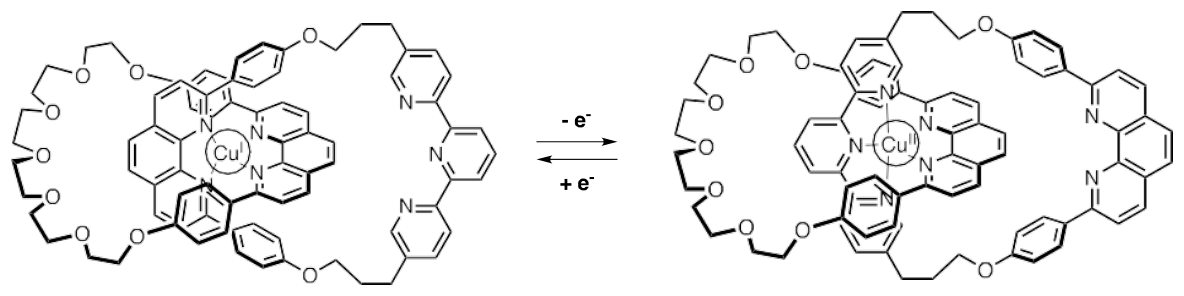
Fig. 1 – Multi-stability of a ring in a [2]catenane.
The synthesis of the macrocycle is the following:
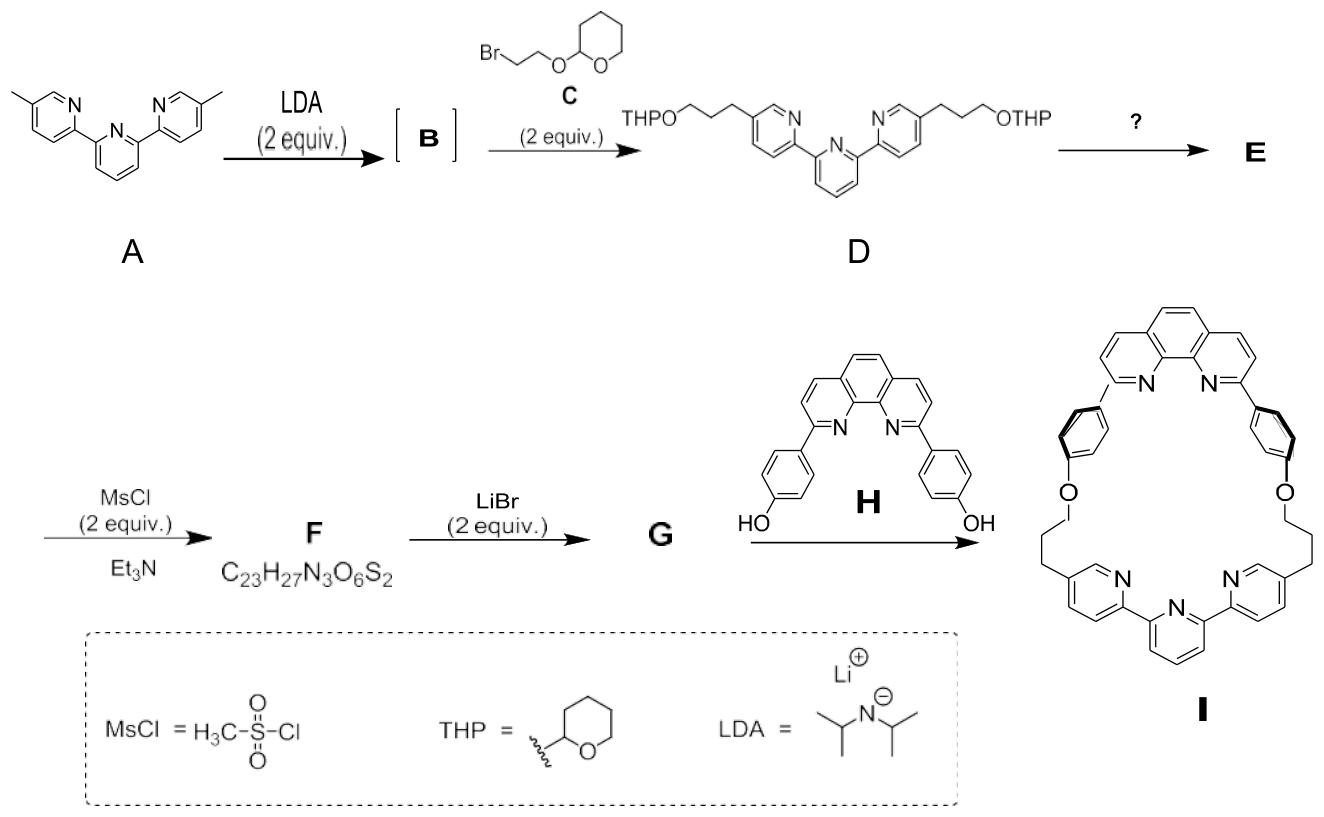
7.1 Draw the structure of B.
7.2 Draw the structures of E, F and G.
7.3 Out of the following reaction conditions, choose which one(s) can produce E from D.
- ☐ \(\ce{H+, H2O}\)
- ☐ \(\ce{OH-, H2O}\)
- ☐ \(\ce{NaBH4, CH3OH}\)
- ☐ \(\ce{H2}\), Pd/C, THF
Tick the relevant box.
7.4 In the synthetic strategy, MsCl is used to obtain:
- ☐ a leaving group
- ☐ a protecting group
- ☐ a deactivated group
- ☐ a directing group
Tick the relevant box.
7.5 G is obtained by the reaction between F and LiBr in acetone. This reaction is:
- ☐ electrophilic aromatic substitution,
- ☐ nucleophilic aromatic substitution,
- ☐ \(\mathrm{S_N1}\)
- ☐ \(\mathrm{S_N2}\)
Tick the relevant boxes.
7.6 Draw the transition state of the rate-determining step of the reaction F → G, showing the 3D geometry. Depict only one reaction center. The main carbon chain can be represented as an R group.
The synthesis of [2]catenane L uses the template effect of a copper complex:
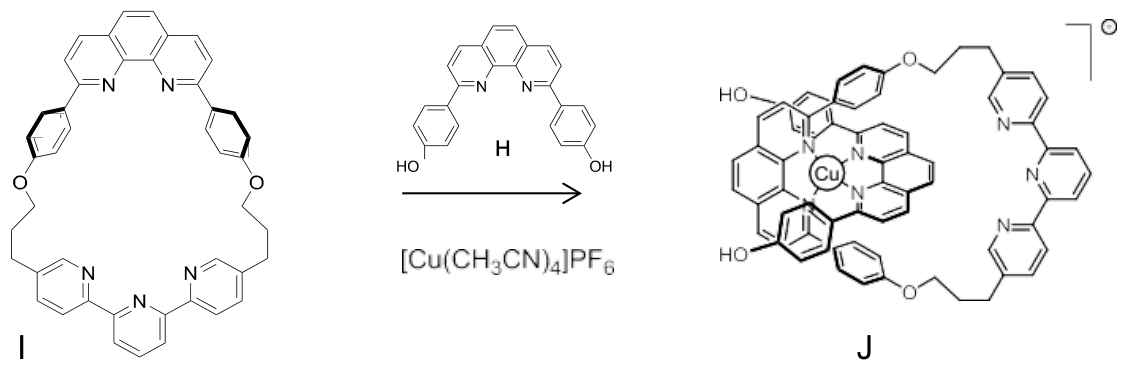
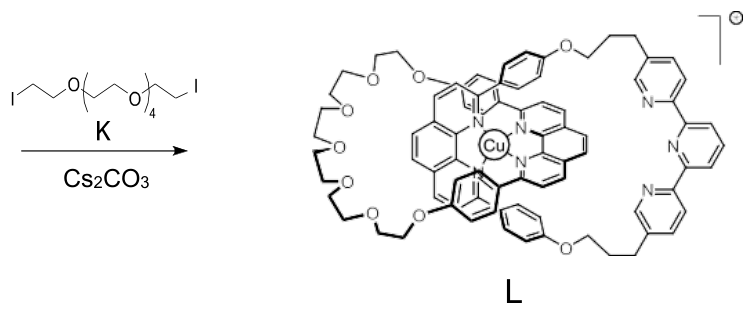
7.7 Write the full electronic configuration of Cu(0) in its ground state. Give the oxidation state of Cu in complex J and write the electronic configuration of Cu in the free ion corresponding to J.
7.8 Select the geometry of the copper ion in L. Assuming an ideal geometry of the ligands around the copper center, draw the electronic levels of the d-orbitals in accord with the crystal field theory. Fill the orbital diagram. Give the maximum value of the spin (\(S\)) for this complex. The geometry of the Cu in L is:
- ☐ octahedral,
- ☐ tetrahedral,
- ☐ square planar,
- ☐ trigonal bipyramidal.
7.9 Out of the following compounds, choose the one(s) that can remove the copper ion in L to obtain the free [2]catenane (tick relevant boxes):
- ☐ \(\ce{CH3CN}\)
- ☐ \(\ce{NH4PF6}\)
- ☐ \(\ce{KCN}\)
- ☐ tren
In [2]catenane L, the copper ion can exist in two oxidation states (+I) or (+II), and each of them exhibits a different coordination sphere (tetra- or penta-coordinated, respectively).
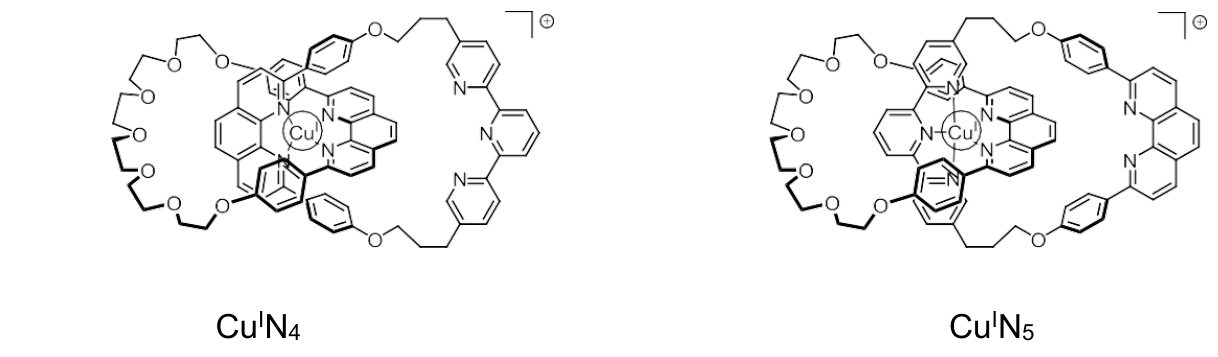
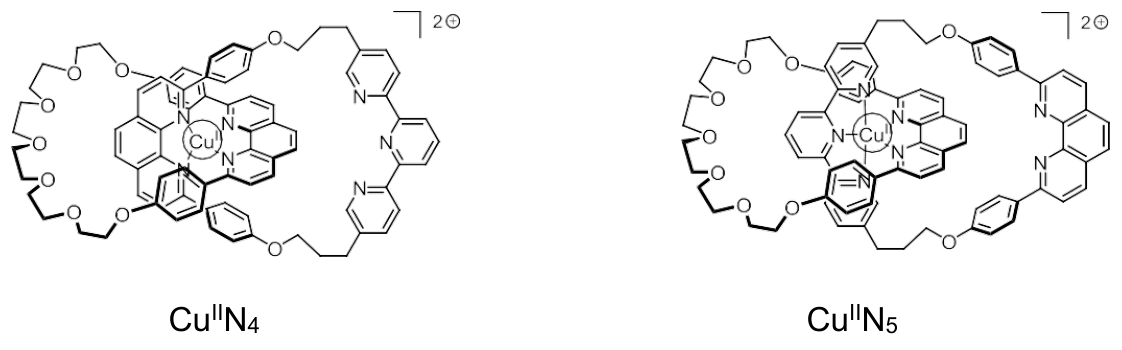
Fig. 2 – [2] catenate L states
The stability of Cu(I) complexes can be inferred by comparing their electronic structures to that of a noble gas.
7.10 Fill in the blanks with a number or a tick:
- The \(\ce{Cu^{I}N4}\) complex has ☐ (number) electrons in the coordination sphere of the metal.
- The \(\ce{Cu^{I}N5}\) complex has ☐ (number) electrons in the coordination sphere of the metal.
- The \(\ce{Cu^{I}N4}\) complex is (tick):
☐ more stable than the \(\ce{Cu^{I}N5}\) complex or
☐ less stable than the \(\ce{Cu^{I}N5}\) complex.
7.11 Fill in the solid boxes with the designation of the involved complexes in Fig. 2 and complete the sequence to achieve electrochemical control of the system using the following notation for the dashed boxes:

(rotation) ; \(+\ce{e-}\) ; \(−\ce{e-}\).
Official English text of the problem.
Answers
Here, terpyridine means the \(2,2':6',2''\)-terpyridine framework. SMILES are given at the first identification of each requested structure; subsequent letter labels refer to those structures.
-
7.1 — B: The dilithium derivative of A, with both methyl substituents converted into \(\ce{-CH2-}\) carbanions: 5,5″-bis(lithiomethyl)-2,2′:6′,2″-terpyridine.
SMILES:[Li+].[Li+].[CH2-]c1ccc(-c2cccc(-c3ccc([CH2-])cn3)n2)nc1 -
7.2 — E, F and G:
- E: 5,5″-Bis(3-hydroxypropyl)-2,2′:6′,2″-terpyridine.
SMILES:OCCCc1ccc(-c2cccc(-c3ccc(CCCO)cn3)n2)nc1 - F: 5,5″-Bis[3-(methanesulfonyloxy)propyl]-2,2′:6′,2″-terpyridine.
SMILES:CS(=O)(=O)OCCCc1ccc(-c2cccc(-c3ccc(CCCOS(=O)(=O)C)cn3)n2)nc1 -
G: 5,5″-Bis(3-bromopropyl)-2,2′:6′,2″-terpyridine.
SMILES:BrCCCc1ccc(-c2cccc(-c3ccc(CCCBr)cn3)n2)nc1 -
7.3: Select \(\ce{H+, H2O}\) only: aqueous acid removes the THP protecting groups.
-
7.4: Select a leaving group.
-
7.5: Select \(\mathrm{S_N2}\) only.
-
7.6: Draw an \(\mathrm{S_N2}\) transition state with Br···C···O collinear, partially formed \(\ce{C-Br}\) and partially broken \(\ce{C-O}\) bonds. The carbon’s \(\ce{R}\), \(\ce{H}\), and \(\ce{H}\) substituents lie in a plane perpendicular to that axis.
-
7.7: Copper atom,
[Cu]: \[ 1s^2\,2s^2\,2p^6\,3s^2\,3p^6\,3d^{10}\,4s^1. \] Copper in J is +I. The free copper(I) ion,[Cu+], has: \[ 1s^2\,2s^2\,2p^6\,3s^2\,3p^6\,3d^{10}. \] -
7.8: Tetrahedral; lower \(e\) orbitals and upper \(t_2\) orbitals, occupied as \(e^4t_2^6\). Every d orbital is doubly occupied; \(S_{\max}=0\).
-
7.9: Select KCN and tren:
- Potassium cyanide:
[K+].[C-]#N -
Tris(2-aminoethyl)amine, tren:
NCCN(CCN)CCN -
7.10: 18 electrons, 20 electrons, and \(\ce{Cu^{I}N4}\) is more stable. The corresponding effective atomic numbers, including the metal’s core electrons, are 36 and 38.
-
7.11: The cycle is \[ \boxed{\ce{Cu^{I}N4}} \xrightarrow{-\,\ce{e-}} \boxed{\ce{Cu^{II}N4}} \xrightarrow{\text{rotation}} \boxed{\ce{Cu^{II}N5}} \xrightarrow{+\,\ce{e-}} \boxed{\ce{Cu^{I}N5}} \xrightarrow{\text{rotation}} \boxed{\ce{Cu^{I}N4}}. \]
Solution
7.1 — Formation and structure of B
Compound A is 5,5″-dimethyl-2,2′:6′,2″-terpyridine, SMILES
Cc1ccc(-c2cccc(-c3ccc(C)cn3)n2)nc1.
Lithium diisopropylamide, LDA, is a strong, sterically hindered base:
[Li+].CC(C)[N-]C(C)C.
Each equivalent removes one proton from one of the methyl substituents. With two equivalents, both methyl groups become pyridylmethyl carbanions:
\[ \ce{A + 2LiN(iPr)2 -> B + 2HN(iPr)2}. \]
The conjugate acid is diisopropylamine, CC(C)NC(C)C.
To draw B, retain all three pyridine rings and their connections exactly as in A, and replace each \(\ce{-CH3}\) group by \(\ce{-CH2^-}\). Include two \(\ce{Li+}\) counterions. The ionic SMILES in the Answers does not specify lithium coordination or aggregation.
The electrophile C is 2-(2-bromoethoxy)tetrahydro-2H-pyran,
BrCCOC1CCCCO1.
Each carbanion attacks its primary brominated carbon:
\[ \ce{B + 2BrCH2CH2OTHP -> D + 2LiBr}. \]
Consequently, each arm in D is
\[ \ce{terpyridyl-CH2-CH2-CH2-O-THP}. \]
The original methyl carbon supplies the first methylene; C supplies the next two.
7.2 — Structures of E, F and G
The terpyridine skeleton and the two three-carbon side chains remain unchanged throughout these transformations. Only the terminal functional groups change:
| Compound | Each substituent at positions 5 and 5″ | Molecular formula |
|---|---|---|
| E | \(\ce{-CH2CH2CH2OH}\) | \(\ce{C21H23N3O2}\) |
| F | \(\ce{-CH2CH2CH2OS(=O)2CH3}\) | \(\ce{C23H27N3O6S2}\) |
| G | \(\ce{-CH2CH2CH2Br}\) | \(\ce{C21H21Br2N3}\) |
Thus:
- Removing the THP groups gives the diol E.
- Mesylating both alcohol groups gives the dimesylate F.
- Replacing both mesylate groups with bromide gives the dibromide G.
As a consistency check, converting each alcohol to a mesylate adds a net \(\ce{CH2O2S}\). Therefore,
\[ \ce{C21H23N3O2 + 2(CH2O2S) = C23H27N3O6S2}, \]
which matches the formula printed for F.
7.3 — Conditions for D → E
Compound D is 5,5″-bis[3-(tetrahydro-2H-pyran-2-yloxy)propyl]-2,2′:6′,2″-terpyridine, SMILES
c1cc(-c2ccc(CCCOC3CCCCO3)cn2)nc(-c2ccc(CCCOC3CCCCO3)cn2)c1.
Its THP ethers are acetals. Acetals undergo acid-catalysed hydrolysis, regenerating the protected alcohols. Select:
\[ \boxed{\ce{H+, H2O}}. \]
Here the proton is [H+] and water is O.
A balanced equation, writing the THP-derived product in its open-chain form, is
\[ \ce{D + 2H2O ->[H+] E + 2HO(CH2)4CHO}. \]
The coproduct is 5-hydroxypentanal, O=CCCCCO, which can equilibrate with its cyclic hemiacetal.
The other listed conditions do not perform the required deprotection:
- Aqueous hydroxide does not normally hydrolyse an acetal.
- Sodium borohydride in methanol does not cleave these THP acetals.
- Hydrogen with Pd/C is not the appropriate hydrogenolysis method for THP ethers.
No absolute configuration is specified at the THP acetal carbons in the problem, so the corresponding SMILES leave that stereochemistry unspecified.
7.4 — Role of MsCl
Methanesulfonyl chloride, or mesyl chloride, is CS(=O)(=O)Cl. It converts each alcohol into a methanesulfonate ester:
\[ \ce{E + 2CH3SO2Cl + 2Et3N -> F + 2Et3NHCl}. \]
Triethylamine, CCN(CC)CC, accepts the protons and gives triethylammonium chloride, CC[NH+](CC)CC.[Cl-].
The conversion replaces a poor leaving group, hydroxide, with a good leaving group, methanesulfonate, also called mesylate, CS(=O)(=O)[O-].
The correct choice is therefore a leaving group.
7.5 — Mechanism of F → G
Lithium bromide, [Li+].[Br-], supplies bromide ions, [Br-]. Bromide attacks the primary carbon bearing the mesylate group and displaces mesylate:
\[ \ce{F + 2LiBr -> G + 2LiOSO2CH3}. \]
The salt byproduct is lithium methanesulfonate,
[Li+].CS(=O)(=O)[O-].
This is an \(\mathrm{S_N2}\) reaction because:
- substitution occurs at a primary, saturated carbon;
- bromide is a nucleophile;
- mesylate is a good leaving group;
- acetone,
CC(=O)C, is a polar aprotic solvent favourable for this substitution.
The reacting carbon is not aromatic, and formation of a primary carbocation is unnecessary.
7.6 — Transition state and its three-dimensional geometry
For one reaction centre, write the substrate as \(\ce{RCH2OMs}\), a primary alkyl methanesulfonate, with generic SMILES *COS(=O)(=O)C. The asterisk represents the remainder of the molecule.
The single concerted substitution step is
\[ \ce{Br- + RCH2OSO2CH3 -> RCH2Br + CH3SO3-}. \]
The corresponding primary alkyl bromide has generic SMILES *CBr.
A schematic transition state is
\[ \left[ \ce{Br^{\delta-}} \;\cdots\; \ce{C(H)2(R)} \;\cdots\; \ce{O^{\delta-}S(=O)2CH3} \right]^{\ddagger-}. \]
The required drawing should show:
- The incoming bromide and departing oxygen on opposite sides of carbon, with \[ \angle\ce{Br-C-O}=180^\circ. \]
- Dashed or dotted axial bonds for the forming \(\ce{C-Br}\) bond and breaking \(\ce{C-O}\) bond.
- The three remaining substituents, \(\ce{R}\), \(\ce{H}\), and \(\ce{H}\), approximately \(120^\circ\) apart in a plane perpendicular to the attack axis.
- An overall charge of \(-1\) and a transition-state double dagger.
For a perspective drawing, place the attack axis horizontally, use an ordinary bond to \(\ce{R}\), and use a solid wedge and a hashed wedge for the two hydrogen bonds.
Electron flow is from a bromide lone pair to carbon, while the \(\ce{C-O}\) bonding pair moves onto the departing oxygen. Ordinary SMILES cannot encode the fractional bonds of this transition state. Backside attack produces inversion of the local tetrahedral arrangement, although this particular carbon is not stereogenic because it bears two hydrogens.
7.7 — Copper configurations and oxidation state in J
Copper has atomic number 29. Its ground-state configuration is
\[ \ce{Cu}:\qquad 1s^2\,2s^2\,2p^6\,3s^2\,3p^6\,3d^{10}\,4s^1. \]
Thus the ground state is \([\mathrm{Ar}]\,3d^{10}4s^1\), rather than \([\mathrm{Ar}]\,3d^94s^2\).
The nitrogen donors in J are neutral, and the complex is singly positively charged. Therefore,
\[ \boxed{\text{oxidation state of copper in J}=+\mathrm I}. \]
Ionisation removes the \(4s\) electron:
\[ \ce{Cu -> Cu+ + e-}. \]
The free copper(I) ion consequently has
\[ \ce{Cu+}:\qquad 1s^2\,2s^2\,2p^6\,3s^2\,3p^6\,3d^{10}. \]
7.8 — Geometry, crystal-field splitting and spin
In L, copper(I) binds two bidentate phenanthroline sites, giving four nitrogen donors. Its approximately tetrahedral coordination is idealised as \(T_d\) for the requested orbital diagram.
In a tetrahedral field, the \(e\) pair lies below the \(t_2\) triplet:
| Level | Orbitals | Energy relative to the barycentre | Occupation |
|---|---|---|---|
| Higher \(t_2\) | \(d_{xy},d_{xz},d_{yz}\) | \(+\frac25\Delta_t\) | \(\uparrow\downarrow\;\;\uparrow\downarrow\;\;\uparrow\downarrow\) |
| Lower \(e\) | \(d_{z^2},d_{x^2-y^2}\) | \(-\frac35\Delta_t\) | \(\uparrow\downarrow\;\;\uparrow\downarrow\) |
To draw the diagram, put two degenerate horizontal lines below three degenerate horizontal lines, and place two opposite-spin electrons on every line:
\[ d^{10}=e^4t_2^6. \]
All electrons are paired, so
\[ \boxed{S_{\max}=0}. \]
7.9 — Removal of copper
Select potassium cyanide and tren.
Cyanide forms very stable copper(I) complexes and competes effectively with the catenane’s nitrogen donors. Tren—tris(2-aminoethyl)amine—is a tetradentate ligand that can sequester copper through chelation.
Let \(\mathrm{Cat}\) denote the neutral, mechanically interlocked catenane. Representative ligand-displacement equations are
\[ \ce{[Cu(Cat)]+ + 2CN- -> Cat + [Cu(CN)2]-} \]
and
\[ \ce{[Cu(Cat)]+ + tren -> Cat + [Cu(tren)]+}. \]
The exact cyanide coordination number can depend on cyanide concentration; the first equation illustrates formation of dicyanidocuprate(I). Its component SMILES is [Cu+].[C-]#N.[C-]#N, with two carbon-bound cyanide ligands.
The copper(I)–tren complex has component SMILES [Cu+].NCCN(CCN)CCN, with nitrogen coordination supplied by tren.
Acetonitrile, CC#N, is insufficiently competitive against the chelating catenane under the intended conditions. Ammonium hexafluorophosphate, [NH4+].F[P-](F)(F)(F)(F)F, does not provide a suitable copper-sequestering ligand.
Removing copper does not separate the two closed rings: their mechanical interlocking remains.
7.10 — Electron counts and relative stability
Copper(I) supplies ten d electrons. Each neutral nitrogen donor contributes one lone pair, or two electrons.
For the four-coordinate state,
\[ N_e\!\left(\ce{Cu^{I}N4}\right) =10+4(2) =\boxed{18}. \]
For the five-coordinate state,
\[ N_e\!\left(\ce{Cu^{I}N5}\right) =10+5(2) =\boxed{20}. \]
Including the metal’s 18 core electrons gives effective atomic numbers
\[ 18+18=36 \]
and
\[ 18+20=38, \]
respectively. The first corresponds to krypton.
Within the electron-counting argument requested in the problem, the four-coordinate copper(I) state attains the favourable 18-electron count. Hence,
\[ \boxed{\ce{Cu^{I}N4}\text{ is more stable than }\ce{Cu^{I}N5}}. \]
7.11 — Electrochemically controlled cycle
Electron transfer changes the oxidation state first. Subsequent relative rotation of the rings changes which binding site coordinates copper.
| Step | Starting state | Operation | Result |
|---|---|---|---|
| 1 | \(\ce{Cu^{I}N4}\) | Remove one electron | \(\ce{Cu^{II}N4}\) |
| 2 | \(\ce{Cu^{II}N4}\) | Ring rotation | \(\ce{Cu^{II}N5}\) |
| 3 | \(\ce{Cu^{II}N5}\) | Add one electron | \(\ce{Cu^{I}N5}\) |
| 4 | \(\ce{Cu^{I}N5}\) | Ring rotation | \(\ce{Cu^{I}N4}\) |
The balanced electron-transfer steps, with \(\mathrm{Cat}\) denoting the unchanged catenane framework, are
\[ \ce{[Cu(Cat)]+ -> [Cu(Cat)]^2+ + e-} \]
and
\[ \ce{[Cu(Cat)]^2+ + e- -> [Cu(Cat)]+}. \]
The donor sets are:
- N4: one phenanthroline from each macrocycle, giving \(2+2=4\) nitrogen donors.
- N5: the phenanthroline of the smaller macrocycle and the terpyridine of the larger macrocycle, giving \(2+3=5\) nitrogen donors.
The N4 and N5 labels count coordinated nitrogen atoms; the molecular framework does not gain or lose nitrogen during rotation.
For the requested complex identifications, the following component SMILES specify the complete covalent ring structures and copper charge. Cu–N coordination is specified by the donor descriptions above. Mechanical interlocking and relative ring conformations are not encoded by these strings.
Copper(I) [2]catenane, encompassing the \(\ce{Cu^{I}N4}\) and \(\ce{Cu^{I}N5}\) coordination states:
[Cu+].O1CCCc2ccc(-c3cccc(-c4ccc(CCCOc5ccc(-c6ccc7ccc8ccc(-c9ccc1cc9)nc8c7n6)cc5)cn4)n3)nc2.O1CCOCCOCCOCCOCCOCCOc2ccc(-c3ccc4ccc5ccc(-c6ccc1cc6)nc5c4n3)cc2
Copper(II) [2]catenane, encompassing the \(\ce{Cu^{II}N4}\) and \(\ce{Cu^{II}N5}\) coordination states:
[Cu+2].O1CCCc2ccc(-c3cccc(-c4ccc(CCCOc5ccc(-c6ccc7ccc8ccc(-c9ccc1cc9)nc8c7n6)cc5)cn4)n3)nc2.O1CCOCCOCCOCCOCCOCCOc2ccc(-c3ccc4ccc5ccc(-c6ccc1cc6)nc5c4n3)cc2
In each case the two organic components must be understood as mechanically interlocked, not as separate, freely separable molecules.
The answers were checked against the official answers published by the organisers.
IChO 2019 · Theorieaufgabe 7
Ringbewegung in einem [2]Catenan
Im Jahr 2016 wurde der Nobelpreis für Chemie an J.-P. Sauvage, Sir J. F. Stoddart und B. L. Feringa „für den Entwurf und die Synthese molekularer Maschinen“ verliehen. Ein Beispiel dafür ist ein [2]Catenan, ein Molekül, das aus zwei ineinander verschlungenen Ringen besteht. In diesem System enthält ein Makrocyclus einen einzelnen Phenanthrolinliganden (zweizähnig), und der zweite enthält zwei Liganden: einen Phenanthrolin- und einen Terpyridinliganden (dreizähnig). Ein Kupferion wird von je einem Liganden aus jedem Makrocyclus koordiniert. Je nach Oxidationsstufe des Kupfers (+I oder +II) ergeben sich zwei Konfigurationen (Abb. 1).
Abb. 1 – Multistabilität eines Rings in einem [2]Catenan.
Die Synthese des Makrocyclus erfolgt wie folgt:
7.1 Zeichnen Sie die Struktur von B.
7.2 Zeichnen Sie die Strukturen von E, F und G.
7.3 Wählen Sie aus den folgenden Reaktionsbedingungen diejenigen aus, unter denen E aus D hergestellt werden kann.
- ☐ \(\ce{H+, H2O}\)
- ☐ \(\ce{OH-, H2O}\)
- ☐ \(\ce{NaBH4, CH3OH}\)
- ☐ \(\ce{H2}\), Pd/C, THF
Kreuzen Sie das zutreffende Kästchen an.
7.4 In der Synthesestrategie wird MsCl verwendet, um Folgendes zu erhalten:
- ☐ eine Abgangsgruppe
- ☐ eine Schutzgruppe
- ☐ eine deaktivierte Gruppe
- ☐ eine dirigierende Gruppe
Kreuzen Sie das zutreffende Kästchen an.
7.5 G wird durch die Reaktion von F mit LiBr in Aceton erhalten. Bei dieser Reaktion handelt es sich um:
- ☐ eine elektrophile aromatische Substitution,
- ☐ eine nucleophile aromatische Substitution,
- ☐ \(\mathrm{S_N1}\)
- ☐ \(\mathrm{S_N2}\)
Kreuzen Sie die zutreffenden Kästchen an.
7.6 Zeichnen Sie den Übergangszustand des geschwindigkeitsbestimmenden Schritts der Reaktion F → G unter Darstellung der räumlichen Geometrie. Stellen Sie nur ein Reaktionszentrum dar. Die Hauptkohlenstoffkette kann als Rest R dargestellt werden.
Die Synthese des [2]Catenans L nutzt den Templateffekt eines Kupferkomplexes:
7.7 Geben Sie die vollständige Elektronenkonfiguration von Cu(0) im Grundzustand an. Geben Sie die Oxidationsstufe von Cu im Komplex J an und schreiben Sie die Elektronenkonfiguration von Cu im freien Ion auf, das J entspricht.
7.8 Wählen Sie die Geometrie des Kupferions in L aus. Zeichnen Sie unter Annahme einer idealen Geometrie der Liganden um das Kupferzentrum die Energieniveaus der d-Orbitale gemäß der Kristallfeldtheorie. Tragen Sie die Elektronen in das Orbitaldiagramm ein. Geben Sie den maximalen Wert des Spins (\(S\)) für diesen Komplex an. Die Geometrie des Cu in L ist:
- ☐ oktaedrisch,
- ☐ tetraedrisch,
- ☐ quadratisch-planar,
- ☐ trigonal-bipyramidal.
7.9 Wählen Sie aus den folgenden Verbindungen diejenigen aus, die das Kupferion aus L entfernen können, um das freie [2]Catenan zu erhalten (kreuzen Sie die zutreffenden Kästchen an):
- ☐ \(\ce{CH3CN}\)
- ☐ \(\ce{NH4PF6}\)
- ☐ \(\ce{KCN}\)
- ☐ tren
Im [2]Catenan L kann das Kupferion in zwei Oxidationsstufen (+I) oder (+II) vorliegen, die jeweils eine unterschiedliche Koordinationssphäre aufweisen (vierfach bzw. fünffach koordiniert).
Abb. 2 – Zustände des [2]Catenats L
Die Stabilität von Cu(I)-Komplexen lässt sich durch einen Vergleich ihrer elektronischen Strukturen mit der eines Edelgases abschätzen.
7.10 Tragen Sie in die Kästchen eine Zahl oder ein Kreuz ein:
- Der \(\ce{Cu^{I}N4}\)-Komplex hat ☐ (Zahl) Elektronen in der Koordinationssphäre des Metalls.
- Der \(\ce{Cu^{I}N5}\)-Komplex hat ☐ (Zahl) Elektronen in der Koordinationssphäre des Metalls.
- Der \(\ce{Cu^{I}N4}\)-Komplex ist (ankreuzen):
☐ stabiler als der \(\ce{Cu^{I}N5}\)-Komplex oder
☐ weniger stabil als der \(\ce{Cu^{I}N5}\)-Komplex.
7.11 Tragen Sie in die durchgezogen umrandeten Kästchen die Bezeichnungen der beteiligten Komplexe aus Abb. 2 ein und vervollständigen Sie die Abfolge zur elektrochemischen Steuerung des Systems. Verwenden Sie für die gestrichelt umrandeten Kästchen die folgende Notation:
(Rotation) ; \(+\ce{e-}\) ; \(−\ce{e-}\).
Aufgabentext aus dem offiziellen englischen Text übersetzt.
Antworten
Hier bezeichnet Terpyridin das \(2,2':6',2''\)-Terpyridingerüst. SMILES werden bei der ersten Angabe jeder gefragten Struktur angegeben; spätere Buchstabenbezeichnungen beziehen sich auf diese Strukturen.
-
7.1 — B: Das Dilithiumderivat von A, bei dem beide Methylsubstituenten in \(\ce{-CH2-}\)-Carbanionen umgewandelt sind: 5,5″-Bis(lithiomethyl)-2,2′:6′,2″-terpyridin.
SMILES:[Li+].[Li+].[CH2-]c1ccc(-c2cccc(-c3ccc([CH2-])cn3)n2)nc1 -
7.2 — E, F und G:
- E: 5,5″-Bis(3-hydroxypropyl)-2,2′:6′,2″-terpyridin.
SMILES:OCCCc1ccc(-c2cccc(-c3ccc(CCCO)cn3)n2)nc1 - F: 5,5″-Bis[3-(methansulfonyloxy)propyl]-2,2′:6′,2″-terpyridin.
SMILES:CS(=O)(=O)OCCCc1ccc(-c2cccc(-c3ccc(CCCOS(=O)(=O)C)cn3)n2)nc1 -
G: 5,5″-Bis(3-brompropyl)-2,2′:6′,2″-terpyridin.
SMILES:BrCCCc1ccc(-c2cccc(-c3ccc(CCCBr)cn3)n2)nc1 -
7.3: Nur \(\ce{H+, H2O}\) auswählen: Wässrige Säure entfernt die THP-Schutzgruppen.
-
7.4: eine Abgangsgruppe auswählen.
-
7.5: Nur \(\mathrm{S_N2}\) auswählen.
-
7.6: Zeichnen Sie einen \(\mathrm{S_N2}\)-Übergangszustand mit kollinear angeordnetem Br···C···O, einer teilweise gebildeten \(\ce{C-Br}\)- und einer teilweise gebrochenen \(\ce{C-O}\)-Bindung. Die Substituenten \(\ce{R}\), \(\ce{H}\) und \(\ce{H}\) des Kohlenstoffatoms liegen in einer Ebene senkrecht zu dieser Achse.
-
7.7: Kupferatom,
[Cu]: \[ 1s^2\,2s^2\,2p^6\,3s^2\,3p^6\,3d^{10}\,4s^1. \] Kupfer in J hat die Oxidationsstufe +I. Das freie Kupfer(I)-Ion,[Cu+], hat: \[ 1s^2\,2s^2\,2p^6\,3s^2\,3p^6\,3d^{10}. \] -
7.8: Tetraedrisch; tiefer liegende \(e\)-Orbitale und höher liegende \(t_2\)-Orbitale, besetzt als \(e^4t_2^6\). Jedes d-Orbital ist doppelt besetzt; \(S_{\max}=0\).
-
7.9: KCN und tren auswählen:
- Kaliumcyanid:
[K+].[C-]#N -
Tris(2-aminoethyl)amin, tren:
NCCN(CCN)CCN -
7.10: 18 Elektronen, 20 Elektronen, und \(\ce{Cu^{I}N4}\) ist stabiler. Die entsprechenden effektiven Ordnungszahlen einschließlich der Rumpfelektronen des Metalls betragen 36 und 38.
-
7.11: Der Zyklus lautet \[ \boxed{\ce{Cu^{I}N4}} \xrightarrow{-\,\ce{e-}} \boxed{\ce{Cu^{II}N4}} \xrightarrow{\text{Rotation}} \boxed{\ce{Cu^{II}N5}} \xrightarrow{+\,\ce{e-}} \boxed{\ce{Cu^{I}N5}} \xrightarrow{\text{Rotation}} \boxed{\ce{Cu^{I}N4}}. \]
Lösung
7.1 — Bildung und Struktur von B
Verbindung A ist 5,5″-Dimethyl-2,2′:6′,2″-terpyridin, SMILES
Cc1ccc(-c2cccc(-c3ccc(C)cn3)n2)nc1.
Lithiumdiisopropylamid, LDA, ist eine starke, sterisch gehinderte Base:
[Li+].CC(C)[N-]C(C)C.
Jedes Äquivalent entfernt ein Proton von einem der Methylsubstituenten. Mit zwei Äquivalenten werden beide Methylgruppen zu Pyridylmethyl-Carbanionen:
\[ \ce{A + 2LiN(iPr)2 -> B + 2HN(iPr)2}. \]
Die konjugierte Säure ist Diisopropylamin, CC(C)NC(C)C.
Behalten Sie zum Zeichnen von B alle drei Pyridinringe und ihre Verknüpfungen genau wie in A bei und ersetzen Sie jede \(\ce{-CH3}\)-Gruppe durch \(\ce{-CH2^-}\). Fügen Sie zwei \(\ce{Li+}\)-Gegenionen hinzu. Die ionische SMILES-Schreibweise im Abschnitt Antworten legt weder die Lithiumkoordination noch die Aggregation fest.
Das Elektrophil C ist 2-(2-Bromethoxy)tetrahydro-2H-pyran,
BrCCOC1CCCCO1.
Jedes Carbanion greift dessen primäres bromiertes Kohlenstoffatom an:
\[ \ce{B + 2BrCH2CH2OTHP -> D + 2LiBr}. \]
Folglich hat jeder Arm in D die Struktur
\[ \ce{terpyridyl-CH2-CH2-CH2-O-THP}. \]
Das ursprüngliche Methylkohlenstoffatom liefert die erste Methylengruppe; C liefert die nächsten beiden.
7.2 — Strukturen von E, F und G
Das Terpyridingerüst und die beiden Seitenketten mit je drei Kohlenstoffatomen bleiben während dieser Umwandlungen unverändert. Nur die endständigen funktionellen Gruppen ändern sich:
| Verbindung | Jeweiliger Substituent an den Positionen 5 und 5″ | Summenformel |
|---|---|---|
| E | \(\ce{-CH2CH2CH2OH}\) | \(\ce{C21H23N3O2}\) |
| F | \(\ce{-CH2CH2CH2OS(=O)2CH3}\) | \(\ce{C23H27N3O6S2}\) |
| G | \(\ce{-CH2CH2CH2Br}\) | \(\ce{C21H21Br2N3}\) |
Somit gilt:
- Die Entfernung der THP-Gruppen ergibt das Diol E.
- Die Mesylierung beider Alkoholgruppen ergibt das Dimesylat F.
- Der Austausch beider Mesylatgruppen gegen Bromid ergibt das Dibromid G.
Zur Konsistenzprüfung: Die Umwandlung jeder Alkoholgruppe in ein Mesylat fügt netto \(\ce{CH2O2S}\) hinzu. Daher gilt
\[ \ce{C21H23N3O2 + 2(CH2O2S) = C23H27N3O6S2}, \]
was mit der für F angegebenen Formel übereinstimmt.
7.3 — Bedingungen für D → E
Verbindung D ist 5,5″-Bis[3-(tetrahydro-2H-pyran-2-yloxy)propyl]-2,2′:6′,2″-terpyridin, SMILES
c1cc(-c2ccc(CCCOC3CCCCO3)cn2)nc(-c2ccc(CCCOC3CCCCO3)cn2)c1.
Ihre THP-Ether sind Acetale. Acetale werden säurekatalysiert hydrolysiert, wobei die geschützten Alkohole zurückgebildet werden. Auszuwählen ist:
\[ \boxed{\ce{H+, H2O}}. \]
Hier ist das Proton [H+] und Wasser O.
Eine ausgeglichene Gleichung, in der das aus THP hervorgehende Produkt in seiner offenkettigen Form geschrieben wird, lautet
\[ \ce{D + 2H2O ->[H+] E + 2HO(CH2)4CHO}. \]
Das Nebenprodukt ist 5-Hydroxypentanal, O=CCCCCO, das mit seinem cyclischen Halbacetal im Gleichgewicht stehen kann.
Die anderen aufgeführten Bedingungen bewirken nicht die erforderliche Abspaltung der Schutzgruppen:
- Wässrige Hydroxidlösung hydrolysiert ein Acetal normalerweise nicht.
- Natriumborhydrid in Methanol spaltet diese THP-Acetale nicht.
- Wasserstoff mit Pd/C ist nicht die geeignete Hydrogenolysemethode für THP-Ether.
In der Aufgabe ist für die THP-Acetalkohlenstoffatome keine absolute Konfiguration angegeben, daher bleibt diese Stereochemie in den entsprechenden SMILES unbestimmt.
7.4 — Rolle von MsCl
Methansulfonylchlorid, auch Mesylchlorid genannt, ist CS(=O)(=O)Cl. Es wandelt jede Alkoholgruppe in einen Methansulfonsäureester um:
\[ \ce{E + 2CH3SO2Cl + 2Et3N -> F + 2Et3NHCl}. \]
Triethylamin, CCN(CC)CC, nimmt die Protonen auf und ergibt Triethylammoniumchlorid, CC[NH+](CC)CC.[Cl-].
Durch die Umwandlung wird eine schlechte Abgangsgruppe, Hydroxid, durch eine gute Abgangsgruppe, Methansulfonat, auch Mesylat genannt, CS(=O)(=O)[O-], ersetzt.
Die richtige Auswahl lautet daher eine Abgangsgruppe.
7.5 — Mechanismus von F → G
Lithiumbromid, [Li+].[Br-], liefert Bromidionen, [Br-]. Bromid greift das primäre Kohlenstoffatom an, das die Mesylatgruppe trägt, und verdrängt Mesylat:
\[ \ce{F + 2LiBr -> G + 2LiOSO2CH3}. \]
Das als Nebenprodukt entstehende Salz ist Lithiummethansulfonat,
[Li+].CS(=O)(=O)[O-].
Dies ist eine \(\mathrm{S_N2}\)-Reaktion, weil:
- die Substitution an einem primären, gesättigten Kohlenstoffatom stattfindet;
- Bromid ein Nucleophil ist;
- Mesylat eine gute Abgangsgruppe ist;
- Aceton,
CC(=O)C, ein polar-aprotisches Lösungsmittel ist, das diese Substitution begünstigt.
Das reagierende Kohlenstoffatom ist nicht aromatisch, und die Bildung eines primären Carbokations ist nicht erforderlich.
7.6 — Übergangszustand und seine dreidimensionale Geometrie
Schreiben Sie das Substrat für ein Reaktionszentrum als \(\ce{RCH2OMs}\), ein primäres Alkylmethansulfonat, mit der allgemeinen SMILES-Schreibweise *COS(=O)(=O)C. Das Sternchen steht für den Rest des Moleküls.
Der einzige, konzertierte Substitutionsschritt lautet
\[ \ce{Br- + RCH2OSO2CH3 -> RCH2Br + CH3SO3-}. \]
Das entsprechende primäre Alkylbromid hat die allgemeine SMILES-Schreibweise *CBr.
Ein schematischer Übergangszustand ist
\[ \left[ \ce{Br^{\delta-}} \;\cdots\; \ce{C(H)2(R)} \;\cdots\; \ce{O^{\delta-}S(=O)2CH3} \right]^{\ddagger-}. \]
Die geforderte Zeichnung sollte Folgendes zeigen:
- Das angreifende Bromid und das abgehende Sauerstoffatom auf entgegengesetzten Seiten des Kohlenstoffatoms, mit \[ \angle\ce{Br-C-O}=180^\circ. \]
- Gestrichelte oder gepunktete axiale Bindungen für die entstehende \(\ce{C-Br}\)-Bindung und die brechende \(\ce{C-O}\)-Bindung.
- Die drei übrigen Substituenten, \(\ce{R}\), \(\ce{H}\) und \(\ce{H}\), mit Winkeln von etwa \(120^\circ\) zueinander in einer Ebene senkrecht zur Angriffsachse.
- Eine Gesamtladung von \(-1\) und ein Doppelkreuz als Symbol für den Übergangszustand.
Legen Sie für eine perspektivische Zeichnung die Angriffsachse horizontal, verwenden Sie einen gewöhnlichen Bindungsstrich zu \(\ce{R}\) und einen ausgefüllten sowie einen gestrichelten Keil für die beiden Bindungen zu den Wasserstoffatomen.
Der Elektronenfluss verläuft von einem freien Elektronenpaar des Bromids zum Kohlenstoffatom, während das bindende Elektronenpaar der \(\ce{C-O}\)-Bindung auf das abgehende Sauerstoffatom übergeht. Gewöhnliche SMILES können die partiellen Bindungen dieses Übergangszustands nicht darstellen. Der Rückseitenangriff führt zu einer Inversion der lokalen tetraedrischen Anordnung, obwohl dieses Kohlenstoffatom nicht stereogen ist, da es zwei Wasserstoffatome trägt.
7.7 — Elektronenkonfigurationen des Kupfers und Oxidationsstufe in J
Kupfer hat die Ordnungszahl 29. Seine Elektronenkonfiguration im Grundzustand ist
\[ \ce{Cu}:\qquad 1s^2\,2s^2\,2p^6\,3s^2\,3p^6\,3d^{10}\,4s^1. \]
Der Grundzustand ist somit \([\mathrm{Ar}]\,3d^{10}4s^1\) und nicht \([\mathrm{Ar}]\,3d^94s^2\).
Die Stickstoffdonoren in J sind neutral, und der Komplex ist einfach positiv geladen. Daher gilt
\[ \boxed{\text{Oxidationsstufe des Kupfers in J}=+\mathrm I}. \]
Bei der Ionisierung wird das \(4s\)-Elektron entfernt:
\[ \ce{Cu -> Cu+ + e-}. \]
Das freie Kupfer(I)-Ion hat folglich die Konfiguration
\[ \ce{Cu+}:\qquad 1s^2\,2s^2\,2p^6\,3s^2\,3p^6\,3d^{10}. \]
7.8 — Geometrie, Kristallfeldaufspaltung und Spin
In L bindet Kupfer(I) an zwei zweizähnige Phenanthrolineinheiten, wodurch sich vier Stickstoffdonoren ergeben. Seine annähernd tetraedrische Koordination wird für das geforderte Orbitaldiagramm als \(T_d\) idealisiert.
In einem tetraedrischen Feld liegt das \(e\)-Paar unterhalb des \(t_2\)-Tripletts:
| Niveau | Orbitale | Energie relativ zum Schwerpunkt | Besetzung |
|---|---|---|---|
| Höheres \(t_2\) | \(d_{xy},d_{xz},d_{yz}\) | \(+\frac25\Delta_t\) | \(\uparrow\downarrow\;\;\uparrow\downarrow\;\;\uparrow\downarrow\) |
| Tieferes \(e\) | \(d_{z^2},d_{x^2-y^2}\) | \(-\frac35\Delta_t\) | \(\uparrow\downarrow\;\;\uparrow\downarrow\) |
Zeichnen Sie für das Diagramm zwei entartete horizontale Linien unterhalb von drei entarteten horizontalen Linien und tragen Sie auf jeder Linie zwei Elektronen mit entgegengesetztem Spin ein:
\[ d^{10}=e^4t_2^6. \]
Alle Elektronen sind gepaart, daher gilt
\[ \boxed{S_{\max}=0}. \]
7.9 — Entfernung des Kupfers
Wählen Sie Kaliumcyanid und tren aus.
Cyanid bildet sehr stabile Kupfer(I)-Komplexe und konkurriert wirksam mit den Stickstoffdonoren des Catenans. Tren — Tris(2-aminoethyl)amin — ist ein vierzähniger Ligand, der Kupfer durch Chelatbildung binden kann.
\(\mathrm{Cat}\) bezeichne das neutrale, mechanisch verschlungene Catenan. Beispielhafte Gleichungen für den Ligandenaustausch lauten
\[ \ce{[Cu(Cat)]+ + 2CN- -> Cat + [Cu(CN)2]-} \]
und
\[ \ce{[Cu(Cat)]+ + tren -> Cat + [Cu(tren)]+}. \]
Die genaue Koordinationszahl der Cyanidliganden kann von der Cyanidkonzentration abhängen; die erste Gleichung veranschaulicht die Bildung von Dicyanidocuprat(I). Seine Komponenten-SMILES lautet [Cu+].[C-]#N.[C-]#N, mit zwei über Kohlenstoff gebundenen Cyanidliganden.
Der Kupfer(I)–tren-Komplex hat die Komponenten-SMILES [Cu+].NCCN(CCN)CCN, wobei tren die Koordination über Stickstoff bereitstellt.
Acetonitril, CC#N, konkurriert unter den vorgesehenen Bedingungen nicht ausreichend stark mit dem chelatisierenden Catenan. Ammoniumhexafluorophosphat, [NH4+].F[P-](F)(F)(F)(F)F, liefert keinen geeigneten Liganden zur Bindung des Kupfers.
Durch die Entfernung des Kupfers werden die beiden geschlossenen Ringe nicht getrennt: Ihre mechanische Verschlingung bleibt bestehen.
7.10 — Elektronenzahlen und relative Stabilität
Kupfer(I) liefert zehn d-Elektronen. Jeder neutrale Stickstoffdonor steuert ein freies Elektronenpaar, also zwei Elektronen, bei.
Für den vierfach koordinierten Zustand gilt
\[ N_e\!\left(\ce{Cu^{I}N4}\right) =10+4(2) =\boxed{18}. \]
Für den fünffach koordinierten Zustand gilt
\[ N_e\!\left(\ce{Cu^{I}N5}\right) =10+5(2) =\boxed{20}. \]
Unter Einbeziehung der 18 Rumpfelektronen des Metalls ergeben sich die effektiven Ordnungszahlen
\[ 18+18=36 \]
bzw.
\[ 18+20=38, \]
wobei die erste Krypton entspricht.
Im Rahmen der in der Aufgabe geforderten Argumentation anhand der Elektronenzahl erreicht der vierfach koordinierte Kupfer(I)-Zustand die günstige Zahl von 18 Elektronen. Daher gilt
\[ \boxed{\ce{Cu^{I}N4}\text{ ist stabiler als }\ce{Cu^{I}N5}}. \]
7.11 — Elektrochemisch gesteuerter Zyklus
Die Elektronenübertragung ändert zunächst die Oxidationsstufe. Die anschließende relative Rotation der Ringe ändert, welche Bindungsstelle das Kupfer koordiniert.
| Schritt | Ausgangszustand | Vorgang | Ergebnis |
|---|---|---|---|
| 1 | \(\ce{Cu^{I}N4}\) | Ein Elektron entfernen | \(\ce{Cu^{II}N4}\) |
| 2 | \(\ce{Cu^{II}N4}\) | Ringrotation | \(\ce{Cu^{II}N5}\) |
| 3 | \(\ce{Cu^{II}N5}\) | Ein Elektron hinzufügen | \(\ce{Cu^{I}N5}\) |
| 4 | \(\ce{Cu^{I}N5}\) | Ringrotation | \(\ce{Cu^{I}N4}\) |
Die ausgeglichenen Elektronenübertragungsschritte, wobei \(\mathrm{Cat}\) das unveränderte Catenangerüst bezeichnet, lauten
\[ \ce{[Cu(Cat)]+ -> [Cu(Cat)]^2+ + e-} \]
und
\[ \ce{[Cu(Cat)]^2+ + e- -> [Cu(Cat)]+}. \]
Die Donorkombinationen sind:
- N4: je ein Phenanthrolin aus jedem Makrocyclus, also \(2+2=4\) Stickstoffdonoren.
- N5: das Phenanthrolin des kleineren Makrocyclus und das Terpyridin des größeren Makrocyclus, also \(2+3=5\) Stickstoffdonoren.
Die Bezeichnungen N4 und N5 geben die Anzahl koordinierter Stickstoffatome an; das Molekülgerüst nimmt während der Rotation keinen Stickstoff auf und verliert auch keinen.
Zur geforderten Identifizierung der Komplexe geben die folgenden Komponenten-SMILES die vollständigen kovalenten Ringstrukturen und die Kupferladung an. Die Cu–N-Koordination wird durch die obigen Beschreibungen der Donoren festgelegt. Die mechanische Verschlingung und die relativen Ringkonformationen werden durch diese Zeichenfolgen nicht dargestellt.
Kupfer(I)-[2]Catenan, das die Koordinationszustände \(\ce{Cu^{I}N4}\) und \(\ce{Cu^{I}N5}\) umfasst:
[Cu+].O1CCCc2ccc(-c3cccc(-c4ccc(CCCOc5ccc(-c6ccc7ccc8ccc(-c9ccc1cc9)nc8c7n6)cc5)cn4)n3)nc2.O1CCOCCOCCOCCOCCOCCOc2ccc(-c3ccc4ccc5ccc(-c6ccc1cc6)nc5c4n3)cc2
Kupfer(II)-[2]Catenan, das die Koordinationszustände \(\ce{Cu^{II}N4}\) und \(\ce{Cu^{II}N5}\) umfasst:
[Cu+2].O1CCCc2ccc(-c3cccc(-c4ccc(CCCOc5ccc(-c6ccc7ccc8ccc(-c9ccc1cc9)nc8c7n6)cc5)cn4)n3)nc2.O1CCOCCOCCOCCOCCOCCOc2ccc(-c3ccc4ccc5ccc(-c6ccc1cc6)nc5c4n3)cc2
In beiden Fällen sind die beiden organischen Komponenten als mechanisch ineinander verschlungen zu verstehen, nicht als getrennte, frei voneinander trennbare Moleküle.
Die Ergebnisse wurden mit den von den Veranstaltern veröffentlichten offiziellen Ergebnissen abgeglichen.
IChO 2019 · Teori sorusu 7
Bir [2]katenanda halka hareketi
2016 yılında Nobel Kimya Ödülü, “moleküler makinelerin tasarımı ve sentezi” için J.-P. Sauvage, Sir J. F. Stoddart ve B. L. Feringa'ya verildi. Birbirine kenetlenmiş iki halkadan oluşan bir molekül olan [2]katenan, bunlara bir örnektir. Bu sistemde, makrohalkalardan biri tek bir fenantrolin (iki dişli) ligandı, diğeri ise iki ligand içerir: bir fenantrolin ve bir terpiridin (üç dişli) ligandı. Bir bakır iyonu, her makrohalkadan bir ligand tarafından koordine edilir. Bakırın yükseltgenme basamağına (+I veya +II) bağlı olarak iki konfigürasyon elde edilir (Şek. 1).
Şek. 1 – Bir [2]katenandaki bir halkanın çoklu kararlılığı.
Makrohalkanın sentezi aşağıdaki gibidir:
7.1 B'nin yapısını çiziniz.
7.2 E, F ve G'nin yapılarını çiziniz.
7.3 Aşağıdaki tepkime koşullarından hangisinin veya hangilerinin D'den E elde edilmesini sağlayabileceğini seçiniz.
- ☐ \(\ce{H+, H2O}\)
- ☐ \(\ce{OH-, H2O}\)
- ☐ \(\ce{NaBH4, CH3OH}\)
- ☐ \(\ce{H2}\), Pd/C, THF
İlgili kutuyu işaretleyiniz.
7.4 Sentez stratejisinde MsCl, aşağıdakilerden hangisini elde etmek için kullanılır?
- ☐ bir ayrılan grup
- ☐ bir koruyucu grup
- ☐ bir deaktive edilmiş grup
- ☐ bir yönlendirici grup
İlgili kutuyu işaretleyiniz.
7.5 G, F ile LiBr'nin aseton içindeki tepkimesinden elde edilir. Bu tepkime:
- ☐ elektrofilik aromatik yer değiştirme,
- ☐ nükleofilik aromatik yer değiştirme,
- ☐ \(\mathrm{S_N1}\)
- ☐ \(\mathrm{S_N2}\)
İlgili kutuları işaretleyiniz.
7.6 F → G tepkimesinin hız belirleyici basamağının geçiş durumunu, üç boyutlu geometrisini göstererek çiziniz. Yalnızca bir tepkime merkezini gösteriniz. Ana karbon zinciri bir R grubu olarak gösterilebilir.
[2]katenan L'nin sentezinde bir bakır kompleksinin şablon etkisinden yararlanılır:
7.7 Cu(0)'ın temel hâlde tam elektron dizilimini yazınız. J kompleksindeki Cu'nun yükseltgenme basamağını belirtiniz ve J'ye karşılık gelen serbest iyondaki Cu'nun elektron dizilimini yazınız.
7.8 L'deki bakır iyonunun geometrisini seçiniz. Bakır merkezi çevresindeki ligandların ideal bir geometriye sahip olduğunu varsayarak, kristal alan kuramına göre d orbitallerinin elektronik enerji düzeylerini çiziniz. Orbital diyagramını doldurunuz. Bu kompleks için spinin (\(S\)) en büyük değerini belirtiniz. L'deki Cu'nun geometrisi:
- ☐ oktahedral,
- ☐ tetrahedral,
- ☐ kare düzlemsel,
- ☐ üçgen çift piramidal.
7.9 Aşağıdaki bileşiklerden, serbest [2]katenanı elde etmek için L'deki bakır iyonunu uzaklaştırabilenleri seçiniz (ilgili kutuları işaretleyiniz):
- ☐ \(\ce{CH3CN}\)
- ☐ \(\ce{NH4PF6}\)
- ☐ \(\ce{KCN}\)
- ☐ tren
[2]katenan L'de bakır iyonu, (+I) veya (+II) olmak üzere iki yükseltgenme basamağında bulunabilir ve bunların her biri farklı bir koordinasyon küresine sahiptir (sırasıyla dört veya beş koordinasyonlu).
Şek. 2 – [2]katenat L'nin durumları
Cu(I) komplekslerinin kararlılığı, elektronik yapıları bir soy gazınkiyle karşılaştırılarak değerlendirilebilir.
7.10 Boşlukları bir sayı yazarak veya işaret koyarak doldurunuz:
- \(\ce{Cu^{I}N4}\) kompleksinde metalin koordinasyon küresinde ☐ (sayı) elektron bulunur.
- \(\ce{Cu^{I}N5}\) kompleksinde metalin koordinasyon küresinde ☐ (sayı) elektron bulunur.
- \(\ce{Cu^{I}N4}\) kompleksi (işaretleyiniz):
☐ \(\ce{Cu^{I}N5}\) kompleksinden daha kararlıdır veya
☐ \(\ce{Cu^{I}N5}\) kompleksinden daha az kararlıdır.
7.11 Düz çizgili kutuları Şek. 2'deki ilgili komplekslerin gösterimleriyle doldurunuz ve kesikli çizgili kutular için aşağıdaki gösterimleri kullanarak sistemin elektrokimyasal kontrolünü sağlayacak diziyi tamamlayınız:
(dönme) ; \(+\ce{e-}\) ; \(−\ce{e-}\).
Soru metni resmi İngilizce metinden çevrilmiştir.
Cevaplar
Burada terpiridin, \(2,2':6',2''\)-terpiridin iskeletini ifade eder. İstenen her yapının ilk tanımlandığı yerde SMILES gösterimi verilmiştir; sonraki harf etiketleri bu yapılara karşılık gelir.
-
7.1 — B: A'nın, her iki metil sübstitüentinin de \(\ce{-CH2-}\) karbanyonlarına dönüştürüldüğü dilityum türevi: 5,5″-bis(lityometil)-2,2′:6′,2″-terpiridin.
SMILES:[Li+].[Li+].[CH2-]c1ccc(-c2cccc(-c3ccc([CH2-])cn3)n2)nc1 -
7.2 — E, F ve G:
- E: 5,5″-Bis(3-hidroksipropil)-2,2′:6′,2″-terpiridin.
SMILES:OCCCc1ccc(-c2cccc(-c3ccc(CCCO)cn3)n2)nc1 - F: 5,5″-Bis[3-(metansülfoniloksi)propil]-2,2′:6′,2″-terpiridin.
SMILES:CS(=O)(=O)OCCCc1ccc(-c2cccc(-c3ccc(CCCOS(=O)(=O)C)cn3)n2)nc1 -
G: 5,5″-Bis(3-bromopropil)-2,2′:6′,2″-terpiridin.
SMILES:BrCCCc1ccc(-c2cccc(-c3ccc(CCCBr)cn3)n2)nc1 -
7.3: Yalnızca \(\ce{H+, H2O}\) seçilmelidir: sulu asit, THP koruyucu gruplarını uzaklaştırır.
-
7.4: Bir ayrılan grup seçilmelidir.
-
7.5: Yalnızca \(\mathrm{S_N2}\) seçilmelidir.
-
7.6: Br···C···O aynı doğru üzerinde olacak şekilde, kısmen oluşmuş \(\ce{C-Br}\) ve kısmen kırılmış \(\ce{C-O}\) bağlarını içeren bir \(\mathrm{S_N2}\) geçiş durumu çizilmelidir. Karbonun \(\ce{R}\), \(\ce{H}\) ve \(\ce{H}\) sübstitüentleri bu eksene dik bir düzlemde bulunur.
-
7.7: Bakır atomu,
[Cu]: \[ 1s^2\,2s^2\,2p^6\,3s^2\,3p^6\,3d^{10}\,4s^1. \] J'deki bakır +I yükseltgenme basamağındadır. Serbest bakır(I) iyonunun,[Cu+], elektron dizilimi şöyledir: \[ 1s^2\,2s^2\,2p^6\,3s^2\,3p^6\,3d^{10}. \] -
7.8: Tetrahedral; altta \(e\) orbitalleri ve üstte \(t_2\) orbitalleri bulunur, doluluk \(e^4t_2^6\) şeklindedir. Her d orbitalinde iki elektron vardır; \(S_{\max}=0\).
-
7.9: KCN ve tren seçilmelidir:
- Potasyum siyanür:
[K+].[C-]#N -
Tris(2-aminoetil)amin, tren:
NCCN(CCN)CCN -
7.10: 18 elektron, 20 elektron ve \(\ce{Cu^{I}N4}\) daha kararlıdır. Metalin iç kabuk elektronları da dâhil edildiğinde, karşılık gelen etkin atom numaraları 36 ve 38'dir.
-
7.11: Döngü şöyledir: \[ \boxed{\ce{Cu^{I}N4}} \xrightarrow{-\,\ce{e-}} \boxed{\ce{Cu^{II}N4}} \xrightarrow{\text{dönme}} \boxed{\ce{Cu^{II}N5}} \xrightarrow{+\,\ce{e-}} \boxed{\ce{Cu^{I}N5}} \xrightarrow{\text{dönme}} \boxed{\ce{Cu^{I}N4}}. \]
Çözüm
7.1 — B'nin oluşumu ve yapısı
A bileşiği 5,5″-dimetil-2,2′:6′,2″-terpiridin olup SMILES gösterimi şöyledir:
Cc1ccc(-c2cccc(-c3ccc(C)cn3)n2)nc1.
Lityum diizopropilamid, LDA, güçlü ve sterik engelli bir bazdır:
[Li+].CC(C)[N-]C(C)C.
Her bir eşdeğeri, metil sübstitüentlerinden birinden bir proton uzaklaştırır. İki eşdeğer kullanıldığında her iki metil grubu da piridilmetil karbanyonlarına dönüşür:
\[ \ce{A + 2LiN(iPr)2 -> B + 2HN(iPr)2}. \]
Eşlenik asit diizopropilamin, CC(C)NC(C)C, olur.
B'yi çizmek için üç piridin halkasının tümünü ve aralarındaki bağlantıları A'dakiyle tamamen aynı tutunuz ve her \(\ce{-CH3}\) grubunu \(\ce{-CH2^-}\) ile değiştiriniz. İki \(\ce{Li+}\) karşı iyonunu da ekleyiniz. Cevaplar bölümündeki iyonik SMILES gösterimi, lityumun koordinasyonunu veya agregasyonunu belirtmez.
Elektrofil C, 2-(2-bromoetoksi)tetrahidro-2H-pirandır:
BrCCOC1CCCCO1.
Her karbanyon, bu bileşiğin brom bağlı birincil karbonuna saldırır:
\[ \ce{B + 2BrCH2CH2OTHP -> D + 2LiBr}. \]
Bunun sonucunda D'deki her kol şöyledir:
\[ \ce{terpyridyl-CH2-CH2-CH2-O-THP}. \]
Başlangıçtaki metil karbonu ilk metilen grubunu, C ise sonraki ikisini sağlar.
7.2 — E, F ve G'nin yapıları
Bu dönüşümler boyunca terpiridin iskeleti ve üçer karbonlu iki yan zincir değişmeden kalır. Yalnızca uç fonksiyonel gruplar değişir:
| Bileşik | 5 ve 5″ konumlarındaki her bir sübstitüent | Molekül formülü |
|---|---|---|
| E | \(\ce{-CH2CH2CH2OH}\) | \(\ce{C21H23N3O2}\) |
| F | \(\ce{-CH2CH2CH2OS(=O)2CH3}\) | \(\ce{C23H27N3O6S2}\) |
| G | \(\ce{-CH2CH2CH2Br}\) | \(\ce{C21H21Br2N3}\) |
Buna göre:
- THP gruplarının uzaklaştırılmasıyla diol E elde edilir.
- Her iki alkol grubunun mesillenmesiyle dimesilat F elde edilir.
- Her iki mesilat grubunun bromürle yer değiştirmesiyle dibromür G elde edilir.
Bir tutarlılık kontrolü olarak, her bir alkolün mesilata dönüştürülmesi net olarak \(\ce{CH2O2S}\) ekler. Dolayısıyla,
\[ \ce{C21H23N3O2 + 2(CH2O2S) = C23H27N3O6S2}, \]
bu da F için verilen formülle uyumludur.
7.3 — D → E dönüşümünün koşulları
D bileşiği 5,5″-bis[3-(tetrahidro-2H-piran-2-iloksi)propil]-2,2′:6′,2″-terpiridin olup SMILES gösterimi şöyledir:
c1cc(-c2ccc(CCCOC3CCCCO3)cn2)nc(-c2ccc(CCCOC3CCCCO3)cn2)c1.
Bu bileşikteki THP eterleri asetaldir. Asetaller asit katalizli hidrolize uğrayarak korunmuş alkolleri yeniden oluşturur. Şu seçenek seçilmelidir:
\[ \boxed{\ce{H+, H2O}}. \]
Burada proton [H+], su ise O ile gösterilir.
THP'den türeyen ürün açık zincirli biçiminde yazıldığında, denkleştirilmiş denklem şöyledir:
\[ \ce{D + 2H2O ->[H+] E + 2HO(CH2)4CHO}. \]
Birlikte oluşan ürün 5-hidroksipentanal, O=CCCCCO, olup halkalı hemiasetali ile denge hâlinde bulunabilir.
Listelenen diğer koşullar, gerekli koruyucu grup uzaklaştırma işlemini gerçekleştirmez:
- Sulu hidroksit normal koşullarda bir asetali hidroliz etmez.
- Metanol içindeki sodyum borohidrür bu THP asetallerini parçalamaz.
- Pd/C ile hidrojen, THP eterleri için uygun hidrojenoliz yöntemi değildir.
Soruda THP asetal karbonlarındaki mutlak konfigürasyon belirtilmediğinden, ilgili SMILES gösterimlerinde de bu stereokimya belirtilmemiştir.
7.4 — MsCl'nin rolü
Metansülfonil klorür, diğer adıyla mesil klorür, CS(=O)(=O)Cl ile gösterilir. Her bir alkolü bir metansülfonat esterine dönüştürür:
\[ \ce{E + 2CH3SO2Cl + 2Et3N -> F + 2Et3NHCl}. \]
Trietilamin, CCN(CC)CC, protonları alır ve trietilamonyum klorür, CC[NH+](CC)CC.[Cl-], oluşturur.
Bu dönüşüm, zayıf bir ayrılan grup olan hidroksitin yerine, iyi bir ayrılan grup olan ve mesilat olarak da adlandırılan metansülfonatı, CS(=O)(=O)[O-], getirir.
Bu nedenle doğru seçenek bir ayrılan gruptur.
7.5 — F → G dönüşümünün mekanizması
Lityum bromür, [Li+].[Br-], bromür iyonlarını, [Br-], sağlar. Bromür, mesilat grubunu taşıyan birincil karbona saldırır ve mesilatın yerini alır:
\[ \ce{F + 2LiBr -> G + 2LiOSO2CH3}. \]
Tuz yapısındaki yan ürün lityum metansülfonattır:
[Li+].CS(=O)(=O)[O-].
Bu bir \(\mathrm{S_N2}\) tepkimesidir, çünkü:
- yer değiştirme, birincil ve doymuş bir karbonda gerçekleşir;
- bromür bir nükleofildir;
- mesilat iyi bir ayrılan gruptur;
- aseton,
CC(=O)C, bu yer değiştirme için elverişli polar aprotik bir çözücüdür.
Tepkimeye giren karbon aromatik değildir ve birincil bir karbokatyon oluşması gerekmez.
7.6 — Geçiş durumu ve üç boyutlu geometrisi
Bir tepkime merkezi için substratı, genel SMILES gösterimi *COS(=O)(=O)C olan bir birincil alkil metansülfonat, \(\ce{RCH2OMs}\), olarak yazınız. Yıldız işareti molekülün geri kalanını temsil eder.
Tek bir eş zamanlı yer değiştirme basamağı şöyledir:
\[ \ce{Br- + RCH2OSO2CH3 -> RCH2Br + CH3SO3-}. \]
Karşılık gelen birincil alkil bromürün genel SMILES gösterimi *CBr şeklindedir.
Geçiş durumunun şematik gösterimi şöyledir:
\[ \left[ \ce{Br^{\delta-}} \;\cdots\; \ce{C(H)2(R)} \;\cdots\; \ce{O^{\delta-}S(=O)2CH3} \right]^{\ddagger-}. \]
İstenen çizimde şunlar gösterilmelidir:
- Yaklaşan bromür ve ayrılan oksijen, karbonun zıt taraflarında bulunmalıdır; aralarındaki açı \[ \angle\ce{Br-C-O}=180^\circ. \]
- Oluşan \(\ce{C-Br}\) bağı ve kırılan \(\ce{C-O}\) bağı için kesikli veya noktalı eksenel bağlar kullanılmalıdır.
- Geriye kalan üç sübstitüent, \(\ce{R}\), \(\ce{H}\) ve \(\ce{H}\), saldırı eksenine dik bir düzlemde, birbirlerine yaklaşık \(120^\circ\) açı yapmalıdır.
- Toplam \(-1\) yük ve geçiş durumunu gösteren çift hançer işareti bulunmalıdır.
Perspektif çizim için saldırı eksenini yatay yerleştiriniz, \(\ce{R}\)'ye giden bağ için normal bir çizgi, hidrojenlere giden iki bağ için ise bir dolu kama ve bir taralı kama kullanınız.
Elektron akışı, bromürün ortaklanmamış bir elektron çiftinden karbona doğrudur; aynı sırada \(\ce{C-O}\) bağ elektron çifti ayrılan oksijene geçer. Standart SMILES, bu geçiş durumundaki kesirli bağları kodlayamaz. Arkadan saldırı, yerel tetrahedral düzenin ters dönmesine yol açar; ancak buradaki karbon iki hidrojen taşıdığı için stereojenik değildir.
7.7 — Bakırın elektron dizilimleri ve J'deki yükseltgenme basamağı
Bakırın atom numarası 29'dur. Temel hâl elektron dizilimi şöyledir:
\[ \ce{Cu}:\qquad 1s^2\,2s^2\,2p^6\,3s^2\,3p^6\,3d^{10}\,4s^1. \]
Dolayısıyla temel hâl \([\mathrm{Ar}]\,3d^{10}4s^1\) şeklindedir; \([\mathrm{Ar}]\,3d^94s^2\) şeklinde değildir.
J'deki azot donörleri nötrdür ve kompleks bir birim pozitif yüklüdür. Bu nedenle,
\[ \boxed{\text{J'deki bakırın yükseltgenme basamağı}=+\mathrm I}. \]
İyonlaşma sırasında \(4s\) elektronu uzaklaştırılır:
\[ \ce{Cu -> Cu+ + e-}. \]
Bunun sonucunda serbest bakır(I) iyonunun elektron dizilimi şöyle olur:
\[ \ce{Cu+}:\qquad 1s^2\,2s^2\,2p^6\,3s^2\,3p^6\,3d^{10}. \]
7.8 — Geometri, kristal alan yarılması ve spin
L'de bakır(I), iki dişli iki fenantrolin bölgesine bağlanır; böylece dört azot donörü bulunur. Yaklaşık tetrahedral olan koordinasyonu, istenen orbital diyagramı için \(T_d\) olarak idealleştirilir.
Tetrahedral bir alanda, \(e\) ikilisi \(t_2\) üçlüsünün altında yer alır:
| Düzey | Orbitaller | Ağırlık merkezine göre enerji | Doluluk |
|---|---|---|---|
| Üst \(t_2\) | \(d_{xy},d_{xz},d_{yz}\) | \(+\frac25\Delta_t\) | \(\uparrow\downarrow\;\;\uparrow\downarrow\;\;\uparrow\downarrow\) |
| Alt \(e\) | \(d_{z^2},d_{x^2-y^2}\) | \(-\frac35\Delta_t\) | \(\uparrow\downarrow\;\;\uparrow\downarrow\) |
Diyagramı çizmek için, üç eş enerjili yatay çizginin altına iki eş enerjili yatay çizgi yerleştiriniz ve her çizgiye zıt spinli iki elektron koyunuz:
\[ d^{10}=e^4t_2^6. \]
Tüm elektronlar eşleşmiş olduğundan,
\[ \boxed{S_{\max}=0}. \]
7.9 — Bakırın uzaklaştırılması
Potasyum siyanür ve tren seçilmelidir.
Siyanür çok kararlı bakır(I) kompleksleri oluşturur ve katenanın azot donörleriyle etkin biçimde rekabet eder. Tren — tris(2-aminoetil)amin — şelatlaşma yoluyla bakırı bağlayıp tutabilen dört dişli bir liganddır.
\(\mathrm{Cat}\), nötr ve mekanik olarak kenetlenmiş katenanı göstersin. Temsili ligand yer değiştirme denklemleri şöyledir:
\[ \ce{[Cu(Cat)]+ + 2CN- -> Cat + [Cu(CN)2]-} \]
ve
\[ \ce{[Cu(Cat)]+ + tren -> Cat + [Cu(tren)]+}. \]
Siyanürün kesin koordinasyon sayısı, siyanür derişimine bağlı olabilir; ilk denklem disiyanidokuprat(I) oluşumunu gösterir. Bileşen SMILES gösterimi [Cu+].[C-]#N.[C-]#N şeklindedir ve karbon üzerinden bağlanan iki siyanür ligandı içerir.
Bakır(I)–tren kompleksinin bileşen SMILES gösterimi [Cu+].NCCN(CCN)CCN şeklindedir; azot koordinasyonunu tren sağlar.
Asetonitril, CC#N, öngörülen koşullarda şelat oluşturan katenanla yeterince rekabet edemez. Amonyum hekzaflorofosfat, [NH4+].F[P-](F)(F)(F)(F)F, bakırı bağlayıp tutmaya uygun bir ligand sağlamaz.
Bakırın uzaklaştırılması, iki kapalı halkayı birbirinden ayırmaz: mekanik kenetlenmeleri korunur.
7.10 — Elektron sayıları ve göreli kararlılık
Bakır(I) on d elektronu sağlar. Her nötr azot donörü, bir ortaklanmamış elektron çifti, yani iki elektron katkıda bulunur.
Dört koordinasyonlu durum için,
\[ N_e\!\left(\ce{Cu^{I}N4}\right) =10+4(2) =\boxed{18}. \]
Beş koordinasyonlu durum için,
\[ N_e\!\left(\ce{Cu^{I}N5}\right) =10+5(2) =\boxed{20}. \]
Metalin 18 iç kabuk elektronu da dâhil edildiğinde etkin atom numaraları sırasıyla
\[ 18+18=36 \]
ve
\[ 18+20=38, \]
olur. İlki kriptona karşılık gelir.
Soruda istenen elektron sayımı yaklaşımı çerçevesinde, dört koordinasyonlu bakır(I) durumu, kararlılık açısından elverişli olan 18 elektron sayısına ulaşır. Dolayısıyla,
\[ \boxed{\ce{Cu^{I}N4}\text{, şu kompleksten daha kararlıdır: }\ce{Cu^{I}N5}}. \]
7.11 — Elektrokimyasal olarak kontrol edilen döngü
Elektron aktarımı önce yükseltgenme basamağını değiştirir. Ardından halkaların birbirine göre dönmesi, hangi bağlanma bölgesinin bakırı koordine ettiğini değiştirir.
| Basamak | Başlangıç durumu | İşlem | Sonuç |
|---|---|---|---|
| 1 | \(\ce{Cu^{I}N4}\) | Bir elektron uzaklaştırılması | \(\ce{Cu^{II}N4}\) |
| 2 | \(\ce{Cu^{II}N4}\) | Halka dönmesi | \(\ce{Cu^{II}N5}\) |
| 3 | \(\ce{Cu^{II}N5}\) | Bir elektron eklenmesi | \(\ce{Cu^{I}N5}\) |
| 4 | \(\ce{Cu^{I}N5}\) | Halka dönmesi | \(\ce{Cu^{I}N4}\) |
\(\mathrm{Cat}\) değişmeyen katenan iskeletini göstermek üzere, denkleştirilmiş elektron aktarım basamakları şöyledir:
\[ \ce{[Cu(Cat)]+ -> [Cu(Cat)]^2+ + e-} \]
ve
\[ \ce{[Cu(Cat)]^2+ + e- -> [Cu(Cat)]+}. \]
Donör kümeleri şunlardır:
- N4: Her makrohalkadan bir fenantrolin, toplam \(2+2=4\) azot donörü sağlar.
- N5: Küçük makrohalkanın fenantrolini ve büyük makrohalkanın terpiridini, toplam \(2+3=5\) azot donörü sağlar.
N4 ve N5 etiketleri, koordine olmuş azot atomlarının sayısını belirtir; dönme sırasında moleküler iskelet azot kazanmaz veya kaybetmez.
İstenen kompleks tanımlamaları için aşağıdaki bileşen SMILES gösterimleri, halkaların tam kovalent yapılarını ve bakırın yükünü belirtir. Cu–N koordinasyonu, yukarıdaki donör açıklamalarıyla belirtilmiştir. Mekanik kenetlenme ve halkaların birbirine göre konformasyonları bu dizgelerde kodlanmamıştır.
Bakır(I) [2]katenan, \(\ce{Cu^{I}N4}\) ve \(\ce{Cu^{I}N5}\) koordinasyon durumlarını kapsar:
[Cu+].O1CCCc2ccc(-c3cccc(-c4ccc(CCCOc5ccc(-c6ccc7ccc8ccc(-c9ccc1cc9)nc8c7n6)cc5)cn4)n3)nc2.O1CCOCCOCCOCCOCCOCCOc2ccc(-c3ccc4ccc5ccc(-c6ccc1cc6)nc5c4n3)cc2
Bakır(II) [2]katenan, \(\ce{Cu^{II}N4}\) ve \(\ce{Cu^{II}N5}\) koordinasyon durumlarını kapsar:
[Cu+2].O1CCCc2ccc(-c3cccc(-c4ccc(CCCOc5ccc(-c6ccc7ccc8ccc(-c9ccc1cc9)nc8c7n6)cc5)cn4)n3)nc2.O1CCOCCOCCOCCOCCOCCOc2ccc(-c3ccc4ccc5ccc(-c6ccc1cc6)nc5c4n3)cc2
Her iki durumda da iki organik bileşen, ayrı ve serbestçe birbirinden ayrılabilen moleküller olarak değil, mekanik olarak kenetlenmiş yapılar olarak anlaşılmalıdır.
Sonuçlar, düzenleyicilerin yayımladığı resmi sonuçlarla karşılaştırılarak kontrol edildi.
IChO 2019 · Problema teórico 7
Movimiento de los anillos en un [2]catenano
En 2016, el Premio Nobel de Química fue otorgado a J.-P. Sauvage, Sir J. F. Stoddart y B. L. Feringa «por el diseño y la síntesis de máquinas moleculares». Un ejemplo de estas es el [2]catenano, una molécula formada por dos anillos entrelazados. En este sistema, un macrociclo contiene un único ligando de fenantrolina (bidentado) y el segundo contiene dos ligandos: uno de fenantrolina y otro de terpiridina (tridentado). Un ion de cobre está coordinado por un ligando de cada macrociclo. Según el estado de oxidación del cobre (+I o +II), se obtienen dos configuraciones (Fig. 1).
Fig. 1 – Multiestabilidad de un anillo en un [2]catenano.
La síntesis del macrociclo es la siguiente:
7.1 Dibuje la estructura de B.
7.2 Dibuje las estructuras de E, F y G.
7.3 Entre las siguientes condiciones de reacción, elija la(s) que permite(n) obtener E a partir de D.
- ☐ \(\ce{H+, H2O}\)
- ☐ \(\ce{OH-, H2O}\)
- ☐ \(\ce{NaBH4, CH3OH}\)
- ☐ \(\ce{H2}\), Pd/C, THF
Marque la casilla correspondiente.
7.4 En la estrategia sintética, se utiliza MsCl para obtener:
- ☐ un grupo saliente
- ☐ un grupo protector
- ☐ un grupo desactivado
- ☐ un grupo director
Marque la casilla correspondiente.
7.5 G se obtiene mediante la reacción entre F y LiBr en acetona. Esta reacción es:
- ☐ una sustitución electrófila aromática,
- ☐ una sustitución nucleófila aromática,
- ☐ \(\mathrm{S_N1}\)
- ☐ \(\mathrm{S_N2}\)
Marque las casillas correspondientes.
7.6 Dibuje el estado de transición de la etapa determinante de la velocidad de la reacción F → G, mostrando la geometría tridimensional. Represente solo un centro de reacción. La cadena carbonada principal puede representarse como un grupo R.
La síntesis del [2]catenano L utiliza el efecto plantilla de un complejo de cobre:
7.7 Escriba la configuración electrónica completa del Cu(0) en su estado fundamental. Indique el estado de oxidación del Cu en el complejo J y escriba la configuración electrónica del Cu en el ion libre correspondiente a J.
7.8 Seleccione la geometría del ion de cobre en L. Suponiendo una geometría ideal de los ligandos alrededor del centro de cobre, dibuje los niveles electrónicos de los orbitales d de acuerdo con la teoría del campo cristalino. Complete el diagrama de orbitales. Indique el valor máximo del espín (\(S\)) de este complejo. La geometría del Cu en L es:
- ☐ octaédrica,
- ☐ tetraédrica,
- ☐ plana cuadrada,
- ☐ bipiramidal trigonal.
7.9 Entre los siguientes compuestos, elija el(los) que puede(n) eliminar el ion de cobre de L para obtener el [2]catenano libre (marque las casillas correspondientes):
- ☐ \(\ce{CH3CN}\)
- ☐ \(\ce{NH4PF6}\)
- ☐ \(\ce{KCN}\)
- ☐ tren
En el [2]catenano L, el ion de cobre puede existir en dos estados de oxidación, (+I) o (+II), y cada uno de ellos presenta una esfera de coordinación diferente (tetracoordinada o pentacoordinada, respectivamente).
Fig. 2 – Estados del [2]catenato L
La estabilidad de los complejos de Cu(I) puede deducirse comparando sus estructuras electrónicas con la de un gas noble.
7.10 Complete los espacios en blanco con un número o una marca:
- El complejo \(\ce{Cu^{I}N4}\) tiene ☐ (número) electrones en la esfera de coordinación del metal.
- El complejo \(\ce{Cu^{I}N5}\) tiene ☐ (número) electrones en la esfera de coordinación del metal.
- El complejo \(\ce{Cu^{I}N4}\) es (marque):
☐ más estable que el complejo \(\ce{Cu^{I}N5}\) o
☐ menos estable que el complejo \(\ce{Cu^{I}N5}\).
7.11 Rellene los recuadros de línea continua con la designación de los complejos implicados en la Fig. 2 y complete la secuencia para lograr el control electroquímico del sistema utilizando la siguiente notación en los recuadros de línea discontinua:
(rotación) ; \(+\ce{e-}\) ; \(−\ce{e-}\).
Enunciado traducido del texto oficial en inglés.
Respuestas
Aquí, terpiridina se refiere al esqueleto de \(2,2':6',2''\)-terpiridina. Los SMILES se proporcionan al identificar por primera vez cada estructura solicitada; las designaciones posteriores mediante letras se refieren a esas estructuras.
-
7.1 — B: El derivado dilítico de A, con ambos sustituyentes metilo convertidos en carbaniones \(\ce{-CH2-}\): 5,5″-bis(litiometil)-2,2′:6′,2″-terpiridina.
SMILES:[Li+].[Li+].[CH2-]c1ccc(-c2cccc(-c3ccc([CH2-])cn3)n2)nc1 -
7.2 — E, F y G:
- E: 5,5″-Bis(3-hidroxipropil)-2,2′:6′,2″-terpiridina.
SMILES:OCCCc1ccc(-c2cccc(-c3ccc(CCCO)cn3)n2)nc1 - F: 5,5″-Bis[3-(metanosulfoniloxi)propil]-2,2′:6′,2″-terpiridina.
SMILES:CS(=O)(=O)OCCCc1ccc(-c2cccc(-c3ccc(CCCOS(=O)(=O)C)cn3)n2)nc1 -
G: 5,5″-Bis(3-bromopropil)-2,2′:6′,2″-terpiridina.
SMILES:BrCCCc1ccc(-c2cccc(-c3ccc(CCCBr)cn3)n2)nc1 -
7.3: Seleccione únicamente \(\ce{H+, H2O}\): el ácido acuoso elimina los grupos protectores THP.
-
7.4: Seleccione un grupo saliente.
-
7.5: Seleccione únicamente \(\mathrm{S_N2}\).
-
7.6: Dibuje un estado de transición \(\mathrm{S_N2}\) con Br···C···O colineales, un enlace \(\ce{C-Br}\) parcialmente formado y un enlace \(\ce{C-O}\) parcialmente roto. Los sustituyentes \(\ce{R}\), \(\ce{H}\) y \(\ce{H}\) del carbono se encuentran en un plano perpendicular a ese eje.
-
7.7: Átomo de cobre,
[Cu]: \[ 1s^2\,2s^2\,2p^6\,3s^2\,3p^6\,3d^{10}\,4s^1. \] El cobre en J es +I. El ion cobre(I) libre,[Cu+], tiene: \[ 1s^2\,2s^2\,2p^6\,3s^2\,3p^6\,3d^{10}. \] -
7.8: Tetraédrica; orbitales \(e\) inferiores y orbitales \(t_2\) superiores, ocupados como \(e^4t_2^6\). Cada orbital d está doblemente ocupado; \(S_{\max}=0\).
-
7.9: Seleccione KCN y tren:
- Cianuro de potasio:
[K+].[C-]#N -
Tris(2-aminoetil)amina, tren:
NCCN(CCN)CCN -
7.10: 18 electrones, 20 electrones y \(\ce{Cu^{I}N4}\) es más estable. Los números atómicos efectivos correspondientes, incluidos los electrones internos del metal, son 36 y 38.
-
7.11: El ciclo es \[ \boxed{\ce{Cu^{I}N4}} \xrightarrow{-\,\ce{e-}} \boxed{\ce{Cu^{II}N4}} \xrightarrow{\text{rotación}} \boxed{\ce{Cu^{II}N5}} \xrightarrow{+\,\ce{e-}} \boxed{\ce{Cu^{I}N5}} \xrightarrow{\text{rotación}} \boxed{\ce{Cu^{I}N4}}. \]
Solución
7.1 — Formación y estructura de B
El compuesto A es 5,5″-dimetil-2,2′:6′,2″-terpiridina, SMILES
Cc1ccc(-c2cccc(-c3ccc(C)cn3)n2)nc1.
La diisopropilamida de litio, LDA, es una base fuerte y estéricamente impedida:
[Li+].CC(C)[N-]C(C)C.
Cada equivalente extrae un protón de uno de los sustituyentes metilo. Con dos equivalentes, ambos grupos metilo se convierten en carbaniones piridilmetilo:
\[ \ce{A + 2LiN(iPr)2 -> B + 2HN(iPr)2}. \]
El ácido conjugado es la diisopropilamina, CC(C)NC(C)C.
Para dibujar B, conserve los tres anillos de piridina y sus conexiones exactamente como en A, y sustituya cada grupo \(\ce{-CH3}\) por \(\ce{-CH2^-}\). Incluya dos contraiones \(\ce{Li+}\). El SMILES iónico de las Respuestas no especifica la coordinación ni la agregación del litio.
El electrófilo C es 2-(2-bromoetoxi)tetrahidro-2H-pirano,
BrCCOC1CCCCO1.
Cada carbanión ataca al carbono primario bromado de este:
\[ \ce{B + 2BrCH2CH2OTHP -> D + 2LiBr}. \]
Por consiguiente, cada brazo de D es
\[ \ce{terpyridyl-CH2-CH2-CH2-O-THP}. \]
El carbono del metilo original aporta el primer metileno; C aporta los dos siguientes.
7.2 — Estructuras de E, F y G
El esqueleto de terpiridina y las dos cadenas laterales de tres carbonos permanecen inalterados durante estas transformaciones. Solo cambian los grupos funcionales terminales:
| Compuesto | Cada sustituyente en las posiciones 5 y 5″ | Fórmula molecular |
|---|---|---|
| E | \(\ce{-CH2CH2CH2OH}\) | \(\ce{C21H23N3O2}\) |
| F | \(\ce{-CH2CH2CH2OS(=O)2CH3}\) | \(\ce{C23H27N3O6S2}\) |
| G | \(\ce{-CH2CH2CH2Br}\) | \(\ce{C21H21Br2N3}\) |
Así:
- La eliminación de los grupos THP da el diol E.
- La mesilación de ambos grupos alcohol da el dimesilato F.
- La sustitución de ambos grupos mesilato por bromuro da el dibromuro G.
Como comprobación de coherencia, la conversión de cada alcohol en un mesilato añade, en términos netos, \(\ce{CH2O2S}\). Por tanto,
\[ \ce{C21H23N3O2 + 2(CH2O2S) = C23H27N3O6S2}, \]
lo que coincide con la fórmula indicada para F.
7.3 — Condiciones para D → E
El compuesto D es 5,5″-bis[3-(tetrahidro-2H-piran-2-iloxi)propil]-2,2′:6′,2″-terpiridina, SMILES
c1cc(-c2ccc(CCCOC3CCCCO3)cn2)nc(-c2ccc(CCCOC3CCCCO3)cn2)c1.
Sus éteres THP son acetales. Los acetales experimentan hidrólisis catalizada por ácido, que regenera los alcoholes protegidos. Seleccione:
\[ \boxed{\ce{H+, H2O}}. \]
Aquí, el protón es [H+] y el agua es O.
Una ecuación ajustada, escribiendo el producto derivado del THP en su forma de cadena abierta, es
\[ \ce{D + 2H2O ->[H+] E + 2HO(CH2)4CHO}. \]
El coproducto es 5-hidroxipentanal, O=CCCCCO, que puede establecer un equilibrio con su hemiacetal cíclico.
Las demás condiciones enumeradas no llevan a cabo la desprotección requerida:
- El hidróxido acuoso normalmente no hidroliza un acetal.
- El borohidruro de sodio en metanol no escinde estos acetales THP.
- El hidrógeno con Pd/C no es el método de hidrogenólisis adecuado para los éteres THP.
En el problema no se especifica ninguna configuración absoluta en los carbonos acetálicos del THP, por lo que los SMILES correspondientes dejan esa estereoquímica sin especificar.
7.4 — Función del MsCl
El cloruro de metanosulfonilo, o cloruro de mesilo, es CS(=O)(=O)Cl. Convierte cada alcohol en un éster de metanosulfonato:
\[ \ce{E + 2CH3SO2Cl + 2Et3N -> F + 2Et3NHCl}. \]
La trietilamina, CCN(CC)CC, acepta los protones y da cloruro de trietilamonio, CC[NH+](CC)CC.[Cl-].
La conversión sustituye un mal grupo saliente, el hidróxido, por un buen grupo saliente, el metanosulfonato, también llamado mesilato, CS(=O)(=O)[O-].
Por tanto, la opción correcta es un grupo saliente.
7.5 — Mecanismo de F → G
El bromuro de litio, [Li+].[Br-], aporta iones bromuro, [Br-]. El bromuro ataca al carbono primario que lleva el grupo mesilato y desplaza al mesilato:
\[ \ce{F + 2LiBr -> G + 2LiOSO2CH3}. \]
La sal que se forma como subproducto es metanosulfonato de litio,
[Li+].CS(=O)(=O)[O-].
Esta es una reacción \(\mathrm{S_N2}\) porque:
- la sustitución ocurre en un carbono primario saturado;
- el bromuro es un nucleófilo;
- el mesilato es un buen grupo saliente;
- la acetona,
CC(=O)C, es un disolvente polar aprótico que favorece esta sustitución.
El carbono que reacciona no es aromático y no es necesaria la formación de un carbocatión primario.
7.6 — Estado de transición y su geometría tridimensional
Para un centro de reacción, escriba el sustrato como \(\ce{RCH2OMs}\), un metanosulfonato de alquilo primario, con el SMILES genérico *COS(=O)(=O)C. El asterisco representa el resto de la molécula.
La única etapa de sustitución concertada es
\[ \ce{Br- + RCH2OSO2CH3 -> RCH2Br + CH3SO3-}. \]
El bromuro de alquilo primario correspondiente tiene el SMILES genérico *CBr.
Una representación esquemática del estado de transición es
\[ \left[ \ce{Br^{\delta-}} \;\cdots\; \ce{C(H)2(R)} \;\cdots\; \ce{O^{\delta-}S(=O)2CH3} \right]^{\ddagger-}. \]
El dibujo solicitado debe mostrar:
- El bromuro entrante y el oxígeno saliente en lados opuestos del carbono, con \[ \angle\ce{Br-C-O}=180^\circ. \]
- Enlaces axiales de trazos o de puntos para el enlace \(\ce{C-Br}\) que se está formando y el enlace \(\ce{C-O}\) que se está rompiendo.
- Los tres sustituyentes restantes, \(\ce{R}\), \(\ce{H}\) y \(\ce{H}\), separados aproximadamente \(120^\circ\) en un plano perpendicular al eje de ataque.
- Una carga total de \(-1\) y el símbolo de doble daga del estado de transición.
Para un dibujo en perspectiva, coloque el eje de ataque horizontalmente, utilice un enlace ordinario hacia \(\ce{R}\) y emplee una cuña sólida y una cuña rayada para los dos enlaces con los hidrógenos.
El flujo de electrones va desde un par solitario del bromuro hacia el carbono, mientras que el par enlazante \(\ce{C-O}\) se desplaza hacia el oxígeno saliente. Los SMILES ordinarios no pueden codificar los enlaces fraccionarios de este estado de transición. El ataque por la cara posterior produce la inversión de la disposición tetraédrica local, aunque este carbono concreto no es estereogénico porque lleva dos hidrógenos.
7.7 — Configuraciones del cobre y estado de oxidación en J
El cobre tiene número atómico 29. Su configuración en el estado fundamental es
\[ \ce{Cu}:\qquad 1s^2\,2s^2\,2p^6\,3s^2\,3p^6\,3d^{10}\,4s^1. \]
Por tanto, el estado fundamental es \([\mathrm{Ar}]\,3d^{10}4s^1\), en lugar de \([\mathrm{Ar}]\,3d^94s^2\).
Los átomos de nitrógeno dadores de J son neutros y el complejo tiene una única carga positiva. Por tanto,
\[ \boxed{\text{estado de oxidación del cobre en J}=+\mathrm I}. \]
La ionización elimina el electrón \(4s\):
\[ \ce{Cu -> Cu+ + e-}. \]
En consecuencia, el ion cobre(I) libre tiene
\[ \ce{Cu+}:\qquad 1s^2\,2s^2\,2p^6\,3s^2\,3p^6\,3d^{10}. \]
7.8 — Geometría, desdoblamiento del campo cristalino y espín
En L, el cobre(I) se une a dos sitios bidentados de fenantrolina, lo que proporciona cuatro átomos de nitrógeno dadores. Su coordinación aproximadamente tetraédrica se idealiza como \(T_d\) para el diagrama de orbitales solicitado.
En un campo tetraédrico, el par \(e\) se encuentra por debajo del triplete \(t_2\):
| Nivel | Orbitales | Energía respecto al baricentro | Ocupación |
|---|---|---|---|
| Superior \(t_2\) | \(d_{xy},d_{xz},d_{yz}\) | \(+\frac25\Delta_t\) | \(\uparrow\downarrow\;\;\uparrow\downarrow\;\;\uparrow\downarrow\) |
| Inferior \(e\) | \(d_{z^2},d_{x^2-y^2}\) | \(-\frac35\Delta_t\) | \(\uparrow\downarrow\;\;\uparrow\downarrow\) |
Para dibujar el diagrama, coloque dos líneas horizontales degeneradas por debajo de tres líneas horizontales degeneradas y sitúe dos electrones de espines opuestos en cada línea:
\[ d^{10}=e^4t_2^6. \]
Todos los electrones están apareados, por lo que
\[ \boxed{S_{\max}=0}. \]
7.9 — Eliminación del cobre
Seleccione cianuro de potasio y tren.
El cianuro forma complejos de cobre(I) muy estables y compite eficazmente con los átomos de nitrógeno dadores del catenano. Tren —tris(2-aminoetil)amina— es un ligando tetradentado que puede secuestrar el cobre mediante quelación.
Sea \(\mathrm{Cat}\) el catenano neutro mecánicamente entrelazado. Unas ecuaciones representativas de desplazamiento de ligandos son
\[ \ce{[Cu(Cat)]+ + 2CN- -> Cat + [Cu(CN)2]-} \]
y
\[ \ce{[Cu(Cat)]+ + tren -> Cat + [Cu(tren)]+}. \]
El número exacto de coordinación del cianuro puede depender de la concentración de cianuro; la primera ecuación ilustra la formación de dicianidocuprato(I). Su SMILES por componentes es [Cu+].[C-]#N.[C-]#N, con dos ligandos cianuro unidos a través del carbono.
El complejo cobre(I)–tren tiene el SMILES por componentes [Cu+].NCCN(CCN)CCN, y tren proporciona la coordinación a través del nitrógeno.
El acetonitrilo, CC#N, no compite suficientemente con el catenano quelante en las condiciones previstas. El hexafluorofosfato de amonio, [NH4+].F[P-](F)(F)(F)(F)F, no aporta un ligando adecuado para secuestrar el cobre.
La eliminación del cobre no separa los dos anillos cerrados: su entrelazamiento mecánico se mantiene.
7.10 — Recuentos electrónicos y estabilidad relativa
El cobre(I) aporta diez electrones d. Cada átomo de nitrógeno dador neutro contribuye con un par solitario, es decir, dos electrones.
Para el estado tetracoordinado,
\[ N_e\!\left(\ce{Cu^{I}N4}\right) =10+4(2) =\boxed{18}. \]
Para el estado pentacoordinado,
\[ N_e\!\left(\ce{Cu^{I}N5}\right) =10+5(2) =\boxed{20}. \]
Al incluir los 18 electrones internos del metal, se obtienen los números atómicos efectivos
\[ 18+18=36 \]
y
\[ 18+20=38, \]
respectivamente. El primero corresponde al criptón.
Según el argumento de recuento electrónico solicitado en el problema, el estado tetracoordinado del cobre(I) alcanza el recuento favorable de 18 electrones. Por consiguiente,
\[ \boxed{\ce{Cu^{I}N4}\text{ es más estable que }\ce{Cu^{I}N5}}. \]
7.11 — Ciclo controlado electroquímicamente
La transferencia electrónica cambia primero el estado de oxidación. La posterior rotación relativa de los anillos cambia el sitio de unión que coordina al cobre.
| Etapa | Estado inicial | Operación | Resultado |
|---|---|---|---|
| 1 | \(\ce{Cu^{I}N4}\) | Extraer un electrón | \(\ce{Cu^{II}N4}\) |
| 2 | \(\ce{Cu^{II}N4}\) | Rotación de los anillos | \(\ce{Cu^{II}N5}\) |
| 3 | \(\ce{Cu^{II}N5}\) | Añadir un electrón | \(\ce{Cu^{I}N5}\) |
| 4 | \(\ce{Cu^{I}N5}\) | Rotación de los anillos | \(\ce{Cu^{I}N4}\) |
Las etapas ajustadas de transferencia electrónica, donde \(\mathrm{Cat}\) designa el esqueleto inalterado del catenano, son
\[ \ce{[Cu(Cat)]+ -> [Cu(Cat)]^2+ + e-} \]
y
\[ \ce{[Cu(Cat)]^2+ + e- -> [Cu(Cat)]+}. \]
Los conjuntos de átomos dadores son:
- N4: una fenantrolina de cada macrociclo, lo que proporciona \(2+2=4\) átomos de nitrógeno dadores.
- N5: la fenantrolina del macrociclo menor y la terpiridina del macrociclo mayor, lo que proporciona \(2+3=5\) átomos de nitrógeno dadores.
Las etiquetas N4 y N5 cuentan los átomos de nitrógeno coordinados; el esqueleto molecular no gana ni pierde nitrógeno durante la rotación.
Para las identificaciones de los complejos solicitadas, los siguientes SMILES por componentes especifican las estructuras covalentes completas de los anillos y la carga del cobre. La coordinación Cu–N queda especificada por las descripciones de los átomos dadores anteriores. Estas cadenas no codifican el entrelazamiento mecánico ni las conformaciones relativas de los anillos.
[2]Catenano de cobre(I), que abarca los estados de coordinación \(\ce{Cu^{I}N4}\) y \(\ce{Cu^{I}N5}\):
[Cu+].O1CCCc2ccc(-c3cccc(-c4ccc(CCCOc5ccc(-c6ccc7ccc8ccc(-c9ccc1cc9)nc8c7n6)cc5)cn4)n3)nc2.O1CCOCCOCCOCCOCCOCCOc2ccc(-c3ccc4ccc5ccc(-c6ccc1cc6)nc5c4n3)cc2
[2]Catenano de cobre(II), que abarca los estados de coordinación \(\ce{Cu^{II}N4}\) y \(\ce{Cu^{II}N5}\):
[Cu+2].O1CCCc2ccc(-c3cccc(-c4ccc(CCCOc5ccc(-c6ccc7ccc8ccc(-c9ccc1cc9)nc8c7n6)cc5)cn4)n3)nc2.O1CCOCCOCCOCCOCCOCCOc2ccc(-c3ccc4ccc5ccc(-c6ccc1cc6)nc5c4n3)cc2
En cada caso, los dos componentes orgánicos deben entenderse como mecánicamente entrelazados, no como moléculas independientes que puedan separarse libremente.
Los resultados se comprobaron con los resultados oficiales publicados por los organizadores.
IChO 2019 · 理论题 7
[2]索烃中的环运动
2016 年,诺贝尔化学奖授予了 J.-P. Sauvage、J. F. Stoddart 爵士和 B. L. Feringa,以表彰他们“在分子机器的设计与合成方面的贡献”。[2]索烃就是其中的一个例子,它是由两个相互套锁的环组成的分子。在这一体系中,一个大环含有一个邻菲罗啉(二齿)配体,另一个大环含有两个配体:一个邻菲罗啉配体和一个三联吡啶(三齿)配体。铜离子分别与来自每个大环的一个配体配位。根据铜的氧化态(+I 或 +II),可得到两种构型(图 1)。
图 1 – [2]索烃中一个环的多稳态性。
该大环的合成路线如下:
7.1 画出 B 的结构。
7.2 画出 E、F 和 G 的结构。
7.3 从下列反应条件中,选出能够使 D 转化为 E 的条件。
- ☐ \(\ce{H+, H2O}\)
- ☐ \(\ce{OH-, H2O}\)
- ☐ \(\ce{NaBH4, CH3OH}\)
- ☐ \(\ce{H2}\),Pd/C,THF
在相应的方框内打勾。
7.4 在这一合成策略中,使用 MsCl 是为了得到:
- ☐ 离去基团
- ☐ 保护基团
- ☐ 钝化基团
- ☐ 定向基团
在相应的方框内打勾。
7.5 G 由 F 与 LiBr 在丙酮中反应得到。该反应属于:
- ☐ 芳香亲电取代,
- ☐ 芳香亲核取代,
- ☐ \(\mathrm{S_N1}\)
- ☐ \(\mathrm{S_N2}\)
在相应的方框内打勾。
7.6 画出反应 F → G 的决速步骤的过渡态,并显示其三维几何构型。只需画出一个反应中心。主碳链可用 R 基团表示。
[2]索烃 L 的合成利用了铜配合物的模板效应:
7.7 写出 Cu(0) 基态的完整电子排布。给出配合物 J 中 Cu 的氧化态,并写出与 J 对应的游离铜离子的电子排布。
7.8 选择 L 中铜离子的几何构型。假定铜中心周围的配体呈理想几何构型,根据晶体场理论画出 d 轨道的能级图。在轨道图中填入电子。给出该配合物的自旋(\(S\))的最大值。L 中 Cu 的几何构型为:
- ☐ 八面体,
- ☐ 四面体,
- ☐ 平面正方形,
- ☐ 三角双锥。
7.9 从下列化合物中,选出能够除去 L 中的铜离子、得到游离 [2]索烃的化合物(在相应的方框内打勾):
- ☐ \(\ce{CH3CN}\)
- ☐ \(\ce{NH4PF6}\)
- ☐ \(\ce{KCN}\)
- ☐ tren
在 [2]索烃 L 中,铜离子可以处于两种氧化态(+I)或(+II),且各自具有不同的配位层(分别为四配位或五配位)。
图 2 – [2]索烃配合物 L 的各状态
通过将 Cu(I) 配合物的电子结构与稀有气体的电子结构比较,可以推断其稳定性。
7.10 在空白处填入数字或打勾:
- \(\ce{Cu^{I}N4}\) 配合物的金属配位层中有 ☐(数字)个电子。
- \(\ce{Cu^{I}N5}\) 配合物的金属配位层中有 ☐(数字)个电子。
- \(\ce{Cu^{I}N4}\) 配合物(打勾):
☐ 比 \(\ce{Cu^{I}N5}\) 配合物更稳定,或
☐ 比 \(\ce{Cu^{I}N5}\) 配合物更不稳定。
7.11 在实线框内填入图 2 中所涉及配合物的标记,并在虚线框内使用下列符号,补全实现该体系电化学控制的步骤序列:
(旋转);\(+\ce{e-}\);\(−\ce{e-}\)。
题目译自官方英文原文。
答案
此处,三联吡啶指 \(2,2':6',2''\)-三联吡啶骨架。各个所求结构首次出现时均给出其 SMILES;后续的字母标记均指这些结构。
-
7.1 — B: A 的二锂衍生物,两个甲基取代基均转化为 \(\ce{-CH2-}\) 碳负离子:5,5″-双(锂甲基)-2,2′:6′,2″-三联吡啶。
SMILES:[Li+].[Li+].[CH2-]c1ccc(-c2cccc(-c3ccc([CH2-])cn3)n2)nc1 -
7.2 — E、F 和 G:
- E: 5,5″-双(3-羟丙基)-2,2′:6′,2″-三联吡啶。
SMILES:OCCCc1ccc(-c2cccc(-c3ccc(CCCO)cn3)n2)nc1 - F: 5,5″-双[3-(甲磺酰氧基)丙基]-2,2′:6′,2″-三联吡啶。
SMILES:CS(=O)(=O)OCCCc1ccc(-c2cccc(-c3ccc(CCCOS(=O)(=O)C)cn3)n2)nc1 -
G: 5,5″-双(3-溴丙基)-2,2′:6′,2″-三联吡啶。
SMILES:BrCCCc1ccc(-c2cccc(-c3ccc(CCCBr)cn3)n2)nc1 -
7.3: 仅选择 \(\ce{H+, H2O}\):酸性水溶液可脱除 THP 保护基。
-
7.4: 选择离去基团。
-
7.5: 仅选择 \(\mathrm{S_N2}\)。
-
7.6: 画出 \(\mathrm{S_N2}\) 过渡态,其中 Br···C···O 共线,\(\ce{C-Br}\) 键部分形成,\(\ce{C-O}\) 键部分断裂。碳上的 \(\ce{R}\)、\(\ce{H}\) 和 \(\ce{H}\) 取代基位于垂直于该轴的平面内。
-
7.7: 铜原子,
[Cu]: \[ 1s^2\,2s^2\,2p^6\,3s^2\,3p^6\,3d^{10}\,4s^1. \] J 中铜的氧化态为 +I。游离铜(I)离子[Cu+]的电子排布为: \[ 1s^2\,2s^2\,2p^6\,3s^2\,3p^6\,3d^{10}. \] -
7.8: 四面体;\(e\) 轨道能级较低,\(t_2\) 轨道能级较高,电子占据情况为 \(e^4t_2^6\)。每个 d 轨道均被两个电子占据;\(S_{\max}=0\)。
-
7.9: 选择 KCN 和 tren:
- 氰化钾:
[K+].[C-]#N -
三(2-氨基乙基)胺,tren:
NCCN(CCN)CCN -
7.10: 18 个电子、20 个电子,以及 \(\ce{Cu^{I}N4}\) 更稳定。计入金属的内层电子后,相应的有效原子序数为 36 和 38。
-
7.11: 循环为 \[ \boxed{\ce{Cu^{I}N4}} \xrightarrow{-\,\ce{e-}} \boxed{\ce{Cu^{II}N4}} \xrightarrow{\text{旋转}} \boxed{\ce{Cu^{II}N5}} \xrightarrow{+\,\ce{e-}} \boxed{\ce{Cu^{I}N5}} \xrightarrow{\text{旋转}} \boxed{\ce{Cu^{I}N4}}. \]
解答
7.1 — B 的形成与结构
化合物 A 为 5,5″-二甲基-2,2′:6′,2″-三联吡啶,其 SMILES 为
Cc1ccc(-c2cccc(-c3ccc(C)cn3)n2)nc1。
二异丙基氨基锂(LDA)是一种具有较大空间位阻的强碱:
[Li+].CC(C)[N-]C(C)C。
每一当量的碱从一个甲基取代基上夺取一个质子。使用两当量时,两个甲基均转化为吡啶基甲基碳负离子:
\[ \ce{A + 2LiN(iPr)2 -> B + 2HN(iPr)2}. \]
其共轭酸为二异丙胺,CC(C)NC(C)C。
画 B 时,保留与 A 完全相同的三个吡啶环及其连接方式,将每个 \(\ce{-CH3}\) 基团替换为 \(\ce{-CH2^-}\),并画出两个 \(\ce{Li+}\) 抗衡离子。答案中的离子型 SMILES 未指定锂的配位方式或聚集状态。
亲电试剂 C 为 2-(2-溴乙氧基)四氢-2H-吡喃,
BrCCOC1CCCCO1。
每个碳负离子均进攻其中与溴相连的伯碳原子:
\[ \ce{B + 2BrCH2CH2OTHP -> D + 2LiBr}. \]
因此,D 中的每条支臂均为
\[ \ce{terpyridyl-CH2-CH2-CH2-O-THP}. \]
原有甲基的碳原子构成第一个亚甲基;C 提供其后的两个亚甲基。
7.2 — E、F 和 G 的结构
在这些转化过程中,三联吡啶骨架和两条三碳侧链始终保持不变。只有末端官能团发生变化:
| 化合物 | 5 位和 5″ 位上的各取代基 | 分子式 |
|---|---|---|
| E | \(\ce{-CH2CH2CH2OH}\) | \(\ce{C21H23N3O2}\) |
| F | \(\ce{-CH2CH2CH2OS(=O)2CH3}\) | \(\ce{C23H27N3O6S2}\) |
| G | \(\ce{-CH2CH2CH2Br}\) | \(\ce{C21H21Br2N3}\) |
因此:
- 脱除 THP 基团得到二醇 E。
- 将两个醇羟基均甲磺酰化,得到双甲磺酸酯 F。
- 将两个甲磺酸酯基均用溴取代,得到二溴化物 G。
为检验一致性,将每个醇羟基转化为甲磺酸酯基时,净增加的组成为 \(\ce{CH2O2S}\)。因此,
\[ \ce{C21H23N3O2 + 2(CH2O2S) = C23H27N3O6S2}, \]
这与题中给出的 F 的分子式一致。
7.3 — D → E 的反应条件
化合物 D 为 5,5″-双[3-(四氢-2H-吡喃-2-基氧基)丙基]-2,2′:6′,2″-三联吡啶,其 SMILES 为
c1cc(-c2ccc(CCCOC3CCCCO3)cn2)nc(-c2ccc(CCCOC3CCCCO3)cn2)c1。
其中的 THP 醚属于缩醛。缩醛可发生酸催化水解,重新生成被保护的醇。应选择:
\[ \boxed{\ce{H+, H2O}}. \]
此处,质子为 [H+],水为 O。
将 THP 衍生的产物写成开链形式,可得到如下配平的方程式:
\[ \ce{D + 2H2O ->[H+] E + 2HO(CH2)4CHO}. \]
副产物为 5-羟基戊醛,O=CCCCCO,它可与其环状半缩醛形成平衡。
其余所列条件均不能实现所需的脱保护:
- 氢氧化物水溶液通常不能使缩醛水解。
- 硼氢化钠的甲醇溶液不能裂解这些 THP 缩醛。
- 氢气与 Pd/C 不是适用于 THP 醚的氢解条件。
题目未指定 THP 缩醛碳原子的绝对构型,因此相应的 SMILES 也未指定这些位置的立体化学。
7.4 — MsCl 的作用
甲磺酰氯,也称甲烷磺酰氯,其 SMILES 为 CS(=O)(=O)Cl。它将每个醇羟基转化为甲磺酸酯基:
\[ \ce{E + 2CH3SO2Cl + 2Et3N -> F + 2Et3NHCl}. \]
三乙胺,CCN(CC)CC,接受质子,生成三乙胺盐酸盐,CC[NH+](CC)CC.[Cl-]。
这一转化将较差的离去基团氢氧根替换为良好的离去基团甲磺酸根,也称甲烷磺酸根,CS(=O)(=O)[O-]。
因此,正确选项为离去基团。
7.5 — F → G 的反应机理
溴化锂,[Li+].[Br-],提供溴离子,[Br-]。溴离子进攻连接甲磺酸酯基的伯碳原子,并取代甲磺酸根:
\[ \ce{F + 2LiBr -> G + 2LiOSO2CH3}. \]
生成的盐类副产物为甲磺酸锂,
[Li+].CS(=O)(=O)[O-]。
这是一个 \(\mathrm{S_N2}\) 反应,原因如下:
- 取代发生在饱和伯碳原子上;
- 溴离子是亲核试剂;
- 甲磺酸根是良好的离去基团;
- 丙酮,
CC(=O)C,是一种有利于该取代反应的极性非质子溶剂。
发生反应的碳原子不属于芳香环,反应也不需要形成一级碳正离子。
7.6 — 过渡态及其三维几何构型
对于一个反应中心,将底物写为 \(\ce{RCH2OMs}\),即一种甲磺酸伯烷基酯,其通用 SMILES 为 *COS(=O)(=O)C。星号代表分子的其余部分。
单步协同取代反应为
\[ \ce{Br- + RCH2OSO2CH3 -> RCH2Br + CH3SO3-}. \]
相应的伯溴代烷的通用 SMILES 为 *CBr。
过渡态可示意为
\[ \left[ \ce{Br^{\delta-}} \;\cdots\; \ce{C(H)2(R)} \;\cdots\; \ce{O^{\delta-}S(=O)2CH3} \right]^{\ddagger-}. \]
所要求的图应显示:
- 进攻的溴离子与离去的氧原子位于碳原子的相反两侧,且 \[ \angle\ce{Br-C-O}=180^\circ. \]
- 用虚线或点线表示轴向上正在形成的 \(\ce{C-Br}\) 键和正在断裂的 \(\ce{C-O}\) 键。
- 其余三个取代基 \(\ce{R}\)、\(\ce{H}\) 和 \(\ce{H}\) 位于垂直于进攻轴的平面内,彼此夹角约为 \(120^\circ\)。
- 总电荷为 \(-1\),并标注过渡态的双剑号。
画透视图时,将进攻轴水平放置,用普通实线键连接 \(\ce{R}\),用实楔形键和虚楔形键表示与两个氢原子相连的键。
电子由溴离子的孤电子对流向碳原子,同时 \(\ce{C-O}\) 键的成键电子对移向离去的氧原子。普通 SMILES 无法编码这一过渡态中键级为分数的键。背面进攻使局部四面体排列发生构型翻转,不过此处的碳原子因连接两个氢原子而不具有立体异构中心性质。
7.7 — 铜的电子排布及其在 J 中的氧化态
铜的原子序数为 29。其基态电子排布为
\[ \ce{Cu}:\qquad 1s^2\,2s^2\,2p^6\,3s^2\,3p^6\,3d^{10}\,4s^1. \]
因此,其基态为 \([\mathrm{Ar}]\,3d^{10}4s^1\),而不是 \([\mathrm{Ar}]\,3d^94s^2\)。
J 中的氮给体均为电中性,而配合物带一个单位正电荷。因此,
\[ \boxed{\text{J 中铜的氧化态}=+\mathrm I}. \]
电离时失去的是 \(4s\) 电子:
\[ \ce{Cu -> Cu+ + e-}. \]
因此,游离铜(I)离子的电子排布为
\[ \ce{Cu+}:\qquad 1s^2\,2s^2\,2p^6\,3s^2\,3p^6\,3d^{10}. \]
7.8 — 几何构型、晶体场分裂与自旋
在 L 中,铜(I)与两个二齿邻菲罗啉位点结合,共有四个氮给体。其配位构型近似为四面体,在所要求的轨道图中将其理想化为 \(T_d\)。
在四面体场中,二重简并的 \(e\) 轨道能级低于三重简并的 \(t_2\) 轨道:
| 能级 | 轨道 | 相对于能量重心的能量 | 占据情况 |
|---|---|---|---|
| 较高的 \(t_2\) | \(d_{xy},d_{xz},d_{yz}\) | \(+\frac25\Delta_t\) | \(\uparrow\downarrow\;\;\uparrow\downarrow\;\;\uparrow\downarrow\) |
| 较低的 \(e\) | \(d_{z^2},d_{x^2-y^2}\) | \(-\frac35\Delta_t\) | \(\uparrow\downarrow\;\;\uparrow\downarrow\) |
画图时,在下方画两条表示简并轨道的水平线,在上方画三条表示简并轨道的水平线,并在每条线上填入两个自旋相反的电子:
\[ d^{10}=e^4t_2^6. \]
所有电子均已配对,因此
\[ \boxed{S_{\max}=0}. \]
7.9 — 铜的脱除
选择氰化钾和 tren。
氰根可形成非常稳定的铜(I)配合物,能够有效地与索烃的氮给体竞争配位。Tren,即三(2-氨基乙基)胺,是一种四齿配体,可通过螯合作用络合并夺取铜离子。
令 \(\mathrm{Cat}\) 表示电中性、机械套锁的索烃。代表性的配体置换方程式为
\[ \ce{[Cu(Cat)]+ + 2CN- -> Cat + [Cu(CN)2]-} \]
以及
\[ \ce{[Cu(Cat)]+ + tren -> Cat + [Cu(tren)]+}. \]
氰根的具体配位数可能取决于氰根浓度;第一个方程式示意生成二氰合铜(I)酸根的过程。其组分 SMILES 为 [Cu+].[C-]#N.[C-]#N,含有两个通过碳原子配位的氰根配体。
铜(I)–tren 配合物的组分 SMILES 为 [Cu+].NCCN(CCN)CCN,由 tren 提供氮配位。
乙腈,CC#N,在题设条件下不足以与具有螯合作用的索烃竞争配位。六氟磷酸铵,[NH4+].F[P-](F)(F)(F)(F)F,不能提供适合夺取铜离子的配体。
脱除铜不会使两个闭合环分开:它们仍保持机械套锁。
7.10 — 电子计数与相对稳定性
铜(I)提供十个 d 电子。每个中性氮给体贡献一对孤电子,即两个电子。
对于四配位状态,
\[ N_e\!\left(\ce{Cu^{I}N4}\right) =10+4(2) =\boxed{18}. \]
对于五配位状态,
\[ N_e\!\left(\ce{Cu^{I}N5}\right) =10+5(2) =\boxed{20}. \]
计入金属的 18 个内层电子后,有效原子序数分别为
\[ 18+18=36 \]
和
\[ 18+20=38, \]
前者对应于氪。
按照题目要求的电子计数论证,四配位铜(I)状态达到有利的 18 电子数。因此,
\[ \boxed{\ce{Cu^{I}N4}\text{ 的稳定性高于 }\ce{Cu^{I}N5}}. \]
7.11 — 电化学控制的循环
电子转移首先改变氧化态。随后,环的相对旋转改变与铜配位的结合位点。
| 步骤 | 初始状态 | 操作 | 结果 |
|---|---|---|---|
| 1 | \(\ce{Cu^{I}N4}\) | 移去一个电子 | \(\ce{Cu^{II}N4}\) |
| 2 | \(\ce{Cu^{II}N4}\) | 环旋转 | \(\ce{Cu^{II}N5}\) |
| 3 | \(\ce{Cu^{II}N5}\) | 加入一个电子 | \(\ce{Cu^{I}N5}\) |
| 4 | \(\ce{Cu^{I}N5}\) | 环旋转 | \(\ce{Cu^{I}N4}\) |
以 \(\mathrm{Cat}\) 表示保持不变的索烃骨架,配平的电子转移步骤为
\[ \ce{[Cu(Cat)]+ -> [Cu(Cat)]^2+ + e-} \]
以及
\[ \ce{[Cu(Cat)]^2+ + e- -> [Cu(Cat)]+}. \]
各组给体为:
- N4: 每个大环各提供一个邻菲罗啉,共有 \(2+2=4\) 个氮给体。
- N5: 较小大环中的邻菲罗啉和较大大环中的三联吡啶,共有 \(2+3=5\) 个氮给体。
N4 和 N5 标记表示参与配位的氮原子数;旋转过程中,分子骨架中的氮原子既不增加也不减少。
为标明题目所要求的配合物,以下组分 SMILES 指定了完整的共价环结构和铜的电荷。Cu–N 配位由上述给体描述加以说明。这些字符串并未编码机械套锁关系或环的相对构象。
铜(I) [2]索烃,涵盖 \(\ce{Cu^{I}N4}\) 和 \(\ce{Cu^{I}N5}\) 两种配位状态:
[Cu+].O1CCCc2ccc(-c3cccc(-c4ccc(CCCOc5ccc(-c6ccc7ccc8ccc(-c9ccc1cc9)nc8c7n6)cc5)cn4)n3)nc2.O1CCOCCOCCOCCOCCOCCOc2ccc(-c3ccc4ccc5ccc(-c6ccc1cc6)nc5c4n3)cc2
铜(II) [2]索烃,涵盖 \(\ce{Cu^{II}N4}\) 和 \(\ce{Cu^{II}N5}\) 两种配位状态:
[Cu+2].O1CCCc2ccc(-c3cccc(-c4ccc(CCCOc5ccc(-c6ccc7ccc8ccc(-c9ccc1cc9)nc8c7n6)cc5)cn4)n3)nc2.O1CCOCCOCCOCCOCCOCCOc2ccc(-c3ccc4ccc5ccc(-c6ccc1cc6)nc5c4n3)cc2
在每种情况下,都必须将这两个有机组分理解为机械套锁的,而不是彼此独立、可以自由分离的分子。
结果已与主办方公布的官方答案核对。
IChO 2019 · Теоретическая задача 7
Движение колец в [2]катенане
В 2016 году Нобелевская премия по химии была присуждена Ж.-П. Соважу, сэру Дж. Ф. Стоддарту и Б. Л. Феринге «за проектирование и синтез молекулярных машин». Одним из примеров таких машин служит [2]катенан — молекула, состоящая из двух зацепленных колец. В этой системе один макроцикл содержит один фенантролиновый (бидентатный) лиганд, а второй — два лиганда: фенантролиновый и терпиридиновый (тридентатный). Ион меди координируется одним лигандом от каждого макроцикла. В зависимости от степени окисления меди (+I или +II) образуются две конфигурации (рис. 1).
Рис. 1 — Мультистабильность кольца в [2]катенане.
Синтез макроцикла осуществляется по следующей схеме:
7.1 Изобразите структуру B.
7.2 Изобразите структуры E, F и G.
7.3 Из приведённых ниже условий реакции выберите те, которые позволяют получить E из D.
- ☐ \(\ce{H+, H2O}\)
- ☐ \(\ce{OH-, H2O}\)
- ☐ \(\ce{NaBH4, CH3OH}\)
- ☐ \(\ce{H2}\), Pd/C, THF
Отметьте соответствующий вариант.
7.4 В данной стратегии синтеза MsCl используется для получения:
- ☐ уходящей группы
- ☐ защитной группы
- ☐ дезактивированной группы
- ☐ направляющей группы
Отметьте соответствующий вариант.
7.5 G получают реакцией F с LiBr в ацетоне. Эта реакция представляет собой:
- ☐ электрофильное ароматическое замещение,
- ☐ нуклеофильное ароматическое замещение,
- ☐ \(\mathrm{S_N1}\)
- ☐ \(\mathrm{S_N2}\)
Отметьте соответствующие варианты.
7.6 Изобразите переходное состояние стадии, определяющей скорость реакции F → G, показав его пространственную геометрию. Изобразите только один реакционный центр. Основную углеродную цепь можно обозначить группой R.
При синтезе [2]катенана L используется темплатный эффект комплекса меди:
7.7 Запишите полную электронную конфигурацию Cu(0) в основном состоянии. Укажите степень окисления Cu в комплексе J и запишите электронную конфигурацию Cu в свободном ионе, соответствующем J.
7.8 Выберите геометрию координационного окружения иона меди в L. Предполагая идеальное расположение лигандов вокруг центра меди, изобразите энергетические уровни d-орбиталей в соответствии с теорией кристаллического поля. Заполните орбитальную диаграмму. Укажите максимальное значение спина (\(S\)) для этого комплекса. Геометрия координационного окружения Cu в L:
- ☐ октаэдрическая,
- ☐ тетраэдрическая,
- ☐ плоская квадратная,
- ☐ тригонально-бипирамидальная.
7.9 Из приведённых ниже соединений выберите те, которые позволяют удалить ион меди из L и получить свободный [2]катенан (отметьте соответствующие варианты):
- ☐ \(\ce{CH3CN}\)
- ☐ \(\ce{NH4PF6}\)
- ☐ \(\ce{KCN}\)
- ☐ tren
В [2]катенане L ион меди может находиться в двух степенях окисления: (+I) или (+II), причём каждой из них соответствует своя координационная сфера (с координационным числом четыре или пять соответственно).
Рис. 2 — Состояния [2]катената L
Об устойчивости комплексов Cu(I) можно судить, сравнивая их электронное строение с электронным строением благородного газа.
7.10 Заполните пропуски числом или отметьте нужный вариант:
- Комплекс \(\ce{Cu^{I}N4}\) имеет ☐ (число) электронов в координационной сфере металла.
- Комплекс \(\ce{Cu^{I}N5}\) имеет ☐ (число) электронов в координационной сфере металла.
- Комплекс \(\ce{Cu^{I}N4}\) (отметьте):
☐ более устойчив, чем комплекс \(\ce{Cu^{I}N5}\), или
☐ менее устойчив, чем комплекс \(\ce{Cu^{I}N5}\).
7.11 Впишите в рамки со сплошными границами обозначения соответствующих комплексов с рис. 2 и завершите последовательность, позволяющую осуществлять электрохимическое управление системой, используя для рамок с пунктирными границами следующие обозначения:
(вращение) ; \(+\ce{e-}\) ; \(−\ce{e-}\).
Условие переведено с официального английского текста.
Ответы
Здесь под терпиридином понимается \(2,2':6',2''\)-терпиридиновый каркас. SMILES приведены при первом указании каждой требуемой структуры; последующие буквенные обозначения относятся к этим структурам.
-
7.1 — B: Дилитиевое производное A, в котором оба метильных заместителя превращены в карбанионы \(\ce{-CH2-}\): 5,5″-бис(литиометил)-2,2′:6′,2″-терпиридин.
SMILES:[Li+].[Li+].[CH2-]c1ccc(-c2cccc(-c3ccc([CH2-])cn3)n2)nc1 -
7.2 — E, F и G:
- E: 5,5″-Бис(3-гидроксипропил)-2,2′:6′,2″-терпиридин.
SMILES:OCCCc1ccc(-c2cccc(-c3ccc(CCCO)cn3)n2)nc1 - F: 5,5″-Бис[3-(метансульфонилокси)пропил]-2,2′:6′,2″-терпиридин.
SMILES:CS(=O)(=O)OCCCc1ccc(-c2cccc(-c3ccc(CCCOS(=O)(=O)C)cn3)n2)nc1 -
G: 5,5″-Бис(3-бромпропил)-2,2′:6′,2″-терпиридин.
SMILES:BrCCCc1ccc(-c2cccc(-c3ccc(CCCBr)cn3)n2)nc1 -
7.3: Выберите только \(\ce{H+, H2O}\): водный раствор кислоты удаляет защитные группы THP.
-
7.4: Выберите уходящую группу.
-
7.5: Выберите только \(\mathrm{S_N2}\).
-
7.6: Изобразите переходное состояние \(\mathrm{S_N2}\), в котором Br···C···O лежат на одной прямой, связь \(\ce{C-Br}\) частично образована, а связь \(\ce{C-O}\) частично разорвана. Заместители \(\ce{R}\), \(\ce{H}\) и \(\ce{H}\) при атоме углерода лежат в плоскости, перпендикулярной этой оси.
-
7.7: Атом меди,
[Cu]: \[ 1s^2\,2s^2\,2p^6\,3s^2\,3p^6\,3d^{10}\,4s^1. \] Степень окисления меди в J равна +I. Свободный ион меди(I),[Cu+], имеет конфигурацию: \[ 1s^2\,2s^2\,2p^6\,3s^2\,3p^6\,3d^{10}. \] -
7.8: Тетраэдрическая; нижние орбитали \(e\) и верхние орбитали \(t_2\) заполнены как \(e^4t_2^6\). Каждая d-орбиталь занята двумя электронами; \(S_{\max}=0\).
-
7.9: Выберите KCN и tren:
- Цианид калия:
[K+].[C-]#N -
Трис(2-аминоэтил)амин, tren:
NCCN(CCN)CCN -
7.10: 18 электронов, 20 электронов и \(\ce{Cu^{I}N4}\) более устойчив. Соответствующие эффективные атомные номера с учётом электронов внутренних оболочек металла равны 36 и 38.
-
7.11: Цикл имеет вид \[ \boxed{\ce{Cu^{I}N4}} \xrightarrow{-\,\ce{e-}} \boxed{\ce{Cu^{II}N4}} \xrightarrow{\text{вращение}} \boxed{\ce{Cu^{II}N5}} \xrightarrow{+\,\ce{e-}} \boxed{\ce{Cu^{I}N5}} \xrightarrow{\text{вращение}} \boxed{\ce{Cu^{I}N4}}. \]
Решение
7.1 — Образование и структура B
Соединение A — 5,5″-диметил-2,2′:6′,2″-терпиридин, SMILES
Cc1ccc(-c2cccc(-c3ccc(C)cn3)n2)nc1.
Диизопропиламид лития, LDA, — сильное пространственно затруднённое основание:
[Li+].CC(C)[N-]C(C)C.
Каждый эквивалент отщепляет один протон от одного из метильных заместителей. При использовании двух эквивалентов обе метильные группы превращаются в пиридилметильные карбанионы:
\[ \ce{A + 2LiN(iPr)2 -> B + 2HN(iPr)2}. \]
Сопряжённая кислота — диизопропиламин, CC(C)NC(C)C.
Чтобы изобразить B, сохраните все три пиридиновых кольца и связи между ними точно такими же, как в A, и замените каждую группу \(\ce{-CH3}\) на \(\ce{-CH2^-}\). Добавьте два противоиона \(\ce{Li+}\). Ионная запись SMILES в разделе «Ответы» не задаёт координацию лития или агрегацию.
Электрофил C — 2-(2-бромэтокси)тетрагидро-2H-пиран,
BrCCOC1CCCCO1.
Каждый карбанион атакует его первичный атом углерода, связанный с бромом:
\[ \ce{B + 2BrCH2CH2OTHP -> D + 2LiBr}. \]
Следовательно, каждая боковая цепь в D имеет вид
\[ \ce{terpyridyl-CH2-CH2-CH2-O-THP}. \]
Атом углерода исходной метильной группы образует первую метиленовую группу; следующие две вносит C.
7.2 — Структуры E, F и G
Терпиридиновый скелет и две трёхуглеродные боковые цепи остаются неизменными во всех этих превращениях. Изменяются только концевые функциональные группы:
| Соединение | Каждый заместитель в положениях 5 и 5″ | Молекулярная формула |
|---|---|---|
| E | \(\ce{-CH2CH2CH2OH}\) | \(\ce{C21H23N3O2}\) |
| F | \(\ce{-CH2CH2CH2OS(=O)2CH3}\) | \(\ce{C23H27N3O6S2}\) |
| G | \(\ce{-CH2CH2CH2Br}\) | \(\ce{C21H21Br2N3}\) |
Таким образом:
- Удаление групп THP даёт диол E.
- Мезилирование обеих спиртовых групп даёт димезилат F.
- Замещение обеих мезилатных групп бромидом даёт дибромид G.
Для проверки согласованности отметим, что превращение каждой спиртовой группы в мезилат приводит к суммарному добавлению \(\ce{CH2O2S}\). Поэтому
\[ \ce{C21H23N3O2 + 2(CH2O2S) = C23H27N3O6S2}, \]
что совпадает с формулой, указанной для F.
7.3 — Условия превращения D → E
Соединение D — 5,5″-бис[3-(тетрагидро-2H-пиран-2-илокси)пропил]-2,2′:6′,2″-терпиридин, SMILES
c1cc(-c2ccc(CCCOC3CCCCO3)cn2)nc(-c2ccc(CCCOC3CCCCO3)cn2)c1.
Его THP-эфирные группы представляют собой ацетали. Ацетали подвергаются кислотно-катализируемому гидролизу, регенерируя защищённые спирты. Выберите:
\[ \boxed{\ce{H+, H2O}}. \]
Здесь протон записывается как [H+], а вода — как O.
Уравнение с расставленными коэффициентами, в котором продукт, образующийся из THP, записан в форме с открытой цепью, имеет вид
\[ \ce{D + 2H2O ->[H+] E + 2HO(CH2)4CHO}. \]
Сопутствующий продукт — 5-гидроксипентаналь, O=CCCCCO, который может находиться в равновесии со своим циклическим полуацеталем.
Остальные перечисленные условия не обеспечивают требуемого снятия защиты:
- Водный раствор гидроксида обычно не гидролизует ацеталь.
- Борогидрид натрия в метаноле не расщепляет эти THP-ацетали.
- Гидрирование в присутствии Pd/C не является подходящим способом гидрогенолиза THP-эфиров.
В условии задачи не указана абсолютная конфигурация ацетальных атомов углерода THP, поэтому в соответствующих SMILES эта стереохимия также не задана.
7.4 — Роль MsCl
Метансульфонилхлорид, или мезилхлорид, имеет SMILES CS(=O)(=O)Cl. Он превращает каждую спиртовую группу в сложноэфирную метансульфонатную группу:
\[ \ce{E + 2CH3SO2Cl + 2Et3N -> F + 2Et3NHCl}. \]
Триэтиламин, CCN(CC)CC, принимает протоны и образует хлорид триэтиламмония, CC[NH+](CC)CC.[Cl-].
В результате этого превращения плохая уходящая группа, гидроксид, заменяется хорошей уходящей группой — метансульфонатом, также называемым мезилатом, CS(=O)(=O)[O-].
Следовательно, правильный ответ — уходящая группа.
7.5 — Механизм превращения F → G
Бромид лития, [Li+].[Br-], служит источником бромид-ионов, [Br-]. Бромид атакует первичный атом углерода, несущий мезилатную группу, и вытесняет мезилат:
\[ \ce{F + 2LiBr -> G + 2LiOSO2CH3}. \]
Побочный солевой продукт — метансульфонат лития,
[Li+].CS(=O)(=O)[O-].
Это реакция \(\mathrm{S_N2}\), поскольку:
- замещение происходит у первичного насыщенного атома углерода;
- бромид является нуклеофилом;
- мезилат — хорошая уходящая группа;
- ацетон,
CC(=O)C, — полярный апротонный растворитель, благоприятствующий этому замещению.
Реагирующий атом углерода не является ароматическим, и образование первичного карбокатиона не требуется.
7.6 — Переходное состояние и его пространственная геометрия
Для одного реакционного центра запишем субстрат как \(\ce{RCH2OMs}\), первичный алкилметансульфонат, с обобщённой записью SMILES *COS(=O)(=O)C. Звёздочка обозначает остальную часть молекулы.
Единственная согласованная стадия замещения имеет вид
\[ \ce{Br- + RCH2OSO2CH3 -> RCH2Br + CH3SO3-}. \]
Соответствующий первичный алкилбромид имеет обобщённую запись SMILES *CBr.
Схематически переходное состояние можно представить так:
\[ \left[ \ce{Br^{\delta-}} \;\cdots\; \ce{C(H)2(R)} \;\cdots\; \ce{O^{\delta-}S(=O)2CH3} \right]^{\ddagger-}. \]
На требуемом рисунке следует показать:
- Атакующий бромид и уходящий атом кислорода по противоположные стороны от атома углерода, причём \[ \angle\ce{Br-C-O}=180^\circ. \]
- Штриховые или пунктирные аксиальные связи для образующейся связи \(\ce{C-Br}\) и разрывающейся связи \(\ce{C-O}\).
- Три остальных заместителя, \(\ce{R}\), \(\ce{H}\) и \(\ce{H}\), расположенные под углами приблизительно \(120^\circ\) друг к другу в плоскости, перпендикулярной оси атаки.
- Общий заряд \(-1\) и знак двойного креста, обозначающий переходное состояние.
Для изображения в перспективе расположите ось атаки горизонтально, используйте обычную связь с \(\ce{R}\), а связи с двумя атомами водорода изобразите сплошным и штриховым клиньями.
Электронная пара перемещается с неподелённой пары бромида к атому углерода, тогда как связывающая пара \(\ce{C-O}\) переходит к уходящему атому кислорода. Обычная запись SMILES не позволяет закодировать частичные связи этого переходного состояния. Атака с тыльной стороны приводит к обращению локального тетраэдрического расположения, хотя данный атом углерода не является стереогенным, поскольку несёт два атома водорода.
7.7 — Электронные конфигурации меди и степень окисления в J
Атомный номер меди равен 29. Её электронная конфигурация в основном состоянии:
\[ \ce{Cu}:\qquad 1s^2\,2s^2\,2p^6\,3s^2\,3p^6\,3d^{10}\,4s^1. \]
Таким образом, основному состоянию соответствует конфигурация \([\mathrm{Ar}]\,3d^{10}4s^1\), а не \([\mathrm{Ar}]\,3d^94s^2\).
Азотные донорные центры в J нейтральны, а комплекс имеет единичный положительный заряд. Следовательно,
\[ \boxed{\text{степень окисления меди в J}=+\mathrm I}. \]
При ионизации удаляется \(4s\)-электрон:
\[ \ce{Cu -> Cu+ + e-}. \]
Поэтому свободный ион меди(I) имеет конфигурацию
\[ \ce{Cu+}:\qquad 1s^2\,2s^2\,2p^6\,3s^2\,3p^6\,3d^{10}. \]
7.8 — Геометрия, расщепление в кристаллическом поле и спин
В L медь(I) связывает два бидентатных фенантролиновых фрагмента, что даёт четыре донорных атома азота. Для требуемой орбитальной диаграммы её приблизительно тетраэдрическое координационное окружение идеализируется до симметрии \(T_d\).
В тетраэдрическом поле пара орбиталей \(e\) лежит ниже тройки орбиталей \(t_2\):
| Уровень | Орбитали | Энергия относительно барицентра | Заполнение |
|---|---|---|---|
| Верхний \(t_2\) | \(d_{xy},d_{xz},d_{yz}\) | \(+\frac25\Delta_t\) | \(\uparrow\downarrow\;\;\uparrow\downarrow\;\;\uparrow\downarrow\) |
| Нижний \(e\) | \(d_{z^2},d_{x^2-y^2}\) | \(-\frac35\Delta_t\) | \(\uparrow\downarrow\;\;\uparrow\downarrow\) |
Чтобы построить диаграмму, расположите две горизонтальные линии вырожденных уровней ниже трёх горизонтальных линий вырожденных уровней и поместите на каждую линию по два электрона с противоположными спинами:
\[ d^{10}=e^4t_2^6. \]
Все электроны спарены, поэтому
\[ \boxed{S_{\max}=0}. \]
7.9 — Удаление меди
Выберите цианид калия и tren.
Цианид образует очень устойчивые комплексы меди(I) и эффективно конкурирует с донорными атомами азота катенана. Tren — трис(2-аминоэтил)амин — представляет собой тетрадентатный лиганд, способный связывать медь посредством хелатообразования.
Обозначим через \(\mathrm{Cat}\) нейтральный катенан с механически зацепленными кольцами. Примеры уравнений замещения лигандов:
\[ \ce{[Cu(Cat)]+ + 2CN- -> Cat + [Cu(CN)2]-} \]
и
\[ \ce{[Cu(Cat)]+ + tren -> Cat + [Cu(tren)]+}. \]
Точное координационное число в цианидном комплексе может зависеть от концентрации цианида; первое уравнение иллюстрирует образование дицианидокупрата(I). Его запись SMILES по компонентам — [Cu+].[C-]#N.[C-]#N, причём два цианидных лиганда связаны через атомы углерода.
Комплекс меди(I) с tren имеет запись SMILES по компонентам [Cu+].NCCN(CCN)CCN, а координацию через атомы азота обеспечивает tren.
Ацетонитрил, CC#N, в подразумеваемых условиях недостаточно эффективно конкурирует с хелатирующим катенаном. Гексафторофосфат аммония, [NH4+].F[P-](F)(F)(F)(F)F, не содержит подходящего лиганда для связывания меди.
Удаление меди не разделяет два замкнутых кольца: их механическое зацепление сохраняется.
7.10 — Подсчёт электронов и относительная устойчивость
Медь(I) вносит десять d-электронов. Каждый нейтральный донорный атом азота вносит одну неподелённую пару, то есть два электрона.
Для состояния с координационным числом четыре
\[ N_e\!\left(\ce{Cu^{I}N4}\right) =10+4(2) =\boxed{18}. \]
Для состояния с координационным числом пять
\[ N_e\!\left(\ce{Cu^{I}N5}\right) =10+5(2) =\boxed{20}. \]
Учёт 18 электронов внутренних оболочек металла даёт эффективные атомные номера
\[ 18+18=36 \]
и
\[ 18+20=38, \]
соответственно. Первый из них соответствует криптону.
В рамках рассуждения на основе подсчёта электронов, требуемого в задаче, состояние меди(I) с координационным числом четыре достигает благоприятного 18-электронного заполнения. Следовательно,
\[ \boxed{\ce{Cu^{I}N4}\text{ более устойчив, чем }\ce{Cu^{I}N5}}. \]
7.11 — Электрохимически управляемый цикл
Перенос электрона сначала изменяет степень окисления. Последующее относительное вращение колец изменяет то, какой координационный участок связывает медь.
| Стадия | Исходное состояние | Операция | Результат |
|---|---|---|---|
| 1 | \(\ce{Cu^{I}N4}\) | Удаление одного электрона | \(\ce{Cu^{II}N4}\) |
| 2 | \(\ce{Cu^{II}N4}\) | Вращение кольца | \(\ce{Cu^{II}N5}\) |
| 3 | \(\ce{Cu^{II}N5}\) | Присоединение одного электрона | \(\ce{Cu^{I}N5}\) |
| 4 | \(\ce{Cu^{I}N5}\) | Вращение кольца | \(\ce{Cu^{I}N4}\) |
Уравнения стадий переноса электрона с расставленными коэффициентами, в которых \(\mathrm{Cat}\) обозначает неизменный каркас катенана, имеют вид
\[ \ce{[Cu(Cat)]+ -> [Cu(Cat)]^2+ + e-} \]
и
\[ \ce{[Cu(Cat)]^2+ + e- -> [Cu(Cat)]+}. \]
Наборы донорных атомов следующие:
- N4: по одному фенантролину от каждого макроцикла, что даёт \(2+2=4\) донорных атома азота.
- N5: фенантролин меньшего макроцикла и терпиридин большего макроцикла, что даёт \(2+3=5\) донорных атомов азота.
Обозначения N4 и N5 указывают число координированных атомов азота; при вращении молекулярный каркас не приобретает и не теряет атомов азота.
Для требуемой идентификации комплексов следующие записи SMILES по компонентам задают полные ковалентные структуры колец и заряд меди. Координация Cu–N определяется приведёнными выше описаниями донорных атомов. Механическое зацепление и относительные конформации колец этими строками не кодируются.
[2]Катенан меди(I), охватывающий координационные состояния \(\ce{Cu^{I}N4}\) и \(\ce{Cu^{I}N5}\):
[Cu+].O1CCCc2ccc(-c3cccc(-c4ccc(CCCOc5ccc(-c6ccc7ccc8ccc(-c9ccc1cc9)nc8c7n6)cc5)cn4)n3)nc2.O1CCOCCOCCOCCOCCOCCOc2ccc(-c3ccc4ccc5ccc(-c6ccc1cc6)nc5c4n3)cc2
[2]Катенан меди(II), охватывающий координационные состояния \(\ce{Cu^{II}N4}\) и \(\ce{Cu^{II}N5}\):
[Cu+2].O1CCCc2ccc(-c3cccc(-c4ccc(CCCOc5ccc(-c6ccc7ccc8ccc(-c9ccc1cc9)nc8c7n6)cc5)cn4)n3)nc2.O1CCOCCOCCOCCOCCOCCOc2ccc(-c3ccc4ccc5ccc(-c6ccc1cc6)nc5c4n3)cc2
В каждом случае два органических компонента следует понимать как механически зацепленные, а не как отдельные молекулы, которые можно свободно разделить.
Ответы проверены по официальным ответам, опубликованным организаторами.
IChO 2019 · مسألة نظرية 7
حركة الحلقات في [2]كاتينان
في عام 2016، مُنحت جائزة نوبل في الكيمياء إلى J.-P. Sauvage وSir J. F. Stoddart وB. L. Feringa «لتصميم الآلات الجزيئية واصطناعها». ومن أمثلتها [2]كاتينان، وهو جزيء يتكوّن من حلقتين متشابكتين. في هذا النظام، تحتوي إحدى الحلقتين الكبيرتين على ربيطة فينانثرولين واحدة (ثنائية السن)، وتحتوي الثانية على ربيطتين: ربيطة فينانثرولين وربيطة تيربيريدين (ثلاثية السن). يتناسق أيون نحاس مع ربيطة واحدة من كل حلقة كبيرة. وبحسب حالة أكسدة النحاس (+I أو +II)، يُحصل على ترتيبين (الشكل 1).
الشكل 1 – تعدّد حالات الاستقرار لحلقة في [2]كاتينان.
يُجرى اصطناع الحلقة الكبيرة كما يأتي:
7.1 ارسم بنية B.
7.2 ارسم بُنى E وF وG.
7.3 اختر من شروط التفاعل الآتية الشرط أو الشروط التي يمكن أن تُنتج E من D.
- ☐ \(\ce{H+, H2O}\)
- ☐ \(\ce{OH-, H2O}\)
- ☐ \(\ce{NaBH4, CH3OH}\)
- ☐ \(\ce{H2}\)، Pd/C، THF
ضع علامة في المربع المناسب.
7.4 في استراتيجية الاصطناع، يُستخدم MsCl للحصول على:
- ☐ مجموعة مغادرة
- ☐ مجموعة حماية
- ☐ مجموعة معطَّلة
- ☐ مجموعة موجِّهة
ضع علامة في المربع المناسب.
7.5 يُحصل على G بتفاعل F مع LiBr في الأسيتون. هذا التفاعل هو:
- ☐ استبدال عطري إلكتروفيلي،
- ☐ استبدال عطري نوكليوفيلي،
- ☐ \(\mathrm{S_N1}\)
- ☐ \(\mathrm{S_N2}\)
ضع علامة في المربعات المناسبة.
7.6 ارسم الحالة الانتقالية للخطوة المحدِّدة لسرعة التفاعل F → G، موضحًا هندستها ثلاثية الأبعاد. مثّل مركز تفاعل واحدًا فقط. يمكن تمثيل السلسلة الكربونية الرئيسية بمجموعة R.
يعتمد اصطناع [2]كاتينان L على تأثير القالب لمعقّد نحاس:
7.7 اكتب التوزيع الإلكتروني الكامل لـ Cu(0) في حالته الأرضية. حدّد حالة أكسدة Cu في المعقّد J، واكتب التوزيع الإلكتروني لـ Cu في الأيون الحر الموافق لـ J.
7.8 اختر هندسة أيون النحاس في L. بافتراض هندسة مثالية للربيطات حول مركز النحاس، ارسم مستويات الطاقة الإلكترونية للمدارات d وفقًا لنظرية المجال البلوري. املأ مخطط المدارات. حدّد القيمة القصوى للّف المغزلي (\(S\)) لهذا المعقّد. هندسة Cu في L هي:
- ☐ ثمانية السطوح،
- ☐ رباعية السطوح،
- ☐ مربعة مستوية،
- ☐ ثنائية الهرم ثلاثية القاعدة.
7.9 اختر من المركّبات الآتية المركّب أو المركّبات التي يمكن أن تزيل أيون النحاس من L للحصول على [2]كاتينان الحر (ضع علامة في المربعات المناسبة):
- ☐ \(\ce{CH3CN}\)
- ☐ \(\ce{NH4PF6}\)
- ☐ \(\ce{KCN}\)
- ☐ tren
في [2]كاتينان L، يمكن أن يوجد أيون النحاس في حالتي أكسدة (+I) أو (+II)، ولكلٍّ منهما كرة تناسق مختلفة (رباعية التناسق أو خماسية التناسق، على الترتيب).
الشكل 2 – حالات [2]كاتينات L
يمكن الاستدلال على استقرار معقّدات Cu(I) بمقارنة بُناها الإلكترونية ببنية غاز نبيل.
7.10 املأ الفراغات بعدد أو بعلامة:
- يحتوي معقّد \(\ce{Cu^{I}N4}\) على ☐ (عدد) إلكترونًا في كرة تناسق الفلز.
- يحتوي معقّد \(\ce{Cu^{I}N5}\) على ☐ (عدد) إلكترونًا في كرة تناسق الفلز.
- معقّد \(\ce{Cu^{I}N4}\) هو (ضع علامة):
☐ أكثر استقرارًا من معقّد \(\ce{Cu^{I}N5}\) أو
☐ أقل استقرارًا من معقّد \(\ce{Cu^{I}N5}\).
7.11 املأ المربعات ذات الحدود المتصلة بتسميات المعقّدات المعنية في الشكل 2، وأكمل التسلسل لتحقيق التحكّم الكهروكيميائي في النظام باستخدام الترميز الآتي للمربعات ذات الحدود المتقطعة:
(دوران) ؛ \(+\ce{e-}\) ؛ \(−\ce{e-}\).
نص المسألة مترجم عن النص الإنجليزي الرسمي.
الإجابات
يُقصد بـ التيربيريدين هنا هيكل \(2,2':6',2''\)-تيربيريدين. تُعطى صيغ SMILES عند التعريف الأول بكل بنية مطلوبة؛ وتشير الرموز الحرفية اللاحقة إلى تلك البُنى.
-
7.1 — B: مشتق ثنائي الليثيوم من A، تتحوّل فيه مجموعتا الميثيل المستبدلتان إلى أنيونين كربونيين من نوع \(\ce{-CH2-}\): 5,5″-بيس(ليثيوميثيل)-2,2′:6′,2″-تيربيريدين.
SMILES:[Li+].[Li+].[CH2-]c1ccc(-c2cccc(-c3ccc([CH2-])cn3)n2)nc1 -
7.2 — E وF وG:
- E: 5,5″-بيس(3-هيدروكسي بروبيل)-2,2′:6′,2″-تيربيريدين.
SMILES:OCCCc1ccc(-c2cccc(-c3ccc(CCCO)cn3)n2)nc1 - F: 5,5″-بيس[3-(ميثان سلفونيل أوكسي)بروبيل]-2,2′:6′,2″-تيربيريدين.
SMILES:CS(=O)(=O)OCCCc1ccc(-c2cccc(-c3ccc(CCCOS(=O)(=O)C)cn3)n2)nc1 -
G: 5,5″-بيس(3-بروموبروبيل)-2,2′:6′,2″-تيربيريدين.
SMILES:BrCCCc1ccc(-c2cccc(-c3ccc(CCCBr)cn3)n2)nc1 -
7.3: اختر \(\ce{H+, H2O}\) فقط: يزيل الحمض المائي مجموعات الحماية THP.
-
7.4: اختر مجموعة مغادرة.
-
7.5: اختر \(\mathrm{S_N2}\) فقط.
-
7.6: ارسم حالة انتقالية من نوع \(\mathrm{S_N2}\) تكون فيها Br···C···O على استقامة واحدة، مع رابطة \(\ce{C-Br}\) متكوّنة جزئيًا ورابطة \(\ce{C-O}\) مكسورة جزئيًا. تقع مستبدلات الكربون \(\ce{R}\) و\(\ce{H}\) و\(\ce{H}\) في مستوى عمودي على ذلك المحور.
-
7.7: ذرة النحاس،
[Cu]: \[ 1s^2\,2s^2\,2p^6\,3s^2\,3p^6\,3d^{10}\,4s^1. \] حالة أكسدة النحاس في J هي +I. ولأيون النحاس(I) الحر،[Cu+]، التوزيع الآتي: \[ 1s^2\,2s^2\,2p^6\,3s^2\,3p^6\,3d^{10}. \] -
7.8: رباعية السطوح؛ مدارات \(e\) أدنى ومدارات \(t_2\) أعلى، وتشغلها الإلكترونات وفقًا للتوزيع \(e^4t_2^6\). كل مدار d مشغول بإلكترونين؛ \(S_{\max}=0\).
-
7.9: اختر KCN وtren:
- سيانيد البوتاسيوم:
[K+].[C-]#N -
تريس(2-أمينوإيثيل)أمين، tren:
NCCN(CCN)CCN -
7.10: 18 إلكترونًا، و20 إلكترونًا، و\(\ce{Cu^{I}N4}\) أكثر استقرارًا. العددان الذريان الفعّالان الموافقان، بما يشمل إلكترونات اللبّ للفلز، هما 36 و38.
-
7.11: الدورة هي \[ \boxed{\ce{Cu^{I}N4}} \xrightarrow{-\,\ce{e-}} \boxed{\ce{Cu^{II}N4}} \xrightarrow{\text{دوران}} \boxed{\ce{Cu^{II}N5}} \xrightarrow{+\,\ce{e-}} \boxed{\ce{Cu^{I}N5}} \xrightarrow{\text{دوران}} \boxed{\ce{Cu^{I}N4}}. \]
الحل
7.1 — تكوّن B وبنيته
المركّب A هو 5,5″-ثنائي ميثيل-2,2′:6′,2″-تيربيريدين، وصيغة SMILES له
Cc1ccc(-c2cccc(-c3ccc(C)cn3)n2)nc1.
ثنائي إيزوبروبيل أميد الليثيوم، LDA، قاعدة قوية ذات إعاقة فراغية كبيرة:
[Li+].CC(C)[N-]C(C)C.
ينتزع كل مكافئ بروتونًا واحدًا من إحدى مجموعتي الميثيل المستبدلتين. وباستخدام مكافئين، تتحوّل مجموعتا الميثيل كلتاهما إلى أنيونات بيريديل ميثيل الكربونية:
\[ \ce{A + 2LiN(iPr)2 -> B + 2HN(iPr)2}. \]
الحمض المرافق هو ثنائي إيزوبروبيل أمين، CC(C)NC(C)C.
لرسم B، أبقِ حلقات البيريدين الثلاث وروابطها كما هي تمامًا في A، واستبدل كل مجموعة \(\ce{-CH3}\) بمجموعة \(\ce{-CH2^-}\). أدرج أيوني \(\ce{Li+}\) مقابلين. لا تحدّد صيغة SMILES الأيونية في الإجابات تناسق الليثيوم أو تجمّعه.
الإلكتروفيل C هو 2-(2-بروموإيثوكسي)رباعي هيدرو-2H-بيران،
BrCCOC1CCCCO1.
يهاجم كل أنيون كربوني ذرة الكربون الأولية المرتبطة بالبروم فيه:
\[ \ce{B + 2BrCH2CH2OTHP -> D + 2LiBr}. \]
وبالتالي، يكون كل ذراع في D كما يأتي
\[ \ce{terpyridyl-CH2-CH2-CH2-O-THP}. \]
توفّر ذرة كربون الميثيل الأصلية مجموعة الميثيلين الأولى؛ ويوفّر C مجموعتي الميثيلين التاليتين.
7.2 — بُنى E وF وG
يبقى هيكل التيربيريدين والسلسلتان الجانبيتان المؤلّفتان من ثلاث ذرات كربون دون تغيير خلال هذه التحوّلات. ولا تتغيّر إلا المجموعات الوظيفية الطرفية:
| المركّب | كل مستبدل في الموضعين 5 و5″ | الصيغة الجزيئية |
|---|---|---|
| E | \(\ce{-CH2CH2CH2OH}\) | \(\ce{C21H23N3O2}\) |
| F | \(\ce{-CH2CH2CH2OS(=O)2CH3}\) | \(\ce{C23H27N3O6S2}\) |
| G | \(\ce{-CH2CH2CH2Br}\) | \(\ce{C21H21Br2N3}\) |
وعليه:
- تؤدي إزالة مجموعات THP إلى ثنائي الكحول E.
- تؤدي مسيلة مجموعتي الكحول إلى ثنائي الميسيلات F.
- يؤدي استبدال مجموعتي الميسيلات بالبروميد إلى ثنائي البروميد G.
للتحقّق من الاتساق، يضيف تحويل كل كحول إلى ميسيلات مقدارًا صافيًا قدره \(\ce{CH2O2S}\). لذلك،
\[ \ce{C21H23N3O2 + 2(CH2O2S) = C23H27N3O6S2}, \]
وهو ما يطابق الصيغة المطبوعة لـ F.
7.3 — شروط D → E
المركّب D هو 5,5″-بيس[3-(رباعي هيدرو-2H-بيران-2-يل أوكسي)بروبيل]-2,2′:6′,2″-تيربيريدين، وصيغة SMILES له
c1cc(-c2ccc(CCCOC3CCCCO3)cn2)nc(-c2ccc(CCCOC3CCCCO3)cn2)c1.
إيثرات THP فيه هي أسيتالات. تخضع الأسيتالات للتحلّل المائي المحفَّز بالحمض، فتُستعاد الكحولات المحمية. اختر:
\[ \boxed{\ce{H+, H2O}}. \]
هنا يُمثَّل البروتون بـ [H+] والماء بـ O.
المعادلة الموزونة، مع كتابة الناتج المشتق من THP بصورته مفتوحة السلسلة، هي
\[ \ce{D + 2H2O ->[H+] E + 2HO(CH2)4CHO}. \]
الناتج المرافق هو 5-هيدروكسي بنتانال، O=CCCCCO، الذي يمكن أن يكون في اتزان مع نصف الأسيتال الحلقي الموافق له.
لا تؤدي الشروط الأخرى المدرجة إلى نزع الحماية المطلوب:
- لا يُحلِّل الهيدروكسيد المائي الأسيتال مائيًا في الظروف المعتادة.
- لا يشطر بوروهيدريد الصوديوم في الميثانول أسيتالات THP هذه.
- لا يُعد الهيدروجين مع Pd/C طريقة التحلّل الهيدروجيني المناسبة لإيثرات THP.
لا تُحدَّد في المسألة هيئة مطلقة عند ذرات كربون الأسيتال في THP، ولذلك تترك صيغ SMILES الموافقة تلك الكيمياء الفراغية غير محدّدة.
7.4 — دور MsCl
كلوريد الميثان سلفونيل، أو كلوريد الميسيل، هو CS(=O)(=O)Cl. وهو يحوّل كل كحول إلى إستر ميثان سلفونات:
\[ \ce{E + 2CH3SO2Cl + 2Et3N -> F + 2Et3NHCl}. \]
يستقبل ثلاثي إيثيل أمين، CCN(CC)CC، البروتونات ويعطي كلوريد ثلاثي إيثيل الأمونيوم، CC[NH+](CC)CC.[Cl-].
يستبدل هذا التحويل مجموعةً مغادرة ضعيفة، هي الهيدروكسيد، بمجموعة مغادرة جيدة، هي الميثان سلفونات، وتُسمّى أيضًا الميسيلات، CS(=O)(=O)[O-].
إذن فالاختيار الصحيح هو مجموعة مغادرة.
7.5 — آلية F → G
يوفّر بروميد الليثيوم، [Li+].[Br-]، أيونات البروميد، [Br-]. يهاجم البروميد ذرة الكربون الأولية الحاملة لمجموعة الميسيلات ويُزيح الميسيلات:
\[ \ce{F + 2LiBr -> G + 2LiOSO2CH3}. \]
الناتج الملحي الجانبي هو ميثان سلفونات الليثيوم،
[Li+].CS(=O)(=O)[O-].
هذا تفاعل \(\mathrm{S_N2}\) لأن:
- الاستبدال يحدث عند ذرة كربون أولية مشبعة؛
- البروميد نوكليوفيل؛
- الميسيلات مجموعة مغادرة جيدة؛
- الأسيتون،
CC(=O)C، مذيب قطبي لابروتوني ملائم لهذا الاستبدال.
ذرة الكربون المتفاعلة ليست عطرية، ولا يلزم تكوّن كاتيون كربوني أولي.
7.6 — الحالة الانتقالية وهندستها ثلاثية الأبعاد
لمركز تفاعل واحد، اكتب الركيزة على الصورة \(\ce{RCH2OMs}\)، وهي ميثان سلفونات ألكيل أولي، وصيغة SMILES العامة لها *COS(=O)(=O)C. تمثّل النجمة بقية الجزيء.
خطوة الاستبدال الوحيدة المتزامنة هي
\[ \ce{Br- + RCH2OSO2CH3 -> RCH2Br + CH3SO3-}. \]
وصيغة SMILES العامة لـ بروميد الألكيل الأولي الموافق هي *CBr.
يمكن تمثيل الحالة الانتقالية تخطيطيًا كما يأتي
\[ \left[ \ce{Br^{\delta-}} \;\cdots\; \ce{C(H)2(R)} \;\cdots\; \ce{O^{\delta-}S(=O)2CH3} \right]^{\ddagger-}. \]
ينبغي أن يوضّح الرسم المطلوب:
- البروميد المهاجم والأكسجين المغادر على جانبين متقابلين من الكربون، بحيث \[ \angle\ce{Br-C-O}=180^\circ. \]
- روابط محورية متقطعة أو منقّطة لتمثيل رابطة \(\ce{C-Br}\) التي تتكوّن ورابطة \(\ce{C-O}\) التي تنكسر.
- المستبدلات الثلاثة المتبقية، \(\ce{R}\) و\(\ce{H}\) و\(\ce{H}\)، تفصل بينها زوايا تقارب \(120^\circ\) في مستوى عمودي على محور الهجوم.
- شحنة كلية قدرها \(-1\) وعلامة الخنجر المزدوج الدالة على الحالة الانتقالية.
للرسم المنظوري، ضع محور الهجوم أفقيًا، واستخدم رابطة عادية إلى \(\ce{R}\)، وإسفينًا ممتلئًا وإسفينًا مخطّطًا للرابطتين مع الهيدروجين.
يكون انتقال الإلكترونات من زوج وحيد على البروميد إلى الكربون، بينما ينتقل الزوج الرابط في \(\ce{C-O}\) إلى الأكسجين المغادر. لا يمكن لصيغ SMILES العادية ترميز الروابط الجزئية لهذه الحالة الانتقالية. يؤدي الهجوم من الخلف إلى انقلاب الترتيب المحلي رباعي السطوح، مع أن ذرة الكربون هذه تحديدًا ليست مركزًا مولِّدًا للتصاوغ الفراغي لأنها تحمل ذرتي هيدروجين.
7.7 — التوزيعات الإلكترونية للنحاس وحالة أكسدته في J
العدد الذري للنحاس هو 29. وتوزيعه الإلكتروني في الحالة الأرضية هو
\[ \ce{Cu}:\qquad 1s^2\,2s^2\,2p^6\,3s^2\,3p^6\,3d^{10}\,4s^1. \]
إذن فالحالة الأرضية هي \([\mathrm{Ar}]\,3d^{10}4s^1\)، وليست \([\mathrm{Ar}]\,3d^94s^2\).
ذرات النيتروجين المانحة في J متعادلة، ويحمل المعقّد شحنة موجبة واحدة. لذلك،
\[ \boxed{\text{حالة أكسدة النحاس في J}=+\mathrm I}. \]
يزيل التأيّن إلكترون \(4s\):
\[ \ce{Cu -> Cu+ + e-}. \]
وبالتالي يكون لأيون النحاس(I) الحر التوزيع الآتي
\[ \ce{Cu+}:\qquad 1s^2\,2s^2\,2p^6\,3s^2\,3p^6\,3d^{10}. \]
7.8 — الهندسة وانشطار المجال البلوري واللف المغزلي
في L، يرتبط النحاس(I) بموقعي فينانثرولين ثنائيي السن، مما يوفّر أربع ذرات نيتروجين مانحة. ويُمثَّل تناسقه رباعي السطوح تقريبًا بالهندسة المثالية \(T_d\) في مخطط المدارات المطلوب.
في مجال رباعي السطوح، يقع الزوج \(e\) أدنى من المجموعة الثلاثية \(t_2\):
| المستوى | المدارات | الطاقة بالنسبة إلى مركز الثقل | الإشغال |
|---|---|---|---|
| الأعلى \(t_2\) | \(d_{xy},d_{xz},d_{yz}\) | \(+\frac25\Delta_t\) | \(\uparrow\downarrow\;\;\uparrow\downarrow\;\;\uparrow\downarrow\) |
| الأدنى \(e\) | \(d_{z^2},d_{x^2-y^2}\) | \(-\frac35\Delta_t\) | \(\uparrow\downarrow\;\;\uparrow\downarrow\) |
لرسم المخطط، ضع خطين أفقيين متساويين في الطاقة أسفل ثلاثة خطوط أفقية متساوية في الطاقة، وضع إلكترونين متعاكسي اللف المغزلي على كل خط:
\[ d^{10}=e^4t_2^6. \]
جميع الإلكترونات مزدوجة، ومن ثم
\[ \boxed{S_{\max}=0}. \]
7.9 — إزالة النحاس
اختر سيانيد البوتاسيوم وtren.
يُكوِّن السيانيد معقّدات نحاس(I) شديدة الاستقرار، وينافس بفعالية ذرات النيتروجين المانحة في الكاتينان. أما tren، أي تريس(2-أمينوإيثيل)أمين، فهو ربيطة رباعية السن يمكنها احتجاز النحاس عن طريق الاستخلاب.
ليرمز \(\mathrm{Cat}\) إلى الكاتينان المتعادل المتشابك ميكانيكيًا. من المعادلات التمثيلية لإزاحة الربيطات
\[ \ce{[Cu(Cat)]+ + 2CN- -> Cat + [Cu(CN)2]-} \]
و
\[ \ce{[Cu(Cat)]+ + tren -> Cat + [Cu(tren)]+}. \]
يمكن أن يعتمد عدد تناسق السيانيد الدقيق على تركيز السيانيد؛ وتوضّح المعادلة الأولى تكوّن ثنائي سيانيدو النحاسات(I). وصيغة SMILES لمكوّناته هي [Cu+].[C-]#N.[C-]#N، مع ربيطتي سيانيد مرتبطتين عبر الكربون.
وصيغة SMILES لمكوّنات معقّد النحاس(I)–tren هي [Cu+].NCCN(CCN)CCN، حيث يوفّر tren التناسق عبر النيتروجين.
لا يمتلك الأسيتونتريل، CC#N، قدرة كافية على منافسة الكاتينان المخلِّب في الظروف المقصودة. ولا يوفّر سداسي فلوروفوسفات الأمونيوم، [NH4+].F[P-](F)(F)(F)(F)F، ربيطة مناسبة لاحتجاز النحاس.
لا تفصل إزالة النحاس الحلقتين المغلقتين: إذ يبقى تشابكهما الميكانيكي قائمًا.
7.10 — أعداد الإلكترونات والاستقرار النسبي
يوفّر النحاس(I) عشرة إلكترونات d. وتساهم كل ذرة نيتروجين مانحة متعادلة بزوج وحيد، أي بإلكترونين.
للحالة رباعية التناسق،
\[ N_e\!\left(\ce{Cu^{I}N4}\right) =10+4(2) =\boxed{18}. \]
وللحالة خماسية التناسق،
\[ N_e\!\left(\ce{Cu^{I}N5}\right) =10+5(2) =\boxed{20}. \]
بإضافة إلكترونات اللبّ الثمانية عشر للفلز، نحصل على العددين الذريين الفعّالين
\[ 18+18=36 \]
و
\[ 18+20=38, \]
على الترتيب. ويوافق الأول الكريبتون.
في إطار الاستدلال بعدّ الإلكترونات المطلوب في المسألة، تبلغ حالة النحاس(I) رباعية التناسق العدد الملائم البالغ 18 إلكترونًا. ومن ثم،
\[ \boxed{\ce{Cu^{I}N4}\text{ أكثر استقرارًا من }\ce{Cu^{I}N5}}. \]
7.11 — دورة متحكَّم فيها كهروكيميائيًا
يغيّر انتقال الإلكترون حالة الأكسدة أولًا. ثم يغيّر الدوران النسبي اللاحق للحلقتين موقع الارتباط الذي يتناسق مع النحاس.
| الخطوة | الحالة الابتدائية | العملية | النتيجة |
|---|---|---|---|
| 1 | \(\ce{Cu^{I}N4}\) | إزالة إلكترون واحد | \(\ce{Cu^{II}N4}\) |
| 2 | \(\ce{Cu^{II}N4}\) | دوران الحلقة | \(\ce{Cu^{II}N5}\) |
| 3 | \(\ce{Cu^{II}N5}\) | إضافة إلكترون واحد | \(\ce{Cu^{I}N5}\) |
| 4 | \(\ce{Cu^{I}N5}\) | دوران الحلقة | \(\ce{Cu^{I}N4}\) |
خطوتا انتقال الإلكترون الموزونتان، حيث يرمز \(\mathrm{Cat}\) إلى هيكل الكاتينان الذي لا يتغيّر، هما
\[ \ce{[Cu(Cat)]+ -> [Cu(Cat)]^2+ + e-} \]
و
\[ \ce{[Cu(Cat)]^2+ + e- -> [Cu(Cat)]+}. \]
مجموعتا الذرات المانحة هما:
- N4: فينانثرولين واحد من كل حلقة كبيرة، مما يوفّر \(2+2=4\) ذرات نيتروجين مانحة.
- N5: فينانثرولين الحلقة الكبيرة الأصغر وتيربيريدين الحلقة الكبيرة الأكبر، مما يوفّر \(2+3=5\) ذرات نيتروجين مانحة.
يعدّ الرمزان N4 وN5 ذرات النيتروجين المتناسقة؛ ولا يكتسب الهيكل الجزيئي نيتروجينًا ولا يفقده أثناء الدوران.
لتحديد المعقّدات المطلوبة، تحدّد صيغ SMILES للمكوّنات الآتية البُنى التساهمية الكاملة للحلقتين وشحنة النحاس. ويُحدَّد تناسق Cu–N بأوصاف الذرات المانحة أعلاه. ولا تُرمِّز هذه السلاسل التشابك الميكانيكي أو التشكيلات النسبية للحلقتين.
[2]كاتينان النحاس(I)، الذي يشمل حالتي التناسق \(\ce{Cu^{I}N4}\) و\(\ce{Cu^{I}N5}\):
[Cu+].O1CCCc2ccc(-c3cccc(-c4ccc(CCCOc5ccc(-c6ccc7ccc8ccc(-c9ccc1cc9)nc8c7n6)cc5)cn4)n3)nc2.O1CCOCCOCCOCCOCCOCCOc2ccc(-c3ccc4ccc5ccc(-c6ccc1cc6)nc5c4n3)cc2
[2]كاتينان النحاس(II)، الذي يشمل حالتي التناسق \(\ce{Cu^{II}N4}\) و\(\ce{Cu^{II}N5}\):
[Cu+2].O1CCCc2ccc(-c3cccc(-c4ccc(CCCOc5ccc(-c6ccc7ccc8ccc(-c9ccc1cc9)nc8c7n6)cc5)cn4)n3)nc2.O1CCOCCOCCOCCOCCOCCOc2ccc(-c3ccc4ccc5ccc(-c6ccc1cc6)nc5c4n3)cc2
في كل حالة، يجب فهم المكوّنين العضويين على أنهما متشابكان ميكانيكيًا، لا على أنهما جزيئان منفصلان يمكن فصلهما بحرية.
تمت مراجعة النتائج بمقارنتها بالنتائج الرسمية التي نشرها المنظمون.