IChO 2019 · Theory problem 8
Identification and synthesis of inositols
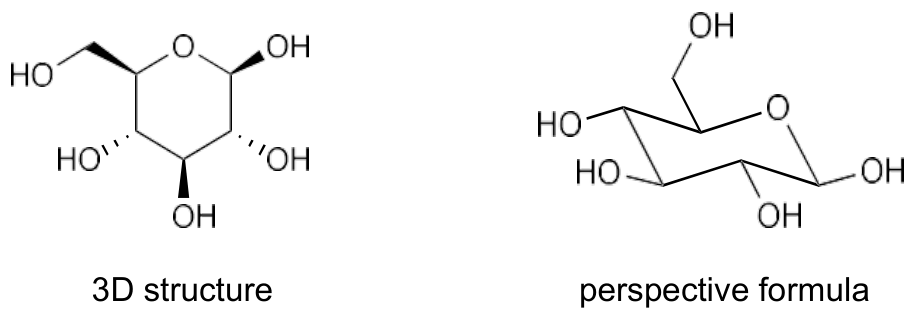
In this problem, we define “3D structure” and “perspective formula” as indicated for β-glucose in the following figure.
Inositols are cyclohexane-1,2,3,4,5,6-hexols. Some of these 6-membered carbocycles, in particular myo-inositol, are involved in a number of biological processes.
Structure of myo-inositol
8.1 Draw the structural formula of inositols, without stereochemical details.
This family of molecules contains 9 different stereoisomers, including enantiomers.
8.2 Draw all 3D structures of the stereoisomers that are optically active.
The structure of a specific inositol, called myo-inositol, is studied here. Only one of its chair conformers is predominant and its structure can be deduced from its \({}^{1}\mathrm{H}\) NMR spectrum. The spectrum below (next page) was obtained at 600 MHz in \(\ce{D2O}\). No other signal from that compound was observed in the spectrum. The integration is indicated on the spectrum below each signal.
8.3 Give the molecular formula of the predominant compound derived from myo-inositol in this sample that is consistent with the number of protons observed in the \({}^{1}\mathrm{H}\) NMR spectrum.
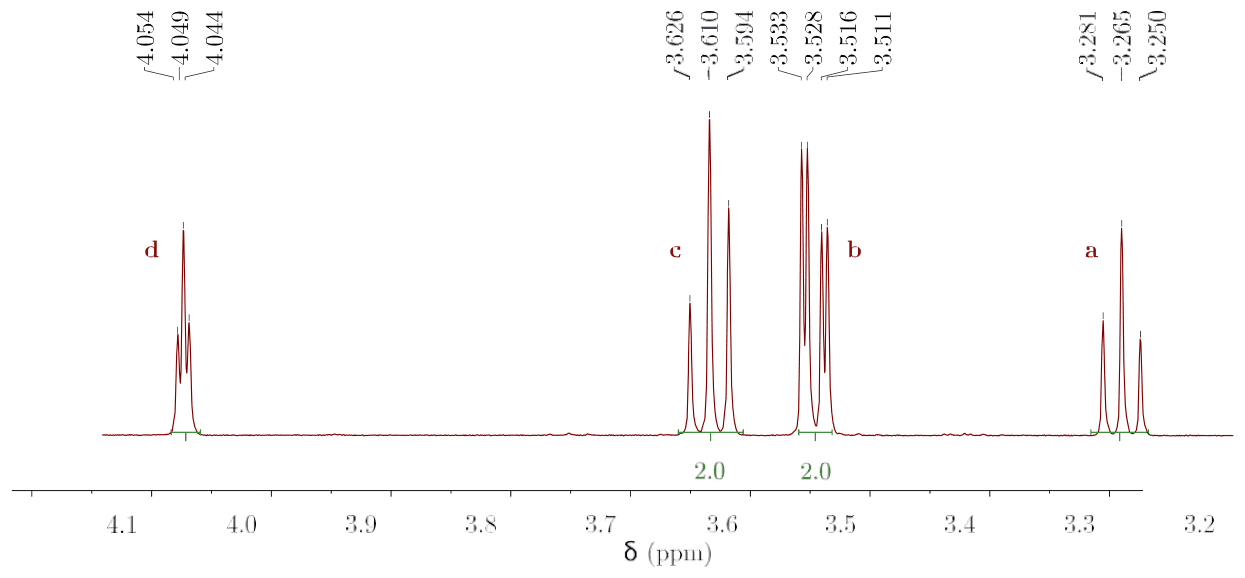
8.4 Based on the number and integrations of the proton signals, give the number of symmetry plane(s) that exist(s) in this molecule.
8.5 Complete the following perspective drawing of the most stable conformation of myo-inositol. Then label each hydrogen with the corresponding letter (a, b, c or d) according to the NMR spectrum above. Proton a must be on carbon a on the following representation. Draw its 3D structure.
Synthesis of inositols
For medicinal applications, it is useful to synthesize some inositol phosphates on a large scale. We will study the synthesis of inositol 2 from bromodiol 1.
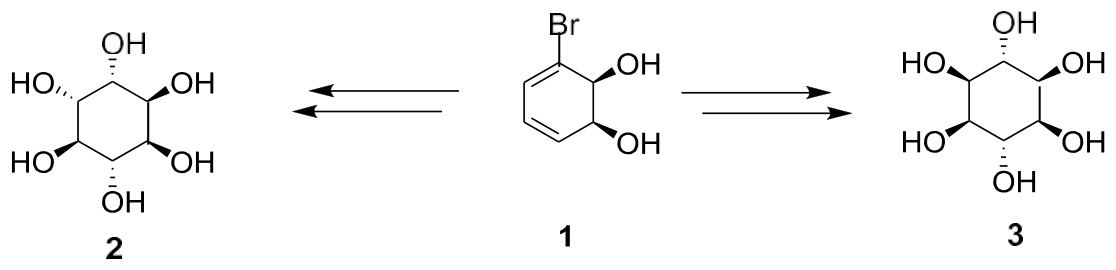
8.6 Choose the correct structural relationship(s) between 2 and 3. Tick relevant boxes.
- ☐ enantiomers
- ☐ epimers
- ☐ diastereomers
- ☐ atropoisomers
Inositol 2 can be obtained from compound 1 in 7 steps.
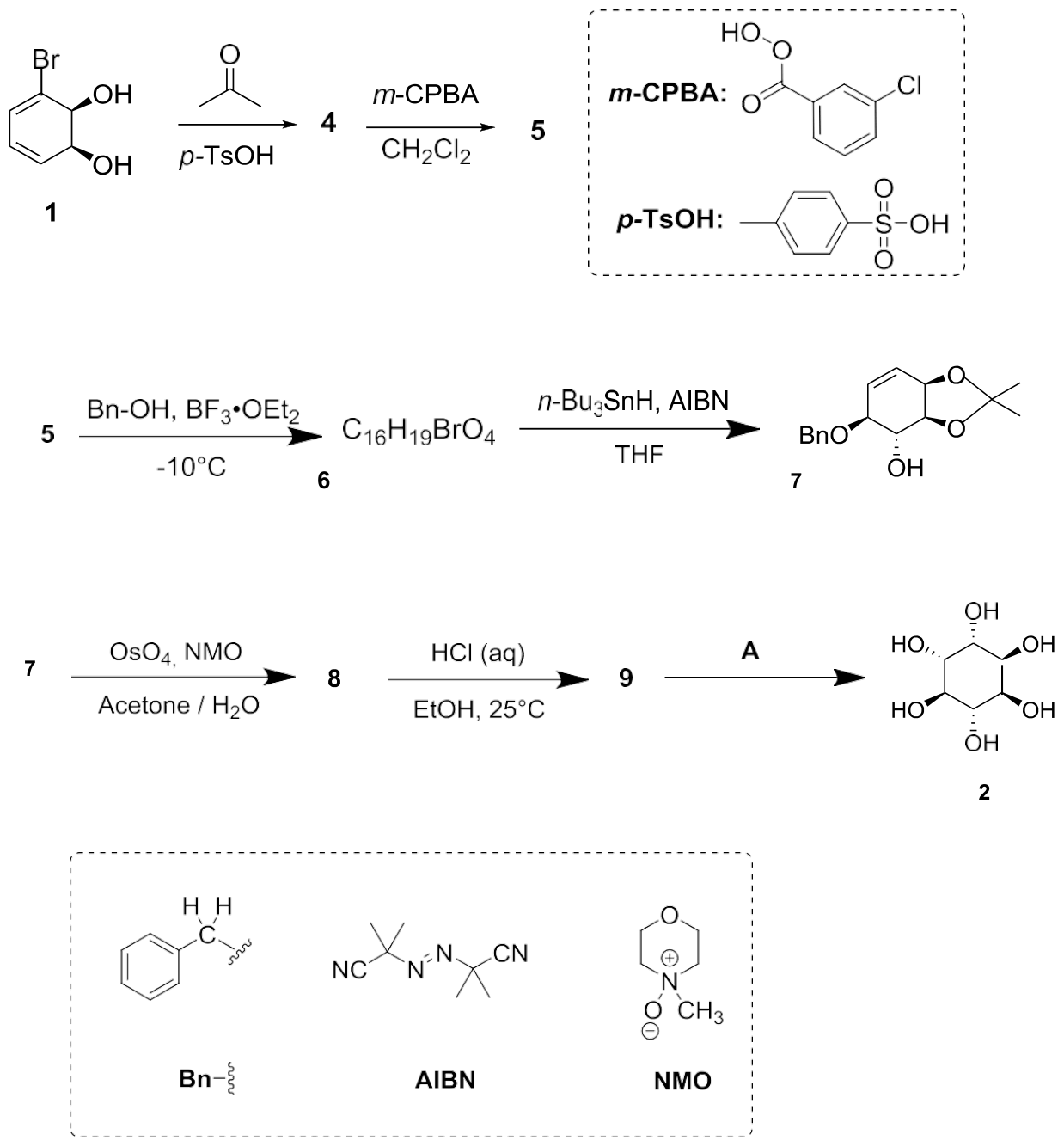
8.7 Draw the 3D structure of 4.
8.8 The reaction leading to 5 occurs on the double bond with the highest electron density. Consider the structure of 1-bromo-1,3-cyclo hexadiene below which is a substructure of 4. Circle the double bond with the highest electron density. Represent all the electronic effects due to the bromine.
8.9 Draw the 3D structure of the major diastereoisomer 5.
8.10 Give the total number of stereoisomers of 5 possibly obtained by this synthesis starting from enantiopure compound 1.
8.11 For the step 5 → 6, another product with the same molecular formula, denoted 6′, can be produced. Draw the 3D structures of 6 and 6′.
8.12 Draw the 3D structures of major diastereomers 8 and 9.
8.13 Select the right set(s) of conditions A to obtain 2. Tick relevant boxes.
- ☐ \(\ce{H2}\), \(\ce{Pd/C}\)
- ☐ \(\ce{K2CO3}\), \(\ce{HF}\)
- ☐ \(\ce{HCOOH}\), \(\ce{H2O}\)
- ☐ \(\ce{BF3.OEt2}\)
8.14 If the bromine is not present in compound 1, in addition to 2, another stereoisomer would be obtained. Considering that stereoselectivity of the reactions that take place in the synthesis remains unchanged and that the following steps involve the same number of equivalents as for 2, draw the 3D structure of this stereoisomer and give its relationship with 2 (tick relevant boxes).
- ☐ enantiomers
- ☐ epimers
- ☐ diastereoisomers
- ☐ atropoisomers
8.15 During the synthesis of 2 from 1 choose the removal step(s) of protecting or directing groups.
| ☐ 1 → 4 | ☐ 7 → 8 |
| ☐ 4 → 5 | ☐ 8 → 9 |
| ☐ 5 → 6 | ☐ 9 → 2 |
| ☐ 6 → 7 |
Official English text of the problem.
Answers
For precise drawing descriptions, number a hexagon clockwise from its top vertex: C1 at the top, C2 upper right, C3 lower right, C4 bottom, C5 lower left, and C6 upper left. This is working numbering, used consistently below.
A \(+\) denotes a solid wedge towards the reader; a \(-\) denotes a hatched wedge away. A six-sign sequence gives the directions of the carbon–oxygen bonds at C1–C6. At each saturated ring carbon, its hydrogen is on the opposite face.
-
8.1 Inositol, cyclohexane-1,2,3,4,5,6-hexol: a six-membered carbon ring bearing one hydroxy group on every carbon.
SMILES without stereochemistry:OC1C(O)C(O)C(O)C(O)C1O. -
8.2 Only the two chiro-inositol enantiomers, the D/L pair, are optically active. Two mirror-image drawings are:
Chiro-inositol enantiomer I, also compound 2: \((-,+,+,-,+,-)\).
O[C@@H]1[C@@H](O)[C@@H](O)[C@H](O)[C@@H](O)[C@@H]1O
Chiro-inositol enantiomer II, its mirror image: \((+,-,-,+,-,+)\).
O[C@H]1[C@H](O)[C@H](O)[C@@H](O)[C@H](O)[C@H]1O
-
8.3 Hydroxy-deuterated myo-inositol, with molecular formula
\[ \boxed{\ce{C6H6D6O6}}. \] Its six hydroxy groups are predominantly \(\ce{OD}\).
SMILES:[2H]O[C@@H]1[C@@H](O[2H])[C@H](O[2H])[C@H](O[2H])[C@H](O[2H])[C@H]1O[2H]. -
8.4 One symmetry plane.
-
8.5 Myo-inositol has five equatorial hydroxy groups and one axial hydroxy group in its predominant chair. Hydrogen d is equatorial; the other five ring hydrogens are axial. Starting at the specified carbon a, the hydrogen labels around the ring are \[ \boxed{a,\ c,\ b,\ d,\ b,\ c}. \] A corresponding hexagonal drawing has hydroxy directions \((-,+,-,-,-,+)\).
SMILES:O[C@@H]1[C@@H](O)[C@H](O)[C@H](O)[C@H](O)[C@H]1O. -
8.6 Tick epimers and diastereomers.
-
8.7 Bromodiol acetonide 4: connect the two original oxygen atoms at C2 and C3 through a common \(\ce{C(CH3)2}\) group. Both ring carbon–oxygen bonds remain solid wedges. Retain bromine at C1 and double bonds C1=C6 and C4=C5.
SMILES:BrC1[C@@H](O2)[C@@H](OC2(C)C)C=CC=1. -
8.8 Circle C4=C5, the double bond that does not bear bromine. Bromine exerts a negative inductive effect, \(-I\), and a positive mesomeric effect, \(+M\).
-
8.9 Epoxide 5: epoxidize C4=C5, placing both epoxide carbon–oxygen bonds on the hatched face, opposite the acetonide.
SMILES:BrC1[C@@H](O2)[C@@H](OC2(C)C)[C@H]3[C@H](O3)C=1. -
8.10 \(\boxed{2}\) stereoisomers: two diastereomers.
-
8.11 The two regioisomeric benzyl-alcohol opening products are:
6: C4 bears hatched \(\ce{OH}\); C5 bears solid-wedge \(\ce{OBn}\).
BrC1[C@@H](O2)[C@@H](OC2(C)C)[C@H](O)[C@@H](OCc2ccccc2)C=1
6′: C4 bears solid-wedge \(\ce{OBn}\); C5 bears hatched \(\ce{OH}\).
BrC1[C@@H](O2)[C@@H](OC2(C)C)[C@@H](OCc2ccccc2)[C@H](O)C=1
Both retain the original acetonide and the brominated C1=C6 double bond.
- 8.12 Protected chiro-inositol 8: add hatched hydroxy groups at both C1 and C6 of 7, retaining its acetonide and benzyl ether.
O[C@@H]1[C@@H](O2)[C@@H](OC2(C)C)[C@H](O)[C@@H](OCc2ccccc2)[C@@H]1O
Monobenzyl-protected chiro-inositol 9: hydrolyse the acetonide of 8, exposing solid-wedge hydroxy groups at C2 and C3. Retain the C5 benzyl ether.
O[C@@H]1[C@@H](O)[C@@H](O)[C@H](O)[C@@H](OCc2ccccc2)[C@@H]1O
-
8.13 Tick \(\ce{H2}\), \(\ce{Pd/C}\) only.
-
8.14 The additional product is the enantiomer of 2, or ent-2. In the original ring orientation, its hydroxy directions are \((-,+,+,-,-,+)\).
SMILES:O[C@@H]1[C@@H](O)[C@@H](O)[C@H](O)[C@H](O)[C@H]1O.
Tick enantiomers only. -
8.15 Tick \[ \boxed{\mathbf{6\rightarrow7,\qquad8\rightarrow9,\qquad9\rightarrow2}}. \]
Solution
8.1 — Inositol connectivity
Cyclohexane-1,2,3,4,5,6-hexol consists of six \(\ce{CH(OH)}\) units joined into a ring. Thus, draw a hexagon with a hydroxy group attached by an ordinary single bond at every vertex, without wedges or hatches.
The molecular formula is \(\ce{C6H12O6}\). Its constitution is represented by the non-stereochemical SMILES given in 8.1.
8.2 — Optically active stereoisomers
The nine configurational stereoisomers comprise seven achiral forms and one enantiomeric pair: D- and L-chiro-inositol.
This can be checked directly by assigning each hydroxy group one of the two ring faces. Rotating the hexagon cyclically preserves the sequence of face signs. Turning the hexagon over reverses their order and changes every sign. A mirror image changes every sign without reversing their order.
Classifying the face patterns under the proper rotations gives nine distinct configurations. Seven are equivalent to their own mirror images; the two chiro configurations are not.
The pair specified in the Answers, \[ (-,+,+,-,+,-) \quad\text{and}\quad (+,-,-,+,-,+), \] therefore gives the required two drawings. Every wedge becomes a hatch in the mirror image. Their configurations are encoded in the two stereochemical SMILES; a particular chair conformation is not encoded by SMILES.
8.3 — Exchange of hydroxy hydrogens
Each inositol molecule contains six carbon-bound hydrogens and six hydroxy hydrogens. In heavy water, the hydroxy hydrogens exchange with deuterium:
\[ \ce{C6H12O6 + 6D2O <=> C6H6D6O6 + 6HDO}. \]
Heavy water is deuterium oxide, [2H]O[2H]; monodeuterated water is [2H]O.
The six carbon-bound hydrogens remain observable by \({}^{1}\mathrm{H}\) NMR. The six deuteriums of the \(\ce{OD}\) groups do not contribute to that spectrum. Consequently, the predominant isotopologue is
\[ \boxed{\ce{C6H6D6O6}}. \]
8.4 — Molecular symmetry
The four resonances represent proton populations
\[ 1:2:2:1. \]
Thus, two ring hydrogens are individually unique, while the other four form two equivalent pairs.
A mirror plane passing through the carbons bearing a and d leaves those two hydrogens individually unchanged and exchanges the two b hydrogens and the two c hydrogens. The predominant chair therefore has one mirror plane.
In the working numbering, this plane passes through C1 and C4 and interchanges C2 with C6 and C3 with C5.
8.5 — NMR assignment and predominant chair
At a spectrometer frequency of 600 MHz,
\[ J\;(\mathrm{Hz}) = 600\;(\mathrm{Hz\,ppm^{-1}}) \times \Delta\delta\;(\mathrm{ppm}). \]
For example, the separation between adjacent lines of signal d gives
\[ J_d=600(4.054-4.049)=3.0\ \mathrm{Hz}. \]
For signal c,
\[ J_c\approx600(3.626-3.610)=9.6\ \mathrm{Hz}. \]
For the doublet of doublets b, the two apparent couplings are
\[ J_{\mathrm{small}}=600(3.533-3.528)=3.0\ \mathrm{Hz}, \]
\[ J_{\mathrm{large}}=600(3.533-3.516)=10.2\ \mathrm{Hz}. \]
The spectrum can therefore be summarized as follows. The values are apparent splittings read from the rounded peak labels.
| Signal | Approximate \(\delta\) / ppm | Number of hydrogens | Appearance | Coupling information |
|---|---|---|---|---|
| a | 3.265 | 1 | Triplet | Two large couplings, approximately \(9\)–\(10\ \mathrm{Hz}\) |
| b | 3.522 | 2 | Doublet of doublets | One large coupling, approximately \(10.2\ \mathrm{Hz}\), and one small coupling, \(3.0\ \mathrm{Hz}\) |
| c | 3.610 | 2 | Apparent triplet | Two similar large couplings, approximately \(9.6\ \mathrm{Hz}\) |
| d | 4.049 | 1 | Triplet | Two small couplings, \(3.0\ \mathrm{Hz}\) |
In a cyclohexane chair, neighbouring axial hydrogens have approximately antiperiplanar geometry and a large vicinal coupling. An axial–equatorial pair gives a much smaller coupling.
Therefore:
- a is axial and has two axial c neighbours.
- Each c is axial, between axial a and axial b.
- Each b is axial, between axial c and equatorial d.
- d is equatorial and has two equivalent axial b neighbours.
The ring sequence is consequently
\[ \boxed{a-c-b-d-b-c}. \]
To fill the missing chair template, designate its required carbon a as C1 and follow this sequence around the ring. One precise chair description is:
| Carbon | Hydrogen label | Hydrogen orientation | Hydroxy orientation |
|---|---|---|---|
| C1 | a | Axial, up | Equatorial, down |
| C2 | c | Axial, down | Equatorial, up |
| C3 | b | Axial, up | Equatorial, down |
| C4 | d | Equatorial, up | Axial, down |
| C5 | b | Axial, up | Equatorial, down |
| C6 | c | Axial, down | Equatorial, up |
The corresponding hexagonal wedge-and-hatch drawing has hydroxy directions
\[ (-,+,-,-,-,+). \]
This chair has only one axial hydroxy group. Ring inversion would produce five axial hydroxy groups, increasing unfavourable axial interactions, so the depicted chair predominates.
8.6 — Relationship between 2 and 3
Compound 2 is the chiro-inositol enantiomer specified in 8.2.
Compound 3, its C6 epimer, is a stereoisomer of cyclohexane-1,2,3,4,5,6-hexol with SMILES
O[C@@H]1[C@@H](O)[C@@H](O)[C@H](O)[C@@H](O)[C@H]1O.
Their hydroxy configurations are
\[ \begin{aligned} \mathbf{2}:&\quad(-,+,+,-,+,-),\\ \mathbf{3}:&\quad(-,+,+,-,+,+). \end{aligned} \]
Only C6 changes configuration. They are therefore epimers, and hence also diastereomers. They are neither mirror images nor atropisomers.
8.7 — Formation of acetonide 4
Starting material 1 is the depicted enantiomer of cis-3-bromocyclohexa-3,5-diene-1,2-diol:
BrC1[C@@H](O)[C@@H](O)C=CC=1.
Acetone, or propan-2-one, CC(=O)C, reacts with the cis diol under catalysis by p-toluenesulfonic acid, Cc1ccc(S(=O)(=O)O)cc1.
The two diol oxygen atoms become connected through the carbon originally belonging to the acetone carbonyl group. The resulting bridge is
\[ \ce{O-C(CH3)2-O}. \]
This forms a five-membered cyclic acetal, commonly called an acetonide. The original ring carbon–oxygen bonds are retained, so both remain solid wedges.
The balanced net reaction is
\[ \ce{C6H7BrO2 + C3H6O <=> C9H11BrO2 + H2O}. \]
Water has SMILES O. Compound 4 has formula \(\ce{C9H11BrO2}\), and its complete stereochemical SMILES is given in the Answers.
8.8 — Bromine’s electronic effects
The model substructure is 1-bromocyclohexa-1,3-diene, BrC1=CC=CCC1. In the working numbering, its conjugated chain runs
\[ \mathrm{C1=C6-C5=C4}. \]
Bromine has two relevant electronic effects:
-
Negative inductive effect, \(-I\). It withdraws electron density through the carbon–bromine sigma bond. Draw the bond-polarization arrow towards bromine. This withdrawal is strongest near the brominated double bond.
-
Positive mesomeric effect, \(+M\). A bromine lone pair can donate into the conjugated system.
For the resonance arrows, draw a curved arrow from a bromine lone pair into the Br–C1 bond and move the C1=C6 π electrons onto C6. The resulting negative charge can then be delocalized: move the C6 lone pair into the C6–C5 bond and move the C5=C4 π electrons onto C4.
Omitting the rest of the ring, these contributors are
\[ \ce{Br-C=C-C=C <-> Br+=C-C^{-}-C=C <-> Br+=C-C=C-C^{-}}. \]
The corresponding charge-separated contributors of the model molecule can be encoded as [Br+]=C1[CH-]C=CCC1 and [Br+]=C1C=C[CH-]CC1. These are resonance contributors, not separate reaction products.
The double bond directly bearing bromine is more strongly depleted by its inductive effect. The more electron-rich double bond, and hence the one to circle, is
\[ \boxed{\mathrm{C4=C5}}. \]
8.9 — Formation and configuration of epoxide 5
The reagent is m-chloroperoxybenzoic acid, or m-CPBA, OOC(=O)c1cccc(Cl)c1.
Peracid epoxidation transfers one oxygen atom to both carbons of an alkene in a concerted reaction. Thus, the two new carbon–oxygen bonds form on the same face.
The acetonide occupies the solid-wedge face. Attack at C4=C5 from the less hindered opposite face gives the major epoxide 5, with both epoxide carbon–oxygen bonds hatched. The original configurations at C2 and C3 are unchanged.
The balanced reaction is
\[ \ce{C9H11BrO2 + C7H5ClO3 -> C9H11BrO3 + C7H5ClO2}. \]
The byproduct is m-chlorobenzoic acid, O=C(O)c1cccc(Cl)c1. The solvent, dichloromethane, is ClCCl.
8.10 — Number of possible stereoisomers of 5
Epoxidation can occur from either face of the selected double bond.
The original stereocentres of enantiopure 1 remain fixed, so the two products differ only in the face occupied by the epoxide. They are diastereomers.
The epoxide’s two new centres are formed together with a fixed relative configuration; their configurations cannot be selected independently. Thus,
\[ \boxed{N=2}. \]
The minor epoxide, with both epoxide bonds on the solid-wedge face, has SMILES
BrC1[C@@H](O2)[C@@H](OC2(C)C)[C@@H]3[C@@H](O3)C=1.
8.11 — Epoxide opening to 6 and 6′
Benzyl alcohol, OCc1ccccc1, opens the Lewis-acid-activated epoxide.
Boron trifluoride diethyl etherate can be represented by its components as FB(F)F.CCOCC; in the actual adduct, the ether oxygen coordinates to boron. The disconnected SMILES does not encode that coordination bond.
Backside attack breaks the epoxide carbon–oxygen bond at the attacked carbon. The incoming benzyloxy group and the retained hydroxy group are consequently anti.
For 6:
- Benzyl alcohol attacks C5.
- C5 changes from a hatched epoxide bond to a solid-wedge benzyloxy bond.
- The oxygen at C4 remains on the hatched face and becomes a hydroxy group.
For 6′:
- Benzyl alcohol attacks C4.
- C4 acquires a solid-wedge benzyloxy group.
- C5 retains the hatched oxygen, which becomes a hydroxy group.
Both products satisfy the given molecular formula:
\[ \ce{C9H11BrO3 + C7H8O -> C16H19BrO4}. \]
The displayed structure of 7 identifies 6 as the product having benzyloxy at C5 and hydroxy at C4.
The subsequent radical reaction replaces bromine by hydrogen without changing these stereocentres. Protected cyclohexenetetrol 7 has SMILES
C1[C@@H](O2)[C@@H](OC2(C)C)[C@H](O)[C@@H](OCc2ccccc2)C=1.
The balanced debromination is
\[ \ce{C16H19BrO4 + (C4H9)3SnH -> C16H20O4 + (C4H9)3SnBr}. \]
Here the butyl groups are normal butyl groups. Tri-n-butyltin hydride is [SnH](CCCC)(CCCC)CCCC; tri-n-butyltin bromide is Br[Sn](CCCC)(CCCC)CCCC.
The radical initiator AIBN, 2,2′-azobis(2-methylpropanenitrile), is CC(C)(C#N)N=NC(C)(C)C#N. The solvent tetrahydrofuran is C1CCOC1.
8.12 — Dihydroxylation and acetonide removal
Formation of 8. Osmium tetroxide, O=[Os](=O)(=O)=O, adds to the remaining C1=C6 double bond by syn dihydroxylation.
The less hindered face is opposite the solid-wedge acetonide and benzyloxy substituents. Both new hydroxy groups therefore occupy the hatched face, at C1 and C6. The pre-existing configurations remain unchanged.
The reoxidant is N-methylmorpholine N-oxide, or NMO, C[N+]1([O-])CCOCC1. Its reduced product is N-methylmorpholine, CN1CCOCC1.
A balanced net equation for the catalytic oxidation is
\[ \ce{C16H20O4 + C5H11NO2 + H2O ->[OsO4] C16H22O6 + C5H11NO}. \]
Thus 8 is the benzyl/acetonide-protected chiro-inositol specified in the Answers.
Formation of 9. Aqueous acid hydrolyses the acetonide, regenerating the C2 and C3 hydroxy groups and releasing acetone. The original ring carbon–oxygen bonds are retained, so those hydroxy groups remain solid wedges.
\[ \ce{C16H22O6 + H2O -> C13H18O6 + C3H6O}. \]
The benzyl ether survives this treatment. Therefore, 9 is the C5 monobenzyl ether of 2, with all six ring configurations already those required in the final product.
8.13 — Conditions for benzyl-ether removal
Hydrogen, [H][H], with palladium on carbon cleaves the benzyl ether by hydrogenolysis:
\[ \ce{C13H18O6 + H2 ->[Pd/C] C6H12O6 + C7H8}. \]
The organic byproduct is toluene, Cc1ccccc1.
Cleavage occurs at the benzyl–oxygen bond; the bond between the inositol carbon and oxygen remains intact. Consequently, the configuration at C5 is retained.
The correct choice is therefore
\[ \boxed{\ce{H2},\ \ce{Pd/C}}. \]
The other listed conditions do not provide the required benzyl-ether hydrogenolysis.
8.14 — Product obtained without bromine
Without bromine, the starting cis diol becomes an achiral, symmetry-related diene, represented by
C1[C@@H](O)[C@@H](O)C=CC=1.
The two double bonds are enantiotopic. The same face preference in epoxidation can therefore lead through either of two mirror-related reaction sequences.
One sequence epoxidizes C4=C5 and gives 2. In the other:
- C1=C6 is epoxidized on the hatched face.
- Corresponding epoxide opening gives hatched hydroxy at C1 and solid-wedge benzyloxy at C6.
- Syn dihydroxylation gives hatched hydroxy groups at C4 and C5.
- Deprotection exposes all six hydroxy groups.
The final face sequence in the original orientation is
\[ (-,+,+,-,-,+). \]
This is the mirror image of 2 after a rotation of the drawing. Its stereochemical SMILES is given in 8.14.
Although two positions appear different when the original atom labels are kept fixed, the correct whole-molecule relationship is enantiomerism, not epimerism. Tick enantiomers only.
8.15 — Removal of protecting or directing groups
| Step | Group removed | Function in the synthesis |
|---|---|---|
| 6 → 7 | Bromine | Temporarily differentiates the two double bonds electronically |
| 8 → 9 | Acetonide | Protects the original cis diol |
| 9 → 2 | Benzyl group | Protects the hydroxy group introduced through epoxide opening |
Thus the required removal steps are
\[ \boxed{\mathbf{6\rightarrow7,\quad8\rightarrow9,\quad9\rightarrow2}}. \]
The answers were checked against the official answers published by the organisers.
IChO 2019 · Theorieaufgabe 8
Identifizierung und Synthese von Inositolen
In dieser Aufgabe werden die Begriffe „3D-Struktur“ und „perspektivische Formel“ so verwendet, wie es in der folgenden Abbildung für β-Glucose gezeigt ist.
Inositole sind Cyclohexan-1,2,3,4,5,6-hexole. Einige dieser sechsgliedrigen Carbocyclen, insbesondere myo-Inositol, sind an einer Reihe biologischer Prozesse beteiligt.
Struktur von myo-Inositol
8.1 Zeichnen Sie die Strukturformel der Inositole ohne stereochemische Angaben.
Diese Molekülfamilie umfasst 9 verschiedene Stereoisomere einschließlich der Enantiomere.
8.2 Zeichnen Sie alle 3D-Strukturen der optisch aktiven Stereoisomere.
Hier wird die Struktur eines bestimmten Inositols, des sogenannten myo-Inositols, untersucht. Nur eines seiner Sesselkonformere überwiegt, und dessen Struktur lässt sich aus seinem \({}^{1}\mathrm{H}\)-NMR-Spektrum ableiten. Das unten stehende Spektrum (nächste Seite) wurde bei 600 MHz in \(\ce{D2O}\) aufgenommen. Im Spektrum wurde kein weiteres Signal dieser Verbindung beobachtet. Die Integration ist im folgenden Spektrum unter jedem Signal angegeben.
8.3 Geben Sie die Summenformel der in dieser Probe vorherrschenden, von myo-Inositol abgeleiteten Verbindung an, die mit der Anzahl der im \({}^{1}\mathrm{H}\)-NMR-Spektrum beobachteten Protonen vereinbar ist.
8.4 Geben Sie anhand der Anzahl und der Integrale der Protonensignale an, wie viele Symmetrieebenen dieses Molekül besitzt.
8.5 Vervollständigen Sie die folgende perspektivische Zeichnung der stabilsten Konformation von myo-Inositol. Kennzeichnen Sie anschließend jedes Wasserstoffatom mit dem entsprechenden Buchstaben (a, b, c oder d) gemäß dem obigen NMR-Spektrum. Proton a muss in der folgenden Darstellung am Kohlenstoffatom a sitzen. Zeichnen Sie die zugehörige 3D-Struktur.
Synthese von Inositolen
Für medizinische Anwendungen ist es nützlich, einige Inositolphosphate in großem Maßstab zu synthetisieren. Wir betrachten die Synthese von Inositol 2 aus Bromdiol 1.
8.6 Wählen Sie die zutreffende(n) strukturelle(n) Beziehung(en) zwischen 2 und 3 aus. Kreuzen Sie die entsprechenden Kästchen an.
- ☐ Enantiomere
- ☐ Epimere
- ☐ Diastereomere
- ☐ Atropisomere
Inositol 2 lässt sich in 7 Schritten aus Verbindung 1 erhalten.
8.7 Zeichnen Sie die 3D-Struktur von 4.
8.8 Die Reaktion, die zu 5 führt, findet an der Doppelbindung mit der höchsten Elektronendichte statt. Betrachten Sie die unten dargestellte Struktur von 1-Bromcyclohexa-1,3-dien, die eine Teilstruktur von 4 ist. Kreisen Sie die Doppelbindung mit der höchsten Elektronendichte ein. Stellen Sie alle vom Brom ausgehenden elektronischen Effekte dar.
8.9 Zeichnen Sie die 3D-Struktur des Hauptdiastereomers 5.
8.10 Geben Sie die Gesamtzahl der Stereoisomere von 5 an, die bei dieser Synthese ausgehend von enantiomerenreiner Verbindung 1 erhalten werden können.
8.11 Beim Schritt 5 → 6 kann ein weiteres Produkt mit derselben Summenformel entstehen, das als 6′ bezeichnet wird. Zeichnen Sie die 3D-Strukturen von 6 und 6′.
8.12 Zeichnen Sie die 3D-Strukturen der Hauptdiastereomere 8 und 9.
8.13 Wählen Sie die geeigneten Reaktionsbedingungen A aus, um 2 zu erhalten. Kreuzen Sie die entsprechenden Kästchen an.
- ☐ \(\ce{H2}\), \(\ce{Pd/C}\)
- ☐ \(\ce{K2CO3}\), \(\ce{HF}\)
- ☐ \(\ce{HCOOH}\), \(\ce{H2O}\)
- ☐ \(\ce{BF3.OEt2}\)
8.14 Wenn Verbindung 1 kein Brom enthält, würde neben 2 ein weiteres Stereoisomer erhalten werden. Nehmen Sie an, dass die Stereoselektivität der während der Synthese ablaufenden Reaktionen unverändert bleibt und in den nachfolgenden Schritten dieselbe Anzahl an Äquivalenten wie für 2 eingesetzt wird. Zeichnen Sie die 3D-Struktur dieses Stereoisomers und geben Sie seine Beziehung zu 2 an (kreuzen Sie die entsprechenden Kästchen an).
- ☐ Enantiomere
- ☐ Epimere
- ☐ Diastereomere
- ☐ Atropisomere
8.15 Wählen Sie die Schritte der Synthese von 2 aus 1 aus, in denen Schutzgruppen oder dirigierende Gruppen entfernt werden.
| ☐ 1 → 4 | ☐ 7 → 8 |
| ☐ 4 → 5 | ☐ 8 → 9 |
| ☐ 5 → 6 | ☐ 9 → 2 |
| ☐ 6 → 7 |
Aufgabentext aus dem offiziellen englischen Text übersetzt.
Antworten
Für präzise Beschreibungen der Zeichnungen wird ein Sechseck ausgehend von seiner oberen Ecke im Uhrzeigersinn nummeriert: C1 oben, C2 rechts oben, C3 rechts unten, C4 unten, C5 links unten und C6 links oben. Diese Hilfsnummerierung wird im Folgenden durchgehend verwendet.
Ein \(+\) bezeichnet einen ausgefüllten Keil zum Betrachter hin; ein \(-\) bezeichnet einen schraffierten Keil vom Betrachter weg. Eine Folge aus sechs Vorzeichen gibt die Richtungen der Kohlenstoff–Sauerstoff-Bindungen an C1–C6 an. An jedem gesättigten Ringkohlenstoffatom liegt das Wasserstoffatom auf der gegenüberliegenden Seite.
-
8.1 Inositol, Cyclohexan-1,2,3,4,5,6-hexol: ein sechsgliedriger Kohlenstoffring, der an jedem Kohlenstoffatom eine Hydroxygruppe trägt.
SMILES ohne Stereochemie:OC1C(O)C(O)C(O)C(O)C1O. -
8.2 Nur die beiden chiro-Inositol-Enantiomere, das D/L-Paar, sind optisch aktiv. Zwei spiegelbildliche Zeichnungen sind:
Chiro-Inositol-Enantiomer I, zugleich Verbindung 2: \((-,+,+,-,+,-)\).
O[C@@H]1[C@@H](O)[C@@H](O)[C@H](O)[C@@H](O)[C@@H]1O
Chiro-Inositol-Enantiomer II, sein Spiegelbild: \((+,-,-,+,-,+)\).
O[C@H]1[C@H](O)[C@H](O)[C@@H](O)[C@H](O)[C@H]1O
-
8.3 An den Hydroxygruppen deuteriertes myo-Inositol mit der Summenformel
\[ \boxed{\ce{C6H6D6O6}}. \] Seine sechs Hydroxygruppen liegen überwiegend als \(\ce{OD}\) vor.
SMILES:[2H]O[C@@H]1[C@@H](O[2H])[C@H](O[2H])[C@H](O[2H])[C@H](O[2H])[C@H]1O[2H]. -
8.4 Eine Symmetrieebene.
-
8.5 Myo-Inositol besitzt in seiner vorherrschenden Sesselform fünf äquatoriale Hydroxygruppen und eine axiale Hydroxygruppe. Wasserstoff d steht äquatorial; die anderen fünf Ringwasserstoffatome stehen axial. Beginnend am vorgegebenen Kohlenstoffatom a lauten die Wasserstoffkennzeichnungen entlang des Rings \[ \boxed{a,\ c,\ b,\ d,\ b,\ c}. \] In einer entsprechenden Sechseckzeichnung sind die Hydroxygruppen in die Richtungen \((-,+,-,-,-,+)\) orientiert.
SMILES:O[C@@H]1[C@@H](O)[C@H](O)[C@H](O)[C@H](O)[C@H]1O. -
8.6 Epimere und Diastereomere ankreuzen.
-
8.7 Bromdiolacetonid 4: Die beiden ursprünglichen Sauerstoffatome an C2 und C3 werden über eine gemeinsame \(\ce{C(CH3)2}\)-Gruppe verbunden. Beide Bindungen zwischen Ringkohlenstoff und Sauerstoff bleiben ausgefüllte Keile. Brom an C1 sowie die Doppelbindungen C1=C6 und C4=C5 bleiben erhalten.
SMILES:BrC1[C@@H](O2)[C@@H](OC2(C)C)C=CC=1. -
8.8 C4=C5 einkreisen, also die Doppelbindung, die kein Brom trägt. Brom übt einen negativen induktiven Effekt, \(-I\), und einen positiven mesomeren Effekt, \(+M\) aus.
-
8.9 Epoxid 5: C4=C5 wird epoxidiert, wobei beide Kohlenstoff–Sauerstoff-Bindungen des Epoxids auf der durch schraffierte Keile dargestellten Seite liegen, gegenüber dem Acetonid.
SMILES:BrC1[C@@H](O2)[C@@H](OC2(C)C)[C@H]3[C@H](O3)C=1. -
8.10 \(\boxed{2}\) Stereoisomere: zwei Diastereomere.
-
8.11 Die beiden regioisomeren Ringöffnungsprodukte mit Benzylalkohol sind:
6: C4 trägt \(\ce{OH}\) an einem schraffierten Keil; C5 trägt \(\ce{OBn}\) an einem ausgefüllten Keil.
BrC1[C@@H](O2)[C@@H](OC2(C)C)[C@H](O)[C@@H](OCc2ccccc2)C=1
6′: C4 trägt \(\ce{OBn}\) an einem ausgefüllten Keil; C5 trägt \(\ce{OH}\) an einem schraffierten Keil.
BrC1[C@@H](O2)[C@@H](OC2(C)C)[C@@H](OCc2ccccc2)[C@H](O)C=1
Bei beiden bleiben das ursprüngliche Acetonid und die bromierte Doppelbindung C1=C6 erhalten.
- 8.12 Geschütztes chiro-Inositol 8: An C1 und C6 von 7 werden Hydroxygruppen mit schraffierten Keilen hinzugefügt; Acetonid und Benzylether bleiben erhalten.
O[C@@H]1[C@@H](O2)[C@@H](OC2(C)C)[C@H](O)[C@@H](OCc2ccccc2)[C@@H]1O
Monobenzylgeschütztes chiro-Inositol 9: Das Acetonid von 8 wird hydrolysiert, wodurch die Hydroxygruppen an C2 und C3 mit ausgefüllten Keilen freigesetzt werden. Der Benzylether an C5 bleibt erhalten.
O[C@@H]1[C@@H](O)[C@@H](O)[C@H](O)[C@@H](OCc2ccccc2)[C@@H]1O
-
8.13 Nur \(\ce{H2}\), \(\ce{Pd/C}\) ankreuzen.
-
8.14 Das zusätzliche Produkt ist das Enantiomer von 2, also ent-2. In der ursprünglichen Ringorientierung lauten die Richtungen seiner Hydroxygruppen \((-,+,+,-,-,+)\).
SMILES:O[C@@H]1[C@@H](O)[C@@H](O)[C@H](O)[C@H](O)[C@H]1O.
Nur Enantiomere ankreuzen. -
8.15 Ankreuzen: \[ \boxed{\mathbf{6\rightarrow7,\qquad8\rightarrow9,\qquad9\rightarrow2}}. \]
Lösung
8.1 — Verknüpfung der Atome im Inositol
Cyclohexan-1,2,3,4,5,6-hexol besteht aus sechs zu einem Ring verbundenen \(\ce{CH(OH)}\)-Einheiten. Zeichnen Sie daher ein Sechseck, an dessen jeder Ecke eine Hydroxygruppe über eine gewöhnliche Einfachbindung gebunden ist, ohne ausgefüllte oder schraffierte Keile.
Die Summenformel lautet \(\ce{C6H12O6}\). Die Konstitution wird durch die in 8.1 angegebene SMILES ohne stereochemische Angaben dargestellt.
8.2 — Optisch aktive Stereoisomere
Die neun Konfigurationsisomere umfassen sieben achirale Formen und ein Enantiomerenpaar: D- und L-chiro-Inositol.
Dies lässt sich direkt überprüfen, indem jeder Hydroxygruppe eine der beiden Ringseiten zugeordnet wird. Eine zyklische Drehung des Sechsecks erhält die Reihenfolge der Seitenvorzeichen. Beim Wenden des Sechsecks wird ihre Reihenfolge umgekehrt und jedes Vorzeichen geändert. Bei einer Spiegelung wird jedes Vorzeichen geändert, ohne ihre Reihenfolge umzukehren.
Die Klassifizierung der Seitenmuster unter eigentlichen Drehungen ergibt neun unterschiedliche Konfigurationen. Sieben sind mit ihrem eigenen Spiegelbild identisch; die beiden chiro-Konfigurationen sind es nicht.
Das in den Antworten angegebene Paar, \[ (-,+,+,-,+,-) \quad\text{und}\quad (+,-,-,+,-,+), \] liefert somit die beiden geforderten Zeichnungen. Jeder ausgefüllte Keil wird im Spiegelbild zu einem schraffierten Keil. Ihre Konfigurationen sind in den beiden stereochemischen SMILES codiert; eine bestimmte Sesselkonformation wird durch SMILES nicht codiert.
8.3 — Austausch der Hydroxywasserstoffatome
Jedes Inositolmolekül enthält sechs an Kohlenstoff gebundene Wasserstoffatome und sechs Hydroxywasserstoffatome. In schwerem Wasser werden die Hydroxywasserstoffatome gegen Deuterium ausgetauscht:
\[ \ce{C6H12O6 + 6D2O <=> C6H6D6O6 + 6HDO}. \]
Schweres Wasser ist Deuteriumoxid, [2H]O[2H]; monodeuteriertes Wasser ist [2H]O.
Die sechs an Kohlenstoff gebundenen Wasserstoffatome bleiben mittels \({}^{1}\mathrm{H}\)-NMR beobachtbar. Die sechs Deuteriumatome der \(\ce{OD}\)-Gruppen tragen nicht zu diesem Spektrum bei. Folglich ist das vorherrschende Isotopolog
\[ \boxed{\ce{C6H6D6O6}}. \]
8.4 — Molekülsymmetrie
Die vier Resonanzen entsprechen Protonenanzahlen im Verhältnis
\[ 1:2:2:1. \]
Somit sind zwei Ringwasserstoffatome jeweils einzigartig, während die übrigen vier zwei äquivalente Paare bilden.
Eine Spiegelebene durch die Kohlenstoffatome, die a und d tragen, lässt diese beiden Wasserstoffatome jeweils unverändert und vertauscht die beiden b-Wasserstoffatome sowie die beiden c-Wasserstoffatome miteinander. Die vorherrschende Sesselform besitzt daher eine Spiegelebene.
In der Hilfsnummerierung verläuft diese Ebene durch C1 und C4 und vertauscht C2 mit C6 sowie C3 mit C5.
8.5 — NMR-Zuordnung und vorherrschende Sesselform
Bei einer Spektrometerfrequenz von 600 MHz gilt
\[ J\;(\mathrm{Hz}) = 600\;(\mathrm{Hz\,ppm^{-1}}) \times \Delta\delta\;(\mathrm{ppm}). \]
Beispielsweise ergibt der Abstand zwischen benachbarten Linien des Signals d
\[ J_d=600(4.054-4.049)=3.0\ \mathrm{Hz}. \]
Für Signal c gilt
\[ J_c\approx600(3.626-3.610)=9.6\ \mathrm{Hz}. \]
Für das Dublett von Dubletts b sind die beiden scheinbaren Kopplungskonstanten
\[ J_{\mathrm{small}}=600(3.533-3.528)=3.0\ \mathrm{Hz}, \]
\[ J_{\mathrm{large}}=600(3.533-3.516)=10.2\ \mathrm{Hz}. \]
Das Spektrum lässt sich daher wie folgt zusammenfassen. Die Werte sind scheinbare Aufspaltungen, die aus den gerundeten Peakbeschriftungen abgelesen wurden.
| Signal | Ungefähres \(\delta\) / ppm | Anzahl der Wasserstoffatome | Erscheinungsbild | Kopplungsinformation |
|---|---|---|---|---|
| a | 3.265 | 1 | Triplett | Zwei große Kopplungen, ungefähr \(9\)–\(10\ \mathrm{Hz}\) |
| b | 3.522 | 2 | Dublett von Dubletts | Eine große Kopplung, ungefähr \(10.2\ \mathrm{Hz}\), und eine kleine Kopplung, \(3.0\ \mathrm{Hz}\) |
| c | 3.610 | 2 | Scheinbares Triplett | Zwei ähnlich große Kopplungen, ungefähr \(9.6\ \mathrm{Hz}\) |
| d | 4.049 | 1 | Triplett | Zwei kleine Kopplungen, \(3.0\ \mathrm{Hz}\) |
In einer Cyclohexan-Sesselform sind benachbarte axiale Wasserstoffatome annähernd antiperiplanar angeordnet und weisen eine große vicinale Kopplung auf. Ein axial–äquatoriales Paar ergibt eine wesentlich kleinere Kopplung.
Daher gilt:
- a steht axial und besitzt zwei axiale c-Nachbarn.
- Jedes c steht axial zwischen axialem a und axialem b.
- Jedes b steht axial zwischen axialem c und äquatorialem d.
- d steht äquatorial und besitzt zwei äquivalente axiale b-Nachbarn.
Die Reihenfolge entlang des Rings lautet folglich
\[ \boxed{a-c-b-d-b-c}. \]
Um die unvollständige Sesselvorlage zu ergänzen, wird das vorgegebene Kohlenstoffatom a als C1 bezeichnet und diese Reihenfolge entlang des Rings fortgesetzt. Eine präzise Beschreibung der Sesselform lautet:
| Kohlenstoffatom | Wasserstoffkennzeichnung | Orientierung des Wasserstoffatoms | Orientierung der Hydroxygruppe |
|---|---|---|---|
| C1 | a | Axial, nach oben | Äquatorial, nach unten |
| C2 | c | Axial, nach unten | Äquatorial, nach oben |
| C3 | b | Axial, nach oben | Äquatorial, nach unten |
| C4 | d | Äquatorial, nach oben | Axial, nach unten |
| C5 | b | Axial, nach oben | Äquatorial, nach unten |
| C6 | c | Axial, nach unten | Äquatorial, nach oben |
Die entsprechende Sechseckzeichnung mit ausgefüllten und schraffierten Keilen hat die Hydroxygruppenrichtungen
\[ (-,+,-,-,-,+). \]
Diese Sesselform besitzt nur eine axiale Hydroxygruppe. Eine Ringinversion würde fünf axiale Hydroxygruppen erzeugen und dadurch ungünstige axiale Wechselwirkungen verstärken, sodass die dargestellte Sesselform überwiegt.
8.6 — Beziehung zwischen 2 und 3
Verbindung 2 ist das in 8.2 angegebene chiro-Inositol-Enantiomer.
Verbindung 3, ihr C6-Epimer, ist ein Stereoisomer von Cyclohexan-1,2,3,4,5,6-hexol mit der SMILES
O[C@@H]1[C@@H](O)[C@@H](O)[C@H](O)[C@@H](O)[C@H]1O.
Die Konfigurationen ihrer Hydroxygruppen sind
\[ \begin{aligned} \mathbf{2}:&\quad(-,+,+,-,+,-),\\ \mathbf{3}:&\quad(-,+,+,-,+,+). \end{aligned} \]
Nur an C6 ändert sich die Konfiguration. Sie sind daher Epimere und somit auch Diastereomere. Sie sind weder Spiegelbilder noch Atropisomere.
8.7 — Bildung von Acetonid 4
Das Ausgangsmaterial 1 ist das dargestellte Enantiomer von cis-3-Bromcyclohexa-3,5-dien-1,2-diol:
BrC1[C@@H](O)[C@@H](O)C=CC=1.
Aceton, auch Propan-2-on, CC(=O)C, reagiert mit dem cis-Diol unter Katalyse durch p-Toluolsulfonsäure, Cc1ccc(S(=O)(=O)O)cc1.
Die beiden Sauerstoffatome des Diols werden über das Kohlenstoffatom verbunden, das ursprünglich zur Carbonylgruppe des Acetons gehörte. Die entstehende Brücke ist
\[ \ce{O-C(CH3)2-O}. \]
Dabei entsteht ein fünfgliedriges cyclisches Acetal, das üblicherweise als Acetonid bezeichnet wird. Die ursprünglichen Bindungen zwischen Ringkohlenstoff und Sauerstoff bleiben erhalten, sodass beide weiterhin als ausgefüllte Keile dargestellt werden.
Die ausgeglichene Nettoreaktion lautet
\[ \ce{C6H7BrO2 + C3H6O <=> C9H11BrO2 + H2O}. \]
Wasser hat die SMILES O. Verbindung 4 hat die Summenformel \(\ce{C9H11BrO2}\); ihre vollständige stereochemische SMILES ist in den Antworten angegeben.
8.8 — Elektronische Effekte des Broms
Die Modellteilstruktur ist 1-Bromcyclohexa-1,3-dien, BrC1=CC=CCC1. In der Hilfsnummerierung verläuft ihre konjugierte Kette als
\[ \mathrm{C1=C6-C5=C4}. \]
Brom besitzt zwei relevante elektronische Effekte:
-
Negativer induktiver Effekt, \(-I\). Es zieht Elektronendichte über die Kohlenstoff–Brom-Sigmabindung ab. Zeichnen Sie den Bindungspolarisierungspfeil in Richtung Brom. Dieser Elektronenentzug ist in der Nähe der bromierten Doppelbindung am stärksten.
-
Positiver mesomerer Effekt, \(+M\). Ein freies Elektronenpaar des Broms kann in das konjugierte System abgegeben werden.
Zeichnen Sie für die Elektronenverschiebungspfeile der Mesomerie einen gekrümmten Pfeil von einem freien Elektronenpaar des Broms in die Br–C1-Bindung und verschieben Sie die π-Elektronen von C1=C6 auf C6. Die entstehende negative Ladung kann anschließend delokalisiert werden: Verschieben Sie das freie Elektronenpaar an C6 in die C6–C5-Bindung und die π-Elektronen von C5=C4 auf C4.
Unter Weglassen des übrigen Rings lauten diese Grenzstrukturen
\[ \ce{Br-C=C-C=C <-> Br+=C-C^{-}-C=C <-> Br+=C-C=C-C^{-}}. \]
Die entsprechenden ladungsgetrennten Grenzstrukturen des Modellmoleküls können als [Br+]=C1[CH-]C=CCC1 und [Br+]=C1C=C[CH-]CC1 codiert werden. Dabei handelt es sich um mesomere Grenzstrukturen, nicht um separate Reaktionsprodukte.
Der Doppelbindung, die unmittelbar Brom trägt, wird durch dessen induktiven Effekt stärker Elektronendichte entzogen. Die elektronenreichere und daher einzukreisende Doppelbindung ist
\[ \boxed{\mathrm{C4=C5}}. \]
8.9 — Bildung und Konfiguration von Epoxid 5
Das Reagenz ist m-Chlorperbenzoesäure, auch m-CPBA, OOC(=O)c1cccc(Cl)c1.
Bei der Epoxidierung mit einer Persäure wird in einer konzertierten Reaktion ein Sauerstoffatom auf beide Kohlenstoffatome eines Alkens übertragen. Die beiden neuen Kohlenstoff–Sauerstoff-Bindungen entstehen daher auf derselben Seite.
Das Acetonid liegt auf der durch ausgefüllte Keile dargestellten Seite. Der Angriff an C4=C5 von der weniger gehinderten gegenüberliegenden Seite liefert das Hauptepoxid 5, bei dem beide Kohlenstoff–Sauerstoff-Bindungen des Epoxids schraffiert sind. Die ursprünglichen Konfigurationen an C2 und C3 bleiben unverändert.
Die ausgeglichene Reaktion lautet
\[ \ce{C9H11BrO2 + C7H5ClO3 -> C9H11BrO3 + C7H5ClO2}. \]
Das Nebenprodukt ist m-Chlorbenzoesäure, O=C(O)c1cccc(Cl)c1. Das Lösungsmittel Dichlormethan hat die SMILES ClCCl.
8.10 — Anzahl der möglichen Stereoisomere von 5
Die Epoxidierung kann von beiden Seiten der ausgewählten Doppelbindung erfolgen.
Die ursprünglichen Stereozentren von enantiomerenreinem 1 bleiben unverändert, sodass sich die beiden Produkte nur in der Seite unterscheiden, auf der sich das Epoxid befindet. Sie sind Diastereomere.
Die beiden neuen Zentren des Epoxids werden gemeinsam mit einer festgelegten relativen Konfiguration gebildet; ihre Konfigurationen können nicht unabhängig voneinander gewählt werden. Somit gilt
\[ \boxed{N=2}. \]
Das in geringerer Menge entstehende Epoxid, bei dem beide Epoxidbindungen auf der durch ausgefüllte Keile dargestellten Seite liegen, hat die SMILES
BrC1[C@@H](O2)[C@@H](OC2(C)C)[C@@H]3[C@@H](O3)C=1.
8.11 — Epoxidöffnung zu 6 und 6′
Benzylalkohol, OCc1ccccc1, öffnet das durch eine Lewis-Säure aktivierte Epoxid.
Bortrifluorid-Diethyletherat kann anhand seiner Bestandteile als FB(F)F.CCOCC dargestellt werden; im tatsächlichen Addukt koordiniert der Ethersauerstoff an Bor. Die SMILES mit getrennten Komponenten codiert diese koordinative Bindung nicht.
Der Rückseitenangriff spaltet die Kohlenstoff–Sauerstoff-Bindung des Epoxids am angegriffenen Kohlenstoffatom. Die eintretende Benzyloxygruppe und die verbleibende Hydroxygruppe stehen folglich anti zueinander.
Für 6:
- Benzylalkohol greift C5 an.
- An C5 wird die schraffierte Epoxidbindung durch eine Benzyloxybindung mit ausgefülltem Keil ersetzt.
- Der Sauerstoff an C4 verbleibt auf der durch schraffierte Keile dargestellten Seite und wird zu einer Hydroxygruppe.
Für 6′:
- Benzylalkohol greift C4 an.
- C4 erhält eine Benzyloxygruppe mit ausgefülltem Keil.
- C5 behält den mit einem schraffierten Keil gebundenen Sauerstoff, der zu einer Hydroxygruppe wird.
Beide Produkte entsprechen der angegebenen Summenformel:
\[ \ce{C9H11BrO3 + C7H8O -> C16H19BrO4}. \]
Die dargestellte Struktur von 7 weist 6 als das Produkt mit der Benzyloxygruppe an C5 und der Hydroxygruppe an C4 aus.
Die anschließende radikalische Reaktion ersetzt Brom durch Wasserstoff, ohne diese Stereozentren zu verändern. Geschütztes Cyclohexentetrol 7 hat die SMILES
C1[C@@H](O2)[C@@H](OC2(C)C)[C@H](O)[C@@H](OCc2ccccc2)C=1.
Die ausgeglichene Debromierung lautet
\[ \ce{C16H19BrO4 + (C4H9)3SnH -> C16H20O4 + (C4H9)3SnBr}. \]
Die Butylgruppen sind hier unverzweigte Butylgruppen. Tri-n-butylzinnhydrid ist [SnH](CCCC)(CCCC)CCCC; Tri-n-butylzinnbromid ist Br[Sn](CCCC)(CCCC)CCCC.
Der Radikalstarter AIBN, 2,2′-Azobis(2-methylpropannitril), ist CC(C)(C#N)N=NC(C)(C)C#N. Das Lösungsmittel Tetrahydrofuran ist C1CCOC1.
8.12 — Dihydroxylierung und Abspaltung des Acetonids
Bildung von 8. Osmiumtetroxid, O=[Os](=O)(=O)=O, addiert an die verbleibende Doppelbindung C1=C6 durch syn-Dihydroxylierung.
Die weniger gehinderte Seite liegt den durch ausgefüllte Keile dargestellten Acetonid- und Benzyloxysubstituenten gegenüber. Beide neuen Hydroxygruppen befinden sich daher an C1 und C6 auf der durch schraffierte Keile dargestellten Seite. Die bereits vorhandenen Konfigurationen bleiben unverändert.
Das Reoxidationsmittel ist N-Methylmorpholin-N-oxid, auch NMO, C[N+]1([O-])CCOCC1. Sein Reduktionsprodukt ist N-Methylmorpholin, CN1CCOCC1.
Eine ausgeglichene Nettogleichung für die katalytische Oxidation lautet
\[ \ce{C16H20O4 + C5H11NO2 + H2O ->[OsO4] C16H22O6 + C5H11NO}. \]
Somit ist 8 das in den Antworten angegebene benzyl- und acetonidgeschützte chiro-Inositol.
Bildung von 9. Wässrige Säure hydrolysiert das Acetonid, wobei die Hydroxygruppen an C2 und C3 zurückgebildet werden und Aceton freigesetzt wird. Die ursprünglichen Bindungen zwischen Ringkohlenstoff und Sauerstoff bleiben erhalten, sodass diese Hydroxygruppen weiterhin mit ausgefüllten Keilen dargestellt werden.
\[ \ce{C16H22O6 + H2O -> C13H18O6 + C3H6O}. \]
Der Benzylether bleibt bei dieser Behandlung erhalten. Daher ist 9 der C5-Monobenzylether von 2, bei dem alle sechs Ringkonfigurationen bereits den im Endprodukt erforderlichen entsprechen.
8.13 — Bedingungen zur Abspaltung des Benzylethers
Wasserstoff, [H][H], spaltet mit Palladium auf Kohle den Benzylether durch Hydrogenolyse:
\[ \ce{C13H18O6 + H2 ->[Pd/C] C6H12O6 + C7H8}. \]
Das organische Nebenprodukt ist Toluol, Cc1ccccc1.
Die Spaltung erfolgt an der Benzyl–Sauerstoff-Bindung; die Bindung zwischen dem Inositol-Kohlenstoffatom und Sauerstoff bleibt intakt. Folglich bleibt die Konfiguration an C5 erhalten.
Die richtige Auswahl ist daher
\[ \boxed{\ce{H2},\ \ce{Pd/C}}. \]
Die anderen aufgeführten Bedingungen bewirken nicht die erforderliche Hydrogenolyse des Benzylethers.
8.14 — Ohne Brom erhaltenes Produkt
Ohne Brom wird das cis-Diol als Ausgangsstoff zu einem achiralen Dien mit symmetrieäquivalenten Doppelbindungen, dargestellt durch
C1[C@@H](O)[C@@H](O)C=CC=1.
Die beiden Doppelbindungen sind enantiotop. Dieselbe Bevorzugung einer Seite bei der Epoxidierung kann daher zu zwei spiegelbildlich zueinander verlaufenden Reaktionsfolgen führen.
Eine Reaktionsfolge epoxidiert C4=C5 und liefert 2. Bei der anderen:
- C1=C6 wird auf der durch schraffierte Keile dargestellten Seite epoxidiert.
- Die entsprechende Epoxidöffnung liefert eine Hydroxygruppe mit schraffiertem Keil an C1 und eine Benzyloxygruppe mit ausgefülltem Keil an C6.
- Die syn-Dihydroxylierung liefert Hydroxygruppen mit schraffierten Keilen an C4 und C5.
- Die Schutzgruppenabspaltung setzt alle sechs Hydroxygruppen frei.
Die abschließende Folge der Seitenvorzeichen in der ursprünglichen Orientierung lautet
\[ (-,+,+,-,-,+). \]
Dies ist nach einer Drehung der Zeichnung das Spiegelbild von 2. Die zugehörige stereochemische SMILES ist in 8.14 angegeben.
Obwohl bei unveränderter ursprünglicher Atomkennzeichnung zwei Positionen unterschiedlich erscheinen, ist die korrekte Beziehung zwischen den Gesamtmolekülen Enantiomerie, nicht Epimerie. Nur Enantiomere ankreuzen.
8.15 — Entfernung von Schutzgruppen oder dirigierenden Gruppen
| Schritt | Entfernte Gruppe | Funktion in der Synthese |
|---|---|---|
| 6 → 7 | Brom | Differenziert vorübergehend die beiden Doppelbindungen elektronisch |
| 8 → 9 | Acetonid | Schützt das ursprüngliche cis-Diol |
| 9 → 2 | Benzylgruppe | Schützt die durch Epoxidöffnung eingeführte Hydroxygruppe |
Die gesuchten Abspaltungsschritte sind somit
\[ \boxed{\mathbf{6\rightarrow7,\quad8\rightarrow9,\quad9\rightarrow2}}. \]
Die Ergebnisse wurden mit den von den Veranstaltern veröffentlichten offiziellen Ergebnissen abgeglichen.
IChO 2019 · Teori sorusu 8
İnositollerin tanımlanması ve sentezi
Bu soruda, “3B yapı” ve “perspektif formül” terimlerini aşağıdaki şekilde β-glikoz için gösterildiği biçimde tanımlıyoruz.
İnositoller, sikloheksan-1,2,3,4,5,6-hekzollerdir. Bu 6 üyeli karbosiklik bileşiklerin bazıları, özellikle myo-inositol, çeşitli biyolojik süreçlerde rol oynar.
myo-İnositolün yapısı
8.1 İnositollerin yapı formülünü stereokimyasal ayrıntıları göstermeden çiziniz.
Bu molekül ailesi, enantiyomerler de dahil olmak üzere 9 farklı stereoizomer içerir.
8.2 Optikçe aktif olan stereoizomerlerin tüm 3B yapılarını çiziniz.
Burada, myo-inositol adı verilen belirli bir inositolün yapısı incelenmektedir. Sandalye konformerlerinden yalnızca biri baskındır ve yapısı \({}^{1}\mathrm{H}\) NMR spektrumundan çıkarılabilir. Aşağıdaki spektrum (sonraki sayfa), \(\ce{D2O}\) içinde 600 MHz'de elde edilmiştir. Spektrumda bu bileşiğe ait başka bir sinyal gözlenmemiştir. İntegral değerleri, aşağıdaki spektrumda her sinyalin altında belirtilmiştir.
8.3 Bu örnekte myo-inositolden türeyen ve \({}^{1}\mathrm{H}\) NMR spektrumunda gözlenen proton sayısıyla uyumlu olan baskın bileşiğin molekül formülünü veriniz.
8.4 Proton sinyallerinin sayısına ve integral değerlerine dayanarak bu molekülde bulunan simetri düzlemlerinin sayısını veriniz.
8.5 myo-İnositolün en kararlı konformasyonunun aşağıdaki perspektif çizimini tamamlayınız. Ardından, yukarıdaki NMR spektrumuna göre her hidrojeni karşılık gelen harfle (a, b, c veya d) etiketleyiniz. Aşağıdaki gösterimde a protonu, a karbonu üzerinde olmalıdır. 3B yapısını çiziniz.
İnositollerin sentezi
Tıbbi uygulamalar için bazı inositol fosfatların büyük ölçekte sentezlenmesi yararlıdır. Bromodiol 1'den inositol 2'nin sentezini inceleyeceğiz.
8.6 2 ile 3 arasındaki doğru yapısal ilişkiyi veya ilişkileri seçiniz. İlgili kutuları işaretleyiniz.
- ☐ enantiyomerler
- ☐ epimerler
- ☐ diastereomerler
- ☐ atropizomerler
İnositol 2, 1 bileşiğinden 7 basamakta elde edilebilir.
8.7 4'ün 3B yapısını çiziniz.
8.8 5'i oluşturan tepkime, elektron yoğunluğu en yüksek olan çift bağda gerçekleşir. 4'ün bir alt yapısı olan ve aşağıda verilen 1-bromo-1,3-sikloheksadien yapısını göz önüne alınız. Elektron yoğunluğu en yüksek olan çift bağı daire içine alınız. Bromdan kaynaklanan tüm elektronik etkileri gösteriniz.
8.9 Ana diastereoizomer 5'in 3B yapısını çiziniz.
8.10 Enantiyomerik olarak saf 1 bileşiğinden başlayarak bu sentezle elde edilmesi mümkün olan 5 stereoizomerlerinin toplam sayısını veriniz.
8.11 5 → 6 basamağında, aynı molekül formülüne sahip, 6′ ile gösterilen başka bir ürün oluşabilir. 6 ve 6′'nün 3B yapılarını çiziniz.
8.12 Ana diastereomerler 8 ve 9'un 3B yapılarını çiziniz.
8.13 2'yi elde etmek için doğru A koşullarını seçiniz. İlgili kutuları işaretleyiniz.
- ☐ \(\ce{H2}\), \(\ce{Pd/C}\)
- ☐ \(\ce{K2CO3}\), \(\ce{HF}\)
- ☐ \(\ce{HCOOH}\), \(\ce{H2O}\)
- ☐ \(\ce{BF3.OEt2}\)
8.14 1 bileşiğinde brom bulunmasaydı, 2'ye ek olarak başka bir stereoizomer elde edilirdi. Sentezde gerçekleşen tepkimelerin stereoseçiciliğinin değişmediğini ve sonraki basamaklarda 2 için kullanılanla aynı sayıda eşdeğer kullanıldığını göz önüne alarak bu stereoizomerin 3B yapısını çiziniz ve 2 ile ilişkisini belirtiniz (ilgili kutuları işaretleyiniz).
- ☐ enantiyomerler
- ☐ epimerler
- ☐ diastereoizomerler
- ☐ atropizomerler
8.15 1'den 2'nin sentezi sırasında koruyucu veya yönlendirici grupların uzaklaştırıldığı basamakları seçiniz.
| ☐ 1 → 4 | ☐ 7 → 8 |
| ☐ 4 → 5 | ☐ 8 → 9 |
| ☐ 5 → 6 | ☐ 9 → 2 |
| ☐ 6 → 7 |
Soru metni resmi İngilizce metinden çevrilmiştir.
Cevaplar
Çizimlerin kesin olarak tarif edilebilmesi için bir altıgeni en üst köşesinden başlayarak saat yönünde numaralandırınız: C1 üstte, C2 sağ üstte, C3 sağ altta, C4 altta, C5 sol altta ve C6 sol üsttedir. Bu, aşağıda tutarlı biçimde kullanılan çalışma numaralandırmasıdır.
\(+\), okuyucuya doğru yönelen dolu bir kamayı; \(-\) ise okuyucudan uzağa yönelen taralı bir kamayı belirtir. Altı işaretten oluşan bir dizi, C1–C6'daki karbon–oksijen bağlarının yönlerini verir. Her doymuş halka karbonunda hidrojen, karşı yüzde bulunur.
-
8.1 İnositol, sikloheksan-1,2,3,4,5,6-hekzol: her karbonunda bir hidroksi grubu taşıyan altı üyeli bir karbon halkası.
Stereokimya içermeyen SMILES:OC1C(O)C(O)C(O)C(O)C1O. -
8.2 Yalnızca iki chiro-inositol enantiyomeri, yani D/L çifti, optikçe aktiftir. Birbirinin ayna görüntüsü olan iki çizim şöyledir:
Chiro-inositol enantiyomeri I, aynı zamanda 2 bileşiği: \((-,+,+,-,+,-)\).
O[C@@H]1[C@@H](O)[C@@H](O)[C@H](O)[C@@H](O)[C@@H]1O
Chiro-inositol enantiyomeri II, bunun ayna görüntüsü: \((+,-,-,+,-,+)\).
O[C@H]1[C@H](O)[C@H](O)[C@@H](O)[C@H](O)[C@H]1O
-
8.3 Hidroksi grupları döteryumlanmış myo-inositol; molekül formülü
\[ \boxed{\ce{C6H6D6O6}}. \] Altı hidroksi grubu ağırlıklı olarak \(\ce{OD}\) biçimindedir.
SMILES:[2H]O[C@@H]1[C@@H](O[2H])[C@H](O[2H])[C@H](O[2H])[C@H](O[2H])[C@H]1O[2H]. -
8.4 Bir simetri düzlemi.
-
8.5 Myo-inositol, baskın sandalye konformasyonunda beş ekvatoryal hidroksi grubuna ve bir aksiyal hidroksi grubuna sahiptir. d hidrojeni ekvatoryaldir; diğer beş halka hidrojeni aksiyaldir. Belirtilen a karbonundan başlayarak halka çevresindeki hidrojen etiketleri şöyledir: \[ \boxed{a,\ c,\ b,\ d,\ b,\ c}. \] Buna karşılık gelen altıgen çizimde hidroksi yönleri \((-,+,-,-,-,+)\) şeklindedir.
SMILES:O[C@@H]1[C@@H](O)[C@H](O)[C@H](O)[C@H](O)[C@H]1O. -
8.6 Epimerler ve diastereomerler seçeneklerini işaretleyiniz.
-
8.7 Bromodiol asetonidi 4: C2 ve C3'teki başlangıçtaki iki oksijen atomunu ortak bir \(\ce{C(CH3)2}\) grubu üzerinden bağlayınız. Her iki halka karbon–oksijen bağı da dolu kama olarak kalır. C1'deki bromu ve C1=C6 ile C4=C5 çift bağlarını koruyunuz.
SMILES:BrC1[C@@H](O2)[C@@H](OC2(C)C)C=CC=1. -
8.8 Brom taşımayan çift bağı, C4=C5'i daire içine alınız. Brom, negatif indüktif etki, \(-I\) ve pozitif mezomerik etki, \(+M\) gösterir.
-
8.9 Epoksit 5: C4=C5 bağını epoksitleyiniz ve epoksitin her iki karbon–oksijen bağını da taralı yüze, asetonidin karşı tarafına yerleştiriniz.
SMILES:BrC1[C@@H](O2)[C@@H](OC2(C)C)[C@H]3[C@H](O3)C=1. -
8.10 \(\boxed{2}\) stereoizomer: iki diastereomer.
-
8.11 Benzil alkolle halka açılması sonucu oluşan iki rejyoizomerik ürün şöyledir:
6: C4, taralı \(\ce{OH}\); C5, dolu kamalı \(\ce{OBn}\) taşır.
BrC1[C@@H](O2)[C@@H](OC2(C)C)[C@H](O)[C@@H](OCc2ccccc2)C=1
6′: C4, dolu kamalı \(\ce{OBn}\); C5, taralı \(\ce{OH}\) taşır.
BrC1[C@@H](O2)[C@@H](OC2(C)C)[C@@H](OCc2ccccc2)[C@H](O)C=1
Her ikisinde de başlangıçtaki asetonid ve brom taşıyan C1=C6 çift bağı korunur.
- 8.12 Korunmuş chiro-inositol 8: 7'nin asetonidini ve benzil eterini koruyarak hem C1 hem de C6 konumuna taralı hidroksi grupları ekleyiniz.
O[C@@H]1[C@@H](O2)[C@@H](OC2(C)C)[C@H](O)[C@@H](OCc2ccccc2)[C@@H]1O
Monobenzil ile korunmuş chiro-inositol 9: 8'in asetonidini hidroliz ederek C2 ve C3'teki dolu kamalı hidroksi gruplarını açığa çıkarınız. C5'teki benzil eterini koruyunuz.
O[C@@H]1[C@@H](O)[C@@H](O)[C@H](O)[C@@H](OCc2ccccc2)[C@@H]1O
-
8.13 Yalnızca \(\ce{H2}\), \(\ce{Pd/C}\) seçeneğini işaretleyiniz.
-
8.14 Ek ürün, 2'nin enantiyomeri, yani ent-2'dir. Başlangıçtaki halka yöneliminde hidroksi yönleri \((-,+,+,-,-,+)\) şeklindedir.
SMILES:O[C@@H]1[C@@H](O)[C@@H](O)[C@H](O)[C@H](O)[C@H]1O.
Yalnızca enantiyomerler seçeneğini işaretleyiniz. -
8.15 Şunları işaretleyiniz: \[ \boxed{\mathbf{6\rightarrow7,\qquad8\rightarrow9,\qquad9\rightarrow2}}. \]
Çözüm
8.1 — İnositolün bağlanma düzeni
Sikloheksan-1,2,3,4,5,6-hekzol, bir halka oluşturacak şekilde birbirine bağlanmış altı \(\ce{CH(OH)}\) biriminden oluşur. Dolayısıyla her köşesine sıradan bir tek bağla bağlı bir hidroksi grubu içeren, kama veya taralı bağ kullanılmamış bir altıgen çiziniz.
Molekül formülü \(\ce{C6H12O6}\)'dır. Bağlanma düzeni, 8.1'de verilen ve stereokimya içermeyen SMILES ile gösterilmiştir.
8.2 — Optikçe aktif stereoizomerler
Dokuz konfigürasyonel stereoizomer, yedi akiral biçim ve bir enantiyomer çiftinden oluşur: D- ve L-chiro-inositol.
Bu, her hidroksi grubunu halkanın iki yüzünden birine atayarak doğrudan kontrol edilebilir. Altıgenin düzleminde döndürülmesi, yüz işaretlerinin sırasını korur. Altıgenin ters çevrilmesi, bunların sırasını tersine çevirir ve her işareti değiştirir. Ayna görüntüsü ise sıralarını tersine çevirmeden her işareti değiştirir.
Yüz örüntülerinin öz dönmeler altında sınıflandırılması dokuz farklı konfigürasyon verir. Bunların yedisi kendi ayna görüntülerine eşdeğerdir; iki chiro konfigürasyonu ise değildir.
Cevaplar bölümünde belirtilen \[ (-,+,+,-,+,-) \quad\text{ve}\quad (+,-,-,+,-,+), \] çifti, dolayısıyla istenen iki çizimi verir. Ayna görüntüsünde her dolu kama taralı kamaya dönüşür. Konfigürasyonları, stereokimyasal bilgi içeren iki SMILES'ta kodlanmıştır; belirli bir sandalye konformasyonu SMILES ile kodlanmaz.
8.3 — Hidroksi hidrojenlerinin değişimi
Her inositol molekülü, karbona bağlı altı hidrojen ve altı hidroksi hidrojeni içerir. Ağır suda hidroksi hidrojenleri döteryumla yer değiştirir:
\[ \ce{C6H12O6 + 6D2O <=> C6H6D6O6 + 6HDO}. \]
Ağır su, döteryum oksittir, [2H]O[2H]; monodöteryumlanmış su ise [2H]O'dur.
Karbona bağlı altı hidrojen, \({}^{1}\mathrm{H}\) NMR ile gözlenebilir durumda kalır. \(\ce{OD}\) gruplarındaki altı döteryum, bu spektruma katkıda bulunmaz. Sonuç olarak baskın izotopolog şudur:
\[ \boxed{\ce{C6H6D6O6}}. \]
8.4 — Moleküler simetri
Dört rezonans, aşağıdaki proton popülasyonlarını temsil eder:
\[ 1:2:2:1. \]
Dolayısıyla iki halka hidrojeninin her biri kendine özgüyken diğer dördü iki eşdeğer çift oluşturur.
a ve d hidrojenlerini taşıyan karbonlardan geçen bir ayna düzlemi, bu iki hidrojeni ayrı ayrı değişmeden bırakır ve iki b hidrojenini birbiriyle, iki c hidrojenini de birbiriyle yer değiştirir. Bu nedenle baskın sandalye konformasyonunun bir ayna düzlemi vardır.
Çalışma numaralandırmasında bu düzlem C1 ve C4'ten geçer; C2 ile C6'yı ve C3 ile C5'i birbiriyle yer değiştirir.
8.5 — NMR ataması ve baskın sandalye konformasyonu
600 MHz'lik bir spektrometre frekansında,
\[ J\;(\mathrm{Hz}) = 600\;(\mathrm{Hz\,ppm^{-1}}) \times \Delta\delta\;(\mathrm{ppm}). \]
Örneğin, d sinyalinin komşu çizgileri arasındaki uzaklık şu değeri verir:
\[ J_d=600(4.054-4.049)=3.0\ \mathrm{Hz}. \]
c sinyali için,
\[ J_c\approx600(3.626-3.610)=9.6\ \mathrm{Hz}. \]
Dubletlerin dubleti olan b için görünür iki eşleşme sabiti şöyledir:
\[ J_{\mathrm{small}}=600(3.533-3.528)=3.0\ \mathrm{Hz}, \]
\[ J_{\mathrm{large}}=600(3.533-3.516)=10.2\ \mathrm{Hz}. \]
Bu nedenle spektrum aşağıdaki gibi özetlenebilir. Değerler, yuvarlatılmış pik etiketlerinden okunan görünür yarılmalardır.
| Sinyal | Yaklaşık \(\delta\) / ppm | Hidrojen sayısı | Görünüm | Eşleşme bilgisi |
|---|---|---|---|---|
| a | 3.265 | 1 | Triplet | Yaklaşık \(9\)–\(10\ \mathrm{Hz}\) büyüklüğünde iki büyük eşleşme |
| b | 3.522 | 2 | Dubletlerin dubleti | Yaklaşık \(10.2\ \mathrm{Hz}\) büyüklüğünde bir büyük eşleşme ve \(3.0\ \mathrm{Hz}\) büyüklüğünde bir küçük eşleşme |
| c | 3.610 | 2 | Görünür triplet | Yaklaşık \(9.6\ \mathrm{Hz}\) büyüklüğünde, birbirine benzer iki büyük eşleşme |
| d | 4.049 | 1 | Triplet | \(3.0\ \mathrm{Hz}\) büyüklüğünde iki küçük eşleşme |
Sikloheksanın sandalye konformasyonunda komşu aksiyal hidrojenler yaklaşık antiperiplanar geometriye ve büyük bir visinal eşleşmeye sahiptir. Bir aksiyal–ekvatoryal çift çok daha küçük bir eşleşme verir.
Dolayısıyla:
- a aksiyaldir ve iki aksiyal c komşusu vardır.
- Her c aksiyaldir; aksiyal a ile aksiyal b arasında yer alır.
- Her b aksiyaldir; aksiyal c ile ekvatoryal d arasında yer alır.
- d ekvatoryaldir ve iki eşdeğer aksiyal b komşusu vardır.
Sonuç olarak halka dizisi şöyledir:
\[ \boxed{a-c-b-d-b-c}. \]
Eksik sandalye şablonunu tamamlamak için, belirtilen a karbonunu C1 olarak adlandırınız ve halka çevresinde bu diziyi izleyiniz. Sandalye konformasyonunun kesin bir tarifi şöyledir:
| Karbon | Hidrojen etiketi | Hidrojen yönelimi | Hidroksi yönelimi |
|---|---|---|---|
| C1 | a | Aksiyal, yukarı | Ekvatoryal, aşağı |
| C2 | c | Aksiyal, aşağı | Ekvatoryal, yukarı |
| C3 | b | Aksiyal, yukarı | Ekvatoryal, aşağı |
| C4 | d | Ekvatoryal, yukarı | Aksiyal, aşağı |
| C5 | b | Aksiyal, yukarı | Ekvatoryal, aşağı |
| C6 | c | Aksiyal, aşağı | Ekvatoryal, yukarı |
Buna karşılık gelen, dolu ve taralı kamaların kullanıldığı altıgen çizimde hidroksi yönleri şöyledir:
\[ (-,+,-,-,-,+). \]
Bu sandalye konformasyonunda yalnızca bir aksiyal hidroksi grubu vardır. Halka ters dönmesi, beş aksiyal hidroksi grubu oluşturarak elverişsiz aksiyal etkileşimleri artırır; bu nedenle gösterilen sandalye konformasyonu baskındır.
8.6 — 2 ile 3 arasındaki ilişki
2 bileşiği, 8.2'de belirtilen chiro-inositol enantiyomeridir.
Onun C6 epimeri olan 3 bileşiği, sikloheksan-1,2,3,4,5,6-hekzolün bir stereoizomeridir ve SMILES gösterimi şöyledir:
O[C@@H]1[C@@H](O)[C@@H](O)[C@H](O)[C@@H](O)[C@H]1O.
Hidroksi konfigürasyonları şöyledir:
\[ \begin{aligned} \mathbf{2}:&\quad(-,+,+,-,+,-),\\ \mathbf{3}:&\quad(-,+,+,-,+,+). \end{aligned} \]
Yalnızca C6'nın konfigürasyonu değişir. Bu nedenle epimerlerdir ve dolayısıyla aynı zamanda diastereomerlerdir. Ne birbirlerinin ayna görüntüleridir ne de atropizomerlerdir.
8.7 — Asetonid 4'ün oluşumu
Başlangıç maddesi 1, cis-3-bromosikloheksa-3,5-dien-1,2-diolün gösterilen enantiyomeridir:
BrC1[C@@H](O)[C@@H](O)C=CC=1.
Aseton, yani propan-2-on, CC(=O)C, p-toluensülfonik asit, Cc1ccc(S(=O)(=O)O)cc1, katalizörlüğünde cis diolle tepkimeye girer.
Diolün iki oksijen atomu, başlangıçta asetonun karbonil grubuna ait olan karbon üzerinden birbirine bağlanır. Oluşan köprü şöyledir:
\[ \ce{O-C(CH3)2-O}. \]
Böylece yaygın olarak asetonid adı verilen beş üyeli bir halkalı asetal oluşur. Başlangıçtaki halka karbon–oksijen bağları korunur; dolayısıyla her ikisi de dolu kama olarak kalır.
Denkleştirilmiş net tepkime şöyledir:
\[ \ce{C6H7BrO2 + C3H6O <=> C9H11BrO2 + H2O}. \]
Suyun SMILES gösterimi O'dur. 4 bileşiğinin formülü \(\ce{C9H11BrO2}\)'dir ve tam stereokimyasal SMILES gösterimi Cevaplar bölümünde verilmiştir.
8.8 — Bromun elektronik etkileri
Model alt yapı, 1-bromosikloheksa-1,3-dien, BrC1=CC=CCC1'dir. Çalışma numaralandırmasında konjuge zinciri şu şekilde uzanır:
\[ \mathrm{C1=C6-C5=C4}. \]
Bromun burada ilgili iki elektronik etkisi vardır:
-
Negatif indüktif etki, \(-I\). Karbon–brom sigma bağı üzerinden elektron yoğunluğunu çeker. Bağ polarizasyonu okunu broma doğru çiziniz. Bu elektron çekme etkisi, brom taşıyan çift bağın yakınında en güçlüdür.
-
Pozitif mezomerik etki, \(+M\). Bromun bir ortaklanmamış elektron çifti, konjuge sisteme elektron verebilir.
Rezonans oklarını göstermek için bromun bir ortaklanmamış elektron çiftinden Br–C1 bağına doğru kıvrık bir ok çiziniz ve C1=C6 π elektronlarını C6 üzerine taşıyınız. Oluşan negatif yük daha sonra delokalize olabilir: C6'daki ortaklanmamış elektron çiftini C6–C5 bağına taşıyınız ve C5=C4 π elektronlarını C4 üzerine taşıyınız.
Halkanın geri kalanı gösterilmediğinde bu katkı yapıları şöyledir:
\[ \ce{Br-C=C-C=C <-> Br+=C-C^{-}-C=C <-> Br+=C-C=C-C^{-}}. \]
Model molekülün karşılık gelen yük ayrışmalı katkı yapıları, [Br+]=C1[CH-]C=CCC1 ve [Br+]=C1C=C[CH-]CC1 olarak kodlanabilir. Bunlar ayrı tepkime ürünleri değil, rezonans katkı yapılarıdır.
Doğrudan brom taşıyan çift bağın elektron yoğunluğu, bromun indüktif etkisiyle daha fazla azalır. Elektronca daha zengin olan ve dolayısıyla daire içine alınması gereken çift bağ şudur:
\[ \boxed{\mathrm{C4=C5}}. \]
8.9 — Epoksit 5'in oluşumu ve konfigürasyonu
Reaktif, m-kloroperoksibenzoik asit, yani m-CPBA, OOC(=O)c1cccc(Cl)c1'dir.
Perasitle epoksitleme, bir oksijen atomunu eş zamanlı bir tepkimede alkenin her iki karbonuna aktarır. Böylece iki yeni karbon–oksijen bağı aynı yüzde oluşur.
Asetonid, dolu kamalı yüzde bulunur. C4=C5'e sterik engeli daha az olan karşı yüzden saldırı, her iki epoksit karbon–oksijen bağı da taralı olan ana epoksit 5'i verir. C2 ve C3'teki başlangıç konfigürasyonları değişmez.
Denkleştirilmiş tepkime şöyledir:
\[ \ce{C9H11BrO2 + C7H5ClO3 -> C9H11BrO3 + C7H5ClO2}. \]
Yan ürün, m-klorobenzoik asit, O=C(O)c1cccc(Cl)c1'dir. Çözücü olan diklorometanın gösterimi ClCCl'dir.
8.10 — 5'in olası stereoizomerlerinin sayısı
Epoksitleme, seçilen çift bağın her iki yüzünden de gerçekleşebilir.
Enantiyomerik olarak saf 1'in başlangıçtaki stereomerkezleri sabit kalır; dolayısıyla iki ürün yalnızca epoksitin bulunduğu yüz bakımından farklıdır. Bunlar diastereomerlerdir.
Epoksitin iki yeni merkezi, sabit bir bağıl konfigürasyonla birlikte oluşur; konfigürasyonları birbirinden bağımsız olarak seçilemez. Dolayısıyla,
\[ \boxed{N=2}. \]
Her iki epoksit bağı da dolu kamalı yüzde bulunan minör epoksitin SMILES gösterimi şöyledir:
BrC1[C@@H](O2)[C@@H](OC2(C)C)[C@@H]3[C@@H](O3)C=1.
8.11 — Epoksitin açılarak 6 ve 6′ oluşturması
Benzil alkol, OCc1ccccc1, Lewis asidiyle etkinleştirilmiş epoksit halkasını açar.
Bor triflorür dietil eterat, bileşenleriyle FB(F)F.CCOCC olarak gösterilebilir; gerçek katılma bileşiğinde eterin oksijeni bora koordine olur. Bağlantısız SMILES gösterimi, bu koordinasyon bağını kodlamaz.
Arkadan saldırı, saldırılan karbondaki epoksit karbon–oksijen bağını kırar. Bu nedenle gelen benziloksi grubu ile korunan hidroksi grubu birbirine göre anti konumundadır.
6 için:
- Benzil alkol C5'e saldırır.
- C5'teki taralı epoksit bağı, dolu kamalı benziloksi bağına dönüşür.
- C4'teki oksijen taralı yüzde kalır ve bir hidroksi grubuna dönüşür.
6′ için:
- Benzil alkol C4'e saldırır.
- C4'e dolu kamalı bir benziloksi grubu bağlanır.
- C5, hidroksi grubuna dönüşen taralı oksijeni korur.
Her iki ürün de verilen molekül formülüne uyar:
\[ \ce{C9H11BrO3 + C7H8O -> C16H19BrO4}. \]
7'nin gösterilen yapısı, 6'nın C5'te benziloksi ve C4'te hidroksi taşıyan ürün olduğunu belirler.
Sonraki radikal tepkime, bu stereomerkezleri değiştirmeden bromu hidrojenle değiştirir. Korunmuş sikloheksentetrol 7'nin SMILES gösterimi şöyledir:
C1[C@@H](O2)[C@@H](OC2(C)C)[C@H](O)[C@@H](OCc2ccccc2)C=1.
Denkleştirilmiş debromlama tepkimesi şöyledir:
\[ \ce{C16H19BrO4 + (C4H9)3SnH -> C16H20O4 + (C4H9)3SnBr}. \]
Buradaki bütil grupları normal bütil gruplarıdır. Tri-n-bütilkalay hidrürün gösterimi [SnH](CCCC)(CCCC)CCCC; tri-n-bütilkalay bromürünki ise Br[Sn](CCCC)(CCCC)CCCC'dir.
Radikal başlatıcı AIBN, yani 2,2′-azobis(2-metilpropannitril), CC(C)(C#N)N=NC(C)(C)C#N'dir. Çözücü tetrahidrofuranın gösterimi C1CCOC1'dir.
8.12 — Dihidroksilleme ve asetonidin uzaklaştırılması
8'in oluşumu. Osmiyum tetroksit, O=[Os](=O)(=O)=O, kalan C1=C6 çift bağına syn dihidroksilleme yoluyla katılır.
Sterik engeli daha az olan yüz, dolu kamalı asetonid ve benziloksi sübstitüentlerinin karşısındadır. Bu nedenle her iki yeni hidroksi grubu da C1 ve C6'da taralı yüzde yer alır. Önceden var olan konfigürasyonlar değişmez.
Yeniden yükseltgeme reaktifi, N-metilmorfolin N-oksit, yani NMO, C[N+]1([O-])CCOCC1'dir. İndirgenmiş ürünü N-metilmorfolin, CN1CCOCC1'dir.
Katalitik yükseltgeme için denkleştirilmiş bir net denklem şöyledir:
\[ \ce{C16H20O4 + C5H11NO2 + H2O ->[OsO4] C16H22O6 + C5H11NO}. \]
Dolayısıyla 8, Cevaplar bölümünde belirtilen benzil/asetonid ile korunmuş chiro-inositoldür.
9'un oluşumu. Sulu asit, asetonidi hidroliz ederek C2 ve C3'teki hidroksi gruplarını yeniden oluşturur ve asetonu serbest bırakır. Başlangıçtaki halka karbon–oksijen bağları korunur; dolayısıyla bu hidroksi grupları dolu kama olarak kalır.
\[ \ce{C16H22O6 + H2O -> C13H18O6 + C3H6O}. \]
Benzil eteri bu işlem sırasında korunur. Dolayısıyla 9, 2'nin C5 monobenzil eteridir ve halkadaki altı konfigürasyonun tümü, son üründe gerekli olan konfigürasyonlara zaten sahiptir.
8.13 — Benzil eterinin uzaklaştırılması için koşullar
Hidrojen, [H][H], karbon üzerinde paladyum ile birlikte benzil eterini hidrojenoliz yoluyla parçalar:
\[ \ce{C13H18O6 + H2 ->[Pd/C] C6H12O6 + C7H8}. \]
Organik yan ürün toluen, Cc1ccccc1'dir.
Kopma benzil–oksijen bağında gerçekleşir; inositol karbonu ile oksijen arasındaki bağ sağlam kalır. Sonuç olarak C5'teki konfigürasyon korunur.
Bu nedenle doğru seçenek şudur:
\[ \boxed{\ce{H2},\ \ce{Pd/C}}. \]
Listelenen diğer koşullar, gerekli benzil eteri hidrojenolizini sağlamaz.
8.14 — Brom bulunmadığında elde edilen ürün
Brom bulunmadığında başlangıçtaki cis diol, aşağıdaki gibi gösterilen, simetri bakımından ilişkili çift bağlara sahip akiral bir diene dönüşür:
C1[C@@H](O)[C@@H](O)C=CC=1.
İki çift bağ enantiyotopiktir. Bu nedenle epoksitlemedeki aynı yüz tercihi, birbirinin ayna görüntüsü olan iki tepkime dizisinden herhangi birine yol açabilir.
Dizilerden biri C4=C5'i epoksitler ve 2'yi verir. Diğerinde:
- C1=C6, taralı yüzden epoksitlenir.
- Buna karşılık gelen epoksit açılması, C1'de taralı hidroksi ve C6'da dolu kamalı benziloksi verir.
- Syn dihidroksilleme, C4 ve C5'te taralı hidroksi grupları verir.
- Koruyucu grupların uzaklaştırılması, altı hidroksi grubunun tamamını açığa çıkarır.
Başlangıçtaki yönelimde son yüz dizisi şöyledir:
\[ (-,+,+,-,-,+). \]
Bu, çizim döndürüldüğünde 2'nin ayna görüntüsüdür. Stereokimyasal SMILES gösterimi 8.14'te verilmiştir.
Başlangıçtaki atom etiketleri sabit tutulduğunda iki konum farklı görünse de molekülün bütünü açısından doğru ilişki epimerlik değil, enantiyomerliktir. Yalnızca enantiyomerler seçeneğini işaretleyiniz.
8.15 — Koruyucu veya yönlendirici grupların uzaklaştırılması
| Basamak | Uzaklaştırılan grup | Sentezdeki işlevi |
|---|---|---|
| 6 → 7 | Brom | İki çift bağı elektronik açıdan geçici olarak farklılaştırır |
| 8 → 9 | Asetonid | Başlangıçtaki cis diolü korur |
| 9 → 2 | Benzil grubu | Epoksit açılmasıyla eklenen hidroksi grubunu korur |
Dolayısıyla istenen uzaklaştırma basamakları şunlardır:
\[ \boxed{\mathbf{6\rightarrow7,\quad8\rightarrow9,\quad9\rightarrow2}}. \]
Sonuçlar, düzenleyicilerin yayımladığı resmi sonuçlarla karşılaştırılarak kontrol edildi.
IChO 2019 · Problema teórico 8
Identificación y síntesis de inositoles
En este problema, definimos «estructura 3D» y «fórmula en perspectiva» tal como se indica para la β-glucosa en la siguiente figura.
Los inositoles son ciclohexano-1,2,3,4,5,6-hexoles. Algunos de estos carbociclos de 6 miembros, en particular el myo-inositol, intervienen en diversos procesos biológicos.
Estructura del myo-inositol
8.1 Dibuje la fórmula estructural de los inositoles, sin detalles estereoquímicos.
Esta familia de moléculas contiene 9 estereoisómeros diferentes, incluidos los enantiómeros.
8.2 Dibuje todas las estructuras 3D de los estereoisómeros ópticamente activos.
Aquí se estudia la estructura de un inositol específico, llamado myo-inositol. Solo uno de sus confórmeros de silla es predominante y su estructura se puede deducir de su espectro de RMN de \({}^{1}\mathrm{H}\). El espectro que se muestra a continuación (página siguiente) se obtuvo a 600 MHz en \(\ce{D2O}\). No se observó ninguna otra señal de ese compuesto en el espectro. La integración se indica en el espectro debajo de cada señal.
8.3 Indique la fórmula molecular del compuesto predominante derivado del myo-inositol en esta muestra que sea compatible con el número de protones observados en el espectro de RMN de \({}^{1}\mathrm{H}\).
8.4 A partir del número de señales de protones y de sus integraciones, indique el número de planos de simetría que existen en esta molécula.
8.5 Complete el siguiente dibujo en perspectiva de la conformación más estable del myo-inositol. Después, etiquete cada hidrógeno con la letra correspondiente (a, b, c o d) según el espectro de RMN anterior. El protón a debe estar en el carbono a de la siguiente representación. Dibuje su estructura 3D.
Síntesis de inositoles
Para aplicaciones medicinales, resulta útil sintetizar algunos fosfatos de inositol a gran escala. Estudiaremos la síntesis del inositol 2 a partir del bromodiol 1.
8.6 Elija la relación o relaciones estructurales correctas entre 2 y 3. Marque las casillas pertinentes.
- ☐ enantiómeros
- ☐ epímeros
- ☐ diastereómeros
- ☐ atropisómeros
El inositol 2 se puede obtener a partir del compuesto 1 en 7 etapas.
8.7 Dibuje la estructura 3D de 4.
8.8 La reacción que conduce a 5 tiene lugar en el doble enlace con mayor densidad electrónica. Considere la estructura del 1-bromociclohexa-1,3-dieno que se muestra a continuación, que es una subestructura de 4. Rodee con un círculo el doble enlace con mayor densidad electrónica. Represente todos los efectos electrónicos debidos al bromo.
8.9 Dibuje la estructura 3D del diastereoisómero mayoritario 5.
8.10 Indique el número total de estereoisómeros de 5 que pueden obtenerse mediante esta síntesis a partir del compuesto enantiopuro 1.
8.11 En la etapa 5 → 6, puede producirse otro producto con la misma fórmula molecular, denominado 6′. Dibuje las estructuras 3D de 6 y 6′.
8.12 Dibuje las estructuras 3D de los diastereómeros mayoritarios 8 y 9.
8.13 Seleccione el conjunto o conjuntos correctos de condiciones A para obtener 2. Marque las casillas pertinentes.
- ☐ \(\ce{H2}\), \(\ce{Pd/C}\)
- ☐ \(\ce{K2CO3}\), \(\ce{HF}\)
- ☐ \(\ce{HCOOH}\), \(\ce{H2O}\)
- ☐ \(\ce{BF3.OEt2}\)
8.14 Si el bromo no estuviera presente en el compuesto 1, además de 2, se obtendría otro estereoisómero. Considerando que la estereoselectividad de las reacciones que tienen lugar en la síntesis permanece inalterada y que las etapas siguientes emplean el mismo número de equivalentes que para 2, dibuje la estructura 3D de este estereoisómero e indique su relación con 2 (marque las casillas pertinentes).
- ☐ enantiómeros
- ☐ epímeros
- ☐ diastereoisómeros
- ☐ atropisómeros
8.15 Durante la síntesis de 2 a partir de 1, elija las etapas de eliminación de grupos protectores o directores.
| ☐ 1 → 4 | ☐ 7 → 8 |
| ☐ 4 → 5 | ☐ 8 → 9 |
| ☐ 5 → 6 | ☐ 9 → 2 |
| ☐ 6 → 7 |
Enunciado traducido del texto oficial en inglés.
Respuestas
Para describir los dibujos con precisión, numere un hexágono en sentido horario a partir de su vértice superior: C1 arriba, C2 arriba a la derecha, C3 abajo a la derecha, C4 abajo, C5 abajo a la izquierda y C6 arriba a la izquierda. Esta es una numeración de trabajo que se utiliza de forma coherente a continuación.
Un \(+\) representa una cuña sólida hacia el lector; un \(-\) representa una cuña discontinua que se aleja de él. Una secuencia de seis signos indica las direcciones de los enlaces carbono–oxígeno en C1–C6. En cada carbono saturado del anillo, su hidrógeno se encuentra en la cara opuesta.
-
8.1 Inositol, ciclohexano-1,2,3,4,5,6-hexol: un anillo de seis átomos de carbono con un grupo hidroxilo en cada carbono.
SMILES sin estereoquímica:OC1C(O)C(O)C(O)C(O)C1O. -
8.2 Solo los dos enantiómeros del chiro-inositol, el par D/L, son ópticamente activos. Dos dibujos especulares son:
Enantiómero I del chiro-inositol, también compuesto 2: \((-,+,+,-,+,-)\).
O[C@@H]1[C@@H](O)[C@@H](O)[C@H](O)[C@@H](O)[C@@H]1O
Enantiómero II del chiro-inositol, su imagen especular: \((+,-,-,+,-,+)\).
O[C@H]1[C@H](O)[C@H](O)[C@@H](O)[C@H](O)[C@H]1O
-
8.3 Myo-inositol deuterado en los grupos hidroxilo, con fórmula molecular
\[ \boxed{\ce{C6H6D6O6}}. \] Sus seis grupos hidroxilo son predominantemente \(\ce{OD}\).
SMILES:[2H]O[C@@H]1[C@@H](O[2H])[C@H](O[2H])[C@H](O[2H])[C@H](O[2H])[C@H]1O[2H]. -
8.4 Un plano de simetría.
-
8.5 El myo-inositol tiene cinco grupos hidroxilo ecuatoriales y un grupo hidroxilo axial en su conformación de silla predominante. El hidrógeno d es ecuatorial; los otros cinco hidrógenos del anillo son axiales. Comenzando en el carbono a especificado, las etiquetas de los hidrógenos alrededor del anillo son \[ \boxed{a,\ c,\ b,\ d,\ b,\ c}. \] Un dibujo hexagonal correspondiente tiene las direcciones de los grupos hidroxilo \((-,+,-,-,-,+)\).
SMILES:O[C@@H]1[C@@H](O)[C@H](O)[C@H](O)[C@H](O)[C@H]1O. -
8.6 Marque epímeros y diastereómeros.
-
8.7 Acetónido del bromodiol 4: conecte los dos átomos de oxígeno originales en C2 y C3 mediante un grupo \(\ce{C(CH3)2}\) común. Ambos enlaces carbono–oxígeno del anillo siguen siendo cuñas sólidas. Conserve el bromo en C1 y los dobles enlaces C1=C6 y C4=C5.
SMILES:BrC1[C@@H](O2)[C@@H](OC2(C)C)C=CC=1. -
8.8 Rodee con un círculo C4=C5, el doble enlace que no lleva bromo. El bromo ejerce un efecto inductivo negativo, \(-I\), y un efecto mesomérico positivo, \(+M\).
-
8.9 Epóxido 5: epoxide C4=C5, situando ambos enlaces carbono–oxígeno del epóxido en la cara representada por cuñas discontinuas, opuesta al acetónido.
SMILES:BrC1[C@@H](O2)[C@@H](OC2(C)C)[C@H]3[C@H](O3)C=1. -
8.10 \(\boxed{2}\) estereoisómeros: dos diastereómeros.
-
8.11 Los dos productos regioisómeros de apertura con alcohol bencílico son:
6: C4 lleva \(\ce{OH}\) en cuña discontinua; C5 lleva \(\ce{OBn}\) en cuña sólida.
BrC1[C@@H](O2)[C@@H](OC2(C)C)[C@H](O)[C@@H](OCc2ccccc2)C=1
6′: C4 lleva \(\ce{OBn}\) en cuña sólida; C5 lleva \(\ce{OH}\) en cuña discontinua.
BrC1[C@@H](O2)[C@@H](OC2(C)C)[C@@H](OCc2ccccc2)[C@H](O)C=1
Ambos conservan el acetónido original y el doble enlace bromado C1=C6.
- 8.12 Chiro-inositol protegido 8: añada grupos hidroxilo en cuña discontinua en C1 y C6 de 7, conservando su acetónido y su éter bencílico.
O[C@@H]1[C@@H](O2)[C@@H](OC2(C)C)[C@H](O)[C@@H](OCc2ccccc2)[C@@H]1O
Chiro-inositol protegido con un grupo bencilo 9: hidrolice el acetónido de 8, dejando libres los grupos hidroxilo en cuña sólida en C2 y C3. Conserve el éter bencílico en C5.
O[C@@H]1[C@@H](O)[C@@H](O)[C@H](O)[C@@H](OCc2ccccc2)[C@@H]1O
-
8.13 Marque únicamente \(\ce{H2}\), \(\ce{Pd/C}\).
-
8.14 El producto adicional es el enantiómero de 2, o ent-2. En la orientación original del anillo, sus direcciones de los grupos hidroxilo son \((-,+,+,-,-,+)\).
SMILES:O[C@@H]1[C@@H](O)[C@@H](O)[C@H](O)[C@H](O)[C@H]1O.
Marque únicamente enantiómeros. -
8.15 Marque \[ \boxed{\mathbf{6\rightarrow7,\qquad8\rightarrow9,\qquad9\rightarrow2}}. \]
Solución
8.1 — Conectividad del inositol
El ciclohexano-1,2,3,4,5,6-hexol está formado por seis unidades \(\ce{CH(OH)}\) unidas en un anillo. Por tanto, dibuje un hexágono con un grupo hidroxilo unido mediante un enlace sencillo ordinario en cada vértice, sin cuñas sólidas ni discontinuas.
La fórmula molecular es \(\ce{C6H12O6}\). Su constitución se representa mediante el SMILES sin estereoquímica indicado en 8.1.
8.2 — Estereoisómeros ópticamente activos
Los nueve estereoisómeros configuracionales comprenden siete formas aquirales y un par de enantiómeros: D- y L-chiro-inositol.
Esto se puede comprobar directamente asignando a cada grupo hidroxilo una de las dos caras del anillo. Girar el hexágono cíclicamente conserva la secuencia de signos de las caras. Dar la vuelta al hexágono invierte su orden y cambia todos los signos. Una imagen especular cambia todos los signos sin invertir su orden.
La clasificación de los patrones de las caras bajo rotaciones propias da nueve configuraciones distintas. Siete son equivalentes a sus propias imágenes especulares; las dos configuraciones chiro no lo son.
El par especificado en las Respuestas, \[ (-,+,+,-,+,-) \quad\text{y}\quad (+,-,-,+,-,+), \] proporciona, por tanto, los dos dibujos requeridos. Cada cuña sólida se convierte en una cuña discontinua en la imagen especular. Sus configuraciones están codificadas en los dos SMILES estereoquímicos; los SMILES no codifican una conformación de silla concreta.
8.3 — Intercambio de los hidrógenos de los grupos hidroxilo
Cada molécula de inositol contiene seis hidrógenos unidos a carbono y seis hidrógenos de grupos hidroxilo. En agua pesada, los hidrógenos de los grupos hidroxilo se intercambian por deuterio:
\[ \ce{C6H12O6 + 6D2O <=> C6H6D6O6 + 6HDO}. \]
El agua pesada es óxido de deuterio, [2H]O[2H]; el agua monodeuterada es [2H]O.
Los seis hidrógenos unidos a carbono siguen siendo observables mediante RMN de \({}^{1}\mathrm{H}\). Los seis deuterios de los grupos \(\ce{OD}\) no contribuyen a ese espectro. En consecuencia, el isotopólogo predominante es
\[ \boxed{\ce{C6H6D6O6}}. \]
8.4 — Simetría molecular
Las cuatro resonancias representan poblaciones de protones
\[ 1:2:2:1. \]
Por tanto, dos hidrógenos del anillo son individualmente únicos, mientras que los otros cuatro forman dos pares de hidrógenos equivalentes.
Un plano de simetría que pasa por los carbonos que llevan a y d deja esos dos hidrógenos individualmente inalterados e intercambia entre sí los dos hidrógenos b y entre sí los dos hidrógenos c. La conformación de silla predominante tiene, por tanto, un plano de simetría.
En la numeración de trabajo, este plano pasa por C1 y C4 e intercambia C2 con C6 y C3 con C5.
8.5 — Asignación de RMN y conformación de silla predominante
A una frecuencia del espectrómetro de 600 MHz,
\[ J\;(\mathrm{Hz}) = 600\;(\mathrm{Hz\,ppm^{-1}}) \times \Delta\delta\;(\mathrm{ppm}). \]
Por ejemplo, la separación entre líneas adyacentes de la señal d da
\[ J_d=600(4.054-4.049)=3.0\ \mathrm{Hz}. \]
Para la señal c,
\[ J_c\approx600(3.626-3.610)=9.6\ \mathrm{Hz}. \]
Para el doblete de dobletes b, los dos acoplamientos aparentes son
\[ J_{\mathrm{small}}=600(3.533-3.528)=3.0\ \mathrm{Hz}, \]
\[ J_{\mathrm{large}}=600(3.533-3.516)=10.2\ \mathrm{Hz}. \]
El espectro se puede resumir, por tanto, como sigue. Los valores son desdoblamientos aparentes leídos a partir de las etiquetas redondeadas de los picos.
| Señal | \(\delta\) aproximado / ppm | Número de hidrógenos | Aspecto | Información sobre los acoplamientos |
|---|---|---|---|---|
| a | 3.265 | 1 | Triplete | Dos acoplamientos grandes, aproximadamente \(9\)–\(10\ \mathrm{Hz}\) |
| b | 3.522 | 2 | Doblete de dobletes | Un acoplamiento grande, aproximadamente \(10.2\ \mathrm{Hz}\), y uno pequeño, \(3.0\ \mathrm{Hz}\) |
| c | 3.610 | 2 | Triplete aparente | Dos acoplamientos grandes similares, aproximadamente \(9.6\ \mathrm{Hz}\) |
| d | 4.049 | 1 | Triplete | Dos acoplamientos pequeños, \(3.0\ \mathrm{Hz}\) |
En una conformación de silla del ciclohexano, los hidrógenos axiales vecinos presentan una geometría aproximadamente antiperiplanar y un acoplamiento vecinal grande. Un par axial–ecuatorial da un acoplamiento mucho menor.
Por tanto:
- a es axial y tiene dos vecinos c axiales.
- Cada c es axial, entre a axial y b axial.
- Cada b es axial, entre c axial y d ecuatorial.
- d es ecuatorial y tiene dos vecinos b axiales equivalentes.
La secuencia del anillo es, en consecuencia,
\[ \boxed{a-c-b-d-b-c}. \]
Para completar la plantilla de silla que falta, designe como C1 el carbono a indicado y siga esta secuencia alrededor del anillo. Una descripción precisa de la silla es:
| Carbono | Etiqueta del hidrógeno | Orientación del hidrógeno | Orientación del hidroxilo |
|---|---|---|---|
| C1 | a | Axial, hacia arriba | Ecuatorial, hacia abajo |
| C2 | c | Axial, hacia abajo | Ecuatorial, hacia arriba |
| C3 | b | Axial, hacia arriba | Ecuatorial, hacia abajo |
| C4 | d | Ecuatorial, hacia arriba | Axial, hacia abajo |
| C5 | b | Axial, hacia arriba | Ecuatorial, hacia abajo |
| C6 | c | Axial, hacia abajo | Ecuatorial, hacia arriba |
El dibujo hexagonal correspondiente con cuñas sólidas y discontinuas tiene las direcciones de los grupos hidroxilo
\[ (-,+,-,-,-,+). \]
Esta silla tiene solo un grupo hidroxilo axial. La inversión del anillo produciría cinco grupos hidroxilo axiales, aumentando las interacciones axiales desfavorables, por lo que predomina la silla representada.
8.6 — Relación entre 2 y 3
El compuesto 2 es el enantiómero del chiro-inositol especificado en 8.2.
El compuesto 3, su epímero en C6, es un estereoisómero del ciclohexano-1,2,3,4,5,6-hexol con SMILES
O[C@@H]1[C@@H](O)[C@@H](O)[C@H](O)[C@@H](O)[C@H]1O.
Sus configuraciones de los grupos hidroxilo son
\[ \begin{aligned} \mathbf{2}:&\quad(-,+,+,-,+,-),\\ \mathbf{3}:&\quad(-,+,+,-,+,+). \end{aligned} \]
Solo C6 cambia de configuración. Por tanto, son epímeros y, en consecuencia, también diastereómeros. No son imágenes especulares ni atropisómeros.
8.7 — Formación del acetónido 4
El material de partida 1 es el enantiómero representado del cis-3-bromociclohexa-3,5-dieno-1,2-diol:
BrC1[C@@H](O)[C@@H](O)C=CC=1.
La acetona, o propan-2-ona, CC(=O)C, reacciona con el diol cis bajo catálisis por ácido p-toluenosulfónico, Cc1ccc(S(=O)(=O)O)cc1.
Los dos átomos de oxígeno del diol quedan conectados mediante el carbono que originalmente pertenecía al grupo carbonilo de la acetona. El puente resultante es
\[ \ce{O-C(CH3)2-O}. \]
Esto forma un acetal cíclico de cinco miembros, comúnmente llamado acetónido. Se conservan los enlaces carbono–oxígeno originales del anillo, por lo que ambos siguen siendo cuñas sólidas.
La reacción neta ajustada es
\[ \ce{C6H7BrO2 + C3H6O <=> C9H11BrO2 + H2O}. \]
El agua tiene el SMILES O. El compuesto 4 tiene la fórmula \(\ce{C9H11BrO2}\), y su SMILES estereoquímico completo se indica en las Respuestas.
8.8 — Efectos electrónicos del bromo
La subestructura modelo es el 1-bromociclohexa-1,3-dieno, BrC1=CC=CCC1. En la numeración de trabajo, su cadena conjugada sigue la secuencia
\[ \mathrm{C1=C6-C5=C4}. \]
El bromo presenta dos efectos electrónicos relevantes:
-
Efecto inductivo negativo, \(-I\). Atrae densidad electrónica a través del enlace sigma carbono–bromo. Dibuje la flecha de polarización del enlace hacia el bromo. Esta atracción es más intensa cerca del doble enlace bromado.
-
Efecto mesomérico positivo, \(+M\). Un par de electrones no compartidos del bromo puede cederse al sistema conjugado.
Para las flechas de resonancia, dibuje una flecha curva desde un par de electrones no compartidos del bromo hacia el enlace Br–C1 y desplace los electrones π de C1=C6 hacia C6. La carga negativa resultante puede entonces deslocalizarse: desplace el par de electrones no compartidos de C6 hacia el enlace C6–C5 y los electrones π de C5=C4 hacia C4.
Omitiendo el resto del anillo, estas estructuras contribuyentes son
\[ \ce{Br-C=C-C=C <-> Br+=C-C^{-}-C=C <-> Br+=C-C=C-C^{-}}. \]
Las estructuras contribuyentes correspondientes con separación de cargas de la molécula modelo pueden codificarse como [Br+]=C1[CH-]C=CCC1 y [Br+]=C1C=C[CH-]CC1. Son estructuras contribuyentes de resonancia, no productos de reacción separados.
El doble enlace que lleva directamente el bromo pierde más densidad electrónica por su efecto inductivo. El doble enlace más rico en electrones y, por tanto, el que debe rodearse con un círculo es
\[ \boxed{\mathrm{C4=C5}}. \]
8.9 — Formación y configuración del epóxido 5
El reactivo es el ácido m-cloroperoxibenzoico, o m-CPBA, OOC(=O)c1cccc(Cl)c1.
La epoxidación con un perácido transfiere un átomo de oxígeno a ambos carbonos de un alqueno en una reacción concertada. Por tanto, los dos nuevos enlaces carbono–oxígeno se forman en la misma cara.
El acetónido ocupa la cara de las cuñas sólidas. El ataque a C4=C5 desde la cara opuesta, menos impedida, da el epóxido mayoritario 5, con ambos enlaces carbono–oxígeno del epóxido en cuña discontinua. Las configuraciones originales en C2 y C3 permanecen inalteradas.
La reacción ajustada es
\[ \ce{C9H11BrO2 + C7H5ClO3 -> C9H11BrO3 + C7H5ClO2}. \]
El subproducto es el ácido m-clorobenzoico, O=C(O)c1cccc(Cl)c1. El disolvente, diclorometano, es ClCCl.
8.10 — Número de estereoisómeros posibles de 5
La epoxidación puede producirse desde cualquiera de las dos caras del doble enlace seleccionado.
Los estereocentros originales de 1 enantiopuro permanecen fijos, por lo que los dos productos difieren únicamente en la cara ocupada por el epóxido. Son diastereómeros.
Los dos nuevos centros del epóxido se forman conjuntamente con una configuración relativa fija; sus configuraciones no pueden seleccionarse de manera independiente. Por tanto,
\[ \boxed{N=2}. \]
El epóxido minoritario, con ambos enlaces del epóxido en la cara de las cuñas sólidas, tiene el SMILES
BrC1[C@@H](O2)[C@@H](OC2(C)C)[C@@H]3[C@@H](O3)C=1.
8.11 — Apertura del epóxido para dar 6 y 6′
El alcohol bencílico, OCc1ccccc1, abre el epóxido activado por un ácido de Lewis.
El eterato dietílico de trifluoruro de boro se puede representar mediante sus componentes como FB(F)F.CCOCC; en el aducto real, el oxígeno del éter se coordina al boro. El SMILES con componentes desconectados no codifica ese enlace de coordinación.
El ataque por la cara posterior rompe el enlace carbono–oxígeno del epóxido en el carbono atacado. En consecuencia, el grupo benciloxi entrante y el grupo hidroxilo que se conserva quedan en disposición anti.
Para 6:
- El alcohol bencílico ataca C5.
- C5 pasa de tener un enlace del epóxido en cuña discontinua a un enlace benciloxi en cuña sólida.
- El oxígeno en C4 permanece en la cara de las cuñas discontinuas y se convierte en un grupo hidroxilo.
Para 6′:
- El alcohol bencílico ataca C4.
- C4 adquiere un grupo benciloxi en cuña sólida.
- C5 conserva el oxígeno en cuña discontinua, que se convierte en un grupo hidroxilo.
Ambos productos cumplen la fórmula molecular indicada:
\[ \ce{C9H11BrO3 + C7H8O -> C16H19BrO4}. \]
La estructura mostrada de 7 identifica 6 como el producto que tiene benciloxi en C5 e hidroxilo en C4.
La reacción radicalaria posterior sustituye el bromo por hidrógeno sin cambiar estos estereocentros. El ciclohexenotetrol protegido 7 tiene el SMILES
C1[C@@H](O2)[C@@H](OC2(C)C)[C@H](O)[C@@H](OCc2ccccc2)C=1.
La desbromación ajustada es
\[ \ce{C16H19BrO4 + (C4H9)3SnH -> C16H20O4 + (C4H9)3SnBr}. \]
Aquí los grupos butilo son grupos n-butilo. El hidruro de tri-n-butilestaño es [SnH](CCCC)(CCCC)CCCC; el bromuro de tri-n-butilestaño es Br[Sn](CCCC)(CCCC)CCCC.
El iniciador radicalario AIBN, 2,2′-azobis(2-metilpropanonitrilo), es CC(C)(C#N)N=NC(C)(C)C#N. El disolvente tetrahidrofurano es C1CCOC1.
8.12 — Dihidroxilación y eliminación del acetónido
Formación de 8. El tetróxido de osmio, O=[Os](=O)(=O)=O, se adiciona al doble enlace C1=C6 restante mediante dihidroxilación syn.
La cara menos impedida es la opuesta a los sustituyentes acetónido y benciloxi en cuña sólida. Por tanto, ambos grupos hidroxilo nuevos ocupan la cara de las cuñas discontinuas, en C1 y C6. Las configuraciones preexistentes permanecen inalteradas.
El agente reoxidante es el N-óxido de N-metilmorfolina, o NMO, C[N+]1([O-])CCOCC1. Su producto reducido es la N-metilmorfolina, CN1CCOCC1.
Una ecuación neta ajustada para la oxidación catalítica es
\[ \ce{C16H20O4 + C5H11NO2 + H2O ->[OsO4] C16H22O6 + C5H11NO}. \]
Así, 8 es el chiro-inositol protegido con bencilo y acetónido especificado en las Respuestas.
Formación de 9. El ácido acuoso hidroliza el acetónido, regenerando los grupos hidroxilo de C2 y C3 y liberando acetona. Se conservan los enlaces carbono–oxígeno originales del anillo, por lo que esos grupos hidroxilo siguen siendo cuñas sólidas.
\[ \ce{C16H22O6 + H2O -> C13H18O6 + C3H6O}. \]
El éter bencílico permanece intacto durante este tratamiento. Por tanto, 9 es el éter monobencílico de 2 en C5, y las seis configuraciones del anillo ya son las requeridas en el producto final.
8.13 — Condiciones para la eliminación del éter bencílico
El hidrógeno, [H][H], con paladio sobre carbono rompe el éter bencílico por hidrogenólisis:
\[ \ce{C13H18O6 + H2 ->[Pd/C] C6H12O6 + C7H8}. \]
El subproducto orgánico es el tolueno, Cc1ccccc1.
La ruptura se produce en el enlace bencilo–oxígeno; el enlace entre el carbono del inositol y el oxígeno permanece intacto. En consecuencia, se conserva la configuración en C5.
La opción correcta es, por tanto,
\[ \boxed{\ce{H2},\ \ce{Pd/C}}. \]
Las demás condiciones enumeradas no permiten la hidrogenólisis del éter bencílico requerida.
8.14 — Producto obtenido sin bromo
Sin bromo, el diol cis de partida se convierte en un dieno aquiral con dobles enlaces relacionados por simetría, representado por
C1[C@@H](O)[C@@H](O)C=CC=1.
Los dos dobles enlaces son enantiotópicos. Por tanto, la misma preferencia de cara en la epoxidación puede conducir a cualquiera de dos secuencias de reacción relacionadas especularmente.
Una secuencia epoxida C4=C5 y da 2. En la otra:
- C1=C6 se epoxida en la cara de las cuñas discontinuas.
- La apertura correspondiente del epóxido da un hidroxilo en cuña discontinua en C1 y un benciloxi en cuña sólida en C6.
- La dihidroxilación syn da grupos hidroxilo en cuña discontinua en C4 y C5.
- La desprotección deja libres los seis grupos hidroxilo.
La secuencia final de caras en la orientación original es
\[ (-,+,+,-,-,+). \]
Esta es la imagen especular de 2 tras una rotación del dibujo. Su SMILES estereoquímico se indica en 8.14.
Aunque dos posiciones parecen diferentes cuando se mantienen fijas las etiquetas originales de los átomos, la relación correcta entre las moléculas completas es de enantiómeros, no de epímeros. Marque únicamente enantiómeros.
8.15 — Eliminación de grupos protectores o directores
| Etapa | Grupo eliminado | Función en la síntesis |
|---|---|---|
| 6 → 7 | Bromo | Diferencia temporalmente los dos dobles enlaces desde el punto de vista electrónico |
| 8 → 9 | Acetónido | Protege el diol cis original |
| 9 → 2 | Grupo bencilo | Protege el grupo hidroxilo introducido mediante la apertura del epóxido |
Por tanto, las etapas de eliminación requeridas son
\[ \boxed{\mathbf{6\rightarrow7,\quad8\rightarrow9,\quad9\rightarrow2}}. \]
Los resultados se comprobaron con los resultados oficiales publicados por los organizadores.
IChO 2019 · 理论题 8
肌醇的鉴定与合成
本题中,“三维结构”和“透视式”的定义如下图中的 β-葡萄糖所示。
肌醇是环己烷-1,2,3,4,5,6-六醇。这类六元碳环化合物中的一些,尤其是 myo-肌醇,参与多种生物过程。
肌醇(myo 型)的结构
8.1 画出肌醇的结构式,不必表示立体化学细节。
这类分子共有 9 种不同的立体异构体,其中包括对映异构体。
8.2 画出所有具有旋光性的立体异构体的三维结构。
这里研究一种称为 myo-肌醇的特定肌醇的结构。它的椅式构象中只有一种占优势,其结构可以从 \({}^{1}\mathrm{H}\) NMR 谱推断。下方(下一页)的谱图是在 \(\ce{D2O}\) 中以 600 MHz 测得的。谱图中未观察到该化合物的其他信号。各信号的积分值标注在下方谱图中相应信号的下方。
8.3 给出此样品中由 myo-肌醇衍生的主要化合物的分子式,使其与 \({}^{1}\mathrm{H}\) NMR 谱中观察到的质子数相符。
8.4 根据质子信号的数目和积分值,给出此分子中存在的对称面数目。
8.5 补全下列 myo-肌醇最稳定构象的透视图。然后根据上述 NMR 谱,用相应的字母(a、b、c 或 d)标注每个氢。质子 a 必须位于下图中的碳 a 上。画出其三维结构。
肌醇的合成
对于医药应用而言,大规模合成某些肌醇磷酸酯很有价值。我们将研究由溴代二醇 1 合成肌醇 2 的过程。
8.6 选择 2 和 3 之间正确的结构关系。在相应方框内打勾。
- ☐ 对映异构体
- ☐ 差向异构体
- ☐ 非对映异构体
- ☐ 阻转异构体
肌醇 2 可以由化合物 1 经 7 步反应制得。
8.7 画出 4 的三维结构。
8.8 生成 5 的反应发生在电子密度最高的双键上。考察下方的 1-溴环己-1,3-二烯结构,它是 4 的一个子结构。圈出电子密度最高的双键。表示出溴所产生的所有电子效应。
8.9 画出主要非对映异构体 5 的三维结构。
8.10 给出以对映体纯的化合物 1 为原料,通过该合成路线可能得到的 5 的立体异构体总数。
8.11 在 5 → 6 这一步中,还可能生成另一种具有相同分子式的产物,记作 6′。画出 6 和 6′ 的三维结构。
8.12 画出主要非对映异构体 8 和 9 的三维结构。
8.13 选择能得到 2 的正确条件组 A。在相应方框内打勾。
- ☐ \(\ce{H2}\),\(\ce{Pd/C}\)
- ☐ \(\ce{K2CO3}\),\(\ce{HF}\)
- ☐ \(\ce{HCOOH}\),\(\ce{H2O}\)
- ☐ \(\ce{BF3.OEt2}\)
8.14 如果化合物 1 中没有溴,除 2 外还会得到另一种立体异构体。假设合成过程中各反应的立体选择性保持不变,且后续各步所用试剂的当量数与合成 2 时相同,画出这种立体异构体的三维结构,并给出它与 2 的关系(在相应方框内打勾)。
- ☐ 对映异构体
- ☐ 差向异构体
- ☐ 非对映异构体
- ☐ 阻转异构体
8.15 在由 1 合成 2 的过程中,选出脱除保护基或导向基的步骤。
| ☐ 1 → 4 | ☐ 7 → 8 |
| ☐ 4 → 5 | ☐ 8 → 9 |
| ☐ 5 → 6 | ☐ 9 → 2 |
| ☐ 6 → 7 |
题目译自官方英文原文。
答案
为精确描述图示,将六边形从顶端顶点开始按顺时针方向编号:C1 位于顶端,C2 位于右上方,C3 位于右下方,C4 位于底端,C5 位于左下方,C6 位于左上方。这是下文统一采用的工作编号。
\(+\) 表示朝向读者的实楔形键;\(-\) 表示背向读者的虚楔形键。由六个符号组成的序列表示 C1–C6 处碳—氧键的方向。每个饱和环碳上的氢均位于相反的一面。
-
8.1 肌醇,即环己烷-1,2,3,4,5,6-六醇:每个碳上都连有一个羟基的六元碳环。
不含立体化学信息的 SMILES:OC1C(O)C(O)C(O)C(O)C1O。 -
8.2 只有手性肌醇的两个对映异构体,即 D/L 对,具有旋光性。互为镜像的两幅结构图为:
手性肌醇对映异构体 I,亦即化合物 2:\((-,+,+,-,+,-)\)。
O[C@@H]1[C@@H](O)[C@@H](O)[C@H](O)[C@@H](O)[C@@H]1O
手性肌醇对映异构体 II,为其镜像:\((+,-,-,+,-,+)\)。
O[C@H]1[C@H](O)[C@H](O)[C@@H](O)[C@H](O)[C@H]1O
-
8.3 羟基氘代的 myo-肌醇,分子式为
\[ \boxed{\ce{C6H6D6O6}}. \] 其六个羟基主要以 \(\ce{OD}\) 形式存在。
SMILES:[2H]O[C@@H]1[C@@H](O[2H])[C@H](O[2H])[C@H](O[2H])[C@H](O[2H])[C@H]1O[2H]。 -
8.4 一个对称面。
-
8.5 Myo-肌醇的优势椅式构象具有五个平伏键羟基和一个直立键羟基。氢 d 位于平伏键上;其余五个环上氢均位于直立键上。从指定的碳 a 出发,沿环各氢的标记依次为 \[ \boxed{a,\ c,\ b,\ d,\ b,\ c}. \] 相应六边形图中羟基的方向为 \((-,+,-,-,-,+)\)。
SMILES:O[C@@H]1[C@@H](O)[C@H](O)[C@H](O)[C@H](O)[C@H]1O。 -
8.6 勾选差向异构体和非对映异构体。
-
8.7 溴代二醇的丙酮缩酮 4:通过同一个 \(\ce{C(CH3)2}\) 基团连接 C2 和 C3 上原有的两个氧原子。两条环碳—氧键均保持为实楔形键。保留 C1 上的溴以及 C1=C6 和 C4=C5 双键。
SMILES:BrC1[C@@H](O2)[C@@H](OC2(C)C)C=CC=1。 -
8.8 圈出 C4=C5,即不连有溴的双键。溴具有负诱导效应 \(-I\) 和正共轭效应 \(+M\)。
-
8.9 环氧化物 5:使 C4=C5 环氧化,两条环氧碳—氧键均位于虚楔形键所指的一面,与丙酮缩酮相反。
SMILES:BrC1[C@@H](O2)[C@@H](OC2(C)C)[C@H]3[C@H](O3)C=1。 -
8.10 \(\boxed{2}\) 种立体异构体:两个非对映异构体。
-
8.11 两种由苯甲醇开环得到的区域异构产物为:
6: C4 连有虚楔形键 \(\ce{OH}\);C5 连有实楔形键 \(\ce{OBn}\)。
BrC1[C@@H](O2)[C@@H](OC2(C)C)[C@H](O)[C@@H](OCc2ccccc2)C=1
6′: C4 连有实楔形键 \(\ce{OBn}\);C5 连有虚楔形键 \(\ce{OH}\)。
BrC1[C@@H](O2)[C@@H](OC2(C)C)[C@@H](OCc2ccccc2)[C@H](O)C=1
两者均保留原有的丙酮缩酮和连有溴的 C1=C6 双键。
- 8.12 受保护的手性肌醇 8: 在 7 的 C1 和 C6 两处引入虚楔形键羟基,保留其丙酮缩酮和苄醚。
O[C@@H]1[C@@H](O2)[C@@H](OC2(C)C)[C@H](O)[C@@H](OCc2ccccc2)[C@@H]1O
单苄基保护的手性肌醇 9: 水解 8 的丙酮缩酮,释放 C2 和 C3 上的实楔形键羟基。保留 C5 上的苄醚。
O[C@@H]1[C@@H](O)[C@@H](O)[C@H](O)[C@@H](OCc2ccccc2)[C@@H]1O
-
8.13 仅勾选 \(\ce{H2}\),\(\ce{Pd/C}\)。
-
8.14 额外产物是 2 的对映异构体,即 ent-2。按原来的环取向,其羟基方向为 \((-,+,+,-,-,+)\)。
SMILES:O[C@@H]1[C@@H](O)[C@@H](O)[C@H](O)[C@H](O)[C@H]1O。
仅勾选对映异构体。 -
8.15 勾选 \[ \boxed{\mathbf{6\rightarrow7,\qquad8\rightarrow9,\qquad9\rightarrow2}}. \]
解答
8.1 — 肌醇的连接方式
环己烷-1,2,3,4,5,6-六醇由六个 \(\ce{CH(OH)}\) 单元连接成环。因此,画一个六边形,在每个顶点用普通单键连接一个羟基,不使用实楔形键或虚楔形键。
其分子式为 \(\ce{C6H12O6}\)。其构造由 8.1 中给出的不含立体化学信息的 SMILES 表示。
8.2 — 具有旋光性的立体异构体
九种构型立体异构体包括七种非手性形式和一对对映异构体:D-手性肌醇和 L-手性肌醇。
可通过将每个羟基指定在环的两个面之一上,直接验证这一点。沿环循环转动六边形时,表示所在面的符号序列保持不变。将六边形翻转则会颠倒符号顺序,并改变每个符号。镜像则改变每个符号,但不颠倒其顺序。
按纯旋转操作对这些面取向模式进行分类,可得到九种不同构型。其中七种与各自的镜像等价;两种手性肌醇构型则不等价。
答案中指定的一对构型, \[ (-,+,+,-,+,-) \quad\text{和}\quad (+,-,-,+,-,+), \] 因此给出了所需的两幅结构图。在镜像中,每条实楔形键都变为虚楔形键。它们的构型由两个含立体化学信息的 SMILES 编码;SMILES 不编码某一特定的椅式构象。
8.3 — 羟基氢的交换
每个肌醇分子含有六个与碳相连的氢和六个羟基氢。在重水中,羟基氢与氘发生交换:
\[ \ce{C6H12O6 + 6D2O <=> C6H6D6O6 + 6HDO}. \]
重水是氧化氘,[2H]O[2H];单氘代水为 [2H]O。
六个与碳相连的氢仍可通过 \({}^{1}\mathrm{H}\) NMR 观察到。\(\ce{OD}\) 基团中的六个氘不对该谱图产生贡献。因此,主要的同位素体为
\[ \boxed{\ce{C6H6D6O6}}. \]
8.4 — 分子对称性
四个共振信号所代表的质子数之比为
\[ 1:2:2:1. \]
因此,两个环上氢各自独特,而另外四个氢形成两组等价对。
一个通过连接氢 a 和 d 的碳原子的镜面使这两个氢各自保持不动,并交换两个 b 氢及两个 c 氢。因此,优势椅式构象具有一个镜面。
按工作编号,该平面通过 C1 和 C4,并使 C2 与 C6、C3 与 C5 相互交换。
8.5 — NMR 归属与优势椅式构象
在谱仪频率为 600 MHz 时,
\[ J\;(\mathrm{Hz}) = 600\;(\mathrm{Hz\,ppm^{-1}}) \times \Delta\delta\;(\mathrm{ppm}). \]
例如,由信号 d 的相邻谱线间距可得
\[ J_d=600(4.054-4.049)=3.0\ \mathrm{Hz}. \]
对于信号 c,
\[ J_c\approx600(3.626-3.610)=9.6\ \mathrm{Hz}. \]
对于双二重峰 b,两个表观耦合常数为
\[ J_{\mathrm{small}}=600(3.533-3.528)=3.0\ \mathrm{Hz}, \]
\[ J_{\mathrm{large}}=600(3.533-3.516)=10.2\ \mathrm{Hz}. \]
因此,谱图可归纳如下。这些数值是从经舍入的峰位标注中读取的表观裂分值。
| 信号 | 近似 \(\delta\) / ppm | 氢数 | 峰形 | 耦合信息 |
|---|---|---|---|---|
| a | 3.265 | 1 | 三重峰 | 两个较大的耦合常数,约为 \(9\)–\(10\ \mathrm{Hz}\) |
| b | 3.522 | 2 | 双二重峰 | 一个较大的耦合常数,约为 \(10.2\ \mathrm{Hz}\),以及一个较小的耦合常数,\(3.0\ \mathrm{Hz}\) |
| c | 3.610 | 2 | 表观三重峰 | 两个相近的较大耦合常数,约为 \(9.6\ \mathrm{Hz}\) |
| d | 4.049 | 1 | 三重峰 | 两个较小的耦合常数,\(3.0\ \mathrm{Hz}\) |
在环己烷椅式构象中,相邻的直立键氢具有近似反式共平面的几何关系,邻位耦合常数较大。一对直立键氢和平伏键氢之间的耦合常数则小得多。
因此:
- a 是直立键氢,其相邻的两个 c 均为直立键氢。
- 每个 c 都是直立键氢,位于直立键氢 a 与直立键氢 b 之间。
- 每个 b 都是直立键氢,位于直立键氢 c 与平伏键氢 d 之间。
- d 是平伏键氢,其相邻的两个 b 为等价的直立键氢。
所以,沿环的顺序为
\[ \boxed{a-c-b-d-b-c}. \]
为补全椅式构象模板,将其中指定的碳 a 记为 C1,并按上述顺序沿环标注。一种精确的椅式构象描述如下:
| 碳 | 氢的标记 | 氢的取向 | 羟基的取向 |
|---|---|---|---|
| C1 | a | 直立键,向上 | 平伏键,向下 |
| C2 | c | 直立键,向下 | 平伏键,向上 |
| C3 | b | 直立键,向上 | 平伏键,向下 |
| C4 | d | 平伏键,向上 | 直立键,向下 |
| C5 | b | 直立键,向上 | 平伏键,向下 |
| C6 | c | 直立键,向下 | 平伏键,向上 |
相应的六边形楔形式中,羟基的方向为
\[ (-,+,-,-,-,+). \]
该椅式构象只有一个直立键羟基。环翻转会产生五个直立键羟基,增加不利的直立键相互作用,因此图示的椅式构象占优势。
8.6 — 2 与 3 的关系
化合物 2 是 8.2 中指定的手性肌醇对映异构体。
化合物 3 是其 C6 差向异构体,为环己烷-1,2,3,4,5,6-六醇的一种立体异构体,SMILES 为
O[C@@H]1[C@@H](O)[C@@H](O)[C@H](O)[C@@H](O)[C@H]1O。
它们的羟基构型为
\[ \begin{aligned} \mathbf{2}:&\quad(-,+,+,-,+,-),\\ \mathbf{3}:&\quad(-,+,+,-,+,+). \end{aligned} \]
只有 C6 的构型发生变化。因此,它们是差向异构体,从而也是非对映异构体。它们既不互为镜像,也不是阻转异构体。
8.7 — 丙酮缩酮 4 的形成
起始原料 1 是图示的顺式-3-溴环己-3,5-二烯-1,2-二醇的对映异构体:
BrC1[C@@H](O)[C@@H](O)C=CC=1。
丙酮,又称丙-2-酮,CC(=O)C,在对甲苯磺酸 Cc1ccc(S(=O)(=O)O)cc1 的催化下与该顺式二醇反应。
二醇的两个氧原子通过原先属于丙酮羰基的碳原子连接起来。形成的桥连基团为
\[ \ce{O-C(CH3)2-O}. \]
这形成一个五元环缩醛,通常称为丙酮缩酮。原有的环碳—氧键保留,因此两者都保持为实楔形键。
配平后的总反应为
\[ \ce{C6H7BrO2 + C3H6O <=> C9H11BrO2 + H2O}. \]
水的 SMILES 为 O。化合物 4 的分子式为 \(\ce{C9H11BrO2}\),其完整的立体化学 SMILES 已在答案中给出。
8.8 — 溴的电子效应
模型子结构为 1-溴环己-1,3-二烯,BrC1=CC=CCC1。按工作编号,其共轭链为
\[ \mathrm{C1=C6-C5=C4}. \]
溴具有两种相关的电子效应:
-
负诱导效应 \(-I\)。 溴通过碳—溴 σ 键吸引电子密度。画出指向溴的键极化箭头。这种吸电子作用在连有溴的双键附近最强。
-
正共轭效应 \(+M\)。 溴的一对孤电子可以向共轭体系供电子。
画共振箭头时,从溴的一对孤电子向 Br–C1 键画一条弯箭头,并将 C1=C6 的 π 电子移至 C6。所得负电荷随后可离域:将 C6 的孤电子对移入 C6–C5 键,并将 C5=C4 的 π 电子移至 C4。
省略环的其余部分,这些共振式为
\[ \ce{Br-C=C-C=C <-> Br+=C-C^{-}-C=C <-> Br+=C-C=C-C^{-}}. \]
该模型分子相应的电荷分离共振式可编码为 [Br+]=C1[CH-]C=CCC1 和 [Br+]=C1C=C[CH-]CC1。它们是共振式,而不是不同的反应产物。
直接连有溴的双键受其诱导效应影响,电子密度降低得更多。因此,电子更丰富、应当圈出的双键是
\[ \boxed{\mathrm{C4=C5}}. \]
8.9 — 环氧化物 5 的形成与构型
所用试剂为间氯过氧苯甲酸,即 m-CPBA,OOC(=O)c1cccc(Cl)c1。
过氧酸环氧化通过协同反应将一个氧原子转移至烯烃的两个碳原子上。因此,两条新碳—氧键在同一面形成。
丙酮缩酮位于实楔形键所指的一面。从位阻较小的相反一面进攻 C4=C5,得到主要环氧化物 5,其中两条环氧碳—氧键均为虚楔形键。C2 和 C3 的原有构型不变。
配平后的反应为
\[ \ce{C9H11BrO2 + C7H5ClO3 -> C9H11BrO3 + C7H5ClO2}. \]
副产物为间氯苯甲酸,O=C(O)c1cccc(Cl)c1。溶剂二氯甲烷为 ClCCl。
8.10 — 5 的可能立体异构体数目
环氧化可以从所选双键的任意一面发生。
对映体纯的 1 中原有的立体中心保持不变,因此两个产物仅在环氧基所处的面上不同。它们是非对映异构体。
环氧基的两个新立体中心一同形成,且相对构型固定;它们的构型不能独立选择。因此,
\[ \boxed{N=2}. \]
次要环氧化物的两条环氧键均位于实楔形键所指的一面,其 SMILES 为
BrC1[C@@H](O2)[C@@H](OC2(C)C)[C@@H]3[C@@H](O3)C=1。
8.11 — 环氧化物开环生成 6 和 6′
苯甲醇 OCc1ccccc1 使经路易斯酸活化的环氧化物开环。
三氟化硼乙醚络合物可按其组成表示为 FB(F)F.CCOCC;在实际加合物中,醚氧与硼配位。这种以点分隔的 SMILES 不编码该配位键。
背面进攻使被进攻碳上的环氧碳—氧键断裂。因此,新引入的苄氧基与保留的羟基呈反式关系。
对于 6:
- 苯甲醇进攻 C5。
- C5 上的虚楔形环氧键变为实楔形苄氧基键。
- C4 上的氧仍位于虚楔形键所指的一面,并转变为羟基。
对于 6′:
- 苯甲醇进攻 C4。
- C4 上引入实楔形键苄氧基。
- C5 保留虚楔形键所连的氧,该氧转变为羟基。
两种产物均符合给定的分子式:
\[ \ce{C9H11BrO3 + C7H8O -> C16H19BrO4}. \]
图示的 7 的结构表明,6 是 C5 上连有苄氧基、C4 上连有羟基的产物。
随后的自由基反应用氢取代溴,而不改变这些立体中心。受保护的环己烯四醇 7 的 SMILES 为
C1[C@@H](O2)[C@@H](OC2(C)C)[C@H](O)[C@@H](OCc2ccccc2)C=1。
配平后的脱溴反应为
\[ \ce{C16H19BrO4 + (C4H9)3SnH -> C16H20O4 + (C4H9)3SnBr}. \]
这里的丁基均为正丁基。三正丁基氢化锡为 [SnH](CCCC)(CCCC)CCCC;三正丁基溴化锡为 Br[Sn](CCCC)(CCCC)CCCC。
自由基引发剂 AIBN,即 2,2′-偶氮二(2-甲基丙腈),为 CC(C)(C#N)N=NC(C)(C)C#N。溶剂四氢呋喃为 C1CCOC1。
8.12 — 双羟基化与丙酮缩酮的脱除
8 的形成。 四氧化锇 O=[Os](=O)(=O)=O 通过顺式双羟基化加成到剩余的 C1=C6 双键上。
位阻较小的一面与实楔形键所连的丙酮缩酮及苄氧基取代基相反。因此,C1 和 C6 上的两个新羟基均位于虚楔形键所指的一面。原有构型保持不变。
再氧化剂为 N-甲基吗啉 N-氧化物,即 NMO,C[N+]1([O-])CCOCC1。其还原产物为 N-甲基吗啉,CN1CCOCC1。
该催化氧化的配平总反应式为
\[ \ce{C16H20O4 + C5H11NO2 + H2O ->[OsO4] C16H22O6 + C5H11NO}. \]
因此,8 是答案中指定的由苄基和丙酮缩酮保护的手性肌醇。
9 的形成。 酸性水溶液使丙酮缩酮水解,再生 C2 和 C3 上的羟基,并释放丙酮。原有的环碳—氧键保留,因此这些羟基仍以实楔形键相连。
\[ \ce{C16H22O6 + H2O -> C13H18O6 + C3H6O}. \]
苄醚在此处理下保持不变。因此,9 是 2 的 C5 单苄醚,六个环碳的构型均已与最终产物所需的构型一致。
8.13 — 脱除苄醚的条件
氢气 [H][H] 在钯碳存在下通过氢解断裂苄醚:
\[ \ce{C13H18O6 + H2 ->[Pd/C] C6H12O6 + C7H8}. \]
有机副产物是甲苯,Cc1ccccc1。
断裂发生在苄基—氧键上;肌醇碳原子与氧原子之间的键保持完整。因此,C5 的构型保留。
所以,正确选项为
\[ \boxed{\ce{H2},\ \ce{Pd/C}}. \]
所列的其他条件不能实现所需的苄醚氢解。
8.14 — 不含溴时得到的产物
没有溴时,起始顺式二醇变为一种非手性、两个双键由对称性关联的二烯,可表示为
C1[C@@H](O)[C@@H](O)C=CC=1。
这两个双键互为对映异位。因此,环氧化中相同的面选择性可以分别引向两条互为镜像的反应序列。
其中一条序列使 C4=C5 环氧化,得到 2。另一条序列中:
- C1=C6 从虚楔形键所指的一面发生环氧化。
- 相应的环氧开环使 C1 上形成虚楔形键羟基,C6 上形成实楔形键苄氧基。
- 顺式双羟基化使 C4 和 C5 上形成虚楔形键羟基。
- 脱保护释放全部六个羟基。
按原来的取向,最终的面取向序列为
\[ (-,+,+,-,-,+). \]
将结构图旋转后可见,它是 2 的镜像。其立体化学 SMILES 已在 8.14 中给出。
虽然固定原有原子标记时看起来有两个位置不同,但正确的整体分子关系是对映异构,而不是差向异构。仅勾选对映异构体。
8.15 — 保护基或导向基的脱除
| 步骤 | 脱除的基团 | 在合成中的作用 |
|---|---|---|
| 6 → 7 | 溴 | 暂时在电子性质上区分两个双键 |
| 8 → 9 | 丙酮缩酮 | 保护原有的顺式二醇 |
| 9 → 2 | 苄基 | 保护通过环氧开环引入的羟基 |
因此,所要求的脱除步骤为
\[ \boxed{\mathbf{6\rightarrow7,\quad8\rightarrow9,\quad9\rightarrow2}}. \]
结果已与主办方公布的官方答案核对。
IChO 2019 · Теоретическая задача 8
Идентификация и синтез инозитов
В этой задаче понятия «трёхмерная структура» и «перспективная формула» используются в том смысле, который показан для β-глюкозы на следующем рисунке.
Инозиты — это циклогексан-1,2,3,4,5,6-гексолы. Некоторые из этих шестичленных карбоциклических соединений, в частности мио-инозит, участвуют в ряде биологических процессов.
Структура мио-инозита
8.1 Изобразите структурную формулу инозитов без указания стереохимии.
Это семейство молекул включает 9 различных стереоизомеров, считая энантиомеры.
8.2 Изобразите трёхмерные структуры всех оптически активных стереоизомеров.
Здесь изучается структура конкретного инозита, называемого мио-инозитом. Из его конформеров типа «кресло» преобладает только один, и его структуру можно установить по спектру ЯМР \({}^{1}\mathrm{H}\). Приведённый ниже спектр (на следующей странице) получен при 600 МГц в \(\ce{D2O}\). Других сигналов этого соединения в спектре не наблюдалось. Под каждым сигналом в приведённом ниже спектре указана его интегральная интенсивность.
8.3 Укажите молекулярную формулу преобладающего в этом образце соединения, образующегося из мио-инозита, которая согласуется с числом протонов, наблюдаемых в спектре ЯМР \({}^{1}\mathrm{H}\).
8.4 На основании числа протонных сигналов и их интегральных интенсивностей укажите число плоскостей симметрии в этой молекуле.
8.5 Дополните следующий перспективный рисунок наиболее устойчивой конформации мио-инозита. Затем обозначьте каждый атом водорода соответствующей буквой (a, b, c или d) согласно приведённому выше спектру ЯМР. На следующем изображении протон a должен находиться при атоме углерода a. Изобразите трёхмерную структуру этой конформации.
Синтез инозитов
Для медицинского применения полезно синтезировать некоторые фосфаты инозита в больших масштабах. Мы рассмотрим синтез инозита 2 из бромдиола 1.
8.6 Выберите правильные типы структурных отношений между 2 и 3. Отметьте соответствующие поля.
- ☐ энантиомеры
- ☐ эпимеры
- ☐ диастереомеры
- ☐ атропоизомеры
Инозит 2 можно получить из соединения 1 в 7 стадий.
8.7 Изобразите трёхмерную структуру 4.
8.8 Реакция, приводящая к 5, протекает по двойной связи с наибольшей электронной плотностью. Рассмотрите приведённую ниже структуру 1-бромциклогекса-1,3-диена, которая является фрагментом 4. Обведите двойную связь с наибольшей электронной плотностью. Покажите все электронные эффекты брома.
8.9 Изобразите трёхмерную структуру основного диастереомера 5.
8.10 Укажите общее число стереоизомеров 5, которые могут быть получены в этом синтезе из энантиомерно чистого соединения 1.
8.11 На стадии 5 → 6 может образоваться другой продукт с той же молекулярной формулой, обозначенный 6′. Изобразите трёхмерные структуры 6 и 6′.
8.12 Изобразите трёхмерные структуры основных диастереомеров 8 и 9.
8.13 Выберите подходящие условия A для получения 2. Отметьте соответствующие поля.
- ☐ \(\ce{H2}\), \(\ce{Pd/C}\)
- ☐ \(\ce{K2CO3}\), \(\ce{HF}\)
- ☐ \(\ce{HCOOH}\), \(\ce{H2O}\)
- ☐ \(\ce{BF3.OEt2}\)
8.14 Если в соединении 1 отсутствует бром, то помимо 2 будет получен ещё один стереоизомер. Считая, что стереоселективность реакций, протекающих в ходе синтеза, остаётся неизменной и что на последующих стадиях используется такое же число эквивалентов реагентов, как для 2, изобразите трёхмерную структуру этого стереоизомера и укажите его отношение к 2 (отметьте соответствующие поля).
- ☐ энантиомеры
- ☐ эпимеры
- ☐ диастереомеры
- ☐ атропоизомеры
8.15 Выберите стадии синтеза 2 из 1, на которых удаляются защитные или направляющие группы.
| ☐ 1 → 4 | ☐ 7 → 8 |
| ☐ 4 → 5 | ☐ 8 → 9 |
| ☐ 5 → 6 | ☐ 9 → 2 |
| ☐ 6 → 7 |
Условие переведено с официального английского текста.
Ответы
Для точного описания рисунков пронумеруем вершины шестиугольника по часовой стрелке, начиная с верхней вершины: C1 — сверху, C2 — справа вверху, C3 — справа внизу, C4 — снизу, C5 — слева внизу, C6 — слева вверху. Эта рабочая нумерация последовательно используется далее.
Знак \(+\) обозначает сплошной клин, направленный к читателю; знак \(-\) — штриховой клин, направленный от читателя. Последовательность из шести знаков задаёт направления связей углерод–кислород при C1–C6. При каждом насыщенном атоме углерода кольца атом водорода находится с противоположной стороны.
-
8.1 Инозит, циклогексан-1,2,3,4,5,6-гексол: шестичленное углеродное кольцо, при каждом атоме углерода которого находится одна гидроксильная группа.
SMILES без указания стереохимии:OC1C(O)C(O)C(O)C(O)C1O. -
8.2 Оптически активны только два энантиомера хиро-инозита, образующие D/L-пару. Два зеркально-симметричных изображения:
Энантиомер I хиро-инозита, он же соединение 2: \((-,+,+,-,+,-)\).
O[C@@H]1[C@@H](O)[C@@H](O)[C@H](O)[C@@H](O)[C@@H]1O
Энантиомер II хиро-инозита, его зеркальное отражение: \((+,-,-,+,-,+)\).
O[C@H]1[C@H](O)[C@H](O)[C@@H](O)[C@H](O)[C@H]1O
-
8.3 Мио-инозит, дейтерированный по гидроксильным группам, с молекулярной формулой
\[ \boxed{\ce{C6H6D6O6}}. \] Его шесть гидроксильных групп преимущественно представлены группами \(\ce{OD}\).
SMILES:[2H]O[C@@H]1[C@@H](O[2H])[C@H](O[2H])[C@H](O[2H])[C@H](O[2H])[C@H]1O[2H]. -
8.4 Одна плоскость симметрии.
-
8.5 В преобладающей конформации «кресло» мио-инозита имеются пять экваториальных гидроксильных групп и одна аксиальная гидроксильная группа. Атом водорода d экваториален; остальные пять атомов водорода кольца аксиальны. Начиная с указанного атома углерода a, обозначения атомов водорода при обходе кольца имеют вид \[ \boxed{a,\ c,\ b,\ d,\ b,\ c}. \] На соответствующем шестиугольном рисунке направления гидроксильных групп задаются последовательностью \((-,+,-,-,-,+)\).
SMILES:O[C@@H]1[C@@H](O)[C@H](O)[C@H](O)[C@H](O)[C@H]1O. -
8.6 Отметьте эпимеры и диастереомеры.
-
8.7 Ацетонид бромдиола 4: соедините два исходных атома кислорода при C2 и C3 через общую группу \(\ce{C(CH3)2}\). Обе связи углерод–кислород при атомах кольца остаются сплошными клиньями. Сохраните бром при C1 и двойные связи C1=C6 и C4=C5.
SMILES:BrC1[C@@H](O2)[C@@H](OC2(C)C)C=CC=1. -
8.8 Обведите C4=C5 — двойную связь, при которой нет брома. Бром проявляет отрицательный индуктивный эффект, \(-I\), и положительный мезомерный эффект, \(+M\).
-
8.9 Эпоксид 5: проведите эпоксидирование C4=C5, расположив обе связи углерод–кислород эпоксидной группы со стороны штриховых клиньев, противоположной ацетониду.
SMILES:BrC1[C@@H](O2)[C@@H](OC2(C)C)[C@H]3[C@H](O3)C=1. -
8.10 \(\boxed{2}\) стереоизомера: два диастереомера.
-
8.11 Два региоизомерных продукта раскрытия эпоксида бензиловым спиртом:
6: при C4 находится \(\ce{OH}\) на штриховом клине; при C5 — \(\ce{OBn}\) на сплошном клине.
BrC1[C@@H](O2)[C@@H](OC2(C)C)[C@H](O)[C@@H](OCc2ccccc2)C=1
6′: при C4 находится \(\ce{OBn}\) на сплошном клине; при C5 — \(\ce{OH}\) на штриховом клине.
BrC1[C@@H](O2)[C@@H](OC2(C)C)[C@@H](OCc2ccccc2)[C@H](O)C=1
В обоих продуктах сохраняются исходная ацетонидная группа и бромированная двойная связь C1=C6.
- 8.12 Защищённый хиро-инозит 8: добавьте гидроксильные группы на штриховых клиньях при обоих атомах C1 и C6 соединения 7, сохранив его ацетонидную группу и бензильный эфир.
O[C@@H]1[C@@H](O2)[C@@H](OC2(C)C)[C@H](O)[C@@H](OCc2ccccc2)[C@@H]1O
Хиро-инозит с одной бензильной защитной группой 9: гидролизуйте ацетонидную группу 8, высвободив гидроксильные группы на сплошных клиньях при C2 и C3. Сохраните бензильный эфир при C5.
O[C@@H]1[C@@H](O)[C@@H](O)[C@H](O)[C@@H](OCc2ccccc2)[C@@H]1O
-
8.13 Отметьте только \(\ce{H2}\), \(\ce{Pd/C}\).
-
8.14 Дополнительный продукт — энантиомер 2, или ent-2. При исходной ориентации кольца направления его гидроксильных групп задаются последовательностью \((-,+,+,-,-,+)\).
SMILES:O[C@@H]1[C@@H](O)[C@@H](O)[C@H](O)[C@H](O)[C@H]1O.
Отметьте только энантиомеры. -
8.15 Отметьте \[ \boxed{\mathbf{6\rightarrow7,\qquad8\rightarrow9,\qquad9\rightarrow2}}. \]
Решение
8.1 — Порядок соединения атомов в инозите
Циклогексан-1,2,3,4,5,6-гексол состоит из шести звеньев \(\ce{CH(OH)}\), соединённых в кольцо. Поэтому следует изобразить шестиугольник, к каждой вершине которого обычной одинарной связью присоединена гидроксильная группа, без сплошных или штриховых клиньев.
Молекулярная формула — \(\ce{C6H12O6}\). Порядок соединения атомов представлен записью SMILES без указания стереохимии, приведённой в 8.1.
8.2 — Оптически активные стереоизомеры
Девять конфигурационных стереоизомеров включают семь ахиральных форм и одну пару энантиомеров: D- и L-хиро-инозит.
Это можно проверить непосредственно, приписав каждой гидроксильной группе одну из двух сторон кольца. Вращение шестиугольника в его плоскости сохраняет циклический порядок знаков сторон. Переворачивание шестиугольника обращает их порядок и меняет каждый знак на противоположный. Зеркальное отражение меняет каждый знак, не обращая их порядок.
Классификация распределений по сторонам с учётом собственных вращений даёт девять различных конфигураций. Семь из них эквивалентны своим зеркальным отражениям; две хиро-конфигурации — нет.
Поэтому пара, указанная в разделе «Ответы», \[ (-,+,+,-,+,-) \quad\text{и}\quad (+,-,-,+,-,+), \] даёт два требуемых рисунка. В зеркальном отражении каждый сплошной клин становится штриховым. Их конфигурации закодированы в двух стереохимических записях SMILES; конкретная конформация «кресло» в SMILES не кодируется.
8.3 — Обмен гидроксильных атомов водорода
Каждая молекула инозита содержит шесть атомов водорода, связанных с углеродом, и шесть гидроксильных атомов водорода. В тяжёлой воде гидроксильные атомы водорода обмениваются на дейтерий:
\[ \ce{C6H12O6 + 6D2O <=> C6H6D6O6 + 6HDO}. \]
Тяжёлая вода — это оксид дейтерия, [2H]O[2H]; монодейтерированная вода — [2H]O.
Шесть атомов водорода, связанных с углеродом, остаются наблюдаемыми в ЯМР \({}^{1}\mathrm{H}\). Шесть атомов дейтерия групп \(\ce{OD}\) не дают вклада в этот спектр. Следовательно, преобладающий изотополог имеет формулу
\[ \boxed{\ce{C6H6D6O6}}. \]
8.4 — Симметрия молекулы
Четырём резонансным сигналам соответствуют количества протонов в соотношении
\[ 1:2:2:1. \]
Таким образом, два атома водорода кольца имеют каждый уникальное окружение, а остальные четыре образуют две эквивалентные пары.
Плоскость отражения, проходящая через атомы углерода, несущие a и d, оставляет каждый из этих двух атомов водорода на месте и меняет местами два атома водорода b, а также два атома водорода c. Поэтому преобладающая конформация «кресло» имеет одну плоскость симметрии.
В рабочей нумерации эта плоскость проходит через C1 и C4 и меняет местами C2 с C6 и C3 с C5.
8.5 — Отнесение сигналов ЯМР и преобладающая конформация «кресло»
При рабочей частоте спектрометра 600 МГц
\[ J\;(\mathrm{Hz}) = 600\;(\mathrm{Hz\,ppm^{-1}}) \times \Delta\delta\;(\mathrm{ppm}). \]
Например, расстояние между соседними линиями сигнала d даёт
\[ J_d=600(4.054-4.049)=3.0\ \mathrm{Hz}. \]
Для сигнала c
\[ J_c\approx600(3.626-3.610)=9.6\ \mathrm{Hz}. \]
Для дублета дублетов b две наблюдаемые константы спин-спинового взаимодействия равны
\[ J_{\mathrm{small}}=600(3.533-3.528)=3.0\ \mathrm{Hz}, \]
\[ J_{\mathrm{large}}=600(3.533-3.516)=10.2\ \mathrm{Hz}. \]
Таким образом, спектр можно описать следующим образом. Приведённые значения представляют собой наблюдаемые расщепления, определённые по округлённым подписям пиков.
| Сигнал | Приблизительное значение \(\delta\) / м.д. | Число атомов водорода | Вид сигнала | Информация о спин-спиновом взаимодействии |
|---|---|---|---|---|
| a | 3.265 | 1 | Триплет | Две большие константы, приблизительно \(9\)–\(10\ \mathrm{Hz}\) |
| b | 3.522 | 2 | Дублет дублетов | Одна большая константа, приблизительно \(10.2\ \mathrm{Hz}\), и одна малая, \(3.0\ \mathrm{Hz}\) |
| c | 3.610 | 2 | Кажущийся триплет | Две близкие большие константы, приблизительно \(9.6\ \mathrm{Hz}\) |
| d | 4.049 | 1 | Триплет | Две малые константы, \(3.0\ \mathrm{Hz}\) |
В конформации циклогексана «кресло» соседние аксиальные атомы водорода имеют приблизительно антиперипланарное расположение и большую вицинальную константу спин-спинового взаимодействия. Для аксиально-экваториальной пары эта константа значительно меньше.
Следовательно:
- a аксиален и имеет двух аксиальных соседей c.
- Каждый c аксиален и находится между аксиальными a и b.
- Каждый b аксиален и находится между аксиальным c и экваториальным d.
- d экваториален и имеет двух эквивалентных аксиальных соседей b.
Таким образом, последовательность при обходе кольца имеет вид
\[ \boxed{a-c-b-d-b-c}. \]
Чтобы дополнить заготовку конформации «кресло», обозначьте требуемый атом углерода a как C1 и следуйте этой последовательности вокруг кольца. Одно точное описание конформации «кресло»:
| Атом углерода | Обозначение атома водорода | Ориентация атома водорода | Ориентация гидроксильной группы |
|---|---|---|---|
| C1 | a | Аксиальная, вверх | Экваториальная, вниз |
| C2 | c | Аксиальная, вниз | Экваториальная, вверх |
| C3 | b | Аксиальная, вверх | Экваториальная, вниз |
| C4 | d | Экваториальная, вверх | Аксиальная, вниз |
| C5 | b | Аксиальная, вверх | Экваториальная, вниз |
| C6 | c | Аксиальная, вниз | Экваториальная, вверх |
На соответствующем шестиугольном рисунке со сплошными и штриховыми клиньями направления гидроксильных групп задаются последовательностью
\[ (-,+,-,-,-,+). \]
В этой конформации «кресло» имеется только одна аксиальная гидроксильная группа. При инверсии кольца возникли бы пять аксиальных гидроксильных групп, что усилило бы неблагоприятные аксиальные взаимодействия, поэтому преобладает изображённая конформация.
8.6 — Отношение между 2 и 3
Соединение 2 — энантиомер хиро-инозита, указанный в 8.2.
Соединение 3, его эпимер по C6, является стереоизомером циклогексан-1,2,3,4,5,6-гексола со SMILES
O[C@@H]1[C@@H](O)[C@@H](O)[C@H](O)[C@@H](O)[C@H]1O.
Конфигурации их гидроксильных групп:
\[ \begin{aligned} \mathbf{2}:&\quad(-,+,+,-,+,-),\\ \mathbf{3}:&\quad(-,+,+,-,+,+). \end{aligned} \]
Конфигурация меняется только при C6. Поэтому они являются эпимерами, а значит, и диастереомерами. Они не являются ни зеркальными отражениями, ни атропоизомерами.
8.7 — Образование ацетонида 4
Исходное вещество 1 — изображённый энантиомер цис-3-бромциклогекса-3,5-диен-1,2-диола:
BrC1[C@@H](O)[C@@H](O)C=CC=1.
Ацетон, или пропан-2-он, CC(=O)C, реагирует с цис-диолом при катализе п-толуолсульфокислотой, Cc1ccc(S(=O)(=O)O)cc1.
Два атома кислорода диола соединяются через атом углерода, первоначально входивший в карбонильную группу ацетона. Образующийся мостик имеет вид
\[ \ce{O-C(CH3)2-O}. \]
При этом образуется пятичленный циклический ацеталь, обычно называемый ацетонидом. Исходные связи углерод–кислород при атомах кольца сохраняются, поэтому обе остаются сплошными клиньями.
Суммарное уравнение реакции с расставленными коэффициентами:
\[ \ce{C6H7BrO2 + C3H6O <=> C9H11BrO2 + H2O}. \]
SMILES воды — O. Соединение 4 имеет формулу \(\ce{C9H11BrO2}\), а его полная стереохимическая запись SMILES приведена в разделе «Ответы».
8.8 — Электронные эффекты брома
Модельный фрагмент — 1-бромциклогекса-1,3-диен, BrC1=CC=CCC1. В рабочей нумерации его сопряжённая цепь имеет вид
\[ \mathrm{C1=C6-C5=C4}. \]
Бром проявляет два существенных здесь электронных эффекта:
-
Отрицательный индуктивный эффект, \(-I\). Он оттягивает электронную плотность по сигма-связи углерод–бром. Изобразите стрелку поляризации связи в направлении брома. Это оттягивание наиболее сильно вблизи бромированной двойной связи.
-
Положительный мезомерный эффект, \(+M\). Неподелённая электронная пара брома может передаваться в сопряжённую систему.
Чтобы показать резонансные переходы, проведите изогнутую стрелку от неподелённой пары брома к связи Br–C1 и перенесите π-электроны C1=C6 на C6. Возникающий отрицательный заряд затем может делокализоваться: перенесите неподелённую пару C6 к связи C6–C5, а π-электроны C5=C4 — на C4.
Если опустить остальную часть кольца, эти резонансные структуры имеют вид
\[ \ce{Br-C=C-C=C <-> Br+=C-C^{-}-C=C <-> Br+=C-C=C-C^{-}}. \]
Соответствующие резонансные структуры модельной молекулы с разделёнными зарядами можно записать как [Br+]=C1[CH-]C=CCC1 и [Br+]=C1C=C[CH-]CC1. Это резонансные структуры, а не отдельные продукты реакции.
Двойная связь, непосредственно несущая бром, сильнее обедняется электронной плотностью вследствие его индуктивного эффекта. Более богатая электронами двойная связь, которую и следует обвести, —
\[ \boxed{\mathrm{C4=C5}}. \]
8.9 — Образование и конфигурация эпоксида 5
Реагент — м-хлорпероксибензойная кислота, или m-CPBA, OOC(=O)c1cccc(Cl)c1.
При эпоксидировании пероксикислотой один атом кислорода переносится к обоим атомам углерода алкена в согласованной реакции. Таким образом, две новые связи углерод–кислород образуются с одной и той же стороны.
Ацетонидная группа занимает сторону сплошных клиньев. Атака по C4=C5 с менее затруднённой противоположной стороны даёт основной эпоксид 5, у которого обе связи углерод–кислород эпоксидной группы изображаются штриховыми клиньями. Исходные конфигурации при C2 и C3 не меняются.
Уравнение реакции с расставленными коэффициентами:
\[ \ce{C9H11BrO2 + C7H5ClO3 -> C9H11BrO3 + C7H5ClO2}. \]
Побочный продукт — м-хлорбензойная кислота, O=C(O)c1cccc(Cl)c1. Растворитель — дихлорметан, ClCCl.
8.10 — Число возможных стереоизомеров 5
Эпоксидирование может происходить с любой из двух сторон выбранной двойной связи.
Исходные стереоцентры энантиомерно чистого 1 сохраняются, поэтому два продукта различаются только стороной, занятой эпоксидной группой. Они являются диастереомерами.
Два новых центра эпоксидной группы образуются одновременно с фиксированной относительной конфигурацией; их конфигурации нельзя выбирать независимо. Таким образом,
\[ \boxed{N=2}. \]
Минорный эпоксид, у которого обе эпоксидные связи расположены со стороны сплошных клиньев, имеет SMILES
BrC1[C@@H](O2)[C@@H](OC2(C)C)[C@@H]3[C@@H](O3)C=1.
8.11 — Раскрытие эпоксида с образованием 6 и 6′
Бензиловый спирт, OCc1ccccc1, раскрывает эпоксид, активированный кислотой Льюиса.
Диэтилэфират трифторида бора можно представить через его компоненты как FB(F)F.CCOCC; в реальном аддукте атом кислорода эфира координируется с бором. Запись SMILES с несвязанными фрагментами не кодирует эту координационную связь.
Атака с тыльной стороны разрывает связь углерод–кислород эпоксидной группы при атакуемом атоме углерода. Поэтому входящая бензилоксигруппа и сохраняющаяся гидроксильная группа располагаются анти.
Для 6:
- Бензиловый спирт атакует C5.
- При C5 штриховая эпоксидная связь сменяется сплошной клиновидной связью с бензилоксигруппой.
- Кислород при C4 остаётся со стороны штриховых клиньев и превращается в гидроксильную группу.
Для 6′:
- Бензиловый спирт атакует C4.
- При C4 появляется бензилоксигруппа на сплошном клине.
- При C5 сохраняется кислород на штриховом клине, который превращается в гидроксильную группу.
Оба продукта соответствуют указанной молекулярной формуле:
\[ \ce{C9H11BrO3 + C7H8O -> C16H19BrO4}. \]
Изображённая структура 7 позволяет определить 6 как продукт с бензилоксигруппой при C5 и гидроксильной группой при C4.
В последующей радикальной реакции бром замещается водородом без изменения этих стереоцентров. Защищённый циклогексентетраол 7 имеет SMILES
C1[C@@H](O2)[C@@H](OC2(C)C)[C@H](O)[C@@H](OCc2ccccc2)C=1.
Уравнение дебромирования с расставленными коэффициентами:
\[ \ce{C16H19BrO4 + (C4H9)3SnH -> C16H20O4 + (C4H9)3SnBr}. \]
Здесь бутильные группы имеют нормальное строение. Гидрид три-н-бутилолова — [SnH](CCCC)(CCCC)CCCC; бромид три-н-бутилолова — Br[Sn](CCCC)(CCCC)CCCC.
Радикальный инициатор AIBN, 2,2′-азобис(2-метилпропаннитрил), — CC(C)(C#N)N=NC(C)(C)C#N. Растворитель тетрагидрофуран — C1CCOC1.
8.12 — Дигидроксилирование и удаление ацетонидной группы
Образование 8. Тетраоксид осмия, O=[Os](=O)(=O)=O, присоединяется по оставшейся двойной связи C1=C6 посредством син-дигидроксилирования.
Менее затруднённая сторона противоположна ацетонидному и бензилоксизаместителям, расположенным на сплошных клиньях. Поэтому обе новые гидроксильные группы при C1 и C6 занимают сторону штриховых клиньев. Уже существовавшие конфигурации не меняются.
Реокислителем служит N-оксид N-метилморфолина, или NMO, C[N+]1([O-])CCOCC1. Продукт его восстановления — N-метилморфолин, CN1CCOCC1.
Суммарное уравнение каталитического окисления с расставленными коэффициентами:
\[ \ce{C16H20O4 + C5H11NO2 + H2O ->[OsO4] C16H22O6 + C5H11NO}. \]
Таким образом, 8 — указанный в разделе «Ответы» хиро-инозит с бензильной и ацетонидной защитными группами.
Образование 9. Водный раствор кислоты гидролизует ацетонидную группу, восстанавливая гидроксильные группы при C2 и C3 и высвобождая ацетон. Исходные связи углерод–кислород при атомах кольца сохраняются, поэтому эти гидроксильные группы остаются на сплошных клиньях.
\[ \ce{C16H22O6 + H2O -> C13H18O6 + C3H6O}. \]
Бензильный эфир сохраняется при такой обработке. Следовательно, 9 — монобензильный эфир 2 по положению C5, причём конфигурации всех шести атомов кольца уже соответствуют требуемым в конечном продукте.
8.13 — Условия удаления бензильной эфирной группы
Водород, [H][H], в присутствии палладия на угле расщепляет бензильный эфир посредством гидрогенолиза:
\[ \ce{C13H18O6 + H2 ->[Pd/C] C6H12O6 + C7H8}. \]
Органический побочный продукт — толуол, Cc1ccccc1.
Расщепление происходит по связи бензил–кислород; связь между атомом углерода инозита и кислородом остаётся неповреждённой. Следовательно, конфигурация при C5 сохраняется.
Поэтому правильный выбор —
\[ \boxed{\ce{H2},\ \ce{Pd/C}}. \]
Другие перечисленные условия не обеспечивают требуемого гидрогенолиза бензильного эфира.
8.14 — Продукт, получаемый в отсутствие брома
Без брома исходный цис-диол превращается в ахиральный диен с симметрийно связанными двойными связями, представленный записью
C1[C@@H](O)[C@@H](O)C=CC=1.
Две двойные связи энантиотопны. Поэтому одинаковая предпочтительность стороны при эпоксидировании может приводить к одной из двух зеркально связанных последовательностей реакций.
В одной последовательности эпоксидируется C4=C5 и образуется 2. В другой:
- C1=C6 эпоксидируется со стороны штриховых клиньев.
- Соответствующее раскрытие эпоксида даёт гидроксильную группу на штриховом клине при C1 и бензилоксигруппу на сплошном клине при C6.
- Син-дигидроксилирование даёт гидроксильные группы на штриховых клиньях при C4 и C5.
- Удаление защитных групп высвобождает все шесть гидроксильных групп.
Конечная последовательность сторон при исходной ориентации имеет вид
\[ (-,+,+,-,-,+). \]
После поворота рисунка это зеркальное отражение 2. Его стереохимическая запись SMILES приведена в 8.14.
Хотя при сохранении исходных обозначений атомов два положения выглядят различающимися, правильное отношение между молекулами в целом — энантиомерия, а не эпимерия. Отметьте только энантиомеры.
8.15 — Удаление защитных или направляющих групп
| Стадия | Удаляемая группа | Функция в синтезе |
|---|---|---|
| 6 → 7 | Бром | Временно создаёт различие в электронных свойствах двух двойных связей |
| 8 → 9 | Ацетонидная группа | Защищает исходный цис-диол |
| 9 → 2 | Бензильная группа | Защищает гидроксильную группу, введённую при раскрытии эпоксида |
Таким образом, требуемые стадии удаления —
\[ \boxed{\mathbf{6\rightarrow7,\quad8\rightarrow9,\quad9\rightarrow2}}. \]
Ответы проверены по официальным ответам, опубликованным организаторами.
IChO 2019 · مسألة نظرية 8
تحديد هوية الإينوزيتولات واصطناعها
في هذه المسألة، نعرّف «البنية ثلاثية الأبعاد» و«الصيغة المنظورية» كما هو موضح للغلوكوز β في الشكل الآتي.
الإينوزيتولات هي سيكلوهكسان-1,2,3,4,5,6-هكسولات. وتشارك بعض هذه المركبات ذات الحلقات الكربونية السداسية، ولا سيما ميو-إينوزيتول، في عدد من العمليات الحيوية.
بنية ميو-إينوزيتول
8.1 ارسم الصيغة البنائية للإينوزيتولات، دون تفاصيل الكيمياء الفراغية.
تحتوي هذه العائلة من الجزيئات على 9 متماكبات فراغية مختلفة، بما فيها المتماكبات المرآتية.
8.2 ارسم جميع البنى ثلاثية الأبعاد للمتماكبات الفراغية النشطة ضوئيًا.
ندرس هنا بنية إينوزيتول معين يُسمّى ميو-إينوزيتول. يسود واحد فقط من متوافقاته الكرسيّة، ويمكن استنتاج بنيته من طيف الرنين المغناطيسي النووي لـ \({}^{1}\mathrm{H}\). سُجّل الطيف أدناه (في الصفحة التالية) عند 600 MHz في \(\ce{D2O}\). ولم تُرصد في الطيف أي إشارة أخرى من ذلك المركب. ويُبيَّن التكامل في الطيف أسفل كل إشارة.
8.3 أعطِ الصيغة الجزيئية للمركب السائد المشتق من ميو-إينوزيتول في هذه العينة، والمتوافقة مع عدد البروتونات المرصودة في طيف الرنين المغناطيسي النووي لـ \({}^{1}\mathrm{H}\).
8.4 استنادًا إلى عدد إشارات البروتونات وتكاملاتها، أعطِ عدد مستويات التناظر الموجودة في هذا الجزيء.
8.5 أكمل الرسم المنظوري الآتي للتوافق الأكثر استقرارًا لـ ميو-إينوزيتول. ثم ضع على كل هيدروجين الحرف الموافق (a أو b أو c أو d) وفقًا لطيف الرنين المغناطيسي النووي أعلاه. يجب أن يكون البروتون a على الكربون a في التمثيل الآتي. ارسم بنيته ثلاثية الأبعاد.
اصطناع الإينوزيتولات
للتطبيقات الدوائية، من المفيد اصطناع بعض فوسفات الإينوزيتول على نطاق واسع. سندرس اصطناع الإينوزيتول 2 انطلاقًا من البروموديول 1.
8.6 اختر العلاقة أو العلاقات البنيوية الصحيحة بين 2 و3. ضع علامة في المربعات المناسبة.
- ☐ متماكبان مرآتيان
- ☐ إبيمران
- ☐ متماكبان فراغيان غير مرآتيان
- ☐ متماكبان أتروبيان
يمكن الحصول على الإينوزيتول 2 من المركب 1 في 7 خطوات.
8.7 ارسم البنية ثلاثية الأبعاد لـ 4.
8.8 يحدث التفاعل المؤدي إلى 5 على الرابطة المزدوجة ذات الكثافة الإلكترونية الأعلى. تأمّل بنية 1-برومو-1,3-سيكلوهكساديين أدناه، وهي بنية جزئية من 4. ضع دائرة حول الرابطة المزدوجة ذات الكثافة الإلكترونية الأعلى. مثّل جميع التأثيرات الإلكترونية الناجمة عن البروم.
8.9 ارسم البنية ثلاثية الأبعاد للمتماكب الفراغي غير المرآتي الرئيس 5.
8.10 أعطِ العدد الكلي للمتماكبات الفراغية لـ 5 التي يمكن الحصول عليها بهذا الاصطناع انطلاقًا من المركب 1 النقي مرآتيًا.
8.11 في الخطوة 5 → 6، يمكن أن يتكوّن ناتج آخر له الصيغة الجزيئية نفسها، يُرمز إليه بـ 6′. ارسم البنيتين ثلاثيتي الأبعاد لـ 6 و6′.
8.12 ارسم البنيتين ثلاثيتي الأبعاد للمتماكبين الفراغيين غير المرآتيين الرئيسين 8 و9.
8.13 اختر مجموعة أو مجموعات الشروط الصحيحة A للحصول على 2. ضع علامة في المربعات المناسبة.
- ☐ \(\ce{H2}\)، \(\ce{Pd/C}\)
- ☐ \(\ce{K2CO3}\)، \(\ce{HF}\)
- ☐ \(\ce{HCOOH}\)، \(\ce{H2O}\)
- ☐ \(\ce{BF3.OEt2}\)
8.14 إذا لم يكن البروم موجودًا في المركب 1، فسيُحصل على متماكب فراغي آخر بالإضافة إلى 2. باعتبار أن الانتقائية الفراغية للتفاعلات التي تجري في الاصطناع تبقى دون تغيير، وأن الخطوات التالية تستخدم عدد المكافئات نفسه المستخدم للحصول على 2، ارسم البنية ثلاثية الأبعاد لهذا المتماكب الفراغي وأعطِ علاقته بـ 2 (ضع علامة في المربعات المناسبة).
- ☐ متماكبان مرآتيان
- ☐ إبيمران
- ☐ متماكبان فراغيان غير مرآتيان
- ☐ متماكبان أتروبيان
8.15 اختر خطوات إزالة مجموعات الحماية أو التوجيه أثناء اصطناع 2 من 1.
| ☐ 1 → 4 | ☐ 7 → 8 |
| ☐ 4 → 5 | ☐ 8 → 9 |
| ☐ 5 → 6 | ☐ 9 → 2 |
| ☐ 6 → 7 |
نص المسألة مترجم عن النص الإنجليزي الرسمي.
الإجابات
للحصول على أوصاف دقيقة للرسوم، رقّم شكلًا سداسيًا باتجاه عقارب الساعة بدءًا من رأسه العلوي: C1 في الأعلى، وC2 أعلى اليمين، وC3 أسفل اليمين، وC4 في الأسفل، وC5 أسفل اليسار، وC6 أعلى اليسار. هذا ترقيم عملي يُستخدم على نحو متسق فيما يلي.
تشير \(+\) إلى إسفين ممتلئ متجه نحو القارئ؛ وتشير \(-\) إلى إسفين مخطّط متجه بعيدًا عنه. ويعطي تسلسل من ست إشارات اتجاهات روابط الكربون–الأكسجين عند C1–C6. وعند كل ذرة كربون مشبعة في الحلقة، يكون هيدروجينها على الوجه المقابل.
-
8.1 الإينوزيتول، سيكلوهكسان-1,2,3,4,5,6-هكسول: حلقة كربونية سداسية تحمل مجموعة هيدروكسي واحدة على كل ذرة كربون.
ترميز SMILES دون كيمياء فراغية:OC1C(O)C(O)C(O)C(O)C1O. -
8.2 وحدهما المتماكبان المرآتيان لكايرو-إينوزيتول، أي الزوج D/L، نشطان ضوئيًا. والرسمان اللذان يشكلان صورتين مرآتيتين هما:
المتماكب المرآتي I لكايرو-إينوزيتول، وهو أيضًا المركب 2: \((-,+,+,-,+,-)\).
O[C@@H]1[C@@H](O)[C@@H](O)[C@H](O)[C@@H](O)[C@@H]1O
المتماكب المرآتي II لكايرو-إينوزيتول، صورته المرآتية: \((+,-,-,+,-,+)\).
O[C@H]1[C@H](O)[C@H](O)[C@@H](O)[C@H](O)[C@H]1O
-
8.3 ميو-إينوزيتول المستبدلة هيدروجينات مجموعات الهيدروكسي فيه بالديوتيريوم، وصيغته الجزيئية
\[ \boxed{\ce{C6H6D6O6}}. \] تكون مجموعات الهيدروكسي الست فيه في معظمها على هيئة \(\ce{OD}\).
ترميز SMILES:[2H]O[C@@H]1[C@@H](O[2H])[C@H](O[2H])[C@H](O[2H])[C@H](O[2H])[C@H]1O[2H]. -
8.4 مستوى تناظر واحد.
-
8.5 يحتوي ميو-إينوزيتول على خمس مجموعات هيدروكسي استوائية ومجموعة هيدروكسي محورية واحدة في توافقه الكرسي السائد. الهيدروجين d استوائي؛ أما هيدروجينات الحلقة الخمسة الأخرى فمحورية. بدءًا من الكربون a المحدد، تكون تسميات الهيدروجينات حول الحلقة \[ \boxed{a,\ c,\ b,\ d,\ b,\ c}. \] في الرسم السداسي الموافق، تكون اتجاهات مجموعات الهيدروكسي \((-,+,-,-,-,+)\).
ترميز SMILES:O[C@@H]1[C@@H](O)[C@H](O)[C@H](O)[C@H](O)[C@H]1O. -
8.6 ضع علامة عند إبيمران ومتماكبان فراغيان غير مرآتيان.
-
8.7 أسيتونيد البروموديول 4: صِل ذرتي الأكسجين الأصليتين عند C2 وC3 عبر مجموعة \(\ce{C(CH3)2}\) مشتركة. تبقى رابطتا كربون الحلقة–الأكسجين ممثلتين بإسفينين ممتلئين. أبقِ البروم عند C1 والرابطتين المزدوجتين C1=C6 وC4=C5.
ترميز SMILES:BrC1[C@@H](O2)[C@@H](OC2(C)C)C=CC=1. -
8.8 ضع دائرة حول C4=C5، وهي الرابطة المزدوجة التي لا تحمل البروم. يُحدِث البروم تأثيرًا حثيًا سالبًا، \(-I\)، وتأثيرًا رنينيًا موجبًا، \(+M\).
-
8.9 الإيبوكسيد 5: أجرِ إيبوكسدة C4=C5، بحيث تقع رابطتا كربون الإيبوكسيد–الأكسجين كلتاهما على الوجه المخطّط، المقابل للأسيتونيد.
ترميز SMILES:BrC1[C@@H](O2)[C@@H](OC2(C)C)[C@H]3[C@H](O3)C=1. -
8.10 \(\boxed{2}\) من المتماكبات الفراغية: متماكبان فراغيان غير مرآتيان.
-
8.11 ناتجا فتح الحلقة بكحول البنزيل المتماكبان موضعيًا هما:
6: يحمل C4 مجموعة \(\ce{OH}\) بإسفين مخطّط؛ ويحمل C5 مجموعة \(\ce{OBn}\) بإسفين ممتلئ.
BrC1[C@@H](O2)[C@@H](OC2(C)C)[C@H](O)[C@@H](OCc2ccccc2)C=1
6′: يحمل C4 مجموعة \(\ce{OBn}\) بإسفين ممتلئ؛ ويحمل C5 مجموعة \(\ce{OH}\) بإسفين مخطّط.
BrC1[C@@H](O2)[C@@H](OC2(C)C)[C@@H](OCc2ccccc2)[C@H](O)C=1
يحتفظ كلاهما بالأسيتونيد الأصلي وبالرابطة المزدوجة C1=C6 الحاملة للبروم.
- 8.12 كايرو-إينوزيتول المحمي 8: أضف مجموعتي هيدروكسي بإسفينين مخطّطين عند كلٍّ من C1 وC6 في 7، مع الإبقاء على الأسيتونيد وإيثر البنزيل فيه.
O[C@@H]1[C@@H](O2)[C@@H](OC2(C)C)[C@H](O)[C@@H](OCc2ccccc2)[C@@H]1O
كايرو-إينوزيتول المحمي بمجموعة بنزيل واحدة 9: حلّل أسيتونيد 8 مائيًا، لتحرير مجموعتي الهيدروكسي الممثلتين بإسفينين ممتلئين عند C2 وC3. أبقِ إيثر البنزيل عند C5.
O[C@@H]1[C@@H](O)[C@@H](O)[C@H](O)[C@@H](OCc2ccccc2)[C@@H]1O
-
8.13 ضع علامة عند \(\ce{H2}\)، \(\ce{Pd/C}\) فقط.
-
8.14 الناتج الإضافي هو المتماكب المرآتي لـ 2، أو ent-2. في الاتجاه الأصلي للحلقة، تكون اتجاهات مجموعات الهيدروكسي فيه \((-,+,+,-,-,+)\).
ترميز SMILES:O[C@@H]1[C@@H](O)[C@@H](O)[C@H](O)[C@H](O)[C@H]1O.
ضع علامة عند متماكبان مرآتيان فقط. -
8.15 ضع علامة عند \[ \boxed{\mathbf{6\rightarrow7,\qquad8\rightarrow9,\qquad9\rightarrow2}}. \]
الحل
8.1 — ترابط الذرات في الإينوزيتول
يتكون سيكلوهكسان-1,2,3,4,5,6-هكسول من ست وحدات \(\ce{CH(OH)}\) متصلة لتشكّل حلقة. لذا ارسم شكلًا سداسيًا تتصل عند كل رأس فيه مجموعة هيدروكسي برابطة أحادية عادية، دون أسافين ممتلئة أو مخطّطة.
الصيغة الجزيئية هي \(\ce{C6H12O6}\). ويمثّل ترميز SMILES الخالي من المعلومات الفراغية الوارد في 8.1 بنيته الاتصالية.
8.2 — المتماكبات الفراغية النشطة ضوئيًا
تضم المتماكبات الفراغية التكوينية التسعة سبعة أشكال غير كيرالية وزوجًا واحدًا من المتماكبات المرآتية: D- وL-كايرو-إينوزيتول.
يمكن التحقق من ذلك مباشرةً بإسناد كل مجموعة هيدروكسي إلى أحد وجهي الحلقة. يحافظ تدوير الشكل السداسي دوريًا على تسلسل إشارات الوجوه. ويؤدي قلب الشكل السداسي إلى عكس ترتيبها وتغيير كل إشارة. أما الصورة المرآتية فتغيّر كل إشارة دون عكس ترتيبها.
يعطي تصنيف أنماط الوجوه تحت تأثير الدورانات الفعلية تسعة تكوينات متميزة. يتكافأ سبعة منها مع صورها المرآتية؛ أما تكوينا كايرو فلا يتكافآن مع صورتيهما المرآتيتين.
وعليه فإن الزوج المحدد في الإجابات، \[ (-,+,+,-,+,-) \quad\text{و}\quad (+,-,-,+,-,+), \] يعطي الرسمين المطلوبين. يتحول كل إسفين ممتلئ إلى إسفين مخطّط في الصورة المرآتية. ويُرمَّز تكويناهما في ترميزي SMILES الفراغيين؛ ولا يرمّز SMILES توافقًا كرسيًا بعينه.
8.3 — تبادل هيدروجينات مجموعات الهيدروكسي
يحتوي كل جزيء إينوزيتول على ست ذرات هيدروجين مرتبطة بالكربون وست ذرات هيدروجين في مجموعات الهيدروكسي. في الماء الثقيل، تتبادل هيدروجينات مجموعات الهيدروكسي مع الديوتيريوم:
\[ \ce{C6H12O6 + 6D2O <=> C6H6D6O6 + 6HDO}. \]
الماء الثقيل هو أكسيد الديوتيريوم، [2H]O[2H]؛ والماء المستبدل فيه هيدروجين واحد بالديوتيريوم هو [2H]O.
تبقى الهيدروجينات الستة المرتبطة بالكربون قابلة للرصد بالرنين المغناطيسي النووي لـ \({}^{1}\mathrm{H}\). ولا تسهم ذرات الديوتيريوم الست في مجموعات \(\ce{OD}\) في ذلك الطيف. ومن ثم فإن النظير الجزيئي السائد هو
\[ \boxed{\ce{C6H6D6O6}}. \]
8.4 — التناظر الجزيئي
تمثل إشارات الرنين الأربع مجموعات بروتونات بأعداد نسبية
\[ 1:2:2:1. \]
إذًا، يوجد هيدروجينان في الحلقة يتميز كل منهما على حدة، بينما تشكّل الهيدروجينات الأربعة الأخرى زوجين متكافئين.
يُبقي مستوى مرآة يمر بذرتي الكربون الحاملتين لـ a وd هذين الهيدروجينين كلًّا على حدة دون تغيير، ويبادل بين هيدروجيني b وبين هيدروجيني c. ولذلك يمتلك التوافق الكرسي السائد مستوى مرآة واحدًا.
وفق الترقيم العملي، يمر هذا المستوى عبر C1 وC4 ويبادل C2 مع C6 وC3 مع C5.
8.5 — إسناد إشارات الرنين المغناطيسي النووي والتوافق الكرسي السائد
عند تردد مطياف قدره 600 MHz،
\[ J\;(\mathrm{Hz}) = 600\;(\mathrm{Hz\,ppm^{-1}}) \times \Delta\delta\;(\mathrm{ppm}). \]
على سبيل المثال، يعطي الفصل بين الخطوط المتجاورة للإشارة d
\[ J_d=600(4.054-4.049)=3.0\ \mathrm{Hz}. \]
وللإشارة c،
\[ J_c\approx600(3.626-3.610)=9.6\ \mathrm{Hz}. \]
أما للإشارة b، وهي مزدوجة من مزدوجتين، فإن ثابتَي الاقتران الظاهريين هما
\[ J_{\mathrm{small}}=600(3.533-3.528)=3.0\ \mathrm{Hz}, \]
\[ J_{\mathrm{large}}=600(3.533-3.516)=10.2\ \mathrm{Hz}. \]
يمكن بالتالي تلخيص الطيف كما يلي. والقيم هي انشقاقات ظاهرية مقروءة من القيم المدوّرة المكتوبة عند القمم.
| الإشارة | \(\delta\) التقريبية / ppm | عدد الهيدروجينات | المظهر | معلومات الاقتران |
|---|---|---|---|---|
| a | 3.265 | 1 | ثلاثية | اقترانان كبيران، نحو \(9\)–\(10\ \mathrm{Hz}\) |
| b | 3.522 | 2 | مزدوجة من مزدوجتين | اقتران كبير، نحو \(10.2\ \mathrm{Hz}\)، واقتران صغير، \(3.0\ \mathrm{Hz}\) |
| c | 3.610 | 2 | ثلاثية ظاهرية | اقترانان كبيران متشابهان، نحو \(9.6\ \mathrm{Hz}\) |
| d | 4.049 | 1 | ثلاثية | اقترانان صغيران، \(3.0\ \mathrm{Hz}\) |
في التوافق الكرسي للسيكلوهكسان، تكون الهيدروجينات المحورية المتجاورة في وضعية متضادة مستوية تقريبًا، ويكون اقترانها المتجاور كبيرًا. أما الزوج المحوري–الاستوائي فيعطي اقترانًا أصغر بكثير.
لذلك:
- a محوري، ويجاوره هيدروجينا c محوريان.
- كل c محوري، ويقع بين a محوري وb محوري.
- كل b محوري، ويقع بين c محوري وd استوائي.
- d استوائي، ويجاوره هيدروجينا b محوريان متكافئان.
وعليه يكون التسلسل حول الحلقة
\[ \boxed{a-c-b-d-b-c}. \]
لإكمال قالب الكرسي الناقص، عيّن الكربون a المطلوب فيه بوصفه C1، واتبع هذا التسلسل حول الحلقة. وفيما يلي وصف دقيق للكرسي:
| الكربون | تسمية الهيدروجين | اتجاه الهيدروجين | اتجاه الهيدروكسي |
|---|---|---|---|
| C1 | a | محوري، إلى الأعلى | استوائي، إلى الأسفل |
| C2 | c | محوري، إلى الأسفل | استوائي، إلى الأعلى |
| C3 | b | محوري، إلى الأعلى | استوائي، إلى الأسفل |
| C4 | d | استوائي، إلى الأعلى | محوري، إلى الأسفل |
| C5 | b | محوري، إلى الأعلى | استوائي، إلى الأسفل |
| C6 | c | محوري، إلى الأسفل | استوائي، إلى الأعلى |
في الرسم السداسي الموافق باستخدام الأسافين الممتلئة والمخطّطة، تكون اتجاهات مجموعات الهيدروكسي
\[ (-,+,-,-,-,+). \]
يحتوي هذا الكرسي على مجموعة هيدروكسي محورية واحدة فقط. وسيؤدي انقلاب الحلقة إلى خمس مجموعات هيدروكسي محورية، مما يزيد التآثرات المحورية غير الملائمة، ولذلك يسود الكرسي المرسوم.
8.6 — العلاقة بين 2 و3
المركب 2 هو المتماكب المرآتي لكايرو-إينوزيتول المحدد في 8.2.
المركب 3، وهو إبيمره عند C6، متماكب فراغي لسيكلوهكسان-1,2,3,4,5,6-هكسول، وترميز SMILES له هو
O[C@@H]1[C@@H](O)[C@@H](O)[C@H](O)[C@@H](O)[C@H]1O.
تكوينا مجموعات الهيدروكسي فيهما هما
\[ \begin{aligned} \mathbf{2}:&\quad(-,+,+,-,+,-),\\ \mathbf{3}:&\quad(-,+,+,-,+,+). \end{aligned} \]
يتغير التكوين عند C6 فقط. لذا فهما إبيمران، ومن ثم فهما أيضًا متماكبان فراغيان غير مرآتيان. وهما ليسا صورتين مرآتيتين ولا متماكبين أتروبيين.
8.7 — تكوّن الأسيتونيد 4
المادة الابتدائية 1 هي المتماكب المرآتي المرسوم لـ سيس-3-بروموسيكلوهكسا-3,5-ديين-1,2-ديول:
BrC1[C@@H](O)[C@@H](O)C=CC=1.
يتفاعل الأسيتون، أو بروبان-2-ون، CC(=O)C، مع الديول سيس بتحفيز حمض بارا-تولوين سلفونيك، Cc1ccc(S(=O)(=O)O)cc1.
تصبح ذرتا أكسجين الديول متصلتين عبر ذرة الكربون التي كانت في الأصل تابعة لمجموعة كربونيل الأسيتون. والجسر الناتج هو
\[ \ce{O-C(CH3)2-O}. \]
وهذا يشكّل أسيتالًا حلقيًا خماسي الأعضاء، يُسمّى عادةً أسيتونيدًا. تُحفَظ رابطتا كربون الحلقة–الأكسجين الأصليتان، لذلك تبقيان ممثلتين بإسفينين ممتلئين.
التفاعل الصافي الموزون هو
\[ \ce{C6H7BrO2 + C3H6O <=> C9H11BrO2 + H2O}. \]
ترميز SMILES للماء هو O. صيغة المركب 4 هي \(\ce{C9H11BrO2}\)، ويرد ترميز SMILES الفراغي الكامل له في الإجابات.
8.8 — التأثيرات الإلكترونية للبروم
البنية الجزئية النموذجية هي 1-بروموسيكلوهكسا-1,3-ديين، BrC1=CC=CCC1. وفق الترقيم العملي، تمتد سلسلتها المترافقة على النحو الآتي
\[ \mathrm{C1=C6-C5=C4}. \]
للبروم تأثيران إلكترونيان ذوا صلة:
-
تأثير حثي سالب، \(-I\). يسحب الكثافة الإلكترونية عبر رابطة سيغما بين الكربون والبروم. ارسم سهم استقطاب الرابطة باتجاه البروم. ويكون هذا السحب أشدّ قرب الرابطة المزدوجة الحاملة للبروم.
-
تأثير رنيني موجب، \(+M\). يمكن لزوج إلكتروني غير رابط على البروم أن يهب إلكترونات إلى النظام المترافق.
لرسم أسهم الرنين، ارسم سهمًا منحنيًا من زوج غير رابط على البروم إلى رابطة Br–C1، وانقل إلكترونات π للرابطة C1=C6 إلى C6. يمكن عندئذٍ أن تتوزع الشحنة السالبة الناتجة بالرنين: انقل الزوج غير الرابط على C6 إلى رابطة C6–C5، وانقل إلكترونات π للرابطة C5=C4 إلى C4.
بإغفال بقية الحلقة، تكون الصيغ المساهمة هذه
\[ \ce{Br-C=C-C=C <-> Br+=C-C^{-}-C=C <-> Br+=C-C=C-C^{-}}. \]
يمكن ترميز الصيغ المساهمة الموافقة ذات الشحنات المنفصلة للجزيء النموذجي على هيئة [Br+]=C1[CH-]C=CCC1 و[Br+]=C1C=C[CH-]CC1. وهذه صيغ مساهمة في الرنين، وليست نواتج تفاعل منفصلة.
تتعرض الرابطة المزدوجة الحاملة للبروم مباشرةً لاستنزاف إلكتروني أشدّ بفعل تأثيره الحثي. والرابطة المزدوجة الأغنى بالإلكترونات، وبالتالي التي ينبغي وضع دائرة حولها، هي
\[ \boxed{\mathrm{C4=C5}}. \]
8.9 — تكوّن الإيبوكسيد 5 وتكوينه الفراغي
الكاشف هو حمض ميتا-كلوروبيروكسي بنزويك، أو m-CPBA، OOC(=O)c1cccc(Cl)c1.
تنقل إيبوكسدة الألكين بحمض بيروكسي ذرة أكسجين واحدة إلى كلتا ذرتي الكربون فيه بتفاعل متزامن. ومن ثم تتكوّن رابطتا الكربون–الأكسجين الجديدتان على الوجه نفسه.
يشغل الأسيتونيد الوجه الممثّل بالأسافين الممتلئة. ويعطي الهجوم على C4=C5 من الوجه المقابل الأقل إعاقةً فراغيةً الإيبوكسيد الرئيس 5، مع تمثيل رابطتي كربون الإيبوكسيد–الأكسجين بإسفينين مخطّطين. وتبقى التكوينات الأصلية عند C2 وC3 دون تغيير.
التفاعل الموزون هو
\[ \ce{C9H11BrO2 + C7H5ClO3 -> C9H11BrO3 + C7H5ClO2}. \]
الناتج الثانوي هو حمض ميتا-كلوروبنزويك، O=C(O)c1cccc(Cl)c1. والمذيب، ثنائي كلوروميثان، هو ClCCl.
8.10 — عدد المتماكبات الفراغية الممكنة لـ 5
يمكن أن تحدث الإيبوكسدة من أيٍّ من وجهي الرابطة المزدوجة المختارة.
تبقى المراكز الفراغية الأصلية في 1 النقي مرآتيًا ثابتة، ولذلك يختلف الناتجان فقط في الوجه الذي يشغله الإيبوكسيد. وهما متماكبان فراغيان غير مرآتيان.
يتكون مركزا الإيبوكسيد الجديدان معًا بتكوين نسبي ثابت؛ ولا يمكن اختيار تكوين كلٍّ منهما على نحو مستقل. لذا،
\[ \boxed{N=2}. \]
للإيبوكسيد الثانوي، الذي تقع فيه رابطتا الإيبوكسيد على الوجه الممثّل بالأسافين الممتلئة، ترميز SMILES الآتي
BrC1[C@@H](O2)[C@@H](OC2(C)C)[C@@H]3[C@@H](O3)C=1.
8.11 — فتح الإيبوكسيد لتكوين 6 و6′
يفتح كحول البنزيل، OCc1ccccc1، الإيبوكسيد المنشَّط بحمض لويس.
يمكن تمثيل إيثرات ثنائي الإيثيل لثلاثي فلوريد البورون بمكوّناته على هيئة FB(F)F.CCOCC؛ وفي معقّد الإضافة الفعلي، تتناسق ذرة أكسجين الإيثر مع البورون. ولا يرمّز SMILES المنفصل تلك الرابطة التناسقية.
يكسر الهجوم من الجهة الخلفية رابطة كربون الإيبوكسيد–الأكسجين عند ذرة الكربون المهاجَمة. ومن ثم تكون مجموعة البنزيلوكسي الداخلة ومجموعة الهيدروكسي المتبقية في وضعية متضادة.
بالنسبة إلى 6:
- يهاجم كحول البنزيل C5.
- تتغير عند C5 رابطة الإيبوكسيد الممثلة بإسفين مخطّط إلى رابطة بنزيلوكسي ممثلة بإسفين ممتلئ.
- يبقى الأكسجين عند C4 على الوجه المخطّط ويصبح مجموعة هيدروكسي.
بالنسبة إلى 6′:
- يهاجم كحول البنزيل C4.
- يكتسب C4 مجموعة بنزيلوكسي ممثلة بإسفين ممتلئ.
- يحتفظ C5 بالأكسجين الممثّل بإسفين مخطّط، والذي يصبح مجموعة هيدروكسي.
يتوافق كلا الناتجين مع الصيغة الجزيئية المعطاة:
\[ \ce{C9H11BrO3 + C7H8O -> C16H19BrO4}. \]
تُحدِّد البنية المعروضة لـ 7 أن 6 هو الناتج الذي يحمل البنزيلوكسي عند C5 والهيدروكسي عند C4.
يستبدل التفاعل الجذري اللاحق البروم بالهيدروجين دون تغيير هذه المراكز الفراغية. ولـ سيكلوهكسين تترول المحمي 7 ترميز SMILES الآتي
C1[C@@H](O2)[C@@H](OC2(C)C)[C@H](O)[C@@H](OCc2ccccc2)C=1.
معادلة نزع البروم الموزونة هي
\[ \ce{C16H19BrO4 + (C4H9)3SnH -> C16H20O4 + (C4H9)3SnBr}. \]
مجموعات البوتيل هنا مجموعات بوتيل نظامية. هيدريد ثلاثي-n-بوتيل القصدير هو [SnH](CCCC)(CCCC)CCCC؛ وبروميد ثلاثي-n-بوتيل القصدير هو Br[Sn](CCCC)(CCCC)CCCC.
بادئ التفاعل الجذري AIBN، أي 2,2′-آزوبيس(2-ميثيل بروبان نتريل)، هو CC(C)(C#N)N=NC(C)(C)C#N. والمذيب رباعي هيدروفوران هو C1CCOC1.
8.12 — إضافة مجموعتي هيدروكسي وإزالة الأسيتونيد
تكوّن 8. يُضاف رباعي أكسيد الأوزميوم، O=[Os](=O)(=O)=O، إلى الرابطة المزدوجة المتبقية C1=C6 عن طريق إضافة مجموعتي هيدروكسي على الوجه نفسه.
الوجه الأقل إعاقةً فراغيةً هو المقابل لمستبدلات الأسيتونيد والبنزيلوكسي الممثلة بالأسافين الممتلئة. ولذلك تشغل مجموعتا الهيدروكسي الجديدتان الوجه المخطّط عند C1 وC6. وتبقى التكوينات الموجودة مسبقًا دون تغيير.
عامل إعادة الأكسدة هو أكسيد N-ميثيل مورفولين عند N، أو NMO، C[N+]1([O-])CCOCC1. وناتج اختزاله هو N-ميثيل مورفولين، CN1CCOCC1.
المعادلة الصافية الموزونة للأكسدة الحفزية هي
\[ \ce{C16H20O4 + C5H11NO2 + H2O ->[OsO4] C16H22O6 + C5H11NO}. \]
إذًا 8 هو كايرو-إينوزيتول المحمي بالبنزيل والأسيتونيد والمحدد في الإجابات.
تكوّن 9. يحلّل الحمض المائي الأسيتونيد مائيًا، فيُعيد تكوين مجموعتي الهيدروكسي عند C2 وC3 ويحرر الأسيتون. تُحفَظ رابطتا كربون الحلقة–الأكسجين الأصليتان، ولذلك تبقى مجموعتا الهيدروكسي هاتان ممثلتين بإسفينين ممتلئين.
\[ \ce{C16H22O6 + H2O -> C13H18O6 + C3H6O}. \]
يبقى إيثر البنزيل دون تأثر بهذه المعالجة. لذلك فإن 9 هو إيثر أحادي البنزيل للمركب 2 عند C5، وتكون التكوينات الستة للحلقة فيه بالفعل هي المطلوبة في الناتج النهائي.
8.13 — شروط إزالة إيثر البنزيل
يشطر الهيدروجين، [H][H]، بوجود البلاديوم المحمول على الكربون، إيثر البنزيل بالتحلل الهيدروجيني:
\[ \ce{C13H18O6 + H2 ->[Pd/C] C6H12O6 + C7H8}. \]
الناتج الثانوي العضوي هو التولوين، Cc1ccccc1.
يحدث الشطر عند رابطة البنزيل–الأكسجين؛ وتبقى الرابطة بين كربون الإينوزيتول والأكسجين سليمة. ومن ثم يُحفَظ التكوين عند C5.
ولذلك فالاختيار الصحيح هو
\[ \boxed{\ce{H2},\ \ce{Pd/C}}. \]
لا توفّر الشروط الأخرى المدرجة التحلل الهيدروجيني المطلوب لإيثر البنزيل.
8.14 — الناتج الذي يُحصل عليه دون البروم
دون البروم، يصبح الديول سيس الابتدائي ديينًا غير كيرالي ذا تناظر، يُمثَّل بالترميز
C1[C@@H](O)[C@@H](O)C=CC=1.
الرابطتان المزدوجتان متكافئتان مرآتيًا. لذلك يمكن للتفضيل نفسه لأحد الوجهين في الإيبوكسدة أن يؤدي إلى أيٍّ من سلسلتي تفاعلات تربط بينهما علاقة مرآتية.
تُجرى الإيبوكسدة في إحدى السلسلتين عند C4=C5 وتعطي 2. أما في الأخرى:
- تُجرى إيبوكسدة C1=C6 على الوجه المخطّط.
- يعطي فتح الإيبوكسيد الموافق هيدروكسي بإسفين مخطّط عند C1 وبنزيلوكسي بإسفين ممتلئ عند C6.
- تعطي إضافة مجموعتي هيدروكسي على الوجه نفسه مجموعتي هيدروكسي بإسفينين مخطّطين عند C4 وC5.
- تحرّر إزالة الحماية مجموعات الهيدروكسي الست جميعها.
يكون تسلسل الوجوه النهائي في الاتجاه الأصلي
\[ (-,+,+,-,-,+). \]
وهذه هي الصورة المرآتية لـ 2 بعد تدوير الرسم. ويرد ترميز SMILES الفراغي لها في 8.14.
على الرغم من أن موضعين يبدوان مختلفين عند الإبقاء على تسميات الذرات الأصلية ثابتة، فإن العلاقة الصحيحة بين الجزيئين بكاملهما هي التماكب المرآتي، لا التماكب الإبيمري. ضع علامة عند متماكبان مرآتيان فقط.
8.15 — إزالة مجموعات الحماية أو التوجيه
| الخطوة | المجموعة المُزالة | وظيفتها في الاصطناع |
|---|---|---|
| 6 → 7 | البروم | يميّز مؤقتًا بين الرابطتين المزدوجتين إلكترونيًا |
| 8 → 9 | الأسيتونيد | يحمي الديول سيس الأصلي |
| 9 → 2 | مجموعة البنزيل | تحمي مجموعة الهيدروكسي المُدخلة عن طريق فتح الإيبوكسيد |
إذًا خطوات الإزالة المطلوبة هي
\[ \boxed{\mathbf{6\rightarrow7,\quad8\rightarrow9,\quad9\rightarrow2}}. \]
تمت مراجعة النتائج بمقارنتها بالنتائج الرسمية التي نشرها المنظمون.