IChO 2019 · Theory problem 9
Synthesis of levobupivacaine
Part I.
The local anesthetic bupivacaine (marketed as Marcaine) is on the World Health Organization List of Essential Medicines. Although the drug is currently used as a racemic mixture, it was demonstrated that one enantiomer of bupivacaine, levobupivacaine, is less cardiotoxic and, therefore, safer than the racemate. Levobupivacaine can be synthesized from the natural amino acid L-lysine.
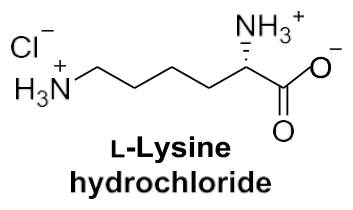
L-Lysine hydrochloride
9.1 Assign the absolute configuration of the stereogenic center in L-lysine hydrochloride and justify your answer by classifying the substituents in order of their priority.
Configuration: ☐ \(R\) ☐ \(S\)
Priority \(1 > 2 > 3 > 4\):

9.2 The prefix L in L-lysine refers to relative configuration. Choose all correct statements:
- ☐ Natural L-amino acids are levorotatory.
- ☐ Natural L-amino acids can be levorotatory or dextrorotatory.
- ☐ All natural L-amino acids are \((S)\).
- ☐ All natural L-amino acids are \((R)\).
Often, we want only one of the amino groups in L-lysine to react. A \(\ce{Cu^2+}\) salt with excess aqueous hydroxide can selectively mask the reactivity of one of the amino groups. After the complex is formed, only the non-complexed \(\ce{NH2}\) group is available to react.
9.3 Considering that L-lysine acts as a bidentate ligand and that two L-lysines coordinate to one \(\ce{Cu^2+}\) ion in the presence of aqueous hydroxide, draw the structure of the intermediate complex.
Fortunately, in the synthesis of levobupivacaine shown below, the same amino group reacts even without \(\ce{Cu^2+}\) salt.
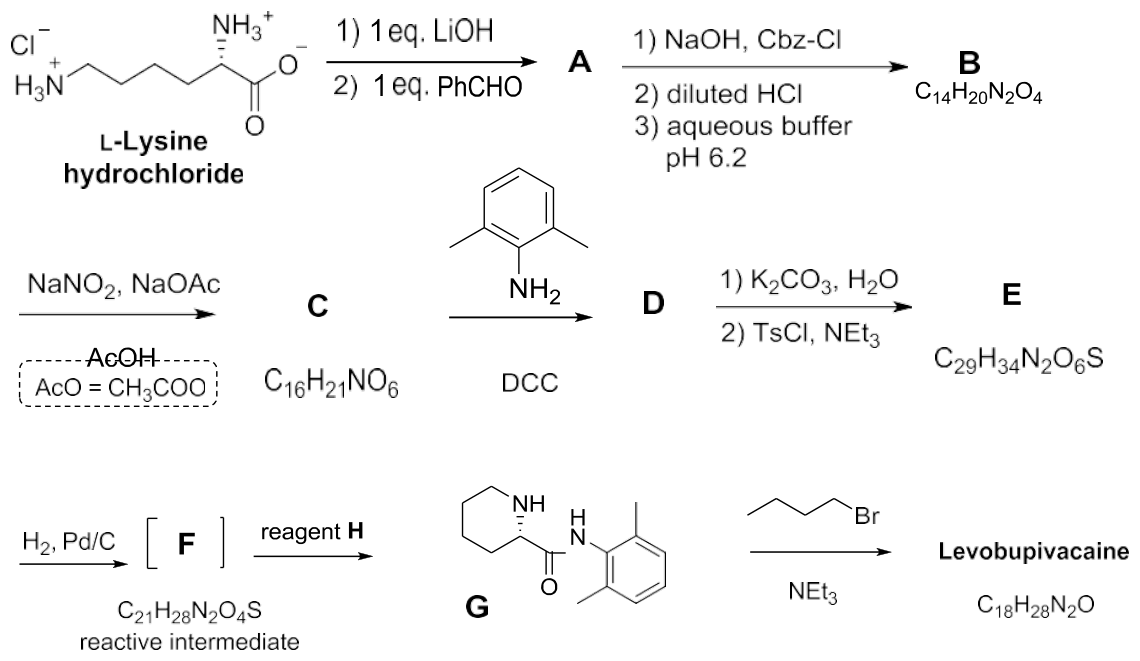

From this point on, you can use the abbreviations proposed in the scheme above.
9.4 Draw the structure of compound A, including the appropriate stereochemistry.
9.5 Transformation of L-lysine into A is (choose proper answer(s)):
- ☐ an enantioselective reaction
- ☐ an enantiospecific reaction
- ☐ a regioselective reaction
9.6 Draw the structures of compounds B – F, including the appropriate stereochemistry.
9.7 What is the role of DCC in the transformation C → D? Tick relevant boxes.
- ☐ Protecting group for the amino group.
- ☐ Protecting group for the hydroxy group.
- ☐ Activating agent for the amide bond formation.
9.8 TsCl is used in the synthesis to enable (tick relevant boxes):
- ☐ Nucleophilic substitution of an amino group.
- ☐ Electrophilic substitution of an amino group.
- ☐ Nucleophilic substitution of a hydroxy group.
- ☐ Electrophilic substitution of a hydroxy group.
9.9 Mark all possible reagents which could be used as reagent H:
| ☐ diluted \(\ce{HCl}\) | ☐ \(\ce{Zn/HCl}\) |
| ☐ \(\ce{K2CO3}\) | ☐ \(\ce{H2SO4}\) |
| ☐ diluted \(\ce{KMnO4}\) | ☐ diluted \(\ce{NaOH}\) |
| ☐ \(\ce{SOCl2}\) | ☐ \(\ce{PCl5}\) |
9.10 Draw the structure of levobupivacaine, including the appropriate stereochemistry.
Part II.
The synthesis of levobupivacaine requires the use of enantiomerically pure L-lysine. A common method to confirm the enantiomeric purity of aminoacids is their transformation into amide using Mosher's acid (see the structure of the \((S)\) isomer below).
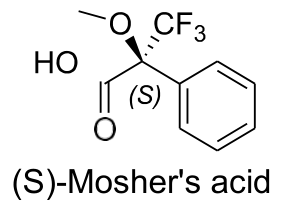
\((S)\)-Mosher's acid
9.11 Draw the structure of the amide formed when the \(\alpha\)-amino group of L-lysine is derivatized with \((S)\)-Mosher's acid. Clearly show the stereochemistry of each chiral center.
9.12 How many products will be formed from racemic lysine and \((S)\)-Mosher's acid (consider that only the \(\alpha\)-amino group of lysine is derivatized)? Tick relevant boxes.
- ☐ Two diastereoisomers.
- ☐ Four diastereoisomers.
- ☐ A racemic mixture of two enantiomers.
- ☐ Four compounds: two enantiomers and two diastereoisomers.
9.13 Choose the method(s) which can be used to quantitatively determine the enantiomeric purity of lysine after its derivatization with \((S)\)-Mosher's acid. Tick the relevant boxes:
- ☐ NMR spectroscopy
- ☐ Liquid chromatography
- ☐ NMR spectroscopy
- ☐ Liquid chromatography
Official English text of the problem.
Answers
Cbz denotes benzyloxycarbonyl; Ts denotes \(p\)-toluenesulfonyl. The stereochemical SMILES below specify the configurations independently of any drawing orientation.
-
9.1: \(S\). Priorities: \[ \ce{-NH3+}>\ce{-COO^-}>\ce{-(CH2)4NH3+}>\ce{-H}. \] Fill the four boxes, from left to right, with 3, 1, 2, 4.
-
9.2: Tick only “Natural L-amino acids can be levorotatory or dextrorotatory.”
-
9.3: Bis(L-lysinato)copper(II), with each ligand coordinated through its \(\alpha\)-amino nitrogen and one carboxylate oxygen. Both terminal amino groups remain free.
Dative-bond SMILES: [Cu+2]12(<-N[C@@H](CCCCN)C(=O)[O-]->1)<-N[C@@H](CCCCN)C(=O)[O-]->2
Draw a square-planar \(\ce{CuN2O2}\) core with two five-membered chelate rings; an arrangement with the two nitrogen donors opposite each other is suitable. The SMILES encodes the coordination connectivity, not this geometry.
- 9.4: A: \(N^\varepsilon\)-benzylidene-L-lysine, shown as its zwitterion; the original stereocenter remains \(S\).
[NH3+][C@@H](CCCCN=Cc1ccccc1)C(=O)[O-]
-
9.5: Tick “a regioselective reaction.”
-
9.6: All five compounds retain the \(2S\) configuration.
| Compound | Name | Stereochemical SMILES |
|---|---|---|
| B | \(N^\alpha\)-Cbz-L-lysine, zwitterionic form | O=C(OCc1ccccc1)N[C@@H](CCCC[NH3+])C(=O)[O-] |
| C | (2S)-6-Acetoxy-2-(Cbz-amino)hexanoic acid | O=C(OCc1ccccc1)N[C@@H](CCCCOC(C)=O)C(=O)O |
| D | (2S)-6-Acetoxy-2-(Cbz-amino)-N-(2,6-dimethylphenyl)hexanamide | O=C(OCc1ccccc1)N[C@@H](CCCCOC(C)=O)C(=O)Nc1c(C)cccc1C |
| E | (2S)-2-(Cbz-amino)-N-(2,6-dimethylphenyl)-6-(tosyloxy)hexanamide | O=C(OCc1ccccc1)N[C@@H](CCCCOS(=O)(=O)c1ccc(C)cc1)C(=O)Nc1c(C)cccc1C |
| F | (2S)-2-Amino-N-(2,6-dimethylphenyl)-6-(tosyloxy)hexanamide | N[C@@H](CCCCOS(=O)(=O)c1ccc(C)cc1)C(=O)Nc1c(C)cccc1C |
- 9.7: Tick “Activating agent for the amide bond formation.”
DCC is N,N′-dicyclohexylcarbodiimide, C1CCCCC1N=C=NC1CCCCC1.
- 9.8: Tick “Nucleophilic substitution of a hydroxy group.”
TsCl is \(p\)-toluenesulfonyl chloride, Cc1ccc(S(=O)(=O)Cl)cc1.
-
9.9: Tick potassium carbonate, \(\ce{K2CO3}\),
[K+].[K+].[O-]C(=O)[O-], and diluted sodium hydroxide, \(\ce{NaOH}\),[Na+].[OH-]. -
9.10: Levobupivacaine: (2S)-1-butyl-N-(2,6-dimethylphenyl)piperidine-2-carboxamide.
CCCCN1[C@@H](CCCC1)C(=O)Nc1c(C)cccc1C
- 9.11: The \(\alpha\)-N-[(S)-Mosher acyl] derivative of L-lysine. Both the Mosher center and the lysine center are \(S\).
CO[C@@](C(F)(F)F)(c1ccccc1)C(=O)N[C@@H](CCCCN)C(=O)O
-
9.12: Tick “Two diastereoisomers.” Their configurations, ordered as (Mosher center, lysine center), are \((S,S)\) and \((S,R)\).
-
9.13: Both NMR spectroscopy and liquid chromatography. Since the printed problem repeats both choices without qualification, all four printed entries describe applicable methods.
Solution
9.1 — Absolute configuration of L-lysine
The depicted L-lysine hydrochloride is (S)-2,6-diaminohexanoic acid hydrochloride:
[NH3+][C@@H](CCCC[NH3+])C(=O)[O-].[Cl-]
For the stereogenic carbon, compare the directly attached atoms. Nitrogen has higher atomic number than carbon, while hydrogen has the lowest:
\[ \ce{N}>\ce{C}>\ce{H}. \]
To distinguish the two carbon substituents, compare the atoms attached to those carbons, counting a double bond according to the CIP duplicate-atom convention:
\[ \begin{aligned} \text{carboxylate carbon:}&\quad (\ce{O},\ce{O},\ce{O}),\\ \text{side-chain carbon:}&\quad (\ce{C},\ce{H},\ce{H}). \end{aligned} \]
Therefore,
\[ 1=\ce{-NH3+},\qquad 2=\ce{-COO^-},\qquad 3=\ce{-(CH2)4NH3+},\qquad 4=\ce{-H}. \]
In the supplied drawing, the amino group points away and the implicit hydrogen points toward the observer. The apparent clockwise \(1\to2\to3\) sequence must therefore be reversed, giving \(S\). The chloride counterion does not enter the priority comparison.
9.2 — Relative configuration and optical rotation
The designation L describes a relative stereochemical relationship; it does not specify the sign of optical rotation. Consequently, an L-amino acid can be levorotatory or dextrorotatory.
Nor does L always mean \(S\). For example, L-cysteine, N[C@@H](CS)C(=O)O, has the \(R\) configuration: its sulfur-containing side chain outranks its carboxyl group in the CIP comparison.
Thus only the second statement is correct.
9.3 — Copper complex
In excess hydroxide, the carboxyl group is deprotonated and both amino groups can be present as neutral amines. Each lysinate ligand binds through:
- the lone pair of the \(\alpha\)-amino nitrogen;
- one carboxylate oxygen.
This gives a favorable five-membered chelate ring with the sequence
\[ \ce{Cu-N-C_{\alpha}-C-O}. \]
Two such ligands give bis(L-lysinato)copper(II), whose coordination SMILES is given in the Answers. Each ligand has charge \(-1\), so the complex with \(\ce{Cu^2+}\) is neutral.
A balanced equation starting with the hydrochloride shown in the question is
\[ \ce{ 2C6H15ClN2O2 + Cu^2+ + 4OH^- -> [Cu(C6H13N2O2)2] + 2Cl^- + 4H2O }. \]
The drawing should show two five-membered chelate rings around copper. Both stereocenters remain \(S\), and both terminal \(\varepsilon\)-amino groups project outward without coordinating. Those terminal amino groups remain available for reaction.
9.4 — Identification of A
Benzaldehyde, O=Cc1ccccc1, condenses selectively with the terminal \(\varepsilon\)-amino group to form a Schiff base, or imine.
The sequence is:
- lithium hydroxide neutralizes one acid equivalent;
- the terminal amino group reacts with benzaldehyde;
- loss of water produces the terminal benzylidene imine.
The overall balanced equation is
\[ \ce{ C6H15ClN2O2 + LiOH + C7H6O -> C13H18N2O2 + LiCl + 2H2O }. \]
Thus A is \(N^\varepsilon\)-benzylidene-L-lysine. Its terminal group is \(\ce{-N=CHPh}\), while the \(\alpha\)-amino group remains available for subsequent protection.
No bond at the stereogenic carbon is broken. Draw its substituents in the same spatial arrangement as in the starting lysine: \(S\). The SMILES leaves the imine’s \(E/Z\) geometry unspecified because the scheme does not establish it.
9.5 — Classification of the transformation
The reaction distinguishes between two amino groups at different positions and forms the imine at the terminal \(\varepsilon\)-amino group. It is therefore regioselective.
No new stereogenic center is generated, and the reaction does not select between enantiomers. The existing \(S\) center is simply preserved. Accordingly, “enantioselective” is not appropriate.
9.6 — Identification of B–F
The sequence uses the terminal imine as a temporary protecting group, allowing the \(\alpha\)-amino group to be protected independently.
A → B: protect the \(\alpha\)-amino group, then remove the imine.
Benzyl chloroformate, or Cbz–Cl, O=C(Cl)OCc1ccccc1, converts the free \(\alpha\)-amino group into a Cbz carbamate. Diluted hydrochloric acid then hydrolyzes the terminal imine, releasing benzaldehyde and restoring the terminal amino group.
A balanced net equation for protection followed by imine hydrolysis is
\[ \ce{ C13H18N2O2 + C8H7ClO2 + NaOH -> C14H20N2O4 + C7H6O + NaCl }. \]
The acid/base work-up establishes the final protonation state. At pH 6.2, B, \(N^\alpha\)-Cbz-L-lysine, is predominantly represented with a carboxylate and a terminal ammonium group, as shown in its SMILES.
Its molecular formula is the supplied \(\ce{C14H20N2O4}\).
B → C: replace the terminal amino group with acetate.
Acidified nitrite generates nitrous acid, ON=O. The unprotected terminal primary amine undergoes nitrosation and deamination, releasing nitrogen. In the acetic acid/acetate medium, the terminal carbon acquires an acetoxy group.
Acetic acid is CC(=O)O; an acetoxy substituent has connectivity \(\ce{-O-C(=O)-CH3}\).
A balanced net equation consistent with the reagents is
\[ \ce{ C14H20N2O4 + NaNO2 + 2CH3COOH -> C16H21NO6 + N2 + CH3COONa + 2H2O }. \]
The protected \(\alpha\)-nitrogen remains intact. Thus C is the terminal acetate, with formula \(\ce{C16H21NO6}\). This formula distinguishes it from the corresponding terminal alcohol.
C → D: form the aromatic amide.
The carboxylic acid reacts with 2,6-dimethylaniline, Nc1c(C)cccc1C, using DCC as the coupling reagent. The terminal acetate and the Cbz group remain intact.
DCC becomes N,N′-dicyclohexylurea, O=C(NC1CCCCC1)NC1CCCCC1.
The balanced coupling equation is
\[ \ce{ C16H21NO6 + C8H11N + C13H22N2 -> C24H30N2O5 + C13H24N2O }. \]
Therefore D is the \(N\)-(2,6-dimethylphenyl) carboxamide, with formula \(\ce{C24H30N2O5}\).
D → E: hydrolyze the acetate, then form the tosylate.
Aqueous potassium carbonate removes the terminal acetyl protecting group. The intermediate is (2S)-2-(Cbz-amino)-N-(2,6-dimethylphenyl)-6-hydroxyhexanamide:
O=C(OCc1ccccc1)N[C@@H](CCCCO)C(=O)Nc1c(C)cccc1C
Its formula is \(\ce{C22H28N2O4}\). The hydrolysis can be balanced in ionic form:
\[ \ce{ C24H30N2O5 + OH^- -> C22H28N2O4 + CH3COO^- }. \]
The resulting alcohol reacts with TsCl and triethylamine, CCN(CC)CC, to give the terminal tosylate E:
\[ \ce{ C22H28N2O4 + C7H7ClO2S + C6H15N -> C29H34N2O6S + C6H16ClN }. \]
The product formula agrees with the supplied \(\ce{C29H34N2O6S}\).
E → F: remove the Cbz group by hydrogenolysis.
Hydrogen over palladium on carbon removes the Cbz protecting group. The products accompanying the free amine are toluene, Cc1ccccc1, and carbon dioxide, O=C=O:
\[ \ce{ C29H34N2O6S + H2 -> C21H28N2O4S + C7H8 + CO2 }. \]
Thus F contains a free \(\alpha\)-amino group and a terminal tosylate. Its formula is the supplied \(\ce{C21H28N2O4S}\).
Throughout B–F, the bonds at the original stereogenic carbon retain their spatial arrangement. Nitrogen remains its highest-priority substituent, the carboxyl-derived group remains second, and the side chain remains third. Every compound therefore remains \(2S\).
9.7 — Role of DCC
DCC activates the carboxyl group of C for amide formation.
The carboxyl group reacts with the carbodiimide to form an activated acyl intermediate, conventionally described as an O-acylisourea. The aniline nitrogen attacks the acyl carbon, and collapse of the intermediate gives the amide D and dicyclohexylurea.
DCC is therefore an activating agent for amide bond formation, not an amino- or hydroxy-protecting group.
9.8 — Role of TsCl
An unmodified hydroxy group is a poor leaving group. Tosylation converts it into a sulfonate ester, \(\ce{-OTs}\).
During the subsequent ring closure, the amino nitrogen attacks the carbon bearing that group and expels the \(p\)-toluenesulfonate anion, Cc1ccc(S(=O)(=O)[O-])cc1.
Consequently, TsCl enables nucleophilic substitution of the hydroxy group, after its conversion into a tosylate.
9.9 — Reagent H and ring closure
The free \(\alpha\)-amino group in F attacks the terminal carbon bearing the tosylate through an intramolecular \(\mathrm{S_N2}\) reaction. The resulting ring contains:
- the amino nitrogen;
- the original stereogenic carbon;
- the four intervening methylene carbons.
It is therefore a six-membered piperidine ring.
The immediate cyclization product is an ammonium species; base removes a proton to give the neutral secondary amine. A base also keeps the starting amine available in its unprotonated, nucleophilic form. Suitable choices are potassium carbonate and diluted sodium hydroxide.
The product G is (2S)-N-(2,6-dimethylphenyl)piperidine-2-carboxamide:
N1[C@@H](CCCC1)C(=O)Nc1c(C)cccc1C
Balanced equations for the two acceptable bases are
\[ \ce{ C21H28N2O4S + NaOH -> C14H20N2O + C7H7NaO3S + H2O } \]
and
\[ \ce{ 2C21H28N2O4S + K2CO3 -> 2C14H20N2O + 2C7H7KO3S + CO2 + H2O }. \]
Acids protonate the amino group and suppress its nucleophilicity. The oxidizing, reducing, and chlorinating alternatives listed do not provide the required basic cyclization conditions.
The substitution occurs at a terminal methylene carbon, not at the original stereocenter. Its \(S\) configuration is retained.
9.10 — Levobupivacaine
The secondary ring nitrogen of G reacts with 1-bromobutane, CCCCBr, by nucleophilic substitution, installing an \(n\)-butyl group. Triethylamine accepts the proton released in forming the neutral tertiary amine.
The balanced equation is
\[ \ce{ C14H20N2O + C4H9Br + C6H15N -> C18H28N2O + C6H16BrN }. \]
The resulting levobupivacaine is (2S)-1-butyl-N-(2,6-dimethylphenyl)piperidine-2-carboxamide, with the SMILES given in the Answers.
For the requested drawing, use a piperidine ring bearing an \(n\)-butyl group on nitrogen and a \(\ce{-C(=O)-NH}\)-(2,6-dimethylphenyl) substituent at C2. Show C2 as \(S\). No particular chair conformation is required.
9.11 — Mosher amide of L-lysine
(S)-Mosher’s acid, or (S)-3,3,3-trifluoro-2-methoxy-2-phenylpropanoic acid, is
CO[C@@](C(F)(F)F)(c1ccccc1)C(=O)O.
The neutral connectivity representation of L-lysine is
N[C@@H](CCCCN)C(=O)O.
The Mosher carboxyl group forms an amide with the \(\alpha\)-amino nitrogen of lysine. The lysine carboxyl group and terminal amino group remain unchanged.
The formal condensation balance is
\[ \ce{ C6H14N2O2 + C10H9F3O3 -> C16H21F3N2O4 + H2O }. \]
This represents the net amidation; experimental formation of the amide requires suitable carboxyl activation.
Neither stereogenic carbon undergoes substitution. Both remain \(S\). At the Mosher center, the priority order in the amide is
\[ \text{methoxy oxygen} > \text{trifluoromethyl carbon} > \text{amide carbonyl carbon} > \text{phenyl carbon}. \]
Thus amidation also preserves the Mosher center’s \(S\) descriptor.
For the drawing, connect the Mosher carbonyl carbon to lysine’s \(\alpha\)-nitrogen, and label both stereogenic centers \(S\). The complete product SMILES is given in Answer 9.11; it uses the neutral acid/amine representation.
9.12 — Products from racemic lysine
Racemic lysine contains both configurations at its \(\alpha\)-carbon. Reaction with a single enantiomer of Mosher’s acid gives:
| Product | Configuration: (Mosher, lysine) |
|---|---|
| (S)-Mosher amide of L-lysine | \((S,S)\) |
| (S)-Mosher amide of D-lysine | \((S,R)\) |
The second product, the \(\alpha\)-N-[(S)-Mosher acyl] derivative of D-lysine, has SMILES
CO[C@@](C(F)(F)F)(c1ccccc1)C(=O)N[C@H](CCCCN)C(=O)O.
These products differ at only one of their two stereogenic centers, so they are diastereoisomers. They are not mirror images: the Mosher center has the same configuration in both.
Therefore, two diastereoisomers are formed.
9.13 — Quantitative determination of enantiomeric purity
Derivatization converts the original enantiomers into diastereoisomers. These can have different properties even in an achiral analytical environment.
NMR spectroscopy: The two derivatives can give distinct chemical shifts. Integrating suitable resolved signals under quantitative conditions gives their molar ratio. The \(\ce{^{19}F}\) resonances of the trifluoromethyl groups are particularly useful because each derivative contributes three equivalent fluorine nuclei.
For integrals \(I_L,I_D\) representing \(p_L,p_D\) nuclei per molecule,
\[ \frac{n_L}{n_D} = \frac{I_L/p_L}{I_D/p_D}. \]
Liquid chromatography: The diastereoisomers can have different retention times, including on a suitable achiral stationary phase. Resolved peak areas give their molar ratio after allowing for detector response factors:
\[ \frac{n_L}{n_D} = \frac{A_L/r_L}{A_D/r_D}, \]
where \(A_i\) is peak area and \(r_i\) is response per amount of substance.
The original lysine composition follows from
\[ \%L=100\frac{n_L}{n_L+n_D}, \]
and the magnitude of the enantiomeric excess is
\[ ee(\%)= 100\frac{|n_L-n_D|}{n_L+n_D}. \]
This requires derivatization without racemization and without unequal, uncorrected conversion of the two lysine enantiomers. Both listed analytical methods are therefore suitable.
The answers were checked against the official answers published by the organisers.
IChO 2019 · Theorieaufgabe 9
Synthese von Levobupivacain
Teil I.
Das Lokalanästhetikum Bupivacain (unter dem Handelsnamen Marcaine erhältlich) steht auf der Liste der unentbehrlichen Arzneimittel der Weltgesundheitsorganisation. Obwohl der Wirkstoff derzeit als racemisches Gemisch verwendet wird, wurde gezeigt, dass ein Enantiomer von Bupivacain, Levobupivacain, weniger kardiotoxisch und damit sicherer als das Racemat ist. Levobupivacain kann aus der natürlichen Aminosäure L-Lysin synthetisiert werden.
L-Lysinhydrochlorid
9.1 Bestimmen Sie die absolute Konfiguration des stereogenen Zentrums in L-Lysinhydrochlorid und begründen Sie Ihre Antwort, indem Sie die Substituenten nach ihrer Priorität ordnen.
Konfiguration: ☐ \(R\) ☐ \(S\)
Priorität \(1 > 2 > 3 > 4\):
9.2 Das Präfix L in L-Lysin bezeichnet die relative Konfiguration. Wählen Sie alle richtigen Aussagen aus:
- ☐ Natürliche L-Aminosäuren sind linksdrehend.
- ☐ Natürliche L-Aminosäuren können linksdrehend oder rechtsdrehend sein.
- ☐ Alle natürlichen L-Aminosäuren sind \((S)\).
- ☐ Alle natürlichen L-Aminosäuren sind \((R)\).
Häufig soll nur eine der Aminogruppen in L-Lysin reagieren. Ein \(\ce{Cu^2+}\)-Salz mit überschüssigem Hydroxid in wässriger Lösung kann die Reaktivität einer der Aminogruppen selektiv maskieren. Nach der Komplexbildung steht nur die nicht komplexierte \(\ce{NH2}\)-Gruppe für eine Reaktion zur Verfügung.
9.3 Zeichnen Sie die Struktur des intermediären Komplexes unter Berücksichtigung der Tatsache, dass L-Lysin als zweizähniger Ligand wirkt und dass in Gegenwart von wässriger Hydroxidlösung zwei L-Lysin-Moleküle an ein \(\ce{Cu^2+}\)-Ion koordinieren.
Glücklicherweise reagiert bei der unten dargestellten Synthese von Levobupivacain dieselbe Aminogruppe auch ohne \(\ce{Cu^2+}\)-Salz.
Ab hier können Sie die im obigen Schema vorgeschlagenen Abkürzungen verwenden.
9.4 Zeichnen Sie die Struktur der Verbindung A mit der entsprechenden Stereochemie.
9.5 Die Umwandlung von L-Lysin in A ist (wählen Sie die richtige(n) Antwort(en) aus):
- ☐ eine enantioselektive Reaktion
- ☐ eine enantiospezifische Reaktion
- ☐ eine regioselektive Reaktion
9.6 Zeichnen Sie die Strukturen der Verbindungen B – F mit der entsprechenden Stereochemie.
9.7 Welche Rolle spielt DCC bei der Umwandlung C → D? Kreuzen Sie die zutreffenden Kästchen an.
- ☐ Schutzgruppe für die Aminogruppe.
- ☐ Schutzgruppe für die Hydroxygruppe.
- ☐ Aktivierungsreagenz für die Bildung der Amidbindung.
9.8 TsCl wird in der Synthese verwendet, um Folgendes zu ermöglichen (kreuzen Sie die zutreffenden Kästchen an):
- ☐ Nukleophile Substitution einer Aminogruppe.
- ☐ Elektrophile Substitution einer Aminogruppe.
- ☐ Nukleophile Substitution einer Hydroxygruppe.
- ☐ Elektrophile Substitution einer Hydroxygruppe.
9.9 Markieren Sie alle möglichen Reagenzien, die als Reagenz H verwendet werden könnten:
| ☐ verdünnte \(\ce{HCl}\) | ☐ \(\ce{Zn/HCl}\) |
| ☐ \(\ce{K2CO3}\) | ☐ \(\ce{H2SO4}\) |
| ☐ verdünnte \(\ce{KMnO4}\)-Lösung | ☐ verdünnte \(\ce{NaOH}\)-Lösung |
| ☐ \(\ce{SOCl2}\) | ☐ \(\ce{PCl5}\) |
9.10 Zeichnen Sie die Struktur von Levobupivacain mit der entsprechenden Stereochemie.
Teil II.
Die Synthese von Levobupivacain erfordert die Verwendung von enantiomerenreinem L-Lysin. Eine gängige Methode zur Bestätigung der Enantiomerenreinheit von Aminosäuren ist ihre Umwandlung in ein Amid mithilfe der Mosher-Säure (siehe unten die Struktur des \((S)\)-Isomers).
\((S)\)-Mosher-Säure
9.11 Zeichnen Sie die Struktur des Amids, das entsteht, wenn die \(\alpha\)-Aminogruppe von L-Lysin mit \((S)\)-Mosher-Säure derivatisiert wird. Stellen Sie die Stereochemie jedes chiralen Zentrums eindeutig dar.
9.12 Wie viele Produkte entstehen aus racemischem Lysin und \((S)\)-Mosher-Säure (gehen Sie davon aus, dass nur die \(\alpha\)-Aminogruppe des Lysins derivatisiert wird)? Kreuzen Sie die zutreffenden Kästchen an.
- ☐ Zwei Diastereomere.
- ☐ Vier Diastereomere.
- ☐ Ein racemisches Gemisch aus zwei Enantiomeren.
- ☐ Vier Verbindungen: zwei Enantiomere und zwei Diastereomere.
9.13 Wählen Sie die Methode(n) aus, mit denen sich die Enantiomerenreinheit von Lysin nach seiner Derivatisierung mit \((S)\)-Mosher-Säure quantitativ bestimmen lässt. Kreuzen Sie die zutreffenden Kästchen an:
- ☐ NMR-Spektroskopie
- ☐ Flüssigkeitschromatographie
- ☐ NMR-Spektroskopie
- ☐ Flüssigkeitschromatographie
Aufgabentext aus dem offiziellen englischen Text übersetzt.
Antworten
Cbz steht für Benzyloxycarbonyl; Ts steht für \(p\)-Toluolsulfonyl. Die nachstehenden stereochemischen SMILES geben die Konfigurationen unabhängig von der Orientierung einer Zeichnung an.
-
9.1: \(S\). Prioritäten: \[ \ce{-NH3+}>\ce{-COO^-}>\ce{-(CH2)4NH3+}>\ce{-H}. \] Tragen Sie von links nach rechts 3, 1, 2, 4 in die vier Kästchen ein.
-
9.2: Kreuzen Sie nur „Natürliche L-Aminosäuren können linksdrehend oder rechtsdrehend sein.“ an.
-
9.3: Bis(L-lysinato)kupfer(II), wobei jeder Ligand über seinen \(\alpha\)-Aminostickstoff und ein Carboxylat-Sauerstoffatom koordiniert. Beide endständigen Aminogruppen bleiben frei.
SMILES mit koordinativen Bindungen: [Cu+2]12(<-N[C@@H](CCCCN)C(=O)[O-]->1)<-N[C@@H](CCCCN)C(=O)[O-]->2
Zeichnen Sie einen quadratisch-planaren \(\ce{CuN2O2}\)-Kern mit zwei fünfgliedrigen Chelatringen; eine Anordnung, bei der die beiden Stickstoffdonoren einander gegenüberliegen, ist geeignet. Der SMILES-Code beschreibt die Koordinationsverknüpfungen, nicht diese Geometrie.
- 9.4: A: \(N^\varepsilon\)-Benzyliden-L-lysin, als Zwitterion dargestellt; das ursprüngliche Stereozentrum bleibt \(S\).
[NH3+][C@@H](CCCCN=Cc1ccccc1)C(=O)[O-]
-
9.5: Kreuzen Sie „eine regioselektive Reaktion.“ an.
-
9.6: Alle fünf Verbindungen behalten die \(2S\)-Konfiguration bei.
| Verbindung | Name | Stereochemischer SMILES-Code |
|---|---|---|
| B | \(N^\alpha\)-Cbz-L-lysin, zwitterionische Form | O=C(OCc1ccccc1)N[C@@H](CCCC[NH3+])C(=O)[O-] |
| C | (2S)-6-Acetoxy-2-(Cbz-amino)hexansäure | O=C(OCc1ccccc1)N[C@@H](CCCCOC(C)=O)C(=O)O |
| D | (2S)-6-Acetoxy-2-(Cbz-amino)-N-(2,6-dimethylphenyl)hexanamid | O=C(OCc1ccccc1)N[C@@H](CCCCOC(C)=O)C(=O)Nc1c(C)cccc1C |
| E | (2S)-2-(Cbz-amino)-N-(2,6-dimethylphenyl)-6-(tosyloxy)hexanamid | O=C(OCc1ccccc1)N[C@@H](CCCCOS(=O)(=O)c1ccc(C)cc1)C(=O)Nc1c(C)cccc1C |
| F | (2S)-2-Amino-N-(2,6-dimethylphenyl)-6-(tosyloxy)hexanamid | N[C@@H](CCCCOS(=O)(=O)c1ccc(C)cc1)C(=O)Nc1c(C)cccc1C |
- 9.7: Kreuzen Sie „Aktivierungsreagenz für die Bildung der Amidbindung.“ an.
DCC ist N,N′-Dicyclohexylcarbodiimid, C1CCCCC1N=C=NC1CCCCC1.
- 9.8: Kreuzen Sie „Nukleophile Substitution einer Hydroxygruppe.“ an.
TsCl ist \(p\)-Toluolsulfonylchlorid, Cc1ccc(S(=O)(=O)Cl)cc1.
-
9.9: Kreuzen Sie Kaliumcarbonat, \(\ce{K2CO3}\),
[K+].[K+].[O-]C(=O)[O-], und verdünnte Natriumhydroxidlösung, \(\ce{NaOH}\),[Na+].[OH-], an. -
9.10: Levobupivacain: (2S)-1-Butyl-N-(2,6-dimethylphenyl)piperidin-2-carboxamid.
CCCCN1[C@@H](CCCC1)C(=O)Nc1c(C)cccc1C
- 9.11: Das \(\alpha\)-N-[(S)-Mosher-acyl]-Derivat von L-Lysin. Sowohl das Mosher-Zentrum als auch das Lysin-Zentrum sind \(S\).
CO[C@@](C(F)(F)F)(c1ccccc1)C(=O)N[C@@H](CCCCN)C(=O)O
-
9.12: Kreuzen Sie „Zwei Diastereomere.“ an. Ihre Konfigurationen, in der Reihenfolge (Mosher-Zentrum, Lysin-Zentrum), sind \((S,S)\) und \((S,R)\).
-
9.13: Sowohl NMR-Spektroskopie als auch Flüssigkeitschromatographie. Da die gedruckte Aufgabe beide Auswahlmöglichkeiten ohne nähere Einschränkung wiederholt, beschreiben alle vier gedruckten Einträge anwendbare Methoden.
Lösung
9.1 — Absolute Konfiguration von L-Lysin
Das dargestellte L-Lysinhydrochlorid ist (S)-2,6-Diaminohexansäurehydrochlorid:
[NH3+][C@@H](CCCC[NH3+])C(=O)[O-].[Cl-]
Für das stereogene Kohlenstoffatom werden die unmittelbar gebundenen Atome verglichen. Stickstoff hat eine höhere Ordnungszahl als Kohlenstoff, während Wasserstoff die niedrigste hat:
\[ \ce{N}>\ce{C}>\ce{H}. \]
Um die beiden Kohlenstoffsubstituenten zu unterscheiden, vergleicht man die an diese Kohlenstoffatome gebundenen Atome, wobei eine Doppelbindung gemäß der CIP-Konvention für Duplikatatome berücksichtigt wird:
\[ \begin{aligned} \text{Carboxylat-Kohlenstoff:}&\quad (\ce{O},\ce{O},\ce{O}),\\ \text{Seitenketten-Kohlenstoff:}&\quad (\ce{C},\ce{H},\ce{H}). \end{aligned} \]
Daher gilt:
\[ 1=\ce{-NH3+},\qquad 2=\ce{-COO^-},\qquad 3=\ce{-(CH2)4NH3+},\qquad 4=\ce{-H}. \]
In der vorgegebenen Zeichnung zeigt die Aminogruppe vom Betrachter weg und das nicht explizit eingezeichnete Wasserstoffatom zum Betrachter hin. Die scheinbar im Uhrzeigersinn verlaufende Reihenfolge \(1\to2\to3\) muss deshalb umgekehrt werden, woraus sich \(S\) ergibt. Das Chlorid-Gegenion geht nicht in den Prioritätsvergleich ein.
9.2 — Relative Konfiguration und optische Drehung
Die Bezeichnung L beschreibt eine relative stereochemische Beziehung; sie legt nicht das Vorzeichen der optischen Drehung fest. Folglich kann eine L-Aminosäure linksdrehend oder rechtsdrehend sein.
Ebenso bedeutet L nicht immer \(S\). Beispielsweise hat L-Cystein, N[C@@H](CS)C(=O)O, die \(R\)-Konfiguration: Seine schwefelhaltige Seitenkette hat beim CIP-Vergleich eine höhere Priorität als seine Carboxylgruppe.
Somit ist nur die zweite Aussage richtig.
9.3 — Kupferkomplex
Bei einem Überschuss an Hydroxid ist die Carboxylgruppe deprotoniert, und beide Aminogruppen können als neutrale Amine vorliegen. Jeder Lysinat-Ligand bindet über:
- das freie Elektronenpaar des \(\alpha\)-Aminostickstoffs;
- ein Carboxylat-Sauerstoffatom.
Dadurch entsteht ein günstiger fünfgliedriger Chelatring mit der Abfolge
\[ \ce{Cu-N-C_{\alpha}-C-O}. \]
Zwei solche Liganden ergeben Bis(L-lysinato)kupfer(II), dessen Koordinations-SMILES unter Antworten angegeben ist. Jeder Ligand trägt die Ladung \(-1\), sodass der Komplex mit \(\ce{Cu^2+}\) neutral ist.
Eine ausgeglichene Gleichung, ausgehend vom in der Aufgabe dargestellten Hydrochlorid, lautet
\[ \ce{ 2C6H15ClN2O2 + Cu^2+ + 4OH^- -> [Cu(C6H13N2O2)2] + 2Cl^- + 4H2O }. \]
Die Zeichnung sollte zwei fünfgliedrige Chelatringe um das Kupfer zeigen. Beide Stereozentren bleiben \(S\), und beide endständigen \(\varepsilon\)-Aminogruppen ragen nach außen, ohne zu koordinieren. Diese endständigen Aminogruppen stehen weiterhin für Reaktionen zur Verfügung.
9.4 — Identifizierung von A
Benzaldehyd, O=Cc1ccccc1, kondensiert selektiv mit der endständigen \(\varepsilon\)-Aminogruppe zu einer Schiff-Base, also einem Imin.
Die Abfolge ist:
- Lithiumhydroxid neutralisiert ein Säureäquivalent;
- die endständige Aminogruppe reagiert mit Benzaldehyd;
- durch Wasserabspaltung entsteht das endständige Benzylidenimin.
Die ausgeglichene Gesamtgleichung lautet
\[ \ce{ C6H15ClN2O2 + LiOH + C7H6O -> C13H18N2O2 + LiCl + 2H2O }. \]
Somit ist A \(N^\varepsilon\)-Benzyliden-L-lysin. Seine endständige Gruppe ist \(\ce{-N=CHPh}\), während die \(\alpha\)-Aminogruppe für die anschließende Einführung einer Schutzgruppe verfügbar bleibt.
Am stereogenen Kohlenstoffatom wird keine Bindung gebrochen. Zeichnen Sie seine Substituenten in derselben räumlichen Anordnung wie im Ausgangsstoff Lysin: \(S\). Der SMILES-Code lässt die \(E/Z\)-Geometrie des Imins offen, da diese durch das Schema nicht festgelegt wird.
9.5 — Einordnung der Umwandlung
Die Reaktion unterscheidet zwischen zwei Aminogruppen an verschiedenen Positionen und bildet das Imin an der endständigen \(\varepsilon\)-Aminogruppe. Sie ist daher regioselektiv.
Es entsteht kein neues stereogenes Zentrum, und die Reaktion trifft keine Auswahl zwischen Enantiomeren. Das vorhandene \(S\)-Zentrum bleibt einfach erhalten. Dementsprechend ist „enantioselektiv“ nicht zutreffend.
9.6 — Identifizierung von B–F
Die Reaktionsfolge nutzt das endständige Imin als vorübergehende Schutzgruppe, sodass die \(\alpha\)-Aminogruppe unabhängig davon geschützt werden kann.
A → B: Die \(\alpha\)-Aminogruppe schützen, dann das Imin entfernen.
Chlorameisensäurebenzylester, auch Cbz–Cl, O=C(Cl)OCc1ccccc1, überführt die freie \(\alpha\)-Aminogruppe in ein Cbz-Carbamat. Verdünnte Salzsäure hydrolysiert anschließend das endständige Imin, wobei Benzaldehyd freigesetzt und die endständige Aminogruppe wiederhergestellt wird.
Eine ausgeglichene Nettogleichung für die Einführung der Schutzgruppe mit anschließender Iminhydrolyse lautet
\[ \ce{ C13H18N2O2 + C8H7ClO2 + NaOH -> C14H20N2O4 + C7H6O + NaCl }. \]
Die Säure-Base-Aufarbeitung legt den endgültigen Protonierungszustand fest. Bei pH 6.2 wird B, \(N^\alpha\)-Cbz-L-lysin, überwiegend mit einer Carboxylatgruppe und einer endständigen Ammoniumgruppe dargestellt, wie in seinem SMILES-Code gezeigt.
Seine Summenformel ist die angegebene Formel \(\ce{C14H20N2O4}\).
B → C: Die endständige Aminogruppe durch Acetat ersetzen.
Angesäuertes Nitrit erzeugt salpetrige Säure, ON=O. Das ungeschützte endständige primäre Amin wird nitrosiert und desaminiert, wobei Stickstoff freigesetzt wird. Im Essigsäure/Acetat-Medium erhält das endständige Kohlenstoffatom eine Acetoxygruppe.
Essigsäure ist CC(=O)O; ein Acetoxy-Substituent hat die Verknüpfung \(\ce{-O-C(=O)-CH3}\).
Eine mit den Reagenzien vereinbare ausgeglichene Nettogleichung lautet
\[ \ce{ C14H20N2O4 + NaNO2 + 2CH3COOH -> C16H21NO6 + N2 + CH3COONa + 2H2O }. \]
Der geschützte \(\alpha\)-Stickstoff bleibt unverändert. Somit ist C das endständige Acetat mit der Formel \(\ce{C16H21NO6}\). Diese Formel unterscheidet es vom entsprechenden endständigen Alkohol.
C → D: Das aromatische Amid bilden.
Die Carbonsäure reagiert mit 2,6-Dimethylanilin, Nc1c(C)cccc1C, wobei DCC als Kupplungsreagenz verwendet wird. Das endständige Acetat und die Cbz-Gruppe bleiben unverändert.
DCC wird zu N,N′-Dicyclohexylharnstoff, O=C(NC1CCCCC1)NC1CCCCC1.
Die ausgeglichene Kupplungsgleichung lautet
\[ \ce{ C16H21NO6 + C8H11N + C13H22N2 -> C24H30N2O5 + C13H24N2O }. \]
Demnach ist D das \(N\)-(2,6-Dimethylphenyl)carboxamid mit der Formel \(\ce{C24H30N2O5}\).
D → E: Das Acetat hydrolysieren, dann das Tosylat bilden.
Wässrige Kaliumcarbonatlösung entfernt die endständige Acetylschutzgruppe. Das Zwischenprodukt ist (2S)-2-(Cbz-amino)-N-(2,6-dimethylphenyl)-6-hydroxyhexanamid:
O=C(OCc1ccccc1)N[C@@H](CCCCO)C(=O)Nc1c(C)cccc1C
Seine Formel ist \(\ce{C22H28N2O4}\). Die Hydrolyse lässt sich in ionischer Form ausgleichen:
\[ \ce{ C24H30N2O5 + OH^- -> C22H28N2O4 + CH3COO^- }. \]
Der entstandene Alkohol reagiert mit TsCl und Triethylamin, CCN(CC)CC, zum endständigen Tosylat E:
\[ \ce{ C22H28N2O4 + C7H7ClO2S + C6H15N -> C29H34N2O6S + C6H16ClN }. \]
Die Produktformel stimmt mit der angegebenen Formel \(\ce{C29H34N2O6S}\) überein.
E → F: Die Cbz-Gruppe durch Hydrogenolyse entfernen.
Wasserstoff in Gegenwart von Palladium auf Kohle entfernt die Cbz-Schutzgruppe. Neben dem freien Amin entstehen Toluol, Cc1ccccc1, und Kohlenstoffdioxid, O=C=O:
\[ \ce{ C29H34N2O6S + H2 -> C21H28N2O4S + C7H8 + CO2 }. \]
Somit enthält F eine freie \(\alpha\)-Aminogruppe und ein endständiges Tosylat. Seine Formel ist die angegebene Formel \(\ce{C21H28N2O4S}\).
In allen Verbindungen B–F behalten die Bindungen am ursprünglichen stereogenen Kohlenstoffatom ihre räumliche Anordnung bei. Stickstoff bleibt der Substituent mit der höchsten Priorität, die von der Carboxylgruppe abgeleitete Gruppe bleibt an zweiter und die Seitenkette an dritter Stelle. Jede Verbindung bleibt daher \(2S\).
9.7 — Rolle von DCC
DCC aktiviert die Carboxylgruppe von C für die Amidbildung.
Die Carboxylgruppe reagiert mit dem Carbodiimid zu einem aktivierten Acyl-Zwischenprodukt, das üblicherweise als O-Acylisoharnstoff beschrieben wird. Der Anilinstickstoff greift den Acylkohlenstoff an, und der Zerfall des Zwischenprodukts liefert das Amid D und Dicyclohexylharnstoff.
DCC ist somit ein Aktivierungsreagenz für die Bildung der Amidbindung, keine Amino- oder Hydroxyschutzgruppe.
9.8 — Rolle von TsCl
Eine unveränderte Hydroxygruppe ist eine schlechte Abgangsgruppe. Durch Tosylierung wird sie in einen Sulfonsäureester, \(\ce{-OTs}\), überführt.
Beim anschließenden Ringschluss greift der Aminostickstoff das Kohlenstoffatom an, das diese Gruppe trägt, und verdrängt das \(p\)-Toluolsulfonat-Anion, Cc1ccc(S(=O)(=O)[O-])cc1.
Folglich ermöglicht TsCl die nukleophile Substitution der Hydroxygruppe, nachdem diese in ein Tosylat umgewandelt wurde.
9.9 — Reagenz H und Ringschluss
Die freie \(\alpha\)-Aminogruppe in F greift das endständige, das Tosylat tragende Kohlenstoffatom in einer intramolekularen \(\mathrm{S_N2}\)-Reaktion an. Der entstehende Ring enthält:
- den Aminostickstoff;
- das ursprüngliche stereogene Kohlenstoffatom;
- die vier dazwischenliegenden Methylen-Kohlenstoffatome.
Es handelt sich daher um einen sechsgliedrigen Piperidinring.
Das unmittelbare Cyclisierungsprodukt ist eine Ammoniumspezies; eine Base entfernt ein Proton und liefert das neutrale sekundäre Amin. Eine Base hält außerdem das Ausgangsamin in seiner unprotonierten, nukleophilen Form verfügbar. Geeignet sind Kaliumcarbonat und verdünnte Natriumhydroxidlösung.
Das Produkt G ist (2S)-N-(2,6-Dimethylphenyl)piperidin-2-carboxamid:
N1[C@@H](CCCC1)C(=O)Nc1c(C)cccc1C
Ausgeglichene Gleichungen für die beiden geeigneten Basen lauten
\[ \ce{ C21H28N2O4S + NaOH -> C14H20N2O + C7H7NaO3S + H2O } \]
und
\[ \ce{ 2C21H28N2O4S + K2CO3 -> 2C14H20N2O + 2C7H7KO3S + CO2 + H2O }. \]
Säuren protonieren die Aminogruppe und unterdrücken ihre Nukleophilie. Die aufgeführten oxidierenden, reduzierenden und chlorierenden Alternativen schaffen nicht die erforderlichen basischen Cyclisierungsbedingungen.
Die Substitution erfolgt an einem endständigen Methylen-Kohlenstoffatom, nicht am ursprünglichen Stereozentrum. Dessen \(S\)-Konfiguration bleibt erhalten.
9.10 — Levobupivacain
Der sekundäre Ringstickstoff von G reagiert mit 1-Brombutan, CCCCBr, durch nukleophile Substitution, wobei eine \(n\)-Butylgruppe eingeführt wird. Triethylamin nimmt das Proton auf, das bei der Bildung des neutralen tertiären Amins freigesetzt wird.
Die ausgeglichene Gleichung lautet
\[ \ce{ C14H20N2O + C4H9Br + C6H15N -> C18H28N2O + C6H16BrN }. \]
Das entstehende Levobupivacain ist (2S)-1-Butyl-N-(2,6-dimethylphenyl)piperidin-2-carboxamid, dessen SMILES-Code unter Antworten angegeben ist.
Verwenden Sie für die geforderte Zeichnung einen Piperidinring mit einer \(n\)-Butylgruppe am Stickstoff und einem \(\ce{-C(=O)-NH}\)-(2,6-Dimethylphenyl)-Substituenten an C2. Stellen Sie C2 als \(S\) dar. Eine bestimmte Sesselkonformation ist nicht erforderlich.
9.11 — Mosher-Amid von L-Lysin
(S)-Mosher-Säure, auch (S)-3,3,3-Trifluor-2-methoxy-2-phenylpropansäure, ist
CO[C@@](C(F)(F)F)(c1ccccc1)C(=O)O.
Die Darstellung der Atomverknüpfungen in der neutralen Form von L-Lysin lautet
N[C@@H](CCCCN)C(=O)O.
Die Carboxylgruppe der Mosher-Säure bildet mit dem \(\alpha\)-Aminostickstoff des Lysins ein Amid. Die Carboxylgruppe und die endständige Aminogruppe des Lysins bleiben unverändert.
Die formale Kondensationsbilanz lautet
\[ \ce{ C6H14N2O2 + C10H9F3O3 -> C16H21F3N2O4 + H2O }. \]
Dies stellt die Nettoamidierung dar; die experimentelle Bildung des Amids erfordert eine geeignete Aktivierung der Carboxylgruppe.
An keinem der beiden stereogenen Kohlenstoffatome findet eine Substitution statt. Beide bleiben \(S\). Am Mosher-Zentrum ist die Prioritätsreihenfolge im Amid
\[ \text{Methoxy-Sauerstoff} > \text{Trifluormethyl-Kohlenstoff} > \text{Amid-Carbonylkohlenstoff} > \text{Phenyl-Kohlenstoff}. \]
Somit bleibt bei der Amidierung auch der \(S\)-Deskriptor des Mosher-Zentrums erhalten.
Verbinden Sie in der Zeichnung den Carbonylkohlenstoff der Mosher-Säure mit dem \(\alpha\)-Stickstoff des Lysins und kennzeichnen Sie beide stereogenen Zentren mit \(S\). Der vollständige SMILES-Code des Produkts ist in Antwort 9.11 angegeben; er verwendet die Darstellung als neutrale Säure und neutrales Amin.
9.12 — Produkte aus racemischem Lysin
Racemisches Lysin enthält beide Konfigurationen am \(\alpha\)-Kohlenstoffatom. Die Reaktion mit einem einzigen Enantiomer der Mosher-Säure ergibt:
| Produkt | Konfiguration: (Mosher, Lysin) |
|---|---|
| (S)-Mosher-Amid von L-Lysin | \((S,S)\) |
| (S)-Mosher-Amid von D-Lysin | \((S,R)\) |
Das zweite Produkt, das \(\alpha\)-N-[(S)-Mosher-acyl]-Derivat von D-Lysin, hat den SMILES-Code
CO[C@@](C(F)(F)F)(c1ccccc1)C(=O)N[C@H](CCCCN)C(=O)O.
Diese Produkte unterscheiden sich nur an einem ihrer beiden stereogenen Zentren und sind daher Diastereomere. Sie sind keine Spiegelbilder: Das Mosher-Zentrum hat in beiden dieselbe Konfiguration.
Es entstehen folglich zwei Diastereomere.
9.13 — Quantitative Bestimmung der Enantiomerenreinheit
Die Derivatisierung überführt die ursprünglichen Enantiomere in Diastereomere. Diese können auch in einer achiralen analytischen Umgebung unterschiedliche Eigenschaften aufweisen.
NMR-Spektroskopie: Die beiden Derivate können unterschiedliche chemische Verschiebungen aufweisen. Die Integration geeigneter aufgelöster Signale unter quantitativen Bedingungen liefert ihr Stoffmengenverhältnis. Die \(\ce{^{19}F}\)-Resonanzen der Trifluormethylgruppen sind besonders nützlich, da jedes Derivat drei äquivalente Fluorkerne beiträgt.
Für Integrale \(I_L,I_D\), die \(p_L,p_D\) Kerne pro Molekül repräsentieren, gilt
\[ \frac{n_L}{n_D} = \frac{I_L/p_L}{I_D/p_D}. \]
Flüssigkeitschromatographie: Die Diastereomere können unterschiedliche Retentionszeiten aufweisen, auch an einer geeigneten achiralen stationären Phase. Die Flächen aufgelöster Peaks liefern nach Berücksichtigung der Detektoransprechfaktoren ihr Stoffmengenverhältnis:
\[ \frac{n_L}{n_D} = \frac{A_L/r_L}{A_D/r_D}, \]
wobei \(A_i\) die Peakfläche und \(r_i\) das Ansprechverhalten pro Stoffmenge bezeichnet.
Die ursprüngliche Zusammensetzung des Lysins ergibt sich aus
\[ \%L=100\frac{n_L}{n_L+n_D}, \]
und der Betrag des Enantiomerenüberschusses ist
\[ ee(\%)= 100\frac{|n_L-n_D|}{n_L+n_D}. \]
Dies setzt eine Derivatisierung ohne Racemisierung und ohne ungleiche, unkorrigierte Umsetzung der beiden Lysin-Enantiomere voraus. Beide aufgeführten analytischen Methoden sind daher geeignet.
Die Ergebnisse wurden mit den von den Veranstaltern veröffentlichten offiziellen Ergebnissen abgeglichen.
IChO 2019 · Teori sorusu 9
Levobupivakain sentezi
Bölüm I.
Lokal anestezik bupivakain (Marcaine adıyla pazarlanmaktadır), Dünya Sağlık Örgütünün Temel İlaçlar Listesi'nde yer almaktadır. İlaç günümüzde rasemik karışım olarak kullanılsa da bupivakainin enantiyomerlerinden biri olan levobupivakainin rasemattan daha az kardiyotoksik olduğu ve dolayısıyla daha güvenli olduğu gösterilmiştir. Levobupivakain, doğal bir amino asit olan L-lizinden sentezlenebilir.
L-Lizin hidroklorür
9.1 L-lizin hidroklorürdeki stereojenik merkezin mutlak konfigürasyonunu belirleyin ve sübstitüentleri öncelik sırasına göre sıralayarak cevabınızı gerekçelendirin.
Konfigürasyon: ☐ \(R\) ☐ \(S\)
Öncelik \(1 > 2 > 3 > 4\):
9.2 L-lizindeki L ön eki bağıl konfigürasyonu belirtir. Doğru olan tüm ifadeleri seçin:
- ☐ Doğal L-amino asitler sola çevirendir.
- ☐ Doğal L-amino asitler sola çeviren veya sağa çeviren olabilir.
- ☐ Doğal L-amino asitlerin tümü \((S)\) konfigürasyonundadır.
- ☐ Doğal L-amino asitlerin tümü \((R)\) konfigürasyonundadır.
Çoğu zaman L-lizindeki amino gruplarından yalnızca birinin tepkimeye girmesini isteriz. Fazla miktarda sulu hidroksit ile birlikte kullanılan bir \(\ce{Cu^2+}\) tuzu, amino gruplarından birinin reaktivitesini seçici olarak maskeleyebilir. Kompleks oluştuktan sonra yalnızca kompleksleşmemiş \(\ce{NH2}\) grubu tepkimeye girebilir.
9.3 L-lizinin iki dişli bir ligand olarak davrandığını ve sulu hidroksit varlığında iki L-lizinin bir \(\ce{Cu^2+}\) iyonuna koordine olduğunu göz önünde bulundurarak ara kompleksin yapısını çizin.
Neyse ki aşağıda gösterilen levobupivakain sentezinde, \(\ce{Cu^2+}\) tuzu olmadan da aynı amino grubu tepkimeye girer.
Bu noktadan itibaren yukarıdaki şemada önerilen kısaltmaları kullanabilirsiniz.
9.4 Uygun stereokimyayı da göstererek A bileşiğinin yapısını çizin.
9.5 L-lizinin A'ya dönüşümü (uygun cevapları seçin):
- ☐ enantiyoseçici bir tepkimedir
- ☐ enantiyoözgül bir tepkimedir
- ☐ bölge seçici bir tepkimedir
9.6 Uygun stereokimyayı da göstererek B – F bileşiklerinin yapılarını çizin.
9.7 C → D dönüşümünde DCC'nin rolü nedir? İlgili kutuları işaretleyin.
- ☐ Amino grubu için koruyucu grup.
- ☐ Hidroksi grubu için koruyucu grup.
- ☐ Amit bağı oluşumu için etkinleştirici reaktif.
9.8 Sentezde TsCl, aşağıdakilerden hangilerini mümkün kılmak için kullanılır (ilgili kutuları işaretleyin):
- ☐ Bir amino grubunun nükleofilik yer değiştirmesi.
- ☐ Bir amino grubunun elektrofilik yer değiştirmesi.
- ☐ Bir hidroksi grubunun nükleofilik yer değiştirmesi.
- ☐ Bir hidroksi grubunun elektrofilik yer değiştirmesi.
9.9 H reaktifi olarak kullanılabilecek tüm reaktifleri işaretleyin:
| ☐ seyreltik \(\ce{HCl}\) | ☐ \(\ce{Zn/HCl}\) |
| ☐ \(\ce{K2CO3}\) | ☐ \(\ce{H2SO4}\) |
| ☐ seyreltik \(\ce{KMnO4}\) | ☐ seyreltik \(\ce{NaOH}\) |
| ☐ \(\ce{SOCl2}\) | ☐ \(\ce{PCl5}\) |
9.10 Uygun stereokimyayı da göstererek levobupivakainin yapısını çizin.
Bölüm II.
Levobupivakain sentezi, enantiyomerik olarak saf L-lizin kullanılmasını gerektirir. Amino asitlerin enantiyomerik saflığını doğrulamak için yaygın olarak kullanılan bir yöntem, Mosher asidi kullanılarak amide dönüştürülmeleridir (\((S)\) izomerinin aşağıdaki yapısına bakın).
\((S)\)-Mosher asidi
9.11 L-lizinin \(\alpha\)-amino grubu \((S)\)-Mosher asidi ile türevlendirildiğinde oluşan amidin yapısını çizin. Her bir kiral merkezin stereokimyasını açıkça gösterin.
9.12 Rasemik lizin ve \((S)\)-Mosher asidinden kaç ürün oluşur (lizinin yalnızca \(\alpha\)-amino grubunun türevlendirildiğini kabul edin)? İlgili kutuları işaretleyin.
- ☐ İki diastereoizomer.
- ☐ Dört diastereoizomer.
- ☐ İki enantiyomerin rasemik karışımı.
- ☐ Dört bileşik: iki enantiyomer ve iki diastereoizomer.
9.13 Lizinin \((S)\)-Mosher asidi ile türevlendirilmesinden sonra enantiyomerik saflığını nicel olarak belirlemek için kullanılabilecek yöntemleri seçin. İlgili kutuları işaretleyin:
- ☐ NMR spektroskopisi
- ☐ Sıvı kromatografisi
- ☐ NMR spektroskopisi
- ☐ Sıvı kromatografisi
Soru metni resmi İngilizce metinden çevrilmiştir.
Cevaplar
Cbz, benziloksikarbonili; Ts, \(p\)-toluensülfonili belirtir. Aşağıdaki stereokimyasal SMILES gösterimleri, konfigürasyonları çizimin yöneliminden bağımsız olarak belirtir.
-
9.1: \(S\). Öncelikler: \[ \ce{-NH3+}>\ce{-COO^-}>\ce{-(CH2)4NH3+}>\ce{-H}. \] Dört kutuyu soldan sağa 3, 1, 2, 4 ile doldurun.
-
9.2: Yalnızca “Doğal L-amino asitler sola çeviren veya sağa çeviren olabilir.” ifadesini işaretleyin.
-
9.3: Her bir ligandın \(\alpha\)-amino azotu ve bir karboksilat oksijeni üzerinden koordine olduğu bis(L-lizinato)bakır(II). Her iki uç amino grubu da serbest kalır.
Koordinatif bağları gösteren SMILES: [Cu+2]12(<-N[C@@H](CCCCN)C(=O)[O-]->1)<-N[C@@H](CCCCN)C(=O)[O-]->2
İki beş üyeli şelat halkası içeren kare düzlemsel bir \(\ce{CuN2O2}\) çekirdeği çizin; iki azot donörünün birbirinin karşısında bulunduğu bir düzen uygundur. SMILES, bu geometriyi değil, koordinasyon bağlanma düzenini kodlar.
- 9.4: A: \(N^\varepsilon\)-benziliden-L-lizin, zwitteriyon biçiminde gösterilmiştir; başlangıçtaki stereomerkez \(S\) olarak kalır.
[NH3+][C@@H](CCCCN=Cc1ccccc1)C(=O)[O-]
-
9.5: “bölge seçici bir tepkimedir.” seçeneğini işaretleyin.
-
9.6: Beş bileşiğin tümü \(2S\) konfigürasyonunu korur.
| Bileşik | Adı | Stereokimyasal SMILES |
|---|---|---|
| B | \(N^\alpha\)-Cbz-L-lizin, zwitteriyonik biçim | O=C(OCc1ccccc1)N[C@@H](CCCC[NH3+])C(=O)[O-] |
| C | (2S)-6-Asetoksi-2-(Cbz-amino)hekzanoik asit | O=C(OCc1ccccc1)N[C@@H](CCCCOC(C)=O)C(=O)O |
| D | (2S)-6-Asetoksi-2-(Cbz-amino)-N-(2,6-dimetilfenil)hekzanamit | O=C(OCc1ccccc1)N[C@@H](CCCCOC(C)=O)C(=O)Nc1c(C)cccc1C |
| E | (2S)-2-(Cbz-amino)-N-(2,6-dimetilfenil)-6-(tosiloksi)hekzanamit | O=C(OCc1ccccc1)N[C@@H](CCCCOS(=O)(=O)c1ccc(C)cc1)C(=O)Nc1c(C)cccc1C |
| F | (2S)-2-Amino-N-(2,6-dimetilfenil)-6-(tosiloksi)hekzanamit | N[C@@H](CCCCOS(=O)(=O)c1ccc(C)cc1)C(=O)Nc1c(C)cccc1C |
- 9.7: “Amit bağı oluşumu için etkinleştirici reaktif.” seçeneğini işaretleyin.
DCC, N,N′-disiklohekzilkarbodiimit bileşiğidir, C1CCCCC1N=C=NC1CCCCC1.
- 9.8: “Bir hidroksi grubunun nükleofilik yer değiştirmesi.” seçeneğini işaretleyin.
TsCl, \(p\)-toluensülfonil klorür bileşiğidir, Cc1ccc(S(=O)(=O)Cl)cc1.
-
9.9: Potasyum karbonat, \(\ce{K2CO3}\),
[K+].[K+].[O-]C(=O)[O-], ve seyreltik sodyum hidroksit, \(\ce{NaOH}\),[Na+].[OH-], seçeneklerini işaretleyin. -
9.10: Levobupivakain: (2S)-1-bütil-N-(2,6-dimetilfenil)piperidin-2-karboksamit.
CCCCN1[C@@H](CCCC1)C(=O)Nc1c(C)cccc1C
- 9.11: L-lizinin \(\alpha\)-N-[(S)-Mosher açil] türevi. Hem Mosher merkezi hem de lizin merkezi \(S\) konfigürasyonundadır.
CO[C@@](C(F)(F)F)(c1ccccc1)C(=O)N[C@@H](CCCCN)C(=O)O
-
9.12: “İki diastereoizomer.” seçeneğini işaretleyin. (Mosher merkezi, lizin merkezi) sırasıyla konfigürasyonları \((S,S)\) ve \((S,R)\) şeklindedir.
-
9.13: Hem NMR spektroskopisi hem de sıvı kromatografisi. Basılı soruda her iki seçenek de herhangi bir ek koşul belirtilmeden tekrarlandığından, basılı dört seçeneğin tümü uygulanabilir yöntemleri tanımlar.
Çözüm
9.1 — L-lizinin mutlak konfigürasyonu
Gösterilen L-lizin hidroklorür, (S)-2,6-diaminohekzanoik asit hidroklorür bileşiğidir:
[NH3+][C@@H](CCCC[NH3+])C(=O)[O-].[Cl-]
Stereojenik karbon için doğrudan bağlı atomları karşılaştırın. Azotun atom numarası karbonunkinden büyükken hidrojeninki en küçüktür:
\[ \ce{N}>\ce{C}>\ce{H}. \]
İki karbon sübstitüentini birbirinden ayırmak için bu karbonlara bağlı atomları karşılaştırın; çift bağı CIP'nin atomları çoğaltma kuralına göre hesaba katın:
\[ \begin{aligned} \text{karboksilat karbonu:}&\quad (\ce{O},\ce{O},\ce{O}),\\ \text{yan zincir karbonu:}&\quad (\ce{C},\ce{H},\ce{H}). \end{aligned} \]
Dolayısıyla,
\[ 1=\ce{-NH3+},\qquad 2=\ce{-COO^-},\qquad 3=\ce{-(CH2)4NH3+},\qquad 4=\ce{-H}. \]
Verilen çizimde amino grubu gözlemciden uzağa, açıkça gösterilmeyen hidrojen ise gözlemciye doğru yönelmiştir. Bu nedenle görünürde saat yönünde olan \(1\to2\to3\) sırası tersine çevrilmelidir; böylece \(S\) elde edilir. Klorür karşı iyonu öncelik karşılaştırmasına dahil edilmez.
9.2 — Bağıl konfigürasyon ve optik çevirme
L gösterimi bağıl bir stereokimyasal ilişkiyi tanımlar; optik çevirmenin işaretini belirtmez. Dolayısıyla bir L-amino asit sola çeviren veya sağa çeviren olabilir.
L her zaman \(S\) anlamına da gelmez. Örneğin L-sistein, N[C@@H](CS)C(=O)O, \(R\) konfigürasyonuna sahiptir: kükürt içeren yan zinciri, CIP karşılaştırmasında karboksil grubundan daha yüksek önceliklidir.
Bu nedenle yalnızca ikinci ifade doğrudur.
9.3 — Bakır kompleksi
Fazla hidroksit varlığında karboksil grubu protonunu kaybeder ve her iki amino grubu da nötr aminler olarak bulunabilir. Her lizinat ligandı şu noktalardan bağlanır:
- \(\alpha\)-amino azotunun ortaklanmamış elektron çifti;
- bir karboksilat oksijeni.
Bu, aşağıdaki sıralamaya sahip, oluşumu elverişli beş üyeli bir şelat halkası verir:
\[ \ce{Cu-N-C_{\alpha}-C-O}. \]
Bu tür iki ligand, koordinasyon SMILES gösterimi Cevaplar bölümünde verilen bis(L-lizinato)bakır(II) kompleksini oluşturur. Her ligandın yükü \(-1\) olduğundan \(\ce{Cu^2+}\) ile oluşan kompleks nötrdür.
Soruda gösterilen hidroklorürden başlayan denkleştirilmiş bir denklem şöyledir:
\[ \ce{ 2C6H15ClN2O2 + Cu^2+ + 4OH^- -> [Cu(C6H13N2O2)2] + 2Cl^- + 4H2O }. \]
Çizim, bakırın çevresinde iki beş üyeli şelat halkasını göstermelidir. Her iki stereomerkez de \(S\) olarak kalır ve her iki uç \(\varepsilon\)-amino grubu koordine olmadan dışa doğru uzanır. Bu uç amino grupları tepkimeye girebilir durumda kalır.
9.4 — A'nın belirlenmesi
Benzaldehit, O=Cc1ccccc1, uçtaki \(\varepsilon\)-amino grubu ile seçici olarak kondenzasyona girerek bir Schiff bazı, yani imin oluşturur.
İşlem sırası şöyledir:
- lityum hidroksit bir eşdeğer asidi nötrleştirir;
- uç amino grubu benzaldehitle tepkimeye girer;
- su ayrılması uçta benziliden imini oluşturur.
Toplam denkleştirilmiş denklem şöyledir:
\[ \ce{ C6H15ClN2O2 + LiOH + C7H6O -> C13H18N2O2 + LiCl + 2H2O }. \]
Dolayısıyla A, \(N^\varepsilon\)-benziliden-L-lizindir. Uç grubu \(\ce{-N=CHPh}\) iken \(\alpha\)-amino grubu sonraki koruma işlemi için kullanılabilir durumda kalır.
Stereojenik karbondaki hiçbir bağ kırılmaz. Sübstitüentlerini başlangıçtaki lizinde olduğu gibi aynı uzaysal düzenle çizin: \(S\). Şema iminin \(E/Z\) geometrisini belirlemediğinden SMILES gösteriminde bu geometri belirtilmemiştir.
9.5 — Dönüşümün sınıflandırılması
Tepkime, farklı konumlardaki iki amino grubunu ayırt eder ve imini uçtaki \(\varepsilon\)-amino grubunda oluşturur. Bu nedenle bölge seçicidir.
Yeni bir stereojenik merkez oluşmaz ve tepkime enantiyomerler arasında seçim yapmaz. Mevcut \(S\) merkezi yalnızca korunur. Buna göre “enantiyoseçici” terimi uygun değildir.
9.6 — B–F'nin belirlenmesi
Bu tepkime dizisi, uçtaki imini geçici bir koruyucu grup olarak kullanarak \(\alpha\)-amino grubunun bağımsız olarak korunmasını sağlar.
A → B: \(\alpha\)-amino grubunu koruyun, ardından imini uzaklaştırın.
Benzil kloroformat, yani Cbz–Cl, O=C(Cl)OCc1ccccc1, serbest \(\alpha\)-amino grubunu bir Cbz karbamata dönüştürür. Ardından seyreltik hidroklorik asit uçtaki imini hidroliz ederek benzaldehiti serbest bırakır ve uç amino grubunu yeniden oluşturur.
Koruma ve ardından imin hidrolizi için denkleştirilmiş net denklem şöyledir:
\[ \ce{ C13H18N2O2 + C8H7ClO2 + NaOH -> C14H20N2O4 + C7H6O + NaCl }. \]
Tepkime sonrasındaki asit/baz işlemleri son protonlanma durumunu belirler. pH 6.2'de B, yani \(N^\alpha\)-Cbz-L-lizin, SMILES gösteriminde olduğu gibi ağırlıklı olarak bir karboksilat ve uçta bir amonyum grubu içeren biçimde gösterilir.
Molekül formülü, verilen \(\ce{C14H20N2O4}\) formülüdür.
B → C: uç amino grubunu asetatla değiştirin.
Asitlendirilmiş nitrit, nitröz asit, ON=O, oluşturur. Korunmamış uç birincil amin, nitrozasyon ve deaminasyona uğrayarak azot açığa çıkarır. Asetik asit/asetat ortamında uç karbona bir asetoksi grubu bağlanır.
Asetik asit CC(=O)O biçimindedir; bir asetoksi sübstitüentinin bağlanma düzeni \(\ce{-O-C(=O)-CH3}\) şeklindedir.
Reaktiflerle uyumlu, denkleştirilmiş bir net denklem şöyledir:
\[ \ce{ C14H20N2O4 + NaNO2 + 2CH3COOH -> C16H21NO6 + N2 + CH3COONa + 2H2O }. \]
Korunmuş \(\alpha\)-azotu değişmeden kalır. Dolayısıyla C, formülü \(\ce{C16H21NO6}\) olan uç asetattır. Bu formül, onu karşılık gelen uç alkolden ayırt eder.
C → D: aromatik amidi oluşturun.
Karboksilik asit, kenetleme reaktifi olarak DCC kullanılarak 2,6-dimetilanilin, Nc1c(C)cccc1C, ile tepkimeye girer. Uç asetat ve Cbz grubu değişmeden kalır.
DCC, N,N′-disiklohekzilüreye, O=C(NC1CCCCC1)NC1CCCCC1, dönüşür.
Denkleştirilmiş kenetleme denklemi şöyledir:
\[ \ce{ C16H21NO6 + C8H11N + C13H22N2 -> C24H30N2O5 + C13H24N2O }. \]
Bu nedenle D, formülü \(\ce{C24H30N2O5}\) olan \(N\)-(2,6-dimetilfenil) karboksamittir.
D → E: asetatı hidroliz edin, ardından tosilatı oluşturun.
Sulu potasyum karbonat, uçtaki asetil koruyucu grubunu uzaklaştırır. Ara ürün (2S)-2-(Cbz-amino)-N-(2,6-dimetilfenil)-6-hidroksihekzanamit bileşiğidir:
O=C(OCc1ccccc1)N[C@@H](CCCCO)C(=O)Nc1c(C)cccc1C
Formülü \(\ce{C22H28N2O4}\) şeklindedir. Hidroliz, iyonik biçimde denkleştirilebilir:
\[ \ce{ C24H30N2O5 + OH^- -> C22H28N2O4 + CH3COO^- }. \]
Oluşan alkol, TsCl ve trietilamin, CCN(CC)CC, ile tepkimeye girerek uç tosilat E'yi verir:
\[ \ce{ C22H28N2O4 + C7H7ClO2S + C6H15N -> C29H34N2O6S + C6H16ClN }. \]
Ürünün formülü, verilen \(\ce{C29H34N2O6S}\) ile uyumludur.
E → F: Cbz grubunu hidrojenolizle uzaklaştırın.
Karbon destekli paladyum üzerinde hidrojen, Cbz koruyucu grubunu uzaklaştırır. Serbest amine eşlik eden ürünler toluen, Cc1ccccc1, ve karbon dioksit, O=C=O, bileşikleridir:
\[ \ce{ C29H34N2O6S + H2 -> C21H28N2O4S + C7H8 + CO2 }. \]
Dolayısıyla F, serbest bir \(\alpha\)-amino grubu ve uçta bir tosilat içerir. Formülü, verilen \(\ce{C21H28N2O4S}\) formülüdür.
B–F boyunca başlangıçtaki stereojenik karbondaki bağlar uzaysal düzenlerini korur. Azot en yüksek öncelikli sübstitüent olarak kalır; karboksilden türeyen grup ikinci, yan zincir ise üçüncü sırada kalır. Bu nedenle her bileşik \(2S\) olarak kalır.
9.7 — DCC'nin rolü
DCC, amit oluşumu için C'nin karboksil grubunu etkinleştirir.
Karboksil grubu, karbodiimit ile tepkimeye girerek geleneksel olarak O-açilizoüre şeklinde tanımlanan etkinleştirilmiş bir açil ara ürünü oluşturur. Anilin azotu açil karbonuna saldırır ve ara ürünün çökmesiyle amit D ile disiklohekzilüre oluşur.
Dolayısıyla DCC, amino veya hidroksi grubunu koruyan bir grup değil, amit bağı oluşumu için bir etkinleştirici reaktiftir.
9.8 — TsCl'nin rolü
Değişikliğe uğramamış bir hidroksi grubu zayıf bir ayrılan gruptur. Tosilleme onu bir sülfonat esterine, \(\ce{-OTs}\), dönüştürür.
Sonraki halka kapanması sırasında amino azotu, bu grubu taşıyan karbona saldırır ve \(p\)-toluensülfonat anyonunu, Cc1ccc(S(=O)(=O)[O-])cc1, uzaklaştırır.
Sonuç olarak TsCl, hidroksi grubunun tosilata dönüştürülmesinden sonra hidroksi grubunun nükleofilik yer değiştirmesini mümkün kılar.
9.9 — H reaktifi ve halka kapanması
F'deki serbest \(\alpha\)-amino grubu, molekül içi bir \(\mathrm{S_N2}\) tepkimesiyle tosilatı taşıyan uç karbona saldırır. Oluşan halka şunları içerir:
- amino azotu;
- başlangıçtaki stereojenik karbon;
- aradaki dört metilen karbonu.
Bu nedenle altı üyeli bir piperidin halkasıdır.
Halkalaşmanın ilk ürünü bir amonyum türüdür; baz bir protonu uzaklaştırarak nötr ikincil amini verir. Baz ayrıca başlangıçtaki aminin protonlanmamış, nükleofilik biçiminde bulunmasını sağlar. Uygun seçenekler potasyum karbonat ve seyreltik sodyum hidroksittir.
Ürün G, (2S)-N-(2,6-dimetilfenil)piperidin-2-karboksamit bileşiğidir:
N1[C@@H](CCCC1)C(=O)Nc1c(C)cccc1C
Kabul edilebilir iki baz için denkleştirilmiş denklemler şöyledir:
\[ \ce{ C21H28N2O4S + NaOH -> C14H20N2O + C7H7NaO3S + H2O } \]
ve
\[ \ce{ 2C21H28N2O4S + K2CO3 -> 2C14H20N2O + 2C7H7KO3S + CO2 + H2O }. \]
Asitler amino grubunu protonlar ve nükleofilliğini baskılar. Listelenen yükseltgeyici, indirgeyici ve klorlayıcı alternatifler, gerekli bazik halkalaşma koşullarını sağlamaz.
Yer değiştirme, başlangıçtaki stereomerkezde değil, uçtaki bir metilen karbonunda gerçekleşir. Stereomerkezin \(S\) konfigürasyonu korunur.
9.10 — Levobupivakain
G'nin ikincil halka azotu, 1-bromobütan, CCCCBr, ile nükleofilik yer değiştirme yoluyla tepkimeye girer ve bir \(n\)-bütil grubu bağlanır. Trietilamin, nötr üçüncül amin oluşurken açığa çıkan protonu alır.
Denkleştirilmiş denklem şöyledir:
\[ \ce{ C14H20N2O + C4H9Br + C6H15N -> C18H28N2O + C6H16BrN }. \]
Oluşan levobupivakain, SMILES gösterimi Cevaplar bölümünde verilen (2S)-1-bütil-N-(2,6-dimetilfenil)piperidin-2-karboksamit bileşiğidir.
İstenen çizim için azotunda bir \(n\)-bütil grubu ve C2 konumunda bir \(\ce{-C(=O)-NH}\)-(2,6-dimetilfenil) sübstitüenti taşıyan bir piperidin halkası kullanın. C2'yi \(S\) olarak gösterin. Belirli bir sandalye konformasyonu gerekli değildir.
9.11 — L-lizinin Mosher amidi
(S)-Mosher asidi, yani (S)-3,3,3-trifloro-2-metoksi-2-fenilpropanoik asit, şu yapıdadır:
CO[C@@](C(F)(F)F)(c1ccccc1)C(=O)O.
L-lizinin nötr biçimdeki bağlanma düzeni gösterimi şöyledir:
N[C@@H](CCCCN)C(=O)O.
Mosher karboksil grubu, lizinin \(\alpha\)-amino azotu ile bir amit oluşturur. Lizinin karboksil grubu ve uç amino grubu değişmeden kalır.
Biçimsel kondenzasyon denklemi şöyledir:
\[ \ce{ C6H14N2O2 + C10H9F3O3 -> C16H21F3N2O4 + H2O }. \]
Bu, net amitleşmeyi temsil eder; amidin deneysel olarak oluşması, karboksil grubunun uygun biçimde etkinleştirilmesini gerektirir.
Stereojenik karbonların hiçbiri yer değiştirmeye uğramaz. Her ikisi de \(S\) olarak kalır. Mosher merkezinde amitteki öncelik sırası şöyledir:
\[ \text{metoksi oksijeni} > \text{triflorometil karbonu} > \text{amit karbonil karbonu} > \text{fenil karbonu}. \]
Dolayısıyla amitleşme, Mosher merkezinin \(S\) tanımlayıcısını da korur.
Çizim için Mosher karbonil karbonunu lizinin \(\alpha\)-azotuna bağlayın ve her iki stereojenik merkezi de \(S\) olarak etiketleyin. Ürünün tam SMILES gösterimi Cevap 9.11'de verilmiştir; nötr asit/amin gösterimi kullanılmıştır.
9.12 — Rasemik lizinden oluşan ürünler
Rasemik lizin, \(\alpha\)-karbonunda her iki konfigürasyonu da içerir. Mosher asidinin tek bir enantiyomeri ile tepkimesi şu ürünleri verir:
| Ürün | Konfigürasyon: (Mosher, lizin) |
|---|---|
| L-lizinin (S)-Mosher amidi | \((S,S)\) |
| D-lizinin (S)-Mosher amidi | \((S,R)\) |
İkinci ürünün, D-lizinin \(\alpha\)-N-[(S)-Mosher açil] türevinin, SMILES gösterimi şöyledir:
CO[C@@](C(F)(F)F)(c1ccccc1)C(=O)N[C@H](CCCCN)C(=O)O.
Bu ürünler, iki stereojenik merkezlerinden yalnızca birinde farklılık gösterdiğinden diastereoizomerdir. Birbirlerinin ayna görüntüsü değildirler: Mosher merkezi her ikisinde de aynı konfigürasyona sahiptir.
Bu nedenle iki diastereoizomer oluşur.
9.13 — Enantiyomerik saflığın nicel olarak belirlenmesi
Türevlendirme, başlangıçtaki enantiyomerleri diastereoizomerlere dönüştürür. Bunlar, akiral bir analitik ortamda bile farklı özelliklere sahip olabilir.
NMR spektroskopisi: İki türev farklı kimyasal kaymalar verebilir. Nicel ölçüm koşullarında uygun, birbirinden ayrılmış sinyallerin integrasyonu, bunların mol oranını verir. Triflorometil gruplarının \(\ce{^{19}F}\) rezonansları özellikle yararlıdır; çünkü her türev üç eşdeğer flor çekirdeği katkısı sağlar.
Molekül başına \(p_L,p_D\) çekirdeği temsil eden \(I_L,I_D\) integralleri için,
\[ \frac{n_L}{n_D} = \frac{I_L/p_L}{I_D/p_D}. \]
Sıvı kromatografisi: Diastereoizomerler, uygun bir akiral sabit fazda da dahil olmak üzere farklı alıkonma sürelerine sahip olabilir. Birbirinden ayrılmış pik alanları, dedektör yanıt faktörleri hesaba katıldıktan sonra bunların mol oranını verir:
\[ \frac{n_L}{n_D} = \frac{A_L/r_L}{A_D/r_D}, \]
burada \(A_i\) pik alanı, \(r_i\) ise madde miktarı başına yanıttır.
Başlangıçtaki lizinin bileşimi şu bağıntıdan elde edilir:
\[ \%L=100\frac{n_L}{n_L+n_D}, \]
ve enantiyomerik fazlalığın büyüklüğü şöyledir:
\[ ee(\%)= 100\frac{|n_L-n_D|}{n_L+n_D}. \]
Bu, türevlendirmenin rasemizasyon olmadan ve iki lizin enantiyomerinin eşit olmayan, düzeltilmemiş dönüşümlerine yol açmadan gerçekleştirilmesini gerektirir. Dolayısıyla listelenen her iki analitik yöntem de uygundur.
Sonuçlar, düzenleyicilerin yayımladığı resmi sonuçlarla karşılaştırılarak kontrol edildi.
IChO 2019 · Problema teórico 9
Síntesis de levobupivacaína
Parte I.
El anestésico local bupivacaína (comercializado como Marcaine) figura en la Lista de Medicamentos Esenciales de la Organización Mundial de la Salud. Aunque el fármaco se utiliza actualmente como mezcla racémica, se ha demostrado que uno de los enantiómeros de la bupivacaína, la levobupivacaína, es menos cardiotóxico y, por tanto, más seguro que el racemato. La levobupivacaína puede sintetizarse a partir del aminoácido natural L-lisina.
Clorhidrato de L-lisina
9.1 Asigne la configuración absoluta del centro estereogénico del clorhidrato de L-lisina y justifique su respuesta ordenando los sustituyentes según su prioridad.
Configuración: ☐ \(R\) ☐ \(S\)
Prioridad \(1 > 2 > 3 > 4\):
9.2 El prefijo L de L-lisina se refiere a la configuración relativa. Seleccione todas las afirmaciones correctas:
- ☐ Los L-aminoácidos naturales son levógiros.
- ☐ Los L-aminoácidos naturales pueden ser levógiros o dextrógiros.
- ☐ Todos los L-aminoácidos naturales son \((S)\).
- ☐ Todos los L-aminoácidos naturales son \((R)\).
A menudo, se desea que reaccione solo uno de los grupos amino de la L-lisina. Una sal de \(\ce{Cu^2+}\) con un exceso de hidróxido en disolución acuosa puede enmascarar selectivamente la reactividad de uno de los grupos amino. Una vez formado el complejo, solo el grupo \(\ce{NH2}\) no complejado está disponible para reaccionar.
9.3 Teniendo en cuenta que la L-lisina actúa como ligando bidentado y que dos moléculas de L-lisina se coordinan a un ion \(\ce{Cu^2+}\) en presencia de hidróxido en disolución acuosa, dibuje la estructura del complejo intermedio.
Afortunadamente, en la síntesis de levobupivacaína que se muestra a continuación, reacciona el mismo grupo amino incluso en ausencia de una sal de \(\ce{Cu^2+}\).
A partir de este punto, puede utilizar las abreviaturas propuestas en el esquema anterior.
9.4 Dibuje la estructura del compuesto A, incluida la estereoquímica adecuada.
9.5 La transformación de L-lisina en A es (seleccione la respuesta o las respuestas correctas):
- ☐ una reacción enantioselectiva
- ☐ una reacción enantioespecífica
- ☐ una reacción regioselectiva
9.6 Dibuje las estructuras de los compuestos B – F, incluida la estereoquímica adecuada.
9.7 ¿Cuál es la función de la DCC en la transformación C → D? Marque las casillas correspondientes.
- ☐ Grupo protector del grupo amino.
- ☐ Grupo protector del grupo hidroxilo.
- ☐ Agente activante para la formación del enlace amida.
9.8 El TsCl se utiliza en la síntesis para permitir (marque las casillas correspondientes):
- ☐ La sustitución nucleófila de un grupo amino.
- ☐ La sustitución electrófila de un grupo amino.
- ☐ La sustitución nucleófila de un grupo hidroxilo.
- ☐ La sustitución electrófila de un grupo hidroxilo.
9.9 Marque todos los reactivos posibles que podrían utilizarse como reactivo H:
| ☐ \(\ce{HCl}\) diluido | ☐ \(\ce{Zn/HCl}\) |
| ☐ \(\ce{K2CO3}\) | ☐ \(\ce{H2SO4}\) |
| ☐ \(\ce{KMnO4}\) diluido | ☐ \(\ce{NaOH}\) diluido |
| ☐ \(\ce{SOCl2}\) | ☐ \(\ce{PCl5}\) |
9.10 Dibuje la estructura de la levobupivacaína, incluida la estereoquímica adecuada.
Parte II.
La síntesis de levobupivacaína requiere el uso de L-lisina enantioméricamente pura. Un método habitual para confirmar la pureza enantiomérica de los aminoácidos es su transformación en amida utilizando el ácido de Mosher (véase a continuación la estructura del isómero \((S)\)).
Ácido de Mosher \((S)\)
9.11 Dibuje la estructura de la amida formada cuando el grupo \(\alpha\)-amino de la L-lisina se derivatiza con ácido de Mosher \((S)\). Muestre claramente la estereoquímica de cada centro quiral.
9.12 ¿Cuántos productos se formarán a partir de lisina racémica y ácido de Mosher \((S)\) (considere que solo se derivatiza el grupo \(\alpha\)-amino de la lisina)? Marque las casillas correspondientes.
- ☐ Dos diastereoisómeros.
- ☐ Cuatro diastereoisómeros.
- ☐ Una mezcla racémica de dos enantiómeros.
- ☐ Cuatro compuestos: dos enantiómeros y dos diastereoisómeros.
9.13 Seleccione el método o los métodos que pueden utilizarse para determinar cuantitativamente la pureza enantiomérica de la lisina tras su derivatización con ácido de Mosher \((S)\). Marque las casillas correspondientes:
- ☐ Espectroscopia de RMN
- ☐ Cromatografía líquida
- ☐ Espectroscopia de RMN
- ☐ Cromatografía líquida
Enunciado traducido del texto oficial en inglés.
Respuestas
Cbz designa benciloxicarbonilo; Ts designa \(p\)-toluenosulfonilo. Los SMILES estereoquímicos que se indican a continuación especifican las configuraciones independientemente de la orientación del dibujo.
-
9.1: \(S\). Prioridades: \[ \ce{-NH3+}>\ce{-COO^-}>\ce{-(CH2)4NH3+}>\ce{-H}. \] Rellene las cuatro casillas, de izquierda a derecha, con 3, 1, 2, 4.
-
9.2: Marque únicamente «Los L-aminoácidos naturales pueden ser levógiros o dextrógiros.»
-
9.3: Bis(L-lisinato)cobre(II), con cada ligando coordinado a través de su nitrógeno \(\alpha\)-amino y un oxígeno del carboxilato. Ambos grupos amino terminales permanecen libres.
SMILES con enlaces dativos: [Cu+2]12(<-N[C@@H](CCCCN)C(=O)[O-]->1)<-N[C@@H](CCCCN)C(=O)[O-]->2
Dibuje un núcleo \(\ce{CuN2O2}\) plano cuadrado con dos anillos quelato de cinco miembros; una disposición con los dos átomos donadores de nitrógeno opuestos entre sí es adecuada. El SMILES codifica la conectividad de coordinación, no esta geometría.
- 9.4: A: \(N^\varepsilon\)-bencilideno-L-lisina, representada como zwitterion; el estereocentro original conserva la configuración \(S\).
[NH3+][C@@H](CCCCN=Cc1ccccc1)C(=O)[O-]
-
9.5: Marque «una reacción regioselectiva.»
-
9.6: Los cinco compuestos conservan la configuración \(2S\).
| Compuesto | Nombre | SMILES estereoquímico |
|---|---|---|
| B | \(N^\alpha\)-Cbz-L-lisina, forma zwitteriónica | O=C(OCc1ccccc1)N[C@@H](CCCC[NH3+])C(=O)[O-] |
| C | Ácido (2S)-6-acetoxi-2-(Cbz-amino)hexanoico | O=C(OCc1ccccc1)N[C@@H](CCCCOC(C)=O)C(=O)O |
| D | (2S)-6-Acetoxi-2-(Cbz-amino)-N-(2,6-dimetilfenil)hexanamida | O=C(OCc1ccccc1)N[C@@H](CCCCOC(C)=O)C(=O)Nc1c(C)cccc1C |
| E | (2S)-2-(Cbz-amino)-N-(2,6-dimetilfenil)-6-(tosiloxi)hexanamida | O=C(OCc1ccccc1)N[C@@H](CCCCOS(=O)(=O)c1ccc(C)cc1)C(=O)Nc1c(C)cccc1C |
| F | (2S)-2-Amino-N-(2,6-dimetilfenil)-6-(tosiloxi)hexanamida | N[C@@H](CCCCOS(=O)(=O)c1ccc(C)cc1)C(=O)Nc1c(C)cccc1C |
- 9.7: Marque «Agente activante para la formación del enlace amida.»
La DCC es N,N′-diciclohexilcarbodiimida, C1CCCCC1N=C=NC1CCCCC1.
- 9.8: Marque «La sustitución nucleófila de un grupo hidroxilo.»
El TsCl es cloruro de \(p\)-toluenosulfonilo, Cc1ccc(S(=O)(=O)Cl)cc1.
-
9.9: Marque carbonato de potasio, \(\ce{K2CO3}\),
[K+].[K+].[O-]C(=O)[O-], e hidróxido de sodio diluido, \(\ce{NaOH}\),[Na+].[OH-]. -
9.10: Levobupivacaína: (2S)-1-butil-N-(2,6-dimetilfenil)piperidina-2-carboxamida.
CCCCN1[C@@H](CCCC1)C(=O)Nc1c(C)cccc1C
- 9.11: El derivado \(\alpha\)-N-[acilo de Mosher (S)] de la L-lisina. Tanto el centro de Mosher como el centro de la lisina tienen configuración \(S\).
CO[C@@](C(F)(F)F)(c1ccccc1)C(=O)N[C@@H](CCCCN)C(=O)O
-
9.12: Marque «Dos diastereoisómeros.» Sus configuraciones, ordenadas como (centro de Mosher, centro de la lisina), son \((S,S)\) y \((S,R)\).
-
9.13: Tanto la espectroscopia de RMN como la cromatografía líquida. Puesto que el enunciado impreso repite ambas opciones sin matización alguna, las cuatro opciones impresas describen métodos aplicables.
Solución
9.1 — Configuración absoluta de la L-lisina
El clorhidrato de L-lisina representado es clorhidrato del ácido (S)-2,6-diaminohexanoico:
[NH3+][C@@H](CCCC[NH3+])C(=O)[O-].[Cl-]
Para el carbono estereogénico, se comparan los átomos unidos directamente a él. El nitrógeno tiene un número atómico mayor que el carbono, mientras que el hidrógeno tiene el menor:
\[ \ce{N}>\ce{C}>\ce{H}. \]
Para distinguir los dos sustituyentes carbonados, se comparan los átomos unidos a esos carbonos, contabilizando el doble enlace según la convención de átomos duplicados de las reglas CIP:
\[ \begin{aligned} \text{carbono del carboxilato:}&\quad (\ce{O},\ce{O},\ce{O}),\\ \text{carbono de la cadena lateral:}&\quad (\ce{C},\ce{H},\ce{H}). \end{aligned} \]
Por tanto,
\[ 1=\ce{-NH3+},\qquad 2=\ce{-COO^-},\qquad 3=\ce{-(CH2)4NH3+},\qquad 4=\ce{-H}. \]
En el dibujo proporcionado, el grupo amino apunta en dirección opuesta al observador y el hidrógeno implícito apunta hacia él. Por tanto, la secuencia aparentemente horaria \(1\to2\to3\) debe invertirse, lo que da \(S\). El contraión cloruro no interviene en la comparación de prioridades.
9.2 — Configuración relativa y rotación óptica
La designación L describe una relación estereoquímica relativa; no especifica el signo de la rotación óptica. En consecuencia, un L-aminoácido puede ser levógiro o dextrógiro.
Tampoco L significa siempre \(S\). Por ejemplo, la L-cisteína, N[C@@H](CS)C(=O)O, tiene configuración \(R\): su cadena lateral que contiene azufre tiene prioridad sobre su grupo carboxilo en la comparación CIP.
Así pues, solo la segunda afirmación es correcta.
9.3 — Complejo de cobre
En presencia de un exceso de hidróxido, el grupo carboxilo está desprotonado y ambos grupos amino pueden estar presentes como aminas neutras. Cada ligando lisinato se une a través de:
- el par de electrones no compartido del nitrógeno \(\alpha\)-amino;
- un oxígeno del carboxilato.
Esto da lugar a un anillo quelato favorable de cinco miembros con la secuencia
\[ \ce{Cu-N-C_{\alpha}-C-O}. \]
Dos de estos ligandos dan bis(L-lisinato)cobre(II), cuyo SMILES de coordinación se proporciona en las Respuestas. Cada ligando tiene carga \(-1\), por lo que el complejo con \(\ce{Cu^2+}\) es neutro.
Una ecuación ajustada que parte del clorhidrato mostrado en el enunciado es
\[ \ce{ 2C6H15ClN2O2 + Cu^2+ + 4OH^- -> [Cu(C6H13N2O2)2] + 2Cl^- + 4H2O }. \]
El dibujo debe mostrar dos anillos quelato de cinco miembros alrededor del cobre. Ambos estereocentros conservan la configuración \(S\), y ambos grupos \(\varepsilon\)-amino terminales se proyectan hacia el exterior sin coordinarse. Esos grupos amino terminales permanecen disponibles para reaccionar.
9.4 — Identificación de A
El benzaldehído, O=Cc1ccccc1, se condensa selectivamente con el grupo \(\varepsilon\)-amino terminal para formar una base de Schiff, o imina.
La secuencia es:
- el hidróxido de litio neutraliza un equivalente de ácido;
- el grupo amino terminal reacciona con el benzaldehído;
- la pérdida de agua produce la imina bencilidénica terminal.
La ecuación global ajustada es
\[ \ce{ C6H15ClN2O2 + LiOH + C7H6O -> C13H18N2O2 + LiCl + 2H2O }. \]
Así pues, A es \(N^\varepsilon\)-bencilideno-L-lisina. Su grupo terminal es \(\ce{-N=CHPh}\), mientras que el grupo \(\alpha\)-amino permanece disponible para su posterior protección.
No se rompe ningún enlace en el carbono estereogénico. Dibuje sus sustituyentes con la misma disposición espacial que en la lisina de partida: \(S\). El SMILES deja sin especificar la geometría \(E/Z\) de la imina porque el esquema no la establece.
9.5 — Clasificación de la transformación
La reacción distingue entre dos grupos amino situados en posiciones diferentes y forma la imina en el grupo \(\varepsilon\)-amino terminal. Por tanto, es regioselectiva.
No se genera ningún centro estereogénico nuevo y la reacción no selecciona entre enantiómeros. El centro \(S\) existente simplemente se conserva. Por consiguiente, «enantioselectiva» no es una denominación adecuada.
9.6 — Identificación de B–F
La secuencia utiliza la imina terminal como grupo protector temporal, lo que permite proteger el grupo \(\alpha\)-amino de forma independiente.
A → B: proteger el grupo \(\alpha\)-amino y después eliminar la imina.
El cloroformiato de bencilo, o Cbz–Cl, O=C(Cl)OCc1ccccc1, convierte el grupo \(\alpha\)-amino libre en un carbamato Cbz. A continuación, el ácido clorhídrico diluido hidroliza la imina terminal, liberando benzaldehído y regenerando el grupo amino terminal.
Una ecuación neta ajustada para la protección seguida de la hidrólisis de la imina es
\[ \ce{ C13H18N2O2 + C8H7ClO2 + NaOH -> C14H20N2O4 + C7H6O + NaCl }. \]
El tratamiento ácido/base establece el estado de protonación final. A pH 6.2, B, \(N^\alpha\)-Cbz-L-lisina, se representa predominantemente con un carboxilato y un grupo amonio terminal, como se muestra en su SMILES.
Su fórmula molecular es la proporcionada, \(\ce{C14H20N2O4}\).
B → C: sustituir el grupo amino terminal por acetato.
El nitrito acidificado genera ácido nitroso, ON=O. La amina primaria terminal no protegida experimenta nitrosación y desaminación, liberando nitrógeno. En el medio de ácido acético/acetato, el carbono terminal adquiere un grupo acetoxi.
El ácido acético es CC(=O)O; un sustituyente acetoxi tiene la conectividad \(\ce{-O-C(=O)-CH3}\).
Una ecuación neta ajustada compatible con los reactivos es
\[ \ce{ C14H20N2O4 + NaNO2 + 2CH3COOH -> C16H21NO6 + N2 + CH3COONa + 2H2O }. \]
El nitrógeno \(\alpha\) protegido permanece intacto. Por tanto, C es el acetato terminal, de fórmula \(\ce{C16H21NO6}\). Esta fórmula lo distingue del alcohol terminal correspondiente.
C → D: formar la amida aromática.
El ácido carboxílico reacciona con 2,6-dimetilanilina, Nc1c(C)cccc1C, utilizando DCC como reactivo de acoplamiento. El acetato terminal y el grupo Cbz permanecen intactos.
La DCC se convierte en N,N′-diciclohexilurea, O=C(NC1CCCCC1)NC1CCCCC1.
La ecuación ajustada del acoplamiento es
\[ \ce{ C16H21NO6 + C8H11N + C13H22N2 -> C24H30N2O5 + C13H24N2O }. \]
Por tanto, D es la \(N\)-(2,6-dimetilfenil)carboxamida, de fórmula \(\ce{C24H30N2O5}\).
D → E: hidrolizar el acetato y después formar el tosilato.
El carbonato de potasio acuoso elimina el grupo protector acetilo terminal. El intermedio es (2S)-2-(Cbz-amino)-N-(2,6-dimetilfenil)-6-hidroxihexanamida:
O=C(OCc1ccccc1)N[C@@H](CCCCO)C(=O)Nc1c(C)cccc1C
Su fórmula es \(\ce{C22H28N2O4}\). La hidrólisis puede ajustarse en forma iónica:
\[ \ce{ C24H30N2O5 + OH^- -> C22H28N2O4 + CH3COO^- }. \]
El alcohol resultante reacciona con TsCl y trietilamina, CCN(CC)CC, para dar el tosilato terminal E:
\[ \ce{ C22H28N2O4 + C7H7ClO2S + C6H15N -> C29H34N2O6S + C6H16ClN }. \]
La fórmula del producto coincide con la proporcionada, \(\ce{C29H34N2O6S}\).
E → F: eliminar el grupo Cbz mediante hidrogenólisis.
El hidrógeno en presencia de paladio sobre carbono elimina el grupo protector Cbz. Los productos que acompañan a la amina libre son tolueno, Cc1ccccc1, y dióxido de carbono, O=C=O:
\[ \ce{ C29H34N2O6S + H2 -> C21H28N2O4S + C7H8 + CO2 }. \]
Así pues, F contiene un grupo \(\alpha\)-amino libre y un tosilato terminal. Su fórmula es la proporcionada, \(\ce{C21H28N2O4S}\).
A lo largo de B–F, los enlaces del carbono estereogénico original conservan su disposición espacial. El nitrógeno sigue siendo su sustituyente de mayor prioridad, el grupo derivado del carboxilo sigue ocupando el segundo lugar y la cadena lateral el tercero. Por tanto, todos los compuestos conservan la configuración \(2S\).
9.7 — Función de la DCC
La DCC activa el grupo carboxilo de C para la formación de la amida.
El grupo carboxilo reacciona con la carbodiimida para formar un intermedio acílico activado, descrito habitualmente como una O-acilisourea. El nitrógeno de la anilina ataca al carbono acílico y el colapso del intermedio da la amida D y diciclohexilurea.
Por tanto, la DCC es un agente activante para la formación del enlace amida, no un grupo protector de amino o hidroxilo.
9.8 — Función del TsCl
Un grupo hidroxilo sin modificar es un mal grupo saliente. La tosilación lo convierte en un éster de sulfonato, \(\ce{-OTs}\).
Durante el posterior cierre del anillo, el nitrógeno del grupo amino ataca al carbono que porta ese grupo y expulsa el anión \(p\)-toluenosulfonato, Cc1ccc(S(=O)(=O)[O-])cc1.
En consecuencia, el TsCl permite la sustitución nucleófila del grupo hidroxilo, tras su conversión en un tosilato.
9.9 — Reactivo H y cierre del anillo
El grupo \(\alpha\)-amino libre de F ataca al carbono terminal que porta el tosilato mediante una reacción \(\mathrm{S_N2}\) intramolecular. El anillo resultante contiene:
- el nitrógeno del grupo amino;
- el carbono estereogénico original;
- los cuatro carbonos metilénicos intermedios.
Por tanto, es un anillo de piperidina de seis miembros.
El producto inmediato de la ciclación es una especie de amonio; una base elimina un protón para dar la amina secundaria neutra. Una base también mantiene disponible la amina de partida en su forma no protonada y nucleófila. Las opciones adecuadas son carbonato de potasio e hidróxido de sodio diluido.
El producto G es (2S)-N-(2,6-dimetilfenil)piperidina-2-carboxamida:
N1[C@@H](CCCC1)C(=O)Nc1c(C)cccc1C
Las ecuaciones ajustadas para las dos bases aceptables son
\[ \ce{ C21H28N2O4S + NaOH -> C14H20N2O + C7H7NaO3S + H2O } \]
y
\[ \ce{ 2C21H28N2O4S + K2CO3 -> 2C14H20N2O + 2C7H7KO3S + CO2 + H2O }. \]
Los ácidos protonan el grupo amino y suprimen su nucleofilia. Las alternativas oxidantes, reductoras y clorantes enumeradas no proporcionan las condiciones básicas necesarias para la ciclación.
La sustitución se produce en un carbono metilénico terminal, no en el estereocentro original. Su configuración \(S\) se conserva.
9.10 — Levobupivacaína
El nitrógeno amínico secundario del anillo de G reacciona con 1-bromobutano, CCCCBr, mediante sustitución nucleófila, incorporando un grupo \(n\)-butilo. La trietilamina acepta el protón liberado al formarse la amina terciaria neutra.
La ecuación ajustada es
\[ \ce{ C14H20N2O + C4H9Br + C6H15N -> C18H28N2O + C6H16BrN }. \]
La levobupivacaína resultante es (2S)-1-butil-N-(2,6-dimetilfenil)piperidina-2-carboxamida, con el SMILES indicado en las Respuestas.
Para el dibujo solicitado, utilice un anillo de piperidina con un grupo \(n\)-butilo en el nitrógeno y un sustituyente \(\ce{-C(=O)-NH}\)-(2,6-dimetilfenilo) en C2. Represente C2 con configuración \(S\). No se requiere ninguna conformación de silla en particular.
9.11 — Amida de Mosher de la L-lisina
El ácido de Mosher (S), o ácido (S)-3,3,3-trifluoro-2-metoxi-2-fenilpropanoico, es
CO[C@@](C(F)(F)F)(c1ccccc1)C(=O)O.
La representación de conectividad neutra de la L-lisina es
N[C@@H](CCCCN)C(=O)O.
El grupo carboxilo de Mosher forma una amida con el nitrógeno \(\alpha\)-amino de la lisina. El grupo carboxilo y el grupo amino terminal de la lisina permanecen inalterados.
El balance formal de condensación es
\[ \ce{ C6H14N2O2 + C10H9F3O3 -> C16H21F3N2O4 + H2O }. \]
Esto representa la amidación neta; la formación experimental de la amida requiere una activación adecuada del carboxilo.
Ninguno de los carbonos estereogénicos experimenta sustitución. Ambos conservan la configuración \(S\). En el centro de Mosher, el orden de prioridad en la amida es
\[ \text{oxígeno del metoxi} > \text{carbono del trifluorometilo} > \text{carbono carbonílico de la amida} > \text{carbono del fenilo}. \]
Así pues, la amidación también conserva el descriptor \(S\) del centro de Mosher.
Para el dibujo, conecte el carbono carbonílico de Mosher con el nitrógeno \(\alpha\) de la lisina y etiquete ambos centros estereogénicos como \(S\). El SMILES completo del producto se proporciona en la Respuesta 9.11; utiliza la representación con ácido y amina neutros.
9.12 — Productos a partir de lisina racémica
La lisina racémica contiene ambas configuraciones en su carbono \(\alpha\). La reacción con un único enantiómero del ácido de Mosher da:
| Producto | Configuración: (Mosher, lisina) |
|---|---|
| Amida de Mosher (S) de la L-lisina | \((S,S)\) |
| Amida de Mosher (S) de la D-lisina | \((S,R)\) |
El segundo producto, el derivado \(\alpha\)-N-[acilo de Mosher (S)] de la D-lisina, tiene el SMILES
CO[C@@](C(F)(F)F)(c1ccccc1)C(=O)N[C@H](CCCCN)C(=O)O.
Estos productos difieren solo en uno de sus dos centros estereogénicos, por lo que son diastereoisómeros. No son imágenes especulares: el centro de Mosher tiene la misma configuración en ambos.
Por tanto, se forman dos diastereoisómeros.
9.13 — Determinación cuantitativa de la pureza enantiomérica
La derivatización convierte los enantiómeros originales en diastereoisómeros. Estos pueden tener propiedades diferentes incluso en un entorno analítico aquiral.
Espectroscopia de RMN: Los dos derivados pueden presentar desplazamientos químicos distintos. La integración de señales adecuadas y resueltas en condiciones cuantitativas proporciona su relación molar. Las resonancias de \(\ce{^{19}F}\) de los grupos trifluorometilo son especialmente útiles porque cada derivado aporta tres núcleos de flúor equivalentes.
Para las integrales \(I_L,I_D\) que representan \(p_L,p_D\) núcleos por molécula,
\[ \frac{n_L}{n_D} = \frac{I_L/p_L}{I_D/p_D}. \]
Cromatografía líquida: Los diastereoisómeros pueden tener tiempos de retención diferentes, incluso en una fase estacionaria aquiral adecuada. Las áreas de los picos resueltos proporcionan su relación molar tras tener en cuenta los factores de respuesta del detector:
\[ \frac{n_L}{n_D} = \frac{A_L/r_L}{A_D/r_D}, \]
donde \(A_i\) es el área del pico y \(r_i\) es la respuesta por cantidad de sustancia.
La composición original de la lisina se obtiene de
\[ \%L=100\frac{n_L}{n_L+n_D}, \]
y la magnitud del exceso enantiomérico es
\[ ee(\%)= 100\frac{|n_L-n_D|}{n_L+n_D}. \]
Esto requiere una derivatización sin racemización y sin una conversión desigual, no corregida, de los dos enantiómeros de la lisina. Por tanto, ambos métodos analíticos enumerados son adecuados.
Los resultados se comprobaron con los resultados oficiales publicados por los organizadores.
IChO 2019 · 理论题 9
左布比卡因的合成
第 I 部分。
局部麻醉药布比卡因(商品名为 Marcaine)被列入世界卫生组织基本药物标准清单。虽然目前该药以外消旋混合物的形式使用,但研究表明,布比卡因的一种对映异构体——左布比卡因——的心脏毒性较低,因此比外消旋体更安全。左布比卡因可由天然氨基酸 L-赖氨酸合成。
L-赖氨酸盐酸盐
9.1 确定 L-赖氨酸盐酸盐中立体中心的绝对构型,并通过将取代基按优先次序排序来说明理由。
构型:☐ \(R\) ☐ \(S\)
优先次序 \(1 > 2 > 3 > 4\):
9.2 L-赖氨酸中的前缀 L 表示相对构型。选出所有正确的陈述:
- ☐ 天然 L-氨基酸都是左旋的。
- ☐ 天然 L-氨基酸可以是左旋的,也可以是右旋的。
- ☐ 所有天然 L-氨基酸都是 \((S)\) 构型。
- ☐ 所有天然 L-氨基酸都是 \((R)\) 构型。
我们常常希望 L-赖氨酸中只有一个氨基参与反应。在含有过量氢氧根离子的水溶液中,\(\ce{Cu^2+}\) 盐可选择性地掩蔽其中一个氨基的反应性。形成配合物后,只有未配位的 \(\ce{NH2}\) 基团能够参与反应。
9.3 已知 L-赖氨酸作为双齿配体,在氢氧根离子的水溶液中,两个 L-赖氨酸分子与一个 \(\ce{Cu^2+}\) 离子配位,画出该中间配合物的结构。
幸运的是,在下示左布比卡因的合成中,即使没有 \(\ce{Cu^2+}\) 盐,也仍是同一个氨基发生反应。
从此处开始,可以使用上述合成路线中给出的缩写。
9.4 画出化合物 A 的结构,并正确表示其立体化学。
9.5 L-赖氨酸转化为 A 的反应是(选择正确答案,可多选):
- ☐ 对映选择性反应
- ☐ 对映专一性反应
- ☐ 区域选择性反应
9.6 画出化合物 B – F 的结构,并正确表示其立体化学。
9.7 DCC 在 C → D 的转化中起什么作用?勾选相应选项。
- ☐ 氨基的保护基。
- ☐ 羟基的保护基。
- ☐ 形成酰胺键的活化剂。
9.8 合成中使用 TsCl 是为了使以下反应能够进行(勾选相应选项):
- ☐ 氨基的亲核取代。
- ☐ 氨基的亲电取代。
- ☐ 羟基的亲核取代。
- ☐ 羟基的亲电取代。
9.9 勾选所有可用作试剂 H 的试剂:
| ☐ 稀 \(\ce{HCl}\) | ☐ \(\ce{Zn/HCl}\) |
| ☐ \(\ce{K2CO3}\) | ☐ \(\ce{H2SO4}\) |
| ☐ 稀 \(\ce{KMnO4}\) | ☐ 稀 \(\ce{NaOH}\) |
| ☐ \(\ce{SOCl2}\) | ☐ \(\ce{PCl5}\) |
9.10 画出左布比卡因的结构,并正确表示其立体化学。
第 II 部分。
合成左布比卡因需要使用对映体纯的 L-赖氨酸。确认氨基酸对映体纯度的一种常用方法,是用 Mosher 酸将其转化为酰胺(\((S)\) 异构体的结构见下图)。
\((S)\)-Mosher 酸
9.11 画出 L-赖氨酸的 \(\alpha\)-氨基与 \((S)\)-Mosher 酸发生衍生化反应后形成的酰胺结构。清楚表示每个手性中心的立体化学。
9.12 外消旋赖氨酸与 \((S)\)-Mosher 酸反应会形成多少种产物(假定只有赖氨酸的 \(\alpha\)-氨基发生衍生化反应)?勾选相应选项。
- ☐ 两种非对映异构体。
- ☐ 四种非对映异构体。
- ☐ 由两种对映异构体组成的外消旋混合物。
- ☐ 四种化合物:两种对映异构体和两种非对映异构体。
9.13 选择在赖氨酸与 \((S)\)-Mosher 酸发生衍生化反应后,可用于定量测定赖氨酸对映体纯度的方法。勾选相应选项:
- ☐ 核磁共振波谱法
- ☐ 液相色谱法
- ☐ 核磁共振波谱法
- ☐ 液相色谱法
题目译自官方英文原文。
答案
Cbz 表示苄氧羰基;Ts 表示 \(p\)-甲苯磺酰基。下列立体化学 SMILES 所指定的构型不依赖于任何结构图的绘制方向。
-
9.1: \(S\)。优先次序: \[ \ce{-NH3+}>\ce{-COO^-}>\ce{-(CH2)4NH3+}>\ce{-H}. \] 在四个方框内从左到右依次填入 3、1、2、4。
-
9.2: 仅勾选 “天然 L-氨基酸可以是左旋的,也可以是右旋的。”
-
9.3: 双(L-赖氨酸根)合铜(II),每个配体均通过其 \(\alpha\)-氨基氮原子和一个羧酸根氧原子配位。两个末端氨基均保持游离状态。
含配位键的 SMILES:[Cu+2]12(<-N[C@@H](CCCCN)C(=O)[O-]->1)<-N[C@@H](CCCCN)C(=O)[O-]->2
画出具有两个五元螯合环的平面正方形 \(\ce{CuN2O2}\) 核心;可将两个氮配位原子安排在彼此相对的位置。该 SMILES 编码的是配位连接关系,而非这一几何构型。
- 9.4: A:\(N^\varepsilon\)-苄叉-L-赖氨酸,以两性离子形式表示;原有立体中心仍为 \(S\) 构型。
[NH3+][C@@H](CCCCN=Cc1ccccc1)C(=O)[O-]
-
9.5: 勾选 “区域选择性反应。”
-
9.6: 五种化合物均保留 \(2S\) 构型。
| 化合物 | 名称 | 立体化学 SMILES |
|---|---|---|
| B | \(N^\alpha\)-Cbz-L-赖氨酸,两性离子形式 | O=C(OCc1ccccc1)N[C@@H](CCCC[NH3+])C(=O)[O-] |
| C | (2S)-6-乙酰氧基-2-(Cbz-氨基)己酸 | O=C(OCc1ccccc1)N[C@@H](CCCCOC(C)=O)C(=O)O |
| D | (2S)-6-乙酰氧基-2-(Cbz-氨基)-N-(2,6-二甲基苯基)己酰胺 | O=C(OCc1ccccc1)N[C@@H](CCCCOC(C)=O)C(=O)Nc1c(C)cccc1C |
| E | (2S)-2-(Cbz-氨基)-N-(2,6-二甲基苯基)-6-(对甲苯磺酰氧基)己酰胺 | O=C(OCc1ccccc1)N[C@@H](CCCCOS(=O)(=O)c1ccc(C)cc1)C(=O)Nc1c(C)cccc1C |
| F | (2S)-2-氨基-N-(2,6-二甲基苯基)-6-(对甲苯磺酰氧基)己酰胺 | N[C@@H](CCCCOS(=O)(=O)c1ccc(C)cc1)C(=O)Nc1c(C)cccc1C |
- 9.7: 勾选 “形成酰胺键的活化剂。”
DCC 是 N,N′-二环己基碳二亚胺,C1CCCCC1N=C=NC1CCCCC1。
- 9.8: 勾选 “羟基的亲核取代。”
TsCl 是 \(p\)-甲苯磺酰氯,Cc1ccc(S(=O)(=O)Cl)cc1。
-
9.9: 勾选碳酸钾,\(\ce{K2CO3}\),
[K+].[K+].[O-]C(=O)[O-],以及稀氢氧化钠溶液,\(\ce{NaOH}\),[Na+].[OH-]。 -
9.10: 左布比卡因:(2S)-1-丁基-N-(2,6-二甲基苯基)哌啶-2-甲酰胺。
CCCCN1[C@@H](CCCC1)C(=O)Nc1c(C)cccc1C
- 9.11: L-赖氨酸的 \(\alpha\)-N-[(S)-Mosher 酰基]衍生物。Mosher 中心和赖氨酸中心均为 \(S\) 构型。
CO[C@@](C(F)(F)F)(c1ccccc1)C(=O)N[C@@H](CCCCN)C(=O)O
-
9.12: 勾选 “两种非对映异构体。” 按 (Mosher 中心,赖氨酸中心) 的顺序排列,其构型分别为 \((S,S)\) 和 \((S,R)\)。
-
9.13: 核磁共振波谱法和液相色谱法均可。 由于印刷题目中这两种选项均重复出现,且未附加任何限定条件,因此印出的四个选项所描述的都是适用的方法。
解答
9.1 — L-赖氨酸的绝对构型
图示 L-赖氨酸盐酸盐为 (S)-2,6-二氨基己酸盐酸盐:
[NH3+][C@@H](CCCC[NH3+])C(=O)[O-].[Cl-]
对于该立体中心碳原子,比较与之直接相连的原子。氮的原子序数大于碳,而氢的原子序数最小:
\[ \ce{N}>\ce{C}>\ce{H}. \]
为区分两个以碳原子相连的取代基,比较与这些碳原子相连的原子,并按照 CIP 重复原子约定处理双键:
\[ \begin{aligned} \text{羧酸根碳原子:}&\quad (\ce{O},\ce{O},\ce{O}),\\ \text{侧链碳原子:}&\quad (\ce{C},\ce{H},\ce{H}). \end{aligned} \]
因此,
\[ 1=\ce{-NH3+},\qquad 2=\ce{-COO^-},\qquad 3=\ce{-(CH2)4NH3+},\qquad 4=\ce{-H}. \]
在所给结构图中,氨基背向观察者,省略未画的氢原子朝向观察者。因此,表面上呈顺时针方向的 \(1\to2\to3\) 次序必须反转,得到 \(S\) 构型。作为抗衡离子的氯离子不参与优先次序的比较。
9.2 — 相对构型与旋光性
标记 L 描述的是相对立体化学关系,并不指定旋光方向。因此,L-氨基酸可以是左旋的,也可以是右旋的。
L 也并不总意味着 \(S\)。例如,L-半胱氨酸,N[C@@H](CS)C(=O)O,具有 \(R\) 构型:在 CIP 比较中,其含硫侧链的优先次序高于羧基。
因此,只有第二项陈述正确。
9.3 — 铜配合物
在过量氢氧根离子存在下,羧基去质子化,两个氨基都可以以中性胺的形式存在。每个赖氨酸根配体通过以下部位配位:
- \(\alpha\)-氨基氮原子的孤电子对;
- 一个羧酸根氧原子。
由此形成有利的五元螯合环,其原子连接顺序为
\[ \ce{Cu-N-C_{\alpha}-C-O}. \]
两个这样的配体形成双(L-赖氨酸根)合铜(II),其配位 SMILES 已在答案中给出。每个配体的电荷为 \(-1\),因此与 \(\ce{Cu^2+}\) 形成的配合物呈电中性。
以题目所示盐酸盐为起始物的配平方程式为
\[ \ce{ 2C6H15ClN2O2 + Cu^2+ + 4OH^- -> [Cu(C6H13N2O2)2] + 2Cl^- + 4H2O }. \]
结构图应显示铜周围的两个五元螯合环。两个立体中心均保持 \(S\) 构型,两个末端 \(\varepsilon\)-氨基均向外伸出而不参与配位。这些末端氨基仍可参与反应。
9.4 — A 的确定
苯甲醛,O=Cc1ccccc1,选择性地与末端 \(\varepsilon\)-氨基缩合,形成席夫碱,即亚胺。
反应过程如下:
- 氢氧化锂中和一个酸当量;
- 末端氨基与苯甲醛反应;
- 脱水生成末端苄叉亚胺。
总反应的配平方程式为
\[ \ce{ C6H15ClN2O2 + LiOH + C7H6O -> C13H18N2O2 + LiCl + 2H2O }. \]
因此,A 为 \(N^\varepsilon\)-苄叉-L-赖氨酸。其末端基团为 \(\ce{-N=CHPh}\),而 \(\alpha\)-氨基仍可用于后续保护。
立体中心碳原子上的任何化学键均未断裂。绘图时,其取代基应保持与起始赖氨酸相同的空间排列:\(S\) 构型。该 SMILES 未指定亚胺的 \(E/Z\) 几何构型,因为合成路线并未确定这一点。
9.5 — 转化的分类
该反应区分了处于不同位置的两个氨基,并在末端 \(\varepsilon\)-氨基处形成亚胺。因此,它是区域选择性反应。
反应没有生成新的立体中心,也没有在对映异构体之间作出选择。原有的 \(S\) 中心仅仅得到保留。因此,“对映选择性”并不适用。
9.6 — B–F 的确定
该反应序列使用末端亚胺作为临时保护基,从而能够独立保护 \(\alpha\)-氨基。
A → B:保护 \(\alpha\)-氨基,然后除去亚胺。
氯甲酸苄酯,即 Cbz–Cl,O=C(Cl)OCc1ccccc1,将游离的 \(\alpha\)-氨基转化为 Cbz 氨基甲酸酯。随后,稀盐酸使末端亚胺水解,释放苯甲醛并恢复末端氨基。
先进行保护、再水解亚胺的配平净反应方程式为
\[ \ce{ C13H18N2O2 + C8H7ClO2 + NaOH -> C14H20N2O4 + C7H6O + NaCl }. \]
酸碱后处理决定最终的质子化状态。在 pH 6.2 时,B,即 \(N^\alpha\)-Cbz-L-赖氨酸,主要以含羧酸根和末端铵基的形式存在,如其 SMILES 所示。
其分子式为题目给出的 \(\ce{C14H20N2O4}\)。
B → C:将末端氨基替换为乙酰氧基。
酸化的亚硝酸盐生成亚硝酸,ON=O。未受保护的末端伯胺发生亚硝化和脱氨反应,释放氮气。在乙酸/乙酸根介质中,末端碳原子上引入乙酰氧基。
乙酸为 CC(=O)O;乙酰氧基取代基的连接方式为 \(\ce{-O-C(=O)-CH3}\)。
与所用试剂相符的配平净反应方程式为
\[ \ce{ C14H20N2O4 + NaNO2 + 2CH3COOH -> C16H21NO6 + N2 + CH3COONa + 2H2O }. \]
受保护的 \(\alpha\)-氮原子保持不变。因此,C 为末端乙酸酯,分子式为 \(\ce{C16H21NO6}\)。这一分子式可将其与相应的末端醇区分开。
C → D:形成芳基酰胺。
羧酸与 2,6-二甲基苯胺,Nc1c(C)cccc1C,在 DCC 作为偶联试剂的条件下反应。末端乙酸酯和 Cbz 基团保持不变。
DCC 转化为 N,N′-二环己基脲,O=C(NC1CCCCC1)NC1CCCCC1。
配平的偶联反应方程式为
\[ \ce{ C16H21NO6 + C8H11N + C13H22N2 -> C24H30N2O5 + C13H24N2O }. \]
因此,D 为 \(N\)-(2,6-二甲基苯基)取代的酰胺,分子式为 \(\ce{C24H30N2O5}\)。
D → E:水解乙酸酯,然后形成对甲苯磺酸酯。
碳酸钾水溶液除去末端乙酰基保护基。中间体为 (2S)-2-(Cbz-氨基)-N-(2,6-二甲基苯基)-6-羟基己酰胺:
O=C(OCc1ccccc1)N[C@@H](CCCCO)C(=O)Nc1c(C)cccc1C
其分子式为 \(\ce{C22H28N2O4}\)。水解反应可写为配平的离子方程式:
\[ \ce{ C24H30N2O5 + OH^- -> C22H28N2O4 + CH3COO^- }. \]
所得醇与 TsCl 和三乙胺,CCN(CC)CC,反应,生成末端对甲苯磺酸酯 E:
\[ \ce{ C22H28N2O4 + C7H7ClO2S + C6H15N -> C29H34N2O6S + C6H16ClN }. \]
产物的分子式与题目给出的 \(\ce{C29H34N2O6S}\) 一致。
E → F:通过氢解除去 Cbz 基团。
在钯碳催化下,氢气使 Cbz 保护基脱除。除游离胺外,同时生成的产物为甲苯,Cc1ccccc1,以及二氧化碳,O=C=O:
\[ \ce{ C29H34N2O6S + H2 -> C21H28N2O4S + C7H8 + CO2 }. \]
因此,F 含有游离的 \(\alpha\)-氨基和末端对甲苯磺酸酯基。其分子式为题目给出的 \(\ce{C21H28N2O4S}\)。
在 B–F 的整个转化过程中,原有立体中心碳原子上的化学键均保持原来的空间排列。氮仍是优先次序最高的取代基,羧基衍生的基团仍居第二,侧链仍居第三。因此,每种化合物均保持 \(2S\) 构型。
9.7 — DCC 的作用
DCC 活化 C 的羧基,使其能够形成酰胺。
羧基与碳二亚胺反应,形成活化的酰基中间体,通常称为 O-酰基异脲。苯胺的氮原子进攻酰基碳原子,随后中间体分解,生成酰胺 D 和二环己基脲。
因此,DCC 是形成酰胺键的活化剂,而不是氨基或羟基的保护基。
9.8 — TsCl 的作用
未经修饰的羟基是较差的离去基团。对甲苯磺酰化将其转化为磺酸酯,\(\ce{-OTs}\)。
在随后的闭环反应中,氨基氮原子进攻与该基团相连的碳原子,并使 \(p\)-甲苯磺酸根阴离子,Cc1ccc(S(=O)(=O)[O-])cc1,离去。
因此,TsCl 通过将羟基转化为对甲苯磺酸酯,使羟基的亲核取代能够进行。
9.9 — 试剂 H 与闭环反应
F 中游离的 \(\alpha\)-氨基通过分子内 \(\mathrm{S_N2}\) 反应,进攻与对甲苯磺酸酯基相连的末端碳原子。所形成的环包含:
- 氨基氮原子;
- 原有立体中心碳原子;
- 两者之间的四个亚甲基碳原子。
因此,它是一个六元哌啶环。
环化直接生成的是铵离子物种;碱脱去一个质子,得到中性仲胺。碱还使起始胺保持未质子化的亲核形式。合适的选择为碳酸钾和稀氢氧化钠溶液。
产物 G 为 (2S)-N-(2,6-二甲基苯基)哌啶-2-甲酰胺:
N1[C@@H](CCCC1)C(=O)Nc1c(C)cccc1C
使用这两种合适的碱时,配平方程式分别为
\[ \ce{ C21H28N2O4S + NaOH -> C14H20N2O + C7H7NaO3S + H2O } \]
以及
\[ \ce{ 2C21H28N2O4S + K2CO3 -> 2C14H20N2O + 2C7H7KO3S + CO2 + H2O }. \]
酸会使氨基质子化,抑制其亲核性。所列的其他氧化性、还原性和氯化试剂均不能提供所需的碱性环化条件。
取代发生在末端亚甲基碳原子上,而不是原有的立体中心。其 \(S\) 构型得以保留。
9.10 — 左布比卡因
G 的环内仲胺氮原子与 1-溴丁烷,CCCCBr,发生亲核取代反应,引入一个 \(n\)-丁基。三乙胺接受形成中性叔胺时释放的质子。
配平方程式为
\[ \ce{ C14H20N2O + C4H9Br + C6H15N -> C18H28N2O + C6H16BrN }. \]
所得左布比卡因为 (2S)-1-丁基-N-(2,6-二甲基苯基)哌啶-2-甲酰胺,其 SMILES 已在答案中给出。
按题目要求绘图时,画出一个哌啶环,在氮原子上连接 \(n\)-丁基,在 C2 位连接一个 \(\ce{-C(=O)-NH}\)-(2,6-二甲基苯基)取代基。将 C2 表示为 \(S\) 构型。不要求特定的椅式构象。
9.11 — L-赖氨酸的 Mosher 酰胺
(S)-Mosher 酸,即 (S)-3,3,3-三氟-2-甲氧基-2-苯基丙酸,为
CO[C@@](C(F)(F)F)(c1ccccc1)C(=O)O。
L-赖氨酸的中性形式连接关系表示为
N[C@@H](CCCCN)C(=O)O。
Mosher 酸的羧基与赖氨酸的 \(\alpha\)-氨基氮原子形成酰胺。赖氨酸的羧基和末端氨基保持不变。
形式上的缩合反应配平方程式为
\[ \ce{ C6H14N2O2 + C10H9F3O3 -> C16H21F3N2O4 + H2O }. \]
该式表示酰胺化的净反应;实验中形成酰胺需要适当活化羧基。
两个立体中心碳原子均未发生取代。两者均保持 \(S\) 构型。在 Mosher 中心处,酰胺中的优先次序为
\[ \text{甲氧基氧原子} > \text{三氟甲基碳原子} > \text{酰胺羰基碳原子} > \text{苯基碳原子}. \]
因此,酰胺化也保留了 Mosher 中心的 \(S\) 构型描述符。
绘图时,将 Mosher 酸的羰基碳原子与赖氨酸的 \(\alpha\)-氮原子连接,并将两个立体中心均标为 \(S\)。完整产物的 SMILES 已在答案 9.11 中给出;其中采用中性酸/胺的表示形式。
9.12 — 外消旋赖氨酸生成的产物
外消旋赖氨酸含有 \(\alpha\)-碳原子两种构型的分子。与单一对映异构体的 Mosher 酸反应,得到:
| 产物 | 构型:(Mosher 中心,赖氨酸中心) |
|---|---|
| L-赖氨酸的 (S)-Mosher 酰胺 | \((S,S)\) |
| D-赖氨酸的 (S)-Mosher 酰胺 | \((S,R)\) |
第二种产物,即 D-赖氨酸的 \(\alpha\)-N-[(S)-Mosher 酰基]衍生物,其 SMILES 为
CO[C@@](C(F)(F)F)(c1ccccc1)C(=O)N[C@H](CCCCN)C(=O)O。
这两种产物的两个立体中心中仅有一个的构型不同,因此它们是非对映异构体。它们不是镜像关系:两者的 Mosher 中心具有相同构型。
因此,形成两种非对映异构体。
9.13 — 对映体纯度的定量测定
衍生化将原有的对映异构体转化为非对映异构体。即使在非手性的分析环境中,它们也可能具有不同性质。
核磁共振波谱法: 两种衍生物可以产生不同的化学位移。在定量条件下,对适当且已分辨的信号进行积分,可得到它们的摩尔比。三氟甲基的 \(\ce{^{19}F}\) 共振信号尤其有用,因为每种衍生物均贡献三个等价的氟核。
对于积分值 \(I_L,I_D\),若它们分别对应每个分子中的 \(p_L,p_D\) 个原子核,则
\[ \frac{n_L}{n_D} = \frac{I_L/p_L}{I_D/p_D}. \]
液相色谱法: 非对映异构体可以具有不同的保留时间,在合适的非手性固定相上也是如此。在考虑检测器响应因子后,已分离色谱峰的峰面积可给出它们的摩尔比:
\[ \frac{n_L}{n_D} = \frac{A_L/r_L}{A_D/r_D}, \]
其中,\(A_i\) 为峰面积,\(r_i\) 为单位物质的量对应的响应。
原始赖氨酸的组成可由下式求得
\[ \%L=100\frac{n_L}{n_L+n_D}, \]
而对映体过量值的大小为
\[ ee(\%)= 100\frac{|n_L-n_D|}{n_L+n_D}. \]
这要求衍生化过程中不发生消旋,并且两种赖氨酸对映异构体之间不存在未经校正的转化率差异。因此,所列的两种分析方法均适用。
结果已与主办方公布的官方答案核对。
IChO 2019 · Теоретическая задача 9
Синтез левобупивакаина
Часть I.
Местный анестетик бупивакаин (продаваемый под торговым названием Marcaine) включён в Перечень основных лекарственных средств Всемирной организации здравоохранения. Хотя в настоящее время этот препарат используется в виде рацемической смеси, было показано, что один из энантиомеров бупивакаина, левобупивакаин, обладает меньшей кардиотоксичностью и, следовательно, более безопасен, чем рацемат. Левобупивакаин можно синтезировать из природной аминокислоты L-лизина.
Гидрохлорид L-лизина
9.1 Определите абсолютную конфигурацию стереогенного центра в гидрохлориде L-лизина и обоснуйте ответ, расположив заместители в порядке старшинства.
Конфигурация: ☐ \(R\) ☐ \(S\)
Старшинство \(1 > 2 > 3 > 4\):
9.2 Префикс L в названии L-лизина относится к относительной конфигурации. Выберите все верные утверждения:
- ☐ Природные L-аминокислоты являются левовращающими.
- ☐ Природные L-аминокислоты могут быть левовращающими или правовращающими.
- ☐ Все природные L-аминокислоты имеют конфигурацию \((S)\).
- ☐ Все природные L-аминокислоты имеют конфигурацию \((R)\).
Часто требуется, чтобы в реакцию вступала только одна из аминогрупп L-лизина. Соль \(\ce{Cu^2+}\) в присутствии избытка гидроксид-ионов в водном растворе позволяет селективно блокировать реакционную способность одной из аминогрупп. После образования комплекса в реакцию может вступать только не участвующая в комплексообразовании группа \(\ce{NH2}\).
9.3 Учитывая, что L-лизин выступает в качестве бидентатного лиганда и что в присутствии гидроксид-ионов в водном растворе две молекулы L-лизина координируются с одним ионом \(\ce{Cu^2+}\), изобразите структуру промежуточного комплекса.
К счастью, в приведённом ниже синтезе левобупивакаина та же аминогруппа реагирует и без соли \(\ce{Cu^2+}\).
Начиная с этого момента можно использовать сокращения, предложенные на схеме выше.
9.4 Изобразите структуру соединения A, указав соответствующую стереохимию.
9.5 Превращение L-лизина в A представляет собой (выберите правильный ответ или ответы):
- ☐ энантиоселективную реакцию
- ☐ энантиоспецифическую реакцию
- ☐ региоселективную реакцию
9.6 Изобразите структуры соединений B – F, указав соответствующую стереохимию.
9.7 Какова роль DCC в превращении C → D? Отметьте соответствующие варианты.
- ☐ Защитная группа для аминогруппы.
- ☐ Защитная группа для гидроксильной группы.
- ☐ Активирующий реагент для образования амидной связи.
9.8 TsCl используется в синтезе для обеспечения (отметьте соответствующие варианты):
- ☐ Нуклеофильного замещения аминогруппы.
- ☐ Электрофильного замещения аминогруппы.
- ☐ Нуклеофильного замещения гидроксильной группы.
- ☐ Электрофильного замещения гидроксильной группы.
9.9 Отметьте все возможные реагенты, которые можно использовать в качестве реагента H:
| ☐ разбавленная \(\ce{HCl}\) | ☐ \(\ce{Zn/HCl}\) |
| ☐ \(\ce{K2CO3}\) | ☐ \(\ce{H2SO4}\) |
| ☐ разбавленный раствор \(\ce{KMnO4}\) | ☐ разбавленный раствор \(\ce{NaOH}\) |
| ☐ \(\ce{SOCl2}\) | ☐ \(\ce{PCl5}\) |
9.10 Изобразите структуру левобупивакаина, указав соответствующую стереохимию.
Часть II.
Для синтеза левобупивакаина требуется энантиомерно чистый L-лизин. Распространённый метод подтверждения энантиомерной чистоты аминокислот заключается в их превращении в амиды с помощью кислоты Мошера (структура \((S)\)-изомера приведена ниже).
\((S)\)-Кислота Мошера
9.11 Изобразите структуру амида, образующегося при дериватизации \(\alpha\)-аминогруппы L-лизина \((S)\)-кислотой Мошера. Чётко укажите стереохимию каждого хирального центра.
9.12 Сколько продуктов образуется из рацемического лизина и \((S)\)-кислоты Мошера (считайте, что дериватизации подвергается только \(\alpha\)-аминогруппа лизина)? Отметьте соответствующие варианты.
- ☐ Два диастереоизомера.
- ☐ Четыре диастереоизомера.
- ☐ Рацемическая смесь двух энантиомеров.
- ☐ Четыре соединения: два энантиомера и два диастереоизомера.
9.13 Выберите метод или методы, которые можно использовать для количественного определения энантиомерной чистоты лизина после его дериватизации \((S)\)-кислотой Мошера. Отметьте соответствующие варианты:
- ☐ ЯМР-спектроскопия
- ☐ Жидкостная хроматография
- ☐ ЯМР-спектроскопия
- ☐ Жидкостная хроматография
Условие переведено с официального английского текста.
Ответы
Cbz обозначает бензилоксикарбонильную группу; Ts обозначает \(p\)-толуолсульфонильную группу. Приведённые ниже стереохимические записи SMILES задают конфигурации независимо от ориентации любого рисунка.
-
9.1: \(S\). Старшинство: \[ \ce{-NH3+}>\ce{-COO^-}>\ce{-(CH2)4NH3+}>\ce{-H}. \] Заполните четыре поля слева направо числами 3, 1, 2, 4.
-
9.2: Отметьте только «Природные L-аминокислоты могут быть левовращающими или правовращающими».
-
9.3: Бис(L-лизинато)медь(II), в которой каждый лиганд координируется через атом азота \(\alpha\)-аминогруппы и один атом кислорода карбоксилатной группы. Обе концевые аминогруппы остаются свободными.
SMILES с координационными связями: [Cu+2]12(<-N[C@@H](CCCCN)C(=O)[O-]->1)<-N[C@@H](CCCCN)C(=O)[O-]->2
Изобразите плоскоквадратный координационный узел \(\ce{CuN2O2}\) с двумя пятичленными хелатными циклами; подходит расположение, при котором два донорных атома азота находятся напротив друг друга. SMILES задаёт порядок соединения атомов координационными связями, а не эту геометрию.
- 9.4: A: \(N^\varepsilon\)-бензилиден-L-лизин, изображённый в виде цвиттер-иона; исходный стереоцентр сохраняет конфигурацию \(S\).
[NH3+][C@@H](CCCCN=Cc1ccccc1)C(=O)[O-]
-
9.5: Отметьте «региоселективную реакцию».
-
9.6: Все пять соединений сохраняют конфигурацию \(2S\).
| Соединение | Название | Стереохимическая запись SMILES |
|---|---|---|
| B | \(N^\alpha\)-Cbz-L-лизин, цвиттер-ионная форма | O=C(OCc1ccccc1)N[C@@H](CCCC[NH3+])C(=O)[O-] |
| C | (2S)-6-Ацетокси-2-(Cbz-амино)гексановая кислота | O=C(OCc1ccccc1)N[C@@H](CCCCOC(C)=O)C(=O)O |
| D | (2S)-6-Ацетокси-2-(Cbz-амино)-N-(2,6-диметилфенил)гексанамид | O=C(OCc1ccccc1)N[C@@H](CCCCOC(C)=O)C(=O)Nc1c(C)cccc1C |
| E | (2S)-2-(Cbz-Амино)-N-(2,6-диметилфенил)-6-(тозилокси)гексанамид | O=C(OCc1ccccc1)N[C@@H](CCCCOS(=O)(=O)c1ccc(C)cc1)C(=O)Nc1c(C)cccc1C |
| F | (2S)-2-Амино-N-(2,6-диметилфенил)-6-(тозилокси)гексанамид | N[C@@H](CCCCOS(=O)(=O)c1ccc(C)cc1)C(=O)Nc1c(C)cccc1C |
- 9.7: Отметьте «Активирующий реагент для образования амидной связи».
DCC — это N,N′-дициклогексилкарбодиимид, C1CCCCC1N=C=NC1CCCCC1.
- 9.8: Отметьте «Нуклеофильного замещения гидроксильной группы».
TsCl — это \(p\)-толуолсульфонилхлорид, Cc1ccc(S(=O)(=O)Cl)cc1.
-
9.9: Отметьте карбонат калия, \(\ce{K2CO3}\),
[K+].[K+].[O-]C(=O)[O-], и разбавленный раствор гидроксида натрия, \(\ce{NaOH}\),[Na+].[OH-]. -
9.10: Левобупивакаин: (2S)-1-бутил-N-(2,6-диметилфенил)пиперидин-2-карбоксамид.
CCCCN1[C@@H](CCCC1)C(=O)Nc1c(C)cccc1C
- 9.11: \(\alpha\)-N-[(S)-Мошер-ацильное] производное L-лизина. И центр фрагмента Мошера, и центр лизина имеют конфигурацию \(S\).
CO[C@@](C(F)(F)F)(c1ccccc1)C(=O)N[C@@H](CCCCN)C(=O)O
-
9.12: Отметьте «Два диастереоизомера». Их конфигурации, записанные в порядке (центр фрагмента Мошера, центр лизина), — \((S,S)\) и \((S,R)\).
-
9.13: И ЯМР-спектроскопия, и жидкостная хроматография. Поскольку в напечатанном условии оба варианта повторены без каких-либо уточнений, все четыре приведённых пункта описывают применимые методы.
Решение
9.1 — Абсолютная конфигурация L-лизина
Изображённый гидрохлорид L-лизина представляет собой гидрохлорид (S)-2,6-диаминогексановой кислоты:
[NH3+][C@@H](CCCC[NH3+])C(=O)[O-].[Cl-]
Для стереогенного атома углерода сравним непосредственно связанные с ним атомы. Атомный номер азота больше, чем у углерода, а у водорода он наименьший:
\[ \ce{N}>\ce{C}>\ce{H}. \]
Чтобы различить два углеродных заместителя, сравним атомы, связанные с этими атомами углерода, учитывая двойную связь согласно правилу дублирования атомов в системе CIP:
\[ \begin{aligned} \text{углерод карбоксилатной группы:}&\quad (\ce{O},\ce{O},\ce{O}),\\ \text{углерод боковой цепи:}&\quad (\ce{C},\ce{H},\ce{H}). \end{aligned} \]
Следовательно,
\[ 1=\ce{-NH3+},\qquad 2=\ce{-COO^-},\qquad 3=\ce{-(CH2)4NH3+},\qquad 4=\ce{-H}. \]
На приведённом рисунке аминогруппа направлена от наблюдателя, а не показанный явно атом водорода — к наблюдателю. Поэтому видимое направление обхода \(1\to2\to3\) по часовой стрелке необходимо обратить, что даёт конфигурацию \(S\). Противоион хлорида не участвует в сравнении старшинства.
9.2 — Относительная конфигурация и оптическое вращение
Обозначение L описывает относительную стереохимическую конфигурацию; оно не определяет знак оптического вращения. Следовательно, L-аминокислота может быть левовращающей или правовращающей.
Кроме того, L не всегда означает \(S\). Например, L-цистеин, N[C@@H](CS)C(=O)O, имеет конфигурацию \(R\): при сравнении по правилам CIP его серосодержащая боковая цепь имеет более высокое старшинство, чем карбоксильная группа.
Таким образом, верно только второе утверждение.
9.3 — Комплекс меди
В избытке гидроксид-ионов карбоксильная группа депротонирована, а обе аминогруппы могут присутствовать в виде нейтральных аминов. Каждый лизинатный лиганд связывается через:
- неподелённую электронную пару атома азота \(\alpha\)-аминогруппы;
- один атом кислорода карбоксилатной группы.
При этом образуется благоприятный пятичленный хелатный цикл с последовательностью атомов
\[ \ce{Cu-N-C_{\alpha}-C-O}. \]
Два таких лиганда образуют бис(L-лизинато)медь(II), координационная запись SMILES которой приведена в разделе «Ответы». Каждый лиганд имеет заряд \(-1\), поэтому комплекс с \(\ce{Cu^2+}\) нейтрален.
Уравнение реакции с расставленными коэффициентами, исходя из гидрохлорида, показанного в условии, имеет вид
\[ \ce{ 2C6H15ClN2O2 + Cu^2+ + 4OH^- -> [Cu(C6H13N2O2)2] + 2Cl^- + 4H2O }. \]
На рисунке следует показать два пятичленных хелатных цикла вокруг меди. Оба стереоцентра сохраняют конфигурацию \(S\), а обе концевые \(\varepsilon\)-аминогруппы направлены наружу и не участвуют в координации. Эти концевые аминогруппы остаются доступными для реакции.
9.4 — Определение структуры A
Бензальдегид, O=Cc1ccccc1, селективно конденсируется с концевой \(\varepsilon\)-аминогруппой с образованием основания Шиффа, или имина.
Последовательность превращений такова:
- гидроксид лития нейтрализует один кислотный эквивалент;
- концевая аминогруппа реагирует с бензальдегидом;
- отщепление воды приводит к образованию концевого бензилидениминного фрагмента.
Суммарное уравнение с расставленными коэффициентами имеет вид
\[ \ce{ C6H15ClN2O2 + LiOH + C7H6O -> C13H18N2O2 + LiCl + 2H2O }. \]
Таким образом, A — это \(N^\varepsilon\)-бензилиден-L-лизин. Его концевая группа — \(\ce{-N=CHPh}\), тогда как \(\alpha\)-аминогруппа остаётся доступной для последующего введения защиты.
Ни одна связь у стереогенного атома углерода не разрывается. Изобразите его заместители в том же пространственном расположении, что и в исходном лизине: \(S\). В SMILES \(E/Z\)-геометрия имина не задана, поскольку схема её не устанавливает.
9.5 — Классификация превращения
Реакция различает две аминогруппы в разных положениях, и имин образуется по концевой \(\varepsilon\)-аминогруппе. Следовательно, реакция является региоселективной.
Новый стереогенный центр не образуется, и реакция не осуществляет выбор между энантиомерами. Существующий центр с конфигурацией \(S\) просто сохраняется. Поэтому термин «энантиоселективная» неприменим.
9.6 — Определение структур B–F
В этой последовательности концевой имин используется как временная защитная группа, что позволяет независимо защитить \(\alpha\)-аминогруппу.
A → B: защита \(\alpha\)-аминогруппы с последующим удалением имина.
Бензилхлорформиат, или Cbz–Cl, O=C(Cl)OCc1ccccc1, превращает свободную \(\alpha\)-аминогруппу в Cbz-карбамат. Затем разбавленная соляная кислота гидролизует концевой имин, высвобождая бензальдегид и восстанавливая концевую аминогруппу.
Суммарное уравнение введения защиты с последующим гидролизом имина с расставленными коэффициентами имеет вид
\[ \ce{ C13H18N2O2 + C8H7ClO2 + NaOH -> C14H20N2O4 + C7H6O + NaCl }. \]
Кислотно-основная обработка определяет конечное состояние протонирования. При pH 6.2 соединение B, \(N^\alpha\)-Cbz-L-лизин, преимущественно представлено формой с карбоксилатной группой и концевой аммониевой группой, как показано в его SMILES.
Его молекулярная формула — указанная в условии \(\ce{C14H20N2O4}\).
B → C: замена концевой аминогруппы на ацетатную группу.
При подкислении нитрита образуется азотистая кислота, ON=O. Незащищённая концевая первичная аминогруппа подвергается нитрозированию и дезаминированию с выделением азота. В среде уксусной кислоты/ацетата у концевого атома углерода появляется ацетоксигруппа.
Уксусная кислота имеет запись CC(=O)O; ацетоксизаместитель имеет порядок соединения атомов \(\ce{-O-C(=O)-CH3}\).
Суммарное уравнение с расставленными коэффициентами, согласующееся с используемыми реагентами, имеет вид
\[ \ce{ C14H20N2O4 + NaNO2 + 2CH3COOH -> C16H21NO6 + N2 + CH3COONa + 2H2O }. \]
Защищённый \(\alpha\)-атом азота остаётся неизменным. Таким образом, C — это соединение с концевой ацетатной группой, имеющее формулу \(\ce{C16H21NO6}\). Эта формула отличает его от соответствующего соединения с концевой спиртовой группой.
C → D: образование ароматического амида.
Карбоновая кислота реагирует с 2,6-диметиланилином, Nc1c(C)cccc1C, при использовании DCC в качестве конденсирующего реагента. Концевая ацетатная группа и Cbz-группа остаются неизменными.
DCC превращается в N,N′-дициклогексилмочевину, O=C(NC1CCCCC1)NC1CCCCC1.
Уравнение конденсации с расставленными коэффициентами имеет вид
\[ \ce{ C16H21NO6 + C8H11N + C13H22N2 -> C24H30N2O5 + C13H24N2O }. \]
Следовательно, D — это \(N\)-(2,6-диметилфенил)карбоксамид с формулой \(\ce{C24H30N2O5}\).
D → E: гидролиз ацетата с последующим образованием тозилата.
Водный раствор карбоната калия удаляет концевую ацетильную защитную группу. Промежуточное соединение — (2S)-2-(Cbz-амино)-N-(2,6-диметилфенил)-6-гидроксигексанамид:
O=C(OCc1ccccc1)N[C@@H](CCCCO)C(=O)Nc1c(C)cccc1C
Его формула — \(\ce{C22H28N2O4}\). Уравнение гидролиза с расставленными коэффициентами можно записать в ионной форме:
\[ \ce{ C24H30N2O5 + OH^- -> C22H28N2O4 + CH3COO^- }. \]
Полученный спирт реагирует с TsCl и триэтиламином, CCN(CC)CC, с образованием концевого тозилата E:
\[ \ce{ C22H28N2O4 + C7H7ClO2S + C6H15N -> C29H34N2O6S + C6H16ClN }. \]
Формула продукта согласуется с указанной в условии \(\ce{C29H34N2O6S}\).
E → F: удаление Cbz-группы гидрогенолизом.
Водород в присутствии палладия на угле удаляет защитную Cbz-группу. Наряду со свободным амином образуются толуол, Cc1ccccc1, и диоксид углерода, O=C=O:
\[ \ce{ C29H34N2O6S + H2 -> C21H28N2O4S + C7H8 + CO2 }. \]
Таким образом, F содержит свободную \(\alpha\)-аминогруппу и концевую тозилатную группу. Его формула — указанная в условии \(\ce{C21H28N2O4S}\).
Во всех соединениях B–F связи у исходного стереогенного атома углерода сохраняют своё пространственное расположение. Азот остаётся заместителем с наивысшим старшинством, группа, образованная из карбоксильной, остаётся второй, а боковая цепь — третьей. Следовательно, каждое соединение сохраняет конфигурацию \(2S\).
9.7 — Роль DCC
DCC активирует карбоксильную группу C для образования амида.
Карбоксильная группа реагирует с карбодиимидом с образованием активированного ацильного промежуточного соединения, которое обычно описывают как O-ацилизомочевину. Атом азота анилина атакует ацильный атом углерода, а распад промежуточного соединения даёт амид D и дициклогексилмочевину.
Следовательно, DCC — это активирующий реагент для образования амидной связи, а не защитная группа для амино- или гидроксильной группы.
9.8 — Роль TsCl
Немодифицированная гидроксильная группа является плохой уходящей группой. Тозилирование превращает её в сложный эфир сульфокислоты, \(\ce{-OTs}\).
При последующем замыкании цикла атом азота аминогруппы атакует атом углерода, несущий эту группу, и вытесняет \(p\)-толуолсульфонат-анион, Cc1ccc(S(=O)(=O)[O-])cc1.
Таким образом, TsCl обеспечивает нуклеофильное замещение гидроксильной группы после её превращения в тозилат.
9.9 — Реагент H и замыкание цикла
Свободная \(\alpha\)-аминогруппа в F атакует концевой атом углерода, несущий тозилатную группу, во внутримолекулярной реакции \(\mathrm{S_N2}\). Образующийся цикл содержит:
- атом азота аминогруппы;
- исходный стереогенный атом углерода;
- четыре находящихся между ними метиленовых атома углерода.
Следовательно, это шестичленный пиперидиновый цикл.
Непосредственный продукт циклизации представляет собой аммониевую частицу; основание отщепляет протон с образованием нейтрального вторичного амина. Основание также поддерживает исходный амин в непротонированной, нуклеофильной форме. Подходящие варианты — карбонат калия и разбавленный раствор гидроксида натрия.
Продукт G — это (2S)-N-(2,6-диметилфенил)пиперидин-2-карбоксамид:
N1[C@@H](CCCC1)C(=O)Nc1c(C)cccc1C
Уравнения с расставленными коэффициентами для двух подходящих оснований имеют вид
\[ \ce{ C21H28N2O4S + NaOH -> C14H20N2O + C7H7NaO3S + H2O } \]
и
\[ \ce{ 2C21H28N2O4S + K2CO3 -> 2C14H20N2O + 2C7H7KO3S + CO2 + H2O }. \]
Кислоты протонируют аминогруппу и подавляют её нуклеофильность. Перечисленные окисляющие, восстанавливающие и хлорирующие реагенты не обеспечивают необходимых основных условий для циклизации.
Замещение происходит у концевого метиленового атома углерода, а не у исходного стереоцентра. Его конфигурация \(S\) сохраняется.
9.10 — Левобупивакаин
Вторичный атом азота в цикле G реагирует с 1-бромбутаном, CCCCBr, по механизму нуклеофильного замещения, присоединяя \(n\)-бутильную группу. Триэтиламин принимает протон, высвобождающийся при образовании нейтрального третичного амина.
Уравнение с расставленными коэффициентами имеет вид
\[ \ce{ C14H20N2O + C4H9Br + C6H15N -> C18H28N2O + C6H16BrN }. \]
Образующийся левобупивакаин представляет собой (2S)-1-бутил-N-(2,6-диметилфенил)пиперидин-2-карбоксамид, SMILES которого приведён в разделе «Ответы».
На требуемом рисунке изобразите пиперидиновый цикл с \(n\)-бутильной группой при атоме азота и заместителем \(\ce{-C(=O)-NH}\)-(2,6-диметилфенил) при C2. Укажите для C2 конфигурацию \(S\). Изображать какую-либо определённую конформацию кресла не требуется.
9.11 — Амид Мошера L-лизина
(S)-Кислота Мошера, или (S)-3,3,3-трифтор-2-метокси-2-фенилпропановая кислота, имеет структуру
CO[C@@](C(F)(F)F)(c1ccccc1)C(=O)O.
Порядок соединения атомов в нейтральной форме L-лизина задаётся записью
N[C@@H](CCCCN)C(=O)O.
Карбоксильная группа кислоты Мошера образует амид с атомом азота \(\alpha\)-аминогруппы лизина. Карбоксильная группа и концевая аминогруппа лизина остаются неизменными.
Формальное уравнение конденсации с расставленными коэффициентами имеет вид
\[ \ce{ C6H14N2O2 + C10H9F3O3 -> C16H21F3N2O4 + H2O }. \]
Это суммарное уравнение амидирования; для получения амида в эксперименте необходима соответствующая активация карбоксильной группы.
Ни один из стереогенных атомов углерода не подвергается замещению. Оба сохраняют конфигурацию \(S\). У центра фрагмента Мошера порядок старшинства в амиде следующий:
\[ \text{кислород метоксигруппы} > \text{углерод трифторметильной группы} > \text{карбонильный углерод амидной группы} > \text{углерод фенильной группы}. \]
Таким образом, при амидировании дескриптор \(S\) центра фрагмента Мошера также сохраняется.
На рисунке соедините карбонильный атом углерода фрагмента Мошера с \(\alpha\)-атомом азота лизина и обозначьте оба стереогенных центра как \(S\). Полная запись SMILES продукта приведена в ответе 9.11; в ней использована нейтральная форма кислотной и аминной групп.
9.12 — Продукты из рацемического лизина
Рацемический лизин содержит обе конфигурации у \(\alpha\)-атома углерода. Реакция с одним энантиомером кислоты Мошера даёт:
| Продукт | Конфигурация: (Мошер, лизин) |
|---|---|
| (S)-Амид Мошера L-лизина | \((S,S)\) |
| (S)-Амид Мошера D-лизина | \((S,R)\) |
Второй продукт, \(\alpha\)-N-[(S)-Мошер-ацильное] производное D-лизина, имеет запись SMILES
CO[C@@](C(F)(F)F)(c1ccccc1)C(=O)N[C@H](CCCCN)C(=O)O.
Эти продукты различаются конфигурацией только одного из двух стереогенных центров, поэтому они являются диастереоизомерами. Они не являются зеркальными отражениями друг друга: центр фрагмента Мошера имеет одинаковую конфигурацию в обоих продуктах.
Следовательно, образуются два диастереоизомера.
9.13 — Количественное определение энантиомерной чистоты
Дериватизация превращает исходные энантиомеры в диастереоизомеры. Они могут обладать различными свойствами даже в ахиральной аналитической среде.
ЯМР-спектроскопия: Два производных могут иметь различные химические сдвиги. Интегрирование подходящих разрешённых сигналов в условиях количественного анализа даёт их молярное соотношение. Особенно полезны сигналы \(\ce{^{19}F}\) трифторметильных групп, поскольку каждое производное содержит три эквивалентных ядра фтора.
Для интегралов \(I_L,I_D\), соответствующих \(p_L,p_D\) ядрам на молекулу,
\[ \frac{n_L}{n_D} = \frac{I_L/p_L}{I_D/p_D}. \]
Жидкостная хроматография: Диастереоизомеры могут иметь различные времена удерживания, в том числе на подходящей ахиральной неподвижной фазе. Площади разрешённых пиков позволяют определить их молярное соотношение после учёта коэффициентов отклика детектора:
\[ \frac{n_L}{n_D} = \frac{A_L/r_L}{A_D/r_D}, \]
где \(A_i\) — площадь пика, а \(r_i\) — отклик на единицу количества вещества.
Состав исходного лизина определяется по формуле
\[ \%L=100\frac{n_L}{n_L+n_D}, \]
а величина энантиомерного избытка равна
\[ ee(\%)= 100\frac{|n_L-n_D|}{n_L+n_D}. \]
Для этого необходима дериватизация без рацемизации и без неучтённого различия в степени превращения двух энантиомеров лизина. Следовательно, оба перечисленных аналитических метода подходят.
Ответы проверены по официальным ответам, опубликованным организаторами.
IChO 2019 · مسألة نظرية 9
اصطناع الليفوبوبيفاكايين
الجزء I.
يُدرَج المخدّر الموضعي بوبيفاكايين (المسوّق باسم Marcaine) في قائمة منظمة الصحة العالمية للأدوية الأساسية. وعلى الرغم من أن الدواء يُستخدم حاليًا على هيئة مزيج راسيمي، فقد ثبت أن أحد المتماكبين المرآتيين للبوبيفاكايين، وهو الليفوبوبيفاكايين، أقل سمّية للقلب، ومن ثم أكثر أمانًا من المزيج الراسيمي. ويمكن اصطناع الليفوبوبيفاكايين انطلاقًا من الحمض الأميني الطبيعي L-ليسين.
هيدروكلوريد L-ليسين
9.1 عيّن التشكيل المطلق للمركز المولّد للتصاوغ الفراغي في هيدروكلوريد L-ليسين، وعلّل إجابتك بترتيب المستبدلات بحسب أولويتها.
التشكيل: ☐ \(R\) ☐ \(S\)
الأولوية \(1 > 2 > 3 > 4\):
9.2 تشير السابقة L في L-ليسين إلى التشكيل النسبي. اختر جميع العبارات الصحيحة:
- ☐ الأحماض الأمينية الطبيعية من النمط L يسارية التدوير.
- ☐ يمكن أن تكون الأحماض الأمينية الطبيعية من النمط L يسارية التدوير أو يمينية التدوير.
- ☐ جميع الأحماض الأمينية الطبيعية من النمط L ذات تشكيل \((S)\).
- ☐ جميع الأحماض الأمينية الطبيعية من النمط L ذات تشكيل \((R)\).
نرغب غالبًا في أن تتفاعل واحدة فقط من مجموعتي الأمين في L-ليسين. ويمكن لملح \(\ce{Cu^2+}\) بوجود فائض من الهيدروكسيد في محلول مائي أن يحجب تفاعلية إحدى مجموعتي الأمين بصورة انتقائية. وبعد تشكّل المعقّد، لا تكون متاحة للتفاعل إلا مجموعة \(\ce{NH2}\) غير المتناسقة.
9.3 بالنظر إلى أن L-ليسين يعمل ربيطةً ثنائية السن، وأن جزيئين من L-ليسين يتناسقان مع أيون واحد من \(\ce{Cu^2+}\) بوجود الهيدروكسيد المائي، ارسم بنية المعقّد الوسيط.
لحسن الحظ، تتفاعل مجموعة الأمين نفسها في اصطناع الليفوبوبيفاكايين الموضّح أدناه حتى في غياب ملح \(\ce{Cu^2+}\).
اعتبارًا من هذه النقطة، يمكنك استخدام الاختصارات المقترحة في المخطط أعلاه.
9.4 ارسم بنية المركّب A، مع إظهار الكيمياء الفراغية المناسبة.
9.5 تحوّل L-ليسين إلى A هو (اختر الإجابة أو الإجابات المناسبة):
- ☐ تفاعل انتقائي مرآتيًا
- ☐ تفاعل نوعي مرآتيًا
- ☐ تفاعل انتقائي موضعيًا
9.6 ارسم بُنى المركّبات B – F، مع إظهار الكيمياء الفراغية المناسبة.
9.7 ما دور DCC في التحوّل C → D؟ ضع علامة في المربعات المناسبة.
- ☐ مجموعة حماية لمجموعة الأمين.
- ☐ مجموعة حماية لمجموعة الهيدروكسيل.
- ☐ عامل تنشيط لتكوين الرابطة الأميدية.
9.8 يُستخدم TsCl في الاصطناع لتمكين (ضع علامة في المربعات المناسبة):
- ☐ الاستبدال النوكليوفيلي لمجموعة أمين.
- ☐ الاستبدال الإلكتروفيلي لمجموعة أمين.
- ☐ الاستبدال النوكليوفيلي لمجموعة هيدروكسيل.
- ☐ الاستبدال الإلكتروفيلي لمجموعة هيدروكسيل.
9.9 حدّد جميع الكواشف الممكن استخدامها بوصفها الكاشف H:
| ☐ \(\ce{HCl}\) المخفّف | ☐ \(\ce{Zn/HCl}\) |
| ☐ \(\ce{K2CO3}\) | ☐ \(\ce{H2SO4}\) |
| ☐ \(\ce{KMnO4}\) المخفّف | ☐ \(\ce{NaOH}\) المخفّف |
| ☐ \(\ce{SOCl2}\) | ☐ \(\ce{PCl5}\) |
9.10 ارسم بنية الليفوبوبيفاكايين، مع إظهار الكيمياء الفراغية المناسبة.
الجزء II.
يتطلّب اصطناع الليفوبوبيفاكايين استخدام L-ليسين نقي مرآتيًا. ومن الطرق الشائعة للتحقّق من النقاوة المرآتية للأحماض الأمينية تحويلها إلى أميد باستخدام حمض موشر (انظر بنية المتماكب \((S)\) أدناه).
حمض موشر-\((S)\)
9.11 ارسم بنية الأميد المتشكّل عند اشتقاق مجموعة الأمين \(\alpha\) في L-ليسين بحمض موشر-\((S)\). أظهر بوضوح الكيمياء الفراغية لكل مركز كيرالي.
9.12 كم عدد النواتج التي ستتشكّل من الليسين الراسيمي وحمض موشر-\((S)\) (افترض أن الاشتقاق يقتصر على مجموعة الأمين \(\alpha\) في الليسين)؟ ضع علامة في المربعات المناسبة.
- ☐ متماكبان فراغيان غير مرآتيين.
- ☐ أربعة متماكبات فراغية غير مرآتية.
- ☐ مزيج راسيمي من متماكبين مرآتيين.
- ☐ أربعة مركّبات: متماكبان مرآتيان ومتماكبان فراغيان غير مرآتيين.
9.13 اختر الطريقة أو الطرق التي يمكن استخدامها لتحديد النقاوة المرآتية لليسين كمّيًا بعد اشتقاقه بحمض موشر-\((S)\). ضع علامة في المربعات المناسبة:
- ☐ مطيافية الرنين المغناطيسي النووي
- ☐ الاستشراب السائل
- ☐ مطيافية الرنين المغناطيسي النووي
- ☐ الاستشراب السائل
نص المسألة مترجم عن النص الإنجليزي الرسمي.
الإجابات
يرمز Cbz إلى بنزيل أوكسي كربونيل؛ ويرمز Ts إلى \(p\)-تولوين سلفونيل. تحدّد سلاسل SMILES الفراغية أدناه التشكيلات بصرف النظر عن اتجاه أي رسم.
-
9.1: \(S\). الأولويات: \[ \ce{-NH3+}>\ce{-COO^-}>\ce{-(CH2)4NH3+}>\ce{-H}. \] املأ المربعات الأربعة، من اليسار إلى اليمين، بالأعداد 3, 1, 2, 4.
-
9.2: ضع علامة فقط أمام «يمكن أن تكون الأحماض الأمينية الطبيعية من النمط L يسارية التدوير أو يمينية التدوير.»
-
9.3: ثنائي(L-ليسيناتو)النحاس(II)، حيث تتناسق كل ربيطة عبر نيتروجين مجموعة الأمين \(\alpha\) وإحدى ذرتي أكسجين الكربوكسيلات. وتبقى مجموعتا الأمين الطرفيتان حرّتين.
سلسلة SMILES ذات الروابط التناسقية: [Cu+2]12(<-N[C@@H](CCCCN)C(=O)[O-]->1)<-N[C@@H](CCCCN)C(=O)[O-]->2
ارسم لبًّا من \(\ce{CuN2O2}\) ذا هندسة مربعة مستوية، مع حلقتين مخلبيتين خماسيتَي الأعضاء؛ ويصلح ترتيب تكون فيه ذرتا النيتروجين المانحتان متقابلتين. ترمّز سلسلة SMILES اتصال الذرات بروابط التناسق، ولا ترمّز هذه الهندسة.
- 9.4: A: \(N^\varepsilon\)-بنزيليدين-L-ليسين، ممثّلًا في صورته الأيونية المزدوجة؛ ويحتفظ المركز الفراغي الأصلي بالتشكيل \(S\).
[NH3+][C@@H](CCCCN=Cc1ccccc1)C(=O)[O-]
-
9.5: ضع علامة أمام «تفاعل انتقائي موضعيًا.»
-
9.6: تحتفظ المركّبات الخمسة جميعها بالتشكيل \(2S\).
| المركّب | الاسم | سلسلة SMILES الفراغية |
|---|---|---|
| B | \(N^\alpha\)-Cbz-L-ليسين، في الصورة الأيونية المزدوجة | O=C(OCc1ccccc1)N[C@@H](CCCC[NH3+])C(=O)[O-] |
| C | حمض (2S)-6-أسيتوكسي-2-(Cbz-أمينو)الهكسانويك | O=C(OCc1ccccc1)N[C@@H](CCCCOC(C)=O)C(=O)O |
| D | (2S)-6-أسيتوكسي-2-(Cbz-أمينو)-N-(2,6-ثنائي ميثيل فينيل)هكساناميد | O=C(OCc1ccccc1)N[C@@H](CCCCOC(C)=O)C(=O)Nc1c(C)cccc1C |
| E | (2S)-2-(Cbz-أمينو)-N-(2,6-ثنائي ميثيل فينيل)-6-(توسيل أوكسي)هكساناميد | O=C(OCc1ccccc1)N[C@@H](CCCCOS(=O)(=O)c1ccc(C)cc1)C(=O)Nc1c(C)cccc1C |
| F | (2S)-2-أمينو-N-(2,6-ثنائي ميثيل فينيل)-6-(توسيل أوكسي)هكساناميد | N[C@@H](CCCCOS(=O)(=O)c1ccc(C)cc1)C(=O)Nc1c(C)cccc1C |
- 9.7: ضع علامة أمام «عامل تنشيط لتكوين الرابطة الأميدية.»
DCC هو N,N′-ثنائي سيكلوهكسيل كربودي إيميد، C1CCCCC1N=C=NC1CCCCC1.
- 9.8: ضع علامة أمام «الاستبدال النوكليوفيلي لمجموعة هيدروكسيل.»
TsCl هو كلوريد \(p\)-تولوين سلفونيل، Cc1ccc(S(=O)(=O)Cl)cc1.
-
9.9: ضع علامة أمام كربونات البوتاسيوم، \(\ce{K2CO3}\)،
[K+].[K+].[O-]C(=O)[O-]، وهيدروكسيد الصوديوم المخفّف، \(\ce{NaOH}\)،[Na+].[OH-]. -
9.10: الليفوبوبيفاكايين: (2S)-1-بوتيل-N-(2,6-ثنائي ميثيل فينيل)بيبيريدين-2-كربوكساميد.
CCCCN1[C@@H](CCCC1)C(=O)Nc1c(C)cccc1C
- 9.11: مشتق \(\alpha\)-N-[(S)-أسيل موشر] لحمض L-ليسين. كلٌّ من مركز موشر ومركز الليسين ذو تشكيل \(S\).
CO[C@@](C(F)(F)F)(c1ccccc1)C(=O)N[C@@H](CCCCN)C(=O)O
-
9.12: ضع علامة أمام «متماكبان فراغيان غير مرآتيين.» تشكيلاتهما، بالترتيب (مركز موشر، مركز الليسين)، هي \((S,S)\) و\((S,R)\).
-
9.13: كلٌّ من مطيافية الرنين المغناطيسي النووي والاستشراب السائل. بما أن المسألة المطبوعة تكرّر الخيارين كليهما دون أي قيد، فإن الخيارات الأربعة المطبوعة تصف جميعها طرقًا قابلة للتطبيق.
الحل
9.1 — التشكيل المطلق لحمض L-ليسين
هيدروكلوريد L-ليسين المرسوم هو هيدروكلوريد حمض (S)-2,6-ثنائي أمينو الهكسانويك:
[NH3+][C@@H](CCCC[NH3+])C(=O)[O-].[Cl-]
بالنسبة إلى ذرة الكربون المولّدة للتصاوغ الفراغي، نقارن الذرات المرتبطة بها مباشرة. للنيتروجين عدد ذري أعلى من الكربون، في حين أن للهيدروجين أدنى عدد ذري:
\[ \ce{N}>\ce{C}>\ce{H}. \]
للتمييز بين المستبدلين الكربونيين، نقارن الذرات المرتبطة بذرتَي الكربون هاتين، مع احتساب الرابطة المزدوجة وفق اصطلاح الذرات المكرّرة في قواعد CIP:
\[ \begin{aligned} \text{كربون الكربوكسيلات:}&\quad (\ce{O},\ce{O},\ce{O}),\\ \text{كربون السلسلة الجانبية:}&\quad (\ce{C},\ce{H},\ce{H}). \end{aligned} \]
وعليه،
\[ 1=\ce{-NH3+},\qquad 2=\ce{-COO^-},\qquad 3=\ce{-(CH2)4NH3+},\qquad 4=\ce{-H}. \]
في الرسم المعطى، تتجه مجموعة الأمين بعيدًا عن الناظر، وتتجه ذرة الهيدروجين غير المرسومة نحوه. لذلك يجب عكس التسلسل الظاهر \(1\to2\to3\) الموافق لاتجاه عقارب الساعة، مما يعطي \(S\). ولا يدخل أيون الكلوريد المقابل في مقارنة الأولويات.
9.2 — التشكيل النسبي والدوران الضوئي
تصف التسمية L علاقة فراغية نسبية؛ ولا تحدّد إشارة الدوران الضوئي. وبناءً على ذلك، يمكن أن يكون الحمض الأميني من النمط L يساري التدوير أو يميني التدوير.
كما أن L لا تعني دائمًا \(S\). فمثلًا، L-سيستئين، N[C@@H](CS)C(=O)O، له التشكيل \(R\): إذ تتقدّم سلسلته الجانبية المحتوية على الكبريت على مجموعة الكربوكسيل في مقارنة CIP.
إذن، العبارة الثانية وحدها صحيحة.
9.3 — معقّد النحاس
في فائض من الهيدروكسيد، تفقد مجموعة الكربوكسيل بروتونها، ويمكن أن توجد مجموعتا الأمين كلتاهما على هيئة أمينين متعادلين. وترتبط كل ربيطة ليسينات عبر:
- الزوج الإلكتروني الحر على نيتروجين مجموعة الأمين \(\alpha\)؛
- إحدى ذرتي أكسجين الكربوكسيلات.
ينتج عن ذلك حلقة مخلبية خماسية الأعضاء مفضّلة، ذات التسلسل
\[ \ce{Cu-N-C_{\alpha}-C-O}. \]
تعطي ربيطتان من هذا النوع ثنائي(L-ليسيناتو)النحاس(II)، الذي ترد سلسلة SMILES التناسقية الخاصة به في الإجابات. تحمل كل ربيطة الشحنة \(-1\)، لذا يكون المعقّد مع \(\ce{Cu^2+}\) متعادلًا.
المعادلة الموزونة انطلاقًا من الهيدروكلوريد المبين في السؤال هي
\[ \ce{ 2C6H15ClN2O2 + Cu^2+ + 4OH^- -> [Cu(C6H13N2O2)2] + 2Cl^- + 4H2O }. \]
ينبغي أن يُظهر الرسم حلقتين مخلبيتين خماسيتَي الأعضاء حول النحاس. ويحتفظ المركزان الفراغيان بالتشكيل \(S\)، وتتجه مجموعتا الأمين \(\varepsilon\) الطرفيتان نحو الخارج دون تناسق. وتبقى مجموعتا الأمين الطرفيتان هاتان متاحتين للتفاعل.
9.4 — تعيين A
يتكاثف البنزالدهيد، O=Cc1ccccc1، انتقائيًا مع مجموعة الأمين \(\varepsilon\) الطرفية لتكوين قاعدة شيف، أو إيمين.
التسلسل هو:
- يعادل هيدروكسيد الليثيوم مكافئًا واحدًا من الحمض؛
- تتفاعل مجموعة الأمين الطرفية مع البنزالدهيد؛
- يؤدي فقدان الماء إلى تكوّن إيمين البنزيليدين الطرفي.
المعادلة الإجمالية الموزونة هي
\[ \ce{ C6H15ClN2O2 + LiOH + C7H6O -> C13H18N2O2 + LiCl + 2H2O }. \]
إذن A هو \(N^\varepsilon\)-بنزيليدين-L-ليسين. مجموعته الطرفية هي \(\ce{-N=CHPh}\)، بينما تبقى مجموعة الأمين \(\alpha\) متاحة للحماية اللاحقة.
لا تُكسر أي رابطة عند ذرة الكربون المولّدة للتصاوغ الفراغي. ارسم مستبدلاتها بالترتيب المكاني نفسه الموجود في الليسين الابتدائي: \(S\). وتترك سلسلة SMILES هندسة الإيمين \(E/Z\) غير محدّدة لأن المخطط لا يحدّدها.
9.5 — تصنيف التحوّل
يميّز التفاعل بين مجموعتي أمين في موضعين مختلفين، ويكوّن الإيمين عند مجموعة الأمين \(\varepsilon\) الطرفية. لذا فهو انتقائي موضعيًا.
لا يتولّد مركز جديد مولّد للتصاوغ الفراغي، ولا ينتقي التفاعل أحد المتماكبين المرآتيين. بل يُحافَظ ببساطة على المركز \(S\) الموجود. وعليه، لا يصح وصفه بأنه «انتقائي مرآتيًا».
9.6 — تعيين B–F
يستخدم تسلسل التفاعلات الإيمين الطرفي مجموعةَ حماية مؤقتة، مما يتيح حماية مجموعة الأمين \(\alpha\) بصورة مستقلة.
A → B: حماية مجموعة الأمين \(\alpha\)، ثم إزالة الإيمين.
يحوّل كلوروفورمات البنزيل، أو Cbz–Cl، O=C(Cl)OCc1ccccc1، مجموعة الأمين \(\alpha\) الحرة إلى كربامات Cbz. ثم يحلّل حمض الهيدروكلوريك المخفّف الإيمين الطرفي مائيًا، محرّرًا البنزالدهيد ومعيدًا مجموعة الأمين الطرفية.
المعادلة الصافية الموزونة للحماية المتبوعة بالتحلّل المائي للإيمين هي
\[ \ce{ C13H18N2O2 + C8H7ClO2 + NaOH -> C14H20N2O4 + C7H6O + NaCl }. \]
تحدّد المعالجة الحمضية/القاعدية النهائية حالة البروتنة النهائية. وعند pH 6.2، يُمثَّل B، وهو \(N^\alpha\)-Cbz-L-ليسين، أساسًا بمجموعة كربوكسيلات ومجموعة أمونيوم طرفية، كما هو موضّح في سلسلة SMILES الخاصة به.
صيغته الجزيئية هي الصيغة المعطاة \(\ce{C14H20N2O4}\).
B → C: إحلال الأسيتات محل مجموعة الأمين الطرفية.
يولّد النتريت المحمَّض حمض النيتروز، ON=O. ويخضع الأمين الأولي الطرفي غير المحمي للنترزة ونزع الأمين، مطلقًا النيتروجين. وفي وسط حمض الأسيتيك/الأسيتات، تكتسب ذرة الكربون الطرفية مجموعة أسيتوكسي.
حمض الأسيتيك هو CC(=O)O؛ ويكون اتصال الذرات في مستبدل الأسيتوكسي على الصورة \(\ce{-O-C(=O)-CH3}\).
المعادلة الصافية الموزونة المتوافقة مع الكواشف هي
\[ \ce{ C14H20N2O4 + NaNO2 + 2CH3COOH -> C16H21NO6 + N2 + CH3COONa + 2H2O }. \]
يبقى نيتروجين \(\alpha\) المحمي دون تغيير. إذن C هو الأسيتات الطرفي، وصيغته \(\ce{C16H21NO6}\). وتميّزه هذه الصيغة عن الكحول الطرفي المناظر.
C → D: تكوين الأميد العطري.
يتفاعل الحمض الكربوكسيلي مع 2,6-ثنائي ميثيل أنيلين، Nc1c(C)cccc1C، باستخدام DCC كاشفَ اقتران. ويبقى الأسيتات الطرفي ومجموعة Cbz دون تغيير.
يتحوّل DCC إلى N,N′-ثنائي سيكلوهكسيل يوريا، O=C(NC1CCCCC1)NC1CCCCC1.
معادلة الاقتران الموزونة هي
\[ \ce{ C16H21NO6 + C8H11N + C13H22N2 -> C24H30N2O5 + C13H24N2O }. \]
وعليه، فإن D هو كربوكساميد \(N\)-(2,6-ثنائي ميثيل فينيل)، وصيغته \(\ce{C24H30N2O5}\).
D → E: التحلّل المائي للأسيتات، ثم تكوين التوسيلات.
يزيل محلول كربونات البوتاسيوم المائي مجموعة حماية الأسيتيل الطرفية. والمركّب الوسيط هو (2S)-2-(Cbz-أمينو)-N-(2,6-ثنائي ميثيل فينيل)-6-هيدروكسي هكساناميد:
O=C(OCc1ccccc1)N[C@@H](CCCCO)C(=O)Nc1c(C)cccc1C
صيغته هي \(\ce{C22H28N2O4}\). ويمكن موازنة التحلّل المائي في الصورة الأيونية:
\[ \ce{ C24H30N2O5 + OH^- -> C22H28N2O4 + CH3COO^- }. \]
يتفاعل الكحول الناتج مع TsCl وثلاثي إيثيل أمين، CCN(CC)CC، ليعطي التوسيلات الطرفي E:
\[ \ce{ C22H28N2O4 + C7H7ClO2S + C6H15N -> C29H34N2O6S + C6H16ClN }. \]
تتوافق صيغة الناتج مع الصيغة المعطاة \(\ce{C29H34N2O6S}\).
E → F: إزالة مجموعة Cbz بالتحلّل الهيدروجيني.
يزيل الهيدروجين بوجود البلاديوم المحمول على الكربون مجموعة الحماية Cbz. والناتجان المصاحبان للأمين الحر هما التولوين، Cc1ccccc1، وثاني أكسيد الكربون، O=C=O:
\[ \ce{ C29H34N2O6S + H2 -> C21H28N2O4S + C7H8 + CO2 }. \]
إذن يحتوي F على مجموعة أمين \(\alpha\) حرة وتوسيلات طرفي. وصيغته هي الصيغة المعطاة \(\ce{C21H28N2O4S}\).
على امتداد B–F، تحتفظ الروابط عند ذرة الكربون الأصلية المولّدة للتصاوغ الفراغي بترتيبها المكاني. ويظل النيتروجين المستبدل الأعلى أولوية، وتبقى المجموعة المشتقة من الكربوكسيل في المرتبة الثانية، والسلسلة الجانبية في المرتبة الثالثة. لذلك تحتفظ جميع المركّبات بالتشكيل \(2S\).
9.7 — دور DCC
ينشّط DCC مجموعة الكربوكسيل في C لتكوين الأميد.
تتفاعل مجموعة الكربوكسيل مع الكربودي إيميد لتكوين وسيط أسيل منشّط، يوصف اصطلاحًا بأنه O-أسيل إيزويوريا. ويهاجم نيتروجين الأنيلين كربون الأسيل، ويؤدي تفكّك الوسيط إلى تكوّن الأميد D وثنائي سيكلوهكسيل يوريا.
إذن DCC هو عامل تنشيط لتكوين الرابطة الأميدية، وليس مجموعة حماية للأمين أو الهيدروكسيل.
9.8 — دور TsCl
مجموعة الهيدروكسيل غير المعدّلة مجموعة مغادرة ضعيفة. ويحوّلها إدخال مجموعة التوسيل إلى إستر سلفونات، \(\ce{-OTs}\).
خلال انغلاق الحلقة اللاحق، يهاجم نيتروجين الأمين ذرة الكربون الحاملة لتلك المجموعة، ويطرد أنيون \(p\)-تولوين سلفونات، Cc1ccc(S(=O)(=O)[O-])cc1.
وبناءً على ذلك، يتيح TsCl الاستبدال النوكليوفيلي لمجموعة الهيدروكسيل، بعد تحويلها إلى توسيلات.
9.9 — الكاشف H وانغلاق الحلقة
تهاجم مجموعة الأمين \(\alpha\) الحرة في F ذرة الكربون الطرفية الحاملة للتوسيلات من خلال تفاعل \(\mathrm{S_N2}\) داخل الجزيء. وتحتوي الحلقة الناتجة على:
- نيتروجين الأمين؛
- ذرة الكربون الأصلية المولّدة للتصاوغ الفراغي؛
- ذرات كربون الميثيلين الأربع الواقعة بينهما.
لذلك فهي حلقة بيبيريدين سداسية الأعضاء.
الناتج المباشر للتحلّق نوع كيميائي أمونيومي؛ وتزيل القاعدة بروتونًا لتعطي الأمين الثانوي المتعادل. كما تُبقي القاعدة الأمين الابتدائي متاحًا في صورته غير المبرتنة النوكليوفيلية. والخياران المناسبان هما كربونات البوتاسيوم وهيدروكسيد الصوديوم المخفّف.
الناتج G هو (2S)-N-(2,6-ثنائي ميثيل فينيل)بيبيريدين-2-كربوكساميد:
N1[C@@H](CCCC1)C(=O)Nc1c(C)cccc1C
المعادلتان الموزونتان للقاعدتين المقبولتين هما
\[ \ce{ C21H28N2O4S + NaOH -> C14H20N2O + C7H7NaO3S + H2O } \]
و
\[ \ce{ 2C21H28N2O4S + K2CO3 -> 2C14H20N2O + 2C7H7KO3S + CO2 + H2O }. \]
تبرتن الأحماض مجموعة الأمين وتثبّط نوكليوفيليتها. ولا توفّر البدائل المؤكسدة والمختزلة والمكلورة المذكورة شروط التحلّق القاعدية المطلوبة.
يحدث الاستبدال عند ذرة كربون ميثيلين طرفية، وليس عند المركز الفراغي الأصلي. ويُحتفَظ بتشكيله \(S\).
9.10 — الليفوبوبيفاكايين
يتفاعل نيتروجين الحلقة الثانوي في G مع 1-بروموبوتان، CCCCBr، باستبدال نوكليوفيلي، فتُضاف مجموعة \(n\)-بوتيل. ويتقبّل ثلاثي إيثيل أمين البروتون المتحرّر عند تكوّن الأمين الثالثي المتعادل.
المعادلة الموزونة هي
\[ \ce{ C14H20N2O + C4H9Br + C6H15N -> C18H28N2O + C6H16BrN }. \]
الليفوبوبيفاكايين الناتج هو (2S)-1-بوتيل-N-(2,6-ثنائي ميثيل فينيل)بيبيريدين-2-كربوكساميد، وترد سلسلة SMILES الخاصة به في الإجابات.
للرسم المطلوب، استخدم حلقة بيبيريدين تحمل مجموعة \(n\)-بوتيل على النيتروجين ومستبدل \(\ce{-C(=O)-NH}\)-(2,6-ثنائي ميثيل فينيل) عند C2. أظهر C2 بالتشكيل \(S\). ولا يُشترط تشكّل كرسي معيّن.
9.11 — أميد موشر لحمض L-ليسين
حمض موشر-(S)، أو حمض (S)-3,3,3-ثلاثي فلورو-2-ميثوكسي-2-فينيل بروبانويك، هو
CO[C@@](C(F)(F)F)(c1ccccc1)C(=O)O.
تمثيل اتصال الذرات في الصورة المتعادلة لحمض L-ليسين هو
N[C@@H](CCCCN)C(=O)O.
تكوّن مجموعة كربوكسيل موشر أميدًا مع نيتروجين مجموعة الأمين \(\alpha\) في الليسين. وتبقى مجموعة الكربوكسيل ومجموعة الأمين الطرفية في الليسين دون تغيير.
معادلة التكاثف الشكلية الموزونة هي
\[ \ce{ C6H14N2O2 + C10H9F3O3 -> C16H21F3N2O4 + H2O }. \]
يمثّل ذلك المحصّلة الصافية لتكوين الأميد؛ ويتطلّب تكوين الأميد تجريبيًا تنشيطًا مناسبًا للكربوكسيل.
لا تخضع أي من ذرتَي الكربون المولّدتين للتصاوغ الفراغي للاستبدال. وتحتفظ كلتاهما بالتشكيل \(S\). ويكون ترتيب الأولويات عند مركز موشر في الأميد كما يأتي
\[ \text{أكسجين الميثوكسي} > \text{كربون ثلاثي فلورو ميثيل} > \text{كربون كربونيل الأميد} > \text{كربون الفينيل}. \]
إذن يحافظ تكوين الأميد أيضًا على الواصف \(S\) لمركز موشر.
في الرسم، صِل كربون كربونيل موشر بنيتروجين \(\alpha\) في الليسين، وضع الرمز \(S\) عند كلا المركزين المولّدين للتصاوغ الفراغي. وترد سلسلة SMILES الكاملة للناتج في الإجابة 9.11؛ وهي تستخدم تمثيل الحمض/الأمين المتعادل.
9.12 — النواتج المتشكّلة من الليسين الراسيمي
يحتوي الليسين الراسيمي على كلا التشكيلين عند كربون \(\alpha\). ويعطي التفاعل مع متماكب مرآتي واحد لحمض موشر:
| الناتج | التشكيل: (موشر، الليسين) |
|---|---|
| أميد موشر-(S) لحمض L-ليسين | \((S,S)\) |
| أميد موشر-(S) لحمض D-ليسين | \((S,R)\) |
الناتج الثاني، مشتق \(\alpha\)-N-[(S)-أسيل موشر] لحمض D-ليسين، له سلسلة SMILES
CO[C@@](C(F)(F)F)(c1ccccc1)C(=O)N[C@H](CCCCN)C(=O)O.
يختلف هذان الناتجان عند مركز واحد فقط من مركزيهما المولّدين للتصاوغ الفراغي، لذا فهما متماكبان فراغيان غير مرآتيين. وهما ليسا صورتين مرآتيتين: إذ إن مركز موشر له التشكيل نفسه في كليهما.
إذن يتشكّل متماكبان فراغيان غير مرآتيين.
9.13 — التحديد الكمّي للنقاوة المرآتية
يحوّل الاشتقاق المتماكبين المرآتيين الأصليين إلى متماكبين فراغيين غير مرآتيين. ويمكن أن تختلف خواصهما حتى في بيئة تحليلية غير كيرالية.
مطيافية الرنين المغناطيسي النووي: يمكن أن يعطي المشتقان إزاحات كيميائية متمايزة. ويعطي تكامل الإشارات المناسبة المفصولة، تحت شروط قياس كمّي، نسبتهما المولية. وتفيد رنينات \(\ce{^{19}F}\) لمجموعتي ثلاثي فلورو ميثيل بصورة خاصة، لأن كل مشتق يسهم بثلاث نوى فلور متكافئة.
لقيمتي التكامل \(I_L,I_D\) اللتين تمثّلان \(p_L,p_D\) نواة لكل جزيء،
\[ \frac{n_L}{n_D} = \frac{I_L/p_L}{I_D/p_D}. \]
الاستشراب السائل: يمكن أن يكون للمتماكبين الفراغيين غير المرآتيين زمنا احتجاز مختلفان، بما في ذلك على طور ثابت مناسب غير كيرالي. وتعطي مساحتا القمتين المفصولتين نسبتهما المولية بعد مراعاة معاملي استجابة الكاشف:
\[ \frac{n_L}{n_D} = \frac{A_L/r_L}{A_D/r_D}, \]
حيث \(A_i\) مساحة القمة، و\(r_i\) الاستجابة لكل كمية من المادة.
يُستنتَج تركيب الليسين الأصلي من
\[ \%L=100\frac{n_L}{n_L+n_D}, \]
ويكون مقدار الفائض المرآتي
\[ ee(\%)= 100\frac{|n_L-n_D|}{n_L+n_D}. \]
يتطلّب ذلك إجراء الاشتقاق دون حدوث رسمَنة، ودون تفاوت غير مصحّح في تحويل متماكبي الليسين المرآتيين. ولذلك فإن كلتا الطريقتين التحليليتين المذكورتين مناسبتان.
تمت مراجعة النتائج بمقارنتها بالنتائج الرسمية التي نشرها المنظمون.