International Chemistry Olympiad
IChO 2018
Bratislava and Prague, Slovakia and Czech Republic · 8 theory problems with complete solutions
Problem 1: DNA
Palindromic sequences are an interesting class of DNA. In a palindromic double-
-stranded DNA (dsDNA) species, the sequence of one strand read in the \(5'\to3'\) direction matches the \(5'\to3'\) reading on the complementary strand. Hence, a palindromic dsDNA consists of two identical strands that are complementary to each other. An example is the so-called Drew–Dickerson dodecanucleotide (1):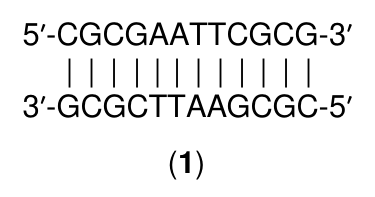
1.1 How many different palindromic double-stranded DNA dodecanucleotides (i. e. dsDNA species with twelve base pairs) exist?
1.2 How many different palindromic double-stranded DNA undecanucleotides (i.e., dsDNA species with eleven base pairs) exist?
The melting temperature of dsDNA, \(T_m\) is defined as the temperature at which 50% of the original amount of DNA double strands are dissociated into separate strands.
1.3 Consider the Drew–Dickerson dodecanucleotide (1). Assume that a G–C nucleobase pair contributes to the DNA duplex stability more than an A–T pair does.
What is the probability that its \(T_m\) increases when a single randomly selected base pair is replaced by a G–C pair?
Let us analyze the thermodynamics of formation of double-helical DNA from single strands, and its dependence on the length of the DNA and on the temperature. The equilibrium constant of association of single strands to form dsDNA differs for palindromic and non-palindromic dsDNA.
A solution of dsDNA with the initial concentration of \(c_{\mathrm{init}}=1.00\times10^{-6}\ \mathrm{mol\,dm^{-3}}\) was heated to \(T_m\) and equilibrium was reached.
1.4 Calculate the equilibrium constant of association of single strands at \(T_m\) for both non-palindromic and palindromic DNA.
The mean contributions to the Gibbs energy of association of two single strands to form dsDNA were estimate over a certain range of experimental conditions, and they amount to \(-6.07\ \mathrm{kJ\,mol^{-1}}\) per one G–C pair, and \(-1.30\ \mathrm{kJ\,mol^{-1}}\) per one A–T pair present in a dsDNA.
1.5 How many base pairs are there in the shortest dsDNA oligonucleotide that has \(T_m\) above \(330\ \mathrm K\)? At this \(T_m\), consider the following values of the equilibrium constant of association of single strands to form a dsDNA: \(K_{\mathrm{np}}=1.00\times10^6\) for a non-palindromic dsDNA, \(K_{\mathrm p}=1.00\times10^5\) for a palindromic dsDNA. Is the shortest oligonucleotide palindromic or non-palindromic?
Finally, let us leave the simplified idea of base pairs contributing individually to the association of DNA strands. The Gibbs energy of this process may be considered explicitly dependent on temperature. The dependence of the inverse \(T_m\) of the Drew–Dickerson dodecanucleotide (1) on the logarithm of the initial duplex concentration \(c_{\mathrm{init}}\) is shown below. (Note: a standard concentration \(c_0=1\ \mathrm{mol\,dm^{-3}}\) is introduced.)
\(c_{\mathrm{init}}/10^{-6}\ \mathrm{mol\,dm^{-3}}\) 0.25 0.50 1.00 2.0 4.0 8.0 \(T_m/\mathrm K\) 319.0 320.4 321.8 323.3 324.7 326.2 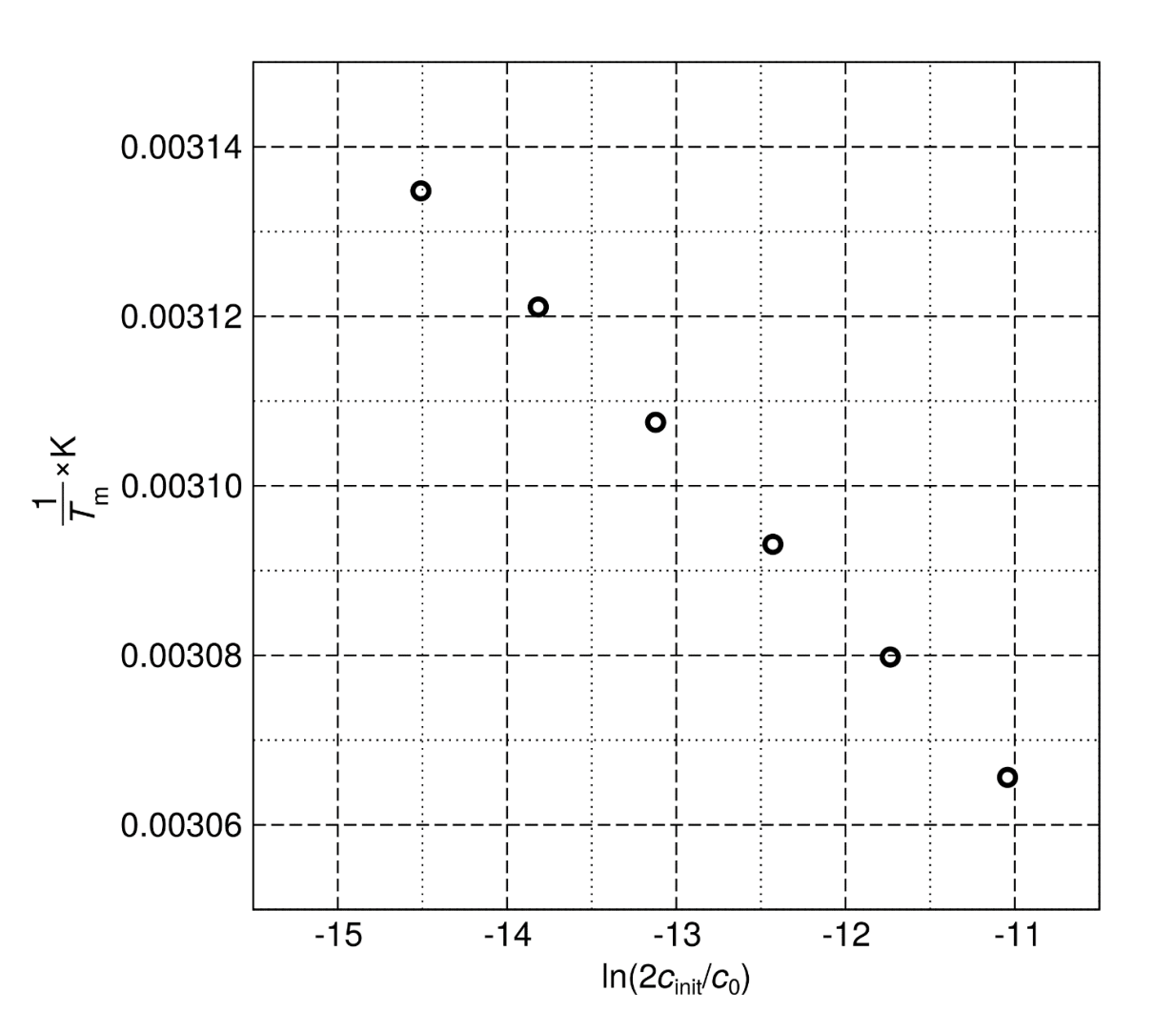
1.6 Calculate the standard enthalpy \(\Delta H^\circ\) and the standard entropy \(\Delta S^\circ\) of the association of DNA single strands to form the palindromic double-stranded Drew–Dickerson dodecanucleotide (1). Assume that \(\Delta H^\circ\) and \(\Delta S^\circ\) do not vary with temperature.
Official English text of the problem.
Problem 2: Repatriation of remains in the middle ages
At ambient temperatures, racemization is a slow reaction. As such, it can be used for dating biological objects and, moreover, for studying their thermal history. Let us take L-isoleucine (L-Ile) (\((2S,3S)\)-2-amino-3-methylpentanoic acid) as an example. It isomerizes on the \(\alpha\)-carbon and forms \((2R,3S)\)-2-amino-3-methylpentanoic acid, also known as D-allo-isoleucine. As the configuration changes on only one of the two stereogenic centres, this process is called epimerization rather than racemization.
2.1 Choose all true statements.
☐ D-allo-isoleucine and L-isoleucine have the same values of specific optical rotation but they have different melting points.
☐ D-allo-isoleucine has an identical absolute value of specific optical rotation as L-isoleucine but the sign is opposite. The melting point is the same for both isomers.
☐ D-allo-isoleucine and L-isoleucine have different values of specific optical rotation but they have the same melting points.
☐ D-allo-isoleucine and L-isoleucine have different values of specific optical rotation and different melting points.
☐ D-allo-isoleucine is not optically active.
2.2 Assign the absolute configurations for each stereoisomer of isoleucine.

☐ \(2S,3R\) (L-allo-isoleucine)
☐ \(2R,3S\) (D-allo-isoleucine)
☐ \(2S,3S\) (L-isoleucine)
☐ \(2R,3R\) (D-isoleucine)
2.3 The equilibrium constant \(K_{\mathrm{ep}}\) for L-isoleucine epimerization has the value of 1.38 (at 374 K). If we set molar Gibbs free energy of L-isoleucine \(G_{\mathrm m}^{\circ}=0\ \mathrm{kJ\,mol^{-1}}\) determine the Gibbs free energies for all structures A–D from question 2.2 at 374 K.
2.4 If we take into account stereoisomerism at all stereocentres, what is the maximum possible number of the stereoisomers of the tripeptide Ile-Ile-Ile?
At the start of the epimerization, we can neglect the reverse reaction. The epimerization then follows the first-order kinetics:

The value of the rate constant at 374 K is \(k_1(374\ \mathrm K)=9.02\times10^{-5}\ \mathrm{h^{-1}}\) and that at 421 K is \(k_1(421\ \mathrm K)=1.18\times10^{-2}\ \mathrm{h^{-1}}\).
In the following calculation, shorten the concentration of L-isoleucine to \([\mathrm L]\) and of D-allo-isoleucine to \([\mathrm D]\).
We can define a quantity \(de\) (diastereomeric excess):
\[ de=\frac{[\mathrm L]-[\mathrm D]}{[\mathrm L]+[\mathrm D]}\times100(\%). \]
2.5 Let us boil L-isoleucine for 1 943 hours at 374 K. What is the value of \(de\) (with three significant figures) for L-isoleucine a) before boiling and b) after boiling?
2.6 How long does it take to convert 10% of L-isoleucine to D-allo-isoleucine at 298 K?
In fact, the reverse reaction cannot be neglected. The correct kinetic scheme is expressed as

Let us define the deviation of concentration from its equilibrium value \([\mathrm L]_{\mathrm{eq}}\)
\[ x=[\mathrm L]-[\mathrm L]_{\mathrm{eq}} \]
It is possible to derive that \(x\) evolves with time according to the following equation:
\[ x=x(0)\times e^{-(k_1+k_2)t}, \]
where \(x(0)\) is the deviation from equilibrium at \(t=0\ \mathrm h\).
2.7 Let us boil \(1.00\ \mathrm{mol\,dm^{-3}}\) L-isoleucine solution for 1 943 hours at 374 K. The rate constant for the forward reaction is \(k_1(374\ \mathrm K)=9.02\times10^{-5}\ \mathrm{h^{-1}}\), \(K_{\mathrm{ep}}\) for L-isoleucine epimerization has the value of 1.38 (at 374 K). In the following calculation, shorten the concentration of L-isoleucine to \([\mathrm L]\) and of D-allo-isoleucine to \([\mathrm D]\). Evaluate (with three significant figures)
a) \([\mathrm L]_{\mathrm{eq}}\),
b) diastereomeric excess (\(de\)) after boiling.
Amino acids with a single chiral centre undergo racemization, e.g. L-arginine racemizes:
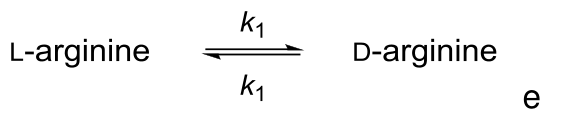
The time evolution of concentrations is governed by
\[ \ln\frac{1+\dfrac{[\mathrm D]}{[\mathrm L]}} {1-\dfrac{[\mathrm D]}{[\mathrm L]}} =2k_1t+C \]
Here \([\mathrm D]\) and \([\mathrm L]\) are concentrations of D- and L-arginine at time \(t\), \(k_1\) is the rate constant, and the term \(C\) is set according to the initial concentrations.
Holy Roman Emperor Lothar III passed away during his journey to Sicily in 1137. To facilitate the repatriation of the remains, his body was, immediately after his death, boiled in water (373 K) for a certain time. Let us try to estimate the boiling time with the help of chemical kinetics. We know that the rate constant \(k_1\) of arginine racemization within the protein at 373 K and \(\mathrm{pH}=7\) has the value of \(5.10\times10^{-3}\ \mathrm{h^{-1}}\).
In order to analyse the isomeric composition of arginine in Lothar’s bones, we need to start with transferring arginine into solution. Lothar’s bones were hydrolyzed in a highly acidic environment for 4 hours at 383 K. The ratio of the optical isomers was \(\dfrac{[\mathrm D]}{[\mathrm L]}=0.090\). Lothar’s wife Richenza was not boiled after her death. Her bones were hydrolyzed using the same procedure and in this case the ratio was \(\dfrac{[\mathrm D]}{[\mathrm L]}=0.059\). (Note that the racemization also takes place during the hydrolysis, with the rate constant \(k'_1\), different from \(k_1\)).
2.8 How long was the Holy Roman Emperor Lothar III boiled in water in 1137?
Note: The racemization of arginine is an extremely slow process at temperatures typically encountered in graves. As both bodies are only some 880 years old, we can neglect the natural racemization during this time.
Official English text of the problem.
Problem 3: Emerging electro-mobility
Contemporary means of transportation rely on burning fossil fuels, although the efficiency of real combustion engines is inherently limited and typically ranges between 20 and 40%.
3.1 Mark the factors that can make the efficiency of a heat engine higher:
- ☐ Increasing the friction in the mechanical parts of the engine
- ☐ Increasing the burning temperature of the fuel in the engine
- ☐ Narrowing the working temperature interval of the engine
- ☐ Increasing the working pressure of the gas
Fuel cells represent a way to improve the engine efficiency for future vehicles. The engine efficiency can be improved by using hydrogen-based fuel cells.
3.2 The standard enthalpy of formation of liquid water is \(\Delta_{\mathrm f}H^\circ(\ce{H2O},\mathrm l)=-285.84\ \mathrm{kJ\,mol^{-1}}\), and the standard combustion enthalpy of isooctane is \(\Delta_{\mathrm c}H^\circ(\ce{C8H18},\mathrm l)=-5\,065.08\ \mathrm{kJ\,mol^{-1}}\) (both at 323.15 K). Calculate the values of specific (per unit of mass) combustion enthalpy at 232.15 K of pure liquid isooctane and pure gaseous hydrogen.
3.3 Calculate the standard electromotive force (EMF) of a fuel cell using gaseous oxygen and hydrogen, both ideal gases at 100 kPa and 323.15 K, to produce liquid water.
Use the following entropy data for 323.15 K: \(S^\circ(\ce{H2O},\mathrm l)=70\ \mathrm{J\,K^{-1}\,mol^{-1}}\),
\(S^\circ(\ce{H2},\mathrm g)=131\ \mathrm{J\,K^{-1}\,mol^{-1}}\),
\(S^\circ(\ce{O2},\mathrm g)=205\ \mathrm{J\,K^{-1}\,mol^{-1}}\).
3.4 Determine the ideal thermodynamic efficiency \((\eta)\) of a fuel cell producing liquid water at 353.15 K. At this temperature, the enthalpy of formation of water is \(\Delta_{\mathrm f}H^\circ(\ce{H2O},\mathrm l)=-281.64\ \mathrm{kJ\,mol^{-1}}\) and the corresponding reaction Gibbs energy change is \(\Delta_{\mathrm r}G^\circ=-225.85\ \mathrm{kJ\,mol^{-1}}\).
3.5 A polymer membrane electrolyzer facility operates at the voltage of 2.00 V and is powered by a 10.0 MW wind turbine plant which was running at full power from 10 pm to 6 am. The electrolysis yielded 1 090 kg of pure hydrogen. Calculate the electrolysis yield defined as the mass of produced hydrogen divided by its theoretical produced mass.
3.6 Calculate the mass of hydrogen required to drive the distance between Prague and Bratislava (330 km) at the average speed of \(100\ \mathrm{km\,h^{-1}}\) with a car fitted with a 310 kW electric engine running on average at a 15% rate of its maximum power. Assume that the efficiency of the hydrogen cell producing electrical energy is 75%, the efficiency of the electric engine is 95%, and the Gibbs energy change for combustion of hydrogen fuel is \(\Delta_{\mathrm r}G=-226\ \mathrm{kJ\,mol^{-1}}\).
The low efficiency of hydrogen production and the safety issues connected with its storage impede spreading the hydrogen-based transportation technology. Hydrazine (\(\ce{N2H4}\)) fuel cells might be a suitable alternative.
The following standard reduction potentials for aqueous hydrazine systems are available:
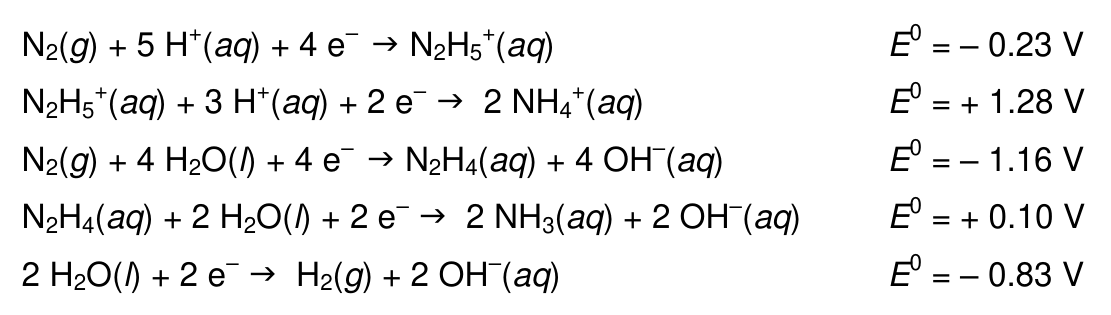
3.7 Fill in the following Latimer diagrams with the forms of hydrazine and ammonia prevailing at the given conditions and write the redox potential value for each arrow representing the electrochemical half-reaction. Record all the necessary calculations.
a) Acidic environment (pH = 0)
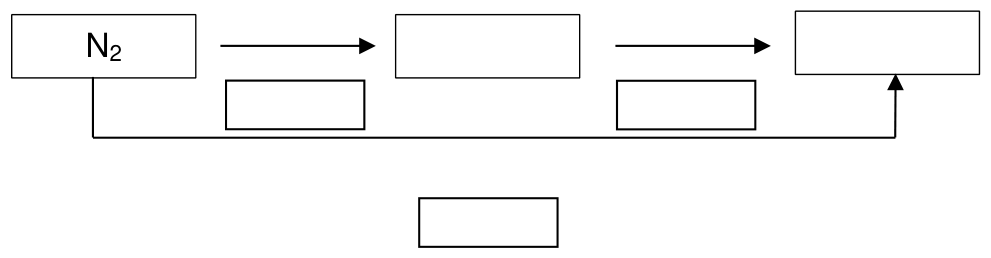
b) Basic environment (pH = 14)
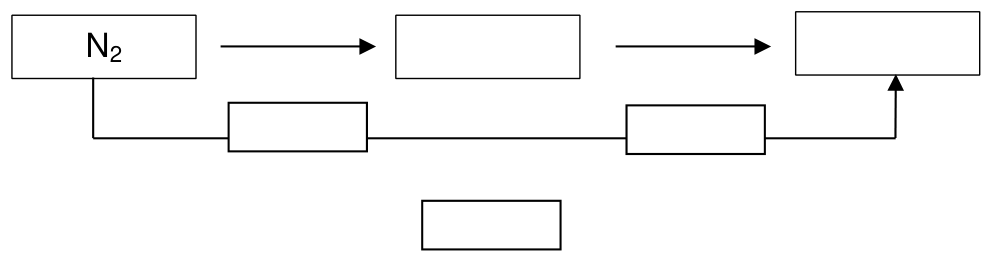
Due to the toxicity, odour and its environmental impact, it is extremely unfavourable to produce ammonia in fuel cells.
3.8 Write down the net reaction for the decomposition of hydrazine under basic conditions to:
(i) ammonia and nitrogen,
(ii) nitrogen and hydrogen.
Calculate the corresponding equilibrium constants at \(T=298.15\ \mathrm K\).
Rechargeable lithium-based batteries are an alternative to fuel cells. Lithium-ion batteries commonly use graphite for one of the electrodes, in which lithium clusters intercalate in between the graphite sheets. The other electrode is made of lithium cobalt oxide, which can reversibly absorb lithium ions moving from one electrode to the other during the charge and discharge processes. The half-reactions relevant for the system can be formally written as:

3.9 Using the formalism given above, write down the overall chemical reaction occurring in the battery during the discharge process. Give the oxidation states of the cobalt atom.
3.10 Tick the boxes to get the correct statements which are valid for the discharge of the lithium-based battery described in 3.9:
\(\ce{Li(C)_n}\) electrode is ☐ cathode ☐ because lithium ions are reduced here. ☐ anode ☐ because lithium atoms are oxidized here. \(\ce{LiCoO2}\) electrode is ☐ cathode ☐ because cobalt ions are reduced here. ☐ anode ☐ because cobalt ions are oxidized here. 3.11 Assume that a \(\ce{C6}\) unit, a \(\ce{CoO2}\) unit and \(\ce{Li}\) atom form the active battery mass required to transfer one electron between the electrodes. Using the corresponding standard EMF, calculate the theoretical specific reversible charge capacity (in \(\mathrm{mAh\,g^{-1}}\)) and the energy density (in \(\mathrm{kWh\,kg^{-1}}\)) of such a model lithium ion battery related to the whole active battery mass.
Official English text of the problem.
Problem 4: Column chromatography of radioactive copper
\(\ce{^{64}Cu}\) for positron emission tomography is prepared by the bombardment of a zinc target with deuterium nuclei (further referred to as the activated target).
4.1 Write down the balanced equation for the \(\ce{^{64}Zn}\) nucleus bombardment with deuterium nuclei, giving \(\ce{^{64}Cu}\). Specify the corresponding atomic and mass numbers of all species. Disregard the charges.
The activated target is dissolved in concentrated hydrochloric acid (\(\ce{HCl (aq)}\)) to give a mixture containing \(\ce{Cu^2+}\) and \(\ce{Zn^2+}\) ions and their respective chlorido complexes.
4.2 Calculate the mole fraction of negatively charged copper species with respect to the amount of copper prepared by zinc target activation. Assume \([\ce{Cl-}] = 4\ \mathrm{mol\,dm^{-3}}\). For the overall complexation constants, \(\beta\), see Table 1.
Before you start the calculation, write down the charges in the upper right boxes:

Table 1. Overall complexation constants \(\beta\) of \(\ce{Cu}\) species (charges were omitted in the formula).
\[ \beta_i=\frac{[\ce{CuCl_i}]}{[\ce{Cu}]\times[\ce{Cl}]^i} \]
\(i\) in \(\ce{[CuCl_i]}\) 1 2 3 4 \(\beta_i\) 2.36 1,49 0.690 0.055 The mixture containing \(\ce{Cu^2+}\) and \(\ce{Zn^2+}\) ions and their respective chlorido complexes was separated with an anion exchange resin. Dry resin in \(\ce{OH-}\) form was dispersed in water and the suspension was transferred into a column. To occupy all sites with \(\ce{Cl-}\) ions (i.e. to obtain resin in a \(\ce{Cl-}\) form), the resin was washed with hydrochloric acid and then with deionized water to wash out all the unbound \(\ce{Cl-}\) ions.
4.3 Everything was initially at laboratory temperature before washing with hydrochloric acid. Does the column temperature change during the washing with hydrochloric acid?
☐ No.
☐ Yes, the temperature decreases.
☐ Yes, the temperature increases.
The mixture containing \(\ce{Cu^2+}\) and \(\ce{Zn^2+}\) ions and their respective chlorido complexes was transferred onto the resin-filled column. Hydrochloric acid solution was used as an eluent.
Using the simple experimental formula below, you can calculate quantities that determine average elution properties of both copper species and zinc species on the column.
The retention volume \(V_{\mathrm R}\) (the mobile phase volume at which 50% of the compound has been eluted from the column) can be calculated as follows:
\[ V_{\mathrm R} =D_{\mathrm g}\times m_{\mathrm{resin,dry,OH\ form}}+V_0 \]
4.4 Using the average mass distribution coefficients \(D_{\mathrm g}\) (\(D_{\mathrm g}(\ce{Cu}\text{ species})=17.4\ \mathrm{cm^3\,g^{-1}}\), \(D_{\mathrm g}(\ce{Zn}\text{ species})=78.5\ \mathrm{cm^3\,g^{-1}}\)), calculate the retention volumes \(V_{\mathrm R}\) in \(\mathrm{cm^3}\) of both copper species and zinc species. The mass of dry resin in \(\ce{OH-}\) form \(m_{\mathrm{resin,dry,OH\ form}}=3.72\ \mathrm g\) and the void volume of a column \(V_0=4.93\ \mathrm{cm^3}\).
(If you cannot find the answer, use \(V_{\mathrm R}(\ce{Cu}\text{ species})=49.9\ \mathrm{cm^3}\) and \(V_{\mathrm R}(\ce{Zn}\text{ species})=324\ \mathrm{cm^3}\) for further calculations.)
Using the simple experimental formula, separation of two sets of species, A and B, can be considered complete if
\[ V_{0.001}(\mathbf A)-V_{0.999}(\mathbf B)>10V_{\mathrm c} \]
where \(V_{0.001}\) is the mobile phase volume at which 0.1% of A has been eluted from the column, and \(V_{0.999}\) is the mobile phase volume at which 99.9% of B has been eluted from the column.
\[ V_{0.001}(\mathbf A) =V_{\mathrm R}(\mathbf A)\times \left(1-6.91\sqrt{d_{\mathrm p}/L_{\mathrm c}}\right) \]
\[ V_{0.001}(\mathbf B) =V_{\mathrm R}(\mathbf B)\times \left(1-6.91\sqrt{d_{\mathrm p}/L_{\mathrm c}}\right) \]
\[ V_{0.999}(\mathbf B) =2V_{\mathrm R}(\mathbf B)-V_{0.001}(\mathbf B) \]
4.5 Based on a calculation, decide whether copper species were separated completely from zinc species. The volume of the column filled with the swollen resin \(V_{\mathrm c}=10.21\ \mathrm{cm^3}\), the resin particle diameter \(d_{\mathrm p}=0.125\ \mathrm{mm}\), and the height of the wet resin in a swollen state in the column \(L_{\mathrm c}=13.0\ \mathrm{cm}\).
4.6 Calculate the theoretical value of the total ion exchange mass capacity of the dry resin used in this problem, \(Q_{\mathrm{m,theor}}\), in \(\mathrm{mmol\,g^{-1}}\). Consider tetralkylammonium groups were the only ones responsible for ion exchange of the resin. No other nitrogen containing groups were present. The mass fraction of nitrogen in the dry resin was 4.83%.
(If you cannot find the answer, use \(Q_{\mathrm{m,theor}}=4.83\ \mathrm{mmol\,g^{-1}}\) for further calculations.)
In reality, not all tetraalkylammonium groups are involved in the ion exchange. To determine the total ion exchange volume capacity, \(Q_{\mathrm v}\), the column filled with 3.72 g dry resin converted to the \(\ce{Cl-}\) form was washed with the excess of sodium sulfate solution. The effluent was collected in a \(500\ \mathrm{cm^3}\) volumetric flask, which was then filled with water to the mark. An aliquot of \(100\ \mathrm{cm^3}\) was potentiometrically titrated with \(0.1027\ \mathrm{mol\,dm^{-3}}\) silver nitrate. The silver nitrate solution volume at the equivalence point was \(22.20\ \mathrm{cm^3}\). The volume of the column filled with the swollen resin, \(V_{\mathrm c}\), was \(10.21\ \mathrm{cm^3}\).
4.7 Calculate the \(Q_{\mathrm v}\) of the swollen resin in mmol of active tetraalkylammonium groups per \(\mathrm{cm^3}\) of the swollen resin.
(If you cannot find the answer, use \(Q_{\mathrm v}=1.00\ \mathrm{mmol\,cm^{-3}}\) for further calculations.)
4.8 Calculate the mole fraction (\(x\)) of the tetraalkylammonium groups actively involved in the ion exchange.
Official English text of the problem.
Problem 5: Bohemian garnet
The dodecahedral splitting diagram referred to in 5.4 and the formula defining \(x,y\) in 5.13 are not printed in this version of the problem.
PROBLEM 5
Bohemian garnet
Bohemian garnet (pyrope) is a famous Czech blood coloured semi-precious stone. The chemical composition of natural garnets is expressed by the general stoichiometric formula of \(\ce{A3B2(SiO4)3}\), where \(\ce{A^{II}}\) is a divalent cation and \(\ce{B^{III}}\) is a trivalent cation. Garnets have a cubic unit cell that contains 8 formula units. The structure comprises 3 types of polyhedra: the \(\ce{A^{II}}\) cation occupies a dodecahedral position (it is surrounded with eight O atoms), the \(\ce{B^{III}}\) cation occupies an octahedral position (it is surrounded with six O atoms) and \(\ce{Si^{IV}}\) is surrounded with four O atoms arranged into a tetrahedron.
The most common garnet mineral is almandine with the formula of \(\ce{Fe3Al2(SiO4)3}\). Its unit cell parameter is \(a = 11.50\ \text{Å}\).
5.1 Calculate the theoretical density of almandine.
The Bohemian garnet has the composition of \(\ce{Mg3Al2(SiO4)3}\). Pure compound is colourless and the colour of natural garnets comes from chromophores – transition metal cations that substitute the host material cations. The red colour of the Bohemian garnet comes from trace amounts of \(\ce{Cr^{III}}\) ions in the octahedral sites and \(\ce{Fe^{II}}\) ions in the dodecahedral sites.
5.2 Draw the splitting diagram for the \(\ce{[Cr^{III}O6]}^{\mathrm{oct}}\) d-orbitals and fill it with electrons.
5.3 Identify the 1st transition row element(s) whose trivalent cation(s) \(\ce{M^{III}}\) placed in an octahedral position is/are diamagnetic in the low-spin arrangement and paramagnetic in the high-spin arrangement.
5.4 The figure below shows d-orbitals splitting in the dodecahedral crystal field. Fill in the electrons for the \(\ce{[Fe^{II}O8]}^{\mathrm{dod}}\) chromophore for both existing arrangements.
5.5 Derive the inequalities (e.g. \(P < E_1 + E_2 + E_3\)) for the pairing energy (\(P\)) magnitude in relation to energies \(E_1\), \(E_2\) and \(E_3\) for both arrangements.
5.6 Assuming that \(P > E_3\), identify the 1st transition row element(s) whose divalent cation \(\ce{M^{II}}\) placed in dodecahedral position is diamagnetic in the low-spin arrangement and paramagnetic in the high-spin arrangement.
The figures below show simplified absorption spectra of four coloured minerals – blood-coloured Bohemian garnet, green uvarovite, blue sapphire and yellow-orange citrine.
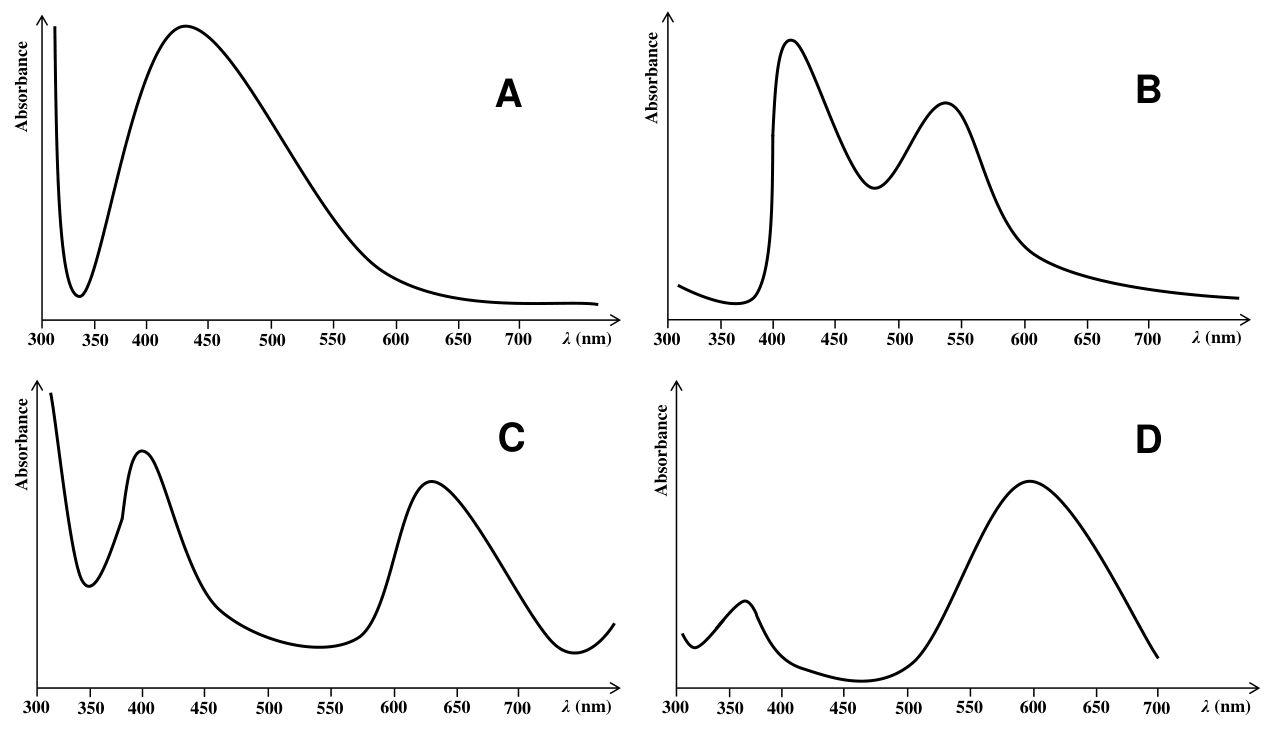
5.7 Match the spectra with the minerals.
5.8 If illuminated with monochromatic blue-green light, how will the Bohemian garnet look?
☐ Red ☐ Blue ☐ Yellow-orange ☐ Black
☐ Yellow ☐ Blue-green ☐ Violet ☐ WhiteAndradite is another garnet mineral; its chemical composition is \(\ce{Ca3Fe2(SiO4)3}\). A double cation substitution – \(\ce{Ti^{IV}}\) for \(\ce{Fe^{III}}\) in the octahedral position and \(\ce{Fe^{III}}\) for \(\ce{Si^{IV}}\) in the tetrahedral position – gives rise to black schorlomite. Its chemical composition can be expressed as \(\ce{Ca3[Fe,Ti]2^{oct}([Si,Fe]^{tet}O4)3}\).
5.9 Calculate the percentage of \(\ce{Si^{IV}}\) ions in a sample of schorlomite that must be substituted with \(\ce{Fe^{III}}\), if we know that 5% of \(\ce{Fe^{III}}\) ions in octahedral position are substituted with \(\ce{Ti^{IV}}\).
The colour of the mineral is caused by two chromophores: \(\ce{[Fe^{III}O6]}^{\mathrm{oct}}\) and \(\ce{[Fe^{III}O4]}^{\mathrm{tet}}\). The central ions of both chromophores have equal number of unpaired electrons.
5.10 Draw the d-orbitals splitting diagrams for both chromophores and fill in the electrons.
Tetrahedral field causes a smaller splitting than the octahedral field \(\left(\Delta_{\mathrm{tet}} = \frac49\Delta_{\mathrm{oct}}\right)\). Surprisingly for the \(\ce{Fe^{III}}\) ion, the energy of the first d–d transition (although very weak) for the octahedral chromophore is smaller (\(11\,000\ \mathrm{cm^{-1}}\)) than for the tetrahedral one (\(22\,000\ \mathrm{cm^{-1}}\)).
5.11 Calculate the size of pairing energy (\(P\)) and the sizes of \(\Delta_{\mathrm{oct}}\) and \(\Delta_{\mathrm{tet}}\) splitting. Assume that the pairing energy is equal in both chromophores.
Synthetic garnet YAG (Yttrium Aluminium Garnet), used in optoelectronics, has the composition of \(\ce{Y3Al5O12}\). Its structure is derived from the general garnet structure \(\ce{A3B2(SiO4)3}\) by placing the ions \(\ce{Y^{III}}\) and \(\ce{Al^{III}}\) to the A, B and Si positions.
5.12 Based on your knowledge of the relative ion radii, determine which cation occupies which position.
5.13 For the use in LED technology, YAG is doped with \(\ce{Ce^{III}}\). Determine the values of \(x\) and \(y\) in the formula of YAG in which 5% of yttrium atoms are substituted with cerium. (If you don’t get result, use \(x = 2.25\) and \(y = 0.75\).)
5.14 The \(\ce{Ce^{III}}\)-doped YAG is prepared by annealing the mixture of \(\ce{Y2O3}\), \(\ce{Al2O3}\) and \(\ce{CeO2}\) in \(\ce{H2}\) atmosphere. Use the formula from 5.13, write down a balanced equation for this reaction with the smallest whole-number stoichiometric coefficients.
Doping the YAG structure with rare-earths ions enables the production of lasers with emission wavelengths ranging from the UV to the mid-IR region. In the scheme below, simplified f–f energy transitions of selected rare-earths ions are shown.
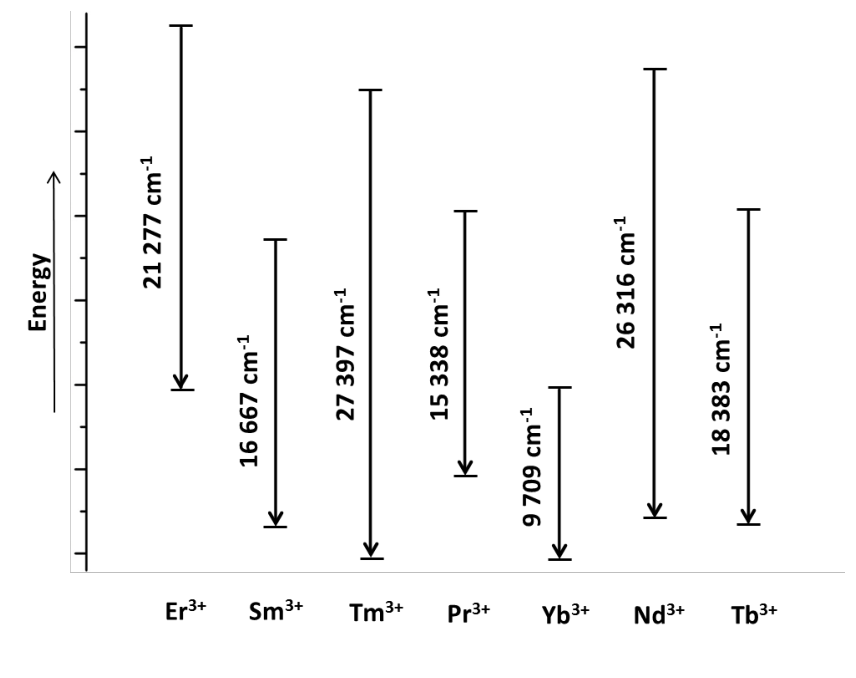
5.15 Which cation has a transition which corresponds to blue light emission.
☐ \(\ce{Er^{3+}}\) ☐ \(\ce{Sm^{3+}}\) ☐ \(\ce{Tm^{3+}}\) ☐ \(\ce{Pr^{3+}}\)
☐ \(\ce{Yb^{3+}}\) ☐ \(\ce{Nd^{3+}}\) ☐ \(\ce{Tb^{3+}}\)5.16 Calculate the emission wavelength of this light.
5.17 According to a legend, Noah used a stick with a garnet stone for illumination during his voyage. Assuming only the photoluminescence effect, determine the colour of the laser light emitted from his stick if the stone were the blood-coloured Bohemian garnet.
☐ Red ☐ Blue ☐ Yellow-orange ☐ Black
☐ Yellow ☐ Blue-green ☐ Violet ☐ WhiteOfficial English text of the problem.
Problem 6: Let’s go mushrooming
Mushrooming belongs to Czech and Slovak traditional pastimes. While some of our mushroom species are edible, some are inedible or even poisonous.
Inky cap (Coprinopsis atramentaria) is considered edible and delicious. It contains a natural compound called coprine (E), which can be easily synthesized from ethyl 3-chloropropanoate (1).
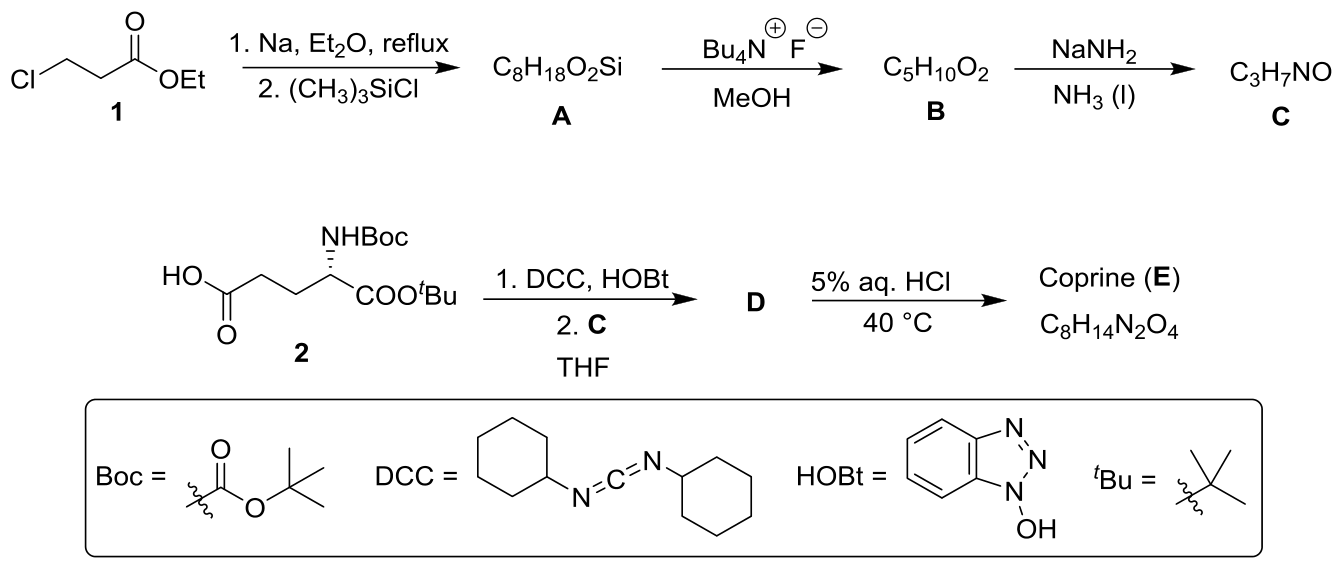
6.1 Draw the formulae of compounds A–E including stereochemistry when necessary.
Hint: The first reaction affording compound A proceeds via an organometallic compound which then cyclizes.
In the human body, coprine undergoes hydrolysis to L-glutamic acid (3) and compounds C and 4, which are responsible for the coprine adverse side-effects. They inhibit the enzyme acetaldehyde dehydrogenase, which is involved in the metabolism of alcohol. When the enzyme is inhibited, acetaldehyde formed by alcohol dehydrogenase accumulates in the body, causing strong symptoms of hangover (so called antabuse effect). The active site of the enzyme contains a cysteine \(\ce{SH}\) group, which is blocked either by compound C or 4.
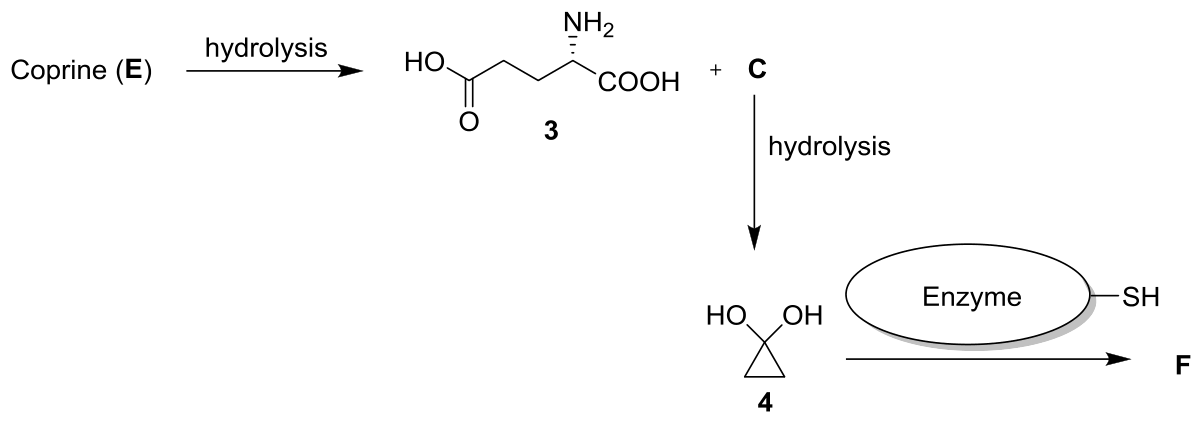
Enzyme = acetaldehyde dehydrogenase
6.2 Using the pictogram for acetaldehyde dehydrogenase above, draw the structure F of the enzyme inhibited by compound 4.
The antabuse effect got its name after antabuse (5), the most known drug used in alcohol-addiction treatment. This drug can be synthesized according to the following scheme.

6.3 Draw the formulae of compounds G and H.
Hint: Compound H contains five carbon atoms.
6.4 Mark all possible reagents which could be used for I from the following list.
☐ m-chloroperbenzoic acid (mCPBA) ☐ diluted \(\ce{H2O2}\) ☐ \(\ce{Zn / CH3COOH}\) ☐ \(\ce{NaBH4}\) ☐ \(\ce{I2}\) ☐ hot concentrated \(\ce{H2SO4}\) ☐ \(\ce{K2CO3}, \ce{H2O}\) ☐ \(\ce{AlCl3}\) The way antabuse inhibits acetaldehyde dehydrogenase is similar to the effect of compounds C and 4.
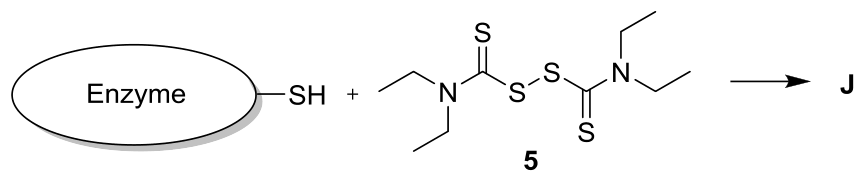
Enzyme = acetaldehyde dehydrogenase
6.5 Using the pictogram for acetaldehyde dehydrogenase above, draw the structure J of the enzyme inhibited by antabuse (5). Hint: Three sulfur atoms should be in the structure.
False morel (Gyromitra esculenta) is another interesting mushroom. Although it was considered edible in the past (esculentus means edible in Latin), there is clear evidence that this mushroom is poisonous due to the content of gyromitrin (M). This natural compound can be prepared from N-methylhydrazine (6):
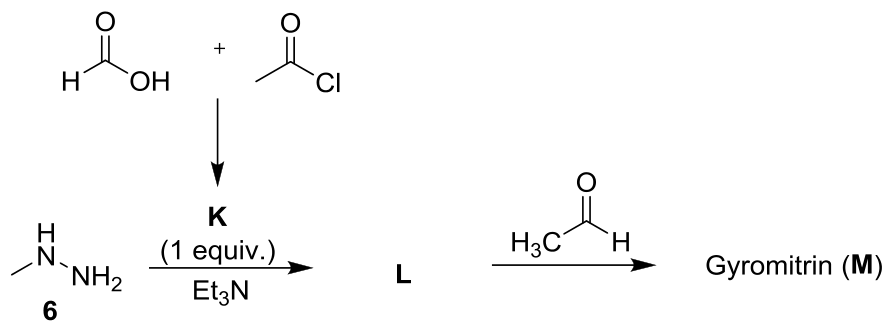
6.6 Draw the formulae of compounds K – M.
In human body, gyromitrin (M) hydrolyzes and provides N-methylhydrazine (6), which is strongly hepatotoxic. Gyromitrin (M) hydrolysis occurs as soon as it enters the acidic environment in human stomach where both its amide and imine groups are hydrolyzed.
Let us focus on the hydrolysis of the amide moiety within the gyromitrin molecule. The vibrational wavenumber of the stretching mode of the relevant \(\ce{C-N}\) bond amounts to \(1\,293.0\ \mathrm{cm^{-1}}\) and the potential energy surface does not significantly alter its shape with isotope substitution effect.
6.7 Calculate the highest possible hypothetical kinetic isotope effect at the temperature of human body, \(37\,^\circ\mathrm{C}\), for the given hydrolysis reaction assuming that both relevant nitrogen and carbon atoms were simultaneously substituted, \(\ce{^{14}N}\) with the \(\ce{^{15}N}\) isotope and \(\ce{^{12}C}\) with the \(\ce{^{13}C}\) isotope. Consider that only the zero point vibrational energy affects the rate constants. Assume that the molar masses of all isotopes are integers. In all steps consider five significant digits.
6.8 After making these isotopic changes, the rates of hydrolysis are not significantly different. Which of the following is the most likely the rate determining step?
- ☐ Nucleophilic attack of water on a protonated amidic moiety
- ☐ \(\ce{C-N}\) bond cleavage
- ☐ Protonation of the gyromitrin molecule
Official English text of the problem.
Problem 7: Cidofovir
Cidofovir (1), originally designed and prepared by the group of Professor Holy in former Czechoslovakia, is a nucleotide analogue with antiviral activity. It is used to treat viral infections, mostly in patients with AIDS.
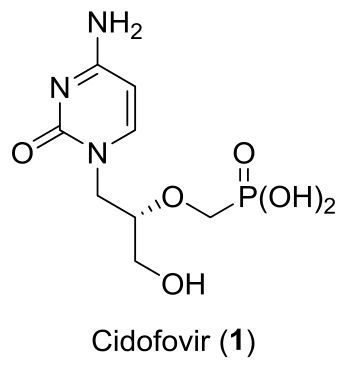
Cidofovir (1)
The key intermediate in the synthesis of cidofovir is optically pure diol 2, which can be prepared from L-mannitol (3).
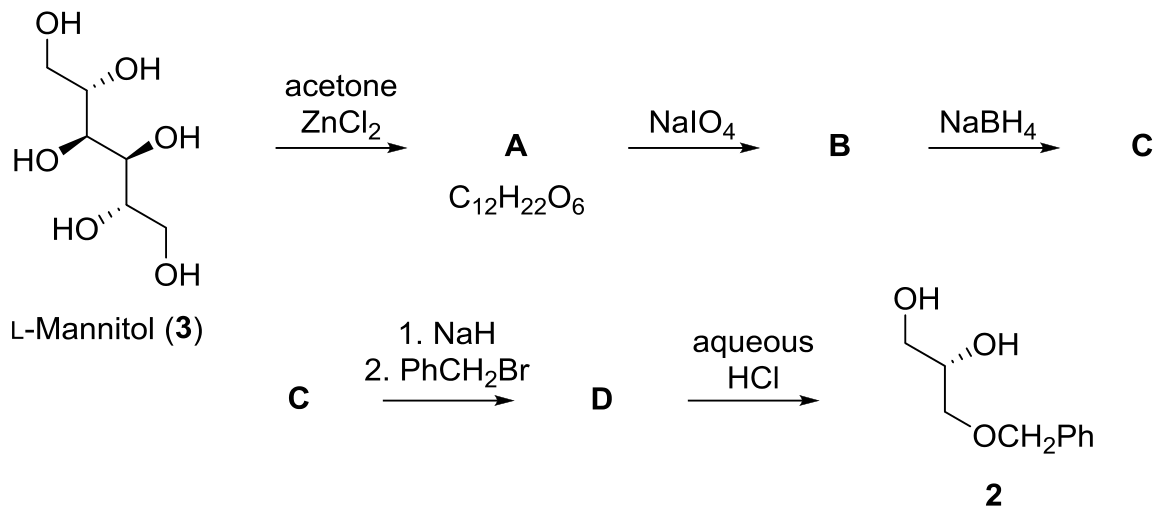
7.1 Draw the structures of compounds A–D, including stereochemistry. One molecule of A produces two molecules of B.
7.2 Draw the structural formulae of all alternative stereoisomers of compound 3 which could be used in the same reaction sequence to afford only the same product 2.
Diol 2 is further modified to provide compound I. The synthesis of phosphonate 4 used to convert compound F to G will be discussed later.
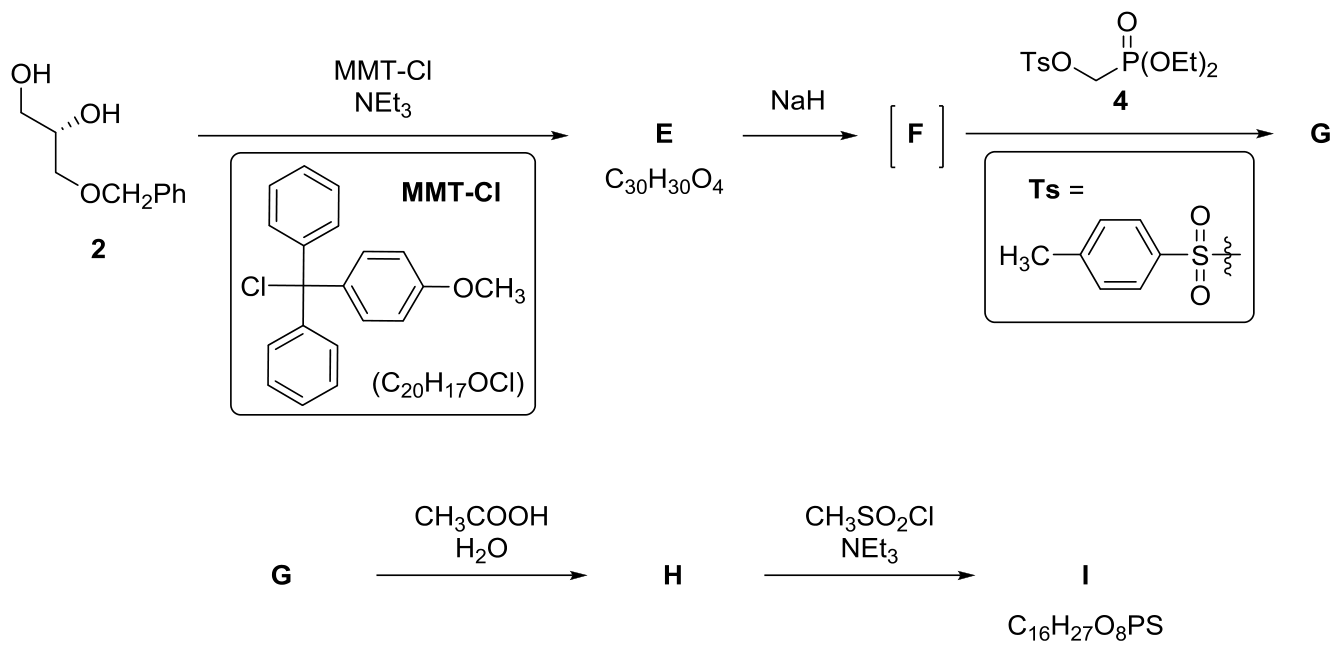
7.3 Draw the structures of compounds E–I, including stereochemistry. Use the abbreviation MMT for the (4-methoxyphenyl)diphenylmethyl group.
Official English text of the problem.
Problem 8: Caryophyllene
β-Caryophyllene (3) is a naturally occurring sesquiterpene present in clove tree and in some traditional Czech and Slovak plants, such as the hop plant or small-leaved linden.
The synthesis of β-caryophyllene starts from a single enantiomer of dienone A. The reaction of A with silyl ketene acetal 1, followed by immediate reduction and aqueous work-up affords ketone 2. This intermediate then undergoes reaction with tosyl chloride, providing B. Basic cyclization of this compound affords C. Finally, the reaction of C with ylide D provides β-caryophyllene.
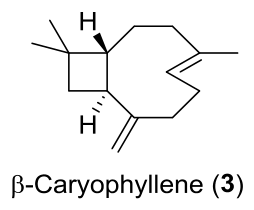
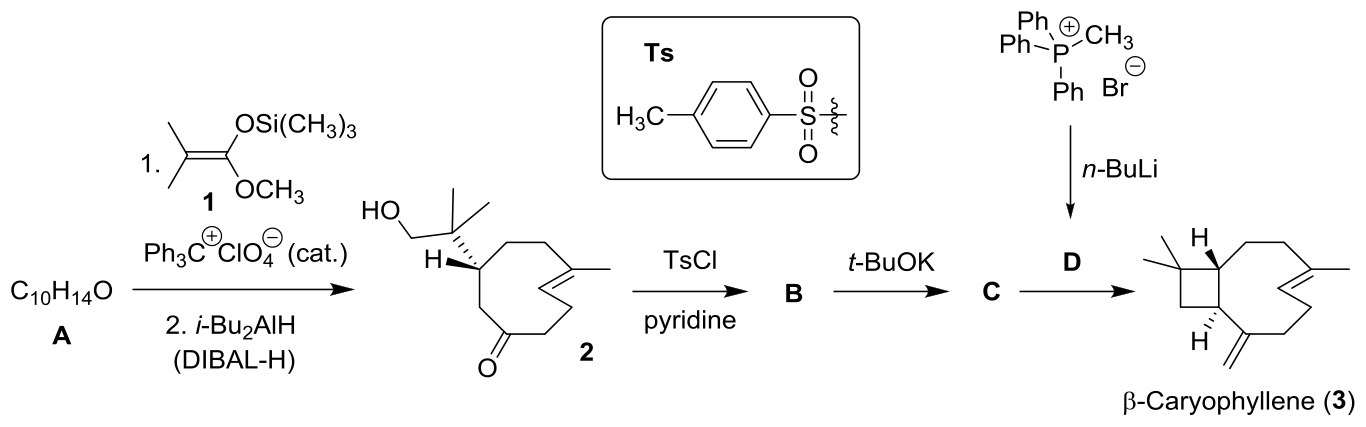
8.1 Draw the structures of compounds A–D, including the appropriate stereochemistry.
Hint: In transformation A → 2, the silyl ketene acetal acts as a nucleophile.
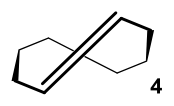
Due to the large ring size, both compounds 2 and 3 are stable, even though they contain a double bond in the trans configuration. trans-Cyclooctene (4) is the smallest ring that can accommodate a trans double bond. It can be prepared according to the following scheme:

8.2 Draw the structures of reagent E and intermediates F and G, including the appropriate stereochemistry. For F and G, tick the box indicating the stereochemical outcome.
Mark the correct answer:
☐ achiral, ☐ single enantiomer, ☐ racemic mixture, ☐ mixture of diastereoisomers
8.3 Draw the structure of the enantiomer of cycloalkene 4.
The two double bonds in β-caryophyllene display different reactivity: the double bond in the ring (endocyclic) is more reactive than the other one (exocyclic) due to the ring strain.
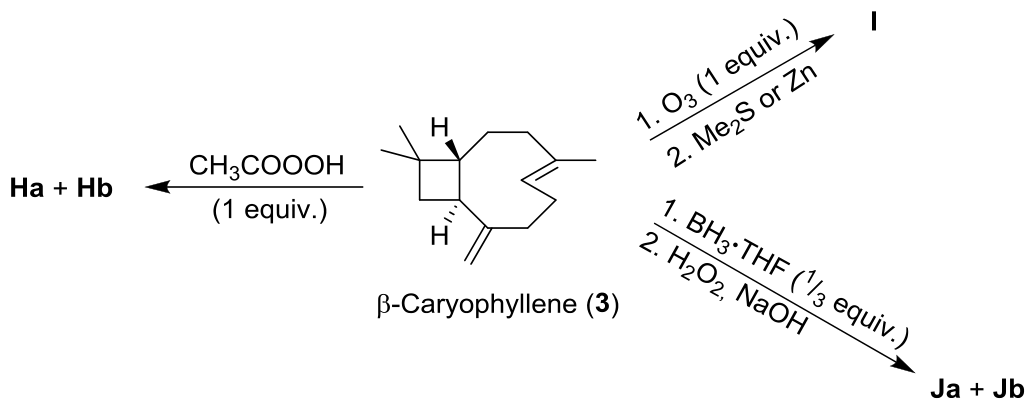
8.4 Draw the structures of compounds Ha + Hb, I and Ja + Jb, including the appropriate stereochemistry. Hint: Ha + Hb and Ja + Jb are pairs of diastereomers.
Interestingly, the reactivity of the double bonds is reversed when isocaryophyllene (5) is used instead of β-caryophyllene (3).
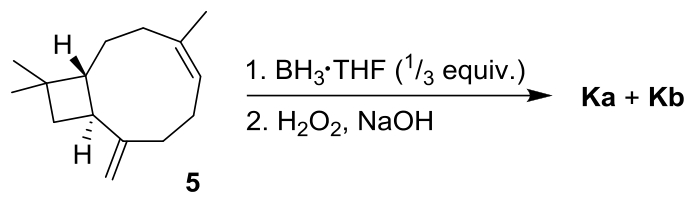
8.5 Draw the structures of compounds Ka and Kb.
Hint: Ka + Kb are a pair of diastereomers.
Isotope-labelled compounds are invaluable tools for reaction mechanism investigation, structure determination, and mass or NMR spectroscopy studies. Let us have a look at the synthesis of some labelled analogues of β-caryophyllene.
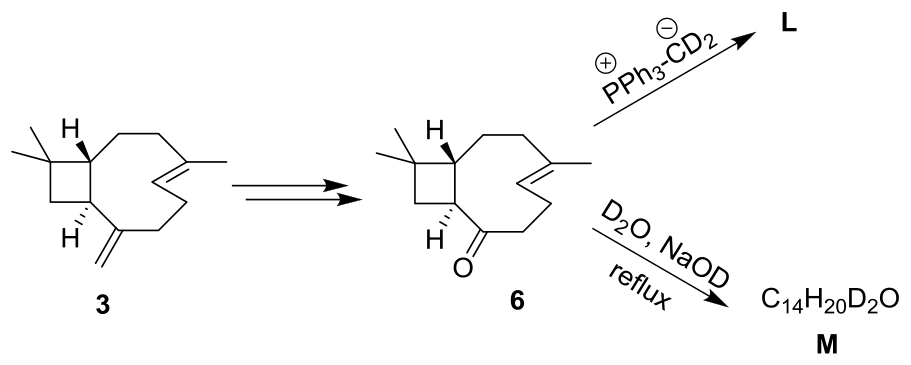
8.6 Draw the structures of compounds L and M, including the appropriate stereochemistry.
β-Caryophyllene (3) undergoes acid-catalyzed cyclization, which leads to a complex mixture of products. Among them, the pair of diastereomers Na + Nb and the pair of diastereomers 7a + 7b are the most abundant. The reaction starts with protonation of the more reactive internal double bond affording cation O. This cyclizes without the cleavage of a carbon-carbon single bond to yield diastereomeric tricyclic cations Pa and Pb, which undergo hydration to give the target alcohols Na and Nb. Alternatively, the cations Pa and Pb rearrange with the cleavage of a carbon-carbon single bond to cations Qa and Qb, which deprotonate to compounds 7a and 7b.
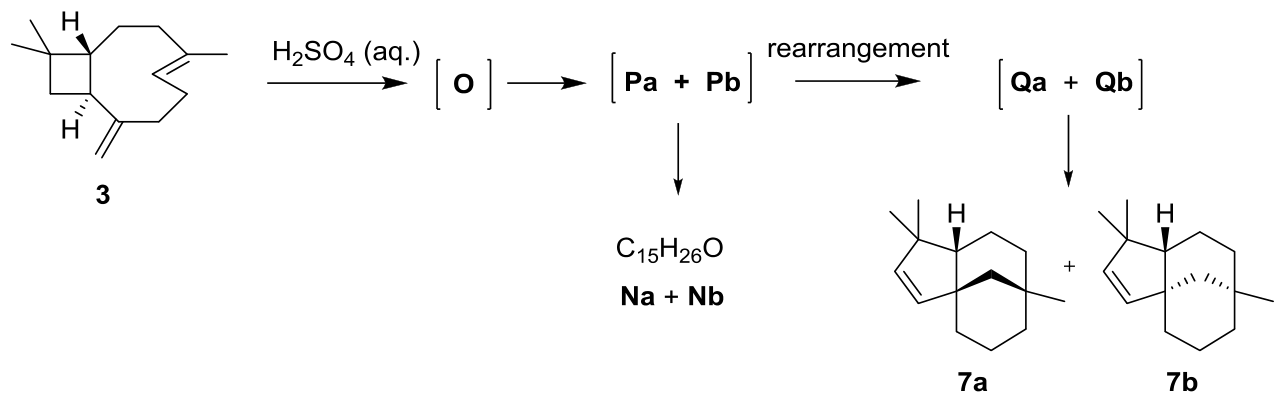
8.7 Draw the structures, including the appropriate stereochemistry, of the three intermediates O, Pa, Qa leading to the diastereomer 7a, including the appropriate stereochemistry.
8.8 Draw the structures of diastereomers Na + Nb.
Official English text of the problem.
Internationale Chemie-Olympiade
IChO 2018
Bratislava und Prag, Slowakei und Tschechien · 8 Theorieaufgaben mit vollständigen Lösungen
Aufgabe 1: DNA
Palindromische Sequenzen sind eine interessante Klasse von DNA. Bei einer palindromischen doppelsträngigen DNA-Spezies (dsDNA) stimmt die in \(5'\to3'\)-Richtung gelesene Sequenz eines Strangs mit der in \(5'\to3'\)-Richtung gelesenen Sequenz des komplementären Strangs überein. Eine palindromische dsDNA besteht somit aus zwei identischen Strängen, die zueinander komplementär sind. Ein Beispiel ist das sogenannte Drew–Dickerson-Dodekanukleotid (1):
1.1 Wie viele verschiedene palindromische doppelsträngige DNA-Dodekanukleotide (d. h. dsDNA-Spezies mit zwölf Basenpaaren) gibt es?
1.2 Wie viele verschiedene palindromische doppelsträngige DNA-Undekanukleotide (d. h. dsDNA-Spezies mit elf Basenpaaren) gibt es?
Die Schmelztemperatur einer dsDNA, \(T_m\), ist als die Temperatur definiert, bei der 50% der ursprünglichen Menge an DNA-Doppelsträngen in Einzelstränge dissoziiert sind.
1.3 Betrachten Sie das Drew–Dickerson-Dodekanukleotid (1). Nehmen Sie an, dass ein G–C-Nukleobasenpaar mehr zur Stabilität des DNA-Duplex beiträgt als ein A–T-Paar.
Wie groß ist die Wahrscheinlichkeit, dass sein \(T_m\) steigt, wenn ein einzelnes zufällig ausgewähltes Basenpaar durch ein G–C-Paar ersetzt wird?
Untersuchen wir nun die Thermodynamik der Bildung doppelhelikaler DNA aus Einzelsträngen sowie ihre Abhängigkeit von der Länge der DNA und von der Temperatur. Die Gleichgewichtskonstante der Assoziation von Einzelsträngen zu dsDNA unterscheidet sich für palindromische und nichtpalindromische dsDNA.
Eine dsDNA-Lösung mit der Anfangskonzentration \(c_{\mathrm{init}}=1.00\times10^{-6}\ \mathrm{mol\,dm^{-3}}\) wurde auf \(T_m\) erhitzt, und das Gleichgewicht stellte sich ein.
1.4 Berechnen Sie die Gleichgewichtskonstante der Assoziation von Einzelsträngen bei \(T_m\) sowohl für nichtpalindromische als auch für palindromische DNA.
Die mittleren Beiträge zur Gibbs-Energie der Assoziation zweier Einzelstränge zu dsDNA wurden über einen bestimmten Bereich experimenteller Bedingungen abgeschätzt. Sie betragen \(-6.07\ \mathrm{kJ\,mol^{-1}}\) je G–C-Paar und \(-1.30\ \mathrm{kJ\,mol^{-1}}\) je A–T-Paar in einer dsDNA.
1.5 Wie viele Basenpaare enthält das kürzeste dsDNA-Oligonukleotid, dessen \(T_m\) über \(330\ \mathrm K\) liegt? Verwenden Sie bei diesem \(T_m\) die folgenden Werte der Gleichgewichtskonstante der Assoziation von Einzelsträngen zu einer dsDNA: \(K_{\mathrm{np}}=1.00\times10^6\) für eine nichtpalindromische dsDNA und \(K_{\mathrm p}=1.00\times10^5\) für eine palindromische dsDNA. Ist das kürzeste Oligonukleotid palindromisch oder nichtpalindromisch?
Verlassen wir schließlich die vereinfachte Vorstellung, dass die Basenpaare jeweils einzeln zur Assoziation der DNA-Stränge beitragen. Die Gibbs-Energie dieses Vorgangs kann als explizit temperaturabhängig betrachtet werden. Die Abhängigkeit des Kehrwerts von \(T_m\) des Drew–Dickerson-Dodekanukleotids (1) vom Logarithmus der anfänglichen Duplexkonzentration \(c_{\mathrm{init}}\) ist unten dargestellt. (Hinweis: Es wird eine Standardkonzentration \(c_0=1\ \mathrm{mol\,dm^{-3}}\) eingeführt.)
\(c_{\mathrm{init}}/10^{-6}\ \mathrm{mol\,dm^{-3}}\) 0.25 0.50 1.00 2.0 4.0 8.0 \(T_m/\mathrm K\) 319.0 320.4 321.8 323.3 324.7 326.2 1.6 Berechnen Sie die Standardenthalpie \(\Delta H^\circ\) und die Standardentropie \(\Delta S^\circ\) der Assoziation von DNA-Einzelsträngen zum palindromischen doppelsträngigen Drew–Dickerson-Dodekanukleotid (1). Nehmen Sie an, dass \(\Delta H^\circ\) und \(\Delta S^\circ\) nicht von der Temperatur abhängen.
Aufgabentext aus dem offiziellen englischen Text übersetzt.
Aufgabe 2: Überführung sterblicher Überreste im Mittelalter
Bei Umgebungstemperaturen ist die Racemisierung eine langsame Reaktion. Daher kann sie zur Datierung biologischer Objekte und darüber hinaus zur Untersuchung ihrer thermischen Vorgeschichte genutzt werden. Betrachten wir als Beispiel L-Isoleucin (L-Ile) (\((2S,3S)\)-2-Amino-3-methylpentansäure). Es isomerisiert am \(\alpha\)-Kohlenstoffatom und bildet \((2R,3S)\)-2-Amino-3-methylpentansäure, auch als D-allo-Isoleucin bekannt. Da sich die Konfiguration nur an einem der beiden stereogenen Zentren ändert, wird dieser Vorgang als Epimerisierung und nicht als Racemisierung bezeichnet.
2.1 Wählen Sie alle zutreffenden Aussagen aus.
☐ D-allo-Isoleucin und L-Isoleucin haben die gleichen spezifischen Drehwerte, aber unterschiedliche Schmelzpunkte.
☐ D-allo-Isoleucin hat einen betragsmäßig gleichen spezifischen Drehwert wie L-Isoleucin, jedoch mit entgegengesetztem Vorzeichen. Der Schmelzpunkt ist für beide Isomere gleich.
☐ D-allo-Isoleucin und L-Isoleucin haben unterschiedliche spezifische Drehwerte, aber die gleichen Schmelzpunkte.
☐ D-allo-Isoleucin und L-Isoleucin haben unterschiedliche spezifische Drehwerte und unterschiedliche Schmelzpunkte.
☐ D-allo-Isoleucin ist nicht optisch aktiv.
2.2 Ordnen Sie jedem Stereoisomer von Isoleucin die absolute Konfiguration zu.
☐ \(2S,3R\) (L-allo-Isoleucin)
☐ \(2R,3S\) (D-allo-Isoleucin)
☐ \(2S,3S\) (L-Isoleucin)
☐ \(2R,3R\) (D-Isoleucin)
2.3 Die Gleichgewichtskonstante \(K_{\mathrm{ep}}\) für die Epimerisierung von L-Isoleucin hat den Wert 1.38 (bei 374 K). Wenn wir die molare Gibbs-Energie von L-Isoleucin auf \(G_{\mathrm m}^{\circ}=0\ \mathrm{kJ\,mol^{-1}}\) setzen, bestimmen Sie die Gibbs-Energien für alle Strukturen A–D aus Frage 2.2 bei 374 K.
2.4 Wie groß ist die maximal mögliche Anzahl der Stereoisomere des Tripeptids Ile-Ile-Ile, wenn wir die Stereoisomerie an allen Stereozentren berücksichtigen?
Zu Beginn der Epimerisierung können wir die Rückreaktion vernachlässigen. Die Epimerisierung folgt dann einer Kinetik erster Ordnung:
Der Wert der Geschwindigkeitskonstanten beträgt bei 374 K \(k_1(374\ \mathrm K)=9.02\times10^{-5}\ \mathrm{h^{-1}}\) und bei 421 K \(k_1(421\ \mathrm K)=1.18\times10^{-2}\ \mathrm{h^{-1}}\).
Kürzen Sie in der folgenden Rechnung die Konzentration von L-Isoleucin mit \([\mathrm L]\) und die von D-allo-Isoleucin mit \([\mathrm D]\) ab.
Wir können eine Größe \(de\) (Diastereomerenüberschuss) definieren:
\[ de=\frac{[\mathrm L]-[\mathrm D]}{[\mathrm L]+[\mathrm D]}\times100(\%). \]
2.5 Wir kochen L-Isoleucin 1 943 Stunden lang bei 374 K. Welchen Wert hat \(de\) (mit drei signifikanten Stellen) für L-Isoleucin a) vor dem Kochen und b) nach dem Kochen?
2.6 Wie lange dauert es, bei 298 K 10% des L-Isoleucins in D-allo-Isoleucin umzuwandeln?
Tatsächlich kann die Rückreaktion nicht vernachlässigt werden. Das korrekte kinetische Schema lautet
Definieren wir die Abweichung der Konzentration von ihrem Gleichgewichtswert \([\mathrm L]_{\mathrm{eq}}\)
\[ x=[\mathrm L]-[\mathrm L]_{\mathrm{eq}} \]
Es lässt sich herleiten, dass sich \(x\) zeitlich gemäß der folgenden Gleichung entwickelt:
\[ x=x(0)\times e^{-(k_1+k_2)t}, \]
wobei \(x(0)\) die Abweichung vom Gleichgewicht bei \(t=0\ \mathrm h\) ist.
2.7 Wir kochen eine L-Isoleucinlösung mit einer Konzentration von \(1.00\ \mathrm{mol\,dm^{-3}}\) 1 943 Stunden lang bei 374 K. Die Geschwindigkeitskonstante der Hinreaktion beträgt \(k_1(374\ \mathrm K)=9.02\times10^{-5}\ \mathrm{h^{-1}}\), und \(K_{\mathrm{ep}}\) für die Epimerisierung von L-Isoleucin hat den Wert 1.38 (bei 374 K). Kürzen Sie in der folgenden Rechnung die Konzentration von L-Isoleucin mit \([\mathrm L]\) und die von D-allo-Isoleucin mit \([\mathrm D]\) ab. Berechnen Sie (mit drei signifikanten Stellen)
a) \([\mathrm L]_{\mathrm{eq}}\),
b) den Diastereomerenüberschuss (\(de\)) nach dem Kochen.
Aminosäuren mit einem einzigen chiralen Zentrum unterliegen der Racemisierung; beispielsweise racemisiert L-Arginin:
Die zeitliche Entwicklung der Konzentrationen wird beschrieben durch
\[ \ln\frac{1+\dfrac{[\mathrm D]}{[\mathrm L]}} {1-\dfrac{[\mathrm D]}{[\mathrm L]}} =2k_1t+C \]
Hier sind \([\mathrm D]\) und \([\mathrm L]\) die Konzentrationen von D- und L-Arginin zum Zeitpunkt \(t\), \(k_1\) ist die Geschwindigkeitskonstante, und der Term \(C\) wird anhand der Anfangskonzentrationen festgelegt.
Lothar III., Kaiser des Heiligen Römischen Reiches, starb 1137 während seiner Reise nach Sizilien. Um die Überführung der sterblichen Überreste zu erleichtern, wurde sein Leichnam unmittelbar nach seinem Tod eine gewisse Zeit lang in Wasser (373 K) gekocht. Versuchen wir, die Kochdauer mithilfe der chemischen Kinetik abzuschätzen. Wir wissen, dass die Geschwindigkeitskonstante \(k_1\) der Racemisierung von Arginin innerhalb des Proteins bei 373 K und \(\mathrm{pH}=7\) den Wert \(5.10\times10^{-3}\ \mathrm{h^{-1}}\) hat.
Um die Isomerenzusammensetzung des Arginins in Lothars Knochen zu analysieren, müssen wir zunächst das Arginin in Lösung überführen. Lothars Knochen wurden 4 Stunden lang bei 383 K in stark saurem Milieu hydrolysiert. Das Verhältnis der optischen Isomere betrug \(\dfrac{[\mathrm D]}{[\mathrm L]}=0.090\). Lothars Frau Richenza wurde nach ihrem Tod nicht gekocht. Ihre Knochen wurden nach demselben Verfahren hydrolysiert, und in diesem Fall betrug das Verhältnis \(\dfrac{[\mathrm D]}{[\mathrm L]}=0.059\). (Beachten Sie, dass die Racemisierung auch während der Hydrolyse stattfindet, mit der Geschwindigkeitskonstanten \(k'_1\), die sich von \(k_1\) unterscheidet.)
2.8 Wie lange wurde Lothar III., Kaiser des Heiligen Römischen Reiches, im Jahr 1137 in Wasser gekocht?
Hinweis: Die Racemisierung von Arginin ist bei den typischerweise in Gräbern herrschenden Temperaturen ein äußerst langsamer Prozess. Da beide Leichname erst etwa 880 Jahre alt sind, können wir die natürliche Racemisierung während dieser Zeit vernachlässigen.
Aufgabentext aus dem offiziellen englischen Text übersetzt.
Aufgabe 3: Elektromobilität im Aufbruch
Heutige Verkehrsmittel beruhen auf der Verbrennung fossiler Brennstoffe, obwohl der Wirkungsgrad realer Verbrennungsmotoren grundsätzlich begrenzt ist und typischerweise zwischen 20 und 40% liegt.
3.1 Kreuzen Sie die Faktoren an, die den Wirkungsgrad einer Wärmekraftmaschine erhöhen können:
- ☐ Erhöhung der Reibung in den mechanischen Teilen des Motors
- ☐ Erhöhung der Verbrennungstemperatur des Brennstoffs im Motor
- ☐ Verkleinerung des Arbeitstemperaturintervalls des Motors
- ☐ Erhöhung des Arbeitsdrucks des Gases
Brennstoffzellen bieten eine Möglichkeit, den Wirkungsgrad des Antriebs zukünftiger Fahrzeuge zu verbessern. Durch den Einsatz von Wasserstoff-Brennstoffzellen lässt sich der Wirkungsgrad des Antriebs erhöhen.
3.2 Die Standardbildungsenthalpie von flüssigem Wasser beträgt \(\Delta_{\mathrm f}H^\circ(\ce{H2O},\mathrm l)=-285.84\ \mathrm{kJ\,mol^{-1}}\), und die Standardverbrennungsenthalpie von Isooctan beträgt \(\Delta_{\mathrm c}H^\circ(\ce{C8H18},\mathrm l)=-5\,065.08\ \mathrm{kJ\,mol^{-1}}\) (beide bei 323.15 K). Berechnen Sie die spezifischen (auf die Masse bezogenen) Verbrennungsenthalpien von reinem flüssigem Isooctan und reinem gasförmigem Wasserstoff bei 232.15 K.
3.3 Berechnen Sie die elektromotorische Standardkraft (EMK) einer Brennstoffzelle, die aus gasförmigem Sauerstoff und Wasserstoff, beide als ideale Gase bei 100 kPa und 323.15 K, flüssiges Wasser erzeugt.
Verwenden Sie die folgenden Entropiedaten für 323.15 K: \(S^\circ(\ce{H2O},\mathrm l)=70\ \mathrm{J\,K^{-1}\,mol^{-1}}\),
\(S^\circ(\ce{H2},\mathrm g)=131\ \mathrm{J\,K^{-1}\,mol^{-1}}\),
\(S^\circ(\ce{O2},\mathrm g)=205\ \mathrm{J\,K^{-1}\,mol^{-1}}\).
3.4 Bestimmen Sie den idealen thermodynamischen Wirkungsgrad \((\eta)\) einer Brennstoffzelle, die bei 353.15 K flüssiges Wasser erzeugt. Bei dieser Temperatur beträgt die Bildungsenthalpie von Wasser \(\Delta_{\mathrm f}H^\circ(\ce{H2O},\mathrm l)=-281.64\ \mathrm{kJ\,mol^{-1}}\) und die zugehörige Änderung der Gibbs-Energie der Reaktion \(\Delta_{\mathrm r}G^\circ=-225.85\ \mathrm{kJ\,mol^{-1}}\).
3.5 Eine Polymermembran-Elektrolyseanlage arbeitet bei einer Spannung von 2.00 V und wird von einer Windkraftanlage mit einer Leistung von 10.0 MW versorgt, die von 22 Uhr bis 6 Uhr mit voller Leistung lief. Bei der Elektrolyse wurden 1 090 kg reiner Wasserstoff gewonnen. Berechnen Sie die Elektrolyseausbeute, definiert als die Masse des erzeugten Wasserstoffs dividiert durch seine theoretisch erzeugbare Masse.
3.6 Berechnen Sie die Wasserstoffmasse, die benötigt wird, um die Strecke zwischen Prag und Bratislava (330 km) mit einer Durchschnittsgeschwindigkeit von \(100\ \mathrm{km\,h^{-1}}\) in einem Auto zurückzulegen, das mit einem 310-kW-Elektromotor ausgestattet ist, der im Mittel mit 15% seiner maximalen Leistung arbeitet. Nehmen Sie an, dass der Wirkungsgrad der Wasserstoffzelle zur Erzeugung elektrischer Energie 75%, der Wirkungsgrad des Elektromotors 95% und die Änderung der Gibbs-Energie bei der Verbrennung des Wasserstoffbrennstoffs \(\Delta_{\mathrm r}G=-226\ \mathrm{kJ\,mol^{-1}}\) beträgt.
Der geringe Wirkungsgrad der Wasserstofferzeugung und die mit seiner Speicherung verbundenen Sicherheitsprobleme behindern die Verbreitung wasserstoffbasierter Verkehrstechnologien. Hydrazin-Brennstoffzellen (\(\ce{N2H4}\)) könnten eine geeignete Alternative sein.
Die folgenden Standardreduktionspotentiale für wässrige Hydrazinsysteme stehen zur Verfügung:
3.7 Ergänzen Sie die folgenden Latimer-Diagramme um die unter den angegebenen Bedingungen vorherrschenden Formen von Hydrazin und Ammoniak und geben Sie für jeden Pfeil, der eine elektrochemische Teilreaktion darstellt, das Redoxpotential an. Halten Sie alle erforderlichen Berechnungen fest.
a) Saures Milieu (pH = 0)
b) Basisches Milieu (pH = 14)
Aufgrund seiner Toxizität, seines Geruchs und seiner Auswirkungen auf die Umwelt ist die Bildung von Ammoniak in Brennstoffzellen äußerst unerwünscht.
3.8 Geben Sie die Gesamtreaktion für die Zersetzung von Hydrazin unter basischen Bedingungen zu folgenden Produkten an:
(i) Ammoniak und Stickstoff,
(ii) Stickstoff und Wasserstoff.
Berechnen Sie die zugehörigen Gleichgewichtskonstanten bei \(T=298.15\ \mathrm K\).
Wiederaufladbare Batterien auf Lithiumbasis sind eine Alternative zu Brennstoffzellen. In Lithium-Ionen-Batterien wird üblicherweise Graphit für eine der Elektroden verwendet, wobei sich Lithiumcluster zwischen den Graphitschichten einlagern. Die andere Elektrode besteht aus Lithiumcobaltoxid, das Lithiumionen reversibel aufnehmen kann, die während der Lade- und Entladevorgänge von einer Elektrode zur anderen wandern. Die für das System relevanten Teilreaktionen lassen sich formal wie folgt schreiben:
3.9 Geben Sie mithilfe des oben dargestellten Formalismus die chemische Gesamtreaktion an, die während des Entladevorgangs in der Batterie abläuft. Geben Sie die Oxidationszahlen des Cobaltatoms an.
3.10 Kreuzen Sie die Kästchen so an, dass sich korrekte Aussagen für die Entladung der in 3.9 beschriebenen Batterie auf Lithiumbasis ergeben:
Die \(\ce{Li(C)_n}\)-Elektrode ist die ☐ Kathode ☐ weil hier Lithiumionen reduziert werden. ☐ Anode ☐ weil hier Lithiumatome oxidiert werden. Die \(\ce{LiCoO2}\)-Elektrode ist die ☐ Kathode ☐ weil hier Cobaltionen reduziert werden. ☐ Anode ☐ weil hier Cobaltionen oxidiert werden. 3.11 Nehmen Sie an, dass eine \(\ce{C6}\)-Einheit, eine \(\ce{CoO2}\)-Einheit und ein \(\ce{Li}\)-Atom die aktive Batteriemasse bilden, die zur Übertragung eines Elektrons zwischen den Elektroden erforderlich ist. Berechnen Sie mithilfe der entsprechenden Standard-EMK die theoretische spezifische reversible Ladungskapazität (in \(\mathrm{mAh\,g^{-1}}\)) und die Energiedichte (in \(\mathrm{kWh\,kg^{-1}}\)) einer solchen modellhaften Lithium-Ionen-Batterie, jeweils bezogen auf die gesamte aktive Batteriemasse.
Aufgabentext aus dem offiziellen englischen Text übersetzt.
Aufgabe 4: Säulenchromatographie von radioaktivem Kupfer
\(\ce{^{64}Cu}\) für die Positronen-Emissions-Tomographie wird durch Beschuss eines Zinktargets mit Deuteriumkernen hergestellt (im Folgenden als aktiviertes Target bezeichnet).
4.1 Geben Sie die ausgeglichene Gleichung für den Beschuss des \(\ce{^{64}Zn}\)-Kerns mit Deuteriumkernen an, bei dem \(\ce{^{64}Cu}\) entsteht. Geben Sie für alle Teilchen die entsprechenden Ordnungs- und Massenzahlen an. Lassen Sie die Ladungen außer Betracht.
Das aktivierte Target wird in konzentrierter Salzsäure (\(\ce{HCl (aq)}\)) gelöst. Dabei entsteht ein Gemisch, das \(\ce{Cu^2+}\)- und \(\ce{Zn^2+}\)-Ionen sowie deren jeweilige Chloridokomplexe enthält.
4.2 Berechnen Sie den Stoffmengenanteil der negativ geladenen Kupferspezies bezogen auf die durch Aktivierung des Zinktargets erzeugte Kupfermenge. Nehmen Sie \([\ce{Cl-}] = 4\ \mathrm{mol\,dm^{-3}}\) an. Die Gesamtkomplexbildungskonstanten \(\beta\) sind in Tabelle 1 angegeben.
Tragen Sie vor Beginn der Berechnung die Ladungen in die Kästchen oben rechts ein:
Tabelle 1. Gesamtkomplexbildungskonstanten \(\beta\) der \(\ce{Cu}\)-Spezies (die Ladungen wurden in der Formel weggelassen).
\[ \beta_i=\frac{[\ce{CuCl_i}]}{[\ce{Cu}]\times[\ce{Cl}]^i} \]
\(i\) in \(\ce{[CuCl_i]}\) 1 2 3 4 \(\beta_i\) 2.36 1,49 0.690 0.055 Das Gemisch aus \(\ce{Cu^2+}\)- und \(\ce{Zn^2+}\)-Ionen und deren jeweiligen Chloridokomplexen wurde mit einem Anionenaustauscherharz getrennt. Trockenes Harz in der \(\ce{OH-}\)-Form wurde in Wasser dispergiert und die Suspension in eine Säule überführt. Um alle Austauschplätze mit \(\ce{Cl-}\)-Ionen zu besetzen (d. h. das Harz in die \(\ce{Cl-}\)-Form zu überführen), wurde das Harz mit Salzsäure und anschließend mit deionisiertem Wasser gewaschen, um alle ungebundenen \(\ce{Cl-}\)-Ionen auszuwaschen.
4.3 Vor dem Waschen mit Salzsäure befand sich zunächst alles auf Labortemperatur. Ändert sich die Temperatur der Säule während des Waschens mit Salzsäure?
☐ Nein.
☐ Ja, die Temperatur sinkt.
☐ Ja, die Temperatur steigt.
Das Gemisch aus \(\ce{Cu^2+}\)- und \(\ce{Zn^2+}\)-Ionen und deren jeweiligen Chloridokomplexen wurde auf die mit Harz gefüllte Säule aufgebracht. Als Elutionsmittel wurde eine Salzsäurelösung verwendet.
Mit der folgenden einfachen empirischen Formel lassen sich Größen berechnen, die das mittlere Elutionsverhalten sowohl der Kupferspezies als auch der Zinkspezies auf der Säule bestimmen.
Das Retentionsvolumen \(V_{\mathrm R}\) (das Volumen der mobilen Phase, bei dem 50% der Verbindung von der Säule eluiert wurden) lässt sich wie folgt berechnen:
\[ V_{\mathrm R} =D_{\mathrm g}\times m_{\mathrm{resin,dry,OH\ form}}+V_0 \]
4.4 Berechnen Sie mithilfe der mittleren massenbezogenen Verteilungskoeffizienten \(D_{\mathrm g}\) (\(D_{\mathrm g}(\ce{Cu}\text{-Spezies})=17.4\ \mathrm{cm^3\,g^{-1}}\), \(D_{\mathrm g}(\ce{Zn}\text{-Spezies})=78.5\ \mathrm{cm^3\,g^{-1}}\)) die Retentionsvolumina \(V_{\mathrm R}\) in \(\mathrm{cm^3}\) sowohl für die Kupferspezies als auch für die Zinkspezies. Die Masse des trockenen Harzes in der \(\ce{OH-}\)-Form beträgt \(m_{\mathrm{resin,dry,OH\ form}}=3.72\ \mathrm g\), das Totvolumen der Säule \(V_0=4.93\ \mathrm{cm^3}\).
(Falls Sie die Antwort nicht ermitteln können, verwenden Sie für die weiteren Berechnungen \(V_{\mathrm R}(\ce{Cu}\text{-Spezies})=49.9\ \mathrm{cm^3}\) und \(V_{\mathrm R}(\ce{Zn}\text{-Spezies})=324\ \mathrm{cm^3}\).)
Nach der einfachen empirischen Formel kann die Trennung zweier Gruppen von Spezies, A und B, als vollständig angesehen werden, wenn
\[ V_{0.001}(\mathbf A)-V_{0.999}(\mathbf B)>10V_{\mathrm c} \]
Dabei ist \(V_{0.001}\) das Volumen der mobilen Phase, bei dem 0.1% von A von der Säule eluiert wurden, und \(V_{0.999}\) das Volumen der mobilen Phase, bei dem 99.9% von B von der Säule eluiert wurden.
\[ V_{0.001}(\mathbf A) =V_{\mathrm R}(\mathbf A)\times \left(1-6.91\sqrt{d_{\mathrm p}/L_{\mathrm c}}\right) \]
\[ V_{0.001}(\mathbf B) =V_{\mathrm R}(\mathbf B)\times \left(1-6.91\sqrt{d_{\mathrm p}/L_{\mathrm c}}\right) \]
\[ V_{0.999}(\mathbf B) =2V_{\mathrm R}(\mathbf B)-V_{0.001}(\mathbf B) \]
4.5 Entscheiden Sie anhand einer Berechnung, ob die Kupferspezies vollständig von den Zinkspezies getrennt wurden. Das Volumen der mit dem gequollenen Harz gefüllten Säule beträgt \(V_{\mathrm c}=10.21\ \mathrm{cm^3}\), der Durchmesser der Harzpartikel \(d_{\mathrm p}=0.125\ \mathrm{mm}\) und die Höhe des nassen Harzes im gequollenen Zustand in der Säule \(L_{\mathrm c}=13.0\ \mathrm{cm}\).
4.6 Berechnen Sie den theoretischen Wert der gesamten massenbezogenen Ionenaustauschkapazität des in dieser Aufgabe verwendeten trockenen Harzes, \(Q_{\mathrm{m,theor}}\), in \(\mathrm{mmol\,g^{-1}}\). Gehen Sie davon aus, dass ausschließlich Tetraalkylammoniumgruppen für den Ionenaustausch des Harzes verantwortlich waren. Es waren keine anderen stickstoffhaltigen Gruppen vorhanden. Der Massenanteil von Stickstoff im trockenen Harz betrug 4.83%.
(Falls Sie die Antwort nicht ermitteln können, verwenden Sie für die weiteren Berechnungen \(Q_{\mathrm{m,theor}}=4.83\ \mathrm{mmol\,g^{-1}}\).)
In Wirklichkeit sind nicht alle Tetraalkylammoniumgruppen am Ionenaustausch beteiligt. Zur Bestimmung der gesamten volumenbezogenen Ionenaustauschkapazität \(Q_{\mathrm v}\) wurde die Säule, die mit 3.72 g trockenem, in die \(\ce{Cl-}\)-Form überführtem Harz gefüllt war, mit einem Überschuss an Natriumsulfatlösung gewaschen. Der Säulenauslauf wurde in einem \(500\ \mathrm{cm^3}\)-Messkolben aufgefangen, der anschließend mit Wasser bis zur Marke aufgefüllt wurde. Ein Aliquot von \(100\ \mathrm{cm^3}\) wurde potentiometrisch mit einer Silbernitratlösung der Konzentration \(0.1027\ \mathrm{mol\,dm^{-3}}\) titriert. Das Volumen der Silbernitratlösung am Äquivalenzpunkt betrug \(22.20\ \mathrm{cm^3}\). Das Volumen der mit dem gequollenen Harz gefüllten Säule, \(V_{\mathrm c}\), betrug \(10.21\ \mathrm{cm^3}\).
4.7 Berechnen Sie \(Q_{\mathrm v}\) des gequollenen Harzes in mmol aktiver Tetraalkylammoniumgruppen pro \(\mathrm{cm^3}\) gequollenem Harz.
(Falls Sie die Antwort nicht ermitteln können, verwenden Sie für die weiteren Berechnungen \(Q_{\mathrm v}=1.00\ \mathrm{mmol\,cm^{-3}}\).)
4.8 Berechnen Sie den Stoffmengenanteil (\(x\)) der aktiv am Ionenaustausch beteiligten Tetraalkylammoniumgruppen.
Aufgabentext aus dem offiziellen englischen Text übersetzt.
Aufgabe 5: Böhmischer Granat
Das in 5.4 erwähnte dodekaedrische Aufspaltungsdiagramm und die Formel zur Definition von \(x,y\) in 5.13 sind in dieser Fassung der Aufgabe nicht abgedruckt.
AUFGABE 5
Böhmischer Granat
Böhmischer Granat (Pyrop) ist ein bekannter blutroter tschechischer Halbedelstein. Die chemische Zusammensetzung natürlicher Granate wird durch die allgemeine stöchiometrische Formel \(\ce{A3B2(SiO4)3}\) beschrieben, wobei \(\ce{A^{II}}\) ein zweiwertiges Kation und \(\ce{B^{III}}\) ein dreiwertiges Kation ist. Granate besitzen eine kubische Elementarzelle, die 8 Formeleinheiten enthält. Die Struktur umfasst 3 Arten von Polyedern: Das Kation \(\ce{A^{II}}\) besetzt einen dodekaedrischen Platz (es ist von acht O-Atomen umgeben), das Kation \(\ce{B^{III}}\) besetzt einen oktaedrischen Platz (es ist von sechs O-Atomen umgeben), und \(\ce{Si^{IV}}\) ist von vier O-Atomen umgeben, die tetraedrisch angeordnet sind.
Das häufigste Granatmineral ist Almandin mit der Formel \(\ce{Fe3Al2(SiO4)3}\). Sein Gitterparameter beträgt \(a = 11.50\ \text{Å}\).
5.1 Berechnen Sie die theoretische Dichte von Almandin.
Der böhmische Granat hat die Zusammensetzung \(\ce{Mg3Al2(SiO4)3}\). Die reine Verbindung ist farblos, und die Farbe natürlicher Granate stammt von Chromophoren – Übergangsmetallkationen, die Kationen des Wirtsmaterials ersetzen. Die rote Farbe des böhmischen Granats entsteht durch Spuren von \(\ce{Cr^{III}}\)-Ionen auf den oktaedrischen Plätzen und \(\ce{Fe^{II}}\)-Ionen auf den dodekaedrischen Plätzen.
5.2 Zeichnen Sie das Aufspaltungsdiagramm der d-Orbitale von \(\ce{[Cr^{III}O6]}^{\mathrm{oct}}\) und tragen Sie die Elektronen ein.
5.3 Bestimmen Sie das Element bzw. die Elemente der ersten Übergangsmetallreihe, dessen bzw. deren dreiwertige Kationen \(\ce{M^{III}}\) auf einem oktaedrischen Platz in der Low-Spin-Konfiguration diamagnetisch und in der High-Spin-Konfiguration paramagnetisch sind.
5.4 Die folgende Abbildung zeigt die Aufspaltung der d-Orbitale im dodekaedrischen Kristallfeld. Tragen Sie die Elektronen für den Chromophor \(\ce{[Fe^{II}O8]}^{\mathrm{dod}}\) für beide möglichen Konfigurationen ein.
5.5 Leiten Sie für beide Konfigurationen die Ungleichungen (z. B. \(P < E_1 + E_2 + E_3\)) für die Größe der Paarungsenergie (\(P\)) im Verhältnis zu den Energien \(E_1\), \(E_2\) und \(E_3\) her.
5.6 Bestimmen Sie unter der Annahme \(P > E_3\) das Element bzw. die Elemente der ersten Übergangsmetallreihe, dessen bzw. deren zweiwertiges Kation \(\ce{M^{II}}\) auf einem dodekaedrischen Platz in der Low-Spin-Konfiguration diamagnetisch und in der High-Spin-Konfiguration paramagnetisch ist.
Die folgenden Abbildungen zeigen vereinfachte Absorptionsspektren von vier farbigen Mineralen – blutrotem böhmischem Granat, grünem Uwarowit, blauem Saphir und gelborangem Citrin.
5.7 Ordnen Sie die Spektren den Mineralen zu.
5.8 Wie erscheint der böhmische Granat, wenn er mit monochromatischem blaugrünem Licht beleuchtet wird?
☐ Rot ☐ Blau ☐ Gelborange ☐ Schwarz
☐ Gelb ☐ Blaugrün ☐ Violett ☐ WeißAndradit ist ein weiteres Granatmineral; seine chemische Zusammensetzung ist \(\ce{Ca3Fe2(SiO4)3}\). Eine doppelte Kationensubstitution – \(\ce{Ti^{IV}}\) für \(\ce{Fe^{III}}\) auf dem oktaedrischen Platz und \(\ce{Fe^{III}}\) für \(\ce{Si^{IV}}\) auf dem tetraedrischen Platz – führt zur Bildung von schwarzem Schorlomit. Seine chemische Zusammensetzung lässt sich als \(\ce{Ca3[Fe,Ti]2^{oct}([Si,Fe]^{tet}O4)3}\) ausdrücken.
5.9 Berechnen Sie den prozentualen Anteil der \(\ce{Si^{IV}}\)-Ionen in einer Schorlomitprobe, der durch \(\ce{Fe^{III}}\) ersetzt werden muss, wenn bekannt ist, dass 5% der \(\ce{Fe^{III}}\)-Ionen auf oktaedrischen Plätzen durch \(\ce{Ti^{IV}}\) ersetzt sind.
Die Farbe des Minerals wird durch zwei Chromophore verursacht: \(\ce{[Fe^{III}O6]}^{\mathrm{oct}}\) und \(\ce{[Fe^{III}O4]}^{\mathrm{tet}}\). Die Zentralionen beider Chromophore besitzen die gleiche Anzahl ungepaarter Elektronen.
5.10 Zeichnen Sie die Aufspaltungsdiagramme der d-Orbitale für beide Chromophore und tragen Sie die Elektronen ein.
Ein tetraedrisches Feld verursacht eine geringere Aufspaltung als ein oktaedrisches Feld \(\left(\Delta_{\mathrm{tet}} = \frac49\Delta_{\mathrm{oct}}\right)\). Überraschenderweise ist beim \(\ce{Fe^{III}}\)-Ion die Energie des ersten d–d-Übergangs (der allerdings sehr schwach ist) für den oktaedrischen Chromophor kleiner (\(11\,000\ \mathrm{cm^{-1}}\)) als für den tetraedrischen (\(22\,000\ \mathrm{cm^{-1}}\)).
5.11 Berechnen Sie die Größe der Paarungsenergie (\(P\)) und die Größen der Aufspaltungen \(\Delta_{\mathrm{oct}}\) und \(\Delta_{\mathrm{tet}}\). Nehmen Sie an, dass die Paarungsenergie in beiden Chromophoren gleich ist.
Der synthetische Granat YAG (Yttrium-Aluminium-Granat), der in der Optoelektronik verwendet wird, hat die Zusammensetzung \(\ce{Y3Al5O12}\). Seine Struktur leitet sich von der allgemeinen Granatstruktur \(\ce{A3B2(SiO4)3}\) ab, indem die Ionen \(\ce{Y^{III}}\) und \(\ce{Al^{III}}\) auf die A-, B- und Si-Plätze gesetzt werden.
5.12 Bestimmen Sie anhand Ihrer Kenntnisse über die relativen Ionenradien, welches Kation welchen Platz besetzt.
5.13 Für den Einsatz in der LED-Technologie wird YAG mit \(\ce{Ce^{III}}\) dotiert. Bestimmen Sie die Werte von \(x\) und \(y\) in der Formel von YAG, in dem 5% der Yttriumatome durch Cer ersetzt sind. (Falls Sie kein Ergebnis erhalten, verwenden Sie \(x = 2.25\) und \(y = 0.75\).)
5.14 Der mit \(\ce{Ce^{III}}\) dotierte YAG wird durch Glühen eines Gemischs aus \(\ce{Y2O3}\), \(\ce{Al2O3}\) und \(\ce{CeO2}\) in einer \(\ce{H2}\)-Atmosphäre hergestellt. Verwenden Sie die Formel aus 5.13 und stellen Sie eine ausgeglichene Reaktionsgleichung mit den kleinsten ganzzahligen stöchiometrischen Koeffizienten auf.
Die Dotierung der YAG-Struktur mit Seltenerdionen ermöglicht die Herstellung von Lasern mit Emissionswellenlängen vom UV- bis zum mittleren IR-Bereich. Im folgenden Schema sind vereinfachte f–f-Energieübergänge ausgewählter Seltenerdionen dargestellt.
5.15 Welches Kation besitzt einen Übergang, der der Emission von blauem Licht entspricht?
☐ \(\ce{Er^{3+}}\) ☐ \(\ce{Sm^{3+}}\) ☐ \(\ce{Tm^{3+}}\) ☐ \(\ce{Pr^{3+}}\)
☐ \(\ce{Yb^{3+}}\) ☐ \(\ce{Nd^{3+}}\) ☐ \(\ce{Tb^{3+}}\)5.16 Berechnen Sie die Emissionswellenlänge dieses Lichts.
5.17 Einer Legende zufolge verwendete Noah während seiner Reise einen Stab mit einem Granatstein zur Beleuchtung. Bestimmen Sie unter ausschließlicher Berücksichtigung des Photolumineszenzeffekts die Farbe des von seinem Stab ausgesandten Laserlichts, wenn es sich bei dem Stein um den blutroten böhmischen Granat handelte.
☐ Rot ☐ Blau ☐ Gelborange ☐ Schwarz
☐ Gelb ☐ Blaugrün ☐ Violett ☐ WeißAufgabentext aus dem offiziellen englischen Text übersetzt.
Aufgabe 6: Auf zum Pilzesammeln
Pilzesammeln gehört zu den traditionellen Freizeitbeschäftigungen in Tschechien und der Slowakei. Während einige unserer Pilzarten essbar sind, sind andere ungenießbar oder sogar giftig.
Der Faltentintling (Coprinopsis atramentaria) gilt als essbar und schmackhaft. Er enthält einen Naturstoff namens Coprin (E), der sich leicht aus 3-Chlorpropansäureethylester (1) synthetisieren lässt.
6.1 Zeichnen Sie die Strukturformeln der Verbindungen A–E, gegebenenfalls einschließlich der Stereochemie.
Hinweis: Die erste Reaktion, bei der Verbindung A entsteht, verläuft über eine metallorganische Verbindung, die anschließend cyclisiert.
Im menschlichen Körper wird Coprin zu L-Glutaminsäure (3) und den Verbindungen C und 4 hydrolysiert, die für die unerwünschten Nebenwirkungen von Coprin verantwortlich sind. Sie hemmen das Enzym Acetaldehyd-Dehydrogenase, das am Alkoholstoffwechsel beteiligt ist. Wird das Enzym gehemmt, reichert sich der durch Alkohol-Dehydrogenase gebildete Acetaldehyd im Körper an und verursacht starke Katersymptome (den sogenannten Antabus-Effekt). Das aktive Zentrum des Enzyms enthält eine Cystein-\(\ce{SH}\)-Gruppe, die entweder durch Verbindung C oder durch 4 blockiert wird.
Enzym = Acetaldehyd-Dehydrogenase
6.2 Zeichnen Sie unter Verwendung des obigen Piktogramms für Acetaldehyd-Dehydrogenase die Struktur F des durch Verbindung 4 gehemmten Enzyms.
Der Antabus-Effekt wurde nach Antabus (5) benannt, dem bekanntesten Arzneimittel zur Behandlung der Alkoholabhängigkeit. Dieses Arzneimittel lässt sich nach dem folgenden Schema synthetisieren.
6.3 Zeichnen Sie die Strukturformeln der Verbindungen G und H.
Hinweis: Verbindung H enthält fünf Kohlenstoffatome.
6.4 Markieren Sie in der folgenden Liste alle möglichen Reagenzien, die für I verwendet werden könnten.
☐ m-Chlorperbenzoesäure (mCPBA) ☐ verdünntes \(\ce{H2O2}\) ☐ \(\ce{Zn / CH3COOH}\) ☐ \(\ce{NaBH4}\) ☐ \(\ce{I2}\) ☐ heiße konzentrierte \(\ce{H2SO4}\) ☐ \(\ce{K2CO3}, \ce{H2O}\) ☐ \(\ce{AlCl3}\) Die Art und Weise, wie Antabus die Acetaldehyd-Dehydrogenase hemmt, ähnelt der Wirkung der Verbindungen C und 4.
Enzym = Acetaldehyd-Dehydrogenase
6.5 Zeichnen Sie unter Verwendung des obigen Piktogramms für Acetaldehyd-Dehydrogenase die Struktur J des durch Antabus (5) gehemmten Enzyms. Hinweis: Die Struktur sollte drei Schwefelatome enthalten.
Die Frühjahrslorchel (Gyromitra esculenta) ist ein weiterer interessanter Pilz. Obwohl sie früher als essbar galt (esculentus bedeutet auf Lateinisch essbar), gibt es eindeutige Belege dafür, dass dieser Pilz aufgrund seines Gehalts an Gyromitrin (M) giftig ist. Dieser Naturstoff lässt sich aus N-Methylhydrazin (6) herstellen:
6.6 Zeichnen Sie die Strukturformeln der Verbindungen K – M.
Im menschlichen Körper wird Gyromitrin (M) hydrolysiert und setzt dabei N-Methylhydrazin (6) frei, das stark hepatotoxisch ist. Die Hydrolyse von Gyromitrin (M) setzt ein, sobald es in das saure Milieu des menschlichen Magens gelangt, wo sowohl seine Amid- als auch seine Imingruppe hydrolysiert werden.
Betrachten wir die Hydrolyse der Amidgruppe im Gyromitrinmolekül. Die Schwingungswellenzahl der Streckschwingung der betreffenden \(\ce{C-N}\)-Bindung beträgt \(1\,293.0\ \mathrm{cm^{-1}}\), und die Form der Potentialenergiefläche ändert sich durch die Isotopensubstitution nicht wesentlich.
6.7 Berechnen Sie den höchstmöglichen hypothetischen kinetischen Isotopeneffekt bei der menschlichen Körpertemperatur von \(37\,^\circ\mathrm{C}\) für die gegebene Hydrolysereaktion unter der Annahme, dass die beiden betreffenden Stickstoff- und Kohlenstoffatome gleichzeitig ersetzt wurden: \(\ce{^{14}N}\) durch das Isotop \(\ce{^{15}N}\) und \(\ce{^{12}C}\) durch das Isotop \(\ce{^{13}C}\). Berücksichtigen Sie, dass nur die Nullpunktsschwingungsenergie die Geschwindigkeitskonstanten beeinflusst. Nehmen Sie an, dass die molaren Massen aller Isotope ganzzahlig sind. Rechnen Sie in allen Schritten mit fünf signifikanten Stellen.
6.8 Nach diesen Isotopensubstitutionen unterscheiden sich die Hydrolysegeschwindigkeiten nicht wesentlich. Welcher der folgenden Schritte ist am wahrscheinlichsten der geschwindigkeitsbestimmende Schritt?
- ☐ Nucleophiler Angriff von Wasser auf eine protonierte Amidgruppe
- ☐ Spaltung der \(\ce{C-N}\)-Bindung
- ☐ Protonierung des Gyromitrinmoleküls
Aufgabentext aus dem offiziellen englischen Text übersetzt.
Aufgabe 7: Cidofovir
Cidofovir (1), das ursprünglich von der Arbeitsgruppe von Professor Holy in der ehemaligen Tschechoslowakei entwickelt und hergestellt wurde, ist ein Nukleotidanalogon mit antiviraler Wirkung. Es wird zur Behandlung von Virusinfektionen eingesetzt, überwiegend bei Patienten mit AIDS.
Cidofovir (1)
Das Schlüsselintermediat bei der Synthese von Cidofovir ist das optisch reine Diol 2, das aus L-Mannitol (3) hergestellt werden kann.
7.1 Zeichnen Sie die Strukturen der Verbindungen A–D einschließlich ihrer Stereochemie. Ein Molekül A ergibt zwei Moleküle B.
7.2 Zeichnen Sie die Strukturformeln aller alternativen Stereoisomere der Verbindung 3, die in derselben Reaktionsfolge eingesetzt werden könnten, um ausschließlich dasselbe Produkt 2 zu erhalten.
Diol 2 wird weiter modifiziert, um Verbindung I zu erhalten. Die Synthese des Phosphonats 4, das zur Umwandlung von Verbindung F in G verwendet wird, wird später behandelt.
7.3 Zeichnen Sie die Strukturen der Verbindungen E–I einschließlich ihrer Stereochemie. Verwenden Sie die Abkürzung MMT für die (4-Methoxyphenyl)diphenylmethylgruppe.
Aufgabentext aus dem offiziellen englischen Text übersetzt.
Aufgabe 8: Caryophyllen
β-Caryophyllen (3) ist ein natürlich vorkommendes Sesquiterpen, das im Gewürznelkenbaum und in einigen traditionellen tschechischen und slowakischen Pflanzen wie dem Hopfen oder der Winterlinde enthalten ist.
Die Synthese von β-Caryophyllen geht von einem einzelnen Enantiomer des Dienons A aus. Die Reaktion von A mit dem Silylketenacetal 1, gefolgt von sofortiger Reduktion und wässriger Aufarbeitung, liefert das Keton 2. Dieses Zwischenprodukt reagiert anschließend mit Tosylchlorid zu B. Die basische Cyclisierung dieser Verbindung ergibt C. Schließlich liefert die Reaktion von C mit dem Ylid D β-Caryophyllen.
8.1 Zeichnen Sie die Strukturen der Verbindungen A–D einschließlich der jeweiligen Stereochemie.
Hinweis: Bei der Umsetzung A → 2 wirkt das Silylketenacetal als Nukleophil.
Aufgrund der großen Ringgröße sind die beiden Verbindungen 2 und 3 stabil, obwohl sie eine Doppelbindung in trans-Konfiguration enthalten. trans-Cycloocten (4) ist der kleinste Ring, der eine trans-Doppelbindung aufnehmen kann. Es kann nach folgendem Schema hergestellt werden:
8.2 Zeichnen Sie die Strukturen des Reagenzes E und der Zwischenprodukte F und G einschließlich der jeweiligen Stereochemie. Kreuzen Sie für F und G das Kästchen an, das das stereochemische Ergebnis angibt.
Markieren Sie die richtige Antwort:
☐ achiral, ☐ einzelnes Enantiomer, ☐ racemisches Gemisch, ☐ Gemisch von Diastereomeren
8.3 Zeichnen Sie die Struktur des Enantiomers des Cycloalkens 4.
Die beiden Doppelbindungen in β-Caryophyllen zeigen unterschiedliche Reaktivität: Die Doppelbindung im Ring (endocyclisch) ist aufgrund der Ringspannung reaktiver als die andere (exocyclische).
8.4 Zeichnen Sie die Strukturen der Verbindungen Ha + Hb, I und Ja + Jb einschließlich der jeweiligen Stereochemie. Hinweis: Ha + Hb und Ja + Jb sind Diastereomerenpaare.
Interessanterweise kehrt sich die Reaktivität der Doppelbindungen um, wenn Isocaryophyllen (5) anstelle von β-Caryophyllen (3) verwendet wird.
8.5 Zeichnen Sie die Strukturen der Verbindungen Ka und Kb.
Hinweis: Ka + Kb sind ein Diastereomerenpaar.
Isotopenmarkierte Verbindungen sind unschätzbare Hilfsmittel zur Untersuchung von Reaktionsmechanismen, zur Strukturaufklärung sowie für massen- oder NMR-spektroskopische Untersuchungen. Betrachten wir die Synthese einiger markierter Analoga von β-Caryophyllen.
8.6 Zeichnen Sie die Strukturen der Verbindungen L und M einschließlich der jeweiligen Stereochemie.
β-Caryophyllen (3) geht eine säurekatalysierte Cyclisierung ein, die zu einem komplexen Produktgemisch führt. Darin sind das Diastereomerenpaar Na + Nb und das Diastereomerenpaar 7a + 7b am häufigsten vertreten. Die Reaktion beginnt mit der Protonierung der reaktiveren internen Doppelbindung unter Bildung des Kations O. Dieses cyclisiert ohne Spaltung einer Kohlenstoff-Kohlenstoff-Einfachbindung zu den diastereomeren tricyclischen Kationen Pa und Pb, die durch Hydratisierung die Zielalkohole Na und Nb ergeben. Alternativ lagern sich die Kationen Pa und Pb unter Spaltung einer Kohlenstoff-Kohlenstoff-Einfachbindung zu den Kationen Qa und Qb um, die durch Deprotonierung die Verbindungen 7a und 7b ergeben.
8.7 Zeichnen Sie die Strukturen einschließlich der jeweiligen Stereochemie der drei Zwischenprodukte O, Pa, Qa, die zum Diastereomer 7a führen, einschließlich der jeweiligen Stereochemie.
8.8 Zeichnen Sie die Strukturen der Diastereomere Na + Nb.
Aufgabentext aus dem offiziellen englischen Text übersetzt.
Uluslararası Kimya Olimpiyatı
IChO 2018
Bratislava ve Prag, Slovakya ve Çek Cumhuriyeti · 8 teori sorusu, tam çözümleriyle
Soru 1: DNA
Palindromik diziler, DNA'nın ilginç bir sınıfını oluşturur. Palindromik bir çift sarmallı DNA (dsDNA) türünde, bir zincirin \(5'\to3'\) yönünde okunan dizisi, tamamlayıcı zincirin \(5'\to3'\) yönünde okunan dizisiyle aynıdır. Dolayısıyla palindromik bir dsDNA, birbirinin tamamlayıcısı olan iki özdeş zincirden oluşur. Drew–Dickerson dodekanükleotidi (1) olarak adlandırılan yapı buna bir örnektir:
1.1 Kaç farklı palindromik çift sarmallı DNA dodekanükleotidi (yani on iki baz çifti içeren dsDNA türü) vardır?
1.2 Kaç farklı palindromik çift sarmallı DNA undekanükleotidi (yani on bir baz çifti içeren dsDNA türü) vardır?
dsDNA'nın erime sıcaklığı \(T_m\), başlangıçtaki çift sarmallı DNA miktarının %50'sinin ayrı zincirlere ayrıştığı sıcaklık olarak tanımlanır.
1.3 Drew–Dickerson dodekanükleotidini (1) ele alın. Bir G–C nükleobaz çiftinin DNA dubleksinin kararlılığına bir A–T çiftinden daha fazla katkıda bulunduğunu varsayın.
Rastgele seçilen tek bir baz çifti bir G–C çiftiyle değiştirildiğinde, \(T_m\)'nin artma olasılığı nedir?
Tek zincirlerden çift sarmallı DNA oluşumunun termodinamiğini ve bunun DNA'nın uzunluğuna ve sıcaklığa bağımlılığını inceleyelim. Tek zincirlerin birleşerek dsDNA oluşturmasına ait denge sabiti, palindromik ve palindromik olmayan dsDNA için farklıdır.
Başlangıç derişimi \(c_{\mathrm{init}}=1.00\times10^{-6}\ \mathrm{mol\,dm^{-3}}\) olan bir dsDNA çözeltisi \(T_m\)'ye kadar ısıtılmış ve dengeye ulaşılmıştır.
1.4 Hem palindromik olmayan hem de palindromik DNA için \(T_m\)'de tek zincirlerin birleşme denge sabitini hesaplayın.
İki tek zincirin birleşerek dsDNA oluşturmasının Gibbs enerjisine ortalama katkılar, belirli bir deneysel koşullar aralığında tahmin edilmiştir. Bu katkılar, dsDNA'da bulunan her bir G–C çifti başına \(-6.07\ \mathrm{kJ\,mol^{-1}}\) ve her bir A–T çifti başına \(-1.30\ \mathrm{kJ\,mol^{-1}}\) değerindedir.
1.5 \(T_m\)'si \(330\ \mathrm K\)'nin üzerinde olan en kısa dsDNA oligonükleotidinde kaç baz çifti bulunur? Bu \(T_m\)'de, tek zincirlerin birleşerek dsDNA oluşturmasına ait denge sabitinin şu değerlerini kullanın: palindromik olmayan bir dsDNA için \(K_{\mathrm{np}}=1.00\times10^6\), palindromik bir dsDNA için \(K_{\mathrm p}=1.00\times10^5\). En kısa oligonükleotid palindromik midir, yoksa palindromik değil midir?
Son olarak, baz çiftlerinin DNA zincirlerinin birleşmesine ayrı ayrı katkıda bulunduğu şeklindeki basitleştirilmiş yaklaşımı bir kenara bırakalım. Bu sürecin Gibbs enerjisi, açıkça sıcaklığa bağlı olarak ele alınabilir. Drew–Dickerson dodekanükleotidinin (1) \(T_m\)'sinin tersinin, başlangıç dubleks derişimi \(c_{\mathrm{init}}\)'in logaritmasına bağımlılığı aşağıda gösterilmiştir. (Not: \(c_0=1\ \mathrm{mol\,dm^{-3}}\) standart derişimi tanımlanmıştır.)
\(c_{\mathrm{init}}/10^{-6}\ \mathrm{mol\,dm^{-3}}\) 0.25 0.50 1.00 2.0 4.0 8.0 \(T_m/\mathrm K\) 319.0 320.4 321.8 323.3 324.7 326.2 1.6 Tek DNA zincirlerinin birleşerek palindromik çift sarmallı Drew–Dickerson dodekanükleotidini (1) oluşturmasının standart entalpisini \(\Delta H^\circ\) ve standart entropisini \(\Delta S^\circ\) hesaplayın. \(\Delta H^\circ\) ve \(\Delta S^\circ\)'nin sıcaklıkla değişmediğini varsayın.
Soru metni resmi İngilizce metinden çevrilmiştir.
Soru 2: Orta Çağ'da cenazelerin ülkelerine geri götürülmesi
Ortam sıcaklıklarında rasemleşme yavaş bir tepkimedir. Bu nedenle biyolojik nesnelerin yaşının belirlenmesinde ve ayrıca ısıl geçmişlerinin incelenmesinde kullanılabilir. Örnek olarak L-izolösini (L-Ile) (\((2S,3S)\)-2-amino-3-metilpentanoik asit) ele alalım. Bu bileşik \(\alpha\)-karbonunda izomerleşerek D-allo-izolösin olarak da bilinen \((2R,3S)\)-2-amino-3-metilpentanoik asidi oluşturur. İki stereojenik merkezden yalnızca birinin konfigürasyonu değiştiği için bu süreç rasemleşme yerine epimerleşme olarak adlandırılır.
2.1 Doğru ifadelerin tümünü seçiniz.
☐ D-allo-izolösin ve L-izolösinin özgül optik çevirme değerleri aynıdır, ancak erime noktaları farklıdır.
☐ D-allo-izolösinin özgül optik çevirmesinin mutlak değeri L-izolösininkiyle aynıdır, ancak işareti zıttır. Her iki izomerin erime noktası aynıdır.
☐ D-allo-izolösin ve L-izolösinin özgül optik çevirme değerleri farklıdır, ancak erime noktaları aynıdır.
☐ D-allo-izolösin ve L-izolösinin özgül optik çevirme değerleri ve erime noktaları farklıdır.
☐ D-allo-izolösin optikçe aktif değildir.
2.2 İzolösinin her bir stereoizomerinin mutlak konfigürasyonunu belirleyiniz.
☐ \(2S,3R\) (L-allo-izolösin)
☐ \(2R,3S\) (D-allo-izolösin)
☐ \(2S,3S\) (L-izolösin)
☐ \(2R,3R\) (D-izolösin)
2.3 L-izolösinin epimerleşmesi için denge sabiti \(K_{\mathrm{ep}}\), 1.38 değerindedir (374 K'de). L-izolösinin molar Gibbs serbest enerjisini \(G_{\mathrm m}^{\circ}=0\ \mathrm{kJ\,mol^{-1}}\) olarak alırsak, 2.2 sorusundaki A–D yapılarının tümünün 374 K'deki Gibbs serbest enerjilerini belirleyiniz.
2.4 Tüm stereomerkezlerdeki stereoizomerliği dikkate alırsak, Ile-Ile-Ile tripeptidinin mümkün olan en fazla stereoizomer sayısı kaçtır?
Epimerleşmenin başlangıcında geri tepkimeyi ihmal edebiliriz. Bu durumda epimerleşme birinci dereceden kinetiğe uyar:
Hız sabitinin 374 K'deki değeri \(k_1(374\ \mathrm K)=9.02\times10^{-5}\ \mathrm{h^{-1}}\), 421 K'deki değeri ise \(k_1(421\ \mathrm K)=1.18\times10^{-2}\ \mathrm{h^{-1}}\)'dir.
Aşağıdaki hesaplamada L-izolösinin derişimini \([\mathrm L]\), D-allo-izolösinin derişimini ise \([\mathrm D]\) olarak kısaltınız.
\(de\) (diastereomerik fazlalık) adlı bir büyüklük tanımlayabiliriz:
\[ de=\frac{[\mathrm L]-[\mathrm D]}{[\mathrm L]+[\mathrm D]}\times100(\%). \]
2.5 L-izolösini 374 K'de 1 943 saat kaynatalım. L-izolösin için \(de\) değeri (üç anlamlı rakamla) a) kaynatmadan önce ve b) kaynatmadan sonra kaçtır?
2.6 298 K'de L-izolösinin %10'unun D-allo-izolösine dönüşmesi ne kadar sürer?
Aslında geri tepkime ihmal edilemez. Doğru kinetik şema şu şekilde ifade edilir:
Derişimin denge değeri \([\mathrm L]_{\mathrm{eq}}\)'den sapmasını tanımlayalım:
\[ x=[\mathrm L]-[\mathrm L]_{\mathrm{eq}} \]
\(x\)'in zamanla aşağıdaki denkleme göre değiştiği türetilebilir:
\[ x=x(0)\times e^{-(k_1+k_2)t}, \]
burada \(x(0)\), \(t=0\ \mathrm h\) anındaki dengeden sapmadır.
2.7 \(1.00\ \mathrm{mol\,dm^{-3}}\) L-izolösin çözeltisini 374 K'de 1 943 saat kaynatalım. İleri tepkimenin hız sabiti \(k_1(374\ \mathrm K)=9.02\times10^{-5}\ \mathrm{h^{-1}}\), L-izolösinin epimerleşmesi için \(K_{\mathrm{ep}}\) değeri ise 1.38'dir (374 K'de). Aşağıdaki hesaplamada L-izolösinin derişimini \([\mathrm L]\), D-allo-izolösinin derişimini ise \([\mathrm D]\) olarak kısaltınız. Aşağıdakileri (üç anlamlı rakamla) hesaplayınız:
a) \([\mathrm L]_{\mathrm{eq}}\),
b) kaynatmadan sonraki diastereomerik fazlalık (\(de\)).
Tek bir kiral merkeze sahip amino asitler rasemleşmeye uğrar; örneğin L-arjinin rasemleşir:
Derişimlerin zamanla değişimini şu denklem belirler:
\[ \ln\frac{1+\dfrac{[\mathrm D]}{[\mathrm L]}} {1-\dfrac{[\mathrm D]}{[\mathrm L]}} =2k_1t+C \]
Burada \([\mathrm D]\) ve \([\mathrm L]\), \(t\) anındaki D- ve L-arjinin derişimleri, \(k_1\) hız sabitidir; \(C\) terimi ise başlangıç derişimlerine göre belirlenir.
Kutsal Roma İmparatoru III. Lothar, 1137'de Sicilya'ya yaptığı yolculuk sırasında hayatını kaybetti. Cenazesinin ülkesine geri götürülmesini kolaylaştırmak için bedeni, ölümünün hemen ardından belirli bir süre suda (373 K) kaynatıldı. Kimyasal kinetik yardımıyla kaynatma süresini tahmin etmeye çalışalım. Protein içindeki arjininin 373 K ve \(\mathrm{pH}=7\)'deki rasemleşmesinin hız sabiti \(k_1\)'in \(5.10\times10^{-3}\ \mathrm{h^{-1}}\) değerinde olduğunu biliyoruz.
Lothar'ın kemiklerindeki arjininin izomer bileşimini analiz etmek için önce arjinini çözeltiye geçirmemiz gerekir. Lothar'ın kemikleri kuvvetli asidik bir ortamda 383 K'de 4 saat boyunca hidroliz edildi. Optik izomerlerin oranı \(\dfrac{[\mathrm D]}{[\mathrm L]}=0.090\) idi. Lothar'ın eşi Richenza, ölümünden sonra kaynatılmamıştı. Onun kemikleri de aynı işlemle hidroliz edildi ve bu durumda oran \(\dfrac{[\mathrm D]}{[\mathrm L]}=0.059\) idi. (Rasemleşmenin hidroliz sırasında da gerçekleştiğini ve bu süreçteki hız sabiti \(k'_1\)'in \(k_1\)'den farklı olduğunu unutmayınız.)
2.8 Kutsal Roma İmparatoru III. Lothar, 1137'de suda ne kadar süre kaynatılmıştır?
Not: Arjininin rasemleşmesi, mezarlarda tipik olarak karşılaşılan sıcaklıklarda son derece yavaş bir süreçtir. Her iki beden de yalnızca yaklaşık 880 yıllık olduğundan, bu süre boyunca gerçekleşen doğal rasemleşmeyi ihmal edebiliriz.
Soru metni resmi İngilizce metinden çevrilmiştir.
Soru 3: Gelişen elektromobilite
Günümüzde kullanılan ulaşım araçları fosil yakıtların yakılmasına dayanır; ancak gerçek yanmalı motorların verimi doğası gereği sınırlıdır ve genellikle %20 ile %40 arasında değişir.
3.1 Bir ısı makinesinin verimini artırabilecek etkenleri işaretleyiniz:
- ☐ Motorun mekanik parçalarındaki sürtünmenin artırılması
- ☐ Motorda yakıtın yanma sıcaklığının artırılması
- ☐ Motorun çalışma sıcaklığı aralığının daraltılması
- ☐ Gazın çalışma basıncının artırılması
Yakıt hücreleri, geleceğin araçlarında motor verimini artırmanın bir yolunu sunar. Hidrojen esaslı yakıt hücreleri kullanılarak motor verimi artırılabilir.
3.2 Sıvı suyun standart oluşum entalpisi \(\Delta_{\mathrm f}H^\circ(\ce{H2O},\mathrm l)=-285.84\ \mathrm{kJ\,mol^{-1}}\), izooktanın standart yanma entalpisi ise \(\Delta_{\mathrm c}H^\circ(\ce{C8H18},\mathrm l)=-5\,065.08\ \mathrm{kJ\,mol^{-1}}\) değerindedir (her ikisi de 323.15 K'de). Saf sıvı izooktanın ve saf gaz hâlindeki hidrojenin 232.15 K'deki özgül (birim kütle başına) yanma entalpilerini hesaplayınız.
3.3 Her ikisi de 100 kPa ve 323.15 K'de ideal gaz olan oksijen ve hidrojeni kullanarak sıvı su üreten bir yakıt hücresinin standart elektromotor kuvvetini (EMK) hesaplayınız.
323.15 K için aşağıdaki entropi verilerini kullanınız: \(S^\circ(\ce{H2O},\mathrm l)=70\ \mathrm{J\,K^{-1}\,mol^{-1}}\),
\(S^\circ(\ce{H2},\mathrm g)=131\ \mathrm{J\,K^{-1}\,mol^{-1}}\),
\(S^\circ(\ce{O2},\mathrm g)=205\ \mathrm{J\,K^{-1}\,mol^{-1}}\).
3.4 353.15 K'de sıvı su üreten bir yakıt hücresinin ideal termodinamik verimini \((\eta)\) belirleyiniz. Bu sıcaklıkta suyun oluşum entalpisi \(\Delta_{\mathrm f}H^\circ(\ce{H2O},\mathrm l)=-281.64\ \mathrm{kJ\,mol^{-1}}\), ilgili tepkimenin Gibbs enerjisi değişimi ise \(\Delta_{\mathrm r}G^\circ=-225.85\ \mathrm{kJ\,mol^{-1}}\) değerindedir.
3.5 Polimer membranlı bir elektrolizör tesisi 2.00 V gerilimde çalışmaktadır ve enerjisini gece 22.00'den sabah 06.00'ya kadar tam güçte çalışan 10.0 MW'lık bir rüzgâr türbini santralinden almaktadır. Elektroliz sonucunda 1 090 kg saf hidrojen elde edilmiştir. Üretilen hidrojenin kütlesinin teorik olarak üretilmesi gereken kütlesine oranı olarak tanımlanan elektroliz verimini hesaplayınız.
3.6 Azami gücünün ortalama %15'i düzeyinde çalışan 310 kW'lık bir elektrik motoruyla donatılmış bir otomobille Prag ile Bratislava arasındaki mesafeyi (330 km), ortalama \(100\ \mathrm{km\,h^{-1}}\) hızla katetmek için gereken hidrojen kütlesini hesaplayınız. Elektrik enerjisi üreten hidrojen hücresinin veriminin %75, elektrik motorunun veriminin %95 ve hidrojen yakıtının yanmasına ilişkin Gibbs enerjisi değişiminin \(\Delta_{\mathrm r}G=-226\ \mathrm{kJ\,mol^{-1}}\) olduğunu varsayınız.
Hidrojen üretiminin düşük verimi ve depolanmasıyla ilgili güvenlik sorunları, hidrojen esaslı ulaşım teknolojisinin yaygınlaşmasını engellemektedir. Hidrazin (\(\ce{N2H4}\)) yakıt hücreleri uygun bir alternatif olabilir.
Sulu hidrazin sistemleri için aşağıdaki standart indirgenme potansiyelleri verilmiştir:
3.7 Aşağıdaki Latimer diyagramlarını, verilen koşullarda baskın olan hidrazin ve amonyak türleriyle doldurunuz ve elektrokimyasal yarı tepkimeyi temsil eden her ok için redoks potansiyelini yazınız. Gerekli tüm hesaplamaları gösteriniz.
a) Asidik ortam (pH = 0)
b) Bazik ortam (pH = 14)
Toksisitesi, kokusu ve çevresel etkisi nedeniyle yakıt hücrelerinde amonyak üretilmesi son derece istenmeyen bir durumdur.
3.8 Hidrazinin bazik koşullarda aşağıdaki ürünlere bozunmasının net tepkimelerini yazınız:
(i) amonyak ve azot,
(ii) azot ve hidrojen.
\(T=298.15\ \mathrm K\) için ilgili denge sabitlerini hesaplayınız.
Şarj edilebilir lityum esaslı piller, yakıt hücrelerine bir alternatiftir. Lityum iyon pillerde elektrotlardan biri için yaygın olarak grafit kullanılır; lityum kümeleri grafit tabakalarının arasına interkale olur. Diğer elektrot, şarj ve deşarj süreçlerinde bir elektrottan diğerine hareket eden lityum iyonlarını tersinir olarak bünyesine alabilen lityum kobalt oksitten yapılır. Sistemle ilgili yarı tepkimeler biçimsel olarak şöyle yazılabilir:
3.9 Yukarıda verilen biçimsel gösterimi kullanarak pilde deşarj sürecinde gerçekleşen toplam kimyasal tepkimeyi yazınız. Kobalt atomunun yükseltgenme basamaklarını belirtiniz.
3.10 3.9'da açıklanan lityum esaslı pilin deşarjı için geçerli doğru ifadeleri elde etmek üzere kutuları işaretleyiniz:
\(\ce{Li(C)_n}\) elektrodu ☐ katottur ☐ çünkü lityum iyonları burada indirgenir. ☐ anottur ☐ çünkü lityum atomları burada yükseltgenir. \(\ce{LiCoO2}\) elektrodu ☐ katottur ☐ çünkü kobalt iyonları burada indirgenir. ☐ anottur ☐ çünkü kobalt iyonları burada yükseltgenir. 3.11 Bir \(\ce{C6}\) biriminin, bir \(\ce{CoO2}\) biriminin ve bir \(\ce{Li}\) atomunun, elektrotlar arasında bir elektron aktarımı için gereken aktif pil kütlesini oluşturduğunu varsayınız. İlgili standart EMK'yi kullanarak böyle bir model lityum iyon pilin tüm aktif pil kütlesine göre teorik özgül tersinir yük kapasitesini (\(\mathrm{mAh\,g^{-1}}\) cinsinden) ve enerji yoğunluğunu (\(\mathrm{kWh\,kg^{-1}}\) cinsinden) hesaplayınız.
Soru metni resmi İngilizce metinden çevrilmiştir.
Soru 4: Radyoaktif bakırın kolon kromatografisi
Pozitron emisyon tomografisi için kullanılan \(\ce{^{64}Cu}\), bir çinko hedefin döteryum çekirdekleriyle bombardıman edilmesiyle hazırlanır (bu hedef bundan sonra aktifleştirilmiş hedef olarak anılacaktır).
4.1 \(\ce{^{64}Zn}\) çekirdeğinin döteryum çekirdekleriyle bombardıman edilerek \(\ce{^{64}Cu}\) elde edilmesine ilişkin denkleştirilmiş denklemi yazınız. Tüm türlerin atom ve kütle numaralarını belirtiniz. Yükleri dikkate almayınız.
Aktifleştirilmiş hedef, derişik hidroklorik asitte (\(\ce{HCl (aq)}\)) çözülerek \(\ce{Cu^2+}\) ve \(\ce{Zn^2+}\) iyonlarını ve bunların klorido komplekslerini içeren bir karışım elde edilir.
4.2 Negatif yüklü bakır türlerinin, çinko hedefin aktifleştirilmesiyle hazırlanan bakır miktarına göre mol kesrini hesaplayınız. \([\ce{Cl-}] = 4\ \mathrm{mol\,dm^{-3}}\) olduğunu varsayınız. Toplam kompleks oluşum sabitleri \(\beta\) için Tablo 1'e bakınız.
Hesaplamaya başlamadan önce sağ üstteki kutulara yükleri yazınız:
Tablo 1. \(\ce{Cu}\) türlerinin toplam kompleks oluşum sabitleri \(\beta\) (formülde yükler gösterilmemiştir).
\[ \beta_i=\frac{[\ce{CuCl_i}]}{[\ce{Cu}]\times[\ce{Cl}]^i} \]
\(\ce{[CuCl_i]}\) içindeki \(i\) 1 2 3 4 \(\beta_i\) 2.36 1,49 0.690 0.055 \(\ce{Cu^2+}\) ve \(\ce{Zn^2+}\) iyonlarını ve bunların klorido komplekslerini içeren karışım, bir anyon değiştirici reçine kullanılarak ayrıldı. \(\ce{OH-}\) formundaki kuru reçine suda dağıtıldı ve süspansiyon bir kolona aktarıldı. Tüm değişim merkezlerini \(\ce{Cl-}\) iyonlarıyla doldurmak (yani reçineyi \(\ce{Cl-}\) formuna dönüştürmek) için reçine önce hidroklorik asitle, ardından bağlanmamış tüm \(\ce{Cl-}\) iyonlarını uzaklaştırmak üzere deiyonize suyla yıkandı.
4.3 Hidroklorik asitle yıkama öncesinde başlangıçta her şey laboratuvar sıcaklığındaydı. Hidroklorik asitle yıkama sırasında kolonun sıcaklığı değişir mi?
☐ Hayır.
☐ Evet, sıcaklık azalır.
☐ Evet, sıcaklık artar.
\(\ce{Cu^2+}\) ve \(\ce{Zn^2+}\) iyonlarını ve bunların klorido komplekslerini içeren karışım, reçineyle doldurulmuş kolona aktarıldı. Elüent olarak hidroklorik asit çözeltisi kullanıldı.
Aşağıdaki basit deneysel formülü kullanarak hem bakır türlerinin hem de çinko türlerinin kolondaki ortalama elüsyon özelliklerini belirleyen nicelikleri hesaplayabilirsiniz.
Alıkonma hacmi \(V_{\mathrm R}\) (bileşiğin %50'sinin kolondan elüe edildiği hareketli faz hacmi) aşağıdaki gibi hesaplanabilir:
\[ V_{\mathrm R} =D_{\mathrm g}\times m_{\mathrm{resin,dry,OH\ form}}+V_0 \]
4.4 Ortalama kütle dağılım katsayılarını \(D_{\mathrm g}\) (\(D_{\mathrm g}(\ce{Cu}\text{ türleri})=17.4\ \mathrm{cm^3\,g^{-1}}\), \(D_{\mathrm g}(\ce{Zn}\text{ türleri})=78.5\ \mathrm{cm^3\,g^{-1}}\)) kullanarak hem bakır türlerinin hem de çinko türlerinin alıkonma hacimlerini \(V_{\mathrm R}\), \(\mathrm{cm^3}\) cinsinden hesaplayınız. \(\ce{OH-}\) formundaki kuru reçinenin kütlesi \(m_{\mathrm{resin,dry,OH\ form}}=3.72\ \mathrm g\), kolonun boşluk hacmi ise \(V_0=4.93\ \mathrm{cm^3}\) değerindedir.
(Yanıtı bulamazsanız sonraki hesaplamalarda \(V_{\mathrm R}(\ce{Cu}\text{ türleri})=49.9\ \mathrm{cm^3}\) ve \(V_{\mathrm R}(\ce{Zn}\text{ türleri})=324\ \mathrm{cm^3}\) değerlerini kullanınız.)
Basit deneysel formüle göre, A ve B olmak üzere iki tür grubunun ayrılması, aşağıdaki koşul sağlanıyorsa tam kabul edilebilir:
\[ V_{0.001}(\mathbf A)-V_{0.999}(\mathbf B)>10V_{\mathrm c} \]
Burada \(V_{0.001}\), A'nın %0.1'inin kolondan elüe edildiği hareketli faz hacmi; \(V_{0.999}\) ise B'nin %99.9'unun kolondan elüe edildiği hareketli faz hacmidir.
\[ V_{0.001}(\mathbf A) =V_{\mathrm R}(\mathbf A)\times \left(1-6.91\sqrt{d_{\mathrm p}/L_{\mathrm c}}\right) \]
\[ V_{0.001}(\mathbf B) =V_{\mathrm R}(\mathbf B)\times \left(1-6.91\sqrt{d_{\mathrm p}/L_{\mathrm c}}\right) \]
\[ V_{0.999}(\mathbf B) =2V_{\mathrm R}(\mathbf B)-V_{0.001}(\mathbf B) \]
4.5 Hesaplama yaparak bakır türlerinin çinko türlerinden tamamen ayrılıp ayrılmadığına karar veriniz. Şişmiş reçineyle dolu kolonun hacmi \(V_{\mathrm c}=10.21\ \mathrm{cm^3}\), reçine taneciklerinin çapı \(d_{\mathrm p}=0.125\ \mathrm{mm}\) ve kolondaki şişmiş durumdaki ıslak reçinenin yüksekliği \(L_{\mathrm c}=13.0\ \mathrm{cm}\) değerindedir.
4.6 Bu soruda kullanılan kuru reçinenin toplam iyon değiştirme kütle kapasitesinin teorik değerini, \(Q_{\mathrm{m,theor}}\), \(\mathrm{mmol\,g^{-1}}\) cinsinden hesaplayınız. Reçinenin iyon değiştirmesinden yalnızca tetraalkilamonyum gruplarının sorumlu olduğunu kabul ediniz. Azot içeren başka hiçbir grup bulunmamaktadır. Kuru reçinedeki azotun kütle kesri %4.83'tür.
(Yanıtı bulamazsanız sonraki hesaplamalarda \(Q_{\mathrm{m,theor}}=4.83\ \mathrm{mmol\,g^{-1}}\) değerini kullanınız.)
Gerçekte, tetraalkilamonyum gruplarının tümü iyon değişimine katılmaz. Toplam iyon değiştirme hacim kapasitesini, \(Q_{\mathrm v}\), belirlemek için \(\ce{Cl-}\) formuna dönüştürülmüş 3.72 g kuru reçineyle doldurulmuş kolon, aşırı miktarda sodyum sülfat çözeltisiyle yıkandı. Kolondan çıkan sıvı \(500\ \mathrm{cm^3}\) hacimli bir balonjojede toplandı ve ardından balonjoje suyla işaret çizgisine kadar tamamlandı. Bu çözeltiden alınan \(100\ \mathrm{cm^3}\) hacimli bir kısım, \(0.1027\ \mathrm{mol\,dm^{-3}}\) gümüş nitrat çözeltisiyle potansiyometrik olarak titre edildi. Eşdeğerlik noktasında harcanan gümüş nitrat çözeltisinin hacmi \(22.20\ \mathrm{cm^3}\) idi. Şişmiş reçineyle dolu kolonun hacmi, \(V_{\mathrm c}\), \(10.21\ \mathrm{cm^3}\) idi.
4.7 Şişmiş reçinenin \(Q_{\mathrm v}\) değerini, şişmiş reçinenin \(\mathrm{cm^3}\) başına aktif tetraalkilamonyum gruplarının mmol miktarı cinsinden hesaplayınız.
(Yanıtı bulamazsanız sonraki hesaplamalarda \(Q_{\mathrm v}=1.00\ \mathrm{mmol\,cm^{-3}}\) değerini kullanınız.)
4.8 İyon değişimine aktif olarak katılan tetraalkilamonyum gruplarının mol kesrini (\(x\)) hesaplayınız.
Soru metni resmi İngilizce metinden çevrilmiştir.
Soru 5: Bohemya granatı
5.4'te atıfta bulunulan dodekahedral yarılma diyagramı ve 5.13'te \(x,y\)'yi tanımlayan formül, sorunun bu sürümünde basılmamıştır.
SORU 5
Bohemya granatı
Bohemya granatı (pirop), Çekya'nın kan rengindeki ünlü yarı değerli taşıdır. Doğal granatların kimyasal bileşimi, \(\ce{A3B2(SiO4)3}\) genel stokiyometrik formülüyle ifade edilir; burada \(\ce{A^{II}}\) iki değerlikli bir katyon, \(\ce{B^{III}}\) ise üç değerlikli bir katyondur. Granatlar, 8 formül birimi içeren kübik birim hücreye sahiptir. Yapı 3 tür çokyüzlüden oluşur: \(\ce{A^{II}}\) katyonu dodekahedral bir konumda bulunur (sekiz O atomuyla çevrilidir), \(\ce{B^{III}}\) katyonu oktahedral bir konumda bulunur (altı O atomuyla çevrilidir) ve \(\ce{Si^{IV}}\), bir tetrahedron oluşturacak biçimde düzenlenmiş dört O atomuyla çevrilidir.
En yaygın granat minerali, \(\ce{Fe3Al2(SiO4)3}\) formülüne sahip almandindir. Birim hücre parametresi \(a = 11.50\ \text{Å}\)'dür.
5.1 Almandinin teorik yoğunluğunu hesaplayınız.
Bohemya granatı \(\ce{Mg3Al2(SiO4)3}\) bileşimine sahiptir. Saf bileşik renksizdir ve doğal granatların rengi, ana malzemenin katyonlarının yerini alan geçiş metali katyonları olan kromoforlardan kaynaklanır. Bohemya granatının kırmızı rengi, oktahedral konumlardaki eser miktarda \(\ce{Cr^{III}}\) iyonlarından ve dodekahedral konumlardaki \(\ce{Fe^{II}}\) iyonlarından kaynaklanır.
5.2 \(\ce{[Cr^{III}O6]}^{\mathrm{oct}}\) d orbitallerinin yarılma diyagramını çiziniz ve elektronları yerleştiriniz.
5.3 Üç değerlikli \(\ce{M^{III}}\) katyonu oktahedral bir konuma yerleştirildiğinde düşük spinli düzenlenmede diyamanyetik, yüksek spinli düzenlenmede ise paramanyetik olan birinci geçiş serisi elementini/elementlerini belirleyiniz.
5.4 Aşağıdaki şekil, d orbitallerinin dodekahedral kristal alanda yarılmasını göstermektedir. \(\ce{[Fe^{II}O8]}^{\mathrm{dod}}\) kromoforu için mevcut her iki düzenlenmede de elektronları yerleştiriniz.
5.5 Her iki düzenlenme için eşleşme enerjisinin (\(P\)) büyüklüğünü \(E_1\), \(E_2\) ve \(E_3\) enerjileriyle ilişkilendiren eşitsizlikleri (örneğin \(P < E_1 + E_2 + E_3\)) türetiniz.
5.6 \(P > E_3\) olduğunu varsayarak, iki değerlikli \(\ce{M^{II}}\) katyonu dodekahedral bir konuma yerleştirildiğinde düşük spinli düzenlenmede diyamanyetik, yüksek spinli düzenlenmede ise paramanyetik olan birinci geçiş serisi elementini/elementlerini belirleyiniz.
Aşağıdaki şekiller dört renkli mineralin basitleştirilmiş soğurma spektrumlarını göstermektedir: kan rengindeki Bohemya granatı, yeşil uvarovit, mavi safir ve sarı-turuncu sitrin.
5.7 Spektrumları minerallerle eşleştiriniz.
5.8 Bohemya granatı tek renkli mavi-yeşil ışıkla aydınlatılırsa nasıl görünür?
☐ Kırmızı ☐ Mavi ☐ Sarı-turuncu ☐ Siyah
☐ Sarı ☐ Mavi-yeşil ☐ Mor ☐ BeyazAndradit, bir diğer granat mineralidir; kimyasal bileşimi \(\ce{Ca3Fe2(SiO4)3}\)'tür. İki katyonun birlikte yer değiştirmesi — oktahedral konumdaki \(\ce{Fe^{III}}\) yerine \(\ce{Ti^{IV}}\) ve tetrahedral konumdaki \(\ce{Si^{IV}}\) yerine \(\ce{Fe^{III}}\) geçmesi — siyah şorlomitin oluşmasına yol açar. Kimyasal bileşimi \(\ce{Ca3[Fe,Ti]2^{oct}([Si,Fe]^{tet}O4)3}\) olarak ifade edilebilir.
5.9 Oktahedral konumdaki \(\ce{Fe^{III}}\) iyonlarının %5'inin yerini \(\ce{Ti^{IV}}\) iyonlarının aldığını bildiğimize göre, bir şorlomit örneğinde \(\ce{Si^{IV}}\) iyonlarının yüzde kaçının yerini \(\ce{Fe^{III}}\) iyonlarının alması gerektiğini hesaplayınız.
Mineralin rengi iki kromofordan kaynaklanır: \(\ce{[Fe^{III}O6]}^{\mathrm{oct}}\) ve \(\ce{[Fe^{III}O4]}^{\mathrm{tet}}\). Her iki kromoforun merkez iyonları eşit sayıda eşleşmemiş elektrona sahiptir.
5.10 Her iki kromofor için d orbitallerinin yarılma diyagramlarını çiziniz ve elektronları yerleştiriniz.
Tetrahedral alan, oktahedral alana göre daha küçük bir yarılmaya neden olur \(\left(\Delta_{\mathrm{tet}} = \frac49\Delta_{\mathrm{oct}}\right)\). Şaşırtıcı biçimde, \(\ce{Fe^{III}}\) iyonu için ilk d–d geçişinin enerjisi (geçiş çok zayıf olsa da) oktahedral kromoforda (\(11\,000\ \mathrm{cm^{-1}}\)), tetrahedral kromofordakinden (\(22\,000\ \mathrm{cm^{-1}}\)) daha küçüktür.
5.11 Eşleşme enerjisinin (\(P\)) büyüklüğünü ve \(\Delta_{\mathrm{oct}}\) ile \(\Delta_{\mathrm{tet}}\) yarılmalarının büyüklüklerini hesaplayınız. Eşleşme enerjisinin her iki kromoforda da eşit olduğunu varsayınız.
Optoelektronikte kullanılan sentetik granat YAG (İtriyum Alüminyum Granatı), \(\ce{Y3Al5O12}\) bileşimine sahiptir. Yapısı, \(\ce{Y^{III}}\) ve \(\ce{Al^{III}}\) iyonlarının A, B ve Si konumlarına yerleştirilmesiyle genel granat yapısı \(\ce{A3B2(SiO4)3}\)'ten türetilir.
5.12 İyon yarıçaplarının göreli büyüklüklerine ilişkin bilginize dayanarak hangi katyonun hangi konumda bulunduğunu belirleyiniz.
5.13 LED teknolojisinde kullanılmak üzere YAG, \(\ce{Ce^{III}}\) ile katkılanır. İtriyum atomlarının %5'inin yerini seryumun aldığı YAG formülündeki \(x\) ve \(y\) değerlerini belirleyiniz. (Sonuç bulamazsanız \(x = 2.25\) ve \(y = 0.75\) değerlerini kullanınız.)
5.14 \(\ce{Ce^{III}}\) katkılı YAG, \(\ce{Y2O3}\), \(\ce{Al2O3}\) ve \(\ce{CeO2}\) karışımının \(\ce{H2}\) atmosferinde tavlanmasıyla hazırlanır. 5.13'teki formülü kullanarak bu tepkimenin denkleştirilmiş denklemini en küçük tam sayı stokiyometrik katsayılarla yazınız.
YAG yapısının nadir toprak iyonlarıyla katkılanması, UV bölgesinden orta IR bölgesine kadar uzanan emisyon dalga boylarına sahip lazerlerin üretilmesini sağlar. Aşağıdaki şemada, seçilmiş nadir toprak iyonlarının basitleştirilmiş f–f enerji geçişleri gösterilmektedir.
5.15 Hangi katyonun mavi ışık emisyonuna karşılık gelen bir geçişi vardır?
☐ \(\ce{Er^{3+}}\) ☐ \(\ce{Sm^{3+}}\) ☐ \(\ce{Tm^{3+}}\) ☐ \(\ce{Pr^{3+}}\)
☐ \(\ce{Yb^{3+}}\) ☐ \(\ce{Nd^{3+}}\) ☐ \(\ce{Tb^{3+}}\)5.16 Bu ışığın emisyon dalga boyunu hesaplayınız.
5.17 Bir efsaneye göre Nuh, yolculuğu sırasında aydınlatma için ucunda granat taşı bulunan bir asa kullanmıştır. Yalnızca fotolüminesans etkisini göz önünde bulundurarak, taşın kan rengindeki Bohemya granatı olması durumunda asasından yayılan lazer ışığının rengini belirleyiniz.
☐ Kırmızı ☐ Mavi ☐ Sarı-turuncu ☐ Siyah
☐ Sarı ☐ Mavi-yeşil ☐ Mor ☐ BeyazSoru metni resmi İngilizce metinden çevrilmiştir.
Soru 6: Haydi mantar toplamaya
Mantar toplamak, Çek ve Slovakların geleneksel boş zaman etkinliklerinden biridir. Mantar türlerimizden bazıları yenilebilirken bazıları yenmez, hatta zehirlidir.
Mürekkep mantarı (Coprinopsis atramentaria) yenilebilir ve lezzetli olarak kabul edilir. Etil 3-kloropropanoattan (1) kolayca sentezlenebilen, koprin (E) adlı doğal bir bileşik içerir.
6.1 Gerektiğinde stereokimyayı da göstererek A–E bileşiklerinin formüllerini çiziniz.
İpucu: A bileşiğini veren ilk tepkime, daha sonra halkalaşan bir organometalik bileşik üzerinden ilerler.
İnsan vücudunda koprin, hidroliz yoluyla L-glutamik aside (3) ve koprinin olumsuz yan etkilerinden sorumlu olan C ve 4 bileşiklerine dönüşür. Bu bileşikler, alkol metabolizmasında görev alan asetaldehit dehidrogenaz enzimini inhibe eder. Enzim inhibe edildiğinde, alkol dehidrogenazın oluşturduğu asetaldehit vücutta birikerek şiddetli akşamdan kalma belirtilerine yol açar (antabus etkisi olarak adlandırılır). Enzimin aktif bölgesi, C veya 4 bileşiği tarafından bloke edilen bir sistein \(\ce{SH}\) grubu içerir.
Enzim = asetaldehit dehidrogenaz
6.2 Yukarıdaki asetaldehit dehidrogenaz piktogramını kullanarak, 4 bileşiği tarafından inhibe edilmiş enzimin F yapısını çiziniz.
Antabus etkisi, adını alkol bağımlılığı tedavisinde kullanılan en bilinen ilaç olan antabustan (5) alır. Bu ilaç aşağıdaki şemaya göre sentezlenebilir.
6.3 G ve H bileşiklerinin formüllerini çiziniz.
İpucu: H bileşiği beş karbon atomu içerir.
6.4 Aşağıdaki listeden I için kullanılabilecek tüm reaktifleri işaretleyiniz.
☐ m-kloroperbenzoik asit (mCPBA) ☐ seyreltik \(\ce{H2O2}\) ☐ \(\ce{Zn / CH3COOH}\) ☐ \(\ce{NaBH4}\) ☐ \(\ce{I2}\) ☐ sıcak derişik \(\ce{H2SO4}\) ☐ \(\ce{K2CO3}, \ce{H2O}\) ☐ \(\ce{AlCl3}\) Antabusun asetaldehit dehidrogenazı inhibe etme biçimi, C ve 4 bileşiklerinin etkisine benzer.
Enzim = asetaldehit dehidrogenaz
6.5 Yukarıdaki asetaldehit dehidrogenaz piktogramını kullanarak, antabus (5) tarafından inhibe edilmiş enzimin J yapısını çiziniz. İpucu: Yapıda üç kükürt atomu bulunmalıdır.
Yalancı kuzugöbeği (Gyromitra esculenta) bir başka ilginç mantardır. Geçmişte yenilebilir olarak kabul edilmiş olsa da (esculentus Latincede yenilebilir anlamına gelir), içerdiği giromitrin (M) nedeniyle bu mantarın zehirli olduğuna dair açık kanıtlar vardır. Bu doğal bileşik, N-metilhidrazinden (6) hazırlanabilir:
6.6 K – M bileşiklerinin formüllerini çiziniz.
İnsan vücudunda giromitrin (M) hidrolize uğrayarak güçlü hepatotoksik etkiye sahip N-metilhidrazini (6) oluşturur. Giromitrin (M), insan midesindeki asidik ortama girer girmez hidrolize uğrar; burada hem amit hem de imin grupları hidroliz olur.
Giromitrin molekülündeki amit kısmının hidrolizine odaklanalım. İlgili \(\ce{C-N}\) bağının gerilme titreşimi modunun dalga sayısı \(1\,293.0\ \mathrm{cm^{-1}}\) olup potansiyel enerji yüzeyinin şekli izotop değişimi etkisiyle önemli ölçüde değişmez.
6.7 İlgili azot ve karbon atomlarının her ikisinin de eş zamanlı olarak, \(\ce{^{14}N}\) atomunun \(\ce{^{15}N}\) izotopuyla ve \(\ce{^{12}C}\) atomunun \(\ce{^{13}C}\) izotopuyla değiştirildiğini varsayarak, verilen hidroliz tepkimesi için insan vücudu sıcaklığında, \(37\,^\circ\mathrm{C}\), mümkün olan en yüksek varsayımsal kinetik izotop etkisini hesaplayınız. Hız sabitlerini yalnızca sıfır noktası titreşim enerjisinin etkilediğini kabul ediniz. Tüm izotopların molar kütlelerinin tam sayı olduğunu varsayınız. Tüm adımlarda beş anlamlı basamak kullanınız.
6.8 Bu izotop değişimleri yapıldıktan sonra hidroliz hızları önemli ölçüde farklılık göstermemektedir. Aşağıdakilerden hangisi en olası hız belirleyici basamaktır?
- ☐ Suyun protonlanmış amit kısmına nükleofilik saldırısı
- ☐ \(\ce{C-N}\) bağının kırılması
- ☐ Giromitrin molekülünün protonlanması
Soru metni resmi İngilizce metinden çevrilmiştir.
Soru 7: Sidofovir
İlk olarak eski Çekoslovakya'da Profesör Holy'nin grubu tarafından tasarlanıp sentezlenen sidofovir (1), antiviral etkinliğe sahip bir nükleotit analoğudur. Çoğunlukla AIDS hastalarında olmak üzere viral enfeksiyonların tedavisinde kullanılır.
Sidofovir (1)
Sidofovir sentezindeki temel ara ürün, L-mannitolden (3) hazırlanabilen optikçe saf diol 2'dir.
7.1 A–D bileşiklerinin yapılarını stereokimyalarını da içerecek şekilde çiziniz. Bir A molekülünden iki B molekülü oluşur.
7.2 Aynı tepkime dizisinde kullanıldığında yalnızca aynı 2 ürününü verebilecek, 3 bileşiğinin diğer tüm stereoizomerlerinin yapı formüllerini çiziniz.
Diol 2, sonraki dönüşümlerle I bileşiğine dönüştürülür. F bileşiğini G'ye dönüştürmek için kullanılan fosfonat 4'ün sentezi daha sonra ele alınacaktır.
7.3 E–I bileşiklerinin yapılarını stereokimyalarını da içerecek şekilde çiziniz. (4-Metoksifenil)difenilmetil grubu için MMT kısaltmasını kullanınız.
Soru metni resmi İngilizce metinden çevrilmiştir.
Soru 8: Karyofillen
β-Karyofillen (3), karanfil ağacında ve şerbetçi otu ya da küçük yapraklı ıhlamur gibi bazı geleneksel Çek ve Slovak bitkilerinde bulunan, doğal olarak oluşan bir seskiterpendir.
β-Karyofillen sentezi, dienon A'nın tek bir enantiyomerinden başlar. A'nın silil keten asetali 1 ile tepkimesini hemen indirgeme ve sulu ortamda son işleme tabi tutma adımlarının izlemesiyle keton 2 elde edilir. Bu ara ürün daha sonra tosil klorür ile tepkimeye girerek B'yi verir. Bu bileşiğin bazik ortamda halkalaşmasıyla C elde edilir. Son olarak, C'nin ilid D ile tepkimesi β-karyofilleni verir.
8.1 Uygun stereokimyayı da göstererek A–D bileşiklerinin yapılarını çiziniz.
İpucu: A → 2 dönüşümünde silil keten asetali bir nükleofil olarak davranır.
Halka boyutunun büyük olması nedeniyle, trans konfigürasyonunda bir çift bağ içermelerine rağmen hem 2 hem de 3 bileşikleri kararlıdır. trans-Siklookten (4), trans bir çift bağ barındırabilen en küçük halkadır. Aşağıdaki şemaya göre hazırlanabilir:
8.2 Uygun stereokimyayı da göstererek E reaktifinin ve F ile G ara ürünlerinin yapılarını çiziniz. F ve G için stereokimyasal sonucu belirten kutucuğu işaretleyiniz.
Doğru yanıtı işaretleyiniz:
☐ akiral, ☐ tek enantiyomer, ☐ rasemik karışım, ☐ diastereoizomer karışımı
8.3 Sikloalken 4'ün enantiyomerinin yapısını çiziniz.
β-Karyofillendeki iki çift bağ farklı tepkime etkinlikleri gösterir: halkadaki (endosiklik) çift bağ, halka gerilimi nedeniyle diğer (ekzosiklik) çift bağdan daha reaktiftir.
8.4 Uygun stereokimyayı da göstererek Ha + Hb, I ve Ja + Jb bileşiklerinin yapılarını çiziniz. İpucu: Ha + Hb ve Ja + Jb birer diastereomer çiftidir.
İlginç bir şekilde, β-karyofillen (3) yerine izokaryofillen (5) kullanıldığında çift bağların tepkime etkinliği sırası tersine döner.
8.5 Ka ve Kb bileşiklerinin yapılarını çiziniz.
İpucu: Ka + Kb bir diastereomer çiftidir.
İzotopla işaretlenmiş bileşikler, tepkime mekanizmalarının araştırılması, yapı tayini ve kütle ya da NMR spektroskopisi çalışmaları için paha biçilmez araçlardır. β-Karyofillenin işaretlenmiş bazı analoglarının sentezine göz atalım.
8.6 Uygun stereokimyayı da göstererek L ve M bileşiklerinin yapılarını çiziniz.
β-Karyofillen (3), karmaşık bir ürün karışımına yol açan asit katalizli halkalaşmaya uğrar. Bunlar arasında, Na + Nb diastereomer çifti ve 7a + 7b diastereomer çifti en bol bulunanlardır. Tepkime, daha reaktif olan iç çift bağın protonlanarak O katyonunu oluşturmasıyla başlar. Bu katyon, bir karbon-karbon tek bağı kopmadan halkalaşarak diastereomerik trisiklik Pa ve Pb katyonlarını oluşturur; bu katyonlar hidratasyona uğrayarak hedef alkoller Na ve Nb'yi verir. Alternatif olarak, Pa ve Pb katyonları, bir karbon-karbon tek bağının kopmasıyla yeniden düzenlenerek Qa ve Qb katyonlarına dönüşür; bunlar proton kaybederek 7a ve 7b bileşiklerini oluşturur.
8.7 Uygun stereokimyayı da göstererek, 7a diastereomerine giden üç ara ürünün, O, Pa, Qa'nın yapılarını, uygun stereokimyayı da içerecek şekilde çiziniz.
8.8 Na + Nb diastereomerlerinin yapılarını çiziniz.
Soru metni resmi İngilizce metinden çevrilmiştir.
Olimpiada Internacional de Química
IChO 2018
Bratislava y Praga, Eslovaquia y República Checa · 8 problemas teóricos con soluciones completas
Problema 1: ADN
Las secuencias palindrómicas constituyen una clase interesante de ADN. En una especie de ADN palindrómico de doble cadena (dsDNA), la secuencia de una cadena leída en el sentido \(5'\to3'\) coincide con la secuencia de la cadena complementaria leída en el sentido \(5'\to3'\). Por tanto, un dsDNA palindrómico consta de dos cadenas idénticas que son complementarias entre sí. Un ejemplo es el denominado dodecanucleótido de Drew–Dickerson (1):
1.1 ¿Cuántos dodecanucleótidos diferentes de ADN palindrómico de doble cadena (es decir, especies de dsDNA con doce pares de bases) existen?
1.2 ¿Cuántos undecanucleótidos diferentes de ADN palindrómico de doble cadena (es decir, especies de dsDNA con once pares de bases) existen?
La temperatura de fusión del dsDNA, \(T_m\), se define como la temperatura a la que el 50% de la cantidad inicial de ADN de doble cadena se ha disociado en cadenas separadas.
1.3 Considere el dodecanucleótido de Drew–Dickerson (1). Suponga que un par de bases nitrogenadas G–C contribuye más a la estabilidad del dúplex de ADN que un par A–T.
¿Cuál es la probabilidad de que su \(T_m\) aumente cuando se sustituye un único par de bases elegido al azar por un par G–C?
Analicemos la termodinámica de la formación de ADN de doble hélice a partir de cadenas sencillas, así como su dependencia de la longitud del ADN y de la temperatura. La constante de equilibrio de asociación de las cadenas sencillas para formar dsDNA es diferente para el dsDNA palindrómico y el no palindrómico.
Una disolución de dsDNA con una concentración inicial de \(c_{\mathrm{init}}=1.00\times10^{-6}\ \mathrm{mol\,dm^{-3}}\) se calentó hasta \(T_m\) y se alcanzó el equilibrio.
1.4 Calcule la constante de equilibrio de asociación de las cadenas sencillas a \(T_m\), tanto para el ADN no palindrómico como para el palindrómico.
Las contribuciones medias a la energía de Gibbs de asociación de dos cadenas sencillas para formar dsDNA se estimaron en un determinado intervalo de condiciones experimentales y ascienden a \(-6.07\ \mathrm{kJ\,mol^{-1}}\) por cada par G–C y a \(-1.30\ \mathrm{kJ\,mol^{-1}}\) por cada par A–T presente en un dsDNA.
1.5 ¿Cuántos pares de bases tiene el oligonucleótido de dsDNA más corto cuya \(T_m\) es superior a \(330\ \mathrm K\)? A esta \(T_m\), considere los siguientes valores de la constante de equilibrio de asociación de las cadenas sencillas para formar un dsDNA: \(K_{\mathrm{np}}=1.00\times10^6\) para un dsDNA no palindrómico y \(K_{\mathrm p}=1.00\times10^5\) para un dsDNA palindrómico. ¿Es palindrómico o no palindrómico el oligonucleótido más corto?
Por último, abandonemos la idea simplificada de que los pares de bases contribuyen individualmente a la asociación de las cadenas de ADN. La energía de Gibbs de este proceso puede considerarse explícitamente dependiente de la temperatura. A continuación se muestra la dependencia del inverso de \(T_m\) del dodecanucleótido de Drew–Dickerson (1) respecto al logaritmo de la concentración inicial del dúplex \(c_{\mathrm{init}}\). (Nota: se introduce una concentración estándar \(c_0=1\ \mathrm{mol\,dm^{-3}}\).)
\(c_{\mathrm{init}}/10^{-6}\ \mathrm{mol\,dm^{-3}}\) 0.25 0.50 1.00 2.0 4.0 8.0 \(T_m/\mathrm K\) 319.0 320.4 321.8 323.3 324.7 326.2 1.6 Calcule la entalpía estándar \(\Delta H^\circ\) y la entropía estándar \(\Delta S^\circ\) de asociación de las cadenas sencillas de ADN para formar el dodecanucleótido palindrómico de doble cadena de Drew–Dickerson (1). Suponga que \(\Delta H^\circ\) y \(\Delta S^\circ\) no varían con la temperatura.
Enunciado traducido del texto oficial en inglés.
Problema 2: Repatriación de restos mortales en la Edad Media
A temperatura ambiente, la racemización es una reacción lenta. Por ello, puede utilizarse para datar materiales biológicos y, además, para estudiar su historia térmica. Tomemos como ejemplo la L-isoleucina (L-Ile) (ácido \((2S,3S)\)-2-amino-3-metilpentanoico). Se isomeriza en el carbono \(\alpha\) y forma ácido \((2R,3S)\)-2-amino-3-metilpentanoico, también conocido como D-alo-isoleucina. Como la configuración cambia en solo uno de los dos centros estereogénicos, este proceso se denomina epimerización en lugar de racemización.
2.1 Seleccione todas las afirmaciones verdaderas.
☐ La D-alo-isoleucina y la L-isoleucina tienen los mismos valores de rotación óptica específica, pero distintos puntos de fusión.
☐ La D-alo-isoleucina tiene un valor absoluto de rotación óptica específica idéntico al de la L-isoleucina, pero de signo opuesto. El punto de fusión es el mismo para ambos isómeros.
☐ La D-alo-isoleucina y la L-isoleucina tienen distintos valores de rotación óptica específica, pero los mismos puntos de fusión.
☐ La D-alo-isoleucina y la L-isoleucina tienen distintos valores de rotación óptica específica y distintos puntos de fusión.
☐ La D-alo-isoleucina no es ópticamente activa.
2.2 Asigne las configuraciones absolutas de cada estereoisómero de la isoleucina.
☐ \(2S,3R\) (L-alo-isoleucina)
☐ \(2R,3S\) (D-alo-isoleucina)
☐ \(2S,3S\) (L-isoleucina)
☐ \(2R,3R\) (D-isoleucina)
2.3 La constante de equilibrio \(K_{\mathrm{ep}}\) de la epimerización de la L-isoleucina tiene un valor de 1.38 (a 374 K). Si fijamos la energía libre de Gibbs molar de la L-isoleucina en \(G_{\mathrm m}^{\circ}=0\ \mathrm{kJ\,mol^{-1}}\), determine las energías libres de Gibbs de todas las estructuras A–D de la pregunta 2.2 a 374 K.
2.4 Si tenemos en cuenta la estereoisomería en todos los estereocentros, ¿cuál es el número máximo posible de estereoisómeros del tripéptido Ile-Ile-Ile?
Al comienzo de la epimerización, podemos despreciar la reacción inversa. La epimerización sigue entonces una cinética de primer orden:
El valor de la constante de velocidad a 374 K es \(k_1(374\ \mathrm K)=9.02\times10^{-5}\ \mathrm{h^{-1}}\) y a 421 K es \(k_1(421\ \mathrm K)=1.18\times10^{-2}\ \mathrm{h^{-1}}\).
En el siguiente cálculo, abrevie la concentración de L-isoleucina como \([\mathrm L]\) y la de D-alo-isoleucina como \([\mathrm D]\).
Podemos definir una magnitud \(de\) (exceso diastereomérico):
\[ de=\frac{[\mathrm L]-[\mathrm D]}{[\mathrm L]+[\mathrm D]}\times100(\%). \]
2.5 Hagamos hervir L-isoleucina durante 1 943 horas a 374 K. ¿Cuál es el valor de \(de\) (con tres cifras significativas) de la L-isoleucina a) antes de hervir y b) después de hervir?
2.6 ¿Cuánto tiempo se necesita para convertir el 10% de la L-isoleucina en D-alo-isoleucina a 298 K?
En realidad, la reacción inversa no puede despreciarse. El esquema cinético correcto se expresa como
Definamos la desviación de la concentración respecto de su valor de equilibrio \([\mathrm L]_{\mathrm{eq}}\)
\[ x=[\mathrm L]-[\mathrm L]_{\mathrm{eq}} \]
Puede deducirse que \(x\) evoluciona con el tiempo según la siguiente ecuación:
\[ x=x(0)\times e^{-(k_1+k_2)t}, \]
donde \(x(0)\) es la desviación respecto del equilibrio en \(t=0\ \mathrm h\).
2.7 Hagamos hervir una disolución de L-isoleucina de \(1.00\ \mathrm{mol\,dm^{-3}}\) durante 1 943 horas a 374 K. La constante de velocidad de la reacción directa es \(k_1(374\ \mathrm K)=9.02\times10^{-5}\ \mathrm{h^{-1}}\), y \(K_{\mathrm{ep}}\) de la epimerización de la L-isoleucina tiene un valor de 1.38 (a 374 K). En el siguiente cálculo, abrevie la concentración de L-isoleucina como \([\mathrm L]\) y la de D-alo-isoleucina como \([\mathrm D]\). Calcule (con tres cifras significativas)
a) \([\mathrm L]_{\mathrm{eq}}\),
b) el exceso diastereomérico (\(de\)) después de hervir.
Los aminoácidos con un único centro quiral experimentan racemización; por ejemplo, la L-arginina se racemiza:
La evolución temporal de las concentraciones se rige por
\[ \ln\frac{1+\dfrac{[\mathrm D]}{[\mathrm L]}} {1-\dfrac{[\mathrm D]}{[\mathrm L]}} =2k_1t+C \]
Aquí, \([\mathrm D]\) y \([\mathrm L]\) son las concentraciones de D- y L-arginina en el instante \(t\), \(k_1\) es la constante de velocidad y el término \(C\) se fija según las concentraciones iniciales.
El emperador del Sacro Imperio Romano Germánico Lotario III falleció durante su viaje a Sicilia en 1137. Para facilitar la repatriación de sus restos mortales, su cuerpo se hirvió en agua (373 K) durante cierto tiempo inmediatamente después de su muerte. Intentemos estimar el tiempo de ebullición con ayuda de la cinética química. Sabemos que la constante de velocidad \(k_1\) de la racemización de la arginina en la proteína a 373 K y \(\mathrm{pH}=7\) tiene un valor de \(5.10\times10^{-3}\ \mathrm{h^{-1}}\).
Para analizar la composición isomérica de la arginina en los huesos de Lotario, primero debemos transferir la arginina a una disolución. Los huesos de Lotario se hidrolizaron en un medio fuertemente ácido durante 4 horas a 383 K. La relación entre los isómeros ópticos fue \(\dfrac{[\mathrm D]}{[\mathrm L]}=0.090\). El cuerpo de su esposa Richenza no se hirvió después de su muerte. Sus huesos se hidrolizaron siguiendo el mismo procedimiento y, en este caso, la relación fue \(\dfrac{[\mathrm D]}{[\mathrm L]}=0.059\). (Tenga en cuenta que la racemización también se produce durante la hidrólisis, con una constante de velocidad \(k'_1\), distinta de \(k_1\)).
2.8 ¿Durante cuánto tiempo se hirvió en agua al emperador del Sacro Imperio Romano Germánico Lotario III en 1137?
Nota: La racemización de la arginina es un proceso extremadamente lento a las temperaturas habituales en las tumbas. Como ambos cuerpos tienen solo unos 880 años de antigüedad, podemos despreciar la racemización natural durante este tiempo.
Enunciado traducido del texto oficial en inglés.
Problema 3: La electromovilidad emergente
Los medios de transporte actuales dependen de la combustión de combustibles fósiles, aunque el rendimiento de los motores de combustión reales está intrínsecamente limitado y suele situarse entre el 20 y el 40%.
3.1 Marque los factores que pueden aumentar el rendimiento de una máquina térmica:
- ☐ Aumentar la fricción en las piezas mecánicas del motor
- ☐ Aumentar la temperatura de combustión del combustible en el motor
- ☐ Reducir el intervalo de temperaturas de funcionamiento del motor
- ☐ Aumentar la presión de trabajo del gas
Las pilas de combustible constituyen una vía para mejorar el rendimiento de los motores de los vehículos del futuro. El rendimiento del motor puede mejorarse utilizando pilas de combustible de hidrógeno.
3.2 La entalpía estándar de formación del agua líquida es \(\Delta_{\mathrm f}H^\circ(\ce{H2O},\mathrm l)=-285.84\ \mathrm{kJ\,mol^{-1}}\), y la entalpía estándar de combustión del isooctano es \(\Delta_{\mathrm c}H^\circ(\ce{C8H18},\mathrm l)=-5\,065.08\ \mathrm{kJ\,mol^{-1}}\) (ambas a 323.15 K). Calcule los valores de la entalpía específica (por unidad de masa) de combustión a 232.15 K del isooctano líquido puro y del hidrógeno gaseoso puro.
3.3 Calcule la fuerza electromotriz (FEM) estándar de una pila de combustible que utiliza oxígeno e hidrógeno gaseosos, ambos gases ideales a 100 kPa y 323.15 K, para producir agua líquida.
Utilice los siguientes datos de entropía a 323.15 K: \(S^\circ(\ce{H2O},\mathrm l)=70\ \mathrm{J\,K^{-1}\,mol^{-1}}\),
\(S^\circ(\ce{H2},\mathrm g)=131\ \mathrm{J\,K^{-1}\,mol^{-1}}\),
\(S^\circ(\ce{O2},\mathrm g)=205\ \mathrm{J\,K^{-1}\,mol^{-1}}\).
3.4 Determine el rendimiento termodinámico ideal \((\eta)\) de una pila de combustible que produce agua líquida a 353.15 K. A esta temperatura, la entalpía de formación del agua es \(\Delta_{\mathrm f}H^\circ(\ce{H2O},\mathrm l)=-281.64\ \mathrm{kJ\,mol^{-1}}\) y la variación de energía de Gibbs de reacción correspondiente es \(\Delta_{\mathrm r}G^\circ=-225.85\ \mathrm{kJ\,mol^{-1}}\).
3.5 Una instalación de electrólisis con membrana polimérica funciona a una tensión de 2.00 V y recibe energía de una planta eólica de 10.0 MW que estuvo funcionando a plena potencia desde las 22:00 hasta las 6:00. La electrólisis produjo 1 090 kg de hidrógeno puro. Calcule el rendimiento de la electrólisis, definido como la masa de hidrógeno producido dividida por la masa que se produciría teóricamente.
3.6 Calcule la masa de hidrógeno necesaria para recorrer la distancia entre Praga y Bratislava (330 km) a una velocidad media de \(100\ \mathrm{km\,h^{-1}}\) con un automóvil equipado con un motor eléctrico de 310 kW que funciona, en promedio, al 15% de su potencia máxima. Suponga que el rendimiento de la pila de hidrógeno que produce energía eléctrica es del 75%, que el rendimiento del motor eléctrico es del 95% y que la variación de energía de Gibbs para la combustión del hidrógeno utilizado como combustible es \(\Delta_{\mathrm r}G=-226\ \mathrm{kJ\,mol^{-1}}\).
El bajo rendimiento de la producción de hidrógeno y los problemas de seguridad asociados a su almacenamiento dificultan la difusión de la tecnología de transporte basada en el hidrógeno. Las pilas de combustible de hidrazina (\(\ce{N2H4}\)) podrían ser una alternativa adecuada.
Se dispone de los siguientes potenciales estándar de reducción para sistemas de hidrazina en medio acuoso:
3.7 Complete los siguientes diagramas de Latimer con las formas de la hidrazina y del amoníaco que predominan en las condiciones dadas y escriba el valor del potencial redox para cada flecha que representa una semirreacción electroquímica. Consigne todos los cálculos necesarios.
a) Medio ácido (pH = 0)
b) Medio básico (pH = 14)
Debido a su toxicidad, su olor y su impacto ambiental, resulta extremadamente poco deseable producir amoníaco en las pilas de combustible.
3.8 Escriba la reacción neta de descomposición de la hidrazina en condiciones básicas para dar:
(i) amoníaco y nitrógeno,
(ii) nitrógeno e hidrógeno.
Calcule las constantes de equilibrio correspondientes a \(T=298.15\ \mathrm K\).
Las baterías recargables de litio son una alternativa a las pilas de combustible. Las baterías de iones de litio suelen utilizar grafito en uno de los electrodos, en el que se intercalan agregados de litio entre las láminas de grafito. El otro electrodo está hecho de óxido de litio y cobalto, que puede absorber reversiblemente los iones de litio que se desplazan de un electrodo al otro durante los procesos de carga y descarga. Las semirreacciones relevantes para el sistema pueden escribirse formalmente como:
3.9 Utilizando el formalismo anterior, escriba la reacción química global que tiene lugar en la batería durante el proceso de descarga. Indique los estados de oxidación del átomo de cobalto.
3.10 Marque las casillas para obtener los enunciados correctos que son válidos para la descarga de la batería de litio descrita en 3.9:
El electrodo de \(\ce{Li(C)_n}\) es el ☐ cátodo ☐ porque aquí se reducen los iones de litio. ☐ ánodo ☐ porque aquí se oxidan los átomos de litio. El electrodo de \(\ce{LiCoO2}\) es el ☐ cátodo ☐ porque aquí se reducen los iones de cobalto. ☐ ánodo ☐ porque aquí se oxidan los iones de cobalto. 3.11 Suponga que una unidad de \(\ce{C6}\), una unidad de \(\ce{CoO2}\) y un átomo de \(\ce{Li}\) forman la masa activa de la batería necesaria para transferir un electrón entre los electrodos. Utilizando la FEM estándar correspondiente, calcule la capacidad específica reversible de carga teórica (en \(\mathrm{mAh\,g^{-1}}\)) y la densidad de energía (en \(\mathrm{kWh\,kg^{-1}}\)) de esta batería modelo de iones de litio, referidas a toda la masa activa de la batería.
Enunciado traducido del texto oficial en inglés.
Problema 4: Cromatografía en columna de cobre radiactivo
El \(\ce{^{64}Cu}\) para tomografía por emisión de positrones se prepara mediante el bombardeo de un blanco de zinc con núcleos de deuterio (en adelante, denominado blanco activado).
4.1 Escriba la ecuación ajustada del bombardeo del núcleo de \(\ce{^{64}Zn}\) con núcleos de deuterio para obtener \(\ce{^{64}Cu}\). Especifique los números atómicos y másicos correspondientes de todas las especies. Ignore las cargas.
El blanco activado se disuelve en ácido clorhídrico concentrado (\(\ce{HCl (aq)}\)) para obtener una mezcla que contiene iones \(\ce{Cu^2+}\) y \(\ce{Zn^2+}\) y sus respectivos complejos con ligandos clorido.
4.2 Calcule la fracción molar de las especies de cobre con carga negativa respecto a la cantidad de cobre preparada mediante la activación del blanco de zinc. Suponga que \([\ce{Cl-}] = 4\ \mathrm{mol\,dm^{-3}}\). Consulte las constantes globales de formación de complejos, \(\beta\), en la Tabla 1.
Antes de comenzar el cálculo, escriba las cargas en las casillas superiores derechas:
Tabla 1. Constantes globales de formación de complejos \(\beta\) de las especies de \(\ce{Cu}\) (se han omitido las cargas en la fórmula).
\[ \beta_i=\frac{[\ce{CuCl_i}]}{[\ce{Cu}]\times[\ce{Cl}]^i} \]
\(i\) en \(\ce{[CuCl_i]}\) 1 2 3 4 \(\beta_i\) 2.36 1,49 0.690 0.055 La mezcla que contenía iones \(\ce{Cu^2+}\) y \(\ce{Zn^2+}\) y sus respectivos complejos con ligandos clorido se separó mediante una resina de intercambio aniónico. Se dispersó en agua la resina seca en forma \(\ce{OH-}\) y se transfirió la suspensión a una columna. Para ocupar todos los sitios con iones \(\ce{Cl-}\) (es decir, para obtener la resina en forma \(\ce{Cl-}\)), se lavó la resina con ácido clorhídrico y después con agua desionizada para eliminar todos los iones \(\ce{Cl-}\) no unidos a ella.
4.3 Inicialmente, todo estaba a la temperatura del laboratorio antes del lavado con ácido clorhídrico. ¿Cambia la temperatura de la columna durante el lavado con ácido clorhídrico?
☐ No.
☐ Sí, la temperatura disminuye.
☐ Sí, la temperatura aumenta.
La mezcla que contenía iones \(\ce{Cu^2+}\) y \(\ce{Zn^2+}\) y sus respectivos complejos con ligandos clorido se transfirió a la columna rellena de resina. Se utilizó una disolución de ácido clorhídrico como eluyente.
Mediante la sencilla fórmula experimental que se presenta a continuación, puede calcular magnitudes que determinan las propiedades medias de elución tanto de las especies de cobre como de las de zinc en la columna.
El volumen de retención \(V_{\mathrm R}\) (el volumen de fase móvil al que se ha eluido de la columna el 50% del compuesto) puede calcularse como sigue:
\[ V_{\mathrm R} =D_{\mathrm g}\times m_{\mathrm{resin,dry,OH\ form}}+V_0 \]
4.4 Utilizando los coeficientes medios de distribución másica \(D_{\mathrm g}\) (\(D_{\mathrm g}(\ce{Cu}\text{ especies})=17.4\ \mathrm{cm^3\,g^{-1}}\), \(D_{\mathrm g}(\ce{Zn}\text{ especies})=78.5\ \mathrm{cm^3\,g^{-1}}\)), calcule los volúmenes de retención \(V_{\mathrm R}\) en \(\mathrm{cm^3}\) tanto de las especies de cobre como de las de zinc. La masa de resina seca en forma \(\ce{OH-}\) es \(m_{\mathrm{resin,dry,OH\ form}}=3.72\ \mathrm g\) y el volumen muerto de la columna es \(V_0=4.93\ \mathrm{cm^3}\).
(Si no encuentra la respuesta, utilice \(V_{\mathrm R}(\ce{Cu}\text{ especies})=49.9\ \mathrm{cm^3}\) y \(V_{\mathrm R}(\ce{Zn}\text{ especies})=324\ \mathrm{cm^3}\) para los cálculos posteriores.)
Utilizando la sencilla fórmula experimental, la separación de dos conjuntos de especies, A y B, puede considerarse completa si
\[ V_{0.001}(\mathbf A)-V_{0.999}(\mathbf B)>10V_{\mathrm c} \]
donde \(V_{0.001}\) es el volumen de fase móvil al que se ha eluido de la columna el 0.1% de A, y \(V_{0.999}\) es el volumen de fase móvil al que se ha eluido de la columna el 99.9% de B.
\[ V_{0.001}(\mathbf A) =V_{\mathrm R}(\mathbf A)\times \left(1-6.91\sqrt{d_{\mathrm p}/L_{\mathrm c}}\right) \]
\[ V_{0.001}(\mathbf B) =V_{\mathrm R}(\mathbf B)\times \left(1-6.91\sqrt{d_{\mathrm p}/L_{\mathrm c}}\right) \]
\[ V_{0.999}(\mathbf B) =2V_{\mathrm R}(\mathbf B)-V_{0.001}(\mathbf B) \]
4.5 Basándose en un cálculo, decida si las especies de cobre se separaron completamente de las especies de zinc. El volumen de la columna rellena de resina hinchada es \(V_{\mathrm c}=10.21\ \mathrm{cm^3}\), el diámetro de las partículas de resina es \(d_{\mathrm p}=0.125\ \mathrm{mm}\) y la altura de la resina húmeda en estado hinchado en la columna es \(L_{\mathrm c}=13.0\ \mathrm{cm}\).
4.6 Calcule el valor teórico de la capacidad másica total de intercambio iónico de la resina seca utilizada en este problema, \(Q_{\mathrm{m,theor}}\), en \(\mathrm{mmol\,g^{-1}}\). Considere que los grupos tetraalquilamonio eran los únicos responsables del intercambio iónico de la resina. No había otros grupos que contuvieran nitrógeno. La fracción másica de nitrógeno en la resina seca era del 4.83%.
(Si no encuentra la respuesta, utilice \(Q_{\mathrm{m,theor}}=4.83\ \mathrm{mmol\,g^{-1}}\) para los cálculos posteriores.)
En realidad, no todos los grupos tetraalquilamonio participan en el intercambio iónico. Para determinar la capacidad volumétrica total de intercambio iónico, \(Q_{\mathrm v}\), se lavó con un exceso de disolución de sulfato de sodio la columna rellena con 3.72 g de resina seca convertida a la forma \(\ce{Cl-}\). El efluente se recogió en un matraz aforado de \(500\ \mathrm{cm^3}\), que después se enrasó con agua. Se valoró potenciométricamente una alícuota de \(100\ \mathrm{cm^3}\) con nitrato de plata de concentración \(0.1027\ \mathrm{mol\,dm^{-3}}\). El volumen de disolución de nitrato de plata en el punto de equivalencia fue de \(22.20\ \mathrm{cm^3}\). El volumen de la columna rellena de resina hinchada, \(V_{\mathrm c}\), era de \(10.21\ \mathrm{cm^3}\).
4.7 Calcule el \(Q_{\mathrm v}\) de la resina hinchada en mmol de grupos tetraalquilamonio activos por \(\mathrm{cm^3}\) de resina hinchada.
(Si no encuentra la respuesta, utilice \(Q_{\mathrm v}=1.00\ \mathrm{mmol\,cm^{-3}}\) para los cálculos posteriores.)
4.8 Calcule la fracción molar (\(x\)) de los grupos tetraalquilamonio que participan activamente en el intercambio iónico.
Enunciado traducido del texto oficial en inglés.
Problema 5: Granate de Bohemia
El diagrama de desdoblamiento dodecaédrico al que se hace referencia en 5.4 y la fórmula que define \(x,y\) en 5.13 no aparecen impresos en esta versión del problema.
PROBLEMA 5
Granate de Bohemia
El granate de Bohemia (piropo) es una famosa piedra semipreciosa checa de color rojo sangre. La composición química de los granates naturales se expresa mediante la fórmula estequiométrica general \(\ce{A3B2(SiO4)3}\), donde \(\ce{A^{II}}\) es un catión divalente y \(\ce{B^{III}}\) es un catión trivalente. Los granates tienen una celda unidad cúbica que contiene 8 unidades fórmula. La estructura comprende 3 tipos de poliedros: el catión \(\ce{A^{II}}\) ocupa una posición dodecaédrica (está rodeado por ocho átomos de O), el catión \(\ce{B^{III}}\) ocupa una posición octaédrica (está rodeado por seis átomos de O) y el \(\ce{Si^{IV}}\) está rodeado por cuatro átomos de O dispuestos en un tetraedro.
El mineral más común del grupo de los granates es el almandino, cuya fórmula es \(\ce{Fe3Al2(SiO4)3}\). Su parámetro de celda unidad es \(a = 11.50\ \text{Å}\).
5.1 Calcule la densidad teórica del almandino.
El granate de Bohemia tiene la composición \(\ce{Mg3Al2(SiO4)3}\). El compuesto puro es incoloro y el color de los granates naturales procede de cromóforos: cationes de metales de transición que sustituyen a los cationes del material anfitrión. El color rojo del granate de Bohemia procede de cantidades traza de iones \(\ce{Cr^{III}}\) en los sitios octaédricos y de iones \(\ce{Fe^{II}}\) en los sitios dodecaédricos.
5.2 Dibuje el diagrama de desdoblamiento de los orbitales d de \(\ce{[Cr^{III}O6]}^{\mathrm{oct}}\) y complételo con los electrones.
5.3 Identifique el elemento o los elementos de la primera serie de transición cuyos cationes trivalentes \(\ce{M^{III}}\), situados en una posición octaédrica, sean diamagnéticos en la configuración de bajo espín y paramagnéticos en la configuración de alto espín.
5.4 La figura siguiente muestra el desdoblamiento de los orbitales d en el campo cristalino dodecaédrico. Distribuya los electrones del cromóforo \(\ce{[Fe^{II}O8]}^{\mathrm{dod}}\) para las dos configuraciones existentes.
5.5 Deduzca las desigualdades (p. ej., \(P < E_1 + E_2 + E_3\)) que relacionan la magnitud de la energía de apareamiento (\(P\)) con las energías \(E_1\), \(E_2\) y \(E_3\) para ambas configuraciones.
5.6 Suponiendo que \(P > E_3\), identifique el elemento o los elementos de la primera serie de transición cuyo catión divalente \(\ce{M^{II}}\), situado en una posición dodecaédrica, sea diamagnético en la configuración de bajo espín y paramagnético en la configuración de alto espín.
Las figuras siguientes muestran espectros de absorción simplificados de cuatro minerales coloreados: granate de Bohemia de color rojo sangre, uvarovita verde, zafiro azul y citrino amarillo anaranjado.
5.7 Asigne los espectros a los minerales.
5.8 Si se ilumina con luz monocromática azul verdosa, ¿qué aspecto tendrá el granate de Bohemia?
☐ Rojo ☐ Azul ☐ Amarillo anaranjado ☐ Negro
☐ Amarillo ☐ Azul verdoso ☐ Violeta ☐ BlancoLa andradita es otro mineral del grupo de los granates; su composición química es \(\ce{Ca3Fe2(SiO4)3}\). Una doble sustitución catiónica —\(\ce{Ti^{IV}}\) por \(\ce{Fe^{III}}\) en la posición octaédrica y \(\ce{Fe^{III}}\) por \(\ce{Si^{IV}}\) en la posición tetraédrica— da lugar a la schorlomita negra. Su composición química puede expresarse como \(\ce{Ca3[Fe,Ti]2^{oct}([Si,Fe]^{tet}O4)3}\).
5.9 Calcule el porcentaje de iones \(\ce{Si^{IV}}\) de una muestra de schorlomita que deben sustituirse por \(\ce{Fe^{III}}\), sabiendo que el 5% de los iones \(\ce{Fe^{III}}\) en posición octaédrica se sustituyen por \(\ce{Ti^{IV}}\).
El color del mineral se debe a dos cromóforos: \(\ce{[Fe^{III}O6]}^{\mathrm{oct}}\) y \(\ce{[Fe^{III}O4]}^{\mathrm{tet}}\). Los iones centrales de ambos cromóforos tienen el mismo número de electrones desapareados.
5.10 Dibuje los diagramas de desdoblamiento de los orbitales d de ambos cromóforos y complételos con los electrones.
El campo tetraédrico provoca un desdoblamiento menor que el campo octaédrico \(\left(\Delta_{\mathrm{tet}} = \frac49\Delta_{\mathrm{oct}}\right)\). Sorprendentemente, para el ion \(\ce{Fe^{III}}\), la energía de la primera transición d–d (aunque muy débil) del cromóforo octaédrico es menor (\(11\,000\ \mathrm{cm^{-1}}\)) que la del tetraédrico (\(22\,000\ \mathrm{cm^{-1}}\)).
5.11 Calcule la magnitud de la energía de apareamiento (\(P\)) y las magnitudes de los desdoblamientos \(\Delta_{\mathrm{oct}}\) y \(\Delta_{\mathrm{tet}}\). Suponga que la energía de apareamiento es igual en ambos cromóforos.
El granate sintético YAG (granate de itrio y aluminio), utilizado en optoelectrónica, tiene la composición \(\ce{Y3Al5O12}\). Su estructura se deriva de la estructura general de los granates \(\ce{A3B2(SiO4)3}\), situando los iones \(\ce{Y^{III}}\) y \(\ce{Al^{III}}\) en las posiciones A, B y Si.
5.12 A partir de sus conocimientos sobre los radios iónicos relativos, determine qué catión ocupa cada posición.
5.13 Para su uso en tecnología LED, el YAG se dopa con \(\ce{Ce^{III}}\). Determine los valores de \(x\) e \(y\) en la fórmula del YAG en el que el 5% de los átomos de itrio se sustituyen por cerio. (Si no obtiene un resultado, utilice \(x = 2.25\) e \(y = 0.75\).)
5.14 El YAG dopado con \(\ce{Ce^{III}}\) se prepara mediante el recocido de una mezcla de \(\ce{Y2O3}\), \(\ce{Al2O3}\) y \(\ce{CeO2}\) en una atmósfera de \(\ce{H2}\). Utilice la fórmula de 5.13 y escriba una ecuación ajustada para esta reacción con los menores coeficientes estequiométricos enteros posibles.
El dopado de la estructura del YAG con iones de tierras raras permite producir láseres con longitudes de onda de emisión que abarcan desde la región UV hasta el IR medio. En el esquema siguiente se muestran, de forma simplificada, las transiciones energéticas f–f de algunos iones de tierras raras.
5.15 ¿Qué catión tiene una transición que corresponde a la emisión de luz azul?
☐ \(\ce{Er^{3+}}\) ☐ \(\ce{Sm^{3+}}\) ☐ \(\ce{Tm^{3+}}\) ☐ \(\ce{Pr^{3+}}\)
☐ \(\ce{Yb^{3+}}\) ☐ \(\ce{Nd^{3+}}\) ☐ \(\ce{Tb^{3+}}\)5.16 Calcule la longitud de onda de emisión de esta luz.
5.17 Según una leyenda, Noé utilizó un bastón con una piedra de granate para iluminarse durante su viaje. Considerando únicamente el efecto de fotoluminiscencia, determine el color de la luz láser emitida por su bastón si la piedra fuera un granate de Bohemia de color rojo sangre.
☐ Rojo ☐ Azul ☐ Amarillo anaranjado ☐ Negro
☐ Amarillo ☐ Azul verdoso ☐ Violeta ☐ BlancoEnunciado traducido del texto oficial en inglés.
Problema 6: Vamos a buscar setas
La recolección de setas es una de las actividades de ocio tradicionales checas y eslovacas. Aunque algunas de nuestras especies de setas son comestibles, otras no lo son o incluso son venenosas.
El coprino entintado (Coprinopsis atramentaria) se considera comestible y delicioso. Contiene un compuesto natural llamado coprina (E), que puede sintetizarse fácilmente a partir de 3-cloropropanoato de etilo (1).
6.1 Dibuje las fórmulas de los compuestos A–E, incluida la estereoquímica cuando sea necesario.
Pista: La primera reacción, que da lugar al compuesto A, transcurre a través de un compuesto organometálico que después se cicla.
En el cuerpo humano, la coprina se hidroliza para dar ácido L-glutámico (3) y los compuestos C y 4, responsables de los efectos secundarios adversos de la coprina. Estos inhiben la enzima acetaldehído deshidrogenasa, que interviene en el metabolismo del alcohol. Cuando se inhibe la enzima, el acetaldehído formado por la alcohol deshidrogenasa se acumula en el organismo y provoca síntomas intensos de resaca (el llamado efecto antabús). El centro activo de la enzima contiene un grupo \(\ce{SH}\) de cisteína, que queda bloqueado por el compuesto C o por el 4.
Enzima = acetaldehído deshidrogenasa
6.2 Utilizando el pictograma de la acetaldehído deshidrogenasa mostrado arriba, dibuje la estructura F de la enzima inhibida por el compuesto 4.
El efecto antabús recibe su nombre del antabús (5), el fármaco más conocido utilizado en el tratamiento de la adicción al alcohol. Este fármaco puede sintetizarse de acuerdo con el siguiente esquema.
6.3 Dibuje las fórmulas de los compuestos G y H.
Pista: El compuesto H contiene cinco átomos de carbono.
6.4 Marque todos los reactivos de la siguiente lista que podrían utilizarse para I.
☐ Ácido m-cloroperbenzoico (mCPBA) ☐ \(\ce{H2O2}\) diluido ☐ \(\ce{Zn / CH3COOH}\) ☐ \(\ce{NaBH4}\) ☐ \(\ce{I2}\) ☐ \(\ce{H2SO4}\) concentrado y caliente ☐ \(\ce{K2CO3}, \ce{H2O}\) ☐ \(\ce{AlCl3}\) La forma en que el antabús inhibe la acetaldehído deshidrogenasa es similar al efecto de los compuestos C y 4.
Enzima = acetaldehído deshidrogenasa
6.5 Utilizando el pictograma de la acetaldehído deshidrogenasa mostrado arriba, dibuje la estructura J de la enzima inhibida por el antabús (5). Pista: La estructura debe contener tres átomos de azufre.
La falsa colmenilla (Gyromitra esculenta) es otra seta interesante. Aunque en el pasado se consideraba comestible (esculentus significa comestible en latín), existen pruebas claras de que esta seta es venenosa debido a su contenido en giromitrina (M). Este compuesto natural puede prepararse a partir de N-metilhidrazina (6):
6.6 Dibuje las fórmulas de los compuestos K – M.
En el cuerpo humano, la giromitrina (M) se hidroliza y da lugar a N-metilhidrazina (6), que es muy hepatotóxica. La hidrólisis de la giromitrina (M) se produce en cuanto entra en el medio ácido del estómago humano, donde se hidrolizan tanto su grupo amida como su grupo imina.
Centrémonos en la hidrólisis del grupo amida de la molécula de giromitrina. El número de onda vibracional del modo de tensión del enlace \(\ce{C-N}\) correspondiente es de \(1\,293.0\ \mathrm{cm^{-1}}\), y la forma de la superficie de energía potencial no cambia significativamente por efecto de la sustitución isotópica.
6.7 Calcule el máximo efecto isotópico cinético hipotético posible a la temperatura del cuerpo humano, \(37\,^\circ\mathrm{C}\), para la reacción de hidrólisis indicada, suponiendo que los átomos de nitrógeno y carbono correspondientes se sustituyen simultáneamente: \(\ce{^{14}N}\) por el isótopo \(\ce{^{15}N}\) y \(\ce{^{12}C}\) por el isótopo \(\ce{^{13}C}\). Considere que solo la energía vibracional de punto cero afecta a las constantes de velocidad. Suponga que las masas molares de todos los isótopos son números enteros. Utilice cinco cifras significativas en todos los pasos.
6.8 Tras realizar estos cambios isotópicos, las velocidades de hidrólisis no difieren significativamente. ¿Cuál de las siguientes etapas es la más probable como etapa determinante de la velocidad?
- ☐ Ataque nucleófilo del agua a un grupo amida protonado
- ☐ Ruptura del enlace \(\ce{C-N}\)
- ☐ Protonación de la molécula de giromitrina
Enunciado traducido del texto oficial en inglés.
Problema 7: Cidofovir
El cidofovir (1), diseñado y sintetizado originalmente por el grupo del profesor Holy en la antigua Checoslovaquia, es un análogo de nucleótido con actividad antiviral. Se utiliza para tratar infecciones víricas, principalmente en pacientes con sida.
Cidofovir (1)
El intermediario clave en la síntesis del cidofovir es el diol ópticamente puro 2, que puede prepararse a partir de L-manitol (3).
7.1 Dibuje las estructuras de los compuestos A–D, incluida su estereoquímica. Una molécula de A produce dos moléculas de B.
7.2 Dibuje las fórmulas estructurales de todos los estereoisómeros alternativos del compuesto 3 que podrían utilizarse en la misma secuencia de reacciones para obtener únicamente el mismo producto 2.
El diol 2 se modifica posteriormente para obtener el compuesto I. La síntesis del fosfonato 4 utilizado para convertir el compuesto F en G se discutirá más adelante.
7.3 Dibuje las estructuras de los compuestos E–I, incluida su estereoquímica. Utilice la abreviatura MMT para el grupo (4-metoxifenil)difenilmetilo.
Enunciado traducido del texto oficial en inglés.
Problema 8: Cariofileno
El β-cariofileno (3) es un sesquiterpeno natural presente en el árbol del clavo y en algunas plantas tradicionales checas y eslovacas, como el lúpulo o el tilo de hoja pequeña.
La síntesis del β-cariofileno parte de un único enantiómero de la dienona A. La reacción de A con el silil ceteno acetal 1, seguida de una reducción inmediata y un tratamiento acuoso, proporciona la cetona 2. A continuación, este intermedio reacciona con cloruro de tosilo para dar B. La ciclación de este compuesto en medio básico proporciona C. Finalmente, la reacción de C con el iluro D proporciona β-cariofileno.
8.1 Dibuje las estructuras de los compuestos A–D, incluida la estereoquímica adecuada.
Pista: En la transformación A → 2, el silil ceteno acetal actúa como nucleófilo.
Debido al gran tamaño del anillo, tanto el compuesto 2 como el 3 son estables, aunque contienen un doble enlace en configuración trans. El trans-cicloocteno (4) es el anillo más pequeño que puede albergar un doble enlace trans. Puede prepararse según el siguiente esquema:
8.2 Dibuje las estructuras del reactivo E y de los intermedios F y G, incluida la estereoquímica adecuada. Para F y G, marque la casilla que indica el resultado estereoquímico.
Marque la respuesta correcta:
☐ aquiral, ☐ un único enantiómero, ☐ mezcla racémica, ☐ mezcla de diastereoisómeros
8.3 Dibuje la estructura del enantiómero del cicloalqueno 4.
Los dos dobles enlaces del β-cariofileno presentan distinta reactividad: el doble enlace del anillo (endocíclico) es más reactivo que el otro (exocíclico) debido a la tensión del anillo.
8.4 Dibuje las estructuras de los compuestos Ha + Hb, I y Ja + Jb, incluida la estereoquímica adecuada. Pista: Ha + Hb y Ja + Jb son pares de diastereoisómeros.
Curiosamente, la reactividad de los dobles enlaces se invierte cuando se utiliza isocariofileno (5) en lugar de β-cariofileno (3).
8.5 Dibuje las estructuras de los compuestos Ka y Kb.
Pista: Ka + Kb son un par de diastereoisómeros.
Los compuestos marcados isotópicamente son herramientas de valor incalculable para investigar mecanismos de reacción, determinar estructuras y realizar estudios de espectrometría de masas o espectroscopía de RMN. Veamos la síntesis de algunos análogos marcados del β-cariofileno.
8.6 Dibuje las estructuras de los compuestos L y M, incluida la estereoquímica adecuada.
El β-cariofileno (3) experimenta una ciclación catalizada por ácido que da lugar a una mezcla compleja de productos. Entre ellos, el par de diastereoisómeros Na + Nb y el par de diastereoisómeros 7a + 7b son los más abundantes. La reacción comienza con la protonación del doble enlace interno, más reactivo, para dar el catión O. Este se cicla sin romper ningún enlace sencillo carbono-carbono y da lugar a los cationes tricíclicos diastereoisoméricos Pa y Pb, que se hidratan para dar los alcoholes deseados Na y Nb. Alternativamente, los cationes Pa y Pb se transponen con ruptura de un enlace sencillo carbono-carbono para dar los cationes Qa y Qb, que se desprotonan para formar los compuestos 7a y 7b.
8.7 Dibuje las estructuras, incluida la estereoquímica adecuada, de los tres intermedios O, Pa, Qa que conducen al diastereoisómero 7a, incluida la estereoquímica adecuada.
8.8 Dibuje las estructuras de los diastereoisómeros Na + Nb.
Enunciado traducido del texto oficial en inglés.
国际化学奥林匹克
IChO 2018
斯洛伐克布拉迪斯拉发和捷克布拉格 · 8 道理论题及完整解答
题目 1:DNA
回文序列是一类有趣的 DNA。在回文双链 DNA(dsDNA)中,沿一条链的 \(5'\to3'\) 方向读出的序列,与沿其互补链的 \(5'\to3'\) 方向读出的序列相同。因此,回文 dsDNA 由两条序列相同且彼此互补的链组成。所谓的 Drew–Dickerson 十二核苷酸(1)就是一个例子:
1.1 不同的回文双链 DNA 十二核苷酸(即含有十二个碱基对的 dsDNA)共有多少种?
1.2 不同的回文双链 DNA 十一核苷酸(即含有十一个碱基对的 dsDNA)共有多少种?
dsDNA 的熔解温度 \(T_m\) 定义为原有 DNA 双链中有 50% 解离为单链时的温度。
1.3 考虑 Drew–Dickerson 十二核苷酸(1)。假设一个 G–C 碱基对对 DNA 双链稳定性的贡献大于一个 A–T 碱基对的贡献。
随机选取一个碱基对并将其替换为 G–C 碱基对后,其 \(T_m\) 升高的概率是多少?
下面分析由单链形成双螺旋 DNA 的热力学,以及这一过程对 DNA 长度和温度的依赖关系。对于回文与非回文 dsDNA,单链缔合形成 dsDNA 的平衡常数不同。
将初始浓度为 \(c_{\mathrm{init}}=1.00\times10^{-6}\ \mathrm{mol\,dm^{-3}}\) 的 dsDNA 溶液加热至 \(T_m\),并达到平衡。
1.4 分别计算非回文 DNA 和回文 DNA 在 \(T_m\) 时单链缔合的平衡常数。
在一定的实验条件范围内,估算了两个单链缔合形成 dsDNA 时各碱基对对缔合吉布斯能的平均贡献:dsDNA 中每个 G–C 碱基对的贡献为 \(-6.07\ \mathrm{kJ\,mol^{-1}}\),每个 A–T 碱基对的贡献为 \(-1.30\ \mathrm{kJ\,mol^{-1}}\)。
1.5 \(T_m\) 高于 \(330\ \mathrm K\) 的最短 dsDNA 寡核苷酸含有多少个碱基对?在该 \(T_m\) 下,采用以下单链缔合形成 dsDNA 的平衡常数值:非回文 dsDNA 的 \(K_{\mathrm{np}}=1.00\times10^6\),回文 dsDNA 的 \(K_{\mathrm p}=1.00\times10^5\)。最短的寡核苷酸是回文的还是非回文的?
最后,我们不再采用各碱基对独立地对 DNA 链缔合作出贡献的简化观点,而将这一过程的吉布斯能明确视为温度的函数。下图给出了 Drew–Dickerson 十二核苷酸(1)的 \(T_m\) 的倒数与双链初始浓度 \(c_{\mathrm{init}}\) 的对数之间的关系。(注:引入标准浓度 \(c_0=1\ \mathrm{mol\,dm^{-3}}\)。)
\(c_{\mathrm{init}}/10^{-6}\ \mathrm{mol\,dm^{-3}}\) 0.25 0.50 1.00 2.0 4.0 8.0 \(T_m/\mathrm K\) 319.0 320.4 321.8 323.3 324.7 326.2 1.6 计算 DNA 单链缔合形成回文双链 Drew–Dickerson 十二核苷酸(1)的标准焓变 \(\Delta H^\circ\) 和标准熵变 \(\Delta S^\circ\)。假设 \(\Delta H^\circ\) 和 \(\Delta S^\circ\) 不随温度变化。
题目译自官方英文原文。
题目 2:中世纪的遗骸运返
在环境温度下,外消旋化是一种缓慢的反应。因此,它可用于测定生物样品的年代,还可用于研究这些样品的热历史。以 L-异亮氨酸(L-Ile)(\((2S,3S)\)-2-氨基-3-甲基戊酸)为例。它在 \(\alpha\)-碳原子上发生异构化,生成 \((2R,3S)\)-2-氨基-3-甲基戊酸,又称 D-别-异亮氨酸。由于两个立体中心中只有一个的构型发生改变,这一过程称为差向异构化,而不是外消旋化。
2.1 选出所有正确的说法。
☐ D-别-异亮氨酸和 L-异亮氨酸的比旋光度相同,但熔点不同。
☐ D-别-异亮氨酸的比旋光度与 L-异亮氨酸的比旋光度绝对值相同,但符号相反。两种异构体的熔点相同。
☐ D-别-异亮氨酸和 L-异亮氨酸的比旋光度不同,但熔点相同。
☐ D-别-异亮氨酸和 L-异亮氨酸的比旋光度和熔点均不同。
☐ D-别-异亮氨酸不具有旋光性。
2.2 指定异亮氨酸各立体异构体的绝对构型。
☐ \(2S,3R\)(L-别-异亮氨酸)
☐ \(2R,3S\)(D-别-异亮氨酸)
☐ \(2S,3S\)(L-异亮氨酸)
☐ \(2R,3R\)(D-异亮氨酸)
2.3 L-异亮氨酸差向异构化的平衡常数 \(K_{\mathrm{ep}}\) 在 374 K 时为 1.38。若设 L-异亮氨酸的摩尔吉布斯自由能 \(G_{\mathrm m}^{\circ}=0\ \mathrm{kJ\,mol^{-1}}\),求第 2.2 问中所有结构 A–D 在 374 K 时的吉布斯自由能。
2.4 若考虑所有立体中心的立体异构,三肽 Ile-Ile-Ile 最多可能有多少种立体异构体?
在差向异构化开始时,可以忽略逆反应。此时,差向异构化遵循一级反应动力学:
374 K 时的速率常数为 \(k_1(374\ \mathrm K)=9.02\times10^{-5}\ \mathrm{h^{-1}}\),421 K 时的速率常数为 \(k_1(421\ \mathrm K)=1.18\times10^{-2}\ \mathrm{h^{-1}}\)。
在以下计算中,将 L-异亮氨酸的浓度简记为 \([\mathrm L]\),将 D-别-异亮氨酸的浓度简记为 \([\mathrm D]\)。
可以定义量 \(de\)(非对映异构体过量):
\[ de=\frac{[\mathrm L]-[\mathrm D]}{[\mathrm L]+[\mathrm D]}\times100(\%). \]
2.5 将 L-异亮氨酸在 374 K 下煮沸 1 943 小时。L-异亮氨酸 a) 煮沸前和 b) 煮沸后的 \(de\) 值各是多少(保留三位有效数字)?
2.6 在 298 K 下,将 10% 的 L-异亮氨酸转化为 D-别-异亮氨酸需要多长时间?
实际上,逆反应不能忽略。正确的动力学反应示意如下:
定义浓度相对于其平衡值 \([\mathrm L]_{\mathrm{eq}}\) 的偏差为
\[ x=[\mathrm L]-[\mathrm L]_{\mathrm{eq}} \]
可以推导出,\(x\) 随时间的变化遵循下式:
\[ x=x(0)\times e^{-(k_1+k_2)t}, \]
其中,\(x(0)\) 为 \(t=0\ \mathrm h\) 时相对于平衡的偏差。
2.7 将 \(1.00\ \mathrm{mol\,dm^{-3}}\) 的 L-异亮氨酸溶液在 374 K 下煮沸 1 943 小时。正反应的速率常数为 \(k_1(374\ \mathrm K)=9.02\times10^{-5}\ \mathrm{h^{-1}}\),L-异亮氨酸差向异构化的 \(K_{\mathrm{ep}}\) 在 374 K 时为 1.38。在以下计算中,将 L-异亮氨酸的浓度简记为 \([\mathrm L]\),将 D-别-异亮氨酸的浓度简记为 \([\mathrm D]\)。求下列各量(保留三位有效数字):
a) \([\mathrm L]_{\mathrm{eq}}\),
b) 煮沸后的非对映异构体过量(\(de\))。
仅有一个手性中心的氨基酸会发生外消旋化,例如 L-精氨酸的外消旋化:
浓度随时间的变化遵循下式:
\[ \ln\frac{1+\dfrac{[\mathrm D]}{[\mathrm L]}} {1-\dfrac{[\mathrm D]}{[\mathrm L]}} =2k_1t+C \]
这里,\([\mathrm D]\) 和 \([\mathrm L]\) 分别为时刻 \(t\) 的 D-精氨酸和 L-精氨酸浓度,\(k_1\) 为速率常数,\(C\) 项由初始浓度确定。
神圣罗马帝国皇帝洛泰尔三世于 1137 年前往西西里的途中去世。为便于将遗骸运回故乡,他的遗体在去世后立即在水中(373 K)煮沸了一段时间。下面尝试借助化学动力学估算煮沸时间。已知蛋白质中精氨酸在 373 K、\(\mathrm{pH}=7\) 时的外消旋化速率常数 \(k_1\) 为 \(5.10\times10^{-3}\ \mathrm{h^{-1}}\)。
为了分析洛泰尔骨骼中精氨酸的异构体组成,首先需要将精氨酸转移到溶液中。将洛泰尔的骨骼置于强酸性环境中,在 383 K 下水解 4 小时。测得旋光异构体的比值为 \(\dfrac{[\mathrm D]}{[\mathrm L]}=0.090\)。洛泰尔的妻子里亨莎去世后未经过煮沸。用相同的方法水解她的骨骼,此时测得的比值为 \(\dfrac{[\mathrm D]}{[\mathrm L]}=0.059\)。(注意,水解过程中也会发生外消旋化,其速率常数为 \(k'_1\),与 \(k_1\) 不同。)
2.8 神圣罗马帝国皇帝洛泰尔三世于 1137 年在水中被煮沸了多长时间?
注: 在墓穴通常的温度条件下,精氨酸的外消旋化是一个极其缓慢的过程。由于两具遗体都只有约 880 年的历史,因此可以忽略这段时间内的自然外消旋化。
题目译自官方英文原文。
题目 3:新兴的电动交通
现代交通工具依赖于燃烧化石燃料,然而实际内燃机的效率受到固有限制,通常介于 20% 和 40% 之间。
3.1 勾选能够提高热机效率的因素:
- ☐ 增大热机机械部件之间的摩擦
- ☐ 提高燃料在热机中的燃烧温度
- ☐ 缩小热机的工作温度区间
- ☐ 提高气体的工作压力
燃料电池为提高未来车辆的发动机效率提供了一种途径。使用氢燃料电池可以提高发动机效率。
3.2 液态水的标准生成焓为 \(\Delta_{\mathrm f}H^\circ(\ce{H2O},\mathrm l)=-285.84\ \mathrm{kJ\,mol^{-1}}\),异辛烷的标准燃烧焓为 \(\Delta_{\mathrm c}H^\circ(\ce{C8H18},\mathrm l)=-5\,065.08\ \mathrm{kJ\,mol^{-1}}\)(均为 323.15 K 时的值)。计算 232.15 K 时纯液态异辛烷和纯气态氢的比燃烧焓(单位质量的燃烧焓)。
3.3 某燃料电池以气态氧和氢为原料生成液态水,两种气体均为处于 100 kPa、323.15 K 下的理想气体。计算该燃料电池的标准电动势(EMF)。
使用以下 323.15 K 时的熵数据:\(S^\circ(\ce{H2O},\mathrm l)=70\ \mathrm{J\,K^{-1}\,mol^{-1}}\),
\(S^\circ(\ce{H2},\mathrm g)=131\ \mathrm{J\,K^{-1}\,mol^{-1}}\),
\(S^\circ(\ce{O2},\mathrm g)=205\ \mathrm{J\,K^{-1}\,mol^{-1}}\)。
3.4 求在 353.15 K 下生成液态水的燃料电池的理想热力学效率 \((\eta)\)。在此温度下,水的生成焓为 \(\Delta_{\mathrm f}H^\circ(\ce{H2O},\mathrm l)=-281.64\ \mathrm{kJ\,mol^{-1}}\),相应的反应吉布斯能变为 \(\Delta_{\mathrm r}G^\circ=-225.85\ \mathrm{kJ\,mol^{-1}}\)。
3.5 一套聚合物膜电解装置在 2.00 V 电压下运行,由一座 10.0 MW 的风力发电场供电;该风电场从晚上 10 点至次日早上 6 点一直以满功率运行。电解共得到 1 090 kg 纯氢。计算电解产率,其定义为实际生成的氢气质量与理论生成质量之比。
3.6 一辆汽车配备了功率为 310 kW 的电动机,平均运行功率为其最大功率的 15%。计算该汽车以 \(100\ \mathrm{km\,h^{-1}}\) 的平均速度行驶布拉格至布拉迪斯拉发之间的距离(330 km)所需的氢气质量。假设氢燃料电池产生电能的效率为 75%,电动机的效率为 95%,氢燃料燃烧的吉布斯能变为 \(\Delta_{\mathrm r}G=-226\ \mathrm{kJ\,mol^{-1}}\)。
制氢效率低以及储氢所涉及的安全问题阻碍了氢能交通技术的普及。肼(\(\ce{N2H4}\))燃料电池可能是一种合适的替代方案。
已知肼水溶液体系的下列标准还原电势:
3.7 在下列 Latimer 图中填入给定条件下肼和氨的主要存在形式,并为表示电化学半反应的每个箭头标注氧化还原电势值。写出所有必要的计算过程。
a) 酸性环境(pH = 0)
b) 碱性环境(pH = 14)
由于氨的毒性、气味及其对环境的影响,在燃料电池中生成氨是极为不利的。
3.8 写出碱性条件下肼分解生成下列产物的总反应:
(i) 氨和氮气,
(ii) 氮气和氢气。
计算 \(T=298.15\ \mathrm K\) 时相应的平衡常数。
可充电锂基电池是燃料电池的另一种替代方案。锂离子电池通常采用石墨作为其中一个电极,锂簇嵌入石墨片层之间。另一个电极由钴酸锂制成,能够可逆地吸收在充放电过程中从一个电极迁移至另一个电极的锂离子。该体系涉及的半反应可形式化地写为:
3.9 按照上述形式化表示,写出电池在放电过程中发生的总化学反应。给出钴原子的氧化态。
3.10 勾选方框,选出适用于 3.9 所述锂基电池放电过程的正确陈述:
\(\ce{Li(C)_n}\) 电极是 ☐ 阴极 ☐ 因为锂离子在此被还原。 ☐ 阳极 ☐ 因为锂原子在此被氧化。 \(\ce{LiCoO2}\) 电极是 ☐ 阴极 ☐ 因为钴离子在此被还原。 ☐ 阳极 ☐ 因为钴离子在此被氧化。 3.11 假设一个 \(\ce{C6}\) 单元、一个 \(\ce{CoO2}\) 单元和一个 \(\ce{Li}\) 原子构成在电极之间转移一个电子所需的电池活性物质质量。使用相应的标准电动势,计算这种模型锂离子电池以全部活性物质质量为基准的理论可逆比容量(以 \(\mathrm{mAh\,g^{-1}}\) 为单位)和能量密度(以 \(\mathrm{kWh\,kg^{-1}}\) 为单位)。
题目译自官方英文原文。
题目 4:放射性铜的柱色谱分离
用于正电子发射断层成像的 \(\ce{^{64}Cu}\) 通过用氘核轰击锌靶制备(下文将轰击后的靶称为活化靶)。
4.1 写出用氘核轰击 \(\ce{^{64}Zn}\) 原子核生成 \(\ce{^{64}Cu}\) 的配平反应方程式。标明所有粒子相应的原子序数和质量数。忽略电荷。
将活化靶溶于浓盐酸(\(\ce{HCl (aq)}\)),得到含有 \(\ce{Cu^2+}\) 和 \(\ce{Zn^2+}\) 离子及其各自氯配合物的混合物。
4.2 计算带负电荷的铜物种相对于锌靶活化所制得的铜总量的摩尔分数。假设 \([\ce{Cl-}] = 4\ \mathrm{mol\,dm^{-3}}\)。累积配合常数 \(\beta\) 见表 1。
开始计算前,在右上方的方框中填写电荷:
表 1. \(\ce{Cu}\) 物种的累积配合常数 \(\beta\)(式中省略了电荷)。
\[ \beta_i=\frac{[\ce{CuCl_i}]}{[\ce{Cu}]\times[\ce{Cl}]^i} \]
\(\ce{[CuCl_i]}\) 中的 \(i\) 1 2 3 4 \(\beta_i\) 2.36 1,49 0.690 0.055 用阴离子交换树脂分离含有 \(\ce{Cu^2+}\) 和 \(\ce{Zn^2+}\) 离子及其各自氯配合物的混合物。将 \(\ce{OH-}\) 型干树脂分散在水中,并将悬浮液转移至色谱柱中。为了使所有交换位点均被 \(\ce{Cl-}\) 离子占据(即得到 \(\ce{Cl-}\) 型树脂),先用盐酸洗涤树脂,再用去离子水洗去所有未结合的 \(\ce{Cl-}\) 离子。
4.3 用盐酸洗涤前,所有物质最初均处于实验室温度。用盐酸洗涤过程中,色谱柱的温度是否发生变化?
☐ 否。
☐ 是,温度降低。
☐ 是,温度升高。
将含有 \(\ce{Cu^2+}\) 和 \(\ce{Zn^2+}\) 离子及其各自氯配合物的混合物转移至装填树脂的色谱柱中。以盐酸溶液为洗脱液。
利用以下简单的经验公式,可以计算决定铜物种和锌物种在柱上平均洗脱特性的各个量。
保留体积 \(V_{\mathrm R}\)(该化合物有 50% 从柱中洗脱时所需的流动相体积)可按下式计算:
\[ V_{\mathrm R} =D_{\mathrm g}\times m_{\mathrm{resin,dry,OH\ form}}+V_0 \]
4.4 利用平均质量分配系数 \(D_{\mathrm g}\)(\(D_{\mathrm g}(\ce{Cu}\text{ 物种})=17.4\ \mathrm{cm^3\,g^{-1}}\),\(D_{\mathrm g}(\ce{Zn}\text{ 物种})=78.5\ \mathrm{cm^3\,g^{-1}}\)),计算铜物种和锌物种的保留体积 \(V_{\mathrm R}\),以 \(\mathrm{cm^3}\) 为单位。\(\ce{OH-}\) 型干树脂的质量为 \(m_{\mathrm{resin,dry,OH\ form}}=3.72\ \mathrm g\),色谱柱的空隙体积为 \(V_0=4.93\ \mathrm{cm^3}\)。
(若无法求得答案,请在后续计算中使用 \(V_{\mathrm R}(\ce{Cu}\text{ 物种})=49.9\ \mathrm{cm^3}\) 和 \(V_{\mathrm R}(\ce{Zn}\text{ 物种})=324\ \mathrm{cm^3}\)。)
根据这一简单的经验公式,若满足下式,则可认为两组物种 A 和 B 已完全分离:
\[ V_{0.001}(\mathbf A)-V_{0.999}(\mathbf B)>10V_{\mathrm c} \]
其中 \(V_{0.001}\) 为 A 有 0.1% 从柱中洗脱时所需的流动相体积,\(V_{0.999}\) 为 B 有 99.9% 从柱中洗脱时所需的流动相体积。
\[ V_{0.001}(\mathbf A) =V_{\mathrm R}(\mathbf A)\times \left(1-6.91\sqrt{d_{\mathrm p}/L_{\mathrm c}}\right) \]
\[ V_{0.001}(\mathbf B) =V_{\mathrm R}(\mathbf B)\times \left(1-6.91\sqrt{d_{\mathrm p}/L_{\mathrm c}}\right) \]
\[ V_{0.999}(\mathbf B) =2V_{\mathrm R}(\mathbf B)-V_{0.001}(\mathbf B) \]
4.5 通过计算判断铜物种是否与锌物种完全分离。溶胀树脂填充的柱体积为 \(V_{\mathrm c}=10.21\ \mathrm{cm^3}\),树脂颗粒直径为 \(d_{\mathrm p}=0.125\ \mathrm{mm}\),柱中处于溶胀状态的湿树脂高度为 \(L_{\mathrm c}=13.0\ \mathrm{cm}\)。
4.6 计算本题所用干树脂的理论总离子交换质量容量 \(Q_{\mathrm{m,theor}}\),以 \(\mathrm{mmol\,g^{-1}}\) 为单位。假设只有四烷基铵基团参与树脂的离子交换,且不存在其他含氮基团。干树脂中氮的质量分数为 4.83%。
(若无法求得答案,请在后续计算中使用 \(Q_{\mathrm{m,theor}}=4.83\ \mathrm{mmol\,g^{-1}}\)。)
实际上,并非所有四烷基铵基团都参与离子交换。为测定总离子交换体积容量 \(Q_{\mathrm v}\),将装有由 3.72 g 干树脂转化而成的 \(\ce{Cl-}\) 型树脂的色谱柱用过量硫酸钠溶液洗涤。将流出液收集于 \(500\ \mathrm{cm^3}\) 容量瓶中,然后加水至刻度。移取 \(100\ \mathrm{cm^3}\) 试样,用 \(0.1027\ \mathrm{mol\,dm^{-3}}\) 硝酸银溶液进行电位滴定。达到等当点时,硝酸银溶液的用量为 \(22.20\ \mathrm{cm^3}\)。溶胀树脂填充的柱体积 \(V_{\mathrm c}\) 为 \(10.21\ \mathrm{cm^3}\)。
4.7 计算溶胀树脂的 \(Q_{\mathrm v}\),以每 \(\mathrm{cm^3}\) 溶胀树脂中活性四烷基铵基团的毫摩尔数表示。
(若无法求得答案,请在后续计算中使用 \(Q_{\mathrm v}=1.00\ \mathrm{mmol\,cm^{-3}}\)。)
4.8 计算实际参与离子交换的四烷基铵基团的摩尔分数(\(x\))。
题目译自官方英文原文。
题目 5:波希米亚石榴石
本版本题目未印出 5.4 中提及的十二面体分裂图和 5.13 中定义 \(x,y\) 的化学式。
题目 5
波希米亚石榴石
波希米亚石榴石(镁铝榴石)是捷克著名的血红色半宝石。天然石榴石的化学组成可用通用化学计量式 \(\ce{A3B2(SiO4)3}\) 表示,其中 \(\ce{A^{II}}\) 是二价阳离子,\(\ce{B^{III}}\) 是三价阳离子。石榴石具有立方晶胞,每个晶胞含有 8 个化学式单位。其结构包含 3 种多面体:\(\ce{A^{II}}\) 阳离子占据十二面体位置(周围有八个 O 原子),\(\ce{B^{III}}\) 阳离子占据八面体位置(周围有六个 O 原子),而 \(\ce{Si^{IV}}\) 周围有四个 O 原子,排列成四面体。
最常见的石榴石矿物是铁铝榴石,化学式为 \(\ce{Fe3Al2(SiO4)3}\)。其晶胞参数为 \(a = 11.50\ \text{Å}\)。
5.1 计算铁铝榴石的理论密度。
波希米亚石榴石的组成为 \(\ce{Mg3Al2(SiO4)3}\)。纯化合物无色,天然石榴石的颜色来自发色团——取代基质阳离子的过渡金属阳离子。波希米亚石榴石的红色来自八面体位点上的微量 \(\ce{Cr^{III}}\) 离子和十二面体位点上的微量 \(\ce{Fe^{II}}\) 离子。
5.2 绘制 \(\ce{[Cr^{III}O6]}^{\mathrm{oct}}\) 的 d 轨道分裂图,并填入电子。
5.3 指出哪些第一过渡系元素的三价阳离子 \(\ce{M^{III}}\) 位于八面体位置时,在低自旋排布下呈抗磁性,而在高自旋排布下呈顺磁性。
5.4 下图表示十二面体晶体场中的 d 轨道分裂。为 \(\ce{[Fe^{II}O8]}^{\mathrm{dod}}\) 发色团的两种可能排布分别填入电子。
5.5 对这两种排布,分别推导配对能(\(P\))与能量 \(E_1\)、\(E_2\) 和 \(E_3\) 之间大小关系的不等式(例如 \(P < E_1 + E_2 + E_3\))。
5.6 假设 \(P > E_3\),指出哪些第一过渡系元素的二价阳离子 \(\ce{M^{II}}\) 位于十二面体位置时,在低自旋排布下呈抗磁性,而在高自旋排布下呈顺磁性。
下图给出了四种有色矿物的简化吸收光谱——血红色的波希米亚石榴石、绿色的钙铬榴石、蓝色的蓝宝石和黄橙色的黄水晶。
5.7 将光谱与矿物相匹配。
5.8 如果用蓝绿色单色光照射,波希米亚石榴石看起来会是什么颜色?
☐ 红色 ☐ 蓝色 ☐ 黄橙色 ☐ 黑色
☐ 黄色 ☐ 蓝绿色 ☐ 紫色 ☐ 白色钙铁榴石是另一种石榴石矿物,其化学组成为 \(\ce{Ca3Fe2(SiO4)3}\)。通过双重阳离子取代——八面体位置上的 \(\ce{Fe^{III}}\) 被 \(\ce{Ti^{IV}}\) 取代,四面体位置上的 \(\ce{Si^{IV}}\) 被 \(\ce{Fe^{III}}\) 取代——可形成黑色的钛榴石。其化学组成可表示为 \(\ce{Ca3[Fe,Ti]2^{oct}([Si,Fe]^{tet}O4)3}\)。
5.9 已知某钛榴石样品中八面体位置上的 \(\ce{Fe^{III}}\) 离子有 5% 被 \(\ce{Ti^{IV}}\) 取代,计算其中必须被 \(\ce{Fe^{III}}\) 取代的 \(\ce{Si^{IV}}\) 离子的百分比。
该矿物的颜色由两种发色团产生:\(\ce{[Fe^{III}O6]}^{\mathrm{oct}}\) 和 \(\ce{[Fe^{III}O4]}^{\mathrm{tet}}\)。两种发色团的中心离子具有相同数目的未成对电子。
5.10 绘制这两种发色团的 d 轨道分裂图,并填入电子。
四面体场引起的分裂小于八面体场引起的分裂 \(\left(\Delta_{\mathrm{tet}} = \frac49\Delta_{\mathrm{oct}}\right)\)。对于 \(\ce{Fe^{III}}\) 离子,令人意外的是,八面体发色团的第一次 d–d 跃迁的能量(尽管该跃迁很弱)为 \(11\,000\ \mathrm{cm^{-1}}\),小于四面体发色团的 \(22\,000\ \mathrm{cm^{-1}}\)。
5.11 计算配对能(\(P\))以及分裂能 \(\Delta_{\mathrm{oct}}\) 和 \(\Delta_{\mathrm{tet}}\) 的大小。假设两种发色团中的配对能相同。
用于光电子学的合成石榴石 YAG(钇铝石榴石)的组成为 \(\ce{Y3Al5O12}\)。其结构由石榴石的一般结构 \(\ce{A3B2(SiO4)3}\) 衍生而来,即将 \(\ce{Y^{III}}\) 和 \(\ce{Al^{III}}\) 离子置于 A、B 和 Si 位置。
5.12 根据你对离子半径相对大小的了解,确定各位置由哪种阳离子占据。
5.13 用于 LED 技术时,YAG 中掺杂了 \(\ce{Ce^{III}}\)。确定钇原子有 5% 被铈取代的 YAG 化学式中 \(x\) 和 \(y\) 的值。(如果未能求出结果,请使用 \(x = 2.25\) 和 \(y = 0.75\)。)
5.14 将 \(\ce{Y2O3}\)、\(\ce{Al2O3}\) 和 \(\ce{CeO2}\) 的混合物在 \(\ce{H2}\) 气氛中退火,可制得掺杂 \(\ce{Ce^{III}}\) 的 YAG。使用 5.13 中的化学式,写出该反应的配平方程式,化学计量系数须为最小整数。
在 YAG 结构中掺杂稀土离子,可以产生发射波长覆盖紫外至中红外区域的激光。下图给出了若干稀土离子的简化 f–f 能级跃迁。
5.15 哪种阳离子具有与蓝光发射对应的跃迁?
☐ \(\ce{Er^{3+}}\) ☐ \(\ce{Sm^{3+}}\) ☐ \(\ce{Tm^{3+}}\) ☐ \(\ce{Pr^{3+}}\)
☐ \(\ce{Yb^{3+}}\) ☐ \(\ce{Nd^{3+}}\) ☐ \(\ce{Tb^{3+}}\)5.16 计算这种光的发射波长。
5.17 据传说,诺亚在航行期间曾用一根镶有石榴石的手杖照明。假设仅考虑光致发光效应,确定当这颗宝石为血红色的波希米亚石榴石时,他的手杖所发出的激光的颜色。
☐ 红色 ☐ 蓝色 ☐ 黄橙色 ☐ 黑色
☐ 黄色 ☐ 蓝绿色 ☐ 紫色 ☐ 白色题目译自官方英文原文。
题目 6:我们去采蘑菇吧
采蘑菇是捷克和斯洛伐克的传统休闲活动之一。我们这里的蘑菇有些种类可以食用,有些不可食用,甚至有毒。
墨汁鬼伞(Coprinopsis atramentaria)被认为是一种可食用且味道鲜美的蘑菇。它含有一种称为鬼伞素(E)的天然化合物,该化合物可以由3-氯丙酸乙酯(1)方便地合成。
6.1 画出化合物 A–E 的结构式,必要时标明立体化学。
提示:生成化合物 A 的第一步反应经过一种有机金属化合物,该化合物随后发生环化。
在人体内,鬼伞素水解生成L-谷氨酸(3)以及化合物 C 和 4,后两者会引起鬼伞素的不良副作用。它们会抑制参与酒精代谢的乙醛脱氢酶。当该酶受到抑制时,醇脱氢酶作用生成的乙醛在体内积累,引起强烈的宿醉症状(即所谓的安塔布斯效应)。该酶的活性位点含有一个半胱氨酸的 \(\ce{SH}\) 基团,化合物 C 或 4 均可封闭该基团。
酶 = 乙醛脱氢酶
6.2 使用上方表示乙醛脱氢酶的示意图,画出该酶被化合物 4 抑制后的结构 F。
安塔布斯效应得名于安塔布斯(5),这是用于治疗酒精依赖的最知名药物。该药物可以按以下路线合成。
6.3 画出化合物 G 和 H 的结构式。
提示:化合物 H 含有五个碳原子。
6.4 从下列试剂中勾选所有可用作 I 的试剂。
☐ 间氯过氧苯甲酸(mCPBA) ☐ 稀 \(\ce{H2O2}\) ☐ \(\ce{Zn / CH3COOH}\) ☐ \(\ce{NaBH4}\) ☐ \(\ce{I2}\) ☐ 热浓 \(\ce{H2SO4}\) ☐ \(\ce{K2CO3}, \ce{H2O}\) ☐ \(\ce{AlCl3}\) 安塔布斯抑制乙醛脱氢酶的方式与化合物 C 和 4 的作用相似。
酶 = 乙醛脱氢酶
6.5 使用上方表示乙醛脱氢酶的示意图,画出该酶被安塔布斯(5)抑制后的结构 J。提示:结构中应有三个硫原子。
鹿花菌(Gyromitra esculenta)是另一种有趣的蘑菇。尽管过去认为它可以食用(esculentus 在拉丁语中意为可食用的),但已有明确证据表明,这种蘑菇因含有鹿花菌素(M)而有毒。这种天然化合物可以由 N-甲基肼(6)制备:
6.6 画出化合物 K – M 的结构式。
在人体内,鹿花菌素(M)水解生成具有强烈肝毒性的 N-甲基肼(6)。鹿花菌素(M)一进入人体胃部的酸性环境便发生水解,其酰胺基团和亚胺基团均被水解。
下面我们重点考察鹿花菌素分子中酰胺部分的水解。相关 \(\ce{C-N}\) 键伸缩振动模式的振动波数为 \(1\,293.0\ \mathrm{cm^{-1}}\),同位素取代不会显著改变势能面的形状。
6.7 假设相关的氮原子和碳原子同时发生同位素取代,即 \(\ce{^{14}N}\) 被 \(\ce{^{15}N}\) 同位素取代,\(\ce{^{12}C}\) 被 \(\ce{^{13}C}\) 同位素取代,计算在人体温度 \(37\,^\circ\mathrm{C}\) 下,该水解反应在假设条件下可能达到的最大动力学同位素效应。仅考虑零点振动能对速率常数的影响。假设所有同位素的摩尔质量均为整数。所有步骤均取五位有效数字。
6.8 进行这些同位素取代后,水解速率没有显著差异。下列哪一步最有可能是决速步骤?
- ☐ 水对质子化酰胺部分的亲核进攻
- ☐ \(\ce{C-N}\) 键断裂
- ☐ 鹿花菌素分子的质子化
题目译自官方英文原文。
题目 7:西多福韦
西多福韦(1)最初由前捷克斯洛伐克的 Holy 教授课题组设计并制备,是一种具有抗病毒活性的核苷酸类似物。它用于治疗病毒感染,主要用于艾滋病患者。
西多福韦(1)
合成西多福韦的关键中间体是光学纯的二醇 2,它可以由 L-甘露醇(3)制备。
7.1 画出化合物 A–D 的结构,包括立体化学。一个 A 分子生成两个 B 分子。
7.2 画出化合物 3 的所有其他可用于相同反应序列、且仅生成同一产物 2 的立体异构体的结构式。
二醇 2 经进一步转化得到化合物 I。用于将化合物 F 转化为 G 的膦酸酯 4 的合成将在后面讨论。
7.3 画出化合物 E–I 的结构,包括立体化学。用缩写 MMT 表示(4-甲氧基苯基)二苯基甲基。
题目译自官方英文原文。
题目 8:石竹烯
β-石竹烯(3)是一种天然存在的倍半萜,存在于丁香树以及一些捷克和斯洛伐克的传统植物中,例如啤酒花和小叶椴。
β-石竹烯的合成从二烯酮 A 的单一对映异构体出发。A 与硅基烯酮缩醛 1 反应后,立即进行还原和水相后处理,得到酮 2。随后,该中间体与对甲苯磺酰氯反应,生成 B。该化合物在碱性条件下环化,得到 C。最后,C 与叶立德 D 反应,得到 β-石竹烯。
8.1 画出化合物 A–D 的结构,并标明正确的立体化学。
提示:在转化 A → 2 中,硅基烯酮缩醛作为亲核试剂。
由于环较大,化合物 2 和 3 尽管含有反式构型的双键,仍然是稳定的。反式环辛烯(4)是能够容纳反式双键的最小环。它可以按照下列路线制备:
8.2 画出试剂 E 和中间体 F、G 的结构,并标明正确的立体化学。对于 F 和 G,在表示其立体化学结果的方框中打勾。
标出正确答案:
☐ 非手性,☐ 单一对映异构体,☐ 外消旋混合物,☐ 非对映异构体混合物
8.3 画出环烯烃 4 的对映异构体的结构。
β-石竹烯中的两个双键表现出不同的反应活性:由于环张力,环内双键比另一个双键(环外双键)的反应活性更高。
8.4 画出化合物 Ha + Hb、I 和 Ja + Jb 的结构,并标明正确的立体化学。提示:Ha + Hb 和 Ja + Jb 各为一对非对映异构体。
有趣的是,用异石竹烯(5)代替 β-石竹烯(3)时,两个双键的相对反应活性发生逆转。
8.5 画出化合物 Ka 和 Kb 的结构。
提示:Ka + Kb 是一对非对映异构体。
同位素标记化合物是研究反应机理、测定结构以及开展质谱或核磁共振波谱研究的宝贵工具。下面来考察一些同位素标记的 β-石竹烯类似物的合成。
8.6 画出化合物 L 和 M 的结构,并标明正确的立体化学。
β-石竹烯(3)发生酸催化环化,生成复杂的产物混合物。其中,一对非对映异构体 Na + Nb 和一对非对映异构体 7a + 7b 的含量最高。反应首先在活性较高的环内双键上发生质子化,生成阳离子 O。该阳离子在不发生碳–碳单键断裂的情况下环化,生成互为非对映异构体的三环阳离子 Pa 和 Pb,随后经水合得到目标醇 Na 和 Nb。另一条途径中,阳离子 Pa 和 Pb 通过碳–碳单键断裂而重排,生成阳离子 Qa 和 Qb,后者经去质子化生成化合物 7a 和 7b。
8.7 画出生成非对映异构体 7a 的三个中间体 O、Pa、Qa 的结构,并标明正确的立体化学,包括相应的立体构型。
8.8 画出非对映异构体 Na + Nb 的结构。
题目译自官方英文原文。
Международная химическая олимпиада
IChO 2018
Братислава и Прага, Словакия и Чехия · 8 теоретических задач с полными решениями
Задача 1: ДНК
Палиндромные последовательности представляют собой интересный класс ДНК. В палиндромной двухцепочечной ДНК (дцДНК) последовательность одной цепи, прочитанная в направлении \(5'\to3'\), совпадает с последовательностью комплементарной цепи, прочитанной в направлении \(5'\to3'\). Таким образом, палиндромная дцДНК состоит из двух одинаковых цепей, комплементарных друг другу. Примером служит так называемый додекануклеотид Дрю–Дикерсона (1):
1.1 Сколько существует различных палиндромных двухцепочечных додекануклеотидов ДНК (т. е. молекул дцДНК с двенадцатью парами оснований)?
1.2 Сколько существует различных палиндромных двухцепочечных ундекануклеотидов ДНК (т. е. молекул дцДНК с одиннадцатью парами оснований)?
Температура плавления дцДНК \(T_m\) определяется как температура, при которой 50% исходного количества двойных цепей ДНК диссоциирует на отдельные цепи.
1.3 Рассмотрите додекануклеотид Дрю–Дикерсона (1). Предположим, что пара азотистых оснований G–C вносит больший вклад в устойчивость дуплекса ДНК, чем пара A–T.
Какова вероятность того, что его \(T_m\) повысится при замене одной случайно выбранной пары оснований на пару G–C?
Проанализируем термодинамику образования двухспиральной ДНК из отдельных цепей и её зависимость от длины ДНК и температуры. Константа равновесия ассоциации отдельных цепей с образованием дцДНК различается для палиндромной и непалиндромной дцДНК.
Раствор дцДНК с исходной концентрацией \(c_{\mathrm{init}}=1.00\times10^{-6}\ \mathrm{mol\,dm^{-3}}\) нагрели до \(T_m\) и дождались установления равновесия.
1.4 Рассчитайте константу равновесия ассоциации отдельных цепей при \(T_m\) как для непалиндромной, так и для палиндромной ДНК.
Средние вклады в энергию Гиббса ассоциации двух отдельных цепей с образованием дцДНК были оценены в некотором диапазоне экспериментальных условий и составляют \(-6.07\ \mathrm{kJ\,mol^{-1}}\) на одну пару G–C и \(-1.30\ \mathrm{kJ\,mol^{-1}}\) на одну пару A–T, присутствующую в дцДНК.
1.5 Сколько пар оснований содержит самый короткий олигонуклеотид дцДНК, у которого \(T_m\) выше \(330\ \mathrm K\)? При этой \(T_m\) используйте следующие значения константы равновесия ассоциации отдельных цепей с образованием дцДНК: \(K_{\mathrm{np}}=1.00\times10^6\) для непалиндромной дцДНК, \(K_{\mathrm p}=1.00\times10^5\) для палиндромной дцДНК. Является ли самый короткий олигонуклеотид палиндромным или непалиндромным?
Наконец, откажемся от упрощённого представления о независимом вкладе каждой пары оснований в ассоциацию цепей ДНК. Энергию Гиббса этого процесса можно рассматривать как величину, явно зависящую от температуры. Ниже показана зависимость величины, обратной \(T_m\) додекануклеотида Дрю–Дикерсона (1), от логарифма исходной концентрации дуплекса \(c_{\mathrm{init}}\). (Примечание: вводится стандартная концентрация \(c_0=1\ \mathrm{mol\,dm^{-3}}\).)
\(c_{\mathrm{init}}/10^{-6}\ \mathrm{mol\,dm^{-3}}\) 0.25 0.50 1.00 2.0 4.0 8.0 \(T_m/\mathrm K\) 319.0 320.4 321.8 323.3 324.7 326.2 1.6 Рассчитайте стандартную энтальпию \(\Delta H^\circ\) и стандартную энтропию \(\Delta S^\circ\) ассоциации отдельных цепей ДНК с образованием палиндромного двухцепочечного додекануклеотида Дрю–Дикерсона (1). Считайте, что \(\Delta H^\circ\) и \(\Delta S^\circ\) не зависят от температуры.
Условие переведено с официального английского текста.
Задача 2: Возвращение останков на родину в Средние века
При температуре окружающей среды рацемизация протекает медленно. Поэтому её можно использовать для датирования биологических объектов, а также для изучения их температурной истории. В качестве примера рассмотрим L-изолейцин (L-Ile) (\((2S,3S)\)-2-амино-3-метилпентановую кислоту). Он изомеризуется по \(\alpha\)-атому углерода с образованием \((2R,3S)\)-2-амино-3-метилпентановой кислоты, также известной как D-алло-изолейцин. Поскольку конфигурация изменяется только у одного из двух стереогенных центров, этот процесс называют эпимеризацией, а не рацемизацией.
2.1 Выберите все верные утверждения.
☐ D-алло-изолейцин и L-изолейцин имеют одинаковые значения удельного оптического вращения, но разные температуры плавления.
☐ Абсолютное значение удельного оптического вращения D-алло-изолейцина совпадает с таковым для L-изолейцина, но знак противоположен. Температура плавления обоих изомеров одинакова.
☐ D-алло-изолейцин и L-изолейцин имеют разные значения удельного оптического вращения, но одинаковые температуры плавления.
☐ D-алло-изолейцин и L-изолейцин имеют разные значения удельного оптического вращения и разные температуры плавления.
☐ D-алло-изолейцин не обладает оптической активностью.
2.2 Укажите абсолютные конфигурации каждого стереоизомера изолейцина.
☐ \(2S,3R\) (L-алло-изолейцин)
☐ \(2R,3S\) (D-алло-изолейцин)
☐ \(2S,3S\) (L-изолейцин)
☐ \(2R,3R\) (D-изолейцин)
2.3 Константа равновесия \(K_{\mathrm{ep}}\) эпимеризации L-изолейцина равна 1.38 (при 374 K). Приняв молярную энергию Гиббса L-изолейцина равной \(G_{\mathrm m}^{\circ}=0\ \mathrm{kJ\,mol^{-1}}\), определите энергии Гиббса всех структур A–D из вопроса 2.2 при 374 K.
2.4 Если учитывать стереоизомерию по всем стереоцентрам, каково максимально возможное число стереоизомеров трипептида Ile-Ile-Ile?
В начале эпимеризации обратной реакцией можно пренебречь. Тогда эпимеризация подчиняется кинетике первого порядка:
Значение константы скорости при 374 K составляет \(k_1(374\ \mathrm K)=9.02\times10^{-5}\ \mathrm{h^{-1}}\), а при 421 K — \(k_1(421\ \mathrm K)=1.18\times10^{-2}\ \mathrm{h^{-1}}\).
В следующих расчётах обозначайте концентрацию L-изолейцина как \([\mathrm L]\), а D-алло-изолейцина — как \([\mathrm D]\).
Введём величину \(de\) (диастереомерный избыток):
\[ de=\frac{[\mathrm L]-[\mathrm D]}{[\mathrm L]+[\mathrm D]}\times100(\%). \]
2.5 Будем кипятить L-изолейцин в течение 1 943 часов при 374 K. Каково значение \(de\) (с тремя значащими цифрами) для L-изолейцина a) до кипячения и b) после кипячения?
2.6 Сколько времени требуется для превращения 10% L-изолейцина в D-алло-изолейцин при 298 K?
В действительности обратной реакцией пренебречь нельзя. Правильная кинетическая схема имеет вид
Определим отклонение концентрации от её равновесного значения \([\mathrm L]_{\mathrm{eq}}\)
\[ x=[\mathrm L]-[\mathrm L]_{\mathrm{eq}} \]
Можно показать, что величина \(x\) изменяется со временем согласно следующему уравнению:
\[ x=x(0)\times e^{-(k_1+k_2)t}, \]
где \(x(0)\) — отклонение от равновесия при \(t=0\ \mathrm h\).
2.7 Будем кипятить раствор L-изолейцина с концентрацией \(1.00\ \mathrm{mol\,dm^{-3}}\) в течение 1 943 часов при 374 K. Константа скорости прямой реакции равна \(k_1(374\ \mathrm K)=9.02\times10^{-5}\ \mathrm{h^{-1}}\), а \(K_{\mathrm{ep}}\) эпимеризации L-изолейцина равна 1.38 (при 374 K). В следующих расчётах обозначайте концентрацию L-изолейцина как \([\mathrm L]\), а D-алло-изолейцина — как \([\mathrm D]\). Вычислите (с тремя значащими цифрами)
a) \([\mathrm L]_{\mathrm{eq}}\),
b) диастереомерный избыток (\(de\)) после кипячения.
Аминокислоты с единственным хиральным центром подвергаются рацемизации; например, L-аргинин рацемизуется:
Изменение концентраций со временем описывается уравнением
\[ \ln\frac{1+\dfrac{[\mathrm D]}{[\mathrm L]}} {1-\dfrac{[\mathrm D]}{[\mathrm L]}} =2k_1t+C \]
Здесь \([\mathrm D]\) и \([\mathrm L]\) — концентрации D- и L-аргинина в момент времени \(t\), \(k_1\) — константа скорости, а величина \(C\) определяется начальными концентрациями.
Император Священной Римской империи Лотарь III умер во время своего путешествия на Сицилию в 1137 году. Чтобы облегчить возвращение останков на родину, сразу после смерти его тело в течение некоторого времени кипятили в воде (373 K). Попробуем оценить продолжительность кипячения с помощью химической кинетики. Известно, что константа скорости \(k_1\) рацемизации аргинина в составе белка при 373 K и \(\mathrm{pH}=7\) равна \(5.10\times10^{-3}\ \mathrm{h^{-1}}\).
Для анализа изомерного состава аргинина в костях Лотаря необходимо сначала перевести аргинин в раствор. Кости Лотаря подвергли гидролизу в сильнокислой среде в течение 4 часов при 383 K. Отношение концентраций оптических изомеров составило \(\dfrac{[\mathrm D]}{[\mathrm L]}=0.090\). Тело супруги Лотаря Рихензы после смерти не кипятили. Её кости подвергли гидролизу по той же методике, и в этом случае отношение составило \(\dfrac{[\mathrm D]}{[\mathrm L]}=0.059\). (Обратите внимание, что рацемизация происходит и во время гидролиза, с константой скорости \(k'_1\), отличной от \(k_1\)).
2.8 Как долго тело императора Священной Римской империи Лотаря III кипятили в воде в 1137 году?
Примечание: Рацемизация аргинина — чрезвычайно медленный процесс при температурах, обычно характерных для захоронений. Поскольку возраст обоих останков составляет всего около 880 лет, естественной рацемизацией за это время можно пренебречь.
Условие переведено с официального английского текста.
Задача 3: Развитие электротранспорта
Современные транспортные средства используют сжигание ископаемого топлива, хотя КПД реальных двигателей внутреннего сгорания принципиально ограничен и обычно составляет от 20 до 40%.
3.1 Отметьте факторы, которые могут повысить КПД теплового двигателя:
- ☐ Увеличение трения в механических частях двигателя
- ☐ Повышение температуры сгорания топлива в двигателе
- ☐ Сужение рабочего температурного интервала двигателя
- ☐ Повышение рабочего давления газа
Топливные элементы позволяют повысить КПД двигателей будущих транспортных средств. КПД двигателя можно повысить, используя водородные топливные элементы.
3.2 Стандартная энтальпия образования жидкой воды равна \(\Delta_{\mathrm f}H^\circ(\ce{H2O},\mathrm l)=-285.84\ \mathrm{kJ\,mol^{-1}}\), а стандартная энтальпия сгорания изооктана равна \(\Delta_{\mathrm c}H^\circ(\ce{C8H18},\mathrm l)=-5\,065.08\ \mathrm{kJ\,mol^{-1}}\) (обе величины приведены для 323.15 K). Рассчитайте значения удельной (на единицу массы) энтальпии сгорания при 232.15 K чистого жидкого изооктана и чистого газообразного водорода.
3.3 Рассчитайте стандартную электродвижущую силу (ЭДС) топливного элемента, в котором газообразные кислород и водород, оба являющиеся идеальными газами при 100 kPa и 323.15 K, образуют жидкую воду.
Используйте следующие значения энтропии при 323.15 K: \(S^\circ(\ce{H2O},\mathrm l)=70\ \mathrm{J\,K^{-1}\,mol^{-1}}\),
\(S^\circ(\ce{H2},\mathrm g)=131\ \mathrm{J\,K^{-1}\,mol^{-1}}\),
\(S^\circ(\ce{O2},\mathrm g)=205\ \mathrm{J\,K^{-1}\,mol^{-1}}\).
3.4 Определите идеальный термодинамический КПД \((\eta)\) топливного элемента, образующего жидкую воду при 353.15 K. При этой температуре энтальпия образования воды равна \(\Delta_{\mathrm f}H^\circ(\ce{H2O},\mathrm l)=-281.64\ \mathrm{kJ\,mol^{-1}}\), а соответствующее изменение энергии Гиббса реакции равно \(\Delta_{\mathrm r}G^\circ=-225.85\ \mathrm{kJ\,mol^{-1}}\).
3.5 Электролизная установка с полимерной мембраной работает при напряжении 2.00 V и получает питание от ветроэлектростанции мощностью 10.0 MW, которая работала на полной мощности с 22:00 до 6:00. В результате электролиза получено 1 090 kg чистого водорода. Рассчитайте выход электролиза, определяемый как отношение массы полученного водорода к его теоретически получаемой массе.
3.6 Рассчитайте массу водорода, необходимую для преодоления расстояния между Прагой и Братиславой (330 km) со средней скоростью \(100\ \mathrm{km\,h^{-1}}\) на автомобиле, оснащённом электродвигателем мощностью 310 kW, который в среднем работает на 15% своей максимальной мощности. Примите, что КПД водородного топливного элемента, вырабатывающего электрическую энергию, составляет 75%, КПД электродвигателя — 95%, а изменение энергии Гиббса при сгорании водородного топлива равно \(\Delta_{\mathrm r}G=-226\ \mathrm{kJ\,mol^{-1}}\).
Низкая эффективность получения водорода и проблемы безопасности, связанные с его хранением, препятствуют распространению транспортных технологий на основе водорода. Подходящей альтернативой могут стать гидразиновые (\(\ce{N2H4}\)) топливные элементы.
Известны следующие стандартные потенциалы восстановления для водных систем с участием гидразина:
3.7 Заполните следующие диаграммы Латимера формами гидразина и аммиака, преобладающими в указанных условиях, и укажите значение окислительно-восстановительного потенциала для каждой стрелки, соответствующей электрохимической полуреакции. Приведите все необходимые расчёты.
a) Кислая среда (pH = 0)
b) Щелочная среда (pH = 14)
Из-за токсичности, запаха и воздействия аммиака на окружающую среду его образование в топливных элементах крайне нежелательно.
3.8 Запишите суммарную реакцию разложения гидразина в щелочных условиях с образованием:
(i) аммиака и азота,
(ii) азота и водорода.
Рассчитайте соответствующие константы равновесия при \(T=298.15\ \mathrm K\).
Альтернативой топливным элементам являются перезаряжаемые литиевые аккумуляторы. В литий-ионных аккумуляторах для одного из электродов обычно используют графит, в котором кластеры лития интеркалируются между графитовыми слоями. Другой электрод изготовлен из оксида лития-кобальта, способного обратимо поглощать ионы лития, перемещающиеся от одного электрода к другому в процессе заряда и разряда. Соответствующие полуреакции для этой системы можно формально записать следующим образом:
3.9 Используя приведённое выше формальное описание, запишите суммарную химическую реакцию, протекающую в аккумуляторе при разряде. Укажите степени окисления атома кобальта.
3.10 Отметьте нужные клетки, чтобы получить верные утверждения, справедливые для разряда литиевого аккумулятора, описанного в 3.9:
Электрод \(\ce{Li(C)_n}\) является ☐ катодом ☐ потому что здесь восстанавливаются ионы лития. ☐ анодом ☐ потому что здесь окисляются атомы лития. Электрод \(\ce{LiCoO2}\) является ☐ катодом ☐ потому что здесь восстанавливаются ионы кобальта. ☐ анодом ☐ потому что здесь окисляются ионы кобальта. 3.11 Примите, что одна структурная единица \(\ce{C6}\), одна структурная единица \(\ce{CoO2}\) и один атом \(\ce{Li}\) образуют активную массу аккумулятора, необходимую для переноса одного электрона между электродами. Используя соответствующую стандартную ЭДС, рассчитайте теоретическую удельную обратимую ёмкость (в \(\mathrm{mAh\,g^{-1}}\)) и удельную энергию (в \(\mathrm{kWh\,kg^{-1}}\)) такого модельного литий-ионного аккумулятора в расчёте на всю его активную массу.
Условие переведено с официального английского текста.
Задача 4: Колоночная хроматография радиоактивной меди
\(\ce{^{64}Cu}\) для позитронно-эмиссионной томографии получают бомбардировкой цинковой мишени ядрами дейтерия (далее — активированная мишень).
4.1 Запишите уравнение бомбардировки ядра \(\ce{^{64}Zn}\) ядрами дейтерия с образованием \(\ce{^{64}Cu}\), расставив коэффициенты. Укажите соответствующие атомные и массовые числа всех частиц. Заряды не учитывайте.
Активированную мишень растворяют в концентрированной соляной кислоте (\(\ce{HCl (aq)}\)), получая смесь, содержащую ионы \(\ce{Cu^2+}\) и \(\ce{Zn^2+}\) и соответствующие хлоридные комплексы.
4.2 Рассчитайте мольную долю отрицательно заряженных форм меди относительно количества меди, полученного при активации цинковой мишени. Примите \([\ce{Cl-}] = 4\ \mathrm{mol\,dm^{-3}}\). Общие константы комплексообразования \(\beta\) приведены в таблице 1.
Прежде чем приступить к расчёту, впишите заряды в поля справа вверху:
Таблица 1. Общие константы комплексообразования \(\beta\) форм \(\ce{Cu}\) (заряды в формуле опущены).
\[ \beta_i=\frac{[\ce{CuCl_i}]}{[\ce{Cu}]\times[\ce{Cl}]^i} \]
\(i\) в \(\ce{[CuCl_i]}\) 1 2 3 4 \(\beta_i\) 2.36 1,49 0.690 0.055 Смесь, содержащую ионы \(\ce{Cu^2+}\) и \(\ce{Zn^2+}\) и соответствующие хлоридные комплексы, разделяли с помощью анионообменной смолы. Сухую смолу в \(\ce{OH-}\)-форме диспергировали в воде и переносили суспензию в колонку. Чтобы занять все обменные центры ионами \(\ce{Cl-}\) (то есть получить смолу в \(\ce{Cl-}\)-форме), смолу промывали соляной кислотой, а затем деионизованной водой для удаления всех несвязанных ионов \(\ce{Cl-}\).
4.3 Перед промыванием соляной кислотой температура всех компонентов системы была равна температуре в лаборатории. Изменяется ли температура колонки при промывании соляной кислотой?
☐ Нет.
☐ Да, температура понижается.
☐ Да, температура повышается.
Смесь, содержащую ионы \(\ce{Cu^2+}\) и \(\ce{Zn^2+}\) и соответствующие хлоридные комплексы, наносили на колонку, заполненную смолой. В качестве элюента использовали раствор соляной кислоты.
Используя приведённую ниже простую эмпирическую формулу, можно рассчитать величины, определяющие усреднённые характеристики элюирования как форм меди, так и форм цинка из колонки.
Объём удерживания \(V_{\mathrm R}\) (объём подвижной фазы, при пропускании которого из колонки элюируется 50% соединения) можно рассчитать следующим образом:
\[ V_{\mathrm R} =D_{\mathrm g}\times m_{\mathrm{resin,dry,OH\ form}}+V_0 \]
4.4 Используя средние массовые коэффициенты распределения \(D_{\mathrm g}\) (\(D_{\mathrm g}(\ce{Cu}\text{ формы})=17.4\ \mathrm{cm^3\,g^{-1}}\), \(D_{\mathrm g}(\ce{Zn}\text{ формы})=78.5\ \mathrm{cm^3\,g^{-1}}\)), рассчитайте объёмы удерживания \(V_{\mathrm R}\) в \(\mathrm{cm^3}\) как для форм меди, так и для форм цинка. Масса сухой смолы в \(\ce{OH-}\)-форме \(m_{\mathrm{resin,dry,OH\ form}}=3.72\ \mathrm g\), а свободный объём колонки \(V_0=4.93\ \mathrm{cm^3}\).
(Если вы не смогли найти ответ, используйте для дальнейших расчётов \(V_{\mathrm R}(\ce{Cu}\text{ формы})=49.9\ \mathrm{cm^3}\) и \(V_{\mathrm R}(\ce{Zn}\text{ формы})=324\ \mathrm{cm^3}\).)
Согласно простой эмпирической формуле, разделение двух совокупностей химических форм, A и B, можно считать полным, если
\[ V_{0.001}(\mathbf A)-V_{0.999}(\mathbf B)>10V_{\mathrm c} \]
где \(V_{0.001}\) — объём подвижной фазы, при пропускании которого из колонки элюируется 0.1% A, а \(V_{0.999}\) — объём подвижной фазы, при пропускании которого из колонки элюируется 99.9% B.
\[ V_{0.001}(\mathbf A) =V_{\mathrm R}(\mathbf A)\times \left(1-6.91\sqrt{d_{\mathrm p}/L_{\mathrm c}}\right) \]
\[ V_{0.001}(\mathbf B) =V_{\mathrm R}(\mathbf B)\times \left(1-6.91\sqrt{d_{\mathrm p}/L_{\mathrm c}}\right) \]
\[ V_{0.999}(\mathbf B) =2V_{\mathrm R}(\mathbf B)-V_{0.001}(\mathbf B) \]
4.5 На основании расчёта определите, были ли формы меди полностью отделены от форм цинка. Объём колонки, заполненной набухшей смолой, \(V_{\mathrm c}=10.21\ \mathrm{cm^3}\), диаметр частиц смолы \(d_{\mathrm p}=0.125\ \mathrm{mm}\), а высота слоя влажной смолы в набухшем состоянии в колонке \(L_{\mathrm c}=13.0\ \mathrm{cm}\).
4.6 Рассчитайте теоретическое значение полной ионообменной ёмкости на единицу массы сухой смолы, использованной в этой задаче, \(Q_{\mathrm{m,theor}}\), в \(\mathrm{mmol\,g^{-1}}\). Считайте, что за ионный обмен смолы отвечают только тетраалкиламмониевые группы. Других азотсодержащих групп не было. Массовая доля азота в сухой смоле составляла 4.83%.
(Если вы не смогли найти ответ, используйте для дальнейших расчётов \(Q_{\mathrm{m,theor}}=4.83\ \mathrm{mmol\,g^{-1}}\).)
В действительности не все тетраалкиламмониевые группы участвуют в ионном обмене. Для определения полной объёмной ионообменной ёмкости \(Q_{\mathrm v}\) колонку, заполненную 3.72 г сухой смолы, переведённой в \(\ce{Cl-}\)-форму, промывали избытком раствора сульфата натрия. Выходящий из колонки раствор собирали в мерную колбу вместимостью \(500\ \mathrm{cm^3}\), после чего доводили водой до метки. Аликвоту объёмом \(100\ \mathrm{cm^3}\) титровали потенциометрически раствором нитрата серебра с концентрацией \(0.1027\ \mathrm{mol\,dm^{-3}}\). Объём раствора нитрата серебра в точке эквивалентности составлял \(22.20\ \mathrm{cm^3}\). Объём колонки, заполненной набухшей смолой, \(V_{\mathrm c}\), составлял \(10.21\ \mathrm{cm^3}\).
4.7 Рассчитайте \(Q_{\mathrm v}\) набухшей смолы в ммоль активных тетраалкиламмониевых групп на \(\mathrm{cm^3}\) набухшей смолы.
(Если вы не смогли найти ответ, используйте для дальнейших расчётов \(Q_{\mathrm v}=1.00\ \mathrm{mmol\,cm^{-3}}\).)
4.8 Рассчитайте мольную долю (\(x\)) тетраалкиламмониевых групп, активно участвующих в ионном обмене.
Условие переведено с официального английского текста.
Задача 5: Богемский гранат
Диаграмма расщепления в додекаэдрическом поле, упомянутая в 5.4, и формула, определяющая \(x,y\) в 5.13, в этой версии задачи не приведены.
ЗАДАЧА 5
Богемский гранат
Богемский гранат (пироп) — знаменитый чешский полудрагоценный камень кроваво-красного цвета. Химический состав природных гранатов выражается общей стехиометрической формулой \(\ce{A3B2(SiO4)3}\), где \(\ce{A^{II}}\) — двухвалентный катион, а \(\ce{B^{III}}\) — трёхвалентный катион. Гранаты имеют кубическую элементарную ячейку, содержащую 8 формульных единиц. Структура включает 3 типа полиэдров: катион \(\ce{A^{II}}\) занимает додекаэдрическую позицию (он окружён восемью атомами O), катион \(\ce{B^{III}}\) занимает октаэдрическую позицию (он окружён шестью атомами O), а \(\ce{Si^{IV}}\) окружён четырьмя атомами O, расположенными в вершинах тетраэдра.
Наиболее распространённый минерал группы гранатов — альмандин с формулой \(\ce{Fe3Al2(SiO4)3}\). Параметр его элементарной ячейки равен \(a = 11.50\ \text{Å}\).
5.1 Рассчитайте теоретическую плотность альмандина.
Богемский гранат имеет состав \(\ce{Mg3Al2(SiO4)3}\). Чистое соединение бесцветно, а окраска природных гранатов обусловлена хромофорами — катионами переходных металлов, замещающими катионы материала матрицы. Красная окраска богемского граната обусловлена следовыми количествами ионов \(\ce{Cr^{III}}\) в октаэдрических позициях и ионов \(\ce{Fe^{II}}\) в додекаэдрических позициях.
5.2 Изобразите диаграмму расщепления d-орбиталей \(\ce{[Cr^{III}O6]}^{\mathrm{oct}}\) и заполните её электронами.
5.3 Укажите элемент(ы) первого переходного ряда, трёхвалентный(е) катион(ы) которого(ых) \(\ce{M^{III}}\), находясь в октаэдрической позиции, диамагнитен(ны) в низкоспиновом состоянии и парамагнитен(ны) в высокоспиновом состоянии.
5.4 На рисунке ниже показано расщепление d-орбиталей в додекаэдрическом кристаллическом поле. Распределите электроны хромофора \(\ce{[Fe^{II}O8]}^{\mathrm{dod}}\) для обоих существующих вариантов заполнения.
5.5 Выведите неравенства (например, \(P < E_1 + E_2 + E_3\)), связывающие величину энергии спаривания (\(P\)) с энергиями \(E_1\), \(E_2\) и \(E_3\) для обоих вариантов заполнения.
5.6 Полагая, что \(P > E_3\), укажите элемент(ы) первого переходного ряда, двухвалентный катион которого(ых) \(\ce{M^{II}}\), находясь в додекаэдрической позиции, диамагнитен в низкоспиновом состоянии и парамагнитен в высокоспиновом состоянии.
На рисунках ниже представлены упрощённые спектры поглощения четырёх окрашенных минералов — кроваво-красного богемского граната, зелёного уваровита, синего сапфира и жёлто-оранжевого цитрина.
5.7 Сопоставьте спектры с минералами.
5.8 Как будет выглядеть богемский гранат при освещении монохроматическим сине-зелёным светом?
☐ Красным ☐ Синим ☐ Жёлто-оранжевым ☐ Чёрным
☐ Жёлтым ☐ Сине-зелёным ☐ Фиолетовым ☐ БелымАндрадит — ещё один минерал группы гранатов; его химический состав — \(\ce{Ca3Fe2(SiO4)3}\). Двойное катионное замещение — \(\ce{Fe^{III}}\) на \(\ce{Ti^{IV}}\) в октаэдрической позиции и \(\ce{Si^{IV}}\) на \(\ce{Fe^{III}}\) в тетраэдрической позиции — приводит к образованию чёрного шорломита. Его химический состав можно выразить формулой \(\ce{Ca3[Fe,Ti]2^{oct}([Si,Fe]^{tet}O4)3}\).
5.9 Рассчитайте, какой процент ионов \(\ce{Si^{IV}}\) в образце шорломита должен быть замещён ионами \(\ce{Fe^{III}}\), если известно, что 5% ионов \(\ce{Fe^{III}}\) в октаэдрических позициях замещены ионами \(\ce{Ti^{IV}}\).
Окраска минерала обусловлена двумя хромофорами: \(\ce{[Fe^{III}O6]}^{\mathrm{oct}}\) и \(\ce{[Fe^{III}O4]}^{\mathrm{tet}}\). Центральные ионы обоих хромофоров имеют одинаковое число неспаренных электронов.
5.10 Изобразите диаграммы расщепления d-орбиталей обоих хромофоров и заполните их электронами.
Тетраэдрическое поле вызывает меньшее расщепление, чем октаэдрическое поле \(\left(\Delta_{\mathrm{tet}} = \frac49\Delta_{\mathrm{oct}}\right)\). Удивительно, что для иона \(\ce{Fe^{III}}\) энергия первого d–d-перехода (хотя и очень слабого) в октаэдрическом хромофоре меньше (\(11\,000\ \mathrm{cm^{-1}}\)), чем в тетраэдрическом (\(22\,000\ \mathrm{cm^{-1}}\)).
5.11 Рассчитайте величину энергии спаривания (\(P\)) и величины расщепления \(\Delta_{\mathrm{oct}}\) и \(\Delta_{\mathrm{tet}}\). Считайте, что энергия спаривания одинакова в обоих хромофорах.
Синтетический гранат YAG (иттрий-алюминиевый гранат), используемый в оптоэлектронике, имеет состав \(\ce{Y3Al5O12}\). Его структура получается из общей структуры гранатов \(\ce{A3B2(SiO4)3}\) при размещении ионов \(\ce{Y^{III}}\) и \(\ce{Al^{III}}\) в позициях A, B и Si.
5.12 На основании ваших знаний об относительных размерах ионных радиусов определите, какой катион занимает каждую из позиций.
5.13 Для применения в светодиодной технике YAG легируют ионами \(\ce{Ce^{III}}\). Определите значения \(x\) и \(y\) в формуле YAG, в котором 5% атомов иттрия замещены церием. (Если вы не получили результат, используйте \(x = 2.25\) и \(y = 0.75\).)
5.14 YAG, легированный \(\ce{Ce^{III}}\), получают отжигом смеси \(\ce{Y2O3}\), \(\ce{Al2O3}\) и \(\ce{CeO2}\) в атмосфере \(\ce{H2}\). Используя формулу из 5.13, запишите уравнение этой реакции с наименьшими целочисленными стехиометрическими коэффициентами.
Легирование структуры YAG ионами редкоземельных элементов позволяет создавать лазеры с длинами волн излучения от УФ- до средней ИК-области. На схеме ниже показаны упрощённые энергетические f–f-переходы некоторых ионов редкоземельных элементов.
5.15 У какого катиона имеется переход, соответствующий испусканию синего света?
☐ \(\ce{Er^{3+}}\) ☐ \(\ce{Sm^{3+}}\) ☐ \(\ce{Tm^{3+}}\) ☐ \(\ce{Pr^{3+}}\)
☐ \(\ce{Yb^{3+}}\) ☐ \(\ce{Nd^{3+}}\) ☐ \(\ce{Tb^{3+}}\)5.16 Рассчитайте длину волны этого излучения.
5.17 Согласно легенде, Ной во время своего плавания использовал для освещения посох с камнем граната. Учитывая только эффект фотолюминесценции, определите цвет лазерного излучения, испускаемого его посохом, если бы камень был кроваво-красным богемским гранатом.
☐ Красный ☐ Синий ☐ Жёлто-оранжевый ☐ Чёрный
☐ Жёлтый ☐ Сине-зелёный ☐ Фиолетовый ☐ БелыйУсловие переведено с официального английского текста.
Задача 6: Пойдём за грибами
Сбор грибов — одно из традиционных увлечений чехов и словаков. Среди встречающихся у нас видов грибов есть как съедобные, так и несъедобные или даже ядовитые.
Навозник серый (Coprinopsis atramentaria) считается съедобным и вкусным грибом. Он содержит природное соединение под названием коприн (E), которое можно легко синтезировать из этил-3-хлорпропаноата (1).
6.1 Изобразите формулы соединений A–E, при необходимости указав стереохимию.
Подсказка: первая реакция, приводящая к соединению A, протекает через образование металлоорганического соединения, которое затем циклизуется.
В организме человека коприн гидролизуется с образованием L-глутаминовой кислоты (3) и соединений C и 4, которые обусловливают неблагоприятные побочные эффекты коприна. Они ингибируют фермент ацетальдегиддегидрогеназу, участвующий в метаболизме алкоголя. При ингибировании этого фермента ацетальдегид, образующийся под действием алкогольдегидрогеназы, накапливается в организме, вызывая сильные симптомы похмелья (так называемый антабусный эффект). Активный центр фермента содержит цистеиновую группу \(\ce{SH}\), которая блокируется соединением C или 4.
Enzyme = ацетальдегиддегидрогеназа
6.2 Используя приведённое выше условное изображение ацетальдегиддегидрогеназы, изобразите структуру F фермента, ингибированного соединением 4.
Антабусный эффект получил своё название от антабуса (5) — наиболее известного препарата, применяемого для лечения алкогольной зависимости. Этот препарат можно синтезировать по следующей схеме.
6.3 Изобразите формулы соединений G и H.
Подсказка: соединение H содержит пять атомов углерода.
6.4 Отметьте в следующем списке все реагенты, которые можно использовать в качестве I.
☐ м-хлорпербензойная кислота (mCPBA) ☐ разбавленный раствор \(\ce{H2O2}\) ☐ \(\ce{Zn / CH3COOH}\) ☐ \(\ce{NaBH4}\) ☐ \(\ce{I2}\) ☐ горячая концентрированная \(\ce{H2SO4}\) ☐ \(\ce{K2CO3}, \ce{H2O}\) ☐ \(\ce{AlCl3}\) Механизм ингибирования ацетальдегиддегидрогеназы антабусом сходен с действием соединений C и 4.
Enzyme = ацетальдегиддегидрогеназа
6.5 Используя приведённое выше условное изображение ацетальдегиддегидрогеназы, изобразите структуру J фермента, ингибированного антабусом (5). Подсказка: в структуре должны присутствовать три атома серы.
Строчок обыкновенный (Gyromitra esculenta) — ещё один интересный гриб. Хотя в прошлом его считали съедобным (esculentus по-латыни означает «съедобный»), имеются убедительные доказательства того, что этот гриб ядовит из-за содержания гиромитрина (M). Это природное соединение можно получить из N-метилгидразина (6):
6.6 Изобразите формулы соединений K – M.
В организме человека гиромитрин (M) гидролизуется с образованием N-метилгидразина (6), обладающего выраженной гепатотоксичностью. Гидролиз гиромитрина (M) начинается сразу после его попадания в кислую среду желудка человека, где гидролизуются как амидная, так и иминная группы.
Рассмотрим гидролиз амидного фрагмента молекулы гиромитрина. Волновое число валентного колебания соответствующей связи \(\ce{C-N}\) составляет \(1\,293.0\ \mathrm{cm^{-1}}\), а форма поверхности потенциальной энергии при изотопном замещении существенно не изменяется.
6.7 Рассчитайте максимально возможный гипотетический кинетический изотопный эффект при температуре тела человека, \(37\,^\circ\mathrm{C}\), для данной реакции гидролиза, предполагая, что оба соответствующих атома — азота и углерода — были одновременно замещены: \(\ce{^{14}N}\) на изотоп \(\ce{^{15}N}\), а \(\ce{^{12}C}\) на изотоп \(\ce{^{13}C}\). Считайте, что на константы скорости влияет только нулевая колебательная энергия. Примите молярные массы всех изотопов равными целым числам. На всех этапах расчёта используйте пять значащих цифр.
6.8 После этих изотопных замещений скорости гидролиза существенно не различаются. Какая из следующих стадий наиболее вероятно является скоростьопределяющей?
- ☐ Нуклеофильная атака воды на протонированный амидный фрагмент
- ☐ Разрыв связи \(\ce{C-N}\)
- ☐ Протонирование молекулы гиромитрина
Условие переведено с официального английского текста.
Задача 7: Цидофовир
Цидофовир (1), впервые разработанный и синтезированный группой профессора Голи в бывшей Чехословакии, представляет собой аналог нуклеотида, обладающий противовирусной активностью. Его используют для лечения вирусных инфекций, преимущественно у больных СПИДом.
Цидофовир (1)
Ключевым промежуточным соединением в синтезе цидофовира является оптически чистый диол 2, который можно получить из L-маннита (3).
7.1 Изобразите структуры соединений A–D, включая стереохимию. Из одной молекулы A образуются две молекулы B.
7.2 Изобразите структурные формулы всех других стереоизомеров соединения 3, которые можно использовать в той же последовательности реакций для получения исключительно того же продукта 2.
Диол 2 подвергают дальнейшим превращениям с получением соединения I. Синтез фосфоната 4, используемого для превращения соединения F в G, будет рассмотрен далее.
7.3 Изобразите структуры соединений E–I, включая стереохимию. Используйте сокращение MMT для (4-метоксифенил)дифенилметильной группы.
Условие переведено с официального английского текста.
Задача 8: Кариофиллен
β-Кариофиллен (3) — природный сесквитерпен, содержащийся в гвоздичном дереве и в некоторых традиционных чешских и словацких растениях, таких как хмель и липа мелколистная.
Синтез β-кариофиллена начинается с одного энантиомера диенона A. Реакция A с силилкетенацеталем 1, за которой непосредственно следуют восстановление и водная обработка, даёт кетон 2. Затем этот промежуточный продукт реагирует с тозилхлоридом с образованием B. Циклизация этого соединения в основной среде приводит к C. Наконец, реакция C с илидом D даёт β-кариофиллен.
8.1 Изобразите структуры соединений A–D, указав соответствующую стереохимию.
Подсказка: в превращении A → 2 силилкетенацеталь выступает в роли нуклеофила.
Благодаря большому размеру цикла оба соединения 2 и 3 устойчивы, несмотря на то что содержат двойную связь в транс-конфигурации. транс-Циклооктен (4) — наименьший цикл, в котором может существовать двойная связь в транс-конфигурации. Его можно получить по следующей схеме:
8.2 Изобразите структуры реагента E и промежуточных продуктов F и G, указав соответствующую стереохимию. Для F и G отметьте ячейку, указывающую стереохимический результат.
Отметьте правильный ответ:
☐ ахиральное соединение, ☐ один энантиомер, ☐ рацемическая смесь, ☐ смесь диастереомеров
8.3 Изобразите структуру энантиомера циклоалкена 4.
Две двойные связи в β-кариофиллене обладают различной реакционной способностью: двойная связь в цикле (эндоциклическая) более реакционноспособна, чем другая (экзоциклическая), вследствие напряжения цикла.
8.4 Изобразите структуры соединений Ha + Hb, I и Ja + Jb, указав соответствующую стереохимию. Подсказка: Ha + Hb и Ja + Jb — пары диастереомеров.
Интересно, что при использовании изокариофиллена (5) вместо β-кариофиллена (3) относительная реакционная способность двойных связей меняется на противоположную.
8.5 Изобразите структуры соединений Ka и Kb.
Подсказка: Ka + Kb — пара диастереомеров.
Изотопно-меченые соединения — незаменимый инструмент для исследования механизмов реакций, определения структуры и исследований методами масс-спектрометрии и спектроскопии ЯМР. Рассмотрим синтез некоторых меченых аналогов β-кариофиллена.
8.6 Изобразите структуры соединений L и M, указав соответствующую стереохимию.
β-Кариофиллен (3) подвергается катализируемой кислотой циклизации, приводящей к сложной смеси продуктов. Среди них в наибольших количествах образуются пара диастереомеров Na + Nb и пара диастереомеров 7a + 7b. Реакция начинается с протонирования более реакционноспособной внутренней двойной связи с образованием катиона O. Он циклизуется без разрыва одинарной углерод-углеродной связи с образованием диастереомерных трициклических катионов Pa и Pb, гидратация которых даёт целевые спирты Na и Nb. По альтернативному пути катионы Pa и Pb перегруппировываются с разрывом одинарной углерод-углеродной связи в катионы Qa и Qb, которые депротонируются с образованием соединений 7a и 7b.
8.7 Изобразите структуры с указанием соответствующей стереохимии трёх промежуточных частиц O, Pa, Qa, приводящих к диастереомеру 7a, указав соответствующую стереохимию.
8.8 Изобразите структуры диастереомеров Na + Nb.
Условие переведено с официального английского текста.
الأولمبياد الدولي للكيمياء
IChO 2018
براتيسلافا وبراغ، سلوفاكيا وجمهورية التشيك · 8 مسائل نظرية مع حلول كاملة
المسألة 1: DNA
التسلسلات المتناظرة فئة مثيرة للاهتمام من DNA. في جزيء DNA متناظر مزدوج السلسلة (dsDNA)، يطابق تسلسل إحدى السلسلتين عند قراءته في الاتجاه \(5'\to3'\) تسلسل السلسلة المتممة عند قراءته في الاتجاه \(5'\to3'\). ومن ثم، يتكون dsDNA المتناظر من سلسلتين متماثلتين ومتممتين إحداهما للأخرى. ومن أمثلته ما يُسمى باثني عشري النوكليوتيد Drew–Dickerson (1):
1.1 كم عدد جزيئات DNA المتناظرة المختلفة المزدوجة السلسلة المكوّنة من اثني عشر نوكليوتيدًا في كل سلسلة (أي جزيئات dsDNA التي تحتوي على اثني عشر زوجًا قاعديًا)؟
1.2 كم عدد جزيئات DNA المتناظرة المختلفة المزدوجة السلسلة المكوّنة من أحد عشر نوكليوتيدًا في كل سلسلة (أي جزيئات dsDNA التي تحتوي على أحد عشر زوجًا قاعديًا)؟
تُعرَّف درجة حرارة انصهار dsDNA، \(T_m\)، بأنها درجة الحرارة التي يتفكك عندها 50% من الكمية الأصلية من سلاسل DNA المزدوجة إلى سلاسل منفصلة.
1.3 انظر إلى اثني عشري النوكليوتيد Drew–Dickerson (1). افترض أن زوج القواعد النيتروجينية G–C يسهم في استقرار لولب DNA المزدوج بدرجة أكبر من زوج A–T.
ما احتمال ارتفاع \(T_m\) له عند استبدال زوج قاعدي واحد مختار عشوائيًا بزوج G–C؟
لنحلل الديناميكا الحرارية لتكوّن DNA ذي اللولب المزدوج من سلاسل مفردة، واعتمادها على طول DNA وعلى درجة الحرارة. يختلف ثابت اتزان ترابط السلاسل المفردة لتكوين dsDNA بين dsDNA المتناظر وغير المتناظر.
سُخِّن محلول من dsDNA تركيزه الابتدائي \(c_{\mathrm{init}}=1.00\times10^{-6}\ \mathrm{mol\,dm^{-3}}\) إلى \(T_m\)، ووصل إلى حالة الاتزان.
1.4 احسب ثابت اتزان ترابط السلاسل المفردة عند \(T_m\) لكل من DNA غير المتناظر وDNA المتناظر.
قُدِّرت متوسطات المساهمات في طاقة غيبس لترابط سلسلتين مفردتين لتكوين dsDNA ضمن نطاق معين من الظروف التجريبية، وبلغت \(-6.07\ \mathrm{kJ\,mol^{-1}}\) لكل زوج G–C واحد، و\(-1.30\ \mathrm{kJ\,mol^{-1}}\) لكل زوج A–T واحد موجود في dsDNA.
1.5 كم عدد الأزواج القاعدية في أقصر قليل نوكليوتيد من dsDNA تكون \(T_m\) له أعلى من \(330\ \mathrm K\)؟ عند هذه \(T_m\)، اعتبر القيم الآتية لثابت اتزان ترابط السلاسل المفردة لتكوين dsDNA: \(K_{\mathrm{np}}=1.00\times10^6\) لجزيء dsDNA غير متناظر، و\(K_{\mathrm p}=1.00\times10^5\) لجزيء dsDNA متناظر. هل أقصر قليل نوكليوتيد متناظر أم غير متناظر؟
أخيرًا، لنتخلَّ عن التصور المبسط الذي يفترض أن الأزواج القاعدية تسهم كلٌّ على حدة في ترابط سلاسل DNA. يمكن اعتبار طاقة غيبس لهذه العملية معتمدة صراحةً على درجة الحرارة. يوضح ما يأتي اعتماد مقلوب \(T_m\) لاثني عشري النوكليوتيد Drew–Dickerson (1) على لوغاريتم التركيز الابتدائي للجزيء المزدوج \(c_{\mathrm{init}}\). (ملاحظة: يُستحدث تركيز قياسي \(c_0=1\ \mathrm{mol\,dm^{-3}}\).)
\(c_{\mathrm{init}}/10^{-6}\ \mathrm{mol\,dm^{-3}}\) 0.25 0.50 1.00 2.0 4.0 8.0 \(T_m/\mathrm K\) 319.0 320.4 321.8 323.3 324.7 326.2 1.6 احسب الإنثالبي القياسي \(\Delta H^\circ\) والإنتروبيا القياسية \(\Delta S^\circ\) لترابط سلاسل DNA المفردة لتكوين اثني عشري النوكليوتيد Drew–Dickerson (1) المتناظر المزدوج السلسلة. افترض أن \(\Delta H^\circ\) و\(\Delta S^\circ\) لا يتغيران مع درجة الحرارة.
نص المسألة مترجم عن النص الإنجليزي الرسمي.
المسألة 2: إعادة الرفات إلى الوطن في العصور الوسطى
عند درجات حرارة الوسط المحيط، تُعدّ الراسمة تفاعلًا بطيئًا. ولذلك، يمكن استخدامها لتأريخ العينات البيولوجية، وكذلك لدراسة تاريخها الحراري. لنأخذ L-أيزوليوسين (L-Ile) (حمض \((2S,3S)\)-2-أمينو-3-ميثيل البنتانويك) مثالًا. فهو يتماكب عند ذرة الكربون \(\alpha\)، ويكوّن حمض \((2R,3S)\)-2-أمينو-3-ميثيل البنتانويك، المعروف أيضًا باسم D-ألو-أيزوليوسين. وبما أن التكوين يتغير عند مركز واحد فقط من المركزين المولّدين للتصاوغ الفراغي، فإن هذه العملية تُسمّى الإبيمرة بدلًا من الراسمة.
2.1 اختر جميع العبارات الصحيحة.
☐ للمركبين D-ألو-أيزوليوسين وL-أيزوليوسين القيم نفسها للدوران الضوئي النوعي، لكن درجتي انصهارهما مختلفتان.
☐ للمركب D-ألو-أيزوليوسين القيمة المطلقة نفسها للدوران الضوئي النوعي للمركب L-أيزوليوسين، لكن الإشارة معاكسة. ودرجة الانصهار واحدة لكلا المتماكبين.
☐ للمركبين D-ألو-أيزوليوسين وL-أيزوليوسين قيم مختلفة للدوران الضوئي النوعي، لكن درجتي انصهارهما متساويتان.
☐ للمركبين D-ألو-أيزوليوسين وL-أيزوليوسين قيم مختلفة للدوران الضوئي النوعي ودرجتا انصهار مختلفتان.
☐ المركب D-ألو-أيزوليوسين غير نشط ضوئيًا.
2.2 عيّن التكوينات المطلقة لكل متماكب فراغي للأيزوليوسين.
☐ \(2S,3R\) (L-ألو-أيزوليوسين)
☐ \(2R,3S\) (D-ألو-أيزوليوسين)
☐ \(2S,3S\) (L-أيزوليوسين)
☐ \(2R,3R\) (D-أيزوليوسين)
2.3 تبلغ قيمة ثابت الاتزان \(K_{\mathrm{ep}}\) لإبيمرة L-أيزوليوسين 1.38 (عند 374 K). إذا وضعنا طاقة غيبس الحرة المولية للمركب L-أيزوليوسين مساويةً لـ \(G_{\mathrm m}^{\circ}=0\ \mathrm{kJ\,mol^{-1}}\)، فحدّد طاقات غيبس الحرة لجميع البنى A–D الواردة في السؤال 2.2 عند 374 K.
2.4 إذا أخذنا في الحسبان التصاوغ الفراغي عند جميع المراكز الفراغية، فما أقصى عدد ممكن من المتماكبات الفراغية لثلاثي الببتيد Ile-Ile-Ile؟
في بداية الإبيمرة، يمكننا إهمال التفاعل العكسي. وعندئذ تتبع الإبيمرة حركية الرتبة الأولى:
تبلغ قيمة ثابت السرعة عند 374 K مقدار \(k_1(374\ \mathrm K)=9.02\times10^{-5}\ \mathrm{h^{-1}}\)، وتبلغ عند 421 K مقدار \(k_1(421\ \mathrm K)=1.18\times10^{-2}\ \mathrm{h^{-1}}\).
في الحساب التالي، اختصر تركيز L-أيزوليوسين بالرمز \([\mathrm L]\)، وتركيز D-ألو-أيزوليوسين بالرمز \([\mathrm D]\).
يمكننا تعريف الكمية \(de\) (الفائض الدياستيريومري):
\[ de=\frac{[\mathrm L]-[\mathrm D]}{[\mathrm L]+[\mathrm D]}\times100(\%). \]
2.5 لنغلِ L-أيزوليوسين مدة 1 943 ساعة عند 374 K. ما قيمة \(de\) (بثلاثة أرقام معنوية) للمركب L-أيزوليوسين a) قبل الغلي وb) بعد الغلي؟
2.6 ما الزمن اللازم لتحويل 10% من L-أيزوليوسين إلى D-ألو-أيزوليوسين عند 298 K؟
في الواقع، لا يمكن إهمال التفاعل العكسي. ويُعبَّر عن المخطط الحركي الصحيح كما يلي:
لنعرّف انحراف التركيز عن قيمته عند الاتزان \([\mathrm L]_{\mathrm{eq}}\)
\[ x=[\mathrm L]-[\mathrm L]_{\mathrm{eq}} \]
يمكن اشتقاق أن \(x\) يتغير مع الزمن وفق المعادلة التالية:
\[ x=x(0)\times e^{-(k_1+k_2)t}, \]
حيث \(x(0)\) هو الانحراف عن الاتزان عند \(t=0\ \mathrm h\).
2.7 لنغلِ محلولًا من L-أيزوليوسين تركيزه \(1.00\ \mathrm{mol\,dm^{-3}}\) مدة 1 943 ساعة عند 374 K. ثابت سرعة التفاعل الأمامي هو \(k_1(374\ \mathrm K)=9.02\times10^{-5}\ \mathrm{h^{-1}}\)، وتبلغ قيمة \(K_{\mathrm{ep}}\) لإبيمرة L-أيزوليوسين 1.38 (عند 374 K). في الحساب التالي، اختصر تركيز L-أيزوليوسين بالرمز \([\mathrm L]\)، وتركيز D-ألو-أيزوليوسين بالرمز \([\mathrm D]\). احسب (بثلاثة أرقام معنوية)
a) \([\mathrm L]_{\mathrm{eq}}\)،
b) الفائض الدياستيريومري (\(de\)) بعد الغلي.
تخضع الأحماض الأمينية ذات المركز الكيرالي الواحد للراسمة؛ فمثلًا، يخضع L-أرجينين للراسمة:
يحكم تغير التراكيز مع الزمن التعبير التالي:
\[ \ln\frac{1+\dfrac{[\mathrm D]}{[\mathrm L]}} {1-\dfrac{[\mathrm D]}{[\mathrm L]}} =2k_1t+C \]
هنا، يمثّل \([\mathrm D]\) و\([\mathrm L]\) تركيزي D-أرجينين وL-أرجينين عند الزمن \(t\)، و\(k_1\) ثابت السرعة، ويُحدَّد الحد \(C\) وفقًا للتراكيز الابتدائية.
توفي لوثار الثالث، إمبراطور الإمبراطورية الرومانية المقدسة، أثناء رحلته إلى صقلية عام 1137. ولتسهيل إعادة رفاته إلى الوطن، غُلي جسده في الماء (373 K) مدةً معينةً فور وفاته. لنحاول تقدير مدة الغلي بالاستعانة بالحركية الكيميائية. نعلم أن ثابت السرعة \(k_1\) لراسمة الأرجينين داخل البروتين عند 373 K و\(\mathrm{pH}=7\) تبلغ قيمته \(5.10\times10^{-3}\ \mathrm{h^{-1}}\).
لتحليل التركيب المتماكبي للأرجينين في عظام لوثار، نحتاج أولًا إلى نقل الأرجينين إلى المحلول. أُخضعت عظام لوثار للتحلل المائي في وسط شديد الحموضة مدة 4 ساعات عند 383 K. وكانت نسبة المتماكبين الضوئيين \(\dfrac{[\mathrm D]}{[\mathrm L]}=0.090\). لم تُغلَ ريتشنزا، زوجة لوثار، بعد وفاتها. وأُخضعت عظامها للتحلل المائي بالطريقة نفسها، وكانت النسبة في هذه الحالة \(\dfrac{[\mathrm D]}{[\mathrm L]}=0.059\). (لاحظ أن الراسمة تحدث أيضًا أثناء التحلل المائي، بثابت سرعة \(k'_1\) يختلف عن \(k_1\)).
2.8 ما المدة التي غُلي خلالها لوثار الثالث، إمبراطور الإمبراطورية الرومانية المقدسة، في الماء عام 1137؟
ملاحظة: راسمة الأرجينين عملية بطيئة للغاية عند درجات الحرارة المعتادة في القبور. وبما أن عمر الجثمانين لا يتجاوز نحو 880 سنة، فيمكننا إهمال الراسمة الطبيعية خلال هذه المدة.
نص المسألة مترجم عن النص الإنجليزي الرسمي.
المسألة 3: التنقّل الكهربائي الناشئ
تعتمد وسائل النقل المعاصرة على حرق الوقود الأحفوري، مع أن كفاءة محركات الاحتراق الفعلية محدودة بطبيعتها، وتتراوح عادةً بين 20 و40%.
3.1 ضع علامة أمام العوامل التي يمكن أن تزيد كفاءة المحرك الحراري:
- ☐ زيادة الاحتكاك في الأجزاء الميكانيكية للمحرك
- ☐ زيادة درجة حرارة احتراق الوقود في المحرك
- ☐ تضييق مجال درجات حرارة تشغيل المحرك
- ☐ زيادة ضغط تشغيل الغاز
تمثل خلايا الوقود وسيلة لتحسين كفاءة محركات مركبات المستقبل. ويمكن تحسين كفاءة المحرك باستخدام خلايا الوقود القائمة على الهيدروجين.
3.2 إن إنثالبي التكوين القياسي للماء السائل هو \(\Delta_{\mathrm f}H^\circ(\ce{H2O},\mathrm l)=-285.84\ \mathrm{kJ\,mol^{-1}}\)، وإنثالبي الاحتراق القياسي للأيزوأوكتان هو \(\Delta_{\mathrm c}H^\circ(\ce{C8H18},\mathrm l)=-5\,065.08\ \mathrm{kJ\,mol^{-1}}\) (كلاهما عند 323.15 K). احسب قيم إنثالبي الاحتراق النوعي (لكل وحدة كتلة) عند 232.15 K لكلٍّ من الأيزوأوكتان السائل النقي والهيدروجين الغازي النقي.
3.3 احسب القوة الدافعة الكهربائية القياسية (EMF) لخلية وقود تستخدم الأكسجين والهيدروجين الغازيين، باعتبار كليهما غازًا مثاليًا عند 100 kPa و323.15 K، لإنتاج الماء السائل.
استخدم بيانات الإنتروبيا التالية عند 323.15 K: \(S^\circ(\ce{H2O},\mathrm l)=70\ \mathrm{J\,K^{-1}\,mol^{-1}}\)،
\(S^\circ(\ce{H2},\mathrm g)=131\ \mathrm{J\,K^{-1}\,mol^{-1}}\)،
\(S^\circ(\ce{O2},\mathrm g)=205\ \mathrm{J\,K^{-1}\,mol^{-1}}\).
3.4 حدّد الكفاءة الديناميكية الحرارية المثالية \((\eta)\) لخلية وقود تنتج الماء السائل عند 353.15 K. عند درجة الحرارة هذه، يكون إنثالبي تكوين الماء \(\Delta_{\mathrm f}H^\circ(\ce{H2O},\mathrm l)=-281.64\ \mathrm{kJ\,mol^{-1}}\)، ويكون التغيّر المقابل في طاقة غيبس للتفاعل \(\Delta_{\mathrm r}G^\circ=-225.85\ \mathrm{kJ\,mol^{-1}}\).
3.5 تعمل منشأة للتحليل الكهربائي ذات غشاء بوليمري بجهد 2.00 V، وتستمد طاقتها من محطة توربينات رياح بقدرة 10.0 MW عملت بكامل قدرتها من الساعة 10 مساءً إلى الساعة 6 صباحًا. وقد أنتج التحليل الكهربائي 1 090 kg من الهيدروجين النقي. احسب مردود التحليل الكهربائي، المعرَّف بأنه كتلة الهيدروجين المنتَج مقسومة على كتلته النظرية المنتَجة.
3.6 احسب كتلة الهيدروجين اللازمة لقطع المسافة بين براغ وبراتيسلافا (330 km) بسرعة متوسطة قدرها \(100\ \mathrm{km\,h^{-1}}\)، باستخدام سيارة مجهزة بمحرك كهربائي قدرته 310 kW يعمل في المتوسط بنسبة 15% من قدرته القصوى. افترض أن كفاءة خلية الهيدروجين المنتجة للطاقة الكهربائية هي 75%، وكفاءة المحرك الكهربائي هي 95%، وأن التغيّر في طاقة غيبس لاحتراق وقود الهيدروجين هو \(\Delta_{\mathrm r}G=-226\ \mathrm{kJ\,mol^{-1}}\).
تعيق الكفاءة المنخفضة لإنتاج الهيدروجين ومشكلات السلامة المرتبطة بتخزينه انتشار تقنية النقل القائمة على الهيدروجين. وقد تكون خلايا وقود الهيدرازين (\(\ce{N2H4}\)) بديلًا مناسبًا.
تتوفر جهود الاختزال القياسية التالية لأنظمة الهيدرازين المائية:
3.7 أكمل مخططات لاتيمر التالية بصور الهيدرازين والأمونيا السائدة في الظروف المعطاة، واكتب قيمة جهد الأكسدة والاختزال لكل سهم يمثّل نصف تفاعل كهروكيميائي. دوّن جميع الحسابات اللازمة.
a) وسط حمضي (pH = 0)
b) وسط قاعدي (pH = 14)
نظرًا إلى سمّية الأمونيا ورائحتها وتأثيرها البيئي، فإن إنتاجها في خلايا الوقود غير مرغوب فيه إطلاقًا.
3.8 اكتب التفاعل الصافي لتحلّل الهيدرازين في ظروف قاعدية إلى:
(i) الأمونيا والنيتروجين،
(ii) النيتروجين والهيدروجين.
احسب ثوابت الاتزان المقابلة عند \(T=298.15\ \mathrm K\).
تُعدّ البطاريات القابلة لإعادة الشحن القائمة على الليثيوم بديلًا لخلايا الوقود. تستخدم بطاريات أيونات الليثيوم عادةً الغرافيت في أحد القطبين، حيث تتداخل تجمعات الليثيوم بين طبقات الغرافيت. أما القطب الآخر فمصنوع من أكسيد الليثيوم والكوبالت، الذي يمكنه استيعاب أيونات الليثيوم بصورة عكوسة أثناء انتقالها من قطب إلى الآخر خلال عمليتَي الشحن والتفريغ. ويمكن كتابة أنصاف التفاعلات المتعلقة بهذا النظام صوريًا كما يلي:
3.9 باستخدام التمثيل الصوري المعطى أعلاه، اكتب التفاعل الكيميائي الكلي الذي يحدث في البطارية أثناء عملية التفريغ. حدّد حالات أكسدة ذرة الكوبالت.
3.10 ضع علامات في المربعات للحصول على العبارات الصحيحة التي تنطبق على تفريغ البطارية القائمة على الليثيوم والموصوفة في 3.9:
قطب \(\ce{Li(C)_n}\) هو ☐ المهبط ☐ لأن أيونات الليثيوم تُختزَل هنا. ☐ المصعد ☐ لأن ذرات الليثيوم تتأكسد هنا. قطب \(\ce{LiCoO2}\) هو ☐ المهبط ☐ لأن أيونات الكوبالت تُختزَل هنا. ☐ المصعد ☐ لأن أيونات الكوبالت تتأكسد هنا. 3.11 افترض أن وحدة \(\ce{C6}\) ووحدة \(\ce{CoO2}\) وذرة \(\ce{Li}\) تشكّل كتلة البطارية الفعّالة اللازمة لنقل إلكترون واحد بين القطبين. باستخدام القوة الدافعة الكهربائية القياسية المقابلة، احسب سعة الشحنة النوعية العكوسة النظرية (بوحدة \(\mathrm{mAh\,g^{-1}}\)) وكثافة الطاقة (بوحدة \(\mathrm{kWh\,kg^{-1}}\)) لبطارية أيونات الليثيوم النموذجية هذه، منسوبتين إلى كتلة البطارية الفعّالة بأكملها.
نص المسألة مترجم عن النص الإنجليزي الرسمي.
المسألة 4: الاستشراب العمودي للنحاس المشع
يُحضَّر \(\ce{^{64}Cu}\) المستخدم في التصوير المقطعي بالإصدار البوزيتروني بقذف هدف من الزنك بنوى الديوتيريوم (ويُشار إليه فيما يلي باسم الهدف المنشَّط).
4.1 اكتب المعادلة الموزونة لقذف نواة \(\ce{^{64}Zn}\) بنوى الديوتيريوم، مما يعطي \(\ce{^{64}Cu}\). حدِّد العددين الذري والكتلي لكل نوع. أهمل الشحنات.
يُذاب الهدف المنشَّط في حمض الهيدروكلوريك المركَّز (\(\ce{HCl (aq)}\)) للحصول على مزيج يحتوي على أيونات \(\ce{Cu^2+}\) و\(\ce{Zn^2+}\) ومعقَّدات الكلوريدو الخاصة بكلٍّ منهما.
4.2 احسب الكسر المولي لأنواع النحاس سالبة الشحنة بالنسبة إلى كمية النحاس المحضَّرة بتنشيط هدف الزنك. افترض أن \([\ce{Cl-}] = 4\ \mathrm{mol\,dm^{-3}}\). للاطلاع على ثوابت تكوين المعقَّدات الكلية، \(\beta\)، انظر الجدول 1.
قبل بدء الحساب، اكتب الشحنات في المربعات العلوية اليمنى:
الجدول 1. ثوابت تكوين المعقَّدات الكلية \(\beta\) لأنواع \(\ce{Cu}\) (حُذفت الشحنات من الصيغة).
\[ \beta_i=\frac{[\ce{CuCl_i}]}{[\ce{Cu}]\times[\ce{Cl}]^i} \]
\(i\) في \(\ce{[CuCl_i]}\) 1 2 3 4 \(\beta_i\) 2.36 1,49 0.690 0.055 فُصل المزيج المحتوي على أيونات \(\ce{Cu^2+}\) و\(\ce{Zn^2+}\) ومعقَّدات الكلوريدو الخاصة بكلٍّ منهما باستخدام راتنج لتبادل الأنيونات. بُعثر الراتنج الجاف في صورة \(\ce{OH-}\) في الماء، ونُقل المعلَّق إلى عمود. ولإشغال جميع المواقع بأيونات \(\ce{Cl-}\) (أي للحصول على راتنج في صورة \(\ce{Cl-}\))، غُسل الراتنج بحمض الهيدروكلوريك ثم بالماء منزوع الأيونات لإزالة جميع أيونات \(\ce{Cl-}\) غير المرتبطة.
4.3 كان كل شيء في البداية عند درجة حرارة المختبر قبل الغسل بحمض الهيدروكلوريك. هل تتغير درجة حرارة العمود أثناء الغسل بحمض الهيدروكلوريك؟
☐ لا.
☐ نعم، تنخفض درجة الحرارة.
☐ نعم، ترتفع درجة الحرارة.
نُقل المزيج المحتوي على أيونات \(\ce{Cu^2+}\) و\(\ce{Zn^2+}\) ومعقَّدات الكلوريدو الخاصة بكلٍّ منهما إلى العمود المملوء بالراتنج. واستُخدم محلول حمض الهيدروكلوريك بوصفه سائل إزاحة.
باستخدام الصيغة التجريبية البسيطة أدناه، يمكنك حساب كميات تحدِّد خصائص الإزاحة المتوسطة لكلٍّ من أنواع النحاس وأنواع الزنك على العمود.
يمكن حساب حجم الاحتجاز \(V_{\mathrm R}\) (حجم الطور المتحرك الذي يكون عنده 50% من المركَّب قد أُزيح من العمود) كما يلي:
\[ V_{\mathrm R} =D_{\mathrm g}\times m_{\mathrm{resin,dry,OH\ form}}+V_0 \]
4.4 باستخدام معاملي التوزيع الكتلي المتوسطين \(D_{\mathrm g}\) (\(D_{\mathrm g}(\ce{Cu}\text{ أنواع})=17.4\ \mathrm{cm^3\,g^{-1}}\)، \(D_{\mathrm g}(\ce{Zn}\text{ أنواع})=78.5\ \mathrm{cm^3\,g^{-1}}\))، احسب حجمي الاحتجاز \(V_{\mathrm R}\) بوحدة \(\mathrm{cm^3}\) لكلٍّ من أنواع النحاس وأنواع الزنك. كتلة الراتنج الجاف في صورة \(\ce{OH-}\) هي \(m_{\mathrm{resin,dry,OH\ form}}=3.72\ \mathrm g\)، والحجم الخالي للعمود هو \(V_0=4.93\ \mathrm{cm^3}\).
(إذا لم تتمكن من إيجاد الإجابة، فاستخدم \(V_{\mathrm R}(\ce{Cu}\text{ أنواع})=49.9\ \mathrm{cm^3}\) و\(V_{\mathrm R}(\ce{Zn}\text{ أنواع})=324\ \mathrm{cm^3}\) في الحسابات اللاحقة.)
باستخدام الصيغة التجريبية البسيطة، يمكن اعتبار فصل مجموعتين من الأنواع، A وB، تامًّا إذا كان
\[ V_{0.001}(\mathbf A)-V_{0.999}(\mathbf B)>10V_{\mathrm c} \]
حيث \(V_{0.001}\) هو حجم الطور المتحرك الذي يكون عنده 0.1% من A قد أُزيح من العمود، و\(V_{0.999}\) هو حجم الطور المتحرك الذي يكون عنده 99.9% من B قد أُزيح من العمود.
\[ V_{0.001}(\mathbf A) =V_{\mathrm R}(\mathbf A)\times \left(1-6.91\sqrt{d_{\mathrm p}/L_{\mathrm c}}\right) \]
\[ V_{0.001}(\mathbf B) =V_{\mathrm R}(\mathbf B)\times \left(1-6.91\sqrt{d_{\mathrm p}/L_{\mathrm c}}\right) \]
\[ V_{0.999}(\mathbf B) =2V_{\mathrm R}(\mathbf B)-V_{0.001}(\mathbf B) \]
4.5 قرِّر، بناءً على حساب، ما إذا كانت أنواع النحاس قد فُصلت تمامًا عن أنواع الزنك. حجم العمود المملوء بالراتنج المنتفخ هو \(V_{\mathrm c}=10.21\ \mathrm{cm^3}\)، وقطر جسيمات الراتنج هو \(d_{\mathrm p}=0.125\ \mathrm{mm}\)، وارتفاع الراتنج الرطب في حالته المنتفخة في العمود هو \(L_{\mathrm c}=13.0\ \mathrm{cm}\).
4.6 احسب القيمة النظرية للسعة الكتلية الكلية للتبادل الأيوني للراتنج الجاف المستخدم في هذه المسألة، \(Q_{\mathrm{m,theor}}\)، بوحدة \(\mathrm{mmol\,g^{-1}}\). اعتبر أن مجموعات رباعي ألكيل الأمونيوم وحدها مسؤولة عن التبادل الأيوني في الراتنج. لم توجد أي مجموعات أخرى تحتوي على النيتروجين. كان الكسر الكتلي للنيتروجين في الراتنج الجاف 4.83%.
(إذا لم تتمكن من إيجاد الإجابة، فاستخدم \(Q_{\mathrm{m,theor}}=4.83\ \mathrm{mmol\,g^{-1}}\) في الحسابات اللاحقة.)
في الواقع، لا تشارك جميع مجموعات رباعي ألكيل الأمونيوم في التبادل الأيوني. ولتحديد السعة الحجمية الكلية للتبادل الأيوني، \(Q_{\mathrm v}\)، غُسل العمود المملوء بـ3.72 g من الراتنج الجاف المحوَّل إلى صورة \(\ce{Cl-}\) بفائض من محلول كبريتات الصوديوم. جُمع السائل الخارج في دورق حجمي سعته \(500\ \mathrm{cm^3}\)، ثم أُكمل حجمه بالماء حتى العلامة. عُويِرت عيِّنة مأخوذة منه حجمها \(100\ \mathrm{cm^3}\) معايرة جهدية بنترات الفضة ذات التركيز \(0.1027\ \mathrm{mol\,dm^{-3}}\). كان حجم محلول نترات الفضة عند نقطة التكافؤ \(22.20\ \mathrm{cm^3}\). وكان حجم العمود المملوء بالراتنج المنتفخ، \(V_{\mathrm c}\)، يساوي \(10.21\ \mathrm{cm^3}\).
4.7 احسب \(Q_{\mathrm v}\) للراتنج المنتفخ بوحدة mmol من مجموعات رباعي ألكيل الأمونيوم الفعَّالة لكل \(\mathrm{cm^3}\) من الراتنج المنتفخ.
(إذا لم تتمكن من إيجاد الإجابة، فاستخدم \(Q_{\mathrm v}=1.00\ \mathrm{mmol\,cm^{-3}}\) في الحسابات اللاحقة.)
4.8 احسب الكسر المولي (\(x\)) لمجموعات رباعي ألكيل الأمونيوم المشاركة فعليًّا في التبادل الأيوني.
نص المسألة مترجم عن النص الإنجليزي الرسمي.
المسألة 5: العقيق البوهيمي
مخطط الانشطار في المجال الاثني عشري الأوجه المشار إليه في 5.4 والصيغة التي تعرّف \(x,y\) في 5.13 غير مطبوعين في هذه النسخة من المسألة.
المسألة 5
العقيق البوهيمي
العقيق البوهيمي (البيروب) حجر تشيكي شهير شبه كريم ذو لون دموي. يُعبَّر عن التركيب الكيميائي للعقيق الطبيعي بالصيغة الستوكيومترية العامة \(\ce{A3B2(SiO4)3}\)، حيث \(\ce{A^{II}}\) كاتيون ثنائي التكافؤ و\(\ce{B^{III}}\) كاتيون ثلاثي التكافؤ. للعقيق خلية وحدة مكعبة تحتوي على 8 وحدات صيغة. ويتألف تركيبه من 3 أنواع من متعددات الأوجه: يشغل الكاتيون \(\ce{A^{II}}\) موقعًا اثني عشري الأوجه (تحيط به ثماني ذرات O)، ويشغل الكاتيون \(\ce{B^{III}}\) موقعًا ثماني الأوجه (تحيط به ست ذرات O)، وتحيط بـ \(\ce{Si^{IV}}\) أربع ذرات O مرتبة على هيئة رباعي أوجه.
أكثر معادن العقيق شيوعًا هو الألمانْدين، وصيغته \(\ce{Fe3Al2(SiO4)3}\). وثابت خلية الوحدة له هو \(a = 11.50\ \text{Å}\).
5.1 احسب الكثافة النظرية للألمانْدين.
للعقيق البوهيمي التركيب \(\ce{Mg3Al2(SiO4)3}\). والمركب النقي عديم اللون، أما لون العقيق الطبيعي فينشأ عن مراكز لونية، وهي كاتيونات فلزات انتقالية تحل محل كاتيونات المادة المضيفة. وينشأ اللون الأحمر للعقيق البوهيمي عن كميات ضئيلة من أيونات \(\ce{Cr^{III}}\) في المواقع ثمانية الأوجه وأيونات \(\ce{Fe^{II}}\) في المواقع الاثني عشرية الأوجه.
5.2 ارسم مخطط انشطار مدارات d في \(\ce{[Cr^{III}O6]}^{\mathrm{oct}}\)، ووزّع الإلكترونات عليه.
5.3 حدّد عنصرًا أو عناصر من الصف الانتقالي الأول تكون كاتيوناتها ثلاثية التكافؤ \(\ce{M^{III}}\)، عند وضعها في موقع ثماني الأوجه، دايامغناطيسية في الترتيب منخفض اللف المغزلي وبارامغناطيسية في الترتيب مرتفع اللف المغزلي.
5.4 يبيّن الشكل أدناه انشطار مدارات d في المجال البلوري الاثني عشري الأوجه. وزّع إلكترونات المركز اللوني \(\ce{[Fe^{II}O8]}^{\mathrm{dod}}\) في كلا الترتيبين الموجودين.
5.5 اشتق المتباينات (مثل \(P < E_1 + E_2 + E_3\)) التي تحدد مقدار طاقة الازدواج (\(P\)) بالنسبة إلى الطاقات \(E_1\) و\(E_2\) و\(E_3\) في كلا الترتيبين.
5.6 بافتراض أن \(P > E_3\)، حدّد عنصرًا أو عناصر من الصف الانتقالي الأول يكون كاتيونها ثنائي التكافؤ \(\ce{M^{II}}\)، عند وضعه في موقع اثني عشري الأوجه، دايامغناطيسيًا في الترتيب منخفض اللف المغزلي وبارامغناطيسيًا في الترتيب مرتفع اللف المغزلي.
تبيّن الأشكال أدناه أطياف امتصاص مبسطة لأربعة معادن ملوّنة: العقيق البوهيمي ذي اللون الدموي، والأوفاروفيت الأخضر، والياقوت الأزرق، والسيترين الأصفر البرتقالي.
5.7 طابق الأطياف مع المعادن.
5.8 كيف سيبدو العقيق البوهيمي إذا أُضيء بضوء أزرق مخضر أحادي اللون؟
☐ أحمر ☐ أزرق ☐ أصفر برتقالي ☐ أسود
☐ أصفر ☐ أزرق مخضر ☐ بنفسجي ☐ أبيضالأندراديت معدن آخر من معادن العقيق؛ وتركيبه الكيميائي هو \(\ce{Ca3Fe2(SiO4)3}\). ويؤدي إحلال كاتيوني مزدوج، يتمثل في إحلال \(\ce{Ti^{IV}}\) محل \(\ce{Fe^{III}}\) في الموقع ثماني الأوجه وإحلال \(\ce{Fe^{III}}\) محل \(\ce{Si^{IV}}\) في الموقع رباعي الأوجه، إلى تكوّن الشورلوميت الأسود. ويمكن التعبير عن تركيبه الكيميائي بالصيغة \(\ce{Ca3[Fe,Ti]2^{oct}([Si,Fe]^{tet}O4)3}\).
5.9 احسب النسبة المئوية لأيونات \(\ce{Si^{IV}}\) في عينة من الشورلوميت التي يجب أن تحل محلها أيونات \(\ce{Fe^{III}}\)، إذا علمنا أن أيونات \(\ce{Ti^{IV}}\) تحل محل 5% من أيونات \(\ce{Fe^{III}}\) في المواقع ثمانية الأوجه.
ينشأ لون المعدن عن مركزين لونيين: \(\ce{[Fe^{III}O6]}^{\mathrm{oct}}\) و\(\ce{[Fe^{III}O4]}^{\mathrm{tet}}\). وللأيونين المركزيين في كلا المركزين اللونيين العدد نفسه من الإلكترونات غير المزدوجة.
5.10 ارسم مخططي انشطار مدارات d لكلا المركزين اللونيين ووزّع الإلكترونات عليهما.
يسبب المجال رباعي الأوجه انشطارًا أصغر من المجال ثماني الأوجه \(\left(\Delta_{\mathrm{tet}} = \frac49\Delta_{\mathrm{oct}}\right)\). ومن المثير للدهشة، بالنسبة إلى أيون \(\ce{Fe^{III}}\)، أن طاقة أول انتقال d–d (على الرغم من ضعفه الشديد) في المركز اللوني ثماني الأوجه أصغر (\(11\,000\ \mathrm{cm^{-1}}\)) منها في المركز اللوني رباعي الأوجه (\(22\,000\ \mathrm{cm^{-1}}\)).
5.11 احسب مقدار طاقة الازدواج (\(P\)) ومقداري الانشطار \(\Delta_{\mathrm{oct}}\) و\(\Delta_{\mathrm{tet}}\). افترض أن طاقة الازدواج متساوية في كلا المركزين اللونيين.
العقيق الاصطناعي YAG (عقيق الإيتريوم والألومنيوم)، المستخدم في الإلكترونيات الضوئية، له التركيب \(\ce{Y3Al5O12}\). ويُشتق تركيبه من البنية العامة للعقيق \(\ce{A3B2(SiO4)3}\) بوضع أيونات \(\ce{Y^{III}}\) و\(\ce{Al^{III}}\) في المواقع A وB وSi.
5.12 استنادًا إلى معرفتك بأنصاف الأقطار النسبية للأيونات، حدّد الكاتيون الذي يشغل كل موقع.
5.13 يُشَوَّب YAG بـ \(\ce{Ce^{III}}\) لاستخدامه في تقنية LED. حدّد قيمتي \(x\) و\(y\) في صيغة YAG الذي يحل فيه السيريوم محل 5% من ذرات الإيتريوم. (إذا لم تتوصل إلى نتيجة، فاستخدم \(x = 2.25\) و\(y = 0.75\).)
5.14 يُحضَّر YAG المشوَّب بـ \(\ce{Ce^{III}}\) بتلدين مزيج من \(\ce{Y2O3}\) و\(\ce{Al2O3}\) و\(\ce{CeO2}\) في جو من \(\ce{H2}\). باستخدام الصيغة الواردة في 5.13، اكتب معادلة موزونة لهذا التفاعل بأصغر معاملات ستوكيومترية صحيحة.
يتيح تشويب بنية YAG بأيونات العناصر الأرضية النادرة إنتاج ليزرات بأطوال موجية للانبعاث تمتد من منطقة الأشعة فوق البنفسجية إلى منطقة الأشعة تحت الحمراء المتوسطة. يبيّن المخطط أدناه انتقالات طاقة f–f مبسطة لأيونات مختارة من العناصر الأرضية النادرة.
5.15 أي كاتيون له انتقال يقابل انبعاث ضوء أزرق؟
☐ \(\ce{Er^{3+}}\) ☐ \(\ce{Sm^{3+}}\) ☐ \(\ce{Tm^{3+}}\) ☐ \(\ce{Pr^{3+}}\)
☐ \(\ce{Yb^{3+}}\) ☐ \(\ce{Nd^{3+}}\) ☐ \(\ce{Tb^{3+}}\)5.16 احسب الطول الموجي لانبعاث هذا الضوء.
5.17 وفقًا لإحدى الأساطير، استخدم نوح عصًا عليها حجر عقيق للإضاءة أثناء رحلته. بافتراض الاقتصار على تأثير التألق الضوئي، حدّد لون ضوء الليزر المنبعث من عصاه لو كان الحجر هو العقيق البوهيمي ذا اللون الدموي.
☐ أحمر ☐ أزرق ☐ أصفر برتقالي ☐ أسود
☐ أصفر ☐ أزرق مخضر ☐ بنفسجي ☐ أبيضنص المسألة مترجم عن النص الإنجليزي الرسمي.
المسألة 6: لنذهب لجمع الفطر
يُعدّ جمع الفطر من وسائل التسلية التقليدية لدى التشيك والسلوفاك. وبينما تكون بعض أنواع الفطر لدينا صالحة للأكل، تكون أنواع أخرى غير صالحة للأكل أو حتى سامة.
يُعدّ فطر القبعة الحبرية (Coprinopsis atramentaria) صالحًا للأكل ولذيذًا. وهو يحتوي على مركّب طبيعي يُسمّى الكوبرين (E)، يمكن اصطناعه بسهولة انطلاقًا من 3-كلوروبروبانوات الإيثيل (1).
6.1 ارسم صيغ المركّبات A–E، مبيّنًا الكيمياء الفراغية عند الضرورة.
تلميح: يجري التفاعل الأول الذي يُنتج المركّب A عبر مركّب عضوي فلزي، يتعرّض بعد ذلك لتفاعل تحلّق.
في جسم الإنسان، يخضع الكوبرين للتحلّل المائي ليعطي حمض L-الغلوتاميك (3) والمركّبين C و4، المسؤولين عن الآثار الجانبية الضارة للكوبرين. وهما يثبّطان إنزيم نازعة هيدروجين الأسيتالدهيد، الذي يشارك في استقلاب الكحول. وعند تثبيط هذا الإنزيم، يتراكم في الجسم الأسيتالدهيد المتكوّن بفعل نازعة هيدروجين الكحول، مسبّبًا أعراضًا شديدة لخُمار الكحول (ما يُسمّى تأثير أنتابيوز). يحتوي الموقع الفعّال للإنزيم على مجموعة \(\ce{SH}\) تابعة للسيستئين، تُحجَب بفعل المركّب C أو 4.
الإنزيم = نازعة هيدروجين الأسيتالدهيد
6.2 باستخدام الرسم الرمزي لنازعة هيدروجين الأسيتالدهيد أعلاه، ارسم البنية F للإنزيم المثبَّط بالمركّب 4.
استمدّ تأثير أنتابيوز اسمه من أنتابيوز (5)، أشهر دواء يُستخدم في علاج إدمان الكحول. ويمكن اصطناع هذا الدواء وفق المخطّط الآتي.
6.3 ارسم صيغتَي المركّبين G وH.
تلميح: يحتوي المركّب H على خمس ذرّات كربون.
6.4 حدّد جميع الكواشف الممكن استخدامها في I من القائمة الآتية.
☐ حمض m-كلوروبيربنزويك (mCPBA) ☐ \(\ce{H2O2}\) المخفّف ☐ \(\ce{Zn / CH3COOH}\) ☐ \(\ce{NaBH4}\) ☐ \(\ce{I2}\) ☐ \(\ce{H2SO4}\) المركّز الساخن ☐ \(\ce{K2CO3}, \ce{H2O}\) ☐ \(\ce{AlCl3}\) تشبه طريقة تثبيط أنتابيوز لنازعة هيدروجين الأسيتالدهيد تأثير المركّبين C و4.
الإنزيم = نازعة هيدروجين الأسيتالدهيد
6.5 باستخدام الرسم الرمزي لنازعة هيدروجين الأسيتالدهيد أعلاه، ارسم البنية J للإنزيم المثبَّط بأنتابيوز (5). تلميح: ينبغي أن تحتوي البنية على ثلاث ذرّات كبريت.
فطر الموريل الكاذب (Gyromitra esculenta) نوع آخر مثير للاهتمام من الفطر. وعلى الرغم من أنه كان يُعدّ صالحًا للأكل في الماضي (تعني كلمة esculentus صالحًا للأكل باللاتينية)، فإن هناك أدلّة واضحة على أن هذا الفطر سامّ بسبب احتوائه على الجيروميترين (M). ويمكن تحضير هذا المركّب الطبيعي انطلاقًا من N-ميثيل هيدرازين (6):
6.6 ارسم صيغ المركّبات K – M.
في جسم الإنسان، يتحلّل الجيروميترين (M) مائيًا ليعطي N-ميثيل هيدرازين (6)، وهو شديد السميّة للكبد. ويبدأ التحلّل المائي للجيروميترين (M) بمجرد دخوله الوسط الحمضي في معدة الإنسان، حيث تخضع مجموعتا الأميد والإيمين فيه للتحلّل المائي.
لنركّز على التحلّل المائي لجزء الأميد ضمن جزيء الجيروميترين. يبلغ العدد الموجي الاهتزازي لنمط الاستطالة للرابطة \(\ce{C-N}\) المعنيّة \(1\,293.0\ \mathrm{cm^{-1}}\)، ولا يتغيّر شكل سطح طاقة الوضع تغيّرًا ملحوظًا بتأثير الاستبدال النظائري.
6.7 احسب أعلى تأثير نظائري حركي افتراضي ممكن عند درجة حرارة جسم الإنسان، \(37\,^\circ\mathrm{C}\)، لتفاعل التحلّل المائي المعطى، بافتراض استبدال ذرّتَي النيتروجين والكربون المعنيّتَين في الوقت نفسه، بحيث يُستبدل \(\ce{^{14}N}\) بالنظير \(\ce{^{15}N}\)، ويُستبدل \(\ce{^{12}C}\) بالنظير \(\ce{^{13}C}\). اعتبر أن طاقة الاهتزاز عند النقطة الصفرية وحدها تؤثّر في ثوابت السرعة. وافترض أن الكتل المولية لجميع النظائر أعداد صحيحة. استخدم خمسة أرقام معنوية في جميع الخطوات.
6.8 بعد إجراء هذه التغييرات النظائرية، لا تختلف سرعات التحلّل المائي اختلافًا ملحوظًا. أيٌّ ممّا يأتي هو الخطوة المحدِّدة للسرعة على الأرجح؟
- ☐ هجوم نوكليوفيلي للماء على جزء أميدي مُبرتن
- ☐ انشطار الرابطة \(\ce{C-N}\)
- ☐ برتنة جزيء الجيروميترين
نص المسألة مترجم عن النص الإنجليزي الرسمي.
المسألة 7: سيدوفوفير
سيدوفوفير (1)، الذي صمّمته وحضّرته أصلًا مجموعة الأستاذ Holy في تشيكوسلوفاكيا السابقة، هو نظير للنيوكليوتيدات ذو فعالية مضادة للفيروسات. ويُستخدم لعلاج العدوى الفيروسية، غالبًا لدى مرضى الإيدز.
سيدوفوفير (1)
المركّب الوسيط الرئيسي في اصطناع سيدوفوفير هو الديول النقي ضوئيًا 2، الذي يمكن تحضيره من L-مانيتول (3).
7.1 ارسم بُنى المركّبات A–D، مع بيان الكيمياء الفراغية. يُنتج جزيء واحد من A جزيئين من B.
7.2 ارسم الصيغ البنائية لجميع المتماكبات الفراغية البديلة للمركّب 3 التي يمكن استخدامها في تسلسل التفاعلات نفسه للحصول على الناتج نفسه 2 فقط.
يُعدَّل الديول 2 بعد ذلك للحصول على المركّب I. وسيُناقَش لاحقًا اصطناع الفوسفونات 4 المستخدمة لتحويل المركّب F إلى G.
7.3 ارسم بُنى المركّبات E–I، مع بيان الكيمياء الفراغية. استخدم الاختصار MMT للدلالة على مجموعة (4-ميثوكسي فينيل)ثنائي فينيل ميثيل.
نص المسألة مترجم عن النص الإنجليزي الرسمي.
المسألة 8: الكاريوفيلين
β-كاريوفيلين (3) سيسكويتربين يوجد طبيعيًا في شجرة القرنفل وفي بعض النباتات التقليدية التشيكية والسلوفاكية، مثل نبات الجنجل أو الزيزفون صغير الأوراق.
يبدأ اصطناع β-كاريوفيلين من متماكب مرآتي واحد للدينون A. ويؤدي تفاعل A مع أسيتال الكيتين السيليلي 1، متبوعًا باختزال فوري ومعالجة مائية، إلى الكيتون 2. ثم يتفاعل هذا الوسيط مع كلوريد التوسيل ليعطي B. وتؤدي حلقنة هذا المركب في وسط قاعدي إلى C. وأخيرًا، يعطي تفاعل C مع الإيليد D مركب β-كاريوفيلين.
8.1 ارسم بُنى المركبات A–D، مع بيان الكيمياء الفراغية المناسبة.
تلميح: في التحول A → 2، يعمل أسيتال الكيتين السيليلي بوصفه نيوكليوفيلًا.
نظرًا إلى كبر حجم الحلقة، فإن كلا المركبين 2 و3 مستقر، على الرغم من احتوائهما على رابطة مزدوجة ذات تشكيل ترانس. ويُعدّ سيكلوأوكتين-ترانس (4) أصغر حلقة يمكنها استيعاب رابطة مزدوجة من نوع ترانس. ويمكن تحضيره وفق المخطط الآتي:
8.2 ارسم بُنى الكاشف E والوسيطين F وG، مع بيان الكيمياء الفراغية المناسبة. وبالنسبة إلى F وG، ضع علامة في المربع الذي يبيّن النتيجة الفراغية.
حدّد الإجابة الصحيحة:
☐ غير كيرالي، ☐ متماكب مرآتي واحد، ☐ مزيج راسيمي، ☐ مزيج من المتماكبات الفراغية غير المرآتية
8.3 ارسم بنية المتماكب المرآتي للألكين الحلقي 4.
تُظهر الرابطتان المزدوجتان في β-كاريوفيلين تفاعلية مختلفة: فالرابطة المزدوجة داخل الحلقة أكثر تفاعلية من الأخرى خارج الحلقة، بسبب إجهاد الحلقة.
8.4 ارسم بُنى المركبات Ha + Hb وI وJa + Jb، مع بيان الكيمياء الفراغية المناسبة. تلميح: كلٌّ من Ha + Hb وJa + Jb زوج من المتماكبات الفراغية غير المرآتية.
ومن المثير للاهتمام أن تفاعلية الرابطتين المزدوجتين تنعكس عند استخدام إيزوكاريوفيلين (5) بدلًا من β-كاريوفيلين (3).
8.5 ارسم بُنيتي المركبين Ka وKb.
تلميح: Ka + Kb زوج من المتماكبات الفراغية غير المرآتية.
تُعدّ المركبات الموسومة بالنظائر أدوات بالغة القيمة في دراسة آليات التفاعلات، وتعيين البنية، ودراسات مطيافية الكتلة أو مطيافية الرنين المغناطيسي النووي. فلنلقِ نظرة على اصطناع بعض النظائر البنيوية الموسومة لمركب β-كاريوفيلين.
8.6 ارسم بُنيتي المركبين L وM، مع بيان الكيمياء الفراغية المناسبة.
يخضع β-كاريوفيلين (3) لحلقنة محفَّزة بالحمض تؤدي إلى مزيج معقد من النواتج. ومن بينها، يكون زوج المتماكبات الفراغية غير المرآتية Na + Nb وزوج المتماكبات الفراغية غير المرآتية 7a + 7b الأكثر وفرة. يبدأ التفاعل ببروتنة الرابطة المزدوجة الداخلية الأكثر تفاعلية، فينتج الكاتيون O. ويتحلق هذا الكاتيون من دون شطر رابطة أحادية بين ذرتي كربون، ليعطي الكاتيونين ثلاثيي الحلقات المتماكبين فراغيًا غير المرآتيين Pa وPb، اللذين يخضعان للإماهة ليعطيا الكحولين المستهدفين Na وNb. وبدلًا من ذلك، يُعاد ترتيب الكاتيونين Pa وPb مع شطر رابطة أحادية بين ذرتي كربون ليعطيا الكاتيونين Qa وQb، اللذين يفقدان بروتونًا ليعطيا المركبين 7a و7b.
8.7 ارسم البُنى، مع بيان الكيمياء الفراغية المناسبة، للوسائط الثلاثة O وPa وQa المؤدية إلى المتماكب الفراغي غير المرآتي 7a، مع بيان الكيمياء الفراغية المناسبة.
8.8 ارسم بُنيتي المتماكبين الفراغيين غير المرآتيين Na + Nb.
نص المسألة مترجم عن النص الإنجليزي الرسمي.