IChO 2018 · Theory problem 5
Bohemian garnet
The dodecahedral splitting diagram referred to in 5.4 and the formula defining \(x,y\) in 5.13 are not printed in this version of the problem.
PROBLEM 5
Bohemian garnet
Bohemian garnet (pyrope) is a famous Czech blood coloured semi-precious stone. The chemical composition of natural garnets is expressed by the general stoichiometric formula of \(\ce{A3B2(SiO4)3}\), where \(\ce{A^{II}}\) is a divalent cation and \(\ce{B^{III}}\) is a trivalent cation. Garnets have a cubic unit cell that contains 8 formula units. The structure comprises 3 types of polyhedra: the \(\ce{A^{II}}\) cation occupies a dodecahedral position (it is surrounded with eight O atoms), the \(\ce{B^{III}}\) cation occupies an octahedral position (it is surrounded with six O atoms) and \(\ce{Si^{IV}}\) is surrounded with four O atoms arranged into a tetrahedron.
The most common garnet mineral is almandine with the formula of \(\ce{Fe3Al2(SiO4)3}\). Its unit cell parameter is \(a = 11.50\ \text{Å}\).
5.1 Calculate the theoretical density of almandine.
The Bohemian garnet has the composition of \(\ce{Mg3Al2(SiO4)3}\). Pure compound is colourless and the colour of natural garnets comes from chromophores – transition metal cations that substitute the host material cations. The red colour of the Bohemian garnet comes from trace amounts of \(\ce{Cr^{III}}\) ions in the octahedral sites and \(\ce{Fe^{II}}\) ions in the dodecahedral sites.
5.2 Draw the splitting diagram for the \(\ce{[Cr^{III}O6]}^{\mathrm{oct}}\) d-orbitals and fill it with electrons.
5.3 Identify the 1st transition row element(s) whose trivalent cation(s) \(\ce{M^{III}}\) placed in an octahedral position is/are diamagnetic in the low-spin arrangement and paramagnetic in the high-spin arrangement.
5.4 The figure below shows d-orbitals splitting in the dodecahedral crystal field. Fill in the electrons for the \(\ce{[Fe^{II}O8]}^{\mathrm{dod}}\) chromophore for both existing arrangements.
5.5 Derive the inequalities (e.g. \(P < E_1 + E_2 + E_3\)) for the pairing energy (\(P\)) magnitude in relation to energies \(E_1\), \(E_2\) and \(E_3\) for both arrangements.
5.6 Assuming that \(P > E_3\), identify the 1st transition row element(s) whose divalent cation \(\ce{M^{II}}\) placed in dodecahedral position is diamagnetic in the low-spin arrangement and paramagnetic in the high-spin arrangement.
The figures below show simplified absorption spectra of four coloured minerals – blood-coloured Bohemian garnet, green uvarovite, blue sapphire and yellow-orange citrine.
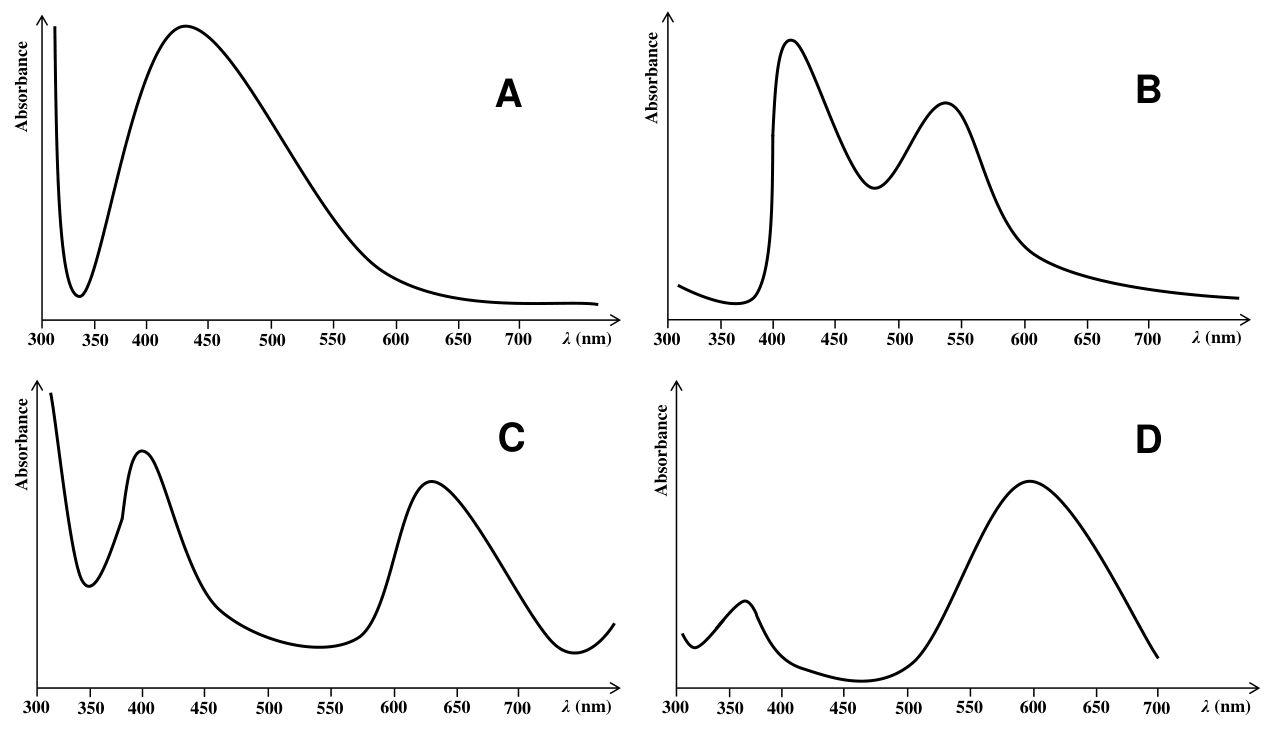
5.7 Match the spectra with the minerals.
5.8 If illuminated with monochromatic blue-green light, how will the Bohemian garnet look?
☐ Red ☐ Blue ☐ Yellow-orange ☐ Black
☐ Yellow ☐ Blue-green ☐ Violet ☐ White
Andradite is another garnet mineral; its chemical composition is \(\ce{Ca3Fe2(SiO4)3}\). A double cation substitution – \(\ce{Ti^{IV}}\) for \(\ce{Fe^{III}}\) in the octahedral position and \(\ce{Fe^{III}}\) for \(\ce{Si^{IV}}\) in the tetrahedral position – gives rise to black schorlomite. Its chemical composition can be expressed as \(\ce{Ca3[Fe,Ti]2^{oct}([Si,Fe]^{tet}O4)3}\).
5.9 Calculate the percentage of \(\ce{Si^{IV}}\) ions in a sample of schorlomite that must be substituted with \(\ce{Fe^{III}}\), if we know that 5% of \(\ce{Fe^{III}}\) ions in octahedral position are substituted with \(\ce{Ti^{IV}}\).
The colour of the mineral is caused by two chromophores: \(\ce{[Fe^{III}O6]}^{\mathrm{oct}}\) and \(\ce{[Fe^{III}O4]}^{\mathrm{tet}}\). The central ions of both chromophores have equal number of unpaired electrons.
5.10 Draw the d-orbitals splitting diagrams for both chromophores and fill in the electrons.
Tetrahedral field causes a smaller splitting than the octahedral field \(\left(\Delta_{\mathrm{tet}} = \frac49\Delta_{\mathrm{oct}}\right)\). Surprisingly for the \(\ce{Fe^{III}}\) ion, the energy of the first d–d transition (although very weak) for the octahedral chromophore is smaller (\(11\,000\ \mathrm{cm^{-1}}\)) than for the tetrahedral one (\(22\,000\ \mathrm{cm^{-1}}\)).
5.11 Calculate the size of pairing energy (\(P\)) and the sizes of \(\Delta_{\mathrm{oct}}\) and \(\Delta_{\mathrm{tet}}\) splitting. Assume that the pairing energy is equal in both chromophores.
Synthetic garnet YAG (Yttrium Aluminium Garnet), used in optoelectronics, has the composition of \(\ce{Y3Al5O12}\). Its structure is derived from the general garnet structure \(\ce{A3B2(SiO4)3}\) by placing the ions \(\ce{Y^{III}}\) and \(\ce{Al^{III}}\) to the A, B and Si positions.
5.12 Based on your knowledge of the relative ion radii, determine which cation occupies which position.
5.13 For the use in LED technology, YAG is doped with \(\ce{Ce^{III}}\). Determine the values of \(x\) and \(y\) in the formula of YAG in which 5% of yttrium atoms are substituted with cerium. (If you don’t get result, use \(x = 2.25\) and \(y = 0.75\).)
5.14 The \(\ce{Ce^{III}}\)-doped YAG is prepared by annealing the mixture of \(\ce{Y2O3}\), \(\ce{Al2O3}\) and \(\ce{CeO2}\) in \(\ce{H2}\) atmosphere. Use the formula from 5.13, write down a balanced equation for this reaction with the smallest whole-number stoichiometric coefficients.
Doping the YAG structure with rare-earths ions enables the production of lasers with emission wavelengths ranging from the UV to the mid-IR region. In the scheme below, simplified f–f energy transitions of selected rare-earths ions are shown.
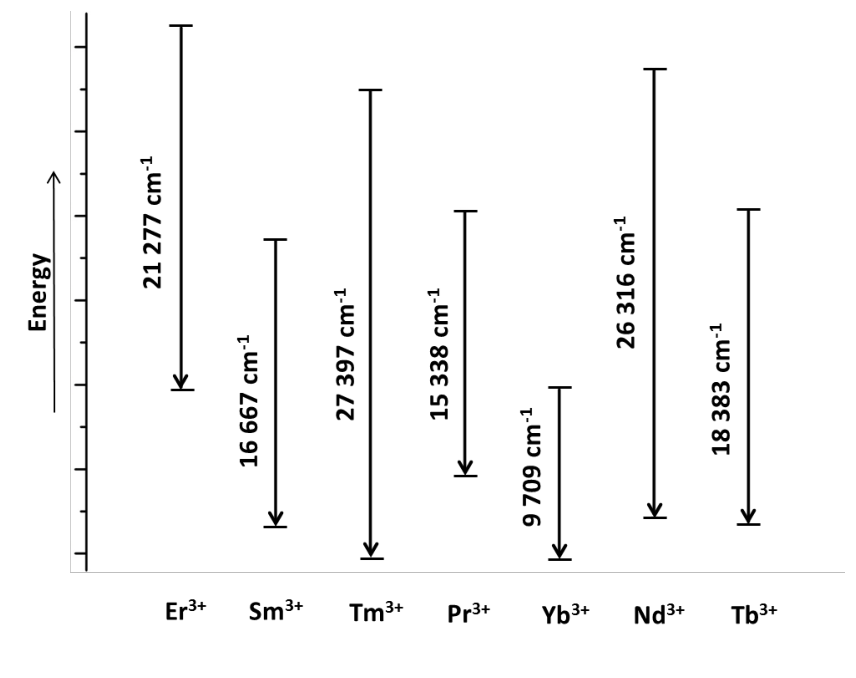
5.15 Which cation has a transition which corresponds to blue light emission.
☐ \(\ce{Er^{3+}}\) ☐ \(\ce{Sm^{3+}}\) ☐ \(\ce{Tm^{3+}}\) ☐ \(\ce{Pr^{3+}}\)
☐ \(\ce{Yb^{3+}}\) ☐ \(\ce{Nd^{3+}}\) ☐ \(\ce{Tb^{3+}}\)
5.16 Calculate the emission wavelength of this light.
5.17 According to a legend, Noah used a stick with a garnet stone for illumination during his voyage. Assuming only the photoluminescence effect, determine the colour of the laser light emitted from his stick if the stone were the blood-coloured Bohemian garnet.
☐ Red ☐ Blue ☐ Yellow-orange ☐ Black
☐ Yellow ☐ Blue-green ☐ Violet ☐ White
Official English text of the problem.
Answers
For 5.4–5.6, use the usual dodecahedral level order \[ \varepsilon_a<\varepsilon_b<\varepsilon_c=\varepsilon_d<\varepsilon_e, \] with adjacent gaps \(g_L,g_M,g_H\), from bottom to top. The missing diagram prevents confirmation of their correspondence to \(E_1,E_2,E_3\).
- 5.1: \(\boxed{\rho=4.348\ \mathrm{g\,cm^{-3}}}\).
- 5.2: Chromium(III), \(\ce{Cr^{3+}}\),
[Cr+3]: \(d^3\), configuration \(\boxed{t_{2g}^{3}e_g^{0}}\), with three unpaired electrons. - 5.3: Cobalt, through cobalt(III), \(\ce{Co^{3+}}\),
[Co+3]: low-spin \(t_{2g}^{6}\), high-spin \(t_{2g}^{4}e_g^{2}\). - 5.4: Iron(II), \(\ce{Fe^{2+}}\),
[Fe+2], is \(d^6\). Lower-spin: \(\boxed{a^2b^2c^1d^1e^0}\), two unpaired electrons. High-spin: \(\boxed{a^2b^1c^1d^1e^1}\), four unpaired electrons. - 5.5: Lower-spin when \(\boxed{P<g_M+g_H}\); high-spin when \(\boxed{P>g_M+g_H}\). If \(E_1,E_2,E_3\) run from bottom to top, the threshold is \(E_2+E_3\); if they run from top to bottom, it is \(E_1+E_2\).
- 5.6: The possible diamagnetic lower-spin ions are titanium(II),
[Ti+2], chromium(II),[Cr+2], and nickel(II),[Ni+2], requiring \(P<g_L\), \(P<g_M\), and \(P<g_H\), respectively. The condition \(P>E_3\) excludes the ion associated with that gap. For bottom-to-top \(E_1,E_2,E_3\), the answer is titanium and chromium; for top-to-bottom numbering, it is chromium and nickel. - 5.7: \(\boxed{\text{A: citrine; B: Bohemian garnet; C: uvarovite; D: sapphire}}\).
- 5.8: \(\boxed{\text{Black}}\), in the intended absorption model.
- 5.9: \(\boxed{3.33\%}\) of the silicon(IV) sites.
- 5.10: Iron(III), \(\ce{Fe^{3+}}\),
[Fe+3], is high-spin \(d^5\) in both sites: octahedral \(\boxed{t_{2g}^{3}e_g^{2}}\), tetrahedral \(\boxed{e^{2}t_2^{3}}\). Both have five unpaired electrons. - 5.11: In spectroscopic units, \[ \boxed{\frac{P}{hc}=30\,800\ \mathrm{cm^{-1}},\quad \frac{\Delta_{\mathrm{oct}}}{hc}=19\,800\ \mathrm{cm^{-1}},\quad \frac{\Delta_{\mathrm{tet}}}{hc}=8\,800\ \mathrm{cm^{-1}}}. \]
- 5.12: Yttrium(III),
[Y+3], occupies the eight-coordinate A sites. Aluminium(III),[Al+3], occupies both the six-coordinate B sites and the four-coordinate Si sites. - 5.13: Taking the formula as \(\ce{Y_xCe_yAl5O12}\), \(\boxed{x=2.85,\ y=0.15}\). The substituent is cerium(III),
[Ce+3]. - 5.14:
\[
\boxed{\ce{57Y2O3 + 100Al2O3 + 6CeO2 + 3H2 -> 40Y2.85Ce0.15Al5O12 + 3H2O}}.
\]
The molecular reactant and product are hydrogen
[H][H]and waterO. - 5.15: \(\boxed{\ce{Er^{3+}}}\), erbium(III),
[Er+3]. - 5.16: \(\boxed{\lambda=470.0\ \mathrm{nm}}\).
- 5.17: \(\boxed{\text{Blue-green}}\), taking the emitted light to correspond to the same electronic transition that the garnet absorbs.
Solution
The garnets and metal oxides are extended crystalline solids, so a molecular SMILES would not describe their structures. The atomic-ion SMILES above identify the relevant ions but do not encode their coordination geometry or the shared oxygen lattice. The oxygen sites are formally oxide ions, \(\ce{O^{2-}}\), [O-2].
5.1 — Density of almandine
Using standard atomic masses, \[ \begin{aligned} M\bigl(\ce{Fe3Al2(SiO4)3}\bigr) &=3M(\ce{Fe})+2M(\ce{Al})+3M(\ce{Si})+12M(\ce{O})\\ &=497.74\ \mathrm{g\,mol^{-1}}. \end{aligned} \]
Each unit cell contains eight formula units, so \[ m_{\mathrm{cell}}=\frac{8M}{N_A}. \]
The cell volume is \[ V_{\mathrm{cell}}=a^3 =(11.50\times10^{-8}\ \mathrm{cm})^3 =1.520875\times10^{-21}\ \mathrm{cm^3}. \]
Therefore, \[ \rho= \frac{8(497.74\ \mathrm{g\,mol^{-1}})} {(6.02214076\times10^{23}\ \mathrm{mol^{-1}}) (1.520875\times10^{-21}\ \mathrm{cm^3})} =\boxed{4.348\ \mathrm{g\,cm^{-3}}}. \]
5.2 — Octahedral chromium(III)
Chromium(III) has three \(d\) electrons. In an octahedral field, the three \(t_{2g}\) orbitals lie below the two \(e_g\) orbitals. Hund’s rule places one electron in each lower orbital.
The required drawing has:
| Level | Orbitals | Electron filling |
|---|---|---|
| Upper \(e_g\) | \(d_{z^2},d_{x^2-y^2}\) | Both empty |
| Lower \(t_{2g}\) | \(d_{xy},d_{xz},d_{yz}\) | \(\uparrow,\ \uparrow,\ \uparrow\) |
Thus, \[ \boxed{t_{2g}^{3}e_g^{0}},\qquad S=\frac32. \]
The six oxygen neighbours lie along the three mutually perpendicular coordination axes. This geometry is not represented by the central-ion SMILES.
5.3 — Octahedral trivalent ion with a diamagnetic low-spin state
The required configuration is \(d^6\):
- Low-spin: all six electrons occupy \(t_{2g}\), producing three pairs.
- High-spin: \(t_{2g}^{4}e_g^{2}\), producing four unpaired electrons.
For a first-row trivalent ion, \(d^6\) corresponds to cobalt(III): \[ \boxed{\ce{Co^{3+}}}. \]
A \(d^0\) ion would be diamagnetic in either arrangement and therefore would not satisfy the question.
5.4 — Dodecahedral iron(II)
Iron(II) has six \(d\) electrons.
Because the answer-sheet diagram is missing, describe the usual dodecahedral scheme by energy order: a lowest singlet \(a\), a second singlet \(b\), a degenerate pair \(c,d\), and a highest singlet \(e\).
The required fillings are:
| Level, highest first | Lower-spin arrangement | High-spin arrangement |
|---|---|---|
| \(e\) | Empty | \(\uparrow\) |
| \(c,d\) | \(\uparrow,\ \uparrow\) | \(\uparrow,\ \uparrow\) |
| \(b\) | \(\uparrow\downarrow\) | \(\uparrow\) |
| \(a\) | \(\uparrow\downarrow\) | \(\uparrow\downarrow\) |
Consequently, \[ \begin{aligned} \text{Lower-spin: }&a^2b^2c^1d^1,\qquad S=1,\\ \text{High-spin: }&a^2b^1c^1d^1e^1,\qquad S=2. \end{aligned} \]
Both are paramagnetic. Pairing the two electrons within just one of the degenerate \(c,d\) orbitals would add pairing energy without lowering their orbital energy, so it is unfavourable.
5.5 — Pairing-energy inequalities
Define \[ g_L=\varepsilon_b-\varepsilon_a,\qquad g_M=\varepsilon_c-\varepsilon_b,\qquad g_H=\varepsilon_e-\varepsilon_c. \]
Counting one pairing penalty \(P\) for every doubly occupied orbital gives \[ U_{\mathrm{LS}} =2\varepsilon_a+2\varepsilon_b+2\varepsilon_c+2P \] and \[ U_{\mathrm{HS}} =2\varepsilon_a+\varepsilon_b+2\varepsilon_c+\varepsilon_e+P. \]
Their difference is \[ U_{\mathrm{HS}}-U_{\mathrm{LS}} =\varepsilon_e-\varepsilon_b-P =g_M+g_H-P. \]
Thus, \[ \boxed{ \begin{array}{ll} P<g_M+g_H &: \text{lower-spin arrangement},\\ P>g_M+g_H &: \text{high-spin arrangement}. \end{array}} \]
At equality, the two arrangements have equal energy in this model.
The physical threshold is therefore the separation between the highest and second-lowest orbitals. Its expression in the missing diagram’s symbols is:
| Gap labelling, bottom to top | Lower-spin condition | High-spin condition |
|---|---|---|
| \(E_1,E_2,E_3\) | \(P<E_2+E_3\) | \(P>E_2+E_3\) |
| \(E_3,E_2,E_1\) | \(P<E_1+E_2\) | \(P>E_1+E_2\) |
5.6 — Diamagnetic divalent ions in the dodecahedral field
An odd number of electrons cannot give a diamagnetic ion. For the even electron counts, the possible closed lower levels are:
| Ion | \(d\) count | Diamagnetic filling | Condition for that filling |
|---|---|---|---|
| Titanium(II), \(\ce{Ti^{2+}}\) | \(d^2\) | \(a^2\) | \(P<g_L\) |
| Chromium(II), \(\ce{Cr^{2+}}\) | \(d^4\) | \(a^2b^2\) | \(P<g_M\) |
| Nickel(II), \(\ce{Ni^{2+}}\) | \(d^8\) | \(a^2b^2c^2d^2\) | \(P<g_H\) |
Each has a paramagnetic high-spin arrangement. The \(d^6\) ion remains paramagnetic in its lower-spin arrangement, as established in 5.4; a \(d^{10}\) ion remains diamagnetic.
The stated condition \(P>E_3\) excludes whichever closed-shell arrangement requires \(P<E_3\):
- If \(E_3=g_H\), the answer is titanium and chromium.
- If \(E_3=g_L\), the answer is chromium and nickel.
- If \(E_3=g_M\), the answer is titanium and nickel.
The original diagram is needed to select the intended case without assuming its labels.
5.7 — Assignment of absorption spectra
The observed colour comes from visible wavelengths that are comparatively weakly absorbed.
| Spectrum | Mineral | Reason |
|---|---|---|
| A | Citrine | Strong absorption in the violet–blue region leaves predominantly yellow-orange light. |
| B | Bohemian garnet | Strong blue and green absorption, with much weaker red absorption, produces a red appearance. |
| C | Uvarovite | Absorption in violet/blue and red regions leaves a transmission window in the green. |
| D | Sapphire | Strong absorption around the yellow–orange/red region leaves blue light relatively unabsorbed. |
5.8 — Garnet under monochromatic blue-green illumination
Blue-green light falls in a strongly absorbed region of the garnet spectrum. Under the intended ordinary-colour model, little light emerges, and there is no incident red component to provide the usual red appearance.
The answer is therefore \[ \boxed{\text{Black}}. \]
5.9 — Coupled substitution in schorlomite
Replacing iron(III), \(\ce{Fe^{3+}}\), with titanium(IV), \(\ce{Ti^{4+}}\), [Ti+4], increases the positive charge by one per substitution.
Replacing silicon(IV), \(\ce{Si^{4+}}\), [Si+4], with iron(III) decreases it by one. Charge neutrality therefore requires equal numbers of these two substitutions.
There are two octahedral iron sites and three tetrahedral silicon sites per formula unit. Thus, \[ n(\text{octahedral substitutions})=0.05\times2=0.10. \]
The same \(0.10\) tetrahedral sites must be substituted, giving \[ \boxed{\frac{0.10}{3}\times100\%=3.33\%}. \]
The corresponding site composition can be written \[ \ce{Ca3(Fe1.90Ti0.10)(Si2.90Fe0.10)O12}, \] where the first parenthesis describes octahedral sites and the second describes tetrahedral sites.
5.10 — Iron(III) in octahedral and tetrahedral sites
Iron(III) is \(d^5\). The weak oxygen-ligand field, especially in tetrahedral coordination, gives the high-spin arrangement. Both chromophores consequently have five unpaired electrons, consistent with the statement.
For the octahedral chromophore, draw:
| Level | Filling |
|---|---|
| Upper \(e_g\), two orbitals | \(\uparrow,\ \uparrow\) |
| Lower \(t_{2g}\), three orbitals | \(\uparrow,\ \uparrow,\ \uparrow\) |
Hence, \[ \boxed{t_{2g}^{3}e_g^{2}}. \]
For the tetrahedral chromophore, the order reverses: the two \(e\) orbitals are lower, and the three \(t_2\) orbitals are higher.
| Level | Filling |
|---|---|
| Upper \(t_2\), three orbitals | \(\uparrow,\ \uparrow,\ \uparrow\) |
| Lower \(e\), two orbitals | \(\uparrow,\ \uparrow\) |
Hence, \[ \boxed{e^{2}t_2^{3}}. \]
Both have \(S=5/2\). The tetrahedral drawing represents four oxygen neighbours at the vertices of a tetrahedron; the octahedral drawing represents six neighbours along the coordination axes.
5.11 — Pairing energy and crystal-field splittings
In each high-spin \(d^5\) ground state, every orbital contains one electron. The relevant excitation transfers an electron from an upper orbital into a lower orbital, where it must form a pair.
This lowers the one-electron orbital energy by \(\Delta\), but costs pairing energy \(P\). Its net energy is therefore \[ E_{\mathrm{transition}}=P-\Delta. \]
For the octahedral ion, the configuration changes as \[ t_{2g}^{3}e_g^{2}\longrightarrow t_{2g}^{4}e_g^{1}. \]
For the tetrahedral ion, \[ e^{2}t_2^{3}\longrightarrow e^{3}t_2^{2}. \]
Each excited configuration has three unpaired electrons rather than five. The change in total spin explains why these transitions are weak.
Define spectroscopic energies \[ \widetilde P=\frac{P}{hc},\qquad \widetilde\Delta=\frac{\Delta}{hc}. \]
The given transitions require \[ \widetilde P-\widetilde\Delta_{\mathrm{oct}} =11\,000\ \mathrm{cm^{-1}}, \] \[ \widetilde P-\widetilde\Delta_{\mathrm{tet}} =22\,000\ \mathrm{cm^{-1}}, \] with \[ \widetilde\Delta_{\mathrm{tet}} =\frac49\widetilde\Delta_{\mathrm{oct}}. \]
Subtracting the first equation from the second, \[ \left(1-\frac49\right)\widetilde\Delta_{\mathrm{oct}} =11\,000\ \mathrm{cm^{-1}}. \]
Therefore, \[ \boxed{\widetilde\Delta_{\mathrm{oct}} =19\,800\ \mathrm{cm^{-1}}}, \] \[ \boxed{\widetilde\Delta_{\mathrm{tet}} =8\,800\ \mathrm{cm^{-1}}}, \] and \[ \boxed{\widetilde P =11\,000+19\,800 =30\,800\ \mathrm{cm^{-1}}}. \]
Since \(P\) exceeds both splittings, the assumed high-spin ground states are consistent.
5.12 — Cation positions in YAG
Yttrium(III) is substantially larger than aluminium(III). It therefore occupies the larger, eight-coordinate dodecahedral A sites.
Aluminium(III) occupies both the six-coordinate octahedral B sites and the four-coordinate tetrahedral sites normally occupied by silicon.
The site assignment is \[ \boxed{\ce{Y3Al2(AlO4)3}}, \] equivalent to \(\ce{Y3Al5O12}\).
5.13 — Five-percent cerium substitution
Interpreting the missing formula as \(\ce{Y_xCe_yAl5O12}\), there are three yttrium-type sites per formula unit: \[ x+y=3. \]
Replacing 5% of them with cerium(III) gives \[ y=0.05(3)=0.15,\qquad x=3-0.15=2.85. \]
Thus, \[ \boxed{x=2.85,\qquad y=0.15}, \] and the composition is \[ \boxed{\ce{Y2.85Ce0.15Al5O12}}. \]
The substitution is isovalent, so it requires no compensating charge defect.
5.14 — Preparation of cerium-doped YAG
The reactants are yttrium(III) oxide, aluminium oxide, cerium(IV) oxide, and hydrogen. Cerium is reduced from \(+4\) in \(\ce{CeO2}\) to \(+3\) in the garnet, while hydrogen forms water.
For one formula unit, the balance is \[ \ce{1.425Y2O3 + 2.5Al2O3 + 0.15CeO2 + 0.075H2 -> Y2.85Ce0.15Al5O12 + 0.075H2O}. \]
Multiplication by 40 gives \[ \boxed{ \ce{57Y2O3 + 100Al2O3 + 6CeO2 + 3H2 -> 40Y2.85Ce0.15Al5O12 + 3H2O} }. \]
Both sides contain 114 Y, 200 Al, 6 Ce, 483 O, and 6 H atoms. The coefficients have no common divisor. In particular, the yttrium oxide coefficient is \(57/40\) times the product coefficient, so 40 is the smallest permitted positive integer product coefficient.
The molecular species are hydrogen, \(\ce{H2}\), [H][H], and water, \(\ce{H2O}\), O.
5.15 — Blue-emitting cation
Blue light near \(450\)–\(495\ \mathrm{nm}\) corresponds approximately to \[ 20\,200\text{–}22\,200\ \mathrm{cm^{-1}}. \]
The diagram’s \(21\,277\ \mathrm{cm^{-1}}\) transition lies in this interval and belongs to \[ \boxed{\ce{Er^{3+}}}. \]
5.16 — Emission wavelength
Wavelength and wavenumber are reciprocals: \[ \lambda=\frac1{\widetilde\nu}. \]
Thus, \[ \lambda =\frac1{21\,277\ \mathrm{cm^{-1}}} =4.69991\times10^{-5}\ \mathrm{cm} =469.991\ \mathrm{nm}. \]
Therefore, \[ \boxed{\lambda\approx470.0\ \mathrm{nm}}. \]
5.17 — Photoluminescence colour
In the intended interpretation, the emission reverses the electronic transition responsible for absorption.
The garnet appears blood-red under white illumination because it absorbs the complementary blue-green component strongly. Reversing that absorption transition emits photons of the corresponding blue-green energy.
The intended answer is therefore \[ \boxed{\text{Blue-green}}. \]
The solution was checked against the official solution.
IChO 2018 · Theorieaufgabe 5
Böhmischer Granat
Das in 5.4 erwähnte dodekaedrische Aufspaltungsdiagramm und die Formel zur Definition von \(x,y\) in 5.13 sind in dieser Fassung der Aufgabe nicht abgedruckt.
AUFGABE 5
Böhmischer Granat
Böhmischer Granat (Pyrop) ist ein bekannter blutroter tschechischer Halbedelstein. Die chemische Zusammensetzung natürlicher Granate wird durch die allgemeine stöchiometrische Formel \(\ce{A3B2(SiO4)3}\) beschrieben, wobei \(\ce{A^{II}}\) ein zweiwertiges Kation und \(\ce{B^{III}}\) ein dreiwertiges Kation ist. Granate besitzen eine kubische Elementarzelle, die 8 Formeleinheiten enthält. Die Struktur umfasst 3 Arten von Polyedern: Das Kation \(\ce{A^{II}}\) besetzt einen dodekaedrischen Platz (es ist von acht O-Atomen umgeben), das Kation \(\ce{B^{III}}\) besetzt einen oktaedrischen Platz (es ist von sechs O-Atomen umgeben), und \(\ce{Si^{IV}}\) ist von vier O-Atomen umgeben, die tetraedrisch angeordnet sind.
Das häufigste Granatmineral ist Almandin mit der Formel \(\ce{Fe3Al2(SiO4)3}\). Sein Gitterparameter beträgt \(a = 11.50\ \text{Å}\).
5.1 Berechnen Sie die theoretische Dichte von Almandin.
Der böhmische Granat hat die Zusammensetzung \(\ce{Mg3Al2(SiO4)3}\). Die reine Verbindung ist farblos, und die Farbe natürlicher Granate stammt von Chromophoren – Übergangsmetallkationen, die Kationen des Wirtsmaterials ersetzen. Die rote Farbe des böhmischen Granats entsteht durch Spuren von \(\ce{Cr^{III}}\)-Ionen auf den oktaedrischen Plätzen und \(\ce{Fe^{II}}\)-Ionen auf den dodekaedrischen Plätzen.
5.2 Zeichnen Sie das Aufspaltungsdiagramm der d-Orbitale von \(\ce{[Cr^{III}O6]}^{\mathrm{oct}}\) und tragen Sie die Elektronen ein.
5.3 Bestimmen Sie das Element bzw. die Elemente der ersten Übergangsmetallreihe, dessen bzw. deren dreiwertige Kationen \(\ce{M^{III}}\) auf einem oktaedrischen Platz in der Low-Spin-Konfiguration diamagnetisch und in der High-Spin-Konfiguration paramagnetisch sind.
5.4 Die folgende Abbildung zeigt die Aufspaltung der d-Orbitale im dodekaedrischen Kristallfeld. Tragen Sie die Elektronen für den Chromophor \(\ce{[Fe^{II}O8]}^{\mathrm{dod}}\) für beide möglichen Konfigurationen ein.
5.5 Leiten Sie für beide Konfigurationen die Ungleichungen (z. B. \(P < E_1 + E_2 + E_3\)) für die Größe der Paarungsenergie (\(P\)) im Verhältnis zu den Energien \(E_1\), \(E_2\) und \(E_3\) her.
5.6 Bestimmen Sie unter der Annahme \(P > E_3\) das Element bzw. die Elemente der ersten Übergangsmetallreihe, dessen bzw. deren zweiwertiges Kation \(\ce{M^{II}}\) auf einem dodekaedrischen Platz in der Low-Spin-Konfiguration diamagnetisch und in der High-Spin-Konfiguration paramagnetisch ist.
Die folgenden Abbildungen zeigen vereinfachte Absorptionsspektren von vier farbigen Mineralen – blutrotem böhmischem Granat, grünem Uwarowit, blauem Saphir und gelborangem Citrin.
5.7 Ordnen Sie die Spektren den Mineralen zu.
5.8 Wie erscheint der böhmische Granat, wenn er mit monochromatischem blaugrünem Licht beleuchtet wird?
☐ Rot ☐ Blau ☐ Gelborange ☐ Schwarz
☐ Gelb ☐ Blaugrün ☐ Violett ☐ Weiß
Andradit ist ein weiteres Granatmineral; seine chemische Zusammensetzung ist \(\ce{Ca3Fe2(SiO4)3}\). Eine doppelte Kationensubstitution – \(\ce{Ti^{IV}}\) für \(\ce{Fe^{III}}\) auf dem oktaedrischen Platz und \(\ce{Fe^{III}}\) für \(\ce{Si^{IV}}\) auf dem tetraedrischen Platz – führt zur Bildung von schwarzem Schorlomit. Seine chemische Zusammensetzung lässt sich als \(\ce{Ca3[Fe,Ti]2^{oct}([Si,Fe]^{tet}O4)3}\) ausdrücken.
5.9 Berechnen Sie den prozentualen Anteil der \(\ce{Si^{IV}}\)-Ionen in einer Schorlomitprobe, der durch \(\ce{Fe^{III}}\) ersetzt werden muss, wenn bekannt ist, dass 5% der \(\ce{Fe^{III}}\)-Ionen auf oktaedrischen Plätzen durch \(\ce{Ti^{IV}}\) ersetzt sind.
Die Farbe des Minerals wird durch zwei Chromophore verursacht: \(\ce{[Fe^{III}O6]}^{\mathrm{oct}}\) und \(\ce{[Fe^{III}O4]}^{\mathrm{tet}}\). Die Zentralionen beider Chromophore besitzen die gleiche Anzahl ungepaarter Elektronen.
5.10 Zeichnen Sie die Aufspaltungsdiagramme der d-Orbitale für beide Chromophore und tragen Sie die Elektronen ein.
Ein tetraedrisches Feld verursacht eine geringere Aufspaltung als ein oktaedrisches Feld \(\left(\Delta_{\mathrm{tet}} = \frac49\Delta_{\mathrm{oct}}\right)\). Überraschenderweise ist beim \(\ce{Fe^{III}}\)-Ion die Energie des ersten d–d-Übergangs (der allerdings sehr schwach ist) für den oktaedrischen Chromophor kleiner (\(11\,000\ \mathrm{cm^{-1}}\)) als für den tetraedrischen (\(22\,000\ \mathrm{cm^{-1}}\)).
5.11 Berechnen Sie die Größe der Paarungsenergie (\(P\)) und die Größen der Aufspaltungen \(\Delta_{\mathrm{oct}}\) und \(\Delta_{\mathrm{tet}}\). Nehmen Sie an, dass die Paarungsenergie in beiden Chromophoren gleich ist.
Der synthetische Granat YAG (Yttrium-Aluminium-Granat), der in der Optoelektronik verwendet wird, hat die Zusammensetzung \(\ce{Y3Al5O12}\). Seine Struktur leitet sich von der allgemeinen Granatstruktur \(\ce{A3B2(SiO4)3}\) ab, indem die Ionen \(\ce{Y^{III}}\) und \(\ce{Al^{III}}\) auf die A-, B- und Si-Plätze gesetzt werden.
5.12 Bestimmen Sie anhand Ihrer Kenntnisse über die relativen Ionenradien, welches Kation welchen Platz besetzt.
5.13 Für den Einsatz in der LED-Technologie wird YAG mit \(\ce{Ce^{III}}\) dotiert. Bestimmen Sie die Werte von \(x\) und \(y\) in der Formel von YAG, in dem 5% der Yttriumatome durch Cer ersetzt sind. (Falls Sie kein Ergebnis erhalten, verwenden Sie \(x = 2.25\) und \(y = 0.75\).)
5.14 Der mit \(\ce{Ce^{III}}\) dotierte YAG wird durch Glühen eines Gemischs aus \(\ce{Y2O3}\), \(\ce{Al2O3}\) und \(\ce{CeO2}\) in einer \(\ce{H2}\)-Atmosphäre hergestellt. Verwenden Sie die Formel aus 5.13 und stellen Sie eine ausgeglichene Reaktionsgleichung mit den kleinsten ganzzahligen stöchiometrischen Koeffizienten auf.
Die Dotierung der YAG-Struktur mit Seltenerdionen ermöglicht die Herstellung von Lasern mit Emissionswellenlängen vom UV- bis zum mittleren IR-Bereich. Im folgenden Schema sind vereinfachte f–f-Energieübergänge ausgewählter Seltenerdionen dargestellt.
5.15 Welches Kation besitzt einen Übergang, der der Emission von blauem Licht entspricht?
☐ \(\ce{Er^{3+}}\) ☐ \(\ce{Sm^{3+}}\) ☐ \(\ce{Tm^{3+}}\) ☐ \(\ce{Pr^{3+}}\)
☐ \(\ce{Yb^{3+}}\) ☐ \(\ce{Nd^{3+}}\) ☐ \(\ce{Tb^{3+}}\)
5.16 Berechnen Sie die Emissionswellenlänge dieses Lichts.
5.17 Einer Legende zufolge verwendete Noah während seiner Reise einen Stab mit einem Granatstein zur Beleuchtung. Bestimmen Sie unter ausschließlicher Berücksichtigung des Photolumineszenzeffekts die Farbe des von seinem Stab ausgesandten Laserlichts, wenn es sich bei dem Stein um den blutroten böhmischen Granat handelte.
☐ Rot ☐ Blau ☐ Gelborange ☐ Schwarz
☐ Gelb ☐ Blaugrün ☐ Violett ☐ Weiß
Aufgabentext aus dem offiziellen englischen Text übersetzt.
Antworten
Verwenden Sie für 5.4–5.6 die übliche dodekaedrische Reihenfolge der Energieniveaus \[ \varepsilon_a<\varepsilon_b<\varepsilon_c=\varepsilon_d<\varepsilon_e, \] mit den Abständen \(g_L,g_M,g_H\) zwischen benachbarten Niveaus, von unten nach oben. Da das Diagramm fehlt, lässt sich ihre Zuordnung zu \(E_1,E_2,E_3\) nicht bestätigen.
- 5.1: \(\boxed{\rho=4.348\ \mathrm{g\,cm^{-3}}}\).
- 5.2: Chrom(III), \(\ce{Cr^{3+}}\),
[Cr+3]: \(d^3\), Konfiguration \(\boxed{t_{2g}^{3}e_g^{0}}\), mit drei ungepaarten Elektronen. - 5.3: Cobalt, in Form von Cobalt(III), \(\ce{Co^{3+}}\),
[Co+3]: Low-Spin \(t_{2g}^{6}\), High-Spin \(t_{2g}^{4}e_g^{2}\). - 5.4: Eisen(II), \(\ce{Fe^{2+}}\),
[Fe+2], ist \(d^6\). Niedrigerer Spin: \(\boxed{a^2b^2c^1d^1e^0}\), zwei ungepaarte Elektronen. High-Spin: \(\boxed{a^2b^1c^1d^1e^1}\), vier ungepaarte Elektronen. - 5.5: Niedrigerer Spin bei \(\boxed{P<g_M+g_H}\); High-Spin bei \(\boxed{P>g_M+g_H}\). Wenn \(E_1,E_2,E_3\) von unten nach oben angeordnet sind, ist der Schwellenwert \(E_2+E_3\); bei einer Anordnung von oben nach unten ist er \(E_1+E_2\).
- 5.6: Die möglichen diamagnetischen Ionen mit niedrigerem Spin sind Titan(II),
[Ti+2], Chrom(II),[Cr+2], und Nickel(II),[Ni+2]; hierfür muss jeweils \(P<g_L\), \(P<g_M\) bzw. \(P<g_H\) gelten. Die Bedingung \(P>E_3\) schließt das diesem Abstand zugeordnete Ion aus. Bei einer Anordnung von \(E_1,E_2,E_3\) von unten nach oben lautet die Antwort Titan und Chrom; bei einer Nummerierung von oben nach unten lautet sie Chrom und Nickel. - 5.7: \(\boxed{\text{A: Citrin; B: böhmischer Granat; C: Uwarowit; D: Saphir}}\).
- 5.8: \(\boxed{\text{Schwarz}}\), im vorgesehenen Absorptionsmodell.
- 5.9: \(\boxed{3.33\%}\) der Silicium(IV)-Plätze.
- 5.10: Eisen(III), \(\ce{Fe^{3+}}\),
[Fe+3], liegt auf beiden Plätzen als High-Spin-\(d^5\) vor: oktaedrisch \(\boxed{t_{2g}^{3}e_g^{2}}\), tetraedrisch \(\boxed{e^{2}t_2^{3}}\). Beide besitzen fünf ungepaarte Elektronen. - 5.11: In spektroskopischen Einheiten, \[ \boxed{\frac{P}{hc}=30\,800\ \mathrm{cm^{-1}},\quad \frac{\Delta_{\mathrm{oct}}}{hc}=19\,800\ \mathrm{cm^{-1}},\quad \frac{\Delta_{\mathrm{tet}}}{hc}=8\,800\ \mathrm{cm^{-1}}}. \]
- 5.12: Yttrium(III),
[Y+3], besetzt die achtfach koordinierten A-Plätze. Aluminium(III),[Al+3], besetzt sowohl die sechsfach koordinierten B-Plätze als auch die vierfach koordinierten Si-Plätze. - 5.13: Wird die Formel als \(\ce{Y_xCe_yAl5O12}\) angenommen, gilt \(\boxed{x=2.85,\ y=0.15}\). Das substituierende Ion ist Cer(III),
[Ce+3]. - 5.14:
\[
\boxed{\ce{57Y2O3 + 100Al2O3 + 6CeO2 + 3H2 -> 40Y2.85Ce0.15Al5O12 + 3H2O}}.
\]
Das molekulare Edukt und das molekulare Produkt sind Wasserstoff
[H][H]und WasserO. - 5.15: \(\boxed{\ce{Er^{3+}}}\), Erbium(III),
[Er+3]. - 5.16: \(\boxed{\lambda=470.0\ \mathrm{nm}}\).
- 5.17: \(\boxed{\text{Blaugrün}}\), unter der Annahme, dass das emittierte Licht demselben elektronischen Übergang entspricht, bei dem der Granat absorbiert.
Lösung
Granate und Metalloxide sind ausgedehnte kristalline Festkörper, sodass ein molekularer SMILES-Ausdruck ihre Strukturen nicht beschreiben würde. Die obigen SMILES-Ausdrücke für atomare Ionen kennzeichnen die relevanten Ionen, codieren jedoch weder deren Koordinationsgeometrie noch das gemeinsame Sauerstoffgitter. Die Sauerstoffplätze sind formal mit Oxidionen, \(\ce{O^{2-}}\), [O-2], besetzt.
5.1 — Dichte von Almandin
Mit den Standardatommassen gilt \[ \begin{aligned} M\bigl(\ce{Fe3Al2(SiO4)3}\bigr) &=3M(\ce{Fe})+2M(\ce{Al})+3M(\ce{Si})+12M(\ce{O})\\ &=497.74\ \mathrm{g\,mol^{-1}}. \end{aligned} \]
Jede Elementarzelle enthält acht Formeleinheiten, also \[ m_{\mathrm{cell}}=\frac{8M}{N_A}. \]
Das Zellvolumen beträgt \[ V_{\mathrm{cell}}=a^3 =(11.50\times10^{-8}\ \mathrm{cm})^3 =1.520875\times10^{-21}\ \mathrm{cm^3}. \]
Daher gilt \[ \rho= \frac{8(497.74\ \mathrm{g\,mol^{-1}})} {(6.02214076\times10^{23}\ \mathrm{mol^{-1}}) (1.520875\times10^{-21}\ \mathrm{cm^3})} =\boxed{4.348\ \mathrm{g\,cm^{-3}}}. \]
5.2 — Oktaedrisches Chrom(III)
Chrom(III) besitzt drei \(d\)-Elektronen. In einem oktaedrischen Feld liegen die drei \(t_{2g}\)-Orbitale unter den beiden \(e_g\)-Orbitalen. Nach der Hundschen Regel wird jedes der tiefer liegenden Orbitale mit einem Elektron besetzt.
Die geforderte Zeichnung enthält:
| Niveau | Orbitale | Elektronenbesetzung |
|---|---|---|
| Oberes \(e_g\) | \(d_{z^2},d_{x^2-y^2}\) | Beide leer |
| Unteres \(t_{2g}\) | \(d_{xy},d_{xz},d_{yz}\) | \(\uparrow,\ \uparrow,\ \uparrow\) |
Somit gilt \[ \boxed{t_{2g}^{3}e_g^{0}},\qquad S=\frac32. \]
Die sechs benachbarten Sauerstoffatome liegen entlang der drei zueinander senkrechten Koordinationsachsen. Diese Geometrie wird durch den SMILES-Ausdruck des Zentralions nicht dargestellt.
5.3 — Oktaedrisches dreiwertiges Ion mit einem diamagnetischen Low-Spin-Zustand
Die gesuchte Konfiguration ist \(d^6\):
- Low-Spin: Alle sechs Elektronen besetzen \(t_{2g}\) und bilden drei Paare.
- High-Spin: \(t_{2g}^{4}e_g^{2}\), mit vier ungepaarten Elektronen.
Für ein dreiwertiges Ion der ersten Übergangsmetallreihe entspricht \(d^6\) Cobalt(III): \[ \boxed{\ce{Co^{3+}}}. \]
Ein \(d^0\)-Ion wäre in beiden Konfigurationen diamagnetisch und würde daher die Anforderungen der Aufgabe nicht erfüllen.
5.4 — Dodekaedrisches Eisen(II)
Eisen(II) besitzt sechs \(d\)-Elektronen.
Da das Diagramm des Antwortbogens fehlt, wird das übliche dodekaedrische Schema anhand der energetischen Reihenfolge beschrieben: ein niedrigstes nicht entartetes Niveau \(a\), ein zweites nicht entartetes Niveau \(b\), ein entartetes Paar \(c,d\) und ein höchstes nicht entartetes Niveau \(e\).
Die geforderten Besetzungen sind:
| Niveau, höchstes zuerst | Konfiguration mit niedrigerem Spin | High-Spin-Konfiguration |
|---|---|---|
| \(e\) | Leer | \(\uparrow\) |
| \(c,d\) | \(\uparrow,\ \uparrow\) | \(\uparrow,\ \uparrow\) |
| \(b\) | \(\uparrow\downarrow\) | \(\uparrow\) |
| \(a\) | \(\uparrow\downarrow\) | \(\uparrow\downarrow\) |
Folglich gilt \[ \begin{aligned} \text{Niedrigerer Spin: }&a^2b^2c^1d^1,\qquad S=1,\\ \text{High-Spin: }&a^2b^1c^1d^1e^1,\qquad S=2. \end{aligned} \]
Beide sind paramagnetisch. Die Paarung der beiden Elektronen in nur einem der entarteten \(c,d\)-Orbitale würde zusätzliche Paarungsenergie erfordern, ohne ihre Orbitalenergie abzusenken, und ist daher ungünstig.
5.5 — Ungleichungen für die Paarungsenergie
Wir definieren \[ g_L=\varepsilon_b-\varepsilon_a,\qquad g_M=\varepsilon_c-\varepsilon_b,\qquad g_H=\varepsilon_e-\varepsilon_c. \]
Wird für jedes doppelt besetzte Orbital ein Paarungsenergieaufwand \(P\) angesetzt, ergibt sich \[ U_{\mathrm{LS}} =2\varepsilon_a+2\varepsilon_b+2\varepsilon_c+2P \] und \[ U_{\mathrm{HS}} =2\varepsilon_a+\varepsilon_b+2\varepsilon_c+\varepsilon_e+P. \]
Ihre Differenz beträgt \[ U_{\mathrm{HS}}-U_{\mathrm{LS}} =\varepsilon_e-\varepsilon_b-P =g_M+g_H-P. \]
Somit gilt \[ \boxed{ \begin{array}{ll} P<g_M+g_H &: \text{Konfiguration mit niedrigerem Spin},\\ P>g_M+g_H &: \text{High-Spin-Konfiguration}. \end{array}} \]
Bei Gleichheit haben die beiden Konfigurationen in diesem Modell dieselbe Energie.
Der physikalische Schwellenwert ist somit der Abstand zwischen dem höchsten und dem zweitniedrigsten Orbital. In den Symbolen des fehlenden Diagramms lautet sein Ausdruck:
| Bezeichnung der Abstände, von unten nach oben | Bedingung für niedrigeren Spin | Bedingung für High-Spin |
|---|---|---|
| \(E_1,E_2,E_3\) | \(P<E_2+E_3\) | \(P>E_2+E_3\) |
| \(E_3,E_2,E_1\) | \(P<E_1+E_2\) | \(P>E_1+E_2\) |
5.6 — Diamagnetische zweiwertige Ionen im dodekaedrischen Feld
Eine ungerade Elektronenzahl kann kein diamagnetisches Ion ergeben. Für gerade Elektronenzahlen sind die möglichen vollständig besetzten unteren Niveaus:
| Ion | \(d\)-Elektronenzahl | Diamagnetische Besetzung | Bedingung für diese Besetzung |
|---|---|---|---|
| Titan(II), \(\ce{Ti^{2+}}\) | \(d^2\) | \(a^2\) | \(P<g_L\) |
| Chrom(II), \(\ce{Cr^{2+}}\) | \(d^4\) | \(a^2b^2\) | \(P<g_M\) |
| Nickel(II), \(\ce{Ni^{2+}}\) | \(d^8\) | \(a^2b^2c^2d^2\) | \(P<g_H\) |
Jedes besitzt eine paramagnetische High-Spin-Konfiguration. Das \(d^6\)-Ion bleibt in seiner Konfiguration mit niedrigerem Spin paramagnetisch, wie in 5.4 festgestellt wurde; ein \(d^{10}\)-Ion bleibt diamagnetisch.
Die angegebene Bedingung \(P>E_3\) schließt diejenige Konfiguration mit abgeschlossenen Schalen aus, die \(P<E_3\) erfordert:
- Falls \(E_3=g_H\), lautet die Antwort Titan und Chrom.
- Falls \(E_3=g_L\), lautet die Antwort Chrom und Nickel.
- Falls \(E_3=g_M\), lautet die Antwort Titan und Nickel.
Das ursprüngliche Diagramm wird benötigt, um den beabsichtigten Fall auszuwählen, ohne seine Beschriftung vorauszusetzen.
5.7 — Zuordnung der Absorptionsspektren
Die beobachtete Farbe entsteht durch sichtbare Wellenlängen, die vergleichsweise schwach absorbiert werden.
| Spektrum | Mineral | Begründung |
|---|---|---|
| A | Citrin | Starke Absorption im violett-blauen Bereich lässt überwiegend gelboranges Licht übrig. |
| B | Böhmischer Granat | Starke Absorption von blauem und grünem Licht bei wesentlich schwächerer Absorption von rotem Licht führt zu einem roten Erscheinungsbild. |
| C | Uwarowit | Absorption im violetten/blauen und im roten Bereich lässt ein Transmissionsfenster im Grünen offen. |
| D | Saphir | Starke Absorption im gelb-orangen/roten Bereich lässt blaues Licht relativ wenig absorbiert. |
5.8 — Granat unter monochromatischer blaugrüner Beleuchtung
Blaugrünes Licht fällt in einen stark absorbierten Bereich des Granatspektrums. Im vorgesehenen Modell der gewöhnlichen Körperfarbe tritt wenig Licht aus, und es gibt keinen einfallenden roten Anteil, der das übliche rote Erscheinungsbild erzeugen könnte.
Die Antwort lautet daher \[ \boxed{\text{Schwarz}}. \]
5.9 — Gekoppelte Substitution in Schorlomit
Der Ersatz von Eisen(III), \(\ce{Fe^{3+}}\), durch Titan(IV), \(\ce{Ti^{4+}}\), [Ti+4], erhöht die positive Ladung pro Substitution um eins.
Der Ersatz von Silicium(IV), \(\ce{Si^{4+}}\), [Si+4], durch Eisen(III) verringert sie um eins. Ladungsneutralität erfordert daher eine gleiche Anzahl dieser beiden Substitutionen.
Pro Formeleinheit gibt es zwei oktaedrische Eisenplätze und drei tetraedrische Siliciumplätze. Somit gilt \[ n(\text{oktaedrische Substitutionen})=0.05\times2=0.10. \]
Es müssen ebenso \(0.10\) tetraedrische Plätze substituiert werden, woraus sich ergibt: \[ \boxed{\frac{0.10}{3}\times100\%=3.33\%}. \]
Die entsprechende Zusammensetzung nach Gitterplätzen lässt sich schreiben als \[ \ce{Ca3(Fe1.90Ti0.10)(Si2.90Fe0.10)O12}, \] wobei die erste Klammer oktaedrische und die zweite tetraedrische Plätze beschreibt.
5.10 — Eisen(III) auf oktaedrischen und tetraedrischen Plätzen
Eisen(III) ist \(d^5\). Das schwache Feld der Sauerstoffliganden führt insbesondere bei tetraedrischer Koordination zur High-Spin-Konfiguration. Beide Chromophore besitzen folglich fünf ungepaarte Elektronen, im Einklang mit der Aufgabenstellung.
Für den oktaedrischen Chromophor ist Folgendes zu zeichnen:
| Niveau | Besetzung |
|---|---|
| Oberes \(e_g\), zwei Orbitale | \(\uparrow,\ \uparrow\) |
| Unteres \(t_{2g}\), drei Orbitale | \(\uparrow,\ \uparrow,\ \uparrow\) |
Daraus folgt \[ \boxed{t_{2g}^{3}e_g^{2}}. \]
Für den tetraedrischen Chromophor kehrt sich die Reihenfolge um: Die beiden \(e\)-Orbitale liegen tiefer und die drei \(t_2\)-Orbitale höher.
| Niveau | Besetzung |
|---|---|
| Oberes \(t_2\), drei Orbitale | \(\uparrow,\ \uparrow,\ \uparrow\) |
| Unteres \(e\), zwei Orbitale | \(\uparrow,\ \uparrow\) |
Daraus folgt \[ \boxed{e^{2}t_2^{3}}. \]
Für beide gilt \(S=5/2\). Die tetraedrische Zeichnung stellt vier benachbarte Sauerstoffatome an den Ecken eines Tetraeders dar; die oktaedrische Zeichnung stellt sechs Nachbarn entlang der Koordinationsachsen dar.
5.11 — Paarungsenergie und Kristallfeldaufspaltungen
In jedem High-Spin-\(d^5\)-Grundzustand enthält jedes Orbital ein Elektron. Bei der betrachteten Anregung wird ein Elektron aus einem höheren Orbital in ein tieferes Orbital überführt, wo es ein Paar bilden muss.
Dies senkt die Einelektronen-Orbitalenergie um \(\Delta\), erfordert aber die Paarungsenergie \(P\). Die Nettoenergie beträgt daher \[ E_{\mathrm{transition}}=P-\Delta. \]
Für das oktaedrische Ion ändert sich die Konfiguration gemäß \[ t_{2g}^{3}e_g^{2}\longrightarrow t_{2g}^{4}e_g^{1}. \]
Für das tetraedrische Ion gilt \[ e^{2}t_2^{3}\longrightarrow e^{3}t_2^{2}. \]
Jede angeregte Konfiguration besitzt drei statt fünf ungepaarte Elektronen. Die Änderung des Gesamtspins erklärt, warum diese Übergänge schwach sind.
Wir definieren spektroskopische Energien \[ \widetilde P=\frac{P}{hc},\qquad \widetilde\Delta=\frac{\Delta}{hc}. \]
Die angegebenen Übergänge erfordern \[ \widetilde P-\widetilde\Delta_{\mathrm{oct}} =11\,000\ \mathrm{cm^{-1}}, \] \[ \widetilde P-\widetilde\Delta_{\mathrm{tet}} =22\,000\ \mathrm{cm^{-1}}, \] mit \[ \widetilde\Delta_{\mathrm{tet}} =\frac49\widetilde\Delta_{\mathrm{oct}}. \]
Subtraktion der ersten Gleichung von der zweiten ergibt \[ \left(1-\frac49\right)\widetilde\Delta_{\mathrm{oct}} =11\,000\ \mathrm{cm^{-1}}. \]
Daher gilt \[ \boxed{\widetilde\Delta_{\mathrm{oct}} =19\,800\ \mathrm{cm^{-1}}}, \] \[ \boxed{\widetilde\Delta_{\mathrm{tet}} =8\,800\ \mathrm{cm^{-1}}}, \] und \[ \boxed{\widetilde P =11\,000+19\,800 =30\,800\ \mathrm{cm^{-1}}}. \]
Da \(P\) beide Aufspaltungen übersteigt, sind die angenommenen High-Spin-Grundzustände konsistent.
5.12 — Kationenplätze in YAG
Yttrium(III) ist erheblich größer als Aluminium(III). Es besetzt daher die größeren, achtfach koordinierten dodekaedrischen A-Plätze.
Aluminium(III) besetzt sowohl die sechsfach koordinierten oktaedrischen B-Plätze als auch die vierfach koordinierten tetraedrischen Plätze, die normalerweise von Silicium besetzt sind.
Die Platzzuordnung lautet \[ \boxed{\ce{Y3Al2(AlO4)3}}, \] gleichbedeutend mit \(\ce{Y3Al5O12}\).
5.13 — Fünfprozentige Substitution durch Cer
Wird die fehlende Formel als \(\ce{Y_xCe_yAl5O12}\) interpretiert, gibt es drei Yttriumplätze pro Formeleinheit: \[ x+y=3. \]
Werden 5% davon durch Cer(III) ersetzt, ergibt sich \[ y=0.05(3)=0.15,\qquad x=3-0.15=2.85. \]
Somit gilt \[ \boxed{x=2.85,\qquad y=0.15}, \] und die Zusammensetzung ist \[ \boxed{\ce{Y2.85Ce0.15Al5O12}}. \]
Die Substitution ist isovalent und erfordert daher keinen ladungskompensierenden Defekt.
5.14 — Herstellung von cer-dotiertem YAG
Die Edukte sind Yttrium(III)-oxid, Aluminiumoxid, Cer(IV)-oxid und Wasserstoff. Cer wird von \(+4\) in \(\ce{CeO2}\) zu \(+3\) im Granat reduziert, während Wasserstoff Wasser bildet.
Für eine Formeleinheit lautet die ausgeglichene Gleichung \[ \ce{1.425Y2O3 + 2.5Al2O3 + 0.15CeO2 + 0.075H2 -> Y2.85Ce0.15Al5O12 + 0.075H2O}. \]
Multiplikation mit 40 ergibt \[ \boxed{ \ce{57Y2O3 + 100Al2O3 + 6CeO2 + 3H2 -> 40Y2.85Ce0.15Al5O12 + 3H2O} }. \]
Beide Seiten enthalten 114 Y-, 200 Al-, 6 Ce-, 483 O- und 6 H-Atome. Die Koeffizienten haben keinen gemeinsamen Teiler. Insbesondere ist der Koeffizient von Yttriumoxid das \(57/40\)-Fache des Produktkoeffizienten, sodass 40 der kleinste zulässige positive ganzzahlige Produktkoeffizient ist.
Die molekularen Spezies sind Wasserstoff, \(\ce{H2}\), [H][H], und Wasser, \(\ce{H2O}\), O.
5.15 — Blau emittierendes Kation
Blaues Licht im Bereich von \(450\)–\(495\ \mathrm{nm}\) entspricht ungefähr \[ 20\,200\text{–}22\,200\ \mathrm{cm^{-1}}. \]
Der im Diagramm angegebene Übergang bei \(21\,277\ \mathrm{cm^{-1}}\) liegt in diesem Intervall und gehört zu \[ \boxed{\ce{Er^{3+}}}. \]
5.16 — Emissionswellenlänge
Wellenlänge und Wellenzahl sind Kehrwerte voneinander: \[ \lambda=\frac1{\widetilde\nu}. \]
Somit gilt \[ \lambda =\frac1{21\,277\ \mathrm{cm^{-1}}} =4.69991\times10^{-5}\ \mathrm{cm} =469.991\ \mathrm{nm}. \]
Daher gilt \[ \boxed{\lambda\approx470.0\ \mathrm{nm}}. \]
5.17 — Farbe der Photolumineszenz
In der beabsichtigten Interpretation kehrt die Emission den für die Absorption verantwortlichen elektronischen Übergang um.
Der Granat erscheint unter weißer Beleuchtung blutrot, weil er den komplementären blaugrünen Anteil stark absorbiert. Bei der Umkehr dieses Absorptionsübergangs werden Photonen mit der entsprechenden blaugrünen Energie emittiert.
Die beabsichtigte Antwort lautet daher \[ \boxed{\text{Blaugrün}}. \]
Die Lösung wurde mit der offiziellen Lösung abgeglichen.
IChO 2018 · Teori sorusu 5
Bohemya granatı
5.4'te atıfta bulunulan dodekahedral yarılma diyagramı ve 5.13'te \(x,y\)'yi tanımlayan formül, sorunun bu sürümünde basılmamıştır.
SORU 5
Bohemya granatı
Bohemya granatı (pirop), Çekya'nın kan rengindeki ünlü yarı değerli taşıdır. Doğal granatların kimyasal bileşimi, \(\ce{A3B2(SiO4)3}\) genel stokiyometrik formülüyle ifade edilir; burada \(\ce{A^{II}}\) iki değerlikli bir katyon, \(\ce{B^{III}}\) ise üç değerlikli bir katyondur. Granatlar, 8 formül birimi içeren kübik birim hücreye sahiptir. Yapı 3 tür çokyüzlüden oluşur: \(\ce{A^{II}}\) katyonu dodekahedral bir konumda bulunur (sekiz O atomuyla çevrilidir), \(\ce{B^{III}}\) katyonu oktahedral bir konumda bulunur (altı O atomuyla çevrilidir) ve \(\ce{Si^{IV}}\), bir tetrahedron oluşturacak biçimde düzenlenmiş dört O atomuyla çevrilidir.
En yaygın granat minerali, \(\ce{Fe3Al2(SiO4)3}\) formülüne sahip almandindir. Birim hücre parametresi \(a = 11.50\ \text{Å}\)'dür.
5.1 Almandinin teorik yoğunluğunu hesaplayınız.
Bohemya granatı \(\ce{Mg3Al2(SiO4)3}\) bileşimine sahiptir. Saf bileşik renksizdir ve doğal granatların rengi, ana malzemenin katyonlarının yerini alan geçiş metali katyonları olan kromoforlardan kaynaklanır. Bohemya granatının kırmızı rengi, oktahedral konumlardaki eser miktarda \(\ce{Cr^{III}}\) iyonlarından ve dodekahedral konumlardaki \(\ce{Fe^{II}}\) iyonlarından kaynaklanır.
5.2 \(\ce{[Cr^{III}O6]}^{\mathrm{oct}}\) d orbitallerinin yarılma diyagramını çiziniz ve elektronları yerleştiriniz.
5.3 Üç değerlikli \(\ce{M^{III}}\) katyonu oktahedral bir konuma yerleştirildiğinde düşük spinli düzenlenmede diyamanyetik, yüksek spinli düzenlenmede ise paramanyetik olan birinci geçiş serisi elementini/elementlerini belirleyiniz.
5.4 Aşağıdaki şekil, d orbitallerinin dodekahedral kristal alanda yarılmasını göstermektedir. \(\ce{[Fe^{II}O8]}^{\mathrm{dod}}\) kromoforu için mevcut her iki düzenlenmede de elektronları yerleştiriniz.
5.5 Her iki düzenlenme için eşleşme enerjisinin (\(P\)) büyüklüğünü \(E_1\), \(E_2\) ve \(E_3\) enerjileriyle ilişkilendiren eşitsizlikleri (örneğin \(P < E_1 + E_2 + E_3\)) türetiniz.
5.6 \(P > E_3\) olduğunu varsayarak, iki değerlikli \(\ce{M^{II}}\) katyonu dodekahedral bir konuma yerleştirildiğinde düşük spinli düzenlenmede diyamanyetik, yüksek spinli düzenlenmede ise paramanyetik olan birinci geçiş serisi elementini/elementlerini belirleyiniz.
Aşağıdaki şekiller dört renkli mineralin basitleştirilmiş soğurma spektrumlarını göstermektedir: kan rengindeki Bohemya granatı, yeşil uvarovit, mavi safir ve sarı-turuncu sitrin.
5.7 Spektrumları minerallerle eşleştiriniz.
5.8 Bohemya granatı tek renkli mavi-yeşil ışıkla aydınlatılırsa nasıl görünür?
☐ Kırmızı ☐ Mavi ☐ Sarı-turuncu ☐ Siyah
☐ Sarı ☐ Mavi-yeşil ☐ Mor ☐ Beyaz
Andradit, bir diğer granat mineralidir; kimyasal bileşimi \(\ce{Ca3Fe2(SiO4)3}\)'tür. İki katyonun birlikte yer değiştirmesi — oktahedral konumdaki \(\ce{Fe^{III}}\) yerine \(\ce{Ti^{IV}}\) ve tetrahedral konumdaki \(\ce{Si^{IV}}\) yerine \(\ce{Fe^{III}}\) geçmesi — siyah şorlomitin oluşmasına yol açar. Kimyasal bileşimi \(\ce{Ca3[Fe,Ti]2^{oct}([Si,Fe]^{tet}O4)3}\) olarak ifade edilebilir.
5.9 Oktahedral konumdaki \(\ce{Fe^{III}}\) iyonlarının %5'inin yerini \(\ce{Ti^{IV}}\) iyonlarının aldığını bildiğimize göre, bir şorlomit örneğinde \(\ce{Si^{IV}}\) iyonlarının yüzde kaçının yerini \(\ce{Fe^{III}}\) iyonlarının alması gerektiğini hesaplayınız.
Mineralin rengi iki kromofordan kaynaklanır: \(\ce{[Fe^{III}O6]}^{\mathrm{oct}}\) ve \(\ce{[Fe^{III}O4]}^{\mathrm{tet}}\). Her iki kromoforun merkez iyonları eşit sayıda eşleşmemiş elektrona sahiptir.
5.10 Her iki kromofor için d orbitallerinin yarılma diyagramlarını çiziniz ve elektronları yerleştiriniz.
Tetrahedral alan, oktahedral alana göre daha küçük bir yarılmaya neden olur \(\left(\Delta_{\mathrm{tet}} = \frac49\Delta_{\mathrm{oct}}\right)\). Şaşırtıcı biçimde, \(\ce{Fe^{III}}\) iyonu için ilk d–d geçişinin enerjisi (geçiş çok zayıf olsa da) oktahedral kromoforda (\(11\,000\ \mathrm{cm^{-1}}\)), tetrahedral kromofordakinden (\(22\,000\ \mathrm{cm^{-1}}\)) daha küçüktür.
5.11 Eşleşme enerjisinin (\(P\)) büyüklüğünü ve \(\Delta_{\mathrm{oct}}\) ile \(\Delta_{\mathrm{tet}}\) yarılmalarının büyüklüklerini hesaplayınız. Eşleşme enerjisinin her iki kromoforda da eşit olduğunu varsayınız.
Optoelektronikte kullanılan sentetik granat YAG (İtriyum Alüminyum Granatı), \(\ce{Y3Al5O12}\) bileşimine sahiptir. Yapısı, \(\ce{Y^{III}}\) ve \(\ce{Al^{III}}\) iyonlarının A, B ve Si konumlarına yerleştirilmesiyle genel granat yapısı \(\ce{A3B2(SiO4)3}\)'ten türetilir.
5.12 İyon yarıçaplarının göreli büyüklüklerine ilişkin bilginize dayanarak hangi katyonun hangi konumda bulunduğunu belirleyiniz.
5.13 LED teknolojisinde kullanılmak üzere YAG, \(\ce{Ce^{III}}\) ile katkılanır. İtriyum atomlarının %5'inin yerini seryumun aldığı YAG formülündeki \(x\) ve \(y\) değerlerini belirleyiniz. (Sonuç bulamazsanız \(x = 2.25\) ve \(y = 0.75\) değerlerini kullanınız.)
5.14 \(\ce{Ce^{III}}\) katkılı YAG, \(\ce{Y2O3}\), \(\ce{Al2O3}\) ve \(\ce{CeO2}\) karışımının \(\ce{H2}\) atmosferinde tavlanmasıyla hazırlanır. 5.13'teki formülü kullanarak bu tepkimenin denkleştirilmiş denklemini en küçük tam sayı stokiyometrik katsayılarla yazınız.
YAG yapısının nadir toprak iyonlarıyla katkılanması, UV bölgesinden orta IR bölgesine kadar uzanan emisyon dalga boylarına sahip lazerlerin üretilmesini sağlar. Aşağıdaki şemada, seçilmiş nadir toprak iyonlarının basitleştirilmiş f–f enerji geçişleri gösterilmektedir.
5.15 Hangi katyonun mavi ışık emisyonuna karşılık gelen bir geçişi vardır?
☐ \(\ce{Er^{3+}}\) ☐ \(\ce{Sm^{3+}}\) ☐ \(\ce{Tm^{3+}}\) ☐ \(\ce{Pr^{3+}}\)
☐ \(\ce{Yb^{3+}}\) ☐ \(\ce{Nd^{3+}}\) ☐ \(\ce{Tb^{3+}}\)
5.16 Bu ışığın emisyon dalga boyunu hesaplayınız.
5.17 Bir efsaneye göre Nuh, yolculuğu sırasında aydınlatma için ucunda granat taşı bulunan bir asa kullanmıştır. Yalnızca fotolüminesans etkisini göz önünde bulundurarak, taşın kan rengindeki Bohemya granatı olması durumunda asasından yayılan lazer ışığının rengini belirleyiniz.
☐ Kırmızı ☐ Mavi ☐ Sarı-turuncu ☐ Siyah
☐ Sarı ☐ Mavi-yeşil ☐ Mor ☐ Beyaz
Soru metni resmi İngilizce metinden çevrilmiştir.
Cevaplar
5.4–5.6 için olağan dodekahedral enerji düzeyi sıralamasını kullanınız: \[ \varepsilon_a<\varepsilon_b<\varepsilon_c=\varepsilon_d<\varepsilon_e, \] burada komşu düzeyler arasındaki enerji farkları aşağıdan yukarıya doğru \(g_L,g_M,g_H\)'dir. Diyagramın eksik olması, bunların \(E_1,E_2,E_3\) ile nasıl eşleştiğinin doğrulanmasını engellemektedir.
- 5.1: \(\boxed{\rho=4.348\ \mathrm{g\,cm^{-3}}}\).
- 5.2: Krom(III), \(\ce{Cr^{3+}}\),
[Cr+3]: \(d^3\), elektron dizilimi \(\boxed{t_{2g}^{3}e_g^{0}}\), üç eşleşmemiş elektron içerir. - 5.3: Kobalt(III), \(\ce{Co^{3+}}\),
[Co+3], iyonuyla kobalt: düşük spinli \(t_{2g}^{6}\), yüksek spinli \(t_{2g}^{4}e_g^{2}\). - 5.4: Demir(II), \(\ce{Fe^{2+}}\),
[Fe+2], \(d^6\) dizilimindedir. Daha düşük spinli: \(\boxed{a^2b^2c^1d^1e^0}\), iki eşleşmemiş elektron. Yüksek spinli: \(\boxed{a^2b^1c^1d^1e^1}\), dört eşleşmemiş elektron. - 5.5: \(\boxed{P<g_M+g_H}\) olduğunda daha düşük spinli; \(\boxed{P>g_M+g_H}\) olduğunda yüksek spinlidir. \(E_1,E_2,E_3\) aşağıdan yukarıya doğru sıralanıyorsa eşik \(E_2+E_3\); yukarıdan aşağıya doğru sıralanıyorsa \(E_1+E_2\)'dir.
- 5.6: Daha düşük spinli hâli diyamanyetik olabilecek iyonlar titanyum(II),
[Ti+2], krom(II),[Cr+2]ve nikel(II),[Ni+2], olup sırasıyla \(P<g_L\), \(P<g_M\) ve \(P<g_H\) koşullarını gerektirir. \(P>E_3\) koşulu, bu enerji farkıyla ilişkili iyonu dışlar. Aşağıdan yukarıya doğru \(E_1,E_2,E_3\) sıralaması için cevap titanyum ve krom; yukarıdan aşağıya doğru numaralandırma için ise krom ve nikeldir. - 5.7: \(\boxed{\text{A: sitrin; B: Bohemya granatı; C: uvarovit; D: safir}}\).
- 5.8: Esas alınan soğurma modelinde \(\boxed{\text{Siyah}}\).
- 5.9: Silisyum(IV) konumlarının \(\boxed{3.33\%}\)'ü.
- 5.10: Demir(III), \(\ce{Fe^{3+}}\),
[Fe+3], her iki konumda da yüksek spinli \(d^5\) dizilimindedir: oktahedral \(\boxed{t_{2g}^{3}e_g^{2}}\), tetrahedral \(\boxed{e^{2}t_2^{3}}\). Her ikisinde de beş eşleşmemiş elektron vardır. - 5.11: Spektroskopik birimlerle, \[ \boxed{\frac{P}{hc}=30\,800\ \mathrm{cm^{-1}},\quad \frac{\Delta_{\mathrm{oct}}}{hc}=19\,800\ \mathrm{cm^{-1}},\quad \frac{\Delta_{\mathrm{tet}}}{hc}=8\,800\ \mathrm{cm^{-1}}}. \]
- 5.12: İtriyum(III),
[Y+3], sekiz koordinasyonlu A konumlarında bulunur. Alüminyum(III),[Al+3], hem altı koordinasyonlu B konumlarında hem de dört koordinasyonlu Si konumlarında bulunur. - 5.13: Formül \(\ce{Y_xCe_yAl5O12}\) olarak alındığında, \(\boxed{x=2.85,\ y=0.15}\). Yerine geçen iyon seryum(III),
[Ce+3], iyonudur. - 5.14:
\[
\boxed{\ce{57Y2O3 + 100Al2O3 + 6CeO2 + 3H2 -> 40Y2.85Ce0.15Al5O12 + 3H2O}}.
\]
Moleküler reaktan ve ürün, hidrojen
[H][H]ve suO'dur. - 5.15: \(\boxed{\ce{Er^{3+}}}\), erbiyum(III),
[Er+3]. - 5.16: \(\boxed{\lambda=470.0\ \mathrm{nm}}\).
- 5.17: Yayılan ışığın, granatın soğurduğu ışıkla aynı elektronik geçişe karşılık geldiği kabul edildiğinde \(\boxed{\text{Mavi-yeşil}}\).
Çözüm
Granatlar ve metal oksitler, kristal örgü boyunca uzanan katılardır; dolayısıyla moleküler bir SMILES gösterimi yapılarını tanımlamaz. Yukarıdaki atomik iyon SMILES gösterimleri ilgili iyonları tanımlar, ancak koordinasyon geometrilerini veya ortak oksijen örgüsünü kodlamaz. Oksijen konumları biçimsel olarak oksit iyonlarıdır: \(\ce{O^{2-}}\), [O-2].
5.1 — Almandinin yoğunluğu
Standart atom kütleleri kullanıldığında, \[ \begin{aligned} M\bigl(\ce{Fe3Al2(SiO4)3}\bigr) &=3M(\ce{Fe})+2M(\ce{Al})+3M(\ce{Si})+12M(\ce{O})\\ &=497.74\ \mathrm{g\,mol^{-1}}. \end{aligned} \]
Her birim hücre sekiz formül birimi içerdiğinden, \[ m_{\mathrm{cell}}=\frac{8M}{N_A}. \]
Hücre hacmi şöyledir: \[ V_{\mathrm{cell}}=a^3 =(11.50\times10^{-8}\ \mathrm{cm})^3 =1.520875\times10^{-21}\ \mathrm{cm^3}. \]
Dolayısıyla, \[ \rho= \frac{8(497.74\ \mathrm{g\,mol^{-1}})} {(6.02214076\times10^{23}\ \mathrm{mol^{-1}}) (1.520875\times10^{-21}\ \mathrm{cm^3})} =\boxed{4.348\ \mathrm{g\,cm^{-3}}}. \]
5.2 — Oktahedral krom(III)
Krom(III) üç \(d\) elektronuna sahiptir. Oktahedral bir alanda üç \(t_{2g}\) orbitali, iki \(e_g\) orbitalinden daha düşük enerjilidir. Hund kuralına göre düşük enerjili orbitallerin her birine bir elektron yerleşir.
İstenen çizim şu şekildedir:
| Düzey | Orbitaller | Elektron yerleşimi |
|---|---|---|
| Üst \(e_g\) | \(d_{z^2},d_{x^2-y^2}\) | İkisi de boş |
| Alt \(t_{2g}\) | \(d_{xy},d_{xz},d_{yz}\) | \(\uparrow,\ \uparrow,\ \uparrow\) |
Böylece, \[ \boxed{t_{2g}^{3}e_g^{0}},\qquad S=\frac32. \]
Altı komşu oksijen atomu, birbirine dik üç koordinasyon ekseni boyunca yer alır. Bu geometri, merkez iyonun SMILES gösteriminde temsil edilmez.
5.3 — Düşük spinli hâli diyamanyetik olan oktahedral üç değerlikli iyon
Gerekli elektron dizilimi \(d^6\)'dır:
- Düşük spinli: Altı elektronun tamamı \(t_{2g}\) orbitallerine yerleşerek üç çift oluşturur.
- Yüksek spinli: \(t_{2g}^{4}e_g^{2}\), dört eşleşmemiş elektron içerir.
Birinci geçiş serisindeki üç değerlikli bir iyon için \(d^6\), kobalt(III)'e karşılık gelir: \[ \boxed{\ce{Co^{3+}}}. \]
Bir \(d^0\) iyonu her iki düzenlenmede de diyamanyetik olacağından sorudaki koşulu sağlamaz.
5.4 — Dodekahedral demir(II)
Demir(II) altı \(d\) elektronuna sahiptir.
Cevap kâğıdındaki diyagram eksik olduğundan, olağan dodekahedral şemayı enerji sırasına göre tanımlayalım: en düşük enerjili tekli düzey \(a\), ikinci tekli düzey \(b\), dejenere çift \(c,d\) ve en yüksek enerjili tekli düzey \(e\).
İstenen elektron yerleşimleri şöyledir:
| Düzey, en yüksekten başlayarak | Daha düşük spinli düzenlenme | Yüksek spinli düzenlenme |
|---|---|---|
| \(e\) | Boş | \(\uparrow\) |
| \(c,d\) | \(\uparrow,\ \uparrow\) | \(\uparrow,\ \uparrow\) |
| \(b\) | \(\uparrow\downarrow\) | \(\uparrow\) |
| \(a\) | \(\uparrow\downarrow\) | \(\uparrow\downarrow\) |
Buna göre, \[ \begin{aligned} \text{Daha düşük spinli: }&a^2b^2c^1d^1,\qquad S=1,\\ \text{Yüksek spinli: }&a^2b^1c^1d^1e^1,\qquad S=2. \end{aligned} \]
Her ikisi de paramanyetiktir. İki elektronun dejenere \(c,d\) orbitallerinden yalnızca birinde eşleşmesi, orbital enerjilerini düşürmeden eşleşme enerjisi ekleyeceğinden elverişli değildir.
5.5 — Eşleşme enerjisi eşitsizlikleri
Şu tanımları yapalım: \[ g_L=\varepsilon_b-\varepsilon_a,\qquad g_M=\varepsilon_c-\varepsilon_b,\qquad g_H=\varepsilon_e-\varepsilon_c. \]
İki elektron içeren her orbital için bir \(P\) eşleşme enerjisi bedeli hesaba katıldığında, \[ U_{\mathrm{LS}} =2\varepsilon_a+2\varepsilon_b+2\varepsilon_c+2P \] ve \[ U_{\mathrm{HS}} =2\varepsilon_a+\varepsilon_b+2\varepsilon_c+\varepsilon_e+P. \]
Aralarındaki fark şöyledir: \[ U_{\mathrm{HS}}-U_{\mathrm{LS}} =\varepsilon_e-\varepsilon_b-P =g_M+g_H-P. \]
Böylece, \[ \boxed{ \begin{array}{ll} P<g_M+g_H &: \text{daha düşük spinli düzenlenme},\\ P>g_M+g_H &: \text{yüksek spinli düzenlenme}. \end{array}} \]
Eşitlik durumunda, bu modelde iki düzenlenmenin enerjileri eşittir.
Dolayısıyla fiziksel eşik, en yüksek enerjili orbital ile enerjisi en düşük ikinci orbital arasındaki enerji farkıdır. Eksik diyagramın sembolleriyle ifadesi şöyledir:
| Enerji farklarının aşağıdan yukarıya doğru etiketlenmesi | Daha düşük spinli olma koşulu | Yüksek spinli olma koşulu |
|---|---|---|
| \(E_1,E_2,E_3\) | \(P<E_2+E_3\) | \(P>E_2+E_3\) |
| \(E_3,E_2,E_1\) | \(P<E_1+E_2\) | \(P>E_1+E_2\) |
5.6 — Dodekahedral alanda diyamanyetik iki değerlikli iyonlar
Tek sayıda elektron içeren bir iyon diyamanyetik olamaz. Çift elektron sayıları için alt düzeylerin tamamen dolduğu olası durumlar şunlardır:
| İyon | \(d\) elektron sayısı | Diyamanyetik elektron yerleşimi | Bu yerleşimin koşulu |
|---|---|---|---|
| Titanyum(II), \(\ce{Ti^{2+}}\) | \(d^2\) | \(a^2\) | \(P<g_L\) |
| Krom(II), \(\ce{Cr^{2+}}\) | \(d^4\) | \(a^2b^2\) | \(P<g_M\) |
| Nikel(II), \(\ce{Ni^{2+}}\) | \(d^8\) | \(a^2b^2c^2d^2\) | \(P<g_H\) |
Her birinin yüksek spinli düzenlenmesi paramanyetiktir. 5.4'te gösterildiği gibi, \(d^6\) iyonu daha düşük spinli düzenlenmesinde de paramanyetik kalır; \(d^{10}\) iyonu ise diyamanyetik kalır.
Verilen \(P>E_3\) koşulu, \(P<E_3\) gerektiren kapalı kabuk düzenlenmesini dışlar:
- \(E_3=g_H\) ise cevap titanyum ve kromdur.
- \(E_3=g_L\) ise cevap krom ve nikeldir.
- \(E_3=g_M\) ise cevap titanyum ve nikeldir.
Etiketler hakkında varsayımda bulunmadan kastedilen durumu seçebilmek için özgün diyagram gereklidir.
5.7 — Soğurma spektrumlarının eşleştirilmesi
Gözlenen renk, görünür bölgede görece zayıf soğurulan dalga boylarından kaynaklanır.
| Spektrum | Mineral | Gerekçe |
|---|---|---|
| A | Sitrin | Mor–mavi bölgedeki güçlü soğurma sonucunda geriye ağırlıklı olarak sarı-turuncu ışık kalır. |
| B | Bohemya granatı | Mavi ve yeşilin güçlü, kırmızının ise çok daha zayıf soğurulması kırmızı bir görünüm oluşturur. |
| C | Uvarovit | Mor/mavi ve kırmızı bölgelerdeki soğurma, yeşil bölgede bir geçirgenlik penceresi bırakır. |
| D | Safir | Sarı–turuncu/kırmızı bölge civarındaki güçlü soğurma sonucunda mavi ışık görece az soğurulur. |
5.8 — Tek renkli mavi-yeşil ışık altında granat
Mavi-yeşil ışık, granat spektrumunun güçlü soğurma gösteren bir bölgesine düşer. Esas alınan olağan renk modelinde dışarıya çok az ışık çıkar ve gelen ışıkta alışılmış kırmızı görünümü sağlayacak kırmızı bir bileşen bulunmaz.
Dolayısıyla cevap \[ \boxed{\text{Siyah}}. \]
5.9 — Şorlomitte eşlenik yer değiştirme
Demir(III), \(\ce{Fe^{3+}}\), yerine titanyum(IV), \(\ce{Ti^{4+}}\), [Ti+4], geçmesi, her yer değiştirmede pozitif yükü bir artırır.
Silisyum(IV), \(\ce{Si^{4+}}\), [Si+4], yerine demir(III) geçmesi ise pozitif yükü bir azaltır. Bu nedenle yük nötrlüğü, bu iki yer değiştirmenin sayılarının eşit olmasını gerektirir.
Her formül biriminde iki oktahedral demir konumu ve üç tetrahedral silisyum konumu vardır. Böylece, \[ n(\text{oktahedral yer değiştirmeler})=0.05\times2=0.10. \]
Aynı sayıda, yani \(0.10\) tetrahedral konumda da yer değiştirme olmalıdır; buradan \[ \boxed{\frac{0.10}{3}\times100\%=3.33\%}. \]
Buna karşılık gelen konum bileşimi \[ \ce{Ca3(Fe1.90Ti0.10)(Si2.90Fe0.10)O12}, \] şeklinde yazılabilir; burada ilk parantez oktahedral konumları, ikinci parantez ise tetrahedral konumları tanımlar.
5.10 — Oktahedral ve tetrahedral konumlarda demir(III)
Demir(III), \(d^5\) dizilimindedir. Özellikle tetrahedral koordinasyonda zayıf olan oksijen ligand alanı, yüksek spinli düzenlenmeye yol açar. Dolayısıyla her iki kromofor da soru metniyle uyumlu olarak beş eşleşmemiş elektrona sahiptir.
Oktahedral kromofor için şu yerleşimi çiziniz:
| Düzey | Elektron yerleşimi |
|---|---|
| Üst \(e_g\), iki orbital | \(\uparrow,\ \uparrow\) |
| Alt \(t_{2g}\), üç orbital | \(\uparrow,\ \uparrow,\ \uparrow\) |
Buradan, \[ \boxed{t_{2g}^{3}e_g^{2}}. \]
Tetrahedral kromoforda sıralama tersine döner: iki \(e\) orbitali daha düşük, üç \(t_2\) orbitali ise daha yüksek enerjilidir.
| Düzey | Elektron yerleşimi |
|---|---|
| Üst \(t_2\), üç orbital | \(\uparrow,\ \uparrow,\ \uparrow\) |
| Alt \(e\), iki orbital | \(\uparrow,\ \uparrow\) |
Buradan, \[ \boxed{e^{2}t_2^{3}}. \]
Her ikisi için de \(S=5/2\)'dir. Tetrahedral çizim, bir tetrahedronun köşelerindeki dört komşu oksijen atomunu; oktahedral çizim ise koordinasyon eksenleri boyunca yer alan altı komşu atomu temsil eder.
5.11 — Eşleşme enerjisi ve kristal alan yarılmaları
Her yüksek spinli \(d^5\) temel hâlde, her orbital bir elektron içerir. İlgili uyarılma, bir elektronu üstteki bir orbitalden alttaki bir orbitale aktarır; elektron burada bir çift oluşturmak zorundadır.
Bu, tek elektronun orbital enerjisini \(\Delta\) kadar düşürür, ancak \(P\) eşleşme enerjisi gerektirir. Dolayısıyla net enerji şöyledir: \[ E_{\mathrm{transition}}=P-\Delta. \]
Oktahedral iyon için elektron dizilimi şu şekilde değişir: \[ t_{2g}^{3}e_g^{2}\longrightarrow t_{2g}^{4}e_g^{1}. \]
Tetrahedral iyon için, \[ e^{2}t_2^{3}\longrightarrow e^{3}t_2^{2}. \]
Uyarılmış dizilimlerin her birinde beş yerine üç eşleşmemiş elektron vardır. Toplam spindeki değişim, bu geçişlerin neden zayıf olduğunu açıklar.
Spektroskopik enerjileri şöyle tanımlayalım: \[ \widetilde P=\frac{P}{hc},\qquad \widetilde\Delta=\frac{\Delta}{hc}. \]
Verilen geçişler şu eşitlikleri gerektirir: \[ \widetilde P-\widetilde\Delta_{\mathrm{oct}} =11\,000\ \mathrm{cm^{-1}}, \] \[ \widetilde P-\widetilde\Delta_{\mathrm{tet}} =22\,000\ \mathrm{cm^{-1}}, \] ayrıca \[ \widetilde\Delta_{\mathrm{tet}} =\frac49\widetilde\Delta_{\mathrm{oct}}. \]
Birinci denklem ikinciden çıkarıldığında, \[ \left(1-\frac49\right)\widetilde\Delta_{\mathrm{oct}} =11\,000\ \mathrm{cm^{-1}}. \]
Dolayısıyla, \[ \boxed{\widetilde\Delta_{\mathrm{oct}} =19\,800\ \mathrm{cm^{-1}}}, \] \[ \boxed{\widetilde\Delta_{\mathrm{tet}} =8\,800\ \mathrm{cm^{-1}}}, \] ve \[ \boxed{\widetilde P =11\,000+19\,800 =30\,800\ \mathrm{cm^{-1}}}. \]
\(P\) her iki yarılmadan da büyük olduğundan, varsayılan yüksek spinli temel hâller tutarlıdır.
5.12 — YAG'da katyon konumları
İtriyum(III), alüminyum(III)'ten belirgin biçimde daha büyüktür. Bu nedenle daha büyük, sekiz koordinasyonlu dodekahedral A konumlarında bulunur.
Alüminyum(III), hem altı koordinasyonlu oktahedral B konumlarında hem de normalde silisyumun bulunduğu dört koordinasyonlu tetrahedral konumlarda bulunur.
Konumlara yerleşim \[ \boxed{\ce{Y3Al2(AlO4)3}}, \] şeklindedir ve \(\ce{Y3Al5O12}\) ile eşdeğerdir.
5.13 — Yüzde beş seryum ile yer değiştirme
Eksik formül \(\ce{Y_xCe_yAl5O12}\) olarak yorumlandığında, her formül biriminde itriyum türü üç konum vardır: \[ x+y=3. \]
Bunların %5'inin yerine seryum(III) geçmesiyle, \[ y=0.05(3)=0.15,\qquad x=3-0.15=2.85. \]
Böylece, \[ \boxed{x=2.85,\qquad y=0.15}, \] ve bileşim şöyledir: \[ \boxed{\ce{Y2.85Ce0.15Al5O12}}. \]
Yer değiştiren iyonlar eş değerlikli olduğundan, yükü dengeleyici bir kusur gerekmez.
5.14 — Seryum katkılı YAG'ın hazırlanması
Reaktanlar itriyum(III) oksit, alüminyum oksit, seryum(IV) oksit ve hidrojendir. Seryum, \(\ce{CeO2}\)'deki \(+4\) yükseltgenme basamağından granattaki \(+3\) basamağına indirgenirken hidrojen su oluşturur.
Bir formül birimi için denkleştirme şöyledir: \[ \ce{1.425Y2O3 + 2.5Al2O3 + 0.15CeO2 + 0.075H2 -> Y2.85Ce0.15Al5O12 + 0.075H2O}. \]
40 ile çarpıldığında, \[ \boxed{ \ce{57Y2O3 + 100Al2O3 + 6CeO2 + 3H2 -> 40Y2.85Ce0.15Al5O12 + 3H2O} }. \]
Her iki tarafta da 114 Y, 200 Al, 6 Ce, 483 O ve 6 H atomu bulunur. Katsayıların ortak böleni yoktur. Özellikle itriyum oksidin katsayısı, ürün katsayısının \(57/40\) katıdır; dolayısıyla ürünün alabileceği en küçük pozitif tam sayı katsayı 40'tır.
Moleküler türler hidrojen, \(\ce{H2}\), [H][H] ve su, \(\ce{H2O}\), O'dur.
5.15 — Mavi ışık yayan katyon
\(450\)–\(495\ \mathrm{nm}\) civarındaki mavi ışık, yaklaşık olarak \[ 20\,200\text{–}22\,200\ \mathrm{cm^{-1}} \] aralığına karşılık gelir.
Diyagramdaki \(21\,277\ \mathrm{cm^{-1}}\) geçişi bu aralıkta yer alır ve şu iyona aittir: \[ \boxed{\ce{Er^{3+}}}. \]
5.16 — Emisyon dalga boyu
Dalga boyu ile dalga sayısı birbirinin çarpmaya göre tersidir: \[ \lambda=\frac1{\widetilde\nu}. \]
Böylece, \[ \lambda =\frac1{21\,277\ \mathrm{cm^{-1}}} =4.69991\times10^{-5}\ \mathrm{cm} =469.991\ \mathrm{nm}. \]
Dolayısıyla, \[ \boxed{\lambda\approx470.0\ \mathrm{nm}}. \]
5.17 — Fotolüminesans rengi
Esas alınan yorumda emisyon, soğurmadan sorumlu elektronik geçişin tersidir.
Granat, tamamlayıcı mavi-yeşil bileşeni güçlü biçimde soğurduğu için beyaz ışık altında kan kırmızısı görünür. Bu soğurma geçişinin tersine dönmesi, karşılık gelen mavi-yeşil enerjiye sahip fotonların yayılmasına yol açar.
Dolayısıyla beklenen cevap \[ \boxed{\text{Mavi-yeşil}}. \]
Çözüm, resmi çözümle karşılaştırılarak kontrol edildi.
IChO 2018 · Problema teórico 5
Granate de Bohemia
El diagrama de desdoblamiento dodecaédrico al que se hace referencia en 5.4 y la fórmula que define \(x,y\) en 5.13 no aparecen impresos en esta versión del problema.
PROBLEMA 5
Granate de Bohemia
El granate de Bohemia (piropo) es una famosa piedra semipreciosa checa de color rojo sangre. La composición química de los granates naturales se expresa mediante la fórmula estequiométrica general \(\ce{A3B2(SiO4)3}\), donde \(\ce{A^{II}}\) es un catión divalente y \(\ce{B^{III}}\) es un catión trivalente. Los granates tienen una celda unidad cúbica que contiene 8 unidades fórmula. La estructura comprende 3 tipos de poliedros: el catión \(\ce{A^{II}}\) ocupa una posición dodecaédrica (está rodeado por ocho átomos de O), el catión \(\ce{B^{III}}\) ocupa una posición octaédrica (está rodeado por seis átomos de O) y el \(\ce{Si^{IV}}\) está rodeado por cuatro átomos de O dispuestos en un tetraedro.
El mineral más común del grupo de los granates es el almandino, cuya fórmula es \(\ce{Fe3Al2(SiO4)3}\). Su parámetro de celda unidad es \(a = 11.50\ \text{Å}\).
5.1 Calcule la densidad teórica del almandino.
El granate de Bohemia tiene la composición \(\ce{Mg3Al2(SiO4)3}\). El compuesto puro es incoloro y el color de los granates naturales procede de cromóforos: cationes de metales de transición que sustituyen a los cationes del material anfitrión. El color rojo del granate de Bohemia procede de cantidades traza de iones \(\ce{Cr^{III}}\) en los sitios octaédricos y de iones \(\ce{Fe^{II}}\) en los sitios dodecaédricos.
5.2 Dibuje el diagrama de desdoblamiento de los orbitales d de \(\ce{[Cr^{III}O6]}^{\mathrm{oct}}\) y complételo con los electrones.
5.3 Identifique el elemento o los elementos de la primera serie de transición cuyos cationes trivalentes \(\ce{M^{III}}\), situados en una posición octaédrica, sean diamagnéticos en la configuración de bajo espín y paramagnéticos en la configuración de alto espín.
5.4 La figura siguiente muestra el desdoblamiento de los orbitales d en el campo cristalino dodecaédrico. Distribuya los electrones del cromóforo \(\ce{[Fe^{II}O8]}^{\mathrm{dod}}\) para las dos configuraciones existentes.
5.5 Deduzca las desigualdades (p. ej., \(P < E_1 + E_2 + E_3\)) que relacionan la magnitud de la energía de apareamiento (\(P\)) con las energías \(E_1\), \(E_2\) y \(E_3\) para ambas configuraciones.
5.6 Suponiendo que \(P > E_3\), identifique el elemento o los elementos de la primera serie de transición cuyo catión divalente \(\ce{M^{II}}\), situado en una posición dodecaédrica, sea diamagnético en la configuración de bajo espín y paramagnético en la configuración de alto espín.
Las figuras siguientes muestran espectros de absorción simplificados de cuatro minerales coloreados: granate de Bohemia de color rojo sangre, uvarovita verde, zafiro azul y citrino amarillo anaranjado.
5.7 Asigne los espectros a los minerales.
5.8 Si se ilumina con luz monocromática azul verdosa, ¿qué aspecto tendrá el granate de Bohemia?
☐ Rojo ☐ Azul ☐ Amarillo anaranjado ☐ Negro
☐ Amarillo ☐ Azul verdoso ☐ Violeta ☐ Blanco
La andradita es otro mineral del grupo de los granates; su composición química es \(\ce{Ca3Fe2(SiO4)3}\). Una doble sustitución catiónica —\(\ce{Ti^{IV}}\) por \(\ce{Fe^{III}}\) en la posición octaédrica y \(\ce{Fe^{III}}\) por \(\ce{Si^{IV}}\) en la posición tetraédrica— da lugar a la schorlomita negra. Su composición química puede expresarse como \(\ce{Ca3[Fe,Ti]2^{oct}([Si,Fe]^{tet}O4)3}\).
5.9 Calcule el porcentaje de iones \(\ce{Si^{IV}}\) de una muestra de schorlomita que deben sustituirse por \(\ce{Fe^{III}}\), sabiendo que el 5% de los iones \(\ce{Fe^{III}}\) en posición octaédrica se sustituyen por \(\ce{Ti^{IV}}\).
El color del mineral se debe a dos cromóforos: \(\ce{[Fe^{III}O6]}^{\mathrm{oct}}\) y \(\ce{[Fe^{III}O4]}^{\mathrm{tet}}\). Los iones centrales de ambos cromóforos tienen el mismo número de electrones desapareados.
5.10 Dibuje los diagramas de desdoblamiento de los orbitales d de ambos cromóforos y complételos con los electrones.
El campo tetraédrico provoca un desdoblamiento menor que el campo octaédrico \(\left(\Delta_{\mathrm{tet}} = \frac49\Delta_{\mathrm{oct}}\right)\). Sorprendentemente, para el ion \(\ce{Fe^{III}}\), la energía de la primera transición d–d (aunque muy débil) del cromóforo octaédrico es menor (\(11\,000\ \mathrm{cm^{-1}}\)) que la del tetraédrico (\(22\,000\ \mathrm{cm^{-1}}\)).
5.11 Calcule la magnitud de la energía de apareamiento (\(P\)) y las magnitudes de los desdoblamientos \(\Delta_{\mathrm{oct}}\) y \(\Delta_{\mathrm{tet}}\). Suponga que la energía de apareamiento es igual en ambos cromóforos.
El granate sintético YAG (granate de itrio y aluminio), utilizado en optoelectrónica, tiene la composición \(\ce{Y3Al5O12}\). Su estructura se deriva de la estructura general de los granates \(\ce{A3B2(SiO4)3}\), situando los iones \(\ce{Y^{III}}\) y \(\ce{Al^{III}}\) en las posiciones A, B y Si.
5.12 A partir de sus conocimientos sobre los radios iónicos relativos, determine qué catión ocupa cada posición.
5.13 Para su uso en tecnología LED, el YAG se dopa con \(\ce{Ce^{III}}\). Determine los valores de \(x\) e \(y\) en la fórmula del YAG en el que el 5% de los átomos de itrio se sustituyen por cerio. (Si no obtiene un resultado, utilice \(x = 2.25\) e \(y = 0.75\).)
5.14 El YAG dopado con \(\ce{Ce^{III}}\) se prepara mediante el recocido de una mezcla de \(\ce{Y2O3}\), \(\ce{Al2O3}\) y \(\ce{CeO2}\) en una atmósfera de \(\ce{H2}\). Utilice la fórmula de 5.13 y escriba una ecuación ajustada para esta reacción con los menores coeficientes estequiométricos enteros posibles.
El dopado de la estructura del YAG con iones de tierras raras permite producir láseres con longitudes de onda de emisión que abarcan desde la región UV hasta el IR medio. En el esquema siguiente se muestran, de forma simplificada, las transiciones energéticas f–f de algunos iones de tierras raras.
5.15 ¿Qué catión tiene una transición que corresponde a la emisión de luz azul?
☐ \(\ce{Er^{3+}}\) ☐ \(\ce{Sm^{3+}}\) ☐ \(\ce{Tm^{3+}}\) ☐ \(\ce{Pr^{3+}}\)
☐ \(\ce{Yb^{3+}}\) ☐ \(\ce{Nd^{3+}}\) ☐ \(\ce{Tb^{3+}}\)
5.16 Calcule la longitud de onda de emisión de esta luz.
5.17 Según una leyenda, Noé utilizó un bastón con una piedra de granate para iluminarse durante su viaje. Considerando únicamente el efecto de fotoluminiscencia, determine el color de la luz láser emitida por su bastón si la piedra fuera un granate de Bohemia de color rojo sangre.
☐ Rojo ☐ Azul ☐ Amarillo anaranjado ☐ Negro
☐ Amarillo ☐ Azul verdoso ☐ Violeta ☐ Blanco
Enunciado traducido del texto oficial en inglés.
Respuestas
Para 5.4–5.6, utilice el orden habitual de los niveles dodecaédricos \[ \varepsilon_a<\varepsilon_b<\varepsilon_c=\varepsilon_d<\varepsilon_e, \] con separaciones adyacentes \(g_L,g_M,g_H\), de abajo arriba. La ausencia del diagrama impide confirmar su correspondencia con \(E_1,E_2,E_3\).
- 5.1: \(\boxed{\rho=4.348\ \mathrm{g\,cm^{-3}}}\).
- 5.2: Cromo(III), \(\ce{Cr^{3+}}\),
[Cr+3]: \(d^3\), configuración \(\boxed{t_{2g}^{3}e_g^{0}}\), con tres electrones desapareados. - 5.3: Cobalto, mediante el cobalto(III), \(\ce{Co^{3+}}\),
[Co+3]: bajo espín \(t_{2g}^{6}\), alto espín \(t_{2g}^{4}e_g^{2}\). - 5.4: El hierro(II), \(\ce{Fe^{2+}}\),
[Fe+2], es \(d^6\). Menor espín: \(\boxed{a^2b^2c^1d^1e^0}\), dos electrones desapareados. Alto espín: \(\boxed{a^2b^1c^1d^1e^1}\), cuatro electrones desapareados. - 5.5: Menor espín cuando \(\boxed{P<g_M+g_H}\); alto espín cuando \(\boxed{P>g_M+g_H}\). Si \(E_1,E_2,E_3\) van de abajo arriba, el umbral es \(E_2+E_3\); si van de arriba abajo, es \(E_1+E_2\).
- 5.6: Los posibles iones diamagnéticos de menor espín son titanio(II),
[Ti+2], cromo(II),[Cr+2], y níquel(II),[Ni+2], que requieren \(P<g_L\), \(P<g_M\) y \(P<g_H\), respectivamente. La condición \(P>E_3\) excluye el ion asociado a esa separación. Si \(E_1,E_2,E_3\) se ordenan de abajo arriba, la respuesta es titanio y cromo; si la numeración va de arriba abajo, es cromo y níquel. - 5.7: \(\boxed{\text{A: citrino; B: granate de Bohemia; C: uvarovita; D: zafiro}}\).
- 5.8: \(\boxed{\text{Negro}}\), en el modelo de absorción previsto.
- 5.9: \(\boxed{3.33\%}\) de los sitios de silicio(IV).
- 5.10: El hierro(III), \(\ce{Fe^{3+}}\),
[Fe+3], es \(d^5\) de alto espín en ambos sitios: octaédrico \(\boxed{t_{2g}^{3}e_g^{2}}\), tetraédrico \(\boxed{e^{2}t_2^{3}}\). Ambos tienen cinco electrones desapareados. - 5.11: En unidades espectroscópicas, \[ \boxed{\frac{P}{hc}=30\,800\ \mathrm{cm^{-1}},\quad \frac{\Delta_{\mathrm{oct}}}{hc}=19\,800\ \mathrm{cm^{-1}},\quad \frac{\Delta_{\mathrm{tet}}}{hc}=8\,800\ \mathrm{cm^{-1}}}. \]
- 5.12: El itrio(III),
[Y+3], ocupa los sitios A con número de coordinación ocho. El aluminio(III),[Al+3], ocupa tanto los sitios B con número de coordinación seis como los sitios Si con número de coordinación cuatro. - 5.13: Tomando la fórmula como \(\ce{Y_xCe_yAl5O12}\), \(\boxed{x=2.85,\ y=0.15}\). El sustituyente es cerio(III),
[Ce+3]. - 5.14:
\[
\boxed{\ce{57Y2O3 + 100Al2O3 + 6CeO2 + 3H2 -> 40Y2.85Ce0.15Al5O12 + 3H2O}}.
\]
El reactivo y el producto moleculares son el hidrógeno
[H][H]y el aguaO. - 5.15: \(\boxed{\ce{Er^{3+}}}\), erbio(III),
[Er+3]. - 5.16: \(\boxed{\lambda=470.0\ \mathrm{nm}}\).
- 5.17: \(\boxed{\text{Azul verdoso}}\), suponiendo que la luz emitida corresponde a la misma transición electrónica que absorbe el granate.
Solución
Los granates y los óxidos metálicos son sólidos cristalinos extendidos, por lo que un SMILES molecular no describiría sus estructuras. Los SMILES de iones atómicos anteriores identifican los iones pertinentes, pero no codifican su geometría de coordinación ni la red de oxígeno compartida. Los sitios de oxígeno corresponden formalmente a iones óxido, \(\ce{O^{2-}}\), [O-2].
5.1 — Densidad del almandino
Utilizando masas atómicas estándar, \[ \begin{aligned} M\bigl(\ce{Fe3Al2(SiO4)3}\bigr) &=3M(\ce{Fe})+2M(\ce{Al})+3M(\ce{Si})+12M(\ce{O})\\ &=497.74\ \mathrm{g\,mol^{-1}}. \end{aligned} \]
Cada celda unidad contiene ocho unidades fórmula, por lo que \[ m_{\mathrm{cell}}=\frac{8M}{N_A}. \]
El volumen de la celda es \[ V_{\mathrm{cell}}=a^3 =(11.50\times10^{-8}\ \mathrm{cm})^3 =1.520875\times10^{-21}\ \mathrm{cm^3}. \]
Por tanto, \[ \rho= \frac{8(497.74\ \mathrm{g\,mol^{-1}})} {(6.02214076\times10^{23}\ \mathrm{mol^{-1}}) (1.520875\times10^{-21}\ \mathrm{cm^3})} =\boxed{4.348\ \mathrm{g\,cm^{-3}}}. \]
5.2 — Cromo(III) octaédrico
El cromo(III) tiene tres electrones \(d\). En un campo octaédrico, los tres orbitales \(t_{2g}\) se encuentran por debajo de los dos orbitales \(e_g\). Según la regla de Hund, se sitúa un electrón en cada orbital inferior.
El dibujo solicitado contiene:
| Nivel | Orbitales | Ocupación electrónica |
|---|---|---|
| Superior \(e_g\) | \(d_{z^2},d_{x^2-y^2}\) | Ambos vacíos |
| Inferior \(t_{2g}\) | \(d_{xy},d_{xz},d_{yz}\) | \(\uparrow,\ \uparrow,\ \uparrow\) |
Así, \[ \boxed{t_{2g}^{3}e_g^{0}},\qquad S=\frac32. \]
Los seis átomos de oxígeno vecinos se sitúan a lo largo de los tres ejes de coordinación mutuamente perpendiculares. Esta geometría no está representada por el SMILES del ion central.
5.3 — Ion trivalente octaédrico con un estado diamagnético de bajo espín
La configuración requerida es \(d^6\):
- Bajo espín: los seis electrones ocupan \(t_{2g}\), formando tres pares.
- Alto espín: \(t_{2g}^{4}e_g^{2}\), con cuatro electrones desapareados.
Para un ion trivalente de la primera serie de transición, \(d^6\) corresponde al cobalto(III): \[ \boxed{\ce{Co^{3+}}}. \]
Un ion \(d^0\) sería diamagnético en cualquiera de las dos configuraciones y, por tanto, no cumpliría lo solicitado.
5.4 — Hierro(II) dodecaédrico
El hierro(II) tiene seis electrones \(d\).
Como falta el diagrama de la hoja de respuestas, describimos el esquema dodecaédrico habitual por orden de energía: un nivel no degenerado \(a\), el más bajo; un segundo nivel no degenerado \(b\); un par degenerado \(c,d\); y un nivel no degenerado \(e\), el más alto.
Las ocupaciones solicitadas son:
| Nivel, de mayor a menor energía | Configuración de menor espín | Configuración de alto espín |
|---|---|---|
| \(e\) | Vacío | \(\uparrow\) |
| \(c,d\) | \(\uparrow,\ \uparrow\) | \(\uparrow,\ \uparrow\) |
| \(b\) | \(\uparrow\downarrow\) | \(\uparrow\) |
| \(a\) | \(\uparrow\downarrow\) | \(\uparrow\downarrow\) |
En consecuencia, \[ \begin{aligned} \text{Menor espín: }&a^2b^2c^1d^1,\qquad S=1,\\ \text{Alto espín: }&a^2b^1c^1d^1e^1,\qquad S=2. \end{aligned} \]
Ambas son paramagnéticas. Aparear los dos electrones en uno solo de los orbitales degenerados \(c,d\) añadiría energía de apareamiento sin reducir su energía orbital, por lo que resulta desfavorable.
5.5 — Desigualdades de la energía de apareamiento
Definimos \[ g_L=\varepsilon_b-\varepsilon_a,\qquad g_M=\varepsilon_c-\varepsilon_b,\qquad g_H=\varepsilon_e-\varepsilon_c. \]
Contabilizando un coste de apareamiento \(P\) por cada orbital doblemente ocupado, se obtiene \[ U_{\mathrm{LS}} =2\varepsilon_a+2\varepsilon_b+2\varepsilon_c+2P \] y \[ U_{\mathrm{HS}} =2\varepsilon_a+\varepsilon_b+2\varepsilon_c+\varepsilon_e+P. \]
Su diferencia es \[ U_{\mathrm{HS}}-U_{\mathrm{LS}} =\varepsilon_e-\varepsilon_b-P =g_M+g_H-P. \]
Así, \[ \boxed{ \begin{array}{ll} P<g_M+g_H &: \text{configuración de menor espín},\\ P>g_M+g_H &: \text{configuración de alto espín}. \end{array}} \]
En el caso de igualdad, las dos configuraciones tienen la misma energía en este modelo.
Por tanto, el umbral físico es la separación entre el orbital más alto y el segundo más bajo. Su expresión con los símbolos del diagrama ausente es:
| Etiquetado de las separaciones, de abajo arriba | Condición de menor espín | Condición de alto espín |
|---|---|---|
| \(E_1,E_2,E_3\) | \(P<E_2+E_3\) | \(P>E_2+E_3\) |
| \(E_3,E_2,E_1\) | \(P<E_1+E_2\) | \(P>E_1+E_2\) |
5.6 — Iones divalentes diamagnéticos en el campo dodecaédrico
Un número impar de electrones no puede dar lugar a un ion diamagnético. Para los números pares de electrones, las posibles ocupaciones completas de los niveles inferiores son:
| Ion | Número de electrones \(d\) | Ocupación diamagnética | Condición para esa ocupación |
|---|---|---|---|
| Titanio(II), \(\ce{Ti^{2+}}\) | \(d^2\) | \(a^2\) | \(P<g_L\) |
| Cromo(II), \(\ce{Cr^{2+}}\) | \(d^4\) | \(a^2b^2\) | \(P<g_M\) |
| Níquel(II), \(\ce{Ni^{2+}}\) | \(d^8\) | \(a^2b^2c^2d^2\) | \(P<g_H\) |
Cada uno tiene una configuración paramagnética de alto espín. El ion \(d^6\) sigue siendo paramagnético en su configuración de menor espín, como se estableció en 5.4; un ion \(d^{10}\) sigue siendo diamagnético.
La condición indicada \(P>E_3\) excluye la configuración de capa cerrada que requiera \(P<E_3\):
- Si \(E_3=g_H\), la respuesta es titanio y cromo.
- Si \(E_3=g_L\), la respuesta es cromo y níquel.
- Si \(E_3=g_M\), la respuesta es titanio y níquel.
Se necesita el diagrama original para seleccionar el caso previsto sin hacer suposiciones sobre sus etiquetas.
5.7 — Asignación de los espectros de absorción
El color observado procede de las longitudes de onda visibles que se absorben con una intensidad comparativamente baja.
| Espectro | Mineral | Motivo |
|---|---|---|
| A | Citrino | La absorción intensa en la región violeta–azul deja predominantemente luz amarilla anaranjada. |
| B | Granate de Bohemia | La absorción intensa del azul y el verde, con una absorción del rojo mucho más débil, produce un aspecto rojo. |
| C | Uvarovita | La absorción en las regiones violeta/azul y roja deja una ventana de transmisión en el verde. |
| D | Zafiro | La absorción intensa en torno a la región amarilla–anaranjada/roja deja la luz azul relativamente poco absorbida. |
5.8 — Granate bajo iluminación monocromática azul verdosa
La luz azul verdosa se encuentra en una región de absorción intensa del espectro del granate. Según el modelo previsto para el color ordinario, emerge poca luz y no hay ninguna componente roja incidente que proporcione el aspecto rojo habitual.
Por tanto, la respuesta es \[ \boxed{\text{Negro}}. \]
5.9 — Sustitución acoplada en la schorlomita
Sustituir hierro(III), \(\ce{Fe^{3+}}\), por titanio(IV), \(\ce{Ti^{4+}}\), [Ti+4], aumenta la carga positiva en una unidad por sustitución.
Sustituir silicio(IV), \(\ce{Si^{4+}}\), [Si+4], por hierro(III) la disminuye en una unidad. Por tanto, la neutralidad eléctrica exige que los números de estas dos sustituciones sean iguales.
Hay dos sitios octaédricos de hierro y tres sitios tetraédricos de silicio por unidad fórmula. Así, \[ n(\text{sustituciones octaédricas})=0.05\times2=0.10. \]
Deben sustituirse los mismos \(0.10\) sitios tetraédricos, lo que da \[ \boxed{\frac{0.10}{3}\times100\%=3.33\%}. \]
La composición correspondiente por sitios puede escribirse como \[ \ce{Ca3(Fe1.90Ti0.10)(Si2.90Fe0.10)O12}, \] donde el primer paréntesis describe los sitios octaédricos y el segundo los sitios tetraédricos.
5.10 — Hierro(III) en sitios octaédricos y tetraédricos
El hierro(III) es \(d^5\). El campo débil de los ligandos de oxígeno, especialmente en coordinación tetraédrica, da lugar a la configuración de alto espín. En consecuencia, ambos cromóforos tienen cinco electrones desapareados, de acuerdo con el enunciado.
Para el cromóforo octaédrico, dibuje:
| Nivel | Ocupación |
|---|---|
| Superior \(e_g\), dos orbitales | \(\uparrow,\ \uparrow\) |
| Inferior \(t_{2g}\), tres orbitales | \(\uparrow,\ \uparrow,\ \uparrow\) |
Por tanto, \[ \boxed{t_{2g}^{3}e_g^{2}}. \]
Para el cromóforo tetraédrico, el orden se invierte: los dos orbitales \(e\) están más bajos y los tres orbitales \(t_2\) están más altos.
| Nivel | Ocupación |
|---|---|
| Superior \(t_2\), tres orbitales | \(\uparrow,\ \uparrow,\ \uparrow\) |
| Inferior \(e\), dos orbitales | \(\uparrow,\ \uparrow\) |
Por tanto, \[ \boxed{e^{2}t_2^{3}}. \]
Ambos tienen \(S=5/2\). El dibujo tetraédrico representa cuatro átomos de oxígeno vecinos en los vértices de un tetraedro; el dibujo octaédrico representa seis vecinos a lo largo de los ejes de coordinación.
5.11 — Energía de apareamiento y desdoblamientos del campo cristalino
En cada estado fundamental \(d^5\) de alto espín, todos los orbitales contienen un electrón. La excitación pertinente transfiere un electrón de un orbital superior a uno inferior, donde debe formar un par.
Esto reduce la energía orbital monoelectrónica en \(\Delta\), pero cuesta una energía de apareamiento \(P\). Por tanto, su energía neta es \[ E_{\mathrm{transition}}=P-\Delta. \]
Para el ion octaédrico, la configuración cambia de la siguiente manera: \[ t_{2g}^{3}e_g^{2}\longrightarrow t_{2g}^{4}e_g^{1}. \]
Para el ion tetraédrico, \[ e^{2}t_2^{3}\longrightarrow e^{3}t_2^{2}. \]
Cada configuración excitada tiene tres electrones desapareados en lugar de cinco. El cambio en el espín total explica por qué estas transiciones son débiles.
Definimos las energías espectroscópicas \[ \widetilde P=\frac{P}{hc},\qquad \widetilde\Delta=\frac{\Delta}{hc}. \]
Las transiciones dadas requieren \[ \widetilde P-\widetilde\Delta_{\mathrm{oct}} =11\,000\ \mathrm{cm^{-1}}, \] \[ \widetilde P-\widetilde\Delta_{\mathrm{tet}} =22\,000\ \mathrm{cm^{-1}}, \] con \[ \widetilde\Delta_{\mathrm{tet}} =\frac49\widetilde\Delta_{\mathrm{oct}}. \]
Restando la primera ecuación de la segunda, \[ \left(1-\frac49\right)\widetilde\Delta_{\mathrm{oct}} =11\,000\ \mathrm{cm^{-1}}. \]
Por tanto, \[ \boxed{\widetilde\Delta_{\mathrm{oct}} =19\,800\ \mathrm{cm^{-1}}}, \] \[ \boxed{\widetilde\Delta_{\mathrm{tet}} =8\,800\ \mathrm{cm^{-1}}}, \] y \[ \boxed{\widetilde P =11\,000+19\,800 =30\,800\ \mathrm{cm^{-1}}}. \]
Como \(P\) supera ambos desdoblamientos, los estados fundamentales de alto espín supuestos son coherentes.
5.12 — Posiciones de los cationes en el YAG
El itrio(III) es considerablemente más grande que el aluminio(III). Por ello, ocupa los sitios A dodecaédricos más grandes, con número de coordinación ocho.
El aluminio(III) ocupa tanto los sitios B octaédricos con número de coordinación seis como los sitios tetraédricos con número de coordinación cuatro que normalmente ocupa el silicio.
La asignación de sitios es \[ \boxed{\ce{Y3Al2(AlO4)3}}, \] equivalente a \(\ce{Y3Al5O12}\).
5.13 — Sustitución del cinco por ciento por cerio
Interpretando la fórmula ausente como \(\ce{Y_xCe_yAl5O12}\), hay tres sitios de tipo itrio por unidad fórmula: \[ x+y=3. \]
Sustituir el 5% de ellos por cerio(III) da \[ y=0.05(3)=0.15,\qquad x=3-0.15=2.85. \]
Así, \[ \boxed{x=2.85,\qquad y=0.15}, \] y la composición es \[ \boxed{\ce{Y2.85Ce0.15Al5O12}}. \]
La sustitución es isovalente, por lo que no requiere ningún defecto que compense la carga.
5.14 — Preparación del YAG dopado con cerio
Los reactivos son óxido de itrio(III), óxido de aluminio, óxido de cerio(IV) e hidrógeno. El cerio se reduce de \(+4\) en el \(\ce{CeO2}\) a \(+3\) en el granate, mientras que el hidrógeno forma agua.
Para una unidad fórmula, la ecuación ajustada es \[ \ce{1.425Y2O3 + 2.5Al2O3 + 0.15CeO2 + 0.075H2 -> Y2.85Ce0.15Al5O12 + 0.075H2O}. \]
Multiplicando por 40 se obtiene \[ \boxed{ \ce{57Y2O3 + 100Al2O3 + 6CeO2 + 3H2 -> 40Y2.85Ce0.15Al5O12 + 3H2O} }. \]
Ambos miembros contienen 114 átomos de Y, 200 de Al, 6 de Ce, 483 de O y 6 de H. Los coeficientes no tienen ningún divisor común. En particular, el coeficiente del óxido de itrio es \(57/40\) veces el coeficiente del producto, por lo que 40 es el menor coeficiente entero positivo permitido para el producto.
Las especies moleculares son hidrógeno, \(\ce{H2}\), [H][H], y agua, \(\ce{H2O}\), O.
5.15 — Catión emisor de luz azul
La luz azul en torno a \(450\)–\(495\ \mathrm{nm}\) corresponde aproximadamente a \[ 20\,200\text{–}22\,200\ \mathrm{cm^{-1}}. \]
La transición de \(21\,277\ \mathrm{cm^{-1}}\) del diagrama se encuentra en este intervalo y pertenece a \[ \boxed{\ce{Er^{3+}}}. \]
5.16 — Longitud de onda de emisión
La longitud de onda y el número de onda son recíprocos: \[ \lambda=\frac1{\widetilde\nu}. \]
Así, \[ \lambda =\frac1{21\,277\ \mathrm{cm^{-1}}} =4.69991\times10^{-5}\ \mathrm{cm} =469.991\ \mathrm{nm}. \]
Por tanto, \[ \boxed{\lambda\approx470.0\ \mathrm{nm}}. \]
5.17 — Color de la fotoluminiscencia
En la interpretación prevista, la emisión invierte la transición electrónica responsable de la absorción.
El granate tiene un aspecto rojo sangre bajo iluminación blanca porque absorbe intensamente la componente complementaria azul verdosa. Al invertir esa transición de absorción, se emiten fotones con la energía correspondiente al azul verdoso.
Por tanto, la respuesta prevista es \[ \boxed{\text{Azul verdoso}}. \]
La solución se comprobó con la solución oficial.
IChO 2018 · 理论题 5
波希米亚石榴石
本版本题目未印出 5.4 中提及的十二面体分裂图和 5.13 中定义 \(x,y\) 的化学式。
题目 5
波希米亚石榴石
波希米亚石榴石(镁铝榴石)是捷克著名的血红色半宝石。天然石榴石的化学组成可用通用化学计量式 \(\ce{A3B2(SiO4)3}\) 表示,其中 \(\ce{A^{II}}\) 是二价阳离子,\(\ce{B^{III}}\) 是三价阳离子。石榴石具有立方晶胞,每个晶胞含有 8 个化学式单位。其结构包含 3 种多面体:\(\ce{A^{II}}\) 阳离子占据十二面体位置(周围有八个 O 原子),\(\ce{B^{III}}\) 阳离子占据八面体位置(周围有六个 O 原子),而 \(\ce{Si^{IV}}\) 周围有四个 O 原子,排列成四面体。
最常见的石榴石矿物是铁铝榴石,化学式为 \(\ce{Fe3Al2(SiO4)3}\)。其晶胞参数为 \(a = 11.50\ \text{Å}\)。
5.1 计算铁铝榴石的理论密度。
波希米亚石榴石的组成为 \(\ce{Mg3Al2(SiO4)3}\)。纯化合物无色,天然石榴石的颜色来自发色团——取代基质阳离子的过渡金属阳离子。波希米亚石榴石的红色来自八面体位点上的微量 \(\ce{Cr^{III}}\) 离子和十二面体位点上的微量 \(\ce{Fe^{II}}\) 离子。
5.2 绘制 \(\ce{[Cr^{III}O6]}^{\mathrm{oct}}\) 的 d 轨道分裂图,并填入电子。
5.3 指出哪些第一过渡系元素的三价阳离子 \(\ce{M^{III}}\) 位于八面体位置时,在低自旋排布下呈抗磁性,而在高自旋排布下呈顺磁性。
5.4 下图表示十二面体晶体场中的 d 轨道分裂。为 \(\ce{[Fe^{II}O8]}^{\mathrm{dod}}\) 发色团的两种可能排布分别填入电子。
5.5 对这两种排布,分别推导配对能(\(P\))与能量 \(E_1\)、\(E_2\) 和 \(E_3\) 之间大小关系的不等式(例如 \(P < E_1 + E_2 + E_3\))。
5.6 假设 \(P > E_3\),指出哪些第一过渡系元素的二价阳离子 \(\ce{M^{II}}\) 位于十二面体位置时,在低自旋排布下呈抗磁性,而在高自旋排布下呈顺磁性。
下图给出了四种有色矿物的简化吸收光谱——血红色的波希米亚石榴石、绿色的钙铬榴石、蓝色的蓝宝石和黄橙色的黄水晶。
5.7 将光谱与矿物相匹配。
5.8 如果用蓝绿色单色光照射,波希米亚石榴石看起来会是什么颜色?
☐ 红色 ☐ 蓝色 ☐ 黄橙色 ☐ 黑色
☐ 黄色 ☐ 蓝绿色 ☐ 紫色 ☐ 白色
钙铁榴石是另一种石榴石矿物,其化学组成为 \(\ce{Ca3Fe2(SiO4)3}\)。通过双重阳离子取代——八面体位置上的 \(\ce{Fe^{III}}\) 被 \(\ce{Ti^{IV}}\) 取代,四面体位置上的 \(\ce{Si^{IV}}\) 被 \(\ce{Fe^{III}}\) 取代——可形成黑色的钛榴石。其化学组成可表示为 \(\ce{Ca3[Fe,Ti]2^{oct}([Si,Fe]^{tet}O4)3}\)。
5.9 已知某钛榴石样品中八面体位置上的 \(\ce{Fe^{III}}\) 离子有 5% 被 \(\ce{Ti^{IV}}\) 取代,计算其中必须被 \(\ce{Fe^{III}}\) 取代的 \(\ce{Si^{IV}}\) 离子的百分比。
该矿物的颜色由两种发色团产生:\(\ce{[Fe^{III}O6]}^{\mathrm{oct}}\) 和 \(\ce{[Fe^{III}O4]}^{\mathrm{tet}}\)。两种发色团的中心离子具有相同数目的未成对电子。
5.10 绘制这两种发色团的 d 轨道分裂图,并填入电子。
四面体场引起的分裂小于八面体场引起的分裂 \(\left(\Delta_{\mathrm{tet}} = \frac49\Delta_{\mathrm{oct}}\right)\)。对于 \(\ce{Fe^{III}}\) 离子,令人意外的是,八面体发色团的第一次 d–d 跃迁的能量(尽管该跃迁很弱)为 \(11\,000\ \mathrm{cm^{-1}}\),小于四面体发色团的 \(22\,000\ \mathrm{cm^{-1}}\)。
5.11 计算配对能(\(P\))以及分裂能 \(\Delta_{\mathrm{oct}}\) 和 \(\Delta_{\mathrm{tet}}\) 的大小。假设两种发色团中的配对能相同。
用于光电子学的合成石榴石 YAG(钇铝石榴石)的组成为 \(\ce{Y3Al5O12}\)。其结构由石榴石的一般结构 \(\ce{A3B2(SiO4)3}\) 衍生而来,即将 \(\ce{Y^{III}}\) 和 \(\ce{Al^{III}}\) 离子置于 A、B 和 Si 位置。
5.12 根据你对离子半径相对大小的了解,确定各位置由哪种阳离子占据。
5.13 用于 LED 技术时,YAG 中掺杂了 \(\ce{Ce^{III}}\)。确定钇原子有 5% 被铈取代的 YAG 化学式中 \(x\) 和 \(y\) 的值。(如果未能求出结果,请使用 \(x = 2.25\) 和 \(y = 0.75\)。)
5.14 将 \(\ce{Y2O3}\)、\(\ce{Al2O3}\) 和 \(\ce{CeO2}\) 的混合物在 \(\ce{H2}\) 气氛中退火,可制得掺杂 \(\ce{Ce^{III}}\) 的 YAG。使用 5.13 中的化学式,写出该反应的配平方程式,化学计量系数须为最小整数。
在 YAG 结构中掺杂稀土离子,可以产生发射波长覆盖紫外至中红外区域的激光。下图给出了若干稀土离子的简化 f–f 能级跃迁。
5.15 哪种阳离子具有与蓝光发射对应的跃迁?
☐ \(\ce{Er^{3+}}\) ☐ \(\ce{Sm^{3+}}\) ☐ \(\ce{Tm^{3+}}\) ☐ \(\ce{Pr^{3+}}\)
☐ \(\ce{Yb^{3+}}\) ☐ \(\ce{Nd^{3+}}\) ☐ \(\ce{Tb^{3+}}\)
5.16 计算这种光的发射波长。
5.17 据传说,诺亚在航行期间曾用一根镶有石榴石的手杖照明。假设仅考虑光致发光效应,确定当这颗宝石为血红色的波希米亚石榴石时,他的手杖所发出的激光的颜色。
☐ 红色 ☐ 蓝色 ☐ 黄橙色 ☐ 黑色
☐ 黄色 ☐ 蓝绿色 ☐ 紫色 ☐ 白色
题目译自官方英文原文。
答案
对于 5.4–5.6,采用通常的十二面体能级顺序 \[ \varepsilon_a<\varepsilon_b<\varepsilon_c=\varepsilon_d<\varepsilon_e, \] 相邻能级间隔从低到高依次为 \(g_L,g_M,g_H\)。由于缺少原图,无法确认它们与 \(E_1,E_2,E_3\) 的对应关系。
- 5.1: \(\boxed{\rho=4.348\ \mathrm{g\,cm^{-3}}}\)。
- 5.2: 铬(III)离子,\(\ce{Cr^{3+}}\),
[Cr+3]:\(d^3\),电子组态为 \(\boxed{t_{2g}^{3}e_g^{0}}\),有三个未成对电子。 - 5.3: 钴,其钴(III)离子,\(\ce{Co^{3+}}\),
[Co+3]:低自旋为 \(t_{2g}^{6}\),高自旋为 \(t_{2g}^{4}e_g^{2}\)。 - 5.4: 铁(II)离子,\(\ce{Fe^{2+}}\),
[Fe+2],为 \(d^6\)。较低自旋:\(\boxed{a^2b^2c^1d^1e^0}\),有两个未成对电子。高自旋:\(\boxed{a^2b^1c^1d^1e^1}\),有四个未成对电子。 - 5.5: 当 \(\boxed{P<g_M+g_H}\) 时为较低自旋;当 \(\boxed{P>g_M+g_H}\) 时为高自旋。如果 \(E_1,E_2,E_3\) 从低到高排列,临界值为 \(E_2+E_3\);如果从高到低排列,则为 \(E_1+E_2\)。
- 5.6: 可能具有抗磁性较低自旋排布的离子为钛(II)离子
[Ti+2]、铬(II)离子[Cr+2]和镍(II)离子[Ni+2],分别要求 \(P<g_L\)、\(P<g_M\) 和 \(P<g_H\)。条件 \(P>E_3\) 排除了与该能级间隔对应的离子。若 \(E_1,E_2,E_3\) 从低到高排列,答案为钛和铬;若从高到低编号,答案为铬和镍。 - 5.7: \(\boxed{\text{A: 黄水晶; B: 波希米亚石榴石; C: 钙铬榴石; D: 蓝宝石}}\)。
- 5.8: 在题目预设的吸收模型下,为 \(\boxed{\text{黑色}}\)。
- 5.9: 硅(IV)位点的 \(\boxed{3.33\%}\)。
- 5.10: 铁(III)离子,\(\ce{Fe^{3+}}\),
[Fe+3],在两种位点上均为高自旋 \(d^5\):八面体为 \(\boxed{t_{2g}^{3}e_g^{2}}\),四面体为 \(\boxed{e^{2}t_2^{3}}\)。两者均有五个未成对电子。 - 5.11: 以光谱学单位表示, \[ \boxed{\frac{P}{hc}=30\,800\ \mathrm{cm^{-1}},\quad \frac{\Delta_{\mathrm{oct}}}{hc}=19\,800\ \mathrm{cm^{-1}},\quad \frac{\Delta_{\mathrm{tet}}}{hc}=8\,800\ \mathrm{cm^{-1}}}. \]
- 5.12: 钇(III)离子
[Y+3]占据八配位的 A 位点。铝(III)离子[Al+3]同时占据六配位的 B 位点和四配位的 Si 位点。 - 5.13: 将化学式取为 \(\ce{Y_xCe_yAl5O12}\),则 \(\boxed{x=2.85,\ y=0.15}\)。取代离子为铈(III)离子
[Ce+3]。 - 5.14:
\[
\boxed{\ce{57Y2O3 + 100Al2O3 + 6CeO2 + 3H2 -> 40Y2.85Ce0.15Al5O12 + 3H2O}}.
\]
分子形式的反应物和产物分别为氢气
[H][H]和水O。 - 5.15: \(\boxed{\ce{Er^{3+}}}\),铒(III)离子,
[Er+3]。 - 5.16: \(\boxed{\lambda=470.0\ \mathrm{nm}}\)。
- 5.17: \(\boxed{\text{蓝绿色}}\),这里将发射光视为对应于石榴石吸收光时的同一电子跃迁。
解答
石榴石和金属氧化物是具有延展晶格的晶体固体,因此分子 SMILES 无法描述其结构。上述原子离子 SMILES 标识了相关离子,但并未编码其配位几何构型或共用的氧晶格。氧位点在形式上为氧化物离子,\(\ce{O^{2-}}\),[O-2]。
5.1 — 铁铝榴石的密度
使用标准原子质量, \[ \begin{aligned} M\bigl(\ce{Fe3Al2(SiO4)3}\bigr) &=3M(\ce{Fe})+2M(\ce{Al})+3M(\ce{Si})+12M(\ce{O})\\ &=497.74\ \mathrm{g\,mol^{-1}}. \end{aligned} \]
每个晶胞含有八个化学式单位,因此 \[ m_{\mathrm{cell}}=\frac{8M}{N_A}. \]
晶胞体积为 \[ V_{\mathrm{cell}}=a^3 =(11.50\times10^{-8}\ \mathrm{cm})^3 =1.520875\times10^{-21}\ \mathrm{cm^3}. \]
因此, \[ \rho= \frac{8(497.74\ \mathrm{g\,mol^{-1}})} {(6.02214076\times10^{23}\ \mathrm{mol^{-1}}) (1.520875\times10^{-21}\ \mathrm{cm^3})} =\boxed{4.348\ \mathrm{g\,cm^{-3}}}. \]
5.2 — 八面体铬(III)离子
铬(III)离子有三个 \(d\) 电子。在八面体场中,三个 \(t_{2g}\) 轨道的能量低于两个 \(e_g\) 轨道。根据洪特规则,每个低能轨道各填入一个电子。
所需图示应包含:
| 能级 | 轨道 | 电子填充 |
|---|---|---|
| 高能级 \(e_g\) | \(d_{z^2},d_{x^2-y^2}\) | 均为空轨道 |
| 低能级 \(t_{2g}\) | \(d_{xy},d_{xz},d_{yz}\) | \(\uparrow,\ \uparrow,\ \uparrow\) |
因此, \[ \boxed{t_{2g}^{3}e_g^{0}},\qquad S=\frac32. \]
六个相邻氧原子位于三条相互垂直的配位轴上。中心离子的 SMILES 并不表示这种几何构型。
5.3 — 具有抗磁性低自旋态的八面体三价离子
所需电子组态为 \(d^6\):
- 低自旋:六个电子全部占据 \(t_{2g}\),形成三对电子。
- 高自旋:\(t_{2g}^{4}e_g^{2}\),有四个未成对电子。
对于第一过渡系的三价离子,\(d^6\) 对应钴(III)离子: \[ \boxed{\ce{Co^{3+}}}. \]
\(d^0\) 离子在任一种排布下均呈抗磁性,因此不满足题意。
5.4 — 十二面体铁(II)离子
铁(II)离子有六个 \(d\) 电子。
由于缺少答题纸上的图,按能量顺序描述通常的十二面体能级图:最低的单重能级 \(a\)、第二个单重能级 \(b\)、一对简并能级 \(c,d\),以及最高的单重能级 \(e\)。
所需的填充方式为:
| 能级,从最高开始 | 较低自旋排布 | 高自旋排布 |
|---|---|---|
| \(e\) | 空轨道 | \(\uparrow\) |
| \(c,d\) | \(\uparrow,\ \uparrow\) | \(\uparrow,\ \uparrow\) |
| \(b\) | \(\uparrow\downarrow\) | \(\uparrow\) |
| \(a\) | \(\uparrow\downarrow\) | \(\uparrow\downarrow\) |
因此, \[ \begin{aligned} \text{较低自旋: }&a^2b^2c^1d^1,\qquad S=1,\\ \text{高自旋: }&a^2b^1c^1d^1e^1,\qquad S=2. \end{aligned} \]
两者均呈顺磁性。若将两个电子配对填入简并的 \(c,d\) 轨道中的一个,只会增加配对能,而不会降低其轨道能量,因此这种排布不利。
5.5 — 配对能不等式
定义 \[ g_L=\varepsilon_b-\varepsilon_a,\qquad g_M=\varepsilon_c-\varepsilon_b,\qquad g_H=\varepsilon_e-\varepsilon_c. \]
每个双占据轨道计入一份配对能代价 \(P\),得到 \[ U_{\mathrm{LS}} =2\varepsilon_a+2\varepsilon_b+2\varepsilon_c+2P \] 和 \[ U_{\mathrm{HS}} =2\varepsilon_a+\varepsilon_b+2\varepsilon_c+\varepsilon_e+P. \]
两者之差为 \[ U_{\mathrm{HS}}-U_{\mathrm{LS}} =\varepsilon_e-\varepsilon_b-P =g_M+g_H-P. \]
因此, \[ \boxed{ \begin{array}{ll} P<g_M+g_H &: \text{较低自旋排布},\\ P>g_M+g_H &: \text{高自旋排布}. \end{array}} \]
取等号时,在此模型中两种排布的能量相同。
因此,这一临界值的物理意义是最高轨道与次低轨道之间的能量差。用缺失图中的符号表示如下:
| 能级间隔标记,从低到高 | 较低自旋条件 | 高自旋条件 |
|---|---|---|
| \(E_1,E_2,E_3\) | \(P<E_2+E_3\) | \(P>E_2+E_3\) |
| \(E_3,E_2,E_1\) | \(P<E_1+E_2\) | \(P>E_1+E_2\) |
5.6 — 十二面体场中的抗磁性二价离子
具有奇数个电子的离子不可能呈抗磁性。对于偶数个电子,可能形成的低能级闭壳层排布为:
| 离子 | \(d\) 电子数 | 抗磁性填充方式 | 该填充方式的条件 |
|---|---|---|---|
| 钛(II)离子,\(\ce{Ti^{2+}}\) | \(d^2\) | \(a^2\) | \(P<g_L\) |
| 铬(II)离子,\(\ce{Cr^{2+}}\) | \(d^4\) | \(a^2b^2\) | \(P<g_M\) |
| 镍(II)离子,\(\ce{Ni^{2+}}\) | \(d^8\) | \(a^2b^2c^2d^2\) | \(P<g_H\) |
每种离子均具有顺磁性的高自旋排布。如 5.4 所述,\(d^6\) 离子在较低自旋排布下仍呈顺磁性;\(d^{10}\) 离子则始终呈抗磁性。
题给条件 \(P>E_3\) 排除了任何要求 \(P<E_3\) 的闭壳层排布:
- 如果 \(E_3=g_H\),答案为钛和铬。
- 如果 \(E_3=g_L\),答案为铬和镍。
- 如果 \(E_3=g_M\),答案为钛和镍。
要在不假定标记方式的情况下确定题目所指的情形,需要原图。
5.7 — 吸收光谱的归属
观察到的颜色来自吸收相对较弱的可见光波段。
| 光谱 | 矿物 | 原因 |
|---|---|---|
| A | 黄水晶 | 紫光至蓝光区域的强吸收使剩余光主要呈黄橙色。 |
| B | 波希米亚石榴石 | 对蓝光和绿光吸收强,而对红光的吸收弱得多,因此外观呈红色。 |
| C | 钙铬榴石 | 紫光/蓝光和红光区域的吸收使绿光区域形成透射窗口。 |
| D | 蓝宝石 | 黄光至橙光/红光区域附近的强吸收使蓝光相对较少被吸收。 |
5.8 — 蓝绿色单色光照射下的石榴石
蓝绿光位于石榴石光谱的强吸收区域。在题目预设的通常颜色模型下,出射光很少,且入射光中没有红光成分来产生通常的红色外观。
因此答案为 \[ \boxed{\text{黑色}}. \]
5.9 — 钛榴石中的耦合取代
用钛(IV)离子,\(\ce{Ti^{4+}}\),[Ti+4],取代铁(III)离子,\(\ce{Fe^{3+}}\),每次取代使正电荷增加一个单位。
用铁(III)离子取代硅(IV)离子,\(\ce{Si^{4+}}\),[Si+4],则使正电荷减少一个单位。因此,电中性要求这两种取代的数目相等。
每个化学式单位有两个八面体铁位点和三个四面体硅位点。因此, \[ n(\text{八面体取代})=0.05\times2=0.10. \]
同样必须有 \(0.10\) 个四面体位点被取代,得到 \[ \boxed{\frac{0.10}{3}\times100\%=3.33\%}. \]
相应的位点组成可写为 \[ \ce{Ca3(Fe1.90Ti0.10)(Si2.90Fe0.10)O12}, \] 其中第一个括号表示八面体位点,第二个括号表示四面体位点。
5.10 — 八面体和四面体位点中的铁(III)离子
铁(III)离子为 \(d^5\)。氧配体场较弱,尤其是在四面体配位中,因此形成高自旋排布。由此,两种发色团均有五个未成对电子,与题干一致。
对于八面体发色团,绘制如下:
| 能级 | 填充方式 |
|---|---|
| 高能级 \(e_g\),两个轨道 | \(\uparrow,\ \uparrow\) |
| 低能级 \(t_{2g}\),三个轨道 | \(\uparrow,\ \uparrow,\ \uparrow\) |
因此, \[ \boxed{t_{2g}^{3}e_g^{2}}. \]
对于四面体发色团,能级顺序相反:两个 \(e\) 轨道较低,三个 \(t_2\) 轨道较高。
| 能级 | 填充方式 |
|---|---|
| 高能级 \(t_2\),三个轨道 | \(\uparrow,\ \uparrow,\ \uparrow\) |
| 低能级 \(e\),两个轨道 | \(\uparrow,\ \uparrow\) |
因此, \[ \boxed{e^{2}t_2^{3}}. \]
两者均有 \(S=5/2\)。四面体图表示四个相邻氧原子位于四面体的顶点;八面体图表示六个相邻原子沿配位轴分布。
5.11 — 配对能与晶体场分裂能
在每种高自旋 \(d^5\) 基态中,每个轨道均含有一个电子。相关激发将一个电子从高能轨道转移到低能轨道,在那里它必须与另一个电子配对。
这使单电子轨道能量降低 \(\Delta\),但需要付出配对能 \(P\)。因此其净能量为 \[ E_{\mathrm{transition}}=P-\Delta. \]
对于八面体离子,电子组态变化为 \[ t_{2g}^{3}e_g^{2}\longrightarrow t_{2g}^{4}e_g^{1}. \]
对于四面体离子, \[ e^{2}t_2^{3}\longrightarrow e^{3}t_2^{2}. \]
每种激发态组态均有三个未成对电子,而非五个。总自旋的变化解释了这些跃迁为何很弱。
定义以光谱学单位表示的能量 \[ \widetilde P=\frac{P}{hc},\qquad \widetilde\Delta=\frac{\Delta}{hc}. \]
题给跃迁要求 \[ \widetilde P-\widetilde\Delta_{\mathrm{oct}} =11\,000\ \mathrm{cm^{-1}}, \] \[ \widetilde P-\widetilde\Delta_{\mathrm{tet}} =22\,000\ \mathrm{cm^{-1}}, \] 且 \[ \widetilde\Delta_{\mathrm{tet}} =\frac49\widetilde\Delta_{\mathrm{oct}}. \]
用第二个方程减去第一个方程, \[ \left(1-\frac49\right)\widetilde\Delta_{\mathrm{oct}} =11\,000\ \mathrm{cm^{-1}}. \]
因此, \[ \boxed{\widetilde\Delta_{\mathrm{oct}} =19\,800\ \mathrm{cm^{-1}}}, \] \[ \boxed{\widetilde\Delta_{\mathrm{tet}} =8\,800\ \mathrm{cm^{-1}}}, \] 以及 \[ \boxed{\widetilde P =11\,000+19\,800 =30\,800\ \mathrm{cm^{-1}}}. \]
由于 \(P\) 大于两种分裂能,所假定的高自旋基态是自洽的。
5.12 — YAG 中的阳离子位置
钇(III)离子的半径显著大于铝(III)离子。因此,它占据较大的八配位十二面体 A 位点。
铝(III)离子同时占据六配位八面体 B 位点和通常由硅占据的四配位四面体位点。
位点分配为 \[ \boxed{\ce{Y3Al2(AlO4)3}}, \] 等价于 \(\ce{Y3Al5O12}\)。
5.13 — 百分之五的铈取代
将缺失的化学式理解为 \(\ce{Y_xCe_yAl5O12}\),每个化学式单位有三个钇类位点: \[ x+y=3. \]
用铈(III)离子取代其中的 5%,得到 \[ y=0.05(3)=0.15,\qquad x=3-0.15=2.85. \]
因此, \[ \boxed{x=2.85,\qquad y=0.15}, \] 组成为 \[ \boxed{\ce{Y2.85Ce0.15Al5O12}}. \]
该取代为等价取代,因此不需要产生用于电荷补偿的缺陷。
5.14 — 掺铈 YAG 的制备
反应物为氧化钇(III)、氧化铝、氧化铈(IV)和氢气。铈从 \(\ce{CeO2}\) 中的 \(+4\) 价还原为石榴石中的 \(+3\) 价,同时氢气生成水。
以一个化学式单位计,配平方程式为 \[ \ce{1.425Y2O3 + 2.5Al2O3 + 0.15CeO2 + 0.075H2 -> Y2.85Ce0.15Al5O12 + 0.075H2O}. \]
乘以 40,得到 \[ \boxed{ \ce{57Y2O3 + 100Al2O3 + 6CeO2 + 3H2 -> 40Y2.85Ce0.15Al5O12 + 3H2O} }. \]
两侧均含有 114 个 Y、200 个 Al、6 个 Ce、483 个 O 和 6 个 H 原子。各系数没有公约数。特别地,氧化钇的系数是产物系数的 \(57/40\) 倍,因此 40 是产物系数所允许的最小正整数。
分子物种为氢气,\(\ce{H2}\),[H][H],以及水,\(\ce{H2O}\),O。
5.15 — 发射蓝光的阳离子
波长约为 \(450\)–\(495\ \mathrm{nm}\) 的蓝光大致对应于 \[ 20\,200\text{–}22\,200\ \mathrm{cm^{-1}}. \]
图中 \(21\,277\ \mathrm{cm^{-1}}\) 的跃迁位于此区间,属于 \[ \boxed{\ce{Er^{3+}}}. \]
5.16 — 发射波长
波长与波数互为倒数: \[ \lambda=\frac1{\widetilde\nu}. \]
因此, \[ \lambda =\frac1{21\,277\ \mathrm{cm^{-1}}} =4.69991\times10^{-5}\ \mathrm{cm} =469.991\ \mathrm{nm}. \]
所以, \[ \boxed{\lambda\approx470.0\ \mathrm{nm}}. \]
5.17 — 光致发光的颜色
按照题目预期的解释,发射过程是引起吸收的电子跃迁的逆过程。
石榴石在白光照射下呈血红色,是因为它强烈吸收互补的蓝绿色成分。该吸收跃迁的逆过程会发射具有相应蓝绿光能量的光子。
因此,预期答案为 \[ \boxed{\text{蓝绿色}}. \]
解答已与官方解答核对。
IChO 2018 · Теоретическая задача 5
Богемский гранат
Диаграмма расщепления в додекаэдрическом поле, упомянутая в 5.4, и формула, определяющая \(x,y\) в 5.13, в этой версии задачи не приведены.
ЗАДАЧА 5
Богемский гранат
Богемский гранат (пироп) — знаменитый чешский полудрагоценный камень кроваво-красного цвета. Химический состав природных гранатов выражается общей стехиометрической формулой \(\ce{A3B2(SiO4)3}\), где \(\ce{A^{II}}\) — двухвалентный катион, а \(\ce{B^{III}}\) — трёхвалентный катион. Гранаты имеют кубическую элементарную ячейку, содержащую 8 формульных единиц. Структура включает 3 типа полиэдров: катион \(\ce{A^{II}}\) занимает додекаэдрическую позицию (он окружён восемью атомами O), катион \(\ce{B^{III}}\) занимает октаэдрическую позицию (он окружён шестью атомами O), а \(\ce{Si^{IV}}\) окружён четырьмя атомами O, расположенными в вершинах тетраэдра.
Наиболее распространённый минерал группы гранатов — альмандин с формулой \(\ce{Fe3Al2(SiO4)3}\). Параметр его элементарной ячейки равен \(a = 11.50\ \text{Å}\).
5.1 Рассчитайте теоретическую плотность альмандина.
Богемский гранат имеет состав \(\ce{Mg3Al2(SiO4)3}\). Чистое соединение бесцветно, а окраска природных гранатов обусловлена хромофорами — катионами переходных металлов, замещающими катионы материала матрицы. Красная окраска богемского граната обусловлена следовыми количествами ионов \(\ce{Cr^{III}}\) в октаэдрических позициях и ионов \(\ce{Fe^{II}}\) в додекаэдрических позициях.
5.2 Изобразите диаграмму расщепления d-орбиталей \(\ce{[Cr^{III}O6]}^{\mathrm{oct}}\) и заполните её электронами.
5.3 Укажите элемент(ы) первого переходного ряда, трёхвалентный(е) катион(ы) которого(ых) \(\ce{M^{III}}\), находясь в октаэдрической позиции, диамагнитен(ны) в низкоспиновом состоянии и парамагнитен(ны) в высокоспиновом состоянии.
5.4 На рисунке ниже показано расщепление d-орбиталей в додекаэдрическом кристаллическом поле. Распределите электроны хромофора \(\ce{[Fe^{II}O8]}^{\mathrm{dod}}\) для обоих существующих вариантов заполнения.
5.5 Выведите неравенства (например, \(P < E_1 + E_2 + E_3\)), связывающие величину энергии спаривания (\(P\)) с энергиями \(E_1\), \(E_2\) и \(E_3\) для обоих вариантов заполнения.
5.6 Полагая, что \(P > E_3\), укажите элемент(ы) первого переходного ряда, двухвалентный катион которого(ых) \(\ce{M^{II}}\), находясь в додекаэдрической позиции, диамагнитен в низкоспиновом состоянии и парамагнитен в высокоспиновом состоянии.
На рисунках ниже представлены упрощённые спектры поглощения четырёх окрашенных минералов — кроваво-красного богемского граната, зелёного уваровита, синего сапфира и жёлто-оранжевого цитрина.
5.7 Сопоставьте спектры с минералами.
5.8 Как будет выглядеть богемский гранат при освещении монохроматическим сине-зелёным светом?
☐ Красным ☐ Синим ☐ Жёлто-оранжевым ☐ Чёрным
☐ Жёлтым ☐ Сине-зелёным ☐ Фиолетовым ☐ Белым
Андрадит — ещё один минерал группы гранатов; его химический состав — \(\ce{Ca3Fe2(SiO4)3}\). Двойное катионное замещение — \(\ce{Fe^{III}}\) на \(\ce{Ti^{IV}}\) в октаэдрической позиции и \(\ce{Si^{IV}}\) на \(\ce{Fe^{III}}\) в тетраэдрической позиции — приводит к образованию чёрного шорломита. Его химический состав можно выразить формулой \(\ce{Ca3[Fe,Ti]2^{oct}([Si,Fe]^{tet}O4)3}\).
5.9 Рассчитайте, какой процент ионов \(\ce{Si^{IV}}\) в образце шорломита должен быть замещён ионами \(\ce{Fe^{III}}\), если известно, что 5% ионов \(\ce{Fe^{III}}\) в октаэдрических позициях замещены ионами \(\ce{Ti^{IV}}\).
Окраска минерала обусловлена двумя хромофорами: \(\ce{[Fe^{III}O6]}^{\mathrm{oct}}\) и \(\ce{[Fe^{III}O4]}^{\mathrm{tet}}\). Центральные ионы обоих хромофоров имеют одинаковое число неспаренных электронов.
5.10 Изобразите диаграммы расщепления d-орбиталей обоих хромофоров и заполните их электронами.
Тетраэдрическое поле вызывает меньшее расщепление, чем октаэдрическое поле \(\left(\Delta_{\mathrm{tet}} = \frac49\Delta_{\mathrm{oct}}\right)\). Удивительно, что для иона \(\ce{Fe^{III}}\) энергия первого d–d-перехода (хотя и очень слабого) в октаэдрическом хромофоре меньше (\(11\,000\ \mathrm{cm^{-1}}\)), чем в тетраэдрическом (\(22\,000\ \mathrm{cm^{-1}}\)).
5.11 Рассчитайте величину энергии спаривания (\(P\)) и величины расщепления \(\Delta_{\mathrm{oct}}\) и \(\Delta_{\mathrm{tet}}\). Считайте, что энергия спаривания одинакова в обоих хромофорах.
Синтетический гранат YAG (иттрий-алюминиевый гранат), используемый в оптоэлектронике, имеет состав \(\ce{Y3Al5O12}\). Его структура получается из общей структуры гранатов \(\ce{A3B2(SiO4)3}\) при размещении ионов \(\ce{Y^{III}}\) и \(\ce{Al^{III}}\) в позициях A, B и Si.
5.12 На основании ваших знаний об относительных размерах ионных радиусов определите, какой катион занимает каждую из позиций.
5.13 Для применения в светодиодной технике YAG легируют ионами \(\ce{Ce^{III}}\). Определите значения \(x\) и \(y\) в формуле YAG, в котором 5% атомов иттрия замещены церием. (Если вы не получили результат, используйте \(x = 2.25\) и \(y = 0.75\).)
5.14 YAG, легированный \(\ce{Ce^{III}}\), получают отжигом смеси \(\ce{Y2O3}\), \(\ce{Al2O3}\) и \(\ce{CeO2}\) в атмосфере \(\ce{H2}\). Используя формулу из 5.13, запишите уравнение этой реакции с наименьшими целочисленными стехиометрическими коэффициентами.
Легирование структуры YAG ионами редкоземельных элементов позволяет создавать лазеры с длинами волн излучения от УФ- до средней ИК-области. На схеме ниже показаны упрощённые энергетические f–f-переходы некоторых ионов редкоземельных элементов.
5.15 У какого катиона имеется переход, соответствующий испусканию синего света?
☐ \(\ce{Er^{3+}}\) ☐ \(\ce{Sm^{3+}}\) ☐ \(\ce{Tm^{3+}}\) ☐ \(\ce{Pr^{3+}}\)
☐ \(\ce{Yb^{3+}}\) ☐ \(\ce{Nd^{3+}}\) ☐ \(\ce{Tb^{3+}}\)
5.16 Рассчитайте длину волны этого излучения.
5.17 Согласно легенде, Ной во время своего плавания использовал для освещения посох с камнем граната. Учитывая только эффект фотолюминесценции, определите цвет лазерного излучения, испускаемого его посохом, если бы камень был кроваво-красным богемским гранатом.
☐ Красный ☐ Синий ☐ Жёлто-оранжевый ☐ Чёрный
☐ Жёлтый ☐ Сине-зелёный ☐ Фиолетовый ☐ Белый
Условие переведено с официального английского текста.
Ответы
Для 5.4–5.6 используйте обычный порядок уровней в додекаэдрическом поле \[ \varepsilon_a<\varepsilon_b<\varepsilon_c=\varepsilon_d<\varepsilon_e, \] с промежутками между соседними уровнями \(g_L,g_M,g_H\), снизу вверх. Отсутствие диаграммы не позволяет подтвердить их соответствие \(E_1,E_2,E_3\).
- 5.1: \(\boxed{\rho=4.348\ \mathrm{g\,cm^{-3}}}\).
- 5.2: Хром(III), \(\ce{Cr^{3+}}\),
[Cr+3]: \(d^3\), конфигурация \(\boxed{t_{2g}^{3}e_g^{0}}\), с тремя неспаренными электронами. - 5.3: Кобальт, в виде кобальта(III), \(\ce{Co^{3+}}\),
[Co+3]: низкоспиновое состояние \(t_{2g}^{6}\), высокоспиновое состояние \(t_{2g}^{4}e_g^{2}\). - 5.4: Железо(II), \(\ce{Fe^{2+}}\),
[Fe+2], имеет конфигурацию \(d^6\). Состояние с меньшим спином: \(\boxed{a^2b^2c^1d^1e^0}\), два неспаренных электрона. Высокоспиновое состояние: \(\boxed{a^2b^1c^1d^1e^1}\), четыре неспаренных электрона. - 5.5: Состояние с меньшим спином при \(\boxed{P<g_M+g_H}\); высокоспиновое состояние при \(\boxed{P>g_M+g_H}\). Если \(E_1,E_2,E_3\) расположены снизу вверх, порог равен \(E_2+E_3\); если сверху вниз, он равен \(E_1+E_2\).
- 5.6: Возможные диамагнитные ионы в состоянии с меньшим спином — титан(II),
[Ti+2], хром(II),[Cr+2], и никель(II),[Ni+2], для которых необходимы соответственно условия \(P<g_L\), \(P<g_M\) и \(P<g_H\). Условие \(P>E_3\) исключает ион, связанный с этим промежутком. При расположении \(E_1,E_2,E_3\) снизу вверх ответ — титан и хром; при нумерации сверху вниз — хром и никель. - 5.7: \(\boxed{\text{A: цитрин; B: богемский гранат; C: уваровит; D: сапфир}}\).
- 5.8: \(\boxed{\text{Чёрный}}\), в рамках подразумеваемой модели поглощения.
- 5.9: \(\boxed{3.33\%}\) позиций кремния(IV).
- 5.10: Железо(III), \(\ce{Fe^{3+}}\),
[Fe+3], в обеих позициях имеет высокоспиновую конфигурацию \(d^5\): октаэдрическую \(\boxed{t_{2g}^{3}e_g^{2}}\), тетраэдрическую \(\boxed{e^{2}t_2^{3}}\). В обоих случаях имеется пять неспаренных электронов. - 5.11: В спектроскопических единицах, \[ \boxed{\frac{P}{hc}=30\,800\ \mathrm{cm^{-1}},\quad \frac{\Delta_{\mathrm{oct}}}{hc}=19\,800\ \mathrm{cm^{-1}},\quad \frac{\Delta_{\mathrm{tet}}}{hc}=8\,800\ \mathrm{cm^{-1}}}. \]
- 5.12: Иттрий(III),
[Y+3], занимает позиции A с координационным числом восемь. Алюминий(III),[Al+3], занимает как позиции B с координационным числом шесть, так и позиции Si с координационным числом четыре. - 5.13: Принимая формулу в виде \(\ce{Y_xCe_yAl5O12}\), получаем \(\boxed{x=2.85,\ y=0.15}\). Замещающий ион — церий(III),
[Ce+3]. - 5.14:
\[
\boxed{\ce{57Y2O3 + 100Al2O3 + 6CeO2 + 3H2 -> 40Y2.85Ce0.15Al5O12 + 3H2O}}.
\]
Молекулярные реагент и продукт — водород
[H][H]и водаO. - 5.15: \(\boxed{\ce{Er^{3+}}}\), эрбий(III),
[Er+3]. - 5.16: \(\boxed{\lambda=470.0\ \mathrm{nm}}\).
- 5.17: \(\boxed{\text{Сине-зелёный}}\), если считать, что испускаемый свет соответствует тому же электронному переходу, при котором гранат поглощает свет.
Решение
Гранаты и оксиды металлов — протяжённые кристаллические твёрдые вещества, поэтому молекулярная запись SMILES не описывала бы их структуры. Приведённые выше записи SMILES атомных ионов обозначают соответствующие ионы, но не кодируют их координационную геометрию или общую кислородную решётку. В кислородных позициях формально находятся оксид-ионы, \(\ce{O^{2-}}\), [O-2].
5.1 — Плотность альмандина
Используя стандартные атомные массы, \[ \begin{aligned} M\bigl(\ce{Fe3Al2(SiO4)3}\bigr) &=3M(\ce{Fe})+2M(\ce{Al})+3M(\ce{Si})+12M(\ce{O})\\ &=497.74\ \mathrm{g\,mol^{-1}}. \end{aligned} \]
Каждая элементарная ячейка содержит восемь формульных единиц, поэтому \[ m_{\mathrm{cell}}=\frac{8M}{N_A}. \]
Объём ячейки равен \[ V_{\mathrm{cell}}=a^3 =(11.50\times10^{-8}\ \mathrm{cm})^3 =1.520875\times10^{-21}\ \mathrm{cm^3}. \]
Следовательно, \[ \rho= \frac{8(497.74\ \mathrm{g\,mol^{-1}})} {(6.02214076\times10^{23}\ \mathrm{mol^{-1}}) (1.520875\times10^{-21}\ \mathrm{cm^3})} =\boxed{4.348\ \mathrm{g\,cm^{-3}}}. \]
5.2 — Октаэдрический хром(III)
Хром(III) имеет три \(d\)-электрона. В октаэдрическом поле три орбитали \(t_{2g}\) лежат ниже двух орбиталей \(e_g\). По правилу Хунда на каждой нижней орбитали размещается по одному электрону.
Требуемая диаграмма имеет вид:
| Уровень | Орбитали | Заполнение электронами |
|---|---|---|
| Верхний \(e_g\) | \(d_{z^2},d_{x^2-y^2}\) | Обе пусты |
| Нижний \(t_{2g}\) | \(d_{xy},d_{xz},d_{yz}\) | \(\uparrow,\ \uparrow,\ \uparrow\) |
Таким образом, \[ \boxed{t_{2g}^{3}e_g^{0}},\qquad S=\frac32. \]
Шесть соседних атомов кислорода расположены вдоль трёх взаимно перпендикулярных координационных осей. Эта геометрия не отражена в записи SMILES центрального иона.
5.3 — Октаэдрический трёхвалентный ион с диамагнитным низкоспиновым состоянием
Требуемая конфигурация — \(d^6\):
- Низкоспиновая: все шесть электронов занимают \(t_{2g}\), образуя три пары.
- Высокоспиновая: \(t_{2g}^{4}e_g^{2}\), с четырьмя неспаренными электронами.
Для трёхвалентного иона первого переходного ряда конфигурация \(d^6\) соответствует кобальту(III): \[ \boxed{\ce{Co^{3+}}}. \]
Ион с конфигурацией \(d^0\) был бы диамагнитен при любом варианте заполнения и потому не удовлетворял бы условию вопроса.
5.4 — Додекаэдрическое железо(II)
Железо(II) имеет шесть \(d\)-электронов.
Поскольку диаграмма из листа ответов отсутствует, опишем обычную додекаэдрическую схему в порядке возрастания энергии: нижний невырожденный уровень \(a\), второй невырожденный уровень \(b\), вырожденная пара \(c,d\) и верхний невырожденный уровень \(e\).
Требуемые варианты заполнения:
| Уровень, начиная с верхнего | Состояние с меньшим спином | Высокоспиновое состояние |
|---|---|---|
| \(e\) | Пуст | \(\uparrow\) |
| \(c,d\) | \(\uparrow,\ \uparrow\) | \(\uparrow,\ \uparrow\) |
| \(b\) | \(\uparrow\downarrow\) | \(\uparrow\) |
| \(a\) | \(\uparrow\downarrow\) | \(\uparrow\downarrow\) |
Следовательно, \[ \begin{aligned} \text{С меньшим спином: }&a^2b^2c^1d^1,\qquad S=1,\\ \text{Высокоспиновое: }&a^2b^1c^1d^1e^1,\qquad S=2. \end{aligned} \]
Оба состояния парамагнитны. Спаривание двух электронов на одной из вырожденных орбиталей \(c,d\) потребовало бы дополнительной энергии спаривания без понижения их орбитальной энергии, поэтому оно невыгодно.
5.5 — Неравенства для энергии спаривания
Определим \[ g_L=\varepsilon_b-\varepsilon_a,\qquad g_M=\varepsilon_c-\varepsilon_b,\qquad g_H=\varepsilon_e-\varepsilon_c. \]
Учитывая затраты энергии спаривания \(P\) на каждую дважды занятую орбиталь, получаем \[ U_{\mathrm{LS}} =2\varepsilon_a+2\varepsilon_b+2\varepsilon_c+2P \] и \[ U_{\mathrm{HS}} =2\varepsilon_a+\varepsilon_b+2\varepsilon_c+\varepsilon_e+P. \]
Их разность равна \[ U_{\mathrm{HS}}-U_{\mathrm{LS}} =\varepsilon_e-\varepsilon_b-P =g_M+g_H-P. \]
Таким образом, \[ \boxed{ \begin{array}{ll} P<g_M+g_H &: \text{состояние с меньшим спином},\\ P>g_M+g_H &: \text{высокоспиновое состояние}. \end{array}} \]
При равенстве оба состояния в этой модели имеют одинаковую энергию.
Таким образом, физический порог — это разность энергий самой высокой и второй снизу орбиталей. В обозначениях отсутствующей диаграммы он выражается следующим образом:
| Обозначения промежутков снизу вверх | Условие для состояния с меньшим спином | Условие для высокоспинового состояния |
|---|---|---|
| \(E_1,E_2,E_3\) | \(P<E_2+E_3\) | \(P>E_2+E_3\) |
| \(E_3,E_2,E_1\) | \(P<E_1+E_2\) | \(P>E_1+E_2\) |
5.6 — Диамагнитные двухвалентные ионы в додекаэдрическом поле
При нечётном числе электронов ион не может быть диамагнитным. Для чётного числа электронов возможны следующие варианты полного заполнения нижних уровней:
| Ион | Число \(d\)-электронов | Диамагнитное заполнение | Условие такого заполнения |
|---|---|---|---|
| Титан(II), \(\ce{Ti^{2+}}\) | \(d^2\) | \(a^2\) | \(P<g_L\) |
| Хром(II), \(\ce{Cr^{2+}}\) | \(d^4\) | \(a^2b^2\) | \(P<g_M\) |
| Никель(II), \(\ce{Ni^{2+}}\) | \(d^8\) | \(a^2b^2c^2d^2\) | \(P<g_H\) |
У каждого из них имеется парамагнитное высокоспиновое состояние. Ион с конфигурацией \(d^6\) остаётся парамагнитным в состоянии с меньшим спином, как установлено в 5.4; ион с конфигурацией \(d^{10}\) остаётся диамагнитным.
Заданное условие \(P>E_3\) исключает тот вариант с замкнутыми оболочками, для которого требуется \(P<E_3\):
- Если \(E_3=g_H\), ответ — титан и хром.
- Если \(E_3=g_L\), ответ — хром и никель.
- Если \(E_3=g_M\), ответ — титан и никель.
Чтобы выбрать подразумеваемый случай, не делая предположений об обозначениях, необходима исходная диаграмма.
5.7 — Отнесение спектров поглощения
Наблюдаемый цвет обусловлен теми длинами волн видимого света, которые поглощаются сравнительно слабо.
| Спектр | Минерал | Причина |
|---|---|---|
| A | Цитрин | Сильное поглощение в фиолетово-синей области оставляет преимущественно жёлто-оранжевый свет. |
| B | Богемский гранат | Сильное поглощение синего и зелёного света при гораздо более слабом поглощении красного обусловливает красную окраску. |
| C | Уваровит | Поглощение в фиолетовой/синей и красной областях оставляет окно пропускания в зелёной области. |
| D | Сапфир | Сильное поглощение в жёлто-оранжевой/красной области оставляет синий свет относительно непоглощённым. |
5.8 — Гранат при монохроматическом сине-зелёном освещении
Сине-зелёный свет попадает в область сильного поглощения в спектре граната. В рамках подразумеваемой обычной модели окраски из камня выходит мало света, а в падающем свете отсутствует красная составляющая, которая могла бы обеспечить привычную красную окраску.
Поэтому ответ: \[ \boxed{\text{Чёрный}}. \]
5.9 — Сопряжённое замещение в шорломите
Замещение железа(III), \(\ce{Fe^{3+}}\), титаном(IV), \(\ce{Ti^{4+}}\), [Ti+4], увеличивает положительный заряд на единицу при каждом замещении.
Замещение кремния(IV), \(\ce{Si^{4+}}\), [Si+4], железом(III) уменьшает его на единицу. Поэтому электронейтральность требует равного числа этих двух замещений.
На одну формульную единицу приходятся две октаэдрические позиции железа и три тетраэдрические позиции кремния. Следовательно, \[ n(\text{октаэдрические замещения})=0.05\times2=0.10. \]
Такое же число тетраэдрических позиций, \(0.10\), должно быть замещено, что даёт \[ \boxed{\frac{0.10}{3}\times100\%=3.33\%}. \]
Соответствующий состав с учётом позиций можно записать как \[ \ce{Ca3(Fe1.90Ti0.10)(Si2.90Fe0.10)O12}, \] где первые скобки описывают октаэдрические позиции, а вторые — тетраэдрические.
5.10 — Железо(III) в октаэдрических и тетраэдрических позициях
Железо(III) имеет конфигурацию \(d^5\). Слабое поле кислородных лигандов, особенно при тетраэдрической координации, приводит к высокоспиновому состоянию. Поэтому оба хромофора имеют пять неспаренных электронов, что согласуется с условием.
Для октаэдрического хромофора изобразите:
| Уровень | Заполнение |
|---|---|
| Верхний \(e_g\), две орбитали | \(\uparrow,\ \uparrow\) |
| Нижний \(t_{2g}\), три орбитали | \(\uparrow,\ \uparrow,\ \uparrow\) |
Отсюда, \[ \boxed{t_{2g}^{3}e_g^{2}}. \]
Для тетраэдрического хромофора порядок меняется на обратный: две орбитали \(e\) лежат ниже, а три орбитали \(t_2\) — выше.
| Уровень | Заполнение |
|---|---|
| Верхний \(t_2\), три орбитали | \(\uparrow,\ \uparrow,\ \uparrow\) |
| Нижний \(e\), две орбитали | \(\uparrow,\ \uparrow\) |
Отсюда, \[ \boxed{e^{2}t_2^{3}}. \]
В обоих случаях \(S=5/2\). Тетраэдрическая диаграмма соответствует четырём соседним атомам кислорода в вершинах тетраэдра; октаэдрическая диаграмма — шести соседним атомам вдоль координационных осей.
5.11 — Энергия спаривания и расщепление в кристаллическом поле
В каждом высокоспиновом основном состоянии \(d^5\) на каждой орбитали находится один электрон. При рассматриваемом возбуждении электрон переходит с верхней орбитали на нижнюю, где он должен образовать пару.
Это понижает одноэлектронную орбитальную энергию на \(\Delta\), но требует затрат энергии спаривания \(P\). Поэтому результирующая энергия перехода равна \[ E_{\mathrm{transition}}=P-\Delta. \]
Для октаэдрического иона конфигурация изменяется следующим образом: \[ t_{2g}^{3}e_g^{2}\longrightarrow t_{2g}^{4}e_g^{1}. \]
Для тетраэдрического иона, \[ e^{2}t_2^{3}\longrightarrow e^{3}t_2^{2}. \]
Каждая возбуждённая конфигурация имеет три неспаренных электрона вместо пяти. Изменение суммарного спина объясняет слабую интенсивность этих переходов.
Определим энергии в спектроскопических единицах: \[ \widetilde P=\frac{P}{hc},\qquad \widetilde\Delta=\frac{\Delta}{hc}. \]
Для заданных переходов должны выполняться соотношения \[ \widetilde P-\widetilde\Delta_{\mathrm{oct}} =11\,000\ \mathrm{cm^{-1}}, \] \[ \widetilde P-\widetilde\Delta_{\mathrm{tet}} =22\,000\ \mathrm{cm^{-1}}, \] причём \[ \widetilde\Delta_{\mathrm{tet}} =\frac49\widetilde\Delta_{\mathrm{oct}}. \]
Вычитая первое уравнение из второго, \[ \left(1-\frac49\right)\widetilde\Delta_{\mathrm{oct}} =11\,000\ \mathrm{cm^{-1}}. \]
Следовательно, \[ \boxed{\widetilde\Delta_{\mathrm{oct}} =19\,800\ \mathrm{cm^{-1}}}, \] \[ \boxed{\widetilde\Delta_{\mathrm{tet}} =8\,800\ \mathrm{cm^{-1}}}, \] и \[ \boxed{\widetilde P =11\,000+19\,800 =30\,800\ \mathrm{cm^{-1}}}. \]
Поскольку \(P\) превышает обе величины расщепления, предположение о высокоспиновых основных состояниях согласуется с результатом.
5.12 — Позиции катионов в YAG
Иттрий(III) значительно крупнее алюминия(III). Поэтому он занимает более крупные додекаэдрические позиции A с координационным числом восемь.
Алюминий(III) занимает как октаэдрические позиции B с координационным числом шесть, так и тетраэдрические позиции с координационным числом четыре, обычно занимаемые кремнием.
Распределение по позициям имеет вид \[ \boxed{\ce{Y3Al2(AlO4)3}}, \] что эквивалентно \(\ce{Y3Al5O12}\).
5.13 — Пятипроцентное замещение церием
Если понимать отсутствующую формулу как \(\ce{Y_xCe_yAl5O12}\), на формульную единицу приходятся три позиции иттриевого типа: \[ x+y=3. \]
Замещение 5% из них церием(III) даёт \[ y=0.05(3)=0.15,\qquad x=3-0.15=2.85. \]
Таким образом, \[ \boxed{x=2.85,\qquad y=0.15}, \] а состав имеет вид \[ \boxed{\ce{Y2.85Ce0.15Al5O12}}. \]
Замещение изовалентное, поэтому оно не требует образования дефекта для компенсации заряда.
5.14 — Получение YAG, легированного церием
Реагенты — оксид иттрия(III), оксид алюминия, оксид церия(IV) и водород. Церий восстанавливается из степени окисления \(+4\) в \(\ce{CeO2}\) до \(+3\) в гранате, а водород образует воду.
Для одной формульной единицы уравнение материального баланса имеет вид \[ \ce{1.425Y2O3 + 2.5Al2O3 + 0.15CeO2 + 0.075H2 -> Y2.85Ce0.15Al5O12 + 0.075H2O}. \]
Умножение на 40 даёт \[ \boxed{ \ce{57Y2O3 + 100Al2O3 + 6CeO2 + 3H2 -> 40Y2.85Ce0.15Al5O12 + 3H2O} }. \]
Обе части содержат 114 атомов Y, 200 Al, 6 Ce, 483 O и 6 H. У коэффициентов нет общего делителя. В частности, коэффициент перед оксидом иттрия составляет \(57/40\) от коэффициента перед продуктом, поэтому 40 — наименьший допустимый положительный целочисленный коэффициент перед продуктом.
Молекулярные вещества — водород, \(\ce{H2}\), [H][H], и вода, \(\ce{H2O}\), O.
5.15 — Катион, испускающий синий свет
Синему свету с длинами волн около \(450\)–\(495\ \mathrm{nm}\) приблизительно соответствует диапазон \[ 20\,200\text{–}22\,200\ \mathrm{cm^{-1}}. \]
Переход \(21\,277\ \mathrm{cm^{-1}}\) на диаграмме лежит в этом интервале и принадлежит \[ \boxed{\ce{Er^{3+}}}. \]
5.16 — Длина волны излучения
Длина волны и волновое число — взаимно обратные величины: \[ \lambda=\frac1{\widetilde\nu}. \]
Таким образом, \[ \lambda =\frac1{21\,277\ \mathrm{cm^{-1}}} =4.69991\times10^{-5}\ \mathrm{cm} =469.991\ \mathrm{nm}. \]
Следовательно, \[ \boxed{\lambda\approx470.0\ \mathrm{nm}}. \]
5.17 — Цвет фотолюминесценции
В подразумеваемой интерпретации испускание соответствует электронному переходу, обратному переходу, ответственному за поглощение.
При освещении белым светом гранат выглядит кроваво-красным, поскольку сильно поглощает дополнительную сине-зелёную составляющую. При переходе, обратном этому переходу поглощения, испускаются фотоны с энергией, соответствующей сине-зелёному свету.
Таким образом, подразумеваемый ответ: \[ \boxed{\text{Сине-зелёный}}. \]
Решение проверено по официальному решению.
IChO 2018 · مسألة نظرية 5
العقيق البوهيمي
مخطط الانشطار في المجال الاثني عشري الأوجه المشار إليه في 5.4 والصيغة التي تعرّف \(x,y\) في 5.13 غير مطبوعين في هذه النسخة من المسألة.
المسألة 5
العقيق البوهيمي
العقيق البوهيمي (البيروب) حجر تشيكي شهير شبه كريم ذو لون دموي. يُعبَّر عن التركيب الكيميائي للعقيق الطبيعي بالصيغة الستوكيومترية العامة \(\ce{A3B2(SiO4)3}\)، حيث \(\ce{A^{II}}\) كاتيون ثنائي التكافؤ و\(\ce{B^{III}}\) كاتيون ثلاثي التكافؤ. للعقيق خلية وحدة مكعبة تحتوي على 8 وحدات صيغة. ويتألف تركيبه من 3 أنواع من متعددات الأوجه: يشغل الكاتيون \(\ce{A^{II}}\) موقعًا اثني عشري الأوجه (تحيط به ثماني ذرات O)، ويشغل الكاتيون \(\ce{B^{III}}\) موقعًا ثماني الأوجه (تحيط به ست ذرات O)، وتحيط بـ \(\ce{Si^{IV}}\) أربع ذرات O مرتبة على هيئة رباعي أوجه.
أكثر معادن العقيق شيوعًا هو الألمانْدين، وصيغته \(\ce{Fe3Al2(SiO4)3}\). وثابت خلية الوحدة له هو \(a = 11.50\ \text{Å}\).
5.1 احسب الكثافة النظرية للألمانْدين.
للعقيق البوهيمي التركيب \(\ce{Mg3Al2(SiO4)3}\). والمركب النقي عديم اللون، أما لون العقيق الطبيعي فينشأ عن مراكز لونية، وهي كاتيونات فلزات انتقالية تحل محل كاتيونات المادة المضيفة. وينشأ اللون الأحمر للعقيق البوهيمي عن كميات ضئيلة من أيونات \(\ce{Cr^{III}}\) في المواقع ثمانية الأوجه وأيونات \(\ce{Fe^{II}}\) في المواقع الاثني عشرية الأوجه.
5.2 ارسم مخطط انشطار مدارات d في \(\ce{[Cr^{III}O6]}^{\mathrm{oct}}\)، ووزّع الإلكترونات عليه.
5.3 حدّد عنصرًا أو عناصر من الصف الانتقالي الأول تكون كاتيوناتها ثلاثية التكافؤ \(\ce{M^{III}}\)، عند وضعها في موقع ثماني الأوجه، دايامغناطيسية في الترتيب منخفض اللف المغزلي وبارامغناطيسية في الترتيب مرتفع اللف المغزلي.
5.4 يبيّن الشكل أدناه انشطار مدارات d في المجال البلوري الاثني عشري الأوجه. وزّع إلكترونات المركز اللوني \(\ce{[Fe^{II}O8]}^{\mathrm{dod}}\) في كلا الترتيبين الموجودين.
5.5 اشتق المتباينات (مثل \(P < E_1 + E_2 + E_3\)) التي تحدد مقدار طاقة الازدواج (\(P\)) بالنسبة إلى الطاقات \(E_1\) و\(E_2\) و\(E_3\) في كلا الترتيبين.
5.6 بافتراض أن \(P > E_3\)، حدّد عنصرًا أو عناصر من الصف الانتقالي الأول يكون كاتيونها ثنائي التكافؤ \(\ce{M^{II}}\)، عند وضعه في موقع اثني عشري الأوجه، دايامغناطيسيًا في الترتيب منخفض اللف المغزلي وبارامغناطيسيًا في الترتيب مرتفع اللف المغزلي.
تبيّن الأشكال أدناه أطياف امتصاص مبسطة لأربعة معادن ملوّنة: العقيق البوهيمي ذي اللون الدموي، والأوفاروفيت الأخضر، والياقوت الأزرق، والسيترين الأصفر البرتقالي.
5.7 طابق الأطياف مع المعادن.
5.8 كيف سيبدو العقيق البوهيمي إذا أُضيء بضوء أزرق مخضر أحادي اللون؟
☐ أحمر ☐ أزرق ☐ أصفر برتقالي ☐ أسود
☐ أصفر ☐ أزرق مخضر ☐ بنفسجي ☐ أبيض
الأندراديت معدن آخر من معادن العقيق؛ وتركيبه الكيميائي هو \(\ce{Ca3Fe2(SiO4)3}\). ويؤدي إحلال كاتيوني مزدوج، يتمثل في إحلال \(\ce{Ti^{IV}}\) محل \(\ce{Fe^{III}}\) في الموقع ثماني الأوجه وإحلال \(\ce{Fe^{III}}\) محل \(\ce{Si^{IV}}\) في الموقع رباعي الأوجه، إلى تكوّن الشورلوميت الأسود. ويمكن التعبير عن تركيبه الكيميائي بالصيغة \(\ce{Ca3[Fe,Ti]2^{oct}([Si,Fe]^{tet}O4)3}\).
5.9 احسب النسبة المئوية لأيونات \(\ce{Si^{IV}}\) في عينة من الشورلوميت التي يجب أن تحل محلها أيونات \(\ce{Fe^{III}}\)، إذا علمنا أن أيونات \(\ce{Ti^{IV}}\) تحل محل 5% من أيونات \(\ce{Fe^{III}}\) في المواقع ثمانية الأوجه.
ينشأ لون المعدن عن مركزين لونيين: \(\ce{[Fe^{III}O6]}^{\mathrm{oct}}\) و\(\ce{[Fe^{III}O4]}^{\mathrm{tet}}\). وللأيونين المركزيين في كلا المركزين اللونيين العدد نفسه من الإلكترونات غير المزدوجة.
5.10 ارسم مخططي انشطار مدارات d لكلا المركزين اللونيين ووزّع الإلكترونات عليهما.
يسبب المجال رباعي الأوجه انشطارًا أصغر من المجال ثماني الأوجه \(\left(\Delta_{\mathrm{tet}} = \frac49\Delta_{\mathrm{oct}}\right)\). ومن المثير للدهشة، بالنسبة إلى أيون \(\ce{Fe^{III}}\)، أن طاقة أول انتقال d–d (على الرغم من ضعفه الشديد) في المركز اللوني ثماني الأوجه أصغر (\(11\,000\ \mathrm{cm^{-1}}\)) منها في المركز اللوني رباعي الأوجه (\(22\,000\ \mathrm{cm^{-1}}\)).
5.11 احسب مقدار طاقة الازدواج (\(P\)) ومقداري الانشطار \(\Delta_{\mathrm{oct}}\) و\(\Delta_{\mathrm{tet}}\). افترض أن طاقة الازدواج متساوية في كلا المركزين اللونيين.
العقيق الاصطناعي YAG (عقيق الإيتريوم والألومنيوم)، المستخدم في الإلكترونيات الضوئية، له التركيب \(\ce{Y3Al5O12}\). ويُشتق تركيبه من البنية العامة للعقيق \(\ce{A3B2(SiO4)3}\) بوضع أيونات \(\ce{Y^{III}}\) و\(\ce{Al^{III}}\) في المواقع A وB وSi.
5.12 استنادًا إلى معرفتك بأنصاف الأقطار النسبية للأيونات، حدّد الكاتيون الذي يشغل كل موقع.
5.13 يُشَوَّب YAG بـ \(\ce{Ce^{III}}\) لاستخدامه في تقنية LED. حدّد قيمتي \(x\) و\(y\) في صيغة YAG الذي يحل فيه السيريوم محل 5% من ذرات الإيتريوم. (إذا لم تتوصل إلى نتيجة، فاستخدم \(x = 2.25\) و\(y = 0.75\).)
5.14 يُحضَّر YAG المشوَّب بـ \(\ce{Ce^{III}}\) بتلدين مزيج من \(\ce{Y2O3}\) و\(\ce{Al2O3}\) و\(\ce{CeO2}\) في جو من \(\ce{H2}\). باستخدام الصيغة الواردة في 5.13، اكتب معادلة موزونة لهذا التفاعل بأصغر معاملات ستوكيومترية صحيحة.
يتيح تشويب بنية YAG بأيونات العناصر الأرضية النادرة إنتاج ليزرات بأطوال موجية للانبعاث تمتد من منطقة الأشعة فوق البنفسجية إلى منطقة الأشعة تحت الحمراء المتوسطة. يبيّن المخطط أدناه انتقالات طاقة f–f مبسطة لأيونات مختارة من العناصر الأرضية النادرة.
5.15 أي كاتيون له انتقال يقابل انبعاث ضوء أزرق؟
☐ \(\ce{Er^{3+}}\) ☐ \(\ce{Sm^{3+}}\) ☐ \(\ce{Tm^{3+}}\) ☐ \(\ce{Pr^{3+}}\)
☐ \(\ce{Yb^{3+}}\) ☐ \(\ce{Nd^{3+}}\) ☐ \(\ce{Tb^{3+}}\)
5.16 احسب الطول الموجي لانبعاث هذا الضوء.
5.17 وفقًا لإحدى الأساطير، استخدم نوح عصًا عليها حجر عقيق للإضاءة أثناء رحلته. بافتراض الاقتصار على تأثير التألق الضوئي، حدّد لون ضوء الليزر المنبعث من عصاه لو كان الحجر هو العقيق البوهيمي ذا اللون الدموي.
☐ أحمر ☐ أزرق ☐ أصفر برتقالي ☐ أسود
☐ أصفر ☐ أزرق مخضر ☐ بنفسجي ☐ أبيض
نص المسألة مترجم عن النص الإنجليزي الرسمي.
الإجابات
في 5.4–5.6، استخدم الترتيب المعتاد للمستويات في المجال الاثني عشري الأوجه \[ \varepsilon_a<\varepsilon_b<\varepsilon_c=\varepsilon_d<\varepsilon_e, \] بفجوات بين المستويات المتجاورة مقدارها \(g_L,g_M,g_H\)، من الأسفل إلى الأعلى. ويحول غياب المخطط دون التأكد من مطابقتها لـ \(E_1,E_2,E_3\).
- 5.1: \(\boxed{\rho=4.348\ \mathrm{g\,cm^{-3}}}\).
- 5.2: الكروم(III)، \(\ce{Cr^{3+}}\)،
[Cr+3]: \(d^3\)، والتوزيع الإلكتروني \(\boxed{t_{2g}^{3}e_g^{0}}\)، مع ثلاثة إلكترونات غير مزدوجة. - 5.3: الكوبالت، من خلال الكوبالت(III)، \(\ce{Co^{3+}}\)،
[Co+3]: منخفض اللف المغزلي \(t_{2g}^{6}\)، ومرتفع اللف المغزلي \(t_{2g}^{4}e_g^{2}\). - 5.4: الحديد(II)، \(\ce{Fe^{2+}}\)،
[Fe+2]، توزيعه \(d^6\). الأقل لفًا مغزليًا: \(\boxed{a^2b^2c^1d^1e^0}\)، بإلكترونين غير مزدوجين. مرتفع اللف المغزلي: \(\boxed{a^2b^1c^1d^1e^1}\)، بأربعة إلكترونات غير مزدوجة. - 5.5: يكون الترتيب أقل لفًا مغزليًا عندما \(\boxed{P<g_M+g_H}\)؛ ويكون مرتفع اللف المغزلي عندما \(\boxed{P>g_M+g_H}\). إذا كانت \(E_1,E_2,E_3\) مرتبة من الأسفل إلى الأعلى، فالعتبة هي \(E_2+E_3\)؛ وإذا كانت مرتبة من الأعلى إلى الأسفل، فهي \(E_1+E_2\).
- 5.6: الأيونات الممكنة ذات الترتيب الأقل لفًا مغزليًا والدايامغناطيسي هي التيتانيوم(II)،
[Ti+2]، والكروم(II)،[Cr+2]، والنيكل(II)،[Ni+2]، وتتطلب \(P<g_L\) و\(P<g_M\) و\(P<g_H\)، على الترتيب. ويستبعد الشرط \(P>E_3\) الأيون المرتبط بتلك الفجوة. إذا كانت \(E_1,E_2,E_3\) مرتبة من الأسفل إلى الأعلى، فالإجابة هي التيتانيوم والكروم؛ وإذا كان الترقيم من الأعلى إلى الأسفل، فهي الكروم والنيكل. - 5.7: \(\boxed{\text{A: السيترين؛ B: العقيق البوهيمي؛ C: الأوفاروفيت؛ D: الياقوت الأزرق}}\).
- 5.8: \(\boxed{\text{أسود}}\)، وفق نموذج الامتصاص المقصود.
- 5.9: \(\boxed{3.33\%}\) من مواقع السيليكون(IV).
- 5.10: الحديد(III)، \(\ce{Fe^{3+}}\)،
[Fe+3]، توزيعه \(d^5\) مرتفع اللف المغزلي في كلا الموقعين: ثماني الأوجه \(\boxed{t_{2g}^{3}e_g^{2}}\)، ورباعي الأوجه \(\boxed{e^{2}t_2^{3}}\). ولكل منهما خمسة إلكترونات غير مزدوجة. - 5.11: بالوحدات الطيفية، \[ \boxed{\frac{P}{hc}=30\,800\ \mathrm{cm^{-1}},\quad \frac{\Delta_{\mathrm{oct}}}{hc}=19\,800\ \mathrm{cm^{-1}},\quad \frac{\Delta_{\mathrm{tet}}}{hc}=8\,800\ \mathrm{cm^{-1}}}. \]
- 5.12: يشغل الإيتريوم(III)،
[Y+3]، المواقع A ذات عدد التناسق ثمانية. ويشغل الألومنيوم(III)،[Al+3]، كلاً من المواقع B ذات عدد التناسق ستة والمواقع Si ذات عدد التناسق أربعة. - 5.13: باعتماد الصيغة \(\ce{Y_xCe_yAl5O12}\)، تكون \(\boxed{x=2.85,\ y=0.15}\). والأيون الذي يحل محل الإيتريوم هو السيريوم(III)،
[Ce+3]. - 5.14:
\[
\boxed{\ce{57Y2O3 + 100Al2O3 + 6CeO2 + 3H2 -> 40Y2.85Ce0.15Al5O12 + 3H2O}}.
\]
المتفاعل الجزيئي والناتج الجزيئي هما الهيدروجين
[H][H]والماءO. - 5.15: \(\boxed{\ce{Er^{3+}}}\)، الإربيوم(III)،
[Er+3]. - 5.16: \(\boxed{\lambda=470.0\ \mathrm{nm}}\).
- 5.17: \(\boxed{\text{أزرق مخضر}}\)، بافتراض أن الضوء المنبعث يقابل الانتقال الإلكتروني نفسه الذي يمتصه العقيق.
الحل
العقيق وأكاسيد الفلزات مواد صلبة بلورية ممتدة، ولذلك لا تصف صيغة SMILES جزيئية تراكيبها. وتعرّف صيغ SMILES للأيونات الذرية أعلاه الأيونات المعنية، لكنها لا ترمّز هندسة تناسقها أو شبكة الأكسجين المشتركة. وتمثل مواقع الأكسجين صوريًا أيونات أكسيد، \(\ce{O^{2-}}\)، [O-2].
5.1 — كثافة الألمانْدين
باستخدام الكتل الذرية القياسية، \[ \begin{aligned} M\bigl(\ce{Fe3Al2(SiO4)3}\bigr) &=3M(\ce{Fe})+2M(\ce{Al})+3M(\ce{Si})+12M(\ce{O})\\ &=497.74\ \mathrm{g\,mol^{-1}}. \end{aligned} \]
تحتوي كل خلية وحدة على ثماني وحدات صيغة، ومن ثم \[ m_{\mathrm{cell}}=\frac{8M}{N_A}. \]
حجم الخلية هو \[ V_{\mathrm{cell}}=a^3 =(11.50\times10^{-8}\ \mathrm{cm})^3 =1.520875\times10^{-21}\ \mathrm{cm^3}. \]
وعليه، \[ \rho= \frac{8(497.74\ \mathrm{g\,mol^{-1}})} {(6.02214076\times10^{23}\ \mathrm{mol^{-1}}) (1.520875\times10^{-21}\ \mathrm{cm^3})} =\boxed{4.348\ \mathrm{g\,cm^{-3}}}. \]
5.2 — الكروم(III) ثماني الأوجه
للكروم(III) ثلاثة إلكترونات \(d\). في المجال ثماني الأوجه، تقع مدارات \(t_{2g}\) الثلاثة أدنى من مداري \(e_g\). وبحسب قاعدة هوند، يشغل إلكترون واحد كل مدار من المدارات الدنيا.
يتضمن الرسم المطلوب ما يلي:
| المستوى | المدارات | توزيع الإلكترونات |
|---|---|---|
| العلوي \(e_g\) | \(d_{z^2},d_{x^2-y^2}\) | كلاهما فارغ |
| السفلي \(t_{2g}\) | \(d_{xy},d_{xz},d_{yz}\) | \(\uparrow,\ \uparrow,\ \uparrow\) |
إذن، \[ \boxed{t_{2g}^{3}e_g^{0}},\qquad S=\frac32. \]
تقع ذرات الأكسجين الست المجاورة على امتداد محاور التناسق الثلاثة المتعامدة بعضها مع بعض. ولا تمثل صيغة SMILES للأيون المركزي هذه الهندسة.
5.3 — أيون ثلاثي التكافؤ ثماني الأوجه ذو حالة دايامغناطيسية منخفضة اللف المغزلي
التوزيع الإلكتروني المطلوب هو \(d^6\):
- منخفض اللف المغزلي: تشغل الإلكترونات الستة جميعها \(t_{2g}\)، فتكوّن ثلاثة أزواج.
- مرتفع اللف المغزلي: \(t_{2g}^{4}e_g^{2}\)، ويعطي أربعة إلكترونات غير مزدوجة.
بالنسبة إلى أيون ثلاثي التكافؤ من الصف الأول، يقابل \(d^6\) الكوبالت(III): \[ \boxed{\ce{Co^{3+}}}. \]
أما الأيون ذو التوزيع \(d^0\) فيكون دايامغناطيسيًا في كلا الترتيبين، ولذلك لا يحقق شروط السؤال.
5.4 — الحديد(II) الاثنا عشري الأوجه
للحديد(II) ستة إلكترونات \(d\).
نظرًا إلى غياب مخطط ورقة الإجابة، نصف المخطط المعتاد للمجال الاثني عشري الأوجه بحسب ترتيب الطاقة: مستوى مفرد أدنى \(a\)، ومستوى مفرد ثانٍ \(b\)، وزوج متساوي الطاقة \(c,d\)، ومستوى مفرد أعلى \(e\).
التوزيعات المطلوبة هي:
| المستوى، بدءًا بالأعلى | الترتيب الأقل لفًا مغزليًا | الترتيب مرتفع اللف المغزلي |
|---|---|---|
| \(e\) | فارغ | \(\uparrow\) |
| \(c,d\) | \(\uparrow,\ \uparrow\) | \(\uparrow,\ \uparrow\) |
| \(b\) | \(\uparrow\downarrow\) | \(\uparrow\) |
| \(a\) | \(\uparrow\downarrow\) | \(\uparrow\downarrow\) |
وبالتالي، \[ \begin{aligned} \text{الأقل لفًا مغزليًا: }&a^2b^2c^1d^1,\qquad S=1,\\ \text{مرتفع اللف المغزلي: }&a^2b^1c^1d^1e^1,\qquad S=2. \end{aligned} \]
كلاهما بارامغناطيسي. إن ازدواج الإلكترونين داخل مدار واحد فقط من المدارين المتساويين في الطاقة \(c,d\) يضيف طاقة ازدواج دون خفض طاقتهما المدارية، ولذلك فهو غير مفضّل.
5.5 — متباينات طاقة الازدواج
نعرّف \[ g_L=\varepsilon_b-\varepsilon_a,\qquad g_M=\varepsilon_c-\varepsilon_b,\qquad g_H=\varepsilon_e-\varepsilon_c. \]
باحتساب كلفة ازدواج واحدة \(P\) لكل مدار مشغول بإلكترونين، نحصل على \[ U_{\mathrm{LS}} =2\varepsilon_a+2\varepsilon_b+2\varepsilon_c+2P \] و \[ U_{\mathrm{HS}} =2\varepsilon_a+\varepsilon_b+2\varepsilon_c+\varepsilon_e+P. \]
الفرق بينهما هو \[ U_{\mathrm{HS}}-U_{\mathrm{LS}} =\varepsilon_e-\varepsilon_b-P =g_M+g_H-P. \]
إذن، \[ \boxed{ \begin{array}{ll} P<g_M+g_H &: \text{الترتيب الأقل لفًا مغزليًا},\\ P>g_M+g_H &: \text{الترتيب مرتفع اللف المغزلي}. \end{array}} \]
عند المساواة، تتساوى طاقتا الترتيبين في هذا النموذج.
وعليه، فإن العتبة الفيزيائية هي فرق الطاقة بين المدار الأعلى والمدار الثاني من الأسفل. ويُعبَّر عنها برموز المخطط المفقود كما يلي:
| تسمية الفجوات، من الأسفل إلى الأعلى | شرط الترتيب الأقل لفًا مغزليًا | شرط الترتيب مرتفع اللف المغزلي |
|---|---|---|
| \(E_1,E_2,E_3\) | \(P<E_2+E_3\) | \(P>E_2+E_3\) |
| \(E_3,E_2,E_1\) | \(P<E_1+E_2\) | \(P>E_1+E_2\) |
5.6 — الأيونات ثنائية التكافؤ الدايامغناطيسية في المجال الاثني عشري الأوجه
لا يمكن لعدد فردي من الإلكترونات أن يعطي أيونًا دايامغناطيسيًا. أما عند الأعداد الزوجية من الإلكترونات، فالحالات الممكنة التي تكون فيها المستويات الدنيا مكتملة الإشغال هي:
| الأيون | عدد إلكترونات \(d\) | التوزيع الدايامغناطيسي | شرط هذا التوزيع |
|---|---|---|---|
| التيتانيوم(II)، \(\ce{Ti^{2+}}\) | \(d^2\) | \(a^2\) | \(P<g_L\) |
| الكروم(II)، \(\ce{Cr^{2+}}\) | \(d^4\) | \(a^2b^2\) | \(P<g_M\) |
| النيكل(II)، \(\ce{Ni^{2+}}\) | \(d^8\) | \(a^2b^2c^2d^2\) | \(P<g_H\) |
لكل منها ترتيب مرتفع اللف المغزلي وبارامغناطيسي. ويظل الأيون ذو التوزيع \(d^6\) بارامغناطيسيًا في ترتيبه الأقل لفًا مغزليًا، كما ثبت في 5.4؛ بينما يظل الأيون ذو التوزيع \(d^{10}\) دايامغناطيسيًا.
يستبعد الشرط المذكور \(P>E_3\) أي ترتيب ذي غلاف مغلق يتطلب \(P<E_3\):
- إذا كان \(E_3=g_H\)، فالإجابة هي التيتانيوم والكروم.
- إذا كان \(E_3=g_L\)، فالإجابة هي الكروم والنيكل.
- إذا كان \(E_3=g_M\)، فالإجابة هي التيتانيوم والنيكل.
يلزم المخطط الأصلي لاختيار الحالة المقصودة دون افتراض تسميات مستوياته.
5.7 — إسناد أطياف الامتصاص
ينشأ اللون المشاهد عن الأطوال الموجية المرئية التي تُمتص بدرجة ضعيفة نسبيًا.
| الطيف | المعدن | السبب |
|---|---|---|
| A | السيترين | يترك الامتصاص القوي في المنطقة البنفسجية–الزرقاء ضوءًا يغلب عليه اللون الأصفر البرتقالي. |
| B | العقيق البوهيمي | يؤدي الامتصاص القوي للأزرق والأخضر، مع امتصاص أضعف بكثير للأحمر، إلى مظهر أحمر. |
| C | الأوفاروفيت | يترك الامتصاص في منطقتي البنفسجي/الأزرق والأحمر نافذة نفاذ في المنطقة الخضراء. |
| D | الياقوت الأزرق | يترك الامتصاص القوي حول منطقة الأصفر–البرتقالي/الأحمر الضوء الأزرق دون امتصاص نسبيًا. |
5.8 — العقيق تحت إضاءة أحادية اللون زرقاء مخضرة
يقع الضوء الأزرق المخضر في منطقة شديدة الامتصاص من طيف العقيق. وفي نموذج اللون الاعتيادي المقصود، لا يخرج إلا القليل من الضوء، ولا يوجد مكوّن أحمر ساقط يعطي المظهر الأحمر المعتاد.
لذلك فالإجابة هي \[ \boxed{\text{أسود}}. \]
5.9 — الإحلال المقترن في الشورلوميت
يؤدي إحلال التيتانيوم(IV)، \(\ce{Ti^{4+}}\)، [Ti+4]، محل الحديد(III)، \(\ce{Fe^{3+}}\)، إلى زيادة الشحنة الموجبة بمقدار واحد لكل إحلال.
ويؤدي إحلال الحديد(III) محل السيليكون(IV)، \(\ce{Si^{4+}}\)، [Si+4]، إلى خفضها بمقدار واحد. لذلك يتطلب التعادل الكهربائي تساوي عددي هذين الإحلالين.
توجد في كل وحدة صيغة موقعان للحديد ثمانيا الأوجه وثلاثة مواقع للسيليكون رباعية الأوجه. ومن ثم، \[ n(\text{الإحلالات في المواقع ثمانية الأوجه})=0.05\times2=0.10. \]
يجب أن يحدث الإحلال في العدد نفسه، أي \(0.10\)، من المواقع رباعية الأوجه، مما يعطي \[ \boxed{\frac{0.10}{3}\times100\%=3.33\%}. \]
يمكن كتابة التركيب الموافق للمواقع كما يلي \[ \ce{Ca3(Fe1.90Ti0.10)(Si2.90Fe0.10)O12}, \] حيث يصف القوس الأول المواقع ثمانية الأوجه، ويصف الثاني المواقع رباعية الأوجه.
5.10 — الحديد(III) في المواقع ثمانية الأوجه ورباعية الأوجه
توزيع الحديد(III) هو \(d^5\). ويعطي المجال الضعيف لربيطات الأكسجين، خصوصًا في التناسق رباعي الأوجه، الترتيب مرتفع اللف المغزلي. ونتيجة لذلك، يمتلك كلا المركزين اللونيين خمسة إلكترونات غير مزدوجة، بما يتفق مع نص المسألة.
بالنسبة إلى المركز اللوني ثماني الأوجه، ارسم:
| المستوى | التوزيع |
|---|---|
| العلوي \(e_g\)، مداران | \(\uparrow,\ \uparrow\) |
| السفلي \(t_{2g}\)، ثلاثة مدارات | \(\uparrow,\ \uparrow,\ \uparrow\) |
ومن ثم، \[ \boxed{t_{2g}^{3}e_g^{2}}. \]
أما بالنسبة إلى المركز اللوني رباعي الأوجه، فينعكس الترتيب: يكون مدارا \(e\) أدنى، وتكون مدارات \(t_2\) الثلاثة أعلى.
| المستوى | التوزيع |
|---|---|
| العلوي \(t_2\)، ثلاثة مدارات | \(\uparrow,\ \uparrow,\ \uparrow\) |
| السفلي \(e\)، مداران | \(\uparrow,\ \uparrow\) |
ومن ثم، \[ \boxed{e^{2}t_2^{3}}. \]
لكليهما \(S=5/2\). يمثّل الرسم رباعي الأوجه أربع ذرات أكسجين مجاورة عند رؤوس رباعي أوجه؛ ويمثّل الرسم ثماني الأوجه ست ذرات مجاورة على امتداد محاور التناسق.
5.11 — طاقة الازدواج وانشطارات المجال البلوري
في كل حالة أساسية ذات توزيع \(d^5\) مرتفع اللف المغزلي، يحتوي كل مدار على إلكترون واحد. وتنقل الإثارة المعنية إلكترونًا من مدار علوي إلى مدار سفلي، حيث لا بد له من تكوين زوج.
يخفض ذلك الطاقة المدارية لإلكترون واحد بمقدار \(\Delta\)، لكنه يتطلب طاقة ازدواج \(P\). لذلك تكون طاقته الصافية \[ E_{\mathrm{transition}}=P-\Delta. \]
بالنسبة إلى الأيون ثماني الأوجه، يتغير التوزيع كما يلي \[ t_{2g}^{3}e_g^{2}\longrightarrow t_{2g}^{4}e_g^{1}. \]
وبالنسبة إلى الأيون رباعي الأوجه، \[ e^{2}t_2^{3}\longrightarrow e^{3}t_2^{2}. \]
لكل توزيع مثار ثلاثة إلكترونات غير مزدوجة بدلًا من خمسة. ويفسر التغير في اللف المغزلي الكلي سبب ضعف هذه الانتقالات.
نعرّف الطاقات الطيفية \[ \widetilde P=\frac{P}{hc},\qquad \widetilde\Delta=\frac{\Delta}{hc}. \]
تقتضي الانتقالات المعطاة \[ \widetilde P-\widetilde\Delta_{\mathrm{oct}} =11\,000\ \mathrm{cm^{-1}}, \] \[ \widetilde P-\widetilde\Delta_{\mathrm{tet}} =22\,000\ \mathrm{cm^{-1}}, \] حيث \[ \widetilde\Delta_{\mathrm{tet}} =\frac49\widetilde\Delta_{\mathrm{oct}}. \]
بطرح المعادلة الأولى من الثانية، \[ \left(1-\frac49\right)\widetilde\Delta_{\mathrm{oct}} =11\,000\ \mathrm{cm^{-1}}. \]
وعليه، \[ \boxed{\widetilde\Delta_{\mathrm{oct}} =19\,800\ \mathrm{cm^{-1}}}, \] \[ \boxed{\widetilde\Delta_{\mathrm{tet}} =8\,800\ \mathrm{cm^{-1}}}, \] و \[ \boxed{\widetilde P =11\,000+19\,800 =30\,800\ \mathrm{cm^{-1}}}. \]
بما أن \(P\) يتجاوز كلا مقداري الانشطار، فإن افتراض الحالتين الأساسيتين مرتفعتي اللف المغزلي متسق.
5.12 — مواقع الكاتيونات في YAG
الإيتريوم(III) أكبر بكثير من الألومنيوم(III). ولذلك يشغل المواقع A الاثني عشرية الأوجه الأكبر حجمًا، ذات عدد التناسق ثمانية.
يشغل الألومنيوم(III) كلاً من المواقع B ثمانية الأوجه ذات عدد التناسق ستة والمواقع رباعية الأوجه ذات عدد التناسق أربعة، التي يشغلها السيليكون عادةً.
يكون توزيع الأيونات على المواقع \[ \boxed{\ce{Y3Al2(AlO4)3}}, \] وهو مكافئ لـ \(\ce{Y3Al5O12}\).
5.13 — إحلال السيريوم بنسبة خمسة بالمئة
بتفسير الصيغة المفقودة على أنها \(\ce{Y_xCe_yAl5O12}\)، توجد ثلاثة مواقع من نوع مواقع الإيتريوم في كل وحدة صيغة: \[ x+y=3. \]
يؤدي إحلال السيريوم(III) محل 5% منها إلى \[ y=0.05(3)=0.15,\qquad x=3-0.15=2.85. \]
إذن، \[ \boxed{x=2.85,\qquad y=0.15}, \] ويكون التركيب \[ \boxed{\ce{Y2.85Ce0.15Al5O12}}. \]
الإحلال متساوي التكافؤ، ولذلك لا يتطلب عيبًا لتعويض الشحنة.
5.14 — تحضير YAG المشوَّب بالسيريوم
المتفاعلات هي أكسيد الإيتريوم(III)، وأكسيد الألومنيوم، وأكسيد السيريوم(IV)، والهيدروجين. يُختزل السيريوم من \(+4\) في \(\ce{CeO2}\) إلى \(+3\) في العقيق، بينما يكوّن الهيدروجين الماء.
لوحدة صيغة واحدة، تكون المعادلة الموزونة \[ \ce{1.425Y2O3 + 2.5Al2O3 + 0.15CeO2 + 0.075H2 -> Y2.85Ce0.15Al5O12 + 0.075H2O}. \]
بالضرب في 40 نحصل على \[ \boxed{ \ce{57Y2O3 + 100Al2O3 + 6CeO2 + 3H2 -> 40Y2.85Ce0.15Al5O12 + 3H2O} }. \]
يحتوي كل طرف على 114 ذرة Y، و200 ذرة Al، و6 ذرات Ce، و483 ذرة O، و6 ذرات H. وليس للمعاملات قاسم مشترك. وعلى وجه الخصوص، فإن معامل أكسيد الإيتريوم يساوي \(57/40\) من معامل الناتج، ولذلك فإن 40 هو أصغر عدد صحيح موجب مسموح به لمعامل الناتج.
الأنواع الجزيئية هي الهيدروجين، \(\ce{H2}\)، [H][H]، والماء، \(\ce{H2O}\)، O.
5.15 — الكاتيون الباعث للضوء الأزرق
يقابل الضوء الأزرق قرب \(450\)–\(495\ \mathrm{nm}\) تقريبًا \[ 20\,200\text{–}22\,200\ \mathrm{cm^{-1}}. \]
يقع الانتقال ذو القيمة \(21\,277\ \mathrm{cm^{-1}}\) في المخطط ضمن هذا المجال، ويخص \[ \boxed{\ce{Er^{3+}}}. \]
5.16 — الطول الموجي للانبعاث
الطول الموجي والعدد الموجي مقلوبان أحدهما للآخر: \[ \lambda=\frac1{\widetilde\nu}. \]
إذن، \[ \lambda =\frac1{21\,277\ \mathrm{cm^{-1}}} =4.69991\times10^{-5}\ \mathrm{cm} =469.991\ \mathrm{nm}. \]
وعليه، \[ \boxed{\lambda\approx470.0\ \mathrm{nm}}. \]
5.17 — لون التألق الضوئي
في التفسير المقصود، يعكس الانبعاث اتجاه الانتقال الإلكتروني المسؤول عن الامتصاص.
يبدو العقيق أحمر دمويًا تحت الإضاءة البيضاء لأنه يمتص بقوة المكوّن الأزرق المخضر المكمّل. ويؤدي عكس انتقال الامتصاص هذا إلى انبعاث فوتونات ذات الطاقة الموافقة للأزرق المخضر.
لذلك فالإجابة المقصودة هي \[ \boxed{\text{أزرق مخضر}}. \]
تمت مراجعة الحل بمقارنته بالحل الرسمي.