IChO 2018 · Theory problem 6
Let’s go mushrooming
Mushrooming belongs to Czech and Slovak traditional pastimes. While some of our mushroom species are edible, some are inedible or even poisonous.
Inky cap (Coprinopsis atramentaria) is considered edible and delicious. It contains a natural compound called coprine (E), which can be easily synthesized from ethyl 3-chloropropanoate (1).
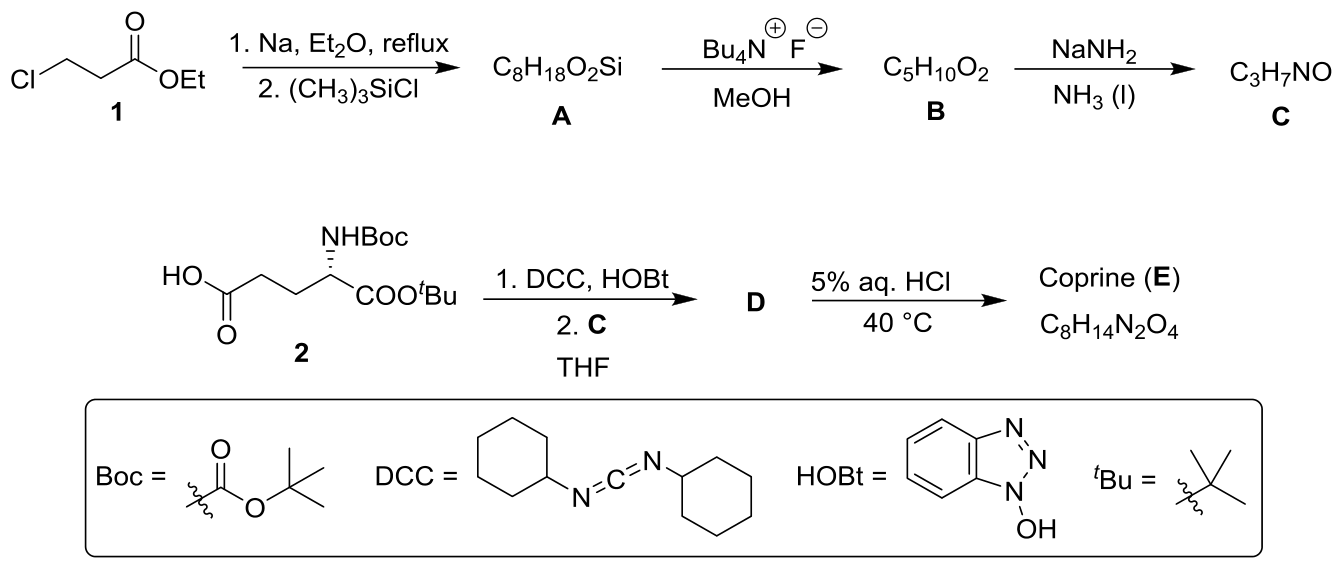
6.1 Draw the formulae of compounds A–E including stereochemistry when necessary.
Hint: The first reaction affording compound A proceeds via an organometallic compound which then cyclizes.
In the human body, coprine undergoes hydrolysis to L-glutamic acid (3) and compounds C and 4, which are responsible for the coprine adverse side-effects. They inhibit the enzyme acetaldehyde dehydrogenase, which is involved in the metabolism of alcohol. When the enzyme is inhibited, acetaldehyde formed by alcohol dehydrogenase accumulates in the body, causing strong symptoms of hangover (so called antabuse effect). The active site of the enzyme contains a cysteine \(\ce{SH}\) group, which is blocked either by compound C or 4.
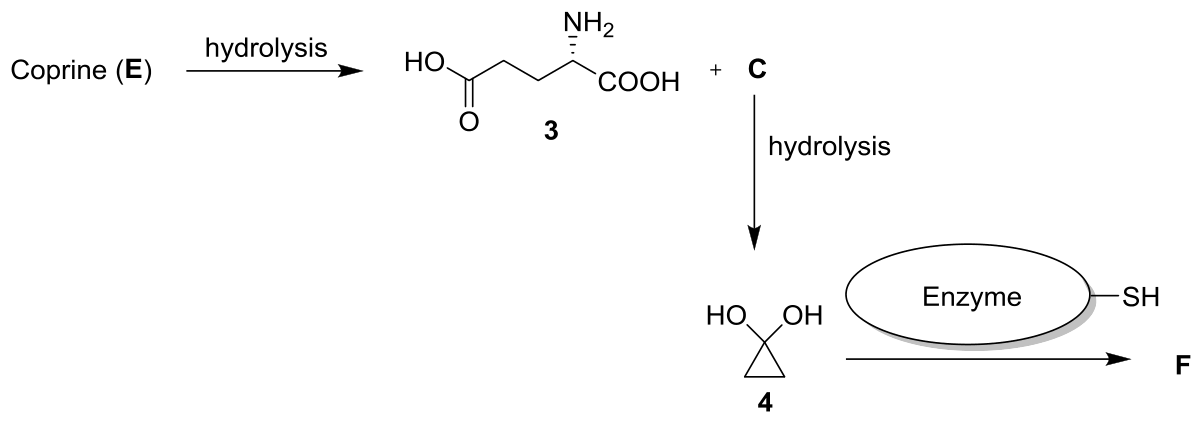
Enzyme = acetaldehyde dehydrogenase
6.2 Using the pictogram for acetaldehyde dehydrogenase above, draw the structure F of the enzyme inhibited by compound 4.
The antabuse effect got its name after antabuse (5), the most known drug used in alcohol-addiction treatment. This drug can be synthesized according to the following scheme.

6.3 Draw the formulae of compounds G and H.
Hint: Compound H contains five carbon atoms.
6.4 Mark all possible reagents which could be used for I from the following list.
| ☐ m-chloroperbenzoic acid (mCPBA) | ☐ diluted \(\ce{H2O2}\) |
| ☐ \(\ce{Zn / CH3COOH}\) | ☐ \(\ce{NaBH4}\) |
| ☐ \(\ce{I2}\) | ☐ hot concentrated \(\ce{H2SO4}\) |
| ☐ \(\ce{K2CO3}, \ce{H2O}\) | ☐ \(\ce{AlCl3}\) |
The way antabuse inhibits acetaldehyde dehydrogenase is similar to the effect of compounds C and 4.
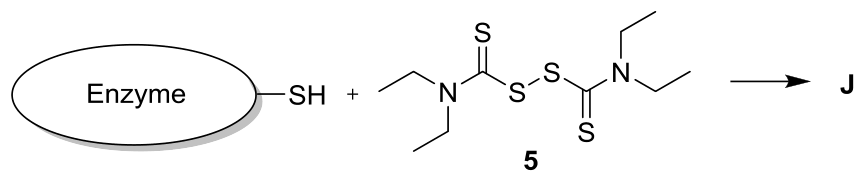
Enzyme = acetaldehyde dehydrogenase
6.5 Using the pictogram for acetaldehyde dehydrogenase above, draw the structure J of the enzyme inhibited by antabuse (5). Hint: Three sulfur atoms should be in the structure.
False morel (Gyromitra esculenta) is another interesting mushroom. Although it was considered edible in the past (esculentus means edible in Latin), there is clear evidence that this mushroom is poisonous due to the content of gyromitrin (M). This natural compound can be prepared from N-methylhydrazine (6):
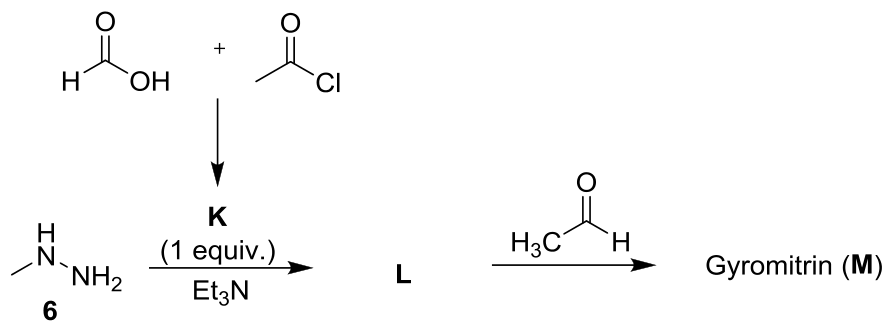
6.6 Draw the formulae of compounds K – M.
In human body, gyromitrin (M) hydrolyzes and provides N-methylhydrazine (6), which is strongly hepatotoxic. Gyromitrin (M) hydrolysis occurs as soon as it enters the acidic environment in human stomach where both its amide and imine groups are hydrolyzed.
Let us focus on the hydrolysis of the amide moiety within the gyromitrin molecule. The vibrational wavenumber of the stretching mode of the relevant \(\ce{C-N}\) bond amounts to \(1\,293.0\ \mathrm{cm^{-1}}\) and the potential energy surface does not significantly alter its shape with isotope substitution effect.
6.7 Calculate the highest possible hypothetical kinetic isotope effect at the temperature of human body, \(37\,^\circ\mathrm{C}\), for the given hydrolysis reaction assuming that both relevant nitrogen and carbon atoms were simultaneously substituted, \(\ce{^{14}N}\) with the \(\ce{^{15}N}\) isotope and \(\ce{^{12}C}\) with the \(\ce{^{13}C}\) isotope. Consider that only the zero point vibrational energy affects the rate constants. Assume that the molar masses of all isotopes are integers. In all steps consider five significant digits.
6.8 After making these isotopic changes, the rates of hydrolysis are not significantly different. Which of the following is the most likely the rate determining step?
- ☐ Nucleophilic attack of water on a protonated amidic moiety
- ☐ \(\ce{C-N}\) bond cleavage
- ☐ Protonation of the gyromitrin molecule
Official English text of the problem.
Answers
In the enzyme-adduct SMILES, * represents the rest of the enzyme attached to the active-site cysteine sulfur.
- 6.1
| Compound | Identification | SMILES |
|---|---|---|
| A | 1-Ethoxy-1-(trimethylsilyloxy)cyclopropane | CCOC1(O[Si](C)(C)C)CC1 |
| B | 1-Ethoxycyclopropan-1-ol | CCOC1(O)CC1 |
| C | 1-Aminocyclopropan-1-ol | NC1(O)CC1 |
| D | \(N^\alpha\)-Boc-protected coprine α-tert-butyl ester; amino-acid centre \(S\) | CC(C)(C)OC(=O)N[C@@H](CCC(=O)NC1(O)CC1)C(=O)OC(C)(C)C |
| E | Coprine, \(N^5\)-(1-hydroxycyclopropyl)-L-glutamine; amino-acid centre \(S\) | N[C@@H](CCC(=O)NC1(O)CC1)C(=O)O |
-
6.2 F is the enzyme-bound cyclopropanone hemithioketal,
*SC1(O)CC1. The same cyclopropane carbon bears \(\ce{OH}\) and \(\ce{S-Enzyme}\). -
6.3 G is carbon disulfide,
S=C=S. H is sodium \(N,N\)-diethyldithiocarbamate,CCN(CC)C(=S)[S-].[Na+]. -
6.4 Select:
- m-chloroperbenzoic acid,
O=C(OO)c1cccc(Cl)c1; - diluted hydrogen peroxide,
OO; - iodine,
II.
Do not select hot concentrated sulfuric acid: it promotes decomposition of the dithiocarbamate.
-
6.5 J is the enzyme–diethyldithiocarbamate mixed disulfide,
*SSC(=S)N(CC)CC. Draw \(\ce{Enzyme-S-S-C(=S)-N(Et)2}\). -
6.6
| Compound | Identification | SMILES |
|---|---|---|
| K | Acetic formic anhydride, the mixed anhydride of acetic and formic acids | CC(=O)OC=O |
| L | \(N\)-Amino-\(N\)-methylformamide | CN(N)C=O |
| M | Gyromitrin, acetaldehyde \(N\)-methyl-\(N\)-formylhydrazone | CC=NN(C)C=O |
The supplied scheme does not specify the hydrazone’s \(E/Z\) geometry.
-
6.7 \[ \boxed{\left(\frac{k_{\mathrm{light}}}{k_{\mathrm{heavy}}}\right)_{\max} \approx 1.12} \] Five-significant-digit intermediate rounding gives 1.1165; retaining guard digits gives 1.1166.
-
6.8 Select nucleophilic attack of water on a protonated amidic moiety.
Solution
Throughout the equations, \(\mathrm{Et}\) denotes ethyl and \(\mathrm{Enz}\) denotes the enzyme residue bonded to its active-site sulfur. Neutral organic structures are used for the hydrolysis and deprotection balances; protonation in acidic solution does not change the identified connectivity.
6.1 — Synthesis of coprine
Formation of A. Starting material 1 is ethyl 3-chloropropanoate, CCOC(=O)CCCl. Sodium generates its organosodium derivative:
\[ \ce{ClCH2CH2COOEt + 2 Na -> NaCH2CH2COOEt + NaCl}. \]
The intermediate, ethyl 3-sodiopropanoate, has the ionic SMILES CCOC(=O)C[CH2-].[Na+]. Its terminal carbanion attacks the ester carbonyl intramolecularly. The carbonyl \(\pi\) electrons move onto oxygen, producing a three-membered ring: sodium 1-ethoxycyclopropan-1-olate, CCOC1([O-])CC1.[Na+].
Chlorotrimethylsilane, C[Si](C)(C)Cl, traps this alkoxide at oxygen, giving A. The overall balance is
\[ \ce{ClCH2CH2COOEt + 2 Na + (CH3)3SiCl -> C8H18O2Si + 2 NaCl}. \]
Sodium chloride is [Na+].[Cl-]. The structure of A contains the required eight carbons: three in the ring, two in ethoxy, and three attached to silicon.
Formation of B. Fluoride, [F-], attacks silicon and removes the trimethylsilyl protecting group. Methanol, CO, supplies the proton for the liberated oxygen. A balanced net ionic representation is
\[ \ce{C8H18O2Si + F^- + CH3OH -> C5H10O2 + (CH3)3SiF + CH3O^-}. \]
The silicon-containing product is fluorotrimethylsilane, C[Si](C)(C)F; methoxide is C[O-]. Thus B is the ethyl hemiketal of cyclopropanone, with \(\ce{OH}\) and \(\ce{OEt}\) on the same ring carbon.
Formation of C. Sodium amide, [Na+].[NH2-], in liquid ammonia, N, replaces the ethoxy group by an amino group. The formal overall balance is
\[ \ce{C5H10O2 + NaNH2 -> C3H7NO + NaOC2H5}. \]
Sodium ethoxide is CC[O-].[Na+]. The transformation can proceed through cyclopropanone, O=C1CC1, followed by nitrogen addition and proton transfer. Consequently, C is the corresponding hemiaminal, 1-aminocyclopropan-1-ol.
Formation of D. Compound 2 is \(N\)-Boc-L-glutamic acid α-tert-butyl ester:
CC(C)(C)OC(=O)N[C@@H](CCC(=O)O)C(=O)OC(C)(C)C.
Its side-chain carboxyl group is free, whereas its α-amino and α-carboxyl groups are protected. Coupling therefore joins the side-chain carboxyl group to the amino group of C, giving D.
Dicyclohexylcarbodiimide, DCC, C1CCCCC1N=C=NC1CCCCC1, becomes 1,3-dicyclohexylurea, O=C(NC1CCCCC1)NC1CCCCC1. HOBt, 1-hydroxybenzotriazole, On1nnc2ccccc21, assists acyl activation; tetrahydrofuran, C1CCOC1, is the solvent.
The balanced overall coupling, in molecular formulas, is
\[ \ce{C14H25NO6 + C3H7NO + C13H22N2 ->[HOBt] C17H30N2O6 + C13H24N2O}. \]
The reactants are 2, C, and DCC; the products are D and dicyclohexylurea. DCC formally accepts the elements of water released during amide formation.
Formation of E. Aqueous hydrogen chloride, Cl, removes both acid-labile protecting groups. The Boc group releases carbon dioxide, O=C=O; tert-butyl cleavage can be balanced using 2-methylpropene, C=C(C)C:
\[ \ce{C17H30N2O6 ->[HCl(aq)] C8H14N2O4 + CO2 + 2 C4H8}. \]
This gives coprine E, with a free α-amino group and α-carboxyl group.
The amino-acid stereocentre retains the \(S\) configuration supplied in 2. None of these steps requires breaking a bond at that stereocentre. The substituted cyclopropane carbon is not stereogenic because its two ring paths are identical.
6.2 — Inhibition by compound 4
The stated hydrolyses are balanced as follows:
\[ \ce{C8H14N2O4 + H2O -> C5H9NO4 + C3H7NO}, \]
\[ \ce{C3H7NO + H2O -> C3H6O2 + NH3}. \]
The products of the first equation are L-glutamic acid 3, N[C@@H](CCC(=O)O)C(=O)O, and C. The second produces cyclopropane-1,1-diol 4, OC1(O)CC1, and ammonia. Water is O.
Compound 4 is the hydrate of cyclopropanone:
\[ \ce{C3H6O2 <=> C3H4O + H2O}. \]
The enzyme thiol, represented by *S, adds to cyclopropanone. Sulfur forms a bond to the carbonyl carbon, the carbonyl \(\pi\) bond opens toward oxygen, and proton transfer gives the hemithioketal F.
The net balance starting from the hydrate is
\[ \ce{Enz-SH + C3H6O2 -> Enz-S-C3H5O + H2O}. \]
Here the product formula denotes F, *SC1(O)CC1. For the requested drawing, retain the enzyme oval and connect it through sulfur to one vertex of a cyclopropane triangle. Attach an \(\ce{OH}\) group to that same vertex. The cyclopropane ring remains intact.
6.3 — Identification of G and H
Diethylamine, CCNCC, already contains four carbons. Carbon disulfide G supplies the fifth carbon required in H.
The amine attacks the electrophilic carbon of carbon disulfide, and sodium hydroxide, [Na+].[OH-], removes the nitrogen-bound proton:
\[ \ce{Et2NH + CS2 + NaOH -> Et2NC(=S)SNa + H2O}. \]
Thus H is sodium \(N,N\)-diethyldithiocarbamate. Its four ethyl-group carbons and one thiocarbonyl carbon account for the five-carbon hint.
6.4 — Suitable oxidants
Antabuse 5 is disulfiram, tetraethylthiuram disulfide:
CCN(CC)C(=S)SSC(=S)N(CC)CC.
Let \(X^-\) denote the \(N,N\)-diethyldithiocarbamate anion, CCN(CC)C(=S)[S-], and let \(X_2\) denote disulfiram, whose two units are joined by an \(\ce{S-S}\) bond. The required oxidation half-reaction is
\[ \ce{2 X^- -> X2 + 2 e^-}. \]
The three suitable reagents give the following balanced net ionic equations:
\[ \ce{2 X^- + I2 -> X2 + 2 I^-}, \]
\[ \ce{2 X^- + H2O2 -> X2 + 2 OH^-}, \]
\[ \ce{2 X^- + ArC(=O)OOH -> X2 + ArCOO^- + OH^-}. \]
In the last equation, \(\mathrm{Ar}\) is 3-chlorophenyl, so the oxidant is mCPBA. The ionic by-products are iodide, [I-]; hydroxide, [OH-]; and 3-chlorobenzoate, O=C([O-])c1cccc(Cl)c1.
Hot concentrated sulfuric acid is unsuitable. Sulfuric acid, OS(=O)(=O)O, strongly acidifies the dithiocarbamate. The resulting \(N,N\)-diethyldithiocarbamic acid, CCN(CC)C(=S)S, is susceptible to cleavage into diethylamine and carbon disulfide; heating promotes this destruction. Including protonation of the liberated amine gives
\[ \ce{Et2NC(=S)S^- + 2 H+ -> Et2NH2+ + CS2}. \]
The protonated amine is diethylammonium, CC[NH2+]CC. Therefore, sulfuric acid’s oxidizing character does not make hot concentrated sulfuric acid a suitable reagent for preserving and coupling this substrate.
The other unselected reagents also do not accomplish the required oxidation:
| Reagent | Name and SMILES | Reason |
|---|---|---|
| \(\ce{Zn / CH3COOH}\) | Zinc [Zn]; acetic acid CC(=O)O |
A reducing system |
| \(\ce{NaBH4}\) | Sodium borohydride [Na+].[BH4-] |
A reducing agent |
| \(\ce{K2CO3},\ce{H2O}\) | Potassium carbonate [K+].[K+].[O-]C(=O)[O-]; water O |
Supplies basic conditions, not the required oxidation |
| \(\ce{AlCl3}\) | Aluminium chloride Cl[Al](Cl)Cl |
A Lewis acid, not the required oxidant |
6.5 — Inhibition by disulfiram
The enzyme’s cysteine sulfur attacks one sulfur of disulfiram’s disulfide bond. Cleavage of that bond releases a diethyldithiocarbamate unit and leaves the enzyme in a mixed disulfide.
A balanced neutral-form equation is
\[ \ce{Enz-SH + X2 -> Enz-S-SC(=S)NEt2 + Et2NC(=S)SH}. \]
The second product is the dithiocarbamic acid identified above.
For J, draw the enzyme oval followed by
\[ \ce{-S-S-C(=S)-N(Et)2}. \]
Its three sulfur atoms are the original cysteine sulfur, the sulfur joining it to the thiocarbonyl carbon, and the thiocarbonyl sulfur. This matches *SSC(=S)N(CC)CC.
6.6 — Synthesis of gyromitrin
Formation of K. Formic acid, O=CO, reacts with acetyl chloride, CC(=O)Cl, to produce the mixed anhydride K:
\[ \ce{HCOOH + CH3COCl -> HC(=O)OC(=O)CH3 + HCl}. \]
This mixed anhydride provides an activated formyl group.
Formation of L. \(N\)-Methylhydrazine 6, CNN, is formylated at the methyl-bearing nitrogen, giving L. The terminal \(\ce{NH2}\) group must remain available for the subsequent aldehyde condensation.
Triethylamine, CCN(CC)CC, captures the acid formed. A combined balance is
\[ \ce{CH3NHNH2 + HC(=O)OC(=O)CH3 + Et3N -> HC(=O)N(CH3)NH2 + Et3NH+ + CH3COO^-}. \]
The salt by-product is triethylammonium acetate, CC[NH+](CC)CC.CC(=O)[O-].
Formation of M. The remaining terminal amino group condenses with acetaldehyde, also called ethanal, CC=O, eliminating water:
\[ \ce{HC(=O)N(CH3)NH2 + CH3CHO -> HC(=O)N(CH3)N=CHCH3 + H2O}. \]
The product is gyromitrin M. It contains both the formamide group and the hydrazone \(\ce{C=N}\) group described in the text. The reaction scheme specifies its connectivity but does not establish its \(E/Z\) configuration.
Hydrolysis of both groups has the overall balance
\[ \ce{HC(=O)N(CH3)N=CHCH3 + 2 H2O -> HCOOH + CH3NHNH2 + CH3CHO}. \]
Thus the products are formic acid, \(N\)-methylhydrazine, and acetaldehyde.
6.7 — Maximum hypothetical kinetic isotope effect
For a harmonic bond-stretching vibration,
\[ \widetilde{\nu}=\frac{1}{2\pi c}\sqrt{\frac{f}{\mu}}, \]
where \(f\) is the force constant and \(\mu\) is the reduced mass. The unchanged potential-energy surface means that \(f\) is unchanged by isotopic substitution.
The reduced masses are
\[ \mu_{\mathrm{light}} =\frac{12\times14}{12+14}\,\mathrm{u} =6.4615\ \mathrm{u}, \]
\[ \mu_{\mathrm{heavy}} =\frac{13\times15}{13+15}\,\mathrm{u} =6.9643\ \mathrm{u}. \]
Therefore,
\[ \frac{\widetilde{\nu}_{\mathrm{heavy}}} {\widetilde{\nu}_{\mathrm{light}}} = \sqrt{\frac{\mu_{\mathrm{light}}}{\mu_{\mathrm{heavy}}}} =0.96323, \]
and
\[ \widetilde{\nu}_{\mathrm{heavy}} =(1293.0)(0.96323) =1245.5\ \mathrm{cm^{-1}}. \]
The molar zero-point energy of this mode is
\[ E_0=\frac12N_{\mathrm A}hc\widetilde{\nu}. \]
The maximum effect occurs when the relevant stretching vibration is completely lost at the transition state. Its isotope-dependent zero-point-energy difference then contributes fully to the difference in activation energies:
\[ \Delta E^\ddagger_{\mathrm{heavy}} -\Delta E^\ddagger_{\mathrm{light}} = E_{0,\mathrm{light}}-E_{0,\mathrm{heavy}}. \]
Using standard constants to five significant digits,
\[ \begin{aligned} h&=6.6261\times10^{-34}\ \mathrm{J\,s},\\ c&=2.9979\times10^{10}\ \mathrm{cm\,s^{-1}},\\ N_{\mathrm A}&=6.0221\times10^{23}\ \mathrm{mol^{-1}},\\ R&=8.3145\ \mathrm{J\,mol^{-1}\,K^{-1}}, \end{aligned} \]
the difference, using the rounded intermediate wavenumber, is
\[ \begin{aligned} \Delta E_0 &=\frac12N_{\mathrm A}hc(1293.0-1245.5)\ \mathrm{cm^{-1}}\\ &=284.11\ \mathrm{J\,mol^{-1}}. \end{aligned} \]
The temperature is
\[ T=37+273.15=310.15\ \mathrm K, \]
so
\[ RT=2578.7\ \mathrm{J\,mol^{-1}}. \]
Since only zero-point energies are to affect the rate constants,
\[ \begin{aligned} \left(\frac{k_{\mathrm{light}}}{k_{\mathrm{heavy}}}\right)_{\max} &=\exp\!\left(\frac{\Delta E_0}{RT}\right)\\ &=\exp(0.11018)\\ &=\boxed{1.1165}. \end{aligned} \]
Thus the light molecule can hydrolyze approximately 12% faster in this limiting model.
Retaining guard digits throughout instead gives \(\Delta E_0=284.38\ \mathrm{J\,mol^{-1}}\) and a five-significant-digit ratio of \(1.1166\). The difference is solely intermediate rounding.
6.8 — Most likely rate-determining step
The best choice is nucleophilic attack of water on the protonated amide.
Carbonyl protonation is normally a rapid pre-equilibrium. The relevant protonated species is O-protonated gyromitrin, CC=NN(C)C=[OH+]:
\[ \ce{HC(=O)N(CH3)N=CHCH3 + H+ <=> HC(=OH+)N(CH3)N=CHCH3}. \]
Water then attacks the activated carbonyl carbon:
\[ \ce{HC(=OH+)N(CH3)N=CHCH3 + H2O -> HC(OH)(OH2+)N(CH3)N=CHCH3}. \]
The product of this addition is the protonated tetrahedral intermediate, CC=NN(C)C(O)[OH2+].
During this addition, the amide \(\ce{C-N}\) bond remains intact. A small isotope effect is therefore consistent with addition being rate determining. Substantial \(\ce{C-N}\) cleavage in the rate-determining step would be expected to produce a more pronounced primary isotope effect. Among the choices, water addition is consequently the most likely slow step.
The solution was checked against the official solution.
IChO 2018 · Theorieaufgabe 6
Auf zum Pilzesammeln
Pilzesammeln gehört zu den traditionellen Freizeitbeschäftigungen in Tschechien und der Slowakei. Während einige unserer Pilzarten essbar sind, sind andere ungenießbar oder sogar giftig.
Der Faltentintling (Coprinopsis atramentaria) gilt als essbar und schmackhaft. Er enthält einen Naturstoff namens Coprin (E), der sich leicht aus 3-Chlorpropansäureethylester (1) synthetisieren lässt.
6.1 Zeichnen Sie die Strukturformeln der Verbindungen A–E, gegebenenfalls einschließlich der Stereochemie.
Hinweis: Die erste Reaktion, bei der Verbindung A entsteht, verläuft über eine metallorganische Verbindung, die anschließend cyclisiert.
Im menschlichen Körper wird Coprin zu L-Glutaminsäure (3) und den Verbindungen C und 4 hydrolysiert, die für die unerwünschten Nebenwirkungen von Coprin verantwortlich sind. Sie hemmen das Enzym Acetaldehyd-Dehydrogenase, das am Alkoholstoffwechsel beteiligt ist. Wird das Enzym gehemmt, reichert sich der durch Alkohol-Dehydrogenase gebildete Acetaldehyd im Körper an und verursacht starke Katersymptome (den sogenannten Antabus-Effekt). Das aktive Zentrum des Enzyms enthält eine Cystein-\(\ce{SH}\)-Gruppe, die entweder durch Verbindung C oder durch 4 blockiert wird.
Enzym = Acetaldehyd-Dehydrogenase
6.2 Zeichnen Sie unter Verwendung des obigen Piktogramms für Acetaldehyd-Dehydrogenase die Struktur F des durch Verbindung 4 gehemmten Enzyms.
Der Antabus-Effekt wurde nach Antabus (5) benannt, dem bekanntesten Arzneimittel zur Behandlung der Alkoholabhängigkeit. Dieses Arzneimittel lässt sich nach dem folgenden Schema synthetisieren.
6.3 Zeichnen Sie die Strukturformeln der Verbindungen G und H.
Hinweis: Verbindung H enthält fünf Kohlenstoffatome.
6.4 Markieren Sie in der folgenden Liste alle möglichen Reagenzien, die für I verwendet werden könnten.
| ☐ m-Chlorperbenzoesäure (mCPBA) | ☐ verdünntes \(\ce{H2O2}\) |
| ☐ \(\ce{Zn / CH3COOH}\) | ☐ \(\ce{NaBH4}\) |
| ☐ \(\ce{I2}\) | ☐ heiße konzentrierte \(\ce{H2SO4}\) |
| ☐ \(\ce{K2CO3}, \ce{H2O}\) | ☐ \(\ce{AlCl3}\) |
Die Art und Weise, wie Antabus die Acetaldehyd-Dehydrogenase hemmt, ähnelt der Wirkung der Verbindungen C und 4.
Enzym = Acetaldehyd-Dehydrogenase
6.5 Zeichnen Sie unter Verwendung des obigen Piktogramms für Acetaldehyd-Dehydrogenase die Struktur J des durch Antabus (5) gehemmten Enzyms. Hinweis: Die Struktur sollte drei Schwefelatome enthalten.
Die Frühjahrslorchel (Gyromitra esculenta) ist ein weiterer interessanter Pilz. Obwohl sie früher als essbar galt (esculentus bedeutet auf Lateinisch essbar), gibt es eindeutige Belege dafür, dass dieser Pilz aufgrund seines Gehalts an Gyromitrin (M) giftig ist. Dieser Naturstoff lässt sich aus N-Methylhydrazin (6) herstellen:
6.6 Zeichnen Sie die Strukturformeln der Verbindungen K – M.
Im menschlichen Körper wird Gyromitrin (M) hydrolysiert und setzt dabei N-Methylhydrazin (6) frei, das stark hepatotoxisch ist. Die Hydrolyse von Gyromitrin (M) setzt ein, sobald es in das saure Milieu des menschlichen Magens gelangt, wo sowohl seine Amid- als auch seine Imingruppe hydrolysiert werden.
Betrachten wir die Hydrolyse der Amidgruppe im Gyromitrinmolekül. Die Schwingungswellenzahl der Streckschwingung der betreffenden \(\ce{C-N}\)-Bindung beträgt \(1\,293.0\ \mathrm{cm^{-1}}\), und die Form der Potentialenergiefläche ändert sich durch die Isotopensubstitution nicht wesentlich.
6.7 Berechnen Sie den höchstmöglichen hypothetischen kinetischen Isotopeneffekt bei der menschlichen Körpertemperatur von \(37\,^\circ\mathrm{C}\) für die gegebene Hydrolysereaktion unter der Annahme, dass die beiden betreffenden Stickstoff- und Kohlenstoffatome gleichzeitig ersetzt wurden: \(\ce{^{14}N}\) durch das Isotop \(\ce{^{15}N}\) und \(\ce{^{12}C}\) durch das Isotop \(\ce{^{13}C}\). Berücksichtigen Sie, dass nur die Nullpunktsschwingungsenergie die Geschwindigkeitskonstanten beeinflusst. Nehmen Sie an, dass die molaren Massen aller Isotope ganzzahlig sind. Rechnen Sie in allen Schritten mit fünf signifikanten Stellen.
6.8 Nach diesen Isotopensubstitutionen unterscheiden sich die Hydrolysegeschwindigkeiten nicht wesentlich. Welcher der folgenden Schritte ist am wahrscheinlichsten der geschwindigkeitsbestimmende Schritt?
- ☐ Nucleophiler Angriff von Wasser auf eine protonierte Amidgruppe
- ☐ Spaltung der \(\ce{C-N}\)-Bindung
- ☐ Protonierung des Gyromitrinmoleküls
Aufgabentext aus dem offiziellen englischen Text übersetzt.
Antworten
In den SMILES der Enzymaddukte steht * für den Rest des Enzyms, der an das Schwefelatom des Cysteins im aktiven Zentrum gebunden ist.
- 6.1
| Verbindung | Identifizierung | SMILES |
|---|---|---|
| A | 1-Ethoxy-1-(trimethylsilyloxy)cyclopropan | CCOC1(O[Si](C)(C)C)CC1 |
| B | 1-Ethoxycyclopropan-1-ol | CCOC1(O)CC1 |
| C | 1-Aminocyclopropan-1-ol | NC1(O)CC1 |
| D | \(N^\alpha\)-Boc-geschützter Coprin-α-tert-butylester; Aminosäurezentrum \(S\) | CC(C)(C)OC(=O)N[C@@H](CCC(=O)NC1(O)CC1)C(=O)OC(C)(C)C |
| E | Coprin, \(N^5\)-(1-Hydroxycyclopropyl)-L-glutamin; Aminosäurezentrum \(S\) | N[C@@H](CCC(=O)NC1(O)CC1)C(=O)O |
-
6.2 F ist das enzymgebundene Cyclopropanon-Hemithioketal,
*SC1(O)CC1. Dasselbe Cyclopropan-Kohlenstoffatom trägt \(\ce{OH}\) und \(\ce{S-Enzyme}\). -
6.3 G ist Kohlenstoffdisulfid,
S=C=S. H ist Natrium-\(N,N\)-diethyldithiocarbamat,CCN(CC)C(=S)[S-].[Na+]. -
6.4 Auszuwählen sind:
- m-Chlorperbenzoesäure,
O=C(OO)c1cccc(Cl)c1; - verdünntes Wasserstoffperoxid,
OO; - Iod,
II.
Heiße konzentrierte Schwefelsäure nicht auswählen: Sie fördert die Zersetzung des Dithiocarbamats.
-
6.5 J ist das gemischte Disulfid aus Enzym und Diethyldithiocarbamat,
*SSC(=S)N(CC)CC. Zeichnen Sie \(\ce{Enzyme-S-S-C(=S)-N(Et)2}\). -
6.6
| Verbindung | Identifizierung | SMILES |
|---|---|---|
| K | Essigsäure-Ameisensäure-Anhydrid, das gemischte Anhydrid aus Essigsäure und Ameisensäure | CC(=O)OC=O |
| L | \(N\)-Amino-\(N\)-methylformamid | CN(N)C=O |
| M | Gyromitrin, Acetaldehyd-\(N\)-methyl-\(N\)-formylhydrazon | CC=NN(C)C=O |
Das vorgegebene Schema legt die \(E/Z\)-Geometrie des Hydrazons nicht fest.
-
6.7 \[ \boxed{\left(\frac{k_{\mathrm{light}}}{k_{\mathrm{heavy}}}\right)_{\max} \approx 1.12} \] Bei Rundung der Zwischenergebnisse auf fünf signifikante Stellen ergibt sich 1.1165; mit zusätzlichen Rechenstellen ergibt sich 1.1166.
-
6.8 Auszuwählen ist nucleophiler Angriff von Wasser auf eine protonierte Amidgruppe.
Lösung
In allen Gleichungen bezeichnet \(\mathrm{Et}\) Ethyl und \(\mathrm{Enz}\) den Enzymrest, der an das Schwefelatom seines aktiven Zentrums gebunden ist. Für die Bilanzen der Hydrolyse und der Schutzgruppenabspaltung werden neutrale organische Strukturen verwendet; die Protonierung in saurer Lösung ändert die ermittelte Konnektivität nicht.
6.1 — Synthese von Coprin
Bildung von A. Der Ausgangsstoff 1 ist 3-Chlorpropansäureethylester, CCOC(=O)CCCl. Natrium erzeugt dessen Organonatriumderivat:
\[ \ce{ClCH2CH2COOEt + 2 Na -> NaCH2CH2COOEt + NaCl}. \]
Das Zwischenprodukt, 3-Natriopropansäureethylester, hat die ionische SMILES CCOC(=O)C[CH2-].[Na+]. Sein endständiges Carbanion greift die Carbonylgruppe des Esters intramolekular an. Die \(\pi\)-Elektronen der Carbonylgruppe werden auf den Sauerstoff verschoben, wobei ein dreigliedriger Ring entsteht: Natrium-1-ethoxycyclopropan-1-olat, CCOC1([O-])CC1.[Na+].
Chlortrimethylsilan, C[Si](C)(C)Cl, fängt dieses Alkoholat am Sauerstoff ab, wobei A entsteht. Die Gesamtbilanz lautet
\[ \ce{ClCH2CH2COOEt + 2 Na + (CH3)3SiCl -> C8H18O2Si + 2 NaCl}. \]
Natriumchlorid ist [Na+].[Cl-]. Die Struktur von A enthält die erforderlichen acht Kohlenstoffatome: drei im Ring, zwei in der Ethoxygruppe und drei am Silicium.
Bildung von B. Fluorid, [F-], greift am Silicium an und entfernt die Trimethylsilyl-Schutzgruppe. Methanol, CO, liefert das Proton für den freigesetzten Sauerstoff. Eine ausgeglichene Nettoionengleichung lautet
\[ \ce{C8H18O2Si + F^- + CH3OH -> C5H10O2 + (CH3)3SiF + CH3O^-}. \]
Das siliciumhaltige Produkt ist Fluortrimethylsilan, C[Si](C)(C)F; Methanolat ist C[O-]. Somit ist B das Ethylhalbketal des Cyclopropanons mit \(\ce{OH}\) und \(\ce{OEt}\) am selben Ringkohlenstoffatom.
Bildung von C. Natriumamid, [Na+].[NH2-], in flüssigem Ammoniak, N, ersetzt die Ethoxygruppe durch eine Aminogruppe. Die formale Gesamtbilanz lautet
\[ \ce{C5H10O2 + NaNH2 -> C3H7NO + NaOC2H5}. \]
Natriumethanolat ist CC[O-].[Na+]. Die Umwandlung kann über Cyclopropanon, O=C1CC1, verlaufen, gefolgt von der Addition des Stickstoffnucleophils und einer Protonenübertragung. Folglich ist C das entsprechende Halbaminal, 1-Aminocyclopropan-1-ol.
Bildung von D. Verbindung 2 ist \(N\)-Boc-L-glutaminsäure-α-tert-butylester:
CC(C)(C)OC(=O)N[C@@H](CCC(=O)O)C(=O)OC(C)(C)C.
Seine Carboxylgruppe in der Seitenkette ist frei, während seine α-Amino- und α-Carboxylgruppe geschützt sind. Die Kupplung verbindet daher die Carboxylgruppe der Seitenkette mit der Aminogruppe von C, wobei D entsteht.
Dicyclohexylcarbodiimid, DCC, C1CCCCC1N=C=NC1CCCCC1, wird zu 1,3-Dicyclohexylharnstoff, O=C(NC1CCCCC1)NC1CCCCC1. HOBt, 1-Hydroxybenzotriazol, On1nnc2ccccc21, unterstützt die Acylaktivierung; Tetrahydrofuran, C1CCOC1, ist das Lösungsmittel.
Die ausgeglichene Gesamtgleichung der Kupplung in Summenformeln lautet
\[ \ce{C14H25NO6 + C3H7NO + C13H22N2 ->[HOBt] C17H30N2O6 + C13H24N2O}. \]
Die Edukte sind 2, C und DCC; die Produkte sind D und Dicyclohexylharnstoff. DCC nimmt formal die Bestandteile des bei der Amidbildung freigesetzten Wassers auf.
Bildung von E. Wässriger Chlorwasserstoff, Cl, entfernt beide säurelabilen Schutzgruppen. Die Boc-Gruppe setzt Kohlenstoffdioxid, O=C=O, frei; die tert-Butyl-Abspaltung lässt sich unter Verwendung von 2-Methylpropen, C=C(C)C, bilanzieren:
\[ \ce{C17H30N2O6 ->[HCl(aq)] C8H14N2O4 + CO2 + 2 C4H8}. \]
Dadurch entsteht Coprin E mit einer freien α-Aminogruppe und einer freien α-Carboxylgruppe.
Das Stereozentrum der Aminosäure behält die in 2 vorgegebene \(S\)-Konfiguration bei. Keiner dieser Schritte erfordert die Spaltung einer Bindung an diesem Stereozentrum. Das substituierte Cyclopropan-Kohlenstoffatom ist nicht stereogen, da seine beiden Ringwege identisch sind.
6.2 — Hemmung durch Verbindung 4
Die angegebenen Hydrolysen lassen sich wie folgt bilanzieren:
\[ \ce{C8H14N2O4 + H2O -> C5H9NO4 + C3H7NO}, \]
\[ \ce{C3H7NO + H2O -> C3H6O2 + NH3}. \]
Die Produkte der ersten Gleichung sind L-Glutaminsäure 3, N[C@@H](CCC(=O)O)C(=O)O, und C. Die zweite liefert Cyclopropan-1,1-diol 4, OC1(O)CC1, und Ammoniak. Wasser ist O.
Verbindung 4 ist das Hydrat des Cyclopropanons:
\[ \ce{C3H6O2 <=> C3H4O + H2O}. \]
Das durch *S dargestellte Enzymthiol addiert an Cyclopropanon. Schwefel bildet eine Bindung zum Carbonylkohlenstoffatom, die \(\pi\)-Bindung der Carbonylgruppe wird zum Sauerstoff hin geöffnet, und eine Protonenübertragung liefert das Hemithioketal F.
Die Nettobilanz ausgehend vom Hydrat lautet
\[ \ce{Enz-SH + C3H6O2 -> Enz-S-C3H5O + H2O}. \]
Hier bezeichnet die Produktformel F, *SC1(O)CC1. Behalten Sie für die geforderte Zeichnung das Enzymoval bei und verbinden Sie es über Schwefel mit einem Eckpunkt eines Cyclopropandreiecks. Fügen Sie an demselben Eckpunkt eine \(\ce{OH}\)-Gruppe hinzu. Der Cyclopropanring bleibt intakt.
6.3 — Identifizierung von G und H
Diethylamin, CCNCC, enthält bereits vier Kohlenstoffatome. Kohlenstoffdisulfid G liefert das fünfte Kohlenstoffatom, das in H benötigt wird.
Das Amin greift das elektrophile Kohlenstoffatom des Kohlenstoffdisulfids an, und Natriumhydroxid, [Na+].[OH-], entfernt das an Stickstoff gebundene Proton:
\[ \ce{Et2NH + CS2 + NaOH -> Et2NC(=S)SNa + H2O}. \]
Somit ist H Natrium-\(N,N\)-diethyldithiocarbamat. Seine vier Kohlenstoffatome in den Ethylgruppen und das eine Thiocarbonyl-Kohlenstoffatom erklären den Hinweis auf die fünf Kohlenstoffatome.
6.4 — Geeignete Oxidationsmittel
Antabus 5 ist Disulfiram, Tetraethylthiuramdisulfid:
CCN(CC)C(=S)SSC(=S)N(CC)CC.
Es bezeichne \(X^-\) das \(N,N\)-Diethyldithiocarbamat-Anion, CCN(CC)C(=S)[S-], und \(X_2\) Disulfiram, dessen zwei Einheiten durch eine \(\ce{S-S}\)-Bindung verbunden sind. Die erforderliche Oxidationshalbreaktion lautet
\[ \ce{2 X^- -> X2 + 2 e^-}. \]
Die drei geeigneten Reagenzien liefern die folgenden ausgeglichenen Nettoionengleichungen:
\[ \ce{2 X^- + I2 -> X2 + 2 I^-}, \]
\[ \ce{2 X^- + H2O2 -> X2 + 2 OH^-}, \]
\[ \ce{2 X^- + ArC(=O)OOH -> X2 + ArCOO^- + OH^-}. \]
In der letzten Gleichung ist \(\mathrm{Ar}\) 3-Chlorphenyl, das Oxidationsmittel ist also mCPBA. Die ionischen Nebenprodukte sind Iodid, [I-]; Hydroxid, [OH-]; und 3-Chlorbenzoat, O=C([O-])c1cccc(Cl)c1.
Heiße konzentrierte Schwefelsäure ist ungeeignet. Schwefelsäure, OS(=O)(=O)O, säuert das Dithiocarbamat stark an. Die entstehende \(N,N\)-Diethyldithiocarbaminsäure, CCN(CC)C(=S)S, lässt sich leicht in Diethylamin und Kohlenstoffdisulfid spalten; Erhitzen fördert diese Zersetzung. Unter Einbeziehung der Protonierung des freigesetzten Amins ergibt sich
\[ \ce{Et2NC(=S)S^- + 2 H+ -> Et2NH2+ + CS2}. \]
Das protonierte Amin ist Diethylammonium, CC[NH2+]CC. Der oxidierende Charakter der Schwefelsäure macht heiße konzentrierte Schwefelsäure daher nicht zu einem geeigneten Reagenz, um dieses Substrat zu erhalten und zu kuppeln.
Auch die anderen nicht ausgewählten Reagenzien bewirken die erforderliche Oxidation nicht:
| Reagenz | Name und SMILES | Begründung |
|---|---|---|
| \(\ce{Zn / CH3COOH}\) | Zink [Zn]; Essigsäure CC(=O)O |
Ein reduzierendes System |
| \(\ce{NaBH4}\) | Natriumborhydrid [Na+].[BH4-] |
Ein Reduktionsmittel |
| \(\ce{K2CO3},\ce{H2O}\) | Kaliumcarbonat [K+].[K+].[O-]C(=O)[O-]; Wasser O |
Sorgt für basische Bedingungen, bewirkt aber nicht die erforderliche Oxidation |
| \(\ce{AlCl3}\) | Aluminiumchlorid Cl[Al](Cl)Cl |
Eine Lewis-Säure, nicht das erforderliche Oxidationsmittel |
6.5 — Hemmung durch Disulfiram
Das Cystein-Schwefelatom des Enzyms greift ein Schwefelatom der Disulfidbindung des Disulfirams an. Die Spaltung dieser Bindung setzt eine Diethyldithiocarbamat-Einheit frei und hinterlässt das Enzym als gemischtes Disulfid.
Eine ausgeglichene Gleichung mit neutralen Formen lautet
\[ \ce{Enz-SH + X2 -> Enz-S-SC(=S)NEt2 + Et2NC(=S)SH}. \]
Das zweite Produkt ist die oben identifizierte Dithiocarbaminsäure.
Zeichnen Sie für J das Enzymoval, gefolgt von
\[ \ce{-S-S-C(=S)-N(Et)2}. \]
Seine drei Schwefelatome sind das ursprüngliche Cystein-Schwefelatom, das Schwefelatom, das dieses mit dem Thiocarbonyl-Kohlenstoffatom verbindet, und das Thiocarbonyl-Schwefelatom. Dies entspricht *SSC(=S)N(CC)CC.
6.6 — Synthese von Gyromitrin
Bildung von K. Ameisensäure, O=CO, reagiert mit Acetylchlorid, CC(=O)Cl, zum gemischten Anhydrid K:
\[ \ce{HCOOH + CH3COCl -> HC(=O)OC(=O)CH3 + HCl}. \]
Dieses gemischte Anhydrid stellt eine aktivierte Formylgruppe bereit.
Bildung von L. \(N\)-Methylhydrazin 6, CNN, wird am methyltragenden Stickstoffatom formyliert, wobei L entsteht. Die endständige \(\ce{NH2}\)-Gruppe muss für die anschließende Kondensation mit dem Aldehyd verfügbar bleiben.
Triethylamin, CCN(CC)CC, fängt die gebildete Säure ab. Eine zusammengefasste Bilanz lautet
\[ \ce{CH3NHNH2 + HC(=O)OC(=O)CH3 + Et3N -> HC(=O)N(CH3)NH2 + Et3NH+ + CH3COO^-}. \]
Das als Nebenprodukt entstehende Salz ist Triethylammoniumacetat, CC[NH+](CC)CC.CC(=O)[O-].
Bildung von M. Die verbleibende endständige Aminogruppe kondensiert mit Acetaldehyd, auch Ethanal genannt, CC=O, unter Abspaltung von Wasser:
\[ \ce{HC(=O)N(CH3)NH2 + CH3CHO -> HC(=O)N(CH3)N=CHCH3 + H2O}. \]
Das Produkt ist Gyromitrin M. Es enthält sowohl die Formamidgruppe als auch die im Text beschriebene Hydrazon-\(\ce{C=N}\)-Gruppe. Das Reaktionsschema legt seine Konnektivität fest, bestimmt jedoch nicht seine \(E/Z\)-Konfiguration.
Für die Hydrolyse beider Gruppen lautet die Gesamtbilanz
\[ \ce{HC(=O)N(CH3)N=CHCH3 + 2 H2O -> HCOOH + CH3NHNH2 + CH3CHO}. \]
Die Produkte sind somit Ameisensäure, \(N\)-Methylhydrazin und Acetaldehyd.
6.7 — Maximaler hypothetischer kinetischer Isotopeneffekt
Für eine harmonische Bindungsstreckschwingung gilt
\[ \widetilde{\nu}=\frac{1}{2\pi c}\sqrt{\frac{f}{\mu}}, \]
wobei \(f\) die Kraftkonstante und \(\mu\) die reduzierte Masse ist. Die unveränderte Potentialenergiefläche bedeutet, dass \(f\) durch die Isotopensubstitution unverändert bleibt.
Die reduzierten Massen sind
\[ \mu_{\mathrm{light}} =\frac{12\times14}{12+14}\,\mathrm{u} =6.4615\ \mathrm{u}, \]
\[ \mu_{\mathrm{heavy}} =\frac{13\times15}{13+15}\,\mathrm{u} =6.9643\ \mathrm{u}. \]
Daher gilt
\[ \frac{\widetilde{\nu}_{\mathrm{heavy}}} {\widetilde{\nu}_{\mathrm{light}}} = \sqrt{\frac{\mu_{\mathrm{light}}}{\mu_{\mathrm{heavy}}}} =0.96323, \]
und
\[ \widetilde{\nu}_{\mathrm{heavy}} =(1293.0)(0.96323) =1245.5\ \mathrm{cm^{-1}}. \]
Die molare Nullpunktsenergie dieser Schwingungsmode ist
\[ E_0=\frac12N_{\mathrm A}hc\widetilde{\nu}. \]
Der maximale Effekt tritt auf, wenn die betreffende Streckschwingung im Übergangszustand vollständig entfällt. Ihre isotopenabhängige Nullpunktsenergiedifferenz trägt dann vollständig zur Differenz der Aktivierungsenergien bei:
\[ \Delta E^\ddagger_{\mathrm{heavy}} -\Delta E^\ddagger_{\mathrm{light}} = E_{0,\mathrm{light}}-E_{0,\mathrm{heavy}}. \]
Unter Verwendung der Standardkonstanten mit fünf signifikanten Stellen,
\[ \begin{aligned} h&=6.6261\times10^{-34}\ \mathrm{J\,s},\\ c&=2.9979\times10^{10}\ \mathrm{cm\,s^{-1}},\\ N_{\mathrm A}&=6.0221\times10^{23}\ \mathrm{mol^{-1}},\\ R&=8.3145\ \mathrm{J\,mol^{-1}\,K^{-1}}, \end{aligned} \]
beträgt die Differenz mit der gerundeten Wellenzahl als Zwischenwert
\[ \begin{aligned} \Delta E_0 &=\frac12N_{\mathrm A}hc(1293.0-1245.5)\ \mathrm{cm^{-1}}\\ &=284.11\ \mathrm{J\,mol^{-1}}. \end{aligned} \]
Die Temperatur ist
\[ T=37+273.15=310.15\ \mathrm K, \]
somit gilt
\[ RT=2578.7\ \mathrm{J\,mol^{-1}}. \]
Da nur die Nullpunktsenergien die Geschwindigkeitskonstanten beeinflussen sollen, gilt
\[ \begin{aligned} \left(\frac{k_{\mathrm{light}}}{k_{\mathrm{heavy}}}\right)_{\max} &=\exp\!\left(\frac{\Delta E_0}{RT}\right)\\ &=\exp(0.11018)\\ &=\boxed{1.1165}. \end{aligned} \]
Das leichte Molekül kann in diesem Grenzmodell somit ungefähr 12% schneller hydrolysiert werden.
Werden durchgehend zusätzliche Rechenstellen beibehalten, ergeben sich stattdessen \(\Delta E_0=284.38\ \mathrm{J\,mol^{-1}}\) und ein auf fünf signifikante Stellen angegebenes Verhältnis von \(1.1166\). Die Differenz beruht ausschließlich auf der Rundung von Zwischenergebnissen.
6.8 — Wahrscheinlichster geschwindigkeitsbestimmender Schritt
Die beste Wahl ist der nucleophile Angriff von Wasser auf das protonierte Amid.
Die Protonierung der Carbonylgruppe ist normalerweise ein schnelles Vorgleichgewicht. Die betreffende protonierte Spezies ist O-protoniertes Gyromitrin, CC=NN(C)C=[OH+]:
\[ \ce{HC(=O)N(CH3)N=CHCH3 + H+ <=> HC(=OH+)N(CH3)N=CHCH3}. \]
Wasser greift anschließend das aktivierte Carbonylkohlenstoffatom an:
\[ \ce{HC(=OH+)N(CH3)N=CHCH3 + H2O -> HC(OH)(OH2+)N(CH3)N=CHCH3}. \]
Das Produkt dieser Addition ist das protonierte tetraedrische Zwischenprodukt, CC=NN(C)C(O)[OH2+].
Während dieser Addition bleibt die \(\ce{C-N}\)-Bindung des Amids intakt. Ein kleiner Isotopeneffekt ist daher damit vereinbar, dass die Addition geschwindigkeitsbestimmend ist. Bei einer weitgehenden Spaltung der \(\ce{C-N}\)-Bindung im geschwindigkeitsbestimmenden Schritt wäre ein ausgeprägterer primärer Isotopeneffekt zu erwarten. Unter den vorgegebenen Möglichkeiten ist die Addition von Wasser folglich am wahrscheinlichsten der langsame Schritt.
Die Lösung wurde mit der offiziellen Lösung abgeglichen.
IChO 2018 · Teori sorusu 6
Haydi mantar toplamaya
Mantar toplamak, Çek ve Slovakların geleneksel boş zaman etkinliklerinden biridir. Mantar türlerimizden bazıları yenilebilirken bazıları yenmez, hatta zehirlidir.
Mürekkep mantarı (Coprinopsis atramentaria) yenilebilir ve lezzetli olarak kabul edilir. Etil 3-kloropropanoattan (1) kolayca sentezlenebilen, koprin (E) adlı doğal bir bileşik içerir.
6.1 Gerektiğinde stereokimyayı da göstererek A–E bileşiklerinin formüllerini çiziniz.
İpucu: A bileşiğini veren ilk tepkime, daha sonra halkalaşan bir organometalik bileşik üzerinden ilerler.
İnsan vücudunda koprin, hidroliz yoluyla L-glutamik aside (3) ve koprinin olumsuz yan etkilerinden sorumlu olan C ve 4 bileşiklerine dönüşür. Bu bileşikler, alkol metabolizmasında görev alan asetaldehit dehidrogenaz enzimini inhibe eder. Enzim inhibe edildiğinde, alkol dehidrogenazın oluşturduğu asetaldehit vücutta birikerek şiddetli akşamdan kalma belirtilerine yol açar (antabus etkisi olarak adlandırılır). Enzimin aktif bölgesi, C veya 4 bileşiği tarafından bloke edilen bir sistein \(\ce{SH}\) grubu içerir.
Enzim = asetaldehit dehidrogenaz
6.2 Yukarıdaki asetaldehit dehidrogenaz piktogramını kullanarak, 4 bileşiği tarafından inhibe edilmiş enzimin F yapısını çiziniz.
Antabus etkisi, adını alkol bağımlılığı tedavisinde kullanılan en bilinen ilaç olan antabustan (5) alır. Bu ilaç aşağıdaki şemaya göre sentezlenebilir.
6.3 G ve H bileşiklerinin formüllerini çiziniz.
İpucu: H bileşiği beş karbon atomu içerir.
6.4 Aşağıdaki listeden I için kullanılabilecek tüm reaktifleri işaretleyiniz.
| ☐ m-kloroperbenzoik asit (mCPBA) | ☐ seyreltik \(\ce{H2O2}\) |
| ☐ \(\ce{Zn / CH3COOH}\) | ☐ \(\ce{NaBH4}\) |
| ☐ \(\ce{I2}\) | ☐ sıcak derişik \(\ce{H2SO4}\) |
| ☐ \(\ce{K2CO3}, \ce{H2O}\) | ☐ \(\ce{AlCl3}\) |
Antabusun asetaldehit dehidrogenazı inhibe etme biçimi, C ve 4 bileşiklerinin etkisine benzer.
Enzim = asetaldehit dehidrogenaz
6.5 Yukarıdaki asetaldehit dehidrogenaz piktogramını kullanarak, antabus (5) tarafından inhibe edilmiş enzimin J yapısını çiziniz. İpucu: Yapıda üç kükürt atomu bulunmalıdır.
Yalancı kuzugöbeği (Gyromitra esculenta) bir başka ilginç mantardır. Geçmişte yenilebilir olarak kabul edilmiş olsa da (esculentus Latincede yenilebilir anlamına gelir), içerdiği giromitrin (M) nedeniyle bu mantarın zehirli olduğuna dair açık kanıtlar vardır. Bu doğal bileşik, N-metilhidrazinden (6) hazırlanabilir:
6.6 K – M bileşiklerinin formüllerini çiziniz.
İnsan vücudunda giromitrin (M) hidrolize uğrayarak güçlü hepatotoksik etkiye sahip N-metilhidrazini (6) oluşturur. Giromitrin (M), insan midesindeki asidik ortama girer girmez hidrolize uğrar; burada hem amit hem de imin grupları hidroliz olur.
Giromitrin molekülündeki amit kısmının hidrolizine odaklanalım. İlgili \(\ce{C-N}\) bağının gerilme titreşimi modunun dalga sayısı \(1\,293.0\ \mathrm{cm^{-1}}\) olup potansiyel enerji yüzeyinin şekli izotop değişimi etkisiyle önemli ölçüde değişmez.
6.7 İlgili azot ve karbon atomlarının her ikisinin de eş zamanlı olarak, \(\ce{^{14}N}\) atomunun \(\ce{^{15}N}\) izotopuyla ve \(\ce{^{12}C}\) atomunun \(\ce{^{13}C}\) izotopuyla değiştirildiğini varsayarak, verilen hidroliz tepkimesi için insan vücudu sıcaklığında, \(37\,^\circ\mathrm{C}\), mümkün olan en yüksek varsayımsal kinetik izotop etkisini hesaplayınız. Hız sabitlerini yalnızca sıfır noktası titreşim enerjisinin etkilediğini kabul ediniz. Tüm izotopların molar kütlelerinin tam sayı olduğunu varsayınız. Tüm adımlarda beş anlamlı basamak kullanınız.
6.8 Bu izotop değişimleri yapıldıktan sonra hidroliz hızları önemli ölçüde farklılık göstermemektedir. Aşağıdakilerden hangisi en olası hız belirleyici basamaktır?
- ☐ Suyun protonlanmış amit kısmına nükleofilik saldırısı
- ☐ \(\ce{C-N}\) bağının kırılması
- ☐ Giromitrin molekülünün protonlanması
Soru metni resmi İngilizce metinden çevrilmiştir.
Cevaplar
Enzim katılma ürünlerinin SMILES gösterimlerinde *, aktif bölgedeki sisteinin kükürt atomuna bağlı olan enzimin geri kalanını temsil eder.
- 6.1
| Bileşik | Tanımlama | SMILES |
|---|---|---|
| A | 1-Etoksi-1-(trimetilsililoksi)siklopropan | CCOC1(O[Si](C)(C)C)CC1 |
| B | 1-Etoksisiklopropan-1-ol | CCOC1(O)CC1 |
| C | 1-Aminosiklopropan-1-ol | NC1(O)CC1 |
| D | \(N^\alpha\)-Boc korumalı koprin α-tert-bütil esteri; amino asit merkezi \(S\) | CC(C)(C)OC(=O)N[C@@H](CCC(=O)NC1(O)CC1)C(=O)OC(C)(C)C |
| E | Koprin, \(N^5\)-(1-hidroksisiklopropil)-L-glutamin; amino asit merkezi \(S\) | N[C@@H](CCC(=O)NC1(O)CC1)C(=O)O |
-
6.2 F, enzime bağlı siklopropanon hemitiyoketalidir,
*SC1(O)CC1. Aynı siklopropan karbonu \(\ce{OH}\) ve \(\ce{S-Enzyme}\) gruplarını taşır. -
6.3 G, karbon disülfürdür,
S=C=S. H, sodyum \(N,N\)-dietilditiyokarbamattır,CCN(CC)C(=S)[S-].[Na+]. -
6.4 Seçiniz:
- m-kloroperbenzoik asit,
O=C(OO)c1cccc(Cl)c1; - seyreltik hidrojen peroksit,
OO; - iyot,
II.
Sıcak derişik sülfürik asidi seçmeyiniz: ditiyokarbamatın bozunmasını kolaylaştırır.
-
6.5 J, enzim–dietilditiyokarbamat karışık disülfürüdür,
*SSC(=S)N(CC)CC. \(\ce{Enzyme-S-S-C(=S)-N(Et)2}\) yapısını çiziniz. -
6.6
| Bileşik | Tanımlama | SMILES |
|---|---|---|
| K | Asetik formik anhidrit, asetik ve formik asitlerin karışık anhidriti | CC(=O)OC=O |
| L | \(N\)-Amino-\(N\)-metilformamit | CN(N)C=O |
| M | Giromitrin, asetaldehit \(N\)-metil-\(N\)-formilhidrazon | CC=NN(C)C=O |
Verilen şema, hidrazonun \(E/Z\) geometrisini belirtmez.
-
6.7 \[ \boxed{\left(\frac{k_{\mathrm{light}}}{k_{\mathrm{heavy}}}\right)_{\max} \approx 1.12} \] Ara değerlerin beş anlamlı basamağa yuvarlanması 1.1165 sonucunu verir; ek basamakların korunması ise 1.1166 sonucunu verir.
-
6.8 Suyun protonlanmış amit kısmına nükleofilik saldırısını seçiniz.
Çözüm
Denklemler boyunca \(\mathrm{Et}\) etili, \(\mathrm{Enz}\) ise aktif bölgedeki kükürt atomuna bağlı enzim kalıntısını gösterir. Hidroliz ve koruyucu grupların uzaklaştırılmasına ilişkin denkliklerde nötr organik yapılar kullanılmıştır; asidik çözeltideki protonlanma, belirlenen atomların bağlanma düzenini değiştirmez.
6.1 — Koprin sentezi
A'nın oluşumu. Başlangıç maddesi 1, etil 3-kloropropanoattır, CCOC(=O)CCCl. Sodyum, bu bileşiğin organosodyum türevini oluşturur:
\[ \ce{ClCH2CH2COOEt + 2 Na -> NaCH2CH2COOEt + NaCl}. \]
Ara ürün olan etil 3-sodyopropanoatın iyonik SMILES gösterimi CCOC(=O)C[CH2-].[Na+] şeklindedir. Uçtaki karbanyon, ester karboniline molekül içi saldırıda bulunur. Karbonilin \(\pi\) elektronları oksijene kayarak üç üyeli bir halka oluşturur: sodyum 1-etoksisiklopropan-1-olat, CCOC1([O-])CC1.[Na+].
Klorotrimetilsilan, C[Si](C)(C)Cl, bu alkoksiti oksijen üzerinden yakalayarak A'yı verir. Toplam denklik şöyledir:
\[ \ce{ClCH2CH2COOEt + 2 Na + (CH3)3SiCl -> C8H18O2Si + 2 NaCl}. \]
Sodyum klorürün gösterimi [Na+].[Cl-] şeklindedir. A'nın yapısı gereken sekiz karbonu içerir: halkada üç, etoksi grubunda iki ve silisyuma bağlı üç karbon.
B'nin oluşumu. Florür, [F-], silisyuma saldırır ve trimetilsilil koruyucu grubunu uzaklaştırır. Metanol, CO, serbestleşen oksijen için protonu sağlar. Denkleştirilmiş net iyonik gösterim şöyledir:
\[ \ce{C8H18O2Si + F^- + CH3OH -> C5H10O2 + (CH3)3SiF + CH3O^-}. \]
Silisyum içeren ürün florotrimetilsilandır, C[Si](C)(C)F; metoksitin gösterimi C[O-] şeklindedir. Dolayısıyla B, aynı halka karbonunda \(\ce{OH}\) ve \(\ce{OEt}\) grupları bulunan siklopropanonun etil hemiketalidir.
C'nin oluşumu. Sıvı amonyak, N, içindeki sodyum amit, [Na+].[NH2-], etoksi grubunu bir amino grubuyla değiştirir. Biçimsel toplam denklik şöyledir:
\[ \ce{C5H10O2 + NaNH2 -> C3H7NO + NaOC2H5}. \]
Sodyum etoksitin gösterimi CC[O-].[Na+] şeklindedir. Dönüşüm, siklopropanon, O=C1CC1, üzerinden ve ardından azot katılması ve proton aktarımıyla ilerleyebilir. Sonuç olarak C, karşılık gelen hemiaminal olan 1-aminosiklopropan-1-oldür.
D'nin oluşumu. 2 bileşiği, \(N\)-Boc-L-glutamik asit α-tert-bütil esteridir:
CC(C)(C)OC(=O)N[C@@H](CCC(=O)O)C(=O)OC(C)(C)C.
Yan zincirindeki karboksil grubu serbestken α-amino ve α-karboksil grupları korunmuştur. Bu nedenle kenetlenme, yan zincirdeki karboksil grubunu C'nin amino grubuna bağlayarak D'yi verir.
Disikloheksilkarbodiimit, DCC, C1CCCCC1N=C=NC1CCCCC1, 1,3-disikloheksilüreye, O=C(NC1CCCCC1)NC1CCCCC1, dönüşür. HOBt, 1-hidroksibenzotriazol, On1nnc2ccccc21, açil aktivasyonuna yardımcı olur; tetrahidrofuran, C1CCOC1, çözücüdür.
Molekül formülleriyle yazılmış, denkleştirilmiş toplam kenetlenme tepkimesi şöyledir:
\[ \ce{C14H25NO6 + C3H7NO + C13H22N2 ->[HOBt] C17H30N2O6 + C13H24N2O}. \]
Tepkimeye girenler 2, C ve DCC; ürünler ise D ve disikloheksilüredir. DCC, amit oluşumu sırasında açığa çıkan suyun atomlarını biçimsel olarak alır.
E'nin oluşumu. Sulu hidrojen klorür, Cl, aside duyarlı her iki koruyucu grubu da uzaklaştırır. Boc grubu karbon dioksit, O=C=O, açığa çıkarır; tert-bütil grubunun kopması, 2-metilpropen, C=C(C)C, kullanılarak denkleştirilebilir:
\[ \ce{C17H30N2O6 ->[HCl(aq)] C8H14N2O4 + CO2 + 2 C4H8}. \]
Böylece serbest α-amino ve α-karboksil gruplarına sahip koprin E elde edilir.
Amino asidin stereomerkezi, 2'de verilen \(S\) konfigürasyonunu korur. Bu adımların hiçbiri söz konusu stereomerkezde bir bağın kırılmasını gerektirmez. Sübstitüe siklopropan karbonu, halkada iki yönde izlenen yollar özdeş olduğundan stereojenik değildir.
6.2 — 4 bileşiğiyle inhibisyon
Belirtilen hidrolizler aşağıdaki gibi denkleştirilir:
\[ \ce{C8H14N2O4 + H2O -> C5H9NO4 + C3H7NO}, \]
\[ \ce{C3H7NO + H2O -> C3H6O2 + NH3}. \]
İlk denklemin ürünleri L-glutamik asit 3, N[C@@H](CCC(=O)O)C(=O)O, ve C'dir. İkinci denklemde siklopropan-1,1-diol 4, OC1(O)CC1, ve amonyak oluşur. Suyun gösterimi O şeklindedir.
4 bileşiği, siklopropanonun hidratıdır:
\[ \ce{C3H6O2 <=> C3H4O + H2O}. \]
*S ile gösterilen enzim tiyolü, siklopropanona katılır. Kükürt, karbonil karbonuyla bir bağ oluşturur; karbonilin \(\pi\) bağı oksijene doğru açılır ve proton aktarımı sonucunda hemitiyoketal F oluşur.
Hidrattan başlayan net denklik şöyledir:
\[ \ce{Enz-SH + C3H6O2 -> Enz-S-C3H5O + H2O}. \]
Burada ürün formülü F'yi, *SC1(O)CC1, gösterir. İstenen çizim için enzimi temsil eden ovali koruyunuz ve onu kükürt üzerinden bir siklopropan üçgeninin bir köşesine bağlayınız. Aynı köşeye bir \(\ce{OH}\) grubu bağlayınız. Siklopropan halkası bozulmadan kalır.
6.3 — G ve H'nin belirlenmesi
Dietilamin, CCNCC, zaten dört karbon içerir. Karbon disülfür G, H'de gereken beşinci karbonu sağlar.
Amin, karbon disülfürün elektrofilik karbonuna saldırır ve sodyum hidroksit, [Na+].[OH-], azota bağlı protonu uzaklaştırır:
\[ \ce{Et2NH + CS2 + NaOH -> Et2NC(=S)SNa + H2O}. \]
Dolayısıyla H, sodyum \(N,N\)-dietilditiyokarbamattır. Etil gruplarındaki dört karbonu ve bir tiyokarbonil karbonu, beş karbon içerdiği ipucunu açıklar.
6.4 — Uygun yükseltgenler
Antabus 5, tetraetiltiyuram disülfür olan disülfiramdır:
CCN(CC)C(=S)SSC(=S)N(CC)CC.
\(X^-\), \(N,N\)-dietilditiyokarbamat anyonunu, CCN(CC)C(=S)[S-], ve \(X_2\), iki birimi bir \(\ce{S-S}\) bağıyla birleşmiş olan disülfiramı göstersin. Gereken yükseltgenme yarı tepkimesi şöyledir:
\[ \ce{2 X^- -> X2 + 2 e^-}. \]
Üç uygun reaktif, aşağıdaki denkleştirilmiş net iyonik denklemleri verir:
\[ \ce{2 X^- + I2 -> X2 + 2 I^-}, \]
\[ \ce{2 X^- + H2O2 -> X2 + 2 OH^-}, \]
\[ \ce{2 X^- + ArC(=O)OOH -> X2 + ArCOO^- + OH^-}. \]
Son denklemde \(\mathrm{Ar}\), 3-klorofenildir; dolayısıyla yükseltgen mCPBA'dır. İyonik yan ürünler iyodür, [I-]; hidroksit, [OH-]; ve 3-klorobenzoattır, O=C([O-])c1cccc(Cl)c1.
Sıcak derişik sülfürik asit uygun değildir. Sülfürik asit, OS(=O)(=O)O, ditiyokarbamat ortamını kuvvetle asitleştirir. Oluşan \(N,N\)-dietilditiyokarbamik asit, CCN(CC)C(=S)S, dietilamin ve karbon disülfüre parçalanmaya yatkındır; ısıtma bu bozunmayı kolaylaştırır. Açığa çıkan aminin protonlanması da hesaba katıldığında şu denklem elde edilir:
\[ \ce{Et2NC(=S)S^- + 2 H+ -> Et2NH2+ + CS2}. \]
Protonlanmış amin, dietilamonyumdur, CC[NH2+]CC. Bu nedenle sülfürik asidin yükseltgen özelliği, sıcak derişik sülfürik asidi bu substratı koruyarak kenetlemek için uygun bir reaktif hâline getirmez.
Seçilmeyen diğer reaktifler de gereken yükseltgenmeyi gerçekleştirmez:
| Reaktif | Adı ve SMILES gösterimi | Gerekçe |
|---|---|---|
| \(\ce{Zn / CH3COOH}\) | Çinko [Zn]; asetik asit CC(=O)O |
İndirgen bir sistemdir |
| \(\ce{NaBH4}\) | Sodyum borohidrür [Na+].[BH4-] |
İndirgen bir maddedir |
| \(\ce{K2CO3},\ce{H2O}\) | Potasyum karbonat [K+].[K+].[O-]C(=O)[O-]; su O |
Bazik koşullar sağlar, gereken yükseltgenmeyi sağlamaz |
| \(\ce{AlCl3}\) | Alüminyum klorür Cl[Al](Cl)Cl |
Bir Lewis asididir, gereken yükseltgen değildir |
6.5 — Disülfiramla inhibisyon
Enzimin sistein kükürdü, disülfiramın disülfür bağındaki kükürt atomlarından birine saldırır. Bu bağın kırılması bir dietilditiyokarbamat birimini serbest bırakır ve enzim bir karışık disülfür hâlinde kalır.
Nötr biçimler kullanılarak yazılmış denkleştirilmiş denklem şöyledir:
\[ \ce{Enz-SH + X2 -> Enz-S-SC(=S)NEt2 + Et2NC(=S)SH}. \]
İkinci ürün, yukarıda tanımlanan ditiyokarbamik asittir.
J için enzimi temsil eden ovali çiziniz ve ardından şu grubu ekleyiniz:
\[ \ce{-S-S-C(=S)-N(Et)2}. \]
Yapıdaki üç kükürt atomu; başlangıçtaki sistein kükürdü, onu tiyokarbonil karbonuna bağlayan kükürt ve tiyokarbonil kükürdüdür. Bu yapı *SSC(=S)N(CC)CC gösterimine karşılık gelir.
6.6 — Giromitrin sentezi
K'nın oluşumu. Formik asit, O=CO, asetil klorürle, CC(=O)Cl, tepkimeye girerek karışık anhidrit K'yı oluşturur:
\[ \ce{HCOOH + CH3COCl -> HC(=O)OC(=O)CH3 + HCl}. \]
Bu karışık anhidrit, etkinleştirilmiş bir formil grubu sağlar.
L'nin oluşumu. \(N\)-Metilhidrazin 6, CNN, metil taşıyan azot üzerinden formillenerek L'yi verir. Uçtaki \(\ce{NH2}\) grubu, sonraki aldehit kondenzasyonu için kullanılabilir durumda kalmalıdır.
Trietilamin, CCN(CC)CC, oluşan asidi tutar. Birleştirilmiş denklik şöyledir:
\[ \ce{CH3NHNH2 + HC(=O)OC(=O)CH3 + Et3N -> HC(=O)N(CH3)NH2 + Et3NH+ + CH3COO^-}. \]
Yan ürün olan tuz, trietilamonyum asetattır, CC[NH+](CC)CC.CC(=O)[O-].
M'nin oluşumu. Kalan uç amino grubu, etanal olarak da adlandırılan asetaldehitle, CC=O, su ayrılarak kondenzasyona uğrar:
\[ \ce{HC(=O)N(CH3)NH2 + CH3CHO -> HC(=O)N(CH3)N=CHCH3 + H2O}. \]
Ürün, giromitrin M'dir. Hem formamit grubunu hem de metinde belirtilen hidrazon \(\ce{C=N}\) grubunu içerir. Tepkime şeması atomların bağlanma düzenini belirtir, ancak \(E/Z\) konfigürasyonunu belirlemez.
Her iki grubun hidrolizi için toplam denklik şöyledir:
\[ \ce{HC(=O)N(CH3)N=CHCH3 + 2 H2O -> HCOOH + CH3NHNH2 + CH3CHO}. \]
Dolayısıyla ürünler formik asit, \(N\)-metilhidrazin ve asetaldehittir.
6.7 — En yüksek varsayımsal kinetik izotop etkisi
Harmonik bir bağ gerilme titreşimi için,
\[ \widetilde{\nu}=\frac{1}{2\pi c}\sqrt{\frac{f}{\mu}}, \]
burada \(f\) kuvvet sabiti, \(\mu\) ise indirgenmiş kütledir. Potansiyel enerji yüzeyinin değişmemesi, izotop değişimiyle \(f\)'nin değişmediği anlamına gelir.
İndirgenmiş kütleler şöyledir:
\[ \mu_{\mathrm{light}} =\frac{12\times14}{12+14}\,\mathrm{u} =6.4615\ \mathrm{u}, \]
\[ \mu_{\mathrm{heavy}} =\frac{13\times15}{13+15}\,\mathrm{u} =6.9643\ \mathrm{u}. \]
Dolayısıyla,
\[ \frac{\widetilde{\nu}_{\mathrm{heavy}}} {\widetilde{\nu}_{\mathrm{light}}} = \sqrt{\frac{\mu_{\mathrm{light}}}{\mu_{\mathrm{heavy}}}} =0.96323, \]
ve
\[ \widetilde{\nu}_{\mathrm{heavy}} =(1293.0)(0.96323) =1245.5\ \mathrm{cm^{-1}}. \]
Bu modun molar sıfır noktası enerjisi şöyledir:
\[ E_0=\frac12N_{\mathrm A}hc\widetilde{\nu}. \]
En yüksek etki, ilgili gerilme titreşimi geçiş hâlinde tamamen ortadan kalktığında ortaya çıkar. Bu durumda izotopa bağlı sıfır noktası enerjisi farkı, aktivasyon enerjileri arasındaki farka bütünüyle katkıda bulunur:
\[ \Delta E^\ddagger_{\mathrm{heavy}} -\Delta E^\ddagger_{\mathrm{light}} = E_{0,\mathrm{light}}-E_{0,\mathrm{heavy}}. \]
Standart sabitler beş anlamlı basamakla kullanıldığında,
\[ \begin{aligned} h&=6.6261\times10^{-34}\ \mathrm{J\,s},\\ c&=2.9979\times10^{10}\ \mathrm{cm\,s^{-1}},\\ N_{\mathrm A}&=6.0221\times10^{23}\ \mathrm{mol^{-1}},\\ R&=8.3145\ \mathrm{J\,mol^{-1}\,K^{-1}}, \end{aligned} \]
yuvarlanmış ara dalga sayısı değeri kullanılarak elde edilen fark şöyledir:
\[ \begin{aligned} \Delta E_0 &=\frac12N_{\mathrm A}hc(1293.0-1245.5)\ \mathrm{cm^{-1}}\\ &=284.11\ \mathrm{J\,mol^{-1}}. \end{aligned} \]
Sıcaklık şöyledir:
\[ T=37+273.15=310.15\ \mathrm K, \]
dolayısıyla
\[ RT=2578.7\ \mathrm{J\,mol^{-1}}. \]
Hız sabitlerini yalnızca sıfır noktası enerjileri etkileyeceğinden,
\[ \begin{aligned} \left(\frac{k_{\mathrm{light}}}{k_{\mathrm{heavy}}}\right)_{\max} &=\exp\!\left(\frac{\Delta E_0}{RT}\right)\\ &=\exp(0.11018)\\ &=\boxed{1.1165}. \end{aligned} \]
Dolayısıyla bu sınır modelde hafif molekül yaklaşık %12 daha hızlı hidrolize uğrayabilir.
Bunun yerine tüm hesaplama boyunca ek basamakların korunması, \(\Delta E_0=284.38\ \mathrm{J\,mol^{-1}}\) ve beş anlamlı basamakla \(1.1166\) oranını verir. Fark, yalnızca ara değerlerin yuvarlanmasından kaynaklanır.
6.8 — En olası hız belirleyici basamak
En uygun seçenek, suyun protonlanmış amide nükleofilik saldırısıdır.
Karbonilin protonlanması normalde hızlı bir ön denge basamağıdır. İlgili protonlanmış tür, O-protonlanmış giromitrindir, CC=NN(C)C=[OH+]:
\[ \ce{HC(=O)N(CH3)N=CHCH3 + H+ <=> HC(=OH+)N(CH3)N=CHCH3}. \]
Ardından su, etkinleştirilmiş karbonil karbonuna saldırır:
\[ \ce{HC(=OH+)N(CH3)N=CHCH3 + H2O -> HC(OH)(OH2+)N(CH3)N=CHCH3}. \]
Bu katılmanın ürünü, protonlanmış tetrahedral ara üründür, CC=NN(C)C(O)[OH2+].
Bu katılma sırasında amitin \(\ce{C-N}\) bağı bozulmadan kalır. Bu nedenle küçük bir izotop etkisi, katılmanın hız belirleyici olmasıyla tutarlıdır. Hız belirleyici basamakta \(\ce{C-N}\) bağının önemli ölçüde kırılmasının daha belirgin bir birincil izotop etkisi oluşturması beklenirdi. Dolayısıyla seçenekler arasında en olası yavaş basamak su katılmasıdır.
Çözüm, resmi çözümle karşılaştırılarak kontrol edildi.
IChO 2018 · Problema teórico 6
Vamos a buscar setas
La recolección de setas es una de las actividades de ocio tradicionales checas y eslovacas. Aunque algunas de nuestras especies de setas son comestibles, otras no lo son o incluso son venenosas.
El coprino entintado (Coprinopsis atramentaria) se considera comestible y delicioso. Contiene un compuesto natural llamado coprina (E), que puede sintetizarse fácilmente a partir de 3-cloropropanoato de etilo (1).
6.1 Dibuje las fórmulas de los compuestos A–E, incluida la estereoquímica cuando sea necesario.
Pista: La primera reacción, que da lugar al compuesto A, transcurre a través de un compuesto organometálico que después se cicla.
En el cuerpo humano, la coprina se hidroliza para dar ácido L-glutámico (3) y los compuestos C y 4, responsables de los efectos secundarios adversos de la coprina. Estos inhiben la enzima acetaldehído deshidrogenasa, que interviene en el metabolismo del alcohol. Cuando se inhibe la enzima, el acetaldehído formado por la alcohol deshidrogenasa se acumula en el organismo y provoca síntomas intensos de resaca (el llamado efecto antabús). El centro activo de la enzima contiene un grupo \(\ce{SH}\) de cisteína, que queda bloqueado por el compuesto C o por el 4.
Enzima = acetaldehído deshidrogenasa
6.2 Utilizando el pictograma de la acetaldehído deshidrogenasa mostrado arriba, dibuje la estructura F de la enzima inhibida por el compuesto 4.
El efecto antabús recibe su nombre del antabús (5), el fármaco más conocido utilizado en el tratamiento de la adicción al alcohol. Este fármaco puede sintetizarse de acuerdo con el siguiente esquema.
6.3 Dibuje las fórmulas de los compuestos G y H.
Pista: El compuesto H contiene cinco átomos de carbono.
6.4 Marque todos los reactivos de la siguiente lista que podrían utilizarse para I.
| ☐ Ácido m-cloroperbenzoico (mCPBA) | ☐ \(\ce{H2O2}\) diluido |
| ☐ \(\ce{Zn / CH3COOH}\) | ☐ \(\ce{NaBH4}\) |
| ☐ \(\ce{I2}\) | ☐ \(\ce{H2SO4}\) concentrado y caliente |
| ☐ \(\ce{K2CO3}, \ce{H2O}\) | ☐ \(\ce{AlCl3}\) |
La forma en que el antabús inhibe la acetaldehído deshidrogenasa es similar al efecto de los compuestos C y 4.
Enzima = acetaldehído deshidrogenasa
6.5 Utilizando el pictograma de la acetaldehído deshidrogenasa mostrado arriba, dibuje la estructura J de la enzima inhibida por el antabús (5). Pista: La estructura debe contener tres átomos de azufre.
La falsa colmenilla (Gyromitra esculenta) es otra seta interesante. Aunque en el pasado se consideraba comestible (esculentus significa comestible en latín), existen pruebas claras de que esta seta es venenosa debido a su contenido en giromitrina (M). Este compuesto natural puede prepararse a partir de N-metilhidrazina (6):
6.6 Dibuje las fórmulas de los compuestos K – M.
En el cuerpo humano, la giromitrina (M) se hidroliza y da lugar a N-metilhidrazina (6), que es muy hepatotóxica. La hidrólisis de la giromitrina (M) se produce en cuanto entra en el medio ácido del estómago humano, donde se hidrolizan tanto su grupo amida como su grupo imina.
Centrémonos en la hidrólisis del grupo amida de la molécula de giromitrina. El número de onda vibracional del modo de tensión del enlace \(\ce{C-N}\) correspondiente es de \(1\,293.0\ \mathrm{cm^{-1}}\), y la forma de la superficie de energía potencial no cambia significativamente por efecto de la sustitución isotópica.
6.7 Calcule el máximo efecto isotópico cinético hipotético posible a la temperatura del cuerpo humano, \(37\,^\circ\mathrm{C}\), para la reacción de hidrólisis indicada, suponiendo que los átomos de nitrógeno y carbono correspondientes se sustituyen simultáneamente: \(\ce{^{14}N}\) por el isótopo \(\ce{^{15}N}\) y \(\ce{^{12}C}\) por el isótopo \(\ce{^{13}C}\). Considere que solo la energía vibracional de punto cero afecta a las constantes de velocidad. Suponga que las masas molares de todos los isótopos son números enteros. Utilice cinco cifras significativas en todos los pasos.
6.8 Tras realizar estos cambios isotópicos, las velocidades de hidrólisis no difieren significativamente. ¿Cuál de las siguientes etapas es la más probable como etapa determinante de la velocidad?
- ☐ Ataque nucleófilo del agua a un grupo amida protonado
- ☐ Ruptura del enlace \(\ce{C-N}\)
- ☐ Protonación de la molécula de giromitrina
Enunciado traducido del texto oficial en inglés.
Respuestas
En los SMILES de los aductos de la enzima, * representa el resto de la enzima unido al azufre de la cisteína del centro activo.
- 6.1
| Compuesto | Identificación | SMILES |
|---|---|---|
| A | 1-Etoxi-1-(trimetilsililoxi)ciclopropano | CCOC1(O[Si](C)(C)C)CC1 |
| B | 1-Etoxiciclopropan-1-ol | CCOC1(O)CC1 |
| C | 1-Aminociclopropan-1-ol | NC1(O)CC1 |
| D | Éster α-terc-butílico de la coprina protegida con Boc en \(N^\alpha\); centro del aminoácido \(S\) | CC(C)(C)OC(=O)N[C@@H](CCC(=O)NC1(O)CC1)C(=O)OC(C)(C)C |
| E | Coprina, \(N^5\)-(1-hidroxiciclopropil)-L-glutamina; centro del aminoácido \(S\) | N[C@@H](CCC(=O)NC1(O)CC1)C(=O)O |
-
6.2 F es el hemitiocetal de la ciclopropanona unido a la enzima,
*SC1(O)CC1. El mismo carbono del ciclopropano lleva \(\ce{OH}\) y \(\ce{S-Enzyme}\). -
6.3 G es disulfuro de carbono,
S=C=S. H es \(N,N\)-dietilditiocarbamato de sodio,CCN(CC)C(=S)[S-].[Na+]. -
6.4 Seleccione:
- Ácido m-cloroperbenzoico,
O=C(OO)c1cccc(Cl)c1; - Peróxido de hidrógeno diluido,
OO; - Yodo,
II.
No seleccione ácido sulfúrico concentrado y caliente: favorece la descomposición del ditiocarbamato.
-
6.5 J es el disulfuro mixto enzima–dietilditiocarbamato,
*SSC(=S)N(CC)CC. Dibuje \(\ce{Enzyme-S-S-C(=S)-N(Et)2}\). -
6.6
| Compuesto | Identificación | SMILES |
|---|---|---|
| K | Anhídrido acético-fórmico, el anhídrido mixto de los ácidos acético y fórmico | CC(=O)OC=O |
| L | \(N\)-Amino-\(N\)-metilformamida | CN(N)C=O |
| M | Giromitrina, \(N\)-metil-\(N\)-formilhidrazona del acetaldehído | CC=NN(C)C=O |
El esquema proporcionado no especifica la geometría \(E/Z\) de la hidrazona.
-
6.7 \[ \boxed{\left(\frac{k_{\mathrm{light}}}{k_{\mathrm{heavy}}}\right)_{\max} \approx 1.12} \] El redondeo intermedio a cinco cifras significativas da 1.1165; conservando cifras de guarda se obtiene 1.1166.
-
6.8 Seleccione ataque nucleófilo del agua a un grupo amida protonado.
Solución
En todas las ecuaciones, \(\mathrm{Et}\) representa etilo y \(\mathrm{Enz}\) representa el resto de la enzima unido al azufre de su centro activo. Para los balances de hidrólisis y desprotección se utilizan estructuras orgánicas neutras; la protonación en disolución ácida no cambia la conectividad identificada.
6.1 — Síntesis de la coprina
Formación de A. El compuesto de partida 1 es 3-cloropropanoato de etilo, CCOC(=O)CCCl. El sodio genera su derivado organosódico:
\[ \ce{ClCH2CH2COOEt + 2 Na -> NaCH2CH2COOEt + NaCl}. \]
El intermedio, 3-sodiopropanoato de etilo, tiene el SMILES iónico CCOC(=O)C[CH2-].[Na+]. Su carbanión terminal ataca intramolecularmente al carbonilo del éster. Los electrones \(\pi\) del carbonilo se desplazan hacia el oxígeno y se forma un anillo de tres miembros: 1-etoxiciclopropan-1-olato de sodio, CCOC1([O-])CC1.[Na+].
El clorotrimetilsilano, C[Si](C)(C)Cl, captura este alcóxido por el oxígeno y da lugar a A. El balance global es
\[ \ce{ClCH2CH2COOEt + 2 Na + (CH3)3SiCl -> C8H18O2Si + 2 NaCl}. \]
El cloruro de sodio es [Na+].[Cl-]. La estructura de A contiene los ocho carbonos requeridos: tres en el anillo, dos en el grupo etoxi y tres unidos al silicio.
Formación de B. El fluoruro, [F-], ataca al silicio y elimina el grupo protector trimetilsililo. El metanol, CO, aporta el protón al oxígeno liberado. Una representación iónica neta ajustada es
\[ \ce{C8H18O2Si + F^- + CH3OH -> C5H10O2 + (CH3)3SiF + CH3O^-}. \]
El producto que contiene silicio es fluorotrimetilsilano, C[Si](C)(C)F; el metóxido es C[O-]. Por tanto, B es el hemicetal etílico de la ciclopropanona, con \(\ce{OH}\) y \(\ce{OEt}\) en el mismo carbono del anillo.
Formación de C. El amiduro de sodio, [Na+].[NH2-], en amoníaco líquido, N, sustituye el grupo etoxi por un grupo amino. El balance global formal es
\[ \ce{C5H10O2 + NaNH2 -> C3H7NO + NaOC2H5}. \]
El etóxido de sodio es CC[O-].[Na+]. La transformación puede transcurrir a través de la ciclopropanona, O=C1CC1, seguida de la adición del nitrógeno y de una transferencia de protón. En consecuencia, C es el hemiaminal correspondiente, 1-aminociclopropan-1-ol.
Formación de D. El compuesto 2 es el éster α-terc-butílico del ácido \(N\)-Boc-L-glutámico:
CC(C)(C)OC(=O)N[C@@H](CCC(=O)O)C(=O)OC(C)(C)C.
El grupo carboxilo de su cadena lateral está libre, mientras que sus grupos α-amino y α-carboxilo están protegidos. Por tanto, el acoplamiento une el grupo carboxilo de la cadena lateral al grupo amino de C, dando lugar a D.
La diciclohexilcarbodiimida, DCC, C1CCCCC1N=C=NC1CCCCC1, se convierte en 1,3-diciclohexilurea, O=C(NC1CCCCC1)NC1CCCCC1. El HOBt, 1-hidroxibenzotriazol, On1nnc2ccccc21, facilita la activación del acilo; el tetrahidrofurano, C1CCOC1, es el disolvente.
El balance global ajustado del acoplamiento, expresado mediante fórmulas moleculares, es
\[ \ce{C14H25NO6 + C3H7NO + C13H22N2 ->[HOBt] C17H30N2O6 + C13H24N2O}. \]
Los reactivos son 2, C y DCC; los productos son D y diciclohexilurea. La DCC acepta formalmente los elementos del agua liberada durante la formación de la amida.
Formación de E. El cloruro de hidrógeno acuoso, Cl, elimina los dos grupos protectores lábiles en medio ácido. El grupo Boc libera dióxido de carbono, O=C=O; la escisión de los grupos terc-butilo puede ajustarse utilizando 2-metilpropeno, C=C(C)C:
\[ \ce{C17H30N2O6 ->[HCl(aq)] C8H14N2O4 + CO2 + 2 C4H8}. \]
Así se obtiene la coprina E, con un grupo α-amino y un grupo α-carboxilo libres.
El estereocentro del aminoácido conserva la configuración \(S\) presente en 2. Ninguna de estas etapas requiere romper un enlace en ese estereocentro. El carbono sustituido del ciclopropano no es estereogénico porque los dos recorridos por el anillo a partir de él son idénticos.
6.2 — Inhibición por el compuesto 4
Las hidrólisis indicadas se ajustan de la siguiente manera:
\[ \ce{C8H14N2O4 + H2O -> C5H9NO4 + C3H7NO}, \]
\[ \ce{C3H7NO + H2O -> C3H6O2 + NH3}. \]
Los productos de la primera ecuación son ácido L-glutámico 3, N[C@@H](CCC(=O)O)C(=O)O, y C. La segunda produce ciclopropano-1,1-diol 4, OC1(O)CC1, y amoníaco. El agua es O.
El compuesto 4 es el hidrato de la ciclopropanona:
\[ \ce{C3H6O2 <=> C3H4O + H2O}. \]
El tiol de la enzima, representado por *S, se adiciona a la ciclopropanona. El azufre forma un enlace con el carbono del carbonilo, el enlace \(\pi\) del carbonilo se abre hacia el oxígeno y la transferencia de un protón da lugar al hemitiocetal F.
El balance neto a partir del hidrato es
\[ \ce{Enz-SH + C3H6O2 -> Enz-S-C3H5O + H2O}. \]
Aquí, la fórmula del producto representa F, *SC1(O)CC1. Para el dibujo solicitado, conserve el óvalo de la enzima y conéctelo a través del azufre con un vértice de un triángulo de ciclopropano. Una un grupo \(\ce{OH}\) a ese mismo vértice. El anillo de ciclopropano permanece intacto.
6.3 — Identificación de G y H
La dietilamina, CCNCC, ya contiene cuatro carbonos. El disulfuro de carbono G aporta el quinto carbono requerido en H.
La amina ataca al carbono electrófilo del disulfuro de carbono y el hidróxido de sodio, [Na+].[OH-], elimina el protón unido al nitrógeno:
\[ \ce{Et2NH + CS2 + NaOH -> Et2NC(=S)SNa + H2O}. \]
Por tanto, H es \(N,N\)-dietilditiocarbamato de sodio. Sus cuatro carbonos de los grupos etilo y el carbono del tiocarbonilo explican la pista de los cinco carbonos.
6.4 — Oxidantes adecuados
El antabús 5 es disulfiram, disulfuro de tetraetiltiuram:
CCN(CC)C(=S)SSC(=S)N(CC)CC.
Sea \(X^-\) el anión \(N,N\)-dietilditiocarbamato, CCN(CC)C(=S)[S-], y sea \(X_2\) el disulfiram, cuyas dos unidades están unidas por un enlace \(\ce{S-S}\). La semirreacción de oxidación requerida es
\[ \ce{2 X^- -> X2 + 2 e^-}. \]
Los tres reactivos adecuados dan las siguientes ecuaciones iónicas netas ajustadas:
\[ \ce{2 X^- + I2 -> X2 + 2 I^-}, \]
\[ \ce{2 X^- + H2O2 -> X2 + 2 OH^-}, \]
\[ \ce{2 X^- + ArC(=O)OOH -> X2 + ArCOO^- + OH^-}. \]
En la última ecuación, \(\mathrm{Ar}\) es 3-clorofenilo, por lo que el oxidante es mCPBA. Los subproductos iónicos son yoduro, [I-]; hidróxido, [OH-]; y 3-clorobenzoato, O=C([O-])c1cccc(Cl)c1.
El ácido sulfúrico concentrado y caliente no es adecuado. El ácido sulfúrico, OS(=O)(=O)O, acidifica fuertemente el ditiocarbamato. El ácido \(N,N\)-dietilditiocarbámico resultante, CCN(CC)C(=S)S, es susceptible de escindirse en dietilamina y disulfuro de carbono; el calentamiento favorece esta descomposición. Incluyendo la protonación de la amina liberada se obtiene
\[ \ce{Et2NC(=S)S^- + 2 H+ -> Et2NH2+ + CS2}. \]
La amina protonada es el ion dietilamonio, CC[NH2+]CC. Por tanto, el carácter oxidante del ácido sulfúrico no hace que el ácido sulfúrico concentrado y caliente sea un reactivo adecuado para conservar y acoplar este sustrato.
Los otros reactivos no seleccionados tampoco realizan la oxidación requerida:
| Reactivo | Nombre y SMILES | Motivo |
|---|---|---|
| \(\ce{Zn / CH3COOH}\) | Zinc [Zn]; ácido acético CC(=O)O |
Un sistema reductor |
| \(\ce{NaBH4}\) | Borohidruro de sodio [Na+].[BH4-] |
Un agente reductor |
| \(\ce{K2CO3},\ce{H2O}\) | Carbonato de potasio [K+].[K+].[O-]C(=O)[O-]; agua O |
Proporciona condiciones básicas, no la oxidación requerida |
| \(\ce{AlCl3}\) | Cloruro de aluminio Cl[Al](Cl)Cl |
Un ácido de Lewis, no el oxidante requerido |
6.5 — Inhibición por disulfiram
El azufre de la cisteína de la enzima ataca a uno de los átomos de azufre del enlace disulfuro del disulfiram. La ruptura de ese enlace libera una unidad de dietilditiocarbamato y deja a la enzima formando un disulfuro mixto.
Una ecuación ajustada con las formas neutras es
\[ \ce{Enz-SH + X2 -> Enz-S-SC(=S)NEt2 + Et2NC(=S)SH}. \]
El segundo producto es el ácido ditiocarbámico identificado anteriormente.
Para J, dibuje el óvalo de la enzima seguido de
\[ \ce{-S-S-C(=S)-N(Et)2}. \]
Sus tres átomos de azufre son el azufre original de la cisteína, el azufre que lo une al carbono del tiocarbonilo y el azufre del tiocarbonilo. Esto corresponde a *SSC(=S)N(CC)CC.
6.6 — Síntesis de la giromitrina
Formación de K. El ácido fórmico, O=CO, reacciona con cloruro de acetilo, CC(=O)Cl, para producir el anhídrido mixto K:
\[ \ce{HCOOH + CH3COCl -> HC(=O)OC(=O)CH3 + HCl}. \]
Este anhídrido mixto proporciona un grupo formilo activado.
Formación de L. La \(N\)-metilhidrazina 6, CNN, se formila en el nitrógeno que lleva el grupo metilo, dando lugar a L. El grupo terminal \(\ce{NH2}\) debe permanecer disponible para la posterior condensación con el aldehído.
La trietilamina, CCN(CC)CC, captura el ácido formado. Un balance combinado es
\[ \ce{CH3NHNH2 + HC(=O)OC(=O)CH3 + Et3N -> HC(=O)N(CH3)NH2 + Et3NH+ + CH3COO^-}. \]
El subproducto salino es acetato de trietilamonio, CC[NH+](CC)CC.CC(=O)[O-].
Formación de M. El grupo amino terminal restante se condensa con acetaldehído, también llamado etanal, CC=O, eliminando agua:
\[ \ce{HC(=O)N(CH3)NH2 + CH3CHO -> HC(=O)N(CH3)N=CHCH3 + H2O}. \]
El producto es la giromitrina M. Contiene tanto el grupo formamida como el grupo hidrazona \(\ce{C=N}\) descritos en el texto. El esquema de reacción especifica su conectividad, pero no establece su configuración \(E/Z\).
La hidrólisis de ambos grupos tiene el siguiente balance global:
\[ \ce{HC(=O)N(CH3)N=CHCH3 + 2 H2O -> HCOOH + CH3NHNH2 + CH3CHO}. \]
Por tanto, los productos son ácido fórmico, \(N\)-metilhidrazina y acetaldehído.
6.7 — Máximo efecto isotópico cinético hipotético
Para una vibración armónica de tensión de un enlace,
\[ \widetilde{\nu}=\frac{1}{2\pi c}\sqrt{\frac{f}{\mu}}, \]
donde \(f\) es la constante de fuerza y \(\mu\) es la masa reducida. El hecho de que la superficie de energía potencial no cambie significa que \(f\) no se modifica por la sustitución isotópica.
Las masas reducidas son
\[ \mu_{\mathrm{light}} =\frac{12\times14}{12+14}\,\mathrm{u} =6.4615\ \mathrm{u}, \]
\[ \mu_{\mathrm{heavy}} =\frac{13\times15}{13+15}\,\mathrm{u} =6.9643\ \mathrm{u}. \]
Por tanto,
\[ \frac{\widetilde{\nu}_{\mathrm{heavy}}} {\widetilde{\nu}_{\mathrm{light}}} = \sqrt{\frac{\mu_{\mathrm{light}}}{\mu_{\mathrm{heavy}}}} =0.96323, \]
y
\[ \widetilde{\nu}_{\mathrm{heavy}} =(1293.0)(0.96323) =1245.5\ \mathrm{cm^{-1}}. \]
La energía molar de punto cero de este modo es
\[ E_0=\frac12N_{\mathrm A}hc\widetilde{\nu}. \]
El efecto máximo se produce cuando la vibración de tensión correspondiente desaparece por completo en el estado de transición. Su diferencia de energía de punto cero, dependiente del isótopo, contribuye entonces íntegramente a la diferencia entre las energías de activación:
\[ \Delta E^\ddagger_{\mathrm{heavy}} -\Delta E^\ddagger_{\mathrm{light}} = E_{0,\mathrm{light}}-E_{0,\mathrm{heavy}}. \]
Utilizando constantes estándar con cinco cifras significativas,
\[ \begin{aligned} h&=6.6261\times10^{-34}\ \mathrm{J\,s},\\ c&=2.9979\times10^{10}\ \mathrm{cm\,s^{-1}},\\ N_{\mathrm A}&=6.0221\times10^{23}\ \mathrm{mol^{-1}},\\ R&=8.3145\ \mathrm{J\,mol^{-1}\,K^{-1}}, \end{aligned} \]
la diferencia, calculada con el número de onda intermedio redondeado, es
\[ \begin{aligned} \Delta E_0 &=\frac12N_{\mathrm A}hc(1293.0-1245.5)\ \mathrm{cm^{-1}}\\ &=284.11\ \mathrm{J\,mol^{-1}}. \end{aligned} \]
La temperatura es
\[ T=37+273.15=310.15\ \mathrm K, \]
por lo que
\[ RT=2578.7\ \mathrm{J\,mol^{-1}}. \]
Como solo las energías de punto cero deben afectar a las constantes de velocidad,
\[ \begin{aligned} \left(\frac{k_{\mathrm{light}}}{k_{\mathrm{heavy}}}\right)_{\max} &=\exp\!\left(\frac{\Delta E_0}{RT}\right)\\ &=\exp(0.11018)\\ &=\boxed{1.1165}. \end{aligned} \]
Así, la molécula ligera puede hidrolizarse aproximadamente un 12% más rápido en este modelo límite.
Si se conservan cifras de guarda durante todo el cálculo, se obtiene en cambio \(\Delta E_0=284.38\ \mathrm{J\,mol^{-1}}\) y un cociente de \(1.1166\) con cinco cifras significativas. La diferencia se debe únicamente al redondeo intermedio.
6.8 — Etapa determinante de la velocidad más probable
La mejor opción es el ataque nucleófilo del agua a la amida protonada.
La protonación del carbonilo suele ser un preequilibrio rápido. La especie protonada correspondiente es la giromitrina protonada en el oxígeno, CC=NN(C)C=[OH+]:
\[ \ce{HC(=O)N(CH3)N=CHCH3 + H+ <=> HC(=OH+)N(CH3)N=CHCH3}. \]
El agua ataca entonces al carbono carbonílico activado:
\[ \ce{HC(=OH+)N(CH3)N=CHCH3 + H2O -> HC(OH)(OH2+)N(CH3)N=CHCH3}. \]
El producto de esta adición es el intermedio tetraédrico protonado, CC=NN(C)C(O)[OH2+].
Durante esta adición, el enlace \(\ce{C-N}\) de la amida permanece intacto. Por tanto, un efecto isotópico pequeño es compatible con que la adición sea la etapa determinante de la velocidad. Cabría esperar que una ruptura sustancial del enlace \(\ce{C-N}\) en la etapa determinante de la velocidad produjera un efecto isotópico primario más pronunciado. En consecuencia, entre las opciones propuestas, la adición de agua es la etapa lenta más probable.
La solución se comprobó con la solución oficial.
IChO 2018 · 理论题 6
我们去采蘑菇吧
采蘑菇是捷克和斯洛伐克的传统休闲活动之一。我们这里的蘑菇有些种类可以食用,有些不可食用,甚至有毒。
墨汁鬼伞(Coprinopsis atramentaria)被认为是一种可食用且味道鲜美的蘑菇。它含有一种称为鬼伞素(E)的天然化合物,该化合物可以由3-氯丙酸乙酯(1)方便地合成。
6.1 画出化合物 A–E 的结构式,必要时标明立体化学。
提示:生成化合物 A 的第一步反应经过一种有机金属化合物,该化合物随后发生环化。
在人体内,鬼伞素水解生成L-谷氨酸(3)以及化合物 C 和 4,后两者会引起鬼伞素的不良副作用。它们会抑制参与酒精代谢的乙醛脱氢酶。当该酶受到抑制时,醇脱氢酶作用生成的乙醛在体内积累,引起强烈的宿醉症状(即所谓的安塔布斯效应)。该酶的活性位点含有一个半胱氨酸的 \(\ce{SH}\) 基团,化合物 C 或 4 均可封闭该基团。
酶 = 乙醛脱氢酶
6.2 使用上方表示乙醛脱氢酶的示意图,画出该酶被化合物 4 抑制后的结构 F。
安塔布斯效应得名于安塔布斯(5),这是用于治疗酒精依赖的最知名药物。该药物可以按以下路线合成。
6.3 画出化合物 G 和 H 的结构式。
提示:化合物 H 含有五个碳原子。
6.4 从下列试剂中勾选所有可用作 I 的试剂。
| ☐ 间氯过氧苯甲酸(mCPBA) | ☐ 稀 \(\ce{H2O2}\) |
| ☐ \(\ce{Zn / CH3COOH}\) | ☐ \(\ce{NaBH4}\) |
| ☐ \(\ce{I2}\) | ☐ 热浓 \(\ce{H2SO4}\) |
| ☐ \(\ce{K2CO3}, \ce{H2O}\) | ☐ \(\ce{AlCl3}\) |
安塔布斯抑制乙醛脱氢酶的方式与化合物 C 和 4 的作用相似。
酶 = 乙醛脱氢酶
6.5 使用上方表示乙醛脱氢酶的示意图,画出该酶被安塔布斯(5)抑制后的结构 J。提示:结构中应有三个硫原子。
鹿花菌(Gyromitra esculenta)是另一种有趣的蘑菇。尽管过去认为它可以食用(esculentus 在拉丁语中意为可食用的),但已有明确证据表明,这种蘑菇因含有鹿花菌素(M)而有毒。这种天然化合物可以由 N-甲基肼(6)制备:
6.6 画出化合物 K – M 的结构式。
在人体内,鹿花菌素(M)水解生成具有强烈肝毒性的 N-甲基肼(6)。鹿花菌素(M)一进入人体胃部的酸性环境便发生水解,其酰胺基团和亚胺基团均被水解。
下面我们重点考察鹿花菌素分子中酰胺部分的水解。相关 \(\ce{C-N}\) 键伸缩振动模式的振动波数为 \(1\,293.0\ \mathrm{cm^{-1}}\),同位素取代不会显著改变势能面的形状。
6.7 假设相关的氮原子和碳原子同时发生同位素取代,即 \(\ce{^{14}N}\) 被 \(\ce{^{15}N}\) 同位素取代,\(\ce{^{12}C}\) 被 \(\ce{^{13}C}\) 同位素取代,计算在人体温度 \(37\,^\circ\mathrm{C}\) 下,该水解反应在假设条件下可能达到的最大动力学同位素效应。仅考虑零点振动能对速率常数的影响。假设所有同位素的摩尔质量均为整数。所有步骤均取五位有效数字。
6.8 进行这些同位素取代后,水解速率没有显著差异。下列哪一步最有可能是决速步骤?
- ☐ 水对质子化酰胺部分的亲核进攻
- ☐ \(\ce{C-N}\) 键断裂
- ☐ 鹿花菌素分子的质子化
题目译自官方英文原文。
答案
在酶加合物的 SMILES 中,* 表示与活性位点半胱氨酸硫原子相连的酶的其余部分。
- 6.1
| 化合物 | 名称或结构说明 | SMILES |
|---|---|---|
| A | 1-乙氧基-1-(三甲基硅氧基)环丙烷 | CCOC1(O[Si](C)(C)C)CC1 |
| B | 1-乙氧基环丙烷-1-醇 | CCOC1(O)CC1 |
| C | 1-氨基环丙烷-1-醇 | NC1(O)CC1 |
| D | \(N^\alpha\)-Boc保护的鬼伞素α-叔丁酯;氨基酸手性中心为 \(S\) 构型 | CC(C)(C)OC(=O)N[C@@H](CCC(=O)NC1(O)CC1)C(=O)OC(C)(C)C |
| E | 鬼伞素,\(N^5\)-(1-羟基环丙基)-L-谷氨酰胺;氨基酸手性中心为 \(S\) 构型 | N[C@@H](CCC(=O)NC1(O)CC1)C(=O)O |
-
6.2 F 是与酶结合的环丙酮半硫缩酮,
*SC1(O)CC1。同一个环丙烷碳原子上连有 \(\ce{OH}\) 和 \(\ce{S-Enzyme}\)。 -
6.3 G 是二硫化碳,
S=C=S。H 是 \(N,N\)-二乙基二硫代氨基甲酸钠,CCN(CC)C(=S)[S-].[Na+]。 -
6.4 选择:
- 间氯过氧苯甲酸,
O=C(OO)c1cccc(Cl)c1; - 稀过氧化氢,
OO; - 碘,
II。
不要选择热浓硫酸:它会促进二硫代氨基甲酸盐分解。
-
6.5 J 是酶与二乙基二硫代氨基甲酸基团形成的混合二硫化物,
*SSC(=S)N(CC)CC。画出 \(\ce{Enzyme-S-S-C(=S)-N(Et)2}\)。 -
6.6
| 化合物 | 名称或结构说明 | SMILES |
|---|---|---|
| K | 乙酸甲酸酐,即乙酸与甲酸形成的混合酸酐 | CC(=O)OC=O |
| L | \(N\)-氨基-\(N\)-甲基甲酰胺 | CN(N)C=O |
| M | 鹿花菌素,即乙醛的 \(N\)-甲基-\(N\)-甲酰基腙 | CC=NN(C)C=O |
所给反应路线未指定该腙的 \(E/Z\) 几何构型。
-
6.7 \[ \boxed{\left(\frac{k_{\mathrm{light}}}{k_{\mathrm{heavy}}}\right)_{\max} \approx 1.12} \] 中间结果按五位有效数字舍入时得到 1.1165;保留保护位数时得到 1.1166。
-
6.8 选择水对质子化酰胺部分的亲核进攻。
解答
以下各方程中,\(\mathrm{Et}\) 表示乙基,\(\mathrm{Enz}\) 表示与活性位点硫原子相连的酶残基。水解和脱保护的配平方程均采用中性有机结构;酸性溶液中的质子化不会改变所确定的原子连接关系。
6.1 — 鬼伞素的合成
A 的形成。起始原料 1 是3-氯丙酸乙酯,CCOC(=O)CCCl。钠使其生成有机钠衍生物:
\[ \ce{ClCH2CH2COOEt + 2 Na -> NaCH2CH2COOEt + NaCl}. \]
中间体3-钠代丙酸乙酯的离子形式 SMILES 为 CCOC(=O)C[CH2-].[Na+]。其末端碳负离子对酯羰基发生分子内进攻。羰基的 \(\pi\) 电子移向氧,生成一个三元环,即1-乙氧基环丙烷-1-醇钠,CCOC1([O-])CC1.[Na+]。
氯三甲基硅烷,C[Si](C)(C)Cl,在氧原子处捕获该醇盐,得到 A。配平的总反应为
\[ \ce{ClCH2CH2COOEt + 2 Na + (CH3)3SiCl -> C8H18O2Si + 2 NaCl}. \]
氯化钠为 [Na+].[Cl-]。A 的结构含有所需的八个碳原子:环上三个、乙氧基中两个,以及与硅相连的三个。
B 的形成。氟离子,[F-],进攻硅并脱去三甲基硅基保护基。甲醇,CO,为释放出的氧提供质子。配平的净离子反应可表示为
\[ \ce{C8H18O2Si + F^- + CH3OH -> C5H10O2 + (CH3)3SiF + CH3O^-}. \]
含硅产物是氟三甲基硅烷,C[Si](C)(C)F;甲氧基负离子为 C[O-]。因此,B 是环丙酮与乙醇形成的半缩酮,同一个环碳原子上连有 \(\ce{OH}\) 和 \(\ce{OEt}\)。
C 的形成。液氨(N)中的氨基钠([Na+].[NH2-])使乙氧基被氨基取代。形式上的配平总反应为
\[ \ce{C5H10O2 + NaNH2 -> C3H7NO + NaOC2H5}. \]
乙醇钠为 CC[O-].[Na+]。该转化可经过环丙酮(O=C1CC1),随后发生氮的加成和质子转移。因此,C 是相应的半缩醛胺,即1-氨基环丙烷-1-醇。
D 的形成。化合物 2 是 \(N\)-Boc-L-谷氨酸α-叔丁酯:
CC(C)(C)OC(=O)N[C@@H](CCC(=O)O)C(=O)OC(C)(C)C。
其侧链羧基是游离的,而α-氨基和α-羧基受到保护。因此,偶联使侧链羧基与 C 的氨基相连,得到 D。
二环己基碳二亚胺(DCC),C1CCCCC1N=C=NC1CCCCC1,转变为1,3-二环己基脲,O=C(NC1CCCCC1)NC1CCCCC1。HOBt,即1-羟基苯并三唑,On1nnc2ccccc21,辅助酰基活化;四氢呋喃,C1CCOC1,用作溶剂。
用分子式表示的配平偶联总反应为
\[ \ce{C14H25NO6 + C3H7NO + C13H22N2 ->[HOBt] C17H30N2O6 + C13H24N2O}. \]
反应物为 2、C 和 DCC;产物为 D 和二环己基脲。在形式上,DCC 接受了酰胺形成过程中释放的一分子水所含的原子。
E 的形成。氯化氢水溶液,Cl,脱去两个酸敏感保护基。Boc 基团释放出二氧化碳,O=C=O;叔丁基的脱除可用生成2-甲基丙烯(C=C(C)C)来配平:
\[ \ce{C17H30N2O6 ->[HCl(aq)] C8H14N2O4 + CO2 + 2 C4H8}. \]
由此得到鬼伞素 E,其α-氨基和α-羧基均为游离状态。
氨基酸手性中心保留 2 中给定的 \(S\) 构型。这些步骤均不需要断开该手性中心上的键。被取代的环丙烷碳原子不是立体中心,因为沿环的两个方向所经过的路径相同。
6.2 — 化合物 4 的抑制作用
题述水解反应配平如下:
\[ \ce{C8H14N2O4 + H2O -> C5H9NO4 + C3H7NO}, \]
\[ \ce{C3H7NO + H2O -> C3H6O2 + NH3}. \]
第一个方程的产物是L-谷氨酸 3,N[C@@H](CCC(=O)O)C(=O)O,以及 C。第二个反应生成环丙烷-1,1-二醇 4,OC1(O)CC1,以及氨。水为 O。
化合物 4 是环丙酮的水合物:
\[ \ce{C3H6O2 <=> C3H4O + H2O}. \]
用 *S 表示的酶巯基与环丙酮发生加成。硫与羰基碳形成一个键,羰基 \(\pi\) 键断开,电子移向氧,随后经质子转移得到半硫缩酮 F。
以水合物为起点的配平净反应为
\[ \ce{Enz-SH + C3H6O2 -> Enz-S-C3H5O + H2O}. \]
这里的产物分子式表示 F,*SC1(O)CC1。按题目要求作图时,保留表示酶的椭圆,并通过硫将其连接到表示环丙烷的三角形的一个顶点。在同一顶点上连接一个 \(\ce{OH}\) 基团。环丙烷环保持完整。
6.3 — G 和 H 的确定
二乙胺,CCNCC,已含有四个碳原子。二硫化碳 G 提供 H 所需的第五个碳原子。
胺进攻二硫化碳的亲电碳原子,氢氧化钠([Na+].[OH-])脱去与氮相连的质子:
\[ \ce{Et2NH + CS2 + NaOH -> Et2NC(=S)SNa + H2O}. \]
因此,H 是 \(N,N\)-二乙基二硫代氨基甲酸钠。其乙基中的四个碳原子加上一个硫羰基碳原子,符合含五个碳原子的提示。
6.4 — 合适的氧化剂
安塔布斯 5 即双硫仑,也称二硫化四乙基秋兰姆:
CCN(CC)C(=S)SSC(=S)N(CC)CC。
令 \(X^-\) 表示 \(N,N\)-二乙基二硫代氨基甲酸根阴离子,CCN(CC)C(=S)[S-],令 \(X_2\) 表示双硫仑,其两个单元通过一个 \(\ce{S-S}\) 键相连。所需的氧化半反应为
\[ \ce{2 X^- -> X2 + 2 e^-}. \]
三种合适的试剂分别给出以下配平净离子方程:
\[ \ce{2 X^- + I2 -> X2 + 2 I^-}, \]
\[ \ce{2 X^- + H2O2 -> X2 + 2 OH^-}, \]
\[ \ce{2 X^- + ArC(=O)OOH -> X2 + ArCOO^- + OH^-}. \]
最后一个方程中,\(\mathrm{Ar}\) 为3-氯苯基,因此氧化剂是 mCPBA。离子副产物为碘离子,[I-];氢氧根离子,[OH-];以及3-氯苯甲酸根,O=C([O-])c1cccc(Cl)c1。
热浓硫酸不适用。硫酸,OS(=O)(=O)O,使二硫代氨基甲酸盐处于强酸性条件下。生成的 \(N,N\)-二乙基二硫代氨基甲酸,CCN(CC)C(=S)S,容易裂解为二乙胺和二硫化碳;加热会促进这种分解。将释放出的胺的质子化包括在内,可得
\[ \ce{Et2NC(=S)S^- + 2 H+ -> Et2NH2+ + CS2}. \]
质子化的胺是二乙基铵离子,CC[NH2+]CC。因此,尽管硫酸具有氧化性,热浓硫酸仍不适合用作保持该底物结构并使其偶联的试剂。
其他未选试剂也不能完成所需的氧化:
| 试剂 | 名称与 SMILES | 原因 |
|---|---|---|
| \(\ce{Zn / CH3COOH}\) | 锌 [Zn];乙酸 CC(=O)O |
还原体系 |
| \(\ce{NaBH4}\) | 硼氢化钠 [Na+].[BH4-] |
还原剂 |
| \(\ce{K2CO3},\ce{H2O}\) | 碳酸钾 [K+].[K+].[O-]C(=O)[O-];水 O |
提供碱性条件,不能实现所需的氧化 |
| \(\ce{AlCl3}\) | 氯化铝 Cl[Al](Cl)Cl |
路易斯酸,并非所需的氧化剂 |
6.5 — 双硫仑的抑制作用
酶的半胱氨酸硫原子进攻双硫仑二硫键中的一个硫原子。该键断裂,释放出一个二乙基二硫代氨基甲酸根单元,并使酶形成混合二硫化物。
用中性形式表示的配平方程为
\[ \ce{Enz-SH + X2 -> Enz-S-SC(=S)NEt2 + Et2NC(=S)SH}. \]
第二个产物是上文已确定的二硫代氨基甲酸。
对于 J,画出表示酶的椭圆,并在其后连接
\[ \ce{-S-S-C(=S)-N(Et)2}. \]
其中的三个硫原子分别是原有的半胱氨酸硫原子、将其与硫羰基碳相连的硫原子,以及硫羰基中的硫原子。这与 *SSC(=S)N(CC)CC 一致。
6.6 — 鹿花菌素的合成
K 的形成。甲酸,O=CO,与乙酰氯(CC(=O)Cl)反应,生成混合酸酐 K:
\[ \ce{HCOOH + CH3COCl -> HC(=O)OC(=O)CH3 + HCl}. \]
该混合酸酐提供活化的甲酰基。
L 的形成。\(N\)-甲基肼 6,CNN,在连有甲基的氮原子上发生甲酰化,得到 L。末端 \(\ce{NH2}\) 基团必须保留下来,以便随后与醛缩合。
三乙胺,CCN(CC)CC,捕获所生成的酸。合并后的配平方程为
\[ \ce{CH3NHNH2 + HC(=O)OC(=O)CH3 + Et3N -> HC(=O)N(CH3)NH2 + Et3NH+ + CH3COO^-}. \]
盐副产物为乙酸三乙基铵,CC[NH+](CC)CC.CC(=O)[O-]。
M 的形成。剩余的末端氨基与乙醛(系统名称亦为乙醛,CC=O)缩合,脱去水:
\[ \ce{HC(=O)N(CH3)NH2 + CH3CHO -> HC(=O)N(CH3)N=CHCH3 + H2O}. \]
产物为鹿花菌素 M。它同时含有题述的甲酰胺基团和腙的 \(\ce{C=N}\) 基团。反应路线给出了其原子连接关系,但没有确定其 \(E/Z\) 构型。
两个基团均水解的配平总反应为
\[ \ce{HC(=O)N(CH3)N=CHCH3 + 2 H2O -> HCOOH + CH3NHNH2 + CH3CHO}. \]
因此,产物为甲酸、\(N\)-甲基肼和乙醛。
6.7 — 假设条件下的最大动力学同位素效应
对于简谐键伸缩振动,
\[ \widetilde{\nu}=\frac{1}{2\pi c}\sqrt{\frac{f}{\mu}}, \]
其中 \(f\) 是力常数,\(\mu\) 是约化质量。势能面不变意味着同位素取代不会改变 \(f\)。
约化质量为
\[ \mu_{\mathrm{light}} =\frac{12\times14}{12+14}\,\mathrm{u} =6.4615\ \mathrm{u}, \]
\[ \mu_{\mathrm{heavy}} =\frac{13\times15}{13+15}\,\mathrm{u} =6.9643\ \mathrm{u}. \]
因此,
\[ \frac{\widetilde{\nu}_{\mathrm{heavy}}} {\widetilde{\nu}_{\mathrm{light}}} = \sqrt{\frac{\mu_{\mathrm{light}}}{\mu_{\mathrm{heavy}}}} =0.96323, \]
且
\[ \widetilde{\nu}_{\mathrm{heavy}} =(1293.0)(0.96323) =1245.5\ \mathrm{cm^{-1}}. \]
该振动模式的摩尔零点能为
\[ E_0=\frac12N_{\mathrm A}hc\widetilde{\nu}. \]
当相关的伸缩振动在过渡态中完全消失时,同位素效应达到最大值。此时,该振动模式随同位素而异的零点能之差,全部转化为活化能之差:
\[ \Delta E^\ddagger_{\mathrm{heavy}} -\Delta E^\ddagger_{\mathrm{light}} = E_{0,\mathrm{light}}-E_{0,\mathrm{heavy}}. \]
采用保留五位有效数字的标准常数,
\[ \begin{aligned} h&=6.6261\times10^{-34}\ \mathrm{J\,s},\\ c&=2.9979\times10^{10}\ \mathrm{cm\,s^{-1}},\\ N_{\mathrm A}&=6.0221\times10^{23}\ \mathrm{mol^{-1}},\\ R&=8.3145\ \mathrm{J\,mol^{-1}\,K^{-1}}, \end{aligned} \]
利用经过舍入的中间波数值,能量差为
\[ \begin{aligned} \Delta E_0 &=\frac12N_{\mathrm A}hc(1293.0-1245.5)\ \mathrm{cm^{-1}}\\ &=284.11\ \mathrm{J\,mol^{-1}}. \end{aligned} \]
温度为
\[ T=37+273.15=310.15\ \mathrm K, \]
因此
\[ RT=2578.7\ \mathrm{J\,mol^{-1}}. \]
由于只考虑零点能对速率常数的影响,
\[ \begin{aligned} \left(\frac{k_{\mathrm{light}}}{k_{\mathrm{heavy}}}\right)_{\max} &=\exp\!\left(\frac{\Delta E_0}{RT}\right)\\ &=\exp(0.11018)\\ &=\boxed{1.1165}. \end{aligned} \]
因此,在这一极限模型中,轻同位素分子的水解速率可约快12%。
若在整个计算过程中保留保护位数,则得到 \(\Delta E_0=284.38\ \mathrm{J\,mol^{-1}}\),以及保留五位有效数字的比值 \(1.1166\)。两者的差别完全源于中间结果的舍入。
6.8 — 最有可能的决速步骤
最佳选择是水对质子化酰胺的亲核进攻。
羰基质子化通常是一个快速的预平衡。相关的质子化物种是在氧原子上质子化的鹿花菌素,CC=NN(C)C=[OH+]:
\[ \ce{HC(=O)N(CH3)N=CHCH3 + H+ <=> HC(=OH+)N(CH3)N=CHCH3}. \]
随后,水进攻活化的羰基碳原子:
\[ \ce{HC(=OH+)N(CH3)N=CHCH3 + H2O -> HC(OH)(OH2+)N(CH3)N=CHCH3}. \]
该加成反应的产物是质子化的四面体中间体,CC=NN(C)C(O)[OH2+]。
在此加成过程中,酰胺的 \(\ce{C-N}\) 键保持完整。因此,较小的同位素效应与加成为决速步骤的情况一致。如果决速步骤中 \(\ce{C-N}\) 键发生显著断裂,预计会产生更明显的一级同位素效应。因此,在给定选项中,水的加成最有可能是慢步骤。
解答已与官方解答核对。
IChO 2018 · Теоретическая задача 6
Пойдём за грибами
Сбор грибов — одно из традиционных увлечений чехов и словаков. Среди встречающихся у нас видов грибов есть как съедобные, так и несъедобные или даже ядовитые.
Навозник серый (Coprinopsis atramentaria) считается съедобным и вкусным грибом. Он содержит природное соединение под названием коприн (E), которое можно легко синтезировать из этил-3-хлорпропаноата (1).
6.1 Изобразите формулы соединений A–E, при необходимости указав стереохимию.
Подсказка: первая реакция, приводящая к соединению A, протекает через образование металлоорганического соединения, которое затем циклизуется.
В организме человека коприн гидролизуется с образованием L-глутаминовой кислоты (3) и соединений C и 4, которые обусловливают неблагоприятные побочные эффекты коприна. Они ингибируют фермент ацетальдегиддегидрогеназу, участвующий в метаболизме алкоголя. При ингибировании этого фермента ацетальдегид, образующийся под действием алкогольдегидрогеназы, накапливается в организме, вызывая сильные симптомы похмелья (так называемый антабусный эффект). Активный центр фермента содержит цистеиновую группу \(\ce{SH}\), которая блокируется соединением C или 4.
Enzyme = ацетальдегиддегидрогеназа
6.2 Используя приведённое выше условное изображение ацетальдегиддегидрогеназы, изобразите структуру F фермента, ингибированного соединением 4.
Антабусный эффект получил своё название от антабуса (5) — наиболее известного препарата, применяемого для лечения алкогольной зависимости. Этот препарат можно синтезировать по следующей схеме.
6.3 Изобразите формулы соединений G и H.
Подсказка: соединение H содержит пять атомов углерода.
6.4 Отметьте в следующем списке все реагенты, которые можно использовать в качестве I.
| ☐ м-хлорпербензойная кислота (mCPBA) | ☐ разбавленный раствор \(\ce{H2O2}\) |
| ☐ \(\ce{Zn / CH3COOH}\) | ☐ \(\ce{NaBH4}\) |
| ☐ \(\ce{I2}\) | ☐ горячая концентрированная \(\ce{H2SO4}\) |
| ☐ \(\ce{K2CO3}, \ce{H2O}\) | ☐ \(\ce{AlCl3}\) |
Механизм ингибирования ацетальдегиддегидрогеназы антабусом сходен с действием соединений C и 4.
Enzyme = ацетальдегиддегидрогеназа
6.5 Используя приведённое выше условное изображение ацетальдегиддегидрогеназы, изобразите структуру J фермента, ингибированного антабусом (5). Подсказка: в структуре должны присутствовать три атома серы.
Строчок обыкновенный (Gyromitra esculenta) — ещё один интересный гриб. Хотя в прошлом его считали съедобным (esculentus по-латыни означает «съедобный»), имеются убедительные доказательства того, что этот гриб ядовит из-за содержания гиромитрина (M). Это природное соединение можно получить из N-метилгидразина (6):
6.6 Изобразите формулы соединений K – M.
В организме человека гиромитрин (M) гидролизуется с образованием N-метилгидразина (6), обладающего выраженной гепатотоксичностью. Гидролиз гиромитрина (M) начинается сразу после его попадания в кислую среду желудка человека, где гидролизуются как амидная, так и иминная группы.
Рассмотрим гидролиз амидного фрагмента молекулы гиромитрина. Волновое число валентного колебания соответствующей связи \(\ce{C-N}\) составляет \(1\,293.0\ \mathrm{cm^{-1}}\), а форма поверхности потенциальной энергии при изотопном замещении существенно не изменяется.
6.7 Рассчитайте максимально возможный гипотетический кинетический изотопный эффект при температуре тела человека, \(37\,^\circ\mathrm{C}\), для данной реакции гидролиза, предполагая, что оба соответствующих атома — азота и углерода — были одновременно замещены: \(\ce{^{14}N}\) на изотоп \(\ce{^{15}N}\), а \(\ce{^{12}C}\) на изотоп \(\ce{^{13}C}\). Считайте, что на константы скорости влияет только нулевая колебательная энергия. Примите молярные массы всех изотопов равными целым числам. На всех этапах расчёта используйте пять значащих цифр.
6.8 После этих изотопных замещений скорости гидролиза существенно не различаются. Какая из следующих стадий наиболее вероятно является скоростьопределяющей?
- ☐ Нуклеофильная атака воды на протонированный амидный фрагмент
- ☐ Разрыв связи \(\ce{C-N}\)
- ☐ Протонирование молекулы гиромитрина
Условие переведено с официального английского текста.
Ответы
В записях SMILES аддуктов фермента * обозначает остальную часть фермента, связанную с атомом серы цистеина активного центра.
- 6.1
| Соединение | Идентификация | SMILES |
|---|---|---|
| A | 1-Этокси-1-(триметилсилилокси)циклопропан | CCOC1(O[Si](C)(C)C)CC1 |
| B | 1-Этоксициклопропан-1-ол | CCOC1(O)CC1 |
| C | 1-Аминоциклопропан-1-ол | NC1(O)CC1 |
| D | α-трет-Бутиловый эфир коприна с \(N^\alpha\)-Boc-защитой; конфигурация аминокислотного центра \(S\) | CC(C)(C)OC(=O)N[C@@H](CCC(=O)NC1(O)CC1)C(=O)OC(C)(C)C |
| E | Коприн, \(N^5\)-(1-гидроксициклопропил)-L-глутамин; конфигурация аминокислотного центра \(S\) | N[C@@H](CCC(=O)NC1(O)CC1)C(=O)O |
-
6.2 F — связанный с ферментом полутиокеталь циклопропанона,
*SC1(O)CC1. Один и тот же атом углерода циклопропана несёт группы \(\ce{OH}\) и \(\ce{S-Enzyme}\). -
6.3 G — сероуглерод,
S=C=S. H — \(N,N\)-диэтилдитиокарбамат натрия,CCN(CC)C(=S)[S-].[Na+]. -
6.4 Выберите:
- м-хлорпербензойную кислоту,
O=C(OO)c1cccc(Cl)c1; - разбавленный раствор пероксида водорода,
OO; - иод,
II.
Не выбирайте горячую концентрированную серную кислоту: она способствует разложению дитиокарбамата.
-
6.5 J — смешанный дисульфид фермента и диэтилдитиокарбамата,
*SSC(=S)N(CC)CC. Изобразите \(\ce{Enzyme-S-S-C(=S)-N(Et)2}\). -
6.6
| Соединение | Идентификация | SMILES |
|---|---|---|
| K | Уксусно-муравьиный ангидрид, смешанный ангидрид уксусной и муравьиной кислот | CC(=O)OC=O |
| L | \(N\)-Амино-\(N\)-метилформамид | CN(N)C=O |
| M | Гиромитрин, \(N\)-метил-\(N\)-формилгидразон ацетальдегида | CC=NN(C)C=O |
В приведённой схеме \(E/Z\)-геометрия гидразона не указана.
-
6.7 \[ \boxed{\left(\frac{k_{\mathrm{light}}}{k_{\mathrm{heavy}}}\right)_{\max} \approx 1.12} \] Округление промежуточных результатов до пяти значащих цифр даёт 1.1165; сохранение дополнительных цифр даёт 1.1166.
-
6.8 Выберите нуклеофильную атаку воды на протонированный амидный фрагмент.
Решение
Во всех уравнениях \(\mathrm{Et}\) обозначает этил, а \(\mathrm{Enz}\) — остаток фермента, связанный с атомом серы его активного центра. В балансах реакций гидролиза и снятия защитных групп используются нейтральные органические структуры; протонирование в кислом растворе не изменяет установленный порядок связей между атомами.
6.1 — Синтез коприна
Образование A. Исходное вещество 1 — этил-3-хлорпропаноат, CCOC(=O)CCCl. Под действием натрия образуется его натрийорганическое производное:
\[ \ce{ClCH2CH2COOEt + 2 Na -> NaCH2CH2COOEt + NaCl}. \]
Промежуточное соединение, этил-3-натрийпропаноат, имеет ионную запись SMILES CCOC(=O)C[CH2-].[Na+]. Его концевой карбанион внутримолекулярно атакует карбонильную группу сложного эфира. Электроны карбонильной \(\pi\)-связи переходят на кислород, и образуется трёхчленный цикл: 1-этоксициклопропан-1-олят натрия, CCOC1([O-])CC1.[Na+].
Хлортриметилсилан, C[Si](C)(C)Cl, связывает этот алкоголят по атому кислорода с образованием A. Суммарное уравнение имеет вид
\[ \ce{ClCH2CH2COOEt + 2 Na + (CH3)3SiCl -> C8H18O2Si + 2 NaCl}. \]
Хлорид натрия имеет запись [Na+].[Cl-]. Структура A содержит требуемые восемь атомов углерода: три в цикле, два в этоксигруппе и три, связанные с кремнием.
Образование B. Фторид-ион, [F-], атакует кремний и удаляет триметилсилильную защитную группу. Метанол, CO, служит источником протона для высвободившегося атома кислорода. Сбалансированное сокращённое ионное уравнение имеет вид
\[ \ce{C8H18O2Si + F^- + CH3OH -> C5H10O2 + (CH3)3SiF + CH3O^-}. \]
Кремнийсодержащий продукт — фтортриметилсилан, C[Si](C)(C)F; метоксид-ион имеет запись C[O-]. Таким образом, B — этиловый полукеталь циклопропанона, в котором группы \(\ce{OH}\) и \(\ce{OEt}\) находятся при одном и том же атоме углерода цикла.
Образование C. Амид натрия, [Na+].[NH2-], в жидком аммиаке, N, замещает этоксигруппу аминогруппой. Формальное суммарное уравнение имеет вид
\[ \ce{C5H10O2 + NaNH2 -> C3H7NO + NaOC2H5}. \]
Этилат натрия имеет запись CC[O-].[Na+]. Превращение может протекать через циклопропанон, O=C1CC1, с последующим присоединением азота и переносом протона. Следовательно, C — соответствующий полуаминаль, 1-аминоциклопропан-1-ол.
Образование D. Соединение 2 — α-трет-бутиловый эфир \(N\)-Boc-L-глутаминовой кислоты:
CC(C)(C)OC(=O)N[C@@H](CCC(=O)O)C(=O)OC(C)(C)C.
Его карбоксильная группа боковой цепи свободна, тогда как α-аминогруппа и α-карбоксильная группа защищены. Поэтому при конденсации карбоксильная группа боковой цепи соединяется с аминогруппой C, образуя D.
Дициклогексилкарбодиимид, DCC, C1CCCCC1N=C=NC1CCCCC1, превращается в 1,3-дициклогексилмочевину, O=C(NC1CCCCC1)NC1CCCCC1. HOBt, 1-гидроксибензотриазол, On1nnc2ccccc21, способствует активации ацильной группы; тетрагидрофуран, C1CCOC1, служит растворителем.
Сбалансированное суммарное уравнение конденсации в молекулярных формулах имеет вид
\[ \ce{C14H25NO6 + C3H7NO + C13H22N2 ->[HOBt] C17H30N2O6 + C13H24N2O}. \]
Реагентами являются 2, C и DCC; продуктами — D и дициклогексилмочевина. DCC формально присоединяет элементы воды, выделяющейся при образовании амида.
Образование E. Водный раствор хлороводорода, Cl, удаляет обе кислотолабильные защитные группы. При удалении Boc-группы выделяется диоксид углерода, O=C=O; отщепление трет-бутильных групп можно отразить в балансе с помощью 2-метилпропена, C=C(C)C:
\[ \ce{C17H30N2O6 ->[HCl(aq)] C8H14N2O4 + CO2 + 2 C4H8}. \]
При этом образуется коприн E со свободными α-аминогруппой и α-карбоксильной группой.
Аминокислотный стереоцентр сохраняет конфигурацию \(S\), заданную в 2. Ни одна из этих стадий не требует разрыва связи при этом стереоцентре. Замещённый атом углерода циклопропана не является стереогенным, поскольку оба направления обхода цикла от него идентичны.
6.2 — Ингибирование соединением 4
Указанные реакции гидролиза описываются следующими сбалансированными уравнениями:
\[ \ce{C8H14N2O4 + H2O -> C5H9NO4 + C3H7NO}, \]
\[ \ce{C3H7NO + H2O -> C3H6O2 + NH3}. \]
Продуктами первого уравнения являются L-глутаминовая кислота 3, N[C@@H](CCC(=O)O)C(=O)O, и C. Во второй реакции образуются циклопропан-1,1-диол 4, OC1(O)CC1, и аммиак. Вода имеет запись O.
Соединение 4 представляет собой гидрат циклопропанона:
\[ \ce{C3H6O2 <=> C3H4O + H2O}. \]
Тиольная группа фермента, представленная записью *S, присоединяется к циклопропанону. Сера образует связь с карбонильным атомом углерода, карбонильная \(\pi\)-связь разрывается с переходом электронов на кислород, а перенос протона приводит к образованию полутиокеталя F.
Суммарное уравнение, исходя из гидрата, имеет вид
\[ \ce{Enz-SH + C3H6O2 -> Enz-S-C3H5O + H2O}. \]
Здесь формула продукта обозначает F, *SC1(O)CC1. На требуемом рисунке сохраните овал, обозначающий фермент, и соедините его через атом серы с одной из вершин треугольника циклопропана. К той же вершине присоедините группу \(\ce{OH}\). Циклопропановое кольцо остаётся целым.
6.3 — Идентификация G и H
Диэтиламин, CCNCC, уже содержит четыре атома углерода. Сероуглерод G служит источником пятого атома углерода, необходимого в H.
Амин атакует электрофильный атом углерода сероуглерода, а гидроксид натрия, [Na+].[OH-], отщепляет протон, связанный с азотом:
\[ \ce{Et2NH + CS2 + NaOH -> Et2NC(=S)SNa + H2O}. \]
Таким образом, H — \(N,N\)-диэтилдитиокарбамат натрия. Четыре атома углерода его этильных групп и один тиокарбонильный атом углерода соответствуют подсказке о пяти атомах углерода.
6.4 — Подходящие окислители
Антабус 5 — это дисульфирам, тетраэтилтиурамдисульфид:
CCN(CC)C(=S)SSC(=S)N(CC)CC.
Пусть \(X^-\) обозначает \(N,N\)-диэтилдитиокарбамат-анион, CCN(CC)C(=S)[S-], а \(X_2\) — дисульфирам, два фрагмента которого соединены связью \(\ce{S-S}\). Требуемая полуреакция окисления имеет вид
\[ \ce{2 X^- -> X2 + 2 e^-}. \]
Три подходящих реагента дают следующие сбалансированные сокращённые ионные уравнения:
\[ \ce{2 X^- + I2 -> X2 + 2 I^-}, \]
\[ \ce{2 X^- + H2O2 -> X2 + 2 OH^-}, \]
\[ \ce{2 X^- + ArC(=O)OOH -> X2 + ArCOO^- + OH^-}. \]
В последнем уравнении \(\mathrm{Ar}\) — 3-хлорфенил, поэтому окислителем является mCPBA. Ионные побочные продукты — иодид, [I-]; гидроксид, [OH-]; и 3-хлорбензоат, O=C([O-])c1cccc(Cl)c1.
Горячая концентрированная серная кислота не подходит. Серная кислота, OS(=O)(=O)O, сильно подкисляет среду, содержащую дитиокарбамат. Образующаяся \(N,N\)-диэтилдитиокарбаминовая кислота, CCN(CC)C(=S)S, склонна к расщеплению на диэтиламин и сероуглерод; нагревание способствует этому разложению. С учётом протонирования выделившегося амина получаем
\[ \ce{Et2NC(=S)S^- + 2 H+ -> Et2NH2+ + CS2}. \]
Протонированный амин — диэтиламмоний, CC[NH2+]CC. Поэтому окислительные свойства серной кислоты не делают горячую концентрированную серную кислоту подходящим реагентом для сохранения и соединения молекул этого субстрата.
Остальные невыбранные реагенты также не обеспечивают требуемого окисления:
| Реагент | Название и SMILES | Причина |
|---|---|---|
| \(\ce{Zn / CH3COOH}\) | Цинк [Zn]; уксусная кислота CC(=O)O |
Восстановительная система |
| \(\ce{NaBH4}\) | Борогидрид натрия [Na+].[BH4-] |
Восстановитель |
| \(\ce{K2CO3},\ce{H2O}\) | Карбонат калия [K+].[K+].[O-]C(=O)[O-]; вода O |
Создаёт щелочную среду, но не обеспечивает требуемого окисления |
| \(\ce{AlCl3}\) | Хлорид алюминия Cl[Al](Cl)Cl |
Кислота Льюиса, а не требуемый окислитель |
6.5 — Ингибирование дисульфирамом
Атом серы цистеина фермента атакует один из атомов серы дисульфидной связи дисульфирама. При разрыве этой связи высвобождается диэтилдитиокарбаматный фрагмент, а фермент остаётся в форме смешанного дисульфида.
Сбалансированное уравнение с нейтральными формами имеет вид
\[ \ce{Enz-SH + X2 -> Enz-S-SC(=S)NEt2 + Et2NC(=S)SH}. \]
Второй продукт — дитиокарбаминовая кислота, идентифицированная выше.
Для J изобразите овал фермента, за которым следует
\[ \ce{-S-S-C(=S)-N(Et)2}. \]
Три атома серы в этой структуре — исходный атом серы цистеина, атом серы, соединяющий его с тиокарбонильным атомом углерода, и тиокарбонильный атом серы. Это соответствует записи *SSC(=S)N(CC)CC.
6.6 — Синтез гиромитрина
Образование K. Муравьиная кислота, O=CO, реагирует с ацетилхлоридом, CC(=O)Cl, с образованием смешанного ангидрида K:
\[ \ce{HCOOH + CH3COCl -> HC(=O)OC(=O)CH3 + HCl}. \]
Этот смешанный ангидрид служит источником активированной формильной группы.
Образование L. \(N\)-Метилгидразин 6, CNN, формилируется по атому азота, несущему метильную группу, с образованием L. Концевая группа \(\ce{NH2}\) должна оставаться доступной для последующей конденсации с альдегидом.
Триэтиламин, CCN(CC)CC, связывает образующуюся кислоту. Суммарное уравнение имеет вид
\[ \ce{CH3NHNH2 + HC(=O)OC(=O)CH3 + Et3N -> HC(=O)N(CH3)NH2 + Et3NH+ + CH3COO^-}. \]
Побочный солевой продукт — ацетат триэтиламмония, CC[NH+](CC)CC.CC(=O)[O-].
Образование M. Оставшаяся концевая аминогруппа конденсируется с ацетальдегидом, также называемым этаналем, CC=O, с отщеплением воды:
\[ \ce{HC(=O)N(CH3)NH2 + CH3CHO -> HC(=O)N(CH3)N=CHCH3 + H2O}. \]
Продукт — гиромитрин M. Он содержит как формамидную группу, так и гидразонную группу \(\ce{C=N}\), описанные в тексте. Схема реакции задаёт порядок связей между атомами, но не устанавливает его \(E/Z\)-конфигурацию.
Суммарное уравнение гидролиза обеих групп имеет вид
\[ \ce{HC(=O)N(CH3)N=CHCH3 + 2 H2O -> HCOOH + CH3NHNH2 + CH3CHO}. \]
Таким образом, продуктами являются муравьиная кислота, \(N\)-метилгидразин и ацетальдегид.
6.7 — Максимальный гипотетический кинетический изотопный эффект
Для гармонического валентного колебания связи
\[ \widetilde{\nu}=\frac{1}{2\pi c}\sqrt{\frac{f}{\mu}}, \]
где \(f\) — силовая постоянная, а \(\mu\) — приведённая масса. Неизменность поверхности потенциальной энергии означает, что \(f\) не изменяется при изотопном замещении.
Приведённые массы равны
\[ \mu_{\mathrm{light}} =\frac{12\times14}{12+14}\,\mathrm{u} =6.4615\ \mathrm{u}, \]
\[ \mu_{\mathrm{heavy}} =\frac{13\times15}{13+15}\,\mathrm{u} =6.9643\ \mathrm{u}. \]
Следовательно,
\[ \frac{\widetilde{\nu}_{\mathrm{heavy}}} {\widetilde{\nu}_{\mathrm{light}}} = \sqrt{\frac{\mu_{\mathrm{light}}}{\mu_{\mathrm{heavy}}}} =0.96323, \]
и
\[ \widetilde{\nu}_{\mathrm{heavy}} =(1293.0)(0.96323) =1245.5\ \mathrm{cm^{-1}}. \]
Молярная нулевая энергия этого колебания равна
\[ E_0=\frac12N_{\mathrm A}hc\widetilde{\nu}. \]
Максимальный эффект возникает, когда соответствующее валентное колебание полностью исчезает в переходном состоянии. Тогда изотопно-зависимая разность нулевых энергий полностью определяет разность энергий активации:
\[ \Delta E^\ddagger_{\mathrm{heavy}} -\Delta E^\ddagger_{\mathrm{light}} = E_{0,\mathrm{light}}-E_{0,\mathrm{heavy}}. \]
Используя стандартные константы с пятью значащими цифрами,
\[ \begin{aligned} h&=6.6261\times10^{-34}\ \mathrm{J\,s},\\ c&=2.9979\times10^{10}\ \mathrm{cm\,s^{-1}},\\ N_{\mathrm A}&=6.0221\times10^{23}\ \mathrm{mol^{-1}},\\ R&=8.3145\ \mathrm{J\,mol^{-1}\,K^{-1}}, \end{aligned} \]
получаем разность с использованием округлённого промежуточного значения волнового числа:
\[ \begin{aligned} \Delta E_0 &=\frac12N_{\mathrm A}hc(1293.0-1245.5)\ \mathrm{cm^{-1}}\\ &=284.11\ \mathrm{J\,mol^{-1}}. \end{aligned} \]
Температура равна
\[ T=37+273.15=310.15\ \mathrm K, \]
поэтому
\[ RT=2578.7\ \mathrm{J\,mol^{-1}}. \]
Поскольку на константы скорости должны влиять только нулевые энергии,
\[ \begin{aligned} \left(\frac{k_{\mathrm{light}}}{k_{\mathrm{heavy}}}\right)_{\max} &=\exp\!\left(\frac{\Delta E_0}{RT}\right)\\ &=\exp(0.11018)\\ &=\boxed{1.1165}. \end{aligned} \]
Таким образом, в этой предельной модели лёгкая молекула может гидролизоваться приблизительно на 12% быстрее.
Если на всех этапах сохранять дополнительные цифры, получаются \(\Delta E_0=284.38\ \mathrm{J\,mol^{-1}}\) и отношение \(1.1166\) с пятью значащими цифрами. Различие обусловлено исключительно округлением промежуточных результатов.
6.8 — Наиболее вероятная скоростьопределяющая стадия
Наиболее подходящий вариант — нуклеофильная атака воды на протонированный амид.
Протонирование карбонильной группы обычно представляет собой быстрое предварительное равновесие. Соответствующая протонированная частица — O-протонированный гиромитрин, CC=NN(C)C=[OH+]:
\[ \ce{HC(=O)N(CH3)N=CHCH3 + H+ <=> HC(=OH+)N(CH3)N=CHCH3}. \]
Затем вода атакует активированный карбонильный атом углерода:
\[ \ce{HC(=OH+)N(CH3)N=CHCH3 + H2O -> HC(OH)(OH2+)N(CH3)N=CHCH3}. \]
Продукт этого присоединения — протонированный тетраэдрический интермедиат, CC=NN(C)C(O)[OH2+].
В ходе этого присоединения амидная связь \(\ce{C-N}\) остаётся целой. Поэтому малый изотопный эффект согласуется с тем, что скоростьопределяющей стадией является присоединение. При существенном разрыве связи \(\ce{C-N}\) на скоростьопределяющей стадии следовало бы ожидать более выраженного первичного изотопного эффекта. Следовательно, из предложенных вариантов наиболее вероятной медленной стадией является присоединение воды.
Решение проверено по официальному решению.
IChO 2018 · مسألة نظرية 6
لنذهب لجمع الفطر
يُعدّ جمع الفطر من وسائل التسلية التقليدية لدى التشيك والسلوفاك. وبينما تكون بعض أنواع الفطر لدينا صالحة للأكل، تكون أنواع أخرى غير صالحة للأكل أو حتى سامة.
يُعدّ فطر القبعة الحبرية (Coprinopsis atramentaria) صالحًا للأكل ولذيذًا. وهو يحتوي على مركّب طبيعي يُسمّى الكوبرين (E)، يمكن اصطناعه بسهولة انطلاقًا من 3-كلوروبروبانوات الإيثيل (1).
6.1 ارسم صيغ المركّبات A–E، مبيّنًا الكيمياء الفراغية عند الضرورة.
تلميح: يجري التفاعل الأول الذي يُنتج المركّب A عبر مركّب عضوي فلزي، يتعرّض بعد ذلك لتفاعل تحلّق.
في جسم الإنسان، يخضع الكوبرين للتحلّل المائي ليعطي حمض L-الغلوتاميك (3) والمركّبين C و4، المسؤولين عن الآثار الجانبية الضارة للكوبرين. وهما يثبّطان إنزيم نازعة هيدروجين الأسيتالدهيد، الذي يشارك في استقلاب الكحول. وعند تثبيط هذا الإنزيم، يتراكم في الجسم الأسيتالدهيد المتكوّن بفعل نازعة هيدروجين الكحول، مسبّبًا أعراضًا شديدة لخُمار الكحول (ما يُسمّى تأثير أنتابيوز). يحتوي الموقع الفعّال للإنزيم على مجموعة \(\ce{SH}\) تابعة للسيستئين، تُحجَب بفعل المركّب C أو 4.
الإنزيم = نازعة هيدروجين الأسيتالدهيد
6.2 باستخدام الرسم الرمزي لنازعة هيدروجين الأسيتالدهيد أعلاه، ارسم البنية F للإنزيم المثبَّط بالمركّب 4.
استمدّ تأثير أنتابيوز اسمه من أنتابيوز (5)، أشهر دواء يُستخدم في علاج إدمان الكحول. ويمكن اصطناع هذا الدواء وفق المخطّط الآتي.
6.3 ارسم صيغتَي المركّبين G وH.
تلميح: يحتوي المركّب H على خمس ذرّات كربون.
6.4 حدّد جميع الكواشف الممكن استخدامها في I من القائمة الآتية.
| ☐ حمض m-كلوروبيربنزويك (mCPBA) | ☐ \(\ce{H2O2}\) المخفّف |
| ☐ \(\ce{Zn / CH3COOH}\) | ☐ \(\ce{NaBH4}\) |
| ☐ \(\ce{I2}\) | ☐ \(\ce{H2SO4}\) المركّز الساخن |
| ☐ \(\ce{K2CO3}, \ce{H2O}\) | ☐ \(\ce{AlCl3}\) |
تشبه طريقة تثبيط أنتابيوز لنازعة هيدروجين الأسيتالدهيد تأثير المركّبين C و4.
الإنزيم = نازعة هيدروجين الأسيتالدهيد
6.5 باستخدام الرسم الرمزي لنازعة هيدروجين الأسيتالدهيد أعلاه، ارسم البنية J للإنزيم المثبَّط بأنتابيوز (5). تلميح: ينبغي أن تحتوي البنية على ثلاث ذرّات كبريت.
فطر الموريل الكاذب (Gyromitra esculenta) نوع آخر مثير للاهتمام من الفطر. وعلى الرغم من أنه كان يُعدّ صالحًا للأكل في الماضي (تعني كلمة esculentus صالحًا للأكل باللاتينية)، فإن هناك أدلّة واضحة على أن هذا الفطر سامّ بسبب احتوائه على الجيروميترين (M). ويمكن تحضير هذا المركّب الطبيعي انطلاقًا من N-ميثيل هيدرازين (6):
6.6 ارسم صيغ المركّبات K – M.
في جسم الإنسان، يتحلّل الجيروميترين (M) مائيًا ليعطي N-ميثيل هيدرازين (6)، وهو شديد السميّة للكبد. ويبدأ التحلّل المائي للجيروميترين (M) بمجرد دخوله الوسط الحمضي في معدة الإنسان، حيث تخضع مجموعتا الأميد والإيمين فيه للتحلّل المائي.
لنركّز على التحلّل المائي لجزء الأميد ضمن جزيء الجيروميترين. يبلغ العدد الموجي الاهتزازي لنمط الاستطالة للرابطة \(\ce{C-N}\) المعنيّة \(1\,293.0\ \mathrm{cm^{-1}}\)، ولا يتغيّر شكل سطح طاقة الوضع تغيّرًا ملحوظًا بتأثير الاستبدال النظائري.
6.7 احسب أعلى تأثير نظائري حركي افتراضي ممكن عند درجة حرارة جسم الإنسان، \(37\,^\circ\mathrm{C}\)، لتفاعل التحلّل المائي المعطى، بافتراض استبدال ذرّتَي النيتروجين والكربون المعنيّتَين في الوقت نفسه، بحيث يُستبدل \(\ce{^{14}N}\) بالنظير \(\ce{^{15}N}\)، ويُستبدل \(\ce{^{12}C}\) بالنظير \(\ce{^{13}C}\). اعتبر أن طاقة الاهتزاز عند النقطة الصفرية وحدها تؤثّر في ثوابت السرعة. وافترض أن الكتل المولية لجميع النظائر أعداد صحيحة. استخدم خمسة أرقام معنوية في جميع الخطوات.
6.8 بعد إجراء هذه التغييرات النظائرية، لا تختلف سرعات التحلّل المائي اختلافًا ملحوظًا. أيٌّ ممّا يأتي هو الخطوة المحدِّدة للسرعة على الأرجح؟
- ☐ هجوم نوكليوفيلي للماء على جزء أميدي مُبرتن
- ☐ انشطار الرابطة \(\ce{C-N}\)
- ☐ برتنة جزيء الجيروميترين
نص المسألة مترجم عن النص الإنجليزي الرسمي.
الإجابات
في تمثيلات SMILES لنواتج الإضافة إلى الإنزيم، يمثّل * بقية الإنزيم المرتبطة بكبريت السيستئين في الموقع الفعّال.
- 6.1
| المركّب | التعريف | SMILES |
|---|---|---|
| A | 1-إيثوكسي-1-(ثلاثي ميثيل سيليلوكسي)سيكلوبروبان | CCOC1(O[Si](C)(C)C)CC1 |
| B | 1-إيثوكسي سيكلوبروبان-1-ول | CCOC1(O)CC1 |
| C | 1-أمينو سيكلوبروبان-1-ول | NC1(O)CC1 |
| D | إستر α-ثالثي بيوتيل للكوبرين المحميّ بمجموعة Boc عند \(N^\alpha\)؛ مركز الحمض الأميني ذو التشكيل \(S\) | CC(C)(C)OC(=O)N[C@@H](CCC(=O)NC1(O)CC1)C(=O)OC(C)(C)C |
| E | الكوبرين، \(N^5\)-(1-هيدروكسي سيكلوبروبيل)-L-غلوتامين؛ مركز الحمض الأميني ذو التشكيل \(S\) | N[C@@H](CCC(=O)NC1(O)CC1)C(=O)O |
-
6.2 F هو هيميثيوكيتال السيكلوبروبانون المرتبط بالإنزيم،
*SC1(O)CC1. وتحمل ذرّة الكربون نفسها في السيكلوبروبان المجموعتَين \(\ce{OH}\) و\(\ce{S-Enzyme}\). -
6.3 G هو ثنائي كبريتيد الكربون،
S=C=S. وH هو \(N,N\)-ثنائي إيثيل ثنائي ثيوكربامات الصوديوم،CCN(CC)C(=S)[S-].[Na+]. -
6.4 اختر:
- حمض m-كلوروبيربنزويك،
O=C(OO)c1cccc(Cl)c1؛ - بيروكسيد الهيدروجين المخفّف،
OO؛ - اليود،
II.
لا تختر حمض الكبريتيك المركّز الساخن: فهو يعزّز تفكّك ثنائي الثيوكربامات.
-
6.5 J هو ثنائي الكبريتيد المختلط بين الإنزيم وثنائي إيثيل ثنائي الثيوكربامات،
*SSC(=S)N(CC)CC. ارسم \(\ce{Enzyme-S-S-C(=S)-N(Et)2}\). -
6.6
| المركّب | التعريف | SMILES |
|---|---|---|
| K | أنهيدريد الأسيتيك والفورميك، وهو الأنهيدريد المختلط لحمضَي الأسيتيك والفورميك | CC(=O)OC=O |
| L | \(N\)-أمينو-\(N\)-ميثيل فورماميد | CN(N)C=O |
| M | الجيروميترين، \(N\)-ميثيل-\(N\)-فورميل هيدرازون الأسيتالدهيد | CC=NN(C)C=O |
لا يحدّد المخطّط المعطى التشكيل الهندسي \(E/Z\) للهيدرازون.
-
6.7 \[ \boxed{\left(\frac{k_{\mathrm{light}}}{k_{\mathrm{heavy}}}\right)_{\max} \approx 1.12} \] يعطي تقريب النتائج الوسيطة إلى خمسة أرقام معنوية 1.1165؛ أمّا الاحتفاظ بأرقام إضافية لتجنّب أخطاء التقريب فيعطي 1.1166.
-
6.8 اختر الهجوم النوكليوفيلي للماء على جزء أميدي مُبرتن.
الحل
في جميع المعادلات، ترمز \(\mathrm{Et}\) إلى الإيثيل، وترمز \(\mathrm{Enz}\) إلى بقية الإنزيم المرتبطة بالكبريت في موقعه الفعّال. وتُستخدم البنى العضوية المتعادلة في موازنات التحلّل المائي ونزع مجموعات الحماية؛ ولا تغيّر البرتنة في المحلول الحمضي ترابط الذرّات المحدَّد.
6.1 — اصطناع الكوبرين
تكوّن A. مادة البدء 1 هي 3-كلوروبروبانوات الإيثيل، CCOC(=O)CCCl. ويولّد الصوديوم مشتقّها العضوي الصوديومي:
\[ \ce{ClCH2CH2COOEt + 2 Na -> NaCH2CH2COOEt + NaCl}. \]
للمركّب الوسيط، 3-صوديوبروبانوات الإيثيل، تمثيل SMILES الأيوني CCOC(=O)C[CH2-].[Na+]. ويهاجم أنيون الكربون الطرفي فيه كربونيل الإستر داخل الجزيء نفسه. وتنتقل إلكترونات \(\pi\) في الكربونيل إلى الأكسجين، فتتكوّن حلقة ثلاثية الأعضاء: 1-إيثوكسي سيكلوبروبان-1-ولات الصوديوم، CCOC1([O-])CC1.[Na+].
يلتقط كلورو ثلاثي ميثيل سيلان، C[Si](C)(C)Cl، هذا الألكوكسيد عند الأكسجين، فيعطي A. وتكون الموازنة الكلّية
\[ \ce{ClCH2CH2COOEt + 2 Na + (CH3)3SiCl -> C8H18O2Si + 2 NaCl}. \]
كلوريد الصوديوم هو [Na+].[Cl-]. وتحتوي بنية A على ذرّات الكربون الثماني المطلوبة: ثلاث في الحلقة، واثنتين في الإيثوكسي، وثلاث مرتبطة بالسيليكون.
تكوّن B. يهاجم الفلوريد، [F-]، السيليكون ويزيل مجموعة الحماية ثلاثي ميثيل سيليل. ويوفّر الميثانول، CO، البروتون للأكسجين المتحرّر. ويكون التمثيل الأيوني الصافي الموزون
\[ \ce{C8H18O2Si + F^- + CH3OH -> C5H10O2 + (CH3)3SiF + CH3O^-}. \]
الناتج المحتوي على السيليكون هو فلورو ثلاثي ميثيل سيلان، C[Si](C)(C)F؛ والميثوكسيد هو C[O-]. ومن ثمّ، فإن B هو الهيميكيتال الإيثيلي للسيكلوبروبانون، حيث تقع المجموعتان \(\ce{OH}\) و\(\ce{OEt}\) على ذرّة الكربون نفسها في الحلقة.
تكوّن C. يستبدل أميد الصوديوم، [Na+].[NH2-]، في الأمونيا السائلة، N، مجموعة الإيثوكسي بمجموعة أمينية. وتكون الموازنة الكلّية الشكلية
\[ \ce{C5H10O2 + NaNH2 -> C3H7NO + NaOC2H5}. \]
إيثوكسيد الصوديوم هو CC[O-].[Na+]. ويمكن أن يجري التحوّل عبر السيكلوبروبانون، O=C1CC1، يليه إضافة النيتروجين وانتقال بروتون. وبالتالي، فإن C هو الهيمي أمينال المقابل، 1-أمينو سيكلوبروبان-1-ول.
تكوّن D. المركّب 2 هو إستر α-ثالثي بيوتيل لحمض \(N\)-Boc-L-الغلوتاميك:
CC(C)(C)OC(=O)N[C@@H](CCC(=O)O)C(=O)OC(C)(C)C.
مجموعة الكربوكسيل في سلسلته الجانبية حرّة، في حين أن مجموعتَي α-أمينو وα-كربوكسيل محميّتان. ولذلك يربط الاقتران مجموعة كربوكسيل السلسلة الجانبية بالمجموعة الأمينية في C، ليعطي D.
يتحوّل ثنائي سيكلوهكسيل كربودي إيميد، DCC، C1CCCCC1N=C=NC1CCCCC1، إلى 1,3-ثنائي سيكلوهكسيل يوريا، O=C(NC1CCCCC1)NC1CCCCC1. ويساعد HOBt، وهو 1-هيدروكسي بنزوتريازول، On1nnc2ccccc21، على تنشيط الأسيل؛ ويكون رباعي هيدرو الفوران، C1CCOC1، هو المذيب.
يكون تفاعل الاقتران الكلّي الموزون، بالصيغ الجزيئية، كما يأتي
\[ \ce{C14H25NO6 + C3H7NO + C13H22N2 ->[HOBt] C17H30N2O6 + C13H24N2O}. \]
المتفاعلات هي 2 وC وDCC؛ والنواتج هي D وثنائي سيكلوهكسيل يوريا. ويتقبّل DCC، من الناحية الشكلية، عناصر الماء المتحرّر أثناء تكوّن الأميد.
تكوّن E. يزيل كلوريد الهيدروجين المائي، Cl، كلتا مجموعتَي الحماية القابلتَين للإزالة بالحمض. وتحرّر مجموعة Boc ثنائي أكسيد الكربون، O=C=O؛ ويمكن موازنة انشطار ثالثي البوتيل باستخدام 2-ميثيل بروبين، C=C(C)C:
\[ \ce{C17H30N2O6 ->[HCl(aq)] C8H14N2O4 + CO2 + 2 C4H8}. \]
يعطي ذلك الكوبرين E، وفيه مجموعة α-أمينو حرّة ومجموعة α-كربوكسيل حرّة.
يحتفظ المركز الفراغي للحمض الأميني بالتشكيل \(S\) الموجود في 2. ولا تتطلّب أيٌّ من هذه الخطوات كسر رابطة عند ذلك المركز الفراغي. ولا تُعدّ ذرّة الكربون المستبدَلة في السيكلوبروبان مولِّدةً للتصاوغ الفراغي، لأن مسارَي الحلقة انطلاقًا منها متماثلان.
6.2 — التثبيط بالمركّب 4
تُوازَن تفاعلات التحلّل المائي المذكورة على النحو الآتي:
\[ \ce{C8H14N2O4 + H2O -> C5H9NO4 + C3H7NO}, \]
\[ \ce{C3H7NO + H2O -> C3H6O2 + NH3}. \]
ناتجا المعادلة الأولى هما حمض L-الغلوتاميك 3، N[C@@H](CCC(=O)O)C(=O)O، والمركّب C. وتنتج الثانية سيكلوبروبان-1,1-ديول 4، OC1(O)CC1، والأمونيا. والماء هو O.
المركّب 4 هو هيدرات السيكلوبروبانون:
\[ \ce{C3H6O2 <=> C3H4O + H2O}. \]
تُضاف مجموعة الثيول في الإنزيم، الممثَّلة بـ *S، إلى السيكلوبروبانون. ويشكّل الكبريت رابطة مع كربون الكربونيل، وتنفتح رابطة \(\pi\) في الكربونيل باتجاه الأكسجين، ويعطي انتقال البروتون الهيميثيوكيتال F.
تكون الموازنة الصافية انطلاقًا من الهيدرات
\[ \ce{Enz-SH + C3H6O2 -> Enz-S-C3H5O + H2O}. \]
تشير صيغة الناتج هنا إلى F، *SC1(O)CC1. وللرسم المطلوب، أبقِ الشكل البيضوي للإنزيم وصِلْه عبر الكبريت بأحد رؤوس مثلّث السيكلوبروبان. وأضف مجموعة \(\ce{OH}\) إلى الرأس نفسه. وتبقى حلقة السيكلوبروبان سليمة.
6.3 — تحديد G وH
يحتوي ثنائي إيثيل أمين، CCNCC، أصلًا على أربع ذرّات كربون. ويوفّر ثنائي كبريتيد الكربون G ذرّة الكربون الخامسة المطلوبة في H.
يهاجم الأمين ذرّة الكربون الإلكتروفيلية في ثنائي كبريتيد الكربون، ويزيل هيدروكسيد الصوديوم، [Na+].[OH-]، البروتون المرتبط بالنيتروجين:
\[ \ce{Et2NH + CS2 + NaOH -> Et2NC(=S)SNa + H2O}. \]
ومن ثمّ، فإن H هو \(N,N\)-ثنائي إيثيل ثنائي ثيوكربامات الصوديوم. وتفسّر ذرّات الكربون الأربع في مجموعتَي الإيثيل وذرّة كربون الثيوكربونيل الواحدة التلميح المتعلّق بذرّات الكربون الخمس.
6.4 — المؤكسدات المناسبة
أنتابيوز 5 هو ديسلفيرام، ثنائي كبريتيد رباعي إيثيل الثيورام:
CCN(CC)C(=S)SSC(=S)N(CC)CC.
لنرمز بـ \(X^-\) إلى أنيون \(N,N\)-ثنائي إيثيل ثنائي الثيوكربامات، CCN(CC)C(=S)[S-]، وبـ \(X_2\) إلى الديسلفيرام، الذي ترتبط وحدتاه برابطة \(\ce{S-S}\). ويكون نصف تفاعل الأكسدة المطلوب
\[ \ce{2 X^- -> X2 + 2 e^-}. \]
تعطي الكواشف الثلاثة المناسبة المعادلات الأيونية الصافية الموزونة الآتية:
\[ \ce{2 X^- + I2 -> X2 + 2 I^-}, \]
\[ \ce{2 X^- + H2O2 -> X2 + 2 OH^-}, \]
\[ \ce{2 X^- + ArC(=O)OOH -> X2 + ArCOO^- + OH^-}. \]
في المعادلة الأخيرة، تمثّل \(\mathrm{Ar}\) مجموعة 3-كلوروفينيل، ولذلك يكون المؤكسد هو mCPBA. والنواتج الأيونية الجانبية هي اليوديد، [I-]؛ والهيدروكسيد، [OH-]؛ و3-كلوروبنزوات، O=C([O-])c1cccc(Cl)c1.
حمض الكبريتيك المركّز الساخن غير مناسب. يجعل حمض الكبريتيك، OS(=O)(=O)O، وسط ثنائي الثيوكربامات شديد الحموضة. ويكون حمض \(N,N\)-ثنائي إيثيل ثنائي الثيوكرباميك الناتج، CCN(CC)C(=S)S، عرضةً للانشطار إلى ثنائي إيثيل أمين وثنائي كبريتيد الكربون؛ ويعزّز التسخين هذا التفكّك. وبإدراج برتنة الأمين المتحرّر نحصل على
\[ \ce{Et2NC(=S)S^- + 2 H+ -> Et2NH2+ + CS2}. \]
الأمين المُبرتن هو ثنائي إيثيل أمونيوم، CC[NH2+]CC. ولذلك لا تجعل الصفة المؤكسدة لحمض الكبريتيك من حمض الكبريتيك المركّز الساخن كاشفًا مناسبًا للحفاظ على هذه الركيزة وإجراء اقترانها.
كما أن الكواشف الأخرى غير المختارة لا تُنجز الأكسدة المطلوبة:
| الكاشف | الاسم وSMILES | السبب |
|---|---|---|
| \(\ce{Zn / CH3COOH}\) | الزنك [Zn]؛ حمض الأسيتيك CC(=O)O |
نظام مختزِل |
| \(\ce{NaBH4}\) | بوروهيدريد الصوديوم [Na+].[BH4-] |
عامل مختزِل |
| \(\ce{K2CO3},\ce{H2O}\) | كربونات البوتاسيوم [K+].[K+].[O-]C(=O)[O-]؛ الماء O |
يوفّر شروطًا قاعدية، ولا يحقّق الأكسدة المطلوبة |
| \(\ce{AlCl3}\) | كلوريد الألومنيوم Cl[Al](Cl)Cl |
حمض لويس، وليس المؤكسد المطلوب |
6.5 — التثبيط بالديسلفيرام
يهاجم كبريت السيستئين في الإنزيم إحدى ذرّتَي الكبريت في رابطة ثنائي الكبريتيد للديسلفيرام. ويحرّر انشطار تلك الرابطة وحدة ثنائي إيثيل ثنائي ثيوكربامات، ويُبقي الإنزيم في صورة ثنائي كبريتيد مختلط.
تكون المعادلة الموزونة باستخدام الصيغ المتعادلة
\[ \ce{Enz-SH + X2 -> Enz-S-SC(=S)NEt2 + Et2NC(=S)SH}. \]
الناتج الثاني هو حمض ثنائي الثيوكرباميك الذي جرى تحديده أعلاه.
لتمثيل J، ارسم الشكل البيضوي للإنزيم متبوعًا بـ
\[ \ce{-S-S-C(=S)-N(Et)2}. \]
ذرّات الكبريت الثلاث فيه هي كبريت السيستئين الأصلي، والكبريت الذي يصله بكربون الثيوكربونيل، وكبريت الثيوكربونيل. وهذا يطابق *SSC(=S)N(CC)CC.
6.6 — اصطناع الجيروميترين
تكوّن K. يتفاعل حمض الفورميك، O=CO، مع كلوريد الأسيتيل، CC(=O)Cl، لإنتاج الأنهيدريد المختلط K:
\[ \ce{HCOOH + CH3COCl -> HC(=O)OC(=O)CH3 + HCl}. \]
يوفّر هذا الأنهيدريد المختلط مجموعة فورميل منشَّطة.
تكوّن L. يخضع \(N\)-ميثيل هيدرازين 6، CNN، للفورملة عند ذرّة النيتروجين الحاملة للميثيل، فيعطي L. ويجب أن تبقى مجموعة \(\ce{NH2}\) الطرفية متاحةً لتفاعل التكاثف اللاحق مع الألدهيد.
يلتقط ثلاثي إيثيل أمين، CCN(CC)CC، الحمض المتكوّن. وتكون الموازنة المجمَّعة
\[ \ce{CH3NHNH2 + HC(=O)OC(=O)CH3 + Et3N -> HC(=O)N(CH3)NH2 + Et3NH+ + CH3COO^-}. \]
الناتج الملحي الجانبي هو أسيتات ثلاثي إيثيل أمونيوم، CC[NH+](CC)CC.CC(=O)[O-].
تكوّن M. تتكاثف المجموعة الأمينية الطرفية المتبقّية مع الأسيتالدهيد، الذي يُسمّى أيضًا الإيثانال، CC=O، مع حذف الماء:
\[ \ce{HC(=O)N(CH3)NH2 + CH3CHO -> HC(=O)N(CH3)N=CHCH3 + H2O}. \]
الناتج هو الجيروميترين M. وهو يحتوي على كلٍّ من مجموعة الفورماميد ومجموعة الهيدرازون \(\ce{C=N}\) الموصوفتَين في النص. ويحدّد مخطّط التفاعل ترابط ذرّاته، لكنه لا يحدّد تشكيله \(E/Z\).
للتحلّل المائي لكلتا المجموعتَين الموازنة الكلّية الآتية
\[ \ce{HC(=O)N(CH3)N=CHCH3 + 2 H2O -> HCOOH + CH3NHNH2 + CH3CHO}. \]
ومن ثمّ، فإن النواتج هي حمض الفورميك و\(N\)-ميثيل هيدرازين والأسيتالدهيد.
6.7 — أقصى تأثير نظائري حركي افتراضي
لاهتزاز توافقي من نوع استطالة الرابطة،
\[ \widetilde{\nu}=\frac{1}{2\pi c}\sqrt{\frac{f}{\mu}}, \]
حيث \(f\) هو ثابت القوّة و\(\mu\) هي الكتلة المختزلة. ويعني عدم تغيّر سطح طاقة الوضع أن \(f\) لا يتغيّر بالاستبدال النظائري.
الكتلتان المختزلتان هما
\[ \mu_{\mathrm{light}} =\frac{12\times14}{12+14}\,\mathrm{u} =6.4615\ \mathrm{u}, \]
\[ \mu_{\mathrm{heavy}} =\frac{13\times15}{13+15}\,\mathrm{u} =6.9643\ \mathrm{u}. \]
وعليه،
\[ \frac{\widetilde{\nu}_{\mathrm{heavy}}} {\widetilde{\nu}_{\mathrm{light}}} = \sqrt{\frac{\mu_{\mathrm{light}}}{\mu_{\mathrm{heavy}}}} =0.96323, \]
و
\[ \widetilde{\nu}_{\mathrm{heavy}} =(1293.0)(0.96323) =1245.5\ \mathrm{cm^{-1}}. \]
طاقة النقطة الصفرية المولية لهذا النمط هي
\[ E_0=\frac12N_{\mathrm A}hc\widetilde{\nu}. \]
يحدث التأثير الأقصى عندما يختفي اهتزاز الاستطالة المعنيّ تمامًا في الحالة الانتقالية. وعندئذٍ يسهم فرق طاقة النقطة الصفرية الناجم عن اختلاف النظائر بكامله في فرق طاقتَي التنشيط:
\[ \Delta E^\ddagger_{\mathrm{heavy}} -\Delta E^\ddagger_{\mathrm{light}} = E_{0,\mathrm{light}}-E_{0,\mathrm{heavy}}. \]
باستخدام الثوابت القياسية إلى خمسة أرقام معنوية،
\[ \begin{aligned} h&=6.6261\times10^{-34}\ \mathrm{J\,s},\\ c&=2.9979\times10^{10}\ \mathrm{cm\,s^{-1}},\\ N_{\mathrm A}&=6.0221\times10^{23}\ \mathrm{mol^{-1}},\\ R&=8.3145\ \mathrm{J\,mol^{-1}\,K^{-1}}, \end{aligned} \]
يكون الفرق، باستخدام العدد الموجي الوسيط المقرَّب،
\[ \begin{aligned} \Delta E_0 &=\frac12N_{\mathrm A}hc(1293.0-1245.5)\ \mathrm{cm^{-1}}\\ &=284.11\ \mathrm{J\,mol^{-1}}. \end{aligned} \]
درجة الحرارة هي
\[ T=37+273.15=310.15\ \mathrm K, \]
ومن ثمّ
\[ RT=2578.7\ \mathrm{J\,mol^{-1}}. \]
بما أن طاقات النقطة الصفرية وحدها هي التي يُفترض أن تؤثّر في ثوابت السرعة،
\[ \begin{aligned} \left(\frac{k_{\mathrm{light}}}{k_{\mathrm{heavy}}}\right)_{\max} &=\exp\!\left(\frac{\Delta E_0}{RT}\right)\\ &=\exp(0.11018)\\ &=\boxed{1.1165}. \end{aligned} \]
وبذلك يمكن للجزيء الخفيف أن يتحلّل مائيًا بسرعة أكبر بنحو 12% في هذا النموذج الحدّي.
أمّا الاحتفاظ بأرقام إضافية لتجنّب أخطاء التقريب طوال الحساب فيعطي بدلًا من ذلك \(\Delta E_0=284.38\ \mathrm{J\,mol^{-1}}\) ونسبةً إلى خمسة أرقام معنوية مقدارها \(1.1166\). وينشأ الفرق من تقريب النتائج الوسيطة وحده.
6.8 — الخطوة الأرجح أن تكون المحدِّدة للسرعة
الخيار الأفضل هو الهجوم النوكليوفيلي للماء على الأميد المُبرتن.
تكون برتنة الكربونيل عادةً اتزانًا تمهيديًا سريعًا. والنوع المُبرتن المعنيّ هو الجيروميترين المُبرتن عند الأكسجين، CC=NN(C)C=[OH+]:
\[ \ce{HC(=O)N(CH3)N=CHCH3 + H+ <=> HC(=OH+)N(CH3)N=CHCH3}. \]
ثم يهاجم الماء ذرّة كربون الكربونيل المنشَّطة:
\[ \ce{HC(=OH+)N(CH3)N=CHCH3 + H2O -> HC(OH)(OH2+)N(CH3)N=CHCH3}. \]
ناتج هذه الإضافة هو المركّب الوسيط رباعي السطوح المُبرتن، CC=NN(C)C(O)[OH2+].
خلال هذه الإضافة، تبقى رابطة \(\ce{C-N}\) الأميدية سليمة. ولذلك يتّسق التأثير النظائري الصغير مع كون الإضافة هي الخطوة المحدِّدة للسرعة. ومن المتوقَّع أن يؤدّي انشطار كبير للرابطة \(\ce{C-N}\) في الخطوة المحدِّدة للسرعة إلى تأثير نظائري أوّلي أكثر وضوحًا. وبالتالي، فمن بين الخيارات، تكون إضافة الماء هي الخطوة البطيئة الأرجح.
تمت مراجعة الحل بمقارنته بالحل الرسمي.