IChO 2018 · Theory problem 7
Cidofovir
Cidofovir (1), originally designed and prepared by the group of Professor Holy in former Czechoslovakia, is a nucleotide analogue with antiviral activity. It is used to treat viral infections, mostly in patients with AIDS.
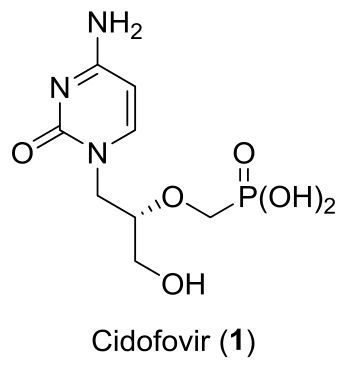
Cidofovir (1)
The key intermediate in the synthesis of cidofovir is optically pure diol 2, which can be prepared from L-mannitol (3).
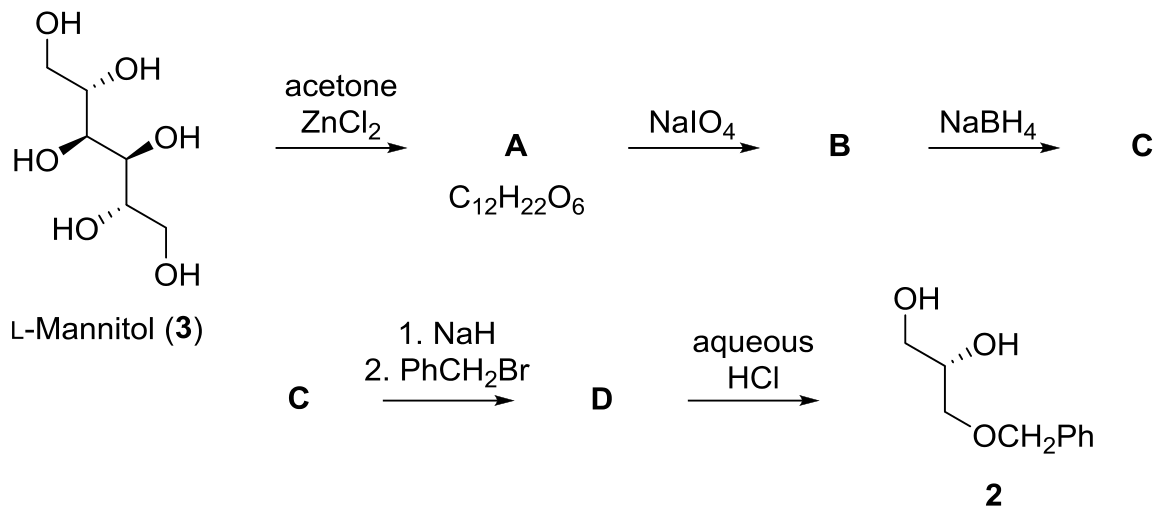
7.1 Draw the structures of compounds A–D, including stereochemistry. One molecule of A produces two molecules of B.
7.2 Draw the structural formulae of all alternative stereoisomers of compound 3 which could be used in the same reaction sequence to afford only the same product 2.
Diol 2 is further modified to provide compound I. The synthesis of phosphonate 4 used to convert compound F to G will be discussed later.
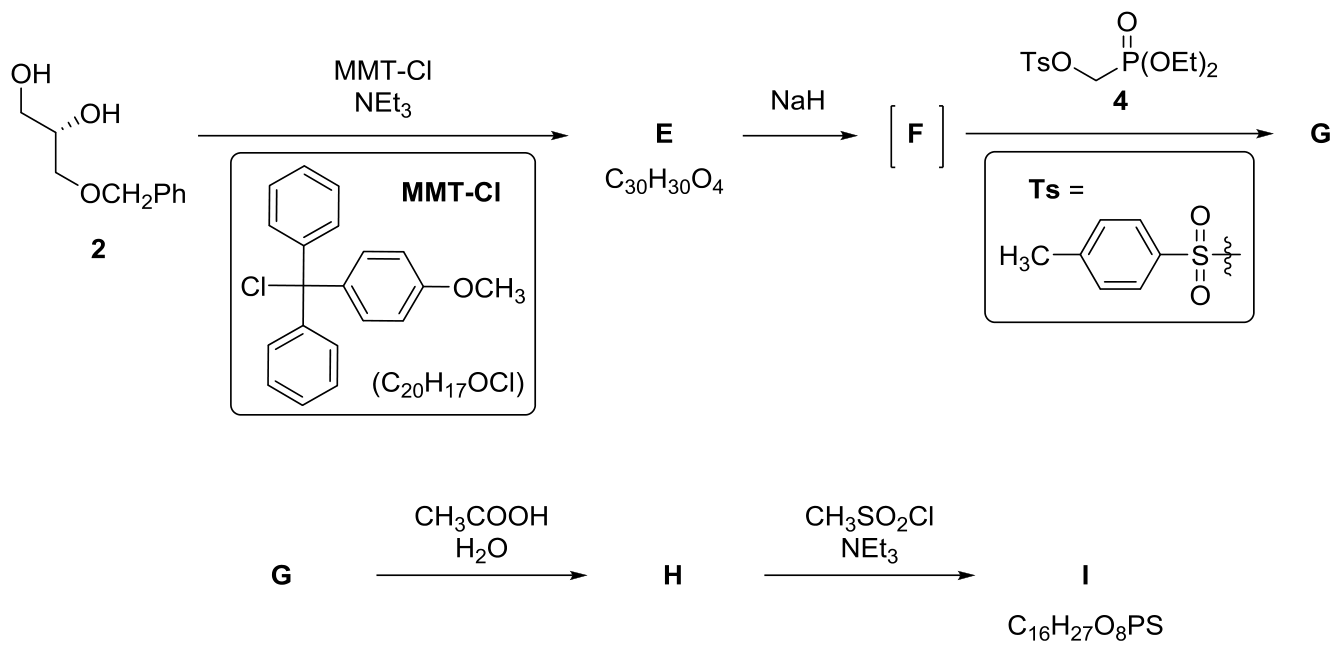
7.3 Draw the structures of compounds E–I, including stereochemistry. Use the abbreviation MMT for the (4-methoxyphenyl)diphenylmethyl group.
Official English text of the problem.
Answers
- 7.1. The four compounds are:
| Compound | Name | Stereochemical SMILES |
|---|---|---|
| A | 1,2:5,6-Di-O-isopropylidene-L-mannitol | CC1(C)OC[C@@H]([C@H](O)[C@@H](O)[C@@H]2COC(C)(C)O2)O1 |
| B | (4S)-2,2-Dimethyl-1,3-dioxolane-4-carbaldehyde | CC1(C)OC[C@@H](C=O)O1 |
| C | [(4R)-2,2-Dimethyl-1,3-dioxolan-4-yl]methanol, or (R)-solketal | CC1(C)OC[C@@H](CO)O1 |
| D | (4R)-4-[(Benzyloxy)methyl]-2,2-dimethyl-1,3-dioxolane | CC1(C)OC[C@@H](COCc2ccccc2)O1 |
- 7.2. There are two distinct alternative stereoisomers:
| Name | Absolute configuration along the hexitol chain | Stereochemical SMILES |
|---|---|---|
| L-Altritol | \((2S,3R,4S,5S)\) | OC[C@H](O)[C@@H](O)[C@@H](O)[C@@H](O)CO |
| L-Iditol | \((2S,3R,4R,5S)\) | OC[C@H](O)[C@@H](O)[C@H](O)[C@@H](O)CO |
To draw their Fischer projections, place \(\ce{CH2OH}\) at both ends of a vertical chain. From C2 to C5, put the hydroxyl groups right–left–left–left for L-altritol and right–left–right–left for L-iditol. Put hydrogen opposite each hydroxyl group.
- 7.3. MMT denotes the (4-methoxyphenyl)diphenylmethyl group. It is expanded in the SMILES to keep the strings chemically valid.
| Compound | Name | Stereochemical SMILES |
|---|---|---|
| E | (2R)-3-(Benzyloxy)-1-(MMT-oxy)propan-2-ol | COc1ccc(C(OC[C@H](O)COCc2ccccc2)(c2ccccc2)c2ccccc2)cc1 |
| F | Sodium (2R)-3-(benzyloxy)-1-(MMT-oxy)propan-2-olate | COc1ccc(C(OC[C@H]([O-])COCc2ccccc2)(c2ccccc2)c2ccccc2)cc1.[Na+] |
| G | Diethyl {[(2R)-3-(benzyloxy)-1-(MMT-oxy)propan-2-yl]oxymethyl}phosphonate | COc1ccc(C(OC[C@H](OCP(=O)(OCC)OCC)COCc2ccccc2)(c2ccccc2)c2ccccc2)cc1 |
| H | Diethyl {[(2S)-3-(benzyloxy)-1-hydroxypropan-2-yl]oxymethyl}phosphonate | OC[C@H](OCP(=O)(OCC)OCC)COCc1ccccc1 |
| I | Diethyl {[(2R)-3-(benzyloxy)-1-(methanesulfonyloxy)propan-2-yl]oxymethyl}phosphonate | CS(=O)(=O)OC[C@H](OCP(=O)(OCC)OCC)COCc1ccccc1 |
Solution
7.1. Identification of A–D
Number the original hexitol chain C1–C6. L-Mannitol (3) is \((2S,3S,4S,5S)\)-hexane-1,2,3,4,5,6-hexol, SMILES OC[C@H](O)[C@H](O)[C@@H](O)[C@@H](O)CO.
Formation of A: protection of the two terminal diols.
Acetone, CC(=O)C, forms cyclic ketals with vicinal diols. The molecular formula of A corresponds to incorporation of two acetone molecules with loss of two water molecules:
\[ \ce{C6H14O6 + 2 C3H6O <=>[ZnCl2] C12H22O6 + 2 H2O}. \]
To leave a cleavable central diol and subsequently produce two identical three-carbon fragments, the protected pairs must be O1/O2 and O5/O6. Thus A contains two five-membered acetonide rings, each with an \(\ce{O-C(CH3)2-O}\) bridge. The hydroxyl groups at C3 and C4 remain free.
No stereogenic carbon undergoes substitution or epimerization. The original spatial configurations are retained.
Formation of B: periodate cleavage.
The free C3–C4 vicinal diol forms a periodate ester and undergoes oxidative cleavage of the C3–C4 bond. Each of these carbons becomes an aldehyde carbon:
\[ \ce{C12H22O6 + NaIO4 -> 2 C6H10O3 + NaIO3 + H2O}. \]
The two halves have the same absolute configuration, so one molecule of A gives two molecules of B, the (S)-glyceraldehyde acetonide listed above. Its original terminal \(\ce{CH2OH}\) group and adjacent oxygen remain incorporated in the acetonide ring.
Formation of C: reduction of the aldehyde.
Sodium borohydride reduces the aldehyde substituent of B to \(\ce{CH2OH}\), while leaving the acetonide intact. A balanced net equation, including aqueous protonation/work-up, is
\[ \ce{4 C6H10O3 + NaBH4 + 4 H2O -> 4 C6H12O3 + Na[B(OH)4]}. \]
This gives C, (R)-solketal. No new stereocentre is formed: the aldehyde carbon becomes a methylene carbon.
The descriptor changes from \(S\) in B to \(R\) in C because reduction changes the CIP priority order of the two carbon substituents. It does not represent inversion at the existing stereocentre.
Formation of D: benzylation of the free alcohol.
Sodium hydride deprotonates the sole free hydroxyl group of C, releasing hydrogen. The resulting alkoxide attacks benzyl bromide, BrCc1ccccc1, at its benzylic carbon by an \(S_\mathrm{N}2\) reaction.
Using \(\ce{R}\) for the protected glycerol residue, the combined balanced equation is
\[ \ce{ROH + NaH + PhCH2Br -> ROCH2Ph + NaBr + H2}. \]
Consequently, D is obtained by replacing the exocyclic \(\ce{CH2OH}\) group of C with \(\ce{CH2OCH2Ph}\). Its acetonide and stereochemical arrangement remain intact.
Hydrolysis of D to verify product 2.
Aqueous hydrochloric acid hydrolyses the acetonide, restoring the primary and secondary hydroxyl groups:
\[ \ce{C13H18O3 + H2O ->[H+] C10H14O3 + (CH3)2CO}. \]
The benzyl ether remains in place. The product is (2S)-3-(benzyloxy)propane-1,2-diol (2), SMILES OC[C@H](O)COCc1ccccc1, exactly the stereoisomer shown in the question.
For a drawing matching the supplied orientation, place the \(\ce{CH2OH}\) arm above the stereocentre and the \(\ce{CH2OCH2Ph}\) arm below it; draw the central hydroxyl bond as a hashed wedge pointing behind the page.
7.2. Alternative starting stereoisomers
Only the original stereocentres at C2 and C5 survive the sequence. The centres at C3 and C4 are destroyed when periodate converts those carbons into aldehyde groups.
For both halves to give exclusively the specified product 2, C2 and C5 must therefore both retain the configurations present in L-mannitol: \(2S\) and \(5S\). The configurations at C3 and C4 may be chosen independently:
| C2 | C3 | C4 | C5 | Identity |
|---|---|---|---|---|
| \(S\) | \(S\) | \(S\) | \(S\) | Original L-mannitol |
| \(S\) | \(R\) | \(S\) | \(S\) | L-Altritol |
| \(S\) | \(S\) | \(R\) | \(S\) | The same L-altritol, numbered from the opposite end |
| \(S\) | \(R\) | \(R\) | \(S\) | L-Iditol |
The two mixed configurations in the middle rows describe the same molecule, because the terminal groups are identical and the chain can be numbered from either end.
Thus there are exactly two additional starting stereoisomers, L-altritol and L-iditol. Their terminal acetonide-protected fragments become identical to B after cleavage, regardless of the configurations of the two carbons being cleaved.
7.3. Identification of E–I
Throughout this sequence, the carbon skeleton and the spatial arrangement at its stereocentre are preserved. To draw every intermediate in the orientation used for 2, keep the upper primary carbon arm and lower benzyl-protected carbon arm in the plane, and keep the bond from the central carbon to oxygen pointing behind the plane.
Formation of E: selective primary hydroxyl protection.
The bulky MMT group protects the less hindered primary hydroxyl group. The secondary hydroxyl group remains free.
MMT chloride is (4-methoxyphenyl)diphenylmethyl chloride, SMILES COc1ccc(C(Cl)(c2ccccc2)c2ccccc2)cc1. Triethylamine captures the hydrogen chloride produced:
\[ \ce{ROH + MMTCl + NEt3 -> ROMMT + [Et3NH]Cl}. \]
Therefore E has the connectivity
\[ \ce{MMT-O-CH2-CH(OH)-CH2-O-CH2-Ph}, \]
with the stereochemistry specified in its SMILES.
The formula check is
\[ \ce{C10H14O3 + C20H17OCl -> C30H30O4 + HCl}, \]
consistent with the stated formula of E.
Formation of F: secondary alkoxide formation.
Sodium hydride removes the proton of the remaining secondary hydroxyl group:
\[ \ce{ROH + NaH -> RONa + H2}. \]
Thus F is the sodium alkoxide of E. Its central substituent is \(\ce{O^-}\), with \(\ce{Na+}\) as counterion. The ionic SMILES does not prescribe a particular sodium coordination, solvation or aggregation state.
Formation of G: phosphonomethylation at oxygen.
Reagent 4 is diethyl (tosyloxymethyl)phosphonate, SMILES CCOP(=O)(COS(=O)(=O)c1ccc(C)cc1)OCC.
The alkoxide oxygen of F attacks the methylene carbon bearing the tosylate leaving group:
\[ \ce{RONa + TsOCH2P(=O)(OEt)2 -> ROCH2P(=O)(OEt)2 + TsONa}. \]
This installs the central substituent
\[ \ce{-O-CH2-P(=O)(OEt)2} \]
and gives G. The new bond is formed between the alkoxide oxygen and the reagent’s methylene carbon. No bond at the existing stereogenic carbon is displaced.
Formation of H: removal of MMT.
Aqueous acetic acid cleaves the acid-labile MMT ether, restoring the primary alcohol:
\[ \ce{ROMMT + H2O ->[H+] ROH + MMTOH}. \]
The benzyl ether and diethyl phosphonate groups remain intact. Thus H has the connectivity
\[ \ce{HO-CH2-CH(OCH2P(=O)(OEt)2)-CH2-O-CH2-Ph}. \]
Formation of I: mesylation of the primary alcohol.
Methanesulfonyl chloride, CS(=O)(=O)Cl, converts the primary hydroxyl group of H into its methanesulfonate ester. Triethylamine captures the hydrogen chloride:
\[ \ce{ROH + CH3SO2Cl + NEt3 -> ROSO2CH3 + [Et3NH]Cl}. \]
The product therefore has the connectivity
\[ \ce{CH3SO2-O-CH2-CH(OCH2P(=O)(OEt)2)-CH2-O-CH2-Ph}, \]
with the stereochemistry of I given in the answer table.
Starting from \(\ce{C15H25O6P}\) for H, replacing the hydroxyl hydrogen by \(\ce{SO2CH3}\) gives
\[ \boxed{\ce{C16H27O8PS}}, \]
matching the supplied formula.
The absolute descriptors along this sequence are
\[ \mathbf{2}\;(S) \longrightarrow \mathbf{E}\;(R) \longrightarrow \mathbf{F}\;(R) \longrightarrow \mathbf{G}\;(R) \longrightarrow \mathbf{H}\;(S) \longrightarrow \mathbf{I}\;(R). \]
These changes in \(R/S\) labels arise solely from changes in CIP priorities. There is no inversion or loss of configuration at the surviving stereocentre.
The answers were checked against the official answers published by the organisers.
IChO 2018 · Theorieaufgabe 7
Cidofovir
Cidofovir (1), das ursprünglich von der Arbeitsgruppe von Professor Holy in der ehemaligen Tschechoslowakei entwickelt und hergestellt wurde, ist ein Nukleotidanalogon mit antiviraler Wirkung. Es wird zur Behandlung von Virusinfektionen eingesetzt, überwiegend bei Patienten mit AIDS.
Cidofovir (1)
Das Schlüsselintermediat bei der Synthese von Cidofovir ist das optisch reine Diol 2, das aus L-Mannitol (3) hergestellt werden kann.
7.1 Zeichnen Sie die Strukturen der Verbindungen A–D einschließlich ihrer Stereochemie. Ein Molekül A ergibt zwei Moleküle B.
7.2 Zeichnen Sie die Strukturformeln aller alternativen Stereoisomere der Verbindung 3, die in derselben Reaktionsfolge eingesetzt werden könnten, um ausschließlich dasselbe Produkt 2 zu erhalten.
Diol 2 wird weiter modifiziert, um Verbindung I zu erhalten. Die Synthese des Phosphonats 4, das zur Umwandlung von Verbindung F in G verwendet wird, wird später behandelt.
7.3 Zeichnen Sie die Strukturen der Verbindungen E–I einschließlich ihrer Stereochemie. Verwenden Sie die Abkürzung MMT für die (4-Methoxyphenyl)diphenylmethylgruppe.
Aufgabentext aus dem offiziellen englischen Text übersetzt.
Antworten
- 7.1. Die vier Verbindungen sind:
| Verbindung | Name | Stereochemischer SMILES |
|---|---|---|
| A | 1,2:5,6-Di-O-isopropyliden-L-mannitol | CC1(C)OC[C@@H]([C@H](O)[C@@H](O)[C@@H]2COC(C)(C)O2)O1 |
| B | (4S)-2,2-Dimethyl-1,3-dioxolan-4-carbaldehyd | CC1(C)OC[C@@H](C=O)O1 |
| C | [(4R)-2,2-Dimethyl-1,3-dioxolan-4-yl]methanol oder (R)-Solketal | CC1(C)OC[C@@H](CO)O1 |
| D | (4R)-4-[(Benzyloxy)methyl]-2,2-dimethyl-1,3-dioxolan | CC1(C)OC[C@@H](COCc2ccccc2)O1 |
- 7.2. Es gibt zwei verschiedene alternative Stereoisomere:
| Name | Absolute Konfiguration entlang der Hexitolkette | Stereochemischer SMILES |
|---|---|---|
| L-Altritol | \((2S,3R,4S,5S)\) | OC[C@H](O)[C@@H](O)[C@@H](O)[C@@H](O)CO |
| L-Iditol | \((2S,3R,4R,5S)\) | OC[C@H](O)[C@@H](O)[C@H](O)[C@@H](O)CO |
Um ihre Fischer-Projektionen zu zeichnen, setzen Sie \(\ce{CH2OH}\) an beide Enden einer senkrechten Kette. Ordnen Sie die Hydroxygruppen von C2 bis C5 bei L-Altritol rechts–links–links–links und bei L-Iditol rechts–links–rechts–links an. Setzen Sie jeweils gegenüber jeder Hydroxygruppe ein Wasserstoffatom.
- 7.3. MMT bezeichnet die (4-Methoxyphenyl)diphenylmethylgruppe. In den SMILES ist sie ausgeschrieben, damit die Zeichenfolgen chemisch gültig bleiben.
| Verbindung | Name | Stereochemischer SMILES |
|---|---|---|
| E | (2R)-3-(Benzyloxy)-1-(MMT-oxy)propan-2-ol | COc1ccc(C(OC[C@H](O)COCc2ccccc2)(c2ccccc2)c2ccccc2)cc1 |
| F | Natrium-(2R)-3-(benzyloxy)-1-(MMT-oxy)propan-2-olat | COc1ccc(C(OC[C@H]([O-])COCc2ccccc2)(c2ccccc2)c2ccccc2)cc1.[Na+] |
| G | {[(2R)-3-(Benzyloxy)-1-(MMT-oxy)propan-2-yl]oxymethyl}phosphonsäurediethylester | COc1ccc(C(OC[C@H](OCP(=O)(OCC)OCC)COCc2ccccc2)(c2ccccc2)c2ccccc2)cc1 |
| H | {[(2S)-3-(Benzyloxy)-1-hydroxypropan-2-yl]oxymethyl}phosphonsäurediethylester | OC[C@H](OCP(=O)(OCC)OCC)COCc1ccccc1 |
| I | {[(2R)-3-(Benzyloxy)-1-(methansulfonyloxy)propan-2-yl]oxymethyl}phosphonsäurediethylester | CS(=O)(=O)OC[C@H](OCP(=O)(OCC)OCC)COCc1ccccc1 |
Lösung
7.1. Identifizierung von A–D
Nummerieren Sie die ursprüngliche Hexitolkette mit C1–C6. L-Mannitol (3) ist \((2S,3S,4S,5S)\)-Hexan-1,2,3,4,5,6-hexol, SMILES OC[C@H](O)[C@H](O)[C@@H](O)[C@@H](O)CO.
Bildung von A: Schutz der beiden endständigen Diole.
Aceton, CC(=O)C, bildet mit vicinalen Diolen cyclische Ketale. Die Summenformel von A entspricht dem Einbau von zwei Acetonmolekülen unter Abspaltung von zwei Wassermolekülen:
\[ \ce{C6H14O6 + 2 C3H6O <=>[ZnCl2] C12H22O6 + 2 H2O}. \]
Damit ein spaltbares zentrales Diol erhalten bleibt und anschließend zwei identische Fragmente mit je drei Kohlenstoffatomen entstehen, müssen die geschützten Paare O1/O2 und O5/O6 sein. Somit enthält A zwei fünfgliedrige Acetonidringe mit jeweils einer \(\ce{O-C(CH3)2-O}\)-Brücke. Die Hydroxygruppen an C3 und C4 bleiben frei.
An keinem stereogenen Kohlenstoffatom findet eine Substitution oder Epimerisierung statt. Die ursprünglichen räumlichen Konfigurationen bleiben erhalten.
Bildung von B: Periodatspaltung.
Das freie vicinale C3–C4-Diol bildet einen Periodatester und wird unter oxidativer Spaltung der C3–C4-Bindung umgesetzt. Jedes dieser Kohlenstoffatome wird zu einem Aldehydkohlenstoffatom:
\[ \ce{C12H22O6 + NaIO4 -> 2 C6H10O3 + NaIO3 + H2O}. \]
Die beiden Hälften besitzen dieselbe absolute Konfiguration, sodass ein Molekül A zwei Moleküle B, das oben aufgeführte (S)-Glycerinaldehydacetonid, ergibt. Seine ursprüngliche endständige \(\ce{CH2OH}\)-Gruppe und das benachbarte Sauerstoffatom bleiben in den Acetonidring eingebunden.
Bildung von C: Reduktion des Aldehyds.
Natriumborhydrid reduziert den Aldehydsubstituenten von B zu \(\ce{CH2OH}\), während das Acetonid intakt bleibt. Eine ausgeglichene Nettogleichung unter Einbeziehung der Protonierung und Aufarbeitung in wässrigem Medium lautet
\[ \ce{4 C6H10O3 + NaBH4 + 4 H2O -> 4 C6H12O3 + Na[B(OH)4]}. \]
Dabei entsteht C, (R)-Solketal. Es wird kein neues Stereozentrum gebildet: Das Aldehydkohlenstoffatom wird zu einem Methylenkohlenstoffatom.
Der Deskriptor wechselt von \(S\) in B zu \(R\) in C, weil die Reduktion die CIP-Prioritätsreihenfolge der beiden Kohlenstoffsubstituenten ändert. Dies bedeutet keine Inversion am vorhandenen Stereozentrum.
Bildung von D: Benzylierung des freien Alkohols.
Natriumhydrid deprotoniert die einzige freie Hydroxygruppe von C unter Freisetzung von Wasserstoff. Das entstandene Alkoholat greift Benzylbromid, BrCc1ccccc1, in einer \(S_\mathrm{N}2\)-Reaktion an dessen benzylischem Kohlenstoffatom an.
Mit \(\ce{R}\) als Bezeichnung für den geschützten Glycerinrest lautet die zusammengefasste ausgeglichene Gleichung
\[ \ce{ROH + NaH + PhCH2Br -> ROCH2Ph + NaBr + H2}. \]
Folglich erhält man D, indem die exocyclische \(\ce{CH2OH}\)-Gruppe von C durch \(\ce{CH2OCH2Ph}\) ersetzt wird. Das Acetonid und die stereochemische Anordnung bleiben erhalten.
Hydrolyse von D zur Überprüfung von Produkt 2.
Wässrige Salzsäure hydrolysiert das Acetonid und stellt dabei die primäre und die sekundäre Hydroxygruppe wieder her:
\[ \ce{C13H18O3 + H2O ->[H+] C10H14O3 + (CH3)2CO}. \]
Der Benzylether bleibt erhalten. Das Produkt ist (2S)-3-(Benzyloxy)propan-1,2-diol (2), SMILES OC[C@H](O)COCc1ccccc1, genau das in der Aufgabenstellung gezeigte Stereoisomer.
Für eine Zeichnung, die der vorgegebenen Orientierung entspricht, platzieren Sie den \(\ce{CH2OH}\)-Arm oberhalb und den \(\ce{CH2OCH2Ph}\)-Arm unterhalb des Stereozentrums; zeichnen Sie die Bindung zur zentralen Hydroxygruppe als gestrichelten Keil, der hinter die Zeichenebene weist.
7.2. Alternative Ausgangsstereoisomere
Nur die ursprünglichen Stereozentren an C2 und C5 bleiben im Verlauf der Reaktionsfolge erhalten. Die Zentren an C3 und C4 gehen verloren, wenn Periodat diese Kohlenstoffatome in Aldehydgruppen umwandelt.
Damit beide Hälften ausschließlich das vorgegebene Produkt 2 ergeben, müssen C2 und C5 daher jeweils die in L-Mannitol vorliegenden Konfigurationen beibehalten: \(2S\) und \(5S\). Die Konfigurationen an C3 und C4 können unabhängig voneinander gewählt werden:
| C2 | C3 | C4 | C5 | Identität |
|---|---|---|---|---|
| \(S\) | \(S\) | \(S\) | \(S\) | Ursprüngliches L-Mannitol |
| \(S\) | \(R\) | \(S\) | \(S\) | L-Altritol |
| \(S\) | \(S\) | \(R\) | \(S\) | Dasselbe L-Altritol, vom gegenüberliegenden Ende aus nummeriert |
| \(S\) | \(R\) | \(R\) | \(S\) | L-Iditol |
Die beiden gemischten Konfigurationen in den mittleren Zeilen beschreiben dasselbe Molekül, da die endständigen Gruppen identisch sind und die Kette von beiden Enden aus nummeriert werden kann.
Somit gibt es genau zwei weitere Ausgangsstereoisomere, L-Altritol und L-Iditol. Ihre endständigen, als Acetonid geschützten Fragmente sind nach der Spaltung mit B identisch, unabhängig von den Konfigurationen der beiden Kohlenstoffatome, zwischen denen die Spaltung erfolgt.
7.3. Identifizierung von E–I
Während dieser gesamten Reaktionsfolge bleiben das Kohlenstoffgerüst und die räumliche Anordnung am Stereozentrum erhalten. Um jedes Zwischenprodukt in der für 2 verwendeten Orientierung zu zeichnen, belassen Sie den oberen primären Kohlenstoffarm und den unteren benzylgeschützten Kohlenstoffarm in der Ebene und richten Sie die Bindung vom zentralen Kohlenstoffatom zum Sauerstoff weiterhin hinter die Ebene.
Bildung von E: selektiver Schutz der primären Hydroxygruppe.
Die sperrige MMT-Gruppe schützt die sterisch weniger gehinderte primäre Hydroxygruppe. Die sekundäre Hydroxygruppe bleibt frei.
MMT-Chlorid ist (4-Methoxyphenyl)diphenylmethylchlorid, SMILES COc1ccc(C(Cl)(c2ccccc2)c2ccccc2)cc1. Triethylamin fängt den entstehenden Chlorwasserstoff ab:
\[ \ce{ROH + MMTCl + NEt3 -> ROMMT + [Et3NH]Cl}. \]
Somit besitzt E die Konnektivität
\[ \ce{MMT-O-CH2-CH(OH)-CH2-O-CH2-Ph}, \]
mit der in seinem SMILES angegebenen Stereochemie.
Die Überprüfung der Summenformel ergibt
\[ \ce{C10H14O3 + C20H17OCl -> C30H30O4 + HCl}, \]
in Übereinstimmung mit der angegebenen Summenformel von E.
Bildung von F: Bildung des sekundären Alkoholats.
Natriumhydrid entfernt das Proton der verbleibenden sekundären Hydroxygruppe:
\[ \ce{ROH + NaH -> RONa + H2}. \]
Somit ist F das Natriumalkoholat von E. Sein zentraler Substituent ist \(\ce{O^-}\), mit \(\ce{Na+}\) als Gegenion. Der ionische SMILES legt keine bestimmte Natriumkoordination, Solvatation oder Aggregationsform fest.
Bildung von G: Phosphonomethylierung am Sauerstoff.
Reagenz 4 ist (Tosyloxymethyl)phosphonsäurediethylester, SMILES CCOP(=O)(COS(=O)(=O)c1ccc(C)cc1)OCC.
Das Alkoholatsauerstoffatom von F greift das Methylenkohlenstoffatom an, das die Tosylat-Abgangsgruppe trägt:
\[ \ce{RONa + TsOCH2P(=O)(OEt)2 -> ROCH2P(=O)(OEt)2 + TsONa}. \]
Dadurch wird der zentrale Substituent
\[ \ce{-O-CH2-P(=O)(OEt)2} \]
eingeführt, und es entsteht G. Die neue Bindung wird zwischen dem Alkoholatsauerstoffatom und dem Methylenkohlenstoffatom des Reagenzes gebildet. Keine Bindung am vorhandenen stereogenen Kohlenstoffatom wird dabei ersetzt.
Bildung von H: Entfernung von MMT.
Wässrige Essigsäure spaltet den säurelabilen MMT-Ether und stellt den primären Alkohol wieder her:
\[ \ce{ROMMT + H2O ->[H+] ROH + MMTOH}. \]
Die Benzylether- und die Phosphonsäurediethylestergruppe bleiben intakt. Somit besitzt H die Konnektivität
\[ \ce{HO-CH2-CH(OCH2P(=O)(OEt)2)-CH2-O-CH2-Ph}. \]
Bildung von I: Mesylierung des primären Alkohols.
Methansulfonylchlorid, CS(=O)(=O)Cl, wandelt die primäre Hydroxygruppe von H in ihren Methansulfonsäureester um. Triethylamin fängt den Chlorwasserstoff ab:
\[ \ce{ROH + CH3SO2Cl + NEt3 -> ROSO2CH3 + [Et3NH]Cl}. \]
Das Produkt besitzt daher die Konnektivität
\[ \ce{CH3SO2-O-CH2-CH(OCH2P(=O)(OEt)2)-CH2-O-CH2-Ph}, \]
mit der in der Antworttabelle angegebenen Stereochemie von I.
Ausgehend von \(\ce{C15H25O6P}\) für H ergibt der Ersatz des Hydroxygruppenwasserstoffs durch \(\ce{SO2CH3}\)
\[ \boxed{\ce{C16H27O8PS}}, \]
in Übereinstimmung mit der vorgegebenen Summenformel.
Die absoluten Deskriptoren entlang dieser Reaktionsfolge sind
\[ \mathbf{2}\;(S) \longrightarrow \mathbf{E}\;(R) \longrightarrow \mathbf{F}\;(R) \longrightarrow \mathbf{G}\;(R) \longrightarrow \mathbf{H}\;(S) \longrightarrow \mathbf{I}\;(R). \]
Diese Änderungen der \(R/S\)-Bezeichnungen ergeben sich ausschließlich aus Änderungen der CIP-Prioritäten. Am erhalten gebliebenen Stereozentrum findet weder eine Inversion noch ein Verlust der Konfiguration statt.
Die Ergebnisse wurden mit den von den Veranstaltern veröffentlichten offiziellen Ergebnissen abgeglichen.
IChO 2018 · Teori sorusu 7
Sidofovir
İlk olarak eski Çekoslovakya'da Profesör Holy'nin grubu tarafından tasarlanıp sentezlenen sidofovir (1), antiviral etkinliğe sahip bir nükleotit analoğudur. Çoğunlukla AIDS hastalarında olmak üzere viral enfeksiyonların tedavisinde kullanılır.
Sidofovir (1)
Sidofovir sentezindeki temel ara ürün, L-mannitolden (3) hazırlanabilen optikçe saf diol 2'dir.
7.1 A–D bileşiklerinin yapılarını stereokimyalarını da içerecek şekilde çiziniz. Bir A molekülünden iki B molekülü oluşur.
7.2 Aynı tepkime dizisinde kullanıldığında yalnızca aynı 2 ürününü verebilecek, 3 bileşiğinin diğer tüm stereoizomerlerinin yapı formüllerini çiziniz.
Diol 2, sonraki dönüşümlerle I bileşiğine dönüştürülür. F bileşiğini G'ye dönüştürmek için kullanılan fosfonat 4'ün sentezi daha sonra ele alınacaktır.
7.3 E–I bileşiklerinin yapılarını stereokimyalarını da içerecek şekilde çiziniz. (4-Metoksifenil)difenilmetil grubu için MMT kısaltmasını kullanınız.
Soru metni resmi İngilizce metinden çevrilmiştir.
Cevaplar
- 7.1. Dört bileşik şunlardır:
| Bileşik | Adı | Stereokimyasal SMILES |
|---|---|---|
| A | 1,2:5,6-Di-O-izopropiliden-L-mannitol | CC1(C)OC[C@@H]([C@H](O)[C@@H](O)[C@@H]2COC(C)(C)O2)O1 |
| B | (4S)-2,2-Dimetil-1,3-dioksolan-4-karbaldehit | CC1(C)OC[C@@H](C=O)O1 |
| C | [(4R)-2,2-Dimetil-1,3-dioksolan-4-il]metanol veya (R)-solketal | CC1(C)OC[C@@H](CO)O1 |
| D | (4R)-4-[(Benziloksi)metil]-2,2-dimetil-1,3-dioksolan | CC1(C)OC[C@@H](COCc2ccccc2)O1 |
- 7.2. İki farklı alternatif stereoizomer vardır:
| Adı | Heksitol zinciri boyunca mutlak konfigürasyon | Stereokimyasal SMILES |
|---|---|---|
| L-Altritol | \((2S,3R,4S,5S)\) | OC[C@H](O)[C@@H](O)[C@@H](O)[C@@H](O)CO |
| L-İditol | \((2S,3R,4R,5S)\) | OC[C@H](O)[C@@H](O)[C@H](O)[C@@H](O)CO |
Fischer izdüşümlerini çizmek için dikey bir zincirin her iki ucuna \(\ce{CH2OH}\) yerleştiriniz. C2'den C5'e doğru hidroksil gruplarını L-altritol için sağ–sol–sol–sol, L-iditol için sağ–sol–sağ–sol yönünde yerleştiriniz. Her hidroksil grubunun karşısına hidrojen yerleştiriniz.
- 7.3. MMT, (4-metoksifenil)difenilmetil grubunu belirtir. Dizelerin kimyasal olarak geçerli kalması için bu grup SMILES gösterimlerinde açık biçimde yazılmıştır.
| Bileşik | Adı | Stereokimyasal SMILES |
|---|---|---|
| E | (2R)-3-(Benziloksi)-1-(MMT-oksi)propan-2-ol | COc1ccc(C(OC[C@H](O)COCc2ccccc2)(c2ccccc2)c2ccccc2)cc1 |
| F | Sodyum (2R)-3-(benziloksi)-1-(MMT-oksi)propan-2-olat | COc1ccc(C(OC[C@H]([O-])COCc2ccccc2)(c2ccccc2)c2ccccc2)cc1.[Na+] |
| G | Dietil {[(2R)-3-(benziloksi)-1-(MMT-oksi)propan-2-il]oksimetil}fosfonat | COc1ccc(C(OC[C@H](OCP(=O)(OCC)OCC)COCc2ccccc2)(c2ccccc2)c2ccccc2)cc1 |
| H | Dietil {[(2S)-3-(benziloksi)-1-hidroksipropan-2-il]oksimetil}fosfonat | OC[C@H](OCP(=O)(OCC)OCC)COCc1ccccc1 |
| I | Dietil {[(2R)-3-(benziloksi)-1-(metansülfoniloksi)propan-2-il]oksimetil}fosfonat | CS(=O)(=O)OC[C@H](OCP(=O)(OCC)OCC)COCc1ccccc1 |
Çözüm
7.1. A–D'nin belirlenmesi
Başlangıçtaki heksitol zincirini C1–C6 olarak numaralandırınız. L-Mannitol (3), \((2S,3S,4S,5S)\)-heksan-1,2,3,4,5,6-heksoldür; SMILES gösterimi OC[C@H](O)[C@H](O)[C@@H](O)[C@@H](O)CO şeklindedir.
A'nın oluşumu: uçlardaki iki diolün korunması.
Aseton, CC(=O)C, komşu diollerle halkalı ketaller oluşturur. A'nın molekül formülü, iki su molekülünün ayrılmasıyla iki aseton molekülünün yapıya katılmasına karşılık gelir:
\[ \ce{C6H14O6 + 2 C3H6O <=>[ZnCl2] C12H22O6 + 2 H2O}. \]
Merkezde parçalanabilir bir diol bırakmak ve ardından birbirinin aynı iki üç karbonlu parça oluşturmak için korunan çiftler O1/O2 ve O5/O6 olmalıdır. Dolayısıyla A, her birinde bir \(\ce{O-C(CH3)2-O}\) köprüsü bulunan iki beş üyeli asetonid halkası içerir. C3 ve C4'teki hidroksil grupları serbest kalır.
Hiçbir stereojenik karbon, yer değiştirme tepkimesine veya epimerleşmeye uğramaz. Başlangıçtaki uzaysal konfigürasyonlar korunur.
B'nin oluşumu: periyodatla parçalanma.
Serbest C3–C4 komşu diolü bir periyodat esteri oluşturur ve C3–C4 bağı yükseltgenerek parçalanır. Bu karbonların her biri bir aldehit karbonuna dönüşür:
\[ \ce{C12H22O6 + NaIO4 -> 2 C6H10O3 + NaIO3 + H2O}. \]
İki yarı aynı mutlak konfigürasyona sahip olduğundan, bir A molekülü yukarıda verilen (S)-gliseraldehit asetonid olan B'den iki molekül verir. Başlangıçtaki uç \(\ce{CH2OH}\) grubu ve ona komşu oksijen, asetonid halkasının içinde kalır.
C'nin oluşumu: aldehidin indirgenmesi.
Sodyum borohidrür, asetonidi bozmadan B'nin aldehit sübstitüentini \(\ce{CH2OH}\) grubuna indirger. Sulu ortamda protonlanmayı ve tepkime sonrası işlemleri içeren denkleştirilmiş net denklem şöyledir:
\[ \ce{4 C6H10O3 + NaBH4 + 4 H2O -> 4 C6H12O3 + Na[B(OH)4]}. \]
Böylece C, yani (R)-solketal elde edilir. Yeni bir stereomerkez oluşmaz: aldehit karbonu bir metilen karbonuna dönüşür.
İndirgenme, iki karbon sübstitüentinin CIP öncelik sırasını değiştirdiğinden, konfigürasyon belirteci B'de \(S\) iken C'de \(R\) olur. Bu, mevcut stereomerkezde bir ters dönme olduğu anlamına gelmez.
D'nin oluşumu: serbest alkolün benzillenmesi.
Sodyum hidrür, C'nin tek serbest hidroksil grubunun protonunu uzaklaştırarak hidrojen açığa çıkarır. Oluşan alkoksit, benzil bromüre, BrCc1ccccc1, benzilik karbonundan bir \(S_\mathrm{N}2\) tepkimesiyle saldırır.
Korunmuş gliserol kalıntısı için \(\ce{R}\) kullanıldığında, birleştirilmiş denkleştirilmiş denklem şöyledir:
\[ \ce{ROH + NaH + PhCH2Br -> ROCH2Ph + NaBr + H2}. \]
Sonuç olarak D, C'nin halka dışındaki \(\ce{CH2OH}\) grubunun \(\ce{CH2OCH2Ph}\) ile değiştirilmesiyle elde edilir. Asetonidi ve stereokimyasal düzeni korunur.
Ürün 2'yi doğrulamak için D'nin hidrolizi.
Sulu hidroklorik asit, asetonidi hidroliz ederek birincil ve ikincil hidroksil gruplarını yeniden oluşturur:
\[ \ce{C13H18O3 + H2O ->[H+] C10H14O3 + (CH3)2CO}. \]
Benzil eter grubu yerinde kalır. Ürün, SMILES gösterimi OC[C@H](O)COCc1ccccc1 olan (2S)-3-(benziloksi)propan-1,2-diol (2)'dir ve soruda gösterilen stereoizomerin aynısıdır.
Verilen yönelimle uyumlu bir çizim için \(\ce{CH2OH}\) kolunu stereomerkezin üstüne, \(\ce{CH2OCH2Ph}\) kolunu ise altına yerleştiriniz; merkezdeki hidroksil bağını sayfa düzleminin arkasına yönelen kesikli kama olarak çiziniz.
7.2. Alternatif başlangıç stereoizomerleri
Tepkime dizisi boyunca başlangıçtaki stereomerkezlerden yalnızca C2 ve C5'tekiler korunur. Periyodat C3 ve C4 karbonlarını aldehit gruplarına dönüştürdüğünde bu karbonlardaki stereomerkezler ortadan kalkar.
Dolayısıyla her iki yarının da yalnızca belirtilen 2 ürününü vermesi için C2 ve C5'in her ikisi de L-mannitoldeki konfigürasyonlarını, yani \(2S\) ve \(5S\)'yi korumalıdır. C3 ve C4'teki konfigürasyonlar birbirinden bağımsız olarak seçilebilir:
| C2 | C3 | C4 | C5 | Bileşik |
|---|---|---|---|---|
| \(S\) | \(S\) | \(S\) | \(S\) | Başlangıçtaki L-mannitol |
| \(S\) | \(R\) | \(S\) | \(S\) | L-Altritol |
| \(S\) | \(S\) | \(R\) | \(S\) | Karşı uçtan numaralandırılmış aynı L-altritol |
| \(S\) | \(R\) | \(R\) | \(S\) | L-İditol |
Ortadaki satırlarda yer alan iki karma konfigürasyon aynı molekülü tanımlar; çünkü uç gruplar aynıdır ve zincir her iki uçtan da numaralandırılabilir.
Dolayısıyla başlangıç maddesi olarak kullanılabilecek tam olarak iki ek stereoizomer vardır: L-altritol ve L-iditol. Parçalanan iki karbonun konfigürasyonlarından bağımsız olarak, uçlardaki asetonidle korunmuş parçaları parçalanmadan sonra B ile aynı hâle gelir.
7.3. E–I'nın belirlenmesi
Bu tepkime dizisi boyunca karbon iskeleti ve stereomerkezindeki uzaysal düzen korunur. Her ara ürünü 2 için kullanılan yönelimde çizmek için üstteki birincil karbon kolunu ve alttaki benzille korunmuş karbon kolunu düzlemde tutunuz; merkez karbonundan oksijene uzanan bağı da düzlemin arkasına yönelmiş olarak koruyunuz.
E'nin oluşumu: birincil hidroksil grubunun seçici olarak korunması.
Hacimli MMT grubu, sterik engeli daha az olan birincil hidroksil grubunu korur. İkincil hidroksil grubu serbest kalır.
MMT klorür, SMILES gösterimi COc1ccc(C(Cl)(c2ccccc2)c2ccccc2)cc1 olan (4-metoksifenil)difenilmetil klorürdür. Trietilamin, oluşan hidrojen klorürü tutar:
\[ \ce{ROH + MMTCl + NEt3 -> ROMMT + [Et3NH]Cl}. \]
Dolayısıyla E şu bağlanma düzenine sahiptir:
\[ \ce{MMT-O-CH2-CH(OH)-CH2-O-CH2-Ph}, \]
Stereokimyası SMILES gösteriminde belirtilmiştir.
Formül kontrolü şöyledir:
\[ \ce{C10H14O3 + C20H17OCl -> C30H30O4 + HCl}, \]
Bu, E için belirtilen formülle uyumludur.
F'nin oluşumu: ikincil alkoksit oluşumu.
Sodyum hidrür, geriye kalan ikincil hidroksil grubunun protonunu uzaklaştırır:
\[ \ce{ROH + NaH -> RONa + H2}. \]
Böylece F, E'nin sodyum alkoksitidir. Merkezdeki sübstitüenti \(\ce{O^-}\), karşı iyonu ise \(\ce{Na+}\)'dır. İyonik SMILES gösterimi, sodyum için belirli bir koordinasyon, solvatasyon veya agregasyon durumu belirtmez.
G'nin oluşumu: oksijen üzerinde fosfonometilleme.
4 reaktifi, SMILES gösterimi CCOP(=O)(COS(=O)(=O)c1ccc(C)cc1)OCC olan dietil (tosiloksimetil)fosfonattır.
F'nin alkoksit oksijeni, ayrılan grup olan tosilatı taşıyan metilen karbonuna saldırır:
\[ \ce{RONa + TsOCH2P(=O)(OEt)2 -> ROCH2P(=O)(OEt)2 + TsONa}. \]
Bu işlem, merkezdeki
\[ \ce{-O-CH2-P(=O)(OEt)2} \]
sübstitüentini oluşturur ve G'yi verir. Yeni bağ, alkoksit oksijeni ile reaktifin metilen karbonu arasında oluşur. Mevcut stereojenik karbondaki hiçbir bağ yer değiştirme tepkimesine uğramaz.
H'nin oluşumu: MMT'nin uzaklaştırılması.
Sulu asetik asit, aside duyarlı MMT eterini parçalayarak birincil alkolü yeniden oluşturur:
\[ \ce{ROMMT + H2O ->[H+] ROH + MMTOH}. \]
Benzil eter ve dietil fosfonat grupları korunur. Dolayısıyla H şu bağlanma düzenine sahiptir:
\[ \ce{HO-CH2-CH(OCH2P(=O)(OEt)2)-CH2-O-CH2-Ph}. \]
I'nın oluşumu: birincil alkolün mesillenmesi.
Metansülfonil klorür, CS(=O)(=O)Cl, H'nin birincil hidroksil grubunu metansülfonat esterine dönüştürür. Trietilamin, hidrojen klorürü tutar:
\[ \ce{ROH + CH3SO2Cl + NEt3 -> ROSO2CH3 + [Et3NH]Cl}. \]
Dolayısıyla ürün şu bağlanma düzenine sahiptir:
\[ \ce{CH3SO2-O-CH2-CH(OCH2P(=O)(OEt)2)-CH2-O-CH2-Ph}, \]
I'nın stereokimyası cevap tablosunda verilmiştir.
H'nin \(\ce{C15H25O6P}\) formülünden hareketle, hidroksil hidrojeninin \(\ce{SO2CH3}\) ile değiştirilmesi
\[ \boxed{\ce{C16H27O8PS}}, \]
formülünü verir; bu da verilen formülle örtüşür.
Bu tepkime dizisi boyunca mutlak konfigürasyon belirteçleri şöyledir:
\[ \mathbf{2}\;(S) \longrightarrow \mathbf{E}\;(R) \longrightarrow \mathbf{F}\;(R) \longrightarrow \mathbf{G}\;(R) \longrightarrow \mathbf{H}\;(S) \longrightarrow \mathbf{I}\;(R). \]
\(R/S\) etiketlerindeki bu değişiklikler yalnızca CIP önceliklerindeki değişimlerden kaynaklanır. Korunan stereomerkezde konfigürasyonun ters dönmesi veya kaybı söz konusu değildir.
Sonuçlar, düzenleyicilerin yayımladığı resmi sonuçlarla karşılaştırılarak kontrol edildi.
IChO 2018 · Problema teórico 7
Cidofovir
El cidofovir (1), diseñado y sintetizado originalmente por el grupo del profesor Holy en la antigua Checoslovaquia, es un análogo de nucleótido con actividad antiviral. Se utiliza para tratar infecciones víricas, principalmente en pacientes con sida.
Cidofovir (1)
El intermediario clave en la síntesis del cidofovir es el diol ópticamente puro 2, que puede prepararse a partir de L-manitol (3).
7.1 Dibuje las estructuras de los compuestos A–D, incluida su estereoquímica. Una molécula de A produce dos moléculas de B.
7.2 Dibuje las fórmulas estructurales de todos los estereoisómeros alternativos del compuesto 3 que podrían utilizarse en la misma secuencia de reacciones para obtener únicamente el mismo producto 2.
El diol 2 se modifica posteriormente para obtener el compuesto I. La síntesis del fosfonato 4 utilizado para convertir el compuesto F en G se discutirá más adelante.
7.3 Dibuje las estructuras de los compuestos E–I, incluida su estereoquímica. Utilice la abreviatura MMT para el grupo (4-metoxifenil)difenilmetilo.
Enunciado traducido del texto oficial en inglés.
Respuestas
- 7.1. Los cuatro compuestos son:
| Compuesto | Nombre | SMILES estereoquímico |
|---|---|---|
| A | 1,2:5,6-Di-O-isopropiliden-L-manitol | CC1(C)OC[C@@H]([C@H](O)[C@@H](O)[C@@H]2COC(C)(C)O2)O1 |
| B | (4S)-2,2-Dimetil-1,3-dioxolano-4-carbaldehído | CC1(C)OC[C@@H](C=O)O1 |
| C | [(4R)-2,2-Dimetil-1,3-dioxolan-4-il]metanol, o (R)-solketal | CC1(C)OC[C@@H](CO)O1 |
| D | (4R)-4-[(Benciloxi)metil]-2,2-dimetil-1,3-dioxolano | CC1(C)OC[C@@H](COCc2ccccc2)O1 |
- 7.2. Hay dos estereoisómeros alternativos distintos:
| Nombre | Configuración absoluta a lo largo de la cadena de hexitol | SMILES estereoquímico |
|---|---|---|
| L-Altritol | \((2S,3R,4S,5S)\) | OC[C@H](O)[C@@H](O)[C@@H](O)[C@@H](O)CO |
| L-Iditol | \((2S,3R,4R,5S)\) | OC[C@H](O)[C@@H](O)[C@H](O)[C@@H](O)CO |
Para dibujar sus proyecciones de Fischer, coloque \(\ce{CH2OH}\) en ambos extremos de una cadena vertical. Desde C2 hasta C5, sitúe los grupos hidroxilo a derecha–izquierda–izquierda–izquierda para el L-altritol y a derecha–izquierda–derecha–izquierda para el L-iditol. Coloque un hidrógeno en el lado opuesto a cada grupo hidroxilo.
- 7.3. MMT designa el grupo (4-metoxifenil)difenilmetilo. En los SMILES se representa de forma desarrollada para que las cadenas sean químicamente válidas.
| Compuesto | Nombre | SMILES estereoquímico |
|---|---|---|
| E | (2R)-3-(Benciloxi)-1-(MMT-oxi)propan-2-ol | COc1ccc(C(OC[C@H](O)COCc2ccccc2)(c2ccccc2)c2ccccc2)cc1 |
| F | (2R)-3-(Benciloxi)-1-(MMT-oxi)propan-2-olato de sodio | COc1ccc(C(OC[C@H]([O-])COCc2ccccc2)(c2ccccc2)c2ccccc2)cc1.[Na+] |
| G | {[(2R)-3-(Benciloxi)-1-(MMT-oxi)propan-2-il]oximetil}fosfonato de dietilo | COc1ccc(C(OC[C@H](OCP(=O)(OCC)OCC)COCc2ccccc2)(c2ccccc2)c2ccccc2)cc1 |
| H | {[(2S)-3-(Benciloxi)-1-hidroxipropan-2-il]oximetil}fosfonato de dietilo | OC[C@H](OCP(=O)(OCC)OCC)COCc1ccccc1 |
| I | {[(2R)-3-(Benciloxi)-1-(metanosulfoniloxi)propan-2-il]oximetil}fosfonato de dietilo | CS(=O)(=O)OC[C@H](OCP(=O)(OCC)OCC)COCc1ccccc1 |
Solución
7.1. Identificación de A–D
Numere la cadena original de hexitol de C1 a C6. El L-manitol (3) es el \((2S,3S,4S,5S)\)-hexano-1,2,3,4,5,6-hexol, con SMILES OC[C@H](O)[C@H](O)[C@@H](O)[C@@H](O)CO.
Formación de A: protección de los dos dioles terminales.
La acetona, CC(=O)C, forma cetales cíclicos con los dioles vecinales. La fórmula molecular de A corresponde a la incorporación de dos moléculas de acetona con pérdida de dos moléculas de agua:
\[ \ce{C6H14O6 + 2 C3H6O <=>[ZnCl2] C12H22O6 + 2 H2O}. \]
Para dejar un diol central susceptible de escisión y producir posteriormente dos fragmentos idénticos de tres carbonos, los pares protegidos deben ser O1/O2 y O5/O6. Por tanto, A contiene dos anillos de acetónido de cinco miembros, cada uno con un puente \(\ce{O-C(CH3)2-O}\). Los grupos hidroxilo de C3 y C4 permanecen libres.
Ningún carbono estereogénico experimenta sustitución ni epimerización. Se conservan las configuraciones espaciales originales.
Formación de B: escisión con periodato.
El diol vecinal libre C3–C4 forma un éster de periodato y experimenta la escisión oxidativa del enlace C3–C4. Cada uno de estos carbonos se convierte en un carbono aldehídico:
\[ \ce{C12H22O6 + NaIO4 -> 2 C6H10O3 + NaIO3 + H2O}. \]
Las dos mitades tienen la misma configuración absoluta, por lo que una molécula de A da dos moléculas de B, el acetónido de (S)-gliceraldehído indicado anteriormente. Su grupo terminal original \(\ce{CH2OH}\) y el oxígeno adyacente permanecen incorporados en el anillo de acetónido.
Formación de C: reducción del aldehído.
El borohidruro de sodio reduce el sustituyente aldehído de B a \(\ce{CH2OH}\), dejando intacto el acetónido. Una ecuación global ajustada, que incluye la protonación y el tratamiento final en medio acuoso, es
\[ \ce{4 C6H10O3 + NaBH4 + 4 H2O -> 4 C6H12O3 + Na[B(OH)4]}. \]
Así se obtiene C, el (R)-solketal. No se forma ningún estereocentro nuevo: el carbono aldehídico se convierte en un carbono metilénico.
El descriptor cambia de \(S\) en B a \(R\) en C porque la reducción modifica el orden de prioridad CIP de los dos sustituyentes carbonados. Esto no representa una inversión en el estereocentro existente.
Formación de D: bencilación del alcohol libre.
El hidruro de sodio desprotona el único grupo hidroxilo libre de C, liberando hidrógeno. El alcóxido resultante ataca al bromuro de bencilo, BrCc1ccccc1, en su carbono bencílico mediante una reacción \(S_\mathrm{N}2\).
Utilizando \(\ce{R}\) para representar el residuo de glicerol protegido, la ecuación combinada ajustada es
\[ \ce{ROH + NaH + PhCH2Br -> ROCH2Ph + NaBr + H2}. \]
En consecuencia, D se obtiene al sustituir el grupo exocíclico \(\ce{CH2OH}\) de C por \(\ce{CH2OCH2Ph}\). Su acetónido y su disposición estereoquímica permanecen intactos.
Hidrólisis de D para verificar el producto 2.
El ácido clorhídrico acuoso hidroliza el acetónido, regenerando los grupos hidroxilo primario y secundario:
\[ \ce{C13H18O3 + H2O ->[H+] C10H14O3 + (CH3)2CO}. \]
El éter bencílico se mantiene. El producto es el (2S)-3-(benciloxi)propano-1,2-diol (2), con SMILES OC[C@H](O)COCc1ccccc1, exactamente el estereoisómero que se muestra en el enunciado.
Para obtener un dibujo que coincida con la orientación proporcionada, coloque el brazo \(\ce{CH2OH}\) por encima del estereocentro y el brazo \(\ce{CH2OCH2Ph}\) por debajo; dibuje el enlace al hidroxilo central como una cuña discontinua dirigida hacia detrás del plano de la página.
7.2. Estereoisómeros de partida alternativos
Solo los estereocentros originales de C2 y C5 se conservan a lo largo de la secuencia. Los centros de C3 y C4 se destruyen cuando el periodato convierte esos carbonos en grupos aldehído.
Por tanto, para que ambas mitades den exclusivamente el producto 2 especificado, C2 y C5 deben conservar las configuraciones presentes en el L-manitol: \(2S\) y \(5S\). Las configuraciones de C3 y C4 pueden elegirse de forma independiente:
| C2 | C3 | C4 | C5 | Identidad |
|---|---|---|---|---|
| \(S\) | \(S\) | \(S\) | \(S\) | L-Manitol original |
| \(S\) | \(R\) | \(S\) | \(S\) | L-Altritol |
| \(S\) | \(S\) | \(R\) | \(S\) | El mismo L-altritol, numerado desde el extremo opuesto |
| \(S\) | \(R\) | \(R\) | \(S\) | L-Iditol |
Las dos configuraciones mixtas de las filas centrales describen la misma molécula, porque los grupos terminales son idénticos y la cadena puede numerarse desde cualquiera de los dos extremos.
Así pues, existen exactamente dos estereoisómeros de partida adicionales, el L-altritol y el L-iditol. Sus fragmentos terminales protegidos como acetónidos se vuelven idénticos a B tras la escisión, con independencia de las configuraciones de los dos carbonos cuyo enlace se escinde.
7.3. Identificación de E–I
A lo largo de esta secuencia, se conservan el esqueleto carbonado y la disposición espacial en su estereocentro. Para dibujar todos los intermediarios con la orientación utilizada para 2, mantenga en el plano el brazo superior con el carbono primario y el brazo inferior con el carbono protegido con bencilo, y mantenga el enlace del carbono central al oxígeno dirigido hacia detrás del plano.
Formación de E: protección selectiva del hidroxilo primario.
El voluminoso grupo MMT protege el grupo hidroxilo primario, menos impedido estéricamente. El grupo hidroxilo secundario permanece libre.
El cloruro de MMT es el cloruro de (4-metoxifenil)difenilmetilo, con SMILES COc1ccc(C(Cl)(c2ccccc2)c2ccccc2)cc1. La trietilamina capta el cloruro de hidrógeno producido:
\[ \ce{ROH + MMTCl + NEt3 -> ROMMT + [Et3NH]Cl}. \]
Por tanto, E tiene la conectividad
\[ \ce{MMT-O-CH2-CH(OH)-CH2-O-CH2-Ph}, \]
con la estereoquímica especificada en su SMILES.
La comprobación de la fórmula es
\[ \ce{C10H14O3 + C20H17OCl -> C30H30O4 + HCl}, \]
en concordancia con la fórmula indicada para E.
Formación de F: formación del alcóxido secundario.
El hidruro de sodio elimina el protón del grupo hidroxilo secundario restante:
\[ \ce{ROH + NaH -> RONa + H2}. \]
Por tanto, F es el alcóxido de sodio de E. Su sustituyente central es \(\ce{O^-}\), con \(\ce{Na+}\) como contraión. El SMILES iónico no especifica ningún estado particular de coordinación, solvatación o agregación del sodio.
Formación de G: fosfonometilación en el oxígeno.
El reactivo 4 es el (tosiloximetil)fosfonato de dietilo, con SMILES CCOP(=O)(COS(=O)(=O)c1ccc(C)cc1)OCC.
El oxígeno del alcóxido F ataca al carbono metilénico que porta el grupo saliente tosilato:
\[ \ce{RONa + TsOCH2P(=O)(OEt)2 -> ROCH2P(=O)(OEt)2 + TsONa}. \]
Así se introduce el sustituyente central
\[ \ce{-O-CH2-P(=O)(OEt)2} \]
y se obtiene G. El nuevo enlace se forma entre el oxígeno del alcóxido y el carbono metilénico del reactivo. No se desplaza ningún enlace del carbono estereogénico existente.
Formación de H: eliminación del MMT.
El ácido acético acuoso escinde el éter de MMT, lábil en medio ácido, regenerando el alcohol primario:
\[ \ce{ROMMT + H2O ->[H+] ROH + MMTOH}. \]
Los grupos éter bencílico y fosfonato de dietilo permanecen intactos. Por tanto, H tiene la conectividad
\[ \ce{HO-CH2-CH(OCH2P(=O)(OEt)2)-CH2-O-CH2-Ph}. \]
Formación de I: mesilación del alcohol primario.
El cloruro de metanosulfonilo, CS(=O)(=O)Cl, convierte el grupo hidroxilo primario de H en su éster de metanosulfonato. La trietilamina capta el cloruro de hidrógeno:
\[ \ce{ROH + CH3SO2Cl + NEt3 -> ROSO2CH3 + [Et3NH]Cl}. \]
Por tanto, el producto tiene la conectividad
\[ \ce{CH3SO2-O-CH2-CH(OCH2P(=O)(OEt)2)-CH2-O-CH2-Ph}, \]
con la estereoquímica de I indicada en la tabla de respuestas.
Partiendo de \(\ce{C15H25O6P}\) para H, la sustitución del hidrógeno del hidroxilo por \(\ce{SO2CH3}\) da
\[ \boxed{\ce{C16H27O8PS}}, \]
lo que coincide con la fórmula proporcionada.
Los descriptores absolutos a lo largo de esta secuencia son
\[ \mathbf{2}\;(S) \longrightarrow \mathbf{E}\;(R) \longrightarrow \mathbf{F}\;(R) \longrightarrow \mathbf{G}\;(R) \longrightarrow \mathbf{H}\;(S) \longrightarrow \mathbf{I}\;(R). \]
Estos cambios en las etiquetas \(R/S\) se deben únicamente a cambios en las prioridades CIP. No hay inversión ni pérdida de configuración en el estereocentro que se conserva.
Los resultados se comprobaron con los resultados oficiales publicados por los organizadores.
IChO 2018 · 理论题 7
西多福韦
西多福韦(1)最初由前捷克斯洛伐克的 Holy 教授课题组设计并制备,是一种具有抗病毒活性的核苷酸类似物。它用于治疗病毒感染,主要用于艾滋病患者。
西多福韦(1)
合成西多福韦的关键中间体是光学纯的二醇 2,它可以由 L-甘露醇(3)制备。
7.1 画出化合物 A–D 的结构,包括立体化学。一个 A 分子生成两个 B 分子。
7.2 画出化合物 3 的所有其他可用于相同反应序列、且仅生成同一产物 2 的立体异构体的结构式。
二醇 2 经进一步转化得到化合物 I。用于将化合物 F 转化为 G 的膦酸酯 4 的合成将在后面讨论。
7.3 画出化合物 E–I 的结构,包括立体化学。用缩写 MMT 表示(4-甲氧基苯基)二苯基甲基。
题目译自官方英文原文。
答案
- 7.1. 这四种化合物为:
| 化合物 | 名称 | 立体化学 SMILES |
|---|---|---|
| A | 1,2:5,6-二-O-异丙叉基-L-甘露醇 | CC1(C)OC[C@@H]([C@H](O)[C@@H](O)[C@@H]2COC(C)(C)O2)O1 |
| B | (4S)-2,2-二甲基-1,3-二氧戊环-4-甲醛 | CC1(C)OC[C@@H](C=O)O1 |
| C | [(4R)-2,2-二甲基-1,3-二氧戊环-4-基]甲醇,或 (R)-甘油缩丙酮 | CC1(C)OC[C@@H](CO)O1 |
| D | (4R)-4-[(苄氧基)甲基]-2,2-二甲基-1,3-二氧戊环 | CC1(C)OC[C@@H](COCc2ccccc2)O1 |
- 7.2. 有两种不同的其他立体异构体:
| 名称 | 沿己六醇碳链的绝对构型 | 立体化学 SMILES |
|---|---|---|
| L-阿卓糖醇 | \((2S,3R,4S,5S)\) | OC[C@H](O)[C@@H](O)[C@@H](O)[C@@H](O)CO |
| L-艾杜糖醇 | \((2S,3R,4R,5S)\) | OC[C@H](O)[C@@H](O)[C@H](O)[C@@H](O)CO |
绘制它们的 Fischer 投影式时,在竖直碳链的两端放置 \(\ce{CH2OH}\)。从 C2 到 C5,L-阿卓糖醇的羟基依次位于右–左–左–左,L-艾杜糖醇的羟基依次位于右–左–右–左。每个氢原子均置于相应羟基的对侧。
- 7.3. MMT 表示(4-甲氧基苯基)二苯基甲基。在 SMILES 中将其展开,以保持字符串在化学上的有效性。
| 化合物 | 名称 | 立体化学 SMILES |
|---|---|---|
| E | (2R)-3-(苄氧基)-1-(MMT-氧基)丙-2-醇 | COc1ccc(C(OC[C@H](O)COCc2ccccc2)(c2ccccc2)c2ccccc2)cc1 |
| F | (2R)-3-(苄氧基)-1-(MMT-氧基)丙-2-醇钠 | COc1ccc(C(OC[C@H]([O-])COCc2ccccc2)(c2ccccc2)c2ccccc2)cc1.[Na+] |
| G | {[(2R)-3-(苄氧基)-1-(MMT-氧基)丙-2-基]氧甲基}膦酸二乙酯 | COc1ccc(C(OC[C@H](OCP(=O)(OCC)OCC)COCc2ccccc2)(c2ccccc2)c2ccccc2)cc1 |
| H | {[(2S)-3-(苄氧基)-1-羟基丙-2-基]氧甲基}膦酸二乙酯 | OC[C@H](OCP(=O)(OCC)OCC)COCc1ccccc1 |
| I | {[(2R)-3-(苄氧基)-1-(甲磺酰氧基)丙-2-基]氧甲基}膦酸二乙酯 | CS(=O)(=O)OC[C@H](OCP(=O)(OCC)OCC)COCc1ccccc1 |
解答
7.1. A–D 的确定
将原始己六醇碳链编号为 C1–C6。L-甘露醇(3)是 \((2S,3S,4S,5S)\)-己烷-1,2,3,4,5,6-六醇,SMILES 为 OC[C@H](O)[C@H](O)[C@@H](O)[C@@H](O)CO。
A 的生成:保护两端的二醇。
丙酮 CC(=O)C 与邻二醇形成环状缩酮。A 的分子式对应于引入两个丙酮分子并失去两个水分子:
\[ \ce{C6H14O6 + 2 C3H6O <=>[ZnCl2] C12H22O6 + 2 H2O}. \]
为了保留可发生断裂的中央二醇,并随后生成两个相同的三碳片段,被保护的两对氧原子必须是 O1/O2 和 O5/O6。因此,A 含有两个五元丙酮缩酮环,每个环中均有一个 \(\ce{O-C(CH3)2-O}\) 桥。C3 和 C4 上的羟基保持游离。
没有任何立体中心碳原子发生取代或差向异构化。原有的空间构型得以保留。
B 的生成:高碘酸盐氧化断裂。
游离的 C3–C4 邻二醇形成高碘酸酯,随后 C3–C4 键发生氧化断裂。这两个碳原子各自转变为醛基碳原子:
\[ \ce{C12H22O6 + NaIO4 -> 2 C6H10O3 + NaIO3 + H2O}. \]
两半片段具有相同的绝对构型,因此一个 A 分子生成两个 B 分子,即上表所列的 (S)-甘油醛缩丙酮。其原有的末端 \(\ce{CH2OH}\) 基团及相邻氧原子仍是丙酮缩酮环的组成部分。
C 的生成:醛的还原。
硼氢化钠将 B 的醛基取代基还原为 \(\ce{CH2OH}\),而丙酮缩酮保持完整。包含水相质子化及后处理过程的配平总反应式为
\[ \ce{4 C6H10O3 + NaBH4 + 4 H2O -> 4 C6H12O3 + Na[B(OH)4]}. \]
由此得到 C,即 (R)-甘油缩丙酮。没有形成新的立体中心:醛基碳原子转变为亚甲基碳原子。
构型描述符由 B 中的 \(S\) 变为 C 中的 \(R\),是因为还原改变了两个碳取代基的 CIP 优先次序。这并不代表原有立体中心发生了构型反转。
D 的生成:游离羟基的苄基化。
氢化钠使 C 中唯一的游离羟基去质子化,释放氢气。生成的醇盐通过 \(S_\mathrm{N}2\) 反应,在苄基溴 BrCc1ccccc1 的苄位碳原子处进行进攻。
用 \(\ce{R}\) 表示受保护的甘油残基,合并后的配平反应式为
\[ \ce{ROH + NaH + PhCH2Br -> ROCH2Ph + NaBr + H2}. \]
因此,将 C 中环外的 \(\ce{CH2OH}\) 基团替换为 \(\ce{CH2OCH2Ph}\),即得到 D。其丙酮缩酮及立体化学排列保持不变。
水解 D 以验证产物 2。
盐酸水溶液使丙酮缩酮水解,恢复伯羟基和仲羟基:
\[ \ce{C13H18O3 + H2O ->[H+] C10H14O3 + (CH3)2CO}. \]
苄醚保持不变。产物为 (2S)-3-(苄氧基)丙烷-1,2-二醇(2),SMILES 为 OC[C@H](O)COCc1ccccc1,恰好是题目所示的立体异构体。
若要按题图的取向绘制,将 \(\ce{CH2OH}\) 支链放在立体中心上方,\(\ce{CH2OCH2Ph}\) 支链放在其下方;将中央碳原子与羟基之间的键画为指向纸面后方的虚楔线。
7.2. 其他可用作起始原料的立体异构体
在这一反应序列中,只有原始分子中 C2 和 C5 上的立体中心得以保留。高碘酸盐将 C3 和 C4 转化为醛基时,这两个碳原子上的立体中心被破坏。
因此,要使两半片段都只生成指定产物 2,C2 和 C5 必须均保持 L-甘露醇中的构型,即 \(2S\) 和 \(5S\)。C3 和 C4 的构型可以独立选择:
| C2 | C3 | C4 | C5 | 对应化合物 |
|---|---|---|---|---|
| \(S\) | \(S\) | \(S\) | \(S\) | 原始的 L-甘露醇 |
| \(S\) | \(R\) | \(S\) | \(S\) | L-阿卓糖醇 |
| \(S\) | \(S\) | \(R\) | \(S\) | 从另一端编号的同一 L-阿卓糖醇 |
| \(S\) | \(R\) | \(R\) | \(S\) | L-艾杜糖醇 |
中间两行中的两种混合构型描述的是同一个分子,因为两端基团相同,碳链可以从任一端开始编号。
因此,恰有两种其他可用作起始原料的立体异构体,即 L-阿卓糖醇和 L-艾杜糖醇。无论发生断裂的两个碳原子的构型如何,它们两端受丙酮缩酮保护的片段在断裂后均变为与 B 相同的分子。
7.3. E–I 的确定
在整个反应序列中,碳骨架及其立体中心的空间排列均保持不变。若按 2 所用的取向绘制各个中间体,应使上方的伯碳支链及下方受苄基保护的碳支链均位于纸面内,并使中央碳原子与氧原子之间的键指向纸面后方。
E 的生成:选择性保护伯羟基。
体积较大的 MMT 基团保护位阻较小的伯羟基。仲羟基保持游离。
MMT 氯化物是(4-甲氧基苯基)二苯基氯甲烷,SMILES 为 COc1ccc(C(Cl)(c2ccccc2)c2ccccc2)cc1。三乙胺捕获所生成的氯化氢:
\[ \ce{ROH + MMTCl + NEt3 -> ROMMT + [Et3NH]Cl}. \]
因此,E 的连接方式为
\[ \ce{MMT-O-CH2-CH(OH)-CH2-O-CH2-Ph}, \]
其立体化学如其 SMILES 所示。
分子式核对如下
\[ \ce{C10H14O3 + C20H17OCl -> C30H30O4 + HCl}, \]
与所给 E 的分子式一致。
F 的生成:仲醇盐的形成。
氢化钠脱去剩余仲羟基上的质子:
\[ \ce{ROH + NaH -> RONa + H2}. \]
因此,F 是 E 的醇钠盐。其中央取代基为 \(\ce{O^-}\),以 \(\ce{Na+}\) 为反离子。离子形式的 SMILES 并未指定钠的具体配位、溶剂化或聚集状态。
G 的生成:氧原子上的膦酰甲基化。
试剂 4 是(对甲苯磺酰氧甲基)膦酸二乙酯,SMILES 为 CCOP(=O)(COS(=O)(=O)c1ccc(C)cc1)OCC。
F 的醇盐氧原子进攻连接有对甲苯磺酸根离去基团的亚甲基碳原子:
\[ \ce{RONa + TsOCH2P(=O)(OEt)2 -> ROCH2P(=O)(OEt)2 + TsONa}. \]
这一步引入中央取代基
\[ \ce{-O-CH2-P(=O)(OEt)2} \]
并得到 G。新键形成于醇盐氧原子与试剂的亚甲基碳原子之间。原有立体中心碳原子上的任何键均未发生取代。
H 的生成:脱除 MMT。
乙酸水溶液使酸敏感的 MMT 醚断裂,恢复伯醇:
\[ \ce{ROMMT + H2O ->[H+] ROH + MMTOH}. \]
苄醚和膦酸二乙酯基团保持完整。因此,H 的连接方式为
\[ \ce{HO-CH2-CH(OCH2P(=O)(OEt)2)-CH2-O-CH2-Ph}. \]
I 的生成:伯醇的甲磺酰化。
甲磺酰氯 CS(=O)(=O)Cl 将 H 的伯羟基转化为相应的甲磺酸酯。三乙胺捕获氯化氢:
\[ \ce{ROH + CH3SO2Cl + NEt3 -> ROSO2CH3 + [Et3NH]Cl}. \]
因此,产物的连接方式为
\[ \ce{CH3SO2-O-CH2-CH(OCH2P(=O)(OEt)2)-CH2-O-CH2-Ph}, \]
其立体化学如答案表中 I 所示。
从 H 的分子式 \(\ce{C15H25O6P}\) 出发,将羟基氢替换为 \(\ce{SO2CH3}\),得到
\[ \boxed{\ce{C16H27O8PS}}, \]
与所给分子式相符。
沿此反应序列的绝对构型描述符为
\[ \mathbf{2}\;(S) \longrightarrow \mathbf{E}\;(R) \longrightarrow \mathbf{F}\;(R) \longrightarrow \mathbf{G}\;(R) \longrightarrow \mathbf{H}\;(S) \longrightarrow \mathbf{I}\;(R). \]
这些 \(R/S\) 标记的变化仅源于 CIP 优先次序的改变。保留下来的立体中心没有发生构型反转或构型丧失。
结果已与主办方公布的官方答案核对。
IChO 2018 · Теоретическая задача 7
Цидофовир
Цидофовир (1), впервые разработанный и синтезированный группой профессора Голи в бывшей Чехословакии, представляет собой аналог нуклеотида, обладающий противовирусной активностью. Его используют для лечения вирусных инфекций, преимущественно у больных СПИДом.
Цидофовир (1)
Ключевым промежуточным соединением в синтезе цидофовира является оптически чистый диол 2, который можно получить из L-маннита (3).
7.1 Изобразите структуры соединений A–D, включая стереохимию. Из одной молекулы A образуются две молекулы B.
7.2 Изобразите структурные формулы всех других стереоизомеров соединения 3, которые можно использовать в той же последовательности реакций для получения исключительно того же продукта 2.
Диол 2 подвергают дальнейшим превращениям с получением соединения I. Синтез фосфоната 4, используемого для превращения соединения F в G, будет рассмотрен далее.
7.3 Изобразите структуры соединений E–I, включая стереохимию. Используйте сокращение MMT для (4-метоксифенил)дифенилметильной группы.
Условие переведено с официального английского текста.
Ответы
- 7.1. Четыре соединения:
| Соединение | Название | Стереохимическая запись SMILES |
|---|---|---|
| A | 1,2:5,6-Ди-O-изопропилиден-L-маннит | CC1(C)OC[C@@H]([C@H](O)[C@@H](O)[C@@H]2COC(C)(C)O2)O1 |
| B | (4S)-2,2-Диметил-1,3-диоксолан-4-карбальдегид | CC1(C)OC[C@@H](C=O)O1 |
| C | [(4R)-2,2-Диметил-1,3-диоксолан-4-ил]метанол, или (R)-солкеталь | CC1(C)OC[C@@H](CO)O1 |
| D | (4R)-4-[(Бензилокси)метил]-2,2-диметил-1,3-диоксолан | CC1(C)OC[C@@H](COCc2ccccc2)O1 |
- 7.2. Существуют два различных альтернативных стереоизомера:
| Название | Абсолютная конфигурация вдоль цепи гексита | Стереохимическая запись SMILES |
|---|---|---|
| L-Альтрит | \((2S,3R,4S,5S)\) | OC[C@H](O)[C@@H](O)[C@@H](O)[C@@H](O)CO |
| L-Идит | \((2S,3R,4R,5S)\) | OC[C@H](O)[C@@H](O)[C@H](O)[C@@H](O)CO |
Чтобы изобразить их проекции Фишера, расположите \(\ce{CH2OH}\) на обоих концах вертикальной цепи. От C2 к C5 расположите гидроксильные группы справа–слева–слева–слева для L-альтрита и справа–слева–справа–слева для L-идита. Напротив каждой гидроксильной группы поместите атом водорода.
- 7.3. MMT обозначает (4-метоксифенил)дифенилметильную группу. В записях SMILES она представлена полностью, чтобы сохранить их химическую корректность.
| Соединение | Название | Стереохимическая запись SMILES |
|---|---|---|
| E | (2R)-3-(Бензилокси)-1-(MMT-окси)пропан-2-ол | COc1ccc(C(OC[C@H](O)COCc2ccccc2)(c2ccccc2)c2ccccc2)cc1 |
| F | (2R)-3-(Бензилокси)-1-(MMT-окси)пропан-2-олят натрия | COc1ccc(C(OC[C@H]([O-])COCc2ccccc2)(c2ccccc2)c2ccccc2)cc1.[Na+] |
| G | Диэтиловый эфир {[(2R)-3-(бензилокси)-1-(MMT-окси)пропан-2-ил]оксиметил}фосфоновой кислоты | COc1ccc(C(OC[C@H](OCP(=O)(OCC)OCC)COCc2ccccc2)(c2ccccc2)c2ccccc2)cc1 |
| H | Диэтиловый эфир {[(2S)-3-(бензилокси)-1-гидроксипропан-2-ил]оксиметил}фосфоновой кислоты | OC[C@H](OCP(=O)(OCC)OCC)COCc1ccccc1 |
| I | Диэтиловый эфир {[(2R)-3-(бензилокси)-1-(метансульфонилокси)пропан-2-ил]оксиметил}фосфоновой кислоты | CS(=O)(=O)OC[C@H](OCP(=O)(OCC)OCC)COCc1ccccc1 |
Решение
7.1. Определение структур A–D
Пронумеруем исходную цепь гексита от C1 до C6. L-Маннит (3) — это \((2S,3S,4S,5S)\)-гексан-1,2,3,4,5,6-гексол, SMILES OC[C@H](O)[C@H](O)[C@@H](O)[C@@H](O)CO.
Образование A: защита двух концевых диольных фрагментов.
Ацетон, CC(=O)C, образует циклические кетали с вицинальными диолами. Молекулярная формула A соответствует присоединению двух молекул ацетона с отщеплением двух молекул воды:
\[ \ce{C6H14O6 + 2 C3H6O <=>[ZnCl2] C12H22O6 + 2 H2O}. \]
Чтобы сохранить способный к расщеплению центральный диольный фрагмент и впоследствии получить два одинаковых трёхуглеродных фрагмента, защищены должны быть пары O1/O2 и O5/O6. Таким образом, A содержит два пятичленных ацетонидных цикла, каждый с мостиком \(\ce{O-C(CH3)2-O}\). Гидроксильные группы при C3 и C4 остаются свободными.
Ни один стереогенный атом углерода не подвергается замещению или эпимеризации. Исходные пространственные конфигурации сохраняются.
Образование B: периодатное расщепление.
Свободный вицинальный диольный фрагмент C3–C4 образует сложный эфир периодной кислоты и подвергается окислительному расщеплению связи C3–C4. Каждый из этих атомов углерода превращается в атом углерода альдегидной группы:
\[ \ce{C12H22O6 + NaIO4 -> 2 C6H10O3 + NaIO3 + H2O}. \]
Обе половины имеют одинаковую абсолютную конфигурацию, поэтому одна молекула A даёт две молекулы B — указанного выше ацетонида (S)-глицеринового альдегида. Его исходная концевая группа \(\ce{CH2OH}\) и соседний атом кислорода остаются включёнными в ацетонидный цикл.
Образование C: восстановление альдегида.
Борогидрид натрия восстанавливает альдегидный заместитель соединения B до \(\ce{CH2OH}\), не затрагивая ацетонид. Суммарное уравнение с расставленными коэффициентами, учитывающее протонирование при обработке водной средой, имеет вид
\[ \ce{4 C6H10O3 + NaBH4 + 4 H2O -> 4 C6H12O3 + Na[B(OH)4]}. \]
При этом образуется C, (R)-солкеталь. Новый стереоцентр не образуется: альдегидный атом углерода превращается в метиленовый.
Дескриптор меняется с \(S\) в B на \(R\) в C, поскольку восстановление изменяет порядок старшинства двух углеродных заместителей по правилам CIP. Это не означает обращения конфигурации существующего стереоцентра.
Образование D: бензилирование свободной спиртовой группы.
Гидрид натрия депротонирует единственную свободную гидроксильную группу C с выделением водорода. Образовавшийся алкоголят атакует бензилбромид, BrCc1ccccc1, по бензильному атому углерода в реакции \(S_\mathrm{N}2\).
Если обозначить защищённый остаток глицерина через \(\ce{R}\), суммарное уравнение с расставленными коэффициентами имеет вид
\[ \ce{ROH + NaH + PhCH2Br -> ROCH2Ph + NaBr + H2}. \]
Следовательно, D получается при замене экзоциклической группы \(\ce{CH2OH}\) соединения C на \(\ce{CH2OCH2Ph}\). Его ацетонидный фрагмент и пространственное расположение заместителей сохраняются.
Гидролиз D для проверки структуры продукта 2.
Водный раствор соляной кислоты гидролизует ацетонид, восстанавливая первичную и вторичную гидроксильные группы:
\[ \ce{C13H18O3 + H2O ->[H+] C10H14O3 + (CH3)2CO}. \]
Бензильная эфирная группа сохраняется. Продукт представляет собой (2S)-3-(бензилокси)пропан-1,2-диол (2), SMILES OC[C@H](O)COCc1ccccc1, — именно тот стереоизомер, который показан в условии.
Чтобы рисунок соответствовал приведённой ориентации, расположите ветвь \(\ce{CH2OH}\) над стереоцентром, а ветвь \(\ce{CH2OCH2Ph}\) — под ним; связь центрального атома углерода с гидроксильной группой изобразите штриховым клином, направленным за плоскость страницы.
7.2. Альтернативные исходные стереоизомеры
В ходе последовательности реакций сохраняются только исходные стереоцентры C2 и C5. Центры при C3 и C4 исчезают, когда периодат превращает эти атомы углерода в альдегидные группы.
Следовательно, чтобы обе половины давали исключительно указанный продукт 2, C2 и C5 должны сохранять конфигурации, имеющиеся в L-манните: \(2S\) и \(5S\). Конфигурации при C3 и C4 можно выбирать независимо:
| C2 | C3 | C4 | C5 | Соединение |
|---|---|---|---|---|
| \(S\) | \(S\) | \(S\) | \(S\) | Исходный L-маннит |
| \(S\) | \(R\) | \(S\) | \(S\) | L-Альтрит |
| \(S\) | \(S\) | \(R\) | \(S\) | Тот же L-альтрит, пронумерованный с противоположного конца |
| \(S\) | \(R\) | \(R\) | \(S\) | L-Идит |
Две смешанные конфигурации в средних строках описывают одну и ту же молекулу, поскольку концевые группы одинаковы и цепь можно нумеровать с любого конца.
Таким образом, существует ровно два дополнительных исходных стереоизомера: L-альтрит и L-идит. После расщепления их концевые фрагменты, защищённые в виде ацетонидов, становятся идентичными B независимо от конфигураций двух атомов углерода, связь между которыми расщепляется.
7.3. Определение структур E–I
На протяжении всей этой последовательности углеродный скелет и пространственное расположение заместителей при его стереоцентре сохраняются. Чтобы изобразить каждое промежуточное соединение в ориентации, использованной для 2, сохраняйте верхнюю ветвь с первичным атомом углерода и нижнюю ветвь с бензильной защитой в плоскости, а связь центрального атома углерода с кислородом направляйте за плоскость.
Образование E: селективная защита первичной гидроксильной группы.
Объёмная группа MMT защищает менее стерически затруднённую первичную гидроксильную группу. Вторичная гидроксильная группа остаётся свободной.
MMT-хлорид — это (4-метоксифенил)дифенилметилхлорид, SMILES COc1ccc(C(Cl)(c2ccccc2)c2ccccc2)cc1. Триэтиламин связывает образующийся хлороводород:
\[ \ce{ROH + MMTCl + NEt3 -> ROMMT + [Et3NH]Cl}. \]
Поэтому E имеет следующую последовательность связей:
\[ \ce{MMT-O-CH2-CH(OH)-CH2-O-CH2-Ph}, \]
со стереохимией, указанной в его записи SMILES.
Проверка молекулярной формулы даёт
\[ \ce{C10H14O3 + C20H17OCl -> C30H30O4 + HCl}, \]
что согласуется с приведённой формулой E.
Образование F: получение вторичного алкоголята.
Гидрид натрия отщепляет протон оставшейся вторичной гидроксильной группы:
\[ \ce{ROH + NaH -> RONa + H2}. \]
Таким образом, F — натриевый алкоголят соединения E. Его центральный заместитель представляет собой \(\ce{O^-}\), а противоионом служит \(\ce{Na+}\). Ионная запись SMILES не задаёт конкретную координацию натрия, сольватацию или степень агрегации.
Образование G: фосфонометилирование по атому кислорода.
Реагент 4 — это диэтиловый эфир (тозилоксиметил)фосфоновой кислоты, SMILES CCOP(=O)(COS(=O)(=O)c1ccc(C)cc1)OCC.
Алкоголятный атом кислорода F атакует метиленовый атом углерода, несущий тозилатную уходящую группу:
\[ \ce{RONa + TsOCH2P(=O)(OEt)2 -> ROCH2P(=O)(OEt)2 + TsONa}. \]
При этом вводится центральный заместитель
\[ \ce{-O-CH2-P(=O)(OEt)2} \]
и образуется G. Новая связь образуется между алкоголятным атомом кислорода и метиленовым атомом углерода реагента. Ни одна связь при существующем стереогенном атоме углерода не замещается.
Образование H: удаление MMT.
Водный раствор уксусной кислоты расщепляет кислотолабильный MMT-эфир, восстанавливая первичную спиртовую группу:
\[ \ce{ROMMT + H2O ->[H+] ROH + MMTOH}. \]
Бензильная эфирная и диэтилфосфонатная группы сохраняются. Таким образом, H имеет следующую последовательность связей:
\[ \ce{HO-CH2-CH(OCH2P(=O)(OEt)2)-CH2-O-CH2-Ph}. \]
Образование I: мезилирование первичной спиртовой группы.
Метансульфонилхлорид, CS(=O)(=O)Cl, превращает первичную гидроксильную группу H в соответствующий метансульфонатный эфир. Триэтиламин связывает хлороводород:
\[ \ce{ROH + CH3SO2Cl + NEt3 -> ROSO2CH3 + [Et3NH]Cl}. \]
Поэтому продукт имеет следующую последовательность связей:
\[ \ce{CH3SO2-O-CH2-CH(OCH2P(=O)(OEt)2)-CH2-O-CH2-Ph}, \]
со стереохимией I, приведённой в таблице ответов.
Если исходить из формулы \(\ce{C15H25O6P}\) для H, замена гидроксильного атома водорода на \(\ce{SO2CH3}\) даёт
\[ \boxed{\ce{C16H27O8PS}}, \]
что совпадает с приведённой формулой.
Абсолютные дескрипторы в этой последовательности имеют вид
\[ \mathbf{2}\;(S) \longrightarrow \mathbf{E}\;(R) \longrightarrow \mathbf{F}\;(R) \longrightarrow \mathbf{G}\;(R) \longrightarrow \mathbf{H}\;(S) \longrightarrow \mathbf{I}\;(R). \]
Эти изменения обозначений \(R/S\) обусловлены исключительно изменениями старшинства заместителей по правилам CIP. Обращения или утраты конфигурации сохраняющегося стереоцентра не происходит.
Ответы проверены по официальным ответам, опубликованным организаторами.
IChO 2018 · مسألة نظرية 7
سيدوفوفير
سيدوفوفير (1)، الذي صمّمته وحضّرته أصلًا مجموعة الأستاذ Holy في تشيكوسلوفاكيا السابقة، هو نظير للنيوكليوتيدات ذو فعالية مضادة للفيروسات. ويُستخدم لعلاج العدوى الفيروسية، غالبًا لدى مرضى الإيدز.
سيدوفوفير (1)
المركّب الوسيط الرئيسي في اصطناع سيدوفوفير هو الديول النقي ضوئيًا 2، الذي يمكن تحضيره من L-مانيتول (3).
7.1 ارسم بُنى المركّبات A–D، مع بيان الكيمياء الفراغية. يُنتج جزيء واحد من A جزيئين من B.
7.2 ارسم الصيغ البنائية لجميع المتماكبات الفراغية البديلة للمركّب 3 التي يمكن استخدامها في تسلسل التفاعلات نفسه للحصول على الناتج نفسه 2 فقط.
يُعدَّل الديول 2 بعد ذلك للحصول على المركّب I. وسيُناقَش لاحقًا اصطناع الفوسفونات 4 المستخدمة لتحويل المركّب F إلى G.
7.3 ارسم بُنى المركّبات E–I، مع بيان الكيمياء الفراغية. استخدم الاختصار MMT للدلالة على مجموعة (4-ميثوكسي فينيل)ثنائي فينيل ميثيل.
نص المسألة مترجم عن النص الإنجليزي الرسمي.
الإجابات
- 7.1. المركّبات الأربعة هي:
| المركّب | الاسم | صيغة SMILES المبيِّنة للكيمياء الفراغية |
|---|---|---|
| A | 1,2:5,6-ثنائي-O-إيزوبروبيليدين-L-مانيتول | CC1(C)OC[C@@H]([C@H](O)[C@@H](O)[C@@H]2COC(C)(C)O2)O1 |
| B | (4S)-2,2-ثنائي ميثيل-1,3-ديوكسولان-4-كربالدهيد | CC1(C)OC[C@@H](C=O)O1 |
| C | [(4R)-2,2-ثنائي ميثيل-1,3-ديوكسولان-4-يل]ميثانول، أو (R)-سولكيتال | CC1(C)OC[C@@H](CO)O1 |
| D | (4R)-4-[(بنزيل أوكسي)ميثيل]-2,2-ثنائي ميثيل-1,3-ديوكسولان | CC1(C)OC[C@@H](COCc2ccccc2)O1 |
- 7.2. يوجد متماكبان فراغيان بديلان متميّزان:
| الاسم | التشكيل المطلق على امتداد سلسلة الهكسيتول | صيغة SMILES المبيِّنة للكيمياء الفراغية |
|---|---|---|
| L-ألتريتول | \((2S,3R,4S,5S)\) | OC[C@H](O)[C@@H](O)[C@@H](O)[C@@H](O)CO |
| L-إيديتول | \((2S,3R,4R,5S)\) | OC[C@H](O)[C@@H](O)[C@H](O)[C@@H](O)CO |
لرسم مسقطَي فيشر لهما، ضع \(\ce{CH2OH}\) عند طرفَي سلسلة رأسية. ومن C2 إلى C5، ضع مجموعات الهيدروكسيل يمينًا–يسارًا–يسارًا–يسارًا في L-ألتريتول ويمينًا–يسارًا–يمينًا–يسارًا في L-إيديتول. وضع الهيدروجين في الجهة المقابلة لكل مجموعة هيدروكسيل.
- 7.3. يرمز MMT إلى مجموعة (4-ميثوكسي فينيل)ثنائي فينيل ميثيل. وقد كُتبت المجموعة كاملةً في صيغ SMILES للحفاظ على صحتها الكيميائية.
| المركّب | الاسم | صيغة SMILES المبيِّنة للكيمياء الفراغية |
|---|---|---|
| E | (2R)-3-(بنزيل أوكسي)-1-(MMT-أوكسي)بروبان-2-ول | COc1ccc(C(OC[C@H](O)COCc2ccccc2)(c2ccccc2)c2ccccc2)cc1 |
| F | (2R)-3-(بنزيل أوكسي)-1-(MMT-أوكسي)بروبان-2-ولات الصوديوم | COc1ccc(C(OC[C@H]([O-])COCc2ccccc2)(c2ccccc2)c2ccccc2)cc1.[Na+] |
| G | {[(2R)-3-(بنزيل أوكسي)-1-(MMT-أوكسي)بروبان-2-يل]أوكسي ميثيل}فوسفونات ثنائي الإيثيل | COc1ccc(C(OC[C@H](OCP(=O)(OCC)OCC)COCc2ccccc2)(c2ccccc2)c2ccccc2)cc1 |
| H | {[(2S)-3-(بنزيل أوكسي)-1-هيدروكسي بروبان-2-يل]أوكسي ميثيل}فوسفونات ثنائي الإيثيل | OC[C@H](OCP(=O)(OCC)OCC)COCc1ccccc1 |
| I | {[(2R)-3-(بنزيل أوكسي)-1-(ميثان سلفونيل أوكسي)بروبان-2-يل]أوكسي ميثيل}فوسفونات ثنائي الإيثيل | CS(=O)(=O)OC[C@H](OCP(=O)(OCC)OCC)COCc1ccccc1 |
الحل
7.1. تعيين المركّبات A–D
رقّم سلسلة الهكسيتول الأصلية من C1 إلى C6. إنّ L-مانيتول (3) هو \((2S,3S,4S,5S)\)-هكسان-1,2,3,4,5,6-هكسول، وصيغة SMILES له هي OC[C@H](O)[C@H](O)[C@@H](O)[C@@H](O)CO.
تكوين A: حماية مجموعتَي الديول الطرفيتين.
يُشكّل الأسيتون، CC(=O)C، كيتالات حلقية مع الديولات المتجاورة. وتتوافق الصيغة الجزيئية للمركّب A مع إدخال جزيئين من الأسيتون وفقد جزيئين من الماء:
\[ \ce{C6H14O6 + 2 C3H6O <=>[ZnCl2] C12H22O6 + 2 H2O}. \]
للإبقاء على مجموعة ديول مركزية قابلة للشطر، ثم إنتاج شطرين متماثلين يحتوي كل منهما على ثلاث ذرات كربون، يجب أن يكون الزوجان المحميّان هما O1/O2 وO5/O6. ومن ثمّ يحتوي A على حلقتَي أسيتونيد خماسيتَي الأعضاء، في كل منهما جسر \(\ce{O-C(CH3)2-O}\). وتبقى مجموعتا الهيدروكسيل عند C3 وC4 حرّتين.
لا تخضع أي ذرة كربون مولّدة للتصاوغ الفراغي لاستبدال أو تحوّل إبيميري. وتُحفَظ التشكيلات الفراغية الأصلية.
تكوين B: الشطر بالبيريودات.
تُشكّل مجموعة الديول المتجاورة الحرّة عند C3–C4 إسترًا للبيريودات، وتخضع لشطر تأكسدي للرابطة C3–C4. وتتحوّل كل من ذرتَي الكربون هاتين إلى ذرة كربون ألدهيدية:
\[ \ce{C12H22O6 + NaIO4 -> 2 C6H10O3 + NaIO3 + H2O}. \]
للنصفين التشكيل المطلق نفسه، ولذلك يعطي جزيء واحد من A جزيئين من B، وهو أسيتونيد (S)-غليسرألدهيد المذكور أعلاه. وتبقى مجموعة \(\ce{CH2OH}\) الطرفية الأصلية وذرة الأكسجين المجاورة لها جزءًا من حلقة الأسيتونيد.
تكوين C: اختزال الألدهيد.
يختزل بوروهيدريد الصوديوم المستبدَل الألدهيدي في B إلى \(\ce{CH2OH}\)، مع إبقاء الأسيتونيد سليمًا. والمعادلة الصافية الموزونة، بما يشمل البروتنة والمعالجة اللاحقة في وسط مائي، هي
\[ \ce{4 C6H10O3 + NaBH4 + 4 H2O -> 4 C6H12O3 + Na[B(OH)4]}. \]
ينتج عن ذلك C، وهو (R)-سولكيتال. ولا يتكوّن مركز فراغي جديد؛ إذ تتحوّل ذرة كربون الألدهيد إلى ذرة كربون ميثيلينية.
يتغيّر الواصف من \(S\) في B إلى \(R\) في C لأن الاختزال يغيّر ترتيب أولوية المستبدَلين الكربونيين وفق قواعد CIP. وهذا لا يمثّل انقلابًا عند المركز الفراغي الموجود.
تكوين D: بنزلة الكحول الحرّ.
ينزع هيدريد الصوديوم بروتون مجموعة الهيدروكسيل الحرّة الوحيدة في C، مطلقًا الهيدروجين. ويهاجم الألكوكسيد الناتج بروميد البنزيل، BrCc1ccccc1، عند ذرة الكربون البنزيلية بتفاعل \(S_\mathrm{N}2\).
باستخدام \(\ce{R}\) للدلالة على بقية الغليسرول المحمية، تكون المعادلة الكلية الموزونة
\[ \ce{ROH + NaH + PhCH2Br -> ROCH2Ph + NaBr + H2}. \]
وبناءً على ذلك، يُحصَل على D باستبدال مجموعة \(\ce{CH2OH}\) الواقعة خارج الحلقة في C بمجموعة \(\ce{CH2OCH2Ph}\). ويبقى الأسيتونيد والترتيب الفراغي فيه دون تغيير.
التحلّل المائي للمركّب D للتحقّق من الناتج 2.
يُحلّل حمض الهيدروكلوريك المائي الأسيتونيد مائيًا، فيُعيد مجموعتَي الهيدروكسيل الأولية والثانوية:
\[ \ce{C13H18O3 + H2O ->[H+] C10H14O3 + (CH3)2CO}. \]
يبقى إيثر البنزيل في موضعه. والناتج هو (2S)-3-(بنزيل أوكسي)بروبان-1,2-ديول (2)، وصيغة SMILES له هي OC[C@H](O)COCc1ccccc1، وهو المتماكب الفراغي المبيَّن في السؤال تمامًا.
لرسمه بالاتجاه المطابق للرسم المعطى، ضع ذراع \(\ce{CH2OH}\) فوق المركز الفراغي وذراع \(\ce{CH2OCH2Ph}\) تحته؛ وارسم رابطة الهيدروكسيل المركزية على هيئة إسفين مخطّط يتجه إلى خلف مستوى الصفحة.
7.2. المتماكبات الفراغية البديلة للبدء
لا يبقى خلال التسلسل من المراكز الفراغية الأصلية إلّا المركزان عند C2 وC5. ويزول المركزان عند C3 وC4 عندما تحوّل البيريودات ذرتَي الكربون هاتين إلى مجموعتَي ألدهيد.
ولكي يعطي كلا النصفين الناتج المحدّد 2 حصرًا، يجب أن يحتفظ كل من C2 وC5 بالتشكيل الموجود في L-مانيتول: \(2S\) و\(5S\). ويمكن اختيار التشكيلين عند C3 وC4 على نحو مستقل:
| C2 | C3 | C4 | C5 | الهوية |
|---|---|---|---|---|
| \(S\) | \(S\) | \(S\) | \(S\) | L-مانيتول الأصلي |
| \(S\) | \(R\) | \(S\) | \(S\) | L-ألتريتول |
| \(S\) | \(S\) | \(R\) | \(S\) | L-ألتريتول نفسه، مرقّمًا من الطرف المقابل |
| \(S\) | \(R\) | \(R\) | \(S\) | L-إيديتول |
يصف التشكيلان المختلطان في الصفّين الأوسطين الجزيء نفسه، لأن المجموعتين الطرفيتين متماثلتان، ويمكن ترقيم السلسلة بدءًا من أيّ من الطرفين.
إذًا يوجد بالضبط متماكبان فراغيان إضافيان للبدء، هما L-ألتريتول وL-إيديتول. وتصبح شطراهما الطرفيان المحميّان بالأسيتونيد مطابقين للمركّب B بعد الشطر، بغضّ النظر عن تشكيلَي ذرتَي الكربون اللتين تُشطَر الرابطة بينهما.
7.3. تعيين المركّبات E–I
يُحفَظ الهيكل الكربوني والترتيب الفراغي عند مركزه الفراغي طوال هذا التسلسل. ولرسم كل مركّب وسيط بالاتجاه المستخدم للمركّب 2، أبقِ الذراع الكربونية الأولية العلوية والذراع الكربونية السفلية المحمية بالبنزيل في المستوى، وأبقِ الرابطة من ذرة الكربون المركزية إلى الأكسجين متجهةً إلى خلف المستوى.
تكوين E: الحماية الانتقائية لمجموعة الهيدروكسيل الأولية.
تحمي مجموعة MMT الضخمة مجموعة الهيدروكسيل الأولية الأقل إعاقةً فراغية. وتبقى مجموعة الهيدروكسيل الثانوية حرّة.
كلوريد MMT هو كلوريد (4-ميثوكسي فينيل)ثنائي فينيل ميثيل، وصيغة SMILES له هي COc1ccc(C(Cl)(c2ccccc2)c2ccccc2)cc1. ويلتقط ثلاثي إيثيل الأمين كلوريد الهيدروجين الناتج:
\[ \ce{ROH + MMTCl + NEt3 -> ROMMT + [Et3NH]Cl}. \]
لذلك يكون ترابط الذرات في E كما يلي
\[ \ce{MMT-O-CH2-CH(OH)-CH2-O-CH2-Ph}, \]
مع الكيمياء الفراغية المحدّدة في صيغة SMILES الخاصة به.
ويكون التحقّق من الصيغة كما يلي
\[ \ce{C10H14O3 + C20H17OCl -> C30H30O4 + HCl}, \]
وهو ما يتوافق مع الصيغة المذكورة للمركّب E.
تكوين F: تكوين الألكوكسيد الثانوي.
ينزع هيدريد الصوديوم بروتون مجموعة الهيدروكسيل الثانوية المتبقية:
\[ \ce{ROH + NaH -> RONa + H2}. \]
ومن ثمّ فإن F هو ألكوكسيد الصوديوم المشتقّ من E. ومستبدَله المركزي هو \(\ce{O^-}\)، مع \(\ce{Na+}\) بوصفه الأيون المقابل. ولا تحدّد صيغة SMILES الأيونية حالةً معيّنة لتناسق الصوديوم أو استذوابه أو تجمّعه.
تكوين G: إدخال مجموعة فوسفونوميثيل عند الأكسجين.
الكاشف 4 هو (توسيل أوكسي ميثيل)فوسفونات ثنائي الإيثيل، وصيغة SMILES له هي CCOP(=O)(COS(=O)(=O)c1ccc(C)cc1)OCC.
يهاجم أكسجين الألكوكسيد في F ذرة الكربون الميثيلينية التي تحمل مجموعة التوسيلات المغادرة:
\[ \ce{RONa + TsOCH2P(=O)(OEt)2 -> ROCH2P(=O)(OEt)2 + TsONa}. \]
يؤدّي ذلك إلى إدخال المستبدَل المركزي
\[ \ce{-O-CH2-P(=O)(OEt)2} \]
ويعطي G. وتتكوّن الرابطة الجديدة بين أكسجين الألكوكسيد وذرة الكربون الميثيلينية في الكاشف. ولا يحدث استبدال لأيّ رابطة عند ذرة الكربون المولّدة للتصاوغ الفراغي الموجودة أصلًا.
تكوين H: إزالة MMT.
يشطر حمض الأسيتيك المائي إيثر MMT الحساس للحمض، فيُعيد الكحول الأولي:
\[ \ce{ROMMT + H2O ->[H+] ROH + MMTOH}. \]
تبقى مجموعتا إيثر البنزيل وفوسفونات ثنائي الإيثيل سليمتين. ومن ثمّ يكون ترابط الذرات في H كما يلي
\[ \ce{HO-CH2-CH(OCH2P(=O)(OEt)2)-CH2-O-CH2-Ph}. \]
تكوين I: مسيلة الكحول الأولي.
يحوّل كلوريد الميثان سلفونيل، CS(=O)(=O)Cl، مجموعة الهيدروكسيل الأولية في H إلى إستر الميثان سلفونات الخاص بها. ويلتقط ثلاثي إيثيل الأمين كلوريد الهيدروجين:
\[ \ce{ROH + CH3SO2Cl + NEt3 -> ROSO2CH3 + [Et3NH]Cl}. \]
ولذلك يكون ترابط الذرات في الناتج كما يلي
\[ \ce{CH3SO2-O-CH2-CH(OCH2P(=O)(OEt)2)-CH2-O-CH2-Ph}, \]
مع الكيمياء الفراغية للمركّب I الواردة في جدول الإجابات.
انطلاقًا من \(\ce{C15H25O6P}\) للمركّب H، فإن استبدال هيدروجين الهيدروكسيل بمجموعة \(\ce{SO2CH3}\) يعطي
\[ \boxed{\ce{C16H27O8PS}}, \]
وهو ما يطابق الصيغة المعطاة.
الواصفات المطلقة على امتداد هذا التسلسل هي
\[ \mathbf{2}\;(S) \longrightarrow \mathbf{E}\;(R) \longrightarrow \mathbf{F}\;(R) \longrightarrow \mathbf{G}\;(R) \longrightarrow \mathbf{H}\;(S) \longrightarrow \mathbf{I}\;(R). \]
تنشأ هذه التغيّرات في واصفات \(R/S\) حصرًا من تغيّرات أولويات CIP. لا يحدث أيّ انقلاب أو فقدان للتشكيل عند المركز الفراغي الباقي.
تمت مراجعة النتائج بمقارنتها بالنتائج الرسمية التي نشرها المنظمون.