IChO 2018 · Theory problem 2
Repatriation of remains in the middle ages
At ambient temperatures, racemization is a slow reaction. As such, it can be used for dating biological objects and, moreover, for studying their thermal history. Let us take L-isoleucine (L-Ile) (\((2S,3S)\)-2-amino-3-methylpentanoic acid) as an example. It isomerizes on the \(\alpha\)-carbon and forms \((2R,3S)\)-2-amino-3-methylpentanoic acid, also known as D-allo-isoleucine. As the configuration changes on only one of the two stereogenic centres, this process is called epimerization rather than racemization.
2.1 Choose all true statements.
☐ D-allo-isoleucine and L-isoleucine have the same values of specific optical rotation but they have different melting points.
☐ D-allo-isoleucine has an identical absolute value of specific optical rotation as L-isoleucine but the sign is opposite. The melting point is the same for both isomers.
☐ D-allo-isoleucine and L-isoleucine have different values of specific optical rotation but they have the same melting points.
☐ D-allo-isoleucine and L-isoleucine have different values of specific optical rotation and different melting points.
☐ D-allo-isoleucine is not optically active.
2.2 Assign the absolute configurations for each stereoisomer of isoleucine.

☐ \(2S,3R\) (L-allo-isoleucine)
☐ \(2R,3S\) (D-allo-isoleucine)
☐ \(2S,3S\) (L-isoleucine)
☐ \(2R,3R\) (D-isoleucine)
2.3 The equilibrium constant \(K_{\mathrm{ep}}\) for L-isoleucine epimerization has the value of 1.38 (at 374 K). If we set molar Gibbs free energy of L-isoleucine \(G_{\mathrm m}^{\circ}=0\ \mathrm{kJ\,mol^{-1}}\) determine the Gibbs free energies for all structures A–D from question 2.2 at 374 K.
2.4 If we take into account stereoisomerism at all stereocentres, what is the maximum possible number of the stereoisomers of the tripeptide Ile-Ile-Ile?
At the start of the epimerization, we can neglect the reverse reaction. The epimerization then follows the first-order kinetics:

The value of the rate constant at 374 K is \(k_1(374\ \mathrm K)=9.02\times10^{-5}\ \mathrm{h^{-1}}\) and that at 421 K is \(k_1(421\ \mathrm K)=1.18\times10^{-2}\ \mathrm{h^{-1}}\).
In the following calculation, shorten the concentration of L-isoleucine to \([\mathrm L]\) and of D-allo-isoleucine to \([\mathrm D]\).
We can define a quantity \(de\) (diastereomeric excess):
\[ de=\frac{[\mathrm L]-[\mathrm D]}{[\mathrm L]+[\mathrm D]}\times100(\%). \]
2.5 Let us boil L-isoleucine for 1 943 hours at 374 K. What is the value of \(de\) (with three significant figures) for L-isoleucine a) before boiling and b) after boiling?
2.6 How long does it take to convert 10% of L-isoleucine to D-allo-isoleucine at 298 K?
In fact, the reverse reaction cannot be neglected. The correct kinetic scheme is expressed as

Let us define the deviation of concentration from its equilibrium value \([\mathrm L]_{\mathrm{eq}}\)
\[ x=[\mathrm L]-[\mathrm L]_{\mathrm{eq}} \]
It is possible to derive that \(x\) evolves with time according to the following equation:
\[ x=x(0)\times e^{-(k_1+k_2)t}, \]
where \(x(0)\) is the deviation from equilibrium at \(t=0\ \mathrm h\).
2.7 Let us boil \(1.00\ \mathrm{mol\,dm^{-3}}\) L-isoleucine solution for 1 943 hours at 374 K. The rate constant for the forward reaction is \(k_1(374\ \mathrm K)=9.02\times10^{-5}\ \mathrm{h^{-1}}\), \(K_{\mathrm{ep}}\) for L-isoleucine epimerization has the value of 1.38 (at 374 K). In the following calculation, shorten the concentration of L-isoleucine to \([\mathrm L]\) and of D-allo-isoleucine to \([\mathrm D]\). Evaluate (with three significant figures)
a) \([\mathrm L]_{\mathrm{eq}}\),
b) diastereomeric excess (\(de\)) after boiling.
Amino acids with a single chiral centre undergo racemization, e.g. L-arginine racemizes:
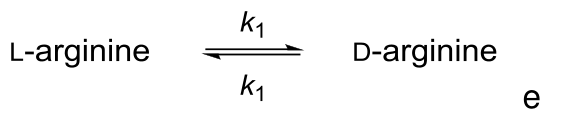
The time evolution of concentrations is governed by
\[ \ln\frac{1+\dfrac{[\mathrm D]}{[\mathrm L]}} {1-\dfrac{[\mathrm D]}{[\mathrm L]}} =2k_1t+C \]
Here \([\mathrm D]\) and \([\mathrm L]\) are concentrations of D- and L-arginine at time \(t\), \(k_1\) is the rate constant, and the term \(C\) is set according to the initial concentrations.
Holy Roman Emperor Lothar III passed away during his journey to Sicily in 1137. To facilitate the repatriation of the remains, his body was, immediately after his death, boiled in water (373 K) for a certain time. Let us try to estimate the boiling time with the help of chemical kinetics. We know that the rate constant \(k_1\) of arginine racemization within the protein at 373 K and \(\mathrm{pH}=7\) has the value of \(5.10\times10^{-3}\ \mathrm{h^{-1}}\).
In order to analyse the isomeric composition of arginine in Lothar’s bones, we need to start with transferring arginine into solution. Lothar’s bones were hydrolyzed in a highly acidic environment for 4 hours at 383 K. The ratio of the optical isomers was \(\dfrac{[\mathrm D]}{[\mathrm L]}=0.090\). Lothar’s wife Richenza was not boiled after her death. Her bones were hydrolyzed using the same procedure and in this case the ratio was \(\dfrac{[\mathrm D]}{[\mathrm L]}=0.059\). (Note that the racemization also takes place during the hydrolysis, with the rate constant \(k'_1\), different from \(k_1\)).
2.8 How long was the Holy Roman Emperor Lothar III boiled in water in 1137?
Note: The racemization of arginine is an extremely slow process at temperatures typically encountered in graves. As both bodies are only some 880 years old, we can neglect the natural racemization during this time.
Official English text of the problem.
Answers
-
2.1: Select only the fourth statement: different specific optical rotations and different melting points.
-
2.2:
| Structure | Absolute configuration | Name | Stereochemical SMILES |
|---|---|---|---|
| A | \((2S,3S)\) | L-isoleucine | CC[C@H](C)[C@H](N)C(=O)O |
| B | \((2R,3R)\) | D-isoleucine | CC[C@@H](C)[C@@H](N)C(=O)O |
| C | \((2S,3R)\) | L-allo-isoleucine | CC[C@@H](C)[C@H](N)C(=O)O |
| D | \((2R,3S)\) | D-allo-isoleucine | CC[C@H](C)[C@@H](N)C(=O)O |
Fill the four answer boxes, from top to bottom, with C, D, A, B.
-
2.3: \(G_{\mathrm m}^{\circ}(\mathrm A)=G_{\mathrm m}^{\circ}(\mathrm B)=0\ \mathrm{kJ\,mol^{-1}}\); \(G_{\mathrm m}^{\circ}(\mathrm C)=G_{\mathrm m}^{\circ}(\mathrm D)=-1.00\ \mathrm{kJ\,mol^{-1}}\).
-
2.4: \(\boxed{64}\) stereoisomers.
-
2.5: a) \(\boxed{1.00\times10^2\%}\); b) \(\boxed{67.8\%}\).
-
2.6: \(\boxed{8.00\times10^7\ \mathrm h\approx9.13\times10^3\ \text{years}}\).
-
2.7: a) \(\boxed{0.420\ \mathrm{mol\,dm^{-3}}}\); b) \(\boxed{69.7\%}\), retaining unrounded intermediate values.
-
2.8: \(\boxed{6.1\ \mathrm h}\) (calculated value \(6.11286\ \mathrm h\)).
Solution
2.1 — Relationship between the stereoisomers
L-isoleucine is \((2S,3S)\), whereas D-allo-isoleucine is \((2R,3S)\). They differ at C2 but have the same configuration at C3. They are therefore epimers, a particular kind of diastereomer.
Diastereomers generally have different physical properties, including specific optical rotation and melting point. The equal-magnitude, opposite-sign optical rotations and identical melting points characteristic of an enantiomeric pair do not apply here. D-allo-isoleucine is chiral and optically active.
Thus, select the fourth statement only. The D/L designation does not itself specify the sign of optical rotation.
2.2 — Absolute configurations
Number the carboxyl carbon C1, the amino-bearing carbon C2, and the methyl-bearing carbon C3.
At C2, the Cahn–Ingold–Prelog priorities are
\[ \ce{NH2}>\ce{COOH}>\ce{CH(CH3)CH2CH3}>\ce{H}. \]
Nitrogen has priority over carbon. To distinguish the two carbon substituents, the carboxyl carbon is treated as attached to \((\mathrm O,\mathrm O,\mathrm O)\), whereas C3 is attached to \((\mathrm C,\mathrm C,\mathrm H)\).
At C3, the priorities are
\[ \ce{CH(NH2)COOH}>\ce{CH2CH3}>\ce{CH3}>\ce{H}. \]
The three carbon substituents have next-atom lists \((\mathrm N,\mathrm C,\mathrm H)\), \((\mathrm C,\mathrm H,\mathrm H)\), and \((\mathrm H,\mathrm H,\mathrm H)\), respectively.
With the lowest-priority group pointing away, clockwise \(1\to2\to3\) gives \(R\), and counterclockwise gives \(S\). A solid wedge points toward the viewer; a dashed wedge points away.
For the orientations drawn:
- At C2, the solid amino bond gives \(S\), and the dashed amino bond gives \(R\).
- At C3, the solid methyl bond gives \(R\), and the dashed methyl bond gives \(S\).
Consequently,
\[ \boxed{ \mathrm A=(2S,3S),\quad \mathrm B=(2R,3R),\quad \mathrm C=(2S,3R),\quad \mathrm D=(2R,3S). } \]
Their names and stereochemical SMILES are given in the answer table. The required box order is C, D, A, B.
2.3 — Relative standard molar Gibbs energies
For the epimerization of L-isoleucine to D-allo-isoleucine,
\[ \Delta_{\mathrm r}G^\circ = G_{\mathrm m}^\circ(\text{D-allo-isoleucine}) - G_{\mathrm m}^\circ(\text{L-isoleucine}) =-RT\ln K_{\mathrm{ep}}. \]
Using \(R=8.314\ \mathrm{J\,mol^{-1}\,K^{-1}}\),
\[ \Delta_{\mathrm r}G^\circ =-(8.314)(374)\ln(1.38) =-1.00\times10^3\ \mathrm{J\,mol^{-1}} =-1.00\ \mathrm{kJ\,mol^{-1}}. \]
Structure A is L-isoleucine, whose reference value is zero. Structure D is D-allo-isoleucine, so its value is \(-1.00\ \mathrm{kJ\,mol^{-1}}\).
Enantiomers have equal standard molar Gibbs energies in an achiral environment. A and B form one enantiomeric pair; C and D form the other. Therefore,
\[ \boxed{ G_{\mathrm m}^\circ(\mathrm A) =G_{\mathrm m}^\circ(\mathrm B) =0\ \mathrm{kJ\,mol^{-1}} } \]
and
\[ \boxed{ G_{\mathrm m}^\circ(\mathrm C) =G_{\mathrm m}^\circ(\mathrm D) =-1.00\ \mathrm{kJ\,mol^{-1}}. } \]
These are standard-state values; the equilibrium composition is accounted for separately by the activities in \(K_{\mathrm{ep}}\).
2.4 — Stereoisomers of Ile-Ile-Ile
Each isoleucine residue contributes two stereogenic carbon atoms. Formation of the two peptide bonds preserves these centres, giving
\[ n=3\times2=6 \]
stereocentres.
For example, the all-L member, L-isoleucyl-L-isoleucyl-L-isoleucine, has SMILES:
CC[C@H](C)[C@H](N)C(=O)N[C@@H]([C@@H](C)CC)C(=O)N[C@@H]([C@@H](C)CC)C(=O)O
Each of the six centres can independently have either configuration. The distinct amino and carboxyl termini prevent an internal symmetry that would identify different assignments. Hence,
\[ \boxed{N=2^6=64}. \]
2.5 — Diastereomeric excess when the reverse reaction is neglected
Initially, the sample contains only L-isoleucine:
\[ [\mathrm D]_0=0,\qquad [\mathrm L]_0=C_{\mathrm T}, \]
where \(C_{\mathrm T}=[\mathrm L]+[\mathrm D]\) is conserved.
For irreversible first-order conversion,
\[ [\mathrm L](t)=C_{\mathrm T}e^{-k_1t}, \qquad [\mathrm D](t)=C_{\mathrm T}(1-e^{-k_1t}). \]
Thus,
\[ de(t)=\left(2e^{-k_1t}-1\right)\times100\%. \]
a) Before boiling:
\[ de(0)=(2-1)\times100\% =\boxed{1.00\times10^2\%}. \]
b) After boiling:
\[ k_1t =(9.02\times10^{-5}\ \mathrm{h^{-1}}) (1943\ \mathrm h) =0.1752586. \]
Therefore,
\[ de =\left(2e^{-0.1752586}-1\right)\times100\% =67.847993\ldots\%. \]
To three significant figures,
\[ \boxed{de=67.8\%}. \]
2.6 — Time for 10% conversion at 298 K
First determine the activation energy using the Arrhenius equation:
\[ \ln\frac{k_1(421)}{k_1(374)} = \frac{E_{\mathrm a}}{R} \left(\frac{1}{374}-\frac{1}{421}\right). \]
Hence,
\[ E_{\mathrm a} = \frac{ R\ln\!\left(\dfrac{1.18\times10^{-2}}{9.02\times10^{-5}}\right) }{ \dfrac{1}{374\ \mathrm K}-\dfrac{1}{421\ \mathrm K} } =1.3575\ldots\times10^5\ \mathrm{J\,mol^{-1}} \approx136\ \mathrm{kJ\,mol^{-1}}. \]
Assuming the same Arrhenius dependence down to 298 K, and retaining the unrounded activation energy,
\[ k_1(298) = k_1(374) \exp\left[ -\frac{E_{\mathrm a}}{R} \left(\frac{1}{298\ \mathrm K}-\frac{1}{374\ \mathrm K}\right) \right]. \]
This gives
\[ k_1(298)=1.31755\ldots\times10^{-9}\ \mathrm{h^{-1}}. \]
Under the irreversible approximation used in this part, 10% conversion means
\[ \frac{[\mathrm L](t)}{[\mathrm L]_0}=0.900=e^{-k_1t}. \]
Therefore,
\[ t=\frac{-\ln(0.900)}{1.31755\ldots\times10^{-9}\ \mathrm{h^{-1}}} =7.99668\ldots\times10^7\ \mathrm h. \]
Using 365 days per year,
\[ \boxed{ t=8.00\times10^7\ \mathrm h \approx9.13\times10^3\ \text{years}. } \]
2.7 — Reversible epimerization
a) Equilibrium concentration
At equilibrium, the forward and reverse rates are equal:
\[ k_1[\mathrm L]_{\mathrm{eq}} =k_2[\mathrm D]_{\mathrm{eq}}. \]
Consequently,
\[ K_{\mathrm{ep}} =\frac{[\mathrm D]_{\mathrm{eq}}}{[\mathrm L]_{\mathrm{eq}}} =\frac{k_1}{k_2}. \]
The total concentration remains
\[ C_{\mathrm T} =[\mathrm L]_{\mathrm{eq}}+[\mathrm D]_{\mathrm{eq}} =1.00\ \mathrm{mol\,dm^{-3}}. \]
Thus,
\[ [\mathrm L]_{\mathrm{eq}} =\frac{C_{\mathrm T}}{1+K_{\mathrm{ep}}} =\frac{1.00}{2.38}\ \mathrm{mol\,dm^{-3}} =0.420168\ldots\ \mathrm{mol\,dm^{-3}}, \]
so
\[ \boxed{[\mathrm L]_{\mathrm{eq}}=0.420\ \mathrm{mol\,dm^{-3}}}. \]
b) Diastereomeric excess after boiling
The reverse rate constant is
\[ k_2=\frac{k_1}{K_{\mathrm{ep}}} =\frac{9.02\times10^{-5}}{1.38} =6.53623\ldots\times10^{-5}\ \mathrm{h^{-1}}. \]
The supplied relaxation equation gives
\[ [\mathrm L](t) = [\mathrm L]_{\mathrm{eq}} + \left([\mathrm L]_0-[\mathrm L]_{\mathrm{eq}}\right) e^{-(k_1+k_2)t}. \]
Using \(t=1943\ \mathrm h\), with intermediate quantities unrounded,
\[ [\mathrm L](t) =0.8487494758\ldots\ \mathrm{mol\,dm^{-3}}, \]
and
\[ [\mathrm D](t) =C_{\mathrm T}-[\mathrm L](t) =0.1512505242\ldots\ \mathrm{mol\,dm^{-3}}. \]
Therefore,
\[ de = \frac{0.8487494758\ldots-0.1512505242\ldots}{1.00} \times100\% =69.749895\ldots\%. \]
The unrounded value lies just below the \(69.75\%\) rounding boundary. To three significant figures,
\[ \boxed{de=69.7\%}. \]
The reverse reaction leaves more L-isoleucine than the irreversible calculation, explaining the larger \(de\).
2.8 — Boiling time of Lothar III
The interconverting enantiomers are L-arginine, with \(S\) configuration, and D-arginine, with \(R\) configuration. Their neutral free-amino-acid SMILES are:
- L-arginine:
N[C@@H](CCCNC(=N)N)C(=O)O - D-arginine:
N[C@H](CCCNC(=N)N)C(=O)O
Define
\[ r=\frac{[\mathrm D]}{[\mathrm L]}, \qquad F(r)=\ln\frac{1+r}{1-r}. \]
The given kinetic law means that a period \(t\) at a constant rate coefficient \(k\) increases \(F\) by \(2kt\). Thus, successive boiling and hydrolysis contributions add in \(F\).
Take the two bodies to have the same initial stereochemical composition, corresponding to naturally occurring L-arginine, and neglect racemization during burial as instructed. If \(F_0\) denotes their common initial value, then for Lothar,
\[ F(0.090) =F_0+2k_1t_{\mathrm b}+2k'_1(4\ \mathrm h), \]
where \(t_{\mathrm b}\) is the boiling time. For Richenza, who was not boiled,
\[ F(0.059) =F_0+2k'_1(4\ \mathrm h). \]
Subtracting eliminates both the initial contribution and the racemization caused by hydrolysis:
\[ F(0.090)-F(0.059)=2k_1t_{\mathrm b}. \]
Therefore,
\[ t_{\mathrm b} = \frac{ \ln\!\left(\dfrac{1.090}{0.910}\right) - \ln\!\left(\dfrac{1.059}{0.941}\right) }{ 2(5.10\times10^{-3}\ \mathrm{h^{-1}}) }. \]
Numerically,
\[ t_{\mathrm b} = \frac{0.1804883757-0.1181372060} {0.0102\ \mathrm{h^{-1}}} =6.11286\ldots\ \mathrm h. \]
At the precision supported by the measured ratios,
\[ \boxed{t_{\mathrm b}\approx6.1\ \mathrm h}. \]
The solution was checked against the official solution.
IChO 2018 · Theorieaufgabe 2
Überführung sterblicher Überreste im Mittelalter
Bei Umgebungstemperaturen ist die Racemisierung eine langsame Reaktion. Daher kann sie zur Datierung biologischer Objekte und darüber hinaus zur Untersuchung ihrer thermischen Vorgeschichte genutzt werden. Betrachten wir als Beispiel L-Isoleucin (L-Ile) (\((2S,3S)\)-2-Amino-3-methylpentansäure). Es isomerisiert am \(\alpha\)-Kohlenstoffatom und bildet \((2R,3S)\)-2-Amino-3-methylpentansäure, auch als D-allo-Isoleucin bekannt. Da sich die Konfiguration nur an einem der beiden stereogenen Zentren ändert, wird dieser Vorgang als Epimerisierung und nicht als Racemisierung bezeichnet.
2.1 Wählen Sie alle zutreffenden Aussagen aus.
☐ D-allo-Isoleucin und L-Isoleucin haben die gleichen spezifischen Drehwerte, aber unterschiedliche Schmelzpunkte.
☐ D-allo-Isoleucin hat einen betragsmäßig gleichen spezifischen Drehwert wie L-Isoleucin, jedoch mit entgegengesetztem Vorzeichen. Der Schmelzpunkt ist für beide Isomere gleich.
☐ D-allo-Isoleucin und L-Isoleucin haben unterschiedliche spezifische Drehwerte, aber die gleichen Schmelzpunkte.
☐ D-allo-Isoleucin und L-Isoleucin haben unterschiedliche spezifische Drehwerte und unterschiedliche Schmelzpunkte.
☐ D-allo-Isoleucin ist nicht optisch aktiv.
2.2 Ordnen Sie jedem Stereoisomer von Isoleucin die absolute Konfiguration zu.
☐ \(2S,3R\) (L-allo-Isoleucin)
☐ \(2R,3S\) (D-allo-Isoleucin)
☐ \(2S,3S\) (L-Isoleucin)
☐ \(2R,3R\) (D-Isoleucin)
2.3 Die Gleichgewichtskonstante \(K_{\mathrm{ep}}\) für die Epimerisierung von L-Isoleucin hat den Wert 1.38 (bei 374 K). Wenn wir die molare Gibbs-Energie von L-Isoleucin auf \(G_{\mathrm m}^{\circ}=0\ \mathrm{kJ\,mol^{-1}}\) setzen, bestimmen Sie die Gibbs-Energien für alle Strukturen A–D aus Frage 2.2 bei 374 K.
2.4 Wie groß ist die maximal mögliche Anzahl der Stereoisomere des Tripeptids Ile-Ile-Ile, wenn wir die Stereoisomerie an allen Stereozentren berücksichtigen?
Zu Beginn der Epimerisierung können wir die Rückreaktion vernachlässigen. Die Epimerisierung folgt dann einer Kinetik erster Ordnung:
Der Wert der Geschwindigkeitskonstanten beträgt bei 374 K \(k_1(374\ \mathrm K)=9.02\times10^{-5}\ \mathrm{h^{-1}}\) und bei 421 K \(k_1(421\ \mathrm K)=1.18\times10^{-2}\ \mathrm{h^{-1}}\).
Kürzen Sie in der folgenden Rechnung die Konzentration von L-Isoleucin mit \([\mathrm L]\) und die von D-allo-Isoleucin mit \([\mathrm D]\) ab.
Wir können eine Größe \(de\) (Diastereomerenüberschuss) definieren:
\[ de=\frac{[\mathrm L]-[\mathrm D]}{[\mathrm L]+[\mathrm D]}\times100(\%). \]
2.5 Wir kochen L-Isoleucin 1 943 Stunden lang bei 374 K. Welchen Wert hat \(de\) (mit drei signifikanten Stellen) für L-Isoleucin a) vor dem Kochen und b) nach dem Kochen?
2.6 Wie lange dauert es, bei 298 K 10% des L-Isoleucins in D-allo-Isoleucin umzuwandeln?
Tatsächlich kann die Rückreaktion nicht vernachlässigt werden. Das korrekte kinetische Schema lautet
Definieren wir die Abweichung der Konzentration von ihrem Gleichgewichtswert \([\mathrm L]_{\mathrm{eq}}\)
\[ x=[\mathrm L]-[\mathrm L]_{\mathrm{eq}} \]
Es lässt sich herleiten, dass sich \(x\) zeitlich gemäß der folgenden Gleichung entwickelt:
\[ x=x(0)\times e^{-(k_1+k_2)t}, \]
wobei \(x(0)\) die Abweichung vom Gleichgewicht bei \(t=0\ \mathrm h\) ist.
2.7 Wir kochen eine L-Isoleucinlösung mit einer Konzentration von \(1.00\ \mathrm{mol\,dm^{-3}}\) 1 943 Stunden lang bei 374 K. Die Geschwindigkeitskonstante der Hinreaktion beträgt \(k_1(374\ \mathrm K)=9.02\times10^{-5}\ \mathrm{h^{-1}}\), und \(K_{\mathrm{ep}}\) für die Epimerisierung von L-Isoleucin hat den Wert 1.38 (bei 374 K). Kürzen Sie in der folgenden Rechnung die Konzentration von L-Isoleucin mit \([\mathrm L]\) und die von D-allo-Isoleucin mit \([\mathrm D]\) ab. Berechnen Sie (mit drei signifikanten Stellen)
a) \([\mathrm L]_{\mathrm{eq}}\),
b) den Diastereomerenüberschuss (\(de\)) nach dem Kochen.
Aminosäuren mit einem einzigen chiralen Zentrum unterliegen der Racemisierung; beispielsweise racemisiert L-Arginin:
Die zeitliche Entwicklung der Konzentrationen wird beschrieben durch
\[ \ln\frac{1+\dfrac{[\mathrm D]}{[\mathrm L]}} {1-\dfrac{[\mathrm D]}{[\mathrm L]}} =2k_1t+C \]
Hier sind \([\mathrm D]\) und \([\mathrm L]\) die Konzentrationen von D- und L-Arginin zum Zeitpunkt \(t\), \(k_1\) ist die Geschwindigkeitskonstante, und der Term \(C\) wird anhand der Anfangskonzentrationen festgelegt.
Lothar III., Kaiser des Heiligen Römischen Reiches, starb 1137 während seiner Reise nach Sizilien. Um die Überführung der sterblichen Überreste zu erleichtern, wurde sein Leichnam unmittelbar nach seinem Tod eine gewisse Zeit lang in Wasser (373 K) gekocht. Versuchen wir, die Kochdauer mithilfe der chemischen Kinetik abzuschätzen. Wir wissen, dass die Geschwindigkeitskonstante \(k_1\) der Racemisierung von Arginin innerhalb des Proteins bei 373 K und \(\mathrm{pH}=7\) den Wert \(5.10\times10^{-3}\ \mathrm{h^{-1}}\) hat.
Um die Isomerenzusammensetzung des Arginins in Lothars Knochen zu analysieren, müssen wir zunächst das Arginin in Lösung überführen. Lothars Knochen wurden 4 Stunden lang bei 383 K in stark saurem Milieu hydrolysiert. Das Verhältnis der optischen Isomere betrug \(\dfrac{[\mathrm D]}{[\mathrm L]}=0.090\). Lothars Frau Richenza wurde nach ihrem Tod nicht gekocht. Ihre Knochen wurden nach demselben Verfahren hydrolysiert, und in diesem Fall betrug das Verhältnis \(\dfrac{[\mathrm D]}{[\mathrm L]}=0.059\). (Beachten Sie, dass die Racemisierung auch während der Hydrolyse stattfindet, mit der Geschwindigkeitskonstanten \(k'_1\), die sich von \(k_1\) unterscheidet.)
2.8 Wie lange wurde Lothar III., Kaiser des Heiligen Römischen Reiches, im Jahr 1137 in Wasser gekocht?
Hinweis: Die Racemisierung von Arginin ist bei den typischerweise in Gräbern herrschenden Temperaturen ein äußerst langsamer Prozess. Da beide Leichname erst etwa 880 Jahre alt sind, können wir die natürliche Racemisierung während dieser Zeit vernachlässigen.
Aufgabentext aus dem offiziellen englischen Text übersetzt.
Antworten
-
2.1: Wählen Sie nur die vierte Aussage aus: unterschiedliche spezifische Drehwerte und unterschiedliche Schmelzpunkte.
-
2.2:
| Struktur | Absolute Konfiguration | Name | Stereochemische SMILES |
|---|---|---|---|
| A | \((2S,3S)\) | L-Isoleucin | CC[C@H](C)[C@H](N)C(=O)O |
| B | \((2R,3R)\) | D-Isoleucin | CC[C@@H](C)[C@@H](N)C(=O)O |
| C | \((2S,3R)\) | L-allo-Isoleucin | CC[C@@H](C)[C@H](N)C(=O)O |
| D | \((2R,3S)\) | D-allo-Isoleucin | CC[C@H](C)[C@@H](N)C(=O)O |
Tragen Sie in die vier Antwortkästchen von oben nach unten C, D, A, B ein.
-
2.3: \(G_{\mathrm m}^{\circ}(\mathrm A)=G_{\mathrm m}^{\circ}(\mathrm B)=0\ \mathrm{kJ\,mol^{-1}}\); \(G_{\mathrm m}^{\circ}(\mathrm C)=G_{\mathrm m}^{\circ}(\mathrm D)=-1.00\ \mathrm{kJ\,mol^{-1}}\).
-
2.4: \(\boxed{64}\) Stereoisomere.
-
2.5: a) \(\boxed{1.00\times10^2\%}\); b) \(\boxed{67.8\%}\).
-
2.6: \(\boxed{8.00\times10^7\ \mathrm h\approx9.13\times10^3\ \text{Jahre}}\).
-
2.7: a) \(\boxed{0.420\ \mathrm{mol\,dm^{-3}}}\); b) \(\boxed{69.7\%}\), bei Verwendung ungerundeter Zwischenwerte.
-
2.8: \(\boxed{6.1\ \mathrm h}\) (berechneter Wert \(6.11286\ \mathrm h\)).
Lösung
2.1 — Beziehung zwischen den Stereoisomeren
L-Isoleucin ist \((2S,3S)\), während D-allo-Isoleucin \((2R,3S)\) ist. Sie unterscheiden sich an C2, haben jedoch an C3 dieselbe Konfiguration. Sie sind daher Epimere, eine besondere Art von Diastereomeren.
Diastereomere haben im Allgemeinen unterschiedliche physikalische Eigenschaften, darunter den spezifischen Drehwert und den Schmelzpunkt. Die für ein Enantiomerenpaar charakteristischen betragsgleichen Drehwerte mit entgegengesetztem Vorzeichen und identischen Schmelzpunkte liegen hier nicht vor. D-allo-Isoleucin ist chiral und optisch aktiv.
Daher ist nur die vierte Aussage auszuwählen. Die D/L-Bezeichnung legt für sich genommen das Vorzeichen der optischen Drehung nicht fest.
2.2 — Absolute Konfigurationen
Nummerieren Sie das Carboxyl-Kohlenstoffatom als C1, das die Aminogruppe tragende Kohlenstoffatom als C2 und das die Methylgruppe tragende Kohlenstoffatom als C3.
An C2 lauten die Prioritäten nach Cahn–Ingold–Prelog
\[ \ce{NH2}>\ce{COOH}>\ce{CH(CH3)CH2CH3}>\ce{H}. \]
Stickstoff hat Vorrang vor Kohlenstoff. Um die beiden Kohlenstoffsubstituenten zu unterscheiden, wird das Carboxyl-Kohlenstoffatom so behandelt, als sei es an \((\mathrm O,\mathrm O,\mathrm O)\) gebunden, während C3 an \((\mathrm C,\mathrm C,\mathrm H)\) gebunden ist.
An C3 lauten die Prioritäten
\[ \ce{CH(NH2)COOH}>\ce{CH2CH3}>\ce{CH3}>\ce{H}. \]
Die Listen der jeweils nächsten Atome für die drei Kohlenstoffsubstituenten lauten \((\mathrm N,\mathrm C,\mathrm H)\), \((\mathrm C,\mathrm H,\mathrm H)\) beziehungsweise \((\mathrm H,\mathrm H,\mathrm H)\).
Zeigt die Gruppe mit der niedrigsten Priorität vom Betrachter weg, ergibt die Abfolge \(1\to2\to3\) im Uhrzeigersinn \(R\) und gegen den Uhrzeigersinn \(S\). Ein ausgefüllter Keil zeigt zum Betrachter hin; ein gestrichelter Keil zeigt vom Betrachter weg.
Für die gezeichneten Orientierungen gilt:
- An C2 ergibt die als ausgefüllter Keil dargestellte Bindung zur Aminogruppe \(S\), die gestrichelte Bindung zur Aminogruppe hingegen \(R\).
- An C3 ergibt die als ausgefüllter Keil dargestellte Bindung zur Methylgruppe \(R\), die gestrichelte Bindung zur Methylgruppe hingegen \(S\).
Folglich gilt
\[ \boxed{ \mathrm A=(2S,3S),\quad \mathrm B=(2R,3R),\quad \mathrm C=(2S,3R),\quad \mathrm D=(2R,3S). } \]
Ihre Namen und stereochemischen SMILES sind in der Antworttabelle angegeben. Die erforderliche Reihenfolge in den Kästchen ist C, D, A, B.
2.3 — Relative molare Standard-Gibbs-Energien
Für die Epimerisierung von L-Isoleucin zu D-allo-Isoleucin gilt
\[ \Delta_{\mathrm r}G^\circ = G_{\mathrm m}^\circ(\text{D-allo-Isoleucin}) - G_{\mathrm m}^\circ(\text{L-Isoleucin}) =-RT\ln K_{\mathrm{ep}}. \]
Mit \(R=8.314\ \mathrm{J\,mol^{-1}\,K^{-1}}\) erhält man
\[ \Delta_{\mathrm r}G^\circ =-(8.314)(374)\ln(1.38) =-1.00\times10^3\ \mathrm{J\,mol^{-1}} =-1.00\ \mathrm{kJ\,mol^{-1}}. \]
Struktur A ist L-Isoleucin, dessen Referenzwert null ist. Struktur D ist D-allo-Isoleucin, sodass sein Wert \(-1.00\ \mathrm{kJ\,mol^{-1}}\) beträgt.
Enantiomere haben in einer achiralen Umgebung gleiche molare Standard-Gibbs-Energien. A und B bilden ein Enantiomerenpaar; C und D bilden das andere. Daher gilt
\[ \boxed{ G_{\mathrm m}^\circ(\mathrm A) =G_{\mathrm m}^\circ(\mathrm B) =0\ \mathrm{kJ\,mol^{-1}} } \]
und
\[ \boxed{ G_{\mathrm m}^\circ(\mathrm C) =G_{\mathrm m}^\circ(\mathrm D) =-1.00\ \mathrm{kJ\,mol^{-1}}. } \]
Dies sind Werte im Standardzustand; die Gleichgewichtszusammensetzung wird separat durch die Aktivitäten in \(K_{\mathrm{ep}}\) berücksichtigt.
2.4 — Stereoisomere von Ile-Ile-Ile
Jeder Isoleucinrest trägt zwei stereogene Kohlenstoffatome bei. Bei der Bildung der beiden Peptidbindungen bleiben diese Zentren erhalten, sodass sich
\[ n=3\times2=6 \]
Stereozentren ergeben.
Beispielsweise hat das ausschließlich aus L-Resten bestehende Stereoisomer L-Isoleucyl-L-isoleucyl-L-isoleucin die SMILES:
CC[C@H](C)[C@H](N)C(=O)N[C@@H]([C@@H](C)CC)C(=O)N[C@@H]([C@@H](C)CC)C(=O)O
Jedes der sechs Zentren kann unabhängig von den anderen eine der beiden Konfigurationen aufweisen. Die unterschiedlichen Amino- und Carboxyltermini verhindern eine innere Symmetrie, durch die unterschiedliche Zuordnungen identisch wären. Daher gilt
\[ \boxed{N=2^6=64}. \]
2.5 — Diastereomerenüberschuss bei Vernachlässigung der Rückreaktion
Anfangs enthält die Probe ausschließlich L-Isoleucin:
\[ [\mathrm D]_0=0,\qquad [\mathrm L]_0=C_{\mathrm T}, \]
wobei \(C_{\mathrm T}=[\mathrm L]+[\mathrm D]\) konstant bleibt.
Für eine irreversible Umsetzung erster Ordnung gilt
\[ [\mathrm L](t)=C_{\mathrm T}e^{-k_1t}, \qquad [\mathrm D](t)=C_{\mathrm T}(1-e^{-k_1t}). \]
Damit ergibt sich
\[ de(t)=\left(2e^{-k_1t}-1\right)\times100\%. \]
a) Vor dem Kochen:
\[ de(0)=(2-1)\times100\% =\boxed{1.00\times10^2\%}. \]
b) Nach dem Kochen:
\[ k_1t =(9.02\times10^{-5}\ \mathrm{h^{-1}}) (1943\ \mathrm h) =0.1752586. \]
Daher gilt
\[ de =\left(2e^{-0.1752586}-1\right)\times100\% =67.847993\ldots\%. \]
Auf drei signifikante Stellen gerundet:
\[ \boxed{de=67.8\%}. \]
2.6 — Zeit für 10% Umsatz bei 298 K
Zunächst bestimmen wir die Aktivierungsenergie mithilfe der Arrhenius-Gleichung:
\[ \ln\frac{k_1(421)}{k_1(374)} = \frac{E_{\mathrm a}}{R} \left(\frac{1}{374}-\frac{1}{421}\right). \]
Daraus folgt
\[ E_{\mathrm a} = \frac{ R\ln\!\left(\dfrac{1.18\times10^{-2}}{9.02\times10^{-5}}\right) }{ \dfrac{1}{374\ \mathrm K}-\dfrac{1}{421\ \mathrm K} } =1.3575\ldots\times10^5\ \mathrm{J\,mol^{-1}} \approx136\ \mathrm{kJ\,mol^{-1}}. \]
Unter der Annahme, dass dieselbe Arrhenius-Abhängigkeit bis hinunter zu 298 K gilt, und unter Verwendung der ungerundeten Aktivierungsenergie ergibt sich
\[ k_1(298) = k_1(374) \exp\left[ -\frac{E_{\mathrm a}}{R} \left(\frac{1}{298\ \mathrm K}-\frac{1}{374\ \mathrm K}\right) \right]. \]
Dies liefert
\[ k_1(298)=1.31755\ldots\times10^{-9}\ \mathrm{h^{-1}}. \]
In der in diesem Teil verwendeten Näherung einer irreversiblen Reaktion bedeutet ein Umsatz von 10%
\[ \frac{[\mathrm L](t)}{[\mathrm L]_0}=0.900=e^{-k_1t}. \]
Daher gilt
\[ t=\frac{-\ln(0.900)}{1.31755\ldots\times10^{-9}\ \mathrm{h^{-1}}} =7.99668\ldots\times10^7\ \mathrm h. \]
Mit 365 Tagen pro Jahr ergibt sich
\[ \boxed{ t=8.00\times10^7\ \mathrm h \approx9.13\times10^3\ \text{Jahre}. } \]
2.7 — Reversible Epimerisierung
a) Gleichgewichtskonzentration
Im Gleichgewicht sind die Geschwindigkeiten der Hin- und Rückreaktion gleich:
\[ k_1[\mathrm L]_{\mathrm{eq}} =k_2[\mathrm D]_{\mathrm{eq}}. \]
Folglich gilt
\[ K_{\mathrm{ep}} =\frac{[\mathrm D]_{\mathrm{eq}}}{[\mathrm L]_{\mathrm{eq}}} =\frac{k_1}{k_2}. \]
Die Gesamtkonzentration bleibt
\[ C_{\mathrm T} =[\mathrm L]_{\mathrm{eq}}+[\mathrm D]_{\mathrm{eq}} =1.00\ \mathrm{mol\,dm^{-3}}. \]
Damit ergibt sich
\[ [\mathrm L]_{\mathrm{eq}} =\frac{C_{\mathrm T}}{1+K_{\mathrm{ep}}} =\frac{1.00}{2.38}\ \mathrm{mol\,dm^{-3}} =0.420168\ldots\ \mathrm{mol\,dm^{-3}}, \]
also
\[ \boxed{[\mathrm L]_{\mathrm{eq}}=0.420\ \mathrm{mol\,dm^{-3}}}. \]
b) Diastereomerenüberschuss nach dem Kochen
Die Geschwindigkeitskonstante der Rückreaktion beträgt
\[ k_2=\frac{k_1}{K_{\mathrm{ep}}} =\frac{9.02\times10^{-5}}{1.38} =6.53623\ldots\times10^{-5}\ \mathrm{h^{-1}}. \]
Die angegebene Relaxationsgleichung liefert
\[ [\mathrm L](t) = [\mathrm L]_{\mathrm{eq}} + \left([\mathrm L]_0-[\mathrm L]_{\mathrm{eq}}\right) e^{-(k_1+k_2)t}. \]
Mit \(t=1943\ \mathrm h\) und ungerundeten Zwischengrößen erhält man
\[ [\mathrm L](t) =0.8487494758\ldots\ \mathrm{mol\,dm^{-3}}, \]
und
\[ [\mathrm D](t) =C_{\mathrm T}-[\mathrm L](t) =0.1512505242\ldots\ \mathrm{mol\,dm^{-3}}. \]
Daher gilt
\[ de = \frac{0.8487494758\ldots-0.1512505242\ldots}{1.00} \times100\% =69.749895\ldots\%. \]
Der ungerundete Wert liegt knapp unter der Rundungsgrenze von \(69.75\%\). Auf drei signifikante Stellen gerundet:
\[ \boxed{de=69.7\%}. \]
Durch die Rückreaktion verbleibt mehr L-Isoleucin als bei der Berechnung für eine irreversible Reaktion, was den größeren Wert von \(de\) erklärt.
2.8 — Kochdauer von Lothar III.
Die ineinander übergehenden Enantiomere sind L-Arginin mit \(S\)-Konfiguration und D-Arginin mit \(R\)-Konfiguration. Ihre SMILES für die neutrale Form der freien Aminosäure lauten:
- L-Arginin:
N[C@@H](CCCNC(=N)N)C(=O)O - D-Arginin:
N[C@H](CCCNC(=N)N)C(=O)O
Wir definieren
\[ r=\frac{[\mathrm D]}{[\mathrm L]}, \qquad F(r)=\ln\frac{1+r}{1-r}. \]
Das angegebene Geschwindigkeitsgesetz bedeutet, dass ein Zeitintervall \(t\) bei einer konstanten Geschwindigkeitskonstanten \(k\) den Wert von \(F\) um \(2kt\) erhöht. Daher addieren sich die aufeinanderfolgenden Beiträge des Kochens und der Hydrolyse in \(F\).
Wir nehmen für die beiden Leichname dieselbe anfängliche stereochemische Zusammensetzung an, entsprechend dem natürlich vorkommenden L-Arginin, und vernachlässigen wie angegeben die Racemisierung während der Bestattung. Bezeichnet \(F_0\) ihren gemeinsamen Anfangswert, so gilt für Lothar
\[ F(0.090) =F_0+2k_1t_{\mathrm b}+2k'_1(4\ \mathrm h), \]
wobei \(t_{\mathrm b}\) die Kochdauer ist. Für Richenza, die nicht gekocht wurde, gilt
\[ F(0.059) =F_0+2k'_1(4\ \mathrm h). \]
Durch Subtraktion entfallen sowohl der anfängliche Beitrag als auch die durch die Hydrolyse verursachte Racemisierung:
\[ F(0.090)-F(0.059)=2k_1t_{\mathrm b}. \]
Daher gilt
\[ t_{\mathrm b} = \frac{ \ln\!\left(\dfrac{1.090}{0.910}\right) - \ln\!\left(\dfrac{1.059}{0.941}\right) }{ 2(5.10\times10^{-3}\ \mathrm{h^{-1}}) }. \]
Numerisch ergibt sich
\[ t_{\mathrm b} = \frac{0.1804883757-0.1181372060} {0.0102\ \mathrm{h^{-1}}} =6.11286\ldots\ \mathrm h. \]
Mit der durch die gemessenen Verhältnisse gerechtfertigten Genauigkeit gilt
\[ \boxed{t_{\mathrm b}\approx6.1\ \mathrm h}. \]
Die Lösung wurde mit der offiziellen Lösung abgeglichen.
IChO 2018 · Teori sorusu 2
Orta Çağ'da cenazelerin ülkelerine geri götürülmesi
Ortam sıcaklıklarında rasemleşme yavaş bir tepkimedir. Bu nedenle biyolojik nesnelerin yaşının belirlenmesinde ve ayrıca ısıl geçmişlerinin incelenmesinde kullanılabilir. Örnek olarak L-izolösini (L-Ile) (\((2S,3S)\)-2-amino-3-metilpentanoik asit) ele alalım. Bu bileşik \(\alpha\)-karbonunda izomerleşerek D-allo-izolösin olarak da bilinen \((2R,3S)\)-2-amino-3-metilpentanoik asidi oluşturur. İki stereojenik merkezden yalnızca birinin konfigürasyonu değiştiği için bu süreç rasemleşme yerine epimerleşme olarak adlandırılır.
2.1 Doğru ifadelerin tümünü seçiniz.
☐ D-allo-izolösin ve L-izolösinin özgül optik çevirme değerleri aynıdır, ancak erime noktaları farklıdır.
☐ D-allo-izolösinin özgül optik çevirmesinin mutlak değeri L-izolösininkiyle aynıdır, ancak işareti zıttır. Her iki izomerin erime noktası aynıdır.
☐ D-allo-izolösin ve L-izolösinin özgül optik çevirme değerleri farklıdır, ancak erime noktaları aynıdır.
☐ D-allo-izolösin ve L-izolösinin özgül optik çevirme değerleri ve erime noktaları farklıdır.
☐ D-allo-izolösin optikçe aktif değildir.
2.2 İzolösinin her bir stereoizomerinin mutlak konfigürasyonunu belirleyiniz.
☐ \(2S,3R\) (L-allo-izolösin)
☐ \(2R,3S\) (D-allo-izolösin)
☐ \(2S,3S\) (L-izolösin)
☐ \(2R,3R\) (D-izolösin)
2.3 L-izolösinin epimerleşmesi için denge sabiti \(K_{\mathrm{ep}}\), 1.38 değerindedir (374 K'de). L-izolösinin molar Gibbs serbest enerjisini \(G_{\mathrm m}^{\circ}=0\ \mathrm{kJ\,mol^{-1}}\) olarak alırsak, 2.2 sorusundaki A–D yapılarının tümünün 374 K'deki Gibbs serbest enerjilerini belirleyiniz.
2.4 Tüm stereomerkezlerdeki stereoizomerliği dikkate alırsak, Ile-Ile-Ile tripeptidinin mümkün olan en fazla stereoizomer sayısı kaçtır?
Epimerleşmenin başlangıcında geri tepkimeyi ihmal edebiliriz. Bu durumda epimerleşme birinci dereceden kinetiğe uyar:
Hız sabitinin 374 K'deki değeri \(k_1(374\ \mathrm K)=9.02\times10^{-5}\ \mathrm{h^{-1}}\), 421 K'deki değeri ise \(k_1(421\ \mathrm K)=1.18\times10^{-2}\ \mathrm{h^{-1}}\)'dir.
Aşağıdaki hesaplamada L-izolösinin derişimini \([\mathrm L]\), D-allo-izolösinin derişimini ise \([\mathrm D]\) olarak kısaltınız.
\(de\) (diastereomerik fazlalık) adlı bir büyüklük tanımlayabiliriz:
\[ de=\frac{[\mathrm L]-[\mathrm D]}{[\mathrm L]+[\mathrm D]}\times100(\%). \]
2.5 L-izolösini 374 K'de 1 943 saat kaynatalım. L-izolösin için \(de\) değeri (üç anlamlı rakamla) a) kaynatmadan önce ve b) kaynatmadan sonra kaçtır?
2.6 298 K'de L-izolösinin %10'unun D-allo-izolösine dönüşmesi ne kadar sürer?
Aslında geri tepkime ihmal edilemez. Doğru kinetik şema şu şekilde ifade edilir:
Derişimin denge değeri \([\mathrm L]_{\mathrm{eq}}\)'den sapmasını tanımlayalım:
\[ x=[\mathrm L]-[\mathrm L]_{\mathrm{eq}} \]
\(x\)'in zamanla aşağıdaki denkleme göre değiştiği türetilebilir:
\[ x=x(0)\times e^{-(k_1+k_2)t}, \]
burada \(x(0)\), \(t=0\ \mathrm h\) anındaki dengeden sapmadır.
2.7 \(1.00\ \mathrm{mol\,dm^{-3}}\) L-izolösin çözeltisini 374 K'de 1 943 saat kaynatalım. İleri tepkimenin hız sabiti \(k_1(374\ \mathrm K)=9.02\times10^{-5}\ \mathrm{h^{-1}}\), L-izolösinin epimerleşmesi için \(K_{\mathrm{ep}}\) değeri ise 1.38'dir (374 K'de). Aşağıdaki hesaplamada L-izolösinin derişimini \([\mathrm L]\), D-allo-izolösinin derişimini ise \([\mathrm D]\) olarak kısaltınız. Aşağıdakileri (üç anlamlı rakamla) hesaplayınız:
a) \([\mathrm L]_{\mathrm{eq}}\),
b) kaynatmadan sonraki diastereomerik fazlalık (\(de\)).
Tek bir kiral merkeze sahip amino asitler rasemleşmeye uğrar; örneğin L-arjinin rasemleşir:
Derişimlerin zamanla değişimini şu denklem belirler:
\[ \ln\frac{1+\dfrac{[\mathrm D]}{[\mathrm L]}} {1-\dfrac{[\mathrm D]}{[\mathrm L]}} =2k_1t+C \]
Burada \([\mathrm D]\) ve \([\mathrm L]\), \(t\) anındaki D- ve L-arjinin derişimleri, \(k_1\) hız sabitidir; \(C\) terimi ise başlangıç derişimlerine göre belirlenir.
Kutsal Roma İmparatoru III. Lothar, 1137'de Sicilya'ya yaptığı yolculuk sırasında hayatını kaybetti. Cenazesinin ülkesine geri götürülmesini kolaylaştırmak için bedeni, ölümünün hemen ardından belirli bir süre suda (373 K) kaynatıldı. Kimyasal kinetik yardımıyla kaynatma süresini tahmin etmeye çalışalım. Protein içindeki arjininin 373 K ve \(\mathrm{pH}=7\)'deki rasemleşmesinin hız sabiti \(k_1\)'in \(5.10\times10^{-3}\ \mathrm{h^{-1}}\) değerinde olduğunu biliyoruz.
Lothar'ın kemiklerindeki arjininin izomer bileşimini analiz etmek için önce arjinini çözeltiye geçirmemiz gerekir. Lothar'ın kemikleri kuvvetli asidik bir ortamda 383 K'de 4 saat boyunca hidroliz edildi. Optik izomerlerin oranı \(\dfrac{[\mathrm D]}{[\mathrm L]}=0.090\) idi. Lothar'ın eşi Richenza, ölümünden sonra kaynatılmamıştı. Onun kemikleri de aynı işlemle hidroliz edildi ve bu durumda oran \(\dfrac{[\mathrm D]}{[\mathrm L]}=0.059\) idi. (Rasemleşmenin hidroliz sırasında da gerçekleştiğini ve bu süreçteki hız sabiti \(k'_1\)'in \(k_1\)'den farklı olduğunu unutmayınız.)
2.8 Kutsal Roma İmparatoru III. Lothar, 1137'de suda ne kadar süre kaynatılmıştır?
Not: Arjininin rasemleşmesi, mezarlarda tipik olarak karşılaşılan sıcaklıklarda son derece yavaş bir süreçtir. Her iki beden de yalnızca yaklaşık 880 yıllık olduğundan, bu süre boyunca gerçekleşen doğal rasemleşmeyi ihmal edebiliriz.
Soru metni resmi İngilizce metinden çevrilmiştir.
Cevaplar
-
2.1: Yalnızca dördüncü ifadeyi seçiniz: özgül optik çevirme değerleri ve erime noktaları farklıdır.
-
2.2:
| Yapı | Mutlak konfigürasyon | Adı | Stereokimyasal SMILES |
|---|---|---|---|
| A | \((2S,3S)\) | L-izolösin | CC[C@H](C)[C@H](N)C(=O)O |
| B | \((2R,3R)\) | D-izolösin | CC[C@@H](C)[C@@H](N)C(=O)O |
| C | \((2S,3R)\) | L-allo-izolösin | CC[C@@H](C)[C@H](N)C(=O)O |
| D | \((2R,3S)\) | D-allo-izolösin | CC[C@H](C)[C@@H](N)C(=O)O |
Dört cevap kutusunu yukarıdan aşağıya C, D, A, B ile doldurunuz.
-
2.3: \(G_{\mathrm m}^{\circ}(\mathrm A)=G_{\mathrm m}^{\circ}(\mathrm B)=0\ \mathrm{kJ\,mol^{-1}}\); \(G_{\mathrm m}^{\circ}(\mathrm C)=G_{\mathrm m}^{\circ}(\mathrm D)=-1.00\ \mathrm{kJ\,mol^{-1}}\).
-
2.4: \(\boxed{64}\) stereoizomer.
-
2.5: a) \(\boxed{1.00\times10^2\%}\); b) \(\boxed{67.8\%}\).
-
2.6: \(\boxed{8.00\times10^7\ \mathrm h\approx9.13\times10^3\ \text{yıl}}\).
-
2.7: a) \(\boxed{0.420\ \mathrm{mol\,dm^{-3}}}\); b) ara değerler yuvarlanmadan kullanıldığında \(\boxed{69.7\%}\).
-
2.8: \(\boxed{6.1\ \mathrm h}\) (hesaplanan değer \(6.11286\ \mathrm h\)).
Çözüm
2.1 — Stereoizomerler arasındaki ilişki
L-izolösin \((2S,3S)\), D-allo-izolösin ise \((2R,3S)\) konfigürasyonundadır. C2'de farklılık gösterirler, ancak C3'te aynı konfigürasyona sahiptirler. Bu nedenle diastereomerlerin özel bir türü olan epimerlerdir.
Diastereomerlerin özgül optik çevirme ve erime noktası dâhil fiziksel özellikleri genellikle farklıdır. Bir enantiyomer çiftinin karakteristik özellikleri olan eşit büyüklükte ve zıt işaretli optik çevirme değerleri ile aynı erime noktaları burada geçerli değildir. D-allo-izolösin kiraldir ve optikçe aktiftir.
Dolayısıyla yalnızca dördüncü ifadeyi seçiniz. D/L gösterimi, tek başına optik çevirmenin işaretini belirtmez.
2.2 — Mutlak konfigürasyonlar
Karboksil karbonunu C1, amino grubunu taşıyan karbonu C2 ve metil grubunu taşıyan karbonu C3 olarak numaralandırınız.
C2'de Cahn–Ingold–Prelog öncelikleri şöyledir:
\[ \ce{NH2}>\ce{COOH}>\ce{CH(CH3)CH2CH3}>\ce{H}. \]
Azot, karbona göre önceliklidir. Karbon üzerinden bağlı iki sübstitüenti ayırt etmek için karboksil karbonu \((\mathrm O,\mathrm O,\mathrm O)\)'ya bağlı kabul edilirken C3, \((\mathrm C,\mathrm C,\mathrm H)\)'ye bağlıdır.
C3'te öncelikler şöyledir:
\[ \ce{CH(NH2)COOH}>\ce{CH2CH3}>\ce{CH3}>\ce{H}. \]
Karbon üzerinden bağlı üç sübstitüentin bir sonraki atom listeleri sırasıyla \((\mathrm N,\mathrm C,\mathrm H)\), \((\mathrm C,\mathrm H,\mathrm H)\) ve \((\mathrm H,\mathrm H,\mathrm H)\)'dir.
En düşük öncelikli grup gözlemciden uzağa yönelmişken saat yönündeki \(1\to2\to3\) sıralaması \(R\), saat yönünün tersindeki sıralama ise \(S\) konfigürasyonunu verir. Dolu kama gözlemciye doğru, kesik çizgili kama ise gözlemciden uzağa yönelir.
Çizilen yönelimler için:
- C2'de dolu kama ile gösterilen amino bağı \(S\), kesik çizgili kama ile gösterilen amino bağı ise \(R\) konfigürasyonunu verir.
- C3'te dolu kama ile gösterilen metil bağı \(R\), kesik çizgili kama ile gösterilen metil bağı ise \(S\) konfigürasyonunu verir.
Sonuç olarak,
\[ \boxed{ \mathrm A=(2S,3S),\quad \mathrm B=(2R,3R),\quad \mathrm C=(2S,3R),\quad \mathrm D=(2R,3S). } \]
Adları ve stereokimyasal SMILES gösterimleri cevap tablosunda verilmiştir. Kutuların gerekli sıralaması C, D, A, B'dir.
2.3 — Bağıl standart molar Gibbs enerjileri
L-izolösinin D-allo-izolösine epimerleşmesi için,
\[ \Delta_{\mathrm r}G^\circ = G_{\mathrm m}^\circ(\text{D-allo-izolösin}) - G_{\mathrm m}^\circ(\text{L-izolösin}) =-RT\ln K_{\mathrm{ep}}. \]
\(R=8.314\ \mathrm{J\,mol^{-1}\,K^{-1}}\) kullanılarak,
\[ \Delta_{\mathrm r}G^\circ =-(8.314)(374)\ln(1.38) =-1.00\times10^3\ \mathrm{J\,mol^{-1}} =-1.00\ \mathrm{kJ\,mol^{-1}}. \]
A yapısı, referans değeri sıfır olan L-izolösindir. D yapısı D-allo-izolösindir; dolayısıyla değeri \(-1.00\ \mathrm{kJ\,mol^{-1}}\)'dir.
Enantiyomerlerin akiral bir ortamda standart molar Gibbs enerjileri eşittir. A ve B bir enantiyomer çifti, C ve D ise diğer çifti oluşturur. Bu nedenle,
\[ \boxed{ G_{\mathrm m}^\circ(\mathrm A) =G_{\mathrm m}^\circ(\mathrm B) =0\ \mathrm{kJ\,mol^{-1}} } \]
ve
\[ \boxed{ G_{\mathrm m}^\circ(\mathrm C) =G_{\mathrm m}^\circ(\mathrm D) =-1.00\ \mathrm{kJ\,mol^{-1}}. } \]
Bunlar standart hâl değerleridir; denge bileşimi, \(K_{\mathrm{ep}}\) içindeki aktiviteler aracılığıyla ayrıca hesaba katılır.
2.4 — Ile-Ile-Ile'nin stereoizomerleri
Her izolösin kalıntısı iki stereojenik karbon atomu içerir. İki peptit bağının oluşumu bu merkezleri korur ve
\[ n=3\times2=6 \]
stereomerkez verir.
Örneğin, tümü L konfigürasyonunda olan L-izolösil-L-izolösil-L-izolösin üyesinin SMILES gösterimi şöyledir:
CC[C@H](C)[C@H](N)C(=O)N[C@@H]([C@@H](C)CC)C(=O)N[C@@H]([C@@H](C)CC)C(=O)O
Altı merkezin her biri bağımsız olarak iki konfigürasyondan birine sahip olabilir. Amino ve karboksil uçlarının farklı olması, farklı konfigürasyon atamalarını özdeş kılacak bir iç simetriyi engeller. Dolayısıyla,
\[ \boxed{N=2^6=64}. \]
2.5 — Geri tepkime ihmal edildiğinde diastereomerik fazlalık
Başlangıçta örnek yalnızca L-izolösin içerir:
\[ [\mathrm D]_0=0,\qquad [\mathrm L]_0=C_{\mathrm T}, \]
burada \(C_{\mathrm T}=[\mathrm L]+[\mathrm D]\) korunur.
Tersinmez birinci dereceden dönüşüm için,
\[ [\mathrm L](t)=C_{\mathrm T}e^{-k_1t}, \qquad [\mathrm D](t)=C_{\mathrm T}(1-e^{-k_1t}). \]
Böylece,
\[ de(t)=\left(2e^{-k_1t}-1\right)\times100\%. \]
a) Kaynatmadan önce:
\[ de(0)=(2-1)\times100\% =\boxed{1.00\times10^2\%}. \]
b) Kaynatmadan sonra:
\[ k_1t =(9.02\times10^{-5}\ \mathrm{h^{-1}}) (1943\ \mathrm h) =0.1752586. \]
Bu nedenle,
\[ de =\left(2e^{-0.1752586}-1\right)\times100\% =67.847993\ldots\%. \]
Üç anlamlı rakamla,
\[ \boxed{de=67.8\%}. \]
2.6 — 298 K'de %10 dönüşüm için gereken süre
Önce Arrhenius denklemini kullanarak aktivasyon enerjisini belirleyiniz:
\[ \ln\frac{k_1(421)}{k_1(374)} = \frac{E_{\mathrm a}}{R} \left(\frac{1}{374}-\frac{1}{421}\right). \]
Dolayısıyla,
\[ E_{\mathrm a} = \frac{ R\ln\!\left(\dfrac{1.18\times10^{-2}}{9.02\times10^{-5}}\right) }{ \dfrac{1}{374\ \mathrm K}-\dfrac{1}{421\ \mathrm K} } =1.3575\ldots\times10^5\ \mathrm{J\,mol^{-1}} \approx136\ \mathrm{kJ\,mol^{-1}}. \]
Aynı Arrhenius bağımlılığının 298 K'ye kadar geçerli olduğunu varsayarak ve aktivasyon enerjisini yuvarlamadan kullanarak,
\[ k_1(298) = k_1(374) \exp\left[ -\frac{E_{\mathrm a}}{R} \left(\frac{1}{298\ \mathrm K}-\frac{1}{374\ \mathrm K}\right) \right]. \]
Buradan şu değer elde edilir:
\[ k_1(298)=1.31755\ldots\times10^{-9}\ \mathrm{h^{-1}}. \]
Bu kısımda kullanılan tersinmezlik yaklaşımında %10 dönüşüm şu anlama gelir:
\[ \frac{[\mathrm L](t)}{[\mathrm L]_0}=0.900=e^{-k_1t}. \]
Bu nedenle,
\[ t=\frac{-\ln(0.900)}{1.31755\ldots\times10^{-9}\ \mathrm{h^{-1}}} =7.99668\ldots\times10^7\ \mathrm h. \]
Bir yıl 365 gün alınarak,
\[ \boxed{ t=8.00\times10^7\ \mathrm h \approx9.13\times10^3\ \text{yıl}. } \]
2.7 — Tersinir epimerleşme
a) Denge derişimi
Dengede ileri ve geri tepkime hızları eşittir:
\[ k_1[\mathrm L]_{\mathrm{eq}} =k_2[\mathrm D]_{\mathrm{eq}}. \]
Sonuç olarak,
\[ K_{\mathrm{ep}} =\frac{[\mathrm D]_{\mathrm{eq}}}{[\mathrm L]_{\mathrm{eq}}} =\frac{k_1}{k_2}. \]
Toplam derişim
\[ C_{\mathrm T} =[\mathrm L]_{\mathrm{eq}}+[\mathrm D]_{\mathrm{eq}} =1.00\ \mathrm{mol\,dm^{-3}}. \]
olarak kalır. Böylece,
\[ [\mathrm L]_{\mathrm{eq}} =\frac{C_{\mathrm T}}{1+K_{\mathrm{ep}}} =\frac{1.00}{2.38}\ \mathrm{mol\,dm^{-3}} =0.420168\ldots\ \mathrm{mol\,dm^{-3}}, \]
dolayısıyla
\[ \boxed{[\mathrm L]_{\mathrm{eq}}=0.420\ \mathrm{mol\,dm^{-3}}}. \]
b) Kaynatmadan sonraki diastereomerik fazlalık
Geri tepkimenin hız sabiti şöyledir:
\[ k_2=\frac{k_1}{K_{\mathrm{ep}}} =\frac{9.02\times10^{-5}}{1.38} =6.53623\ldots\times10^{-5}\ \mathrm{h^{-1}}. \]
Verilen gevşeme denklemi şunu verir:
\[ [\mathrm L](t) = [\mathrm L]_{\mathrm{eq}} + \left([\mathrm L]_0-[\mathrm L]_{\mathrm{eq}}\right) e^{-(k_1+k_2)t}. \]
\(t=1943\ \mathrm h\) kullanılarak ve ara büyüklükler yuvarlanmadan,
\[ [\mathrm L](t) =0.8487494758\ldots\ \mathrm{mol\,dm^{-3}}, \]
ve
\[ [\mathrm D](t) =C_{\mathrm T}-[\mathrm L](t) =0.1512505242\ldots\ \mathrm{mol\,dm^{-3}}. \]
Bu nedenle,
\[ de = \frac{0.8487494758\ldots-0.1512505242\ldots}{1.00} \times100\% =69.749895\ldots\%. \]
Yuvarlanmamış değer, \(69.75\%\) yuvarlama sınırının hemen altındadır. Üç anlamlı rakamla,
\[ \boxed{de=69.7\%}. \]
Geri tepkime, tersinmezlik varsayımıyla yapılan hesaplamaya göre daha fazla L-izolösin kalmasına yol açar; daha büyük \(de\) değeri bununla açıklanır.
2.8 — III. Lothar'ın kaynatılma süresi
Birbirine dönüşen enantiyomerler, \(S\) konfigürasyonundaki L-arjinin ve \(R\) konfigürasyonundaki D-arjinin'dir. Nötr serbest amino asit biçimlerinin SMILES gösterimleri şöyledir:
- L-arjinin:
N[C@@H](CCCNC(=N)N)C(=O)O - D-arjinin:
N[C@H](CCCNC(=N)N)C(=O)O
Şu tanımları yapalım:
\[ r=\frac{[\mathrm D]}{[\mathrm L]}, \qquad F(r)=\ln\frac{1+r}{1-r}. \]
Verilen hız yasası, sabit bir \(k\) hız katsayısında geçen \(t\) süresinin \(F\)'yi \(2kt\) kadar artırdığı anlamına gelir. Dolayısıyla ardışık kaynatma ve hidroliz katkıları \(F\) içinde toplanır.
İki bedenin de doğal olarak bulunan L-arjinine karşılık gelen aynı başlangıç stereokimyasal bileşimine sahip olduğunu kabul edelim ve belirtildiği gibi mezarda geçen süre boyunca rasemleşmeyi ihmal edelim. \(F_0\) ortak başlangıç değerlerini gösteriyorsa Lothar için,
\[ F(0.090) =F_0+2k_1t_{\mathrm b}+2k'_1(4\ \mathrm h), \]
burada \(t_{\mathrm b}\) kaynatma süresidir. Kaynatılmamış olan Richenza için,
\[ F(0.059) =F_0+2k'_1(4\ \mathrm h). \]
Çıkarma işlemi hem başlangıç katkısını hem de hidrolizin neden olduğu rasemleşmeyi ortadan kaldırır:
\[ F(0.090)-F(0.059)=2k_1t_{\mathrm b}. \]
Bu nedenle,
\[ t_{\mathrm b} = \frac{ \ln\!\left(\dfrac{1.090}{0.910}\right) - \ln\!\left(\dfrac{1.059}{0.941}\right) }{ 2(5.10\times10^{-3}\ \mathrm{h^{-1}}) }. \]
Sayısal olarak,
\[ t_{\mathrm b} = \frac{0.1804883757-0.1181372060} {0.0102\ \mathrm{h^{-1}}} =6.11286\ldots\ \mathrm h. \]
Ölçülen oranların desteklediği hassasiyetle,
\[ \boxed{t_{\mathrm b}\approx6.1\ \mathrm h}. \]
Çözüm, resmi çözümle karşılaştırılarak kontrol edildi.
IChO 2018 · Problema teórico 2
Repatriación de restos mortales en la Edad Media
A temperatura ambiente, la racemización es una reacción lenta. Por ello, puede utilizarse para datar materiales biológicos y, además, para estudiar su historia térmica. Tomemos como ejemplo la L-isoleucina (L-Ile) (ácido \((2S,3S)\)-2-amino-3-metilpentanoico). Se isomeriza en el carbono \(\alpha\) y forma ácido \((2R,3S)\)-2-amino-3-metilpentanoico, también conocido como D-alo-isoleucina. Como la configuración cambia en solo uno de los dos centros estereogénicos, este proceso se denomina epimerización en lugar de racemización.
2.1 Seleccione todas las afirmaciones verdaderas.
☐ La D-alo-isoleucina y la L-isoleucina tienen los mismos valores de rotación óptica específica, pero distintos puntos de fusión.
☐ La D-alo-isoleucina tiene un valor absoluto de rotación óptica específica idéntico al de la L-isoleucina, pero de signo opuesto. El punto de fusión es el mismo para ambos isómeros.
☐ La D-alo-isoleucina y la L-isoleucina tienen distintos valores de rotación óptica específica, pero los mismos puntos de fusión.
☐ La D-alo-isoleucina y la L-isoleucina tienen distintos valores de rotación óptica específica y distintos puntos de fusión.
☐ La D-alo-isoleucina no es ópticamente activa.
2.2 Asigne las configuraciones absolutas de cada estereoisómero de la isoleucina.
☐ \(2S,3R\) (L-alo-isoleucina)
☐ \(2R,3S\) (D-alo-isoleucina)
☐ \(2S,3S\) (L-isoleucina)
☐ \(2R,3R\) (D-isoleucina)
2.3 La constante de equilibrio \(K_{\mathrm{ep}}\) de la epimerización de la L-isoleucina tiene un valor de 1.38 (a 374 K). Si fijamos la energía libre de Gibbs molar de la L-isoleucina en \(G_{\mathrm m}^{\circ}=0\ \mathrm{kJ\,mol^{-1}}\), determine las energías libres de Gibbs de todas las estructuras A–D de la pregunta 2.2 a 374 K.
2.4 Si tenemos en cuenta la estereoisomería en todos los estereocentros, ¿cuál es el número máximo posible de estereoisómeros del tripéptido Ile-Ile-Ile?
Al comienzo de la epimerización, podemos despreciar la reacción inversa. La epimerización sigue entonces una cinética de primer orden:
El valor de la constante de velocidad a 374 K es \(k_1(374\ \mathrm K)=9.02\times10^{-5}\ \mathrm{h^{-1}}\) y a 421 K es \(k_1(421\ \mathrm K)=1.18\times10^{-2}\ \mathrm{h^{-1}}\).
En el siguiente cálculo, abrevie la concentración de L-isoleucina como \([\mathrm L]\) y la de D-alo-isoleucina como \([\mathrm D]\).
Podemos definir una magnitud \(de\) (exceso diastereomérico):
\[ de=\frac{[\mathrm L]-[\mathrm D]}{[\mathrm L]+[\mathrm D]}\times100(\%). \]
2.5 Hagamos hervir L-isoleucina durante 1 943 horas a 374 K. ¿Cuál es el valor de \(de\) (con tres cifras significativas) de la L-isoleucina a) antes de hervir y b) después de hervir?
2.6 ¿Cuánto tiempo se necesita para convertir el 10% de la L-isoleucina en D-alo-isoleucina a 298 K?
En realidad, la reacción inversa no puede despreciarse. El esquema cinético correcto se expresa como
Definamos la desviación de la concentración respecto de su valor de equilibrio \([\mathrm L]_{\mathrm{eq}}\)
\[ x=[\mathrm L]-[\mathrm L]_{\mathrm{eq}} \]
Puede deducirse que \(x\) evoluciona con el tiempo según la siguiente ecuación:
\[ x=x(0)\times e^{-(k_1+k_2)t}, \]
donde \(x(0)\) es la desviación respecto del equilibrio en \(t=0\ \mathrm h\).
2.7 Hagamos hervir una disolución de L-isoleucina de \(1.00\ \mathrm{mol\,dm^{-3}}\) durante 1 943 horas a 374 K. La constante de velocidad de la reacción directa es \(k_1(374\ \mathrm K)=9.02\times10^{-5}\ \mathrm{h^{-1}}\), y \(K_{\mathrm{ep}}\) de la epimerización de la L-isoleucina tiene un valor de 1.38 (a 374 K). En el siguiente cálculo, abrevie la concentración de L-isoleucina como \([\mathrm L]\) y la de D-alo-isoleucina como \([\mathrm D]\). Calcule (con tres cifras significativas)
a) \([\mathrm L]_{\mathrm{eq}}\),
b) el exceso diastereomérico (\(de\)) después de hervir.
Los aminoácidos con un único centro quiral experimentan racemización; por ejemplo, la L-arginina se racemiza:
La evolución temporal de las concentraciones se rige por
\[ \ln\frac{1+\dfrac{[\mathrm D]}{[\mathrm L]}} {1-\dfrac{[\mathrm D]}{[\mathrm L]}} =2k_1t+C \]
Aquí, \([\mathrm D]\) y \([\mathrm L]\) son las concentraciones de D- y L-arginina en el instante \(t\), \(k_1\) es la constante de velocidad y el término \(C\) se fija según las concentraciones iniciales.
El emperador del Sacro Imperio Romano Germánico Lotario III falleció durante su viaje a Sicilia en 1137. Para facilitar la repatriación de sus restos mortales, su cuerpo se hirvió en agua (373 K) durante cierto tiempo inmediatamente después de su muerte. Intentemos estimar el tiempo de ebullición con ayuda de la cinética química. Sabemos que la constante de velocidad \(k_1\) de la racemización de la arginina en la proteína a 373 K y \(\mathrm{pH}=7\) tiene un valor de \(5.10\times10^{-3}\ \mathrm{h^{-1}}\).
Para analizar la composición isomérica de la arginina en los huesos de Lotario, primero debemos transferir la arginina a una disolución. Los huesos de Lotario se hidrolizaron en un medio fuertemente ácido durante 4 horas a 383 K. La relación entre los isómeros ópticos fue \(\dfrac{[\mathrm D]}{[\mathrm L]}=0.090\). El cuerpo de su esposa Richenza no se hirvió después de su muerte. Sus huesos se hidrolizaron siguiendo el mismo procedimiento y, en este caso, la relación fue \(\dfrac{[\mathrm D]}{[\mathrm L]}=0.059\). (Tenga en cuenta que la racemización también se produce durante la hidrólisis, con una constante de velocidad \(k'_1\), distinta de \(k_1\)).
2.8 ¿Durante cuánto tiempo se hirvió en agua al emperador del Sacro Imperio Romano Germánico Lotario III en 1137?
Nota: La racemización de la arginina es un proceso extremadamente lento a las temperaturas habituales en las tumbas. Como ambos cuerpos tienen solo unos 880 años de antigüedad, podemos despreciar la racemización natural durante este tiempo.
Enunciado traducido del texto oficial en inglés.
Respuestas
-
2.1: Seleccione solo la cuarta afirmación: distintas rotaciones ópticas específicas y distintos puntos de fusión.
-
2.2:
| Estructura | Configuración absoluta | Nombre | SMILES estereoquímico |
|---|---|---|---|
| A | \((2S,3S)\) | L-isoleucina | CC[C@H](C)[C@H](N)C(=O)O |
| B | \((2R,3R)\) | D-isoleucina | CC[C@@H](C)[C@@H](N)C(=O)O |
| C | \((2S,3R)\) | L-alo-isoleucina | CC[C@@H](C)[C@H](N)C(=O)O |
| D | \((2R,3S)\) | D-alo-isoleucina | CC[C@H](C)[C@@H](N)C(=O)O |
Rellene las cuatro casillas de respuesta, de arriba abajo, con C, D, A, B.
-
2.3: \(G_{\mathrm m}^{\circ}(\mathrm A)=G_{\mathrm m}^{\circ}(\mathrm B)=0\ \mathrm{kJ\,mol^{-1}}\); \(G_{\mathrm m}^{\circ}(\mathrm C)=G_{\mathrm m}^{\circ}(\mathrm D)=-1.00\ \mathrm{kJ\,mol^{-1}}\).
-
2.4: \(\boxed{64}\) estereoisómeros.
-
2.5: a) \(\boxed{1.00\times10^2\%}\); b) \(\boxed{67.8\%}\).
-
2.6: \(\boxed{8.00\times10^7\ \mathrm h\approx9.13\times10^3\ \text{años}}\).
-
2.7: a) \(\boxed{0.420\ \mathrm{mol\,dm^{-3}}}\); b) \(\boxed{69.7\%}\), conservando los valores intermedios sin redondear.
-
2.8: \(\boxed{6.1\ \mathrm h}\) (valor calculado: \(6.11286\ \mathrm h\)).
Solución
2.1 — Relación entre los estereoisómeros
La L-isoleucina es \((2S,3S)\), mientras que la D-alo-isoleucina es \((2R,3S)\). Difieren en C2, pero tienen la misma configuración en C3. Por tanto, son epímeros, un tipo particular de diastereómeros.
Los diastereómeros suelen tener propiedades físicas distintas, incluidas la rotación óptica específica y el punto de fusión. Las rotaciones ópticas de igual magnitud y signo opuesto y los puntos de fusión idénticos característicos de un par de enantiómeros no se aplican aquí. La D-alo-isoleucina es quiral y ópticamente activa.
Por tanto, seleccione solo la cuarta afirmación. La designación D/L no especifica por sí misma el signo de la rotación óptica.
2.2 — Configuraciones absolutas
Numere el carbono del carboxilo como C1, el carbono que porta el grupo amino como C2 y el carbono que porta el grupo metilo como C3.
En C2, las prioridades de Cahn–Ingold–Prelog son
\[ \ce{NH2}>\ce{COOH}>\ce{CH(CH3)CH2CH3}>\ce{H}. \]
El nitrógeno tiene prioridad sobre el carbono. Para distinguir los dos sustituyentes carbonados, se considera que el carbono del carboxilo está unido a \((\mathrm O,\mathrm O,\mathrm O)\), mientras que C3 está unido a \((\mathrm C,\mathrm C,\mathrm H)\).
En C3, las prioridades son
\[ \ce{CH(NH2)COOH}>\ce{CH2CH3}>\ce{CH3}>\ce{H}. \]
Los tres sustituyentes carbonados tienen como listas de átomos del siguiente nivel \((\mathrm N,\mathrm C,\mathrm H)\), \((\mathrm C,\mathrm H,\mathrm H)\) y \((\mathrm H,\mathrm H,\mathrm H)\), respectivamente.
Con el grupo de menor prioridad orientado hacia atrás, el recorrido \(1\to2\to3\) en sentido horario da \(R\), y en sentido antihorario da \(S\). Una cuña sólida apunta hacia el observador; una cuña discontinua apunta en sentido contrario.
Para las orientaciones dibujadas:
- En C2, el enlace al grupo amino en cuña sólida da \(S\), y el enlace al grupo amino en cuña discontinua da \(R\).
- En C3, el enlace al grupo metilo en cuña sólida da \(R\), y el enlace al grupo metilo en cuña discontinua da \(S\).
En consecuencia,
\[ \boxed{ \mathrm A=(2S,3S),\quad \mathrm B=(2R,3R),\quad \mathrm C=(2S,3R),\quad \mathrm D=(2R,3S). } \]
Sus nombres y SMILES estereoquímicos se indican en la tabla de respuestas. El orden requerido en las casillas es C, D, A, B.
2.3 — Energías de Gibbs molares estándar relativas
Para la epimerización de la L-isoleucina a D-alo-isoleucina,
\[ \Delta_{\mathrm r}G^\circ = G_{\mathrm m}^\circ(\text{D-alo-isoleucina}) - G_{\mathrm m}^\circ(\text{L-isoleucina}) =-RT\ln K_{\mathrm{ep}}. \]
Utilizando \(R=8.314\ \mathrm{J\,mol^{-1}\,K^{-1}}\),
\[ \Delta_{\mathrm r}G^\circ =-(8.314)(374)\ln(1.38) =-1.00\times10^3\ \mathrm{J\,mol^{-1}} =-1.00\ \mathrm{kJ\,mol^{-1}}. \]
La estructura A es la L-isoleucina, cuyo valor de referencia es cero. La estructura D es la D-alo-isoleucina, por lo que su valor es \(-1.00\ \mathrm{kJ\,mol^{-1}}\).
Los enantiómeros tienen energías de Gibbs molares estándar iguales en un entorno aquiral. A y B forman un par de enantiómeros; C y D forman el otro. Por tanto,
\[ \boxed{ G_{\mathrm m}^\circ(\mathrm A) =G_{\mathrm m}^\circ(\mathrm B) =0\ \mathrm{kJ\,mol^{-1}} } \]
y
\[ \boxed{ G_{\mathrm m}^\circ(\mathrm C) =G_{\mathrm m}^\circ(\mathrm D) =-1.00\ \mathrm{kJ\,mol^{-1}}. } \]
Estos son valores en el estado estándar; la composición de equilibrio se tiene en cuenta por separado mediante las actividades en \(K_{\mathrm{ep}}\).
2.4 — Estereoisómeros de Ile-Ile-Ile
Cada residuo de isoleucina aporta dos átomos de carbono estereogénicos. La formación de los dos enlaces peptídicos conserva estos centros, lo que da
\[ n=3\times2=6 \]
estereocentros.
Por ejemplo, el miembro con todos los residuos L, L-isoleucil-L-isoleucil-L-isoleucina, tiene el siguiente SMILES:
CC[C@H](C)[C@H](N)C(=O)N[C@@H]([C@@H](C)CC)C(=O)N[C@@H]([C@@H](C)CC)C(=O)O
Cada uno de los seis centros puede tener cualquiera de las dos configuraciones de forma independiente. Los extremos amino y carboxilo distintos impiden que exista una simetría interna que haga equivalentes asignaciones diferentes. Por tanto,
\[ \boxed{N=2^6=64}. \]
2.5 — Exceso diastereomérico cuando se desprecia la reacción inversa
Inicialmente, la muestra contiene solo L-isoleucina:
\[ [\mathrm D]_0=0,\qquad [\mathrm L]_0=C_{\mathrm T}, \]
donde \(C_{\mathrm T}=[\mathrm L]+[\mathrm D]\) se conserva.
Para una conversión irreversible de primer orden,
\[ [\mathrm L](t)=C_{\mathrm T}e^{-k_1t}, \qquad [\mathrm D](t)=C_{\mathrm T}(1-e^{-k_1t}). \]
Así,
\[ de(t)=\left(2e^{-k_1t}-1\right)\times100\%. \]
a) Antes de hervir:
\[ de(0)=(2-1)\times100\% =\boxed{1.00\times10^2\%}. \]
b) Después de hervir:
\[ k_1t =(9.02\times10^{-5}\ \mathrm{h^{-1}}) (1943\ \mathrm h) =0.1752586. \]
Por tanto,
\[ de =\left(2e^{-0.1752586}-1\right)\times100\% =67.847993\ldots\%. \]
Con tres cifras significativas,
\[ \boxed{de=67.8\%}. \]
2.6 — Tiempo necesario para una conversión del 10% a 298 K
Primero se determina la energía de activación mediante la ecuación de Arrhenius:
\[ \ln\frac{k_1(421)}{k_1(374)} = \frac{E_{\mathrm a}}{R} \left(\frac{1}{374}-\frac{1}{421}\right). \]
Por tanto,
\[ E_{\mathrm a} = \frac{ R\ln\!\left(\dfrac{1.18\times10^{-2}}{9.02\times10^{-5}}\right) }{ \dfrac{1}{374\ \mathrm K}-\dfrac{1}{421\ \mathrm K} } =1.3575\ldots\times10^5\ \mathrm{J\,mol^{-1}} \approx136\ \mathrm{kJ\,mol^{-1}}. \]
Suponiendo que se mantiene la misma dependencia de Arrhenius hasta 298 K y conservando la energía de activación sin redondear,
\[ k_1(298) = k_1(374) \exp\left[ -\frac{E_{\mathrm a}}{R} \left(\frac{1}{298\ \mathrm K}-\frac{1}{374\ \mathrm K}\right) \right]. \]
Esto da
\[ k_1(298)=1.31755\ldots\times10^{-9}\ \mathrm{h^{-1}}. \]
Según la aproximación de irreversibilidad utilizada en este apartado, una conversión del 10% significa
\[ \frac{[\mathrm L](t)}{[\mathrm L]_0}=0.900=e^{-k_1t}. \]
Por tanto,
\[ t=\frac{-\ln(0.900)}{1.31755\ldots\times10^{-9}\ \mathrm{h^{-1}}} =7.99668\ldots\times10^7\ \mathrm h. \]
Utilizando 365 días por año,
\[ \boxed{ t=8.00\times10^7\ \mathrm h \approx9.13\times10^3\ \text{años}. } \]
2.7 — Epimerización reversible
a) Concentración de equilibrio
En el equilibrio, las velocidades de las reacciones directa e inversa son iguales:
\[ k_1[\mathrm L]_{\mathrm{eq}} =k_2[\mathrm D]_{\mathrm{eq}}. \]
En consecuencia,
\[ K_{\mathrm{ep}} =\frac{[\mathrm D]_{\mathrm{eq}}}{[\mathrm L]_{\mathrm{eq}}} =\frac{k_1}{k_2}. \]
La concentración total se mantiene en
\[ C_{\mathrm T} =[\mathrm L]_{\mathrm{eq}}+[\mathrm D]_{\mathrm{eq}} =1.00\ \mathrm{mol\,dm^{-3}}. \]
Así,
\[ [\mathrm L]_{\mathrm{eq}} =\frac{C_{\mathrm T}}{1+K_{\mathrm{ep}}} =\frac{1.00}{2.38}\ \mathrm{mol\,dm^{-3}} =0.420168\ldots\ \mathrm{mol\,dm^{-3}}, \]
por lo que
\[ \boxed{[\mathrm L]_{\mathrm{eq}}=0.420\ \mathrm{mol\,dm^{-3}}}. \]
b) Exceso diastereomérico después de hervir
La constante de velocidad de la reacción inversa es
\[ k_2=\frac{k_1}{K_{\mathrm{ep}}} =\frac{9.02\times10^{-5}}{1.38} =6.53623\ldots\times10^{-5}\ \mathrm{h^{-1}}. \]
La ecuación de relajación proporcionada da
\[ [\mathrm L](t) = [\mathrm L]_{\mathrm{eq}} + \left([\mathrm L]_0-[\mathrm L]_{\mathrm{eq}}\right) e^{-(k_1+k_2)t}. \]
Utilizando \(t=1943\ \mathrm h\), con las magnitudes intermedias sin redondear,
\[ [\mathrm L](t) =0.8487494758\ldots\ \mathrm{mol\,dm^{-3}}, \]
y
\[ [\mathrm D](t) =C_{\mathrm T}-[\mathrm L](t) =0.1512505242\ldots\ \mathrm{mol\,dm^{-3}}. \]
Por tanto,
\[ de = \frac{0.8487494758\ldots-0.1512505242\ldots}{1.00} \times100\% =69.749895\ldots\%. \]
El valor sin redondear se sitúa justo por debajo del umbral de redondeo de \(69.75\%\). Con tres cifras significativas,
\[ \boxed{de=69.7\%}. \]
La reacción inversa deja más L-isoleucina que el cálculo irreversible, lo que explica el mayor \(de\).
2.8 — Tiempo de ebullición de Lotario III
Los enantiómeros que se interconvierten son la L-arginina, con configuración \(S\), y la D-arginina, con configuración \(R\). Sus SMILES como aminoácidos libres en forma neutra son:
- L-arginina:
N[C@@H](CCCNC(=N)N)C(=O)O - D-arginina:
N[C@H](CCCNC(=N)N)C(=O)O
Definamos
\[ r=\frac{[\mathrm D]}{[\mathrm L]}, \qquad F(r)=\ln\frac{1+r}{1-r}. \]
La ley cinética dada significa que un período \(t\) con un coeficiente de velocidad constante \(k\) aumenta \(F\) en \(2kt\). Así, las contribuciones sucesivas de la ebullición y de la hidrólisis se suman en \(F\).
Supongamos que los dos cuerpos tienen la misma composición estereoquímica inicial, correspondiente a la L-arginina presente en la naturaleza, y despreciemos la racemización durante el enterramiento, tal como se indica. Si \(F_0\) denota su valor inicial común, entonces, para Lotario,
\[ F(0.090) =F_0+2k_1t_{\mathrm b}+2k'_1(4\ \mathrm h), \]
donde \(t_{\mathrm b}\) es el tiempo de ebullición. Para Richenza, cuyo cuerpo no se hirvió,
\[ F(0.059) =F_0+2k'_1(4\ \mathrm h). \]
La resta elimina tanto la contribución inicial como la racemización causada por la hidrólisis:
\[ F(0.090)-F(0.059)=2k_1t_{\mathrm b}. \]
Por tanto,
\[ t_{\mathrm b} = \frac{ \ln\!\left(\dfrac{1.090}{0.910}\right) - \ln\!\left(\dfrac{1.059}{0.941}\right) }{ 2(5.10\times10^{-3}\ \mathrm{h^{-1}}) }. \]
Numéricamente,
\[ t_{\mathrm b} = \frac{0.1804883757-0.1181372060} {0.0102\ \mathrm{h^{-1}}} =6.11286\ldots\ \mathrm h. \]
Con la precisión que permiten las relaciones medidas,
\[ \boxed{t_{\mathrm b}\approx6.1\ \mathrm h}. \]
La solución se comprobó con la solución oficial.
IChO 2018 · 理论题 2
中世纪的遗骸运返
在环境温度下,外消旋化是一种缓慢的反应。因此,它可用于测定生物样品的年代,还可用于研究这些样品的热历史。以 L-异亮氨酸(L-Ile)(\((2S,3S)\)-2-氨基-3-甲基戊酸)为例。它在 \(\alpha\)-碳原子上发生异构化,生成 \((2R,3S)\)-2-氨基-3-甲基戊酸,又称 D-别-异亮氨酸。由于两个立体中心中只有一个的构型发生改变,这一过程称为差向异构化,而不是外消旋化。
2.1 选出所有正确的说法。
☐ D-别-异亮氨酸和 L-异亮氨酸的比旋光度相同,但熔点不同。
☐ D-别-异亮氨酸的比旋光度与 L-异亮氨酸的比旋光度绝对值相同,但符号相反。两种异构体的熔点相同。
☐ D-别-异亮氨酸和 L-异亮氨酸的比旋光度不同,但熔点相同。
☐ D-别-异亮氨酸和 L-异亮氨酸的比旋光度和熔点均不同。
☐ D-别-异亮氨酸不具有旋光性。
2.2 指定异亮氨酸各立体异构体的绝对构型。
☐ \(2S,3R\)(L-别-异亮氨酸)
☐ \(2R,3S\)(D-别-异亮氨酸)
☐ \(2S,3S\)(L-异亮氨酸)
☐ \(2R,3R\)(D-异亮氨酸)
2.3 L-异亮氨酸差向异构化的平衡常数 \(K_{\mathrm{ep}}\) 在 374 K 时为 1.38。若设 L-异亮氨酸的摩尔吉布斯自由能 \(G_{\mathrm m}^{\circ}=0\ \mathrm{kJ\,mol^{-1}}\),求第 2.2 问中所有结构 A–D 在 374 K 时的吉布斯自由能。
2.4 若考虑所有立体中心的立体异构,三肽 Ile-Ile-Ile 最多可能有多少种立体异构体?
在差向异构化开始时,可以忽略逆反应。此时,差向异构化遵循一级反应动力学:
374 K 时的速率常数为 \(k_1(374\ \mathrm K)=9.02\times10^{-5}\ \mathrm{h^{-1}}\),421 K 时的速率常数为 \(k_1(421\ \mathrm K)=1.18\times10^{-2}\ \mathrm{h^{-1}}\)。
在以下计算中,将 L-异亮氨酸的浓度简记为 \([\mathrm L]\),将 D-别-异亮氨酸的浓度简记为 \([\mathrm D]\)。
可以定义量 \(de\)(非对映异构体过量):
\[ de=\frac{[\mathrm L]-[\mathrm D]}{[\mathrm L]+[\mathrm D]}\times100(\%). \]
2.5 将 L-异亮氨酸在 374 K 下煮沸 1 943 小时。L-异亮氨酸 a) 煮沸前和 b) 煮沸后的 \(de\) 值各是多少(保留三位有效数字)?
2.6 在 298 K 下,将 10% 的 L-异亮氨酸转化为 D-别-异亮氨酸需要多长时间?
实际上,逆反应不能忽略。正确的动力学反应示意如下:
定义浓度相对于其平衡值 \([\mathrm L]_{\mathrm{eq}}\) 的偏差为
\[ x=[\mathrm L]-[\mathrm L]_{\mathrm{eq}} \]
可以推导出,\(x\) 随时间的变化遵循下式:
\[ x=x(0)\times e^{-(k_1+k_2)t}, \]
其中,\(x(0)\) 为 \(t=0\ \mathrm h\) 时相对于平衡的偏差。
2.7 将 \(1.00\ \mathrm{mol\,dm^{-3}}\) 的 L-异亮氨酸溶液在 374 K 下煮沸 1 943 小时。正反应的速率常数为 \(k_1(374\ \mathrm K)=9.02\times10^{-5}\ \mathrm{h^{-1}}\),L-异亮氨酸差向异构化的 \(K_{\mathrm{ep}}\) 在 374 K 时为 1.38。在以下计算中,将 L-异亮氨酸的浓度简记为 \([\mathrm L]\),将 D-别-异亮氨酸的浓度简记为 \([\mathrm D]\)。求下列各量(保留三位有效数字):
a) \([\mathrm L]_{\mathrm{eq}}\),
b) 煮沸后的非对映异构体过量(\(de\))。
仅有一个手性中心的氨基酸会发生外消旋化,例如 L-精氨酸的外消旋化:
浓度随时间的变化遵循下式:
\[ \ln\frac{1+\dfrac{[\mathrm D]}{[\mathrm L]}} {1-\dfrac{[\mathrm D]}{[\mathrm L]}} =2k_1t+C \]
这里,\([\mathrm D]\) 和 \([\mathrm L]\) 分别为时刻 \(t\) 的 D-精氨酸和 L-精氨酸浓度,\(k_1\) 为速率常数,\(C\) 项由初始浓度确定。
神圣罗马帝国皇帝洛泰尔三世于 1137 年前往西西里的途中去世。为便于将遗骸运回故乡,他的遗体在去世后立即在水中(373 K)煮沸了一段时间。下面尝试借助化学动力学估算煮沸时间。已知蛋白质中精氨酸在 373 K、\(\mathrm{pH}=7\) 时的外消旋化速率常数 \(k_1\) 为 \(5.10\times10^{-3}\ \mathrm{h^{-1}}\)。
为了分析洛泰尔骨骼中精氨酸的异构体组成,首先需要将精氨酸转移到溶液中。将洛泰尔的骨骼置于强酸性环境中,在 383 K 下水解 4 小时。测得旋光异构体的比值为 \(\dfrac{[\mathrm D]}{[\mathrm L]}=0.090\)。洛泰尔的妻子里亨莎去世后未经过煮沸。用相同的方法水解她的骨骼,此时测得的比值为 \(\dfrac{[\mathrm D]}{[\mathrm L]}=0.059\)。(注意,水解过程中也会发生外消旋化,其速率常数为 \(k'_1\),与 \(k_1\) 不同。)
2.8 神圣罗马帝国皇帝洛泰尔三世于 1137 年在水中被煮沸了多长时间?
注: 在墓穴通常的温度条件下,精氨酸的外消旋化是一个极其缓慢的过程。由于两具遗体都只有约 880 年的历史,因此可以忽略这段时间内的自然外消旋化。
题目译自官方英文原文。
答案
-
2.1: 仅选第四项:比旋光度不同,熔点也不同。
-
2.2:
| 结构 | 绝对构型 | 名称 | 立体化学 SMILES |
|---|---|---|---|
| A | \((2S,3S)\) | L-异亮氨酸 | CC[C@H](C)[C@H](N)C(=O)O |
| B | \((2R,3R)\) | D-异亮氨酸 | CC[C@@H](C)[C@@H](N)C(=O)O |
| C | \((2S,3R)\) | L-别-异亮氨酸 | CC[C@@H](C)[C@H](N)C(=O)O |
| D | \((2R,3S)\) | D-别-异亮氨酸 | CC[C@H](C)[C@@H](N)C(=O)O |
四个答题框从上到下依次填写 C、D、A、B。
-
2.3: \(G_{\mathrm m}^{\circ}(\mathrm A)=G_{\mathrm m}^{\circ}(\mathrm B)=0\ \mathrm{kJ\,mol^{-1}}\);\(G_{\mathrm m}^{\circ}(\mathrm C)=G_{\mathrm m}^{\circ}(\mathrm D)=-1.00\ \mathrm{kJ\,mol^{-1}}\)。
-
2.4: \(\boxed{64}\) 种立体异构体。
-
2.5: a) \(\boxed{1.00\times10^2\%}\);b) \(\boxed{67.8\%}\)。
-
2.6: \(\boxed{8.00\times10^7\ \mathrm h\approx9.13\times10^3\ \text{年}}\)。
-
2.7: a) \(\boxed{0.420\ \mathrm{mol\,dm^{-3}}}\);b) \(\boxed{69.7\%}\),中间计算值不作舍入。
-
2.8: \(\boxed{6.1\ \mathrm h}\)(计算值为 \(6.11286\ \mathrm h\))。
解答
2.1 — 立体异构体之间的关系
L-异亮氨酸的构型为 \((2S,3S)\),而 D-别-异亮氨酸的构型为 \((2R,3S)\)。两者在 C2 处的构型不同,但在 C3 处的构型相同。因此,它们是差向异构体,属于非对映异构体的一种特殊类型。
非对映异构体的物理性质通常不同,包括比旋光度和熔点。对映异构体的特征是比旋光度大小相等、符号相反,且熔点相同,这些特征在此并不适用。D-别-异亮氨酸具有手性和旋光性。
因此,仅选第四项。D/L 标记本身并不指明旋光度的正负号。
2.2 — 绝对构型
将羧基碳编号为 C1,连有氨基的碳编号为 C2,连有甲基的碳编号为 C3。
在 C2 处,按 Cahn–Ingold–Prelog 次序规则,优先次序为
\[ \ce{NH2}>\ce{COOH}>\ce{CH(CH3)CH2CH3}>\ce{H}. \]
氮的优先级高于碳。为了区分两个以碳相连的取代基,将羧基碳视为与 \((\mathrm O,\mathrm O,\mathrm O)\) 相连,而 C3 与 \((\mathrm C,\mathrm C,\mathrm H)\) 相连。
在 C3 处,优先次序为
\[ \ce{CH(NH2)COOH}>\ce{CH2CH3}>\ce{CH3}>\ce{H}. \]
三个以碳相连的取代基中,下一层原子的列表分别为 \((\mathrm N,\mathrm C,\mathrm H)\)、\((\mathrm C,\mathrm H,\mathrm H)\) 和 \((\mathrm H,\mathrm H,\mathrm H)\)。
使优先级最低的基团背向观察者时,\(1\to2\to3\) 若为顺时针方向,则构型为 \(R\);若为逆时针方向,则构型为 \(S\)。实楔线表示朝向观察者,虚楔线表示背向观察者。
对于图中所画的取向:
- 在 C2 处,连接氨基的实楔键对应 \(S\),虚楔键对应 \(R\)。
- 在 C3 处,连接甲基的实楔键对应 \(R\),虚楔键对应 \(S\)。
因此,
\[ \boxed{ \mathrm A=(2S,3S),\quad \mathrm B=(2R,3R),\quad \mathrm C=(2S,3R),\quad \mathrm D=(2R,3S). } \]
它们的名称和立体化学 SMILES 见答案表。答题框中应依次填写 C、D、A、B。
2.3 — 相对标准摩尔吉布斯能
对于 L-异亮氨酸转化为 D-别-异亮氨酸的差向异构化,
\[ \Delta_{\mathrm r}G^\circ = G_{\mathrm m}^\circ(\text{D-别-异亮氨酸}) - G_{\mathrm m}^\circ(\text{L-异亮氨酸}) =-RT\ln K_{\mathrm{ep}}. \]
取 \(R=8.314\ \mathrm{J\,mol^{-1}\,K^{-1}}\),
\[ \Delta_{\mathrm r}G^\circ =-(8.314)(374)\ln(1.38) =-1.00\times10^3\ \mathrm{J\,mol^{-1}} =-1.00\ \mathrm{kJ\,mol^{-1}}. \]
结构 A 为 L-异亮氨酸,其参考值为零。结构 D 为 D-别-异亮氨酸,因此其值为 \(-1.00\ \mathrm{kJ\,mol^{-1}}\)。
在非手性环境中,对映异构体具有相同的标准摩尔吉布斯能。A 和 B 构成一对对映异构体,C 和 D 构成另一对。因此,
\[ \boxed{ G_{\mathrm m}^\circ(\mathrm A) =G_{\mathrm m}^\circ(\mathrm B) =0\ \mathrm{kJ\,mol^{-1}} } \]
且
\[ \boxed{ G_{\mathrm m}^\circ(\mathrm C) =G_{\mathrm m}^\circ(\mathrm D) =-1.00\ \mathrm{kJ\,mol^{-1}}. } \]
这些是标准态下的值;平衡组成则通过 \(K_{\mathrm{ep}}\) 中的活度另行体现。
2.4 — Ile-Ile-Ile 的立体异构体
每个异亮氨酸残基提供两个立体成因碳原子。形成两个肽键时,这些中心仍然保留,因此共有
\[ n=3\times2=6 \]
个立体中心。
例如,全 L 型的成员 L-异亮氨酰-L-异亮氨酰-L-异亮氨酸的 SMILES 为:
CC[C@H](C)[C@H](N)C(=O)N[C@@H]([C@@H](C)CC)C(=O)N[C@@H]([C@@H](C)CC)C(=O)O
六个中心中的每一个都可以独立地取两种构型中的任一种。氨基端和羧基端不同,使分子不具有能令不同构型组合等同的内部对称性。因此,
\[ \boxed{N=2^6=64}. \]
2.5 — 忽略逆反应时的非对映异构体过量
最初,样品中仅含 L-异亮氨酸:
\[ [\mathrm D]_0=0,\qquad [\mathrm L]_0=C_{\mathrm T}, \]
其中,\(C_{\mathrm T}=[\mathrm L]+[\mathrm D]\) 保持不变。
对于不可逆的一级转化,
\[ [\mathrm L](t)=C_{\mathrm T}e^{-k_1t}, \qquad [\mathrm D](t)=C_{\mathrm T}(1-e^{-k_1t}). \]
因此,
\[ de(t)=\left(2e^{-k_1t}-1\right)\times100\%. \]
a) 煮沸前:
\[ de(0)=(2-1)\times100\% =\boxed{1.00\times10^2\%}. \]
b) 煮沸后:
\[ k_1t =(9.02\times10^{-5}\ \mathrm{h^{-1}}) (1943\ \mathrm h) =0.1752586. \]
因此,
\[ de =\left(2e^{-0.1752586}-1\right)\times100\% =67.847993\ldots\%. \]
保留三位有效数字,
\[ \boxed{de=67.8\%}. \]
2.6 — 在 298 K 下达到 10% 转化率所需的时间
首先利用阿伦尼乌斯方程求活化能:
\[ \ln\frac{k_1(421)}{k_1(374)} = \frac{E_{\mathrm a}}{R} \left(\frac{1}{374}-\frac{1}{421}\right). \]
因此,
\[ E_{\mathrm a} = \frac{ R\ln\!\left(\dfrac{1.18\times10^{-2}}{9.02\times10^{-5}}\right) }{ \dfrac{1}{374\ \mathrm K}-\dfrac{1}{421\ \mathrm K} } =1.3575\ldots\times10^5\ \mathrm{J\,mol^{-1}} \approx136\ \mathrm{kJ\,mol^{-1}}. \]
假设降至 298 K 时仍遵循相同的阿伦尼乌斯关系,并使用未舍入的活化能,
\[ k_1(298) = k_1(374) \exp\left[ -\frac{E_{\mathrm a}}{R} \left(\frac{1}{298\ \mathrm K}-\frac{1}{374\ \mathrm K}\right) \right]. \]
得到
\[ k_1(298)=1.31755\ldots\times10^{-9}\ \mathrm{h^{-1}}. \]
在本问采用的不可逆近似下,10% 的转化率意味着
\[ \frac{[\mathrm L](t)}{[\mathrm L]_0}=0.900=e^{-k_1t}. \]
因此,
\[ t=\frac{-\ln(0.900)}{1.31755\ldots\times10^{-9}\ \mathrm{h^{-1}}} =7.99668\ldots\times10^7\ \mathrm h. \]
按每年 365 天计算,
\[ \boxed{ t=8.00\times10^7\ \mathrm h \approx9.13\times10^3\ \text{年}. } \]
2.7 — 可逆差向异构化
a) 平衡浓度
平衡时,正、逆反应速率相等:
\[ k_1[\mathrm L]_{\mathrm{eq}} =k_2[\mathrm D]_{\mathrm{eq}}. \]
因此,
\[ K_{\mathrm{ep}} =\frac{[\mathrm D]_{\mathrm{eq}}}{[\mathrm L]_{\mathrm{eq}}} =\frac{k_1}{k_2}. \]
总浓度保持为
\[ C_{\mathrm T} =[\mathrm L]_{\mathrm{eq}}+[\mathrm D]_{\mathrm{eq}} =1.00\ \mathrm{mol\,dm^{-3}}. \]
因此,
\[ [\mathrm L]_{\mathrm{eq}} =\frac{C_{\mathrm T}}{1+K_{\mathrm{ep}}} =\frac{1.00}{2.38}\ \mathrm{mol\,dm^{-3}} =0.420168\ldots\ \mathrm{mol\,dm^{-3}}, \]
所以
\[ \boxed{[\mathrm L]_{\mathrm{eq}}=0.420\ \mathrm{mol\,dm^{-3}}}. \]
b) 煮沸后的非对映异构体过量
逆反应速率常数为
\[ k_2=\frac{k_1}{K_{\mathrm{ep}}} =\frac{9.02\times10^{-5}}{1.38} =6.53623\ldots\times10^{-5}\ \mathrm{h^{-1}}. \]
由题给弛豫方程可得
\[ [\mathrm L](t) = [\mathrm L]_{\mathrm{eq}} + \left([\mathrm L]_0-[\mathrm L]_{\mathrm{eq}}\right) e^{-(k_1+k_2)t}. \]
代入 \(t=1943\ \mathrm h\),中间各量不作舍入,
\[ [\mathrm L](t) =0.8487494758\ldots\ \mathrm{mol\,dm^{-3}}, \]
且
\[ [\mathrm D](t) =C_{\mathrm T}-[\mathrm L](t) =0.1512505242\ldots\ \mathrm{mol\,dm^{-3}}. \]
因此,
\[ de = \frac{0.8487494758\ldots-0.1512505242\ldots}{1.00} \times100\% =69.749895\ldots\%. \]
未舍入值略低于 \(69.75\%\) 这一舍入分界值。保留三位有效数字,
\[ \boxed{de=69.7\%}. \]
由于逆反应的存在,剩余的 L-异亮氨酸比不可逆计算所得的更多,因此 \(de\) 较大。
2.8 — 洛泰尔三世的煮沸时间
相互转化的对映异构体为具有 \(S\) 构型的 L-精氨酸和具有 \(R\) 构型的 D-精氨酸。它们以中性游离氨基酸形式表示的 SMILES 为:
- L-精氨酸:
N[C@@H](CCCNC(=N)N)C(=O)O - D-精氨酸:
N[C@H](CCCNC(=N)N)C(=O)O
定义
\[ r=\frac{[\mathrm D]}{[\mathrm L]}, \qquad F(r)=\ln\frac{1+r}{1-r}. \]
题给动力学规律表明,在速率常数 \(k\) 保持不变的条件下,经过时间 \(t\),\(F\) 增加 \(2kt\)。因此,先后进行的煮沸和水解对 \(F\) 的贡献可以相加。
假设两具遗体的初始立体化学组成相同,对应于天然存在的 L-精氨酸,并按题意忽略埋葬期间的外消旋化。若用 \(F_0\) 表示两者共同的初始值,则对于洛泰尔,
\[ F(0.090) =F_0+2k_1t_{\mathrm b}+2k'_1(4\ \mathrm h), \]
其中,\(t_{\mathrm b}\) 为煮沸时间。对于未经煮沸的里亨莎,
\[ F(0.059) =F_0+2k'_1(4\ \mathrm h). \]
两式相减,同时消去初始贡献和水解引起的外消旋化:
\[ F(0.090)-F(0.059)=2k_1t_{\mathrm b}. \]
因此,
\[ t_{\mathrm b} = \frac{ \ln\!\left(\dfrac{1.090}{0.910}\right) - \ln\!\left(\dfrac{1.059}{0.941}\right) }{ 2(5.10\times10^{-3}\ \mathrm{h^{-1}}) }. \]
代入数值,
\[ t_{\mathrm b} = \frac{0.1804883757-0.1181372060} {0.0102\ \mathrm{h^{-1}}} =6.11286\ldots\ \mathrm h. \]
按实测比值所支持的精度,
\[ \boxed{t_{\mathrm b}\approx6.1\ \mathrm h}. \]
解答已与官方解答核对。
IChO 2018 · Теоретическая задача 2
Возвращение останков на родину в Средние века
При температуре окружающей среды рацемизация протекает медленно. Поэтому её можно использовать для датирования биологических объектов, а также для изучения их температурной истории. В качестве примера рассмотрим L-изолейцин (L-Ile) (\((2S,3S)\)-2-амино-3-метилпентановую кислоту). Он изомеризуется по \(\alpha\)-атому углерода с образованием \((2R,3S)\)-2-амино-3-метилпентановой кислоты, также известной как D-алло-изолейцин. Поскольку конфигурация изменяется только у одного из двух стереогенных центров, этот процесс называют эпимеризацией, а не рацемизацией.
2.1 Выберите все верные утверждения.
☐ D-алло-изолейцин и L-изолейцин имеют одинаковые значения удельного оптического вращения, но разные температуры плавления.
☐ Абсолютное значение удельного оптического вращения D-алло-изолейцина совпадает с таковым для L-изолейцина, но знак противоположен. Температура плавления обоих изомеров одинакова.
☐ D-алло-изолейцин и L-изолейцин имеют разные значения удельного оптического вращения, но одинаковые температуры плавления.
☐ D-алло-изолейцин и L-изолейцин имеют разные значения удельного оптического вращения и разные температуры плавления.
☐ D-алло-изолейцин не обладает оптической активностью.
2.2 Укажите абсолютные конфигурации каждого стереоизомера изолейцина.
☐ \(2S,3R\) (L-алло-изолейцин)
☐ \(2R,3S\) (D-алло-изолейцин)
☐ \(2S,3S\) (L-изолейцин)
☐ \(2R,3R\) (D-изолейцин)
2.3 Константа равновесия \(K_{\mathrm{ep}}\) эпимеризации L-изолейцина равна 1.38 (при 374 K). Приняв молярную энергию Гиббса L-изолейцина равной \(G_{\mathrm m}^{\circ}=0\ \mathrm{kJ\,mol^{-1}}\), определите энергии Гиббса всех структур A–D из вопроса 2.2 при 374 K.
2.4 Если учитывать стереоизомерию по всем стереоцентрам, каково максимально возможное число стереоизомеров трипептида Ile-Ile-Ile?
В начале эпимеризации обратной реакцией можно пренебречь. Тогда эпимеризация подчиняется кинетике первого порядка:
Значение константы скорости при 374 K составляет \(k_1(374\ \mathrm K)=9.02\times10^{-5}\ \mathrm{h^{-1}}\), а при 421 K — \(k_1(421\ \mathrm K)=1.18\times10^{-2}\ \mathrm{h^{-1}}\).
В следующих расчётах обозначайте концентрацию L-изолейцина как \([\mathrm L]\), а D-алло-изолейцина — как \([\mathrm D]\).
Введём величину \(de\) (диастереомерный избыток):
\[ de=\frac{[\mathrm L]-[\mathrm D]}{[\mathrm L]+[\mathrm D]}\times100(\%). \]
2.5 Будем кипятить L-изолейцин в течение 1 943 часов при 374 K. Каково значение \(de\) (с тремя значащими цифрами) для L-изолейцина a) до кипячения и b) после кипячения?
2.6 Сколько времени требуется для превращения 10% L-изолейцина в D-алло-изолейцин при 298 K?
В действительности обратной реакцией пренебречь нельзя. Правильная кинетическая схема имеет вид
Определим отклонение концентрации от её равновесного значения \([\mathrm L]_{\mathrm{eq}}\)
\[ x=[\mathrm L]-[\mathrm L]_{\mathrm{eq}} \]
Можно показать, что величина \(x\) изменяется со временем согласно следующему уравнению:
\[ x=x(0)\times e^{-(k_1+k_2)t}, \]
где \(x(0)\) — отклонение от равновесия при \(t=0\ \mathrm h\).
2.7 Будем кипятить раствор L-изолейцина с концентрацией \(1.00\ \mathrm{mol\,dm^{-3}}\) в течение 1 943 часов при 374 K. Константа скорости прямой реакции равна \(k_1(374\ \mathrm K)=9.02\times10^{-5}\ \mathrm{h^{-1}}\), а \(K_{\mathrm{ep}}\) эпимеризации L-изолейцина равна 1.38 (при 374 K). В следующих расчётах обозначайте концентрацию L-изолейцина как \([\mathrm L]\), а D-алло-изолейцина — как \([\mathrm D]\). Вычислите (с тремя значащими цифрами)
a) \([\mathrm L]_{\mathrm{eq}}\),
b) диастереомерный избыток (\(de\)) после кипячения.
Аминокислоты с единственным хиральным центром подвергаются рацемизации; например, L-аргинин рацемизуется:
Изменение концентраций со временем описывается уравнением
\[ \ln\frac{1+\dfrac{[\mathrm D]}{[\mathrm L]}} {1-\dfrac{[\mathrm D]}{[\mathrm L]}} =2k_1t+C \]
Здесь \([\mathrm D]\) и \([\mathrm L]\) — концентрации D- и L-аргинина в момент времени \(t\), \(k_1\) — константа скорости, а величина \(C\) определяется начальными концентрациями.
Император Священной Римской империи Лотарь III умер во время своего путешествия на Сицилию в 1137 году. Чтобы облегчить возвращение останков на родину, сразу после смерти его тело в течение некоторого времени кипятили в воде (373 K). Попробуем оценить продолжительность кипячения с помощью химической кинетики. Известно, что константа скорости \(k_1\) рацемизации аргинина в составе белка при 373 K и \(\mathrm{pH}=7\) равна \(5.10\times10^{-3}\ \mathrm{h^{-1}}\).
Для анализа изомерного состава аргинина в костях Лотаря необходимо сначала перевести аргинин в раствор. Кости Лотаря подвергли гидролизу в сильнокислой среде в течение 4 часов при 383 K. Отношение концентраций оптических изомеров составило \(\dfrac{[\mathrm D]}{[\mathrm L]}=0.090\). Тело супруги Лотаря Рихензы после смерти не кипятили. Её кости подвергли гидролизу по той же методике, и в этом случае отношение составило \(\dfrac{[\mathrm D]}{[\mathrm L]}=0.059\). (Обратите внимание, что рацемизация происходит и во время гидролиза, с константой скорости \(k'_1\), отличной от \(k_1\)).
2.8 Как долго тело императора Священной Римской империи Лотаря III кипятили в воде в 1137 году?
Примечание: Рацемизация аргинина — чрезвычайно медленный процесс при температурах, обычно характерных для захоронений. Поскольку возраст обоих останков составляет всего около 880 лет, естественной рацемизацией за это время можно пренебречь.
Условие переведено с официального английского текста.
Ответы
-
2.1: Выберите только четвёртое утверждение: разные значения удельного оптического вращения и разные температуры плавления.
-
2.2:
| Структура | Абсолютная конфигурация | Название | Стереохимическая запись SMILES |
|---|---|---|---|
| A | \((2S,3S)\) | L-изолейцин | CC[C@H](C)[C@H](N)C(=O)O |
| B | \((2R,3R)\) | D-изолейцин | CC[C@@H](C)[C@@H](N)C(=O)O |
| C | \((2S,3R)\) | L-алло-изолейцин | CC[C@@H](C)[C@H](N)C(=O)O |
| D | \((2R,3S)\) | D-алло-изолейцин | CC[C@H](C)[C@@H](N)C(=O)O |
Впишите в четыре поля для ответов сверху вниз C, D, A, B.
-
2.3: \(G_{\mathrm m}^{\circ}(\mathrm A)=G_{\mathrm m}^{\circ}(\mathrm B)=0\ \mathrm{kJ\,mol^{-1}}\); \(G_{\mathrm m}^{\circ}(\mathrm C)=G_{\mathrm m}^{\circ}(\mathrm D)=-1.00\ \mathrm{kJ\,mol^{-1}}\).
-
2.4: \(\boxed{64}\) стереоизомера.
-
2.5: a) \(\boxed{1.00\times10^2\%}\); b) \(\boxed{67.8\%}\).
-
2.6: \(\boxed{8.00\times10^7\ \mathrm h\approx9.13\times10^3\ \text{лет}}\).
-
2.7: a) \(\boxed{0.420\ \mathrm{mol\,dm^{-3}}}\); b) \(\boxed{69.7\%}\), при сохранении неокруглённых промежуточных значений.
-
2.8: \(\boxed{6.1\ \mathrm h}\) (расчётное значение \(6.11286\ \mathrm h\)).
Решение
2.1 — Соотношение между стереоизомерами
L-изолейцин имеет конфигурацию \((2S,3S)\), а D-алло-изолейцин — \((2R,3S)\). Они различаются конфигурацией при C2, но имеют одинаковую конфигурацию при C3. Следовательно, они являются эпимерами — частным случаем диастереомеров.
Диастереомеры, как правило, имеют разные физические свойства, в том числе удельное оптическое вращение и температуру плавления. Равные по модулю и противоположные по знаку значения оптического вращения и одинаковые температуры плавления, характерные для пары энантиомеров, к данному случаю не относятся. D-алло-изолейцин хирален и оптически активен.
Таким образом, следует выбрать только четвёртое утверждение. Обозначение D/L само по себе не определяет знак оптического вращения.
2.2 — Абсолютные конфигурации
Обозначим карбоксильный атом углерода как C1, атом углерода, несущий аминогруппу, как C2, а атом углерода, несущий метильную группу, как C3.
При C2 порядок старшинства по правилам Кана–Ингольда–Прелога следующий:
\[ \ce{NH2}>\ce{COOH}>\ce{CH(CH3)CH2CH3}>\ce{H}. \]
Азот имеет более высокий приоритет, чем углерод. Для различения двух углеродных заместителей карбоксильный атом углерода рассматривают как связанный с \((\mathrm O,\mathrm O,\mathrm O)\), тогда как C3 связан с \((\mathrm C,\mathrm C,\mathrm H)\).
При C3 порядок старшинства следующий:
\[ \ce{CH(NH2)COOH}>\ce{CH2CH3}>\ce{CH3}>\ce{H}. \]
Для трёх углеродных заместителей наборы атомов следующего уровня составляют соответственно \((\mathrm N,\mathrm C,\mathrm H)\), \((\mathrm C,\mathrm H,\mathrm H)\) и \((\mathrm H,\mathrm H,\mathrm H)\).
Если группа с наименьшим приоритетом направлена от наблюдателя, обход \(1\to2\to3\) по часовой стрелке соответствует \(R\), а против часовой стрелки — \(S\). Сплошной клин направлен к наблюдателю, штриховой — от наблюдателя.
Для изображённых ориентаций:
- При C2 сплошная клиновидная связь с аминогруппой соответствует \(S\), а штриховая — \(R\).
- При C3 сплошная клиновидная связь с метильной группой соответствует \(R\), а штриховая — \(S\).
Следовательно,
\[ \boxed{ \mathrm A=(2S,3S),\quad \mathrm B=(2R,3R),\quad \mathrm C=(2S,3R),\quad \mathrm D=(2R,3S). } \]
Их названия и стереохимические записи SMILES приведены в таблице ответов. Требуемый порядок заполнения полей: C, D, A, B.
2.3 — Относительные стандартные молярные энергии Гиббса
Для эпимеризации L-изолейцина в D-алло-изолейцин
\[ \Delta_{\mathrm r}G^\circ = G_{\mathrm m}^\circ(\text{D-алло-изолейцин}) - G_{\mathrm m}^\circ(\text{L-изолейцин}) =-RT\ln K_{\mathrm{ep}}. \]
Используя \(R=8.314\ \mathrm{J\,mol^{-1}\,K^{-1}}\), получаем
\[ \Delta_{\mathrm r}G^\circ =-(8.314)(374)\ln(1.38) =-1.00\times10^3\ \mathrm{J\,mol^{-1}} =-1.00\ \mathrm{kJ\,mol^{-1}}. \]
Структура A — L-изолейцин, для которого значение, принятое за начало отсчёта, равно нулю. Структура D — D-алло-изолейцин, поэтому её значение равно \(-1.00\ \mathrm{kJ\,mol^{-1}}\).
В ахиральной среде энантиомеры имеют одинаковые стандартные молярные энергии Гиббса. A и B образуют одну пару энантиомеров, C и D — другую. Поэтому
\[ \boxed{ G_{\mathrm m}^\circ(\mathrm A) =G_{\mathrm m}^\circ(\mathrm B) =0\ \mathrm{kJ\,mol^{-1}} } \]
и
\[ \boxed{ G_{\mathrm m}^\circ(\mathrm C) =G_{\mathrm m}^\circ(\mathrm D) =-1.00\ \mathrm{kJ\,mol^{-1}}. } \]
Это значения для стандартного состояния; равновесный состав учитывается отдельно через активности в \(K_{\mathrm{ep}}\).
2.4 — Стереоизомеры Ile-Ile-Ile
Каждый остаток изолейцина содержит два стереогенных атома углерода. При образовании двух пептидных связей эти центры сохраняются, так что получаем
\[ n=3\times2=6 \]
стереоцентров.
Например, изомер, состоящий только из L-остатков, L-изолейцил-L-изолейцил-L-изолейцин, имеет запись SMILES:
CC[C@H](C)[C@H](N)C(=O)N[C@@H]([C@@H](C)CC)C(=O)N[C@@H]([C@@H](C)CC)C(=O)O
Каждый из шести центров независимо может иметь любую из двух конфигураций. Различие амино- и карбоксильного концов исключает внутреннюю симметрию, которая делала бы разные наборы конфигураций эквивалентными. Следовательно,
\[ \boxed{N=2^6=64}. \]
2.5 — Диастереомерный избыток при пренебрежении обратной реакцией
Первоначально образец содержит только L-изолейцин:
\[ [\mathrm D]_0=0,\qquad [\mathrm L]_0=C_{\mathrm T}, \]
где \(C_{\mathrm T}=[\mathrm L]+[\mathrm D]\) сохраняется.
Для необратимого превращения первого порядка
\[ [\mathrm L](t)=C_{\mathrm T}e^{-k_1t}, \qquad [\mathrm D](t)=C_{\mathrm T}(1-e^{-k_1t}). \]
Таким образом,
\[ de(t)=\left(2e^{-k_1t}-1\right)\times100\%. \]
a) До кипячения:
\[ de(0)=(2-1)\times100\% =\boxed{1.00\times10^2\%}. \]
b) После кипячения:
\[ k_1t =(9.02\times10^{-5}\ \mathrm{h^{-1}}) (1943\ \mathrm h) =0.1752586. \]
Следовательно,
\[ de =\left(2e^{-0.1752586}-1\right)\times100\% =67.847993\ldots\%. \]
С тремя значащими цифрами
\[ \boxed{de=67.8\%}. \]
2.6 — Время достижения 10% превращения при 298 K
Сначала определим энергию активации с помощью уравнения Аррениуса:
\[ \ln\frac{k_1(421)}{k_1(374)} = \frac{E_{\mathrm a}}{R} \left(\frac{1}{374}-\frac{1}{421}\right). \]
Отсюда
\[ E_{\mathrm a} = \frac{ R\ln\!\left(\dfrac{1.18\times10^{-2}}{9.02\times10^{-5}}\right) }{ \dfrac{1}{374\ \mathrm K}-\dfrac{1}{421\ \mathrm K} } =1.3575\ldots\times10^5\ \mathrm{J\,mol^{-1}} \approx136\ \mathrm{kJ\,mol^{-1}}. \]
Предполагая, что та же зависимость Аррениуса сохраняется вплоть до 298 K, и используя неокруглённую энергию активации, получаем
\[ k_1(298) = k_1(374) \exp\left[ -\frac{E_{\mathrm a}}{R} \left(\frac{1}{298\ \mathrm K}-\frac{1}{374\ \mathrm K}\right) \right]. \]
Это даёт
\[ k_1(298)=1.31755\ldots\times10^{-9}\ \mathrm{h^{-1}}. \]
В используемом в этом пункте приближении необратимой реакции 10% превращения означает
\[ \frac{[\mathrm L](t)}{[\mathrm L]_0}=0.900=e^{-k_1t}. \]
Следовательно,
\[ t=\frac{-\ln(0.900)}{1.31755\ldots\times10^{-9}\ \mathrm{h^{-1}}} =7.99668\ldots\times10^7\ \mathrm h. \]
Принимая продолжительность года равной 365 суткам, получаем
\[ \boxed{ t=8.00\times10^7\ \mathrm h \approx9.13\times10^3\ \text{лет}. } \]
2.7 — Обратимая эпимеризация
a) Равновесная концентрация
В состоянии равновесия скорости прямой и обратной реакций равны:
\[ k_1[\mathrm L]_{\mathrm{eq}} =k_2[\mathrm D]_{\mathrm{eq}}. \]
Следовательно,
\[ K_{\mathrm{ep}} =\frac{[\mathrm D]_{\mathrm{eq}}}{[\mathrm L]_{\mathrm{eq}}} =\frac{k_1}{k_2}. \]
Суммарная концентрация остаётся равной
\[ C_{\mathrm T} =[\mathrm L]_{\mathrm{eq}}+[\mathrm D]_{\mathrm{eq}} =1.00\ \mathrm{mol\,dm^{-3}}. \]
Таким образом,
\[ [\mathrm L]_{\mathrm{eq}} =\frac{C_{\mathrm T}}{1+K_{\mathrm{ep}}} =\frac{1.00}{2.38}\ \mathrm{mol\,dm^{-3}} =0.420168\ldots\ \mathrm{mol\,dm^{-3}}, \]
откуда
\[ \boxed{[\mathrm L]_{\mathrm{eq}}=0.420\ \mathrm{mol\,dm^{-3}}}. \]
b) Диастереомерный избыток после кипячения
Константа скорости обратной реакции равна
\[ k_2=\frac{k_1}{K_{\mathrm{ep}}} =\frac{9.02\times10^{-5}}{1.38} =6.53623\ldots\times10^{-5}\ \mathrm{h^{-1}}. \]
Приведённое уравнение релаксации даёт
\[ [\mathrm L](t) = [\mathrm L]_{\mathrm{eq}} + \left([\mathrm L]_0-[\mathrm L]_{\mathrm{eq}}\right) e^{-(k_1+k_2)t}. \]
Используя \(t=1943\ \mathrm h\) и не округляя промежуточные величины, получаем
\[ [\mathrm L](t) =0.8487494758\ldots\ \mathrm{mol\,dm^{-3}}, \]
и
\[ [\mathrm D](t) =C_{\mathrm T}-[\mathrm L](t) =0.1512505242\ldots\ \mathrm{mol\,dm^{-3}}. \]
Следовательно,
\[ de = \frac{0.8487494758\ldots-0.1512505242\ldots}{1.00} \times100\% =69.749895\ldots\%. \]
Неокруглённое значение находится чуть ниже границы округления \(69.75\%\). С тремя значащими цифрами
\[ \boxed{de=69.7\%}. \]
Из-за обратной реакции остаётся больше L-изолейцина, чем при расчёте для необратимой реакции, что объясняет большее значение \(de\).
2.8 — Продолжительность кипячения тела Лотаря III
Взаимопревращающиеся энантиомеры — L-аргинин с конфигурацией \(S\) и D-аргинин с конфигурацией \(R\). Их записи SMILES для нейтральных форм свободных аминокислот:
- L-аргинин:
N[C@@H](CCCNC(=N)N)C(=O)O - D-аргинин:
N[C@H](CCCNC(=N)N)C(=O)O
Введём обозначения
\[ r=\frac{[\mathrm D]}{[\mathrm L]}, \qquad F(r)=\ln\frac{1+r}{1-r}. \]
Приведённый кинетический закон означает, что за время \(t\) при постоянной константе скорости \(k\) величина \(F\) увеличивается на \(2kt\). Таким образом, вклады последовательных стадий кипячения и гидролиза складываются в величине \(F\).
Примем, что оба тела имели одинаковый исходный стереохимический состав, соответствующий природному L-аргинину, и, согласно условию, пренебрежём рацемизацией во время захоронения. Если \(F_0\) обозначает их общее начальное значение, то для Лотаря
\[ F(0.090) =F_0+2k_1t_{\mathrm b}+2k'_1(4\ \mathrm h), \]
где \(t_{\mathrm b}\) — продолжительность кипячения. Для Рихензы, тело которой не кипятили,
\[ F(0.059) =F_0+2k'_1(4\ \mathrm h). \]
Вычитание исключает как начальный вклад, так и рацемизацию, вызванную гидролизом:
\[ F(0.090)-F(0.059)=2k_1t_{\mathrm b}. \]
Следовательно,
\[ t_{\mathrm b} = \frac{ \ln\!\left(\dfrac{1.090}{0.910}\right) - \ln\!\left(\dfrac{1.059}{0.941}\right) }{ 2(5.10\times10^{-3}\ \mathrm{h^{-1}}) }. \]
Численно
\[ t_{\mathrm b} = \frac{0.1804883757-0.1181372060} {0.0102\ \mathrm{h^{-1}}} =6.11286\ldots\ \mathrm h. \]
С точностью, соответствующей измеренным отношениям,
\[ \boxed{t_{\mathrm b}\approx6.1\ \mathrm h}. \]
Решение проверено по официальному решению.
IChO 2018 · مسألة نظرية 2
إعادة الرفات إلى الوطن في العصور الوسطى
عند درجات حرارة الوسط المحيط، تُعدّ الراسمة تفاعلًا بطيئًا. ولذلك، يمكن استخدامها لتأريخ العينات البيولوجية، وكذلك لدراسة تاريخها الحراري. لنأخذ L-أيزوليوسين (L-Ile) (حمض \((2S,3S)\)-2-أمينو-3-ميثيل البنتانويك) مثالًا. فهو يتماكب عند ذرة الكربون \(\alpha\)، ويكوّن حمض \((2R,3S)\)-2-أمينو-3-ميثيل البنتانويك، المعروف أيضًا باسم D-ألو-أيزوليوسين. وبما أن التكوين يتغير عند مركز واحد فقط من المركزين المولّدين للتصاوغ الفراغي، فإن هذه العملية تُسمّى الإبيمرة بدلًا من الراسمة.
2.1 اختر جميع العبارات الصحيحة.
☐ للمركبين D-ألو-أيزوليوسين وL-أيزوليوسين القيم نفسها للدوران الضوئي النوعي، لكن درجتي انصهارهما مختلفتان.
☐ للمركب D-ألو-أيزوليوسين القيمة المطلقة نفسها للدوران الضوئي النوعي للمركب L-أيزوليوسين، لكن الإشارة معاكسة. ودرجة الانصهار واحدة لكلا المتماكبين.
☐ للمركبين D-ألو-أيزوليوسين وL-أيزوليوسين قيم مختلفة للدوران الضوئي النوعي، لكن درجتي انصهارهما متساويتان.
☐ للمركبين D-ألو-أيزوليوسين وL-أيزوليوسين قيم مختلفة للدوران الضوئي النوعي ودرجتا انصهار مختلفتان.
☐ المركب D-ألو-أيزوليوسين غير نشط ضوئيًا.
2.2 عيّن التكوينات المطلقة لكل متماكب فراغي للأيزوليوسين.
☐ \(2S,3R\) (L-ألو-أيزوليوسين)
☐ \(2R,3S\) (D-ألو-أيزوليوسين)
☐ \(2S,3S\) (L-أيزوليوسين)
☐ \(2R,3R\) (D-أيزوليوسين)
2.3 تبلغ قيمة ثابت الاتزان \(K_{\mathrm{ep}}\) لإبيمرة L-أيزوليوسين 1.38 (عند 374 K). إذا وضعنا طاقة غيبس الحرة المولية للمركب L-أيزوليوسين مساويةً لـ \(G_{\mathrm m}^{\circ}=0\ \mathrm{kJ\,mol^{-1}}\)، فحدّد طاقات غيبس الحرة لجميع البنى A–D الواردة في السؤال 2.2 عند 374 K.
2.4 إذا أخذنا في الحسبان التصاوغ الفراغي عند جميع المراكز الفراغية، فما أقصى عدد ممكن من المتماكبات الفراغية لثلاثي الببتيد Ile-Ile-Ile؟
في بداية الإبيمرة، يمكننا إهمال التفاعل العكسي. وعندئذ تتبع الإبيمرة حركية الرتبة الأولى:
تبلغ قيمة ثابت السرعة عند 374 K مقدار \(k_1(374\ \mathrm K)=9.02\times10^{-5}\ \mathrm{h^{-1}}\)، وتبلغ عند 421 K مقدار \(k_1(421\ \mathrm K)=1.18\times10^{-2}\ \mathrm{h^{-1}}\).
في الحساب التالي، اختصر تركيز L-أيزوليوسين بالرمز \([\mathrm L]\)، وتركيز D-ألو-أيزوليوسين بالرمز \([\mathrm D]\).
يمكننا تعريف الكمية \(de\) (الفائض الدياستيريومري):
\[ de=\frac{[\mathrm L]-[\mathrm D]}{[\mathrm L]+[\mathrm D]}\times100(\%). \]
2.5 لنغلِ L-أيزوليوسين مدة 1 943 ساعة عند 374 K. ما قيمة \(de\) (بثلاثة أرقام معنوية) للمركب L-أيزوليوسين a) قبل الغلي وb) بعد الغلي؟
2.6 ما الزمن اللازم لتحويل 10% من L-أيزوليوسين إلى D-ألو-أيزوليوسين عند 298 K؟
في الواقع، لا يمكن إهمال التفاعل العكسي. ويُعبَّر عن المخطط الحركي الصحيح كما يلي:
لنعرّف انحراف التركيز عن قيمته عند الاتزان \([\mathrm L]_{\mathrm{eq}}\)
\[ x=[\mathrm L]-[\mathrm L]_{\mathrm{eq}} \]
يمكن اشتقاق أن \(x\) يتغير مع الزمن وفق المعادلة التالية:
\[ x=x(0)\times e^{-(k_1+k_2)t}, \]
حيث \(x(0)\) هو الانحراف عن الاتزان عند \(t=0\ \mathrm h\).
2.7 لنغلِ محلولًا من L-أيزوليوسين تركيزه \(1.00\ \mathrm{mol\,dm^{-3}}\) مدة 1 943 ساعة عند 374 K. ثابت سرعة التفاعل الأمامي هو \(k_1(374\ \mathrm K)=9.02\times10^{-5}\ \mathrm{h^{-1}}\)، وتبلغ قيمة \(K_{\mathrm{ep}}\) لإبيمرة L-أيزوليوسين 1.38 (عند 374 K). في الحساب التالي، اختصر تركيز L-أيزوليوسين بالرمز \([\mathrm L]\)، وتركيز D-ألو-أيزوليوسين بالرمز \([\mathrm D]\). احسب (بثلاثة أرقام معنوية)
a) \([\mathrm L]_{\mathrm{eq}}\)،
b) الفائض الدياستيريومري (\(de\)) بعد الغلي.
تخضع الأحماض الأمينية ذات المركز الكيرالي الواحد للراسمة؛ فمثلًا، يخضع L-أرجينين للراسمة:
يحكم تغير التراكيز مع الزمن التعبير التالي:
\[ \ln\frac{1+\dfrac{[\mathrm D]}{[\mathrm L]}} {1-\dfrac{[\mathrm D]}{[\mathrm L]}} =2k_1t+C \]
هنا، يمثّل \([\mathrm D]\) و\([\mathrm L]\) تركيزي D-أرجينين وL-أرجينين عند الزمن \(t\)، و\(k_1\) ثابت السرعة، ويُحدَّد الحد \(C\) وفقًا للتراكيز الابتدائية.
توفي لوثار الثالث، إمبراطور الإمبراطورية الرومانية المقدسة، أثناء رحلته إلى صقلية عام 1137. ولتسهيل إعادة رفاته إلى الوطن، غُلي جسده في الماء (373 K) مدةً معينةً فور وفاته. لنحاول تقدير مدة الغلي بالاستعانة بالحركية الكيميائية. نعلم أن ثابت السرعة \(k_1\) لراسمة الأرجينين داخل البروتين عند 373 K و\(\mathrm{pH}=7\) تبلغ قيمته \(5.10\times10^{-3}\ \mathrm{h^{-1}}\).
لتحليل التركيب المتماكبي للأرجينين في عظام لوثار، نحتاج أولًا إلى نقل الأرجينين إلى المحلول. أُخضعت عظام لوثار للتحلل المائي في وسط شديد الحموضة مدة 4 ساعات عند 383 K. وكانت نسبة المتماكبين الضوئيين \(\dfrac{[\mathrm D]}{[\mathrm L]}=0.090\). لم تُغلَ ريتشنزا، زوجة لوثار، بعد وفاتها. وأُخضعت عظامها للتحلل المائي بالطريقة نفسها، وكانت النسبة في هذه الحالة \(\dfrac{[\mathrm D]}{[\mathrm L]}=0.059\). (لاحظ أن الراسمة تحدث أيضًا أثناء التحلل المائي، بثابت سرعة \(k'_1\) يختلف عن \(k_1\)).
2.8 ما المدة التي غُلي خلالها لوثار الثالث، إمبراطور الإمبراطورية الرومانية المقدسة، في الماء عام 1137؟
ملاحظة: راسمة الأرجينين عملية بطيئة للغاية عند درجات الحرارة المعتادة في القبور. وبما أن عمر الجثمانين لا يتجاوز نحو 880 سنة، فيمكننا إهمال الراسمة الطبيعية خلال هذه المدة.
نص المسألة مترجم عن النص الإنجليزي الرسمي.
الإجابات
-
2.1: اختر العبارة الرابعة فقط: دورانان ضوئيان نوعيان مختلفان ودرجتا انصهار مختلفتان.
-
2.2:
| البنية | التكوين المطلق | الاسم | تمثيل SMILES الفراغي |
|---|---|---|---|
| A | \((2S,3S)\) | L-أيزوليوسين | CC[C@H](C)[C@H](N)C(=O)O |
| B | \((2R,3R)\) | D-أيزوليوسين | CC[C@@H](C)[C@@H](N)C(=O)O |
| C | \((2S,3R)\) | L-ألو-أيزوليوسين | CC[C@@H](C)[C@H](N)C(=O)O |
| D | \((2R,3S)\) | D-ألو-أيزوليوسين | CC[C@H](C)[C@@H](N)C(=O)O |
املأ مربعات الإجابة الأربعة، من الأعلى إلى الأسفل، بالترتيب C, D, A, B.
-
2.3: \(G_{\mathrm m}^{\circ}(\mathrm A)=G_{\mathrm m}^{\circ}(\mathrm B)=0\ \mathrm{kJ\,mol^{-1}}\)؛ \(G_{\mathrm m}^{\circ}(\mathrm C)=G_{\mathrm m}^{\circ}(\mathrm D)=-1.00\ \mathrm{kJ\,mol^{-1}}\).
-
2.4: \(\boxed{64}\) متماكبًا فراغيًا.
-
2.5: a) \(\boxed{1.00\times10^2\%}\)؛ b) \(\boxed{67.8\%}\).
-
2.6: \(\boxed{8.00\times10^7\ \mathrm h\approx9.13\times10^3\ \text{سنة}}\).
-
2.7: a) \(\boxed{0.420\ \mathrm{mol\,dm^{-3}}}\)؛ b) \(\boxed{69.7\%}\)، مع الاحتفاظ بالقيم الوسيطة دون تقريب.
-
2.8: \(\boxed{6.1\ \mathrm h}\) (القيمة المحسوبة \(6.11286\ \mathrm h\)).
الحل
2.1 — العلاقة بين المتماكبين الفراغيين
تكوين L-أيزوليوسين هو \((2S,3S)\)، بينما تكوين D-ألو-أيزوليوسين هو \((2R,3S)\). وهما يختلفان عند C2، لكن لهما التكوين نفسه عند C3. ولذلك فهما إبيمران، أي نوع خاص من المتماكبات الفراغية غير المرآتية (الدياستيريومرات).
تختلف الدياستيريومرات عمومًا في خواصها الفيزيائية، بما في ذلك الدوران الضوئي النوعي ودرجة الانصهار. ولا تنطبق هنا خاصية الدورانين الضوئيين المتساويين مقدارًا والمتعاكسين إشارةً، ولا خاصية تساوي درجتي الانصهار، اللتان تميزان زوجًا من المتماكبات المرآتية. والمركب D-ألو-أيزوليوسين كيرالي ونشط ضوئيًا.
إذن، اختر العبارة الرابعة فقط. ولا تحدد التسمية D/L في حد ذاتها إشارة الدوران الضوئي.
2.2 — التكوينات المطلقة
رقّم كربون مجموعة الكربوكسيل C1، والكربون الحامل لمجموعة الأمينو C2، والكربون الحامل لمجموعة الميثيل C3.
عند C2، تكون الأولويات وفق قواعد كان–إنغولد–بريلوغ كما يلي:
\[ \ce{NH2}>\ce{COOH}>\ce{CH(CH3)CH2CH3}>\ce{H}. \]
للنيتروجين أولوية على الكربون. وللتمييز بين المستبدَلين الكربونيين، يُعامَل كربون الكربوكسيل على أنه مرتبط بـ \((\mathrm O,\mathrm O,\mathrm O)\)، بينما يرتبط C3 بـ \((\mathrm C,\mathrm C,\mathrm H)\).
عند C3، تكون الأولويات كما يلي:
\[ \ce{CH(NH2)COOH}>\ce{CH2CH3}>\ce{CH3}>\ce{H}. \]
قوائم الذرات التالية للمستبدَلات الكربونية الثلاثة هي \((\mathrm N,\mathrm C,\mathrm H)\)، و\((\mathrm C,\mathrm H,\mathrm H)\)، و\((\mathrm H,\mathrm H,\mathrm H)\)، على الترتيب.
عندما تتجه المجموعة ذات الأولوية الأدنى بعيدًا عن الناظر، فإن المسار \(1\to2\to3\) باتجاه عقارب الساعة يعطي \(R\)، وبعكس اتجاه عقارب الساعة يعطي \(S\). يشير الإسفين المصمت نحو الناظر، بينما يشير الإسفين المتقطع بعيدًا عنه.
بالنسبة إلى الاتجاهات المرسومة:
- عند C2، تعطي رابطة الأمينو المصمتة \(S\)، وتعطي رابطة الأمينو المتقطعة \(R\).
- عند C3، تعطي رابطة الميثيل المصمتة \(R\)، وتعطي رابطة الميثيل المتقطعة \(S\).
وعليه،
\[ \boxed{ \mathrm A=(2S,3S),\quad \mathrm B=(2R,3R),\quad \mathrm C=(2S,3R),\quad \mathrm D=(2R,3S). } \]
أسماؤها وتمثيلات SMILES الفراغية لها واردة في جدول الإجابات. والترتيب المطلوب للمربعات هو C, D, A, B.
2.3 — طاقات غيبس المولية القياسية النسبية
لإبيمرة L-أيزوليوسين إلى D-ألو-أيزوليوسين،
\[ \Delta_{\mathrm r}G^\circ = G_{\mathrm m}^\circ(\text{D-ألو-أيزوليوسين}) - G_{\mathrm m}^\circ(\text{L-أيزوليوسين}) =-RT\ln K_{\mathrm{ep}}. \]
باستخدام \(R=8.314\ \mathrm{J\,mol^{-1}\,K^{-1}}\)،
\[ \Delta_{\mathrm r}G^\circ =-(8.314)(374)\ln(1.38) =-1.00\times10^3\ \mathrm{J\,mol^{-1}} =-1.00\ \mathrm{kJ\,mol^{-1}}. \]
البنية A هي L-أيزوليوسين، وقيمتها المرجعية صفر. والبنية D هي D-ألو-أيزوليوسين، ولذلك تبلغ قيمتها \(-1.00\ \mathrm{kJ\,mol^{-1}}\).
للمتماكبات المرآتية طاقات غيبس مولية قياسية متساوية في وسط غير كيرالي. يشكّل A وB زوجًا من المتماكبات المرآتية، ويشكّل C وD الزوج الآخر. ولذلك،
\[ \boxed{ G_{\mathrm m}^\circ(\mathrm A) =G_{\mathrm m}^\circ(\mathrm B) =0\ \mathrm{kJ\,mol^{-1}} } \]
و
\[ \boxed{ G_{\mathrm m}^\circ(\mathrm C) =G_{\mathrm m}^\circ(\mathrm D) =-1.00\ \mathrm{kJ\,mol^{-1}}. } \]
هذه قيم الحالة القياسية؛ ويؤخذ تركيب المزيج عند الاتزان في الحسبان على نحو منفصل بواسطة الفعاليات في \(K_{\mathrm{ep}}\).
2.4 — المتماكبات الفراغية للمركب Ile-Ile-Ile
تسهم كل بقية أيزوليوسين بذرتي كربون مولّدتين للتصاوغ الفراغي. ويحافظ تكوّن الرابطتين الببتيديتين على هذه المراكز، فيكون لدينا
\[ n=3\times2=6 \]
مراكز فراغية.
فعلى سبيل المثال، المتماكب الذي تكون جميع بقاياه من النمط L، وهو L-أيزوليوسيل-L-أيزوليوسيل-L-أيزوليوسين، له تمثيل SMILES التالي:
CC[C@H](C)[C@H](N)C(=O)N[C@@H]([C@@H](C)CC)C(=O)N[C@@H]([C@@H](C)CC)C(=O)O
يمكن لكل مركز من المراكز الستة أن يتخذ أيًا من التكوينين بصورة مستقلة. ويمنع اختلاف الطرف الأميني عن الطرف الكربوكسيلي وجود تناظر داخلي يجعل تعيينات مختلفة متطابقة. ومن ثم،
\[ \boxed{N=2^6=64}. \]
2.5 — الفائض الدياستيريومري عند إهمال التفاعل العكسي
في البداية، تحتوي العينة على L-أيزوليوسين فقط:
\[ [\mathrm D]_0=0,\qquad [\mathrm L]_0=C_{\mathrm T}, \]
حيث يبقى \(C_{\mathrm T}=[\mathrm L]+[\mathrm D]\) ثابتًا.
للتحول غير العكوس من الرتبة الأولى،
\[ [\mathrm L](t)=C_{\mathrm T}e^{-k_1t}, \qquad [\mathrm D](t)=C_{\mathrm T}(1-e^{-k_1t}). \]
إذن،
\[ de(t)=\left(2e^{-k_1t}-1\right)\times100\%. \]
a) قبل الغلي:
\[ de(0)=(2-1)\times100\% =\boxed{1.00\times10^2\%}. \]
b) بعد الغلي:
\[ k_1t =(9.02\times10^{-5}\ \mathrm{h^{-1}}) (1943\ \mathrm h) =0.1752586. \]
ولذلك،
\[ de =\left(2e^{-0.1752586}-1\right)\times100\% =67.847993\ldots\%. \]
بثلاثة أرقام معنوية،
\[ \boxed{de=67.8\%}. \]
2.6 — الزمن اللازم لتحول 10% عند 298 K
نحدد أولًا طاقة التنشيط باستخدام معادلة أرهينيوس:
\[ \ln\frac{k_1(421)}{k_1(374)} = \frac{E_{\mathrm a}}{R} \left(\frac{1}{374}-\frac{1}{421}\right). \]
ومن ثم،
\[ E_{\mathrm a} = \frac{ R\ln\!\left(\dfrac{1.18\times10^{-2}}{9.02\times10^{-5}}\right) }{ \dfrac{1}{374\ \mathrm K}-\dfrac{1}{421\ \mathrm K} } =1.3575\ldots\times10^5\ \mathrm{J\,mol^{-1}} \approx136\ \mathrm{kJ\,mol^{-1}}. \]
بافتراض استمرار الاعتماد نفسه وفق معادلة أرهينيوس حتى 298 K، ومع الاحتفاظ بطاقة التنشيط دون تقريب،
\[ k_1(298) = k_1(374) \exp\left[ -\frac{E_{\mathrm a}}{R} \left(\frac{1}{298\ \mathrm K}-\frac{1}{374\ \mathrm K}\right) \right]. \]
نحصل على
\[ k_1(298)=1.31755\ldots\times10^{-9}\ \mathrm{h^{-1}}. \]
وفق تقريب عدم العكوسية المستخدم في هذا الجزء، يعني تحول 10% أن
\[ \frac{[\mathrm L](t)}{[\mathrm L]_0}=0.900=e^{-k_1t}. \]
ولذلك،
\[ t=\frac{-\ln(0.900)}{1.31755\ldots\times10^{-9}\ \mathrm{h^{-1}}} =7.99668\ldots\times10^7\ \mathrm h. \]
باعتبار السنة 365 يومًا،
\[ \boxed{ t=8.00\times10^7\ \mathrm h \approx9.13\times10^3\ \text{سنة}. } \]
2.7 — الإبيمرة العكوسة
a) التركيز عند الاتزان
عند الاتزان، تتساوى سرعتا التفاعل الأمامي والتفاعل العكسي:
\[ k_1[\mathrm L]_{\mathrm{eq}} =k_2[\mathrm D]_{\mathrm{eq}}. \]
وعليه،
\[ K_{\mathrm{ep}} =\frac{[\mathrm D]_{\mathrm{eq}}}{[\mathrm L]_{\mathrm{eq}}} =\frac{k_1}{k_2}. \]
يبقى التركيز الكلي
\[ C_{\mathrm T} =[\mathrm L]_{\mathrm{eq}}+[\mathrm D]_{\mathrm{eq}} =1.00\ \mathrm{mol\,dm^{-3}}. \]
إذن،
\[ [\mathrm L]_{\mathrm{eq}} =\frac{C_{\mathrm T}}{1+K_{\mathrm{ep}}} =\frac{1.00}{2.38}\ \mathrm{mol\,dm^{-3}} =0.420168\ldots\ \mathrm{mol\,dm^{-3}}, \]
وبالتالي
\[ \boxed{[\mathrm L]_{\mathrm{eq}}=0.420\ \mathrm{mol\,dm^{-3}}}. \]
b) الفائض الدياستيريومري بعد الغلي
ثابت سرعة التفاعل العكسي هو
\[ k_2=\frac{k_1}{K_{\mathrm{ep}}} =\frac{9.02\times10^{-5}}{1.38} =6.53623\ldots\times10^{-5}\ \mathrm{h^{-1}}. \]
تعطي معادلة الاسترخاء المعطاة
\[ [\mathrm L](t) = [\mathrm L]_{\mathrm{eq}} + \left([\mathrm L]_0-[\mathrm L]_{\mathrm{eq}}\right) e^{-(k_1+k_2)t}. \]
باستخدام \(t=1943\ \mathrm h\)، مع إبقاء الكميات الوسيطة دون تقريب،
\[ [\mathrm L](t) =0.8487494758\ldots\ \mathrm{mol\,dm^{-3}}, \]
و
\[ [\mathrm D](t) =C_{\mathrm T}-[\mathrm L](t) =0.1512505242\ldots\ \mathrm{mol\,dm^{-3}}. \]
ولذلك،
\[ de = \frac{0.8487494758\ldots-0.1512505242\ldots}{1.00} \times100\% =69.749895\ldots\%. \]
تقع القيمة غير المقرّبة أدنى بقليل من حد التقريب \(69.75\%\). وبثلاثة أرقام معنوية،
\[ \boxed{de=69.7\%}. \]
يُبقي التفاعل العكسي كمية أكبر من L-أيزوليوسين مقارنةً بالحساب غير العكوس، مما يفسر القيمة الأكبر لـ \(de\).
2.8 — مدة غلي لوثار الثالث
المتماكبان المرآتيان اللذان يتحول كل منهما إلى الآخر هما L-أرجينين، ذو التكوين \(S\)، وD-أرجينين، ذو التكوين \(R\). وتمثيلا SMILES لهما بصيغة الحمض الأميني الحر المتعادلة هما:
- L-أرجينين:
N[C@@H](CCCNC(=N)N)C(=O)O - D-أرجينين:
N[C@H](CCCNC(=N)N)C(=O)O
نعرّف
\[ r=\frac{[\mathrm D]}{[\mathrm L]}, \qquad F(r)=\ln\frac{1+r}{1-r}. \]
يعني القانون الحركي المعطى أن انقضاء مدة \(t\) عند معامل سرعة ثابت \(k\) يزيد \(F\) بمقدار \(2kt\). ولذلك، تُجمع مساهمتا الغلي والتحلل المائي المتعاقبتين في \(F\).
نفترض أن للجثمانين التركيب الفراغي الابتدائي نفسه، الموافق للأرجينين الموجود طبيعيًا من النمط L، ونهمل الراسمة أثناء الدفن كما طُلب. إذا رمزنا بـ \(F_0\) إلى قيمتهما الابتدائية المشتركة، فإننا نحصل للوثار على
\[ F(0.090) =F_0+2k_1t_{\mathrm b}+2k'_1(4\ \mathrm h), \]
حيث \(t_{\mathrm b}\) مدة الغلي. أما لريتشنزا، التي لم تُغلَ،
\[ F(0.059) =F_0+2k'_1(4\ \mathrm h). \]
بالطرح، تُحذف المساهمة الابتدائية والراسمة الناتجة عن التحلل المائي معًا:
\[ F(0.090)-F(0.059)=2k_1t_{\mathrm b}. \]
ولذلك،
\[ t_{\mathrm b} = \frac{ \ln\!\left(\dfrac{1.090}{0.910}\right) - \ln\!\left(\dfrac{1.059}{0.941}\right) }{ 2(5.10\times10^{-3}\ \mathrm{h^{-1}}) }. \]
عدديًا،
\[ t_{\mathrm b} = \frac{0.1804883757-0.1181372060} {0.0102\ \mathrm{h^{-1}}} =6.11286\ldots\ \mathrm h. \]
بالدقة التي تسمح بها النسب المقيسة،
\[ \boxed{t_{\mathrm b}\approx6.1\ \mathrm h}. \]
تمت مراجعة الحل بمقارنته بالحل الرسمي.