IChO 2018 · Theory problem 3
Emerging electro-mobility
Contemporary means of transportation rely on burning fossil fuels, although the efficiency of real combustion engines is inherently limited and typically ranges between 20 and 40%.
3.1 Mark the factors that can make the efficiency of a heat engine higher:
- ☐ Increasing the friction in the mechanical parts of the engine
- ☐ Increasing the burning temperature of the fuel in the engine
- ☐ Narrowing the working temperature interval of the engine
- ☐ Increasing the working pressure of the gas
Fuel cells represent a way to improve the engine efficiency for future vehicles. The engine efficiency can be improved by using hydrogen-based fuel cells.
3.2 The standard enthalpy of formation of liquid water is \(\Delta_{\mathrm f}H^\circ(\ce{H2O},\mathrm l)=-285.84\ \mathrm{kJ\,mol^{-1}}\), and the standard combustion enthalpy of isooctane is \(\Delta_{\mathrm c}H^\circ(\ce{C8H18},\mathrm l)=-5\,065.08\ \mathrm{kJ\,mol^{-1}}\) (both at 323.15 K). Calculate the values of specific (per unit of mass) combustion enthalpy at 232.15 K of pure liquid isooctane and pure gaseous hydrogen.
3.3 Calculate the standard electromotive force (EMF) of a fuel cell using gaseous oxygen and hydrogen, both ideal gases at 100 kPa and 323.15 K, to produce liquid water.
Use the following entropy data for 323.15 K: \(S^\circ(\ce{H2O},\mathrm l)=70\ \mathrm{J\,K^{-1}\,mol^{-1}}\),
\(S^\circ(\ce{H2},\mathrm g)=131\ \mathrm{J\,K^{-1}\,mol^{-1}}\),
\(S^\circ(\ce{O2},\mathrm g)=205\ \mathrm{J\,K^{-1}\,mol^{-1}}\).
3.4 Determine the ideal thermodynamic efficiency \((\eta)\) of a fuel cell producing liquid water at 353.15 K. At this temperature, the enthalpy of formation of water is \(\Delta_{\mathrm f}H^\circ(\ce{H2O},\mathrm l)=-281.64\ \mathrm{kJ\,mol^{-1}}\) and the corresponding reaction Gibbs energy change is \(\Delta_{\mathrm r}G^\circ=-225.85\ \mathrm{kJ\,mol^{-1}}\).
3.5 A polymer membrane electrolyzer facility operates at the voltage of 2.00 V and is powered by a 10.0 MW wind turbine plant which was running at full power from 10 pm to 6 am. The electrolysis yielded 1 090 kg of pure hydrogen. Calculate the electrolysis yield defined as the mass of produced hydrogen divided by its theoretical produced mass.
3.6 Calculate the mass of hydrogen required to drive the distance between Prague and Bratislava (330 km) at the average speed of \(100\ \mathrm{km\,h^{-1}}\) with a car fitted with a 310 kW electric engine running on average at a 15% rate of its maximum power. Assume that the efficiency of the hydrogen cell producing electrical energy is 75%, the efficiency of the electric engine is 95%, and the Gibbs energy change for combustion of hydrogen fuel is \(\Delta_{\mathrm r}G=-226\ \mathrm{kJ\,mol^{-1}}\).
The low efficiency of hydrogen production and the safety issues connected with its storage impede spreading the hydrogen-based transportation technology. Hydrazine (\(\ce{N2H4}\)) fuel cells might be a suitable alternative.
The following standard reduction potentials for aqueous hydrazine systems are available:
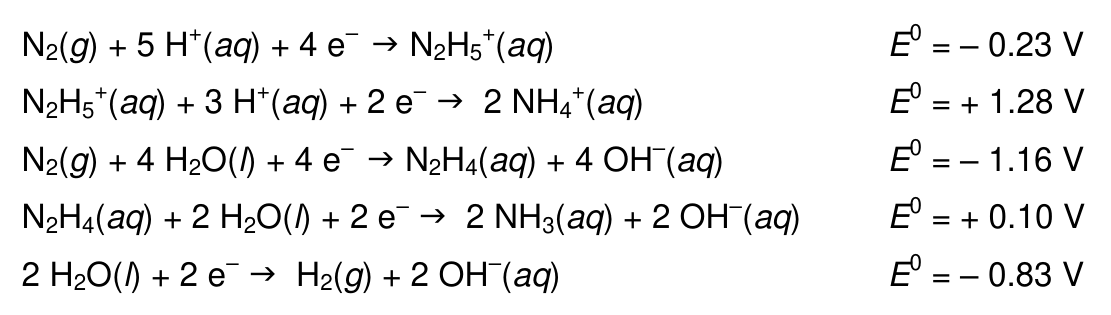
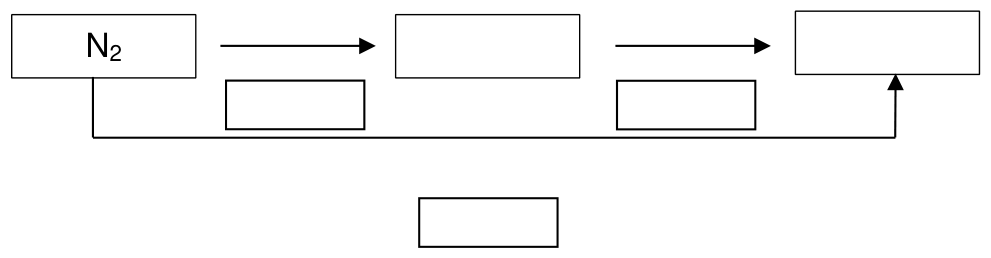
3.7 Fill in the following Latimer diagrams with the forms of hydrazine and ammonia prevailing at the given conditions and write the redox potential value for each arrow representing the electrochemical half-reaction. Record all the necessary calculations.
a) Acidic environment (pH = 0)
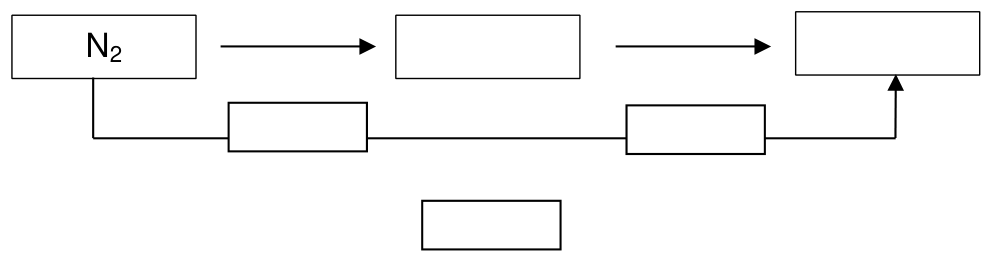
b) Basic environment (pH = 14)
Due to the toxicity, odour and its environmental impact, it is extremely unfavourable to produce ammonia in fuel cells.
3.8 Write down the net reaction for the decomposition of hydrazine under basic conditions to:
(i) ammonia and nitrogen,
(ii) nitrogen and hydrogen.
Calculate the corresponding equilibrium constants at \(T=298.15\ \mathrm K\).
Rechargeable lithium-based batteries are an alternative to fuel cells. Lithium-ion batteries commonly use graphite for one of the electrodes, in which lithium clusters intercalate in between the graphite sheets. The other electrode is made of lithium cobalt oxide, which can reversibly absorb lithium ions moving from one electrode to the other during the charge and discharge processes. The half-reactions relevant for the system can be formally written as:

3.9 Using the formalism given above, write down the overall chemical reaction occurring in the battery during the discharge process. Give the oxidation states of the cobalt atom.
3.10 Tick the boxes to get the correct statements which are valid for the discharge of the lithium-based battery described in 3.9:
| \(\ce{Li(C)_n}\) electrode is | ☐ cathode | ☐ because lithium ions are reduced here. |
| ☐ anode | ☐ because lithium atoms are oxidized here. | |
| \(\ce{LiCoO2}\) electrode is | ☐ cathode | ☐ because cobalt ions are reduced here. |
| ☐ anode | ☐ because cobalt ions are oxidized here. |
3.11 Assume that a \(\ce{C6}\) unit, a \(\ce{CoO2}\) unit and \(\ce{Li}\) atom form the active battery mass required to transfer one electron between the electrodes. Using the corresponding standard EMF, calculate the theoretical specific reversible charge capacity (in \(\mathrm{mAh\,g^{-1}}\)) and the energy density (in \(\mathrm{kWh\,kg^{-1}}\)) of such a model lithium ion battery related to the whole active battery mass.
Official English text of the problem.
Answers
- 3.1: Tick increasing the burning temperature and increasing the working pressure of the gas, the latter through increased compression.
- 3.2: Isooctane: \(\boxed{-44.34\ \mathrm{MJ\,kg^{-1}}}\); hydrogen: \(\boxed{-141.8\ \mathrm{MJ\,kg^{-1}}}\), using the supplied 323.15 K data. Exact values at the printed 232.15 K cannot be determined from the supplied information.
- 3.3: \(\boxed{E^\circ=1.207\ \mathrm V\approx1.21\ \mathrm V}\).
- 3.4: \(\boxed{\eta=80.2\%}\).
- 3.5: Theoretical hydrogen mass \(=1.504\times10^3\ \mathrm{kg}\); \(\boxed{\text{electrolysis yield}=72.5\%}\).
- 3.6: \(\boxed{m(\ce{H2})=6.92\ \mathrm{kg}}\).
- 3.7(a): Middle box: hydrazinium, \(\ce{N2H5+}\),
N[NH3+]; right box: ammonium, \(\ce{NH4+}\),[NH4+]. Successive arrow potentials: \(-0.23\ \mathrm V\), \(+1.28\ \mathrm V\); overall arrow: \(\boxed{+0.273\ \mathrm V}\). - 3.7(b): Middle box: hydrazine, \(\ce{N2H4}\),
NN; right box: ammonia, \(\ce{NH3}\),N. Successive arrow potentials: \(-1.16\ \mathrm V\), \(+0.10\ \mathrm V\); overall arrow: \(\boxed{-0.740\ \mathrm V}\). - 3.8(i): \(\boxed{\ce{3N2H4(aq) -> 4NH3(aq) + N2(g)}}\), with \(\boxed{K\approx1.6\times10^{85}}\).
- 3.8(ii): \(\boxed{\ce{N2H4(aq) -> N2(g) + 2H2(g)}}\), with \(\boxed{K\approx2.1\times10^{22}}\).
- 3.9: \(\boxed{\ce{Li(C)_n + CoO2 -> (C)_n + LiCoO2}}\). Cobalt changes from \(+4\) in \(\ce{CoO2}\) to \(+3\) in \(\ce{LiCoO2}\).
- 3.10: \(\ce{Li(C)_n}\): anode, because lithium atoms are oxidized in the stated formalism. \(\ce{LiCoO2}\): cathode, because cobalt ions are reduced.
- 3.11: \(E^\circ=3.24\ \mathrm V\); theoretical specific charge capacity \(\boxed{157.7\ \mathrm{mAh\,g^{-1}}\approx158\ \mathrm{mAh\,g^{-1}}}\); energy density \(\boxed{0.511\ \mathrm{kWh\,kg^{-1}}}\).
Solution
I use \(F=96485.3\ \mathrm{C\,mol^{-1}}\), \(R=8.31446\ \mathrm{J\,K^{-1}\,mol^{-1}}\), and conventional atomic molar masses.
The molecular and ionic species used in the solution are identified below. These SMILES specify connectivity and charge; physical states and electron transfer are specified separately in the equations.
| Species | Name | SMILES |
|---|---|---|
| \(\ce{C8H18}\) | Isooctane, 2,2,4-trimethylpentane | CC(C)(C)CC(C)C |
| \(\ce{H2}\) | Hydrogen | [H][H] |
| \(\ce{O2}\) | Oxygen | O=O |
| \(\ce{H2O}\) | Water | O |
| \(\ce{CO2}\) | Carbon dioxide | O=C=O |
| \(\ce{N2}\) | Nitrogen | N#N |
| \(\ce{N2H4}\) | Hydrazine | NN |
| \(\ce{N2H5+}\) | Hydrazinium ion | N[NH3+] |
| \(\ce{NH3}\) | Ammonia | N |
| \(\ce{NH4+}\) | Ammonium ion | [NH4+] |
| \(\ce{H+}\) | Hydrogen ion, proton | [H+] |
| \(\ce{OH-}\) | Hydroxide ion | [OH-] |
| \(\ce{Li+}\) | Lithium ion | [Li+] |
| \(\ce{Li}\) | Lithium atom | [Li] |
| \(\ce{Co^4+}\) | Cobalt(IV) ion, formal oxidation-state representation | [Co+4] |
| \(\ce{Co^3+}\) | Cobalt(III) ion, formal oxidation-state representation | [Co+3] |
Graphite, \(\ce{(C)_n}\); lithiated graphite, \(\ce{Li(C)_n}\); cobalt(IV) oxide, \(\ce{CoO2}\); and lithium cobalt(III) oxide, \(\ce{LiCoO2}\), are extended solids. A finite molecular SMILES cannot describe their full lattices or lithium intercalation. The cobalt-ion representations above do not describe the solid-state coordination geometry or imply free cobalt ions in solution.
3.1 — Factors affecting heat-engine efficiency
For a reversible heat engine operating between hot and cold reservoirs,
\[ \eta_{\mathrm{Carnot}}=1-\frac{T_{\mathrm c}}{T_{\mathrm h}}, \]
where both temperatures are in kelvin.
| Option | Selection | Reason |
|---|---|---|
| Increasing friction | Do not tick | Friction dissipates useful mechanical work. |
| Increasing the burning temperature | Tick | Raising the hot-side temperature can increase the attainable efficiency. |
| Narrowing the working temperature interval | Do not tick | Bringing the hot and cold temperatures closer reduces the attainable efficiency. |
| Increasing the working pressure | Tick | Increased compression raises working-gas pressure and can increase combustion-engine efficiency. |
The compression effect can be illustrated by the ideal Otto-cycle relation
\[ \eta_{\mathrm{Otto}}=1-\frac{1}{r^{\gamma-1}}, \]
where \(r=V_{\max}/V_{\min}\) is the compression ratio and \(\gamma=C_p/C_v>1\). Increasing \(r\) increases efficiency. Thus the pressure option is selected, in the sense of a higher compression of the working gas.
3.2 — Specific combustion enthalpies
The printed temperatures conflict: the enthalpies are supplied at \(323.15\ \mathrm K\), but the requested temperature is \(232.15\ \mathrm K\). The numerical calculation below uses the supplied \(323.15\ \mathrm K\) data.
The balanced combustion equations, with liquid water as product, are
\[ \ce{C8H18(l) + 25/2 O2(g) -> 8CO2(g) + 9H2O(l)} \]
and
\[ \ce{H2(g) + 1/2 O2(g) -> H2O(l)}. \]
The second reaction is also the formation reaction of one mole of liquid water from its elements. Therefore,
\[ \Delta_{\mathrm c}H^\circ(\ce{H2}) =\Delta_{\mathrm f}H^\circ(\ce{H2O},\mathrm l) =-285.84\ \mathrm{kJ\,mol^{-1}}. \]
Specific combustion enthalpy is the molar combustion enthalpy divided by molar mass.
For isooctane,
\[ M(\ce{C8H18}) =8(12.011)+18(1.008) =114.232\ \mathrm{g\,mol^{-1}}, \]
\[ h_{\mathrm c}^\circ =\frac{-5065.08}{114.232} =-44.3403\ \mathrm{kJ\,g^{-1}} =\boxed{-44.34\ \mathrm{MJ\,kg^{-1}}}. \]
For hydrogen,
\[ M(\ce{H2})=2.016\ \mathrm{g\,mol^{-1}}, \]
\[ h_{\mathrm c}^\circ =\frac{-285.84}{2.016} =-141.786\ \mathrm{kJ\,g^{-1}} =\boxed{-141.8\ \mathrm{MJ\,kg^{-1}}}. \]
The negative signs denote exothermic combustion; the corresponding released-energy magnitudes are positive.
An exact temperature correction would require Kirchhoff’s law,
\[ \Delta_{\mathrm c}H^\circ(232.15) = \Delta_{\mathrm c}H^\circ(323.15) + \int_{323.15}^{232.15}\Delta_{\mathrm r}C_p^\circ(T)\,dT, \]
together with any necessary phase-change corrections. Those data are not supplied.
3.3 — Standard hydrogen–oxygen fuel-cell EMF
For one mole of hydrogen, the net reaction is
\[ \ce{H2(g) + 1/2 O2(g) -> H2O(l)}. \]
For example, it can be resolved into the balanced half-reactions
\[ \ce{H2(g) -> 2H+(aq) + 2e-}, \]
\[ \ce{1/2 O2(g) + 2H+(aq) + 2e- -> H2O(l)}. \]
Thus \(n=2\) moles of electrons are transferred per mole of hydrogen.
The reaction entropy is
\[ \begin{aligned} \Delta_{\mathrm r}S^\circ &=S^\circ(\ce{H2O},\mathrm l) -S^\circ(\ce{H2},\mathrm g) -\frac12S^\circ(\ce{O2},\mathrm g)\\ &=70-131-\frac{205}{2}\\ &=-163.5\ \mathrm{J\,K^{-1}\,mol^{-1}}. \end{aligned} \]
Consequently,
\[ \begin{aligned} \Delta_{\mathrm r}G^\circ &=\Delta_{\mathrm r}H^\circ-T\Delta_{\mathrm r}S^\circ\\ &=-285.84-(323.15)(-0.1635)\\ &=-233.005\ \mathrm{kJ\,mol^{-1}}. \end{aligned} \]
Using \(\Delta_{\mathrm r}G^\circ=-nFE^\circ\),
\[ E^\circ =\frac{233005\ \mathrm{J\,mol^{-1}}} {2(96485.3\ \mathrm{C\,mol^{-1}})} =\boxed{1.207\ \mathrm V}. \]
Each gas is at the standard pressure of \(100\ \mathrm{kPa}\), and pure liquid water has unit activity, so no Nernst correction is required.
3.4 — Ideal thermodynamic fuel-cell efficiency
The maximum electrical work is \(-\Delta_{\mathrm r}G^\circ\), while the combustion-energy input on the stated liquid-water basis is \(-\Delta_{\mathrm r}H^\circ\). Therefore,
\[ \eta =\frac{-\Delta_{\mathrm r}G^\circ}{-\Delta_{\mathrm r}H^\circ} =\frac{225.85}{281.64} =0.80191. \]
Hence,
\[ \boxed{\eta=80.2\%}. \]
3.5 — Electrolysis yield
The net electrolysis reaction is
\[ \ce{2H2O(l) -> 2H2(g) + O2(g)}. \]
Producing one mole of hydrogen requires two moles of electrons.
The operating time is
\[ t=8.00\ \mathrm h=28800\ \mathrm s. \]
The electrical energy supplied is
\[ W_{\mathrm{el}}=Pt =(10.0\times10^6\ \mathrm W)(28800\ \mathrm s) =2.88\times10^{11}\ \mathrm J. \]
Since \(W_{\mathrm{el}}=UQ\),
\[ Q=\frac{W_{\mathrm{el}}}{U} =\frac{2.88\times10^{11}}{2.00} =1.44\times10^{11}\ \mathrm C. \]
The theoretical hydrogen amount is
\[ n_{\mathrm{theor}}(\ce{H2}) =\frac{Q}{2F} =\frac{1.44\times10^{11}}{2(96485.3)} =7.4623\times10^5\ \mathrm{mol}. \]
Thus,
\[ m_{\mathrm{theor}} =(7.4623\times10^5)(2.016\times10^{-3}) =1504.4\ \mathrm{kg}. \]
The required mass yield is
\[ Y=\frac{m_{\mathrm{actual}}}{m_{\mathrm{theor}}} =\frac{1090}{1504.4} =0.72454, \]
or
\[ \boxed{Y=72.5\%}. \]
3.6 — Hydrogen needed for the journey
The travel time is
\[ t=\frac{330\ \mathrm{km}}{100\ \mathrm{km\,h^{-1}}} =3.30\ \mathrm h=11880\ \mathrm s. \]
The average mechanical output power is
\[ P_{\mathrm{mech}}=0.15(310)=46.5\ \mathrm{kW}. \]
The required mechanical work is therefore
\[ W_{\mathrm{mech}} =(46.5\ \mathrm{kJ\,s^{-1}})(11880\ \mathrm s) =552420\ \mathrm{kJ}. \]
Using the supplied Gibbs energy as the reversible electrical energy per mole, the useful mechanical energy obtained per mole of hydrogen is
\[ w_{\mathrm{mech,m}} =\eta_{\mathrm{cell}}\eta_{\mathrm{motor}} \left|\Delta_{\mathrm r}G\right| =(0.75)(0.95)(226) =161.025\ \mathrm{kJ\,mol^{-1}}. \]
Hence,
\[ n(\ce{H2}) =\frac{552420}{161.025} =3430.65\ \mathrm{mol}, \]
\[ m(\ce{H2}) =(3430.65)(2.016\times10^{-3}) =\boxed{6.92\ \mathrm{kg}}. \]
The Gibbs-energy value already represents reversible electrical work; the thermodynamic factor from 3.4 is not applied again.
3.7 — Latimer diagrams
When consecutive reduction half-reactions are added, their Gibbs energies add. Since
\[ \Delta G_i^\circ=-n_iFE_i^\circ, \]
the combined potential is
\[ E_{\mathrm{overall}}^\circ =\frac{n_1E_1^\circ+n_2E_2^\circ}{n_1+n_2}. \]
The potentials must therefore be weighted by electron numbers.
(a) Acidic environment, pH = 0
The prevailing forms represented by the supplied acidic half-reactions are hydrazinium, \(\ce{N2H5+}\), and ammonium, \(\ce{NH4+}\). Their protonated forms are favoured in strongly acidic solution.
The half-reactions are
\[ \ce{N2(g) + 5H+(aq) + 4e- -> N2H5+(aq)}, \qquad E_1^\circ=-0.23\ \mathrm V, \]
\[ \ce{N2H5+(aq) + 3H+(aq) + 2e- -> 2NH4+(aq)}, \qquad E_2^\circ=+1.28\ \mathrm V. \]
Adding gives
\[ \ce{N2(g) + 8H+(aq) + 6e- -> 2NH4+(aq)}. \]
Thus,
\[ E_{\mathrm{overall}}^\circ =\frac{4(-0.23)+2(+1.28)}{6} =\boxed{+0.273\ \mathrm V}. \]
Fill the diagram precisely as follows:
- Left box: nitrogen, \(\ce{N2}\), already printed.
- Middle box: \(\ce{N2H5+}\).
- Right box: \(\ce{NH4+}\).
- First horizontal arrow: \(-0.23\ \mathrm V\).
- Second horizontal arrow: \(+1.28\ \mathrm V\).
- Lower bypass arrow from the left box to the right box: \(+0.273\ \mathrm V\).
(b) Basic environment, pH = 14
Under strongly basic conditions, the corresponding prevailing forms are neutral hydrazine, \(\ce{N2H4}\), and ammonia, \(\ce{NH3}\).
The half-reactions are
\[ \ce{N2(g) + 4H2O(l) + 4e- -> N2H4(aq) + 4OH-(aq)}, \qquad E_1^\circ=-1.16\ \mathrm V, \]
\[ \ce{N2H4(aq) + 2H2O(l) + 2e- -> 2NH3(aq) + 2OH-(aq)}, \qquad E_2^\circ=+0.10\ \mathrm V. \]
Adding gives
\[ \ce{N2(g) + 6H2O(l) + 6e- -> 2NH3(aq) + 6OH-(aq)}. \]
Therefore,
\[ E_{\mathrm{overall}}^\circ =\frac{4(-1.16)+2(+0.10)}{6} =\boxed{-0.740\ \mathrm V}. \]
Fill the diagram as follows:
- Left box: nitrogen, \(\ce{N2}\), already printed.
- Middle box: \(\ce{N2H4}\).
- Right box: \(\ce{NH3}\).
- First horizontal arrow: \(-1.16\ \mathrm V\).
- Second horizontal arrow: \(+0.10\ \mathrm V\).
- Lower bypass arrow: \(-0.740\ \mathrm V\).
3.8 — Hydrazine decomposition and equilibrium constants
For a reaction assembled from oxidation and reduction half-reactions,
\[ E_{\mathrm{cell}}^\circ =E_{\mathrm{cathode,red}}^\circ-E_{\mathrm{anode,red}}^\circ. \]
Combining
\[ \Delta_{\mathrm r}G^\circ=-nFE_{\mathrm{cell}}^\circ \]
with
\[ \Delta_{\mathrm r}G^\circ=-RT\ln K \]
gives
\[ \boxed{\ln K=\frac{nFE_{\mathrm{cell}}^\circ}{RT}}. \]
The value of \(n\), and consequently \(K\), refers to the balanced reaction exactly as written.
(i) Decomposition to ammonia and nitrogen
Reverse the nitrogen-to-hydrazine reduction half-reaction:
\[ \ce{N2H4(aq) + 4OH-(aq) -> N2(g) + 4H2O(l) + 4e-}. \]
Multiply the hydrazine-to-ammonia reduction half-reaction by two:
\[ \ce{2N2H4(aq) + 4H2O(l) + 4e- -> 4NH3(aq) + 4OH-(aq)}. \]
After cancellation,
\[ \boxed{\ce{3N2H4(aq) -> 4NH3(aq) + N2(g)}}. \]
This is disproportionation: some hydrazine nitrogen is oxidized from oxidation state \(-2\) to \(0\), while the remainder is reduced from \(-2\) to \(-3\).
For the integer-balanced reaction above, \(n=4\), and
\[ E_{\mathrm{cell}}^\circ =0.10-(-1.16) =1.26\ \mathrm V. \]
At \(298.15\ \mathrm K\),
\[ \ln K =\frac{4(96485.3)(1.26)} {(8.31446)(298.15)} =196.166. \]
Equivalently,
\[ \log_{10}K=85.194, \]
so
\[ \boxed{K\approx1.6\times10^{85}}. \]
For ideal gases, its dimensionless activity expression is
\[ K= \frac{a_{\ce{NH3}}^4(p_{\ce{N2}}/p^\circ)} {a_{\ce{N2H4}}^3}. \]
(ii) Decomposition to nitrogen and hydrogen
Use the same hydrazine oxidation half-reaction:
\[ \ce{N2H4(aq) + 4OH-(aq) -> N2(g) + 4H2O(l) + 4e-}. \]
Multiply the supplied water-to-hydrogen reduction half-reaction by two:
\[ \ce{4H2O(l) + 4e- -> 2H2(g) + 4OH-(aq)}. \]
The net reaction is
\[ \boxed{\ce{N2H4(aq) -> N2(g) + 2H2(g)}}. \]
Again \(n=4\), while
\[ E_{\mathrm{cell}}^\circ =-0.83-(-1.16) =0.33\ \mathrm V. \]
Therefore,
\[ \ln K =\frac{4(96485.3)(0.33)} {(8.31446)(298.15)} =51.3767, \]
\[ \log_{10}K=22.3126, \]
and
\[ \boxed{K\approx2.1\times10^{22}}. \]
The corresponding dimensionless activity expression is
\[ K= \frac{(p_{\ce{N2}}/p^\circ)(p_{\ce{H2}}/p^\circ)^2} {a_{\ce{N2H4}}}. \]
3.9 — Battery discharge reaction and cobalt oxidation states
The supplied reduction potentials are
\[ \ce{(C)_n + Li+ + e- -> Li(C)_n}, \qquad E^\circ=-3.05\ \mathrm V, \]
\[ \ce{CoO2 + Li+ + e- -> LiCoO2}, \qquad E^\circ=+0.19\ \mathrm V. \]
During spontaneous discharge, the half-reaction with the higher reduction potential proceeds as reduction. The graphite half-reaction is reversed.
Oxidation:
\[ \ce{Li(C)_n -> (C)_n + Li+ + e-}. \]
Reduction:
\[ \ce{CoO2 + Li+ + e- -> LiCoO2}. \]
Adding and cancelling the lithium ion and electron gives
\[ \boxed{\ce{Li(C)_n + CoO2 -> (C)_n + LiCoO2}}. \]
For cobalt in \(\ce{CoO2}\),
\[ x+2(-2)=0 \quad\Longrightarrow\quad x=+4. \]
For cobalt in \(\ce{LiCoO2}\),
\[ (+1)+x+2(-2)=0 \quad\Longrightarrow\quad x=+3. \]
Thus cobalt is reduced from cobalt(IV) to cobalt(III) during discharge.
3.10 — Electrode identification
Oxidation occurs at the anode, and reduction occurs at the cathode.
For the \(\ce{Li(C)_n}\) electrode, tick:
- anode;
- because lithium atoms are oxidized here.
These selections follow the problem’s formal representation
\[ \ce{Li(C)_n -> (C)_n + Li+ + e-}. \]
For the \(\ce{LiCoO2}\) electrode, tick:
- cathode;
- because cobalt ions are reduced here.
Cobalt changes from \(+4\) to \(+3\) as lithium is inserted into the cobalt-oxide electrode. Electrons flow through the external circuit from the lithiated-graphite electrode to the cobalt-oxide electrode.
3.11 — Specific charge capacity and energy density
The standard discharge EMF is
\[ E^\circ =E_{\mathrm{cathode,red}}^\circ-E_{\mathrm{anode,red}}^\circ =0.19-(-3.05) =\boxed{3.24\ \mathrm V}. \]
The active mass associated with transferring one mole of electrons contains one mole each of \(\ce{C6}\), \(\ce{CoO2}\), and lithium atoms:
\[ \begin{aligned} M_{\mathrm{active}} &=6(12.011)+58.933+2(15.999)+6.94\\ &=169.937\ \mathrm{g\,mol^{-1}}. \end{aligned} \]
The lithium mass is counted once, and both electrodes’ active materials are included.
One mole of electrons carries charge \(F\). Because
\[ 1\ \mathrm{mAh}=3.6\ \mathrm C, \]
the theoretical specific reversible charge capacity is
\[ \begin{aligned} q_{\mathrm{sp}} &=\frac{F}{M_{\mathrm{active}}} \frac{1\ \mathrm{mAh}}{3.6\ \mathrm C}\\ &=\frac{96485.3}{3.6(169.937)}\\ &=\boxed{157.7\ \mathrm{mAh\,g^{-1}}}. \end{aligned} \]
Numerically, this is also \(157.7\ \mathrm{Ah\,kg^{-1}}\). Thus the specific reversible energy is
\[ \begin{aligned} w_{\mathrm{sp}} &=E^\circ q_{\mathrm{sp}}\\ &=(3.24\ \mathrm V)(157.7\ \mathrm{Ah\,kg^{-1}})\\ &=511.0\ \mathrm{Wh\,kg^{-1}}\\ &=\boxed{0.511\ \mathrm{kWh\,kg^{-1}}}. \end{aligned} \]
The solution was checked against the official solution.
IChO 2018 · Theorieaufgabe 3
Elektromobilität im Aufbruch
Heutige Verkehrsmittel beruhen auf der Verbrennung fossiler Brennstoffe, obwohl der Wirkungsgrad realer Verbrennungsmotoren grundsätzlich begrenzt ist und typischerweise zwischen 20 und 40% liegt.
3.1 Kreuzen Sie die Faktoren an, die den Wirkungsgrad einer Wärmekraftmaschine erhöhen können:
- ☐ Erhöhung der Reibung in den mechanischen Teilen des Motors
- ☐ Erhöhung der Verbrennungstemperatur des Brennstoffs im Motor
- ☐ Verkleinerung des Arbeitstemperaturintervalls des Motors
- ☐ Erhöhung des Arbeitsdrucks des Gases
Brennstoffzellen bieten eine Möglichkeit, den Wirkungsgrad des Antriebs zukünftiger Fahrzeuge zu verbessern. Durch den Einsatz von Wasserstoff-Brennstoffzellen lässt sich der Wirkungsgrad des Antriebs erhöhen.
3.2 Die Standardbildungsenthalpie von flüssigem Wasser beträgt \(\Delta_{\mathrm f}H^\circ(\ce{H2O},\mathrm l)=-285.84\ \mathrm{kJ\,mol^{-1}}\), und die Standardverbrennungsenthalpie von Isooctan beträgt \(\Delta_{\mathrm c}H^\circ(\ce{C8H18},\mathrm l)=-5\,065.08\ \mathrm{kJ\,mol^{-1}}\) (beide bei 323.15 K). Berechnen Sie die spezifischen (auf die Masse bezogenen) Verbrennungsenthalpien von reinem flüssigem Isooctan und reinem gasförmigem Wasserstoff bei 232.15 K.
3.3 Berechnen Sie die elektromotorische Standardkraft (EMK) einer Brennstoffzelle, die aus gasförmigem Sauerstoff und Wasserstoff, beide als ideale Gase bei 100 kPa und 323.15 K, flüssiges Wasser erzeugt.
Verwenden Sie die folgenden Entropiedaten für 323.15 K: \(S^\circ(\ce{H2O},\mathrm l)=70\ \mathrm{J\,K^{-1}\,mol^{-1}}\),
\(S^\circ(\ce{H2},\mathrm g)=131\ \mathrm{J\,K^{-1}\,mol^{-1}}\),
\(S^\circ(\ce{O2},\mathrm g)=205\ \mathrm{J\,K^{-1}\,mol^{-1}}\).
3.4 Bestimmen Sie den idealen thermodynamischen Wirkungsgrad \((\eta)\) einer Brennstoffzelle, die bei 353.15 K flüssiges Wasser erzeugt. Bei dieser Temperatur beträgt die Bildungsenthalpie von Wasser \(\Delta_{\mathrm f}H^\circ(\ce{H2O},\mathrm l)=-281.64\ \mathrm{kJ\,mol^{-1}}\) und die zugehörige Änderung der Gibbs-Energie der Reaktion \(\Delta_{\mathrm r}G^\circ=-225.85\ \mathrm{kJ\,mol^{-1}}\).
3.5 Eine Polymermembran-Elektrolyseanlage arbeitet bei einer Spannung von 2.00 V und wird von einer Windkraftanlage mit einer Leistung von 10.0 MW versorgt, die von 22 Uhr bis 6 Uhr mit voller Leistung lief. Bei der Elektrolyse wurden 1 090 kg reiner Wasserstoff gewonnen. Berechnen Sie die Elektrolyseausbeute, definiert als die Masse des erzeugten Wasserstoffs dividiert durch seine theoretisch erzeugbare Masse.
3.6 Berechnen Sie die Wasserstoffmasse, die benötigt wird, um die Strecke zwischen Prag und Bratislava (330 km) mit einer Durchschnittsgeschwindigkeit von \(100\ \mathrm{km\,h^{-1}}\) in einem Auto zurückzulegen, das mit einem 310-kW-Elektromotor ausgestattet ist, der im Mittel mit 15% seiner maximalen Leistung arbeitet. Nehmen Sie an, dass der Wirkungsgrad der Wasserstoffzelle zur Erzeugung elektrischer Energie 75%, der Wirkungsgrad des Elektromotors 95% und die Änderung der Gibbs-Energie bei der Verbrennung des Wasserstoffbrennstoffs \(\Delta_{\mathrm r}G=-226\ \mathrm{kJ\,mol^{-1}}\) beträgt.
Der geringe Wirkungsgrad der Wasserstofferzeugung und die mit seiner Speicherung verbundenen Sicherheitsprobleme behindern die Verbreitung wasserstoffbasierter Verkehrstechnologien. Hydrazin-Brennstoffzellen (\(\ce{N2H4}\)) könnten eine geeignete Alternative sein.
Die folgenden Standardreduktionspotentiale für wässrige Hydrazinsysteme stehen zur Verfügung:
3.7 Ergänzen Sie die folgenden Latimer-Diagramme um die unter den angegebenen Bedingungen vorherrschenden Formen von Hydrazin und Ammoniak und geben Sie für jeden Pfeil, der eine elektrochemische Teilreaktion darstellt, das Redoxpotential an. Halten Sie alle erforderlichen Berechnungen fest.
a) Saures Milieu (pH = 0)
b) Basisches Milieu (pH = 14)
Aufgrund seiner Toxizität, seines Geruchs und seiner Auswirkungen auf die Umwelt ist die Bildung von Ammoniak in Brennstoffzellen äußerst unerwünscht.
3.8 Geben Sie die Gesamtreaktion für die Zersetzung von Hydrazin unter basischen Bedingungen zu folgenden Produkten an:
(i) Ammoniak und Stickstoff,
(ii) Stickstoff und Wasserstoff.
Berechnen Sie die zugehörigen Gleichgewichtskonstanten bei \(T=298.15\ \mathrm K\).
Wiederaufladbare Batterien auf Lithiumbasis sind eine Alternative zu Brennstoffzellen. In Lithium-Ionen-Batterien wird üblicherweise Graphit für eine der Elektroden verwendet, wobei sich Lithiumcluster zwischen den Graphitschichten einlagern. Die andere Elektrode besteht aus Lithiumcobaltoxid, das Lithiumionen reversibel aufnehmen kann, die während der Lade- und Entladevorgänge von einer Elektrode zur anderen wandern. Die für das System relevanten Teilreaktionen lassen sich formal wie folgt schreiben:
3.9 Geben Sie mithilfe des oben dargestellten Formalismus die chemische Gesamtreaktion an, die während des Entladevorgangs in der Batterie abläuft. Geben Sie die Oxidationszahlen des Cobaltatoms an.
3.10 Kreuzen Sie die Kästchen so an, dass sich korrekte Aussagen für die Entladung der in 3.9 beschriebenen Batterie auf Lithiumbasis ergeben:
| Die \(\ce{Li(C)_n}\)-Elektrode ist die | ☐ Kathode | ☐ weil hier Lithiumionen reduziert werden. |
| ☐ Anode | ☐ weil hier Lithiumatome oxidiert werden. | |
| Die \(\ce{LiCoO2}\)-Elektrode ist die | ☐ Kathode | ☐ weil hier Cobaltionen reduziert werden. |
| ☐ Anode | ☐ weil hier Cobaltionen oxidiert werden. |
3.11 Nehmen Sie an, dass eine \(\ce{C6}\)-Einheit, eine \(\ce{CoO2}\)-Einheit und ein \(\ce{Li}\)-Atom die aktive Batteriemasse bilden, die zur Übertragung eines Elektrons zwischen den Elektroden erforderlich ist. Berechnen Sie mithilfe der entsprechenden Standard-EMK die theoretische spezifische reversible Ladungskapazität (in \(\mathrm{mAh\,g^{-1}}\)) und die Energiedichte (in \(\mathrm{kWh\,kg^{-1}}\)) einer solchen modellhaften Lithium-Ionen-Batterie, jeweils bezogen auf die gesamte aktive Batteriemasse.
Aufgabentext aus dem offiziellen englischen Text übersetzt.
Antworten
- 3.1: Kreuzen Sie Erhöhung der Verbrennungstemperatur und Erhöhung des Arbeitsdrucks des Gases an, Letzteres durch stärkere Verdichtung.
- 3.2: Isooctan: \(\boxed{-44.34\ \mathrm{MJ\,kg^{-1}}}\); Wasserstoff: \(\boxed{-141.8\ \mathrm{MJ\,kg^{-1}}}\), unter Verwendung der angegebenen Daten für 323.15 K. Exakte Werte bei den in der Aufgabenstellung gedruckten 232.15 K lassen sich aus den bereitgestellten Informationen nicht bestimmen.
- 3.3: \(\boxed{E^\circ=1.207\ \mathrm V\approx1.21\ \mathrm V}\).
- 3.4: \(\boxed{\eta=80.2\%}\).
- 3.5: Theoretische Wasserstoffmasse \(=1.504\times10^3\ \mathrm{kg}\); \(\boxed{\text{Elektrolyseausbeute}=72.5\%}\).
- 3.6: \(\boxed{m(\ce{H2})=6.92\ \mathrm{kg}}\).
- 3.7(a): Mittleres Kästchen: Hydrazinium, \(\ce{N2H5+}\),
N[NH3+]; rechtes Kästchen: Ammonium, \(\ce{NH4+}\),[NH4+]. Potentiale der aufeinanderfolgenden Pfeile: \(-0.23\ \mathrm V\), \(+1.28\ \mathrm V\); Gesamtpfeil: \(\boxed{+0.273\ \mathrm V}\). - 3.7(b): Mittleres Kästchen: Hydrazin, \(\ce{N2H4}\),
NN; rechtes Kästchen: Ammoniak, \(\ce{NH3}\),N. Potentiale der aufeinanderfolgenden Pfeile: \(-1.16\ \mathrm V\), \(+0.10\ \mathrm V\); Gesamtpfeil: \(\boxed{-0.740\ \mathrm V}\). - 3.8(i): \(\boxed{\ce{3N2H4(aq) -> 4NH3(aq) + N2(g)}}\), mit \(\boxed{K\approx1.6\times10^{85}}\).
- 3.8(ii): \(\boxed{\ce{N2H4(aq) -> N2(g) + 2H2(g)}}\), mit \(\boxed{K\approx2.1\times10^{22}}\).
- 3.9: \(\boxed{\ce{Li(C)_n + CoO2 -> (C)_n + LiCoO2}}\). Die Oxidationszahl von Cobalt ändert sich von \(+4\) in \(\ce{CoO2}\) zu \(+3\) in \(\ce{LiCoO2}\).
- 3.10: \(\ce{Li(C)_n}\): Anode, weil Lithiumatome im angegebenen Formalismus oxidiert werden. \(\ce{LiCoO2}\): Kathode, weil Cobaltionen reduziert werden.
- 3.11: \(E^\circ=3.24\ \mathrm V\); theoretische spezifische Ladungskapazität \(\boxed{157.7\ \mathrm{mAh\,g^{-1}}\approx158\ \mathrm{mAh\,g^{-1}}}\); Energiedichte \(\boxed{0.511\ \mathrm{kWh\,kg^{-1}}}\).
Lösung
Ich verwende \(F=96485.3\ \mathrm{C\,mol^{-1}}\), \(R=8.31446\ \mathrm{J\,K^{-1}\,mol^{-1}}\) und die üblichen molaren Atommassen.
Die in der Lösung verwendeten molekularen und ionischen Spezies sind im Folgenden aufgeführt. Diese SMILES geben die Bindungsverknüpfungen und die Ladung an; Aggregatzustände und Elektronenübertragung werden in den Gleichungen gesondert angegeben.
| Spezies | Name | SMILES |
|---|---|---|
| \(\ce{C8H18}\) | Isooctan, 2,2,4-Trimethylpentan | CC(C)(C)CC(C)C |
| \(\ce{H2}\) | Wasserstoff | [H][H] |
| \(\ce{O2}\) | Sauerstoff | O=O |
| \(\ce{H2O}\) | Wasser | O |
| \(\ce{CO2}\) | Kohlenstoffdioxid | O=C=O |
| \(\ce{N2}\) | Stickstoff | N#N |
| \(\ce{N2H4}\) | Hydrazin | NN |
| \(\ce{N2H5+}\) | Hydraziniumion | N[NH3+] |
| \(\ce{NH3}\) | Ammoniak | N |
| \(\ce{NH4+}\) | Ammoniumion | [NH4+] |
| \(\ce{H+}\) | Wasserstoffion, Proton | [H+] |
| \(\ce{OH-}\) | Hydroxidion | [OH-] |
| \(\ce{Li+}\) | Lithiumion | [Li+] |
| \(\ce{Li}\) | Lithiumatom | [Li] |
| \(\ce{Co^4+}\) | Cobalt(IV)-Ion, formale Darstellung der Oxidationsstufe | [Co+4] |
| \(\ce{Co^3+}\) | Cobalt(III)-Ion, formale Darstellung der Oxidationsstufe | [Co+3] |
Graphit, \(\ce{(C)_n}\); lithiierter Graphit, \(\ce{Li(C)_n}\); Cobalt(IV)-oxid, \(\ce{CoO2}\); und Lithiumcobalt(III)-oxid, \(\ce{LiCoO2}\), sind Feststoffe mit ausgedehnten Gitterstrukturen. Eine endliche molekulare SMILES-Zeichenfolge kann ihre vollständigen Gitter oder die Lithiuminterkalation nicht beschreiben. Die obigen Darstellungen der Cobaltionen beschreiben weder die Koordinationsgeometrie im Festkörper noch implizieren sie freie Cobaltionen in Lösung.
3.1 — Faktoren, die den Wirkungsgrad einer Wärmekraftmaschine beeinflussen
Für eine reversible Wärmekraftmaschine, die zwischen einem heißen und einem kalten Wärmereservoir arbeitet, gilt
\[ \eta_{\mathrm{Carnot}}=1-\frac{T_{\mathrm c}}{T_{\mathrm h}}, \]
wobei beide Temperaturen in Kelvin angegeben sind.
| Option | Auswahl | Begründung |
|---|---|---|
| Erhöhung der Reibung | Nicht ankreuzen | Durch Reibung wird nutzbare mechanische Arbeit dissipiert. |
| Erhöhung der Verbrennungstemperatur | Ankreuzen | Eine Erhöhung der Temperatur auf der heißen Seite kann den erreichbaren Wirkungsgrad steigern. |
| Verkleinerung des Arbeitstemperaturintervalls | Nicht ankreuzen | Eine Annäherung der heißen und kalten Temperaturen verringert den erreichbaren Wirkungsgrad. |
| Erhöhung des Arbeitsdrucks | Ankreuzen | Eine stärkere Verdichtung erhöht den Druck des Arbeitsgases und kann den Wirkungsgrad eines Verbrennungsmotors steigern. |
Der Einfluss der Verdichtung lässt sich anhand der Beziehung für den idealen Otto-Kreisprozess veranschaulichen:
\[ \eta_{\mathrm{Otto}}=1-\frac{1}{r^{\gamma-1}}, \]
wobei \(r=V_{\max}/V_{\min}\) das Verdichtungsverhältnis ist und \(\gamma=C_p/C_v>1\) gilt. Eine Erhöhung von \(r\) steigert den Wirkungsgrad. Daher wird die Druckoption im Sinne einer stärkeren Verdichtung des Arbeitsgases ausgewählt.
3.2 — Spezifische Verbrennungsenthalpien
Die gedruckten Temperaturangaben widersprechen einander: Die Enthalpien sind für \(323.15\ \mathrm K\) angegeben, die gefragte Temperatur beträgt jedoch \(232.15\ \mathrm K\). Die folgende numerische Berechnung verwendet die bereitgestellten Daten für \(323.15\ \mathrm K\).
Die ausgeglichenen Verbrennungsgleichungen mit flüssigem Wasser als Produkt lauten
\[ \ce{C8H18(l) + 25/2 O2(g) -> 8CO2(g) + 9H2O(l)} \]
und
\[ \ce{H2(g) + 1/2 O2(g) -> H2O(l)}. \]
Die zweite Reaktion ist zugleich die Bildungsreaktion von einem Mol flüssigem Wasser aus seinen Elementen. Daher gilt
\[ \Delta_{\mathrm c}H^\circ(\ce{H2}) =\Delta_{\mathrm f}H^\circ(\ce{H2O},\mathrm l) =-285.84\ \mathrm{kJ\,mol^{-1}}. \]
Die spezifische Verbrennungsenthalpie ist die molare Verbrennungsenthalpie dividiert durch die molare Masse.
Für Isooctan gilt
\[ M(\ce{C8H18}) =8(12.011)+18(1.008) =114.232\ \mathrm{g\,mol^{-1}}, \]
\[ h_{\mathrm c}^\circ =\frac{-5065.08}{114.232} =-44.3403\ \mathrm{kJ\,g^{-1}} =\boxed{-44.34\ \mathrm{MJ\,kg^{-1}}}. \]
Für Wasserstoff gilt
\[ M(\ce{H2})=2.016\ \mathrm{g\,mol^{-1}}, \]
\[ h_{\mathrm c}^\circ =\frac{-285.84}{2.016} =-141.786\ \mathrm{kJ\,g^{-1}} =\boxed{-141.8\ \mathrm{MJ\,kg^{-1}}}. \]
Die negativen Vorzeichen kennzeichnen die exotherme Verbrennung; die entsprechenden Beträge der freigesetzten Energie sind positiv.
Für eine exakte Temperaturkorrektur wäre der Kirchhoffsche Satz erforderlich,
\[ \Delta_{\mathrm c}H^\circ(232.15) = \Delta_{\mathrm c}H^\circ(323.15) + \int_{323.15}^{232.15}\Delta_{\mathrm r}C_p^\circ(T)\,dT, \]
zusammen mit gegebenenfalls erforderlichen Korrekturen für Phasenübergänge. Diese Daten sind nicht angegeben.
3.3 — Standard-EMK der Wasserstoff-Sauerstoff-Brennstoffzelle
Für ein Mol Wasserstoff lautet die Gesamtreaktion
\[ \ce{H2(g) + 1/2 O2(g) -> H2O(l)}. \]
Sie lässt sich beispielsweise in die folgenden ausgeglichenen Teilreaktionen zerlegen:
\[ \ce{H2(g) -> 2H+(aq) + 2e-}, \]
\[ \ce{1/2 O2(g) + 2H+(aq) + 2e- -> H2O(l)}. \]
Somit werden pro Mol Wasserstoff \(n=2\) Mol Elektronen übertragen.
Die Reaktionsentropie beträgt
\[ \begin{aligned} \Delta_{\mathrm r}S^\circ &=S^\circ(\ce{H2O},\mathrm l) -S^\circ(\ce{H2},\mathrm g) -\frac12S^\circ(\ce{O2},\mathrm g)\\ &=70-131-\frac{205}{2}\\ &=-163.5\ \mathrm{J\,K^{-1}\,mol^{-1}}. \end{aligned} \]
Folglich gilt
\[ \begin{aligned} \Delta_{\mathrm r}G^\circ &=\Delta_{\mathrm r}H^\circ-T\Delta_{\mathrm r}S^\circ\\ &=-285.84-(323.15)(-0.1635)\\ &=-233.005\ \mathrm{kJ\,mol^{-1}}. \end{aligned} \]
Mit \(\Delta_{\mathrm r}G^\circ=-nFE^\circ\) ergibt sich
\[ E^\circ =\frac{233005\ \mathrm{J\,mol^{-1}}} {2(96485.3\ \mathrm{C\,mol^{-1}})} =\boxed{1.207\ \mathrm V}. \]
Jedes Gas liegt beim Standarddruck von \(100\ \mathrm{kPa}\) vor, und reines flüssiges Wasser hat die Aktivität eins; daher ist keine Nernst-Korrektur erforderlich.
3.4 — Idealer thermodynamischer Wirkungsgrad der Brennstoffzelle
Die maximale elektrische Arbeit beträgt \(-\Delta_{\mathrm r}G^\circ\), während die zugeführte Verbrennungsenergie auf der angegebenen Basis mit flüssigem Wasser \(-\Delta_{\mathrm r}H^\circ\) beträgt. Daher gilt
\[ \eta =\frac{-\Delta_{\mathrm r}G^\circ}{-\Delta_{\mathrm r}H^\circ} =\frac{225.85}{281.64} =0.80191. \]
Damit ergibt sich
\[ \boxed{\eta=80.2\%}. \]
3.5 — Elektrolyseausbeute
Die Gesamtreaktion der Elektrolyse lautet
\[ \ce{2H2O(l) -> 2H2(g) + O2(g)}. \]
Zur Erzeugung von einem Mol Wasserstoff werden zwei Mol Elektronen benötigt.
Die Betriebsdauer beträgt
\[ t=8.00\ \mathrm h=28800\ \mathrm s. \]
Die zugeführte elektrische Energie beträgt
\[ W_{\mathrm{el}}=Pt =(10.0\times10^6\ \mathrm W)(28800\ \mathrm s) =2.88\times10^{11}\ \mathrm J. \]
Da \(W_{\mathrm{el}}=UQ\) gilt, folgt
\[ Q=\frac{W_{\mathrm{el}}}{U} =\frac{2.88\times10^{11}}{2.00} =1.44\times10^{11}\ \mathrm C. \]
Die theoretische Stoffmenge an Wasserstoff beträgt
\[ n_{\mathrm{theor}}(\ce{H2}) =\frac{Q}{2F} =\frac{1.44\times10^{11}}{2(96485.3)} =7.4623\times10^5\ \mathrm{mol}. \]
Somit gilt
\[ m_{\mathrm{theor}} =(7.4623\times10^5)(2.016\times10^{-3}) =1504.4\ \mathrm{kg}. \]
Die gesuchte Massenausbeute beträgt
\[ Y=\frac{m_{\mathrm{actual}}}{m_{\mathrm{theor}}} =\frac{1090}{1504.4} =0.72454, \]
also
\[ \boxed{Y=72.5\%}. \]
3.6 — Für die Fahrt benötigter Wasserstoff
Die Fahrzeit beträgt
\[ t=\frac{330\ \mathrm{km}}{100\ \mathrm{km\,h^{-1}}} =3.30\ \mathrm h=11880\ \mathrm s. \]
Die mittlere mechanische Ausgangsleistung beträgt
\[ P_{\mathrm{mech}}=0.15(310)=46.5\ \mathrm{kW}. \]
Die erforderliche mechanische Arbeit beträgt daher
\[ W_{\mathrm{mech}} =(46.5\ \mathrm{kJ\,s^{-1}})(11880\ \mathrm s) =552420\ \mathrm{kJ}. \]
Wird die angegebene Gibbs-Energie als reversible elektrische Energie pro Mol verwendet, ergibt sich für die pro Mol Wasserstoff gewonnene nutzbare mechanische Energie
\[ w_{\mathrm{mech,m}} =\eta_{\mathrm{cell}}\eta_{\mathrm{motor}} \left|\Delta_{\mathrm r}G\right| =(0.75)(0.95)(226) =161.025\ \mathrm{kJ\,mol^{-1}}. \]
Daraus folgt
\[ n(\ce{H2}) =\frac{552420}{161.025} =3430.65\ \mathrm{mol}, \]
\[ m(\ce{H2}) =(3430.65)(2.016\times10^{-3}) =\boxed{6.92\ \mathrm{kg}}. \]
Der Wert der Gibbs-Energie stellt bereits die reversible elektrische Arbeit dar; der thermodynamische Faktor aus 3.4 wird nicht erneut angewendet.
3.7 — Latimer-Diagramme
Werden aufeinanderfolgende Reduktionsteilreaktionen addiert, addieren sich ihre Gibbs-Energien. Da
\[ \Delta G_i^\circ=-n_iFE_i^\circ, \]
gilt, beträgt das kombinierte Potential
\[ E_{\mathrm{overall}}^\circ =\frac{n_1E_1^\circ+n_2E_2^\circ}{n_1+n_2}. \]
Die Potentiale müssen daher mit den Elektronenzahlen gewichtet werden.
(a) Saures Milieu, pH = 0
Die durch die angegebenen Teilreaktionen im sauren Milieu dargestellten vorherrschenden Formen sind Hydrazinium, \(\ce{N2H5+}\), und Ammonium, \(\ce{NH4+}\). Ihre protonierten Formen sind in stark saurer Lösung begünstigt.
Die Teilreaktionen lauten
\[ \ce{N2(g) + 5H+(aq) + 4e- -> N2H5+(aq)}, \qquad E_1^\circ=-0.23\ \mathrm V, \]
\[ \ce{N2H5+(aq) + 3H+(aq) + 2e- -> 2NH4+(aq)}, \qquad E_2^\circ=+1.28\ \mathrm V. \]
Durch Addition ergibt sich
\[ \ce{N2(g) + 8H+(aq) + 6e- -> 2NH4+(aq)}. \]
Somit gilt
\[ E_{\mathrm{overall}}^\circ =\frac{4(-0.23)+2(+1.28)}{6} =\boxed{+0.273\ \mathrm V}. \]
Das Diagramm ist genau wie folgt auszufüllen:
- Linkes Kästchen: Stickstoff, \(\ce{N2}\), bereits vorgegeben.
- Mittleres Kästchen: \(\ce{N2H5+}\).
- Rechtes Kästchen: \(\ce{NH4+}\).
- Erster waagerechter Pfeil: \(-0.23\ \mathrm V\).
- Zweiter waagerechter Pfeil: \(+1.28\ \mathrm V\).
- Unterer, das mittlere Kästchen umgehender Pfeil vom linken zum rechten Kästchen: \(+0.273\ \mathrm V\).
(b) Basisches Milieu, pH = 14
Unter stark basischen Bedingungen sind die entsprechenden vorherrschenden Formen neutrales Hydrazin, \(\ce{N2H4}\), und Ammoniak, \(\ce{NH3}\).
Die Teilreaktionen lauten
\[ \ce{N2(g) + 4H2O(l) + 4e- -> N2H4(aq) + 4OH-(aq)}, \qquad E_1^\circ=-1.16\ \mathrm V, \]
\[ \ce{N2H4(aq) + 2H2O(l) + 2e- -> 2NH3(aq) + 2OH-(aq)}, \qquad E_2^\circ=+0.10\ \mathrm V. \]
Durch Addition ergibt sich
\[ \ce{N2(g) + 6H2O(l) + 6e- -> 2NH3(aq) + 6OH-(aq)}. \]
Daher gilt
\[ E_{\mathrm{overall}}^\circ =\frac{4(-1.16)+2(+0.10)}{6} =\boxed{-0.740\ \mathrm V}. \]
Das Diagramm ist wie folgt auszufüllen:
- Linkes Kästchen: Stickstoff, \(\ce{N2}\), bereits vorgegeben.
- Mittleres Kästchen: \(\ce{N2H4}\).
- Rechtes Kästchen: \(\ce{NH3}\).
- Erster waagerechter Pfeil: \(-1.16\ \mathrm V\).
- Zweiter waagerechter Pfeil: \(+0.10\ \mathrm V\).
- Unterer, das mittlere Kästchen umgehender Pfeil: \(-0.740\ \mathrm V\).
3.8 — Hydrazinzersetzung und Gleichgewichtskonstanten
Für eine aus Oxidations- und Reduktionsteilreaktionen zusammengesetzte Reaktion gilt
\[ E_{\mathrm{cell}}^\circ =E_{\mathrm{cathode,red}}^\circ-E_{\mathrm{anode,red}}^\circ. \]
Die Kombination von
\[ \Delta_{\mathrm r}G^\circ=-nFE_{\mathrm{cell}}^\circ \]
mit
\[ \Delta_{\mathrm r}G^\circ=-RT\ln K \]
ergibt
\[ \boxed{\ln K=\frac{nFE_{\mathrm{cell}}^\circ}{RT}}. \]
Der Wert von \(n\) und folglich auch \(K\) beziehen sich auf die ausgeglichene Reaktion genau in der angegebenen Form.
(i) Zersetzung zu Ammoniak und Stickstoff
Die Reduktionsteilreaktion von Stickstoff zu Hydrazin wird umgekehrt:
\[ \ce{N2H4(aq) + 4OH-(aq) -> N2(g) + 4H2O(l) + 4e-}. \]
Die Reduktionsteilreaktion von Hydrazin zu Ammoniak wird mit zwei multipliziert:
\[ \ce{2N2H4(aq) + 4H2O(l) + 4e- -> 4NH3(aq) + 4OH-(aq)}. \]
Nach dem Kürzen ergibt sich
\[ \boxed{\ce{3N2H4(aq) -> 4NH3(aq) + N2(g)}}. \]
Dies ist eine Disproportionierung: Ein Teil des Stickstoffs im Hydrazin wird von der Oxidationszahl \(-2\) auf \(0\) oxidiert, während der Rest von \(-2\) auf \(-3\) reduziert wird.
Für die obige mit ganzzahligen Koeffizienten ausgeglichene Reaktion gilt \(n=4\), und
\[ E_{\mathrm{cell}}^\circ =0.10-(-1.16) =1.26\ \mathrm V. \]
Bei \(298.15\ \mathrm K\) gilt
\[ \ln K =\frac{4(96485.3)(1.26)} {(8.31446)(298.15)} =196.166. \]
Äquivalent dazu gilt
\[ \log_{10}K=85.194, \]
also
\[ \boxed{K\approx1.6\times10^{85}}. \]
Für ideale Gase lautet der dimensionslose Ausdruck in Aktivitäten
\[ K= \frac{a_{\ce{NH3}}^4(p_{\ce{N2}}/p^\circ)} {a_{\ce{N2H4}}^3}. \]
(ii) Zersetzung zu Stickstoff und Wasserstoff
Es wird dieselbe Oxidationsteilreaktion des Hydrazins verwendet:
\[ \ce{N2H4(aq) + 4OH-(aq) -> N2(g) + 4H2O(l) + 4e-}. \]
Die angegebene Reduktionsteilreaktion von Wasser zu Wasserstoff wird mit zwei multipliziert:
\[ \ce{4H2O(l) + 4e- -> 2H2(g) + 4OH-(aq)}. \]
Die Gesamtreaktion lautet
\[ \boxed{\ce{N2H4(aq) -> N2(g) + 2H2(g)}}. \]
Erneut gilt \(n=4\), während
\[ E_{\mathrm{cell}}^\circ =-0.83-(-1.16) =0.33\ \mathrm V. \]
Daher gilt
\[ \ln K =\frac{4(96485.3)(0.33)} {(8.31446)(298.15)} =51.3767, \]
\[ \log_{10}K=22.3126, \]
und
\[ \boxed{K\approx2.1\times10^{22}}. \]
Der entsprechende dimensionslose Ausdruck in Aktivitäten lautet
\[ K= \frac{(p_{\ce{N2}}/p^\circ)(p_{\ce{H2}}/p^\circ)^2} {a_{\ce{N2H4}}}. \]
3.9 — Entladereaktion der Batterie und Oxidationszahlen von Cobalt
Die angegebenen Reduktionspotentiale lauten
\[ \ce{(C)_n + Li+ + e- -> Li(C)_n}, \qquad E^\circ=-3.05\ \mathrm V, \]
\[ \ce{CoO2 + Li+ + e- -> LiCoO2}, \qquad E^\circ=+0.19\ \mathrm V. \]
Bei der freiwillig ablaufenden Entladung läuft die Teilreaktion mit dem höheren Reduktionspotential als Reduktion ab. Die Graphit-Teilreaktion wird umgekehrt.
Oxidation:
\[ \ce{Li(C)_n -> (C)_n + Li+ + e-}. \]
Reduktion:
\[ \ce{CoO2 + Li+ + e- -> LiCoO2}. \]
Durch Addition und Kürzen des Lithiumions und des Elektrons ergibt sich
\[ \boxed{\ce{Li(C)_n + CoO2 -> (C)_n + LiCoO2}}. \]
Für Cobalt in \(\ce{CoO2}\) gilt
\[ x+2(-2)=0 \quad\Longrightarrow\quad x=+4. \]
Für Cobalt in \(\ce{LiCoO2}\) gilt
\[ (+1)+x+2(-2)=0 \quad\Longrightarrow\quad x=+3. \]
Somit wird Cobalt während der Entladung von Cobalt(IV) zu Cobalt(III) reduziert.
3.10 — Zuordnung der Elektroden
An der Anode findet die Oxidation statt, an der Kathode die Reduktion.
Für die \(\ce{Li(C)_n}\)-Elektrode ist anzukreuzen:
- Anode;
- weil hier Lithiumatome oxidiert werden.
Diese Auswahl folgt der formalen Darstellung der Aufgabe
\[ \ce{Li(C)_n -> (C)_n + Li+ + e-}. \]
Für die \(\ce{LiCoO2}\)-Elektrode ist anzukreuzen:
- Kathode;
- weil hier Cobaltionen reduziert werden.
Die Oxidationszahl von Cobalt ändert sich von \(+4\) zu \(+3\), während Lithium in die Cobaltoxidelektrode eingelagert wird. Elektronen fließen durch den äußeren Stromkreis von der Elektrode aus lithiiertem Graphit zur Cobaltoxidelektrode.
3.11 — Spezifische Ladungskapazität und Energiedichte
Die Standard-EMK bei der Entladung beträgt
\[ E^\circ =E_{\mathrm{cathode,red}}^\circ-E_{\mathrm{anode,red}}^\circ =0.19-(-3.05) =\boxed{3.24\ \mathrm V}. \]
Die aktive Masse, die mit der Übertragung von einem Mol Elektronen verbunden ist, enthält jeweils ein Mol \(\ce{C6}\), \(\ce{CoO2}\) und Lithiumatome:
\[ \begin{aligned} M_{\mathrm{active}} &=6(12.011)+58.933+2(15.999)+6.94\\ &=169.937\ \mathrm{g\,mol^{-1}}. \end{aligned} \]
Die Lithiummasse wird einmal gezählt, und die aktiven Materialien beider Elektroden werden berücksichtigt.
Ein Mol Elektronen trägt die Ladung \(F\). Da
\[ 1\ \mathrm{mAh}=3.6\ \mathrm C, \]
gilt, beträgt die theoretische spezifische reversible Ladungskapazität
\[ \begin{aligned} q_{\mathrm{sp}} &=\frac{F}{M_{\mathrm{active}}} \frac{1\ \mathrm{mAh}}{3.6\ \mathrm C}\\ &=\frac{96485.3}{3.6(169.937)}\\ &=\boxed{157.7\ \mathrm{mAh\,g^{-1}}}. \end{aligned} \]
Numerisch entspricht dies auch \(157.7\ \mathrm{Ah\,kg^{-1}}\). Somit beträgt die spezifische reversible Energie
\[ \begin{aligned} w_{\mathrm{sp}} &=E^\circ q_{\mathrm{sp}}\\ &=(3.24\ \mathrm V)(157.7\ \mathrm{Ah\,kg^{-1}})\\ &=511.0\ \mathrm{Wh\,kg^{-1}}\\ &=\boxed{0.511\ \mathrm{kWh\,kg^{-1}}}. \end{aligned} \]
Die Lösung wurde mit der offiziellen Lösung abgeglichen.
IChO 2018 · Teori sorusu 3
Gelişen elektromobilite
Günümüzde kullanılan ulaşım araçları fosil yakıtların yakılmasına dayanır; ancak gerçek yanmalı motorların verimi doğası gereği sınırlıdır ve genellikle %20 ile %40 arasında değişir.
3.1 Bir ısı makinesinin verimini artırabilecek etkenleri işaretleyiniz:
- ☐ Motorun mekanik parçalarındaki sürtünmenin artırılması
- ☐ Motorda yakıtın yanma sıcaklığının artırılması
- ☐ Motorun çalışma sıcaklığı aralığının daraltılması
- ☐ Gazın çalışma basıncının artırılması
Yakıt hücreleri, geleceğin araçlarında motor verimini artırmanın bir yolunu sunar. Hidrojen esaslı yakıt hücreleri kullanılarak motor verimi artırılabilir.
3.2 Sıvı suyun standart oluşum entalpisi \(\Delta_{\mathrm f}H^\circ(\ce{H2O},\mathrm l)=-285.84\ \mathrm{kJ\,mol^{-1}}\), izooktanın standart yanma entalpisi ise \(\Delta_{\mathrm c}H^\circ(\ce{C8H18},\mathrm l)=-5\,065.08\ \mathrm{kJ\,mol^{-1}}\) değerindedir (her ikisi de 323.15 K'de). Saf sıvı izooktanın ve saf gaz hâlindeki hidrojenin 232.15 K'deki özgül (birim kütle başına) yanma entalpilerini hesaplayınız.
3.3 Her ikisi de 100 kPa ve 323.15 K'de ideal gaz olan oksijen ve hidrojeni kullanarak sıvı su üreten bir yakıt hücresinin standart elektromotor kuvvetini (EMK) hesaplayınız.
323.15 K için aşağıdaki entropi verilerini kullanınız: \(S^\circ(\ce{H2O},\mathrm l)=70\ \mathrm{J\,K^{-1}\,mol^{-1}}\),
\(S^\circ(\ce{H2},\mathrm g)=131\ \mathrm{J\,K^{-1}\,mol^{-1}}\),
\(S^\circ(\ce{O2},\mathrm g)=205\ \mathrm{J\,K^{-1}\,mol^{-1}}\).
3.4 353.15 K'de sıvı su üreten bir yakıt hücresinin ideal termodinamik verimini \((\eta)\) belirleyiniz. Bu sıcaklıkta suyun oluşum entalpisi \(\Delta_{\mathrm f}H^\circ(\ce{H2O},\mathrm l)=-281.64\ \mathrm{kJ\,mol^{-1}}\), ilgili tepkimenin Gibbs enerjisi değişimi ise \(\Delta_{\mathrm r}G^\circ=-225.85\ \mathrm{kJ\,mol^{-1}}\) değerindedir.
3.5 Polimer membranlı bir elektrolizör tesisi 2.00 V gerilimde çalışmaktadır ve enerjisini gece 22.00'den sabah 06.00'ya kadar tam güçte çalışan 10.0 MW'lık bir rüzgâr türbini santralinden almaktadır. Elektroliz sonucunda 1 090 kg saf hidrojen elde edilmiştir. Üretilen hidrojenin kütlesinin teorik olarak üretilmesi gereken kütlesine oranı olarak tanımlanan elektroliz verimini hesaplayınız.
3.6 Azami gücünün ortalama %15'i düzeyinde çalışan 310 kW'lık bir elektrik motoruyla donatılmış bir otomobille Prag ile Bratislava arasındaki mesafeyi (330 km), ortalama \(100\ \mathrm{km\,h^{-1}}\) hızla katetmek için gereken hidrojen kütlesini hesaplayınız. Elektrik enerjisi üreten hidrojen hücresinin veriminin %75, elektrik motorunun veriminin %95 ve hidrojen yakıtının yanmasına ilişkin Gibbs enerjisi değişiminin \(\Delta_{\mathrm r}G=-226\ \mathrm{kJ\,mol^{-1}}\) olduğunu varsayınız.
Hidrojen üretiminin düşük verimi ve depolanmasıyla ilgili güvenlik sorunları, hidrojen esaslı ulaşım teknolojisinin yaygınlaşmasını engellemektedir. Hidrazin (\(\ce{N2H4}\)) yakıt hücreleri uygun bir alternatif olabilir.
Sulu hidrazin sistemleri için aşağıdaki standart indirgenme potansiyelleri verilmiştir:
3.7 Aşağıdaki Latimer diyagramlarını, verilen koşullarda baskın olan hidrazin ve amonyak türleriyle doldurunuz ve elektrokimyasal yarı tepkimeyi temsil eden her ok için redoks potansiyelini yazınız. Gerekli tüm hesaplamaları gösteriniz.
a) Asidik ortam (pH = 0)
b) Bazik ortam (pH = 14)
Toksisitesi, kokusu ve çevresel etkisi nedeniyle yakıt hücrelerinde amonyak üretilmesi son derece istenmeyen bir durumdur.
3.8 Hidrazinin bazik koşullarda aşağıdaki ürünlere bozunmasının net tepkimelerini yazınız:
(i) amonyak ve azot,
(ii) azot ve hidrojen.
\(T=298.15\ \mathrm K\) için ilgili denge sabitlerini hesaplayınız.
Şarj edilebilir lityum esaslı piller, yakıt hücrelerine bir alternatiftir. Lityum iyon pillerde elektrotlardan biri için yaygın olarak grafit kullanılır; lityum kümeleri grafit tabakalarının arasına interkale olur. Diğer elektrot, şarj ve deşarj süreçlerinde bir elektrottan diğerine hareket eden lityum iyonlarını tersinir olarak bünyesine alabilen lityum kobalt oksitten yapılır. Sistemle ilgili yarı tepkimeler biçimsel olarak şöyle yazılabilir:
3.9 Yukarıda verilen biçimsel gösterimi kullanarak pilde deşarj sürecinde gerçekleşen toplam kimyasal tepkimeyi yazınız. Kobalt atomunun yükseltgenme basamaklarını belirtiniz.
3.10 3.9'da açıklanan lityum esaslı pilin deşarjı için geçerli doğru ifadeleri elde etmek üzere kutuları işaretleyiniz:
| \(\ce{Li(C)_n}\) elektrodu | ☐ katottur | ☐ çünkü lityum iyonları burada indirgenir. |
| ☐ anottur | ☐ çünkü lityum atomları burada yükseltgenir. | |
| \(\ce{LiCoO2}\) elektrodu | ☐ katottur | ☐ çünkü kobalt iyonları burada indirgenir. |
| ☐ anottur | ☐ çünkü kobalt iyonları burada yükseltgenir. |
3.11 Bir \(\ce{C6}\) biriminin, bir \(\ce{CoO2}\) biriminin ve bir \(\ce{Li}\) atomunun, elektrotlar arasında bir elektron aktarımı için gereken aktif pil kütlesini oluşturduğunu varsayınız. İlgili standart EMK'yi kullanarak böyle bir model lityum iyon pilin tüm aktif pil kütlesine göre teorik özgül tersinir yük kapasitesini (\(\mathrm{mAh\,g^{-1}}\) cinsinden) ve enerji yoğunluğunu (\(\mathrm{kWh\,kg^{-1}}\) cinsinden) hesaplayınız.
Soru metni resmi İngilizce metinden çevrilmiştir.
Cevaplar
- 3.1: Yanma sıcaklığının artırılması ve gazın çalışma basıncının artırılması seçeneklerini işaretleyiniz; ikincisi, sıkıştırmanın artırılması yoluyla etki eder.
- 3.2: Verilen 323.15 K verileri kullanıldığında izooktan: \(\boxed{-44.34\ \mathrm{MJ\,kg^{-1}}}\); hidrojen: \(\boxed{-141.8\ \mathrm{MJ\,kg^{-1}}}\). Metinde basılı olan 232.15 K sıcaklığındaki kesin değerler, verilen bilgilerden belirlenemez.
- 3.3: \(\boxed{E^\circ=1.207\ \mathrm V\approx1.21\ \mathrm V}\).
- 3.4: \(\boxed{\eta=80.2\%}\).
- 3.5: Teorik hidrojen kütlesi \(=1.504\times10^3\ \mathrm{kg}\); \(\boxed{\text{elektroliz verimi}=72.5\%}\).
- 3.6: \(\boxed{m(\ce{H2})=6.92\ \mathrm{kg}}\).
- 3.7(a): Ortadaki kutu: hidrazinyum, \(\ce{N2H5+}\),
N[NH3+]; sağdaki kutu: amonyum, \(\ce{NH4+}\),[NH4+]. Ardışık okların potansiyelleri: \(-0.23\ \mathrm V\), \(+1.28\ \mathrm V\); toplam tepkime oku: \(\boxed{+0.273\ \mathrm V}\). - 3.7(b): Ortadaki kutu: hidrazin, \(\ce{N2H4}\),
NN; sağdaki kutu: amonyak, \(\ce{NH3}\),N. Ardışık okların potansiyelleri: \(-1.16\ \mathrm V\), \(+0.10\ \mathrm V\); toplam tepkime oku: \(\boxed{-0.740\ \mathrm V}\). - 3.8(i): \(\boxed{\ce{3N2H4(aq) -> 4NH3(aq) + N2(g)}}\), \(\boxed{K\approx1.6\times10^{85}}\).
- 3.8(ii): \(\boxed{\ce{N2H4(aq) -> N2(g) + 2H2(g)}}\), \(\boxed{K\approx2.1\times10^{22}}\).
- 3.9: \(\boxed{\ce{Li(C)_n + CoO2 -> (C)_n + LiCoO2}}\). Kobalt, \(\ce{CoO2}\) içinde \(+4\) iken \(\ce{LiCoO2}\) içinde \(+3\) olur.
- 3.10: \(\ce{Li(C)_n}\): anot, çünkü verilen biçimsel gösterimde lityum atomları yükseltgenir. \(\ce{LiCoO2}\): katot, çünkü kobalt iyonları indirgenir.
- 3.11: \(E^\circ=3.24\ \mathrm V\); teorik özgül yük kapasitesi \(\boxed{157.7\ \mathrm{mAh\,g^{-1}}\approx158\ \mathrm{mAh\,g^{-1}}}\); enerji yoğunluğu \(\boxed{0.511\ \mathrm{kWh\,kg^{-1}}}\).
Çözüm
\(F=96485.3\ \mathrm{C\,mol^{-1}}\), \(R=8.31446\ \mathrm{J\,K^{-1}\,mol^{-1}}\) ve yaygın olarak kullanılan atomik molar kütleleri kullanıyorum.
Çözümde kullanılan moleküler ve iyonik türler aşağıda tanımlanmıştır. Bu SMILES gösterimleri bağlanma düzenini ve yükü belirtir; fiziksel hâller ve elektron aktarımı denklemlerde ayrıca belirtilmiştir.
| Tür | Adı | SMILES |
|---|---|---|
| \(\ce{C8H18}\) | İzooktan, 2,2,4-trimetilpentan | CC(C)(C)CC(C)C |
| \(\ce{H2}\) | Hidrojen | [H][H] |
| \(\ce{O2}\) | Oksijen | O=O |
| \(\ce{H2O}\) | Su | O |
| \(\ce{CO2}\) | Karbon dioksit | O=C=O |
| \(\ce{N2}\) | Azot | N#N |
| \(\ce{N2H4}\) | Hidrazin | NN |
| \(\ce{N2H5+}\) | Hidrazinyum iyonu | N[NH3+] |
| \(\ce{NH3}\) | Amonyak | N |
| \(\ce{NH4+}\) | Amonyum iyonu | [NH4+] |
| \(\ce{H+}\) | Hidrojen iyonu, proton | [H+] |
| \(\ce{OH-}\) | Hidroksit iyonu | [OH-] |
| \(\ce{Li+}\) | Lityum iyonu | [Li+] |
| \(\ce{Li}\) | Lityum atomu | [Li] |
| \(\ce{Co^4+}\) | Kobalt(IV) iyonu, biçimsel yükseltgenme basamağı gösterimi | [Co+4] |
| \(\ce{Co^3+}\) | Kobalt(III) iyonu, biçimsel yükseltgenme basamağı gösterimi | [Co+3] |
Grafit, \(\ce{(C)_n}\); lityumlanmış grafit, \(\ce{Li(C)_n}\); kobalt(IV) oksit, \(\ce{CoO2}\); ve lityum kobalt(III) oksit, \(\ce{LiCoO2}\), sürekli örgü yapısına sahip katılardır. Sonlu bir moleküler SMILES gösterimi, bunların tüm kristal örgülerini veya lityum interkalasyonunu tanımlayamaz. Yukarıdaki kobalt iyonu gösterimleri, katı hâldeki koordinasyon geometrisini tanımlamaz veya çözeltide serbest kobalt iyonlarının bulunduğu anlamına gelmez.
3.1 — Isı makinesinin verimini etkileyen etkenler
Sıcak ve soğuk ısı depoları arasında çalışan tersinir bir ısı makinesi için
\[ \eta_{\mathrm{Carnot}}=1-\frac{T_{\mathrm c}}{T_{\mathrm h}}, \]
burada her iki sıcaklık da kelvin cinsindendir.
| Seçenek | Seçim | Gerekçe |
|---|---|---|
| Sürtünmenin artırılması | İşaretlemeyiniz | Sürtünme, yararlı mekanik işin kaybına yol açar. |
| Yanma sıcaklığının artırılması | İşaretleyiniz | Sıcak tarafın sıcaklığını yükseltmek, ulaşılabilir verimi artırabilir. |
| Çalışma sıcaklığı aralığının daraltılması | İşaretlemeyiniz | Sıcak ve soğuk sıcaklık değerlerinin birbirine yaklaştırılması, ulaşılabilir verimi düşürür. |
| Çalışma basıncının artırılması | İşaretleyiniz | Sıkıştırmanın artırılması, çalışma gazının basıncını yükseltir ve yanmalı motorun verimini artırabilir. |
Sıkıştırmanın etkisi, ideal Otto çevrimi bağıntısıyla gösterilebilir:
\[ \eta_{\mathrm{Otto}}=1-\frac{1}{r^{\gamma-1}}, \]
burada \(r=V_{\max}/V_{\min}\) sıkıştırma oranıdır ve \(\gamma=C_p/C_v>1\) olur. \(r\)'nin artırılması verimi artırır. Dolayısıyla basınç seçeneği, çalışma gazının daha fazla sıkıştırılması anlamında seçilir.
3.2 — Özgül yanma entalpileri
Metinde basılı sıcaklıklar birbiriyle çelişmektedir: entalpiler \(323.15\ \mathrm K\) için verilmiştir, ancak istenen sıcaklık \(232.15\ \mathrm K\)'dir. Aşağıdaki sayısal hesaplamada, verilen \(323.15\ \mathrm K\) verileri kullanılmıştır.
Ürün olarak sıvı suyun oluştuğu denkleştirilmiş yanma denklemleri
\[ \ce{C8H18(l) + 25/2 O2(g) -> 8CO2(g) + 9H2O(l)} \]
ve
\[ \ce{H2(g) + 1/2 O2(g) -> H2O(l)}. \]
şeklindedir. İkinci tepkime, aynı zamanda bir mol sıvı suyun elementlerinden oluşum tepkimesidir. Dolayısıyla,
\[ \Delta_{\mathrm c}H^\circ(\ce{H2}) =\Delta_{\mathrm f}H^\circ(\ce{H2O},\mathrm l) =-285.84\ \mathrm{kJ\,mol^{-1}}. \]
Özgül yanma entalpisi, molar yanma entalpisinin molar kütleye bölünmesiyle bulunur.
İzooktan için,
\[ M(\ce{C8H18}) =8(12.011)+18(1.008) =114.232\ \mathrm{g\,mol^{-1}}, \]
\[ h_{\mathrm c}^\circ =\frac{-5065.08}{114.232} =-44.3403\ \mathrm{kJ\,g^{-1}} =\boxed{-44.34\ \mathrm{MJ\,kg^{-1}}}. \]
Hidrojen için,
\[ M(\ce{H2})=2.016\ \mathrm{g\,mol^{-1}}, \]
\[ h_{\mathrm c}^\circ =\frac{-285.84}{2.016} =-141.786\ \mathrm{kJ\,g^{-1}} =\boxed{-141.8\ \mathrm{MJ\,kg^{-1}}}. \]
Eksi işaretleri, yanmanın ekzotermik olduğunu gösterir; açığa çıkan enerjilerin karşılık gelen büyüklükleri pozitiftir.
Kesin bir sıcaklık düzeltmesi için Kirchhoff yasası,
\[ \Delta_{\mathrm c}H^\circ(232.15) = \Delta_{\mathrm c}H^\circ(323.15) + \int_{323.15}^{232.15}\Delta_{\mathrm r}C_p^\circ(T)\,dT, \]
ve gerekli olabilecek faz değişimi düzeltmeleri gerekir. Bu veriler verilmemiştir.
3.3 — Hidrojen–oksijen yakıt hücresinin standart EMK'si
Bir mol hidrojen için net tepkime şöyledir:
\[ \ce{H2(g) + 1/2 O2(g) -> H2O(l)}. \]
Örneğin bu tepkime, aşağıdaki denkleştirilmiş yarı tepkimelere ayrılabilir:
\[ \ce{H2(g) -> 2H+(aq) + 2e-}, \]
\[ \ce{1/2 O2(g) + 2H+(aq) + 2e- -> H2O(l)}. \]
Dolayısıyla hidrojenin molü başına \(n=2\) mol elektron aktarılır.
Tepkime entropisi şöyledir:
\[ \begin{aligned} \Delta_{\mathrm r}S^\circ &=S^\circ(\ce{H2O},\mathrm l) -S^\circ(\ce{H2},\mathrm g) -\frac12S^\circ(\ce{O2},\mathrm g)\\ &=70-131-\frac{205}{2}\\ &=-163.5\ \mathrm{J\,K^{-1}\,mol^{-1}}. \end{aligned} \]
Buna göre,
\[ \begin{aligned} \Delta_{\mathrm r}G^\circ &=\Delta_{\mathrm r}H^\circ-T\Delta_{\mathrm r}S^\circ\\ &=-285.84-(323.15)(-0.1635)\\ &=-233.005\ \mathrm{kJ\,mol^{-1}}. \end{aligned} \]
\(\Delta_{\mathrm r}G^\circ=-nFE^\circ\) kullanılarak,
\[ E^\circ =\frac{233005\ \mathrm{J\,mol^{-1}}} {2(96485.3\ \mathrm{C\,mol^{-1}})} =\boxed{1.207\ \mathrm V}. \]
Her gaz \(100\ \mathrm{kPa}\) standart basınçtadır ve saf sıvı suyun aktivitesi birdir; bu nedenle Nernst düzeltmesi gerekmez.
3.4 — Yakıt hücresinin ideal termodinamik verimi
Maksimum elektriksel iş \(-\Delta_{\mathrm r}G^\circ\) iken, belirtilen sıvı su esasına göre yanma enerjisi girdisi \(-\Delta_{\mathrm r}H^\circ\) olur. Dolayısıyla,
\[ \eta =\frac{-\Delta_{\mathrm r}G^\circ}{-\Delta_{\mathrm r}H^\circ} =\frac{225.85}{281.64} =0.80191. \]
Böylece,
\[ \boxed{\eta=80.2\%}. \]
3.5 — Elektroliz verimi
Net elektroliz tepkimesi şöyledir:
\[ \ce{2H2O(l) -> 2H2(g) + O2(g)}. \]
Bir mol hidrojen üretmek için iki mol elektron gerekir.
Çalışma süresi şöyledir:
\[ t=8.00\ \mathrm h=28800\ \mathrm s. \]
Sağlanan elektrik enerjisi şöyledir:
\[ W_{\mathrm{el}}=Pt =(10.0\times10^6\ \mathrm W)(28800\ \mathrm s) =2.88\times10^{11}\ \mathrm J. \]
\(W_{\mathrm{el}}=UQ\) olduğundan,
\[ Q=\frac{W_{\mathrm{el}}}{U} =\frac{2.88\times10^{11}}{2.00} =1.44\times10^{11}\ \mathrm C. \]
Teorik hidrojen miktarı şöyledir:
\[ n_{\mathrm{theor}}(\ce{H2}) =\frac{Q}{2F} =\frac{1.44\times10^{11}}{2(96485.3)} =7.4623\times10^5\ \mathrm{mol}. \]
Böylece,
\[ m_{\mathrm{theor}} =(7.4623\times10^5)(2.016\times10^{-3}) =1504.4\ \mathrm{kg}. \]
İstenen kütlesel verim
\[ Y=\frac{m_{\mathrm{actual}}}{m_{\mathrm{theor}}} =\frac{1090}{1504.4} =0.72454, \]
veya
\[ \boxed{Y=72.5\%}. \]
3.6 — Yolculuk için gereken hidrojen
Yolculuk süresi şöyledir:
\[ t=\frac{330\ \mathrm{km}}{100\ \mathrm{km\,h^{-1}}} =3.30\ \mathrm h=11880\ \mathrm s. \]
Ortalama mekanik çıkış gücü şöyledir:
\[ P_{\mathrm{mech}}=0.15(310)=46.5\ \mathrm{kW}. \]
Dolayısıyla gereken mekanik iş şöyledir:
\[ W_{\mathrm{mech}} =(46.5\ \mathrm{kJ\,s^{-1}})(11880\ \mathrm s) =552420\ \mathrm{kJ}. \]
Verilen Gibbs enerjisi, mol başına tersinir elektrik enerjisi olarak kullanıldığında, hidrojenin molü başına elde edilen yararlı mekanik enerji şöyledir:
\[ w_{\mathrm{mech,m}} =\eta_{\mathrm{cell}}\eta_{\mathrm{motor}} \left|\Delta_{\mathrm r}G\right| =(0.75)(0.95)(226) =161.025\ \mathrm{kJ\,mol^{-1}}. \]
Böylece,
\[ n(\ce{H2}) =\frac{552420}{161.025} =3430.65\ \mathrm{mol}, \]
\[ m(\ce{H2}) =(3430.65)(2.016\times10^{-3}) =\boxed{6.92\ \mathrm{kg}}. \]
Gibbs enerjisi değeri zaten tersinir elektriksel işi temsil eder; 3.4'teki termodinamik çarpan tekrar uygulanmaz.
3.7 — Latimer diyagramları
Ardışık indirgenme yarı tepkimeleri toplandığında Gibbs enerjileri de toplanır.
\[ \Delta G_i^\circ=-n_iFE_i^\circ, \]
olduğundan, birleşik potansiyel şöyledir:
\[ E_{\mathrm{overall}}^\circ =\frac{n_1E_1^\circ+n_2E_2^\circ}{n_1+n_2}. \]
Bu nedenle potansiyeller, elektron sayılarıyla ağırlıklandırılmalıdır.
(a) Asidik ortam, pH = 0
Verilen asidik yarı tepkimelerin temsil ettiği baskın türler hidrazinyum, \(\ce{N2H5+}\), ve amonyum, \(\ce{NH4+}\), iyonlarıdır. Kuvvetli asidik çözeltide protonlanmış türler tercih edilir.
Yarı tepkimeler şöyledir:
\[ \ce{N2(g) + 5H+(aq) + 4e- -> N2H5+(aq)}, \qquad E_1^\circ=-0.23\ \mathrm V, \]
\[ \ce{N2H5+(aq) + 3H+(aq) + 2e- -> 2NH4+(aq)}, \qquad E_2^\circ=+1.28\ \mathrm V. \]
Toplandığında,
\[ \ce{N2(g) + 8H+(aq) + 6e- -> 2NH4+(aq)}. \]
Böylece,
\[ E_{\mathrm{overall}}^\circ =\frac{4(-0.23)+2(+1.28)}{6} =\boxed{+0.273\ \mathrm V}. \]
Diyagramı tam olarak aşağıdaki gibi doldurunuz:
- Soldaki kutu: azot, \(\ce{N2}\), zaten yazılıdır.
- Ortadaki kutu: \(\ce{N2H5+}\).
- Sağdaki kutu: \(\ce{NH4+}\).
- Birinci yatay ok: \(-0.23\ \mathrm V\).
- İkinci yatay ok: \(+1.28\ \mathrm V\).
- Soldaki kutudan sağdaki kutuya doğrudan uzanan alttaki ok: \(+0.273\ \mathrm V\).
(b) Bazik ortam, pH = 14
Kuvvetli bazik koşullarda karşılık gelen baskın türler nötr hidrazin, \(\ce{N2H4}\), ve amonyak, \(\ce{NH3}\), molekülleridir.
Yarı tepkimeler şöyledir:
\[ \ce{N2(g) + 4H2O(l) + 4e- -> N2H4(aq) + 4OH-(aq)}, \qquad E_1^\circ=-1.16\ \mathrm V, \]
\[ \ce{N2H4(aq) + 2H2O(l) + 2e- -> 2NH3(aq) + 2OH-(aq)}, \qquad E_2^\circ=+0.10\ \mathrm V. \]
Toplandığında,
\[ \ce{N2(g) + 6H2O(l) + 6e- -> 2NH3(aq) + 6OH-(aq)}. \]
Dolayısıyla,
\[ E_{\mathrm{overall}}^\circ =\frac{4(-1.16)+2(+0.10)}{6} =\boxed{-0.740\ \mathrm V}. \]
Diyagramı aşağıdaki gibi doldurunuz:
- Soldaki kutu: azot, \(\ce{N2}\), zaten yazılıdır.
- Ortadaki kutu: \(\ce{N2H4}\).
- Sağdaki kutu: \(\ce{NH3}\).
- Birinci yatay ok: \(-1.16\ \mathrm V\).
- İkinci yatay ok: \(+0.10\ \mathrm V\).
- Doğrudan bağlantı sağlayan alttaki ok: \(-0.740\ \mathrm V\).
3.8 — Hidrazinin bozunması ve denge sabitleri
Yükseltgenme ve indirgenme yarı tepkimelerinden oluşturulan bir tepkime için,
\[ E_{\mathrm{cell}}^\circ =E_{\mathrm{cathode,red}}^\circ-E_{\mathrm{anode,red}}^\circ. \]
\[ \Delta_{\mathrm r}G^\circ=-nFE_{\mathrm{cell}}^\circ \]
ile
\[ \Delta_{\mathrm r}G^\circ=-RT\ln K \]
birleştirildiğinde,
\[ \boxed{\ln K=\frac{nFE_{\mathrm{cell}}^\circ}{RT}}. \]
\(n\) değeri ve dolayısıyla \(K\), denkleştirilmiş tepkimenin tam olarak yazıldığı hâline aittir.
(i) Amonyak ve azota bozunma
Azotun hidrazine indirgenmesi yarı tepkimesini ters çeviriniz:
\[ \ce{N2H4(aq) + 4OH-(aq) -> N2(g) + 4H2O(l) + 4e-}. \]
Hidrazinin amonyağa indirgenmesi yarı tepkimesini ikiyle çarpınız:
\[ \ce{2N2H4(aq) + 4H2O(l) + 4e- -> 4NH3(aq) + 4OH-(aq)}. \]
Ortak terimler sadeleştirildikten sonra,
\[ \boxed{\ce{3N2H4(aq) -> 4NH3(aq) + N2(g)}}. \]
Bu bir disproporsiyonlaşmadır: hidrazindeki azotun bir kısmı \(-2\) yükseltgenme basamağından \(0\)'a yükseltgenirken, kalanı \(-2\)'den \(-3\)'e indirgenir.
Yukarıdaki tam sayı katsayılarıyla denkleştirilmiş tepkime için \(n=4\) olur ve
\[ E_{\mathrm{cell}}^\circ =0.10-(-1.16) =1.26\ \mathrm V. \]
\(298.15\ \mathrm K\)'de,
\[ \ln K =\frac{4(96485.3)(1.26)} {(8.31446)(298.15)} =196.166. \]
Eşdeğer olarak,
\[ \log_{10}K=85.194, \]
dolayısıyla
\[ \boxed{K\approx1.6\times10^{85}}. \]
İdeal gazlar için boyutsuz aktivite ifadesi şöyledir:
\[ K= \frac{a_{\ce{NH3}}^4(p_{\ce{N2}}/p^\circ)} {a_{\ce{N2H4}}^3}. \]
(ii) Azot ve hidrojene bozunma
Aynı hidrazin yükseltgenme yarı tepkimesini kullanınız:
\[ \ce{N2H4(aq) + 4OH-(aq) -> N2(g) + 4H2O(l) + 4e-}. \]
Verilen suyun hidrojene indirgenmesi yarı tepkimesini ikiyle çarpınız:
\[ \ce{4H2O(l) + 4e- -> 2H2(g) + 4OH-(aq)}. \]
Net tepkime şöyledir:
\[ \boxed{\ce{N2H4(aq) -> N2(g) + 2H2(g)}}. \]
Yine \(n=4\) olur; hücre potansiyeli ise
\[ E_{\mathrm{cell}}^\circ =-0.83-(-1.16) =0.33\ \mathrm V. \]
Dolayısıyla,
\[ \ln K =\frac{4(96485.3)(0.33)} {(8.31446)(298.15)} =51.3767, \]
\[ \log_{10}K=22.3126, \]
ve
\[ \boxed{K\approx2.1\times10^{22}}. \]
Karşılık gelen boyutsuz aktivite ifadesi şöyledir:
\[ K= \frac{(p_{\ce{N2}}/p^\circ)(p_{\ce{H2}}/p^\circ)^2} {a_{\ce{N2H4}}}. \]
3.9 — Pilin deşarj tepkimesi ve kobaltın yükseltgenme basamakları
Verilen indirgenme potansiyelleri şöyledir:
\[ \ce{(C)_n + Li+ + e- -> Li(C)_n}, \qquad E^\circ=-3.05\ \mathrm V, \]
\[ \ce{CoO2 + Li+ + e- -> LiCoO2}, \qquad E^\circ=+0.19\ \mathrm V. \]
Kendiliğinden gerçekleşen deşarj sırasında, indirgenme potansiyeli daha yüksek olan yarı tepkime indirgenme yönünde ilerler. Grafit yarı tepkimesi ters çevrilir.
Yükseltgenme:
\[ \ce{Li(C)_n -> (C)_n + Li+ + e-}. \]
İndirgenme:
\[ \ce{CoO2 + Li+ + e- -> LiCoO2}. \]
Tepkimeler toplanıp lityum iyonu ve elektron sadeleştirildiğinde,
\[ \boxed{\ce{Li(C)_n + CoO2 -> (C)_n + LiCoO2}}. \]
\(\ce{CoO2}\) içindeki kobalt için,
\[ x+2(-2)=0 \quad\Longrightarrow\quad x=+4. \]
\(\ce{LiCoO2}\) içindeki kobalt için,
\[ (+1)+x+2(-2)=0 \quad\Longrightarrow\quad x=+3. \]
Dolayısıyla deşarj sırasında kobalt, kobalt(IV)'ten kobalt(III)'e indirgenir.
3.10 — Elektrotların belirlenmesi
Yükseltgenme anotta, indirgenme ise katotta gerçekleşir.
\(\ce{Li(C)_n}\) elektrodu için şunları işaretleyiniz:
- anot;
- çünkü lityum atomları burada yükseltgenir.
Bu seçimler, soruda verilen biçimsel gösterime dayanır:
\[ \ce{Li(C)_n -> (C)_n + Li+ + e-}. \]
\(\ce{LiCoO2}\) elektrodu için şunları işaretleyiniz:
- katot;
- çünkü kobalt iyonları burada indirgenir.
Lityum, kobalt oksit elektroduna yerleşirken kobaltın yükseltgenme basamağı \(+4\)'ten \(+3\)'e değişir. Elektronlar dış devre üzerinden lityumlanmış grafit elektrottan kobalt oksit elektroda akar.
3.11 — Özgül yük kapasitesi ve enerji yoğunluğu
Standart deşarj EMK'si şöyledir:
\[ E^\circ =E_{\mathrm{cathode,red}}^\circ-E_{\mathrm{anode,red}}^\circ =0.19-(-3.05) =\boxed{3.24\ \mathrm V}. \]
Bir mol elektronun aktarılmasına karşılık gelen aktif kütle; \(\ce{C6}\), \(\ce{CoO2}\) ve lityum atomlarının her birinden birer mol içerir:
\[ \begin{aligned} M_{\mathrm{active}} &=6(12.011)+58.933+2(15.999)+6.94\\ &=169.937\ \mathrm{g\,mol^{-1}}. \end{aligned} \]
Lityum kütlesi bir kez sayılır ve her iki elektrodun aktif maddeleri hesaba katılır.
Bir mol elektron \(F\) kadar yük taşır.
\[ 1\ \mathrm{mAh}=3.6\ \mathrm C, \]
olduğundan, teorik özgül tersinir yük kapasitesi şöyledir:
\[ \begin{aligned} q_{\mathrm{sp}} &=\frac{F}{M_{\mathrm{active}}} \frac{1\ \mathrm{mAh}}{3.6\ \mathrm C}\\ &=\frac{96485.3}{3.6(169.937)}\\ &=\boxed{157.7\ \mathrm{mAh\,g^{-1}}}. \end{aligned} \]
Sayısal olarak bu değer aynı zamanda \(157.7\ \mathrm{Ah\,kg^{-1}}\)'dir. Dolayısıyla özgül tersinir enerji şöyledir:
\[ \begin{aligned} w_{\mathrm{sp}} &=E^\circ q_{\mathrm{sp}}\\ &=(3.24\ \mathrm V)(157.7\ \mathrm{Ah\,kg^{-1}})\\ &=511.0\ \mathrm{Wh\,kg^{-1}}\\ &=\boxed{0.511\ \mathrm{kWh\,kg^{-1}}}. \end{aligned} \]
Çözüm, resmi çözümle karşılaştırılarak kontrol edildi.
IChO 2018 · Problema teórico 3
La electromovilidad emergente
Los medios de transporte actuales dependen de la combustión de combustibles fósiles, aunque el rendimiento de los motores de combustión reales está intrínsecamente limitado y suele situarse entre el 20 y el 40%.
3.1 Marque los factores que pueden aumentar el rendimiento de una máquina térmica:
- ☐ Aumentar la fricción en las piezas mecánicas del motor
- ☐ Aumentar la temperatura de combustión del combustible en el motor
- ☐ Reducir el intervalo de temperaturas de funcionamiento del motor
- ☐ Aumentar la presión de trabajo del gas
Las pilas de combustible constituyen una vía para mejorar el rendimiento de los motores de los vehículos del futuro. El rendimiento del motor puede mejorarse utilizando pilas de combustible de hidrógeno.
3.2 La entalpía estándar de formación del agua líquida es \(\Delta_{\mathrm f}H^\circ(\ce{H2O},\mathrm l)=-285.84\ \mathrm{kJ\,mol^{-1}}\), y la entalpía estándar de combustión del isooctano es \(\Delta_{\mathrm c}H^\circ(\ce{C8H18},\mathrm l)=-5\,065.08\ \mathrm{kJ\,mol^{-1}}\) (ambas a 323.15 K). Calcule los valores de la entalpía específica (por unidad de masa) de combustión a 232.15 K del isooctano líquido puro y del hidrógeno gaseoso puro.
3.3 Calcule la fuerza electromotriz (FEM) estándar de una pila de combustible que utiliza oxígeno e hidrógeno gaseosos, ambos gases ideales a 100 kPa y 323.15 K, para producir agua líquida.
Utilice los siguientes datos de entropía a 323.15 K: \(S^\circ(\ce{H2O},\mathrm l)=70\ \mathrm{J\,K^{-1}\,mol^{-1}}\),
\(S^\circ(\ce{H2},\mathrm g)=131\ \mathrm{J\,K^{-1}\,mol^{-1}}\),
\(S^\circ(\ce{O2},\mathrm g)=205\ \mathrm{J\,K^{-1}\,mol^{-1}}\).
3.4 Determine el rendimiento termodinámico ideal \((\eta)\) de una pila de combustible que produce agua líquida a 353.15 K. A esta temperatura, la entalpía de formación del agua es \(\Delta_{\mathrm f}H^\circ(\ce{H2O},\mathrm l)=-281.64\ \mathrm{kJ\,mol^{-1}}\) y la variación de energía de Gibbs de reacción correspondiente es \(\Delta_{\mathrm r}G^\circ=-225.85\ \mathrm{kJ\,mol^{-1}}\).
3.5 Una instalación de electrólisis con membrana polimérica funciona a una tensión de 2.00 V y recibe energía de una planta eólica de 10.0 MW que estuvo funcionando a plena potencia desde las 22:00 hasta las 6:00. La electrólisis produjo 1 090 kg de hidrógeno puro. Calcule el rendimiento de la electrólisis, definido como la masa de hidrógeno producido dividida por la masa que se produciría teóricamente.
3.6 Calcule la masa de hidrógeno necesaria para recorrer la distancia entre Praga y Bratislava (330 km) a una velocidad media de \(100\ \mathrm{km\,h^{-1}}\) con un automóvil equipado con un motor eléctrico de 310 kW que funciona, en promedio, al 15% de su potencia máxima. Suponga que el rendimiento de la pila de hidrógeno que produce energía eléctrica es del 75%, que el rendimiento del motor eléctrico es del 95% y que la variación de energía de Gibbs para la combustión del hidrógeno utilizado como combustible es \(\Delta_{\mathrm r}G=-226\ \mathrm{kJ\,mol^{-1}}\).
El bajo rendimiento de la producción de hidrógeno y los problemas de seguridad asociados a su almacenamiento dificultan la difusión de la tecnología de transporte basada en el hidrógeno. Las pilas de combustible de hidrazina (\(\ce{N2H4}\)) podrían ser una alternativa adecuada.
Se dispone de los siguientes potenciales estándar de reducción para sistemas de hidrazina en medio acuoso:
3.7 Complete los siguientes diagramas de Latimer con las formas de la hidrazina y del amoníaco que predominan en las condiciones dadas y escriba el valor del potencial redox para cada flecha que representa una semirreacción electroquímica. Consigne todos los cálculos necesarios.
a) Medio ácido (pH = 0)
b) Medio básico (pH = 14)
Debido a su toxicidad, su olor y su impacto ambiental, resulta extremadamente poco deseable producir amoníaco en las pilas de combustible.
3.8 Escriba la reacción neta de descomposición de la hidrazina en condiciones básicas para dar:
(i) amoníaco y nitrógeno,
(ii) nitrógeno e hidrógeno.
Calcule las constantes de equilibrio correspondientes a \(T=298.15\ \mathrm K\).
Las baterías recargables de litio son una alternativa a las pilas de combustible. Las baterías de iones de litio suelen utilizar grafito en uno de los electrodos, en el que se intercalan agregados de litio entre las láminas de grafito. El otro electrodo está hecho de óxido de litio y cobalto, que puede absorber reversiblemente los iones de litio que se desplazan de un electrodo al otro durante los procesos de carga y descarga. Las semirreacciones relevantes para el sistema pueden escribirse formalmente como:
3.9 Utilizando el formalismo anterior, escriba la reacción química global que tiene lugar en la batería durante el proceso de descarga. Indique los estados de oxidación del átomo de cobalto.
3.10 Marque las casillas para obtener los enunciados correctos que son válidos para la descarga de la batería de litio descrita en 3.9:
| El electrodo de \(\ce{Li(C)_n}\) es el | ☐ cátodo | ☐ porque aquí se reducen los iones de litio. |
| ☐ ánodo | ☐ porque aquí se oxidan los átomos de litio. | |
| El electrodo de \(\ce{LiCoO2}\) es el | ☐ cátodo | ☐ porque aquí se reducen los iones de cobalto. |
| ☐ ánodo | ☐ porque aquí se oxidan los iones de cobalto. |
3.11 Suponga que una unidad de \(\ce{C6}\), una unidad de \(\ce{CoO2}\) y un átomo de \(\ce{Li}\) forman la masa activa de la batería necesaria para transferir un electrón entre los electrodos. Utilizando la FEM estándar correspondiente, calcule la capacidad específica reversible de carga teórica (en \(\mathrm{mAh\,g^{-1}}\)) y la densidad de energía (en \(\mathrm{kWh\,kg^{-1}}\)) de esta batería modelo de iones de litio, referidas a toda la masa activa de la batería.
Enunciado traducido del texto oficial en inglés.
Respuestas
- 3.1: Marque aumentar la temperatura de combustión y aumentar la presión de trabajo del gas, esta última mediante una mayor compresión.
- 3.2: Isooctano: \(\boxed{-44.34\ \mathrm{MJ\,kg^{-1}}}\); hidrógeno: \(\boxed{-141.8\ \mathrm{MJ\,kg^{-1}}}\), utilizando los datos proporcionados a 323.15 K. Los valores exactos a los 232.15 K que figuran en el enunciado no pueden determinarse con la información proporcionada.
- 3.3: \(\boxed{E^\circ=1.207\ \mathrm V\approx1.21\ \mathrm V}\).
- 3.4: \(\boxed{\eta=80.2\%}\).
- 3.5: Masa teórica de hidrógeno \(=1.504\times10^3\ \mathrm{kg}\); \(\boxed{\text{rendimiento de la electrólisis}=72.5\%}\).
- 3.6: \(\boxed{m(\ce{H2})=6.92\ \mathrm{kg}}\).
- 3.7(a): Casilla central: hidrazinio, \(\ce{N2H5+}\),
N[NH3+]; casilla derecha: amonio, \(\ce{NH4+}\),[NH4+]. Potenciales de las flechas sucesivas: \(-0.23\ \mathrm V\), \(+1.28\ \mathrm V\); flecha global: \(\boxed{+0.273\ \mathrm V}\). - 3.7(b): Casilla central: hidrazina, \(\ce{N2H4}\),
NN; casilla derecha: amoníaco, \(\ce{NH3}\),N. Potenciales de las flechas sucesivas: \(-1.16\ \mathrm V\), \(+0.10\ \mathrm V\); flecha global: \(\boxed{-0.740\ \mathrm V}\). - 3.8(i): \(\boxed{\ce{3N2H4(aq) -> 4NH3(aq) + N2(g)}}\), con \(\boxed{K\approx1.6\times10^{85}}\).
- 3.8(ii): \(\boxed{\ce{N2H4(aq) -> N2(g) + 2H2(g)}}\), con \(\boxed{K\approx2.1\times10^{22}}\).
- 3.9: \(\boxed{\ce{Li(C)_n + CoO2 -> (C)_n + LiCoO2}}\). El cobalto pasa de \(+4\) en \(\ce{CoO2}\) a \(+3\) en \(\ce{LiCoO2}\).
- 3.10: \(\ce{Li(C)_n}\): ánodo, porque los átomos de litio se oxidan en el formalismo indicado. \(\ce{LiCoO2}\): cátodo, porque los iones de cobalto se reducen.
- 3.11: \(E^\circ=3.24\ \mathrm V\); capacidad específica de carga teórica \(\boxed{157.7\ \mathrm{mAh\,g^{-1}}\approx158\ \mathrm{mAh\,g^{-1}}}\); densidad de energía \(\boxed{0.511\ \mathrm{kWh\,kg^{-1}}}\).
Solución
Utilizo \(F=96485.3\ \mathrm{C\,mol^{-1}}\), \(R=8.31446\ \mathrm{J\,K^{-1}\,mol^{-1}}\) y las masas molares atómicas convencionales.
Las especies moleculares e iónicas utilizadas en la solución se identifican a continuación. Estos SMILES especifican la conectividad y la carga; los estados físicos y la transferencia de electrones se especifican por separado en las ecuaciones.
| Especie | Nombre | SMILES |
|---|---|---|
| \(\ce{C8H18}\) | Isooctano, 2,2,4-trimetilpentano | CC(C)(C)CC(C)C |
| \(\ce{H2}\) | Hidrógeno | [H][H] |
| \(\ce{O2}\) | Oxígeno | O=O |
| \(\ce{H2O}\) | Agua | O |
| \(\ce{CO2}\) | Dióxido de carbono | O=C=O |
| \(\ce{N2}\) | Nitrógeno | N#N |
| \(\ce{N2H4}\) | Hidrazina | NN |
| \(\ce{N2H5+}\) | Ion hidrazinio | N[NH3+] |
| \(\ce{NH3}\) | Amoníaco | N |
| \(\ce{NH4+}\) | Ion amonio | [NH4+] |
| \(\ce{H+}\) | Ion hidrógeno, protón | [H+] |
| \(\ce{OH-}\) | Ion hidróxido | [OH-] |
| \(\ce{Li+}\) | Ion litio | [Li+] |
| \(\ce{Li}\) | Átomo de litio | [Li] |
| \(\ce{Co^4+}\) | Ion cobalto(IV), representación formal del estado de oxidación | [Co+4] |
| \(\ce{Co^3+}\) | Ion cobalto(III), representación formal del estado de oxidación | [Co+3] |
El grafito, \(\ce{(C)_n}\); el grafito litiado, \(\ce{Li(C)_n}\); el óxido de cobalto(IV), \(\ce{CoO2}\); y el óxido de litio y cobalto(III), \(\ce{LiCoO2}\), son sólidos de estructura extendida. Un SMILES molecular finito no puede describir sus redes completas ni la intercalación de litio. Las representaciones anteriores de los iones de cobalto no describen la geometría de coordinación en el estado sólido ni implican la presencia de iones de cobalto libres en disolución.
3.1 — Factores que afectan al rendimiento de una máquina térmica
Para una máquina térmica reversible que funciona entre un foco caliente y uno frío,
\[ \eta_{\mathrm{Carnot}}=1-\frac{T_{\mathrm c}}{T_{\mathrm h}}, \]
donde ambas temperaturas se expresan en kelvin.
| Opción | Selección | Motivo |
|---|---|---|
| Aumentar la fricción | No marcar | La fricción disipa trabajo mecánico útil. |
| Aumentar la temperatura de combustión | Marcar | Elevar la temperatura del foco caliente puede aumentar el rendimiento alcanzable. |
| Reducir el intervalo de temperaturas de funcionamiento | No marcar | Acercar las temperaturas del foco caliente y del frío reduce el rendimiento alcanzable. |
| Aumentar la presión de trabajo | Marcar | Una mayor compresión eleva la presión del gas de trabajo y puede aumentar el rendimiento del motor de combustión. |
El efecto de la compresión puede ilustrarse mediante la relación del ciclo Otto ideal
\[ \eta_{\mathrm{Otto}}=1-\frac{1}{r^{\gamma-1}}, \]
donde \(r=V_{\max}/V_{\min}\) es la relación de compresión y \(\gamma=C_p/C_v>1\). Al aumentar \(r\), aumenta el rendimiento. Por tanto, se selecciona la opción de la presión, entendida como una mayor compresión del gas de trabajo.
3.2 — Entalpías específicas de combustión
Las temperaturas que figuran en el enunciado son contradictorias: las entalpías se proporcionan a \(323.15\ \mathrm K\), pero la temperatura solicitada es \(232.15\ \mathrm K\). El cálculo numérico que sigue utiliza los datos proporcionados a \(323.15\ \mathrm K\).
Las ecuaciones de combustión ajustadas, con agua líquida como producto, son
\[ \ce{C8H18(l) + 25/2 O2(g) -> 8CO2(g) + 9H2O(l)} \]
y
\[ \ce{H2(g) + 1/2 O2(g) -> H2O(l)}. \]
La segunda reacción también es la reacción de formación de un mol de agua líquida a partir de sus elementos. Por tanto,
\[ \Delta_{\mathrm c}H^\circ(\ce{H2}) =\Delta_{\mathrm f}H^\circ(\ce{H2O},\mathrm l) =-285.84\ \mathrm{kJ\,mol^{-1}}. \]
La entalpía específica de combustión es la entalpía molar de combustión dividida por la masa molar.
Para el isooctano,
\[ M(\ce{C8H18}) =8(12.011)+18(1.008) =114.232\ \mathrm{g\,mol^{-1}}, \]
\[ h_{\mathrm c}^\circ =\frac{-5065.08}{114.232} =-44.3403\ \mathrm{kJ\,g^{-1}} =\boxed{-44.34\ \mathrm{MJ\,kg^{-1}}}. \]
Para el hidrógeno,
\[ M(\ce{H2})=2.016\ \mathrm{g\,mol^{-1}}, \]
\[ h_{\mathrm c}^\circ =\frac{-285.84}{2.016} =-141.786\ \mathrm{kJ\,g^{-1}} =\boxed{-141.8\ \mathrm{MJ\,kg^{-1}}}. \]
Los signos negativos indican una combustión exotérmica; las magnitudes correspondientes de la energía liberada son positivas.
Una corrección exacta de temperatura requeriría la ley de Kirchhoff,
\[ \Delta_{\mathrm c}H^\circ(232.15) = \Delta_{\mathrm c}H^\circ(323.15) + \int_{323.15}^{232.15}\Delta_{\mathrm r}C_p^\circ(T)\,dT, \]
junto con las correcciones por cambios de fase que fueran necesarias. Esos datos no se proporcionan.
3.3 — FEM estándar de la pila de combustible de hidrógeno y oxígeno
Para un mol de hidrógeno, la reacción neta es
\[ \ce{H2(g) + 1/2 O2(g) -> H2O(l)}. \]
Por ejemplo, puede descomponerse en las semirreacciones ajustadas
\[ \ce{H2(g) -> 2H+(aq) + 2e-}, \]
\[ \ce{1/2 O2(g) + 2H+(aq) + 2e- -> H2O(l)}. \]
Así, se transfieren \(n=2\) moles de electrones por mol de hidrógeno.
La entropía de reacción es
\[ \begin{aligned} \Delta_{\mathrm r}S^\circ &=S^\circ(\ce{H2O},\mathrm l) -S^\circ(\ce{H2},\mathrm g) -\frac12S^\circ(\ce{O2},\mathrm g)\\ &=70-131-\frac{205}{2}\\ &=-163.5\ \mathrm{J\,K^{-1}\,mol^{-1}}. \end{aligned} \]
En consecuencia,
\[ \begin{aligned} \Delta_{\mathrm r}G^\circ &=\Delta_{\mathrm r}H^\circ-T\Delta_{\mathrm r}S^\circ\\ &=-285.84-(323.15)(-0.1635)\\ &=-233.005\ \mathrm{kJ\,mol^{-1}}. \end{aligned} \]
Utilizando \(\Delta_{\mathrm r}G^\circ=-nFE^\circ\),
\[ E^\circ =\frac{233005\ \mathrm{J\,mol^{-1}}} {2(96485.3\ \mathrm{C\,mol^{-1}})} =\boxed{1.207\ \mathrm V}. \]
Cada gas se encuentra a la presión estándar de \(100\ \mathrm{kPa}\), y el agua líquida pura tiene actividad unitaria, por lo que no se requiere ninguna corrección de Nernst.
3.4 — Rendimiento termodinámico ideal de la pila de combustible
El trabajo eléctrico máximo es \(-\Delta_{\mathrm r}G^\circ\), mientras que la energía de combustión suministrada, considerando agua líquida como se indica, es \(-\Delta_{\mathrm r}H^\circ\). Por tanto,
\[ \eta =\frac{-\Delta_{\mathrm r}G^\circ}{-\Delta_{\mathrm r}H^\circ} =\frac{225.85}{281.64} =0.80191. \]
De ahí,
\[ \boxed{\eta=80.2\%}. \]
3.5 — Rendimiento de la electrólisis
La reacción neta de electrólisis es
\[ \ce{2H2O(l) -> 2H2(g) + O2(g)}. \]
La producción de un mol de hidrógeno requiere dos moles de electrones.
El tiempo de funcionamiento es
\[ t=8.00\ \mathrm h=28800\ \mathrm s. \]
La energía eléctrica suministrada es
\[ W_{\mathrm{el}}=Pt =(10.0\times10^6\ \mathrm W)(28800\ \mathrm s) =2.88\times10^{11}\ \mathrm J. \]
Puesto que \(W_{\mathrm{el}}=UQ\),
\[ Q=\frac{W_{\mathrm{el}}}{U} =\frac{2.88\times10^{11}}{2.00} =1.44\times10^{11}\ \mathrm C. \]
La cantidad teórica de hidrógeno es
\[ n_{\mathrm{theor}}(\ce{H2}) =\frac{Q}{2F} =\frac{1.44\times10^{11}}{2(96485.3)} =7.4623\times10^5\ \mathrm{mol}. \]
Así,
\[ m_{\mathrm{theor}} =(7.4623\times10^5)(2.016\times10^{-3}) =1504.4\ \mathrm{kg}. \]
El rendimiento másico solicitado es
\[ Y=\frac{m_{\mathrm{actual}}}{m_{\mathrm{theor}}} =\frac{1090}{1504.4} =0.72454, \]
o bien
\[ \boxed{Y=72.5\%}. \]
3.6 — Hidrógeno necesario para el trayecto
El tiempo de viaje es
\[ t=\frac{330\ \mathrm{km}}{100\ \mathrm{km\,h^{-1}}} =3.30\ \mathrm h=11880\ \mathrm s. \]
La potencia mecánica media de salida es
\[ P_{\mathrm{mech}}=0.15(310)=46.5\ \mathrm{kW}. \]
El trabajo mecánico necesario es, por tanto,
\[ W_{\mathrm{mech}} =(46.5\ \mathrm{kJ\,s^{-1}})(11880\ \mathrm s) =552420\ \mathrm{kJ}. \]
Utilizando la energía de Gibbs proporcionada como energía eléctrica reversible por mol, la energía mecánica útil obtenida por mol de hidrógeno es
\[ w_{\mathrm{mech,m}} =\eta_{\mathrm{cell}}\eta_{\mathrm{motor}} \left|\Delta_{\mathrm r}G\right| =(0.75)(0.95)(226) =161.025\ \mathrm{kJ\,mol^{-1}}. \]
De ahí,
\[ n(\ce{H2}) =\frac{552420}{161.025} =3430.65\ \mathrm{mol}, \]
\[ m(\ce{H2}) =(3430.65)(2.016\times10^{-3}) =\boxed{6.92\ \mathrm{kg}}. \]
El valor de la energía de Gibbs ya representa el trabajo eléctrico reversible; no se vuelve a aplicar el factor termodinámico de 3.4.
3.7 — Diagramas de Latimer
Cuando se suman semirreacciones de reducción consecutivas, sus energías de Gibbs se suman. Puesto que
\[ \Delta G_i^\circ=-n_iFE_i^\circ, \]
el potencial combinado es
\[ E_{\mathrm{overall}}^\circ =\frac{n_1E_1^\circ+n_2E_2^\circ}{n_1+n_2}. \]
Por tanto, los potenciales deben ponderarse según los números de electrones.
(a) Medio ácido, pH = 0
Las formas predominantes representadas por las semirreacciones en medio ácido proporcionadas son el hidrazinio, \(\ce{N2H5+}\), y el amonio, \(\ce{NH4+}\). Sus formas protonadas se ven favorecidas en una disolución fuertemente ácida.
Las semirreacciones son
\[ \ce{N2(g) + 5H+(aq) + 4e- -> N2H5+(aq)}, \qquad E_1^\circ=-0.23\ \mathrm V, \]
\[ \ce{N2H5+(aq) + 3H+(aq) + 2e- -> 2NH4+(aq)}, \qquad E_2^\circ=+1.28\ \mathrm V. \]
Al sumarlas se obtiene
\[ \ce{N2(g) + 8H+(aq) + 6e- -> 2NH4+(aq)}. \]
Así,
\[ E_{\mathrm{overall}}^\circ =\frac{4(-0.23)+2(+1.28)}{6} =\boxed{+0.273\ \mathrm V}. \]
Complete el diagrama exactamente como sigue:
- Casilla izquierda: nitrógeno, \(\ce{N2}\), ya impreso.
- Casilla central: \(\ce{N2H5+}\).
- Casilla derecha: \(\ce{NH4+}\).
- Primera flecha horizontal: \(-0.23\ \mathrm V\).
- Segunda flecha horizontal: \(+1.28\ \mathrm V\).
- Flecha inferior que conecta directamente la casilla izquierda con la derecha: \(+0.273\ \mathrm V\).
(b) Medio básico, pH = 14
En condiciones fuertemente básicas, las formas predominantes correspondientes son la hidrazina neutra, \(\ce{N2H4}\), y el amoníaco, \(\ce{NH3}\).
Las semirreacciones son
\[ \ce{N2(g) + 4H2O(l) + 4e- -> N2H4(aq) + 4OH-(aq)}, \qquad E_1^\circ=-1.16\ \mathrm V, \]
\[ \ce{N2H4(aq) + 2H2O(l) + 2e- -> 2NH3(aq) + 2OH-(aq)}, \qquad E_2^\circ=+0.10\ \mathrm V. \]
Al sumarlas se obtiene
\[ \ce{N2(g) + 6H2O(l) + 6e- -> 2NH3(aq) + 6OH-(aq)}. \]
Por tanto,
\[ E_{\mathrm{overall}}^\circ =\frac{4(-1.16)+2(+0.10)}{6} =\boxed{-0.740\ \mathrm V}. \]
Complete el diagrama como sigue:
- Casilla izquierda: nitrógeno, \(\ce{N2}\), ya impreso.
- Casilla central: \(\ce{N2H4}\).
- Casilla derecha: \(\ce{NH3}\).
- Primera flecha horizontal: \(-1.16\ \mathrm V\).
- Segunda flecha horizontal: \(+0.10\ \mathrm V\).
- Flecha inferior de conexión directa: \(-0.740\ \mathrm V\).
3.8 — Descomposición de la hidrazina y constantes de equilibrio
Para una reacción formada a partir de semirreacciones de oxidación y reducción,
\[ E_{\mathrm{cell}}^\circ =E_{\mathrm{cathode,red}}^\circ-E_{\mathrm{anode,red}}^\circ. \]
Al combinar
\[ \Delta_{\mathrm r}G^\circ=-nFE_{\mathrm{cell}}^\circ \]
con
\[ \Delta_{\mathrm r}G^\circ=-RT\ln K \]
se obtiene
\[ \boxed{\ln K=\frac{nFE_{\mathrm{cell}}^\circ}{RT}}. \]
El valor de \(n\), y por consiguiente el de \(K\), se refiere a la reacción ajustada exactamente como está escrita.
(i) Descomposición en amoníaco y nitrógeno
Invierta la semirreacción de reducción de nitrógeno a hidrazina:
\[ \ce{N2H4(aq) + 4OH-(aq) -> N2(g) + 4H2O(l) + 4e-}. \]
Multiplique por dos la semirreacción de reducción de hidrazina a amoníaco:
\[ \ce{2N2H4(aq) + 4H2O(l) + 4e- -> 4NH3(aq) + 4OH-(aq)}. \]
Tras cancelar los términos comunes,
\[ \boxed{\ce{3N2H4(aq) -> 4NH3(aq) + N2(g)}}. \]
Se trata de una desproporción: parte del nitrógeno de la hidrazina se oxida del estado de oxidación \(-2\) al \(0\), mientras que el resto se reduce de \(-2\) a \(-3\).
Para la reacción anterior ajustada con coeficientes enteros, \(n=4\), y
\[ E_{\mathrm{cell}}^\circ =0.10-(-1.16) =1.26\ \mathrm V. \]
A \(298.15\ \mathrm K\),
\[ \ln K =\frac{4(96485.3)(1.26)} {(8.31446)(298.15)} =196.166. \]
De forma equivalente,
\[ \log_{10}K=85.194, \]
por lo que
\[ \boxed{K\approx1.6\times10^{85}}. \]
Para gases ideales, su expresión adimensional en términos de actividades es
\[ K= \frac{a_{\ce{NH3}}^4(p_{\ce{N2}}/p^\circ)} {a_{\ce{N2H4}}^3}. \]
(ii) Descomposición en nitrógeno e hidrógeno
Utilice la misma semirreacción de oxidación de la hidrazina:
\[ \ce{N2H4(aq) + 4OH-(aq) -> N2(g) + 4H2O(l) + 4e-}. \]
Multiplique por dos la semirreacción proporcionada de reducción de agua a hidrógeno:
\[ \ce{4H2O(l) + 4e- -> 2H2(g) + 4OH-(aq)}. \]
La reacción neta es
\[ \boxed{\ce{N2H4(aq) -> N2(g) + 2H2(g)}}. \]
De nuevo, \(n=4\), mientras que
\[ E_{\mathrm{cell}}^\circ =-0.83-(-1.16) =0.33\ \mathrm V. \]
Por tanto,
\[ \ln K =\frac{4(96485.3)(0.33)} {(8.31446)(298.15)} =51.3767, \]
\[ \log_{10}K=22.3126, \]
y
\[ \boxed{K\approx2.1\times10^{22}}. \]
La expresión adimensional correspondiente en términos de actividades es
\[ K= \frac{(p_{\ce{N2}}/p^\circ)(p_{\ce{H2}}/p^\circ)^2} {a_{\ce{N2H4}}}. \]
3.9 — Reacción de descarga de la batería y estados de oxidación del cobalto
Los potenciales de reducción proporcionados son
\[ \ce{(C)_n + Li+ + e- -> Li(C)_n}, \qquad E^\circ=-3.05\ \mathrm V, \]
\[ \ce{CoO2 + Li+ + e- -> LiCoO2}, \qquad E^\circ=+0.19\ \mathrm V. \]
Durante la descarga espontánea, la semirreacción con el potencial de reducción más alto transcurre como reducción. La semirreacción del grafito se invierte.
Oxidación:
\[ \ce{Li(C)_n -> (C)_n + Li+ + e-}. \]
Reducción:
\[ \ce{CoO2 + Li+ + e- -> LiCoO2}. \]
Al sumar y cancelar el ion litio y el electrón se obtiene
\[ \boxed{\ce{Li(C)_n + CoO2 -> (C)_n + LiCoO2}}. \]
Para el cobalto en \(\ce{CoO2}\),
\[ x+2(-2)=0 \quad\Longrightarrow\quad x=+4. \]
Para el cobalto en \(\ce{LiCoO2}\),
\[ (+1)+x+2(-2)=0 \quad\Longrightarrow\quad x=+3. \]
Así, durante la descarga el cobalto se reduce de cobalto(IV) a cobalto(III).
3.10 — Identificación de los electrodos
La oxidación tiene lugar en el ánodo y la reducción en el cátodo.
Para el electrodo de \(\ce{Li(C)_n}\), marque:
- ánodo;
- porque aquí se oxidan los átomos de litio.
Estas selecciones se basan en la representación formal del problema
\[ \ce{Li(C)_n -> (C)_n + Li+ + e-}. \]
Para el electrodo de \(\ce{LiCoO2}\), marque:
- cátodo;
- porque aquí se reducen los iones de cobalto.
El cobalto pasa de \(+4\) a \(+3\) a medida que el litio se inserta en el electrodo de óxido de cobalto. Los electrones fluyen por el circuito externo desde el electrodo de grafito litiado hasta el electrodo de óxido de cobalto.
3.11 — Capacidad específica de carga y densidad de energía
La FEM estándar de descarga es
\[ E^\circ =E_{\mathrm{cathode,red}}^\circ-E_{\mathrm{anode,red}}^\circ =0.19-(-3.05) =\boxed{3.24\ \mathrm V}. \]
La masa activa asociada a la transferencia de un mol de electrones contiene un mol de cada uno de los siguientes: \(\ce{C6}\), \(\ce{CoO2}\) y átomos de litio:
\[ \begin{aligned} M_{\mathrm{active}} &=6(12.011)+58.933+2(15.999)+6.94\\ &=169.937\ \mathrm{g\,mol^{-1}}. \end{aligned} \]
La masa de litio se cuenta una sola vez y se incluyen los materiales activos de ambos electrodos.
Un mol de electrones transporta una carga \(F\). Puesto que
\[ 1\ \mathrm{mAh}=3.6\ \mathrm C, \]
la capacidad específica reversible de carga teórica es
\[ \begin{aligned} q_{\mathrm{sp}} &=\frac{F}{M_{\mathrm{active}}} \frac{1\ \mathrm{mAh}}{3.6\ \mathrm C}\\ &=\frac{96485.3}{3.6(169.937)}\\ &=\boxed{157.7\ \mathrm{mAh\,g^{-1}}}. \end{aligned} \]
Numéricamente, esto también equivale a \(157.7\ \mathrm{Ah\,kg^{-1}}\). Así, la energía específica reversible es
\[ \begin{aligned} w_{\mathrm{sp}} &=E^\circ q_{\mathrm{sp}}\\ &=(3.24\ \mathrm V)(157.7\ \mathrm{Ah\,kg^{-1}})\\ &=511.0\ \mathrm{Wh\,kg^{-1}}\\ &=\boxed{0.511\ \mathrm{kWh\,kg^{-1}}}. \end{aligned} \]
La solución se comprobó con la solución oficial.
IChO 2018 · 理论题 3
新兴的电动交通
现代交通工具依赖于燃烧化石燃料,然而实际内燃机的效率受到固有限制,通常介于 20% 和 40% 之间。
3.1 勾选能够提高热机效率的因素:
- ☐ 增大热机机械部件之间的摩擦
- ☐ 提高燃料在热机中的燃烧温度
- ☐ 缩小热机的工作温度区间
- ☐ 提高气体的工作压力
燃料电池为提高未来车辆的发动机效率提供了一种途径。使用氢燃料电池可以提高发动机效率。
3.2 液态水的标准生成焓为 \(\Delta_{\mathrm f}H^\circ(\ce{H2O},\mathrm l)=-285.84\ \mathrm{kJ\,mol^{-1}}\),异辛烷的标准燃烧焓为 \(\Delta_{\mathrm c}H^\circ(\ce{C8H18},\mathrm l)=-5\,065.08\ \mathrm{kJ\,mol^{-1}}\)(均为 323.15 K 时的值)。计算 232.15 K 时纯液态异辛烷和纯气态氢的比燃烧焓(单位质量的燃烧焓)。
3.3 某燃料电池以气态氧和氢为原料生成液态水,两种气体均为处于 100 kPa、323.15 K 下的理想气体。计算该燃料电池的标准电动势(EMF)。
使用以下 323.15 K 时的熵数据:\(S^\circ(\ce{H2O},\mathrm l)=70\ \mathrm{J\,K^{-1}\,mol^{-1}}\),
\(S^\circ(\ce{H2},\mathrm g)=131\ \mathrm{J\,K^{-1}\,mol^{-1}}\),
\(S^\circ(\ce{O2},\mathrm g)=205\ \mathrm{J\,K^{-1}\,mol^{-1}}\)。
3.4 求在 353.15 K 下生成液态水的燃料电池的理想热力学效率 \((\eta)\)。在此温度下,水的生成焓为 \(\Delta_{\mathrm f}H^\circ(\ce{H2O},\mathrm l)=-281.64\ \mathrm{kJ\,mol^{-1}}\),相应的反应吉布斯能变为 \(\Delta_{\mathrm r}G^\circ=-225.85\ \mathrm{kJ\,mol^{-1}}\)。
3.5 一套聚合物膜电解装置在 2.00 V 电压下运行,由一座 10.0 MW 的风力发电场供电;该风电场从晚上 10 点至次日早上 6 点一直以满功率运行。电解共得到 1 090 kg 纯氢。计算电解产率,其定义为实际生成的氢气质量与理论生成质量之比。
3.6 一辆汽车配备了功率为 310 kW 的电动机,平均运行功率为其最大功率的 15%。计算该汽车以 \(100\ \mathrm{km\,h^{-1}}\) 的平均速度行驶布拉格至布拉迪斯拉发之间的距离(330 km)所需的氢气质量。假设氢燃料电池产生电能的效率为 75%,电动机的效率为 95%,氢燃料燃烧的吉布斯能变为 \(\Delta_{\mathrm r}G=-226\ \mathrm{kJ\,mol^{-1}}\)。
制氢效率低以及储氢所涉及的安全问题阻碍了氢能交通技术的普及。肼(\(\ce{N2H4}\))燃料电池可能是一种合适的替代方案。
已知肼水溶液体系的下列标准还原电势:
3.7 在下列 Latimer 图中填入给定条件下肼和氨的主要存在形式,并为表示电化学半反应的每个箭头标注氧化还原电势值。写出所有必要的计算过程。
a) 酸性环境(pH = 0)
b) 碱性环境(pH = 14)
由于氨的毒性、气味及其对环境的影响,在燃料电池中生成氨是极为不利的。
3.8 写出碱性条件下肼分解生成下列产物的总反应:
(i) 氨和氮气,
(ii) 氮气和氢气。
计算 \(T=298.15\ \mathrm K\) 时相应的平衡常数。
可充电锂基电池是燃料电池的另一种替代方案。锂离子电池通常采用石墨作为其中一个电极,锂簇嵌入石墨片层之间。另一个电极由钴酸锂制成,能够可逆地吸收在充放电过程中从一个电极迁移至另一个电极的锂离子。该体系涉及的半反应可形式化地写为:
3.9 按照上述形式化表示,写出电池在放电过程中发生的总化学反应。给出钴原子的氧化态。
3.10 勾选方框,选出适用于 3.9 所述锂基电池放电过程的正确陈述:
| \(\ce{Li(C)_n}\) 电极是 | ☐ 阴极 | ☐ 因为锂离子在此被还原。 |
| ☐ 阳极 | ☐ 因为锂原子在此被氧化。 | |
| \(\ce{LiCoO2}\) 电极是 | ☐ 阴极 | ☐ 因为钴离子在此被还原。 |
| ☐ 阳极 | ☐ 因为钴离子在此被氧化。 |
3.11 假设一个 \(\ce{C6}\) 单元、一个 \(\ce{CoO2}\) 单元和一个 \(\ce{Li}\) 原子构成在电极之间转移一个电子所需的电池活性物质质量。使用相应的标准电动势,计算这种模型锂离子电池以全部活性物质质量为基准的理论可逆比容量(以 \(\mathrm{mAh\,g^{-1}}\) 为单位)和能量密度(以 \(\mathrm{kWh\,kg^{-1}}\) 为单位)。
题目译自官方英文原文。
答案
- 3.1: 勾选提高燃烧温度和提高气体的工作压力,后者通过增大压缩程度实现。
- 3.2: 异辛烷:\(\boxed{-44.34\ \mathrm{MJ\,kg^{-1}}}\);氢气:\(\boxed{-141.8\ \mathrm{MJ\,kg^{-1}}}\),使用所给的 323.15 K 数据。根据所给信息,无法确定题面所印 232.15 K 时的准确值。
- 3.3: \(\boxed{E^\circ=1.207\ \mathrm V\approx1.21\ \mathrm V}\)。
- 3.4: \(\boxed{\eta=80.2\%}\)。
- 3.5: 理论氢气质量 \(=1.504\times10^3\ \mathrm{kg}\);\(\boxed{\text{电解产率}=72.5\%}\)。
- 3.6: \(\boxed{m(\ce{H2})=6.92\ \mathrm{kg}}\)。
- 3.7(a): 中间方框:肼鎓离子,\(\ce{N2H5+}\),
N[NH3+];右侧方框:铵离子,\(\ce{NH4+}\),[NH4+]。依次两段箭头的电势:\(-0.23\ \mathrm V\)、\(+1.28\ \mathrm V\);总箭头:\(\boxed{+0.273\ \mathrm V}\)。 - 3.7(b): 中间方框:肼,\(\ce{N2H4}\),
NN;右侧方框:氨,\(\ce{NH3}\),N。依次两段箭头的电势:\(-1.16\ \mathrm V\)、\(+0.10\ \mathrm V\);总箭头:\(\boxed{-0.740\ \mathrm V}\)。 - 3.8(i): \(\boxed{\ce{3N2H4(aq) -> 4NH3(aq) + N2(g)}}\),其中 \(\boxed{K\approx1.6\times10^{85}}\)。
- 3.8(ii): \(\boxed{\ce{N2H4(aq) -> N2(g) + 2H2(g)}}\),其中 \(\boxed{K\approx2.1\times10^{22}}\)。
- 3.9: \(\boxed{\ce{Li(C)_n + CoO2 -> (C)_n + LiCoO2}}\)。钴的氧化态从 \(\ce{CoO2}\) 中的 \(+4\) 变为 \(\ce{LiCoO2}\) 中的 \(+3\)。
- 3.10: \(\ce{Li(C)_n}\):阳极,因为在所述形式化表示中锂原子被氧化。\(\ce{LiCoO2}\):阴极,因为钴离子被还原。
- 3.11: \(E^\circ=3.24\ \mathrm V\);理论比容量 \(\boxed{157.7\ \mathrm{mAh\,g^{-1}}\approx158\ \mathrm{mAh\,g^{-1}}}\);能量密度 \(\boxed{0.511\ \mathrm{kWh\,kg^{-1}}}\)。
解答
这里采用 \(F=96485.3\ \mathrm{C\,mol^{-1}}\)、\(R=8.31446\ \mathrm{J\,K^{-1}\,mol^{-1}}\) 以及常用的原子摩尔质量。
解答中使用的分子和离子物种列于下表。这些 SMILES 表示连接关系和电荷;物态和电子转移另在方程式中注明。
| 物种 | 名称 | SMILES |
|---|---|---|
| \(\ce{C8H18}\) | 异辛烷,2,2,4-三甲基戊烷 | CC(C)(C)CC(C)C |
| \(\ce{H2}\) | 氢气 | [H][H] |
| \(\ce{O2}\) | 氧气 | O=O |
| \(\ce{H2O}\) | 水 | O |
| \(\ce{CO2}\) | 二氧化碳 | O=C=O |
| \(\ce{N2}\) | 氮气 | N#N |
| \(\ce{N2H4}\) | 肼 | NN |
| \(\ce{N2H5+}\) | 肼鎓离子 | N[NH3+] |
| \(\ce{NH3}\) | 氨 | N |
| \(\ce{NH4+}\) | 铵离子 | [NH4+] |
| \(\ce{H+}\) | 氢离子,质子 | [H+] |
| \(\ce{OH-}\) | 氢氧根离子 | [OH-] |
| \(\ce{Li+}\) | 锂离子 | [Li+] |
| \(\ce{Li}\) | 锂原子 | [Li] |
| \(\ce{Co^4+}\) | 钴(IV)离子,氧化态的形式化表示 | [Co+4] |
| \(\ce{Co^3+}\) | 钴(III)离子,氧化态的形式化表示 | [Co+3] |
石墨 \(\ce{(C)_n}\)、嵌锂石墨 \(\ce{Li(C)_n}\)、氧化钴(IV) \(\ce{CoO2}\) 和钴(III)酸锂 \(\ce{LiCoO2}\) 均为具有无限延展结构的固体。有限分子的 SMILES 无法描述它们的完整晶格或锂的嵌入过程。上述钴离子的表示并不描述固态配位几何构型,也不意味着溶液中存在游离的钴离子。
3.1 — 影响热机效率的因素
对于在高温热源和低温热源之间运行的可逆热机,
\[ \eta_{\mathrm{Carnot}}=1-\frac{T_{\mathrm c}}{T_{\mathrm h}}, \]
其中两个温度均以开尔文为单位。
| 选项 | 是否勾选 | 理由 |
|---|---|---|
| 增大摩擦 | 不勾选 | 摩擦耗散有用的机械功。 |
| 提高燃烧温度 | 勾选 | 提高高温端温度可以提高可达到的效率。 |
| 缩小工作温度区间 | 不勾选 | 使高、低温端的温度更接近会降低可达到的效率。 |
| 提高工作压力 | 勾选 | 增大压缩程度会提高工作气体的压力,并可提高内燃机效率。 |
压缩的影响可用理想奥托循环的关系式说明:
\[ \eta_{\mathrm{Otto}}=1-\frac{1}{r^{\gamma-1}}, \]
其中 \(r=V_{\max}/V_{\min}\) 为压缩比,且 \(\gamma=C_p/C_v>1\)。增大 \(r\) 可提高效率。因此,在增大工作气体压缩程度的意义上,应勾选提高压力这一项。
3.2 — 比燃烧焓
题面所印温度存在矛盾:所给焓值对应于 \(323.15\ \mathrm K\),而要求计算的温度为 \(232.15\ \mathrm K\)。以下数值计算使用所给的 \(323.15\ \mathrm K\) 数据。
以液态水为产物的配平燃烧方程式为
\[ \ce{C8H18(l) + 25/2 O2(g) -> 8CO2(g) + 9H2O(l)} \]
和
\[ \ce{H2(g) + 1/2 O2(g) -> H2O(l)}. \]
第二个反应也是由元素单质生成一摩尔液态水的反应。因此,
\[ \Delta_{\mathrm c}H^\circ(\ce{H2}) =\Delta_{\mathrm f}H^\circ(\ce{H2O},\mathrm l) =-285.84\ \mathrm{kJ\,mol^{-1}}. \]
比燃烧焓等于摩尔燃烧焓除以摩尔质量。
对于异辛烷,
\[ M(\ce{C8H18}) =8(12.011)+18(1.008) =114.232\ \mathrm{g\,mol^{-1}}, \]
\[ h_{\mathrm c}^\circ =\frac{-5065.08}{114.232} =-44.3403\ \mathrm{kJ\,g^{-1}} =\boxed{-44.34\ \mathrm{MJ\,kg^{-1}}}. \]
对于氢气,
\[ M(\ce{H2})=2.016\ \mathrm{g\,mol^{-1}}, \]
\[ h_{\mathrm c}^\circ =\frac{-285.84}{2.016} =-141.786\ \mathrm{kJ\,g^{-1}} =\boxed{-141.8\ \mathrm{MJ\,kg^{-1}}}. \]
负号表示燃烧放热;相应释放能量的大小为正值。
精确的温度校正需要使用基尔霍夫定律,
\[ \Delta_{\mathrm c}H^\circ(232.15) = \Delta_{\mathrm c}H^\circ(323.15) + \int_{323.15}^{232.15}\Delta_{\mathrm r}C_p^\circ(T)\,dT, \]
并进行所有必要的相变校正。题目未提供这些数据。
3.3 — 氢氧燃料电池的标准电动势
对于一摩尔氢气,总反应为
\[ \ce{H2(g) + 1/2 O2(g) -> H2O(l)}. \]
例如,可将其拆分为以下配平的半反应:
\[ \ce{H2(g) -> 2H+(aq) + 2e-}, \]
\[ \ce{1/2 O2(g) + 2H+(aq) + 2e- -> H2O(l)}. \]
因此,每摩尔氢气转移 \(n=2\) 摩尔电子。
反应熵为
\[ \begin{aligned} \Delta_{\mathrm r}S^\circ &=S^\circ(\ce{H2O},\mathrm l) -S^\circ(\ce{H2},\mathrm g) -\frac12S^\circ(\ce{O2},\mathrm g)\\ &=70-131-\frac{205}{2}\\ &=-163.5\ \mathrm{J\,K^{-1}\,mol^{-1}}. \end{aligned} \]
因此,
\[ \begin{aligned} \Delta_{\mathrm r}G^\circ &=\Delta_{\mathrm r}H^\circ-T\Delta_{\mathrm r}S^\circ\\ &=-285.84-(323.15)(-0.1635)\\ &=-233.005\ \mathrm{kJ\,mol^{-1}}. \end{aligned} \]
利用 \(\Delta_{\mathrm r}G^\circ=-nFE^\circ\),
\[ E^\circ =\frac{233005\ \mathrm{J\,mol^{-1}}} {2(96485.3\ \mathrm{C\,mol^{-1}})} =\boxed{1.207\ \mathrm V}. \]
两种气体均处于 \(100\ \mathrm{kPa}\) 的标准压力下,纯液态水的活度为 1,因此不需要进行能斯特校正。
3.4 — 燃料电池的理想热力学效率
最大电功为 \(-\Delta_{\mathrm r}G^\circ\),而按题目所述以液态水为产物时,燃烧能量输入为 \(-\Delta_{\mathrm r}H^\circ\)。因此,
\[ \eta =\frac{-\Delta_{\mathrm r}G^\circ}{-\Delta_{\mathrm r}H^\circ} =\frac{225.85}{281.64} =0.80191. \]
所以,
\[ \boxed{\eta=80.2\%}. \]
3.5 — 电解产率
电解总反应为
\[ \ce{2H2O(l) -> 2H2(g) + O2(g)}. \]
生成一摩尔氢气需要两摩尔电子。
运行时间为
\[ t=8.00\ \mathrm h=28800\ \mathrm s. \]
供给的电能为
\[ W_{\mathrm{el}}=Pt =(10.0\times10^6\ \mathrm W)(28800\ \mathrm s) =2.88\times10^{11}\ \mathrm J. \]
由于 \(W_{\mathrm{el}}=UQ\),
\[ Q=\frac{W_{\mathrm{el}}}{U} =\frac{2.88\times10^{11}}{2.00} =1.44\times10^{11}\ \mathrm C. \]
氢气的理论物质的量为
\[ n_{\mathrm{theor}}(\ce{H2}) =\frac{Q}{2F} =\frac{1.44\times10^{11}}{2(96485.3)} =7.4623\times10^5\ \mathrm{mol}. \]
因此,
\[ m_{\mathrm{theor}} =(7.4623\times10^5)(2.016\times10^{-3}) =1504.4\ \mathrm{kg}. \]
所求的质量产率为
\[ Y=\frac{m_{\mathrm{actual}}}{m_{\mathrm{theor}}} =\frac{1090}{1504.4} =0.72454, \]
即
\[ \boxed{Y=72.5\%}. \]
3.6 — 行程所需的氢气
行驶时间为
\[ t=\frac{330\ \mathrm{km}}{100\ \mathrm{km\,h^{-1}}} =3.30\ \mathrm h=11880\ \mathrm s. \]
平均机械输出功率为
\[ P_{\mathrm{mech}}=0.15(310)=46.5\ \mathrm{kW}. \]
因此,所需机械功为
\[ W_{\mathrm{mech}} =(46.5\ \mathrm{kJ\,s^{-1}})(11880\ \mathrm s) =552420\ \mathrm{kJ}. \]
将所给吉布斯能作为每摩尔氢气的可逆电能,则每摩尔氢气所提供的有用机械能为
\[ w_{\mathrm{mech,m}} =\eta_{\mathrm{cell}}\eta_{\mathrm{motor}} \left|\Delta_{\mathrm r}G\right| =(0.75)(0.95)(226) =161.025\ \mathrm{kJ\,mol^{-1}}. \]
所以,
\[ n(\ce{H2}) =\frac{552420}{161.025} =3430.65\ \mathrm{mol}, \]
\[ m(\ce{H2}) =(3430.65)(2.016\times10^{-3}) =\boxed{6.92\ \mathrm{kg}}. \]
吉布斯能的数值已经表示可逆电功,因此不再乘以 3.4 中的热力学效率因子。
3.7 — Latimer 图
将相继的还原半反应相加时,其吉布斯能也相加。由于
\[ \Delta G_i^\circ=-n_iFE_i^\circ, \]
合并后的电势为
\[ E_{\mathrm{overall}}^\circ =\frac{n_1E_1^\circ+n_2E_2^\circ}{n_1+n_2}. \]
因此,电势必须按电子数加权。
(a) 酸性环境,pH = 0
所给酸性条件下的半反应中,主要存在形式为肼鎓离子 \(\ce{N2H5+}\) 和铵离子 \(\ce{NH4+}\)。在强酸性溶液中,它们倾向于以质子化形式存在。
半反应为
\[ \ce{N2(g) + 5H+(aq) + 4e- -> N2H5+(aq)}, \qquad E_1^\circ=-0.23\ \mathrm V, \]
\[ \ce{N2H5+(aq) + 3H+(aq) + 2e- -> 2NH4+(aq)}, \qquad E_2^\circ=+1.28\ \mathrm V. \]
相加得
\[ \ce{N2(g) + 8H+(aq) + 6e- -> 2NH4+(aq)}. \]
因此,
\[ E_{\mathrm{overall}}^\circ =\frac{4(-0.23)+2(+1.28)}{6} =\boxed{+0.273\ \mathrm V}. \]
按以下内容准确填写图示:
- 左侧方框:氮气,\(\ce{N2}\),已印出。
- 中间方框:\(\ce{N2H5+}\)。
- 右侧方框:\(\ce{NH4+}\)。
- 第一个水平箭头:\(-0.23\ \mathrm V\)。
- 第二个水平箭头:\(+1.28\ \mathrm V\)。
- 下方从左侧方框直接连至右侧方框的箭头:\(+0.273\ \mathrm V\)。
(b) 碱性环境,pH = 14
在强碱性条件下,相应的主要存在形式为中性的肼 \(\ce{N2H4}\) 和氨 \(\ce{NH3}\)。
半反应为
\[ \ce{N2(g) + 4H2O(l) + 4e- -> N2H4(aq) + 4OH-(aq)}, \qquad E_1^\circ=-1.16\ \mathrm V, \]
\[ \ce{N2H4(aq) + 2H2O(l) + 2e- -> 2NH3(aq) + 2OH-(aq)}, \qquad E_2^\circ=+0.10\ \mathrm V. \]
相加得
\[ \ce{N2(g) + 6H2O(l) + 6e- -> 2NH3(aq) + 6OH-(aq)}. \]
因此,
\[ E_{\mathrm{overall}}^\circ =\frac{4(-1.16)+2(+0.10)}{6} =\boxed{-0.740\ \mathrm V}. \]
按以下内容填写图示:
- 左侧方框:氮气,\(\ce{N2}\),已印出。
- 中间方框:\(\ce{N2H4}\)。
- 右侧方框:\(\ce{NH3}\)。
- 第一个水平箭头:\(-1.16\ \mathrm V\)。
- 第二个水平箭头:\(+0.10\ \mathrm V\)。
- 下方的跨接箭头:\(-0.740\ \mathrm V\)。
3.8 — 肼的分解和平衡常数
对于由氧化和还原半反应组合而成的反应,
\[ E_{\mathrm{cell}}^\circ =E_{\mathrm{cathode,red}}^\circ-E_{\mathrm{anode,red}}^\circ. \]
将
\[ \Delta_{\mathrm r}G^\circ=-nFE_{\mathrm{cell}}^\circ \]
与
\[ \Delta_{\mathrm r}G^\circ=-RT\ln K \]
联立,得
\[ \boxed{\ln K=\frac{nFE_{\mathrm{cell}}^\circ}{RT}}. \]
\(n\) 的值以及由此得到的 \(K\) 均对应于按所写形式配平的反应。
(i) 分解生成氨和氮气
将氮气还原为肼的半反应反向:
\[ \ce{N2H4(aq) + 4OH-(aq) -> N2(g) + 4H2O(l) + 4e-}. \]
将肼还原为氨的半反应乘以二:
\[ \ce{2N2H4(aq) + 4H2O(l) + 4e- -> 4NH3(aq) + 4OH-(aq)}. \]
消去相同项后,
\[ \boxed{\ce{3N2H4(aq) -> 4NH3(aq) + N2(g)}}. \]
这是歧化反应:肼中的一部分氮由 \(-2\) 氧化态被氧化为 \(0\),其余部分则由 \(-2\) 被还原为 \(-3\)。
对于上述以整数系数配平的反应,\(n=4\),且
\[ E_{\mathrm{cell}}^\circ =0.10-(-1.16) =1.26\ \mathrm V. \]
在 \(298.15\ \mathrm K\) 时,
\[ \ln K =\frac{4(96485.3)(1.26)} {(8.31446)(298.15)} =196.166. \]
等价地,
\[ \log_{10}K=85.194, \]
所以
\[ \boxed{K\approx1.6\times10^{85}}. \]
对于理想气体,其无量纲活度表达式为
\[ K= \frac{a_{\ce{NH3}}^4(p_{\ce{N2}}/p^\circ)} {a_{\ce{N2H4}}^3}. \]
(ii) 分解生成氮气和氢气
使用相同的肼氧化半反应:
\[ \ce{N2H4(aq) + 4OH-(aq) -> N2(g) + 4H2O(l) + 4e-}. \]
将所给水还原为氢气的半反应乘以二:
\[ \ce{4H2O(l) + 4e- -> 2H2(g) + 4OH-(aq)}. \]
总反应为
\[ \boxed{\ce{N2H4(aq) -> N2(g) + 2H2(g)}}. \]
同样有 \(n=4\),而
\[ E_{\mathrm{cell}}^\circ =-0.83-(-1.16) =0.33\ \mathrm V. \]
因此,
\[ \ln K =\frac{4(96485.3)(0.33)} {(8.31446)(298.15)} =51.3767, \]
\[ \log_{10}K=22.3126, \]
并且
\[ \boxed{K\approx2.1\times10^{22}}. \]
相应的无量纲活度表达式为
\[ K= \frac{(p_{\ce{N2}}/p^\circ)(p_{\ce{H2}}/p^\circ)^2} {a_{\ce{N2H4}}}. \]
3.9 — 电池放电反应及钴的氧化态
所给还原电势为
\[ \ce{(C)_n + Li+ + e- -> Li(C)_n}, \qquad E^\circ=-3.05\ \mathrm V, \]
\[ \ce{CoO2 + Li+ + e- -> LiCoO2}, \qquad E^\circ=+0.19\ \mathrm V. \]
在自发放电过程中,还原电势较高的半反应按还原方向进行。石墨电极的半反应则反向进行。
氧化:
\[ \ce{Li(C)_n -> (C)_n + Li+ + e-}. \]
还原:
\[ \ce{CoO2 + Li+ + e- -> LiCoO2}. \]
相加并消去锂离子和电子,得
\[ \boxed{\ce{Li(C)_n + CoO2 -> (C)_n + LiCoO2}}. \]
对于 \(\ce{CoO2}\) 中的钴,
\[ x+2(-2)=0 \quad\Longrightarrow\quad x=+4. \]
对于 \(\ce{LiCoO2}\) 中的钴,
\[ (+1)+x+2(-2)=0 \quad\Longrightarrow\quad x=+3. \]
因此,放电过程中钴从钴(IV)被还原为钴(III)。
3.10 — 电极的判定
氧化发生在阳极,还原发生在阴极。
对于 \(\ce{Li(C)_n}\) 电极,勾选:
- 阳极;
- 因为锂原子在此被氧化。
这些选择依据题目中的形式化表示:
\[ \ce{Li(C)_n -> (C)_n + Li+ + e-}. \]
对于 \(\ce{LiCoO2}\) 电极,勾选:
- 阴极;
- 因为钴离子在此被还原。
当锂嵌入钴氧化物电极时,钴的氧化态从 \(+4\) 变为 \(+3\)。电子通过外电路从嵌锂石墨电极流向钴氧化物电极。
3.11 — 比容量和能量密度
标准放电电动势为
\[ E^\circ =E_{\mathrm{cathode,red}}^\circ-E_{\mathrm{anode,red}}^\circ =0.19-(-3.05) =\boxed{3.24\ \mathrm V}. \]
转移一摩尔电子所对应的活性物质包含各一摩尔的 \(\ce{C6}\)、\(\ce{CoO2}\) 和锂原子:
\[ \begin{aligned} M_{\mathrm{active}} &=6(12.011)+58.933+2(15.999)+6.94\\ &=169.937\ \mathrm{g\,mol^{-1}}. \end{aligned} \]
锂的质量仅计入一次,两个电极的活性物质均计入其中。
一摩尔电子携带的电荷量为 \(F\)。由于
\[ 1\ \mathrm{mAh}=3.6\ \mathrm C, \]
理论可逆比容量为
\[ \begin{aligned} q_{\mathrm{sp}} &=\frac{F}{M_{\mathrm{active}}} \frac{1\ \mathrm{mAh}}{3.6\ \mathrm C}\\ &=\frac{96485.3}{3.6(169.937)}\\ &=\boxed{157.7\ \mathrm{mAh\,g^{-1}}}. \end{aligned} \]
在数值上,这也等于 \(157.7\ \mathrm{Ah\,kg^{-1}}\)。因此,可逆比能量为
\[ \begin{aligned} w_{\mathrm{sp}} &=E^\circ q_{\mathrm{sp}}\\ &=(3.24\ \mathrm V)(157.7\ \mathrm{Ah\,kg^{-1}})\\ &=511.0\ \mathrm{Wh\,kg^{-1}}\\ &=\boxed{0.511\ \mathrm{kWh\,kg^{-1}}}. \end{aligned} \]
解答已与官方解答核对。
IChO 2018 · Теоретическая задача 3
Развитие электротранспорта
Современные транспортные средства используют сжигание ископаемого топлива, хотя КПД реальных двигателей внутреннего сгорания принципиально ограничен и обычно составляет от 20 до 40%.
3.1 Отметьте факторы, которые могут повысить КПД теплового двигателя:
- ☐ Увеличение трения в механических частях двигателя
- ☐ Повышение температуры сгорания топлива в двигателе
- ☐ Сужение рабочего температурного интервала двигателя
- ☐ Повышение рабочего давления газа
Топливные элементы позволяют повысить КПД двигателей будущих транспортных средств. КПД двигателя можно повысить, используя водородные топливные элементы.
3.2 Стандартная энтальпия образования жидкой воды равна \(\Delta_{\mathrm f}H^\circ(\ce{H2O},\mathrm l)=-285.84\ \mathrm{kJ\,mol^{-1}}\), а стандартная энтальпия сгорания изооктана равна \(\Delta_{\mathrm c}H^\circ(\ce{C8H18},\mathrm l)=-5\,065.08\ \mathrm{kJ\,mol^{-1}}\) (обе величины приведены для 323.15 K). Рассчитайте значения удельной (на единицу массы) энтальпии сгорания при 232.15 K чистого жидкого изооктана и чистого газообразного водорода.
3.3 Рассчитайте стандартную электродвижущую силу (ЭДС) топливного элемента, в котором газообразные кислород и водород, оба являющиеся идеальными газами при 100 kPa и 323.15 K, образуют жидкую воду.
Используйте следующие значения энтропии при 323.15 K: \(S^\circ(\ce{H2O},\mathrm l)=70\ \mathrm{J\,K^{-1}\,mol^{-1}}\),
\(S^\circ(\ce{H2},\mathrm g)=131\ \mathrm{J\,K^{-1}\,mol^{-1}}\),
\(S^\circ(\ce{O2},\mathrm g)=205\ \mathrm{J\,K^{-1}\,mol^{-1}}\).
3.4 Определите идеальный термодинамический КПД \((\eta)\) топливного элемента, образующего жидкую воду при 353.15 K. При этой температуре энтальпия образования воды равна \(\Delta_{\mathrm f}H^\circ(\ce{H2O},\mathrm l)=-281.64\ \mathrm{kJ\,mol^{-1}}\), а соответствующее изменение энергии Гиббса реакции равно \(\Delta_{\mathrm r}G^\circ=-225.85\ \mathrm{kJ\,mol^{-1}}\).
3.5 Электролизная установка с полимерной мембраной работает при напряжении 2.00 V и получает питание от ветроэлектростанции мощностью 10.0 MW, которая работала на полной мощности с 22:00 до 6:00. В результате электролиза получено 1 090 kg чистого водорода. Рассчитайте выход электролиза, определяемый как отношение массы полученного водорода к его теоретически получаемой массе.
3.6 Рассчитайте массу водорода, необходимую для преодоления расстояния между Прагой и Братиславой (330 km) со средней скоростью \(100\ \mathrm{km\,h^{-1}}\) на автомобиле, оснащённом электродвигателем мощностью 310 kW, который в среднем работает на 15% своей максимальной мощности. Примите, что КПД водородного топливного элемента, вырабатывающего электрическую энергию, составляет 75%, КПД электродвигателя — 95%, а изменение энергии Гиббса при сгорании водородного топлива равно \(\Delta_{\mathrm r}G=-226\ \mathrm{kJ\,mol^{-1}}\).
Низкая эффективность получения водорода и проблемы безопасности, связанные с его хранением, препятствуют распространению транспортных технологий на основе водорода. Подходящей альтернативой могут стать гидразиновые (\(\ce{N2H4}\)) топливные элементы.
Известны следующие стандартные потенциалы восстановления для водных систем с участием гидразина:
3.7 Заполните следующие диаграммы Латимера формами гидразина и аммиака, преобладающими в указанных условиях, и укажите значение окислительно-восстановительного потенциала для каждой стрелки, соответствующей электрохимической полуреакции. Приведите все необходимые расчёты.
a) Кислая среда (pH = 0)
b) Щелочная среда (pH = 14)
Из-за токсичности, запаха и воздействия аммиака на окружающую среду его образование в топливных элементах крайне нежелательно.
3.8 Запишите суммарную реакцию разложения гидразина в щелочных условиях с образованием:
(i) аммиака и азота,
(ii) азота и водорода.
Рассчитайте соответствующие константы равновесия при \(T=298.15\ \mathrm K\).
Альтернативой топливным элементам являются перезаряжаемые литиевые аккумуляторы. В литий-ионных аккумуляторах для одного из электродов обычно используют графит, в котором кластеры лития интеркалируются между графитовыми слоями. Другой электрод изготовлен из оксида лития-кобальта, способного обратимо поглощать ионы лития, перемещающиеся от одного электрода к другому в процессе заряда и разряда. Соответствующие полуреакции для этой системы можно формально записать следующим образом:
3.9 Используя приведённое выше формальное описание, запишите суммарную химическую реакцию, протекающую в аккумуляторе при разряде. Укажите степени окисления атома кобальта.
3.10 Отметьте нужные клетки, чтобы получить верные утверждения, справедливые для разряда литиевого аккумулятора, описанного в 3.9:
| Электрод \(\ce{Li(C)_n}\) является | ☐ катодом | ☐ потому что здесь восстанавливаются ионы лития. |
| ☐ анодом | ☐ потому что здесь окисляются атомы лития. | |
| Электрод \(\ce{LiCoO2}\) является | ☐ катодом | ☐ потому что здесь восстанавливаются ионы кобальта. |
| ☐ анодом | ☐ потому что здесь окисляются ионы кобальта. |
3.11 Примите, что одна структурная единица \(\ce{C6}\), одна структурная единица \(\ce{CoO2}\) и один атом \(\ce{Li}\) образуют активную массу аккумулятора, необходимую для переноса одного электрона между электродами. Используя соответствующую стандартную ЭДС, рассчитайте теоретическую удельную обратимую ёмкость (в \(\mathrm{mAh\,g^{-1}}\)) и удельную энергию (в \(\mathrm{kWh\,kg^{-1}}\)) такого модельного литий-ионного аккумулятора в расчёте на всю его активную массу.
Условие переведено с официального английского текста.
Ответы
- 3.1: Отметьте повышение температуры сгорания и повышение рабочего давления газа, причём последнее — за счёт увеличения степени сжатия.
- 3.2: Изооктан: \(\boxed{-44.34\ \mathrm{MJ\,kg^{-1}}}\); водород: \(\boxed{-141.8\ \mathrm{MJ\,kg^{-1}}}\), с использованием приведённых данных для 323.15 K. Точные значения при указанной в условии температуре 232.15 K невозможно определить на основании приведённой информации.
- 3.3: \(\boxed{E^\circ=1.207\ \mathrm V\approx1.21\ \mathrm V}\).
- 3.4: \(\boxed{\eta=80.2\%}\).
- 3.5: Теоретическая масса водорода \(=1.504\times10^3\ \mathrm{kg}\); \(\boxed{\text{выход электролиза}=72.5\%}\).
- 3.6: \(\boxed{m(\ce{H2})=6.92\ \mathrm{kg}}\).
- 3.7(a): Средняя ячейка: ион гидразиния, \(\ce{N2H5+}\),
N[NH3+]; правая ячейка: ион аммония, \(\ce{NH4+}\),[NH4+]. Потенциалы последовательных стрелок: \(-0.23\ \mathrm V\), \(+1.28\ \mathrm V\); суммарная стрелка: \(\boxed{+0.273\ \mathrm V}\). - 3.7(b): Средняя ячейка: гидразин, \(\ce{N2H4}\),
NN; правая ячейка: аммиак, \(\ce{NH3}\),N. Потенциалы последовательных стрелок: \(-1.16\ \mathrm V\), \(+0.10\ \mathrm V\); суммарная стрелка: \(\boxed{-0.740\ \mathrm V}\). - 3.8(i): \(\boxed{\ce{3N2H4(aq) -> 4NH3(aq) + N2(g)}}\), при этом \(\boxed{K\approx1.6\times10^{85}}\).
- 3.8(ii): \(\boxed{\ce{N2H4(aq) -> N2(g) + 2H2(g)}}\), при этом \(\boxed{K\approx2.1\times10^{22}}\).
- 3.9: \(\boxed{\ce{Li(C)_n + CoO2 -> (C)_n + LiCoO2}}\). Степень окисления кобальта изменяется от \(+4\) в \(\ce{CoO2}\) до \(+3\) в \(\ce{LiCoO2}\).
- 3.10: \(\ce{Li(C)_n}\): анод, поскольку в рамках приведённого формального описания атомы лития окисляются. \(\ce{LiCoO2}\): катод, поскольку ионы кобальта восстанавливаются.
- 3.11: \(E^\circ=3.24\ \mathrm V\); теоретическая удельная ёмкость \(\boxed{157.7\ \mathrm{mAh\,g^{-1}}\approx158\ \mathrm{mAh\,g^{-1}}}\); удельная энергия \(\boxed{0.511\ \mathrm{kWh\,kg^{-1}}}\).
Решение
Я использую \(F=96485.3\ \mathrm{C\,mol^{-1}}\), \(R=8.31446\ \mathrm{J\,K^{-1}\,mol^{-1}}\) и общепринятые молярные массы атомов.
Ниже указаны молекулы и ионы, используемые в решении. Эти записи SMILES задают порядок соединения атомов и заряд; агрегатные состояния и перенос электронов указаны отдельно в уравнениях.
| Частица | Название | SMILES |
|---|---|---|
| \(\ce{C8H18}\) | Изооктан, 2,2,4-триметилпентан | CC(C)(C)CC(C)C |
| \(\ce{H2}\) | Водород | [H][H] |
| \(\ce{O2}\) | Кислород | O=O |
| \(\ce{H2O}\) | Вода | O |
| \(\ce{CO2}\) | Диоксид углерода | O=C=O |
| \(\ce{N2}\) | Азот | N#N |
| \(\ce{N2H4}\) | Гидразин | NN |
| \(\ce{N2H5+}\) | Ион гидразиния | N[NH3+] |
| \(\ce{NH3}\) | Аммиак | N |
| \(\ce{NH4+}\) | Ион аммония | [NH4+] |
| \(\ce{H+}\) | Ион водорода, протон | [H+] |
| \(\ce{OH-}\) | Гидроксид-ион | [OH-] |
| \(\ce{Li+}\) | Ион лития | [Li+] |
| \(\ce{Li}\) | Атом лития | [Li] |
| \(\ce{Co^4+}\) | Ион кобальта(IV), формальное представление степени окисления | [Co+4] |
| \(\ce{Co^3+}\) | Ион кобальта(III), формальное представление степени окисления | [Co+3] |
Графит, \(\ce{(C)_n}\); литированный графит, \(\ce{Li(C)_n}\); оксид кобальта(IV), \(\ce{CoO2}\); и оксид лития-кобальта(III), \(\ce{LiCoO2}\), представляют собой твёрдые вещества с протяжёнными структурами. Конечная молекулярная запись SMILES не может описать их полные кристаллические решётки или интеркаляцию лития. Приведённые выше представления ионов кобальта не описывают координационную геометрию в твёрдом теле и не подразумевают наличия свободных ионов кобальта в растворе.
3.1 — Факторы, влияющие на КПД теплового двигателя
Для обратимого теплового двигателя, работающего между горячим и холодным тепловыми резервуарами,
\[ \eta_{\mathrm{Carnot}}=1-\frac{T_{\mathrm c}}{T_{\mathrm h}}, \]
где обе температуры выражены в кельвинах.
| Вариант | Выбор | Обоснование |
|---|---|---|
| Увеличение трения | Не отмечать | Трение приводит к рассеянию полезной механической работы. |
| Повышение температуры сгорания | Отметить | Повышение температуры нагревателя может увеличить достижимый КПД. |
| Сужение рабочего температурного интервала | Не отмечать | Сближение температур нагревателя и холодильника снижает достижимый КПД. |
| Повышение рабочего давления | Отметить | Увеличение степени сжатия повышает давление рабочего газа и может повысить КПД двигателя внутреннего сгорания. |
Влияние сжатия можно проиллюстрировать соотношением для идеального цикла Отто
\[ \eta_{\mathrm{Otto}}=1-\frac{1}{r^{\gamma-1}}, \]
где \(r=V_{\max}/V_{\min}\) — степень сжатия, а \(\gamma=C_p/C_v>1\). Увеличение \(r\) повышает КПД. Таким образом, вариант с давлением следует отметить, понимая под ним более сильное сжатие рабочего газа.
3.2 — Удельные энтальпии сгорания
Указанные температуры противоречат друг другу: энтальпии приведены при \(323.15\ \mathrm K\), а требуемая температура составляет \(232.15\ \mathrm K\). В приведённом ниже численном расчёте используются данные для \(323.15\ \mathrm K\).
Уравнения сгорания с расставленными коэффициентами, в которых продуктом является жидкая вода, имеют вид
\[ \ce{C8H18(l) + 25/2 O2(g) -> 8CO2(g) + 9H2O(l)} \]
и
\[ \ce{H2(g) + 1/2 O2(g) -> H2O(l)}. \]
Вторая реакция также является реакцией образования одного моля жидкой воды из простых веществ. Следовательно,
\[ \Delta_{\mathrm c}H^\circ(\ce{H2}) =\Delta_{\mathrm f}H^\circ(\ce{H2O},\mathrm l) =-285.84\ \mathrm{kJ\,mol^{-1}}. \]
Удельная энтальпия сгорания равна молярной энтальпии сгорания, делённой на молярную массу.
Для изооктана
\[ M(\ce{C8H18}) =8(12.011)+18(1.008) =114.232\ \mathrm{g\,mol^{-1}}, \]
\[ h_{\mathrm c}^\circ =\frac{-5065.08}{114.232} =-44.3403\ \mathrm{kJ\,g^{-1}} =\boxed{-44.34\ \mathrm{MJ\,kg^{-1}}}. \]
Для водорода
\[ M(\ce{H2})=2.016\ \mathrm{g\,mol^{-1}}, \]
\[ h_{\mathrm c}^\circ =\frac{-285.84}{2.016} =-141.786\ \mathrm{kJ\,g^{-1}} =\boxed{-141.8\ \mathrm{MJ\,kg^{-1}}}. \]
Отрицательные знаки указывают на экзотермичность сгорания; соответствующие величины выделившейся энергии положительны.
Для точного учёта изменения температуры потребовался бы закон Кирхгофа
\[ \Delta_{\mathrm c}H^\circ(232.15) = \Delta_{\mathrm c}H^\circ(323.15) + \int_{323.15}^{232.15}\Delta_{\mathrm r}C_p^\circ(T)\,dT, \]
а также все необходимые поправки на фазовые переходы. Эти данные не приведены.
3.3 — Стандартная ЭДС водородно-кислородного топливного элемента
Для одного моля водорода суммарная реакция имеет вид
\[ \ce{H2(g) + 1/2 O2(g) -> H2O(l)}. \]
Например, её можно представить в виде следующих полуреакций с расставленными коэффициентами:
\[ \ce{H2(g) -> 2H+(aq) + 2e-}, \]
\[ \ce{1/2 O2(g) + 2H+(aq) + 2e- -> H2O(l)}. \]
Таким образом, на один моль водорода переносятся \(n=2\) моля электронов.
Изменение энтропии реакции равно
\[ \begin{aligned} \Delta_{\mathrm r}S^\circ &=S^\circ(\ce{H2O},\mathrm l) -S^\circ(\ce{H2},\mathrm g) -\frac12S^\circ(\ce{O2},\mathrm g)\\ &=70-131-\frac{205}{2}\\ &=-163.5\ \mathrm{J\,K^{-1}\,mol^{-1}}. \end{aligned} \]
Следовательно,
\[ \begin{aligned} \Delta_{\mathrm r}G^\circ &=\Delta_{\mathrm r}H^\circ-T\Delta_{\mathrm r}S^\circ\\ &=-285.84-(323.15)(-0.1635)\\ &=-233.005\ \mathrm{kJ\,mol^{-1}}. \end{aligned} \]
Используя \(\Delta_{\mathrm r}G^\circ=-nFE^\circ\), получаем
\[ E^\circ =\frac{233005\ \mathrm{J\,mol^{-1}}} {2(96485.3\ \mathrm{C\,mol^{-1}})} =\boxed{1.207\ \mathrm V}. \]
Каждый газ находится при стандартном давлении \(100\ \mathrm{kPa}\), а активность чистой жидкой воды равна единице, поэтому поправка по уравнению Нернста не требуется.
3.4 — Идеальный термодинамический КПД топливного элемента
Максимальная электрическая работа равна \(-\Delta_{\mathrm r}G^\circ\), а подводимая энергия сгорания при указанном условии образования жидкой воды равна \(-\Delta_{\mathrm r}H^\circ\). Следовательно,
\[ \eta =\frac{-\Delta_{\mathrm r}G^\circ}{-\Delta_{\mathrm r}H^\circ} =\frac{225.85}{281.64} =0.80191. \]
Отсюда
\[ \boxed{\eta=80.2\%}. \]
3.5 — Выход электролиза
Суммарная реакция электролиза имеет вид
\[ \ce{2H2O(l) -> 2H2(g) + O2(g)}. \]
Для получения одного моля водорода необходимы два моля электронов.
Продолжительность работы составляет
\[ t=8.00\ \mathrm h=28800\ \mathrm s. \]
Подведённая электрическая энергия равна
\[ W_{\mathrm{el}}=Pt =(10.0\times10^6\ \mathrm W)(28800\ \mathrm s) =2.88\times10^{11}\ \mathrm J. \]
Поскольку \(W_{\mathrm{el}}=UQ\),
\[ Q=\frac{W_{\mathrm{el}}}{U} =\frac{2.88\times10^{11}}{2.00} =1.44\times10^{11}\ \mathrm C. \]
Теоретическое количество водорода равно
\[ n_{\mathrm{theor}}(\ce{H2}) =\frac{Q}{2F} =\frac{1.44\times10^{11}}{2(96485.3)} =7.4623\times10^5\ \mathrm{mol}. \]
Таким образом,
\[ m_{\mathrm{theor}} =(7.4623\times10^5)(2.016\times10^{-3}) =1504.4\ \mathrm{kg}. \]
Искомый массовый выход равен
\[ Y=\frac{m_{\mathrm{actual}}}{m_{\mathrm{theor}}} =\frac{1090}{1504.4} =0.72454, \]
или
\[ \boxed{Y=72.5\%}. \]
3.6 — Водород, необходимый для поездки
Время в пути составляет
\[ t=\frac{330\ \mathrm{km}}{100\ \mathrm{km\,h^{-1}}} =3.30\ \mathrm h=11880\ \mathrm s. \]
Средняя механическая мощность на выходе равна
\[ P_{\mathrm{mech}}=0.15(310)=46.5\ \mathrm{kW}. \]
Следовательно, необходимая механическая работа равна
\[ W_{\mathrm{mech}} =(46.5\ \mathrm{kJ\,s^{-1}})(11880\ \mathrm s) =552420\ \mathrm{kJ}. \]
Используя приведённое значение энергии Гиббса как обратимую электрическую энергию на один моль, получаем полезную механическую энергию на один моль водорода:
\[ w_{\mathrm{mech,m}} =\eta_{\mathrm{cell}}\eta_{\mathrm{motor}} \left|\Delta_{\mathrm r}G\right| =(0.75)(0.95)(226) =161.025\ \mathrm{kJ\,mol^{-1}}. \]
Отсюда
\[ n(\ce{H2}) =\frac{552420}{161.025} =3430.65\ \mathrm{mol}, \]
\[ m(\ce{H2}) =(3430.65)(2.016\times10^{-3}) =\boxed{6.92\ \mathrm{kg}}. \]
Значение энергии Гиббса уже соответствует обратимой электрической работе; термодинамический множитель из 3.4 повторно не применяется.
3.7 — Диаграммы Латимера
При сложении последовательных полуреакций восстановления складываются их энергии Гиббса. Поскольку
\[ \Delta G_i^\circ=-n_iFE_i^\circ, \]
суммарный потенциал равен
\[ E_{\mathrm{overall}}^\circ =\frac{n_1E_1^\circ+n_2E_2^\circ}{n_1+n_2}. \]
Следовательно, потенциалы необходимо усреднять с весами, равными числам электронов.
(a) Кислая среда, pH = 0
Преобладающие формы, представленные в приведённых полуреакциях для кислой среды, — ион гидразиния, \(\ce{N2H5+}\), и ион аммония, \(\ce{NH4+}\). В сильнокислом растворе предпочтительны эти протонированные формы.
Полуреакции имеют вид
\[ \ce{N2(g) + 5H+(aq) + 4e- -> N2H5+(aq)}, \qquad E_1^\circ=-0.23\ \mathrm V, \]
\[ \ce{N2H5+(aq) + 3H+(aq) + 2e- -> 2NH4+(aq)}, \qquad E_2^\circ=+1.28\ \mathrm V. \]
При сложении получаем
\[ \ce{N2(g) + 8H+(aq) + 6e- -> 2NH4+(aq)}. \]
Таким образом,
\[ E_{\mathrm{overall}}^\circ =\frac{4(-0.23)+2(+1.28)}{6} =\boxed{+0.273\ \mathrm V}. \]
Заполните диаграмму точно следующим образом:
- Левая ячейка: азот, \(\ce{N2}\), уже указан.
- Средняя ячейка: \(\ce{N2H5+}\).
- Правая ячейка: \(\ce{NH4+}\).
- Первая горизонтальная стрелка: \(-0.23\ \mathrm V\).
- Вторая горизонтальная стрелка: \(+1.28\ \mathrm V\).
- Нижняя обходная стрелка от левой ячейки к правой: \(+0.273\ \mathrm V\).
(b) Щелочная среда, pH = 14
В сильнощелочных условиях соответствующими преобладающими формами являются нейтральный гидразин, \(\ce{N2H4}\), и аммиак, \(\ce{NH3}\).
Полуреакции имеют вид
\[ \ce{N2(g) + 4H2O(l) + 4e- -> N2H4(aq) + 4OH-(aq)}, \qquad E_1^\circ=-1.16\ \mathrm V, \]
\[ \ce{N2H4(aq) + 2H2O(l) + 2e- -> 2NH3(aq) + 2OH-(aq)}, \qquad E_2^\circ=+0.10\ \mathrm V. \]
При сложении получаем
\[ \ce{N2(g) + 6H2O(l) + 6e- -> 2NH3(aq) + 6OH-(aq)}. \]
Следовательно,
\[ E_{\mathrm{overall}}^\circ =\frac{4(-1.16)+2(+0.10)}{6} =\boxed{-0.740\ \mathrm V}. \]
Заполните диаграмму следующим образом:
- Левая ячейка: азот, \(\ce{N2}\), уже указан.
- Средняя ячейка: \(\ce{N2H4}\).
- Правая ячейка: \(\ce{NH3}\).
- Первая горизонтальная стрелка: \(-1.16\ \mathrm V\).
- Вторая горизонтальная стрелка: \(+0.10\ \mathrm V\).
- Нижняя обходная стрелка: \(-0.740\ \mathrm V\).
3.8 — Разложение гидразина и константы равновесия
Для реакции, составленной из полуреакций окисления и восстановления,
\[ E_{\mathrm{cell}}^\circ =E_{\mathrm{cathode,red}}^\circ-E_{\mathrm{anode,red}}^\circ. \]
Объединяя
\[ \Delta_{\mathrm r}G^\circ=-nFE_{\mathrm{cell}}^\circ \]
с
\[ \Delta_{\mathrm r}G^\circ=-RT\ln K \]
получаем
\[ \boxed{\ln K=\frac{nFE_{\mathrm{cell}}^\circ}{RT}}. \]
Значение \(n\), а следовательно, и \(K\), относится к уравнению реакции с коэффициентами именно в том виде, в котором оно записано.
(i) Разложение с образованием аммиака и азота
Обратим полуреакцию восстановления азота до гидразина:
\[ \ce{N2H4(aq) + 4OH-(aq) -> N2(g) + 4H2O(l) + 4e-}. \]
Умножим полуреакцию восстановления гидразина до аммиака на два:
\[ \ce{2N2H4(aq) + 4H2O(l) + 4e- -> 4NH3(aq) + 4OH-(aq)}. \]
После сокращения получаем
\[ \boxed{\ce{3N2H4(aq) -> 4NH3(aq) + N2(g)}}. \]
Это диспропорционирование: часть азота гидразина окисляется из степени окисления \(-2\) до \(0\), а остальная часть восстанавливается из \(-2\) до \(-3\).
Для приведённой выше реакции с целочисленными коэффициентами \(n=4\), и
\[ E_{\mathrm{cell}}^\circ =0.10-(-1.16) =1.26\ \mathrm V. \]
При \(298.15\ \mathrm K\)
\[ \ln K =\frac{4(96485.3)(1.26)} {(8.31446)(298.15)} =196.166. \]
Эквивалентная запись:
\[ \log_{10}K=85.194, \]
откуда
\[ \boxed{K\approx1.6\times10^{85}}. \]
Для идеальных газов безразмерное выражение этой константы через активности имеет вид
\[ K= \frac{a_{\ce{NH3}}^4(p_{\ce{N2}}/p^\circ)} {a_{\ce{N2H4}}^3}. \]
(ii) Разложение с образованием азота и водорода
Используем ту же полуреакцию окисления гидразина:
\[ \ce{N2H4(aq) + 4OH-(aq) -> N2(g) + 4H2O(l) + 4e-}. \]
Умножим приведённую полуреакцию восстановления воды до водорода на два:
\[ \ce{4H2O(l) + 4e- -> 2H2(g) + 4OH-(aq)}. \]
Суммарная реакция имеет вид
\[ \boxed{\ce{N2H4(aq) -> N2(g) + 2H2(g)}}. \]
Вновь \(n=4\), а
\[ E_{\mathrm{cell}}^\circ =-0.83-(-1.16) =0.33\ \mathrm V. \]
Следовательно,
\[ \ln K =\frac{4(96485.3)(0.33)} {(8.31446)(298.15)} =51.3767, \]
\[ \log_{10}K=22.3126, \]
и
\[ \boxed{K\approx2.1\times10^{22}}. \]
Соответствующее безразмерное выражение через активности имеет вид
\[ K= \frac{(p_{\ce{N2}}/p^\circ)(p_{\ce{H2}}/p^\circ)^2} {a_{\ce{N2H4}}}. \]
3.9 — Реакция разряда аккумулятора и степени окисления кобальта
Приведены следующие потенциалы восстановления:
\[ \ce{(C)_n + Li+ + e- -> Li(C)_n}, \qquad E^\circ=-3.05\ \mathrm V, \]
\[ \ce{CoO2 + Li+ + e- -> LiCoO2}, \qquad E^\circ=+0.19\ \mathrm V. \]
При самопроизвольном разряде полуреакция с более высоким потенциалом восстановления протекает в направлении восстановления. Полуреакция с участием графита протекает в обратном направлении.
Окисление:
\[ \ce{Li(C)_n -> (C)_n + Li+ + e-}. \]
Восстановление:
\[ \ce{CoO2 + Li+ + e- -> LiCoO2}. \]
Складывая и сокращая ион лития и электрон, получаем
\[ \boxed{\ce{Li(C)_n + CoO2 -> (C)_n + LiCoO2}}. \]
Для кобальта в \(\ce{CoO2}\)
\[ x+2(-2)=0 \quad\Longrightarrow\quad x=+4. \]
Для кобальта в \(\ce{LiCoO2}\)
\[ (+1)+x+2(-2)=0 \quad\Longrightarrow\quad x=+3. \]
Таким образом, при разряде кобальт восстанавливается из кобальта(IV) в кобальт(III).
3.10 — Определение электродов
На аноде происходит окисление, а на катоде — восстановление.
Для электрода \(\ce{Li(C)_n}\) отметьте:
- анод;
- потому что здесь окисляются атомы лития.
Этот выбор следует из принятого в задаче формального представления
\[ \ce{Li(C)_n -> (C)_n + Li+ + e-}. \]
Для электрода \(\ce{LiCoO2}\) отметьте:
- катод;
- потому что здесь восстанавливаются ионы кобальта.
При внедрении лития в электрод на основе оксида кобальта степень окисления кобальта изменяется от \(+4\) до \(+3\). Электроны движутся по внешней цепи от электрода из литированного графита к электроду на основе оксида кобальта.
3.11 — Удельная ёмкость и удельная энергия
Стандартная ЭДС разряда равна
\[ E^\circ =E_{\mathrm{cathode,red}}^\circ-E_{\mathrm{anode,red}}^\circ =0.19-(-3.05) =\boxed{3.24\ \mathrm V}. \]
Активная масса, соответствующая переносу одного моля электронов, содержит по одному молю \(\ce{C6}\), \(\ce{CoO2}\) и атомов лития:
\[ \begin{aligned} M_{\mathrm{active}} &=6(12.011)+58.933+2(15.999)+6.94\\ &=169.937\ \mathrm{g\,mol^{-1}}. \end{aligned} \]
Масса лития учитывается один раз, и включены активные материалы обоих электродов.
Один моль электронов переносит заряд \(F\). Поскольку
\[ 1\ \mathrm{mAh}=3.6\ \mathrm C, \]
теоретическая удельная обратимая ёмкость равна
\[ \begin{aligned} q_{\mathrm{sp}} &=\frac{F}{M_{\mathrm{active}}} \frac{1\ \mathrm{mAh}}{3.6\ \mathrm C}\\ &=\frac{96485.3}{3.6(169.937)}\\ &=\boxed{157.7\ \mathrm{mAh\,g^{-1}}}. \end{aligned} \]
Численно это также равно \(157.7\ \mathrm{Ah\,kg^{-1}}\). Следовательно, удельная обратимая энергия равна
\[ \begin{aligned} w_{\mathrm{sp}} &=E^\circ q_{\mathrm{sp}}\\ &=(3.24\ \mathrm V)(157.7\ \mathrm{Ah\,kg^{-1}})\\ &=511.0\ \mathrm{Wh\,kg^{-1}}\\ &=\boxed{0.511\ \mathrm{kWh\,kg^{-1}}}. \end{aligned} \]
Решение проверено по официальному решению.
IChO 2018 · مسألة نظرية 3
التنقّل الكهربائي الناشئ
تعتمد وسائل النقل المعاصرة على حرق الوقود الأحفوري، مع أن كفاءة محركات الاحتراق الفعلية محدودة بطبيعتها، وتتراوح عادةً بين 20 و40%.
3.1 ضع علامة أمام العوامل التي يمكن أن تزيد كفاءة المحرك الحراري:
- ☐ زيادة الاحتكاك في الأجزاء الميكانيكية للمحرك
- ☐ زيادة درجة حرارة احتراق الوقود في المحرك
- ☐ تضييق مجال درجات حرارة تشغيل المحرك
- ☐ زيادة ضغط تشغيل الغاز
تمثل خلايا الوقود وسيلة لتحسين كفاءة محركات مركبات المستقبل. ويمكن تحسين كفاءة المحرك باستخدام خلايا الوقود القائمة على الهيدروجين.
3.2 إن إنثالبي التكوين القياسي للماء السائل هو \(\Delta_{\mathrm f}H^\circ(\ce{H2O},\mathrm l)=-285.84\ \mathrm{kJ\,mol^{-1}}\)، وإنثالبي الاحتراق القياسي للأيزوأوكتان هو \(\Delta_{\mathrm c}H^\circ(\ce{C8H18},\mathrm l)=-5\,065.08\ \mathrm{kJ\,mol^{-1}}\) (كلاهما عند 323.15 K). احسب قيم إنثالبي الاحتراق النوعي (لكل وحدة كتلة) عند 232.15 K لكلٍّ من الأيزوأوكتان السائل النقي والهيدروجين الغازي النقي.
3.3 احسب القوة الدافعة الكهربائية القياسية (EMF) لخلية وقود تستخدم الأكسجين والهيدروجين الغازيين، باعتبار كليهما غازًا مثاليًا عند 100 kPa و323.15 K، لإنتاج الماء السائل.
استخدم بيانات الإنتروبيا التالية عند 323.15 K: \(S^\circ(\ce{H2O},\mathrm l)=70\ \mathrm{J\,K^{-1}\,mol^{-1}}\)،
\(S^\circ(\ce{H2},\mathrm g)=131\ \mathrm{J\,K^{-1}\,mol^{-1}}\)،
\(S^\circ(\ce{O2},\mathrm g)=205\ \mathrm{J\,K^{-1}\,mol^{-1}}\).
3.4 حدّد الكفاءة الديناميكية الحرارية المثالية \((\eta)\) لخلية وقود تنتج الماء السائل عند 353.15 K. عند درجة الحرارة هذه، يكون إنثالبي تكوين الماء \(\Delta_{\mathrm f}H^\circ(\ce{H2O},\mathrm l)=-281.64\ \mathrm{kJ\,mol^{-1}}\)، ويكون التغيّر المقابل في طاقة غيبس للتفاعل \(\Delta_{\mathrm r}G^\circ=-225.85\ \mathrm{kJ\,mol^{-1}}\).
3.5 تعمل منشأة للتحليل الكهربائي ذات غشاء بوليمري بجهد 2.00 V، وتستمد طاقتها من محطة توربينات رياح بقدرة 10.0 MW عملت بكامل قدرتها من الساعة 10 مساءً إلى الساعة 6 صباحًا. وقد أنتج التحليل الكهربائي 1 090 kg من الهيدروجين النقي. احسب مردود التحليل الكهربائي، المعرَّف بأنه كتلة الهيدروجين المنتَج مقسومة على كتلته النظرية المنتَجة.
3.6 احسب كتلة الهيدروجين اللازمة لقطع المسافة بين براغ وبراتيسلافا (330 km) بسرعة متوسطة قدرها \(100\ \mathrm{km\,h^{-1}}\)، باستخدام سيارة مجهزة بمحرك كهربائي قدرته 310 kW يعمل في المتوسط بنسبة 15% من قدرته القصوى. افترض أن كفاءة خلية الهيدروجين المنتجة للطاقة الكهربائية هي 75%، وكفاءة المحرك الكهربائي هي 95%، وأن التغيّر في طاقة غيبس لاحتراق وقود الهيدروجين هو \(\Delta_{\mathrm r}G=-226\ \mathrm{kJ\,mol^{-1}}\).
تعيق الكفاءة المنخفضة لإنتاج الهيدروجين ومشكلات السلامة المرتبطة بتخزينه انتشار تقنية النقل القائمة على الهيدروجين. وقد تكون خلايا وقود الهيدرازين (\(\ce{N2H4}\)) بديلًا مناسبًا.
تتوفر جهود الاختزال القياسية التالية لأنظمة الهيدرازين المائية:
3.7 أكمل مخططات لاتيمر التالية بصور الهيدرازين والأمونيا السائدة في الظروف المعطاة، واكتب قيمة جهد الأكسدة والاختزال لكل سهم يمثّل نصف تفاعل كهروكيميائي. دوّن جميع الحسابات اللازمة.
a) وسط حمضي (pH = 0)
b) وسط قاعدي (pH = 14)
نظرًا إلى سمّية الأمونيا ورائحتها وتأثيرها البيئي، فإن إنتاجها في خلايا الوقود غير مرغوب فيه إطلاقًا.
3.8 اكتب التفاعل الصافي لتحلّل الهيدرازين في ظروف قاعدية إلى:
(i) الأمونيا والنيتروجين،
(ii) النيتروجين والهيدروجين.
احسب ثوابت الاتزان المقابلة عند \(T=298.15\ \mathrm K\).
تُعدّ البطاريات القابلة لإعادة الشحن القائمة على الليثيوم بديلًا لخلايا الوقود. تستخدم بطاريات أيونات الليثيوم عادةً الغرافيت في أحد القطبين، حيث تتداخل تجمعات الليثيوم بين طبقات الغرافيت. أما القطب الآخر فمصنوع من أكسيد الليثيوم والكوبالت، الذي يمكنه استيعاب أيونات الليثيوم بصورة عكوسة أثناء انتقالها من قطب إلى الآخر خلال عمليتَي الشحن والتفريغ. ويمكن كتابة أنصاف التفاعلات المتعلقة بهذا النظام صوريًا كما يلي:
3.9 باستخدام التمثيل الصوري المعطى أعلاه، اكتب التفاعل الكيميائي الكلي الذي يحدث في البطارية أثناء عملية التفريغ. حدّد حالات أكسدة ذرة الكوبالت.
3.10 ضع علامات في المربعات للحصول على العبارات الصحيحة التي تنطبق على تفريغ البطارية القائمة على الليثيوم والموصوفة في 3.9:
| قطب \(\ce{Li(C)_n}\) هو | ☐ المهبط | ☐ لأن أيونات الليثيوم تُختزَل هنا. |
| ☐ المصعد | ☐ لأن ذرات الليثيوم تتأكسد هنا. | |
| قطب \(\ce{LiCoO2}\) هو | ☐ المهبط | ☐ لأن أيونات الكوبالت تُختزَل هنا. |
| ☐ المصعد | ☐ لأن أيونات الكوبالت تتأكسد هنا. |
3.11 افترض أن وحدة \(\ce{C6}\) ووحدة \(\ce{CoO2}\) وذرة \(\ce{Li}\) تشكّل كتلة البطارية الفعّالة اللازمة لنقل إلكترون واحد بين القطبين. باستخدام القوة الدافعة الكهربائية القياسية المقابلة، احسب سعة الشحنة النوعية العكوسة النظرية (بوحدة \(\mathrm{mAh\,g^{-1}}\)) وكثافة الطاقة (بوحدة \(\mathrm{kWh\,kg^{-1}}\)) لبطارية أيونات الليثيوم النموذجية هذه، منسوبتين إلى كتلة البطارية الفعّالة بأكملها.
نص المسألة مترجم عن النص الإنجليزي الرسمي.
الإجابات
- 3.1: ضع علامة أمام زيادة درجة حرارة الاحتراق وزيادة ضغط تشغيل الغاز، وتتحقق الأخيرة بزيادة الانضغاط.
- 3.2: الأيزوأوكتان: \(\boxed{-44.34\ \mathrm{MJ\,kg^{-1}}}\)؛ الهيدروجين: \(\boxed{-141.8\ \mathrm{MJ\,kg^{-1}}}\)، باستخدام البيانات المعطاة عند 323.15 K. لا يمكن تحديد القيم الدقيقة عند درجة الحرارة المطبوعة 232.15 K من المعلومات المعطاة.
- 3.3: \(\boxed{E^\circ=1.207\ \mathrm V\approx1.21\ \mathrm V}\).
- 3.4: \(\boxed{\eta=80.2\%}\).
- 3.5: كتلة الهيدروجين النظرية \(=1.504\times10^3\ \mathrm{kg}\)؛ \(\boxed{\text{مردود التحليل الكهربائي}=72.5\%}\).
- 3.6: \(\boxed{m(\ce{H2})=6.92\ \mathrm{kg}}\).
- 3.7(a): المربع الأوسط: الهيدرازينيوم، \(\ce{N2H5+}\)،
N[NH3+]؛ المربع الأيمن: الأمونيوم، \(\ce{NH4+}\)،[NH4+]. جهدا السهمين المتتاليين: \(-0.23\ \mathrm V\)، \(+1.28\ \mathrm V\)؛ السهم الكلي: \(\boxed{+0.273\ \mathrm V}\). - 3.7(b): المربع الأوسط: الهيدرازين، \(\ce{N2H4}\)،
NN؛ المربع الأيمن: الأمونيا، \(\ce{NH3}\)،N. جهدا السهمين المتتاليين: \(-1.16\ \mathrm V\)، \(+0.10\ \mathrm V\)؛ السهم الكلي: \(\boxed{-0.740\ \mathrm V}\). - 3.8(i): \(\boxed{\ce{3N2H4(aq) -> 4NH3(aq) + N2(g)}}\)، حيث \(\boxed{K\approx1.6\times10^{85}}\).
- 3.8(ii): \(\boxed{\ce{N2H4(aq) -> N2(g) + 2H2(g)}}\)، حيث \(\boxed{K\approx2.1\times10^{22}}\).
- 3.9: \(\boxed{\ce{Li(C)_n + CoO2 -> (C)_n + LiCoO2}}\). تتغيّر حالة أكسدة الكوبالت من \(+4\) في \(\ce{CoO2}\) إلى \(+3\) في \(\ce{LiCoO2}\).
- 3.10: \(\ce{Li(C)_n}\): المصعد، لأن ذرات الليثيوم تتأكسد وفق التمثيل الصوري المذكور. \(\ce{LiCoO2}\): المهبط، لأن أيونات الكوبالت تُختزَل.
- 3.11: \(E^\circ=3.24\ \mathrm V\)؛ سعة الشحنة النوعية النظرية \(\boxed{157.7\ \mathrm{mAh\,g^{-1}}\approx158\ \mathrm{mAh\,g^{-1}}}\)؛ كثافة الطاقة \(\boxed{0.511\ \mathrm{kWh\,kg^{-1}}}\).
الحل
أستخدم \(F=96485.3\ \mathrm{C\,mol^{-1}}\)، و\(R=8.31446\ \mathrm{J\,K^{-1}\,mol^{-1}}\)، والكتل المولية الذرية المتعارف عليها.
تُعرَّف الأنواع الجزيئية والأيونية المستخدمة في الحل أدناه. تحدّد سلاسل SMILES هذه ترابط الذرات والشحنة؛ أما الحالات الفيزيائية وانتقال الإلكترونات فتُحدَّد على نحو منفصل في المعادلات.
| النوع الكيميائي | الاسم | SMILES |
|---|---|---|
| \(\ce{C8H18}\) | الأيزوأوكتان، 2,2,4-ثلاثي ميثيل البنتان | CC(C)(C)CC(C)C |
| \(\ce{H2}\) | الهيدروجين | [H][H] |
| \(\ce{O2}\) | الأكسجين | O=O |
| \(\ce{H2O}\) | الماء | O |
| \(\ce{CO2}\) | ثاني أكسيد الكربون | O=C=O |
| \(\ce{N2}\) | النيتروجين | N#N |
| \(\ce{N2H4}\) | الهيدرازين | NN |
| \(\ce{N2H5+}\) | أيون الهيدرازينيوم | N[NH3+] |
| \(\ce{NH3}\) | الأمونيا | N |
| \(\ce{NH4+}\) | أيون الأمونيوم | [NH4+] |
| \(\ce{H+}\) | أيون الهيدروجين، البروتون | [H+] |
| \(\ce{OH-}\) | أيون الهيدروكسيد | [OH-] |
| \(\ce{Li+}\) | أيون الليثيوم | [Li+] |
| \(\ce{Li}\) | ذرة الليثيوم | [Li] |
| \(\ce{Co^4+}\) | أيون الكوبالت(IV)، تمثيل صوري لحالة الأكسدة | [Co+4] |
| \(\ce{Co^3+}\) | أيون الكوبالت(III)، تمثيل صوري لحالة الأكسدة | [Co+3] |
الغرافيت، \(\ce{(C)_n}\)؛ والغرافيت المُدخَل فيه الليثيوم، \(\ce{Li(C)_n}\)؛ وأكسيد الكوبالت(IV)، \(\ce{CoO2}\)؛ وأكسيد الليثيوم والكوبالت(III)، \(\ce{LiCoO2}\)، مواد صلبة ذات بنى ممتدة. ولا يمكن لسلسلة SMILES جزيئية محدودة أن تصف شبكاتها البلورية كاملةً أو تداخل الليثيوم بين طبقاتها. ولا تصف تمثيلات أيونات الكوبالت أعلاه هندسة التناسق في الحالة الصلبة، ولا تفترض وجود أيونات كوبالت حرة في المحلول.
3.1 — العوامل المؤثرة في كفاءة المحرك الحراري
لمحرك حراري عكوس يعمل بين خزانين حراريين ساخن وبارد،
\[ \eta_{\mathrm{Carnot}}=1-\frac{T_{\mathrm c}}{T_{\mathrm h}}, \]
حيث تُقاس درجتا الحرارة بالكلفن.
| الخيار | الاختيار | السبب |
|---|---|---|
| زيادة الاحتكاك | لا تضع علامة | يبدّد الاحتكاك الشغل الميكانيكي المفيد. |
| زيادة درجة حرارة الاحتراق | ضع علامة | يمكن أن تؤدي زيادة درجة حرارة الجانب الساخن إلى زيادة الكفاءة الممكن بلوغها. |
| تضييق مجال درجات حرارة التشغيل | لا تضع علامة | يؤدي تقريب درجتَي الحرارة الساخنة والباردة إحداهما من الأخرى إلى خفض الكفاءة الممكن بلوغها. |
| زيادة ضغط التشغيل | ضع علامة | تؤدي زيادة الانضغاط إلى رفع ضغط غاز التشغيل، ويمكن أن تزيد كفاءة محرك الاحتراق. |
يمكن توضيح أثر الانضغاط بعلاقة دورة أوتو المثالية
\[ \eta_{\mathrm{Otto}}=1-\frac{1}{r^{\gamma-1}}, \]
حيث \(r=V_{\max}/V_{\min}\) هي نسبة الانضغاط، و\(\gamma=C_p/C_v>1\). تؤدي زيادة \(r\) إلى زيادة الكفاءة. ولذلك يُختار خيار الضغط، بمعنى زيادة انضغاط غاز التشغيل.
3.2 — إنثالبيات الاحتراق النوعية
تتعارض درجتا الحرارة المطبوعتان: أُعطيت الإنثالبيات عند \(323.15\ \mathrm K\)، لكن درجة الحرارة المطلوبة هي \(232.15\ \mathrm K\). يستخدم الحساب العددي أدناه البيانات المعطاة عند \(323.15\ \mathrm K\).
معادلتَا الاحتراق الموزونتان، مع تكوّن الماء السائل ناتجًا، هما
\[ \ce{C8H18(l) + 25/2 O2(g) -> 8CO2(g) + 9H2O(l)} \]
و
\[ \ce{H2(g) + 1/2 O2(g) -> H2O(l)}. \]
التفاعل الثاني هو أيضًا تفاعل تكوين مول واحد من الماء السائل من عناصره. لذلك،
\[ \Delta_{\mathrm c}H^\circ(\ce{H2}) =\Delta_{\mathrm f}H^\circ(\ce{H2O},\mathrm l) =-285.84\ \mathrm{kJ\,mol^{-1}}. \]
إنثالبي الاحتراق النوعي هو إنثالبي الاحتراق المولي مقسومًا على الكتلة المولية.
للأيزوأوكتان،
\[ M(\ce{C8H18}) =8(12.011)+18(1.008) =114.232\ \mathrm{g\,mol^{-1}}, \]
\[ h_{\mathrm c}^\circ =\frac{-5065.08}{114.232} =-44.3403\ \mathrm{kJ\,g^{-1}} =\boxed{-44.34\ \mathrm{MJ\,kg^{-1}}}. \]
للهيدروجين،
\[ M(\ce{H2})=2.016\ \mathrm{g\,mol^{-1}}, \]
\[ h_{\mathrm c}^\circ =\frac{-285.84}{2.016} =-141.786\ \mathrm{kJ\,g^{-1}} =\boxed{-141.8\ \mathrm{MJ\,kg^{-1}}}. \]
تدل الإشارات السالبة على أن الاحتراق طارد للحرارة؛ أما مقادير الطاقة المنطلقة المقابلة فموجبة.
يتطلب إجراء تصحيح دقيق لدرجة الحرارة استخدام قانون كيرشوف،
\[ \Delta_{\mathrm c}H^\circ(232.15) = \Delta_{\mathrm c}H^\circ(323.15) + \int_{323.15}^{232.15}\Delta_{\mathrm r}C_p^\circ(T)\,dT, \]
إلى جانب أي تصحيحات لازمة لتغيّر الطور. وهذه البيانات غير معطاة.
3.3 — القوة الدافعة الكهربائية القياسية لخلية وقود الهيدروجين والأكسجين
لمول واحد من الهيدروجين، يكون التفاعل الصافي
\[ \ce{H2(g) + 1/2 O2(g) -> H2O(l)}. \]
ويمكن، على سبيل المثال، تفكيكه إلى نصفَي التفاعل الموزونين
\[ \ce{H2(g) -> 2H+(aq) + 2e-}, \]
\[ \ce{1/2 O2(g) + 2H+(aq) + 2e- -> H2O(l)}. \]
إذن ينتقل \(n=2\) مول من الإلكترونات لكل مول من الهيدروجين.
إنتروبيا التفاعل هي
\[ \begin{aligned} \Delta_{\mathrm r}S^\circ &=S^\circ(\ce{H2O},\mathrm l) -S^\circ(\ce{H2},\mathrm g) -\frac12S^\circ(\ce{O2},\mathrm g)\\ &=70-131-\frac{205}{2}\\ &=-163.5\ \mathrm{J\,K^{-1}\,mol^{-1}}. \end{aligned} \]
وبالتالي،
\[ \begin{aligned} \Delta_{\mathrm r}G^\circ &=\Delta_{\mathrm r}H^\circ-T\Delta_{\mathrm r}S^\circ\\ &=-285.84-(323.15)(-0.1635)\\ &=-233.005\ \mathrm{kJ\,mol^{-1}}. \end{aligned} \]
باستخدام \(\Delta_{\mathrm r}G^\circ=-nFE^\circ\)،
\[ E^\circ =\frac{233005\ \mathrm{J\,mol^{-1}}} {2(96485.3\ \mathrm{C\,mol^{-1}})} =\boxed{1.207\ \mathrm V}. \]
يوجد كل غاز عند الضغط القياسي \(100\ \mathrm{kPa}\)، وفعالية الماء السائل النقي تساوي واحدًا، لذلك لا يلزم إجراء تصحيح نرنست.
3.4 — الكفاءة الديناميكية الحرارية المثالية لخلية الوقود
الشغل الكهربائي الأقصى هو \(-\Delta_{\mathrm r}G^\circ\)، بينما طاقة الاحتراق الداخلة، على الأساس المذكور الذي يكون فيه الماء سائلًا، هي \(-\Delta_{\mathrm r}H^\circ\). لذلك،
\[ \eta =\frac{-\Delta_{\mathrm r}G^\circ}{-\Delta_{\mathrm r}H^\circ} =\frac{225.85}{281.64} =0.80191. \]
ومن ثم،
\[ \boxed{\eta=80.2\%}. \]
3.5 — مردود التحليل الكهربائي
التفاعل الصافي للتحليل الكهربائي هو
\[ \ce{2H2O(l) -> 2H2(g) + O2(g)}. \]
يتطلب إنتاج مول واحد من الهيدروجين مولين من الإلكترونات.
زمن التشغيل هو
\[ t=8.00\ \mathrm h=28800\ \mathrm s. \]
الطاقة الكهربائية المزوَّدة هي
\[ W_{\mathrm{el}}=Pt =(10.0\times10^6\ \mathrm W)(28800\ \mathrm s) =2.88\times10^{11}\ \mathrm J. \]
بما أن \(W_{\mathrm{el}}=UQ\)،
\[ Q=\frac{W_{\mathrm{el}}}{U} =\frac{2.88\times10^{11}}{2.00} =1.44\times10^{11}\ \mathrm C. \]
كمية مادة الهيدروجين النظرية هي
\[ n_{\mathrm{theor}}(\ce{H2}) =\frac{Q}{2F} =\frac{1.44\times10^{11}}{2(96485.3)} =7.4623\times10^5\ \mathrm{mol}. \]
إذن،
\[ m_{\mathrm{theor}} =(7.4623\times10^5)(2.016\times10^{-3}) =1504.4\ \mathrm{kg}. \]
المردود الكتلي المطلوب هو
\[ Y=\frac{m_{\mathrm{actual}}}{m_{\mathrm{theor}}} =\frac{1090}{1504.4} =0.72454, \]
أو
\[ \boxed{Y=72.5\%}. \]
3.6 — الهيدروجين اللازم للرحلة
زمن الرحلة هو
\[ t=\frac{330\ \mathrm{km}}{100\ \mathrm{km\,h^{-1}}} =3.30\ \mathrm h=11880\ \mathrm s. \]
متوسط القدرة الميكانيكية الناتجة هو
\[ P_{\mathrm{mech}}=0.15(310)=46.5\ \mathrm{kW}. \]
وبالتالي فإن الشغل الميكانيكي المطلوب هو
\[ W_{\mathrm{mech}} =(46.5\ \mathrm{kJ\,s^{-1}})(11880\ \mathrm s) =552420\ \mathrm{kJ}. \]
باستخدام طاقة غيبس المعطاة بوصفها الطاقة الكهربائية العكوسة لكل مول، تكون الطاقة الميكانيكية المفيدة المستحصلة من كل مول من الهيدروجين
\[ w_{\mathrm{mech,m}} =\eta_{\mathrm{cell}}\eta_{\mathrm{motor}} \left|\Delta_{\mathrm r}G\right| =(0.75)(0.95)(226) =161.025\ \mathrm{kJ\,mol^{-1}}. \]
ومن ثم،
\[ n(\ce{H2}) =\frac{552420}{161.025} =3430.65\ \mathrm{mol}, \]
\[ m(\ce{H2}) =(3430.65)(2.016\times10^{-3}) =\boxed{6.92\ \mathrm{kg}}. \]
تمثّل قيمة طاقة غيبس بالفعل الشغل الكهربائي العكوس؛ ولذلك لا يُطبَّق العامل الديناميكي الحراري الوارد في 3.4 مرة أخرى.
3.7 — مخططات لاتيمر
عند جمع أنصاف تفاعلات اختزال متتالية، تُجمَع طاقات غيبس الخاصة بها. وبما أن
\[ \Delta G_i^\circ=-n_iFE_i^\circ, \]
فإن الجهد الناتج عن جمعها هو
\[ E_{\mathrm{overall}}^\circ =\frac{n_1E_1^\circ+n_2E_2^\circ}{n_1+n_2}. \]
لذلك يجب ترجيح الجهود بأعداد الإلكترونات.
(a) وسط حمضي، pH = 0
الصورتان السائدتان اللتان تمثّلهما أنصاف التفاعلات الحمضية المعطاة هما الهيدرازينيوم، \(\ce{N2H5+}\)، والأمونيوم، \(\ce{NH4+}\). ويُفضَّل وجودهما في هاتين الصورتين المُبرطَنتين في المحلول شديد الحموضة.
نصفا التفاعل هما
\[ \ce{N2(g) + 5H+(aq) + 4e- -> N2H5+(aq)}, \qquad E_1^\circ=-0.23\ \mathrm V, \]
\[ \ce{N2H5+(aq) + 3H+(aq) + 2e- -> 2NH4+(aq)}, \qquad E_2^\circ=+1.28\ \mathrm V. \]
بجمعهما نحصل على
\[ \ce{N2(g) + 8H+(aq) + 6e- -> 2NH4+(aq)}. \]
إذن،
\[ E_{\mathrm{overall}}^\circ =\frac{4(-0.23)+2(+1.28)}{6} =\boxed{+0.273\ \mathrm V}. \]
أكمل المخطط بدقة كما يلي:
- المربع الأيسر: النيتروجين، \(\ce{N2}\)، المطبوع مسبقًا.
- المربع الأوسط: \(\ce{N2H5+}\).
- المربع الأيمن: \(\ce{NH4+}\).
- السهم الأفقي الأول: \(-0.23\ \mathrm V\).
- السهم الأفقي الثاني: \(+1.28\ \mathrm V\).
- السهم السفلي المتجاوز للمربع الأوسط من المربع الأيسر إلى المربع الأيمن: \(+0.273\ \mathrm V\).
(b) وسط قاعدي، pH = 14
في الظروف شديدة القاعدية، تكون الصورتان السائدتان المقابلتان هما الهيدرازين المتعادل، \(\ce{N2H4}\)، والأمونيا، \(\ce{NH3}\).
نصفا التفاعل هما
\[ \ce{N2(g) + 4H2O(l) + 4e- -> N2H4(aq) + 4OH-(aq)}, \qquad E_1^\circ=-1.16\ \mathrm V, \]
\[ \ce{N2H4(aq) + 2H2O(l) + 2e- -> 2NH3(aq) + 2OH-(aq)}, \qquad E_2^\circ=+0.10\ \mathrm V. \]
بجمعهما نحصل على
\[ \ce{N2(g) + 6H2O(l) + 6e- -> 2NH3(aq) + 6OH-(aq)}. \]
لذلك،
\[ E_{\mathrm{overall}}^\circ =\frac{4(-1.16)+2(+0.10)}{6} =\boxed{-0.740\ \mathrm V}. \]
أكمل المخطط كما يلي:
- المربع الأيسر: النيتروجين، \(\ce{N2}\)، المطبوع مسبقًا.
- المربع الأوسط: \(\ce{N2H4}\).
- المربع الأيمن: \(\ce{NH3}\).
- السهم الأفقي الأول: \(-1.16\ \mathrm V\).
- السهم الأفقي الثاني: \(+0.10\ \mathrm V\).
- السهم السفلي المتجاوز للمربع الأوسط: \(-0.740\ \mathrm V\).
3.8 — تحلّل الهيدرازين وثوابت الاتزان
لتفاعل ناتج عن جمع نصفَي تفاعل أكسدة واختزال،
\[ E_{\mathrm{cell}}^\circ =E_{\mathrm{cathode,red}}^\circ-E_{\mathrm{anode,red}}^\circ. \]
بدمج
\[ \Delta_{\mathrm r}G^\circ=-nFE_{\mathrm{cell}}^\circ \]
مع
\[ \Delta_{\mathrm r}G^\circ=-RT\ln K \]
نحصل على
\[ \boxed{\ln K=\frac{nFE_{\mathrm{cell}}^\circ}{RT}}. \]
تتعلق قيمة \(n\)، وبالتالي \(K\)، بالتفاعل الموزون كما هو مكتوب بالضبط.
(i) التحلّل إلى الأمونيا والنيتروجين
اعكس نصف تفاعل اختزال النيتروجين إلى الهيدرازين:
\[ \ce{N2H4(aq) + 4OH-(aq) -> N2(g) + 4H2O(l) + 4e-}. \]
اضرب نصف تفاعل اختزال الهيدرازين إلى الأمونيا في اثنين:
\[ \ce{2N2H4(aq) + 4H2O(l) + 4e- -> 4NH3(aq) + 4OH-(aq)}. \]
بعد حذف الحدود المشتركة،
\[ \boxed{\ce{3N2H4(aq) -> 4NH3(aq) + N2(g)}}. \]
هذا تفاعل عدم تناسب: يتأكسد بعض نيتروجين الهيدرازين من حالة الأكسدة \(-2\) إلى \(0\)، بينما يُختزَل الباقي من \(-2\) إلى \(-3\).
للتفاعل الموزون بمعاملات صحيحة أعلاه، \(n=4\)، و
\[ E_{\mathrm{cell}}^\circ =0.10-(-1.16) =1.26\ \mathrm V. \]
عند \(298.15\ \mathrm K\)،
\[ \ln K =\frac{4(96485.3)(1.26)} {(8.31446)(298.15)} =196.166. \]
وبصورة مكافئة،
\[ \log_{10}K=85.194, \]
ومن ثم
\[ \boxed{K\approx1.6\times10^{85}}. \]
بالنسبة إلى الغازات المثالية، يكون تعبيره اللابُعدي بدلالة الفعاليات
\[ K= \frac{a_{\ce{NH3}}^4(p_{\ce{N2}}/p^\circ)} {a_{\ce{N2H4}}^3}. \]
(ii) التحلّل إلى النيتروجين والهيدروجين
استخدم نصف تفاعل أكسدة الهيدرازين نفسه:
\[ \ce{N2H4(aq) + 4OH-(aq) -> N2(g) + 4H2O(l) + 4e-}. \]
اضرب نصف تفاعل اختزال الماء إلى الهيدروجين المعطى في اثنين:
\[ \ce{4H2O(l) + 4e- -> 2H2(g) + 4OH-(aq)}. \]
التفاعل الصافي هو
\[ \boxed{\ce{N2H4(aq) -> N2(g) + 2H2(g)}}. \]
مرة أخرى، \(n=4\)، بينما
\[ E_{\mathrm{cell}}^\circ =-0.83-(-1.16) =0.33\ \mathrm V. \]
لذلك،
\[ \ln K =\frac{4(96485.3)(0.33)} {(8.31446)(298.15)} =51.3767, \]
\[ \log_{10}K=22.3126, \]
و
\[ \boxed{K\approx2.1\times10^{22}}. \]
تعبير الفعالية اللابُعدي المقابل هو
\[ K= \frac{(p_{\ce{N2}}/p^\circ)(p_{\ce{H2}}/p^\circ)^2} {a_{\ce{N2H4}}}. \]
3.9 — تفاعل تفريغ البطارية وحالات أكسدة الكوبالت
جهدا الاختزال المعطيان هما
\[ \ce{(C)_n + Li+ + e- -> Li(C)_n}, \qquad E^\circ=-3.05\ \mathrm V, \]
\[ \ce{CoO2 + Li+ + e- -> LiCoO2}, \qquad E^\circ=+0.19\ \mathrm V. \]
أثناء التفريغ التلقائي، يجري نصف التفاعل ذي جهد الاختزال الأعلى في اتجاه الاختزال. ويُعكَس نصف تفاعل الغرافيت.
الأكسدة:
\[ \ce{Li(C)_n -> (C)_n + Li+ + e-}. \]
الاختزال:
\[ \ce{CoO2 + Li+ + e- -> LiCoO2}. \]
بجمعهما وحذف أيون الليثيوم والإلكترون نحصل على
\[ \boxed{\ce{Li(C)_n + CoO2 -> (C)_n + LiCoO2}}. \]
للكوبالت في \(\ce{CoO2}\)،
\[ x+2(-2)=0 \quad\Longrightarrow\quad x=+4. \]
للكوبالت في \(\ce{LiCoO2}\)،
\[ (+1)+x+2(-2)=0 \quad\Longrightarrow\quad x=+3. \]
إذن يُختزَل الكوبالت من الكوبالت(IV) إلى الكوبالت(III) أثناء التفريغ.
3.10 — تحديد القطبين
تحدث الأكسدة عند المصعد، ويحدث الاختزال عند المهبط.
بالنسبة إلى قطب \(\ce{Li(C)_n}\)، ضع علامة أمام:
- المصعد؛
- لأن ذرات الليثيوم تتأكسد هنا.
تتبع هذه الاختيارات التمثيل الصوري الوارد في المسألة
\[ \ce{Li(C)_n -> (C)_n + Li+ + e-}. \]
بالنسبة إلى قطب \(\ce{LiCoO2}\)، ضع علامة أمام:
- المهبط؛
- لأن أيونات الكوبالت تُختزَل هنا.
تتغيّر حالة أكسدة الكوبالت من \(+4\) إلى \(+3\) عند إدخال الليثيوم في قطب أكسيد الكوبالت. وتتدفق الإلكترونات عبر الدارة الخارجية من قطب الغرافيت المُدخَل فيه الليثيوم إلى قطب أكسيد الكوبالت.
3.11 — سعة الشحنة النوعية وكثافة الطاقة
القوة الدافعة الكهربائية القياسية للتفريغ هي
\[ E^\circ =E_{\mathrm{cathode,red}}^\circ-E_{\mathrm{anode,red}}^\circ =0.19-(-3.05) =\boxed{3.24\ \mathrm V}. \]
تحتوي الكتلة الفعّالة المرتبطة بنقل مول واحد من الإلكترونات على مول واحد من كلٍّ من \(\ce{C6}\)، و\(\ce{CoO2}\)، وذرات الليثيوم:
\[ \begin{aligned} M_{\mathrm{active}} &=6(12.011)+58.933+2(15.999)+6.94\\ &=169.937\ \mathrm{g\,mol^{-1}}. \end{aligned} \]
تُحسَب كتلة الليثيوم مرة واحدة، وتُدرَج المواد الفعّالة لكلا القطبين.
يحمل مول واحد من الإلكترونات شحنة \(F\). وبما أن
\[ 1\ \mathrm{mAh}=3.6\ \mathrm C, \]
فإن سعة الشحنة النوعية العكوسة النظرية هي
\[ \begin{aligned} q_{\mathrm{sp}} &=\frac{F}{M_{\mathrm{active}}} \frac{1\ \mathrm{mAh}}{3.6\ \mathrm C}\\ &=\frac{96485.3}{3.6(169.937)}\\ &=\boxed{157.7\ \mathrm{mAh\,g^{-1}}}. \end{aligned} \]
عدديًا، يساوي هذا أيضًا \(157.7\ \mathrm{Ah\,kg^{-1}}\). ومن ثم فإن الطاقة النوعية العكوسة هي
\[ \begin{aligned} w_{\mathrm{sp}} &=E^\circ q_{\mathrm{sp}}\\ &=(3.24\ \mathrm V)(157.7\ \mathrm{Ah\,kg^{-1}})\\ &=511.0\ \mathrm{Wh\,kg^{-1}}\\ &=\boxed{0.511\ \mathrm{kWh\,kg^{-1}}}. \end{aligned} \]
تمت مراجعة الحل بمقارنته بالحل الرسمي.