IChO 2018 · Theory problem 1
DNA
Palindromic sequences are an interesting class of DNA. In a palindromic double-
-stranded DNA (dsDNA) species, the sequence of one strand read in the \(5'\to3'\) direction matches the \(5'\to3'\) reading on the complementary strand. Hence, a palindromic dsDNA consists of two identical strands that are complementary to each other. An example is the so-called Drew–Dickerson dodecanucleotide (1):
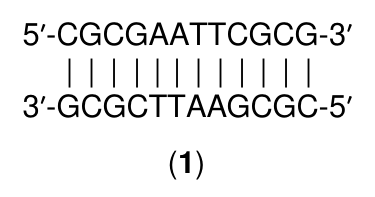
1.1 How many different palindromic double-stranded DNA dodecanucleotides (i. e. dsDNA species with twelve base pairs) exist?
1.2 How many different palindromic double-stranded DNA undecanucleotides (i.e., dsDNA species with eleven base pairs) exist?
The melting temperature of dsDNA, \(T_m\) is defined as the temperature at which 50% of the original amount of DNA double strands are dissociated into separate strands.
1.3 Consider the Drew–Dickerson dodecanucleotide (1). Assume that a G–C nucleobase pair contributes to the DNA duplex stability more than an A–T pair does.
What is the probability that its \(T_m\) increases when a single randomly selected base pair is replaced by a G–C pair?
Let us analyze the thermodynamics of formation of double-helical DNA from single strands, and its dependence on the length of the DNA and on the temperature. The equilibrium constant of association of single strands to form dsDNA differs for palindromic and non-palindromic dsDNA.
A solution of dsDNA with the initial concentration of \(c_{\mathrm{init}}=1.00\times10^{-6}\ \mathrm{mol\,dm^{-3}}\) was heated to \(T_m\) and equilibrium was reached.
1.4 Calculate the equilibrium constant of association of single strands at \(T_m\) for both non-palindromic and palindromic DNA.
The mean contributions to the Gibbs energy of association of two single strands to form dsDNA were estimate over a certain range of experimental conditions, and they amount to \(-6.07\ \mathrm{kJ\,mol^{-1}}\) per one G–C pair, and \(-1.30\ \mathrm{kJ\,mol^{-1}}\) per one A–T pair present in a dsDNA.
1.5 How many base pairs are there in the shortest dsDNA oligonucleotide that has \(T_m\) above \(330\ \mathrm K\)? At this \(T_m\), consider the following values of the equilibrium constant of association of single strands to form a dsDNA: \(K_{\mathrm{np}}=1.00\times10^6\) for a non-palindromic dsDNA, \(K_{\mathrm p}=1.00\times10^5\) for a palindromic dsDNA. Is the shortest oligonucleotide palindromic or non-palindromic?
Finally, let us leave the simplified idea of base pairs contributing individually to the association of DNA strands. The Gibbs energy of this process may be considered explicitly dependent on temperature. The dependence of the inverse \(T_m\) of the Drew–Dickerson dodecanucleotide (1) on the logarithm of the initial duplex concentration \(c_{\mathrm{init}}\) is shown below. (Note: a standard concentration \(c_0=1\ \mathrm{mol\,dm^{-3}}\) is introduced.)
| \(c_{\mathrm{init}}/10^{-6}\ \mathrm{mol\,dm^{-3}}\) | 0.25 | 0.50 | 1.00 | 2.0 | 4.0 | 8.0 |
|---|---|---|---|---|---|---|
| \(T_m/\mathrm K\) | 319.0 | 320.4 | 321.8 | 323.3 | 324.7 | 326.2 |
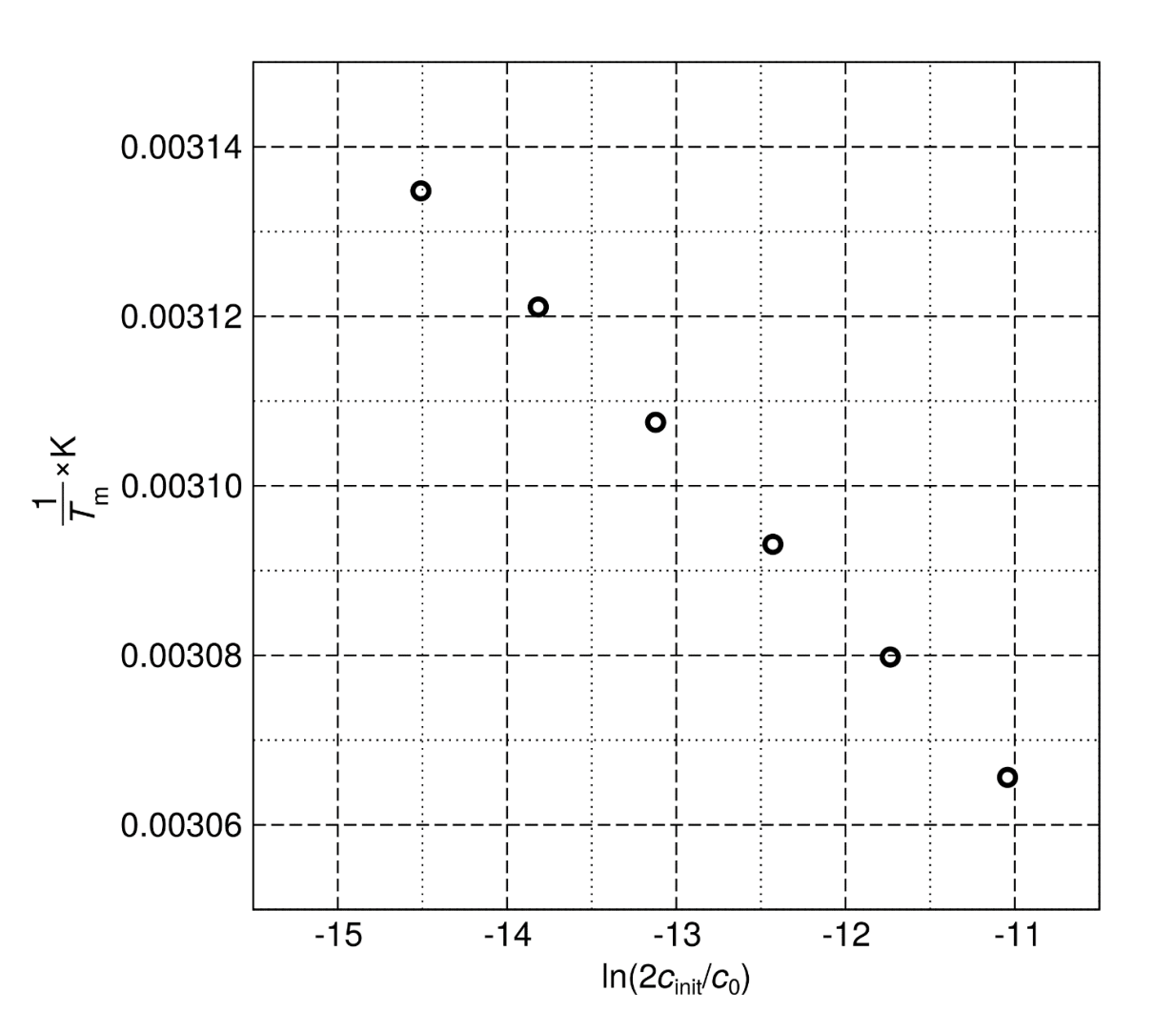
1.6 Calculate the standard enthalpy \(\Delta H^\circ\) and the standard entropy \(\Delta S^\circ\) of the association of DNA single strands to form the palindromic double-stranded Drew–Dickerson dodecanucleotide (1). Assume that \(\Delta H^\circ\) and \(\Delta S^\circ\) do not vary with temperature.
Official English text of the problem.
Answers
- 1.1: \(\boxed{4096}\).
- 1.2: \(\boxed{0}\).
- 1.3: \(\boxed{\frac13\approx33.3\%}\).
- 1.4: \(\boxed{K_{c,\mathrm{np}}=2.00\times10^6\ \mathrm{dm^3\,mol^{-1}}}\) and \(\boxed{K_{c,\mathrm p}=5.00\times10^5\ \mathrm{dm^3\,mol^{-1}}}\). The dimensionless standard-state constants have the same numerical values when \(c_0=1\ \mathrm{mol\,dm^{-3}}\).
- 1.5: \(\boxed{6\text{ base pairs; palindromic, with all six pairs G–C}}\).
- 1.6: \(\boxed{\Delta H^\circ\approx-416\ \mathrm{kJ\,mol^{-1}}}\) and \(\boxed{\Delta S^\circ\approx-1.18\times10^3\ \mathrm{J\,mol^{-1}\,K^{-1}}}\), per mole of duplex formed.
Solution
1.1
A palindromic DNA strand equals its reverse complement. Thus, if its bases are \(b_1,\ldots,b_{12}\),
\[ b_i=\overline{b}_{13-i}, \]
where the bar denotes the complementary base: A pairs with T, and G pairs with C.
The first six positions can each contain any of four bases. The last six positions are then fixed:
\[ N=4^6=\boxed{4096}. \]
There is no division by two: the two strands of each palindromic duplex already have identical sequences when read \(5'\to3'\).
1.2
For an eleven-base strand, the central position would have to satisfy
\[ b_6=\overline{b}_6. \]
None of the four standard DNA bases is complementary to itself. Consequently, an odd-length DNA duplex cannot be palindromic:
\[ \boxed{N=0}. \]
1.3
The Drew–Dickerson duplex contains eight G–C pairs and four A–T pairs. Under the stated stability model, replacing an A–T pair with a G–C pair increases stability and hence \(T_m\); replacing an existing G–C pair does not increase its contribution.
All twelve positions are equally likely to be selected, so
\[ P(T_m\text{ increases}) =\frac{4}{12} =\boxed{\frac13\approx33.3\%}. \]
1.4
Let \(D\) denote a duplex and \(S_1,S_2\) its complementary single strands. These are symbols for whole DNA strands, rather than elemental formulas.
For non-palindromic DNA, the strands are distinct:
\[ \ce{S_1 + S_2 <=> D}. \]
At \(T_m\), half the original duplex has dissociated:
\[ [D]=\frac{c_{\mathrm{init}}}{2}, \qquad [S_1]=[S_2]=\frac{c_{\mathrm{init}}}{2}. \]
Therefore,
\[ K_{c,\mathrm{np}} =\frac{[D]}{[S_1][S_2]} =\frac{c_{\mathrm{init}}/2}{(c_{\mathrm{init}}/2)^2} =\frac{2}{c_{\mathrm{init}}}. \]
Substitution gives
\[ \boxed{K_{c,\mathrm{np}} =2.00\times10^6\ \mathrm{dm^3\,mol^{-1}}}. \]
For palindromic DNA, both strands are the same species \(S\):
\[ \ce{2S <=> D}. \]
Each dissociated duplex produces two molecules of \(S\). Hence,
\[ [D]=\frac{c_{\mathrm{init}}}{2}, \qquad [S]=2\left(\frac{c_{\mathrm{init}}}{2}\right)=c_{\mathrm{init}}. \]
Thus,
\[ K_{c,\mathrm p} =\frac{[D]}{[S]^2} =\frac{c_{\mathrm{init}}/2}{c_{\mathrm{init}}^2} =\frac{1}{2c_{\mathrm{init}}}, \]
giving
\[ \boxed{K_{c,\mathrm p} =5.00\times10^5\ \mathrm{dm^3\,mol^{-1}}}. \]
The dimensionless equilibrium constants used in thermodynamic logarithms are
\[ K_{\mathrm{np}}=\frac{2c_0}{c_{\mathrm{init}}}, \qquad K_{\mathrm p}=\frac{c_0}{2c_{\mathrm{init}}}. \]
These equal \(c_0K_c\), so their numerical values agree with those above when \(c_0=1\ \mathrm{mol\,dm^{-3}}\).
1.5
In the stated additive model,
\[ \Delta G^\circ =-\left(6.07n_{\mathrm{GC}}+1.30n_{\mathrm{AT}}\right) \ \mathrm{kJ\,mol^{-1}}. \]
At the melting temperature,
\[ \Delta G^\circ=-RT_m\ln K. \]
For a fixed number of base pairs, the greatest stabilization—and therefore the greatest \(T_m\) in this model—is obtained when every pair is G–C. For an all-G–C duplex of \(n\) base pairs,
\[ T_m=\frac{6070n}{R\ln K}, \]
using \(R=8.314\ \mathrm{J\,mol^{-1}\,K^{-1}}\).
For non-palindromic DNA, use the value specified in this part, \(K_{\mathrm{np}}=10^6\):
\[ T_m>330\ \mathrm K \quad\Longrightarrow\quad n>\frac{(8.314)(330)\ln(10^6)}{6070} =6.245. \]
Thus, the shortest possible non-palindromic duplex has seven base pairs.
For palindromic DNA, \(K_{\mathrm p}=10^5\):
\[ n>\frac{(8.314)(330)\ln(10^5)}{6070} =5.204. \]
The smallest allowed even integer is six. Such an all-G–C palindrome exists: choose any three G/C bases as the first half of a strand, then use their reverse complement as the second half.
Its predicted melting temperature is
\[ T_m=\frac{6(6070)}{(8.314)\ln(10^5)} \approx380\ \mathrm K>330\ \mathrm K. \]
Moreover, a six-base-pair palindrome containing any A–T pairs must contain at least two of them, because complementary positions occur in pairs. Its maximum stabilization would then be
\[ 4(6.07)+2(1.30)=26.88\ \mathrm{kJ\,mol^{-1}}, \]
below the required
\[ R(330)\ln(10^5)\approx31.59\ \mathrm{kJ\,mol^{-1}}. \]
Therefore,
\[ \boxed{\text{The shortest duplex is palindromic and contains six G–C base pairs.}} \]
1.6
For the palindromic duplex at its melting temperature, part 1.4 gives
\[ K_{\mathrm p}=\frac{c_0}{2c_{\mathrm{init}}}. \]
Combining
\[ \Delta G^\circ=\Delta H^\circ-T_m\Delta S^\circ \]
with
\[ \Delta G^\circ=-RT_m\ln K_{\mathrm p} =RT_m\ln\left(\frac{2c_{\mathrm{init}}}{c_0}\right) \]
yields
\[ \frac{\Delta H^\circ}{T_m}-\Delta S^\circ =R\ln\left(\frac{2c_{\mathrm{init}}}{c_0}\right). \]
Therefore,
\[ \boxed{ \frac1{T_m} = \frac{R}{\Delta H^\circ} \ln\left(\frac{2c_{\mathrm{init}}}{c_0}\right) + \frac{\Delta S^\circ}{\Delta H^\circ} }. \]
Thus, for the plotted variables
\[ x=\ln\left(\frac{2c_{\mathrm{init}}}{c_0}\right), \qquad y=\frac1{T_m}, \]
the slope and intercept are
\[ m=\frac{R}{\Delta H^\circ}, \qquad b=\frac{\Delta S^\circ}{\Delta H^\circ}. \]
A least-squares straight-line fit to all six tabulated points gives
\[ m=-1.99660\times10^{-5}\ \mathrm{K^{-1}}, \qquad b=2.84523\times10^{-3}\ \mathrm{K^{-1}}. \]
Hence,
\[ \Delta H^\circ =\frac{R}{m} =\frac{8.314}{-1.99660\times10^{-5}} \ \mathrm{J\,mol^{-1}} \approx-416.4\ \mathrm{kJ\,mol^{-1}}, \]
and
\[ \Delta S^\circ =b\Delta H^\circ \approx (2.84523\times10^{-3})(-416.4\times10^3) \ \mathrm{J\,mol^{-1}\,K^{-1}} \approx-1184.8\ \mathrm{J\,mol^{-1}\,K^{-1}}. \]
To sensible precision,
\[ \boxed{\Delta H^\circ\approx-416\ \mathrm{kJ\,mol^{-1}}}, \qquad \boxed{\Delta S^\circ\approx-1.18\times10^3\ \mathrm{J\,mol^{-1}\,K^{-1}}}. \]
The negative enthalpy indicates exothermic duplex formation; the negative entropy is consistent with association and ordering of the strands.
The solution was checked against the official solution.
IChO 2018 · Theorieaufgabe 1
DNA
Palindromische Sequenzen sind eine interessante Klasse von DNA. Bei einer palindromischen doppelsträngigen DNA-Spezies (dsDNA) stimmt die in \(5'\to3'\)-Richtung gelesene Sequenz eines Strangs mit der in \(5'\to3'\)-Richtung gelesenen Sequenz des komplementären Strangs überein. Eine palindromische dsDNA besteht somit aus zwei identischen Strängen, die zueinander komplementär sind. Ein Beispiel ist das sogenannte Drew–Dickerson-Dodekanukleotid (1):
1.1 Wie viele verschiedene palindromische doppelsträngige DNA-Dodekanukleotide (d. h. dsDNA-Spezies mit zwölf Basenpaaren) gibt es?
1.2 Wie viele verschiedene palindromische doppelsträngige DNA-Undekanukleotide (d. h. dsDNA-Spezies mit elf Basenpaaren) gibt es?
Die Schmelztemperatur einer dsDNA, \(T_m\), ist als die Temperatur definiert, bei der 50% der ursprünglichen Menge an DNA-Doppelsträngen in Einzelstränge dissoziiert sind.
1.3 Betrachten Sie das Drew–Dickerson-Dodekanukleotid (1). Nehmen Sie an, dass ein G–C-Nukleobasenpaar mehr zur Stabilität des DNA-Duplex beiträgt als ein A–T-Paar.
Wie groß ist die Wahrscheinlichkeit, dass sein \(T_m\) steigt, wenn ein einzelnes zufällig ausgewähltes Basenpaar durch ein G–C-Paar ersetzt wird?
Untersuchen wir nun die Thermodynamik der Bildung doppelhelikaler DNA aus Einzelsträngen sowie ihre Abhängigkeit von der Länge der DNA und von der Temperatur. Die Gleichgewichtskonstante der Assoziation von Einzelsträngen zu dsDNA unterscheidet sich für palindromische und nichtpalindromische dsDNA.
Eine dsDNA-Lösung mit der Anfangskonzentration \(c_{\mathrm{init}}=1.00\times10^{-6}\ \mathrm{mol\,dm^{-3}}\) wurde auf \(T_m\) erhitzt, und das Gleichgewicht stellte sich ein.
1.4 Berechnen Sie die Gleichgewichtskonstante der Assoziation von Einzelsträngen bei \(T_m\) sowohl für nichtpalindromische als auch für palindromische DNA.
Die mittleren Beiträge zur Gibbs-Energie der Assoziation zweier Einzelstränge zu dsDNA wurden über einen bestimmten Bereich experimenteller Bedingungen abgeschätzt. Sie betragen \(-6.07\ \mathrm{kJ\,mol^{-1}}\) je G–C-Paar und \(-1.30\ \mathrm{kJ\,mol^{-1}}\) je A–T-Paar in einer dsDNA.
1.5 Wie viele Basenpaare enthält das kürzeste dsDNA-Oligonukleotid, dessen \(T_m\) über \(330\ \mathrm K\) liegt? Verwenden Sie bei diesem \(T_m\) die folgenden Werte der Gleichgewichtskonstante der Assoziation von Einzelsträngen zu einer dsDNA: \(K_{\mathrm{np}}=1.00\times10^6\) für eine nichtpalindromische dsDNA und \(K_{\mathrm p}=1.00\times10^5\) für eine palindromische dsDNA. Ist das kürzeste Oligonukleotid palindromisch oder nichtpalindromisch?
Verlassen wir schließlich die vereinfachte Vorstellung, dass die Basenpaare jeweils einzeln zur Assoziation der DNA-Stränge beitragen. Die Gibbs-Energie dieses Vorgangs kann als explizit temperaturabhängig betrachtet werden. Die Abhängigkeit des Kehrwerts von \(T_m\) des Drew–Dickerson-Dodekanukleotids (1) vom Logarithmus der anfänglichen Duplexkonzentration \(c_{\mathrm{init}}\) ist unten dargestellt. (Hinweis: Es wird eine Standardkonzentration \(c_0=1\ \mathrm{mol\,dm^{-3}}\) eingeführt.)
| \(c_{\mathrm{init}}/10^{-6}\ \mathrm{mol\,dm^{-3}}\) | 0.25 | 0.50 | 1.00 | 2.0 | 4.0 | 8.0 |
|---|---|---|---|---|---|---|
| \(T_m/\mathrm K\) | 319.0 | 320.4 | 321.8 | 323.3 | 324.7 | 326.2 |
1.6 Berechnen Sie die Standardenthalpie \(\Delta H^\circ\) und die Standardentropie \(\Delta S^\circ\) der Assoziation von DNA-Einzelsträngen zum palindromischen doppelsträngigen Drew–Dickerson-Dodekanukleotid (1). Nehmen Sie an, dass \(\Delta H^\circ\) und \(\Delta S^\circ\) nicht von der Temperatur abhängen.
Aufgabentext aus dem offiziellen englischen Text übersetzt.
Antworten
- 1.1: \(\boxed{4096}\).
- 1.2: \(\boxed{0}\).
- 1.3: \(\boxed{\frac13\approx33.3\%}\).
- 1.4: \(\boxed{K_{c,\mathrm{np}}=2.00\times10^6\ \mathrm{dm^3\,mol^{-1}}}\) und \(\boxed{K_{c,\mathrm p}=5.00\times10^5\ \mathrm{dm^3\,mol^{-1}}}\). Die dimensionslosen Konstanten für den Standardzustand haben dieselben Zahlenwerte, wenn \(c_0=1\ \mathrm{mol\,dm^{-3}}\) ist.
- 1.5: \(\boxed{6\text{ Basenpaare; palindromisch, alle sechs Paare G–C}}\).
- 1.6: \(\boxed{\Delta H^\circ\approx-416\ \mathrm{kJ\,mol^{-1}}}\) und \(\boxed{\Delta S^\circ\approx-1.18\times10^3\ \mathrm{J\,mol^{-1}\,K^{-1}}}\), pro Mol gebildetem Duplex.
Lösung
1.1
Ein palindromischer DNA-Strang ist mit seinem reversen Komplement identisch. Bezeichnen wir seine Basen mit \(b_1,\ldots,b_{12}\), so gilt
\[ b_i=\overline{b}_{13-i}, \]
wobei der Überstrich die komplementäre Base bezeichnet: A paart mit T und G mit C.
Die ersten sechs Positionen können jeweils eine beliebige der vier Basen enthalten. Die letzten sechs Positionen sind dadurch festgelegt:
\[ N=4^6=\boxed{4096}. \]
Es wird nicht durch zwei geteilt: Die beiden Stränge jedes palindromischen Duplex haben bereits identische Sequenzen, wenn sie in \(5'\to3'\)-Richtung gelesen werden.
1.2
Bei einem Strang mit elf Basen müsste für die mittlere Position gelten:
\[ b_6=\overline{b}_6. \]
Keine der vier Standardbasen der DNA ist zu sich selbst komplementär. Folglich kann ein DNA-Duplex mit ungerader Länge nicht palindromisch sein:
\[ \boxed{N=0}. \]
1.3
Der Drew–Dickerson-Duplex enthält acht G–C-Paare und vier A–T-Paare. Nach dem angegebenen Stabilitätsmodell erhöht der Ersatz eines A–T-Paars durch ein G–C-Paar die Stabilität und damit \(T_m\); der Ersatz eines bereits vorhandenen G–C-Paars erhöht dessen Beitrag nicht.
Alle zwölf Positionen werden mit gleicher Wahrscheinlichkeit ausgewählt, daher gilt
\[ P(T_m\text{ steigt}) =\frac{4}{12} =\boxed{\frac13\approx33.3\%}. \]
1.4
Sei \(D\) ein Duplex und seien \(S_1,S_2\) seine komplementären Einzelstränge. Diese Symbole stehen für ganze DNA-Stränge und sind keine Elementformeln.
Bei nichtpalindromischer DNA sind die Stränge verschieden:
\[ \ce{S_1 + S_2 <=> D}. \]
Bei \(T_m\) ist die Hälfte des ursprünglich vorhandenen Duplex dissoziiert:
\[ [D]=\frac{c_{\mathrm{init}}}{2}, \qquad [S_1]=[S_2]=\frac{c_{\mathrm{init}}}{2}. \]
Daher gilt
\[ K_{c,\mathrm{np}} =\frac{[D]}{[S_1][S_2]} =\frac{c_{\mathrm{init}}/2}{(c_{\mathrm{init}}/2)^2} =\frac{2}{c_{\mathrm{init}}}. \]
Einsetzen ergibt
\[ \boxed{K_{c,\mathrm{np}} =2.00\times10^6\ \mathrm{dm^3\,mol^{-1}}}. \]
Bei palindromischer DNA gehören beide Stränge derselben Spezies \(S\) an:
\[ \ce{2S <=> D}. \]
Jeder dissoziierte Duplex liefert zwei Moleküle von \(S\). Somit gilt
\[ [D]=\frac{c_{\mathrm{init}}}{2}, \qquad [S]=2\left(\frac{c_{\mathrm{init}}}{2}\right)=c_{\mathrm{init}}. \]
Damit ist
\[ K_{c,\mathrm p} =\frac{[D]}{[S]^2} =\frac{c_{\mathrm{init}}/2}{c_{\mathrm{init}}^2} =\frac{1}{2c_{\mathrm{init}}}, \]
woraus folgt:
\[ \boxed{K_{c,\mathrm p} =5.00\times10^5\ \mathrm{dm^3\,mol^{-1}}}. \]
Die dimensionslosen Gleichgewichtskonstanten, die in thermodynamischen Logarithmen verwendet werden, lauten
\[ K_{\mathrm{np}}=\frac{2c_0}{c_{\mathrm{init}}}, \qquad K_{\mathrm p}=\frac{c_0}{2c_{\mathrm{init}}}. \]
Sie sind gleich \(c_0K_c\), sodass ihre Zahlenwerte mit den obigen übereinstimmen, wenn \(c_0=1\ \mathrm{mol\,dm^{-3}}\) ist.
1.5
Im angegebenen additiven Modell gilt
\[ \Delta G^\circ =-\left(6.07n_{\mathrm{GC}}+1.30n_{\mathrm{AT}}\right) \ \mathrm{kJ\,mol^{-1}}. \]
Bei der Schmelztemperatur gilt
\[ \Delta G^\circ=-RT_m\ln K. \]
Bei einer festen Anzahl von Basenpaaren wird die größte Stabilisierung — und damit das höchste \(T_m\) in diesem Modell — erreicht, wenn jedes Paar ein G–C-Paar ist. Für einen ausschließlich aus G–C-Paaren bestehenden Duplex mit \(n\) Basenpaaren gilt
\[ T_m=\frac{6070n}{R\ln K}, \]
wobei \(R=8.314\ \mathrm{J\,mol^{-1}\,K^{-1}}\) verwendet wird.
Für nichtpalindromische DNA verwenden wir den in diesem Aufgabenteil angegebenen Wert \(K_{\mathrm{np}}=10^6\):
\[ T_m>330\ \mathrm K \quad\Longrightarrow\quad n>\frac{(8.314)(330)\ln(10^6)}{6070} =6.245. \]
Der kürzeste mögliche nichtpalindromische Duplex hat somit sieben Basenpaare.
Für palindromische DNA gilt \(K_{\mathrm p}=10^5\):
\[ n>\frac{(8.314)(330)\ln(10^5)}{6070} =5.204. \]
Die kleinste zulässige gerade ganze Zahl ist sechs. Ein solches ausschließlich aus G–C-Paaren bestehendes Palindrom existiert: Man wählt drei beliebige G/C-Basen als erste Hälfte eines Strangs und verwendet anschließend deren reverses Komplement als zweite Hälfte.
Seine vorhergesagte Schmelztemperatur beträgt
\[ T_m=\frac{6(6070)}{(8.314)\ln(10^5)} \approx380\ \mathrm K>330\ \mathrm K. \]
Außerdem muss ein Palindrom mit sechs Basenpaaren, das A–T-Paare enthält, mindestens zwei davon enthalten, da komplementäre Positionen paarweise auftreten. Seine maximale Stabilisierung betrüge dann
\[ 4(6.07)+2(1.30)=26.88\ \mathrm{kJ\,mol^{-1}}, \]
und läge damit unter dem erforderlichen Wert von
\[ R(330)\ln(10^5)\approx31.59\ \mathrm{kJ\,mol^{-1}}. \]
Daher gilt:
\[ \boxed{\text{Der kürzeste Duplex ist palindromisch und enthält sechs G–C-Basenpaare.}} \]
1.6
Für den palindromischen Duplex bei seiner Schmelztemperatur ergibt sich aus Teil 1.4
\[ K_{\mathrm p}=\frac{c_0}{2c_{\mathrm{init}}}. \]
Die Kombination von
\[ \Delta G^\circ=\Delta H^\circ-T_m\Delta S^\circ \]
mit
\[ \Delta G^\circ=-RT_m\ln K_{\mathrm p} =RT_m\ln\left(\frac{2c_{\mathrm{init}}}{c_0}\right) \]
ergibt
\[ \frac{\Delta H^\circ}{T_m}-\Delta S^\circ =R\ln\left(\frac{2c_{\mathrm{init}}}{c_0}\right). \]
Daraus folgt
\[ \boxed{ \frac1{T_m} = \frac{R}{\Delta H^\circ} \ln\left(\frac{2c_{\mathrm{init}}}{c_0}\right) + \frac{\Delta S^\circ}{\Delta H^\circ} }. \]
Für die aufgetragenen Variablen
\[ x=\ln\left(\frac{2c_{\mathrm{init}}}{c_0}\right), \qquad y=\frac1{T_m}, \]
lauten die Steigung und der Achsenabschnitt somit
\[ m=\frac{R}{\Delta H^\circ}, \qquad b=\frac{\Delta S^\circ}{\Delta H^\circ}. \]
Eine Geradenanpassung nach der Methode der kleinsten Quadrate an alle sechs tabellierten Punkte ergibt
\[ m=-1.99660\times10^{-5}\ \mathrm{K^{-1}}, \qquad b=2.84523\times10^{-3}\ \mathrm{K^{-1}}. \]
Somit ist
\[ \Delta H^\circ =\frac{R}{m} =\frac{8.314}{-1.99660\times10^{-5}} \ \mathrm{J\,mol^{-1}} \approx-416.4\ \mathrm{kJ\,mol^{-1}}, \]
und
\[ \Delta S^\circ =b\Delta H^\circ \approx (2.84523\times10^{-3})(-416.4\times10^3) \ \mathrm{J\,mol^{-1}\,K^{-1}} \approx-1184.8\ \mathrm{J\,mol^{-1}\,K^{-1}}. \]
Auf eine sinnvolle Genauigkeit gerundet:
\[ \boxed{\Delta H^\circ\approx-416\ \mathrm{kJ\,mol^{-1}}}, \qquad \boxed{\Delta S^\circ\approx-1.18\times10^3\ \mathrm{J\,mol^{-1}\,K^{-1}}}. \]
Die negative Enthalpie zeigt, dass die Duplexbildung exotherm ist; die negative Entropie steht mit der Assoziation und der Ordnung der Stränge im Einklang.
Die Lösung wurde mit der offiziellen Lösung abgeglichen.
IChO 2018 · Teori sorusu 1
DNA
Palindromik diziler, DNA'nın ilginç bir sınıfını oluşturur. Palindromik bir çift sarmallı DNA (dsDNA) türünde, bir zincirin \(5'\to3'\) yönünde okunan dizisi, tamamlayıcı zincirin \(5'\to3'\) yönünde okunan dizisiyle aynıdır. Dolayısıyla palindromik bir dsDNA, birbirinin tamamlayıcısı olan iki özdeş zincirden oluşur. Drew–Dickerson dodekanükleotidi (1) olarak adlandırılan yapı buna bir örnektir:
1.1 Kaç farklı palindromik çift sarmallı DNA dodekanükleotidi (yani on iki baz çifti içeren dsDNA türü) vardır?
1.2 Kaç farklı palindromik çift sarmallı DNA undekanükleotidi (yani on bir baz çifti içeren dsDNA türü) vardır?
dsDNA'nın erime sıcaklığı \(T_m\), başlangıçtaki çift sarmallı DNA miktarının %50'sinin ayrı zincirlere ayrıştığı sıcaklık olarak tanımlanır.
1.3 Drew–Dickerson dodekanükleotidini (1) ele alın. Bir G–C nükleobaz çiftinin DNA dubleksinin kararlılığına bir A–T çiftinden daha fazla katkıda bulunduğunu varsayın.
Rastgele seçilen tek bir baz çifti bir G–C çiftiyle değiştirildiğinde, \(T_m\)'nin artma olasılığı nedir?
Tek zincirlerden çift sarmallı DNA oluşumunun termodinamiğini ve bunun DNA'nın uzunluğuna ve sıcaklığa bağımlılığını inceleyelim. Tek zincirlerin birleşerek dsDNA oluşturmasına ait denge sabiti, palindromik ve palindromik olmayan dsDNA için farklıdır.
Başlangıç derişimi \(c_{\mathrm{init}}=1.00\times10^{-6}\ \mathrm{mol\,dm^{-3}}\) olan bir dsDNA çözeltisi \(T_m\)'ye kadar ısıtılmış ve dengeye ulaşılmıştır.
1.4 Hem palindromik olmayan hem de palindromik DNA için \(T_m\)'de tek zincirlerin birleşme denge sabitini hesaplayın.
İki tek zincirin birleşerek dsDNA oluşturmasının Gibbs enerjisine ortalama katkılar, belirli bir deneysel koşullar aralığında tahmin edilmiştir. Bu katkılar, dsDNA'da bulunan her bir G–C çifti başına \(-6.07\ \mathrm{kJ\,mol^{-1}}\) ve her bir A–T çifti başına \(-1.30\ \mathrm{kJ\,mol^{-1}}\) değerindedir.
1.5 \(T_m\)'si \(330\ \mathrm K\)'nin üzerinde olan en kısa dsDNA oligonükleotidinde kaç baz çifti bulunur? Bu \(T_m\)'de, tek zincirlerin birleşerek dsDNA oluşturmasına ait denge sabitinin şu değerlerini kullanın: palindromik olmayan bir dsDNA için \(K_{\mathrm{np}}=1.00\times10^6\), palindromik bir dsDNA için \(K_{\mathrm p}=1.00\times10^5\). En kısa oligonükleotid palindromik midir, yoksa palindromik değil midir?
Son olarak, baz çiftlerinin DNA zincirlerinin birleşmesine ayrı ayrı katkıda bulunduğu şeklindeki basitleştirilmiş yaklaşımı bir kenara bırakalım. Bu sürecin Gibbs enerjisi, açıkça sıcaklığa bağlı olarak ele alınabilir. Drew–Dickerson dodekanükleotidinin (1) \(T_m\)'sinin tersinin, başlangıç dubleks derişimi \(c_{\mathrm{init}}\)'in logaritmasına bağımlılığı aşağıda gösterilmiştir. (Not: \(c_0=1\ \mathrm{mol\,dm^{-3}}\) standart derişimi tanımlanmıştır.)
| \(c_{\mathrm{init}}/10^{-6}\ \mathrm{mol\,dm^{-3}}\) | 0.25 | 0.50 | 1.00 | 2.0 | 4.0 | 8.0 |
|---|---|---|---|---|---|---|
| \(T_m/\mathrm K\) | 319.0 | 320.4 | 321.8 | 323.3 | 324.7 | 326.2 |
1.6 Tek DNA zincirlerinin birleşerek palindromik çift sarmallı Drew–Dickerson dodekanükleotidini (1) oluşturmasının standart entalpisini \(\Delta H^\circ\) ve standart entropisini \(\Delta S^\circ\) hesaplayın. \(\Delta H^\circ\) ve \(\Delta S^\circ\)'nin sıcaklıkla değişmediğini varsayın.
Soru metni resmi İngilizce metinden çevrilmiştir.
Cevaplar
- 1.1: \(\boxed{4096}\).
- 1.2: \(\boxed{0}\).
- 1.3: \(\boxed{\frac13\approx33.3\%}\).
- 1.4: \(\boxed{K_{c,\mathrm{np}}=2.00\times10^6\ \mathrm{dm^3\,mol^{-1}}}\) ve \(\boxed{K_{c,\mathrm p}=5.00\times10^5\ \mathrm{dm^3\,mol^{-1}}}\). Boyutsuz standart hâl sabitleri, \(c_0=1\ \mathrm{mol\,dm^{-3}}\) olduğunda aynı sayısal değerlere sahiptir.
- 1.5: \(\boxed{6\text{ baz çifti; palindromik, altı çiftin tamamı G–C}}\).
- 1.6: Oluşan dubleksin molü başına \(\boxed{\Delta H^\circ\approx-416\ \mathrm{kJ\,mol^{-1}}}\) ve \(\boxed{\Delta S^\circ\approx-1.18\times10^3\ \mathrm{J\,mol^{-1}\,K^{-1}}}\).
Çözüm
1.1
Palindromik bir DNA zinciri, ters tamamlayıcısıyla aynıdır. Dolayısıyla bazları \(b_1,\ldots,b_{12}\) ise,
\[ b_i=\overline{b}_{13-i}, \]
burada üst çizgi tamamlayıcı bazı gösterir: A, T ile; G ise C ile eşleşir.
İlk altı konumun her biri dört bazdan herhangi birini içerebilir. Bu durumda son altı konum belirlenmiş olur:
\[ N=4^6=\boxed{4096}. \]
İkiye bölme yapılmaz: her palindromik dubleksin iki zinciri, \(5'\to3'\) yönünde okunduğunda zaten özdeş dizilere sahiptir.
1.2
On bir bazlı bir zincirde, ortadaki konumun
\[ b_6=\overline{b}_6. \]
koşulunu sağlaması gerekirdi. Dört standart DNA bazından hiçbiri kendisinin tamamlayıcısı değildir. Bu nedenle, tek sayıda baz çifti içeren bir DNA dubleksi palindromik olamaz:
\[ \boxed{N=0}. \]
1.3
Drew–Dickerson dubleksi sekiz G–C çifti ve dört A–T çifti içerir. Belirtilen kararlılık modeline göre, bir A–T çiftini bir G–C çiftiyle değiştirmek kararlılığı ve dolayısıyla \(T_m\)'yi artırır; mevcut bir G–C çiftini değiştirmek ise onun katkısını artırmaz.
On iki konumun tümünün seçilme olasılığı eşit olduğundan,
\[ P(T_m\text{ artar}) =\frac{4}{12} =\boxed{\frac13\approx33.3\%}. \]
1.4
\(D\) bir dubleksi, \(S_1,S_2\) ise onun birbirini tamamlayan tek zincirlerini göstersin. Bunlar element formülleri değil, DNA zincirlerinin tamamını temsil eden sembollerdir.
Palindromik olmayan DNA için zincirler birbirinden farklıdır:
\[ \ce{S_1 + S_2 <=> D}. \]
\(T_m\)'de, başlangıçtaki dubleksin yarısı ayrışmıştır:
\[ [D]=\frac{c_{\mathrm{init}}}{2}, \qquad [S_1]=[S_2]=\frac{c_{\mathrm{init}}}{2}. \]
Dolayısıyla,
\[ K_{c,\mathrm{np}} =\frac{[D]}{[S_1][S_2]} =\frac{c_{\mathrm{init}}/2}{(c_{\mathrm{init}}/2)^2} =\frac{2}{c_{\mathrm{init}}}. \]
Değerler yerine konulduğunda
\[ \boxed{K_{c,\mathrm{np}} =2.00\times10^6\ \mathrm{dm^3\,mol^{-1}}}. \]
elde edilir. Palindromik DNA için her iki zincir de aynı \(S\) türüdür:
\[ \ce{2S <=> D}. \]
Ayrışan her dubleks iki \(S\) molekülü oluşturur. Bu nedenle,
\[ [D]=\frac{c_{\mathrm{init}}}{2}, \qquad [S]=2\left(\frac{c_{\mathrm{init}}}{2}\right)=c_{\mathrm{init}}. \]
Böylece,
\[ K_{c,\mathrm p} =\frac{[D]}{[S]^2} =\frac{c_{\mathrm{init}}/2}{c_{\mathrm{init}}^2} =\frac{1}{2c_{\mathrm{init}}}, \]
buradan
\[ \boxed{K_{c,\mathrm p} =5.00\times10^5\ \mathrm{dm^3\,mol^{-1}}}. \]
elde edilir. Termodinamikteki logaritmalarda kullanılan boyutsuz denge sabitleri
\[ K_{\mathrm{np}}=\frac{2c_0}{c_{\mathrm{init}}}, \qquad K_{\mathrm p}=\frac{c_0}{2c_{\mathrm{init}}}. \]
şeklindedir. Bunlar \(c_0K_c\)'ye eşittir; dolayısıyla \(c_0=1\ \mathrm{mol\,dm^{-3}}\) olduğunda sayısal değerleri yukarıdakilerle aynıdır.
1.5
Belirtilen toplamsal modelde,
\[ \Delta G^\circ =-\left(6.07n_{\mathrm{GC}}+1.30n_{\mathrm{AT}}\right) \ \mathrm{kJ\,mol^{-1}}. \]
Erime sıcaklığında,
\[ \Delta G^\circ=-RT_m\ln K. \]
Sabit bir baz çifti sayısı için, en büyük kararlılık artışı — ve dolayısıyla bu modelde en yüksek \(T_m\) — her çift G–C olduğunda elde edilir. Tamamı G–C olan, \(n\) baz çiftli bir dubleks için,
\[ T_m=\frac{6070n}{R\ln K}, \]
burada \(R=8.314\ \mathrm{J\,mol^{-1}\,K^{-1}}\) kullanılır.
Palindromik olmayan DNA için, bu kısımda belirtilen \(K_{\mathrm{np}}=10^6\) değerini kullanın:
\[ T_m>330\ \mathrm K \quad\Longrightarrow\quad n>\frac{(8.314)(330)\ln(10^6)}{6070} =6.245. \]
Dolayısıyla, mümkün olan en kısa palindromik olmayan dubleks yedi baz çiftine sahiptir.
Palindromik DNA için, \(K_{\mathrm p}=10^5\):
\[ n>\frac{(8.314)(330)\ln(10^5)}{6070} =5.204. \]
İzin verilen en küçük çift tam sayı altıdır. Tamamı G–C olan böyle bir palindrom vardır: bir zincirin ilk yarısı olarak herhangi üç G/C bazı seçin, ardından ikinci yarısı olarak bunların ters tamamlayıcısını kullanın.
Öngörülen erime sıcaklığı
\[ T_m=\frac{6(6070)}{(8.314)\ln(10^5)} \approx380\ \mathrm K>330\ \mathrm K. \]
olur. Ayrıca, A–T çifti içeren altı baz çiftli bir palindrom, tamamlayıcı konumlar çiftler hâlinde bulunduğundan, bunlardan en az iki tane içermelidir. Bu durumda kararlılığa en büyük katkı
\[ 4(6.07)+2(1.30)=26.88\ \mathrm{kJ\,mol^{-1}}, \]
olur ve bu, gerekli olan
\[ R(330)\ln(10^5)\approx31.59\ \mathrm{kJ\,mol^{-1}}. \]
değerinin altındadır. Dolayısıyla,
\[ \boxed{\text{En kısa dubleks palindromiktir ve altı G–C baz çifti içerir.}} \]
1.6
Palindromik dubleks için erime sıcaklığında, 1.4 kısmından
\[ K_{\mathrm p}=\frac{c_0}{2c_{\mathrm{init}}}. \]
elde edilir. Şu bağıntı
\[ \Delta G^\circ=\Delta H^\circ-T_m\Delta S^\circ \]
ile
\[ \Delta G^\circ=-RT_m\ln K_{\mathrm p} =RT_m\ln\left(\frac{2c_{\mathrm{init}}}{c_0}\right) \]
birleştirildiğinde
\[ \frac{\Delta H^\circ}{T_m}-\Delta S^\circ =R\ln\left(\frac{2c_{\mathrm{init}}}{c_0}\right). \]
elde edilir. Dolayısıyla,
\[ \boxed{ \frac1{T_m} = \frac{R}{\Delta H^\circ} \ln\left(\frac{2c_{\mathrm{init}}}{c_0}\right) + \frac{\Delta S^\circ}{\Delta H^\circ} }. \]
Böylece, grafikte kullanılan
\[ x=\ln\left(\frac{2c_{\mathrm{init}}}{c_0}\right), \qquad y=\frac1{T_m}, \]
değişkenleri için eğim ve düşey eksen kesişimi
\[ m=\frac{R}{\Delta H^\circ}, \qquad b=\frac{\Delta S^\circ}{\Delta H^\circ}. \]
şeklindedir. Tablodaki altı noktanın tamamına en küçük kareler yöntemiyle bir doğru uydurulduğunda
\[ m=-1.99660\times10^{-5}\ \mathrm{K^{-1}}, \qquad b=2.84523\times10^{-3}\ \mathrm{K^{-1}}. \]
elde edilir. Bu nedenle,
\[ \Delta H^\circ =\frac{R}{m} =\frac{8.314}{-1.99660\times10^{-5}} \ \mathrm{J\,mol^{-1}} \approx-416.4\ \mathrm{kJ\,mol^{-1}}, \]
ve
\[ \Delta S^\circ =b\Delta H^\circ \approx (2.84523\times10^{-3})(-416.4\times10^3) \ \mathrm{J\,mol^{-1}\,K^{-1}} \approx-1184.8\ \mathrm{J\,mol^{-1}\,K^{-1}}. \]
Uygun bir hassasiyetle,
\[ \boxed{\Delta H^\circ\approx-416\ \mathrm{kJ\,mol^{-1}}}, \qquad \boxed{\Delta S^\circ\approx-1.18\times10^3\ \mathrm{J\,mol^{-1}\,K^{-1}}}. \]
Negatif entalpi, dubleks oluşumunun ekzotermik olduğunu gösterir; negatif entropi ise zincirlerin birleşmesi ve düzenlenmesiyle tutarlıdır.
Çözüm, resmi çözümle karşılaştırılarak kontrol edildi.
IChO 2018 · Problema teórico 1
ADN
Las secuencias palindrómicas constituyen una clase interesante de ADN. En una especie de ADN palindrómico de doble cadena (dsDNA), la secuencia de una cadena leída en el sentido \(5'\to3'\) coincide con la secuencia de la cadena complementaria leída en el sentido \(5'\to3'\). Por tanto, un dsDNA palindrómico consta de dos cadenas idénticas que son complementarias entre sí. Un ejemplo es el denominado dodecanucleótido de Drew–Dickerson (1):
1.1 ¿Cuántos dodecanucleótidos diferentes de ADN palindrómico de doble cadena (es decir, especies de dsDNA con doce pares de bases) existen?
1.2 ¿Cuántos undecanucleótidos diferentes de ADN palindrómico de doble cadena (es decir, especies de dsDNA con once pares de bases) existen?
La temperatura de fusión del dsDNA, \(T_m\), se define como la temperatura a la que el 50% de la cantidad inicial de ADN de doble cadena se ha disociado en cadenas separadas.
1.3 Considere el dodecanucleótido de Drew–Dickerson (1). Suponga que un par de bases nitrogenadas G–C contribuye más a la estabilidad del dúplex de ADN que un par A–T.
¿Cuál es la probabilidad de que su \(T_m\) aumente cuando se sustituye un único par de bases elegido al azar por un par G–C?
Analicemos la termodinámica de la formación de ADN de doble hélice a partir de cadenas sencillas, así como su dependencia de la longitud del ADN y de la temperatura. La constante de equilibrio de asociación de las cadenas sencillas para formar dsDNA es diferente para el dsDNA palindrómico y el no palindrómico.
Una disolución de dsDNA con una concentración inicial de \(c_{\mathrm{init}}=1.00\times10^{-6}\ \mathrm{mol\,dm^{-3}}\) se calentó hasta \(T_m\) y se alcanzó el equilibrio.
1.4 Calcule la constante de equilibrio de asociación de las cadenas sencillas a \(T_m\), tanto para el ADN no palindrómico como para el palindrómico.
Las contribuciones medias a la energía de Gibbs de asociación de dos cadenas sencillas para formar dsDNA se estimaron en un determinado intervalo de condiciones experimentales y ascienden a \(-6.07\ \mathrm{kJ\,mol^{-1}}\) por cada par G–C y a \(-1.30\ \mathrm{kJ\,mol^{-1}}\) por cada par A–T presente en un dsDNA.
1.5 ¿Cuántos pares de bases tiene el oligonucleótido de dsDNA más corto cuya \(T_m\) es superior a \(330\ \mathrm K\)? A esta \(T_m\), considere los siguientes valores de la constante de equilibrio de asociación de las cadenas sencillas para formar un dsDNA: \(K_{\mathrm{np}}=1.00\times10^6\) para un dsDNA no palindrómico y \(K_{\mathrm p}=1.00\times10^5\) para un dsDNA palindrómico. ¿Es palindrómico o no palindrómico el oligonucleótido más corto?
Por último, abandonemos la idea simplificada de que los pares de bases contribuyen individualmente a la asociación de las cadenas de ADN. La energía de Gibbs de este proceso puede considerarse explícitamente dependiente de la temperatura. A continuación se muestra la dependencia del inverso de \(T_m\) del dodecanucleótido de Drew–Dickerson (1) respecto al logaritmo de la concentración inicial del dúplex \(c_{\mathrm{init}}\). (Nota: se introduce una concentración estándar \(c_0=1\ \mathrm{mol\,dm^{-3}}\).)
| \(c_{\mathrm{init}}/10^{-6}\ \mathrm{mol\,dm^{-3}}\) | 0.25 | 0.50 | 1.00 | 2.0 | 4.0 | 8.0 |
|---|---|---|---|---|---|---|
| \(T_m/\mathrm K\) | 319.0 | 320.4 | 321.8 | 323.3 | 324.7 | 326.2 |
1.6 Calcule la entalpía estándar \(\Delta H^\circ\) y la entropía estándar \(\Delta S^\circ\) de asociación de las cadenas sencillas de ADN para formar el dodecanucleótido palindrómico de doble cadena de Drew–Dickerson (1). Suponga que \(\Delta H^\circ\) y \(\Delta S^\circ\) no varían con la temperatura.
Enunciado traducido del texto oficial en inglés.
Respuestas
- 1.1: \(\boxed{4096}\).
- 1.2: \(\boxed{0}\).
- 1.3: \(\boxed{\frac13\approx33.3\%}\).
- 1.4: \(\boxed{K_{c,\mathrm{np}}=2.00\times10^6\ \mathrm{dm^3\,mol^{-1}}}\) y \(\boxed{K_{c,\mathrm p}=5.00\times10^5\ \mathrm{dm^3\,mol^{-1}}}\). Las constantes adimensionales referidas al estado estándar tienen los mismos valores numéricos cuando \(c_0=1\ \mathrm{mol\,dm^{-3}}\).
- 1.5: \(\boxed{6\text{ pares de bases; palindrómico, con los seis pares G–C}}\).
- 1.6: \(\boxed{\Delta H^\circ\approx-416\ \mathrm{kJ\,mol^{-1}}}\) y \(\boxed{\Delta S^\circ\approx-1.18\times10^3\ \mathrm{J\,mol^{-1}\,K^{-1}}}\), por mol de dúplex formado.
Solución
1.1
Una cadena de ADN palindrómica coincide con su secuencia complementaria inversa. Por tanto, si sus bases son \(b_1,\ldots,b_{12}\),
\[ b_i=\overline{b}_{13-i}, \]
donde la barra indica la base complementaria: A se aparea con T y G se aparea con C.
Cada una de las primeras seis posiciones puede contener cualquiera de las cuatro bases. Las últimas seis posiciones quedan entonces determinadas:
\[ N=4^6=\boxed{4096}. \]
No se divide entre dos: las dos cadenas de cada dúplex palindrómico ya tienen secuencias idénticas cuando se leen en el sentido \(5'\to3'\).
1.2
En una cadena de once bases, la posición central tendría que satisfacer
\[ b_6=\overline{b}_6. \]
Ninguna de las cuatro bases habituales del ADN es complementaria de sí misma. En consecuencia, un dúplex de ADN de longitud impar no puede ser palindrómico:
\[ \boxed{N=0}. \]
1.3
El dúplex de Drew–Dickerson contiene ocho pares G–C y cuatro pares A–T. Según el modelo de estabilidad indicado, sustituir un par A–T por un par G–C aumenta la estabilidad y, por tanto, \(T_m\); sustituir un par G–C existente no aumenta su contribución.
Las doce posiciones tienen la misma probabilidad de ser seleccionadas, por lo que
\[ P(T_m\text{ aumenta}) =\frac{4}{12} =\boxed{\frac13\approx33.3\%}. \]
1.4
Sea \(D\) un dúplex y sean \(S_1,S_2\) sus cadenas sencillas complementarias. Estos símbolos representan cadenas completas de ADN, no fórmulas de elementos.
Para el ADN no palindrómico, las cadenas son distintas:
\[ \ce{S_1 + S_2 <=> D}. \]
A \(T_m\), la mitad del dúplex inicial se ha disociado:
\[ [D]=\frac{c_{\mathrm{init}}}{2}, \qquad [S_1]=[S_2]=\frac{c_{\mathrm{init}}}{2}. \]
Por tanto,
\[ K_{c,\mathrm{np}} =\frac{[D]}{[S_1][S_2]} =\frac{c_{\mathrm{init}}/2}{(c_{\mathrm{init}}/2)^2} =\frac{2}{c_{\mathrm{init}}}. \]
Al sustituir, se obtiene
\[ \boxed{K_{c,\mathrm{np}} =2.00\times10^6\ \mathrm{dm^3\,mol^{-1}}}. \]
Para el ADN palindrómico, ambas cadenas son la misma especie \(S\):
\[ \ce{2S <=> D}. \]
Cada dúplex disociado produce dos moléculas de \(S\). Por tanto,
\[ [D]=\frac{c_{\mathrm{init}}}{2}, \qquad [S]=2\left(\frac{c_{\mathrm{init}}}{2}\right)=c_{\mathrm{init}}. \]
Así,
\[ K_{c,\mathrm p} =\frac{[D]}{[S]^2} =\frac{c_{\mathrm{init}}/2}{c_{\mathrm{init}}^2} =\frac{1}{2c_{\mathrm{init}}}, \]
lo que da
\[ \boxed{K_{c,\mathrm p} =5.00\times10^5\ \mathrm{dm^3\,mol^{-1}}}. \]
Las constantes de equilibrio adimensionales utilizadas en los logaritmos termodinámicos son
\[ K_{\mathrm{np}}=\frac{2c_0}{c_{\mathrm{init}}}, \qquad K_{\mathrm p}=\frac{c_0}{2c_{\mathrm{init}}}. \]
Estas son iguales a \(c_0K_c\), por lo que sus valores numéricos coinciden con los anteriores cuando \(c_0=1\ \mathrm{mol\,dm^{-3}}\).
1.5
En el modelo aditivo indicado,
\[ \Delta G^\circ =-\left(6.07n_{\mathrm{GC}}+1.30n_{\mathrm{AT}}\right) \ \mathrm{kJ\,mol^{-1}}. \]
A la temperatura de fusión,
\[ \Delta G^\circ=-RT_m\ln K. \]
Para un número fijo de pares de bases, la mayor estabilización —y, por tanto, la mayor \(T_m\) en este modelo— se obtiene cuando todos los pares son G–C. Para un dúplex de \(n\) pares de bases compuesto únicamente por pares G–C,
\[ T_m=\frac{6070n}{R\ln K}, \]
utilizando \(R=8.314\ \mathrm{J\,mol^{-1}\,K^{-1}}\).
Para el ADN no palindrómico, se utiliza el valor especificado en este apartado, \(K_{\mathrm{np}}=10^6\):
\[ T_m>330\ \mathrm K \quad\Longrightarrow\quad n>\frac{(8.314)(330)\ln(10^6)}{6070} =6.245. \]
Por tanto, el dúplex no palindrómico más corto posible tiene siete pares de bases.
Para el ADN palindrómico, \(K_{\mathrm p}=10^5\):
\[ n>\frac{(8.314)(330)\ln(10^5)}{6070} =5.204. \]
El menor número entero par permitido es seis. Existe un palíndromo de este tipo formado únicamente por pares G–C: basta elegir tres bases cualesquiera G/C para la primera mitad de una cadena y utilizar después su secuencia complementaria inversa como segunda mitad.
Su temperatura de fusión predicha es
\[ T_m=\frac{6(6070)}{(8.314)\ln(10^5)} \approx380\ \mathrm K>330\ \mathrm K. \]
Además, un palíndromo de seis pares de bases que contenga pares A–T debe contener al menos dos de ellos, porque las posiciones complementarias aparecen por parejas. Su estabilización máxima sería entonces
\[ 4(6.07)+2(1.30)=26.88\ \mathrm{kJ\,mol^{-1}}, \]
inferior al valor requerido de
\[ R(330)\ln(10^5)\approx31.59\ \mathrm{kJ\,mol^{-1}}. \]
Por tanto,
\[ \boxed{\text{El dúplex más corto es palindrómico y contiene seis pares de bases G–C.}} \]
1.6
Para el dúplex palindrómico a su temperatura de fusión, el apartado 1.4 da
\[ K_{\mathrm p}=\frac{c_0}{2c_{\mathrm{init}}}. \]
Al combinar
\[ \Delta G^\circ=\Delta H^\circ-T_m\Delta S^\circ \]
con
\[ \Delta G^\circ=-RT_m\ln K_{\mathrm p} =RT_m\ln\left(\frac{2c_{\mathrm{init}}}{c_0}\right) \]
se obtiene
\[ \frac{\Delta H^\circ}{T_m}-\Delta S^\circ =R\ln\left(\frac{2c_{\mathrm{init}}}{c_0}\right). \]
Por tanto,
\[ \boxed{ \frac1{T_m} = \frac{R}{\Delta H^\circ} \ln\left(\frac{2c_{\mathrm{init}}}{c_0}\right) + \frac{\Delta S^\circ}{\Delta H^\circ} }. \]
Así, para las variables representadas
\[ x=\ln\left(\frac{2c_{\mathrm{init}}}{c_0}\right), \qquad y=\frac1{T_m}, \]
la pendiente y la ordenada en el origen son
\[ m=\frac{R}{\Delta H^\circ}, \qquad b=\frac{\Delta S^\circ}{\Delta H^\circ}. \]
Un ajuste lineal por mínimos cuadrados de los seis puntos tabulados da
\[ m=-1.99660\times10^{-5}\ \mathrm{K^{-1}}, \qquad b=2.84523\times10^{-3}\ \mathrm{K^{-1}}. \]
Por tanto,
\[ \Delta H^\circ =\frac{R}{m} =\frac{8.314}{-1.99660\times10^{-5}} \ \mathrm{J\,mol^{-1}} \approx-416.4\ \mathrm{kJ\,mol^{-1}}, \]
y
\[ \Delta S^\circ =b\Delta H^\circ \approx (2.84523\times10^{-3})(-416.4\times10^3) \ \mathrm{J\,mol^{-1}\,K^{-1}} \approx-1184.8\ \mathrm{J\,mol^{-1}\,K^{-1}}. \]
Con una precisión razonable,
\[ \boxed{\Delta H^\circ\approx-416\ \mathrm{kJ\,mol^{-1}}}, \qquad \boxed{\Delta S^\circ\approx-1.18\times10^3\ \mathrm{J\,mol^{-1}\,K^{-1}}}. \]
La entalpía negativa indica que la formación del dúplex es exotérmica; la entropía negativa es coherente con la asociación y el ordenamiento de las cadenas.
La solución se comprobó con la solución oficial.
IChO 2018 · 理论题 1
DNA
回文序列是一类有趣的 DNA。在回文双链 DNA(dsDNA)中,沿一条链的 \(5'\to3'\) 方向读出的序列,与沿其互补链的 \(5'\to3'\) 方向读出的序列相同。因此,回文 dsDNA 由两条序列相同且彼此互补的链组成。所谓的 Drew–Dickerson 十二核苷酸(1)就是一个例子:
1.1 不同的回文双链 DNA 十二核苷酸(即含有十二个碱基对的 dsDNA)共有多少种?
1.2 不同的回文双链 DNA 十一核苷酸(即含有十一个碱基对的 dsDNA)共有多少种?
dsDNA 的熔解温度 \(T_m\) 定义为原有 DNA 双链中有 50% 解离为单链时的温度。
1.3 考虑 Drew–Dickerson 十二核苷酸(1)。假设一个 G–C 碱基对对 DNA 双链稳定性的贡献大于一个 A–T 碱基对的贡献。
随机选取一个碱基对并将其替换为 G–C 碱基对后,其 \(T_m\) 升高的概率是多少?
下面分析由单链形成双螺旋 DNA 的热力学,以及这一过程对 DNA 长度和温度的依赖关系。对于回文与非回文 dsDNA,单链缔合形成 dsDNA 的平衡常数不同。
将初始浓度为 \(c_{\mathrm{init}}=1.00\times10^{-6}\ \mathrm{mol\,dm^{-3}}\) 的 dsDNA 溶液加热至 \(T_m\),并达到平衡。
1.4 分别计算非回文 DNA 和回文 DNA 在 \(T_m\) 时单链缔合的平衡常数。
在一定的实验条件范围内,估算了两个单链缔合形成 dsDNA 时各碱基对对缔合吉布斯能的平均贡献:dsDNA 中每个 G–C 碱基对的贡献为 \(-6.07\ \mathrm{kJ\,mol^{-1}}\),每个 A–T 碱基对的贡献为 \(-1.30\ \mathrm{kJ\,mol^{-1}}\)。
1.5 \(T_m\) 高于 \(330\ \mathrm K\) 的最短 dsDNA 寡核苷酸含有多少个碱基对?在该 \(T_m\) 下,采用以下单链缔合形成 dsDNA 的平衡常数值:非回文 dsDNA 的 \(K_{\mathrm{np}}=1.00\times10^6\),回文 dsDNA 的 \(K_{\mathrm p}=1.00\times10^5\)。最短的寡核苷酸是回文的还是非回文的?
最后,我们不再采用各碱基对独立地对 DNA 链缔合作出贡献的简化观点,而将这一过程的吉布斯能明确视为温度的函数。下图给出了 Drew–Dickerson 十二核苷酸(1)的 \(T_m\) 的倒数与双链初始浓度 \(c_{\mathrm{init}}\) 的对数之间的关系。(注:引入标准浓度 \(c_0=1\ \mathrm{mol\,dm^{-3}}\)。)
| \(c_{\mathrm{init}}/10^{-6}\ \mathrm{mol\,dm^{-3}}\) | 0.25 | 0.50 | 1.00 | 2.0 | 4.0 | 8.0 |
|---|---|---|---|---|---|---|
| \(T_m/\mathrm K\) | 319.0 | 320.4 | 321.8 | 323.3 | 324.7 | 326.2 |
1.6 计算 DNA 单链缔合形成回文双链 Drew–Dickerson 十二核苷酸(1)的标准焓变 \(\Delta H^\circ\) 和标准熵变 \(\Delta S^\circ\)。假设 \(\Delta H^\circ\) 和 \(\Delta S^\circ\) 不随温度变化。
题目译自官方英文原文。
答案
- 1.1: \(\boxed{4096}\)。
- 1.2: \(\boxed{0}\)。
- 1.3: \(\boxed{\frac13\approx33.3\%}\)。
- 1.4: \(\boxed{K_{c,\mathrm{np}}=2.00\times10^6\ \mathrm{dm^3\,mol^{-1}}}\) 和 \(\boxed{K_{c,\mathrm p}=5.00\times10^5\ \mathrm{dm^3\,mol^{-1}}}\)。当 \(c_0=1\ \mathrm{mol\,dm^{-3}}\) 时,无量纲的标准态平衡常数具有相同的数值。
- 1.5: \(\boxed{6\text{ 个碱基对;回文,六个碱基对均为 G–C}}\)。
- 1.6: \(\boxed{\Delta H^\circ\approx-416\ \mathrm{kJ\,mol^{-1}}}\) 和 \(\boxed{\Delta S^\circ\approx-1.18\times10^3\ \mathrm{J\,mol^{-1}\,K^{-1}}}\),均以形成每摩尔双链计。
解答
1.1
回文 DNA 链的序列与其反向互补序列相同。因此,若其碱基为 \(b_1,\ldots,b_{12}\),则
\[ b_i=\overline{b}_{13-i}, \]
其中,上横线表示互补碱基:A 与 T 配对,G 与 C 配对。
前六个位置中的每一个都可以是四种碱基中的任意一种。后六个位置随之确定:
\[ N=4^6=\boxed{4096}. \]
无需除以二:每个回文双链中的两条链沿 \(5'\to3'\) 方向读取时,序列本来就相同。
1.2
对于含十一个碱基的链,其中央位置必须满足
\[ b_6=\overline{b}_6. \]
四种标准 DNA 碱基中,没有任何一种与自身互补。因此,长度为奇数的 DNA 双链不可能是回文的:
\[ \boxed{N=0}. \]
1.3
Drew–Dickerson 双链含有八个 G–C 碱基对和四个 A–T 碱基对。按照题设的稳定性模型,将一个 A–T 碱基对替换为 G–C 碱基对会提高稳定性,从而使 \(T_m\) 升高;替换已有的 G–C 碱基对则不会增大其贡献。
十二个位置被选中的概率相同,因此
\[ P(T_m\text{ 升高}) =\frac{4}{12} =\boxed{\frac13\approx33.3\%}. \]
1.4
用 \(D\) 表示双链,\(S_1,S_2\) 表示其互补单链。这些符号表示整条 DNA 链,而不是元素组成式。
对于非回文 DNA,两条链是不同的:
\[ \ce{S_1 + S_2 <=> D}. \]
在 \(T_m\) 时,原有双链的一半已解离:
\[ [D]=\frac{c_{\mathrm{init}}}{2}, \qquad [S_1]=[S_2]=\frac{c_{\mathrm{init}}}{2}. \]
因此,
\[ K_{c,\mathrm{np}} =\frac{[D]}{[S_1][S_2]} =\frac{c_{\mathrm{init}}/2}{(c_{\mathrm{init}}/2)^2} =\frac{2}{c_{\mathrm{init}}}. \]
代入数值得
\[ \boxed{K_{c,\mathrm{np}} =2.00\times10^6\ \mathrm{dm^3\,mol^{-1}}}. \]
对于回文 DNA,两条链均为同一种物质 \(S\):
\[ \ce{2S <=> D}. \]
每个解离的双链分子产生两个 \(S\) 分子。因此,
\[ [D]=\frac{c_{\mathrm{init}}}{2}, \qquad [S]=2\left(\frac{c_{\mathrm{init}}}{2}\right)=c_{\mathrm{init}}. \]
于是,
\[ K_{c,\mathrm p} =\frac{[D]}{[S]^2} =\frac{c_{\mathrm{init}}/2}{c_{\mathrm{init}}^2} =\frac{1}{2c_{\mathrm{init}}}, \]
得到
\[ \boxed{K_{c,\mathrm p} =5.00\times10^5\ \mathrm{dm^3\,mol^{-1}}}. \]
用于热力学对数表达式中的无量纲平衡常数为
\[ K_{\mathrm{np}}=\frac{2c_0}{c_{\mathrm{init}}}, \qquad K_{\mathrm p}=\frac{c_0}{2c_{\mathrm{init}}}. \]
它们等于 \(c_0K_c\),因此当 \(c_0=1\ \mathrm{mol\,dm^{-3}}\) 时,其数值与上述结果一致。
1.5
在题设的加和模型中,
\[ \Delta G^\circ =-\left(6.07n_{\mathrm{GC}}+1.30n_{\mathrm{AT}}\right) \ \mathrm{kJ\,mol^{-1}}. \]
在熔解温度下,
\[ \Delta G^\circ=-RT_m\ln K. \]
当碱基对数目固定时,若所有碱基对均为 G–C,则稳定化作用最大,因此在此模型中 \(T_m\) 也最高。对于含有 \(n\) 个碱基对且全部为 G–C 的双链,
\[ T_m=\frac{6070n}{R\ln K}, \]
其中采用 \(R=8.314\ \mathrm{J\,mol^{-1}\,K^{-1}}\)。
对于非回文 DNA,采用本小题指定的值 \(K_{\mathrm{np}}=10^6\):
\[ T_m>330\ \mathrm K \quad\Longrightarrow\quad n>\frac{(8.314)(330)\ln(10^6)}{6070} =6.245. \]
因此,最短的非回文双链含有七个碱基对。
对于回文 DNA,\(K_{\mathrm p}=10^5\):
\[ n>\frac{(8.314)(330)\ln(10^5)}{6070} =5.204. \]
满足条件的最小偶整数为六。这样的全 G–C 回文序列确实存在:任选三个 G/C 碱基作为一条链的前半段,再以它们的反向互补序列作为后半段。
其预测熔解温度为
\[ T_m=\frac{6(6070)}{(8.314)\ln(10^5)} \approx380\ \mathrm K>330\ \mathrm K. \]
此外,含六个碱基对的回文双链只要含有 A–T 碱基对,就必定至少含有两个,因为互补位置是成对出现的。此时,其最大的稳定化贡献为
\[ 4(6.07)+2(1.30)=26.88\ \mathrm{kJ\,mol^{-1}}, \]
低于所需的
\[ R(330)\ln(10^5)\approx31.59\ \mathrm{kJ\,mol^{-1}}. \]
因此,
\[ \boxed{\text{最短的双链为回文双链,含有六个 G–C 碱基对。}} \]
1.6
对于处于熔解温度的回文双链,由第 1.4 小题得
\[ K_{\mathrm p}=\frac{c_0}{2c_{\mathrm{init}}}. \]
将
\[ \Delta G^\circ=\Delta H^\circ-T_m\Delta S^\circ \]
与
\[ \Delta G^\circ=-RT_m\ln K_{\mathrm p} =RT_m\ln\left(\frac{2c_{\mathrm{init}}}{c_0}\right) \]
联立,得
\[ \frac{\Delta H^\circ}{T_m}-\Delta S^\circ =R\ln\left(\frac{2c_{\mathrm{init}}}{c_0}\right). \]
因此,
\[ \boxed{ \frac1{T_m} = \frac{R}{\Delta H^\circ} \ln\left(\frac{2c_{\mathrm{init}}}{c_0}\right) + \frac{\Delta S^\circ}{\Delta H^\circ} }. \]
于是,对于绘图变量
\[ x=\ln\left(\frac{2c_{\mathrm{init}}}{c_0}\right), \qquad y=\frac1{T_m}, \]
斜率和截距分别为
\[ m=\frac{R}{\Delta H^\circ}, \qquad b=\frac{\Delta S^\circ}{\Delta H^\circ}. \]
对表中全部六个数据点进行最小二乘直线拟合,得到
\[ m=-1.99660\times10^{-5}\ \mathrm{K^{-1}}, \qquad b=2.84523\times10^{-3}\ \mathrm{K^{-1}}. \]
因此,
\[ \Delta H^\circ =\frac{R}{m} =\frac{8.314}{-1.99660\times10^{-5}} \ \mathrm{J\,mol^{-1}} \approx-416.4\ \mathrm{kJ\,mol^{-1}}, \]
且
\[ \Delta S^\circ =b\Delta H^\circ \approx (2.84523\times10^{-3})(-416.4\times10^3) \ \mathrm{J\,mol^{-1}\,K^{-1}} \approx-1184.8\ \mathrm{J\,mol^{-1}\,K^{-1}}. \]
取合理的精度,
\[ \boxed{\Delta H^\circ\approx-416\ \mathrm{kJ\,mol^{-1}}}, \qquad \boxed{\Delta S^\circ\approx-1.18\times10^3\ \mathrm{J\,mol^{-1}\,K^{-1}}}. \]
焓变为负表明双链形成是放热过程;熵变为负则与单链的缔合及有序化相符。
解答已与官方解答核对。
IChO 2018 · Теоретическая задача 1
ДНК
Палиндромные последовательности представляют собой интересный класс ДНК. В палиндромной двухцепочечной ДНК (дцДНК) последовательность одной цепи, прочитанная в направлении \(5'\to3'\), совпадает с последовательностью комплементарной цепи, прочитанной в направлении \(5'\to3'\). Таким образом, палиндромная дцДНК состоит из двух одинаковых цепей, комплементарных друг другу. Примером служит так называемый додекануклеотид Дрю–Дикерсона (1):
1.1 Сколько существует различных палиндромных двухцепочечных додекануклеотидов ДНК (т. е. молекул дцДНК с двенадцатью парами оснований)?
1.2 Сколько существует различных палиндромных двухцепочечных ундекануклеотидов ДНК (т. е. молекул дцДНК с одиннадцатью парами оснований)?
Температура плавления дцДНК \(T_m\) определяется как температура, при которой 50% исходного количества двойных цепей ДНК диссоциирует на отдельные цепи.
1.3 Рассмотрите додекануклеотид Дрю–Дикерсона (1). Предположим, что пара азотистых оснований G–C вносит больший вклад в устойчивость дуплекса ДНК, чем пара A–T.
Какова вероятность того, что его \(T_m\) повысится при замене одной случайно выбранной пары оснований на пару G–C?
Проанализируем термодинамику образования двухспиральной ДНК из отдельных цепей и её зависимость от длины ДНК и температуры. Константа равновесия ассоциации отдельных цепей с образованием дцДНК различается для палиндромной и непалиндромной дцДНК.
Раствор дцДНК с исходной концентрацией \(c_{\mathrm{init}}=1.00\times10^{-6}\ \mathrm{mol\,dm^{-3}}\) нагрели до \(T_m\) и дождались установления равновесия.
1.4 Рассчитайте константу равновесия ассоциации отдельных цепей при \(T_m\) как для непалиндромной, так и для палиндромной ДНК.
Средние вклады в энергию Гиббса ассоциации двух отдельных цепей с образованием дцДНК были оценены в некотором диапазоне экспериментальных условий и составляют \(-6.07\ \mathrm{kJ\,mol^{-1}}\) на одну пару G–C и \(-1.30\ \mathrm{kJ\,mol^{-1}}\) на одну пару A–T, присутствующую в дцДНК.
1.5 Сколько пар оснований содержит самый короткий олигонуклеотид дцДНК, у которого \(T_m\) выше \(330\ \mathrm K\)? При этой \(T_m\) используйте следующие значения константы равновесия ассоциации отдельных цепей с образованием дцДНК: \(K_{\mathrm{np}}=1.00\times10^6\) для непалиндромной дцДНК, \(K_{\mathrm p}=1.00\times10^5\) для палиндромной дцДНК. Является ли самый короткий олигонуклеотид палиндромным или непалиндромным?
Наконец, откажемся от упрощённого представления о независимом вкладе каждой пары оснований в ассоциацию цепей ДНК. Энергию Гиббса этого процесса можно рассматривать как величину, явно зависящую от температуры. Ниже показана зависимость величины, обратной \(T_m\) додекануклеотида Дрю–Дикерсона (1), от логарифма исходной концентрации дуплекса \(c_{\mathrm{init}}\). (Примечание: вводится стандартная концентрация \(c_0=1\ \mathrm{mol\,dm^{-3}}\).)
| \(c_{\mathrm{init}}/10^{-6}\ \mathrm{mol\,dm^{-3}}\) | 0.25 | 0.50 | 1.00 | 2.0 | 4.0 | 8.0 |
|---|---|---|---|---|---|---|
| \(T_m/\mathrm K\) | 319.0 | 320.4 | 321.8 | 323.3 | 324.7 | 326.2 |
1.6 Рассчитайте стандартную энтальпию \(\Delta H^\circ\) и стандартную энтропию \(\Delta S^\circ\) ассоциации отдельных цепей ДНК с образованием палиндромного двухцепочечного додекануклеотида Дрю–Дикерсона (1). Считайте, что \(\Delta H^\circ\) и \(\Delta S^\circ\) не зависят от температуры.
Условие переведено с официального английского текста.
Ответы
- 1.1: \(\boxed{4096}\).
- 1.2: \(\boxed{0}\).
- 1.3: \(\boxed{\frac13\approx33.3\%}\).
- 1.4: \(\boxed{K_{c,\mathrm{np}}=2.00\times10^6\ \mathrm{dm^3\,mol^{-1}}}\) и \(\boxed{K_{c,\mathrm p}=5.00\times10^5\ \mathrm{dm^3\,mol^{-1}}}\). Безразмерные константы, определённые относительно стандартного состояния, имеют те же численные значения при \(c_0=1\ \mathrm{mol\,dm^{-3}}\).
- 1.5: \(\boxed{6\text{ пар оснований; палиндромный, все шесть пар G–C}}\).
- 1.6: \(\boxed{\Delta H^\circ\approx-416\ \mathrm{kJ\,mol^{-1}}}\) и \(\boxed{\Delta S^\circ\approx-1.18\times10^3\ \mathrm{J\,mol^{-1}\,K^{-1}}}\), в расчёте на моль образовавшегося дуплекса.
Решение
1.1
Последовательность палиндромной цепи ДНК совпадает с её обратно-комплементарной последовательностью. Поэтому, если её основания обозначены как \(b_1,\ldots,b_{12}\),
\[ b_i=\overline{b}_{13-i}, \]
где черта сверху обозначает комплементарное основание: A образует пару с T, а G — с C.
В каждой из первых шести позиций может находиться любое из четырёх оснований. Последние шесть позиций при этом определяются однозначно:
\[ N=4^6=\boxed{4096}. \]
Делить на два не нужно: две цепи каждого палиндромного дуплекса уже имеют одинаковые последовательности при прочтении в направлении \(5'\to3'\).
1.2
Для цепи из одиннадцати оснований центральная позиция должна была бы удовлетворять условию
\[ b_6=\overline{b}_6. \]
Ни одно из четырёх стандартных оснований ДНК не комплементарно самому себе. Следовательно, дуплекс ДНК нечётной длины не может быть палиндромным:
\[ \boxed{N=0}. \]
1.3
Дуплекс Дрю–Дикерсона содержит восемь пар G–C и четыре пары A–T. В рамках заданной модели устойчивости замена пары A–T на пару G–C повышает устойчивость и, следовательно, \(T_m\); замена уже имеющейся пары G–C не увеличивает её вклад.
Все двенадцать позиций выбираются с равной вероятностью, поэтому
\[ P(T_m\text{ повышается}) =\frac{4}{12} =\boxed{\frac13\approx33.3\%}. \]
1.4
Пусть \(D\) обозначает дуплекс, а \(S_1,S_2\) — его комплементарные отдельные цепи. Это обозначения целых цепей ДНК, а не формулы, выражающие элементный состав.
Для непалиндромной ДНК цепи различны:
\[ \ce{S_1 + S_2 <=> D}. \]
При \(T_m\) половина исходного количества дуплекса диссоциировала:
\[ [D]=\frac{c_{\mathrm{init}}}{2}, \qquad [S_1]=[S_2]=\frac{c_{\mathrm{init}}}{2}. \]
Следовательно,
\[ K_{c,\mathrm{np}} =\frac{[D]}{[S_1][S_2]} =\frac{c_{\mathrm{init}}/2}{(c_{\mathrm{init}}/2)^2} =\frac{2}{c_{\mathrm{init}}}. \]
Подстановка даёт
\[ \boxed{K_{c,\mathrm{np}} =2.00\times10^6\ \mathrm{dm^3\,mol^{-1}}}. \]
Для палиндромной ДНК обе цепи представляют собой один и тот же вид молекул \(S\):
\[ \ce{2S <=> D}. \]
При диссоциации каждого дуплекса образуются две молекулы \(S\). Следовательно,
\[ [D]=\frac{c_{\mathrm{init}}}{2}, \qquad [S]=2\left(\frac{c_{\mathrm{init}}}{2}\right)=c_{\mathrm{init}}. \]
Таким образом,
\[ K_{c,\mathrm p} =\frac{[D]}{[S]^2} =\frac{c_{\mathrm{init}}/2}{c_{\mathrm{init}}^2} =\frac{1}{2c_{\mathrm{init}}}, \]
откуда
\[ \boxed{K_{c,\mathrm p} =5.00\times10^5\ \mathrm{dm^3\,mol^{-1}}}. \]
Безразмерные константы равновесия, используемые под знаком логарифма в термодинамических выражениях, равны
\[ K_{\mathrm{np}}=\frac{2c_0}{c_{\mathrm{init}}}, \qquad K_{\mathrm p}=\frac{c_0}{2c_{\mathrm{init}}}. \]
Они равны \(c_0K_c\), поэтому их численные значения совпадают с приведёнными выше при \(c_0=1\ \mathrm{mol\,dm^{-3}}\).
1.5
В заданной аддитивной модели
\[ \Delta G^\circ =-\left(6.07n_{\mathrm{GC}}+1.30n_{\mathrm{AT}}\right) \ \mathrm{kJ\,mol^{-1}}. \]
При температуре плавления
\[ \Delta G^\circ=-RT_m\ln K. \]
При фиксированном числе пар оснований наибольшая стабилизация — и, следовательно, наибольшая \(T_m\) в этой модели — достигается, когда каждая пара является парой G–C. Для дуплекса из \(n\) пар оснований, состоящего только из пар G–C,
\[ T_m=\frac{6070n}{R\ln K}, \]
где используется \(R=8.314\ \mathrm{J\,mol^{-1}\,K^{-1}}\).
Для непалиндромной ДНК используем значение, заданное в этом пункте, \(K_{\mathrm{np}}=10^6\):
\[ T_m>330\ \mathrm K \quad\Longrightarrow\quad n>\frac{(8.314)(330)\ln(10^6)}{6070} =6.245. \]
Таким образом, самый короткий возможный непалиндромный дуплекс содержит семь пар оснований.
Для палиндромной ДНК \(K_{\mathrm p}=10^5\):
\[ n>\frac{(8.314)(330)\ln(10^5)}{6070} =5.204. \]
Наименьшее допустимое чётное целое число — шесть. Такой палиндром, состоящий только из пар G–C, существует: выберем любые три основания G/C в качестве первой половины цепи, а затем используем их обратно-комплементарную последовательность в качестве второй половины.
Его предсказываемая температура плавления равна
\[ T_m=\frac{6(6070)}{(8.314)\ln(10^5)} \approx380\ \mathrm K>330\ \mathrm K. \]
Кроме того, палиндром из шести пар оснований, содержащий пары A–T, должен содержать как минимум две такие пары, поскольку комплементарные позиции встречаются попарно. Его максимальная стабилизация тогда составила бы
\[ 4(6.07)+2(1.30)=26.88\ \mathrm{kJ\,mol^{-1}}, \]
что ниже требуемого значения
\[ R(330)\ln(10^5)\approx31.59\ \mathrm{kJ\,mol^{-1}}. \]
Следовательно,
\[ \boxed{\text{Самый короткий дуплекс является палиндромным и содержит шесть пар оснований G–C.}} \]
1.6
Для палиндромного дуплекса при его температуре плавления из пункта 1.4 получаем
\[ K_{\mathrm p}=\frac{c_0}{2c_{\mathrm{init}}}. \]
Объединяя
\[ \Delta G^\circ=\Delta H^\circ-T_m\Delta S^\circ \]
с
\[ \Delta G^\circ=-RT_m\ln K_{\mathrm p} =RT_m\ln\left(\frac{2c_{\mathrm{init}}}{c_0}\right) \]
получаем
\[ \frac{\Delta H^\circ}{T_m}-\Delta S^\circ =R\ln\left(\frac{2c_{\mathrm{init}}}{c_0}\right). \]
Следовательно,
\[ \boxed{ \frac1{T_m} = \frac{R}{\Delta H^\circ} \ln\left(\frac{2c_{\mathrm{init}}}{c_0}\right) + \frac{\Delta S^\circ}{\Delta H^\circ} }. \]
Таким образом, для переменных, отложенных на графике,
\[ x=\ln\left(\frac{2c_{\mathrm{init}}}{c_0}\right), \qquad y=\frac1{T_m}, \]
угловой коэффициент и свободный член равны
\[ m=\frac{R}{\Delta H^\circ}, \qquad b=\frac{\Delta S^\circ}{\Delta H^\circ}. \]
Линейная аппроксимация всех шести табличных точек методом наименьших квадратов даёт
\[ m=-1.99660\times10^{-5}\ \mathrm{K^{-1}}, \qquad b=2.84523\times10^{-3}\ \mathrm{K^{-1}}. \]
Отсюда
\[ \Delta H^\circ =\frac{R}{m} =\frac{8.314}{-1.99660\times10^{-5}} \ \mathrm{J\,mol^{-1}} \approx-416.4\ \mathrm{kJ\,mol^{-1}}, \]
и
\[ \Delta S^\circ =b\Delta H^\circ \approx (2.84523\times10^{-3})(-416.4\times10^3) \ \mathrm{J\,mol^{-1}\,K^{-1}} \approx-1184.8\ \mathrm{J\,mol^{-1}\,K^{-1}}. \]
С разумной точностью
\[ \boxed{\Delta H^\circ\approx-416\ \mathrm{kJ\,mol^{-1}}}, \qquad \boxed{\Delta S^\circ\approx-1.18\times10^3\ \mathrm{J\,mol^{-1}\,K^{-1}}}. \]
Отрицательная энтальпия указывает на экзотермичность образования дуплекса; отрицательная энтропия согласуется с ассоциацией и упорядочением цепей.
Решение проверено по официальному решению.
IChO 2018 · مسألة نظرية 1
DNA
التسلسلات المتناظرة فئة مثيرة للاهتمام من DNA. في جزيء DNA متناظر مزدوج السلسلة (dsDNA)، يطابق تسلسل إحدى السلسلتين عند قراءته في الاتجاه \(5'\to3'\) تسلسل السلسلة المتممة عند قراءته في الاتجاه \(5'\to3'\). ومن ثم، يتكون dsDNA المتناظر من سلسلتين متماثلتين ومتممتين إحداهما للأخرى. ومن أمثلته ما يُسمى باثني عشري النوكليوتيد Drew–Dickerson (1):
1.1 كم عدد جزيئات DNA المتناظرة المختلفة المزدوجة السلسلة المكوّنة من اثني عشر نوكليوتيدًا في كل سلسلة (أي جزيئات dsDNA التي تحتوي على اثني عشر زوجًا قاعديًا)؟
1.2 كم عدد جزيئات DNA المتناظرة المختلفة المزدوجة السلسلة المكوّنة من أحد عشر نوكليوتيدًا في كل سلسلة (أي جزيئات dsDNA التي تحتوي على أحد عشر زوجًا قاعديًا)؟
تُعرَّف درجة حرارة انصهار dsDNA، \(T_m\)، بأنها درجة الحرارة التي يتفكك عندها 50% من الكمية الأصلية من سلاسل DNA المزدوجة إلى سلاسل منفصلة.
1.3 انظر إلى اثني عشري النوكليوتيد Drew–Dickerson (1). افترض أن زوج القواعد النيتروجينية G–C يسهم في استقرار لولب DNA المزدوج بدرجة أكبر من زوج A–T.
ما احتمال ارتفاع \(T_m\) له عند استبدال زوج قاعدي واحد مختار عشوائيًا بزوج G–C؟
لنحلل الديناميكا الحرارية لتكوّن DNA ذي اللولب المزدوج من سلاسل مفردة، واعتمادها على طول DNA وعلى درجة الحرارة. يختلف ثابت اتزان ترابط السلاسل المفردة لتكوين dsDNA بين dsDNA المتناظر وغير المتناظر.
سُخِّن محلول من dsDNA تركيزه الابتدائي \(c_{\mathrm{init}}=1.00\times10^{-6}\ \mathrm{mol\,dm^{-3}}\) إلى \(T_m\)، ووصل إلى حالة الاتزان.
1.4 احسب ثابت اتزان ترابط السلاسل المفردة عند \(T_m\) لكل من DNA غير المتناظر وDNA المتناظر.
قُدِّرت متوسطات المساهمات في طاقة غيبس لترابط سلسلتين مفردتين لتكوين dsDNA ضمن نطاق معين من الظروف التجريبية، وبلغت \(-6.07\ \mathrm{kJ\,mol^{-1}}\) لكل زوج G–C واحد، و\(-1.30\ \mathrm{kJ\,mol^{-1}}\) لكل زوج A–T واحد موجود في dsDNA.
1.5 كم عدد الأزواج القاعدية في أقصر قليل نوكليوتيد من dsDNA تكون \(T_m\) له أعلى من \(330\ \mathrm K\)؟ عند هذه \(T_m\)، اعتبر القيم الآتية لثابت اتزان ترابط السلاسل المفردة لتكوين dsDNA: \(K_{\mathrm{np}}=1.00\times10^6\) لجزيء dsDNA غير متناظر، و\(K_{\mathrm p}=1.00\times10^5\) لجزيء dsDNA متناظر. هل أقصر قليل نوكليوتيد متناظر أم غير متناظر؟
أخيرًا، لنتخلَّ عن التصور المبسط الذي يفترض أن الأزواج القاعدية تسهم كلٌّ على حدة في ترابط سلاسل DNA. يمكن اعتبار طاقة غيبس لهذه العملية معتمدة صراحةً على درجة الحرارة. يوضح ما يأتي اعتماد مقلوب \(T_m\) لاثني عشري النوكليوتيد Drew–Dickerson (1) على لوغاريتم التركيز الابتدائي للجزيء المزدوج \(c_{\mathrm{init}}\). (ملاحظة: يُستحدث تركيز قياسي \(c_0=1\ \mathrm{mol\,dm^{-3}}\).)
| \(c_{\mathrm{init}}/10^{-6}\ \mathrm{mol\,dm^{-3}}\) | 0.25 | 0.50 | 1.00 | 2.0 | 4.0 | 8.0 |
|---|---|---|---|---|---|---|
| \(T_m/\mathrm K\) | 319.0 | 320.4 | 321.8 | 323.3 | 324.7 | 326.2 |
1.6 احسب الإنثالبي القياسي \(\Delta H^\circ\) والإنتروبيا القياسية \(\Delta S^\circ\) لترابط سلاسل DNA المفردة لتكوين اثني عشري النوكليوتيد Drew–Dickerson (1) المتناظر المزدوج السلسلة. افترض أن \(\Delta H^\circ\) و\(\Delta S^\circ\) لا يتغيران مع درجة الحرارة.
نص المسألة مترجم عن النص الإنجليزي الرسمي.
الإجابات
- 1.1: \(\boxed{4096}\).
- 1.2: \(\boxed{0}\).
- 1.3: \(\boxed{\frac13\approx33.3\%}\).
- 1.4: \(\boxed{K_{c,\mathrm{np}}=2.00\times10^6\ \mathrm{dm^3\,mol^{-1}}}\) و\(\boxed{K_{c,\mathrm p}=5.00\times10^5\ \mathrm{dm^3\,mol^{-1}}}\). لثوابت الحالة القياسية اللابُعدية القيم العددية نفسها عندما يكون \(c_0=1\ \mathrm{mol\,dm^{-3}}\).
- 1.5: \(\boxed{6\text{ أزواج قاعدية؛ متناظر، وجميع أزواجه الستة G–C}}\).
- 1.6: \(\boxed{\Delta H^\circ\approx-416\ \mathrm{kJ\,mol^{-1}}}\) و\(\boxed{\Delta S^\circ\approx-1.18\times10^3\ \mathrm{J\,mol^{-1}\,K^{-1}}}\)، لكل مول من الجزيء المزدوج المتكوّن.
الحل
1.1
تطابق سلسلة DNA المتناظرة متممتها المعكوسة. ومن ثم، إذا كانت قواعدها هي \(b_1,\ldots,b_{12}\)، فإن
\[ b_i=\overline{b}_{13-i}, \]
حيث تشير الشرطة العلوية إلى القاعدة المتممة: تقترن A مع T، وتقترن G مع C.
يمكن أن يحتوي كل موضع من المواضع الستة الأولى على أيٍّ من القواعد الأربع. وعندئذ تتحدد المواضع الستة الأخيرة:
\[ N=4^6=\boxed{4096}. \]
لا توجد قسمة على اثنين: فسلسلتا كل جزيء مزدوج متناظر لهما بالفعل تسلسلان متماثلان عند قراءتهما في الاتجاه \(5'\to3'\).
1.2
بالنسبة إلى سلسلة مكوّنة من إحدى عشرة قاعدة، ينبغي أن يحقق الموضع المركزي العلاقة
\[ b_6=\overline{b}_6. \]
ليست أيٌّ من قواعد DNA الأربع القياسية متممةً لنفسها. وبالتالي، لا يمكن أن يكون جزيء DNA المزدوج ذو الطول الفردي متناظرًا:
\[ \boxed{N=0}. \]
1.3
يحتوي جزيء Drew–Dickerson المزدوج على ثمانية أزواج G–C وأربعة أزواج A–T. وفق نموذج الاستقرار المذكور، يزيد استبدال زوج A–T بزوج G–C من الاستقرار، ومن ثم يرفع \(T_m\)؛ أما استبدال زوج G–C موجود أصلًا فلا يزيد مساهمته.
احتمالات اختيار المواضع الاثني عشر كلها متساوية، لذا
\[ P(T_m\text{ تزداد}) =\frac{4}{12} =\boxed{\frac13\approx33.3\%}. \]
1.4
لنرمز إلى الجزيء المزدوج بـ \(D\)، وإلى سلسلتيه المفردتين المتممتين بـ \(S_1,S_2\). هذه رموز لسلاسل DNA كاملة، وليست صيغًا عنصرية.
بالنسبة إلى DNA غير المتناظر، تكون السلسلتان مختلفتين:
\[ \ce{S_1 + S_2 <=> D}. \]
عند \(T_m\)، يكون نصف الجزيئات المزدوجة الأصلية قد تفكك:
\[ [D]=\frac{c_{\mathrm{init}}}{2}, \qquad [S_1]=[S_2]=\frac{c_{\mathrm{init}}}{2}. \]
وعليه،
\[ K_{c,\mathrm{np}} =\frac{[D]}{[S_1][S_2]} =\frac{c_{\mathrm{init}}/2}{(c_{\mathrm{init}}/2)^2} =\frac{2}{c_{\mathrm{init}}}. \]
بالتعويض نحصل على
\[ \boxed{K_{c,\mathrm{np}} =2.00\times10^6\ \mathrm{dm^3\,mol^{-1}}}. \]
بالنسبة إلى DNA المتناظر، تنتمي كلتا السلسلتين إلى النوع نفسه \(S\):
\[ \ce{2S <=> D}. \]
ينتج عن كل جزيء مزدوج يتفكك جزيئان من \(S\). ومن ثم،
\[ [D]=\frac{c_{\mathrm{init}}}{2}, \qquad [S]=2\left(\frac{c_{\mathrm{init}}}{2}\right)=c_{\mathrm{init}}. \]
إذًا،
\[ K_{c,\mathrm p} =\frac{[D]}{[S]^2} =\frac{c_{\mathrm{init}}/2}{c_{\mathrm{init}}^2} =\frac{1}{2c_{\mathrm{init}}}, \]
فنحصل على
\[ \boxed{K_{c,\mathrm p} =5.00\times10^5\ \mathrm{dm^3\,mol^{-1}}}. \]
ثوابت الاتزان اللابُعدية المستخدمة داخل اللوغاريتمات في الديناميكا الحرارية هي
\[ K_{\mathrm{np}}=\frac{2c_0}{c_{\mathrm{init}}}, \qquad K_{\mathrm p}=\frac{c_0}{2c_{\mathrm{init}}}. \]
وهي تساوي \(c_0K_c\)، لذا تتفق قيمها العددية مع القيم أعلاه عندما يكون \(c_0=1\ \mathrm{mol\,dm^{-3}}\).
1.5
في النموذج الجمعي المذكور،
\[ \Delta G^\circ =-\left(6.07n_{\mathrm{GC}}+1.30n_{\mathrm{AT}}\right) \ \mathrm{kJ\,mol^{-1}}. \]
عند درجة حرارة الانصهار،
\[ \Delta G^\circ=-RT_m\ln K. \]
عند تثبيت عدد الأزواج القاعدية، يتحقق أكبر تثبيت، وبالتالي أعلى \(T_m\) في هذا النموذج، عندما يكون كل زوج من نوع G–C. ولجزيء مزدوج مؤلَّف بالكامل من \(n\) زوجًا قاعديًا من نوع G–C،
\[ T_m=\frac{6070n}{R\ln K}, \]
باستخدام \(R=8.314\ \mathrm{J\,mol^{-1}\,K^{-1}}\).
بالنسبة إلى DNA غير المتناظر، نستخدم القيمة المحددة في هذا الجزء، \(K_{\mathrm{np}}=10^6\):
\[ T_m>330\ \mathrm K \quad\Longrightarrow\quad n>\frac{(8.314)(330)\ln(10^6)}{6070} =6.245. \]
إذًا، يحتوي أقصر جزيء مزدوج غير متناظر ممكن على سبعة أزواج قاعدية.
بالنسبة إلى DNA المتناظر، \(K_{\mathrm p}=10^5\):
\[ n>\frac{(8.314)(330)\ln(10^5)}{6070} =5.204. \]
أصغر عدد صحيح زوجي مسموح به هو ستة. ويوجد تسلسل متناظر كهذا مؤلَّف بالكامل من G–C: نختار أي ثلاث قواعد من G/C لتكون النصف الأول من السلسلة، ثم نستخدم متممتها المعكوسة لتكون النصف الثاني.
درجة حرارة انصهاره المتوقعة هي
\[ T_m=\frac{6(6070)}{(8.314)\ln(10^5)} \approx380\ \mathrm K>330\ \mathrm K. \]
علاوةً على ذلك، يجب أن يحتوي أي تسلسل متناظر مكوّن من ستة أزواج قاعدية ويتضمن أزواج A–T على زوجين منها على الأقل، لأن المواضع المتممة تظهر في أزواج. وعندئذ يكون أقصى تثبيت له
\[ 4(6.07)+2(1.30)=26.88\ \mathrm{kJ\,mol^{-1}}, \]
وهو أقل من القيمة المطلوبة
\[ R(330)\ln(10^5)\approx31.59\ \mathrm{kJ\,mol^{-1}}. \]
وعليه،
\[ \boxed{\text{أقصر جزيء مزدوج متناظر ويحتوي على ستة أزواج قاعدية من نوع G–C.}} \]
1.6
بالنسبة إلى الجزيء المزدوج المتناظر عند درجة حرارة انصهاره، نحصل من الجزء 1.4 على
\[ K_{\mathrm p}=\frac{c_0}{2c_{\mathrm{init}}}. \]
بدمج
\[ \Delta G^\circ=\Delta H^\circ-T_m\Delta S^\circ \]
مع
\[ \Delta G^\circ=-RT_m\ln K_{\mathrm p} =RT_m\ln\left(\frac{2c_{\mathrm{init}}}{c_0}\right) \]
نحصل على
\[ \frac{\Delta H^\circ}{T_m}-\Delta S^\circ =R\ln\left(\frac{2c_{\mathrm{init}}}{c_0}\right). \]
وعليه،
\[ \boxed{ \frac1{T_m} = \frac{R}{\Delta H^\circ} \ln\left(\frac{2c_{\mathrm{init}}}{c_0}\right) + \frac{\Delta S^\circ}{\Delta H^\circ} }. \]
إذًا، بالنسبة إلى المتغيرين الممثَّلَين بيانيًا
\[ x=\ln\left(\frac{2c_{\mathrm{init}}}{c_0}\right), \qquad y=\frac1{T_m}, \]
يكون الميل والجزء المقطوع من المحور الرأسي
\[ m=\frac{R}{\Delta H^\circ}, \qquad b=\frac{\Delta S^\circ}{\Delta H^\circ}. \]
تعطي ملاءمة خط مستقيم بطريقة المربعات الصغرى للنقاط الست جميعها الواردة في الجدول
\[ m=-1.99660\times10^{-5}\ \mathrm{K^{-1}}, \qquad b=2.84523\times10^{-3}\ \mathrm{K^{-1}}. \]
ومن ثم،
\[ \Delta H^\circ =\frac{R}{m} =\frac{8.314}{-1.99660\times10^{-5}} \ \mathrm{J\,mol^{-1}} \approx-416.4\ \mathrm{kJ\,mol^{-1}}, \]
و
\[ \Delta S^\circ =b\Delta H^\circ \approx (2.84523\times10^{-3})(-416.4\times10^3) \ \mathrm{J\,mol^{-1}\,K^{-1}} \approx-1184.8\ \mathrm{J\,mol^{-1}\,K^{-1}}. \]
وبدقة مناسبة،
\[ \boxed{\Delta H^\circ\approx-416\ \mathrm{kJ\,mol^{-1}}}, \qquad \boxed{\Delta S^\circ\approx-1.18\times10^3\ \mathrm{J\,mol^{-1}\,K^{-1}}}. \]
يشير الإنثالبي السالب إلى أن تكوّن الجزيء المزدوج طارد للحرارة؛ وتتفق الإنتروبيا السالبة مع ترابط السلاسل وانتظامها.
تمت مراجعة الحل بمقارنته بالحل الرسمي.