International Chemistry Olympiad
IChO 2017
Nakhon Pathom, Thailand · 11 theory problems with complete solutions
Problem 1: Production of propene using heterogeneous catalysts
Propene or propylene is one of the most valuable chemicals for the petrochemical industry in Thailand and around the world. One good example of the commercial use of propene is for the production of polypropylene (PP).
Part A.
Propene can be synthesized via a direct dehydrogenation of propane in the presence of a heterogeneous catalyst. However, such a reaction is not economically feasible due to the nature of the reaction itself. Provide a concise explanation to each of the questions below. Additional information: \(H_{\mathrm{bond}}(\ce{C=C})=1.77H_{\mathrm{bond}}(\ce{C-C})\), \(H_{\mathrm{bond}}(\ce{H-H})=1.05H_{\mathrm{bond}}(\ce{C-H})\), and \(H_{\mathrm{bond}}(\ce{C-H})=1.19H_{\mathrm{bond}}(\ce{C-C})\), where \(H_{\mathrm{bond}}\) refers to average bond enthalpy of the indicated chemical bond.
1.1 What is the enthalpy change of the direct dehydrogenation of propane? Show your calculation and express your answer in terms of \(H_{\mathrm{bond}}(\ce{C-C})\).
1.2 It is difficult to increase the amount of propene by increasing pressure at constant temperature. Which law or principle can best explain this phenomenon? Select your answer by marking “✓” in one of the open circles.
- ☐ Boyle’s law
- ☐ Charles’ law
- ☐ Dalton’s law
- ☐ Raoult’s law
- ☐ Le Chatelier’s principle
1.3 Initially, the system is in equilibrium. Consistent with question 1.1, what is/are correct set(s) of signs for the following thermodynamic variables of the system for the direct dehydrogenation of propane? Select your answer(s) by marking „✓” in any of the open square(s).
\(\Delta H\) \(\Delta S\) \(\Delta G\) \(T^{*}\) ☐ − + + lower ☐ − + − higher ☐ − − + lower ☐ − − − higher ☐ + + + lower ☐ + + − higher ☐ + − + lower ☐ + − − higher ☐ None of the above is correct
\(^*\) Relative to the initial temperature at the same partial pressure.
Part B.
A better reaction to produce large quantity of propene is the oxidative dehydrogenation (ODH) using solid catalysts, such as vanadium oxides, under molecular oxygen gas. Although this type of reaction is still under intense research development, its promise toward the production of propene at an industrial scale eclipses that of the direct dehydrogenation.
1.4 The overall rate of propane consumption in the reaction is
\[ r_{\ce{C3H6}} = \frac{1}{ \dfrac{p^{0}}{k_{\mathrm{red}}p_{\ce{C3H6}}} + \dfrac{p^{0}}{k_{\mathrm{ox}}p_{\ce{O2}}} } \]
where \(k_{\mathrm{red}}\) and \(k_{\mathrm{ox}}\) are the rate constants for the reduction of metal oxide catalyst by propane and for the oxidation of the catalyst by molecular oxygen, respectively, and \(p^{o}\) is the standard pressure of 1 bar. Some experiments found that the rate of oxidation of the catalyst is 100,000 times faster than that of the propane oxidation. The experimental
\[ r_{\ce{C3H8}} = k_{\mathrm{obs}}\frac{p_{\ce{C3H6}}}{p^{0}} \]
where \(k_{\mathrm{obs}}\) is the observed rate constant (\(0.062\ \mathrm{mol\,s^{-1}}\)). If the reactor containing the catalyst is continuously passed through with propane and oxygen at a total pressure of 1 bar, determine the value of \(k_{\mathrm{red}}\) and \(k_{\mathrm{ox}}\) when the partial pressure of propane is 0.10 bar. Assume that the partial pressure of propene is negligible.
Part C.
The metal oxide catalyst contains oxygen atoms on its surface that serve as active sites for the ODH. Denoting red* as a reduced site and \(\ce{O(s)}\) as an oxygen atom on the surface of the catalyst, one of the proposed mechanisms for the ODH in the presence of the catalyst can be written as follows:

Given
\[ \beta= \frac{\text{number of reduced sites}} {\text{total number of active sites}} \]
The rate laws for the above 3 steps are:
\[ r_1=k_1p_{\ce{C2H8}}(1-\beta) \]
\[ r_2=k_2p_{\ce{C3H6}}(1-\beta) \]
and
\[ r_3=k_3p_{\ce{O2}}\beta \]
1.5 Assuming that the amount of oxygen atoms on the surface stays constant at any time of reaction, calculate \(\beta\) as a function of
\[ k_1,\ k_2,\ k_3,\ p_{\ce{C2H8}},\ p_{\ce{C3H6}},\ \text{and }p_{\ce{O2}}. \]
Official English text of the problem.
Problem 2: Kinetic isotope effect (KIE) and zero-point vibrational energy (ZPE)
Calculation of ZPE and KIE
Kinetic isotope effect (KIE) is a phenomenon associated with a change in rate constant of the reaction when one of the atoms is replaced by its isotope. KIE can be used to confirm whether a particular bond to hydrogen is broken in the reaction. Harmonic oscillator model is used to estimate the difference in the rate between \(\ce{C-H}\) and \(\ce{C-D}\) bond activation (D – deuterium).
The vibrational frequency (\(\nu\)) represented by harmonic oscillator model is
\[ \nu=\frac{1}{2\pi}\sqrt{\frac{k}{\mu}} \]
where \(k\) is the force constant and \(\mu\) is the reduced mass.
The vibrational energies of the molecule are given by
\[ E_n=\left(n+\frac{1}{2}\right)h\nu \]
where \(n\) is vibrational quantum number with possible values of 0, 1, 2, ... The energy of the lowest vibrational energy level (\(E_n\) at \(n=0\)) is called zero-point vibrational energy (ZPE).
2.1 Calculate the reduced mass of \(\ce{C-H}\) (\(\mu_{CH}\)) and \(\ce{C-D}\) (\(\mu_{CD}\)) in atomic mass unit.
Assume that the mass of deuterium is twice that of hydrogen.
Note: If a student is unable to calculate the values for \(\mu_{CH}\) and \(\mu_{CD}\) he/she can use \(\mu_{CH}=1.008\) and \(\mu_{CD}=2.016\) for the subsequent parts of the question. The given values are not necessarily be close to the correct values.
2.2 Given that the force constant (\(k\)) for \(\ce{C-H}\) stretching is the same as that for the \(\ce{C-D}\) stretching and the \(\ce{C-H}\) stretching frequency is \(2900\ \mathrm{cm^{-1}}\), find the corresponding \(\ce{C-D}\) stretching frequency (in \(\mathrm{cm^{-1}}\)).
2.3 According to the \(\ce{C-H}\) and \(\ce{C-D}\) stretching frequencies in question 2.2, calculate the zero-point vibrational energies (ZPE) of \(\ce{C-H}\) and \(\ce{C-D}\) stretching in \(\mathrm{kJ\,mol^{-1}}\).
Note: If a student is unable to calculate the values for ZPE in 2.3, he/she can use use \(ZPE_{CH}=7.23\ \mathrm{kJ\,mol^{-1}}\) and \(ZPE_{CD}=2.15\ \mathrm{kJ\,mol^{-1}}\) for the subsequent parts of the question. The given values are not necessarily be close to the correct values.
Kinetic isotope effect (KIE)
Due to the difference in zero-point vibrational energies, a protonated compound and its corresponding deuterated compounds are expected to react at different rates.
For the \(\ce{C-H}\) and \(\ce{C-D}\) bond dissociation reactions, the energies of both transition states and both products are identical. Then, the isotope effect is controlled by the difference in the ZPE's of the \(\ce{C-H}\) and \(\ce{C-D}\) bonds.
2.4 Calculate the difference in the bond dissociation energy (BDE) between \(\ce{C-D}\) bond and \(\ce{C-H}\) bond (\(BDE_{CD}-BDE_{CH}\)) in \(\mathrm{kJ\,mol^{-1}}\).
2.5 Assume that the activation energy (\(E_a\)) for the \(\ce{C-H}/\ce{C-D}\) bond cleavage is approximately equal to the bond dissociation energy and the Arrhenius factor is the same for both \(\ce{C-H}\) and \(\ce{C-D}\) bond cleavage. Find the relative rate constant for the \(\ce{C-H}/\ce{C-D}\) bond cleavage (\(k_{CH}/k_{CD}\)) at \(25\,^\circ\mathrm{C}\).
Using KIE to study reaction mechanism
The oxidation of nondeuterated and deuterated diphenylmethanol using an excess of chromic acid was studied.
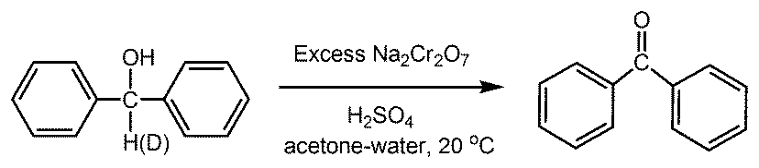
2.6 Let \(C_0\) be the initial concentration of either nondeuterated diphenylmethanol or deuterated diphenylmethanol and \(C_t\) its concentration at time \(t\). The experiment led to two plots (Figure 2a and Figure 2b), from which the first-order rate constant can be determined.
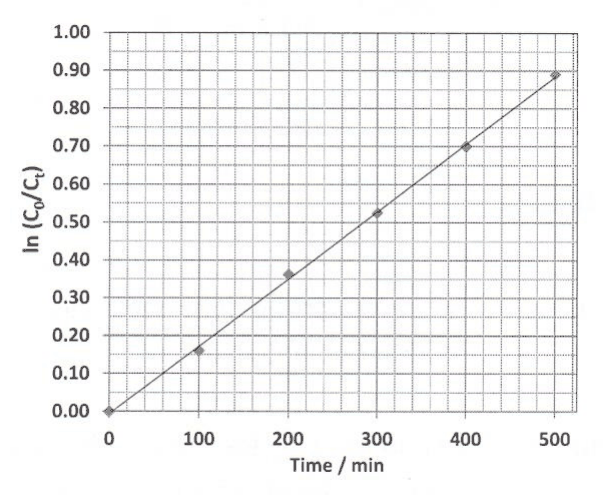
Figure 2a
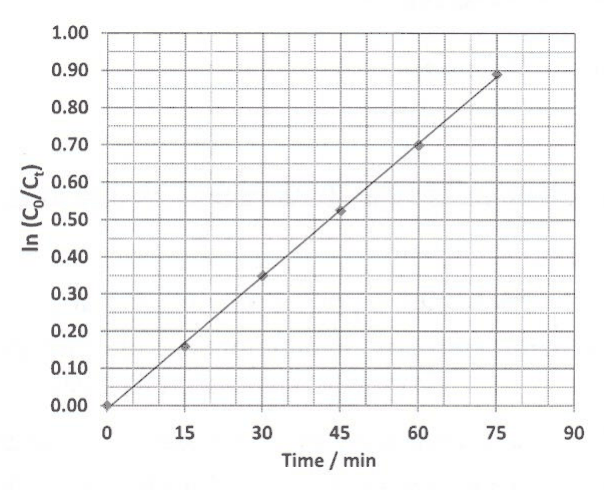
Figure 2b
Which plot should be for the oxidation of nondeuterated diphenylmethanol and which one is for the oxidation of deuterated diphenylmethanol?
For each statement, select your answer by marking “✓” in one of the square.
The oxidation of nondeuterated diphenylmethanol:
☐ Figure 2a
☐ Figure 2bThe oxidation of deuterated
☐ Figure 2a
☐ Figure 2b2.7 Determine \(k_{CH}\), \(k_{CD}\) (in \(\mathrm{min^{-1}}\)), and the \(k_{CH}/k_{CD}\) of this reaction from the plots in question 2.6.
2.8 The mechanism has been proposed as follows:
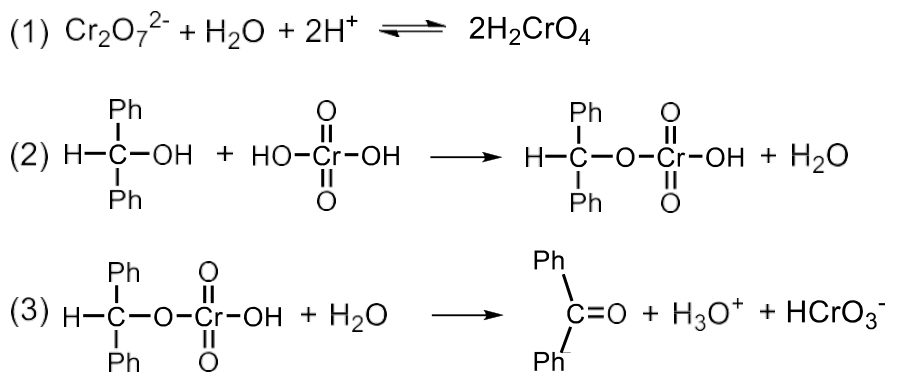
According to the information in 2.6 and 2.7, which step should be the rate determining step?
Select your answer by marking “✓” in one of the corresponding squares:
☐ Step (1)
☐ Step (2)
☐ Step (3)Official English text of the problem.
Problem 3: Thermodynamics of chemical reactions
Part A.
Methanol is produced commercially by using a mixture of carbon monoxide and hydrogen over zinc oxide/copper oxide catalyst:
\[ \ce{CO(g) + 2 H2(g) -> CH3OH(g)}. \]
The standard enthalpy of formation (\(\Delta H_f^\circ\)) and the absolute entropy (\(S^\circ\)) for each of the three gases at room temperature (298 K) and at a standard pressure of 1 bar are given as follows.
Gas \(\Delta H_f^\circ\) (kJ mol\(^{-1}\)) \(S^\circ\) (J K\(^{-1}\) mol\(^{-1}\)) \(\ce{CO(g)}\) −111 198 \(\ce{H2(g)}\) 0 131 \(\ce{CH3OH(g)}\) −201 240 3.1 Calculate \(\Delta H^\circ\), \(\Delta S^\circ\), \(\Delta G^\circ\), and \(K_p\) for the reaction at 298 K.
(If you are unable to calculate \(K_p\) at 298 K in problem 3.1, use \(K_p=9\times10^5\) later on.)
3.2 A commercial reactor is operated at a temperature of 600 K. Calculate the value of \(K_p\) at this temperature, assuming that \(\Delta H^\circ\) and \(\Delta S^\circ\) are independent on temperature.
(If you are unable to calculate \(K_p\) at 600 K in problem 3.2, use \(K_p=1.0\times10^{-2}\) later on.)
3.3 Production of methanol in industry is based on flowing of the gas comprising 2.00 moles of \(\ce{H2}\) for each mole of \(\ce{CO}\) into the reactor. The mole fraction of methanol in the exhaust gas from the reactor was found to be 0.18. Assuming that equilibrium is established, what is the total pressure in the reactor at a high temperature of 600 K?
Part B.
3.4 Consider the following closed system at 300 K. The system comprises 2 compartments, separated by a closed valve, which has negligible volume (see next figure). At the same pressure \(P\), compartment A and compartment B contain 0.100 mol argon gas and 0.200 mol nitrogen gas, respectively. The volumes of the two compartments, \(V_A\) and \(V_B\), are selected so that the gases behave as ideal gases.
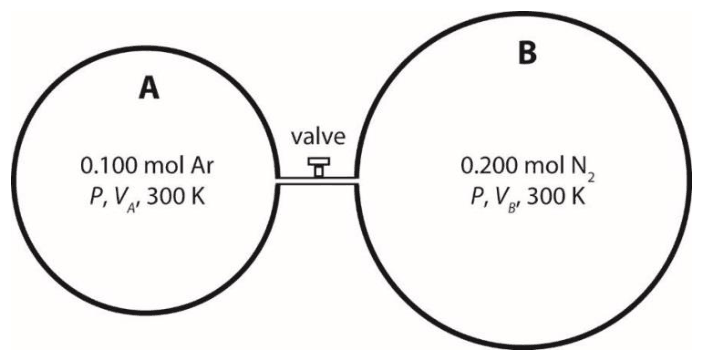
After opening the valve slowly, the system is allowed to reach equilibrium. It is assumed that the two gases form an ideal gas mixture. Calculate the change in Gibbs free energy at 300 K, \(\Delta G\).
If you are unable to calculate \(K_p\) at 298 K in problem 3.1, use \(K_p=9\times10^5\) later on.
Official English text of the problem.
Problem 4: Electrochemistry
Part A. Galvanic cell
The experiment is performed at 30.00°C. The electrochemical cell is composed of a hydrogen half-cell \([\ce{Pt(s)}\mid\ce{H2(g)}\mid\ce{H+(aq)}]\) containing a metal platinum electrode immersed in a buffer solution under a pressure of hydrogen gas. This hydrogen half-cell is connected to a half-cell of a metal (M) strip dipped in an unknown concentration of \(\ce{M^{2+}(aq)}\) solution. The two half-cells are connected via a salt bridge as shown in Figure 1.
Note: The standard reduction potentials are given in Table 1.
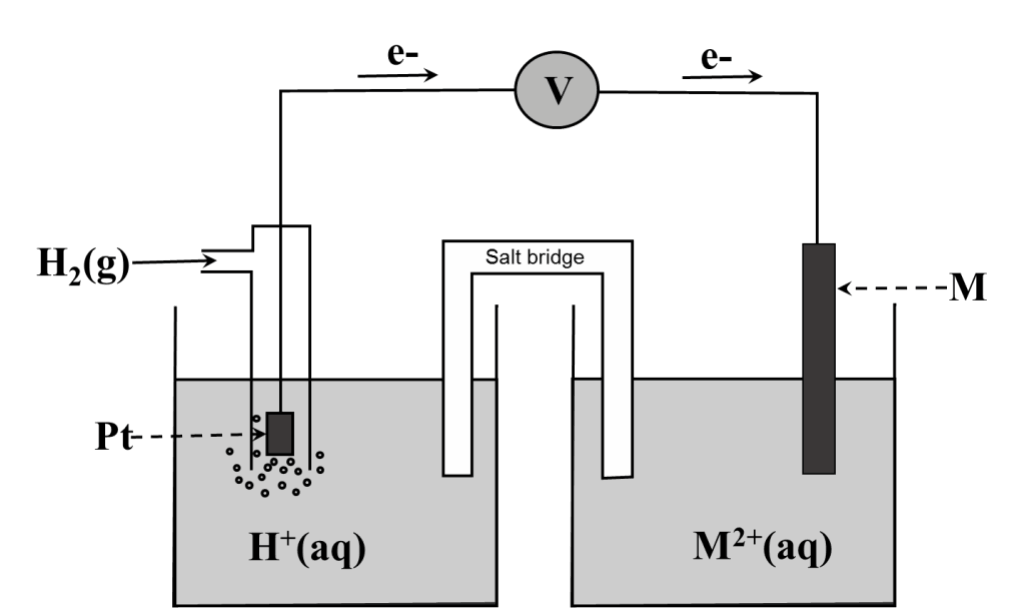
Figure 1 The galvanic cell
Table 1. Standard reduction potential (range 298-308 K)
Half-reaction \(E^\circ\) (V)- \(\ce{Ba^{2+}(aq) + 2e- -> Ba(s)}\) -2.912 \(\ce{Sr^{2+}(aq) + 2e- -> Sr(s)}\) 2.899 \(\ce{Ca^{2+}(aq) + 2e- -> Ca(s)}\) -2.868 \(\ce{Er^{2+}(aq) + 2e- -> Er(s)}\) -2.000 \(\ce{Ti^{2+}(aq) + 2e- -> Ti(s)}\) -1.630 \(\ce{Mn^{2+}(aq) + 2e- -> Mn(s)}\) -1.185 \(\ce{V^{2+}(aq) + 2e- ->}\ ;\ce{V(s)}\) -1.175 \(\ce{Cr^{2+}(aq) + 2e- -> Cr(s)}\) -0.913 \(\ce{Fe^{2+}(aq) + 2e- -> Fe(s)}\) -0.447 \(\ce{Cd^{2+}(aq) + 2e- -> Cd(s)}\) -0.403 \(\ce{Co^{2+}(aq) + 2e- -> Co(s)}\) -0.280 \(\ce{Ni^{2+}(aq) + 2e- -> Ni(s)}\) -0.257 \(\ce{Sn^{2+}(aq) + 2e- -> Sn(s)}\) -0.138 \(\ce{Pb^{2+}(aq) + 2e- -> Pb(s)}\) -0.126 \(\ce{2H+(aq) + 2e- -> H2(g)}\) 0.000 \(\ce{Sn^{4+}(aq) + 2e- -> Sn^{2+}(aq)}\) +0.151 \(\ce{Cu^{2+}(aq) + e- -> Cu+(aq)}\) +0.153 \(\ce{Ge^{2+}(aq) + 2e- -> Ge(s)}\) +0.240 \(\ce{VO^{2+}(aq) + 2H+(aq) + e- -> V^{3+}(aq) + H2O(l)}\) +0.337 \(\ce{Cu^{2+}(aq) + 2e- -> Cu(s)}\) +0.340 \(\ce{Tc^{2+}(aq) + 2e- -> Tc(s)}\) +0.400 \(\ce{Ru^{2+}(aq) + 2e- -> Ru(s)}\) +0.455 \(\ce{I2(s) + 2e- -> 2I-(aq)}\) +0.535 \(\ce{UO2^{2+}(aq) + 4H+(aq) + 2e- -> U^{4+}(aq) + 2H2O(l)}\) +0.612 \(\ce{PtCl4^{2-}(aq) + 2e- -> Pt(s) + 4Cl-(aq)}\) +0.755 \(\ce{Fe^{3+}(aq) + e- -> Fe^{2+}(aq)}\) +0.770 \(\ce{Hg2^{2+}(aq) + 2e- -> 2Hg(l)}\) +0.797 \(\ce{Hg^{2+}(aq) + 2e- -> Hg(l)}\) +0.851 \(\ce{2Hg^{2+}(aq) + 2e- -> Hg2^{2+}(aq)}\) +0.920 \(\ce{Pt^{2+}(aq) + 2e- -> Pt(s)}\) +1.180 \(\ce{MnO2(s) + 4H+(aq) + 2e- -> Mn^{2+}(aq) + 2H2O(l)}\) +1.224 \(\ce{Cr2O7^{2-}(aq) + 14H+(aq) + 6e- -> 2Cr^{3+}(aq) + 7H2O(l)}\) +1.360 \(\ce{Co^{3+}(aq) + e- -> Co^{2+}(aq)}\) +1.920 \(\ce{S2O8^{2-}(aq) + 2e- -> 2SO4^{2-}(aq)}\) +2.010 4.1 If the reaction quotient (\(Q\)) of the whole galvanic cell is equal to \(2.18\times10^{-4}\) at 30.00 °C, the electromotive force is +0.450 V. Calculate the value of standard reduction potential (\(E^\circ\)) and identify the metal “M”.
Note: \(\Delta G=\Delta G^\circ+RT\ln Q\)
4.2 Write the balanced equation of the spontaneous redox reaction of the galvanic cell.
4.3 The unknown concentration of \(\ce{M^{2+}(aq)}\) solution in the cell (Figure 1) can be analyzed by a iodometric titration. A 25.00 \(\mathrm{cm^3}\) aliquot of \(\ce{M^{2+}(aq)}\) solution is added into a conical flask and an excess of \(\ce{KI}\) is added. A volume of 25.05 \(\mathrm{cm^3}\) of a sodium thiosulfate solution with a concentration of 0.800 \(\mathrm{mol\,dm^{-3}}\) is required to reach the equivalent point. Write all the redox reactions associated with this titration and calculate the concentration of \(\ce{M^{2+}(aq)}\) solution.
Note: If a student cannot find the answer, the student can use 0.950 \(\mathrm{mol\,dm^{-3}}\) as the concentration of \(\ce{M^{2+}}\) for further calculations.
4.4 In Figure 1, if the hydrogen half-cell is under 0.360 bar hydrogen gas and the platinum electrode is immersed in a 500 \(\mathrm{cm^3}\) buffer solution containing 0.050 mol lactic acid (\(\ce{HC3H5O3}\)) and 0.025 mol sodium lactate (\(\ce{C3H5O3Na}\)), the electromotive force of the galvanic cell measured is +0.534 V. Calculate the pH of the buffer solution and the dissociation constant (\(K_a\)) of lactic acid at 30.00 °C.
Note: If a student cannot find the answer, the student can use 3.46 as the buffer pH for further calculations.
Official English text of the problem.
Problem 5: Phosphate and silicate in soil
Distribution and mobility of phosphorus in soil are usually studied by sequential extraction. Sequential extraction is performed by the use of acid or alkaline reagents to fractionate inorganic phosphorus in soil. Soil sample was extracted and analyzed as follows:
Part A. Determination of total phosphate (\(\ce{PO4^3-}\)) and silicate (\(\ce{SiO4^4-}\))
A 5.00 gram of soil sample is digested to give a final volume of 50.0 \(\mathrm{cm^3}\) digesting solution which dissolves total phosphorus and silicon. The extract is analyzed for the total concentrations of phosphorus and silicon. The concentrations of phosphorus and silicon are found to be 5.16 \(\mathrm{mg\,dm^{-3}}\) and 5.35 \(\mathrm{mg\,dm^{-3}}\), respectively.
5.1.1 Determine the mass of \(\ce{PO4^3-}\) in mg per 1.00 g of soil.
5.1.2 Determine the mass of \(\ce{PO4^3-}\) in mg per 1.00 g of soil.
Part B. Determination of available \(\ce{PO4^3-}\) in acid extract
Phosphate can be analyzed by using molybdenum blue method. One mole of phosphate is converted into one mole of molybdenum blue compound. This method is used for determination of phosphate in the acid extract. Absorbance (\(A\)) and transmittance (\(T\)) are recorded at 800 nm. The molar absorptivity of the molybdenum blue compound is 6720 \(\mathrm{dm^3\,mol^{-1}\,cm^{-1}}\) and all measurement is carried out in a 1.00-cm cuvette.
Transmittance and absorbance are given by the following equations:
\[ T = I/I_{\mathrm{o}} \]
\[ A = \log(I_{\mathrm{o}}/I) \]
where \(I\) is the intensity of the transmitted light and \(I_{\mathrm{o}}\) is the intensity of the incident light.
5.2.1 When the sample containing high concentration of phosphate is analyzed, a reference solution of \(7.5\times10^{-5}\ \mathrm{mol\,dm^{-3}}\) of molybdenum blue compound is used for adjusting zero absorbance. The transmittance of the sample solution is then measured to be 0.55. Calculate the concentration of phosphate (\(\mathrm{mol\,dm^{-3}}\)) in the sample solution.
Part C. Determination of \(\ce{PO4^3-}\) and \(\ce{SiO4^4-}\) in alkaline extract
Both phosphate and silicate ions can react with molybdate in alkaline solution, producing the yellow molybdophosphate and molybdatosilicate. Further reduction with ascorbic acid produces intense color molybdenum blue compounds. Both complexes exhibit maximum absorption at 800 nm. Addition of tartaric acid helps preventing interference from silicate in the determination of phosphate.
Two series of phosphate standard are treated with and without tartaric acid whereas a series of silicate standard is not treated with tartaric acid. Linear equations obtained from those calibration curves are as follows:
Conditions Linear equations Phosphate with and without tartaric acid \(y = 6720x_1\) Silicate without tartaric acid \(y = 868x_2\) \(y\) is absorbance at 800 nm,
\(x_1\) is concentration of phosphate as \(\mathrm{mol\,dm^{-3}}\),
\(x_2\) is concentration of silicate as \(\mathrm{mol\,dm^{-3}}\)
Absorbance at 800 nm of the alkaline fraction of the soil extract after treated with and without tartaric acid are 0.267 and 0.510, respectively.
5.3.1 Calculate the phosphate concentration in the alkaline soil extract in \(\mathrm{mol\,dm^{-3}}\) and calculate the corresponding phosphorus in \(\mathrm{mg\,dm^{-3}}\).
5.3.2 Calculate the silicate concentration from the soil sample in t the alkaline fraction in \(\mathrm{mol\,dm^{-3}}\) and calculate the corresponding silicon in \(\mathrm{mg\,dm^{-3}}\).
Part D. Preconcentration of ammonium phosphomolybdate
A 100 \(\mathrm{cm^3}\) of aqueous sample of ammonium phosphomolybdate (\(\ce{(NH4)3PMo12O40}\)) compound is extracted with 5.0 \(\mathrm{cm^3}\) of an organic solvent. The organic-water partition coefficient (\(K_{\mathrm{ow}}\)) is defined as the ratio of concentration of the compound in the organic phase (\(c_{\mathrm{o}}\)) to that in the water phase (\(c_{\mathrm{w}}\)). \(K_{\mathrm{ow}}\) of the ammonium phosphomolybdate is 5.0.
The molar absorptivity of ammonium phosphomolybdate in the organic phase is 5000 \(\mathrm{dm^3\,mol^{-1}\,cm^{-1}}\).
5.4 If the absorbance in the organic phase is 0.200, calculate the total mass of phosphorus (in mg unit) in the original aqueous sample solution. The optical pathlength of the cuvette is 1.00 cm.
Official English text of the problem.
Problem 6: Iron
Iron (\(\ce{Fe}\)) is the fourth most abundant element in the Earth’s crust and has been used for more than 5,000 years.
Part A.
Pure iron is easily oxidized, which limits its utilization. Element X is one of the alloying elements that is added to improve the oxidation resistance property of iron.
6.1 Below is some information about the element X:
(1) In first ionization, an electron with quantum numbers \(n_1=4-l_1\) is removed.
(2) In second ionization, an electron with quantum numbers \(n_2=5-l_2\) is removed.
(3) The atomic mass of X is lower than that of \(\ce{Fe}\).
What is the element X?
(Answer by writing the proper symbol according to the periodic table.)
6.2 Both \(\ce{Fe}\) and X crystallize in the body centered cubic structure. Approximating the \(\ce{Fe}\) atoms as hard-spheres, the volume taken up by the \(\ce{Fe}\) atoms inside the unit cell is \(1.59\times10^{-23}\ \mathrm{cm^3}\). The volume of the unit cell of X is \(0.0252\ \mathrm{nm^3}\). A complete substitutional solid solution usually occurs when
\[ \Delta R=\left(\frac{|R_X-R_{\ce{Fe}}|}{R_{\ce{Fe}}}\right)\times100 \]
is less than or equal to 15, where \(R_X\) and \(R_{\ce{Fe}}\) are the atomic radii of X and \(\ce{Fe}\), respectively. Can X and \(\ce{Fe}\) form a complete substitutional solid solution?
Tick the relevant box ☐ YES ☐ NO.
Show your calculation. The volume of sphere is \(4/3\pi r^3\).
Part B.
Iron in natural water is in the form of \(\ce{Fe(HCO3)2}\), which ionizes to \(\ce{Fe^2+}\) and \(\ce{HCO3^-}\). To remove iron from water, \(\ce{Fe(HCO3)2}\) is oxidized to an insoluble complex \(\ce{Fe(OH)3}\), which can be filtered out of the water.
6.3 \(\ce{Fe^2+}\) can be oxidized by \(\ce{KMnO4}\) in a basic solution to yield \(\ce{Fe(OH)3}\) and \(\ce{MnO2}\) precipitates. Write the balanced ionic equation for this reaction in a basic solution.
6.4 Under this condition, \(\ce{HCO3^-}\) ions are converted to \(\ce{CO3^2-}\). Write the balanced ionic equation for this reaction in a basic solution.
6.5 A covalent compound A which contains more than 2 atoms and, a potential oxidizing agent, can be prepared by the reaction between diatomic halogen molecule (\(\ce{X2}\)) and \(\ce{NaQO2}\)

where \(x\), \(y\) and \(z\) are the coefficients for the balanced equation. Among the binary compounds between hydrogen and halogen, \(\ce{HX}\) has the lowest boiling point. Identify X and if A has an unpaired electron, draw a Lewis structure of compound A with zero formal charge on all atoms.
6.6 Compound D is an unstable oxidizing agent that can be used to remove \(\ce{Fe(HCO3)2}\) from natural water. It consists of elements G, Z and hydrogen and the oxidation number of Z is +1. In this compound, hydrogen is connected to the element having the higher electronegativity among them. Below is some information about the elements G and Z:
(1) G exists in its normal state as a diatomic molecule, \(\ce{G2}\).
(2) Z has one proton fewer than that of element E. E exists as a gas under standard conditions. \(\ce{Z2}\) is a volatile solid.
(3) The compound \(\ce{EG3}\) has a pyramidal shape.
Identify the elements G and Z and draw a molecular structure of compound D.
Part C.
\(\ce{^{59}Fe}\) is a radiopharmaceutical isotope which is used in the study of iron metabolism in the spleen. This isotope decays to \(\ce{^{59}Co}\) as follows:

6.7 What are a and b in equation (1)? (Mark ✓ in the appropriate boxes.)
proton neutron beta positron alpha gamma 6.8 Consider equation (1), if the \(\ce{^{59}Fe}\) isotope is left for 178 days which is \(n\) times of its half-life (\(t_{1/2}\)), the mole ratio of \(\ce{^{59}Co}\) to \(\ce{^{59}Fe}\) is 15 : 1. If \(n\) is an integer, what is the half-life of \(\ce{^{59}Fe}\) in day(s)? Show your calculation.
Official English text of the problem.
Problem 7: Chemical Structure Puzzles
Titanium complexes have been investigated for their antitumor activity. Many factors including isomerism and sizes have shown to affect the potency of the complexes. This question deals with the synthesis and characterization of some titanium complexes.
7.1 A reaction of 2 equivalents of 2-tert-butylphenol, 2 equivalents of formaldehyde, and \(N,N'\)-dimethylethylene-1,2-diamine under acidic conditions at \(75\,^\circ\mathrm{C}\) affords three major products with the same chemical formula of \(\ce{C26H40N2O2}\), as shown in the equation below. Draw the structure of each product.

7.2 If 2,4-di-tert-butylphenol is used as a substrate instead of 2-tert-butylphenol using the same stoichiometry as that in 7.1, only one product X was obtained. Draw the structure of X.
A reaction between X from 7.2 and \(\ce{Ti(O^{i}Pr)4}\) [\(^{i}\mathrm{Pr}\) = isopropyl] in diethyl ether under an inert atmosphere resulted in the six-coordinate Ti complex Y, as a yellow crystalline solid and isopropanol at room temperature.

UV-VIS spectra of X, \(\ce{Ti(O^{i}Pr)4}\), and Y reveal that only the product Y has an absorption at \(\lambda=370\ \mathrm{nm}\). By varying the volumes of X and \(\ce{Ti(O^{i}Pr)}\), each with the concentration of \(0.50\ \mathrm{mol\,dm^{-3}}\), and using benzene as the solvent, the absorbance data at \(\lambda=370\ \mathrm{nm}\) are given below:
Volume of X (\(\mathrm{cm^3}\)) Volume of \(\ce{Ti(O^{i}Pr)4}\) (\(\mathrm{cm^3}\)) Volume of benzene (\(\mathrm{cm^3}\)) Absorbance 0 1.20 1.80 0.05 0.20 1.00 1.80 0.25 0.30 0.90 1.80 0.38 0.50 0.70 1.80 0.59 0.78 0.42 1.80 0.48 0.90 0.30 1.80 0.38 1.10 0.10 1.80 0.17 1.20 0 1.80 0.02 7.3 Fill in appropriate values in the table provided below.
\(\displaystyle\frac{\text{mol of X}}{\text{mol of X}+\text{mol of }\ce{Ti(O^{i}Pr)4}}\) Absorbance 0.05 0.25 0.38 0.59 0.48 0.38 0.17 0.02 Next figure: Plot a graph showing a relationship between
\[ \frac{\text{mole of X}} {\text{mole of X}+\text{mole of }\ce{Ti(O^{i}Pr)4}} \]
and absorbance in the space provided below.
The value of
\[ \frac{\text{mole of X}} {\text{mole of X}+\text{mole of }\ce{Ti(O^{i}Pr)4}} \]
which maximizes the amount of the product Y represents the stoichiometry of X in the chemical formula of Y. Based on the graph above, show what is the molar ratio Ti : X in the complex Y.
7.4 The titanium complex Y is six-coordinated. The IR spectrum of Y does not contain a broad absorption band in the range of \(3200–3600\ \mathrm{cm^{-1}}\). Y exists as three diastereomers. Ignoring stereochemistry at N atoms, draw clearly the structures of all three diastereomers.
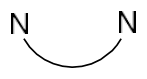
Note that you do not need to draw the complete structure of the ligand. Only identify donor atoms that involve in coordination with titanium and the ligand framework between the donor atoms can be drawn as follows:
For example:
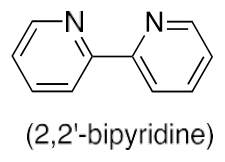
(2,2'-bipyridine)
can be drawn as:
**If you did not get a structure of X from 7.2, use the following ligand symbol to represent X (A and Z are donor atoms):
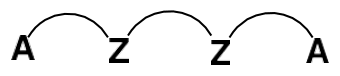
7.5 Under certain conditions, the reaction shown in equation 1 affords only one diastereomer of Y. Given that structures of Y are "fixed" (no intramolecular movement), the \(\ce{^1H}\) NMR spectrum of Y in \(\ce{CDCl3}\) shows four singlet resonances at \(\delta\) 1.25, 1.30, 1.66, and 1.72 corresponding to the tert-butyl groups. Draw a structure of the only possible diastereomer of Y.
(You do not need to draw the complete structure of the ligand. Only identify donor atoms that involve in coordination and the ligand framework between the donor atoms can be drawn as shown in 7.4).
Official English text of the problem.
Problem 8: Silica Surface
Silica exists in various forms like amorphous and crystalline. Silica can be synthesized via sol- gel process by using silicon alkoxides like tetramethoxysilane (TMOS) and tetraethoxysilane (TEOS) as the details below:
a. Hydrolysis
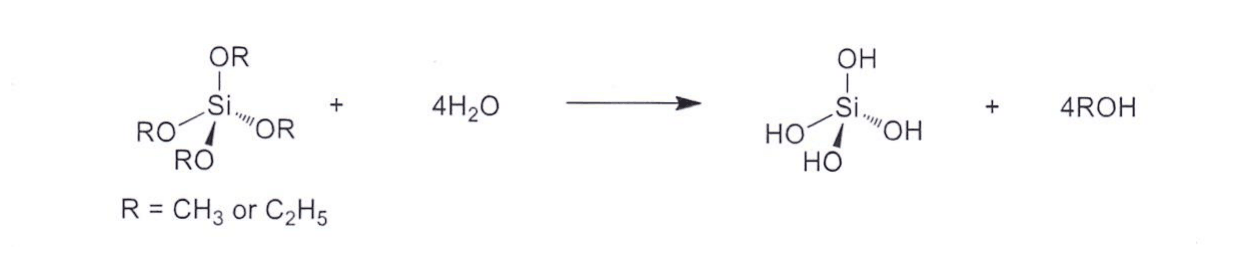
b. Water condensation

c. Alcohol condensation
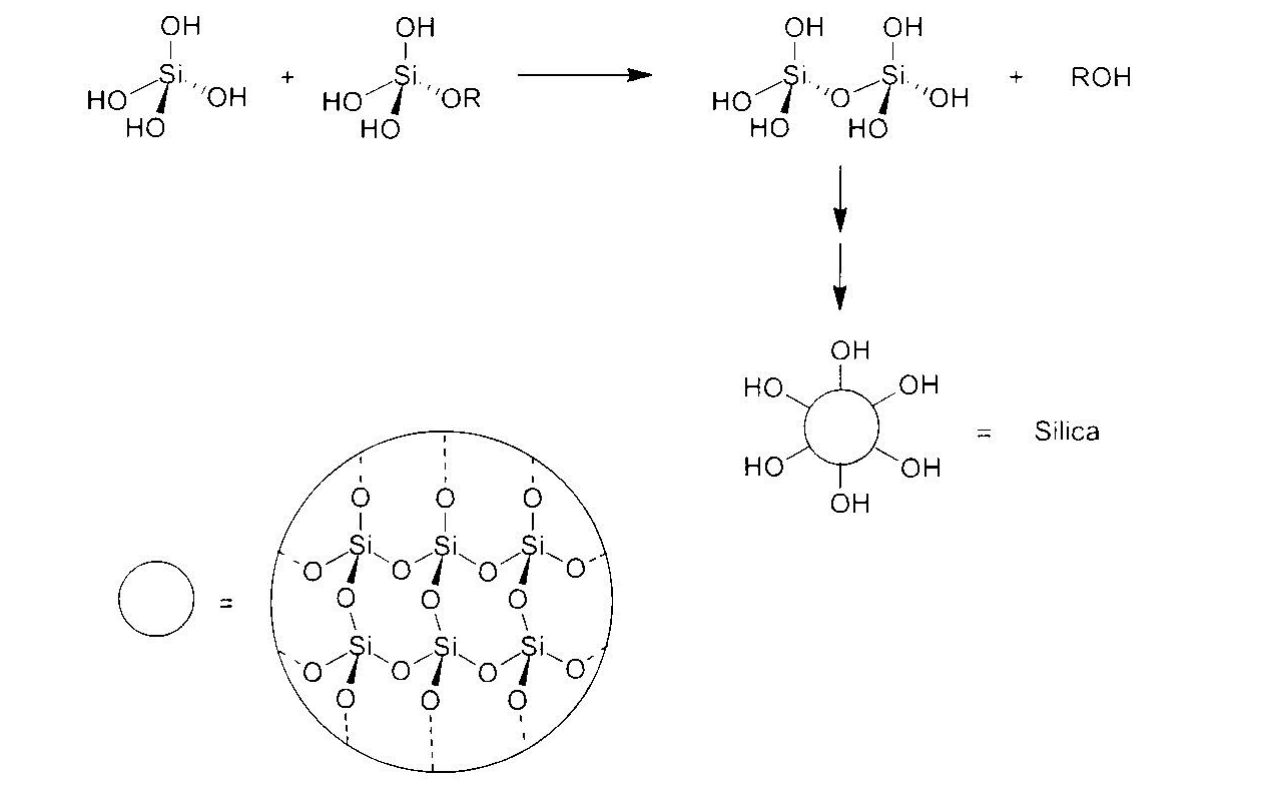
In bulk silica, all silicon atoms are tetrahedrally bonded to four oxygen atoms giving three-dimensional solid network. The silicon environments found inside silica is presented below:
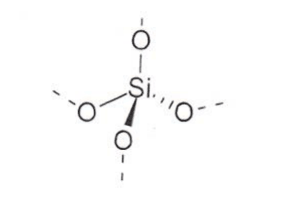
8.1 Three silicon atom environments (similar to the example above) are commonly observed at the silica surface. The three structures of the silicon environments must be drawn in the provided boxes.

Silica can be used as an effective metal ion adsorbent in water. The proposed structure for metal-silica complex is as follows:
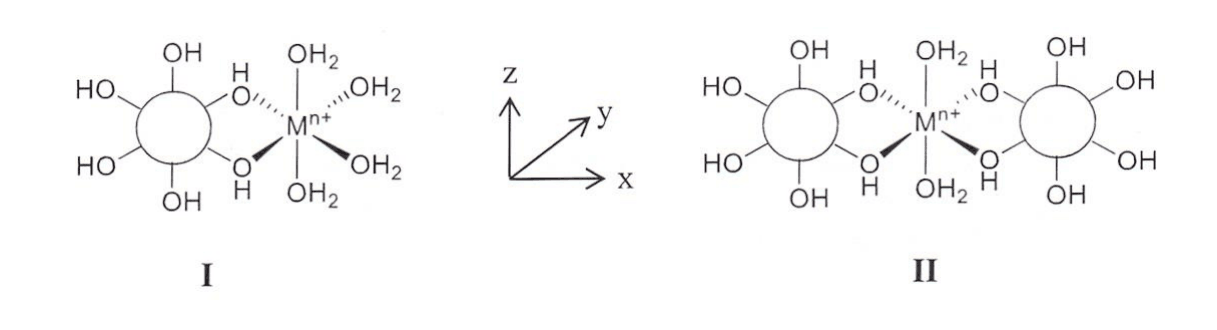
8.2 After \(\ce{Cu^2+}\) is being adsorbed, the color of silica changes from white to pale blue. The visible spectrum shows a broad absorption band (with a shoulder) at \(\lambda_{\max}=550\ \mathrm{nm}\).
If \(\ce{Cu^2+}\) can bind with silica and adopt the structure similar to II, draw the splitting diagram of the \(d\)- orbitals of \(\ce{Cu^2+}\) ion including the label of the \(d\) orbitals in the complex and specify the corresponding electronic transition(s) for the visible absorption.
8.3 If the first row transition metal ions form complexes with silica analogous to \(\ce{Cu^2+}\), which metal ion(s) do(es) have the analogous to electronic transition(s) to \(\ce{Cu^2+}\)?
The metal ion(s) must be in +2 or +3 oxidation state. Please note that the silanol groups (\(\ce{Si-OH}\)) and water are weak field ligands.
However, silica is randomly bonded to various types of metal ion. To increase the selectivity, modification of silica surface has been performed by grafting with various organic molecules like 3-aminopropyltrimethoxysilane and 3-mercaptopropyltrimethoxy-silane.
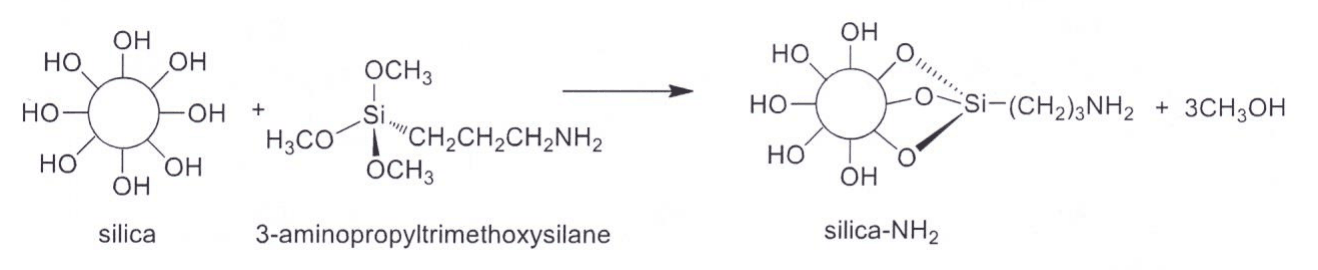
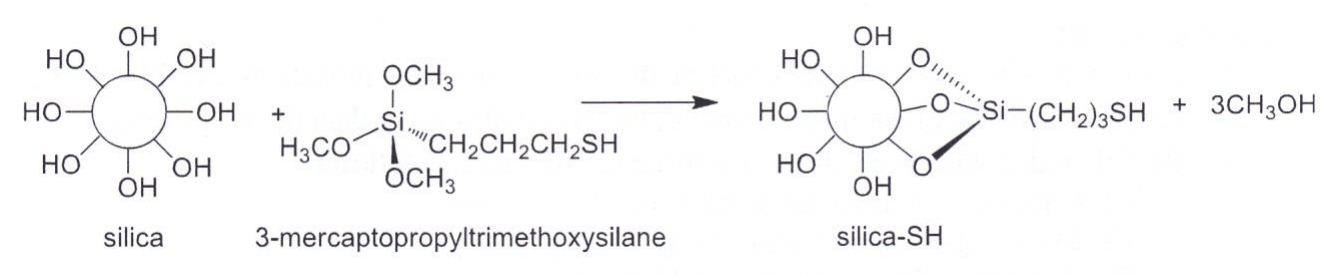
8.4 If \(\ce{Hg^2+}\) is only bonding to sulfur binding sites in silica-SH, the symmetric complex of \(\ce{[Hg(silica-SH)2]^2+}\) is formed. Draw the structure of \(\ce{[Hg(silica-SH)2]^2+}\), specify the direction of the bond axes, and draw the corresponding \(d\)-orbital splitting. (You may use \(\ce{R-SH}\) instead of drawing the whole structure of silica-SH.).
The structure: \(d\)-orbital splitting diagram :
8.5 Specify whether the following statements are true or false:
a) \(d\)-\(d\) transition is found in \(\ce{[(Hg(silica-SH)_{x})]^2+}\)
□ True □ False
b) The \(\ce{[Cu(silica-NH2)_{x}]^2+}\) in a similar geometry, is expected to have a color similar to other copper(II) amine complexes.
□ True □ False
c) In the visible absorption spectra, \(\lambda_{\max}\) of \(\ce{[Cu(silica-NH2)_{x}]^2+}\) is greater than that of \(\ce{[Cu(silica-OH)_{x}]^2+}\).
□ True □ False
Official English text of the problem.
Problem 9: Into the Unknown
Organic compound A is chiral and contains only three elements with the molecular weight (MW) of 149 (rounded to an integer).
\({}^{1}\mathrm{H}\) NMR spectrum of compound A shows among others, three types of aromatic protons, and its \({}^{13}\mathrm{C}\) NMR spectrum shows eight signals, of which four signals are in the range of 120-140 ppm.
Compound A can be prepared by treating a carbonyl compound with methylamine followed by \(\ce{NaBH3CN}\).
9.1 Write all possible structural formulae of compound A. No stereochemistry is required, and do not include stereoisomers.
9.2 One of the position isomers of compound A (structure A1, A2 or A3) can be synthesized from compound B or C and D as shown in the diagram below. Write down the structural formulae of compounds B-F, and the position isomer of compound A.
9.3 Compound A is the \((R)\)-form of one of structures A1–A3. It can be prepared from vicinal diols X and Y as shown in the diagram below. Both diols are structural isomers, and each structure contains one carbon less than that of compound A.
Write down the structural formulae of compounds G-N, X, Y and the \((R)\)-form of compound A. You must show stereochemistry of all compounds.
Official English text of the problem.
Problem 10: Total Synthesis of Alkaloids
Alkaloids are a class of nitrogen-containing natural products. Their tructural complexity and potent biological activities has drawn attentions. Two representative examples of alkaloids – sauristolactam and pancratistatin are highlighted in following questions.
Part A
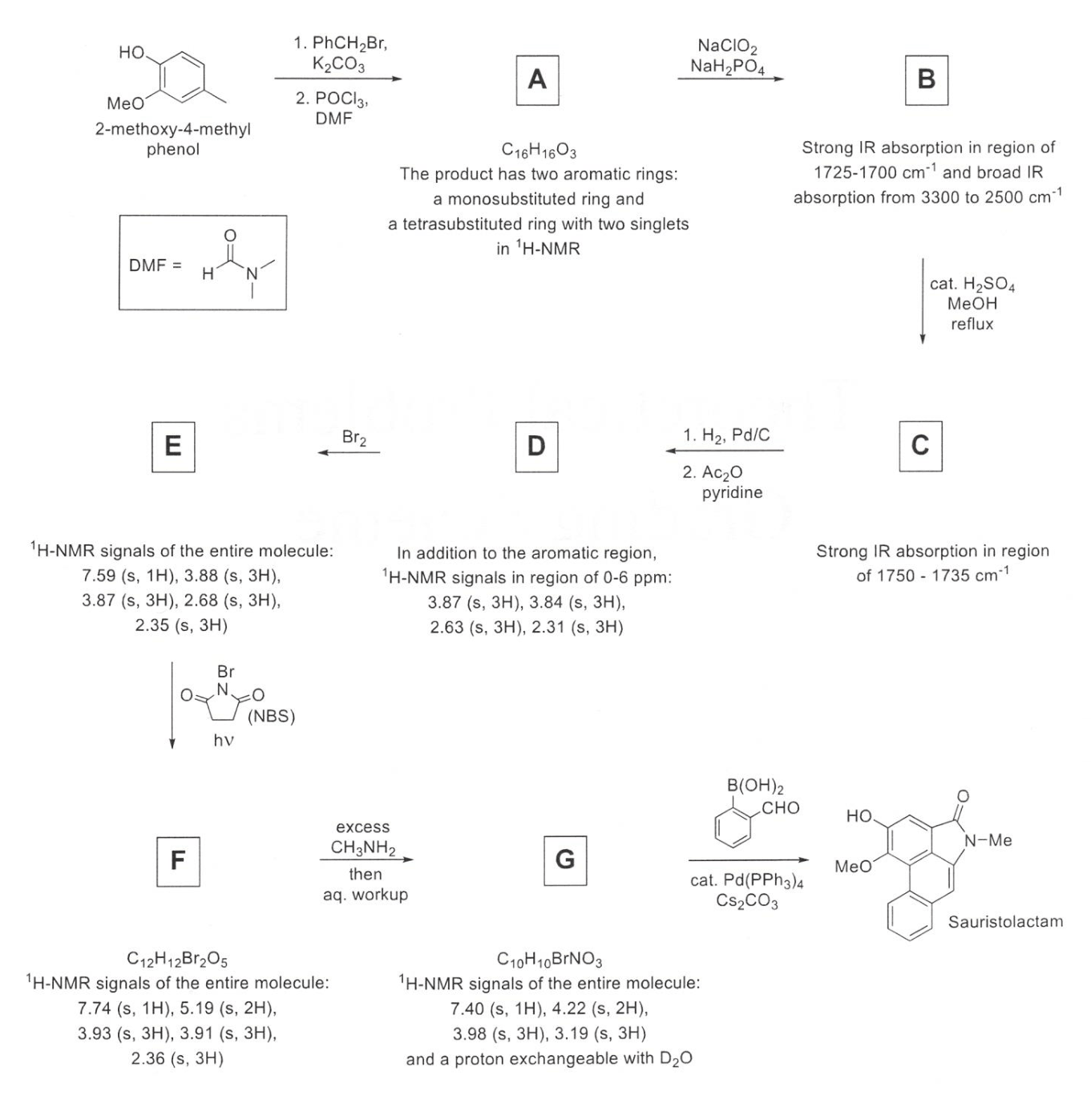
Sauristolactam possesses excellent cytotoxicity against various cancer cell lines. It could be prepared by following synthetic sequence on the page. (\(\ce{^1H}\)-NMR spectra were recorded in \(\ce{CDCl3}\) at 300 MHz.)
10.1 Draw the structures of A-G in the sequence.
Part B
Pancratistatin, isolated from a Hawaiian native plant, spider lily, exhibits potent in vitro and in vivo inhibitory activity of cancer cell growth in addition to its excellent antiviral activity.
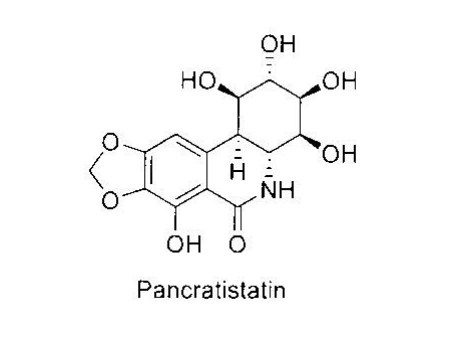
Pancratistatin
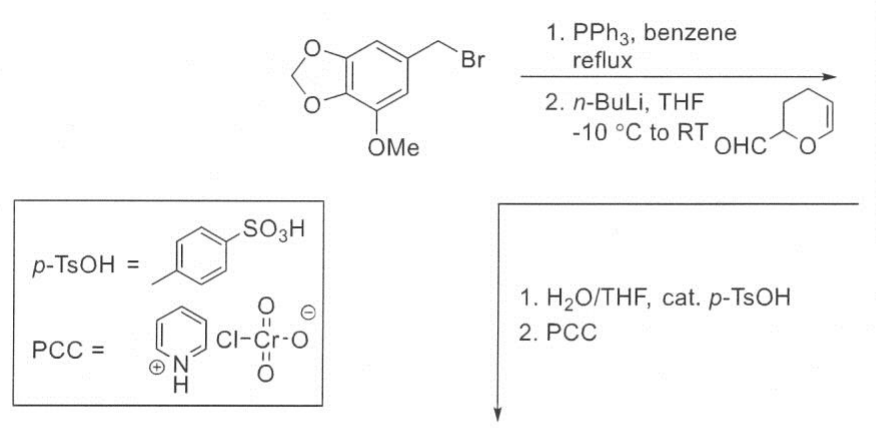
Pancratistatin could be successfully synthesized via intermediates X1 and X2. The synthesis of these intermediates are shown in the attached scheme.
10.2 Draw the structures of A and B.
10.3 Intermediate X1 (a single enantiomer with the stereochemistry shown) is labeled with deuterium with configuration as indicated below, propose the 3-D chair structure of compound E and the structure of compound F, with stereochemistry. Is Y a proton (\(\ce{^1H}\)) or a deuterium (\(\ce{^2H}\))?
Syntetic sequence:
Scheme of the synthesis of Pancratistatin and structures of compound A and B:
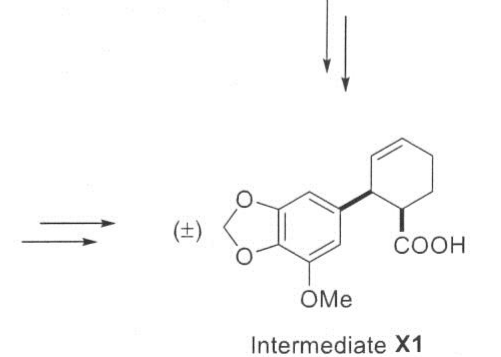
Intermediate X1
Official English text of the problem.
Problem 11: Twist & Chirality
trans-Cyclooctene has a chiral plane and a high barrier for racemization. The double bond of trans-cyclooctene is twisted, as a result, the molecule displays unusual reactivity in cycloaddition reactions.
In 2011, Fox and coworkers developed a photochemical synthesis towards a variety of trans- cyclooctene derivatives. The process is non-stereocontrolled and the synthetic scheme is as follow.
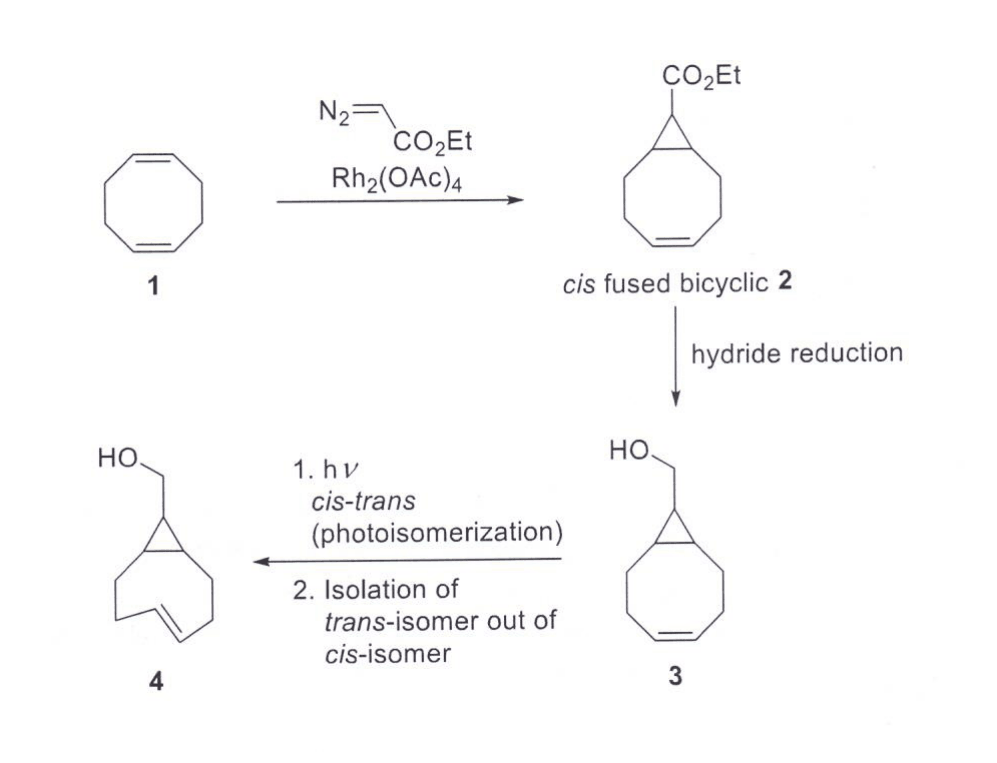
11.1 Draw all possible stereoisomers of compound 3 that could be obtained from the reduction of compound 2. Not necessary to assign \(R,S\) configuration.
11.2 i) If one of the stereoisomers of compound 3 is converted to compound 4, how many stereoisomeric form(s) of compound 4 will be obtained?
ii) The number of possible stereoisomeric form(s) of compound 4 = \(\boxed{\phantom{00}}\)
iii) If there are more than one stereoisomer, is it possible to separate the obtained stereoisomers of compound 4 by achiral chromatography? Tick the relevant circle.
○ Yes ○ No
Official English text of the problem.
Internationale Chemie-Olympiade
IChO 2017
Nakhon Pathom, Thailand · 11 Theorieaufgaben mit vollständigen Lösungen
Aufgabe 1: Herstellung von Propen mithilfe heterogener Katalysatoren
Propen oder Propylen ist eine der wertvollsten Chemikalien für die petrochemische Industrie in Thailand und weltweit. Ein gutes Beispiel für die kommerzielle Verwendung von Propen ist die Herstellung von Polypropylen (PP).
Teil A.
Propen kann durch direkte Dehydrierung von Propan in Gegenwart eines heterogenen Katalysators synthetisiert werden. Eine solche Reaktion ist jedoch aufgrund ihrer Eigenschaften wirtschaftlich nicht rentabel. Geben Sie zu jeder der folgenden Fragen eine kurze Erklärung. Zusätzliche Angaben: \(H_{\mathrm{bond}}(\ce{C=C})=1.77H_{\mathrm{bond}}(\ce{C-C})\), \(H_{\mathrm{bond}}(\ce{H-H})=1.05H_{\mathrm{bond}}(\ce{C-H})\) und \(H_{\mathrm{bond}}(\ce{C-H})=1.19H_{\mathrm{bond}}(\ce{C-C})\), wobei \(H_{\mathrm{bond}}\) die mittlere Bindungsenthalpie der angegebenen chemischen Bindung bezeichnet.
1.1 Wie groß ist die Enthalpieänderung bei der direkten Dehydrierung von Propan? Zeigen Sie Ihre Berechnung und geben Sie Ihre Antwort in Abhängigkeit von \(H_{\mathrm{bond}}(\ce{C-C})\) an.
1.2 Es ist schwierig, die Menge an Propen durch eine Druckerhöhung bei konstanter Temperatur zu erhöhen. Welches Gesetz oder Prinzip erklärt dieses Phänomen am besten? Wählen Sie Ihre Antwort, indem Sie „✓“ in einen der leeren Kreise eintragen.
- ☐ Boyle-Mariotte-Gesetz
- ☐ Gesetz von Charles
- ☐ Daltonsches Gesetz
- ☐ Raoultsches Gesetz
- ☐ Prinzip von Le Chatelier
1.3 Zu Beginn befindet sich das System im Gleichgewicht. Welche Vorzeichenkombination(en) für die folgenden thermodynamischen Größen des Systems bei der direkten Dehydrierung von Propan ist/sind in Übereinstimmung mit Frage 1.1 korrekt? Wählen Sie Ihre Antwort(en), indem Sie „✓“ in die entsprechenden leeren Kästchen eintragen.
\(\Delta H\) \(\Delta S\) \(\Delta G\) \(T^{*}\) ☐ − + + niedriger ☐ − + − höher ☐ − − + niedriger ☐ − − − höher ☐ + + + niedriger ☐ + + − höher ☐ + − + niedriger ☐ + − − höher ☐ Keine der obigen Angaben ist korrekt
\(^*\) Bezogen auf die Anfangstemperatur bei gleichem Partialdruck.
Teil B.
Eine besser geeignete Reaktion zur Herstellung großer Mengen Propen ist die oxidative Dehydrierung (ODH) unter Verwendung fester Katalysatoren, beispielsweise Vanadiumoxide, in einer Atmosphäre aus molekularem Sauerstoff. Obwohl dieser Reaktionstyp noch intensiv erforscht und entwickelt wird, übertrifft sein Potenzial für die Herstellung von Propen im industriellen Maßstab das der direkten Dehydrierung.
1.4 Die Gesamtgeschwindigkeit des Propanverbrauchs bei der Reaktion beträgt
\[ r_{\ce{C3H6}} = \frac{1}{ \dfrac{p^{0}}{k_{\mathrm{red}}p_{\ce{C3H6}}} + \dfrac{p^{0}}{k_{\mathrm{ox}}p_{\ce{O2}}} } \]
wobei \(k_{\mathrm{red}}\) und \(k_{\mathrm{ox}}\) die Geschwindigkeitskonstanten für die Reduktion des Metalloxidkatalysators durch Propan bzw. für die Oxidation des Katalysators durch molekularen Sauerstoff sind und \(p^{o}\) der Standarddruck von 1 bar ist. In einigen Experimenten wurde festgestellt, dass die Oxidation des Katalysators 100.000-mal schneller abläuft als die Oxidation von Propan. Experimentell gilt
\[ r_{\ce{C3H8}} = k_{\mathrm{obs}}\frac{p_{\ce{C3H6}}}{p^{0}} \]
wobei \(k_{\mathrm{obs}}\) die beobachtete Geschwindigkeitskonstante (\(0.062\ \mathrm{mol\,s^{-1}}\)) ist. Wenn der Reaktor, der den Katalysator enthält, bei einem Gesamtdruck von 1 bar kontinuierlich von Propan und Sauerstoff durchströmt wird, bestimmen Sie die Werte von \(k_{\mathrm{red}}\) und \(k_{\mathrm{ox}}\), wenn der Partialdruck von Propan 0.10 bar beträgt. Nehmen Sie an, dass der Partialdruck von Propen vernachlässigbar ist.
Teil C.
Der Metalloxidkatalysator enthält auf seiner Oberfläche Sauerstoffatome, die als aktive Zentren für die ODH dienen. Bezeichnet man ein reduziertes Zentrum mit red* und ein Sauerstoffatom auf der Katalysatoroberfläche mit \(\ce{O(s)}\), so lässt sich einer der vorgeschlagenen Mechanismen für die ODH in Gegenwart des Katalysators wie folgt schreiben:
Gegeben ist
\[ \beta= \frac{\text{Anzahl der reduzierten Zentren}} {\text{Gesamtzahl der aktiven Zentren}} \]
Die Geschwindigkeitsgesetze für die obigen 3 Schritte lauten:
\[ r_1=k_1p_{\ce{C2H8}}(1-\beta) \]
\[ r_2=k_2p_{\ce{C3H6}}(1-\beta) \]
und
\[ r_3=k_3p_{\ce{O2}}\beta \]
1.5 Berechnen Sie unter der Annahme, dass die Anzahl der Sauerstoffatome auf der Oberfläche zu jedem Zeitpunkt der Reaktion konstant bleibt, \(\beta\) als Funktion von
\[ k_1,\ k_2,\ k_3,\ p_{\ce{C2H8}},\ p_{\ce{C3H6}},\ \text{und }p_{\ce{O2}}. \]
Aufgabentext aus dem offiziellen englischen Text übersetzt.
Aufgabe 2: Kinetischer Isotopeneffekt (KIE) und Schwingungsnullpunktsenergie (ZPE)
Berechnung von ZPE und KIE
Der kinetische Isotopeneffekt (KIE) ist ein Phänomen, bei dem sich die Geschwindigkeitskonstante einer Reaktion ändert, wenn eines der Atome durch sein Isotop ersetzt wird. Mithilfe des KIE lässt sich bestätigen, ob eine bestimmte Bindung zu Wasserstoff bei der Reaktion gespalten wird. Das Modell des harmonischen Oszillators wird verwendet, um den Geschwindigkeitsunterschied zwischen der Aktivierung einer \(\ce{C-H}\)- und einer \(\ce{C-D}\)-Bindung abzuschätzen (D – Deuterium).
Die durch das Modell des harmonischen Oszillators beschriebene Schwingungsfrequenz (\(\nu\)) ist
\[ \nu=\frac{1}{2\pi}\sqrt{\frac{k}{\mu}} \]
wobei \(k\) die Kraftkonstante und \(\mu\) die reduzierte Masse ist.
Die Schwingungsenergien des Moleküls sind gegeben durch
\[ E_n=\left(n+\frac{1}{2}\right)h\nu \]
wobei \(n\) die Schwingungsquantenzahl mit den möglichen Werten 0, 1, 2, ... ist. Die Energie des niedrigsten Schwingungsenergieniveaus (\(E_n\) bei \(n=0\)) wird als Schwingungsnullpunktsenergie (ZPE) bezeichnet.
2.1 Berechnen Sie die reduzierte Masse von \(\ce{C-H}\) (\(\mu_{CH}\)) und \(\ce{C-D}\) (\(\mu_{CD}\)) in atomaren Masseneinheiten.
Nehmen Sie an, dass die Masse von Deuterium doppelt so groß ist wie die von Wasserstoff.
Hinweis: Falls Sie die Werte für \(\mu_{CH}\) und \(\mu_{CD}\) nicht berechnen können, dürfen Sie für die folgenden Teilaufgaben \(\mu_{CH}=1.008\) und \(\mu_{CD}=2.016\) verwenden. Die angegebenen Werte liegen nicht notwendigerweise nahe bei den korrekten Werten.
2.2 Die Kraftkonstante (\(k\)) der \(\ce{C-H}\)-Valenzschwingung ist gleich derjenigen der \(\ce{C-D}\)-Valenzschwingung, und die Frequenz der \(\ce{C-H}\)-Valenzschwingung beträgt \(2900\ \mathrm{cm^{-1}}\). Bestimmen Sie die entsprechende Frequenz der \(\ce{C-D}\)-Valenzschwingung (in \(\mathrm{cm^{-1}}\)).
2.3 Berechnen Sie anhand der Frequenzen der \(\ce{C-H}\)- und \(\ce{C-D}\)-Valenzschwingungen aus Teilaufgabe 2.2 die Schwingungsnullpunktsenergien (ZPE) der \(\ce{C-H}\)- und \(\ce{C-D}\)-Valenzschwingungen in \(\mathrm{kJ\,mol^{-1}}\).
Hinweis: Falls Sie die Werte für die ZPE in 2.3 nicht berechnen können, dürfen Sie für die folgenden Teilaufgaben \(ZPE_{CH}=7.23\ \mathrm{kJ\,mol^{-1}}\) und \(ZPE_{CD}=2.15\ \mathrm{kJ\,mol^{-1}}\) verwenden. Die angegebenen Werte liegen nicht notwendigerweise nahe bei den korrekten Werten.
Kinetischer Isotopeneffekt (KIE)
Aufgrund des Unterschieds in den Schwingungsnullpunktsenergien ist zu erwarten, dass eine wasserstoffhaltige Verbindung und ihre entsprechenden deuterierten Verbindungen mit unterschiedlichen Geschwindigkeiten reagieren.
Bei den Dissoziationsreaktionen der \(\ce{C-H}\)- und \(\ce{C-D}\)-Bindungen sind die Energien beider Übergangszustände sowie beider Produkte jeweils identisch. Der Isotopeneffekt wird dann durch den Unterschied zwischen den ZPE der \(\ce{C-H}\)- und \(\ce{C-D}\)-Bindungen bestimmt.
2.4 Berechnen Sie den Unterschied der Bindungsdissoziationsenergie (BDE) zwischen der \(\ce{C-D}\)-Bindung und der \(\ce{C-H}\)-Bindung (\(BDE_{CD}-BDE_{CH}\)) in \(\mathrm{kJ\,mol^{-1}}\).
2.5 Nehmen Sie an, dass die Aktivierungsenergie (\(E_a\)) für die Spaltung der \(\ce{C-H}/\ce{C-D}\)-Bindung näherungsweise gleich der Bindungsdissoziationsenergie ist und der Arrhenius-Faktor für die Spaltung der \(\ce{C-H}\)- und \(\ce{C-D}\)-Bindung gleich ist. Bestimmen Sie das Verhältnis der Geschwindigkeitskonstanten für die Spaltung der \(\ce{C-H}/\ce{C-D}\)-Bindung (\(k_{CH}/k_{CD}\)) bei \(25\,^\circ\mathrm{C}\).
Untersuchung des Reaktionsmechanismus mithilfe des KIE
Die Oxidation von nicht deuteriertem und deuteriertem Diphenylmethanol mit einem Überschuss an Chromsäure wurde untersucht.
2.6 Sei \(C_0\) die Anfangskonzentration von entweder nicht deuteriertem Diphenylmethanol oder deuteriertem Diphenylmethanol und \(C_t\) dessen Konzentration zum Zeitpunkt \(t\). Das Experiment ergab zwei Diagramme (Abbildung 2a und Abbildung 2b), aus denen die Geschwindigkeitskonstante erster Ordnung bestimmt werden kann.
Abbildung 2a
Abbildung 2b
Welches Diagramm ist der Oxidation von nicht deuteriertem Diphenylmethanol und welches der Oxidation von deuteriertem Diphenylmethanol zuzuordnen?
Wählen Sie für jede Aussage Ihre Antwort aus, indem Sie eines der Kästchen mit „✓“ markieren.
Die Oxidation von nicht deuteriertem Diphenylmethanol:
☐ Abbildung 2a
☐ Abbildung 2bDie Oxidation von deuteriertem
☐ Abbildung 2a
☐ Abbildung 2b2.7 Bestimmen Sie \(k_{CH}\), \(k_{CD}\) (in \(\mathrm{min^{-1}}\)) und \(k_{CH}/k_{CD}\) für diese Reaktion aus den Diagrammen in Teilaufgabe 2.6.
2.8 Der folgende Mechanismus wurde vorgeschlagen:
Welcher Schritt sollte gemäß den Informationen in 2.6 und 2.7 der geschwindigkeitsbestimmende Schritt sein?
Wählen Sie Ihre Antwort aus, indem Sie eines der entsprechenden Kästchen mit „✓“ markieren:
☐ Schritt (1)
☐ Schritt (2)
☐ Schritt (3)Aufgabentext aus dem offiziellen englischen Text übersetzt.
Aufgabe 3: Thermodynamik chemischer Reaktionen
Teil A.
Methanol wird industriell aus einem Gemisch aus Kohlenstoffmonoxid und Wasserstoff an einem Zinkoxid/Kupferoxid-Katalysator hergestellt:
\[ \ce{CO(g) + 2 H2(g) -> CH3OH(g)}. \]
Die Standardbildungsenthalpie (\(\Delta H_f^\circ\)) und die absolute Entropie (\(S^\circ\)) der drei Gase bei Raumtemperatur (298 K) und einem Standarddruck von 1 bar sind im Folgenden angegeben.
Gas \(\Delta H_f^\circ\) (kJ mol\(^{-1}\)) \(S^\circ\) (J K\(^{-1}\) mol\(^{-1}\)) \(\ce{CO(g)}\) −111 198 \(\ce{H2(g)}\) 0 131 \(\ce{CH3OH(g)}\) −201 240 3.1 Berechnen Sie \(\Delta H^\circ\), \(\Delta S^\circ\), \(\Delta G^\circ\) und \(K_p\) für die Reaktion bei 298 K.
(Falls Sie \(K_p\) bei 298 K in Aufgabe 3.1 nicht berechnen können, verwenden Sie im Folgenden \(K_p=9\times10^5\).)
3.2 Ein industrieller Reaktor wird bei einer Temperatur von 600 K betrieben. Berechnen Sie den Wert von \(K_p\) bei dieser Temperatur unter der Annahme, dass \(\Delta H^\circ\) und \(\Delta S^\circ\) temperaturunabhängig sind.
(Falls Sie \(K_p\) bei 600 K in Aufgabe 3.2 nicht berechnen können, verwenden Sie im Folgenden \(K_p=1.0\times10^{-2}\).)
3.3 Bei der industriellen Herstellung von Methanol wird ein Gasgemisch in den Reaktor eingeleitet, das pro Mol \(\ce{CO}\) 2.00 Mol \(\ce{H2}\) enthält. Der Stoffmengenanteil von Methanol im aus dem Reaktor austretenden Gas wurde zu 0.18 bestimmt. Wie hoch ist unter der Annahme, dass sich ein Gleichgewicht eingestellt hat, der Gesamtdruck im Reaktor bei der hohen Temperatur von 600 K?
Teil B.
3.4 Betrachten Sie das folgende geschlossene System bei 300 K. Das System besteht aus 2 Kammern, die durch ein geschlossenes Ventil mit vernachlässigbarem Volumen voneinander getrennt sind (siehe folgende Abbildung). Bei gleichem Druck \(P\) enthält Kammer A 0.100 mol Argongas und Kammer B 0.200 mol Stickstoffgas. Die Volumina der beiden Kammern, \(V_A\) und \(V_B\), sind so gewählt, dass sich die Gase wie ideale Gase verhalten.
Nachdem das Ventil langsam geöffnet wurde, lässt man das System das Gleichgewicht erreichen. Es wird angenommen, dass die beiden Gase ein ideales Gasgemisch bilden. Berechnen Sie die Änderung der Gibbs-Energie bei 300 K, \(\Delta G\).
Falls Sie \(K_p\) bei 298 K in Aufgabe 3.1 nicht berechnen können, verwenden Sie im Folgenden \(K_p=9\times10^5\).
Aufgabentext aus dem offiziellen englischen Text übersetzt.
Aufgabe 4: Elektrochemie
Teil A. Galvanische Zelle
Das Experiment wird bei 30.00°C durchgeführt. Die elektrochemische Zelle besteht aus einer Wasserstoffhalbzelle \([\ce{Pt(s)}\mid\ce{H2(g)}\mid\ce{H+(aq)}]\), die eine Elektrode aus metallischem Platin enthält, die in eine Pufferlösung eintaucht und unter Wasserstoffgasdruck steht. Diese Wasserstoffhalbzelle ist mit einer Halbzelle verbunden, in der ein Streifen eines Metalls (M) in eine Lösung von \(\ce{M^{2+}(aq)}\) unbekannter Konzentration eintaucht. Die beiden Halbzellen sind über eine Salzbrücke verbunden, wie in Abbildung 1 gezeigt.
Hinweis: Die Standardreduktionspotentiale sind in Tabelle 1 angegeben.
Abbildung 1 Die galvanische Zelle
Tabelle 1. Standardreduktionspotential (Bereich 298-308 K)
Teilreaktion \(E^\circ\) (V)- \(\ce{Ba^{2+}(aq) + 2e- -> Ba(s)}\) -2.912 \(\ce{Sr^{2+}(aq) + 2e- -> Sr(s)}\) 2.899 \(\ce{Ca^{2+}(aq) + 2e- -> Ca(s)}\) -2.868 \(\ce{Er^{2+}(aq) + 2e- -> Er(s)}\) -2.000 \(\ce{Ti^{2+}(aq) + 2e- -> Ti(s)}\) -1.630 \(\ce{Mn^{2+}(aq) + 2e- -> Mn(s)}\) -1.185 \(\ce{V^{2+}(aq) + 2e- ->}\ ;\ce{V(s)}\) -1.175 \(\ce{Cr^{2+}(aq) + 2e- -> Cr(s)}\) -0.913 \(\ce{Fe^{2+}(aq) + 2e- -> Fe(s)}\) -0.447 \(\ce{Cd^{2+}(aq) + 2e- -> Cd(s)}\) -0.403 \(\ce{Co^{2+}(aq) + 2e- -> Co(s)}\) -0.280 \(\ce{Ni^{2+}(aq) + 2e- -> Ni(s)}\) -0.257 \(\ce{Sn^{2+}(aq) + 2e- -> Sn(s)}\) -0.138 \(\ce{Pb^{2+}(aq) + 2e- -> Pb(s)}\) -0.126 \(\ce{2H+(aq) + 2e- -> H2(g)}\) 0.000 \(\ce{Sn^{4+}(aq) + 2e- -> Sn^{2+}(aq)}\) +0.151 \(\ce{Cu^{2+}(aq) + e- -> Cu+(aq)}\) +0.153 \(\ce{Ge^{2+}(aq) + 2e- -> Ge(s)}\) +0.240 \(\ce{VO^{2+}(aq) + 2H+(aq) + e- -> V^{3+}(aq) + H2O(l)}\) +0.337 \(\ce{Cu^{2+}(aq) + 2e- -> Cu(s)}\) +0.340 \(\ce{Tc^{2+}(aq) + 2e- -> Tc(s)}\) +0.400 \(\ce{Ru^{2+}(aq) + 2e- -> Ru(s)}\) +0.455 \(\ce{I2(s) + 2e- -> 2I-(aq)}\) +0.535 \(\ce{UO2^{2+}(aq) + 4H+(aq) + 2e- -> U^{4+}(aq) + 2H2O(l)}\) +0.612 \(\ce{PtCl4^{2-}(aq) + 2e- -> Pt(s) + 4Cl-(aq)}\) +0.755 \(\ce{Fe^{3+}(aq) + e- -> Fe^{2+}(aq)}\) +0.770 \(\ce{Hg2^{2+}(aq) + 2e- -> 2Hg(l)}\) +0.797 \(\ce{Hg^{2+}(aq) + 2e- -> Hg(l)}\) +0.851 \(\ce{2Hg^{2+}(aq) + 2e- -> Hg2^{2+}(aq)}\) +0.920 \(\ce{Pt^{2+}(aq) + 2e- -> Pt(s)}\) +1.180 \(\ce{MnO2(s) + 4H+(aq) + 2e- -> Mn^{2+}(aq) + 2H2O(l)}\) +1.224 \(\ce{Cr2O7^{2-}(aq) + 14H+(aq) + 6e- -> 2Cr^{3+}(aq) + 7H2O(l)}\) +1.360 \(\ce{Co^{3+}(aq) + e- -> Co^{2+}(aq)}\) +1.920 \(\ce{S2O8^{2-}(aq) + 2e- -> 2SO4^{2-}(aq)}\) +2.010 4.1 Wenn der Reaktionsquotient (\(Q\)) der gesamten galvanischen Zelle bei 30.00 °C gleich \(2.18\times10^{-4}\) ist, beträgt die elektromotorische Kraft +0.450 V. Berechnen Sie den Wert des Standardreduktionspotentials (\(E^\circ\)) und bestimmen Sie das Metall „M“.
Hinweis: \(\Delta G=\Delta G^\circ+RT\ln Q\)
4.2 Stellen Sie die ausgeglichene Gleichung der spontan ablaufenden Redoxreaktion der galvanischen Zelle auf.
4.3 Die unbekannte Konzentration der \(\ce{M^{2+}(aq)}\)-Lösung in der Zelle (Abbildung 1) kann durch iodometrische Titration bestimmt werden. Ein Aliquot von 25.00 \(\mathrm{cm^3}\) der \(\ce{M^{2+}(aq)}\)-Lösung wird in einen Erlenmeyerkolben gegeben und mit einem Überschuss an \(\ce{KI}\) versetzt. Zum Erreichen des Äquivalenzpunkts werden 25.05 \(\mathrm{cm^3}\) einer Natriumthiosulfatlösung mit einer Konzentration von 0.800 \(\mathrm{mol\,dm^{-3}}\) benötigt. Geben Sie alle mit dieser Titration verbundenen Redoxreaktionen an und berechnen Sie die Konzentration der \(\ce{M^{2+}(aq)}\)-Lösung.
Hinweis: Falls Sie die Antwort nicht ermitteln können, dürfen Sie für die weiteren Berechnungen 0.950 \(\mathrm{mol\,dm^{-3}}\) als Konzentration von \(\ce{M^{2+}}\) verwenden.
4.4 Wenn die Wasserstoffhalbzelle in Abbildung 1 unter einem Wasserstoffgasdruck von 0.360 bar steht und die Platinelektrode in 500 \(\mathrm{cm^3}\) einer Pufferlösung eintaucht, die 0.050 mol Milchsäure (\(\ce{HC3H5O3}\)) und 0.025 mol Natriumlactat (\(\ce{C3H5O3Na}\)) enthält, beträgt die gemessene elektromotorische Kraft der galvanischen Zelle +0.534 V. Berechnen Sie den pH-Wert der Pufferlösung und die Dissoziationskonstante (\(K_a\)) der Milchsäure bei 30.00 °C.
Hinweis: Falls Sie die Antwort nicht ermitteln können, dürfen Sie für die weiteren Berechnungen 3.46 als pH-Wert des Puffers verwenden.
Aufgabentext aus dem offiziellen englischen Text übersetzt.
Aufgabe 5: Phosphat und Silicat im Boden
Die Verteilung und Mobilität von Phosphor im Boden werden üblicherweise durch sequenzielle Extraktion untersucht. Bei der sequenziellen Extraktion werden saure oder alkalische Reagenzien eingesetzt, um den anorganischen Phosphor im Boden zu fraktionieren. Eine Bodenprobe wurde wie folgt extrahiert und analysiert:
Teil A. Bestimmung des Gesamtgehalts an Phosphat (\(\ce{PO4^3-}\)) und Silicat (\(\ce{SiO4^4-}\))
Eine Bodenprobe von 5.00 Gramm wird aufgeschlossen, wobei eine Aufschlusslösung mit einem Endvolumen von 50.0 \(\mathrm{cm^3}\) erhalten wird, in der der gesamte Phosphor und das gesamte Silicium gelöst sind. Im Extrakt werden die Gesamtkonzentrationen von Phosphor und Silicium bestimmt. Die ermittelten Konzentrationen betragen 5.16 \(\mathrm{mg\,dm^{-3}}\) für Phosphor bzw. 5.35 \(\mathrm{mg\,dm^{-3}}\) für Silicium.
5.1.1 Bestimmen Sie die Masse an \(\ce{PO4^3-}\) in mg pro 1.00 g Boden.
5.1.2 Bestimmen Sie die Masse an \(\ce{PO4^3-}\) in mg pro 1.00 g Boden.
Teil B. Bestimmung des verfügbaren \(\ce{PO4^3-}\) im sauren Extrakt
Phosphat kann mithilfe der Molybdänblau-Methode bestimmt werden. Ein Mol Phosphat wird in ein Mol einer Molybdänblau-Verbindung umgewandelt. Diese Methode wird zur Bestimmung von Phosphat im sauren Extrakt verwendet. Die Absorbanz (\(A\)) und die Transmission (\(T\)) werden bei 800 nm gemessen. Der molare Absorptionskoeffizient der Molybdänblau-Verbindung beträgt 6720 \(\mathrm{dm^3\,mol^{-1}\,cm^{-1}}\), und alle Messungen werden in einer Küvette mit einer Schichtdicke von 1.00 cm durchgeführt.
Transmission und Absorbanz sind durch die folgenden Gleichungen gegeben:
\[ T = I/I_{\mathrm{o}} \]
\[ A = \log(I_{\mathrm{o}}/I) \]
Dabei ist \(I\) die Intensität des durchgelassenen Lichts und \(I_{\mathrm{o}}\) die Intensität des einfallenden Lichts.
5.2.1 Bei der Analyse einer Probe mit hoher Phosphatkonzentration wird eine Referenzlösung mit einer Konzentration der Molybdänblau-Verbindung von \(7.5\times10^{-5}\ \mathrm{mol\,dm^{-3}}\) verwendet, um die Absorbanz auf null einzustellen. Anschließend wird für die Probenlösung eine Transmission von 0.55 gemessen. Berechnen Sie die Phosphatkonzentration (\(\mathrm{mol\,dm^{-3}}\)) in der Probenlösung.
Teil C. Bestimmung von \(\ce{PO4^3-}\) und \(\ce{SiO4^4-}\) im alkalischen Extrakt
Sowohl Phosphat- als auch Silicat-Ionen können in alkalischer Lösung mit Molybdat reagieren, wobei gelbes Molybdophosphat bzw. Molybdatosilicat entsteht. Durch anschließende Reduktion mit Ascorbinsäure entstehen intensiv gefärbte Molybdänblau-Verbindungen. Beide Komplexe zeigen ein Absorptionsmaximum bei 800 nm. Die Zugabe von Weinsäure hilft, eine Störung durch Silicat bei der Phosphatbestimmung zu verhindern.
Zwei Reihen von Phosphatstandardlösungen werden mit bzw. ohne Weinsäure behandelt, während eine Reihe von Silicatstandardlösungen ohne Weinsäure behandelt wird. Aus diesen Kalibrierkurven werden die folgenden linearen Gleichungen erhalten:
Bedingungen Lineare Gleichungen Phosphat mit und ohne Weinsäure \(y = 6720x_1\) Silicat ohne Weinsäure \(y = 868x_2\) \(y\) ist die Absorbanz bei 800 nm,
\(x_1\) ist die Phosphatkonzentration in \(\mathrm{mol\,dm^{-3}}\),
\(x_2\) ist die Silicatkonzentration in \(\mathrm{mol\,dm^{-3}}\)
Die Absorbanz der alkalischen Fraktion des Bodenextrakts bei 800 nm beträgt nach Behandlung mit Weinsäure 0.267 und ohne Weinsäure 0.510.
5.3.1 Berechnen Sie die Phosphatkonzentration im alkalischen Bodenextrakt in \(\mathrm{mol\,dm^{-3}}\) und die entsprechende Phosphorkonzentration in \(\mathrm{mg\,dm^{-3}}\).
5.3.2 Berechnen Sie die Silicatkonzentration in der alkalischen Fraktion der Bodenprobe in \(\mathrm{mol\,dm^{-3}}\) und die entsprechende Siliciumkonzentration in \(\mathrm{mg\,dm^{-3}}\).
Teil D. Anreicherung von Ammoniumphosphomolybdat
Eine wässrige Probenlösung von Ammoniumphosphomolybdat (\(\ce{(NH4)3PMo12O40}\)) mit einem Volumen von 100 \(\mathrm{cm^3}\) wird mit 5.0 \(\mathrm{cm^3}\) eines organischen Lösungsmittels extrahiert. Der Verteilungskoeffizient zwischen organischer Phase und Wasser (\(K_{\mathrm{ow}}\)) ist als das Verhältnis der Konzentration der Verbindung in der organischen Phase (\(c_{\mathrm{o}}\)) zu derjenigen in der wässrigen Phase (\(c_{\mathrm{w}}\)) definiert. Für Ammoniumphosphomolybdat beträgt \(K_{\mathrm{ow}}\) 5.0.
Der molare Absorptionskoeffizient von Ammoniumphosphomolybdat in der organischen Phase beträgt 5000 \(\mathrm{dm^3\,mol^{-1}\,cm^{-1}}\).
5.4 Berechnen Sie die Gesamtmasse an Phosphor (in mg) in der ursprünglichen wässrigen Probenlösung, wenn die Absorbanz in der organischen Phase 0.200 beträgt. Die optische Schichtdicke der Küvette beträgt 1.00 cm.
Aufgabentext aus dem offiziellen englischen Text übersetzt.
Aufgabe 6: Eisen
Eisen (\(\ce{Fe}\)) ist das vierthäufigste Element in der Erdkruste und wird seit mehr als 5.000 Jahren verwendet.
Teil A.
Reines Eisen wird leicht oxidiert, was seine Verwendung einschränkt. Das Element X ist eines der Legierungselemente, die zugesetzt werden, um die Oxidationsbeständigkeit von Eisen zu verbessern.
6.1 Im Folgenden sind einige Informationen über das Element X angegeben:
(1) Bei der ersten Ionisierung wird ein Elektron mit den Quantenzahlen \(n_1=4-l_1\) entfernt.
(2) Bei der zweiten Ionisierung wird ein Elektron mit den Quantenzahlen \(n_2=5-l_2\) entfernt.
(3) Die Atommasse von X ist kleiner als die von \(\ce{Fe}\).
Um welches Element X handelt es sich?
(Geben Sie als Antwort das entsprechende Elementsymbol aus dem Periodensystem an.)
6.2 Sowohl \(\ce{Fe}\) als auch X kristallisieren in der kubisch-raumzentrierten Struktur. Nähert man die \(\ce{Fe}\)-Atome als harte Kugeln an, so beträgt das von den \(\ce{Fe}\)-Atomen innerhalb der Elementarzelle eingenommene Volumen \(1.59\times10^{-23}\ \mathrm{cm^3}\). Das Volumen der Elementarzelle von X beträgt \(0.0252\ \mathrm{nm^3}\). Eine lückenlose Substitutionsmischkristallreihe entsteht üblicherweise, wenn
\[ \Delta R=\left(\frac{|R_X-R_{\ce{Fe}}|}{R_{\ce{Fe}}}\right)\times100 \]
kleiner oder gleich 15 ist, wobei \(R_X\) und \(R_{\ce{Fe}}\) die Atomradien von X bzw. \(\ce{Fe}\) sind. Können X und \(\ce{Fe}\) eine lückenlose Substitutionsmischkristallreihe bilden?
Kreuzen Sie das entsprechende Kästchen an: ☐ JA ☐ NEIN.
Zeigen Sie Ihre Berechnung. Das Volumen einer Kugel beträgt \(4/3\pi r^3\).
Teil B.
Eisen liegt in natürlichen Gewässern in Form von \(\ce{Fe(HCO3)2}\) vor, das in \(\ce{Fe^2+}\) und \(\ce{HCO3^-}\) dissoziiert. Um Eisen aus Wasser zu entfernen, wird \(\ce{Fe(HCO3)2}\) zu einem unlöslichen Komplex \(\ce{Fe(OH)3}\) oxidiert, der aus dem Wasser abfiltriert werden kann.
6.3 \(\ce{Fe^2+}\) kann durch \(\ce{KMnO4}\) in basischer Lösung oxidiert werden, wobei \(\ce{Fe(OH)3}\) und \(\ce{MnO2}\) als Niederschläge entstehen. Schreiben Sie die ausgeglichene Ionengleichung für diese Reaktion in basischer Lösung auf.
6.4 Unter diesen Bedingungen werden \(\ce{HCO3^-}\)-Ionen in \(\ce{CO3^2-}\) umgewandelt. Schreiben Sie die ausgeglichene Ionengleichung für diese Reaktion in basischer Lösung auf.
6.5 Eine kovalente Verbindung A, die mehr als 2 Atome enthält und ein potenzielles Oxidationsmittel ist, kann durch die Reaktion zwischen einem zweiatomigen Halogenmolekül (\(\ce{X2}\)) und \(\ce{NaQO2}\) hergestellt werden.
Dabei sind \(x\), \(y\) und \(z\) die Koeffizienten der ausgeglichenen Gleichung. Unter den binären Verbindungen aus Wasserstoff und einem Halogen hat \(\ce{HX}\) den niedrigsten Siedepunkt. Bestimmen Sie X und zeichnen Sie, falls A ein ungepaartes Elektron besitzt, eine Lewis-Struktur der Verbindung A, in der alle Atome die Formalladung null haben.
6.6 Die Verbindung D ist ein instabiles Oxidationsmittel, das verwendet werden kann, um \(\ce{Fe(HCO3)2}\) aus natürlichen Gewässern zu entfernen. Sie besteht aus den Elementen G, Z und Wasserstoff, und die Oxidationszahl von Z beträgt +1. In dieser Verbindung ist Wasserstoff an dasjenige dieser Elemente gebunden, das die höhere Elektronegativität besitzt. Im Folgenden sind einige Informationen über die Elemente G und Z angegeben:
(1) G liegt in seinem normalen Zustand als zweiatomiges Molekül \(\ce{G2}\) vor.
(2) Z hat ein Proton weniger als das Element E. E liegt unter Standardbedingungen als Gas vor. \(\ce{Z2}\) ist ein flüchtiger Feststoff.
(3) Die Verbindung \(\ce{EG3}\) hat eine pyramidale Gestalt.
Bestimmen Sie die Elemente G und Z und zeichnen Sie eine Molekülstruktur der Verbindung D.
Teil C.
\(\ce{^{59}Fe}\) ist ein radiopharmazeutisches Isotop, das zur Untersuchung des Eisenstoffwechsels in der Milz verwendet wird. Dieses Isotop zerfällt wie folgt zu \(\ce{^{59}Co}\):
6.7 Was sind a und b in Gleichung (1)? (Markieren Sie die entsprechenden Kästchen mit ✓.)
Proton Neutron Beta Positron Alpha Gamma 6.8 Betrachten Sie Gleichung (1): Lässt man das Isotop \(\ce{^{59}Fe}\) 178 Tage lang stehen, was dem \(n\)-Fachen seiner Halbwertszeit (\(t_{1/2}\)) entspricht, so beträgt das Stoffmengenverhältnis von \(\ce{^{59}Co}\) zu \(\ce{^{59}Fe}\) 15 : 1. Wenn \(n\) eine ganze Zahl ist, wie groß ist die Halbwertszeit von \(\ce{^{59}Fe}\) in Tagen? Zeigen Sie Ihre Berechnung.
Aufgabentext aus dem offiziellen englischen Text übersetzt.
Aufgabe 7: Rätsel zu chemischen Strukturen
Titankomplexe wurden hinsichtlich ihrer Antitumoraktivität untersucht. Es hat sich gezeigt, dass viele Faktoren, darunter Isomerie und Größe, die Wirksamkeit der Komplexe beeinflussen. Diese Aufgabe behandelt die Synthese und Charakterisierung einiger Titankomplexe.
7.1 Die Reaktion von 2 Äquivalenten 2-tert-Butylphenol, 2 Äquivalenten Formaldehyd und \(N,N'\)-Dimethylethylen-1,2-diamin unter sauren Bedingungen bei \(75\,^\circ\mathrm{C}\) liefert drei Hauptprodukte mit derselben Summenformel \(\ce{C26H40N2O2}\), wie in der folgenden Gleichung gezeigt. Zeichnen Sie die Struktur jedes Produkts.
7.2 Wird bei gleicher Stöchiometrie wie in 7.1 anstelle von 2-tert-Butylphenol 2,4-Di-tert-butylphenol als Substrat verwendet, erhält man nur ein Produkt X. Zeichnen Sie die Struktur von X.
Die Reaktion zwischen X aus 7.2 und \(\ce{Ti(O^{i}Pr)4}\) [\(^{i}\mathrm{Pr}\) = Isopropyl] in Diethylether unter einer Inertgasatmosphäre lieferte bei Raumtemperatur den sechsfach koordinierten Ti-Komplex Y als gelben kristallinen Feststoff sowie Isopropanol.
Die UV/VIS-Spektren von X, \(\ce{Ti(O^{i}Pr)4}\) und Y zeigen, dass nur das Produkt Y bei \(\lambda=370\ \mathrm{nm}\) absorbiert. Durch Variation der Volumina von X und \(\ce{Ti(O^{i}Pr)}\), jeweils mit einer Konzentration von \(0.50\ \mathrm{mol\,dm^{-3}}\), und unter Verwendung von Benzol als Lösungsmittel erhält man die folgenden Extinktionswerte bei \(\lambda=370\ \mathrm{nm}\):
Volumen von X (\(\mathrm{cm^3}\)) Volumen von \(\ce{Ti(O^{i}Pr)4}\) (\(\mathrm{cm^3}\)) Volumen von Benzol (\(\mathrm{cm^3}\)) Extinktion 0 1.20 1.80 0.05 0.20 1.00 1.80 0.25 0.30 0.90 1.80 0.38 0.50 0.70 1.80 0.59 0.78 0.42 1.80 0.48 0.90 0.30 1.80 0.38 1.10 0.10 1.80 0.17 1.20 0 1.80 0.02 7.3 Tragen Sie die entsprechenden Werte in die folgende Tabelle ein.
\(\displaystyle\frac{\text{mol X}}{\text{mol X}+\text{mol }\ce{Ti(O^{i}Pr)4}}\) Extinktion 0.05 0.25 0.38 0.59 0.48 0.38 0.17 0.02 Nächste Abbildung: Zeichnen Sie in den unten vorgesehenen Bereich ein Diagramm, das den Zusammenhang zwischen
\[ \frac{\text{mol X}} {\text{mol X}+\text{mol }\ce{Ti(O^{i}Pr)4}} \]
und der Extinktion zeigt.
Der Wert von
\[ \frac{\text{mol X}} {\text{mol X}+\text{mol }\ce{Ti(O^{i}Pr)4}} \]
bei dem die Menge des Produkts Y maximal ist, gibt den stöchiometrischen Anteil von X in der chemischen Formel von Y an. Geben Sie anhand des obigen Diagramms das Stoffmengenverhältnis Ti : X im Komplex Y an.
7.4 Der Titankomplex Y ist sechsfach koordiniert. Das IR-Spektrum von Y enthält keine breite Absorptionsbande im Bereich von \(3200–3600\ \mathrm{cm^{-1}}\). Y liegt in Form von drei Diastereomeren vor. Zeichnen Sie die Strukturen aller drei Diastereomere eindeutig und lassen Sie dabei die Stereochemie an den N-Atomen außer Betracht.
Beachten Sie, dass Sie die vollständige Struktur des Liganden nicht zeichnen müssen. Geben Sie lediglich die Donoratome an, die an der Koordination an Titan beteiligt sind; das Ligandengerüst zwischen den Donoratomen kann wie folgt gezeichnet werden:
Zum Beispiel:
(2,2'-Bipyridin)
kann wie folgt gezeichnet werden:
**Falls Sie in 7.2 keine Struktur für X erhalten haben, verwenden Sie das folgende Ligandensymbol zur Darstellung von X (A und Z sind Donoratome):
7.5 Unter bestimmten Bedingungen liefert die in Gleichung 1 gezeigte Reaktion nur ein Diastereomer von Y. Unter der Voraussetzung, dass die Strukturen von Y „starr“ sind (keine intramolekulare Bewegung), zeigt das \(\ce{^1H}\)-NMR-Spektrum von Y in \(\ce{CDCl3}\) vier Singulettsignale bei \(\delta\) 1.25, 1.30, 1.66 und 1.72, die den tert-Butylgruppen entsprechen. Zeichnen Sie eine Struktur des einzig möglichen Diastereomers von Y.
(Sie müssen die vollständige Struktur des Liganden nicht zeichnen. Geben Sie lediglich die an der Koordination beteiligten Donoratome an; das Ligandengerüst zwischen den Donoratomen kann wie in 7.4 gezeigt gezeichnet werden).
Aufgabentext aus dem offiziellen englischen Text übersetzt.
Aufgabe 8: Siliciumdioxidoberfläche
Siliciumdioxid kommt in verschiedenen Formen vor, beispielsweise amorph und kristallin. Siliciumdioxid kann über das Sol-Gel-Verfahren unter Verwendung von Siliciumalkoxiden wie Tetramethoxysilan (TMOS) und Tetraethoxysilan (TEOS) synthetisiert werden, wie im Folgenden im Einzelnen dargestellt:
a. Hydrolyse
b. Kondensation unter Wasserabspaltung
c. Kondensation unter Alkoholabspaltung
Im Inneren von Siliciumdioxid sind alle Siliciumatome tetraedrisch an vier Sauerstoffatome gebunden und bilden so ein dreidimensionales Festkörpernetzwerk. Die im Inneren von Siliciumdioxid vorliegenden Siliciumumgebungen sind nachstehend dargestellt:
8.1 An der Oberfläche von Siliciumdioxid werden üblicherweise drei Umgebungen der Siliciumatome beobachtet (ähnlich dem obigen Beispiel). Die drei Strukturen dieser Siliciumumgebungen sind in die vorgesehenen Kästchen einzuzeichnen.
Siliciumdioxid kann als wirksames Adsorbens für Metallionen in Wasser eingesetzt werden. Die vorgeschlagene Struktur des Metall-Siliciumdioxid-Komplexes ist wie folgt:
8.2 Nach der Adsorption von \(\ce{Cu^2+}\) ändert sich die Farbe des Siliciumdioxids von Weiß zu Hellblau. Das Spektrum im sichtbaren Bereich zeigt eine breite Absorptionsbande (mit einer Schulter) bei \(\lambda_{\max}=550\ \mathrm{nm}\).
Wenn \(\ce{Cu^2+}\) an Siliciumdioxid binden und dabei eine ähnliche Struktur wie II annehmen kann, zeichnen Sie das Aufspaltungsdiagramm der \(d\)-Orbitale des \(\ce{Cu^2+}\)-Ions einschließlich der Bezeichnungen der \(d\)-Orbitale im Komplex und geben Sie den bzw. die entsprechenden elektronischen Übergänge für die Absorption im sichtbaren Bereich an.
8.3 Wenn die Ionen der ersten Übergangsmetallreihe mit Siliciumdioxid analoge Komplexe wie \(\ce{Cu^2+}\) bilden, welche Metallionen weisen dann analoge elektronische Übergänge wie \(\ce{Cu^2+}\) auf?
Die Metallionen müssen in der Oxidationsstufe +2 oder +3 vorliegen. Beachten Sie, dass die Silanolgruppen (\(\ce{Si-OH}\)) und Wasser schwache Ligandenfelder erzeugen.
Siliciumdioxid bindet jedoch unspezifisch verschiedene Arten von Metallionen. Um die Selektivität zu erhöhen, wurde die Siliciumdioxidoberfläche durch Aufpfropfen verschiedener organischer Moleküle wie 3-Aminopropyltrimethoxysilan und 3-Mercaptopropyltrimethoxysilan modifiziert.
8.4 Wenn \(\ce{Hg^2+}\) ausschließlich an die Schwefelbindungsstellen in Siliciumdioxid-SH bindet, entsteht der symmetrische Komplex \(\ce{[Hg(silica-SH)2]^2+}\). Zeichnen Sie die Struktur von \(\ce{[Hg(silica-SH)2]^2+}\), geben Sie die Richtung der Bindungsachsen an und zeichnen Sie die entsprechende Aufspaltung der \(d\)-Orbitale. (Sie dürfen \(\ce{R-SH}\) verwenden, anstatt die gesamte Struktur von Siliciumdioxid-SH zu zeichnen.)
Die Struktur: Aufspaltungsdiagramm der \(d\)-Orbitale:
8.5 Geben Sie an, ob die folgenden Aussagen richtig oder falsch sind:
a) In \(\ce{[(Hg(silica-SH)_{x})]^2+}\) tritt ein \(d\)-\(d\)-Übergang auf.
□ Richtig □ Falsch
b) Bei ähnlicher Geometrie wird für \(\ce{[Cu(silica-NH2)_{x}]^2+}\) eine ähnliche Farbe wie bei anderen Kupfer(II)-Aminkomplexen erwartet.
□ Richtig □ Falsch
c) In den Absorptionsspektren im sichtbaren Bereich ist \(\lambda_{\max}\) von \(\ce{[Cu(silica-NH2)_{x}]^2+}\) größer als das von \(\ce{[Cu(silica-OH)_{x}]^2+}\).
□ Richtig □ Falsch
Aufgabentext aus dem offiziellen englischen Text übersetzt.
Aufgabe 9: Ins Unbekannte
Die organische Verbindung A ist chiral, enthält nur drei Elemente und hat eine Molekülmasse (MW) von 149 (auf eine ganze Zahl gerundet).
Das \({}^{1}\mathrm{H}\)-NMR-Spektrum der Verbindung A zeigt unter anderem drei Arten aromatischer Protonen, und ihr \({}^{13}\mathrm{C}\)-NMR-Spektrum zeigt acht Signale, von denen vier im Bereich von 120-140 ppm liegen.
Die Verbindung A kann durch Umsetzung einer Carbonylverbindung mit Methylamin und anschließende Behandlung mit \(\ce{NaBH3CN}\) hergestellt werden.
9.1 Geben Sie alle möglichen Strukturformeln der Verbindung A an. Die Stereochemie muss nicht angegeben werden; führen Sie keine Stereoisomere auf.
9.2 Eines der Stellungsisomere der Verbindung A (Struktur A1, A2 oder A3) kann aus Verbindung B oder C und D synthetisiert werden, wie im nachstehenden Schema gezeigt. Geben Sie die Strukturformeln der Verbindungen B-F und des Stellungsisomers der Verbindung A an.
9.3 Die Verbindung A ist die \((R)\)-Form einer der Strukturen A1–A3. Sie kann aus den vicinalen Diolen X und Y hergestellt werden, wie im nachstehenden Schema gezeigt. Die beiden Diole sind Konstitutionsisomere, und jede Struktur enthält ein Kohlenstoffatom weniger als die Verbindung A.
Geben Sie die Strukturformeln der Verbindungen G-N, X, Y und der \((R)\)-Form der Verbindung A an. Sie müssen die Stereochemie aller Verbindungen angeben.
Aufgabentext aus dem offiziellen englischen Text übersetzt.
Aufgabe 10: Totalsynthese von Alkaloiden
Alkaloide sind eine Klasse stickstoffhaltiger Naturstoffe. Ihre strukturelle Komplexität und ihre ausgeprägten biologischen Aktivitäten haben Aufmerksamkeit erregt. Zwei repräsentative Beispiele für Alkaloide – Sauristolactam und Pancratistatin – stehen im Mittelpunkt der folgenden Fragen.
Teil A
Sauristolactam weist eine ausgezeichnete Zytotoxizität gegenüber verschiedenen Krebszelllinien auf. Es lässt sich mithilfe der auf dieser Seite dargestellten Synthesesequenz herstellen. (Die \(\ce{^1H}\)-NMR-Spektren wurden in \(\ce{CDCl3}\) bei 300 MHz aufgenommen.)
10.1 Zeichnen Sie die Strukturen von A-G in der Synthesesequenz.
Teil B
Pancratistatin, das aus einer auf Hawaii heimischen Pflanze, der Spinnenlilie, isoliert wurde, zeigt neben seiner ausgezeichneten antiviralen Aktivität sowohl in vitro als auch in vivo eine starke Hemmwirkung auf das Wachstum von Krebszellen.
Pancratistatin
Pancratistatin konnte über die Zwischenprodukte X1 und X2 erfolgreich synthetisiert werden. Die Synthese dieser Zwischenprodukte ist im beigefügten Schema dargestellt.
10.2 Zeichnen Sie die Strukturen von A und B.
10.3 Das Zwischenprodukt X1 (ein einzelnes Enantiomer mit der dargestellten Stereochemie) ist mit Deuterium in der unten angegebenen Konfiguration markiert. Schlagen Sie die dreidimensionale Sesselstruktur der Verbindung E und die Struktur der Verbindung F unter Angabe der Stereochemie vor. Ist Y ein Proton (\(\ce{^1H}\)) oder ein Deuterium (\(\ce{^2H}\))?
Synthesesequenz:
Schema der Synthese von Pancratistatin und Strukturen der Verbindungen A und B:
Zwischenprodukt X1
Aufgabentext aus dem offiziellen englischen Text übersetzt.
Aufgabe 11: Verdrillung & Chiralität
trans-Cycloocten besitzt eine Chiralitätsebene und eine hohe Racemisierungsbarriere. Die Doppelbindung von trans-Cycloocten ist verdrillt; infolgedessen zeigt das Molekül bei Cycloadditionsreaktionen eine ungewöhnliche Reaktivität.
Im Jahr 2011 entwickelten Fox und Mitarbeiter eine photochemische Synthese verschiedener trans-Cycloocten-Derivate. Der Prozess ist nicht stereokontrolliert, und das Syntheseschema ist nachstehend dargestellt.
11.1 Zeichnen Sie alle möglichen Stereoisomere der Verbindung 3, die durch Reduktion der Verbindung 2 erhalten werden könnten. Die Zuordnung der \(R,S\)-Konfiguration ist nicht erforderlich.
11.2 i) Wenn eines der Stereoisomere der Verbindung 3 in die Verbindung 4 umgewandelt wird, wie viele stereoisomere Formen der Verbindung 4 werden erhalten?
ii) Die Anzahl der möglichen stereoisomeren Formen der Verbindung 4 = \(\boxed{\phantom{00}}\)
iii) Falls mehr als ein Stereoisomer vorliegt, lassen sich die erhaltenen Stereoisomere der Verbindung 4 durch achirale Chromatographie trennen? Kreuzen Sie den entsprechenden Kreis an.
○ Ja ○ Nein
Aufgabentext aus dem offiziellen englischen Text übersetzt.
Uluslararası Kimya Olimpiyatı
IChO 2017
Nakhon Pathom, Tayland · 11 teori sorusu, tam çözümleriyle
Soru 1: Heterojen katalizörler kullanılarak propen üretimi
Propen veya propilen, Tayland'da ve dünya genelinde petrokimya endüstrisi için en değerli kimyasallardan biridir. Propenin ticari kullanımına iyi bir örnek, polipropilen (PP) üretimidir.
Bölüm A.
Propen, heterojen bir katalizör varlığında propanın doğrudan dehidrojenasyonu yoluyla sentezlenebilir. Ancak böyle bir tepkime, tepkimenin kendi doğası nedeniyle ekonomik açıdan uygulanabilir değildir. Aşağıdaki soruların her biri için kısa bir açıklama yapınız. Ek bilgi: \(H_{\mathrm{bond}}(\ce{C=C})=1.77H_{\mathrm{bond}}(\ce{C-C})\), \(H_{\mathrm{bond}}(\ce{H-H})=1.05H_{\mathrm{bond}}(\ce{C-H})\) ve \(H_{\mathrm{bond}}(\ce{C-H})=1.19H_{\mathrm{bond}}(\ce{C-C})\); burada \(H_{\mathrm{bond}}\), belirtilen kimyasal bağın ortalama bağ entalpisini ifade eder.
1.1 Propanın doğrudan dehidrojenasyonunun entalpi değişimi nedir? Hesabınızı gösteriniz ve cevabınızı \(H_{\mathrm{bond}}(\ce{C-C})\) cinsinden ifade ediniz.
1.2 Sabit sıcaklıkta basıncı artırarak propen miktarını artırmak zordur. Bu olguyu en iyi hangi yasa veya ilke açıklayabilir? Boş dairelerden birine “✓” işareti koyarak cevabınızı seçiniz.
- ☐ Boyle yasası
- ☐ Charles yasası
- ☐ Dalton yasası
- ☐ Raoult yasası
- ☐ Le Chatelier ilkesi
1.3 Başlangıçta sistem dengededir. 1.1 sorusuyla tutarlı olarak, propanın doğrudan dehidrojenasyonu için sistemin aşağıdaki termodinamik değişkenlerine ait doğru işaret kümesi/kümeleri hangileridir? Boş karelerden uygun olanlara „✓” işareti koyarak cevabınızı/cevaplarınızı seçiniz.
\(\Delta H\) \(\Delta S\) \(\Delta G\) \(T^{*}\) ☐ − + + daha düşük ☐ − + − daha yüksek ☐ − − + daha düşük ☐ − − − daha yüksek ☐ + + + daha düşük ☐ + + − daha yüksek ☐ + − + daha düşük ☐ + − − daha yüksek ☐ Yukarıdakilerin hiçbiri doğru değildir
\(^*\) Aynı kısmi basınçta başlangıç sıcaklığına göre.
Bölüm B.
Büyük miktarda propen üretmek için daha iyi bir tepkime, moleküler oksijen gazı ortamında vanadyum oksitler gibi katı katalizörlerin kullanıldığı oksidatif dehidrojenasyondur (ODH). Bu tür tepkimelere yönelik yoğun araştırma ve geliştirme çalışmaları hâlâ sürmekle birlikte, endüstriyel ölçekte propen üretimi açısından sundukları potansiyel, doğrudan dehidrojenasyonunkini gölgede bırakmaktadır.
1.4 Tepkimede propanın toplam tüketim hızı şöyledir:
\[ r_{\ce{C3H6}} = \frac{1}{ \dfrac{p^{0}}{k_{\mathrm{red}}p_{\ce{C3H6}}} + \dfrac{p^{0}}{k_{\mathrm{ox}}p_{\ce{O2}}} } \]
Burada \(k_{\mathrm{red}}\) ve \(k_{\mathrm{ox}}\), sırasıyla metal oksit katalizörün propan tarafından indirgenmesinin ve katalizörün moleküler oksijen tarafından yükseltgenmesinin hız sabitleridir; \(p^{o}\) ise 1 bar değerindeki standart basınçtır. Bazı deneylerde, katalizörün yükseltgenme hızının propanın yükseltgenme hızından 100.000 kat daha yüksek olduğu bulunmuştur. Deneysel hız ifadesi şöyledir:
\[ r_{\ce{C3H8}} = k_{\mathrm{obs}}\frac{p_{\ce{C3H6}}}{p^{0}} \]
Burada \(k_{\mathrm{obs}}\), gözlenen hız sabitidir (\(0.062\ \mathrm{mol\,s^{-1}}\)). Katalizör içeren reaktörden toplam 1 bar basınçta sürekli olarak propan ve oksijen geçiriliyorsa, propanın kısmi basıncı 0.10 bar olduğunda \(k_{\mathrm{red}}\) ve \(k_{\mathrm{ox}}\) değerlerini belirleyiniz. Propenin kısmi basıncının ihmal edilebilir olduğunu varsayınız.
Bölüm C.
Metal oksit katalizörün yüzeyinde, ODH için aktif merkez görevi gören oksijen atomları bulunur. İndirgenmiş bir merkez red* ile ve katalizör yüzeyindeki bir oksijen atomu \(\ce{O(s)}\) ile gösterildiğinde, katalizör varlığında ODH için önerilen mekanizmalardan biri aşağıdaki gibi yazılabilir:
Şu tanım verilmiştir:
\[ \beta= \frac{\text{indirgenmiş merkez sayısı}} {\text{toplam aktif merkez sayısı}} \]
Yukarıdaki 3 basamağın hız yasaları şöyledir:
\[ r_1=k_1p_{\ce{C2H8}}(1-\beta) \]
\[ r_2=k_2p_{\ce{C3H6}}(1-\beta) \]
ve
\[ r_3=k_3p_{\ce{O2}}\beta \]
1.5 Yüzeydeki oksijen atomlarının miktarının tepkimenin her anında sabit kaldığını varsayarak, \(\beta\) değerini aşağıdakilerin bir fonksiyonu olarak hesaplayınız:
\[ k_1,\ k_2,\ k_3,\ p_{\ce{C2H8}},\ p_{\ce{C3H6}},\ \text{ve }p_{\ce{O2}}. \]
Soru metni resmi İngilizce metinden çevrilmiştir.
Soru 2: Kinetik izotop etkisi (KIE) ve sıfır noktası titreşim enerjisi (ZPE)
ZPE ve KIE hesaplanması
Kinetik izotop etkisi (KIE), atomlardan biri izotopuyla değiştirildiğinde tepkimenin hız sabitinin değişmesiyle ilişkili bir olgudur. KIE, tepkimede hidrojene bağlı belirli bir bağın kırılıp kırılmadığını doğrulamak için kullanılabilir. Harmonik osilatör modeli, \(\ce{C-H}\) ve \(\ce{C-D}\) bağlarının aktivasyon hızları arasındaki farkı tahmin etmek için kullanılır (D – döteryum).
Harmonik osilatör modeliyle ifade edilen titreşim frekansı (\(\nu\)) şöyledir:
\[ \nu=\frac{1}{2\pi}\sqrt{\frac{k}{\mu}} \]
Burada \(k\) kuvvet sabiti, \(\mu\) ise indirgenmiş kütledir.
Molekülün titreşim enerjileri şu bağıntıyla verilir:
\[ E_n=\left(n+\frac{1}{2}\right)h\nu \]
Burada \(n\), 0, 1, 2, ... değerlerini alabilen titreşim kuantum sayısıdır. En düşük titreşim enerji düzeyinin enerjisine (\(n=0\) için \(E_n\)) sıfır noktası titreşim enerjisi (ZPE) denir.
2.1 \(\ce{C-H}\) (\(\mu_{CH}\)) ve \(\ce{C-D}\) (\(\mu_{CD}\)) için indirgenmiş kütleleri atomik kütle birimi cinsinden hesaplayınız.
Döteryumun kütlesinin hidrojeninkinin iki katı olduğunu varsayınız.
Not: Bir öğrenci \(\mu_{CH}\) ve \(\mu_{CD}\) değerlerini hesaplayamazsa sorunun sonraki kısımlarında \(\mu_{CH}=1.008\) ve \(\mu_{CD}=2.016\) değerlerini kullanabilir. Verilen değerler doğru değerlere yakın olmak zorunda değildir.
2.2 \(\ce{C-H}\) gerilmesinin kuvvet sabitinin (\(k\)), \(\ce{C-D}\) gerilmesininkiyle aynı olduğu ve \(\ce{C-H}\) gerilme frekansının \(2900\ \mathrm{cm^{-1}}\) olduğu veriliyor. Buna karşılık gelen \(\ce{C-D}\) gerilme frekansını (\(\mathrm{cm^{-1}}\) cinsinden) bulunuz.
2.3 2.2 sorusundaki \(\ce{C-H}\) ve \(\ce{C-D}\) gerilme frekanslarını kullanarak \(\ce{C-H}\) ve \(\ce{C-D}\) gerilmelerinin sıfır noktası titreşim enerjilerini (ZPE) \(\mathrm{kJ\,mol^{-1}}\) cinsinden hesaplayınız.
Not: Bir öğrenci 2.3'teki ZPE değerlerini hesaplayamazsa sorunun sonraki kısımlarında \(ZPE_{CH}=7.23\ \mathrm{kJ\,mol^{-1}}\) ve \(ZPE_{CD}=2.15\ \mathrm{kJ\,mol^{-1}}\) değerlerini kullanabilir. Verilen değerler doğru değerlere yakın olmak zorunda değildir.
Kinetik izotop etkisi (KIE)
Sıfır noktası titreşim enerjileri arasındaki fark nedeniyle, hidrojen içeren bir bileşiğin ve buna karşılık gelen döteryumlanmış bileşiklerin farklı hızlarda tepkimeye girmesi beklenir.
\(\ce{C-H}\) ve \(\ce{C-D}\) bağlarının ayrışma tepkimelerinde, iki geçiş durumunun enerjileri de iki ürünün enerjileri de birbirine eşittir. Bu durumda izotop etkisini, \(\ce{C-H}\) ve \(\ce{C-D}\) bağlarının ZPE değerleri arasındaki fark belirler.
2.4 \(\ce{C-D}\) bağı ile \(\ce{C-H}\) bağı arasındaki bağ ayrışma enerjisi (BDE) farkını (\(BDE_{CD}-BDE_{CH}\)) \(\mathrm{kJ\,mol^{-1}}\) cinsinden hesaplayınız.
2.5 \(\ce{C-H}/\ce{C-D}\) bağının kırılması için aktivasyon enerjisinin (\(E_a\)) yaklaşık olarak bağ ayrışma enerjisine eşit olduğunu ve Arrhenius çarpanının hem \(\ce{C-H}\) hem de \(\ce{C-D}\) bağının kırılması için aynı olduğunu varsayınız. \(25\,^\circ\mathrm{C}\) sıcaklıkta \(\ce{C-H}/\ce{C-D}\) bağının kırılması için hız sabitlerinin oranını (\(k_{CH}/k_{CD}\)) bulunuz.
Tepkime mekanizmasını incelemek için KIE kullanımı
Döteryumlanmamış ve döteryumlanmış difenilmetanolün aşırı miktarda kromik asit kullanılarak yükseltgenmesi incelenmiştir.
2.6 \(C_0\), döteryumlanmamış difenilmetanolün veya döteryumlanmış difenilmetanolün başlangıç derişimi; \(C_t\) ise \(t\) anındaki derişimi olsun. Deney sonucunda, birinci dereceden hız sabitinin belirlenebildiği iki grafik (Şekil 2a ve Şekil 2b) elde edilmiştir.
Şekil 2a
Şekil 2b
Hangi grafik döteryumlanmamış difenilmetanolün, hangisi döteryumlanmış difenilmetanolün yükseltgenmesine ait olmalıdır?
Her ifade için karelerden birine “✓” işareti koyarak cevabınızı seçiniz.
Döteryumlanmamış difenilmetanolün yükseltgenmesi:
☐ Şekil 2a
☐ Şekil 2bDöteryumlanmış olanın yükseltgenmesi
☐ Şekil 2a
☐ Şekil 2b2.7 2.6 sorusundaki grafiklerden bu tepkimenin \(k_{CH}\), \(k_{CD}\) (\(\mathrm{min^{-1}}\) cinsinden) ve \(k_{CH}/k_{CD}\) değerlerini belirleyiniz.
2.8 Aşağıdaki mekanizma önerilmiştir:
2.6 ve 2.7'deki bilgilere göre hangi basamak hız belirleyici basamak olmalıdır?
İlgili karelerden birine “✓” işareti koyarak cevabınızı seçiniz:
☐ Basamak (1)
☐ Basamak (2)
☐ Basamak (3)Soru metni resmi İngilizce metinden çevrilmiştir.
Soru 3: Kimyasal tepkimelerin termodinamiği
Bölüm A.
Metanol, ticari olarak karbon monoksit ve hidrojen karışımının çinko oksit/bakır oksit katalizörü üzerinden geçirilmesiyle üretilir:
\[ \ce{CO(g) + 2 H2(g) -> CH3OH(g)}. \]
Üç gazın her biri için oda sıcaklığında (298 K) ve 1 bar standart basınçta standart oluşum entalpisi (\(\Delta H_f^\circ\)) ve mutlak entropi (\(S^\circ\)) değerleri aşağıda verilmiştir.
Gaz \(\Delta H_f^\circ\) (kJ mol\(^{-1}\)) \(S^\circ\) (J K\(^{-1}\) mol\(^{-1}\)) \(\ce{CO(g)}\) −111 198 \(\ce{H2(g)}\) 0 131 \(\ce{CH3OH(g)}\) −201 240 3.1 Tepkimenin 298 K'deki \(\Delta H^\circ\), \(\Delta S^\circ\), \(\Delta G^\circ\) ve \(K_p\) değerlerini hesaplayınız.
(3.1 sorusunda 298 K'deki \(K_p\) değerini hesaplayamadıysanız, sonraki hesaplamalarda \(K_p=9\times10^5\) kullanınız.)
3.2 Ticari bir reaktör 600 K sıcaklıkta çalıştırılmaktadır. \(\Delta H^\circ\) ve \(\Delta S^\circ\) değerlerinin sıcaklıktan bağımsız olduğunu varsayarak bu sıcaklıktaki \(K_p\) değerini hesaplayınız.
(3.2 sorusunda 600 K'deki \(K_p\) değerini hesaplayamadıysanız, sonraki hesaplamalarda \(K_p=1.0\times10^{-2}\) kullanınız.)
3.3 Endüstride metanol üretimi, her bir mol \(\ce{CO}\) için 2.00 mol \(\ce{H2}\) içeren gazın reaktöre beslenmesine dayanır. Reaktörden çıkan gazdaki metanolün mol kesrinin 0.18 olduğu bulunmuştur. Dengenin kurulduğunu varsayarak, 600 K gibi yüksek bir sıcaklıkta reaktördeki toplam basınç kaçtır?
Bölüm B.
3.4 300 K'deki aşağıdaki kapalı sistemi ele alınız. Sistem, hacmi ihmal edilebilir kapalı bir vana ile birbirinden ayrılan 2 bölmeden oluşmaktadır (bir sonraki şekle bakınız). Aynı \(P\) basıncında, A bölmesi ve B bölmesi sırasıyla 0.100 mol argon gazı ve 0.200 mol azot gazı içermektedir. İki bölmenin hacimleri, \(V_A\) ve \(V_B\), gazların ideal gaz gibi davranacağı şekilde seçilmiştir.
Vana yavaşça açıldıktan sonra sistemin dengeye ulaşması beklenir. İki gazın ideal bir gaz karışımı oluşturduğu varsayılmaktadır. 300 K'deki Gibbs serbest enerjisi değişimini, \(\Delta G\), hesaplayınız.
3.1 sorusunda 298 K'deki \(K_p\) değerini hesaplayamadıysanız, sonraki hesaplamalarda \(K_p=9\times10^5\) kullanınız.
Soru metni resmi İngilizce metinden çevrilmiştir.
Soru 4: Elektrokimya
Bölüm A. Galvanik hücre
Deney 30.00°C'de gerçekleştirilmektedir. Elektrokimyasal hücre, hidrojen gazı basıncı altında bir tampon çözeltiye daldırılmış metalik platin elektrot içeren bir hidrojen yarı hücresinden \([\ce{Pt(s)}\mid\ce{H2(g)}\mid\ce{H+(aq)}]\) oluşmaktadır. Bu hidrojen yarı hücresi, derişimi bilinmeyen bir \(\ce{M^{2+}(aq)}\) çözeltisine daldırılmış metal (M) şeritten oluşan bir yarı hücreye bağlanmıştır. İki yarı hücre, Şekil 1'de gösterildiği gibi bir tuz köprüsü aracılığıyla birbirine bağlanmıştır.
Not: Standart indirgenme potansiyelleri Tablo 1'de verilmiştir.
Şekil 1 Galvanik hücre
Tablo 1. Standart indirgenme potansiyeli (298-308 K aralığında)
Yarı tepkime \(E^\circ\) (V)- \(\ce{Ba^{2+}(aq) + 2e- -> Ba(s)}\) -2.912 \(\ce{Sr^{2+}(aq) + 2e- -> Sr(s)}\) 2.899 \(\ce{Ca^{2+}(aq) + 2e- -> Ca(s)}\) -2.868 \(\ce{Er^{2+}(aq) + 2e- -> Er(s)}\) -2.000 \(\ce{Ti^{2+}(aq) + 2e- -> Ti(s)}\) -1.630 \(\ce{Mn^{2+}(aq) + 2e- -> Mn(s)}\) -1.185 \(\ce{V^{2+}(aq) + 2e- ->}\ ;\ce{V(s)}\) -1.175 \(\ce{Cr^{2+}(aq) + 2e- -> Cr(s)}\) -0.913 \(\ce{Fe^{2+}(aq) + 2e- -> Fe(s)}\) -0.447 \(\ce{Cd^{2+}(aq) + 2e- -> Cd(s)}\) -0.403 \(\ce{Co^{2+}(aq) + 2e- -> Co(s)}\) -0.280 \(\ce{Ni^{2+}(aq) + 2e- -> Ni(s)}\) -0.257 \(\ce{Sn^{2+}(aq) + 2e- -> Sn(s)}\) -0.138 \(\ce{Pb^{2+}(aq) + 2e- -> Pb(s)}\) -0.126 \(\ce{2H+(aq) + 2e- -> H2(g)}\) 0.000 \(\ce{Sn^{4+}(aq) + 2e- -> Sn^{2+}(aq)}\) +0.151 \(\ce{Cu^{2+}(aq) + e- -> Cu+(aq)}\) +0.153 \(\ce{Ge^{2+}(aq) + 2e- -> Ge(s)}\) +0.240 \(\ce{VO^{2+}(aq) + 2H+(aq) + e- -> V^{3+}(aq) + H2O(l)}\) +0.337 \(\ce{Cu^{2+}(aq) + 2e- -> Cu(s)}\) +0.340 \(\ce{Tc^{2+}(aq) + 2e- -> Tc(s)}\) +0.400 \(\ce{Ru^{2+}(aq) + 2e- -> Ru(s)}\) +0.455 \(\ce{I2(s) + 2e- -> 2I-(aq)}\) +0.535 \(\ce{UO2^{2+}(aq) + 4H+(aq) + 2e- -> U^{4+}(aq) + 2H2O(l)}\) +0.612 \(\ce{PtCl4^{2-}(aq) + 2e- -> Pt(s) + 4Cl-(aq)}\) +0.755 \(\ce{Fe^{3+}(aq) + e- -> Fe^{2+}(aq)}\) +0.770 \(\ce{Hg2^{2+}(aq) + 2e- -> 2Hg(l)}\) +0.797 \(\ce{Hg^{2+}(aq) + 2e- -> Hg(l)}\) +0.851 \(\ce{2Hg^{2+}(aq) + 2e- -> Hg2^{2+}(aq)}\) +0.920 \(\ce{Pt^{2+}(aq) + 2e- -> Pt(s)}\) +1.180 \(\ce{MnO2(s) + 4H+(aq) + 2e- -> Mn^{2+}(aq) + 2H2O(l)}\) +1.224 \(\ce{Cr2O7^{2-}(aq) + 14H+(aq) + 6e- -> 2Cr^{3+}(aq) + 7H2O(l)}\) +1.360 \(\ce{Co^{3+}(aq) + e- -> Co^{2+}(aq)}\) +1.920 \(\ce{S2O8^{2-}(aq) + 2e- -> 2SO4^{2-}(aq)}\) +2.010 4.1 Galvanik hücrenin toplam tepkimesinin tepkime bölümü (\(Q\)), 30.00 °C'de \(2.18\times10^{-4}\) değerine eşit olduğunda elektromotor kuvvet +0.450 V'tur. Standart indirgenme potansiyelinin (\(E^\circ\)) değerini hesaplayınız ve “M” metalini belirleyiniz.
Not: \(\Delta G=\Delta G^\circ+RT\ln Q\)
4.2 Galvanik hücrede kendiliğinden gerçekleşen redoks tepkimesinin denkleştirilmiş denklemini yazınız.
4.3 Hücredeki (Şekil 1) \(\ce{M^{2+}(aq)}\) çözeltisinin bilinmeyen derişimi iyodometrik titrasyonla belirlenebilir. \(\ce{M^{2+}(aq)}\) çözeltisinden alınan 25.00 \(\mathrm{cm^3}\) hacminde bir örnek bir erlenmayere konulur ve üzerine aşırı miktarda \(\ce{KI}\) eklenir. Eşdeğerlik noktasına ulaşmak için derişimi 0.800 \(\mathrm{mol\,dm^{-3}}\) olan sodyum tiyosülfat çözeltisinden 25.05 \(\mathrm{cm^3}\) gerekmektedir. Bu titrasyonla ilgili tüm redoks tepkimelerini yazınız ve \(\ce{M^{2+}(aq)}\) çözeltisinin derişimini hesaplayınız.
Not: Öğrenci cevabı bulamazsa sonraki hesaplamalarda \(\ce{M^{2+}}\) derişimi olarak 0.950 \(\mathrm{mol\,dm^{-3}}\) kullanabilir.
4.4 Şekil 1'de hidrojen yarı hücresi 0.360 bar hidrojen gazı basıncı altındaysa ve platin elektrot, 0.050 mol laktik asit (\(\ce{HC3H5O3}\)) ve 0.025 mol sodyum laktat (\(\ce{C3H5O3Na}\)) içeren 500 \(\mathrm{cm^3}\) tampon çözeltiye daldırılmışsa galvanik hücrenin ölçülen elektromotor kuvveti +0.534 V'tur. Tampon çözeltinin pH'ını ve laktik asidin 30.00 °C'deki ayrışma sabitini (\(K_a\)) hesaplayınız.
Not: Öğrenci cevabı bulamazsa sonraki hesaplamalarda tampon çözeltinin pH'ı olarak 3.46 kullanabilir.
Soru metni resmi İngilizce metinden çevrilmiştir.
Soru 5: Toprakta fosfat ve silikat
Fosforun topraktaki dağılımı ve hareketliliği genellikle ardışık ekstraksiyonla incelenir. Ardışık ekstraksiyon, topraktaki inorganik fosforu fraksiyonlarına ayırmak için asidik veya bazik reaktifler kullanılarak gerçekleştirilir. Bir toprak örneği aşağıdaki şekilde ekstrakte edilmiş ve analiz edilmiştir:
Bölüm A. Toplam fosfat (\(\ce{PO4^3-}\)) ve silikat (\(\ce{SiO4^4-}\)) tayini
5.00 gramlık bir toprak örneği, fosfor ve silisyumun tamamını çözen ve son hacmi 50.0 \(\mathrm{cm^3}\) olan bir çözelti elde edilecek şekilde yaş yakma işlemine tabi tutulur. Ekstrakttaki toplam fosfor ve silisyum derişimleri analiz edilir. Fosfor ve silisyum derişimleri sırasıyla 5.16 \(\mathrm{mg\,dm^{-3}}\) ve 5.35 \(\mathrm{mg\,dm^{-3}}\) olarak bulunur.
5.1.1 1.00 g toprak başına \(\ce{PO4^3-}\) kütlesini mg cinsinden belirleyiniz.
5.1.2 1.00 g toprak başına \(\ce{PO4^3-}\) kütlesini mg cinsinden belirleyiniz.
Bölüm B. Asidik ekstraktta yararlanılabilir \(\ce{PO4^3-}\) tayini
Fosfat, molibden mavisi yöntemi kullanılarak analiz edilebilir. Bir mol fosfat, bir mol molibden mavisi bileşiğine dönüştürülür. Bu yöntem, asidik ekstrakttaki fosfatın tayini için kullanılır. Absorbans (\(A\)) ve geçirgenlik (\(T\)) 800 nm'de kaydedilir. Molibden mavisi bileşiğinin molar absorptivitesi 6720 \(\mathrm{dm^3\,mol^{-1}\,cm^{-1}}\) olup tüm ölçümler 1.00 cm'lik bir küvette gerçekleştirilir.
Geçirgenlik ve absorbans aşağıdaki denklemlerle verilir:
\[ T = I/I_{\mathrm{o}} \]
\[ A = \log(I_{\mathrm{o}}/I) \]
Burada \(I\), geçen ışığın şiddeti; \(I_{\mathrm{o}}\) ise gelen ışığın şiddetidir.
5.2.1 Yüksek derişimde fosfat içeren bir örnek analiz edilirken absorbansı sıfıra ayarlamak için \(7.5\times10^{-5}\ \mathrm{mol\,dm^{-3}}\) derişiminde molibden mavisi bileşiği içeren bir referans çözeltisi kullanılır. Daha sonra örnek çözeltisinin geçirgenliği 0.55 olarak ölçülür. Örnek çözeltisindeki fosfat derişimini (\(\mathrm{mol\,dm^{-3}}\)) hesaplayınız.
Bölüm C. Bazik ekstraktta \(\ce{PO4^3-}\) ve \(\ce{SiO4^4-}\) tayini
Hem fosfat hem de silikat iyonları bazik çözeltide molibdatla tepkimeye girerek sarı renkli molibdofosfat ve molibdatosilikat oluşturabilir. Ardından askorbik asitle indirgenmeleri, yoğun renkli molibden mavisi bileşiklerini oluşturur. Her iki kompleks de 800 nm'de maksimum absorpsiyon gösterir. Tartarik asit ilavesi, fosfat tayininde silikattan kaynaklanan girişimin önlenmesine yardımcı olur.
İki seri fosfat standardından biri tartarik asit varlığında, diğeri tartarik asit yokluğunda işleme tabi tutulurken bir seri silikat standardı tartarik asit eklenmeden işleme tabi tutulur. Bu kalibrasyon eğrilerinden elde edilen doğrusal denklemler aşağıdaki gibidir:
Koşullar Doğrusal denklemler Tartarik asit varlığında ve yokluğunda fosfat \(y = 6720x_1\) Tartarik asit yokluğunda silikat \(y = 868x_2\) \(y\), 800 nm'deki absorbanstır,
\(x_1\), \(\mathrm{mol\,dm^{-3}}\) cinsinden fosfat derişimidir,
\(x_2\), \(\mathrm{mol\,dm^{-3}}\) cinsinden silikat derişimidir.
Toprak ekstraktının bazik fraksiyonunun tartarik asit varlığında ve yokluğunda işleme tabi tutulduktan sonra 800 nm'deki absorbansları sırasıyla 0.267 ve 0.510'dur.
5.3.1 Bazik toprak ekstraktındaki fosfat derişimini \(\mathrm{mol\,dm^{-3}}\) cinsinden ve buna karşılık gelen fosfor derişimini \(\mathrm{mg\,dm^{-3}}\) cinsinden hesaplayınız.
5.3.2 Toprak örneğinin bazik fraksiyonundaki silikat derişimini \(\mathrm{mol\,dm^{-3}}\) cinsinden ve buna karşılık gelen silisyum derişimini \(\mathrm{mg\,dm^{-3}}\) cinsinden hesaplayınız.
Bölüm D. Amonyum fosfomolibdatın ön deriştirilmesi
Amonyum fosfomolibdat (\(\ce{(NH4)3PMo12O40}\)) bileşiği içeren 100 \(\mathrm{cm^3}\) hacmindeki sulu örnek, 5.0 \(\mathrm{cm^3}\) organik çözücü ile ekstrakte edilir. Organik faz–su dağılım katsayısı (\(K_{\mathrm{ow}}\)), bileşiğin organik fazdaki derişiminin (\(c_{\mathrm{o}}\)) su fazındaki derişimine (\(c_{\mathrm{w}}\)) oranı olarak tanımlanır. Amonyum fosfomolibdatın \(K_{\mathrm{ow}}\) değeri 5.0'dır.
Amonyum fosfomolibdatın organik fazdaki molar absorptivitesi 5000 \(\mathrm{dm^3\,mol^{-1}\,cm^{-1}}\)'dir.
5.4 Organik fazdaki absorbans 0.200 ise başlangıçtaki sulu örnek çözeltisinde bulunan toplam fosfor kütlesini (mg biriminde) hesaplayınız. Küvetin optik yol uzunluğu 1.00 cm'dir.
Soru metni resmi İngilizce metinden çevrilmiştir.
Soru 6: Demir
Demir (\(\ce{Fe}\)), yer kabuğunda en bol bulunan dördüncü elementtir ve 5.000 yılı aşkın süredir kullanılmaktadır.
Bölüm A.
Saf demir kolayca yükseltgenir ve bu durum kullanımını sınırlar. X elementi, demirin yükseltgenmeye karşı direncini artırmak için eklenen alaşım elementlerinden biridir.
6.1 X elementi hakkında bazı bilgiler aşağıda verilmiştir:
(1) Birinci iyonlaşmada, kuantum sayıları \(n_1=4-l_1\) olan bir elektron uzaklaştırılır.
(2) İkinci iyonlaşmada, kuantum sayıları \(n_2=5-l_2\) olan bir elektron uzaklaştırılır.
(3) X elementinin atom kütlesi, \(\ce{Fe}\) elementininkinden küçüktür.
X hangi elementtir?
(Cevabınızı periyodik tablodaki uygun simgeyi yazarak veriniz.)
6.2 Hem \(\ce{Fe}\) hem de X, hacim merkezli kübik yapıda kristallenir. \(\ce{Fe}\) atomları sert küreler olarak kabul edildiğinde, birim hücre içindeki \(\ce{Fe}\) atomlarının kapladığı hacim \(1.59\times10^{-23}\ \mathrm{cm^3}\) olur. X elementinin birim hücre hacmi \(0.0252\ \mathrm{nm^3}\) değerindedir. Tam bir yer alan katı çözelti genellikle
\[ \Delta R=\left(\frac{|R_X-R_{\ce{Fe}}|}{R_{\ce{Fe}}}\right)\times100 \]
değerinin 15'e eşit veya daha küçük olması durumunda oluşur; burada \(R_X\) ve \(R_{\ce{Fe}}\), sırasıyla X ve \(\ce{Fe}\) elementlerinin atom yarıçaplarıdır. X ve \(\ce{Fe}\), tam bir yer alan katı çözelti oluşturabilir mi?
İlgili kutuyu işaretleyiniz ☐ EVET ☐ HAYIR.
Hesaplamanızı gösteriniz. Kürenin hacmi \(4/3\pi r^3\) ile verilir.
Bölüm B.
Doğal sularda demir, \(\ce{Fe^2+}\) ve \(\ce{HCO3^-}\) iyonlarına ayrışan \(\ce{Fe(HCO3)2}\) biçiminde bulunur. Demiri sudan uzaklaştırmak için \(\ce{Fe(HCO3)2}\), süzülerek sudan ayrılabilen, çözünmeyen bir kompleks olan \(\ce{Fe(OH)3}\)'e yükseltgenir.
6.3 \(\ce{Fe^2+}\), bazik çözeltide \(\ce{KMnO4}\) ile yükseltgenerek \(\ce{Fe(OH)3}\) ve \(\ce{MnO2}\) çökeleklerini oluşturabilir. Bu tepkimenin bazik çözeltideki denkleştirilmiş iyon denklemini yazınız.
6.4 Bu koşullarda \(\ce{HCO3^-}\) iyonları \(\ce{CO3^2-}\) iyonlarına dönüşür. Bu tepkimenin bazik çözeltideki denkleştirilmiş iyon denklemini yazınız.
6.5 İkiden fazla atom içeren ve yükseltgen olarak kullanılma potansiyeli olan kovalent bir A bileşiği, iki atomlu halojen molekülü (\(\ce{X2}\)) ile \(\ce{NaQO2}\) arasındaki tepkimeyle hazırlanabilir.
Burada \(x\), \(y\) ve \(z\), denkleştirilmiş denklemin katsayılarıdır. Hidrojen ile halojenlerin oluşturduğu ikili bileşikler arasında \(\ce{HX}\), en düşük kaynama noktasına sahiptir. X elementini belirleyiniz ve A eşleşmemiş bir elektrona sahipse, A bileşiğinin tüm atomlarında formal yükün sıfır olduğu bir Lewis yapısını çiziniz.
6.6 D bileşiği, doğal sulardan \(\ce{Fe(HCO3)2}\)'yi uzaklaştırmak için kullanılabilen kararsız bir yükseltgendir. G, Z ve hidrojen elementlerinden oluşur ve Z elementinin yükseltgenme basamağı +1'dir. Bu bileşikte hidrojen, bu elementler arasında elektronegatifliği daha yüksek olan elemente bağlıdır. G ve Z elementleri hakkında bazı bilgiler aşağıda verilmiştir:
(1) G, normal hâlinde iki atomlu bir molekül, \(\ce{G2}\), olarak bulunur.
(2) Z elementinin proton sayısı, E elementininkinden bir eksiktir. E, standart koşullarda gaz hâlinde bulunur. \(\ce{Z2}\), uçucu bir katıdır.
(3) \(\ce{EG3}\) bileşiği piramidal bir şekle sahiptir.
G ve Z elementlerini belirleyiniz ve D bileşiğinin molekül yapısını çiziniz.
Bölüm C.
\(\ce{^{59}Fe}\), dalaktaki demir metabolizmasının incelenmesinde kullanılan radyofarmasötik bir izotoptur. Bu izotop, aşağıdaki gibi \(\ce{^{59}Co}\)'a bozunur:
6.7 Denklem (1)'deki a ve b nedir? (Uygun kutulara ✓ işareti koyunuz.)
proton nötron beta pozitron alfa gama 6.8 Denklem (1)'i ele alınız. \(\ce{^{59}Fe}\) izotopu, yarı ömrünün (\(t_{1/2}\)) \(n\) katı olan 178 gün boyunca bekletilirse, \(\ce{^{59}Co}\)'ın \(\ce{^{59}Fe}\)'e mol oranı 15 : 1 olur. \(n\) bir tam sayı ise \(\ce{^{59}Fe}\)'in yarı ömrü kaç gündür? Hesaplamanızı gösteriniz.
Soru metni resmi İngilizce metinden çevrilmiştir.
Soru 7: Kimyasal Yapı Bulmacaları
Titanyum kompleksleri, antitümör etkinlikleri bakımından araştırılmıştır. İzomerlik ve boyutlar da dâhil olmak üzere birçok etkenin komplekslerin etkinliğini etkilediği gösterilmiştir. Bu soru, bazı titanyum komplekslerinin sentezi ve karakterizasyonuyla ilgilidir.
7.1 2 eşdeğer 2-tert-bütilfenol, 2 eşdeğer formaldehit ve \(N,N'\)-dimetiletilen-1,2-diaminin asidik koşullarda \(75\,^\circ\mathrm{C}\) sıcaklıkta tepkimesi, aşağıdaki denklemde gösterildiği gibi, aynı \(\ce{C26H40N2O2}\) kimyasal formülüne sahip üç ana ürün verir. Her ürünün yapısını çiziniz.
7.2 7.1'dekiyle aynı stokiyometri kullanılarak, başlangıç maddesi olarak 2-tert-bütilfenol yerine 2,4-di-tert-bütilfenol kullanıldığında yalnızca tek bir ürün, X, elde edilmiştir. X'in yapısını çiziniz.
7.2'deki X ile \(\ce{Ti(O^{i}Pr)4}\) [\(^{i}\mathrm{Pr}\) = izopropil] arasında dietil eter içinde, inert atmosfer altında, oda sıcaklığında gerçekleşen tepkime sonucunda sarı kristal bir katı olan altı koordinasyonlu Ti kompleksi Y ve izopropanol oluşmuştur.
X, \(\ce{Ti(O^{i}Pr)4}\) ve Y'nin UV-VIS spektrumları, yalnızca Y ürününün \(\lambda=370\ \mathrm{nm}\) dalga boyunda soğurma yaptığını göstermektedir. Her birinin derişimi \(0.50\ \mathrm{mol\,dm^{-3}}\) olan X ve \(\ce{Ti(O^{i}Pr)}\) çözeltilerinin hacimleri değiştirilerek ve çözücü olarak benzen kullanılarak elde edilen \(\lambda=370\ \mathrm{nm}\) dalga boyundaki absorbans verileri aşağıda verilmiştir:
X hacmi (\(\mathrm{cm^3}\)) \(\ce{Ti(O^{i}Pr)4}\) hacmi (\(\mathrm{cm^3}\)) Benzen hacmi (\(\mathrm{cm^3}\)) Absorbans 0 1.20 1.80 0.05 0.20 1.00 1.80 0.25 0.30 0.90 1.80 0.38 0.50 0.70 1.80 0.59 0.78 0.42 1.80 0.48 0.90 0.30 1.80 0.38 1.10 0.10 1.80 0.17 1.20 0 1.80 0.02 7.3 Aşağıdaki tabloyu uygun değerlerle doldurunuz.
\(\displaystyle\frac{\text{X'in mol sayısı}}{\text{X'in mol sayısı}+\text{mol sayısı: }\ce{Ti(O^{i}Pr)4}}\) Absorbans 0.05 0.25 0.38 0.59 0.48 0.38 0.17 0.02 Sonraki şekil: Aşağıda ayrılan alana
\[ \frac{\text{X'in mol sayısı}} {\text{X'in mol sayısı}+\text{mol sayısı: }\ce{Ti(O^{i}Pr)4}} \]
ile absorbans arasındaki ilişkiyi gösteren bir grafik çiziniz.
Y ürününün miktarını en büyük yapan
\[ \frac{\text{X'in mol sayısı}} {\text{X'in mol sayısı}+\text{mol sayısı: }\ce{Ti(O^{i}Pr)4}} \]
değeri, Y'nin kimyasal formülündeki X'in stokiyometrisini temsil eder. Yukarıdaki grafiğe dayanarak Y kompleksindeki Ti : X mol oranını gösteriniz.
7.4 Titanyum kompleksi Y, altı koordinasyonludur. Y'nin IR spektrumunda \(3200–3600\ \mathrm{cm^{-1}}\) aralığında geniş bir soğurma bandı bulunmamaktadır. Y, üç diastereomer hâlinde bulunur. N atomlarındaki stereokimyayı göz ardı ederek üç diastereomerin de yapılarını açıkça çiziniz.
Ligandın yapısının tamamını çizmeniz gerekmediğine dikkat ediniz. Yalnızca titanyumla koordinasyona katılan donör atomları belirtiniz; donör atomlar arasındaki ligand iskeleti aşağıdaki gibi çizilebilir:
Örneğin:
(2,2'-bipiridin)
şu şekilde çizilebilir:
**7.2'de X için bir yapı elde edemediyseniz, X'i temsil etmek için aşağıdaki ligand simgesini kullanınız (A ve Z donör atomlardır):
7.5 Belirli koşullarda, denklem 1'de gösterilen tepkime Y'nin yalnızca bir diastereomerini verir. Y'nin yapılarının “sabit” olduğu (molekül içi hareket bulunmadığı) bilindiğine göre, Y'nin \(\ce{CDCl3}\) içindeki \(\ce{^1H}\) NMR spektrumu, tert-bütil gruplarına karşılık gelen \(\delta\) 1.25, 1.30, 1.66 ve 1.72 değerlerinde dört singlet rezonans göstermektedir. Y'nin mümkün olan tek diastereomerinin yapısını çiziniz.
(Ligandın yapısının tamamını çizmeniz gerekmez. Yalnızca koordinasyona katılan donör atomları belirtiniz; donör atomlar arasındaki ligand iskeleti 7.4'te gösterildiği gibi çizilebilir).
Soru metni resmi İngilizce metinden çevrilmiştir.
Soru 8: Silika Yüzeyi
Silika, amorf ve kristalin gibi çeşitli biçimlerde bulunur. Silika, tetrametoksisilan (TMOS) ve tetraetoksisilan (TEOS) gibi silisyum alkoksitler kullanılarak, ayrıntıları aşağıda verilen sol-jel işlemi yoluyla sentezlenebilir:
a. Hidroliz
b. Su kondenzasyonu
c. Alkol kondenzasyonu
Silikanın iç kısmında tüm silisyum atomları, dört oksijen atomuna tetrahedral olarak bağlanarak üç boyutlu bir katı ağ oluşturur. Silikanın içinde bulunan silisyum çevreleri aşağıda gösterilmiştir:
8.1 Silika yüzeyinde yaygın olarak (yukarıdaki örneğe benzer) üç farklı silisyum atomu çevresi gözlenir. Bu üç silisyum çevresinin yapısını verilen kutulara çiziniz.
Silika, sudaki metal iyonları için etkili bir adsorban olarak kullanılabilir. Metal-silika kompleksi için önerilen yapı aşağıdaki gibidir:
8.2 \(\ce{Cu^2+}\) adsorplandıktan sonra silikanın rengi beyazdan açık maviye dönüşür. Görünür bölge spektrumunda \(\lambda_{\max}=550\ \mathrm{nm}\) değerinde geniş bir soğurma bandı (bir omuzla birlikte) görülür.
\(\ce{Cu^2+}\), silikaya bağlanıp II'ye benzer bir yapı oluşturabiliyorsa, kompleksteki \(d\) orbitallerini de etiketleyerek \(\ce{Cu^2+}\) iyonunun \(d\) orbitallerinin yarılma diyagramını çiziniz ve görünür bölgedeki soğurmaya karşılık gelen elektronik geçişi (geçişleri) belirtiniz.
8.3 Birinci sıra geçiş metali iyonları silika ile \(\ce{Cu^2+}\)'ya benzer kompleksler oluşturursa, hangi metal iyonu (iyonları) \(\ce{Cu^2+}\)'nınkine benzer elektronik geçişe (geçişlere) sahiptir?
Metal iyonu (iyonları) +2 veya +3 yükseltgenme basamağında olmalıdır. Silanol gruplarının (\(\ce{Si-OH}\)) ve suyun zayıf alan ligandları olduğunu göz önünde bulundurunuz.
Ancak silika, çeşitli türlerdeki metal iyonlarına rastgele bağlanır. Seçiciliği artırmak için silika yüzeyi, 3-aminopropiltrimetoksisilan ve 3-merkaptopropiltrimetoksisilan gibi çeşitli organik moleküller aşılanarak modifiye edilmiştir.
8.4 \(\ce{Hg^2+}\), silika-SH'deki yalnızca kükürt bağlanma bölgelerine bağlanıyorsa, simetrik \(\ce{[Hg(silica-SH)2]^2+}\) kompleksi oluşur. \(\ce{[Hg(silica-SH)2]^2+}\)'nin yapısını çiziniz, bağ eksenlerinin yönünü belirtiniz ve buna karşılık gelen \(d\) orbitali yarılmasını çiziniz. (Silika-SH'nin tüm yapısını çizmek yerine \(\ce{R-SH}\) kullanabilirsiniz.).
Yapı: \(d\) orbitali yarılma diyagramı:
8.5 Aşağıdaki ifadelerin doğru mu yanlış mı olduğunu belirtiniz:
a) \(\ce{[(Hg(silica-SH)_{x})]^2+}\)'de \(d\)-\(d\) geçişi görülür.
□ Doğru □ Yanlış
b) Benzer bir geometrideki \(\ce{[Cu(silica-NH2)_{x}]^2+}\)'nin, diğer bakır(II) amin komplekslerine benzer bir renge sahip olması beklenir.
□ Doğru □ Yanlış
c) Görünür bölge soğurma spektrumlarında, \(\ce{[Cu(silica-NH2)_{x}]^2+}\)'nin \(\lambda_{\max}\) değeri, \(\ce{[Cu(silica-OH)_{x}]^2+}\)'ninkinden büyüktür.
□ Doğru □ Yanlış
Soru metni resmi İngilizce metinden çevrilmiştir.
Soru 9: Bilinmeyene Doğru
Organik A bileşiği kiraldir, yalnızca üç element içerir ve molekül ağırlığı (MW) 149'dur (tam sayıya yuvarlanmış değer).
A bileşiğinin \({}^{1}\mathrm{H}\) NMR spektrumunda, diğer protonların yanı sıra üç tür aromatik proton görülür; \({}^{13}\mathrm{C}\) NMR spektrumunda ise dördü 120-140 ppm aralığında olmak üzere sekiz sinyal görülür.
A bileşiği, bir karbonil bileşiğinin önce metilamin, ardından \(\ce{NaBH3CN}\) ile tepkimeye sokulmasıyla hazırlanabilir.
9.1 A bileşiğinin olası tüm yapı formüllerini yazınız. Stereokimyanın gösterilmesi gerekli değildir ve stereoizomerleri dahil etmeyiniz.
9.2 A bileşiğinin konum izomerlerinden biri (A1, A2 veya A3 yapısı), aşağıdaki şemada gösterildiği gibi B veya C bileşiği ile D bileşiğinden sentezlenebilir. B-F bileşiklerinin ve A bileşiğinin bu konum izomerinin yapı formüllerini yazınız.
9.3 A bileşiği, A1–A3 yapılarından birinin \((R)\) biçimidir. Aşağıdaki şemada gösterildiği gibi visinal dioller olan X ve Y'den hazırlanabilir. Bu iki diol birbirinin yapı izomeridir ve her bir yapı, A bileşiğinden bir karbon daha az içerir.
G-N, X, Y bileşiklerinin ve A bileşiğinin \((R)\) biçiminin yapı formüllerini yazınız. Tüm bileşiklerin stereokimyasını göstermelisiniz.
Soru metni resmi İngilizce metinden çevrilmiştir.
Soru 10: Alkaloitlerin Total Sentezi
Alkaloitler, azot içeren doğal ürünlerin bir sınıfıdır. Yapısal karmaşıklıkları ve güçlü biyolojik etkinlikleri ilgi çekmiştir. Alkaloitlerin iki temsilî örneği olan sauristolaktam ve pankratistatin, aşağıdaki sorularda ele alınmaktadır.
Bölüm A
Sauristolaktam, çeşitli kanser hücre hatlarına karşı çok yüksek sitotoksisite gösterir. Sayfada verilen aşağıdaki sentez dizisiyle hazırlanabilir. (\(\ce{^1H}\)-NMR spektrumları, \(\ce{CDCl3}\) içinde 300 MHz'de kaydedilmiştir.)
10.1 Dizideki A-G bileşiklerinin yapılarını çiziniz.
Bölüm B
Hawaii'ye özgü bir bitki olan örümcek zambağından izole edilen pankratistatin, çok yüksek antiviral etkinliğinin yanı sıra, in vitro ve in vivo koşullarda kanser hücrelerinin büyümesini güçlü biçimde inhibe eder.
Pankratistatin
Pankratistatin, X1 ve X2 ara ürünleri üzerinden başarıyla sentezlenebilir. Bu ara ürünlerin sentezi, ekli şemada gösterilmiştir.
10.2 A ve B bileşiklerinin yapılarını çiziniz.
10.3 X1 ara ürünü (gösterilen stereokimyaya sahip tek bir enantiyomer), aşağıda belirtilen konfigürasyonda döteryumla işaretlenmiştir; E bileşiğinin üç boyutlu sandalye yapısını ve F bileşiğinin yapısını stereokimyalarıyla birlikte öneriniz. Y bir proton (\(\ce{^1H}\)) mu, yoksa döteryum (\(\ce{^2H}\)) mu?
Sentez dizisi:
Pankratistatinin sentez şeması ve A ile B bileşiklerinin yapıları:
X1 ara ürünü
Soru metni resmi İngilizce metinden çevrilmiştir.
Soru 11: Burulma ve Kiralite
trans-Siklooktenin bir kiral düzlemi ve rasemleşme için yüksek bir enerji engeli vardır. trans-Siklooktenin çift bağı burulmuştur; bunun sonucunda molekül, siklokatılma tepkimelerinde alışılmadık bir reaktivite gösterir.
2011 yılında Fox ve çalışma arkadaşları, çeşitli trans-siklookten türevlerinin elde edilmesine yönelik fotokimyasal bir sentez geliştirdiler. Süreç stereokontrollü değildir ve sentez şeması aşağıdaki gibidir.
11.1 2 bileşiğinin indirgenmesinden elde edilebilecek 3 bileşiğinin tüm olası stereoizomerlerini çiziniz. \(R,S\) konfigürasyonlarının belirlenmesi gerekli değildir.
11.2 i) 3 bileşiğinin stereoizomerlerinden biri 4 bileşiğine dönüştürülürse, 4 bileşiğinin kaç stereoizomerik biçimi elde edilir?
ii) 4 bileşiğinin olası stereoizomerik biçimlerinin sayısı = \(\boxed{\phantom{00}}\)
iii) Birden fazla stereoizomer varsa, 4 bileşiğinin elde edilen stereoizomerlerini akiral kromatografi ile ayırmak mümkün müdür? İlgili daireyi işaretleyiniz.
○ Evet ○ Hayır
Soru metni resmi İngilizce metinden çevrilmiştir.
Olimpiada Internacional de Química
IChO 2017
Nakhon Pathom, Tailandia · 11 problemas teóricos con soluciones completas
Problema 1: Producción de propeno mediante catalizadores heterogéneos
El propeno o propileno es uno de los productos químicos más valiosos para la industria petroquímica de Tailandia y de todo el mundo. Un buen ejemplo del uso comercial del propeno es la producción de polipropileno (PP).
Parte A.
El propeno puede sintetizarse mediante la deshidrogenación directa del propano en presencia de un catalizador heterogéneo. Sin embargo, esta reacción no es económicamente viable debido a la naturaleza de la propia reacción. Dé una explicación concisa para cada una de las preguntas siguientes. Información adicional: \(H_{\mathrm{bond}}(\ce{C=C})=1.77H_{\mathrm{bond}}(\ce{C-C})\), \(H_{\mathrm{bond}}(\ce{H-H})=1.05H_{\mathrm{bond}}(\ce{C-H})\) y \(H_{\mathrm{bond}}(\ce{C-H})=1.19H_{\mathrm{bond}}(\ce{C-C})\), donde \(H_{\mathrm{bond}}\) se refiere a la entalpía media de enlace del enlace químico indicado.
1.1 ¿Cuál es la variación de entalpía de la deshidrogenación directa del propano? Muestre sus cálculos y exprese su respuesta en función de \(H_{\mathrm{bond}}(\ce{C-C})\).
1.2 Es difícil aumentar la cantidad de propeno aumentando la presión a temperatura constante. ¿Qué ley o principio explica mejor este fenómeno? Seleccione su respuesta marcando «✓» en uno de los círculos vacíos.
- ☐ Ley de Boyle
- ☐ Ley de Charles
- ☐ Ley de Dalton
- ☐ Ley de Raoult
- ☐ Principio de Le Chatelier
1.3 Inicialmente, el sistema se encuentra en equilibrio. De acuerdo con la pregunta 1.1, ¿cuáles son los conjuntos de signos correctos para las siguientes variables termodinámicas del sistema en la deshidrogenación directa del propano? Seleccione sus respuestas marcando «✓» en las casillas vacías que correspondan.
\(\Delta H\) \(\Delta S\) \(\Delta G\) \(T^{*}\) ☐ − + + menor ☐ − + − mayor ☐ − − + menor ☐ − − − mayor ☐ + + + menor ☐ + + − mayor ☐ + − + menor ☐ + − − mayor ☐ Ninguna de las anteriores es correcta
\(^*\) Con respecto a la temperatura inicial, a la misma presión parcial.
Parte B.
Una reacción más adecuada para producir grandes cantidades de propeno es la deshidrogenación oxidativa (ODH), que utiliza catalizadores sólidos, como los óxidos de vanadio, en presencia de oxígeno molecular gaseoso. Aunque este tipo de reacción sigue siendo objeto de intensa investigación y desarrollo, sus perspectivas para la producción de propeno a escala industrial superan las de la deshidrogenación directa.
1.4 La velocidad global de consumo de propano en la reacción es
\[ r_{\ce{C3H6}} = \frac{1}{ \dfrac{p^{0}}{k_{\mathrm{red}}p_{\ce{C3H6}}} + \dfrac{p^{0}}{k_{\mathrm{ox}}p_{\ce{O2}}} } \]
donde \(k_{\mathrm{red}}\) y \(k_{\mathrm{ox}}\) son las constantes de velocidad de la reducción del catalizador de óxido metálico por el propano y de la oxidación del catalizador por el oxígeno molecular, respectivamente, y \(p^{o}\) es la presión estándar de 1 bar. En algunos experimentos se observó que la velocidad de oxidación del catalizador es 100,000 veces mayor que la de oxidación del propano. La expresión experimental es
\[ r_{\ce{C3H8}} = k_{\mathrm{obs}}\frac{p_{\ce{C3H6}}}{p^{0}} \]
donde \(k_{\mathrm{obs}}\) es la constante de velocidad observada (\(0.062\ \mathrm{mol\,s^{-1}}\)). Si se hace pasar continuamente propano y oxígeno por el reactor que contiene el catalizador a una presión total de 1 bar, determine los valores de \(k_{\mathrm{red}}\) y \(k_{\mathrm{ox}}\) cuando la presión parcial del propano es de 0.10 bar. Suponga que la presión parcial del propeno es despreciable.
Parte C.
El catalizador de óxido metálico contiene átomos de oxígeno en su superficie que actúan como sitios activos para la ODH. Si se representa un sitio reducido mediante red* y un átomo de oxígeno en la superficie del catalizador mediante \(\ce{O(s)}\), uno de los mecanismos propuestos para la ODH en presencia del catalizador puede escribirse de la siguiente manera:
Dado que
\[ \beta= \frac{\text{número de sitios reducidos}} {\text{número total de sitios activos}} \]
Las leyes de velocidad de las 3 etapas anteriores son:
\[ r_1=k_1p_{\ce{C2H8}}(1-\beta) \]
\[ r_2=k_2p_{\ce{C3H6}}(1-\beta) \]
y
\[ r_3=k_3p_{\ce{O2}}\beta \]
1.5 Suponiendo que la cantidad de átomos de oxígeno en la superficie permanece constante en todo momento durante la reacción, calcule \(\beta\) en función de
\[ k_1,\ k_2,\ k_3,\ p_{\ce{C2H8}},\ p_{\ce{C3H6}},\ \text{y }p_{\ce{O2}}. \]
Enunciado traducido del texto oficial en inglés.
Problema 2: Efecto isotópico cinético (KIE) y energía vibracional del punto cero (ZPE)
Cálculo de la ZPE y del KIE
El efecto isotópico cinético (KIE) es un fenómeno asociado a un cambio en la constante de velocidad de la reacción cuando uno de los átomos se sustituye por uno de sus isótopos. El KIE puede utilizarse para confirmar si un determinado enlace con el hidrógeno se rompe en la reacción. El modelo del oscilador armónico se utiliza para estimar la diferencia de velocidad entre la activación del enlace \(\ce{C-H}\) y la del enlace \(\ce{C-D}\) (D – deuterio).
La frecuencia vibracional (\(\nu\)) descrita por el modelo del oscilador armónico es
\[ \nu=\frac{1}{2\pi}\sqrt{\frac{k}{\mu}} \]
donde \(k\) es la constante de fuerza y \(\mu\) es la masa reducida.
Las energías vibracionales de la molécula vienen dadas por
\[ E_n=\left(n+\frac{1}{2}\right)h\nu \]
donde \(n\) es el número cuántico vibracional, cuyos valores posibles son 0, 1, 2, ... La energía del nivel vibracional más bajo (\(E_n\) para \(n=0\)) se denomina energía vibracional del punto cero (ZPE).
2.1 Calcule la masa reducida de \(\ce{C-H}\) (\(\mu_{CH}\)) y de \(\ce{C-D}\) (\(\mu_{CD}\)) en unidades de masa atómica.
Suponga que la masa del deuterio es el doble que la del hidrógeno.
Nota: Si un estudiante no puede calcular los valores de \(\mu_{CH}\) y \(\mu_{CD}\), puede utilizar \(\mu_{CH}=1.008\) y \(\mu_{CD}=2.016\) en los apartados siguientes de la pregunta. Los valores dados no son necesariamente próximos a los valores correctos.
2.2 Sabiendo que la constante de fuerza (\(k\)) de la vibración de estiramiento de \(\ce{C-H}\) es la misma que la de la vibración de estiramiento de \(\ce{C-D}\), y que la frecuencia de estiramiento de \(\ce{C-H}\) es \(2900\ \mathrm{cm^{-1}}\), determine la frecuencia de estiramiento correspondiente de \(\ce{C-D}\) (en \(\mathrm{cm^{-1}}\)).
2.3 A partir de las frecuencias de estiramiento de \(\ce{C-H}\) y \(\ce{C-D}\) de la pregunta 2.2, calcule las energías vibracionales del punto cero (ZPE) de las vibraciones de estiramiento de \(\ce{C-H}\) y \(\ce{C-D}\) en \(\mathrm{kJ\,mol^{-1}}\).
Nota: Si un estudiante no puede calcular los valores de la ZPE en 2.3, puede utilizar \(ZPE_{CH}=7.23\ \mathrm{kJ\,mol^{-1}}\) y \(ZPE_{CD}=2.15\ \mathrm{kJ\,mol^{-1}}\) en los apartados siguientes de la pregunta. Los valores dados no son necesariamente próximos a los valores correctos.
Efecto isotópico cinético (KIE)
Debido a la diferencia entre las energías vibracionales del punto cero, se espera que un compuesto con hidrógeno y sus correspondientes compuestos deuterados reaccionen a velocidades diferentes.
Para las reacciones de disociación de los enlaces \(\ce{C-H}\) y \(\ce{C-D}\), las energías de ambos estados de transición son idénticas, al igual que las de ambos productos. Por tanto, el efecto isotópico está determinado por la diferencia entre las ZPE de los enlaces \(\ce{C-H}\) y \(\ce{C-D}\).
2.4 Calcule la diferencia de energía de disociación de enlace (BDE) entre el enlace \(\ce{C-D}\) y el enlace \(\ce{C-H}\) (\(BDE_{CD}-BDE_{CH}\)) en \(\mathrm{kJ\,mol^{-1}}\).
2.5 Suponga que la energía de activación (\(E_a\)) de la ruptura del enlace \(\ce{C-H}/\ce{C-D}\) es aproximadamente igual a la energía de disociación de enlace y que el factor de Arrhenius es el mismo para la ruptura de los enlaces \(\ce{C-H}\) y \(\ce{C-D}\). Determine la constante de velocidad relativa para la ruptura del enlace \(\ce{C-H}/\ce{C-D}\) (\(k_{CH}/k_{CD}\)) a \(25\,^\circ\mathrm{C}\).
Uso del KIE para estudiar el mecanismo de reacción
Se estudió la oxidación del difenilmetanol no deuterado y deuterado utilizando un exceso de ácido crómico.
2.6 Sea \(C_0\) la concentración inicial del difenilmetanol no deuterado o del difenilmetanol deuterado, y \(C_t\) su concentración en el instante \(t\). El experimento dio lugar a dos gráficas (Figura 2a y Figura 2b), a partir de las cuales puede determinarse la constante de velocidad de primer orden.
Figura 2a
Figura 2b
¿Qué gráfica debe corresponder a la oxidación del difenilmetanol no deuterado y cuál a la oxidación del difenilmetanol deuterado?
Para cada afirmación, seleccione su respuesta marcando «✓» en una de las casillas.
La oxidación del difenilmetanol no deuterado:
☐ Figura 2a
☐ Figura 2bLa oxidación del deuterado
☐ Figura 2a
☐ Figura 2b2.7 Determine \(k_{CH}\), \(k_{CD}\) (en \(\mathrm{min^{-1}}\)) y \(k_{CH}/k_{CD}\) para esta reacción a partir de las gráficas de la pregunta 2.6.
2.8 Se ha propuesto el siguiente mecanismo:
Según la información de 2.6 y 2.7, ¿qué etapa debe ser la determinante de la velocidad?
Seleccione su respuesta marcando «✓» en una de las casillas correspondientes:
☐ Etapa (1)
☐ Etapa (2)
☐ Etapa (3)Enunciado traducido del texto oficial en inglés.
Problema 3: Termodinámica de las reacciones químicas
Parte A.
El metanol se produce comercialmente utilizando una mezcla de monóxido de carbono e hidrógeno sobre un catalizador de óxido de zinc/óxido de cobre:
\[ \ce{CO(g) + 2 H2(g) -> CH3OH(g)}. \]
La entalpía estándar de formación (\(\Delta H_f^\circ\)) y la entropía absoluta (\(S^\circ\)) de cada uno de los tres gases a temperatura ambiente (298 K) y a una presión estándar de 1 bar se indican a continuación.
Gas \(\Delta H_f^\circ\) (kJ mol\(^{-1}\)) \(S^\circ\) (J K\(^{-1}\) mol\(^{-1}\)) \(\ce{CO(g)}\) −111 198 \(\ce{H2(g)}\) 0 131 \(\ce{CH3OH(g)}\) −201 240 3.1 Calcule \(\Delta H^\circ\), \(\Delta S^\circ\), \(\Delta G^\circ\) y \(K_p\) para la reacción a 298 K.
(Si no logra calcular \(K_p\) a 298 K en el apartado 3.1, utilice \(K_p=9\times10^5\) en los apartados posteriores.)
3.2 Un reactor industrial funciona a una temperatura de 600 K. Calcule el valor de \(K_p\) a esta temperatura, suponiendo que \(\Delta H^\circ\) y \(\Delta S^\circ\) son independientes de la temperatura.
(Si no logra calcular \(K_p\) a 600 K en el apartado 3.2, utilice \(K_p=1.0\times10^{-2}\) en los apartados posteriores.)
3.3 La producción industrial de metanol se basa en introducir en el reactor una corriente gaseosa que contiene 2.00 moles de \(\ce{H2}\) por cada mol de \(\ce{CO}\). Se determinó que la fracción molar de metanol en el gas de salida del reactor era de 0.18. Suponiendo que se alcanza el equilibrio, ¿cuál es la presión total en el reactor a una temperatura elevada de 600 K?
Parte B.
3.4 Considere el siguiente sistema cerrado a 300 K. El sistema consta de 2 compartimentos separados por una válvula cerrada de volumen despreciable (véase la siguiente figura). A la misma presión \(P\), el compartimento A y el compartimento B contienen 0.100 mol de argón gaseoso y 0.200 mol de nitrógeno gaseoso, respectivamente. Los volúmenes de los dos compartimentos, \(V_A\) y \(V_B\), se eligen de modo que los gases se comporten como gases ideales.
Tras abrir lentamente la válvula, se deja que el sistema alcance el equilibrio. Se supone que los dos gases forman una mezcla de gases ideales. Calcule la variación de energía libre de Gibbs a 300 K, \(\Delta G\).
Si no logra calcular \(K_p\) a 298 K en el apartado 3.1, utilice \(K_p=9\times10^5\) en los apartados posteriores.
Enunciado traducido del texto oficial en inglés.
Problema 4: Electroquímica
Parte A. Pila galvánica
El experimento se realiza a 30.00°C. La celda electroquímica está formada por una semicelda de hidrógeno \([\ce{Pt(s)}\mid\ce{H2(g)}\mid\ce{H+(aq)}]\) que contiene un electrodo de platino metálico sumergido en una disolución tampón bajo una presión de hidrógeno gaseoso. Esta semicelda de hidrógeno está conectada a una semicelda constituida por una lámina de un metal (M) sumergida en una disolución de \(\ce{M^{2+}(aq)}\) de concentración desconocida. Las dos semiceldas están conectadas mediante un puente salino, como se muestra en la Figura 1.
Nota: Los potenciales estándar de reducción se indican en la Tabla 1.
Figura 1 La pila galvánica
Tabla 1. Potencial estándar de reducción (intervalo 298-308 K)
Semirreacción \(E^\circ\) (V)- \(\ce{Ba^{2+}(aq) + 2e- -> Ba(s)}\) -2.912 \(\ce{Sr^{2+}(aq) + 2e- -> Sr(s)}\) 2.899 \(\ce{Ca^{2+}(aq) + 2e- -> Ca(s)}\) -2.868 \(\ce{Er^{2+}(aq) + 2e- -> Er(s)}\) -2.000 \(\ce{Ti^{2+}(aq) + 2e- -> Ti(s)}\) -1.630 \(\ce{Mn^{2+}(aq) + 2e- -> Mn(s)}\) -1.185 \(\ce{V^{2+}(aq) + 2e- ->}\ ;\ce{V(s)}\) -1.175 \(\ce{Cr^{2+}(aq) + 2e- -> Cr(s)}\) -0.913 \(\ce{Fe^{2+}(aq) + 2e- -> Fe(s)}\) -0.447 \(\ce{Cd^{2+}(aq) + 2e- -> Cd(s)}\) -0.403 \(\ce{Co^{2+}(aq) + 2e- -> Co(s)}\) -0.280 \(\ce{Ni^{2+}(aq) + 2e- -> Ni(s)}\) -0.257 \(\ce{Sn^{2+}(aq) + 2e- -> Sn(s)}\) -0.138 \(\ce{Pb^{2+}(aq) + 2e- -> Pb(s)}\) -0.126 \(\ce{2H+(aq) + 2e- -> H2(g)}\) 0.000 \(\ce{Sn^{4+}(aq) + 2e- -> Sn^{2+}(aq)}\) +0.151 \(\ce{Cu^{2+}(aq) + e- -> Cu+(aq)}\) +0.153 \(\ce{Ge^{2+}(aq) + 2e- -> Ge(s)}\) +0.240 \(\ce{VO^{2+}(aq) + 2H+(aq) + e- -> V^{3+}(aq) + H2O(l)}\) +0.337 \(\ce{Cu^{2+}(aq) + 2e- -> Cu(s)}\) +0.340 \(\ce{Tc^{2+}(aq) + 2e- -> Tc(s)}\) +0.400 \(\ce{Ru^{2+}(aq) + 2e- -> Ru(s)}\) +0.455 \(\ce{I2(s) + 2e- -> 2I-(aq)}\) +0.535 \(\ce{UO2^{2+}(aq) + 4H+(aq) + 2e- -> U^{4+}(aq) + 2H2O(l)}\) +0.612 \(\ce{PtCl4^{2-}(aq) + 2e- -> Pt(s) + 4Cl-(aq)}\) +0.755 \(\ce{Fe^{3+}(aq) + e- -> Fe^{2+}(aq)}\) +0.770 \(\ce{Hg2^{2+}(aq) + 2e- -> 2Hg(l)}\) +0.797 \(\ce{Hg^{2+}(aq) + 2e- -> Hg(l)}\) +0.851 \(\ce{2Hg^{2+}(aq) + 2e- -> Hg2^{2+}(aq)}\) +0.920 \(\ce{Pt^{2+}(aq) + 2e- -> Pt(s)}\) +1.180 \(\ce{MnO2(s) + 4H+(aq) + 2e- -> Mn^{2+}(aq) + 2H2O(l)}\) +1.224 \(\ce{Cr2O7^{2-}(aq) + 14H+(aq) + 6e- -> 2Cr^{3+}(aq) + 7H2O(l)}\) +1.360 \(\ce{Co^{3+}(aq) + e- -> Co^{2+}(aq)}\) +1.920 \(\ce{S2O8^{2-}(aq) + 2e- -> 2SO4^{2-}(aq)}\) +2.010 4.1 Si el cociente de reacción (\(Q\)) de la pila galvánica completa es igual a \(2.18\times10^{-4}\) a 30.00 °C, la fuerza electromotriz es +0.450 V. Calcule el valor del potencial estándar de reducción (\(E^\circ\)) e identifique el metal «M».
Nota: \(\Delta G=\Delta G^\circ+RT\ln Q\)
4.2 Escriba la ecuación ajustada de la reacción redox espontánea de la pila galvánica.
4.3 La concentración desconocida de la disolución de \(\ce{M^{2+}(aq)}\) de la pila (Figura 1) puede determinarse mediante una valoración yodométrica. Se introduce una alícuota de 25.00 \(\mathrm{cm^3}\) de la disolución de \(\ce{M^{2+}(aq)}\) en un matraz Erlenmeyer y se añade un exceso de \(\ce{KI}\). Para alcanzar el punto de equivalencia se requiere un volumen de 25.05 \(\mathrm{cm^3}\) de una disolución de tiosulfato de sodio de concentración 0.800 \(\mathrm{mol\,dm^{-3}}\). Escriba todas las reacciones redox asociadas a esta valoración y calcule la concentración de la disolución de \(\ce{M^{2+}(aq)}\).
Nota: Si el estudiante no puede hallar la respuesta, puede utilizar 0.950 \(\mathrm{mol\,dm^{-3}}\) como concentración de \(\ce{M^{2+}}\) en los cálculos posteriores.
4.4 En la Figura 1, si la semicelda de hidrógeno se encuentra bajo una presión de hidrógeno gaseoso de 0.360 bar y el electrodo de platino está sumergido en 500 \(\mathrm{cm^3}\) de una disolución tampón que contiene 0.050 mol de ácido láctico (\(\ce{HC3H5O3}\)) y 0.025 mol de lactato de sodio (\(\ce{C3H5O3Na}\)), la fuerza electromotriz medida de la pila galvánica es +0.534 V. Calcule el pH de la disolución tampón y la constante de disociación (\(K_a\)) del ácido láctico a 30.00 °C.
Nota: Si el estudiante no puede hallar la respuesta, puede utilizar 3.46 como pH de la disolución tampón en los cálculos posteriores.
Enunciado traducido del texto oficial en inglés.
Problema 5: Fosfato y silicato en el suelo
La distribución y la movilidad del fósforo en el suelo suelen estudiarse mediante extracción secuencial. La extracción secuencial se lleva a cabo utilizando reactivos ácidos o alcalinos para fraccionar el fósforo inorgánico del suelo. Se realizó la extracción y el análisis de una muestra de suelo de la siguiente manera:
Parte A. Determinación del fosfato (\(\ce{PO4^3-}\)) y del silicato (\(\ce{SiO4^4-}\)) totales
Se somete una muestra de suelo de 5.00 gramos a digestión hasta obtener un volumen final de 50.0 \(\mathrm{cm^3}\) de disolución de digestión, en la que se disuelven todo el fósforo y todo el silicio. Se analiza el extracto para determinar las concentraciones totales de fósforo y silicio. Se obtiene que las concentraciones de fósforo y silicio son 5.16 \(\mathrm{mg\,dm^{-3}}\) y 5.35 \(\mathrm{mg\,dm^{-3}}\), respectivamente.
5.1.1 Determine la masa de \(\ce{PO4^3-}\) en mg por cada 1.00 g de suelo.
5.1.2 Determine la masa de \(\ce{PO4^3-}\) en mg por cada 1.00 g de suelo.
Parte B. Determinación del \(\ce{PO4^3-}\) disponible en el extracto ácido
El fosfato puede analizarse mediante el método del azul de molibdeno. Un mol de fosfato se convierte en un mol del compuesto azul de molibdeno. Este método se utiliza para determinar el fosfato en el extracto ácido. La absorbancia (\(A\)) y la transmitancia (\(T\)) se registran a 800 nm. La absortividad molar del compuesto azul de molibdeno es 6720 \(\mathrm{dm^3\,mol^{-1}\,cm^{-1}}\) y todas las mediciones se realizan en una cubeta de 1.00 cm.
La transmitancia y la absorbancia vienen dadas por las siguientes ecuaciones:
\[ T = I/I_{\mathrm{o}} \]
\[ A = \log(I_{\mathrm{o}}/I) \]
donde \(I\) es la intensidad de la luz transmitida e \(I_{\mathrm{o}}\) es la intensidad de la luz incidente.
5.2.1 Cuando se analiza una muestra que contiene una concentración elevada de fosfato, se utiliza una disolución de referencia de \(7.5\times10^{-5}\ \mathrm{mol\,dm^{-3}}\) del compuesto azul de molibdeno para ajustar la absorbancia a cero. A continuación, se mide la transmitancia de la disolución de la muestra y se obtiene un valor de 0.55. Calcule la concentración de fosfato (\(\mathrm{mol\,dm^{-3}}\)) en la disolución de la muestra.
Parte C. Determinación de \(\ce{PO4^3-}\) y \(\ce{SiO4^4-}\) en el extracto alcalino
Tanto los iones fosfato como los iones silicato pueden reaccionar con el molibdato en disolución alcalina, produciendo molibdofosfato y molibdatosilicato de color amarillo. La posterior reducción con ácido ascórbico produce compuestos de azul de molibdeno de color intenso. Ambos complejos presentan un máximo de absorción a 800 nm. La adición de ácido tartárico ayuda a evitar la interferencia del silicato en la determinación del fosfato.
Se preparan dos series de disoluciones patrón de fosfato, una tratada con ácido tartárico y otra sin él, mientras que una serie de disoluciones patrón de silicato no se trata con ácido tartárico. Las ecuaciones lineales obtenidas a partir de esas curvas de calibración son las siguientes:
Condiciones Ecuaciones lineales Fosfato con y sin ácido tartárico \(y = 6720x_1\) Silicato sin ácido tartárico \(y = 868x_2\) \(y\) es la absorbancia a 800 nm,
\(x_1\) es la concentración de fosfato en \(\mathrm{mol\,dm^{-3}}\),
\(x_2\) es la concentración de silicato en \(\mathrm{mol\,dm^{-3}}\)
Las absorbancias a 800 nm de la fracción alcalina del extracto de suelo tras el tratamiento con y sin ácido tartárico son 0.267 y 0.510, respectivamente.
5.3.1 Calcule la concentración de fosfato en el extracto alcalino del suelo en \(\mathrm{mol\,dm^{-3}}\) y calcule la concentración correspondiente de fósforo en \(\mathrm{mg\,dm^{-3}}\).
5.3.2 Calcule la concentración de silicato de la muestra de suelo en la fracción alcalina en \(\mathrm{mol\,dm^{-3}}\) y calcule la concentración correspondiente de silicio en \(\mathrm{mg\,dm^{-3}}\).
Parte D. Preconcentración del fosfomolibdato de amonio
Se extraen 100 \(\mathrm{cm^3}\) de una muestra acuosa del compuesto fosfomolibdato de amonio (\(\ce{(NH4)3PMo12O40}\)) con 5.0 \(\mathrm{cm^3}\) de un disolvente orgánico. El coeficiente de reparto entre la fase orgánica y el agua (\(K_{\mathrm{ow}}\)) se define como el cociente entre la concentración del compuesto en la fase orgánica (\(c_{\mathrm{o}}\)) y su concentración en la fase acuosa (\(c_{\mathrm{w}}\)). El \(K_{\mathrm{ow}}\) del fosfomolibdato de amonio es 5.0.
La absortividad molar del fosfomolibdato de amonio en la fase orgánica es 5000 \(\mathrm{dm^3\,mol^{-1}\,cm^{-1}}\).
5.4 Si la absorbancia en la fase orgánica es 0.200, calcule la masa total de fósforo (en mg) en la disolución acuosa original de la muestra. La longitud del trayecto óptico de la cubeta es 1.00 cm.
Enunciado traducido del texto oficial en inglés.
Problema 6: Hierro
El hierro (\(\ce{Fe}\)) es el cuarto elemento más abundante en la corteza terrestre y se utiliza desde hace más de 5000 años.
Parte A.
El hierro puro se oxida fácilmente, lo que limita su utilización. El elemento X es uno de los elementos de aleación que se añaden para mejorar la resistencia del hierro a la oxidación.
6.1 A continuación se proporciona información sobre el elemento X:
(1) En la primera ionización, se extrae un electrón con números cuánticos \(n_1=4-l_1\).
(2) En la segunda ionización, se extrae un electrón con números cuánticos \(n_2=5-l_2\).
(3) La masa atómica de X es menor que la de \(\ce{Fe}\).
¿Cuál es el elemento X?
(Responda escribiendo el símbolo correspondiente según la tabla periódica).
6.2 Tanto \(\ce{Fe}\) como X cristalizan en la estructura cúbica centrada en el cuerpo. Aproximando los átomos de \(\ce{Fe}\) como esferas rígidas, el volumen ocupado por los átomos de \(\ce{Fe}\) dentro de la celda unidad es \(1.59\times10^{-23}\ \mathrm{cm^3}\). El volumen de la celda unidad de X es \(0.0252\ \mathrm{nm^3}\). Por lo general, se forma una disolución sólida sustitucional completa cuando
\[ \Delta R=\left(\frac{|R_X-R_{\ce{Fe}}|}{R_{\ce{Fe}}}\right)\times100 \]
es menor o igual que 15, donde \(R_X\) y \(R_{\ce{Fe}}\) son los radios atómicos de X y \(\ce{Fe}\), respectivamente. ¿Pueden X y \(\ce{Fe}\) formar una disolución sólida sustitucional completa?
Marque la casilla correspondiente ☐ SÍ ☐ NO.
Muestre sus cálculos. El volumen de una esfera es \(4/3\pi r^3\).
Parte B.
El hierro presente en las aguas naturales se encuentra en forma de \(\ce{Fe(HCO3)2}\), que se ioniza para dar \(\ce{Fe^2+}\) y \(\ce{HCO3^-}\). Para eliminar el hierro del agua, el \(\ce{Fe(HCO3)2}\) se oxida a un complejo insoluble, \(\ce{Fe(OH)3}\), que puede separarse del agua por filtración.
6.3 El \(\ce{Fe^2+}\) puede oxidarse con \(\ce{KMnO4}\) en disolución básica para producir precipitados de \(\ce{Fe(OH)3}\) y \(\ce{MnO2}\). Escriba la ecuación iónica ajustada de esta reacción en disolución básica.
6.4 En estas condiciones, los iones \(\ce{HCO3^-}\) se convierten en \(\ce{CO3^2-}\). Escriba la ecuación iónica ajustada de esta reacción en disolución básica.
6.5 Un compuesto covalente A, que contiene más de 2 átomos y es un posible agente oxidante, puede prepararse mediante la reacción entre una molécula diatómica de halógeno (\(\ce{X2}\)) y \(\ce{NaQO2}\)
donde \(x\), \(y\) y \(z\) son los coeficientes de la ecuación ajustada. Entre los compuestos binarios de hidrógeno y halógeno, \(\ce{HX}\) tiene el punto de ebullición más bajo. Identifique X y, si A tiene un electrón desapareado, dibuje una estructura de Lewis del compuesto A con carga formal cero en todos los átomos.
6.6 El compuesto D es un agente oxidante inestable que puede utilizarse para eliminar el \(\ce{Fe(HCO3)2}\) de las aguas naturales. Está formado por los elementos G, Z e hidrógeno, y el número de oxidación de Z es +1. En este compuesto, el hidrógeno está unido al elemento que tiene la mayor electronegatividad entre ellos. A continuación se proporciona información sobre los elementos G y Z:
(1) G existe en su estado normal como una molécula diatómica, \(\ce{G2}\).
(2) Z tiene un protón menos que el elemento E. E es un gas en condiciones estándar. \(\ce{Z2}\) es un sólido volátil.
(3) El compuesto \(\ce{EG3}\) tiene forma piramidal.
Identifique los elementos G y Z y dibuje una estructura molecular del compuesto D.
Parte C.
El \(\ce{^{59}Fe}\) es un isótopo radiofarmacéutico que se utiliza en el estudio del metabolismo del hierro en el bazo. Este isótopo se desintegra para dar \(\ce{^{59}Co}\) de la siguiente manera:
6.7 ¿Qué son a y b en la ecuación (1)? (Marque ✓ en las casillas correspondientes).
protón neutrón beta positrón alfa gamma 6.8 Considere la ecuación (1). Si se deja transcurrir un tiempo de 178 días para el isótopo \(\ce{^{59}Fe}\), equivalente a \(n\) veces su período de semidesintegración (\(t_{1/2}\)), la relación molar de \(\ce{^{59}Co}\) a \(\ce{^{59}Fe}\) es 15 : 1. Si \(n\) es un número entero, ¿cuál es el período de semidesintegración del \(\ce{^{59}Fe}\) en días? Muestre sus cálculos.
Enunciado traducido del texto oficial en inglés.
Problema 7: Enigmas de estructuras químicas
Se han investigado complejos de titanio por su actividad antitumoral. Se ha demostrado que muchos factores, entre ellos la isomería y el tamaño, afectan a la potencia de los complejos. Esta cuestión trata de la síntesis y caracterización de algunos complejos de titanio.
7.1 La reacción de 2 equivalentes de 2-terc-butilfenol, 2 equivalentes de formaldehído y \(N,N'\)-dimetiletileno-1,2-diamina en condiciones ácidas a \(75\,^\circ\mathrm{C}\) proporciona tres productos principales con la misma fórmula química, \(\ce{C26H40N2O2}\), como se muestra en la ecuación siguiente. Dibuje la estructura de cada producto.
7.2 Si se utiliza 2,4-di-terc-butilfenol como sustrato en lugar de 2-terc-butilfenol, con la misma estequiometría que en 7.1, se obtiene un único producto X. Dibuje la estructura de X.
La reacción entre X de 7.2 y \(\ce{Ti(O^{i}Pr)4}\) [\(^{i}\mathrm{Pr}\) = isopropilo] en éter dietílico bajo atmósfera inerte dio lugar, a temperatura ambiente, al complejo de Ti Y, de número de coordinación seis, como sólido cristalino amarillo, y a isopropanol.
Los espectros UV-VIS de X, \(\ce{Ti(O^{i}Pr)4}\) y Y revelan que solo el producto Y presenta una absorción a \(\lambda=370\ \mathrm{nm}\). Al variar los volúmenes de X y \(\ce{Ti(O^{i}Pr)}\), ambos con una concentración de \(0.50\ \mathrm{mol\,dm^{-3}}\), y utilizar benceno como disolvente, se obtienen los siguientes datos de absorbancia a \(\lambda=370\ \mathrm{nm}\):
Volumen de X (\(\mathrm{cm^3}\)) Volumen de \(\ce{Ti(O^{i}Pr)4}\) (\(\mathrm{cm^3}\)) Volumen de benceno (\(\mathrm{cm^3}\)) Absorbancia 0 1.20 1.80 0.05 0.20 1.00 1.80 0.25 0.30 0.90 1.80 0.38 0.50 0.70 1.80 0.59 0.78 0.42 1.80 0.48 0.90 0.30 1.80 0.38 1.10 0.10 1.80 0.17 1.20 0 1.80 0.02 7.3 Complete la tabla siguiente con los valores apropiados.
\(\displaystyle\frac{\text{mol de X}}{\text{mol de X}+\text{mol de }\ce{Ti(O^{i}Pr)4}}\) Absorbancia 0.05 0.25 0.38 0.59 0.48 0.38 0.17 0.02 Figura siguiente: Trace una gráfica que muestre la relación entre
\[ \frac{\text{moles de X}} {\text{moles de X}+\text{moles de }\ce{Ti(O^{i}Pr)4}} \]
y la absorbancia en el espacio proporcionado a continuación.
El valor de
\[ \frac{\text{moles de X}} {\text{moles de X}+\text{moles de }\ce{Ti(O^{i}Pr)4}} \]
que maximiza la cantidad del producto Y representa la estequiometría de X en la fórmula química de Y. A partir de la gráfica anterior, indique cuál es la relación molar Ti : X en el complejo Y.
7.4 El complejo de titanio Y tiene número de coordinación seis. El espectro IR de Y no contiene una banda ancha de absorción en el intervalo de \(3200–3600\ \mathrm{cm^{-1}}\). Y existe en forma de tres diastereómeros. Sin considerar la estereoquímica de los átomos de N, dibuje claramente las estructuras de los tres diastereómeros.
Tenga en cuenta que no necesita dibujar la estructura completa del ligando. Identifique únicamente los átomos donadores que participan en la coordinación con el titanio; el esqueleto del ligando entre los átomos donadores puede dibujarse como se indica a continuación:
Por ejemplo:
(2,2'-bipiridina)
puede dibujarse como:
**Si no obtuvo una estructura de X en 7.2, utilice el siguiente símbolo de ligando para representar X (A y Z son átomos donadores):
7.5 En determinadas condiciones, la reacción mostrada en la ecuación 1 proporciona un único diastereómero de Y. Dado que las estructuras de Y son «fijas» (sin movimiento intramolecular), el espectro de RMN de \(\ce{^1H}\) de Y en \(\ce{CDCl3}\) muestra cuatro señales singlete a \(\delta\) 1.25, 1.30, 1.66 y 1.72, correspondientes a los grupos terc-butilo. Dibuje una estructura del único diastereómero posible de Y.
(No necesita dibujar la estructura completa del ligando. Identifique únicamente los átomos donadores que participan en la coordinación; el esqueleto del ligando entre los átomos donadores puede dibujarse como se muestra en 7.4).
Enunciado traducido del texto oficial en inglés.
Problema 8: Superficie de la sílice
La sílice existe en diversas formas, como la amorfa y la cristalina. La sílice puede sintetizarse mediante el proceso sol-gel utilizando alcóxidos de silicio como el tetrametoxisilano (TMOS) y el tetraetoxisilano (TEOS), tal como se detalla a continuación:
a. Hidrólisis
b. Condensación con eliminación de agua
c. Condensación con eliminación de alcohol
En el interior de la sílice, todos los átomos de silicio están enlazados tetraédricamente a cuatro átomos de oxígeno, formando una red sólida tridimensional. A continuación se muestran los entornos del silicio presentes en el interior de la sílice:
8.1 En la superficie de la sílice se observan habitualmente tres entornos del átomo de silicio (similares al ejemplo anterior). Se deben dibujar las tres estructuras de los entornos del silicio en los recuadros proporcionados.
La sílice puede utilizarse como un adsorbente eficaz de iones metálicos en agua. La estructura propuesta para el complejo metal-sílice es la siguiente:
8.2 Tras la adsorción de \(\ce{Cu^2+}\), el color de la sílice cambia de blanco a azul pálido. El espectro visible muestra una banda de absorción ancha (con un hombro) a \(\lambda_{\max}=550\ \mathrm{nm}\).
Si el \(\ce{Cu^2+}\) puede unirse a la sílice y adoptar una estructura similar a II, dibuje el diagrama de desdoblamiento de los orbitales \(d\) del ion \(\ce{Cu^2+}\), incluyendo las etiquetas de los orbitales \(d\) en el complejo, y especifique la transición o las transiciones electrónicas correspondientes a la absorción en el visible.
8.3 Si los iones de los metales de transición de la primera serie forman complejos con la sílice análogos al de \(\ce{Cu^2+}\), ¿qué ion o iones metálicos presentan transiciones electrónicas análogas a las del \(\ce{Cu^2+}\)?
Los iones metálicos deben encontrarse en el estado de oxidación +2 o +3. Tenga en cuenta que los grupos silanol (\(\ce{Si-OH}\)) y el agua son ligandos de campo débil.
Sin embargo, la sílice se une aleatoriamente a diversos tipos de iones metálicos. Para aumentar la selectividad, se ha modificado la superficie de la sílice mediante el injerto de diversas moléculas orgánicas, como el 3-aminopropiltrimetoxisilano y el 3-mercaptopropiltrimetoxisilano.
8.4 Si el \(\ce{Hg^2+}\) se une únicamente a los sitios de unión de azufre de la sílice-SH, se forma el complejo simétrico \(\ce{[Hg(silica-SH)2]^2+}\). Dibuje la estructura de \(\ce{[Hg(silica-SH)2]^2+}\), especifique la dirección de los ejes de enlace y dibuje el desdoblamiento correspondiente de los orbitales \(d\). (Puede utilizar \(\ce{R-SH}\) en lugar de dibujar la estructura completa de la sílice-SH).
La estructura: Diagrama de desdoblamiento de los orbitales \(d\):
8.5 Especifique si las siguientes afirmaciones son verdaderas o falsas:
a) Se observa una transición \(d\)-\(d\) en \(\ce{[(Hg(silica-SH)_{x})]^2+}\)
□ Verdadero □ Falso
b) Se espera que el \(\ce{[Cu(silica-NH2)_{x}]^2+}\), con una geometría similar, tenga un color parecido al de otros complejos de cobre(II) con aminas.
□ Verdadero □ Falso
c) En los espectros de absorción visible, la \(\lambda_{\max}\) de \(\ce{[Cu(silica-NH2)_{x}]^2+}\) es mayor que la de \(\ce{[Cu(silica-OH)_{x}]^2+}\).
□ Verdadero □ Falso
Enunciado traducido del texto oficial en inglés.
Problema 9: Hacia lo desconocido
El compuesto orgánico A es quiral, contiene únicamente tres elementos y tiene una masa molecular (MW) de 149 (redondeada a un número entero).
El espectro de RMN de \({}^{1}\mathrm{H}\) del compuesto A muestra, entre otros, tres tipos de protones aromáticos, y su espectro de RMN de \({}^{13}\mathrm{C}\) muestra ocho señales, de las cuales cuatro se encuentran en el intervalo de 120-140 ppm.
El compuesto A puede prepararse tratando un compuesto carbonílico con metilamina y, a continuación, con \(\ce{NaBH3CN}\).
9.1 Escriba todas las fórmulas estructurales posibles del compuesto A. No es necesario indicar la estereoquímica y no deben incluirse estereoisómeros.
9.2 Uno de los isómeros de posición del compuesto A (estructura A1, A2 o A3) puede sintetizarse a partir del compuesto B o de C y D, como se muestra en el diagrama siguiente. Escriba las fórmulas estructurales de los compuestos B-F y del isómero de posición del compuesto A.
9.3 El compuesto A es la forma \((R)\) de una de las estructuras A1–A3. Puede prepararse a partir de los dioles vecinales X e Y, como se muestra en el diagrama siguiente. Ambos dioles son isómeros estructurales y cada estructura contiene un átomo de carbono menos que el compuesto A.
Escriba las fórmulas estructurales de los compuestos G-N, X, Y y de la forma \((R)\) del compuesto A. Debe indicar la estereoquímica de todos los compuestos.
Enunciado traducido del texto oficial en inglés.
Problema 10: Síntesis total de alcaloides
Los alcaloides son una clase de productos naturales que contienen nitrógeno. Su complejidad estructural y sus potentes actividades biológicas han despertado interés. En las preguntas siguientes se destacan dos ejemplos representativos de alcaloides: la sauristolactama y la pancratistatina.
Parte A
La sauristolactama presenta una excelente citotoxicidad frente a diversas líneas celulares cancerosas. Puede prepararse mediante la secuencia sintética que se muestra en la página. (Los espectros de RMN de \(\ce{^1H}\) se registraron en \(\ce{CDCl3}\) a 300 MHz.)
10.1 Dibuje las estructuras de A-G en la secuencia.
Parte B
La pancratistatina, aislada de una planta autóctona de Hawái, el lirio araña, presenta una potente actividad inhibidora del crecimiento de células cancerosas in vitro e in vivo, además de una excelente actividad antiviral.
Pancratistatina
La pancratistatina puede sintetizarse con éxito a través de los intermedios X1 y X2. La síntesis de estos intermedios se muestra en el esquema adjunto.
10.2 Dibuje las estructuras de A y B.
10.3 El intermedio X1 (un único enantiómero con la estereoquímica mostrada) está marcado con deuterio con la configuración indicada a continuación; proponga la estructura tridimensional en conformación de silla del compuesto E y la estructura del compuesto F, con su estereoquímica. ¿Es Y un protón (\(\ce{^1H}\)) o un deuterio (\(\ce{^2H}\))?
Secuencia sintética:
Esquema de la síntesis de la pancratistatina y estructuras de los compuestos A y B:
Intermedio X1
Enunciado traducido del texto oficial en inglés.
Problema 11: Torsión y quiralidad
El trans-cicloocteno tiene un plano quiral y una elevada barrera de racemización. El doble enlace del trans-cicloocteno está torsionado; como resultado, la molécula presenta una reactividad inusual en las reacciones de cicloadición.
En 2011, Fox y sus colaboradores desarrollaron una síntesis fotoquímica para obtener diversos derivados del trans-cicloocteno. El proceso no está estereocontrolado y el esquema de síntesis es el siguiente.
11.1 Dibuje todos los estereoisómeros posibles del compuesto 3 que podrían obtenerse mediante la reducción del compuesto 2. No es necesario asignar la configuración \(R,S\).
11.2 i) Si uno de los estereoisómeros del compuesto 3 se convierte en el compuesto 4, ¿cuántas formas estereoisoméricas del compuesto 4 se obtendrán?
ii) El número de formas estereoisoméricas posibles del compuesto 4 = \(\boxed{\phantom{00}}\)
iii) Si hay más de un estereoisómero, ¿es posible separar los estereoisómeros obtenidos del compuesto 4 mediante cromatografía aquiral? Marque el círculo correspondiente.
○ Sí ○ No
Enunciado traducido del texto oficial en inglés.
国际化学奥林匹克
IChO 2017
泰国佛统 · 11 道理论题及完整解答
题目 1:使用多相催化剂生产丙烯
丙烯是泰国乃至全球石油化工行业中最具价值的化学品之一。丙烯商业用途的一个典型例子是生产聚丙烯(PP)。
部分 A.
在多相催化剂存在下,可通过丙烷直接脱氢合成丙烯。然而,由于反应本身的性质,这种反应在经济上并不可行。请对以下各问题作出简明解释。补充信息:\(H_{\mathrm{bond}}(\ce{C=C})=1.77H_{\mathrm{bond}}(\ce{C-C})\)、\(H_{\mathrm{bond}}(\ce{H-H})=1.05H_{\mathrm{bond}}(\ce{C-H})\) 和 \(H_{\mathrm{bond}}(\ce{C-H})=1.19H_{\mathrm{bond}}(\ce{C-C})\),其中 \(H_{\mathrm{bond}}\) 表示所指化学键的平均键焓。
1.1 丙烷直接脱氢的焓变是多少?写出计算过程,并用 \(H_{\mathrm{bond}}(\ce{C-C})\) 表示答案。
1.2 在恒温条件下,通过增大压力难以增加丙烯的量。哪一定律或原理最能解释这一现象?请在一个空心圆中打“✓”以选择答案。
- ☐ 波义耳定律
- ☐ 查理定律
- ☐ 道尔顿定律
- ☐ 拉乌尔定律
- ☐ 勒夏特列原理
1.3 最初,体系处于平衡状态。根据第 1.1 问,对于丙烷直接脱氢反应,体系下列热力学变量的符号组合中,哪些是正确的?请在相应的空方框中打“✓”以选择答案。
\(\Delta H\) \(\Delta S\) \(\Delta G\) \(T^{*}\) ☐ − + + 较低 ☐ − + − 较高 ☐ − − + 较低 ☐ − − − 较高 ☐ + + + 较低 ☐ + + − 较高 ☐ + − + 较低 ☐ + − − 较高 ☐ 以上均不正确
\(^*\) 在相同分压下,相对于初始温度而言。
部分 B.
大量生产丙烯的一种更好的反应是,在氧气气氛下,使用钒氧化物等固体催化剂进行氧化脱氢(ODH)。尽管这类反应仍处于深入研究开发阶段,但其在工业规模生产丙烯方面的前景优于直接脱氢反应。
1.4 反应中丙烷消耗的总速率为
\[ r_{\ce{C3H6}} = \frac{1}{ \dfrac{p^{0}}{k_{\mathrm{red}}p_{\ce{C3H6}}} + \dfrac{p^{0}}{k_{\mathrm{ox}}p_{\ce{O2}}} } \]
其中,\(k_{\mathrm{red}}\) 和 \(k_{\mathrm{ox}}\) 分别为丙烷还原金属氧化物催化剂以及氧分子氧化催化剂的速率常数,\(p^{o}\) 为 1 bar 的标准压力。一些实验发现,催化剂的氧化速率是丙烷氧化速率的 100,000 倍。实验测得
\[ r_{\ce{C3H8}} = k_{\mathrm{obs}}\frac{p_{\ce{C3H6}}}{p^{0}} \]
其中,\(k_{\mathrm{obs}}\) 为观测速率常数(\(0.062\ \mathrm{mol\,s^{-1}}\))。若在总压为 1 bar 的条件下,向装有催化剂的反应器中连续通入丙烷和氧气,求丙烷分压为 0.10 bar 时 \(k_{\mathrm{red}}\) 和 \(k_{\mathrm{ox}}\) 的值。假设丙烯的分压可忽略不计。
部分 C.
金属氧化物催化剂表面的氧原子充当 ODH 的活性位点。以 red* 表示还原态位点,以 \(\ce{O(s)}\) 表示催化剂表面的氧原子,在该催化剂存在下,所提出的 ODH 反应机理之一可写为:
已知
\[ \beta= \frac{\text{还原态位点数}} {\text{活性位点总数}} \]
上述 3 个步骤的速率方程为:
\[ r_1=k_1p_{\ce{C2H8}}(1-\beta) \]
\[ r_2=k_2p_{\ce{C3H6}}(1-\beta) \]
以及
\[ r_3=k_3p_{\ce{O2}}\beta \]
1.5 假设在反应过程中的任意时刻,表面氧原子的数量均保持恒定,求 \(\beta\) 关于下列变量的函数表达式:
\[ k_1,\ k_2,\ k_3,\ p_{\ce{C2H8}},\ p_{\ce{C3H6}},\ \text{和 }p_{\ce{O2}}. \]
题目译自官方英文原文。
题目 2:动力学同位素效应 (KIE) 与零点振动能 (ZPE)
ZPE 和 KIE 的计算
动力学同位素效应 (KIE) 是指将一个原子替换为其同位素时,反应速率常数发生变化的现象。KIE 可用于确认反应中某个与氢相连的化学键是否断裂。谐振子模型可用于估算 \(\ce{C-H}\) 键与 \(\ce{C-D}\) 键活化的速率差异(D 为氘)。
谐振子模型所描述的振动频率(\(\nu\))为
\[ \nu=\frac{1}{2\pi}\sqrt{\frac{k}{\mu}} \]
其中,\(k\) 为力常数,\(\mu\) 为约化质量。
分子的振动能由下式给出
\[ E_n=\left(n+\frac{1}{2}\right)h\nu \]
其中,\(n\) 为振动量子数,可取值为 0、1、2、……最低振动能级的能量(\(n=0\) 时的 \(E_n\))称为零点振动能 (ZPE)。
2.1 计算 \(\ce{C-H}\) 的约化质量(\(\mu_{CH}\))和 \(\ce{C-D}\) 的约化质量(\(\mu_{CD}\)),以原子质量单位表示。
假设氘的质量是氢的两倍。
注:如果考生无法计算出 \(\mu_{CH}\) 和 \(\mu_{CD}\) 的值,可在后续各问中使用 \(\mu_{CH}=1.008\) 和 \(\mu_{CD}=2.016\)。给定值不一定接近正确值。
2.2 已知 \(\ce{C-H}\) 伸缩振动的力常数(\(k\))与 \(\ce{C-D}\) 伸缩振动的力常数相同,且 \(\ce{C-H}\) 的伸缩振动频率为 \(2900\ \mathrm{cm^{-1}}\),求相应的 \(\ce{C-D}\) 伸缩振动频率(以 \(\mathrm{cm^{-1}}\) 为单位)。
2.3 根据第 2.2 问中 \(\ce{C-H}\) 和 \(\ce{C-D}\) 的伸缩振动频率,计算 \(\ce{C-H}\) 和 \(\ce{C-D}\) 伸缩振动的零点振动能 (ZPE),以 \(\mathrm{kJ\,mol^{-1}}\) 为单位。
注:如果考生无法计算出第 2.3 问中的 ZPE 值,可在后续各问中使用 \(ZPE_{CH}=7.23\ \mathrm{kJ\,mol^{-1}}\) 和 \(ZPE_{CD}=2.15\ \mathrm{kJ\,mol^{-1}}\)。给定值不一定接近正确值。
动力学同位素效应 (KIE)
由于零点振动能不同,预计含氢化合物及其相应的氘代化合物会以不同的速率发生反应。
对于 \(\ce{C-H}\) 和 \(\ce{C-D}\) 键的解离反应,两者的过渡态能量相同,产物能量也相同。因此,同位素效应由 \(\ce{C-H}\) 和 \(\ce{C-D}\) 键的 ZPE 之差决定。
2.4 计算 \(\ce{C-D}\) 键与 \(\ce{C-H}\) 键的键解离能 (BDE) 之差(\(BDE_{CD}-BDE_{CH}\)),以 \(\mathrm{kJ\,mol^{-1}}\) 为单位。
2.5 假设 \(\ce{C-H}/\ce{C-D}\) 键断裂的活化能(\(E_a\))近似等于键解离能,且 \(\ce{C-H}\) 和 \(\ce{C-D}\) 键断裂的阿伦尼乌斯指前因子相同。求 \(25\,^\circ\mathrm{C}\) 时 \(\ce{C-H}/\ce{C-D}\) 键断裂的相对速率常数(\(k_{CH}/k_{CD}\))。
利用 KIE 研究反应机理
研究了以过量铬酸氧化未氘代和氘代二苯甲醇的反应。
2.6 设 \(C_0\) 为未氘代二苯甲醇或氘代二苯甲醇的初始浓度,\(C_t\) 为其在时间 \(t\) 时的浓度。实验得到两幅图(图 2a 和图 2b),可由此确定一级反应速率常数。
图 2a
图 2b
哪幅图对应未氘代二苯甲醇的氧化,哪幅图对应氘代二苯甲醇的氧化?
对于每项表述,在其中一个方框内打“✓”以选择答案。
未氘代二苯甲醇的氧化:
☐ 图 2a
☐ 图 2b氘代物的氧化
☐ 图 2a
☐ 图 2b2.7 根据第 2.6 问中的图,确定此反应的 \(k_{CH}\)、\(k_{CD}\)(以 \(\mathrm{min^{-1}}\) 为单位)以及 \(k_{CH}/k_{CD}\)。
2.8 提出的反应机理如下:
根据 2.6 和 2.7 中的信息,哪一步应为速率决定步骤?
在其中一个相应的方框内打“✓”以选择答案:
☐ 步骤 (1)
☐ 步骤 (2)
☐ 步骤 (3)题目译自官方英文原文。
题目 3:化学反应热力学
部分 A.
工业上使用一氧化碳和氢气的混合气体,在氧化锌/氧化铜催化剂作用下生产甲醇:
\[ \ce{CO(g) + 2 H2(g) -> CH3OH(g)}. \]
这三种气体在室温(298 K)、标准压力 1 bar 下的标准生成焓(\(\Delta H_f^\circ\))和绝对熵(\(S^\circ\))如下。
气体 \(\Delta H_f^\circ\) (kJ mol\(^{-1}\)) \(S^\circ\) (J K\(^{-1}\) mol\(^{-1}\)) \(\ce{CO(g)}\) −111 198 \(\ce{H2(g)}\) 0 131 \(\ce{CH3OH(g)}\) −201 240 3.1 计算该反应在 298 K 下的 \(\Delta H^\circ\)、\(\Delta S^\circ\)、\(\Delta G^\circ\) 和 \(K_p\)。
(如果你无法在第 3.1 问中计算出 298 K 下的 \(K_p\),请在后续计算中使用 \(K_p=9\times10^5\)。)
3.2 某工业反应器在 600 K 的温度下运行。假设 \(\Delta H^\circ\) 和 \(\Delta S^\circ\) 与温度无关,计算该温度下的 \(K_p\) 值。
(如果你无法在第 3.2 问中计算出 600 K 下的 \(K_p\),请在后续计算中使用 \(K_p=1.0\times10^{-2}\)。)
3.3 工业生产甲醇时,将每摩尔 \(\ce{CO}\) 配有 2.00 摩尔 \(\ce{H2}\) 的混合气体通入反应器。测得反应器出口气体中甲醇的摩尔分数为 0.18。假设已达到平衡,求反应器在 600 K 高温下的总压力。
部分 B.
3.4 考虑以下温度为 300 K 的封闭系统。该系统由 2 个隔室组成,两个隔室由一个关闭的阀门隔开,阀门的体积可忽略不计(见下图)。在相同的压力 \(P\) 下,隔室 A 和隔室 B 分别含有 0.100 mol 氩气和 0.200 mol 氮气。两个隔室的体积 \(V_A\) 和 \(V_B\) 经过选定,使气体可视为理想气体。
缓慢打开阀门后,让系统达到平衡。假设这两种气体形成理想气体混合物。计算 300 K 下的吉布斯自由能变化 \(\Delta G\)。
如果你无法在第 3.1 问中计算出 298 K 下的 \(K_p\),请在后续计算中使用 \(K_p=9\times10^5\)。
题目译自官方英文原文。
题目 4:电化学
部分 A. 原电池
实验在 30.00°C 下进行。该电化学电池包含一个氢半电池 \([\ce{Pt(s)}\mid\ce{H2(g)}\mid\ce{H+(aq)}]\),其中的金属铂电极浸在缓冲溶液中,并处于一定压力的氢气氛围下。该氢半电池与另一个由金属(M)片浸在未知浓度的 \(\ce{M^{2+}(aq)}\) 溶液中构成的半电池相连接。两个半电池通过盐桥连接,如图 1 所示。
注:标准还原电势列于表 1。
图 1 原电池
表 1. 标准还原电势(温度范围 298-308 K)
半反应 \(E^\circ\) (V)- \(\ce{Ba^{2+}(aq) + 2e- -> Ba(s)}\) -2.912 \(\ce{Sr^{2+}(aq) + 2e- -> Sr(s)}\) 2.899 \(\ce{Ca^{2+}(aq) + 2e- -> Ca(s)}\) -2.868 \(\ce{Er^{2+}(aq) + 2e- -> Er(s)}\) -2.000 \(\ce{Ti^{2+}(aq) + 2e- -> Ti(s)}\) -1.630 \(\ce{Mn^{2+}(aq) + 2e- -> Mn(s)}\) -1.185 \(\ce{V^{2+}(aq) + 2e- ->}\ ;\ce{V(s)}\) -1.175 \(\ce{Cr^{2+}(aq) + 2e- -> Cr(s)}\) -0.913 \(\ce{Fe^{2+}(aq) + 2e- -> Fe(s)}\) -0.447 \(\ce{Cd^{2+}(aq) + 2e- -> Cd(s)}\) -0.403 \(\ce{Co^{2+}(aq) + 2e- -> Co(s)}\) -0.280 \(\ce{Ni^{2+}(aq) + 2e- -> Ni(s)}\) -0.257 \(\ce{Sn^{2+}(aq) + 2e- -> Sn(s)}\) -0.138 \(\ce{Pb^{2+}(aq) + 2e- -> Pb(s)}\) -0.126 \(\ce{2H+(aq) + 2e- -> H2(g)}\) 0.000 \(\ce{Sn^{4+}(aq) + 2e- -> Sn^{2+}(aq)}\) +0.151 \(\ce{Cu^{2+}(aq) + e- -> Cu+(aq)}\) +0.153 \(\ce{Ge^{2+}(aq) + 2e- -> Ge(s)}\) +0.240 \(\ce{VO^{2+}(aq) + 2H+(aq) + e- -> V^{3+}(aq) + H2O(l)}\) +0.337 \(\ce{Cu^{2+}(aq) + 2e- -> Cu(s)}\) +0.340 \(\ce{Tc^{2+}(aq) + 2e- -> Tc(s)}\) +0.400 \(\ce{Ru^{2+}(aq) + 2e- -> Ru(s)}\) +0.455 \(\ce{I2(s) + 2e- -> 2I-(aq)}\) +0.535 \(\ce{UO2^{2+}(aq) + 4H+(aq) + 2e- -> U^{4+}(aq) + 2H2O(l)}\) +0.612 \(\ce{PtCl4^{2-}(aq) + 2e- -> Pt(s) + 4Cl-(aq)}\) +0.755 \(\ce{Fe^{3+}(aq) + e- -> Fe^{2+}(aq)}\) +0.770 \(\ce{Hg2^{2+}(aq) + 2e- -> 2Hg(l)}\) +0.797 \(\ce{Hg^{2+}(aq) + 2e- -> Hg(l)}\) +0.851 \(\ce{2Hg^{2+}(aq) + 2e- -> Hg2^{2+}(aq)}\) +0.920 \(\ce{Pt^{2+}(aq) + 2e- -> Pt(s)}\) +1.180 \(\ce{MnO2(s) + 4H+(aq) + 2e- -> Mn^{2+}(aq) + 2H2O(l)}\) +1.224 \(\ce{Cr2O7^{2-}(aq) + 14H+(aq) + 6e- -> 2Cr^{3+}(aq) + 7H2O(l)}\) +1.360 \(\ce{Co^{3+}(aq) + e- -> Co^{2+}(aq)}\) +1.920 \(\ce{S2O8^{2-}(aq) + 2e- -> 2SO4^{2-}(aq)}\) +2.010 4.1 在 30.00 °C 下,若整个原电池的反应商(\(Q\))等于 \(2.18\times10^{-4}\),则电动势为 +0.450 V。计算标准还原电势(\(E^\circ\))的值,并确定金属“M”。
注:\(\Delta G=\Delta G^\circ+RT\ln Q\)
4.2 写出该原电池自发氧化还原反应的配平方程式。
4.3 电池(图 1)中未知浓度的 \(\ce{M^{2+}(aq)}\) 溶液可用碘量法测定。移取 25.00 \(\mathrm{cm^3}\) 的 \(\ce{M^{2+}(aq)}\) 溶液置于锥形瓶中,加入过量的 \(\ce{KI}\)。达到化学计量点时,需要消耗 25.05 \(\mathrm{cm^3}\)、浓度为 0.800 \(\mathrm{mol\,dm^{-3}}\) 的硫代硫酸钠溶液。写出与该滴定有关的所有氧化还原反应,并计算 \(\ce{M^{2+}(aq)}\) 溶液的浓度。
注:若考生未能求出答案,可使用 0.950 \(\mathrm{mol\,dm^{-3}}\) 作为 \(\ce{M^{2+}}\) 的浓度进行后续计算。
4.4 在图 1 中,若氢半电池中的氢气压力为 0.360 bar,且铂电极浸在含有 0.050 mol 乳酸(\(\ce{HC3H5O3}\))和 0.025 mol 乳酸钠(\(\ce{C3H5O3Na}\))的 500 \(\mathrm{cm^3}\) 缓冲溶液中,则测得该原电池的电动势为 +0.534 V。计算 30.00 °C 下该缓冲溶液的 pH 和乳酸的解离常数(\(K_a\))。
注:若考生未能求出答案,可使用 3.46 作为缓冲溶液的 pH 进行后续计算。
题目译自官方英文原文。
题目 5:土壤中的磷酸盐和硅酸盐
通常采用连续提取法研究磷在土壤中的分布和迁移性。连续提取法利用酸性或碱性试剂对土壤中的无机磷进行分级提取。对土壤样品进行如下提取和分析:
部分 A. 总磷酸盐(\(\ce{PO4^3-}\))和总硅酸盐(\(\ce{SiO4^4-}\))的测定
将 5.00 g 土壤样品消解,得到最终体积为 50.0 \(\mathrm{cm^3}\) 的消解液,其中溶解了全部的磷和硅。分析该提取液中磷和硅的总浓度。测得磷和硅的浓度分别为 5.16 \(\mathrm{mg\,dm^{-3}}\) 和 5.35 \(\mathrm{mg\,dm^{-3}}\)。
5.1.1 求每 1.00 g 土壤中 \(\ce{PO4^3-}\) 的质量,以 mg 为单位。
5.1.2 求每 1.00 g 土壤中 \(\ce{PO4^3-}\) 的质量,以 mg 为单位。
部分 B. 酸性提取液中有效态 \(\ce{PO4^3-}\) 的测定
磷酸盐可用钼蓝法分析。每摩尔磷酸盐转化为一摩尔钼蓝化合物。此方法用于测定酸性提取液中的磷酸盐。在 800 nm 处记录吸光度(\(A\))和透射比(\(T\))。钼蓝化合物的摩尔吸光系数为 6720 \(\mathrm{dm^3\,mol^{-1}\,cm^{-1}}\),所有测量均使用光程为 1.00 cm 的比色皿进行。
透射比和吸光度由下列方程给出:
\[ T = I/I_{\mathrm{o}} \]
\[ A = \log(I_{\mathrm{o}}/I) \]
其中,\(I\) 为透射光强度,\(I_{\mathrm{o}}\) 为入射光强度。
5.2.1 分析含高浓度磷酸盐的样品时,使用钼蓝化合物浓度为 \(7.5\times10^{-5}\ \mathrm{mol\,dm^{-3}}\) 的参比溶液将吸光度调零。随后测得样品溶液的透射比为 0.55。计算样品溶液中磷酸盐的浓度(\(\mathrm{mol\,dm^{-3}}\))。
部分 C. 碱性提取液中 \(\ce{PO4^3-}\) 和 \(\ce{SiO4^4-}\) 的测定
磷酸根离子和硅酸根离子均可在碱性溶液中与钼酸盐反应,生成黄色的磷钼酸盐和硅钼酸盐。用抗坏血酸进一步还原,可生成颜色浓烈的钼蓝化合物。两种配合物均在 800 nm 处具有最大吸收。加入酒石酸有助于防止硅酸盐对磷酸盐测定的干扰。
对两组磷酸盐标准溶液分别进行加入酒石酸和不加入酒石酸的处理,另有一组硅酸盐标准溶液不加入酒石酸。由这些校准曲线得到的线性方程如下:
条件 线性方程 加入和不加入酒石酸的磷酸盐 \(y = 6720x_1\) 不加入酒石酸的硅酸盐 \(y = 868x_2\) \(y\) 为 800 nm 处的吸光度,
\(x_1\) 为磷酸盐的浓度,单位为 \(\mathrm{mol\,dm^{-3}}\),
\(x_2\) 为硅酸盐的浓度,单位为 \(\mathrm{mol\,dm^{-3}}\)
土壤的碱性提取液经加入酒石酸和不加入酒石酸处理后,在 800 nm 处的吸光度分别为 0.267 和 0.510。
5.3.1 计算土壤碱性提取液中磷酸盐的浓度,以 \(\mathrm{mol\,dm^{-3}}\) 为单位,并计算相应的磷含量,以 \(\mathrm{mg\,dm^{-3}}\) 为单位。
5.3.2 计算土壤样品碱性提取部分中硅酸盐的浓度,以 \(\mathrm{mol\,dm^{-3}}\) 为单位,并计算相应的硅含量,以 \(\mathrm{mg\,dm^{-3}}\) 为单位。
部分 D. 磷钼酸铵的预富集
用 5.0 \(\mathrm{cm^3}\) 有机溶剂萃取 100 \(\mathrm{cm^3}\) 磷钼酸铵(\(\ce{(NH4)3PMo12O40}\))水溶液样品。有机相–水相分配系数(\(K_{\mathrm{ow}}\))定义为该化合物在有机相中的浓度(\(c_{\mathrm{o}}\))与其在水相中的浓度(\(c_{\mathrm{w}}\))之比。磷钼酸铵的 \(K_{\mathrm{ow}}\) 为 5.0。
磷钼酸铵在有机相中的摩尔吸光系数为 5000 \(\mathrm{dm^3\,mol^{-1}\,cm^{-1}}\)。
5.4 若有机相的吸光度为 0.200,计算原水溶液样品中磷的总质量(以 mg 为单位)。比色皿的光程为 1.00 cm。
题目译自官方英文原文。
题目 6:铁
铁(\(\ce{Fe}\))是地壳中丰度第四高的元素,人类使用铁的历史已有 5,000 多年。
部分 A.
纯铁容易被氧化,这限制了它的应用。元素 X 是为提高铁的抗氧化性能而加入的合金元素之一。
6.1 以下是关于元素 X 的一些信息:
(1) 第一次电离时,移去的电子的量子数满足 \(n_1=4-l_1\)。
(2) 第二次电离时,移去的电子的量子数满足 \(n_2=5-l_2\)。
(3) X 的原子质量小于 \(\ce{Fe}\) 的原子质量。
元素 X 是什么?
(请根据元素周期表写出正确的元素符号作答。)
6.2 \(\ce{Fe}\) 和 X 均以体心立方结构结晶。将 \(\ce{Fe}\) 原子近似视为硬球,晶胞内 \(\ce{Fe}\) 原子所占的体积为 \(1.59\times10^{-23}\ \mathrm{cm^3}\)。X 的晶胞体积为 \(0.0252\ \mathrm{nm^3}\)。当
\[ \Delta R=\left(\frac{|R_X-R_{\ce{Fe}}|}{R_{\ce{Fe}}}\right)\times100 \]
小于或等于 15 时,通常能够形成完全互溶的置换固溶体,其中 \(R_X\) 和 \(R_{\ce{Fe}}\) 分别为 X 和 \(\ce{Fe}\) 的原子半径。X 和 \(\ce{Fe}\) 能否形成完全互溶的置换固溶体?
在相应的方框内打勾:☐ 是 ☐ 否。
写出计算过程。球的体积为 \(4/3\pi r^3\)。
部分 B.
天然水中的铁以 \(\ce{Fe(HCO3)2}\) 的形式存在,它电离生成 \(\ce{Fe^2+}\) 和 \(\ce{HCO3^-}\)。为了除去水中的铁,将 \(\ce{Fe(HCO3)2}\) 氧化为不溶性配合物 \(\ce{Fe(OH)3}\),随后可通过过滤将其从水中除去。
6.3 在碱性溶液中,\(\ce{Fe^2+}\) 可被 \(\ce{KMnO4}\) 氧化,生成 \(\ce{Fe(OH)3}\) 和 \(\ce{MnO2}\) 沉淀。写出该反应在碱性溶液中的配平离子方程式。
6.4 在此条件下,\(\ce{HCO3^-}\) 离子转化为 \(\ce{CO3^2-}\)。写出该反应在碱性溶液中的配平离子方程式。
6.5 共价化合物 A 含有两个以上的原子,可用作氧化剂,可由双原子卤素分子(\(\ce{X2}\))与 \(\ce{NaQO2}\) 反应制得:
其中,\(x\)、\(y\) 和 \(z\) 为配平方程式中的系数。在氢与卤素形成的二元化合物中,\(\ce{HX}\) 的沸点最低。确定 X;若 A 含有一个未成对电子,画出化合物 A 的路易斯结构,使所有原子的形式电荷均为零。
6.6 化合物 D 是一种不稳定的氧化剂,可用于除去天然水中的 \(\ce{Fe(HCO3)2}\)。它由元素 G、Z 和氢组成,其中 Z 的氧化数为 +1。在该化合物中,氢与这些元素中电负性较大的元素相连。以下是关于元素 G 和 Z 的一些信息:
(1) G 在常态下以双原子分子 \(\ce{G2}\) 的形式存在。
(2) Z 的质子数比元素 E 少一个。E 在标准状况下以气体形式存在。\(\ce{Z2}\) 是一种易挥发的固体。
(3) 化合物 \(\ce{EG3}\) 呈锥形。
确定元素 G 和 Z,并画出化合物 D 的分子结构。
部分 C.
\(\ce{^{59}Fe}\) 是一种用于研究脾脏中铁代谢的放射性药用同位素。该同位素按如下方式衰变为 \(\ce{^{59}Co}\):
6.7 方程式 (1) 中的 a 和 b 是什么?(在相应的方框内打 ✓。)
质子 中子 贝塔 正电子 阿尔法 伽马 6.8 考虑方程式 (1),若将 \(\ce{^{59}Fe}\) 同位素放置 178 天,即其半衰期(\(t_{1/2}\))的 \(n\) 倍后,\(\ce{^{59}Co}\) 与 \(\ce{^{59}Fe}\) 的物质的量之比为 15 : 1。若 \(n\) 为整数,\(\ce{^{59}Fe}\) 的半衰期是多少天?写出计算过程。
题目译自官方英文原文。
题目 7:化学结构谜题
人们已对钛配合物的抗肿瘤活性进行了研究。研究表明,包括异构现象和尺寸在内的许多因素都会影响配合物的效力。本题涉及一些钛配合物的合成与表征。
7.1 2 当量的 2-叔丁基苯酚、2 当量的甲醛与 \(N,N'\)-二甲基乙烷-1,2-二胺在酸性条件下于 \(75\,^\circ\mathrm{C}\) 反应,生成三种主要产物,它们具有相同的化学式 \(\ce{C26H40N2O2}\),如下方反应式所示。画出每种产物的结构。
7.2 若以 2,4-二叔丁基苯酚代替 2-叔丁基苯酚作为底物,并采用与 7.1 相同的化学计量比,则只得到一种产物 X。画出 X 的结构。
在惰性气氛下,7.2 中的 X 与 \(\ce{Ti(O^{i}Pr)4}\) [\(^{i}\mathrm{Pr}\) = 异丙基] 在乙醚中于室温下反应,生成六配位钛配合物 Y 和异丙醇,其中 Y 为黄色晶体固体。
X、\(\ce{Ti(O^{i}Pr)4}\) 和 Y 的紫外-可见吸收光谱表明,只有产物 Y 在 \(\lambda=370\ \mathrm{nm}\) 处有吸收。改变浓度均为 \(0.50\ \mathrm{mol\,dm^{-3}}\) 的 X 和 \(\ce{Ti(O^{i}Pr)}\) 的体积,并以苯为溶剂,测得的 \(\lambda=370\ \mathrm{nm}\) 处的吸光度数据如下:
X 的体积(\(\mathrm{cm^3}\)) \(\ce{Ti(O^{i}Pr)4}\) 的体积(\(\mathrm{cm^3}\)) 苯的体积(\(\mathrm{cm^3}\)) 吸光度 0 1.20 1.80 0.05 0.20 1.00 1.80 0.25 0.30 0.90 1.80 0.38 0.50 0.70 1.80 0.59 0.78 0.42 1.80 0.48 0.90 0.30 1.80 0.38 1.10 0.10 1.80 0.17 1.20 0 1.80 0.02 7.3 在下表中填入适当的数值。
\(\displaystyle\frac{\text{X 的物质的量}}{\text{X 的物质的量}+\text{物质的量:}\ce{Ti(O^{i}Pr)4}}\) 吸光度 0.05 0.25 0.38 0.59 0.48 0.38 0.17 0.02 下一图:在下方提供的空白处绘制
\[ \frac{\text{X 的物质的量}} {\text{X 的物质的量}+\text{物质的量:}\ce{Ti(O^{i}Pr)4}} \]
与吸光度之间的关系图。
使产物 Y 的量达到最大值时的
\[ \frac{\text{X 的物质的量}} {\text{X 的物质的量}+\text{物质的量:}\ce{Ti(O^{i}Pr)4}} \]
数值反映了 Y 的化学式中 X 的化学计量关系。根据上图,说明配合物 Y 中 Ti : X 的摩尔比是多少。
7.4 钛配合物 Y 为六配位。Y 的红外光谱在 \(3200–3600\ \mathrm{cm^{-1}}\) 范围内没有宽吸收带。Y 存在三种非对映异构体。忽略 N 原子的立体化学,清晰地画出全部三种非对映异构体的结构。
注意,无需画出配体的完整结构。只需标明参与钛配位的配位原子,配位原子之间的配体骨架可按如下方式绘制:
例如:
(2,2'-联吡啶)
可画为:
**如果你未能在 7.2 中得到 X 的结构,请用下列配体符号表示 X(A 和 Z 为配位原子):
7.5 在某些条件下,反应式 1 所示反应只生成 Y 的一种非对映异构体。已知 Y 的结构是“固定的”(不存在分子内运动),Y 在 \(\ce{CDCl3}\) 中的 \(\ce{^1H}\) 核磁共振谱在 \(\delta\) 1.25、1.30、1.66 和 1.72 处显示四个对应于叔丁基的单峰。画出 Y 唯一可能的非对映异构体的结构。
(无需画出配体的完整结构。只需标明参与配位的配位原子,配位原子之间的配体骨架可按 7.4 所示方式绘制。)
题目译自官方英文原文。
题目 8:二氧化硅表面
二氧化硅具有非晶态和晶态等多种形态。以四甲氧基硅烷(TMOS)和四乙氧基硅烷(TEOS)等烷氧基硅烷为原料,可通过溶胶–凝胶法合成二氧化硅,具体过程如下:
a. 水解
b. 脱水缩合
c. 脱醇缩合
在二氧化硅体相中,每个硅原子均以四面体构型与四个氧原子成键,形成三维固体网络。二氧化硅内部的硅原子所处的环境如下所示:
8.1 在二氧化硅表面,通常可观察到三种硅原子环境(与上面的例子类似)。请在所给方框内画出这三种硅原子环境的结构。
二氧化硅可用作水中金属离子的高效吸附剂。所提出的金属–二氧化硅配合物结构如下:
8.2 吸附 \(\ce{Cu^2+}\) 后,二氧化硅的颜色由白色变为浅蓝色。其可见光谱在 \(\lambda_{\max}=550\ \mathrm{nm}\) 处呈现一个带有肩峰的宽吸收带。
若 \(\ce{Cu^2+}\) 能与二氧化硅结合并采取类似于 II 的结构,请画出该配合物中 \(\ce{Cu^2+}\) 离子的 \(d\) 轨道分裂图,标明各 \(d\) 轨道,并指出产生可见光吸收的相应电子跃迁。
8.3 若第一过渡系金属离子与二氧化硅形成的配合物类似于 \(\ce{Cu^2+}\) 的配合物,哪些金属离子具有与 \(\ce{Cu^2+}\) 类似的电子跃迁?
这些金属离子的氧化态必须为 +2 或 +3。请注意,硅醇基(\(\ce{Si-OH}\))和水均为弱场配体。
然而,二氧化硅会随机地与各种金属离子结合。为提高选择性,可通过接枝各种有机分子,如 3-氨丙基三甲氧基硅烷和 3-巯丙基三甲氧基硅烷,对二氧化硅表面进行改性。
8.4 若 \(\ce{Hg^2+}\) 仅与 silica-SH 中的硫结合位点成键,则形成对称配合物 \(\ce{[Hg(silica-SH)2]^2+}\)。画出 \(\ce{[Hg(silica-SH)2]^2+}\) 的结构,标明键轴方向,并画出相应的 \(d\) 轨道分裂图。(可用 \(\ce{R-SH}\) 代替 silica-SH 的完整结构。)
结构: \(d\) 轨道分裂图:
8.5 判断下列陈述是否正确:
a) \(\ce{[(Hg(silica-SH)_{x})]^2+}\) 中存在 \(d\)-\(d\) 跃迁
□ 正确 □ 错误
b) 在类似的几何构型下,预计 \(\ce{[Cu(silica-NH2)_{x}]^2+}\) 的颜色与其他铜(II)胺配合物相似。
□ 正确 □ 错误
c) 在可见吸收光谱中,\(\ce{[Cu(silica-NH2)_{x}]^2+}\) 的 \(\lambda_{\max}\) 大于 \(\ce{[Cu(silica-OH)_{x}]^2+}\) 的 \(\lambda_{\max}\)。
□ 正确 □ 错误
题目译自官方英文原文。
题目 9:探索未知
有机化合物 A 具有手性,仅含三种元素,分子量(MW)为 149(四舍五入至整数)。
化合物 A 的 \({}^{1}\mathrm{H}\) NMR 谱中,除其他信号外,还出现三类芳香氢信号;其 \({}^{13}\mathrm{C}\) NMR 谱中有八个信号,其中四个信号位于 120-140 ppm 范围内。
用甲胺处理某羰基化合物,再用 \(\ce{NaBH3CN}\) 处理,即可制得化合物 A。
9.1 写出化合物 A 所有可能的结构式。无需表示立体化学,且不要列出立体异构体。
9.2 化合物 A 的一种位置异构体(结构 A1、A2 或 A3)可由化合物 B 或 C 与 D 按下图所示路线合成。写出化合物 B-F 以及化合物 A 的这一位置异构体的结构式。
9.3 化合物 A 是结构 A1–A3 中某一种的 \((R)\) 型。它可由邻二醇 X 和 Y 按下图所示路线制得。这两种二醇互为构造异构体,且每种结构均比化合物 A 少一个碳原子。
写出化合物 G-N、X、Y 以及 \((R)\) 型化合物 A 的结构式。必须表示所有化合物的立体化学。
题目译自官方英文原文。
题目 10:生物碱的全合成
生物碱是一类含氮天然产物。它们复杂的结构和强效的生物活性引起了人们的关注。以下问题重点介绍两种具有代表性的生物碱——三白草内酰胺和蛛百合碱。
部分 A
三白草内酰胺对多种癌细胞系具有优异的细胞毒活性。它可通过本页所示的合成路线制备。(\(\ce{^1H}\)-NMR 谱在 \(\ce{CDCl3}\) 中以 300 MHz 测定。)
10.1 画出该路线中 A-G 的结构。
部分 B
蛛百合碱分离自夏威夷本土植物蜘蛛百合,除了具有优异的抗病毒活性外,还在体外和体内均表现出很强的抑制癌细胞生长的活性。
蛛百合碱
蛛百合碱可经由中间体 X1 和 X2 成功合成。这些中间体的合成见所附反应图式。
10.2 画出 A 和 B 的结构。
10.3 中间体 X1(具有所示立体化学的单一对映异构体)经氘标记,其构型如下所示。请给出化合物 E 的三维椅式结构以及化合物 F 的结构,并标明立体化学。Y 是氕(\(\ce{^1H}\))还是氘(\(\ce{^2H}\))?
合成路线:
蛛百合碱的合成图式及化合物 A 和 B 的结构:
中间体 X1
题目译自官方英文原文。
题目 11:扭曲与手性
反式-环辛烯具有手性平面,且其外消旋化能垒很高。反式-环辛烯的双键发生扭曲,因此,该分子在环加成反应中表现出不同寻常的反应活性。
2011 年,Fox 及其同事开发了一种用于合成多种反式-环辛烯衍生物的光化学方法。该过程不具有立体控制性,合成路线如下。
11.1 画出由化合物 2 还原可能得到的化合物 3 的所有立体异构体。不必标明 \(R,S\) 构型。
11.2 i) 如果将化合物 3 的一种立体异构体转化为化合物 4,将得到多少种化合物 4 的立体异构体?
ii) 化合物 4 可能的立体异构体数目 = \(\boxed{\phantom{00}}\)
iii) 如果存在不止一种立体异构体,能否通过非手性色谱法分离所得到的化合物 4 的立体异构体?请在相应的圆圈内打勾。
○ 能 ○ 不能
题目译自官方英文原文。
Международная химическая олимпиада
IChO 2017
Накхонпатхом, Таиланд · 11 теоретических задач с полными решениями
Задача 1: Получение пропена с использованием гетерогенных катализаторов
Пропен, или пропилен, — одно из наиболее ценных химических веществ для нефтехимической промышленности Таиланда и всего мира. Одним из ярких примеров промышленного применения пропена является производство полипропилена (PP).
Часть A.
Пропен можно синтезировать прямым дегидрированием пропана в присутствии гетерогенного катализатора. Однако такая реакция экономически нецелесообразна из-за особенностей самой реакции. Дайте краткое объяснение к каждому из приведённых ниже вопросов. Дополнительная информация: \(H_{\mathrm{bond}}(\ce{C=C})=1.77H_{\mathrm{bond}}(\ce{C-C})\), \(H_{\mathrm{bond}}(\ce{H-H})=1.05H_{\mathrm{bond}}(\ce{C-H})\) и \(H_{\mathrm{bond}}(\ce{C-H})=1.19H_{\mathrm{bond}}(\ce{C-C})\), где \(H_{\mathrm{bond}}\) обозначает среднюю энтальпию указанной химической связи.
1.1 Каково изменение энтальпии при прямом дегидрировании пропана? Приведите расчёт и выразите ответ через \(H_{\mathrm{bond}}(\ce{C-C})\).
1.2 Увеличить количество пропена повышением давления при постоянной температуре затруднительно. Какой закон или принцип лучше всего объясняет это явление? Выберите ответ, поставив знак «✓» в одном из незаполненных кружков.
- ☐ Закон Бойля — Мариотта
- ☐ Закон Шарля
- ☐ Закон Дальтона
- ☐ Закон Рауля
- ☐ Принцип Ле Шателье
1.3 Изначально система находится в равновесии. Какие наборы знаков следующих термодинамических величин системы для прямого дегидрирования пропана являются правильными в соответствии с вопросом 1.1? Выберите ответ(ы), поставив знак «✓» в соответствующих незаполненных квадратах.
\(\Delta H\) \(\Delta S\) \(\Delta G\) \(T^{*}\) ☐ − + + ниже ☐ − + − выше ☐ − − + ниже ☐ − − − выше ☐ + + + ниже ☐ + + − выше ☐ + − + ниже ☐ + − − выше ☐ Ни один из приведённых выше вариантов не является правильным
\(^*\) По сравнению с исходной температурой при том же парциальном давлении.
Часть B.
Более подходящей реакцией для получения больших количеств пропена является окислительное дегидрирование (ODH) с использованием твёрдых катализаторов, таких как оксиды ванадия, в атмосфере газообразного молекулярного кислорода. Хотя реакции этого типа всё ещё находятся на стадии интенсивных исследований и разработок, по перспективности для производства пропена в промышленном масштабе они превосходят прямое дегидрирование.
1.4 Общая скорость расходования пропана в реакции равна
\[ r_{\ce{C3H6}} = \frac{1}{ \dfrac{p^{0}}{k_{\mathrm{red}}p_{\ce{C3H6}}} + \dfrac{p^{0}}{k_{\mathrm{ox}}p_{\ce{O2}}} } \]
где \(k_{\mathrm{red}}\) и \(k_{\mathrm{ox}}\) — константы скорости восстановления оксидного катализатора пропаном и окисления катализатора молекулярным кислородом соответственно, а \(p^{o}\) — стандартное давление, равное 1 бар. В некоторых экспериментах было установлено, что скорость окисления катализатора в 100 000 раз выше скорости окисления пропана. Экспериментальное выражение
\[ r_{\ce{C3H8}} = k_{\mathrm{obs}}\frac{p_{\ce{C3H6}}}{p^{0}} \]
где \(k_{\mathrm{obs}}\) — наблюдаемая константа скорости (\(0.062\ \mathrm{mol\,s^{-1}}\)). Если через реактор, содержащий катализатор, непрерывно пропускают пропан и кислород при общем давлении 1 бар, определите значения \(k_{\mathrm{red}}\) и \(k_{\mathrm{ox}}\) при парциальном давлении пропана 0.10 бар. Считайте парциальное давление пропена пренебрежимо малым.
Часть C.
Оксидный катализатор содержит на своей поверхности атомы кислорода, которые служат активными центрами ODH. Обозначив восстановленный центр как red*, а атом кислорода на поверхности катализатора как \(\ce{O(s)}\), один из предложенных механизмов ODH в присутствии катализатора можно записать следующим образом:
Дано
\[ \beta= \frac{\text{число восстановленных центров}} {\text{общее число активных центров}} \]
Кинетические уравнения для приведённых выше 3 стадий имеют вид:
\[ r_1=k_1p_{\ce{C2H8}}(1-\beta) \]
\[ r_2=k_2p_{\ce{C3H6}}(1-\beta) \]
и
\[ r_3=k_3p_{\ce{O2}}\beta \]
1.5 Предполагая, что количество атомов кислорода на поверхности остаётся постоянным в любой момент реакции, рассчитайте \(\beta\) как функцию
\[ k_1,\ k_2,\ k_3,\ p_{\ce{C2H8}},\ p_{\ce{C3H6}},\ \text{и }p_{\ce{O2}}. \]
Условие переведено с официального английского текста.
Задача 2: Кинетический изотопный эффект (KIE) и энергия нулевых колебаний (ZPE)
Расчёт ZPE и KIE
Кинетический изотопный эффект (KIE) — это явление, связанное с изменением константы скорости реакции при замене одного из атомов его изотопом. KIE можно использовать для подтверждения того, что в ходе реакции разрывается определённая связь с атомом водорода. Модель гармонического осциллятора используется для оценки различия в скоростях активации связей \(\ce{C-H}\) и \(\ce{C-D}\) (D — дейтерий).
Частота колебаний (\(\nu\)) в модели гармонического осциллятора выражается как
\[ \nu=\frac{1}{2\pi}\sqrt{\frac{k}{\mu}} \]
где \(k\) — силовая постоянная, а \(\mu\) — приведённая масса.
Колебательные энергии молекулы задаются выражением
\[ E_n=\left(n+\frac{1}{2}\right)h\nu \]
где \(n\) — колебательное квантовое число, принимающее значения 0, 1, 2, ... Энергия самого низкого колебательного уровня (\(E_n\) при \(n=0\)) называется энергией нулевых колебаний (ZPE).
2.1 Рассчитайте приведённые массы \(\ce{C-H}\) (\(\mu_{CH}\)) и \(\ce{C-D}\) (\(\mu_{CD}\)) в атомных единицах массы.
Считайте, что масса дейтерия вдвое больше массы водорода.
Примечание: если участник не может рассчитать значения \(\mu_{CH}\) и \(\mu_{CD}\), в последующих пунктах задачи можно использовать \(\mu_{CH}=1.008\) и \(\mu_{CD}=2.016\). Приведённые значения не обязательно близки к правильным.
2.2 Считая, что силовая постоянная (\(k\)) для валентных колебаний \(\ce{C-H}\) такая же, как для валентных колебаний \(\ce{C-D}\), а частота валентных колебаний \(\ce{C-H}\) равна \(2900\ \mathrm{cm^{-1}}\), найдите соответствующую частоту валентных колебаний \(\ce{C-D}\) (в \(\mathrm{cm^{-1}}\)).
2.3 Используя частоты валентных колебаний \(\ce{C-H}\) и \(\ce{C-D}\) из пункта 2.2, рассчитайте энергии нулевых колебаний (ZPE) для валентных колебаний \(\ce{C-H}\) и \(\ce{C-D}\) в \(\mathrm{kJ\,mol^{-1}}\).
Примечание: если участник не может рассчитать значения ZPE в пункте 2.3, в последующих пунктах задачи можно использовать \(ZPE_{CH}=7.23\ \mathrm{kJ\,mol^{-1}}\) и \(ZPE_{CD}=2.15\ \mathrm{kJ\,mol^{-1}}\). Приведённые значения не обязательно близки к правильным.
Кинетический изотопный эффект (KIE)
Из-за различия энергий нулевых колебаний ожидается, что соединение, содержащее протий, и соответствующие дейтерированные соединения будут реагировать с разными скоростями.
Для реакций диссоциации связей \(\ce{C-H}\) и \(\ce{C-D}\) энергии обоих переходных состояний одинаковы, как и энергии обоих продуктов. В таком случае изотопный эффект определяется разностью ZPE связей \(\ce{C-H}\) и \(\ce{C-D}\).
2.4 Рассчитайте разность энергий диссоциации связей (BDE) \(\ce{C-D}\) и \(\ce{C-H}\) (\(BDE_{CD}-BDE_{CH}\)) в \(\mathrm{kJ\,mol^{-1}}\).
2.5 Предположите, что энергия активации (\(E_a\)) разрыва связи \(\ce{C-H}/\ce{C-D}\) приблизительно равна энергии диссоциации связи, а предэкспоненциальный множитель в уравнении Аррениуса одинаков для разрыва связей \(\ce{C-H}\) и \(\ce{C-D}\). Найдите отношение констант скорости разрыва связей \(\ce{C-H}/\ce{C-D}\) (\(k_{CH}/k_{CD}\)) при \(25\,^\circ\mathrm{C}\).
Использование KIE для изучения механизма реакции
Было изучено окисление недейтерированного и дейтерированного дифенилметанола избытком хромовой кислоты.
2.6 Пусть \(C_0\) — начальная концентрация недейтерированного или дейтерированного дифенилметанола, а \(C_t\) — его концентрация в момент времени \(t\). В результате эксперимента были получены два графика (рисунок 2a и рисунок 2b), по которым можно определить константу скорости реакции первого порядка.
Рисунок 2a
Рисунок 2b
Какой график должен соответствовать окислению недейтерированного дифенилметанола, а какой — окислению дейтерированного дифенилметанола?
Для каждого утверждения выберите ответ, поставив знак «✓» в одном из квадратов.
Окисление недейтерированного дифенилметанола:
☐ Рисунок 2a
☐ Рисунок 2bОкисление дейтерированного
☐ Рисунок 2a
☐ Рисунок 2b2.7 Определите \(k_{CH}\), \(k_{CD}\) (в \(\mathrm{min^{-1}}\)) и \(k_{CH}/k_{CD}\) для этой реакции по графикам из пункта 2.6.
2.8 Был предложен следующий механизм:
Согласно информации из пунктов 2.6 и 2.7, какая стадия должна быть лимитирующей?
Выберите ответ, поставив знак «✓» в одном из соответствующих квадратов:
☐ Стадия (1)
☐ Стадия (2)
☐ Стадия (3)Условие переведено с официального английского текста.
Задача 3: Термодинамика химических реакций
Часть A.
В промышленности метанол получают из смеси монооксида углерода и водорода на катализаторе на основе оксида цинка и оксида меди:
\[ \ce{CO(g) + 2 H2(g) -> CH3OH(g)}. \]
Стандартная энтальпия образования (\(\Delta H_f^\circ\)) и абсолютная энтропия (\(S^\circ\)) каждого из трёх газов при комнатной температуре (298 K) и стандартном давлении 1 бар приведены ниже.
Газ \(\Delta H_f^\circ\) (кДж моль\(^{-1}\)) \(S^\circ\) (Дж K\(^{-1}\) моль\(^{-1}\)) \(\ce{CO(g)}\) −111 198 \(\ce{H2(g)}\) 0 131 \(\ce{CH3OH(g)}\) −201 240 3.1 Рассчитайте \(\Delta H^\circ\), \(\Delta S^\circ\), \(\Delta G^\circ\) и \(K_p\) для реакции при 298 K.
(Если вам не удалось рассчитать \(K_p\) при 298 K в пункте 3.1, в дальнейших расчётах используйте \(K_p=9\times10^5\).)
3.2 Промышленный реактор работает при температуре 600 K. Рассчитайте значение \(K_p\) при этой температуре, считая, что \(\Delta H^\circ\) и \(\Delta S^\circ\) не зависят от температуры.
(Если вам не удалось рассчитать \(K_p\) при 600 K в пункте 3.2, в дальнейших расчётах используйте \(K_p=1.0\times10^{-2}\).)
3.3 Промышленное производство метанола основано на подаче в реактор газа, содержащего 2.00 моль \(\ce{H2}\) на каждый моль \(\ce{CO}\). Было установлено, что мольная доля метанола в газе, выходящем из реактора, составляет 0.18. Предполагая, что установилось равновесие, определите общее давление в реакторе при высокой температуре 600 K.
Часть B.
3.4 Рассмотрим следующую закрытую систему при 300 K. Система состоит из двух отсеков, разделённых закрытым клапаном, объём которого пренебрежимо мал (см. следующий рисунок). При одинаковом давлении \(P\) отсек A и отсек B содержат соответственно 0.100 моль газообразного аргона и 0.200 моль газообразного азота. Объёмы двух отсеков, \(V_A\) и \(V_B\), выбраны так, чтобы газы вели себя как идеальные.
После медленного открытия клапана системе дают достичь равновесия. Предполагается, что два газа образуют идеальную газовую смесь. Рассчитайте изменение энергии Гиббса при 300 K, \(\Delta G\).
Если вам не удалось рассчитать \(K_p\) при 298 K в пункте 3.1, в дальнейших расчётах используйте \(K_p=9\times10^5\).
Условие переведено с официального английского текста.
Задача 4: Электрохимия
Часть A. Гальванический элемент
Эксперимент проводят при 30.00°C. Электрохимический элемент состоит из водородного полуэлемента \([\ce{Pt(s)}\mid\ce{H2(g)}\mid\ce{H+(aq)}]\), содержащего металлический платиновый электрод, погружённый в буферный раствор под давлением газообразного водорода. Этот водородный полуэлемент соединён с полуэлементом, состоящим из полоски металла (M), погружённой в раствор \(\ce{M^{2+}(aq)}\) неизвестной концентрации. Два полуэлемента соединены посредством солевого мостика, как показано на рисунке 1.
Примечание: стандартные потенциалы восстановления приведены в таблице 1.
Рисунок 1. Гальванический элемент
Таблица 1. Стандартный потенциал восстановления (диапазон 298-308 К)
Полуреакция \(E^\circ\) (В)- \(\ce{Ba^{2+}(aq) + 2e- -> Ba(s)}\) -2.912 \(\ce{Sr^{2+}(aq) + 2e- -> Sr(s)}\) 2.899 \(\ce{Ca^{2+}(aq) + 2e- -> Ca(s)}\) -2.868 \(\ce{Er^{2+}(aq) + 2e- -> Er(s)}\) -2.000 \(\ce{Ti^{2+}(aq) + 2e- -> Ti(s)}\) -1.630 \(\ce{Mn^{2+}(aq) + 2e- -> Mn(s)}\) -1.185 \(\ce{V^{2+}(aq) + 2e- ->}\ ;\ce{V(s)}\) -1.175 \(\ce{Cr^{2+}(aq) + 2e- -> Cr(s)}\) -0.913 \(\ce{Fe^{2+}(aq) + 2e- -> Fe(s)}\) -0.447 \(\ce{Cd^{2+}(aq) + 2e- -> Cd(s)}\) -0.403 \(\ce{Co^{2+}(aq) + 2e- -> Co(s)}\) -0.280 \(\ce{Ni^{2+}(aq) + 2e- -> Ni(s)}\) -0.257 \(\ce{Sn^{2+}(aq) + 2e- -> Sn(s)}\) -0.138 \(\ce{Pb^{2+}(aq) + 2e- -> Pb(s)}\) -0.126 \(\ce{2H+(aq) + 2e- -> H2(g)}\) 0.000 \(\ce{Sn^{4+}(aq) + 2e- -> Sn^{2+}(aq)}\) +0.151 \(\ce{Cu^{2+}(aq) + e- -> Cu+(aq)}\) +0.153 \(\ce{Ge^{2+}(aq) + 2e- -> Ge(s)}\) +0.240 \(\ce{VO^{2+}(aq) + 2H+(aq) + e- -> V^{3+}(aq) + H2O(l)}\) +0.337 \(\ce{Cu^{2+}(aq) + 2e- -> Cu(s)}\) +0.340 \(\ce{Tc^{2+}(aq) + 2e- -> Tc(s)}\) +0.400 \(\ce{Ru^{2+}(aq) + 2e- -> Ru(s)}\) +0.455 \(\ce{I2(s) + 2e- -> 2I-(aq)}\) +0.535 \(\ce{UO2^{2+}(aq) + 4H+(aq) + 2e- -> U^{4+}(aq) + 2H2O(l)}\) +0.612 \(\ce{PtCl4^{2-}(aq) + 2e- -> Pt(s) + 4Cl-(aq)}\) +0.755 \(\ce{Fe^{3+}(aq) + e- -> Fe^{2+}(aq)}\) +0.770 \(\ce{Hg2^{2+}(aq) + 2e- -> 2Hg(l)}\) +0.797 \(\ce{Hg^{2+}(aq) + 2e- -> Hg(l)}\) +0.851 \(\ce{2Hg^{2+}(aq) + 2e- -> Hg2^{2+}(aq)}\) +0.920 \(\ce{Pt^{2+}(aq) + 2e- -> Pt(s)}\) +1.180 \(\ce{MnO2(s) + 4H+(aq) + 2e- -> Mn^{2+}(aq) + 2H2O(l)}\) +1.224 \(\ce{Cr2O7^{2-}(aq) + 14H+(aq) + 6e- -> 2Cr^{3+}(aq) + 7H2O(l)}\) +1.360 \(\ce{Co^{3+}(aq) + e- -> Co^{2+}(aq)}\) +1.920 \(\ce{S2O8^{2-}(aq) + 2e- -> 2SO4^{2-}(aq)}\) +2.010 4.1 Если реакционное отношение (\(Q\)) для суммарной реакции гальванического элемента равно \(2.18\times10^{-4}\) при 30.00 °C, электродвижущая сила составляет +0.450 В. Рассчитайте значение стандартного потенциала восстановления (\(E^\circ\)) и определите металл «M».
Примечание: \(\Delta G=\Delta G^\circ+RT\ln Q\)
4.2 Запишите уравнение самопроизвольной окислительно-восстановительной реакции гальванического элемента, расставив коэффициенты.
4.3 Неизвестную концентрацию раствора \(\ce{M^{2+}(aq)}\) в элементе (рисунок 1) можно определить йодометрическим титрованием. Аликвоту раствора \(\ce{M^{2+}(aq)}\) объёмом 25.00 \(\mathrm{cm^3}\) помещают в коническую колбу и добавляют избыток \(\ce{KI}\). Для достижения точки эквивалентности требуется 25.05 \(\mathrm{cm^3}\) раствора тиосульфата натрия с концентрацией 0.800 \(\mathrm{mol\,dm^{-3}}\). Запишите все окислительно-восстановительные реакции, связанные с этим титрованием, и рассчитайте концентрацию раствора \(\ce{M^{2+}(aq)}\).
Примечание: если участник не смог найти ответ, для дальнейших расчётов он может принять концентрацию \(\ce{M^{2+}}\) равной 0.950 \(\mathrm{mol\,dm^{-3}}\).
4.4 Если в водородном полуэлементе на рисунке 1 давление газообразного водорода составляет 0.360 бар, а платиновый электрод погружён в 500 \(\mathrm{cm^3}\) буферного раствора, содержащего 0.050 моль молочной кислоты (\(\ce{HC3H5O3}\)) и 0.025 моль лактата натрия (\(\ce{C3H5O3Na}\)), измеренная электродвижущая сила гальванического элемента составляет +0.534 В. Рассчитайте pH буферного раствора и константу диссоциации (\(K_a\)) молочной кислоты при 30.00 °C.
Примечание: если участник не смог найти ответ, для дальнейших расчётов он может принять pH буферного раствора равным 3.46.
Условие переведено с официального английского текста.
Задача 5: Фосфаты и силикаты в почве
Распределение и подвижность фосфора в почве обычно изучают методом последовательной экстракции. Последовательную экстракцию проводят с использованием кислых или щелочных реагентов для разделения неорганического фосфора почвы на фракции. Образец почвы подвергли экстракции и проанализировали следующим образом:
Часть A. Определение общего содержания фосфатов (\(\ce{PO4^3-}\)) и силикатов (\(\ce{SiO4^4-}\))
Образец почвы массой 5.00 г подвергают разложению, получая раствор конечным объёмом 50.0 \(\mathrm{cm^3}\), в который переходят весь фосфор и весь кремний. В полученном экстракте определяют общие концентрации фосфора и кремния. Найденные концентрации фосфора и кремния составляют 5.16 \(\mathrm{mg\,dm^{-3}}\) и 5.35 \(\mathrm{mg\,dm^{-3}}\) соответственно.
5.1.1 Определите массу \(\ce{PO4^3-}\) в мг на 1.00 г почвы.
5.1.2 Определите массу \(\ce{PO4^3-}\) в мг на 1.00 г почвы.
Часть B. Определение доступного \(\ce{PO4^3-}\) в кислом экстракте
Фосфаты можно определять методом молибденовой сини. Один моль фосфата превращается в один моль соединения молибденовой сини. Этот метод используют для определения фосфатов в кислом экстракте. Оптическую плотность (\(A\)) и коэффициент пропускания (\(T\)) измеряют при 800 нм. Молярный коэффициент поглощения соединения молибденовой сини равен 6720 \(\mathrm{dm^3\,mol^{-1}\,cm^{-1}}\), и все измерения проводят в кювете с длиной оптического пути 1.00 см.
Коэффициент пропускания и оптическая плотность определяются следующими уравнениями:
\[ T = I/I_{\mathrm{o}} \]
\[ A = \log(I_{\mathrm{o}}/I) \]
где \(I\) — интенсивность прошедшего света, а \(I_{\mathrm{o}}\) — интенсивность падающего света.
5.2.1 При анализе образца с высокой концентрацией фосфатов для установки нулевой оптической плотности используют раствор сравнения, содержащий \(7.5\times10^{-5}\ \mathrm{mol\,dm^{-3}}\) соединения молибденовой сини. Затем измеряют коэффициент пропускания раствора образца, который оказывается равным 0.55. Рассчитайте концентрацию фосфатов (\(\mathrm{mol\,dm^{-3}}\)) в растворе образца.
Часть C. Определение \(\ce{PO4^3-}\) и \(\ce{SiO4^4-}\) в щелочном экстракте
Как фосфат-ионы, так и силикат-ионы могут реагировать с молибдатом в щелочном растворе с образованием жёлтых молибдофосфата и молибдосиликата. При дальнейшем восстановлении аскорбиновой кислотой образуются интенсивно окрашенные соединения молибденовой сини. Оба комплекса имеют максимум поглощения при 800 нм. Добавление винной кислоты позволяет предотвратить мешающее влияние силикатов при определении фосфатов.
Две серии стандартных растворов фосфатов обрабатывают с добавлением и без добавления винной кислоты, а серию стандартных растворов силикатов обрабатывают без добавления винной кислоты. Линейные уравнения, полученные по этим градуировочным графикам, приведены ниже:
Условия Линейные уравнения Фосфаты с добавлением и без добавления винной кислоты \(y = 6720x_1\) Силикаты без добавления винной кислоты \(y = 868x_2\) \(y\) — оптическая плотность при 800 нм,
\(x_1\) — концентрация фосфатов в \(\mathrm{mol\,dm^{-3}}\),
\(x_2\) — концентрация силикатов в \(\mathrm{mol\,dm^{-3}}\)
Оптическая плотность щелочной фракции почвенного экстракта при 800 нм после обработки с добавлением и без добавления винной кислоты составляет 0.267 и 0.510 соответственно.
5.3.1 Рассчитайте концентрацию фосфатов в щелочном почвенном экстракте в \(\mathrm{mol\,dm^{-3}}\) и соответствующую концентрацию фосфора в \(\mathrm{mg\,dm^{-3}}\).
5.3.2 Рассчитайте концентрацию силикатов из образца почвы в щелочной фракции в \(\mathrm{mol\,dm^{-3}}\) и соответствующую концентрацию кремния в \(\mathrm{mg\,dm^{-3}}\).
Часть D. Предварительное концентрирование фосфомолибдата аммония
Пробу водного раствора фосфомолибдата аммония (\(\ce{(NH4)3PMo12O40}\)) объёмом 100 \(\mathrm{cm^3}\) экстрагируют 5.0 \(\mathrm{cm^3}\) органического растворителя. Коэффициент распределения между органической и водной фазами (\(K_{\mathrm{ow}}\)) определяется как отношение концентрации соединения в органической фазе (\(c_{\mathrm{o}}\)) к его концентрации в водной фазе (\(c_{\mathrm{w}}\)). Для фосфомолибдата аммония \(K_{\mathrm{ow}}\) равен 5.0.
Молярный коэффициент поглощения фосфомолибдата аммония в органической фазе равен 5000 \(\mathrm{dm^3\,mol^{-1}\,cm^{-1}}\).
5.4 Если оптическая плотность органической фазы равна 0.200, рассчитайте общую массу фосфора (в мг) в исходной пробе водного раствора. Длина оптического пути кюветы составляет 1.00 см.
Условие переведено с официального английского текста.
Задача 6: Железо
Железо (\(\ce{Fe}\)) — четвёртый по распространённости элемент в земной коре; оно используется уже более 5 000 лет.
Часть A.
Чистое железо легко окисляется, что ограничивает его применение. Элемент X — один из легирующих элементов, добавляемых для повышения стойкости железа к окислению.
6.1 Ниже приведены некоторые сведения об элементе X:
(1) При первой ионизации удаляется электрон с квантовыми числами \(n_1=4-l_1\).
(2) При второй ионизации удаляется электрон с квантовыми числами \(n_2=5-l_2\).
(3) Атомная масса X меньше атомной массы \(\ce{Fe}\).
Что это за элемент X?
(В ответе запишите соответствующий символ из периодической таблицы.)
6.2 И \(\ce{Fe}\), и X кристаллизуются в объёмно-центрированной кубической структуре. Если рассматривать атомы \(\ce{Fe}\) как жёсткие шары, то объём, занимаемый атомами \(\ce{Fe}\) внутри элементарной ячейки, составляет \(1.59\times10^{-23}\ \mathrm{cm^3}\). Объём элементарной ячейки X равен \(0.0252\ \mathrm{nm^3}\). Непрерывный твёрдый раствор замещения обычно образуется, когда величина
\[ \Delta R=\left(\frac{|R_X-R_{\ce{Fe}}|}{R_{\ce{Fe}}}\right)\times100 \]
меньше или равна 15, где \(R_X\) и \(R_{\ce{Fe}}\) — атомные радиусы X и \(\ce{Fe}\) соответственно. Могут ли X и \(\ce{Fe}\) образовать непрерывный твёрдый раствор замещения?
Отметьте соответствующий вариант ☐ ДА ☐ НЕТ.
Приведите расчёт. Объём шара равен \(4/3\pi r^3\).
Часть B.
Железо в природной воде находится в форме \(\ce{Fe(HCO3)2}\), который диссоциирует на \(\ce{Fe^2+}\) и \(\ce{HCO3^-}\). Для удаления железа из воды \(\ce{Fe(HCO3)2}\) окисляют до нерастворимого комплекса \(\ce{Fe(OH)3}\), который можно отделить от воды фильтрованием.
6.3 В щелочном растворе \(\ce{Fe^2+}\) может окисляться под действием \(\ce{KMnO4}\) с образованием осадков \(\ce{Fe(OH)3}\) и \(\ce{MnO2}\). Запишите ионное уравнение этой реакции в щелочном растворе, расставив коэффициенты.
6.4 В этих условиях ионы \(\ce{HCO3^-}\) превращаются в \(\ce{CO3^2-}\). Запишите ионное уравнение этой реакции в щелочном растворе, расставив коэффициенты.
6.5 Ковалентное соединение A, содержащее более 2 атомов и способное выступать в роли окислителя, можно получить реакцией между двухатомной молекулой галогена (\(\ce{X2}\)) и \(\ce{NaQO2}\)
где \(x\), \(y\) и \(z\) — коэффициенты в уравнении реакции. Среди бинарных соединений водорода с галогенами \(\ce{HX}\) имеет самую низкую температуру кипения. Определите X и, если A имеет неспаренный электрон, изобразите структуру Льюиса соединения A с нулевыми формальными зарядами на всех атомах.
6.6 Соединение D — неустойчивый окислитель, который можно использовать для удаления \(\ce{Fe(HCO3)2}\) из природной воды. Оно состоит из элементов G, Z и водорода, причём степень окисления Z равна +1. В этом соединении водород связан с тем из этих элементов, который имеет более высокую электроотрицательность. Ниже приведены некоторые сведения об элементах G и Z:
(1) G в обычном состоянии существует в виде двухатомной молекулы \(\ce{G2}\).
(2) Z имеет на один протон меньше, чем элемент E. E при стандартных условиях является газом. \(\ce{Z2}\) — летучее твёрдое вещество.
(3) Соединение \(\ce{EG3}\) имеет пирамидальную форму.
Определите элементы G и Z и изобразите молекулярную структуру соединения D.
Часть C.
\(\ce{^{59}Fe}\) — изотоп, используемый в радиофармацевтических препаратах для изучения обмена железа в селезёнке. Этот изотоп распадается с образованием \(\ce{^{59}Co}\) следующим образом:
6.7 Что представляют собой a и b в уравнении (1)? (Поставьте ✓ в соответствующих ячейках.)
протон нейтрон бета позитрон альфа гамма 6.8 Рассмотрим уравнение (1): если изотоп \(\ce{^{59}Fe}\) выдержать в течение 178 суток, что составляет \(n\) периодов его полураспада (\(t_{1/2}\)), мольное отношение \(\ce{^{59}Co}\) к \(\ce{^{59}Fe}\) будет равно 15 : 1. Если \(n\) — целое число, чему равен период полураспада \(\ce{^{59}Fe}\) в сутках? Приведите расчёт.
Условие переведено с официального английского текста.
Задача 7: Загадки химических структур
Комплексы титана исследовались на противоопухолевую активность. Было показано, что многие факторы, включая изомерию и размеры, влияют на активность комплексов. Эта задача посвящена синтезу и установлению характеристик некоторых комплексов титана.
7.1 Реакция 2 эквивалентов 2-трет-бутилфенола, 2 эквивалентов формальдегида и \(N,N'\)-диметилэтилен-1,2-диамина в кислой среде при \(75\,^\circ\mathrm{C}\) приводит к образованию трёх основных продуктов с одинаковой химической формулой \(\ce{C26H40N2O2}\), как показано в приведённом ниже уравнении. Изобразите структуру каждого продукта.
7.2 Если вместо 2-трет-бутилфенола использовать в качестве исходного вещества 2,4-ди-трет-бутилфенол при том же стехиометрическом соотношении, что и в 7.1, образуется только один продукт X. Изобразите структуру X.
Реакция между X из 7.2 и \(\ce{Ti(O^{i}Pr)4}\) [\(^{i}\mathrm{Pr}\) = изопропил] в диэтиловом эфире в инертной атмосфере при комнатной температуре приводит к образованию шестикоординационного комплекса Ti Y в виде жёлтого кристаллического вещества и изопропанола.
Спектры поглощения X, \(\ce{Ti(O^{i}Pr)4}\) и Y в УФ- и видимой областях показывают, что только продукт Y поглощает при \(\lambda=370\ \mathrm{nm}\). При варьировании объёмов растворов X и \(\ce{Ti(O^{i}Pr)}\), каждый из которых имеет концентрацию \(0.50\ \mathrm{mol\,dm^{-3}}\), с использованием бензола в качестве растворителя получены следующие значения оптической плотности при \(\lambda=370\ \mathrm{nm}\):
Объём X (\(\mathrm{cm^3}\)) Объём \(\ce{Ti(O^{i}Pr)4}\) (\(\mathrm{cm^3}\)) Объём бензола (\(\mathrm{cm^3}\)) Оптическая плотность 0 1.20 1.80 0.05 0.20 1.00 1.80 0.25 0.30 0.90 1.80 0.38 0.50 0.70 1.80 0.59 0.78 0.42 1.80 0.48 0.90 0.30 1.80 0.38 1.10 0.10 1.80 0.17 1.20 0 1.80 0.02 7.3 Впишите соответствующие значения в приведённую ниже таблицу.
\(\displaystyle\frac{\text{количество молей X}}{\text{количество молей X}+\text{количество молей }\ce{Ti(O^{i}Pr)4}}\) Оптическая плотность 0.05 0.25 0.38 0.59 0.48 0.38 0.17 0.02 Следующий рисунок: постройте график зависимости между
\[ \frac{\text{количество молей X}} {\text{количество молей X}+\text{количество молей }\ce{Ti(O^{i}Pr)4}} \]
и оптической плотностью в отведённом ниже месте.
Значение
\[ \frac{\text{количество молей X}} {\text{количество молей X}+\text{количество молей }\ce{Ti(O^{i}Pr)4}} \]
для максимального количества продукта Y характеризует стехиометрическое содержание X в химической формуле Y. На основании построенного выше графика определите молярное соотношение Ti : X в комплексе Y.
7.4 Комплекс титана Y имеет координационное число шесть. ИК-спектр Y не содержит широкой полосы поглощения в диапазоне \(3200–3600\ \mathrm{cm^{-1}}\). Y существует в виде трёх диастереомеров. Не учитывая стереохимию атомов N, чётко изобразите структуры всех трёх диастереомеров.
Обратите внимание, что изображать полную структуру лиганда не требуется. Достаточно обозначить донорные атомы, участвующие в координации с титаном, а каркас лиганда между донорными атомами можно изобразить следующим образом:
Например:
(2,2'-бипиридин)
можно изобразить как:
**Если вы не определили структуру X в 7.2, используйте следующее условное обозначение лиганда для представления X (A и Z — донорные атомы):
7.5 При определённых условиях реакция, приведённая в уравнении 1, даёт только один диастереомер Y. Известно, что структуры Y «фиксированы» (внутримолекулярные движения отсутствуют), а спектр ЯМР \(\ce{^1H}\) комплекса Y в \(\ce{CDCl3}\) содержит четыре синглетных сигнала при \(\delta\) 1.25, 1.30, 1.66 и 1.72, соответствующих трет-бутильным группам. Изобразите структуру единственного возможного диастереомера Y.
(Изображать полную структуру лиганда не требуется. Достаточно обозначить донорные атомы, участвующие в координации, а каркас лиганда между донорными атомами можно изобразить так, как показано в 7.4).
Условие переведено с официального английского текста.
Задача 8: Поверхность кремнезёма
Кремнезём существует в различных формах, например аморфной и кристаллической. Кремнезём можно синтезировать методом золь-гель-синтеза с использованием алкоксидов кремния, таких как тетраметоксисилан (TMOS) и тетраэтоксисилан (TEOS), как показано ниже:
a. Гидролиз
b. Конденсация с выделением воды
c. Конденсация с выделением спирта
В объёме кремнезёма каждый атом кремния связан с четырьмя атомами кислорода, образующими тетраэдрическое окружение, что создаёт трёхмерную сетку твёрдого вещества. Окружение атомов кремния внутри кремнезёма представлено ниже:
8.1 На поверхности кремнезёма обычно наблюдаются три типа окружения атомов кремния (аналогичные приведённому выше примеру). Нарисуйте структуры этих трёх типов окружения атомов кремния в отведённых полях.
Кремнезём можно использовать в качестве эффективного адсорбента ионов металлов из воды. Предполагаемая структура комплекса металла с кремнезёмом приведена ниже:
8.2 После адсорбции \(\ce{Cu^2+}\) цвет кремнезёма меняется с белого на бледно-голубой. В спектре в видимой области наблюдается широкая полоса поглощения (с плечом) при \(\lambda_{\max}=550\ \mathrm{nm}\).
Если \(\ce{Cu^2+}\) связывается с кремнезёмом с образованием структуры, подобной II, нарисуйте диаграмму расщепления \(d\)-орбиталей иона \(\ce{Cu^2+}\), обозначив \(d\)-орбитали в комплексе, и укажите соответствующий электронный переход (переходы), обусловливающий поглощение в видимой области.
8.3 Если ионы переходных металлов первого ряда образуют с кремнезёмом комплексы, аналогичные комплексу \(\ce{Cu^2+}\), для какого иона (каких ионов) металла возможны электронные переходы, аналогичные переходам \(\ce{Cu^2+}\)?
Ион (ионы) металла должен иметь степень окисления +2 или +3. Учтите, что силанольные группы (\(\ce{Si-OH}\)) и вода являются лигандами слабого поля.
Однако кремнезём связывается с различными типами ионов металлов неизбирательно. Для повышения селективности поверхность кремнезёма модифицируют путём прививки различных органических молекул, таких как 3-аминопропилтриметоксисилан и 3-меркаптопропилтриметоксисилан.
8.4 Если \(\ce{Hg^2+}\) связывается только с серосодержащими центрами связывания в кремнезёме-SH, образуется симметричный комплекс \(\ce{[Hg(silica-SH)2]^2+}\). Нарисуйте структуру \(\ce{[Hg(silica-SH)2]^2+}\), укажите направление осей связей и изобразите соответствующее расщепление \(d\)-орбиталей. (Можно использовать \(\ce{R-SH}\) вместо изображения полной структуры кремнезёма-SH.).
Структура: Диаграмма расщепления \(d\)-орбиталей:
8.5 Укажите, верны или неверны следующие утверждения:
a) В \(\ce{[(Hg(silica-SH)_{x})]^2+}\) наблюдается \(d\)-\(d\)-переход.
□ Верно □ Неверно
b) Ожидается, что \(\ce{[Cu(silica-NH2)_{x}]^2+}\) при сходной геометрии будет иметь окраску, сходную с окраской других аминных комплексов меди(II).
□ Верно □ Неверно
c) В спектрах поглощения в видимой области \(\lambda_{\max}\) для \(\ce{[Cu(silica-NH2)_{x}]^2+}\) больше, чем для \(\ce{[Cu(silica-OH)_{x}]^2+}\).
□ Верно □ Неверно
Условие переведено с официального английского текста.
Задача 9: В неизвестность
Органическое соединение A хирально и содержит только три элемента; его молекулярная масса (MW) равна 149 (с округлением до целого числа).
В спектре ЯМР \({}^{1}\mathrm{H}\) соединения A присутствуют, среди прочих, сигналы трёх типов ароматических протонов, а в его спектре ЯМР \({}^{13}\mathrm{C}\) наблюдаются восемь сигналов, четыре из которых находятся в диапазоне 120-140 м. д.
Соединение A можно получить обработкой карбонильного соединения метиламином с последующим действием \(\ce{NaBH3CN}\).
9.1 Напишите все возможные структурные формулы соединения A. Указывать стереохимию не требуется; стереоизомеры не включайте.
9.2 Один из позиционных изомеров соединения A (структура A1, A2 или A3) можно синтезировать из соединения B или C и D, как показано на схеме ниже. Напишите структурные формулы соединений B-F и соответствующего позиционного изомера соединения A.
9.3 Соединение A представляет собой \((R)\)-форму одной из структур A1–A3. Его можно получить из вицинальных диолов X и Y, как показано на схеме ниже. Оба диола являются структурными изомерами, и каждая структура содержит на один атом углерода меньше, чем соединение A.
Напишите структурные формулы соединений G-N, X, Y и \((R)\)-формы соединения A. Необходимо указать стереохимию всех соединений.
Условие переведено с официального английского текста.
Задача 10: Полный синтез алкалоидов
Алкалоиды — класс азотсодержащих природных соединений. Сложность их строения и высокая биологическая активность привлекают внимание исследователей. В следующих вопросах рассматриваются два характерных представителя алкалоидов — сауристолактам и панкратистатин.
Часть A
Сауристолактам обладает высокой цитотоксичностью в отношении различных линий раковых клеток. Его можно получить с помощью последовательности синтеза, приведённой на странице. (Спектры ЯМР \(\ce{^1H}\) записаны в \(\ce{CDCl3}\) на частоте 300 МГц.)
10.1 Изобразите структуры A-G в этой последовательности.
Часть B
Панкратистатин, выделенный из произрастающей на Гавайях паучьей лилии, помимо высокой противовирусной активности, проявляет сильную ингибирующую активность в отношении роста раковых клеток in vitro и in vivo.
Панкратистатин
Панкратистатин можно успешно синтезировать через промежуточные соединения X1 и X2. Синтез этих промежуточных соединений показан на прилагаемой схеме.
10.2 Изобразите структуры A и B.
10.3 Промежуточное соединение X1 (индивидуальный энантиомер с показанной стереохимией) мечено дейтерием с конфигурацией, указанной ниже; предложите трёхмерную структуру соединения E в конформации кресла и структуру соединения F с указанием стереохимии. Является ли Y протоном (\(\ce{^1H}\)) или дейтерием (\(\ce{^2H}\))?
Последовательность синтеза:
Схема синтеза панкратистатина и структуры соединений A и B:
Промежуточное соединение X1
Условие переведено с официального английского текста.
Задача 11: Скручивание и хиральность
транс-Циклооктен обладает плоскостью хиральности и высоким барьером рацемизации. Двойная связь транс-циклооктена скручена, вследствие чего молекула проявляет необычную реакционную способность в реакциях циклоприсоединения.
В 2011 году Фокс и его сотрудники разработали фотохимический метод синтеза различных производных транс-циклооктена. Процесс протекает без стереохимического контроля; схема синтеза приведена ниже.
11.1 Изобразите все возможные стереоизомеры соединения 3, которые могут быть получены при восстановлении соединения 2. Указывать \(R,S\)-конфигурацию не требуется.
11.2 i) Если один из стереоизомеров соединения 3 превращают в соединение 4, сколько стереоизомерных форм соединения 4 будет получено?
ii) Число возможных стереоизомерных форм соединения 4 = \(\boxed{\phantom{00}}\)
iii) Если стереоизомеров больше одного, можно ли разделить полученные стереоизомеры соединения 4 с помощью ахиральной хроматографии? Отметьте соответствующий кружок.
○ Да ○ Нет
Условие переведено с официального английского текста.
الأولمبياد الدولي للكيمياء
IChO 2017
ناخون باثوم، تايلاند · 11 مسألة نظرية مع حلول كاملة
المسألة 1: إنتاج البروبين باستخدام حفازات غير متجانسة
يُعد البروبين، أو البروبيلين، من أكثر المواد الكيميائية قيمةً لصناعة البتروكيماويات في تايلاند وفي أنحاء العالم. ومن الأمثلة الجيدة على الاستخدام التجاري للبروبين إنتاج البولي بروبيلين (PP).
الجزء A.
يمكن تحضير البروبين بنزع الهيدروجين المباشر من البروبان بوجود حفاز غير متجانس. إلا أن هذا التفاعل غير مجدٍ اقتصاديًا بسبب طبيعة التفاعل نفسه. قدّم تفسيرًا موجزًا لكل سؤال من الأسئلة أدناه. معلومات إضافية: \(H_{\mathrm{bond}}(\ce{C=C})=1.77H_{\mathrm{bond}}(\ce{C-C})\)، و\(H_{\mathrm{bond}}(\ce{H-H})=1.05H_{\mathrm{bond}}(\ce{C-H})\)، و\(H_{\mathrm{bond}}(\ce{C-H})=1.19H_{\mathrm{bond}}(\ce{C-C})\)، حيث يشير \(H_{\mathrm{bond}}\) إلى متوسط إنثالبي الرابطة الكيميائية المحددة.
1.1 ما التغير في الإنثالبي لنزع الهيدروجين المباشر من البروبان؟ بيّن حساباتك وعبّر عن إجابتك بدلالة \(H_{\mathrm{bond}}(\ce{C-C})\).
1.2 يصعب زيادة كمية البروبين بزيادة الضغط عند ثبوت درجة الحرارة. أي قانون أو مبدأ يفسر هذه الظاهرة على أفضل وجه؟ اختر إجابتك بوضع علامة «✓» في واحدة من الدوائر الفارغة.
- ☐ قانون بويل
- ☐ قانون شارل
- ☐ قانون دالتون
- ☐ قانون راؤولت
- ☐ مبدأ لوشاتيليه
1.3 يكون النظام في حالة اتزان في البداية. بما يتفق مع السؤال 1.1، ما مجموعة أو مجموعات الإشارات الصحيحة للمتغيرات الديناميكية الحرارية التالية للنظام في تفاعل نزع الهيدروجين المباشر من البروبان؟ اختر إجابتك أو إجاباتك بوضع علامة «✓» في أي من المربعات الفارغة.
\(\Delta H\) \(\Delta S\) \(\Delta G\) \(T^{*}\) ☐ − + + أقل ☐ − + − أعلى ☐ − − + أقل ☐ − − − أعلى ☐ + + + أقل ☐ + + − أعلى ☐ + − + أقل ☐ + − − أعلى ☐ لا شيء مما سبق صحيح
\(^*\) بالنسبة إلى درجة الحرارة الابتدائية عند الضغط الجزئي نفسه.
الجزء B.
يُعد نزع الهيدروجين التأكسدي (ODH) باستخدام حفازات صلبة، مثل أكاسيد الفاناديوم، في جو من غاز الأكسجين الجزيئي تفاعلًا أفضل لإنتاج كمية كبيرة من البروبين. وعلى الرغم من أن هذا النوع من التفاعلات لا يزال يخضع لبحوث وتطوير مكثفين، فإن آفاقه الواعدة لإنتاج البروبين على نطاق صناعي تفوق آفاق نزع الهيدروجين المباشر.
1.4 المعدل الكلي لاستهلاك البروبان في التفاعل هو
\[ r_{\ce{C3H6}} = \frac{1}{ \dfrac{p^{0}}{k_{\mathrm{red}}p_{\ce{C3H6}}} + \dfrac{p^{0}}{k_{\mathrm{ox}}p_{\ce{O2}}} } \]
حيث \(k_{\mathrm{red}}\) و\(k_{\mathrm{ox}}\) هما ثابتا سرعة اختزال حفاز أكسيد الفلز بواسطة البروبان وأكسدة الحفاز بواسطة الأكسجين الجزيئي، على الترتيب، و\(p^{o}\) هو الضغط القياسي البالغ 1 بار. وجدت بعض التجارب أن معدل أكسدة الحفاز أسرع بمقدار 100,000 مرة من معدل أكسدة البروبان. والمعدل التجريبي هو
\[ r_{\ce{C3H8}} = k_{\mathrm{obs}}\frac{p_{\ce{C3H6}}}{p^{0}} \]
حيث \(k_{\mathrm{obs}}\) هو ثابت السرعة المرصود (\(0.062\ \mathrm{mol\,s^{-1}}\)). إذا مُرِّر البروبان والأكسجين باستمرار عبر المفاعل المحتوي على الحفاز عند ضغط كلي مقداره 1 بار، فحدّد قيمتي \(k_{\mathrm{red}}\) و\(k_{\mathrm{ox}}\) عندما يكون الضغط الجزئي للبروبان 0.10 بار. افترض أن الضغط الجزئي للبروبين مهمل.
الجزء C.
يحتوي حفاز أكسيد الفلز على ذرات أكسجين على سطحه تعمل مواقعَ نشطةً لنزع الهيدروجين التأكسدي. وبالرمز red* إلى موقع مختزل، وبالرمز \(\ce{O(s)}\) إلى ذرة أكسجين على سطح الحفاز، يمكن كتابة إحدى الآليات المقترحة لنزع الهيدروجين التأكسدي بوجود الحفاز كما يلي:
علمًا بأن
\[ \beta= \frac{\text{عدد المواقع المختزلة}} {\text{العدد الكلي للمواقع النشطة}} \]
قوانين السرعة للخطوات الثلاث أعلاه هي:
\[ r_1=k_1p_{\ce{C2H8}}(1-\beta) \]
\[ r_2=k_2p_{\ce{C3H6}}(1-\beta) \]
و
\[ r_3=k_3p_{\ce{O2}}\beta \]
1.5 بافتراض أن كمية ذرات الأكسجين على السطح تظل ثابتة في أي وقت من أوقات التفاعل، احسب \(\beta\) بوصفها دالة في
\[ k_1,\ k_2,\ k_3,\ p_{\ce{C2H8}},\ p_{\ce{C3H6}},\ \text{و }p_{\ce{O2}}. \]
نص المسألة مترجم عن النص الإنجليزي الرسمي.
المسألة 2: التأثير النظائري الحركي (KIE) وطاقة الاهتزاز عند نقطة الصفر (ZPE)
حساب ZPE وKIE
التأثير النظائري الحركي (KIE) ظاهرة ترتبط بتغير ثابت سرعة التفاعل عند استبدال إحدى الذرات بنظيرها. ويمكن استخدام KIE للتحقق مما إذا كانت رابطة معينة مع الهيدروجين تنكسر أثناء التفاعل. ويُستخدم نموذج المهتز التوافقي لتقدير الفرق في السرعة بين تنشيط رابطة \(\ce{C-H}\) وتنشيط رابطة \(\ce{C-D}\) (D – الديوتيريوم).
يُعطى التردد الاهتزازي (\(\nu\)) وفق نموذج المهتز التوافقي بالعلاقة
\[ \nu=\frac{1}{2\pi}\sqrt{\frac{k}{\mu}} \]
حيث \(k\) ثابت القوة و\(\mu\) الكتلة المختزلة.
تُعطى طاقات اهتزاز الجزيء بالعلاقة
\[ E_n=\left(n+\frac{1}{2}\right)h\nu \]
حيث \(n\) عدد الكم الاهتزازي، وقيمه الممكنة هي 0، 1، 2، ... وتُسمى طاقة أدنى مستوى للطاقة الاهتزازية (\(E_n\) عند \(n=0\)) طاقة الاهتزاز عند نقطة الصفر (ZPE).
2.1 احسب الكتلة المختزلة لكل من \(\ce{C-H}\) (\(\mu_{CH}\)) و\(\ce{C-D}\) (\(\mu_{CD}\)) بوحدة الكتلة الذرية.
افترض أن كتلة الديوتيريوم تساوي ضعف كتلة الهيدروجين.
ملاحظة: إذا تعذر على الطالب حساب قيمتي \(\mu_{CH}\) و\(\mu_{CD}\)، فيمكنه استخدام \(\mu_{CH}=1.008\) و\(\mu_{CD}=2.016\) في الأجزاء اللاحقة من السؤال. وليس من الضروري أن تكون القيم المعطاة قريبة من القيم الصحيحة.
2.2 إذا كان ثابت القوة (\(k\)) لاستطالة \(\ce{C-H}\) يساوي ثابت القوة لاستطالة \(\ce{C-D}\)، وكان تردد استطالة \(\ce{C-H}\) يساوي \(2900\ \mathrm{cm^{-1}}\)، فأوجد تردد استطالة \(\ce{C-D}\) المقابل (بوحدة \(\mathrm{cm^{-1}}\)).
2.3 بالاستناد إلى ترددي استطالة \(\ce{C-H}\) و\(\ce{C-D}\) في السؤال 2.2، احسب طاقتي الاهتزاز عند نقطة الصفر (ZPE) لاستطالتي \(\ce{C-H}\) و\(\ce{C-D}\) بوحدة \(\mathrm{kJ\,mol^{-1}}\).
ملاحظة: إذا تعذر على الطالب حساب قيم ZPE في 2.3، فيمكنه استخدام \(ZPE_{CH}=7.23\ \mathrm{kJ\,mol^{-1}}\) و\(ZPE_{CD}=2.15\ \mathrm{kJ\,mol^{-1}}\) في الأجزاء اللاحقة من السؤال. وليس من الضروري أن تكون القيم المعطاة قريبة من القيم الصحيحة.
التأثير النظائري الحركي (KIE)
نظرًا لاختلاف طاقات الاهتزاز عند نقطة الصفر، يُتوقع أن يتفاعل المركب المحتوي على الهيدروجين ونظائره المستبدلة بالديوتيريوم بسرعات مختلفة.
في تفاعلي تفكك رابطتي \(\ce{C-H}\) و\(\ce{C-D}\)، تتساوى طاقتا الحالتين الانتقاليتين، كما تتساوى طاقتا النواتج. وعندئذٍ يتحكم الفرق بين طاقتي ZPE لرابطتي \(\ce{C-H}\) و\(\ce{C-D}\) في التأثير النظائري.
2.4 احسب الفرق في طاقة تفكك الرابطة (BDE) بين رابطة \(\ce{C-D}\) ورابطة \(\ce{C-H}\) (\(BDE_{CD}-BDE_{CH}\)) بوحدة \(\mathrm{kJ\,mol^{-1}}\).
2.5 افترض أن طاقة التنشيط (\(E_a\)) لكسر رابطة \(\ce{C-H}/\ce{C-D}\) تساوي تقريبًا طاقة تفكك الرابطة، وأن معامل أرهينيوس متماثل لكسر رابطتي \(\ce{C-H}\) و\(\ce{C-D}\). أوجد نسبة ثابتي السرعة لكسر رابطتي \(\ce{C-H}/\ce{C-D}\) (\(k_{CH}/k_{CD}\)) عند \(25\,^\circ\mathrm{C}\).
استخدام KIE لدراسة آلية التفاعل
دُرست أكسدة ثنائي فينيل الميثانول غير المستبدل بالديوتيريوم والمستبدل بالديوتيريوم باستخدام فائض من حمض الكروميك.
2.6 ليكن \(C_0\) التركيز الابتدائي لثنائي فينيل الميثانول، سواء غير المستبدل بالديوتيريوم أو المستبدل بالديوتيريوم، و\(C_t\) تركيزه عند الزمن \(t\). أسفرت التجربة عن رسمين بيانيين (الشكل 2a والشكل 2b)، يمكن منهما تحديد ثابت سرعة التفاعل من الرتبة الأولى.
الشكل 2a
الشكل 2b
أي الرسمين ينبغي أن يمثل أكسدة ثنائي فينيل الميثانول غير المستبدل بالديوتيريوم، وأيهما يمثل أكسدة ثنائي فينيل الميثانول المستبدل بالديوتيريوم؟
لكل عبارة، اختر إجابتك بوضع علامة «✓» في أحد المربعين.
أكسدة ثنائي فينيل الميثانول غير المستبدل بالديوتيريوم:
☐ الشكل 2a
☐ الشكل 2bأكسدة المستبدل بالديوتيريوم
☐ الشكل 2a
☐ الشكل 2b2.7 حدد \(k_{CH}\) و\(k_{CD}\) (بوحدة \(\mathrm{min^{-1}}\))، والنسبة \(k_{CH}/k_{CD}\) لهذا التفاعل من الرسمين البيانيين في السؤال 2.6.
2.8 اقتُرحت الآلية الآتية:
استنادًا إلى المعلومات الواردة في 2.6 و2.7، أي خطوة ينبغي أن تكون الخطوة المحددة للسرعة؟
اختر إجابتك بوضع علامة «✓» في أحد المربعات المقابلة:
☐ الخطوة (1)
☐ الخطوة (2)
☐ الخطوة (3)نص المسألة مترجم عن النص الإنجليزي الرسمي.
المسألة 3: الديناميكا الحرارية للتفاعلات الكيميائية
الجزء A.
يُنتَج الميثانول تجاريًا باستخدام مزيج من أحادي أكسيد الكربون والهيدروجين على حفاز من أكسيد الزنك/أكسيد النحاس:
\[ \ce{CO(g) + 2 H2(g) -> CH3OH(g)}. \]
تُعطى فيما يلي إنثالبيّة التكوين القياسية (\(\Delta H_f^\circ\)) والإنتروبيا المطلقة (\(S^\circ\)) لكلٍّ من الغازات الثلاثة عند درجة حرارة الغرفة (298 K) وضغط قياسي مقداره 1 bar.
الغاز \(\Delta H_f^\circ\) (kJ mol\(^{-1}\)) \(S^\circ\) (J K\(^{-1}\) mol\(^{-1}\)) \(\ce{CO(g)}\) −111 198 \(\ce{H2(g)}\) 0 131 \(\ce{CH3OH(g)}\) −201 240 3.1 احسب \(\Delta H^\circ\) و\(\Delta S^\circ\) و\(\Delta G^\circ\) و\(K_p\) للتفاعل عند 298 K.
(إذا لم تتمكن من حساب \(K_p\) عند 298 K في المسألة 3.1، فاستخدم \(K_p=9\times10^5\) فيما يلي.)
3.2 يُشغَّل مفاعل تجاري عند درجة حرارة 600 K. احسب قيمة \(K_p\) عند هذه الدرجة، بافتراض أن \(\Delta H^\circ\) و\(\Delta S^\circ\) لا يعتمدان على درجة الحرارة.
(إذا لم تتمكن من حساب \(K_p\) عند 600 K في المسألة 3.2، فاستخدم \(K_p=1.0\times10^{-2}\) فيما يلي.)
3.3 يعتمد إنتاج الميثانول صناعيًا على تمرير غاز يحتوي على 2.00 مول من \(\ce{H2}\) لكل مول من \(\ce{CO}\) إلى المفاعل. وُجد أن الكسر المولي للميثانول في الغاز الخارج من المفاعل يساوي 0.18. بافتراض تحقق الاتزان، ما الضغط الكلي في المفاعل عند درجة الحرارة المرتفعة البالغة 600 K؟
الجزء B.
3.4 تأمّل النظام المغلق التالي عند 300 K. يتكوّن النظام من حجرتين يفصل بينهما صمام مغلق حجمه مهمل (انظر الشكل التالي). عند الضغط نفسه \(P\)، تحتوي الحجرة A والحجرة B على 0.100 mol من غاز الأرجون و0.200 mol من غاز النيتروجين، على الترتيب. اختير حجما الحجرتين، \(V_A\) و\(V_B\)، بحيث تسلك الغازات سلوك الغازات المثالية.
بعد فتح الصمام ببطء، يُترك النظام ليصل إلى الاتزان. يُفترض أن الغازين يشكّلان مزيجًا من الغازات المثالية. احسب التغيّر في طاقة غيبس الحرة عند 300 K، \(\Delta G\).
إذا لم تتمكن من حساب \(K_p\) عند 298 K في المسألة 3.1، فاستخدم \(K_p=9\times10^5\) فيما يلي.
نص المسألة مترجم عن النص الإنجليزي الرسمي.
المسألة 4: الكيمياء الكهربائية
الجزء A. الخلية الجلفانية
تُجرى التجربة عند 30.00°C. تتكون الخلية الكهروكيميائية من نصف خلية هيدروجينية \([\ce{Pt(s)}\mid\ce{H2(g)}\mid\ce{H+(aq)}]\) تحتوي على قطب من فلز البلاتين مغمور في محلول منظم تحت ضغط من غاز الهيدروجين. يتصل نصف الخلية الهيدروجينية هذا بنصف خلية يتكون من شريط من فلز (M) مغمور في محلول \(\ce{M^{2+}(aq)}\) مجهول التركيز. ويتصل نصفا الخلية بواسطة قنطرة ملحية كما هو موضح في الشكل 1.
ملاحظة: جهود الاختزال القياسية معطاة في الجدول 1.
الشكل 1 الخلية الجلفانية
الجدول 1. جهد الاختزال القياسي (في المدى 298-308 K)
نصف التفاعل \(E^\circ\) (V)- \(\ce{Ba^{2+}(aq) + 2e- -> Ba(s)}\) -2.912 \(\ce{Sr^{2+}(aq) + 2e- -> Sr(s)}\) 2.899 \(\ce{Ca^{2+}(aq) + 2e- -> Ca(s)}\) -2.868 \(\ce{Er^{2+}(aq) + 2e- -> Er(s)}\) -2.000 \(\ce{Ti^{2+}(aq) + 2e- -> Ti(s)}\) -1.630 \(\ce{Mn^{2+}(aq) + 2e- -> Mn(s)}\) -1.185 \(\ce{V^{2+}(aq) + 2e- ->}\ ;\ce{V(s)}\) -1.175 \(\ce{Cr^{2+}(aq) + 2e- -> Cr(s)}\) -0.913 \(\ce{Fe^{2+}(aq) + 2e- -> Fe(s)}\) -0.447 \(\ce{Cd^{2+}(aq) + 2e- -> Cd(s)}\) -0.403 \(\ce{Co^{2+}(aq) + 2e- -> Co(s)}\) -0.280 \(\ce{Ni^{2+}(aq) + 2e- -> Ni(s)}\) -0.257 \(\ce{Sn^{2+}(aq) + 2e- -> Sn(s)}\) -0.138 \(\ce{Pb^{2+}(aq) + 2e- -> Pb(s)}\) -0.126 \(\ce{2H+(aq) + 2e- -> H2(g)}\) 0.000 \(\ce{Sn^{4+}(aq) + 2e- -> Sn^{2+}(aq)}\) +0.151 \(\ce{Cu^{2+}(aq) + e- -> Cu+(aq)}\) +0.153 \(\ce{Ge^{2+}(aq) + 2e- -> Ge(s)}\) +0.240 \(\ce{VO^{2+}(aq) + 2H+(aq) + e- -> V^{3+}(aq) + H2O(l)}\) +0.337 \(\ce{Cu^{2+}(aq) + 2e- -> Cu(s)}\) +0.340 \(\ce{Tc^{2+}(aq) + 2e- -> Tc(s)}\) +0.400 \(\ce{Ru^{2+}(aq) + 2e- -> Ru(s)}\) +0.455 \(\ce{I2(s) + 2e- -> 2I-(aq)}\) +0.535 \(\ce{UO2^{2+}(aq) + 4H+(aq) + 2e- -> U^{4+}(aq) + 2H2O(l)}\) +0.612 \(\ce{PtCl4^{2-}(aq) + 2e- -> Pt(s) + 4Cl-(aq)}\) +0.755 \(\ce{Fe^{3+}(aq) + e- -> Fe^{2+}(aq)}\) +0.770 \(\ce{Hg2^{2+}(aq) + 2e- -> 2Hg(l)}\) +0.797 \(\ce{Hg^{2+}(aq) + 2e- -> Hg(l)}\) +0.851 \(\ce{2Hg^{2+}(aq) + 2e- -> Hg2^{2+}(aq)}\) +0.920 \(\ce{Pt^{2+}(aq) + 2e- -> Pt(s)}\) +1.180 \(\ce{MnO2(s) + 4H+(aq) + 2e- -> Mn^{2+}(aq) + 2H2O(l)}\) +1.224 \(\ce{Cr2O7^{2-}(aq) + 14H+(aq) + 6e- -> 2Cr^{3+}(aq) + 7H2O(l)}\) +1.360 \(\ce{Co^{3+}(aq) + e- -> Co^{2+}(aq)}\) +1.920 \(\ce{S2O8^{2-}(aq) + 2e- -> 2SO4^{2-}(aq)}\) +2.010 4.1 إذا كان حاصل التفاعل (\(Q\)) للخلية الجلفانية بأكملها يساوي \(2.18\times10^{-4}\) عند 30.00 °C، فإن القوة الدافعة الكهربائية تساوي +0.450 V. احسب قيمة جهد الاختزال القياسي (\(E^\circ\)) وحدد الفلز «M».
ملاحظة: \(\Delta G=\Delta G^\circ+RT\ln Q\)
4.2 اكتب المعادلة الموزونة لتفاعل الأكسدة والاختزال التلقائي في الخلية الجلفانية.
4.3 يمكن تحديد التركيز المجهول لمحلول \(\ce{M^{2+}(aq)}\) في الخلية (الشكل 1) بواسطة معايرة يودومترية. تُضاف عينة حجمها 25.00 \(\mathrm{cm^3}\) من محلول \(\ce{M^{2+}(aq)}\) إلى دورق مخروطي، وتُضاف كمية فائضة من \(\ce{KI}\). ويلزم حجم قدره 25.05 \(\mathrm{cm^3}\) من محلول ثيوكبريتات الصوديوم بتركيز 0.800 \(\mathrm{mol\,dm^{-3}}\) للوصول إلى نقطة التكافؤ. اكتب جميع تفاعلات الأكسدة والاختزال المرتبطة بهذه المعايرة، واحسب تركيز محلول \(\ce{M^{2+}(aq)}\).
ملاحظة: إذا لم يتمكن الطالب من إيجاد الإجابة، فيمكنه استخدام 0.950 \(\mathrm{mol\,dm^{-3}}\) بوصفه تركيز \(\ce{M^{2+}}\) في الحسابات اللاحقة.
4.4 في الشكل 1، إذا كان نصف الخلية الهيدروجينية تحت ضغط غاز الهيدروجين البالغ 0.360 bar، وكان قطب البلاتين مغمورًا في 500 \(\mathrm{cm^3}\) من محلول منظم يحتوي على 0.050 mol من حمض اللاكتيك (\(\ce{HC3H5O3}\)) و0.025 mol من لاكتات الصوديوم (\(\ce{C3H5O3Na}\))، فإن القوة الدافعة الكهربائية المقيسة للخلية الجلفانية تساوي +0.534 V. احسب الأس الهيدروجيني للمحلول المنظم وثابت تفكك (\(K_a\)) حمض اللاكتيك عند 30.00 °C.
ملاحظة: إذا لم يتمكن الطالب من إيجاد الإجابة، فيمكنه استخدام 3.46 بوصفه الأس الهيدروجيني للمحلول المنظم في الحسابات اللاحقة.
نص المسألة مترجم عن النص الإنجليزي الرسمي.
المسألة 5: الفوسفات والسيليكات في التربة
تُدرس عادةً توزُّعات الفوسفور وحركيته في التربة بالاستخلاص المتتابع. ويُجرى الاستخلاص المتتابع باستخدام كواشف حمضية أو قلوية لفصل الفوسفور غير العضوي في التربة إلى أجزاء. استُخلصت عينة تربة وحُلِّلت على النحو الآتي:
الجزء A. تعيين الفوسفات الكلية (\(\ce{PO4^3-}\)) والسيليكات الكلية (\(\ce{SiO4^4-}\))
تُهضم عينة تربة كتلتها 5.00 غرام للحصول على حجم نهائي قدره 50.0 \(\mathrm{cm^3}\) من محلول الهضم الذي يذيب كامل الفوسفور والسيليكون. ويُحلَّل المستخلص لتعيين التركيزين الكليين للفوسفور والسيليكون. وُجد أن تركيزي الفوسفور والسيليكون هما 5.16 \(\mathrm{mg\,dm^{-3}}\) و5.35 \(\mathrm{mg\,dm^{-3}}\)، على الترتيب.
5.1.1 عيِّن كتلة \(\ce{PO4^3-}\) بوحدة mg لكل 1.00 g من التربة.
5.1.2 عيِّن كتلة \(\ce{PO4^3-}\) بوحدة mg لكل 1.00 g من التربة.
الجزء B. تعيين \(\ce{PO4^3-}\) المتاحة في المستخلص الحمضي
يمكن تحليل الفوسفات باستخدام طريقة أزرق الموليبدينوم. ويتحوَّل مول واحد من الفوسفات إلى مول واحد من مركَّب أزرق الموليبدينوم. وتُستخدم هذه الطريقة لتعيين الفوسفات في المستخلص الحمضي. تُسجَّل الامتصاصية (\(A\)) والنفاذية (\(T\)) عند 800 nm. ويبلغ معامل الامتصاص المولي لمركَّب أزرق الموليبدينوم 6720 \(\mathrm{dm^3\,mol^{-1}\,cm^{-1}}\)، وتُجرى جميع القياسات في خلية قياس طول مسارها 1.00 cm.
تُعطى النفاذية والامتصاصية بالمعادلتين الآتيتين:
\[ T = I/I_{\mathrm{o}} \]
\[ A = \log(I_{\mathrm{o}}/I) \]
حيث \(I\) شدة الضوء النافذ، و\(I_{\mathrm{o}}\) شدة الضوء الساقط.
5.2.1 عند تحليل عينة تحتوي على تركيز مرتفع من الفوسفات، يُستخدم محلول مرجعي من مركَّب أزرق الموليبدينوم بتركيز \(7.5\times10^{-5}\ \mathrm{mol\,dm^{-3}}\) لضبط الامتصاصية على الصفر. ثم تُقاس نفاذية محلول العينة فتكون 0.55. احسب تركيز الفوسفات (\(\mathrm{mol\,dm^{-3}}\)) في محلول العينة.
الجزء C. تعيين \(\ce{PO4^3-}\) و\(\ce{SiO4^4-}\) في المستخلص القلوي
يمكن لكلٍّ من أيونات الفوسفات والسيليكات أن تتفاعل مع الموليبدات في محلول قلوي، فتنتج موليبدوفوسفات وموليبدوسيليكات صفراء اللون. ويؤدي الاختزال اللاحق بحمض الأسكوربيك إلى تكوُّن مركَّبات أزرق الموليبدينوم شديدة اللون. ويُظهر كلا المعقَّدين امتصاصًا أعظميًّا عند 800 nm. وتساعد إضافة حمض الطرطريك على منع تداخل السيليكات عند تعيين الفوسفات.
تُعالَج سلسلتان من محاليل الفوسفات القياسية، إحداهما بإضافة حمض الطرطريك والأخرى من دونه، بينما لا تُعالَج سلسلة من محاليل السيليكات القياسية بحمض الطرطريك. والمعادلات الخطية المستخلصة من منحنيات المعايرة هذه هي كما يأتي:
الظروف المعادلات الخطية الفوسفات بوجود حمض الطرطريك ومن دونه \(y = 6720x_1\) السيليكات من دون حمض الطرطريك \(y = 868x_2\) \(y\) هي الامتصاصية عند 800 nm،
\(x_1\) هو تركيز الفوسفات بوحدة \(\mathrm{mol\,dm^{-3}}\)،
\(x_2\) هو تركيز السيليكات بوحدة \(\mathrm{mol\,dm^{-3}}\)
تبلغ الامتصاصية عند 800 nm للجزء القلوي من مستخلص التربة بعد المعالجة بوجود حمض الطرطريك ومن دونه 0.267 و0.510، على الترتيب.
5.3.1 احسب تركيز الفوسفات في مستخلص التربة القلوي بوحدة \(\mathrm{mol\,dm^{-3}}\)، واحسب تركيز الفوسفور المقابل بوحدة \(\mathrm{mg\,dm^{-3}}\).
5.3.2 احسب تركيز السيليكات المستخلصة من عينة التربة في الجزء القلوي بوحدة \(\mathrm{mol\,dm^{-3}}\)، واحسب تركيز السيليكون المقابل بوحدة \(\mathrm{mg\,dm^{-3}}\).
الجزء D. التركيز المسبق لفوسفوموليبدات الأمونيوم
تُستخلص عينة مائية حجمها 100 \(\mathrm{cm^3}\) من مركَّب فوسفوموليبدات الأمونيوم (\(\ce{(NH4)3PMo12O40}\)) باستخدام 5.0 \(\mathrm{cm^3}\) من مذيب عضوي. ويُعرَّف معامل التوزُّع بين الطور العضوي والماء (\(K_{\mathrm{ow}}\)) بأنه نسبة تركيز المركَّب في الطور العضوي (\(c_{\mathrm{o}}\)) إلى تركيزه في الطور المائي (\(c_{\mathrm{w}}\)). وتبلغ قيمة \(K_{\mathrm{ow}}\) لفوسفوموليبدات الأمونيوم 5.0.
يبلغ معامل الامتصاص المولي لفوسفوموليبدات الأمونيوم في الطور العضوي 5000 \(\mathrm{dm^3\,mol^{-1}\,cm^{-1}}\).
5.4 إذا كانت الامتصاصية في الطور العضوي 0.200، فاحسب الكتلة الكلية للفوسفور (بوحدة mg) في محلول العينة المائي الأصلي. يبلغ طول المسار الضوئي لخلية القياس 1.00 cm.
نص المسألة مترجم عن النص الإنجليزي الرسمي.
المسألة 6: الحديد
الحديد (\(\ce{Fe}\)) هو رابع أكثر العناصر وفرةً في القشرة الأرضية، وقد استُخدم منذ أكثر من 5,000 سنة.
الجزء A.
يتأكسد الحديد النقي بسهولة، مما يحدّ من استخدامه. والعنصر X أحد عناصر السبك التي تُضاف لتحسين مقاومة الحديد للأكسدة.
6.1 فيما يلي بعض المعلومات عن العنصر X:
(1) في التأين الأول، يُنزع إلكترون أعداده الكمية تحقق \(n_1=4-l_1\).
(2) في التأين الثاني، يُنزع إلكترون أعداده الكمية تحقق \(n_2=5-l_2\).
(3) الكتلة الذرية للعنصر X أقل من الكتلة الذرية للحديد \(\ce{Fe}\).
ما العنصر X؟
(أجب بكتابة الرمز الصحيح وفقًا للجدول الدوري.)
6.2 يتبلور كلٌّ من \(\ce{Fe}\) وX في البنية المكعبة مركزية الجسم. وباعتبار ذرات \(\ce{Fe}\) كرات صلبة تقريبًا، فإن الحجم الذي تشغله ذرات \(\ce{Fe}\) داخل خلية الوحدة هو \(1.59\times10^{-23}\ \mathrm{cm^3}\). وحجم خلية الوحدة للعنصر X هو \(0.0252\ \mathrm{nm^3}\). يتكوّن عادةً محلول صلب إحلالي كامل عندما تكون
\[ \Delta R=\left(\frac{|R_X-R_{\ce{Fe}}|}{R_{\ce{Fe}}}\right)\times100 \]
أقل من أو تساوي 15، حيث إن \(R_X\) و\(R_{\ce{Fe}}\) هما نصفا القطر الذريان للعنصرين X و\(\ce{Fe}\)، على الترتيب. هل يمكن أن يشكّل X و\(\ce{Fe}\) محلولًا صلبًا إحلاليًا كاملًا؟
ضع علامة في المربع المناسب ☐ نعم ☐ لا.
بيّن حساباتك. حجم الكرة هو \(4/3\pi r^3\).
الجزء B.
يوجد الحديد في المياه الطبيعية على صورة \(\ce{Fe(HCO3)2}\)، الذي يتأين إلى \(\ce{Fe^2+}\) و\(\ce{HCO3^-}\). ولإزالة الحديد من الماء، يُؤكسد \(\ce{Fe(HCO3)2}\) إلى معقّد غير ذائب هو \(\ce{Fe(OH)3}\)، يمكن فصله من الماء بالترشيح.
6.3 يمكن أكسدة \(\ce{Fe^2+}\) بواسطة \(\ce{KMnO4}\) في محلول قاعدي لإنتاج راسبَي \(\ce{Fe(OH)3}\) و\(\ce{MnO2}\). اكتب المعادلة الأيونية الموزونة لهذا التفاعل في محلول قاعدي.
6.4 في هذه الظروف، تتحول أيونات \(\ce{HCO3^-}\) إلى \(\ce{CO3^2-}\). اكتب المعادلة الأيونية الموزونة لهذا التفاعل في محلول قاعدي.
6.5 يمكن تحضير مركّب تساهمي A يحتوي على أكثر من ذرتين، ويمكن أن يعمل عاملًا مؤكسدًا، بالتفاعل بين جزيء هالوجين ثنائي الذرة (\(\ce{X2}\)) و\(\ce{NaQO2}\)
حيث إن \(x\) و\(y\) و\(z\) هي معاملات المعادلة الموزونة. ومن بين المركّبات الثنائية للهيدروجين مع الهالوجينات، يمتلك \(\ce{HX}\) أدنى درجة غليان. حدّد X، وإذا كان A يحتوي على إلكترون منفرد، فارسم بنية لويس للمركّب A بحيث تكون الشحنة الشكلية على جميع الذرات صفرًا.
6.6 المركّب D عامل مؤكسد غير مستقر يمكن استخدامه لإزالة \(\ce{Fe(HCO3)2}\) من المياه الطبيعية. وهو يتكوّن من العنصرين G وZ والهيدروجين، وعدد تأكسد Z هو +1. في هذا المركّب، يرتبط الهيدروجين بالعنصر الأعلى كهرسلبيةً من بينهما. فيما يلي بعض المعلومات عن العنصرين G وZ:
(1) يوجد G في حالته العادية على هيئة جزيء ثنائي الذرة، \(\ce{G2}\).
(2) يحتوي Z على بروتون واحد أقل مما يحتوي عليه العنصر E. يوجد E على هيئة غاز في الظروف القياسية. أما \(\ce{Z2}\) فهو مادة صلبة متطايرة.
(3) للمركّب \(\ce{EG3}\) شكل هرمي.
حدّد العنصرين G وZ وارسم البنية الجزيئية للمركّب D.
الجزء C.
\(\ce{^{59}Fe}\) نظير يُستخدم في المستحضرات الصيدلانية الإشعاعية لدراسة استقلاب الحديد في الطحال. يضمحل هذا النظير إلى \(\ce{^{59}Co}\) كما يلي:
6.7 ما a وb في المعادلة (1)؟ (ضع علامة ✓ في المربعات المناسبة.)
بروتون نيوترون بيتا بوزيترون ألفا غاما 6.8 بالنظر إلى المعادلة (1)، إذا تُرك النظير \(\ce{^{59}Fe}\) مدة 178 يومًا، وهي تساوي \(n\) أمثال عمر النصف له (\(t_{1/2}\))، فإن النسبة المولية لـ\(\ce{^{59}Co}\) إلى \(\ce{^{59}Fe}\) تكون 15 : 1. إذا كان \(n\) عددًا صحيحًا، فما عمر النصف لـ\(\ce{^{59}Fe}\) بالأيام؟ بيّن حساباتك.
نص المسألة مترجم عن النص الإنجليزي الرسمي.
المسألة 7: ألغاز البنية الكيميائية
دُرست معقّدات التيتانيوم من حيث نشاطها المضاد للأورام. وقد تبيّن أن عوامل عديدة، منها التصاوغ والأحجام، تؤثر في فعالية هذه المعقّدات. تتناول هذه المسألة تحضير بعض معقّدات التيتانيوم وتوصيفها.
7.1 يؤدي تفاعل مكافئين من 2-ثالثي-بيوتيل فينول، ومكافئين من الفورمالدهيد، و\(N,N'\)-ثنائي ميثيل إيثيلين-1,2-ثنائي الأمين في وسط حمضي عند \(75\,^\circ\mathrm{C}\) إلى ثلاثة نواتج رئيسية لها الصيغة الكيميائية نفسها، وهي \(\ce{C26H40N2O2}\)، كما هو موضح في المعادلة أدناه. ارسم بنية كل ناتج.
7.2 إذا استُخدم 2,4-ثنائي-ثالثي-بيوتيل فينول ركيزةً بدلًا من 2-ثالثي-بيوتيل فينول، وبالنسب الستوكيومترية نفسها المستخدمة في 7.1، فلا يُحصل إلا على ناتج واحد X. ارسم بنية X.
أدى تفاعل بين X من 7.2 و\(\ce{Ti(O^{i}Pr)4}\) [\(^{i}\mathrm{Pr}\) = أيزوبروبيل] في ثنائي إيثيل الإيثر تحت جو خامل إلى تكوّن معقّد Ti سداسي التناسق Y على هيئة صلب بلوري أصفر، وأيزوبروبانول، عند درجة حرارة الغرفة.
تكشف أطياف الأشعة فوق البنفسجية والمرئية لكل من X و\(\ce{Ti(O^{i}Pr)4}\) وY أن الناتج Y وحده يُظهر امتصاصًا عند \(\lambda=370\ \mathrm{nm}\). وبتغيير حجمي X و\(\ce{Ti(O^{i}Pr)}\)، وتركيز كل منهما \(0.50\ \mathrm{mol\,dm^{-3}}\)، واستخدام البنزين مذيبًا، تكون بيانات الامتصاصية عند \(\lambda=370\ \mathrm{nm}\) كما يلي:
حجم X (\(\mathrm{cm^3}\)) حجم \(\ce{Ti(O^{i}Pr)4}\) (\(\mathrm{cm^3}\)) حجم البنزين (\(\mathrm{cm^3}\)) الامتصاصية 0 1.20 1.80 0.05 0.20 1.00 1.80 0.25 0.30 0.90 1.80 0.38 0.50 0.70 1.80 0.59 0.78 0.42 1.80 0.48 0.90 0.30 1.80 0.38 1.10 0.10 1.80 0.17 1.20 0 1.80 0.02 7.3 املأ الجدول أدناه بالقيم المناسبة.
\(\displaystyle\frac{\text{مولات X}}{\text{مولات X}+\text{مولات }\ce{Ti(O^{i}Pr)4}}\) الامتصاصية 0.05 0.25 0.38 0.59 0.48 0.38 0.17 0.02 الشكل التالي: ارسم منحنى بيانيًا يوضح العلاقة بين
\[ \frac{\text{مولات X}} {\text{مولات X}+\text{مولات }\ce{Ti(O^{i}Pr)4}} \]
والامتصاصية في المساحة المخصصة أدناه.
إن قيمة
\[ \frac{\text{مولات X}} {\text{مولات X}+\text{مولات }\ce{Ti(O^{i}Pr)4}} \]
التي تجعل كمية الناتج Y عظمى تمثل النسبة الستوكيومترية لـ X في الصيغة الكيميائية لـ Y. استنادًا إلى المنحنى أعلاه، بيّن النسبة المولية Ti : X في المعقّد Y.
7.4 معقّد التيتانيوم Y سداسي التناسق. لا يحتوي طيف الأشعة تحت الحمراء لـ Y على حزمة امتصاص عريضة في المجال \(3200–3600\ \mathrm{cm^{-1}}\). يوجد Y على هيئة ثلاثة متصاوغات فراغية غير مرآتية. مع إهمال الكيمياء الفراغية عند ذرات N، ارسم بوضوح بنى المتصاوغات الفراغية غير المرآتية الثلاثة جميعها.
لاحظ أنك لست بحاجة إلى رسم البنية الكاملة للربيطة. حدّد فقط الذرات المانحة المشاركة في التناسق مع التيتانيوم، ويمكن رسم هيكل الربيطة بين الذرات المانحة على النحو الآتي:
على سبيل المثال:
(2,2'-ثنائي البيريدين)
يمكن رسمه على النحو الآتي:
**إذا لم تتوصل إلى بنية X في 7.2، فاستخدم رمز الربيطة التالي لتمثيل X (A وZ ذرتان مانحتان):
7.5 في ظروف معينة، يعطي التفاعل الموضح في المعادلة 1 متصاوغًا فراغيًا غير مرآتي واحدًا فقط من Y. علمًا بأن بنى Y «ثابتة» (لا توجد حركة داخل الجزيء)، يُظهر طيف الرنين المغناطيسي النووي لـ \(\ce{^1H}\) للمعقّد Y في \(\ce{CDCl3}\) أربع إشارات رنين مفردة عند \(\delta\) 1.25 و1.30 و1.66 و1.72، تقابل مجموعات ثالثي-بيوتيل. ارسم بنية المتصاوغ الفراغي غير المرآتي الوحيد الممكن لـ Y.
(لست بحاجة إلى رسم البنية الكاملة للربيطة. حدّد فقط الذرات المانحة المشاركة في التناسق، ويمكن رسم هيكل الربيطة بين الذرات المانحة كما هو موضح في 7.4).
نص المسألة مترجم عن النص الإنجليزي الرسمي.
المسألة 8: سطح السيليكا
توجد السيليكا في أشكال مختلفة، منها غير المتبلور والمتبلور. ويمكن تحضير السيليكا عن طريق عملية السول–جل باستخدام ألكوكسيدات السيليكون، مثل رباعي ميثوكسي السيلان (TMOS) ورباعي إيثوكسي السيلان (TEOS)، وفق التفاصيل الآتية:
a. التحلل المائي
b. التكاثف مع خروج الماء
c. التكاثف مع خروج الكحول
في كتلة السيليكا، ترتبط كل ذرة سيليكون بأربع ذرات أكسجين بترتيب رباعي السطوح، مما يعطي شبكة صلبة ثلاثية الأبعاد. وتُعرض أدناه البيئات المحيطة بالسيليكون داخل السيليكا:
8.1 تُلاحظ عادةً ثلاث بيئات لذرات السيليكون (مشابهة للمثال أعلاه) على سطح السيليكا. يجب رسم البنى الثلاث للبيئات المحيطة بالسيليكون في المربعات المخصصة.
يمكن استخدام السيليكا مادةً فعالةً لامتزاز الأيونات الفلزية في الماء. والبنية المقترحة لمعقّد الفلز–السيليكا هي كما يأتي:
8.2 بعد امتزاز \(\ce{Cu^2+}\)، يتغير لون السيليكا من الأبيض إلى الأزرق الباهت. ويُظهر الطيف المرئي حزمة امتصاص عريضة (ذات كتف) عند \(\lambda_{\max}=550\ \mathrm{nm}\).
إذا كان بإمكان \(\ce{Cu^2+}\) الارتباط بالسيليكا واتخاذ بنية مشابهة للبنية II، فارسم مخطط انشطار مدارات \(d\) لأيون \(\ce{Cu^2+}\)، مع بيان تسميات مدارات \(d\) في المعقّد، وحدّد الانتقال أو الانتقالات الإلكترونية المقابلة للامتصاص المرئي.
8.3 إذا كوّنت أيونات الفلزات الانتقالية في السلسلة الأولى معقّدات مع السيليكا مماثلة لمعقّد \(\ce{Cu^2+}\)، فأيّ الأيونات الفلزية له انتقال أو انتقالات إلكترونية مماثلة لتلك التي لأيون \(\ce{Cu^2+}\)؟
يجب أن تكون الأيونات الفلزية في حالة الأكسدة +2 أو +3. لاحظ أن مجموعات السيلانول (\(\ce{Si-OH}\)) والماء ليغاندات ضعيفة المجال.
غير أن السيليكا ترتبط عشوائيًا بأنواع مختلفة من الأيونات الفلزية. ولزيادة الانتقائية، جرى تعديل سطح السيليكا بتطعيمه بجزيئات عضوية مختلفة، مثل 3-أمينوبروبيل ثلاثي ميثوكسي السيلان و3-ميركابتوبروبيل ثلاثي ميثوكسي السيلان.
8.4 إذا كان \(\ce{Hg^2+}\) يرتبط فقط بمواقع الارتباط الكبريتية في السيليكا-SH، فإن المعقّد المتناظر \(\ce{[Hg(silica-SH)2]^2+}\) يتكوّن. ارسم بنية \(\ce{[Hg(silica-SH)2]^2+}\)، وحدّد اتجاه محاور الروابط، وارسم مخطط انشطار مدارات \(d\) المقابل. (يمكنك استخدام \(\ce{R-SH}\) بدلًا من رسم البنية الكاملة للسيليكا-SH.).
البنية: مخطط انشطار مدارات \(d\):
8.5 حدّد ما إذا كانت العبارات الآتية صحيحة أم خاطئة:
a) يوجد انتقال \(d\)-\(d\) في \(\ce{[(Hg(silica-SH)_{x})]^2+}\)
□ صحيحة □ خاطئة
b) يُتوقّع أن يكون للمعقّد \(\ce{[Cu(silica-NH2)_{x}]^2+}\)، عند اتخاذه هندسة مشابهة، لون مشابه لألوان معقّدات أمينات النحاس(II) الأخرى.
□ صحيحة □ خاطئة
c) في أطياف الامتصاص المرئي، تكون \(\lambda_{\max}\) للمعقّد \(\ce{[Cu(silica-NH2)_{x}]^2+}\) أكبر منها للمعقّد \(\ce{[Cu(silica-OH)_{x}]^2+}\).
□ صحيحة □ خاطئة
نص المسألة مترجم عن النص الإنجليزي الرسمي.
المسألة 9: إلى المجهول
المركب العضوي A كيرالي ويحتوي على ثلاثة عناصر فقط، ووزنه الجزيئي (MW) يساوي 149 (مقربًا إلى عدد صحيح).
يُظهر طيف الرنين المغناطيسي النووي لـ \({}^{1}\mathrm{H}\) للمركب A، من بين إشارات أخرى، ثلاثة أنواع من البروتونات العطرية، ويُظهر طيف الرنين المغناطيسي النووي لـ \({}^{13}\mathrm{C}\) ثماني إشارات، تقع أربع منها في المجال 120-140 جزءًا في المليون.
يمكن تحضير المركب A بمعالجة مركب كربونيل بميثيل أمين، ثم بـ \(\ce{NaBH3CN}\).
9.1 اكتب جميع الصيغ البنائية الممكنة للمركب A. لا يُطلب إظهار الكيمياء الفراغية، ولا تُدرج المتماكبات الفراغية.
9.2 يمكن اصطناع أحد المتماكبات الموضعية للمركب A (البنية A1 أو A2 أو A3) انطلاقًا من المركب B أو C ومن D كما هو موضح في المخطط أدناه. اكتب الصيغ البنائية للمركبات B-F وللمتماكب الموضعي للمركب A.
9.3 المركب A هو الصورة \((R)\) لإحدى البنى A1–A3. ويمكن تحضيره من الديولين المتجاورين X وY كما هو موضح في المخطط أدناه. الديولان متماكبان بنائيان، وتحتوي كل بنية منهما على ذرة كربون أقل مما في المركب A.
اكتب الصيغ البنائية للمركبات G-N وX وY وللصورة \((R)\) من المركب A. يجب أن تُظهر الكيمياء الفراغية لجميع المركبات.
نص المسألة مترجم عن النص الإنجليزي الرسمي.
المسألة 10: التخليق الكلي للقلويدات
القلويدات فئة من المنتجات الطبيعية المحتوية على النيتروجين. وقد أثار تعقيد بنيتها وأنشطتها البيولوجية القوية الاهتمام بها. وتتناول الأسئلة الآتية مثالين ممثلين للقلويدات، هما الساوريستولاكتام والبانكراتيستاتين.
الجزء A
يتمتع الساوريستولاكتام بسمية خلوية ممتازة تجاه خطوط خلوية سرطانية مختلفة. ويمكن تحضيره باتباع تسلسل التخليق الوارد في الصفحة. (سُجلت أطياف الرنين المغناطيسي النووي لـ \(\ce{^1H}\) في \(\ce{CDCl3}\) عند 300 ميغاهرتز.)
10.1 ارسم تراكيب A-G في التسلسل.
الجزء B
يُظهر البانكراتيستاتين، المعزول من نبات زنبق العنكبوت المحلي في هاواي، نشاطًا قويًا مثبطًا لنمو الخلايا السرطانية في المختبر وفي الجسم الحي، إضافةً إلى نشاطه الممتاز المضاد للفيروسات.
البانكراتيستاتين
أمكن تخليق البانكراتيستاتين بنجاح عبر المركبين الوسيطين X1 وX2. ويُبيّن المخطط المرفق تخليق هذين المركبين الوسيطين.
10.2 ارسم تركيبي A وB.
10.3 وُسم المركب الوسيط X1 (متماكب مرآتي واحد ذو الكيمياء الفراغية الموضحة) بالديوتيريوم وفق التهيئة المبينة أدناه؛ اقترح البنية الكرسية ثلاثية الأبعاد للمركب E وبنية المركب F، مع إظهار الكيمياء الفراغية. هل Y بروتون (\(\ce{^1H}\)) أم ديوتيريوم (\(\ce{^2H}\))؟
تسلسل التخليق:
مخطط تخليق البانكراتيستاتين وتركيبا المركبين A وB:
المركب الوسيط X1
نص المسألة مترجم عن النص الإنجليزي الرسمي.
المسألة 11: الالتواء والكيرالية
يمتلك سيكلوأوكتين-ترانس مستوى كيراليًا وحاجز طاقة مرتفعًا للتحول إلى مزيج راسيمي. وتكون الرابطة المزدوجة في سيكلوأوكتين-ترانس ملتوية، ولذلك يُظهر الجزيء تفاعلية غير معتادة في تفاعلات الإضافة الحلقية.
في عام 2011، طوّر Fox وزملاؤه طريقة تخليق كيميائي ضوئي لتحضير مجموعة متنوعة من مشتقات سيكلوأوكتين-ترانس. ولا تخضع العملية لتحكم فراغي، ومخطط التخليق كما يلي.
11.1 ارسم جميع المتماكبات الفراغية الممكنة للمركب 3 التي يمكن الحصول عليها من اختزال المركب 2. لا يلزم تعيين التشكيل \(R,S\).
11.2 i) إذا حُوِّل أحد المتماكبات الفراغية للمركب 3 إلى المركب 4، فكم صيغة متماكبة فراغيًا من المركب 4 سيُحصل عليها؟
ii) عدد الصيغ المتماكبة فراغيًا الممكنة للمركب 4 = \(\boxed{\phantom{00}}\)
iii) إذا وُجد أكثر من متماكب فراغي واحد، فهل يمكن فصل المتماكبات الفراغية الناتجة للمركب 4 بالاستشراب غير الكيرالي؟ ضع علامة في الدائرة المناسبة.
○ نعم ○ لا
نص المسألة مترجم عن النص الإنجليزي الرسمي.