International Chemistry Olympiad
IChO 2016
Tbilisi, Georgia · 8 theory problems with complete solutions
Problem 1: Nitrogen fluorides
Nitrogen trifluoride is a surprisingly stable compound that was first prepared in the melt electrolysis of a mixture of ammonium fluoride and hydrogen fluoride.
1.1 On which electrode does nitrogen trifluoride form? Write a balanced chemical equation for the electrode half reaction for the formation of \(\ce{NF3}\).
Interestingly the related fluoroamine (\(\ce{NH2F}\)) and difluoroamine (\(\ce{NHF2}\)) are very unstable materials; decomposition of either pure substance can even be explosive. This is dangerous as they are formed in the electrolysis as side products.
1.2 Which of \(\ce{NF3}\), \(\ce{NHF2}\) or \(\ce{NH2F}\) compound is expected to condense at the lowest temperature?
The \(\ce{N-F}\) bond lengths in these molecules were determined to be 136, 140 and 142 pm. The change in the bond lengths can be explained with a simple electrostatic model taking into account the partial charges on the atoms.
1.3 Assign the \(\ce{N-F}\) bond lengths (136, 140, 142 pm) to the molecules.
When \(\ce{NHF2}\) is bubbled through a solution of \(\ce{KF}\) in \(\ce{HF}\), a binary nitrogen – fluorine compound can be obtained as a mixture of two geometric isomers.
1.4 Write a balanced chemical equation for the formation of the binary nitrogen-fluorine compound.
Tetrafluoroammonium ion (\(\ce{NF4+}\)) and its corresponding salt can form from \(\ce{NF3}\) with elementary fluorine in the presence of an appropriate reagent.
1.5 Propose a suitable reagent and write a balanced chemical equation for the reaction.
\(\ce{NF4+}\) ions form stable salts with a number of anions. These are very sensitive to humidity, because \(\ce{NF4+}\) ion hydrolyzes forming \(\ce{NF3}\) and \(\ce{O2}\). Interestingly nitrogen trifluoride always forms quantitatively, while the quantity of oxygen is often less than expected due to side reactions.
1.6 Write a balanced chemical equation for the hydrolysis of \(\ce{NF4+}\) Write a balanced chemical equation for a possible side reaction that can decrease the theoretically expected \(\ce{O2}:\ce{NF3}\) mole ratio.
Tetrafluoroammonium salts were investigated for use as solid rocket fuels, because \(\ce{NF3}\) and \(\ce{F2}\) are released from them on heating. One of them has a fluorine content of 65.6 \(m/m\%\), all of which is converted into \(\ce{NF3}\) and \(\ce{F2}\) upon decomposition. During the decomposition 2.5 times as many moles of \(\ce{F2}\) are formed as of \(\ce{NF3}\).
1.7 Determine the formula of the salt in question.
Official English text of the problem.
Problem 2: Copper(I) oxide
One of the first materials used in solid state electronics was red copper(I) oxide. Interest is renewed nowadays because it could be a non-toxic and cheap component of solar cells.
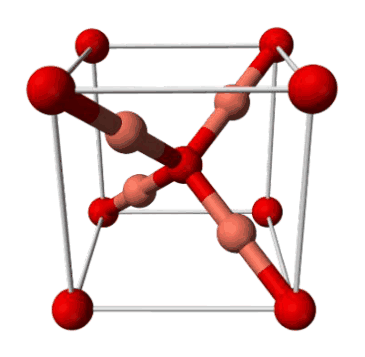
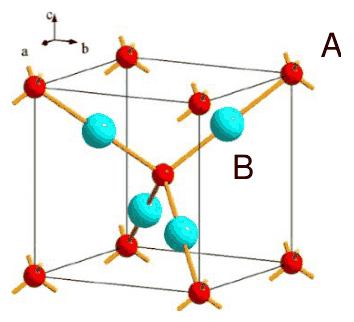
The two figures above depict the cubic unit cell of the \(\ce{Cu2O}\) crystal. The lattice constant of the structure is 427.0 pm.
2.1.1 Which of the atoms (A or B) is copper?
Which basic structure (primitive cubic, face centered cubic, body centered cubic, diamond) is formed by the A atoms and which structure is formed by the B atoms?
What are the coordination numbers of the atoms?
2.1.2 Calculate the smallest \(\ce{O-O}\), \(\ce{Cu-O}\) and \(\ce{Cu-Cu}\) distances in the structure?
2.1.3 What is the density of pure copper(I) oxide?
A common defect in this crystal is some copper atoms missing with the oxygen lattice unchanged. The composition of one such crystal sample was studied, and 0.2% of all copper atoms were found to be in oxidation state +2.
2,2 What percentage of normal copper sites are empty in the crystal sample? What is \(x\) in the empirical formula \(\ce{Cu_{2-x}O}\) of the crystal?
Copper(I) oxide is insoluble in water. It is stable in dry air, but humidity in the air catalyses a transformation (Reaction 1).When copper(I) oxide is dissolved in dilutesulfuric acid, a blue solution containing a precipitate is formed without evolution of a gas (Reaction 2). When hot, concentrated sulfuric acid is used, no precipitate remains, but an odorous gas forms (Reaction 3).The same gas forms when the precipitate from reaction 2 is dissolved in hot concentrated sulfuric acid.
2.3 Write balanced chemical equations for reactions (1-3).
Copper (I) oxide can be produced in a number of ways. Heating copper in air is a common method in the synthesis of semiconductor \(\ce{Cu2O}\). In a pure oxygen atmosphere, the three species containing copper (\(\ce{Cu(s)}\), \(\ce{Cu2O(s)}\) or \(\ce{CuO(s)}\)) can potentially interconvert.
Suppose that the \(\Delta_\mathrm{f}H^\circ\) and \(S^\circ\) data given for \(10^5\ \mathrm{Pa}\) are independent of temperature:
Compound \(\Delta_\mathrm{f}H^\circ/\mathrm{kJ\,mol^{-1}}\) \(S^\circ/\mathrm{J\,mol^{-1}\,K^{-1}}\) \(\ce{Cu(s)}\) 0 65 \(\ce{O2(g)}\) 0 244 \(\ce{CuO(s)}\) −156 103 \(\ce{Cu2O(s)}\) −170 180 2.4. Determine the temperature ranges, if any, of thermodynamic stability of copper and its oxides between 500 and 1500 K in a \(10^5\ \mathrm{Pa}\) oxygen atmosphere.
Important data are given for 298 K. Use this temperature in the following calculations:
\[ K_\mathrm{sp}(\ce{Cu(OH)2})=2\times10^{-19} \]
\[ \ce{Cu2O(s) + H2O(l) + 2e- -> 2Cu(s) + 2OH-(aq)} \qquad E^\circ=-0.360\ \mathrm{V} \]
\[ \ce{Cu^{2+}(aq) + e- -> Cu+(aq)} \qquad E^\circ=+0.159\ \mathrm{V} \]
\[ \ce{Cu^{2+}(aq) + 2e- -> Cu(s)} \qquad E^\circ=+0.337\ \mathrm{V} \]
One possibility for producing \(\ce{Cu2O}\) is the anodic oxidation of copper. Electrolysis of an aqueous basic solution (e.g. \(\ce{NaOH}\)) with a copper anode and platinum cathode can lead to formation of copper(I) oxide on the anode.
2.5 Write the half reaction equations for the electrode processes during the anodic production of \(\ce{Cu2O}\) in \(\ce{NaOH}\) solution with a platinum cathode and copper anode.
Electrolytic reduction of copper(II) ions in solution is another possibility.
2.6.1 Write the half reaction equation of the cathode process giving \(\ce{Cu2O}\) in acidic medium.
Let us use \(0.100\ \mathrm{mol\,dm^{-3}}\) \(\ce{Cu^{2+}}\) solution and carry out electrolysis with platinum electrodes.
2.6.2 What is the maximum pH of this solution at which the concentration of copper(II) can be maintained at \(0.100\ \mathrm{mol\,dm^{-3}}\)?
If the pH is too low, reduction to metallic copper is preferred to the formation of copper(I) oxide.
2.6.3 What is the minimum pH at which the cathodic production of \(\ce{Cu2O}\) in a \(\ce{Cu^{2+}}\) solution (\(c=0.100\ \mathrm{mol\,dm^{-3}}\)) is still possible?
Official English text of the problem.
Problem 3: Determination of iodine in iodized salt
Iodine deficiency is of special concern in Georgia because it occupies a region where iodine is scarce in soil and water. Iodine deficiency can be effectively and inexpensively prevented if salt for human consumption is fortified with small amounts of iodine. Methods for analyzing salt for iodine content are thus important. Current regulations in Georgia are that iodized salt must contain between 25 - 55 ppm iodine (1 ppm = 1 mg iodine/kg salt).
Most salt is iodized by fortification with potassium iodate (\(\ce{KIO3}\)). Iodate content can be determined in salt samples using iodometric titration. In a typical procedure, 10.000 g of an iodized salt sample is dissolved in 100 \(\mathrm{cm^3}\) aqueous \(\ce{HCl}\) (\(c=1.0\ \mathrm{mol\,dm^{-3}}\)) to which 1.0 g \(\ce{KI}\) has been added. The solution is then titrated with aqueous sodium thiosulfate solution (\(c=0.00235\ \mathrm{mol\,dm^{-3}}\)) to a starch endpoint; this requires 7.50 \(\mathrm{cm^3}\) of titrant.
3.1.1 Write a balanced net ionic equation for the reaction when iodate reacts with excess iodide in acidic solution.
3.1.2 Write a balanced net ionic equation for the reaction taking place during the titration with thiosulfate.
3.1.3 Calculate the iodization level, in ppm, of this salt sample.
A less common agent for iodizing salt is potassium iodide, which cannot be easily measured by iodometric titration.
One possible method for analyzing iodide in the presence of chloride is potentiometric titration. However, this method is not very precise in the presence of large amounts of chloride. In this method, a silver wire is immersed in the solution (containing iodide and chloride) to be analyzed and silver ion is gradually added to the solution. The potential of the silver wire is measured relative to a reference electrode consisting of a silver wire in a solution of \(\ce{AgNO3}\) (\(c=1.000\ \mathrm{mol\,dm^{-3}}\)). The measured potentials are negative and the absolute values of these potentials are reported. The solution to be analysed has a volume of 1.000 \(\mathrm{dm^3}\) (which you may assume does not change as silver ion is added) and \(t=25.0\ ^\circ\mathrm{C}\).
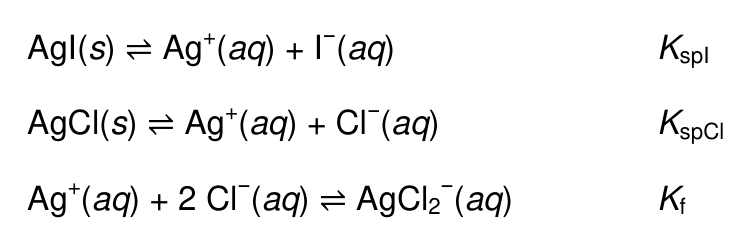
The results of this experiment are governed by three equilibria: the solubility of \(\ce{AgI(s)}\) [\(K_{\mathrm{spI}}\)] and \(\ce{AgCl(s)}\) [\(K_{\mathrm{spCl}}\)] and the formation of \(\ce{AgCl2^-(aq)}\) [\(K_{\mathrm f}\)]. (Iodide also forms complex ions with silver but this may be neglected at the very low concentrations of iodide present in this experiment).
Below are shown the results of two experiments measuring the observed potential as a function of added number of moles of silver ion. Experiment A (solid circles) was carried out with 1.000 \(\mathrm{dm^3}\) of iodide solution with concentration \(1.00\times10^{-5}\ \mathrm{mol\,dm^{-3}}\) and containing no chloride ion. Experiment B (open circles) was done using 1.000 \(\mathrm{dm^3}\) of solution with a concentration of iodide \(1.00\times10^{-5}\ \mathrm{mol\,dm^{-3}}\) and that of chloride equal to \(1.00\times10^{-1}\ \mathrm{mol\,dm^{-3}}\).
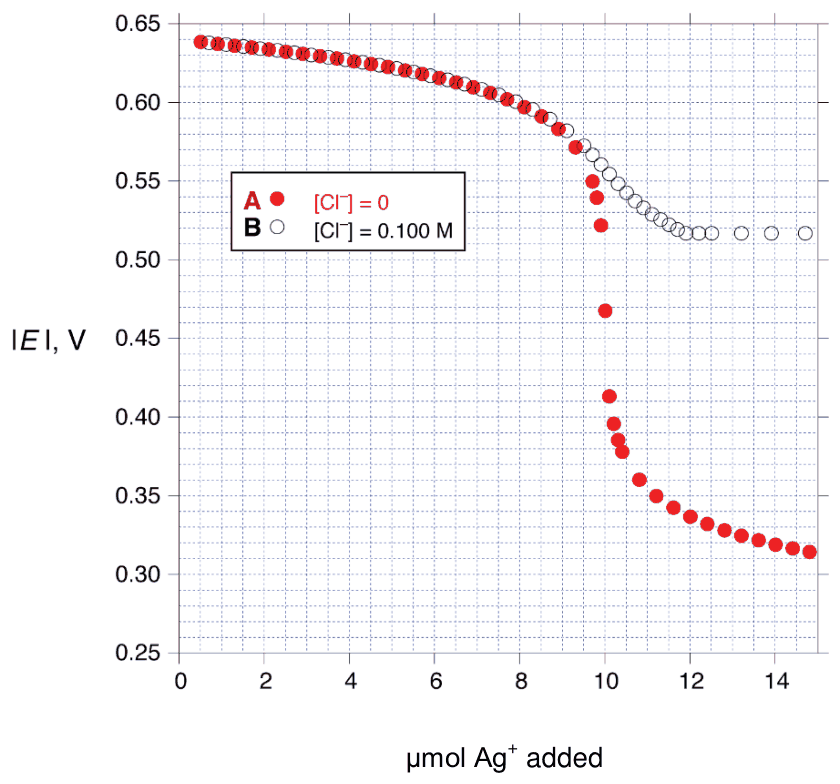
\(\mu\mathrm{mol}\ \ce{Ag+}\) added \(\lvert E\rvert,\ \mathrm{V}\), exp. A \(\lvert E\rvert,\ \mathrm{V}\), exp. B 1.00 0.637 0.637 3.00 0.631 0.631 5.00 0.622 0.622 7.00 0.609 0.610 9.00 0.581 0.584 10.0 0.468 0.558 11.0 0.355 0.531 12.0 0.337 0.517 13.0 0.327 0.517 15.0 0.313 0.517 3.2.1 Select an appropriate data from the experiments and use it to calculate the solubility product of \(\ce{AgI}\), (\(K_{\mathrm{spI}}\).).
3.2.2 Select an appropriate data from the experiments and use it to calculate the solubility product of \(\ce{AgCl}\), (\(K_{\mathrm{spCl}}\).).
3.2.3 Select an appropriate data from the experiments and use it to calculate \(K_{\mathrm f}\). You may need to use values of \(K_{\mathrm{spI}}\) or \(K_{\mathrm{spCl}}\) to do this calculation. If you were unable to carry out the calculations in 3.2.1 or 3.2.2 you may use the arbitrary values of \(K_{\mathrm{spI}}=1.00\times10^{-15}\) and \(K_{\mathrm{spCl}}=1.00\times10^{-9}\) without penalty.
An analytical method that is more practical, because it is not sensitive to the presence of chloride, uses the Sandell-Kolthoff reaction. This is the reaction of \(\ce{H3AsO3}\) with \(\ce{Ce(IV)}\) to give \(\ce{Ce(III)}\) in acidic solution, which is strongly catalyzed by iodide ion.
3.3.1 Write balanced net ionic equations for the reaction of cerium(IV) with \(\ce{H3AsO3}\) in acidic solution, as well as reactions of cerium(IV) with a species containing the element iodine and \(\ce{H3AsO3}\) with a species containing the element iodine, that could reasonably account for the catalysis of the net reaction by iodide.
The reaction of \(\ce{Ce(IV)}\) with \(\ce{H3AsO3}\) can be monitored by measuring the absorbance at 405 nm, as \(\ce{Ce(IV)}\) is orange and absorbs significantly at 405 nm, while the other reactants and products are colorless and do not absorb appreciably. Three runs were carried out, all in \(0.50\ \mathrm{mol\,dm^{-3}}\) \(\ce{H2SO4}\) at 25.0°C using the following initial concentrations:
Run \([\ce{H3AsO3}]_0\), \((\mathrm{mol\,dm^{-3}})\) \([\ce{Ce(IV)}]_0\), \((\mathrm{mol\,dm^{-3}})\) \([\ce{I^-}]_0\), \((\mathrm{mol\,dm^{-3}})\) 1 0.01250 0.00120 \(1.43\cdot10^{-6}\) 2 0.00625 0.00060 \(1.43\cdot10^{-6}\) 3 0.01250 0.00120 \(7.16\cdot10^{-7}\) An analyst initiated the reactions by mixing the reagents in a cuvette. After a short variable delay absorbance measurements were started, with the first measurement recorded at \(t=0\ \mathrm{s}\). The data obtained are shown below:
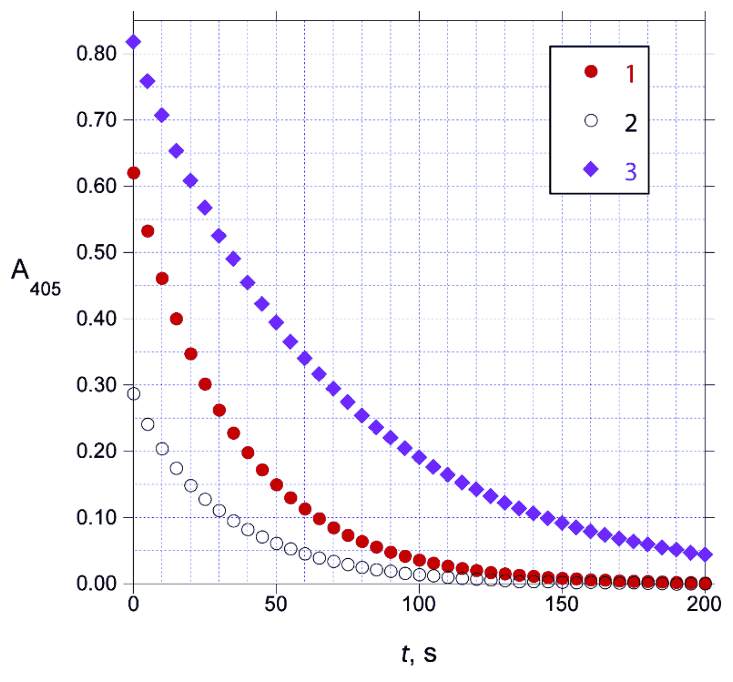
\(t,\ \mathrm{s}\) \(A_{405}\), Run 1 \(A_{405}\), Run 2 \(A_{405}\), Run 3 0 0.621 0.287 0.818 20 0.348 0.149 0.608 40 0.198 0.083 0.455 60 0.113 0.046 0.340 80 0.064 0.025 0.254 100 0.037 0.014 0.191 Under these conditions (\(0.5\ \mathrm{mol\,dm^{-3}}\) \(\ce{H2SO4}\), 25.0°C), the rate law for the reaction can be written as
\[ \text{Rate}=k[\ce{H3AsO3}]^m[\ce{Ce(IV)}]^n[\ce{I^-}]^p \]
where \(m\), \(n\) and \(p\) are integers.
3.3.2. Determine the values of \(m\), \(n\), and \(p\) and calculate the value of \(k\) (be sure to specify its units).
A 1.000 g sample of iodized salt is dissolved in water to give 10.00 \(\mathrm{cm^3}\) of solution. A 0.0500 \(\mathrm{cm^3}\) aliquot of this solution is added to a mixture of 1.000 \(\mathrm{cm^3}\) \(0.025\ \mathrm{mol\,dm^{-3}}\) \(\ce{H3AsO3}\) in \(0.5\ \mathrm{mol\,dm^{-3}}\) \(\ce{H2SO4}\) and 0.800 \(\mathrm{cm^3}\) \(0.5\ \mathrm{mol\,dm^{-3}}\) \(\ce{H2SO4}\). To this mixture is added 0.200 \(\mathrm{cm^3}\) \(0.0120\ \mathrm{mol\,dm^{-3}}\) \(\ce{Ce(NH4)2(NO3)6}\) in \(0.5\ \mathrm{mol\,dm^{-3}}\) \(\ce{H2SO4}\) and the absorbance at 405 nm is measured as a function of time at 25.0°C:
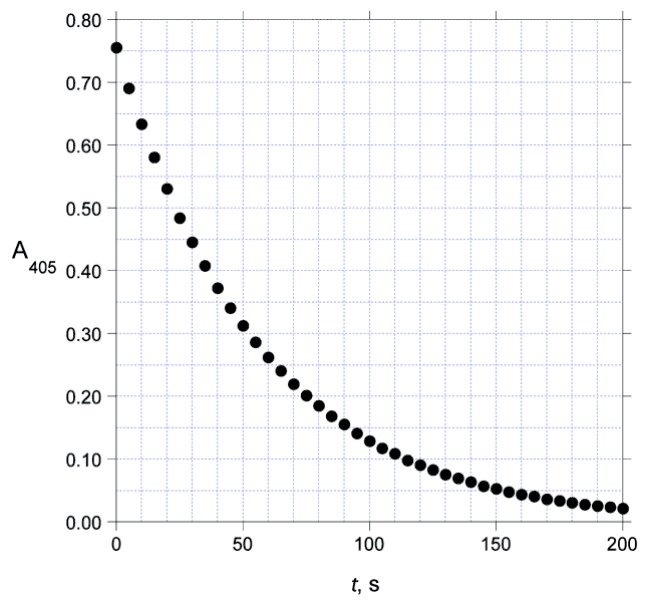
\(t,\ \mathrm{s}\) \(A_{405}\) 0 0.756 20 0.531 40 0.373 60 0.262 80 0.185 100 0.129 3.3.3. Calculate the iodization level, in ppm, of this salt sample.
Official English text of the problem.
Problem 4: Kinetics: water treatment and degradation of pharmaceutical products
Application of kinetic studies in water treatment
Industrial waste is a major cause of water pollution and kinetic studies are carried out in a laboratory to design effluent treatment. 1,4-dioxane, more commonly known as dioxane (\(\ce{C4H8O2}\)), an industrial solvent and by-product, is a significant water contaminant. It can be oxidised to hazard free chemicals using oxidants such as peroxodisulfate, ozone or hydrogen peroxide.
The data obtained in the kinetic study of oxidation of dioxane with potassium peroxodisulfate (\(\ce{K2S2O8}\)) as oxidant and \(\ce{AgNO3}\) as catalyst at \(T=303.15\ \mathrm{K}\) are given below. The reaction was monitored by the estimation of unreacted peroxodisulfate. The concentration of \(\ce{AgNO3}\) used in this study was \(1.00\cdot10^{-3}\ \mathrm{mmol\,dm^{-3}}\).
Trial Dioxane / \(\mathrm{mmol\,dm^{-3}}\) \(\ce{K2S2O8}\) / \(\mathrm{mmol\,dm^{-3}}\) Initial rate / \(\mathrm{mmol\,dm^{-3}\,min^{-1}}\) 1 0.0100 2.50 \(1.661\cdot10^{-2}\) 2 0.0100 5.10 \(3.380\cdot10^{-2}\) 3 0.00500 13.8 \(9.200\cdot10^{-2}\) 4 0.0110 13.8 \(9.201\cdot10^{-2}\) In many countries the accepted maximum level of dioxane in drinking water is specified as \(0.35\ \mathrm{\mu g\,dm^{-3}}\).
A water sample contains an initial dioxane concentration of \(40.00\ \mathrm{\mu g\,dm^{-3}}\). Assume that 1 mol dioxane requires 1 mol of peroxodisulfate for oxidation. The concentration of \(\ce{AgNO3}\) used in this study was \(1.00\times10^{-3}\ \mathrm{mmol\,dm^{-3}}\).
4.1.1. Calculate the time in minutes the oxidation process has to continue in order to reach the accepted level of dioxane at 303.15 K if the initial concentration of \(\ce{K2S2O8}\) is \(5.0\times10^{-6}\ \mathrm{mol\,dm^{-3}}\). Assume that the rate law obtained from the data above is valid under these conditions.
Various mechanisms have been proposed for the peroxodisulfate oxidation of dioxane. Misra and Ghosh (1963) proposed the following mechanism:

4.1.2 Assuming Ag(III) to be in steady state, deduce the rate equation for the oxidation of dioxane.
4.1.3 Which of the following is/are correct?
A) The rate equation based on the mechanism given in 4.1.2, at very high concentrations of dioxane, is consistent with the experimental data in 4.1.1.
B) The rate equation based on the mechanism given in 4.1.2, at very low concentrations of dioxane, is consistent with the experimental data in 4.1.1.
C) The units of the observed rate constant are \(\mathrm{dm^3\,mol^{-1}\,s^{-1}}\) at very high concentrations of dioxane.
D) The units of the observed rate constant are \(\mathrm{dm^3\,mol^{-1}\,s^{-1}}\) at very low concentrations of dioxane.
Degradation of pharmaceutical products – a kinetic overview
Kinetic studies are important in deciding the shelf life of a pharmaceutical product. Several chemical reactions can affect the shelf life of pharmaceutical products and the rates of these reactions depend on conditions such as pH, temperature, humidity.
Lysine acetylsalicylate (LAS) is prescribed as a pain killer and anti-inflammatory drug under the brand name Aspegic. LAS on hydrolysis forms lysine salicylate and acetic acid.
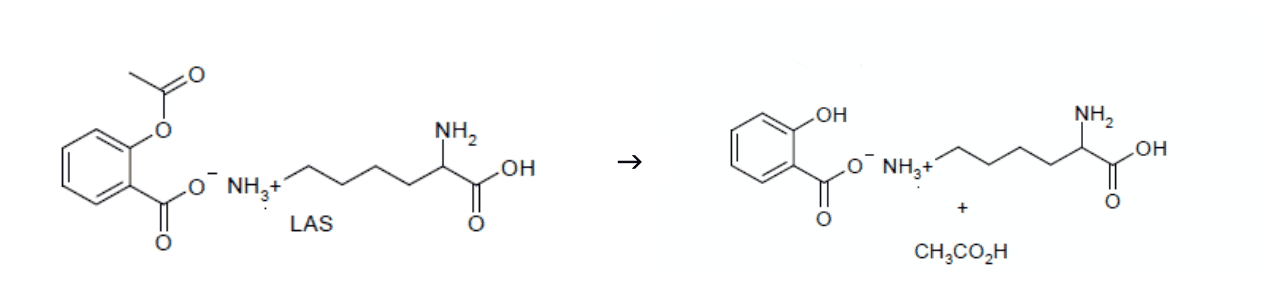
Hydrolysis of LAS can proceed via three different pathways (a) acid catalysed, (b) uncatalysed and (c) base catalysed.
If [LAS] denotes the concentration of LAS at time \(t\), the overall rate of the hydrolysis reaction can be written as
\[ -\frac{d[\mathrm{LAS}]}{dt} = k_{\mathrm H}[\mathrm{LAS}][\ce{H+}] +k_{\mathrm O}[\mathrm{LAS}] +k_{\mathrm{OH}}[\mathrm{LAS}][\ce{OH-}] \]
where \(k_{\mathrm H}\), \(k_{\mathrm O}\) and \(k_{\mathrm{OH}}\) are the rate constants of the acid catalysed, uncatalysed and base catalysed pathways of hydrolysis, respectively. The overall rate constant is defined as:
\[ -\frac{d[\mathrm{LAS}]}{dt} =k_{\mathrm{obs}}[\mathrm{LAS}] \]
4.2.1 Write an expression for \(k_{\mathrm{obs}}\) in terms of \(k_{\mathrm H}\), \(k_{\mathrm O}\), \(k_{\mathrm{OH}}\) and \([\ce{H+}]\).
Hydrolysis of LAS was carried out at 298.15 K at various pH values (0.50 to 13.0). A very low initial concentration of LAS ensured that the pH did not change during the course of the reaction.
The following graph shows the pH dependence of the hydrolysis of LAS.
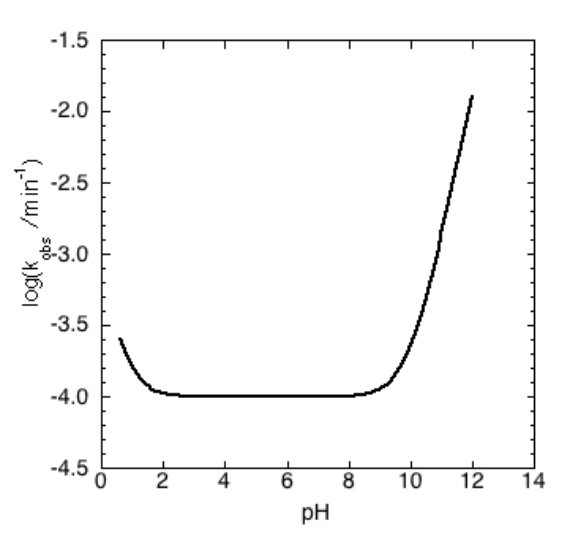
4.2.2 Which of the following is/are correct?
A) \(k_{\mathrm{obs}}\approx k_0\) at pH = 12
B) \(k_{\mathrm{obs}}\approx k_0\) at pH = 5.0
C) The rate of the reaction increases when the pH is changed from 0.50 to 1.0.
D) The rate of the reaction increases when the pH is changed from 10 to 12.
4.2.3 Using the diagram and the data given below, calculate \(k_{\mathrm H}\), \(k_0\) and \(k_{\mathrm{OH}}\). Make sure to specify the units.
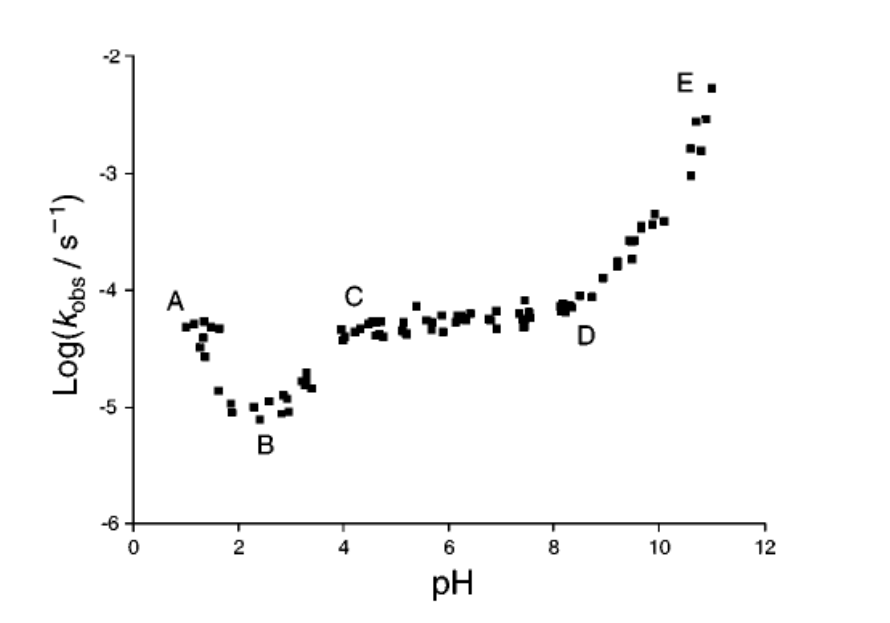
pH 1.300 5.300 12.180 \(\log(k_{\mathrm{obs}}/\mathrm{min^{-1}})\) −3.886 −4.000 −1.726 Acetylsalicylic acid, more commonly known as aspirin is a medicine often used for reducing fever, pain and inflammation. Like LAS, the hydrolysis of aspirin can also take different pathways depending on the pH. The pH rate profile of aspirin hydrolysis at 333.15 K is given below:
The following are possible reactions for the hydrolysis of aspirin. Depending on the pH, one or more of these reactions will predominate.
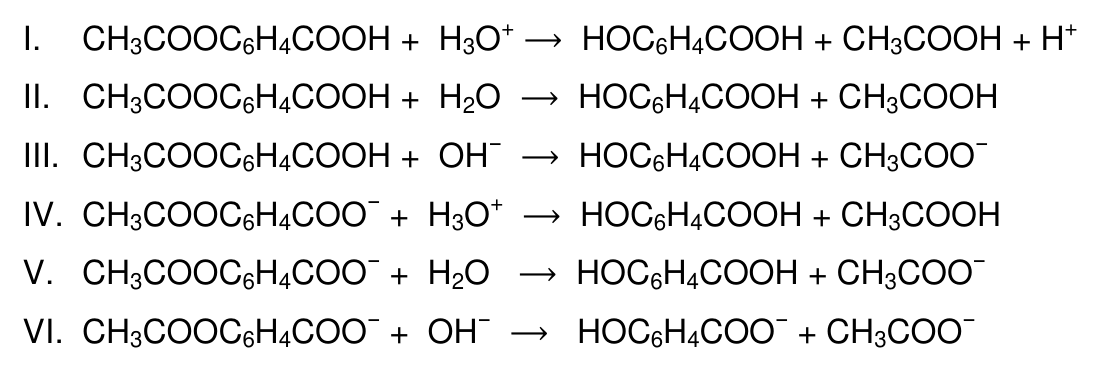
4.3.1 Using the pH-rate profile diagram and the reactions given above, state which of the following statements is/are correct. (\(\mathrm{p}K_{\mathrm a}\) of aspirin = 3.57 at 333.15 K)
a) In the region C-D, reaction IV is predominant
b) In the region C-D, reaction V is predominant
c) In the region D-E reaction VI is predominant
d) In the region A-B, reaction II is predominant
The plot of \(k_{\mathrm{obs}}\) vs pH for the hydrolysis of aspirin has been confirmed to show a minimum at a particular pH. At 290.15 K the following rate constants for reactions I, II and III were determined:
\(k_{\mathrm H}\) (reaction I) \(k_0\) (reaction II) \(k_{\mathrm{OH}}\) (reaction III) \(1.99\ \mathrm{dm^3\,mol^{-1}\,day^{-1}}\) \(2.29\times10^{-4}\ \mathrm{day^{-1}}\) \(3.18\times10^9\ \mathrm{dm^3\,mol^{-1}\,day^{-1}}\) The ionic product of water at 290.15 K can be taken as \(1.0\times10^{-14}\).
4.3.2 Assuming that only reactions I, II and III occur, calculate the value of the pH at the minimum.
Official English text of the problem.
Problem 5: Egyptian blue and Chinese blue
5500 years ago in ancient Egypt people learned for the first time how to synthesize a blue pigment. Now we know this pigment as Egyptian blue. About 2000 years later in ancient China another pigment was widely used, which is now referred to as Chinese blue. The two pigments are similar in structure, but have different elemental compositions.
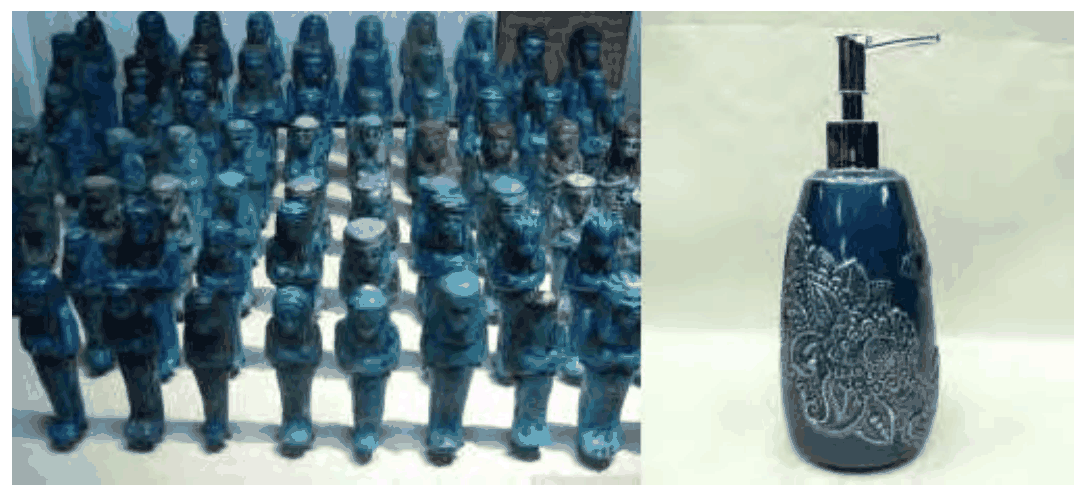
Ushabti figurines from Egyptian pharaoh tomb covered with Egyptian blue
and a Chinese blue soap dinspenser sold at AlibabaThe ancient method of preparation for these pigments can easily by reproduced in a modern laboratory.
When considering the amounts, assume that all of the compounds in this task are pure, and the yields are quantitative.
To make Egyptian blue, one should heat 10.0 g of mineral A with 21.7 g of \(\ce{SiO2}\) and 9.05 g of mineral B at 800 – 900°C for a prolonged time. A volume of 16.7 \(\mathrm{dm^3}\) of a mixture of two gaseous products are released (the volume is measured at 850°C and \(1.013\times10^5\) Pa (1.013 bar) pressure. In result, 34.0 g of the pigment was obtained. No other products are formed. As the gas mixture is cooled, one component of the mixture condenses. As the remaining gas is further cooled to 0°C, the gaseous volume reduces to 3.04 \(\mathrm{dm^3}\).
5.1.1 Calculate the mass of the gaseous mixture formed upon heating of A with B and \(\ce{SiO2}\).
5.1.2 Determine the quantitative composition of this gas mixture.
When 10.0 g of mineral A is heated with 21.7 g of \(\ce{SiO2}\) in the absence of B, it forms 8.34 \(\mathrm{dm^3}\) of gaseous products at a temperature of 850°C and pressure of \(1.013\cdot10^5\) Pa (= 1.013 bar). Mineral A contains only one metal.
5.1.3 Calculate the molar mass and determine the formula of mineral B. Hint: it is an ionic solid insoluble in water and containing no water of crystallization.
In order to obtain Chinese blue, one should take 17.8 g of mineral C instead of mineral B (keeping the amounts of mineral A and \(\ce{SiO2}\) same as for Egyptian blue), and run the reaction at higher temperatures. Besides the pigment, the same gaseous products in the same quantities are formed as in the preparation of Egyptian blue.
5.1.4 Determine the formula of mineral C.
5.1.5 Determine the formulae of Egyptian blue and Chinese blue.
5.1.6 Determine the formula of mineral A.
Elemental analysis of some samples of Chinese blue shows traces of sulfur. This led to a conclusion that those were synthesized using another common mineral instead of C.
5.2.1 Suggest a formula for the mineral used in place of C.
5.2.2 Could the temperature of synthesis of Chinese blue be decreased if this mineral is used instead of C?
If during the synthesis of Chinese blue we take a smaller amount of silica than in the process above, we will obtain a purple pigment: Chinese violet. It was used, in particular, for coloring the famous Terracotta army soldiers.
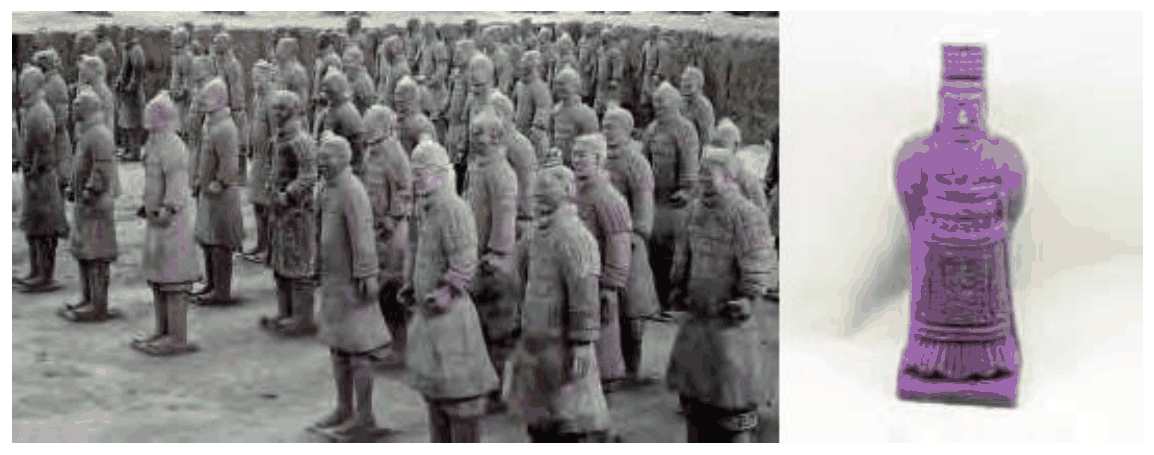
Terracotta army from Xian, China and reconstruction of its original coloring.
5.3 Write down the formula of a binary compound that forms under the conditions required for Chinese violet and is responsible for the change of the color.
Official English text of the problem.
Problem 6: Synthesis of galantamine
Although there is currently no known cure for Alzheimer’s disease, there are medications available to manage the neurodegenerative disorder. Among these are acetylcholinesterase inhibitors, of which galantamine 1 is an example. This molecule can be isolated from the Caucasian snowdrop, a plant native to Georgia; however, the large amounts needed for therapy require a synthetic route. Shown below is the route used to prepare galantamine industrially.
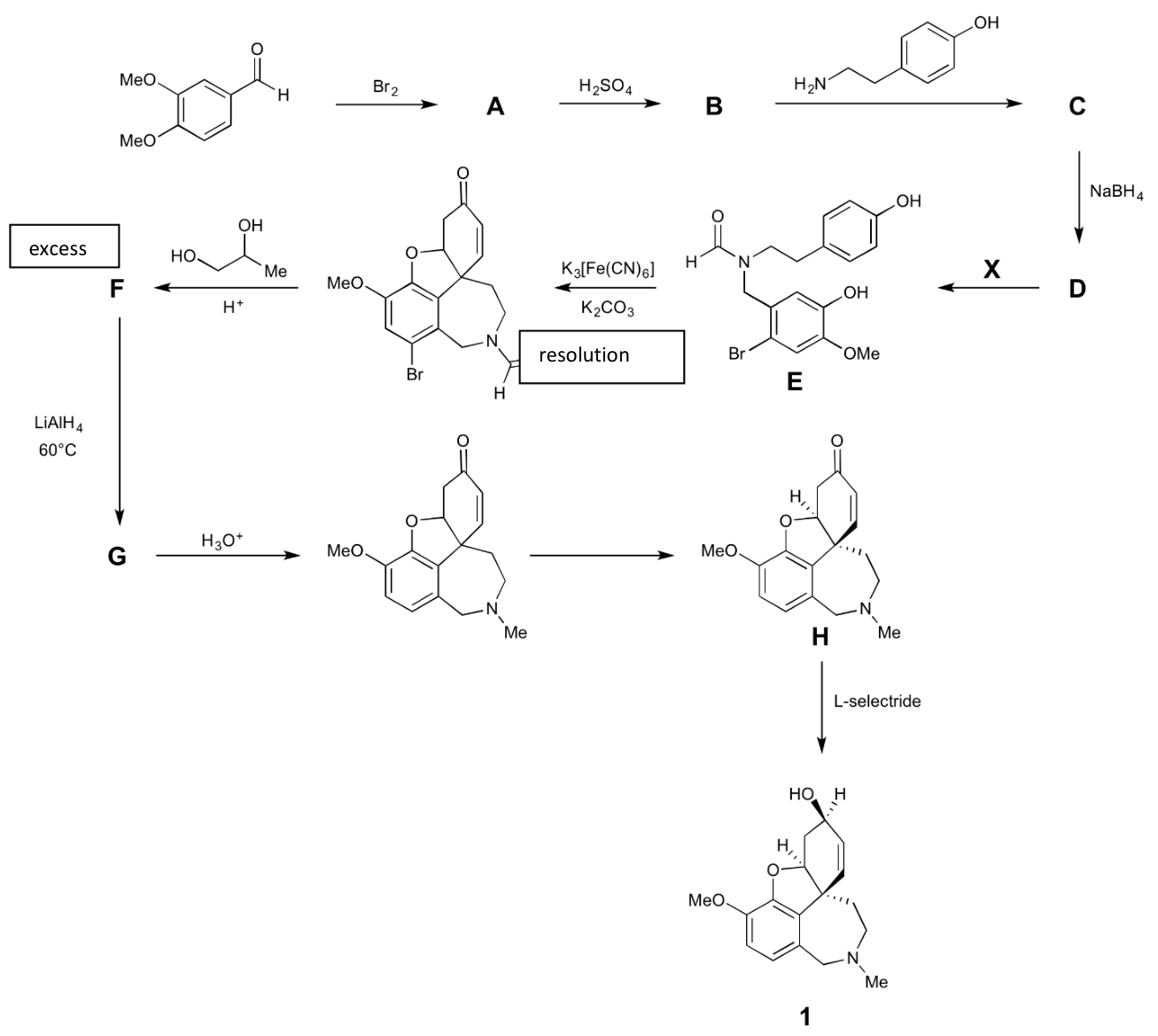
Notes about the synthesis:
- \(\ce{^1H}\) NMR of A indicates 2 aromatic protons in a para arrangement.
- C is labile in aqueous conditions, so it is not isolated, but rather reacted immediately with \(\ce{NaBH4}\) to convert it to D.
6.1.1 Suggest structures for A, B, C, D, F, and G. None of the reactions except for the final transformation with L-selectride are stereoselective. Therefore, stereochemistry does not need to be indicated in your answers.
6.1.2 Give the formula for a possible reagent, X, to convert compound D to E.
The optical rotation of the material obtained by resolution was \(-400^\circ\ \mathrm{cm^2\,g^{-1}}\), while that of the enantiomerically pure compound is \(-415^\circ\ \mathrm{cm^2\,g^{-1}}\) when measured under the same conditions. You may assume that the only optical impurity is the other enantiomer.
One way of describing optical purity is enantiomeric excess (\(ee\)). It is defined as the difference in the percentages of the enantiomers in a mixture. For example in a mixture of 70% \(R\) and 30% \(S\), the \(ee\) is 40%.
6.2.1 What is the enantiomeric excess of the resolved compound as prepared by the industrial route?
L-selectride is a commercial reagent that performs the final reaction stereoselectively.
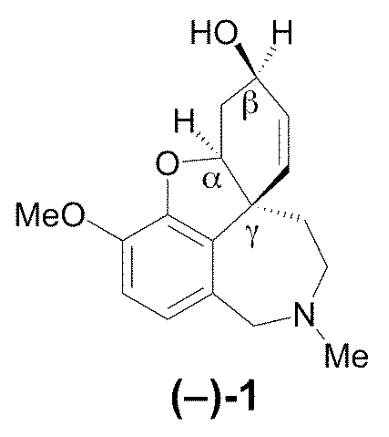
6.2.2 Assign the labelled stereocentres \((\alpha,\beta,\gamma)\) in (−)-1 as \(R\) or \(S\).
6.2.3 Give the formula for a reagent that carries out the same reaction as L-selectride, converting H to 1. You need not worry about stereoselectivity.
An alternative route to galantamine occurs with the seven-membered ring being the last ring to form.
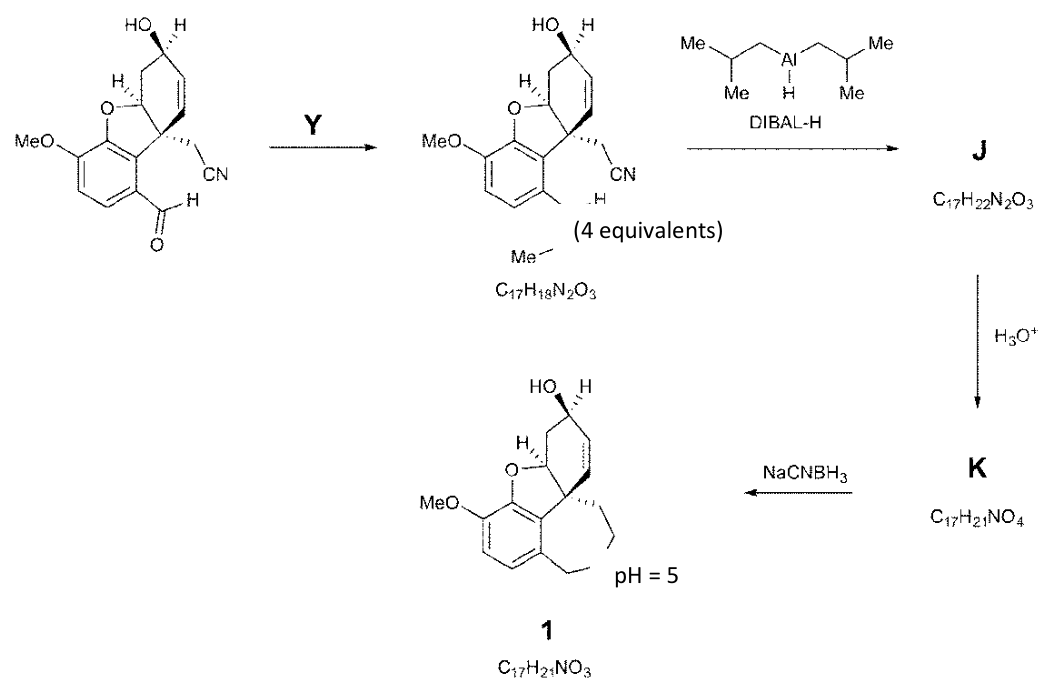
6.3.1 Give the formula for compound Y to carry out the first step of the route.
6.3.2 Suggest structures for J and K.
Official English text of the problem.
Problem 7: Synthesis of dolasetron mesylate
This question looks at the synthesis of dolasetron mesylate, Z (shown right), a drug sold under the tradename Anzemet and used to treat post-operative nausea and vomiting.
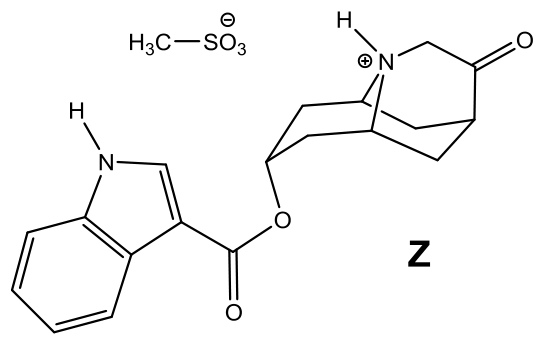
The synthesis begins as shown below.
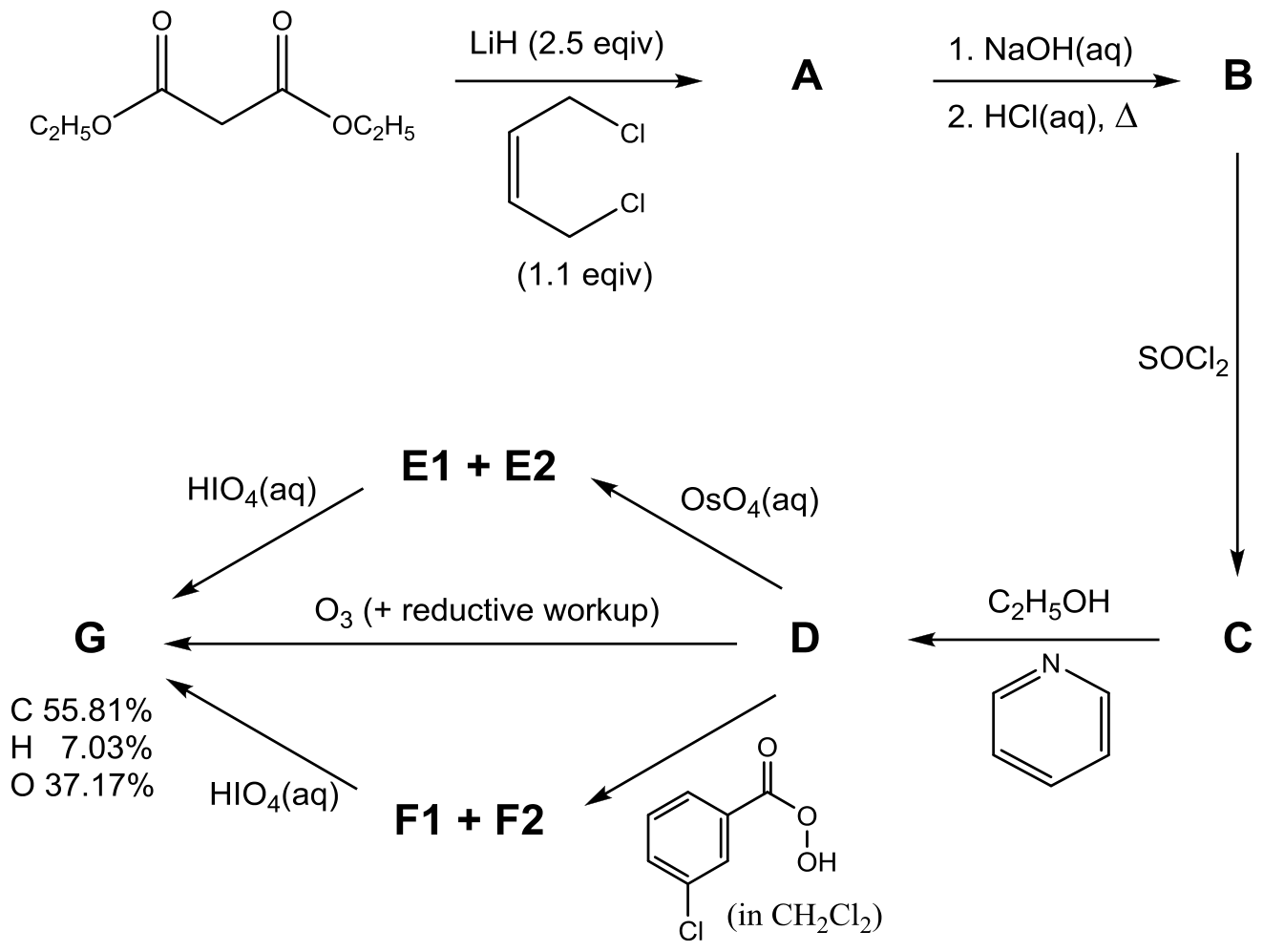
First cyclic compound A is made, which contains \(\ce{C}\), \(\ce{H}\), and \(\ce{O}\) only. Compound G is achiral and can be prepared directly from D using ozone under reductive conditions, or via stereoisomers E1 and E2 using \(\ce{OsO4}\), or via stereoisomers F1 and F2 using the peracid shown.
7.1 Determine the empirical formula of G from the percentage masses given.
7.2 Give the structures of A, B, C, D, E1, E2, F1, F2 and G.
Compound G is used in the next stage of the synthesis, under buffered conditions, to form H (as a mixture of two achiral diastereoisomers). Reduction of H with \(\ce{NaBH4}\) gives alcohol I (as a mixture of four achiral diastereoisomers). I reacts with acidified dihydropyran to form J (as a mixture of even more diastereoisomers). J is then treated first with t-butoxide base, then refluxed with acid before finally extracting under weakly basic conditions to form K as a mix of two diastereomers, K1 (major product) and K2 (minor product). These could be separated, and K1 was used in the final stages of the synthesis.
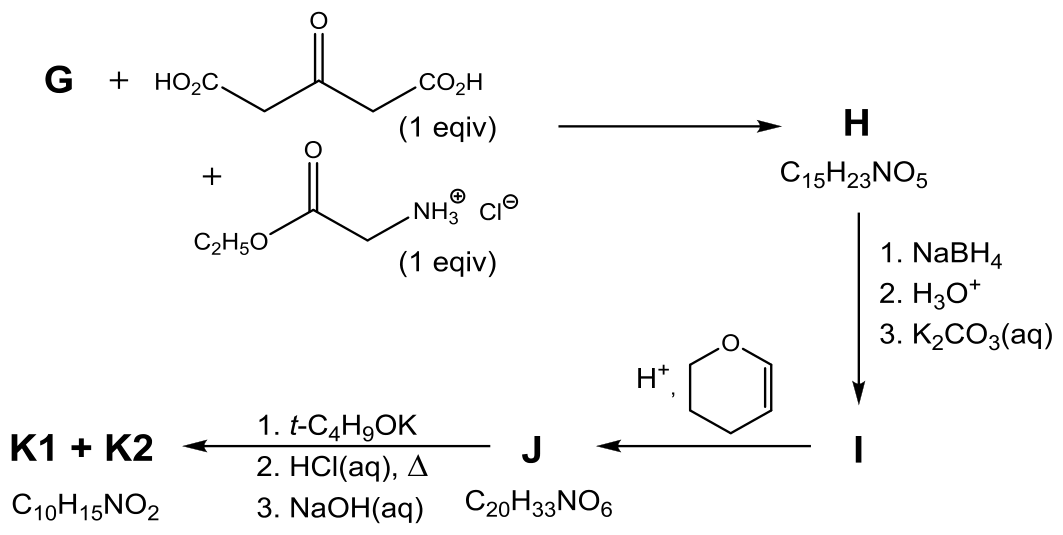
7.3.1 Give the structures of H, I, and J. There is no need to show the different diastereoisomers formed.
7.3.2 Give the structures of diastereoisomers K1, and K2.
In the final stage of the synthesis, L and M react to form intermediate N. N then reacts with K1 to form, after extraction, the neutral amine which gives the target compound upon protonation with \(\ce{CH3SO3H}\).
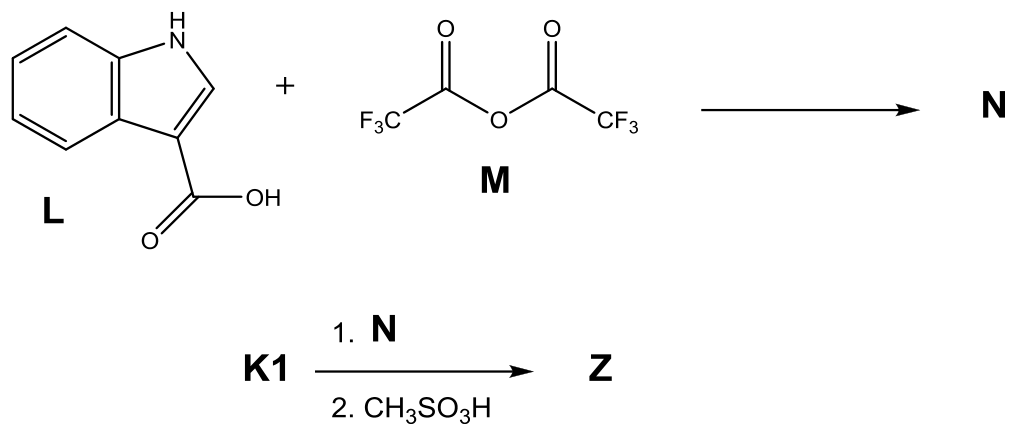
7.4 Give the structure of N.
Official English text of the problem.
Problem 8: Sugar derivatives from D-glucose
An exotic, but biologically relevant sugar analogue can be prepared from D-glucose in the following manner. Heating a mixture of D-glucose and acetone with a few drops of concentrated acid results in the formation of a diacetonide A. Then A can be hydrolyzed selectively to B.
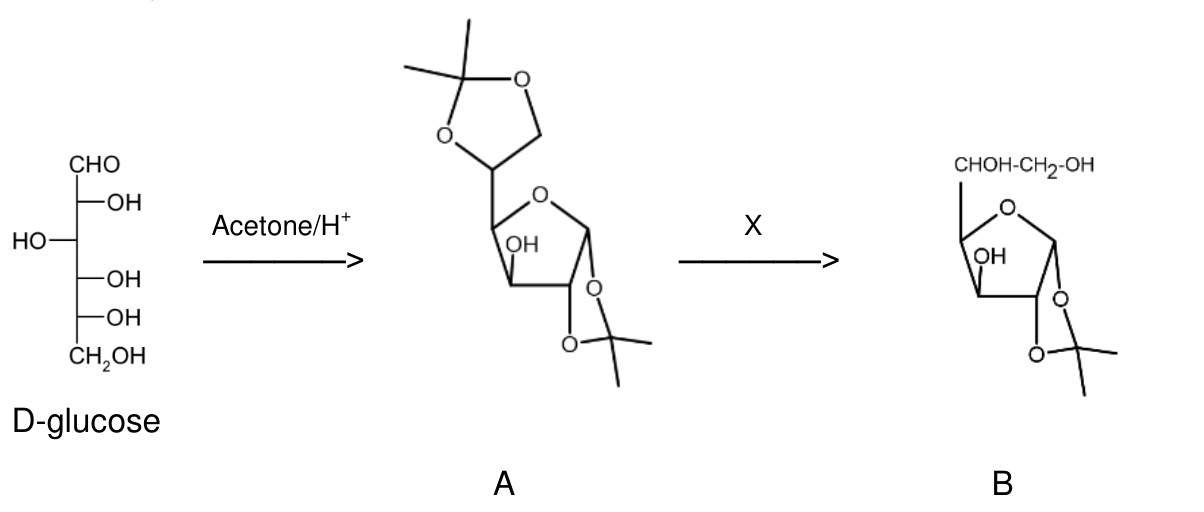
8.1.1 Which of the following sentences is true? (Tick the relevant boxes.)
- ☐ A is an α isomer.
- ☐ A is neither α nor β.
- ☐ A is a β isomer.
- ☐ A is a mixture of α and β isomers.
Give your chosen answers to the questions on the answer sheet.
8.1.2 Which of the following sentences is true?
- ☐ We can get product A only if we use α-D-glucose as starting material.
- ☐ We can get product A only if we use β-D-glucose as starting material.
- ☐ We can get product A either from α- or from β-D glucose as starting material.
8.1.3 Which one of these reagents can be utilized as X for the selective hydrolysis of A?
- ☐ 50% acetic acid
- ☐ concentrated \(\ce{H2SO4}\)
- ☐ \(\ce{HCl}\) in water (\(6\ \mathrm{mol\,dm^{-3}}\))
- ☐ \(\ce{NaOH}\) aqueous solution (\(1\ \mathrm{mol\,dm^{-3}}\))
- ☐ \(\ce{HCl}\) in acetic acid (\(6\ \mathrm{mol\,dm^{-3}}\))
8.1.4 Which is the stereochemically correct structure for compound B?
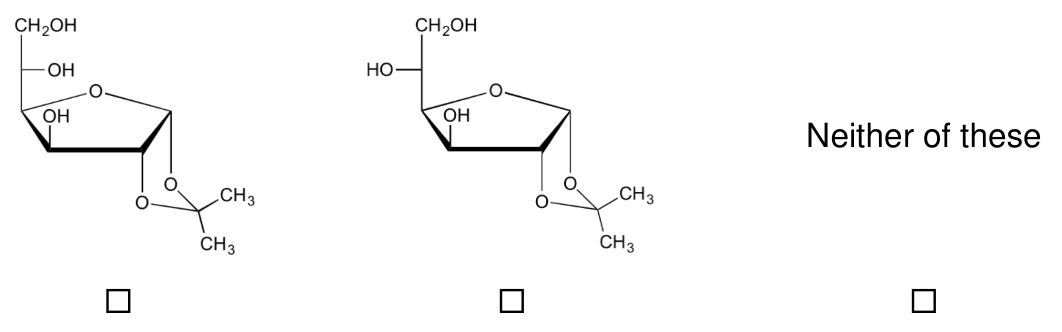
B is treated with sodium metaperiodate to get C. C is then reacted with an aqueous solution of \(\ce{NaCN}\), then heated with 10% \(\ce{NaOH}\) solution to get a mixture of two diastereomeric compounds D₁ and D₂. These compounds can be separated by column chromatography.

Reaction of D₁ with \(\ce{LiAlH4}\) followed by heating with 1M \(\ce{HCl}\) solution gives sugar F that is the hydrolysis product of the most abundant natural polysaccharide.

8.2.1 Draw the structures of C, D₁, D₂, E and F including stereochemical information. Show F as the more stable 6-membered ring containing isomer using the ring skeleton. Indicate with a wavy line if absolute chirality around a carbon is not known.
8.2.2 The reaction sequence from glucose to F does not seem to be useful. In some cases, however, this is the most economical way to produce F. In which case?
- ☐ \(\ce{^{13}C}\) labelling at carbon 6 of F
- ☐ \(\ce{^{13}C}\) labelling at carbon 5 of F
- ☐ \(\ce{^{13}C}\) labelling at carbon 1 of F
- ☐ \(\ce{^{15}O}\) labelling at glycosidic OH of F
- ☐ synthesis of an uncommon isomer of F
Neutralization of D₂ with \(\ce{HCl}\) followed by heating in toluene results in dehydration and formation of G, which has a tricyclic structure in water-free solvents. Boiling G in \(\ce{HCl}\) solution (\(c = 1\ \mathrm{mol\,dm^{-3}}\)) gives H (\(\ce{C6H10O7}\)), which is a natural sugar derivative containing a 6 membered ring. H is a building block of heparin, an anticoagulant polysaccharide produced by our bodies.

8.3.1 Draw the structure of G including the stereochemistry.
Draw H as the more stable 6-membered ring containing isomer using the ring skeleton. Indicate with a wavy line if absolute chirality around a carbon is not known.
8.3.2 How are the rings of G fused together?
- ☐ both junctions cis,
- ☐ one cis and one trans junction,
- ☐ both junctions trans.
8.3.3 Which of the following is true for H? (You can choose more than one option.)
- ☐ H is a reducing sugar (reacts with Fehling’s reagent)
- ☐ H is an aldaric acid (dicarboxylic derivative of an aldose)
- ☐ H is an aldonic acid (α-carboxyl derivative of an aldose)
- ☐ H is a uronic acid (ω-carboxyl derivative of an aldose)
- ☐ H is a ketose
- ☐ H is a lactone
- ☐ H is a D sugar
- ☐ H is achiral
- ☐ H is a meso compound
Official English text of the problem.
Internationale Chemie-Olympiade
IChO 2016
Tiflis, Georgien · 8 Theorieaufgaben mit vollständigen Lösungen
Aufgabe 1: Stickstofffluoride
Stickstofftrifluorid ist eine überraschend stabile Verbindung, die erstmals durch Schmelzflusselektrolyse eines Gemisches aus Ammoniumfluorid und Fluorwasserstoff hergestellt wurde.
1.1 An welcher Elektrode bildet sich Stickstofftrifluorid? Geben Sie eine ausgeglichene Reaktionsgleichung für die Elektrodenhalbreaktion zur Bildung von \(\ce{NF3}\) an.
Interessanterweise sind die verwandten Verbindungen Fluoramin (\(\ce{NH2F}\)) und Difluoramin (\(\ce{NHF2}\)) sehr instabil; die Zersetzung der beiden Reinstoffe kann sogar explosionsartig verlaufen. Dies ist gefährlich, da sie bei der Elektrolyse als Nebenprodukte entstehen.
1.2 Welche der Verbindungen \(\ce{NF3}\), \(\ce{NHF2}\) oder \(\ce{NH2F}\) kondensiert voraussichtlich bei der niedrigsten Temperatur?
Die \(\ce{N-F}\)-Bindungslängen in diesen Molekülen wurden zu 136, 140 und 142 pm bestimmt. Die Änderung der Bindungslängen lässt sich mit einem einfachen elektrostatischen Modell erklären, das die Partialladungen an den Atomen berücksichtigt.
1.3 Ordnen Sie die \(\ce{N-F}\)-Bindungslängen (136, 140, 142 pm) den Molekülen zu.
Leitet man \(\ce{NHF2}\) durch eine Lösung von \(\ce{KF}\) in \(\ce{HF}\), so lässt sich eine binäre Stickstoff-Fluor-Verbindung als Gemisch zweier geometrischer Isomere erhalten.
1.4 Geben Sie eine ausgeglichene Reaktionsgleichung für die Bildung der binären Stickstoff-Fluor-Verbindung an.
Das Tetrafluorammonium-Ion (\(\ce{NF4+}\)) und das entsprechende Salz können aus \(\ce{NF3}\) mit elementarem Fluor in Gegenwart eines geeigneten Reagenzes entstehen.
1.5 Schlagen Sie ein geeignetes Reagenz vor und geben Sie eine ausgeglichene Reaktionsgleichung an.
\(\ce{NF4+}\)-Ionen bilden mit einer Reihe von Anionen stabile Salze. Diese sind sehr feuchtigkeitsempfindlich, da das \(\ce{NF4+}\)-Ion unter Bildung von \(\ce{NF3}\) und \(\ce{O2}\) hydrolysiert. Interessanterweise bildet sich Stickstofftrifluorid stets quantitativ, während die Sauerstoffmenge aufgrund von Nebenreaktionen häufig geringer ist als erwartet.
1.6 Geben Sie eine ausgeglichene Reaktionsgleichung für die Hydrolyse von \(\ce{NF4+}\) an. Geben Sie eine ausgeglichene Reaktionsgleichung für eine mögliche Nebenreaktion an, die das theoretisch erwartete Stoffmengenverhältnis \(\ce{O2}:\ce{NF3}\) verringern kann.
Tetrafluorammoniumsalze wurden auf ihre Eignung als feste Raketentreibstoffe untersucht, da sie beim Erhitzen \(\ce{NF3}\) und \(\ce{F2}\) freisetzen. Eines dieser Salze hat einen Fluorgehalt von 65.6 \(m/m\%\), der bei der Zersetzung vollständig in \(\ce{NF3}\) und \(\ce{F2}\) überführt wird. Bei der Zersetzung entsteht die 2.5-fache Stoffmenge an \(\ce{F2}\) im Vergleich zu \(\ce{NF3}\).
1.7 Bestimmen Sie die Formel des betreffenden Salzes.
Aufgabentext aus dem offiziellen englischen Text übersetzt.
Aufgabe 2: Kupfer(I)-oxid
Eines der ersten Materialien, die in der Festkörperelektronik verwendet wurden, war rotes Kupfer(I)-oxid. Heute besteht erneut Interesse daran, da es ein ungiftiger und preiswerter Bestandteil von Solarzellen sein könnte.
Die beiden obigen Abbildungen zeigen die kubische Elementarzelle des \(\ce{Cu2O}\)-Kristalls. Die Gitterkonstante der Struktur beträgt 427.0 pm.
2.1.1 Welche der Atome (A oder B) sind Kupferatome?
Welche Grundstruktur (kubisch-primitiv, kubisch-flächenzentriert, kubisch-raumzentriert, Diamantstruktur) bilden die A-Atome, und welche Struktur bilden die B-Atome?
Welche Koordinationszahlen haben die Atome?
2.1.2 Berechnen Sie die kleinsten \(\ce{O-O}\)-, \(\ce{Cu-O}\)- und \(\ce{Cu-Cu}\)-Abstände in der Struktur.
2.1.3 Welche Dichte hat reines Kupfer(I)-oxid?
Ein häufiger Defekt in diesem Kristall besteht darin, dass einige Kupferatome fehlen, während das Sauerstoffgitter unverändert bleibt. Die Zusammensetzung einer solchen Kristallprobe wurde untersucht; dabei wurde festgestellt, dass 0.2% aller Kupferatome die Oxidationsstufe +2 aufweisen.
2,2 Wie viel Prozent der regulären Kupferplätze sind in der Kristallprobe unbesetzt? Welchen Wert hat \(x\) in der Verhältnisformel \(\ce{Cu_{2-x}O}\) des Kristalls?
Kupfer(I)-oxid ist in Wasser unlöslich. Es ist in trockener Luft stabil, doch Luftfeuchtigkeit katalysiert eine Umwandlung (Reaktion 1). Wird Kupfer(I)-oxid in verdünnter Schwefelsäure gelöst, entsteht ohne Gasentwicklung eine blaue Lösung, die einen Niederschlag enthält (Reaktion 2). Bei Verwendung heißer, konzentrierter Schwefelsäure bleibt kein Niederschlag zurück, es bildet sich jedoch ein Gas mit charakteristischem Geruch (Reaktion 3). Dasselbe Gas entsteht, wenn der Niederschlag aus Reaktion 2 in heißer, konzentrierter Schwefelsäure gelöst wird.
2.3 Stellen Sie die ausgeglichenen Reaktionsgleichungen für die Reaktionen (1–3) auf.
Kupfer(I)-oxid kann auf verschiedene Weise hergestellt werden. Das Erhitzen von Kupfer an der Luft ist eine gängige Methode zur Synthese des Halbleiters \(\ce{Cu2O}\). In einer reinen Sauerstoffatmosphäre können die drei kupferhaltigen Spezies (\(\ce{Cu(s)}\), \(\ce{Cu2O(s)}\) oder \(\ce{CuO(s)}\)) grundsätzlich ineinander umgewandelt werden.
Nehmen Sie an, dass die für \(10^5\ \mathrm{Pa}\) angegebenen Werte von \(\Delta_\mathrm{f}H^\circ\) und \(S^\circ\) temperaturunabhängig sind:
Verbindung \(\Delta_\mathrm{f}H^\circ/\mathrm{kJ\,mol^{-1}}\) \(S^\circ/\mathrm{J\,mol^{-1}\,K^{-1}}\) \(\ce{Cu(s)}\) 0 65 \(\ce{O2(g)}\) 0 244 \(\ce{CuO(s)}\) −156 103 \(\ce{Cu2O(s)}\) −170 180 2.4. Bestimmen Sie die Temperaturbereiche, sofern vorhanden, in denen Kupfer und seine Oxide zwischen 500 und 1500 K in einer Sauerstoffatmosphäre bei \(10^5\ \mathrm{Pa}\) thermodynamisch stabil sind.
Wichtige Daten sind für 298 K angegeben. Verwenden Sie diese Temperatur in den folgenden Berechnungen:
\[ K_\mathrm{sp}(\ce{Cu(OH)2})=2\times10^{-19} \]
\[ \ce{Cu2O(s) + H2O(l) + 2e- -> 2Cu(s) + 2OH-(aq)} \qquad E^\circ=-0.360\ \mathrm{V} \]
\[ \ce{Cu^{2+}(aq) + e- -> Cu+(aq)} \qquad E^\circ=+0.159\ \mathrm{V} \]
\[ \ce{Cu^{2+}(aq) + 2e- -> Cu(s)} \qquad E^\circ=+0.337\ \mathrm{V} \]
Eine Möglichkeit zur Herstellung von \(\ce{Cu2O}\) ist die anodische Oxidation von Kupfer. Die Elektrolyse einer wässrigen basischen Lösung (z. B. \(\ce{NaOH}\)) mit einer Kupferanode und einer Platinkathode kann zur Bildung von Kupfer(I)-oxid auf der Anode führen.
2.5 Stellen Sie die Teilreaktionsgleichungen für die Elektrodenprozesse bei der anodischen Herstellung von \(\ce{Cu2O}\) in einer \(\ce{NaOH}\)-Lösung mit einer Platinkathode und einer Kupferanode auf.
Eine weitere Möglichkeit ist die elektrolytische Reduktion von Kupfer(II)-Ionen in Lösung.
2.6.1 Stellen Sie die Teilreaktionsgleichung für den Kathodenprozess auf, bei dem in saurem Medium \(\ce{Cu2O}\) entsteht.
Wir verwenden eine \(0.100\ \mathrm{mol\,dm^{-3}}\) \(\ce{Cu^{2+}}\)-Lösung und führen die Elektrolyse mit Platinelektroden durch.
2.6.2 Welchen maximalen pH-Wert darf diese Lösung haben, damit die Kupfer(II)-Konzentration bei \(0.100\ \mathrm{mol\,dm^{-3}}\) gehalten werden kann?
Ist der pH-Wert zu niedrig, wird die Reduktion zu metallischem Kupfer gegenüber der Bildung von Kupfer(I)-oxid bevorzugt.
2.6.3 Bei welchem minimalen pH-Wert ist die kathodische Herstellung von \(\ce{Cu2O}\) in einer \(\ce{Cu^{2+}}\)-Lösung (\(c=0.100\ \mathrm{mol\,dm^{-3}}\)) noch möglich?
Aufgabentext aus dem offiziellen englischen Text übersetzt.
Aufgabe 3: Bestimmung von Iod in iodiertem Speisesalz
Iodmangel ist in Georgien ein besonderes Problem, da das Land in einer Region liegt, deren Böden und Gewässer iodarm sind. Iodmangel lässt sich wirksam und kostengünstig verhindern, indem Speisesalz mit kleinen Mengen Iod angereichert wird. Daher sind Methoden zur Bestimmung des Iodgehalts von Salz wichtig. Nach den geltenden Vorschriften in Georgien muss iodiertes Speisesalz zwischen 25 - 55 ppm Iod enthalten (1 ppm = 1 mg Iod/kg Salz).
Das meiste Salz wird durch Zusatz von Kaliumiodat (\(\ce{KIO3}\)) iodiert. Der Iodatgehalt von Salzproben lässt sich durch iodometrische Titration bestimmen. Bei einem typischen Verfahren werden 10.000 g einer Probe iodierten Speisesalzes in 100 \(\mathrm{cm^3}\) wässriger \(\ce{HCl}\) (\(c=1.0\ \mathrm{mol\,dm^{-3}}\)) gelöst, der 1.0 g \(\ce{KI}\) zugesetzt wurde. Anschließend wird die Lösung mit wässriger Natriumthiosulfatlösung (\(c=0.00235\ \mathrm{mol\,dm^{-3}}\)) unter Verwendung von Stärke als Endpunktindikator titriert; hierfür werden 7.50 \(\mathrm{cm^3}\) der Maßlösung benötigt.
3.1.1 Stellen Sie eine ausgeglichene Nettoionengleichung für die Reaktion von Iodat mit überschüssigem Iodid in saurer Lösung auf.
3.1.2 Stellen Sie eine ausgeglichene Nettoionengleichung für die Reaktion auf, die bei der Titration mit Thiosulfat stattfindet.
3.1.3 Berechnen Sie den Iodierungsgrad dieser Salzprobe in ppm.
Ein weniger häufig verwendeter Zusatz zur Iodierung von Salz ist Kaliumiodid, das sich nicht ohne Weiteres durch iodometrische Titration bestimmen lässt.
Eine mögliche Methode zur Bestimmung von Iodid in Gegenwart von Chlorid ist die potentiometrische Titration. In Gegenwart großer Mengen Chlorid ist diese Methode jedoch nicht sehr präzise. Bei diesem Verfahren wird ein Silberdraht in die zu untersuchende Lösung (die Iodid und Chlorid enthält) eingetaucht, und der Lösung werden nach und nach Silberionen zugesetzt. Das Potential des Silberdrahts wird gegen eine Referenzelektrode gemessen, die aus einem Silberdraht in einer Lösung von \(\ce{AgNO3}\) (\(c=1.000\ \mathrm{mol\,dm^{-3}}\)) besteht. Die gemessenen Potentiale sind negativ; angegeben werden ihre Absolutbeträge. Die zu untersuchende Lösung hat ein Volumen von 1.000 \(\mathrm{dm^3}\) (Sie dürfen annehmen, dass sich dieses bei der Zugabe von Silberionen nicht ändert), und es gilt \(t=25.0\ ^\circ\mathrm{C}\).
Die Ergebnisse dieses Experiments werden durch drei Gleichgewichte bestimmt: die Löslichkeit von \(\ce{AgI(s)}\) [\(K_{\mathrm{spI}}\)] und \(\ce{AgCl(s)}\) [\(K_{\mathrm{spCl}}\)] sowie die Bildung von \(\ce{AgCl2^-(aq)}\) [\(K_{\mathrm f}\)]. (Auch Iodid bildet mit Silber Komplexionen; dies kann jedoch bei den sehr niedrigen Iodidkonzentrationen in diesem Experiment vernachlässigt werden.)
Nachfolgend sind die Ergebnisse zweier Experimente dargestellt, in denen das beobachtete Potential in Abhängigkeit von der zugesetzten Stoffmenge an Silberionen gemessen wurde. Experiment A (ausgefüllte Kreise) wurde mit 1.000 \(\mathrm{dm^3}\) einer Iodidlösung der Konzentration \(1.00\times10^{-5}\ \mathrm{mol\,dm^{-3}}\) durchgeführt, die keine Chloridionen enthielt. Experiment B (offene Kreise) wurde mit 1.000 \(\mathrm{dm^3}\) einer Lösung durchgeführt, deren Iodidkonzentration \(1.00\times10^{-5}\ \mathrm{mol\,dm^{-3}}\) und deren Chloridkonzentration \(1.00\times10^{-1}\ \mathrm{mol\,dm^{-3}}\) betrug.
zugesetzte \(\mu\mathrm{mol}\ \ce{Ag+}\) \(\lvert E\rvert,\ \mathrm{V}\), Exp. A \(\lvert E\rvert,\ \mathrm{V}\), Exp. B 1.00 0.637 0.637 3.00 0.631 0.631 5.00 0.622 0.622 7.00 0.609 0.610 9.00 0.581 0.584 10.0 0.468 0.558 11.0 0.355 0.531 12.0 0.337 0.517 13.0 0.327 0.517 15.0 0.313 0.517 3.2.1 Wählen Sie geeignete Messdaten aus den Experimenten aus und berechnen Sie damit das Löslichkeitsprodukt von \(\ce{AgI}\), (\(K_{\mathrm{spI}}\).).
3.2.2 Wählen Sie geeignete Messdaten aus den Experimenten aus und berechnen Sie damit das Löslichkeitsprodukt von \(\ce{AgCl}\), (\(K_{\mathrm{spCl}}\).).
3.2.3 Wählen Sie geeignete Messdaten aus den Experimenten aus und berechnen Sie damit \(K_{\mathrm f}\). Für diese Berechnung benötigen Sie möglicherweise die Werte von \(K_{\mathrm{spI}}\) oder \(K_{\mathrm{spCl}}\). Falls Sie die Berechnungen in 3.2.1 oder 3.2.2 nicht durchführen konnten, dürfen Sie ohne Punktabzug die willkürlich gewählten Werte \(K_{\mathrm{spI}}=1.00\times10^{-15}\) und \(K_{\mathrm{spCl}}=1.00\times10^{-9}\) verwenden.
Eine für die Praxis besser geeignete analytische Methode, die durch die Anwesenheit von Chlorid nicht beeinträchtigt wird, nutzt die Sandell-Kolthoff-Reaktion. Dabei reagiert \(\ce{H3AsO3}\) mit \(\ce{Ce(IV)}\) in saurer Lösung unter Bildung von \(\ce{Ce(III)}\); diese Reaktion wird durch Iodidionen stark katalysiert.
3.3.1 Stellen Sie ausgeglichene Nettoionengleichungen für die Reaktion von Cer(IV) mit \(\ce{H3AsO3}\) in saurer Lösung sowie für Reaktionen von Cer(IV) mit einer iodhaltigen Spezies und von \(\ce{H3AsO3}\) mit einer iodhaltigen Spezies auf, die die Katalyse der Gesamtreaktion durch Iodid plausibel erklären könnten.
Die Reaktion von \(\ce{Ce(IV)}\) mit \(\ce{H3AsO3}\) lässt sich durch Messung der Extinktion bei 405 nm verfolgen, da \(\ce{Ce(IV)}\) orange ist und bei 405 nm deutlich absorbiert, während die anderen Edukte und Produkte farblos sind und nicht nennenswert absorbieren. Es wurden drei Versuche durchgeführt, alle in \(0.50\ \mathrm{mol\,dm^{-3}}\) \(\ce{H2SO4}\) bei 25.0°C mit den folgenden Anfangskonzentrationen:
Versuch \([\ce{H3AsO3}]_0\), \((\mathrm{mol\,dm^{-3}})\) \([\ce{Ce(IV)}]_0\), \((\mathrm{mol\,dm^{-3}})\) \([\ce{I^-}]_0\), \((\mathrm{mol\,dm^{-3}})\) 1 0.01250 0.00120 \(1.43\cdot10^{-6}\) 2 0.00625 0.00060 \(1.43\cdot10^{-6}\) 3 0.01250 0.00120 \(7.16\cdot10^{-7}\) Ein Analytiker startete die Reaktionen durch Mischen der Reagenzien in einer Küvette. Nach einer kurzen, unterschiedlich langen Verzögerung wurden die Extinktionsmessungen begonnen, wobei die erste Messung bei \(t=0\ \mathrm{s}\) aufgezeichnet wurde. Die erhaltenen Daten sind nachfolgend dargestellt:
\(t,\ \mathrm{s}\) \(A_{405}\), Versuch 1 \(A_{405}\), Versuch 2 \(A_{405}\), Versuch 3 0 0.621 0.287 0.818 20 0.348 0.149 0.608 40 0.198 0.083 0.455 60 0.113 0.046 0.340 80 0.064 0.025 0.254 100 0.037 0.014 0.191 Unter diesen Bedingungen (\(0.5\ \mathrm{mol\,dm^{-3}}\) \(\ce{H2SO4}\), 25.0°C) lässt sich das Geschwindigkeitsgesetz der Reaktion schreiben als
\[ \text{Reaktionsgeschwindigkeit}=k[\ce{H3AsO3}]^m[\ce{Ce(IV)}]^n[\ce{I^-}]^p \]
wobei \(m\), \(n\) und \(p\) ganze Zahlen sind.
3.3.2. Bestimmen Sie die Werte von \(m\), \(n\) und \(p\) und berechnen Sie den Wert von \(k\) (geben Sie unbedingt die Einheiten an).
Eine 1.000 g schwere Probe iodierten Speisesalzes wird in Wasser gelöst, sodass 10.00 \(\mathrm{cm^3}\) Lösung entstehen. Ein Aliquot von 0.0500 \(\mathrm{cm^3}\) dieser Lösung wird zu einer Mischung aus 1.000 \(\mathrm{cm^3}\) \(0.025\ \mathrm{mol\,dm^{-3}}\) \(\ce{H3AsO3}\) in \(0.5\ \mathrm{mol\,dm^{-3}}\) \(\ce{H2SO4}\) und 0.800 \(\mathrm{cm^3}\) \(0.5\ \mathrm{mol\,dm^{-3}}\) \(\ce{H2SO4}\) gegeben. Dieser Mischung werden 0.200 \(\mathrm{cm^3}\) \(0.0120\ \mathrm{mol\,dm^{-3}}\) \(\ce{Ce(NH4)2(NO3)6}\) in \(0.5\ \mathrm{mol\,dm^{-3}}\) \(\ce{H2SO4}\) zugesetzt, und die Extinktion bei 405 nm wird bei 25.0°C in Abhängigkeit von der Zeit gemessen:
\(t,\ \mathrm{s}\) \(A_{405}\) 0 0.756 20 0.531 40 0.373 60 0.262 80 0.185 100 0.129 3.3.3. Berechnen Sie den Iodierungsgrad dieser Salzprobe in ppm.
Aufgabentext aus dem offiziellen englischen Text übersetzt.
Aufgabe 4: Kinetik: Wasseraufbereitung und Abbau von Arzneimitteln
Anwendung kinetischer Untersuchungen in der Wasseraufbereitung
Industrielle Abfälle sind eine wesentliche Ursache für Wasserverschmutzung, und zur Auslegung von Verfahren zur Abwasserbehandlung werden kinetische Untersuchungen im Labor durchgeführt. 1,4-Dioxan, meist einfach als Dioxan (\(\ce{C4H8O2}\)) bezeichnet, ist ein industrielles Lösungsmittel und Nebenprodukt und ein bedeutender Wasserschadstoff. Es kann mit Oxidationsmitteln wie Peroxodisulfat, Ozon oder Wasserstoffperoxid zu ungefährlichen chemischen Stoffen oxidiert werden.
Die bei der kinetischen Untersuchung der Oxidation von Dioxan mit Kaliumperoxodisulfat (\(\ce{K2S2O8}\)) als Oxidationsmittel und \(\ce{AgNO3}\) als Katalysator bei \(T=303.15\ \mathrm{K}\) erhaltenen Daten sind nachstehend angegeben. Die Reaktion wurde durch Bestimmung des nicht umgesetzten Peroxodisulfats verfolgt. Die bei dieser Untersuchung verwendete Konzentration von \(\ce{AgNO3}\) betrug \(1.00\cdot10^{-3}\ \mathrm{mmol\,dm^{-3}}\).
Versuch Dioxan / \(\mathrm{mmol\,dm^{-3}}\) \(\ce{K2S2O8}\) / \(\mathrm{mmol\,dm^{-3}}\) Anfangsgeschwindigkeit / \(\mathrm{mmol\,dm^{-3}\,min^{-1}}\) 1 0.0100 2.50 \(1.661\cdot10^{-2}\) 2 0.0100 5.10 \(3.380\cdot10^{-2}\) 3 0.00500 13.8 \(9.200\cdot10^{-2}\) 4 0.0110 13.8 \(9.201\cdot10^{-2}\) In vielen Ländern ist die zulässige Höchstkonzentration von Dioxan im Trinkwasser auf \(0.35\ \mathrm{\mu g\,dm^{-3}}\) festgelegt.
Eine Wasserprobe enthält anfangs Dioxan in einer Konzentration von \(40.00\ \mathrm{\mu g\,dm^{-3}}\). Nehmen Sie an, dass zur Oxidation von 1 mol Dioxan 1 mol Peroxodisulfat benötigt wird. Die bei dieser Untersuchung verwendete Konzentration von \(\ce{AgNO3}\) betrug \(1.00\times10^{-3}\ \mathrm{mmol\,dm^{-3}}\).
4.1.1. Berechnen Sie die Zeit in Minuten, die der Oxidationsprozess bei 303.15 K andauern muss, um die zulässige Dioxankonzentration zu erreichen, wenn die Anfangskonzentration von \(\ce{K2S2O8}\) \(5.0\times10^{-6}\ \mathrm{mol\,dm^{-3}}\) beträgt. Nehmen Sie an, dass das aus den obigen Daten erhaltene Geschwindigkeitsgesetz unter diesen Bedingungen gültig ist.
Für die Oxidation von Dioxan mit Peroxodisulfat wurden verschiedene Mechanismen vorgeschlagen. Misra und Ghosh (1963) schlugen den folgenden Mechanismus vor:
4.1.2 Leiten Sie unter der Annahme eines quasistationären Zustands für Ag(III) das Geschwindigkeitsgesetz für die Oxidation von Dioxan her.
4.1.3 Welche der folgenden Aussagen ist/sind richtig?
A) Das auf dem in 4.1.2 angegebenen Mechanismus beruhende Geschwindigkeitsgesetz stimmt bei sehr hohen Dioxankonzentrationen mit den experimentellen Daten in 4.1.1 überein.
B) Das auf dem in 4.1.2 angegebenen Mechanismus beruhende Geschwindigkeitsgesetz stimmt bei sehr niedrigen Dioxankonzentrationen mit den experimentellen Daten in 4.1.1 überein.
C) Die Einheit der beobachteten Geschwindigkeitskonstante ist bei sehr hohen Dioxankonzentrationen \(\mathrm{dm^3\,mol^{-1}\,s^{-1}}\).
D) Die Einheit der beobachteten Geschwindigkeitskonstante ist bei sehr niedrigen Dioxankonzentrationen \(\mathrm{dm^3\,mol^{-1}\,s^{-1}}\).
Abbau von Arzneimitteln – ein kinetischer Überblick
Kinetische Untersuchungen sind wichtig für die Bestimmung der Haltbarkeit eines Arzneimittels. Verschiedene chemische Reaktionen können die Haltbarkeit von Arzneimitteln beeinflussen, und die Geschwindigkeiten dieser Reaktionen hängen von Bedingungen wie pH-Wert, Temperatur und Luftfeuchtigkeit ab.
Lysinacetylsalicylat (LAS) wird unter dem Handelsnamen Aspegic als schmerzstillendes und entzündungshemmendes Arzneimittel verschrieben. Bei der Hydrolyse von LAS entstehen Lysinsalicylat und Essigsäure.
Die Hydrolyse von LAS kann über drei verschiedene Reaktionswege ablaufen: (a) säurekatalysiert, (b) unkatalysiert und (c) basenkatalysiert.
Wenn [LAS] die Konzentration von LAS zum Zeitpunkt \(t\) bezeichnet, lässt sich die Gesamtgeschwindigkeit der Hydrolysereaktion wie folgt schreiben:
\[ -\frac{d[\mathrm{LAS}]}{dt} = k_{\mathrm H}[\mathrm{LAS}][\ce{H+}] +k_{\mathrm O}[\mathrm{LAS}] +k_{\mathrm{OH}}[\mathrm{LAS}][\ce{OH-}] \]
Dabei sind \(k_{\mathrm H}\), \(k_{\mathrm O}\) und \(k_{\mathrm{OH}}\) die Geschwindigkeitskonstanten des säurekatalysierten, des unkatalysierten beziehungsweise des basenkatalysierten Reaktionswegs der Hydrolyse. Die Gesamtgeschwindigkeitskonstante ist wie folgt definiert:
\[ -\frac{d[\mathrm{LAS}]}{dt} =k_{\mathrm{obs}}[\mathrm{LAS}] \]
4.2.1 Geben Sie einen Ausdruck für \(k_{\mathrm{obs}}\) in Abhängigkeit von \(k_{\mathrm H}\), \(k_{\mathrm O}\), \(k_{\mathrm{OH}}\) und \([\ce{H+}]\) an.
Die Hydrolyse von LAS wurde bei 298.15 K und verschiedenen pH-Werten (0.50 bis 13.0) durchgeführt. Eine sehr niedrige Anfangskonzentration von LAS stellte sicher, dass sich der pH-Wert im Verlauf der Reaktion nicht änderte.
Das folgende Diagramm zeigt die pH-Abhängigkeit der Hydrolyse von LAS.
4.2.2 Welche der folgenden Aussagen ist/sind richtig?
A) \(k_{\mathrm{obs}}\approx k_0\) bei pH = 12
B) \(k_{\mathrm{obs}}\approx k_0\) bei pH = 5.0
C) Die Reaktionsgeschwindigkeit steigt, wenn der pH-Wert von 0.50 auf 1.0 geändert wird.
D) Die Reaktionsgeschwindigkeit steigt, wenn der pH-Wert von 10 auf 12 geändert wird.
4.2.3 Berechnen Sie mithilfe des Diagramms und der nachstehenden Daten \(k_{\mathrm H}\), \(k_0\) und \(k_{\mathrm{OH}}\). Achten Sie darauf, die Einheiten anzugeben.
pH 1.300 5.300 12.180 \(\log(k_{\mathrm{obs}}/\mathrm{min^{-1}})\) −3.886 −4.000 −1.726 Acetylsalicylsäure, besser bekannt als Aspirin, ist ein Arzneimittel, das häufig zur Linderung von Fieber, Schmerzen und Entzündungen eingesetzt wird. Wie bei LAS kann auch die Hydrolyse von Aspirin je nach pH-Wert über verschiedene Reaktionswege ablaufen. Das pH-Geschwindigkeitsprofil der Aspirinhydrolyse bei 333.15 K ist nachstehend dargestellt:
Im Folgenden sind mögliche Reaktionen für die Hydrolyse von Aspirin dargestellt. Je nach pH-Wert überwiegen eine oder mehrere dieser Reaktionen.
4.3.1 Geben Sie anhand des pH-Geschwindigkeitsprofils und der oben angegebenen Reaktionen an, welche der folgenden Aussagen richtig ist/sind. (\(\mathrm{p}K_{\mathrm a}\) von Aspirin = 3.57 bei 333.15 K)
a) Im Bereich C-D überwiegt Reaktion IV
b) Im Bereich C-D überwiegt Reaktion V
c) Im Bereich D-E überwiegt Reaktion VI
d) Im Bereich A-B überwiegt Reaktion II
Es wurde bestätigt, dass die Auftragung von \(k_{\mathrm{obs}}\) gegen den pH-Wert für die Hydrolyse von Aspirin bei einem bestimmten pH-Wert ein Minimum aufweist. Bei 290.15 K wurden die folgenden Geschwindigkeitskonstanten für die Reaktionen I, II und III bestimmt:
\(k_{\mathrm H}\) (Reaktion I) \(k_0\) (Reaktion II) \(k_{\mathrm{OH}}\) (Reaktion III) \(1.99\ \mathrm{dm^3\,mol^{-1}\,day^{-1}}\) \(2.29\times10^{-4}\ \mathrm{day^{-1}}\) \(3.18\times10^9\ \mathrm{dm^3\,mol^{-1}\,day^{-1}}\) Für das Ionenprodukt des Wassers bei 290.15 K kann \(1.0\times10^{-14}\) angenommen werden.
4.3.2 Berechnen Sie unter der Annahme, dass nur die Reaktionen I, II und III ablaufen, den pH-Wert am Minimum.
Aufgabentext aus dem offiziellen englischen Text übersetzt.
Aufgabe 5: Ägyptisch Blau und Chinesisch Blau
Vor 5500 Jahren lernten die Menschen im alten Ägypten erstmals, ein blaues Pigment zu synthetisieren. Heute kennen wir dieses Pigment als Ägyptisch Blau. Etwa 2000 Jahre später war im alten China ein anderes Pigment weit verbreitet, das heute als Chinesisch Blau bezeichnet wird. Die beiden Pigmente haben eine ähnliche Struktur, unterscheiden sich jedoch in ihrer elementaren Zusammensetzung.
Mit Ägyptisch Blau überzogene Uschebti-Figuren aus einem ägyptischen Pharaonengrab
und ein bei Alibaba angebotener Seifenspender in Chinesisch BlauDas antike Herstellungsverfahren für diese Pigmente lässt sich in einem modernen Labor leicht nachvollziehen.
Gehen Sie bei den Mengenbetrachtungen davon aus, dass alle Verbindungen in dieser Aufgabe rein sind und die Ausbeuten quantitativ sind.
Zur Herstellung von Ägyptisch Blau werden 10.0 g des Minerals A mit 21.7 g \(\ce{SiO2}\) und 9.05 g des Minerals B über längere Zeit auf 800 – 900°C erhitzt. Dabei werden 16.7 \(\mathrm{dm^3}\) eines Gemisches aus zwei gasförmigen Produkten freigesetzt (das Volumen wird bei 850°C und einem Druck von \(1.013\times10^5\) Pa (1.013 bar) gemessen). Es werden 34.0 g des Pigments erhalten. Weitere Produkte entstehen nicht. Beim Abkühlen des Gasgemisches kondensiert eine seiner Komponenten. Wird das verbleibende Gas weiter auf 0°C abgekühlt, verringert sich sein Volumen auf 3.04 \(\mathrm{dm^3}\).
5.1.1 Berechnen Sie die Masse des Gasgemisches, das beim Erhitzen von A mit B und \(\ce{SiO2}\) entsteht.
5.1.2 Bestimmen Sie die quantitative Zusammensetzung dieses Gasgemisches.
Werden 10.0 g des Minerals A mit 21.7 g \(\ce{SiO2}\) in Abwesenheit von B erhitzt, entstehen 8.34 \(\mathrm{dm^3}\) gasförmige Produkte bei einer Temperatur von 850°C und einem Druck von \(1.013\cdot10^5\) Pa (= 1.013 bar). Mineral A enthält nur ein Metall.
5.1.3 Berechnen Sie die molare Masse und bestimmen Sie die Formel des Minerals B. Hinweis: Es handelt sich um einen wasserunlöslichen ionischen Feststoff, der kein Kristallwasser enthält.
Um Chinesisch Blau zu erhalten, werden anstelle des Minerals B 17.8 g des Minerals C eingesetzt (wobei die Mengen des Minerals A und von \(\ce{SiO2}\) gegenüber der Herstellung von Ägyptisch Blau unverändert bleiben), und die Reaktion wird bei höheren Temperaturen durchgeführt. Neben dem Pigment entstehen dieselben gasförmigen Produkte in denselben Mengen wie bei der Herstellung von Ägyptisch Blau.
5.1.4 Bestimmen Sie die Formel des Minerals C.
5.1.5 Bestimmen Sie die Formeln von Ägyptisch Blau und Chinesisch Blau.
5.1.6 Bestimmen Sie die Formel des Minerals A.
Die Elementaranalyse einiger Proben von Chinesisch Blau zeigt Spuren von Schwefel. Dies führte zu dem Schluss, dass diese Proben unter Verwendung eines anderen häufig vorkommenden Minerals anstelle von C synthetisiert wurden.
5.2.1 Schlagen Sie eine Formel für das anstelle von C verwendete Mineral vor.
5.2.2 Könnte die Synthesetemperatur von Chinesisch Blau gesenkt werden, wenn dieses Mineral anstelle von C verwendet wird?
Wenn bei der Synthese von Chinesisch Blau eine geringere Menge Siliciumdioxid als im oben beschriebenen Verfahren eingesetzt wird, erhält man ein purpurfarbenes Pigment: Chinesisch Violett. Es wurde insbesondere zur Bemalung der berühmten Soldaten der Terrakotta-Armee verwendet.
Terrakotta-Armee aus Xi’an, China, und Rekonstruktion ihrer ursprünglichen Bemalung.
5.3 Geben Sie die Formel einer binären Verbindung an, die unter den für Chinesisch Violett erforderlichen Bedingungen entsteht und für die Farbänderung verantwortlich ist.
Aufgabentext aus dem offiziellen englischen Text übersetzt.
Aufgabe 6: Synthese von Galantamin
Obwohl derzeit keine Heilung für die Alzheimer-Krankheit bekannt ist, stehen Medikamente zur Behandlung dieser neurodegenerativen Erkrankung zur Verfügung. Dazu gehören Acetylcholinesterase-Hemmer, zu denen beispielsweise Galantamin 1 zählt. Dieses Molekül kann aus dem Kaukasischen Schneeglöckchen, einer in Georgien heimischen Pflanze, isoliert werden; die für die Therapie benötigten großen Mengen erfordern jedoch einen Syntheseweg. Nachstehend ist der zur industriellen Herstellung von Galantamin verwendete Syntheseweg dargestellt.
Hinweise zur Synthese:
- Das \(\ce{^1H}\)-NMR-Spektrum von A zeigt 2 aromatische Protonen in para-Stellung zueinander.
- C ist unter wässrigen Bedingungen labil und wird daher nicht isoliert, sondern sofort mit \(\ce{NaBH4}\) umgesetzt, um es in D umzuwandeln.
6.1.1 Schlagen Sie Strukturen für A, B, C, D, F, und G vor. Mit Ausnahme der letzten Umsetzung mit L-Selectrid ist keine der Reaktionen stereoselektiv. Daher muss die Stereochemie in Ihren Antworten nicht angegeben werden.
6.1.2 Geben Sie die Formel eines geeigneten Reagenzes X zur Umwandlung der Verbindung D in E an.
Die optische Drehung des durch Racematspaltung erhaltenen Materials betrug \(-400^\circ\ \mathrm{cm^2\,g^{-1}}\), während diejenige der enantiomerenreinen Verbindung bei Messung unter denselben Bedingungen \(-415^\circ\ \mathrm{cm^2\,g^{-1}}\) beträgt. Sie dürfen annehmen, dass die einzige optisch aktive Verunreinigung das andere Enantiomer ist.
Eine Möglichkeit zur Beschreibung der optischen Reinheit ist der Enantiomerenüberschuss (\(ee\)). Er ist als Differenz der prozentualen Anteile der Enantiomere in einem Gemisch definiert. Beispielsweise beträgt der \(ee\) in einem Gemisch aus 70% \(R\) und 30% \(S\) 40%.
6.2.1 Wie groß ist der Enantiomerenüberschuss der durch Racematspaltung im industriellen Syntheseweg erhaltenen Verbindung?
L-Selectrid ist ein handelsübliches Reagenz, das die letzte Reaktion stereoselektiv durchführt.
6.2.2 Ordnen Sie den markierten Stereozentren \((\alpha,\beta,\gamma)\) in (−)-1 jeweils die Konfiguration \(R\) oder \(S\) zu.
6.2.3 Geben Sie die Formel eines Reagenzes an, das dieselbe Reaktion wie L-Selectrid durchführt und H in 1 umwandelt. Die Stereoselektivität brauchen Sie nicht zu berücksichtigen.
Bei einem alternativen Syntheseweg zu Galantamin wird der siebengliedrige Ring als letzter Ring gebildet.
6.3.1 Geben Sie die Formel der Verbindung Y an, mit der der erste Schritt dieses Synthesewegs durchgeführt werden kann.
6.3.2 Schlagen Sie Strukturen für J und K vor.
Aufgabentext aus dem offiziellen englischen Text übersetzt.
Aufgabe 7: Synthese von Dolasetronmesilat
Diese Aufgabe behandelt die Synthese von Dolasetronmesilat, Z (rechts abgebildet), einem Arzneistoff, der unter dem Handelsnamen Anzemet vertrieben und zur Behandlung von postoperativer Übelkeit und Erbrechen eingesetzt wird.
Die Synthese beginnt wie unten gezeigt.
Zunächst wird die cyclische Verbindung A hergestellt, die ausschließlich \(\ce{C}\), \(\ce{H}\) und \(\ce{O}\) enthält. Verbindung G ist achiral und kann direkt aus D mit Ozon unter reduktiven Bedingungen hergestellt werden, oder über die Stereoisomere E1 und E2 mit \(\ce{OsO4}\), oder über die Stereoisomere F1 und F2 mit der gezeigten Persäure.
7.1 Bestimmen Sie die Verhältnisformel von G anhand der angegebenen Massenanteile in Prozent.
7.2 Geben Sie die Strukturen von A, B, C, D, E1, E2, F1, F2 und G an.
Verbindung G wird im nächsten Schritt der Synthese unter gepufferten Bedingungen zur Bildung von H eingesetzt (als Gemisch zweier achiraler Diastereoisomere). Die Reduktion von H mit \(\ce{NaBH4}\) ergibt den Alkohol I (als Gemisch von vier achiralen Diastereoisomeren). I reagiert mit Dihydropyran unter Säurezusatz zu J (als Gemisch einer noch größeren Anzahl von Diastereoisomeren). J wird dann zunächst mit der Base t-Butoxid behandelt, anschließend mit Säure unter Rückfluss erhitzt und schließlich unter schwach basischen Bedingungen extrahiert. Dabei entsteht K als Gemisch zweier Diastereomere, K1 (Hauptprodukt) und K2 (Nebenprodukt). Diese konnten getrennt werden, und K1 wurde für die letzten Schritte der Synthese verwendet.
7.3.1 Geben Sie die Strukturen von H, I und J an. Die verschiedenen gebildeten Diastereoisomere müssen nicht dargestellt werden.
7.3.2 Geben Sie die Strukturen der Diastereoisomere K1 und K2 an.
Im letzten Schritt der Synthese reagieren L und M zum Zwischenprodukt N. N reagiert dann mit K1, wobei nach der Extraktion das neutrale Amin erhalten wird, das bei Protonierung mit \(\ce{CH3SO3H}\) die Zielverbindung ergibt.
7.4 Geben Sie die Struktur von N an.
Aufgabentext aus dem offiziellen englischen Text übersetzt.
Aufgabe 8: Zuckerderivate aus D-Glucose
Ein exotisches, aber biologisch relevantes Zuckeranalogon lässt sich auf folgende Weise aus D-Glucose herstellen. Beim Erhitzen eines Gemisches aus D-Glucose und Aceton mit einigen Tropfen konzentrierter Säure entsteht ein Diacetonid A. Anschließend lässt sich A selektiv zu B hydrolysieren.
8.1.1 Welche der folgenden Aussagen ist richtig? (Kreuzen Sie die entsprechenden Kästchen an.)
- ☐ A ist ein α-Isomer.
- ☐ A ist weder α noch β.
- ☐ A ist ein β-Isomer.
- ☐ A ist ein Gemisch aus α- und β-Isomeren.
Tragen Sie Ihre gewählten Antworten auf die Fragen in das Antwortblatt ein.
8.1.2 Welche der folgenden Aussagen ist richtig?
- ☐ Wir können Produkt A nur erhalten, wenn wir α-D-Glucose als Ausgangsstoff verwenden.
- ☐ Wir können Produkt A nur erhalten, wenn wir β-D-Glucose als Ausgangsstoff verwenden.
- ☐ Wir können Produkt A sowohl aus α- als auch aus β-D-Glucose als Ausgangsstoff erhalten.
8.1.3 Welches dieser Reagenzien kann als X für die selektive Hydrolyse von A verwendet werden?
- ☐ 50%ige Essigsäure
- ☐ konzentrierte \(\ce{H2SO4}\)
- ☐ \(\ce{HCl}\) in Wasser (\(6\ \mathrm{mol\,dm^{-3}}\))
- ☐ wässrige \(\ce{NaOH}\)-Lösung (\(1\ \mathrm{mol\,dm^{-3}}\))
- ☐ \(\ce{HCl}\) in Essigsäure (\(6\ \mathrm{mol\,dm^{-3}}\))
8.1.4 Welche ist die stereochemisch korrekte Struktur der Verbindung B?
B wird mit Natriummetaperiodat behandelt, um C zu erhalten. C wird anschließend mit einer wässrigen Lösung von \(\ce{NaCN}\) umgesetzt und danach mit 10%iger \(\ce{NaOH}\)-Lösung erhitzt, wobei ein Gemisch aus zwei diastereomeren Verbindungen D₁ und D₂ entsteht. Diese Verbindungen lassen sich durch Säulenchromatographie trennen.
Die Reaktion von D₁ mit \(\ce{LiAlH4}\), gefolgt vom Erhitzen mit 1M \(\ce{HCl}\)-Lösung, liefert den Zucker F, der das Hydrolyseprodukt des am häufigsten vorkommenden natürlichen Polysaccharids ist.
8.2.1 Zeichnen Sie die Strukturen von C, D₁, D₂, E und F einschließlich der stereochemischen Angaben. Stellen Sie F unter Verwendung des Ringgerüsts als das stabilere Isomer mit einem sechsgliedrigen Ring dar. Kennzeichnen Sie mit einer Wellenlinie, wenn die absolute Konfiguration an einem Kohlenstoffatom nicht bekannt ist.
8.2.2 Die Reaktionsfolge von Glucose zu F erscheint nicht sinnvoll. In manchen Fällen ist dies jedoch der wirtschaftlichste Weg zur Herstellung von F. In welchem Fall?
- ☐ \(\ce{^{13}C}\)-Markierung am Kohlenstoffatom 6 von F
- ☐ \(\ce{^{13}C}\)-Markierung am Kohlenstoffatom 5 von F
- ☐ \(\ce{^{13}C}\)-Markierung am Kohlenstoffatom 1 von F
- ☐ \(\ce{^{15}O}\)-Markierung an der glykosidischen OH-Gruppe von F
- ☐ Synthese eines seltenen Isomers von F
Die Neutralisation von D₂ mit \(\ce{HCl}\), gefolgt vom Erhitzen in Toluol, führt zur Wasserabspaltung und zur Bildung von G, das in wasserfreien Lösungsmitteln eine tricyclische Struktur aufweist. Beim Kochen von G in \(\ce{HCl}\)-Lösung (\(c = 1\ \mathrm{mol\,dm^{-3}}\)) entsteht H (\(\ce{C6H10O7}\)), ein natürliches Zuckerderivat mit einem sechsgliedrigen Ring. H ist ein Baustein von Heparin, einem gerinnungshemmenden Polysaccharid, das unser Körper produziert.
8.3.1 Zeichnen Sie die Struktur von G einschließlich der Stereochemie.
Zeichnen Sie H unter Verwendung des Ringgerüsts als das stabilere Isomer mit einem sechsgliedrigen Ring. Kennzeichnen Sie mit einer Wellenlinie, wenn die absolute Konfiguration an einem Kohlenstoffatom nicht bekannt ist.
8.3.2 Wie sind die Ringe von G miteinander verknüpft?
- ☐ beide Verknüpfungen cis,
- ☐ eine cis- und eine trans-Verknüpfung,
- ☐ beide Verknüpfungen trans.
8.3.3 Welche der folgenden Aussagen trifft auf H zu? (Sie können mehr als eine Option auswählen.)
- ☐ H ist ein reduzierender Zucker (reagiert mit Fehling-Reagenz)
- ☐ H ist eine Aldarsäure (Dicarbonsäurederivat einer Aldose)
- ☐ H ist eine Aldonsäure (α-Carboxylderivat einer Aldose)
- ☐ H ist eine Uronsäure (ω-Carboxylderivat einer Aldose)
- ☐ H ist eine Ketose
- ☐ H ist ein Lacton
- ☐ H ist ein D-Zucker
- ☐ H ist achiral
- ☐ H ist eine meso-Verbindung
Aufgabentext aus dem offiziellen englischen Text übersetzt.
Uluslararası Kimya Olimpiyatı
IChO 2016
Tiflis, Gürcistan · 8 teori sorusu, tam çözümleriyle
Soru 1: Azot florürleri
Azot triflorür, ilk kez amonyum florür ve hidrojen florür karışımının eriyik elektroliziyle hazırlanmış, şaşırtıcı derecede kararlı bir bileşiktir.
1.1 Azot triflorür hangi elektrotta oluşur? \(\ce{NF3}\) oluşumuna ilişkin elektrot yarı tepkimesinin denkleştirilmiş kimyasal denklemini yazınız.
İlginç bir şekilde, bununla ilişkili floroamin (\(\ce{NH2F}\)) ve difloroamin (\(\ce{NHF2}\)) çok kararsız maddelerdir; her iki saf maddenin de bozunması patlayıcı bile olabilir. Elektrolizde yan ürün olarak oluştukları için bu durum tehlikelidir.
1.2 \(\ce{NF3}\), \(\ce{NHF2}\) veya \(\ce{NH2F}\) bileşiklerinden hangisinin en düşük sıcaklıkta yoğuşması beklenir?
Bu moleküllerdeki \(\ce{N-F}\) bağ uzunluklarının 136, 140 ve 142 pm olduğu belirlenmiştir. Bağ uzunluklarındaki değişim, atomlar üzerindeki kısmi yükleri dikkate alan basit bir elektrostatik modelle açıklanabilir.
1.3 \(\ce{N-F}\) bağ uzunluklarını (136, 140, 142 pm) moleküllerle eşleştiriniz.
\(\ce{NHF2}\), \(\ce{KF}\)'nin \(\ce{HF}\) içindeki çözeltisinden kabarcıklar hâlinde geçirildiğinde, iki geometrik izomerin karışımı hâlinde, yalnızca azot ve flor içeren bir bileşik elde edilebilir.
1.4 Yalnızca azot ve flor içeren bu bileşiğin oluşumu için denkleştirilmiş bir kimyasal denklem yazınız.
Uygun bir reaktifin varlığında \(\ce{NF3}\)'ün elementel florla tepkimesinden tetrafloroamonyum iyonu (\(\ce{NF4+}\)) ve buna karşılık gelen tuzu oluşabilir.
1.5 Uygun bir reaktif öneriniz ve tepkimenin denkleştirilmiş kimyasal denklemini yazınız.
\(\ce{NF4+}\) iyonları çeşitli anyonlarla kararlı tuzlar oluşturur. Bu tuzlar neme karşı çok duyarlıdır, çünkü \(\ce{NF4+}\) iyonu hidrolize uğrayarak \(\ce{NF3}\) ve \(\ce{O2}\) oluşturur. İlginç bir şekilde, azot triflorür her zaman nicel olarak oluşurken, yan tepkimeler nedeniyle oksijen miktarı çoğu zaman beklenenden azdır.
1.6 \(\ce{NF4+}\)'ün hidrolizi için denkleştirilmiş bir kimyasal denklem yazınız. Kuramsal olarak beklenen \(\ce{O2}:\ce{NF3}\) mol oranını azaltabilecek olası bir yan tepkimenin denkleştirilmiş kimyasal denklemini yazınız.
Tetrafloroamonyum tuzları, ısıtıldıklarında \(\ce{NF3}\) ve \(\ce{F2}\) açığa çıkardıkları için katı roket yakıtı olarak kullanılmak üzere araştırılmıştır. Bunlardan birinin flor içeriği 65.6 \(m/m\%\) olup florun tamamı bozunma sırasında \(\ce{NF3}\) ve \(\ce{F2}\)'ye dönüşür. Bozunma sırasında oluşan \(\ce{F2}\)'nin mol miktarı, \(\ce{NF3}\)'ün mol miktarının 2.5 katıdır.
1.7 Söz konusu tuzun formülünü belirleyiniz.
Soru metni resmi İngilizce metinden çevrilmiştir.
Soru 2: Bakır(I) oksit
Katı hâl elektroniğinde kullanılan ilk malzemelerden biri kırmızı bakır(I) oksitti. Güneş pillerinin toksik olmayan ve ucuz bir bileşeni olabileceği için günümüzde bu malzemeye duyulan ilgi yeniden artmaktadır.
Yukarıdaki iki şekil, \(\ce{Cu2O}\) kristalinin kübik birim hücresini göstermektedir. Yapının örgü sabiti 427.0 pm'dir.
2.1.1 Atomlardan hangisi (A veya B) bakırdır?
A atomları hangi temel yapıyı (basit kübik, yüzey merkezli kübik, hacim merkezli kübik, elmas) oluşturur ve B atomları hangi yapıyı oluşturur?
Atomların koordinasyon sayıları kaçtır?
2.1.2 Yapıdaki en küçük \(\ce{O-O}\), \(\ce{Cu-O}\) ve \(\ce{Cu-Cu}\) uzaklıklarını hesaplayınız.
2.1.3 Saf bakır(I) oksidin yoğunluğu nedir?
Bu kristalde yaygın olarak görülen bir kusur, oksijen örgüsü değişmeden bazı bakır atomlarının eksik olmasıdır. Bu tür bir kristal örneğinin bileşimi incelenmiş ve tüm bakır atomlarının %0.2'sinin +2 yükseltgenme basamağında olduğu bulunmuştur.
2,2 Kristal örneğindeki normal bakır konumlarının yüzde kaçı boştur? Kristalin \(\ce{Cu_{2-x}O}\) basit formülündeki \(x\) kaçtır?
Bakır(I) oksit suda çözünmez. Kuru havada kararlıdır, ancak havadaki nem bir dönüşümü katalizler (Tepkime 1). Bakır(I) oksit seyreltik sülfürik asitte çözüldüğünde, gaz çıkışı olmadan çökelti içeren mavi bir çözelti oluşur (Tepkime 2). Sıcak, derişik sülfürik asit kullanıldığında çökelti kalmaz, ancak kokulu bir gaz oluşur (Tepkime 3). Tepkime 2'deki çökelti sıcak, derişik sülfürik asitte çözüldüğünde de aynı gaz oluşur.
2.3 (1-3) tepkimeleri için denkleştirilmiş kimyasal denklemleri yazınız.
Bakır(I) oksit çeşitli yollarla üretilebilir. Bakırın havada ısıtılması, yarı iletken \(\ce{Cu2O}\) sentezinde yaygın bir yöntemdir. Saf oksijen atmosferinde, bakır içeren üç tür (\(\ce{Cu(s)}\), \(\ce{Cu2O(s)}\) veya \(\ce{CuO(s)}\)) birbirine dönüşebilir.
\(10^5\ \mathrm{Pa}\) için verilen \(\Delta_\mathrm{f}H^\circ\) ve \(S^\circ\) verilerinin sıcaklıktan bağımsız olduğunu varsayınız:
Bileşik \(\Delta_\mathrm{f}H^\circ/\mathrm{kJ\,mol^{-1}}\) \(S^\circ/\mathrm{J\,mol^{-1}\,K^{-1}}\) \(\ce{Cu(s)}\) 0 65 \(\ce{O2(g)}\) 0 244 \(\ce{CuO(s)}\) −156 103 \(\ce{Cu2O(s)}\) −170 180 2.4. \(10^5\ \mathrm{Pa}\) basınçtaki oksijen atmosferinde, 500 ile 1500 K arasında bakırın ve oksitlerinin termodinamik açıdan kararlı olduğu sıcaklık aralıklarını, varsa, belirleyiniz.
Önemli veriler 298 K için verilmiştir. Aşağıdaki hesaplamalarda bu sıcaklığı kullanınız:
\[ K_\mathrm{sp}(\ce{Cu(OH)2})=2\times10^{-19} \]
\[ \ce{Cu2O(s) + H2O(l) + 2e- -> 2Cu(s) + 2OH-(aq)} \qquad E^\circ=-0.360\ \mathrm{V} \]
\[ \ce{Cu^{2+}(aq) + e- -> Cu+(aq)} \qquad E^\circ=+0.159\ \mathrm{V} \]
\[ \ce{Cu^{2+}(aq) + 2e- -> Cu(s)} \qquad E^\circ=+0.337\ \mathrm{V} \]
\(\ce{Cu2O}\) üretmenin bir yolu, bakırın anodik yükseltgenmesidir. Sulu bir bazik çözeltinin (örneğin \(\ce{NaOH}\)), bakır anot ve platin katot kullanılarak elektroliz edilmesi, anot üzerinde bakır(I) oksit oluşmasına yol açabilir.
2.5 Platin katot ve bakır anot kullanılarak \(\ce{NaOH}\) çözeltisinde anodik yolla \(\ce{Cu2O}\) üretimi sırasında gerçekleşen elektrot süreçlerinin yarı tepkime denklemlerini yazınız.
Bir başka yol da çözeltideki bakır(II) iyonlarının elektrolitik indirgenmesidir.
2.6.1 Asidik ortamda \(\ce{Cu2O}\) oluşturan katot sürecinin yarı tepkime denklemini yazınız.
\(0.100\ \mathrm{mol\,dm^{-3}}\) derişiminde \(\ce{Cu^{2+}}\) çözeltisi kullanalım ve elektrolizi platin elektrotlarla gerçekleştirelim.
2.6.2 Bakır(II) derişiminin \(0.100\ \mathrm{mol\,dm^{-3}}\) olarak korunabildiği en yüksek çözelti pH'ı kaçtır?
pH çok düşükse, bakır(I) oksit oluşumu yerine metalik bakıra indirgenme tercih edilir.
2.6.3 Bir \(\ce{Cu^{2+}}\) çözeltisinde (\(c=0.100\ \mathrm{mol\,dm^{-3}}\)) katodik yolla \(\ce{Cu2O}\) üretiminin hâlâ mümkün olduğu en düşük pH kaçtır?
Soru metni resmi İngilizce metinden çevrilmiştir.
Soru 3: İyotlu tuzda iyot tayini
Gürcistan, toprakta ve suda iyodun az bulunduğu bir bölgede yer aldığından, iyot eksikliği burada özellikle önem taşıyan bir sorundur. İnsan tüketimine yönelik tuz küçük miktarlarda iyotla zenginleştirilirse iyot eksikliği etkili ve düşük maliyetli bir şekilde önlenebilir. Bu nedenle tuzun iyot içeriğini belirlemeye yönelik analiz yöntemleri önemlidir. Gürcistan'daki mevcut düzenlemeler, iyotlu tuzun 25 - 55 ppm iyot içermesini gerektirmektedir (1 ppm = 1 mg iyot/kg tuz).
Tuzların çoğu potasyum iyodat (\(\ce{KIO3}\)) ile zenginleştirilerek iyotlanır. Tuz örneklerindeki iyodat içeriği iyodometrik titrasyonla belirlenebilir. Tipik bir işlemde, 10.000 g iyotlu tuz örneği, içine 1.0 g \(\ce{KI}\) eklenmiş 100 \(\mathrm{cm^3}\) sulu \(\ce{HCl}\) (\(c=1.0\ \mathrm{mol\,dm^{-3}}\)) çözeltisinde çözülür. Çözelti daha sonra sulu sodyum tiyosülfat çözeltisi (\(c=0.00235\ \mathrm{mol\,dm^{-3}}\)) ile nişasta indikatörünün gösterdiği dönüm noktasına kadar titre edilir; bunun için 7.50 \(\mathrm{cm^3}\) titrant gerekir.
3.1.1 İyodatın asidik çözeltide aşırı miktarda iyodürle tepkimeye girmesi için denkleştirilmiş bir net iyon denklemi yazınız.
3.1.2 Tiyosülfatla titrasyon sırasında gerçekleşen tepkime için denkleştirilmiş bir net iyon denklemi yazınız.
3.1.3 Bu tuz örneğinin iyotlanma düzeyini ppm cinsinden hesaplayınız.
Tuzun iyotlanmasında daha az kullanılan bir madde, iyodometrik titrasyonla kolayca tayin edilemeyen potasyum iyodürdür.
Klorür varlığında iyodür analizi için kullanılabilecek yöntemlerden biri potansiyometrik titrasyondur. Ancak bu yöntemin kesinliği, yüksek miktarda klorür varlığında pek iyi değildir. Bu yöntemde, analiz edilecek (iyodür ve klorür içeren) çözeltiye bir gümüş tel daldırılır ve çözeltiye yavaş yavaş gümüş iyonu eklenir. Gümüş telin potansiyeli, \(\ce{AgNO3}\) (\(c=1.000\ \mathrm{mol\,dm^{-3}}\)) çözeltisi içindeki bir gümüş telden oluşan referans elektroda göre ölçülür. Ölçülen potansiyeller negatiftir ve bu potansiyellerin mutlak değerleri rapor edilir. Analiz edilecek çözeltinin hacmi 1.000 \(\mathrm{dm^3}\) (gümüş iyonu eklendikçe bu hacmin değişmediğini varsayabilirsiniz) ve sıcaklığı \(t=25.0\ ^\circ\mathrm{C}\)'dir.
Bu deneyin sonuçlarını üç denge belirler: \(\ce{AgI(s)}\)'ın [\(K_{\mathrm{spI}}\)] ve \(\ce{AgCl(s)}\)'ın [\(K_{\mathrm{spCl}}\)] çözünürlüğü ve \(\ce{AgCl2^-(aq)}\)'ın [\(K_{\mathrm f}\)] oluşumu. (İyodür de gümüşle kompleks iyonlar oluşturur; ancak bu deneydeki çok düşük iyodür derişimlerinde bu durum ihmal edilebilir).
Aşağıda, gözlenen potansiyelin eklenen gümüş iyonunun mol sayısına bağlı olarak ölçüldüğü iki deneyin sonuçları gösterilmektedir. A deneyi (dolu daireler), derişimi \(1.00\times10^{-5}\ \mathrm{mol\,dm^{-3}}\) olan ve klorür iyonu içermeyen 1.000 \(\mathrm{dm^3}\) iyodür çözeltisiyle gerçekleştirilmiştir. B deneyi (boş daireler), iyodür derişimi \(1.00\times10^{-5}\ \mathrm{mol\,dm^{-3}}\) ve klorür derişimi \(1.00\times10^{-1}\ \mathrm{mol\,dm^{-3}}\) olan 1.000 \(\mathrm{dm^3}\) çözelti kullanılarak gerçekleştirilmiştir.
Eklenen \(\mu\mathrm{mol}\ \ce{Ag+}\) \(\lvert E\rvert,\ \mathrm{V}\), deney A \(\lvert E\rvert,\ \mathrm{V}\), deney B 1.00 0.637 0.637 3.00 0.631 0.631 5.00 0.622 0.622 7.00 0.609 0.610 9.00 0.581 0.584 10.0 0.468 0.558 11.0 0.355 0.531 12.0 0.337 0.517 13.0 0.327 0.517 15.0 0.313 0.517 3.2.1 Deneylerden uygun bir veri seçiniz ve bunu kullanarak \(\ce{AgI}\)'ın çözünürlük çarpımını (\(K_{\mathrm{spI}}\).) hesaplayınız.
3.2.2 Deneylerden uygun bir veri seçiniz ve bunu kullanarak \(\ce{AgCl}\)'ın çözünürlük çarpımını (\(K_{\mathrm{spCl}}\).) hesaplayınız.
3.2.3 Deneylerden uygun bir veri seçiniz ve bunu kullanarak \(K_{\mathrm f}\)'yi hesaplayınız. Bu hesaplamayı yapmak için \(K_{\mathrm{spI}}\) veya \(K_{\mathrm{spCl}}\) değerlerini kullanmanız gerekebilir. 3.2.1 veya 3.2.2'deki hesaplamaları yapamadıysanız, puan kaybı olmadan keyfî olarak verilen \(K_{\mathrm{spI}}=1.00\times10^{-15}\) ve \(K_{\mathrm{spCl}}=1.00\times10^{-9}\) değerlerini kullanabilirsiniz.
Klorür varlığına duyarlı olmadığından daha pratik olan bir analiz yöntemi, Sandell-Kolthoff tepkimesini kullanır. Bu, \(\ce{H3AsO3}\)'ün asidik çözeltide \(\ce{Ce(IV)}\) ile tepkimeye girerek \(\ce{Ce(III)}\) oluşturduğu ve iyodür iyonunun güçlü biçimde katalizlediği tepkimedir.
3.3.1 Seryum(IV)'ün asidik çözeltide \(\ce{H3AsO3}\) ile tepkimesinin yanı sıra, net tepkimenin iyodür tarafından katalizlenmesini makul biçimde açıklayabilecek şekilde, seryum(IV)'ün iyot elementi içeren bir türle ve \(\ce{H3AsO3}\)'ün iyot elementi içeren bir türle tepkimeleri için denkleştirilmiş net iyon denklemlerini yazınız.
\(\ce{Ce(IV)}\)'ün \(\ce{H3AsO3}\) ile tepkimesi 405 nm'deki absorbans ölçülerek izlenebilir; çünkü \(\ce{Ce(IV)}\) turuncudur ve 405 nm'de belirgin ölçüde soğurma yapar, diğer reaktanlar ve ürünler ise renksizdir ve kayda değer ölçüde soğurma yapmaz. Aşağıdaki başlangıç derişimleri kullanılarak, tümü 25.0°C'de \(0.50\ \mathrm{mol\,dm^{-3}}\) \(\ce{H2SO4}\) içinde olmak üzere üç deney gerçekleştirilmiştir:
Deney \([\ce{H3AsO3}]_0\), \((\mathrm{mol\,dm^{-3}})\) \([\ce{Ce(IV)}]_0\), \((\mathrm{mol\,dm^{-3}})\) \([\ce{I^-}]_0\), \((\mathrm{mol\,dm^{-3}})\) 1 0.01250 0.00120 \(1.43\cdot10^{-6}\) 2 0.00625 0.00060 \(1.43\cdot10^{-6}\) 3 0.01250 0.00120 \(7.16\cdot10^{-7}\) Bir analist, reaktifleri bir küvette karıştırarak tepkimeleri başlatmıştır. Süresi değişken olan kısa bir gecikmenin ardından absorbans ölçümlerine başlanmış ve ilk ölçüm \(t=0\ \mathrm{s}\) anında kaydedilmiştir. Elde edilen veriler aşağıda gösterilmektedir:
\(t,\ \mathrm{s}\) \(A_{405}\), Deney 1 \(A_{405}\), Deney 2 \(A_{405}\), Deney 3 0 0.621 0.287 0.818 20 0.348 0.149 0.608 40 0.198 0.083 0.455 60 0.113 0.046 0.340 80 0.064 0.025 0.254 100 0.037 0.014 0.191 Bu koşullarda (\(0.5\ \mathrm{mol\,dm^{-3}}\) \(\ce{H2SO4}\), 25.0°C), tepkimenin hız bağıntısı şöyle yazılabilir:
\[ \text{Hız}=k[\ce{H3AsO3}]^m[\ce{Ce(IV)}]^n[\ce{I^-}]^p \]
Burada \(m\), \(n\) ve \(p\) tam sayılardır.
3.3.2. \(m\), \(n\) ve \(p\) değerlerini belirleyiniz ve \(k\)'nın değerini hesaplayınız (birimlerini belirtmeyi unutmayınız).
1.000 g iyotlu tuz örneği, 10.00 \(\mathrm{cm^3}\) çözelti elde edilecek şekilde suda çözülür. Bu çözeltiden alınan 0.0500 \(\mathrm{cm^3}\)'lük bir kısım, \(0.5\ \mathrm{mol\,dm^{-3}}\) \(\ce{H2SO4}\) içindeki 1.000 \(\mathrm{cm^3}\) \(0.025\ \mathrm{mol\,dm^{-3}}\) \(\ce{H3AsO3}\) çözeltisi ile 0.800 \(\mathrm{cm^3}\) \(0.5\ \mathrm{mol\,dm^{-3}}\) \(\ce{H2SO4}\) çözeltisinin karışımına eklenir. Bu karışıma, \(0.5\ \mathrm{mol\,dm^{-3}}\) \(\ce{H2SO4}\) içindeki 0.200 \(\mathrm{cm^3}\) \(0.0120\ \mathrm{mol\,dm^{-3}}\) \(\ce{Ce(NH4)2(NO3)6}\) çözeltisi eklenir ve 405 nm'deki absorbans 25.0°C'de zamanın fonksiyonu olarak ölçülür:
\(t,\ \mathrm{s}\) \(A_{405}\) 0 0.756 20 0.531 40 0.373 60 0.262 80 0.185 100 0.129 3.3.3. Bu tuz örneğinin iyotlanma düzeyini ppm cinsinden hesaplayınız.
Soru metni resmi İngilizce metinden çevrilmiştir.
Soru 4: Kinetik: su arıtımı ve farmasötik ürünlerin bozunması
Kinetik çalışmaların su arıtımında uygulanması
Endüstriyel atıklar su kirliliğinin başlıca nedenlerinden biridir ve atık su arıtımını tasarlamak amacıyla laboratuvarda kinetik çalışmalar yürütülür. Endüstriyel bir çözücü ve yan ürün olan, daha yaygın olarak dioksan (\(\ce{C4H8O2}\)) adıyla bilinen 1,4-dioksan, önemli bir su kirleticisidir. Peroksodisülfat, ozon veya hidrojen peroksit gibi yükseltgenler kullanılarak zararsız kimyasallara yükseltgenebilir.
Yükseltgen olarak potasyum peroksodisülfat (\(\ce{K2S2O8}\)) ve katalizör olarak \(\ce{AgNO3}\) kullanılarak \(T=303.15\ \mathrm{K}\) sıcaklıkta gerçekleştirilen dioksanın yükseltgenmesine ilişkin kinetik çalışmada elde edilen veriler aşağıda verilmiştir. Tepkime, tepkimeye girmemiş peroksodisülfat miktarının belirlenmesiyle izlenmiştir. Bu çalışmada kullanılan \(\ce{AgNO3}\) derişimi \(1.00\cdot10^{-3}\ \mathrm{mmol\,dm^{-3}}\) idi.
Deney Dioksan / \(\mathrm{mmol\,dm^{-3}}\) \(\ce{K2S2O8}\) / \(\mathrm{mmol\,dm^{-3}}\) Başlangıç hızı / \(\mathrm{mmol\,dm^{-3}\,min^{-1}}\) 1 0.0100 2.50 \(1.661\cdot10^{-2}\) 2 0.0100 5.10 \(3.380\cdot10^{-2}\) 3 0.00500 13.8 \(9.200\cdot10^{-2}\) 4 0.0110 13.8 \(9.201\cdot10^{-2}\) Birçok ülkede içme suyunda kabul edilen en yüksek dioksan düzeyi \(0.35\ \mathrm{\mu g\,dm^{-3}}\) olarak belirtilmiştir.
Bir su örneğinin başlangıç dioksan derişimi \(40.00\ \mathrm{\mu g\,dm^{-3}}\) değerindedir. 1 mol dioksanın yükseltgenmesi için 1 mol peroksodisülfat gerektiğini varsayınız. Bu çalışmada kullanılan \(\ce{AgNO3}\) derişimi \(1.00\times10^{-3}\ \mathrm{mmol\,dm^{-3}}\) idi.
4.1.1. \(\ce{K2S2O8}\) başlangıç derişimi \(5.0\times10^{-6}\ \mathrm{mol\,dm^{-3}}\) ise, 303.15 K sıcaklıkta kabul edilen dioksan düzeyine ulaşmak için yükseltgenme işleminin kaç dakika sürmesi gerektiğini hesaplayınız. Yukarıdaki verilerden elde edilen hız yasasının bu koşullarda geçerli olduğunu varsayınız.
Dioksanın peroksodisülfatla yükseltgenmesi için çeşitli mekanizmalar önerilmiştir. Misra ve Ghosh (1963) aşağıdaki mekanizmayı önermiştir:
4.1.2 Ag(III)'ün kararlı hâlde olduğunu varsayarak dioksanın yükseltgenmesine ilişkin hız denklemini türetiniz.
4.1.3 Aşağıdakilerden hangisi/hangileri doğrudur?
A) 4.1.2'de verilen mekanizmaya dayanan hız denklemi, çok yüksek dioksan derişimlerinde 4.1.1'deki deneysel verilerle uyumludur.
B) 4.1.2'de verilen mekanizmaya dayanan hız denklemi, çok düşük dioksan derişimlerinde 4.1.1'deki deneysel verilerle uyumludur.
C) Çok yüksek dioksan derişimlerinde gözlenen hız sabitinin birimi \(\mathrm{dm^3\,mol^{-1}\,s^{-1}}\) olur.
D) Çok düşük dioksan derişimlerinde gözlenen hız sabitinin birimi \(\mathrm{dm^3\,mol^{-1}\,s^{-1}}\) olur.
Farmasötik ürünlerin bozunması – kinetik açıdan genel bir bakış
Kinetik çalışmalar, bir farmasötik ürünün raf ömrünün belirlenmesinde önemlidir. Çeşitli kimyasal tepkimeler farmasötik ürünlerin raf ömrünü etkileyebilir ve bu tepkimelerin hızları pH, sıcaklık, nem gibi koşullara bağlıdır.
Lizin asetilsalisilat (LAS), Aspegic ticari adıyla ağrı kesici ve iltihap giderici bir ilaç olarak reçete edilir. LAS hidroliz olduğunda lizin salisilat ve asetik asit oluşur.
LAS'ın hidrolizi üç farklı yoldan gerçekleşebilir: (a) asit katalizli, (b) katalizörsüz ve (c) baz katalizli.
[LAS], \(t\) anındaki LAS derişimini gösteriyorsa, hidroliz tepkimesinin toplam hızı şu şekilde yazılabilir:
\[ -\frac{d[\mathrm{LAS}]}{dt} = k_{\mathrm H}[\mathrm{LAS}][\ce{H+}] +k_{\mathrm O}[\mathrm{LAS}] +k_{\mathrm{OH}}[\mathrm{LAS}][\ce{OH-}] \]
Burada \(k_{\mathrm H}\), \(k_{\mathrm O}\) ve \(k_{\mathrm{OH}}\), sırasıyla asit katalizli, katalizörsüz ve baz katalizli hidroliz yollarının hız sabitleridir. Toplam hız sabiti şöyle tanımlanır:
\[ -\frac{d[\mathrm{LAS}]}{dt} =k_{\mathrm{obs}}[\mathrm{LAS}] \]
4.2.1 \(k_{\mathrm{obs}}\) için \(k_{\mathrm H}\), \(k_{\mathrm O}\), \(k_{\mathrm{OH}}\) ve \([\ce{H+}]\) cinsinden bir ifade yazınız.
LAS'ın hidrolizi, 298.15 K sıcaklıkta çeşitli pH değerlerinde (0.50 ile 13.0 arasında) gerçekleştirilmiştir. LAS'ın başlangıç derişiminin çok düşük olması, tepkime boyunca pH'ın değişmemesini sağlamıştır.
Aşağıdaki grafik, LAS hidrolizinin pH'a bağımlılığını göstermektedir.
4.2.2 Aşağıdakilerden hangisi/hangileri doğrudur?
A) pH = 12'de \(k_{\mathrm{obs}}\approx k_0\)
B) pH = 5.0'da \(k_{\mathrm{obs}}\approx k_0\)
C) pH 0.50'den 1.0'a değiştirildiğinde tepkime hızı artar.
D) pH 10'dan 12'ye değiştirildiğinde tepkime hızı artar.
4.2.3 Grafiği ve aşağıda verilen verileri kullanarak \(k_{\mathrm H}\), \(k_0\) ve \(k_{\mathrm{OH}}\) değerlerini hesaplayınız. Birimleri mutlaka belirtiniz.
pH 1.300 5.300 12.180 \(\log(k_{\mathrm{obs}}/\mathrm{min^{-1}})\) −3.886 −4.000 −1.726 Daha yaygın olarak aspirin adıyla bilinen asetilsalisilik asit, ateşi, ağrıyı ve iltihabı azaltmak için sıklıkla kullanılan bir ilaçtır. LAS gibi aspirinin hidrolizi de pH'a bağlı olarak farklı yollardan gerçekleşebilir. Aspirin hidrolizinin 333.15 K sıcaklıktaki pH–hız profili aşağıda verilmiştir:
Aşağıda aspirin hidrolizi için olası tepkimeler verilmiştir. pH'a bağlı olarak bu tepkimelerden biri veya birkaçı baskın olacaktır.
4.3.1 pH–hız profili grafiğini ve yukarıda verilen tepkimeleri kullanarak aşağıdaki ifadelerden hangisinin/hangilerinin doğru olduğunu belirtiniz. (333.15 K sıcaklıkta aspirinin \(\mathrm{p}K_{\mathrm a}\) değeri = 3.57)
a) C-D bölgesinde IV tepkimesi baskındır
b) C-D bölgesinde V tepkimesi baskındır
c) D-E bölgesinde VI tepkimesi baskındır
d) A-B bölgesinde II tepkimesi baskındır
Aspirin hidrolizi için \(k_{\mathrm{obs}}\) değerinin pH'a karşı grafiğinin belirli bir pH'ta minimum gösterdiği doğrulanmıştır. 290.15 K sıcaklıkta I, II ve III tepkimeleri için aşağıdaki hız sabitleri belirlenmiştir:
\(k_{\mathrm H}\) (I tepkimesi) \(k_0\) (II tepkimesi) \(k_{\mathrm{OH}}\) (III tepkimesi) \(1.99\ \mathrm{dm^3\,mol^{-1}\,day^{-1}}\) \(2.29\times10^{-4}\ \mathrm{day^{-1}}\) \(3.18\times10^9\ \mathrm{dm^3\,mol^{-1}\,day^{-1}}\) Suyun 290.15 K sıcaklıktaki iyon çarpımı \(1.0\times10^{-14}\) olarak alınabilir.
4.3.2 Yalnızca I, II ve III tepkimelerinin gerçekleştiğini varsayarak minimumdaki pH değerini hesaplayınız.
Soru metni resmi İngilizce metinden çevrilmiştir.
Soru 5: Mısır mavisi ve Çin mavisi
5500 yıl önce, eski Mısır'da insanlar ilk kez mavi bir pigmentin nasıl sentezleneceğini öğrendiler. Günümüzde bu pigmenti Mısır mavisi olarak biliyoruz. Yaklaşık 2000 yıl sonra, eski Çin'de bugün Çin mavisi olarak adlandırılan başka bir pigment yaygın olarak kullanılıyordu. Bu iki pigment yapı bakımından benzerdir, ancak element bileşimleri farklıdır.
Mısır mavisiyle kaplı, bir Mısır firavununun mezarından çıkarılmış Uşabti heykelcikleri
ve Alibaba'da satılan Çin mavisi bir sıvı sabunlukBu pigmentlerin eski çağlardaki hazırlanma yöntemi, modern bir laboratuvarda kolayca yeniden uygulanabilir.
Miktarları değerlendirirken, bu sorudaki tüm bileşiklerin saf olduğunu ve tepkimelerin kantitatif verimle gerçekleştiğini varsayın.
Mısır mavisi elde etmek için 10.0 g A minerali, 21.7 g \(\ce{SiO2}\) ve 9.05 g B minerali ile birlikte 800 – 900°C'de uzun süre ısıtılmalıdır. İki gaz ürünün karışımından 16.7 \(\mathrm{dm^3}\) hacminde gaz açığa çıkar (hacim, 850°C'de ve \(1.013\times10^5\) Pa (1.013 bar) basınçta ölçülmüştür). Sonuçta 34.0 g pigment elde edilmiştir. Başka hiçbir ürün oluşmaz. Gaz karışımı soğutulduğunda, karışımdaki bileşenlerden biri yoğuşur. Kalan gaz 0°C'ye kadar soğutulmaya devam edildiğinde gazın hacmi 3.04 \(\mathrm{dm^3}\) değerine düşer.
5.1.1 A'nın B ve \(\ce{SiO2}\) ile birlikte ısıtılması sırasında oluşan gaz karışımının kütlesini hesaplayın.
5.1.2 Bu gaz karışımının nicel bileşimini belirleyin.
10.0 g A minerali, B olmadan 21.7 g \(\ce{SiO2}\) ile ısıtıldığında, 850°C sıcaklıkta ve \(1.013\cdot10^5\) Pa (= 1.013 bar) basınçta 8.34 \(\mathrm{dm^3}\) gaz ürün oluşturur. A minerali yalnızca bir metal içerir.
5.1.3 B mineralinin molar kütlesini hesaplayın ve formülünü belirleyin. İpucu: Suda çözünmeyen ve kristal suyu içermeyen iyonik bir katıdır.
Çin mavisi elde etmek için B minerali yerine 17.8 g C minerali alınmalı (A minerali ve \(\ce{SiO2}\) miktarları Mısır mavisi için kullanılan miktarlarla aynı tutulmalı) ve tepkime daha yüksek sıcaklıklarda gerçekleştirilmelidir. Pigmentin yanı sıra, Mısır mavisinin hazırlanmasında oluşan gaz ürünlerin aynıları, aynı miktarlarda oluşur.
5.1.4 C mineralinin formülünü belirleyin.
5.1.5 Mısır mavisinin ve Çin mavisinin formüllerini belirleyin.
5.1.6 A mineralinin formülünü belirleyin.
Bazı Çin mavisi örneklerinin element analizi, eser miktarda kükürt bulunduğunu göstermektedir. Bu durum, söz konusu örneklerin C yerine yaygın olarak bulunan başka bir mineral kullanılarak sentezlendiği sonucuna varılmasına yol açmıştır.
5.2.1 C yerine kullanılan mineral için bir formül önerin.
5.2.2 C yerine bu mineral kullanılırsa Çin mavisinin sentez sıcaklığı düşürülebilir mi?
Çin mavisinin sentezi sırasında yukarıdaki işlemdekinden daha az miktarda silika kullanırsak, mor bir pigment olan Çin morunu elde ederiz. Bu pigment özellikle ünlü Toprak Ordu askerlerini renklendirmek için kullanılmıştır.
Çin'in Xian kentindeki Toprak Ordu ve özgün renklerinin yeniden canlandırılması.
5.3 Çin moru için gereken koşullarda oluşan ve renk değişiminden sorumlu olan ikili bir bileşiğin formülünü yazın.
Soru metni resmi İngilizce metinden çevrilmiştir.
Soru 6: Galantamin sentezi
Alzheimer hastalığının şu anda bilinen kesin bir tedavisi olmasa da bu nörodejeneratif hastalığın kontrol altında tutulmasını sağlayan ilaçlar mevcuttur. Bunlar arasında, galantaminin 1 bir örneğini oluşturduğu asetilkolinesteraz inhibitörleri de bulunur. Bu molekül, Gürcistan'a özgü bir bitki olan Kafkas kardeleninden izole edilebilir; ancak tedavi için gereken büyük miktarlar sentetik bir yol kullanılmasını gerektirir. Galantaminin endüstriyel olarak hazırlanmasında kullanılan sentez yolu aşağıda gösterilmiştir.
Senteze ilişkin notlar:
- A'nın \(\ce{^1H}\) NMR spektrumu, birbirine göre para konumunda 2 aromatik proton bulunduğunu gösterir.
- C, sulu koşullarda kararsız olduğundan izole edilmez; bunun yerine, D'ye dönüştürülmek üzere hemen \(\ce{NaBH4}\) ile tepkimeye sokulur.
6.1.1 A, B, C, D, F ve G için yapılar öneriniz. L-selectride ile gerçekleştirilen son dönüşüm dışında tepkimelerin hiçbiri stereoseçici değildir. Bu nedenle yanıtlarınızda stereokimyayı belirtmeniz gerekmez.
6.1.2 D bileşiğini E'ye dönüştürebilecek bir X reaktifinin formülünü veriniz.
Rezolüsyonla elde edilen maddenin optik çevirme değeri \(-400^\circ\ \mathrm{cm^2\,g^{-1}}\) iken enantiyomerik olarak saf bileşiğin aynı koşullarda ölçülen değeri \(-415^\circ\ \mathrm{cm^2\,g^{-1}}\)'dir. Optikçe aktif tek safsızlığın diğer enantiyomer olduğunu varsayabilirsiniz.
Optik saflığı ifade etmenin bir yolu enantiyomerik fazlalıktır (\(ee\)). Bu, bir karışımdaki enantiyomerlerin yüzdeleri arasındaki fark olarak tanımlanır. Örneğin, %70 \(R\) ve %30 \(S\) içeren bir karışımda \(ee\) %40'tır.
6.2.1 Endüstriyel yolla hazırlanıp rezolüsyonla ayrılan bileşiğin enantiyomerik fazlalığı nedir?
L-selectride, son tepkimeyi stereoseçici olarak gerçekleştiren ticari bir reaktiftir.
6.2.2 (−)-1'de işaretlenmiş stereomerkezlerin \((\alpha,\beta,\gamma)\) konfigürasyonlarını \(R\) veya \(S\) olarak belirleyiniz.
6.2.3 L-selectride ile aynı tepkimeyi gerçekleştirerek H'yi 1'e dönüştüren bir reaktifin formülünü veriniz. Stereoseçiciliği dikkate almanız gerekmez.
Galantamine giden alternatif bir sentez yolunda, yedi üyeli halka en son oluşan halkadır.
6.3.1 Bu sentez yolunun ilk basamağını gerçekleştirmek için gereken Y bileşiğinin formülünü veriniz.
6.3.2 J ve K için yapılar öneriniz.
Soru metni resmi İngilizce metinden çevrilmiştir.
Soru 7: Dolasetron mesilat sentezi
Bu soru, Anzemet ticari adıyla satılan ve ameliyat sonrası bulantı ve kusmayı tedavi etmek için kullanılan bir ilaç olan dolasetron mesilatın, Z (sağda gösterilmiştir), sentezini ele almaktadır.
Sentez aşağıda gösterildiği gibi başlar.
Önce, yalnızca \(\ce{C}\), \(\ce{H}\) ve \(\ce{O}\) içeren halkalı A bileşiği elde edilir. G bileşiği akiraldir ve indirgen koşullarda ozon kullanılarak doğrudan D'den ya da \(\ce{OsO4}\) kullanılarak E1 ve E2 stereoizomerleri üzerinden veya gösterilen perasit kullanılarak F1 ve F2 stereoizomerleri üzerinden hazırlanabilir.
7.1 Verilen kütle yüzdelerinden G'nin basit formülünü belirleyiniz.
7.2 A, B, C, D, E1, E2, F1, F2 ve G'nin yapılarını veriniz.
G bileşiği, sentezin bir sonraki aşamasında tamponlanmış koşullarda H'yi (iki akiral diastereoizomerin karışımı olarak) oluşturmak için kullanılır. H'nin \(\ce{NaBH4}\) ile indirgenmesi, I alkolünü (dört akiral diastereoizomerin karışımı olarak) verir. I, asitlendirilmiş dihidropiran ile tepkimeye girerek J'yi (daha da fazla diastereoizomerin karışımı olarak) oluşturur. Ardından J, önce t-bütoksit bazıyla işleme tabi tutulur, sonra asitle geri soğutucu altında kaynatılır ve son olarak zayıf bazik koşullarda ekstrakte edilerek iki diastereomerin, K1 (ana ürün) ve K2 (yan ürün), karışımı hâlinde K elde edilir. Bunlar ayrılabilmiş ve sentezin son aşamalarında K1 kullanılmıştır.
7.3.1 H, I ve J'nin yapılarını veriniz. Oluşan farklı diastereoizomerleri göstermeniz gerekmez.
7.3.2 K1 ve K2 diastereoizomerlerinin yapılarını veriniz.
Sentezin son aşamasında L ve M tepkimeye girerek N ara ürününü oluşturur. Daha sonra N, K1 ile tepkimeye girerek ekstraksiyon sonrasında nötr amini oluşturur; bu amin, \(\ce{CH3SO3H}\) ile protonlandığında hedef bileşiği verir.
7.4 N'nin yapısını veriniz.
Soru metni resmi İngilizce metinden çevrilmiştir.
Soru 8: D-glukozdan şeker türevleri
Alışılmadık, ancak biyolojik açıdan önemli bir şeker analoğu D-glukozdan aşağıdaki şekilde hazırlanabilir. D-glukoz ve aseton karışımının birkaç damla derişik asitle ısıtılması, bir diasetonid olan A'nın oluşmasını sağlar. Ardından A, seçici olarak hidroliz edilerek B'ye dönüştürülebilir.
8.1.1 Aşağıdaki ifadelerden hangisi doğrudur? (İlgili kutuları işaretleyiniz.)
- ☐ A bir α izomeridir.
- ☐ A ne α ne de β izomeridir.
- ☐ A bir β izomeridir.
- ☐ A, α ve β izomerlerinin bir karışımıdır.
Sorular için seçtiğiniz cevapları cevap kâğıdına yazınız.
8.1.2 Aşağıdaki ifadelerden hangisi doğrudur?
- ☐ A ürününü yalnızca başlangıç maddesi olarak α-D-glukoz kullanırsak elde edebiliriz.
- ☐ A ürününü yalnızca başlangıç maddesi olarak β-D-glukoz kullanırsak elde edebiliriz.
- ☐ A ürününü başlangıç maddesi olarak hem α-D-glukozdan hem de β-D-glukozdan elde edebiliriz.
8.1.3 A'nın seçici hidrolizi için aşağıdaki reaktiflerden hangisi X olarak kullanılabilir?
- ☐ %50 asetik asit
- ☐ derişik \(\ce{H2SO4}\)
- ☐ suda \(\ce{HCl}\) (\(6\ \mathrm{mol\,dm^{-3}}\))
- ☐ sulu \(\ce{NaOH}\) çözeltisi (\(1\ \mathrm{mol\,dm^{-3}}\))
- ☐ asetik asitte \(\ce{HCl}\) (\(6\ \mathrm{mol\,dm^{-3}}\))
8.1.4 B bileşiği için stereokimyasal olarak doğru yapı hangisidir?
B, sodyum metaperiyodat ile tepkimeye sokularak C elde edilir. Daha sonra C, sulu \(\ce{NaCN}\) çözeltisiyle tepkimeye sokulur ve ardından %10'luk \(\ce{NaOH}\) çözeltisiyle ısıtılarak birbirinin diastereomeri olan D₁ ve D₂ bileşiklerinin bir karışımı elde edilir. Bu bileşikler kolon kromatografisiyle ayrılabilir.
D₁'in \(\ce{LiAlH4}\) ile tepkimesini takiben 1M \(\ce{HCl}\) çözeltisiyle ısıtılması, doğada en bol bulunan polisakkaridin hidroliz ürünü olan F şekerini verir.
8.2.1 C, D₁, D₂, E ve F'nin yapılarını stereokimyasal bilgileri de içerecek şekilde çiziniz. Halka iskeletini kullanarak F'yi daha kararlı olan 6 üyeli halka içeren izomer biçiminde gösteriniz. Bir karbonun çevresindeki mutlak kiralite bilinmiyorsa bunu dalgalı bir çizgiyle belirtiniz.
8.2.2 Glukozdan F'ye uzanan tepkime dizisi yararlı görünmemektedir. Ancak bazı durumlarda bu, F'yi üretmenin en ekonomik yoludur. Hangi durumda?
- ☐ F'nin 6 numaralı karbonunda \(\ce{^{13}C}\) ile işaretleme
- ☐ F'nin 5 numaralı karbonunda \(\ce{^{13}C}\) ile işaretleme
- ☐ F'nin 1 numaralı karbonunda \(\ce{^{13}C}\) ile işaretleme
- ☐ F'nin glikozidik OH grubunda \(\ce{^{15}O}\) ile işaretleme
- ☐ F'nin yaygın olmayan bir izomerinin sentezi
D₂'nin \(\ce{HCl}\) ile nötrleştirilmesini takiben toluen içinde ısıtılması, su ayrılmasına ve susuz çözücülerde üç halkalı bir yapıya sahip olan G'nin oluşmasına yol açar. G'nin \(\ce{HCl}\) çözeltisinde (\(c = 1\ \mathrm{mol\,dm^{-3}}\)) kaynatılması, 6 üyeli bir halka içeren doğal bir şeker türevi olan H'yi (\(\ce{C6H10O7}\)) verir. H, vücudumuzun ürettiği antikoagülan bir polisakkarit olan heparinin bir yapı taşıdır.
8.3.1 G'nin yapısını stereokimyayı da içerecek şekilde çiziniz.
Halka iskeletini kullanarak H'yi daha kararlı olan 6 üyeli halka içeren izomer biçiminde çiziniz. Bir karbonun çevresindeki mutlak kiralite bilinmiyorsa bunu dalgalı bir çizgiyle belirtiniz.
8.3.2 G'nin halkaları birbirine nasıl kaynaşmıştır?
- ☐ her iki birleşme de cis,
- ☐ bir birleşme cis, diğeri trans,
- ☐ her iki birleşme de trans.
8.3.3 Aşağıdakilerden hangileri H için doğrudur? (Birden fazla seçenek seçebilirsiniz.)
- ☐ H indirgeyici bir şekerdir (Fehling reaktifiyle tepkime verir)
- ☐ H bir aldarik asittir (bir aldozun dikarboksilik türevi)
- ☐ H bir aldonik asittir (bir aldozun α-karboksil türevi)
- ☐ H bir üronik asittir (bir aldozun ω-karboksil türevi)
- ☐ H bir ketozdur
- ☐ H bir laktondur
- ☐ H bir D şekeridir
- ☐ H akiraldir
- ☐ H bir mezo bileşiktir
Soru metni resmi İngilizce metinden çevrilmiştir.
Olimpiada Internacional de Química
IChO 2016
Tiflis, Georgia · 8 problemas teóricos con soluciones completas
Problema 1: Fluoruros de nitrógeno
El trifluoruro de nitrógeno es un compuesto sorprendentemente estable que se preparó por primera vez mediante la electrólisis de una mezcla fundida de fluoruro de amonio y fluoruro de hidrógeno.
1.1 ¿En qué electrodo se forma el trifluoruro de nitrógeno? Escriba una ecuación química ajustada para la semirreacción electródica de formación de \(\ce{NF3}\).
Curiosamente, la fluoroamina (\(\ce{NH2F}\)) y la difluoroamina (\(\ce{NHF2}\)), compuestos relacionados, son sustancias muy inestables; la descomposición de cualquiera de las dos sustancias puras puede incluso ser explosiva. Esto es peligroso, ya que se forman como subproductos durante la electrólisis.
1.2 ¿Cuál de los compuestos \(\ce{NF3}\), \(\ce{NHF2}\) o \(\ce{NH2F}\) se espera que condense a la temperatura más baja?
Se determinó que las longitudes de enlace \(\ce{N-F}\) en estas moléculas eran de 136, 140 y 142 pm. La variación de las longitudes de enlace puede explicarse mediante un modelo electrostático sencillo que tiene en cuenta las cargas parciales de los átomos.
1.3 Asigne las longitudes de enlace \(\ce{N-F}\) (136, 140, 142 pm) a las moléculas.
Cuando se hace burbujear \(\ce{NHF2}\) a través de una disolución de \(\ce{KF}\) en \(\ce{HF}\), se puede obtener un compuesto binario de nitrógeno y flúor como mezcla de dos isómeros geométricos.
1.4 Escriba una ecuación química ajustada para la formación del compuesto binario de nitrógeno y flúor.
El ion tetrafluoroamonio (\(\ce{NF4+}\)) y su sal correspondiente pueden formarse a partir de \(\ce{NF3}\) con flúor elemental en presencia de un reactivo adecuado.
1.5 Proponga un reactivo adecuado y escriba una ecuación química ajustada para la reacción.
Los iones \(\ce{NF4+}\) forman sales estables con diversos aniones. Estas son muy sensibles a la humedad, porque el ion \(\ce{NF4+}\) se hidroliza formando \(\ce{NF3}\) y \(\ce{O2}\). Curiosamente, el trifluoruro de nitrógeno siempre se forma cuantitativamente, mientras que la cantidad de oxígeno suele ser menor de la esperada debido a reacciones secundarias.
1.6 Escriba una ecuación química ajustada para la hidrólisis de \(\ce{NF4+}\). Escriba una ecuación química ajustada para una posible reacción secundaria que pueda disminuir la relación molar \(\ce{O2}:\ce{NF3}\) teóricamente esperada.
Se investigó el uso de sales de tetrafluoroamonio como combustibles sólidos para cohetes, porque al calentarlas liberan \(\ce{NF3}\) y \(\ce{F2}\). Una de ellas tiene un contenido de flúor del 65.6 \(m/m\%\), que se convierte íntegramente en \(\ce{NF3}\) y \(\ce{F2}\) durante la descomposición. Durante la descomposición se forman 2.5 veces tantos moles de \(\ce{F2}\) como de \(\ce{NF3}\).
1.7 Determine la fórmula de la sal en cuestión.
Enunciado traducido del texto oficial en inglés.
Problema 2: Óxido de cobre(I)
Uno de los primeros materiales utilizados en la electrónica de estado sólido fue el óxido de cobre(I), de color rojo. Actualmente ha resurgido el interés por este material porque podría ser un componente no tóxico y económico de las células solares.
Las dos figuras anteriores representan la celda unidad cúbica del cristal de \(\ce{Cu2O}\). La constante de red de la estructura es de 427.0 pm.
2.1.1 ¿Cuál de los átomos (A o B) es cobre?
¿Qué estructura básica (cúbica primitiva, cúbica centrada en las caras, cúbica centrada en el cuerpo, diamante) forman los átomos A y qué estructura forman los átomos B?
¿Cuáles son los números de coordinación de los átomos?
2.1.2 Calcule las distancias mínimas \(\ce{O-O}\), \(\ce{Cu-O}\) y \(\ce{Cu-Cu}\) en la estructura.
2.1.3 ¿Cuál es la densidad del óxido de cobre(I) puro?
Un defecto común de este cristal es la ausencia de algunos átomos de cobre, sin que se modifique la red de oxígeno. Se estudió la composición de una muestra de un cristal de este tipo y se encontró que el 0.2% de todos los átomos de cobre estaban en el estado de oxidación +2.
2,2 ¿Qué porcentaje de las posiciones normales del cobre están vacías en la muestra del cristal? ¿Cuál es el valor de \(x\) en la fórmula empírica \(\ce{Cu_{2-x}O}\) del cristal?
El óxido de cobre(I) es insoluble en agua. Es estable en aire seco, pero la humedad del aire cataliza una transformación (Reacción 1). Cuando se disuelve óxido de cobre(I) en ácido sulfúrico diluido, se forma una disolución azul que contiene un precipitado, sin desprendimiento de gas (Reacción 2). Cuando se utiliza ácido sulfúrico concentrado y caliente, no queda ningún precipitado, pero se forma un gas de olor perceptible (Reacción 3). El mismo gas se forma cuando el precipitado de la reacción 2 se disuelve en ácido sulfúrico concentrado y caliente.
2.3 Escriba las ecuaciones químicas ajustadas de las reacciones (1-3).
El óxido de cobre(I) puede obtenerse de varias maneras. Calentar cobre en aire es un método habitual para sintetizar el semiconductor \(\ce{Cu2O}\). En una atmósfera de oxígeno puro, las tres especies que contienen cobre (\(\ce{Cu(s)}\), \(\ce{Cu2O(s)}\) o \(\ce{CuO(s)}\)) pueden, en principio, transformarse unas en otras.
Suponga que los datos de \(\Delta_\mathrm{f}H^\circ\) y \(S^\circ\) dados para \(10^5\ \mathrm{Pa}\) son independientes de la temperatura:
Compuesto \(\Delta_\mathrm{f}H^\circ/\mathrm{kJ\,mol^{-1}}\) \(S^\circ/\mathrm{J\,mol^{-1}\,K^{-1}}\) \(\ce{Cu(s)}\) 0 65 \(\ce{O2(g)}\) 0 244 \(\ce{CuO(s)}\) −156 103 \(\ce{Cu2O(s)}\) −170 180 2.4. Determine los intervalos de temperatura, si los hay, de estabilidad termodinámica del cobre y sus óxidos entre 500 y 1500 K en una atmósfera de oxígeno de \(10^5\ \mathrm{Pa}\).
Se proporcionan datos importantes a 298 K. Utilice esta temperatura en los cálculos siguientes:
\[ K_\mathrm{sp}(\ce{Cu(OH)2})=2\times10^{-19} \]
\[ \ce{Cu2O(s) + H2O(l) + 2e- -> 2Cu(s) + 2OH-(aq)} \qquad E^\circ=-0.360\ \mathrm{V} \]
\[ \ce{Cu^{2+}(aq) + e- -> Cu+(aq)} \qquad E^\circ=+0.159\ \mathrm{V} \]
\[ \ce{Cu^{2+}(aq) + 2e- -> Cu(s)} \qquad E^\circ=+0.337\ \mathrm{V} \]
Una posibilidad para obtener \(\ce{Cu2O}\) es la oxidación anódica del cobre. La electrólisis de una disolución acuosa básica (por ejemplo, de \(\ce{NaOH}\)) con un ánodo de cobre y un cátodo de platino puede dar lugar a la formación de óxido de cobre(I) sobre el ánodo.
2.5 Escriba las ecuaciones de las semirreacciones de los procesos electródicos durante la producción anódica de \(\ce{Cu2O}\) en disolución de \(\ce{NaOH}\), con un cátodo de platino y un ánodo de cobre.
La reducción electrolítica de iones cobre(II) en disolución es otra posibilidad.
2.6.1 Escriba la ecuación de la semirreacción del proceso catódico que produce \(\ce{Cu2O}\) en medio ácido.
Utilicemos una disolución de \(\ce{Cu^{2+}}\) de \(0.100\ \mathrm{mol\,dm^{-3}}\) y llevemos a cabo la electrólisis con electrodos de platino.
2.6.2 ¿Cuál es el pH máximo de esta disolución al que la concentración de cobre(II) puede mantenerse en \(0.100\ \mathrm{mol\,dm^{-3}}\)?
Si el pH es demasiado bajo, se favorece la reducción a cobre metálico frente a la formación de óxido de cobre(I).
2.6.3 ¿Cuál es el pH mínimo al que todavía es posible la producción catódica de \(\ce{Cu2O}\) en una disolución de \(\ce{Cu^{2+}}\) (\(c=0.100\ \mathrm{mol\,dm^{-3}}\))?
Enunciado traducido del texto oficial en inglés.
Problema 3: Determinación de yodo en la sal yodada
La deficiencia de yodo es especialmente preocupante en Georgia, ya que se encuentra en una región donde el yodo es escaso en el suelo y el agua. La deficiencia de yodo puede prevenirse de forma eficaz y económica si la sal destinada al consumo humano se enriquece con pequeñas cantidades de yodo. Por tanto, los métodos para analizar el contenido de yodo de la sal son importantes. La normativa vigente en Georgia establece que la sal yodada debe contener entre 25 - 55 ppm de yodo (1 ppm = 1 mg de yodo/kg de sal).
La mayor parte de la sal se yoda mediante la adición de yodato de potasio (\(\ce{KIO3}\)). El contenido de yodato en muestras de sal puede determinarse mediante una valoración yodométrica. En un procedimiento típico, se disuelven 10.000 g de una muestra de sal yodada en 100 \(\mathrm{cm^3}\) de una disolución acuosa de \(\ce{HCl}\) (\(c=1.0\ \mathrm{mol\,dm^{-3}}\)) a la que se ha añadido 1.0 g de \(\ce{KI}\). A continuación, se valora la disolución con una disolución acuosa de tiosulfato de sodio (\(c=0.00235\ \mathrm{mol\,dm^{-3}}\)), utilizando almidón para detectar el punto final; se requieren 7.50 \(\mathrm{cm^3}\) de valorante.
3.1.1 Escriba una ecuación iónica neta ajustada para la reacción del yodato con un exceso de yoduro en disolución ácida.
3.1.2 Escriba una ecuación iónica neta ajustada para la reacción que tiene lugar durante la valoración con tiosulfato.
3.1.3 Calcule el grado de yodación, en ppm, de esta muestra de sal.
Un agente menos habitual para yodar la sal es el yoduro de potasio, que no puede determinarse fácilmente mediante una valoración yodométrica.
Un posible método para analizar el yoduro en presencia de cloruro es la valoración potenciométrica. Sin embargo, este método no es muy preciso en presencia de grandes cantidades de cloruro. En este método, se sumerge un alambre de plata en la disolución que se va a analizar (que contiene yoduro y cloruro) y se añade gradualmente ion plata a la disolución. El potencial del alambre de plata se mide con respecto a un electrodo de referencia constituido por un alambre de plata en una disolución de \(\ce{AgNO3}\) (\(c=1.000\ \mathrm{mol\,dm^{-3}}\)). Los potenciales medidos son negativos y se indican sus valores absolutos. La disolución que se va a analizar tiene un volumen de 1.000 \(\mathrm{dm^3}\) (que puede suponerse constante a medida que se añade ion plata) y \(t=25.0\ ^\circ\mathrm{C}\).
Los resultados de este experimento están regidos por tres equilibrios: la solubilidad del \(\ce{AgI(s)}\) [\(K_{\mathrm{spI}}\)] y del \(\ce{AgCl(s)}\) [\(K_{\mathrm{spCl}}\)] y la formación de \(\ce{AgCl2^-(aq)}\) [\(K_{\mathrm f}\)]. (El yoduro también forma iones complejos con la plata, pero esto puede despreciarse a las concentraciones de yoduro tan bajas presentes en este experimento).
A continuación se muestran los resultados de dos experimentos en los que se mide el potencial observado en función del número de moles de ion plata añadidos. El experimento A (círculos rellenos) se realizó con 1.000 \(\mathrm{dm^3}\) de una disolución de yoduro de concentración \(1.00\times10^{-5}\ \mathrm{mol\,dm^{-3}}\) que no contenía ion cloruro. El experimento B (círculos vacíos) se realizó con 1.000 \(\mathrm{dm^3}\) de una disolución con una concentración de yoduro de \(1.00\times10^{-5}\ \mathrm{mol\,dm^{-3}}\) y una concentración de cloruro igual a \(1.00\times10^{-1}\ \mathrm{mol\,dm^{-3}}\).
\(\mu\mathrm{mol}\ \ce{Ag+}\) añadidos \(\lvert E\rvert,\ \mathrm{V}\), exp. A \(\lvert E\rvert,\ \mathrm{V}\), exp. B 1.00 0.637 0.637 3.00 0.631 0.631 5.00 0.622 0.622 7.00 0.609 0.610 9.00 0.581 0.584 10.0 0.468 0.558 11.0 0.355 0.531 12.0 0.337 0.517 13.0 0.327 0.517 15.0 0.313 0.517 3.2.1 Seleccione un dato adecuado de los experimentos y utilícelo para calcular el producto de solubilidad del \(\ce{AgI}\), (\(K_{\mathrm{spI}}\).).
3.2.2 Seleccione un dato adecuado de los experimentos y utilícelo para calcular el producto de solubilidad del \(\ce{AgCl}\), (\(K_{\mathrm{spCl}}\).).
3.2.3 Seleccione un dato adecuado de los experimentos y utilícelo para calcular \(K_{\mathrm f}\). Puede que necesite utilizar los valores de \(K_{\mathrm{spI}}\) o \(K_{\mathrm{spCl}}\) para realizar este cálculo. Si no ha podido realizar los cálculos de 3.2.1 o 3.2.2, puede utilizar los valores arbitrarios de \(K_{\mathrm{spI}}=1.00\times10^{-15}\) y \(K_{\mathrm{spCl}}=1.00\times10^{-9}\) sin penalización.
Un método analítico más práctico, por no ser sensible a la presencia de cloruro, utiliza la reacción de Sandell-Kolthoff. Se trata de la reacción del \(\ce{H3AsO3}\) con el \(\ce{Ce(IV)}\) para dar \(\ce{Ce(III)}\) en disolución ácida, que está fuertemente catalizada por el ion yoduro.
3.3.1 Escriba ecuaciones iónicas netas ajustadas para la reacción del cerio(IV) con el \(\ce{H3AsO3}\) en disolución ácida, así como para las reacciones del cerio(IV) con una especie que contenga el elemento yodo y del \(\ce{H3AsO3}\) con una especie que contenga el elemento yodo, que puedan explicar razonablemente la catálisis de la reacción neta por el yoduro.
La reacción del \(\ce{Ce(IV)}\) con el \(\ce{H3AsO3}\) puede seguirse midiendo la absorbancia a 405 nm, ya que el \(\ce{Ce(IV)}\) es de color naranja y absorbe significativamente a 405 nm, mientras que los demás reactivos y productos son incoloros y no absorben de forma apreciable. Se realizaron tres ensayos, todos en \(0.50\ \mathrm{mol\,dm^{-3}}\) de \(\ce{H2SO4}\) a 25.0°C, utilizando las siguientes concentraciones iniciales:
Ensayo \([\ce{H3AsO3}]_0\), \((\mathrm{mol\,dm^{-3}})\) \([\ce{Ce(IV)}]_0\), \((\mathrm{mol\,dm^{-3}})\) \([\ce{I^-}]_0\), \((\mathrm{mol\,dm^{-3}})\) 1 0.01250 0.00120 \(1.43\cdot10^{-6}\) 2 0.00625 0.00060 \(1.43\cdot10^{-6}\) 3 0.01250 0.00120 \(7.16\cdot10^{-7}\) Un analista inició las reacciones mezclando los reactivos en una cubeta. Tras un breve intervalo de duración variable, se comenzaron las medidas de absorbancia, registrándose la primera medida en \(t=0\ \mathrm{s}\). Los datos obtenidos se muestran a continuación:
\(t,\ \mathrm{s}\) \(A_{405}\), Ensayo 1 \(A_{405}\), Ensayo 2 \(A_{405}\), Ensayo 3 0 0.621 0.287 0.818 20 0.348 0.149 0.608 40 0.198 0.083 0.455 60 0.113 0.046 0.340 80 0.064 0.025 0.254 100 0.037 0.014 0.191 En estas condiciones (\(0.5\ \mathrm{mol\,dm^{-3}}\) de \(\ce{H2SO4}\), 25.0°C), la ley de velocidad de la reacción puede escribirse como
\[ \text{Velocidad}=k[\ce{H3AsO3}]^m[\ce{Ce(IV)}]^n[\ce{I^-}]^p \]
donde \(m\), \(n\) y \(p\) son números enteros.
3.3.2. Determine los valores de \(m\), \(n\) y \(p\) y calcule el valor de \(k\) (asegúrese de especificar sus unidades).
Se disuelve una muestra de 1.000 g de sal yodada en agua para obtener 10.00 \(\mathrm{cm^3}\) de disolución. Se añade una alícuota de 0.0500 \(\mathrm{cm^3}\) de esta disolución a una mezcla de 1.000 \(\mathrm{cm^3}\) de una disolución \(0.025\ \mathrm{mol\,dm^{-3}}\) de \(\ce{H3AsO3}\) en \(0.5\ \mathrm{mol\,dm^{-3}}\) de \(\ce{H2SO4}\) y 0.800 \(\mathrm{cm^3}\) de una disolución \(0.5\ \mathrm{mol\,dm^{-3}}\) de \(\ce{H2SO4}\). A esta mezcla se añaden 0.200 \(\mathrm{cm^3}\) de una disolución \(0.0120\ \mathrm{mol\,dm^{-3}}\) de \(\ce{Ce(NH4)2(NO3)6}\) en \(0.5\ \mathrm{mol\,dm^{-3}}\) de \(\ce{H2SO4}\) y se mide la absorbancia a 405 nm en función del tiempo a 25.0°C:
\(t,\ \mathrm{s}\) \(A_{405}\) 0 0.756 20 0.531 40 0.373 60 0.262 80 0.185 100 0.129 3.3.3. Calcule el grado de yodación, en ppm, de esta muestra de sal.
Enunciado traducido del texto oficial en inglés.
Problema 4: Cinética: tratamiento del agua y degradación de productos farmacéuticos
Aplicación de los estudios cinéticos al tratamiento del agua
Los residuos industriales son una de las principales causas de la contaminación del agua, y se realizan estudios cinéticos en el laboratorio para diseñar el tratamiento de los efluentes. El 1,4-dioxano, más conocido como dioxano (\(\ce{C4H8O2}\)), un disolvente y subproducto industrial, es un contaminante importante del agua. Puede oxidarse a sustancias químicas inocuas mediante oxidantes como el peroxodisulfato, el ozono o el peróxido de hidrógeno.
A continuación se presentan los datos obtenidos en el estudio cinético de la oxidación del dioxano con peroxodisulfato de potasio (\(\ce{K2S2O8}\)) como oxidante y \(\ce{AgNO3}\) como catalizador a \(T=303.15\ \mathrm{K}\). La reacción se siguió mediante la determinación del peroxodisulfato sin reaccionar. La concentración de \(\ce{AgNO3}\) utilizada en este estudio fue de \(1.00\cdot10^{-3}\ \mathrm{mmol\,dm^{-3}}\).
Ensayo Dioxano / \(\mathrm{mmol\,dm^{-3}}\) \(\ce{K2S2O8}\) / \(\mathrm{mmol\,dm^{-3}}\) Velocidad inicial / \(\mathrm{mmol\,dm^{-3}\,min^{-1}}\) 1 0.0100 2.50 \(1.661\cdot10^{-2}\) 2 0.0100 5.10 \(3.380\cdot10^{-2}\) 3 0.00500 13.8 \(9.200\cdot10^{-2}\) 4 0.0110 13.8 \(9.201\cdot10^{-2}\) En muchos países, el nivel máximo admisible de dioxano en el agua potable se fija en \(0.35\ \mathrm{\mu g\,dm^{-3}}\).
Una muestra de agua contiene una concentración inicial de dioxano de \(40.00\ \mathrm{\mu g\,dm^{-3}}\). Suponga que la oxidación de 1 mol de dioxano requiere 1 mol de peroxodisulfato. La concentración de \(\ce{AgNO3}\) utilizada en este estudio fue de \(1.00\times10^{-3}\ \mathrm{mmol\,dm^{-3}}\).
4.1.1. Calcule el tiempo, en minutos, durante el cual debe mantenerse el proceso de oxidación para alcanzar el nivel admisible de dioxano a 303.15 K si la concentración inicial de \(\ce{K2S2O8}\) es de \(5.0\times10^{-6}\ \mathrm{mol\,dm^{-3}}\). Suponga que la ley de velocidad obtenida a partir de los datos anteriores es válida en estas condiciones.
Se han propuesto diversos mecanismos para la oxidación del dioxano con peroxodisulfato. Misra y Ghosh (1963) propusieron el siguiente mecanismo:
4.1.2 Suponiendo que Ag(III) se encuentra en estado estacionario, deduzca la ecuación de velocidad para la oxidación del dioxano.
4.1.3 ¿Cuál o cuáles de las siguientes afirmaciones son correctas?
A) La ecuación de velocidad basada en el mecanismo indicado en 4.1.2, a concentraciones muy altas de dioxano, es coherente con los datos experimentales de 4.1.1.
B) La ecuación de velocidad basada en el mecanismo indicado en 4.1.2, a concentraciones muy bajas de dioxano, es coherente con los datos experimentales de 4.1.1.
C) Las unidades de la constante de velocidad observada son \(\mathrm{dm^3\,mol^{-1}\,s^{-1}}\) a concentraciones muy altas de dioxano.
D) Las unidades de la constante de velocidad observada son \(\mathrm{dm^3\,mol^{-1}\,s^{-1}}\) a concentraciones muy bajas de dioxano.
Degradación de productos farmacéuticos: una visión general de su cinética
Los estudios cinéticos son importantes para determinar el período de validez de un producto farmacéutico. Diversas reacciones químicas pueden afectar al período de validez de los productos farmacéuticos, y las velocidades de estas reacciones dependen de condiciones como el pH, la temperatura y la humedad.
El acetilsalicilato de lisina (LAS) se prescribe como analgésico y antiinflamatorio bajo el nombre comercial Aspegic. La hidrólisis del LAS produce salicilato de lisina y ácido acético.
La hidrólisis del LAS puede transcurrir por tres vías diferentes: (a) catalizada por ácido, (b) no catalizada y (c) catalizada por base.
Si [LAS] representa la concentración de LAS en el instante \(t\), la velocidad global de la reacción de hidrólisis puede escribirse como
\[ -\frac{d[\mathrm{LAS}]}{dt} = k_{\mathrm H}[\mathrm{LAS}][\ce{H+}] +k_{\mathrm O}[\mathrm{LAS}] +k_{\mathrm{OH}}[\mathrm{LAS}][\ce{OH-}] \]
donde \(k_{\mathrm H}\), \(k_{\mathrm O}\) y \(k_{\mathrm{OH}}\) son las constantes de velocidad de las vías de hidrólisis catalizada por ácido, no catalizada y catalizada por base, respectivamente. La constante de velocidad global se define como:
\[ -\frac{d[\mathrm{LAS}]}{dt} =k_{\mathrm{obs}}[\mathrm{LAS}] \]
4.2.1 Escriba una expresión para \(k_{\mathrm{obs}}\) en función de \(k_{\mathrm H}\), \(k_{\mathrm O}\), \(k_{\mathrm{OH}}\) y \([\ce{H+}]\).
La hidrólisis del LAS se llevó a cabo a 298.15 K y a distintos valores de pH (de 0.50 a 13.0). Una concentración inicial de LAS muy baja garantizó que el pH no cambiara durante el transcurso de la reacción.
La siguiente gráfica muestra la dependencia de la hidrólisis del LAS con el pH.
4.2.2 ¿Cuál o cuáles de las siguientes afirmaciones son correctas?
A) \(k_{\mathrm{obs}}\approx k_0\) a pH = 12
B) \(k_{\mathrm{obs}}\approx k_0\) a pH = 5.0
C) La velocidad de la reacción aumenta cuando el pH cambia de 0.50 a 1.0.
D) La velocidad de la reacción aumenta cuando el pH cambia de 10 a 12.
4.2.3 Utilizando el diagrama y los datos siguientes, calcule \(k_{\mathrm H}\), \(k_0\) y \(k_{\mathrm{OH}}\). Asegúrese de especificar las unidades.
pH 1.300 5.300 12.180 \(\log(k_{\mathrm{obs}}/\mathrm{min^{-1}})\) −3.886 −4.000 −1.726 El ácido acetilsalicílico, más conocido como aspirina, es un medicamento que se utiliza con frecuencia para reducir la fiebre, el dolor y la inflamación. Al igual que la del LAS, la hidrólisis de la aspirina también puede transcurrir por distintas vías según el pH. A continuación se muestra el perfil de velocidad en función del pH de la hidrólisis de la aspirina a 333.15 K:
Las siguientes son posibles reacciones de hidrólisis de la aspirina. Según el pH, predominarán una o varias de estas reacciones.
4.3.1 Utilizando el diagrama del perfil de velocidad en función del pH y las reacciones anteriores, indique cuál o cuáles de las siguientes afirmaciones son correctas. (\(\mathrm{p}K_{\mathrm a}\) de la aspirina = 3.57 a 333.15 K)
a) En la región C-D, predomina la reacción IV
b) En la región C-D, predomina la reacción V
c) En la región D-E, predomina la reacción VI
d) En la región A-B, predomina la reacción II
Se ha confirmado que la gráfica de \(k_{\mathrm{obs}}\) frente al pH para la hidrólisis de la aspirina presenta un mínimo a un determinado pH. A 290.15 K se determinaron las siguientes constantes de velocidad para las reacciones I, II y III:
\(k_{\mathrm H}\) (reacción I) \(k_0\) (reacción II) \(k_{\mathrm{OH}}\) (reacción III) \(1.99\ \mathrm{dm^3\,mol^{-1}\,day^{-1}}\) \(2.29\times10^{-4}\ \mathrm{day^{-1}}\) \(3.18\times10^9\ \mathrm{dm^3\,mol^{-1}\,day^{-1}}\) El producto iónico del agua a 290.15 K puede tomarse como \(1.0\times10^{-14}\).
4.3.2 Suponiendo que solo ocurren las reacciones I, II y III, calcule el valor del pH en el mínimo.
Enunciado traducido del texto oficial en inglés.
Problema 5: Azul egipcio y azul chino
Hace 5500 años, en el antiguo Egipto, se aprendió por primera vez a sintetizar un pigmento azul. Hoy conocemos este pigmento como azul egipcio. Unos 2000 años después, en la antigua China, se utilizó ampliamente otro pigmento, que hoy se denomina azul chino. Los dos pigmentos tienen estructuras similares, pero distintas composiciones elementales.
Figurillas ushebti procedentes de la tumba de un faraón egipcio recubiertas de azul egipcio
y un dispensador de jabón de azul chino vendido en AlibabaEl antiguo método de preparación de estos pigmentos puede reproducirse fácilmente en un laboratorio moderno.
Al considerar las cantidades, suponga que todos los compuestos de este problema son puros y que los rendimientos son cuantitativos.
Para preparar azul egipcio, se deben calentar 10.0 g del mineral A con 21.7 g de \(\ce{SiO2}\) y 9.05 g del mineral B a 800 – 900°C durante un tiempo prolongado. Se desprenden 16.7 \(\mathrm{dm^3}\) de una mezcla de dos productos gaseosos (el volumen se mide a 850°C y a una presión de \(1.013\times10^5\) Pa (1.013 bar)). Como resultado, se obtuvieron 34.0 g del pigmento. No se forma ningún otro producto. Al enfriar la mezcla gaseosa, uno de sus componentes se condensa. Al seguir enfriando el gas restante hasta 0°C, el volumen gaseoso se reduce a 3.04 \(\mathrm{dm^3}\).
5.1.1 Calcule la masa de la mezcla gaseosa formada al calentar A con B y \(\ce{SiO2}\).
5.1.2 Determine la composición cuantitativa de esta mezcla gaseosa.
Cuando se calientan 10.0 g del mineral A con 21.7 g de \(\ce{SiO2}\) en ausencia de B, se forman 8.34 \(\mathrm{dm^3}\) de productos gaseosos a una temperatura de 850°C y una presión de \(1.013\cdot10^5\) Pa (= 1.013 bar). El mineral A contiene un solo metal.
5.1.3 Calcule la masa molar y determine la fórmula del mineral B. Pista: es un sólido iónico insoluble en agua que no contiene agua de cristalización.
Para obtener azul chino, se deben emplear 17.8 g del mineral C en lugar del mineral B (manteniendo las mismas cantidades del mineral A y de \(\ce{SiO2}\) que para el azul egipcio) y llevar a cabo la reacción a temperaturas más altas. Además del pigmento, se forman los mismos productos gaseosos, en las mismas cantidades, que en la preparación del azul egipcio.
5.1.4 Determine la fórmula del mineral C.
5.1.5 Determine las fórmulas del azul egipcio y del azul chino.
5.1.6 Determine la fórmula del mineral A.
El análisis elemental de algunas muestras de azul chino revela trazas de azufre. Esto llevó a concluir que esas muestras se habían sintetizado utilizando otro mineral común en lugar de C.
5.2.1 Proponga una fórmula para el mineral utilizado en lugar de C.
5.2.2 ¿Podría reducirse la temperatura de síntesis del azul chino si se utilizara este mineral en lugar de C?
Si durante la síntesis del azul chino empleamos una cantidad de sílice menor que en el proceso anterior, obtendremos un pigmento púrpura: el violeta chino. Se utilizó, en particular, para colorear los soldados del famoso ejército de terracota.
Ejército de terracota de Xian, China, y reconstrucción de su coloración original.
5.3 Escriba la fórmula de un compuesto binario que se forma en las condiciones necesarias para obtener violeta chino y que es responsable del cambio de color.
Enunciado traducido del texto oficial en inglés.
Problema 6: Síntesis de galantamina
Aunque actualmente no se conoce ninguna cura para la enfermedad de Alzheimer, existen medicamentos para tratar este trastorno neurodegenerativo. Entre ellos se encuentran los inhibidores de la acetilcolinesterasa, de los que la galantamina 1 es un ejemplo. Esta molécula puede aislarse de la campanilla de invierno del Cáucaso, una planta originaria de Georgia; sin embargo, las grandes cantidades necesarias para el tratamiento requieren una ruta sintética. A continuación se muestra la ruta utilizada para preparar galantamina industrialmente.
Notas sobre la síntesis:
- La RMN de \(\ce{^1H}\) de A indica 2 protones aromáticos en disposición para.
- C es lábil en medio acuoso, por lo que no se aísla, sino que se hace reaccionar inmediatamente con \(\ce{NaBH4}\) para convertirlo en D.
6.1.1 Proponga estructuras para A, B, C, D, F, y G. Ninguna de las reacciones, excepto la transformación final con L-selectride, es estereoselectiva. Por tanto, no es necesario indicar la estereoquímica en sus respuestas.
6.1.2 Dé la fórmula de un posible reactivo, X, para convertir el compuesto D en E.
La rotación óptica del material obtenido por resolución fue de \(-400^\circ\ \mathrm{cm^2\,g^{-1}}\), mientras que la del compuesto enantioméricamente puro es de \(-415^\circ\ \mathrm{cm^2\,g^{-1}}\) cuando se mide en las mismas condiciones. Puede suponer que la única impureza óptica es el otro enantiómero.
Una forma de describir la pureza óptica es el exceso enantiomérico (\(ee\)). Se define como la diferencia entre los porcentajes de los enantiómeros en una mezcla. Por ejemplo, en una mezcla de 70% de \(R\) y 30% de \(S\), el \(ee\) es del 40%.
6.2.1 ¿Cuál es el exceso enantiomérico del compuesto resuelto preparado mediante la ruta industrial?
L-selectride es un reactivo comercial que lleva a cabo la reacción final de forma estereoselectiva.
6.2.2 Asigne la configuración \(R\) o \(S\) a los estereocentros señalados \((\alpha,\beta,\gamma)\) en (−)-1.
6.2.3 Dé la fórmula de un reactivo que lleve a cabo la misma reacción que L-selectride, convirtiendo H en 1. No es necesario tener en cuenta la estereoselectividad.
En una ruta alternativa hacia la galantamina, el anillo de siete miembros es el último en formarse.
6.3.1 Dé la fórmula del compuesto Y para llevar a cabo el primer paso de la ruta.
6.3.2 Proponga estructuras para J y K.
Enunciado traducido del texto oficial en inglés.
Problema 7: Síntesis del mesilato de dolasetrón
Esta cuestión trata de la síntesis del mesilato de dolasetrón, Z (mostrado a la derecha), un fármaco comercializado con el nombre de Anzemet y utilizado para tratar las náuseas y los vómitos posoperatorios.
La síntesis comienza como se muestra a continuación.
Primero se obtiene el compuesto cíclico A, que contiene únicamente \(\ce{C}\), \(\ce{H}\) y \(\ce{O}\). El compuesto G es aquiral y puede prepararse directamente a partir de D utilizando ozono en condiciones reductoras, o a través de los estereoisómeros E1 y E2 utilizando \(\ce{OsO4}\), o a través de los estereoisómeros F1 y F2 utilizando el perácido mostrado.
7.1 Determine la fórmula empírica de G a partir de los porcentajes en masa indicados.
7.2 Indique las estructuras de A, B, C, D, E1, E2, F1, F2 y G.
El compuesto G se utiliza en la siguiente etapa de la síntesis, en un medio tamponado, para formar H (como mezcla de dos diastereoisómeros aquirales). La reducción de H con \(\ce{NaBH4}\) da el alcohol I (como mezcla de cuatro diastereoisómeros aquirales). I reacciona con dihidropirano acidificado para formar J (como mezcla de un número aún mayor de diastereoisómeros). A continuación, J se trata primero con la base t-butóxido y después se calienta a reflujo con ácido, antes de efectuar finalmente una extracción en condiciones débilmente básicas para obtener K como mezcla de dos diastereoisómeros, K1 (producto mayoritario) y K2 (producto minoritario). Estos pudieron separarse, y K1 se utilizó en las etapas finales de la síntesis.
7.3.1 Indique las estructuras de H, I, y J. No es necesario mostrar los distintos diastereoisómeros formados.
7.3.2 Indique las estructuras de los diastereoisómeros K1, y K2.
En la etapa final de la síntesis, L y M reaccionan para formar el intermedio N. A continuación, N reacciona con K1 para formar, tras la extracción, la amina neutra que da el compuesto objetivo al protonarse con \(\ce{CH3SO3H}\).
7.4 Indique la estructura de N.
Enunciado traducido del texto oficial en inglés.
Problema 8: Derivados de azúcares a partir de D-glucosa
Un análogo de azúcar poco habitual, pero de relevancia biológica, puede prepararse a partir de D-glucosa de la siguiente manera. Al calentar una mezcla de D-glucosa y acetona con unas gotas de ácido concentrado, se forma un diacetónido A. A continuación, A puede hidrolizarse selectivamente para obtener B.
8.1.1 ¿Cuál de las siguientes afirmaciones es verdadera? (Marque las casillas correspondientes.)
- ☐ A es un isómero α.
- ☐ A no es ni α ni β.
- ☐ A es un isómero β.
- ☐ A es una mezcla de los isómeros α y β.
Indique las respuestas elegidas a las preguntas en la hoja de respuestas.
8.1.2 ¿Cuál de las siguientes afirmaciones es verdadera?
- ☐ Solo podemos obtener el producto A si utilizamos α-D-glucosa como material de partida.
- ☐ Solo podemos obtener el producto A si utilizamos β-D-glucosa como material de partida.
- ☐ Podemos obtener el producto A utilizando como material de partida tanto α-D-glucosa como β-D-glucosa.
8.1.3 ¿Cuál de estos reactivos puede utilizarse como X para la hidrólisis selectiva de A?
- ☐ Ácido acético al 50%
- ☐ \(\ce{H2SO4}\) concentrado
- ☐ \(\ce{HCl}\) en agua (\(6\ \mathrm{mol\,dm^{-3}}\))
- ☐ Disolución acuosa de \(\ce{NaOH}\) (\(1\ \mathrm{mol\,dm^{-3}}\))
- ☐ \(\ce{HCl}\) en ácido acético (\(6\ \mathrm{mol\,dm^{-3}}\))
8.1.4 ¿Cuál es la estructura estereoquímicamente correcta del compuesto B?
B se trata con metaperyodato de sodio para obtener C. A continuación, C se hace reaccionar con una disolución acuosa de \(\ce{NaCN}\) y después se calienta con una disolución de \(\ce{NaOH}\) al 10% para obtener una mezcla de dos compuestos diastereoméricos D₁ y D₂. Estos compuestos pueden separarse mediante cromatografía en columna.
La reacción de D₁ con \(\ce{LiAlH4}\), seguida de calentamiento con una disolución de \(\ce{HCl}\) 1M, da el azúcar F, que es el producto de hidrólisis del polisacárido natural más abundante.
8.2.1 Dibuje las estructuras de C, D₁, D₂, E y F, incluyendo la información estereoquímica. Represente F como el isómero más estable que contiene un anillo de 6 miembros, utilizando el esqueleto del anillo. Indique con una línea ondulada si no se conoce la quiralidad absoluta en torno a un carbono.
8.2.2 La secuencia de reacciones desde la glucosa hasta F no parece útil. Sin embargo, en algunos casos, esta es la forma más económica de producir F. ¿En qué caso?
- ☐ Marcaje con \(\ce{^{13}C}\) en el carbono 6 de F
- ☐ Marcaje con \(\ce{^{13}C}\) en el carbono 5 de F
- ☐ Marcaje con \(\ce{^{13}C}\) en el carbono 1 de F
- ☐ Marcaje con \(\ce{^{15}O}\) en el OH glucosídico de F
- ☐ Síntesis de un isómero poco común de F
La neutralización de D₂ con \(\ce{HCl}\), seguida de calentamiento en tolueno, provoca la deshidratación y la formación de G, que presenta una estructura tricíclica en disolventes anhidros. Al hervir G en una disolución de \(\ce{HCl}\) (\(c = 1\ \mathrm{mol\,dm^{-3}}\)), se obtiene H (\(\ce{C6H10O7}\)), un derivado natural de un azúcar que contiene un anillo de 6 miembros. H es una unidad constituyente de la heparina, un polisacárido anticoagulante producido por nuestro organismo.
8.3.1 Dibuje la estructura de G, incluyendo la estereoquímica.
Dibuje H como el isómero más estable que contiene un anillo de 6 miembros, utilizando el esqueleto del anillo. Indique con una línea ondulada si no se conoce la quiralidad absoluta en torno a un carbono.
8.3.2 ¿Cómo están fusionados entre sí los anillos de G?
- ☐ Ambas uniones son cis,
- ☐ una unión es cis y la otra trans,
- ☐ ambas uniones son trans.
8.3.3 ¿Cuáles de las siguientes afirmaciones son verdaderas para H? (Puede elegir más de una opción.)
- ☐ H es un azúcar reductor (reacciona con el reactivo de Fehling)
- ☐ H es un ácido aldárico (derivado dicarboxílico de una aldosa)
- ☐ H es un ácido aldónico (derivado α-carboxílico de una aldosa)
- ☐ H es un ácido urónico (derivado ω-carboxílico de una aldosa)
- ☐ H es una cetosa
- ☐ H es una lactona
- ☐ H es un azúcar D
- ☐ H es aquiral
- ☐ H es un compuesto meso
Enunciado traducido del texto oficial en inglés.
国际化学奥林匹克
IChO 2016
格鲁吉亚第比利斯 · 8 道理论题及完整解答
题目 1:氮的氟化物
三氟化氮是一种稳定性令人惊讶的化合物,最初通过电解氟化铵与氟化氢的熔融混合物制得。
1.1 三氟化氮在哪个电极上生成?写出生成 \(\ce{NF3}\) 的电极半反应的配平化学方程式。
有趣的是,与之相关的氟胺(\(\ce{NH2F}\))和二氟胺(\(\ce{NHF2}\))都是非常不稳定的物质;这两种纯物质中任何一种的分解甚至都可能引起爆炸。它们会在电解过程中作为副产物生成,因此存在危险。
1.2 在 \(\ce{NF3}\)、\(\ce{NHF2}\) 和 \(\ce{NH2F}\) 中,预计哪种化合物的凝结温度最低?
经测定,这些分子中的 \(\ce{N-F}\) 键长分别为 136、140 和 142 pm。考虑原子上的部分电荷,便可用一个简单的静电模型解释键长的变化。
1.3 将 \(\ce{N-F}\) 键长(136、140、142 pm)分别指派给相应的分子。
将 \(\ce{NHF2}\) 通入 \(\ce{KF}\) 的 \(\ce{HF}\) 溶液中,可得到一种氮、氟二元化合物,它以两种几何异构体的混合物形式存在。
1.4 写出生成该氮、氟二元化合物的配平化学方程式。
在适当试剂存在下,\(\ce{NF3}\) 与单质氟反应可生成四氟铵离子(\(\ce{NF4+}\))及其相应的盐。
1.5 提出一种合适的试剂,并写出该反应的配平化学方程式。
\(\ce{NF4+}\) 离子能与多种阴离子形成稳定的盐。这些盐对湿气非常敏感,因为 \(\ce{NF4+}\) 离子会水解,生成 \(\ce{NF3}\) 和 \(\ce{O2}\)。有趣的是,三氟化氮总是定量生成,而由于副反应的存在,氧气的量往往低于预期。
1.6 写出 \(\ce{NF4+}\) 水解的配平化学方程式。写出一种可能使 \(\ce{O2}:\ce{NF3}\) 摩尔比低于理论预期值的副反应的配平化学方程式。
四氟铵盐受热时会释放 \(\ce{NF3}\) 和 \(\ce{F2}\),因此人们曾研究将其用作固体火箭燃料。其中一种盐的氟含量为 65.6 \(m/m\%\),分解时所有氟均转化为 \(\ce{NF3}\) 和 \(\ce{F2}\)。分解过程中生成的 \(\ce{F2}\) 的物质的量是 \(\ce{NF3}\) 的 2.5 倍。
1.7 确定该盐的化学式。
题目译自官方英文原文。
题目 2:氧化亚铜
红色的氧化亚铜是最早用于固态电子器件的材料之一。如今,人们对它重新产生了兴趣,因为它有望成为太阳能电池中一种无毒且廉价的组分。
上面两幅图描绘了 \(\ce{Cu2O}\) 晶体的立方晶胞。该结构的晶格常数为 427.0 pm。
2.1.1 哪一种原子(A 或 B)是铜?
A 原子和 B 原子各自形成哪一种基本结构(简单立方、面心立方、体心立方、金刚石)?
这些原子的配位数分别是多少?
2.1.2 计算该结构中最短的 \(\ce{O-O}\)、\(\ce{Cu-O}\) 和 \(\ce{Cu-Cu}\) 距离。
2.1.3 纯氧化亚铜的密度是多少?
这种晶体中一种常见的缺陷是部分铜原子缺失,而氧晶格保持不变。对一个这样的晶体样品进行组成分析后发现,全部铜原子中有 0.2% 处于 +2 氧化态。
2,2 该晶体样品中正常铜位点的空位百分比是多少?该晶体的实验式 \(\ce{Cu_{2-x}O}\) 中,\(x\) 为多少?
氧化亚铜不溶于水。它在干燥空气中稳定,但空气中的水分会催化其发生转化(反应 1)。将氧化亚铜溶于稀硫酸时,会形成含有沉淀的蓝色溶液,且不放出气体(反应 2)。使用热浓硫酸时,不留下沉淀,但会生成一种有气味的气体(反应 3)。将反应 2 中的沉淀溶于热浓硫酸时,也会生成同一种气体。
2.3 写出反应(1–3)的配平化学方程式。
氧化亚铜可以通过多种方法制备。在空气中加热铜是合成半导体 \(\ce{Cu2O}\) 的常用方法。在纯氧气氛中,三种含铜物种(\(\ce{Cu(s)}\)、\(\ce{Cu2O(s)}\) 或 \(\ce{CuO(s)}\))可能相互转化。
假设在 \(10^5\ \mathrm{Pa}\) 下给出的 \(\Delta_\mathrm{f}H^\circ\) 和 \(S^\circ\) 数据与温度无关:
化合物 \(\Delta_\mathrm{f}H^\circ/\mathrm{kJ\,mol^{-1}}\) \(S^\circ/\mathrm{J\,mol^{-1}\,K^{-1}}\) \(\ce{Cu(s)}\) 0 65 \(\ce{O2(g)}\) 0 244 \(\ce{CuO(s)}\) −156 103 \(\ce{Cu2O(s)}\) −170 180 2.4. 确定在 \(10^5\ \mathrm{Pa}\) 的氧气气氛中,500 至 1500 K 之间铜及其氧化物各自的热力学稳定温度范围(若存在)。
以下给出了 298 K 时的重要数据。在后续计算中使用这一温度:
\[ K_\mathrm{sp}(\ce{Cu(OH)2})=2\times10^{-19} \]
\[ \ce{Cu2O(s) + H2O(l) + 2e- -> 2Cu(s) + 2OH-(aq)} \qquad E^\circ=-0.360\ \mathrm{V} \]
\[ \ce{Cu^{2+}(aq) + e- -> Cu+(aq)} \qquad E^\circ=+0.159\ \mathrm{V} \]
\[ \ce{Cu^{2+}(aq) + 2e- -> Cu(s)} \qquad E^\circ=+0.337\ \mathrm{V} \]
制备 \(\ce{Cu2O}\) 的一种可行方法是铜的阳极氧化。以铜为阳极、铂为阴极,电解碱性水溶液(例如 \(\ce{NaOH}\) 溶液),可在阳极上生成氧化亚铜。
2.5 写出以铂为阴极、铜为阳极,在 \(\ce{NaOH}\) 溶液中通过阳极过程制备 \(\ce{Cu2O}\) 时各电极过程的半反应方程式。
另一种可行方法是电解还原溶液中的铜(II)离子。
2.6.1 写出在酸性介质中生成 \(\ce{Cu2O}\) 的阴极过程的半反应方程式。
现使用 \(0.100\ \mathrm{mol\,dm^{-3}}\) 的 \(\ce{Cu^{2+}}\) 溶液,并用铂电极进行电解。
2.6.2 要使铜(II)的浓度保持为 \(0.100\ \mathrm{mol\,dm^{-3}}\),该溶液的最高 pH 是多少?
如果 pH 过低,则还原生成金属铜比生成氧化亚铜更有利。
2.6.3 在 \(\ce{Cu^{2+}}\) 溶液(\(c=0.100\ \mathrm{mol\,dm^{-3}}\))中,仍可通过阴极过程制备 \(\ce{Cu2O}\) 的最低 pH 是多少?
题目译自官方英文原文。
题目 3:加碘盐中碘的测定
碘缺乏问题在格鲁吉亚尤为值得关注,因为该国所在地区的土壤和水中碘含量很低。在食用盐中添加少量碘,可以有效且经济地预防碘缺乏。因此,测定食盐中碘含量的方法十分重要。格鲁吉亚现行法规规定,加碘盐的碘含量必须在 25 - 55 ppm 之间(1 ppm = 1 mg 碘/kg 食盐)。
大多数食盐通过添加碘酸钾(\(\ce{KIO3}\))进行加碘。盐样中的碘酸根含量可用碘量法滴定测定。在一种典型操作中,将 10.000 g 加碘盐样品溶解于已加入 1.0 g \(\ce{KI}\) 的 100 \(\mathrm{cm^3}\) \(\ce{HCl}\) 水溶液(\(c=1.0\ \mathrm{mol\,dm^{-3}}\))中。随后用硫代硫酸钠水溶液(\(c=0.00235\ \mathrm{mol\,dm^{-3}}\))滴定,以淀粉为指示剂判断终点;消耗滴定剂 7.50 \(\mathrm{cm^3}\)。
3.1.1 写出碘酸根在酸性溶液中与过量碘离子反应的配平净离子方程式。
3.1.2 写出用硫代硫酸盐滴定时所发生反应的配平净离子方程式。
3.1.3 计算该盐样的加碘量,以 ppm 表示。
另一种较少使用的食盐加碘剂是碘化钾,它不易用碘量法滴定测定。
在氯离子存在时,测定碘离子的一种可行方法是电位滴定法。然而,当存在大量氯离子时,这种方法的精密度不高。在该方法中,将一根银丝浸入待分析的溶液(含碘离子和氯离子)中,并逐渐向溶液中加入银离子。测量银丝相对于参比电极的电势,该参比电极由浸在 \(\ce{AgNO3}\) 溶液(\(c=1.000\ \mathrm{mol\,dm^{-3}}\))中的银丝构成。测得的电势为负值,所报告的是这些电势的绝对值。待分析溶液的体积为 1.000 \(\mathrm{dm^3}\)(可假定该体积不随银离子的加入而改变),温度为 \(t=25.0\ ^\circ\mathrm{C}\)。
该实验的结果由三个平衡决定:\(\ce{AgI(s)}\) 的溶解平衡 [\(K_{\mathrm{spI}}\)]、\(\ce{AgCl(s)}\) 的溶解平衡 [\(K_{\mathrm{spCl}}\)] 以及 \(\ce{AgCl2^-(aq)}\) 的生成平衡 [\(K_{\mathrm f}\)]。(碘离子也能与银形成配离子,但在本实验中碘离子浓度极低,可以忽略这一作用。)
下图给出了两组实验的结果,表示测得的电势随所加入银离子物质的量的变化。实验 A(实心圆)使用 1.000 \(\mathrm{dm^3}\) 碘离子溶液,浓度为 \(1.00\times10^{-5}\ \mathrm{mol\,dm^{-3}}\),且不含氯离子。实验 B(空心圆)使用 1.000 \(\mathrm{dm^3}\) 溶液,其中碘离子的浓度为 \(1.00\times10^{-5}\ \mathrm{mol\,dm^{-3}}\),氯离子的浓度为 \(1.00\times10^{-1}\ \mathrm{mol\,dm^{-3}}\)。
加入的 \(\mu\mathrm{mol}\ \ce{Ag+}\) \(\lvert E\rvert,\ \mathrm{V}\),实验 A \(\lvert E\rvert,\ \mathrm{V}\),实验 B 1.00 0.637 0.637 3.00 0.631 0.631 5.00 0.622 0.622 7.00 0.609 0.610 9.00 0.581 0.584 10.0 0.468 0.558 11.0 0.355 0.531 12.0 0.337 0.517 13.0 0.327 0.517 15.0 0.313 0.517 3.2.1 从实验中选取适当的数据,用其计算 \(\ce{AgI}\) 的溶度积(\(K_{\mathrm{spI}}\).)。
3.2.2 从实验中选取适当的数据,用其计算 \(\ce{AgCl}\) 的溶度积(\(K_{\mathrm{spCl}}\).)。
3.2.3 从实验中选取适当的数据,用其计算 \(K_{\mathrm f}\)。计算时可能需要使用 \(K_{\mathrm{spI}}\) 或 \(K_{\mathrm{spCl}}\) 的数值。如果你未能完成 3.2.1 或 3.2.2 中的计算,可以使用任意给定值 \(K_{\mathrm{spI}}=1.00\times10^{-15}\) 和 \(K_{\mathrm{spCl}}=1.00\times10^{-9}\),不予扣分。
一种更实用的分析方法利用 Sandell-Kolthoff 反应,因为该方法不受氯离子存在的影响。这是在酸性溶液中 \(\ce{H3AsO3}\) 与 \(\ce{Ce(IV)}\) 反应生成 \(\ce{Ce(III)}\) 的反应,碘离子对该反应具有很强的催化作用。
3.3.1 写出酸性溶液中铈(IV)与 \(\ce{H3AsO3}\) 反应的配平净离子方程式,并写出铈(IV)与一种含碘元素的物种反应以及 \(\ce{H3AsO3}\) 与一种含碘元素的物种反应的配平净离子方程式,使这些反应能够合理解释碘离子对总反应的催化作用。
可以通过测量 405 nm 处的吸光度来监测 \(\ce{Ce(IV)}\) 与 \(\ce{H3AsO3}\) 的反应,因为 \(\ce{Ce(IV)}\) 呈橙色,在 405 nm 处有显著吸收,而其他反应物和产物均无色,在该波长处无明显吸收。进行了三组实验,均在 25.0°C、\(0.50\ \mathrm{mol\,dm^{-3}}\) \(\ce{H2SO4}\) 中进行,初始浓度如下:
实验组 \([\ce{H3AsO3}]_0\),\((\mathrm{mol\,dm^{-3}})\) \([\ce{Ce(IV)}]_0\),\((\mathrm{mol\,dm^{-3}})\) \([\ce{I^-}]_0\),\((\mathrm{mol\,dm^{-3}})\) 1 0.01250 0.00120 \(1.43\cdot10^{-6}\) 2 0.00625 0.00060 \(1.43\cdot10^{-6}\) 3 0.01250 0.00120 \(7.16\cdot10^{-7}\) 一位分析人员在比色皿中混合试剂以启动反应。经过一段长短不一的短暂延迟后,开始测量吸光度,并将第一次测量记为 \(t=0\ \mathrm{s}\)。所得数据如下:
\(t,\ \mathrm{s}\) \(A_{405}\),第 1 组 \(A_{405}\),第 2 组 \(A_{405}\),第 3 组 0 0.621 0.287 0.818 20 0.348 0.149 0.608 40 0.198 0.083 0.455 60 0.113 0.046 0.340 80 0.064 0.025 0.254 100 0.037 0.014 0.191 在这些条件下(\(0.5\ \mathrm{mol\,dm^{-3}}\) \(\ce{H2SO4}\),25.0°C),反应的速率方程可写为
\[ \text{速率}=k[\ce{H3AsO3}]^m[\ce{Ce(IV)}]^n[\ce{I^-}]^p \]
其中 \(m\)、\(n\) 和 \(p\) 均为整数。
3.3.2. 确定 \(m\)、\(n\) 和 \(p\) 的值,并计算 \(k\) 的值(务必注明单位)。
将 1.000 g 加碘盐样品溶于水,配成 10.00 \(\mathrm{cm^3}\) 溶液。移取该溶液 0.0500 \(\mathrm{cm^3}\),加入由 1.000 \(\mathrm{cm^3}\) 以 \(0.5\ \mathrm{mol\,dm^{-3}}\) \(\ce{H2SO4}\) 配制的 \(0.025\ \mathrm{mol\,dm^{-3}}\) \(\ce{H3AsO3}\) 溶液与 0.800 \(\mathrm{cm^3}\) \(0.5\ \mathrm{mol\,dm^{-3}}\) \(\ce{H2SO4}\) 组成的混合液中。向该混合液中加入 0.200 \(\mathrm{cm^3}\) 以 \(0.5\ \mathrm{mol\,dm^{-3}}\) \(\ce{H2SO4}\) 配制的 \(0.0120\ \mathrm{mol\,dm^{-3}}\) \(\ce{Ce(NH4)2(NO3)6}\) 溶液,并在 25.0°C 下测量 405 nm 处的吸光度随时间的变化:
\(t,\ \mathrm{s}\) \(A_{405}\) 0 0.756 20 0.531 40 0.373 60 0.262 80 0.185 100 0.129 3.3.3. 计算该盐样的加碘量,以 ppm 表示。
题目译自官方英文原文。
题目 4:动力学:水处理与药品降解
动力学研究在水处理中的应用
工业废物是造成水污染的主要原因之一,人们在实验室中开展动力学研究,以设计废水处理工艺。1,4-二氧六环,通常简称为二氧六环(\(\ce{C4H8O2}\)),是一种工业溶剂和副产物,也是重要的水污染物。使用过二硫酸盐、臭氧或过氧化氢等氧化剂,可以将其氧化为无害的化学物质。
在 \(T=303.15\ \mathrm{K}\) 下,以过二硫酸钾(\(\ce{K2S2O8}\))为氧化剂、\(\ce{AgNO3}\) 为催化剂,对二氧六环的氧化反应进行动力学研究,所得数据如下。通过测定未反应的过二硫酸盐来监测反应。本研究中使用的 \(\ce{AgNO3}\) 浓度为 \(1.00\cdot10^{-3}\ \mathrm{mmol\,dm^{-3}}\)。
实验 二氧六环 / \(\mathrm{mmol\,dm^{-3}}\) \(\ce{K2S2O8}\) / \(\mathrm{mmol\,dm^{-3}}\) 初始速率 / \(\mathrm{mmol\,dm^{-3}\,min^{-1}}\) 1 0.0100 2.50 \(1.661\cdot10^{-2}\) 2 0.0100 5.10 \(3.380\cdot10^{-2}\) 3 0.00500 13.8 \(9.200\cdot10^{-2}\) 4 0.0110 13.8 \(9.201\cdot10^{-2}\) 许多国家规定,饮用水中二氧六环的最高允许含量为 \(0.35\ \mathrm{\mu g\,dm^{-3}}\)。
某水样中二氧六环的初始浓度为 \(40.00\ \mathrm{\mu g\,dm^{-3}}\)。假设氧化 1 mol 二氧六环需要 1 mol 过二硫酸盐。本研究中使用的 \(\ce{AgNO3}\) 浓度为 \(1.00\times10^{-3}\ \mathrm{mmol\,dm^{-3}}\)。
4.1.1. 若 \(\ce{K2S2O8}\) 的初始浓度为 \(5.0\times10^{-6}\ \mathrm{mol\,dm^{-3}}\),计算在 303.15 K 下,氧化过程需持续多少分钟,才能使二氧六环达到允许含量。假设由上述数据得到的速率方程在这些条件下仍然适用。
对于过二硫酸盐氧化二氧六环的反应,人们提出了多种机理。Misra 和 Ghosh(1963)提出了以下机理:
4.1.2 假设 Ag(III) 处于稳态,推导二氧六环氧化反应的速率方程。
4.1.3 下列哪些说法正确?
A) 根据 4.1.2 中所给机理得到的速率方程,在二氧六环浓度很高时,与 4.1.1 中的实验数据一致。
B) 根据 4.1.2 中所给机理得到的速率方程,在二氧六环浓度很低时,与 4.1.1 中的实验数据一致。
C) 在二氧六环浓度很高时,观测速率常数的单位为 \(\mathrm{dm^3\,mol^{-1}\,s^{-1}}\)。
D) 在二氧六环浓度很低时,观测速率常数的单位为 \(\mathrm{dm^3\,mol^{-1}\,s^{-1}}\)。
药品降解——动力学概述
动力学研究对于确定药品的有效期十分重要。多种化学反应都可能影响药品的有效期,而这些反应的速率取决于 pH、温度、湿度等条件。
乙酰水杨酸赖氨酸盐(LAS)以 Aspegic 为商品名,用作镇痛药和抗炎药。LAS 水解生成水杨酸赖氨酸盐和乙酸。
LAS 的水解可通过三种不同途径进行:(a) 酸催化,(b) 无催化和 (c) 碱催化。
若 [LAS] 表示时刻 \(t\) 的 LAS 浓度,则水解反应的总速率可写为
\[ -\frac{d[\mathrm{LAS}]}{dt} = k_{\mathrm H}[\mathrm{LAS}][\ce{H+}] +k_{\mathrm O}[\mathrm{LAS}] +k_{\mathrm{OH}}[\mathrm{LAS}][\ce{OH-}] \]
其中,\(k_{\mathrm H}\)、\(k_{\mathrm O}\) 和 \(k_{\mathrm{OH}}\) 分别为酸催化、无催化和碱催化水解途径的速率常数。总速率常数定义为:
\[ -\frac{d[\mathrm{LAS}]}{dt} =k_{\mathrm{obs}}[\mathrm{LAS}] \]
4.2.1 用 \(k_{\mathrm H}\)、\(k_{\mathrm O}\)、\(k_{\mathrm{OH}}\) 和 \([\ce{H+}]\) 写出 \(k_{\mathrm{obs}}\) 的表达式。
在 298.15 K 下,于不同 pH(0.50 至 13.0)条件下进行 LAS 的水解。LAS 的初始浓度很低,从而确保反应过程中 pH 不发生变化。
下图显示了 LAS 水解对 pH 的依赖关系。
4.2.2 下列哪些说法正确?
A) 在 pH = 12 时,\(k_{\mathrm{obs}}\approx k_0\)
B) 在 pH = 5.0 时,\(k_{\mathrm{obs}}\approx k_0\)
C) 当 pH 从 0.50 变为 1.0 时,反应速率增大。
D) 当 pH 从 10 变为 12 时,反应速率增大。
4.2.3 利用图和下列数据,计算 \(k_{\mathrm H}\)、\(k_0\) 和 \(k_{\mathrm{OH}}\)。务必注明单位。
pH 1.300 5.300 12.180 \(\log(k_{\mathrm{obs}}/\mathrm{min^{-1}})\) −3.886 −4.000 −1.726 乙酰水杨酸,通常称为阿司匹林,是一种常用于退热、镇痛和抗炎的药物。与 LAS 类似,阿司匹林的水解也可随 pH 的不同而通过不同途径进行。下图给出了 333.15 K 下阿司匹林水解的 pH–速率曲线:
以下为阿司匹林水解可能发生的反应。根据 pH 的不同,其中一个或多个反应将占主导地位。
4.3.1 利用 pH–速率曲线图和上述反应,指出下列哪些说法正确。(333.15 K 下阿司匹林的 \(\mathrm{p}K_{\mathrm a}\) = 3.57)
a) 在 C-D 区域,反应 IV 占主导地位
b) 在 C-D 区域,反应 V 占主导地位
c) 在 D-E 区域,反应 VI 占主导地位
d) 在 A-B 区域,反应 II 占主导地位
已证实,阿司匹林水解的 \(k_{\mathrm{obs}}\) 对 pH 的曲线在某一特定 pH 处具有最小值。在 290.15 K 下,测得反应 I、II 和 III 的速率常数如下:
\(k_{\mathrm H}\)(反应 I) \(k_0\)(反应 II) \(k_{\mathrm{OH}}\)(反应 III) \(1.99\ \mathrm{dm^3\,mol^{-1}\,day^{-1}}\) \(2.29\times10^{-4}\ \mathrm{day^{-1}}\) \(3.18\times10^9\ \mathrm{dm^3\,mol^{-1}\,day^{-1}}\) 290.15 K 下水的离子积可取为 \(1.0\times10^{-14}\)。
4.3.2 假设仅发生反应 I、II 和 III,计算最小值处的 pH。
题目译自官方英文原文。
题目 5:埃及蓝与中国蓝
5500 年前,古埃及人首次掌握了合成一种蓝色颜料的方法。如今,我们将这种颜料称为埃及蓝。约 2000 年后,另一种颜料在古代中国得到广泛使用,现在称为中国蓝。这两种颜料的结构相似,但元素组成不同。
涂有埃及蓝的古埃及法老墓中的乌沙布提俑
以及阿里巴巴上出售的中国蓝皂液器这些颜料的古代制备方法很容易在现代实验室中重现。
进行定量计算时,假设本题中的所有化合物均为纯物质,且反应均定量进行。
制备埃及蓝时,需将 10.0 g 矿物 A 与 21.7 g 的 \(\ce{SiO2}\) 和 9.05 g 矿物 B 在 800 – 900°C 下长时间加热。反应释放出由两种气态产物组成的混合气体,体积为 16.7 \(\mathrm{dm^3}\)(该体积在 850°C、\(1.013\times10^5\) Pa(1.013 bar)的压力下测得)。最终获得 34.0 g 颜料,没有其他产物生成。将混合气体冷却时,其中一种组分凝结。将剩余气体进一步冷却至 0°C 时,气体体积减小至 3.04 \(\mathrm{dm^3}\)。
5.1.1 计算将 A 与 B 和 \(\ce{SiO2}\) 一起加热时生成的混合气体的质量。
5.1.2 确定该混合气体的定量组成。
在不加 B 的情况下,将 10.0 g 矿物 A 与 21.7 g 的 \(\ce{SiO2}\) 一起加热,在温度为 850°C、压力为 \(1.013\cdot10^5\) Pa(= 1.013 bar)时,生成 8.34 \(\mathrm{dm^3}\) 气态产物。矿物 A 仅含一种金属。
5.1.3 计算矿物 B 的摩尔质量,并确定其化学式。提示:它是一种不溶于水且不含结晶水的离子晶体。
要制备中国蓝,应以 17.8 g 矿物 C 代替矿物 B(矿物 A 和 \(\ce{SiO2}\) 的用量与制备埃及蓝时相同),并在更高温度下进行反应。除颜料外,生成的气态产物及其物质的量均与制备埃及蓝时相同。
5.1.4 确定矿物 C 的化学式。
5.1.5 确定埃及蓝和中国蓝的化学式。
5.1.6 确定矿物 A 的化学式。
对一些中国蓝样品的元素分析显示,其中含有痕量硫。由此得出结论:这些样品是用另一种常见矿物代替 C 合成的。
5.2.1 给出用于代替 C 的矿物的一种可能化学式。
5.2.2 如果用这种矿物代替 C,能否降低中国蓝的合成温度?
如果在合成中国蓝时使用比上述过程更少的二氧化硅,就会得到一种紫色颜料:中国紫。它曾被用于着色,其中一个著名实例便是兵马俑。
中国西安的兵马俑及其原始彩绘的复原。
5.3 写出在制备中国紫所需条件下形成、并导致颜色变化的一种二元化合物的化学式。
题目译自官方英文原文。
题目 6:加兰他敏的合成
虽然目前尚无已知的方法能够治愈阿尔茨海默病,但已有药物可用于控制这种神经退行性疾病。其中包括乙酰胆碱酯酶抑制剂,加兰他敏 1 就是一例。这种分子可从原产于格鲁吉亚的植物高加索雪花莲中分离得到;然而,治疗所需的用量很大,因此需要采用合成路线。下图所示为工业上制备加兰他敏所用的路线。
关于该合成的说明:
- A 的 \(\ce{^1H}\) NMR 表明,其具有 2 个互处对位的芳香氢。
- C 在水溶液条件下不稳定,因此不将其分离,而是立即使其与 \(\ce{NaBH4}\) 反应,将其转化为 D。
6.1.1 给出 A、B、C、D、F 和 G 的可能结构。除最后一步使用 L-selectride 的转化外,其余反应均不具有立体选择性。因此,答案中不必标明立体化学。
6.1.2 写出一种可将化合物 D 转化为 E 的试剂 X 的化学式。
经拆分所得物质的旋光度为 \(-400^\circ\ \mathrm{cm^2\,g^{-1}}\),而在相同条件下测得的对映体纯化合物的旋光度为 \(-415^\circ\ \mathrm{cm^2\,g^{-1}}\)。可假定唯一的光学杂质是另一对映体。
描述光学纯度的一种方式是对映体过量(\(ee\))。它定义为混合物中两种对映体所占百分比之差。例如,在含有 70% \(R\) 和 30% \(S\) 的混合物中,\(ee\) 为 40%。
6.2.1 通过该工业路线制得并经拆分的化合物,其对映体过量是多少?
L-selectride 是一种市售试剂,可使最后一步反应具有立体选择性。
6.2.2 将 (−)-1 中标出的立体中心 \((\alpha,\beta,\gamma)\) 分别指定为 \(R\) 或 \(S\)。
6.2.3 写出一种能够进行与 L-selectride 相同的反应、将 H 转化为 1 的试剂的化学式。不必考虑立体选择性。
另一条加兰他敏合成路线在最后一步才形成七元环。
6.3.1 写出用于完成该路线第一步反应的化合物 Y 的化学式。
6.3.2 给出 J 和 K 的可能结构。
题目译自官方英文原文。
题目 7:甲磺酸多拉司琼的合成
本题探讨甲磺酸多拉司琼 Z(如右图所示)的合成。该药物以 Anzemet 为商品名销售,用于治疗术后恶心和呕吐。
合成的起始步骤如下所示。
首先制得仅含 \(\ce{C}\)、\(\ce{H}\) 和 \(\ce{O}\) 的环状化合物 A。化合物 G 不具有手性,可由 D 经臭氧处理并在还原条件下后处理直接制得,也可使用 \(\ce{OsO4}\) 经立体异构体 E1 和 E2 制得,或使用图示过氧酸经立体异构体 F1 和 F2 制得。
7.1 根据给出的质量百分数,确定 G 的最简式。
7.2 写出 A、B、C、D、E1、E2、F1、F2 和 G 的结构。
在下一阶段的合成中,化合物 G 在缓冲条件下反应,生成 H(为两种非手性非对映异构体的混合物)。用 \(\ce{NaBH4}\) 还原 H 得到醇 I(为四种非手性非对映异构体的混合物)。I 在酸性条件下与二氢吡喃反应,生成 J(为更多种非对映异构体的混合物)。随后,先用叔丁醇盐碱处理 J,再与酸一起回流,最后在弱碱性条件下萃取,得到两种非对映异构体 K1(主要产物)和 K2(次要产物)的混合物 K。这两种异构体可以分离,K1 用于合成的最后几个步骤。
7.3.1 写出 H、I 和 J 的结构。不必画出所形成的各种非对映异构体。
7.3.2 写出非对映异构体 K1 和 K2 的结构。
在合成的最后阶段,L 与 M 反应生成中间体 N。随后,N 与 K1 反应,经萃取得到中性胺,再用 \(\ce{CH3SO3H}\) 将其质子化,即得目标化合物。
7.4 写出 N 的结构。
题目译自官方英文原文。
题目 8:由 D-葡萄糖制备糖衍生物
一种不常见但具有生物学意义的糖类似物可由 D-葡萄糖按以下方法制备。将 D-葡萄糖与丙酮的混合物加入几滴浓酸后加热,可生成二异丙叉衍生物 A。随后可将 A 选择性水解为 B。
8.1.1 下列说法中哪项正确?(在相应方框内打勾。)
- ☐ A 是 α 异构体。
- ☐ A 既不是 α 异构体,也不是 β 异构体。
- ☐ A 是 β 异构体。
- ☐ A 是 α 和 β 异构体的混合物。
请在答题纸上填写各题所选的答案。
8.1.2 下列说法中哪项正确?
- ☐ 只有以 α-D-葡萄糖为起始原料,才能得到产物 A。
- ☐ 只有以 β-D-葡萄糖为起始原料,才能得到产物 A。
- ☐ 以 α-D-葡萄糖或 β-D-葡萄糖为起始原料,均可得到产物 A。
8.1.3 下列哪种试剂可用作 X,使 A 发生选择性水解?
- ☐ 50% 乙酸
- ☐ 浓 \(\ce{H2SO4}\)
- ☐ \(\ce{HCl}\) 的水溶液(\(6\ \mathrm{mol\,dm^{-3}}\))
- ☐ \(\ce{NaOH}\) 水溶液(\(1\ \mathrm{mol\,dm^{-3}}\))
- ☐ \(\ce{HCl}\) 的乙酸溶液(\(6\ \mathrm{mol\,dm^{-3}}\))
8.1.4 哪个结构正确表示了化合物 B 的立体化学?
用高碘酸钠处理 B,得到 C。随后使 C 与 \(\ce{NaCN}\) 水溶液反应,再与 10% \(\ce{NaOH}\) 溶液一起加热,得到两种非对映异构体 D₁ 和 D₂ 的混合物。这两种化合物可通过柱色谱分离。
使 D₁ 与 \(\ce{LiAlH4}\) 反应,再与 1M \(\ce{HCl}\) 溶液一起加热,得到糖 F,它是自然界中含量最丰富的多糖的水解产物。
8.2.1 画出 C、D₁、D₂、E 和 F 的结构,并标明立体化学信息。使用给定的环骨架,将 F 画成较稳定的含六元环异构体。若某个碳原子的绝对构型未知,请用波浪线表示。
8.2.2 从葡萄糖到 F 的这一反应序列似乎没有实用价值。然而,在某些情况下,这是制备 F 最经济的方法。是哪种情况?
- ☐ 在 F 的 6 号碳上进行 \(\ce{^{13}C}\) 标记
- ☐ 在 F 的 5 号碳上进行 \(\ce{^{13}C}\) 标记
- ☐ 在 F 的 1 号碳上进行 \(\ce{^{13}C}\) 标记
- ☐ 在 F 的糖苷羟基上进行 \(\ce{^{15}O}\) 标记
- ☐ 合成 F 的一种不常见异构体
用 \(\ce{HCl}\) 中和 D₂,随后在甲苯中加热,使其脱水生成 G;G 在无水溶剂中具有三环结构。将 G 在 \(\ce{HCl}\) 溶液(\(c = 1\ \mathrm{mol\,dm^{-3}}\))中煮沸,得到 H(\(\ce{C6H10O7}\)),它是一种含六元环的天然糖衍生物。H 是肝素的结构单元,肝素是人体产生的一种具有抗凝血作用的多糖。
8.3.1 画出 G 的结构,并标明立体化学信息。
使用给定的环骨架,将 H 画成较稳定的含六元环异构体。若某个碳原子的绝对构型未知,请用波浪线表示。
8.3.2 G 中的各环以何种方式稠合?
- ☐ 两处均为顺式稠合,
- ☐ 一处为顺式稠合,另一处为反式稠合,
- ☐ 两处均为反式稠合。
8.3.3 关于 H,下列哪些说法正确?(可选择多项。)
- ☐ H 是还原糖(可与斐林试剂反应)
- ☐ H 是糖二酸(醛糖的二羧酸衍生物)
- ☐ H 是糖酸(醛糖的 α-羧基衍生物)
- ☐ H 是糖醛酸(醛糖的 ω-羧基衍生物)
- ☐ H 是酮糖
- ☐ H 是内酯
- ☐ H 是 D 型糖
- ☐ H 是非手性的
- ☐ H 是内消旋化合物
题目译自官方英文原文。
Международная химическая олимпиада
IChO 2016
Тбилиси, Грузия · 8 теоретических задач с полными решениями
Задача 1: Фториды азота
Трифторид азота — удивительно устойчивое соединение, впервые полученное электролизом расплава смеси фторида аммония и фтороводорода.
1.1 На каком электроде образуется трифторид азота? Напишите уравнение электродной полуреакции образования \(\ce{NF3}\), расставив коэффициенты.
Интересно, что родственные ему фторамин (\(\ce{NH2F}\)) и дифторамин (\(\ce{NHF2}\)) — очень неустойчивые вещества; разложение каждого из этих веществ в чистом виде может даже сопровождаться взрывом. Это представляет опасность, поскольку они образуются при электролизе в качестве побочных продуктов.
1.2 Какое из соединений \(\ce{NF3}\), \(\ce{NHF2}\) или \(\ce{NH2F}\), как ожидается, конденсируется при самой низкой температуре?
Установлено, что длины связей \(\ce{N-F}\) в этих молекулах составляют 136, 140 и 142 пм. Изменение длин связей можно объяснить с помощью простой электростатической модели, учитывающей частичные заряды на атомах.
1.3 Установите соответствие между длинами связей \(\ce{N-F}\) (136, 140, 142 пм) и молекулами.
При пропускании \(\ce{NHF2}\) через раствор \(\ce{KF}\) в \(\ce{HF}\) можно получить бинарное соединение азота и фтора в виде смеси двух геометрических изомеров.
1.4 Напишите уравнение реакции образования бинарного соединения азота и фтора, расставив коэффициенты.
Ион тетрафтораммония (\(\ce{NF4+}\)) и соответствующая ему соль могут образовываться при взаимодействии \(\ce{NF3}\) с элементарным фтором в присутствии подходящего реагента.
1.5 Предложите подходящий реагент и напишите уравнение реакции, расставив коэффициенты.
Ионы \(\ce{NF4+}\) образуют устойчивые соли с рядом анионов. Эти соли очень чувствительны к влаге, поскольку ион \(\ce{NF4+}\) гидролизуется с образованием \(\ce{NF3}\) и \(\ce{O2}\). Интересно, что трифторид азота всегда образуется количественно, тогда как количество кислорода часто оказывается меньше ожидаемого из-за побочных реакций.
1.6 Напишите уравнение гидролиза \(\ce{NF4+}\), расставив коэффициенты. Напишите уравнение возможной побочной реакции, которая может уменьшить теоретически ожидаемое мольное соотношение \(\ce{O2}:\ce{NF3}\), расставив коэффициенты.
Соли тетрафтораммония исследовали на предмет применения в качестве твёрдого ракетного топлива, поскольку при нагревании из них выделяются \(\ce{NF3}\) и \(\ce{F2}\). Одна из таких солей содержит 65.6 \(m/m\%\) фтора, который при разложении полностью переходит в \(\ce{NF3}\) и \(\ce{F2}\). При разложении количество вещества \(\ce{F2}\) в 2.5 раза превышает количество вещества \(\ce{NF3}\).
1.7 Определите формулу этой соли.
Условие переведено с официального английского текста.
Задача 2: Оксид меди(I)
Одним из первых материалов, использованных в твердотельной электронике, был красный оксид меди(I). В настоящее время интерес к нему возрождается, поскольку он может служить нетоксичным и дешёвым компонентом солнечных элементов.
На двух рисунках выше изображена кубическая элементарная ячейка кристалла \(\ce{Cu2O}\). Параметр решётки этой структуры составляет 427.0 пм.
2.1.1 Какие атомы (A или B) являются атомами меди?
Какую базовую структуру (примитивную кубическую, гранецентрированную кубическую, объёмноцентрированную кубическую, алмазную) образуют атомы A и какую структуру образуют атомы B?
Каковы координационные числа атомов?
2.1.2 Рассчитайте наименьшие расстояния \(\ce{O-O}\), \(\ce{Cu-O}\) и \(\ce{Cu-Cu}\) в этой структуре.
2.1.3 Какова плотность чистого оксида меди(I)?
Распространённым дефектом этого кристалла является отсутствие некоторых атомов меди при неизменной кислородной подрешётке. Был исследован состав одного из таких образцов кристалла, и установлено, что 0.2% всех атомов меди имеют степень окисления +2.
2,2 Какой процент обычных позиций меди в этом образце кристалла вакантен? Чему равно \(x\) в эмпирической формуле кристалла \(\ce{Cu_{2-x}O}\)?
Оксид меди(I) нерастворим в воде. Он устойчив в сухом воздухе, однако влага воздуха катализирует его превращение (реакция 1). При растворении оксида меди(I) в разбавленной серной кислоте образуется голубой раствор, содержащий осадок, без выделения газа (реакция 2). При использовании горячей концентрированной серной кислоты осадок не остаётся, но образуется газ с запахом (реакция 3). Тот же газ образуется при растворении осадка, полученного в реакции 2, в горячей концентрированной серной кислоте.
2.3 Напишите уравнения реакций (1-3), расставив коэффициенты.
Оксид меди(I) можно получить несколькими способами. Нагревание меди на воздухе — распространённый метод синтеза полупроводникового \(\ce{Cu2O}\). В атмосфере чистого кислорода три медьсодержащих вещества (\(\ce{Cu(s)}\), \(\ce{Cu2O(s)}\) или \(\ce{CuO(s)}\)) потенциально могут превращаться друг в друга.
Предположим, что приведённые для \(10^5\ \mathrm{Pa}\) значения \(\Delta_\mathrm{f}H^\circ\) и \(S^\circ\) не зависят от температуры:
Вещество \(\Delta_\mathrm{f}H^\circ/\mathrm{kJ\,mol^{-1}}\) \(S^\circ/\mathrm{J\,mol^{-1}\,K^{-1}}\) \(\ce{Cu(s)}\) 0 65 \(\ce{O2(g)}\) 0 244 \(\ce{CuO(s)}\) −156 103 \(\ce{Cu2O(s)}\) −170 180 2.4. Определите температурные интервалы термодинамической устойчивости меди и её оксидов, если такие интервалы существуют, в диапазоне от 500 до 1500 К в атмосфере кислорода при давлении \(10^5\ \mathrm{Pa}\).
Необходимые данные приведены для 298 К. Используйте эту температуру в дальнейших расчётах:
\[ K_\mathrm{sp}(\ce{Cu(OH)2})=2\times10^{-19} \]
\[ \ce{Cu2O(s) + H2O(l) + 2e- -> 2Cu(s) + 2OH-(aq)} \qquad E^\circ=-0.360\ \mathrm{V} \]
\[ \ce{Cu^{2+}(aq) + e- -> Cu+(aq)} \qquad E^\circ=+0.159\ \mathrm{V} \]
\[ \ce{Cu^{2+}(aq) + 2e- -> Cu(s)} \qquad E^\circ=+0.337\ \mathrm{V} \]
Один из способов получения \(\ce{Cu2O}\) — анодное окисление меди. Электролиз водного щелочного раствора (например, \(\ce{NaOH}\)) с медным анодом и платиновым катодом может приводить к образованию оксида меди(I) на аноде.
2.5 Напишите уравнения полуреакций электродных процессов при анодном получении \(\ce{Cu2O}\) в растворе \(\ce{NaOH}\) с платиновым катодом и медным анодом.
Другой способ — электролитическое восстановление ионов меди(II) в растворе.
2.6.1 Напишите уравнение полуреакции катодного процесса, приводящего к образованию \(\ce{Cu2O}\) в кислой среде.
Используем раствор \(\ce{Cu^{2+}}\) с концентрацией \(0.100\ \mathrm{mol\,dm^{-3}}\) и проведём электролиз с платиновыми электродами.
2.6.2 Каково максимальное значение pH этого раствора, при котором концентрация меди(II) может сохраняться равной \(0.100\ \mathrm{mol\,dm^{-3}}\)?
При слишком низком pH восстановление до металлической меди предпочтительнее образования оксида меди(I).
2.6.3 Каково минимальное значение pH, при котором катодное получение \(\ce{Cu2O}\) в растворе \(\ce{Cu^{2+}}\) (\(c=0.100\ \mathrm{mol\,dm^{-3}}\)) ещё возможно?
Условие переведено с официального английского текста.
Задача 3: Определение йода в йодированной соли
Йододефицит представляет особую проблему для Грузии, поскольку она расположена в регионе с низким содержанием йода в почве и воде. Йододефицит можно эффективно и с небольшими затратами предотвратить, обогащая пищевую соль небольшими количествами йода. Поэтому важное значение имеют методы анализа соли на содержание йода. Согласно действующим в Грузии нормативам, йодированная соль должна содержать от 25 до 55 ppm йода (1 ppm = 1 мг йода/кг соли).
В большинстве случаев соль йодируют добавлением йодата калия (\(\ce{KIO3}\)). Содержание йодата в образцах соли можно определить методом йодометрического титрования. В типичной методике 10.000 г образца йодированной соли растворяют в 100 \(\mathrm{cm^3}\) водного раствора \(\ce{HCl}\) (\(c=1.0\ \mathrm{mol\,dm^{-3}}\)), к которому добавлено 1.0 г \(\ce{KI}\). Затем раствор титруют водным раствором тиосульфата натрия (\(c=0.00235\ \mathrm{mol\,dm^{-3}}\)), определяя конечную точку титрования с помощью крахмала; на это расходуется 7.50 \(\mathrm{cm^3}\) титранта.
3.1.1 Напишите уравнение реакции йодата с избытком йодида в кислом растворе в сокращённой ионной форме, расставив коэффициенты.
3.1.2 Напишите уравнение реакции, протекающей при титровании тиосульфатом, в сокращённой ионной форме, расставив коэффициенты.
3.1.3 Рассчитайте содержание йода в данном образце соли в ppm.
Менее распространённым реагентом для йодирования соли является йодид калия, содержание которого трудно определить йодометрическим титрованием.
Один из возможных методов определения йодида в присутствии хлорида — потенциометрическое титрование. Однако в присутствии больших количеств хлорида этот метод не отличается высокой точностью. При использовании этого метода серебряную проволоку погружают в анализируемый раствор, содержащий йодид и хлорид, и постепенно добавляют в раствор ионы серебра. Потенциал серебряной проволоки измеряют относительно электрода сравнения, представляющего собой серебряную проволоку в растворе \(\ce{AgNO3}\) (\(c=1.000\ \mathrm{mol\,dm^{-3}}\)). Измеренные потенциалы отрицательны; приводятся их абсолютные значения. Объём анализируемого раствора составляет 1.000 \(\mathrm{dm^3}\) (можно считать, что он не изменяется при добавлении ионов серебра), а \(t=25.0\ ^\circ\mathrm{C}\).
Результаты этого эксперимента определяются тремя равновесиями: растворением \(\ce{AgI(s)}\) [\(K_{\mathrm{spI}}\)] и \(\ce{AgCl(s)}\) [\(K_{\mathrm{spCl}}\)] и образованием \(\ce{AgCl2^-(aq)}\) [\(K_{\mathrm f}\)]. (Йодид также образует комплексные ионы с серебром, но при очень низких концентрациях йодида в данном эксперименте этим можно пренебречь).
Ниже приведены результаты двух экспериментов, в которых измеряли наблюдаемый потенциал в зависимости от количества добавленных ионов серебра в молях. Эксперимент A (закрашенные кружки) проводили с 1.000 \(\mathrm{dm^3}\) раствора йодида с концентрацией \(1.00\times10^{-5}\ \mathrm{mol\,dm^{-3}}\), не содержащего хлорид-ионов. Эксперимент B (незакрашенные кружки) проводили с 1.000 \(\mathrm{dm^3}\) раствора с концентрацией йодида \(1.00\times10^{-5}\ \mathrm{mol\,dm^{-3}}\) и концентрацией хлорида \(1.00\times10^{-1}\ \mathrm{mol\,dm^{-3}}\).
Добавлено \(\mu\mathrm{mol}\ \ce{Ag+}\) \(\lvert E\rvert,\ \mathrm{V}\), эксп. A \(\lvert E\rvert,\ \mathrm{V}\), эксп. B 1.00 0.637 0.637 3.00 0.631 0.631 5.00 0.622 0.622 7.00 0.609 0.610 9.00 0.581 0.584 10.0 0.468 0.558 11.0 0.355 0.531 12.0 0.337 0.517 13.0 0.327 0.517 15.0 0.313 0.517 3.2.1 Выберите подходящие экспериментальные данные и используйте их для расчёта произведения растворимости \(\ce{AgI}\), (\(K_{\mathrm{spI}}\).).
3.2.2 Выберите подходящие экспериментальные данные и используйте их для расчёта произведения растворимости \(\ce{AgCl}\), (\(K_{\mathrm{spCl}}\).).
3.2.3 Выберите подходящие экспериментальные данные и используйте их для расчёта \(K_{\mathrm f}\). Для этого расчёта вам могут потребоваться значения \(K_{\mathrm{spI}}\) или \(K_{\mathrm{spCl}}\). Если вы не смогли выполнить расчёты в 3.2.1 или 3.2.2, вы можете без потери баллов использовать произвольные значения \(K_{\mathrm{spI}}=1.00\times10^{-15}\) и \(K_{\mathrm{spCl}}=1.00\times10^{-9}\).
Более практичный аналитический метод, нечувствительный к присутствию хлорида, основан на реакции Санделла—Кольтгофа. Это реакция \(\ce{H3AsO3}\) с \(\ce{Ce(IV)}\) с образованием \(\ce{Ce(III)}\) в кислом растворе, которую сильно катализирует йодид-ион.
3.3.1 Напишите в сокращённой ионной форме, расставив коэффициенты, уравнения реакции церия(IV) с \(\ce{H3AsO3}\) в кислом растворе, а также реакций церия(IV) с частицей, содержащей элемент йод, и \(\ce{H3AsO3}\) с частицей, содержащей элемент йод, которые могли бы правдоподобно объяснить каталитическое действие йодида в суммарной реакции.
За реакцией \(\ce{Ce(IV)}\) с \(\ce{H3AsO3}\) можно следить, измеряя оптическую плотность при 405 нм, поскольку \(\ce{Ce(IV)}\) имеет оранжевую окраску и значительно поглощает свет при 405 нм, тогда как остальные реагенты и продукты бесцветны и практически не поглощают свет. Было проведено три опыта, каждый в \(0.50\ \mathrm{mol\,dm^{-3}}\) \(\ce{H2SO4}\) при 25.0°C, со следующими начальными концентрациями:
Опыт \([\ce{H3AsO3}]_0\), \((\mathrm{mol\,dm^{-3}})\) \([\ce{Ce(IV)}]_0\), \((\mathrm{mol\,dm^{-3}})\) \([\ce{I^-}]_0\), \((\mathrm{mol\,dm^{-3}})\) 1 0.01250 0.00120 \(1.43\cdot10^{-6}\) 2 0.00625 0.00060 \(1.43\cdot10^{-6}\) 3 0.01250 0.00120 \(7.16\cdot10^{-7}\) Аналитик запускал реакции, смешивая реагенты в кювете. После небольшой задержки, различавшейся от опыта к опыту, начинали измерять оптическую плотность; момент первого измерения принимали за \(t=0\ \mathrm{s}\). Полученные данные приведены ниже:
\(t,\ \mathrm{s}\) \(A_{405}\), опыт 1 \(A_{405}\), опыт 2 \(A_{405}\), опыт 3 0 0.621 0.287 0.818 20 0.348 0.149 0.608 40 0.198 0.083 0.455 60 0.113 0.046 0.340 80 0.064 0.025 0.254 100 0.037 0.014 0.191 В этих условиях (\(0.5\ \mathrm{mol\,dm^{-3}}\) \(\ce{H2SO4}\), 25.0°C) кинетическое уравнение реакции можно записать в виде
\[ \text{Скорость}=k[\ce{H3AsO3}]^m[\ce{Ce(IV)}]^n[\ce{I^-}]^p \]
где \(m\), \(n\) и \(p\) — целые числа.
3.3.2. Определите значения \(m\), \(n\) и \(p\) и рассчитайте значение \(k\) (обязательно укажите единицы измерения).
Образец йодированной соли массой 1.000 г растворяют в воде, получая 10.00 \(\mathrm{cm^3}\) раствора. Аликвоту этого раствора объёмом 0.0500 \(\mathrm{cm^3}\) добавляют к смеси 1.000 \(\mathrm{cm^3}\) раствора \(0.025\ \mathrm{mol\,dm^{-3}}\) \(\ce{H3AsO3}\) в \(0.5\ \mathrm{mol\,dm^{-3}}\) \(\ce{H2SO4}\) и 0.800 \(\mathrm{cm^3}\) \(0.5\ \mathrm{mol\,dm^{-3}}\) \(\ce{H2SO4}\). К этой смеси добавляют 0.200 \(\mathrm{cm^3}\) раствора \(0.0120\ \mathrm{mol\,dm^{-3}}\) \(\ce{Ce(NH4)2(NO3)6}\) в \(0.5\ \mathrm{mol\,dm^{-3}}\) \(\ce{H2SO4}\) и измеряют оптическую плотность при 405 нм в зависимости от времени при 25.0°C:
\(t,\ \mathrm{s}\) \(A_{405}\) 0 0.756 20 0.531 40 0.373 60 0.262 80 0.185 100 0.129 3.3.3. Рассчитайте содержание йода в данном образце соли в ppm.
Условие переведено с официального английского текста.
Задача 4: Кинетика: очистка воды и разложение лекарственных препаратов
Применение кинетических исследований в очистке воды
Промышленные отходы являются одной из основных причин загрязнения воды, и для разработки методов очистки сточных вод проводят лабораторные кинетические исследования. 1,4-Диоксан, более известный как диоксан (\(\ce{C4H8O2}\)), — промышленный растворитель и побочный продукт производства — является значимым загрязнителем воды. Его можно окислить до безопасных веществ с помощью таких окислителей, как пероксодисульфат, озон или пероксид водорода.
Ниже приведены данные, полученные при кинетическом исследовании окисления диоксана пероксодисульфатом калия (\(\ce{K2S2O8}\)) в качестве окислителя и \(\ce{AgNO3}\) в качестве катализатора при \(T=303.15\ \mathrm{K}\). За ходом реакции следили, определяя количество непрореагировавшего пероксодисульфата. Концентрация \(\ce{AgNO3}\), использованная в этом исследовании, составляла \(1.00\cdot10^{-3}\ \mathrm{mmol\,dm^{-3}}\).
Опыт Диоксан / \(\mathrm{mmol\,dm^{-3}}\) \(\ce{K2S2O8}\) / \(\mathrm{mmol\,dm^{-3}}\) Начальная скорость / \(\mathrm{mmol\,dm^{-3}\,min^{-1}}\) 1 0.0100 2.50 \(1.661\cdot10^{-2}\) 2 0.0100 5.10 \(3.380\cdot10^{-2}\) 3 0.00500 13.8 \(9.200\cdot10^{-2}\) 4 0.0110 13.8 \(9.201\cdot10^{-2}\) Во многих странах предельно допустимое содержание диоксана в питьевой воде установлено на уровне \(0.35\ \mathrm{\mu g\,dm^{-3}}\).
Начальная концентрация диоксана в образце воды составляет \(40.00\ \mathrm{\mu g\,dm^{-3}}\). Считайте, что для окисления 1 моль диоксана требуется 1 моль пероксодисульфата. Концентрация \(\ce{AgNO3}\), использованная в этом исследовании, составляла \(1.00\times10^{-3}\ \mathrm{mmol\,dm^{-3}}\).
4.1.1. Рассчитайте время в минутах, в течение которого необходимо проводить окисление при 303.15 K, чтобы достичь допустимого содержания диоксана, если начальная концентрация \(\ce{K2S2O8}\) составляет \(5.0\times10^{-6}\ \mathrm{mol\,dm^{-3}}\). Считайте, что кинетическое уравнение, полученное на основании приведённых выше данных, справедливо в этих условиях.
Для окисления диоксана пероксодисульфатом были предложены различные механизмы. Мисра и Гхош (1963) предложили следующий механизм:
4.1.2 Применяя к Ag(III) приближение стационарных концентраций, выведите кинетическое уравнение окисления диоксана.
4.1.3 Какие из следующих утверждений верны?
A) Кинетическое уравнение, основанное на механизме, приведённом в 4.1.2, при очень высоких концентрациях диоксана согласуется с экспериментальными данными из 4.1.1.
B) Кинетическое уравнение, основанное на механизме, приведённом в 4.1.2, при очень низких концентрациях диоксана согласуется с экспериментальными данными из 4.1.1.
C) При очень высоких концентрациях диоксана единицы измерения наблюдаемой константы скорости — \(\mathrm{dm^3\,mol^{-1}\,s^{-1}}\).
D) При очень низких концентрациях диоксана единицы измерения наблюдаемой константы скорости — \(\mathrm{dm^3\,mol^{-1}\,s^{-1}}\).
Разложение лекарственных препаратов — кинетический обзор
Кинетические исследования важны для определения срока годности лекарственного препарата. На срок годности лекарственных препаратов могут влиять различные химические реакции, скорости которых зависят от таких условий, как pH, температура и влажность.
Ацетилсалицилат лизина (LAS) назначают в качестве обезболивающего и противовоспалительного средства под торговым названием Aspegic. При гидролизе LAS образуются салицилат лизина и уксусная кислота.
Гидролиз LAS может протекать по трём различным путям: (a) с кислотным катализом, (b) без катализатора и (c) с основным катализом.
Если [LAS] обозначает концентрацию LAS в момент времени \(t\), то общую скорость реакции гидролиза можно записать в виде
\[ -\frac{d[\mathrm{LAS}]}{dt} = k_{\mathrm H}[\mathrm{LAS}][\ce{H+}] +k_{\mathrm O}[\mathrm{LAS}] +k_{\mathrm{OH}}[\mathrm{LAS}][\ce{OH-}] \]
где \(k_{\mathrm H}\), \(k_{\mathrm O}\) и \(k_{\mathrm{OH}}\) — константы скорости гидролиза с кислотным катализом, без катализатора и с основным катализом соответственно. Общая константа скорости определяется следующим образом:
\[ -\frac{d[\mathrm{LAS}]}{dt} =k_{\mathrm{obs}}[\mathrm{LAS}] \]
4.2.1 Запишите выражение для \(k_{\mathrm{obs}}\) через \(k_{\mathrm H}\), \(k_{\mathrm O}\), \(k_{\mathrm{OH}}\) и \([\ce{H+}]\).
Гидролиз LAS проводили при 298.15 K и различных значениях pH (от 0.50 до 13.0). Благодаря очень низкой начальной концентрации LAS значение pH не изменялось в ходе реакции.
На следующем графике показана зависимость гидролиза LAS от pH.
4.2.2 Какие из следующих утверждений верны?
A) \(k_{\mathrm{obs}}\approx k_0\) при pH = 12
B) \(k_{\mathrm{obs}}\approx k_0\) при pH = 5.0
C) Скорость реакции увеличивается при изменении pH от 0.50 до 1.0.
D) Скорость реакции увеличивается при изменении pH от 10 до 12.
4.2.3 Используя график и приведённые ниже данные, рассчитайте \(k_{\mathrm H}\), \(k_0\) и \(k_{\mathrm{OH}}\). Обязательно укажите единицы измерения.
pH 1.300 5.300 12.180 \(\log(k_{\mathrm{obs}}/\mathrm{min^{-1}})\) −3.886 −4.000 −1.726 Ацетилсалициловая кислота, более известная как аспирин, — лекарственное средство, часто используемое для снижения температуры, уменьшения боли и воспаления. Как и в случае LAS, гидролиз аспирина может протекать по различным путям в зависимости от pH. Ниже приведён профиль зависимости скорости гидролиза аспирина от pH при 333.15 K:
Ниже приведены возможные реакции гидролиза аспирина. В зависимости от pH одна или несколько из этих реакций будут преобладать.
4.3.1 Используя график зависимости скорости от pH и приведённые выше реакции, укажите, какие из следующих утверждений верны. (\(\mathrm{p}K_{\mathrm a}\) аспирина = 3.57 при 333.15 K)
a) В области C-D преобладает реакция IV
b) В области C-D преобладает реакция V
c) В области D-E преобладает реакция VI
d) В области A-B преобладает реакция II
Установлено, что график зависимости \(k_{\mathrm{obs}}\) от pH для гидролиза аспирина имеет минимум при определённом значении pH. При 290.15 K были определены следующие константы скорости реакций I, II и III:
\(k_{\mathrm H}\) (реакция I) \(k_0\) (реакция II) \(k_{\mathrm{OH}}\) (реакция III) \(1.99\ \mathrm{dm^3\,mol^{-1}\,day^{-1}}\) \(2.29\times10^{-4}\ \mathrm{day^{-1}}\) \(3.18\times10^9\ \mathrm{dm^3\,mol^{-1}\,day^{-1}}\) Ионное произведение воды при 290.15 K можно принять равным \(1.0\times10^{-14}\).
4.3.2 Считая, что протекают только реакции I, II и III, рассчитайте значение pH в минимуме.
Условие переведено с официального английского текста.
Задача 5: Египетская синь и китайская синь
5500 лет назад в Древнем Египте люди впервые научились синтезировать синий пигмент. Сейчас этот пигмент известен нам как египетская синь. Примерно 2000 лет спустя в Древнем Китае широко использовался другой пигмент, который теперь называют китайской синью. Эти два пигмента имеют сходную структуру, но различаются элементным составом.
Статуэтки ушебти из гробницы египетского фараона, покрытые египетской синью,
и дозатор для мыла цвета китайской сини, продаваемый на AlibabaДревний способ получения этих пигментов легко воспроизвести в современной лаборатории.
При количественных расчётах считайте, что все соединения в этой задаче чистые, а выходы реакций количественные.
Для получения египетской сини следует длительное время нагревать 10.0 г минерала A с 21.7 г \(\ce{SiO2}\) и 9.05 г минерала B при 800 – 900°C. При этом выделяется 16.7 \(\mathrm{dm^3}\) смеси двух газообразных продуктов (объём измерен при 850°C и давлении \(1.013\times10^5\) Па (1.013 бар)). В результате получено 34.0 г пигмента. Другие продукты не образуются. При охлаждении газовой смеси один из её компонентов конденсируется. При дальнейшем охлаждении оставшегося газа до 0°C его объём уменьшается до 3.04 \(\mathrm{dm^3}\).
5.1.1 Рассчитайте массу газовой смеси, образующейся при нагревании A с B и \(\ce{SiO2}\).
5.1.2 Определите количественный состав этой газовой смеси.
При нагревании 10.0 г минерала A с 21.7 г \(\ce{SiO2}\) в отсутствие B образуется 8.34 \(\mathrm{dm^3}\) газообразных продуктов при температуре 850°C и давлении \(1.013\cdot10^5\) Па (= 1.013 бар). Минерал A содержит только один металл.
5.1.3 Рассчитайте молярную массу и определите формулу минерала B. Подсказка: это твёрдое ионное соединение, нерастворимое в воде и не содержащее кристаллизационной воды.
Для получения китайской сини следует вместо минерала B взять 17.8 г минерала C (сохранив количества минерала A и \(\ce{SiO2}\) такими же, как при получении египетской сини) и провести реакцию при более высокой температуре. Помимо пигмента образуются те же газообразные продукты в тех же количествах, что и при получении египетской сини.
5.1.4 Определите формулу минерала C.
5.1.5 Определите формулы египетской сини и китайской сини.
5.1.6 Определите формулу минерала A.
Элементный анализ некоторых образцов китайской сини выявляет следы серы. Это позволило заключить, что эти образцы были синтезированы с использованием другого распространённого минерала вместо C.
5.2.1 Предложите формулу минерала, использованного вместо C.
5.2.2 Можно ли снизить температуру синтеза китайской сини, если использовать этот минерал вместо C?
Если при синтезе китайской сини взять меньшее количество кремнезёма, чем в описанном выше процессе, получится пурпурный пигмент — китайский фиолетовый. Его использовали, в частности, для окраски знаменитых воинов Терракотовой армии.
Терракотовая армия из Сианя, Китай, и реконструкция её первоначальной окраски.
5.3 Запишите формулу бинарного соединения, которое образуется в условиях, необходимых для получения китайского фиолетового, и обусловливает изменение цвета.
Условие переведено с официального английского текста.
Задача 6: Синтез галантамина
Хотя в настоящее время не известно средства, позволяющего излечить болезнь Альцгеймера, существуют лекарственные препараты, позволяющие контролировать течение этого нейродегенеративного заболевания. К ним относятся ингибиторы ацетилхолинэстеразы, одним из примеров которых является галантамин 1. Это вещество можно выделить из подснежника кавказского — растения, произрастающего в Грузии; однако большие количества, необходимые для терапии, требуют разработки синтетического пути получения. Ниже показана схема промышленного синтеза галантамина.
Примечания к синтезу:
- Спектр ЯМР \(\ce{^1H}\) соединения A указывает на наличие 2 ароматических протонов в пара-положениях друг относительно друга.
- Соединение C неустойчиво в водной среде, поэтому его не выделяют, а сразу вводят в реакцию с \(\ce{NaBH4}\), превращая в D.
6.1.1 Предложите структуры A, B, C, D, F, и G. Ни одна из реакций, за исключением последнего превращения с L-селектридом, не является стереоселективной. Поэтому в ответах не требуется указывать стереохимию.
6.1.2 Приведите формулу возможного реагента X для превращения соединения D в E.
Удельное оптическое вращение вещества, полученного при разделении энантиомеров, составило \(-400^\circ\ \mathrm{cm^2\,g^{-1}}\), тогда как для энантиомерно чистого соединения при измерении в тех же условиях оно составляет \(-415^\circ\ \mathrm{cm^2\,g^{-1}}\). Можно считать, что единственной оптически активной примесью является другой энантиомер.
Один из способов выражения оптической чистоты — энантиомерный избыток (\(ee\)). Он определяется как разность процентных содержаний энантиомеров в смеси. Например, для смеси 70% \(R\) и 30% \(S\) величина \(ee\) равна 40%.
6.2.1 Каков энантиомерный избыток соединения, полученного после разделения энантиомеров в промышленном синтезе?
L-селектрид — коммерчески доступный реагент, позволяющий провести последнюю реакцию стереоселективно.
6.2.2 Определите конфигурации обозначенных стереоцентров \((\alpha,\beta,\gamma)\) в (−)-1 как \(R\) или \(S\).
6.2.3 Приведите формулу реагента, который осуществляет ту же реакцию, что и L-селектрид, превращая H в 1. Стереоселективность учитывать не требуется.
В альтернативном пути синтеза галантамина семичленный цикл образуется последним.
6.3.1 Приведите формулу соединения Y, необходимого для проведения первой стадии этого синтеза.
6.3.2 Предложите структуры J и K.
Условие переведено с официального английского текста.
Задача 7: Синтез мезилата доласетрона
В этой задаче рассматривается синтез мезилата доласетрона, Z (показан справа), лекарственного препарата, продаваемого под торговым названием Anzemet и применяемого для лечения послеоперационной тошноты и рвоты.
Синтез начинается так, как показано ниже.
Сначала получают циклическое соединение A, содержащее только \(\ce{C}\), \(\ce{H}\) и \(\ce{O}\). Соединение G ахирально и может быть получено непосредственно из D озонолизом с восстановительной обработкой, либо через стереоизомеры E1 и E2 с использованием \(\ce{OsO4}\), либо через стереоизомеры F1 и F2 с использованием показанной надкислоты.
7.1 Определите простейшую формулу G по приведённым массовым долям в процентах.
7.2 Приведите структуры A, B, C, D, E1, E2, F1, F2 и G.
Соединение G используют на следующей стадии синтеза в буферной среде для получения H (в виде смеси двух ахиральных диастереоизомеров). Восстановление H с помощью \(\ce{NaBH4}\) даёт спирт I (в виде смеси четырёх ахиральных диастереоизомеров). I реагирует с дигидропираном в кислой среде с образованием J (в виде смеси ещё большего числа диастереоизомеров). Затем J сначала обрабатывают основанием — трет-бутоксидом, затем кипятят с кислотой с обратным холодильником и, наконец, экстрагируют в слабощелочных условиях, получая K в виде смеси двух диастереоизомеров: K1 (основной продукт) и K2 (побочный продукт). Их удалось разделить, и K1 использовали на заключительных стадиях синтеза.
7.3.1 Приведите структуры H, I, и J. Показывать различные образующиеся диастереоизомеры не требуется.
7.3.2 Приведите структуры диастереоизомеров K1, и K2.
На заключительной стадии синтеза L и M реагируют с образованием промежуточного соединения N. Затем N реагирует с K1, образуя после экстракции нейтральный амин, который при протонировании с помощью \(\ce{CH3SO3H}\) даёт целевое соединение.
7.4 Приведите структуру N.
Условие переведено с официального английского текста.
Задача 8: Производные сахаров из D-глюкозы
Необычный, но биологически значимый аналог сахара можно получить из D-глюкозы следующим образом. Нагревание смеси D-глюкозы и ацетона с несколькими каплями концентрированной кислоты приводит к образованию диацетонида A. Затем A можно селективно гидролизовать до B.
8.1.1 Какие из следующих утверждений верны? (Отметьте соответствующие поля.)
- ☐ A — α-изомер.
- ☐ A не является ни α-, ни β-изомером.
- ☐ A — β-изомер.
- ☐ A — смесь α- и β-изомеров.
Укажите выбранные ответы на вопросы в листе ответов.
8.1.2 Какое из следующих утверждений верно?
- ☐ Продукт A можно получить только при использовании α-D-глюкозы в качестве исходного вещества.
- ☐ Продукт A можно получить только при использовании β-D-глюкозы в качестве исходного вещества.
- ☐ Продукт A можно получить при использовании в качестве исходного вещества как α-, так и β-D-глюкозы.
8.1.3 Какой из этих реагентов можно использовать в качестве X для селективного гидролиза A?
- ☐ 50%-я уксусная кислота
- ☐ концентрированная \(\ce{H2SO4}\)
- ☐ \(\ce{HCl}\) в воде (\(6\ \mathrm{mol\,dm^{-3}}\))
- ☐ водный раствор \(\ce{NaOH}\) (\(1\ \mathrm{mol\,dm^{-3}}\))
- ☐ \(\ce{HCl}\) в уксусной кислоте (\(6\ \mathrm{mol\,dm^{-3}}\))
8.1.4 Какая структура соединения B стереохимически правильна?
B обрабатывают метапериодатом натрия с получением C. Затем C вводят в реакцию с водным раствором \(\ce{NaCN}\), после чего нагревают с 10%-м раствором \(\ce{NaOH}\), получая смесь двух диастереомерных соединений D₁ и D₂. Эти соединения можно разделить колоночной хроматографией.
Реакция D₁ с \(\ce{LiAlH4}\) с последующим нагреванием с 1М раствором \(\ce{HCl}\) даёт сахар F, который является продуктом гидролиза самого распространённого природного полисахарида.
8.2.1 Изобразите структуры C, D₁, D₂, E и F, указав стереохимию. Изобразите F в виде более устойчивого изомера, содержащего шестичленный цикл, используя предложенный скелет цикла. Если абсолютная конфигурация при каком-либо атоме углерода неизвестна, обозначьте это волнистой линией.
8.2.2 Последовательность реакций превращения глюкозы в F, на первый взгляд, не имеет практического смысла. Однако в некоторых случаях это наиболее экономичный способ получения F. В каком случае?
- ☐ введение метки \(\ce{^{13}C}\) в положение атома углерода 6 соединения F
- ☐ введение метки \(\ce{^{13}C}\) в положение атома углерода 5 соединения F
- ☐ введение метки \(\ce{^{13}C}\) в положение атома углерода 1 соединения F
- ☐ введение метки \(\ce{^{15}O}\) в гликозидную OH-группу соединения F
- ☐ синтез редкого изомера F
Нейтрализация D₂ с помощью \(\ce{HCl}\) с последующим нагреванием в толуоле приводит к дегидратации и образованию G, которое в безводных растворителях имеет трициклическую структуру. Кипячение G в растворе \(\ce{HCl}\) (\(c = 1\ \mathrm{mol\,dm^{-3}}\)) даёт H (\(\ce{C6H10O7}\)) — природное производное сахара, содержащее шестичленный цикл. H является структурным звеном гепарина — полисахарида с антикоагулянтным действием, вырабатываемого нашим организмом.
8.3.1 Изобразите структуру G, указав стереохимию.
Изобразите H в виде более устойчивого изомера, содержащего шестичленный цикл, используя предложенный скелет цикла. Если абсолютная конфигурация при каком-либо атоме углерода неизвестна, обозначьте это волнистой линией.
8.3.2 Как сочленены циклы в G?
- ☐ оба сочленения цис,
- ☐ одно сочленение цис, другое транс,
- ☐ оба сочленения транс.
8.3.3 Какие из следующих утверждений верны для H? (Можно выбрать несколько вариантов.)
- ☐ H — восстанавливающий сахар (реагирует с реактивом Фелинга)
- ☐ H — альдаровая кислота (дикарбоксильное производное альдозы)
- ☐ H — альдоновая кислота (α-карбоксильное производное альдозы)
- ☐ H — уроновая кислота (ω-карбоксильное производное альдозы)
- ☐ H — кетоза
- ☐ H — лактон
- ☐ H — сахар D-ряда
- ☐ H ахирально
- ☐ H — мезосоединение
Условие переведено с официального английского текста.
الأولمبياد الدولي للكيمياء
IChO 2016
تبليسي، جورجيا · 8 مسائل نظرية مع حلول كاملة
المسألة 1: فلوريدات النيتروجين
ثلاثي فلوريد النيتروجين مركب مستقر على نحو مدهش، حُضّر أول مرة بالتحليل الكهربائي لمصهور مزيج من فلوريد الأمونيوم وفلوريد الهيدروجين.
1.1 عند أي قطب يتكوّن ثلاثي فلوريد النيتروجين؟ اكتب معادلة كيميائية موزونة لنصف التفاعل عند القطب لتكوّن \(\ce{NF3}\).
ومن المثير للاهتمام أن المركبين ذوي الصلة، فلورو أمين (\(\ce{NH2F}\)) وثنائي فلورو أمين (\(\ce{NHF2}\))، مادتان غير مستقرتين للغاية؛ بل قد يكون تحلل أيٍّ من المادتين النقيتين انفجاريًا. وهذا خطير لأنهما يتكوّنان كناتجين جانبيين في التحليل الكهربائي.
1.2 أيٌّ من المركبات \(\ce{NF3}\) أو \(\ce{NHF2}\) أو \(\ce{NH2F}\) يُتوقّع أن يتكاثف عند أدنى درجة حرارة؟
حُدّدت أطوال روابط \(\ce{N-F}\) في هذه الجزيئات، فكانت 136 و140 و142 pm. ويمكن تفسير التغيّر في أطوال الروابط باستخدام نموذج كهروستاتيكي بسيط يأخذ الشحنات الجزئية على الذرات في الحسبان.
1.3 عيّن لكل جزيء طول رابطة \(\ce{N-F}\) الموافق له من الأطوال (136، 140، 142 pm).
عند إمرار \(\ce{NHF2}\) على هيئة فقاعات عبر محلول من \(\ce{KF}\) في \(\ce{HF}\)، يمكن الحصول على مركب ثنائي العناصر من النيتروجين والفلور، في صورة مزيج من متماكبين هندسيين.
1.4 اكتب معادلة كيميائية موزونة لتكوّن المركب الثنائي العناصر من النيتروجين والفلور.
يمكن أن يتكوّن أيون رباعي فلورو الأمونيوم (\(\ce{NF4+}\)) وملحه الموافق من \(\ce{NF3}\) مع الفلور العنصري بوجود كاشف مناسب.
1.5 اقترح كاشفًا مناسبًا واكتب معادلة كيميائية موزونة للتفاعل.
تكوّن أيونات \(\ce{NF4+}\) أملاحًا مستقرة مع عدد من الأنيونات. وهذه الأملاح شديدة الحساسية للرطوبة، لأن أيون \(\ce{NF4+}\) يتحلل مائيًا مكوّنًا \(\ce{NF3}\) و\(\ce{O2}\). ومن المثير للاهتمام أن ثلاثي فلوريد النيتروجين يتكوّن دائمًا بمردود كمي، في حين تكون كمية الأكسجين غالبًا أقل من المتوقّع بسبب التفاعلات الجانبية.
1.6 اكتب معادلة كيميائية موزونة للتحلل المائي لأيون \(\ce{NF4+}\). اكتب معادلة كيميائية موزونة لتفاعل جانبي محتمل يمكن أن يخفض النسبة المولية \(\ce{O2}:\ce{NF3}\) المتوقّعة نظريًا.
دُرست أملاح رباعي فلورو الأمونيوم لاستخدامها وقودًا صلبًا للصواريخ، لأن \(\ce{NF3}\) و\(\ce{F2}\) ينطلقان منها عند التسخين. وتبلغ نسبة الفلور في أحد هذه الأملاح 65.6 \(m/m\%\)، ويتحوّل الفلور كله إلى \(\ce{NF3}\) و\(\ce{F2}\) عند التحلل. وفي أثناء التحلل، يتكوّن من \(\ce{F2}\) عدد مولات يساوي 2.5 ضعف عدد مولات \(\ce{NF3}\).
1.7 حدّد صيغة الملح المعني.
نص المسألة مترجم عن النص الإنجليزي الرسمي.
المسألة 2: أكسيد النحاس(I)
كان أكسيد النحاس(I) الأحمر من أوائل المواد المستخدمة في إلكترونيات الحالة الصلبة. ويتجدد الاهتمام به في الوقت الحاضر لأنه قد يكون مكوّنًا غير سام ورخيصًا للخلايا الشمسية.
يوضح الشكلان أعلاه خلية الوحدة المكعبة لبلورة \(\ce{Cu2O}\). وثابت الشبكة لهذه البنية هو 427.0 pm.
2.1.1 أي الذرات (A أم B) هي ذرات النحاس؟
ما البنية الأساسية (مكعبة بسيطة، مكعبة متمركزة الوجوه، مكعبة متمركزة الجسم، ألماسية) التي تشكّلها ذرات A، وما البنية التي تشكّلها ذرات B؟
ما أعداد التناسق للذرات؟
2.1.2 احسب أقصر المسافات \(\ce{O-O}\) و\(\ce{Cu-O}\) و\(\ce{Cu-Cu}\) في البنية؟
2.1.3 ما كثافة أكسيد النحاس(I) النقي؟
من العيوب الشائعة في هذه البلورة غياب بعض ذرات النحاس مع بقاء شبكة الأكسجين دون تغيير. دُرس تركيب إحدى العينات البلورية من هذا النوع، ووُجد أن 0.2% من جميع ذرات النحاس فيها في حالة الأكسدة +2.
2,2 ما النسبة المئوية لمواقع النحاس الاعتيادية الشاغرة في العينة البلورية؟ وما قيمة \(x\) في الصيغة الأولية \(\ce{Cu_{2-x}O}\) للبلورة؟
أكسيد النحاس(I) غير قابل للذوبان في الماء. وهو مستقر في الهواء الجاف، لكن رطوبة الهواء تحفّز تحوّلًا (التفاعل 1). وعند إذابة أكسيد النحاس(I) في حمض الكبريتيك المخفف، يتكوّن محلول أزرق يحتوي على راسب دون تصاعد غاز (التفاعل 2). وعند استخدام حمض الكبريتيك الساخن المركّز، لا يبقى أي راسب، لكن يتكوّن غاز ذو رائحة (التفاعل 3). ويتكوّن الغاز نفسه عند إذابة الراسب الناتج من التفاعل 2 في حمض الكبريتيك الساخن المركّز.
2.3 اكتب معادلات كيميائية موزونة للتفاعلات (1-3).
يمكن إنتاج أكسيد النحاس(I) بعدة طرق. وتسخين النحاس في الهواء طريقة شائعة لتحضير شبه الموصل \(\ce{Cu2O}\). وفي جو من الأكسجين النقي، يمكن للأنواع الثلاثة المحتوية على النحاس (\(\ce{Cu(s)}\) أو \(\ce{Cu2O(s)}\) أو \(\ce{CuO(s)}\)) أن تتحول بعضها إلى بعض.
افترض أن بيانات \(\Delta_\mathrm{f}H^\circ\) و\(S^\circ\) المعطاة عند \(10^5\ \mathrm{Pa}\) مستقلة عن درجة الحرارة:
المركّب \(\Delta_\mathrm{f}H^\circ/\mathrm{kJ\,mol^{-1}}\) \(S^\circ/\mathrm{J\,mol^{-1}\,K^{-1}}\) \(\ce{Cu(s)}\) 0 65 \(\ce{O2(g)}\) 0 244 \(\ce{CuO(s)}\) −156 103 \(\ce{Cu2O(s)}\) −170 180 2.4. حدّد مجالات درجات الحرارة، إن وُجدت، التي يكون فيها النحاس وأكسيداه مستقرّين ديناميكيًا حراريًا بين 500 و1500 K في جو من الأكسجين عند \(10^5\ \mathrm{Pa}\).
تُعطى بيانات مهمة عند 298 K. استخدم درجة الحرارة هذه في الحسابات التالية:
\[ K_\mathrm{sp}(\ce{Cu(OH)2})=2\times10^{-19} \]
\[ \ce{Cu2O(s) + H2O(l) + 2e- -> 2Cu(s) + 2OH-(aq)} \qquad E^\circ=-0.360\ \mathrm{V} \]
\[ \ce{Cu^{2+}(aq) + e- -> Cu+(aq)} \qquad E^\circ=+0.159\ \mathrm{V} \]
\[ \ce{Cu^{2+}(aq) + 2e- -> Cu(s)} \qquad E^\circ=+0.337\ \mathrm{V} \]
إحدى الطرق الممكنة لإنتاج \(\ce{Cu2O}\) هي الأكسدة المصعدية للنحاس. فقد يؤدي التحليل الكهربائي لمحلول مائي قاعدي (مثل \(\ce{NaOH}\)) باستخدام مصعد من النحاس ومهبط من البلاتين إلى تكوّن أكسيد النحاس(I) على المصعد.
2.5 اكتب معادلات أنصاف التفاعلات للعمليات التي تحدث عند القطبين أثناء الإنتاج المصعدي لـ\(\ce{Cu2O}\) في محلول \(\ce{NaOH}\) باستخدام مهبط من البلاتين ومصعد من النحاس.
ويُعد الاختزال الكهربائي لأيونات النحاس(II) في المحلول طريقة أخرى ممكنة.
2.6.1 اكتب معادلة نصف التفاعل للعملية المهبطية التي تنتج \(\ce{Cu2O}\) في وسط حمضي.
لنستخدم محلولًا بتركيز \(0.100\ \mathrm{mol\,dm^{-3}}\) من \(\ce{Cu^{2+}}\)، ولنُجرِ التحليل الكهربائي باستخدام قطبين من البلاتين.
2.6.2 ما أعلى قيمة للأس الهيدروجيني لهذا المحلول يمكن عندها الحفاظ على تركيز النحاس(II) عند \(0.100\ \mathrm{mol\,dm^{-3}}\)؟
إذا كان الأس الهيدروجيني منخفضًا جدًا، يُفضَّل الاختزال إلى النحاس الفلزي على تكوّن أكسيد النحاس(I).
2.6.3 ما أدنى قيمة للأس الهيدروجيني يظل عندها الإنتاج المهبطي لـ\(\ce{Cu2O}\) في محلول \(\ce{Cu^{2+}}\) (\(c=0.100\ \mathrm{mol\,dm^{-3}}\)) ممكنًا؟
نص المسألة مترجم عن النص الإنجليزي الرسمي.
المسألة 3: تعيين اليود في الملح الميودن
يمثل نقص اليود مصدر قلق خاص في جورجيا، إذ تقع في منطقة يندر فيها اليود في التربة والماء. ويمكن الوقاية من نقص اليود بفعالية وبتكلفة منخفضة إذا دُعِّم الملح المخصص للاستهلاك البشري بكميات صغيرة من اليود. ولذلك تكتسب طرائق تحليل محتوى الملح من اليود أهمية كبيرة. وتنص اللوائح الحالية في جورجيا على أن يحتوي الملح الميودن على ما بين 25 - 55 ppm من اليود (1 ppm = 1 mg يود/kg ملح).
تُجرى يودنة معظم الملح بتدعيمه بيودات البوتاسيوم (\(\ce{KIO3}\)). ويمكن تعيين محتوى عينات الملح من اليودات باستخدام المعايرة اليودومترية. وفي إجراء نموذجي، تُذاب 10.000 g من عينة ملح ميودن في 100 \(\mathrm{cm^3}\) من محلول مائي من \(\ce{HCl}\) (\(c=1.0\ \mathrm{mol\,dm^{-3}}\)) أُضيفت إليه 1.0 g من \(\ce{KI}\). ثم يُعايَر المحلول بمحلول مائي من ثيوكبريتات الصوديوم (\(c=0.00235\ \mathrm{mol\,dm^{-3}}\)) حتى نقطة النهاية باستخدام النشا؛ ويتطلب ذلك 7.50 \(\mathrm{cm^3}\) من محلول المعايِر.
3.1.1 اكتب معادلة أيونية صافية موزونة للتفاعل الذي يحدث عندما تتفاعل اليودات مع فائض من اليوديد في محلول حمضي.
3.1.2 اكتب معادلة أيونية صافية موزونة للتفاعل الذي يحدث أثناء المعايرة بالثيوكبريتات.
3.1.3 احسب مستوى اليودنة، بوحدة ppm، لعينة الملح هذه.
من المواد الأقل شيوعًا في يودنة الملح يوديد البوتاسيوم، الذي لا يمكن قياسه بسهولة بالمعايرة اليودومترية.
إحدى الطرائق الممكنة لتحليل اليوديد بوجود الكلوريد هي المعايرة الجهدية. إلا أن هذه الطريقة لا تتسم بدقة عالية بوجود كميات كبيرة من الكلوريد. وفي هذه الطريقة، يُغمر سلك فضي في المحلول المراد تحليله (المحتوي على اليوديد والكلوريد)، وتُضاف أيونات الفضة تدريجيًا إلى المحلول. ويُقاس جهد السلك الفضي بالنسبة إلى قطب مرجعي يتكون من سلك فضي في محلول من \(\ce{AgNO3}\) (\(c=1.000\ \mathrm{mol\,dm^{-3}}\)). وتكون الجهود المقاسة سالبة، وتُورَد القيم المطلقة لهذه الجهود. يبلغ حجم المحلول المراد تحليله 1.000 \(\mathrm{dm^3}\) (ويمكنك افتراض أنه لا يتغير عند إضافة أيونات الفضة)، وتكون \(t=25.0\ ^\circ\mathrm{C}\).
تتحكم في نتائج هذه التجربة ثلاثة اتزانات: ذوبانية \(\ce{AgI(s)}\) [\(K_{\mathrm{spI}}\)] و\(\ce{AgCl(s)}\) [\(K_{\mathrm{spCl}}\)] وتكوُّن \(\ce{AgCl2^-(aq)}\) [\(K_{\mathrm f}\)]. (يُكوِّن اليوديد أيضًا أيونات معقدة مع الفضة، ولكن يمكن إهمال ذلك عند تراكيز اليوديد المنخفضة جدًا الموجودة في هذه التجربة).
تُعرض أدناه نتائج تجربتين لقياس الجهد المرصود بدلالة عدد مولات أيونات الفضة المضافة. أُجريت التجربة A (دوائر مصمتة) باستخدام 1.000 \(\mathrm{dm^3}\) من محلول يوديد تركيزه \(1.00\times10^{-5}\ \mathrm{mol\,dm^{-3}}\) ولا يحتوي على أيونات الكلوريد. وأُجريت التجربة B (دوائر مفرغة) باستخدام 1.000 \(\mathrm{dm^3}\) من محلول تركيز اليوديد فيه \(1.00\times10^{-5}\ \mathrm{mol\,dm^{-3}}\) وتركيز الكلوريد فيه يساوي \(1.00\times10^{-1}\ \mathrm{mol\,dm^{-3}}\).
\(\mu\mathrm{mol}\ \ce{Ag+}\) المضافة \(\lvert E\rvert,\ \mathrm{V}\)، التجربة A \(\lvert E\rvert,\ \mathrm{V}\)، التجربة B 1.00 0.637 0.637 3.00 0.631 0.631 5.00 0.622 0.622 7.00 0.609 0.610 9.00 0.581 0.584 10.0 0.468 0.558 11.0 0.355 0.531 12.0 0.337 0.517 13.0 0.327 0.517 15.0 0.313 0.517 3.2.1 اختر بيانات مناسبة من التجربتين واستخدمها لحساب حاصل الإذابة لـ \(\ce{AgI}\)، (\(K_{\mathrm{spI}}\).).
3.2.2 اختر بيانات مناسبة من التجربتين واستخدمها لحساب حاصل الإذابة لـ \(\ce{AgCl}\)، (\(K_{\mathrm{spCl}}\).).
3.2.3 اختر بيانات مناسبة من التجربتين واستخدمها لحساب \(K_{\mathrm f}\). قد تحتاج إلى استخدام قيم \(K_{\mathrm{spI}}\) أو \(K_{\mathrm{spCl}}\) لإجراء هذا الحساب. وإذا لم تتمكن من إجراء الحسابات في 3.2.1 أو 3.2.2، فيمكنك استخدام القيمتين الافتراضيتين \(K_{\mathrm{spI}}=1.00\times10^{-15}\) و\(K_{\mathrm{spCl}}=1.00\times10^{-9}\) دون خصم درجات.
تستخدم طريقة تحليلية أكثر ملاءمة من الناحية العملية، لعدم تأثرها بوجود الكلوريد، تفاعل ساندل–كولثوف. وهو تفاعل \(\ce{H3AsO3}\) مع \(\ce{Ce(IV)}\) لإنتاج \(\ce{Ce(III)}\) في محلول حمضي، ويحفزه أيون اليوديد بقوة.
3.3.1 اكتب معادلات أيونية صافية موزونة لتفاعل السيريوم(IV) مع \(\ce{H3AsO3}\) في محلول حمضي، وكذلك لتفاعل السيريوم(IV) مع نوع كيميائي يحتوي على عنصر اليود، وتفاعل \(\ce{H3AsO3}\) مع نوع كيميائي يحتوي على عنصر اليود، بحيث يمكن أن تفسر بصورة معقولة تحفيز اليوديد للتفاعل الصافي.
يمكن تتبع تفاعل \(\ce{Ce(IV)}\) مع \(\ce{H3AsO3}\) بقياس الامتصاصية عند 405 nm، إذ إن \(\ce{Ce(IV)}\) برتقالي اللون ويمتص بدرجة كبيرة عند 405 nm، بينما تكون المتفاعلات والنواتج الأخرى عديمة اللون ولا تمتص بدرجة ملحوظة. أُجريت ثلاث تجارب، جميعها في \(0.50\ \mathrm{mol\,dm^{-3}}\) من \(\ce{H2SO4}\) عند 25.0°C، باستخدام التراكيز الابتدائية الآتية:
التجربة \([\ce{H3AsO3}]_0\)، \((\mathrm{mol\,dm^{-3}})\) \([\ce{Ce(IV)}]_0\)، \((\mathrm{mol\,dm^{-3}})\) \([\ce{I^-}]_0\)، \((\mathrm{mol\,dm^{-3}})\) 1 0.01250 0.00120 \(1.43\cdot10^{-6}\) 2 0.00625 0.00060 \(1.43\cdot10^{-6}\) 3 0.01250 0.00120 \(7.16\cdot10^{-7}\) بدأ محلل التفاعلات بمزج الكواشف في خلية قياس ضوئية. وبعد تأخير قصير متفاوت المدة، بدأت قياسات الامتصاصية، وسُجِّل القياس الأول عند \(t=0\ \mathrm{s}\). وتُعرض البيانات المتحصل عليها أدناه:
\(t,\ \mathrm{s}\) \(A_{405}\)، التجربة 1 \(A_{405}\)، التجربة 2 \(A_{405}\)، التجربة 3 0 0.621 0.287 0.818 20 0.348 0.149 0.608 40 0.198 0.083 0.455 60 0.113 0.046 0.340 80 0.064 0.025 0.254 100 0.037 0.014 0.191 في هذه الظروف (\(0.5\ \mathrm{mol\,dm^{-3}}\) من \(\ce{H2SO4}\)، 25.0°C)، يمكن كتابة قانون سرعة التفاعل على الصورة
\[ \text{السرعة}=k[\ce{H3AsO3}]^m[\ce{Ce(IV)}]^n[\ce{I^-}]^p \]
حيث \(m\) و\(n\) و\(p\) أعداد صحيحة.
3.3.2. عيّن قيم \(m\) و\(n\) و\(p\)، واحسب قيمة \(k\) (مع الحرص على تحديد وحداته).
تُذاب عينة من الملح الميودن كتلتها 1.000 g في الماء للحصول على 10.00 \(\mathrm{cm^3}\) من المحلول. ويُضاف جزء حجمي مقداره 0.0500 \(\mathrm{cm^3}\) من هذا المحلول إلى مزيج من 1.000 \(\mathrm{cm^3}\) من محلول بتركيز \(0.025\ \mathrm{mol\,dm^{-3}}\) من \(\ce{H3AsO3}\) في محلول بتركيز \(0.5\ \mathrm{mol\,dm^{-3}}\) من \(\ce{H2SO4}\)، و0.800 \(\mathrm{cm^3}\) من محلول بتركيز \(0.5\ \mathrm{mol\,dm^{-3}}\) من \(\ce{H2SO4}\). ويُضاف إلى هذا المزيج 0.200 \(\mathrm{cm^3}\) من محلول بتركيز \(0.0120\ \mathrm{mol\,dm^{-3}}\) من \(\ce{Ce(NH4)2(NO3)6}\) في محلول بتركيز \(0.5\ \mathrm{mol\,dm^{-3}}\) من \(\ce{H2SO4}\)، وتُقاس الامتصاصية عند 405 nm بدلالة الزمن عند 25.0°C:
\(t,\ \mathrm{s}\) \(A_{405}\) 0 0.756 20 0.531 40 0.373 60 0.262 80 0.185 100 0.129 3.3.3. احسب مستوى اليودنة، بوحدة ppm، لعينة الملح هذه.
نص المسألة مترجم عن النص الإنجليزي الرسمي.
المسألة 4: الحركية الكيميائية: معالجة المياه وتحلل المستحضرات الصيدلانية
تطبيق الدراسات الحركية في معالجة المياه
تُعدّ النفايات الصناعية سببًا رئيسيًا لتلوث المياه، وتُجرى الدراسات الحركية في المختبر لتصميم عمليات معالجة مياه الصرف. ويُعدّ 1,4-ديوكسان، المعروف أكثر باسم الديوكسان (\(\ce{C4H8O2}\))، وهو مذيب صناعي وناتج ثانوي، من الملوثات المهمة للمياه. ويمكن أكسدته إلى مواد كيميائية غير خطرة باستخدام مؤكسدات مثل البيروكسوثنائي كبريتات أو الأوزون أو بيروكسيد الهيدروجين.
ترد أدناه البيانات التي جُمعت في الدراسة الحركية لأكسدة الديوكسان باستخدام بيروكسوثنائي كبريتات البوتاسيوم (\(\ce{K2S2O8}\)) مؤكسدًا و\(\ce{AgNO3}\) حفازًا عند \(T=303.15\ \mathrm{K}\). وقد جرت متابعة التفاعل بتقدير كمية البيروكسوثنائي كبريتات غير المتفاعلة. وكان تركيز \(\ce{AgNO3}\) المستخدم في هذه الدراسة \(1.00\cdot10^{-3}\ \mathrm{mmol\,dm^{-3}}\).
التجربة الديوكسان / \(\mathrm{mmol\,dm^{-3}}\) \(\ce{K2S2O8}\) / \(\mathrm{mmol\,dm^{-3}}\) السرعة الابتدائية / \(\mathrm{mmol\,dm^{-3}\,min^{-1}}\) 1 0.0100 2.50 \(1.661\cdot10^{-2}\) 2 0.0100 5.10 \(3.380\cdot10^{-2}\) 3 0.00500 13.8 \(9.200\cdot10^{-2}\) 4 0.0110 13.8 \(9.201\cdot10^{-2}\) في كثير من البلدان، يُحدَّد الحد الأقصى المقبول لتركيز الديوكسان في مياه الشرب بأنه \(0.35\ \mathrm{\mu g\,dm^{-3}}\).
تحتوي عينة مياه على تركيز ابتدائي من الديوكسان مقداره \(40.00\ \mathrm{\mu g\,dm^{-3}}\). افترض أن أكسدة 1 mol من الديوكسان تتطلب 1 mol من البيروكسوثنائي كبريتات. وكان تركيز \(\ce{AgNO3}\) المستخدم في هذه الدراسة \(1.00\times10^{-3}\ \mathrm{mmol\,dm^{-3}}\).
4.1.1. احسب الزمن بالدقائق الذي يجب أن تستمر خلاله عملية الأكسدة للوصول إلى المستوى المقبول من الديوكسان عند 303.15 K، إذا كان التركيز الابتدائي لـ \(\ce{K2S2O8}\) هو \(5.0\times10^{-6}\ \mathrm{mol\,dm^{-3}}\). افترض أن قانون السرعة المستنتج من البيانات أعلاه صالح في هذه الظروف.
اقتُرحت آليات مختلفة لأكسدة الديوكسان بالبيروكسوثنائي كبريتات. وقد اقترح ميسرا وغوش (1963) الآلية التالية:
4.1.2 بافتراض أن Ag(III) في حالة مستقرة، استنتج معادلة سرعة أكسدة الديوكسان.
4.1.3 أيّ العبارات التالية صحيحة؟
A) تتفق معادلة السرعة المستندة إلى الآلية الواردة في 4.1.2، عند التراكيز العالية جدًا من الديوكسان، مع البيانات التجريبية في 4.1.1.
B) تتفق معادلة السرعة المستندة إلى الآلية الواردة في 4.1.2، عند التراكيز المنخفضة جدًا من الديوكسان، مع البيانات التجريبية في 4.1.1.
C) وحدات ثابت السرعة المرصود هي \(\mathrm{dm^3\,mol^{-1}\,s^{-1}}\) عند التراكيز العالية جدًا من الديوكسان.
D) وحدات ثابت السرعة المرصود هي \(\mathrm{dm^3\,mol^{-1}\,s^{-1}}\) عند التراكيز المنخفضة جدًا من الديوكسان.
تحلل المستحضرات الصيدلانية – نظرة عامة على الحركية
تكتسب الدراسات الحركية أهمية في تحديد مدة صلاحية المستحضر الصيدلاني. ويمكن لعدة تفاعلات كيميائية أن تؤثر في مدة صلاحية المستحضرات الصيدلانية، وتعتمد سرعات هذه التفاعلات على ظروف مثل الأس الهيدروجيني ودرجة الحرارة والرطوبة.
تُوصف أسيتيل ساليسيلات الليسين (LAS) مسكنًا للألم ومضادًا للالتهاب تحت الاسم التجاري أسبيجيك. وينتج عن التحلل المائي لـ LAS ساليسيلات الليسين وحمض الأسيتيك.
يمكن أن يجري التحلل المائي لـ LAS عبر ثلاثة مسارات مختلفة: (a) محفَّز بالحمض، و(b) غير محفَّز، و(c) محفَّز بالقاعدة.
إذا كان [LAS] يرمز إلى تركيز LAS عند الزمن \(t\)، فإن السرعة الكلية لتفاعل التحلل المائي يمكن كتابتها كما يلي
\[ -\frac{d[\mathrm{LAS}]}{dt} = k_{\mathrm H}[\mathrm{LAS}][\ce{H+}] +k_{\mathrm O}[\mathrm{LAS}] +k_{\mathrm{OH}}[\mathrm{LAS}][\ce{OH-}] \]
حيث إن \(k_{\mathrm H}\) و\(k_{\mathrm O}\) و\(k_{\mathrm{OH}}\) هي ثوابت السرعة لمسارات التحلل المائي المحفَّز بالحمض وغير المحفَّز والمحفَّز بالقاعدة، على الترتيب. ويُعرَّف ثابت السرعة الكلي كما يلي:
\[ -\frac{d[\mathrm{LAS}]}{dt} =k_{\mathrm{obs}}[\mathrm{LAS}] \]
4.2.1 اكتب تعبيرًا لـ \(k_{\mathrm{obs}}\) بدلالة \(k_{\mathrm H}\) و\(k_{\mathrm O}\) و\(k_{\mathrm{OH}}\) و\([\ce{H+}]\).
أُجري التحلل المائي لـ LAS عند 298.15 K وعند قيم مختلفة للأس الهيدروجيني (من 0.50 إلى 13.0). وقد ضمن استخدام تركيز ابتدائي منخفض جدًا من LAS عدم تغير الأس الهيدروجيني أثناء التفاعل.
يوضح الرسم البياني التالي اعتماد التحلل المائي لـ LAS على الأس الهيدروجيني.
4.2.2 أيّ العبارات التالية صحيحة؟
A) \(k_{\mathrm{obs}}\approx k_0\) عند pH = 12
B) \(k_{\mathrm{obs}}\approx k_0\) عند pH = 5.0
C) تزداد سرعة التفاعل عندما يتغير الأس الهيدروجيني من 0.50 إلى 1.0.
D) تزداد سرعة التفاعل عندما يتغير الأس الهيدروجيني من 10 إلى 12.
4.2.3 باستخدام الرسم البياني والبيانات الواردة أدناه، احسب \(k_{\mathrm H}\) و\(k_0\) و\(k_{\mathrm{OH}}\). احرص على تحديد الوحدات.
pH 1.300 5.300 12.180 \(\log(k_{\mathrm{obs}}/\mathrm{min^{-1}})\) −3.886 −4.000 −1.726 حمض الأسيتيل ساليسيليك، المعروف أكثر باسم الأسبرين، دواء يُستخدم غالبًا لخفض الحمى وتخفيف الألم والالتهاب. وكما هي الحال مع LAS، يمكن أيضًا أن يسلك التحلل المائي للأسبرين مسارات مختلفة تبعًا للأس الهيدروجيني. ويُعرض أدناه منحنى اعتماد سرعة التحلل المائي للأسبرين على الأس الهيدروجيني عند 333.15 K:
فيما يلي تفاعلات محتملة للتحلل المائي للأسبرين. وتبعًا للأس الهيدروجيني، يسود واحد أو أكثر من هذه التفاعلات.
4.3.1 باستخدام منحنى اعتماد السرعة على الأس الهيدروجيني والتفاعلات الواردة أعلاه، حدِّد أيّ العبارات التالية صحيحة. (\(\mathrm{p}K_{\mathrm a}\) للأسبرين = 3.57 عند 333.15 K)
a) في المنطقة C-D، يسود التفاعل IV
b) في المنطقة C-D، يسود التفاعل V
c) في المنطقة D-E، يسود التفاعل VI
d) في المنطقة A-B، يسود التفاعل II
تأكد أن منحنى \(k_{\mathrm{obs}}\) بدلالة الأس الهيدروجيني للتحلل المائي للأسبرين يُظهر قيمة صغرى عند قيمة معينة للأس الهيدروجيني. وعند 290.15 K، حُدِّدت ثوابت السرعة التالية للتفاعلات I وII وIII:
\(k_{\mathrm H}\) (التفاعل I) \(k_0\) (التفاعل II) \(k_{\mathrm{OH}}\) (التفاعل III) \(1.99\ \mathrm{dm^3\,mol^{-1}\,day^{-1}}\) \(2.29\times10^{-4}\ \mathrm{day^{-1}}\) \(3.18\times10^9\ \mathrm{dm^3\,mol^{-1}\,day^{-1}}\) يمكن اعتبار الحاصل الأيوني للماء عند 290.15 K مساويًا لـ \(1.0\times10^{-14}\).
4.3.2 بافتراض أن التفاعلات I وII وIII وحدها هي التي تحدث، احسب قيمة الأس الهيدروجيني عند القيمة الصغرى.
نص المسألة مترجم عن النص الإنجليزي الرسمي.
المسألة 5: الأزرق المصري والأزرق الصيني
قبل 5500 سنة، تعلّم الناس في مصر القديمة لأول مرة كيفية اصطناع خضاب أزرق. ونعرف هذا الخضاب اليوم باسم الأزرق المصري. وبعد نحو 2000 سنة، شاع استخدام خضاب آخر في الصين القديمة، ويُشار إليه الآن باسم الأزرق الصيني. يتشابه الخضابان في البنية، لكنهما يختلفان في تركيبهما العنصري.
تماثيل أوشابتي من مقبرة فرعون مصري مغطاة بالأزرق المصري
وموزّع صابون بلون الأزرق الصيني يُباع على Alibabaيمكن بسهولة إعادة تطبيق الطريقة القديمة لتحضير هذين الخضابين في مختبر حديث.
عند حساب الكميات، افترض أن جميع المركبات في هذه المسألة نقية، وأن المردود كمي.
لتحضير الأزرق المصري، ينبغي تسخين 10.0 g من المعدن A مع 21.7 g من \(\ce{SiO2}\) و9.05 g من المعدن B عند 800 – 900°C مدة طويلة. وينطلق مزيج من ناتجين غازيين حجمه 16.7 \(\mathrm{dm^3}\) (يُقاس الحجم عند 850°C وضغط \(1.013\times10^5\) Pa (1.013 bar)). ونتيجة لذلك، يُحصل على 34.0 g من الخضاب. ولا تتكوّن أي نواتج أخرى. عند تبريد المزيج الغازي، يتكاثف أحد مكوّناته. وعند مواصلة تبريد الغاز المتبقي إلى 0°C، ينخفض حجمه إلى 3.04 \(\mathrm{dm^3}\).
5.1.1 احسب كتلة المزيج الغازي المتكوّن عند تسخين A مع B و\(\ce{SiO2}\).
5.1.2 حدّد التركيب الكمي لهذا المزيج الغازي.
عند تسخين 10.0 g من المعدن A مع 21.7 g من \(\ce{SiO2}\) في غياب B، تتكوّن نواتج غازية حجمها 8.34 \(\mathrm{dm^3}\) عند درجة حرارة 850°C وضغط \(1.013\cdot10^5\) Pa (= 1.013 bar). يحتوي المعدن A على فلز واحد فقط.
5.1.3 احسب الكتلة المولية للمعدن B وحدّد صيغته. تلميح: هو صلب أيوني غير قابل للذوبان في الماء ولا يحتوي على ماء تبلور.
للحصول على الأزرق الصيني، ينبغي أخذ 17.8 g من المعدن C بدلًا من المعدن B (مع إبقاء كميتي المعدن A و\(\ce{SiO2}\) كما هما في تحضير الأزرق المصري)، وإجراء التفاعل عند درجات حرارة أعلى. وإلى جانب الخضاب، تتكوّن النواتج الغازية نفسها وبالكميات نفسها كما في تحضير الأزرق المصري.
5.1.4 حدّد صيغة المعدن C.
5.1.5 حدّد صيغتي الأزرق المصري والأزرق الصيني.
5.1.6 حدّد صيغة المعدن A.
يُظهر التحليل العنصري لبعض عينات الأزرق الصيني وجود آثار من الكبريت. وقد أدّى ذلك إلى الاستنتاج بأن هذه العينات حُضّرت باستخدام معدن شائع آخر بدلًا من C.
5.2.1 اقترح صيغة للمعدن المستخدم بدلًا من C.
5.2.2 هل يمكن خفض درجة حرارة اصطناع الأزرق الصيني إذا استُخدم هذا المعدن بدلًا من C؟
إذا أخذنا، أثناء اصطناع الأزرق الصيني، كمية من السيليكا أقل من الكمية المستخدمة في العملية السابقة، فسنحصل على خضاب أرجواني: البنفسجي الصيني. وقد استُخدم، على وجه الخصوص، لتلوين جنود جيش التيراكوتا الشهير.
جيش التيراكوتا من شيآن، الصين، وإعادة بناء تلوينه الأصلي.
5.3 اكتب صيغة مركب ثنائي يتكوّن في الظروف اللازمة لتحضير البنفسجي الصيني ويكون مسؤولًا عن تغيّر اللون.
نص المسألة مترجم عن النص الإنجليزي الرسمي.
المسألة 6: اصطناع الغالانتامين
على الرغم من عدم وجود علاج شافٍ معروف حاليًا لمرض ألزهايمر، تتوافر أدوية للتعامل مع هذا الاضطراب التنكسي العصبي. ومن بينها مثبطات أستيل كولين إستيراز، التي يُعدّ الغالانتامين 1 مثالًا عليها. يمكن عزل هذا الجزيء من نبات قطرة الثلج القوقازي، وهو نبات موطنه جورجيا؛ غير أن الكميات الكبيرة اللازمة للعلاج تستدعي مسارًا اصطناعيًا. يُبيَّن أدناه المسار المستخدم لتحضير الغالانتامين صناعيًا.
ملاحظات حول الاصطناع:
- يشير طيف الرنين المغناطيسي النووي لـ \(\ce{^1H}\) للمركب A إلى وجود بروتونين عطريين في ترتيب بارا.
- المركب C غير مستقر في الأوساط المائية، ولذلك لا يُعزل، بل يُفاعَل مباشرةً مع \(\ce{NaBH4}\) لتحويله إلى D.
6.1.1 اقترح بُنى للمركبات A, B, C, D, F, وG. لا يتسم أيٌّ من التفاعلات بالانتقائية الفراغية، باستثناء التحويل النهائي باستخدام L-selectride. ولذلك لا يلزم بيان الكيمياء الفراغية في إجاباتك.
6.1.2 أعطِ صيغة كاشف محتمل، X، لتحويل المركب D إلى E.
كان الدوران الضوئي للمادة الناتجة عن فصل المتماكبات المرآتية \(-400^\circ\ \mathrm{cm^2\,g^{-1}}\)، بينما يبلغ دوران المركب النقي مرآتيًا \(-415^\circ\ \mathrm{cm^2\,g^{-1}}\) عند القياس في الظروف نفسها. يمكنك افتراض أن الشائبة الضوئية الوحيدة هي المتماكب المرآتي الآخر.
من طرق وصف النقاوة الضوئية الفائض المرآتي (\(ee\)). ويُعرَّف بأنه الفرق بين النسبتين المئويتين للمتماكبين المرآتيين في مزيج. فعلى سبيل المثال، في مزيج يحتوي على 70% من \(R\) و30% من \(S\)، يكون \(ee\) مساويًا لـ40%.
6.2.1 ما الفائض المرآتي للمركب المفصول كما يُحضَّر بالمسار الصناعي؟
L-selectride كاشف تجاري يُجري التفاعل النهائي بانتقائية فراغية.
6.2.2 عيِّن المراكز الفراغية الموسومة \((\alpha,\beta,\gamma)\) في (−)-1 بوصفها \(R\) أو \(S\).
6.2.3 أعطِ صيغة كاشف يُجري التفاعل نفسه الذي يُجريه L-selectride، محوِّلًا H إلى 1. لا يلزم مراعاة الانتقائية الفراغية.
في مسار بديل إلى الغالانتامين، تكون الحلقة السباعية آخر حلقة تتكوّن.
6.3.1 أعطِ صيغة المركب Y اللازم لإجراء الخطوة الأولى من المسار.
6.3.2 اقترح بُنيتين للمركبين J وK.
نص المسألة مترجم عن النص الإنجليزي الرسمي.
المسألة 7: اصطناع ميسيلات دولاسيترون
تتناول هذه المسألة اصطناع ميسيلات دولاسيترون، Z (الموضح يمينًا)، وهو دواء يباع تحت الاسم التجاري Anzemet ويستخدم لعلاج الغثيان والقيء التاليين للعمليات الجراحية.
يبدأ الاصطناع كما هو موضح أدناه.
يُحضَّر أولًا المركب الحلقي A، الذي لا يحتوي إلا على \(\ce{C}\) و\(\ce{H}\) و\(\ce{O}\). المركب G غير كيرالي، ويمكن تحضيره مباشرةً من D باستخدام الأوزون في ظروف اختزالية، أو عبر المتماكبين الفراغيين E1 وE2 باستخدام \(\ce{OsO4}\)، أو عبر المتماكبين الفراغيين F1 وF2 باستخدام الحمض البيروكسي الموضح.
7.1 حدِّد الصيغة الأولية للمركب G من النسب المئوية الكتلية المعطاة.
7.2 أعطِ تراكيب A, B, C, D, E1, E2, F1, F2 وG.
يُستخدم المركب G في المرحلة التالية من الاصطناع، في وسط منظَّم، لتكوين H (على هيئة مزيج من متماكبين فراغيين غير مرآتيين وغير كيراليين). يؤدي اختزال H باستخدام \(\ce{NaBH4}\) إلى الكحول I (على هيئة مزيج من أربعة متماكبات فراغية غير مرآتية وغير كيرالية). يتفاعل I مع ثنائي هيدرو البيران المحمَّض لتكوين J (على هيئة مزيج من عدد أكبر من المتماكبات الفراغية غير المرآتية). ثم يُعالَج J أولًا بقاعدة t-بوتوكسيد، ثم يُسخَّن تحت الارتجاع مع حمض، وأخيرًا يُستخلص في ظروف قاعدية ضعيفة لتكوين K على هيئة مزيج من متماكبين فراغيين غير مرآتيين، K1 (الناتج الرئيس) وK2 (الناتج الثانوي). أمكن فصل هذين المتماكبين، واستُخدم K1 في المراحل النهائية من الاصطناع.
7.3.1 أعطِ تراكيب H, I, وJ. لا حاجة إلى إظهار المتماكبات الفراغية غير المرآتية المختلفة المتكوِّنة.
7.3.2 أعطِ تركيبي المتماكبين الفراغيين غير المرآتيين K1, وK2.
في المرحلة النهائية من الاصطناع، يتفاعل L وM لتكوين الوسيط N. ثم يتفاعل N مع K1 ليعطي، بعد الاستخلاص، الأمين المتعادل الذي يعطي المركب المستهدف عند بروتنته باستخدام \(\ce{CH3SO3H}\).
7.4 أعطِ تركيب N.
نص المسألة مترجم عن النص الإنجليزي الرسمي.
المسألة 8: مشتقات سكرية من D-غلوكوز
يمكن تحضير نظير سكري غير مألوف، لكنه ذو أهمية حيوية، من D-غلوكوز بالطريقة الآتية. يؤدي تسخين مزيج من D-غلوكوز والأسيتون مع بضع قطرات من حمض مركز إلى تكوّن ثنائي الأسيتونيد A. ثم يمكن حلمهة A انتقائيًا إلى B.
8.1.1 أي العبارات الآتية صحيحة؟ (ضع علامة في المربعات المناسبة.)
- ☐ A متماكب α.
- ☐ A ليس α ولا β.
- ☐ A متماكب β.
- ☐ A مزيج من المتماكبين α وβ.
دوّن إجاباتك المختارة عن الأسئلة في ورقة الإجابة.
8.1.2 أي العبارات الآتية صحيحة؟
- ☐ لا يمكننا الحصول على الناتج A إلا إذا استخدمنا α-D-غلوكوز مادةً ابتدائية.
- ☐ لا يمكننا الحصول على الناتج A إلا إذا استخدمنا β-D-غلوكوز مادةً ابتدائية.
- ☐ يمكننا الحصول على الناتج A باستخدام إما α-D-غلوكوز أو β-D-غلوكوز مادةً ابتدائية.
8.1.3 أي الكواشف الآتية يمكن استخدامه بوصفه X للحلمهة الانتقائية للمركب A؟
- ☐ حمض الأسيتيك بتركيز 50%
- ☐ \(\ce{H2SO4}\) المركز
- ☐ \(\ce{HCl}\) في الماء (\(6\ \mathrm{mol\,dm^{-3}}\))
- ☐ محلول مائي من \(\ce{NaOH}\) (\(1\ \mathrm{mol\,dm^{-3}}\))
- ☐ \(\ce{HCl}\) في حمض الأسيتيك (\(6\ \mathrm{mol\,dm^{-3}}\))
8.1.4 ما البنية الصحيحة من حيث الكيمياء الفراغية للمركب B؟
يُعالَج B بميتابيريودات الصوديوم للحصول على C. ثم يُفاعَل C مع محلول مائي من \(\ce{NaCN}\)، ويُسخَّن بعد ذلك مع محلول \(\ce{NaOH}\) بتركيز 10% للحصول على مزيج من مركبين متماكبين فراغيين غير مرآتيين D₁ وD₂. ويمكن فصل هذين المركبين بالاستشراب العمودي.
يؤدي تفاعل D₁ مع \(\ce{LiAlH4}\)، ثم التسخين مع محلول \(\ce{HCl}\) بتركيز 1M، إلى إعطاء السكر F، وهو ناتج حلمهة أكثر عديدات السكاريد الطبيعية وفرةً.
8.2.1 ارسم بُنى C وD₁ وD₂ وE وF مع تضمين المعلومات الفراغية. مثّل F بالمتماكب الأكثر استقرارًا الذي يحتوي على حلقة سداسية الأعضاء، باستخدام الهيكل الحلقي. استخدم خطًا متموجًا إذا كانت الكيرالية المطلقة حول ذرة كربون غير معروفة.
8.2.2 لا يبدو تسلسل التفاعلات من الغلوكوز إلى F مفيدًا. إلا أنه في بعض الحالات يكون الطريقة الأكثر اقتصادية لإنتاج F. في أي حالة؟
- ☐ الوسم بـ \(\ce{^{13}C}\) عند الكربون 6 في F
- ☐ الوسم بـ \(\ce{^{13}C}\) عند الكربون 5 في F
- ☐ الوسم بـ \(\ce{^{13}C}\) عند الكربون 1 في F
- ☐ الوسم بـ \(\ce{^{15}O}\) عند مجموعة OH الغليكوسيدية في F
- ☐ اصطناع متماكب غير شائع من F
تؤدي معادلة D₂ باستخدام \(\ce{HCl}\)، ثم التسخين في التولوين، إلى نزع الماء وتكوّن G، الذي تكون بنيته ثلاثية الحلقات في المذيبات الخالية من الماء. ويعطي غلي G في محلول \(\ce{HCl}\) (\(c = 1\ \mathrm{mol\,dm^{-3}}\)) المركب H (\(\ce{C6H10O7}\))، وهو مشتق سكري طبيعي يحتوي على حلقة سداسية الأعضاء. ويُعدّ H وحدة بنائية للهيبارين، وهو عديد سكاريد مضاد للتخثر تنتجه أجسامنا.
8.3.1 ارسم بنية G مع تضمين الكيمياء الفراغية.
ارسم H بالمتماكب الأكثر استقرارًا الذي يحتوي على حلقة سداسية الأعضاء، باستخدام الهيكل الحلقي. استخدم خطًا متموجًا إذا كانت الكيرالية المطلقة حول ذرة كربون غير معروفة.
8.3.2 كيف تلتحم حلقات G بعضها ببعض؟
- ☐ كلا الالتحامين من نوع cis،
- ☐ أحد الالتحامين من نوع cis والآخر من نوع trans،
- ☐ كلا الالتحامين من نوع trans.
8.3.3 أي العبارات الآتية صحيحة بشأن H؟ (يمكنك اختيار أكثر من إجابة واحدة.)
- ☐ H سكر مختزل (يتفاعل مع كاشف فهلنغ)
- ☐ H حمض ألداريك (مشتق ثنائي الكربوكسيل لألدوز)
- ☐ H حمض ألدونيك (مشتق α-كربوكسيلي لألدوز)
- ☐ H حمض يورونيك (مشتق ω-كربوكسيلي لألدوز)
- ☐ H كيتوز
- ☐ H لاكتون
- ☐ H سكر من السلسلة D
- ☐ H غير كيرالي
- ☐ H مركب ميزو
نص المسألة مترجم عن النص الإنجليزي الرسمي.