IChO 2016 · Theory problem 4
Kinetics: water treatment and degradation of pharmaceutical products
Application of kinetic studies in water treatment
Industrial waste is a major cause of water pollution and kinetic studies are carried out in a laboratory to design effluent treatment. 1,4-dioxane, more commonly known as dioxane (\(\ce{C4H8O2}\)), an industrial solvent and by-product, is a significant water contaminant. It can be oxidised to hazard free chemicals using oxidants such as peroxodisulfate, ozone or hydrogen peroxide.
The data obtained in the kinetic study of oxidation of dioxane with potassium peroxodisulfate (\(\ce{K2S2O8}\)) as oxidant and \(\ce{AgNO3}\) as catalyst at \(T=303.15\ \mathrm{K}\) are given below. The reaction was monitored by the estimation of unreacted peroxodisulfate. The concentration of \(\ce{AgNO3}\) used in this study was \(1.00\cdot10^{-3}\ \mathrm{mmol\,dm^{-3}}\).
| Trial | Dioxane / \(\mathrm{mmol\,dm^{-3}}\) | \(\ce{K2S2O8}\) / \(\mathrm{mmol\,dm^{-3}}\) | Initial rate / \(\mathrm{mmol\,dm^{-3}\,min^{-1}}\) |
|---|---|---|---|
| 1 | 0.0100 | 2.50 | \(1.661\cdot10^{-2}\) |
| 2 | 0.0100 | 5.10 | \(3.380\cdot10^{-2}\) |
| 3 | 0.00500 | 13.8 | \(9.200\cdot10^{-2}\) |
| 4 | 0.0110 | 13.8 | \(9.201\cdot10^{-2}\) |
In many countries the accepted maximum level of dioxane in drinking water is specified as \(0.35\ \mathrm{\mu g\,dm^{-3}}\).
A water sample contains an initial dioxane concentration of \(40.00\ \mathrm{\mu g\,dm^{-3}}\). Assume that 1 mol dioxane requires 1 mol of peroxodisulfate for oxidation. The concentration of \(\ce{AgNO3}\) used in this study was \(1.00\times10^{-3}\ \mathrm{mmol\,dm^{-3}}\).
4.1.1. Calculate the time in minutes the oxidation process has to continue in order to reach the accepted level of dioxane at 303.15 K if the initial concentration of \(\ce{K2S2O8}\) is \(5.0\times10^{-6}\ \mathrm{mol\,dm^{-3}}\). Assume that the rate law obtained from the data above is valid under these conditions.
Various mechanisms have been proposed for the peroxodisulfate oxidation of dioxane. Misra and Ghosh (1963) proposed the following mechanism:

4.1.2 Assuming Ag(III) to be in steady state, deduce the rate equation for the oxidation of dioxane.
4.1.3 Which of the following is/are correct?
A) The rate equation based on the mechanism given in 4.1.2, at very high concentrations of dioxane, is consistent with the experimental data in 4.1.1.
B) The rate equation based on the mechanism given in 4.1.2, at very low concentrations of dioxane, is consistent with the experimental data in 4.1.1.
C) The units of the observed rate constant are \(\mathrm{dm^3\,mol^{-1}\,s^{-1}}\) at very high concentrations of dioxane.
D) The units of the observed rate constant are \(\mathrm{dm^3\,mol^{-1}\,s^{-1}}\) at very low concentrations of dioxane.
Degradation of pharmaceutical products – a kinetic overview
Kinetic studies are important in deciding the shelf life of a pharmaceutical product. Several chemical reactions can affect the shelf life of pharmaceutical products and the rates of these reactions depend on conditions such as pH, temperature, humidity.
Lysine acetylsalicylate (LAS) is prescribed as a pain killer and anti-inflammatory drug under the brand name Aspegic. LAS on hydrolysis forms lysine salicylate and acetic acid.
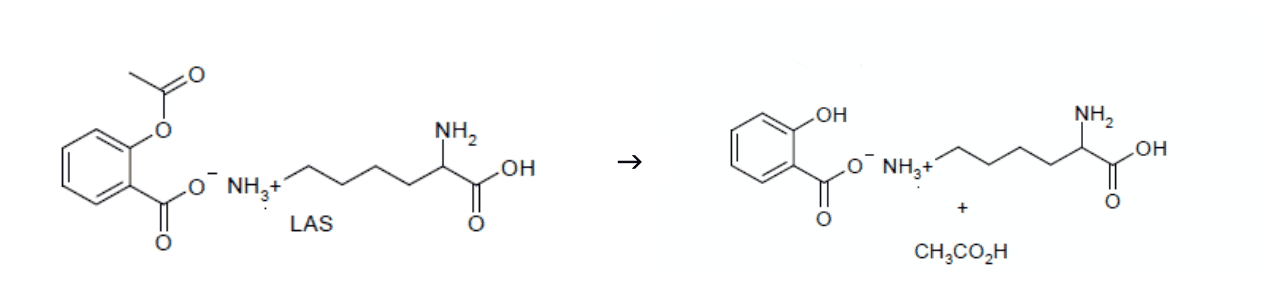
Hydrolysis of LAS can proceed via three different pathways (a) acid catalysed, (b) uncatalysed and (c) base catalysed.
If [LAS] denotes the concentration of LAS at time \(t\), the overall rate of the hydrolysis reaction can be written as
\[ -\frac{d[\mathrm{LAS}]}{dt} = k_{\mathrm H}[\mathrm{LAS}][\ce{H+}] +k_{\mathrm O}[\mathrm{LAS}] +k_{\mathrm{OH}}[\mathrm{LAS}][\ce{OH-}] \]
where \(k_{\mathrm H}\), \(k_{\mathrm O}\) and \(k_{\mathrm{OH}}\) are the rate constants of the acid catalysed, uncatalysed and base catalysed pathways of hydrolysis, respectively. The overall rate constant is defined as:
\[ -\frac{d[\mathrm{LAS}]}{dt} =k_{\mathrm{obs}}[\mathrm{LAS}] \]
4.2.1 Write an expression for \(k_{\mathrm{obs}}\) in terms of \(k_{\mathrm H}\), \(k_{\mathrm O}\), \(k_{\mathrm{OH}}\) and \([\ce{H+}]\).
Hydrolysis of LAS was carried out at 298.15 K at various pH values (0.50 to 13.0). A very low initial concentration of LAS ensured that the pH did not change during the course of the reaction.
The following graph shows the pH dependence of the hydrolysis of LAS.
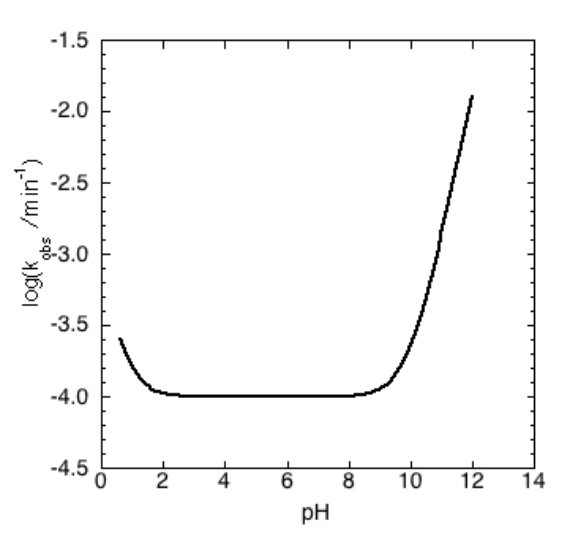
4.2.2 Which of the following is/are correct?
A) \(k_{\mathrm{obs}}\approx k_0\) at pH = 12
B) \(k_{\mathrm{obs}}\approx k_0\) at pH = 5.0
C) The rate of the reaction increases when the pH is changed from 0.50 to 1.0.
D) The rate of the reaction increases when the pH is changed from 10 to 12.
4.2.3 Using the diagram and the data given below, calculate \(k_{\mathrm H}\), \(k_0\) and \(k_{\mathrm{OH}}\). Make sure to specify the units.
| pH | 1.300 | 5.300 | 12.180 |
|---|---|---|---|
| \(\log(k_{\mathrm{obs}}/\mathrm{min^{-1}})\) | −3.886 | −4.000 | −1.726 |
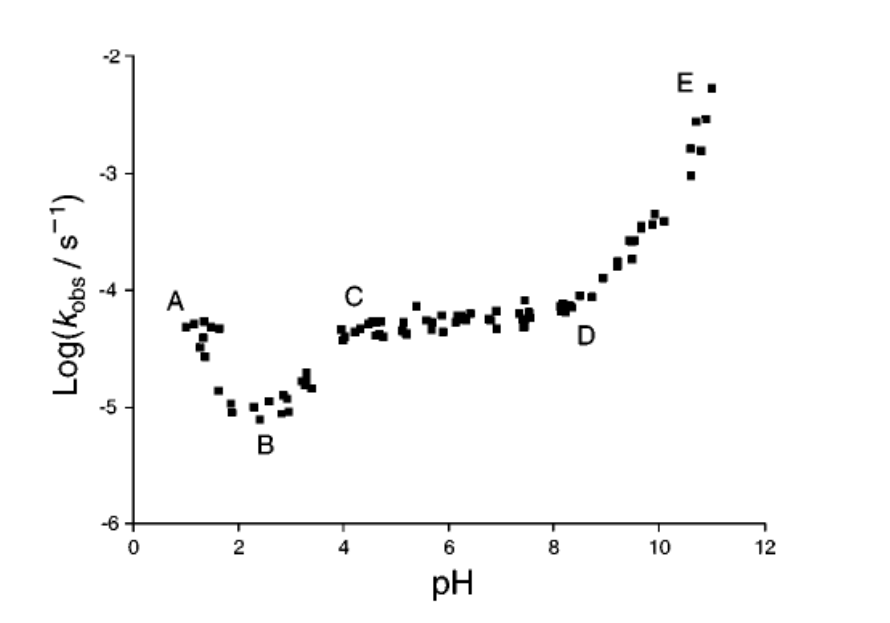
Acetylsalicylic acid, more commonly known as aspirin is a medicine often used for reducing fever, pain and inflammation. Like LAS, the hydrolysis of aspirin can also take different pathways depending on the pH. The pH rate profile of aspirin hydrolysis at 333.15 K is given below:
The following are possible reactions for the hydrolysis of aspirin. Depending on the pH, one or more of these reactions will predominate.
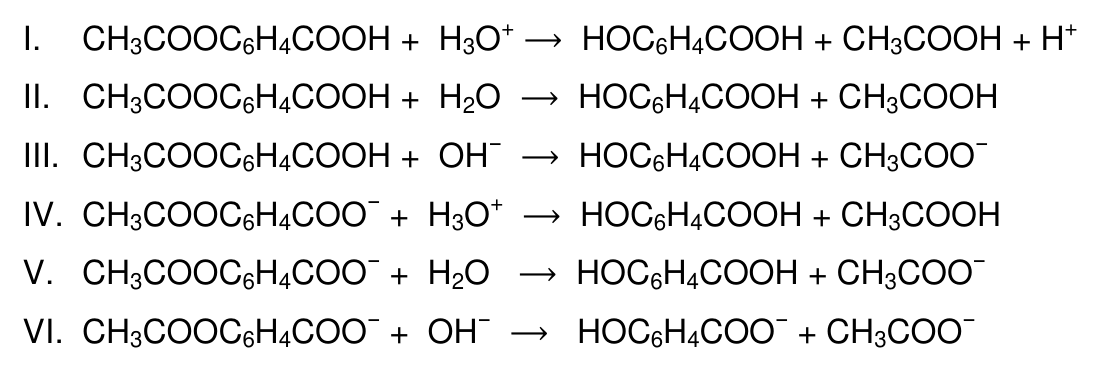
4.3.1 Using the pH-rate profile diagram and the reactions given above, state which of the following statements is/are correct. (\(\mathrm{p}K_{\mathrm a}\) of aspirin = 3.57 at 333.15 K)
a) In the region C-D, reaction IV is predominant
b) In the region C-D, reaction V is predominant
c) In the region D-E reaction VI is predominant
d) In the region A-B, reaction II is predominant
The plot of \(k_{\mathrm{obs}}\) vs pH for the hydrolysis of aspirin has been confirmed to show a minimum at a particular pH. At 290.15 K the following rate constants for reactions I, II and III were determined:
| \(k_{\mathrm H}\) (reaction I) | \(k_0\) (reaction II) | \(k_{\mathrm{OH}}\) (reaction III) |
|---|---|---|
| \(1.99\ \mathrm{dm^3\,mol^{-1}\,day^{-1}}\) | \(2.29\times10^{-4}\ \mathrm{day^{-1}}\) | \(3.18\times10^9\ \mathrm{dm^3\,mol^{-1}\,day^{-1}}\) |
The ionic product of water at 290.15 K can be taken as \(1.0\times10^{-14}\).
4.3.2 Assuming that only reactions I, II and III occur, calculate the value of the pH at the minimum.
Official English text of the problem.
Answers
Here \(D\) denotes dioxane and \(K_{\mathrm w}=[\ce{H+}][\ce{OH-}]\).
- 4.1.1: \(t\approx14.2\ \mathrm{min}\).
- 4.1.2: \[ -\frac{d[D]}{dt} = \frac{k_1k_3[\ce{S2O8^2-}][\ce{Ag+}][D]} {k_2[\ce{SO4^2-}]^2+k_3[D]}. \]
- 4.1.3: A and C.
- 4.2.1: \[ k_{\mathrm{obs}} =k_{\mathrm H}[\ce{H+}]+k_0+ \frac{k_{\mathrm{OH}}K_{\mathrm w}}{[\ce{H+}]}. \]
- 4.2.2: B and D.
- 4.2.3: \[ k_{\mathrm H}\approx5.99\times10^{-4}\ \mathrm{dm^3\,mol^{-1}\,min^{-1}}, \] \[ k_0\approx1.00\times10^{-4}\ \mathrm{min^{-1}},\qquad k_{\mathrm{OH}}\approx1.24\ \mathrm{dm^3\,mol^{-1}\,min^{-1}}. \]
- 4.3.1: b and c.
- 4.3.2: \(\mathrm{pH}_{\min}\approx2.40\).
Solution
The chemical identities used below are listed here. Disconnected SMILES components represent the ions of a salt. The lysine salts retain the protonation form drawn in the problem; the drawing does not specify lysine stereochemistry.
| Species | SMILES |
|---|---|
| 1,4-Dioxane | O1CCOCC1 |
| Potassium peroxodisulfate | [K+].[K+].[O-]S(=O)(=O)OOS(=O)(=O)[O-] |
| Peroxodisulfate ion | [O-]S(=O)(=O)OOS(=O)(=O)[O-] |
| Silver(I) nitrate | [Ag+].[O-][N+](=O)[O-] |
| Silver(I) ion | [Ag+] |
| Silver(III) ion | [Ag+3] |
| Sulfate ion | [O-]S(=O)(=O)[O-] |
| Hydrogen ion (proton) | [H+] |
| Water | O |
| Hydronium ion | [OH3+] |
| Hydroxide ion | [OH-] |
| Lysine acetylsalicylate (LAS) | CC(=O)Oc1ccccc1C(=O)[O-].[NH3+]CCCCC(N)C(=O)O |
| Lysine salicylate | O=C([O-])c1ccccc1O.[NH3+]CCCCC(N)C(=O)O |
| Acetylsalicylic acid (aspirin) | CC(=O)Oc1ccccc1C(=O)O |
| Acetylsalicylate ion | CC(=O)Oc1ccccc1C(=O)[O-] |
| Salicylic acid | O=C(O)c1ccccc1O |
| Salicylate ion | O=C([O-])c1ccccc1O |
| Acetic acid | CC(=O)O |
| Acetate ion | CC(=O)[O-] |
4.1.1
Write the empirical rate law at the specified catalyst concentration as
\[ r=k_{\mathrm{app}}[\ce{S2O8^2-}]^m[D]^n. \]
Trials 1 and 2 have the same dioxane concentration, so
\[ m= \frac{\ln(3.380/1.661)}{\ln(5.10/2.50)} =0.9965\approx1. \]
Trials 3 and 4 have the same peroxodisulfate concentration, so
\[ n= \frac{\ln(9.201/9.200)}{\ln(0.0110/0.00500)} \approx0. \]
Thus the reaction is first order in peroxodisulfate and zero order in dioxane:
\[ r=k_{\mathrm{app}}[\ce{S2O8^2-}]. \]
Using trial 1,
\[ k_{\mathrm{app}} = \frac{1.661\times10^{-2}\ \mathrm{mmol\,dm^{-3}\,min^{-1}}} {2.50\ \mathrm{mmol\,dm^{-3}}} = 6.644\times10^{-3}\ \mathrm{min^{-1}}. \]
The other trials give closely agreeing values. Both the kinetic experiments and the water-treatment sample use
\[ [\ce{AgNO3}]=1.00\times10^{-3}\ \mathrm{mmol\,dm^{-3}} =1.00\times10^{-6}\ \mathrm{mol\,dm^{-3}}, \]
so the empirical constant applies directly under the stated assumption.
Using \(M(\ce{C4H8O2})\approx88.1\ \mathrm{g\,mol^{-1}}\),
\[ [D]_0 = \frac{40.00\times10^{-6}\ \mathrm{g\,dm^{-3}}} {88.1\ \mathrm{g\,mol^{-1}}} = 4.54\times10^{-7}\ \mathrm{mol\,dm^{-3}}, \]
\[ [D]_f = \frac{0.35\times10^{-6}}{88.1} = 3.97\times10^{-9}\ \mathrm{mol\,dm^{-3}}. \]
The stipulated 1:1 stoichiometry gives the final peroxodisulfate concentration:
\[ \begin{aligned} [\ce{S2O8^2-}]_f &=[\ce{S2O8^2-}]_0-\bigl([D]_0-[D]_f\bigr)\\ &=5.0\times10^{-6}-4.50\times10^{-7}\\ &=4.55\times10^{-6}\ \mathrm{mol\,dm^{-3}}. \end{aligned} \]
Integrating the first-order disappearance of peroxodisulfate,
\[ \ln\frac{[\ce{S2O8^2-}]_0}{[\ce{S2O8^2-}]_f} =k_{\mathrm{app}}t. \]
Therefore,
\[ \boxed{ t= \frac{\ln(5.0\times10^{-6}/4.55\times10^{-6})} {6.644\times10^{-3}\ \mathrm{min^{-1}}} \approx14.2\ \mathrm{min}. } \]
4.1.2
The intermediate \(\ce{Ag^3+}\) is formed by the forward first step and consumed by its reverse and by oxidation of dioxane. Its steady-state equation is
\[ \frac{d[\ce{Ag^3+}]}{dt} = k_1[\ce{S2O8^2-}][\ce{Ag+}] -k_2[\ce{Ag^3+}][\ce{SO4^2-}]^2 -k_3[\ce{Ag^3+}][D] \approx0. \]
The squared sulfate concentration follows from the two sulfate ions in the reverse elementary step. Rearranging,
\[ [\ce{Ag^3+}] = \frac{k_1[\ce{S2O8^2-}][\ce{Ag+}]} {k_2[\ce{SO4^2-}]^2+k_3[D]}. \]
Dioxane is consumed in the second step, giving
\[ -\frac{d[D]}{dt}=k_3[\ce{Ag^3+}][D]. \]
Hence
\[ \boxed{ -\frac{d[D]}{dt} = \frac{k_1k_3[\ce{S2O8^2-}][\ce{Ag+}][D]} {k_2[\ce{SO4^2-}]^2+k_3[D]}. } \]
Under the same steady-state approximation, the net disappearance rate of peroxodisulfate equals this rate.
4.1.3
At very high dioxane concentration,
\[ k_3[D]\gg k_2[\ce{SO4^2-}]^2, \]
so
\[ r\approx k_1[\ce{S2O8^2-}][\ce{Ag+}]. \]
This is zero order in dioxane and first order in peroxodisulfate, agreeing with the experimental data at fixed catalyst concentration. A is true.
The coefficient in this limiting mechanistic law is \(k_1\). Its units follow directly from the rate law:
\[ [k_1] = \frac{\mathrm{mol\,dm^{-3}\,s^{-1}}} {(\mathrm{mol\,dm^{-3}})^2} = \mathrm{dm^3\,mol^{-1}\,s^{-1}}. \]
Thus C is true. The fixed-catalyst coefficient used in 4.1.1 is instead \(k_{\mathrm{app}}=k_1[\ce{Ag+}]\), with units of inverse time.
At very low dioxane concentration,
\[ k_3[D]\ll k_2[\ce{SO4^2-}]^2, \]
and
\[ r\approx \frac{k_1k_3}{k_2} \frac{[\ce{S2O8^2-}][\ce{Ag+}][D]} {[\ce{SO4^2-}]^2}. \]
This predicts first-order dependence on dioxane, so B is false.
The elementary constants have units
\[ [k_1]=[k_3]=\mathrm{dm^3\,mol^{-1}\,s^{-1}},\qquad [k_2]=\mathrm{dm^6\,mol^{-2}\,s^{-1}}. \]
Consequently, the coefficient \(k_1k_3/k_2\) in the displayed low-dioxane law has units \(\mathrm{s^{-1}}\). If the sulfate concentration is held fixed and absorbed into that coefficient, its units become \(\mathrm{dm^6\,mol^{-2}\,s^{-1}}\). Thus D is false for the limiting mechanistic law with the silver concentration explicit.
\[ \boxed{\text{A and C}} \]
4.2.1
Write \(k_0\) for the uncatalysed constant, also printed as \(k_{\mathrm O}\) in the statement. Factoring out \([\mathrm{LAS}]\) gives
\[ k_{\mathrm{obs}} = k_{\mathrm H}[\ce{H+}]+k_0+k_{\mathrm{OH}}[\ce{OH-}]. \]
Since
\[ [\ce{OH-}]=\frac{K_{\mathrm w}}{[\ce{H+}]}, \]
the required expression is
\[ \boxed{ k_{\mathrm{obs}} = k_{\mathrm H}[\ce{H+}]+k_0+ \frac{k_{\mathrm{OH}}K_{\mathrm w}}{[\ce{H+}]}. } \]
At fixed pH, all three contributions are constant, giving first-order disappearance of LAS.
4.2.2
At pH 12, the rising alkaline branch indicates a large base-catalysed contribution, so \(k_{\mathrm{obs}}\not\approx k_0\): A is false.
At pH 5.0, the graph lies on the nearly horizontal plateau, where uncatalysed hydrolysis dominates: B is true.
Increasing the pH from 0.50 to 1.0 decreases \([\ce{H+}]\) and the acid-catalysed contribution. The graph shows a decreasing rate constant: C is false.
Increasing the pH from 10 to 12 increases \([\ce{OH-}]\) and the base-catalysed contribution: D is true.
\[ \boxed{\text{B and D}} \]
4.2.3
At 298.15 K, use
\[ K_{\mathrm w}=1.0\times10^{-14}\ \mathrm{mol^2\,dm^{-6}}. \]
The measured rate constants are
\[ \begin{aligned} k_{\mathrm{obs}}(1.300)&=10^{-3.886} =1.30017\times10^{-4}\ \mathrm{min^{-1}},\\ k_{\mathrm{obs}}(5.300)&=10^{-4.000} =1.00000\times10^{-4}\ \mathrm{min^{-1}},\\ k_{\mathrm{obs}}(12.180)&=10^{-1.726} =1.87932\times10^{-2}\ \mathrm{min^{-1}}. \end{aligned} \]
At pH 5.300, the plateau gives
\[ \boxed{k_0\approx1.00\times10^{-4}\ \mathrm{min^{-1}}.} \]
At pH 1.300, the hydroxide contribution is negligible, but the uncatalysed contribution must be retained:
\[ k_{\mathrm H} \approx \frac{k_{\mathrm{obs}}-k_0}{[\ce{H+}]}. \]
Therefore,
\[ \begin{aligned} k_{\mathrm H} &\approx \frac{1.30017\times10^{-4}-1.00000\times10^{-4}} {10^{-1.300}}\\ &= 5.989\times10^{-4}\ \mathrm{dm^3\,mol^{-1}\,min^{-1}}. \end{aligned} \]
Thus
\[ \boxed{k_{\mathrm H}\approx5.99\times10^{-4}\ \mathrm{dm^3\,mol^{-1}\,min^{-1}}.} \]
At pH 12.180,
\[ [\ce{OH-}] =10^{12.180-14.000} =1.51356\times10^{-2}\ \mathrm{mol\,dm^{-3}}. \]
The acid-catalysed contribution is negligible, so
\[ \begin{aligned} k_{\mathrm{OH}} &\approx \frac{k_{\mathrm{obs}}-k_0}{[\ce{OH-}]}\\ &= \frac{1.87932\times10^{-2}-1.00000\times10^{-4}} {1.51356\times10^{-2}}\\ &=1.23505\ \mathrm{dm^3\,mol^{-1}\,min^{-1}}. \end{aligned} \]
Hence
\[ \boxed{k_{\mathrm{OH}}\approx1.24\ \mathrm{dm^3\,mol^{-1}\,min^{-1}}.} \]
Solving all three simultaneous equations while retaining every contribution gives the same quoted results.
4.3.1
Aspirin and its conjugate base are related by
\[ \ce{CH3COOC6H4COOH <=> H+ + CH3COOC6H4COO-}. \]
Thus
\[ \frac{[\text{acetylsalicylate}]}{[\text{aspirin}]} = 10^{\mathrm{pH}-3.57}. \]
Below the \(\mathrm pK_{\mathrm a}\), neutral aspirin predominates; above it, acetylsalicylate increasingly predominates.
In region C–D, the substrate is mainly acetylsalicylate and the rate is approximately independent of pH. This supports reaction V, its hydrolysis by water:
\[ \ce{CH3COOC6H4COO- + H2O -> HOC6H4COOH + CH3COO-}. \]
Reaction IV involves hydronium and would produce a decreasing rate as pH rises once the anionic substrate predominates. Therefore a is false and b is true.
In region D–E, the rate increases strongly with pH. The substrate remains acetylsalicylate, while hydroxide concentration increases. This supports reaction VI:
\[ \ce{CH3COOC6H4COO- + OH- -> HOC6H4COO- + CH3COO-}. \]
Therefore c is true.
In region A–B, aspirin is mainly neutral and the rate falls as the solution becomes less acidic. This is characteristic of acid-catalysed reaction I:
\[ \ce{CH3COOC6H4COOH + H3O+ -> HOC6H4COOH + CH3COOH + H+}. \]
Reaction II, hydrolysis of neutral aspirin by water, would give an approximately pH-independent contribution in this region. Therefore d is false.
All three displayed hydrolysis equations conserve atoms and charge.
\[ \boxed{\text{b and c}} \]
4.3.2
Under the stipulated model containing only reactions I, II and III,
\[ k_{\mathrm{obs}} = k_{\mathrm H}[\ce{H+}] +k_0 +\frac{k_{\mathrm{OH}}K_{\mathrm w}}{[\ce{H+}]}. \]
Let \(h=[\ce{H+}]>0\). At the minimum,
\[ \frac{dk_{\mathrm{obs}}}{dh} = k_{\mathrm H}-\frac{k_{\mathrm{OH}}K_{\mathrm w}}{h^2} =0. \]
Therefore,
\[ h_{\min} = \sqrt{\frac{k_{\mathrm{OH}}K_{\mathrm w}}{k_{\mathrm H}}}. \]
The stationary point is a minimum because
\[ \frac{d^2k_{\mathrm{obs}}}{dh^2} = \frac{2k_{\mathrm{OH}}K_{\mathrm w}}{h^3}>0. \]
Substitution gives
\[ \begin{aligned} [\ce{H+}]_{\min} &= \sqrt{ \frac{ (3.18\times10^9\ \mathrm{dm^3\,mol^{-1}\,day^{-1}}) (1.0\times10^{-14}\ \mathrm{mol^2\,dm^{-6}}) }{ 1.99\ \mathrm{dm^3\,mol^{-1}\,day^{-1}} } }\\ &= 3.9975\times10^{-3}\ \mathrm{mol\,dm^{-3}}. \end{aligned} \]
Hence
\[ \boxed{ \mathrm{pH}_{\min} =-\log_{10}(3.9975\times10^{-3}) =2.3982\approx2.40. } \]
At this minimum, the acid- and base-catalysed contributions are equal. The constant \(k_0\) changes the minimum rate but not its pH.
The solution was checked against the official solution.
IChO 2016 · Theorieaufgabe 4
Kinetik: Wasseraufbereitung und Abbau von Arzneimitteln
Anwendung kinetischer Untersuchungen in der Wasseraufbereitung
Industrielle Abfälle sind eine wesentliche Ursache für Wasserverschmutzung, und zur Auslegung von Verfahren zur Abwasserbehandlung werden kinetische Untersuchungen im Labor durchgeführt. 1,4-Dioxan, meist einfach als Dioxan (\(\ce{C4H8O2}\)) bezeichnet, ist ein industrielles Lösungsmittel und Nebenprodukt und ein bedeutender Wasserschadstoff. Es kann mit Oxidationsmitteln wie Peroxodisulfat, Ozon oder Wasserstoffperoxid zu ungefährlichen chemischen Stoffen oxidiert werden.
Die bei der kinetischen Untersuchung der Oxidation von Dioxan mit Kaliumperoxodisulfat (\(\ce{K2S2O8}\)) als Oxidationsmittel und \(\ce{AgNO3}\) als Katalysator bei \(T=303.15\ \mathrm{K}\) erhaltenen Daten sind nachstehend angegeben. Die Reaktion wurde durch Bestimmung des nicht umgesetzten Peroxodisulfats verfolgt. Die bei dieser Untersuchung verwendete Konzentration von \(\ce{AgNO3}\) betrug \(1.00\cdot10^{-3}\ \mathrm{mmol\,dm^{-3}}\).
| Versuch | Dioxan / \(\mathrm{mmol\,dm^{-3}}\) | \(\ce{K2S2O8}\) / \(\mathrm{mmol\,dm^{-3}}\) | Anfangsgeschwindigkeit / \(\mathrm{mmol\,dm^{-3}\,min^{-1}}\) |
|---|---|---|---|
| 1 | 0.0100 | 2.50 | \(1.661\cdot10^{-2}\) |
| 2 | 0.0100 | 5.10 | \(3.380\cdot10^{-2}\) |
| 3 | 0.00500 | 13.8 | \(9.200\cdot10^{-2}\) |
| 4 | 0.0110 | 13.8 | \(9.201\cdot10^{-2}\) |
In vielen Ländern ist die zulässige Höchstkonzentration von Dioxan im Trinkwasser auf \(0.35\ \mathrm{\mu g\,dm^{-3}}\) festgelegt.
Eine Wasserprobe enthält anfangs Dioxan in einer Konzentration von \(40.00\ \mathrm{\mu g\,dm^{-3}}\). Nehmen Sie an, dass zur Oxidation von 1 mol Dioxan 1 mol Peroxodisulfat benötigt wird. Die bei dieser Untersuchung verwendete Konzentration von \(\ce{AgNO3}\) betrug \(1.00\times10^{-3}\ \mathrm{mmol\,dm^{-3}}\).
4.1.1. Berechnen Sie die Zeit in Minuten, die der Oxidationsprozess bei 303.15 K andauern muss, um die zulässige Dioxankonzentration zu erreichen, wenn die Anfangskonzentration von \(\ce{K2S2O8}\) \(5.0\times10^{-6}\ \mathrm{mol\,dm^{-3}}\) beträgt. Nehmen Sie an, dass das aus den obigen Daten erhaltene Geschwindigkeitsgesetz unter diesen Bedingungen gültig ist.
Für die Oxidation von Dioxan mit Peroxodisulfat wurden verschiedene Mechanismen vorgeschlagen. Misra und Ghosh (1963) schlugen den folgenden Mechanismus vor:
4.1.2 Leiten Sie unter der Annahme eines quasistationären Zustands für Ag(III) das Geschwindigkeitsgesetz für die Oxidation von Dioxan her.
4.1.3 Welche der folgenden Aussagen ist/sind richtig?
A) Das auf dem in 4.1.2 angegebenen Mechanismus beruhende Geschwindigkeitsgesetz stimmt bei sehr hohen Dioxankonzentrationen mit den experimentellen Daten in 4.1.1 überein.
B) Das auf dem in 4.1.2 angegebenen Mechanismus beruhende Geschwindigkeitsgesetz stimmt bei sehr niedrigen Dioxankonzentrationen mit den experimentellen Daten in 4.1.1 überein.
C) Die Einheit der beobachteten Geschwindigkeitskonstante ist bei sehr hohen Dioxankonzentrationen \(\mathrm{dm^3\,mol^{-1}\,s^{-1}}\).
D) Die Einheit der beobachteten Geschwindigkeitskonstante ist bei sehr niedrigen Dioxankonzentrationen \(\mathrm{dm^3\,mol^{-1}\,s^{-1}}\).
Abbau von Arzneimitteln – ein kinetischer Überblick
Kinetische Untersuchungen sind wichtig für die Bestimmung der Haltbarkeit eines Arzneimittels. Verschiedene chemische Reaktionen können die Haltbarkeit von Arzneimitteln beeinflussen, und die Geschwindigkeiten dieser Reaktionen hängen von Bedingungen wie pH-Wert, Temperatur und Luftfeuchtigkeit ab.
Lysinacetylsalicylat (LAS) wird unter dem Handelsnamen Aspegic als schmerzstillendes und entzündungshemmendes Arzneimittel verschrieben. Bei der Hydrolyse von LAS entstehen Lysinsalicylat und Essigsäure.
Die Hydrolyse von LAS kann über drei verschiedene Reaktionswege ablaufen: (a) säurekatalysiert, (b) unkatalysiert und (c) basenkatalysiert.
Wenn [LAS] die Konzentration von LAS zum Zeitpunkt \(t\) bezeichnet, lässt sich die Gesamtgeschwindigkeit der Hydrolysereaktion wie folgt schreiben:
\[ -\frac{d[\mathrm{LAS}]}{dt} = k_{\mathrm H}[\mathrm{LAS}][\ce{H+}] +k_{\mathrm O}[\mathrm{LAS}] +k_{\mathrm{OH}}[\mathrm{LAS}][\ce{OH-}] \]
Dabei sind \(k_{\mathrm H}\), \(k_{\mathrm O}\) und \(k_{\mathrm{OH}}\) die Geschwindigkeitskonstanten des säurekatalysierten, des unkatalysierten beziehungsweise des basenkatalysierten Reaktionswegs der Hydrolyse. Die Gesamtgeschwindigkeitskonstante ist wie folgt definiert:
\[ -\frac{d[\mathrm{LAS}]}{dt} =k_{\mathrm{obs}}[\mathrm{LAS}] \]
4.2.1 Geben Sie einen Ausdruck für \(k_{\mathrm{obs}}\) in Abhängigkeit von \(k_{\mathrm H}\), \(k_{\mathrm O}\), \(k_{\mathrm{OH}}\) und \([\ce{H+}]\) an.
Die Hydrolyse von LAS wurde bei 298.15 K und verschiedenen pH-Werten (0.50 bis 13.0) durchgeführt. Eine sehr niedrige Anfangskonzentration von LAS stellte sicher, dass sich der pH-Wert im Verlauf der Reaktion nicht änderte.
Das folgende Diagramm zeigt die pH-Abhängigkeit der Hydrolyse von LAS.
4.2.2 Welche der folgenden Aussagen ist/sind richtig?
A) \(k_{\mathrm{obs}}\approx k_0\) bei pH = 12
B) \(k_{\mathrm{obs}}\approx k_0\) bei pH = 5.0
C) Die Reaktionsgeschwindigkeit steigt, wenn der pH-Wert von 0.50 auf 1.0 geändert wird.
D) Die Reaktionsgeschwindigkeit steigt, wenn der pH-Wert von 10 auf 12 geändert wird.
4.2.3 Berechnen Sie mithilfe des Diagramms und der nachstehenden Daten \(k_{\mathrm H}\), \(k_0\) und \(k_{\mathrm{OH}}\). Achten Sie darauf, die Einheiten anzugeben.
| pH | 1.300 | 5.300 | 12.180 |
|---|---|---|---|
| \(\log(k_{\mathrm{obs}}/\mathrm{min^{-1}})\) | −3.886 | −4.000 | −1.726 |
Acetylsalicylsäure, besser bekannt als Aspirin, ist ein Arzneimittel, das häufig zur Linderung von Fieber, Schmerzen und Entzündungen eingesetzt wird. Wie bei LAS kann auch die Hydrolyse von Aspirin je nach pH-Wert über verschiedene Reaktionswege ablaufen. Das pH-Geschwindigkeitsprofil der Aspirinhydrolyse bei 333.15 K ist nachstehend dargestellt:
Im Folgenden sind mögliche Reaktionen für die Hydrolyse von Aspirin dargestellt. Je nach pH-Wert überwiegen eine oder mehrere dieser Reaktionen.
4.3.1 Geben Sie anhand des pH-Geschwindigkeitsprofils und der oben angegebenen Reaktionen an, welche der folgenden Aussagen richtig ist/sind. (\(\mathrm{p}K_{\mathrm a}\) von Aspirin = 3.57 bei 333.15 K)
a) Im Bereich C-D überwiegt Reaktion IV
b) Im Bereich C-D überwiegt Reaktion V
c) Im Bereich D-E überwiegt Reaktion VI
d) Im Bereich A-B überwiegt Reaktion II
Es wurde bestätigt, dass die Auftragung von \(k_{\mathrm{obs}}\) gegen den pH-Wert für die Hydrolyse von Aspirin bei einem bestimmten pH-Wert ein Minimum aufweist. Bei 290.15 K wurden die folgenden Geschwindigkeitskonstanten für die Reaktionen I, II und III bestimmt:
| \(k_{\mathrm H}\) (Reaktion I) | \(k_0\) (Reaktion II) | \(k_{\mathrm{OH}}\) (Reaktion III) |
|---|---|---|
| \(1.99\ \mathrm{dm^3\,mol^{-1}\,day^{-1}}\) | \(2.29\times10^{-4}\ \mathrm{day^{-1}}\) | \(3.18\times10^9\ \mathrm{dm^3\,mol^{-1}\,day^{-1}}\) |
Für das Ionenprodukt des Wassers bei 290.15 K kann \(1.0\times10^{-14}\) angenommen werden.
4.3.2 Berechnen Sie unter der Annahme, dass nur die Reaktionen I, II und III ablaufen, den pH-Wert am Minimum.
Aufgabentext aus dem offiziellen englischen Text übersetzt.
Antworten
Hier bezeichnet \(D\) Dioxan, und es gilt \(K_{\mathrm w}=[\ce{H+}][\ce{OH-}]\).
- 4.1.1: \(t\approx14.2\ \mathrm{min}\).
- 4.1.2: \[ -\frac{d[D]}{dt} = \frac{k_1k_3[\ce{S2O8^2-}][\ce{Ag+}][D]} {k_2[\ce{SO4^2-}]^2+k_3[D]}. \]
- 4.1.3: A und C.
- 4.2.1: \[ k_{\mathrm{obs}} =k_{\mathrm H}[\ce{H+}]+k_0+ \frac{k_{\mathrm{OH}}K_{\mathrm w}}{[\ce{H+}]}. \]
- 4.2.2: B und D.
- 4.2.3: \[ k_{\mathrm H}\approx5.99\times10^{-4}\ \mathrm{dm^3\,mol^{-1}\,min^{-1}}, \] \[ k_0\approx1.00\times10^{-4}\ \mathrm{min^{-1}},\qquad k_{\mathrm{OH}}\approx1.24\ \mathrm{dm^3\,mol^{-1}\,min^{-1}}. \]
- 4.3.1: b und c.
- 4.3.2: \(\mathrm{pH}_{\min}\approx2.40\).
Lösung
Die im Folgenden verwendeten chemischen Spezies sind hier aufgeführt. Nicht miteinander verbundene SMILES-Komponenten stellen die Ionen eines Salzes dar. Die Lysinsalze behalten die in der Aufgabenstellung gezeichnete Protonierungsform bei; die Zeichnung legt die Stereochemie des Lysins nicht fest.
| Spezies | SMILES |
|---|---|
| 1,4-Dioxan | O1CCOCC1 |
| Kaliumperoxodisulfat | [K+].[K+].[O-]S(=O)(=O)OOS(=O)(=O)[O-] |
| Peroxodisulfat-Ion | [O-]S(=O)(=O)OOS(=O)(=O)[O-] |
| Silber(I)-nitrat | [Ag+].[O-][N+](=O)[O-] |
| Silber(I)-Ion | [Ag+] |
| Silber(III)-Ion | [Ag+3] |
| Sulfat-Ion | [O-]S(=O)(=O)[O-] |
| Wasserstoff-Ion (Proton) | [H+] |
| Wasser | O |
| Oxonium-Ion | [OH3+] |
| Hydroxid-Ion | [OH-] |
| Lysinacetylsalicylat (LAS) | CC(=O)Oc1ccccc1C(=O)[O-].[NH3+]CCCCC(N)C(=O)O |
| Lysinsalicylat | O=C([O-])c1ccccc1O.[NH3+]CCCCC(N)C(=O)O |
| Acetylsalicylsäure (Aspirin) | CC(=O)Oc1ccccc1C(=O)O |
| Acetylsalicylat-Ion | CC(=O)Oc1ccccc1C(=O)[O-] |
| Salicylsäure | O=C(O)c1ccccc1O |
| Salicylat-Ion | O=C([O-])c1ccccc1O |
| Essigsäure | CC(=O)O |
| Acetat-Ion | CC(=O)[O-] |
4.1.1
Das empirische Geschwindigkeitsgesetz bei der angegebenen Katalysatorkonzentration wird wie folgt angesetzt:
\[ r=k_{\mathrm{app}}[\ce{S2O8^2-}]^m[D]^n. \]
In den Versuchen 1 und 2 ist die Dioxankonzentration gleich, daher gilt
\[ m= \frac{\ln(3.380/1.661)}{\ln(5.10/2.50)} =0.9965\approx1. \]
In den Versuchen 3 und 4 ist die Peroxodisulfatkonzentration gleich, daher gilt
\[ n= \frac{\ln(9.201/9.200)}{\ln(0.0110/0.00500)} \approx0. \]
Die Reaktion ist somit erster Ordnung bezüglich Peroxodisulfat und nullter Ordnung bezüglich Dioxan:
\[ r=k_{\mathrm{app}}[\ce{S2O8^2-}]. \]
Mit den Daten aus Versuch 1 ergibt sich
\[ k_{\mathrm{app}} = \frac{1.661\times10^{-2}\ \mathrm{mmol\,dm^{-3}\,min^{-1}}} {2.50\ \mathrm{mmol\,dm^{-3}}} = 6.644\times10^{-3}\ \mathrm{min^{-1}}. \]
Die anderen Versuche ergeben nahezu übereinstimmende Werte. Sowohl bei den kinetischen Experimenten als auch bei der Wasserprobe zur Aufbereitung wird
\[ [\ce{AgNO3}]=1.00\times10^{-3}\ \mathrm{mmol\,dm^{-3}} =1.00\times10^{-6}\ \mathrm{mol\,dm^{-3}}, \]
verwendet, sodass die empirische Konstante unter der genannten Annahme unmittelbar anwendbar ist.
Mit \(M(\ce{C4H8O2})\approx88.1\ \mathrm{g\,mol^{-1}}\) ergibt sich
\[ [D]_0 = \frac{40.00\times10^{-6}\ \mathrm{g\,dm^{-3}}} {88.1\ \mathrm{g\,mol^{-1}}} = 4.54\times10^{-7}\ \mathrm{mol\,dm^{-3}}, \]
\[ [D]_f = \frac{0.35\times10^{-6}}{88.1} = 3.97\times10^{-9}\ \mathrm{mol\,dm^{-3}}. \]
Die vorgegebene 1:1-Stöchiometrie liefert die Endkonzentration von Peroxodisulfat:
\[ \begin{aligned} [\ce{S2O8^2-}]_f &=[\ce{S2O8^2-}]_0-\bigl([D]_0-[D]_f\bigr)\\ &=5.0\times10^{-6}-4.50\times10^{-7}\\ &=4.55\times10^{-6}\ \mathrm{mol\,dm^{-3}}. \end{aligned} \]
Die Integration des Geschwindigkeitsgesetzes erster Ordnung für den Verbrauch von Peroxodisulfat ergibt
\[ \ln\frac{[\ce{S2O8^2-}]_0}{[\ce{S2O8^2-}]_f} =k_{\mathrm{app}}t. \]
Daraus folgt
\[ \boxed{ t= \frac{\ln(5.0\times10^{-6}/4.55\times10^{-6})} {6.644\times10^{-3}\ \mathrm{min^{-1}}} \approx14.2\ \mathrm{min}. } \]
4.1.2
Das Zwischenprodukt \(\ce{Ag^3+}\) wird durch die Hinreaktion des ersten Schritts gebildet und durch dessen Rückreaktion sowie durch die Oxidation von Dioxan verbraucht. Die Gleichung für seinen quasistationären Zustand lautet
\[ \frac{d[\ce{Ag^3+}]}{dt} = k_1[\ce{S2O8^2-}][\ce{Ag+}] -k_2[\ce{Ag^3+}][\ce{SO4^2-}]^2 -k_3[\ce{Ag^3+}][D] \approx0. \]
Das Quadrat der Sulfatkonzentration ergibt sich aus den beiden Sulfat-Ionen im rückwärts ablaufenden Elementarschritt. Umformen ergibt
\[ [\ce{Ag^3+}] = \frac{k_1[\ce{S2O8^2-}][\ce{Ag+}]} {k_2[\ce{SO4^2-}]^2+k_3[D]}. \]
Dioxan wird im zweiten Schritt verbraucht, woraus folgt:
\[ -\frac{d[D]}{dt}=k_3[\ce{Ag^3+}][D]. \]
Somit gilt
\[ \boxed{ -\frac{d[D]}{dt} = \frac{k_1k_3[\ce{S2O8^2-}][\ce{Ag+}][D]} {k_2[\ce{SO4^2-}]^2+k_3[D]}. } \]
Unter derselben Quasistationaritätsnäherung ist die Nettogeschwindigkeit des Peroxodisulfatverbrauchs gleich dieser Geschwindigkeit.
4.1.3
Bei sehr hoher Dioxankonzentration gilt
\[ k_3[D]\gg k_2[\ce{SO4^2-}]^2, \]
also
\[ r\approx k_1[\ce{S2O8^2-}][\ce{Ag+}]. \]
Dies entspricht nullter Ordnung bezüglich Dioxan und erster Ordnung bezüglich Peroxodisulfat und stimmt bei konstanter Katalysatorkonzentration mit den experimentellen Daten überein. A ist richtig.
Der Koeffizient in diesem Grenzfall des mechanistisch hergeleiteten Geschwindigkeitsgesetzes ist \(k_1\). Seine Einheit folgt unmittelbar aus dem Geschwindigkeitsgesetz:
\[ [k_1] = \frac{\mathrm{mol\,dm^{-3}\,s^{-1}}} {(\mathrm{mol\,dm^{-3}})^2} = \mathrm{dm^3\,mol^{-1}\,s^{-1}}. \]
Somit ist C richtig. Der in 4.1.1 bei konstanter Katalysatorkonzentration verwendete Koeffizient ist dagegen \(k_{\mathrm{app}}=k_1[\ce{Ag+}]\) mit der Einheit einer inversen Zeit.
Bei sehr niedriger Dioxankonzentration gilt
\[ k_3[D]\ll k_2[\ce{SO4^2-}]^2, \]
und
\[ r\approx \frac{k_1k_3}{k_2} \frac{[\ce{S2O8^2-}][\ce{Ag+}][D]} {[\ce{SO4^2-}]^2}. \]
Dies sagt eine Abhängigkeit erster Ordnung von Dioxan voraus, also ist B falsch.
Die Geschwindigkeitskonstanten der Elementarschritte haben die Einheiten
\[ [k_1]=[k_3]=\mathrm{dm^3\,mol^{-1}\,s^{-1}},\qquad [k_2]=\mathrm{dm^6\,mol^{-2}\,s^{-1}}. \]
Folglich hat der Koeffizient \(k_1k_3/k_2\) im dargestellten Geschwindigkeitsgesetz für niedrige Dioxankonzentrationen die Einheit \(\mathrm{s^{-1}}\). Wird die Sulfatkonzentration konstant gehalten und in diesen Koeffizienten einbezogen, wird seine Einheit zu \(\mathrm{dm^6\,mol^{-2}\,s^{-1}}\). Somit ist D falsch, wenn im Grenzfall des mechanistisch hergeleiteten Geschwindigkeitsgesetzes die Silberkonzentration explizit enthalten ist.
\[ \boxed{\text{A und C}} \]
4.2.1
Die Konstante der unkatalysierten Reaktion, in der Aufgabenstellung auch als \(k_{\mathrm O}\) angegeben, wird mit \(k_0\) bezeichnet. Ausklammern von \([\mathrm{LAS}]\) ergibt
\[ k_{\mathrm{obs}} = k_{\mathrm H}[\ce{H+}]+k_0+k_{\mathrm{OH}}[\ce{OH-}]. \]
Da
\[ [\ce{OH-}]=\frac{K_{\mathrm w}}{[\ce{H+}]}, \]
lautet der gesuchte Ausdruck
\[ \boxed{ k_{\mathrm{obs}} = k_{\mathrm H}[\ce{H+}]+k_0+ \frac{k_{\mathrm{OH}}K_{\mathrm w}}{[\ce{H+}]}. } \]
Bei konstantem pH-Wert sind alle drei Beiträge konstant, sodass der Verbrauch von LAS einer Kinetik erster Ordnung folgt.
4.2.2
Bei pH 12 weist der ansteigende alkalische Kurvenast auf einen großen basenkatalysierten Beitrag hin, sodass \(k_{\mathrm{obs}}\not\approx k_0\): A ist falsch.
Bei pH 5.0 liegt die Kurve auf dem nahezu horizontalen Plateau, auf dem die unkatalysierte Hydrolyse dominiert: B ist richtig.
Eine Erhöhung des pH-Werts von 0.50 auf 1.0 verringert \([\ce{H+}]\) und den säurekatalysierten Beitrag. Das Diagramm zeigt eine abnehmende Geschwindigkeitskonstante: C ist falsch.
Eine Erhöhung des pH-Werts von 10 auf 12 erhöht \([\ce{OH-}]\) und den basenkatalysierten Beitrag: D ist richtig.
\[ \boxed{\text{B und D}} \]
4.2.3
Bei 298.15 K verwenden wir
\[ K_{\mathrm w}=1.0\times10^{-14}\ \mathrm{mol^2\,dm^{-6}}. \]
Die gemessenen Geschwindigkeitskonstanten sind
\[ \begin{aligned} k_{\mathrm{obs}}(1.300)&=10^{-3.886} =1.30017\times10^{-4}\ \mathrm{min^{-1}},\\ k_{\mathrm{obs}}(5.300)&=10^{-4.000} =1.00000\times10^{-4}\ \mathrm{min^{-1}},\\ k_{\mathrm{obs}}(12.180)&=10^{-1.726} =1.87932\times10^{-2}\ \mathrm{min^{-1}}. \end{aligned} \]
Bei pH 5.300 liefert das Plateau
\[ \boxed{k_0\approx1.00\times10^{-4}\ \mathrm{min^{-1}}.} \]
Bei pH 1.300 ist der Hydroxidbeitrag vernachlässigbar, der unkatalysierte Beitrag muss jedoch berücksichtigt werden:
\[ k_{\mathrm H} \approx \frac{k_{\mathrm{obs}}-k_0}{[\ce{H+}]}. \]
Daher gilt
\[ \begin{aligned} k_{\mathrm H} &\approx \frac{1.30017\times10^{-4}-1.00000\times10^{-4}} {10^{-1.300}}\\ &= 5.989\times10^{-4}\ \mathrm{dm^3\,mol^{-1}\,min^{-1}}. \end{aligned} \]
Somit ergibt sich
\[ \boxed{k_{\mathrm H}\approx5.99\times10^{-4}\ \mathrm{dm^3\,mol^{-1}\,min^{-1}}.} \]
Bei pH 12.180 gilt
\[ [\ce{OH-}] =10^{12.180-14.000} =1.51356\times10^{-2}\ \mathrm{mol\,dm^{-3}}. \]
Der säurekatalysierte Beitrag ist vernachlässigbar, sodass
\[ \begin{aligned} k_{\mathrm{OH}} &\approx \frac{k_{\mathrm{obs}}-k_0}{[\ce{OH-}]}\\ &= \frac{1.87932\times10^{-2}-1.00000\times10^{-4}} {1.51356\times10^{-2}}\\ &=1.23505\ \mathrm{dm^3\,mol^{-1}\,min^{-1}}. \end{aligned} \]
Daraus folgt
\[ \boxed{k_{\mathrm{OH}}\approx1.24\ \mathrm{dm^3\,mol^{-1}\,min^{-1}}.} \]
Die Lösung des Gleichungssystems aus allen drei Gleichungen unter Berücksichtigung sämtlicher Beiträge ergibt dieselben angegebenen Ergebnisse.
4.3.1
Aspirin und seine konjugierte Base stehen über folgendes Gleichgewicht miteinander in Beziehung:
\[ \ce{CH3COOC6H4COOH <=> H+ + CH3COOC6H4COO-}. \]
Somit gilt
\[ \frac{[\text{Acetylsalicylat}]}{[\text{Aspirin}]} = 10^{\mathrm{pH}-3.57}. \]
Unterhalb des \(\mathrm pK_{\mathrm a}\) überwiegt neutrales Aspirin; oberhalb davon überwiegt zunehmend Acetylsalicylat.
Im Bereich C–D liegt das Substrat hauptsächlich als Acetylsalicylat vor, und die Geschwindigkeit ist annähernd unabhängig vom pH-Wert. Dies spricht für Reaktion V, seine Hydrolyse durch Wasser:
\[ \ce{CH3COOC6H4COO- + H2O -> HOC6H4COOH + CH3COO-}. \]
An Reaktion IV sind Oxonium-Ionen beteiligt; sie würde bei steigendem pH-Wert zu einer abnehmenden Geschwindigkeit führen, sobald das anionische Substrat überwiegt. Daher ist a falsch und b richtig.
Im Bereich D–E steigt die Geschwindigkeit mit dem pH-Wert stark an. Das Substrat liegt weiterhin als Acetylsalicylat vor, während die Hydroxidkonzentration zunimmt. Dies spricht für Reaktion VI:
\[ \ce{CH3COOC6H4COO- + OH- -> HOC6H4COO- + CH3COO-}. \]
Daher ist c richtig.
Im Bereich A–B liegt Aspirin hauptsächlich in neutraler Form vor, und die Geschwindigkeit nimmt ab, wenn die Lösung weniger sauer wird. Dies ist charakteristisch für die säurekatalysierte Reaktion I:
\[ \ce{CH3COOC6H4COOH + H3O+ -> HOC6H4COOH + CH3COOH + H+}. \]
Reaktion II, die Hydrolyse von neutralem Aspirin durch Wasser, würde in diesem Bereich einen annähernd pH-unabhängigen Beitrag liefern. Daher ist d falsch.
In allen drei dargestellten Hydrolysegleichungen bleiben die Anzahl der Atome und die Ladung erhalten.
\[ \boxed{\text{b und c}} \]
4.3.2
Für das vorgegebene Modell, das nur die Reaktionen I, II und III enthält, gilt
\[ k_{\mathrm{obs}} = k_{\mathrm H}[\ce{H+}] +k_0 +\frac{k_{\mathrm{OH}}K_{\mathrm w}}{[\ce{H+}]}. \]
Sei \(h=[\ce{H+}]>0\). Am Minimum gilt
\[ \frac{dk_{\mathrm{obs}}}{dh} = k_{\mathrm H}-\frac{k_{\mathrm{OH}}K_{\mathrm w}}{h^2} =0. \]
Daraus folgt
\[ h_{\min} = \sqrt{\frac{k_{\mathrm{OH}}K_{\mathrm w}}{k_{\mathrm H}}}. \]
Die stationäre Stelle ist ein Minimum, da
\[ \frac{d^2k_{\mathrm{obs}}}{dh^2} = \frac{2k_{\mathrm{OH}}K_{\mathrm w}}{h^3}>0. \]
Einsetzen ergibt
\[ \begin{aligned} [\ce{H+}]_{\min} &= \sqrt{ \frac{ (3.18\times10^9\ \mathrm{dm^3\,mol^{-1}\,day^{-1}}) (1.0\times10^{-14}\ \mathrm{mol^2\,dm^{-6}}) }{ 1.99\ \mathrm{dm^3\,mol^{-1}\,day^{-1}} } }\\ &= 3.9975\times10^{-3}\ \mathrm{mol\,dm^{-3}}. \end{aligned} \]
Somit gilt
\[ \boxed{ \mathrm{pH}_{\min} =-\log_{10}(3.9975\times10^{-3}) =2.3982\approx2.40. } \]
An diesem Minimum sind die säure- und basenkatalysierten Beiträge gleich groß. Die Konstante \(k_0\) verändert die minimale Geschwindigkeit, nicht aber den zugehörigen pH-Wert.
Die Lösung wurde mit der offiziellen Lösung abgeglichen.
IChO 2016 · Teori sorusu 4
Kinetik: su arıtımı ve farmasötik ürünlerin bozunması
Kinetik çalışmaların su arıtımında uygulanması
Endüstriyel atıklar su kirliliğinin başlıca nedenlerinden biridir ve atık su arıtımını tasarlamak amacıyla laboratuvarda kinetik çalışmalar yürütülür. Endüstriyel bir çözücü ve yan ürün olan, daha yaygın olarak dioksan (\(\ce{C4H8O2}\)) adıyla bilinen 1,4-dioksan, önemli bir su kirleticisidir. Peroksodisülfat, ozon veya hidrojen peroksit gibi yükseltgenler kullanılarak zararsız kimyasallara yükseltgenebilir.
Yükseltgen olarak potasyum peroksodisülfat (\(\ce{K2S2O8}\)) ve katalizör olarak \(\ce{AgNO3}\) kullanılarak \(T=303.15\ \mathrm{K}\) sıcaklıkta gerçekleştirilen dioksanın yükseltgenmesine ilişkin kinetik çalışmada elde edilen veriler aşağıda verilmiştir. Tepkime, tepkimeye girmemiş peroksodisülfat miktarının belirlenmesiyle izlenmiştir. Bu çalışmada kullanılan \(\ce{AgNO3}\) derişimi \(1.00\cdot10^{-3}\ \mathrm{mmol\,dm^{-3}}\) idi.
| Deney | Dioksan / \(\mathrm{mmol\,dm^{-3}}\) | \(\ce{K2S2O8}\) / \(\mathrm{mmol\,dm^{-3}}\) | Başlangıç hızı / \(\mathrm{mmol\,dm^{-3}\,min^{-1}}\) |
|---|---|---|---|
| 1 | 0.0100 | 2.50 | \(1.661\cdot10^{-2}\) |
| 2 | 0.0100 | 5.10 | \(3.380\cdot10^{-2}\) |
| 3 | 0.00500 | 13.8 | \(9.200\cdot10^{-2}\) |
| 4 | 0.0110 | 13.8 | \(9.201\cdot10^{-2}\) |
Birçok ülkede içme suyunda kabul edilen en yüksek dioksan düzeyi \(0.35\ \mathrm{\mu g\,dm^{-3}}\) olarak belirtilmiştir.
Bir su örneğinin başlangıç dioksan derişimi \(40.00\ \mathrm{\mu g\,dm^{-3}}\) değerindedir. 1 mol dioksanın yükseltgenmesi için 1 mol peroksodisülfat gerektiğini varsayınız. Bu çalışmada kullanılan \(\ce{AgNO3}\) derişimi \(1.00\times10^{-3}\ \mathrm{mmol\,dm^{-3}}\) idi.
4.1.1. \(\ce{K2S2O8}\) başlangıç derişimi \(5.0\times10^{-6}\ \mathrm{mol\,dm^{-3}}\) ise, 303.15 K sıcaklıkta kabul edilen dioksan düzeyine ulaşmak için yükseltgenme işleminin kaç dakika sürmesi gerektiğini hesaplayınız. Yukarıdaki verilerden elde edilen hız yasasının bu koşullarda geçerli olduğunu varsayınız.
Dioksanın peroksodisülfatla yükseltgenmesi için çeşitli mekanizmalar önerilmiştir. Misra ve Ghosh (1963) aşağıdaki mekanizmayı önermiştir:
4.1.2 Ag(III)'ün kararlı hâlde olduğunu varsayarak dioksanın yükseltgenmesine ilişkin hız denklemini türetiniz.
4.1.3 Aşağıdakilerden hangisi/hangileri doğrudur?
A) 4.1.2'de verilen mekanizmaya dayanan hız denklemi, çok yüksek dioksan derişimlerinde 4.1.1'deki deneysel verilerle uyumludur.
B) 4.1.2'de verilen mekanizmaya dayanan hız denklemi, çok düşük dioksan derişimlerinde 4.1.1'deki deneysel verilerle uyumludur.
C) Çok yüksek dioksan derişimlerinde gözlenen hız sabitinin birimi \(\mathrm{dm^3\,mol^{-1}\,s^{-1}}\) olur.
D) Çok düşük dioksan derişimlerinde gözlenen hız sabitinin birimi \(\mathrm{dm^3\,mol^{-1}\,s^{-1}}\) olur.
Farmasötik ürünlerin bozunması – kinetik açıdan genel bir bakış
Kinetik çalışmalar, bir farmasötik ürünün raf ömrünün belirlenmesinde önemlidir. Çeşitli kimyasal tepkimeler farmasötik ürünlerin raf ömrünü etkileyebilir ve bu tepkimelerin hızları pH, sıcaklık, nem gibi koşullara bağlıdır.
Lizin asetilsalisilat (LAS), Aspegic ticari adıyla ağrı kesici ve iltihap giderici bir ilaç olarak reçete edilir. LAS hidroliz olduğunda lizin salisilat ve asetik asit oluşur.
LAS'ın hidrolizi üç farklı yoldan gerçekleşebilir: (a) asit katalizli, (b) katalizörsüz ve (c) baz katalizli.
[LAS], \(t\) anındaki LAS derişimini gösteriyorsa, hidroliz tepkimesinin toplam hızı şu şekilde yazılabilir:
\[ -\frac{d[\mathrm{LAS}]}{dt} = k_{\mathrm H}[\mathrm{LAS}][\ce{H+}] +k_{\mathrm O}[\mathrm{LAS}] +k_{\mathrm{OH}}[\mathrm{LAS}][\ce{OH-}] \]
Burada \(k_{\mathrm H}\), \(k_{\mathrm O}\) ve \(k_{\mathrm{OH}}\), sırasıyla asit katalizli, katalizörsüz ve baz katalizli hidroliz yollarının hız sabitleridir. Toplam hız sabiti şöyle tanımlanır:
\[ -\frac{d[\mathrm{LAS}]}{dt} =k_{\mathrm{obs}}[\mathrm{LAS}] \]
4.2.1 \(k_{\mathrm{obs}}\) için \(k_{\mathrm H}\), \(k_{\mathrm O}\), \(k_{\mathrm{OH}}\) ve \([\ce{H+}]\) cinsinden bir ifade yazınız.
LAS'ın hidrolizi, 298.15 K sıcaklıkta çeşitli pH değerlerinde (0.50 ile 13.0 arasında) gerçekleştirilmiştir. LAS'ın başlangıç derişiminin çok düşük olması, tepkime boyunca pH'ın değişmemesini sağlamıştır.
Aşağıdaki grafik, LAS hidrolizinin pH'a bağımlılığını göstermektedir.
4.2.2 Aşağıdakilerden hangisi/hangileri doğrudur?
A) pH = 12'de \(k_{\mathrm{obs}}\approx k_0\)
B) pH = 5.0'da \(k_{\mathrm{obs}}\approx k_0\)
C) pH 0.50'den 1.0'a değiştirildiğinde tepkime hızı artar.
D) pH 10'dan 12'ye değiştirildiğinde tepkime hızı artar.
4.2.3 Grafiği ve aşağıda verilen verileri kullanarak \(k_{\mathrm H}\), \(k_0\) ve \(k_{\mathrm{OH}}\) değerlerini hesaplayınız. Birimleri mutlaka belirtiniz.
| pH | 1.300 | 5.300 | 12.180 |
|---|---|---|---|
| \(\log(k_{\mathrm{obs}}/\mathrm{min^{-1}})\) | −3.886 | −4.000 | −1.726 |
Daha yaygın olarak aspirin adıyla bilinen asetilsalisilik asit, ateşi, ağrıyı ve iltihabı azaltmak için sıklıkla kullanılan bir ilaçtır. LAS gibi aspirinin hidrolizi de pH'a bağlı olarak farklı yollardan gerçekleşebilir. Aspirin hidrolizinin 333.15 K sıcaklıktaki pH–hız profili aşağıda verilmiştir:
Aşağıda aspirin hidrolizi için olası tepkimeler verilmiştir. pH'a bağlı olarak bu tepkimelerden biri veya birkaçı baskın olacaktır.
4.3.1 pH–hız profili grafiğini ve yukarıda verilen tepkimeleri kullanarak aşağıdaki ifadelerden hangisinin/hangilerinin doğru olduğunu belirtiniz. (333.15 K sıcaklıkta aspirinin \(\mathrm{p}K_{\mathrm a}\) değeri = 3.57)
a) C-D bölgesinde IV tepkimesi baskındır
b) C-D bölgesinde V tepkimesi baskındır
c) D-E bölgesinde VI tepkimesi baskındır
d) A-B bölgesinde II tepkimesi baskındır
Aspirin hidrolizi için \(k_{\mathrm{obs}}\) değerinin pH'a karşı grafiğinin belirli bir pH'ta minimum gösterdiği doğrulanmıştır. 290.15 K sıcaklıkta I, II ve III tepkimeleri için aşağıdaki hız sabitleri belirlenmiştir:
| \(k_{\mathrm H}\) (I tepkimesi) | \(k_0\) (II tepkimesi) | \(k_{\mathrm{OH}}\) (III tepkimesi) |
|---|---|---|
| \(1.99\ \mathrm{dm^3\,mol^{-1}\,day^{-1}}\) | \(2.29\times10^{-4}\ \mathrm{day^{-1}}\) | \(3.18\times10^9\ \mathrm{dm^3\,mol^{-1}\,day^{-1}}\) |
Suyun 290.15 K sıcaklıktaki iyon çarpımı \(1.0\times10^{-14}\) olarak alınabilir.
4.3.2 Yalnızca I, II ve III tepkimelerinin gerçekleştiğini varsayarak minimumdaki pH değerini hesaplayınız.
Soru metni resmi İngilizce metinden çevrilmiştir.
Cevaplar
Burada \(D\) dioksanı gösterir ve \(K_{\mathrm w}=[\ce{H+}][\ce{OH-}]\) şeklindedir.
- 4.1.1: \(t\approx14.2\ \mathrm{min}\).
- 4.1.2: \[ -\frac{d[D]}{dt} = \frac{k_1k_3[\ce{S2O8^2-}][\ce{Ag+}][D]} {k_2[\ce{SO4^2-}]^2+k_3[D]}. \]
- 4.1.3: A ve C.
- 4.2.1: \[ k_{\mathrm{obs}} =k_{\mathrm H}[\ce{H+}]+k_0+ \frac{k_{\mathrm{OH}}K_{\mathrm w}}{[\ce{H+}]}. \]
- 4.2.2: B ve D.
- 4.2.3: \[ k_{\mathrm H}\approx5.99\times10^{-4}\ \mathrm{dm^3\,mol^{-1}\,min^{-1}}, \] \[ k_0\approx1.00\times10^{-4}\ \mathrm{min^{-1}},\qquad k_{\mathrm{OH}}\approx1.24\ \mathrm{dm^3\,mol^{-1}\,min^{-1}}. \]
- 4.3.1: b ve c.
- 4.3.2: \(\mathrm{pH}_{\min}\approx2.40\).
Çözüm
Aşağıda kullanılan kimyasal türler burada listelenmiştir. Birbirine bağlı olmayan SMILES bileşenleri, bir tuzun iyonlarını temsil eder. Lizin tuzları, soruda çizilen protonlanma biçimini korur; çizimde lizinin stereokimyası belirtilmemiştir.
| Tür | SMILES |
|---|---|
| 1,4-Dioksan | O1CCOCC1 |
| Potasyum peroksodisülfat | [K+].[K+].[O-]S(=O)(=O)OOS(=O)(=O)[O-] |
| Peroksodisülfat iyonu | [O-]S(=O)(=O)OOS(=O)(=O)[O-] |
| Gümüş(I) nitrat | [Ag+].[O-][N+](=O)[O-] |
| Gümüş(I) iyonu | [Ag+] |
| Gümüş(III) iyonu | [Ag+3] |
| Sülfat iyonu | [O-]S(=O)(=O)[O-] |
| Hidrojen iyonu (proton) | [H+] |
| Su | O |
| Hidronyum iyonu | [OH3+] |
| Hidroksit iyonu | [OH-] |
| Lizin asetilsalisilat (LAS) | CC(=O)Oc1ccccc1C(=O)[O-].[NH3+]CCCCC(N)C(=O)O |
| Lizin salisilat | O=C([O-])c1ccccc1O.[NH3+]CCCCC(N)C(=O)O |
| Asetilsalisilik asit (aspirin) | CC(=O)Oc1ccccc1C(=O)O |
| Asetilsalisilat iyonu | CC(=O)Oc1ccccc1C(=O)[O-] |
| Salisilik asit | O=C(O)c1ccccc1O |
| Salisilat iyonu | O=C([O-])c1ccccc1O |
| Asetik asit | CC(=O)O |
| Asetat iyonu | CC(=O)[O-] |
4.1.1
Belirtilen katalizör derişiminde deneysel hız yasasını şöyle yazalım:
\[ r=k_{\mathrm{app}}[\ce{S2O8^2-}]^m[D]^n. \]
1 ve 2 numaralı deneylerde dioksan derişimi aynıdır; dolayısıyla
\[ m= \frac{\ln(3.380/1.661)}{\ln(5.10/2.50)} =0.9965\approx1. \]
3 ve 4 numaralı deneylerde peroksodisülfat derişimi aynıdır; dolayısıyla
\[ n= \frac{\ln(9.201/9.200)}{\ln(0.0110/0.00500)} \approx0. \]
Böylece tepkime, peroksodisülfata göre birinci dereceden ve dioksana göre sıfırıncı derecedendir:
\[ r=k_{\mathrm{app}}[\ce{S2O8^2-}]. \]
1 numaralı deney kullanılırsa,
\[ k_{\mathrm{app}} = \frac{1.661\times10^{-2}\ \mathrm{mmol\,dm^{-3}\,min^{-1}}} {2.50\ \mathrm{mmol\,dm^{-3}}} = 6.644\times10^{-3}\ \mathrm{min^{-1}}. \]
Diğer deneyler de birbirine çok yakın değerler verir. Hem kinetik deneylerde hem de su arıtımı örneğinde
\[ [\ce{AgNO3}]=1.00\times10^{-3}\ \mathrm{mmol\,dm^{-3}} =1.00\times10^{-6}\ \mathrm{mol\,dm^{-3}}, \]
derişimi kullanıldığından, belirtilen varsayım altında deneysel sabit doğrudan uygulanabilir.
\(M(\ce{C4H8O2})\approx88.1\ \mathrm{g\,mol^{-1}}\) kullanılarak,
\[ [D]_0 = \frac{40.00\times10^{-6}\ \mathrm{g\,dm^{-3}}} {88.1\ \mathrm{g\,mol^{-1}}} = 4.54\times10^{-7}\ \mathrm{mol\,dm^{-3}}, \]
\[ [D]_f = \frac{0.35\times10^{-6}}{88.1} = 3.97\times10^{-9}\ \mathrm{mol\,dm^{-3}}. \]
Verilen 1:1 stokiyometri, son peroksodisülfat derişimini verir:
\[ \begin{aligned} [\ce{S2O8^2-}]_f &=[\ce{S2O8^2-}]_0-\bigl([D]_0-[D]_f\bigr)\\ &=5.0\times10^{-6}-4.50\times10^{-7}\\ &=4.55\times10^{-6}\ \mathrm{mol\,dm^{-3}}. \end{aligned} \]
Peroksodisülfatın birinci dereceden tükenme hız denkleminin integrali alındığında,
\[ \ln\frac{[\ce{S2O8^2-}]_0}{[\ce{S2O8^2-}]_f} =k_{\mathrm{app}}t. \]
Dolayısıyla,
\[ \boxed{ t= \frac{\ln(5.0\times10^{-6}/4.55\times10^{-6})} {6.644\times10^{-3}\ \mathrm{min^{-1}}} \approx14.2\ \mathrm{min}. } \]
4.1.2
\(\ce{Ag^3+}\) ara ürünü, ilk basamağın ileri yönünde oluşur; bu basamağın ters yönünde ve dioksanın yükseltgenmesiyle tüketilir. Kararlı hâl denklemi şöyledir:
\[ \frac{d[\ce{Ag^3+}]}{dt} = k_1[\ce{S2O8^2-}][\ce{Ag+}] -k_2[\ce{Ag^3+}][\ce{SO4^2-}]^2 -k_3[\ce{Ag^3+}][D] \approx0. \]
Sülfat derişiminin karesi, ters yöndeki elementer basamakta iki sülfat iyonunun bulunmasından kaynaklanır. Yeniden düzenlenirse,
\[ [\ce{Ag^3+}] = \frac{k_1[\ce{S2O8^2-}][\ce{Ag+}]} {k_2[\ce{SO4^2-}]^2+k_3[D]}. \]
Dioksan ikinci basamakta tüketildiğinden,
\[ -\frac{d[D]}{dt}=k_3[\ce{Ag^3+}][D]. \]
Böylece
\[ \boxed{ -\frac{d[D]}{dt} = \frac{k_1k_3[\ce{S2O8^2-}][\ce{Ag+}][D]} {k_2[\ce{SO4^2-}]^2+k_3[D]}. } \]
Aynı kararlı hâl yaklaşımı altında peroksodisülfatın net tükenme hızı da bu hıza eşittir.
4.1.3
Çok yüksek dioksan derişiminde,
\[ k_3[D]\gg k_2[\ce{SO4^2-}]^2, \]
olduğundan
\[ r\approx k_1[\ce{S2O8^2-}][\ce{Ag+}]. \]
Bu ifade, dioksana göre sıfırıncı dereceden ve peroksodisülfata göre birinci derecedendir; sabit katalizör derişimindeki deneysel verilerle uyumludur. A doğrudur.
Bu sınır durumundaki mekanizmaya dayalı hız yasasının katsayısı \(k_1\)'dir. Birimi doğrudan hız yasasından bulunur:
\[ [k_1] = \frac{\mathrm{mol\,dm^{-3}\,s^{-1}}} {(\mathrm{mol\,dm^{-3}})^2} = \mathrm{dm^3\,mol^{-1}\,s^{-1}}. \]
Bu nedenle C doğrudur. Buna karşılık 4.1.1'de sabit katalizör derişiminde kullanılan katsayı \(k_{\mathrm{app}}=k_1[\ce{Ag+}]\) olup birimi zamanın tersidir.
Çok düşük dioksan derişiminde,
\[ k_3[D]\ll k_2[\ce{SO4^2-}]^2, \]
ve
\[ r\approx \frac{k_1k_3}{k_2} \frac{[\ce{S2O8^2-}][\ce{Ag+}][D]} {[\ce{SO4^2-}]^2}. \]
Bu ifade, dioksana birinci dereceden bağımlılık öngörür; dolayısıyla B yanlıştır.
Elementer basamakların hız sabitlerinin birimleri şöyledir:
\[ [k_1]=[k_3]=\mathrm{dm^3\,mol^{-1}\,s^{-1}},\qquad [k_2]=\mathrm{dm^6\,mol^{-2}\,s^{-1}}. \]
Sonuç olarak, düşük dioksan derişimi için yukarıda verilen hız yasasındaki \(k_1k_3/k_2\) katsayısının birimi \(\mathrm{s^{-1}}\) olur. Sülfat derişimi sabit tutulup bu katsayıya dâhil edilirse katsayının birimi \(\mathrm{dm^6\,mol^{-2}\,s^{-1}}\) olur. Bu nedenle, gümüş derişiminin açıkça yer aldığı sınır durumundaki mekanizmaya dayalı hız yasası için D yanlıştır.
\[ \boxed{\text{A ve C}} \]
4.2.1
Soru metninde \(k_{\mathrm O}\) olarak da gösterilen katalizörsüz yolun hız sabitini \(k_0\) ile gösterelim. \([\mathrm{LAS}]\) ortak çarpan olarak dışarı alındığında
\[ k_{\mathrm{obs}} = k_{\mathrm H}[\ce{H+}]+k_0+k_{\mathrm{OH}}[\ce{OH-}]. \]
\[ [\ce{OH-}]=\frac{K_{\mathrm w}}{[\ce{H+}]}, \]
olduğundan istenen ifade şöyledir:
\[ \boxed{ k_{\mathrm{obs}} = k_{\mathrm H}[\ce{H+}]+k_0+ \frac{k_{\mathrm{OH}}K_{\mathrm w}}{[\ce{H+}]}. } \]
Sabit pH'ta üç katkı da sabittir; bu da LAS'ın birinci dereceden tükenmesini sağlar.
4.2.2
pH 12'de, bazik bölgedeki yükselen kol baz katalizli katkının büyük olduğunu gösterir; dolayısıyla \(k_{\mathrm{obs}}\not\approx k_0\): A yanlıştır.
pH 5.0'da grafik, katalizörsüz hidrolizin baskın olduğu, neredeyse yatay platoda yer alır: B doğrudur.
pH'ın 0.50'den 1.0'a yükseltilmesi \([\ce{H+}]\) derişimini ve asit katalizli katkıyı azaltır. Grafik, hız sabitinin azaldığını gösterir: C yanlıştır.
pH'ın 10'dan 12'ye yükseltilmesi \([\ce{OH-}]\) derişimini ve baz katalizli katkıyı artırır: D doğrudur.
\[ \boxed{\text{B ve D}} \]
4.2.3
298.15 K sıcaklıkta şu değeri kullanalım:
\[ K_{\mathrm w}=1.0\times10^{-14}\ \mathrm{mol^2\,dm^{-6}}. \]
Ölçülen hız sabitleri şöyledir:
\[ \begin{aligned} k_{\mathrm{obs}}(1.300)&=10^{-3.886} =1.30017\times10^{-4}\ \mathrm{min^{-1}},\\ k_{\mathrm{obs}}(5.300)&=10^{-4.000} =1.00000\times10^{-4}\ \mathrm{min^{-1}},\\ k_{\mathrm{obs}}(12.180)&=10^{-1.726} =1.87932\times10^{-2}\ \mathrm{min^{-1}}. \end{aligned} \]
pH 5.300'deki platodan
\[ \boxed{k_0\approx1.00\times10^{-4}\ \mathrm{min^{-1}}.} \]
pH 1.300'de hidroksit katkısı ihmal edilebilir, ancak katalizörsüz katkı korunmalıdır:
\[ k_{\mathrm H} \approx \frac{k_{\mathrm{obs}}-k_0}{[\ce{H+}]}. \]
Dolayısıyla,
\[ \begin{aligned} k_{\mathrm H} &\approx \frac{1.30017\times10^{-4}-1.00000\times10^{-4}} {10^{-1.300}}\\ &= 5.989\times10^{-4}\ \mathrm{dm^3\,mol^{-1}\,min^{-1}}. \end{aligned} \]
Böylece
\[ \boxed{k_{\mathrm H}\approx5.99\times10^{-4}\ \mathrm{dm^3\,mol^{-1}\,min^{-1}}.} \]
pH 12.180'de,
\[ [\ce{OH-}] =10^{12.180-14.000} =1.51356\times10^{-2}\ \mathrm{mol\,dm^{-3}}. \]
Asit katalizli katkı ihmal edilebilir; dolayısıyla
\[ \begin{aligned} k_{\mathrm{OH}} &\approx \frac{k_{\mathrm{obs}}-k_0}{[\ce{OH-}]}\\ &= \frac{1.87932\times10^{-2}-1.00000\times10^{-4}} {1.51356\times10^{-2}}\\ &=1.23505\ \mathrm{dm^3\,mol^{-1}\,min^{-1}}. \end{aligned} \]
Böylece
\[ \boxed{k_{\mathrm{OH}}\approx1.24\ \mathrm{dm^3\,mol^{-1}\,min^{-1}}.} \]
Tüm katkılar korunarak üç denklemin birlikte çözülmesi de belirtilen sonuçların aynısını verir.
4.3.1
Aspirin ile eşlenik bazı arasındaki ilişki şöyledir:
\[ \ce{CH3COOC6H4COOH <=> H+ + CH3COOC6H4COO-}. \]
Dolayısıyla
\[ \frac{[\text{asetilsalisilat}]}{[\text{aspirin}]} = 10^{\mathrm{pH}-3.57}. \]
\(\mathrm pK_{\mathrm a}\) değerinin altında nötr aspirin baskındır; bu değerin üzerinde asetilsalisilat giderek daha baskın hâle gelir.
C–D bölgesinde substrat esas olarak asetilsalisilattır ve hız yaklaşık olarak pH'tan bağımsızdır. Bu durum, asetilsalisilatın suyla hidrolizi olan V tepkimesini destekler:
\[ \ce{CH3COOC6H4COO- + H2O -> HOC6H4COOH + CH3COO-}. \]
IV tepkimesi hidronyum içerir ve anyonik substrat baskın hâle geldikten sonra pH yükseldikçe hızın azalmasına yol açar. Bu nedenle a yanlış, b doğrudur.
D–E bölgesinde hız, pH ile belirgin biçimde artar. Substrat asetilsalisilat olarak kalırken hidroksit derişimi artar. Bu durum VI tepkimesini destekler:
\[ \ce{CH3COOC6H4COO- + OH- -> HOC6H4COO- + CH3COO-}. \]
Bu nedenle c doğrudur.
A–B bölgesinde aspirin esas olarak nötrdür ve çözelti daha az asidik hâle geldikçe hız düşer. Bu, asit katalizli I tepkimesinin karakteristik özelliğidir:
\[ \ce{CH3COOC6H4COOH + H3O+ -> HOC6H4COOH + CH3COOH + H+}. \]
Nötr aspirinin suyla hidrolizi olan II tepkimesi, bu bölgede yaklaşık olarak pH'tan bağımsız bir katkı sağlardı. Bu nedenle d yanlıştır.
Gösterilen üç hidroliz denkleminin tümünde atomlar ve yük korunur.
\[ \boxed{\text{b ve c}} \]
4.3.2
Yalnızca I, II ve III tepkimelerini içeren, belirtilen model altında,
\[ k_{\mathrm{obs}} = k_{\mathrm H}[\ce{H+}] +k_0 +\frac{k_{\mathrm{OH}}K_{\mathrm w}}{[\ce{H+}]}. \]
\(h=[\ce{H+}]>0\) olsun. Minimumda,
\[ \frac{dk_{\mathrm{obs}}}{dh} = k_{\mathrm H}-\frac{k_{\mathrm{OH}}K_{\mathrm w}}{h^2} =0. \]
Dolayısıyla,
\[ h_{\min} = \sqrt{\frac{k_{\mathrm{OH}}K_{\mathrm w}}{k_{\mathrm H}}}. \]
Durağan nokta bir minimumdur, çünkü
\[ \frac{d^2k_{\mathrm{obs}}}{dh^2} = \frac{2k_{\mathrm{OH}}K_{\mathrm w}}{h^3}>0. \]
Değerler yerine konulduğunda
\[ \begin{aligned} [\ce{H+}]_{\min} &= \sqrt{ \frac{ (3.18\times10^9\ \mathrm{dm^3\,mol^{-1}\,day^{-1}}) (1.0\times10^{-14}\ \mathrm{mol^2\,dm^{-6}}) }{ 1.99\ \mathrm{dm^3\,mol^{-1}\,day^{-1}} } }\\ &= 3.9975\times10^{-3}\ \mathrm{mol\,dm^{-3}}. \end{aligned} \]
Böylece
\[ \boxed{ \mathrm{pH}_{\min} =-\log_{10}(3.9975\times10^{-3}) =2.3982\approx2.40. } \]
Bu minimumda asit ve baz katalizli katkılar eşittir. \(k_0\) sabiti minimum hızı değiştirir, ancak minimumun gerçekleştiği pH'ı değiştirmez.
Çözüm, resmi çözümle karşılaştırılarak kontrol edildi.
IChO 2016 · Problema teórico 4
Cinética: tratamiento del agua y degradación de productos farmacéuticos
Aplicación de los estudios cinéticos al tratamiento del agua
Los residuos industriales son una de las principales causas de la contaminación del agua, y se realizan estudios cinéticos en el laboratorio para diseñar el tratamiento de los efluentes. El 1,4-dioxano, más conocido como dioxano (\(\ce{C4H8O2}\)), un disolvente y subproducto industrial, es un contaminante importante del agua. Puede oxidarse a sustancias químicas inocuas mediante oxidantes como el peroxodisulfato, el ozono o el peróxido de hidrógeno.
A continuación se presentan los datos obtenidos en el estudio cinético de la oxidación del dioxano con peroxodisulfato de potasio (\(\ce{K2S2O8}\)) como oxidante y \(\ce{AgNO3}\) como catalizador a \(T=303.15\ \mathrm{K}\). La reacción se siguió mediante la determinación del peroxodisulfato sin reaccionar. La concentración de \(\ce{AgNO3}\) utilizada en este estudio fue de \(1.00\cdot10^{-3}\ \mathrm{mmol\,dm^{-3}}\).
| Ensayo | Dioxano / \(\mathrm{mmol\,dm^{-3}}\) | \(\ce{K2S2O8}\) / \(\mathrm{mmol\,dm^{-3}}\) | Velocidad inicial / \(\mathrm{mmol\,dm^{-3}\,min^{-1}}\) |
|---|---|---|---|
| 1 | 0.0100 | 2.50 | \(1.661\cdot10^{-2}\) |
| 2 | 0.0100 | 5.10 | \(3.380\cdot10^{-2}\) |
| 3 | 0.00500 | 13.8 | \(9.200\cdot10^{-2}\) |
| 4 | 0.0110 | 13.8 | \(9.201\cdot10^{-2}\) |
En muchos países, el nivel máximo admisible de dioxano en el agua potable se fija en \(0.35\ \mathrm{\mu g\,dm^{-3}}\).
Una muestra de agua contiene una concentración inicial de dioxano de \(40.00\ \mathrm{\mu g\,dm^{-3}}\). Suponga que la oxidación de 1 mol de dioxano requiere 1 mol de peroxodisulfato. La concentración de \(\ce{AgNO3}\) utilizada en este estudio fue de \(1.00\times10^{-3}\ \mathrm{mmol\,dm^{-3}}\).
4.1.1. Calcule el tiempo, en minutos, durante el cual debe mantenerse el proceso de oxidación para alcanzar el nivel admisible de dioxano a 303.15 K si la concentración inicial de \(\ce{K2S2O8}\) es de \(5.0\times10^{-6}\ \mathrm{mol\,dm^{-3}}\). Suponga que la ley de velocidad obtenida a partir de los datos anteriores es válida en estas condiciones.
Se han propuesto diversos mecanismos para la oxidación del dioxano con peroxodisulfato. Misra y Ghosh (1963) propusieron el siguiente mecanismo:
4.1.2 Suponiendo que Ag(III) se encuentra en estado estacionario, deduzca la ecuación de velocidad para la oxidación del dioxano.
4.1.3 ¿Cuál o cuáles de las siguientes afirmaciones son correctas?
A) La ecuación de velocidad basada en el mecanismo indicado en 4.1.2, a concentraciones muy altas de dioxano, es coherente con los datos experimentales de 4.1.1.
B) La ecuación de velocidad basada en el mecanismo indicado en 4.1.2, a concentraciones muy bajas de dioxano, es coherente con los datos experimentales de 4.1.1.
C) Las unidades de la constante de velocidad observada son \(\mathrm{dm^3\,mol^{-1}\,s^{-1}}\) a concentraciones muy altas de dioxano.
D) Las unidades de la constante de velocidad observada son \(\mathrm{dm^3\,mol^{-1}\,s^{-1}}\) a concentraciones muy bajas de dioxano.
Degradación de productos farmacéuticos: una visión general de su cinética
Los estudios cinéticos son importantes para determinar el período de validez de un producto farmacéutico. Diversas reacciones químicas pueden afectar al período de validez de los productos farmacéuticos, y las velocidades de estas reacciones dependen de condiciones como el pH, la temperatura y la humedad.
El acetilsalicilato de lisina (LAS) se prescribe como analgésico y antiinflamatorio bajo el nombre comercial Aspegic. La hidrólisis del LAS produce salicilato de lisina y ácido acético.
La hidrólisis del LAS puede transcurrir por tres vías diferentes: (a) catalizada por ácido, (b) no catalizada y (c) catalizada por base.
Si [LAS] representa la concentración de LAS en el instante \(t\), la velocidad global de la reacción de hidrólisis puede escribirse como
\[ -\frac{d[\mathrm{LAS}]}{dt} = k_{\mathrm H}[\mathrm{LAS}][\ce{H+}] +k_{\mathrm O}[\mathrm{LAS}] +k_{\mathrm{OH}}[\mathrm{LAS}][\ce{OH-}] \]
donde \(k_{\mathrm H}\), \(k_{\mathrm O}\) y \(k_{\mathrm{OH}}\) son las constantes de velocidad de las vías de hidrólisis catalizada por ácido, no catalizada y catalizada por base, respectivamente. La constante de velocidad global se define como:
\[ -\frac{d[\mathrm{LAS}]}{dt} =k_{\mathrm{obs}}[\mathrm{LAS}] \]
4.2.1 Escriba una expresión para \(k_{\mathrm{obs}}\) en función de \(k_{\mathrm H}\), \(k_{\mathrm O}\), \(k_{\mathrm{OH}}\) y \([\ce{H+}]\).
La hidrólisis del LAS se llevó a cabo a 298.15 K y a distintos valores de pH (de 0.50 a 13.0). Una concentración inicial de LAS muy baja garantizó que el pH no cambiara durante el transcurso de la reacción.
La siguiente gráfica muestra la dependencia de la hidrólisis del LAS con el pH.
4.2.2 ¿Cuál o cuáles de las siguientes afirmaciones son correctas?
A) \(k_{\mathrm{obs}}\approx k_0\) a pH = 12
B) \(k_{\mathrm{obs}}\approx k_0\) a pH = 5.0
C) La velocidad de la reacción aumenta cuando el pH cambia de 0.50 a 1.0.
D) La velocidad de la reacción aumenta cuando el pH cambia de 10 a 12.
4.2.3 Utilizando el diagrama y los datos siguientes, calcule \(k_{\mathrm H}\), \(k_0\) y \(k_{\mathrm{OH}}\). Asegúrese de especificar las unidades.
| pH | 1.300 | 5.300 | 12.180 |
|---|---|---|---|
| \(\log(k_{\mathrm{obs}}/\mathrm{min^{-1}})\) | −3.886 | −4.000 | −1.726 |
El ácido acetilsalicílico, más conocido como aspirina, es un medicamento que se utiliza con frecuencia para reducir la fiebre, el dolor y la inflamación. Al igual que la del LAS, la hidrólisis de la aspirina también puede transcurrir por distintas vías según el pH. A continuación se muestra el perfil de velocidad en función del pH de la hidrólisis de la aspirina a 333.15 K:
Las siguientes son posibles reacciones de hidrólisis de la aspirina. Según el pH, predominarán una o varias de estas reacciones.
4.3.1 Utilizando el diagrama del perfil de velocidad en función del pH y las reacciones anteriores, indique cuál o cuáles de las siguientes afirmaciones son correctas. (\(\mathrm{p}K_{\mathrm a}\) de la aspirina = 3.57 a 333.15 K)
a) En la región C-D, predomina la reacción IV
b) En la región C-D, predomina la reacción V
c) En la región D-E, predomina la reacción VI
d) En la región A-B, predomina la reacción II
Se ha confirmado que la gráfica de \(k_{\mathrm{obs}}\) frente al pH para la hidrólisis de la aspirina presenta un mínimo a un determinado pH. A 290.15 K se determinaron las siguientes constantes de velocidad para las reacciones I, II y III:
| \(k_{\mathrm H}\) (reacción I) | \(k_0\) (reacción II) | \(k_{\mathrm{OH}}\) (reacción III) |
|---|---|---|
| \(1.99\ \mathrm{dm^3\,mol^{-1}\,day^{-1}}\) | \(2.29\times10^{-4}\ \mathrm{day^{-1}}\) | \(3.18\times10^9\ \mathrm{dm^3\,mol^{-1}\,day^{-1}}\) |
El producto iónico del agua a 290.15 K puede tomarse como \(1.0\times10^{-14}\).
4.3.2 Suponiendo que solo ocurren las reacciones I, II y III, calcule el valor del pH en el mínimo.
Enunciado traducido del texto oficial en inglés.
Respuestas
Aquí, \(D\) representa el dioxano y \(K_{\mathrm w}=[\ce{H+}][\ce{OH-}]\).
- 4.1.1: \(t\approx14.2\ \mathrm{min}\).
- 4.1.2: \[ -\frac{d[D]}{dt} = \frac{k_1k_3[\ce{S2O8^2-}][\ce{Ag+}][D]} {k_2[\ce{SO4^2-}]^2+k_3[D]}. \]
- 4.1.3: A y C.
- 4.2.1: \[ k_{\mathrm{obs}} =k_{\mathrm H}[\ce{H+}]+k_0+ \frac{k_{\mathrm{OH}}K_{\mathrm w}}{[\ce{H+}]}. \]
- 4.2.2: B y D.
- 4.2.3: \[ k_{\mathrm H}\approx5.99\times10^{-4}\ \mathrm{dm^3\,mol^{-1}\,min^{-1}}, \] \[ k_0\approx1.00\times10^{-4}\ \mathrm{min^{-1}},\qquad k_{\mathrm{OH}}\approx1.24\ \mathrm{dm^3\,mol^{-1}\,min^{-1}}. \]
- 4.3.1: b y c.
- 4.3.2: \(\mathrm{pH}_{\min}\approx2.40\).
Solución
A continuación se enumeran las especies químicas utilizadas. Los componentes desconectados de los SMILES representan los iones de una sal. Las sales de lisina conservan la forma de protonación representada en el problema; el dibujo no especifica la estereoquímica de la lisina.
| Especie | SMILES |
|---|---|
| 1,4-Dioxano | O1CCOCC1 |
| Peroxodisulfato de potasio | [K+].[K+].[O-]S(=O)(=O)OOS(=O)(=O)[O-] |
| Ion peroxodisulfato | [O-]S(=O)(=O)OOS(=O)(=O)[O-] |
| Nitrato de plata(I) | [Ag+].[O-][N+](=O)[O-] |
| Ion plata(I) | [Ag+] |
| Ion plata(III) | [Ag+3] |
| Ion sulfato | [O-]S(=O)(=O)[O-] |
| Ion hidrógeno (protón) | [H+] |
| Agua | O |
| Ion hidronio | [OH3+] |
| Ion hidróxido | [OH-] |
| Acetilsalicilato de lisina (LAS) | CC(=O)Oc1ccccc1C(=O)[O-].[NH3+]CCCCC(N)C(=O)O |
| Salicilato de lisina | O=C([O-])c1ccccc1O.[NH3+]CCCCC(N)C(=O)O |
| Ácido acetilsalicílico (aspirina) | CC(=O)Oc1ccccc1C(=O)O |
| Ion acetilsalicilato | CC(=O)Oc1ccccc1C(=O)[O-] |
| Ácido salicílico | O=C(O)c1ccccc1O |
| Ion salicilato | O=C([O-])c1ccccc1O |
| Ácido acético | CC(=O)O |
| Ion acetato | CC(=O)[O-] |
4.1.1
Escribimos la ley de velocidad empírica a la concentración de catalizador especificada como
\[ r=k_{\mathrm{app}}[\ce{S2O8^2-}]^m[D]^n. \]
Los ensayos 1 y 2 tienen la misma concentración de dioxano, por lo que
\[ m= \frac{\ln(3.380/1.661)}{\ln(5.10/2.50)} =0.9965\approx1. \]
Los ensayos 3 y 4 tienen la misma concentración de peroxodisulfato, por lo que
\[ n= \frac{\ln(9.201/9.200)}{\ln(0.0110/0.00500)} \approx0. \]
Por tanto, la reacción es de primer orden respecto al peroxodisulfato y de orden cero respecto al dioxano:
\[ r=k_{\mathrm{app}}[\ce{S2O8^2-}]. \]
Utilizando el ensayo 1,
\[ k_{\mathrm{app}} = \frac{1.661\times10^{-2}\ \mathrm{mmol\,dm^{-3}\,min^{-1}}} {2.50\ \mathrm{mmol\,dm^{-3}}} = 6.644\times10^{-3}\ \mathrm{min^{-1}}. \]
Los demás ensayos dan valores muy similares. Tanto en los experimentos cinéticos como en la muestra para el tratamiento del agua se utiliza
\[ [\ce{AgNO3}]=1.00\times10^{-3}\ \mathrm{mmol\,dm^{-3}} =1.00\times10^{-6}\ \mathrm{mol\,dm^{-3}}, \]
por lo que la constante empírica se aplica directamente bajo la suposición indicada.
Utilizando \(M(\ce{C4H8O2})\approx88.1\ \mathrm{g\,mol^{-1}}\),
\[ [D]_0 = \frac{40.00\times10^{-6}\ \mathrm{g\,dm^{-3}}} {88.1\ \mathrm{g\,mol^{-1}}} = 4.54\times10^{-7}\ \mathrm{mol\,dm^{-3}}, \]
\[ [D]_f = \frac{0.35\times10^{-6}}{88.1} = 3.97\times10^{-9}\ \mathrm{mol\,dm^{-3}}. \]
La estequiometría 1:1 estipulada da la concentración final de peroxodisulfato:
\[ \begin{aligned} [\ce{S2O8^2-}]_f &=[\ce{S2O8^2-}]_0-\bigl([D]_0-[D]_f\bigr)\\ &=5.0\times10^{-6}-4.50\times10^{-7}\\ &=4.55\times10^{-6}\ \mathrm{mol\,dm^{-3}}. \end{aligned} \]
Integrando la desaparición de primer orden del peroxodisulfato,
\[ \ln\frac{[\ce{S2O8^2-}]_0}{[\ce{S2O8^2-}]_f} =k_{\mathrm{app}}t. \]
Por tanto,
\[ \boxed{ t= \frac{\ln(5.0\times10^{-6}/4.55\times10^{-6})} {6.644\times10^{-3}\ \mathrm{min^{-1}}} \approx14.2\ \mathrm{min}. } \]
4.1.2
El intermedio \(\ce{Ag^3+}\) se forma en la primera etapa en sentido directo y se consume en la etapa inversa y en la oxidación del dioxano. Su ecuación de estado estacionario es
\[ \frac{d[\ce{Ag^3+}]}{dt} = k_1[\ce{S2O8^2-}][\ce{Ag+}] -k_2[\ce{Ag^3+}][\ce{SO4^2-}]^2 -k_3[\ce{Ag^3+}][D] \approx0. \]
La concentración de sulfato aparece elevada al cuadrado debido a los dos iones sulfato que intervienen en la etapa elemental inversa. Reordenando,
\[ [\ce{Ag^3+}] = \frac{k_1[\ce{S2O8^2-}][\ce{Ag+}]} {k_2[\ce{SO4^2-}]^2+k_3[D]}. \]
El dioxano se consume en la segunda etapa, lo que da
\[ -\frac{d[D]}{dt}=k_3[\ce{Ag^3+}][D]. \]
De ahí que
\[ \boxed{ -\frac{d[D]}{dt} = \frac{k_1k_3[\ce{S2O8^2-}][\ce{Ag+}][D]} {k_2[\ce{SO4^2-}]^2+k_3[D]}. } \]
Bajo la misma aproximación de estado estacionario, la velocidad neta de desaparición del peroxodisulfato es igual a esta velocidad.
4.1.3
A concentraciones muy altas de dioxano,
\[ k_3[D]\gg k_2[\ce{SO4^2-}]^2, \]
por lo que
\[ r\approx k_1[\ce{S2O8^2-}][\ce{Ag+}]. \]
Esta expresión es de orden cero respecto al dioxano y de primer orden respecto al peroxodisulfato, en concordancia con los datos experimentales a concentración fija de catalizador. A es verdadera.
El coeficiente en esta ley límite derivada del mecanismo es \(k_1\). Sus unidades se deducen directamente de la ley de velocidad:
\[ [k_1] = \frac{\mathrm{mol\,dm^{-3}\,s^{-1}}} {(\mathrm{mol\,dm^{-3}})^2} = \mathrm{dm^3\,mol^{-1}\,s^{-1}}. \]
Por tanto, C es verdadera. En cambio, el coeficiente utilizado en 4.1.1 a concentración fija de catalizador es \(k_{\mathrm{app}}=k_1[\ce{Ag+}]\), cuyas unidades son las del inverso del tiempo.
A concentraciones muy bajas de dioxano,
\[ k_3[D]\ll k_2[\ce{SO4^2-}]^2, \]
y
\[ r\approx \frac{k_1k_3}{k_2} \frac{[\ce{S2O8^2-}][\ce{Ag+}][D]} {[\ce{SO4^2-}]^2}. \]
Esto predice una dependencia de primer orden respecto al dioxano, por lo que B es falsa.
Las constantes de las etapas elementales tienen las unidades
\[ [k_1]=[k_3]=\mathrm{dm^3\,mol^{-1}\,s^{-1}},\qquad [k_2]=\mathrm{dm^6\,mol^{-2}\,s^{-1}}. \]
En consecuencia, el coeficiente \(k_1k_3/k_2\) de la ley mostrada para bajas concentraciones de dioxano tiene unidades de \(\mathrm{s^{-1}}\). Si la concentración de sulfato se mantiene fija y se incorpora a ese coeficiente, sus unidades pasan a ser \(\mathrm{dm^6\,mol^{-2}\,s^{-1}}\). Por tanto, D es falsa para la ley límite derivada del mecanismo con la concentración de plata explícita.
\[ \boxed{\text{A y C}} \]
4.2.1
Escribimos \(k_0\) para la constante de la vía no catalizada, que también aparece como \(k_{\mathrm O}\) en el enunciado. Sacando \([\mathrm{LAS}]\) como factor común se obtiene
\[ k_{\mathrm{obs}} = k_{\mathrm H}[\ce{H+}]+k_0+k_{\mathrm{OH}}[\ce{OH-}]. \]
Como
\[ [\ce{OH-}]=\frac{K_{\mathrm w}}{[\ce{H+}]}, \]
la expresión requerida es
\[ \boxed{ k_{\mathrm{obs}} = k_{\mathrm H}[\ce{H+}]+k_0+ \frac{k_{\mathrm{OH}}K_{\mathrm w}}{[\ce{H+}]}. } \]
A pH fijo, las tres contribuciones son constantes, lo que da lugar a una desaparición de primer orden del LAS.
4.2.2
A pH 12, la rama alcalina ascendente indica una contribución elevada de la catálisis básica, por lo que \(k_{\mathrm{obs}}\not\approx k_0\): A es falsa.
A pH 5.0, la gráfica se sitúa en la meseta casi horizontal, donde predomina la hidrólisis no catalizada: B es verdadera.
Al aumentar el pH de 0.50 a 1.0, disminuyen \([\ce{H+}]\) y la contribución de la catálisis ácida. La gráfica muestra una constante de velocidad decreciente: C es falsa.
Al aumentar el pH de 10 a 12, aumentan \([\ce{OH-}]\) y la contribución de la catálisis básica: D es verdadera.
\[ \boxed{\text{B y D}} \]
4.2.3
A 298.15 K, utilizamos
\[ K_{\mathrm w}=1.0\times10^{-14}\ \mathrm{mol^2\,dm^{-6}}. \]
Las constantes de velocidad medidas son
\[ \begin{aligned} k_{\mathrm{obs}}(1.300)&=10^{-3.886} =1.30017\times10^{-4}\ \mathrm{min^{-1}},\\ k_{\mathrm{obs}}(5.300)&=10^{-4.000} =1.00000\times10^{-4}\ \mathrm{min^{-1}},\\ k_{\mathrm{obs}}(12.180)&=10^{-1.726} =1.87932\times10^{-2}\ \mathrm{min^{-1}}. \end{aligned} \]
A pH 5.300, la meseta da
\[ \boxed{k_0\approx1.00\times10^{-4}\ \mathrm{min^{-1}}.} \]
A pH 1.300, la contribución del hidróxido es despreciable, pero debe conservarse la contribución de la vía no catalizada:
\[ k_{\mathrm H} \approx \frac{k_{\mathrm{obs}}-k_0}{[\ce{H+}]}. \]
Por tanto,
\[ \begin{aligned} k_{\mathrm H} &\approx \frac{1.30017\times10^{-4}-1.00000\times10^{-4}} {10^{-1.300}}\\ &= 5.989\times10^{-4}\ \mathrm{dm^3\,mol^{-1}\,min^{-1}}. \end{aligned} \]
Así,
\[ \boxed{k_{\mathrm H}\approx5.99\times10^{-4}\ \mathrm{dm^3\,mol^{-1}\,min^{-1}}.} \]
A pH 12.180,
\[ [\ce{OH-}] =10^{12.180-14.000} =1.51356\times10^{-2}\ \mathrm{mol\,dm^{-3}}. \]
La contribución de la catálisis ácida es despreciable, por lo que
\[ \begin{aligned} k_{\mathrm{OH}} &\approx \frac{k_{\mathrm{obs}}-k_0}{[\ce{OH-}]}\\ &= \frac{1.87932\times10^{-2}-1.00000\times10^{-4}} {1.51356\times10^{-2}}\\ &=1.23505\ \mathrm{dm^3\,mol^{-1}\,min^{-1}}. \end{aligned} \]
De ahí que
\[ \boxed{k_{\mathrm{OH}}\approx1.24\ \mathrm{dm^3\,mol^{-1}\,min^{-1}}.} \]
Al resolver simultáneamente las tres ecuaciones conservando todas las contribuciones, se obtienen los mismos resultados indicados.
4.3.1
La aspirina y su base conjugada están relacionadas por
\[ \ce{CH3COOC6H4COOH <=> H+ + CH3COOC6H4COO-}. \]
Por tanto,
\[ \frac{[\text{acetilsalicilato}]}{[\text{aspirina}]} = 10^{\mathrm{pH}-3.57}. \]
Por debajo del \(\mathrm pK_{\mathrm a}\), predomina la aspirina neutra; por encima, el acetilsalicilato predomina cada vez más.
En la región C–D, el sustrato es principalmente acetilsalicilato y la velocidad es aproximadamente independiente del pH. Esto respalda la reacción V, su hidrólisis por el agua:
\[ \ce{CH3COOC6H4COO- + H2O -> HOC6H4COOH + CH3COO-}. \]
En la reacción IV interviene el hidronio, y esta produciría una disminución de la velocidad al aumentar el pH una vez que predominara el sustrato aniónico. Por tanto, a es falsa y b es verdadera.
En la región D–E, la velocidad aumenta pronunciadamente con el pH. El sustrato sigue siendo acetilsalicilato, mientras que la concentración de hidróxido aumenta. Esto respalda la reacción VI:
\[ \ce{CH3COOC6H4COO- + OH- -> HOC6H4COO- + CH3COO-}. \]
Por tanto, c es verdadera.
En la región A–B, la aspirina es principalmente neutra y la velocidad disminuye a medida que la disolución se vuelve menos ácida. Esto es característico de la reacción I, catalizada por ácido:
\[ \ce{CH3COOC6H4COOH + H3O+ -> HOC6H4COOH + CH3COOH + H+}. \]
La reacción II, la hidrólisis de la aspirina neutra por el agua, daría una contribución aproximadamente independiente del pH en esta región. Por tanto, d es falsa.
Las tres ecuaciones de hidrólisis mostradas conservan los átomos y la carga.
\[ \boxed{\text{b y c}} \]
4.3.2
Según el modelo estipulado, que solo incluye las reacciones I, II y III,
\[ k_{\mathrm{obs}} = k_{\mathrm H}[\ce{H+}] +k_0 +\frac{k_{\mathrm{OH}}K_{\mathrm w}}{[\ce{H+}]}. \]
Sea \(h=[\ce{H+}]>0\). En el mínimo,
\[ \frac{dk_{\mathrm{obs}}}{dh} = k_{\mathrm H}-\frac{k_{\mathrm{OH}}K_{\mathrm w}}{h^2} =0. \]
Por tanto,
\[ h_{\min} = \sqrt{\frac{k_{\mathrm{OH}}K_{\mathrm w}}{k_{\mathrm H}}}. \]
El punto estacionario es un mínimo porque
\[ \frac{d^2k_{\mathrm{obs}}}{dh^2} = \frac{2k_{\mathrm{OH}}K_{\mathrm w}}{h^3}>0. \]
Sustituyendo se obtiene
\[ \begin{aligned} [\ce{H+}]_{\min} &= \sqrt{ \frac{ (3.18\times10^9\ \mathrm{dm^3\,mol^{-1}\,day^{-1}}) (1.0\times10^{-14}\ \mathrm{mol^2\,dm^{-6}}) }{ 1.99\ \mathrm{dm^3\,mol^{-1}\,day^{-1}} } }\\ &= 3.9975\times10^{-3}\ \mathrm{mol\,dm^{-3}}. \end{aligned} \]
De ahí que
\[ \boxed{ \mathrm{pH}_{\min} =-\log_{10}(3.9975\times10^{-3}) =2.3982\approx2.40. } \]
En este mínimo, las contribuciones de la catálisis ácida y de la catálisis básica son iguales. La constante \(k_0\) modifica la velocidad mínima, pero no el pH al que se alcanza.
La solución se comprobó con la solución oficial.
IChO 2016 · 理论题 4
动力学:水处理与药品降解
动力学研究在水处理中的应用
工业废物是造成水污染的主要原因之一,人们在实验室中开展动力学研究,以设计废水处理工艺。1,4-二氧六环,通常简称为二氧六环(\(\ce{C4H8O2}\)),是一种工业溶剂和副产物,也是重要的水污染物。使用过二硫酸盐、臭氧或过氧化氢等氧化剂,可以将其氧化为无害的化学物质。
在 \(T=303.15\ \mathrm{K}\) 下,以过二硫酸钾(\(\ce{K2S2O8}\))为氧化剂、\(\ce{AgNO3}\) 为催化剂,对二氧六环的氧化反应进行动力学研究,所得数据如下。通过测定未反应的过二硫酸盐来监测反应。本研究中使用的 \(\ce{AgNO3}\) 浓度为 \(1.00\cdot10^{-3}\ \mathrm{mmol\,dm^{-3}}\)。
| 实验 | 二氧六环 / \(\mathrm{mmol\,dm^{-3}}\) | \(\ce{K2S2O8}\) / \(\mathrm{mmol\,dm^{-3}}\) | 初始速率 / \(\mathrm{mmol\,dm^{-3}\,min^{-1}}\) |
|---|---|---|---|
| 1 | 0.0100 | 2.50 | \(1.661\cdot10^{-2}\) |
| 2 | 0.0100 | 5.10 | \(3.380\cdot10^{-2}\) |
| 3 | 0.00500 | 13.8 | \(9.200\cdot10^{-2}\) |
| 4 | 0.0110 | 13.8 | \(9.201\cdot10^{-2}\) |
许多国家规定,饮用水中二氧六环的最高允许含量为 \(0.35\ \mathrm{\mu g\,dm^{-3}}\)。
某水样中二氧六环的初始浓度为 \(40.00\ \mathrm{\mu g\,dm^{-3}}\)。假设氧化 1 mol 二氧六环需要 1 mol 过二硫酸盐。本研究中使用的 \(\ce{AgNO3}\) 浓度为 \(1.00\times10^{-3}\ \mathrm{mmol\,dm^{-3}}\)。
4.1.1. 若 \(\ce{K2S2O8}\) 的初始浓度为 \(5.0\times10^{-6}\ \mathrm{mol\,dm^{-3}}\),计算在 303.15 K 下,氧化过程需持续多少分钟,才能使二氧六环达到允许含量。假设由上述数据得到的速率方程在这些条件下仍然适用。
对于过二硫酸盐氧化二氧六环的反应,人们提出了多种机理。Misra 和 Ghosh(1963)提出了以下机理:
4.1.2 假设 Ag(III) 处于稳态,推导二氧六环氧化反应的速率方程。
4.1.3 下列哪些说法正确?
A) 根据 4.1.2 中所给机理得到的速率方程,在二氧六环浓度很高时,与 4.1.1 中的实验数据一致。
B) 根据 4.1.2 中所给机理得到的速率方程,在二氧六环浓度很低时,与 4.1.1 中的实验数据一致。
C) 在二氧六环浓度很高时,观测速率常数的单位为 \(\mathrm{dm^3\,mol^{-1}\,s^{-1}}\)。
D) 在二氧六环浓度很低时,观测速率常数的单位为 \(\mathrm{dm^3\,mol^{-1}\,s^{-1}}\)。
药品降解——动力学概述
动力学研究对于确定药品的有效期十分重要。多种化学反应都可能影响药品的有效期,而这些反应的速率取决于 pH、温度、湿度等条件。
乙酰水杨酸赖氨酸盐(LAS)以 Aspegic 为商品名,用作镇痛药和抗炎药。LAS 水解生成水杨酸赖氨酸盐和乙酸。
LAS 的水解可通过三种不同途径进行:(a) 酸催化,(b) 无催化和 (c) 碱催化。
若 [LAS] 表示时刻 \(t\) 的 LAS 浓度,则水解反应的总速率可写为
\[ -\frac{d[\mathrm{LAS}]}{dt} = k_{\mathrm H}[\mathrm{LAS}][\ce{H+}] +k_{\mathrm O}[\mathrm{LAS}] +k_{\mathrm{OH}}[\mathrm{LAS}][\ce{OH-}] \]
其中,\(k_{\mathrm H}\)、\(k_{\mathrm O}\) 和 \(k_{\mathrm{OH}}\) 分别为酸催化、无催化和碱催化水解途径的速率常数。总速率常数定义为:
\[ -\frac{d[\mathrm{LAS}]}{dt} =k_{\mathrm{obs}}[\mathrm{LAS}] \]
4.2.1 用 \(k_{\mathrm H}\)、\(k_{\mathrm O}\)、\(k_{\mathrm{OH}}\) 和 \([\ce{H+}]\) 写出 \(k_{\mathrm{obs}}\) 的表达式。
在 298.15 K 下,于不同 pH(0.50 至 13.0)条件下进行 LAS 的水解。LAS 的初始浓度很低,从而确保反应过程中 pH 不发生变化。
下图显示了 LAS 水解对 pH 的依赖关系。
4.2.2 下列哪些说法正确?
A) 在 pH = 12 时,\(k_{\mathrm{obs}}\approx k_0\)
B) 在 pH = 5.0 时,\(k_{\mathrm{obs}}\approx k_0\)
C) 当 pH 从 0.50 变为 1.0 时,反应速率增大。
D) 当 pH 从 10 变为 12 时,反应速率增大。
4.2.3 利用图和下列数据,计算 \(k_{\mathrm H}\)、\(k_0\) 和 \(k_{\mathrm{OH}}\)。务必注明单位。
| pH | 1.300 | 5.300 | 12.180 |
|---|---|---|---|
| \(\log(k_{\mathrm{obs}}/\mathrm{min^{-1}})\) | −3.886 | −4.000 | −1.726 |
乙酰水杨酸,通常称为阿司匹林,是一种常用于退热、镇痛和抗炎的药物。与 LAS 类似,阿司匹林的水解也可随 pH 的不同而通过不同途径进行。下图给出了 333.15 K 下阿司匹林水解的 pH–速率曲线:
以下为阿司匹林水解可能发生的反应。根据 pH 的不同,其中一个或多个反应将占主导地位。
4.3.1 利用 pH–速率曲线图和上述反应,指出下列哪些说法正确。(333.15 K 下阿司匹林的 \(\mathrm{p}K_{\mathrm a}\) = 3.57)
a) 在 C-D 区域,反应 IV 占主导地位
b) 在 C-D 区域,反应 V 占主导地位
c) 在 D-E 区域,反应 VI 占主导地位
d) 在 A-B 区域,反应 II 占主导地位
已证实,阿司匹林水解的 \(k_{\mathrm{obs}}\) 对 pH 的曲线在某一特定 pH 处具有最小值。在 290.15 K 下,测得反应 I、II 和 III 的速率常数如下:
| \(k_{\mathrm H}\)(反应 I) | \(k_0\)(反应 II) | \(k_{\mathrm{OH}}\)(反应 III) |
|---|---|---|
| \(1.99\ \mathrm{dm^3\,mol^{-1}\,day^{-1}}\) | \(2.29\times10^{-4}\ \mathrm{day^{-1}}\) | \(3.18\times10^9\ \mathrm{dm^3\,mol^{-1}\,day^{-1}}\) |
290.15 K 下水的离子积可取为 \(1.0\times10^{-14}\)。
4.3.2 假设仅发生反应 I、II 和 III,计算最小值处的 pH。
题目译自官方英文原文。
答案
这里,\(D\) 表示二氧六环,\(K_{\mathrm w}=[\ce{H+}][\ce{OH-}]\)。
- 4.1.1: \(t\approx14.2\ \mathrm{min}\)。
- 4.1.2: \[ -\frac{d[D]}{dt} = \frac{k_1k_3[\ce{S2O8^2-}][\ce{Ag+}][D]} {k_2[\ce{SO4^2-}]^2+k_3[D]}. \]
- 4.1.3: A 和 C。
- 4.2.1: \[ k_{\mathrm{obs}} =k_{\mathrm H}[\ce{H+}]+k_0+ \frac{k_{\mathrm{OH}}K_{\mathrm w}}{[\ce{H+}]}. \]
- 4.2.2: B 和 D。
- 4.2.3: \[ k_{\mathrm H}\approx5.99\times10^{-4}\ \mathrm{dm^3\,mol^{-1}\,min^{-1}}, \] \[ k_0\approx1.00\times10^{-4}\ \mathrm{min^{-1}},\qquad k_{\mathrm{OH}}\approx1.24\ \mathrm{dm^3\,mol^{-1}\,min^{-1}}. \]
- 4.3.1: b 和 c。
- 4.3.2: \(\mathrm{pH}_{\min}\approx2.40\)。
解答
下表列出了下文所用的化学物种。SMILES 中彼此不相连的组分表示盐中的离子。赖氨酸盐保留题图所示的质子化形式;图中未指明赖氨酸的立体化学构型。
| 物种 | SMILES |
|---|---|
| 1,4-二氧六环 | O1CCOCC1 |
| 过二硫酸钾 | [K+].[K+].[O-]S(=O)(=O)OOS(=O)(=O)[O-] |
| 过二硫酸根离子 | [O-]S(=O)(=O)OOS(=O)(=O)[O-] |
| 硝酸银(I) | [Ag+].[O-][N+](=O)[O-] |
| 银(I)离子 | [Ag+] |
| 银(III)离子 | [Ag+3] |
| 硫酸根离子 | [O-]S(=O)(=O)[O-] |
| 氢离子(质子) | [H+] |
| 水 | O |
| 水合氢离子 | [OH3+] |
| 氢氧根离子 | [OH-] |
| 乙酰水杨酸赖氨酸盐(LAS) | CC(=O)Oc1ccccc1C(=O)[O-].[NH3+]CCCCC(N)C(=O)O |
| 水杨酸赖氨酸盐 | O=C([O-])c1ccccc1O.[NH3+]CCCCC(N)C(=O)O |
| 乙酰水杨酸(阿司匹林) | CC(=O)Oc1ccccc1C(=O)O |
| 乙酰水杨酸根离子 | CC(=O)Oc1ccccc1C(=O)[O-] |
| 水杨酸 | O=C(O)c1ccccc1O |
| 水杨酸根离子 | O=C([O-])c1ccccc1O |
| 乙酸 | CC(=O)O |
| 乙酸根离子 | CC(=O)[O-] |
4.1.1
将指定催化剂浓度下的经验速率方程写为
\[ r=k_{\mathrm{app}}[\ce{S2O8^2-}]^m[D]^n. \]
实验 1 和 2 的二氧六环浓度相同,因此
\[ m= \frac{\ln(3.380/1.661)}{\ln(5.10/2.50)} =0.9965\approx1. \]
实验 3 和 4 的过二硫酸盐浓度相同,因此
\[ n= \frac{\ln(9.201/9.200)}{\ln(0.0110/0.00500)} \approx0. \]
因此,该反应对过二硫酸盐为一级,对二氧六环为零级:
\[ r=k_{\mathrm{app}}[\ce{S2O8^2-}]. \]
利用实验 1,
\[ k_{\mathrm{app}} = \frac{1.661\times10^{-2}\ \mathrm{mmol\,dm^{-3}\,min^{-1}}} {2.50\ \mathrm{mmol\,dm^{-3}}} = 6.644\times10^{-3}\ \mathrm{min^{-1}}. \]
其他实验给出的数值与此十分接近。动力学实验和水处理样品中均使用
\[ [\ce{AgNO3}]=1.00\times10^{-3}\ \mathrm{mmol\,dm^{-3}} =1.00\times10^{-6}\ \mathrm{mol\,dm^{-3}}, \]
因此,在题设假定下,该经验常数可直接适用。
取 \(M(\ce{C4H8O2})\approx88.1\ \mathrm{g\,mol^{-1}}\),
\[ [D]_0 = \frac{40.00\times10^{-6}\ \mathrm{g\,dm^{-3}}} {88.1\ \mathrm{g\,mol^{-1}}} = 4.54\times10^{-7}\ \mathrm{mol\,dm^{-3}}, \]
\[ [D]_f = \frac{0.35\times10^{-6}}{88.1} = 3.97\times10^{-9}\ \mathrm{mol\,dm^{-3}}. \]
根据题设的 1:1 化学计量关系,可得过二硫酸盐的最终浓度:
\[ \begin{aligned} [\ce{S2O8^2-}]_f &=[\ce{S2O8^2-}]_0-\bigl([D]_0-[D]_f\bigr)\\ &=5.0\times10^{-6}-4.50\times10^{-7}\\ &=4.55\times10^{-6}\ \mathrm{mol\,dm^{-3}}. \end{aligned} \]
对过二硫酸盐的一级消耗速率方程积分,
\[ \ln\frac{[\ce{S2O8^2-}]_0}{[\ce{S2O8^2-}]_f} =k_{\mathrm{app}}t. \]
因此,
\[ \boxed{ t= \frac{\ln(5.0\times10^{-6}/4.55\times10^{-6})} {6.644\times10^{-3}\ \mathrm{min^{-1}}} \approx14.2\ \mathrm{min}. } \]
4.1.2
中间体 \(\ce{Ag^3+}\) 在第一步的正向反应中生成,并在该步的逆向反应和二氧六环的氧化反应中被消耗。其稳态方程为
\[ \frac{d[\ce{Ag^3+}]}{dt} = k_1[\ce{S2O8^2-}][\ce{Ag+}] -k_2[\ce{Ag^3+}][\ce{SO4^2-}]^2 -k_3[\ce{Ag^3+}][D] \approx0. \]
硫酸根浓度的平方项源于逆向基元反应中的两个硫酸根离子。整理得
\[ [\ce{Ag^3+}] = \frac{k_1[\ce{S2O8^2-}][\ce{Ag+}]} {k_2[\ce{SO4^2-}]^2+k_3[D]}. \]
二氧六环在第二步中被消耗,因此
\[ -\frac{d[D]}{dt}=k_3[\ce{Ag^3+}][D]. \]
故
\[ \boxed{ -\frac{d[D]}{dt} = \frac{k_1k_3[\ce{S2O8^2-}][\ce{Ag+}][D]} {k_2[\ce{SO4^2-}]^2+k_3[D]}. } \]
在相同的稳态近似下,过二硫酸盐的净消耗速率等于此速率。
4.1.3
当二氧六环浓度很高时,
\[ k_3[D]\gg k_2[\ce{SO4^2-}]^2, \]
因此
\[ r\approx k_1[\ce{S2O8^2-}][\ce{Ag+}]. \]
该式对二氧六环为零级,对过二硫酸盐为一级,与催化剂浓度固定时的实验数据一致。A 正确。
这一极限条件下由机理得到的速率方程中的系数为 \(k_1\)。其单位可直接由速率方程得出:
\[ [k_1] = \frac{\mathrm{mol\,dm^{-3}\,s^{-1}}} {(\mathrm{mol\,dm^{-3}})^2} = \mathrm{dm^3\,mol^{-1}\,s^{-1}}. \]
因此,C 正确。而 4.1.1 中在催化剂浓度固定时使用的系数为 \(k_{\mathrm{app}}=k_1[\ce{Ag+}]\),其单位为时间的倒数。
当二氧六环浓度很低时,
\[ k_3[D]\ll k_2[\ce{SO4^2-}]^2, \]
且
\[ r\approx \frac{k_1k_3}{k_2} \frac{[\ce{S2O8^2-}][\ce{Ag+}][D]} {[\ce{SO4^2-}]^2}. \]
该式预测反应对二氧六环为一级,因此 B 错误。
各基元反应速率常数的单位为
\[ [k_1]=[k_3]=\mathrm{dm^3\,mol^{-1}\,s^{-1}},\qquad [k_2]=\mathrm{dm^6\,mol^{-2}\,s^{-1}}. \]
因此,上述低二氧六环浓度下的速率方程中,系数 \(k_1k_3/k_2\) 的单位为 \(\mathrm{s^{-1}}\)。若将硫酸根浓度保持恒定并并入该系数,其单位则变为 \(\mathrm{dm^6\,mol^{-2}\,s^{-1}}\)。因此,对于显式保留银离子浓度的极限机理速率方程,D 错误。
\[ \boxed{\text{A 和 C}} \]
4.2.1
用 \(k_0\) 表示无催化途径的速率常数,题目中也将其记作 \(k_{\mathrm O}\)。提取公因子 \([\mathrm{LAS}]\),得
\[ k_{\mathrm{obs}} = k_{\mathrm H}[\ce{H+}]+k_0+k_{\mathrm{OH}}[\ce{OH-}]. \]
由于
\[ [\ce{OH-}]=\frac{K_{\mathrm w}}{[\ce{H+}]}, \]
所求表达式为
\[ \boxed{ k_{\mathrm{obs}} = k_{\mathrm H}[\ce{H+}]+k_0+ \frac{k_{\mathrm{OH}}K_{\mathrm w}}{[\ce{H+}]}. } \]
在 pH 固定时,这三项贡献均为常数,因此 LAS 按一级动力学消耗。
4.2.2
在 pH 12 时,碱性区域的上升曲线表明碱催化项的贡献很大,因此 \(k_{\mathrm{obs}}\not\approx k_0\):A 错误。
在 pH 5.0 时,曲线位于近乎水平的平台区,无催化水解占主导地位:B 正确。
将 pH 从 0.50 增大至 1.0,会使 \([\ce{H+}]\) 降低,酸催化项的贡献减小。图中显示速率常数减小:C 错误。
将 pH 从 10 增大至 12,会使 \([\ce{OH-}]\) 增大,碱催化项的贡献增大:D 正确。
\[ \boxed{\text{B 和 D}} \]
4.2.3
在 298.15 K 下,取
\[ K_{\mathrm w}=1.0\times10^{-14}\ \mathrm{mol^2\,dm^{-6}}. \]
测得的速率常数为
\[ \begin{aligned} k_{\mathrm{obs}}(1.300)&=10^{-3.886} =1.30017\times10^{-4}\ \mathrm{min^{-1}},\\ k_{\mathrm{obs}}(5.300)&=10^{-4.000} =1.00000\times10^{-4}\ \mathrm{min^{-1}},\\ k_{\mathrm{obs}}(12.180)&=10^{-1.726} =1.87932\times10^{-2}\ \mathrm{min^{-1}}. \end{aligned} \]
在 pH 5.300 时,由平台区可得
\[ \boxed{k_0\approx1.00\times10^{-4}\ \mathrm{min^{-1}}.} \]
在 pH 1.300 时,氢氧根项的贡献可忽略,但必须保留无催化项的贡献:
\[ k_{\mathrm H} \approx \frac{k_{\mathrm{obs}}-k_0}{[\ce{H+}]}. \]
因此,
\[ \begin{aligned} k_{\mathrm H} &\approx \frac{1.30017\times10^{-4}-1.00000\times10^{-4}} {10^{-1.300}}\\ &= 5.989\times10^{-4}\ \mathrm{dm^3\,mol^{-1}\,min^{-1}}. \end{aligned} \]
故
\[ \boxed{k_{\mathrm H}\approx5.99\times10^{-4}\ \mathrm{dm^3\,mol^{-1}\,min^{-1}}.} \]
在 pH 12.180 时,
\[ [\ce{OH-}] =10^{12.180-14.000} =1.51356\times10^{-2}\ \mathrm{mol\,dm^{-3}}. \]
酸催化项的贡献可忽略,因此
\[ \begin{aligned} k_{\mathrm{OH}} &\approx \frac{k_{\mathrm{obs}}-k_0}{[\ce{OH-}]}\\ &= \frac{1.87932\times10^{-2}-1.00000\times10^{-4}} {1.51356\times10^{-2}}\\ &=1.23505\ \mathrm{dm^3\,mol^{-1}\,min^{-1}}. \end{aligned} \]
故
\[ \boxed{k_{\mathrm{OH}}\approx1.24\ \mathrm{dm^3\,mol^{-1}\,min^{-1}}.} \]
保留所有贡献项并联立求解这三个方程,也会得到上述结果。
4.3.1
阿司匹林与其共轭碱之间存在如下关系:
\[ \ce{CH3COOC6H4COOH <=> H+ + CH3COOC6H4COO-}. \]
因此
\[ \frac{[\text{乙酰水杨酸根}]}{[\text{阿司匹林}]} = 10^{\mathrm{pH}-3.57}. \]
当 pH 低于 \(\mathrm pK_{\mathrm a}\) 时,中性阿司匹林占主导地位;当 pH 高于该值时,乙酰水杨酸根逐渐占据主导地位。
在 C–D 区域,底物主要为乙酰水杨酸根,且速率近似与 pH 无关。这支持反应 V,即其与水发生的水解反应:
\[ \ce{CH3COOC6H4COO- + H2O -> HOC6H4COOH + CH3COO-}. \]
反应 IV 涉及水合氢离子,一旦阴离子底物占主导地位,该反应的速率就会随 pH 升高而降低。因此,a 错误,b 正确。
在 D–E 区域,速率随 pH 升高而显著增大。底物仍为乙酰水杨酸根,而氢氧根浓度增大。这支持反应 VI:
\[ \ce{CH3COOC6H4COO- + OH- -> HOC6H4COO- + CH3COO-}. \]
因此,c 正确。
在 A–B 区域,阿司匹林主要以中性形式存在,且速率随溶液酸性减弱而降低。这是酸催化反应 I 的特征:
\[ \ce{CH3COOC6H4COOH + H3O+ -> HOC6H4COOH + CH3COOH + H+}. \]
反应 II 是中性阿司匹林与水发生的水解反应,在该区域内,其贡献应近似与 pH 无关。因此,d 错误。
所列的三个水解方程式均满足原子守恒和电荷守恒。
\[ \boxed{\text{b 和 c}} \]
4.3.2
在题设仅包含反应 I、II 和 III 的模型下,
\[ k_{\mathrm{obs}} = k_{\mathrm H}[\ce{H+}] +k_0 +\frac{k_{\mathrm{OH}}K_{\mathrm w}}{[\ce{H+}]}. \]
令 \(h=[\ce{H+}]>0\)。在最小值处,
\[ \frac{dk_{\mathrm{obs}}}{dh} = k_{\mathrm H}-\frac{k_{\mathrm{OH}}K_{\mathrm w}}{h^2} =0. \]
因此,
\[ h_{\min} = \sqrt{\frac{k_{\mathrm{OH}}K_{\mathrm w}}{k_{\mathrm H}}}. \]
该驻点为极小值点,因为
\[ \frac{d^2k_{\mathrm{obs}}}{dh^2} = \frac{2k_{\mathrm{OH}}K_{\mathrm w}}{h^3}>0. \]
代入得
\[ \begin{aligned} [\ce{H+}]_{\min} &= \sqrt{ \frac{ (3.18\times10^9\ \mathrm{dm^3\,mol^{-1}\,day^{-1}}) (1.0\times10^{-14}\ \mathrm{mol^2\,dm^{-6}}) }{ 1.99\ \mathrm{dm^3\,mol^{-1}\,day^{-1}} } }\\ &= 3.9975\times10^{-3}\ \mathrm{mol\,dm^{-3}}. \end{aligned} \]
故
\[ \boxed{ \mathrm{pH}_{\min} =-\log_{10}(3.9975\times10^{-3}) =2.3982\approx2.40. } \]
在此最小值处,酸催化和碱催化项的贡献相等。常数 \(k_0\) 会改变最小速率,但不会改变其对应的 pH。
解答已与官方解答核对。
IChO 2016 · Теоретическая задача 4
Кинетика: очистка воды и разложение лекарственных препаратов
Применение кинетических исследований в очистке воды
Промышленные отходы являются одной из основных причин загрязнения воды, и для разработки методов очистки сточных вод проводят лабораторные кинетические исследования. 1,4-Диоксан, более известный как диоксан (\(\ce{C4H8O2}\)), — промышленный растворитель и побочный продукт производства — является значимым загрязнителем воды. Его можно окислить до безопасных веществ с помощью таких окислителей, как пероксодисульфат, озон или пероксид водорода.
Ниже приведены данные, полученные при кинетическом исследовании окисления диоксана пероксодисульфатом калия (\(\ce{K2S2O8}\)) в качестве окислителя и \(\ce{AgNO3}\) в качестве катализатора при \(T=303.15\ \mathrm{K}\). За ходом реакции следили, определяя количество непрореагировавшего пероксодисульфата. Концентрация \(\ce{AgNO3}\), использованная в этом исследовании, составляла \(1.00\cdot10^{-3}\ \mathrm{mmol\,dm^{-3}}\).
| Опыт | Диоксан / \(\mathrm{mmol\,dm^{-3}}\) | \(\ce{K2S2O8}\) / \(\mathrm{mmol\,dm^{-3}}\) | Начальная скорость / \(\mathrm{mmol\,dm^{-3}\,min^{-1}}\) |
|---|---|---|---|
| 1 | 0.0100 | 2.50 | \(1.661\cdot10^{-2}\) |
| 2 | 0.0100 | 5.10 | \(3.380\cdot10^{-2}\) |
| 3 | 0.00500 | 13.8 | \(9.200\cdot10^{-2}\) |
| 4 | 0.0110 | 13.8 | \(9.201\cdot10^{-2}\) |
Во многих странах предельно допустимое содержание диоксана в питьевой воде установлено на уровне \(0.35\ \mathrm{\mu g\,dm^{-3}}\).
Начальная концентрация диоксана в образце воды составляет \(40.00\ \mathrm{\mu g\,dm^{-3}}\). Считайте, что для окисления 1 моль диоксана требуется 1 моль пероксодисульфата. Концентрация \(\ce{AgNO3}\), использованная в этом исследовании, составляла \(1.00\times10^{-3}\ \mathrm{mmol\,dm^{-3}}\).
4.1.1. Рассчитайте время в минутах, в течение которого необходимо проводить окисление при 303.15 K, чтобы достичь допустимого содержания диоксана, если начальная концентрация \(\ce{K2S2O8}\) составляет \(5.0\times10^{-6}\ \mathrm{mol\,dm^{-3}}\). Считайте, что кинетическое уравнение, полученное на основании приведённых выше данных, справедливо в этих условиях.
Для окисления диоксана пероксодисульфатом были предложены различные механизмы. Мисра и Гхош (1963) предложили следующий механизм:
4.1.2 Применяя к Ag(III) приближение стационарных концентраций, выведите кинетическое уравнение окисления диоксана.
4.1.3 Какие из следующих утверждений верны?
A) Кинетическое уравнение, основанное на механизме, приведённом в 4.1.2, при очень высоких концентрациях диоксана согласуется с экспериментальными данными из 4.1.1.
B) Кинетическое уравнение, основанное на механизме, приведённом в 4.1.2, при очень низких концентрациях диоксана согласуется с экспериментальными данными из 4.1.1.
C) При очень высоких концентрациях диоксана единицы измерения наблюдаемой константы скорости — \(\mathrm{dm^3\,mol^{-1}\,s^{-1}}\).
D) При очень низких концентрациях диоксана единицы измерения наблюдаемой константы скорости — \(\mathrm{dm^3\,mol^{-1}\,s^{-1}}\).
Разложение лекарственных препаратов — кинетический обзор
Кинетические исследования важны для определения срока годности лекарственного препарата. На срок годности лекарственных препаратов могут влиять различные химические реакции, скорости которых зависят от таких условий, как pH, температура и влажность.
Ацетилсалицилат лизина (LAS) назначают в качестве обезболивающего и противовоспалительного средства под торговым названием Aspegic. При гидролизе LAS образуются салицилат лизина и уксусная кислота.
Гидролиз LAS может протекать по трём различным путям: (a) с кислотным катализом, (b) без катализатора и (c) с основным катализом.
Если [LAS] обозначает концентрацию LAS в момент времени \(t\), то общую скорость реакции гидролиза можно записать в виде
\[ -\frac{d[\mathrm{LAS}]}{dt} = k_{\mathrm H}[\mathrm{LAS}][\ce{H+}] +k_{\mathrm O}[\mathrm{LAS}] +k_{\mathrm{OH}}[\mathrm{LAS}][\ce{OH-}] \]
где \(k_{\mathrm H}\), \(k_{\mathrm O}\) и \(k_{\mathrm{OH}}\) — константы скорости гидролиза с кислотным катализом, без катализатора и с основным катализом соответственно. Общая константа скорости определяется следующим образом:
\[ -\frac{d[\mathrm{LAS}]}{dt} =k_{\mathrm{obs}}[\mathrm{LAS}] \]
4.2.1 Запишите выражение для \(k_{\mathrm{obs}}\) через \(k_{\mathrm H}\), \(k_{\mathrm O}\), \(k_{\mathrm{OH}}\) и \([\ce{H+}]\).
Гидролиз LAS проводили при 298.15 K и различных значениях pH (от 0.50 до 13.0). Благодаря очень низкой начальной концентрации LAS значение pH не изменялось в ходе реакции.
На следующем графике показана зависимость гидролиза LAS от pH.
4.2.2 Какие из следующих утверждений верны?
A) \(k_{\mathrm{obs}}\approx k_0\) при pH = 12
B) \(k_{\mathrm{obs}}\approx k_0\) при pH = 5.0
C) Скорость реакции увеличивается при изменении pH от 0.50 до 1.0.
D) Скорость реакции увеличивается при изменении pH от 10 до 12.
4.2.3 Используя график и приведённые ниже данные, рассчитайте \(k_{\mathrm H}\), \(k_0\) и \(k_{\mathrm{OH}}\). Обязательно укажите единицы измерения.
| pH | 1.300 | 5.300 | 12.180 |
|---|---|---|---|
| \(\log(k_{\mathrm{obs}}/\mathrm{min^{-1}})\) | −3.886 | −4.000 | −1.726 |
Ацетилсалициловая кислота, более известная как аспирин, — лекарственное средство, часто используемое для снижения температуры, уменьшения боли и воспаления. Как и в случае LAS, гидролиз аспирина может протекать по различным путям в зависимости от pH. Ниже приведён профиль зависимости скорости гидролиза аспирина от pH при 333.15 K:
Ниже приведены возможные реакции гидролиза аспирина. В зависимости от pH одна или несколько из этих реакций будут преобладать.
4.3.1 Используя график зависимости скорости от pH и приведённые выше реакции, укажите, какие из следующих утверждений верны. (\(\mathrm{p}K_{\mathrm a}\) аспирина = 3.57 при 333.15 K)
a) В области C-D преобладает реакция IV
b) В области C-D преобладает реакция V
c) В области D-E преобладает реакция VI
d) В области A-B преобладает реакция II
Установлено, что график зависимости \(k_{\mathrm{obs}}\) от pH для гидролиза аспирина имеет минимум при определённом значении pH. При 290.15 K были определены следующие константы скорости реакций I, II и III:
| \(k_{\mathrm H}\) (реакция I) | \(k_0\) (реакция II) | \(k_{\mathrm{OH}}\) (реакция III) |
|---|---|---|
| \(1.99\ \mathrm{dm^3\,mol^{-1}\,day^{-1}}\) | \(2.29\times10^{-4}\ \mathrm{day^{-1}}\) | \(3.18\times10^9\ \mathrm{dm^3\,mol^{-1}\,day^{-1}}\) |
Ионное произведение воды при 290.15 K можно принять равным \(1.0\times10^{-14}\).
4.3.2 Считая, что протекают только реакции I, II и III, рассчитайте значение pH в минимуме.
Условие переведено с официального английского текста.
Ответы
Здесь \(D\) обозначает диоксан, а \(K_{\mathrm w}=[\ce{H+}][\ce{OH-}]\).
- 4.1.1: \(t\approx14.2\ \mathrm{min}\).
- 4.1.2: \[ -\frac{d[D]}{dt} = \frac{k_1k_3[\ce{S2O8^2-}][\ce{Ag+}][D]} {k_2[\ce{SO4^2-}]^2+k_3[D]}. \]
- 4.1.3: A и C.
- 4.2.1: \[ k_{\mathrm{obs}} =k_{\mathrm H}[\ce{H+}]+k_0+ \frac{k_{\mathrm{OH}}K_{\mathrm w}}{[\ce{H+}]}. \]
- 4.2.2: B и D.
- 4.2.3: \[ k_{\mathrm H}\approx5.99\times10^{-4}\ \mathrm{dm^3\,mol^{-1}\,min^{-1}}, \] \[ k_0\approx1.00\times10^{-4}\ \mathrm{min^{-1}},\qquad k_{\mathrm{OH}}\approx1.24\ \mathrm{dm^3\,mol^{-1}\,min^{-1}}. \]
- 4.3.1: b и c.
- 4.3.2: \(\mathrm{pH}_{\min}\approx2.40\).
Решение
Ниже перечислены используемые химические частицы. Несвязанные компоненты SMILES представляют ионы соли. Для солей лизина сохранена форма протонирования, изображённая в условии; на рисунке стереохимия лизина не указана.
| Частица | SMILES |
|---|---|
| 1,4-Диоксан | O1CCOCC1 |
| Пероксодисульфат калия | [K+].[K+].[O-]S(=O)(=O)OOS(=O)(=O)[O-] |
| Пероксодисульфат-ион | [O-]S(=O)(=O)OOS(=O)(=O)[O-] |
| Нитрат серебра(I) | [Ag+].[O-][N+](=O)[O-] |
| Ион серебра(I) | [Ag+] |
| Ион серебра(III) | [Ag+3] |
| Сульфат-ион | [O-]S(=O)(=O)[O-] |
| Ион водорода (протон) | [H+] |
| Вода | O |
| Ион гидроксония | [OH3+] |
| Гидроксид-ион | [OH-] |
| Ацетилсалицилат лизина (LAS) | CC(=O)Oc1ccccc1C(=O)[O-].[NH3+]CCCCC(N)C(=O)O |
| Салицилат лизина | O=C([O-])c1ccccc1O.[NH3+]CCCCC(N)C(=O)O |
| Ацетилсалициловая кислота (аспирин) | CC(=O)Oc1ccccc1C(=O)O |
| Ацетилсалицилат-ион | CC(=O)Oc1ccccc1C(=O)[O-] |
| Салициловая кислота | O=C(O)c1ccccc1O |
| Салицилат-ион | O=C([O-])c1ccccc1O |
| Уксусная кислота | CC(=O)O |
| Ацетат-ион | CC(=O)[O-] |
4.1.1
Запишем эмпирическое кинетическое уравнение при указанной концентрации катализатора в виде
\[ r=k_{\mathrm{app}}[\ce{S2O8^2-}]^m[D]^n. \]
В опытах 1 и 2 концентрация диоксана одинакова, поэтому
\[ m= \frac{\ln(3.380/1.661)}{\ln(5.10/2.50)} =0.9965\approx1. \]
В опытах 3 и 4 концентрация пероксодисульфата одинакова, поэтому
\[ n= \frac{\ln(9.201/9.200)}{\ln(0.0110/0.00500)} \approx0. \]
Таким образом, реакция имеет первый порядок по пероксодисульфату и нулевой порядок по диоксану:
\[ r=k_{\mathrm{app}}[\ce{S2O8^2-}]. \]
Используя данные опыта 1, получаем
\[ k_{\mathrm{app}} = \frac{1.661\times10^{-2}\ \mathrm{mmol\,dm^{-3}\,min^{-1}}} {2.50\ \mathrm{mmol\,dm^{-3}}} = 6.644\times10^{-3}\ \mathrm{min^{-1}}. \]
Другие опыты дают близкие значения. Как в кинетических экспериментах, так и при очистке образца воды используется концентрация
\[ [\ce{AgNO3}]=1.00\times10^{-3}\ \mathrm{mmol\,dm^{-3}} =1.00\times10^{-6}\ \mathrm{mol\,dm^{-3}}, \]
поэтому при сделанном в условии допущении эмпирическая константа применима непосредственно.
Используя \(M(\ce{C4H8O2})\approx88.1\ \mathrm{g\,mol^{-1}}\), получаем
\[ [D]_0 = \frac{40.00\times10^{-6}\ \mathrm{g\,dm^{-3}}} {88.1\ \mathrm{g\,mol^{-1}}} = 4.54\times10^{-7}\ \mathrm{mol\,dm^{-3}}, \]
\[ [D]_f = \frac{0.35\times10^{-6}}{88.1} = 3.97\times10^{-9}\ \mathrm{mol\,dm^{-3}}. \]
Заданное стехиометрическое соотношение 1:1 позволяет найти конечную концентрацию пероксодисульфата:
\[ \begin{aligned} [\ce{S2O8^2-}]_f &=[\ce{S2O8^2-}]_0-\bigl([D]_0-[D]_f\bigr)\\ &=5.0\times10^{-6}-4.50\times10^{-7}\\ &=4.55\times10^{-6}\ \mathrm{mol\,dm^{-3}}. \end{aligned} \]
Интегрируя уравнение расходования пероксодисульфата по первому порядку, получаем
\[ \ln\frac{[\ce{S2O8^2-}]_0}{[\ce{S2O8^2-}]_f} =k_{\mathrm{app}}t. \]
Следовательно,
\[ \boxed{ t= \frac{\ln(5.0\times10^{-6}/4.55\times10^{-6})} {6.644\times10^{-3}\ \mathrm{min^{-1}}} \approx14.2\ \mathrm{min}. } \]
4.1.2
Промежуточная частица \(\ce{Ag^3+}\) образуется на первой стадии в прямом направлении и расходуется в обратной реакции этой стадии, а также при окислении диоксана. Уравнение стационарности для неё имеет вид
\[ \frac{d[\ce{Ag^3+}]}{dt} = k_1[\ce{S2O8^2-}][\ce{Ag+}] -k_2[\ce{Ag^3+}][\ce{SO4^2-}]^2 -k_3[\ce{Ag^3+}][D] \approx0. \]
Квадрат концентрации сульфат-ионов обусловлен участием двух сульфат-ионов в обратной элементарной стадии. После преобразования получаем
\[ [\ce{Ag^3+}] = \frac{k_1[\ce{S2O8^2-}][\ce{Ag+}]} {k_2[\ce{SO4^2-}]^2+k_3[D]}. \]
Диоксан расходуется на второй стадии, что даёт
\[ -\frac{d[D]}{dt}=k_3[\ce{Ag^3+}][D]. \]
Отсюда
\[ \boxed{ -\frac{d[D]}{dt} = \frac{k_1k_3[\ce{S2O8^2-}][\ce{Ag+}][D]} {k_2[\ce{SO4^2-}]^2+k_3[D]}. } \]
В том же приближении стационарных концентраций результирующая скорость расходования пероксодисульфата равна этой скорости.
4.1.3
При очень высокой концентрации диоксана
\[ k_3[D]\gg k_2[\ce{SO4^2-}]^2, \]
поэтому
\[ r\approx k_1[\ce{S2O8^2-}][\ce{Ag+}]. \]
Это соответствует нулевому порядку по диоксану и первому порядку по пероксодисульфату, что согласуется с экспериментальными данными при постоянной концентрации катализатора. Утверждение A верно.
Коэффициент в этом предельном кинетическом уравнении, полученном из механизма, равен \(k_1\). Его единицы измерения следуют непосредственно из кинетического уравнения:
\[ [k_1] = \frac{\mathrm{mol\,dm^{-3}\,s^{-1}}} {(\mathrm{mol\,dm^{-3}})^2} = \mathrm{dm^3\,mol^{-1}\,s^{-1}}. \]
Таким образом, утверждение C верно. В то же время коэффициент, использованный в 4.1.1 при постоянной концентрации катализатора, равен \(k_{\mathrm{app}}=k_1[\ce{Ag+}]\) и имеет размерность обратного времени.
При очень низкой концентрации диоксана
\[ k_3[D]\ll k_2[\ce{SO4^2-}]^2, \]
и
\[ r\approx \frac{k_1k_3}{k_2} \frac{[\ce{S2O8^2-}][\ce{Ag+}][D]} {[\ce{SO4^2-}]^2}. \]
Это предсказывает первый порядок по диоксану, поэтому утверждение B неверно.
Константы элементарных стадий имеют единицы измерения
\[ [k_1]=[k_3]=\mathrm{dm^3\,mol^{-1}\,s^{-1}},\qquad [k_2]=\mathrm{dm^6\,mol^{-2}\,s^{-1}}. \]
Следовательно, коэффициент \(k_1k_3/k_2\) в приведённом уравнении для низкой концентрации диоксана имеет единицы измерения \(\mathrm{s^{-1}}\). Если концентрацию сульфат-ионов поддерживать постоянной и включить в этот коэффициент, его единицы измерения станут \(\mathrm{dm^6\,mol^{-2}\,s^{-1}}\). Таким образом, утверждение D неверно для предельного кинетического уравнения, полученного из механизма, в котором концентрация серебра входит явно.
\[ \boxed{\text{A и C}} \]
4.2.1
Обозначим через \(k_0\) константу скорости некатализируемой реакции, которая в условии также обозначена как \(k_{\mathrm O}\). Вынося \([\mathrm{LAS}]\) за скобки, получаем
\[ k_{\mathrm{obs}} = k_{\mathrm H}[\ce{H+}]+k_0+k_{\mathrm{OH}}[\ce{OH-}]. \]
Поскольку
\[ [\ce{OH-}]=\frac{K_{\mathrm w}}{[\ce{H+}]}, \]
искомое выражение имеет вид
\[ \boxed{ k_{\mathrm{obs}} = k_{\mathrm H}[\ce{H+}]+k_0+ \frac{k_{\mathrm{OH}}K_{\mathrm w}}{[\ce{H+}]}. } \]
При постоянном pH все три вклада постоянны, поэтому расходование LAS подчиняется кинетике первого порядка.
4.2.2
При pH 12 восходящая ветвь в щелочной области указывает на большой вклад основного катализа, поэтому \(k_{\mathrm{obs}}\not\approx k_0\): утверждение A неверно.
При pH 5.0 график находится на почти горизонтальном плато, где преобладает некатализируемый гидролиз: утверждение B верно.
Повышение pH от 0.50 до 1.0 уменьшает \([\ce{H+}]\) и вклад кислотного катализа. График показывает уменьшение константы скорости: утверждение C неверно.
Повышение pH от 10 до 12 увеличивает \([\ce{OH-}]\) и вклад основного катализа: утверждение D верно.
\[ \boxed{\text{B и D}} \]
4.2.3
При 298.15 K используем
\[ K_{\mathrm w}=1.0\times10^{-14}\ \mathrm{mol^2\,dm^{-6}}. \]
Измеренные константы скорости равны
\[ \begin{aligned} k_{\mathrm{obs}}(1.300)&=10^{-3.886} =1.30017\times10^{-4}\ \mathrm{min^{-1}},\\ k_{\mathrm{obs}}(5.300)&=10^{-4.000} =1.00000\times10^{-4}\ \mathrm{min^{-1}},\\ k_{\mathrm{obs}}(12.180)&=10^{-1.726} =1.87932\times10^{-2}\ \mathrm{min^{-1}}. \end{aligned} \]
При pH 5.300 из плато получаем
\[ \boxed{k_0\approx1.00\times10^{-4}\ \mathrm{min^{-1}}.} \]
При pH 1.300 вклад гидроксид-ионов пренебрежимо мал, но вклад некатализируемой реакции необходимо учитывать:
\[ k_{\mathrm H} \approx \frac{k_{\mathrm{obs}}-k_0}{[\ce{H+}]}. \]
Следовательно,
\[ \begin{aligned} k_{\mathrm H} &\approx \frac{1.30017\times10^{-4}-1.00000\times10^{-4}} {10^{-1.300}}\\ &= 5.989\times10^{-4}\ \mathrm{dm^3\,mol^{-1}\,min^{-1}}. \end{aligned} \]
Таким образом,
\[ \boxed{k_{\mathrm H}\approx5.99\times10^{-4}\ \mathrm{dm^3\,mol^{-1}\,min^{-1}}.} \]
При pH 12.180
\[ [\ce{OH-}] =10^{12.180-14.000} =1.51356\times10^{-2}\ \mathrm{mol\,dm^{-3}}. \]
Вклад кислотного катализа пренебрежимо мал, поэтому
\[ \begin{aligned} k_{\mathrm{OH}} &\approx \frac{k_{\mathrm{obs}}-k_0}{[\ce{OH-}]}\\ &= \frac{1.87932\times10^{-2}-1.00000\times10^{-4}} {1.51356\times10^{-2}}\\ &=1.23505\ \mathrm{dm^3\,mol^{-1}\,min^{-1}}. \end{aligned} \]
Отсюда
\[ \boxed{k_{\mathrm{OH}}\approx1.24\ \mathrm{dm^3\,mol^{-1}\,min^{-1}}.} \]
Решение системы всех трёх уравнений с учётом каждого вклада даёт те же приведённые результаты.
4.3.1
Аспирин и сопряжённое с ним основание связаны равновесием
\[ \ce{CH3COOC6H4COOH <=> H+ + CH3COOC6H4COO-}. \]
Таким образом,
\[ \frac{[\text{ацетилсалицилат}]}{[\text{аспирин}]} = 10^{\mathrm{pH}-3.57}. \]
При pH ниже \(\mathrm pK_{\mathrm a}\) преобладает нейтральный аспирин; выше этого значения всё в большей степени преобладает ацетилсалицилат.
В области C–D субстрат представлен главным образом ацетилсалицилатом, а скорость практически не зависит от pH. Это соответствует реакции V — его гидролизу водой:
\[ \ce{CH3COOC6H4COO- + H2O -> HOC6H4COOH + CH3COO-}. \]
Реакция IV протекает с участием иона гидроксония и при преобладании анионной формы субстрата приводила бы к уменьшению скорости с ростом pH. Поэтому утверждение a неверно, а b верно.
В области D–E скорость резко возрастает с увеличением pH. Субстрат по-прежнему представлен ацетилсалицилатом, а концентрация гидроксид-ионов увеличивается. Это соответствует реакции VI:
\[ \ce{CH3COOC6H4COO- + OH- -> HOC6H4COO- + CH3COO-}. \]
Поэтому утверждение c верно.
В области A–B аспирин находится преимущественно в нейтральной форме, а скорость снижается по мере уменьшения кислотности раствора. Это характерно для реакции I с кислотным катализом:
\[ \ce{CH3COOC6H4COOH + H3O+ -> HOC6H4COOH + CH3COOH + H+}. \]
Реакция II, гидролиз нейтрального аспирина водой, давала бы в этой области вклад, практически не зависящий от pH. Поэтому утверждение d неверно.
Во всех трёх приведённых уравнениях гидролиза соблюдаются баланс атомов и баланс заряда.
\[ \boxed{\text{b и c}} \]
4.3.2
В рамках заданной модели, включающей только реакции I, II и III,
\[ k_{\mathrm{obs}} = k_{\mathrm H}[\ce{H+}] +k_0 +\frac{k_{\mathrm{OH}}K_{\mathrm w}}{[\ce{H+}]}. \]
Пусть \(h=[\ce{H+}]>0\). В минимуме
\[ \frac{dk_{\mathrm{obs}}}{dh} = k_{\mathrm H}-\frac{k_{\mathrm{OH}}K_{\mathrm w}}{h^2} =0. \]
Следовательно,
\[ h_{\min} = \sqrt{\frac{k_{\mathrm{OH}}K_{\mathrm w}}{k_{\mathrm H}}}. \]
Стационарная точка является минимумом, поскольку
\[ \frac{d^2k_{\mathrm{obs}}}{dh^2} = \frac{2k_{\mathrm{OH}}K_{\mathrm w}}{h^3}>0. \]
Подстановка даёт
\[ \begin{aligned} [\ce{H+}]_{\min} &= \sqrt{ \frac{ (3.18\times10^9\ \mathrm{dm^3\,mol^{-1}\,day^{-1}}) (1.0\times10^{-14}\ \mathrm{mol^2\,dm^{-6}}) }{ 1.99\ \mathrm{dm^3\,mol^{-1}\,day^{-1}} } }\\ &= 3.9975\times10^{-3}\ \mathrm{mol\,dm^{-3}}. \end{aligned} \]
Отсюда
\[ \boxed{ \mathrm{pH}_{\min} =-\log_{10}(3.9975\times10^{-3}) =2.3982\approx2.40. } \]
В этом минимуме вклады кислотного и основного катализа равны. Константа \(k_0\) изменяет минимальную скорость, но не значение pH, при котором она достигается.
Решение проверено по официальному решению.
IChO 2016 · مسألة نظرية 4
الحركية الكيميائية: معالجة المياه وتحلل المستحضرات الصيدلانية
تطبيق الدراسات الحركية في معالجة المياه
تُعدّ النفايات الصناعية سببًا رئيسيًا لتلوث المياه، وتُجرى الدراسات الحركية في المختبر لتصميم عمليات معالجة مياه الصرف. ويُعدّ 1,4-ديوكسان، المعروف أكثر باسم الديوكسان (\(\ce{C4H8O2}\))، وهو مذيب صناعي وناتج ثانوي، من الملوثات المهمة للمياه. ويمكن أكسدته إلى مواد كيميائية غير خطرة باستخدام مؤكسدات مثل البيروكسوثنائي كبريتات أو الأوزون أو بيروكسيد الهيدروجين.
ترد أدناه البيانات التي جُمعت في الدراسة الحركية لأكسدة الديوكسان باستخدام بيروكسوثنائي كبريتات البوتاسيوم (\(\ce{K2S2O8}\)) مؤكسدًا و\(\ce{AgNO3}\) حفازًا عند \(T=303.15\ \mathrm{K}\). وقد جرت متابعة التفاعل بتقدير كمية البيروكسوثنائي كبريتات غير المتفاعلة. وكان تركيز \(\ce{AgNO3}\) المستخدم في هذه الدراسة \(1.00\cdot10^{-3}\ \mathrm{mmol\,dm^{-3}}\).
| التجربة | الديوكسان / \(\mathrm{mmol\,dm^{-3}}\) | \(\ce{K2S2O8}\) / \(\mathrm{mmol\,dm^{-3}}\) | السرعة الابتدائية / \(\mathrm{mmol\,dm^{-3}\,min^{-1}}\) |
|---|---|---|---|
| 1 | 0.0100 | 2.50 | \(1.661\cdot10^{-2}\) |
| 2 | 0.0100 | 5.10 | \(3.380\cdot10^{-2}\) |
| 3 | 0.00500 | 13.8 | \(9.200\cdot10^{-2}\) |
| 4 | 0.0110 | 13.8 | \(9.201\cdot10^{-2}\) |
في كثير من البلدان، يُحدَّد الحد الأقصى المقبول لتركيز الديوكسان في مياه الشرب بأنه \(0.35\ \mathrm{\mu g\,dm^{-3}}\).
تحتوي عينة مياه على تركيز ابتدائي من الديوكسان مقداره \(40.00\ \mathrm{\mu g\,dm^{-3}}\). افترض أن أكسدة 1 mol من الديوكسان تتطلب 1 mol من البيروكسوثنائي كبريتات. وكان تركيز \(\ce{AgNO3}\) المستخدم في هذه الدراسة \(1.00\times10^{-3}\ \mathrm{mmol\,dm^{-3}}\).
4.1.1. احسب الزمن بالدقائق الذي يجب أن تستمر خلاله عملية الأكسدة للوصول إلى المستوى المقبول من الديوكسان عند 303.15 K، إذا كان التركيز الابتدائي لـ \(\ce{K2S2O8}\) هو \(5.0\times10^{-6}\ \mathrm{mol\,dm^{-3}}\). افترض أن قانون السرعة المستنتج من البيانات أعلاه صالح في هذه الظروف.
اقتُرحت آليات مختلفة لأكسدة الديوكسان بالبيروكسوثنائي كبريتات. وقد اقترح ميسرا وغوش (1963) الآلية التالية:
4.1.2 بافتراض أن Ag(III) في حالة مستقرة، استنتج معادلة سرعة أكسدة الديوكسان.
4.1.3 أيّ العبارات التالية صحيحة؟
A) تتفق معادلة السرعة المستندة إلى الآلية الواردة في 4.1.2، عند التراكيز العالية جدًا من الديوكسان، مع البيانات التجريبية في 4.1.1.
B) تتفق معادلة السرعة المستندة إلى الآلية الواردة في 4.1.2، عند التراكيز المنخفضة جدًا من الديوكسان، مع البيانات التجريبية في 4.1.1.
C) وحدات ثابت السرعة المرصود هي \(\mathrm{dm^3\,mol^{-1}\,s^{-1}}\) عند التراكيز العالية جدًا من الديوكسان.
D) وحدات ثابت السرعة المرصود هي \(\mathrm{dm^3\,mol^{-1}\,s^{-1}}\) عند التراكيز المنخفضة جدًا من الديوكسان.
تحلل المستحضرات الصيدلانية – نظرة عامة على الحركية
تكتسب الدراسات الحركية أهمية في تحديد مدة صلاحية المستحضر الصيدلاني. ويمكن لعدة تفاعلات كيميائية أن تؤثر في مدة صلاحية المستحضرات الصيدلانية، وتعتمد سرعات هذه التفاعلات على ظروف مثل الأس الهيدروجيني ودرجة الحرارة والرطوبة.
تُوصف أسيتيل ساليسيلات الليسين (LAS) مسكنًا للألم ومضادًا للالتهاب تحت الاسم التجاري أسبيجيك. وينتج عن التحلل المائي لـ LAS ساليسيلات الليسين وحمض الأسيتيك.
يمكن أن يجري التحلل المائي لـ LAS عبر ثلاثة مسارات مختلفة: (a) محفَّز بالحمض، و(b) غير محفَّز، و(c) محفَّز بالقاعدة.
إذا كان [LAS] يرمز إلى تركيز LAS عند الزمن \(t\)، فإن السرعة الكلية لتفاعل التحلل المائي يمكن كتابتها كما يلي
\[ -\frac{d[\mathrm{LAS}]}{dt} = k_{\mathrm H}[\mathrm{LAS}][\ce{H+}] +k_{\mathrm O}[\mathrm{LAS}] +k_{\mathrm{OH}}[\mathrm{LAS}][\ce{OH-}] \]
حيث إن \(k_{\mathrm H}\) و\(k_{\mathrm O}\) و\(k_{\mathrm{OH}}\) هي ثوابت السرعة لمسارات التحلل المائي المحفَّز بالحمض وغير المحفَّز والمحفَّز بالقاعدة، على الترتيب. ويُعرَّف ثابت السرعة الكلي كما يلي:
\[ -\frac{d[\mathrm{LAS}]}{dt} =k_{\mathrm{obs}}[\mathrm{LAS}] \]
4.2.1 اكتب تعبيرًا لـ \(k_{\mathrm{obs}}\) بدلالة \(k_{\mathrm H}\) و\(k_{\mathrm O}\) و\(k_{\mathrm{OH}}\) و\([\ce{H+}]\).
أُجري التحلل المائي لـ LAS عند 298.15 K وعند قيم مختلفة للأس الهيدروجيني (من 0.50 إلى 13.0). وقد ضمن استخدام تركيز ابتدائي منخفض جدًا من LAS عدم تغير الأس الهيدروجيني أثناء التفاعل.
يوضح الرسم البياني التالي اعتماد التحلل المائي لـ LAS على الأس الهيدروجيني.
4.2.2 أيّ العبارات التالية صحيحة؟
A) \(k_{\mathrm{obs}}\approx k_0\) عند pH = 12
B) \(k_{\mathrm{obs}}\approx k_0\) عند pH = 5.0
C) تزداد سرعة التفاعل عندما يتغير الأس الهيدروجيني من 0.50 إلى 1.0.
D) تزداد سرعة التفاعل عندما يتغير الأس الهيدروجيني من 10 إلى 12.
4.2.3 باستخدام الرسم البياني والبيانات الواردة أدناه، احسب \(k_{\mathrm H}\) و\(k_0\) و\(k_{\mathrm{OH}}\). احرص على تحديد الوحدات.
| pH | 1.300 | 5.300 | 12.180 |
|---|---|---|---|
| \(\log(k_{\mathrm{obs}}/\mathrm{min^{-1}})\) | −3.886 | −4.000 | −1.726 |
حمض الأسيتيل ساليسيليك، المعروف أكثر باسم الأسبرين، دواء يُستخدم غالبًا لخفض الحمى وتخفيف الألم والالتهاب. وكما هي الحال مع LAS، يمكن أيضًا أن يسلك التحلل المائي للأسبرين مسارات مختلفة تبعًا للأس الهيدروجيني. ويُعرض أدناه منحنى اعتماد سرعة التحلل المائي للأسبرين على الأس الهيدروجيني عند 333.15 K:
فيما يلي تفاعلات محتملة للتحلل المائي للأسبرين. وتبعًا للأس الهيدروجيني، يسود واحد أو أكثر من هذه التفاعلات.
4.3.1 باستخدام منحنى اعتماد السرعة على الأس الهيدروجيني والتفاعلات الواردة أعلاه، حدِّد أيّ العبارات التالية صحيحة. (\(\mathrm{p}K_{\mathrm a}\) للأسبرين = 3.57 عند 333.15 K)
a) في المنطقة C-D، يسود التفاعل IV
b) في المنطقة C-D، يسود التفاعل V
c) في المنطقة D-E، يسود التفاعل VI
d) في المنطقة A-B، يسود التفاعل II
تأكد أن منحنى \(k_{\mathrm{obs}}\) بدلالة الأس الهيدروجيني للتحلل المائي للأسبرين يُظهر قيمة صغرى عند قيمة معينة للأس الهيدروجيني. وعند 290.15 K، حُدِّدت ثوابت السرعة التالية للتفاعلات I وII وIII:
| \(k_{\mathrm H}\) (التفاعل I) | \(k_0\) (التفاعل II) | \(k_{\mathrm{OH}}\) (التفاعل III) |
|---|---|---|
| \(1.99\ \mathrm{dm^3\,mol^{-1}\,day^{-1}}\) | \(2.29\times10^{-4}\ \mathrm{day^{-1}}\) | \(3.18\times10^9\ \mathrm{dm^3\,mol^{-1}\,day^{-1}}\) |
يمكن اعتبار الحاصل الأيوني للماء عند 290.15 K مساويًا لـ \(1.0\times10^{-14}\).
4.3.2 بافتراض أن التفاعلات I وII وIII وحدها هي التي تحدث، احسب قيمة الأس الهيدروجيني عند القيمة الصغرى.
نص المسألة مترجم عن النص الإنجليزي الرسمي.
الإجابات
يرمز \(D\) هنا إلى الديوكسان، و\(K_{\mathrm w}=[\ce{H+}][\ce{OH-}]\).
- 4.1.1: \(t\approx14.2\ \mathrm{min}\).
- 4.1.2: \[ -\frac{d[D]}{dt} = \frac{k_1k_3[\ce{S2O8^2-}][\ce{Ag+}][D]} {k_2[\ce{SO4^2-}]^2+k_3[D]}. \]
- 4.1.3: A وC.
- 4.2.1: \[ k_{\mathrm{obs}} =k_{\mathrm H}[\ce{H+}]+k_0+ \frac{k_{\mathrm{OH}}K_{\mathrm w}}{[\ce{H+}]}. \]
- 4.2.2: B وD.
- 4.2.3: \[ k_{\mathrm H}\approx5.99\times10^{-4}\ \mathrm{dm^3\,mol^{-1}\,min^{-1}}, \] \[ k_0\approx1.00\times10^{-4}\ \mathrm{min^{-1}},\qquad k_{\mathrm{OH}}\approx1.24\ \mathrm{dm^3\,mol^{-1}\,min^{-1}}. \]
- 4.3.1: b وc.
- 4.3.2: \(\mathrm{pH}_{\min}\approx2.40\).
الحل
ترد هنا الأنواع الكيميائية المستخدمة أدناه. وتمثل المكونات المنفصلة في صيغ SMILES أيونات الملح. وتحتفظ أملاح الليسين بصورة البروتنة المرسومة في المسألة؛ ولا يحدد الرسم الكيمياء الفراغية لليسين.
| النوع الكيميائي | SMILES |
|---|---|
| 1,4-ديوكسان | O1CCOCC1 |
| بيروكسوثنائي كبريتات البوتاسيوم | [K+].[K+].[O-]S(=O)(=O)OOS(=O)(=O)[O-] |
| أيون البيروكسوثنائي كبريتات | [O-]S(=O)(=O)OOS(=O)(=O)[O-] |
| نترات الفضة(I) | [Ag+].[O-][N+](=O)[O-] |
| أيون الفضة(I) | [Ag+] |
| أيون الفضة(III) | [Ag+3] |
| أيون الكبريتات | [O-]S(=O)(=O)[O-] |
| أيون الهيدروجين (بروتون) | [H+] |
| الماء | O |
| أيون الهيدرونيوم | [OH3+] |
| أيون الهيدروكسيد | [OH-] |
| أسيتيل ساليسيلات الليسين (LAS) | CC(=O)Oc1ccccc1C(=O)[O-].[NH3+]CCCCC(N)C(=O)O |
| ساليسيلات الليسين | O=C([O-])c1ccccc1O.[NH3+]CCCCC(N)C(=O)O |
| حمض الأسيتيل ساليسيليك (الأسبرين) | CC(=O)Oc1ccccc1C(=O)O |
| أيون الأسيتيل ساليسيلات | CC(=O)Oc1ccccc1C(=O)[O-] |
| حمض الساليسيليك | O=C(O)c1ccccc1O |
| أيون الساليسيلات | O=C([O-])c1ccccc1O |
| حمض الأسيتيك | CC(=O)O |
| أيون الأسيتات | CC(=O)[O-] |
4.1.1
نكتب قانون السرعة التجريبي عند تركيز الحفاز المحدد كما يلي
\[ r=k_{\mathrm{app}}[\ce{S2O8^2-}]^m[D]^n. \]
للتجربتين 1 و2 التركيز نفسه من الديوكسان، ولذلك
\[ m= \frac{\ln(3.380/1.661)}{\ln(5.10/2.50)} =0.9965\approx1. \]
للتجربتين 3 و4 التركيز نفسه من البيروكسوثنائي كبريتات، ولذلك
\[ n= \frac{\ln(9.201/9.200)}{\ln(0.0110/0.00500)} \approx0. \]
إذن، التفاعل من الرتبة الأولى بالنسبة إلى البيروكسوثنائي كبريتات ومن الرتبة الصفرية بالنسبة إلى الديوكسان:
\[ r=k_{\mathrm{app}}[\ce{S2O8^2-}]. \]
باستخدام التجربة 1،
\[ k_{\mathrm{app}} = \frac{1.661\times10^{-2}\ \mathrm{mmol\,dm^{-3}\,min^{-1}}} {2.50\ \mathrm{mmol\,dm^{-3}}} = 6.644\times10^{-3}\ \mathrm{min^{-1}}. \]
تعطي التجارب الأخرى قيمًا متقاربة جدًا. ويُستخدم في كلٍّ من التجارب الحركية وعينة معالجة المياه التركيز
\[ [\ce{AgNO3}]=1.00\times10^{-3}\ \mathrm{mmol\,dm^{-3}} =1.00\times10^{-6}\ \mathrm{mol\,dm^{-3}}, \]
ولذلك ينطبق الثابت التجريبي مباشرةً وفقًا للافتراض المذكور.
باستخدام \(M(\ce{C4H8O2})\approx88.1\ \mathrm{g\,mol^{-1}}\)،
\[ [D]_0 = \frac{40.00\times10^{-6}\ \mathrm{g\,dm^{-3}}} {88.1\ \mathrm{g\,mol^{-1}}} = 4.54\times10^{-7}\ \mathrm{mol\,dm^{-3}}, \]
\[ [D]_f = \frac{0.35\times10^{-6}}{88.1} = 3.97\times10^{-9}\ \mathrm{mol\,dm^{-3}}. \]
تعطي النسبة الستوكيومترية المفترضة 1:1 التركيز النهائي للبيروكسوثنائي كبريتات:
\[ \begin{aligned} [\ce{S2O8^2-}]_f &=[\ce{S2O8^2-}]_0-\bigl([D]_0-[D]_f\bigr)\\ &=5.0\times10^{-6}-4.50\times10^{-7}\\ &=4.55\times10^{-6}\ \mathrm{mol\,dm^{-3}}. \end{aligned} \]
بتكامل معادلة اختفاء البيروكسوثنائي كبريتات من الرتبة الأولى،
\[ \ln\frac{[\ce{S2O8^2-}]_0}{[\ce{S2O8^2-}]_f} =k_{\mathrm{app}}t. \]
ومن ثم،
\[ \boxed{ t= \frac{\ln(5.0\times10^{-6}/4.55\times10^{-6})} {6.644\times10^{-3}\ \mathrm{min^{-1}}} \approx14.2\ \mathrm{min}. } \]
4.1.2
يتكوّن الوسيط \(\ce{Ag^3+}\) في الخطوة الأولى في الاتجاه الأمامي، ويُستهلك في اتجاهها العكسي وفي أكسدة الديوكسان. ومعادلة حالته المستقرة هي
\[ \frac{d[\ce{Ag^3+}]}{dt} = k_1[\ce{S2O8^2-}][\ce{Ag+}] -k_2[\ce{Ag^3+}][\ce{SO4^2-}]^2 -k_3[\ce{Ag^3+}][D] \approx0. \]
ينشأ تربيع تركيز الكبريتات من وجود أيوني كبريتات في الخطوة الأولية العكسية. وبإعادة الترتيب،
\[ [\ce{Ag^3+}] = \frac{k_1[\ce{S2O8^2-}][\ce{Ag+}]} {k_2[\ce{SO4^2-}]^2+k_3[D]}. \]
يُستهلك الديوكسان في الخطوة الثانية، فنحصل على
\[ -\frac{d[D]}{dt}=k_3[\ce{Ag^3+}][D]. \]
ومن ثم
\[ \boxed{ -\frac{d[D]}{dt} = \frac{k_1k_3[\ce{S2O8^2-}][\ce{Ag+}][D]} {k_2[\ce{SO4^2-}]^2+k_3[D]}. } \]
وفقًا لتقريب الحالة المستقرة نفسه، تساوي السرعة الصافية لاختفاء البيروكسوثنائي كبريتات هذه السرعة.
4.1.3
عند تركيز عالٍ جدًا من الديوكسان،
\[ k_3[D]\gg k_2[\ce{SO4^2-}]^2, \]
ولذلك
\[ r\approx k_1[\ce{S2O8^2-}][\ce{Ag+}]. \]
هذا القانون من الرتبة الصفرية بالنسبة إلى الديوكسان ومن الرتبة الأولى بالنسبة إلى البيروكسوثنائي كبريتات، وهو ما يتفق مع البيانات التجريبية عند ثبات تركيز الحفاز. العبارة A صحيحة.
المعامل في هذا القانون الحدي المستند إلى الآلية هو \(k_1\). وتُستنتج وحداته مباشرةً من قانون السرعة:
\[ [k_1] = \frac{\mathrm{mol\,dm^{-3}\,s^{-1}}} {(\mathrm{mol\,dm^{-3}})^2} = \mathrm{dm^3\,mol^{-1}\,s^{-1}}. \]
إذن العبارة C صحيحة. أما المعامل المستخدم في 4.1.1 عند ثبات تركيز الحفاز فهو \(k_{\mathrm{app}}=k_1[\ce{Ag+}]\)، ووحداته مقلوب الزمن.
عند تركيز منخفض جدًا من الديوكسان،
\[ k_3[D]\ll k_2[\ce{SO4^2-}]^2, \]
و
\[ r\approx \frac{k_1k_3}{k_2} \frac{[\ce{S2O8^2-}][\ce{Ag+}][D]} {[\ce{SO4^2-}]^2}. \]
يتنبأ هذا باعتماد من الرتبة الأولى على الديوكسان، ولذلك العبارة B خاطئة.
وحدات ثوابت الخطوات الأولية هي
\[ [k_1]=[k_3]=\mathrm{dm^3\,mol^{-1}\,s^{-1}},\qquad [k_2]=\mathrm{dm^6\,mol^{-2}\,s^{-1}}. \]
وبالتالي، فإن وحدات المعامل \(k_1k_3/k_2\) في القانون المعروض عند انخفاض تركيز الديوكسان هي \(\mathrm{s^{-1}}\). وإذا ثُبِّت تركيز الكبريتات وأُدمج في ذلك المعامل، تصبح وحداته \(\mathrm{dm^6\,mol^{-2}\,s^{-1}}\). إذن العبارة D خاطئة بالنسبة إلى القانون الحدي المستند إلى الآلية الذي يظهر فيه تركيز الفضة صراحةً.
\[ \boxed{\text{A وC}} \]
4.2.1
نستخدم \(k_0\) للدلالة على ثابت المسار غير المحفَّز، الذي ورد أيضًا بالرمز \(k_{\mathrm O}\) في نص المسألة. وبإخراج \([\mathrm{LAS}]\) عاملًا مشتركًا نحصل على
\[ k_{\mathrm{obs}} = k_{\mathrm H}[\ce{H+}]+k_0+k_{\mathrm{OH}}[\ce{OH-}]. \]
بما أن
\[ [\ce{OH-}]=\frac{K_{\mathrm w}}{[\ce{H+}]}, \]
فإن التعبير المطلوب هو
\[ \boxed{ k_{\mathrm{obs}} = k_{\mathrm H}[\ce{H+}]+k_0+ \frac{k_{\mathrm{OH}}K_{\mathrm w}}{[\ce{H+}]}. } \]
عند ثبات الأس الهيدروجيني، تكون المساهمات الثلاث كلها ثابتة، مما يؤدي إلى اختفاء LAS وفق حركية من الرتبة الأولى.
4.2.2
عند الأس الهيدروجيني 12، يشير الفرع القلوي الصاعد إلى مساهمة كبيرة للمسار المحفَّز بالقاعدة، ولذلك \(k_{\mathrm{obs}}\not\approx k_0\): العبارة A خاطئة.
عند الأس الهيدروجيني 5.0، يقع المنحنى على الجزء شبه الأفقي، حيث يسود التحلل المائي غير المحفَّز: العبارة B صحيحة.
تؤدي زيادة الأس الهيدروجيني من 0.50 إلى 1.0 إلى خفض \([\ce{H+}]\) ومساهمة المسار المحفَّز بالحمض. ويُظهر المنحنى تناقصًا في ثابت السرعة: العبارة C خاطئة.
تؤدي زيادة الأس الهيدروجيني من 10 إلى 12 إلى زيادة \([\ce{OH-}]\) ومساهمة المسار المحفَّز بالقاعدة: العبارة D صحيحة.
\[ \boxed{\text{B وD}} \]
4.2.3
عند 298.15 K، نستخدم
\[ K_{\mathrm w}=1.0\times10^{-14}\ \mathrm{mol^2\,dm^{-6}}. \]
ثوابت السرعة المقيسة هي
\[ \begin{aligned} k_{\mathrm{obs}}(1.300)&=10^{-3.886} =1.30017\times10^{-4}\ \mathrm{min^{-1}},\\ k_{\mathrm{obs}}(5.300)&=10^{-4.000} =1.00000\times10^{-4}\ \mathrm{min^{-1}},\\ k_{\mathrm{obs}}(12.180)&=10^{-1.726} =1.87932\times10^{-2}\ \mathrm{min^{-1}}. \end{aligned} \]
عند الأس الهيدروجيني 5.300، يعطي الجزء الأفقي
\[ \boxed{k_0\approx1.00\times10^{-4}\ \mathrm{min^{-1}}.} \]
عند الأس الهيدروجيني 1.300، تكون مساهمة الهيدروكسيد مهملة، ولكن يجب الإبقاء على مساهمة المسار غير المحفَّز:
\[ k_{\mathrm H} \approx \frac{k_{\mathrm{obs}}-k_0}{[\ce{H+}]}. \]
ومن ثم،
\[ \begin{aligned} k_{\mathrm H} &\approx \frac{1.30017\times10^{-4}-1.00000\times10^{-4}} {10^{-1.300}}\\ &= 5.989\times10^{-4}\ \mathrm{dm^3\,mol^{-1}\,min^{-1}}. \end{aligned} \]
إذن
\[ \boxed{k_{\mathrm H}\approx5.99\times10^{-4}\ \mathrm{dm^3\,mol^{-1}\,min^{-1}}.} \]
عند الأس الهيدروجيني 12.180،
\[ [\ce{OH-}] =10^{12.180-14.000} =1.51356\times10^{-2}\ \mathrm{mol\,dm^{-3}}. \]
تكون مساهمة المسار المحفَّز بالحمض مهملة، ولذلك
\[ \begin{aligned} k_{\mathrm{OH}} &\approx \frac{k_{\mathrm{obs}}-k_0}{[\ce{OH-}]}\\ &= \frac{1.87932\times10^{-2}-1.00000\times10^{-4}} {1.51356\times10^{-2}}\\ &=1.23505\ \mathrm{dm^3\,mol^{-1}\,min^{-1}}. \end{aligned} \]
ومن ثم
\[ \boxed{k_{\mathrm{OH}}\approx1.24\ \mathrm{dm^3\,mol^{-1}\,min^{-1}}.} \]
يعطي حل المعادلات الثلاث المتزامنة مع الإبقاء على جميع المساهمات النتائج المذكورة نفسها.
4.3.1
يرتبط الأسبرين وقاعدته المرافقة بالعلاقة
\[ \ce{CH3COOC6H4COOH <=> H+ + CH3COOC6H4COO-}. \]
إذن
\[ \frac{[\text{أسيتيل ساليسيلات}]}{[\text{الأسبرين}]} = 10^{\mathrm{pH}-3.57}. \]
عند قيم للأس الهيدروجيني أدنى من \(\mathrm pK_{\mathrm a}\)، يسود الأسبرين المتعادل؛ وعند قيم أعلى منها، تتزايد سيادة الأسيتيل ساليسيلات.
في المنطقة C–D، تكون الركيزة أساسًا أسيتيل ساليسيلات، وتكون السرعة مستقلة تقريبًا عن الأس الهيدروجيني. وهذا يدعم التفاعل V، أي تحللها المائي بالماء:
\[ \ce{CH3COOC6H4COO- + H2O -> HOC6H4COOH + CH3COO-}. \]
يتضمن التفاعل IV الهيدرونيوم، ومن شأنه أن يؤدي إلى تناقص السرعة مع ارتفاع الأس الهيدروجيني بمجرد أن تسود الركيزة الأنيونية. ولذلك العبارة a خاطئة والعبارة b صحيحة.
في المنطقة D–E، تزداد السرعة بشدة مع الأس الهيدروجيني. وتظل الركيزة أسيتيل ساليسيلات، بينما يزداد تركيز الهيدروكسيد. وهذا يدعم التفاعل VI:
\[ \ce{CH3COOC6H4COO- + OH- -> HOC6H4COO- + CH3COO-}. \]
ولذلك العبارة c صحيحة.
في المنطقة A–B، يكون الأسبرين متعادلًا في معظمه، وتنخفض السرعة كلما أصبح المحلول أقل حمضية. وهذه سمة التفاعل I المحفَّز بالحمض:
\[ \ce{CH3COOC6H4COOH + H3O+ -> HOC6H4COOH + CH3COOH + H+}. \]
أما التفاعل II، وهو التحلل المائي للأسبرين المتعادل بالماء، فمن شأنه أن يعطي مساهمة مستقلة تقريبًا عن الأس الهيدروجيني في هذه المنطقة. ولذلك العبارة d خاطئة.
تحافظ معادلات التحلل المائي الثلاث المعروضة جميعها على أعداد الذرات والشحنة.
\[ \boxed{\text{b وc}} \]
4.3.2
وفق النموذج المفترض الذي يتضمن التفاعلات I وII وIII فقط،
\[ k_{\mathrm{obs}} = k_{\mathrm H}[\ce{H+}] +k_0 +\frac{k_{\mathrm{OH}}K_{\mathrm w}}{[\ce{H+}]}. \]
لنضع \(h=[\ce{H+}]>0\). عند القيمة الصغرى،
\[ \frac{dk_{\mathrm{obs}}}{dh} = k_{\mathrm H}-\frac{k_{\mathrm{OH}}K_{\mathrm w}}{h^2} =0. \]
ومن ثم،
\[ h_{\min} = \sqrt{\frac{k_{\mathrm{OH}}K_{\mathrm w}}{k_{\mathrm H}}}. \]
تمثل النقطة الساكنة قيمة صغرى لأن
\[ \frac{d^2k_{\mathrm{obs}}}{dh^2} = \frac{2k_{\mathrm{OH}}K_{\mathrm w}}{h^3}>0. \]
بالتعويض نحصل على
\[ \begin{aligned} [\ce{H+}]_{\min} &= \sqrt{ \frac{ (3.18\times10^9\ \mathrm{dm^3\,mol^{-1}\,day^{-1}}) (1.0\times10^{-14}\ \mathrm{mol^2\,dm^{-6}}) }{ 1.99\ \mathrm{dm^3\,mol^{-1}\,day^{-1}} } }\\ &= 3.9975\times10^{-3}\ \mathrm{mol\,dm^{-3}}. \end{aligned} \]
ومن ثم
\[ \boxed{ \mathrm{pH}_{\min} =-\log_{10}(3.9975\times10^{-3}) =2.3982\approx2.40. } \]
عند هذه القيمة الصغرى، تتساوى مساهمتا المسارين المحفَّزين بالحمض وبالقاعدة. ويغيّر الثابت \(k_0\) القيمة الصغرى للسرعة، لكنه لا يغيّر الأس الهيدروجيني الذي تتحقق عنده.
تمت مراجعة الحل بمقارنته بالحل الرسمي.