IChO 2016 · Theory problem 5
Egyptian blue and Chinese blue
5500 years ago in ancient Egypt people learned for the first time how to synthesize a blue pigment. Now we know this pigment as Egyptian blue. About 2000 years later in ancient China another pigment was widely used, which is now referred to as Chinese blue. The two pigments are similar in structure, but have different elemental compositions.
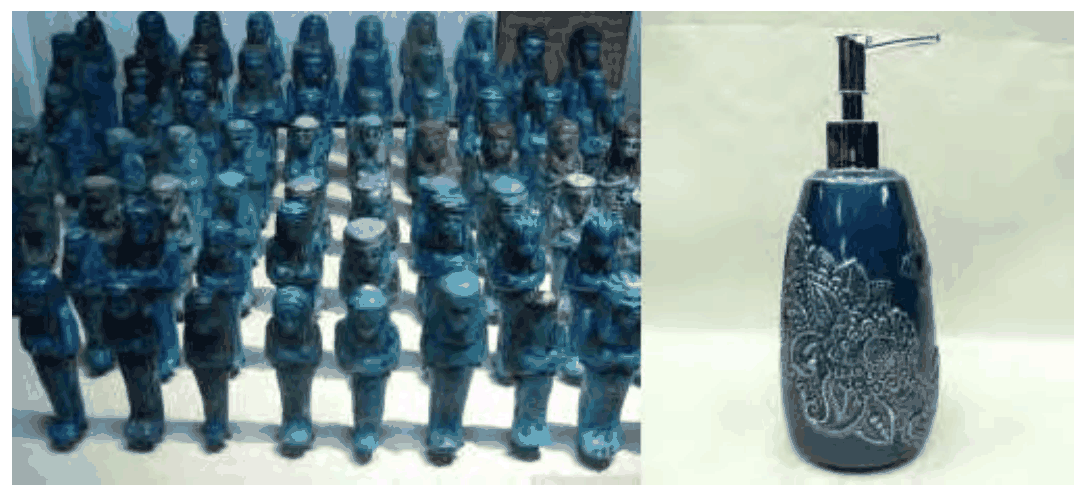
Ushabti figurines from Egyptian pharaoh tomb covered with Egyptian blue
and a Chinese blue soap dinspenser sold at Alibaba
The ancient method of preparation for these pigments can easily by reproduced in a modern laboratory.
When considering the amounts, assume that all of the compounds in this task are pure, and the yields are quantitative.
To make Egyptian blue, one should heat 10.0 g of mineral A with 21.7 g of \(\ce{SiO2}\) and 9.05 g of mineral B at 800 – 900°C for a prolonged time. A volume of 16.7 \(\mathrm{dm^3}\) of a mixture of two gaseous products are released (the volume is measured at 850°C and \(1.013\times10^5\) Pa (1.013 bar) pressure. In result, 34.0 g of the pigment was obtained. No other products are formed. As the gas mixture is cooled, one component of the mixture condenses. As the remaining gas is further cooled to 0°C, the gaseous volume reduces to 3.04 \(\mathrm{dm^3}\).
5.1.1 Calculate the mass of the gaseous mixture formed upon heating of A with B and \(\ce{SiO2}\).
5.1.2 Determine the quantitative composition of this gas mixture.
When 10.0 g of mineral A is heated with 21.7 g of \(\ce{SiO2}\) in the absence of B, it forms 8.34 \(\mathrm{dm^3}\) of gaseous products at a temperature of 850°C and pressure of \(1.013\cdot10^5\) Pa (= 1.013 bar). Mineral A contains only one metal.
5.1.3 Calculate the molar mass and determine the formula of mineral B. Hint: it is an ionic solid insoluble in water and containing no water of crystallization.
In order to obtain Chinese blue, one should take 17.8 g of mineral C instead of mineral B (keeping the amounts of mineral A and \(\ce{SiO2}\) same as for Egyptian blue), and run the reaction at higher temperatures. Besides the pigment, the same gaseous products in the same quantities are formed as in the preparation of Egyptian blue.
5.1.4 Determine the formula of mineral C.
5.1.5 Determine the formulae of Egyptian blue and Chinese blue.
5.1.6 Determine the formula of mineral A.
Elemental analysis of some samples of Chinese blue shows traces of sulfur. This led to a conclusion that those were synthesized using another common mineral instead of C.
5.2.1 Suggest a formula for the mineral used in place of C.
5.2.2 Could the temperature of synthesis of Chinese blue be decreased if this mineral is used instead of C?
If during the synthesis of Chinese blue we take a smaller amount of silica than in the process above, we will obtain a purple pigment: Chinese violet. It was used, in particular, for coloring the famous Terracotta army soldiers.
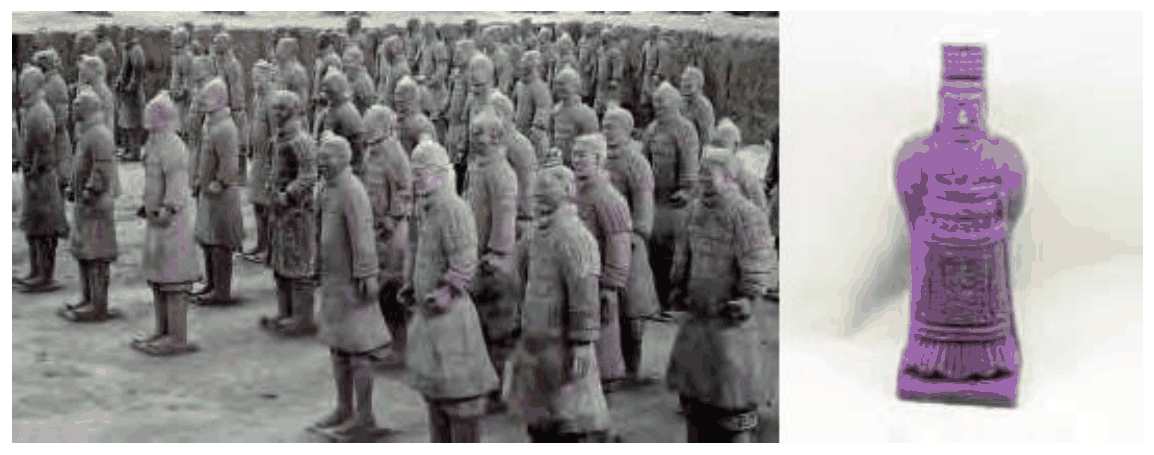
Terracotta army from Xian, China and reconstruction of its original coloring.
5.3 Write down the formula of a binary compound that forms under the conditions required for Chinese violet and is responsible for the change of the color.
Official English text of the problem.
Answers
- 5.1.1: \(m_{\text{gas}}=\boxed{6.75\ \mathrm g}\).
- 5.1.2: Carbon dioxide, \(\ce{CO2}\),
O=C=O, and water vapor, \(\ce{H2O}\),O. Their amounts are approximately \(0.136\ \mathrm{mol}\) and \(0.0456\ \mathrm{mol}\), respectively: about 75 mol% carbon dioxide and 25 mol% water, or a \(3:1\) molar ratio. - 5.1.3: \(\boxed{\mathbf B=\ce{CaCO3}}\), calcium carbonate; \(M_B\approx\boxed{1.00\times10^2\ \mathrm{g\,mol^{-1}}}\).
- 5.1.4: \(\boxed{\mathbf C=\ce{BaCO3}}\), barium carbonate, the mineral witherite.
- 5.1.5: Egyptian blue: \(\boxed{\ce{CaCuSi4O10}}\). Chinese blue: \(\boxed{\ce{BaCuSi4O10}}\).
- 5.1.6: \(\boxed{\mathbf A=\ce{Cu2CO3(OH)2}}\), malachite, copper(II) carbonate hydroxide.
- 5.2.1: \(\boxed{\ce{BaSO4}}\), barium sulfate, the mineral barite.
- 5.2.2: No. Barite is more thermally resistant than barium carbonate; the direct synthesis would require more severe heating.
- 5.3: \(\boxed{\ce{Cu2O}}\), copper(I) oxide, a red binary phase.
Solution
The minerals and pigments are extended crystalline solids, rather than discrete molecules. The ion SMILES below specify individual ionic constituents; they do not describe the crystal lattices or metal–oxygen coordination geometries.
Use the ideal-gas equation with \[ R=8.314\ \mathrm{Pa\,m^3\,mol^{-1}\,K^{-1}}, \qquad T_{\mathrm{hot}}=1123.15\ \mathrm K, \qquad T_{\mathrm{cold}}=273.15\ \mathrm K. \]
5.1.1 — Mass of the gaseous mixture
Since the pigment and the two gases are the only products, conservation of mass gives \[ \begin{aligned} m_{\mathrm{gas}} &=m_A+m_{\ce{SiO2}}+m_B-m_{\mathrm{pigment}}\\ &=10.0+21.7+9.05-34.0\\ &=\boxed{6.75\ \mathrm g}. \end{aligned} \]
5.1.2 — Identity and quantitative composition of the gases
At 850°C, both products are gaseous: \[ n_{\mathrm{total}} =\frac{pV}{RT} =\frac{(1.013\times10^5)(16.7\times10^{-3})} {(8.314)(1123.15)} =0.18117\ \mathrm{mol}. \]
Taking the pressure at 0°C to be unchanged, the amount of gas remaining after condensation is \[ n_{\mathrm{remaining}} =\frac{(1.013\times10^5)(3.04\times10^{-3})} {(8.314)(273.15)} =0.13560\ \mathrm{mol}. \]
Thus the condensable component originally amounted to \[ n_{\mathrm{condensable}} =0.18117-0.13560 =0.04556\ \mathrm{mol}. \]
Water is the expected condensable product from heating a hydroxylated or hydrated mineral. Assigning this component to water, \(\ce{H2O}\), gives the molar mass of the remaining gas: \[ M_{\mathrm{remaining}} =\frac{6.75-(0.04556)(18.015)}{0.13560} =43.7\ \mathrm{g\,mol^{-1}}. \]
This identifies carbon dioxide, whose molar mass is approximately \(44.01\ \mathrm{g\,mol^{-1}}\).
| Component | Amount from the gas volumes | Mole fraction |
|---|---|---|
Carbon dioxide, \(\ce{CO2}\), O=C=O |
\(0.136\ \mathrm{mol}\) | \(0.749\) |
Water vapor, \(\ce{H2O}\), O |
\(0.0456\ \mathrm{mol}\) | \(0.251\) |
Consequently, \[ \boxed{n(\ce{CO2}):n(\ce{H2O})\simeq3:1}. \]
The corresponding masses from the gas-volume calculations are approximately \(5.97\ \mathrm g\) and \(0.821\ \mathrm g\). Their sum, \(6.79\ \mathrm g\), differs slightly from the gravimetric result \(6.75\ \mathrm g\), consistently with the rounding of the supplied measurements.
5.1.3 — Molar mass and formula of mineral B
The gas released from A alone amounts to \[ n_{\mathrm{gas},A} =\frac{(1.013\times10^5)(8.34\times10^{-3})} {(8.314)(1123.15)} =0.090475\ \mathrm{mol}. \]
Therefore, the contribution from B is \[ n_{\mathrm{gas},B} =0.181167-0.090475 =0.090692\ \mathrm{mol}. \]
This exceeds the total water content of the mixture, so B cannot be a simple hydroxide whose only gaseous decomposition product is water. An anhydrous carbonate releasing carbon dioxide is the natural candidate.
For one mole of gas per mole of carbonate, \[ M_B=\frac{9.05}{0.090692} =99.8\ \mathrm{g\,mol^{-1}}. \]
The carbonate group contributes approximately \(60.01\ \mathrm{g\,mol^{-1}}\), leaving \[ 99.8-60.01=39.8\ \mathrm{g\,mol^{-1}} \] for the metal. This matches calcium, \(40.08\ \mathrm{g\,mol^{-1}}\).
Hence \[ \boxed{\mathbf B=\ce{CaCO3}}, \qquad M(\ce{CaCO3})=100.09\ \mathrm{g\,mol^{-1}}. \]
The oxide-forming decomposition is \[ \ce{CaCO3 ->[\Delta] CaO + CO2}. \]
Calcium carbonate is insoluble in water and requires no water of crystallization, agreeing with the hint. Its constituent ions are calcium ion, \(\ce{Ca^2+}\), [Ca+2], and carbonate ion, \(\ce{CO3^2-}\), [O-]C(=O)[O-].
5.1.4 — Formula of mineral C
Replacing B by C leaves both gas quantities unchanged. The corresponding carbonate therefore supplies the same number of moles of carbon dioxide.
Using the identified composition of B, \[ n_B=\frac{9.05}{100.09} =0.09042\ \mathrm{mol}. \]
Thus \[ M_C=\frac{17.8}{0.09042} =196.9\ \mathrm{g\,mol^{-1}}. \]
Subtracting the carbonate contribution gives \[ 196.9-60.01=136.9\ \mathrm{g\,mol^{-1}}, \] which matches barium, \(137.33\ \mathrm{g\,mol^{-1}}\), within the precision of the data.
Therefore \[ \boxed{\mathbf C=\ce{BaCO3}}, \] barium carbonate, or witherite. Its tabulated formula mass is approximately \(197.34\ \mathrm{g\,mol^{-1}}\).
The corresponding oxide-forming reaction is \[ \ce{BaCO3 ->[\Delta] BaO + CO2}. \]
Barium ion, \(\ce{Ba^2+}\), has SMILES [Ba+2].
5.1.5 — Formulae of the two blue pigments
The calcium and silicon amounts in Egyptian blue are \[ n(\ce{Ca})=0.09042\ \mathrm{mol}, \qquad n(\ce{Si})=\frac{21.7}{60.09} =0.3611\ \mathrm{mol}. \]
Hence \[ n(\ce{Si}):n(\ce{Ca})\simeq4:1. \]
The blue color suggests copper(II) as the remaining metal. Check this identification by expressing the pigment composition in oxide equivalents.
The calcium oxide equivalent has mass \[ m(\ce{CaO})=(0.09042)(56.08)=5.07\ \mathrm g. \]
The remaining oxide equivalent therefore has mass \[ m_{\mathrm{remaining\ oxide}} =34.0-21.7-5.07 =7.23\ \mathrm g. \]
If this is copper(II) oxide, \[ n(\ce{CuO}) =\frac{7.23}{79.55} =0.0909\ \mathrm{mol}. \]
Thus \[ n(\ce{Ca}):n(\ce{Cu}):n(\ce{Si}) =0.09042:0.0909:0.3611 \simeq1:1:4. \]
Calcium and copper are both divalent, while silicon has oxidation state \(+4\). Charge balance therefore requires ten oxygen atoms: \[ 2+2+4(4)-2N_{\mathrm O}=0 \quad\Longrightarrow\quad N_{\mathrm O}=10. \]
Consequently, \[ \boxed{\text{Egyptian blue: }\ce{CaCuSi4O10}}. \]
Replacing calcium by the same molar quantity of barium gives \[ \boxed{\text{Chinese blue: }\ce{BaCuSi4O10}}. \]
The oxide-component formation equations are \[ \ce{CaO + CuO + 4SiO2 -> CaCuSi4O10}, \] \[ \ce{BaO + CuO + 4SiO2 -> BaCuSi4O10}. \]
Copper(II) ion, \(\ce{Cu^2+}\), has SMILES [Cu+2]; oxide ion, \(\ce{O^2-}\), has SMILES [O-2]. These isolated-ion representations do not encode the extended silicate structures.
5.1.6 — Formula of mineral A
The carbon dioxide attributable to A is \[ n(\ce{CO2})_A =0.13560-0.09042 =0.04518\ \mathrm{mol}. \]
All the water comes from A: \[ n(\ce{H2O})_A=0.04556\ \mathrm{mol}. \]
These quantities are approximately equal. The copper amount is approximately twice either quantity: \[ n(\ce{Cu}):n(\ce{CO2})_A:n(\ce{H2O})_A \simeq2:1:1. \]
This corresponds to two copper(II) ions, one carbonate ion and two hydroxide ions per formula unit: \[ \boxed{\mathbf A=\ce{Cu2CO3(OH)2}}, \] the mineral malachite.
Hydroxide ion, \(\ce{OH-}\), has SMILES [OH-].
Its decomposition is \[ \ce{Cu2CO3(OH)2 ->[\Delta] 2CuO + CO2 + H2O}. \]
There are two moles of gaseous products per mole of malachite. The independent experiment therefore gives \[ n_A=\frac{0.090475}{2}=0.045237\ \mathrm{mol}, \] and \[ M_A=\frac{10.0}{0.045237} =221.1\ \mathrm{g\,mol^{-1}}. \]
This agrees with \[ M\!\left(\ce{Cu2CO3(OH)2}\right) =2(63.55)+60.01+2(17.008) =221.13\ \mathrm{g\,mol^{-1}}. \]
The complete balanced syntheses are \[ \boxed{\ce{Cu2CO3(OH)2 + 2CaCO3 + 8SiO2 -> 2CaCuSi4O10 + 3CO2 + H2O}}, \] \[ \boxed{\ce{Cu2CO3(OH)2 + 2BaCO3 + 8SiO2 -> 2BaCuSi4O10 + 3CO2 + H2O}}. \]
Both directly reproduce the \(3:1\) carbon dioxide-to-water ratio.
5.2.1 — Sulfur-containing mineral
The replacement mineral must supply barium and contain sulfur. The common mineral satisfying these requirements is barite, barium sulfate: \[ \boxed{\ce{BaSO4}}. \]
Its anion is sulfate, \(\ce{SO4^2-}\), with SMILES [O-]S(=O)(=O)[O-]. Residual sulfate-containing material can account for sulfur traces in the pigment samples.
5.2.2 — Effect on the synthesis temperature
\[ \boxed{\text{No, for the direct thermal synthesis described.}} \]
Barium sulfate is more thermally resistant than barium carbonate. Replacing the carbonate with sulfate makes conversion into the barium silicate pigment more difficult and calls for stronger heating, rather than a lower synthesis temperature.
5.3 — Binary compound associated with the violet color
The inferred binary compound is copper(I) oxide: \[ \boxed{\ce{Cu2O}}. \]
At sufficiently high temperature, copper(II) oxide can release oxygen: \[ \ce{4CuO ->[\Delta] 2Cu2O + O2}. \]
With less silica available to incorporate copper into the silicate phase, formation of a separate copper oxide phase becomes possible. Copper(I) oxide is red; its presence alongside a blue phase can contribute a violet or purple appearance.
Copper(I) ion, \(\ce{Cu+}\), has SMILES [Cu+]. Molecular oxygen, \(\ce{O2}\), has SMILES O=O; this connectivity notation does not specify its triplet ground-state spin.
The solution was checked against the official solution.
IChO 2016 · Theorieaufgabe 5
Ägyptisch Blau und Chinesisch Blau
Vor 5500 Jahren lernten die Menschen im alten Ägypten erstmals, ein blaues Pigment zu synthetisieren. Heute kennen wir dieses Pigment als Ägyptisch Blau. Etwa 2000 Jahre später war im alten China ein anderes Pigment weit verbreitet, das heute als Chinesisch Blau bezeichnet wird. Die beiden Pigmente haben eine ähnliche Struktur, unterscheiden sich jedoch in ihrer elementaren Zusammensetzung.
Mit Ägyptisch Blau überzogene Uschebti-Figuren aus einem ägyptischen Pharaonengrab
und ein bei Alibaba angebotener Seifenspender in Chinesisch Blau
Das antike Herstellungsverfahren für diese Pigmente lässt sich in einem modernen Labor leicht nachvollziehen.
Gehen Sie bei den Mengenbetrachtungen davon aus, dass alle Verbindungen in dieser Aufgabe rein sind und die Ausbeuten quantitativ sind.
Zur Herstellung von Ägyptisch Blau werden 10.0 g des Minerals A mit 21.7 g \(\ce{SiO2}\) und 9.05 g des Minerals B über längere Zeit auf 800 – 900°C erhitzt. Dabei werden 16.7 \(\mathrm{dm^3}\) eines Gemisches aus zwei gasförmigen Produkten freigesetzt (das Volumen wird bei 850°C und einem Druck von \(1.013\times10^5\) Pa (1.013 bar) gemessen). Es werden 34.0 g des Pigments erhalten. Weitere Produkte entstehen nicht. Beim Abkühlen des Gasgemisches kondensiert eine seiner Komponenten. Wird das verbleibende Gas weiter auf 0°C abgekühlt, verringert sich sein Volumen auf 3.04 \(\mathrm{dm^3}\).
5.1.1 Berechnen Sie die Masse des Gasgemisches, das beim Erhitzen von A mit B und \(\ce{SiO2}\) entsteht.
5.1.2 Bestimmen Sie die quantitative Zusammensetzung dieses Gasgemisches.
Werden 10.0 g des Minerals A mit 21.7 g \(\ce{SiO2}\) in Abwesenheit von B erhitzt, entstehen 8.34 \(\mathrm{dm^3}\) gasförmige Produkte bei einer Temperatur von 850°C und einem Druck von \(1.013\cdot10^5\) Pa (= 1.013 bar). Mineral A enthält nur ein Metall.
5.1.3 Berechnen Sie die molare Masse und bestimmen Sie die Formel des Minerals B. Hinweis: Es handelt sich um einen wasserunlöslichen ionischen Feststoff, der kein Kristallwasser enthält.
Um Chinesisch Blau zu erhalten, werden anstelle des Minerals B 17.8 g des Minerals C eingesetzt (wobei die Mengen des Minerals A und von \(\ce{SiO2}\) gegenüber der Herstellung von Ägyptisch Blau unverändert bleiben), und die Reaktion wird bei höheren Temperaturen durchgeführt. Neben dem Pigment entstehen dieselben gasförmigen Produkte in denselben Mengen wie bei der Herstellung von Ägyptisch Blau.
5.1.4 Bestimmen Sie die Formel des Minerals C.
5.1.5 Bestimmen Sie die Formeln von Ägyptisch Blau und Chinesisch Blau.
5.1.6 Bestimmen Sie die Formel des Minerals A.
Die Elementaranalyse einiger Proben von Chinesisch Blau zeigt Spuren von Schwefel. Dies führte zu dem Schluss, dass diese Proben unter Verwendung eines anderen häufig vorkommenden Minerals anstelle von C synthetisiert wurden.
5.2.1 Schlagen Sie eine Formel für das anstelle von C verwendete Mineral vor.
5.2.2 Könnte die Synthesetemperatur von Chinesisch Blau gesenkt werden, wenn dieses Mineral anstelle von C verwendet wird?
Wenn bei der Synthese von Chinesisch Blau eine geringere Menge Siliciumdioxid als im oben beschriebenen Verfahren eingesetzt wird, erhält man ein purpurfarbenes Pigment: Chinesisch Violett. Es wurde insbesondere zur Bemalung der berühmten Soldaten der Terrakotta-Armee verwendet.
Terrakotta-Armee aus Xi’an, China, und Rekonstruktion ihrer ursprünglichen Bemalung.
5.3 Geben Sie die Formel einer binären Verbindung an, die unter den für Chinesisch Violett erforderlichen Bedingungen entsteht und für die Farbänderung verantwortlich ist.
Aufgabentext aus dem offiziellen englischen Text übersetzt.
Antworten
- 5.1.1: \(m_{\text{Gas}}=\boxed{6.75\ \mathrm g}\).
- 5.1.2: Kohlenstoffdioxid, \(\ce{CO2}\),
O=C=O, und Wasserdampf, \(\ce{H2O}\),O. Ihre Stoffmengen betragen etwa \(0.136\ \mathrm{mol}\) bzw. \(0.0456\ \mathrm{mol}\): ungefähr 75 Mol-% Kohlenstoffdioxid und 25 Mol-% Wasser, entsprechend einem Stoffmengenverhältnis von \(3:1\). - 5.1.3: \(\boxed{\mathbf B=\ce{CaCO3}}\), Calciumcarbonat; \(M_B\approx\boxed{1.00\times10^2\ \mathrm{g\,mol^{-1}}}\).
- 5.1.4: \(\boxed{\mathbf C=\ce{BaCO3}}\), Bariumcarbonat, das Mineral Witherit.
- 5.1.5: Ägyptisch Blau: \(\boxed{\ce{CaCuSi4O10}}\). Chinesisch Blau: \(\boxed{\ce{BaCuSi4O10}}\).
- 5.1.6: \(\boxed{\mathbf A=\ce{Cu2CO3(OH)2}}\), Malachit, Kupfer(II)-carbonathydroxid.
- 5.2.1: \(\boxed{\ce{BaSO4}}\), Bariumsulfat, das Mineral Baryt.
- 5.2.2: Nein. Baryt ist thermisch beständiger als Bariumcarbonat; die direkte Synthese würde stärkeres Erhitzen erfordern.
- 5.3: \(\boxed{\ce{Cu2O}}\), Kupfer(I)-oxid, eine rote binäre Phase.
Lösung
Die Minerale und Pigmente sind ausgedehnte kristalline Festkörper und keine diskreten Moleküle. Die nachstehenden Ionen-SMILES geben einzelne ionische Bestandteile an; sie beschreiben weder die Kristallgitter noch die Metall-Sauerstoff-Koordinationsgeometrien.
Verwenden Sie die ideale Gasgleichung mit \[ R=8.314\ \mathrm{Pa\,m^3\,mol^{-1}\,K^{-1}}, \qquad T_{\mathrm{hot}}=1123.15\ \mathrm K, \qquad T_{\mathrm{cold}}=273.15\ \mathrm K. \]
5.1.1 — Masse des Gasgemisches
Da das Pigment und die beiden Gase die einzigen Produkte sind, ergibt sich aus der Massenerhaltung \[ \begin{aligned} m_{\mathrm{gas}} &=m_A+m_{\ce{SiO2}}+m_B-m_{\mathrm{pigment}}\\ &=10.0+21.7+9.05-34.0\\ &=\boxed{6.75\ \mathrm g}. \end{aligned} \]
5.1.2 — Identität und quantitative Zusammensetzung der Gase
Bei 850°C sind beide Produkte gasförmig: \[ n_{\mathrm{total}} =\frac{pV}{RT} =\frac{(1.013\times10^5)(16.7\times10^{-3})} {(8.314)(1123.15)} =0.18117\ \mathrm{mol}. \]
Unter der Annahme, dass der Druck bei 0°C unverändert bleibt, beträgt die nach der Kondensation verbleibende Gasstoffmenge \[ n_{\mathrm{remaining}} =\frac{(1.013\times10^5)(3.04\times10^{-3})} {(8.314)(273.15)} =0.13560\ \mathrm{mol}. \]
Damit betrug die ursprüngliche Stoffmenge der kondensierbaren Komponente \[ n_{\mathrm{condensable}} =0.18117-0.13560 =0.04556\ \mathrm{mol}. \]
Beim Erhitzen eines hydroxylgruppenhaltigen oder hydratisierten Minerals ist Wasser als kondensierbares Produkt zu erwarten. Ordnet man diese Komponente Wasser, \(\ce{H2O}\), zu, ergibt sich für die molare Masse des verbleibenden Gases: \[ M_{\mathrm{remaining}} =\frac{6.75-(0.04556)(18.015)}{0.13560} =43.7\ \mathrm{g\,mol^{-1}}. \]
Damit lässt sich das Gas als Kohlenstoffdioxid identifizieren, dessen molare Masse etwa \(44.01\ \mathrm{g\,mol^{-1}}\) beträgt.
| Komponente | Stoffmenge aus den Gasvolumina | Stoffmengenanteil |
|---|---|---|
Kohlenstoffdioxid, \(\ce{CO2}\), O=C=O |
\(0.136\ \mathrm{mol}\) | \(0.749\) |
Wasserdampf, \(\ce{H2O}\), O |
\(0.0456\ \mathrm{mol}\) | \(0.251\) |
Folglich gilt \[ \boxed{n(\ce{CO2}):n(\ce{H2O})\simeq3:1}. \]
Die entsprechenden, aus den Gasvolumina berechneten Massen betragen ungefähr \(5.97\ \mathrm g\) und \(0.821\ \mathrm g\). Ihre Summe, \(6.79\ \mathrm g\), weicht geringfügig vom gravimetrischen Ergebnis \(6.75\ \mathrm g\) ab, was mit der Rundung der angegebenen Messwerte vereinbar ist.
5.1.3 — Molare Masse und Formel des Minerals B
Die allein aus A freigesetzte Gasstoffmenge beträgt \[ n_{\mathrm{gas},A} =\frac{(1.013\times10^5)(8.34\times10^{-3})} {(8.314)(1123.15)} =0.090475\ \mathrm{mol}. \]
Der Beitrag von B beträgt daher \[ n_{\mathrm{gas},B} =0.181167-0.090475 =0.090692\ \mathrm{mol}. \]
Diese Stoffmenge übersteigt den gesamten Wassergehalt des Gemisches; B kann daher kein einfaches Hydroxid sein, dessen einziges gasförmiges Zersetzungsprodukt Wasser ist. Ein wasserfreies Carbonat, das Kohlenstoffdioxid freisetzt, ist ein naheliegender Kandidat.
Für ein Mol Gas pro Mol Carbonat gilt \[ M_B=\frac{9.05}{0.090692} =99.8\ \mathrm{g\,mol^{-1}}. \]
Die Carbonatgruppe trägt etwa \(60.01\ \mathrm{g\,mol^{-1}}\) bei, sodass für das Metall \[ 99.8-60.01=39.8\ \mathrm{g\,mol^{-1}} \] verbleiben. Dies entspricht Calcium mit \(40.08\ \mathrm{g\,mol^{-1}}\).
Somit gilt \[ \boxed{\mathbf B=\ce{CaCO3}}, \qquad M(\ce{CaCO3})=100.09\ \mathrm{g\,mol^{-1}}. \]
Die Zersetzung unter Oxidbildung lautet \[ \ce{CaCO3 ->[\Delta] CaO + CO2}. \]
Calciumcarbonat ist wasserunlöslich und benötigt kein Kristallwasser, was mit dem Hinweis übereinstimmt. Seine ionischen Bestandteile sind das Calciumion, \(\ce{Ca^2+}\), [Ca+2], und das Carbonation, \(\ce{CO3^2-}\), [O-]C(=O)[O-].
5.1.4 — Formel des Minerals C
Beim Ersatz von B durch C bleiben beide Gasstoffmengen unverändert. Das entsprechende Carbonat liefert daher dieselbe Stoffmenge Kohlenstoffdioxid.
Mit der ermittelten Zusammensetzung von B ergibt sich \[ n_B=\frac{9.05}{100.09} =0.09042\ \mathrm{mol}. \]
Somit gilt \[ M_C=\frac{17.8}{0.09042} =196.9\ \mathrm{g\,mol^{-1}}. \]
Nach Abzug des Carbonatanteils erhält man \[ 196.9-60.01=136.9\ \mathrm{g\,mol^{-1}}, \] was innerhalb der Genauigkeit der Daten Barium mit \(137.33\ \mathrm{g\,mol^{-1}}\) entspricht.
Daher ist \[ \boxed{\mathbf C=\ce{BaCO3}}, \] also Bariumcarbonat oder Witherit. Seine tabellierte molare Formelmasse beträgt ungefähr \(197.34\ \mathrm{g\,mol^{-1}}\).
Die entsprechende Reaktion unter Oxidbildung lautet \[ \ce{BaCO3 ->[\Delta] BaO + CO2}. \]
Das Bariumion, \(\ce{Ba^2+}\), hat den SMILES-Code [Ba+2].
5.1.5 — Formeln der beiden blauen Pigmente
Die Stoffmengen von Calcium und Silicium in Ägyptisch Blau betragen \[ n(\ce{Ca})=0.09042\ \mathrm{mol}, \qquad n(\ce{Si})=\frac{21.7}{60.09} =0.3611\ \mathrm{mol}. \]
Somit gilt \[ n(\ce{Si}):n(\ce{Ca})\simeq4:1. \]
Die blaue Farbe legt Kupfer(II) als verbleibendes Metall nahe. Überprüfen Sie diese Zuordnung, indem Sie die Zusammensetzung des Pigments in Oxidäquivalenten ausdrücken.
Das Calciumoxidäquivalent hat die Masse \[ m(\ce{CaO})=(0.09042)(56.08)=5.07\ \mathrm g. \]
Das verbleibende Oxidäquivalent hat daher die Masse \[ m_{\mathrm{remaining\ oxide}} =34.0-21.7-5.07 =7.23\ \mathrm g. \]
Handelt es sich dabei um Kupfer(II)-oxid, so gilt \[ n(\ce{CuO}) =\frac{7.23}{79.55} =0.0909\ \mathrm{mol}. \]
Somit gilt \[ n(\ce{Ca}):n(\ce{Cu}):n(\ce{Si}) =0.09042:0.0909:0.3611 \simeq1:1:4. \]
Calcium und Kupfer sind beide zweiwertig, während Silicium die Oxidationsstufe \(+4\) besitzt. Der Ladungsausgleich erfordert daher zehn Sauerstoffatome: \[ 2+2+4(4)-2N_{\mathrm O}=0 \quad\Longrightarrow\quad N_{\mathrm O}=10. \]
Folglich gilt \[ \boxed{\text{Ägyptisch Blau: }\ce{CaCuSi4O10}}. \]
Ersetzt man Calcium durch dieselbe Stoffmenge Barium, erhält man \[ \boxed{\text{Chinesisch Blau: }\ce{BaCuSi4O10}}. \]
Die Bildungsgleichungen aus den Oxidkomponenten lauten \[ \ce{CaO + CuO + 4SiO2 -> CaCuSi4O10}, \] \[ \ce{BaO + CuO + 4SiO2 -> BaCuSi4O10}. \]
Das Kupfer(II)-Ion, \(\ce{Cu^2+}\), hat den SMILES-Code [Cu+2]; das Oxidion, \(\ce{O^2-}\), hat den SMILES-Code [O-2]. Diese Darstellungen isolierter Ionen geben die ausgedehnten Silicatstrukturen nicht wieder.
5.1.6 — Formel des Minerals A
Die A zuzuschreibende Stoffmenge Kohlenstoffdioxid beträgt \[ n(\ce{CO2})_A =0.13560-0.09042 =0.04518\ \mathrm{mol}. \]
Das gesamte Wasser stammt aus A: \[ n(\ce{H2O})_A=0.04556\ \mathrm{mol}. \]
Diese Stoffmengen sind annähernd gleich. Die Kupferstoffmenge ist ungefähr doppelt so groß wie jede dieser beiden Stoffmengen: \[ n(\ce{Cu}):n(\ce{CO2})_A:n(\ce{H2O})_A \simeq2:1:1. \]
Dies entspricht zwei Kupfer(II)-Ionen, einem Carbonation und zwei Hydroxidionen pro Formeleinheit: \[ \boxed{\mathbf A=\ce{Cu2CO3(OH)2}}, \] dem Mineral Malachit.
Das Hydroxidion, \(\ce{OH-}\), hat den SMILES-Code [OH-].
Seine Zersetzung lautet \[ \ce{Cu2CO3(OH)2 ->[\Delta] 2CuO + CO2 + H2O}. \]
Pro Mol Malachit entstehen zwei Mol gasförmige Produkte. Das unabhängige Experiment liefert daher \[ n_A=\frac{0.090475}{2}=0.045237\ \mathrm{mol}, \] und \[ M_A=\frac{10.0}{0.045237} =221.1\ \mathrm{g\,mol^{-1}}. \]
Dies stimmt überein mit \[ M\!\left(\ce{Cu2CO3(OH)2}\right) =2(63.55)+60.01+2(17.008) =221.13\ \mathrm{g\,mol^{-1}}. \]
Die vollständig ausgeglichenen Synthesegleichungen lauten \[ \boxed{\ce{Cu2CO3(OH)2 + 2CaCO3 + 8SiO2 -> 2CaCuSi4O10 + 3CO2 + H2O}}, \] \[ \boxed{\ce{Cu2CO3(OH)2 + 2BaCO3 + 8SiO2 -> 2BaCuSi4O10 + 3CO2 + H2O}}. \]
Beide geben unmittelbar das Verhältnis von Kohlenstoffdioxid zu Wasser von \(3:1\) wieder.
5.2.1 — Schwefelhaltiges Mineral
Das Ersatzmineral muss Barium liefern und Schwefel enthalten. Das häufig vorkommende Mineral, das diese Anforderungen erfüllt, ist Baryt, Bariumsulfat: \[ \boxed{\ce{BaSO4}}. \]
Sein Anion ist Sulfat, \(\ce{SO4^2-}\), mit dem SMILES-Code [O-]S(=O)(=O)[O-]. Zurückgebliebenes sulfathaltiges Material kann die Schwefelspuren in den Pigmentproben erklären.
5.2.2 — Einfluss auf die Synthesetemperatur
\[ \boxed{\text{Nein, nicht bei der beschriebenen direkten thermischen Synthese.}} \]
Bariumsulfat ist thermisch beständiger als Bariumcarbonat. Der Ersatz des Carbonats durch Sulfat erschwert die Umwandlung in das Bariumsilicatpigment und erfordert stärkeres Erhitzen statt einer niedrigeren Synthesetemperatur.
5.3 — Binäre Verbindung im Zusammenhang mit der violetten Farbe
Die erschlossene binäre Verbindung ist Kupfer(I)-oxid: \[ \boxed{\ce{Cu2O}}. \]
Bei ausreichend hoher Temperatur kann Kupfer(II)-oxid Sauerstoff freisetzen: \[ \ce{4CuO ->[\Delta] 2Cu2O + O2}. \]
Wenn weniger Siliciumdioxid zur Verfügung steht, um Kupfer in die Silicatphase einzubauen, wird die Bildung einer separaten Kupferoxidphase möglich. Kupfer(I)-oxid ist rot; seine Anwesenheit neben einer blauen Phase kann zu einem violetten oder purpurfarbenen Erscheinungsbild beitragen.
Das Kupfer(I)-Ion, \(\ce{Cu+}\), hat den SMILES-Code [Cu+]. Molekularer Sauerstoff, \(\ce{O2}\), hat den SMILES-Code O=O; diese Konnektivitätsnotation gibt seinen Triplett-Grundzustandsspin nicht an.
Die Lösung wurde mit der offiziellen Lösung abgeglichen.
IChO 2016 · Teori sorusu 5
Mısır mavisi ve Çin mavisi
5500 yıl önce, eski Mısır'da insanlar ilk kez mavi bir pigmentin nasıl sentezleneceğini öğrendiler. Günümüzde bu pigmenti Mısır mavisi olarak biliyoruz. Yaklaşık 2000 yıl sonra, eski Çin'de bugün Çin mavisi olarak adlandırılan başka bir pigment yaygın olarak kullanılıyordu. Bu iki pigment yapı bakımından benzerdir, ancak element bileşimleri farklıdır.
Mısır mavisiyle kaplı, bir Mısır firavununun mezarından çıkarılmış Uşabti heykelcikleri
ve Alibaba'da satılan Çin mavisi bir sıvı sabunluk
Bu pigmentlerin eski çağlardaki hazırlanma yöntemi, modern bir laboratuvarda kolayca yeniden uygulanabilir.
Miktarları değerlendirirken, bu sorudaki tüm bileşiklerin saf olduğunu ve tepkimelerin kantitatif verimle gerçekleştiğini varsayın.
Mısır mavisi elde etmek için 10.0 g A minerali, 21.7 g \(\ce{SiO2}\) ve 9.05 g B minerali ile birlikte 800 – 900°C'de uzun süre ısıtılmalıdır. İki gaz ürünün karışımından 16.7 \(\mathrm{dm^3}\) hacminde gaz açığa çıkar (hacim, 850°C'de ve \(1.013\times10^5\) Pa (1.013 bar) basınçta ölçülmüştür). Sonuçta 34.0 g pigment elde edilmiştir. Başka hiçbir ürün oluşmaz. Gaz karışımı soğutulduğunda, karışımdaki bileşenlerden biri yoğuşur. Kalan gaz 0°C'ye kadar soğutulmaya devam edildiğinde gazın hacmi 3.04 \(\mathrm{dm^3}\) değerine düşer.
5.1.1 A'nın B ve \(\ce{SiO2}\) ile birlikte ısıtılması sırasında oluşan gaz karışımının kütlesini hesaplayın.
5.1.2 Bu gaz karışımının nicel bileşimini belirleyin.
10.0 g A minerali, B olmadan 21.7 g \(\ce{SiO2}\) ile ısıtıldığında, 850°C sıcaklıkta ve \(1.013\cdot10^5\) Pa (= 1.013 bar) basınçta 8.34 \(\mathrm{dm^3}\) gaz ürün oluşturur. A minerali yalnızca bir metal içerir.
5.1.3 B mineralinin molar kütlesini hesaplayın ve formülünü belirleyin. İpucu: Suda çözünmeyen ve kristal suyu içermeyen iyonik bir katıdır.
Çin mavisi elde etmek için B minerali yerine 17.8 g C minerali alınmalı (A minerali ve \(\ce{SiO2}\) miktarları Mısır mavisi için kullanılan miktarlarla aynı tutulmalı) ve tepkime daha yüksek sıcaklıklarda gerçekleştirilmelidir. Pigmentin yanı sıra, Mısır mavisinin hazırlanmasında oluşan gaz ürünlerin aynıları, aynı miktarlarda oluşur.
5.1.4 C mineralinin formülünü belirleyin.
5.1.5 Mısır mavisinin ve Çin mavisinin formüllerini belirleyin.
5.1.6 A mineralinin formülünü belirleyin.
Bazı Çin mavisi örneklerinin element analizi, eser miktarda kükürt bulunduğunu göstermektedir. Bu durum, söz konusu örneklerin C yerine yaygın olarak bulunan başka bir mineral kullanılarak sentezlendiği sonucuna varılmasına yol açmıştır.
5.2.1 C yerine kullanılan mineral için bir formül önerin.
5.2.2 C yerine bu mineral kullanılırsa Çin mavisinin sentez sıcaklığı düşürülebilir mi?
Çin mavisinin sentezi sırasında yukarıdaki işlemdekinden daha az miktarda silika kullanırsak, mor bir pigment olan Çin morunu elde ederiz. Bu pigment özellikle ünlü Toprak Ordu askerlerini renklendirmek için kullanılmıştır.
Çin'in Xian kentindeki Toprak Ordu ve özgün renklerinin yeniden canlandırılması.
5.3 Çin moru için gereken koşullarda oluşan ve renk değişiminden sorumlu olan ikili bir bileşiğin formülünü yazın.
Soru metni resmi İngilizce metinden çevrilmiştir.
Cevaplar
- 5.1.1: \(m_{\text{gaz}}=\boxed{6.75\ \mathrm g}\).
- 5.1.2: Karbondioksit, \(\ce{CO2}\),
O=C=O, ve su buharı, \(\ce{H2O}\),O. Miktarları sırasıyla yaklaşık \(0.136\ \mathrm{mol}\) ve \(0.0456\ \mathrm{mol}\) değerindedir: yaklaşık molce %75 karbondioksit ve molce %25 su, yani \(3:1\) molar oran. - 5.1.3: \(\boxed{\mathbf B=\ce{CaCO3}}\), kalsiyum karbonat; \(M_B\approx\boxed{1.00\times10^2\ \mathrm{g\,mol^{-1}}}\).
- 5.1.4: \(\boxed{\mathbf C=\ce{BaCO3}}\), baryum karbonat, viterit minerali.
- 5.1.5: Mısır mavisi: \(\boxed{\ce{CaCuSi4O10}}\). Çin mavisi: \(\boxed{\ce{BaCuSi4O10}}\).
- 5.1.6: \(\boxed{\mathbf A=\ce{Cu2CO3(OH)2}}\), malakit, bakır(II) karbonat hidroksit.
- 5.2.1: \(\boxed{\ce{BaSO4}}\), baryum sülfat, barit minerali.
- 5.2.2: Hayır. Barit, baryum karbonata göre ısıya daha dayanıklıdır; doğrudan sentez daha kuvvetli ısıtma gerektirir.
- 5.3: \(\boxed{\ce{Cu2O}}\), bakır(I) oksit, kırmızı renkli bir ikili faz.
Çözüm
Mineraller ve pigmentler, ayrı moleküllerden oluşmak yerine uzanımlı kristal yapılı katılardır. Aşağıdaki iyon SMILES gösterimleri, tek tek iyonik bileşenleri belirtir; kristal örgüleri veya metal–oksijen koordinasyon geometrilerini tanımlamaz.
İdeal gaz denklemini şu değerlerle kullanın: \[ R=8.314\ \mathrm{Pa\,m^3\,mol^{-1}\,K^{-1}}, \qquad T_{\mathrm{hot}}=1123.15\ \mathrm K, \qquad T_{\mathrm{cold}}=273.15\ \mathrm K. \]
5.1.1 — Gaz karışımının kütlesi
Pigment ve iki gaz, oluşan yegâne ürünler olduğundan, kütlenin korunumu şu sonucu verir: \[ \begin{aligned} m_{\mathrm{gas}} &=m_A+m_{\ce{SiO2}}+m_B-m_{\mathrm{pigment}}\\ &=10.0+21.7+9.05-34.0\\ &=\boxed{6.75\ \mathrm g}. \end{aligned} \]
5.1.2 — Gazların belirlenmesi ve nicel bileşimi
850°C'de her iki ürün de gaz hâlindedir: \[ n_{\mathrm{total}} =\frac{pV}{RT} =\frac{(1.013\times10^5)(16.7\times10^{-3})} {(8.314)(1123.15)} =0.18117\ \mathrm{mol}. \]
0°C'deki basıncın değişmediği kabul edildiğinde, yoğuşmadan sonra kalan gazın miktarı şöyledir: \[ n_{\mathrm{remaining}} =\frac{(1.013\times10^5)(3.04\times10^{-3})} {(8.314)(273.15)} =0.13560\ \mathrm{mol}. \]
Buna göre yoğuşabilen bileşenin başlangıçtaki miktarı şöyledir: \[ n_{\mathrm{condensable}} =0.18117-0.13560 =0.04556\ \mathrm{mol}. \]
Hidroksil grupları veya kristal suyu içeren bir mineralin ısıtılmasıyla oluşması beklenen yoğuşabilir ürün sudur. Bu bileşenin su, \(\ce{H2O}\), olduğu kabul edildiğinde kalan gazın molar kütlesi elde edilir: \[ M_{\mathrm{remaining}} =\frac{6.75-(0.04556)(18.015)}{0.13560} =43.7\ \mathrm{g\,mol^{-1}}. \]
Bu sonuç, molar kütlesi yaklaşık \(44.01\ \mathrm{g\,mol^{-1}}\) olan karbondioksite karşılık gelir.
| Bileşen | Gaz hacimlerinden hesaplanan miktar | Mol kesri |
|---|---|---|
Karbondioksit, \(\ce{CO2}\), O=C=O |
\(0.136\ \mathrm{mol}\) | \(0.749\) |
Su buharı, \(\ce{H2O}\), O |
\(0.0456\ \mathrm{mol}\) | \(0.251\) |
Sonuç olarak, \[ \boxed{n(\ce{CO2}):n(\ce{H2O})\simeq3:1}. \]
Gaz hacmi hesaplamalarından elde edilen karşılık gelen kütleler yaklaşık \(5.97\ \mathrm g\) ve \(0.821\ \mathrm g\) değerindedir. Bunların toplamı olan \(6.79\ \mathrm g\), verilen ölçümlerin yuvarlanmasıyla uyumlu olarak gravimetrik sonuç \(6.75\ \mathrm g\) değerinden biraz farklıdır.
5.1.3 — B mineralinin molar kütlesi ve formülü
Yalnızca A'dan açığa çıkan gazın miktarı şöyledir: \[ n_{\mathrm{gas},A} =\frac{(1.013\times10^5)(8.34\times10^{-3})} {(8.314)(1123.15)} =0.090475\ \mathrm{mol}. \]
Dolayısıyla B'nin katkısı şöyledir: \[ n_{\mathrm{gas},B} =0.181167-0.090475 =0.090692\ \mathrm{mol}. \]
Bu miktar, karışımın toplam su içeriğini aştığından B, gaz hâlindeki tek bozunma ürünü su olan basit bir hidroksit olamaz. Karbondioksit açığa çıkaran susuz bir karbonat, akla gelen adaydır.
Bir mol karbonat başına bir mol gaz için, \[ M_B=\frac{9.05}{0.090692} =99.8\ \mathrm{g\,mol^{-1}}. \]
Karbonat grubunun katkısı yaklaşık \(60.01\ \mathrm{g\,mol^{-1}}\) olduğundan, metal için \[ 99.8-60.01=39.8\ \mathrm{g\,mol^{-1}} \] kalır. Bu değer, kalsiyumun \(40.08\ \mathrm{g\,mol^{-1}}\) değeriyle uyuşur.
Böylece \[ \boxed{\mathbf B=\ce{CaCO3}}, \qquad M(\ce{CaCO3})=100.09\ \mathrm{g\,mol^{-1}}. \]
Oksit oluşumuyla sonuçlanan bozunma şöyledir: \[ \ce{CaCO3 ->[\Delta] CaO + CO2}. \]
Kalsiyum karbonat suda çözünmez ve yapısında kristal suyu bulunması gerekmez; bu özellikler ipucuyla uyumludur. Bileşen iyonları kalsiyum iyonu, \(\ce{Ca^2+}\), [Ca+2], ve karbonat iyonu, \(\ce{CO3^2-}\), [O-]C(=O)[O-], şeklindedir.
5.1.4 — C mineralinin formülü
B yerine C kullanılması, her iki gazın miktarını da değiştirmez. Dolayısıyla karşılık gelen karbonat, aynı mol sayısında karbondioksit sağlar.
B'nin belirlenen bileşimi kullanıldığında, \[ n_B=\frac{9.05}{100.09} =0.09042\ \mathrm{mol}. \]
Böylece \[ M_C=\frac{17.8}{0.09042} =196.9\ \mathrm{g\,mol^{-1}}. \]
Karbonatın katkısı çıkarıldığında \[ 196.9-60.01=136.9\ \mathrm{g\,mol^{-1}}, \] elde edilir; bu değer, verilerin hassasiyeti içinde baryumun \(137.33\ \mathrm{g\,mol^{-1}}\) değeriyle uyuşur.
Dolayısıyla \[ \boxed{\mathbf C=\ce{BaCO3}}, \] yani baryum karbonat veya viterittir. Çizelgelerde verilen formül kütlesi yaklaşık \(197.34\ \mathrm{g\,mol^{-1}}\) değerindedir.
Oksit oluşumuyla sonuçlanan karşılık gelen tepkime şöyledir: \[ \ce{BaCO3 ->[\Delta] BaO + CO2}. \]
Baryum iyonunun, \(\ce{Ba^2+}\), SMILES gösterimi [Ba+2] şeklindedir.
5.1.5 — İki mavi pigmentin formülleri
Mısır mavisindeki kalsiyum ve silisyum miktarları şöyledir: \[ n(\ce{Ca})=0.09042\ \mathrm{mol}, \qquad n(\ce{Si})=\frac{21.7}{60.09} =0.3611\ \mathrm{mol}. \]
Böylece \[ n(\ce{Si}):n(\ce{Ca})\simeq4:1. \]
Mavi renk, kalan metalin bakır(II) olduğunu düşündürür. Pigment bileşimini oksit eşdeğerleri cinsinden ifade ederek bu belirlemeyi kontrol edin.
Kalsiyum oksit eşdeğerinin kütlesi şöyledir: \[ m(\ce{CaO})=(0.09042)(56.08)=5.07\ \mathrm g. \]
Dolayısıyla kalan oksit eşdeğerinin kütlesi şöyledir: \[ m_{\mathrm{remaining\ oxide}} =34.0-21.7-5.07 =7.23\ \mathrm g. \]
Bu oksit bakır(II) oksit ise, \[ n(\ce{CuO}) =\frac{7.23}{79.55} =0.0909\ \mathrm{mol}. \]
Böylece \[ n(\ce{Ca}):n(\ce{Cu}):n(\ce{Si}) =0.09042:0.0909:0.3611 \simeq1:1:4. \]
Kalsiyum ve bakırın her ikisi de iki değerliklidir; silisyumun yükseltgenme basamağı ise \(+4\) değerindedir. Bu nedenle yük dengesi on oksijen atomu gerektirir: \[ 2+2+4(4)-2N_{\mathrm O}=0 \quad\Longrightarrow\quad N_{\mathrm O}=10. \]
Sonuç olarak, \[ \boxed{\text{Mısır mavisi: }\ce{CaCuSi4O10}}. \]
Kalsiyumun aynı molar miktarda baryumla değiştirilmesi şu sonucu verir: \[ \boxed{\text{Çin mavisi: }\ce{BaCuSi4O10}}. \]
Oksit bileşenlerinden oluşum denklemleri şöyledir: \[ \ce{CaO + CuO + 4SiO2 -> CaCuSi4O10}, \] \[ \ce{BaO + CuO + 4SiO2 -> BaCuSi4O10}. \]
Bakır(II) iyonunun, \(\ce{Cu^2+}\), SMILES gösterimi [Cu+2]; oksit iyonunun, \(\ce{O^2-}\), SMILES gösterimi [O-2] şeklindedir. Bu tekil iyon gösterimleri, uzanımlı silikat yapılarını kodlamaz.
5.1.6 — A mineralinin formülü
A'dan kaynaklanan karbondioksit miktarı şöyledir: \[ n(\ce{CO2})_A =0.13560-0.09042 =0.04518\ \mathrm{mol}. \]
Suyun tamamı A'dan gelir: \[ n(\ce{H2O})_A=0.04556\ \mathrm{mol}. \]
Bu miktarlar yaklaşık olarak eşittir. Bakır miktarı, bu miktarların her birinin yaklaşık iki katıdır: \[ n(\ce{Cu}):n(\ce{CO2})_A:n(\ce{H2O})_A \simeq2:1:1. \]
Bu, formül birimi başına iki bakır(II) iyonuna, bir karbonat iyonuna ve iki hidroksit iyonuna karşılık gelir: \[ \boxed{\mathbf A=\ce{Cu2CO3(OH)2}}, \] yani malakit mineralidir.
Hidroksit iyonunun, \(\ce{OH-}\), SMILES gösterimi [OH-] şeklindedir.
Bozunması şöyledir: \[ \ce{Cu2CO3(OH)2 ->[\Delta] 2CuO + CO2 + H2O}. \]
Bir mol malakit başına iki mol gaz ürün oluşur. Dolayısıyla bağımsız deney şu sonuçları verir: \[ n_A=\frac{0.090475}{2}=0.045237\ \mathrm{mol}, \] ve \[ M_A=\frac{10.0}{0.045237} =221.1\ \mathrm{g\,mol^{-1}}. \] Bu sonuç şu değerle uyuşur: \[ M\!\left(\ce{Cu2CO3(OH)2}\right) =2(63.55)+60.01+2(17.008) =221.13\ \mathrm{g\,mol^{-1}}. \]
Sentezlerin tam ve denkleştirilmiş tepkimeleri şöyledir: \[ \boxed{\ce{Cu2CO3(OH)2 + 2CaCO3 + 8SiO2 -> 2CaCuSi4O10 + 3CO2 + H2O}}, \] \[ \boxed{\ce{Cu2CO3(OH)2 + 2BaCO3 + 8SiO2 -> 2BaCuSi4O10 + 3CO2 + H2O}}. \]
Her ikisi de \(3:1\) karbondioksit/su oranını doğrudan verir.
5.2.1 — Kükürt içeren mineral
Yerine kullanılan mineral, baryum sağlamalı ve kükürt içermelidir. Bu koşulları sağlayan yaygın mineral, baryum sülfat olan barittir: \[ \boxed{\ce{BaSO4}}. \]
Anyonu, SMILES gösterimi [O-]S(=O)(=O)[O-] olan sülfat, \(\ce{SO4^2-}\), iyonudur. Sülfat içeren kalıntı madde, pigment örneklerindeki eser miktarda kükürdü açıklayabilir.
5.2.2 — Sentez sıcaklığına etkisi
\[ \boxed{\text{Hayır, açıklanan doğrudan ısıl sentez için düşürülemez.}} \]
Baryum sülfat, baryum karbonata göre ısıya daha dayanıklıdır. Karbonat yerine sülfat kullanılması, baryum silikat pigmentine dönüşümü zorlaştırır ve daha düşük bir sentez sıcaklığı yerine daha kuvvetli ısıtma gerektirir.
5.3 — Mor renkle ilişkili ikili bileşik
Çıkarım yoluyla belirlenen ikili bileşik bakır(I) oksittir: \[ \boxed{\ce{Cu2O}}. \]
Yeterince yüksek sıcaklıkta bakır(II) oksit oksijen açığa çıkarabilir: \[ \ce{4CuO ->[\Delta] 2Cu2O + O2}. \]
Bakırın silikat fazına katılması için daha az silika bulunduğunda, ayrı bir bakır oksit fazının oluşması mümkün hâle gelir. Bakır(I) oksit kırmızıdır; mavi bir fazla birlikte bulunması menekşe rengi veya mor bir görünüme katkıda bulunabilir.
Bakır(I) iyonunun, \(\ce{Cu+}\), SMILES gösterimi [Cu+] şeklindedir. Moleküler oksijenin, \(\ce{O2}\), SMILES gösterimi O=O şeklindedir; bu bağlanma gösterimi, onun triplet temel hâl spinini belirtmez.
Çözüm, resmi çözümle karşılaştırılarak kontrol edildi.
IChO 2016 · Problema teórico 5
Azul egipcio y azul chino
Hace 5500 años, en el antiguo Egipto, se aprendió por primera vez a sintetizar un pigmento azul. Hoy conocemos este pigmento como azul egipcio. Unos 2000 años después, en la antigua China, se utilizó ampliamente otro pigmento, que hoy se denomina azul chino. Los dos pigmentos tienen estructuras similares, pero distintas composiciones elementales.
Figurillas ushebti procedentes de la tumba de un faraón egipcio recubiertas de azul egipcio
y un dispensador de jabón de azul chino vendido en Alibaba
El antiguo método de preparación de estos pigmentos puede reproducirse fácilmente en un laboratorio moderno.
Al considerar las cantidades, suponga que todos los compuestos de este problema son puros y que los rendimientos son cuantitativos.
Para preparar azul egipcio, se deben calentar 10.0 g del mineral A con 21.7 g de \(\ce{SiO2}\) y 9.05 g del mineral B a 800 – 900°C durante un tiempo prolongado. Se desprenden 16.7 \(\mathrm{dm^3}\) de una mezcla de dos productos gaseosos (el volumen se mide a 850°C y a una presión de \(1.013\times10^5\) Pa (1.013 bar)). Como resultado, se obtuvieron 34.0 g del pigmento. No se forma ningún otro producto. Al enfriar la mezcla gaseosa, uno de sus componentes se condensa. Al seguir enfriando el gas restante hasta 0°C, el volumen gaseoso se reduce a 3.04 \(\mathrm{dm^3}\).
5.1.1 Calcule la masa de la mezcla gaseosa formada al calentar A con B y \(\ce{SiO2}\).
5.1.2 Determine la composición cuantitativa de esta mezcla gaseosa.
Cuando se calientan 10.0 g del mineral A con 21.7 g de \(\ce{SiO2}\) en ausencia de B, se forman 8.34 \(\mathrm{dm^3}\) de productos gaseosos a una temperatura de 850°C y una presión de \(1.013\cdot10^5\) Pa (= 1.013 bar). El mineral A contiene un solo metal.
5.1.3 Calcule la masa molar y determine la fórmula del mineral B. Pista: es un sólido iónico insoluble en agua que no contiene agua de cristalización.
Para obtener azul chino, se deben emplear 17.8 g del mineral C en lugar del mineral B (manteniendo las mismas cantidades del mineral A y de \(\ce{SiO2}\) que para el azul egipcio) y llevar a cabo la reacción a temperaturas más altas. Además del pigmento, se forman los mismos productos gaseosos, en las mismas cantidades, que en la preparación del azul egipcio.
5.1.4 Determine la fórmula del mineral C.
5.1.5 Determine las fórmulas del azul egipcio y del azul chino.
5.1.6 Determine la fórmula del mineral A.
El análisis elemental de algunas muestras de azul chino revela trazas de azufre. Esto llevó a concluir que esas muestras se habían sintetizado utilizando otro mineral común en lugar de C.
5.2.1 Proponga una fórmula para el mineral utilizado en lugar de C.
5.2.2 ¿Podría reducirse la temperatura de síntesis del azul chino si se utilizara este mineral en lugar de C?
Si durante la síntesis del azul chino empleamos una cantidad de sílice menor que en el proceso anterior, obtendremos un pigmento púrpura: el violeta chino. Se utilizó, en particular, para colorear los soldados del famoso ejército de terracota.
Ejército de terracota de Xian, China, y reconstrucción de su coloración original.
5.3 Escriba la fórmula de un compuesto binario que se forma en las condiciones necesarias para obtener violeta chino y que es responsable del cambio de color.
Enunciado traducido del texto oficial en inglés.
Respuestas
- 5.1.1: \(m_{\text{gas}}=\boxed{6.75\ \mathrm g}\).
- 5.1.2: Dióxido de carbono, \(\ce{CO2}\),
O=C=O, y vapor de agua, \(\ce{H2O}\),O. Sus cantidades son aproximadamente \(0.136\ \mathrm{mol}\) y \(0.0456\ \mathrm{mol}\), respectivamente: alrededor de 75 mol% de dióxido de carbono y 25 mol% de agua, o una proporción molar de \(3:1\). - 5.1.3: \(\boxed{\mathbf B=\ce{CaCO3}}\), carbonato de calcio; \(M_B\approx\boxed{1.00\times10^2\ \mathrm{g\,mol^{-1}}}\).
- 5.1.4: \(\boxed{\mathbf C=\ce{BaCO3}}\), carbonato de bario, el mineral witherita.
- 5.1.5: Azul egipcio: \(\boxed{\ce{CaCuSi4O10}}\). Azul chino: \(\boxed{\ce{BaCuSi4O10}}\).
- 5.1.6: \(\boxed{\mathbf A=\ce{Cu2CO3(OH)2}}\), malaquita, hidroxicarbonato de cobre(II).
- 5.2.1: \(\boxed{\ce{BaSO4}}\), sulfato de bario, el mineral barita.
- 5.2.2: No. La barita es más resistente térmicamente que el carbonato de bario; la síntesis directa requeriría un calentamiento más intenso.
- 5.3: \(\boxed{\ce{Cu2O}}\), óxido de cobre(I), una fase binaria roja.
Solución
Los minerales y los pigmentos son sólidos cristalinos de estructura extendida, en lugar de moléculas discretas. Los SMILES de los iones que aparecen a continuación especifican los constituyentes iónicos individuales; no describen las redes cristalinas ni las geometrías de coordinación metal–oxígeno.
Utilizamos la ecuación de los gases ideales con \[ R=8.314\ \mathrm{Pa\,m^3\,mol^{-1}\,K^{-1}}, \qquad T_{\mathrm{hot}}=1123.15\ \mathrm K, \qquad T_{\mathrm{cold}}=273.15\ \mathrm K. \]
5.1.1 — Masa de la mezcla gaseosa
Como el pigmento y los dos gases son los únicos productos, la conservación de la masa da \[ \begin{aligned} m_{\mathrm{gas}} &=m_A+m_{\ce{SiO2}}+m_B-m_{\mathrm{pigment}}\\ &=10.0+21.7+9.05-34.0\\ &=\boxed{6.75\ \mathrm g}. \end{aligned} \]
5.1.2 — Identidad y composición cuantitativa de los gases
A 850°C, ambos productos son gaseosos: \[ n_{\mathrm{total}} =\frac{pV}{RT} =\frac{(1.013\times10^5)(16.7\times10^{-3})} {(8.314)(1123.15)} =0.18117\ \mathrm{mol}. \]
Suponiendo que la presión a 0°C no cambia, la cantidad de gas que queda tras la condensación es \[ n_{\mathrm{remaining}} =\frac{(1.013\times10^5)(3.04\times10^{-3})} {(8.314)(273.15)} =0.13560\ \mathrm{mol}. \]
Por tanto, la cantidad inicial del componente condensable era \[ n_{\mathrm{condensable}} =0.18117-0.13560 =0.04556\ \mathrm{mol}. \]
El agua es el producto condensable esperado al calentar un mineral hidroxilado o hidratado. Al identificar este componente como agua, \(\ce{H2O}\), se obtiene la masa molar del gas restante: \[ M_{\mathrm{remaining}} =\frac{6.75-(0.04556)(18.015)}{0.13560} =43.7\ \mathrm{g\,mol^{-1}}. \]
Esto permite identificar el dióxido de carbono, cuya masa molar es aproximadamente \(44.01\ \mathrm{g\,mol^{-1}}\).
| Componente | Cantidad obtenida a partir de los volúmenes gaseosos | Fracción molar |
|---|---|---|
Dióxido de carbono, \(\ce{CO2}\), O=C=O |
\(0.136\ \mathrm{mol}\) | \(0.749\) |
Vapor de agua, \(\ce{H2O}\), O |
\(0.0456\ \mathrm{mol}\) | \(0.251\) |
En consecuencia, \[ \boxed{n(\ce{CO2}):n(\ce{H2O})\simeq3:1}. \]
Las masas correspondientes calculadas a partir de los volúmenes gaseosos son aproximadamente \(5.97\ \mathrm g\) y \(0.821\ \mathrm g\). Su suma, \(6.79\ \mathrm g\), difiere ligeramente del resultado gravimétrico de \(6.75\ \mathrm g\), lo que es compatible con el redondeo de las medidas proporcionadas.
5.1.3 — Masa molar y fórmula del mineral B
La cantidad de gas desprendido únicamente a partir de A es \[ n_{\mathrm{gas},A} =\frac{(1.013\times10^5)(8.34\times10^{-3})} {(8.314)(1123.15)} =0.090475\ \mathrm{mol}. \]
Por tanto, la contribución de B es \[ n_{\mathrm{gas},B} =0.181167-0.090475 =0.090692\ \mathrm{mol}. \]
Esta cantidad supera el contenido total de agua de la mezcla, por lo que B no puede ser un hidróxido simple cuyo único producto gaseoso de descomposición sea agua. Un carbonato anhidro que desprenda dióxido de carbono es el candidato natural.
Para un mol de gas por mol de carbonato, \[ M_B=\frac{9.05}{0.090692} =99.8\ \mathrm{g\,mol^{-1}}. \]
El grupo carbonato aporta aproximadamente \(60.01\ \mathrm{g\,mol^{-1}}\), lo que deja \[ 99.8-60.01=39.8\ \mathrm{g\,mol^{-1}} \] para el metal. Esto coincide con el calcio, \(40.08\ \mathrm{g\,mol^{-1}}\).
Por tanto, \[ \boxed{\mathbf B=\ce{CaCO3}}, \qquad M(\ce{CaCO3})=100.09\ \mathrm{g\,mol^{-1}}. \]
La descomposición que forma el óxido es \[ \ce{CaCO3 ->[\Delta] CaO + CO2}. \]
El carbonato de calcio es insoluble en agua y no requiere agua de cristalización, de acuerdo con la pista. Sus iones constituyentes son el ion calcio, \(\ce{Ca^2+}\), [Ca+2], y el ion carbonato, \(\ce{CO3^2-}\), [O-]C(=O)[O-].
5.1.4 — Fórmula del mineral C
La sustitución de B por C no modifica ninguna de las dos cantidades de gas. Por tanto, el carbonato correspondiente aporta el mismo número de moles de dióxido de carbono.
Utilizando la composición identificada de B, \[ n_B=\frac{9.05}{100.09} =0.09042\ \mathrm{mol}. \]
Así, \[ M_C=\frac{17.8}{0.09042} =196.9\ \mathrm{g\,mol^{-1}}. \]
Al restar la contribución del carbonato se obtiene \[ 196.9-60.01=136.9\ \mathrm{g\,mol^{-1}}, \] lo que coincide con el bario, \(137.33\ \mathrm{g\,mol^{-1}}\), dentro de la precisión de los datos.
Por tanto, \[ \boxed{\mathbf C=\ce{BaCO3}}, \] carbonato de bario, o witherita. Su masa molar tabulada es aproximadamente \(197.34\ \mathrm{g\,mol^{-1}}\).
La reacción correspondiente de formación del óxido es \[ \ce{BaCO3 ->[\Delta] BaO + CO2}. \]
El ion bario, \(\ce{Ba^2+}\), tiene el SMILES [Ba+2].
5.1.5 — Fórmulas de los dos pigmentos azules
Las cantidades de calcio y silicio en el azul egipcio son \[ n(\ce{Ca})=0.09042\ \mathrm{mol}, \qquad n(\ce{Si})=\frac{21.7}{60.09} =0.3611\ \mathrm{mol}. \]
Por tanto, \[ n(\ce{Si}):n(\ce{Ca})\simeq4:1. \]
El color azul sugiere que el metal restante es cobre(II). Comprobamos esta identificación expresando la composición del pigmento en cantidades equivalentes de óxidos.
La cantidad equivalente de óxido de calcio tiene una masa de \[ m(\ce{CaO})=(0.09042)(56.08)=5.07\ \mathrm g. \]
Por tanto, la cantidad equivalente del óxido restante tiene una masa de \[ m_{\mathrm{remaining\ oxide}} =34.0-21.7-5.07 =7.23\ \mathrm g. \]
Si se trata de óxido de cobre(II), \[ n(\ce{CuO}) =\frac{7.23}{79.55} =0.0909\ \mathrm{mol}. \]
Así, \[ n(\ce{Ca}):n(\ce{Cu}):n(\ce{Si}) =0.09042:0.0909:0.3611 \simeq1:1:4. \]
El calcio y el cobre son ambos divalentes, mientras que el silicio tiene un estado de oxidación de \(+4\). Por tanto, el balance de cargas requiere diez átomos de oxígeno: \[ 2+2+4(4)-2N_{\mathrm O}=0 \quad\Longrightarrow\quad N_{\mathrm O}=10. \]
En consecuencia, \[ \boxed{\text{Azul egipcio: }\ce{CaCuSi4O10}}. \]
Al sustituir el calcio por la misma cantidad molar de bario se obtiene \[ \boxed{\text{Azul chino: }\ce{BaCuSi4O10}}. \]
Las ecuaciones de formación a partir de los óxidos componentes son \[ \ce{CaO + CuO + 4SiO2 -> CaCuSi4O10}, \] \[ \ce{BaO + CuO + 4SiO2 -> BaCuSi4O10}. \]
El ion cobre(II), \(\ce{Cu^2+}\), tiene el SMILES [Cu+2]; el ion óxido, \(\ce{O^2-}\), tiene el SMILES [O-2]. Estas representaciones de iones aislados no codifican las estructuras extendidas de los silicatos.
5.1.6 — Fórmula del mineral A
El dióxido de carbono atribuible a A es \[ n(\ce{CO2})_A =0.13560-0.09042 =0.04518\ \mathrm{mol}. \]
Toda el agua procede de A: \[ n(\ce{H2O})_A=0.04556\ \mathrm{mol}. \]
Estas cantidades son aproximadamente iguales. La cantidad de cobre es aproximadamente el doble de cualquiera de ellas: \[ n(\ce{Cu}):n(\ce{CO2})_A:n(\ce{H2O})_A \simeq2:1:1. \]
Esto corresponde a dos iones cobre(II), un ion carbonato y dos iones hidróxido por unidad fórmula: \[ \boxed{\mathbf A=\ce{Cu2CO3(OH)2}}, \] el mineral malaquita.
El ion hidróxido, \(\ce{OH-}\), tiene el SMILES [OH-].
Su descomposición es \[ \ce{Cu2CO3(OH)2 ->[\Delta] 2CuO + CO2 + H2O}. \]
Se obtienen dos moles de productos gaseosos por mol de malaquita. Por tanto, el experimento independiente da \[ n_A=\frac{0.090475}{2}=0.045237\ \mathrm{mol}, \] y \[ M_A=\frac{10.0}{0.045237} =221.1\ \mathrm{g\,mol^{-1}}. \]
Esto concuerda con \[ M\!\left(\ce{Cu2CO3(OH)2}\right) =2(63.55)+60.01+2(17.008) =221.13\ \mathrm{g\,mol^{-1}}. \]
Las ecuaciones completas y ajustadas de las síntesis son \[ \boxed{\ce{Cu2CO3(OH)2 + 2CaCO3 + 8SiO2 -> 2CaCuSi4O10 + 3CO2 + H2O}}, \] \[ \boxed{\ce{Cu2CO3(OH)2 + 2BaCO3 + 8SiO2 -> 2BaCuSi4O10 + 3CO2 + H2O}}. \]
Ambas reproducen directamente la proporción de dióxido de carbono a agua de \(3:1\).
5.2.1 — Mineral que contiene azufre
El mineral sustituto debe aportar bario y contener azufre. El mineral común que satisface estos requisitos es la barita, sulfato de bario: \[ \boxed{\ce{BaSO4}}. \]
Su anión es el sulfato, \(\ce{SO4^2-}\), con el SMILES [O-]S(=O)(=O)[O-]. La presencia de material residual que contenga sulfato puede explicar las trazas de azufre en las muestras del pigmento.
5.2.2 — Efecto sobre la temperatura de síntesis
\[ \boxed{\text{No, para la síntesis térmica directa descrita.}} \]
El sulfato de bario es más resistente térmicamente que el carbonato de bario. Sustituir el carbonato por sulfato dificulta la conversión en el pigmento de silicato de bario y exige un calentamiento más intenso, en lugar de una temperatura de síntesis más baja.
5.3 — Compuesto binario asociado al color violeta
El compuesto binario que se deduce es el óxido de cobre(I): \[ \boxed{\ce{Cu2O}}. \]
A una temperatura suficientemente alta, el óxido de cobre(II) puede desprender oxígeno: \[ \ce{4CuO ->[\Delta] 2Cu2O + O2}. \]
Al haber menos sílice disponible para incorporar el cobre a la fase de silicato, se hace posible la formación de una fase separada de óxido de cobre. El óxido de cobre(I) es rojo; su presencia junto a una fase azul puede contribuir a una apariencia violeta o púrpura.
El ion cobre(I), \(\ce{Cu+}\), tiene el SMILES [Cu+]. El oxígeno molecular, \(\ce{O2}\), tiene el SMILES O=O; esta notación de conectividad no especifica su estado fundamental de espín triplete.
La solución se comprobó con la solución oficial.
IChO 2016 · 理论题 5
埃及蓝与中国蓝
5500 年前,古埃及人首次掌握了合成一种蓝色颜料的方法。如今,我们将这种颜料称为埃及蓝。约 2000 年后,另一种颜料在古代中国得到广泛使用,现在称为中国蓝。这两种颜料的结构相似,但元素组成不同。
涂有埃及蓝的古埃及法老墓中的乌沙布提俑
以及阿里巴巴上出售的中国蓝皂液器
这些颜料的古代制备方法很容易在现代实验室中重现。
进行定量计算时,假设本题中的所有化合物均为纯物质,且反应均定量进行。
制备埃及蓝时,需将 10.0 g 矿物 A 与 21.7 g 的 \(\ce{SiO2}\) 和 9.05 g 矿物 B 在 800 – 900°C 下长时间加热。反应释放出由两种气态产物组成的混合气体,体积为 16.7 \(\mathrm{dm^3}\)(该体积在 850°C、\(1.013\times10^5\) Pa(1.013 bar)的压力下测得)。最终获得 34.0 g 颜料,没有其他产物生成。将混合气体冷却时,其中一种组分凝结。将剩余气体进一步冷却至 0°C 时,气体体积减小至 3.04 \(\mathrm{dm^3}\)。
5.1.1 计算将 A 与 B 和 \(\ce{SiO2}\) 一起加热时生成的混合气体的质量。
5.1.2 确定该混合气体的定量组成。
在不加 B 的情况下,将 10.0 g 矿物 A 与 21.7 g 的 \(\ce{SiO2}\) 一起加热,在温度为 850°C、压力为 \(1.013\cdot10^5\) Pa(= 1.013 bar)时,生成 8.34 \(\mathrm{dm^3}\) 气态产物。矿物 A 仅含一种金属。
5.1.3 计算矿物 B 的摩尔质量,并确定其化学式。提示:它是一种不溶于水且不含结晶水的离子晶体。
要制备中国蓝,应以 17.8 g 矿物 C 代替矿物 B(矿物 A 和 \(\ce{SiO2}\) 的用量与制备埃及蓝时相同),并在更高温度下进行反应。除颜料外,生成的气态产物及其物质的量均与制备埃及蓝时相同。
5.1.4 确定矿物 C 的化学式。
5.1.5 确定埃及蓝和中国蓝的化学式。
5.1.6 确定矿物 A 的化学式。
对一些中国蓝样品的元素分析显示,其中含有痕量硫。由此得出结论:这些样品是用另一种常见矿物代替 C 合成的。
5.2.1 给出用于代替 C 的矿物的一种可能化学式。
5.2.2 如果用这种矿物代替 C,能否降低中国蓝的合成温度?
如果在合成中国蓝时使用比上述过程更少的二氧化硅,就会得到一种紫色颜料:中国紫。它曾被用于着色,其中一个著名实例便是兵马俑。
中国西安的兵马俑及其原始彩绘的复原。
5.3 写出在制备中国紫所需条件下形成、并导致颜色变化的一种二元化合物的化学式。
题目译自官方英文原文。
答案
- 5.1.1: \(m_{\text{气体}}=\boxed{6.75\ \mathrm g}\)。
- 5.1.2: 二氧化碳,\(\ce{CO2}\),
O=C=O,以及水蒸气,\(\ce{H2O}\),O。它们的物质的量分别约为 \(0.136\ \mathrm{mol}\) 和 \(0.0456\ \mathrm{mol}\):即二氧化碳约占 75 mol%,水约占 25 mol%,摩尔比为 \(3:1\)。 - 5.1.3: \(\boxed{\mathbf B=\ce{CaCO3}}\),碳酸钙;\(M_B\approx\boxed{1.00\times10^2\ \mathrm{g\,mol^{-1}}}\)。
- 5.1.4: \(\boxed{\mathbf C=\ce{BaCO3}}\),碳酸钡,即矿物毒重石。
- 5.1.5: 埃及蓝:\(\boxed{\ce{CaCuSi4O10}}\)。中国蓝:\(\boxed{\ce{BaCuSi4O10}}\)。
- 5.1.6: \(\boxed{\mathbf A=\ce{Cu2CO3(OH)2}}\),孔雀石,即碱式碳酸铜。
- 5.2.1: \(\boxed{\ce{BaSO4}}\),硫酸钡,即矿物重晶石。
- 5.2.2: 不能。重晶石的热稳定性比碳酸钡更高;直接合成需要更强烈的加热条件。
- 5.3: \(\boxed{\ce{Cu2O}}\),氧化亚铜,一种红色二元化合物相。
解答
这些矿物和颜料均为具有延展晶体结构的固体,而非离散分子。下文的离子 SMILES 表示各个组成离子,并不描述晶格或金属–氧配位几何构型。
使用理想气体状态方程,其中 \[ R=8.314\ \mathrm{Pa\,m^3\,mol^{-1}\,K^{-1}}, \qquad T_{\mathrm{hot}}=1123.15\ \mathrm K, \qquad T_{\mathrm{cold}}=273.15\ \mathrm K. \]
5.1.1 — 混合气体的质量
由于产物只有颜料和两种气体,根据质量守恒可得 \[ \begin{aligned} m_{\mathrm{gas}} &=m_A+m_{\ce{SiO2}}+m_B-m_{\mathrm{pigment}}\\ &=10.0+21.7+9.05-34.0\\ &=\boxed{6.75\ \mathrm g}. \end{aligned} \]
5.1.2 — 气体的种类与定量组成
在 850°C 时,两种产物均为气态: \[ n_{\mathrm{total}} =\frac{pV}{RT} =\frac{(1.013\times10^5)(16.7\times10^{-3})} {(8.314)(1123.15)} =0.18117\ \mathrm{mol}. \]
假定 0°C 时的压力不变,则凝结后剩余气体的物质的量为 \[ n_{\mathrm{remaining}} =\frac{(1.013\times10^5)(3.04\times10^{-3})} {(8.314)(273.15)} =0.13560\ \mathrm{mol}. \]
因此,可凝结组分原有的物质的量为 \[ n_{\mathrm{condensable}} =0.18117-0.13560 =0.04556\ \mathrm{mol}. \]
加热含羟基或含结晶水的矿物时,预期生成的可凝结产物为水。将该组分认定为水 \(\ce{H2O}\),可得剩余气体的摩尔质量: \[ M_{\mathrm{remaining}} =\frac{6.75-(0.04556)(18.015)}{0.13560} =43.7\ \mathrm{g\,mol^{-1}}. \]
据此可确定该气体为二氧化碳,其摩尔质量约为 \(44.01\ \mathrm{g\,mol^{-1}}\)。
| 组分 | 由气体体积求得的物质的量 | 摩尔分数 |
|---|---|---|
二氧化碳,\(\ce{CO2}\),O=C=O |
\(0.136\ \mathrm{mol}\) | \(0.749\) |
水蒸气,\(\ce{H2O}\),O |
\(0.0456\ \mathrm{mol}\) | \(0.251\) |
因此, \[ \boxed{n(\ce{CO2}):n(\ce{H2O})\simeq3:1}. \]
由气体体积计算得到的相应质量分别约为 \(5.97\ \mathrm g\) 和 \(0.821\ \mathrm g\)。两者之和为 \(6.79\ \mathrm g\),与由质量数据得到的结果 \(6.75\ \mathrm g\) 略有差异,这与所给测量数据的舍入相符。
5.1.3 — 矿物 B 的摩尔质量与化学式
仅由 A 释放的气体的物质的量为 \[ n_{\mathrm{gas},A} =\frac{(1.013\times10^5)(8.34\times10^{-3})} {(8.314)(1123.15)} =0.090475\ \mathrm{mol}. \]
因此,B 产生的气体的物质的量为 \[ n_{\mathrm{gas},B} =0.181167-0.090475 =0.090692\ \mathrm{mol}. \]
该值超过混合气体中水的总物质的量,因此 B 不可能是分解时仅生成水这一种气态产物的简单氢氧化物。能够释放二氧化碳的无水碳酸盐是合理的候选物。
若每摩尔碳酸盐生成一摩尔气体,则 \[ M_B=\frac{9.05}{0.090692} =99.8\ \mathrm{g\,mol^{-1}}. \]
碳酸根部分贡献约 \(60.01\ \mathrm{g\,mol^{-1}}\),剩余的 \[ 99.8-60.01=39.8\ \mathrm{g\,mol^{-1}} \] 为金属的贡献。这与钙的摩尔质量 \(40.08\ \mathrm{g\,mol^{-1}}\) 相符。
因此 \[ \boxed{\mathbf B=\ce{CaCO3}}, \qquad M(\ce{CaCO3})=100.09\ \mathrm{g\,mol^{-1}}. \]
生成氧化物的分解反应为 \[ \ce{CaCO3 ->[\Delta] CaO + CO2}. \]
碳酸钙不溶于水,且无需含有结晶水,与提示一致。其组成离子为钙离子 \(\ce{Ca^2+}\),[Ca+2],以及碳酸根离子 \(\ce{CO3^2-}\),[O-]C(=O)[O-]。
5.1.4 — 矿物 C 的化学式
用 C 代替 B 后,两种气体的物质的量均不变。因此,相应的碳酸盐生成的二氧化碳的物质的量相同。
利用已确定的 B 的组成, \[ n_B=\frac{9.05}{100.09} =0.09042\ \mathrm{mol}. \]
因此 \[ M_C=\frac{17.8}{0.09042} =196.9\ \mathrm{g\,mol^{-1}}. \]
扣除碳酸根部分的贡献,得到 \[ 196.9-60.01=136.9\ \mathrm{g\,mol^{-1}}, \] 在数据精度范围内,这与钡的摩尔质量 \(137.33\ \mathrm{g\,mol^{-1}}\) 相符。
因此 \[ \boxed{\mathbf C=\ce{BaCO3}}, \] 即碳酸钡,也称毒重石。其表列式量对应的摩尔质量约为 \(197.34\ \mathrm{g\,mol^{-1}}\)。
相应的生成氧化物的反应为 \[ \ce{BaCO3 ->[\Delta] BaO + CO2}. \]
钡离子 \(\ce{Ba^2+}\) 的 SMILES 为 [Ba+2]。
5.1.5 — 两种蓝色颜料的化学式
埃及蓝中钙和硅的物质的量为 \[ n(\ce{Ca})=0.09042\ \mathrm{mol}, \qquad n(\ce{Si})=\frac{21.7}{60.09} =0.3611\ \mathrm{mol}. \]
因此 \[ n(\ce{Si}):n(\ce{Ca})\simeq4:1. \]
蓝色提示另一种金属可能是二价铜。将颜料组成折算为相应的氧化物,以检验这一判断。
折算得到的氧化钙质量为 \[ m(\ce{CaO})=(0.09042)(56.08)=5.07\ \mathrm g. \]
因此,其余部分折算得到的氧化物质量为 \[ m_{\mathrm{remaining\ oxide}} =34.0-21.7-5.07 =7.23\ \mathrm g. \]
若其为氧化铜,则 \[ n(\ce{CuO}) =\frac{7.23}{79.55} =0.0909\ \mathrm{mol}. \]
因此 \[ n(\ce{Ca}):n(\ce{Cu}):n(\ce{Si}) =0.09042:0.0909:0.3611 \simeq1:1:4. \]
钙和铜均为二价,而硅的氧化态为 \(+4\)。因此,由电荷平衡可知,需要十个氧原子: \[ 2+2+4(4)-2N_{\mathrm O}=0 \quad\Longrightarrow\quad N_{\mathrm O}=10. \]
因此, \[ \boxed{\text{埃及蓝:}\ce{CaCuSi4O10}}. \]
用等物质的量的钡代替钙,得到 \[ \boxed{\text{中国蓝:}\ce{BaCuSi4O10}}. \]
由各氧化物组分生成颜料的反应方程式为 \[ \ce{CaO + CuO + 4SiO2 -> CaCuSi4O10}, \] \[ \ce{BaO + CuO + 4SiO2 -> BaCuSi4O10}. \]
铜(II)离子 \(\ce{Cu^2+}\) 的 SMILES 为 [Cu+2];氧离子 \(\ce{O^2-}\) 的 SMILES 为 [O-2]。这些孤立离子的表示方式并不编码硅酸盐的延展结构。
5.1.6 — 矿物 A 的化学式
来自 A 的二氧化碳的物质的量为 \[ n(\ce{CO2})_A =0.13560-0.09042 =0.04518\ \mathrm{mol}. \]
所有水均来自 A: \[ n(\ce{H2O})_A=0.04556\ \mathrm{mol}. \]
这两个物质的量近似相等。铜的物质的量约为其中任一值的两倍: \[ n(\ce{Cu}):n(\ce{CO2})_A:n(\ce{H2O})_A \simeq2:1:1. \]
这对应于每个化学式单位含两个铜(II)离子、一个碳酸根离子和两个氢氧根离子: \[ \boxed{\mathbf A=\ce{Cu2CO3(OH)2}}, \] 即矿物孔雀石。
氢氧根离子 \(\ce{OH-}\) 的 SMILES 为 [OH-]。
其分解反应为 \[ \ce{Cu2CO3(OH)2 ->[\Delta] 2CuO + CO2 + H2O}. \]
每摩尔孔雀石生成两摩尔气态产物。因此,由独立实验可得 \[ n_A=\frac{0.090475}{2}=0.045237\ \mathrm{mol}, \] 以及 \[ M_A=\frac{10.0}{0.045237} =221.1\ \mathrm{g\,mol^{-1}}. \]
这与下式一致: \[ M\!\left(\ce{Cu2CO3(OH)2}\right) =2(63.55)+60.01+2(17.008) =221.13\ \mathrm{g\,mol^{-1}}. \]
完整配平的合成反应方程式为 \[ \boxed{\ce{Cu2CO3(OH)2 + 2CaCO3 + 8SiO2 -> 2CaCuSi4O10 + 3CO2 + H2O}}, \] \[ \boxed{\ce{Cu2CO3(OH)2 + 2BaCO3 + 8SiO2 -> 2BaCuSi4O10 + 3CO2 + H2O}}. \]
两式均直接给出二氧化碳与水的物质的量之比为 \(3:1\)。
5.2.1 — 含硫矿物
替代矿物必须既能提供钡,又含有硫。满足这些要求的常见矿物是重晶石,即硫酸钡: \[ \boxed{\ce{BaSO4}}. \]
其阴离子为硫酸根离子 \(\ce{SO4^2-}\),SMILES 为 [O-]S(=O)(=O)[O-]。残留的含硫酸根物质可以解释颜料样品中的痕量硫。
5.2.2 — 对合成温度的影响
\[ \boxed{\text{对于题述的直接热合成,不能。}} \]
硫酸钡的热稳定性比碳酸钡更高。用硫酸盐代替碳酸盐,使其转化为硅酸钡类颜料更为困难,需要更强烈的加热,而不能降低合成温度。
5.3 — 与紫色有关的二元化合物
推断出的二元化合物是氧化亚铜: \[ \boxed{\ce{Cu2O}}. \]
在足够高的温度下,氧化铜可以释放氧气: \[ \ce{4CuO ->[\Delta] 2Cu2O + O2}. \]
当可用于将铜纳入硅酸盐相的二氧化硅减少时,就有可能形成独立的铜氧化物相。氧化亚铜呈红色;它与蓝色相共存时,可以使整体呈现紫罗兰色或紫色。
铜(I)离子 \(\ce{Cu+}\) 的 SMILES 为 [Cu+]。氧分子 \(\ce{O2}\) 的 SMILES 为 O=O;这种连接关系表示法并未指定其三重态基态的自旋。
解答已与官方解答核对。
IChO 2016 · Теоретическая задача 5
Египетская синь и китайская синь
5500 лет назад в Древнем Египте люди впервые научились синтезировать синий пигмент. Сейчас этот пигмент известен нам как египетская синь. Примерно 2000 лет спустя в Древнем Китае широко использовался другой пигмент, который теперь называют китайской синью. Эти два пигмента имеют сходную структуру, но различаются элементным составом.
Статуэтки ушебти из гробницы египетского фараона, покрытые египетской синью,
и дозатор для мыла цвета китайской сини, продаваемый на Alibaba
Древний способ получения этих пигментов легко воспроизвести в современной лаборатории.
При количественных расчётах считайте, что все соединения в этой задаче чистые, а выходы реакций количественные.
Для получения египетской сини следует длительное время нагревать 10.0 г минерала A с 21.7 г \(\ce{SiO2}\) и 9.05 г минерала B при 800 – 900°C. При этом выделяется 16.7 \(\mathrm{dm^3}\) смеси двух газообразных продуктов (объём измерен при 850°C и давлении \(1.013\times10^5\) Па (1.013 бар)). В результате получено 34.0 г пигмента. Другие продукты не образуются. При охлаждении газовой смеси один из её компонентов конденсируется. При дальнейшем охлаждении оставшегося газа до 0°C его объём уменьшается до 3.04 \(\mathrm{dm^3}\).
5.1.1 Рассчитайте массу газовой смеси, образующейся при нагревании A с B и \(\ce{SiO2}\).
5.1.2 Определите количественный состав этой газовой смеси.
При нагревании 10.0 г минерала A с 21.7 г \(\ce{SiO2}\) в отсутствие B образуется 8.34 \(\mathrm{dm^3}\) газообразных продуктов при температуре 850°C и давлении \(1.013\cdot10^5\) Па (= 1.013 бар). Минерал A содержит только один металл.
5.1.3 Рассчитайте молярную массу и определите формулу минерала B. Подсказка: это твёрдое ионное соединение, нерастворимое в воде и не содержащее кристаллизационной воды.
Для получения китайской сини следует вместо минерала B взять 17.8 г минерала C (сохранив количества минерала A и \(\ce{SiO2}\) такими же, как при получении египетской сини) и провести реакцию при более высокой температуре. Помимо пигмента образуются те же газообразные продукты в тех же количествах, что и при получении египетской сини.
5.1.4 Определите формулу минерала C.
5.1.5 Определите формулы египетской сини и китайской сини.
5.1.6 Определите формулу минерала A.
Элементный анализ некоторых образцов китайской сини выявляет следы серы. Это позволило заключить, что эти образцы были синтезированы с использованием другого распространённого минерала вместо C.
5.2.1 Предложите формулу минерала, использованного вместо C.
5.2.2 Можно ли снизить температуру синтеза китайской сини, если использовать этот минерал вместо C?
Если при синтезе китайской сини взять меньшее количество кремнезёма, чем в описанном выше процессе, получится пурпурный пигмент — китайский фиолетовый. Его использовали, в частности, для окраски знаменитых воинов Терракотовой армии.
Терракотовая армия из Сианя, Китай, и реконструкция её первоначальной окраски.
5.3 Запишите формулу бинарного соединения, которое образуется в условиях, необходимых для получения китайского фиолетового, и обусловливает изменение цвета.
Условие переведено с официального английского текста.
Ответы
- 5.1.1: \(m_{\text{газ}}=\boxed{6.75\ \mathrm g}\).
- 5.1.2: Диоксид углерода, \(\ce{CO2}\),
O=C=O, и водяной пар, \(\ce{H2O}\),O. Их количества составляют приблизительно \(0.136\ \mathrm{mol}\) и \(0.0456\ \mathrm{mol}\) соответственно: около 75 мол.% диоксида углерода и 25 мол.% воды, или молярное соотношение \(3:1\). - 5.1.3: \(\boxed{\mathbf B=\ce{CaCO3}}\), карбонат кальция; \(M_B\approx\boxed{1.00\times10^2\ \mathrm{g\,mol^{-1}}}\).
- 5.1.4: \(\boxed{\mathbf C=\ce{BaCO3}}\), карбонат бария, минерал витерит.
- 5.1.5: Египетская синь: \(\boxed{\ce{CaCuSi4O10}}\). Китайская синь: \(\boxed{\ce{BaCuSi4O10}}\).
- 5.1.6: \(\boxed{\mathbf A=\ce{Cu2CO3(OH)2}}\), малахит, гидроксокарбонат меди(II).
- 5.2.1: \(\boxed{\ce{BaSO4}}\), сульфат бария, минерал барит.
- 5.2.2: Нет. Барит более термически устойчив, чем карбонат бария; для прямого синтеза потребуется более сильное нагревание.
- 5.3: \(\boxed{\ce{Cu2O}}\), оксид меди(I), бинарная фаза красного цвета.
Решение
Минералы и пигменты представляют собой протяжённые кристаллические структуры, а не дискретные молекулы. Приведённые ниже SMILES ионов обозначают отдельные ионные составляющие; они не описывают кристаллические решётки или геометрию координации металл–кислород.
Используем уравнение состояния идеального газа при \[ R=8.314\ \mathrm{Pa\,m^3\,mol^{-1}\,K^{-1}}, \qquad T_{\mathrm{hot}}=1123.15\ \mathrm K, \qquad T_{\mathrm{cold}}=273.15\ \mathrm K. \]
5.1.1 — Масса газовой смеси
Поскольку пигмент и два газа являются единственными продуктами, из закона сохранения массы следует \[ \begin{aligned} m_{\mathrm{gas}} &=m_A+m_{\ce{SiO2}}+m_B-m_{\mathrm{pigment}}\\ &=10.0+21.7+9.05-34.0\\ &=\boxed{6.75\ \mathrm g}. \end{aligned} \]
5.1.2 — Определение газов и их количественного состава
При 850°C оба продукта газообразны: \[ n_{\mathrm{total}} =\frac{pV}{RT} =\frac{(1.013\times10^5)(16.7\times10^{-3})} {(8.314)(1123.15)} =0.18117\ \mathrm{mol}. \]
Считая, что давление при 0°C остаётся неизменным, получаем количество газа, оставшегося после конденсации: \[ n_{\mathrm{remaining}} =\frac{(1.013\times10^5)(3.04\times10^{-3})} {(8.314)(273.15)} =0.13560\ \mathrm{mol}. \]
Таким образом, исходное количество конденсирующегося компонента составляло \[ n_{\mathrm{condensable}} =0.18117-0.13560 =0.04556\ \mathrm{mol}. \]
При нагревании минерала, содержащего гидроксильные группы или кристаллизационную воду, ожидаемым конденсирующимся продуктом является вода. Принимая, что этот компонент — вода, \(\ce{H2O}\), находим молярную массу оставшегося газа: \[ M_{\mathrm{remaining}} =\frac{6.75-(0.04556)(18.015)}{0.13560} =43.7\ \mathrm{g\,mol^{-1}}. \]
Это позволяет идентифицировать диоксид углерода, молярная масса которого составляет приблизительно \(44.01\ \mathrm{g\,mol^{-1}}\).
| Компонент | Количество вещества, рассчитанное по объёмам газов | Мольная доля |
|---|---|---|
Диоксид углерода, \(\ce{CO2}\), O=C=O |
\(0.136\ \mathrm{mol}\) | \(0.749\) |
Водяной пар, \(\ce{H2O}\), O |
\(0.0456\ \mathrm{mol}\) | \(0.251\) |
Следовательно, \[ \boxed{n(\ce{CO2}):n(\ce{H2O})\simeq3:1}. \]
Соответствующие массы, рассчитанные по объёмам газов, составляют приблизительно \(5.97\ \mathrm g\) и \(0.821\ \mathrm g\). Их сумма, \(6.79\ \mathrm g\), немного отличается от гравиметрического результата \(6.75\ \mathrm g\), что согласуется с округлением приведённых результатов измерений.
5.1.3 — Молярная масса и формула минерала B
Количество газа, выделяющегося только из A, составляет \[ n_{\mathrm{gas},A} =\frac{(1.013\times10^5)(8.34\times10^{-3})} {(8.314)(1123.15)} =0.090475\ \mathrm{mol}. \]
Следовательно, вклад B равен \[ n_{\mathrm{gas},B} =0.181167-0.090475 =0.090692\ \mathrm{mol}. \]
Это превышает общее количество воды в смеси, поэтому B не может быть простым гидроксидом, единственным газообразным продуктом разложения которого является вода. Естественным кандидатом является безводный карбонат, выделяющий диоксид углерода.
Если на один моль карбоната выделяется один моль газа, то \[ M_B=\frac{9.05}{0.090692} =99.8\ \mathrm{g\,mol^{-1}}. \]
Вклад карбонатной группы составляет приблизительно \(60.01\ \mathrm{g\,mol^{-1}}\), поэтому на металл остаётся \[ 99.8-60.01=39.8\ \mathrm{g\,mol^{-1}} \] Это соответствует кальцию, \(40.08\ \mathrm{g\,mol^{-1}}\).
Таким образом, \[ \boxed{\mathbf B=\ce{CaCO3}}, \qquad M(\ce{CaCO3})=100.09\ \mathrm{g\,mol^{-1}}. \]
Разложение с образованием оксида описывается уравнением \[ \ce{CaCO3 ->[\Delta] CaO + CO2}. \]
Карбонат кальция нерастворим в воде и не требует наличия кристаллизационной воды, что согласуется с подсказкой. Его составляющие ионы — ион кальция, \(\ce{Ca^2+}\), [Ca+2], и карбонат-ион, \(\ce{CO3^2-}\), [O-]C(=O)[O-].
5.1.4 — Формула минерала C
При замене B на C количества обоих газов остаются неизменными. Следовательно, соответствующий карбонат даёт такое же число молей диоксида углерода.
Используя установленный состав B, получаем \[ n_B=\frac{9.05}{100.09} =0.09042\ \mathrm{mol}. \]
Тогда \[ M_C=\frac{17.8}{0.09042} =196.9\ \mathrm{g\,mol^{-1}}. \]
Вычитая вклад карбонатной группы, получаем \[ 196.9-60.01=136.9\ \mathrm{g\,mol^{-1}}, \] что в пределах точности исходных данных соответствует барию, \(137.33\ \mathrm{g\,mol^{-1}}\).
Следовательно, \[ \boxed{\mathbf C=\ce{BaCO3}}, \] карбонат бария, или витерит. Его табличная молярная масса составляет приблизительно \(197.34\ \mathrm{g\,mol^{-1}}\).
Соответствующая реакция образования оксида имеет вид \[ \ce{BaCO3 ->[\Delta] BaO + CO2}. \]
Ион бария, \(\ce{Ba^2+}\), имеет SMILES [Ba+2].
5.1.5 — Формулы двух синих пигментов
Количества кальция и кремния в египетской сини равны \[ n(\ce{Ca})=0.09042\ \mathrm{mol}, \qquad n(\ce{Si})=\frac{21.7}{60.09} =0.3611\ \mathrm{mol}. \]
Следовательно, \[ n(\ce{Si}):n(\ce{Ca})\simeq4:1. \]
Синий цвет позволяет предположить, что оставшийся металл — медь(II). Проверим это предположение, выразив состав пигмента через эквивалентные количества оксидов.
Масса эквивалентного количества оксида кальция равна \[ m(\ce{CaO})=(0.09042)(56.08)=5.07\ \mathrm g. \]
Следовательно, масса оставшегося оксидного компонента равна \[ m_{\mathrm{remaining\ oxide}} =34.0-21.7-5.07 =7.23\ \mathrm g. \]
Если это оксид меди(II), то \[ n(\ce{CuO}) =\frac{7.23}{79.55} =0.0909\ \mathrm{mol}. \]
Тогда \[ n(\ce{Ca}):n(\ce{Cu}):n(\ce{Si}) =0.09042:0.0909:0.3611 \simeq1:1:4. \]
Кальций и медь двухвалентны, а кремний имеет степень окисления \(+4\). Поэтому для соблюдения баланса зарядов необходимы десять атомов кислорода: \[ 2+2+4(4)-2N_{\mathrm O}=0 \quad\Longrightarrow\quad N_{\mathrm O}=10. \]
Следовательно, \[ \boxed{\text{Египетская синь: }\ce{CaCuSi4O10}}. \]
Замена кальция таким же молярным количеством бария даёт \[ \boxed{\text{Китайская синь: }\ce{BaCuSi4O10}}. \]
Уравнения образования из оксидных компонентов имеют вид \[ \ce{CaO + CuO + 4SiO2 -> CaCuSi4O10}, \] \[ \ce{BaO + CuO + 4SiO2 -> BaCuSi4O10}. \]
Ион меди(II), \(\ce{Cu^2+}\), имеет SMILES [Cu+2]; оксид-ион, \(\ce{O^2-}\), имеет SMILES [O-2]. Эти представления отдельных ионов не описывают протяжённые силикатные структуры.
5.1.6 — Формула минерала A
Количество диоксида углерода, образующегося из A, равно \[ n(\ce{CO2})_A =0.13560-0.09042 =0.04518\ \mathrm{mol}. \]
Вся вода образуется из A: \[ n(\ce{H2O})_A=0.04556\ \mathrm{mol}. \]
Эти количества приблизительно равны. Количество меди примерно вдвое больше каждого из них: \[ n(\ce{Cu}):n(\ce{CO2})_A:n(\ce{H2O})_A \simeq2:1:1. \]
Это соответствует двум ионам меди(II), одному карбонат-иону и двум гидроксид-ионам на формульную единицу: \[ \boxed{\mathbf A=\ce{Cu2CO3(OH)2}}, \] то есть минералу малахиту.
Гидроксид-ион, \(\ce{OH-}\), имеет SMILES [OH-].
Его разложение описывается уравнением \[ \ce{Cu2CO3(OH)2 ->[\Delta] 2CuO + CO2 + H2O}. \]
На один моль малахита образуются два моля газообразных продуктов. Поэтому из независимого опыта получаем \[ n_A=\frac{0.090475}{2}=0.045237\ \mathrm{mol}, \] и \[ M_A=\frac{10.0}{0.045237} =221.1\ \mathrm{g\,mol^{-1}}. \]
Это согласуется с \[ M\!\left(\ce{Cu2CO3(OH)2}\right) =2(63.55)+60.01+2(17.008) =221.13\ \mathrm{g\,mol^{-1}}. \]
Полные уравнения синтеза с расставленными коэффициентами имеют вид \[ \boxed{\ce{Cu2CO3(OH)2 + 2CaCO3 + 8SiO2 -> 2CaCuSi4O10 + 3CO2 + H2O}}, \] \[ \boxed{\ce{Cu2CO3(OH)2 + 2BaCO3 + 8SiO2 -> 2BaCuSi4O10 + 3CO2 + H2O}}. \]
Оба непосредственно воспроизводят соотношение диоксида углерода и воды \(3:1\).
5.2.1 — Серосодержащий минерал
Минерал, используемый для замены, должен служить источником бария и содержать серу. Распространённый минерал, удовлетворяющий этим требованиям, — барит, сульфат бария: \[ \boxed{\ce{BaSO4}}. \]
Его анион — сульфат-ион, \(\ce{SO4^2-}\), со SMILES [O-]S(=O)(=O)[O-]. Остатки сульфатсодержащего материала могут объяснить наличие следов серы в образцах пигмента.
5.2.2 — Влияние на температуру синтеза
\[ \boxed{\text{Нет, для описанного прямого термического синтеза.}} \]
Сульфат бария более термически устойчив, чем карбонат бария. Замена карбоната сульфатом затрудняет превращение в силикатный пигмент, содержащий барий, и требует более сильного нагревания, а не снижения температуры синтеза.
5.3 — Бинарное соединение, связанное с фиолетовой окраской
Предполагаемое бинарное соединение — оксид меди(I): \[ \boxed{\ce{Cu2O}}. \]
При достаточно высокой температуре оксид меди(II) может выделять кислород: \[ \ce{4CuO ->[\Delta] 2Cu2O + O2}. \]
При меньшем количестве кремнезёма, доступного для включения меди в силикатную фазу, становится возможным образование отдельной фазы оксида меди. Оксид меди(I) имеет красный цвет; его присутствие наряду с синей фазой может способствовать появлению фиолетовой или пурпурной окраски.
Ион меди(I), \(\ce{Cu+}\), имеет SMILES [Cu+]. Молекулярный кислород, \(\ce{O2}\), имеет SMILES O=O; эта запись связности атомов не задаёт триплетное спиновое состояние, являющееся основным.
Решение проверено по официальному решению.
IChO 2016 · مسألة نظرية 5
الأزرق المصري والأزرق الصيني
قبل 5500 سنة، تعلّم الناس في مصر القديمة لأول مرة كيفية اصطناع خضاب أزرق. ونعرف هذا الخضاب اليوم باسم الأزرق المصري. وبعد نحو 2000 سنة، شاع استخدام خضاب آخر في الصين القديمة، ويُشار إليه الآن باسم الأزرق الصيني. يتشابه الخضابان في البنية، لكنهما يختلفان في تركيبهما العنصري.
تماثيل أوشابتي من مقبرة فرعون مصري مغطاة بالأزرق المصري
وموزّع صابون بلون الأزرق الصيني يُباع على Alibaba
يمكن بسهولة إعادة تطبيق الطريقة القديمة لتحضير هذين الخضابين في مختبر حديث.
عند حساب الكميات، افترض أن جميع المركبات في هذه المسألة نقية، وأن المردود كمي.
لتحضير الأزرق المصري، ينبغي تسخين 10.0 g من المعدن A مع 21.7 g من \(\ce{SiO2}\) و9.05 g من المعدن B عند 800 – 900°C مدة طويلة. وينطلق مزيج من ناتجين غازيين حجمه 16.7 \(\mathrm{dm^3}\) (يُقاس الحجم عند 850°C وضغط \(1.013\times10^5\) Pa (1.013 bar)). ونتيجة لذلك، يُحصل على 34.0 g من الخضاب. ولا تتكوّن أي نواتج أخرى. عند تبريد المزيج الغازي، يتكاثف أحد مكوّناته. وعند مواصلة تبريد الغاز المتبقي إلى 0°C، ينخفض حجمه إلى 3.04 \(\mathrm{dm^3}\).
5.1.1 احسب كتلة المزيج الغازي المتكوّن عند تسخين A مع B و\(\ce{SiO2}\).
5.1.2 حدّد التركيب الكمي لهذا المزيج الغازي.
عند تسخين 10.0 g من المعدن A مع 21.7 g من \(\ce{SiO2}\) في غياب B، تتكوّن نواتج غازية حجمها 8.34 \(\mathrm{dm^3}\) عند درجة حرارة 850°C وضغط \(1.013\cdot10^5\) Pa (= 1.013 bar). يحتوي المعدن A على فلز واحد فقط.
5.1.3 احسب الكتلة المولية للمعدن B وحدّد صيغته. تلميح: هو صلب أيوني غير قابل للذوبان في الماء ولا يحتوي على ماء تبلور.
للحصول على الأزرق الصيني، ينبغي أخذ 17.8 g من المعدن C بدلًا من المعدن B (مع إبقاء كميتي المعدن A و\(\ce{SiO2}\) كما هما في تحضير الأزرق المصري)، وإجراء التفاعل عند درجات حرارة أعلى. وإلى جانب الخضاب، تتكوّن النواتج الغازية نفسها وبالكميات نفسها كما في تحضير الأزرق المصري.
5.1.4 حدّد صيغة المعدن C.
5.1.5 حدّد صيغتي الأزرق المصري والأزرق الصيني.
5.1.6 حدّد صيغة المعدن A.
يُظهر التحليل العنصري لبعض عينات الأزرق الصيني وجود آثار من الكبريت. وقد أدّى ذلك إلى الاستنتاج بأن هذه العينات حُضّرت باستخدام معدن شائع آخر بدلًا من C.
5.2.1 اقترح صيغة للمعدن المستخدم بدلًا من C.
5.2.2 هل يمكن خفض درجة حرارة اصطناع الأزرق الصيني إذا استُخدم هذا المعدن بدلًا من C؟
إذا أخذنا، أثناء اصطناع الأزرق الصيني، كمية من السيليكا أقل من الكمية المستخدمة في العملية السابقة، فسنحصل على خضاب أرجواني: البنفسجي الصيني. وقد استُخدم، على وجه الخصوص، لتلوين جنود جيش التيراكوتا الشهير.
جيش التيراكوتا من شيآن، الصين، وإعادة بناء تلوينه الأصلي.
5.3 اكتب صيغة مركب ثنائي يتكوّن في الظروف اللازمة لتحضير البنفسجي الصيني ويكون مسؤولًا عن تغيّر اللون.
نص المسألة مترجم عن النص الإنجليزي الرسمي.
الإجابات
- 5.1.1: \(m_{\text{الغاز}}=\boxed{6.75\ \mathrm g}\).
- 5.1.2: ثاني أكسيد الكربون، \(\ce{CO2}\)،
O=C=O، وبخار الماء، \(\ce{H2O}\)،O. تبلغ كميتاهما تقريبًا \(0.136\ \mathrm{mol}\) و\(0.0456\ \mathrm{mol}\)، على الترتيب: أي نحو 75 mol% من ثاني أكسيد الكربون و25 mol% من الماء، أو بنسبة مولية \(3:1\). - 5.1.3: \(\boxed{\mathbf B=\ce{CaCO3}}\)، كربونات الكالسيوم؛ \(M_B\approx\boxed{1.00\times10^2\ \mathrm{g\,mol^{-1}}}\).
- 5.1.4: \(\boxed{\mathbf C=\ce{BaCO3}}\)، كربونات الباريوم، معدن الويذيريت.
- 5.1.5: الأزرق المصري: \(\boxed{\ce{CaCuSi4O10}}\). الأزرق الصيني: \(\boxed{\ce{BaCuSi4O10}}\).
- 5.1.6: \(\boxed{\mathbf A=\ce{Cu2CO3(OH)2}}\)، المالاكيت، هيدروكسيد كربونات النحاس(II).
- 5.2.1: \(\boxed{\ce{BaSO4}}\)، كبريتات الباريوم، معدن الباريت.
- 5.2.2: لا. الباريت أكثر مقاومة للحرارة من كربونات الباريوم؛ ويتطلب الاصطناع المباشر تسخينًا أشد.
- 5.3: \(\boxed{\ce{Cu2O}}\)، أكسيد النحاس(I)، وهو طور ثنائي أحمر اللون.
الحل
المعادن والخضابات مواد صلبة ذات بنى بلورية ممتدة، وليست جزيئات منفصلة. تحدّد صيغ SMILES للأيونات الواردة أدناه المكوّنات الأيونية المفردة؛ ولا تصف الشبكات البلورية أو الأشكال الهندسية للتناسق بين الفلز والأكسجين.
نستخدم معادلة الغاز المثالي مع \[ R=8.314\ \mathrm{Pa\,m^3\,mol^{-1}\,K^{-1}}, \qquad T_{\mathrm{hot}}=1123.15\ \mathrm K, \qquad T_{\mathrm{cold}}=273.15\ \mathrm K. \]
5.1.1 — كتلة المزيج الغازي
بما أن الخضاب والغازين هي النواتج الوحيدة، فإن قانون حفظ الكتلة يعطي \[ \begin{aligned} m_{\mathrm{gas}} &=m_A+m_{\ce{SiO2}}+m_B-m_{\mathrm{pigment}}\\ &=10.0+21.7+9.05-34.0\\ &=\boxed{6.75\ \mathrm g}. \end{aligned} \]
5.1.2 — تحديد الغازين وتركيبهما الكمي
عند 850°C، يكون كلا الناتجين في الحالة الغازية: \[ n_{\mathrm{total}} =\frac{pV}{RT} =\frac{(1.013\times10^5)(16.7\times10^{-3})} {(8.314)(1123.15)} =0.18117\ \mathrm{mol}. \]
بافتراض بقاء الضغط عند 0°C دون تغيّر، تكون كمية الغاز المتبقي بعد التكاثف \[ n_{\mathrm{remaining}} =\frac{(1.013\times10^5)(3.04\times10^{-3})} {(8.314)(273.15)} =0.13560\ \mathrm{mol}. \]
إذًا كانت كمية المكوّن القابل للتكاثف في الأصل \[ n_{\mathrm{condensable}} =0.18117-0.13560 =0.04556\ \mathrm{mol}. \]
الماء هو الناتج القابل للتكاثف المتوقع عند تسخين معدن يحتوي على مجموعات هيدروكسيل أو ماء تبلور. وباعتبار هذا المكوّن ماءً، \(\ce{H2O}\)، نحصل على الكتلة المولية للغاز المتبقي: \[ M_{\mathrm{remaining}} =\frac{6.75-(0.04556)(18.015)}{0.13560} =43.7\ \mathrm{g\,mol^{-1}}. \]
وهذا يحدّد الغاز بأنه ثاني أكسيد الكربون، الذي تبلغ كتلته المولية تقريبًا \(44.01\ \mathrm{g\,mol^{-1}}\).
| المكوّن | الكمية المحسوبة من أحجام الغاز | الكسر المولي |
|---|---|---|
ثاني أكسيد الكربون، \(\ce{CO2}\)، O=C=O |
\(0.136\ \mathrm{mol}\) | \(0.749\) |
بخار الماء، \(\ce{H2O}\)، O |
\(0.0456\ \mathrm{mol}\) | \(0.251\) |
وبالتالي، \[ \boxed{n(\ce{CO2}):n(\ce{H2O})\simeq3:1}. \]
الكتلتان المقابلتان المحسوبتان من أحجام الغاز تساويان تقريبًا \(5.97\ \mathrm g\) و\(0.821\ \mathrm g\). ويختلف مجموعهما، \(6.79\ \mathrm g\)، قليلًا عن النتيجة المستخلصة من قياسات الكتلة، \(6.75\ \mathrm g\)، بما يتفق مع تقريب القياسات المعطاة.
5.1.3 — الكتلة المولية للمعدن B وصيغته
تبلغ كمية الغاز المنطلق من A وحده \[ n_{\mathrm{gas},A} =\frac{(1.013\times10^5)(8.34\times10^{-3})} {(8.314)(1123.15)} =0.090475\ \mathrm{mol}. \]
وعليه، فإن مساهمة B هي \[ n_{\mathrm{gas},B} =0.181167-0.090475 =0.090692\ \mathrm{mol}. \]
تتجاوز هذه الكمية محتوى المزيج الكلي من الماء، لذلك لا يمكن أن يكون B هيدروكسيدًا بسيطًا يكون الماء ناتج تحلّله الغازي الوحيد. ومن ثم فإن كربونات لامائية تطلق ثاني أكسيد الكربون هي المرشح الطبيعي.
إذا انطلق مول واحد من الغاز لكل مول من الكربونات، فإن \[ M_B=\frac{9.05}{0.090692} =99.8\ \mathrm{g\,mol^{-1}}. \]
تساهم مجموعة الكربونات بنحو \(60.01\ \mathrm{g\,mol^{-1}}\)، فتتبقى \[ 99.8-60.01=39.8\ \mathrm{g\,mol^{-1}} \] للفلز. وهذا يطابق الكالسيوم، \(40.08\ \mathrm{g\,mol^{-1}}\).
إذن \[ \boxed{\mathbf B=\ce{CaCO3}}, \qquad M(\ce{CaCO3})=100.09\ \mathrm{g\,mol^{-1}}. \]
وتفاعل التحلّل المكوّن للأكسيد هو \[ \ce{CaCO3 ->[\Delta] CaO + CO2}. \]
كربونات الكالسيوم غير قابلة للذوبان في الماء ولا تتطلب ماء تبلور، بما يتفق مع التلميح. والأيونات المكوّنة لها هي أيون الكالسيوم، \(\ce{Ca^2+}\)، [Ca+2]، وأيون الكربونات، \(\ce{CO3^2-}\)، [O-]C(=O)[O-].
5.1.4 — صيغة المعدن C
لا يغيّر استبدال B بـ C كمية أيٍّ من الغازين. ولذلك توفّر الكربونات المقابلة العدد نفسه من مولات ثاني أكسيد الكربون.
باستخدام تركيب B الذي حدّدناه، \[ n_B=\frac{9.05}{100.09} =0.09042\ \mathrm{mol}. \]
ومن ثم \[ M_C=\frac{17.8}{0.09042} =196.9\ \mathrm{g\,mol^{-1}}. \]
بطرح مساهمة الكربونات نحصل على \[ 196.9-60.01=136.9\ \mathrm{g\,mol^{-1}}, \] وهو ما يطابق الباريوم، \(137.33\ \mathrm{g\,mol^{-1}}\)، ضمن دقة المعطيات.
وعليه \[ \boxed{\mathbf C=\ce{BaCO3}}, \] أي كربونات الباريوم، أو الويذيريت. وتبلغ كتلته الصيغية المدوّنة في الجداول تقريبًا \(197.34\ \mathrm{g\,mol^{-1}}\).
والتفاعل المقابل المكوّن للأكسيد هو \[ \ce{BaCO3 ->[\Delta] BaO + CO2}. \]
صيغة SMILES لأيون الباريوم، \(\ce{Ba^2+}\)، هي [Ba+2].
5.1.5 — صيغتا الخضابين الأزرقين
كميتا الكالسيوم والسيليكون في الأزرق المصري هما \[ n(\ce{Ca})=0.09042\ \mathrm{mol}, \qquad n(\ce{Si})=\frac{21.7}{60.09} =0.3611\ \mathrm{mol}. \]
إذن \[ n(\ce{Si}):n(\ce{Ca})\simeq4:1. \]
يوحي اللون الأزرق بأن الفلز المتبقي هو النحاس(II). نتحقق من هذا التحديد بالتعبير عن تركيب الخضاب بمكافئات الأكاسيد.
كتلة مكافئ أكسيد الكالسيوم هي \[ m(\ce{CaO})=(0.09042)(56.08)=5.07\ \mathrm g. \]
وعليه، تكون كتلة مكافئ الأكسيد المتبقي \[ m_{\mathrm{remaining\ oxide}} =34.0-21.7-5.07 =7.23\ \mathrm g. \]
إذا كان هذا أكسيد النحاس(II)، فإن \[ n(\ce{CuO}) =\frac{7.23}{79.55} =0.0909\ \mathrm{mol}. \]
ومن ثم \[ n(\ce{Ca}):n(\ce{Cu}):n(\ce{Si}) =0.09042:0.0909:0.3611 \simeq1:1:4. \]
الكالسيوم والنحاس كلاهما ثنائي التكافؤ، بينما حالة أكسدة السيليكون هي \(+4\). ولذلك يتطلب توازن الشحنات عشر ذرات أكسجين: \[ 2+2+4(4)-2N_{\mathrm O}=0 \quad\Longrightarrow\quad N_{\mathrm O}=10. \]
وبالتالي، \[ \boxed{\text{الأزرق المصري: }\ce{CaCuSi4O10}}. \]
يعطي استبدال الكالسيوم بالكمية المولية نفسها من الباريوم \[ \boxed{\text{الأزرق الصيني: }\ce{BaCuSi4O10}}. \]
معادلات التكوّن من المكوّنات الأكسيدية هي \[ \ce{CaO + CuO + 4SiO2 -> CaCuSi4O10}, \] \[ \ce{BaO + CuO + 4SiO2 -> BaCuSi4O10}. \]
صيغة SMILES لأيون النحاس(II)، \(\ce{Cu^2+}\)، هي [Cu+2]؛ وصيغة SMILES لأيون الأكسيد، \(\ce{O^2-}\)، هي [O-2]. ولا ترمّز هذه التمثيلات للأيونات المنفردة بنى السيليكات الممتدة.
5.1.6 — صيغة المعدن A
كمية ثاني أكسيد الكربون المنسوبة إلى A هي \[ n(\ce{CO2})_A =0.13560-0.09042 =0.04518\ \mathrm{mol}. \]
يأتي الماء كله من A: \[ n(\ce{H2O})_A=0.04556\ \mathrm{mol}. \]
هاتان الكميتان متساويتان تقريبًا. وكمية النحاس تساوي تقريبًا ضعف كلٍّ منهما: \[ n(\ce{Cu}):n(\ce{CO2})_A:n(\ce{H2O})_A \simeq2:1:1. \]
يقابل ذلك أيونَي نحاس(II)، وأيون كربونات واحدًا، وأيونَي هيدروكسيد لكل وحدة صيغة: \[ \boxed{\mathbf A=\ce{Cu2CO3(OH)2}}, \] وهو معدن المالاكيت.
صيغة SMILES لأيون الهيدروكسيد، \(\ce{OH-}\)، هي [OH-].
وتفاعل تحلّله هو \[ \ce{Cu2CO3(OH)2 ->[\Delta] 2CuO + CO2 + H2O}. \]
ينتج مولان من النواتج الغازية لكل مول من المالاكيت. ولذلك تعطي التجربة المستقلة \[ n_A=\frac{0.090475}{2}=0.045237\ \mathrm{mol}, \] و \[ M_A=\frac{10.0}{0.045237} =221.1\ \mathrm{g\,mol^{-1}}. \]
وهذا يتفق مع \[ M\!\left(\ce{Cu2CO3(OH)2}\right) =2(63.55)+60.01+2(17.008) =221.13\ \mathrm{g\,mol^{-1}}. \]
معادلتا الاصطناع الكاملتان الموزونتان هما \[ \boxed{\ce{Cu2CO3(OH)2 + 2CaCO3 + 8SiO2 -> 2CaCuSi4O10 + 3CO2 + H2O}}, \] \[ \boxed{\ce{Cu2CO3(OH)2 + 2BaCO3 + 8SiO2 -> 2BaCuSi4O10 + 3CO2 + H2O}}. \]
تعطي كلتاهما مباشرة نسبة ثاني أكسيد الكربون إلى الماء البالغة \(3:1\).
5.2.1 — المعدن المحتوي على الكبريت
يجب أن يوفّر المعدن البديل الباريوم وأن يحتوي على الكبريت. والمعدن الشائع الذي يلبّي هذين الشرطين هو الباريت، كبريتات الباريوم: \[ \boxed{\ce{BaSO4}}. \]
أنيونه هو الكبريتات، \(\ce{SO4^2-}\)، وصيغته وفق SMILES هي [O-]S(=O)(=O)[O-]. ويمكن أن تفسّر بقايا المواد المحتوية على الكبريتات وجود آثار الكبريت في عينات الخضاب.
5.2.2 — التأثير في درجة حرارة الاصطناع
\[ \boxed{\text{لا، في حالة الاصطناع الحراري المباشر الموصوف.}} \]
كبريتات الباريوم أكثر مقاومة للحرارة من كربونات الباريوم. ويجعل استبدال الكربونات بالكبريتات التحوّل إلى خضاب سيليكات الباريوم أصعب، ويستلزم تسخينًا أشد، بدلًا من خفض درجة حرارة الاصطناع.
5.3 — المركب الثنائي المرتبط باللون البنفسجي
المركب الثنائي المستنتج هو أكسيد النحاس(I): \[ \boxed{\ce{Cu2O}}. \]
عند درجة حرارة مرتفعة بما يكفي، يمكن لأكسيد النحاس(II) أن يطلق الأكسجين: \[ \ce{4CuO ->[\Delta] 2Cu2O + O2}. \]
عندما تقل كمية السيليكا المتاحة لإدخال النحاس في طور السيليكات، يصبح تكوّن طور منفصل من أكسيد النحاس ممكنًا. وأكسيد النحاس(I) أحمر اللون؛ ويمكن أن يسهم وجوده إلى جانب طور أزرق في إضفاء مظهر بنفسجي أو أرجواني.
صيغة SMILES لأيون النحاس(I)، \(\ce{Cu+}\)، هي [Cu+]. وصيغة SMILES للأكسجين الجزيئي، \(\ce{O2}\)، هي O=O؛ ولا يحدّد هذا الترميز للترابط اللفّ المغزلي الثلاثي لحالته الأرضية.
تمت مراجعة الحل بمقارنته بالحل الرسمي.